WO2020115235A1 - Flame retardant hydraulic oil - Google Patents
Flame retardant hydraulic oil Download PDFInfo
- Publication number
- WO2020115235A1 WO2020115235A1 PCT/EP2019/083875 EP2019083875W WO2020115235A1 WO 2020115235 A1 WO2020115235 A1 WO 2020115235A1 EP 2019083875 W EP2019083875 W EP 2019083875W WO 2020115235 A1 WO2020115235 A1 WO 2020115235A1
- Authority
- WO
- WIPO (PCT)
- Prior art keywords
- hydraulic oil
- mass
- additive
- flame
- tert
- Prior art date
- Legal status (The legal status is an assumption and is not a legal conclusion. Google has not performed a legal analysis and makes no representation as to the accuracy of the status listed.)
- Ceased
Links
Classifications
-
- C—CHEMISTRY; METALLURGY
- C10—PETROLEUM, GAS OR COKE INDUSTRIES; TECHNICAL GASES CONTAINING CARBON MONOXIDE; FUELS; LUBRICANTS; PEAT
- C10M—LUBRICATING COMPOSITIONS; USE OF CHEMICAL SUBSTANCES EITHER ALONE OR AS LUBRICATING INGREDIENTS IN A LUBRICATING COMPOSITION
- C10M169/00—Lubricating compositions characterised by containing as components a mixture of at least two types of ingredient selected from base-materials, thickeners or additives, covered by the preceding groups, each of these compounds being essential
- C10M169/04—Mixtures of base-materials and additives
-
- C—CHEMISTRY; METALLURGY
- C10—PETROLEUM, GAS OR COKE INDUSTRIES; TECHNICAL GASES CONTAINING CARBON MONOXIDE; FUELS; LUBRICANTS; PEAT
- C10M—LUBRICATING COMPOSITIONS; USE OF CHEMICAL SUBSTANCES EITHER ALONE OR AS LUBRICATING INGREDIENTS IN A LUBRICATING COMPOSITION
- C10M2207/00—Organic non-macromolecular hydrocarbon compounds containing hydrogen, carbon and oxygen as ingredients in lubricant compositions
- C10M2207/02—Hydroxy compounds
- C10M2207/023—Hydroxy compounds having hydroxy groups bound to carbon atoms of six-membered aromatic rings
- C10M2207/026—Hydroxy compounds having hydroxy groups bound to carbon atoms of six-membered aromatic rings with tertiary alkyl groups
-
- C—CHEMISTRY; METALLURGY
- C10—PETROLEUM, GAS OR COKE INDUSTRIES; TECHNICAL GASES CONTAINING CARBON MONOXIDE; FUELS; LUBRICANTS; PEAT
- C10M—LUBRICATING COMPOSITIONS; USE OF CHEMICAL SUBSTANCES EITHER ALONE OR AS LUBRICATING INGREDIENTS IN A LUBRICATING COMPOSITION
- C10M2207/00—Organic non-macromolecular hydrocarbon compounds containing hydrogen, carbon and oxygen as ingredients in lubricant compositions
- C10M2207/28—Esters
- C10M2207/281—Esters of (cyclo)aliphatic monocarboxylic acids
- C10M2207/2815—Esters of (cyclo)aliphatic monocarboxylic acids used as base material
-
- C—CHEMISTRY; METALLURGY
- C10—PETROLEUM, GAS OR COKE INDUSTRIES; TECHNICAL GASES CONTAINING CARBON MONOXIDE; FUELS; LUBRICANTS; PEAT
- C10M—LUBRICATING COMPOSITIONS; USE OF CHEMICAL SUBSTANCES EITHER ALONE OR AS LUBRICATING INGREDIENTS IN A LUBRICATING COMPOSITION
- C10M2207/00—Organic non-macromolecular hydrocarbon compounds containing hydrogen, carbon and oxygen as ingredients in lubricant compositions
- C10M2207/28—Esters
- C10M2207/283—Esters of polyhydroxy compounds
- C10M2207/2835—Esters of polyhydroxy compounds used as base material
-
- C—CHEMISTRY; METALLURGY
- C10—PETROLEUM, GAS OR COKE INDUSTRIES; TECHNICAL GASES CONTAINING CARBON MONOXIDE; FUELS; LUBRICANTS; PEAT
- C10M—LUBRICATING COMPOSITIONS; USE OF CHEMICAL SUBSTANCES EITHER ALONE OR AS LUBRICATING INGREDIENTS IN A LUBRICATING COMPOSITION
- C10M2207/00—Organic non-macromolecular hydrocarbon compounds containing hydrogen, carbon and oxygen as ingredients in lubricant compositions
- C10M2207/40—Fatty vegetable or animal oils
- C10M2207/401—Fatty vegetable or animal oils used as base material
-
- C—CHEMISTRY; METALLURGY
- C10—PETROLEUM, GAS OR COKE INDUSTRIES; TECHNICAL GASES CONTAINING CARBON MONOXIDE; FUELS; LUBRICANTS; PEAT
- C10N—INDEXING SCHEME ASSOCIATED WITH SUBCLASS C10M RELATING TO LUBRICATING COMPOSITIONS
- C10N2020/00—Specified physical or chemical properties or characteristics, i.e. function, of component of lubricating compositions
- C10N2020/01—Physico-chemical properties
- C10N2020/067—Unsaturated Compounds
-
- C—CHEMISTRY; METALLURGY
- C10—PETROLEUM, GAS OR COKE INDUSTRIES; TECHNICAL GASES CONTAINING CARBON MONOXIDE; FUELS; LUBRICANTS; PEAT
- C10N—INDEXING SCHEME ASSOCIATED WITH SUBCLASS C10M RELATING TO LUBRICATING COMPOSITIONS
- C10N2020/00—Specified physical or chemical properties or characteristics, i.e. function, of component of lubricating compositions
- C10N2020/01—Physico-chemical properties
- C10N2020/081—Biodegradable compounds
-
- C—CHEMISTRY; METALLURGY
- C10—PETROLEUM, GAS OR COKE INDUSTRIES; TECHNICAL GASES CONTAINING CARBON MONOXIDE; FUELS; LUBRICANTS; PEAT
- C10N—INDEXING SCHEME ASSOCIATED WITH SUBCLASS C10M RELATING TO LUBRICATING COMPOSITIONS
- C10N2030/00—Specified physical or chemical properties which is improved by the additive characterising the lubricating composition, e.g. multifunctional additives
- C10N2030/10—Inhibition of oxidation, e.g. anti-oxidants
Definitions
- the present invention relates to a lubricating oil composition, and particularly relates to a flame-retardant hydraulic oil.
- the hydraulic oil of the above-mentioned equipment does not use a mineral oil-based base oil, but uses a flame- retardant base oil such as one or more fatty acid esters.
- the performance of a fatty acid ester base oil depends on the composition of the fatty acids constituting the ester.
- esters formed of saturated fatty acids have
- esters of saturated fatty acids may be synthesized from petroleum or produced by hydrogenating unsaturated fatty acids contained in natural fats and oils, but the cost is increased. Therefore, ester oils using fatty acids of naturally occurring fats and oils are frequently used because it is advantageous in terms of cost .
- animal fats and oils have a high content of saturated fatty acids and a low content of unsaturated fatty acids, but in the case of vegetable fats and oils, the content of unsaturated fatty acids is higher than that of animal fats and oils. Therefore, in the case of vegetable fats and oils, oxidation stability further becomes a problem.
- antioxidants hydraulic oil, phenolic or amine-based antioxidants are used as antioxidants, but there is a problem that
- the present invention provides a flame-retardant hydraulic oil comprising: a 2 , 6-di-tert-butylphenol as an additive; and a fatty acid ester containing one or more unsaturated bonds as a base oil.
- An object of the present invention is to obtain a flame-retardant hydraulic oil that can withstand high temperature and high pressure and can be stably used for a long time by obtaining sufficient oxidation stability by the addition of additives in the fatty acid ester oil containing one or more unsaturated bond as a base oil, as described above.
- Another object of the present invention is to obtain a biodegradable flame-retardant hydraulic oil by making the base oil biodegradable.
- the inventors proceeded with the examination by conducting various studies on antioxidant additives effective for base oils of fatty acid esters containing unsaturated bonds and found that 2 , 6-di-tert-butylphenol gives very good results. Thus, the present invention was completed based on such findings.
- the present invention provides a flame- retardant hydraulic oil by adding and including 2,6-di- tert-butylphenol to the fatty acid ester containing an unsaturated bond.
- This additive, 2 6-di-tert-butylphenol , is effective when it is contained in an amount of more than 0.5 mass% and 6.0 mass% or less by mass based on the total amount of the hydraulic oil.
- the 2 , 6-di-tert-butylphenol is even more effective when used in combination with tris (2,4-di- tert-butylphenyl ) phosphite as a phosphoric acid ester type antioxidant.
- the amount of tris (2, 4-di-tert- butylphenyl) phosphite used is more than 0.5 mass% on the basis of the total amount of the hydraulic oil, and preferably 3.0 mass% or less.
- the hydraulic oil where fatty acid esters containing one or more unsaturated bond are used as the base oil, is flame retardant and has excellent antioxidant performance even when used under conditions of high temperature and
- the fatty acid ester used for the base oil of the flame-retardant hydraulic oil of the present invention generally can be economically obtained by esterification using fatty acid obtained from natural fats and oils.
- the fatty acids of these fatty acid esters contain unsaturated bonds.
- ester examples include hindered esters. Furthermore, among the hindered esters, esters of pentaerythritol and trimethylolpropane are more preferable. Moreover, since these esters have biodegradability that passes any of OECD 301 B, OECD 301 C, OECD 301 F, ASTM D 5864, ASTM D 6731, ISO 14593, and ISO 9439, the hydraulic oil made using said esters can also be used as a biodegradable flame-retardant hydraulic oil .
- animal fats and oils such as beef tallow, lard and mutton tallow have a relatively small proportion of unsaturated fatty acids, but vegetable fats and oils such as coconut oil and palm oil have a large content of unsaturated fatty acids.
- linoleic acid is about 6% in beef tallow
- the content thereof is increased to about 12% in vegetable fats and oils.
- Examples of the existing esters include those where the beef tallow containing unsaturated fatty acid of 5.8% of linoleic acid, 74.1% of oleic acid, and 6.4% of
- palmitoleic acid and the rest being saturated fatty acid is used as the raw material.
- the base oil contains fatty acids derived from natural fats and oils as described above.
- ester oils containing unsaturated bonds obtained by pure synthesis and hydrogenated products of natural fats and oils may also be used.
- 6-di-tert-butylphenol is added and used.
- the 2,6-di- tert-butylphenol is a phenolic substance having the following structure.
- the 2 , 6-di-tert-butylphenol has a structure similar to that of BHT (butylhydroxytoluene) (2, 6-di-tert-butyl-
- 6-di-tert-butylphenol has been known as a phenolic substance having a similar structure to BHT, but it has hardly been practically used as an antioxidant, and in the present invention, it was found to have good compatibility with fatty acid esters containing unsaturated bonds.
- the 2 , 6-di-tert-butylphenol is considered to form a dimer due to the fact that the position 4 of the benzene ring is a hydrogen atom.
- Such 2 , 6-di-tert-butylphenol is used in an amount of more than 0.5 mass%, and 6.0 mass% or less, based on the total amount of the hydraulic oil, preferably, 1.0 mass% to 5.0 mass%, more preferably 2.0 mass% to 5.0 mass%.
- the tris (2 , 4-di-tert-butylphenyl ) phosphite is used in an amount of more than 0.5 mass%, and 3.0 mass% or less, based on the total amount of hydraulic oil,
- the flame-retardant hydraulic oil may contain other additives, if required.
- additives include rust inhibitors, copper inactivators, antiwear agents, extreme pressure agents, dispersants, metal-based detergents, friction modifiers, corrosion inhibitors, demulsifiers, pour point depressants, antifoaming agents and other various additives. These may be blended alone or in combination of several kinds.
- the flame-retardant hydraulic oil having biodegradability it can be used as a biodegradable hydraulic oil which does not inhibit biodegradability by appropriately selecting these additives.
- Base oil Fatty acid ester oil (trimethylol propane ester: Main component is represented in CAS 57675-44-2)
- the kinematic viscosity at 40°C. is 58.2 mm2/s
- the kinematic viscosity at 100°C. is 11.3 mm2/s
- the density at 15°C. is 0.921 g/cm3
- the flash point is 360°C.
- the saponification value is 188.0 mg KOH/g
- derived unsaturated fatty acid linoleic acid 12.2%, oleic acid 77.6%, palmitoleic acid 0.02%, and rest is saturated fatty acid (having biodegradability that passes OECD 301 B) .
- Additive (3) Benzenepropanoic acid 3,5-bis (1,1-dimethyl- ethyl) -4-hydroxy-C7 to C9 side chain alkyl ester (Irganox L135: manufactured by Chiba Specialty Chemicals)
- Additive (5) Antirust agent (alkyl naphthalene sulfonic acid calcium salt / carboxylic acid calcium salt complex)
- Additive (6) Copper inactivator (benzotriazole)
- Antiwear agent (3- (di-isobutoxy- thiophosphorylsulfanyl ) -2-methyl-propionic acid)
- Example 1 The following Examples and Comparative Examples were produced .
- Example 1 The following Examples and Comparative Examples were produced .
- test equipment and test method were based on JIS K 2514.
- the catalyst was immersed in the sample and stirred with a stirrer at 135°C for 96 hours to oxidize the sample. It was then subjected to the ISOT test
- test results are shown in Tables 1 to 3.
- Table 1 in the case of using 2.0 mass% of 2,6- di-tert-butylphenol (additive 1) in Example 1, the result of the heat resistance test (kinematic viscosity at 40°C after ISOT) was 74.58 mm 2 /s and 100 mm 2 /s or less; and good results were obtained as a heat resistant hydraulic oil.
- Example 2 3.0 mass% of additive 1 was used and in Example 3, the amount of additive 1 was increased to 5.0 mass%.
- the results of the heat resistance test were 69.32 mm 2 s and 68.82 mm 2 /s, which were better than Example 1.
- Example 4 was obtained by adding 1.0 mass% of tris ( 2 , 4-di-tert-butylphenyl ) phosphite (additive 2) to Example 1, and the result of the heat resistance test was 66.78 mm 2 /s, which was better than Example 1 due to the combined use with additive 1.
- Example 5 and Example 6 were obtained by adding 1.0 mass% of additive 2 to Example 2 and Example 3, respectively. The results of the heat resistance test were 64.15 mm 2 /s in Example 5 and 63.44 mm 2 /s in Example 6.
- the combined use of 2 , 6-di-tert-butylphenol and ( 2 , 4-di-tert-butylphenyl ) phosphite demonstrated further improvements .
- Comparative Example 1 of Table 2 the additive 1 was reduced to 0.5 mass%, and the 1.0 mass% of additive 2 was used. Since the amount of the additive 1 added was small, the result of the heat resistance test was poor. In Comparative Example 2, additive 1 was not used and 0.5 mass% of the additive 2 was used, and the heat resistance test showed no satisfactory results. In Comparative Example 1 of Table 2, the additive 1 was reduced to 0.5 mass%, and the 1.0 mass% of additive 2 was used. Since the amount of the additive 1 added was small, the result of the heat resistance test was poor. In Comparative Example 2, additive 1 was not used and 0.5 mass% of the additive 2 was used, and the heat resistance test showed no satisfactory results. In Comparative Example 1 of Table 2, the additive 1 was reduced to 0.5 mass%, and the 1.0 mass% of additive 2 was used. Since the amount of the additive 1 added was small, the result of the heat resistance test was poor. In Comparative Example 2, additive 1 was not used and 0.5 mass% of the additive 2 was used, and the heat resistance test showed no satisfactory results. In Comparative
- Example 3 and Comparative Example 4 similarly 1.5 mass% and 2.5 mass% of additive 2 were used, respectively. Even when the amount of additive 2 used was increased, the result of the heat resistance test was worse than that of Comparative Example 2.
- Comparative Example 7 the amount of the additive 2 used was increased to 2.0 mass% with respect to that of Comparative Example 5, but no satisfactory results were obtained because additive 1 was not used. Further, in Comparative Example 8, the amount of the additive 3 used was increased to 3.0 mass% with respect to that of
- compositions described in Examples 1 to 6 can also be used as biodegradable flame-retardant hydraulic oils .
- the heat resistance test (*) represents the 40°C. kinematic viscosity after the ISOT test (oxidation stability test) .
Landscapes
- Chemical & Material Sciences (AREA)
- Chemical Kinetics & Catalysis (AREA)
- General Chemical & Material Sciences (AREA)
- Oil, Petroleum & Natural Gas (AREA)
- Organic Chemistry (AREA)
- Lubricants (AREA)
Abstract
The invention provides a flame-retardant hydraulic oil comprising: a 2,6-di-tert-butylphenol as an additive; and a fatty acid ester containing one or more unsaturated bonds as a base oil.
Description
FLAME RETARDANT HYDRAULIC OIL
Field of the Invention
The present invention relates to a lubricating oil composition, and particularly relates to a flame-retardant hydraulic oil.
Background of the Invention
Various hydraulic devices and aluminium die-casting extruders used in steel plant premises are used under high temperature and high pressure, so there is a high risk of fire. In order to avoid the risk of such a fire, the hydraulic oil of the above-mentioned equipment does not use a mineral oil-based base oil, but uses a flame- retardant base oil such as one or more fatty acid esters.
The performance of a fatty acid ester base oil depends on the composition of the fatty acids constituting the ester.
Esters formed of saturated fatty acids have
excellent oxidation stability, but do not decompose readily, which increases their environmental burden. In addition, such esters of saturated fatty acids may be synthesized from petroleum or produced by hydrogenating unsaturated fatty acids contained in natural fats and oils, but the cost is increased. Therefore, ester oils using fatty acids of naturally occurring fats and oils are frequently used because it is advantageous in terms of cost .
However, because many natural fats and oils contain unsaturated fatty acids, their stability is greatly reduced due to the presence of unsaturated double bonds, and they cannot be used stably for a long period of time.
In the case of natural fats and oils, animal fats and oils have a high content of saturated fatty acids and
a low content of unsaturated fatty acids, but in the case of vegetable fats and oils, the content of unsaturated fatty acids is higher than that of animal fats and oils. Therefore, in the case of vegetable fats and oils, oxidation stability further becomes a problem.
Conventionally, in general mineral oil based
hydraulic oil, phenolic or amine-based antioxidants are used as antioxidants, but there is a problem that
sufficient performance cannot be obtained using such antioxidants with ester oils containing unsaturated fatty acids .
It is also known, for example in JP2009161664A, that a bis ( 4-dialkylaminophenyl ) methane-based antioxidant and a phosphate ester antiwear agent are added and used.
Summary of the Invention
The present invention provides a flame-retardant hydraulic oil comprising: a 2 , 6-di-tert-butylphenol as an additive; and a fatty acid ester containing one or more unsaturated bonds as a base oil.
Detailed Description of the Invention
An object of the present invention is to obtain a flame-retardant hydraulic oil that can withstand high temperature and high pressure and can be stably used for a long time by obtaining sufficient oxidation stability by the addition of additives in the fatty acid ester oil containing one or more unsaturated bond as a base oil, as described above.
Another object of the present invention is to obtain a biodegradable flame-retardant hydraulic oil by making the base oil biodegradable.
The inventors proceeded with the examination by conducting various studies on antioxidant additives effective for base oils of fatty acid esters containing unsaturated bonds and found that 2 , 6-di-tert-butylphenol
gives very good results. Thus, the present invention was completed based on such findings.
That is, the present invention provides a flame- retardant hydraulic oil by adding and including 2,6-di- tert-butylphenol to the fatty acid ester containing an unsaturated bond.
This additive, 2 , 6-di-tert-butylphenol , is effective when it is contained in an amount of more than 0.5 mass% and 6.0 mass% or less by mass based on the total amount of the hydraulic oil.
In addition, the 2 , 6-di-tert-butylphenol is even more effective when used in combination with tris (2,4-di- tert-butylphenyl ) phosphite as a phosphoric acid ester type antioxidant. The amount of tris (2, 4-di-tert- butylphenyl) phosphite used is more than 0.5 mass% on the basis of the total amount of the hydraulic oil, and preferably 3.0 mass% or less.
According to the present invention, the hydraulic oil, where fatty acid esters containing one or more unsaturated bond are used as the base oil, is flame retardant and has excellent antioxidant performance even when used under conditions of high temperature and
pressure. It can be stably used for a long time. Moreover, it can be used as a biodegradable hydraulic oil.
The fatty acid ester used for the base oil of the flame-retardant hydraulic oil of the present invention, generally can be economically obtained by esterification using fatty acid obtained from natural fats and oils.
The fatty acids of these fatty acid esters contain unsaturated bonds.
Examples of a preferred kind of ester include hindered esters. Furthermore, among the hindered esters, esters of pentaerythritol and trimethylolpropane are more preferable. Moreover, since these esters have
biodegradability that passes any of OECD 301 B, OECD 301 C, OECD 301 F, ASTM D 5864, ASTM D 6731, ISO 14593, and ISO 9439, the hydraulic oil made using said esters can also be used as a biodegradable flame-retardant hydraulic oil .
Among the above natural fats and oils, animal fats and oils such as beef tallow, lard and mutton tallow have a relatively small proportion of unsaturated fatty acids, but vegetable fats and oils such as coconut oil and palm oil have a large content of unsaturated fatty acids.
For example, while the content of linoleic acid is about 6% in beef tallow, the content thereof is increased to about 12% in vegetable fats and oils.
Examples of the existing esters include those where the beef tallow containing unsaturated fatty acid of 5.8% of linoleic acid, 74.1% of oleic acid, and 6.4% of
palmitoleic acid and the rest being saturated fatty acid, is used as the raw material.
Therefore, it is more difficult to obtain sufficient antioxidant properties in ester oils derived from
vegetable fats and oils-derived ester oils compared with obtaining antioxidant properties in ester oils derived from animal fats and oils-derived ester oils. However, using the hydraulic oil of the present invention, the effect can be sufficiently obtained also on vegetable fats and oils-derived ester oils.
Suitably, the base oil contains fatty acids derived from natural fats and oils as described above. However, ester oils containing unsaturated bonds obtained by pure synthesis and hydrogenated products of natural fats and oils may also be used.
In the base oil containing the unsaturated bond,
2 , 6-di-tert-butylphenol is added and used. The 2,6-di-
tert-butylphenol is a phenolic substance having the following structure.

The 2 , 6-di-tert-butylphenol has a structure similar to that of BHT (butylhydroxytoluene) (2, 6-di-tert-butyl-
4-methylphenol ) which is widely known and widely used as an antioxidant, but lacks the methyl group at position 4 of the benzene ring of BHT.

As mentioned above, 2 , 6-di-tert-butylphenol has been known as a phenolic substance having a similar structure to BHT, but it has hardly been practically used as an antioxidant, and in the present invention, it was found to have good compatibility with fatty acid esters containing unsaturated bonds.
The 2 , 6-di-tert-butylphenol is considered to form a dimer due to the fact that the position 4 of the benzene ring is a hydrogen atom.
It is known that BHT (boiling point 265°C.) is sublimable with respect to 2 , 6-di-tert-butylphenol
(boiling point 253°C.) . The 2 , 6-di-tert-butylphenol is difficult to sublimate because of the formation of a dimer due to the fact that the position 4 of the benzene ring is a hydrogen atom as described above.
Such 2 , 6-di-tert-butylphenol is used in an amount of more than 0.5 mass%, and 6.0 mass% or less, based on the total amount of the hydraulic oil, preferably, 1.0 mass% to 5.0 mass%, more preferably 2.0 mass% to 5.0 mass%.
In addition to the 2 , 6-di-tert-butylphenol , it is possible to use, as an additive, tris (2, 4-di-tert- butylphenyl) phosphite which is a phosphoric acid ester type antioxidant as shown below.

By using the 2 , 6-di-tert-butylphenol in combination with this phosphoric acid ester type antioxidant, the antioxidant performance is further improved, and it becomes possible to obtain a flame-retardant hydraulic oil that is a stable over a long period of time.
The tris (2 , 4-di-tert-butylphenyl ) phosphite is used in an amount of more than 0.5 mass%, and 3.0 mass% or less, based on the total amount of hydraulic oil,
preferably in the range of 1.0 mass% to 2.0 mass%.
The flame-retardant hydraulic oil may contain other additives, if required. Examples thereof include rust inhibitors, copper inactivators, antiwear agents, extreme pressure agents, dispersants, metal-based detergents, friction modifiers, corrosion inhibitors, demulsifiers, pour point depressants, antifoaming agents and other various additives. These may be blended alone or in combination of several kinds. Moreover, when using as the flame-retardant hydraulic oil having biodegradability, it can be used as a biodegradable hydraulic oil which does not inhibit biodegradability by appropriately selecting these additives.
Hereinafter, the flame-retardant hydraulic oil of the present invention will be specifically described with reference to Examples and Comparative Examples, but the present invention is not limited thereto.
Examples
The following materials were prepared in order to produce Examples and Comparative Examples.
Base oil: Fatty acid ester oil (trimethylol propane ester: Main component is represented in CAS 57675-44-2)
(Properties: The kinematic viscosity at 40°C. is 58.2 mm2/s , the kinematic viscosity at 100°C. is 11.3 mm2/s , the density at 15°C. is 0.921 g/cm3, the flash point is 360°C., the saponification value is 188.0 mg KOH/g;
derived unsaturated fatty acid; linoleic acid 12.2%, oleic acid 77.6%, palmitoleic acid 0.02%, and rest is saturated fatty acid (having biodegradability that passes OECD 301 B) .
Additive (1): 2 , 6-di-tert-butylphenol
Additive (2): Tris (2, 4-di-tert-butylphenyl) phosphite
Additive (3): Benzenepropanoic acid 3,5-bis (1,1-dimethyl- ethyl) -4-hydroxy-C7 to C9 side chain alkyl ester (Irganox L135: manufactured by Chiba Specialty Chemicals)
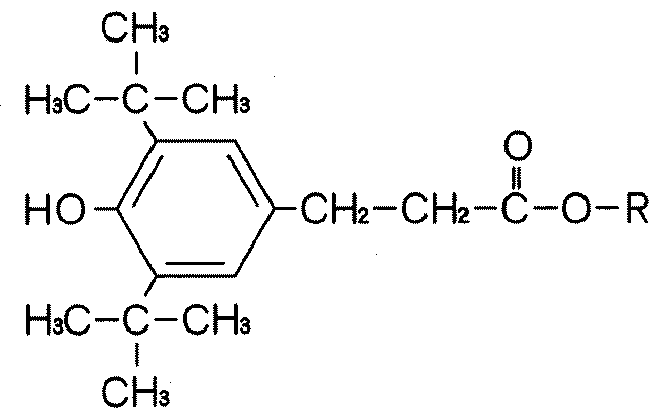
Additive (4): BHT (butylhydroxytoluene : 2 , 6-di-tert-butyl-
4-methylphenol )
Additive (5) : Antirust agent (alkyl naphthalene sulfonic acid calcium salt / carboxylic acid calcium salt complex) Additive (6) : Copper inactivator (benzotriazole)
Additive (7) : Antiwear agent (3- (di-isobutoxy- thiophosphorylsulfanyl ) -2-methyl-propionic acid)
The following Examples and Comparative Examples were produced .
Example 1
2.00 mass% of additive (1) was added to 97.02 mass% of the above base oil, and further 0.50 mass% of the additive (4), 0.40 mass% of the additive (5), 0.03 mass% of the additive (6) and 0.05 mass% of the additive (7) were then added and mixed well to obtain a flame-retardant hydraulic oil of Example 1.
Examples 2 to 6
In addition, the flame-retardant hydraulic oils of Examples 2 to 6 with the compositions described in Table 1 were obtained according to the same process as Example 1. Comparative Examples 1 to 8
In addition, the lubricating oil compositions of Comparative Examples 1 to 8 with the compositions
described in Tables 2 and 3, were obtained according to the same process as Example 1.
The following tests were conducted in order to know the performance of the above Examples and Comparative Examples .
Heat resistance test: 40°C. kinematic viscosity after ISOT
The test equipment and test method were based on JIS K 2514. The catalyst was immersed in the sample and stirred with a stirrer at 135°C for 96 hours to oxidize the sample. It was then subjected to the ISOT test
(oxidation stability test), to measure 40°C kinematic viscosity (mm2/s) .

The test results are shown in Tables 1 to 3. As shown in Table 1, in the case of using 2.0 mass% of 2,6- di-tert-butylphenol (additive 1) in Example 1, the result
of the heat resistance test (kinematic viscosity at 40°C after ISOT) was 74.58 mm2/s and 100 mm2/s or less; and good results were obtained as a heat resistant hydraulic oil.
In Example 2, 3.0 mass% of additive 1 was used and in Example 3, the amount of additive 1 was increased to 5.0 mass%. The results of the heat resistance test were 69.32 mm2s and 68.82 mm2/s, which were better than Example 1.
Example 4 was obtained by adding 1.0 mass% of tris ( 2 , 4-di-tert-butylphenyl ) phosphite (additive 2) to Example 1, and the result of the heat resistance test was 66.78 mm2/s, which was better than Example 1 due to the combined use with additive 1. Example 5 and Example 6 were obtained by adding 1.0 mass% of additive 2 to Example 2 and Example 3, respectively. The results of the heat resistance test were 64.15 mm2/s in Example 5 and 63.44 mm2/s in Example 6. Thus, the combined use of 2 , 6-di-tert-butylphenol and ( 2 , 4-di-tert-butylphenyl ) phosphite demonstrated further improvements .
In Comparative Example 1 of Table 2, the additive 1 was reduced to 0.5 mass%, and the 1.0 mass% of additive 2 was used. Since the amount of the additive 1 added was small, the result of the heat resistance test was poor. In Comparative Example 2, additive 1 was not used and 0.5 mass% of the additive 2 was used, and the heat resistance test showed no satisfactory results. In Comparative
Example 3 and Comparative Example 4, similarly 1.5 mass% and 2.5 mass% of additive 2 were used, respectively. Even when the amount of additive 2 used was increased, the result of the heat resistance test was worse than that of Comparative Example 2.
In Comparative Example 5 of Table 3, along with using 1.0 mass% of additive 2, 2.0 mass% of
benzenepropanoic acid 3,5-bis (1,1-dimethyl-ethyl) -4- hydroxy-C7 to C9 side chain alkyl ester, which is well
known as a phenolic antioxidant (additive 3), was used instead of additive 1. The heat resistance test showed no desired results. In Comparative Example 6, the amount of the additive 3 used was increased to 3.0 mass% as compared to Comparative Example 5. The heat resistance test showed somewhat improved results, but the results obtained were still undesirable.
In Comparative Example 7, the amount of the additive 2 used was increased to 2.0 mass% with respect to that of Comparative Example 5, but no satisfactory results were obtained because additive 1 was not used. Further, in Comparative Example 8, the amount of the additive 3 used was increased to 3.0 mass% with respect to that of
Comparative Example 7. The heat resistance test showed somewhat improved results, but no satisfactory results were obtained.
The compositions described in Examples 1 to 6 can also be used as biodegradable flame-retardant hydraulic oils .
Table 1

Table 2

Table 3

Claims
1. A flame-retardant hydraulic oil comprising: a 2,6-di- tert-butylphenol as an additive; and a fatty acid ester containing one or more unsaturated bonds as a base oil.
2. The flame-retardant hydraulic oil according to claim 1, wherein the content of 2,6-di -tert- butylphenol as the additive is more than 0.5 mass%, and 6.0 mass% or less, based on the total amount of hydraulic oil.
3. The flame-retardant hydraulic oil according to claim 1 or 2, wherein the fatty acid ester containing the
unsaturated bond is an ester derived from a fatty acid of a vegetable oil and fat mainly comprising coconut oil.
4. The flame-retardant hydraulic oil according to any one of claims 1 to 3, wherein the flame-retardant hydraulic oil further contains a tris (2 , 4-di-tert- butylphenyl ) phosphite as the additive.
5. The flame-retardant hydraulic oil according to claim 4, wherein the content of the tris (2, 4-di-tert-butylphenyl) phosphite is more than 0.5 mass%, and 3.0 mass% or less, based on the total amount of the hydraulic oil.
6. The biodegradable flame-retardant hydraulic oil
according to any one of claims 1 to 5, wherein the base oil of fatty acid ester containing unsaturated bond is biodegradable .
Applications Claiming Priority (2)
| Application Number | Priority Date | Filing Date | Title |
|---|---|---|---|
| JP2018-229510 | 2018-12-07 | ||
| JP2018229510A JP7181778B2 (en) | 2018-12-07 | 2018-12-07 | Flame-retardant hydraulic fluid |
Publications (1)
| Publication Number | Publication Date |
|---|---|
| WO2020115235A1 true WO2020115235A1 (en) | 2020-06-11 |
Family
ID=68808380
Family Applications (1)
| Application Number | Title | Priority Date | Filing Date |
|---|---|---|---|
| PCT/EP2019/083875 Ceased WO2020115235A1 (en) | 2018-12-07 | 2019-12-05 | Flame retardant hydraulic oil |
Country Status (2)
| Country | Link |
|---|---|
| JP (1) | JP7181778B2 (en) |
| WO (1) | WO2020115235A1 (en) |
Cited By (1)
| Publication number | Priority date | Publication date | Assignee | Title |
|---|---|---|---|---|
| CN113831948A (en) * | 2021-09-18 | 2021-12-24 | 新乡市瑞丰新材料股份有限公司 | Hydraulic oil complexing agent and preparation method thereof |
Citations (5)
| Publication number | Priority date | Publication date | Assignee | Title |
|---|---|---|---|---|
| EP0721979A2 (en) * | 1995-01-13 | 1996-07-17 | Ciba-Geigy Ag | Stabilized lubricant compositions |
| US5773391A (en) * | 1994-11-15 | 1998-06-30 | The Lubrizol Corporation | High oleic polyol esters, compositions and lubricants, functional fluids and greases containing the same |
| WO2006018403A1 (en) * | 2004-08-18 | 2006-02-23 | Ciba Specialty Chemicals Holding Inc. | Lubricating oil compositions with improved performance |
| JP2009161664A (en) | 2008-01-08 | 2009-07-23 | Nippon Oil Corp | Flame retardant hydraulic fluid composition |
| CN106833843A (en) * | 2017-01-21 | 2017-06-13 | 郑州人造金刚石及制品工程技术研究中心有限公司 | A kind of transformer conduction oil containing nanometer diamond alkene and preparation method thereof |
Family Cites Families (1)
| Publication number | Priority date | Publication date | Assignee | Title |
|---|---|---|---|---|
| CA2986040C (en) * | 2015-05-19 | 2022-05-31 | Quaker Chemical Corporation | Synthetic esters derived from high stability oleic acid |
-
2018
- 2018-12-07 JP JP2018229510A patent/JP7181778B2/en active Active
-
2019
- 2019-12-05 WO PCT/EP2019/083875 patent/WO2020115235A1/en not_active Ceased
Patent Citations (5)
| Publication number | Priority date | Publication date | Assignee | Title |
|---|---|---|---|---|
| US5773391A (en) * | 1994-11-15 | 1998-06-30 | The Lubrizol Corporation | High oleic polyol esters, compositions and lubricants, functional fluids and greases containing the same |
| EP0721979A2 (en) * | 1995-01-13 | 1996-07-17 | Ciba-Geigy Ag | Stabilized lubricant compositions |
| WO2006018403A1 (en) * | 2004-08-18 | 2006-02-23 | Ciba Specialty Chemicals Holding Inc. | Lubricating oil compositions with improved performance |
| JP2009161664A (en) | 2008-01-08 | 2009-07-23 | Nippon Oil Corp | Flame retardant hydraulic fluid composition |
| CN106833843A (en) * | 2017-01-21 | 2017-06-13 | 郑州人造金刚石及制品工程技术研究中心有限公司 | A kind of transformer conduction oil containing nanometer diamond alkene and preparation method thereof |
Cited By (2)
| Publication number | Priority date | Publication date | Assignee | Title |
|---|---|---|---|---|
| CN113831948A (en) * | 2021-09-18 | 2021-12-24 | 新乡市瑞丰新材料股份有限公司 | Hydraulic oil complexing agent and preparation method thereof |
| CN113831948B (en) * | 2021-09-18 | 2022-12-09 | 新乡市瑞丰新材料股份有限公司 | Hydraulic oil complexing agent and preparation method thereof |
Also Published As
| Publication number | Publication date |
|---|---|
| JP7181778B2 (en) | 2022-12-01 |
| JP2020090630A (en) | 2020-06-11 |
Similar Documents
| Publication | Publication Date | Title |
|---|---|---|
| US8557754B2 (en) | Composition of biodegradable gear oil | |
| WO2008134179A2 (en) | Lubricant blend composition | |
| EP3013925A1 (en) | Lubricating compositions containing isoprene based components | |
| CN101578354A (en) | Rust inhibitors for highly paraffinic lubricating base oils | |
| JP2017515949A (en) | Lubricant | |
| JP6970387B2 (en) | Lubricating oil base oil | |
| EP3746529A1 (en) | Lubricant composition | |
| JP2011102375A (en) | Flame-retardant hydraulic oil composition | |
| KR20130038357A (en) | Lithium complex grease with improved thickener yield | |
| JP2024015129A (en) | Lubricating oil compositions that provide anti-wear properties with low viscosity | |
| JP5441480B2 (en) | Lubricating oil composition | |
| WO2013109568A1 (en) | Seal swell additive | |
| WO2024004900A1 (en) | Lubricating oil composition, method for using same, and method for producing same | |
| CN112119141B (en) | Reciprocating compressor oil | |
| JP7181778B2 (en) | Flame-retardant hydraulic fluid | |
| WO2020184436A1 (en) | Rust preventive oil composition and method for producing same | |
| JP3639876B2 (en) | Rust preventive lubricant composition for plastic working | |
| JP7402390B2 (en) | Synthetic vegetable oil, environmentally friendly flame-retardant hydraulic fluid composition containing same, and method for producing the same | |
| JP5496502B2 (en) | Lubricating oil composition | |
| WO2023074424A1 (en) | Lubricant composition | |
| JP5529388B2 (en) | Rolling oil composition for metal working | |
| JP2005306894A (en) | Cold-resistant liquid lubricating oil and method for producing the same | |
| JP7090085B2 (en) | Ether-based lubricant composition, formula and use | |
| JP2018009119A (en) | Flame-retardant grease composition | |
| CN107109291B (en) | Alpha-olefin adsorption-inhibiting lubricant composition, adsorption-inhibiting method, and adsorption inhibitor |
Legal Events
| Date | Code | Title | Description |
|---|---|---|---|
| 121 | Ep: the epo has been informed by wipo that ep was designated in this application |
Ref document number: 19816660 Country of ref document: EP Kind code of ref document: A1 |
|
| NENP | Non-entry into the national phase |
Ref country code: DE |
|
| 122 | Ep: pct application non-entry in european phase |
Ref document number: 19816660 Country of ref document: EP Kind code of ref document: A1 |