WO2020109347A1 - Acrylic polymerized polysiloxane, composition comprising the same, and cured film produced using the same - Google Patents
Acrylic polymerized polysiloxane, composition comprising the same, and cured film produced using the same Download PDFInfo
- Publication number
- WO2020109347A1 WO2020109347A1 PCT/EP2019/082657 EP2019082657W WO2020109347A1 WO 2020109347 A1 WO2020109347 A1 WO 2020109347A1 EP 2019082657 W EP2019082657 W EP 2019082657W WO 2020109347 A1 WO2020109347 A1 WO 2020109347A1
- Authority
- WO
- WIPO (PCT)
- Prior art keywords
- polysiloxane
- formula
- acrylic
- hydrocarbon group
- group
- Prior art date
- Legal status (The legal status is an assumption and is not a legal conclusion. Google has not performed a legal analysis and makes no representation as to the accuracy of the status listed.)
- Ceased
Links
Classifications
-
- C—CHEMISTRY; METALLURGY
- C09—DYES; PAINTS; POLISHES; NATURAL RESINS; ADHESIVES; COMPOSITIONS NOT OTHERWISE PROVIDED FOR; APPLICATIONS OF MATERIALS NOT OTHERWISE PROVIDED FOR
- C09D—COATING COMPOSITIONS, e.g. PAINTS, VARNISHES OR LACQUERS; FILLING PASTES; CHEMICAL PAINT OR INK REMOVERS; INKS; CORRECTING FLUIDS; WOODSTAINS; PASTES OR SOLIDS FOR COLOURING OR PRINTING; USE OF MATERIALS THEREFOR
- C09D183/00—Coating compositions based on macromolecular compounds obtained by reactions forming in the main chain of the macromolecule a linkage containing silicon, with or without sulfur, nitrogen, oxygen, or carbon only; Coating compositions based on derivatives of such polymers
- C09D183/10—Block or graft copolymers containing polysiloxane sequences
-
- C—CHEMISTRY; METALLURGY
- C08—ORGANIC MACROMOLECULAR COMPOUNDS; THEIR PREPARATION OR CHEMICAL WORKING-UP; COMPOSITIONS BASED THEREON
- C08F—MACROMOLECULAR COMPOUNDS OBTAINED BY REACTIONS ONLY INVOLVING CARBON-TO-CARBON UNSATURATED BONDS
- C08F220/00—Copolymers of compounds having one or more unsaturated aliphatic radicals, each having only one carbon-to-carbon double bond, and only one being terminated by only one carboxyl radical or a salt, anhydride ester, amide, imide or nitrile thereof
- C08F220/02—Monocarboxylic acids having less than ten carbon atoms; Derivatives thereof
- C08F220/04—Acids; Metal salts or ammonium salts thereof
- C08F220/06—Acrylic acid; Methacrylic acid; Metal salts or ammonium salts thereof
-
- C—CHEMISTRY; METALLURGY
- C08—ORGANIC MACROMOLECULAR COMPOUNDS; THEIR PREPARATION OR CHEMICAL WORKING-UP; COMPOSITIONS BASED THEREON
- C08F—MACROMOLECULAR COMPOUNDS OBTAINED BY REACTIONS ONLY INVOLVING CARBON-TO-CARBON UNSATURATED BONDS
- C08F220/00—Copolymers of compounds having one or more unsaturated aliphatic radicals, each having only one carbon-to-carbon double bond, and only one being terminated by only one carboxyl radical or a salt, anhydride ester, amide, imide or nitrile thereof
- C08F220/02—Monocarboxylic acids having less than ten carbon atoms; Derivatives thereof
- C08F220/10—Esters
- C08F220/12—Esters of monohydric alcohols or phenols
- C08F220/14—Methyl esters, e.g. methyl (meth)acrylate
-
- C—CHEMISTRY; METALLURGY
- C08—ORGANIC MACROMOLECULAR COMPOUNDS; THEIR PREPARATION OR CHEMICAL WORKING-UP; COMPOSITIONS BASED THEREON
- C08F—MACROMOLECULAR COMPOUNDS OBTAINED BY REACTIONS ONLY INVOLVING CARBON-TO-CARBON UNSATURATED BONDS
- C08F230/00—Copolymers of compounds having one or more unsaturated aliphatic radicals, each having only one carbon-to-carbon double bond, and containing phosphorus, selenium, tellurium or a metal
- C08F230/04—Copolymers of compounds having one or more unsaturated aliphatic radicals, each having only one carbon-to-carbon double bond, and containing phosphorus, selenium, tellurium or a metal containing a metal
- C08F230/08—Copolymers of compounds having one or more unsaturated aliphatic radicals, each having only one carbon-to-carbon double bond, and containing phosphorus, selenium, tellurium or a metal containing a metal containing silicon
-
- C—CHEMISTRY; METALLURGY
- C08—ORGANIC MACROMOLECULAR COMPOUNDS; THEIR PREPARATION OR CHEMICAL WORKING-UP; COMPOSITIONS BASED THEREON
- C08G—MACROMOLECULAR COMPOUNDS OBTAINED OTHERWISE THAN BY REACTIONS ONLY INVOLVING UNSATURATED CARBON-TO-CARBON BONDS
- C08G77/00—Macromolecular compounds obtained by reactions forming a linkage containing silicon with or without sulfur, nitrogen, oxygen or carbon in the main chain of the macromolecule
- C08G77/04—Polysiloxanes
- C08G77/20—Polysiloxanes containing silicon bound to unsaturated aliphatic groups
-
- C—CHEMISTRY; METALLURGY
- C08—ORGANIC MACROMOLECULAR COMPOUNDS; THEIR PREPARATION OR CHEMICAL WORKING-UP; COMPOSITIONS BASED THEREON
- C08G—MACROMOLECULAR COMPOUNDS OBTAINED OTHERWISE THAN BY REACTIONS ONLY INVOLVING UNSATURATED CARBON-TO-CARBON BONDS
- C08G77/00—Macromolecular compounds obtained by reactions forming a linkage containing silicon with or without sulfur, nitrogen, oxygen or carbon in the main chain of the macromolecule
- C08G77/42—Block-or graft-polymers containing polysiloxane sequences
- C08G77/442—Block-or graft-polymers containing polysiloxane sequences containing vinyl polymer sequences
-
- C—CHEMISTRY; METALLURGY
- C08—ORGANIC MACROMOLECULAR COMPOUNDS; THEIR PREPARATION OR CHEMICAL WORKING-UP; COMPOSITIONS BASED THEREON
- C08J—WORKING-UP; GENERAL PROCESSES OF COMPOUNDING; AFTER-TREATMENT NOT COVERED BY SUBCLASSES C08B, C08C, C08F, C08G or C08H
- C08J5/00—Manufacture of articles or shaped materials containing macromolecular substances
- C08J5/18—Manufacture of films or sheets
-
- C—CHEMISTRY; METALLURGY
- C08—ORGANIC MACROMOLECULAR COMPOUNDS; THEIR PREPARATION OR CHEMICAL WORKING-UP; COMPOSITIONS BASED THEREON
- C08K—Use of inorganic or non-macromolecular organic substances as compounding ingredients
- C08K5/00—Use of organic ingredients
- C08K5/16—Nitrogen-containing compounds
- C08K5/22—Compounds containing nitrogen bound to another nitrogen atom
- C08K5/23—Azo-compounds
-
- C—CHEMISTRY; METALLURGY
- C08—ORGANIC MACROMOLECULAR COMPOUNDS; THEIR PREPARATION OR CHEMICAL WORKING-UP; COMPOSITIONS BASED THEREON
- C08K—Use of inorganic or non-macromolecular organic substances as compounding ingredients
- C08K5/00—Use of organic ingredients
- C08K5/16—Nitrogen-containing compounds
- C08K5/29—Compounds containing one or more carbon-to-nitrogen double bonds
-
- C—CHEMISTRY; METALLURGY
- C09—DYES; PAINTS; POLISHES; NATURAL RESINS; ADHESIVES; COMPOSITIONS NOT OTHERWISE PROVIDED FOR; APPLICATIONS OF MATERIALS NOT OTHERWISE PROVIDED FOR
- C09D—COATING COMPOSITIONS, e.g. PAINTS, VARNISHES OR LACQUERS; FILLING PASTES; CHEMICAL PAINT OR INK REMOVERS; INKS; CORRECTING FLUIDS; WOODSTAINS; PASTES OR SOLIDS FOR COLOURING OR PRINTING; USE OF MATERIALS THEREFOR
- C09D183/00—Coating compositions based on macromolecular compounds obtained by reactions forming in the main chain of the macromolecule a linkage containing silicon, with or without sulfur, nitrogen, oxygen, or carbon only; Coating compositions based on derivatives of such polymers
- C09D183/04—Polysiloxanes
-
- C—CHEMISTRY; METALLURGY
- C09—DYES; PAINTS; POLISHES; NATURAL RESINS; ADHESIVES; COMPOSITIONS NOT OTHERWISE PROVIDED FOR; APPLICATIONS OF MATERIALS NOT OTHERWISE PROVIDED FOR
- C09D—COATING COMPOSITIONS, e.g. PAINTS, VARNISHES OR LACQUERS; FILLING PASTES; CHEMICAL PAINT OR INK REMOVERS; INKS; CORRECTING FLUIDS; WOODSTAINS; PASTES OR SOLIDS FOR COLOURING OR PRINTING; USE OF MATERIALS THEREFOR
- C09D183/00—Coating compositions based on macromolecular compounds obtained by reactions forming in the main chain of the macromolecule a linkage containing silicon, with or without sulfur, nitrogen, oxygen, or carbon only; Coating compositions based on derivatives of such polymers
- C09D183/04—Polysiloxanes
- C09D183/06—Polysiloxanes containing silicon bound to oxygen-containing groups
-
- G—PHYSICS
- G03—PHOTOGRAPHY; CINEMATOGRAPHY; ANALOGOUS TECHNIQUES USING WAVES OTHER THAN OPTICAL WAVES; ELECTROGRAPHY; HOLOGRAPHY
- G03F—PHOTOMECHANICAL PRODUCTION OF TEXTURED OR PATTERNED SURFACES, e.g. FOR PRINTING, FOR PROCESSING OF SEMICONDUCTOR DEVICES; MATERIALS THEREFOR; ORIGINALS THEREFOR; APPARATUS SPECIALLY ADAPTED THEREFOR
- G03F7/00—Photomechanical, e.g. photolithographic, production of textured or patterned surfaces, e.g. printing surfaces; Materials therefor, e.g. comprising photoresists; Apparatus specially adapted therefor
- G03F7/004—Photosensitive materials
- G03F7/022—Quinonediazides
-
- G—PHYSICS
- G03—PHOTOGRAPHY; CINEMATOGRAPHY; ANALOGOUS TECHNIQUES USING WAVES OTHER THAN OPTICAL WAVES; ELECTROGRAPHY; HOLOGRAPHY
- G03F—PHOTOMECHANICAL PRODUCTION OF TEXTURED OR PATTERNED SURFACES, e.g. FOR PRINTING, FOR PROCESSING OF SEMICONDUCTOR DEVICES; MATERIALS THEREFOR; ORIGINALS THEREFOR; APPARATUS SPECIALLY ADAPTED THEREFOR
- G03F7/00—Photomechanical, e.g. photolithographic, production of textured or patterned surfaces, e.g. printing surfaces; Materials therefor, e.g. comprising photoresists; Apparatus specially adapted therefor
- G03F7/004—Photosensitive materials
- G03F7/022—Quinonediazides
- G03F7/023—Macromolecular quinonediazides; Macromolecular additives, e.g. binders
- G03F7/0233—Macromolecular quinonediazides; Macromolecular additives, e.g. binders characterised by the polymeric binders or the macromolecular additives other than the macromolecular quinonediazides
-
- G—PHYSICS
- G03—PHOTOGRAPHY; CINEMATOGRAPHY; ANALOGOUS TECHNIQUES USING WAVES OTHER THAN OPTICAL WAVES; ELECTROGRAPHY; HOLOGRAPHY
- G03F—PHOTOMECHANICAL PRODUCTION OF TEXTURED OR PATTERNED SURFACES, e.g. FOR PRINTING, FOR PROCESSING OF SEMICONDUCTOR DEVICES; MATERIALS THEREFOR; ORIGINALS THEREFOR; APPARATUS SPECIALLY ADAPTED THEREFOR
- G03F7/00—Photomechanical, e.g. photolithographic, production of textured or patterned surfaces, e.g. printing surfaces; Materials therefor, e.g. comprising photoresists; Apparatus specially adapted therefor
- G03F7/004—Photosensitive materials
- G03F7/075—Silicon-containing compounds
- G03F7/0752—Silicon-containing compounds in non photosensitive layers or as additives, e.g. for dry lithography
-
- G—PHYSICS
- G03—PHOTOGRAPHY; CINEMATOGRAPHY; ANALOGOUS TECHNIQUES USING WAVES OTHER THAN OPTICAL WAVES; ELECTROGRAPHY; HOLOGRAPHY
- G03F—PHOTOMECHANICAL PRODUCTION OF TEXTURED OR PATTERNED SURFACES, e.g. FOR PRINTING, FOR PROCESSING OF SEMICONDUCTOR DEVICES; MATERIALS THEREFOR; ORIGINALS THEREFOR; APPARATUS SPECIALLY ADAPTED THEREFOR
- G03F7/00—Photomechanical, e.g. photolithographic, production of textured or patterned surfaces, e.g. printing surfaces; Materials therefor, e.g. comprising photoresists; Apparatus specially adapted therefor
- G03F7/004—Photosensitive materials
- G03F7/075—Silicon-containing compounds
- G03F7/0757—Macromolecular compounds containing Si-O, Si-C or Si-N bonds
-
- G—PHYSICS
- G03—PHOTOGRAPHY; CINEMATOGRAPHY; ANALOGOUS TECHNIQUES USING WAVES OTHER THAN OPTICAL WAVES; ELECTROGRAPHY; HOLOGRAPHY
- G03F—PHOTOMECHANICAL PRODUCTION OF TEXTURED OR PATTERNED SURFACES, e.g. FOR PRINTING, FOR PROCESSING OF SEMICONDUCTOR DEVICES; MATERIALS THEREFOR; ORIGINALS THEREFOR; APPARATUS SPECIALLY ADAPTED THEREFOR
- G03F7/00—Photomechanical, e.g. photolithographic, production of textured or patterned surfaces, e.g. printing surfaces; Materials therefor, e.g. comprising photoresists; Apparatus specially adapted therefor
- G03F7/16—Coating processes; Apparatus therefor
Definitions
- the present invention relates to an acrylic
- the present invention also relates to a cured film produced using the composition comprising the acrylic polymerized
- a material for such a planarization film for a TFT substrate a material combining an acrylic resin with a quinonediazide compound is known. Since these materials have planarizing properties and photosensitivity, contact holes and other patterns can be formed . However, as resolution and frame frequency are increased, planarization becomes severe due to more complicated wiring, so that it becomes difficult for these materials to cope with this problem.
- Polysiloxane is known as a material for forming a cured film having high heat resistance, high transparency and high resolution.
- silsesquioxane derivatives have been widely used because they are excellent in low dielectric constant, high transmittance, high heat resistance, UV resistance, and coating
- Silsesquioxane is a polymer composed of a trifunctional siloxane structural unit RSi ( O1.5) and is an intermediate existence between inorganic silica (S1O2) and organic silicone (R2S1O) in terms of chemical structure. While it is soluble in organic solvent, the cured product obtained from it is a specific compound having a
- a cured film is formed using a composition comprising polysiloxane
- a photosensitive composition comprising polymer produced by copolymerization of a monomer comprising polyfunctional siloxane (Patent Document 1) and a composition comprising an acrylic-based copolymer that contains a hydrolyzable silyl group (Patent Document 2) have been proposed.
- Patent Document 2 JP-A 2014- 129550
- the present invention provides a novel polysiloxane compound capable of forming a cured film that is capable of improving adhesion between a substrate and the cured film when the cured film is formed .
- the formed cured film is excellent in heat resistance and transparency.
- the acrylic polymerized polysiloxane according to the present invention comprises
- R al is hydrogen or methyl
- R a2 is independently hydrogen or methyl
- R a3 is hydrogen or a mono- to hexa-valent Ci-50
- hydrocarbon group where one or more methylene in the hydrocarbon group may be replaced with oxy, amino, imino and/or carbonyl, and when R a3 is multivalent, R a3 connects carbonyloxy in the formula (a) and carbonyloxy contained in other repeating unit represented by the formula (a), and
- na is an integer of 0 or more
- site marked with * in at least one repeating unit in the formula (la) is connected directly or via an acrylic polymerization unit represented by the formula (a) to the site marked with * in other repeating unit represented by the formula (la) .
- R al' is hydrogen or methyl
- ma' is an integer of 1 to 6
- R ia is a linear or branched Ci- 6 -alkyl
- the polysiloxane composition according to the present invention comprises the above polysiloxane and a solvent.
- according to the present invention comprises applying the above composition on a substrate and heating.
- invention comprises the above-described cured film.
- the acrylic polymerized polysiloxane according to the present invention can form a cured film having high heat resistance and excellent in transparency. Moreover, it is excellent in adhesion between the obtained cured film and a substrate.
- the composition comprising the acrylic polymerized polysiloxane according to the present invention can form a positive or negative pattern by imparting photosensitivity to it.
- an element of a concept can be expressed by a plurality of species, and when the amount (for example, mass % or mol%) is described, it means sum of the plurality of species.
- the hydrocarbon means one including carbon and hydrogen, and optionally including oxygen or nitrogen.
- the hydrocarbyl group means a monovalent or divalent or higher valent hydrocarbon.
- the aliphatic hydrocarbon means a linear, branched or cyclic aliphatic hydrocarbon, and the aliphatic hydrocarbon group means a monovalent or divalent or higher valent aliphatic hydrocarbon.
- the aromatic hydrocarbon means a hydrocarbon comprising an aromatic ring which may optionally not only comprise an aliphatic hydrocarbon group as a substituent but also be condensed with an alicycle.
- the aromatic hydrocarbon group means a monovalent or divalent or higher valent aromatic hydrocarbon.
- aromatic hydrocarbon groups and aromatic hydrocarbon groups optionally contain fluorine, oxy, hydroxy, amino, carbonyl, silyl, or the like.
- aromatic ring means a hydrocarbon comprising a conjugated unsaturated ring structure
- alicycle means a hydrocarbon comprising a ring structure but no conjugated unsaturated ring structure.
- the alkyl means a group obtained by removing any one hydrogen from a linear or branched, saturated hydrocarbon and includes a linear alkyl and branched alkyl
- the cycloalkyl means a group obtained by removing one hydrogen from a saturated hydrocarbon comprising a cyclic structure and optionally includes a linear or branched alkyl in the cyclic structure as a side chain.
- the aryl means a group obtained by removing any one hydrogen from an aromatic hydrocarbon.
- the alkylene means a group obtained by removing any two hydrogens from a linear or branched, saturated hydrocarbon.
- the arylene means a
- hydrocarbon group obtained by removing any two hydrogens from an aromatic hydrocarbon.
- Ci-e alkyl means alkyl having 1 to 6 carbons (such as methyl, ethyl, propyl, butyl, pentyl and hexyl) .
- fluoroalkyl as used in the present specification refers to one in which one or more hydrogens in alkyl is replaced with fluorine, and the fluoroaryl is one in which one or more hydrogens in aryl are replaced with fluorine.
- these repeating units when polymer has a plural types of repeating units, these repeating units copolymerize. Unless otherwise specifically mentioned, these copolymerization may be any of alternating copolymerization, random copolymerization, block copolymerization, graft copolymerization, or a mixture thereof.
- polymer or resin is represented by a structural formula, n, m or the like attached next to parentheses indicate the number of repetitions.
- Celsius is used as the temperature unit.
- 20 degrees means 20 degrees Celsius.
- the polysiloxane means a polymer including a bond of Si-O-Si (siloxane bond) as a main chain.
- silsesquioxane polymer represented by the formula (RSiOi.s)n shall also be included as the general
- polysiloxane Further, in the present specification, the polysiloxane shall also include the acrylic polymerized polysiloxane.
- the acrylic polymerized polysiloxane according to the present invention comprises
- R al is hydrogen or methyl
- ma is each independently an integer of 1 to 6, preferably an integer of 1 to 3, and most preferably 3), and
- R a2 is independently hydrogen or methyl
- R a3 is hydrogen or a mono- to hexa-valent Ci-50
- hydrocarbon group where one or more methylene in the hydrocarbon group may be replaced with oxy, amino, imino and/or carbonyl, and when R a3 is multivalent, R a3 connects carbonyloxy in the formula (a) and carbonyloxy contained in other repeating unit represented by the formula (a), and
- na is an integer of 0 or more
- site marked with * in at least one repeating unit in the formula (la) is connected directly or via an acrylic polymerization unit represented by said formula (a) to the site marked with * in other repeating unit represented by the formula (la) .
- the formula (a) may be bonded to other formula (a) to form a block, but if there are many acrylic polymerization units, heat resistance tends to decrease.
- (the sum of na)/(the number of repeating units represented by (la) + the sum of na) is preferably 0.15 or less, and more preferably 0.05 or less.
- na is not particularly limited as long as it satisfies the above, it is preferably 0 to 6, more preferably 0 to 4, and further preferably 1 to 2. When a plurality of (a) are included, each na may be the same or different.
- R a3 preferably has 1 to
- the acrylic polymerization unit represented by the formula (a) is not essential, it is preferably comprised for improving adhesion.
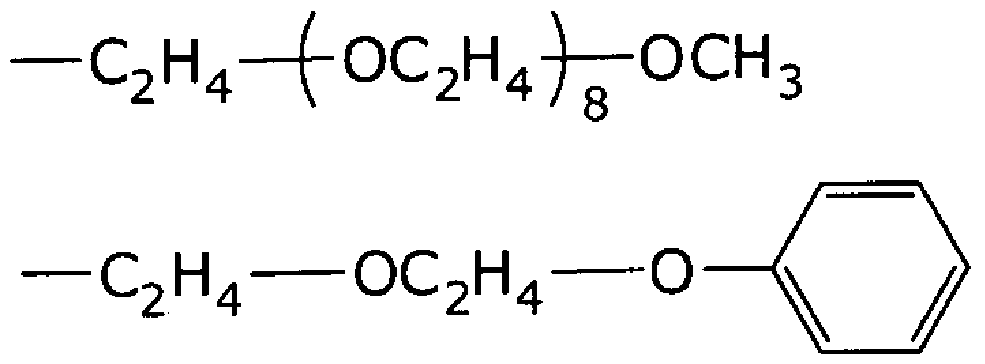
- R a3 examples include the followings:
- isocyanurate and dipentaerythritol hexaacrylate are preferable.
- repeating unit represented by the formula (a) is a group derived from an acrylic
- the acrylic polymerized polysiloxane may contain some double bonds that are not cleaved .
- the ratio of double bonds that are not cleaved is small .
- R a3 may be a group obtained by removing a plurality of, preferably two or three hydrogens from a nitrogen and/or oxygen-containing cycloaliphatic hydrocarbon compound that contains a hydrocarbon group substituted with an amino group, an imino group, and/or a carbonyl group (preferably a group obtained by removing two or three hydrogens from a nitrogen-containing aliphatic hydrocarbon ring that contains an imino group and/or a carbonyl group, more preferably a group obtained by removing two or three hydrogens from a five-membered or six-membered ring that contains nitrogen as a member, and most preferably a group obtained by removing two or three hydrogens from a piperidine derivative, pyrrolidine derivative, or
- the blending ratio of the repeating unit represented by the formula (la) is preferably 10 to 100 mol% to the total number of the repeating units in the acrylic polymerized polysiloxane because heat resistance is decreased when the blending ratio is high.
- the total number of the repeating units in the acrylic polymerized polysiloxane means the total number of the siloxane repeating units in the acrylic polymerized polysiloxane.
- the acrylic polymerization unit represented by the formula (a) shall not be included in this total number.
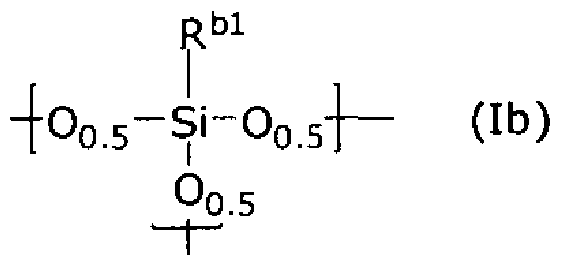
- the acrylic polymerized polysiloxane according to the present invention preferably further comprises a repeating unit represented by the formula (lb) :
- R bl represents hydrogen, a linear, branched or cyclic, saturated or unsaturated C i-30 aliphatic hydrocarbon group, or an aromatic hydrocarbon group,
- aliphatic hydrocarbon group and aromatic hydrocarbon group are each unsubstituted or substituted with fluorine, hydroxy or alkoxy, and in the aliphatic hydrocarbon group and aromatic hydrocarbon group, methylene is not replaced, or one or more methylene are replaced with oxy, amino, imino or carbonyl, provided that R bl is not hydroxy or alkoxy) .
- the above-described methylene includes a terminal methyl as well .
- substituted with fluorine, hydroxy or alkoxy means that a hydrogen atom directly connected to a carbon atom in an aliphatic hydrocarbon group and an aromatic hydrocarbon group is replaced with fluorine, hydroxy or alkoxy.
- substituted with fluorine, hydroxy or alkoxy means that a hydrogen atom directly connected to a carbon atom in an aliphatic hydrocarbon group and an aromatic hydrocarbon group is replaced with fluorine, hydroxy or alkoxy.
- R bl includes, for example, (i) alkyl, such as methyl, ethyl, propyl, butyl, pentyl, hexyl, heptyl, octyl and decyl, (ii) aryl, such as phenyl, tolyl and benzyl, (iii) fluoroalkyl, such as trifluoromethyl, 2,2,2-trifluoroethyl and
- fluoroalkyl perfluoroalkyl is preferred, and trifluoromethyl and pentafluoroethyl are particularly preferred .
- the compound wherein R bl is methyl is preferred, since raw material thereof is easily obtained, it has high film hardness after curing and high chemical resistance. Further, the compound wherein R bl is phenyl is preferred, since it increases solubility of said
- R bl has hydroxy, glycidyl, isocyanate or amino, since the adhesion to the substrate is increased.
- acrylic polymerized polysiloxane according to the present invention examples include those
- the blending ratio of the repeating unit represented by the formula (lb) is preferably 0 to 90 mol% to the total number of the repeating units in the acrylic polymerized polysiloxane, because when the blending ratio is high, strength and heat resistance of the cured film to be formed is increased, but adhesion is decreased.
- the acrylic polymerized polysiloxane according to the present invention preferably further comprises
- R dl is a group obtained by removing a plurality of hydrogens from a nitrogen and/or oxygen-containing cyclic aliphatic hydrocarbon compound that contains an amino group, an imino group, and/or a carbonyl group) .
- R dl in the formula (Id) is preferably a group obtained by removing a plurality of, preferably two or three hydrogens from a nitrogen-containing aliphatic
- hydrocarbon ring that contains an imino group, and/or a carbonyl group more preferably a five-membered or six-membered ring that contains nitrogen as a member.
- it is a group obtained by removing two or three hydrogens from piperidine, pyrrolidine, and isocyanurate.
- the group which is not bonded to oxygen in the formula (Id) connects Si contained in a plurality of repeating units.
- the blending ratio is preferably 40 mol% or less, and more preferably 20 mol% or less, to the total number of the repeating units of acrylic polymerized polysiloxane.
- the acrylic polymerized polysiloxane according to the present invention may further comprise a repeating unit represented by the following formula (Ie) :
- R el is each independently represents hydrogen, a linear, branched or cyclic, saturated or unsaturated C i-30 aliphatic hydrocarbon group, or an aromatic hydrocarbon group, where the aliphatic hydrocarbon group and aromatic hydrocarbon group are unsubstituted or substituted with fluorine, hydroxy or alkoxy, and in the aliphatic
- hydrocarbon group and aromatic hydrocarbon group methylene is not replaced or replaced with oxy, amino, imino or carbonyl, provided that R el is not hydroxy or alkoxy) .
- the above-described methylene includes a terminal methyl as well .
- R el includes, for example, (i) alkyl, such as methyl, ethyl, propyl, butyl, pentyl, hexyl, heptyl, octyl and decyl, (ii) aryl, such as phenyl, tolyl and benzyl, (iii) fluoroalkyl, such as trifluoromethyl, 2,2,2-trifluoroethyl and
- fluoroalkyl perfluoroalkyl is preferred, and trifluoromethyl and pentafluoroethyl are particularly preferred .
- the compound wherein R el is methyl is preferred, since raw material thereof is easily obtained, it has high film hardness after curing and high chemical resistance. Further, the compound wherein R el is phenyl is preferred, since it increases solubility of said
- R el has hydroxy, glycidyl, isocyanate or amino, since the adhesion to the substrate is increased.
- the acrylic polymerized polysiloxane according to the present invention can partially have a linear structure. However, since heat resistance is decreased, it is preferable that there are few linear structure parts.
- the repeating unit of the formula (Ie) is preferably 30 mol% or less to the total number of the repeating units in the acrylic polymerized polysiloxane.
- the acrylic polymerized polysiloxane according to the present invention has a structure in which the above-described repeating units or blocks are bonded, but preferably has a silanol at its terminal .
- a silanol group is one in which -O0.5H is bonded to the bonding hand of the above-described repeating units or blocks.
- the mass average molecular weight of the acrylic polymerized polysiloxane according to the present invention is not particularly limited. However, a higher molecular weight tends to improve coatability. On the other hand, the lower the molecular weight is, the less the synthesis conditions are limited and the easier the synthesis is. Polysiloxane having a very high molecular weight is difficult to synthesize. For this reason, polysiloxane usually has the mass average molecular weight of 1,500 to 20,000, and preferably 2,000 to 15,000 from the viewpoint of solubility in organic solvents and solubility in al kaline developers.
- the mass average molecular weight means a mass average molecular weight in terms of polystyrene, and it can be measured by the gel permeation chromatography using polystyrene as a reference.
- the acrylic polymerized polysiloxane according to the present invention is contained in a composition having photosensitivity, a cured film is formed on a substrate through coating, imagewise exposure and development. At this time, it is necessary that a difference in solubility occurs between the exposed area and the unexposed area .
- the coating film in the exposed area in the case of a negative composition, the coating film in the unexposed area
- TMAH tetramethylammonium hydroxide
- ADR alkali dissolution rate
- the dissolution rate to the 2.38% TMAH aqueous solution is preferably 50 to 5,000 A/sec, and more preferably 200 to 3,000 A/sec, although it varies depending on the type and amount of the photosensitizer and silanol condensation catalyst, which are contained in the composition.
- the dissolution rate to the 2.38% TMAH aqueous solution is preferably 50 to 20,000 A/sec, and more preferably 1,000 to 10,000 A/sec.
- a polysiloxane having any ADR within the above range may be selected depending on the application and required characteristics.
- Polysiloxane having different alkali dissolution rates and mass average molecular weights can be prepared by changing the catalyst, reaction temperature, reaction time or polymer. Using a combination of polysiloxane having different alkali dissolution rates, it is possible to improve reduction of residual insoluble matter after development, reduction of pattern reflow, pattern stability, and the like.
- Such polysiloxane includes, for example,
- composition having a desired dissolution rate can be obtained by mixing, if necessary.
- the alkali dissolution rate of polysiloxane or a mixture thereof is measured and calculated as described below.
- Polysiloxane is diluted with propylene glycol
- PGMEA monomethyl ether acetate
- the silicon wafer having this film is gently immersed in a glass petri dish having a diameter of 6 inches, into which 100 ml of a TMAH aqueous solution adjusted to 23.0 ⁇ 0.1°C and having a predetermined concentration was put, then allowed to stand, and the time until the film disappeared is measured .
- the dissolution rate is determined by dividing by the time until the film in the area 10 mm inside from the wafer edge disappears.
- the wafer is immersed in a TMAH aqueous solution for a certain period and then heated for 5 minutes on a hot plate at 200°C to remove moisture taken in the film during the dissolution rate measurement. Thereafter, film thickness is measured, and the dissolution rate is calculated by dividing the variation amount of before and after the immersion by the immersion time. The above measurement method is performed 5 times, and the average of the obtained values is taken as the dissolution rate of polysiloxane.
- the acrylic polymerized polysiloxane according to the present invention is obtained, for example, by the following steps:
- R al' is hydrogen or methyl
- ma' is an integer of 1 to 6, preferably an integer of 1 to 3, and most preferably 3
- R ia is a linear or branched Ci- 6 -alkyl
- the above-described mixture may be a mixture of a silane monomer represented by the formula (ia) and other silane monomer represented by the formula
- the acrylic polymerized polysiloxane obtained by the above steps provides a composition that exhibits excellent characteristics, and the structure obtained includes, for example, those exemplified above. However, since various structures can be taken according to type of the monomer, blending ratio and the like, it is conceivable that structures other than those exemplified above can also be taken.
- R ia includes methyl, ethyl, n-propyl, isopropyl, n-butyl and the like.
- a plurality of R ia are contained, but each R ia may be the same or different.
- silane monomer represented by the formula (ib) is preferably further combined with the silane monomer represented by the formula (ia) :
- R bl' represents hydrogen, a linear, branched or cyclic, saturated or unsaturated Ci-30 aliphatic hydrocarbon group, or an aromatic hydrocarbon group;
- aliphatic hydrocarbon group and aromatic hydrocarbon group are unsubstituted or substituted with fluorine, hydroxy or alkoxy, and in the aliphatic
- hydrocarbon group and aromatic hydrocarbon group methylene is not replaced or replaced by oxy, amino, imino or carbonyl, provided that R bl' is not hydroxy or alkoxy, and
- R ib is a linear or branched Ci- 6 -alkyl
- preferable R bl' is the same as the above-described preferable R bl .
- Preferred R ib includes methyl, ethyl, n-propyl, isopropyl, n-butyl and the like.
- methyltriisopropoxysilane methyltri-n-butoxysilane, ethyltrimethoxysilane, ethyltriethoxysilane,
- ethyltriisopropoxysilane ethyltri-n-butoxysilane, n-propyltrimethoxysilane, n-propyltriethoxysilane, n-butyltrimethoxysilane, n-butyltriethoxysilane,
- n-hexyltrimethoxysilane n-hexyltriethoxysilane, decyltrimethoxysilane, phenyltrimethoxysilane,
- methyltripropoxysilane, and phenyltrimethoxysilane are preferable.
- Two or more types of silane monomers represented by the formula (ib) can be combined.
- the acrylic polymerized polysiloxane can also be obtained by further combining silane monomers
- silane monomers represented by the above formulae (ia) and/or (ib) are used in this way, polysiloxane containing the repeating units (Ic) and/or
- R ic and R id are each independently a linear or branched
- Ci-6-alkyl examples thereof include methyl, ethyl, n-propyl, isopropyl, and n-butyl .
- a plurality of R ic and R id are contained in one monomer, and each R ic and R id can be the same or different,
- R dl' is a group obtained by removing a plurality of hydrogens from a nitrogen and/or oxygen-containing cyclic aliphatic hydrocarbon compound that contains an amino group, an imino group and/or a carbonyl group.
- Preferred R dl ' is the same as the above-described preferable R dl .
- silane monomer represented by the formula (ic) include
- silane monomer represented by the following formula (ie) can be combined.
- silane monomer represented by the formula (ie) is used, polysiloxane containing the repeating unit (Ie) can be obtained.
- R ie is each independently a linear or branched Ci-6-alkyl, and examples thereof include methyl, ethyl, n-propyl, isopropyl, and n-butyl .
- a plurality of R ie are contained in one monomer, and each R ie can be the same or different,
- R el' each independently represents hydrogen, a linear, branched or cyclic, saturated or unsaturated C i-30 aliphatic hydrocarbon group or an aromatic hydrocarbon group, where the aliphatic hydrocarbon group and aromatic hydrocarbon group are unsubstituted or substituted with fluorine, hydroxy or alkoxy, and in the aliphatic
- R el' is not hydroxy or alkoxy.
- R el' is the same as the
- Step (2) the carbon-carbon double bond of the acrylic group in the resulting acrylic group-containing polysiloxane is cleaved and polymerized.
- a polymerization initiator for example, an azo-based initiator such as
- a peroxide-based initiator such as dibenzoyl peroxide, tert-butyl hydroperoxide (70% aqueous solution), a, a- dimethylbenzyl hydroperoxide, tert-butyl peroxide and bis
- the blending amount of the polymerization initiator is not particularly limited but is preferably 0.1 to 500 mol% to the number of the acrylic functional groups.
- step (2) the polymerization reaction is
- R a2' is hydrogen or methyl
- R a3' is hydrogen or a Ci-50 hydrocarbon group where one or more methylene in the hydrocarbon group may be replaced with oxy, amino, imino and/or carbonyl, preferable R a3' is the same as the above-described preferable R a3 , and
- x is an integer of 1 to 6, preferably an integer of 3 to 6) .
- the above-described methylene includes a terminal methyl as well .
- the acrylate monomer represented by the formula (a') may be a nitrogen and/or oxygen-containing cycloaliphatic hydrocarbon compound that may have a plurality of acrylic acid esters in the molecule and contains an amino group, an imino group, and/or a carbonyl group (preferably a nitrogen-containing aliphatic hydrocarbon ring that contains an imino group and/or a carbonyl group, more preferably 5- or 6-membered ring that contains a nitrogen as a member, and most preferably, a piperidine derivative, a pyrrolidine derivative, or an isocyanurate derivative) .
- a nitrogen and/or oxygen-containing cycloaliphatic hydrocarbon compound that may have a plurality of acrylic acid esters in the molecule and contains an amino group, an imino group, and/or a carbonyl group (preferably a nitrogen-containing aliphatic hydrocarbon ring that contains an imino group and/or a carbonyl group, more preferably 5- or 6-membered
- Examples of the acrylate monomer represented by the formula (a') include methoxy polyethylene glycol acrylate, methoxy polyethylene glycol methacrylate, phenoxy polyethylene glycol acrylate, isostearyl acrylate, polyethylene glycol diacrylate, propoxylated bisphenol A diacrylate, tricyclo decandimethanol diacrylate,
- methoxypolyethylene glycol acrylate methoxypolyethylene glycol acrylate, tricyclodecane dimethanol diacrylate, and ethoxylated isocyanuric acid triacrylate.
- the molecular weight can be appropriately controlled using a known chain transfer agent, polymerization inhibitor, molecular weight regulator and the like. Furthermore, the polymerization reaction may be performed in one step or in two or more steps.
- the temperature of the polymerization reaction is not particularly limited, but is typically in the range of 50°C to 200°C, and preferably 80°C to 150°C.
- the mass average molecular weight of the acrylic polymerized polysiloxane obtained in step (2) is preferably
- composition according to the present invention comprises the above-described acrylic polymerized polysiloxane and a solvent.
- the solvent is selected from those that uniformly dissolve or disperse each component contained in the composition.
- ethylene glycol monoalkyl ethers such as ethylene glycol monomethyl ether, ethylene glycol monoethyl ether, ethylene glycol monopropyl ether and ethylene glycol monobutyl ether; diethylene glycol dialkyl ethers such as diethylene glycol dimethyl ether, diethylene glycol diethyl ether, diethylene glycol dipropyl ether and diethylene glycol dibutyl ether; ethylene glycol alkyl ether acetates such as methyl cellosolve acetate and ethyl cellosolve acetate; propylene glycol monoalkyl ethers such as propylene glycol monomethyl ether (PGME) and propylene glycol
- PGME propylene glycol monomethyl ether
- PGMEA propylene glycol monoalkyl ether acetates
- aromatic hydrocarbons such as benzene, toluene and xylene
- ketones such as methyl ethyl ketone, acetone, methyl amyl ketone, methyl isobutyl ketone and cyclohexanone
- alcohols such as isopropanol and propanediol ; and the like are included.
- the blending ratio of the solvent varies depending on the coating method and the requirement for the film thickness after coating .
- it is 90 mass% or more based on the total mass of polysiloxane and optional components, but in the case of slit coating of a large glass substrate used in the production of displays, it is usually 50 mass% or more, preferably 60 mass% or more, and usually 90 mass% or less, preferably 85 mass% or less.
- composition according to the invention can be any composition according to the invention.
- present invention is either a non-photosensitive
- the positive photosensitive composition means a composition capable of forming a positive image, i .e. when the composition is applied to form a coating film and exposed to light, the solubility of the exposed area in an alkaline developer increases, and the exposed area is removed through development to form a positive image.
- the negative photosensitive composition means a composition capable of forming a negative image, i .e. when the composition is applied to form a coating film and exposed to light, the exposed area becomes insoluble in an alkaline developer, and the unexposed area is removed through development to form a negative image.
- the positive photosensitive composition according to the present invention preferably comprises a diazonaphthoquinone derivative as a photosensitizer.
- composition comprising a diazonaphthoquinone derivative can form a positive image that is removed through development because the exposed area becomes soluble in an al kaline developer. This is because, through exposure, solubility in an alkali developer of the exposed area is increased due to the generated indene carboxylic acid, but the solubility of the unexposed area is decreased due to interaction with the silanol groups remaining in polysiloxane.
- a preferred diazonaphthoquinone derivative is a compound in which naphthoquinone diazide sulfonic acid is ester-bonded to a compound having phenolic hydroxy.
- the structure is not particularly limited but is preferably an ester compound with a compound having one or more phenolic hydroxy.
- the naphthoquinone diazide sulfonic acid 4-naphthoquinone diazide sulfonic acid or 5-naphthoquinone diazide sulfonic acid can be used.
- the 4-naphthoquinonediazide sulfonic acid ester compound has absorption in i-line (wavelength : 365 nm) region, it is suitable for i-line exposure. Further, the 5-naphthoquinonediazide sulfonic acid ester compound has absorption in a broad wavelength range and is therefore suitable for exposure in a broad wavelength range. It is preferable to select an appropriate
- a thermal acid generator (i) a thermal base generator, or (iii) a photoacid generator, a photobase generator, a photothermal acid generator or a photothermal base generator, any of which has low absorption in said wavelength region of the photosensitizer, is selected as the silanol condensation catalyst, it is preferable to use a 4-naphthoquinone diazide sulfonic acid ester compound or a 5-naphthoquinone diazide sulfonic acid ester compound .
- a mixture of a 4-naphthoquinone diazide sulfonic acid ester compound and a 5-naphthoquinone diazide sulfonic acid ester compound can also be used.
- BisP-LV BisP-OP, BisP-NO, BisP-DE, BisP-AP, BisOTBP-AP, TrisP-HAP, BisP-DP, TrisP-PA, BisOTBP-Z, BisP-FL,
- diazonaphthoquinone derivative is concerned, optimum amount thereof varies depending on the esterification ratio of naphthoquinone diazide sulfonic acid, or the physical properties of polysiloxane used, the required photosensitivity, and the dissolution contrast between the exposed area and the unexposed area, but is preferably 1 to 20 parts by mass, more preferably 3 to 15 parts by mass, based on 100 parts by mass of the total amount of polysiloxane.
- diazonaphthoquinone derivative is 1 part by mass or more, the dissolution contrast between the exposed area and the unexposed area is increased, and excellent photosensitive property is obtained. Further, in order to obtain more excellent dissolution contrast, 3 parts by mass or more is preferable. On the other hand, the smaller the addition amount of the diazonaphthoquinone derivative is, the more improved the colorless transparency of the cured film is increased and the higher the transmittance becomes, which is preferable.
- the negative photosensitive composition according to the present invention preferably comprises any one or more silanol condensation catalysts selected from the group consisting of a photoacid generator, a photobase generator, a photothermal acid generator, and a
- photothermal base generator Similarly, also in the case of imparting positive photosensitivity, it is preferable to comprise any one or more silanol condensation catalysts, more preferably silanol condensation catalysts selected from a photoacid generator, a photobase generator, a photothermal acid generator, a photothermal base generator, a thermal acid generator, and a thermal base generator. It is preferable that these are selected according to the polymerization reaction and the
- crosslinking reaction used in the cured film production process.
- the photoacid generator does not include the above described
- optimum amounts thereof vary depending on the type of active substance generated by decomposition, the amount generated, and the required photosensitivity/dissolution contrast between the exposed area and the unexposed area, but are preferably 0.1 to 10 parts by mass, and more preferably 0.5 to 5 parts by mass, based on 100 parts by mass of the total mass of polysiloxane.
- the addition amount is less than 0.1 parts by mass, the amount of acid or base to be generated is too small, polymerization during post-baking is not accelerated, and pattern reflow is easy to occur.
- the photoacid generator or photobase generator refers to a compound that generates an acid or a base by causing bond cleavage upon exposure to light. The generated acid or base is considered to contribute to the polymerization of the polysiloxane.
- examples of the light include visible light, ultraviolet ray, infrared ray, X ray, electron beam, a ray, y ray, and the like.
- the photoacid generator or photobase generator to be used for the positive photosensitive composition preferably generates an acid or a base through not an image-wise exposure for projecting a pattern (hereinafter referred to as a first exposure) but the entire surface exposure that is subsequently performed, and preferably has small less absorption at the wavelength of at the time of first exposure.
- the photoacid generator or the photobase generator preferably has a greater absorbance at wavelength of 365 nm than that at 436 nm and/or 405 nm.
- absorbance at wavelength of 365 nm/absorbance at wavelength of 405 nm is preferably 2 or more, more preferably 5 or more, further preferably 10 or more, and most preferably 100 or more.
- the UV-visible absorption spectrum is measured using dichloromethane as a solvent.
- the measuring device is not particularly limited, but examples thereof include Cary 4000 UV-Vis spectrophotometer (manufactured by Agilent Technologies Japan, Ltd.) .
- Examples of the photoacid generator which can be freely selected from generally used ones, include diazomethane compounds, triazine compounds, sulfonic acid esters, diphenyliodonium salts, triphenylsulfonium salts, sulfonium salts, ammonium salts, phosphonium salts, sulfonimide compounds, and the like.
- Examples of the photobase generator include
- multi-substituted amide compounds having an amide group, lactams, imide compounds or those containing the structure thereof.
- an ionic photobase generator including an amide anion, a methide anion, a borate anion, a
- phosphate anion a sulfonate anion, a carboxylate anion, and the like as an anion can also be used.
- the photothermal acid generator or photothermal base generator refers to a compound that changes its chemical structure but does not generate an acid or base upon exposure to light, and then causes a bond cleavage by heat to generate an acid or base.
- photothermal base generator is preferred.
- the photothermal base generator one represented by the following general formula (II), more preferably hydrate or solvate thereof is mentioned .
- the compound represented by the general formula (II) inverts to cis-form by exposure to light and becomes unstable, so that the decomposition temperature decreases and the base is generated even if the baking temperature is about 100°C in the subsequent process.
- photothermal base generator does not need to be adjusted with the absorption wavelength of the
- x is an integer of 1 or more and 6 or less
- R a' to R f' are each independently hydrogen, halogen, hydroxy, mercapto, sulfide, silyl, silanol, nitro, nitroso, sulfino, sulfo, sulfonato, phosphino, phosphinyl,
- substituent a C6-22 aromatic hydrocarbon group optionally having a substituent, a Ci-20 alkoxy optionally having a substituent, or a C6-20 aryloxy group optionally having a substituent.
- R a' to R d' particularly hydrogen, hydroxy, a Ci-e aliphatic hydrocarbon group, or Ci-e alkoxy is preferable, and for R e' and R f' , particularly hydrogen is preferable.
- Two or more of R 1' to R 4' may be bonded to form a cyclic structure. At this time, the cyclic structure may contain a hetero atom.
- N is a constituent atom of a nitrogen-containing heterocyclic ring
- the nitrogen-containing heterocyclic ring is a 3- to 10-membered ring
- nitrogen-containing heterocyclic ring may further have a C1-20-, in particular C1-6-, aliphatic hydrocarbon group, which may contain one or more substituents that are different from Cxh xOH shown in the formula (II) .
- R a' to R d' are appropriately
- unsaturated hydrocarbon bonding functional groups such as vinyl and alkynyl which shift the absorption wavelength to g-, h- and i-line, alkoxy, nitro and the like are used, and particularly methoxy and ethoxy are preferred.
- the composition according to the present invention is a non-photosensitive composition, it preferably comprises a thermal acid generator or a thermal base generator.
- the thermal acid generator or the thermal base generator refers to a compound that causes bond cleavage by heat to generate an acid or a base. It is preferable that these do not generate any acid or base by heat during pre-baking after application of the composition or generate only a small amount.
- the thermal acid generators include salts and esters that generate organic acids, for example, various aliphatic sulfonic acids and salts thereof; various aliphatic carboxylic acids such as citric acid, acetic acid and maleic acid, and salts thereof; various aromatic carboxylic acids such as benzoic acid and phthalic acid, and salts thereof; aromatic sulfonic acids and ammonium salts thereof; various amine salts; aromatic diazonium salts; phosphonic acids and salts thereof; and the like.
- a salt composed of an organic acid and an organic base is preferred, and a salt composed of sulfonic acid and an organic base is further preferred .
- Preferred sulfonic acids include p-toluenesulfonic acid,
- benzenesulfonic acid p-dodecylbenzenesulfonic acid, 1,4-naphthalenedi- sulfonic acid, methanesulfonic acid, and the like.
- acid generators can be used alone or in combination.
- thermal base generator examples include a compound that generates a base, such as imidazole, tertiary amine and quaternary ammonium, and mixtures thereof.
- a base such as imidazole, tertiary amine and quaternary ammonium, and mixtures thereof.
- the base to be released examples include imidazole derivatives such as
- these base generators can be used alone or in combination.
- dissolution accelerators dissolution accelerators, scum removers, adhesion enhancers, polymerization inhibitors, antifoaming agents, and photosensitizing enhancing agents are mentioned.
- the surfactant can improve coatability, using it is preferable.
- the surfactant that can be used in the polysiloxane composition in the present invention include nonionic surfactants, anionic surfactants, amphoteric surfactants, and the like.
- surfactant include, polyoxyethylene alkyl ethers, such as polyoxyethylene lauryl ether, polyoxyethylene oleyl ether and polyoxyethylene cetyl ether; polyoxyethylene fatty acid diester; polyoxyethylene fatty acid monoester; polyoxyethylene polyoxypropylene block polymer;
- acetylene alcohol ; acetylene glycol; acetylene alcohol derivatives, such as polyethoxylate of acetylene alcohol ; acetylene glycol derivatives, such as polyethoxylate of acetylene glycol ; fluorine-containing surfactants, such as
- acetylene glycol examples include 3-methyl- l-butyne-3-ol,
- examples of the anionic surfactant include ammonium salt or organic amine salt of alkyl diphenyl ether disulfonic acid, ammonium salt or organic amine salt of alkyl diphenyl ether sulfonic acid, ammonium salt or organic amine salt of alkyl benzene sulfonic acid, ammonium salt or organic amine salt of polyoxyethylene alkyl ether sulfuric acid, ammonium salt or organic amine salt of alkyl sulfuric acid and the like.
- amphoteric surfactant examples include 2-al kyl-N-carboxymethyl-N-hydroxyethyl imidazolium betaine, lauric acid amide propyl
- These surfactants can be used alone or as a mixture of two or more kinds, and the mixing ratio thereof is usually 50 to 10,000 ppm, preferably 100 to 5,000 ppm, to the total mass of the composition.
- composition of the present invention is photosensitive
- developer dissolution accelerator or scum remover adjusts solubility of the formed coating film in the developer and has action to prevent scum from remaining on the substrate after development.
- crown ether can be used as such an additive.
- the addition amount thereof is preferably 0.05 to 15 parts by mass, more preferably 0.1 to 10 parts by mass, to 100 parts by mass, based on the total mass of
- photosensitizing enhancing agent preferably used in the positive type, coumarins, ketocoumarins and their derivatives, acetophenones, and sensitizing dyes such as pyrylium salts and thiopyrylium salts are mentioned.
- anthracene skeleton-containing compounds can be used as the photosensitizing enhancing agent.
- the addition amount is preferably 0.01 to 5 parts by mass to 100 parts by mass of the total mass of polysiloxane.
- composition of the present invention is photosensitive
- a polymerization inhibitor such as nitrone, nitroxide radical, hydroquinone, catechol, phenothiazine, phenoxazine, hindered amine and derivatives thereof, and an ultraviolet absorber can be added.
- the addition amount is preferably 0.01 to 20 parts by mass to 100 parts by mass of the total mass of polysiloxane.
- alcohols such as oleic acid and stearic acid, higher fatty acid esters such as glycerin monolaurate, polyethers such as polyethylene glycols (PEG) (Mn : 200 to 10,000) and polypropylene glycols (PPG) (Mn : 200 to 10,000), silicone compounds such as dimethyl silicone oil, alkyl-modified silicone oil and fluorosilicone oil, and
- organosiloxane-based surfactants are mentioned. These can be used alone or in combination of any of these.
- the addition amount thereof is preferably 0.1 to 3 parts by mass to 100 parts by mass of the total mass of
- the adhesion enhancer has an effect of preventing a pattern from being peeled off by stress applied after curing when a cured film is formed using the composition according to the present invention.
- the adhesion enhancer imidazoles and silane coupling agents are preferable.
- combination of two or more of any of these, and the addition amount thereof is 20 parts by mass or less, preferably 0.05 to 15 parts by mass, to 100 parts by mass of the total mass of polysiloxane.
- the cured film according to the present invention can be produced by applying the polysiloxane composition according to the present invention on a substrate and heating.
- the composition according to the present invention is a photosensitive composition, a pattern formed cured film can be formed.
- the above-described composition is applied on a substrate.
- Formation of the coating film of the composition in the present invention can be carried out by any method conventionally known as a method for coating a composition. Specifically, it can be freely selected from dip coating, roll coating, bar coating, brush coating, spray coating, doctor coating, flow coating, spin coating, slit coating and the like.
- a suitable substrate such as a silicon substrate, a glass substrate, a resin film, or the like can be used as the substrate on which the composition is applied.
- Various semiconductor devices and the like may be formed on these substrates as needed .
- the substrate is a film
- gravure coating can also be utilized.
- a drying process may be additionally provided after coating the film. Further, if necessary, the coating process can be repeated once or twice or more to make the film thickness of the coating film to be formed as desired.
- pre-baking heat treatment
- the pre-baking process can be carried out at a temperature of generally 70 to 150°C, preferably 90 to 120°C, in the case of a hot plate, for 10 to 180 seconds, preferably 30 to 90 seconds and in the case of a clean oven, for 1 to 30 minutes.
- the resulting product is then heated to cure the coating film.
- the heating temperature in this heating step is not particularly limited as long as it is a temperature at which curing of the coating film can be performed and can be freely determined. However, if the silanol group remains, the chemical resistance of the cured film may be
- the heating temperature is preferably 200°C or higher, and more preferably 350°C or higher.
- the heating time is not particularly limited and is generally 10 minutes to 24 hours, and preferably 30 minutes to 3 hours. In addition, this heating time is a time from when the temperature of the pattern film reaches a desired heating temperature.
- the coating film surface is then irradiated with light.
- a light source to be used for the light irradiation any one conventionally used for a pattern forming method can be used.
- a high-pressure mercury lamp, a low-pressure mercury lamp, a lamp such as metal halide and xenon, a laser diode, an LED and the like can be included .
- Ultraviolet ray such as g-line, h-line and i-line is usually used as the irradiation light.
- the energy of the irradiation light is generally 5 to 2,000 mJ/cm 2 , preferably 10 to 1,000 mJ/cm 2 , although it depends on the light source and the film thickness of the coating film. If the irradiation light energy is lower than 5 mJ/cm 2 , sufficient resolution cannot be obtained in some cases. On the other hand, when the irradiation light energy is higher than 2,000 mJ/cm 2 , the exposure becomes excess and occurrence of halation is sometimes brought.
- photomask can be used .
- Such a photomask can be freely selected from well-known ones.
- the environment at the time of irradiation is not particularly limited, gut it may generally be set as an ambient atmosphere (in the air) or nitrogen atmosphere. Further, in the case of forming a film on the entire surface of the substrate, light irradiation may be performed over the entire surface of the substrate. In the present invention, the pattern film also includes such a case where a film is formed on the entire surface of the substrate.
- post exposure baking can be performed as necessary. Different from the heating process to be described later, this heat treatment is performed not to completely cure the coating film but to leave only a desired pattern on the substrate after development and to make other areas capable of being removed by development.
- a hot plate, an oven, a furnace, and the like can be used. The heating temperature should not be excessively high because it is not desirable for the acid or base in the exposed area generated by light irradiation to diffuse to the unexposed area.
- the range of the heating temperature after exposure is preferably 40°C to 150°C, and more preferably 60°C to 120°C.
- Stepwise heating can be applied as needed to control the curing rate of the composition.
- the atmosphere during the heating is not particularly limited, but can be selected from in an inert gas such as nitrogen, under a vacuum, under a reduced pressure, in an oxygen gas and the like, for the purpose of controlling the curing rate of the composition.
- the heating time is preferably above a certain level in order to maintain higher the uniformity of temperature history in the wafer surface and is preferably not excessively long in order to suppress diffusion of the generated acid or base. From such a viewpoint, the heating time is preferably 20 seconds to 500 seconds, and more preferably 40 seconds to 300 seconds.
- a positive photosensitive composition When a positive photosensitive composition is used, not to generate the acid or base of the photoacid generator, photobase generator, thermal acid generator or thermal base generator at this stage and not to promote the crosslinking between the polymer, it is preferable not to perform the post exposure baking .
- the coating film is developed .
- the developer to be used at the time of development any developer conventionally used for developing a
- the developer include an alkali developer which is an aqueous solution of an al kaline compound such as tetraalkylammonium hydroxide, choline, alkali metal hydroxide, alkali metal metasilicate (hydrate), alkali metal phosphate (hydrate), aqueous ammonia, alkylamine, alkanolamine and heterocyclic amine, and a particularly preferable alkali developer is a TMAH aqueous solution.
- an alkali developer which is an aqueous solution of an al kaline compound such as tetraalkylammonium hydroxide, choline, alkali metal hydroxide, alkali metal metasilicate (hydrate), alkali metal phosphate (hydrate), aqueous ammonia, alkylamine, alkanolamine and heterocyclic amine
- an alkali developer is an aqueous solution of an al kaline compound such as tetraalkylammonium hydroxide, choline
- a water-soluble organic solvent such as methanol and ethanol, or a surfactant may be further contained, if necessary.
- the developing method can also be freely selected from conventionally known methods. Specifically, methods such as dipping in a developer (dip), paddle, shower, slit, cap coat, spray and the like can be included . After development with a developer, by which a pattern can be obtained, it is preferable that rinsing with water is carried out.
- the method of entire surface exposure there is a method for exposing light over the entire surface with about 100 to 2,000 mJ/cm 2 (in terms of exposure amount at wavelength of 365nm) using an ultraviolet visible exposure machine such as an aligner (for example, PLA-501 F, manufactured by Canon Inc.) .
- an aligner for example, PLA-501 F, manufactured by Canon Inc.
- Curing of the coating film is performed by heating the obtained pattern film.
- the heating conditions are the same as the case in which the above-described non-photosensitive composition is used .
- adhesion strength to the alkali free glass substrate of the cured film measured by the stud pull test is preferably 35 Mpa or more, and more preferably 40 Mpa or more.
- the stud pull test is carried out by cutting the cured film together with the substrate into small pieces, joining a plastic stud with the cured film via an epoxy resin layer, pulling the stud, and measuring the load at the time of peeling using a thin film adhesion strength measuring machine.
- the cured film according to the present invention has high transmittance. Specifically, when the final thickness of the cured film is 2 pm, the transmittance to the light having wavelength of 400 nm after heat curing at 350°C for 30 to 60 minutes is preferably 90% or more. Further, the transmittance to the light having wavelength of 400 nm after heat curing at 230°C for 30 to 60 minutes is preferably 99% or more.
- the cured film thus formed can be suitably utilized in many fields, not only as a planarization film, an interlayer insulating film, a transparent protective film and the like for various devices such as a flat panel display (FPD), but also as an interlayer insulating film for low temperature polysilicon or a buffer coat film for IC chip and the like. Further, the cured film can be also used as an optical device material or the like.
- FPD flat panel display
- the cured film can be also used as an optical device material or the like.
- the formed cured film is thereafter subjected to further after-treatment of the substrate such as
- TMAH aqueous solution aqueous solution
- 600 ml of isopropyl alcohol (IPA) and 4.0 g of water were charged, and then a mixed solution of 68.0 g of methyltrimethoxysilane, 79.2 g of phenyltrimethoxysilane, and 15.2 g of tetramethoxysilane was prepared in a dropping funnel .
- the mixed solution was added dropwise at 40 °C, and the resulting product was stirred at the same temperature for 2 hours and then neutralized by adding a 10% HCI aqueous solution.
- 400 ml of toluene and 600 ml of water were added to separate the resulting product into two layers, and the aqueous layer was removed.
- the resulting product was washed three times with 300 ml of water, the obtained organic layer was concentrated under reduced pressure to remove the solvent, and PGMEA was added to the concentrate so as to have a solid content concentration of 35 mass%, thereby obtaining Polysiloxane a solution.
- the mass average molecular weight (hereinafter sometimes abbreviated as "Mw”) was 1 ,800.
- Mw mass average molecular weight
- the obtained resin solution was applied on a silicon wafer by a spin coater (MS-A100, manufactured by Mikasa Co., Ltd.) to make the film thickness after pre-baking become 2 pm, and the dissolution rate to 2.38 % TMAFI aqueous solution (hereinafter sometimes abbreviated as "ADR”) was measured after pre-baking, which was 1,200 A/sec.
- 3-(methacryloyloxy)propyltrimethoxysilane was prepared in a dropping funnel.
- the mixed solution was added dropwise at 40 °C, and the resulting product was stirred at the same temperature for 2 hours and then neutralized by adding a 10% HCI aqueous solution.
- 400 ml of toluene and 600 ml of water were added to separate the resulting product into two layers, and the aqueous layer was removed .
- the resulting product was washed three times with 300 ml of water, the obtained organic layer was concentrated under reduced pressure to remove the solvent, and PGMEA was added to the concentrate so as to have a solid content concentration of 30 mass%, thereby obtaining
- 3-(methacryloyloxy)propyltrimethoxysilane was prepared in a dropping funnel.
- the mixed solution was added dropwise at 40 °C, and the resulting product was stirred at the same temperature for 2 hours and then neutralized by adding a 10% HCI aqueous solution.
- 400 ml of toluene and 600 ml of water were added to separate the resulting product into two layers, and the aqueous layer was removed .
- the resulting product was washed three times with 300 ml of water, the obtained organic layer was concentrated under reduced pressure to remove the solvent, and PGMEA was added to the concentrate so as to have a solid content concentration of 30 mass%, thereby obtaining a
- 3-(methacryloyloxy)propyltrimethoxysilane was prepared in a dropping funnel.
- the mixed solution was added dropwise at 40 °C, and the resulting product was stirred at the same temperature for 2 hours and then neutralized by adding a 10% HCI aqueous solution.
- 400 ml of toluene and 600 ml of water were added to separate the resulting product into two layers, and the aqueous layer was removed .
- the resulting product was washed three times with 300 ml of water, the obtained organic layer was concentrated under reduced pressure to remove the solvent, and PGMEA was added to the concentrate so as to have a solid content concentration of 30 mass%, thereby obtaining a
- the mixed solution was added dropwise at 40 °C, and the resulting product was stirred at the same temperature for 2 hours and then neutralized by adding a 10% HCI aqueous solution.
- a 10% HCI aqueous solution 400 ml of toluene and 600 ml of water were added to separate the resulting product into two layers, and the aqueous layer was removed .
- the resulting product was washed three times with 300 ml of water, the obtained organic layer was concentrated under reduced pressure to remove the solvent, and PGMEA was added to the concentrate so as to have a solid content concentration of 30 mass%, thereby obtaining a polysiloxane solution.
- thermometer thermometer, and a condenser tube, 36.7 g of 25 mass% TMAH aqueous solution, 600 ml of IPA and 3.0 g of water were charged, and then a mixed solution of 17 g of methyltrimethoxysilane, 29.7 g of phenyltrimethoxysilane, 7.6 g of tetramethoxysilane and 43.4 g of
- 3-(methacryloyloxy)propyltrimethoxysilane was prepared in a dropping funnel .
- the mixed solution was added dropwise at 40 °C, and the resulting product was stirred at the same temperature for 2 hours and then neutralized by adding a 10% HCI aqueous solution.
- 400 ml of toluene and 600 ml of water were added to separate the resulting product into two layers, and the aqueous layer was removed .
- the resulting product was washed three times with 300 ml of water, the obtained organic layer was concentrated under reduced pressure to remove the solvent, and PGMEA was added to the concentrate so as to have a solid content concentration of 30 mass%, thereby obtaining a
- 3-(methacryloyloxy)propyltrimethoxysilane was prepared in a dropping funnel .
- the mixed solution was added dropwise at 40°C, and the resulting product was stirred at the same temperature for 2 hours and then neutralized by adding a 10% HCI aqueous solution.
- 400 ml of toluene and 600 ml of water were added to separate the resulting product into two layers, and the aqueous layer was removed .
- the resulting product was washed three times with 300 ml of water, the obtained organic layer was concentrated under reduced pressure to remove the solvent, and PGMEA was added to the concentrate so as to have a solid content concentration of 30 mass%, thereby obtaining a
- Composition 101 is Composition 101.
- compositions 102 to 107 respectively.
- Composition 108 Composition 108 and 109, respectively.
- Composition 201 having positive photosensitivity>
- 1,8-naphthalimidyl triflate (trade name "NAI- 105", manufactured by Midori Kagaku Co., Ltd . (this has no absorption peak at the wavelength of 400 to 800 nm) ) as a photoacid generator were added, the resulting product was stirred, and PGM EA was added so as to have a solid content concentration of 25 mass%, thereby preparing Composition 201 having positive photosensitivity.
- Comparative Composition 201 having positive photosensitivity was prepared in the same manner as Composition 201 except that Polysiloxane a solution was used instead of Acrylic Polymerized Polysiloxane A solution.
- Composition 201 and Comparative Composition 201, prepared above, were each applied on a 4-inch silicon wafer by spin coating so that the final film thickness was 2 pm.
- the obtained coating film was pre-baked at 100 °C for 90 seconds to evaporate the solvent.
- the coating film after dried was subjected to pattern exposure with 100 to 200 mJ/cm 2 using g + h + i line mask aligner (product name : PLA-501 F type, manufactured by Canon Inc. ) . Thereafter, paddle development was performed for 90 seconds using a 2.38% TMAH aqueous solution, followed by rinsing with pure water for 60 seconds. Whichever composition was used, it was confirmed that there was no residue in the exposed area of a contact hole of 5 pm and 1 : 1, and that a good pattern was obtained.
- composition 301 having negative photosensitivity>
- 1,8-naphthalimidyl triflate as a photoacid generator was added, the resulting product was stirred, and PGM EA was added so as to have a solid content concentration of 25 mass%, thereby preparing Composition 301 having negative photosensitivity.
- Comparative Composition 301 having negative photosensitivity was prepared in the same manner as Composition 301 except that Polysiloxane a solution was used instead of Acrylic Polymerized Polysiloxane A solution.
- Composition 301 and Comparative Composition 301, prepared above, were each applied on a 4-inch silicon wafer by spin coating so that the final film thickness was 2 pm.
- the obtained coating film was pre-baked at 100°C for 90 seconds to evaporate the solvent.
- the coating film after dried was subjected to pattern exposure with 100 to
- compositions 101 to 301 were applied on a 7 cm x 7 cm non-alkali glass substrate by spin coating, and the obtained coating film was pre-baked at 100°C for 90 seconds.
- Composition 201 and Comparative Composition 201 which have positive photosensitivity, they were pre-baked and then allowed to stand for 90 seconds using a 2.38% TMAH aqueous solution, and further rinsed with pure water for 60 seconds.
- Composition 301 and Comparative Composition 301 which have negative photosensitivity, they were pre-baked, then subjected to exposure with 100 mJ/cm 2 using g + h + i line mask aligner, heated at 100°C for 60 seconds, then allowed to stand for 60 seconds using a 2.38% TMAH aqueous solution, and further rinsed with pure water for 60 seconds.
- Compositions 201 and 301 as well as Comparative Compositions 201 and 301 were subjected to flood exposure with 1,000 mJ/cm 2 using g + h + i line mask aligner.
- the coating films obtained from Compositions 101 to 301 and Comparative Compositions 101 to 301 were cured by heating at 230°C for 30 minutes and further at 350°C for 60 minutes to form cured films.
- the obtained cured film together with the substrate was cut into small pieces, and the plastic stud and the cured film were joined via an epoxy resin layer.
- the stud was pulled, and the load at the time of peeling was measured using a thin film adhesion strength measuring machine (Romulus, manufactured by Quad Group) .
- the obtained results were as shown in Table 1.
Landscapes
- Chemical & Material Sciences (AREA)
- Chemical Kinetics & Catalysis (AREA)
- Organic Chemistry (AREA)
- Health & Medical Sciences (AREA)
- Medicinal Chemistry (AREA)
- Polymers & Plastics (AREA)
- Physics & Mathematics (AREA)
- Engineering & Computer Science (AREA)
- General Physics & Mathematics (AREA)
- Materials Engineering (AREA)
- Life Sciences & Earth Sciences (AREA)
- Wood Science & Technology (AREA)
- Spectroscopy & Molecular Physics (AREA)
- Manufacturing & Machinery (AREA)
- Silicon Polymers (AREA)
- Materials For Photolithography (AREA)
- Addition Polymer Or Copolymer, Post-Treatments, Or Chemical Modifications (AREA)
- Macromonomer-Based Addition Polymer (AREA)
Abstract
Description





Claims


Priority Applications (5)
| Application Number | Priority Date | Filing Date | Title |
|---|---|---|---|
| US17/298,548 US12570872B2 (en) | 2018-11-29 | 2019-11-27 | Acrylic polymerized polysiloxane, composition comprising the same, and cured film produced using the same |
| CN201980078772.8A CN113166420B (en) | 2018-11-29 | 2019-11-27 | Acrylic polymerized polysiloxane, compositions comprising it, and cured films using it |
| JP2021523750A JP7386860B2 (en) | 2018-11-29 | 2019-11-27 | Acrylic polymerized polysiloxane, composition comprising the same, and cured film using the same |
| KR1020217020372A KR102877331B1 (en) | 2018-11-29 | 2019-11-27 | Acrylic polymerized polysiloxane, composition containing same, and cured film manufactured using same |
| SG11202103993PA SG11202103993PA (en) | 2018-11-29 | 2019-11-27 | Acrylic polymerized polysiloxane, composition comprising the same, and cured film produced using the same |
Applications Claiming Priority (2)
| Application Number | Priority Date | Filing Date | Title |
|---|---|---|---|
| JP2018-223644 | 2018-11-29 | ||
| JP2018223644A JP2020084105A (en) | 2018-11-29 | 2018-11-29 | Acrylic polymerized polysiloxane, composition containing the same, and cured film using the same |
Publications (1)
| Publication Number | Publication Date |
|---|---|
| WO2020109347A1 true WO2020109347A1 (en) | 2020-06-04 |
Family
ID=68699460
Family Applications (1)
| Application Number | Title | Priority Date | Filing Date |
|---|---|---|---|
| PCT/EP2019/082657 Ceased WO2020109347A1 (en) | 2018-11-29 | 2019-11-27 | Acrylic polymerized polysiloxane, composition comprising the same, and cured film produced using the same |
Country Status (7)
| Country | Link |
|---|---|
| US (1) | US12570872B2 (en) |
| JP (2) | JP2020084105A (en) |
| KR (1) | KR102877331B1 (en) |
| CN (1) | CN113166420B (en) |
| SG (1) | SG11202103993PA (en) |
| TW (1) | TWI835932B (en) |
| WO (1) | WO2020109347A1 (en) |
Families Citing this family (2)
| Publication number | Priority date | Publication date | Assignee | Title |
|---|---|---|---|---|
| JP2021026029A (en) * | 2019-07-31 | 2021-02-22 | メルク、パテント、ゲゼルシャフト、ミット、ベシュレンクテル、ハフツングMerck Patent GmbH | Negative type photosensitive composition |
| CN117980414A (en) * | 2021-09-15 | 2024-05-03 | 默克专利有限公司 | Polysiloxane composition |
Citations (5)
| Publication number | Priority date | Publication date | Assignee | Title |
|---|---|---|---|---|
| US20040137362A1 (en) * | 2002-10-31 | 2004-07-15 | Arch Specialty Chemicals, Inc. | Novel copolymer, photoresist compositions thereof and deep UV bilayer system thereof |
| KR20110013202A (en) * | 2009-07-31 | 2011-02-09 | 주식회사 에이피엠 | Composition for film formation and film to which the composition is applied |
| JP2012037595A (en) | 2010-08-04 | 2012-02-23 | Jnc Corp | Photosensitive composition,cured film obtained from the composition, and display element having the cured film |
| EP2540786A1 (en) * | 2010-02-26 | 2013-01-02 | Nippon Steel Chemical Co., Ltd. | Coating agent composition |
| JP2014129550A (en) | 2014-04-04 | 2014-07-10 | Dow Corning Toray Co Ltd | Coating agent composition |
Family Cites Families (14)
| Publication number | Priority date | Publication date | Assignee | Title |
|---|---|---|---|---|
| KR100588797B1 (en) * | 1998-03-31 | 2006-06-13 | 코닌클리케 필립스 일렉트로닉스 엔.브이. | Method and device for modifying data in an encoded data stream |
| US7049044B2 (en) * | 2002-12-19 | 2006-05-23 | The University Of North Carolina At Charlotte | Nanocomposite negative resists for next generation lithographies |
| JP4142306B2 (en) | 2002-02-18 | 2008-09-03 | 株式会社日本触媒 | Ultraviolet shielding layer forming resin composition and ultraviolet shielding laminate |
| JP4517229B2 (en) * | 2004-08-03 | 2010-08-04 | ナガセケムテックス株式会社 | Silsesquioxane-containing compound and method for producing the same |
| JP5917150B2 (en) * | 2009-11-27 | 2016-05-11 | Jsr株式会社 | Positive radiation-sensitive composition, cured film and method for forming the same |
| KR20110059471A (en) * | 2009-11-27 | 2011-06-02 | 삼성전자주식회사 | Photoresist composition, method of forming pattern using same and method of manufacturing semiconductor device |
| JP5499773B2 (en) * | 2010-02-26 | 2014-05-21 | Jfeスチール株式会社 | Surface treatment liquid for galvanized steel sheet, galvanized steel sheet and method for producing the same |
| US8883397B2 (en) * | 2010-08-24 | 2014-11-11 | Az Electronic Materials Usa Corp. | Positive photosensitive siloxane composition |
| JP5617476B2 (en) * | 2010-09-22 | 2014-11-05 | Jsr株式会社 | Siloxane polymer composition, cured film and method of forming cured film |
| US9663598B2 (en) * | 2013-09-13 | 2017-05-30 | Toagosei Co., Ltd. | Organosilicon compound-containing thermosetting composition and cured product thereof |
| JP6480691B2 (en) * | 2013-10-21 | 2019-03-13 | アーゼッド・エレクトロニック・マテリアルズ(ルクセンブルグ)ソシエテ・ア・レスポンサビリテ・リミテ | Silicon-containing heat or light curable composition |
| JP2017181798A (en) * | 2016-03-30 | 2017-10-05 | アーゼッド・エレクトロニック・マテリアルズ(ルクセンブルグ)ソシエテ・ア・レスポンサビリテ・リミテ | Low temperature curable negative type photosensitive composition |
| US11360387B2 (en) | 2017-08-04 | 2022-06-14 | Rohm And Haas Electronic Materials Llc | Silicon-containing underlayers |
| KR20190081079A (en) * | 2017-12-29 | 2019-07-09 | 롬엔드하스전자재료코리아유한회사 | Positive-type photosensitive resin composition and hardened overcoat layer prepared therefrom |
-
2018
- 2018-11-29 JP JP2018223644A patent/JP2020084105A/en active Pending
-
2019
- 2019-11-27 CN CN201980078772.8A patent/CN113166420B/en active Active
- 2019-11-27 WO PCT/EP2019/082657 patent/WO2020109347A1/en not_active Ceased
- 2019-11-27 SG SG11202103993PA patent/SG11202103993PA/en unknown
- 2019-11-27 US US17/298,548 patent/US12570872B2/en active Active
- 2019-11-27 JP JP2021523750A patent/JP7386860B2/en active Active
- 2019-11-27 KR KR1020217020372A patent/KR102877331B1/en active Active
- 2019-11-28 TW TW108143384A patent/TWI835932B/en active
Patent Citations (5)
| Publication number | Priority date | Publication date | Assignee | Title |
|---|---|---|---|---|
| US20040137362A1 (en) * | 2002-10-31 | 2004-07-15 | Arch Specialty Chemicals, Inc. | Novel copolymer, photoresist compositions thereof and deep UV bilayer system thereof |
| KR20110013202A (en) * | 2009-07-31 | 2011-02-09 | 주식회사 에이피엠 | Composition for film formation and film to which the composition is applied |
| EP2540786A1 (en) * | 2010-02-26 | 2013-01-02 | Nippon Steel Chemical Co., Ltd. | Coating agent composition |
| JP2012037595A (en) | 2010-08-04 | 2012-02-23 | Jnc Corp | Photosensitive composition,cured film obtained from the composition, and display element having the cured film |
| JP2014129550A (en) | 2014-04-04 | 2014-07-10 | Dow Corning Toray Co Ltd | Coating agent composition |
Also Published As
| Publication number | Publication date |
|---|---|
| TWI835932B (en) | 2024-03-21 |
| JP7386860B2 (en) | 2023-11-27 |
| US12570872B2 (en) | 2026-03-10 |
| US20220025127A1 (en) | 2022-01-27 |
| SG11202103993PA (en) | 2021-06-29 |
| KR102877331B1 (en) | 2025-10-27 |
| CN113166420B (en) | 2023-06-23 |
| TW202039641A (en) | 2020-11-01 |
| KR20210097173A (en) | 2021-08-06 |
| CN113166420A (en) | 2021-07-23 |
| JP2022508051A (en) | 2022-01-19 |
| JP2020084105A (en) | 2020-06-04 |
Similar Documents
| Publication | Publication Date | Title |
|---|---|---|
| TWI860387B (en) | Negative photosensitive composition containing black coloring agent and method for producing hardened film | |
| CN104254807B (en) | Negative photosensitive silicone composition | |
| JP2015018226A (en) | Negative-type photosensitive composition curable at low temperature | |
| US11899365B2 (en) | Photosensitive siloxane composition and pattern forming method using the same | |
| JP7500423B2 (en) | Polysiloxane, composition containing same, and cured film using same | |
| US12570872B2 (en) | Acrylic polymerized polysiloxane, composition comprising the same, and cured film produced using the same | |
| KR102590065B1 (en) | Positive photosensitive polysiloxane composition | |
| JP7330256B2 (en) | Positive photosensitive polysiloxane composition | |
| WO2020187685A1 (en) | Positive type photosensitive polysiloxane composition |
Legal Events
| Date | Code | Title | Description |
|---|---|---|---|
| 121 | Ep: the epo has been informed by wipo that ep was designated in this application |
Ref document number: 19809824 Country of ref document: EP Kind code of ref document: A1 |
|
| ENP | Entry into the national phase |
Ref document number: 2021523750 Country of ref document: JP Kind code of ref document: A |
|
| NENP | Non-entry into the national phase |
Ref country code: DE |
|
| ENP | Entry into the national phase |
Ref document number: 20217020372 Country of ref document: KR Kind code of ref document: A |
|
| 122 | Ep: pct application non-entry in european phase |
Ref document number: 19809824 Country of ref document: EP Kind code of ref document: A1 |
|
| WWG | Wipo information: grant in national office |
Ref document number: 17298548 Country of ref document: US |