WO2020105564A1 - Thermosensitive recording medium, thermosensitive recording liquid, and article - Google Patents
Thermosensitive recording medium, thermosensitive recording liquid, and articleInfo
- Publication number
- WO2020105564A1 WO2020105564A1 PCT/JP2019/044976 JP2019044976W WO2020105564A1 WO 2020105564 A1 WO2020105564 A1 WO 2020105564A1 JP 2019044976 W JP2019044976 W JP 2019044976W WO 2020105564 A1 WO2020105564 A1 WO 2020105564A1
- Authority
- WO
- WIPO (PCT)
- Prior art keywords
- thermosensitive recording
- recording medium
- group
- examples
- mass
- Prior art date
- Legal status (The legal status is an assumption and is not a legal conclusion. Google has not performed a legal analysis and makes no representation as to the accuracy of the status listed.)
- Ceased
Links
Classifications
-
- B—PERFORMING OPERATIONS; TRANSPORTING
- B41—PRINTING; LINING MACHINES; TYPEWRITERS; STAMPS
- B41M—PRINTING, DUPLICATING, MARKING, OR COPYING PROCESSES; COLOUR PRINTING
- B41M5/00—Duplicating or marking methods; Sheet materials for use therein
- B41M5/26—Thermography ; Marking by high energetic means, e.g. laser otherwise than by burning, and characterised by the material used
- B41M5/30—Thermography ; Marking by high energetic means, e.g. laser otherwise than by burning, and characterised by the material used using chemical colour formers
- B41M5/323—Organic colour formers, e.g. leuco dyes
-
- B—PERFORMING OPERATIONS; TRANSPORTING
- B41—PRINTING; LINING MACHINES; TYPEWRITERS; STAMPS
- B41M—PRINTING, DUPLICATING, MARKING, OR COPYING PROCESSES; COLOUR PRINTING
- B41M5/00—Duplicating or marking methods; Sheet materials for use therein
- B41M5/26—Thermography ; Marking by high energetic means, e.g. laser otherwise than by burning, and characterised by the material used
- B41M5/30—Thermography ; Marking by high energetic means, e.g. laser otherwise than by burning, and characterised by the material used using chemical colour formers
- B41M5/333—Colour developing components therefor, e.g. acidic compounds
- B41M5/3333—Non-macromolecular compounds
- B41M5/3335—Compounds containing phenolic or carboxylic acid groups or metal salts thereof
- B41M5/3336—Sulfur compounds, e.g. sulfones, sulfides, sulfonamides
-
- B—PERFORMING OPERATIONS; TRANSPORTING
- B41—PRINTING; LINING MACHINES; TYPEWRITERS; STAMPS
- B41M—PRINTING, DUPLICATING, MARKING, OR COPYING PROCESSES; COLOUR PRINTING
- B41M2205/00—Printing methods or features related to printing methods; Location or type of the layers
- B41M2205/04—Direct thermal recording [DTR]
-
- B—PERFORMING OPERATIONS; TRANSPORTING
- B41—PRINTING; LINING MACHINES; TYPEWRITERS; STAMPS
- B41M—PRINTING, DUPLICATING, MARKING, OR COPYING PROCESSES; COLOUR PRINTING
- B41M2205/00—Printing methods or features related to printing methods; Location or type of the layers
- B41M2205/28—Storage stability; Improved self life
-
- B—PERFORMING OPERATIONS; TRANSPORTING
- B41—PRINTING; LINING MACHINES; TYPEWRITERS; STAMPS
- B41M—PRINTING, DUPLICATING, MARKING, OR COPYING PROCESSES; COLOUR PRINTING
- B41M5/00—Duplicating or marking methods; Sheet materials for use therein
- B41M5/26—Thermography ; Marking by high energetic means, e.g. laser otherwise than by burning, and characterised by the material used
- B41M5/30—Thermography ; Marking by high energetic means, e.g. laser otherwise than by burning, and characterised by the material used using chemical colour formers
- B41M5/333—Colour developing components therefor, e.g. acidic compounds
- B41M5/3333—Non-macromolecular compounds
-
- B—PERFORMING OPERATIONS; TRANSPORTING
- B41—PRINTING; LINING MACHINES; TYPEWRITERS; STAMPS
- B41M—PRINTING, DUPLICATING, MARKING, OR COPYING PROCESSES; COLOUR PRINTING
- B41M5/00—Duplicating or marking methods; Sheet materials for use therein
- B41M5/26—Thermography ; Marking by high energetic means, e.g. laser otherwise than by burning, and characterised by the material used
- B41M5/30—Thermography ; Marking by high energetic means, e.g. laser otherwise than by burning, and characterised by the material used using chemical colour formers
- B41M5/337—Additives; Binders
- B41M5/3375—Non-macromolecular compounds
Definitions
- thermosensitive recording medium a thermosensitive recording liquid, and an article.
- thermosensitive recording media having high transparency have been used in a food industry etc. for the purpose of improving visibility of contents inside packed products to which the thermosensitive recording media are bonded.
- transparent thermosensitive recording media for example, proposed is a thermosensitive recording medium having high transparency where transparency of a support and a thermosensitive recording layer formed thereon is enhanced (reducing haze) (see, for example, PTL 1).
- thermosensitive recording medium In the case where a transparent thermosensitive recording medium is used in the food industry, it is expected that the thermosensitive recording medium is exposed to various heat environments. Therefore, the thermosensitive recording medium is strongly expected to maintain high transparency when exposed to a high temperature environment, as well as having transparency.
- various heat environments include heating by a microwave (e.g., at 100°C for from 2 through 3 minutes) when used as a level for a packed meal, adhering by a hot melt (e.g., at 130°C for a few seconds) when used as a level for a PET drink bottle, shrink-wrap processing (e.g., at 200°C for a few seconds), shrink-label processing (e.g., at 90°C for several tens seconds), an environment inside a container for transportation (e.g., at 60°C for a few days), and leaving on a dashboard of a car during summer (e.g., at 90°C for 1 hour).
- a microwave e.g., at 100°C for from
- the present disclosure has an object to provide a thermosensitive recording medium that has high transparency and can maintain high transparency even when the thermosensitive recording medium is exposed to a high temperature environment.
- the high temperature environment is appropriately selected depending on the intended purpose.
- the high temperature environment is equivalent to heat of a label of an article (e.g., a PET bottle) left on a dashboard of a car during summer (e.g., at 90°C for 1 hour).
- a thermosensitive recording medium includes a support and a thermosensitive recording layer disposed on or above the support.
- the thermosensitive recording layer includes a leuco dye and a color developer.
- a haze degree of the thermosensitive recording medium is 15 or less.
- a change rate X of total light transmittance represented by Formula (1) below is 5.0% or less.
- X (A-B)/A ⁇ 100 Formula (1)
- A is total light transmittance before heating the thermosensitive recording medium at a temperature of 90°C
- B is total light transmittance after heating the thermosensitive recording medium at a temperature of 90°C for 1 hour.
- the present disclosure can provide a thermosensitive recording medium that has high transparency and can maintain high transparency even when the thermosensitive recording medium is exposed to a high temperature environment.
- thermosensitive recording medium includes a support, and a thermosensitive recording layer disposed on or above the support.
- the thermosensitive recording layer includes a leuco dye and color developer.
- the thermosensitive recording medium has a haze degree of 15 or less, and a change rate X of 5.0% or less where the change rate X is a change rate of total light transmittance represented by Formula (1) below.
- the thermosensitive recording medium may further include a protective layer, an adhesive layer, and other layers according to the necessity.
- A is total light transmittance before heating the thermosensitive recording medium at a temperature of 90°C
- B is total light transmittance after heating the thermosensitive recording medium at a temperature of 90°C for 1 hour.
- a leuco dye or color developer included in a thermosensitive recording layer is formed into particles in the size of 0.15 micrometers or greater but 0.2 micrometers or less for improving transparency of a thermosensitive recording medium. Therefore, transparency stability is low, and there is a problem that high transparency thereof cannot be maintained when the thermosensitive recording medium is exposed to a high temperature environment, such as heating by a microwave (e.g., at 100°C for from 2 through 3 minutes) when used as a level for a packed meal, adhering by a hot melt (e.g., at 130°C for a few seconds) when used as a level for a PET drink bottle, shrink-wrap processing (e.g., at 200°C for a few seconds), shrink-label processing (e.g., at 90°C for several tens seconds), an environment inside a container for transportation (e.g., at 60°C for a few days), and leaving on a dashboard of a car during summer (e.g., at 90°C for 1 hour
- thermosensitive recording medium is a thermosensitive recording medium including a support, and a thermosensitive recording layer disposed on or above the support, wherein the thermosensitive recording layer includes a leuco dye and a color developer, a haze degree of the thermosensitive recording medium is 15 or less, and a change rate X of total light transmittance represented by Formula (1) above is 5.0% or less.
- the haze degree of the thermosensitive recording medium is 15 or less, and preferably 10 or less in view of high transparency.
- the haze degree of the thermosensitive recording medium is a haze degree measured according to ASTM D1003 or ISO 14782.
- the haze degree can be measured by means of a haze meter (instrument name: HZ-V3, available from Suga Test Instruments Co., Ltd.).
- the change rate of the total light transmittance is represented by Formula (1) above.
- the change rate of the total light transmittance is preferably 5.0% or less, and more preferably 3.0% or less because high transparency can be sufficiently maintained even when exposed to a high temperature environment.
- the total light transmittance is an average value of transmittance of each wavelength on a background of the thermosensitive recording medium measured per 1 nm in the wavelength range of from 300 nm through 830 nm (D65 light source).
- the total light transmittance can be measured by a spectrophotometer (U-4100, available from Hitachi High-Technologies Corporation).
- thermosensitive recording layer includes a leuco dye and a color developer, preferably further includes a photothermal conversion material and an ultraviolet absorbing material, and may further include other components according to the necessity.
- the leuco dye is not particularly limited and may be appropriately selected from leuco dyes generally used for thermosensitive recording media according to the intended purpose.
- the leuco dye include leuco compounds, such as triphenylmethane-based dyes, fluoran-based dyes, phenothiazine-based dyes, auramine-based dyes, spiropyran-based dyes, and indolinophthalide-based dyes. The above-listed examples may be used alone or in combination.
- leuco compounds examples include 3,3-bis(p-dimethylaminophenyl)-phthalide, 3,3-bis(p-dimethylaminophenyl)-6-dimethylaminophthalide (also known as crystal violet lactone), 3,3-bis(p-dimethylaminophenyl)-6-diethylaminophthalide, 3,3-bis(p-dimethylaminophenyl)-6-chlorophthalide, 3,3-bis(p-dibutylaminophenyl)phthalide, 3-cyclohexylamino-6-chlorofluoran, 3-dimethylamino-5,7-dimethylfluoran, 3-diethylamino-7-chlorofluoran, 3-diethylamino-7-methylfluoran, 3-diethylamino-7,8-benzfluoran, 3-diethylamino-6-methyl-7-chlorofluoran, 3-(N-p-tolyl-N-ethyl
- the 50% cumulative volume particle diameter (D 50 ) of the leuco dye is preferably 0.05 micrometers or greater but 0.5 micrometers or less, and more preferably 0.1 micrometers or greater but 0.3 micrometers or less.
- the 50% cumulative volume particle diameter (D 50 ) of the leuco dye can be measured by means of a laser diffraction/scattering particle diameter distribution measuring device (device name: LA-920, available from Horiba, Ltd.).
- An amount of the leuco dye is not particularly limited and may be appropriately selected depending on the intended purpose.
- the amount thereof is preferably 5% by mass or greater but 40% by mass or less, and more preferably 10% by mass or greater but 30% by mass or less, relative to the thermosensitive recording layer.
- various electron-accepting materials may be used to react with the leuco dye to color at the time of heating.
- the above-mentioned electron-accepting materials may be used alone or in combination.
- the color developer is not particularly limited and may be appropriately selected depending on the intended purpose.
- the color developer is a phenolic material, an organic or inorganic acidic material, or an ester or salt thereof.
- examples thereof include gallic acid, salicylic acid, 3-isopropylsalicylic acid, 3-cyclohexylsalicylic acid, 3,5-di-tert-butylsalicylic acid, 3,5-di- ⁇ -methylbenzylsalicylic acid, 4,4'-isopropylidenediphenol, 1,1'-isopropylidene bis(2-chlorophenol), 4,4'-isopropylidene bis(2,6-dibromophenol), 4,4'-isopropylidene bis(2,6-dichlorophenol), 4,4'-isopropylidene bis(2-methylphenol), 4,4'-isopropylidene bis(2,6-dimethylphenol), 4,4-isopropylidene bis(2-tert-but
- R 1 to R 5 are each independently a hydrogen atom, a halogen atom, a nitro group, an amino group, an alkyl group, an alkoxy group, an aryloxy group, an alkylcarbonyloxy group, an arylcarbonyloxy group, an alkylcarbonylamino group, an arylcarbonylamino group, an alkylsulfonylamino group, an arylsulfonylamino group, a monoalkylamino group, a dialkylamino group, or an arylamino group.
- halogen atom examples include a fluorine atom, a chlorine atom, and a bromine atom.
- a fluorine atom and a chlorine atom are preferable.
- alkyl group examples include straight chain, branched or cyclic alkyl groups. Among the above-listed examples, a straight chain or branched alkyl group is preferable, and a straight chain alkyl group is more preferable.
- the number of carbon atoms of the alkyl group is preferably from 1 through 12, more preferably from 1 through 8, even more preferably from 1 through 6, and particularly preferably from 1 through 4.
- alkyl group examples include: a straight chain alkyl group (preferably a straight chain alkyl group having from 1 through 6 carbon atoms), such as methyl, ethyl, n-propyl, n-butyl, n-pentyl, n-hexyl, n-octyl, n-nonyl, n-decyl, n-undecyl, and n-dodecyl; a branched alkyl group (preferably a branched alkyl group having from 3 through 10 carbon atoms), such as isopropyl, isobutyl, sec-butyl, t-butyl, isopentyl, isohexyl, and isooctyl; and a cyclic alkyl group (preferably a cyclic alkyl group having from 3 through 7 carbon atoms), such as cyclopropyl, cyclobutyl, cyclopentyl
- alkoxy group examples include straight chain, branched, or cyclic alkoxy groups. Among the above-listed examples, a straight chain or branched alkoxy group is preferable, and a straight chainalkoxy group is more preferable.
- the number of carbon atoms of the alkoxy group is preferably from 1 through 12, more preferably from 2 through 8, even more preferably from 2 through 6, and particularly preferably from 2 through 4.
- alkoxy group examples include: a straight chain alkoxy group (preferably a straight chain alkoxy group having from 2 through 6 carbon atoms), such as methoxy, ethoxy, n-propoxy, n-butoxy, n-pentoxy, n-hexyloxy, n-heptoxy, n-octyloxy, n-nonyloxy, and n-decyloxy; a branched alkoxy group (preferably a branched alkoxy group having from 3 through 10 carbon atoms), such as isopropoxy, isobutoxy, sec-butoxy, t-butoxy, isoamyloxy, t-amyloxy, isohexyloxy, t-hexyloxy, isoheptoxy, t-heptoxy, isooctyloxy, t-octyloxy, 2-ethylhexyloxy, isononyloxy, and isodecyloxy
- the number of carbon atoms of the aryloxy group is preferably from 6 through 12.
- Examples of the aryloxy group include phenoxy, naphthyloxy, and biphenyloxy.
- alkylcarbonyloxy group examples include straight chain, branched, or cyclic alkylcarbonyloxy groups. Among the above-listed examples, a straight chain or branched alkylcarbonyloxy group is preferable, and a straight chain alkylcarbonyloxy group is more preferable.
- the number of carbon atoms of the alkylcarbonyloxy group is preferably from 1 through 10.
- alkylcarbonyloxy group examples include: a straight chain alkylcarbonyloxy group (preferably a carbonyloxy group having a straight chain alkyl group having from 1 through 6 carbon atoms), such as methylcarbonyloxy, ethylcarbonyloxy, n-propylcarbonyloxy, n-butylcarbonyloxy, n-pentylcarbonyloxy, n-hexylcarbonyloxy, n-heptylcarbonyloxy, n-octylcarbonyloxy, n-nonylcarbonyloxy, and n-decylcarbonyloxy; branched alkylcarbonyloxy group (preferably a carbonyloxy group having a branched alkyl group having from 3 through 10 carbon atoms), such as isopropylcarbonyloxy, isobutylcarbonyloxy, sec-butylcarbonyloxy, t-butylcarbonyloxy, isoamy
- the number of carbon atoms of the arylcarbonyloxy group is preferably from 6 through 12.
- Examples of the arylcarbonyloxy group include phenylcarbonyloxy, naphthylcarbonyloxy, and biphenylcarbonyloxy.
- alkylcarbonylamino group examples include straight chain, branched, or cyclic alkylcarbonylamino groups. Among the above-listed examples, a straight chain or branched alkylcarbonylamino group is preferable, and a straight chain alkylcarbonylamino group is more preferable.
- the number of carbon atoms of the alkylcarbonylamino group is preferably from 1 through 10.
- alkylcarbonylamino group examples include: a straight chain alkylcarbonylamino group (preferably a carbonylamino group having a straight chain alkyl group having from 1 through 6 carbon atoms), such as methylcarbonylamino, ethylcarbonylamino, n-propylcarbonylamino, n-butylcarbonylamino, n-pentylcarbonylamino, n-hexylcarbonylamino, n-heptylcarbonylamino, n-octylcarbonylamino, n-nonylcarbonylamino, and n-decylcarbonylamino; a branched alkylcarbonylamino group (preferably a carbonylamino group having a branched alkyl group having from 3 through 10 carbon atoms), such as isopropylcarbonylamino, isobutylcarbonylamino, sec-butylcarbon
- the number of carbon atoms of the arylcarbonylamino group is preferably from 6 through 12.
- Examples of the arylcarbonylamino group include phenylcarbonylamino, naphtylcarbonylamino, and biphenylcarbonylamino.
- alkylsulfonylamino group examples include straight chain, branched, or cyclic alkylsulfonylamino groups. Among the above-listed examples, a straight chain or branched alkylsulfonylamino group is preferable, and a straight chain alkylsulfonylamino group is more preferable.
- the number of carbon atoms of the alkylsulfonylamino group is preferably from 1 through 10.
- alkylsulfonylamino group examples include: a straight chain alkylsulfonylamino group (preferably a sulfonylamino group having a straight chain alkyl having from 1 through 6 carbon atoms), such as methylsulfonylamino, ethylsulfonylamino, n-propylsulfonylamino, n-butylsulfonylamino, n-pentylsulfonylamino, n-hexylsulfonylamino, n-heptylsulfonylamino, n-octylsulfonylamino, n-nonylsulfonylamino, and n-decylsulfonylamino; a branched alkylsulfonylamino group (preferably a sulfonylamino group having a straight chain
- the number of carbon atoms of the arylsulfonylamino group is preferably from 6 through 12.
- Examples of the arylsulfonylamino group include phenylsulfonylamino, toluenesulfonylamino, naphtylsulfonylamino, and biphenylsulfonylamino.
- Examples of the monoalkylamino group include straight chain, branched, or cyclic monoalkylamino groups. Among the above-listed examples, a straight chain or branched monoalkylamino group is preferable, and a straight chain monoalkylamino group is more preferable.
- the number of carbon atoms of the monoalkylamino group is preferably from 1 through 10.
- Examples of the mono alkylamino group include: a straight chain monoalkylamino group (preferably a straight chain monoalkylamino group having from 1 through 6 carbon atoms), such as methylamino, ethylamino, n-propylamino, n-butylamino, n-pentylamino, n-hexylamino, n-heptylamino, n-octylamino, n-nonylamino, and n-decylamino; a branched monoalkylamino group (preferably a branched monoalkylamino group having from 3 through 10 carbon atoms), such as isopropylamino, isobutylamino, sec-butylamino, t-butylamino, isoamylamino, t-amylamino, isohexylamino, t-hexylamino, isohepty
- dialkylamino group examples include straight chain, branched, or cyclic dialkylamino group. Among the above-listed examples, a straight chain or branched dialkylamino group is preferable, and a straight chain dialkylamino group is more preferable.
- the number of carbon atoms of the dialkylamino group is preferably from 1 through 10.
- dialkylamino group examples include: a straight chain dialkylamino group (preferably a dialkylamino group having two straight chain alkyl groups each having from 1 through 6 carbon atoms), such as dimethylamino, diethylamino, di-n-propylamino, di-n-butylamino, di-n-pentylamino, di-n-hexylamino, di-n-heptylamino, di-n-octylamino, di-n-nonylamino, and di-n-decylamino; a branched dialkylamino group (preferably a dialkylamino group having two branched alkyl groups each having from 3 through 10 carbon atoms), such as diisopropylamino, diisobutylamino, di-sec-butylamino, di-t-butylamino, diisoamylamino, di-t-amylamino, diis
- Examples of the arylamino group include a monoarylamino group and a diarylamino group. Among the above-listed examples, a monoarylamino group is preferable. The number of carbon atoms of the monoarylamino group is preferably from 6 through 12. Examples of the monoarylamino group include phenylamino(anilino), naphtylamino, and biphenylamino. The number of carbon atoms of the diarylamino group is preferably from 6 through 12. Examples of the diarylamino group include diphenylamino, dinaphthylamino, and di(biphenyl)amino.
- R 1 to R 5 of General Formula (1) are each preferably an alkyl group or a hydrogen atom, more preferably a straight chain alkyl group having from 1 through 8 carbon atoms or a hydrogen atom, further preferably a straight chain alkyl group having from 1 through 4 carbon atoms or a hydrogen atom, and particularly preferably a methyl group or a hydrogen atom.
- R 1 , R 2 , R 4 , and R 5 of General Formula (1) are each preferably a hydrogen atom.
- R 3 is preferably a hydrogen atom, a halogen atom, a nitro group, an amino group, an alkyl group, an alkoxy group, an aryloxy group, an alkylcarbonyloxy group, an alkylcarbonylamino group, an arylcarbonylamino group, an alkylsulfonylamino group, an arylsulfonylamino group, a monoalkylamino group, a dialkylamino group, or an arylamino group.
- a hydrogen atom or an alkyl group is preferable, a hydrogen atom or an alkyl group having from 1 through 8 carbon atoms (preferably a straight chain alkyl group) is more preferable, a hydrogen atom or an alkyl group having from 1 through 4 carbon atoms (preferably a straight chain alkyl group) is further preferable, and a methyl group is particularly preferable.
- Examples of the compound represented by General Formula (1) include compounds listed in Tables A1 to A9, but not limited to these examples.
- the compound represented by General Formula (1) is preferably any of the compounds of Compound Nos. 1 to 3 in view of transparency and heat resistance.
- the compound represented by General Formula (1) can be synthesized according to the method described in the paragraphs [0028] to [0063] of International Publication No. WO2017/111032.
- the 50% cumulative volume particle diameter (D 50 ) of the color developer is preferably 0.05 micrometers or greater but 0.5 micrometers or less, and more preferably 0.1 micrometers or greater but 0.3 micrometers or less.
- the 50% cumulative volume particle diameter (D 50 ) of the color developer can be measured by means of a laser diffraction/scattering particle diameter distribution measuring device (device name: LA-920, available from Horiba, Ltd.).
- An amount of the color developer is not particularly limited and may be appropriately selected depending on the intended purpose.
- the amount thereof is preferably 5% by mass or greater but 40% by mass or less, more preferably 10% by mass or greater but 30% by mass or less, relative to the thermosensitive recording layer.
- a content ratio between the leuco dye and the color developer is not particularly limited and may be appropriately selected depending on the intended purpose.
- the amount of the color developer is preferably 1 part by mass or greater but 4 parts by mass or less relative to 1 part by mass of the leuco dye.
- the photothermal conversion material is a material that absorbs laser light to convert the absorbed light to heat.
- the photothermal conversion material is roughly classified into an inorganic material and an organic material.
- the inorganic material examples include particles of carbon black, metal boride, and metal oxide of Ge, Bi, In, Te, Se, Cr, etc.
- the metal boride and the metal oxide are preferable because light absorption in a near infrared wavelength range is large and light absorption in a visible wavelength range is small.
- the metal boride and the metal oxide include hexaboride, a tungsten oxide compound, antimony tin oxide (ATO), indium tin oxide (ITO), and zinc antimonite.
- Examples of the hexaboride include LaB 6 , CeB 6 , PrB 6 , NdB 6 , GdB 6 , TbB 6 , DyB 6 , HoB 6 , YB 6 , SmB 6 , EuB 6 , ErB 6 , TmB 6 , YbB 6 , LuB 6 , SrB 6 , CaB 6 , and (La,Ce)B 6 .
- Examples of the tungsten oxide compound include particles of tungsten oxide represented by a general formula: WyOz (with the proviso that W is tungsten, O is oxygen, and 2.2 ⁇ z/y ⁇ 2.999), and particles of complex tungsten oxide represented by a general formula: MxWyOz (with the proviso that M is at least one element selected from the group consisting of H, He, alkali metals, alkaline earth metals, rare earth element, Mg, Zr, Cr, Mn, Fe, Ru, Co, Rh, Ir, Ni, Pd, Pt, Cu, Ag, Au, Zn, Cd, Al, Ga, In, Tl, Si, Ge, Sn, Pb, Sb, B, F, P, S, Se, Br, Te, Ti, Nb, V, Mo, Ta, Re, Be, Hf, Os, Bi, and I, W is tungsten, O is oxygen, 0.001 ⁇ x/y ⁇ 1, and 2.2 ⁇ z/y
- tungsten oxide including cesium is preferable because absorption in a near infrared wavelength range is large and absorption in a visible wavelength range is small.
- tungsten oxide including cesium is preferable because absorption in a near infrared wavelength range is large and absorption in a visible wavelength range is small.
- antimony tin oxide (ATO), the indium tin oxide (ITO), and the zinc antimonate ITO is preferable because absorption in a near infrared wavelength range is large and absorption in a visible wavelength range is small.
- various dyes may be appropriately used according to a wavelength of light to be absorbed.
- a near infrared absorbing dye having an absorption peak at about 600 nm or longer but about 1,200 nm or shorter is used.
- examples thereof include a cyanine dye, a quinone-based dye, a quinolone derivative of indonaphthol, a phenylenediamine-based nickel complex, and a phthalocyanine-based dye.
- the above-listed examples may be used alone or in combination.
- the photothermal conversion material may be included in the thermosensitive recording layer or another layer that is not the thermosensitive recording layer.
- the layer including the photothermal conversion material is preferably disposed next to the thermosensitive recording layer.
- An amount of the photothermal conversion material is preferably 0.1% by mass or greater but 10% by mass or less, and more preferably 0.3% by mass or greater but 5% by mass or less, relative to the thermosensitive recording layer.
- the ultraviolet absorbing material is not particularly limited and may be appropriately selected depending on the intended purpose.
- Examples of the ultraviolet absorbing material include salicylic acid-based ultraviolet absorbing materials, benzophenone-based ultraviolet absorbing materials, and benzotriazole-based ultraviolet absorbing materials.
- ultraviolet absorbing material examples include phenyl salicylate, p-tert-butylphenyl salicylate, p-octylphenyl salicylate, 2,4-dihydroxybenzophenone, 2-hydroxy-4-methoxybenzophenone, 2-hydroxy-4-octoxybenzophenone, 2-hydroxy-4-dodecyloxybenzophenone, 2,2'-dihydroxy-4-methoxybenzophenone, 2,2′-dihydroxy-4,4'-dimethoxybenzophenone, 2-hydroxy-4-methoxy-5-sulfobenzophenone, bis(2-methoxy-4-hydroxy-5-benzoylphenyl)methane, 2-(2'-hydroxy-5'-methylphenyl)benzotriazole, 2-(2'-hydroxy-5'-tert-butylphenyl)benzotriazole, 2-(2'-hydroxy-3',5'-di-tert-butylphenyl)benzotriazole, 2-(
- thermofusible materials serving as a sensitivity improver
- auxiliary additive a surfactant
- lubricant a lubricant
- filler a binder resin, various thermofusible materials serving as a sensitivity improver, an auxiliary additive, a surfactant, a lubricant, and filler.
- the binder resin is not particularly limited and may be appropriately selected depending on the intended purpose.
- the binder resin include a thermoplastic resin, a thermoset resin, and a photocurable resin.
- the above-listed resins are not restricted in characteristics thereof, such as a water-soluble resin, a water-dispersible resin, and a solvent-soluble resin.
- binder resin examples include: acrylic resins; polyvinyl alcohol resins; starch or derivatives of starch; cellulose derivatives such as hydroxymethyl cellulose, hydroxyethyl cellulose, carboxymethyl cellulose, methyl cellulose, and ethyl cellulose; water-soluble polymers such as sodium polyacrylate, polyvinyl pyrrolidone, acrylamide-acrylic acid ester copolymers, styrene-acryl copolymers, acrylamide-acrylic acid ester-methacrylic acid terpolymers, styrene-maleic anhydride copolymer alkali salts, isobutylene-maleic anhydride copolymer alkali salts, polyacrylamide, sodium alginate, gelatin, and casein; emulsions of, for example, polyvinyl acetate, polyurethane, polyacrylic acid, polyacrylic acid ester, vinyl chloride-vinyl acetate copolymers, polybutyl me
- thermofusible material examples include: fatty acids such as stearic acid and behenic acid; fatty acid amides such as stearic acid amide and palmitic acid amide; fatty acid metal salts such as zinc stearate, aluminum stearate, calcium stearate, zinc palmitate, and zinc behenate; and p-benzyl biphenyl, terphenyl, triphenylmethane, benzyl p-benzyloxybenzoate, ⁇ -benzyloxynaphthalene, phenyl ⁇ -naphthoate, phenyl 1-hydroxy-2-naphthoate, methyl 1-hydroxy-2-naphthoate, diphenyl carbonate, glycol carbonate, dibenzyl terephthalate, dimethyl terephthalate, 1,4-dimethoxynaphthalene, 1,4-diethoxynaphthalene, 1,4-dibenz
- auxiliary additive-- The auxiliary additive is not particularly limited and may be appropriately selected depending on the intended purpose.
- auxiliary additive include a hindered phenol compound and a hindered amine compound. The above-listed examples may be used alone or in combination.
- auxiliary additive examples include 2,2'-methylenebis(4-ethyl-6-tertiary butylphenol), 4,4'-butylidene bis(6-tertiary butyl-2-methylphenol), 1,1,3-tris(2-methyl-4-hydroxy-5-tertiary butylphenyl)butane, 1,1,3-tris(2-methyl-4-hydroxy-5-cyclohexylphenyl)butane, 4,4'-thiobis(6-tertiary butyl-2-methylphenol), tetrabromo bisphenol A, tetrabromo bisphenol S, 4,4-thiobis(2-methylphenol), 4,4'-thiobis(2-chlorophenol), tetrakis(1,2,2,6,6-pentamethyl-4-piperidyl)-1,2,3,4-butane tetracarboxylate, and tetrakis(1,2,2,6,6-tetramethyl-4-piperidyl)-1,2,3,4
- the surfactant is not particularly limited and may be appropriately selected depending on the intended purpose.
- examples of the surfactant include an anionic surfactant, a nonionic surfactant, an amphoteric surfactant, and a fluorosurfactant.
- anionic surfactant examples include polyoxyethylene alkyl ether acetate, dodecylbenzene sulfonate, laurate, and polyoxyethylene alkyl ether sulfate salt.
- the above-listed examples may be used alone or in combination.
- nonionic surfactant examples include acetylene glycol-based surfactants, polyoxyethylene alkyl ether, polyoxyethylene alkyl phenyl ether, polyoxyethylene alkyl ester, and polyoxyethylene sorbitan fatty acid ester.
- acetylene glycol-based surfactants polyoxyethylene alkyl ether, polyoxyethylene alkyl phenyl ether, polyoxyethylene alkyl ester, and polyoxyethylene sorbitan fatty acid ester.
- the above-listed examples may be used alone or in combination.
- acetylene glycol-based surfactant examples include 2,4,7,9-tetramethyl-5-decyne-4,7-diol, 3,6-dimethyl-4-octyne-3,6-diol, 3,5-dimethyl-1-hexyne-3-diol, and 2,5,8,11-tetramethyl-6-dodecyne-5,8-diol.
- the above-listed examples may be used alone or in combination.
- lubricant examples include higher fatty acids or metal salts of higher fatty acids, higher fatty acid amides, higher fatty acid esters, animal waxes, vegetable waxes, mineral waxes, and petroleum waxes. The above-listed examples may be used alone or in combination.
- filler examples include: inorganic powder such as calcium carbonate, silica, silica, zinc oxide, titanium oxide, zirconium oxide, aluminum hydroxide, zinc hydroxide, barium sulfate, clay, kaolin, talc, surface-treated calcium, and surface-treated silica; and organic powder such as urea-formalin resins, styrene-methacrylic acid copolymers, polystyrene resins, and vinylidene chloride resins.
- inorganic powder such as calcium carbonate, silica, silica, zinc oxide, titanium oxide, zirconium oxide, aluminum hydroxide, zinc hydroxide, barium sulfate, clay, kaolin, talc, surface-treated calcium, and surface-treated silica
- organic powder such as urea-formalin resins, styrene-methacrylic acid copolymers, polystyrene resins, and vinylidene chloride resins.
- An amount of the filler is not particularly limited and may be appropriately selected depending on the intended purpose.
- the amount thereof is preferably 0.4 parts by mass or less, and more preferably 0.2 parts by mass or less, relative to 1 part by mass of the binder resin.
- thermosensitive recording layer is not particularly limited and may be appropriately selected depending on the intended purpose.
- the leuco dye and the color developer are pulverized and dispersed together with the binder resin by means of a disperser, such as a ball mill, an attritor, and a sand mill, followed by mixing with the above-mentioned other components according to necessity, to thereby prepare a coating liquid for a thermosensitive recording layer. Thereafter, the coating liquid for a thermosensitive recording layer is applied onto the support and is dried.
- a disperser such as a ball mill, an attritor, and a sand mill
- the coating method is not particularly limited and may be appropriately selected depending on the intended purpose.
- the coating method include a blade coating method, a gravure coating method, a gravure offset coating method, a bar coating method, a roll coating method, a knife coating method, an air knife coating method, a comma coating method, a U-comma coating method, an AKKU coating method, a smoothing coating method, a microgravure coating method, a reverse roll coating method, a 4-roll or 5-roll coating method, a dip coating method, a curtain coating method, a slide coating method, and a die coating method.
- a deposition amount of the thermosensitive recording layer after drying is not particularly limited and may be appropriately selected depending on the intended purpose.
- the deposition amount thereof is preferably 1.0 g/m 2 or greater but 20.0 g/m 2 or less, more preferably 2.0 g/m 2 or greater but 10.0 g/m 2 or less, and particularly preferably 2.0 g/m 2 or greater but 4.0 g/m 2 or less.
- the support preferably has high transparency.
- the transparency is represented by a haze degree measured according to ASTM D1003 or ISO 14782.
- the haze degree is preferably 15 or less, and more preferably 10 or less.
- a method for measuring the haze degree is not particularly limited and may be appropriately selected depending on the intended purpose.
- Examples of a measuring device include a haze meter (instrument name: HZ-V3, available from Suga Test Instruments Co., Ltd.).
- the support is not particularly limited, and a material, shape, structure, and average thickness thereof are appropriately selected depending on the intended purpose.
- Examples of a material of the support include a polyester resin (e.g., polyethylene terephthalate (PET)), polycarbonate, polystyrene (PS), polymethyl methacrylate (PMMA), polyethylene (PE), and polypropylene (PP).
- PET polyethylene terephthalate
- PS polystyrene
- PMMA polymethyl methacrylate
- PE polyethylene
- PP polypropylene
- An inorganic material or an organic compound may be further added to the support in order to improve heat resistance and mechanical strength.
- the inorganic material is not particularly limited and may be appropriately selected depending on the intended purpose. Examples thereof include glass, quartz, and inorganic monocrystals. The above-listed examples may be used alone or in combination.
- the organic compound is not particularly limited and may be appropriately selected depending on the intended purpose.
- examples of the organic compound include a benzotriazole-based compound, a triazine-based compound, a benzophenone-based compound, and a hindered amine-based compound. The above-listed examples may be used alone or in combination.
- a shape of the support is not particularly limited and may be appropriately selected depending on the intended purpose. Examples of the shape thereof include polygons (e.g., squares, and rectangles), circles, ovals, plate shapes, and sheet shapes.
- a structure of the support is not particularly limited and may be appropriately selected depending on the intended purpose.
- the structure thereof may be a single layer structure or a multilayer structure including 2 or more layers.
- the support is preferably subjected to surface modification, such as a corona discharge treatment, an oxidization reaction treatment (e.g., chromic acid), an etching treatment, an easy adhesion treatment, and an antistatic treatment.
- the average thickness of the support is not particularly limited and may be appropriately selected depending on the intended purpose. Examples of the average thickness thereof is preferably 10 micrometers or greater but 2,000 micrometers or less, and more preferably 30 micrometers or greater but 200 micrometers or less.
- the protective layer is a layer disposed at the side of the thermosensitive recording layer where the support is not disposed in the thermosensitive recording medium.
- the protective layer includes a binder resin, preferably includes a crosslinking agent, and may further include other components according to the necessity.
- the binder resin is not particularly limited and may be appropriately selected depending on the intended purpose.
- the binder resin is particularly preferably a water-soluble resin.
- the water-soluble resin include polyvinyl alcohol, modified polyvinyl alcohol, starch or derivatives thereof, cellulose derivatives (e.g., methoxy cellulose, hydroxyethyl cellulose, carboxy methyl cellulose, methyl cellulose, and ethyl cellulose), sodium polyacrylate, polyvinyl pyrrolidone, acrylamide-acrylic acid ester copolymers, acrylamide-acrylic acid ester-methacrylic acid tercopolymers, alkali salts of styrene-maleic anhydride copolymers, alkali salts of isobutylene-maleic anhydride copolymers, polyacrylamide, modified polyacrylamide, methyl vinyl ether-maleic anhydride copolymers, carboxy-modified polyethylene, polyvinyl alcohol-acrylamide block cop
- modified polyvinyl alcohol is preferable.
- modified polyvinyl alcohol include diacetone-modified polyvinyl alcohol, acetoacetyl-modified polyvinyl alcohol, and carboxylic acid-modified polyvinyl alcohol, such as itaconic acid-modified polyvinyl alcohol, and maleic acid-modified polyvinyl alcohol.
- the crosslinking agent is not particularly limited and may be appropriately selected depending on the intended purpose, as long as the crosslinking agent reacts with the water-soluble resin to decrease solubility of the water-soluble resin to water.
- Examples thereof include glyoxal derivatives, methylol derivatives, epichlorohydrin, polyamide epichlorohydrin, epoxy compounds, aziridine compounds, hydrazine, hydrazide derivatives, oxazoline derivatives, and carbodiimide derivatives.
- the above-listed examples may be used alone or in combination.
- polyamide epichlorohydrin is preferable because of high safety upon handling and a short curing time required for water resistance.
- An amount of the polyamide epichlorohydrin is not particularly limited and may be appropriately selected depending on the intended purpose.
- the amount thereof is preferably 10 parts by mass or greater but 60 parts by mass or less, and more preferably 20 parts by mass or greater but 50 parts by mass or less, relative to 100 parts by mass of the binder resin.
- the protective layer is not particularly limited and may be formed according to a method generally known in the art.
- the average thickness of the protective layer is not particularly limited and may be appropriately selected depending on the intended purpose.
- the average thickness thereof is preferably 0.5 micrometers or greater but 5 micrometers or less, and more preferably 1 micrometer or greater but 3 micrometers or less.
- an adhesive layer is preferably disposed between the thermosensitive recording layer and the support to improve adhesion between the support and the thermosensitive recording layer.
- the adhesive layer includes the binder resin and may further include the ultraviolet absorbing material, and photothermal conversion material.
- thermosensitive recording medium When the thermosensitive recording medium is used as a label, a sticky layer may be disposed on one side of the thermosensitive recording medium.
- a material of the sticky layer is not particularly limited and may be appropriately selected depending on the intended purpose.
- the material thereof include a urea resin, a melamine resin, a phenol resin, an epoxy resin, a vinyl acetate-based resin, a vinyl acetate-acryl-based copolymer, an ethylene-vinyl acetate copolymer, an acrylic resin, a polyvinyl ether-based resin, a vinyl chloride-vinyl acetate-based copolymer, a polystyrene-based resin, a polyester-based resin, polyurethane-based resin, a polyamide-based resin, a chlorinated polyolefin-based resin, a polyvinyl butyral-based resin, an acrylic acid ester-based copolymer, a methacrylic ester-based copolymer, natural rubber, a cyanoacrylate-based resin, and a silicone-based resin.
- the above-listed examples may be used alone or in combination.
- a formation method of the sticky layer is not particularly limited and may be appropriately selected depending on the intended purpose. Examples of the formation method thereof include general coating methods and laminating methods.
- the average thickness of the sticky layer is not particularly limited and may be appropriately selected depending on the intended purpose. The average thickness thereof is preferably 0.1 micrometers or greater but 20 micrometers or less.
- thermosensitive recording medium is not particularly limited and may be appropriately selected depending on the intended purpose. Examples of the shape thereof include a roll, a sheet, and a label.
- thermosensitive recording medium is not particularly limited and may be appropriately selected depending on the intended purpose.
- the thermosensitive recording medium is used in a field of point of sales (POS).
- POS point of sales
- embodiments thereof include labels bonded to fresh food, packaged meal, and premade food, and bands wound around fresh food, packaged meal, and premade food. Visibility of the content can be improved by using the thermosensitive recording medium as the embodiments above, and consumers can select a product with conforming the content.
- examples of other embodiments include tickets, tags, and cards.
- More specific examples include: a ticketing field, such as a ticket machine, and a receipt; a tag for packages in the aircraft industry, a pill case, and a pill bottle: and output paper of facsimile in a copying field, such as literatures and documents.
- thermosensitive recording medium of the present disclosure is not particularly limited and may be appropriately selected depending on the intended purpose.
- a thermal head printer, a CO 2 laser, a semiconductor laser etc. can be used.
- a pigment other than a silicone resin pigment is used in the thermosensitive recording medium of the present disclosure, the thermosensitive recording medium of the present disclosure is suitably used for printing of emblems, illustrations, logos, etc., because the thermosensitive recording medium of the present disclosure has more excellent printing properties and writability than a thermosensitive recording medium using a silicone resin pigment.
- thermosensitive recording liquid The thermosensitive recording liquid of the present disclosure is used for forming the thermosensitive recording medium of the present disclosure.
- thermosensitive recording liquid being used for forming the thermosensitive recording medium of the present disclosure means that the thermosensitive recording liquid is used for forming the thermosensitive recording layer of the thermosensitive recording medium of the present disclosure.
- the thermosensitive recording liquid of the present disclosure includes a leuco dye and a color developer, and may further include other components according to the necessity.
- the article of the present disclosure includes the thermosensitive recording medium of the present disclosure.
- thermosensitive recording medium of the present disclosure means a state where the thermosensitive recording medium of the present disclosure is bonded or mounted.
- the article of the present disclosure is not particularly limited and may be appropriately selected, as long as the article includes the thermosensitive recording medium of the present disclosure.
- examples thereof include fresh food products, drinks, packaged meals, premade food, literatures, documents, and packaged products obtained by packaging the above-listed articles with a packaging material, a wrapping material, or a wrapping paper.
- thermosensitive recording medium ⁇ Production of thermosensitive recording medium> -Preparation of dye dispersion liquid- A sand mill was charged with 30 parts by mass of 2-anilino-3-methyl-6-butylaminofluoran, 16 parts by mass of a 36% by mass carboxyl group-containing acrylic resin aqueous solution (product name: HPD-196, available from BASF), and 54 parts by mass of ion-exchanged water, and the resultant mixture was dispersed to give 0.116 micrometers of a 50% cumulative volume particle diameter (D 50 ) measured by a laser diffraction/scattering particle diameter distribution measuring device (device name: LA-920, available from Horiba, Ltd.), to thereby obtain a dye dispersion liquid.
- D 50 50% cumulative volume particle diameter measured by a laser diffraction/scattering particle diameter distribution measuring device
- thermosensitive recording layer Preparation of coating liquid for thermosensitive recording layer- Next, 66.7 parts by mass of the obtained dye dispersion liquid, 33.3 parts by mass of the obtained color developer dispersion liquid, 10.4 parts by mass of an acryl emulsion (product name: EK-301, solid content: 42%, available from Saiden Chemical Industry Co., Ltd.), and 29.6 parts by mass of ion-exchanged water were mixed and stirred, to thereby obtain a coating liquid for a thermosensitive recording layer.
- an acryl emulsion product name: EK-301, solid content: 42%, available from Saiden Chemical Industry Co., Ltd.
- thermosensitive recording layer was applied onto one side of a polyethylene terephthalate film (product name: E5100, average thickness: 50 micrometers, available from TOYOBO CO., LTD., haze degree: 4.5) by means of a bar coater in a manner that the deposition amount thereof after drying was to be 3.36 g/m 2 , and the applied coating liquid was dried to thereby produce Thermosensitive Recording Medium 1.
- a polyethylene terephthalate film product name: E5100, average thickness: 50 micrometers, available from TOYOBO CO., LTD., haze degree: 4.5
- Example 2 A color developer dispersion liquid was prepared in the same manner as in Example 1, except that the compound of Compound No. 1 was replaced with the compound of Compound No. 2 below.
- Thermosensitive Recording Medium 2 was produced in the same manner as in Example 1, except that the above-prepared color developer dispersion liquid was used for forming a thermosensitive recording layer.
- Example 3 A color developer dispersion liquid was prepared in the same manner as in Example 1, except that the compound of Compound No. 1 was replaced with the compound of Compound No. 3 below.
- Thermosensitive Recording Medium 3 was produced in the same manner as in Example 1, except that the above-prepared color developer dispersion liquid was used for forming a thermosensitive recording layer.
- thermosensitive recording layer 4 A coating liquid for a thermosensitive recording layer is prepared in the same manner as in Example 1, except that the amount of the dye dispersion liquid was changed from 66.7 parts by mass to 20 parts by mass, and the amount of the color developer dispersion liquid was changed from 33.3 parts by mass to 80 parts by mass.
- Thermosensitive Recording Medium 4 was produced in the same manner as in Example 1, except that the above-prepared coating liquid for a thermosensitive recording layer was used for forming a thermosensitive recording layer.
- thermosensitive recording layer 5 A coating liquid for a thermosensitive recording layer was prepared in the same manner as in Example 1, except that the amount of the dye dispersion liquid was changed from 66.7 parts by mass to 50 parts by mass, and the amount of the color developer dispersion liquid was changed from 33.3 parts by mass to 50 parts by mass.
- Thermosensitive Recording Medium 5 was produced in the same manner as in Example 1, except that the above-prepared coating liquid for a thermosensitive recording layer was used for forming a thermosensitive recording layer.
- thermosensitive recording layer 6 A coating liquid for a thermosensitive recording layer was prepared in the same manner as in Example 1, except that the amount of the dye dispersion liquid was changed from 66.7 parts by mass to 33.3 parts by mass and the amount of the color developer dispersion liquid was changed from 33.3 parts by mass to 66.7 parts by mass.
- Thermosensitive Recording Medium 6 was produced in the same manner as in Example 1, except that the above-prepared coating liquid for a thermosensitive recording layer was used for forming a thermosensitive recording layer.
- Example 7 A coating liquid for a thermosensitive recording layer was prepared in the same manner as in Example 1, except that the amount of the dye dispersion liquid was changed from 66.7 parts by mass to 25 parts by mass and the amount of the color developer dispersion liquid was changed from 33.3 parts by mass to 75 parts by mass.
- Thermosensitive Recording Medium 7 was produced in the same manner as in Example 1, except that the above-prepared coating liquid for a thermosensitive recording layer was used for forming a thermosensitive recording layer.
- thermosensitive recording medium 8 was produced in the same manner as in Example 7, except that a thermosensitive recording layer was formed using the following coating liquid for a thermosensitive recording layer.
- an acryl emulsion product name: EK-301, solid content: 42%, available from Saiden Chemical Industry Co., Ltd.
- Example 9 Thermosensitive Recording Medium 9 was produced in the same manner as in Example 7, except that the following coating liquid for a protective layer was applied onto the thermosensitive recording layer by means of a bar coater in a manner that the deposition amount of the coating liquid after drying was to be 2.0 g/m 2 to thereby form a protective layer.
- ⁇ Preparation of coating liquid for protective layer> An acryl emulsion (product name: B-1000, solid content: 20%, available from Mitsui Chemicals, Inc.) in the amount of 37.5 parts by mass, 6 parts by mass of an oxazoline group-containing polymer emulsion (product name: WS-700, solid content: 25%, available from NIPPON SHOKUBAI CO., LTD.), and 37.5 parts by mass of ion-exchanged water were mixed and stirred to thereby obtain a coating liquid for a protective layer.
- an acryl emulsion product name: B-1000, solid content: 20%, available from Mitsui Chemicals, Inc.
- an oxazoline group-containing polymer emulsion product name: WS-700, solid content: 25%, available from NIPPON SHOKUBAI CO., LTD.
- Example 10 Thermosensitive Recording Medium 10 was produced in the same manner as in Example 7, except that the following coating liquid for an adhesive layer was applied onto a support (polyethylene terephthalate film) by means of a bar coater in a manner that the deposition amount of the coating liquid after drying was to be 1 g/m 2 , and the thermosensitive recording layer identical to the thermosensitive recording layer of Example 7 was formed on the adhesive layer.
- acryl polyol resin product name: Olester Q155, solid content: 50%, available from Mitsui Chemicals, Inc.
- thermosensitive Recording Medium 11 was produced in the same manner as in Example 7, except that a thermosensitive recording layer was formed using the following coating liquid for a thermosensitive recording layer.
- thermosensitive Recording Medium 13 was produced in the same manner as in Example 7, except that the color developer dispersion liquid above was used for forming a thermosensitive recording layer.
- Example 2 A color developer dispersion liquid was prepared in the same manner as in Example 7, except that the compound of Compound No. 1 was replaced with a polymer (product name: D-90, available from Nippon Soda Co., Ltd.) including 4,4'-[oxybis(ethyleneoxy-P-phenylenesulfonyl)]diphenol as a main component.
- Thermosensitive Recording Medium 14 was produced in the same manner as in Example 7, except that the color developer dispersion liquid above was used for forming a thermosensitive recording layer.
- Example 3 A color developer dispersion liquid was prepared in the same manner as in Example 7, except that the compound of Compound No. 1 was replaced with bis-(3-allyl-4-hydroxyphenyl)-sulfone (product name: TG-SH, available from Nippon Kayaku Co., Ltd.).
- Thermosensitive Recording Medium 15 was produced in the same manner as in Example 7, except that the color developer dispersion liquid above was used for forming a thermosensitive recording layer.
- Example 4 A color developer dispersion liquid was prepared in the same manner as in Example 7, except that the compound of Compound No. 1 was replaced with 4,4'-thiobis(3-methyl-6-t-butylphenol (product name: SUMILIZER WX-R, available from Sumitomo Chemical Co., Ltd.).
- Thermosensitive Recording Medium 16 was produced in the same manner as in Example 7, except that the color developer dispersion liquid above was used for forming a thermosensitive recording layer.
- Example 5 A color developer dispersion liquid was prepared in the same manner as in Example 7, except that the compound of Compound No. 1 was replaced with 2,4'-dihydroxydiphenylsulfone (product name: BPS-24C, available from NICCA CHEMICAL CO., LTD.).
- Thermosensitive Recording Medium 17 was produced in the same manner as in Example 7, except that the color developer dispersion liquid above was used for forming a thermosensitive recording layer.
- thermosensitive recording media of Examples 1 to 11 and Comparative Examples 1 to 6 were devaluated on the thermosensitive recording media of Examples 1 to 11 and Comparative Examples 1 to 6.
- the results of Examples 1 to 11 are presented in Tables 1 to 2, and the results of Comparative Examples 1 to 6 are presented in Table 3.
- ⁇ Change rate of total light transmittance> A change rate of total light transmittance before and after performing a heat treatment on each of the thermosensitive recording media of Examples 1 to 11 and Comparative Examples 1 to 6, and a degree of retention of transparency against heating of the thermosensitive recording medium was evaluated.
- a background of each of the thermosensitive recording media produced in Examples 1 to 11 and Comparative Examples 1 to 6 was measured by a spectrophotometer (U-4100, available from Hitachi High-Technologies Corporation) per 1 nm in a wavelength range of from 300 nm through 830 nm (D65 light source), and an average value of the obtained values of transmittance of all of the wavelengths was calculated.
- the result was evaluated based on the following evaluation criteria. Note that, the result of “Good” or better change rate of the total light transmittance is a level at which there is no problem on practical use. (Evaluation criteria) Excellent: 3.0% or less Good: greater than 3.0% but less than 5.0% Poor: 5.0% or greater
- ⁇ Haze degree> A haze degree on a recording surface of each of the thermosensitive recording media produced in Examples 1 to 11 and Comparative Examples 1 to 6 was measured by a haze meter (instrument name: HZ-V3, available from Suga Test Instruments Co., Ltd.), and the result was evaluated based on the following evaluation criteria. Note that, the result of “Good” or better “Haze degree” is a level at which there is no problem on practical use. (Evaluation criteria) Excellent: less than 10.0 Good: 10.0 or greater but 15.0 or less Poor: greater than 15.0
- thermosensitive recording media produced in Examples 1 to 7 and 9 to 11 and Comparative Examples 1 to 6 was printed with a heat block having a temperature at which the thermosensitive recording media exhibited saturated density at 2 kg/cm 2 for 1 second by means of a heat gradient tester (device name: HG-100-2, available from Toyo Seiki Seisaku-sho, Ltd.), to thereby produce a pretest image sample. Thereafter, reflection density of the printed area of the produced pretest image sample was measured as “maximum coloring density” by means of a Macbeth densitometer RD-914, and the result was evaluated based on the evaluation criteria.
- a heat gradient tester device name: HG-100-2, available from Toyo Seiki Seisaku-sho, Ltd.
- thermosensitive recording medium of Example 8 was printed under the following printing conditions by means of a LD laser marker (instrument name: Ricoh Rewritable Laser Marker LDM200, available from Ricoh Company Limited) to thereby produce a pretest image sample. Thereafter, reflection density of the printed area of the produced pretest image sample was measured as “maximum coloring density” by means of a Macbeth densitometer RD-914, and the result was evaluated based on the evaluation criteria.
- LD laser marker instrument name: Ricoh Rewritable Laser Marker LDM200, available from Ricoh Company Limited
- thermosensitive recording medium according to ⁇ 1> wherein the haze degree of the thermosensitive recording medium is 10 or less.
- ⁇ 3> The thermosensitive recording medium according to ⁇ 1> or ⁇ 2>, wherein the change rate X of the total light transmittance is 3.0% or less.
- thermosensitive recording medium according to any one of ⁇ 1> to ⁇ 3>, wherein the color developer is at least one of compounds represented by General Formula (1) below: where, in General Formula (1), R 1 to R 5 are each independently a hydrogen atom, a halogen atom, a nitro group, an amino group, an alkyl group, an alkoxy group, an aryloxy group, an alkylcarbonyloxy group, an arylcarbonyloxy group, an alkylcarbonylamino group, an arylcarbonylamino group, an alkylsulfonylamino group, an arylsulfonylamino group, a monoalkylamino group, a dialkylamino group, and an arylamino group.
- R 1 to R 5 are each independently a hydrogen atom, a halogen atom, a nitro group, an amino group, an alkyl group, an alkoxy group, an aryloxy group, an alkylcarbonyloxy
- thermosensitive recording medium ⁇ 5> The thermosensitive recording medium according to ⁇ 4>, wherein the color developer is a compound represented by any of Structural Formulae (1) to (3) below: ⁇ 6> The thermosensitive recording medium according to any one of ⁇ 1> to ⁇ 5>, wherein as a content ratio between the leuco dye and the color developer, an amount of the color developer is 1 part by mass or greater but 4 parts by mass or less relative to 1 part by mass of the leuco dye. ⁇ 7> The thermosensitive recording medium according to any one of ⁇ 1> to ⁇ 6>, further including a protective layer disposed on a side of the thermosensitive recording layer where the support is not disposed.
- thermosensitive recording medium according to any one of ⁇ 1> to ⁇ 7>, further including an adhesive layer disposed between the thermosensitive recording layer and the support.
- thermosensitive recording medium according to ⁇ 8> wherein the thermosensitive recording layer, or the adhesive layer, or both include an ultraviolet absorbing material.
- thermosensitive recording layer according to ⁇ 8> or ⁇ 9> wherein the thermosensitive recording layer, or the adhesive layer, or both include a photothermal conversion material, and the thermosensitive recording medium is recordable with laser.
- a thermosensitive recording liquid including: a leuco dye; and a color developer, wherein the thermosensitive recording liquid is used for forming the thermosensitive recording medium according to any one of ⁇ 1> to ⁇ 6>.
- An article including: the thermosensitive recording medium according to any one of ⁇ 1> to ⁇ 10>.
- thermosensitive recording medium any one of ⁇ 1> to ⁇ 10>, the thermosensitive recording liquid according to ⁇ 11>, and the article according to ⁇ 12> can solve the above-described various problems existing in the art, and can achieve the object of the present disclosure.
Landscapes
- Chemical & Material Sciences (AREA)
- Chemical Kinetics & Catalysis (AREA)
- General Chemical & Material Sciences (AREA)
- Physics & Mathematics (AREA)
- Optics & Photonics (AREA)
- Heat Sensitive Colour Forming Recording (AREA)
Abstract
Provided is a thermosensitive recording medium including a support, and a thermosensitive recording layer disposed on or above the support, wherein the thermosensitive recording layer includes a leuco dye and a color developer, a haze degree of the thermosensitive recording medium is 15 or less, and a change rate X of total light transmittance represented by Formula (1) below is 5.0% or less, X = (A-B)/A×100 Formula (1) where, in Formula (1), A is total light transmittance before heating the thermosensitive recording medium at a temperature of 90℃, and B is total light transmittance after heating the thermosensitive recording medium at a temperature of 90℃ for 1 hour.
Description
The present disclosure relates to a thermosensitive recording medium, a thermosensitive recording liquid, and an article.
Thermosensitive recording media having high transparency (transparent thermosensitive recording media) have been used in a food industry etc. for the purpose of improving visibility of contents inside packed products to which the thermosensitive recording media are bonded.
As the transparent thermosensitive recording media, for example, proposed is a thermosensitive recording medium having high transparency where transparency of a support and a thermosensitive recording layer formed thereon is enhanced (reducing haze) (see, for example, PTL 1).
As the transparent thermosensitive recording media, for example, proposed is a thermosensitive recording medium having high transparency where transparency of a support and a thermosensitive recording layer formed thereon is enhanced (reducing haze) (see, for example, PTL 1).
In the case where a transparent thermosensitive recording medium is used in the food industry, it is expected that the thermosensitive recording medium is exposed to various heat environments. Therefore, the thermosensitive recording medium is strongly expected to maintain high transparency when exposed to a high temperature environment, as well as having transparency.
Examples of the above-mentioned various heat environments include heating by a microwave (e.g., at 100℃ for from 2 through 3 minutes) when used as a level for a packed meal, adhering by a hot melt (e.g., at 130℃ for a few seconds) when used as a level for a PET drink bottle, shrink-wrap processing (e.g., at 200℃ for a few seconds), shrink-label processing (e.g., at 90℃ for several tens seconds), an environment inside a container for transportation (e.g., at 60℃ for a few days), and leaving on a dashboard of a car during summer (e.g., at 90℃ for 1 hour).
Examples of the above-mentioned various heat environments include heating by a microwave (e.g., at 100℃ for from 2 through 3 minutes) when used as a level for a packed meal, adhering by a hot melt (e.g., at 130℃ for a few seconds) when used as a level for a PET drink bottle, shrink-wrap processing (e.g., at 200℃ for a few seconds), shrink-label processing (e.g., at 90℃ for several tens seconds), an environment inside a container for transportation (e.g., at 60℃ for a few days), and leaving on a dashboard of a car during summer (e.g., at 90℃ for 1 hour).
The present disclosure has an object to provide a thermosensitive recording medium that has high transparency and can maintain high transparency even when the thermosensitive recording medium is exposed to a high temperature environment. The high temperature environment is appropriately selected depending on the intended purpose. For example, the high temperature environment is equivalent to heat of a label of an article (e.g., a PET bottle) left on a dashboard of a car during summer (e.g., at 90℃ for 1 hour).
According to one aspect of the present disclosure, a thermosensitive recording medium includes a support and a thermosensitive recording layer disposed on or above the support. The thermosensitive recording layer includes a leuco dye and a color developer. A haze degree of the thermosensitive recording medium is 15 or less. A change rate X of total light transmittance represented by Formula (1) below is 5.0% or less.
X = (A-B)/A×100 Formula (1)
In Formula (1), A is total light transmittance before heating the thermosensitive recording medium at a temperature of 90℃, and B is total light transmittance after heating the thermosensitive recording medium at a temperature of 90℃ for 1 hour.
X = (A-B)/A×100 Formula (1)
In Formula (1), A is total light transmittance before heating the thermosensitive recording medium at a temperature of 90℃, and B is total light transmittance after heating the thermosensitive recording medium at a temperature of 90℃ for 1 hour.
The present disclosure can provide a thermosensitive recording medium that has high transparency and can maintain high transparency even when the thermosensitive recording medium is exposed to a high temperature environment.
(Thermosensitive recording medium)
The thermosensitive recording medium of the present disclosure includes a support, and a thermosensitive recording layer disposed on or above the support. The thermosensitive recording layer includes a leuco dye and color developer. The thermosensitive recording medium has a haze degree of 15 or less, and a change rate X of 5.0% or less where the change rate X is a change rate of total light transmittance represented by Formula (1) below. The thermosensitive recording medium may further include a protective layer, an adhesive layer, and other layers according to the necessity.
X = (A-B)/A × 100 Formula (1)
In Formula (1), A is total light transmittance before heating the thermosensitive recording medium at a temperature of 90℃, and B is total light transmittance after heating the thermosensitive recording medium at a temperature of 90℃ for 1 hour.
The thermosensitive recording medium of the present disclosure includes a support, and a thermosensitive recording layer disposed on or above the support. The thermosensitive recording layer includes a leuco dye and color developer. The thermosensitive recording medium has a haze degree of 15 or less, and a change rate X of 5.0% or less where the change rate X is a change rate of total light transmittance represented by Formula (1) below. The thermosensitive recording medium may further include a protective layer, an adhesive layer, and other layers according to the necessity.
X = (A-B)/A × 100 Formula (1)
In Formula (1), A is total light transmittance before heating the thermosensitive recording medium at a temperature of 90℃, and B is total light transmittance after heating the thermosensitive recording medium at a temperature of 90℃ for 1 hour.
In the art, a leuco dye or color developer included in a thermosensitive recording layer is formed into particles in the size of 0.15 micrometers or greater but 0.2 micrometers or less for improving transparency of a thermosensitive recording medium. Therefore, transparency stability is low, and there is a problem that high transparency thereof cannot be maintained when the thermosensitive recording medium is exposed to a high temperature environment, such as heating by a microwave (e.g., at 100℃ for from 2 through 3 minutes) when used as a level for a packed meal, adhering by a hot melt (e.g., at 130℃ for a few seconds) when used as a level for a PET drink bottle, shrink-wrap processing (e.g., at 200℃ for a few seconds), shrink-label processing (e.g., at 90℃ for several tens seconds), an environment inside a container for transportation (e.g., at 60℃ for a few days), and leaving on a dashboard of a car during summer (e.g., at 90℃ for 1 hour).
The present inventors have conducted researches on a thermosensitive recording medium which has high transparency and maintains high transparency even when exposed to a high temperature environment. As a result, the present inventors have found that the following thermosensitive recording medium has high transparency and sufficiently maintains high transparency even when exposed to a high temperature environment. Specifically, the thermosensitive recording medium is a thermosensitive recording medium including a support, and a thermosensitive recording layer disposed on or above the support, wherein the thermosensitive recording layer includes a leuco dye and a color developer, a haze degree of the thermosensitive recording medium is 15 or less, and a change rate X of total light transmittance represented by Formula (1) above is 5.0% or less.
In the present disclosure, the haze degree of the thermosensitive recording medium is 15 or less, and preferably 10 or less in view of high transparency.
The haze degree of the thermosensitive recording medium is a haze degree measured according to ASTM D1003 or ISO 14782. For example, the haze degree can be measured by means of a haze meter (instrument name: HZ-V3, available from Suga Test Instruments Co., Ltd.).
In the present disclosure, the change rate of the total light transmittance is represented by Formula (1) above. The change rate of the total light transmittance is preferably 5.0% or less, and more preferably 3.0% or less because high transparency can be sufficiently maintained even when exposed to a high temperature environment.
The total light transmittance is an average value of transmittance of each wavelength on a background of the thermosensitive recording medium measured per 1 nm in the wavelength range of from 300 nm through 830 nm (D65 light source).
For example, the total light transmittance can be measured by a spectrophotometer (U-4100, available from Hitachi High-Technologies Corporation).
For example, the total light transmittance can be measured by a spectrophotometer (U-4100, available from Hitachi High-Technologies Corporation).
<Thermosensitive recording layer>
The thermosensitive recording layer includes a leuco dye and a color developer, preferably further includes a photothermal conversion material and an ultraviolet absorbing material, and may further include other components according to the necessity.
The thermosensitive recording layer includes a leuco dye and a color developer, preferably further includes a photothermal conversion material and an ultraviolet absorbing material, and may further include other components according to the necessity.
-Leuco dye-
The leuco dye is not particularly limited and may be appropriately selected from leuco dyes generally used for thermosensitive recording media according to the intended purpose. Examples of the leuco dye include leuco compounds, such as triphenylmethane-based dyes, fluoran-based dyes, phenothiazine-based dyes, auramine-based dyes, spiropyran-based dyes, and indolinophthalide-based dyes. The above-listed examples may be used alone or in combination.
The leuco dye is not particularly limited and may be appropriately selected from leuco dyes generally used for thermosensitive recording media according to the intended purpose. Examples of the leuco dye include leuco compounds, such as triphenylmethane-based dyes, fluoran-based dyes, phenothiazine-based dyes, auramine-based dyes, spiropyran-based dyes, and indolinophthalide-based dyes. The above-listed examples may be used alone or in combination.
Examples of the leuco compounds include 3,3-bis(p-dimethylaminophenyl)-phthalide, 3,3-bis(p-dimethylaminophenyl)-6-dimethylaminophthalide (also known as crystal violet lactone), 3,3-bis(p-dimethylaminophenyl)-6-diethylaminophthalide, 3,3-bis(p-dimethylaminophenyl)-6-chlorophthalide, 3,3-bis(p-dibutylaminophenyl)phthalide, 3-cyclohexylamino-6-chlorofluoran, 3-dimethylamino-5,7-dimethylfluoran, 3-diethylamino-7-chlorofluoran, 3-diethylamino-7-methylfluoran, 3-diethylamino-7,8-benzfluoran, 3-diethylamino-6-methyl-7-chlorofluoran, 3-(N-p-tolyl-N-ethylamino)-6-methyl-7-anilinofluoran, 2-{N-(3'-trifluoromethylphenyl)amino}-6-diethylaminofluoran, 2-{3,6-bis(diethylamino)-9-(o-chloroanilino)xanthyl lactam benzoate}, 3-diethylamino-6-methyl-7-(m-trichloromethylanilino)fluoran, 3-diethylamino-7-(o-chloroanilino)fluoran, 3-pyrrolidino-6-methyl-7-anilinofluoran, 3-di-n-butylamino-7-o-chloroanilino)fluoran, 3-N-methyl-N,n-amylamino-6-methyl-7-anilinofluoran, 3-N-methyl-N-cyclohexylamino-6-methyl-7-anilinofluoran, 3-diethylamino-6-methyl-7-anilinofluoran, 3-(N,N-diethylamino)-5-methyl-7-(N,N-dibenzylamino)fluoran, benzoyl leuco methylene blue, 6'-chloro-8'-methoxy-benzoindolino-spiropyran, 6'-bromo-3'-methoxy-benzoindolino-spiropyran, 3-(2'-hydroxy-4'-dimethylaminophenyl)-3-(2'-methoxy-5' chlorophenyl)phthalide, 3-(2'-hydroxy-4'-dimethylaminophenyl)-3-(2'-methoxy-5'-nitrophenyl)phthalide, 3-(2'-hydroxy-4'-diethylaminophenyl)-3-(2'-methoxy-5'-methylphenyl)phthalide, 3-(2'-methoxy-4'-dimethylaminophenyl)-3-(2'-hydroxy-4'-chloro-5'-methylphenyl)phthalide, 3-(N-ethyl-N-tetrahydrofurfuryl)amino-6-methyl-7-anilinofluoran, 3-N-ethyl-N-(2-ethoxypropyl)amino-6-methyl-7-anilinofluoran, 3-N-methyl-N-isobutyl-6-methyl-7-anilinofluoran, 3-morpholino-7-(N-propyl-trifluoromethylanilino)fluoran, 3-pyrrolidino-7-trifluoromethylanilinofluoran, 3-diethylamino-5-chloro-7-(N-benzyl-trifluoromethylanilino)fluoran, 3-pyrrolidino-7-(di-p-chlorophenyl)methylaminofluoran, 3-diethylamino-5-chloro-7-(α-phenylethylamino)fluoran, 3-(N-ethyl-p-toluidino)-7-(α-phenylethylamino)fluoran, 3-diethylamino-7-(o-methoxycarbonylphenylamino)fluoran, 3-diethylamino-5-methyl-7-(α-phenylethylamino)fluoran, 3-diethylamino-7-piperidinofluoran, 2-chloro-3-(N-methyltoluidino)-7-(p-n-butylanilino)fluoran, 3-di-n-butylamino-6-methyl-7-anilinofluoran, 3,6-bis(dimethylamino)fluorenespiro(9,3')-6'-dimethylaminophthalide, 3-(N-benzyl-N-cyclohexylamino)-5,6-benzo-7-α-naphthylamino-4'-bromofluoran, 3-diethylamino-6-chloro-7-anilinofluoran, 3-diethylamino-6-methyl-7-mesitidino-4',5'-benzofluoran, 3-N-methyl-N-isopropyl-6-methyl-7-anilinofluoran, 3-N-ethyl-N-isoamyl-6-methyl-7-anilinofluoran, 3-diethylamino-6-methyl-7-(2',4'-dimethylanilino)fluoran, 3-diethylamino-5-chloro-(α-phenylethylamino)fluoran, 3-diethylamino-7-piperidinofluoran, 3-(N-benzyl-N-cyclohexylamino)-5,6-benzo-7-α-naphthylamino-4'-bromofluoran, 3-N-ethyl-N-tetrahydrofurfurylamino-6-methyl-7-anilinofluoran, 3-p-dimethylaminophenyl)-3-{1,1-bis(p-dimethylaminophenyl)ethylen-2-yl}phthalide, 3-(p-dimethylaminophenyl)-3-{1,1-bis(p-dimethylaminophenyl)ethylen-2-yl}-6-dimethylaminophthalide, 3-(p-dimethylaminophenyl)-3-(1-p-dimethylaminophenyl-1-phenylethylen-2-yl)phthalide, 3-(p-dimethylaminophenyl)-3-(1-p-dimethylaminophenyl-1-p-chlorophenylethylen-2-yl)-6-dimethylaminophthalide, 3-(4'-dimethylamino-2'-methoxy)-3-(1''-p-dimethylaminophenyl-1''-p-chlorophenyl-1'',3''-butadien-4''-yl)benzophthalide, 3-(4'-dimethylamino-2'-benzyloxy)-3-(1''-p-dimethylaminophenyl-1''-phenyl-1'',3''-butadien-4''-yl)benzophthalide, 3-dimethylamino-6-dimethylamino-fluorene-9-spiro-3'-(6'-dimethylamino)phthalide, 3,3-bis(2-(p-dimethylaminophenyl)-2-p-methoxyphenyl)ethenyl)-4,5,6,7-tetrachlorophthalide, 3-bis{1,1-bis(4-pyrrolidinophenyl)ethylen-2-yl}-5,6-dichloro-4,7-dibromophthalide, bis(p-dimethylaminostyryl)-1-naphthalenesulfonylmethane, bis(p-dimethylaminostyryl)-1-p-tolylsulfonylmethane, 2-(phenylamino)-3-methyl-6-[ethyl(p-tryl)amino]spiro[9H-xanthene-9,1′(3′H)-isobenzofuran]-3′-one, and 6-(diethylamino)-2-[3-(trifluoromethyl)anilino]spiro[9H-xanthene-9,3′(1′H)-isobenzofuran]-1′-one. The above-listed examples may be used alone or in combination. The above-listed examples may be used alone or in combination.
The 50% cumulative volume particle diameter (D50) of the leuco dye is preferably 0.05 micrometers or greater but 0.5 micrometers or less, and more preferably 0.1 micrometers or greater but 0.3 micrometers or less.
For example, the 50% cumulative volume particle diameter (D50) of the leuco dye can be measured by means of a laser diffraction/scattering particle diameter distribution measuring device (device name: LA-920, available from Horiba, Ltd.).
An amount of the leuco dye is not particularly limited and may be appropriately selected depending on the intended purpose. The amount thereof is preferably 5% by mass or greater but 40% by mass or less, and more preferably 10% by mass or greater but 30% by mass or less, relative to the thermosensitive recording layer.
-Color developer-
As the color developer, various electron-accepting materials may be used to react with the leuco dye to color at the time of heating. The above-mentioned electron-accepting materials may be used alone or in combination.
As the color developer, various electron-accepting materials may be used to react with the leuco dye to color at the time of heating. The above-mentioned electron-accepting materials may be used alone or in combination.
The color developer is not particularly limited and may be appropriately selected depending on the intended purpose. For example, the color developer is a phenolic material, an organic or inorganic acidic material, or an ester or salt thereof. Examples thereof include gallic acid, salicylic acid, 3-isopropylsalicylic acid, 3-cyclohexylsalicylic acid, 3,5-di-tert-butylsalicylic acid, 3,5-di-α-methylbenzylsalicylic acid, 4,4'-isopropylidenediphenol, 1,1'-isopropylidene bis(2-chlorophenol), 4,4'-isopropylidene bis(2,6-dibromophenol), 4,4'-isopropylidene bis(2,6-dichlorophenol), 4,4'-isopropylidene bis(2-methylphenol), 4,4'-isopropylidene bis(2,6-dimethylphenol), 4,4-isopropylidene bis(2-tert-butylphenol), 4,4'-sec-butylidene diphenol, 4,4'-cyclohexylidene bisphenol, 4,4'-cyclohexylidene bis(2-methylphenol), 4-tert-butylphenol, 4-phenylphenol, 4-hydroxy diphenoxide, α-naphthol, β-naphthol, 3,5-xylenol, thymol, methyl-4-hydroxybenzoate, 4-hydroxyacetophenone, novolac-type phenol resin, 2,2'-thiobis(4,6-dichlorophenol), catechol, resorcin, hydroquinone, pyrogallol, phloroglucinol, phloroglucinol carboxylic acid, 4-tert-octylcatechol, 2,2'-methylenebis(4-chlorophenol), 2,2'-methylenebis(4-methyl-6-tert-butylphenol), 2,2,-dihydroxydiphenyl, ethyl p-hydroxybenzoate, propyl p-hydroxybenzoate, butyl p-hydroxybenzoate, benzyl p-hydroxybenzoate, p-chlorobenzyl p-hydroxybenzate, o-chlorobenzyl p-hydroxybenzate, p-methylbenzyl p-hydroxybenzate, n-octyl p-hydroxybenzate, benzoic acid, zinc salicylate, 1-hydroxy-2-naphthoic acid, 2-hydroxy-6-naphthoic acid, zinc 2-hydroxy-6-naphthoate, 4-hydroxydiphenyl sulfone, 4-hydroxy-4'-chlorodiphenyl sulfone, bis(4-hydroxyphenyl)sulfide, 2-hydroxy-p-toluic acid, zinc 3,5-di-tert-butyl salicylate, tin 3,5-di-tert-butyl salicylate, tartaric acid, oxalic acid, maleic acid, citric acid, succinic acid, stearic acid, 4-hydroxyphthalic acid, boric acid, thiourea derivative, 4-hydroxythiophenol derivative, bis(4-hydroxyphenyl)acetic acid, ethyl bis(4-hydroxyphenyl)acetate, n-propyl bis(4-hydroxyphenyl)acetate, m-butyl bis(4-hydroxyphenyl)acetate, phenyl bis(4-hydroxyphenyl)acetate, benzyl bis(4-hydroxyphenyl)acetate, phenethyl bis(4-hydroxyphenyl)acetate, bis(3-methyl-4-hydroxyphenyl)acetic acid, methyl bis(3-methyl-4-hydroxyphenyl)acetate, n-propyl bis(3-methyl-4-hydroxyphenyl)acetate, 1,7-bis(4-hydroxyphenylthio)3,5-dioxaheptane, 1,5-bis(4-hydroxyphenylthio)3-oxaheptane, dimethyl 4-hydroxyphthalate, 4-hydroxy-4'-methoxydiphenylsulfone, 4-hydroxy-4'-ethoxydiphenylsulfone, 4-hydroxy-4'-isopropoxydiphenylsulfone, 4-hydroxy-4'-propoxydiphenylsulfone, 4-hydroxy-4'-butoxydiphenylsulfone, 4-hydroxy-4'-isobutoxydiphenylsulfone, 4-hydroxy-4-butoxydiphenylsulfone, 4-hydroxy-4'-tert-butoxydiphenylsulfone, 4-hydroxy-4'-benzyloxydiphenylsulfone, 4-hydroxy-4'-phenoxydiphenylsulfone, 4-hydroxy-4'-(m-methylbenzyloxy)diphenylsulfone, 4-hydroxy-4'-(p-methylbenzyloxy)diphenylsulfone, 4-hydroxy-4'-(O-methylbenzyloxy)diphenylsulfone, 4-hydroxy-4'-(p-chlorobenzyloxy)diphenylsulfone, 1,1-bis(4-hydroxyphenyl)-1-phenylethane, 1,1-bis(4-hydroxyphenyl)-3,3,5-trimethylcyclohexane, 1,1,1-tris(4-hydroxyphenyl)ethane, and compounds represented by General Formula (1) below. Among the above-listed examples, compounds represented by General Formula (1) are preferable.
Compounds represented by General Formula (1) below are disclosed as a color developer (see International Publication No. WO 2017/111032). However, the invention disclosed in International Publication No. WO 2017/111032 aims to achieve high heat resistance of an opaque thermosensitive recording medium, and does not aim to achieve transparency of a clear thermosensitive recording medium and to maintain the high transparency even in a high temperature environment, as in the present disclosure.

Examples of the halogen atom include a fluorine atom, a chlorine atom, and a bromine atom. Among the above-listed examples, a fluorine atom and a chlorine atom are preferable.
Examples of the alkyl group include straight chain, branched or cyclic alkyl groups. Among the above-listed examples, a straight chain or branched alkyl group is preferable, and a straight chain alkyl group is more preferable. The number of carbon atoms of the alkyl group is preferably from 1 through 12, more preferably from 1 through 8, even more preferably from 1 through 6, and particularly preferably from 1 through 4.
Examples of the alkyl group include: a straight chain alkyl group (preferably a straight chain alkyl group having from 1 through 6 carbon atoms), such as methyl, ethyl, n-propyl, n-butyl, n-pentyl, n-hexyl, n-octyl, n-nonyl, n-decyl, n-undecyl, and n-dodecyl; a branched alkyl group (preferably a branched alkyl group having from 3 through 10 carbon atoms), such as isopropyl, isobutyl, sec-butyl, t-butyl, isopentyl, isohexyl, and isooctyl; and a cyclic alkyl group (preferably a cyclic alkyl group having from 3 through 7 carbon atoms), such as cyclopropyl, cyclobutyl, cyclopentyl, and cyclohexyl.
Examples of the alkyl group include: a straight chain alkyl group (preferably a straight chain alkyl group having from 1 through 6 carbon atoms), such as methyl, ethyl, n-propyl, n-butyl, n-pentyl, n-hexyl, n-octyl, n-nonyl, n-decyl, n-undecyl, and n-dodecyl; a branched alkyl group (preferably a branched alkyl group having from 3 through 10 carbon atoms), such as isopropyl, isobutyl, sec-butyl, t-butyl, isopentyl, isohexyl, and isooctyl; and a cyclic alkyl group (preferably a cyclic alkyl group having from 3 through 7 carbon atoms), such as cyclopropyl, cyclobutyl, cyclopentyl, and cyclohexyl.
Examples of the alkoxy group include straight chain, branched, or cyclic alkoxy groups. Among the above-listed examples, a straight chain or branched alkoxy group is preferable, and a straight chainalkoxy group is more preferable. The number of carbon atoms of the alkoxy group is preferably from 1 through 12, more preferably from 2 through 8, even more preferably from 2 through 6, and particularly preferably from 2 through 4.
Examples of the alkoxy group include: a straight chain alkoxy group (preferably a straight chain alkoxy group having from 2 through 6 carbon atoms), such as methoxy, ethoxy, n-propoxy, n-butoxy, n-pentoxy, n-hexyloxy, n-heptoxy, n-octyloxy, n-nonyloxy, and n-decyloxy; a branched alkoxy group (preferably a branched alkoxy group having from 3 through 10 carbon atoms), such as isopropoxy, isobutoxy, sec-butoxy, t-butoxy, isoamyloxy, t-amyloxy, isohexyloxy, t-hexyloxy, isoheptoxy, t-heptoxy, isooctyloxy, t-octyloxy, 2-ethylhexyloxy, isononyloxy, and isodecyloxy; and a cyclic alkoxy group (preferably a cyclic alkoxy group having from 3 through 7 carbon atoms), such as cyclopropoxy, cyclobutoxy, cyclopentoxy, cyclohexyloxy, and cycloheptoxy.
Examples of the alkoxy group include: a straight chain alkoxy group (preferably a straight chain alkoxy group having from 2 through 6 carbon atoms), such as methoxy, ethoxy, n-propoxy, n-butoxy, n-pentoxy, n-hexyloxy, n-heptoxy, n-octyloxy, n-nonyloxy, and n-decyloxy; a branched alkoxy group (preferably a branched alkoxy group having from 3 through 10 carbon atoms), such as isopropoxy, isobutoxy, sec-butoxy, t-butoxy, isoamyloxy, t-amyloxy, isohexyloxy, t-hexyloxy, isoheptoxy, t-heptoxy, isooctyloxy, t-octyloxy, 2-ethylhexyloxy, isononyloxy, and isodecyloxy; and a cyclic alkoxy group (preferably a cyclic alkoxy group having from 3 through 7 carbon atoms), such as cyclopropoxy, cyclobutoxy, cyclopentoxy, cyclohexyloxy, and cycloheptoxy.
The number of carbon atoms of the aryloxy group is preferably from 6 through 12. Examples of the aryloxy group include phenoxy, naphthyloxy, and biphenyloxy.
Examples of the alkylcarbonyloxy group include straight chain, branched, or cyclic alkylcarbonyloxy groups. Among the above-listed examples, a straight chain or branched alkylcarbonyloxy group is preferable, and a straight chain alkylcarbonyloxy group is more preferable. The number of carbon atoms of the alkylcarbonyloxy group is preferably from 1 through 10.
Examples of the alkylcarbonyloxy group include: a straight chain alkylcarbonyloxy group (preferably a carbonyloxy group having a straight chain alkyl group having from 1 through 6 carbon atoms), such as methylcarbonyloxy, ethylcarbonyloxy, n-propylcarbonyloxy, n-butylcarbonyloxy, n-pentylcarbonyloxy, n-hexylcarbonyloxy, n-heptylcarbonyloxy, n-octylcarbonyloxy, n-nonylcarbonyloxy, and n-decylcarbonyloxy; branched alkylcarbonyloxy group (preferably a carbonyloxy group having a branched alkyl group having from 3 through 10 carbon atoms), such as isopropylcarbonyloxy, isobutylcarbonyloxy, sec-butylcarbonyloxy, t-butylcarbonyloxy, isoamylcarbonyloxy, t-amylcarbonyloxy, isohexylcarbonyloxy, t-hexylcarbonyloxy, isoheptylcarbonyloxy, t-heptylcarbonyloxy, isooctylcarbonyloxy, t-octylcarbonyloxy, 2-ethylhexylcarbonyloxy, isononylcarbonyloxy, and isodecylcarbonyloxy; and a cyclic alkylcarbonyloxy group (preferably a carbonyloxy group having a cyclic alkyl group having from 3 through 7 carbon atoms), such as cyclopropylcarbonyloxy, cyclobutylcarbonyloxy, cyclopehtylcarbonyloxy, cyclohexylcarbonyloxy, and cycloheptylcarbonyloxy.
Examples of the alkylcarbonyloxy group include: a straight chain alkylcarbonyloxy group (preferably a carbonyloxy group having a straight chain alkyl group having from 1 through 6 carbon atoms), such as methylcarbonyloxy, ethylcarbonyloxy, n-propylcarbonyloxy, n-butylcarbonyloxy, n-pentylcarbonyloxy, n-hexylcarbonyloxy, n-heptylcarbonyloxy, n-octylcarbonyloxy, n-nonylcarbonyloxy, and n-decylcarbonyloxy; branched alkylcarbonyloxy group (preferably a carbonyloxy group having a branched alkyl group having from 3 through 10 carbon atoms), such as isopropylcarbonyloxy, isobutylcarbonyloxy, sec-butylcarbonyloxy, t-butylcarbonyloxy, isoamylcarbonyloxy, t-amylcarbonyloxy, isohexylcarbonyloxy, t-hexylcarbonyloxy, isoheptylcarbonyloxy, t-heptylcarbonyloxy, isooctylcarbonyloxy, t-octylcarbonyloxy, 2-ethylhexylcarbonyloxy, isononylcarbonyloxy, and isodecylcarbonyloxy; and a cyclic alkylcarbonyloxy group (preferably a carbonyloxy group having a cyclic alkyl group having from 3 through 7 carbon atoms), such as cyclopropylcarbonyloxy, cyclobutylcarbonyloxy, cyclopehtylcarbonyloxy, cyclohexylcarbonyloxy, and cycloheptylcarbonyloxy.
The number of carbon atoms of the arylcarbonyloxy group is preferably from 6 through 12. Examples of the arylcarbonyloxy group include phenylcarbonyloxy, naphthylcarbonyloxy, and biphenylcarbonyloxy.
Examples of the alkylcarbonylamino group include straight chain, branched, or cyclic alkylcarbonylamino groups. Among the above-listed examples, a straight chain or branched alkylcarbonylamino group is preferable, and a straight chain alkylcarbonylamino group is more preferable. The number of carbon atoms of the alkylcarbonylamino group is preferably from 1 through 10.
Examples of the alkylcarbonylamino group include: a straight chain alkylcarbonylamino group (preferably a carbonylamino group having a straight chain alkyl group having from 1 through 6 carbon atoms), such as methylcarbonylamino, ethylcarbonylamino, n-propylcarbonylamino, n-butylcarbonylamino, n-pentylcarbonylamino, n-hexylcarbonylamino, n-heptylcarbonylamino, n-octylcarbonylamino, n-nonylcarbonylamino, and n-decylcarbonylamino; a branched alkylcarbonylamino group (preferably a carbonylamino group having a branched alkyl group having from 3 through 10 carbon atoms), such as isopropylcarbonylamino, isobutylcarbonylamino, sec-butylcarbonylamino, t-butylcarbonylamino, isoamylcarbonylamino, t-amylcarbonylamino, isohexylcarbonylamino, t-hexylcarbonylamino, isoheptylcarbonylamino, t-heptylcarbonylamino, isooctylcarbonylamino, t-octylcarbonylamino, 2-ethylhexylcarbonylamino, isononylcarbonylamino, and isodecylcarbonylamino; and a cyclic alkylcarbonylamino group (preferably a carbonylamino group having a cyclic alkyl group having from 3 through 7 carbon atoms), such as cyclopropylcarbonylamino, cyclobutylcarbonylamino, cyclopentylcarbonylamino, cyclohexylcarbonylamino, and cycloheptylcarbonylamino.
Examples of the alkylcarbonylamino group include: a straight chain alkylcarbonylamino group (preferably a carbonylamino group having a straight chain alkyl group having from 1 through 6 carbon atoms), such as methylcarbonylamino, ethylcarbonylamino, n-propylcarbonylamino, n-butylcarbonylamino, n-pentylcarbonylamino, n-hexylcarbonylamino, n-heptylcarbonylamino, n-octylcarbonylamino, n-nonylcarbonylamino, and n-decylcarbonylamino; a branched alkylcarbonylamino group (preferably a carbonylamino group having a branched alkyl group having from 3 through 10 carbon atoms), such as isopropylcarbonylamino, isobutylcarbonylamino, sec-butylcarbonylamino, t-butylcarbonylamino, isoamylcarbonylamino, t-amylcarbonylamino, isohexylcarbonylamino, t-hexylcarbonylamino, isoheptylcarbonylamino, t-heptylcarbonylamino, isooctylcarbonylamino, t-octylcarbonylamino, 2-ethylhexylcarbonylamino, isononylcarbonylamino, and isodecylcarbonylamino; and a cyclic alkylcarbonylamino group (preferably a carbonylamino group having a cyclic alkyl group having from 3 through 7 carbon atoms), such as cyclopropylcarbonylamino, cyclobutylcarbonylamino, cyclopentylcarbonylamino, cyclohexylcarbonylamino, and cycloheptylcarbonylamino.
The number of carbon atoms of the arylcarbonylamino group is preferably from 6 through 12. Examples of the arylcarbonylamino group include phenylcarbonylamino, naphtylcarbonylamino, and biphenylcarbonylamino.
Examples of the alkylsulfonylamino group include straight chain, branched, or cyclic alkylsulfonylamino groups. Among the above-listed examples, a straight chain or branched alkylsulfonylamino group is preferable, and a straight chain alkylsulfonylamino group is more preferable. The number of carbon atoms of the alkylsulfonylamino group is preferably from 1 through 10. Examples of the alkylsulfonylamino group include: a straight chain alkylsulfonylamino group (preferably a sulfonylamino group having a straight chain alkyl having from 1 through 6 carbon atoms), such as methylsulfonylamino, ethylsulfonylamino, n-propylsulfonylamino, n-butylsulfonylamino, n-pentylsulfonylamino, n-hexylsulfonylamino, n-heptylsulfonylamino, n-octylsulfonylamino, n-nonylsulfonylamino, and n-decylsulfonylamino; a branched alkylsulfonylamino group (preferably a sulfonylamino group having a branched alkyl group having from 3 through 10 carbon atoms), such as isopropylsulfonylamino, isobutylsulfonylamino, sec-butylsulfonylamino, t-butylsulfonylamino, isoamylsulfonylamino, t-amylsulfonylamino, isohexylsulfonylamino, t-hexylsulfonylamino, isoheptylsulfonylamino, t-heptylsulfonylamino, isooctylsulfonylamino, t-octylsulfonylamino, 2-ethylhexylsulfonylamino, isononylsulfonylamino, and isodecylsulfonylamino; a cyclic alkylsulfonylamino group (preferably sulfonylamino group having a cyclic alkyl group having from 3 through 7 carbon atoms), such as cyclopropylsulfonylamino, cyclobutylsulfonylamino, cyclopentylsulfonylamino, cyclohexylsulfonylamino, and cycloheptylsulfonylamino.
The number of carbon atoms of the arylsulfonylamino group is preferably from 6 through 12. Examples of the arylsulfonylamino group include phenylsulfonylamino, toluenesulfonylamino, naphtylsulfonylamino, and biphenylsulfonylamino.
Examples of the monoalkylamino group include straight chain, branched, or cyclic monoalkylamino groups. Among the above-listed examples, a straight chain or branched monoalkylamino group is preferable, and a straight chain monoalkylamino group is more preferable. The number of carbon atoms of the monoalkylamino group is preferably from 1 through 10.
Examples of the mono alkylamino group include: a straight chain monoalkylamino group (preferably a straight chain monoalkylamino group having from 1 through 6 carbon atoms), such as methylamino, ethylamino, n-propylamino, n-butylamino, n-pentylamino, n-hexylamino, n-heptylamino, n-octylamino, n-nonylamino, and n-decylamino; a branched monoalkylamino group (preferably a branched monoalkylamino group having from 3 through 10 carbon atoms), such as isopropylamino, isobutylamino, sec-butylamino, t-butylamino, isoamylamino, t-amylamino, isohexylamino, t-hexylamino, isoheptylamino, t-heptylamino, isooctylamino, t-octylamino, 2-ethylhexylamino, isononylamino, and isodecylamino; and a cyclic monoalkylamino group (preferably a cyclic monoalkylamino group having from 3 through 7 carbon atoms), such as cyclopropylamino, cyclobutylamino, cyclopentylamino, cyclohexylamino, and cycloheptylamino.
Examples of the mono alkylamino group include: a straight chain monoalkylamino group (preferably a straight chain monoalkylamino group having from 1 through 6 carbon atoms), such as methylamino, ethylamino, n-propylamino, n-butylamino, n-pentylamino, n-hexylamino, n-heptylamino, n-octylamino, n-nonylamino, and n-decylamino; a branched monoalkylamino group (preferably a branched monoalkylamino group having from 3 through 10 carbon atoms), such as isopropylamino, isobutylamino, sec-butylamino, t-butylamino, isoamylamino, t-amylamino, isohexylamino, t-hexylamino, isoheptylamino, t-heptylamino, isooctylamino, t-octylamino, 2-ethylhexylamino, isononylamino, and isodecylamino; and a cyclic monoalkylamino group (preferably a cyclic monoalkylamino group having from 3 through 7 carbon atoms), such as cyclopropylamino, cyclobutylamino, cyclopentylamino, cyclohexylamino, and cycloheptylamino.
Examples of the dialkylamino group include straight chain, branched, or cyclic dialkylamino group. Among the above-listed examples, a straight chain or branched dialkylamino group is preferable, and a straight chain dialkylamino group is more preferable. The number of carbon atoms of the dialkylamino group is preferably from 1 through 10.
Examples of the dialkylamino group include: a straight chain dialkylamino group (preferably a dialkylamino group having two straight chain alkyl groups each having from 1 through 6 carbon atoms), such as dimethylamino, diethylamino, di-n-propylamino, di-n-butylamino, di-n-pentylamino, di-n-hexylamino, di-n-heptylamino, di-n-octylamino, di-n-nonylamino, and di-n-decylamino; a branched dialkylamino group (preferably a dialkylamino group having two branched alkyl groups each having from 3 through 10 carbon atoms), such as diisopropylamino, diisobutylamino, di-sec-butylamino, di-t-butylamino, diisoamylamino, di-t-amylamino, diisohexylamino, di-t-hexylamino, diisoheptylamino, di-t-heptylamino, diisooctylamino, di-t-octylamino, di-(2-ethylhexyl)amino, diisononylamino, and diisodecylamino; and a cyclic dialkylamino group (preferably a dialkylamino group having two cyclic alkyl groups each having from 3 through 7 carbon atoms), such as dicyclopropylamino, dicyclobutylamino, dicyclopentylamino, dicyclohexylamino, and dicycloheptylamino.
Examples of the dialkylamino group include: a straight chain dialkylamino group (preferably a dialkylamino group having two straight chain alkyl groups each having from 1 through 6 carbon atoms), such as dimethylamino, diethylamino, di-n-propylamino, di-n-butylamino, di-n-pentylamino, di-n-hexylamino, di-n-heptylamino, di-n-octylamino, di-n-nonylamino, and di-n-decylamino; a branched dialkylamino group (preferably a dialkylamino group having two branched alkyl groups each having from 3 through 10 carbon atoms), such as diisopropylamino, diisobutylamino, di-sec-butylamino, di-t-butylamino, diisoamylamino, di-t-amylamino, diisohexylamino, di-t-hexylamino, diisoheptylamino, di-t-heptylamino, diisooctylamino, di-t-octylamino, di-(2-ethylhexyl)amino, diisononylamino, and diisodecylamino; and a cyclic dialkylamino group (preferably a dialkylamino group having two cyclic alkyl groups each having from 3 through 7 carbon atoms), such as dicyclopropylamino, dicyclobutylamino, dicyclopentylamino, dicyclohexylamino, and dicycloheptylamino.
Examples of the arylamino group include a monoarylamino group and a diarylamino group. Among the above-listed examples, a monoarylamino group is preferable.
The number of carbon atoms of the monoarylamino group is preferably from 6 through 12. Examples of the monoarylamino group include phenylamino(anilino), naphtylamino, and biphenylamino.
The number of carbon atoms of the diarylamino group is preferably from 6 through 12. Examples of the diarylamino group include diphenylamino, dinaphthylamino, and di(biphenyl)amino.
The number of carbon atoms of the monoarylamino group is preferably from 6 through 12. Examples of the monoarylamino group include phenylamino(anilino), naphtylamino, and biphenylamino.
The number of carbon atoms of the diarylamino group is preferably from 6 through 12. Examples of the diarylamino group include diphenylamino, dinaphthylamino, and di(biphenyl)amino.
R1 to R5 of General Formula (1) are each preferably an alkyl group or a hydrogen atom, more preferably a straight chain alkyl group having from 1 through 8 carbon atoms or a hydrogen atom, further preferably a straight chain alkyl group having from 1 through 4 carbon atoms or a hydrogen atom, and particularly preferably a methyl group or a hydrogen atom.
R1, R2, R4, and R5 of General Formula (1) are each preferably a hydrogen atom. R3 is preferably a hydrogen atom, a halogen atom, a nitro group, an amino group, an alkyl group, an alkoxy group, an aryloxy group, an alkylcarbonyloxy group, an alkylcarbonylamino group, an arylcarbonylamino group, an alkylsulfonylamino group, an arylsulfonylamino group, a monoalkylamino group, a dialkylamino group, or an arylamino group. Among the above-listed examples, a hydrogen atom or an alkyl group is preferable, a hydrogen atom or an alkyl group having from 1 through 8 carbon atoms (preferably a straight chain alkyl group) is more preferable, a hydrogen atom or an alkyl group having from 1 through 4 carbon atoms (preferably a straight chain alkyl group) is further preferable, and a methyl group is particularly preferable.
R1, R2, R4, and R5 of General Formula (1) are each preferably a hydrogen atom. R3 is preferably a hydrogen atom, a halogen atom, a nitro group, an amino group, an alkyl group, an alkoxy group, an aryloxy group, an alkylcarbonyloxy group, an alkylcarbonylamino group, an arylcarbonylamino group, an alkylsulfonylamino group, an arylsulfonylamino group, a monoalkylamino group, a dialkylamino group, or an arylamino group. Among the above-listed examples, a hydrogen atom or an alkyl group is preferable, a hydrogen atom or an alkyl group having from 1 through 8 carbon atoms (preferably a straight chain alkyl group) is more preferable, a hydrogen atom or an alkyl group having from 1 through 4 carbon atoms (preferably a straight chain alkyl group) is further preferable, and a methyl group is particularly preferable.
Examples of the compound represented by General Formula (1) include compounds listed in Tables A1 to A9, but not limited to these examples.
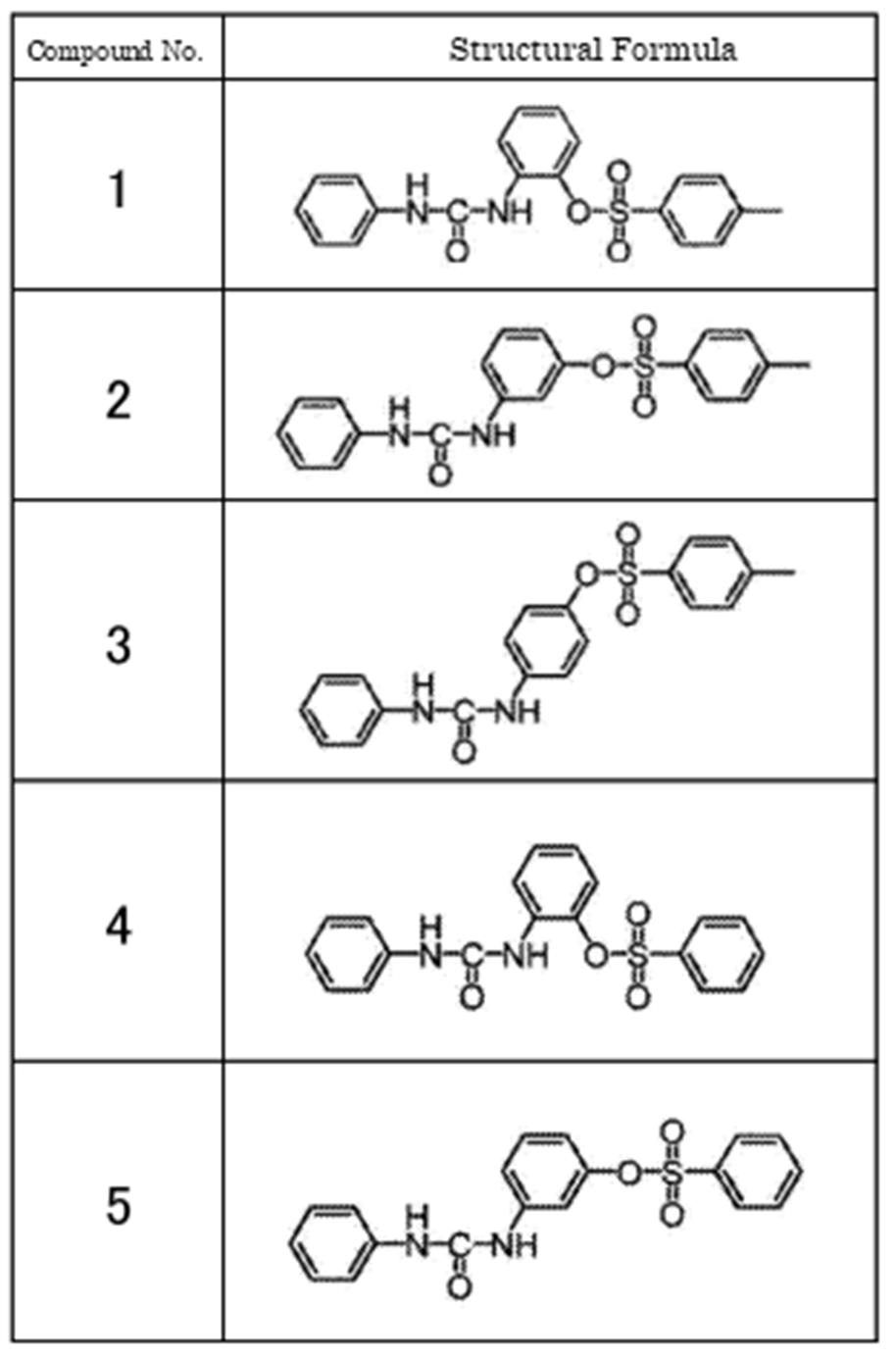
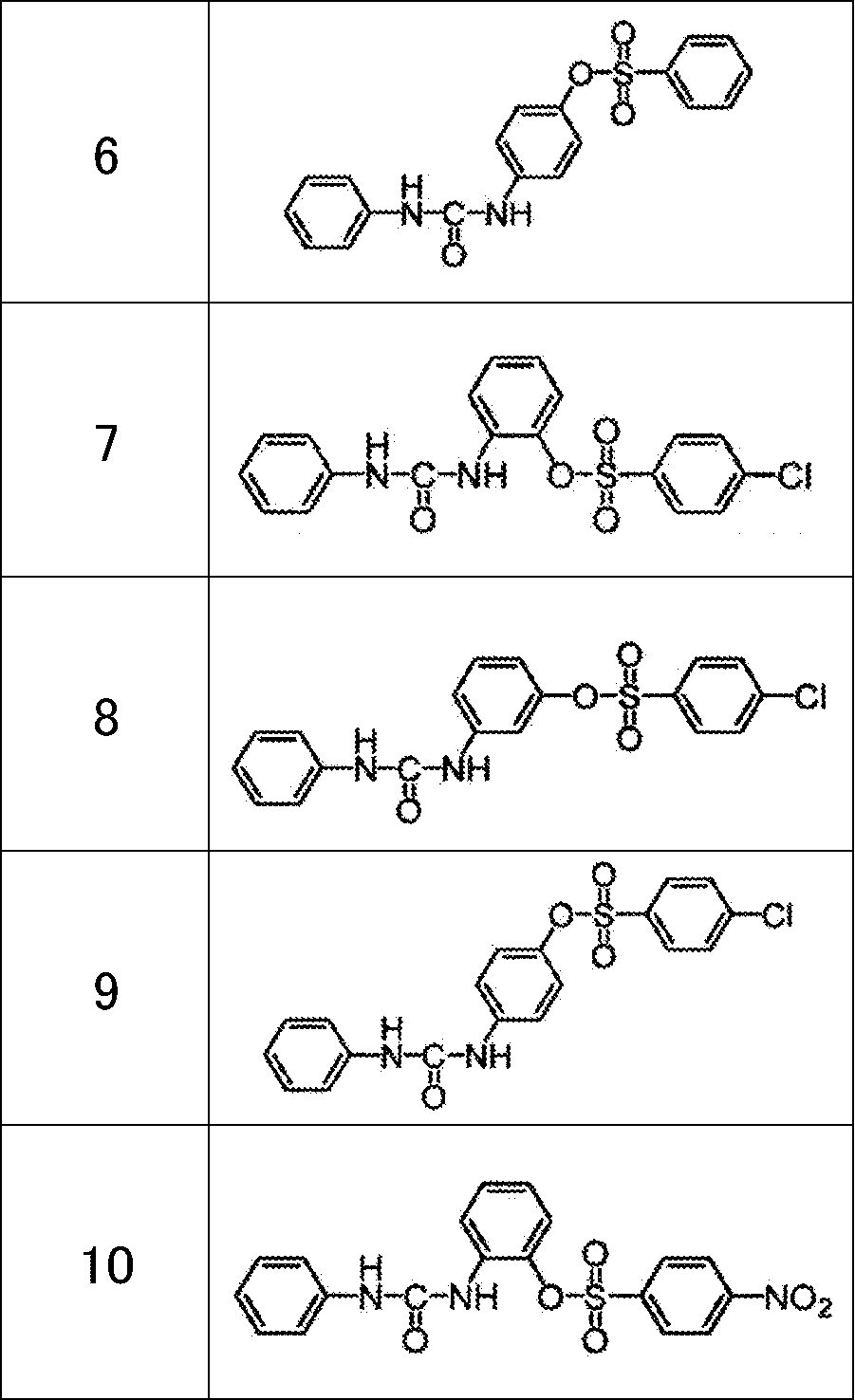
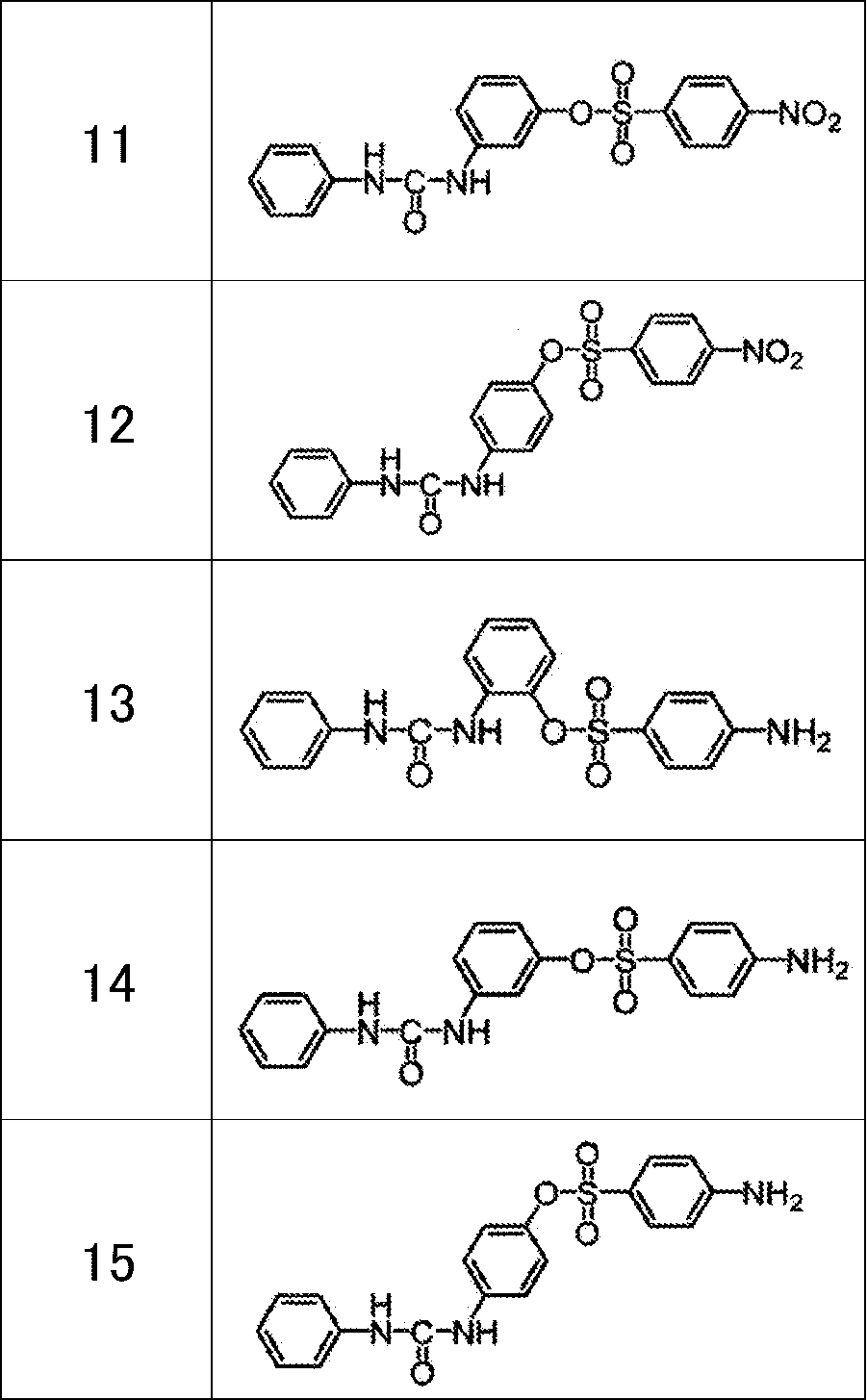


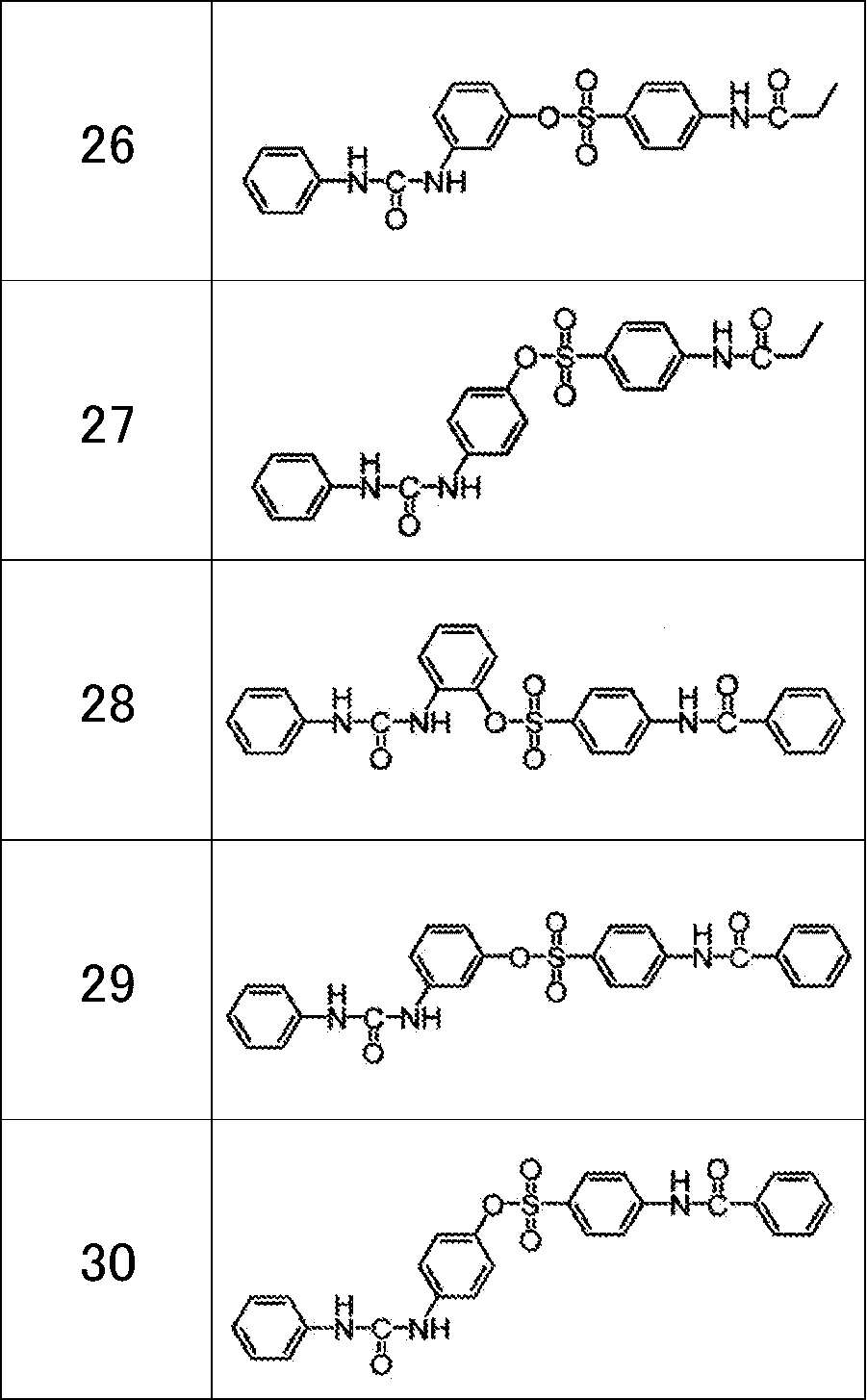
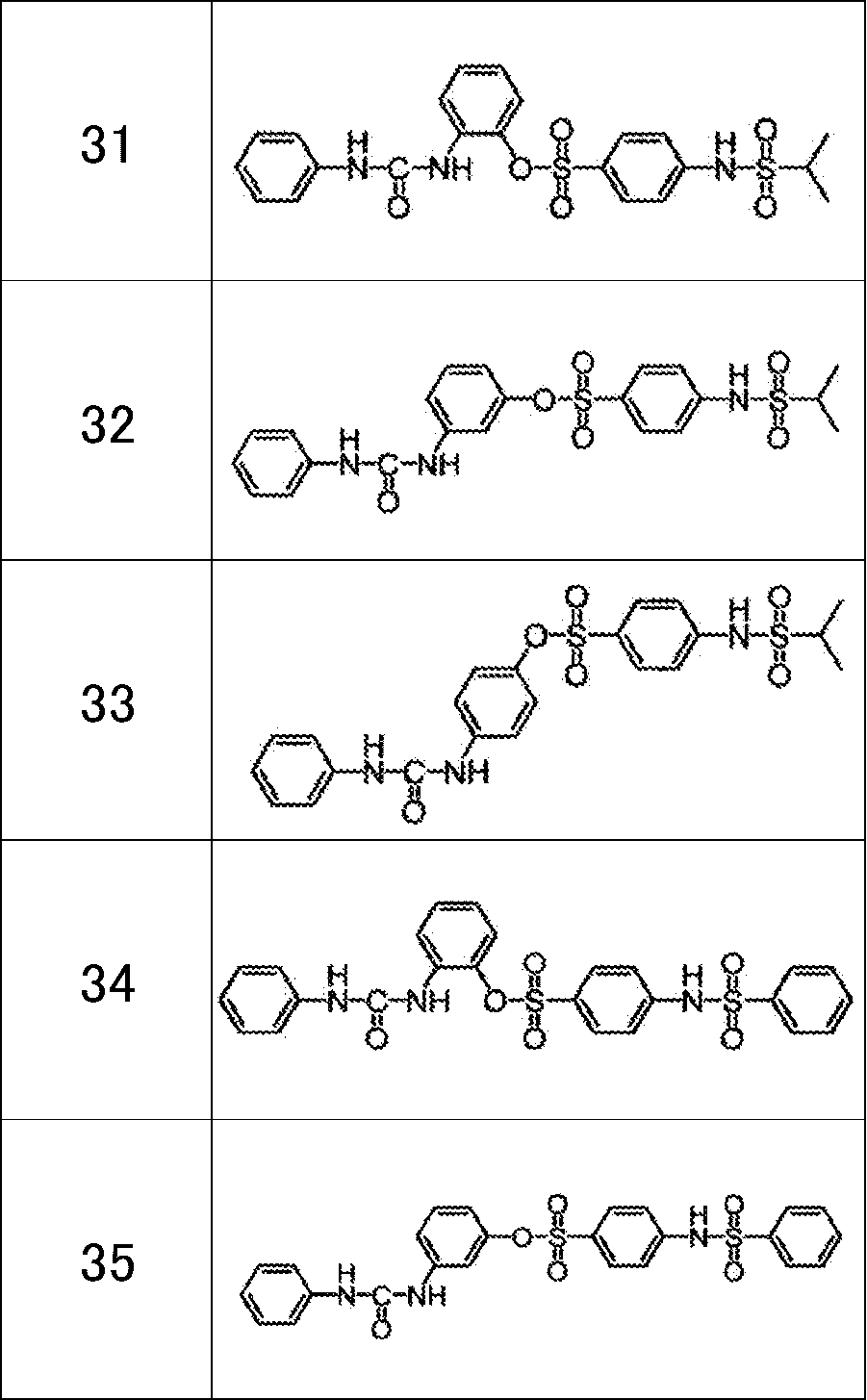

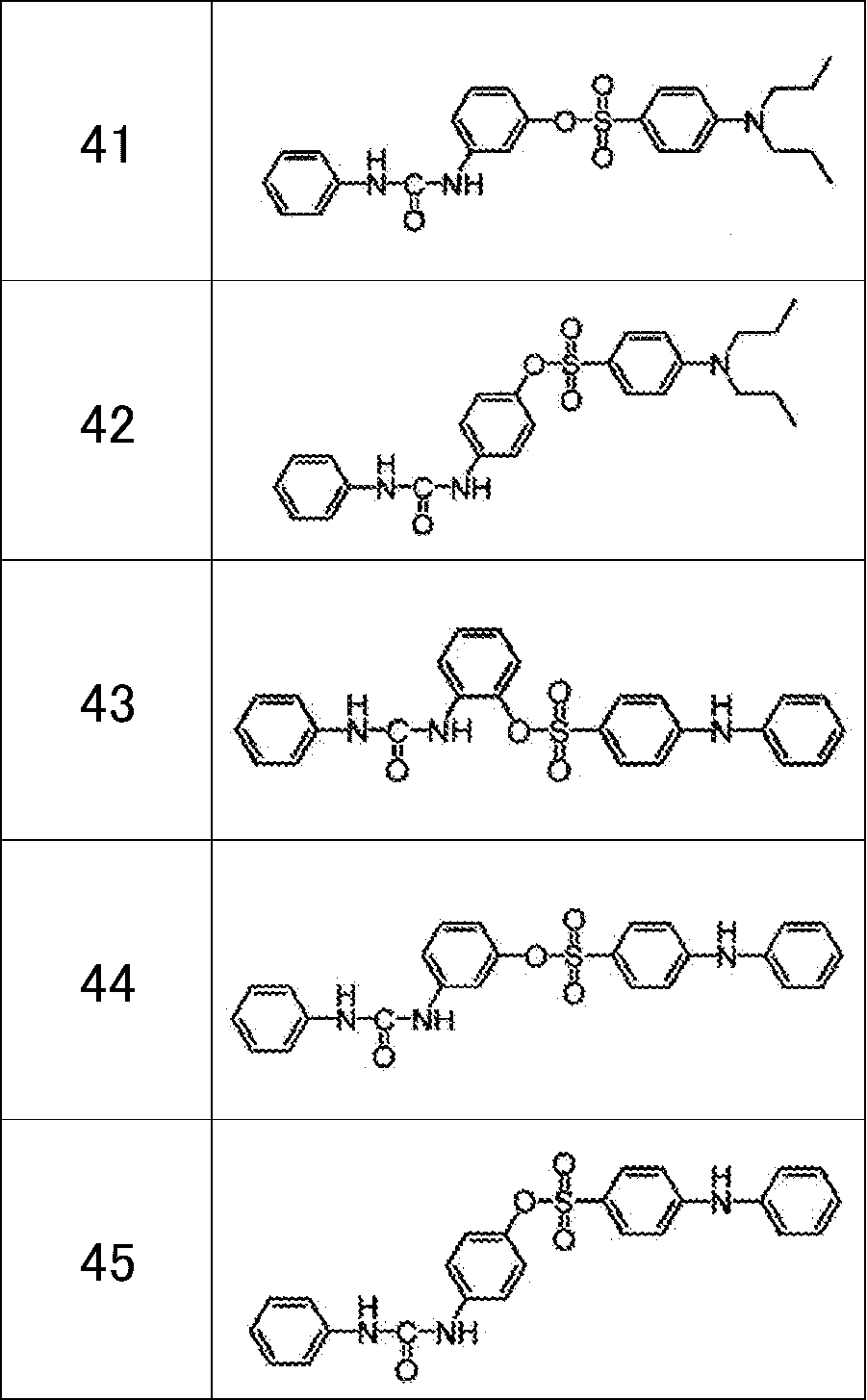
Among the compounds of Compound Nos. 1 to 45, the compound represented by General Formula (1) is preferably any of the compounds of Compound Nos. 1 to 3 in view of transparency and heat resistance.
The compound represented by General Formula (1) can be synthesized according to the method described in the paragraphs [0028] to [0063] of International Publication No. WO2017/111032.
The 50% cumulative volume particle diameter (D50) of the color developer is preferably 0.05 micrometers or greater but 0.5 micrometers or less, and more preferably 0.1 micrometers or greater but 0.3 micrometers or less.
For example, the 50% cumulative volume particle diameter (D50) of the color developer can be measured by means of a laser diffraction/scattering particle diameter distribution measuring device (device name: LA-920, available from Horiba, Ltd.).
An amount of the color developer is not particularly limited and may be appropriately selected depending on the intended purpose. The amount thereof is preferably 5% by mass or greater but 40% by mass or less, more preferably 10% by mass or greater but 30% by mass or less, relative to the thermosensitive recording layer.
A content ratio between the leuco dye and the color developer is not particularly limited and may be appropriately selected depending on the intended purpose. In view of transparency stability, the amount of the color developer is preferably 1 part by mass or greater but 4 parts by mass or less relative to 1 part by mass of the leuco dye.
-Photothermal conversion material-
The photothermal conversion material is a material that absorbs laser light to convert the absorbed light to heat. The photothermal conversion material is roughly classified into an inorganic material and an organic material.
The photothermal conversion material is a material that absorbs laser light to convert the absorbed light to heat. The photothermal conversion material is roughly classified into an inorganic material and an organic material.
Examples of the inorganic material include particles of carbon black, metal boride, and metal oxide of Ge, Bi, In, Te, Se, Cr, etc. Among the above-listed examples, the metal boride and the metal oxide are preferable because light absorption in a near infrared wavelength range is large and light absorption in a visible wavelength range is small.
Examples of the metal boride and the metal oxide include hexaboride, a tungsten oxide compound, antimony tin oxide (ATO), indium tin oxide (ITO), and zinc antimonite.
Examples of the hexaboride include LaB6, CeB6, PrB6, NdB6, GdB6, TbB6, DyB6, HoB6, YB6, SmB6, EuB6, ErB6, TmB6, YbB6, LuB6, SrB6, CaB6, and (La,Ce)B6.
Examples of the metal boride and the metal oxide include hexaboride, a tungsten oxide compound, antimony tin oxide (ATO), indium tin oxide (ITO), and zinc antimonite.
Examples of the hexaboride include LaB6, CeB6, PrB6, NdB6, GdB6, TbB6, DyB6, HoB6, YB6, SmB6, EuB6, ErB6, TmB6, YbB6, LuB6, SrB6, CaB6, and (La,Ce)B6.
Examples of the tungsten oxide compound include particles of tungsten oxide represented by a general formula: WyOz (with the proviso that W is tungsten, O is oxygen, and 2.2 ≦ z/y ≦ 2.999), and particles of complex tungsten oxide represented by a general formula: MxWyOz (with the proviso that M is at least one element selected from the group consisting of H, He, alkali metals, alkaline earth metals, rare earth element, Mg, Zr, Cr, Mn, Fe, Ru, Co, Rh, Ir, Ni, Pd, Pt, Cu, Ag, Au, Zn, Cd, Al, Ga, In, Tl, Si, Ge, Sn, Pb, Sb, B, F, P, S, Se, Br, Te, Ti, Nb, V, Mo, Ta, Re, Be, Hf, Os, Bi, and I, W is tungsten, O is oxygen, 0.001 ≦ x/y ≦ 1, and 2.2 ≦ z/y ≦ 3.0) (see International Publication No. WO2005/037932 and Unexamined Japanese Patent Application Publication No. 2005-187323). Among the above-listed examples, tungsten oxide including cesium is preferable because absorption in a near infrared wavelength range is large and absorption in a visible wavelength range is small.
Among the antimony tin oxide (ATO), the indium tin oxide (ITO), and the zinc antimonate, ITO is preferable because absorption in a near infrared wavelength range is large and absorption in a visible wavelength range is small.
Among the antimony tin oxide (ATO), the indium tin oxide (ITO), and the zinc antimonate, ITO is preferable because absorption in a near infrared wavelength range is large and absorption in a visible wavelength range is small.
As the organic material, various dyes may be appropriately used according to a wavelength of light to be absorbed. In the case where a semiconductor laser is used as a light source, a near infrared absorbing dye having an absorption peak at about 600 nm or longer but about 1,200 nm or shorter is used. Examples thereof include a cyanine dye, a quinone-based dye, a quinolone derivative of indonaphthol, a phenylenediamine-based nickel complex, and a phthalocyanine-based dye. The above-listed examples may be used alone or in combination.
The photothermal conversion material may be included in the thermosensitive recording layer or another layer that is not the thermosensitive recording layer. In the case where the photothermal conversion material is included in a layer that is not the thermosensitive recording layer, the layer including the photothermal conversion material is preferably disposed next to the thermosensitive recording layer.
An amount of the photothermal conversion material is preferably 0.1% by mass or greater but 10% by mass or less, and more preferably 0.3% by mass or greater but 5% by mass or less, relative to the thermosensitive recording layer.
The photothermal conversion material may be included in the thermosensitive recording layer or another layer that is not the thermosensitive recording layer. In the case where the photothermal conversion material is included in a layer that is not the thermosensitive recording layer, the layer including the photothermal conversion material is preferably disposed next to the thermosensitive recording layer.
An amount of the photothermal conversion material is preferably 0.1% by mass or greater but 10% by mass or less, and more preferably 0.3% by mass or greater but 5% by mass or less, relative to the thermosensitive recording layer.
-Ultraviolet absorbing material-
The ultraviolet absorbing material is not particularly limited and may be appropriately selected depending on the intended purpose. Examples of the ultraviolet absorbing material include salicylic acid-based ultraviolet absorbing materials, benzophenone-based ultraviolet absorbing materials, and benzotriazole-based ultraviolet absorbing materials.
The ultraviolet absorbing material is not particularly limited and may be appropriately selected depending on the intended purpose. Examples of the ultraviolet absorbing material include salicylic acid-based ultraviolet absorbing materials, benzophenone-based ultraviolet absorbing materials, and benzotriazole-based ultraviolet absorbing materials.
Examples of the ultraviolet absorbing material include phenyl salicylate, p-tert-butylphenyl salicylate, p-octylphenyl salicylate, 2,4-dihydroxybenzophenone, 2-hydroxy-4-methoxybenzophenone, 2-hydroxy-4-octoxybenzophenone, 2-hydroxy-4-dodecyloxybenzophenone, 2,2'-dihydroxy-4-methoxybenzophenone, 2,2′-dihydroxy-4,4'-dimethoxybenzophenone, 2-hydroxy-4-methoxy-5-sulfobenzophenone, bis(2-methoxy-4-hydroxy-5-benzoylphenyl)methane, 2-(2'-hydroxy-5'-methylphenyl)benzotriazole, 2-(2'-hydroxy-5'-tert-butylphenyl)benzotriazole, 2-(2'-hydroxy-3',5'-di-tert-butylphenyl)benzotriazole, 2-(2'-hydroxy-3',5'-di-tert-butylphenyl)chlorobenzotriazole, 2-(2'-hydroxy-3'-tert-butyl-5'-methylphenyl)-5-chlorobenzotriazole, 2-(2'-hydroxy-3',5'-di-tert-amylphenyl)benzotriazole, 2-{2'-hydroxy-3'-(3'',4'',5'',6''-tetrahydrophthalimidemethyl)-5'-methylphenyl}benzotriazole, 2,2'-methylenebis{4-(1,1,3,3-tetramethylbutyl)-6-(2H-benzotriazol-2-yl)phenol}, 2-(2'-hydroxy-5'-methacryloxyphenyl)-2H-benzotriazole, 2-(3,5-di-t-amyl-2-hydroxyphenyl)benzotriazole, 2-(2'-hydroxy-5'-t-octylphenyl)benzotriazole, and 2-(5-methyl-2-hydroxyphenyl)benzotriazole. The above-listed examples may be used alone or in combination.
-Other components-
The above-mentioned other components are not particularly limited and may be appropriately selected depending on the intended purpose. Examples thereof include a binder resin, various thermofusible materials serving as a sensitivity improver, an auxiliary additive, a surfactant, a lubricant, and filler.
The above-mentioned other components are not particularly limited and may be appropriately selected depending on the intended purpose. Examples thereof include a binder resin, various thermofusible materials serving as a sensitivity improver, an auxiliary additive, a surfactant, a lubricant, and filler.
--Binder resin--
The binder resin is not particularly limited and may be appropriately selected depending on the intended purpose. Examples of the binder resin include a thermoplastic resin, a thermoset resin, and a photocurable resin. The above-listed resins are not restricted in characteristics thereof, such as a water-soluble resin, a water-dispersible resin, and a solvent-soluble resin.
Examples of the binder resin include: acrylic resins; polyvinyl alcohol resins; starch or derivatives of starch; cellulose derivatives such as hydroxymethyl cellulose, hydroxyethyl cellulose, carboxymethyl cellulose, methyl cellulose, and ethyl cellulose; water-soluble polymers such as sodium polyacrylate, polyvinyl pyrrolidone, acrylamide-acrylic acid ester copolymers, styrene-acryl copolymers, acrylamide-acrylic acid ester-methacrylic acid terpolymers, styrene-maleic anhydride copolymer alkali salts, isobutylene-maleic anhydride copolymer alkali salts, polyacrylamide, sodium alginate, gelatin, and casein; emulsions of, for example, polyvinyl acetate, polyurethane, polyacrylic acid, polyacrylic acid ester, vinyl chloride-vinyl acetate copolymers, polybutyl methacrylate, and ethylene-vinyl acetate copolymers; and latexes (aqueous emulsions) of, for example, styrene-butadiene copolymers and styrene-butadiene-acrylic copolymers. The above-listed examples may be used alone or in combination.
Among the above-listed examples, an acrylic resin and a styrene-acryl copolymer are preferable in view of transparency.
The binder resin is not particularly limited and may be appropriately selected depending on the intended purpose. Examples of the binder resin include a thermoplastic resin, a thermoset resin, and a photocurable resin. The above-listed resins are not restricted in characteristics thereof, such as a water-soluble resin, a water-dispersible resin, and a solvent-soluble resin.
Examples of the binder resin include: acrylic resins; polyvinyl alcohol resins; starch or derivatives of starch; cellulose derivatives such as hydroxymethyl cellulose, hydroxyethyl cellulose, carboxymethyl cellulose, methyl cellulose, and ethyl cellulose; water-soluble polymers such as sodium polyacrylate, polyvinyl pyrrolidone, acrylamide-acrylic acid ester copolymers, styrene-acryl copolymers, acrylamide-acrylic acid ester-methacrylic acid terpolymers, styrene-maleic anhydride copolymer alkali salts, isobutylene-maleic anhydride copolymer alkali salts, polyacrylamide, sodium alginate, gelatin, and casein; emulsions of, for example, polyvinyl acetate, polyurethane, polyacrylic acid, polyacrylic acid ester, vinyl chloride-vinyl acetate copolymers, polybutyl methacrylate, and ethylene-vinyl acetate copolymers; and latexes (aqueous emulsions) of, for example, styrene-butadiene copolymers and styrene-butadiene-acrylic copolymers. The above-listed examples may be used alone or in combination.
Among the above-listed examples, an acrylic resin and a styrene-acryl copolymer are preferable in view of transparency.
--Thermofusible material--
Examples of the thermofusible material include: fatty acids such as stearic acid and behenic acid; fatty acid amides such as stearic acid amide and palmitic acid amide; fatty acid metal salts such as zinc stearate, aluminum stearate, calcium stearate, zinc palmitate, and zinc behenate; and p-benzyl biphenyl, terphenyl, triphenylmethane, benzyl p-benzyloxybenzoate, β-benzyloxynaphthalene, phenyl β-naphthoate, phenyl 1-hydroxy-2-naphthoate, methyl 1-hydroxy-2-naphthoate, diphenyl carbonate, glycol carbonate, dibenzyl terephthalate, dimethyl terephthalate, 1,4-dimethoxynaphthalene, 1,4-diethoxynaphthalene, 1,4-dibenzyloxynaphthalene, 1,2-diphenoxyethane, 1,2-bis(3-methylphenoxy)ethane, 1,2-bis(4-methylphenoxy)ethane, 1,4-diphenoxy-2-butene, 1,2-bis(4-methoxyphenylthio)ethane, dibenzoylmethane, 1,4-diphenylthiobutane, 1,4-diphenylthio-2-butene, 1,3-bis(2-vinyloxyethoxy)benzene, 1,4-bis(2-vinyloxyethoxy)benzene, p-(2-vinyloxyethoxy)biphenyl, p-aryloxybiphenyl, p-propargyloxybiphenyl, dibenzoyloxymethane, dibenzoyloxypropane, dibenzyl disulfide, 1,1-diphenyl ethanol, 1,1-diphenylpropanol, p-benzyloxy benzylalcohol, 1,3-phenoxy-2-propanol, N-octadecylcarbamoyl-p-methoxycarbonyl benzene, N-octadecylcarbamoyl benzene, 1,2-bis(4-methoxyphenoxy)propane, 1,5-bis(4-methoxyphenoxy)-3-oxapentane, dibenzyl oxalate, bis(4-methylbenzyl) oxalate, and bis(4-chlorobenzyl) oxalate. The above-listed examples may be used alone or in combination.
Examples of the thermofusible material include: fatty acids such as stearic acid and behenic acid; fatty acid amides such as stearic acid amide and palmitic acid amide; fatty acid metal salts such as zinc stearate, aluminum stearate, calcium stearate, zinc palmitate, and zinc behenate; and p-benzyl biphenyl, terphenyl, triphenylmethane, benzyl p-benzyloxybenzoate, β-benzyloxynaphthalene, phenyl β-naphthoate, phenyl 1-hydroxy-2-naphthoate, methyl 1-hydroxy-2-naphthoate, diphenyl carbonate, glycol carbonate, dibenzyl terephthalate, dimethyl terephthalate, 1,4-dimethoxynaphthalene, 1,4-diethoxynaphthalene, 1,4-dibenzyloxynaphthalene, 1,2-diphenoxyethane, 1,2-bis(3-methylphenoxy)ethane, 1,2-bis(4-methylphenoxy)ethane, 1,4-diphenoxy-2-butene, 1,2-bis(4-methoxyphenylthio)ethane, dibenzoylmethane, 1,4-diphenylthiobutane, 1,4-diphenylthio-2-butene, 1,3-bis(2-vinyloxyethoxy)benzene, 1,4-bis(2-vinyloxyethoxy)benzene, p-(2-vinyloxyethoxy)biphenyl, p-aryloxybiphenyl, p-propargyloxybiphenyl, dibenzoyloxymethane, dibenzoyloxypropane, dibenzyl disulfide, 1,1-diphenyl ethanol, 1,1-diphenylpropanol, p-benzyloxy benzylalcohol, 1,3-phenoxy-2-propanol, N-octadecylcarbamoyl-p-methoxycarbonyl benzene, N-octadecylcarbamoyl benzene, 1,2-bis(4-methoxyphenoxy)propane, 1,5-bis(4-methoxyphenoxy)-3-oxapentane, dibenzyl oxalate, bis(4-methylbenzyl) oxalate, and bis(4-chlorobenzyl) oxalate. The above-listed examples may be used alone or in combination.
--Auxiliary additive--
The auxiliary additive is not particularly limited and may be appropriately selected depending on the intended purpose. Examples of the auxiliary additive include a hindered phenol compound and a hindered amine compound. The above-listed examples may be used alone or in combination.
The auxiliary additive is not particularly limited and may be appropriately selected depending on the intended purpose. Examples of the auxiliary additive include a hindered phenol compound and a hindered amine compound. The above-listed examples may be used alone or in combination.
Examples of the auxiliary additive include 2,2'-methylenebis(4-ethyl-6-tertiary butylphenol), 4,4'-butylidene bis(6-tertiary butyl-2-methylphenol), 1,1,3-tris(2-methyl-4-hydroxy-5-tertiary butylphenyl)butane, 1,1,3-tris(2-methyl-4-hydroxy-5-cyclohexylphenyl)butane, 4,4'-thiobis(6-tertiary butyl-2-methylphenol), tetrabromo bisphenol A, tetrabromo bisphenol S, 4,4-thiobis(2-methylphenol), 4,4'-thiobis(2-chlorophenol), tetrakis(1,2,2,6,6-pentamethyl-4-piperidyl)-1,2,3,4-butane tetracarboxylate, and tetrakis(1,2,2,6,6-tetramethyl-4-piperidyl)-1,2,3,4-butane tetracarboxylate. The above-listed examples may be used alone or in combination.
--Surfactant--
The surfactant is not particularly limited and may be appropriately selected depending on the intended purpose. Examples of the surfactant include an anionic surfactant, a nonionic surfactant, an amphoteric surfactant, and a fluorosurfactant.
The surfactant is not particularly limited and may be appropriately selected depending on the intended purpose. Examples of the surfactant include an anionic surfactant, a nonionic surfactant, an amphoteric surfactant, and a fluorosurfactant.
Examples of the anionic surfactant include polyoxyethylene alkyl ether acetate, dodecylbenzene sulfonate, laurate, and polyoxyethylene alkyl ether sulfate salt. The above-listed examples may be used alone or in combination.
Examples of the nonionic surfactant include acetylene glycol-based surfactants, polyoxyethylene alkyl ether, polyoxyethylene alkyl phenyl ether, polyoxyethylene alkyl ester, and polyoxyethylene sorbitan fatty acid ester. The above-listed examples may be used alone or in combination.
Examples of the acetylene glycol-based surfactant include 2,4,7,9-tetramethyl-5-decyne-4,7-diol, 3,6-dimethyl-4-octyne-3,6-diol, 3,5-dimethyl-1-hexyne-3-diol, and 2,5,8,11-tetramethyl-6-dodecyne-5,8-diol. The above-listed examples may be used alone or in combination.
--Lubricant--
Examples of the lubricant include higher fatty acids or metal salts of higher fatty acids, higher fatty acid amides, higher fatty acid esters, animal waxes, vegetable waxes, mineral waxes, and petroleum waxes. The above-listed examples may be used alone or in combination.
Examples of the lubricant include higher fatty acids or metal salts of higher fatty acids, higher fatty acid amides, higher fatty acid esters, animal waxes, vegetable waxes, mineral waxes, and petroleum waxes. The above-listed examples may be used alone or in combination.
--Filler--
Examples of the filler include: inorganic powder such as calcium carbonate, silica, silica, zinc oxide, titanium oxide, zirconium oxide, aluminum hydroxide, zinc hydroxide, barium sulfate, clay, kaolin, talc, surface-treated calcium, and surface-treated silica; and organic powder such as urea-formalin resins, styrene-methacrylic acid copolymers, polystyrene resins, and vinylidene chloride resins. The above-listed examples may be used alone or in combination.
Examples of the filler include: inorganic powder such as calcium carbonate, silica, silica, zinc oxide, titanium oxide, zirconium oxide, aluminum hydroxide, zinc hydroxide, barium sulfate, clay, kaolin, talc, surface-treated calcium, and surface-treated silica; and organic powder such as urea-formalin resins, styrene-methacrylic acid copolymers, polystyrene resins, and vinylidene chloride resins. The above-listed examples may be used alone or in combination.
An amount of the filler is not particularly limited and may be appropriately selected depending on the intended purpose. The amount thereof is preferably 0.4 parts by mass or less, and more preferably 0.2 parts by mass or less, relative to 1 part by mass of the binder resin.
A formation method of the thermosensitive recording layer is not particularly limited and may be appropriately selected depending on the intended purpose. For example, the leuco dye and the color developer are pulverized and dispersed together with the binder resin by means of a disperser, such as a ball mill, an attritor, and a sand mill, followed by mixing with the above-mentioned other components according to necessity, to thereby prepare a coating liquid for a thermosensitive recording layer. Thereafter, the coating liquid for a thermosensitive recording layer is applied onto the support and is dried.
The coating method is not particularly limited and may be appropriately selected depending on the intended purpose. Examples of the coating method include a blade coating method, a gravure coating method, a gravure offset coating method, a bar coating method, a roll coating method, a knife coating method, an air knife coating method, a comma coating method, a U-comma coating method, an AKKU coating method, a smoothing coating method, a microgravure coating method, a reverse roll coating method, a 4-roll or 5-roll coating method, a dip coating method, a curtain coating method, a slide coating method, and a die coating method.
A deposition amount of the thermosensitive recording layer after drying is not particularly limited and may be appropriately selected depending on the intended purpose. The deposition amount thereof is preferably 1.0 g/m2 or greater but 20.0 g/m2 or less, more preferably 2.0 g/m2 or greater but 10.0 g/m2 or less, and particularly preferably 2.0 g/m2 or greater but 4.0 g/m2 or less.
<Support>
The support preferably has high transparency.
In the present disclosure, the transparency is represented by a haze degree measured according to ASTM D1003 or ISO 14782. The haze degree is preferably 15 or less, and more preferably 10 or less.
The support preferably has high transparency.
In the present disclosure, the transparency is represented by a haze degree measured according to ASTM D1003 or ISO 14782. The haze degree is preferably 15 or less, and more preferably 10 or less.
A method for measuring the haze degree is not particularly limited and may be appropriately selected depending on the intended purpose. Examples of a measuring device include a haze meter (instrument name: HZ-V3, available from Suga Test Instruments Co., Ltd.).
The support is not particularly limited, and a material, shape, structure, and average thickness thereof are appropriately selected depending on the intended purpose.
Examples of a material of the support include a polyester resin (e.g., polyethylene terephthalate (PET)), polycarbonate, polystyrene (PS), polymethyl methacrylate (PMMA), polyethylene (PE), and polypropylene (PP). The above-listed examples may be used alone or in combination. Among the above-listed examples, polyethylene terephthalate (PET) and polypropylene (PP) are preferable in view of flexibility, and polyethylene terephthalate (PET) is more preferable in view of heat resistance.
An inorganic material or an organic compound may be further added to the support in order to improve heat resistance and mechanical strength.
The inorganic material is not particularly limited and may be appropriately selected depending on the intended purpose. Examples thereof include glass, quartz, and inorganic monocrystals. The above-listed examples may be used alone or in combination.
The organic compound is not particularly limited and may be appropriately selected depending on the intended purpose. Examples of the organic compound include a benzotriazole-based compound, a triazine-based compound, a benzophenone-based compound, and a hindered amine-based compound. The above-listed examples may be used alone or in combination.
A shape of the support is not particularly limited and may be appropriately selected depending on the intended purpose. Examples of the shape thereof include polygons (e.g., squares, and rectangles), circles, ovals, plate shapes, and sheet shapes.
A structure of the support is not particularly limited and may be appropriately selected depending on the intended purpose. For example, the structure thereof may be a single layer structure or a multilayer structure including 2 or more layers.
For the purpose of improving adhesion to the thermosensitive recording layer, the support is preferably subjected to surface modification, such as a corona discharge treatment, an oxidization reaction treatment (e.g., chromic acid), an etching treatment, an easy adhesion treatment, and an antistatic treatment.
The average thickness of the support is not particularly limited and may be appropriately selected depending on the intended purpose. Examples of the average thickness thereof is preferably 10 micrometers or greater but 2,000 micrometers or less, and more preferably 30 micrometers or greater but 200 micrometers or less.
-Protective layer-
The protective layer is a layer disposed at the side of the thermosensitive recording layer where the support is not disposed in the thermosensitive recording medium. The protective layer includes a binder resin, preferably includes a crosslinking agent, and may further include other components according to the necessity.
The protective layer is a layer disposed at the side of the thermosensitive recording layer where the support is not disposed in the thermosensitive recording medium. The protective layer includes a binder resin, preferably includes a crosslinking agent, and may further include other components according to the necessity.
--Binder resin--
The binder resin is not particularly limited and may be appropriately selected depending on the intended purpose. The binder resin is particularly preferably a water-soluble resin.
Examples of the water-soluble resin include polyvinyl alcohol, modified polyvinyl alcohol, starch or derivatives thereof, cellulose derivatives (e.g., methoxy cellulose, hydroxyethyl cellulose, carboxy methyl cellulose, methyl cellulose, and ethyl cellulose), sodium polyacrylate, polyvinyl pyrrolidone, acrylamide-acrylic acid ester copolymers, acrylamide-acrylic acid ester-methacrylic acid tercopolymers, alkali salts of styrene-maleic anhydride copolymers, alkali salts of isobutylene-maleic anhydride copolymers, polyacrylamide, modified polyacrylamide, methyl vinyl ether-maleic anhydride copolymers, carboxy-modified polyethylene, polyvinyl alcohol-acrylamide block copolymers, melamine-formaldehyde resins, urea-formaldehyde resins, sodium alginate, gelatin, and casein. The above-listed examples may be used alone or in combination. Among the above-listed examples, modified polyvinyl alcohol is preferable.
Examples of the modified polyvinyl alcohol include diacetone-modified polyvinyl alcohol, acetoacetyl-modified polyvinyl alcohol, and carboxylic acid-modified polyvinyl alcohol, such as itaconic acid-modified polyvinyl alcohol, and maleic acid-modified polyvinyl alcohol.
The binder resin is not particularly limited and may be appropriately selected depending on the intended purpose. The binder resin is particularly preferably a water-soluble resin.
Examples of the water-soluble resin include polyvinyl alcohol, modified polyvinyl alcohol, starch or derivatives thereof, cellulose derivatives (e.g., methoxy cellulose, hydroxyethyl cellulose, carboxy methyl cellulose, methyl cellulose, and ethyl cellulose), sodium polyacrylate, polyvinyl pyrrolidone, acrylamide-acrylic acid ester copolymers, acrylamide-acrylic acid ester-methacrylic acid tercopolymers, alkali salts of styrene-maleic anhydride copolymers, alkali salts of isobutylene-maleic anhydride copolymers, polyacrylamide, modified polyacrylamide, methyl vinyl ether-maleic anhydride copolymers, carboxy-modified polyethylene, polyvinyl alcohol-acrylamide block copolymers, melamine-formaldehyde resins, urea-formaldehyde resins, sodium alginate, gelatin, and casein. The above-listed examples may be used alone or in combination. Among the above-listed examples, modified polyvinyl alcohol is preferable.
Examples of the modified polyvinyl alcohol include diacetone-modified polyvinyl alcohol, acetoacetyl-modified polyvinyl alcohol, and carboxylic acid-modified polyvinyl alcohol, such as itaconic acid-modified polyvinyl alcohol, and maleic acid-modified polyvinyl alcohol.
--Crosslinking agent--
The crosslinking agent is not particularly limited and may be appropriately selected depending on the intended purpose, as long as the crosslinking agent reacts with the water-soluble resin to decrease solubility of the water-soluble resin to water. Examples thereof include glyoxal derivatives, methylol derivatives, epichlorohydrin, polyamide epichlorohydrin, epoxy compounds, aziridine compounds, hydrazine, hydrazide derivatives, oxazoline derivatives, and carbodiimide derivatives. The above-listed examples may be used alone or in combination. Among the above-listed examples, polyamide epichlorohydrin is preferable because of high safety upon handling and a short curing time required for water resistance.
An amount of the polyamide epichlorohydrin is not particularly limited and may be appropriately selected depending on the intended purpose. The amount thereof is preferably 10 parts by mass or greater but 60 parts by mass or less, and more preferably 20 parts by mass or greater but 50 parts by mass or less, relative to 100 parts by mass of the binder resin.
The crosslinking agent is not particularly limited and may be appropriately selected depending on the intended purpose, as long as the crosslinking agent reacts with the water-soluble resin to decrease solubility of the water-soluble resin to water. Examples thereof include glyoxal derivatives, methylol derivatives, epichlorohydrin, polyamide epichlorohydrin, epoxy compounds, aziridine compounds, hydrazine, hydrazide derivatives, oxazoline derivatives, and carbodiimide derivatives. The above-listed examples may be used alone or in combination. Among the above-listed examples, polyamide epichlorohydrin is preferable because of high safety upon handling and a short curing time required for water resistance.
An amount of the polyamide epichlorohydrin is not particularly limited and may be appropriately selected depending on the intended purpose. The amount thereof is preferably 10 parts by mass or greater but 60 parts by mass or less, and more preferably 20 parts by mass or greater but 50 parts by mass or less, relative to 100 parts by mass of the binder resin.
The protective layer is not particularly limited and may be formed according to a method generally known in the art.
The average thickness of the protective layer is not particularly limited and may be appropriately selected depending on the intended purpose. The average thickness thereof is preferably 0.5 micrometers or greater but 5 micrometers or less, and more preferably 1 micrometer or greater but 3 micrometers or less.
The average thickness of the protective layer is not particularly limited and may be appropriately selected depending on the intended purpose. The average thickness thereof is preferably 0.5 micrometers or greater but 5 micrometers or less, and more preferably 1 micrometer or greater but 3 micrometers or less.
-Adhesive layer-
In the present disclosure, an adhesive layer is preferably disposed between the thermosensitive recording layer and the support to improve adhesion between the support and the thermosensitive recording layer.
Similarly to the thermosensitive recording layer, the adhesive layer includes the binder resin and may further include the ultraviolet absorbing material, and photothermal conversion material.
In the present disclosure, an adhesive layer is preferably disposed between the thermosensitive recording layer and the support to improve adhesion between the support and the thermosensitive recording layer.
Similarly to the thermosensitive recording layer, the adhesive layer includes the binder resin and may further include the ultraviolet absorbing material, and photothermal conversion material.
-Sticky layer-
When the thermosensitive recording medium is used as a label, a sticky layer may be disposed on one side of the thermosensitive recording medium.
When the thermosensitive recording medium is used as a label, a sticky layer may be disposed on one side of the thermosensitive recording medium.
A material of the sticky layer is not particularly limited and may be appropriately selected depending on the intended purpose. Examples of the material thereof include a urea resin, a melamine resin, a phenol resin, an epoxy resin, a vinyl acetate-based resin, a vinyl acetate-acryl-based copolymer, an ethylene-vinyl acetate copolymer, an acrylic resin, a polyvinyl ether-based resin, a vinyl chloride-vinyl acetate-based copolymer, a polystyrene-based resin, a polyester-based resin, polyurethane-based resin, a polyamide-based resin, a chlorinated polyolefin-based resin, a polyvinyl butyral-based resin, an acrylic acid ester-based copolymer, a methacrylic ester-based copolymer, natural rubber, a cyanoacrylate-based resin, and a silicone-based resin. The above-listed examples may be used alone or in combination. The above-listed materials may be crosslinked with a cross-linking agent. Moreover, a material of the sticky layer may be a hot-melt material.
A formation method of the sticky layer is not particularly limited and may be appropriately selected depending on the intended purpose. Examples of the formation method thereof include general coating methods and laminating methods.
The average thickness of the sticky layer is not particularly limited and may be appropriately selected depending on the intended purpose. The average thickness thereof is preferably 0.1 micrometers or greater but 20 micrometers or less.
The average thickness of the sticky layer is not particularly limited and may be appropriately selected depending on the intended purpose. The average thickness thereof is preferably 0.1 micrometers or greater but 20 micrometers or less.
A shape of the thermosensitive recording medium is not particularly limited and may be appropriately selected depending on the intended purpose. Examples of the shape thereof include a roll, a sheet, and a label.
<Use>
Use of the thermosensitive recording medium is not particularly limited and may be appropriately selected depending on the intended purpose. For example, the thermosensitive recording medium is used in a field of point of sales (POS). Examples of embodiments thereof include labels bonded to fresh food, packaged meal, and premade food, and bands wound around fresh food, packaged meal, and premade food. Visibility of the content can be improved by using the thermosensitive recording medium as the embodiments above, and consumers can select a product with conforming the content. Examples of other embodiments include tickets, tags, and cards. More specific examples include: a ticketing field, such as a ticket machine, and a receipt; a tag for packages in the aircraft industry, a pill case, and a pill bottle: and output paper of facsimile in a copying field, such as literatures and documents.
Use of the thermosensitive recording medium is not particularly limited and may be appropriately selected depending on the intended purpose. For example, the thermosensitive recording medium is used in a field of point of sales (POS). Examples of embodiments thereof include labels bonded to fresh food, packaged meal, and premade food, and bands wound around fresh food, packaged meal, and premade food. Visibility of the content can be improved by using the thermosensitive recording medium as the embodiments above, and consumers can select a product with conforming the content. Examples of other embodiments include tickets, tags, and cards. More specific examples include: a ticketing field, such as a ticket machine, and a receipt; a tag for packages in the aircraft industry, a pill case, and a pill bottle: and output paper of facsimile in a copying field, such as literatures and documents.
A method for recording information on the thermosensitive recording medium of the present disclosure is not particularly limited and may be appropriately selected depending on the intended purpose. For example, a thermal head printer, a CO2 laser, a semiconductor laser etc. can be used. Since a pigment other than a silicone resin pigment is used in the thermosensitive recording medium of the present disclosure, the thermosensitive recording medium of the present disclosure is suitably used for printing of emblems, illustrations, logos, etc., because the thermosensitive recording medium of the present disclosure has more excellent printing properties and writability than a thermosensitive recording medium using a silicone resin pigment.
(Thermosensitive recording liquid)
The thermosensitive recording liquid of the present disclosure is used for forming the thermosensitive recording medium of the present disclosure.
The thermosensitive recording liquid of the present disclosure is used for forming the thermosensitive recording medium of the present disclosure.
The thermosensitive recording liquid being used for forming the thermosensitive recording medium of the present disclosure means that the thermosensitive recording liquid is used for forming the thermosensitive recording layer of the thermosensitive recording medium of the present disclosure.
The thermosensitive recording liquid of the present disclosure includes a leuco dye and a color developer, and may further include other components according to the necessity.
The thermosensitive recording liquid of the present disclosure includes a leuco dye and a color developer, and may further include other components according to the necessity.
(Article)
The article of the present disclosure includes the thermosensitive recording medium of the present disclosure.
The article of the present disclosure includes the thermosensitive recording medium of the present disclosure.
The article including the thermosensitive recording medium of the present disclosure means a state where the thermosensitive recording medium of the present disclosure is bonded or mounted.
The article of the present disclosure is not particularly limited and may be appropriately selected, as long as the article includes the thermosensitive recording medium of the present disclosure. Examples thereof include fresh food products, drinks, packaged meals, premade food, literatures, documents, and packaged products obtained by packaging the above-listed articles with a packaging material, a wrapping material, or a wrapping paper.
The present disclosure will be described more specifically below by way of Examples. The present disclosure should not be construed as being limited to these Examples.
(Example 1)
<Production of thermosensitive recording medium>
-Preparation of dye dispersion liquid-
A sand mill was charged with 30 parts by mass of 2-anilino-3-methyl-6-butylaminofluoran, 16 parts by mass of a 36% by mass carboxyl group-containing acrylic resin aqueous solution (product name: HPD-196, available from BASF), and 54 parts by mass of ion-exchanged water, and the resultant mixture was dispersed to give 0.116 micrometers of a 50% cumulative volume particle diameter (D50) measured by a laser diffraction/scattering particle diameter distribution measuring device (device name: LA-920, available from Horiba, Ltd.), to thereby obtain a dye dispersion liquid.
<Production of thermosensitive recording medium>
-Preparation of dye dispersion liquid-
A sand mill was charged with 30 parts by mass of 2-anilino-3-methyl-6-butylaminofluoran, 16 parts by mass of a 36% by mass carboxyl group-containing acrylic resin aqueous solution (product name: HPD-196, available from BASF), and 54 parts by mass of ion-exchanged water, and the resultant mixture was dispersed to give 0.116 micrometers of a 50% cumulative volume particle diameter (D50) measured by a laser diffraction/scattering particle diameter distribution measuring device (device name: LA-920, available from Horiba, Ltd.), to thereby obtain a dye dispersion liquid.
-Preparation of color developer dispersion liquid-
A sand mill was charged with 30 parts by mass of a compound of Compound No. 1 below, 16 parts by mass of a 36% by mass carboxyl group-containing acrylic resin aqueous solution (product name: HPD-196, available from BASF), 54 parts by mass of ion-exchanged water, and the resultant mixture was dispersed to give 0.12 micrometers of a 50% cumulative volume particle diameter (D50) measured by a laser diffraction/scattering particle diameter distribution measuring device (device name: LA-920, available from Horiba, Ltd.), to thereby obtain a color developer dispersion liquid.
A sand mill was charged with 30 parts by mass of a compound of Compound No. 1 below, 16 parts by mass of a 36% by mass carboxyl group-containing acrylic resin aqueous solution (product name: HPD-196, available from BASF), 54 parts by mass of ion-exchanged water, and the resultant mixture was dispersed to give 0.12 micrometers of a 50% cumulative volume particle diameter (D50) measured by a laser diffraction/scattering particle diameter distribution measuring device (device name: LA-920, available from Horiba, Ltd.), to thereby obtain a color developer dispersion liquid.
(Compound No. 1)
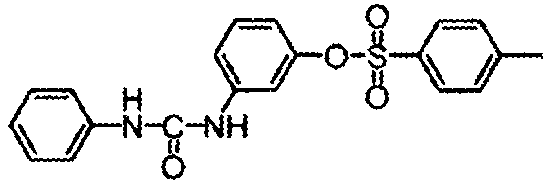
-Preparation of coating liquid for thermosensitive recording layer-
Next, 66.7 parts by mass of the obtained dye dispersion liquid, 33.3 parts by mass of the obtained color developer dispersion liquid, 10.4 parts by mass of an acryl emulsion (product name: EK-301, solid content: 42%, available from Saiden Chemical Industry Co., Ltd.), and 29.6 parts by mass of ion-exchanged water were mixed and stirred, to thereby obtain a coating liquid for a thermosensitive recording layer.
Next, 66.7 parts by mass of the obtained dye dispersion liquid, 33.3 parts by mass of the obtained color developer dispersion liquid, 10.4 parts by mass of an acryl emulsion (product name: EK-301, solid content: 42%, available from Saiden Chemical Industry Co., Ltd.), and 29.6 parts by mass of ion-exchanged water were mixed and stirred, to thereby obtain a coating liquid for a thermosensitive recording layer.
Next, the coating liquid for a thermosensitive recording layer was applied onto one side of a polyethylene terephthalate film (product name: E5100, average thickness: 50 micrometers, available from TOYOBO CO., LTD., haze degree: 4.5) by means of a bar coater in a manner that the deposition amount thereof after drying was to be 3.36 g/m2, and the applied coating liquid was dried to thereby produce Thermosensitive Recording Medium 1.
(Example 2)
A color developer dispersion liquid was prepared in the same manner as in Example 1, except that the compound of Compound No. 1 was replaced with the compound of Compound No. 2 below. Thermosensitive Recording Medium 2 was produced in the same manner as in Example 1, except that the above-prepared color developer dispersion liquid was used for forming a thermosensitive recording layer.
A color developer dispersion liquid was prepared in the same manner as in Example 1, except that the compound of Compound No. 1 was replaced with the compound of Compound No. 2 below. Thermosensitive Recording Medium 2 was produced in the same manner as in Example 1, except that the above-prepared color developer dispersion liquid was used for forming a thermosensitive recording layer.
(Compound No. 2)

(Example 3)
A color developer dispersion liquid was prepared in the same manner as in Example 1, except that the compound of Compound No. 1 was replaced with the compound of Compound No. 3 below. Thermosensitive Recording Medium 3 was produced in the same manner as in Example 1, except that the above-prepared color developer dispersion liquid was used for forming a thermosensitive recording layer.
A color developer dispersion liquid was prepared in the same manner as in Example 1, except that the compound of Compound No. 1 was replaced with the compound of Compound No. 3 below. Thermosensitive Recording Medium 3 was produced in the same manner as in Example 1, except that the above-prepared color developer dispersion liquid was used for forming a thermosensitive recording layer.
(Compound No. 3)
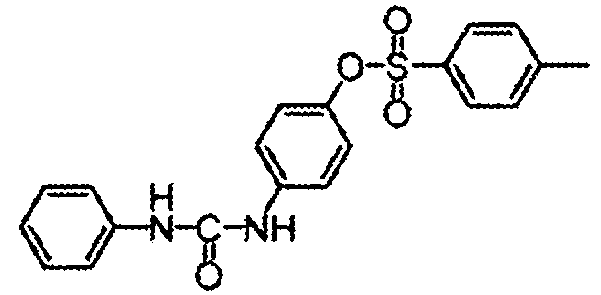
(Example 4)
A coating liquid for a thermosensitive recording layer is prepared in the same manner as in Example 1, except that the amount of the dye dispersion liquid was changed from 66.7 parts by mass to 20 parts by mass, and the amount of the color developer dispersion liquid was changed from 33.3 parts by mass to 80 parts by mass. Thermosensitive Recording Medium 4 was produced in the same manner as in Example 1, except that the above-prepared coating liquid for a thermosensitive recording layer was used for forming a thermosensitive recording layer.
A coating liquid for a thermosensitive recording layer is prepared in the same manner as in Example 1, except that the amount of the dye dispersion liquid was changed from 66.7 parts by mass to 20 parts by mass, and the amount of the color developer dispersion liquid was changed from 33.3 parts by mass to 80 parts by mass. Thermosensitive Recording Medium 4 was produced in the same manner as in Example 1, except that the above-prepared coating liquid for a thermosensitive recording layer was used for forming a thermosensitive recording layer.
(Example 5)
A coating liquid for a thermosensitive recording layer was prepared in the same manner as in Example 1, except that the amount of the dye dispersion liquid was changed from 66.7 parts by mass to 50 parts by mass, and the amount of the color developer dispersion liquid was changed from 33.3 parts by mass to 50 parts by mass. Thermosensitive Recording Medium 5 was produced in the same manner as in Example 1, except that the above-prepared coating liquid for a thermosensitive recording layer was used for forming a thermosensitive recording layer.
A coating liquid for a thermosensitive recording layer was prepared in the same manner as in Example 1, except that the amount of the dye dispersion liquid was changed from 66.7 parts by mass to 50 parts by mass, and the amount of the color developer dispersion liquid was changed from 33.3 parts by mass to 50 parts by mass. Thermosensitive Recording Medium 5 was produced in the same manner as in Example 1, except that the above-prepared coating liquid for a thermosensitive recording layer was used for forming a thermosensitive recording layer.
(Example 6)
A coating liquid for a thermosensitive recording layer was prepared in the same manner as in Example 1, except that the amount of the dye dispersion liquid was changed from 66.7 parts by mass to 33.3 parts by mass and the amount of the color developer dispersion liquid was changed from 33.3 parts by mass to 66.7 parts by mass. Thermosensitive Recording Medium 6 was produced in the same manner as in Example 1, except that the above-prepared coating liquid for a thermosensitive recording layer was used for forming a thermosensitive recording layer.
A coating liquid for a thermosensitive recording layer was prepared in the same manner as in Example 1, except that the amount of the dye dispersion liquid was changed from 66.7 parts by mass to 33.3 parts by mass and the amount of the color developer dispersion liquid was changed from 33.3 parts by mass to 66.7 parts by mass. Thermosensitive Recording Medium 6 was produced in the same manner as in Example 1, except that the above-prepared coating liquid for a thermosensitive recording layer was used for forming a thermosensitive recording layer.
(Example 7)
A coating liquid for a thermosensitive recording layer was prepared in the same manner as in Example 1, except that the amount of the dye dispersion liquid was changed from 66.7 parts by mass to 25 parts by mass and the amount of the color developer dispersion liquid was changed from 33.3 parts by mass to 75 parts by mass. Thermosensitive Recording Medium 7 was produced in the same manner as in Example 1, except that the above-prepared coating liquid for a thermosensitive recording layer was used for forming a thermosensitive recording layer.
A coating liquid for a thermosensitive recording layer was prepared in the same manner as in Example 1, except that the amount of the dye dispersion liquid was changed from 66.7 parts by mass to 25 parts by mass and the amount of the color developer dispersion liquid was changed from 33.3 parts by mass to 75 parts by mass. Thermosensitive Recording Medium 7 was produced in the same manner as in Example 1, except that the above-prepared coating liquid for a thermosensitive recording layer was used for forming a thermosensitive recording layer.
(Example 8)
Thermosensitive Recording Medium 8 was produced in the same manner as in Example 7, except that a thermosensitive recording layer was formed using the following coating liquid for a thermosensitive recording layer.
<Coating liquid for thermosensitive recording layer>
The dye dispersion liquid in an amount of 25 parts by mass, 75 parts by mass of the color developer dispersion liquid, 10.5 parts by mass of an acryl emulsion (product name: EK-301, solid content: 42%, available from Saiden Chemical Industry Co., Ltd.), 6 parts by mass of a cesium tungsten oxide dispersion (product name: YMW-D20, solid content: 28.5%, available from SUMITOMO METAL MINING CO., LTD.) serving as a photothermal conversion material, and 23.5 parts by mass of ion-exchanged water were mixed and stirred to thereby prepare a coating liquid for a thermosensitive recording layer.
Thermosensitive Recording Medium 8 was produced in the same manner as in Example 7, except that a thermosensitive recording layer was formed using the following coating liquid for a thermosensitive recording layer.
<Coating liquid for thermosensitive recording layer>
The dye dispersion liquid in an amount of 25 parts by mass, 75 parts by mass of the color developer dispersion liquid, 10.5 parts by mass of an acryl emulsion (product name: EK-301, solid content: 42%, available from Saiden Chemical Industry Co., Ltd.), 6 parts by mass of a cesium tungsten oxide dispersion (product name: YMW-D20, solid content: 28.5%, available from SUMITOMO METAL MINING CO., LTD.) serving as a photothermal conversion material, and 23.5 parts by mass of ion-exchanged water were mixed and stirred to thereby prepare a coating liquid for a thermosensitive recording layer.
(Example 9)
Thermosensitive Recording Medium 9 was produced in the same manner as in Example 7, except that the following coating liquid for a protective layer was applied onto the thermosensitive recording layer by means of a bar coater in a manner that the deposition amount of the coating liquid after drying was to be 2.0 g/m2 to thereby form a protective layer.
<Preparation of coating liquid for protective layer>
An acryl emulsion (product name: B-1000, solid content: 20%, available from Mitsui Chemicals, Inc.) in the amount of 37.5 parts by mass, 6 parts by mass of an oxazoline group-containing polymer emulsion (product name: WS-700, solid content: 25%, available from NIPPON SHOKUBAI CO., LTD.), and 37.5 parts by mass of ion-exchanged water were mixed and stirred to thereby obtain a coating liquid for a protective layer.
Thermosensitive Recording Medium 9 was produced in the same manner as in Example 7, except that the following coating liquid for a protective layer was applied onto the thermosensitive recording layer by means of a bar coater in a manner that the deposition amount of the coating liquid after drying was to be 2.0 g/m2 to thereby form a protective layer.
<Preparation of coating liquid for protective layer>
An acryl emulsion (product name: B-1000, solid content: 20%, available from Mitsui Chemicals, Inc.) in the amount of 37.5 parts by mass, 6 parts by mass of an oxazoline group-containing polymer emulsion (product name: WS-700, solid content: 25%, available from NIPPON SHOKUBAI CO., LTD.), and 37.5 parts by mass of ion-exchanged water were mixed and stirred to thereby obtain a coating liquid for a protective layer.
(Example 10)
Thermosensitive Recording Medium 10 was produced in the same manner as in Example 7, except that the following coating liquid for an adhesive layer was applied onto a support (polyethylene terephthalate film) by means of a bar coater in a manner that the deposition amount of the coating liquid after drying was to be 1 g/m2, and the thermosensitive recording layer identical to the thermosensitive recording layer of Example 7 was formed on the adhesive layer.
<Preparation of coating liquid for adhesive layer>
An acryl polyol resin (product name: Olester Q155, solid content: 50%, available from Mitsui Chemicals, Inc.) in an amount of 50 parts by mass, and 50 parts by mass of ethyl acetate were mixed to thereby obtain a coating liquid for an adhesive layer.
Thermosensitive Recording Medium 10 was produced in the same manner as in Example 7, except that the following coating liquid for an adhesive layer was applied onto a support (polyethylene terephthalate film) by means of a bar coater in a manner that the deposition amount of the coating liquid after drying was to be 1 g/m2, and the thermosensitive recording layer identical to the thermosensitive recording layer of Example 7 was formed on the adhesive layer.
<Preparation of coating liquid for adhesive layer>
An acryl polyol resin (product name: Olester Q155, solid content: 50%, available from Mitsui Chemicals, Inc.) in an amount of 50 parts by mass, and 50 parts by mass of ethyl acetate were mixed to thereby obtain a coating liquid for an adhesive layer.
(Example 11)
Thermosensitive Recording Medium 11 was produced in the same manner as in Example 7, except that a thermosensitive recording layer was formed using the following coating liquid for a thermosensitive recording layer.
<Coating liquid for thermosensitive recording layer>
The dye dispersion liquid in an amount of 25 parts by mass, 75 parts by mass of the color developer dispersion liquid, 10.4 parts by mass of an acryl emulsion (product name: EK-301, solid content: 42%, available from Saiden Chemical Industry Co., Ltd.), 1.8 parts by mass of a hydroxyphenyltriazine-based ultraviolet absorbing material (product name: Tinuvin 477-DW, solid content: 40%, available from BASF), and 27.8 parts by mass of ion-exchanged water were mixed and stirred, to thereby prepare a coating liquid for a thermosensitive recording layer.
Thermosensitive Recording Medium 11 was produced in the same manner as in Example 7, except that a thermosensitive recording layer was formed using the following coating liquid for a thermosensitive recording layer.
<Coating liquid for thermosensitive recording layer>
The dye dispersion liquid in an amount of 25 parts by mass, 75 parts by mass of the color developer dispersion liquid, 10.4 parts by mass of an acryl emulsion (product name: EK-301, solid content: 42%, available from Saiden Chemical Industry Co., Ltd.), 1.8 parts by mass of a hydroxyphenyltriazine-based ultraviolet absorbing material (product name: Tinuvin 477-DW, solid content: 40%, available from BASF), and 27.8 parts by mass of ion-exchanged water were mixed and stirred, to thereby prepare a coating liquid for a thermosensitive recording layer.
(Comparative Example 1)
A color developer dispersion liquid was prepared in the same manner as in Example 7, except that the compound of Compound No. 1 was replaced with 4-hydroxy-4'-isopropoxydiphenylsulfone (product name: D-8, available from Nippon Soda Co., Ltd.). Thermosensitive Recording Medium 13 was produced in the same manner as in Example 7, except that the color developer dispersion liquid above was used for forming a thermosensitive recording layer.
A color developer dispersion liquid was prepared in the same manner as in Example 7, except that the compound of Compound No. 1 was replaced with 4-hydroxy-4'-isopropoxydiphenylsulfone (product name: D-8, available from Nippon Soda Co., Ltd.). Thermosensitive Recording Medium 13 was produced in the same manner as in Example 7, except that the color developer dispersion liquid above was used for forming a thermosensitive recording layer.
(Comparative Example 2)
A color developer dispersion liquid was prepared in the same manner as in Example 7, except that the compound of Compound No. 1 was replaced with a polymer (product name: D-90, available from Nippon Soda Co., Ltd.) including 4,4'-[oxybis(ethyleneoxy-P-phenylenesulfonyl)]diphenol as a main component. Thermosensitive Recording Medium 14 was produced in the same manner as in Example 7, except that the color developer dispersion liquid above was used for forming a thermosensitive recording layer.
A color developer dispersion liquid was prepared in the same manner as in Example 7, except that the compound of Compound No. 1 was replaced with a polymer (product name: D-90, available from Nippon Soda Co., Ltd.) including 4,4'-[oxybis(ethyleneoxy-P-phenylenesulfonyl)]diphenol as a main component. Thermosensitive Recording Medium 14 was produced in the same manner as in Example 7, except that the color developer dispersion liquid above was used for forming a thermosensitive recording layer.
(Comparative Example 3)
A color developer dispersion liquid was prepared in the same manner as in Example 7, except that the compound of Compound No. 1 was replaced with bis-(3-allyl-4-hydroxyphenyl)-sulfone (product name: TG-SH, available from Nippon Kayaku Co., Ltd.). Thermosensitive Recording Medium 15 was produced in the same manner as in Example 7, except that the color developer dispersion liquid above was used for forming a thermosensitive recording layer.
A color developer dispersion liquid was prepared in the same manner as in Example 7, except that the compound of Compound No. 1 was replaced with bis-(3-allyl-4-hydroxyphenyl)-sulfone (product name: TG-SH, available from Nippon Kayaku Co., Ltd.). Thermosensitive Recording Medium 15 was produced in the same manner as in Example 7, except that the color developer dispersion liquid above was used for forming a thermosensitive recording layer.
(Comparative Example 4)
A color developer dispersion liquid was prepared in the same manner as in Example 7, except that the compound of Compound No. 1 was replaced with 4,4'-thiobis(3-methyl-6-t-butylphenol (product name: SUMILIZER WX-R, available from Sumitomo Chemical Co., Ltd.). Thermosensitive Recording Medium 16 was produced in the same manner as in Example 7, except that the color developer dispersion liquid above was used for forming a thermosensitive recording layer.
A color developer dispersion liquid was prepared in the same manner as in Example 7, except that the compound of Compound No. 1 was replaced with 4,4'-thiobis(3-methyl-6-t-butylphenol (product name: SUMILIZER WX-R, available from Sumitomo Chemical Co., Ltd.). Thermosensitive Recording Medium 16 was produced in the same manner as in Example 7, except that the color developer dispersion liquid above was used for forming a thermosensitive recording layer.
(Comparative Example 5)
A color developer dispersion liquid was prepared in the same manner as in Example 7, except that the compound of Compound No. 1 was replaced with 2,4'-dihydroxydiphenylsulfone (product name: BPS-24C, available from NICCA CHEMICAL CO., LTD.). Thermosensitive Recording Medium 17 was produced in the same manner as in Example 7, except that the color developer dispersion liquid above was used for forming a thermosensitive recording layer.
A color developer dispersion liquid was prepared in the same manner as in Example 7, except that the compound of Compound No. 1 was replaced with 2,4'-dihydroxydiphenylsulfone (product name: BPS-24C, available from NICCA CHEMICAL CO., LTD.). Thermosensitive Recording Medium 17 was produced in the same manner as in Example 7, except that the color developer dispersion liquid above was used for forming a thermosensitive recording layer.
(Comparative Example 6)
A color developer dispersion liquid was prepared in the same manner as in Example 7, except that the compound of Compound No. 1 was replaced with bisphenol A. Thermosensitive Recording Medium 18 was produced in the same manner as in Example 7, except that the color developer dispersion liquid above was used for forming a thermosensitive recording layer.
A color developer dispersion liquid was prepared in the same manner as in Example 7, except that the compound of Compound No. 1 was replaced with bisphenol A. Thermosensitive Recording Medium 18 was produced in the same manner as in Example 7, except that the color developer dispersion liquid above was used for forming a thermosensitive recording layer.
Next, a “change rate of total light transmittance,” “haze degree,” and “maximum coloring density” were devaluated on the thermosensitive recording media of Examples 1 to 11 and Comparative Examples 1 to 6. The results of Examples 1 to 11 are presented in Tables 1 to 2, and the results of Comparative Examples 1 to 6 are presented in Table 3.
<Change rate of total light transmittance>
A change rate of total light transmittance before and after performing a heat treatment on each of the thermosensitive recording media of Examples 1 to 11 and Comparative Examples 1 to 6, and a degree of retention of transparency against heating of the thermosensitive recording medium was evaluated.
As measurement of total light transmittance, a background of each of the thermosensitive recording media produced in Examples 1 to 11 and Comparative Examples 1 to 6 was measured by a spectrophotometer (U-4100, available from Hitachi High-Technologies Corporation) per 1 nm in a wavelength range of from 300 nm through 830 nm (D65 light source), and an average value of the obtained values of transmittance of all of the wavelengths was calculated. A change rate X of the total light transmittance was calculated according to the formula X = (A-B)/A × 100, where A was the total light transmittance before performing the heat treatment, and B was the total light transmittance after performing the heat treatment at 90℃ for 1 hour. The result was evaluated based on the following evaluation criteria. Note that, the result of “Good” or better change rate of the total light transmittance is a level at which there is no problem on practical use.
(Evaluation criteria)
Excellent: 3.0% or less
Good: greater than 3.0% but less than 5.0%
Poor: 5.0% or greater
A change rate of total light transmittance before and after performing a heat treatment on each of the thermosensitive recording media of Examples 1 to 11 and Comparative Examples 1 to 6, and a degree of retention of transparency against heating of the thermosensitive recording medium was evaluated.
As measurement of total light transmittance, a background of each of the thermosensitive recording media produced in Examples 1 to 11 and Comparative Examples 1 to 6 was measured by a spectrophotometer (U-4100, available from Hitachi High-Technologies Corporation) per 1 nm in a wavelength range of from 300 nm through 830 nm (D65 light source), and an average value of the obtained values of transmittance of all of the wavelengths was calculated. A change rate X of the total light transmittance was calculated according to the formula X = (A-B)/A × 100, where A was the total light transmittance before performing the heat treatment, and B was the total light transmittance after performing the heat treatment at 90℃ for 1 hour. The result was evaluated based on the following evaluation criteria. Note that, the result of “Good” or better change rate of the total light transmittance is a level at which there is no problem on practical use.
(Evaluation criteria)
Excellent: 3.0% or less
Good: greater than 3.0% but less than 5.0%
Poor: 5.0% or greater
<Haze degree>
A haze degree on a recording surface of each of the thermosensitive recording media produced in Examples 1 to 11 and Comparative Examples 1 to 6 was measured by a haze meter (instrument name: HZ-V3, available from Suga Test Instruments Co., Ltd.), and the result was evaluated based on the following evaluation criteria. Note that, the result of “Good” or better “Haze degree” is a level at which there is no problem on practical use.
(Evaluation criteria)
Excellent: less than 10.0
Good: 10.0 or greater but 15.0 or less
Poor: greater than 15.0
A haze degree on a recording surface of each of the thermosensitive recording media produced in Examples 1 to 11 and Comparative Examples 1 to 6 was measured by a haze meter (instrument name: HZ-V3, available from Suga Test Instruments Co., Ltd.), and the result was evaluated based on the following evaluation criteria. Note that, the result of “Good” or better “Haze degree” is a level at which there is no problem on practical use.
(Evaluation criteria)
Excellent: less than 10.0
Good: 10.0 or greater but 15.0 or less
Poor: greater than 15.0
<Maximum coloring density>
-Examples 1 to 7 and 9 to 11, and Comparative Examples 1 to 6-
Each of the thermosensitive recording media produced in Examples 1 to 7 and 9 to 11 and Comparative Examples 1 to 6 was printed with a heat block having a temperature at which the thermosensitive recording media exhibited saturated density at 2 kg/cm2 for 1 second by means of a heat gradient tester (device name: HG-100-2, available from Toyo Seiki Seisaku-sho, Ltd.), to thereby produce a pretest image sample. Thereafter, reflection density of the printed area of the produced pretest image sample was measured as “maximum coloring density” by means of a Macbeth densitometer RD-914, and the result was evaluated based on the evaluation criteria. Note that, the result of “Good” or better “Maximum coloring density” is a level at which there is no problem on practical use.
(Evaluation criteria)
Excellent: greater than 1.85
Good: 1.65 or greater but 1.85 or less
Poor: less than 1.65
-Example 8-
The thermosensitive recording medium of Example 8 was printed under the following printing conditions by means of a LD laser marker (instrument name: Ricoh Rewritable Laser Marker LDM200, available from Ricoh Company Limited) to thereby produce a pretest image sample. Thereafter, reflection density of the printed area of the produced pretest image sample was measured as “maximum coloring density” by means of a Macbeth densitometer RD-914, and the result was evaluated based on the evaluation criteria. Note that, the result of “Good” or better “Maximum coloring density” is a level at which there is no problem on practical use.
(Printing conditions)
Working distance: 150 mm
Scanning speed: 3,000 mm/s
Wavelength of laser light: 980 nm
Laser power: 70%
(Evaluation criteria)
Excellent: greater than 1.85
Good: 1.65 or greater but 1.85 or less
Poor: less than 1.65
-Examples 1 to 7 and 9 to 11, and Comparative Examples 1 to 6-
Each of the thermosensitive recording media produced in Examples 1 to 7 and 9 to 11 and Comparative Examples 1 to 6 was printed with a heat block having a temperature at which the thermosensitive recording media exhibited saturated density at 2 kg/cm2 for 1 second by means of a heat gradient tester (device name: HG-100-2, available from Toyo Seiki Seisaku-sho, Ltd.), to thereby produce a pretest image sample. Thereafter, reflection density of the printed area of the produced pretest image sample was measured as “maximum coloring density” by means of a Macbeth densitometer RD-914, and the result was evaluated based on the evaluation criteria. Note that, the result of “Good” or better “Maximum coloring density” is a level at which there is no problem on practical use.
(Evaluation criteria)
Excellent: greater than 1.85
Good: 1.65 or greater but 1.85 or less
Poor: less than 1.65
-Example 8-
The thermosensitive recording medium of Example 8 was printed under the following printing conditions by means of a LD laser marker (instrument name: Ricoh Rewritable Laser Marker LDM200, available from Ricoh Company Limited) to thereby produce a pretest image sample. Thereafter, reflection density of the printed area of the produced pretest image sample was measured as “maximum coloring density” by means of a Macbeth densitometer RD-914, and the result was evaluated based on the evaluation criteria. Note that, the result of “Good” or better “Maximum coloring density” is a level at which there is no problem on practical use.
(Printing conditions)
Working distance: 150 mm
Scanning speed: 3,000 mm/s
Wavelength of laser light: 980 nm
Laser power: 70%
(Evaluation criteria)
Excellent: greater than 1.85
Good: 1.65 or greater but 1.85 or less
Poor: less than 1.65
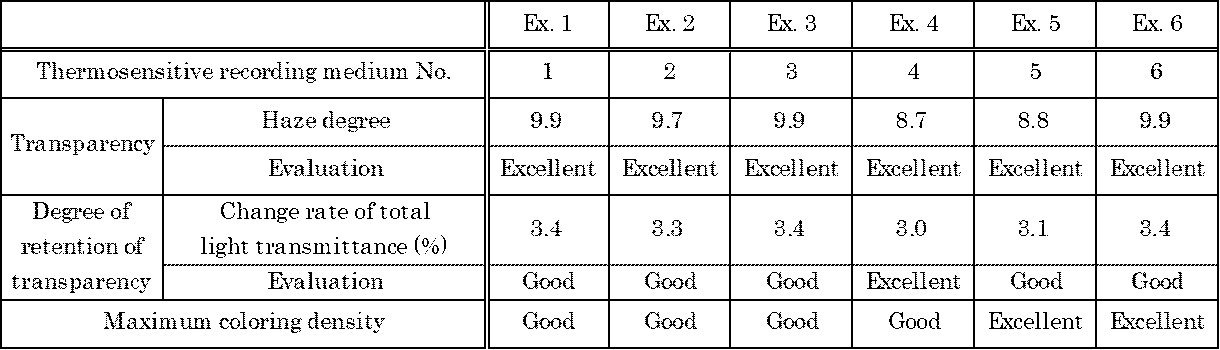


For example, embodiments of the present disclosure are as follows.
<1> A thermosensitive recording medium including:
a support;
a thermosensitive recording layer disposed on or above the support,
wherein the thermosensitive recording layer includes a leuco dye and a color developer,
a haze degree of the thermosensitive recording medium is 15 or less, and
a change rate X of total light transmittance represented by Formula (1) below is 5.0% or less,
X = (A-B)/A×100 Formula (1)
where, in Formula (1), A is total light transmittance before heating the thermosensitive recording medium at a temperature of 90℃, and B is total light transmittance after heating the thermosensitive recording medium at a temperature of 90℃ for 1 hour.
<2> The thermosensitive recording medium according to <1>,
wherein the haze degree of the thermosensitive recording medium is 10 or less.
<3> The thermosensitive recording medium according to <1> or <2>,
wherein the change rate X of the total light transmittance is 3.0% or less.
<4> The thermosensitive recording medium according to any one of <1> to <3>,
wherein the color developer is at least one of compounds represented by General Formula (1) below:

where, in General Formula (1), R1 to R5 are each independently a hydrogen atom, a halogen atom, a nitro group, an amino group, an alkyl group, an alkoxy group, an aryloxy group, an alkylcarbonyloxy group, an arylcarbonyloxy group, an alkylcarbonylamino group, an arylcarbonylamino group, an alkylsulfonylamino group, an arylsulfonylamino group, a monoalkylamino group, a dialkylamino group, and an arylamino group.
<5> The thermosensitive recording medium according to <4>,
wherein the color developer is a compound represented by any of Structural Formulae (1) to (3) below:

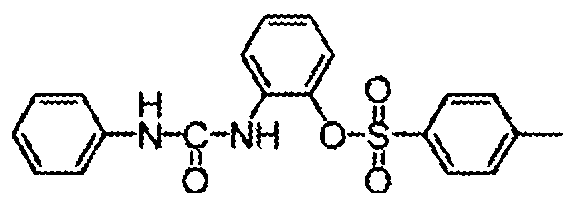
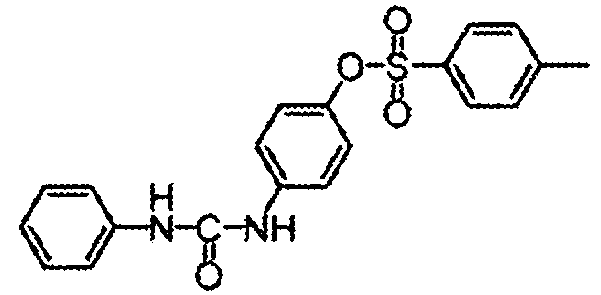
<6> The thermosensitive recording medium according to any one of <1> to <5>,
wherein as a content ratio between the leuco dye and the color developer, an amount of the color developer is 1 part by mass or greater but 4 parts by mass or less relative to 1 part by mass of the leuco dye.
<7> The thermosensitive recording medium according to any one of <1> to <6>, further including a protective layer disposed on a side of the thermosensitive recording layer where the support is not disposed.
<8> The thermosensitive recording medium according to any one of <1> to <7>, further including an adhesive layer disposed between the thermosensitive recording layer and the support.
<9> The thermosensitive recording medium according to <8>,
wherein the thermosensitive recording layer, or the adhesive layer, or both include an ultraviolet absorbing material.
<10> The thermosensitive recording layer according to <8> or <9>,
wherein the thermosensitive recording layer, or the adhesive layer, or both include a photothermal conversion material, and
the thermosensitive recording medium is recordable with laser.
<11> A thermosensitive recording liquid including:
a leuco dye; and
a color developer,
wherein the thermosensitive recording liquid is used for forming the thermosensitive recording medium according to any one of <1> to <6>.
<12> An article including:
the thermosensitive recording medium according to any one of <1> to <10>.
<1> A thermosensitive recording medium including:
a support;
a thermosensitive recording layer disposed on or above the support,
wherein the thermosensitive recording layer includes a leuco dye and a color developer,
a haze degree of the thermosensitive recording medium is 15 or less, and
a change rate X of total light transmittance represented by Formula (1) below is 5.0% or less,
X = (A-B)/A×100 Formula (1)
where, in Formula (1), A is total light transmittance before heating the thermosensitive recording medium at a temperature of 90℃, and B is total light transmittance after heating the thermosensitive recording medium at a temperature of 90℃ for 1 hour.
<2> The thermosensitive recording medium according to <1>,
wherein the haze degree of the thermosensitive recording medium is 10 or less.
<3> The thermosensitive recording medium according to <1> or <2>,
wherein the change rate X of the total light transmittance is 3.0% or less.
<4> The thermosensitive recording medium according to any one of <1> to <3>,
wherein the color developer is at least one of compounds represented by General Formula (1) below:
<5> The thermosensitive recording medium according to <4>,
wherein the color developer is a compound represented by any of Structural Formulae (1) to (3) below:
wherein as a content ratio between the leuco dye and the color developer, an amount of the color developer is 1 part by mass or greater but 4 parts by mass or less relative to 1 part by mass of the leuco dye.
<7> The thermosensitive recording medium according to any one of <1> to <6>, further including a protective layer disposed on a side of the thermosensitive recording layer where the support is not disposed.
<8> The thermosensitive recording medium according to any one of <1> to <7>, further including an adhesive layer disposed between the thermosensitive recording layer and the support.
<9> The thermosensitive recording medium according to <8>,
wherein the thermosensitive recording layer, or the adhesive layer, or both include an ultraviolet absorbing material.
<10> The thermosensitive recording layer according to <8> or <9>,
wherein the thermosensitive recording layer, or the adhesive layer, or both include a photothermal conversion material, and
the thermosensitive recording medium is recordable with laser.
<11> A thermosensitive recording liquid including:
a leuco dye; and
a color developer,
wherein the thermosensitive recording liquid is used for forming the thermosensitive recording medium according to any one of <1> to <6>.
<12> An article including:
the thermosensitive recording medium according to any one of <1> to <10>.
The thermosensitive recording medium according to any one of <1> to <10>, the thermosensitive recording liquid according to <11>, and the article according to <12> can solve the above-described various problems existing in the art, and can achieve the object of the present disclosure.
Claims (9)
- A thermosensitive recording medium comprising:
a support; and
a thermosensitive recording layer disposed on or above the support,
wherein the thermosensitive recording layer includes a leuco dye and a color developer,
a haze degree of the thermosensitive recording medium is 15 or less, and
a change rate X of total light transmittance represented by Formula (1) below is 5.0% or less,
X = (A-B)/A×100 Formula (1)
where, in Formula (1), A is total light transmittance before heating the thermosensitive recording medium at a temperature of 90℃, and B is total light transmittance after heating the thermosensitive recording medium at a temperature of 90℃ for 1 hour. - The thermosensitive recording medium according to claim 1,
wherein the color developer is at least one of compounds represented by General Formula (1) below:

- The thermosensitive recording medium according to claim 1 or 2,
wherein as a content ratio between the leuco dye and the color developer, an amount of the color developer is 1 part by mass or greater but 4 parts by mass or less relative to 1 part by mass of the leuco dye. - The thermosensitive recording medium according to any one of claims 1 to 3, further comprising a protective layer disposed on a side of the thermosensitive recording layer where the support is not disposed.
- The thermosensitive recording medium according to any one of claims 1 to 4, further comprising an adhesive layer disposed between the thermosensitive recording layer and the support.
- The thermosensitive recording medium according to claim 5,
wherein the thermosensitive recording layer, or the adhesive layer, or both include an ultraviolet absorbing material. - The thermosensitive recording medium according to claim 5 or 6,
wherein the thermosensitive recording layer, or the adhesive layer, or both include a photothermal conversion material, and
the thermosensitive recording medium is recordable with laser. - A thermosensitive recording liquid comprising:
a leuco dye; and
a color developer,
wherein the thermosensitive recording liquid is used for forming the thermosensitive recording medium according to any one of claims 1 to 3. - An article comprising:
the thermosensitive recording medium according to any one of claims 1 to 7.
Applications Claiming Priority (2)
| Application Number | Priority Date | Filing Date | Title |
|---|---|---|---|
| JP2018216117A JP7263741B2 (en) | 2018-11-19 | 2018-11-19 | Thermal recording media, thermal recording liquids, and articles |
| JP2018-216117 | 2018-11-19 |
Publications (1)
| Publication Number | Publication Date |
|---|---|
| WO2020105564A1 true WO2020105564A1 (en) | 2020-05-28 |
Family
ID=68732028
Family Applications (1)
| Application Number | Title | Priority Date | Filing Date |
|---|---|---|---|
| PCT/JP2019/044976 Ceased WO2020105564A1 (en) | 2018-11-19 | 2019-11-15 | Thermosensitive recording medium, thermosensitive recording liquid, and article |
Country Status (2)
| Country | Link |
|---|---|
| JP (2) | JP7263741B2 (en) |
| WO (1) | WO2020105564A1 (en) |
Cited By (4)
| Publication number | Priority date | Publication date | Assignee | Title |
|---|---|---|---|---|
| WO2022101297A1 (en) * | 2020-11-10 | 2022-05-19 | Datalase Ltd. | A composition |
| CN115107391A (en) * | 2021-03-23 | 2022-09-27 | 株式会社理光 | Thermosensitive recording medium, laser printing method and laser printing apparatus |
| US12285961B2 (en) | 2019-12-12 | 2025-04-29 | Datalase Ltd. | Heat transfer agents in an image-forming composition |
| US20260002039A1 (en) * | 2022-08-29 | 2026-01-01 | Osaka Sealing Printing Co., Ltd. | Heat-sensitive recording medium |
Families Citing this family (8)
| Publication number | Priority date | Publication date | Assignee | Title |
|---|---|---|---|---|
| KR20230017888A (en) * | 2020-07-27 | 2023-02-06 | 닛폰세이시가부시키가이샤 | thermal recorder |
| US12151498B2 (en) | 2020-12-10 | 2024-11-26 | Appvion, Llc | Multi-purpose phenol-free direct thermal recording media |
| US12115803B2 (en) * | 2020-12-10 | 2024-10-15 | Appvion, Llc | Fade-resistant water-dispersible phenol-free direct thermal media |
| JP7618436B2 (en) * | 2020-12-11 | 2025-01-21 | 株式会社パイロットコーポレーション | Reversible thermochromic composition and reversible thermochromic microcapsule pigment containing the same |
| ES3028248T3 (en) * | 2020-12-28 | 2025-06-18 | Sanko Co Ltd | Colour developer, thermal recording material, and coating material for thermal recording layers |
| JP7146147B1 (en) * | 2021-03-19 | 2022-10-03 | 日本製紙株式会社 | Thermal recording medium |
| CN117042978B (en) * | 2021-03-29 | 2026-04-10 | 日本制纸株式会社 | Thermosensitive recording medium |
| JP2025528105A (en) | 2022-08-10 | 2025-08-26 | アプヴィオン エルエルシー | Direct thermal recording media using diaryl urea combinations for oil resistance |
Citations (5)
| Publication number | Priority date | Publication date | Assignee | Title |
|---|---|---|---|---|
| JPH05278329A (en) | 1992-03-31 | 1993-10-26 | Fuji Photo Film Co Ltd | Thermal recording material for laser recording |
| WO2005037932A1 (en) | 2003-10-20 | 2005-04-28 | Sumitomo Metal Mining Co., Ltd. | Infrared shielding material microparticle dispersion, infrared shield, process for producing infrared shielding material microparticle, and infrared shielding material microparticle |
| JP2005187323A (en) | 2003-12-05 | 2005-07-14 | Sumitomo Metal Mining Co Ltd | Method for producing tungsten oxide fine particles for forming solar radiation shield, tungsten oxide fine particles for forming solar radiation shield, dispersion for forming solar radiation shield, and solar radiation shield |
| WO2017111032A1 (en) | 2015-12-25 | 2017-06-29 | 日本化薬株式会社 | Heat-sensitive recording material |
| JP2018043363A (en) * | 2016-09-12 | 2018-03-22 | 日本化薬株式会社 | Heat-sensitive recording material |
Family Cites Families (17)
| Publication number | Priority date | Publication date | Assignee | Title |
|---|---|---|---|---|
| JPH0958135A (en) * | 1995-08-25 | 1997-03-04 | Oji Paper Co Ltd | Thermal recording |
| JPH09175019A (en) * | 1995-12-27 | 1997-07-08 | Oji Paper Co Ltd | Thermal recording |
| JPH115365A (en) * | 1997-06-17 | 1999-01-12 | Oji Paper Co Ltd | Thermal recording medium for Schaukasten |
| JPH11198545A (en) * | 1998-01-20 | 1999-07-27 | Oji Paper Co Ltd | Thermal recording medium |
| JP2000118140A (en) * | 1998-10-20 | 2000-04-25 | Fuji Photo Film Co Ltd | Thermal recording material and its production |
| JP4141109B2 (en) | 2001-02-26 | 2008-08-27 | 株式会社リコー | Thermal recording medium for laser recording and image recording method |
| JP2003025729A (en) * | 2001-07-19 | 2003-01-29 | Nippon Kayaku Co Ltd | Transparent heat sensitive recording medium |
| JP2006082390A (en) * | 2004-09-16 | 2006-03-30 | Ricoh Co Ltd | Transparent thermal recording material |
| JP2006130671A (en) * | 2004-11-02 | 2006-05-25 | Oji Paper Co Ltd | Thermal recording material |
| JP2006289703A (en) * | 2005-04-08 | 2006-10-26 | Oji Paper Co Ltd | Thermal recording material |
| JP2007076251A (en) * | 2005-09-15 | 2007-03-29 | Ricoh Co Ltd | Thermal recording medium |
| JP4825155B2 (en) * | 2007-03-02 | 2011-11-30 | 株式会社リコー | Thermal recording material |
| JP2010023438A (en) * | 2008-07-24 | 2010-02-04 | Nippon Paper Industries Co Ltd | Thermosensitive recording body |
| JP2011079308A (en) * | 2009-09-14 | 2011-04-21 | Ricoh Co Ltd | Thermal recording material and manufacturing method for the same |
| JP2015193232A (en) * | 2014-03-18 | 2015-11-05 | 株式会社リコー | heat-sensitive recording medium and image processing method |
| JP2017019243A (en) | 2015-07-14 | 2017-01-26 | 大阪シーリング印刷株式会社 | Thermosensitive coloring composition and thermosensitive recording material containing the same |
| JP2018062083A (en) * | 2016-10-11 | 2018-04-19 | 日本化薬株式会社 | Heat-sensitive recording material |
-
2018
- 2018-11-19 JP JP2018216117A patent/JP7263741B2/en active Active
-
2019
- 2019-11-15 WO PCT/JP2019/044976 patent/WO2020105564A1/en not_active Ceased
-
2023
- 2023-02-06 JP JP2023015755A patent/JP2023052912A/en active Pending
Patent Citations (6)
| Publication number | Priority date | Publication date | Assignee | Title |
|---|---|---|---|---|
| JPH05278329A (en) | 1992-03-31 | 1993-10-26 | Fuji Photo Film Co Ltd | Thermal recording material for laser recording |
| WO2005037932A1 (en) | 2003-10-20 | 2005-04-28 | Sumitomo Metal Mining Co., Ltd. | Infrared shielding material microparticle dispersion, infrared shield, process for producing infrared shielding material microparticle, and infrared shielding material microparticle |
| JP2005187323A (en) | 2003-12-05 | 2005-07-14 | Sumitomo Metal Mining Co Ltd | Method for producing tungsten oxide fine particles for forming solar radiation shield, tungsten oxide fine particles for forming solar radiation shield, dispersion for forming solar radiation shield, and solar radiation shield |
| WO2017111032A1 (en) | 2015-12-25 | 2017-06-29 | 日本化薬株式会社 | Heat-sensitive recording material |
| EP3395583A1 (en) * | 2015-12-25 | 2018-10-31 | Nippon Kayaku Kabushiki Kaisha | Heat-sensitive recording material |
| JP2018043363A (en) * | 2016-09-12 | 2018-03-22 | 日本化薬株式会社 | Heat-sensitive recording material |
Cited By (8)
| Publication number | Priority date | Publication date | Assignee | Title |
|---|---|---|---|---|
| US12285961B2 (en) | 2019-12-12 | 2025-04-29 | Datalase Ltd. | Heat transfer agents in an image-forming composition |
| WO2022101297A1 (en) * | 2020-11-10 | 2022-05-19 | Datalase Ltd. | A composition |
| CN116648358A (en) * | 2020-11-10 | 2023-08-25 | 德塔莱斯有限公司 | combination |
| EP4644130A3 (en) * | 2020-11-10 | 2026-01-28 | DataLase Ltd. | A composition |
| CN115107391A (en) * | 2021-03-23 | 2022-09-27 | 株式会社理光 | Thermosensitive recording medium, laser printing method and laser printing apparatus |
| CN115107391B (en) * | 2021-03-23 | 2024-04-19 | 株式会社理光 | Thermosensitive recording medium, laser printing method and laser printing apparatus |
| US20260002039A1 (en) * | 2022-08-29 | 2026-01-01 | Osaka Sealing Printing Co., Ltd. | Heat-sensitive recording medium |
| EP4582261A4 (en) * | 2022-08-29 | 2026-02-18 | Osaka Sealing Label Print | HEAT-SENSITIVE RECORDING MATERIAL |
Also Published As
| Publication number | Publication date |
|---|---|
| JP7263741B2 (en) | 2023-04-25 |
| JP2023052912A (en) | 2023-04-12 |
| JP2020082406A (en) | 2020-06-04 |
Similar Documents
| Publication | Publication Date | Title |
|---|---|---|
| JP7263741B2 (en) | Thermal recording media, thermal recording liquids, and articles | |
| CN117083182B (en) | Thermal recording layer forming liquid, thermal recording medium and its production method, and image recording method | |
| JP6566100B2 (en) | Thermal recording material | |
| CN109328143B (en) | Thermal recording media and articles | |
| WO2018173810A1 (en) | Thermosensitive recording medium and article | |
| EP4063138A1 (en) | Thermosensitive recording medium, laser printing method, and laser printing apparatus | |
| WO2019124531A1 (en) | Thermosensitive recording medium, thermosensitive recording medium producing method, and article | |
| WO2020189422A1 (en) | Thermosensitive recording medium | |
| JP5326954B2 (en) | Thermal recording material | |
| US20250289259A1 (en) | Thermosensitive recording medium for linerless label | |
| WO2024190192A1 (en) | Thermosensitive recording medium, method for producing thermosensitive recording medium, and article | |
| WO2025192713A1 (en) | Thermosensitive recording medium for linerless label | |
| EP4126557B1 (en) | Thermosensitive recording medium and method for producing thermosensitive recording medium | |
| JP2020152022A (en) | Thermal recording medium and manufacturing method of thermal recording medium | |
| US20250050671A1 (en) | Thermosensitive recording layer forming liquid, thermosensitive recording medium and production method thereof, and image recording method |
Legal Events
| Date | Code | Title | Description |
|---|---|---|---|
| 121 | Ep: the epo has been informed by wipo that ep was designated in this application |
Ref document number: 19812864 Country of ref document: EP Kind code of ref document: A1 |
|
| NENP | Non-entry into the national phase |
Ref country code: DE |
|
| 122 | Ep: pct application non-entry in european phase |
Ref document number: 19812864 Country of ref document: EP Kind code of ref document: A1 |