WO2020101977A1 - Lipid ether amine compounds for topical treatment of cutaneous disease - Google Patents
Lipid ether amine compounds for topical treatment of cutaneous disease Download PDFInfo
- Publication number
- WO2020101977A1 WO2020101977A1 PCT/US2019/060079 US2019060079W WO2020101977A1 WO 2020101977 A1 WO2020101977 A1 WO 2020101977A1 US 2019060079 W US2019060079 W US 2019060079W WO 2020101977 A1 WO2020101977 A1 WO 2020101977A1
- Authority
- WO
- WIPO (PCT)
- Prior art keywords
- treatment
- pharmaceutical composition
- lea
- double bonds
- disease
- Prior art date
- Legal status (The legal status is an assumption and is not a legal conclusion. Google has not performed a legal analysis and makes no representation as to the accuracy of the status listed.)
- Ceased
Links
- SRVMNSHFBPIIFV-UHFFFAOYSA-N CCCCCCCCOCC(CNC(C)C)O Chemical compound CCCCCCCCOCC(CNC(C)C)O SRVMNSHFBPIIFV-UHFFFAOYSA-N 0.000 description 1
Classifications
-
- A—HUMAN NECESSITIES
- A61—MEDICAL OR VETERINARY SCIENCE; HYGIENE
- A61K—PREPARATIONS FOR MEDICAL, DENTAL OR TOILETRY PURPOSES
- A61K9/00—Medicinal preparations characterised by special physical form
- A61K9/0012—Galenical forms characterised by the site of application
- A61K9/0014—Skin, i.e. galenical aspects of topical compositions
-
- A—HUMAN NECESSITIES
- A61—MEDICAL OR VETERINARY SCIENCE; HYGIENE
- A61K—PREPARATIONS FOR MEDICAL, DENTAL OR TOILETRY PURPOSES
- A61K31/00—Medicinal preparations containing organic active ingredients
- A61K31/13—Amines
- A61K31/131—Amines acyclic
-
- A—HUMAN NECESSITIES
- A61—MEDICAL OR VETERINARY SCIENCE; HYGIENE
- A61K—PREPARATIONS FOR MEDICAL, DENTAL OR TOILETRY PURPOSES
- A61K9/00—Medicinal preparations characterised by special physical form
- A61K9/10—Dispersions; Emulsions
- A61K9/127—Synthetic bilayered vehicles, e.g. liposomes or liposomes with cholesterol as the only non-phosphatidyl surfactant
-
- A—HUMAN NECESSITIES
- A61—MEDICAL OR VETERINARY SCIENCE; HYGIENE
- A61P—SPECIFIC THERAPEUTIC ACTIVITY OF CHEMICAL COMPOUNDS OR MEDICINAL PREPARATIONS
- A61P17/00—Drugs for dermatological disorders
-
- A—HUMAN NECESSITIES
- A61—MEDICAL OR VETERINARY SCIENCE; HYGIENE
- A61P—SPECIFIC THERAPEUTIC ACTIVITY OF CHEMICAL COMPOUNDS OR MEDICINAL PREPARATIONS
- A61P35/00—Antineoplastic agents
Definitions
- the present invention relates to treatments for various cutaneous and/or and microbial diseases on humans and various other species, and more particularly, to a topical form of treatment consisting of a lipid ether amine (LEA) compound that aids in the treatment of cutaneous diseases and conditions such as psoriasis, skin cancer, atopic dermatitis, and wounds, and in the treatment of microbial diseases or infections.
- LSA lipid ether amine
- topical immunomodulating compounds are often not used for invasive tumors, autoimmune diseases, or for inflammatory diseases, such as psoriasis, atopic dermatitis, or even wounds.
- Keratinocyte carcinoma is an extremely common is cutaneous disease. It is the most common malignancy in the United States; over 3 million patients are diagnosed, with 5.4 million cases annually. The incidence of keratinocyte carcinoma a compound annual growth rate of 2- 4%. Currently available topical treatment for keratinocyte carcinoma typically causes inflammation, often with extreme limitations and other varying side effects.
- Certain lipid compounds are effective in the suppression of tumorigenesis (i.e., to specifically inhibit the growth of cancer cells in vitro or in vivo) and to treat the cancer or other cell-proliferating disease. These lipid compound treatments, however, have not addressed the unmet needs of other cutaneous diseases, such as psoriasis and atopic dermatitis.
- Lipid ether amine compounds have been synthesized and formulated for cosmetic application, and formulated for oral administration for certain therapeutic applications such as liver cancer, but they have not been developed for the treatment of cutaneous diseases (such as psoriasis, atopic dermatitis, papillomas, and the like) or included an engineered liposomal formulation.
- Topical steroids and immunogenic drugs are available from generic drug manufacturers. However these types of anti-immunogenic or steroidal topicals are limited in their applications and present substantial side effects in treatment of cutaneous diseases. Injected monoclonal antibody biologic drugs are very expensive. MOHS micrographic surgery is offered by specialist dermatology clinics as a treatment for skin cancers, but requires substantial specialist clinic time and potentially unnecessary expense. None of the currently available topical products have been entirely successful for therapeutic treatment of dermatological conditions and there remains an unmet need for therapeutic compositions, especially those formulated for topical administration, which can improve the treatment of various skin diseases, including keratinocyte carcinoma.
- the compounds of the invention are non-immunogenic, non-steroidal, and function through different mechanisms in order to provide a better safety profile and better cost- effectiveness than currently available treatments.
- the compounds and pharmaceutical compositions described herein provide a demonstrated use for (1) treatment of cutaneous diseases having a high incidence, such as skin cancers, psoriasis, and atopic dermatitis, and solves this unmet need to offer better patient outcome, lower cost, and less clinic time compared to current standards of care, and (2) treatment of bacterial or other microbial disease conditions in a patient.
- compositions formulated for topical application comprising a pharmaceutically acceptable topical carrier and a compound of Formula 1 :
- Ri is an unbranched alkyl chain having 8-24 carbon atoms and 0-6 double bonds; wherein R2 is H or a group comprising 1-16 atoms selected from C, N, O, and S, in a straight or branched alkane or alkene chain, optionally containing a non-aromatic cycle or heterocycle having 5-6 atoms, and optionally containing one or more of the following: primary amine, secondary amine, ether, thioether, carbonyl, sulfonyl, alcohol, sulfhydryl, disulfide, aldehyde, and carboxyl), or a pharmaceutically acceptable salt thereof;
- R3 is a group selected from -OH,— SH,— CHO, and— COOH, and
- n is an integer selected from 0, 1, 2, and 3.
- compositions are those wherein Ri is selected from unbranched alkyl or alkenyl chains having 6, 7, 8, 9 10, 11, 12, 13, 14, 15, 16, 17, 18, 19, 20, 21, 22, 23, or 24 carbon atoms that have no double bonds, one double bond, two double bonds, three double bonds, four double bonds, five double bonds, or six double bonds, and are in a cis- or trans- configuration.
- Additional preferred compositions are those wherein Ri is selected from unbranched alkyl or alkenyl 16:0 (palmitic), 18:1 (oleic), 18:2 (linoleic), 20:4 (arachidonic), 20:5 (eicosapentaenoic), and 22:6 (docosahexanoic).
- compositions are those wherein R2 is— C(CH3)2, isopropyl (— C3H7), methyl- 4-oxo-2-butenoate (— C5H5O3), ethanethiol (— C2H5S), or 2-(ethyldisulfanyl)ethaneamine (— C5H10NS2), optionally with an additional ethylamine linker and optionally comprising one or more of a primary amine, secondary amine, ether, thioether, carbonyl, sulfonyl, alcohol, sulfhydryl, disulfide, aldehyde, and carboxyl group.
- R2 is— C(CH3)2, isopropyl (— C3H7), methyl- 4-oxo-2-butenoate (— C5H5O3), ethanethiol (— C2H5S), or 2-(ethyldisulfanyl)ethaneamine (— C5H10
- compositions are those wherein R3 is -OH.
- compositions are those wherein n is 1.
- compositions which are most preferred include those wherein the compound is selected from one or more of
- the pharmaceutically acceptable topical carrier comprises liposomes, a cream, a spray, an ointment, an oil/water emulsion, a PVP hydrogel, an ethanol hydrogel, or a silicone hydrogel.
- preferred compounds of Formula 1 inhibit sphingosine kinase.
- the invention further comprises a method of treating a cutaneous disease in a subject in need thereof, comprising administering to the subject the pharmaceutical composition described above.
- the cutaneous disease is selected from a skin cancer, a tumor, a wound, psoriasis, atopic dermatitis, and keratinocyte carcinoma.
- the cutaneous disease is psoriasis, atopic dermatitis and/or keratinocyte carcinoma.
- FIG. 1A is a photograph of tumors on a control mouse subject prior to treatment.
- FIG. IB is a photograph of a control mouse subject after control treatment.
- FIG. 2A and FIG. 2B are bar graphs showing the tumor volume data prior to treatment.
- FIG. 3A and FIG. 3B are bar graphs which show the same information as FIG. 2A and FIG. 2B, using transformed data.
- FIG. 4 is a graph of estimated marginal means versus treatment for LEA compounds.
- FIG. 5A is a bar graph showing the simple mean post-treatment tumor volume by treatment (AIP 1/LEA 160, AIP2/LEA181, AIP3/LEA80, and control).
- FIG. 5B is a bar graph showing the transformed mean post-treatment tumor volume by Treatment and Block with effects.
- ** indicates a significant difference at Top Block level (p ⁇ 0.05) vs.
- FIG. 5C is a graph showing the transformed pre-treatment and post-treatment tumor volumes by case with regression
- FIG. 6A and FIG. 6B are photographs showing histological results after application of lmg AIP 1 /LEA 160 (FIG. 6A) and 3 mg AIP1/LEA160 (FIG. 6B) as indicated.
- FIG. 7A and FIG. 7B are photographs showing histological results after application of lmg AIP2/LEA181 (FIG. 7A) and 3 mg AIP2/LEA181 (FIG. 7B) as indicated.
- FIG. 8A and FIG. 8B are photographs showing histological results after application of lmg AIP3/LEA80 (FIG. 8A) and 3 mg AIP3/LEA80 (FIG. 8B) as indicated.
- FIG. 9 is a graph showing SPHK2 inhibition versus LEA- 181 concentration.
- FIG. 10 is a scatter plot of flow cytometry results for T cell proliferation with the indicated LEA- 160 concentration.
- FIG. 11A, FIG. 11B, FIG. 11C, and FIG. 11D are cell counts of flow cytometry results for the indicated cells.
- FIG. 12 provides LEA-80 4-PL dose-response data.
- FIG. 13 FIG. 13 A and FIG. 13B show the dose-response data for LEA- 160 3-PL and LEA- 181 5-PL, respectively; 95% CL
- FIG. 14A and FIG. 14B present LEA-160 and LEA-181 3-PL, respectively, dose- response data; 95% CL
- FIGs. 15A - 15F present electron micrographs of PAO-1 biofilms performed using standard methodologies.
- FIG. 15A and FIG. 15B show 8k and 30k magnification, respectively, of 36-hour untreated cultures.
- FIG. 15C and FIG. 15D show 8k and 30k magnification, respectively of 24-hour cultures treated for 12 hours with 2000 mM LEA-80.
- FIG. 15E and 15F show control and 5 mM LEA-80-treated biofilm wells.
- FIGs. 16A - 16C present photomicrographs of paraffin-embedded skin samples from Swiss Albino mice treated daily for 5 days with 3 mg of LEA-80 (FIG. 16A), LEA- 160 (FIG. 16B), or LEA-181 (FIG. 16C) in 100 pi of 80/20 acetone/olive oil suspension applied to 1 cm 2 of normal shaved skin.
- a“subject in need” includes any animal, preferably a mammal, including mammals such as a human, a laboratory animal, a companion animal, and a livestock animal that is suffering from a cutaneous disease or is suspected of having a cutaneous disease.
- the term“subject in need” also includes any animal, preferably a mammal, including mammals such as a human, a companion animal, a laboratory animal, and a livestock animal that is suffering from an infection or bacterial disease or is suspected of having an infection or bacterial disease.
- the subject is human, however the invention contemplates treatment of animals such as rats, mice and rabbits, livestock such as cattle, sheep, pigs and the like, and companion animals such as dogs, cats and other pets.
- treatment refers to administration of the compounds or compositions of the invention to a subject in need wherein the condition is ameliorated, improved or cured, temporarily or permanently. Treatment can include a single administration or multiple administrations, over any period of time.
- the term“cutaneous disease” refers to any skin condition or disorder, and includes but is not limited to inflammatory or immune-related conditions (e.g., allergic contact dermatitis, hives, atopic dermatitis, seborrheic dermatitis, eczema, and the like), cell proliferative disorders (e.g., psoriasis, actinic keratosis, squamous cell carcinoma, basal cell carcinoma, keratinocyte carcinoma, and the like), and/or wounds.
- inflammatory or immune-related conditions e.g., allergic contact dermatitis, hives, atopic dermatitis, seborrheic dermatitis, eczema, and the like
- cell proliferative disorders e.g., psoriasis, actinic keratosis, squamous cell carcinoma, basal cell carcinoma, keratinocyte carcinoma, and the like
- wounds e.g.,
- the terms“bacterial disease,”“microbial disease,” and“infection” refer to any disease or disease condition caused by or exacerbated by microbes.
- the term“microbes” refers to any unwanted bacterium, virus, fungus, or parasite that can take up residence in the body and produce an infection or other disease condition.
- infections and disease conditions include any infection, preferably infections and disease conditions such as pressure ulcers, foot ulcers, burns, cellulitis, cysts, penetrating or superficial wounds, and infections caused by the following bacteria: E. faeciurn, S. aureus , K. pneumoniae, A. baumannii, P.
- the present invention provides a lipid ether amine compound that is useful as a topical treatment for various cutaneous diseases and for use as an antimicrobial.
- the lipid ether amine compound can be combined with a
- compositions according to the invention can be applied to the affected cutaneous area on a subject, which can include a human subject or medical patient, for treatment of cutaneous diseases including, but not limited to, psoriasis, skin cancer, atopic dermatitis, and wounds.
- compositions according to the invention can be administered systemically, for example orally or intravenously, as an antimicrobial to reduce or kill bacteria such as E. faecium, S. aureus , K. pneumoniae, A. baumannii , P. aeruginosa , Enterobacter spp., preferably S. aureus and P. aeruginosa
- Analogs of isopropyl amino propanol are non-immunogenic, non-steroidal, and readily formulated and bioavailable in topical vehicles. They are a group of fatty acid-derived amine compounds with polar functional groups.
- the variable composite structure of AIPs (containing different length alkyl chains with differing amounts of saturation, and containing variations on the propranolol-derived moiety) provides diverse activities, including modulation of lipid metabolism, lipid signaling, and other enzyme or receptor-mediated mechanisms of action.
- the inventive compounds are therapeutic agents which are lipid ether amines according to Formula 1, in which Ri is an unbranched alkyl chain having 8-24 carbon atoms and 0-6 double bonds, R2 is H or a group comprising 1-16 atoms selected from C, N, O, and S, in a straight or branched alkane or alkene chain, optionally containing a non-aromatic cycle or heterocycle having 5-6 atoms, and optionally containing one or more of the following: primary amine, secondary amine, ether, thioether, carbonyl, sulfonyl, alcohol, sulfhydryl, disulfide, aldehyde, and carboxyl), or a pharmaceutically acceptable salt thereof, R3 is a group selected from -OH,— SH,— CHO, and— COOH, and n is an integer selected from 0, 1, 2, and 3.
- the Ri group of Formula 1 preferably is selected from unbranched alkyl or alkenyl (fatty acid) chains having 6, 7, 8, 9 10, 11, 12, 13, 14, 15, 16, 17, 18, 19, 20, 21, 22, 23, or 24 carbon atoms.
- the Ri chain can have no double bonds, one double bond, two double bonds, three double bonds, four double bonds, five double bonds, or six double bonds, and can be in the cis- or trans- configuration.
- Preferred saturated chains are 8:0 - 24:0 and preferred unsaturated chains are 14:1, 16:1, 18:1, 18:2, 18:3, 20:4, 20:5, 22:1, and 22:6.
- the most highly preferred Ri chains are 16:0 (palmitic), 18:1 (oleic), 18:2 (linoleic), 20:4 (arachidonic), 20:5
- the double bonds in the Ri chains can be at any position on the chain.
- Exemplary saturated Ri groups therefore include, but are not limited to CH3(CH2)6— , CH3(CH2)7— , CH (CH 2 )8— , CH (CH 2 )9— , CH 3 (CH 2 )IO— , CH 3 (CH 2 )II— , CH (CH 2 )i2— , CH (CH 2 )i3— , CH 3 (CH 2 )i4— , CH 3 (CH 2 )i5— , CH 3 (CH 2 )i6— , CH (CH 2 )i7— , CH (CH 2 )i8— , CH (CH 2 )i9— CH 3 (CH 2 )20— , CH 3 (CH 2 )21— , CH 3 (CH 2 )22— , CH 3 (CH 2 )23— , CH 3 (CH 2 )24— , and the like.
- Exemplary unsaturated Ri groups therefore include, but are
- the Ri groups generally are derived from corresponding fatty acids of varying lengths and saturations, such as the saturated capric acid (10:0) or a long, polyunsaturated fatty acid such as docosahexaenoic acid (22:6).
- the alkyl chains are linked via an ether linkage to a beta- adrenoreceptor blocking polar isopropylamino propanol group or derivative as described for Formula 1. See also Table 1 for selected examples of compounds according to the invention.
- the R2 group of Formula 1 is H or a straight or branched (carbon) alkyl chain of 1-16 atoms, optionally containing one or more double bonds, optionally containing a non-aromatic cycle or heterocyle group, and optionally containing one or more heteroatom selected from N, O and S.
- R2 preferably is— C(CH3)2, isopropyl (— C3H7), methyl-4-oxo-2-butenoate (— C5H5O3), ethanethiol (— C2H5S), or 2-(ethyldisulfanyl)ethaneamine (— C5H10NS2), optionally with an additional ethylamine linker (see exemplary R2 methyl 4-oxo-2-butenoate with ethylamine spacer below), but can include primary amine, secondary amine, ether, thioether, carbonyl, sulfonyl, alcohol, sulfhydryl, disulfide, aldehyde, and/or carboxyl groups.
- the R3 group of Formula 1 is selected from -OH,— SH,— CHO, and— COOH, and most preferably is -OH.
- n of Formula 1 is an integer selected from 0, 1, 2, and 3 and most preferably is 1.
- AIPs fatty acid derivatives of isopropylamino propanol
- AIP-1/LEA160 l-hexadecyloxy-3- isopropylamino-propan-2-ol
- AIP-2/LEA181 l-octadecenyloxy-3-isopropylamino-propan-2- ol
- AIP3/LEA80 octyloxy-3-isopropylamino-propan-2-ol.
- the preferred AIP compounds referred to herein are as follows:
- the compounds according to the invention optionally can comprise a hydrocarbon structure around a primary, secondary, or tertiary amine. This hydrocarbon structure is then located around an amine that is connected with an ether linked lipid ether.
- the structures optionally can include a hydrocarbon structure and oxidation around a primary, secondary, or tertiary amine. This hydrocarbon structure around the amine is then connected with an ether linked lipid.
- the lipid ether amine compounds primarily contain poly-unsaturated 22:6 lipid group that targets NF-kb as a treatment of a condition such as psoriasis. Additional compounds above include poly-unsaturated DHA/EPA lipid ether amine analogs. These fatty acid formulations can suppress T-cell activity in skin autoimmune diseases such as atopic dermatitis as well. Specifically, saturated oleic acid analog compound 1 (see Table 1) has T-cell inhibitory activity (see FIG. 10 and FIG. 11), fumarate conjugates have monomethyl fumarate immune suppressive activity (see compounds 4, 7, 10, 13, Table 1) for dermatitis and psoriasis.
- the lipid ether amine compounds of the invention structurally resemble competitive inhibitors of choline hydrolysis by phospholipase D and are resistant to breakdown by lipases or hydrolases.
- These embodiments include compounds 1, 3 (Table 1) and other cystamine or fumarate conjugated compounds containing 16:0 or 18:1 palmitic or oleic analog moieties.
- the lipid ether amine compounds also demonstrate sphingosine kinase and sphingosine receptor inhibition. See Table 12, Table 13, FIG. 10 and FIG. 11.
- lipid ether amine compounds also may include functional groups that differs from the prototype isopropanol group, for example cystamine (disulfide compounds 5, 6, 9, and 12, Table 1) and monomethyl fumarate conjugates (compounds 4, 7, 10, and 13, Table 1).
- the beta-adrenergic antagonist or blocker motif of isopropanol conjugated preferred compounds is the right side of the compound of Formula 1 (isopropylamino-propan-2-ol), and is shown as the right side of the structure of propranolol, below, an exemplary“beta-blocker” drug.
- Compounds of this general structure and methods for their synthesis are disclosed in Cao et ak, Cell. Oncol. 36(3):247-257, 2013.
- the lipid ether amine compounds also can have a variety of diverse activities on lipid metabolism.
- the analogs and formulations of these lipid ether amine compounds primarily contain docosahexaenoic acid, which targets NF-kb as a treatment of a condition like psoriasis. Activities in lipid metabolism are determined by direct in vitro enzymatic acid or indirect untargeted lipid liquid chromatography of cells or tissues treated with compounds to determine changes in endogenous lipid composition.
- Activities include inhibition of fatty acid synthase (FAS), fatty acid amide hydrolase (FAAH), lipoxygenases (5-LOX, 12-LOX, 15-LOX), phosphatidate phosphatase (PAP), phospholipase (A2, C, D), sphingomyelinase (SMase), cyclooxygenases (COX1, COX2).
- FAS fatty acid synthase
- FAAH fatty acid amide hydrolase
- lipoxygenases (5-LOX, 12-LOX, 15-LOX)
- PAP phosphatidate phosphatase
- PAP phospholipase
- A2, C, D phospholipase
- SMase sphingomyelinase
- COX1, COX2 cyclooxygenases
- DHA or EPA analogs include compounds 8-13 (Table 1) with 22:6 and 20:5 length/saturation Ri chains.
- the formulations and analogs of these lipid ether amine compounds also can suppress T- cell activity in cutaneous autoimmune diseases, such as atopic dermatitis.
- Saturated oleic acid analog 1 (Table 1) has T-cell inhibitory activity (see FIG. 10 and FIG. 11), fumarate conjugates have monomethyl fumarate immune suppressive activity (for example, compounds 4, 7, 10, and 13, Table 1) that produces resolution of psoriasis and atopic dermatitis when applied to the skin as a topical formulation.
- the compounds of the invention include the base, and any pharmaceutically acceptable hydrate, solvate, acid or salt, thereof and can be amorphous or in any crystalline form, or as an oil or wax.
- any pharmaceutically acceptable salt can be used, as may be convenient.
- these salts are derived from pharmaceutically and biologically acceptable inorganic or organic acids and bases or metals.
- examples of such salts include, but are not limited to: acetate, adipate, alginate, ammonium, aspartate, benzoate, benzenesulfonate (besylate), bicarbonate, bisulfate, butyrate, citrate, camphorate, camphorsulfonate, carbonate, cyclopentanepropionate, digluconate, dodecylsulfate, ethanesulfonate, formate, fumarate, glucoheptanoate,
- glycerophosphate glycolate, hemisulfate, heptanoate, hexanoate, hydrochloride, hydrobromide, hydroiodide, 2-hydroxyethanesulfonate, lactate, magnesium, maleate, malonate,
- methanesulfonate (mesylate), 2-naphthalenesulfonate, nicotinate, nitrate, oxalate, palmoate, pectinate, persulfate, 3-phenylpropionate, phosphate, picrate, pivalate, potassium, propionate, salicylate, sodium, succinate, sulfate, tartrate, thiocyanate, toluenesulfonate (tosylate) and undecanoate salts.
- Compounds contemplated as part of this invention include any or all stereochemical forms of the therapeutic agents (i.e., the R and/or S configurations for each asymmetric center). Therefore, single enantiomers, racemic mixtures, and diastereomers of the therapeutic agents are within the scope of the invention. Also within the scope of the invention are steric isomers and positional isomers of the therapeutic agents. The therapeutic agents of some embodiments are also meant to include compounds which differ only in the presence of one or more isotopically enriched atoms.
- therapeutic agents in which one or more atom is enriched for or replaced by, for example, deuterium, tritium, 13 C, 14 C (or any isotopic labels as commonly used in the art such as phosphorus, calcium, iodine, chlorine, bromine, or any other convenient element for isotopic labeling) are within the scope of this invention.
- the compounds described herein are formulated and are administered as a pharmaceutical composition that includes a pharmaceutically acceptable carrier and one or more pharmaceutical agent, including one or more of the inventive compounds described herein, and including one or more of the inventive compounds described herein with an additional agent, such as a second agent.
- a pharmaceutically acceptable carrier refers to any convenient compound or group of compounds that is not toxic and that does not destroy or significantly diminish the pharmacological activity of the therapeutic agent with which it is formulated.
- Such pharmaceutically acceptable carriers or vehicles encompass any of the standard pharmaceutically accepted solid, liquid, or gaseous carriers known in the art, such as those discussed in the art.
- a suitable carrier depends on the route of administration contemplated for the
- compositions are determined by the person of skill according to convenience, the health and condition of the subject to be treated, and the type, location and stage of the condition to be treated.
- routes of administration can include, but are not limited to local or parenteral administration, including: oral, intravenous, intraarterial, intrathecal, subcutaneous, intradermal, intraperitoneal, rectal, vaginal, topical, nasal, local injection, buccal, transdermal, sublingual, inhalation, transmucosal, wound covering, bandage or patch, direct injection into a tumor or area of infection (or the area surrounding the tumor or the area of infection), and the like.
- local or parenteral administration including: oral, intravenous, intraarterial, intrathecal, subcutaneous, intradermal, intraperitoneal, rectal, vaginal, topical, nasal, local injection, buccal, transdermal, sublingual, inhalation, transmucosal, wound covering, bandage or patch, direct injection into a tumor or area of infection (or the area surrounding the tumor or the area of infection), and the like.
- the administration can be given by transfusion or infusion, and can be administered by an implant, an implanted pump, or an external pump, or any device known in the art.
- the therapeutic compounds and compositions are administered topically to the skin, including to a rash, lesion, tumor, wound, and the like, or any area of the skin affected by the condition to be treated.
- the forms which the pharmaceutical composition can take will include, but are not limited to: tablets, capsules, caplets, lozenges, dragees, pills, granules, oral solutions, powders or granules for dilution, powders for inhalation, vapors, gases, sterile solutions or other liquids for injection or infusion, transdermal patches, buccal patches, inserts and implants, rectal suppositories, vaginal suppositories, creams, lotions, oils, ointments, topical coverings (e.g., wound coverings, adhesive patches and bandages), suspensions, emulsions, lipid vesicles, liposomes, and the like.
- preferred carriers are topical carriers and preferably are liquid, viscous liquid, gel or semi-solid preparations.
- a solution, suspension, emulsion, liposomes, milk, lotion, cream, oil, wax, gel, hydrogel (e.g., PVP hydrogel, ethanol hydrogel, or silicone hydrogel), ointment, paste, adhesive patch, spray, and the like can be used and can be occlusive or non-occlusive.
- These carriers can come in the form of an emulsion of water and oil (oil-in-water or water-in-oil), a solution or suspension, and preferably contain liposomes.
- preferred carriers are solid or liquid formulations for oral delivery or solutions, emulsions, liposomes, powders or granules for dilution, or any other form suitable for injection.
- Additional excipients that optionally are included in a topical carrier include one or more of pH adjusters, emollients, preservatives, emulsifiers, fillers, fragrances, colorants, waxes, petrolatum, zinc oxide, astringents, antiseptics, solvents (e.g., alcohol, water), thickeners, and the like.
- pH adjusters emollients, preservatives, emulsifiers, fillers, fragrances, colorants, waxes, petrolatum, zinc oxide, astringents, antiseptics, solvents (e.g., alcohol, water), thickeners, and the like.
- Carriers can include, for example, starch (e.g., corn starch, potato starch, rice starch), celluloses (e.g., microcrystalline cellulose, methylcellulose, and the like), sugars (e.g., lactose, sucrose, glucose, fructose, and the like), clays, minerals (e.g., talc, and the like), gums, flavorings, preservatives, colorings, taste-masking agents, sweeteners, gels, waxes, lipids (e.g., lipid vesicles or nanoparticles), oils, polyethylene glycols, glycerine, propylene glycol, solvents (e.g., water or pharmaceutically acceptable organic solvents), saline solutions (e.g., saline solutions, electrolyte solutions, lactated saline solutions, and the
- suitable carriers can include any of the known ingredients to achieve a delayed release, extended release or sustained release of the active components.
- the pharmaceutical compositions comprise a therapeutically effective amount.
- the compounds of the invention are able to form self-emulsifying liposomes. These self-emulsifying liposomes aid in improving bioavailability and effectiveness of the overall lipid ether amine compound, and therefore preferably are incorporated into a vehicle for topical administration, injection, or other suitable routes of administration.
- Compositions generally include about 0.01 mg/mL of the therapeutic compound up to 50 mg/mL of the therapeutic compound or up to the maximum amount the carrier can hold.
- compositions contain about 0.1 mg/mL to about 25 mg/mL, more preferably about 1 mg/mL to about 25 mg/mL, and most preferably about 2 mg/mL to about 10 mg/mL of the therapeutic compound.
- compositions according to the invention also include pharmaceutical compositions that contain one or more of the inventive compounds in combination with one or more additional therapeutic agents such as antibacterial agents, steroids, antineoplastic agents, antipruritic agents, numbing agents, analgesics, and the like.
- additional therapeutic agents such as antibacterial agents, steroids, antineoplastic agents, antipruritic agents, numbing agents, analgesics, and the like.
- Treatment regimens include a single administration or a course of administrations lasting two or more days, including a week, two weeks, several weeks, a month, two months, several months, a year, or more, including administration for the remainder of the subject’s life.
- the regimen can include multiple doses or applications per day, one dose or application per day, per several days or per week, for example, or any convenient dosage schedule as determined by a person of skill in the art.
- the composition according to the invention is applied or administered on a weekly schedule with 4-5 days of daily administration followed by 2-3 days of no administration.
- Dosage amounts per administration include any amount determined by the practitioner, and will depend on the size of the subject to be treated, the state of the health of the subject, the route of administration, the condition to be treated or prevented, and the like. In general, it is contemplated that for the majority of subjects, a dose in the range of about 0.001 mg/kg to about 100 mg/kg is suitable, preferably about 0.1 mg/kg to about 50 mg/kg, more preferably about 0.1 mg/kg to about 10 mg/kg, and most preferably about 0.2 mg/kg to about 5 mg/kg are useful.
- This dose can be administered weekly, daily, or multiple times per day.
- 500 mg, or 1000 mg can be administered.
- the dose is greater than 25 mg as topical.
- compositions that contain the compounds discussed above.
- Such compositions generally comprise a pharmaceutically acceptable carrier and one or more of the compounds discussed herein.
- the most preferred compositions for some embodiments are formulated for topical use and therefore comprise a topical carrier pharmaceutically suitable to deliver the compound to the surface of the body of a subject in need, preferably the skin.
- the most preferred compositions are formulated for oral or injectable administration.
- the invention also involves use of the compounds and compositions discussed above, in some embodiments, in the treatment of cutaneous conditions, disorders and diseases, including proliferative diseases, inflammatory diseases, trauma, and others.
- the compounds and compositions are used in the treatment of microbial infection.
- the subjects of this method include, for example, mammals selected from the group consisting of a human, a laboratory animal, a companion animal, and a livestock animal, and preferably a human.
- the subjects for which the uses are contemplated include any mammal, and preferably a human subject.
- the compounds and compositions of the invention are administered topically to treat a variety of cutaneous diseases; including skin cancer (including keratinocyte
- a suitable cancerous, inflammatory, or other lesion is identified by a dermatologist and/or dermatopathologist, appropriate LEA compounds are prescribed and applied as either a cream, ointment, medicated bandage, etc. to the surface of the lesion for an indicated period of time until the lesions resolve or for a period of time to prevent reoccurrence.
- the invention also involves use of the compounds and compositions discussed above as antibiotics and for antimicrobial effects.
- compounds LEA-80, LEA- 160, and LEA- 181 are preferred for these uses.
- the conditions for which the inventive compounds and compositions can be useful include any disease condition caused by a microbial infection, and include particularly the following conditions: pressure ulcers, foot ulcers, bums, cellulitis, cysts, penetrating or superficial wounds, and infection with bacteria, for example E. faecium , S. aureus , K. pneumoniae, A. baumannii, P. aeruginosa, Enterobacter spp.
- Example 1 Treatment of Chemical Carcinogenesis in Vivo.
- Cumulative pre-treatment tumor volume was measured on Day 0 and mice assigned to two blocks based on median tumor volume: Bottom Block when tumor volume was less than median and Top Block when tumor volume was greater than median.
- a random number generator was used to distribute cases from each block into treatment groups (AIP 1/LEA 160, AIP2/LEA181, AIP3/LEA80, and vehicle Control), with a minimum of 4 and maximum of 5 cases from each block per treatment group.
- 0.1 mL of treatment solution 50mg/kg was applied dropwise across the surface of the tumors, the base of the tumors, and on the surrounding intact skin.
- the dosage was increased to 250 mg/kg for the final 3 treatments; treatment was then discontinued.
- Final measurements of the tumor size were taken and mice were sacrificed the following day. Post-treatment tumor volume was calculated and samples of skin, liver, kidneys, and spleen were collected for further analysis.
- Pre-treatment cumulative tumor volume data was tested for normality and homogeneity of variance.
- the data had a strong positive skew, contained an outlier case, and its distribution does not fit normal distribution.
- the skewness of tumor volume data on Day 0 was 1.058. See Table 5, below.
- TumorVolumeSQRT.11/14/16; SQRT(v4) v6, TumorVolumeSQRT.12/17/16.
- FIG. 5A shows the simple mean post-treatment tumor volume by treatment
- FIG. 5B shows the transformed mean post-treatment tumor volume by Treatment and Block with effects.
- FIG. 5C shows the transformed pre-treatment and post treatment tumor volumes by case with regression (cumulative tumor burden before and after AIP treatment.)
- FIG. 5A is representative of observed post-treatment tumor volume distribution by Treatment.
- this data treatment demonstrates the significant reduction in Top Block post treatment tumor volumes relative to control using the Tukey HSD test.
- FIG. 5C demonstrates the relationship between pre- and post-treatment tumor volumes within treatment groups.
- the least-squares regression lines are a valid predictor model of tumor volume following 5 weeks of AIP treatment.
- the raw data are recorded in Table 10. See Table 11, below for final data on the histopathological changes in the treated mice. In slide interpretation and recordation, when slides had multiple sections, the most advanced lesion for each tissue was documented.
- the chemically induced tumors were heterogeneous, with mixed dysplasia, hyperplasia, papillomas, and SCC present. Statistically significant reduction in tumor development following AIP treatment suggests efficacy in skin neoplasia therapy.
- Example 2 AIP Dose Escalation in Normal Mice.
- a dose-escalation study of AIP 1/LEA 160, AIP2/LEA181, and AIP3/LEA80 treatment in normal mice was performed to further characterize dose-dependency and vehicle effects on the activity of AIPs in intact skin.
- the dose-escalating treatment of normal mice was performed using AIPs in 80/20 acetone /olive oil. Twelve mice were separated into 3 groups, 4 per treatment group, with either AIP 1/LEA 160, AIP2/LEA181, or AIP3/LEA80.
- mice were shaved and began treatment at the first dose level the following day. An area of skin about 1 cm by 1 cm area was treated with 50mg/kg (1 mg) of AIPs daily for 5 days.
- mice After completing treatment at this first dose level, two mice were selected from each group. One of the selected mice was sacrificed immediately for skin biopsy collection, the other discontinued treatment and was sacrificed after 2 weeks of recovery. The remaining two mice were given no treatment for 2 days, and then treated the following week with a second, higher dose of 150 mg/kg (3 mg) for daily for 5 days. After completing the second dose level, one mouse was again selected for sacrificing and sample collection, while the remaining mouse was sacrificed following 2 weeks recovery from the second level of treatment. Results are shown in FIG. 6A and FIG. 6B (AIP 1 /LEA 160), FIG. 7A and FIG. 7B (AIP2/LEA181), and FIG. 8A and FIG. 8B (AIP3/LEA80).
- mice receiving AIP 1/LEA 160 and AIP2/LEA181 exhibited noticeable drying/scaling and thickening of treated skin, mice receiving AIP3/LEA80 did not appear different from untreated skin.
- mice receiving AIP3/LEA80 did not appear different from untreated skin.
- the visual effects of treatment with AIP 1/LEA 160 and AIP2/LEA181 were further pronounced, AIP3/LEA80 continued to appear normal.
- Overall appearance and behavioral changes were observed in the AIP2/LEA181 treated mice at both dose levels.
- Oil/water emulsion (containing water, mineral oil, and Carbomer 940),
- PVP hydrogel (containing water, PVP K30, Disodium EDTA, Carbomer, Polysorbate 20, and triethanolamine),
- Ethanol hydrogel (containing ethanol (60%), water, propylene glycol, triethanolamine, Carbomer, and glycerin), and
- Silicone hydrogel (containing phase A: water, Carbomer, sorbitol, disodium EDTA; phase B: ethanol, water, dimethiconol Blend 20 (DOW CORNING®).
- AIP 1/LEA 160, AIP2/LEA181, and AIP3/LEA80 salts were added to each of the above vehicles. Each sample was homogenized using a PolytronTM mixer for 5 minutes, then treated in an ultrasonic water bath at 35 kHz for 10 minutes. Aliquots for particle analysis and LC-MS stability studies were stored at 25°C and 4°C. Nanoparticle size and distribution analysis was performed using a NanotracTM particle analyzer. The NanotracTM particle analyzer measures the particle size distribution of small particles (0.8-6500 nm) by dynamic light scattering using a fiber optic probe. Quantitative LC-MS was performed to determine concentration and chemical stability of AIPs in the topical preparations. Samples were filtered through a 0.5 pm filter, then a liquid/liquid extraction of the soluble AIPs with hexane/isopropanol was assayed.
- AIP 1/LEA 160 and AIP2/LEA181 formed opalescent suspensions at 50 mg/mL in mineral oil after warming and ultrasonication. After combination with carbomer hydrogel as above, AIP1/LEA160 formed a thicker emulsion than AIP2/LEA181 at equal concentrations, demonstrating differing surfactant and self-emulsifying properties. Viscous, opaque white emulsions with concentrations of Carbomer at or above 0.5% in AIP1/LEA160 and 0.75% in AIP2LEA181 were stable at 4°C after 3 months.
- Example 4 In Vitro Cytotoxicity in A431 Squamous Cell Carcinoma (SCO Cell Line.
- An SCC cell line was examined in-vitro to study the AIP 1/LEA 160, AIP2/LEA181, and AIP3/LEA80 treatment dose-response (2.5-50 pM) compared to single dose of propranolol (100 pM) and imiquimod (660 pM) using an MTS assay and an LDH assay.
- the A-431 SCC cell line was purchased from ATCC and cultured under standard conditions in 10% fetal bovine serum. Cells in 96-well plates were treated at sub-confluency (-70%) with AIPs at increasing doses, in serum-free media, for 24 hours.
- the calculated ED50 for LDH cytotoxicity was 12.94 pM for AIP 1/LEA 160 and 11.04 pM for AIP2/LEA181 according to known methods. None of
- AIP3/LEA80, propranolol, nor imiquimod demonstrated any LDH cytotoxic effect.
- Example 5 Sphingosine Receptor and Sphingosine Kinase Assays.
- LEA agonist/antagonist activities were determined in ChemiBriteTM HEK 293 cells transfected with modified sphingosine receptors S1PR1, S1PR2, S1PR3 for chemiluminescent detection of ligand induced calcium flux using FLIPR TetraTM fluorescence assays. Percentage activations were determined upon initial addition of compounds or reference agonists followed by five minute incubation at 25°C for the single addition assay. At the completion of the single addition assay run, the assay plate was removed from the FLIPR TetraTM and placed at 25°C for two minutes. Using the EC80 values determined in the single addition assay, all pre-incubated sample compound wells were treated with EC80 of reference agonist. Fluorescence was measured for three minutes using the FLIPR TetraTM high throughput screening system and the compound IC50 values were calculated. See Tables 12 and 13 for results. Table 12. S1P1 Antagonist Data (percentage inhibition).
- LEA inhibition of sphingosine kinase 2 was measured using an Adapts® Universal Kinase Assay. Recombinant SPHK2 enzyme were incubated for 60 minutes at 37°C with substrate, All 5 , and serially diluted LEA compound. The reaction was stopped by addition of EDTA, then a detection solution of labeled anti-ADP antibody and Alexa Fluor® 647 labeled ADP tracer was incubated for 60 minutes at 37°C. ADP formed by the kinase reaction displaces the Alexa Fluor® 647 labeled ADP tracer from the antibody. The presence of LEA compound reduces the amount of ADP formed by the kinase reaction in a dose-dependent manner. The resulting fluorescent signal of intact antibody-tracer interaction was measured using a fluorescence spectrophotometer and used to calculate the LEA compound IC50. See FIG. 9 for results (LEA-181).
- Example 7 Treatment of Keratinocyte Carcinoma.
- a human patient diagnosed with squamous or basal cell carcinoma is treated by applying an effective amount of LEA compound to a treatment area of the patient in accordance with a four to twelve- week treatment cycle for treating superficial basal cell carcinoma, wherein the treatment area comprises a biopsy-confirmed basal or squamous cell carcinoma lesion and about one centimeter of extramarginal skin that surrounds and extends beyond the lesion.
- This treatment cycle involves applying a topically formulated LEA compound to the treatment area in accordance with a seven-day treatment regimen for four to twelve consecutive weeks.
- the compound is applied to the treatment area once per day, preferably at night prior to sleeping hours for five or six consecutive days, and then not applying the LEA compound to the treatment area for the remaining one or two consecutive days of the seven-day treatment period. Once applied to the treatment area, the LEA compound is left on the treatment area for about 8 hours, optionally with a covering.
- FIG. 12 shows results for LEA-80 4-PL dose- response, 95% Cl in PAO-1 biofilm.
- Table 14, below shows the mean and standard deviations of log(CFU) in control groups.
- Table 15, below shows the effective dose estimates for LEA-80 in PAO-1 biofilm, 95% CL Table 14. Mean and Standard Deviations of log(CFU) in Control Groups.
- FIG. 13A and FIG. 13B show the dose-response data for LEA-160 3-PL and LEA-181 5- PL, respectively; 95% CL Table 16, below, shows the means and standard deviations of log(CFU) in control groups. Table 17, below, shows the effective dose estimate data; 95%CI for LEA- 160, LEA- 181.
- FIG. 14A and FIG. 14B present LEA-160 and LEA-181 3-PL, respectively, dose- response data against S. aureus biofilms; 95% CL Table 18, below, shows the means and standard deviations of log(CFU) in control groups. Table 19, below, shows the effective dose estimate data; 95%CI for LEA- 160, LEA- 181.
- Bactericidal activity is lipid moiety-dependent, with short chain LEA- 80 active in P. aeruginosa and LEA-160/181 active in S. aureus. All biofilm cultures were tolerant of gentamicin concentrations >50x MIC, with MRSA demonstrating no reduction at 500mM.
- Unmodified palmitic fatty acid showed no bactericidal effect; observed effects are due to LEA analog function. Gram-dependency was previously observed in broth MICs of S. enterica, S. sonnei, and Y. enterocolitica and in a pilot E. coli biofilm study. This supports proposed differing mechanisms of action: quorum signaling for short chain, and anti-metabolite for medium chain.
- Example 9 LEA Reduction of in Vitro Cultured Biofilms .
- S. aureus (29213), MRSA (BAA-44), and P. aeruginosa (PAO-1) early log-phase TSB culture stocks were seeded in collagen I-coated 96-well plates at 5x10 s bacteria/well (TO). After 24 hours (Tl), the culture broth was discarded, collagen cultures and pseudomonas biofilm rafts were washed with PBS-Tween to remove residual planktonic bacteria, and media was replaced. After a further 48 hours of incubation (T3), the broth was replaced with conditioned media and pre-treatment baseline samples were collected.
- FIG. 15 shows electron micrographs of PAO-1 biofilms.
- FIG. 15A and FIG. 15B show 8k and 30k magnification of 36-hour untreated cultures.
- FIG. 15C and FIG. 15D (inset) show 8k and 30k magnification of 24-hour cultures treated for 12 hours with 2000 mM LEA-80. This treated biofilm shows substantial membrane and ECM deficits.
- FIG. 15E and FIG. 15F show control and 5 mM LEA-80-treated biofilm wells at T4 as described above.
- Example 10 Exposure of Compounds to Normal Skin.
Landscapes
- Health & Medical Sciences (AREA)
- Chemical & Material Sciences (AREA)
- Medicinal Chemistry (AREA)
- Pharmacology & Pharmacy (AREA)
- Life Sciences & Earth Sciences (AREA)
- Animal Behavior & Ethology (AREA)
- General Health & Medical Sciences (AREA)
- Public Health (AREA)
- Veterinary Medicine (AREA)
- Epidemiology (AREA)
- Chemical Kinetics & Catalysis (AREA)
- General Chemical & Material Sciences (AREA)
- Nuclear Medicine, Radiotherapy & Molecular Imaging (AREA)
- Organic Chemistry (AREA)
- Dermatology (AREA)
- Dispersion Chemistry (AREA)
- Engineering & Computer Science (AREA)
- Bioinformatics & Cheminformatics (AREA)
- Acyclic And Carbocyclic Compounds In Medicinal Compositions (AREA)
- Medicinal Preparation (AREA)
Abstract
The present invention provides a topical treatment compound to treat a variety of cutaneous diseases, such as skin cancer, psoriasis, atopic dermatitis, and wounds. This topical treatment is comprised of a lipid ether amine compound and a vehicle for topical administration, such as a cream, ointment, or spray. This combination can then be topically applied to the afflicted cutaneous disease area on a medical patient. This lipid ether amine compound has shown great effectiveness in treating tumorigenesis in mice and current treatments for humans have lacked the topical application and effectiveness necessary to treat some of these cutaneous diseases that have previously lacked an option for treatment. In other embodiments, the present invention provides a treatment compound to treat infection by microbes with administration by different routes including topical and intravenous.
Description
LIPID ETHER AMINE COMPOUNDS FOR TOPICAL TREATMENT OF
CUTANEOUS DISEASE
CROSS-REFERENCE TO RELATED APPLICATIONS
[0001] This application claims the benefit of United States provisional application serial no. 62/760,364, filed 13 November 2019, the entire contents of which is hereby incorporated by reference as if fully set forth herein.
BACKGROUND
1. FIELD OF THE INVENTION
[0002] The present invention relates to treatments for various cutaneous and/or and microbial diseases on humans and various other species, and more particularly, to a topical form of treatment consisting of a lipid ether amine (LEA) compound that aids in the treatment of cutaneous diseases and conditions such as psoriasis, skin cancer, atopic dermatitis, and wounds, and in the treatment of microbial diseases or infections.
2. BACKGROUND OF THE INVENTION
[0003] Diseases of the skin, the largest human organ, are increasingly common and in 2017, the American Academy of Dermatologists found that more than 85 million people in the United States alone are affected by a skin disease. This amounts to roughly one in four Americans being afflicted by a cutaneous disease. These skin diseases are various in nature, ranging from the relatively minor issues of dermatitis to more serious skin conditions such as psoriasis, hives, and various types of skin cancer.
[0004] Many skin diseases are treated with topical steroids. Other treatments include modern biologic compounds, which are used with a 4-7% annual growth rate. Some of these biologies are effective, but have higher cost. Many biologies, such as those for treatment of psoriasis and atopic dermatitis are administered by injection and can cost in excess of $30,000 a year.
[0005] Lesions on the skin also have been treated with topical immunomodulating compounds, however there is much room for improvement in efficacy and potential user side effects. In addition, topical immunomodulating compounds are often not used for invasive tumors,
autoimmune diseases, or for inflammatory diseases, such as psoriasis, atopic dermatitis, or even wounds.
[0006] Keratinocyte carcinoma is an extremely common is cutaneous disease. It is the most common malignancy in the United States; over 3 million patients are diagnosed, with 5.4 million cases annually. The incidence of keratinocyte carcinoma a compound annual growth rate of 2- 4%. Currently available topical treatment for keratinocyte carcinoma typically causes inflammation, often with extreme limitations and other varying side effects.
[0007] Certain lipid compounds are effective in the suppression of tumorigenesis (i.e., to specifically inhibit the growth of cancer cells in vitro or in vivo) and to treat the cancer or other cell-proliferating disease. These lipid compound treatments, however, have not addressed the unmet needs of other cutaneous diseases, such as psoriasis and atopic dermatitis.
[0008] Lipid ether amine compounds have been synthesized and formulated for cosmetic application, and formulated for oral administration for certain therapeutic applications such as liver cancer, but they have not been developed for the treatment of cutaneous diseases (such as psoriasis, atopic dermatitis, papillomas, and the like) or included an engineered liposomal formulation.
[0009] Topical steroids and immunogenic drugs are available from generic drug manufacturers. However these types of anti-immunogenic or steroidal topicals are limited in their applications and present substantial side effects in treatment of cutaneous diseases. Injected monoclonal antibody biologic drugs are very expensive. MOHS micrographic surgery is offered by specialist dermatology clinics as a treatment for skin cancers, but requires substantial specialist clinic time and potentially unnecessary expense. None of the currently available topical products have been entirely successful for therapeutic treatment of dermatological conditions and there remains an unmet need for therapeutic compositions, especially those formulated for topical administration, which can improve the treatment of various skin diseases, including keratinocyte carcinoma.
[0010] Due to the increasing importance of the phenomenon of bacterial resistance, there also is a great need in the art for additional and/or improved compounds with antimicrobial activity for use in treating conditions in a subject that are caused by bacteria, bacterial infections, or other conditions.
SUMMARY OF THE INVENTION
[0011] The compounds of the invention are non-immunogenic, non-steroidal, and function through different mechanisms in order to provide a better safety profile and better cost- effectiveness than currently available treatments. The compounds and pharmaceutical compositions described herein provide a demonstrated use for (1) treatment of cutaneous diseases having a high incidence, such as skin cancers, psoriasis, and atopic dermatitis, and solves this unmet need to offer better patient outcome, lower cost, and less clinic time compared to current standards of care, and (2) treatment of bacterial or other microbial disease conditions in a patient.
[0012] Therefore, embodiments of the invention provide a pharmaceutical composition formulated for topical application, comprising a pharmaceutically acceptable topical carrier and a compound of Formula 1 :

Formula 1 wherein Ri is an unbranched alkyl chain having 8-24 carbon atoms and 0-6 double bonds; wherein R2 is H or a group comprising 1-16 atoms selected from C, N, O, and S, in a straight or branched alkane or alkene chain, optionally containing a non-aromatic cycle or heterocycle having 5-6 atoms, and optionally containing one or more of the following: primary amine, secondary amine, ether, thioether, carbonyl, sulfonyl, alcohol, sulfhydryl, disulfide, aldehyde, and carboxyl), or a pharmaceutically acceptable salt thereof;
wherein R3 is a group selected from -OH,— SH,— CHO, and— COOH, and
wherein n is an integer selected from 0, 1, 2, and 3.
[0013] Preferred compositions are those wherein Ri is selected from unbranched alkyl or alkenyl chains having 6, 7, 8, 9 10, 11, 12, 13, 14, 15, 16, 17, 18, 19, 20, 21, 22, 23, or 24 carbon atoms that have no double bonds, one double bond, two double bonds, three double bonds, four double bonds, five double bonds, or six double bonds, and are in a cis- or trans- configuration. Additional preferred compositions are those wherein Ri is selected from unbranched alkyl or
alkenyl 16:0 (palmitic), 18:1 (oleic), 18:2 (linoleic), 20:4 (arachidonic), 20:5 (eicosapentaenoic), and 22:6 (docosahexanoic).
[0014] Preferred compositions are those wherein R2 is— C(CH3)2, isopropyl (— C3H7), methyl- 4-oxo-2-butenoate (— C5H5O3), ethanethiol (— C2H5S), or 2-(ethyldisulfanyl)ethaneamine (— C5H10NS2), optionally with an additional ethylamine linker and optionally comprising one or more of a primary amine, secondary amine, ether, thioether, carbonyl, sulfonyl, alcohol, sulfhydryl, disulfide, aldehyde, and carboxyl group.
[0015] Preferred compositions are those wherein R3 is -OH.
[0016] Preferred compositions are those wherein n is 1.
[0017] Additional compositions which are most preferred include those wherein the compound is selected from one or more of


[0018] In preferred pharmaceutical compositions, the pharmaceutically acceptable topical carrier comprises liposomes, a cream, a spray, an ointment, an oil/water emulsion, a PVP hydrogel, an ethanol hydrogel, or a silicone hydrogel.
[0019] Additionally, preferred compounds of Formula 1 inhibit sphingosine kinase.
[0020] The invention further comprises a method of treating a cutaneous disease in a subject in need thereof, comprising administering to the subject the pharmaceutical composition described above. Preferably, the cutaneous disease is selected from a skin cancer, a tumor, a wound, psoriasis, atopic dermatitis, and keratinocyte carcinoma. Most preferably, the cutaneous disease is psoriasis, atopic dermatitis and/or keratinocyte carcinoma.
BRIEF DESCRIPTION OF THE DRAWINGS
[0021] The following drawing forms part of the present specification and is included to further demonstrate certain embodiments of the present invention. The invention may be better understood by reference to the drawing in combination with the detailed description of specific embodiments presented herein.
[0022] FIG. 1A is a photograph of tumors on a control mouse subject prior to treatment. FIG. IB is a photograph of a control mouse subject after control treatment.
[0023] FIG. 2A and FIG. 2B FIG. 2A and FIG. 2B are bar graphs showing the tumor volume data prior to treatment.
[0024] FIG. 3A and FIG. 3B are bar graphs which show the same information as FIG. 2A and FIG. 2B, using transformed data.
[0025] FIG. 4 is a graph of estimated marginal means versus treatment for LEA compounds.
[0026] FIG. 5A is a bar graph showing the simple mean post-treatment tumor volume by treatment (AIP 1/LEA 160, AIP2/LEA181, AIP3/LEA80, and control). FIG. 5B is a bar graph showing the transformed mean post-treatment tumor volume by Treatment and Block with effects. In FIG. 5B, ** indicates a significant difference at Top Block level (p <0.05) vs.
AIP 1/LEA 160, AIP2/LEA181, and AIP3/LEA80 by Tukey HSD. FIG. 5C is a graph showing the transformed pre-treatment and post-treatment tumor volumes by case with regression
(cumulative tumor burden before and after AIP treatment.)
[0027] FIG. 6A and FIG. 6B are photographs showing histological results after application of lmg AIP 1 /LEA 160 (FIG. 6A) and 3 mg AIP1/LEA160 (FIG. 6B) as indicated.
[0028] FIG. 7A and FIG. 7B are photographs showing histological results after application of lmg AIP2/LEA181 (FIG. 7A) and 3 mg AIP2/LEA181 (FIG. 7B) as indicated.
[0029] FIG. 8A and FIG. 8B are photographs showing histological results after application of lmg AIP3/LEA80 (FIG. 8A) and 3 mg AIP3/LEA80 (FIG. 8B) as indicated.
[0030] FIG. 9 is a graph showing SPHK2 inhibition versus LEA- 181 concentration.
[0031] FIG. 10 is a scatter plot of flow cytometry results for T cell proliferation with the indicated LEA- 160 concentration.
[0032] FIG. 11A, FIG. 11B, FIG. 11C, and FIG. 11D are cell counts of flow cytometry results for the indicated cells.
[0033] FIG. 12 provides LEA-80 4-PL dose-response data.
[0034] FIG. 13 FIG. 13 A and FIG. 13B show the dose-response data for LEA- 160 3-PL and LEA- 181 5-PL, respectively; 95% CL
[0035] FIG. 14A and FIG. 14B present LEA-160 and LEA-181 3-PL, respectively, dose- response data; 95% CL
[0036] FIGs. 15A - 15F present electron micrographs of PAO-1 biofilms performed using standard methodologies. FIG. 15A and FIG. 15B (inset) show 8k and 30k magnification, respectively, of 36-hour untreated cultures. FIG. 15C and FIG. 15D (inset) show 8k and 30k magnification, respectively of 24-hour cultures treated for 12 hours with 2000 mM LEA-80. FIG. 15E and 15F show control and 5 mM LEA-80-treated biofilm wells.
[0037] FIGs. 16A - 16C present photomicrographs of paraffin-embedded skin samples from Swiss Albino mice treated daily for 5 days with 3 mg of LEA-80 (FIG. 16A), LEA- 160 (FIG. 16B), or LEA-181 (FIG. 16C) in 100 pi of 80/20 acetone/olive oil suspension applied to 1 cm2 of normal shaved skin.
DETAILED DESCRIPTION
[0038] The exemplary embodiments discussed herein are only examples and are not intended to limit the scope, applicability, or configuration of the invention in any way. Rather, the foregoing detailed description will provide those skilled in the art with a convenient road map for implementing the exemplary embodiment or exemplary embodiments. It should be understood that various changes can be made in the function and arrangement of elements without departing from the scope as set forth in the claims and the legal equivalents thereof.
1. Definitions
[0039] Unless otherwise defined, all technical and scientific terms used herein are intended to have the same meaning as commonly understood in the art to which this invention pertains and at the time of its filing. Although various methods and materials similar or equivalent to those described herein can be used in the practice or testing of the present invention, suitable methods and materials are described below. However, the skilled should understand that the methods and materials used and described are examples and may not be the only ones suitable for use in the invention. Moreover, it should also be understood that because measurements are subject to inherent variability, any temperature, weight, volume, time interval, pH, salinity, molarity or molality, range, concentration and any other measurements, quantities or numerical expressions given herein are intended to be approximate and not exact or critical figures unless expressly stated to the contrary.
[0040] As the term is used herein, a“subject in need” includes any animal, preferably a mammal, including mammals such as a human, a laboratory animal, a companion animal, and a livestock animal that is suffering from a cutaneous disease or is suspected of having a cutaneous disease. The term“subject in need” also includes any animal, preferably a mammal, including mammals such as a human, a companion animal, a laboratory animal, and a livestock animal that is suffering from an infection or bacterial disease or is suspected of having an infection or bacterial
disease. Preferably, the subject is human, however the invention contemplates treatment of animals such as rats, mice and rabbits, livestock such as cattle, sheep, pigs and the like, and companion animals such as dogs, cats and other pets.
[0041] As used herein, the term“treatment” refers to administration of the compounds or compositions of the invention to a subject in need wherein the condition is ameliorated, improved or cured, temporarily or permanently. Treatment can include a single administration or multiple administrations, over any period of time.
[0042] As used herein, the term“cutaneous disease” refers to any skin condition or disorder, and includes but is not limited to inflammatory or immune-related conditions (e.g., allergic contact dermatitis, hives, atopic dermatitis, seborrheic dermatitis, eczema, and the like), cell proliferative disorders (e.g., psoriasis, actinic keratosis, squamous cell carcinoma, basal cell carcinoma, keratinocyte carcinoma, and the like), and/or wounds.
[0043] As used herein, the terms“bacterial disease,”“microbial disease,” and“infection” refer to any disease or disease condition caused by or exacerbated by microbes. The term“microbes” refers to any unwanted bacterium, virus, fungus, or parasite that can take up residence in the body and produce an infection or other disease condition. These infections and disease conditions include any infection, preferably infections and disease conditions such as pressure ulcers, foot ulcers, burns, cellulitis, cysts, penetrating or superficial wounds, and infections caused by the following bacteria: E. faeciurn, S. aureus , K. pneumoniae, A. baumannii, P.
aeruginosa, and/or Enterobacter spp.
2. Overview
[0044] In order to address the unmet needs defined above, the present invention provides a lipid ether amine compound that is useful as a topical treatment for various cutaneous diseases and for use as an antimicrobial. The lipid ether amine compound can be combined with a
pharmaceutically acceptable topical application vehicle, such as a lotion, milk, oil, cream, spray, oil/water emulsion, ointment, tincture, PVP hydrogel, ethanol hydrogel, silicone hydrogel, liposomes, or other topical application vehicles known in the art, to form a pharmaceutical composition. Pharmaceutical compositions according to the invention can be applied to the affected cutaneous area on a subject, which can include a human subject or medical patient, for
treatment of cutaneous diseases including, but not limited to, psoriasis, skin cancer, atopic dermatitis, and wounds.
[0045] In other embodiments, pharmaceutical compositions according to the invention can be administered systemically, for example orally or intravenously, as an antimicrobial to reduce or kill bacteria such as E. faecium, S. aureus , K. pneumoniae, A. baumannii , P. aeruginosa , Enterobacter spp., preferably S. aureus and P. aeruginosa
3. Embodiments of the invention
[0046] The following detailed description is merely exemplary in nature and is no way intended to limit the scope of the invention, its applications, or uses, which may vary. The invention is described with relation to the non-limiting definitions and terminology included herein. These definitions and terminology are not designed to function as a limitation on the scope or practice of the invention, but are presented for illustrative and descriptive purposes only.
A. Compounds
[0047] Analogs of isopropyl amino propanol (AIP) are non-immunogenic, non-steroidal, and readily formulated and bioavailable in topical vehicles. They are a group of fatty acid-derived amine compounds with polar functional groups. The variable composite structure of AIPs (containing different length alkyl chains with differing amounts of saturation, and containing variations on the propranolol-derived moiety) provides diverse activities, including modulation of lipid metabolism, lipid signaling, and other enzyme or receptor-mediated mechanisms of action.

Formula 1
[0048] The inventive compounds are therapeutic agents which are lipid ether amines according to Formula 1, in which Ri is an unbranched alkyl chain having 8-24 carbon atoms and 0-6 double
bonds, R2 is H or a group comprising 1-16 atoms selected from C, N, O, and S, in a straight or branched alkane or alkene chain, optionally containing a non-aromatic cycle or heterocycle having 5-6 atoms, and optionally containing one or more of the following: primary amine, secondary amine, ether, thioether, carbonyl, sulfonyl, alcohol, sulfhydryl, disulfide, aldehyde, and carboxyl), or a pharmaceutically acceptable salt thereof, R3 is a group selected from -OH,— SH,— CHO, and— COOH, and n is an integer selected from 0, 1, 2, and 3.
[0049] The Ri group of Formula 1 preferably is selected from unbranched alkyl or alkenyl (fatty acid) chains having 6, 7, 8, 9 10, 11, 12, 13, 14, 15, 16, 17, 18, 19, 20, 21, 22, 23, or 24 carbon atoms. The Ri chain can have no double bonds, one double bond, two double bonds, three double bonds, four double bonds, five double bonds, or six double bonds, and can be in the cis- or trans- configuration. Preferred saturated chains are 8:0 - 24:0 and preferred unsaturated chains are 14:1, 16:1, 18:1, 18:2, 18:3, 20:4, 20:5, 22:1, and 22:6. The most highly preferred Ri chains are 16:0 (palmitic), 18:1 (oleic), 18:2 (linoleic), 20:4 (arachidonic), 20:5
(eicosapentaenoic), and 22:6 (docosahexanoic).
[0050] The double bonds in the Ri chains can be at any position on the chain. Exemplary saturated Ri groups therefore include, but are not limited to CH3(CH2)6— , CH3(CH2)7— , CH (CH2)8— , CH (CH2)9— , CH3(CH2)IO— , CH3(CH2)II— , CH (CH2)i2— , CH (CH2)i3— , CH3(CH2)i4— , CH3(CH2)i5— , CH3(CH2)i6— , CH (CH2)i7— , CH (CH2)i8— , CH (CH2)i9— CH3(CH2)20— , CH3(CH2)21— , CH3(CH2)22— , CH3(CH2)23— , CH3(CH2)24— , and the like. Exemplary unsaturated Ri groups therefore include, but are not limited to
CH3(CH2)3CH=CH(CH2)8— , CH3(CH2)5CH=CH(CH2)8— , CH3(CH2)8CH=CH(CH2)5— , CH3(CH2)7CH=CH(CH2)8— , CH3(CH2)5CH=CH(CH2) 10—,
CH3(CH2)4CH=CHCH2CH=CH(CH2)8— , CH3CH2CH=CHCH2CH=CHCH2CH=CH(CH2)8— , CH3(CH2)4CH=CHCH2CH=CHCH2CH=CHCH2CH=CH(CH2)4— , and the like; each individual double bond can be in a cis- or trans- configuration. Thus, the Ri groups generally are derived from corresponding fatty acids of varying lengths and saturations, such as the saturated capric acid (10:0) or a long, polyunsaturated fatty acid such as docosahexaenoic acid (22:6).
The alkyl chains are linked via an ether linkage to a beta- adrenoreceptor blocking polar isopropylamino propanol group or derivative as described for Formula 1. See also Table 1 for selected examples of compounds according to the invention.
[0051] The R2 group of Formula 1 is H or a straight or branched (carbon) alkyl chain of 1-16 atoms, optionally containing one or more double bonds, optionally containing a non-aromatic cycle or heterocyle group, and optionally containing one or more heteroatom selected from N, O and S. R2 preferably is— C(CH3)2, isopropyl (— C3H7), methyl-4-oxo-2-butenoate (— C5H5O3), ethanethiol (— C2H5S), or 2-(ethyldisulfanyl)ethaneamine (— C5H10NS2), optionally with an additional ethylamine linker (see exemplary R2 methyl 4-oxo-2-butenoate with ethylamine spacer below), but can include primary amine, secondary amine, ether, thioether, carbonyl, sulfonyl, alcohol, sulfhydryl, disulfide, aldehyde, and/or carboxyl groups.

Exemplary R2 Group
[0052] The R3 group of Formula 1 is selected from -OH,— SH,— CHO, and— COOH, and most preferably is -OH.
[0053] The n of Formula 1 is an integer selected from 0, 1, 2, and 3 and most preferably is 1.
[0054] Compounds of this structure (fatty acid derivatives of isopropylamino propanol) sometimes are referred to as AIPs, for example AIP-1/LEA160 (l-hexadecyloxy-3- isopropylamino-propan-2-ol), AIP-2/LEA181 (l-octadecenyloxy-3-isopropylamino-propan-2- ol), and AIP3/LEA80 (octyloxy-3-isopropylamino-propan-2-ol). The preferred AIP compounds referred to herein are as follows:


AIP-3/LEA80
Table 1. Exemplary Preferred Compounds.


[0055] Structurally, the compounds according to the invention optionally can comprise a hydrocarbon structure around a primary, secondary, or tertiary amine. This hydrocarbon structure is then located around an amine that is connected with an ether linked lipid ether. The structures optionally can include a hydrocarbon structure and oxidation around a primary, secondary, or tertiary amine. This hydrocarbon structure around the amine is then connected with an ether linked lipid.
[0056] While yet in other embodiments, the lipid ether amine compounds primarily contain poly-unsaturated 22:6 lipid group that targets NF-kb as a treatment of a condition such as psoriasis. Additional compounds above include poly-unsaturated DHA/EPA lipid ether amine analogs. These fatty acid formulations can suppress T-cell activity in skin autoimmune diseases such as atopic dermatitis as well. Specifically, saturated oleic acid analog compound 1 (see Table 1) has T-cell inhibitory activity (see FIG. 10 and FIG. 11), fumarate conjugates have monomethyl fumarate immune suppressive activity (see compounds 4, 7, 10, 13, Table 1) for dermatitis and psoriasis.
[0057] Therefore, in certain embodiments, the lipid ether amine compounds of the invention structurally resemble competitive inhibitors of choline hydrolysis by phospholipase D and are resistant to breakdown by lipases or hydrolases. These embodiments include compounds 1, 3 (Table 1) and other cystamine or fumarate conjugated compounds containing 16:0 or 18:1 palmitic or oleic analog moieties. In these embodiments, the lipid ether amine compounds also demonstrate sphingosine kinase and sphingosine receptor inhibition. See Table 12, Table 13, FIG. 10 and FIG. 11.
[0058] These lipid ether amine compounds also may include functional groups that differs from the prototype isopropanol group, for example cystamine (disulfide compounds 5, 6, 9, and 12, Table 1) and monomethyl fumarate conjugates (compounds 4, 7, 10, and 13, Table 1). The beta-adrenergic antagonist or blocker motif of isopropanol conjugated preferred compounds is the right side of the compound of Formula 1 (isopropylamino-propan-2-ol), and is shown as the right side of the structure of propranolol, below, an exemplary“beta-blocker” drug. Compounds of this general structure and methods for their synthesis are disclosed in Cao et ak, Cell. Oncol. 36(3):247-257, 2013.

Propranolol
[0059] The lipid ether amine compounds also can have a variety of diverse activities on lipid metabolism. The analogs and formulations of these lipid ether amine compounds primarily contain docosahexaenoic acid, which targets NF-kb as a treatment of a condition like psoriasis. Activities in lipid metabolism are determined by direct in vitro enzymatic acid or indirect untargeted lipid liquid chromatography of cells or tissues treated with compounds to determine changes in endogenous lipid composition. Activities include inhibition of fatty acid synthase (FAS), fatty acid amide hydrolase (FAAH), lipoxygenases (5-LOX, 12-LOX, 15-LOX), phosphatidate phosphatase (PAP), phospholipase (A2, C, D), sphingomyelinase (SMase), cyclooxygenases (COX1, COX2). DHA or EPA analogs include compounds 8-13 (Table 1) with 22:6 and 20:5 length/saturation Ri chains.
[0060] The formulations and analogs of these lipid ether amine compounds also can suppress T- cell activity in cutaneous autoimmune diseases, such as atopic dermatitis. Saturated oleic acid analog 1 (Table 1) has T-cell inhibitory activity (see FIG. 10 and FIG. 11), fumarate conjugates have monomethyl fumarate immune suppressive activity (for example, compounds 4, 7, 10, and 13, Table 1) that produces resolution of psoriasis and atopic dermatitis when applied to the skin as a topical formulation.
[0061] The compounds of the invention include the base, and any pharmaceutically acceptable hydrate, solvate, acid or salt, thereof and can be amorphous or in any crystalline form, or as an oil or wax. Any pharmaceutically acceptable salt can be used, as may be convenient. Generally, these salts are derived from pharmaceutically and biologically acceptable inorganic or organic acids and bases or metals. Examples of such salts include, but are not limited to: acetate, adipate, alginate, ammonium, aspartate, benzoate, benzenesulfonate (besylate), bicarbonate, bisulfate, butyrate, citrate, camphorate, camphorsulfonate, carbonate, cyclopentanepropionate, digluconate, dodecylsulfate, ethanesulfonate, formate, fumarate, glucoheptanoate,
glycerophosphate, glycolate, hemisulfate, heptanoate, hexanoate, hydrochloride, hydrobromide, hydroiodide, 2-hydroxyethanesulfonate, lactate, magnesium, maleate, malonate,
methanesulfonate (mesylate), 2-naphthalenesulfonate, nicotinate, nitrate, oxalate, palmoate, pectinate, persulfate, 3-phenylpropionate, phosphate, picrate, pivalate, potassium, propionate, salicylate, sodium, succinate, sulfate, tartrate, thiocyanate, toluenesulfonate (tosylate) and undecanoate salts.
[0062] Compounds contemplated as part of this invention include any or all stereochemical forms of the therapeutic agents (i.e., the R and/or S configurations for each asymmetric center). Therefore, single enantiomers, racemic mixtures, and diastereomers of the therapeutic agents are within the scope of the invention. Also within the scope of the invention are steric isomers and positional isomers of the therapeutic agents. The therapeutic agents of some embodiments are also meant to include compounds which differ only in the presence of one or more isotopically enriched atoms. For example, therapeutic agents in which one or more atom is enriched for or replaced by, for example, deuterium, tritium, 13C, 14C (or any isotopic labels as commonly used in the art such as phosphorus, calcium, iodine, chlorine, bromine, or any other convenient element for isotopic labeling) are within the scope of this invention.
B. Compositions
[0063] In a preferred method embodiments, the compounds described herein are formulated and are administered as a pharmaceutical composition that includes a pharmaceutically acceptable carrier and one or more pharmaceutical agent, including one or more of the inventive compounds described herein, and including one or more of the inventive compounds described herein with an additional agent, such as a second agent. A pharmaceutically acceptable carrier refers to any
convenient compound or group of compounds that is not toxic and that does not destroy or significantly diminish the pharmacological activity of the therapeutic agent with which it is formulated. Such pharmaceutically acceptable carriers or vehicles encompass any of the standard pharmaceutically accepted solid, liquid, or gaseous carriers known in the art, such as those discussed in the art.
[0064] A suitable carrier depends on the route of administration contemplated for the
pharmaceutical composition. Routes of administration are determined by the person of skill according to convenience, the health and condition of the subject to be treated, and the type, location and stage of the condition to be treated.
[0065] Such routes can be any route which the practitioner deems to be most effective or convenient using considerations such as the patient, the patient’s general condition, and the specific condition to be treated. For example, routes of administration can include, but are not limited to local or parenteral administration, including: oral, intravenous, intraarterial, intrathecal, subcutaneous, intradermal, intraperitoneal, rectal, vaginal, topical, nasal, local injection, buccal, transdermal, sublingual, inhalation, transmucosal, wound covering, bandage or patch, direct injection into a tumor or area of infection (or the area surrounding the tumor or the area of infection), and the like. The administration can be given by transfusion or infusion, and can be administered by an implant, an implanted pump, or an external pump, or any device known in the art. Preferably, the therapeutic compounds and compositions are administered topically to the skin, including to a rash, lesion, tumor, wound, and the like, or any area of the skin affected by the condition to be treated.
[0066] Therefore, the forms which the pharmaceutical composition can take will include, but are not limited to: tablets, capsules, caplets, lozenges, dragees, pills, granules, oral solutions, powders or granules for dilution, powders for inhalation, vapors, gases, sterile solutions or other liquids for injection or infusion, transdermal patches, buccal patches, inserts and implants, rectal suppositories, vaginal suppositories, creams, lotions, oils, ointments, topical coverings (e.g., wound coverings, adhesive patches and bandages), suspensions, emulsions, lipid vesicles, liposomes, and the like.
[0067] In certain embodiments, preferred carriers are topical carriers and preferably are liquid, viscous liquid, gel or semi-solid preparations. For example a solution, suspension, emulsion, liposomes, milk, lotion, cream, oil, wax, gel, hydrogel (e.g., PVP hydrogel, ethanol hydrogel, or
silicone hydrogel), ointment, paste, adhesive patch, spray, and the like, can be used and can be occlusive or non-occlusive. These carriers can come in the form of an emulsion of water and oil (oil-in-water or water-in-oil), a solution or suspension, and preferably contain liposomes. In other embodiments, preferred carriers are solid or liquid formulations for oral delivery or solutions, emulsions, liposomes, powders or granules for dilution, or any other form suitable for injection.
[0068] Additional excipients that optionally are included in a topical carrier include one or more of pH adjusters, emollients, preservatives, emulsifiers, fillers, fragrances, colorants, waxes, petrolatum, zinc oxide, astringents, antiseptics, solvents (e.g., alcohol, water), thickeners, and the like.
[0069] Any pharmaceutically acceptable carrier or vehicle is contemplated for use with the invention, such as the carriers and excipients known in the art. Carriers can include, for example, starch (e.g., corn starch, potato starch, rice starch), celluloses (e.g., microcrystalline cellulose, methylcellulose, and the like), sugars (e.g., lactose, sucrose, glucose, fructose, and the like), clays, minerals (e.g., talc, and the like), gums, flavorings, preservatives, colorings, taste-masking agents, sweeteners, gels, waxes, lipids (e.g., lipid vesicles or nanoparticles), oils, polyethylene glycols, glycerine, propylene glycol, solvents (e.g., water or pharmaceutically acceptable organic solvents), saline solutions (e.g., saline solutions, electrolyte solutions, lactated saline solutions, and the like), emulsifiers, suspending agents, wetting agents, fillers, adjuvants, dispersants, binders, pH adjusters and buffers, antibacterial agents (e.g., benzyl alcohol, methyl parabens, and the like), antioxidants (e.g., ascorbic acid, sodium bisulfite, and the like), chelating agents (e.g., EDTA and the like), glidants (e.g., colloidal silicon dioxide), and lubricants (e.g., magnesium stearate and the like). The compounds or pharmaceutical compositions containing the
compounds can be provided in containers such as blister packs, ampoules, bottles, vials, pre filled syringes, and the like. Extended and sustained release compositions also are contemplated for use with and in the inventive embodiments. Thus, suitable carriers can include any of the known ingredients to achieve a delayed release, extended release or sustained release of the active components. Preferably, the pharmaceutical compositions comprise a therapeutically effective amount.
[0070] In some embodiments, the compounds of the invention are able to form self-emulsifying liposomes. These self-emulsifying liposomes aid in improving bioavailability and effectiveness
of the overall lipid ether amine compound, and therefore preferably are incorporated into a vehicle for topical administration, injection, or other suitable routes of administration.
[0071] Compositions generally include about 0.01 mg/mL of the therapeutic compound up to 50 mg/mL of the therapeutic compound or up to the maximum amount the carrier can hold.
Preferred compositions contain about 0.1 mg/mL to about 25 mg/mL, more preferably about 1 mg/mL to about 25 mg/mL, and most preferably about 2 mg/mL to about 10 mg/mL of the therapeutic compound.
[0072] Compositions according to the invention also include pharmaceutical compositions that contain one or more of the inventive compounds in combination with one or more additional therapeutic agents such as antibacterial agents, steroids, antineoplastic agents, antipruritic agents, numbing agents, analgesics, and the like.
[0073] Treatment regimens include a single administration or a course of administrations lasting two or more days, including a week, two weeks, several weeks, a month, two months, several months, a year, or more, including administration for the remainder of the subject’s life. The regimen can include multiple doses or applications per day, one dose or application per day, per several days or per week, for example, or any convenient dosage schedule as determined by a person of skill in the art. Preferably, the composition according to the invention is applied or administered on a weekly schedule with 4-5 days of daily administration followed by 2-3 days of no administration.
[0074] Dosage amounts per administration include any amount determined by the practitioner, and will depend on the size of the subject to be treated, the state of the health of the subject, the route of administration, the condition to be treated or prevented, and the like. In general, it is contemplated that for the majority of subjects, a dose in the range of about 0.001 mg/kg to about 100 mg/kg is suitable, preferably about 0.1 mg/kg to about 50 mg/kg, more preferably about 0.1 mg/kg to about 10 mg/kg, and most preferably about 0.2 mg/kg to about 5 mg/kg are useful.
This dose can be administered weekly, daily, or multiple times per day. A dose of about 0.01 mg, 0.1 mg, 0.2 mg, 0.25 mg, 0.5 mg, 1 mg, 5 mg, 10 mg, 20 mg, 40 mg, 80 mg, 100 mg, 250 mg,
500 mg, or 1000 mg can be administered. In general, when topical doses are administered, the dose is greater than 25 mg as topical.
[0075] In summary, the invention relates to pharmaceutical compositions that contain the compounds discussed above. Such compositions generally comprise a pharmaceutically
acceptable carrier and one or more of the compounds discussed herein. The most preferred compositions for some embodiments are formulated for topical use and therefore comprise a topical carrier pharmaceutically suitable to deliver the compound to the surface of the body of a subject in need, preferably the skin. In other embodiments, the most preferred compositions are formulated for oral or injectable administration.
C. Methods of Use
[0076] The invention also involves use of the compounds and compositions discussed above, in some embodiments, in the treatment of cutaneous conditions, disorders and diseases, including proliferative diseases, inflammatory diseases, trauma, and others. In other embodiments, the compounds and compositions are used in the treatment of microbial infection. Thus, the subjects of this method include, for example, mammals selected from the group consisting of a human, a laboratory animal, a companion animal, and a livestock animal, and preferably a human. The subjects for which the uses are contemplated include any mammal, and preferably a human subject.
[0077] Preferably, the compounds and compositions of the invention are administered topically to treat a variety of cutaneous diseases; including skin cancer (including keratinocyte
carcinoma), other benign and malignant tumors, wounds, psoriasis, and atopic dermatitis. A suitable cancerous, inflammatory, or other lesion is identified by a dermatologist and/or dermatopathologist, appropriate LEA compounds are prescribed and applied as either a cream, ointment, medicated bandage, etc. to the surface of the lesion for an indicated period of time until the lesions resolve or for a period of time to prevent reoccurrence.
[0078] The invention also involves use of the compounds and compositions discussed above as antibiotics and for antimicrobial effects. In particular, compounds LEA-80, LEA- 160, and LEA- 181 are preferred for these uses. The conditions for which the inventive compounds and compositions can be useful include any disease condition caused by a microbial infection, and include particularly the following conditions: pressure ulcers, foot ulcers, bums, cellulitis, cysts, penetrating or superficial wounds, and infection with bacteria, for example E. faecium , S. aureus , K. pneumoniae, A. baumannii, P. aeruginosa, Enterobacter spp.
[0079] Studies have been performed with LEA-80, LEA- 160, and LEA- 181 to determine dose- response of antimicrobial effects and in vivo safety. Using in vitro 96- well plate biofilm cultures,
2-log reductions in P. aeruginosa (PAO-1) and MRSA (BAA-44) antibiotic-resistant biofilms were demonstrated, with superior reduction to gentamicin in MRSA, at biofilm concentrations exceeding clinical burdens. See examples. Bactericidal activity is lipid moiety-dependent, with short chain LEA-80 active in P. aeruginosa and LEA-160/181 active in S. aureus. All biofilm cultures were tolerant of gentamicin concentrations >50x MIC, with MRSA demonstrating no reduction at 500mM. Unmodified palmitic fatty acid showed no bactericidal effect, indicating that the observed effects were due to LEA analog function.
[0080] Gram-dependency was previously observed in the broth MICs of S. enterica, S. sonnei, and Y. enterocolitica and a pilot E. coli biofilm study. This supports proposed differing mechanisms of action: quorum signaling for short chain and anti-metabolite for medium chain.
A pilot study with high dose (>20x by weight in biofilm study for LEA-80 and >15x for LEA- 160/181) repeated exposure of normal skin in mice demonstrated no adverse effects at doses far exceeding antimicrobial in LEA-80, tolerable keratosis and potentially beneficial granulation activity in LEA-160/181.
5. Examples
[0081] This invention is not limited to the particular processes, compositions, or methodologies described, as these may vary. The terminology used in the description is for the purpose of describing the particular versions or embodiments only, and is not intended to limit the scope of the present invention which will be limited only by the appended claims. Unless defined, otherwise, all technical and scientific terms used herein have the same meanings as commonly understood by one of ordinary skill in the art. Although any methods and materials similar or equivalent to those described herein can be used in the practice or testing of embodiments of the present invention, the preferred methods, devices, and materials are now described. All publications mentioned herein, are incorporated by reference in their entirety. Nothing herein is to be construed as an admission that the invention is not entitled to antedate such disclosure by virtue of prior invention.
[0082] Example 1. Treatment of Chemical Carcinogenesis in Vivo.
[0083] To evaluate the treatment effect of the inventive compounds in skin cancer, a two-stage chemical skin carcinogenesis protocol was implemented. In this model, an initial application of
7,12-dimethylbenz[a]anthracene (DMBA) induces an irreversible and specific mutation in skin, followed by tumor promotion via multiple pathways with multiple applications of croton oil (Croton Tiglium). This model reliably induces mixed papillomas, dysplasia/hyperplasia, and squamous cell carcinoma by week 8-10 of application. Specifically, the skin on the back of 7 week-old female Swiss Albino mice (about 3x3 cm) was thoroughly shaved using an electric hair clipper and any residual stubble removed with a fine electric shaver. Two days later, 0.1 mL of 0.1% DMBA in acetone (400 nmoles) was applied on the depilated skin and allowed to dry. Seventeen days later, daily application of 1% croton oil in acetone, 0.1 mL, 5 days per week, was begun and continued for about 5 weeks. As long as the skin was clear of growths, the hair was regularly clipped.
[0084] Cumulative pre-treatment tumor volume was measured on Day 0 and mice assigned to two blocks based on median tumor volume: Bottom Block when tumor volume was less than median and Top Block when tumor volume was greater than median. A random number generator was used to distribute cases from each block into treatment groups (AIP 1/LEA 160, AIP2/LEA181, AIP3/LEA80, and vehicle Control), with a minimum of 4 and maximum of 5 cases from each block per treatment group.
[0085] For the testing, 50 mg/mL stock solutions of AIPs were made in 96,6% ethanol, then diluted with acetone to 10 mg/mL to make a treatment solution (1% AIP in 80/20
acetone/ethanol). Beginning on Day 0, 0.1 mL of treatment solution (50mg/kg) was applied dropwise across the surface of the tumors, the base of the tumors, and on the surrounding intact skin. On Day 30, 3 days prior to cessation of treatment, the dosage was increased to 250 mg/kg for the final 3 treatments; treatment was then discontinued. Final measurements of the tumor size were taken and mice were sacrificed the following day. Post-treatment tumor volume was calculated and samples of skin, liver, kidneys, and spleen were collected for further analysis.
[0086] The size of the papillomas and lesions continued to increase in all groups after treatment with AIPs began. A greater increase was observed in the vehicle control group, particularly in the Top Block. See FIG. 1A and IB, which show tumors present on Day -3 and Day 33, at 61.6 mm3 and 672.2 mm3, respectively. Several of the mice did not develop lesions or tumors, likely due to inadequate induction with DMBA.
[0087] Following the final 3 treatments with increased AIP dose, significant changes in yellowing of papillomas and darkening, dryness/scabbing, and thickness of intact skin was
observed, as well as changes in behavior and overall appearance, specifically in AIP2/LEA181 treated groups. Although these mice did not develop tumors, they strongly exhibited this treatment effect; histopathology analysis indicated that most of the epidermis was missing.
[0088] Data collection and analysis was as follows. Two-stage chemical carcinogenesis was initiated in 39 Swiss Albino mice. In each case, high-resolution photographs and ImageJ™ software were used to measure the diameter of individual tumors. Spherical volume was derived and summated to calculate the cumulative tumor volume. After attrition, cumulative pre treatment tumor volume was measured in 37 cases on Day 1. Cases were assigned to two blocks (v2, BlockAssignment): for vln < Median(vl), v2n = 0 (Bottom block); for vln > Median(vl), v2n = 1 (Top block). Cases from each block were randomly assigned a treatment variable (v3, Treatment) using a random number generator, with fixed group size 4 < N < 5. See Tables 2 and 3.
Table 2. Case Summaries 1; Tumor Volume, Day 0.

Table 3. Case Summaries 2; Tumor Volume, Day 0.


[0089] During the following 5 weeks of treatment with AIPs, cumulative tumor volume was measured in 37 cases on Day 33 (v4, TumorVolume). Two cases did not develop tumors throughout the study and were excluded from analysis. See Table 4.
Table 4. Case Summaries 3; Tumor Volume, Day 33.


[0090] Pre-treatment cumulative tumor volume data was tested for normality and homogeneity of variance. The data had a strong positive skew, contained an outlier case, and its distribution does not fit normal distribution. The skewness of tumor volume data on Day 0 was 1.058. See Table 5, below. FIG. 2A and FIG. 2B show the tumor volume data for Day 0 (mean = 30.87; std. dev. = 30.099; N = 35.
Table 5. Normality Testing.

[0091] To adjust for skew, eliminate the outlier case, and conduct valid parametric statistical testing that requires normal distribution, vl (TumorVolume.11/14/16) and v4
(TumorVolume.12/17/16) were square root transformed: SQRT(vl) = v5,
TumorVolumeSQRT.11/14/16; SQRT(v4) = v6, TumorVolumeSQRT.12/17/16. The skewness for the tumor volume data on Day 0 then was .126. See Table 6, and FIG. 3A and FIG. 3B, which show the same information as FIG. 2A and FIG. 2B, using the transformed data (mean = 5.07; std. dev. = 3.213; N = 35.
Table 6. Normality Testing on Transformed Data.

Table 7. Between- Subjects Factors.

Table 8. Tests of Between-Subjects Effects.

a, R Squared = .526 (Adjusted R Squared = .403).
b, Computed using alpha = .05.
[0093] FIG. 4 shows that significant differences (p < 0.05) in Square root mean Post-Treatment Tumor volume were observed by Treatment (F(3, 31)= 3.113, p= 0.043), Block (F(l, 33), p = 0.001), and Treatment by Block (F(3,31), p = 0.042).
[0094] After identifying significant main effects following Two-way ANOVA analysis, post- hoc analysis of Treatment by Block using the Tukey HSD test was performed to identify simple effects. See Table 9. The estimated marginal means of the square root of Post-Treatment Tumor Volume differed significantly (p < 0.05) at the Top Block level between Control and
AIP 1/LEA 160, AIP2/LEA181, and AIP3/LEA80 treatments (95% Cl = [5.854, 21.363], p = 0.001; 95% Cl = [4.623, 20.971], p = 0.003; 95% Cl = [5.428, 20.937], p = 0.002, respectively).
Table 9. Pairwise Comparison.

[0095] FIG. 5A shows the simple mean post-treatment tumor volume by treatment
(AIP1/LEA160, AIP2/LEA181, AIP3/LEA80, and control). FIG. 5B shows the transformed mean post-treatment tumor volume by Treatment and Block with effects. In FIG. 5B, ** indicates a significant difference at Top Block level (p <0.05) vs. AIP 1/LEA 160, AIP2/LEA181, and AIP3/LEA80 by Tukey HSD. FIG. 5C shows the transformed pre-treatment and post treatment tumor volumes by case with regression (cumulative tumor burden before and after AIP treatment.)
[0096] FIG. 5A is representative of observed post-treatment tumor volume distribution by Treatment. In FIG. 5B, using transformed and grouped data for robust statistical analysis, this
data treatment demonstrates the significant reduction in Top Block post treatment tumor volumes relative to control using the Tukey HSD test. Likewise, FIG. 5C demonstrates the relationship between pre- and post-treatment tumor volumes within treatment groups. As the transformed data does not violate normality assumptions, the least-squares regression lines are a valid predictor model of tumor volume following 5 weeks of AIP treatment. The raw data are recorded in Table 10. See Table 11, below for final data on the histopathological changes in the treated mice. In slide interpretation and recordation, when slides had multiple sections, the most advanced lesion for each tissue was documented.
[0097] The chemically induced tumors were heterogeneous, with mixed dysplasia, hyperplasia, papillomas, and SCC present. Statistically significant reduction in tumor development following AIP treatment suggests efficacy in skin neoplasia therapy.
Table. 10. Raw Histological Data.


Table 11. Histopathological Changes with AIP Treatment.


[0098] Example 2. AIP Dose Escalation in Normal Mice.
[0099] A dose-escalation study of AIP 1/LEA 160, AIP2/LEA181, and AIP3/LEA80 treatment in normal mice was performed to further characterize dose-dependency and vehicle effects on the activity of AIPs in intact skin. The dose-escalating treatment of normal mice was performed using AIPs in 80/20 acetone /olive oil. Twelve mice were separated into 3 groups, 4 per treatment group, with either AIP 1/LEA 160, AIP2/LEA181, or AIP3/LEA80.
[0100] Mice were shaved and began treatment at the first dose level the following day. An area of skin about 1 cm by 1 cm area was treated with 50mg/kg (1 mg) of AIPs daily for 5 days.
After completing treatment at this first dose level, two mice were selected from each group. One of the selected mice was sacrificed immediately for skin biopsy collection, the other discontinued treatment and was sacrificed after 2 weeks of recovery. The remaining two mice were given no treatment for 2 days, and then treated the following week with a second, higher dose of 150 mg/kg (3 mg) for daily for 5 days. After completing the second dose level, one mouse was again selected for sacrificing and sample collection, while the remaining mouse was sacrificed following 2 weeks recovery from the second level of treatment. Results are shown in FIG. 6A and FIG. 6B (AIP 1 /LEA 160), FIG. 7A and FIG. 7B (AIP2/LEA181), and FIG. 8A and FIG. 8B (AIP3/LEA80).
[0101] At the 50mg/kg dose level, mice receiving AIP 1/LEA 160 and AIP2/LEA181 exhibited noticeable drying/scaling and thickening of treated skin, mice receiving AIP3/LEA80 did not appear different from untreated skin. At the 150mg/kg dose level, the visual effects of treatment with AIP 1/LEA 160 and AIP2/LEA181 were further pronounced, AIP3/LEA80 continued to
appear normal. Overall appearance and behavioral changes were observed in the AIP2/LEA181 treated mice at both dose levels.
[0102] When samples were collected from the 150mg/kg dose level of AIP2/LEA181 without recovery, an eschar readily detached from the underlying skin (shown superimposed in FIG. 7B). The histology demonstrated pronounced hyperkeratosis, most pronounced in AIP2/LEA181 and least in AIP3/LEA80, with a positive dose response. Mice in the recovery group demonstrated clear reversal of AIP treatment effects on normal skin within 1-2 weeks, indicating potential pharmacological utility of AIPs (see FIG. 6, FIG. 7, and FIG. 8). The observed increase in treatment effect of AIPs in acetone/olive oil vs ethanol/acetone highlights the importance of vehicle in the activity of AIPs on skin. An emerging hierarchy of activity in normal skin is also demonstrated, with AIP2/FEA181 being the most active and AIP3/FEA80 the least, important for selection of a lead candidate for topical applications.
[0103] Example 3. Characterization of AIP Properties in Topical Vehicles.
[0104] Several common topical preparations were selected for testing as vehicles for AIPs:
1. Oil/water emulsion (containing water, mineral oil, and Carbomer 940),
2. PVP hydrogel (containing water, PVP K30, Disodium EDTA, Carbomer, Polysorbate 20, and triethanolamine),
3. Ethanol hydrogel (containing ethanol (60%), water, propylene glycol, triethanolamine, Carbomer, and glycerin), and
4. Silicone hydrogel (containing phase A: water, Carbomer, sorbitol, disodium EDTA; phase B: ethanol, water, dimethiconol Blend 20 (DOW CORNING®).
[0105] AIP 1/LEA 160, AIP2/LEA181, and AIP3/LEA80 salts were added to each of the above vehicles. Each sample was homogenized using a Polytron™ mixer for 5 minutes, then treated in an ultrasonic water bath at 35 kHz for 10 minutes. Aliquots for particle analysis and LC-MS stability studies were stored at 25°C and 4°C. Nanoparticle size and distribution analysis was performed using a Nanotrac™ particle analyzer. The Nanotrac™ particle analyzer measures the particle size distribution of small particles (0.8-6500 nm) by dynamic light scattering using a fiber optic probe. Quantitative LC-MS was performed to determine concentration and chemical
stability of AIPs in the topical preparations. Samples were filtered through a 0.5 pm filter, then a liquid/liquid extraction of the soluble AIPs with hexane/isopropanol was assayed.
[0106] AIP 1/LEA 160 and AIP2/LEA181 formed opalescent suspensions at 50 mg/mL in mineral oil after warming and ultrasonication. After combination with carbomer hydrogel as above, AIP1/LEA160 formed a thicker emulsion than AIP2/LEA181 at equal concentrations, demonstrating differing surfactant and self-emulsifying properties. Viscous, opaque white emulsions with concentrations of Carbomer at or above 0.5% in AIP1/LEA160 and 0.75% in AIP2LEA181 were stable at 4°C after 3 months.
[0107] Example 4. In Vitro Cytotoxicity in A431 Squamous Cell Carcinoma (SCO Cell Line.
[0108] An SCC cell line was examined in-vitro to study the AIP 1/LEA 160, AIP2/LEA181, and AIP3/LEA80 treatment dose-response (2.5-50 pM) compared to single dose of propranolol (100 pM) and imiquimod (660 pM) using an MTS assay and an LDH assay. The A-431 SCC cell line was purchased from ATCC and cultured under standard conditions in 10% fetal bovine serum. Cells in 96-well plates were treated at sub-confluency (-70%) with AIPs at increasing doses, in serum-free media, for 24 hours. The calculated ED50 for LDH cytotoxicity was 12.94 pM for AIP 1/LEA 160 and 11.04 pM for AIP2/LEA181 according to known methods. None of
AIP3/LEA80, propranolol, nor imiquimod demonstrated any LDH cytotoxic effect.
[0109] Example 5. Sphingosine Receptor and Sphingosine Kinase Assays.
[0110] A. Sphingosine receptor assays
[0111] LEA agonist/antagonist activities were determined in ChemiBrite™ HEK 293 cells transfected with modified sphingosine receptors S1PR1, S1PR2, S1PR3 for chemiluminescent detection of ligand induced calcium flux using FLIPR Tetra™ fluorescence assays. Percentage activations were determined upon initial addition of compounds or reference agonists followed by five minute incubation at 25°C for the single addition assay. At the completion of the single addition assay run, the assay plate was removed from the FLIPR Tetra™ and placed at 25°C for two minutes. Using the EC80 values determined in the single addition assay, all pre-incubated sample compound wells were treated with EC80 of reference agonist. Fluorescence was measured for three minutes using the FLIPR Tetra™ high throughput screening system and the compound IC50 values were calculated. See Tables 12 and 13 for results.
Table 12. S1P1 Antagonist Data (percentage inhibition).

Table 13. S1P3 Antagonist Data (percentage inhibition).
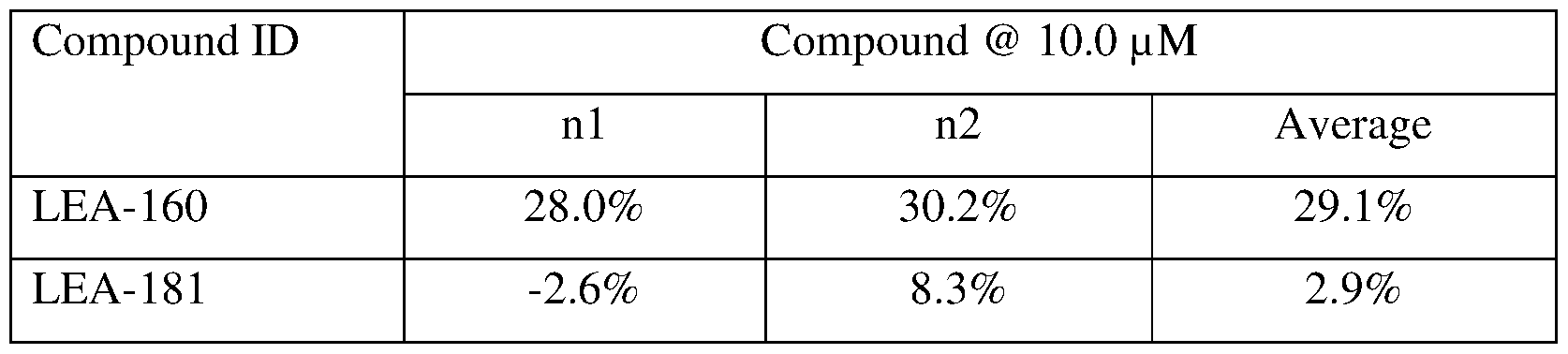
[0112] B. Sphingosine kinase assay
[0113] LEA inhibition of sphingosine kinase 2 (SPHK2) was measured using an Adapts® Universal Kinase Assay. Recombinant SPHK2 enzyme were incubated for 60 minutes at 37°C with substrate, All5, and serially diluted LEA compound. The reaction was stopped by addition of EDTA, then a detection solution of labeled anti-ADP antibody and Alexa Fluor® 647 labeled ADP tracer was incubated for 60 minutes at 37°C. ADP formed by the kinase reaction displaces the Alexa Fluor® 647 labeled ADP tracer from the antibody. The presence of LEA compound reduces the amount of ADP formed by the kinase reaction in a dose-dependent manner. The resulting fluorescent signal of intact antibody-tracer interaction was measured using a fluorescence spectrophotometer and used to calculate the LEA compound IC50. See FIG. 9 for results (LEA-181).
[0114] Example 6. T Cell Inhibitory Activity.
[0115] Mononuclear cells were separated from commercially obtained normal human whole blood using density gradient centrifugation, washed, and stained with CFSE for proliferation determination. Isolated cells were stimulated with anti-CD3 and anti-CD28 in 2% HS RPMI media with 1 mM, 3 mM, or 5 pM LEA 160 for 48 hours. Conditioned cells were harvested and
stained with CD4, CD8, CD69, and Annexin V, then analyzed by flow cytometry. LEA160 inhibited CD4+ and CD8+ T cell proliferation and CD69 expression in a dose-dependent manner and induced apoptosis in CD4+ T cells, indicating immune modulating activity of LEA compounds. See FIG. 10 and FIG. 11 for results showing that LEA160 induces dose-dependent inhibition of proliferation (CFSE) and CD69 in CD4+ and CD8+ T cells, induces apoptosis in CD4+ cells (Annexin V).
[0116] Example 7. Treatment of Keratinocyte Carcinoma.
[0117] A human patient diagnosed with squamous or basal cell carcinoma is treated by applying an effective amount of LEA compound to a treatment area of the patient in accordance with a four to twelve- week treatment cycle for treating superficial basal cell carcinoma, wherein the treatment area comprises a biopsy-confirmed basal or squamous cell carcinoma lesion and about one centimeter of extramarginal skin that surrounds and extends beyond the lesion. This treatment cycle involves applying a topically formulated LEA compound to the treatment area in accordance with a seven-day treatment regimen for four to twelve consecutive weeks. The compound is applied to the treatment area once per day, preferably at night prior to sleeping hours for five or six consecutive days, and then not applying the LEA compound to the treatment area for the remaining one or two consecutive days of the seven-day treatment period. Once applied to the treatment area, the LEA compound is left on the treatment area for about 8 hours, optionally with a covering.
[0118] Example 8. Dose-response Studies of Antimicrobial Effects.
[0119] Studies were performed with LEA-80, LEA-160, and LEA-181 to determine dose- response of antimicrobial effects. Using in vitro 96- well plate biofilm cultures, 2-log reductions in P. aeruginosa (PAO-1, FIG. 12) and MRSA (BAA-44, FIG. 13A and FIG. 13B) antibiotic- resistant biofilms were demonstrated, with superior reduction to gentamicin in MRSA, at biofilm concentrations exceeding clinical burdens. FIG. 12 shows results for LEA-80 4-PL dose- response, 95% Cl in PAO-1 biofilm. Table 14, below, shows the mean and standard deviations of log(CFU) in control groups. Table 15, below, shows the effective dose estimates for LEA-80 in PAO-1 biofilm, 95% CL
Table 14. Mean and Standard Deviations of log(CFU) in Control Groups.

Table 15. Effective Dose Estimates for LEA-80 in PAO-1 Biofilm.

[0120] FIG. 13A and FIG. 13B show the dose-response data for LEA-160 3-PL and LEA-181 5- PL, respectively; 95% CL Table 16, below, shows the means and standard deviations of log(CFU) in control groups. Table 17, below, shows the effective dose estimate data; 95%CI for LEA- 160, LEA- 181.
Table 16. Means and Standard Deviations of log(CFU) in Control Groups; MRSA BAA-44.

Table 17. Effective Dose Estimates for LEA-160, LEA181.

Table 18. Means and Standard Deviations of log(CFU) in Control Groups, S. aureus 29213.

Table 19. Effective Dose Estimates for LEA-160, LEA181.

[0122] Bactericidal activity is lipid moiety-dependent, with short chain LEA- 80 active in P. aeruginosa and LEA-160/181 active in S. aureus. All biofilm cultures were tolerant of gentamicin concentrations >50x MIC, with MRSA demonstrating no reduction at 500mM.
Unmodified palmitic fatty acid showed no bactericidal effect; observed effects are due to LEA analog function. Gram-dependency was previously observed in broth MICs of S. enterica, S. sonnei, and Y. enterocolitica and in a pilot E. coli biofilm study. This supports proposed differing mechanisms of action: quorum signaling for short chain, and anti-metabolite for medium chain.
[0123] Example 9. LEA Reduction of in Vitro Cultured Biofilms .
[0124] S. aureus (29213), MRSA (BAA-44), and P. aeruginosa (PAO-1) early log-phase TSB culture stocks were seeded in collagen I-coated 96-well plates at 5x10s bacteria/well (TO). After
24 hours (Tl), the culture broth was discarded, collagen cultures and pseudomonas biofilm rafts were washed with PBS-Tween to remove residual planktonic bacteria, and media was replaced. After a further 48 hours of incubation (T3), the broth was replaced with conditioned media and pre-treatment baseline samples were collected. Following 24 hours of treatment (T4), the wells were washed with PBS-Tween™, the contents were vigorously pipetted to disaggregate biofilms, plated at 103-10 5 using an automatic plater (Interscience easySpiral™), and automatically counted for colony forming units (CFU) (Interscience Scan™).
[0125] FIG. 15 shows electron micrographs of PAO-1 biofilms. FIG. 15A and FIG. 15B (inset) show 8k and 30k magnification of 36-hour untreated cultures. FIG. 15C and FIG. 15D (inset) show 8k and 30k magnification of 24-hour cultures treated for 12 hours with 2000 mM LEA-80. This treated biofilm shows substantial membrane and ECM deficits. FIG. 15E and FIG. 15F show control and 5 mM LEA-80-treated biofilm wells at T4 as described above.
[0126] Log-logistic dose-response curves were fitted using R drc library, with log(ED50) as a fitting parameter. Where a lower limit parameter could be fit, 4 or 5-parameter regression was used. 3-parameter was used otherwise, with lower limit set to 0. Effective doses and 95% confidence intervals were calculated using the ED. drc function.
[0127] Example 10. Exposure of Compounds to Normal Skin.
[0128] In a pilot study with high dose (>20x by weight in biofilm study for LEA-80 and >15x for LEA-160/181), repeated exposure of normal skin to the compounds in mice demonstrated no adverse effects at doses far exceeding an antimicrobial dose in LEA-80, tolerable keratosis and potentially beneficial granulation activity in LEA-160/181. Swiss Albino mice were treated daily for 5 days with 3 mg of LEA-80, LEA-160, or LEA-181 in 100 pi of 80/20 acetone/olive oil suspension applied to 1 cm2 of normal shaved skin. They then recovered for 2 weeks with no treatment. Treated skin samples were fixed in 10% buffered formalin an embedded in paraffin. See results in FIG. 16.
REFERENCES
[0129] References listed below and throughout the specification are hereby incorporated by reference in their entirety.
1. United States Patent No. 8,871,983 B2.
2. Cao et al., Cell. Oncol. 36(3):247-257, 2013.
3. United States Patent No. 5,723,497
4. United States Patent No. 8,871,983
5. United States Patent No. 7,699,057
Claims
1. A pharmaceutical composition formulated for topical application, comprising a
pharmaceutically acceptable topical carrier and one or more compound of Formula 1

Formula 1 wherein Ri is an unbranched alkyl chain having 8-24 carbon atoms and 0-6 double bonds; wherein R2 is H or a group comprising 1-16 atoms selected from C, N, O, and S, in a straight or branched alkane or alkene chain, optionally containing a non-aromatic cycle or heterocycle having 5-6 atoms, and optionally containing one or more of the following: primary amine, secondary amine, ether, thioether, carbonyl, sulfonyl, alcohol, sulfhydryl, disulfide, aldehyde, and carboxyl), or a pharmaceutically acceptable salt thereof;
wherein R3 is a group selected from -OH,— SH,— CHO, and— COOH, and
wherein n is an integer selected from 0, 1, 2, and 3.
2. The pharmaceutical composition of claim 1, wherein Ri is selected from unbranched alkyl or alkenyl chains having 6, 7, 8, 9 10, 11, 12, 13, 14, 15, 16, 17, 18, 19, 20, 21, 22, 23, or 24 carbon atoms that have no double bonds, one double bond, two double bonds, three double bonds, four double bonds, five double bonds, or six double bonds, and are in a cis- or trans- configuration.
3. The pharmaceutical composition of claim 1, wherein Ri is selected from unbranched alkyl or alkenyl 16:0 (palmitic), 18:1 (oleic), 18:2 (linoleic), 20:4 (arachidonic), 20:5 (eicosapentaenoic), and 22:6 (docosahexanoic).
4. The pharmaceutical composition of claim 1, wherein R2 is— C(CH3)2, isopropyl (— C3H7), methyl-4-oxo-2-butenoate (— C5H5O3), ethanethiol (— C2H5S), or 2-
(ethyldisulfanyl)ethaneamine (— C5H10NS2), optionally with an additional ethylamine linker and optionally comprising one or more of a primary amine, secondary amine, ether, thioether, carbonyl, sulfonyl, alcohol, sulfhydryl, disulfide, aldehyde, and carboxyl group.
5. The pharmaceutical composition of claim 1, wherein R3 is -OH.
6. The pharmaceutical composition of claim 1, wherein n is 1.
7. The pharmaceutical composition of claim 1, wherein the compound is selected from one or more of AIP-1/LEA160 (l-hexadecyloxy-3-isopropylamino-propan-2-ol), AIP-2/LEA181 (1- octadecenyloxy-3-isopropylamino-propan-2-ol), and AIP3/LEA80 (octyloxy-3-isopropylamino- propan-2-ol).
8. The pharmaceutical composition of claim 1, wherein the compound is selected from one or more of


9. The pharmaceutical composition of claim 1, wherein the pharmaceutically acceptable topical carrier comprises liposomes, a cream, a spray, an ointment, an oil/water emulsion, a PVP hydrogel, an ethanol hydrogel, or a silicone hydrogel.
10. The pharmaceutical composition of claim 1 wherein the compound of Formula 1 inhibits sphingosine kinase.
11. A method of treating a cutaneous disease in a subject in need thereof, comprising
administering to the subject the pharmaceutical composition of claim 1.
12. The method of claim 11, wherein the cutaneous disease is selected from a skin cancer, a tumor, a wound, psoriasis, atopic dermatitis, and keratinocyte carcinoma.
13. The method of claim 11, wherein the cutaneous disease is psoriasis.
14. The method of claim 11, wherein the cutaneous disease is atopic dermatitis.
15. The method of claim 11, wherein the cutaneous disease is keratinocyte carcinoma.
16. A method of treating a microbial disease in a subject in need thereof, comprising
administering to the subject the pharmaceutical composition of claim 1.
17. The method of claim 16, wherein the microbial disease is selected from an infection of the skin, pressure ulcers, foot ulcers, bums, cellulitis, cysts, penetrating wounds, and superficial wounds.
18. The method of claim 16, wherein the microbial disease is caused by a bacterium selected from the group consisting of E. faecium, S. aureus, K. pneumoniae, A. baumannii, P. aeruginosa, and Enterobacter spp.
19. The method of claim 16, wherein the microbial disease is caused by a bacterium selected from the group consisting of S. aureus and P. aeruginosa.
Applications Claiming Priority (2)
| Application Number | Priority Date | Filing Date | Title |
|---|---|---|---|
| US201862760364P | 2018-11-13 | 2018-11-13 | |
| US62/760,364 | 2018-11-13 |
Publications (1)
| Publication Number | Publication Date |
|---|---|
| WO2020101977A1 true WO2020101977A1 (en) | 2020-05-22 |
Family
ID=70730582
Family Applications (1)
| Application Number | Title | Priority Date | Filing Date |
|---|---|---|---|
| PCT/US2019/060079 Ceased WO2020101977A1 (en) | 2018-11-13 | 2019-11-06 | Lipid ether amine compounds for topical treatment of cutaneous disease |
Country Status (1)
| Country | Link |
|---|---|
| WO (1) | WO2020101977A1 (en) |
Citations (5)
| Publication number | Priority date | Publication date | Assignee | Title |
|---|---|---|---|---|
| WO2008124210A1 (en) * | 2007-02-14 | 2008-10-16 | Emory University | Methods and compositions for treating or preventing infection using leukocyte sequestration agents |
| US20120035268A1 (en) * | 2008-12-30 | 2012-02-09 | Szulc Zdzislaw M | Sphingo-guanidines and their use as inhibitors of sphingosine kinase |
| US8871983B2 (en) * | 2008-08-08 | 2014-10-28 | University Of Florida Research Foundation, Inc. | Lipid compounds for suppression of tumorigenesis |
| US20150258043A1 (en) * | 2012-10-15 | 2015-09-17 | Yeda Research And Development Co. Ltd. | Use of sphingoid long chain bases and their analogs in treating and preventing bacterial infections |
| US20170298032A1 (en) * | 2014-10-01 | 2017-10-19 | Kevin R. Lynch | Sphingosine kinase inhibitors |
-
2019
- 2019-11-06 WO PCT/US2019/060079 patent/WO2020101977A1/en not_active Ceased
Patent Citations (5)
| Publication number | Priority date | Publication date | Assignee | Title |
|---|---|---|---|---|
| WO2008124210A1 (en) * | 2007-02-14 | 2008-10-16 | Emory University | Methods and compositions for treating or preventing infection using leukocyte sequestration agents |
| US8871983B2 (en) * | 2008-08-08 | 2014-10-28 | University Of Florida Research Foundation, Inc. | Lipid compounds for suppression of tumorigenesis |
| US20120035268A1 (en) * | 2008-12-30 | 2012-02-09 | Szulc Zdzislaw M | Sphingo-guanidines and their use as inhibitors of sphingosine kinase |
| US20150258043A1 (en) * | 2012-10-15 | 2015-09-17 | Yeda Research And Development Co. Ltd. | Use of sphingoid long chain bases and their analogs in treating and preventing bacterial infections |
| US20170298032A1 (en) * | 2014-10-01 | 2017-10-19 | Kevin R. Lynch | Sphingosine kinase inhibitors |
Non-Patent Citations (1)
| Title |
|---|
| OIZUMI ET AL.: "Pseudomonas-Derived Ceramidase Induces Production of Inflammatory Mediators from Human Keratinocytes via Sphingosine-1-Phosphate", PLOS ONE, vol. 9, no. 2, 2014, pages 1 - 12, XP055707771, DOI: 10.1371/journal.pone.0089402 * |
Similar Documents
| Publication | Publication Date | Title |
|---|---|---|
| JP5620443B2 (en) | Vitamin K for prevention and treatment of rash secondary to anti-EGFR therapy | |
| US20140088059A1 (en) | Compositions and Methods for Localized Drug Delivery through Mammary Papillae | |
| MX2010010713A (en) | COMPOSITIONS AND METHODS FOR SKIN CARE. | |
| US20090018142A9 (en) | Use of phosphatases to treat tumors overexpressing N-CoR | |
| TWI870475B (en) | Methods and materials for treating neurotoxicity | |
| CA2641308A1 (en) | Use of phosphatases to treat tumors overexpressing n-cor | |
| US20160175324A1 (en) | Anti-acne compositions comprising bile acid-fatty acid conjugates | |
| JP2018135342A (en) | Composition and method for treating pathological conditions of skin | |
| AU2017232348A1 (en) | Pharmaceutical compositions for the treatment of cancer | |
| WO2007030341A2 (en) | Novel skin care compositions | |
| US9284252B2 (en) | Use of jasmonate ester derivatives for treating benign hyperproliferative skin disorders | |
| WO2016193339A1 (en) | Biperiden for treating cancer | |
| CN120659603A (en) | Nocardomone for treating intestinal pain or abdominal pain | |
| WO2019032411A1 (en) | Compositions and methods for inducing apoptosis in anaerobic cells and related clinical methods for treating cancer and pathogenic infections | |
| CN109152753A (en) | For treating/preventing dermopathic carboxylic acid | |
| KR20150119439A (en) | Inhibitors of na(v) 1.9 channel activity and uses thereof for treating pain | |
| KR20200086326A (en) | Composition and method of treatment of skin lesions | |
| US20230172890A1 (en) | Use of an rxr agonist in treating drug resistant her2+ cancers | |
| HK40075931A (en) | Methods and materials for treating neurotoxicity | |
| JP2024128672A (en) | Facial skin condition improver | |
| CA3142076A1 (en) | Use of an rxr agonist in treating her2+ cancers | |
| JPWO2020116570A1 (en) | External skin preparation | |
| Kalthoff et al. | P62 Pre-clinical pharmacological and skin penetration profile of LDE255, a novel and specific Smoothened antagonist | |
| Lee et al. | Allergic march model is developed by mite application on oxazolone induced atopic dermatitis hairless mice and interrupted by acidic cream |
Legal Events
| Date | Code | Title | Description |
|---|---|---|---|
| 121 | Ep: the epo has been informed by wipo that ep was designated in this application |
Ref document number: 19884023 Country of ref document: EP Kind code of ref document: A1 |
|
| NENP | Non-entry into the national phase |
Ref country code: DE |
|
| 122 | Ep: pct application non-entry in european phase |
Ref document number: 19884023 Country of ref document: EP Kind code of ref document: A1 |