WO2020084922A1 - 発光素子 - Google Patents
発光素子 Download PDFInfo
- Publication number
- WO2020084922A1 WO2020084922A1 PCT/JP2019/034950 JP2019034950W WO2020084922A1 WO 2020084922 A1 WO2020084922 A1 WO 2020084922A1 JP 2019034950 W JP2019034950 W JP 2019034950W WO 2020084922 A1 WO2020084922 A1 WO 2020084922A1
- Authority
- WO
- WIPO (PCT)
- Prior art keywords
- ring
- layer
- group
- formula
- atom
- Prior art date
- Legal status (The legal status is an assumption and is not a legal conclusion. Google has not performed a legal analysis and makes no representation as to the accuracy of the status listed.)
- Ceased
Links
Images

Classifications
-
- C—CHEMISTRY; METALLURGY
- C09—DYES; PAINTS; POLISHES; NATURAL RESINS; ADHESIVES; COMPOSITIONS NOT OTHERWISE PROVIDED FOR; APPLICATIONS OF MATERIALS NOT OTHERWISE PROVIDED FOR
- C09K—MATERIALS FOR MISCELLANEOUS APPLICATIONS, NOT PROVIDED FOR ELSEWHERE
- C09K11/00—Luminescent materials, e.g. electroluminescent or chemiluminescent
- C09K11/06—Luminescent materials, e.g. electroluminescent or chemiluminescent containing organic luminescent materials
-
- H—ELECTRICITY
- H05—ELECTRIC TECHNIQUES NOT OTHERWISE PROVIDED FOR
- H05B—ELECTRIC HEATING; ELECTRIC LIGHT SOURCES NOT OTHERWISE PROVIDED FOR; CIRCUIT ARRANGEMENTS FOR ELECTRIC LIGHT SOURCES, IN GENERAL
- H05B33/00—Electroluminescent light sources
- H05B33/12—Light sources with substantially two-dimensional [2D] radiating surfaces
-
- H—ELECTRICITY
- H10—SEMICONDUCTOR DEVICES; ELECTRIC SOLID-STATE DEVICES NOT OTHERWISE PROVIDED FOR
- H10K—ORGANIC ELECTRIC SOLID-STATE DEVICES
- H10K50/00—Organic light-emitting devices
- H10K50/10—OLEDs or polymer light-emitting diodes [PLED]
- H10K50/11—OLEDs or polymer light-emitting diodes [PLED] characterised by the electroluminescent [EL] layers
Definitions
- the present invention relates to a light emitting element.
- Patent Document 1 describes a light emitting device having a light emitting layer containing a metal complex B0-1, a light emitting layer containing a metal complex G1 and a metal complex R1, and an electron transport layer containing a compound ET1.
- Patent Document 2 discloses a light emitting device having a light emitting layer containing a metal complex G2-1 and a metal complex R2, a light emitting layer containing a metal complex B0-2, and an electron transport layer containing a compound ET1. Have been described.
- the above-mentioned light emitting device does not necessarily have sufficient external quantum efficiency. Therefore, it is an object of the present invention to provide a light emitting device having excellent external quantum efficiency.
- the present invention provides the following [1] to [18].
- An anode, a cathode, a first layer provided between the anode and the cathode, a second layer provided between the cathode and the first layer, the anode and the first layer A light-emitting element having a third layer provided between one layer,
- the first layer is a layer containing a metal complex represented by the formula (1)
- At least one layer of the second layer and the third layer contains a metal complex represented by the formula (2) having a maximum peak wavelength of emission spectrum of 570 nm or more and less than 750 nm
- At least one layer of the first layer, the second layer and the third layer contains a metal complex represented by the formula (3) having a maximum peak wavelength of emission spectrum of 495 nm or more and less than 570 nm
- At least one layer of the first layer, the second layer, and the third layer contains a compound represented by the formula (T-1).
- M 1 represents a rhodium atom, a palladium atom, an iridium atom or a platinum atom.
- n 1 represents an integer of 1 or more
- n 2 represents an integer of 0 or more.
- E 1 and E 2 each independently represent a carbon atom or a nitrogen atom. When a plurality of E 1 and E 2 are present, they may be the same or different.
- Ring R 1 represents a 5-membered aromatic heterocycle, and this ring may have a single or a plurality of substituents. When a plurality of substituents are present, they may be the same or different and may be bonded to each other to form a ring with the atoms to which they are bonded. When multiple rings R 1 are present, they may be the same or different.
- Ring R 2 represents an aromatic hydrocarbon ring or an aromatic heterocycle, and these rings may have a single or a plurality of substituents. When a plurality of substituents are present, they may be the same or different and may be bonded to each other to form a ring with the atoms to which they are bonded.
- a 1 -G 1 -A 2 represents an anionic bidentate ligand.
- a 1 and A 2 each independently represent a carbon atom, an oxygen atom or a nitrogen atom, and these atoms may be atoms constituting a ring.
- G 1 represents a single bond or an atomic group forming a bidentate ligand together with A 1 and A 2 .
- M 2 represents a rhodium atom, a palladium atom, an iridium atom or a platinum atom.
- n 3 represents an integer of 1 or more
- n 4 represents an integer of 0 or more.
- E L represents a carbon atom or a nitrogen atom. If the E L there are a plurality, or different in each of them the same.
- Ring L 1 represents a 6-membered aromatic heterocycle, and this ring may have a single or a plurality of substituents. When a plurality of substituents are present, they may be the same or different and may be bonded to each other to form a ring with the atoms to which they are bonded. When there are a plurality of rings L 1 , they may be the same or different.
- Ring L 2 represents an aromatic hydrocarbon ring or an aromatic heterocycle, and these rings may have a single or a plurality of substituents. When a plurality of substituents are present, they may be the same or different and may be bonded to each other to form a ring with the atoms to which they are bonded.
- rings L 2 When multiple rings L 2 are present, they may be the same or different.
- the substituent that the ring L 1 may have and the substituent that the ring L 2 may have may be the same or different, and they are bonded to each other to form a ring together with the atom to which they are bonded. You may have. However, at least one of the ring L 1 and the ring L 2 has a group represented by the formula (1-T) as a substituent. When there are a plurality of groups represented by formula (1-T), they may be the same or different.
- a 3 -G 2 -A 4 represents an anionic bidentate ligand.
- a 3 and A 4 each independently represent a carbon atom, an oxygen atom or a nitrogen atom, and these atoms may be atoms constituting a ring.
- G 2 represents a single bond or an atomic group forming a bidentate ligand together with A 3 and A 4 .
- a 3 -G 2 -A 4 When there are a plurality of A 3 -G 2 -A 4 , they may be the same or different.
- R 1T represents an alkyl group, a cycloalkyl group, an alkoxy group, a cycloalkoxy group, an aryloxy group, an aryl group, a monovalent heterocyclic group, a substituted amino group or a halogen atom, and these groups are monovalent. It may have one or more substituents. When a plurality of substituents are present, they may be the same or different and may be bonded to each other to form a ring with the atoms to which they are bonded. ]
- n T1 represents an integer of 0 or more and 5 or less. When a plurality of n T1s are present, they may be the same or different. n T2 represents an integer of 1 or more and 10 or less.
- Ar T1 is a fused ring monovalent heterocyclic group containing a nitrogen atom having no double bond in the ring and a group represented by ⁇ N—, and the group is a single or plural substituents. May have. When a plurality of substituents are present, they may be bonded to each other to form a ring with the atoms to which they are bonded. When a plurality of Ar T1s are present, they may be the same or different.
- L T1 is an alkylene group, a cycloalkylene group, an arylene group, a divalent heterocyclic group
- -NR T1 '- represents a group represented by an oxygen atom or a sulfur atom, the these groups single or multiple substitutions When it has a plurality of substituents, they may be the same or different and may be bonded to each other to form a ring together with the atom to which they are bonded.
- R T1 ' represents a hydrogen atom, an alkyl group, a cycloalkyl group, an aryl group or a monovalent heterocyclic group, and these groups may have a single or a plurality of substituents.
- Ar T2 represents an aromatic hydrocarbon group or a heterocyclic group, and these groups may have a single or a plurality of substituents, and when there are a plurality of the substituents, they are bonded to each other, It may form a ring with the atom to which is bonded.
- M 3 represents a rhodium atom, a palladium atom, an iridium atom or a platinum atom.
- n 5 represents an integer of 1 or more
- n 6 represents an integer of 0 or more.
- E L1 represents a carbon atom or a nitrogen atom. When a plurality of E L1s are present, they may be the same or different.
- Ring L 3 represents a 6-membered aromatic heterocycle, and this ring may have a single or a plurality of substituents. When a plurality of substituents are present, they may be the same or different and may be bonded to each other to form a ring with the atoms to which they are bonded. When multiple rings L 3 are present, they may be the same or different.
- Ring L 4 represents an aromatic hydrocarbon ring or an aromatic heterocycle, and these rings may have a single or a plurality of substituents. When a plurality of substituents are present, they may be the same or different and may be bonded to each other to form a ring with the atoms to which they are bonded.
- rings L 4 When there are a plurality of rings L 4 , they may be the same or different.
- the substituent that the ring L 3 may have and the substituent that the ring L 4 may have may be the same or different, and they are bonded to each other to form a ring together with the atom to which they are bonded. You may have. However, at least one of the ring L 3 and the ring L 4 has a group represented by the formula (3-T) as a substituent. When there are plural groups represented by formula (3-T), they may be the same or different.
- a 5 -G 3 -A 6 represents an anionic bidentate ligand.
- a 3 and A 4 each independently represent a carbon atom, an oxygen atom or a nitrogen atom, and these atoms may be atoms constituting a ring.
- G 3 represents a single bond or an atomic group that constitutes a bidentate ligand together with A 5 and A 6 .
- a 5 -G 3 -A 6 When there are a plurality of A 5 -G 3 -A 6 , they may be the same or different.
- R 3T represents an aryl group, a monovalent heterocyclic group or a substituted amino group, and these groups may have a single or a plurality of substituents. When a plurality of substituents are present, they may be the same or different and may be bonded to each other to form a ring with the atoms to which they are bonded.
- R 3T represents an aryl group, a monovalent heterocyclic group or a substituted amino group, and these groups may have a single or a plurality of substituents. When a plurality of substituents are present, they may be the same or different and may be bonded to each other to form a ring with the atoms to which they are bonded.
- the ring L 1 is a pyridine ring, a diazabenzene ring, an azanaphthalene ring or a diazanaphthalene ring, and these rings may have a single or a plurality of substituents
- the ring L 1 2 is a benzene ring, a pyridine ring, or a diazabenzene ring, and these rings may have a single or multiple substituents
- the light emitting element as described in [1] or [2].
- the ring L 3 is a pyridine ring or a diazabenzene ring, and these rings may have a single or a plurality of substituents
- the ring L 4 is a benzene ring, a pyridine ring or
- R 2T represents an aryl group, a monovalent heterocyclic group or a substituted amino group, and these groups may have a single or a plurality of substituents. When a plurality of substituents are present, they may be the same or different and may be bonded to each other to form a ring with the atoms to which they are bonded.
- the first layer is a layer containing a metal complex represented by the formula (1)
- At least one layer of the second layer and the third layer contains a metal complex represented by the formula (2 ′) having a maximum peak wavelength of emission spectrum of 570 nm or more and less than 750 nm
- At least one layer of the first layer, the second layer, and the third layer contains a compound represented by the formula (T-1).
- M 1 represents a rhodium atom, a palladium atom, an iridium atom or a platinum atom.
- n 1 represents an integer of 1 or more
- n 2 represents an integer of 0 or more.
- E 1 and E 2 each independently represent a carbon atom or a nitrogen atom. When a plurality of E 1 and E 2 are present, they may be the same or different.
- Ring R 1 represents a 5-membered aromatic heterocycle, and this ring may have a single or a plurality of substituents. When a plurality of substituents are present, they may be the same or different and may be bonded to each other to form a ring with the atoms to which they are bonded. When multiple rings R 1 are present, they may be the same or different.
- Ring R 2 represents an aromatic hydrocarbon ring or an aromatic heterocycle, and these rings may have a single or a plurality of substituents. When a plurality of substituents are present, they may be the same or different and may be bonded to each other to form a ring with the atoms to which they are bonded.
- a 1 -G 1 -A 2 represents an anionic bidentate ligand.
- a 1 and A 2 each independently represent a carbon atom, an oxygen atom or a nitrogen atom, and these atoms may be atoms constituting a ring.
- G 1 represents a single bond or an atomic group forming a bidentate ligand together with A 1 and A 2 .
- M 2 ′ represents a rhodium atom, a palladium atom, an iridium atom or a platinum atom.
- n 3 ′ represents an integer of 1 or more
- n 4 ′ represents an integer of 0 or more.
- M 2 ′ is a rhodium atom or iridium atom
- n 3 ′ + n 4 ′ is 3
- M 2 ′ is a palladium atom or a platinum atom
- n 3 ′ + n 4 ′ is 2.
- EL ' represents a carbon atom or a nitrogen atom. When a plurality of EL's are present, they may be the same or different.
- Ring L 1 ′ represents a 6-membered aromatic heterocycle, which may have a single or multiple substituents. When a plurality of substituents are present, they may be the same or different and may be bonded to each other to form a ring with the atoms to which they are bonded. When multiple rings L 1 ′ are present, they may be the same or different.
- the ring L 2 ′ represents an aromatic hydrocarbon ring or an aromatic heterocycle, and these rings may have a single or a plurality of substituents. When a plurality of substituents are present, they may be the same or different and may be bonded to each other to form a ring with the atoms to which they are bonded. When multiple rings L 2 ′ are present, they may be the same or different.
- the substituent which the ring L 1 ′ may have and the substituent which the ring L 2 ′ may have may be the same or different and are bonded to each other to form a ring together with the atom to which they are bonded. May be formed. However, at least one of the ring L 1 ′ and the ring L 2 ′ has a group represented by the formula (2-T) as a substituent. When there are plural groups represented by formula (2-T), they may be the same or different.
- a 3 '-G 2' -A 4 ' represents a bidentate ligand of the anionic.
- a 3 ′ and A 4 ′ each independently represent a carbon atom, an oxygen atom or a nitrogen atom, and these atoms may be atoms constituting a ring.
- G 2 ′ represents a single bond or an atomic group forming a bidentate ligand together with A 3 ′ and A 4 ′ . If A 3 '-G 2' -A 4 ' there are a plurality, they may be the same or different.
- R 2T represents an aryl group, a monovalent heterocyclic group or a substituted amino group, and these groups may have a single or a plurality of substituents. When a plurality of substituents are present, they may be the same or different and may be bonded to each other to form a ring with the atoms to which they are bonded. ]
- n T1 represents an integer of 0 or more and 5 or less. When a plurality of n T1s are present, they may be the same or different. n T2 represents an integer of 1 or more and 10 or less.
- Ar T1 is a fused ring monovalent heterocyclic group containing a nitrogen atom having no double bond in the ring and a group represented by ⁇ N—, and the group is a single or plural substituents. May have. When a plurality of substituents are present, they may be bonded to each other to form a ring with the atoms to which they are bonded. When a plurality of Ar T1s are present, they may be the same or different.
- L T1 is an alkylene group, a cycloalkylene group, an arylene group, a divalent heterocyclic group
- -NR T1 '- represents a group represented by an oxygen atom or a sulfur atom, the these groups single or multiple substitutions When it has a plurality of substituents, they may be the same or different and may be bonded to each other to form a ring together with the atom to which they are bonded.
- R T1 ' represents a hydrogen atom, an alkyl group, a cycloalkyl group, an aryl group or a monovalent heterocyclic group, and these groups may have a single or a plurality of substituents.
- the ring L 1 ′ is a pyridine ring, a diazabenzene ring, an azanaphthalene ring or a diazanaphthalene ring, and these rings may have a single or a plurality of substituents
- L 2 ′ is a benzene ring, a pyridine ring or a diazabenzene ring, and these rings may have a single or a plurality of substituents, [7] or [8].
- the Ar T1 is a group represented by the formula (T1-1).
- X T1 represents a single bond, an oxygen atom, a sulfur atom, a group represented by —N (R XT1 ) —, or a group represented by —C (R XT1 ′) 2 —.
- R XT1 and R XT1 ′ are each independently a hydrogen atom, an alkyl group, a cycloalkyl group, an alkoxy group, a cycloalkoxy group, an aryl group, an aryloxy group, a monovalent heterocyclic group, a substituted amino group, a halogen atom or Represents a cyano group, these groups may have a single or a plurality of substituents, when there are a plurality of the substituents, they may be the same or different, and they are bonded to each other, It may form a ring together with the atom to be bonded.
- a plurality of R XT1 ′ 's that are present may be the same or different and may be bonded to each other to form a ring with the atoms to which they are bonded.
- the ring R T1 and the ring R T2 each independently represent an aromatic hydrocarbon ring or a heterocycle, and these rings may have a single or a plurality of substituents, and a plurality of the above substituents are present. In this case, they may be the same or different and may be bonded to each other to form a ring with the atom to which each is bonded.
- At least one of the ring R T1 and the ring R T2 is a heterocycle containing a group represented by ⁇ N— in the ring, and the ring has a single or a plurality of substituents.
- substituents when there are a plurality of the above-mentioned substituents, they may be the same or different, and they may be bonded to each other to form a ring with the atoms to which they are bonded.
- the ring R T1 is an aromatic hydrocarbon ring or a heterocycle containing a group represented by ⁇ N— in the ring, and these rings may have a single or a plurality of substituents.
- the ring R T2 is a heterocycle containing a group represented by ⁇ N— in the ring, and the ring may have a single or a plurality of substituents.
- the ring R T1 is a monocyclic aromatic hydrocarbon ring or a monocyclic heterocycle containing a group represented by ⁇ N— in the ring, and these rings are single or plural. It may have a substituent, and the ring R T2 is a monocyclic heterocycle containing a group represented by ⁇ N— in the ring, and the ring has a single or a plurality of substituents.
- the ring R T1 is a benzene ring, a pyridine ring or a diazabenzene ring, and these rings may have a single or a plurality of substituents
- the ring R T2 is a pyridine ring or
- [15] The light-emitting device according to any one of [1] to [14], in which the maximum peak wavelength of the emission spectrum of the metal complex represented by the formula (1) is 380 nm or more and less than 495 nm.
- the ring R 1 is a diazole ring or a triazole ring, and these rings may have a single or a plurality of substituents
- the ring R 2 is a benzene ring, a pyridine ring or
- Ar H1 and Ar H2 each independently represent an aryl group, a monovalent heterocyclic group or a substituted amino group, and these groups may have a single or a plurality of substituents. When a plurality of substituents are present, they may be the same or different and may be bonded to each other to form a ring with the atoms to which they are bonded.
- n H1 represents an integer of 0 or more.
- L H1 represents an arylene group, a divalent heterocyclic group, an alkylene group or a cycloalkylene group, and these groups may have a single or a plurality of substituents.
- FIG. 1 is a schematic cross-sectional view of a light emitting device according to one embodiment of the present invention.
- Room temperature means 25 ° C.
- Me represents a methyl group
- i-Pr represents an isopropyl group
- t-Bu represents a tert-butyl group.
- the hydrogen atom may be a deuterium atom or a light hydrogen atom.
- the solid line representing the bond with the central metal means a covalent bond or a coordinate bond.
- the “polymer compound” means a polymer having a molecular weight distribution and a polystyrene-equivalent number average molecular weight of 1 ⁇ 10 3 to 1 ⁇ 10 8 .
- the “low molecular weight compound” means a compound having no molecular weight distribution and a molecular weight of 1 ⁇ 10 4 or less.
- the “constituent unit” means a unit present in one or more units in the polymer compound.
- the constitutional unit having two or more present in the polymer compound is generally called a "repeating unit".
- the “alkyl group” may be linear or branched.
- the number of carbon atoms in the straight-chain alkyl group, not including the number of carbon atoms in the substituent, is usually 1 to 50, preferably 1 to 20, and more preferably 1 to 10.
- the number of carbon atoms of the branched alkyl group is usually 3 to 50, not including the number of carbon atoms of the substituent, preferably 3 to 20, and more preferably 4 to 10.
- the alkyl group may have a substituent, and examples thereof include a methyl group, an ethyl group, an isopropyl group, a butyl group, an isobutyl group, a tert-butyl group, a pentyl group, a hexyl group, a heptyl group, an octyl group, and a 2- Ethylhexyl group, decyl group, 3,7-dimethyloctyl group, 2-ethyloctyl group, dodecyl group, trifluoromethyl group, 3-phenylpropyl group, 3- (4-methylphenyl) propyl group, 3- (3,3 Examples thereof include a 5-di-hexylphenyl) propyl group and a 6-ethyloxyhexyl group.
- the number of carbon atoms of the “cycloalkyl group” is usually 3 to 50, preferably 4 to 10, not including the number of carbon atoms of the substituent.
- the cycloalkyl group may have a substituent, and examples thereof include a cyclohexyl group and a methylcyclohexyl group.
- the number of carbon atoms of the “alkylene group” is usually 1 or more and 20 or less, preferably 1 or more and 15 or less, and more preferably 1 or more and 10 or less, not including the number of carbon atoms of the substituent.
- the alkylene group may have a substituent, and examples thereof include a methylene group, an ethylene group, a propylene group, a butylene group, a hexylene group and an octylene group.
- the number of carbon atoms of the “cycloalkylene group” is usually 3 or more and 20 or less, not including the number of carbon atoms of the substituent.
- the cycloalkylene group may have a substituent, and examples thereof include a cyclohexylene group.
- aromatic hydrocarbon group means a group obtained by removing one or more hydrogen atoms directly bonded to carbon atoms constituting a ring from aromatic hydrocarbon.
- a group obtained by removing one hydrogen atom directly bonded to a carbon atom forming a ring from an aromatic hydrocarbon is also referred to as an "aryl group”.
- a group obtained by removing two hydrogen atoms directly bonded to carbon atoms constituting a ring from an aromatic hydrocarbon is also referred to as "arylene group”.
- the number of carbon atoms of the aromatic hydrocarbon group, not including the number of carbon atoms of the substituent is usually 6 to 60, preferably 6 to 30, and more preferably 6 to 18.
- aromatic hydrocarbon group is, for example, a monocyclic aromatic hydrocarbon (for example, benzene) or a polycyclic aromatic hydrocarbon (for example, a bicyclic group such as naphthalene and indene).
- the "alkoxy group” may be linear or branched.
- the number of carbon atoms of the straight-chain alkoxy group is usually 1 to 40, preferably 1 to 10, not including the number of carbon atoms of the substituent.
- the number of carbon atoms of the branched alkoxy group is usually 3 to 40, not including the number of carbon atoms of the substituent, and preferably 4 to 10.
- the alkoxy group may have a substituent, and examples thereof include a methoxy group, an ethoxy group, an isopropyloxy group, a butyloxy group, a hexyloxy group, a 2-ethylhexyloxy group, a 3,7-dimethyloctyloxy group, and lauryl.
- the number of carbon atoms of the “cycloalkoxy group” is usually 3 to 40, preferably 4 to 10, not including the number of carbon atoms of the substituent.
- the cycloalkoxy group may have a substituent, and examples thereof include a cyclohexyloxy group.
- the number of carbon atoms of the “aryloxy group” is usually 6 to 60, preferably 6 to 48, not including the number of carbon atoms of the substituent.
- the aryloxy group may have a substituent, and examples thereof include a phenoxy group, a naphthyloxy group, an anthracenyloxy group, and a pyrenyloxy group.
- heterocyclic group means a group obtained by removing one or more hydrogen atoms directly bonded to carbon atoms or heteroatoms constituting a ring from a heterocyclic compound.
- an “aromatic heterocyclic group” which is a group obtained by removing one or more hydrogen atoms directly bonded to carbon atoms or hetero atoms constituting a ring from an aromatic heterocyclic compound, is preferable.
- a group obtained by removing p hydrogen atoms (p represents an integer of 1 or more) directly bonded to a carbon atom or a hetero atom constituting a ring from a heterocyclic compound is also referred to as a “p-valent heterocyclic group”.
- a group obtained by removing p hydrogen atoms directly bonded to a carbon atom or a hetero atom constituting a ring from an aromatic heterocyclic compound is also referred to as a “p-valent aromatic heterocyclic group”.
- aromatic heterocyclic compound examples include compounds in which the heterocycle itself has aromaticity such as azole, thiophene, furan, pyridine, diazabenzene, triazine, azanaphthalene, diazanaphthalene and carbazole, and phenoxazine.
- the number of carbon atoms in the heterocyclic group is usually 1 to 60, preferably 2 to 40, more preferably 3 to 20, not including the number of carbon atoms in the substituent.
- the number of hetero atoms in the heterocyclic group is usually 1 to 30, preferably 1 to 10 and more preferably 1 to 3, not including the number of hetero atoms in the substituent.
- the heterocyclic group may have a substituent, for example, a monocyclic heterocyclic compound (for example, furan, thiophene, oxadiazole, pyrrole, diazole, triazole, tetrazole, pyridine, diazabenzene and triazine are Or a polycyclic heterocyclic compound (for example, a bicyclic heterocyclic compound such as azanaphthalene, diazanaphthalene, benzofuran, benzothiophene, indole, benzodiazole and benzothiadiazole; dibenzofuran , Dibenzothiophene, carbazole, azacarbazole, diazacarbazole, phenoxazine, phenothiazine, 9,10-dihydroacridine, 5,10-dihydrophenazine, azaanthracene, diazaanthracene, azaphenanthrene and diazaphenanthrene
- Halogen atom means a fluorine atom, a chlorine atom, a bromine atom or an iodine atom.
- the "amino group” may have a substituent, and a substituted amino group is preferable.
- the substituent which the amino group has is preferably an alkyl group, a cycloalkyl group, an aryl group or a monovalent heterocyclic group.
- Examples of the substituted amino group include a dialkylamino group, a dicycloalkylamino group and a diarylamino group. More specifically, examples of the substituted amino group include a dimethylamino group, a diethylamino group, a diphenylamino group, a bis (methylphenyl) amino group, and a bis (3,5-di-tert-butylphenyl) amino group. Can be mentioned.
- the “alkenyl group” may be linear or branched.
- the number of carbon atoms of the straight-chain alkenyl group is usually 2 to 30, preferably 3 to 20, not including the number of carbon atoms of the substituent.
- the number of carbon atoms of the branched alkenyl group is usually 3 to 30, preferably 4 to 20, not including the number of carbon atoms of the substituent.
- the number of carbon atoms of the “cycloalkenyl group” is usually 3 to 30, not including the number of carbon atoms of the substituent, and preferably 4 to 20.
- the alkenyl group and cycloalkenyl group may have a substituent, for example, vinyl group, propenyl group, butenyl group, 3-butenyl group, 3-pentenyl group, 4-pentenyl group, 1-hexenyl group, 5 Examples thereof include a hexenyl group, a 7-octenyl group, and a group in which these groups have a substituent.
- alkynyl group may be linear or branched.
- the number of carbon atoms of the alkynyl group is usually 2 to 20, preferably 3 to 20, not including the carbon atoms of the substituent.
- the number of carbon atoms of the branched alkynyl group is usually 4 to 30, and preferably 4 to 20, not including the carbon atoms of the substituents.
- the number of carbon atoms of the “cycloalkynyl group” is usually 4 to 30, and preferably 4 to 20, not including the carbon atoms of the substituents.
- the alkynyl group and cycloalkynyl group may have a substituent, for example, an ethynyl group, a propynyl group, a butynyl group, a pentynyl group, a hexynyl group, a 5-hexynyl group, and these groups have a substituent.
- a substituent for example, an ethynyl group, a propynyl group, a butynyl group, a pentynyl group, a hexynyl group, a 5-hexynyl group, and these groups have a substituent.
- crosslinkable group is a group capable of forming a new bond by being subjected to heating, ultraviolet irradiation, near-ultraviolet irradiation, visible light irradiation, infrared irradiation, radical reaction, or the like, and preferably has the formula: A group represented by any one of (XL-1) to formula (XL-19). These groups may have a substituent.
- R XL represents a methylene group, an oxygen atom or a sulfur atom
- n XL represents an integer of 0 to 5.
- R XL represents a methylene group, an oxygen atom or a sulfur atom
- n XL represents an integer of 0 to 5.
- R XL represents a methylene group, an oxygen atom or a sulfur atom
- n XL represents an integer of 0 to 5.
- * 1 represents a binding position.
- These crosslinkable groups may have a single or a plurality of substituents, and when there are a plurality of the substituents, they may be the same or different and are bonded to each other to form a carbon atom to which each is bonded. It may form a ring together with the atom.
- Examples of the “substituent” include a halogen atom, a cyano group, an alkyl group, a cycloalkyl group, an aryl group, a monovalent heterocyclic group, an alkoxy group, a cycloalkoxy group, an aryloxy group, an amino group, a substituted amino group, Examples thereof include an alkenyl group, a cycloalkenyl group, an alkynyl group and a cycloalkynyl group.
- the substituent may be a crosslinkable group.
- the group having a substituent can have a single or a plurality of substituents.
- the ring having a substituent can have a single or a plurality of substituents. When there are a plurality of substituents, they may be the same or different, and they may be bonded to each other to form a ring with the atoms to which they are bonded, but it is preferable not to form a ring
- the metal complex represented by the formula (2) is usually a metal complex exhibiting phosphorescence emission property at room temperature, and preferably a metal complex exhibiting light emission from a triplet excited state at room temperature.
- M 2 is preferably an iridium atom or a platinum atom, and more preferably an iridium atom because the external quantum efficiency of the light emitting device of this embodiment is more excellent.
- n 3 is preferably 2 or 3, and more preferably 3.
- M 2 is a palladium atom or a platinum atom
- n 3 is preferably 2.
- E L is preferably a carbon atom.
- the number of carbon atoms of the 6-membered aromatic heterocycle in ring L 1 is usually 1 to 60, preferably 2 to 30 and more preferably 3 to 15, not including the number of carbon atoms of the substituent. is there.
- the number of heteroatoms in the 6-membered aromatic heterocycle in the ring L 1 is usually 1 to 30, preferably 1 to 10 and more preferably 1 to 3, not including the number of heteroatoms in the substituent. Is.
- the ring L 1 examples include a 6-membered aromatic heterocycle having one or more nitrogen atoms as constituent atoms among the aromatic heterocycles exemplified in the above-mentioned heterocyclic group, and the present embodiment Since the external quantum efficiency of the light emitting device is more excellent, it is preferably a 6-membered aromatic heterocycle having one or more and four or less nitrogen atoms as constituent atoms, and more preferably a pyridine ring, diazabenzene ring or aza ring. It is a naphthalene ring or a diazanaphthalene ring, more preferably a pyridine ring, a quinoline ring or an isoquinoline ring, and these rings may have a substituent.
- rings L 1 When a plurality of rings L 1 are present, they are preferably the same, because the metal complex represented by the formula (2) can be easily synthesized. More specifically, if the ring L 1 there are a plurality of ring L 1 there are a plurality of, preferably at least two are the same, and more preferably all ring L 1 that there are a plurality are identical.
- the number of carbon atoms of the aromatic hydrocarbon ring in ring L 2 is usually 6 to 60, preferably 6 to 30, and more preferably 6 to 18, not including the number of carbon atoms of the substituent.
- Examples of the aromatic hydrocarbon ring in the ring L 2 include the aromatic hydrocarbon ring exemplified in the above-mentioned aromatic hydrocarbon group, and preferably the aromatic hydrocarbon ring exemplified in the above-mentioned aromatic hydrocarbon group.
- a monocyclic, bicyclic or tricyclic aromatic hydrocarbon ring more preferably a benzene ring, a naphthalene ring, a fluorene ring, a phenanthrene ring or a dihydrophenanthrene ring, and further preferably a benzene ring, It is a fluorene ring or a dihydrophenanthrene ring, particularly preferably a benzene ring, and these rings may have a substituent.
- the number of carbon atoms of the aromatic heterocycle in the ring L 2 is usually 1 to 60, preferably 2 to 30 and more preferably 3 to 15, not including the number of carbon atoms of the substituent.
- the number of hetero atoms of the aromatic heterocycle in the ring L 2 is usually 1 to 30, preferably 1 to 10 and more preferably 1 to 3, not including the number of hetero atoms of the substituent.
- Examples of the aromatic heterocycle in the ring L 2 include the aromatic heterocycles exemplified in the above-mentioned section of the heterocyclic group, preferably the monocyclic group, 2 exemplified in the above-mentioned section of the heterocyclic group.
- a cyclic or tricyclic aromatic heterocycle more preferably a pyridine ring, a diazabenzene ring, an azanaphthalene ring, a diazanaphthalene ring, an indole ring, a benzofuran ring, a benzothiophene ring, a carbazole ring, an azacarbazole ring, Diazacarbazole ring, dibenzofuran ring or dibenzothiophene ring, more preferably pyridine ring, diazabenzene ring, carbazole ring, dibenzofuran ring or dibenzothiophene ring, particularly preferably pyridine ring or diazabenzene ring, these The ring may have a substituent.
- the ring L 2 is preferably a benzene ring, a pyridine ring or a diazabenzene ring, and more preferably a benzene ring, because the external quantum efficiency of the light emitting device of the present embodiment is more excellent, and these rings have a substituent group. You may have.
- a plurality of rings L 2 are present, they are preferably the same, because the metal complex represented by the formula (2) can be easily synthesized. More specifically, if the ring L 2 there are a plurality of the rings L 2 there are a plurality of, preferably at least two are the same, and more preferably all ring L 2 that there are a plurality are identical.
- the ring L 1 is a pyridine ring, a diazabenzene ring, an azanaphthalene ring or a diazanaphthalene ring
- the ring L 2 is a benzene ring, a pyridine ring or a diazabenzene ring because the external quantum efficiency of the light emitting device of the present embodiment is more excellent.
- ring L 1 is a pyridine ring, quinoline ring or isoquinoline ring
- ring L 2 is more preferably a benzene ring, and these rings may have a substituent.
- At least one of the ring L 1 and the ring L 2 are as substituents, formula having a group represented by (1-T)" and, atoms constituting the ring L 1 and the ring L 2 (preferably Is a carbon atom or a nitrogen atom, and more preferably a carbon atom.) Means that the group represented by the formula (1-T) is directly bonded.
- the metal complex represented by the formula (2) when a plurality of rings L 1 and L 2 are present, at least one ring of the plurality of rings L 1 and L 2 is represented by the formula (1-T).
- the light emitting device of the present embodiment has a higher external quantum efficiency
- all of the rings L 1 existing in a plurality, all the rings L 2 existing in a plurality, or a plurality of the rings L 2 existing in a plurality are present. It is preferable that all of the ring L 1 and the ring L 2 that are present have a group represented by the formula (1-T), and all of the plurality of rings L 1 or all of the plurality of rings L 2 are It is more preferable to have a group represented by formula (1-T).
- the number of the group represented by the formula (1-T) in at least one of the ring L 1 and the ring L 2 is usually 1 to 5, Since the metal complex represented by (2) can be easily synthesized, it is preferably 1 to 3, more preferably 1 or 2, and further preferably 1.
- the total number of groups represented by the formula (1-T) in the ring L 1 and the ring L 2 is usually 1 to 30, which is more excellent in external quantum efficiency of the light emitting device of the present embodiment, and therefore preferably 1 to 18, more preferably 2 to 12, and further preferably 3 ⁇ 6 pieces.
- the total number of groups represented by the formula (1-T) in the ring L 1 and the ring L 2 is usually 1 to 20, which is more excellent in the external quantum efficiency of the light emitting device of the present embodiment, and therefore preferably 1 to 12, more preferably 1 to 8, and further preferably 2 ⁇ 4 pieces.
- the substituent which the ring L 1 and the ring L 2 may have is preferably a group represented by the formula (1-T) because the external quantum efficiency of the light emitting device of this embodiment is more excellent.
- the substituent other than the group represented by formula (1-T) is preferably a cyano group, an alkenyl group or a cycloalkenyl group.
- the group may further have a substituent. Examples and preferred ranges of the substituents which the substituent other than the group represented by the formula (1-T) may further have are examples and preferred ranges of the substituents which R 1T described later may have. Is the same as.
- the aryl group for R 1T is preferably a group obtained by removing one hydrogen atom directly bonded to a carbon atom constituting a ring from a monocyclic, bicyclic or tricyclic aromatic hydrocarbon, and It is preferably a phenyl group, a naphthyl group or a fluorenyl group, more preferably a phenyl group, and these groups may have a substituent.
- the monovalent heterocyclic group for R 1T is preferably one hydrogen atom directly bonded to a carbon atom or a heteroatom constituting a ring from a monocyclic, bicyclic or tricyclic heterocyclic compound.
- a group removed more preferably, a pyridine ring, a diazabenzene ring, a triazine ring, an azanaphthalene ring, a diazanaphthalene ring, a carbazole ring, a dibenzofuran ring or a dibenzothiophene ring directly bonded to a carbon atom or a hetero atom constituting the ring.
- Is a group excluding one hydrogen atom more preferably a group excluding one hydrogen atom directly bonded to a carbon atom constituting the ring from a pyridine ring, a diazabenzene ring or a triazine ring, and these groups are It may have a substituent.
- the substituent that the amino group has is preferably an aryl group or a monovalent heterocyclic group, more preferably an aryl group, and these groups may further have a substituent.
- Examples and preferred ranges of the aryl group that is the substituent of the amino group are the same as the examples and preferred ranges of the aryl group for R 1T .
- Examples and preferred ranges of the monovalent heterocyclic group that is a substituent of the amino group are the same as the examples and preferred ranges of the monovalent heterocyclic group for R 1T .
- R 1T is more excellent in the external quantum efficiency of the light emitting device of the present embodiment, it is preferably an alkyl group, a cycloalkyl group, an alkoxy group, a cycloalkoxy group, an aryl group, a monovalent heterocyclic group, a substituted amino group or A fluorine atom, more preferably an alkyl group, a cycloalkyl group, an aryl group, a monovalent heterocyclic group or a substituted amino group, and further preferably an alkyl group, a cycloalkyl group, an aryl group or a monovalent hetero group. It is a cyclic group, and these groups may have a substituent.
- the substituent which R 1T may have is preferably an alkyl group, a cycloalkyl group, an alkoxy group, a cycloalkoxy group, an aryl group, a monovalent heterocyclic group, a substituted amino group or a fluorine atom, More preferably, it is an alkyl group, a cycloalkyl group, an aryl group, a monovalent heterocyclic group or a substituted amino group, still more preferably an alkyl group, a cycloalkyl group or an aryl group, and these groups are further substituents. May have.
- Examples and preferred ranges of the aryl group, the monovalent heterocyclic group and the substituted amino group in the substituent which R 1T may have are the aryl group, the monovalent heterocyclic group and the substituted amino group in R 1T , respectively. And the preferred range.
- substituent which the substituent which R 1T may have may further have, an alkyl group, a cycloalkyl group, an alkoxy group, a cycloalkoxy group, an aryl group and a monovalent heterocyclic group are preferable.
- a substituted amino group or a fluorine atom more preferably an alkyl group, a cycloalkyl group, an aryl group, a monovalent heterocyclic group or a substituted amino group, and further preferably an alkyl group or a cycloalkyl group, These groups may have a substituent, but preferably have no further substituents.
- Examples and preferred ranges of the aryl group, the monovalent heterocyclic group and the substituted amino group in the substituent which the substituent that R 1T may further have are the aryl group in R 1T , It is the same as the examples and preferred ranges of the monovalent heterocyclic group and the substituted amino group.
- the group represented by the formula (1-T) is preferably the group represented by the formula (2-T) because the external quantum efficiency of the light emitting device of the present embodiment is more excellent.
- Examples and preferred ranges of the aryl group, monovalent heterocyclic group and substituted amino group for R 2T are the same as examples and preferred ranges of the aryl group, monovalent heterocyclic group and substituted amino group for R 1T , respectively. .
- R 2T is preferably an aryl group or a monovalent heterocyclic group because R 2T is more excellent in the external quantum efficiency of the light emitting device of the present embodiment, and these groups may have a substituent.
- Examples and preferable ranges of the substituents that R 2T may have are the same as examples and preferable ranges of the substituents that R 1T may have.
- anionic bidentate ligand examples include a ligand represented by the following formula. However, the anionic bidentate ligand represented by A 3 -G 2 -A 4 is different from the ligand whose number is defined by the subscript n 3 .
- the metal complex represented by the formula (2) is preferably the metal complex represented by the formula (2 ′) because the light emitting device of the present embodiment has more excellent external quantum efficiency.
- the example and the preferable range of M 2 ′ are the same as the example and the preferable range of M 2 .
- the examples and preferred ranges of n 3 ′ are the same as the examples and preferred ranges of n 3 .
- Examples and preferred ranges of E L ' are the same as examples and preferred ranges of E L.
- Examples and preferred ranges of the ring L 1 ' is the same as the examples of the ring L 1 and preferred ranges.
- Examples and preferred ranges of the ring L 2 ' are the same as examples of the ring L 2 and preferred ranges.
- the ring L 1 ′ is a pyridine ring, a diazabenzene ring, an azanaphthalene ring or a diazanaphthalene ring
- the ring L 2 ′ is a benzene ring, a pyridine ring or It is more preferably a diazabenzene ring
- ring L 1 ′ is a pyridine ring, quinoline ring or isoquinoline ring
- ring L 1 ′ is more preferably a benzene ring, and these rings have a substituent. May be.
- At least one of the ring L 1 'and ring L 2' is a substituent group having a group represented by the formula (2-T)" and, constituting the ring L 1 'and ring L 2' Means that a group represented by the formula (2-T) is directly bonded to at least one of the atoms (preferably a carbon atom or a nitrogen atom, more preferably a carbon atom).
- a group represented by the formula (2-T) is directly bonded to at least one of the atoms (preferably a carbon atom or a nitrogen atom, more preferably a carbon atom).
- the metal complex represented by the formula (2 ′) when a plurality of rings L 1 ′ and rings L 2 ′ are present, at least one ring of the plurality of rings L 1 ′ and rings L 2 ′ is represented by the formula ( 2-T), but the external quantum efficiency of the light-emitting device of the present embodiment is more excellent.
- all of the plural rings L 1 ′ and plural rings L 2 ′ are present.
- all of a plurality of rings L 1 ′ and a plurality of rings L 2 ′ each have a group represented by the formula (2-T), all of a plurality of rings L 1 ′ , or It is more preferable that all of the plural rings L 2 ′ have a group represented by the formula (2-T).
- the number of the group represented by the formula (2-T) in at least one of the ring L 1 ′ and the ring L 2 ′ is usually 1 to 5. Since it is possible to easily synthesize the metal complex represented by the formula (2 ′), the number is preferably 1 to 3, more preferably 1 or 2, and further preferably 1.
- the total amount of the groups represented by the formula (2-T) in the ring L 1 ′ and the ring L 2 ′ is The number is usually 1 to 30, and the external quantum efficiency of the light emitting device of the present embodiment is more excellent.
- the number is preferably 1 to 18, more preferably 2 to 12, and The number is preferably 2 to 6, and particularly preferably 2 to 4.
- the total amount of the groups represented by the formula (2-T) in the ring L 1 ′ and the ring L 2 ′ is The number is usually 1 to 20 and is preferably 1 to 12, more preferably 1 to 8 because the external quantum efficiency of the light emitting device of the present embodiment is more excellent. It is preferably 2 to 4.
- Examples and preferable ranges of the substituents that the ring L 1 ′ and ring L 2 ′ may have are the same as the examples and the preferable ranges of the substituents that the ring L 1 and ring L 2 may have. .
- Examples and preferred ranges of the anionic bidentate ligand represented by A 3 ′ -G 2 ′ -A 4 ′ include the anionic bidentate ligand represented by A 3 -G 2 -A 4. And the preferred range.
- 'the bidentate anionic represented by, in the above formula * is M 2'
- a 3 '-G 2 ' -A 4 represents a site that binds.
- a 3 '-G 2' -A 4 '2 bidentate ligand of anionic represented by the subscript n 3' differ from the ligands defined the number.
- Examples of the metal complex represented by the formula (2) include a metal complex represented by the following formula, and metal complexes R2 to R4 described later.
- the metal complex represented by the formula (1) is usually a metal complex exhibiting phosphorescence emission at room temperature, and preferably a metal complex exhibiting light emission from a triplet excited state at room temperature.
- M 1 is preferably an iridium atom or a platinum atom, and more preferably an iridium atom, because the external quantum efficiency of the light emitting device of the present embodiment is more excellent.
- n 1 is preferably 2 or 3, and more preferably 3.
- M 1 is a palladium atom or a platinum atom
- n 1 is preferably 2.
- E 1 and E 2 are preferably carbon atoms. E 1 and E 2 are preferably the same because the metal complex represented by the formula (1) can be easily synthesized. Further, since a metal complex represented by the formula (1) can be easily synthesized, when a plurality of E 1's are present, they are preferably the same. Further, since the metal complex represented by the formula (1) can be easily synthesized, when a plurality of E 2's are present, they are preferably the same. Further, since the metal complex represented by the formula (1) can be easily synthesized, when a plurality of E 2's are present, they are preferably the same.
- the ring R 1 examples include a 5-membered aromatic heterocycle having at least one nitrogen atom as a constituent atom among the aromatic heterocycles exemplified in the above-mentioned section of the heterocyclic group, and preferably, It is a 5-membered monocyclic aromatic heterocycle, more preferably a diazole ring or a triazole ring, even more preferably a diazole ring, and these rings may have a substituent.
- a plurality of rings R 1 are present, they are preferably the same, because the metal complex represented by the formula (1) can be easily synthesized.
- the ring R 1 there are a plurality of the rings R 1 there are a plurality of preferably at least two are the same, and more preferably all ring R 1 to plurality of are identical.
- Examples and preferable ranges of the ring R 2 are the same as examples and preferable ranges of the ring L 2 .
- the ring R 1 is a diazole ring or a triazole ring, and is preferably ring R 2 is benzene ring, pyridine ring or Jiazabenzen ring, ring R 1 Is more preferably a diazole ring or a triazole ring, ring R 2 is a benzene ring, ring R 1 is a diazole ring, and ring R 2 is more preferably a benzene ring.
- the ring may have a substituent.
- Examples and preferable ranges of the substituents that the ring R 1 and ring R 2 may have are the same as examples and preferable ranges of the substituents that the ring L 1 and ring L 2 may have.
- At least one of ring R 1 and ring R 2 is a substituent (preferably a group represented by formula (1-T), and more preferably a group represented by formula (2-T). And the same shall apply hereinafter).
- a in the metal complex represented by formula (1), wherein ring R 1 and ring R 2 there are a plurality at least one ring substituent of the rings R 1 and ring R 2 there are a plurality of
- the external quantum efficiency of the light emitting device of the present embodiment is more excellent, all of the plurality of rings R 1 that exist, all of the rings R 2 that exist a plurality of, or the rings R 1 and R that exist a plurality of.
- all of 2 have a substituent, all of a plurality of rings R 1 present, or all of a plurality of rings R 2 have a substituent, more preferably a plurality of rings of R 1 More preferably, all have a substituent.
- the number of substituents contained in at least one of the ring R 1 and the ring R 2 is usually 1 to 5, and the metal complex represented by the formula (1) Is preferably 1 to 3, more preferably 1 or 2 and even more preferably 1 because it can be easily synthesized.
- the metal complex represented by the formula (1) when M 1 is a rhodium atom or an iridium atom, the total number of substituents contained in the ring R 1 and the ring R 2 is usually 1 to 30, Since the external quantum efficiency of the light emitting device of this embodiment is more excellent, it is preferably 1 to 18, more preferably 2 to 12, and further preferably 3 to 6.
- the total number of substituents contained in the ring R 1 and the ring R 2 is usually 1 to 20, Since the external quantum efficiency of the light emitting device of the present embodiment is more excellent, it is preferably 1 to 12, more preferably 1 to 8, and further preferably 2 to 4.
- Examples and preferred ranges of the anionic bidentate ligand represented by A 1 -G 1 -A 2 include the examples of the anionic bidentate ligand represented by A 3 -G 2 -A 4 and It is the same as the preferred range.
- * in the above formula represents a site that binds to M 1 .
- the anionic bidentate ligand represented by A 1 -G 1 -A 2 is different from the ligand whose number is defined by the subscript n 1 .
- Examples of the metal complex represented by the formula (1) include a metal complex represented by the following formula and a metal complex B1 described later.
- Z A represents a group represented by —CH ⁇ or a group represented by —N ⁇ . When a plurality of Z A are present, they may be the same or different.
- the metal complex represented by the formula (3) is usually a metal complex exhibiting phosphorescence emission property at room temperature, and preferably a metal complex exhibiting light emission from a triplet excited state at room temperature.
- M 3 is preferably an iridium atom or a platinum atom, and more preferably an iridium atom, because the external quantum efficiency of the light emitting device of this embodiment is more excellent.
- n 5 is preferably 2 or 3, and more preferably 3.
- M 3 is a palladium atom or a platinum atom
- n 5 is preferably 2.
- E L1 is preferably a carbon atom. When a plurality of E L1s are present, they are preferably the same, because the metal complex represented by the formula (3) can be easily synthesized.
- the number of carbon atoms of the 6-membered aromatic heterocycle in ring L 3 is usually 1 to 60, preferably 1 to 30 and more preferably 2 to 15 not including the number of carbon atoms of the substituent. Yes, and particularly preferably 3-5.
- the number of heteroatoms in the 6-membered aromatic heterocycle in the ring L 3 is usually 1 to 30, preferably 1 to 10 and more preferably 1 to 3 not including the number of heteroatoms in the substituent. Is.
- Examples of the ring L 3 include a 6-membered aromatic heterocycle having one or more nitrogen atoms as constituent atoms among the aromatic heterocycles exemplified in the above-mentioned section of the heterocyclic group.
- a 6-membered aromatic heterocycle (preferably a 6-membered monocyclic aromatic heterocycle) having 1 or more and 4 or less nitrogen atoms as constituent atoms is preferable.
- Ring more preferably a pyridine ring or a diazabenzene ring, even more preferably a pyridine ring, and these rings may have a substituent.
- rings L 3 are preferably the same, because the metal complex represented by the formula (3) can be easily synthesized.
- the example and the preferable range of the ring L 4 are the same as the example and the preferable range of the ring L 2 .
- the ring L 3 is a pyridine ring or Jiazabenzen ring, and is preferably ring L 4 represents a benzene ring, a pyridine ring or Jiazabenzen ring, ring L 3 Is more preferably a pyridine ring, and ring L 4 is more preferably a benzene ring, and these rings may have a substituent.
- Examples and preferable ranges of the substituents that the ring L 3 and ring L 4 may have are the same as examples and preferable ranges of the substituents that the ring L 1 and ring L 2 may have.
- At least one of the ring L 3 and the ring L 4 are, as a substituent, the formula having a group represented by (3-T)" and, atoms constituting the ring L 3 and the ring L 4 (preferably Is a carbon atom or a nitrogen atom, and more preferably a carbon atom.) Means that the group represented by the formula (3-T) is directly bonded.
- the metal complex represented by the formula (3) when a plurality of rings L 3 and L 4 are present, at least one ring of the plurality of rings L 3 and L 4 is represented by the formula (3-T).
- the light emitting device of the present embodiment has a higher external quantum efficiency
- all of the rings L 3 existing in a plurality, all the rings L 4 existing in a plurality, or a plurality of rings L 4 exist. It is preferable that all of the ring L 3 and the ring L 4 have a group represented by the formula (3-T), and all of the plural rings L 3 or all of the plural rings L 4 are It is more preferable to have a group represented by formula (3-T), and it is still more preferable that all of the plural rings L 4 have a group represented by formula (3-T).
- the number of the group represented by the formula (3-T) in at least one of the ring L 3 and the ring L 4 is usually 1 to 5, Since the metal complex represented by (3) can be easily synthesized, it is preferably 1 to 3, more preferably 1 or 2, and even more preferably 1.
- the total number of groups represented by the formula (3-T) in the ring L 3 and the ring L 4 is usually 1 to 30, which is more excellent in the external quantum efficiency of the light emitting device of the present embodiment, and is preferably 1 to 18, more preferably 2 to 12, and further preferably 2 The number is up to 6, and particularly preferably 2 to 4.
- the total number of groups represented by the formula (3-T) in the ring L 3 and the ring L 4 is usually 1 to 20, which is more excellent in the external quantum efficiency of the light emitting device of the present embodiment, and is preferably 1 to 12, more preferably 1 to 8, and further preferably 2 ⁇ 4 pieces.
- Examples and preferred ranges of the anionic bidentate ligand represented by A 5 -G 3 -A 6 include examples of the anionic bidentate ligand represented by A 3 -G 2 -A 4 and It is the same as the preferred range.
- * in the above formula represents a site that binds to M 3 .
- the anionic bidentate ligand represented by A 5 -G 3 -A 6 is different from the ligand whose number is defined by the subscript n 5 .
- R 3T is preferably an aryl group or a monovalent heterocyclic group, more preferably an aryl group, since R 3T is more excellent in the external quantum efficiency of the light emitting device of the present embodiment, and these groups have a substituent. You may have. Examples and preferable ranges of the substituents that R 3T may have are the same as the examples and preferable ranges of the substituents that R 1T may have.
- Examples of the metal complex represented by the formula (3) include a metal complex represented by the following formula and a metal complex G3 described later.
- the molecular weight of the compound represented by formula (H-1) is usually 1 ⁇ 10 2 to 1 ⁇ 10 4 , preferably 2 ⁇ 10 2 to 5 ⁇ 10 3 , and more preferably 3 ⁇ 10 2 to It is 3 ⁇ 10 3 , and more preferably 4 ⁇ 10 2 to 1 ⁇ 10 3 .
- the compound represented by the formula (H-1) is a low molecular weight compound.
- the aryl group in Ar H1 and Ar H2, and the arylene group in L H1 are preferably a hydrogen atom 1 directly bonded to a carbon atom forming a ring from a monocyclic or 2 to 6 ring aromatic hydrocarbon. Or two (however, in the case of an aryl group, it has one hydrogen atom, and in the case of an arylene group, it has two hydrogen atoms, and the same applies hereinafter), and more preferably a single group.
- the monovalent heterocyclic group in Ar H1 and Ar H2, and the divalent heterocyclic group in L H1 are preferably carbons constituting a ring from a monocyclic or a 2 to 6 ring heterocyclic compound.
- 1 or 2 hydrogen atoms directly bonded to an atom or a heteroatom (however, in the case of a monovalent heterocyclic group, one hydrogen atom, and in the case of a divalent heterocyclic group, two hydrogen atoms, The same shall apply hereinafter), and more preferably a monocyclic, bicyclic, tricyclic or pentacyclic heterocyclic compound is directly attached to a carbon atom or a hetero atom constituting the ring.
- a group excluding one or two hydrogen atoms to be bonded more preferably pyridine, diazabenzene, triazine, azanaphthalene, diazanaphthalene, carbazole, dibenzofuran, dibenzothiophene, phenoxazine, phenothiazine, A group obtained by removing one or two hydrogen atoms directly bonded to carbon atoms or heteroatoms constituting a ring from benzocarbazole, indolocarbazole or indenocarbazole, and particularly preferably pyridine, diazabenzene, triazine and azanaphthalene.
- Diazanaphthalene, carbazole, dibenzofuran or dibenzothiophene are groups in which one or two hydrogen atoms directly bonded to carbon atoms or heteroatoms constituting a ring are removed, and these groups have a substituent.
- the substituent that the amino group has is preferably an aryl group or a monovalent heterocyclic group, more preferably an aryl group, and these groups further have a substituent.
- Examples and preferred ranges of the aryl group that is a substituent that the amino group has are the same as the examples and preferred ranges of the aryl group in Ar H1 and Ar H2 .
- Examples and preferred ranges of the monovalent heterocyclic group that is a substituent of the amino group are the same as the examples and preferred ranges of the monovalent heterocyclic group in Ar H1 and Ar H2 .
- At least one of Ar H1 and Ar H2 is preferably an aryl group or a monovalent heterocyclic group, because the external quantum efficiency of the light emitting device of the present embodiment is more excellent, and a monovalent heterocyclic group is preferable.
- a carbazolyl group, a dibenzothienyl group or a dibenzofuryl group is further preferable, and a carbazolyl group is particularly preferable, and these groups may have a substituent.
- Ar H1 and Ar H2 are preferably aryl groups or monovalent heterocyclic groups, and more preferably benzene, fluorene, pyridine, diazabenzene, and triazine.
- Carbazole, dibenzofuran or dibenzothiophene is a group obtained by removing one hydrogen atom directly bonded to a carbon atom or a hetero atom constituting a ring, and more preferably a phenyl group, a fluorenyl group, a dibenzothienyl group, a dibenzofuryl group or It is a carbazolyl group, particularly preferably a carbazolyl group, and these groups may have a substituent.
- At least one of L H1 is preferably an arylene group or a divalent heterocyclic group, and more preferably a divalent heterocyclic group.
- Carbazole, dibenzofuran or dibenzothiophene is more preferably a group in which two hydrogen atoms directly bonded to a carbon atom or a hetero atom (preferably carbon atom) constituting the ring are removed, and these groups further have a substituent. You may have.
- L H1 is preferably an arylene group or a divalent heterocyclic group, more preferably benzene, naphthalene, fluorene, pyridine, diazabenzene, triazine, Azanaphthalene, diazanaphthalene, carbazole, dibenzofuran or dibenzothiophene is a group in which two hydrogen atoms directly bonded to carbon atoms or hetero atoms (preferably carbon atoms) constituting the ring are removed, and more preferably benzene, Fluorene, pyridine, diazabenzene, triazine, carbazole, dibenzofuran or dibenzothiophene is a group obtained by removing two hydrogen atoms directly bonded to carbon atoms or heteroatoms (preferably carbon atoms) constituting a ring, and particularly preferably dibenzofuran. Or dibenzothiof It is a group in which two
- the substituent which Ar H1 , Ar H2 and L H1 may have is preferably an alkyl group, a cycloalkyl group, an alkoxy group, a cycloalkoxy group, an aryl group, a monovalent heterocyclic group or a substituted amino group.
- a fluorine atom more preferably an alkyl group, a cycloalkyl group, an aryl group, a monovalent heterocyclic group or a substituted amino group, and still more preferably an alkyl group, an aryl group or a monovalent heterocyclic group.
- these groups may further have a substituent.
- Examples and preferable ranges of the aryl group, the monovalent heterocyclic group and the substituted amino group in the substituent which Ar H1 , Ar H2 and L H1 may have are the aryl group in Ar H1 and Ar H2 , respectively.
- substituent which the substituent which Ar H1 , Ar H2 and L H1 may further have is preferably an alkyl group, a cycloalkyl group, an aryl group, a monovalent heterocyclic group or It is a substituted amino group, more preferably an alkyl group or a cycloalkyl group, and these groups may further have a substituent, but preferably have no further substituents.
- Examples and preferred ranges of the aryl group, the monovalent heterocyclic group and the substituted amino group in the substituent which the substituent which Ar H1 , Ar H2 and L H1 may further have are respectively: It is the same as the examples and preferred ranges of the aryl group, the monovalent heterocyclic group and the substituted amino group in Ar H1 and Ar H2 .
- n H1 is generally an integer of 0 or more and 10 or less, preferably an integer of 0 or more and 5 or less, more preferably an integer of 1 or more and 3 or less, and particularly preferably 1.
- Examples of the compound represented by the formula (H-1) include compounds represented by the following formula.
- Z A has the same meaning as described above.
- Z B represents an oxygen atom or a sulfur atom. When there are a plurality of Z B , they may be the same or different.
- the molecular weight of the compound represented by formula (T-1) is usually 1 ⁇ 10 2 or more and 1 ⁇ 10 4 or less, preferably 2 ⁇ 10 2 or more and 5 ⁇ 10 3 or less, and more preferably 3 ⁇ 10 3. It is 2 or more and 3 ⁇ 10 3 or less, and more preferably 4 ⁇ 10 2 or more and 1.5 ⁇ 10 3 or less.
- the compound represented by the formula (T-1) is a low molecular weight compound.
- n T1 is preferably an integer of 0 or more and 3 or less, more preferably 0 or 1 since the external quantum efficiency of the light emitting device of the present embodiment is more excellent.
- n T2 is preferably an integer of 1 or more and 5 or less, more preferably an integer of 1 or more and 3 or less, and further preferably 2 because the external quantum efficiency of the light emitting device of the present embodiment is more excellent.
- the "nitrogen atom having no double bond” means a nitrogen atom having only a single bond between the nitrogen atom and all the atoms bonded to the nitrogen atom.
- a condensed ring monovalent heterocyclic group (hereinafter, also referred to as “heterocyclic group of Ar T1 ”) containing a nitrogen atom having no double bond in the ring and a group represented by ⁇ N—
- the number of nitrogen atoms having no double bond constituting the ring is usually 1 to 10, preferably 1 to 5, more preferably 1 to 3, and further preferably 1 or 2.
- the number of groups represented by ⁇ N— constituting the ring is usually 1 to 10, preferably 1 to 5, and more preferably 1 to 3 and more preferably 1 or 2.
- the number of carbon atoms constituting the ring is usually 2 to 60, preferably 5 to 30, and more preferably 8 to 25.
- the heterocyclic group of Ar T1 is a heterocyclic ring containing a nitrogen atom having no double bond in the ring and not containing a group represented by ⁇ N— (hereinafter, “donor heterocycle”).
- donor heterocycle a group represented by ⁇ N—
- the number of carbon atoms constituting the ring is usually 1 to 60, preferably 2 to 30, and more preferably 3 to 15.
- the number of nitrogen atoms having no double bond constituting the ring is usually 1 to 10, preferably 1 to 5, more preferably 1 to 3, and further preferably Is 1 or 2.
- the donor type heterocycle is more preferable in the external quantum efficiency of the light emitting device of the present embodiment, and therefore, it is preferably a pyrrole ring, an indole ring, a carbazole ring, a 9,10-dihydroacridine ring, a 5,10-dihydrophenazine ring, a phenoxy ring. It is a sazine ring or a phenothiazine ring, more preferably a pyrrole ring, an indole ring or a carbazole ring, and further preferably a pyrrole ring or an indole ring, and these rings may have a substituent. Examples and preferred ranges of the substituents that the donor heterocycle may have are the same as examples and preferred ranges of the substituents that Ar H1 , Ar H2 and L H1 may have.
- the number of carbon atoms constituting the ring is usually 1 to 60, preferably 2 to 30, and more preferably 3 to 15. .
- heterocyclic ring examples include: among them, a monocyclic, bicyclic or tricyclic heterocyclic ring is preferable, and a monocyclic heterocyclic ring is more preferable, and these rings have a substituent. You may have.
- a group in which one hydrogen atom is removed, and a group in which one hydrogen atom directly bonded to a carbon atom or a hetero atom constituting a ring is removed from azacarbazole or diazacarbazole is preferable.
- the group may have a substituent.
- Examples and preferable ranges of the substituents that the heterocyclic group of Ar T1 may have are the same as the examples and preferable ranges of the substituents that Ar H1 , Ar H2 and L H1 may have.
- a plurality of Ar T1s are present, they are preferably the same so that the compound represented by the formula (T-1) can be easily synthesized.
- the heterocyclic group of Ar T1 is preferably a group represented by the formula (T1-1), because the external quantum efficiency of the light emitting device of this embodiment is more excellent.
- X T1 is preferably a single bond, an oxygen atom, a sulfur atom or a group represented by —C (R XT1 ′) 2 —, more preferably a single bond, an oxygen atom or a sulfur atom, and further preferably a single bond. It is a combination.
- R XT1 is preferably an alkyl group, a cycloalkyl group, an aryl group or a monovalent heterocyclic group, more preferably an aryl group or a monovalent heterocyclic group, and further preferably an aryl group. , These groups may have a substituent.
- R XT1 ′ is preferably an alkyl group, a cycloalkyl group, an aryl group, a monovalent heterocyclic group or a substituted amino group, more preferably an alkyl group or an aryl group, and further preferably an alkyl group. And these groups may have a substituent. It is preferable that a plurality of R XT1 ′ 's that are present are bonded to each other and do not form a ring with the carbon atom to which they are bonded.
- Examples and preferred ranges of the aryl group, monovalent heterocyclic group and substituted amino group in R XT1 and R XT1 ′ are the aryl group, monovalent heterocyclic group and substituted amino group in Ar H1 and Ar H2 , respectively. And the same as the preferable range.
- Examples and preferred ranges of the substituents that R XT1 and R XT1 ′ may have are the same as the examples and preferred ranges of the substituents that Ar H1 , Ar H2 and L H1 may have.
- the number of carbon atoms of the aromatic hydrocarbon ring in the ring R T1 and the ring R T2 is usually 6 to 60, preferably 6 to 30 and more preferably 6 to 6, not including the number of carbon atoms of the substituent. Eighteen.
- Examples of the aromatic hydrocarbon ring in the ring R T1 and the ring R T2 include the aromatic hydrocarbon rings exemplified in the section of the aromatic hydrocarbon group described above, and the external quantum efficiency of the light emitting device of the present embodiment is Since it is more excellent, it is preferably a monocyclic, bicyclic or tricyclic aromatic hydrocarbon ring exemplified in the above section of the aromatic hydrocarbon group, and more preferably a monocyclic aromatic ring.
- the aromatic hydrocarbon ring in the ring R T1 and the ring R T2 is preferably a benzene ring, a naphthalene ring, a fluorene ring, a phenanthrene ring or a dihydrophenanthrene ring because the external quantum efficiency of the light emitting device of the present embodiment is further excellent. Yes, it is more preferably a benzene ring, a fluorene ring or a dihydrophenanthrene ring, still more preferably a benzene ring, and these rings may have a substituent.
- the number of carbon atoms of the heterocyclic ring in the ring R T1 and the ring R T2 is usually 1 to 60, preferably 2 to 30 and more preferably 3 to 15, not including the number of carbon atoms of the substituent. .
- the number of hetero atoms in the hetero ring in the ring R T1 and the ring R T2 does not include the number of hetero atoms in the substituent, and is usually 1 to 30, preferably 1 to 10, and more preferably 1 to 3. is there.
- Examples of the heterocycle in the ring R T1 and the ring R T2 include the heterocycles exemplified in the above-mentioned section of the heterocyclic group, which are more preferable because the external quantum efficiency of the light emitting device of the present embodiment is more excellent.
- a monocyclic, bicyclic or tricyclic heterocyclic ring preferably a donor type heterocyclic ring or a heterocyclic ring containing a group represented by ⁇ N— in the ring.
- More preferably a heterocycle containing a group represented by N- in the ring
- more preferably a monocyclic heterocycle preferably a donor heterocycle or a ring in the ring.
- a heterocycle containing a group represented by N-, more preferably a heterocycle containing a group represented by N- in the ring), and these rings each have a substituent. May be.
- the heterocyclic ring in the ring R T1 and the ring R T2 is preferably a carbazole ring, a 9,10-dihydroacridine ring, a 5,10-dihydrophenazine ring, because the external quantum efficiency of the light emitting device of the present embodiment is further excellent.
- the ring R T1 is preferably an aromatic hydrocarbon ring or a heterocycle containing a group represented by ⁇ N— in the ring, because the external quantum efficiency of the light emitting device of the present embodiment is more excellent, and more preferably ,
- a monocyclic aromatic hydrocarbon ring or a monocyclic heterocycle containing a group represented by N- in the ring, more preferably a benzene ring, a pyridine ring or a diazabenzene ring, particularly preferably Is a benzene ring, and these rings may have a substituent.
- the ring R T2 is preferably a heterocycle containing a group represented by ⁇ N— in the ring, and more preferably ⁇ N in the ring because the external quantum efficiency of the light emitting device of the present embodiment is more excellent. It is a monocyclic heterocycle containing a group represented by-, more preferably a pyridine ring or a diazabenzene ring, particularly preferably a pyridine ring, and these rings may have a substituent. .
- the ring R T2 is a monocyclic heterocycle containing a group represented by ⁇ N— in the ring, and the ring R T1 is a benzene ring, It is more preferable that the ring R T2 is a pyridine ring or a diazabenzene ring, and the ring R T2 is a pyridine ring or a diazabenzene ring, and the ring R T1 is a benzene ring and the ring R T2 is a pyridine ring.
- these rings may have a substituent.
- Examples and preferable ranges of the substituents that the ring R T1 and ring R T2 may have are the same as the examples and the preferable ranges of the substituents that Ar H1 , Ar H2 and L H1 may have.
- the examples and preferred ranges of the arylene group for L T1 are the same as the examples and preferred ranges of the arylene group for the arylene group for L H1 .
- the examples and preferred ranges of the divalent heterocyclic group for L T1 are the same as the examples and preferred ranges of the arylene group for the divalent heterocyclic group for L H1 .
- L T1 is preferably an arylene group or a divalent heterocyclic group, and more preferably a ring derived from benzene, naphthalene, fluorene, pyridine, diazabenzene, triazine, azanaphthalene, diazanaphthalene, carbazole, dibenzofuran or dibenzothiophene.
- a group excluding two hydrogen atoms directly bonded to a hetero atom particularly preferably a group excluding two hydrogen atoms directly bonded to carbon atoms constituting a ring from benzene, dibenzofuran or dibenzothiophene, Especially preferred Or, it is a phenylene group, and these groups may have a substituent.
- L T1s When a plurality of L T1s are present, they are preferably the same, because the compound represented by the formula (T-1) can be easily synthesized.
- Examples and preferred ranges of the substituents that L T1 may have are the same as the examples and preferred ranges of the substituents that Ar H1 , Ar H2 and L H1 may have.
- R T1 ′ is preferably an aryl group or a monovalent heterocyclic group, more preferably an aryl group, and these groups may have a substituent.
- the examples and preferred ranges of the aryl group and monovalent heterocyclic group for R T1 ′ are the same as the examples and preferred ranges of the aryl group and monovalent heterocyclic group for Ar H1 and Ar H2 , respectively.
- Examples and preferable ranges of the substituents that R T1 ′ may have are the same as the examples and preferable ranges of the substituents that Ar H1 , Ar H2 and L H1 may have.
- the aromatic hydrocarbon group for Ar T2 is preferably a group obtained by removing one or more hydrogen atoms directly bonded to the carbon atoms constituting the ring from a monocyclic or 2-6 ring aromatic hydrocarbon, More preferably, it is a group obtained by removing one or more hydrogen atoms directly bonded to carbon atoms constituting a ring from a monocyclic, bicyclic or tricyclic aromatic hydrocarbon, and even more preferably benzene or naphthalene. , Fluorene, phenanthrene or anthracene except for one or more hydrogen atoms directly bonded to carbon atoms constituting the ring, and these groups may have a substituent.
- the heterocyclic group for Ar T2 is preferably a group obtained by removing one or more hydrogen atoms directly bonded to carbon atoms or heteroatoms constituting the ring from a monocyclic or 2 to 6 ring heterocyclic compound. More preferably, it is a group obtained by removing one or more hydrogen atoms directly bonded to carbon atoms or heteroatoms constituting a ring from a monocyclic, bicyclic or tricyclic heterocyclic compound, and further preferably , Pyridine, diazabenzene, triazine, azanaphthalene, diazanaphthalene, carbazole, dibenzofuran, dibenzothiophene, phenoxazine, phenothiazine, azaanthracene, diazaanthracene, azaphenanthrene or diazaphenanthrene to a carbon atom or a heteroatom constituting a ring.
- Ar T2 is more excellent in the external quantum efficiency of the light emitting device of the present embodiment, it is preferable that Ar T2 is directly bonded to a carbon atom or a hetero atom forming a ring from benzene, fluorene, pyridine, diazabenzene, triazine, carbazole, dibenzofuran or dibenzothiophene.
- Examples and preferred ranges of the substituents that Ar T2 may have are the same as the examples and preferred ranges of the substituents that Ar H1 , Ar H2 and L H1 may have.
- Examples of the compound represented by the formula (T-1) include a compound represented by the following formula, and compounds ET1 to ET3 described later.
- Z A and Z B have the same meanings as described above.
- the light emitting device of this embodiment includes an anode, a cathode, a first layer provided between the anode and the cathode, a second layer provided between the cathode and the first layer, an anode and a second layer.
- a third layer provided between the first layer and the first layer, wherein the first layer is a layer containing the metal complex represented by the formula (1), and the second layer and At least one layer of the third layer contains the metal complex represented by the formula (2), and at least one layer of the first layer, the second layer and the third layer has the formula (T-1)
- T-1 A light-emitting device containing a compound represented by.
- the light emitting device of this embodiment includes an anode, a cathode, a first layer provided between the anode and the cathode, a second layer provided between the cathode and the first layer, an anode and a second layer.
- a third layer provided between the first layer and the first layer, wherein the first layer is a layer containing the metal complex represented by the formula (1), and the second layer and At least one layer of the third layer contains the metal complex represented by the formula (2), and at least one layer of the first layer, the second layer and the third layer is represented by the formula (3).
- a light-emitting element (hereinafter, referred to as “light-emitting”) containing a metal complex represented by the formula (T-1) in at least one of the first layer, the second layer and the third layer. It is also referred to as "element 1"). Further, the light-emitting element of this embodiment includes an anode, a cathode, a first layer provided between the anode and the cathode, a second layer provided between the cathode and the first layer, and an anode.
- a third layer provided between the first layer and the first layer, wherein the first layer is a layer containing the metal complex represented by the formula (1), and the second layer At least one layer of the layer and the third layer contains a metal complex represented by the formula (2 ′), and at least one layer of the first layer, the second layer and the third layer has the formula (T It is preferably a light emitting device (hereinafter, also referred to as “light emitting device 2”) containing the compound represented by -1).
- the layer or the second layer preferably contains the compound represented by the formula (T-1), more preferably the second layer contains the compound represented by the formula (T-1), More preferably, the second layer contains the compound represented by formula (T-1), and the first layer or the third layer does not contain the compound represented by formula (T-1), It is particularly preferable that the second layer contains the compound represented by formula (T-1) and the first layer and the third layer do not contain the compound represented by formula (T-1). It is particularly preferable that only the second layer contains the compound represented by the formula (T-1).
- the third layer may contain the metal complex represented by the formula (2). More preferably, the third layer contains the metal complex represented by formula (2), and the second layer does not contain the metal complex represented by formula (2). It is more preferable that only the metal complex represented by the formula (2) is contained.
- the external quantum efficiency of the light emitting device of the present embodiment is more excellent, and therefore, the metal complex represented by the formula (3) in the first layer or the third layer.
- the first layer or the third layer contains a metal complex represented by the formula (3)
- the second layer contains a metal complex represented by the formula (3). It is more preferable not to do so, it is more preferable that only the first layer or the third layer contains the metal complex represented by the formula (3), and the metal represented by the formula (3) only in the first layer. It is particularly preferable to contain the complex or to contain the metal complex represented by the formula (3) only in the third layer. In the light emitting device of the present embodiment (especially, the light emitting device 2), the external quantum efficiency of the light emitting device of the present embodiment is more excellent. It is more preferable that the third layer contains a metal complex represented by the formula (2 ′) and the second layer does not contain a metal complex represented by the formula (2 ′). It is further preferred that only the layer 3 contains the metal complex represented by the formula (2 ′).
- the first layer is a layer containing the metal complex represented by the formula (1).
- the first layer may contain one kind of the metal complex represented by the formula (1) alone, or may contain two kinds or more.
- the content of the metal complex represented by the formula (1) in the first layer may be within the range that the function as the first layer is exhibited.
- the content of the metal complex represented by the formula (1) may be 0.01% by mass or more and 100% by mass or less, and 0.1% by mass or more and 99% by mass, based on the total amount of the first layer. It may be the following, preferably 1 mass% or more and 70 mass% or less, more preferably 5 mass% or more and 50 mass% or less, and further preferably 10 mass% or more and 35 mass% or less.
- the first layer when the first layer contains the compound represented by the formula (T-1), it is preferably contained in the first layer as a host material described later.
- the first layer may contain one type of the compound represented by formula (T-1) alone, or may contain two or more types.
- the first layer further contains the metal complex represented by the formula (3) from the viewpoint of improving the external quantum efficiency of the light emitting device of the present embodiment. Is preferred.
- the metal complex represented by the formula (3) is used as the metal complex of the present embodiment. Since a light-emitting element having a form can be manufactured by a wet method, a light-emitting element having solubility in a solvent capable of dissolving the metal complex represented by the formula (1) is preferable.
- the external quantum efficiency of the light emitting device of the present embodiment is more excellent.
- the lowest excited triplet state (T 1 ) of the metal complex represented by the formula ( 1 ) has a higher energy level than the lowest excited triplet state (T 1 ) of the metal complex represented by the formula (3).
- the metal represented by the formula (1) is contained in the first layer.
- the total content of the complex and the metal complex represented by the formula (3) may be within the range in which the function as the first layer is exhibited.
- the total content of the metal complex represented by the formula (1) and the metal complex represented by the formula (3) is 0.01% by mass or more and 100% by mass or less based on the total amount of the first layer. May be 0.1% by mass or more and 99% by mass or less, preferably 1% by mass or more and 70% by mass or less, more preferably 5% by mass or more and 50% by mass or less, and 10% by mass. More preferably, it is at most 35 mass%.
- the first layer may contain one kind of the metal complex represented by the formula (3) alone, or may contain two kinds or more.
- the first layer is at least selected from hole injecting property, hole transporting property, electron injecting property and electron transporting property. It is preferable to further include a host material having one function.
- the first layer may contain one kind of the host material alone, or may contain two or more kinds thereof.
- the content of the host material is 100 parts by mass based on the total content of the metal complex represented by the formula (1) and the host material. In general, 1 part by mass or more and 99 parts by mass or less, preferably 10 parts by mass or more and 95 parts by mass or less, more preferably 30 parts by mass or more and 90 parts by mass or less, and further preferably 50 parts by mass. It is above 85 parts by mass.
- the first layer when the first layer further contains the host material and the metal complex represented by the formula (3), the content of the host material is represented by the formula (1).
- the total content of the metal complex represented by, the metal complex represented by formula (3) and the host material is 100 parts by mass, it is usually 1 part by mass or more and 99 parts by mass or less, preferably 10 parts by mass. Parts or more and 95 parts by mass or less, more preferably 30 parts by mass or more and 90 parts by mass or less, and further preferably 50 parts by mass or more and 85 parts by mass or less.
- the lowest excited triplet state (T 1 ) of the host material has the external quantum efficiency of the light emitting device of the present embodiment, and thus the metal complex represented by the formula (1) has It is preferable that the energy level is higher than the lowest excited triplet state (T 1 ).
- the lowest excited triplet state of the host material (T 1 ) has a higher energy level than the lowest excited triplet state (T 1 ) of the metal complex represented by the formula (3) because the external quantum efficiency of the light emitting device of this embodiment is more excellent.
- the energy level is higher than the lowest excited triplet state (T 1 ) of the metal complex represented by formula (3), and the lowest excited triplet of the metal complex represented by formula (1). It is more preferable that the energy level is higher than the state (T 1 ). Further, in the light emitting device of the present embodiment (especially, the light emitting device 1), when the first layer further contains the host material and the metal complex represented by the formula (3), the external quantum of the light emitting device of the present embodiment.
- the lowest excited triplet state (T 1 ) of the host material has a higher energy level than the lowest excited triplet state (T 1 ) of the metal complex represented by the formula (1),
- the lowest excited triplet state (T 1 ) of the metal complex represented by formula ( 1 ) is higher than the lowest excited triplet state (T 1 ) of the metal complex represented by formula (3). Is preferred.
- the light emitting device of this embodiment when the first layer further contains a host material, the light emitting device of this embodiment can be produced by a wet method as a host material, and thus the metal complex represented by the formula (1) is used. Those exhibiting solubility in a solvent capable of dissolving are preferred.
- the first layer when the first layer further contains the host material and the metal complex represented by the formula (3), the host material and the formula (3) are used.
- the metal complex to be used is preferably one that exhibits solubility in a solvent capable of dissolving the metal complex represented by the formula (1), since the light emitting device of this embodiment can be produced by a wet method.
- the host material is classified into a low molecular weight compound (low molecular weight host) and a high molecular weight compound (high molecular weight host), and the first layer may contain any host material. .
- a low molecular compound is preferable as the host material that may be contained in the first layer.
- examples of the low molecular weight host include a low molecular weight compound which is a hole transporting material described later and a low molecular weight compound which is an electron transporting material described later, and preferably the compound represented by the formula (H- The compound represented by 1) or the compound represented by the formula (T-1), and more preferably the compound represented by the formula (H-1).
- examples of the polymer host include a polymer compound that is a hole transport material described later and a polymer compound that is an electron transport material described later.
- the first layer includes the metal complex represented by the formula (1) and the above-mentioned host material, hole transport material, hole injection material, electron transport material, electron injection material, and light emission. It may be a layer formed from a composition containing a material and at least one selected from the group consisting of antioxidants (hereinafter, also referred to as “composition 1”). However, in the composition 1, the host material, the hole transport material, the hole injection material, the electron transport material, the electron injection material, and the light emitting material are different from the metal complex represented by the formula (1).
- the first layer includes the metal complex represented by the formula (1), the metal complex represented by the formula (3), the above-mentioned host material, A composition containing at least one selected from the group consisting of a hole-transporting material, a hole-injecting material, an electron-transporting material, an electron-injecting material, a light-emitting material and an antioxidant (hereinafter, also referred to as “composition 1 ′”). ).
- composition 1 ′ the host material, the hole transporting material, the hole injecting material, the electron transporting material, the electron injecting material and the light emitting material are represented by the metal complex represented by the formula (1) and the formula (3). It is different from the metal complex.
- the hole transport material is classified into low molecular weight compounds and high molecular weight compounds, and preferably high molecular weight compounds.
- the hole transport material may have a crosslinkable group.
- the low molecular weight compound include triphenylamine and its derivatives, N, N′-di-1-naphthyl-N, N′-diphenylbenzidine ( ⁇ -NPD), and N, N′-diphenyl-N, Examples thereof include aromatic amine compounds such as N'-di (m-tolyl) benzidine (TPD).
- the polymer compound include polyvinylcarbazole and its derivative; polyarylene having an aromatic amine structure in its side chain or main chain and its derivative.
- the polymer compound may be a compound having an electron-accepting site bound thereto.
- the electron-accepting site include fullerene, tetrafluorotetracyanoquinodimethane, tetracyanoethylene, trinitrofluorenone, and the like, with fullerene being preferred.
- the content of the hole transport material is usually 1 part by mass or more and 10000 parts by mass or less, when the content of the metal complex represented by the formula (1) is 100 parts by mass.
- the content of the hole transport material is usually, when the total content of the metal complex represented by the formula (1) and the metal complex represented by the formula (3) is 100 parts by mass. It is 1 part by mass or more and 10000 parts by mass or less.
- the hole transport materials may be used alone or in combination of two or more.
- Electron transport materials are classified into low molecular weight compounds and high molecular weight compounds.
- the electron transport material may have a crosslinkable group.
- the low molecular weight compound include metal complexes having 8-hydroxyquinoline as a ligand, oxadiazole, anthraquinodimethane, benzoquinone, naphthoquinone, anthraquinone, tetracyanoanthraquinodimethane, fluorenone, diphenyldicyanoethylene and diphenoquinone. , And derivatives thereof.
- the polymer compound include polyphenylene, polyfluorene, and derivatives thereof.
- the polymer compound may be doped with a metal.
- the content of the electron transport material is usually 1 part by mass or more and 10000 parts by mass or less, when the content of the metal complex represented by the formula (1) is 100 parts by mass.
- the content of the electron transport material when the content of the electron transport material is 100 parts by mass when the total content of the metal complex represented by the formula (1) and the metal complex represented by the formula (3) is 100 parts by mass, It is 1 part by mass or more and 10000 parts by mass or less.
- the electron transport materials may be used alone or in combination of two or more.
- the hole injection material and the electron injection material are classified into a low molecular compound and a high molecular compound, respectively.
- the hole injection material and the electron injection material may have a crosslinkable group.
- the low molecular weight compounds include metal phthalocyanines such as copper phthalocyanine; carbon; metal oxides such as molybdenum and tungsten; metal fluorides such as lithium fluoride, sodium fluoride, cesium fluoride and potassium fluoride.
- the polymer compound examples include polyaniline, polythiophene, polypyrrole, polyphenylene vinylene, polythienylene vinylene, polyquinoline and polyquinoxaline, and derivatives thereof; conductive materials such as polymers containing an aromatic amine structure in its main chain or side chain. Polymers are mentioned.
- the content of the hole injection material and the content of the electron injection material are each usually 1 part by mass or more and 10000 parts by mass, when the content of the metal complex represented by the formula (1) is 100 parts by mass. It is the following.
- the content of the hole injecting material and the content of the electron injecting material are 100 mass% of the total content of the metal complex represented by the formula (1) and the metal complex represented by the formula (3), respectively. When it is defined as parts, it is usually 1 part by mass or more and 10000 parts by mass or less.
- Each of the electron injection material and the hole injection material may be used alone or in combination of two or more kinds.
- the electric conductivity of the conductive polymer is preferably 1 ⁇ 10 ⁇ 5 S / cm or more and 1 ⁇ 10 3 S / cm or less.
- the conductive polymer can be doped with an appropriate amount of ions in order to set the electric conductivity of the conductive polymer in such a range.
- the types of ions to be doped are anions for hole injection materials and cations for electron injection materials.
- Examples of the anion include polystyrene sulfonate ion, alkylbenzene sulfonate ion, and camphor sulfonate ion.
- the cation include lithium ion, sodium ion, potassium ion, and tetrabutylammonium ion.
- the ions to be doped may be used alone or in combination of two or more.
- Light emitting materials are classified into low molecular weight compounds and high molecular weight compounds.
- the light emitting material may have a crosslinkable group.
- Examples of the low molecular weight compound include naphthalene and its derivative, anthracene and its derivative, perylene and its derivative, and a triplet light emitting complex having iridium, platinum or europium as a central metal.
- Examples of the triplet light emitting complex include the following metal complexes and the below-described metal complex G2.
- an arylene group such as a phenylene group, a naphthalene diyl group, a fluorenediyl group, a phenanthrene diyl group, a dihydrophenanthren diyl group, an anthracene diyl group and a pyrenediyl group; two hydrogen atoms from an aromatic amine Examples thereof include aromatic amine residues such as removed groups; and polymer compounds containing a divalent heterocyclic group such as carbazolediyl group, phenoxazinediyl group and phenothiazinediyl group.
- the content of the light emitting material is usually 1 part by mass or more and 10000 parts by mass or less, when the content of the metal complex represented by the formula (1) is 100 parts by mass.
- the content of the light emitting material is usually 1 when the total content of the metal complex represented by the formula (1) and the metal complex represented by the formula (3) is 100 parts by mass. It is from 1 part by mass to 10000 parts by mass.
- the light emitting materials may be used alone or in combination of two or more.
- the antioxidant may be any compound as long as it is soluble in the same solvent as the metal complex represented by the formula (1) and does not inhibit light emission and charge transport, and examples thereof include a phenol-based antioxidant and a phosphorus-based antioxidant. Is mentioned.
- the content of the antioxidant is usually 0.00001 parts by mass or more and 10 parts by mass or less when the content of the metal complex represented by the formula (1) is 100 parts by mass.
- the compounding amount of the antioxidant is usually, when the total content of the metal complex represented by the formula (1) and the metal complex represented by the formula (3) is 100 parts by mass. It is 0.00001 parts by mass or more and 10 parts by mass or less.
- the antioxidants may be used alone or in combination of two or more.
- the first layer is formed using, for example, a composition containing a metal complex represented by the formula (1) and a solvent (hereinafter, also referred to as “ink 1”).
- Ink 1 is a spin coating method, a casting method, a micro gravure coating method, a gravure coating method, a bar coating method, a roll coating method, a wire bar coating method, a dip coating method, a spray coating method, a screen printing method, a flexographic printing method, an offset method. It can be suitably used for a wet method such as a printing method, an inkjet printing method, a capillary coating method, a nozzle coating method.
- the viscosity of the ink 1 may be adjusted depending on the type of the wet method, but when applied to a printing method in which a solution such as an inkjet printing method passes through an ejection device, clogging and flight bending during ejection are less likely to occur. It is preferably 1 mPa ⁇ s or more and 20 mPa ⁇ s or less at 25 ° C.
- the solvent contained in the ink 1 is preferably a solvent capable of dissolving or uniformly dispersing the solid content in the ink.
- the solvent examples include chlorine-based solvents, ether-based solvents, aromatic hydrocarbon-based solvents, aliphatic hydrocarbon-based solvents, ketone-based solvents, ester-based solvents, polyhydric alcohol-based solvents, alcohol-based solvents, sulfoxide-based solvents and An amide solvent may be used.
- the solvent may be used alone or in combination of two or more.
- the content of the solvent is usually 1000 parts by mass or more and 1,000,000 parts by mass or less, when the content of the metal complex represented by the formula (1) is 100 parts by mass.
- the first layer is represented by, for example, the formula (1).
- the ink 1 ′ can be preferably used in the wet method described in the section of the ink 1.
- the preferable range of the viscosity of the ink 1 ′ is the same as the preferable range of the viscosity of the ink 1.
- the example and the preferable range of the solvent contained in the ink 1 ′ are the same as the example and the preferable range of the solvent contained in the ink 1.
- the content of the solvent is usually 1000 parts by mass, when the total content of the metal complex represented by the formula (1) and the metal complex represented by the formula (3) is 100 parts by mass. It is above 1,000,000 parts by mass.
- the second layer contains a compound represented by the formula (T-1).
- the second layer may contain one kind of the compound represented by the formula (T-1) alone, or may contain two or more kinds thereof.
- the content of the compound represented by the formula (T-1) is the same as that of the second layer. It may be within the range where the function of (1) is achieved.
- the content of the compound represented by the formula (T-1) may be 1% by mass or more and 100% by mass or less, and 30% by mass or more and 100% by mass or less based on the total amount of the second layer. Is more preferable, 60% by mass or more and 100% by mass or less is more preferable, 90% by mass or more and 100% by mass or less is further preferable, and 100% by mass is particularly preferable.
- the second layer when the second layer contains the metal complex represented by the formula (2), the second layer is formed of the metal represented by the formula (2).
- One kind of the complex may be contained alone, or two or more kinds may be contained.
- the content of the metal complex represented by the formula (2) when the second layer contains the metal complex represented by the formula (2), is It may be in the range where the function as the second layer is exhibited.
- the content of the metal complex represented by the formula (2) may be 0.01% by mass or more and 100% by mass or less, and 0.01% by mass or more and 99% by mass, based on the total amount of the second layer.
- It may be the following, preferably 0.1% by mass or more and 80% by mass or less, more preferably 1% by mass or more and 60% by mass or less, and further preferably 5% by mass or more and 50% by mass or less. It is preferably 10% by mass or more and 40% by mass or less.
- the second layer when the second layer contains the metal complex represented by the formula (3), the second layer is formed of the metal represented by the formula (3).
- One kind of the complex may be contained alone, or two or more kinds may be contained.
- the content of the metal complex represented by the formula (3) when the second layer contains the metal complex represented by the formula (3), is It may be in the range where the function as the second layer is exhibited.
- the content of the metal complex represented by the formula (3) may be 0.01% by mass or more and 100% by mass or less, and 0.01% by mass or more and 99% by mass, based on the total amount of the second layer.
- It may be the following, preferably 0.1% by mass or more and 80% by mass or less, more preferably 1% by mass or more and 60% by mass or less, and further preferably 5% by mass or more and 50% by mass or less. It is preferably 10% by mass or more and 40% by mass or less.
- the second layer when the second layer contains the metal complex represented by the formula (2 ′), the second layer is represented by the formula (2 ′).
- One type of the metal complex may be contained alone, or two or more types may be contained.
- the content of the metal complex represented by the formula (2 ′) May be in the range in which the function as the second layer is exhibited.
- the content of the metal complex represented by the formula (2 ′) may be 0.01% by mass or more and 100% by mass or less, and 0.01% by mass or more and 99% by mass, based on the total amount of the second layer.
- % Or less preferably 0.1% by mass or more and 80% by mass or less, more preferably 1% by mass or more and 60% by mass or less, and 5% by mass or more and 50% by mass or less. More preferably, it is particularly preferably 10% by mass or more and 40% by mass or less.
- composition 2-1, Composition 2-2, Composition 2-2 ′ and Composition 2-3 In the light emitting device of the present embodiment, when the second layer contains the compound represented by the formula (T-1), the second layer is composed of the compound represented by the formula (T-1) and holes.
- a composition containing at least one material selected from the group consisting of a transport material, a hole injection material, an electron transport material, an electron injection material, a light emitting material, and an antioxidant (hereinafter, also referred to as “composition 2-1”). .) May be contained in the layer.
- the hole transport material, the hole injection material, the electron transport material, the electron injection material and the light emitting material are different from the compound represented by the formula (T-1).
- the second layer when the second layer contains the metal complex represented by the formula (2), the second layer is a metal represented by the formula (2).
- a composition containing a complex and at least one material selected from the group consisting of the above-mentioned host material, hole transport material, hole injection material, electron transport material, electron injection material, light emitting material and antioxidant hereinafter , "Composition 2-2"
- the host material, the hole transport material, the hole injection material, the electron transport material, the electron injection material, and the light emitting material are different from the metal complex represented by the formula (2).
- the second layer when the second layer contains the metal complex represented by the formula (3), the second layer is a metal represented by the formula (3).
- a composition containing a complex and at least one material selected from the group consisting of the above-mentioned host material, hole transport material, hole injection material, electron transport material, electron injection material, light emitting material and antioxidant hereinafter , Also referred to as “composition 2-3”.
- the host material, the hole transport material, the hole injection material, the electron transport material, the electron injection material and the light emitting material are different from the metal complex represented by the formula (3).
- the second layer when the second layer contains the metal complex represented by the formula (2 ′), the second layer is represented by the formula (2 ′).
- Examples and preferred ranges of the hole transport material, electron transport material, hole injection material and electron injection material contained in the composition 2-1, the composition 2-2, the composition 2-2 ′ and the composition 2-3. are the same as the examples and preferable ranges of the hole transport material, electron transport material, hole injection material and electron injection material contained in the composition 1.
- Examples of the light emitting material contained in the composition 2-1, the composition 2-2, the composition 2-2 ′ and the composition 2-3 include, for example, the light emitting material which the composition 1 may contain and the formula ( The metal complex represented by 1) is mentioned.
- the light emitting materials may be used alone or in combination of two or more.
- the example and the preferable range of the host material contained in the composition 2-2 are the same as the example and the preferable range of the host material contained in the composition 1, but the lowest excited triplet state (T 1 ) Is more excellent in external quantum efficiency of the light emitting device of the present embodiment, and therefore it is preferable that the energy level is higher than the lowest excited triplet state (T 1 ) of the metal complex represented by the formula (2).
- the example and the preferable range of the host material contained in the composition 2-3 are the same as the example and the preferable range of the host material contained in the composition 1, but the lowest excited triplet state (T 1 ) Is more excellent in external quantum efficiency of the light emitting device of the present embodiment, and therefore, the energy level is preferably higher than the lowest excited triplet state (T 1 ) of the metal complex represented by the formula (3).
- the example and the preferable range of the host material contained in the composition 2-2 ′ are the same as the example and the preferable range of the host material contained in the composition 1, but the lowest excited triplet state (T 1 ) is higher in external quantum efficiency of the light emitting device of the present embodiment, and therefore may be higher energy level than the lowest excited triplet state (T 1 ) of the metal complex represented by the formula (2 ′). preferable.
- the content of the hole-transporting material, the electron-transporting material, the hole-injecting material, the electron-injecting material, and the light-emitting material is 100 times the content of the compound represented by the formula (T-1). When it is defined as parts by mass, it is usually 1 part by mass or more and 1000 parts by mass or less.
- the content of the hole-transporting material, the electron-transporting material, the hole-injecting material, the electron-injecting material, and the light-emitting material is 100 mass% of the content of the metal complex represented by the formula (2). When it is defined as parts, it is usually 1 part by mass or more and 10000 parts by mass or less.
- the contents of the hole transport material, the electron transport material, the hole injection material, the electron injection material and the light emitting material are respectively the contents of the metal complex represented by the formula (2 ′).
- the amount is 100 parts by mass, it is usually 1 part by mass or more and 10000 parts by mass or less.
- the content of the hole transporting material, the electron transporting material, the hole injecting material, the electron injecting material, and the light emitting material is 100 mass% of the content of the metal complex represented by the formula (3). When it is defined as parts, it is usually 1 part by mass or more and 10000 parts by mass or less.
- the content of the host material is usually 1 part by mass or more and 99 parts by mass or less when the total content of the metal complex represented by the formula (2) and the host material is 100 parts by mass. It is preferably 10 parts by mass or more and 98 parts by mass or less, more preferably 30 parts by mass or more and 97 parts by mass or less, and further preferably 50 parts by mass or more and 95 parts by mass or less. Further, in the composition 2-2, the content of the host material is 10 parts by mass or more and 95 parts by mass or less when the total content of the metal complex represented by the formula (2) and the host material is 100 parts by mass. The amount may be 30 parts by mass or more and 90 parts by mass or less, and more preferably 50 parts by mass or more and 85 parts by mass or less.
- the content of the host material is usually 1 part by mass or more and 99 parts by mass, when the total content of the metal complex represented by the formula (2 ′) and the host material is 100 parts by mass. Or less, preferably 10 parts by mass or more and 95 parts by mass or less, more preferably 30 parts by mass or more and 90 parts by mass or less, and further preferably 50 parts by mass or more and 85 parts by mass or less.
- the content of the host material is usually 1 part by mass or more and 99 parts by mass or less, when the total content of the metal complex represented by the formula (3) and the host material is 100 parts by mass. It is preferably 10 parts by mass or more and 95 parts by mass or less, more preferably 30 parts by mass or more and 90 parts by mass or less, and further preferably 50 parts by mass or more and 85 parts by mass or less.
- the antioxidant contained in the composition 2-1, the composition 2-2, the composition 2-2 ′ and the composition 2-3, and the preferable ranges are the examples of the antioxidant contained in the composition 1. And the same as the preferable range.
- the content of the antioxidant is usually 0.001 part by mass or more and 10 parts by mass or less when the content of the compound represented by the formula (T-1) is 100 parts by mass. is there.
- the content of the antioxidant is usually 0.00001 parts by mass or more and 10 parts by mass or less when the content of the metal complex represented by the formula (2) is 100 parts by mass. .
- the content of the antioxidant is usually 0.00001 parts by mass or more and 10 parts by mass or less when the content of the metal complex represented by the formula (2 ′) is 100 parts by mass.
- the content of the antioxidant is usually 0.00001 parts by mass or more and 10 parts by mass or less when the content of the metal complex represented by the formula (3) is 100 parts by mass. .
- the second layer when the second layer contains the compound represented by the formula (T-1), the second layer is, for example, a compound represented by the formula (T-1). And a solvent (hereinafter, also referred to as “ink 2-1”).
- the second layer when the second layer contains the metal complex represented by the formula (2), the second layer is represented by, for example, the formula (2). It can be formed using a composition containing the metal complex to be prepared and a solvent (hereinafter, also referred to as “ink 2-2”).
- the second layer when the second layer contains the metal complex represented by the formula (3), the second layer is represented by, for example, the formula (3). It can be formed using a composition containing the metal complex to be prepared and a solvent (hereinafter, also referred to as “ink 2-3”).
- the second layer when the second layer contains the metal complex represented by the formula (2 ′), the second layer is, for example, the formula (2 ′). It can be formed using a composition containing a metal complex represented by and a solvent (hereinafter, also referred to as “ink 2-2 ′”).
- the ink 2-1, the ink 2-2, the ink 2-2 ′ and the ink 2-3 can be suitably used in the wet method described in the section of the ink 1.
- the preferable range of the viscosity of the ink 2-1, the ink 2-2, the ink 2-2 ′ and the ink 2-3 is the same as the preferable range of the viscosity of the ink 1.
- Examples and preferred ranges of the solvent contained in the ink 2-1, the ink 2-2, the ink 2-2 ′ and the ink 2-3 are the same as the examples and the preferred range of the solvent contained in the ink 1,
- the content of the solvent is usually 1000 parts by mass or more and 100000 parts by mass or less, when the content of the compound represented by the formula (T-1) is 100 parts by mass.
- the content of the solvent is usually 1,000 parts by mass or more and 1,000,000 parts by mass or less when the content of the metal complex represented by the formula (2) is 100 parts by mass.
- the content of the solvent is usually 1000 parts by mass or more and 1,000,000 parts by mass or less when the content of the metal complex represented by the formula (2 ′) is 100 parts by mass.
- the content of the solvent is usually 1,000 parts by mass or more and 1,000,000 parts by mass or less when the content of the metal complex represented by the formula (3) is 100 parts by mass.
- the third layer may contain the metal complex represented by the formula (2).
- the third layer may contain one kind of the metal complex represented by the formula (2) alone, or may contain two or more kinds thereof.
- the content of the metal complex represented by the formula (2) is It may be in the range where the function as the third layer is exhibited.
- the content of the metal complex represented by the formula (2) may be 0.01% by mass or more and 100% by mass or less, and 0.01% by mass or more and 99% by mass, based on the total amount of the third layer. It may be the following, preferably 0.1% by mass or more and 80% by mass or less, more preferably 1% by mass or more and 60% by mass or less, and further preferably 5% by mass or more and 50% by mass or less. It is preferably 10% by mass or more and 40% by mass or less.
- the third layer contains the metal complex represented by the formula (3).
- the third layer may contain one kind of the metal complex represented by the formula (3) alone, or may contain two kinds or more.
- the content of the metal complex represented by the formula (3) is It may be in the range where the function as the third layer is exhibited.
- the content of the metal complex represented by the formula (3) may be 0.01% by mass or more and 100% by mass or less, and 0.01% by mass or more and 99% by mass, based on the total amount of the third layer. It may be the following, preferably 0.1% by mass or more and 80% by mass or less, more preferably 1% by mass or more and 60% by mass or less, and further preferably 5% by mass or more and 50% by mass or less. It is preferably 10% by mass or more and 40% by mass or less.
- the metal complex represented by the formula (2) and the formula (3) are contained in the third layer. It is preferable to contain a metal complex represented by In the light emitting device of this embodiment (especially, the light emitting device 1), when the third layer contains the metal complex represented by the formula (2) and the metal complex represented by the formula (3), the formula (3) As the metal complex represented by, a light-emitting element of the present embodiment can be produced by a wet method, and therefore, one having solubility in a solvent capable of dissolving the metal complex represented by the formula (2) is preferable.
- the light emitting device of the present embodiment when the third layer contains the metal complex represented by the formula (2) and the metal complex represented by the formula (3), Since the external quantum efficiency of the light emitting device is more excellent, the lowest excited triplet state (T 1 ) of the metal complex represented by the formula (3) is the lowest excited triplet state of the metal complex represented by the formula (2). It is preferable that the energy level is higher than (T 1 ).
- the formula (3) when the third layer contains the metal complex represented by the formula (2) and the metal complex represented by the formula (3), the formula (3)
- the content of the metal complex represented by the above may be within the range in which the function as the third layer is exhibited.
- the content of the metal complex represented by the formula (3) may be 0.01% by mass or more and 100% by mass or less, and 0.01% by mass or more and 99% by mass, based on the total amount of the third layer. It may be the following, preferably 0.1% by mass or more and 80% by mass or less, more preferably 1% by mass or more and 60% by mass or less, and further preferably 5% by mass or more and 50% by mass or less. It is preferably 10% by mass or more and 40% by mass or less.
- the third layer when the third layer contains the metal complex represented by the formula (2 ′), the third layer is represented by the formula (2 ′).
- One kind of the metal complex described above may be contained alone, or two or more kinds thereof may be contained.
- the third layer when the third layer contains the metal complex represented by the formula (2 ′), the content of the metal complex represented by the formula (2 ′) Is within the range in which the function as the third layer is achieved.
- the content of the metal complex represented by the formula (2 ′) may be 0.01% by mass or more and 100% by mass or less, and 0.01% by mass or more and 99% by mass, based on the total amount of the third layer. % Or less, preferably 0.1% by mass or more and 80% by mass or less, more preferably 1% by mass or more and 60% by mass or less, and 5% by mass or more and 50% by mass or less. More preferably, it is particularly preferably 10% by mass or more and 40% by mass or less.
- the third layer when the third layer contains the compound represented by the formula (T-1), it is preferably contained in the third layer as a host material described later.
- the third layer when the third layer contains the compound represented by the formula (T-1), the third layer contains one kind of the compound represented by the formula (T-1). They may be contained alone or in combination of two or more.
- the content of the compound represented by the formula (T-1) when the third layer contains the compound represented by the formula (T-1), is the same as that of the third layer. It may be within the range where the function of (1) is achieved.
- the content of the compound represented by the formula (T-1) may be 1% by mass or more and 100% by mass or less, and 30% by mass or more and 100% by mass or less based on the total amount of the third layer. It may be 60% by mass or more and 100% by mass or less, 90% by mass or more and 100% by mass or less, or 100% by mass.
- the third layer is represented by the compound represented by the formula (T-1), the metal complex represented by the formula (3) and the formula (2).
- the compound represented by the formula (T-1) is contained, the content of the compound represented by the formula (T-1) is the compound represented by the formula (T-1), the metal complex represented by the formula (3) and the formula (2).
- the total content of the metal complexes represented by (1) is 100 parts by mass, it is usually 1 part by mass or more and 99 parts by mass or less, preferably 10 parts by mass or more and 95 parts by mass or less, and more preferably 30 parts by mass or more. It is not less than 90 parts by mass and more preferably not less than 50 parts by mass and not more than 85 parts by mass.
- the compound represented by the formula (T) when the third layer contains the compound represented by the formula (T-1) and the metal complex represented by the formula (2), the compound represented by the formula (T).
- the content of the compound represented by -1) is usually It is 1 part by mass or more and 99 parts by mass or less, preferably 10 parts by mass or more and 98 parts by mass or less, more preferably 30 parts by mass or more and 97 parts by mass or less, and further preferably 50 parts by mass or more and 95 parts by mass or less.
- the light emitting device of this embodiment when the third layer contains the compound represented by the formula (T-1) and the metal complex represented by the formula (3), the compound represented by the formula (T The content of the compound represented by -1) is usually, when the total content of the compound represented by the formula (T-1) and the metal complex represented by the formula (3) is 100 parts by mass.
- the third layer contains the compound represented by the formula (T-1) and the metal complex represented by the formula (2 ′)
- the content of the compound represented by T-1) is 100 parts by mass when the total content of the compound represented by the formula (T-1) and the metal complex represented by the formula (2 ′) is 100 parts by mass
- it is 1 part by mass or more and 99 parts by mass or less, preferably 10 parts by mass or more and 95 parts by mass or less, more preferably 30 parts by mass or more and 90 parts by mass or less, and further preferably 50 parts by mass or more and 85 parts by mass. It is the following.
- composition 3-1 Composition 3-2, Composition 3-2 ′, Composition 3-3 and Composition 3-4
- the third layer includes the compound represented by the formula (T-1) and a hole.
- a composition containing at least one material selected from the group consisting of a transport material, a hole injection material, an electron transport material, an electron injection material, a light emitting material and an antioxidant (hereinafter, also referred to as “composition 3-1”). .) May be contained in the layer.
- the hole transport material, the hole injection material, the electron transport material, the electron injection material and the light emitting material are different from the compound represented by the formula (T-1).
- the third layer when the third layer contains the metal complex represented by the formula (2), the third layer is a metal represented by the formula (2).
- a composition containing a complex and at least one material selected from the group consisting of the above-mentioned host material, hole transport material, hole injection material, electron transport material, electron injection material, light emitting material and antioxidant hereinafter , "Composition 3-2"
- the host material, the hole transport material, the hole injection material, the electron transport material, the electron injection material and the light emitting material are different from the metal complex represented by the formula (2).
- the third layer when the third layer contains the metal complex represented by the formula (3), the third layer is a metal represented by the formula (3).
- a composition containing a complex and at least one material selected from the group consisting of the above-mentioned host material, hole transport material, hole injection material, electron transport material, electron injection material, light emitting material and antioxidant hereinafter , Also referred to as “composition 3-3”).
- the host material, the hole transport material, the hole injection material, the electron transport material, the electron injection material, and the light emitting material are different from the metal complex represented by the formula (3).
- the third layer when the third layer contains the metal complex represented by the formula (2) and the metal complex represented by the formula (3), the third layer Are the metal complex represented by the formula (2), the metal complex represented by the formula (3), the above-mentioned host material, hole transport material, hole injection material, electron transport material, electron injection material, and light emission. It may be a layer containing a composition (hereinafter, also referred to as “composition 3-4”) containing at least one material selected from the group consisting of materials and antioxidants.
- composition 3-4 a composition
- the host material, the hole-transporting material, the hole-injecting material, the electron-transporting material, the electron-injecting material, and the light-emitting material are the metal complex represented by the formula (2) and the formula (3). Different from the represented metal complex.
- the third layer contains the metal complex represented by the formula (2 ′)
- the third layer is represented by the formula (2 ′).
- composition 3-2 ′ It may be a layer containing (hereinafter, also referred to as “composition 3-2 ′”). However, in the composition 3-2 ′, the host material, the hole transport material, the hole injection material, the electron transport material, the electron injection material, and the light emitting material are different from the metal complex represented by the formula (2 ′).
- Examples and preferable ranges of the material and the light emitting material are the hole transport material, the electron transport material, and the hole contained in the composition 2-1, the composition 2-2, the composition 2-2 ′ and the composition 2-3. The same as the examples and preferable ranges of the injection material, the electron injection material and the light emitting material.
- the example and the preferable range of the host material contained in the composition 3-2 are the same as the example and the preferable range of the host material contained in the composition 1, but the lowest excited triplet state (T 1 ) Is more excellent in external quantum efficiency of the light emitting device of the present embodiment, and therefore it is preferable that the energy level is higher than the lowest excited triplet state (T 1 ) of the metal complex represented by the formula (2).
- the host material contained in the composition 3-2 since the light emitting device of the present embodiment can be prepared by a wet method, it can be used in a solvent capable of dissolving the metal complex represented by the formula (2). Those exhibiting solubility are preferred.
- the examples and preferred ranges of the host material contained in the composition 3-3 are the same as the examples and preferred ranges of the host material contained in the composition 1, but the lowest excited triplet state (T 1 ) Is more excellent in external quantum efficiency of the light emitting device of the present embodiment, and therefore, the energy level is preferably higher than the lowest excited triplet state (T 1 ) of the metal complex represented by the formula (3).
- the host material contained in the composition 3-3 since the light emitting device of the present embodiment can be prepared by a wet method, it can be used in a solvent capable of dissolving the metal complex represented by the formula (3). Those exhibiting solubility are preferred.
- the example and the preferable range of the host material contained in the composition 3-4 are the same as the example and the preferable range of the host material contained in the composition 1, but the lowest excited triplet state (T 1 ) Is higher in external quantum efficiency of the light emitting device of the present embodiment, and therefore, it is preferable that the energy level is higher than the lowest excited triplet state (T 1 ) of the metal complex represented by the formula (2), The energy level is higher than the lowest excited triplet state (T 1 ) of the metal complex represented by the formula (2), and the lowest excited triplet state (T 1 ) of the metal complex represented by the formula (3). 1 ) It is more preferable that the energy level is higher.
- the lowest excited triplet state (T 1 ) of the host material contained in the composition 3-4 is further excellent in the external quantum efficiency of the light emitting device of this embodiment, and thus the metal represented by the formula (3) is used.
- lowest excited a higher energy level than the triplet state (T 1), and, tables in equation (3) the lowest excited triplet state (T 1) having a metal complex represented by the formula (2) with the complex It is preferable that the energy level is higher than the lowest excited triplet state (T 1 ) of the metal complex.
- the host material contained in the composition 3-4 since the light emitting device of the present embodiment can be prepared by a wet method, the metal complex represented by the formula (2) and the metal complex represented by the formula (3) are used.
- the example and the preferable range of the host material contained in the composition 3-2 ′ are the same as the example and the preferable range of the host material contained in the composition 1, but the lowest excited triplet state (T 1 ) is higher in external quantum efficiency of the light emitting device of the present embodiment, and therefore may be higher energy level than the lowest excited triplet state (T 1 ) of the metal complex represented by the formula (2 ′). preferable.
- the host material contained in the composition 3-2 ′ since the light emitting device of this embodiment can be prepared by a wet method, a solvent capable of dissolving the metal complex represented by the formula (2 ′) is used. Those exhibiting solubility with respect to are preferable.
- the content of the hole-transporting material, the electron-transporting material, the hole-injecting material, the electron-injecting material and the light-emitting material is 100 times the content of the compound represented by the formula (T-1). When it is defined as parts by mass, it is usually 1 part by mass or more and 1000 parts by mass or less.
- the content of the hole transport material, the electron transport material, the hole injection material, the electron injection material, and the light emitting material is 100 mass% of the content of the metal complex represented by the formula (2). When it is defined as parts, it is usually 1 part by mass or more and 10000 parts by mass or less.
- the content of the hole transporting material, the electron transporting material, the hole injecting material, the electron injecting material, and the light emitting material is 100 mass% of the content of the metal complex represented by the formula (3). When it is defined as parts, it is usually 1 part by mass or more and 10000 parts by mass or less.
- the contents of the hole-transporting material, the electron-transporting material, the hole-injecting material, the electron-injecting material and the light-emitting material are respectively represented by the metal complex represented by the formula (2) and the formula (3).
- the total content of the represented metal complexes is 100 parts by mass, it is usually 1 part by mass or more and 10000 parts by mass or less.
- the contents of the hole transport material, the electron transport material, the hole injection material, the electron injection material and the light emitting material are respectively the contents of the metal complex represented by the formula (2 ′).
- the amount is 100 parts by mass, it is usually 1 part by mass or more and 10000 parts by mass or less.
- the content of the host material is usually 1 part by mass or more and 99 parts by mass or less, when the total content of the metal complex represented by the formula (2) and the host material is 100 parts by mass. It is preferably 10 parts by mass or more and 98 parts by mass or less, more preferably 30 parts by mass or more and 97 parts by mass or less, and further preferably 50 parts by mass or more and 95 parts by mass or less. Further, in the composition 3-2, the content of the host material is 10 parts by mass or more and 95 parts by mass or less, when the total content of the metal complex represented by the formula (2) and the host material is 100 parts by mass. May be 30 parts by mass or more and 90 parts by mass or less, or 50 parts by mass or more and 85 parts by mass or less.
- the content of the host material is usually 1 part by mass or more and 99 parts by mass or less, when the total content of the metal complex represented by the formula (3) and the host material is 100 parts by mass. It is preferably 10 parts by mass or more and 95 parts by mass or less, more preferably 30 parts by mass or more and 90 parts by mass or less, and further preferably 50 parts by mass or more and 85 parts by mass or less.
- the content of the host material is such that the total content of the metal complex represented by the formula (2), the metal complex represented by the formula (3) and the host material is 100 parts by mass.
- the content of the host material is usually 1 part by mass or more and 99 parts by mass when the total content of the metal complex represented by the formula (2 ′) and the host material is 100 parts by mass. Or less, preferably 10 parts by mass or more and 95 parts by mass or less, more preferably 30 parts by mass or more and 90 parts by mass or less, and further preferably 50 parts by mass or more and 85 parts by mass or less.
- the antioxidants contained in the composition 3-1, the composition 3-2, the composition 3-2 ′, the composition 3-3 and the composition 3-4 are contained in the composition 1.
- the content of the antioxidant is usually 0.001 to 10 parts by mass, when the content of the compound represented by the formula (T-1) is 100 parts by mass.
- the content of the antioxidant is usually 0.00001 parts by mass or more and 10 parts by mass or less when the content of the metal complex represented by the formula (2) is 100 parts by mass. .
- the content of the antioxidant is usually 0.00001 parts by mass or more and 10 parts by mass or less when the content of the metal complex represented by the formula (3) is 100 parts by mass. .
- the content of the antioxidant is usually, when the total content of the metal complex represented by the formula (2) and the metal complex represented by the formula (3) is 100 parts by mass. , 0.00001 parts by mass or more and 10 parts by mass or less.
- the content of the antioxidant is usually 0.00001 parts by mass or more and 10 parts by mass or less when the metal complex represented by the formula (2') is 100 parts by mass.
- the third layer when the third layer contains the compound represented by the formula (T-1), the third layer is, for example, a compound represented by the formula (T-1). And a solvent (hereinafter, also referred to as “ink 3-1”).
- the third layer when the third layer contains the metal complex represented by the formula (2), the third layer is represented by, for example, the formula (2). It can be formed by using a composition containing the metal complex to be prepared and a solvent (hereinafter, also referred to as “ink 3-2”).
- the third layer when the third layer contains the metal complex represented by the formula (3), the third layer is represented by, for example, the formula (3). It can be formed using a composition containing the metal complex to be prepared and a solvent (hereinafter, also referred to as “ink 3-3”).
- the layer contains, for example, a composition containing a metal complex represented by the formula (2), a metal complex represented by the formula (3), and a solvent (hereinafter, also referred to as “ink 3-4”). It can be formed by using.
- the third layer when the third layer contains the metal complex represented by the formula (2 ′), the third layer may be, for example, the formula (2 ′). It can be formed using a composition containing a metal complex represented by and a solvent (hereinafter, also referred to as “ink 3-2 ′”).
- the ink 3-1, the ink 3-2, the ink 3-3, the ink 3-4, and the ink 3-2 ′ can be preferably used in the wet method described in the section of the ink 1.
- the preferable range of the viscosity of the ink 3-1, the ink 3-2, the ink 3-3, the ink 3-4, and the ink 3-2 ′ is the same as the preferable range of the viscosity of the ink 1.
- Examples and preferable ranges of the solvents contained in the ink 3-1, the ink 3-2, the ink 3-3, the ink 3-4, and the ink 3-2 ′ are the same as the examples and the preferable ranges of the solvent contained in the ink 1.
- the content of the solvent is usually 1000 parts by mass or more and 100000 parts by mass or less, when the content of the compound represented by the formula (T-1) is 100 parts by mass.
- the content of the solvent is usually 1,000 parts by mass or more and 1,000,000 parts by mass or less, when the content of the metal complex represented by the formula (2) is 100 parts by mass.
- the content of the solvent is usually 1,000 parts by mass or more and 1,000,000 parts by mass or less when the content of the metal complex represented by the formula (3) is 100 parts by mass.
- the content of the solvent is usually 1000 parts by mass when the total content of the metal complex represented by the formula (2) and the metal complex represented by the formula (3) is 100 parts by mass. It is from 1 part to 1,000,000 parts by mass.
- the content of the solvent is usually 1,000 parts by mass or more and 1,000,000 parts by mass or less when the content of the metal complex represented by the formula (2 ′) is 100 parts by mass.
- FIG. 1 is a schematic cross-sectional view of a light emitting device according to one embodiment of the present invention.
- the light-emitting element 10 shown in FIG. 1 is provided between an anode 11, a cathode 15, a first layer 13 provided between the anode 11 and the cathode 15, and a cathode 15 and the first layer 13. It has a second layer 14 and a third layer 12 provided between the anode 11 and the first layer 13.
- the light emitting device of this embodiment may have layers other than the anode 11, the cathode 15, the first layer 13, the second layer 14, and the third layer 12.
- the first layer 13 is usually a light emitting layer (hereinafter, referred to as “first light emitting layer”).
- the second layer 14 is usually a light emitting layer (a light emitting layer separate from the first light emitting layer, and hereinafter referred to as “second light emitting layer”) and electron transport. It is a layer or an electron injection layer, more preferably an electron transport layer.
- the third layer 12 is usually a light emitting layer (a light emitting layer separate from the first light emitting layer and the second light emitting layer, and hereinafter referred to as “third light emitting layer”). ), A hole transport layer or a hole injection layer, more preferably a third light emitting layer or a hole transport layer, and further preferably a third light emitting layer.
- the second layer 14 is preferably a second light emitting layer, an electron transport layer or an electron injection layer provided between the cathode 15 and the first layer 13, and the cathode 15 And an electron transport layer provided between the first layer 13 and the first layer 13.
- the first layer 13 and the second layer 14 are preferably adjacent to each other because the external quantum efficiency of the light emitting device of this embodiment is more excellent.
- the third layer 12 is preferably a third light emitting layer, a hole transport layer or a hole injection layer provided between the anode 11 and the first layer 13,
- the third light emitting layer or hole transport layer provided between the anode 11 and the first layer 13 is more preferable, and the third light emitting layer provided between the anode 11 and the first layer 13 is more preferable. Is more preferable.
- the first layer 13, the second layer 14 and the third layer 12 are adjacent to each other because the light emitting device of the present embodiment is further excellent in external quantum efficiency. preferable. That is, it is preferable that the first layer 13 and the second layer 14 are adjacent to each other, and the first layer 13 and the third layer 12 are adjacent to each other.
- the light emitting device of the present embodiment Since the external quantum efficiency of the light emitting device of the present embodiment is more excellent, the light emitting device of the present embodiment has a hole injection layer and a hole injection layer between the anode 11 and the first light emitting layer (for example, the first layer 13). It is preferable to further have at least one layer of the hole transport layers. Moreover, since the external quantum efficiency of the light emitting device of this embodiment is more excellent, the light emitting device of this embodiment has an electron injection layer between the cathode 15 and the first light emitting layer (for example, the first layer 13). And at least one layer of the electron transport layer. When the light emitting device of the present embodiment has the second light emitting layer, the external quantum efficiency of the light emitting device of the present embodiment is more excellent.
- the light emitting device of the present embodiment includes the anode 11 and the first light emitting layer (for example, It is preferable to further have at least one layer of a hole injection layer and a hole transport layer between the first layer 13) and the first layer 13).
- the light emitting device of the present embodiment has the second light emitting layer, the external quantum efficiency of the light emitting device of the present embodiment is more excellent. Therefore, the light emitting device of the present embodiment includes the cathode 15 and the second light emitting layer ( For example, it is preferable to further include at least one of an electron injection layer and an electron transport layer between the second layer 14) and the second layer 14).
- the light emitting device of the present embodiment When the light emitting device of the present embodiment has the third light emitting layer, the external quantum efficiency of the light emitting device of the present embodiment is more excellent. Therefore, the light emitting device of the present embodiment includes the anode 11 and the third light emitting layer (for example, It is preferable to further have at least one layer of a hole injection layer and a hole transport layer between the third layer 12) and the third layer 12). When the light emitting device of the present embodiment has the third light emitting layer, the external quantum efficiency of the light emitting device of the present embodiment is more excellent.
- the light emitting device of the present embodiment includes the cathode 15 and the first light emitting layer (for example, it is preferable to further include at least one of an electron injection layer and an electron transport layer between the first layer 13) and the first layer 13).
- the light emitting device of the present embodiment has the second light emitting layer and the third light emitting layer, the light emitting device of the present embodiment is more excellent in external quantum efficiency.
- the light emitting device of this embodiment has the second light emitting layer and the third light emitting layer
- the external quantum efficiency of the light emitting device of this embodiment is more excellent.
- the light emitting color of the first light emitting layer and the light emitting color of the second light emitting layer or The emission color of the light emitting element can be adjusted by adjusting the emission color of the third light emitting layer, and the emission color can also be adjusted to white.
- the first light emitting layer is the first layer 13 and the third light emitting layer is the metal complex represented by the formula (2).
- the emission color can be adjusted by adjusting the content and the emission color can be adjusted to white. More specifically, in the light emitting device of this embodiment (especially, the light emitting device 1), for example, the first light emitting layer is the first layer 13, and the third light emitting layer is represented by the formula (2).
- the third layer 12 contains a metal complex represented by the formula (3) and the first layer 13 and / or the third layer 12 contains a metal complex represented by the formula (3)
- the first layer 13 In the third layer 12 the content of the metal complex represented by the formula (2) in the third layer 12, and the formula (3) in the first layer 13
- the emission color by adjusting the content of the metal complex represented by the formula (3) in the third layer 12 and / or the content of the metal complex represented by the formula (3). It is also possible to adjust to.
- the first light emitting layer is the first layer 13 and the third light emitting layer is the metal represented by the formula (2 ′).
- the content of the metal complex represented by the formula (1) in the first layer 13 and the metal represented by the formula (2 ′) in the third layer 12 can be adjusted by adjusting the content of the complex, and the emission color can also be adjusted to white.
- the emission color of the light emitting element can be confirmed by measuring the emission chromaticity of the light emitting element and obtaining the chromaticity coordinates (CIE chromaticity coordinates). It is preferable that the luminescent color of white has an X of chromaticity coordinates within a range of 0.20 to 0.55 and a Y of chromaticity coordinates within a range of 0.20 to 0.55.
- the CIE chromaticity coordinates (x, y) are the xy chromaticity coordinates (x, y) based on the XYZ color system, which is an international labeling method established by the International Commission on Illumination CIE (Commission Internationale de l'Eclairage) in 1931. y).
- the formula (1) is used.
- the maximum peak wavelength of the emission spectrum of the metal complex is usually 380 nm or more and less than 495 nm, preferably 400 nm or more and 490 nm or less, more preferably 420 nm or more and 485 nm or less, and further preferably 450 nm or more and 480 nm or less.
- the maximum peak wavelength of the emission spectrum of the metal complex represented by the formula (2) is 570 nm or more and less than 750 nm, and the emission color of the light emitting device of the present embodiment.
- the thickness is preferably 570 nm or more and 680 nm or less, more preferably 575 nm or more and 640 nm or less, and further preferably 590 nm or more and 640 nm or less.
- the maximum peak wavelength of the emission spectrum of the metal complex represented by the formula (3) is 495 nm or more and less than 570 nm, and the emission color of the light emitting device of the present embodiment.
- the thickness is preferably 500 nm or more and less than 570 nm, more preferably 505 nm or more and 560 nm or less, and further preferably 510 nm or more and 550 nm or less.
- the maximum peak wavelength of the emission spectrum of the metal complex represented by the formula (2 ′) is 570 nm or more and less than 750 nm
- the light emission of the light emitting device of the present embodiment From the viewpoint of adjusting color, it is preferably 570 nm or more and 680 nm or less, more preferably 575 nm or more and 640 nm or less, and further preferably 590 nm or more and 640 nm or less.
- the compound For the maximum peak wavelength and the maximum wavelength of the emission spectrum of the compound (metal complex), the compound is dissolved in an organic solvent such as xylene, toluene, chloroform, or tetrahydrofuran to prepare a dilute solution (1 ⁇ 10 ⁇ 6 to 1 ⁇ 10 6 ). -3 mass%), and can be evaluated by measuring the PL spectrum of the dilute solution at room temperature.
- an organic solvent such as xylene, toluene, chloroform, or tetrahydrofuran
- a dilute solution (1 ⁇ 10 ⁇ 6 to 1 ⁇ 10 6 . -3 mass%), and can be evaluated by measuring the PL spectrum of the dilute solution at room temperature.
- organic solvent for dissolving the compound (metal complex) toluene or xylene is preferable.
- the content of the metal complex represented by the formula (3) is the total amount of the metal complex represented by the formula (1) and the metal complex represented by the formula (3).
- the content is 100 parts by mass, it is preferably 0.01 parts by mass or more and 100 parts by mass or less, more preferably 0.05 parts by mass or more and 50 parts by mass or less, and further preferably 0.1 parts by mass or more. It is 10 parts by mass or less, particularly preferably 0.5 parts by mass or more and 5 parts by mass or less.
- the content of the metal complex represented by the formula (2) is the total amount of the metal complex represented by the formula (2) and the metal complex represented by the formula (3).
- the content is 100 parts by mass, it is preferably 0.01 parts by mass or more and 100 parts by mass or less, more preferably 0.1 parts by mass or more and 80 parts by mass or less, and further preferably 1 part by mass or more and 50 parts by mass. Parts by weight or less, particularly preferably 5 parts by weight or more and 20 parts by weight or less.
- the content of the metal complex represented by the formula (2) is the total amount of the metal complex represented by the formula (2) and the metal complex represented by the formula (3).
- the content is 100 parts by mass, it is preferably 0.01 parts by mass or more and 100 parts by mass or less, more preferably 0.1 parts by mass or more and 80 parts by mass or less, and further preferably 1 part by mass or more and 50 parts by mass. Parts by weight or less, particularly preferably 5 parts by weight or more and 20 parts by weight or less.
- the layer structure of the light emitting device of this embodiment includes layer structures represented by (D1) to (D10).
- the light emitting device of this embodiment usually has a substrate, but may be laminated on the substrate from the anode 11 or may be laminated on the substrate from the cathode 15.
- “/” means that the layers before and after the layer are adjacently stacked.
- “third light emitting layer (third layer 12) / first light emitting layer (first layer 13) / electron transport layer (second layer 14)” means third light emission. This means that the layer (third layer 12), the first light emitting layer (first layer 13), and the electron transport layer (second layer 14) are adjacently stacked in this order.
- the anode, the hole injection layer, the hole transport layer, the second light emitting layer, the third light emitting layer, the electron transport layer, the electron injection layer, and the cathode are, respectively, as necessary. Two or more layers may be provided. When there are a plurality of anodes, hole injection layers, hole transport layers, second light emitting layers, third light emitting layers, electron transport layers, electron injection layers and cathodes, they may be the same or different.
- the thickness of the anode, the hole injection layer, the hole transport layer, the first light emitting layer, the second light emitting layer, the electron transport layer, the electron injection layer and the cathode is usually 1 nm to 1 ⁇ m, preferably 2 nm to It is 500 nm, more preferably 5 nm to 150 nm.
- the order, the number, and the thickness of the layers to be stacked may be adjusted in consideration of the light emission efficiency of the light emitting device, the driving voltage, and the life of the device.
- the second light emitting layer is usually the second layer 14 or a layer containing a light emitting material, and preferably a layer containing a light emitting material.
- the second light emitting layer is a layer containing a light emitting material
- examples of the light emitting material contained in the second light emitting layer include the light emitting material which may be contained in the above composition 2-1.
- the light emitting material contained in the second light emitting layer may be contained alone or in combination of two or more.
- the second light emitting layer is the second layer 14. Is preferred.
- the third light emitting layer is usually the third layer 12 or a layer containing a light emitting material, and preferably the third layer 12.
- the third light emitting layer is a layer containing a light emitting material
- examples of the light emitting material contained in the third light emitting layer include a light emitting material which may be contained in the above composition 3-1.
- the light emitting material contained in the third light emitting layer may be contained alone or in combination of two or more.
- the third light emitting layer is the third light emitting layer. Layer 12 is preferred.
- the hole transport layer is usually the third layer 12 or a layer containing a hole transport material, and preferably a layer containing a hole transport material.
- the hole-transporting layer is a layer containing a light-emitting material
- examples of the hole-transporting material contained in the hole-transporting layer include hole-transporting materials which the above-mentioned composition 1 may contain.
- the hole transport material contained in the hole transport layer may be contained alone or in combination of two or more.
- the hole transport layer is the third layer. 12 is preferable.
- the electron transport layer is usually the second layer 14 or a layer containing an electron transport material, and preferably the second layer 14.
- the electron-transporting layer is a layer containing an electron-transporting material
- examples of the electron-transporting material contained in the electron-transporting layer include the electron-transporting material which the above-mentioned composition 1 may contain.
- the electron transport material contained in the electron transport layer may be contained alone or in combination of two or more.
- the electron transport layer is the second layer 14. It is preferable.
- the hole injection layer is usually the third layer 12 or a layer containing a hole injection material, and preferably a layer containing a hole injection material.
- the hole injection layer is a layer containing a hole injection material
- examples of the hole injection material contained in the hole injection layer include the hole injection material which may be contained in the above composition 1. Is mentioned.
- the hole injection material contained in the hole injection layer may be contained alone or in combination of two or more.
- the hole injection layer is the third layer. 12 is preferable.
- the electron injection layer is usually the second layer 14 or a layer containing an electron injection material, and preferably a layer containing an electron injection material.
- the electron injection layer is a layer containing an electron injection material
- examples of the electron injection material contained in the electron injection layer include the electron injection material which the above-mentioned composition 1 may contain.
- the electron injection material contained in the electron injection layer may be contained alone or in combination of two or more.
- the electron injection layer is the second layer 14. It is preferable.
- the substrate in the light emitting element of the present embodiment may be any substrate that can form an electrode and does not chemically change when forming a layer, for example, a substrate made of a material such as glass, plastic, or silicon. May be If an opaque substrate is used, the electrodes furthest from the substrate are preferably transparent or translucent.
- examples of the material of the anode 11 include conductive metal oxides and semitransparent metals, preferably indium oxide, zinc oxide, tin oxide; indium tin oxide ( ITO), a conductive compound such as indium / zinc / oxide; a composite of silver, palladium and copper (APC); NESA, gold, platinum, silver and copper.
- conductive metal oxides and semitransparent metals preferably indium oxide, zinc oxide, tin oxide; indium tin oxide ( ITO), a conductive compound such as indium / zinc / oxide; a composite of silver, palladium and copper (APC); NESA, gold, platinum, silver and copper.
- Examples of the material of the cathode 15 include metals such as lithium, sodium, potassium, rubidium, cesium, beryllium, magnesium, calcium, strontium, barium, aluminum, zinc and indium; alloys of two or more of them; Alloys of one or more with one or more of silver, copper, manganese, titanium, cobalt, nickel, tungsten, tin; and graphite and graphite intercalation compounds.
- the alloy include magnesium-silver alloy, magnesium-indium alloy, magnesium-aluminum alloy, indium-silver alloy, lithium-aluminum alloy, lithium-magnesium alloy, lithium-indium alloy, and calcium-aluminum alloy.
- At least one of the anode 11 and the cathode 15 is usually transparent or semitransparent, but the anode 11 is preferably transparent or semitransparent.
- methods for forming the anode 11 and the cathode 15 include a vacuum deposition method, a sputtering method, an ion plating method, a plating method, and a laminating method.
- Method of manufacturing light emitting device As a method of forming the first layer 13, the second layer 14, the third layer 12, and other layers, when a low molecular compound is used, for example, a vacuum vapor deposition method or the like.
- the dry method and the wet method described in the section of Ink 1 are mentioned, and when a polymer compound is used, for example, the wet method described in the section of Ink 1 is mentioned.
- the first layer 13, the second layer 14, the third layer 12, and the other layers are formed by using the above-described various inks and inks containing various materials, and the wet method described in the above-described Ink 1 section. Or a dry method such as a vacuum vapor deposition method.
- the ink 1 when the first layer 13 is formed by a wet method.
- the first layer 13 includes the metal complex represented by the formula (1) and the metal complex represented by the formula (3), and
- the ink 1 ′ when the layer 13 of No. 1 is formed by a wet method, it is preferable to use the ink 1 ′.
- the first layer 13 is preferably formed by a wet method because the light emitting device of this embodiment can be easily manufactured.
- the second layer 14 when the second layer 14 is formed by a wet method, it is preferable to use Ink 2-1, Ink 2-2, Ink 2-2 ′ or Ink 2-3. 1, the ink 2-2 or the ink 2-2 ′ may be used, the ink 2-1 or the ink 2-2 may be used, and the ink 2-1 may be used. More specifically, in the light emitting device of the present embodiment, when the second layer 14 contains the compound represented by the formula (T-1) and the second layer 14 is formed by a wet method, the ink 2 is formed. It is preferable to use -1.
- the second layer 14 when the second layer 14 contains the metal complex represented by the formula (2) and the second layer 14 is formed by a wet method, an ink is used. It is preferable to use 2-2.
- the light emitting device of this embodiment when the second layer 14 contains a metal complex represented by the formula (3) and the second layer 14 is formed by a wet method, an ink is used. It is preferable to use 2-3.
- Ink 2-2 ' is preferably used.
- the second layer 14 is preferably formed by a wet method because the light emitting device of this embodiment can be easily manufactured.
- ink 3-1, ink 3-2, ink 3-3, ink 3-4 or ink 3-2 ′ may be used.
- the ink 3-1, the ink 3-2, the ink 3-4, or the ink 3-2 ′ may be used, and the ink 3-1, the ink 3-2, or the ink 3-2 ′ may be used.
- the ink 3-1 or the ink 3-2 may be used, or the ink 3-2 may be used.
- the third layer 12 contains the compound represented by the formula (T-1) and the third layer 12 is formed by a wet method, the ink 3 is formed.
- the third layer 12 contains the metal complex represented by the formula (2) and the metal complex represented by the formula (3), and When the layer 12 is formed by a wet method, it is preferable to use the ink 3-4.
- Ink 3-2 ' is preferably used.
- the third layer 12 is preferably formed by a wet method because the light emitting device of this embodiment can be easily manufactured.
- the light emitting device of this embodiment can be manufactured by, for example, sequentially laminating each layer on a substrate.
- the anode 11 is provided on the substrate, the layers such as the hole injection layer and the hole transport layer are provided thereon, the light emitting layer is provided thereon, and the electron transport layer and the electron injection layer are provided thereon.
- a light emitting element can be manufactured by providing the above layer and further stacking the cathode 15 thereon.
- a cathode 15 is provided on a substrate, a layer such as an electron injection layer, an electron transport layer, a light emitting layer, a hole transport layer, and a hole injection layer is provided thereon, and an anode is further provided thereon.
- a light emitting element can be manufactured by stacking 11 layers.
- the anode 11 or the anode-side base material in which each layer is laminated on the anode 11 and the cathode 15 or the cathode-side base material in which each layer is laminated on the cathode 15 are opposed to each other and bonded. It can be manufactured.
- a material used for forming a hole injection layer a material used for forming a light emitting layer, a material used for forming a hole transport layer, a material used for forming an electron transport layer, and an electron
- the materials used for forming the injection layer are each soluble in the solvent used when forming the layer adjacent to the hole injection layer, the light emitting layer, the hole transport layer, the electron transport layer and the electron injection layer, It is preferred that the material is avoided to dissolve.
- a method of avoiding dissolution of the material i) a method of using a material having a crosslinkable group, or ii) a method of providing a difference in solubility between adjacent layers in a solvent is preferable.
- the layer can be insolubilized by forming a layer using a material having a crosslinkable group and then crosslinking the crosslinkable group.
- the method of ii) for example, when an electron transport layer is laminated on the light emitting layer by utilizing the difference in solubility, the ink having low solubility in the light emitting layer is used to transport electron.
- the layer can be laminated on the light emitting layer.
- planar anode and cathode may be arranged so as to overlap each other.
- a method of installing a mask having a patterned window on the surface of a planar light emitting element, and forming a layer to be a non-light emitting portion with an extremely thick layer to make it substantially non-light emitting There is a method, a method of forming an anode or a cathode, or both electrodes in a pattern. By forming a pattern by any of these methods and arranging some electrodes so that they can be turned ON / OFF independently, a segment type display device capable of displaying numbers, characters, etc.
- both the anode and the cathode may be formed in stripes and arranged so as to be orthogonal to each other. Partial color display and multi-color display are possible by a method of separately applying a plurality of types of polymer compounds having different emission colors, and a method of using a color filter or a fluorescence conversion filter.
- the dot matrix display device can be passively driven or can be actively driven in combination with a TFT or the like. These display devices can be used for displays of computers, televisions, mobile terminals and the like.
- the planar light emitting element can be suitably used as a planar light source for a backlight of a liquid crystal display device or a planar light source for illumination. If a flexible substrate is used, it can be used as a curved light source and a display device.
- the polystyrene-equivalent number average molecular weight (Mn) and polystyrene-equivalent weight average molecular weight (Mw) of the polymer compound were determined by size exclusion chromatography (SEC) using tetrahydrofuran as the mobile phase.
- SEC size exclusion chromatography
- the measurement conditions of SEC are as follows. The polymer compound to be measured was dissolved in tetrahydrofuran at a concentration of about 0.05% by mass, and 10 ⁇ L was injected into SEC. The mobile phase was flowed at a flow rate of 2.0 mL / min.
- PLgel MIXED-B manufactured by Polymer Laboratories
- a UV-VIS detector manufactured by Shimadzu Corporation, trade name: SPD-10Avp was used as the detector.
- the maximum peak wavelength of the emission spectrum of the metal complex was measured at room temperature with a spectrophotometer (FP-6500 manufactured by JASCO Corporation).
- FP-6500 manufactured by JASCO Corporation
- a xylene solution in which the compound was dissolved in xylene at a concentration of about 0.8 ⁇ 10 ⁇ 4 mass% was used as a sample.
- UV light having a wavelength of 325 nm was used as the excitation light.
- the polymer compound HTL-1 was synthesized by using the compound M1, the compound M2 and the compound M3 according to the method described in International Publication No. 2015/145871.
- the theoretical value obtained from the amount of the charged raw material indicates that the structural unit derived from the compound M1, the structural unit derived from the compound M2, and the structural unit derived from the compound M3 are It is a copolymer composed of a molar ratio of 45: 5: 50.
- the metal complex B1 was synthesized according to the methods described in International Publication No. 2006/121811 and JP2013-048190A.
- the maximum peak wavelength of the emission spectrum of the metal complex B1 was 471 nm.
- the metal complex G1 was purchased from Luminescience Technology.
- the metal complex G2 was synthesized according to the method described in JP2013-237789A.
- the metal complex G3 was synthesized according to the method described in WO 2009/131255.
- the maximum peak wavelength of the emission spectrum of the compound G1 was 510 nm.
- the maximum peak wavelength of the emission spectrum of compound G2 was 508 nm.
- the maximum peak wavelength of the emission spectrum of the compound G3 was 514 nm.
- the metal complex R1 was purchased from American Dye Source.
- the metal complex R2 was purchased from Luminescience Technology.
- the metal complex R3 was synthesized according to the method described in JP-A-2006-188673.
- the metal complex R4 was synthesized according to the method described in JP-A-2008-179617.
- the maximum peak wavelength of the emission spectrum of the metal complex R1 was 618 nm.
- the maximum peak wavelength of the emission spectrum of the metal complex R2 was 620 nm.
- the maximum peak wavelength of the emission spectrum of the metal complex R3 was 619 nm.
- the maximum peak wavelength of the emission spectrum of the metal complex R4 was 594 nm.
- the compound ET2a (8.7 g), the compound ET2b (8.1 g), dimethyl sulfoxide (218 mL), copper (I) oxide (1.3 g), tripotassium phosphate ( 16.7g) and dipivaloyl methane (3.2g) were added, and it stirred at 150 degreeC for 10 hours.
- the obtained reaction liquid was cooled to room temperature, toluene and ion-exchanged water were added, and the mixture was filtered through a glass filter lined with Celite. The obtained filtrate was washed with ion-exchanged water, and the obtained organic layer was concentrated to obtain a crude product.
- the obtained crude product was purified by silica gel column chromatography (mixed solvent of hexane and ethyl acetate), and then crystallized using a mixed solvent of acetonitrile and toluene.
- the obtained solid was dried under reduced pressure at 50 ° C. to obtain compound ET2 (8.0 g).
- the HPLC area percentage value of the compound ET2 was 99.5% or more.
- Example D1 Production and evaluation of light-emitting element D1 (formation of anode and hole injection layer) An anode was formed by attaching an ITO film having a thickness of 45 nm on a glass substrate by a sputtering method. A film of ND-3202 (manufactured by Nissan Chemical Industries, Ltd.), which is a hole injection material, was formed on the anode by a spin coating method to a thickness of 35 nm. In an air atmosphere, a hole injection layer was formed by heating on a hot plate at 50 ° C. for 3 minutes and further at 230 ° C. for 15 minutes.
- ND-3202 manufactured by Nissan Chemical Industries, Ltd.
- the compound ET1 was dissolved in 2,2,3,3,4,4,5,5-octafluoro-1-pentanol at a concentration of 0.25 mass%. Using the obtained 2,2,3,3,4,4,5,5-octafluoro-1-pentanol solution, a film having a thickness of 10 nm was formed on the first layer by spin coating.
- the second layer (electron transport layer) was formed by heating at 130 ° C. for 10 minutes in a nitrogen gas atmosphere.
- Example D2 and Comparative Examples CD1 to CD2 Production and Evaluation of Light-Emitting Elements D2, CD1 and CD2
- Example D1 formation of third layer
- light emitting devices D2, CD1 and CD2 were produced in the same manner as in Example D1 except that the materials shown in Table 1 were used. did.
- EL light emission was observed by applying a voltage to the light emitting devices D2, CD1 and CD2.
- the external quantum efficiency [%] at 3 mA / cm 2 and CIE chromaticity coordinates (x, y) were measured.
- Table 1 shows the results of Examples D1 and D2 and Comparative Examples CD1 and CD2.
- the relative values of the external quantum efficiencies of the light emitting devices D1, D2 and CD2 when the external quantum efficiency of the light emitting device CD1 is 1.0 are shown.
- Example D1 formation of third layer
- “polymer compound HTL-1 and metal complex R4” was prepared.
- (Polymer compound HTL-1 / Metal complex R4 65% by mass / 35% by mass) ”, except that the materials shown in Table 2 were used, in the same manner as in Example D1, the light emitting devices D3 and D4.
- CD3 and CD4 were prepared.
- EL light emission was observed by applying a voltage to the light emitting devices D3, D4, CD3 and CD4.
- the external quantum efficiency [%] at 0.1 mA / cm 2 and the CIE chromaticity coordinates (x, y) were measured.
- Table 2 shows the results of Examples D3 to D4 and Comparative Examples CD3 to CD4.
- the relative values of the external quantum efficiencies of the light emitting devices D3, D4 and CD4 when the external quantum efficiency of the light emitting device CD3 is 1.0 are shown.
- Light-emitting elements D5, D6, CD5 and CD6 were produced in the same manner as in Example D1 except that "Compound ET2" was used instead of "Compound ET1".
- EL light emission was observed by applying a voltage to the light emitting devices D5, D6, CD5 and CD6. External quantum efficiency [%] at 0.2 mA / cm 2 and CIE chromaticity coordinates (x, y) were measured.
- Table 3 shows the results of Examples D5 to D6 and Comparative Examples CD5 to CD6.
- the relative values of the external quantum efficiencies of the light emitting devices D5, D6 and CD6 are shown, where the external quantum efficiency of the light emitting device CD5 is 1.0.
- Light-emitting elements D7, D8, CD7 and CD8 were produced in the same manner as in Example D1 except that “Compound ET3” was used instead of “Compound ET1”.
- EL light emission was observed by applying a voltage to the light emitting devices D7, D8, CD7 and CD8.
- the external quantum efficiency [%] at 0.3 mA / cm 2 and CIE chromaticity coordinates (x, y) were measured.
- Table 4 shows the results of Examples D7 to D8 and Comparative Examples CD7 to CD8. The relative values of the external quantum efficiencies of the light emitting devices D7, D8 and CD8 when the external quantum efficiency of the light emitting device CD7 is 1.0 are shown.
- Example D9 to D10 and Comparative Example CD9 Production and Evaluation of Light-Emitting Elements D9, D10, and CD9
- a light emitting device was manufactured in the same manner as in Example D1 except that the materials and the composition ratios (% by mass) shown in Table 5 were used.
- D9, D10 and CD9 were made.
- EL light emission was observed by applying a voltage to the light emitting devices D9, D10 and CD9.
- the external quantum efficiency [%] at 0.1 mA / cm 2 and the CIE chromaticity coordinates (x, y) were measured.
- Table 5 shows the results of Examples D9 to D10 and Comparative Example CD9. The relative values of the external quantum efficiencies of the light emitting elements D9 and D10 when the external quantum efficiency of the light emitting element CD9 is 1.0 are shown.
- Example D11 and Comparative Example CD10 Production and Evaluation of Light-Emitting Elements D11 and CD10
- the materials shown in Table 6 are used, and further,“ Compound HM-1 and metal complex B1 in Example D1 (formation of first layer) ”is used.
- Compound HM-1 / Metal complex B1 75% by mass / 25% by mass
- Example D1 Light emitting devices D11 and CD10 were produced. EL light emission was observed by applying a voltage to the light emitting devices D11 and CD10. The external quantum efficiency [%] at 0.075 mA / cm 2 and the CIE chromaticity coordinates (x, y) were measured.
- Table 6 shows the results of Example D11 and Comparative Example CD10. The relative value of the external quantum efficiency of the light emitting element D11 when the external quantum efficiency of the light emitting element CD10 is 1.0 is shown.
- Light emitting devices D12, CD11 and CD12 were produced in the same manner as in Example D1 except that "Compound ET2" was used instead of "Compound ET1” in).
- EL light emission was observed by applying a voltage to the light emitting devices D12, CD11, and CD12. The external quantum efficiency [%] at 0.1 mA / cm 2 and the CIE chromaticity coordinates (x, y) were measured.
- Table 7 shows the results of Example D12 and Comparative Examples CD11 to CD12. The relative values of the external quantum efficiencies of the light emitting elements D12 and CD12 when the external quantum efficiency of the light emitting element CD11 is 1.0 are shown.
- Example D13 and Comparative Examples CD13 to CD14 Production and Evaluation of Light-Emitting Elements D13, CD13 and CD14
- Example D1 formation of third layer
- materials and composition ratios (% by mass) shown in Table 8 were used, and further, in Example D1 (formation of second layer).
- Light emitting devices D13, CD13 and CD14 were produced in the same manner as in Example D1 except that "Compound ET3” was used instead of "Compound ET1” in).
- EL light emission was observed by applying a voltage to the light emitting devices D13, CD13, and CD14.
- the external quantum efficiency [%] at 0.1 mA / cm 2 and the CIE chromaticity coordinates (x, y) were measured.
- Table 8 shows the results of Example D13 and Comparative Examples CD13 to CD14.
- the relative value of the external quantum efficiency of the light emitting elements D13 and CD14 when the external quantum efficiency of the light emitting element CD13 is 1.0 is shown.
- a light emitting device having excellent external quantum efficiency it is possible to provide a light emitting device having excellent external quantum efficiency.
- a light emitting element having excellent external quantum efficiency has effects such as resource saving and energy saving.
Landscapes
- Chemical & Material Sciences (AREA)
- Engineering & Computer Science (AREA)
- Materials Engineering (AREA)
- Organic Chemistry (AREA)
- Electroluminescent Light Sources (AREA)
Abstract
外部量子効率が優れる発光素子を提供すること。 陽極と、陰極と、陽極及び陰極の間に設けられた第1の層、陰極及び第1の層の間に設けられた第2の層と、陽極及び第1の層の間に設けられた第3の層とを有する発光素子であり、第1の層が、式(1)で表される金属錯体を含有する層であり、第2の層及び第3の層の少なくとも1層が、発光スペクトルの最大ピーク波長が570nm以上750nm未満である式(2)で表される金属錯体を含有し、第1の層、第2の層及び第3の層の少なくとも1層が、発光スペクトルの最大ピーク波長が495nm以上570nm未満である式(3)で表される金属錯体を含有し、第1の層、第2の層及び第3の層の少なくとも1層が、式(T-1)で表される化合物を含有する、発光素子。
Description
本発明は、発光素子に関する。
有機エレクトロルミネッセンス素子等の発光素子は、ディスプレイ及び照明の用途に好適に使用することが可能であり、研究開発が行われている。例えば、特許文献1には、金属錯体B0-1を含有する発光層と、金属錯体G1及び金属錯体R1を含有する発光層と、化合物ET1を含有する電子輸送層とを有する発光素子が記載されている。また、特許文献2には、金属錯体G2-1及び金属錯体R2を含有する発光層と、金属錯体B0-2を含有する発光層と、化合物ET1を含有する電子輸送層とを有する発光素子が記載されている。
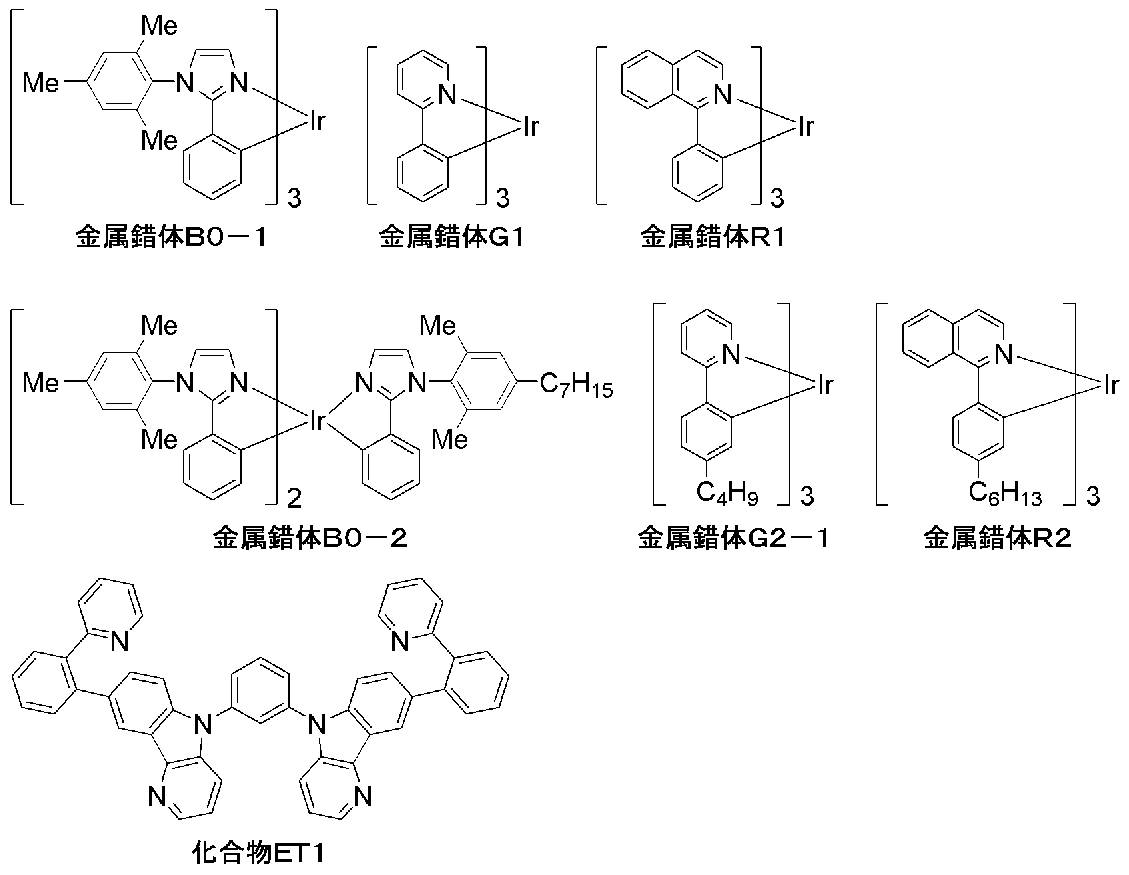
しかし、上述した発光素子は、外部量子効率が必ずしも十分ではない。
そこで、本発明は、外部量子効率が優れる発光素子を提供することを目的とする。
そこで、本発明は、外部量子効率が優れる発光素子を提供することを目的とする。
本発明は、以下の[1]~[18]を提供する。
[1] 陽極と、陰極と、前記陽極及び前記陰極の間に設けられた第1の層、前記陰極及び前記第1の層の間に設けられた第2の層と、前記陽極及び前記第1の層の間に設けられた第3の層とを有する発光素子であり、
前記第1の層が、式(1)で表される金属錯体を含有する層であり、
前記第2の層及び前記第3の層の少なくとも1層が、発光スペクトルの最大ピーク波長が570nm以上750nm未満である式(2)で表される金属錯体を含有し、
前記第1の層、前記第2の層及び前記第3の層の少なくとも1層が、発光スペクトルの最大ピーク波長が495nm以上570nm未満である式(3)で表される金属錯体を含有し、
前記第1の層、前記第2の層及び前記第3の層の少なくとも1層が、式(T-1)で表される化合物を含有する、発光素子。
[1] 陽極と、陰極と、前記陽極及び前記陰極の間に設けられた第1の層、前記陰極及び前記第1の層の間に設けられた第2の層と、前記陽極及び前記第1の層の間に設けられた第3の層とを有する発光素子であり、
前記第1の層が、式(1)で表される金属錯体を含有する層であり、
前記第2の層及び前記第3の層の少なくとも1層が、発光スペクトルの最大ピーク波長が570nm以上750nm未満である式(2)で表される金属錯体を含有し、
前記第1の層、前記第2の層及び前記第3の層の少なくとも1層が、発光スペクトルの最大ピーク波長が495nm以上570nm未満である式(3)で表される金属錯体を含有し、
前記第1の層、前記第2の層及び前記第3の層の少なくとも1層が、式(T-1)で表される化合物を含有する、発光素子。
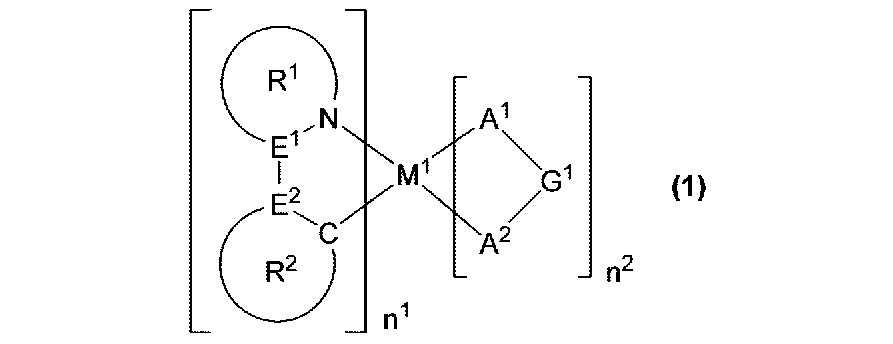
M1は、ロジウム原子、パラジウム原子、イリジウム原子又は白金原子を表す。
n1は1以上の整数を表し、n2は0以上の整数を表す。但し、M1がロジウム原子又はイリジウム原子の場合、n1+n2は3であり、M1がパラジウム原子又は白金原子の場合、n1+n2は2である。
E1及びE2は、それぞれ独立に、炭素原子又は窒素原子を表す。E1及びE2が複数存在する場合、それらはそれぞれ同一でも異なっていてもよい。
環R1は、5員の芳香族複素環を表し、この環は単一又は複数の置換基を有していてもよい。前記置換基が複数存在する場合、それらは同一でも異なっていてもよく、互いに結合して、それぞれが結合する原子とともに環を形成していてもよい。環R1が複数存在する場合、それらは同一でも異なっていてもよい。
環R2は、芳香族炭化水素環又は芳香族複素環を表し、これらの環は単一又は複数の置換基を有していてもよい。前記置換基が複数存在する場合、それらは同一でも異なっていてもよく、互いに結合して、それぞれが結合する原子とともに環を形成していてもよい。
環R2が複数存在する場合、それらは同一でも異なっていてもよい。
環R1が有していてもよい置換基と環R2が有していてもよい置換基とは、同一でも異なっていてもよく、互いに結合して、それぞれが結合する原子とともに環を形成していてもよい。
A1-G1-A2は、アニオン性の2座配位子を表す。A1及びA2は、それぞれ独立に、炭素原子、酸素原子又は窒素原子を表し、これらの原子は環を構成する原子であってもよい。G1は、単結合、又は、A1及びA2とともに2座配位子を構成する原子団を表す。A1-G1-A2が複数存在する場合、それらは同一でも異なっていてもよい。]
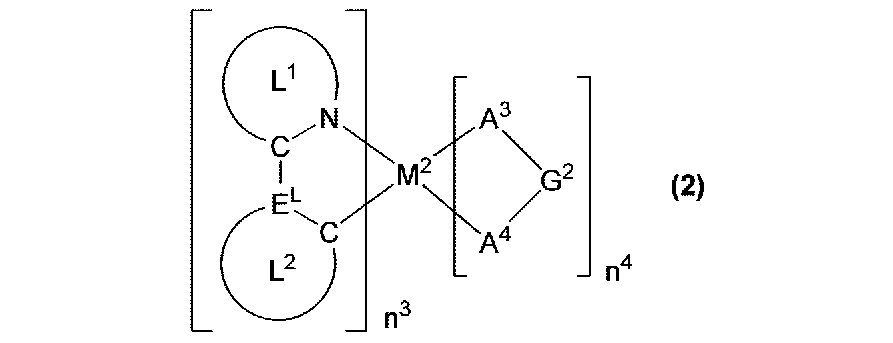
M2は、ロジウム原子、パラジウム原子、イリジウム原子又は白金原子を表す。
n3は1以上の整数を表し、n4は0以上の整数を表す。但し、M2がロジウム原子又はイリジウム原子の場合、n3+n4は3であり、M2がパラジウム原子又は白金原子の場合、n3+n4は2である。
ELは、炭素原子又は窒素原子を表す。ELが複数存在する場合、それらはそれぞれ同一でも異なっていてもよい。
環L1は、6員の芳香族複素環を表し、この環は単一又は複数の置換基を有していてもよい。前記置換基が複数存在する場合、それらは同一でも異なっていてもよく、互いに結合して、それぞれが結合する原子とともに環を形成していてもよい。環L1が複数存在する場合、それらは同一でも異なっていてもよい。
環L2は、芳香族炭化水素環又は芳香族複素環を表し、これらの環は単一又は複数の置換基を有していてもよい。前記置換基が複数存在する場合、それらは同一でも異なっていてもよく、互いに結合して、それぞれが結合する原子とともに環を形成していてもよい。
環L2が複数存在する場合、それらは同一でも異なっていてもよい。
環L1が有していてもよい置換基と環L2が有していてもよい置換基とは、同一でも異なっていてもよく、互いに結合して、それぞれが結合する原子とともに環を形成していてもよい。
但し、環L1及び環L2のうちの少なくとも1つは、置換基として、式(1-T)で表される基を有する。式(1-T)で表される基が複数存在する場合、それらは同一でも異なっていてもよい。
A3-G2-A4は、アニオン性の2座配位子を表す。A3及びA4は、それぞれ独立に、炭素原子、酸素原子又は窒素原子を表し、これらの原子は環を構成する原子であってもよい。G2は、単結合、又は、A3及びA4とともに2座配位子を構成する原子団を表す。A3-G2-A4が複数存在する場合、それらは同一でも異なっていてもよい。]


nT1は、0以上5以下の整数を表す。nT1が複数存在する場合、それらは同一でも異なっていてもよい。
nT2は、1以上10以下の整数を表す。
ArT1は、環内に二重結合を有さない窒素原子及び=N-で表される基を含む、縮合環の1価の複素環基であり、該基は単一又は複数の置換基を有していてもよい。前記置換基が複数存在する場合、互いに結合して、それぞれが結合する原子とともに環を形成していてもよい。ArT1が複数存在する場合、それらは同一でも異なっていてもよい。
LT1は、アルキレン基、シクロアルキレン基、アリーレン基、2価の複素環基、-NRT1’-で表される基、酸素原子又は硫黄原子を表し、これらの基は単一又は複数の置換基を有していてもよく、前記置換基が複数存在する場合、それらは同一でも異なっていてもよく、互いに結合して、それぞれが結合する原子とともに環を形成していてもよい。
RT1’は、水素原子、アルキル基、シクロアルキル基、アリール基又は1価の複素環基を表し、これらの基は単一又は複数の置換基を有していてもよく、前記置換基が複数存在する場合、それらは同一でも異なっていてもよく、互いに結合して、それぞれが結合する原子とともに環を形成していてもよい。LT1が複数存在する場合、それらは同一でも異なっていてもよい。
ArT2は、芳香族炭化水素基又は複素環基を表し、これらの基は単一又は複数の置換基を有していてもよく、前記置換基が複数存在する場合、互いに結合して、それぞれが結合する原子とともに環を形成していてもよい。]

M3は、ロジウム原子、パラジウム原子、イリジウム原子又は白金原子を表す。
n5は1以上の整数を表し、n6は0以上の整数を表す。但し、M3がロジウム原子又はイリジウム原子の場合、n5+n6は3であり、M3がパラジウム原子又は白金原子の場合、n5+n6は2である。
EL1は、炭素原子又は窒素原子を表す。EL1が複数存在する場合、それらはそれぞれ同一でも異なっていてもよい。
環L3は、6員の芳香族複素環を表し、この環は単一又は複数の置換基を有していてもよい。前記置換基が複数存在する場合、それらは同一でも異なっていてもよく、互いに結合して、それぞれが結合する原子とともに環を形成していてもよい。環L3が複数存在する場合、それらは同一でも異なっていてもよい。
環L4は、芳香族炭化水素環又は芳香族複素環を表し、これらの環は単一又は複数の置換基を有していてもよい。前記置換基が複数存在する場合、それらは同一でも異なっていてもよく、互いに結合して、それぞれが結合する原子とともに環を形成していてもよい。
環L4が複数存在する場合、それらは同一でも異なっていてもよい。
環L3が有していてもよい置換基と環L4が有していてもよい置換基とは、同一でも異なっていてもよく、互いに結合して、それぞれが結合する原子とともに環を形成していてもよい。
但し、環L3及び環L4のうちの少なくとも1つは、置換基として、式(3-T)で表される基を有する。式(3-T)で表される基が複数存在する場合、それらは同一でも異なっていてもよい。
A5-G3-A6は、アニオン性の2座配位子を表す。A3及びA4は、それぞれ独立に、炭素原子、酸素原子又は窒素原子を表し、これらの原子は環を構成する原子であってもよい。G3は、単結合、又は、A5及びA6とともに2座配位子を構成する原子団を表す。A5-G3-A6が複数存在する場合、それらは同一でも異なっていてもよい。]

[2] 前記第3の層が、前記式(2)で表される金属錯体を含有する、[1]に記載の発光素子。
[3] 前記環L1が、ピリジン環、ジアザベンゼン環、アザナフタレン環又はジアザナフタレン環であり、これらの環は単一又は複数の置換基を有していてもよく、且つ、前記環L2が、ベンゼン環、ピリジン環又はジアザベンゼン環であり、これらの環は単一又は複数の置換基を有していてもよい、[1]又は[2]に記載の発光素子。
[4] 前記第1の層及び前記第3の層の少なくとも1層が、前記式(3)で表される金属錯体を含有する、[1]~[3]のいずれかに記載の発光素子。
[5] 前記環L3が、ピリジン環又はジアザベンゼン環であり、これらの環は単一又は複数の置換基を有していてもよく、且つ、前記環L4が、ベンゼン環、ピリジン環又はジアザベンゼン環であり、これらの環は単一又は複数の置換基を有していてもよい、[1]~[4]のいずれかに記載の発光素子。
[6] 前記式(1-T)で表される基が、式(2-T)で表される基である、[1]~[5]のいずれかに記載の発光素子。

[7] 陽極と、陰極と、前記陽極及び前記陰極の間に設けられた第1の層、前記陰極及び前記第1の層の間に設けられた第2の層と、前記陽極及び前記第1の層の間に設けられた第3の層とを有する発光素子であり、
前記第1の層が、式(1)で表される金属錯体を含有する層であり、
前記第2の層及び前記第3の層の少なくとも1層が、発光スペクトルの最大ピーク波長が570nm以上750nm未満である式(2’)で表される金属錯体を含有し、
前記第1の層、前記第2の層及び前記第3の層の少なくとも1層が、式(T-1)で表される化合物を含有する、発光素子。

M1は、ロジウム原子、パラジウム原子、イリジウム原子又は白金原子を表す。
n1は1以上の整数を表し、n2は0以上の整数を表す。但し、M1がロジウム原子又はイリジウム原子の場合、n1+n2は3であり、M1がパラジウム原子又は白金原子の場合、n1+n2は2である。
E1及びE2は、それぞれ独立に、炭素原子又は窒素原子を表す。E1及びE2が複数存在する場合、それらはそれぞれ同一でも異なっていてもよい。
環R1は、5員の芳香族複素環を表し、この環は単一又は複数の置換基を有していてもよい。前記置換基が複数存在する場合、それらは同一でも異なっていてもよく、互いに結合して、それぞれが結合する原子とともに環を形成していてもよい。環R1が複数存在する場合、それらは同一でも異なっていてもよい。
環R2は、芳香族炭化水素環又は芳香族複素環を表し、これらの環は単一又は複数の置換基を有していてもよい。前記置換基が複数存在する場合、それらは同一でも異なっていてもよく、互いに結合して、それぞれが結合する原子とともに環を形成していてもよい。
環R2が複数存在する場合、それらは同一でも異なっていてもよい。
環R1が有していてもよい置換基と環R2が有していてもよい置換基とは、同一でも異なっていてもよく、互いに結合して、それぞれが結合する原子とともに環を形成していてもよい。
A1-G1-A2は、アニオン性の2座配位子を表す。A1及びA2は、それぞれ独立に、炭素原子、酸素原子又は窒素原子を表し、これらの原子は環を構成する原子であってもよい。G1は、単結合、又は、A1及びA2とともに2座配位子を構成する原子団を表す。A1-G1-A2が複数存在する場合、それらは同一でも異なっていてもよい。]
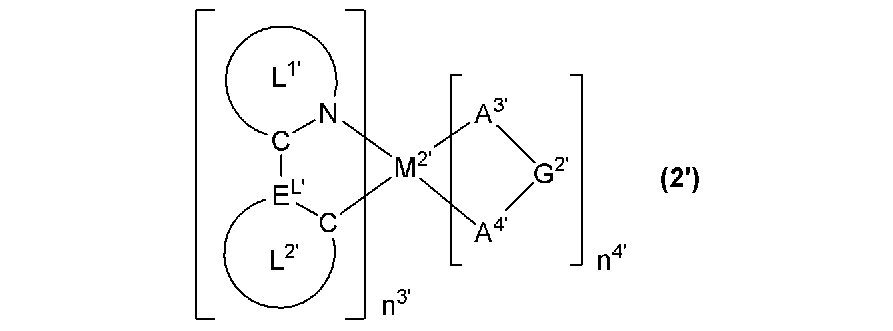
M2’は、ロジウム原子、パラジウム原子、イリジウム原子又は白金原子を表す。
n3’は1以上の整数を表し、n4’は0以上の整数を表す。但し、M2’がロジウム原子又はイリジウム原子の場合、n3’+n4’は3であり、M2’がパラジウム原子又は白金原子の場合、n3’+n4’は2である。
EL’は、炭素原子又は窒素原子を表す。EL’が複数存在する場合、それらはそれぞれ同一でも異なっていてもよい。
環L1’は、6員の芳香族複素環を表し、この環は単一又は複数の置換基を有していてもよい。前記置換基が複数存在する場合、それらは同一でも異なっていてもよく、互いに結合して、それぞれが結合する原子とともに環を形成していてもよい。環L1’が複数存在する場合、それらは同一でも異なっていてもよい。
環L2’は、芳香族炭化水素環又は芳香族複素環を表し、これらの環は単一又は複数の置換基を有していてもよい。前記置換基が複数存在する場合、それらは同一でも異なっていてもよく、互いに結合して、それぞれが結合する原子とともに環を形成していてもよい。環L2’が複数存在する場合、それらは同一でも異なっていてもよい。
環L1’が有していてもよい置換基と環L2’が有していてもよい置換基とは、同一でも異なっていてもよく、互いに結合して、それぞれが結合する原子とともに環を形成していてもよい。
但し、環L1’及び環L2’のうちの少なくとも1つは、置換基として、式(2-T)で表される基を有する。式(2-T)で表される基が複数存在する場合、それらは同一でも異なっていてもよい。
A3’-G2’-A4’は、アニオン性の2座配位子を表す。A3’及びA4’は、それぞれ独立に、炭素原子、酸素原子又は窒素原子を表し、これらの原子は環を構成する原子であってもよい。G2’は、単結合、又は、A3’及びA4’とともに2座配位子を構成する原子団を表す。A3’-G2’-A4’が複数存在する場合、それらは同一でも異なっていてもよい。]


nT1は、0以上5以下の整数を表す。nT1が複数存在する場合、それらは同一でも異なっていてもよい。
nT2は、1以上10以下の整数を表す。
ArT1は、環内に二重結合を有さない窒素原子及び=N-で表される基を含む、縮合環の1価の複素環基であり、該基は単一又は複数の置換基を有していてもよい。前記置換基が複数存在する場合、互いに結合して、それぞれが結合する原子とともに環を形成していてもよい。ArT1が複数存在する場合、それらは同一でも異なっていてもよい。
LT1は、アルキレン基、シクロアルキレン基、アリーレン基、2価の複素環基、-NRT1’-で表される基、酸素原子又は硫黄原子を表し、これらの基は単一又は複数の置換基を有していてもよく、前記置換基が複数存在する場合、それらは同一でも異なっていてもよく、互いに結合して、それぞれが結合する原子とともに環を形成していてもよい。
RT1’は、水素原子、アルキル基、シクロアルキル基、アリール基又は1価の複素環基を表し、これらの基は単一又は複数の置換基を有していてもよく、前記置換基が複数存在する場合、それらは同一でも異なっていてもよく、互いに結合して、それぞれが結合する原子とともに環を形成していてもよい。LT1が複数存在する場合、それらは同一でも異なっていてもよい。
ArT2は、芳香族炭化水素基又は複素環基を表し、これらの基は単一又は複数の置換基を有していてもよく、前記置換基が複数存在する場合、互いに結合して、それぞれが結合する原子とともに環を形成していてもよい。]
[8] 前記第3の層が、前記式(2’)で表される金属錯体を含有する、[7]に記載の発光素子。
[9] 前記環L1’が、ピリジン環、ジアザベンゼン環、アザナフタレン環又はジアザナフタレン環であり、これらの環は単一又は複数の置換基を有していてもよく、且つ、前記環L2’が、ベンゼン環、ピリジン環又はジアザベンゼン環であり、これらの環は単一又は複数の置換基を有していてもよい、[7]又は[8]に記載の発光素子。
[10] 前記第2の層が、前記式(T-1)で表される化合物を含有する、[1]~[9]のいずれかに記載の発光素子。
[11] 前記ArT1が、式(T1-1)で表される基である、[1]~[10]のいずれかに記載の発光素子。

XT1は、単結合、酸素原子、硫黄原子、-N(RXT1)-で表される基、又は、-C(RXT1’)2-で表される基を表す。RXT1及びRXT1’は、それぞれ独立に、水素原子、アルキル基、シクロアルキル基、アルコキシ基、シクロアルコキシ基、アリール基、アリールオキシ基、1価の複素環基、置換アミノ基、ハロゲン原子又はシアノ基を表し、これらの基は単一又は複数の置換基を有していてもよく、前記置換基が複数存在する場合、それらは同一でも異なっていてもよく、互いに結合して、それぞれが結合する原子とともに環を形成していてもよい。複数存在するRXT1’は、同一でも異なっていてもよく、互いに結合して、それぞれが結合する原子とともに環を形成していてもよい。
環RT1及び環RT2は、それぞれ独立に、芳香族炭化水素環又は複素環を表し、これらの環は単一又は複数の置換基を有していてもよく、前記置換基が複数存在する場合、それらは同一でも異なっていてもよく、互いに結合して、それぞれが結合する原子とともに環を形成していてもよい。
但し、環RT1及び環RT2のうちの少なくとも一つは、環内に=N-で表される基を含む複素環であり、該環は単一又は複数の置換基を有していてもよく、前記置換基が複数存在する場合、それらは同一でも異なっていてもよく、互いに結合して、それぞれが結合する原子とともに環を形成していてもよい。]
[12] 前記環RT1が、芳香族炭化水素環又は環内に=N-で表される基を含む複素環であり、これらの環は単一又は複数の置換基を有していてもよく、且つ、前記環RT2が、環内に=N-で表される基を含む複素環であり、該環は単一又は複数の置換基を有していてもよい、[11]に記載の発光素子。
[13] 前記環RT1が、単環式の芳香族炭化水素環又は環内に=N-で表される基を含む単環式の複素環であり、これらの環は単一又は複数の置換基を有していてもよく、且つ、前記環RT2が、環内に=N-で表される基を含む単環式の複素環であり、該環は単一又は複数の置換基を有していてもよい、[12]に記載の発光素子。
[14] 前記環RT1が、ベンゼン環、ピリジン環又はジアザベンゼン環であり、これらの環は単一又は複数の置換基を有していてもよく、且つ、前記環RT2が、ピリジン環又はジアザベンゼン環であり、これらの環は単一又は複数の置換基を有していてもよい、[13]に記載の発光素子。
[15] 前記式(1)で表される金属錯体の発光スペクトルの最大ピーク波長が380nm以上495nm未満である、[1]~[14]のいずれかに記載の発光素子。
[16] 前記環R1が、ジアゾール環又はトリアゾール環であり、これらの環は単一又は複数の置換基を有していてもよく、且つ、前記環R2が、ベンゼン環、ピリジン環又はジアザベンゼン環であり、これらの環は単一又は複数の置換基を有していてもよい、[1]~[15]のいずれかに記載の発光素子。
[17] 前記第1の層が、式(H-1)で表される化合物を更に含有する、[1]~[16]のいずれかに記載の発光素子。

ArH1及びArH2は、それぞれ独立に、アリール基、1価の複素環基又は置換アミノ基を表し、これらの基は単一又は複数の置換基を有していてもよい。前記置換基が複数存在する場合、それらは同一でも異なっていてもよく、互いに結合して、それぞれが結合する原子とともに環を形成していてもよい。
nH1は、0以上の整数を表す。
LH1は、アリーレン基、2価の複素環基、アルキレン基又はシクロアルキレン基を表し、これらの基は単一又は複数の置換基を有していてもよい。前記置換基が複数存在する場合、それらは同一でも異なっていてもよく、互いに結合して、それぞれが結合する原子とともに環を形成していてもよい。LH1が複数存在する場合、それらは同一でも異なっていてもよい。]
[18] 前記第1の層と前記第2の層とが隣接しており、且つ、前記第1の層と前記第3の層とが隣接している、[1]~[17]のいずれかに記載の発光素子。
本発明によれば、外部量子効率が優れる発光素子を提供することができる。
以下、本実施形態の好適な実施形態について詳細に説明する。
<共通する用語の説明>
本明細書で共通して用いられる用語は、特記しない限り、以下の意味である。
本明細書で共通して用いられる用語は、特記しない限り、以下の意味である。
「室温」とは、25℃を意味する。
Meはメチル基、i-Prはイソプロピル基、t-Buはtert-ブチル基を表す。
水素原子は、重水素原子であっても、軽水素原子であってもよい。
金属錯体を表す式中、中心金属との結合を表す実線は、共有結合又は配位結合を意味する。
Meはメチル基、i-Prはイソプロピル基、t-Buはtert-ブチル基を表す。
水素原子は、重水素原子であっても、軽水素原子であってもよい。
金属錯体を表す式中、中心金属との結合を表す実線は、共有結合又は配位結合を意味する。
「高分子化合物」とは、分子量分布を有し、ポリスチレン換算の数平均分子量が1×10³~1×10⁸である重合体を意味する。
「低分子化合物」とは、分子量分布を有さず、分子量が1×10⁴以下の化合物を意味する。
「構成単位」とは、高分子化合物中に1個以上存在する単位を意味する。高分子化合物中に2個以上存在する構成単位は、一般的に、「繰り返し単位」と呼ばれることがある。
「低分子化合物」とは、分子量分布を有さず、分子量が1×10⁴以下の化合物を意味する。
「構成単位」とは、高分子化合物中に1個以上存在する単位を意味する。高分子化合物中に2個以上存在する構成単位は、一般的に、「繰り返し単位」と呼ばれることがある。
「アルキル基」は、直鎖及び分岐のいずれでもよい。直鎖のアルキル基の炭素原子数は、置換基の炭素原子数を含めないで、通常1~50であり、好ましくは1~20であり、より好ましくは1~10である。分岐のアルキル基の炭素原子数は、置換基の炭素原子数を含めないで、通常3~50であり、好ましくは3~20であり、より好ましくは4~10である。アルキル基は、置換基を有していてもよく、例えば、メチル基、エチル基、イソプロピル基、ブチル基、イソブチル基、tert-ブチル基、ペンチル基、ヘキシル基、ヘプチル基、オクチル基、2-エチルヘキシル基、デシル基、3,7-ジメチルオクチル基、2-エチルオクチル基、ドデシル基、トリフルオロメチル基、3-フェニルプロピル基、3-(4-メチルフェニル)プロピル基、3-(3,5-ジ-ヘキシルフェニル)プロピル基、及び6-エチルオキシヘキシル基が挙げられる。
「シクロアルキル基」の炭素原子数は、置換基の炭素原子数を含めないで、通常3~50であり、好ましくは4~10である。シクロアルキル基は、置換基を有していてもよく、例えば、シクロヘキシル基及びメチルシクロヘキシル基が挙げられる。
「アルキレン基」の炭素原子数は、置換基の炭素原子数を含めないで、通常1以上20以下であり、好ましくは1以上15以下であり、より好ましくは1以上10以下である。
アルキレン基は、置換基を有していてもよく、例えば、メチレン基、エチレン基、プロピレン基、ブチレン基、ヘキシレン基及びオクチレン基が挙げられる。
「シクロアルキレン基」の炭素原子数は、置換基の炭素原子数を含めないで、通常3以上20以下である。シクロアルキレン基は、置換基を有していてもよく、例えば、シクロヘキシレン基が挙げられる。
「シクロアルキル基」の炭素原子数は、置換基の炭素原子数を含めないで、通常3~50であり、好ましくは4~10である。シクロアルキル基は、置換基を有していてもよく、例えば、シクロヘキシル基及びメチルシクロヘキシル基が挙げられる。
「アルキレン基」の炭素原子数は、置換基の炭素原子数を含めないで、通常1以上20以下であり、好ましくは1以上15以下であり、より好ましくは1以上10以下である。
アルキレン基は、置換基を有していてもよく、例えば、メチレン基、エチレン基、プロピレン基、ブチレン基、ヘキシレン基及びオクチレン基が挙げられる。
「シクロアルキレン基」の炭素原子数は、置換基の炭素原子数を含めないで、通常3以上20以下である。シクロアルキレン基は、置換基を有していてもよく、例えば、シクロヘキシレン基が挙げられる。
「芳香族炭化水素基」は、芳香族炭化水素から環を構成する炭素原子に直接結合する水素原子1個以上を除いた基を意味する。芳香族炭化水素から環を構成する炭素原子に直接結合する水素原子1個を除いた基を「アリール基」ともいう。芳香族炭化水素から環を構成する炭素原子に直接結合する水素原子2個を除いた基を「アリーレン基」ともいう。
芳香族炭化水素基の炭素原子数は、置換基の炭素原子数を含めないで、通常6~60であり、好ましくは6~30であり、より好ましくは6~18である。
「芳香族炭化水素基」は、例えば、単環式の芳香族炭化水素(例えば、ベンゼンが挙げられる。)、又は、多環式の芳香族炭化水素(例えば、ナフタレン及びインデン等の2環式の芳香族炭化水素;アントラセン、フェナントレン、ジヒドロフェナントレン及びフルオレン等の3環式の芳香族炭化水素;トリフェニレン、ナフタセン、ベンゾフルオレン、ピレン、クリセン及びフルオランテン等の4環式の芳香族炭化水素;ジベンゾフルオレン、ペリレン及びベンゾフルオランテン等の5環式の芳香族炭化水素;スピロビフルオレン等の6環式の芳香族炭化水素;並びに、ベンゾスピロビフルオレン及びアセナフトフルオランテン等の7環式の芳香族炭化水素が挙げられる。)から、環を構成する炭素原子に直接結合する水素原子1個以上を除いた基が挙げられ、これらの基は置換基を有していてもよい。芳香族炭化水素基は、これらの基が複数結合した基を含む。
芳香族炭化水素基の炭素原子数は、置換基の炭素原子数を含めないで、通常6~60であり、好ましくは6~30であり、より好ましくは6~18である。
「芳香族炭化水素基」は、例えば、単環式の芳香族炭化水素(例えば、ベンゼンが挙げられる。)、又は、多環式の芳香族炭化水素(例えば、ナフタレン及びインデン等の2環式の芳香族炭化水素;アントラセン、フェナントレン、ジヒドロフェナントレン及びフルオレン等の3環式の芳香族炭化水素;トリフェニレン、ナフタセン、ベンゾフルオレン、ピレン、クリセン及びフルオランテン等の4環式の芳香族炭化水素;ジベンゾフルオレン、ペリレン及びベンゾフルオランテン等の5環式の芳香族炭化水素;スピロビフルオレン等の6環式の芳香族炭化水素;並びに、ベンゾスピロビフルオレン及びアセナフトフルオランテン等の7環式の芳香族炭化水素が挙げられる。)から、環を構成する炭素原子に直接結合する水素原子1個以上を除いた基が挙げられ、これらの基は置換基を有していてもよい。芳香族炭化水素基は、これらの基が複数結合した基を含む。
「アルコキシ基」は、直鎖及び分岐のいずれでもよい。直鎖のアルコキシ基の炭素原子数は、置換基の炭素原子数を含めないで、通常1~40であり、好ましくは1~10である。分岐のアルコキシ基の炭素原子数は、置換基の炭素原子数を含めないで、通常3~40であり、好ましくは4~10である。アルコキシ基は、置換基を有していてもよく、例えば、メトキシ基、エトキシ基、イソプロピルオキシ基、ブチルオキシ基、ヘキシルオキシ基、2-エチルヘキシルオキシ基、3,7-ジメチルオクチルオキシ基、及びラウリルオキシ基が挙げられる。
「シクロアルコキシ基」の炭素原子数は、置換基の炭素原子数を含めないで、通常3~40であり、好ましくは4~10である。シクロアルコキシ基は、置換基を有していてもよく、例えば、シクロヘキシルオキシ基が挙げられる。
「アリールオキシ基」の炭素原子数は、置換基の炭素原子数を含めないで、通常6~60であり、好ましくは6~48である。アリールオキシ基は、置換基を有していてもよく、例えば、フェノキシ基、ナフチルオキシ基、アントラセニルオキシ基、及びピレニルオキシ基が挙げられる。
「シクロアルコキシ基」の炭素原子数は、置換基の炭素原子数を含めないで、通常3~40であり、好ましくは4~10である。シクロアルコキシ基は、置換基を有していてもよく、例えば、シクロヘキシルオキシ基が挙げられる。
「アリールオキシ基」の炭素原子数は、置換基の炭素原子数を含めないで、通常6~60であり、好ましくは6~48である。アリールオキシ基は、置換基を有していてもよく、例えば、フェノキシ基、ナフチルオキシ基、アントラセニルオキシ基、及びピレニルオキシ基が挙げられる。
「複素環基」とは、複素環式化合物から環を構成する炭素原子又はヘテロ原子に直接結合する水素原子1個以上を除いた基を意味する。複素環基の中でも、芳香族複素環式化合物から環を構成する炭素原子又はヘテロ原子に直接結合する水素原子1個以上を除いた基である「芳香族複素環基」が好ましい。複素環式化合物から環を構成する炭素原子又はヘテロ原子に直接結合する水素原子p個(pは、1以上の整数を表す。)を除いた基を「p価の複素環基」ともいう。芳香族複素環式化合物から環を構成する炭素原子又はヘテロ原子に直接結合する水素原子p個を除いた基を「p価の芳香族複素環基」ともいう。
「芳香族複素環式化合物」としては、例えば、アゾール、チオフェン、フラン、ピリジン、ジアザベンゼン、トリアジン、アザナフタレン、ジアザナフタレン及びカルバゾール等の複素環自体が芳香族性を示す化合物、並びに、フェノキサジン、フェノチアジン及びベンゾピラン等の複素環自体は芳香族性を示さなくとも、複素環に芳香環が縮環されている化合物が挙げられる。
複素環基の炭素原子数は、置換基の炭素原子数を含めないで、通常1~60であり、好ましくは2~40であり、より好ましくは3~20である。複素環基のヘテロ原子数は、置換基のヘテロ原子数を含めないで、通常1~30であり、好ましくは、1~10であり、より好ましくは1~3である。
複素環基は、置換基を有していてもよく、例えば、単環式の複素環式化合物(例えば、フラン、チオフェン、オキサジアゾール、ピロール、ジアゾール、トリアゾール、テトラゾール、ピリジン、ジアザベンゼン及びトリアジンが挙げられる。)、又は、多環式の複素環式化合物(例えば、アザナフタレン、ジアザナフタレン、ベンゾフラン、ベンゾチオフェン、インドール、ベンゾジアゾール及びベンゾチアジアゾール等の2環式の複素環式化合物;ジベンゾフラン、ジベンゾチオフェン、カルバゾール、アザカルバゾール、ジアザカルバゾール、フェノキサジン、フェノチアジン、9,10-ジヒドロアクリジン、5,10-ジヒドロフェナジン、アザアントラセン、ジアザアントラセン、アザフェナントレン及びジアザフェナントレン等の3環式の複素環式化合物;ヘキサアザトリフェニレン、ベンゾカルバゾール及びベンゾナフトフラン等の4環式の複素環式化合物;ジベンゾカルバゾール、インドロカルバゾール及びインデノカルバゾール等の5環式の複素環式化合物;カルバゾロカルバゾール、ベンゾインドロカルバゾール及びベンゾインデノカルバゾール等の6環式の複素環式化合物;並びに、ジベンゾインドロカルバゾール等の7環式の複素環式化合物が挙げられる。)から、環を構成する原子に直接結合する水素原子1個以上を除いた基が挙げられ、これらの基は置換基を有していてもよい。複素環基は、これらの基が複数結合した基を含む。
「芳香族複素環式化合物」としては、例えば、アゾール、チオフェン、フラン、ピリジン、ジアザベンゼン、トリアジン、アザナフタレン、ジアザナフタレン及びカルバゾール等の複素環自体が芳香族性を示す化合物、並びに、フェノキサジン、フェノチアジン及びベンゾピラン等の複素環自体は芳香族性を示さなくとも、複素環に芳香環が縮環されている化合物が挙げられる。
複素環基の炭素原子数は、置換基の炭素原子数を含めないで、通常1~60であり、好ましくは2~40であり、より好ましくは3~20である。複素環基のヘテロ原子数は、置換基のヘテロ原子数を含めないで、通常1~30であり、好ましくは、1~10であり、より好ましくは1~3である。
複素環基は、置換基を有していてもよく、例えば、単環式の複素環式化合物(例えば、フラン、チオフェン、オキサジアゾール、ピロール、ジアゾール、トリアゾール、テトラゾール、ピリジン、ジアザベンゼン及びトリアジンが挙げられる。)、又は、多環式の複素環式化合物(例えば、アザナフタレン、ジアザナフタレン、ベンゾフラン、ベンゾチオフェン、インドール、ベンゾジアゾール及びベンゾチアジアゾール等の2環式の複素環式化合物;ジベンゾフラン、ジベンゾチオフェン、カルバゾール、アザカルバゾール、ジアザカルバゾール、フェノキサジン、フェノチアジン、9,10-ジヒドロアクリジン、5,10-ジヒドロフェナジン、アザアントラセン、ジアザアントラセン、アザフェナントレン及びジアザフェナントレン等の3環式の複素環式化合物;ヘキサアザトリフェニレン、ベンゾカルバゾール及びベンゾナフトフラン等の4環式の複素環式化合物;ジベンゾカルバゾール、インドロカルバゾール及びインデノカルバゾール等の5環式の複素環式化合物;カルバゾロカルバゾール、ベンゾインドロカルバゾール及びベンゾインデノカルバゾール等の6環式の複素環式化合物;並びに、ジベンゾインドロカルバゾール等の7環式の複素環式化合物が挙げられる。)から、環を構成する原子に直接結合する水素原子1個以上を除いた基が挙げられ、これらの基は置換基を有していてもよい。複素環基は、これらの基が複数結合した基を含む。
「ハロゲン原子」とは、フッ素原子、塩素原子、臭素原子又はヨウ素原子を示す。
「アミノ基」は、置換基を有していてもよく、置換アミノ基が好ましい。アミノ基が有する置換基としては、アルキル基、シクロアルキル基、アリール基又は1価の複素環基が好ましい。
置換アミノ基としては、例えば、ジアルキルアミノ基、ジシクロアルキルアミノ基及びジアリールアミノ基が挙げられる。
より具体的には、置換アミノ基としては、例えば、ジメチルアミノ基、ジエチルアミノ基、ジフェニルアミノ基、ビス(メチルフェニル)アミノ基、及びビス(3,5-ジ-tert-ブチルフェニル)アミノ基が挙げられる。
置換アミノ基としては、例えば、ジアルキルアミノ基、ジシクロアルキルアミノ基及びジアリールアミノ基が挙げられる。
より具体的には、置換アミノ基としては、例えば、ジメチルアミノ基、ジエチルアミノ基、ジフェニルアミノ基、ビス(メチルフェニル)アミノ基、及びビス(3,5-ジ-tert-ブチルフェニル)アミノ基が挙げられる。
「アルケニル基」は、直鎖及び分岐のいずれでもよい。直鎖のアルケニル基の炭素原子数は、置換基の炭素原子数を含めないで、通常2~30であり、好ましくは3~20である。分岐のアルケニル基の炭素原子数は、置換基の炭素原子数を含めないで、通常3~30であり、好ましくは4~20である。
「シクロアルケニル基」の炭素原子数は、置換基の炭素原子数を含めないで、通常3~30であり、好ましくは4~20である。
アルケニル基及びシクロアルケニル基は、置換基を有していてもよく、例えば、ビニル基、プロペニル基、ブテニル基、3-ブテニル基、3-ペンテニル基、4-ペンテニル基、1-ヘキセニル基、5-ヘキセニル基、7-オクテニル基、及び、これらの基が置換基を有する基が挙げられる。
「シクロアルケニル基」の炭素原子数は、置換基の炭素原子数を含めないで、通常3~30であり、好ましくは4~20である。
アルケニル基及びシクロアルケニル基は、置換基を有していてもよく、例えば、ビニル基、プロペニル基、ブテニル基、3-ブテニル基、3-ペンテニル基、4-ペンテニル基、1-ヘキセニル基、5-ヘキセニル基、7-オクテニル基、及び、これらの基が置換基を有する基が挙げられる。
「アルキニル基」は、直鎖及び分岐のいずれでもよい。アルキニル基の炭素原子数は、置換基の炭素原子を含めないで、通常2~20であり、好ましくは3~20である。分岐のアルキニル基の炭素原子数は、置換基の炭素原子を含めないで、通常4~30であり、好ましくは4~20である。
「シクロアルキニル基」の炭素原子数は、置換基の炭素原子を含めないで、通常4~30であり、好ましくは4~20である。
アルキニル基及びシクロアルキニル基は、置換基を有していてもよく、例えば、エチニル基、プロピニル基、ブチニル基、ペンチニル基、ヘキシニル基、5-ヘキシニル基、及び、これらの基が置換基を有する基が挙げられる。
「シクロアルキニル基」の炭素原子数は、置換基の炭素原子を含めないで、通常4~30であり、好ましくは4~20である。
アルキニル基及びシクロアルキニル基は、置換基を有していてもよく、例えば、エチニル基、プロピニル基、ブチニル基、ペンチニル基、ヘキシニル基、5-ヘキシニル基、及び、これらの基が置換基を有する基が挙げられる。
「架橋性基」とは、加熱、紫外線照射、近紫外線照射、可視光照射、赤外線照射、ラジカル反応等に供することにより、新たな結合を生成することが可能な基であり、好ましくは、式(XL-1)~式(XL-19)のいずれかで表される基である。これらの基は、置換基を有していてもよい。

「置換基」としては、例えば、ハロゲン原子、シアノ基、アルキル基、シクロアルキル基、アリール基、1価の複素環基、アルコキシ基、シクロアルコキシ基、アリールオキシ基、アミノ基、置換アミノ基、アルケニル基、シクロアルケニル基、アルキニル基及びシクロアルキニル基が挙げられる。置換基は架橋性基であってもよい。置換基を有する基は、単一又は複数の置換基を有することができる。置換基を有する環は、単一又は複数の置換基を有することができる。なお、置換基が複数存在する場合、それらは同一でも異なっていてもよく、互いに結合して、それぞれが結合する原子とともに環を形成していてもよいが、環を形成しないことが好ましい。
<式(2)で表される金属錯体>
式(2)で表される金属錯体は、通常、室温で燐光発光性を示す金属錯体であり、好ましくは、室温で三重項励起状態からの発光を示す金属錯体である。
式(2)で表される金属錯体は、通常、室温で燐光発光性を示す金属錯体であり、好ましくは、室温で三重項励起状態からの発光を示す金属錯体である。
M2は、本実施形態の発光素子の外部量子効率がより優れるので、イリジウム原子又は白金原子であることが好ましく、イリジウム原子であることがより好ましい。
M2がロジウム原子又はイリジウム原子の場合、n3は2又は3であることが好ましく、3であることがより好ましい。
M2がパラジウム原子又は白金原子の場合、n3は2であることが好ましい。
ELは、炭素原子であることが好ましい。式(2)で表される金属錯体を容易に合成できるので、ELが複数存在する場合、それらは好ましくは同一である。
M2がロジウム原子又はイリジウム原子の場合、n3は2又は3であることが好ましく、3であることがより好ましい。
M2がパラジウム原子又は白金原子の場合、n3は2であることが好ましい。
ELは、炭素原子であることが好ましい。式(2)で表される金属錯体を容易に合成できるので、ELが複数存在する場合、それらは好ましくは同一である。
環L1における6員の芳香族複素環の炭素原子数は、置換基の炭素原子数を含めないで、通常1~60であり、好ましくは2~30であり、更に好ましくは3~15である。環L1における6員の芳香族複素環のヘテロ原子数は、置換基のヘテロ原子数を含めないで、通常1~30であり、好ましくは、1~10であり、より好ましくは1~3である。
環L1としては、例えば、前述の複素環基の項で例示した芳香族複素環の中で1つ以上の窒素原子を構成原子として有する6員の芳香族複素環が挙げられ、本実施形態の発光素子の外部量子効率がより優れるので、好ましくは、1つ以上4つ以下の窒素原子を構成原子として有する6員の芳香族複素環であり、より好ましくは、ピリジン環、ジアザベンゼン環、アザナフタレン環又はジアザナフタレン環であり、更に好ましくは、ピリジン環、キノリン環又はイソキノリン環であり、これらの環は置換基を有していてもよい。
式(2)で表される金属錯体を容易に合成できるので、環L1が複数存在する場合、それらは好ましくは同一である。より詳細には、環L1が複数存在する場合、複数存在する環L1のうち、少なくとも2つが同一であることが好ましく、複数存在する環L1のすべてが同一であることがより好ましい。
環L1としては、例えば、前述の複素環基の項で例示した芳香族複素環の中で1つ以上の窒素原子を構成原子として有する6員の芳香族複素環が挙げられ、本実施形態の発光素子の外部量子効率がより優れるので、好ましくは、1つ以上4つ以下の窒素原子を構成原子として有する6員の芳香族複素環であり、より好ましくは、ピリジン環、ジアザベンゼン環、アザナフタレン環又はジアザナフタレン環であり、更に好ましくは、ピリジン環、キノリン環又はイソキノリン環であり、これらの環は置換基を有していてもよい。
式(2)で表される金属錯体を容易に合成できるので、環L1が複数存在する場合、それらは好ましくは同一である。より詳細には、環L1が複数存在する場合、複数存在する環L1のうち、少なくとも2つが同一であることが好ましく、複数存在する環L1のすべてが同一であることがより好ましい。
環L2における芳香族炭化水素環の炭素原子数は、置換基の炭素原子数を含めないで、通常6~60であり、好ましくは6~30であり、更に好ましくは6~18である。
環L2における芳香族炭化水素環としては、例えば、前述の芳香族炭化水素基の項で例示した芳香族炭化水素環が挙げられ、好ましくは、前述の芳香族炭化水素基の項で例示した、単環式、2環式又は3環式の芳香族炭化水素環であり、より好ましくは、ベンゼン環、ナフタレン環、フルオレン環、フェナントレン環又はジヒドロフェナントレン環であり、更に好ましくは、ベンゼン環、フルオレン環又はジヒドロフェナントレン環であり、特に好ましくは、ベンゼン環であり、これらの環は置換基を有していてもよい。
環L2における芳香族複素環の炭素原子数は、置換基の炭素原子数を含めないで、通常1~60であり、好ましくは2~30であり、より好ましくは3~15である。環L2における芳香族複素環のヘテロ原子数は、置換基のヘテロ原子数を含めないで、通常1~30であり、好ましくは、1~10であり、より好ましくは1~3である。
環L2における芳香族複素環としては、例えば、前述の複素環基の項で例示した芳香族複素環が挙げられ、好ましくは、前述の複素環基の項で例示した、単環式、2環式又は3環式の芳香族複素環であり、より好ましくは、ピリジン環、ジアザベンゼン環、アザナフタレン環、ジアザナフタレン環、インドール環、ベンゾフラン環、ベンゾチオフェン環、カルバゾール環、アザカルバゾール環、ジアザカルバゾール環、ジベンゾフラン環又はジベンゾチオフェン環であり、更に好ましくは、ピリジン環、ジアザベンゼン環、カルバゾール環、ジベンゾフラン環又はジベンゾチオフェン環であり、特に好ましくは、ピリジン環又はジアザベンゼン環であり、これらの環は置換基を有していてもよい。
環L2は、本実施形態の発光素子の外部量子効率がより優れるので、好ましくは、ベンゼン環、ピリジン環又はジアザベンゼン環であり、より好ましくは、ベンゼン環であり、これらの環は置換基を有していてもよい。
式(2)で表される金属錯体を容易に合成できるので、環L2が複数存在する場合、それらは好ましくは同一である。より詳細には、環L2が複数存在する場合、複数存在する環L2のうち、少なくとも2つが同一であることが好ましく、複数存在する環L2のすべてが同一であることがより好ましい。
環L2における芳香族炭化水素環としては、例えば、前述の芳香族炭化水素基の項で例示した芳香族炭化水素環が挙げられ、好ましくは、前述の芳香族炭化水素基の項で例示した、単環式、2環式又は3環式の芳香族炭化水素環であり、より好ましくは、ベンゼン環、ナフタレン環、フルオレン環、フェナントレン環又はジヒドロフェナントレン環であり、更に好ましくは、ベンゼン環、フルオレン環又はジヒドロフェナントレン環であり、特に好ましくは、ベンゼン環であり、これらの環は置換基を有していてもよい。
環L2における芳香族複素環の炭素原子数は、置換基の炭素原子数を含めないで、通常1~60であり、好ましくは2~30であり、より好ましくは3~15である。環L2における芳香族複素環のヘテロ原子数は、置換基のヘテロ原子数を含めないで、通常1~30であり、好ましくは、1~10であり、より好ましくは1~3である。
環L2における芳香族複素環としては、例えば、前述の複素環基の項で例示した芳香族複素環が挙げられ、好ましくは、前述の複素環基の項で例示した、単環式、2環式又は3環式の芳香族複素環であり、より好ましくは、ピリジン環、ジアザベンゼン環、アザナフタレン環、ジアザナフタレン環、インドール環、ベンゾフラン環、ベンゾチオフェン環、カルバゾール環、アザカルバゾール環、ジアザカルバゾール環、ジベンゾフラン環又はジベンゾチオフェン環であり、更に好ましくは、ピリジン環、ジアザベンゼン環、カルバゾール環、ジベンゾフラン環又はジベンゾチオフェン環であり、特に好ましくは、ピリジン環又はジアザベンゼン環であり、これらの環は置換基を有していてもよい。
環L2は、本実施形態の発光素子の外部量子効率がより優れるので、好ましくは、ベンゼン環、ピリジン環又はジアザベンゼン環であり、より好ましくは、ベンゼン環であり、これらの環は置換基を有していてもよい。
式(2)で表される金属錯体を容易に合成できるので、環L2が複数存在する場合、それらは好ましくは同一である。より詳細には、環L2が複数存在する場合、複数存在する環L2のうち、少なくとも2つが同一であることが好ましく、複数存在する環L2のすべてが同一であることがより好ましい。
本実施形態の発光素子の外部量子効率がより優れるので、環L1はピリジン環、ジアザベンゼン環、アザナフタレン環又はジアザナフタレン環であり、且つ、環L2はベンゼン環、ピリジン環又はジアザベンゼン環であることが好ましく、環L1はピリジン環、キノリン環又はイソキノリン環であり、且つ、環L2はベンゼン環であることがより好ましく、これらの環は置換基を有していてもよい。
「環L1及び環L2のうちの少なくとも1つは、置換基として、式(1-T)で表される基を有する」とは、環L1及び環L2を構成する原子(好ましくは炭素原子又は窒素原子であり、より好ましくは炭素原子である。)の少なくとも1つに式(1-T)で表される基が直接結合していることを意味する。式(2)で表される金属錯体において、環L1及び環L2が複数存在する場合、複数存在する環L1及び環L2のうちの少なくとも1つの環が式(1-T)で表される基を有していればよいが、本実施形態の発光素子の外部量子効率がより優れるので、複数存在する環L1の全て、複数存在する環L2の全て、又は、複数存在する環L1及び環L2の全てが、式(1-T)で表される基を有することが好ましく、複数存在する環L1の全て、又は、複数存在する環L2の全てが、式(1-T)で表される基を有することがより好ましい。
式(2)で表される金属錯体において、環L1及び環L2の少なくとも1つが有する式(1-T)で表される基の個数は、通常、1個~5個であり、式(2)で表される金属錯体を容易に合成できるので、好ましくは1個~3個であり、より好ましくは1個又は2個であり、更に好ましくは1個である。
式(2)で表される金属錯体において、M2がロジウム原子又はイリジウム原子の場合、環L1及び環L2が有する式(1-T)で表される基の合計の個数は、通常、1個~30個であり、本実施形態の発光素子の外部量子効率がより優れるので、好ましくは1個~18個であり、より好ましくは2個~12個であり、更に好ましくは3個~6個である。
式(2)で表される金属錯体において、M2がパラジウム原子又は白金原子の場合、環L1及び環L2が有する式(1-T)で表される基の合計の個数は、通常、1個~20個であり、本実施形態の発光素子の外部量子効率がより優れるので、好ましくは1個~12個であり、より好ましくは1個~8個であり、更に好ましくは2個~4個である。
式(2)で表される金属錯体において、M2がロジウム原子又はイリジウム原子の場合、環L1及び環L2が有する式(1-T)で表される基の合計の個数は、通常、1個~30個であり、本実施形態の発光素子の外部量子効率がより優れるので、好ましくは1個~18個であり、より好ましくは2個~12個であり、更に好ましくは3個~6個である。
式(2)で表される金属錯体において、M2がパラジウム原子又は白金原子の場合、環L1及び環L2が有する式(1-T)で表される基の合計の個数は、通常、1個~20個であり、本実施形態の発光素子の外部量子効率がより優れるので、好ましくは1個~12個であり、より好ましくは1個~8個であり、更に好ましくは2個~4個である。
環L1及び環L2が有していてもよい置換基は、本実施形態の発光素子の外部量子効率がより優れるので、好ましくは、式(1-T)で表される基である。
環L1及び環L2が有していてもよい置換基において、式(1-T)で表される基以外の置換基としては、シアノ基、アルケニル基又はシクロアルケニル基が好ましく、これらの基は更に置換基を有していてもよい。式(1-T)で表される基以外の置換基が更に有していてもよい置換基の例及び好ましい範囲は、後述のR1Tが有していてもよい置換基の例及び好ましい範囲と同じである。
環L1及び環L2が有していてもよい置換基において、式(1-T)で表される基以外の置換基としては、シアノ基、アルケニル基又はシクロアルケニル基が好ましく、これらの基は更に置換基を有していてもよい。式(1-T)で表される基以外の置換基が更に有していてもよい置換基の例及び好ましい範囲は、後述のR1Tが有していてもよい置換基の例及び好ましい範囲と同じである。
[式(1-T)で表される基]
R1Tにおけるアリール基としては、好ましくは、単環式、2環式又は3環式の芳香族炭化水素から環を構成する炭素原子に直接結合する水素原子1個を除いた基であり、より好ましくは、フェニル基、ナフチル基又はフルオレニル基であり、更に好ましくは、フェニル基であり、これらの基は置換基を有していてもよい。
R1Tにおける1価の複素環基としては、好ましくは、単環式、2環式又は3環式の複素環式化合物から環を構成する炭素原子又はヘテロ原子に直接結合する水素原子1個を除いた基であり、より好ましくは、ピリジン環、ジアザベンゼン環、トリアジン環、アザナフタレン環、ジアザナフタレン環、カルバゾール環、ジベンゾフラン環又はジベンゾチオフェン環から環を構成する炭素原子又はヘテロ原子に直接結合する水素原子1個を除いた基であり、更に好ましくは、ピリジン環、ジアザベンゼン環又はトリアジン環から環を構成する炭素原子に直接結合する水素原子1個を除いた基であり、これらの基は置換基を有していてもよい。
R1Tにおける置換アミノ基において、アミノ基が有する置換基としては、アリール基又は1価の複素環基が好ましく、アリール基がより好ましく、これらの基は更に置換基を有していてもよい。アミノ基が有する置換基であるアリール基の例及び好ましい範囲は、R1Tにおけるアリール基の例及び好ましい範囲と同じである。アミノ基が有する置換基である1価の複素環基の例及び好ましい範囲は、R1Tにおける1価の複素環基の例及び好ましい範囲と同じである。
R1Tにおけるアリール基としては、好ましくは、単環式、2環式又は3環式の芳香族炭化水素から環を構成する炭素原子に直接結合する水素原子1個を除いた基であり、より好ましくは、フェニル基、ナフチル基又はフルオレニル基であり、更に好ましくは、フェニル基であり、これらの基は置換基を有していてもよい。
R1Tにおける1価の複素環基としては、好ましくは、単環式、2環式又は3環式の複素環式化合物から環を構成する炭素原子又はヘテロ原子に直接結合する水素原子1個を除いた基であり、より好ましくは、ピリジン環、ジアザベンゼン環、トリアジン環、アザナフタレン環、ジアザナフタレン環、カルバゾール環、ジベンゾフラン環又はジベンゾチオフェン環から環を構成する炭素原子又はヘテロ原子に直接結合する水素原子1個を除いた基であり、更に好ましくは、ピリジン環、ジアザベンゼン環又はトリアジン環から環を構成する炭素原子に直接結合する水素原子1個を除いた基であり、これらの基は置換基を有していてもよい。
R1Tにおける置換アミノ基において、アミノ基が有する置換基としては、アリール基又は1価の複素環基が好ましく、アリール基がより好ましく、これらの基は更に置換基を有していてもよい。アミノ基が有する置換基であるアリール基の例及び好ましい範囲は、R1Tにおけるアリール基の例及び好ましい範囲と同じである。アミノ基が有する置換基である1価の複素環基の例及び好ましい範囲は、R1Tにおける1価の複素環基の例及び好ましい範囲と同じである。
R1Tは、本実施形態の発光素子の外部量子効率がより優れるので、好ましくは、アルキル基、シクロアルキル基、アルコキシ基、シクロアルコキシ基、アリール基、1価の複素環基、置換アミノ基又はフッ素原子であり、より好ましくは、アルキル基、シクロアルキル基、アリール基、1価の複素環基又は置換アミノ基であり、更に好ましくは、アルキル基、シクロアルキル基、アリール基又は1価の複素環基であり、これらの基は置換基を有していてもよい。
R1Tが有していてもよい置換基としては、好ましくは、アルキル基、シクロアルキル基、アルコキシ基、シクロアルコキシ基、アリール基、1価の複素環基、置換アミノ基又はフッ素原子であり、より好ましくは、アルキル基、シクロアルキル基、アリール基、1価の複素環基又は置換アミノ基であり、更に好ましくは、アルキル基、シクロアルキル基又はアリール基であり、これらの基は更に置換基を有していてもよい。
R1Tが有していてもよい置換基におけるアリール基、1価の複素環基及び置換アミノ基の例及び好ましい範囲は、それぞれ、R1Tにおけるアリール基、1価の複素環基及び置換アミノ基の例及び好ましい範囲と同じである。
R1Tが有していてもよい置換基におけるアリール基、1価の複素環基及び置換アミノ基の例及び好ましい範囲は、それぞれ、R1Tにおけるアリール基、1価の複素環基及び置換アミノ基の例及び好ましい範囲と同じである。
R1Tが有していてもよい置換基が更に有していてもよい置換基としては、好ましくは、アルキル基、シクロアルキル基、アルコキシ基、シクロアルコキシ基、アリール基、1価の複素環基、置換アミノ基又はフッ素原子であり、より好ましくは、アルキル基、シクロアルキル基、アリール基、1価の複素環基又は置換アミノ基であり、更に好ましくは、アルキル基又はシクロアルキル基であり、これらの基は更に置換基を有していてもよいが、更に置換基を有さないことが好ましい。
R1Tが有していてもよい置換基が更に有していてもよい置換基におけるアリール基、1価の複素環基及び置換アミノ基の例及び好ましい範囲は、それぞれ、R1Tにおけるアリール基、1価の複素環基及び置換アミノ基の例及び好ましい範囲と同じである。
R1Tが有していてもよい置換基が更に有していてもよい置換基におけるアリール基、1価の複素環基及び置換アミノ基の例及び好ましい範囲は、それぞれ、R1Tにおけるアリール基、1価の複素環基及び置換アミノ基の例及び好ましい範囲と同じである。
[式(2-T)で表される基]
式(1-T)で表される基は、本実施形態の発光素子の外部量子効率がより優れるので、式(2-T)で表される基であることが好ましい。
式(1-T)で表される基は、本実施形態の発光素子の外部量子効率がより優れるので、式(2-T)で表される基であることが好ましい。
R2Tにおけるアリール基、1価の複素環基及び置換アミノ基の例及び好ましい範囲は、それぞれ、R1Tにおけるアリール基、1価の複素環基及び置換アミノ基の例及び好ましい範囲と同じである。
R2Tは、本実施形態の発光素子の外部量子効率がより優れるので、好ましくは、アリール基又は1価の複素環基であり、これらの基は置換基を有していてもよい。
R2Tが有していてもよい置換基の例及び好ましい範囲は、R1Tが有していてもよい置換基の例及び好ましい範囲と同じである。
R2Tが有していてもよい置換基の例及び好ましい範囲は、R1Tが有していてもよい置換基の例及び好ましい範囲と同じである。
[アニオン性の2座配位子]
A3-G2-A4で表されるアニオン性の2座配位子としては、例えば、下記式で表される配位子が挙げられる。但し、A3-G2-A4で表されるアニオン性の2座配位子は、添え字n3でその数を定義されている配位子とは異なる。
A3-G2-A4で表されるアニオン性の2座配位子としては、例えば、下記式で表される配位子が挙げられる。但し、A3-G2-A4で表されるアニオン性の2座配位子は、添え字n3でその数を定義されている配位子とは異なる。
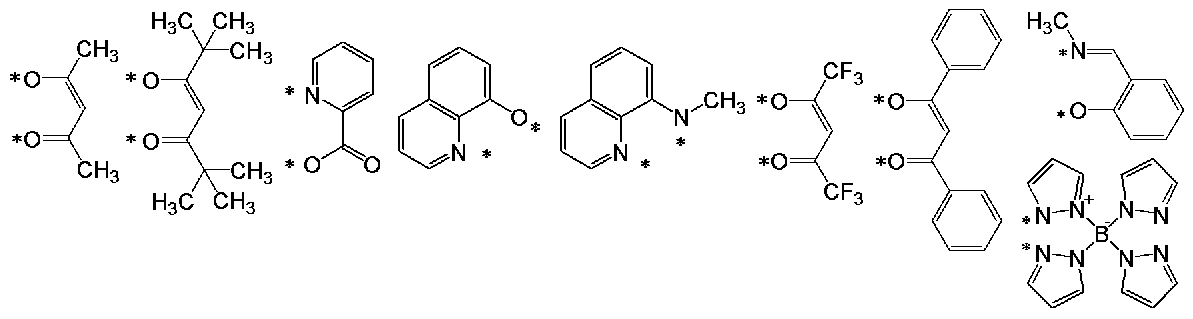
[式(2’)で表される金属錯体]
式(2)で表される金属錯体は、本実施形態の発光素子の外部量子効率がより優れるので、好ましくは、式(2’)で表される金属錯体である。
式(2)で表される金属錯体は、本実施形態の発光素子の外部量子効率がより優れるので、好ましくは、式(2’)で表される金属錯体である。
M2’の例及び好ましい範囲は、M2の例及び好ましい範囲と同じである。
n3’の例及び好ましい範囲は、n3の例及び好ましい範囲と同じである。
EL’の例及び好ましい範囲は、ELの例及び好ましい範囲と同じである。
環L1’の例及び好ましい範囲は、環L1の例及び好ましい範囲と同じである。
環L2’の例及び好ましい範囲は、環L2の例及び好ましい範囲と同じである。
n3’の例及び好ましい範囲は、n3の例及び好ましい範囲と同じである。
EL’の例及び好ましい範囲は、ELの例及び好ましい範囲と同じである。
環L1’の例及び好ましい範囲は、環L1の例及び好ましい範囲と同じである。
環L2’の例及び好ましい範囲は、環L2の例及び好ましい範囲と同じである。
本実施形態の発光素子の外部量子効率がより優れるので、環L1’はピリジン環、ジアザベンゼン環、アザナフタレン環又はジアザナフタレン環であり、且つ、環L2’はベンゼン環、ピリジン環又はジアザベンゼン環であることが好ましく、環L1’はピリジン環、キノリン環又はイソキノリン環であり、且つ、環L1’はベンゼン環であることがより好ましく、これらの環は置換基を有していてもよい。
「環L1’及び環L2’のうちの少なくとも1つは、置換基として、式(2-T)で表される基を有する」とは、環L1’及び環L2’を構成する原子(好ましくは炭素原子又は窒素原子であり、より好ましくは炭素原子である。)の少なくとも1つに式(2-T)で表される基が直接結合していることを意味する。式(2’)で表される金属錯体において、環L1’及び環L2’が複数存在する場合、複数存在する環L1’及び環L2’のうちの少なくとも1つの環が式(2-T)で表される基を有していればよいが、本実施形態の発光素子の外部量子効率がより優れるので、複数存在する環L1’の全て、複数存在する環L2’の全て、又は、複数存在する環L1’及び環L2’の全てが、式(2-T)で表される基を有することが好ましく、複数存在する環L1’の全て、又は、複数存在する環L2’の全てが、式(2-T)で表される基を有することがより好ましい。
式(2’)で表される金属錯体において、環L1’及び環L2’の少なくとも1つが有する式(2-T)で表される基の個数は、通常、1個~5個であり、式(2’)で表される金属錯体を容易に合成できるので、好ましくは1個~3個であり、より好ましくは1個又は2個であり、更に好ましくは1個である。
式(2’)で表される金属錯体において、M2’がロジウム原子又はイリジウム原子の場合、環L1’及び環L2’が有する式(2-T)で表される基の合計の個数は、通常、1個~30個であり、本実施形態の発光素子の外部量子効率がより優れるので、好ましくは1個~18個であり、より好ましくは2個~12個であり、更に好ましくは2個~6個であり、特に好ましくは2個~4個である。
式(2’)で表される金属錯体において、M2’がパラジウム原子又は白金原子の場合、環L1’及び環L2’が有する式(2-T)で表される基の合計の個数は、通常、1個~20個であり、本実施形態の発光素子の外部量子効率がより優れるので、好ましくは1個~12個であり、より好ましくは1個~8個であり、更に好ましくは2個~4個である。
式(2’)で表される金属錯体において、M2’がロジウム原子又はイリジウム原子の場合、環L1’及び環L2’が有する式(2-T)で表される基の合計の個数は、通常、1個~30個であり、本実施形態の発光素子の外部量子効率がより優れるので、好ましくは1個~18個であり、より好ましくは2個~12個であり、更に好ましくは2個~6個であり、特に好ましくは2個~4個である。
式(2’)で表される金属錯体において、M2’がパラジウム原子又は白金原子の場合、環L1’及び環L2’が有する式(2-T)で表される基の合計の個数は、通常、1個~20個であり、本実施形態の発光素子の外部量子効率がより優れるので、好ましくは1個~12個であり、より好ましくは1個~8個であり、更に好ましくは2個~4個である。
環L1’及び環L2’が有していてもよい置換基の例及び好ましい範囲は、環L1及び環L2が有していてもよい置換基の例及び好ましい範囲と同じである。
A3’-G2’-A4’で表されるアニオン性の2座配位子の例及び好ましい範囲は、A3-G2-A4で表されるアニオン性の2座配位子の例及び好ましい範囲と同じである。なお、A3’-G2’-A4’で表されるアニオン性の2座配位子において、上記式中の*はM2’と結合する部位を表す。但し、A3’-G2’-A4’で表されるアニオン性の2座配位子は、添え字n3’でその数を定義されている配位子とは異なる。
式(2)で表される金属錯体としては、例えば、下記式で表される金属錯体、及び、後述の金属錯体R2~R4が挙げられる。
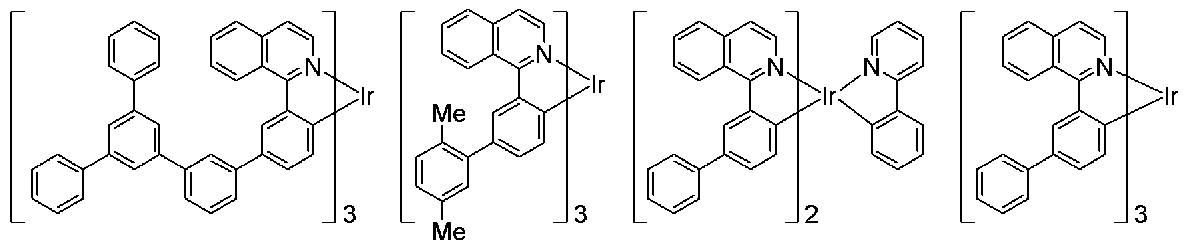
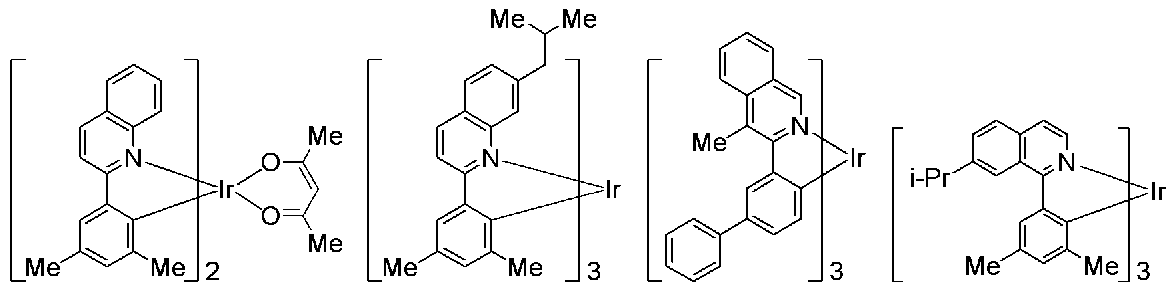

<式(1)で表される金属錯体>
式(1)で表される金属錯体は、通常、室温で燐光発光性を示す金属錯体であり、好ましくは、室温で三重項励起状態からの発光を示す金属錯体である。
式(1)で表される金属錯体は、通常、室温で燐光発光性を示す金属錯体であり、好ましくは、室温で三重項励起状態からの発光を示す金属錯体である。
M1は、本実施形態の発光素子の外部量子効率がより優れるので、イリジウム原子又は白金原子であることが好ましく、イリジウム原子であることがより好ましい。
M1がロジウム原子又はイリジウム原子の場合、n1は2又は3であることが好ましく、3であることがより好ましい。
M1がパラジウム原子又は白金原子の場合、n1は2であることが好ましい。
E1及びE2は、炭素原子であることが好ましい。
式(1)で表される金属錯体を容易に合成できるので、E1及びE2は好ましくは同一である。また、式(1)で表される金属錯体を容易に合成できるので、E1が複数存在する場合、それらは好ましくは同一である。また、式(1)で表される金属錯体を容易に合成できるので、E2が複数存在する場合、それらは好ましくは同一である。
M1がロジウム原子又はイリジウム原子の場合、n1は2又は3であることが好ましく、3であることがより好ましい。
M1がパラジウム原子又は白金原子の場合、n1は2であることが好ましい。
E1及びE2は、炭素原子であることが好ましい。
式(1)で表される金属錯体を容易に合成できるので、E1及びE2は好ましくは同一である。また、式(1)で表される金属錯体を容易に合成できるので、E1が複数存在する場合、それらは好ましくは同一である。また、式(1)で表される金属錯体を容易に合成できるので、E2が複数存在する場合、それらは好ましくは同一である。
環R1としては、例えば、前述の複素環基の項で例示した芳香族複素環の中で1つ以上の窒素原子を構成原子として有する5員の芳香族複素環が挙げられ、好ましくは、5員の単環式の芳香族複素環であり、より好ましくは、ジアゾール環又はトリアゾール環であり、更に好ましくは、ジアゾール環であり、これらの環は置換基を有していてもよい。
式(1)で表される金属錯体を容易に合成できるので、環R1が複数存在する場合、それらは好ましくは同一である。より詳細には、環R1が複数存在する場合、複数存在する環R1のうち、少なくとも2つが同一であることが好ましく、複数存在する環R1のすべてが同一であることがより好ましい。
環R2の例及び好ましい範囲は、環L2の例及び好ましい範囲と同じである。
式(1)で表される金属錯体を容易に合成できるので、環R1が複数存在する場合、それらは好ましくは同一である。より詳細には、環R1が複数存在する場合、複数存在する環R1のうち、少なくとも2つが同一であることが好ましく、複数存在する環R1のすべてが同一であることがより好ましい。
環R2の例及び好ましい範囲は、環L2の例及び好ましい範囲と同じである。
本実施形態の発光素子の外部量子効率がより優れるので、環R1はジアゾール環又はトリアゾール環であり、且つ、環R2はベンゼン環、ピリジン環又はジアザベンゼン環であることが好ましく、環R1はジアゾール環又はトリアゾール環であり、且つ、環R2はベンゼン環であることがより好ましく、環R1はジアゾール環であり、且つ、環R2はベンゼン環であることが更に好ましく、これらの環は置換基を有していてもよい。
環R1及び環R2が有していてもよい置換基の例及び好ましい範囲は、環L1及び環L2が有していてもよい置換基の例及び好ましい範囲と同じである。
環R1及び環R2のうちの少なくとも1つは、置換基(好ましくは、式(1-T)で表される基であり、より好ましくは、式(2-T)で表される基であり、以下、同様である。)を有することが好ましい。
なお、式(1)で表される金属錯体において、環R1及び環R2が複数存在する場合、複数存在する環R1及び環R2のうちの少なくとも1つの環が置換基を有していればよいが、本実施形態の発光素子の外部量子効率がより優れるので、複数存在する環R1の全て、複数存在する環R2の全て、又は、複数存在する環R1及び環R2の全てが、置換基を有することが好ましく、複数存在する環R1の全て、又は、複数存在する環R2の全てが、置換基を有することがより好ましく、複数存在する環R1の全てが、置換基を有することが更に好ましい。
なお、式(1)で表される金属錯体において、環R1及び環R2が複数存在する場合、複数存在する環R1及び環R2のうちの少なくとも1つの環が置換基を有していればよいが、本実施形態の発光素子の外部量子効率がより優れるので、複数存在する環R1の全て、複数存在する環R2の全て、又は、複数存在する環R1及び環R2の全てが、置換基を有することが好ましく、複数存在する環R1の全て、又は、複数存在する環R2の全てが、置換基を有することがより好ましく、複数存在する環R1の全てが、置換基を有することが更に好ましい。
式(1)で表される金属錯体において、環R1及び環R2の少なくとも1つが有する置換基の個数は、通常、1個~5個であり、式(1)で表される金属錯体を容易に合成できるので、好ましくは1個~3個であり、より好ましくは1個又は2個であり、更に好ましくは1個である。
式(1)で表される金属錯体において、M1がロジウム原子又はイリジウム原子の場合、環R1及び環R2が有する置換基の合計の個数は、通常、1個~30個であり、本実施形態の発光素子の外部量子効率がより優れるので、好ましくは1個~18個であり、より好ましくは2個~12個であり、更に好ましくは3個~6個である。
式(1)で表される金属錯体において、M1がパラジウム原子又は白金原子の場合、環R1及び環R2が有する置換基の合計の個数は、通常、1個~20個であり、本実施形態の発光素子の外部量子効率がより優れるので、好ましくは1個~12個であり、より好ましくは1個~8個であり、更に好ましくは2個~4個である。
式(1)で表される金属錯体において、M1がロジウム原子又はイリジウム原子の場合、環R1及び環R2が有する置換基の合計の個数は、通常、1個~30個であり、本実施形態の発光素子の外部量子効率がより優れるので、好ましくは1個~18個であり、より好ましくは2個~12個であり、更に好ましくは3個~6個である。
式(1)で表される金属錯体において、M1がパラジウム原子又は白金原子の場合、環R1及び環R2が有する置換基の合計の個数は、通常、1個~20個であり、本実施形態の発光素子の外部量子効率がより優れるので、好ましくは1個~12個であり、より好ましくは1個~8個であり、更に好ましくは2個~4個である。
A1-G1-A2で表されるアニオン性の2座配位子の例及び好ましい範囲は、A3-G2-A4で表されるアニオン性の2座配位子の例及び好ましい範囲と同じである。なお、A1-G1-A2で表されるアニオン性の2座配位子において、上記式中の*はM1と結合する部位を表す。但し、A1-G1-A2で表されるアニオン性の2座配位子は、添え字n1でその数を規定されている配位子とは異なる。
式(1)で表される金属錯体としては、例えば、下記式で表される金属錯体、及び、後述の金属錯体B1が挙げられる。なお、式中、ZAは、-CH=で表される基又は-N=で表される基を表す。ZAが複数存在する場合、それらは同一でも異なっていてもよい。

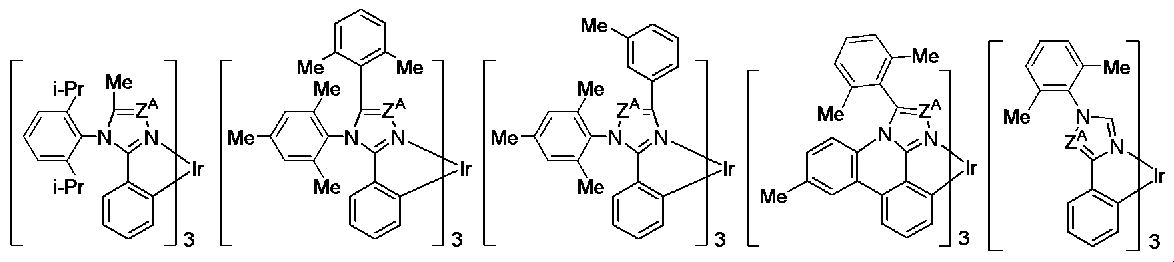
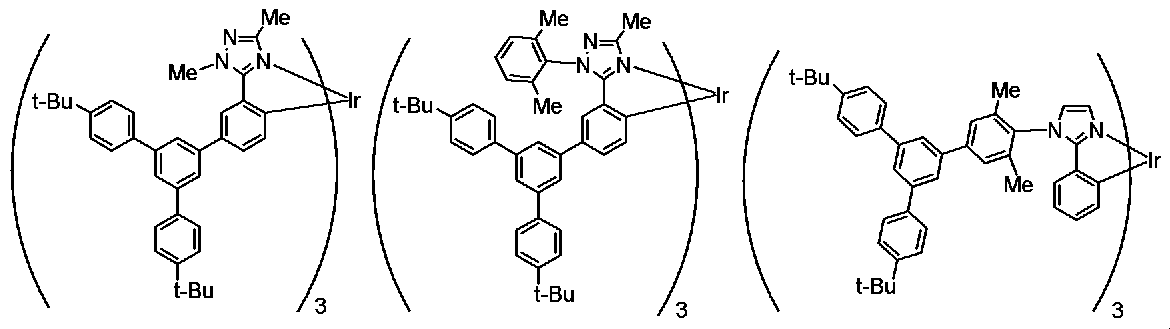
<式(3)で表される金属錯体>
式(3)で表される金属錯体は、通常、室温で燐光発光性を示す金属錯体であり、好ましくは、室温で三重項励起状態からの発光を示す金属錯体である。
式(3)で表される金属錯体は、通常、室温で燐光発光性を示す金属錯体であり、好ましくは、室温で三重項励起状態からの発光を示す金属錯体である。
M3は、本実施形態の発光素子の外部量子効率がより優れるので、イリジウム原子又は白金原子であることが好ましく、イリジウム原子であることがより好ましい。
M3がロジウム原子又はイリジウム原子の場合、n5は2又は3であることが好ましく、3であることがより好ましい。
M3がパラジウム原子又は白金原子の場合、n5は2であることが好ましい。
EL1は、炭素原子であることが好ましい。式(3)で表される金属錯体を容易に合成できるので、EL1が複数存在する場合、それらは好ましくは同一である。
M3がロジウム原子又はイリジウム原子の場合、n5は2又は3であることが好ましく、3であることがより好ましい。
M3がパラジウム原子又は白金原子の場合、n5は2であることが好ましい。
EL1は、炭素原子であることが好ましい。式(3)で表される金属錯体を容易に合成できるので、EL1が複数存在する場合、それらは好ましくは同一である。
環L3における6員の芳香族複素環の炭素原子数は、置換基の炭素原子数を含めないで、通常1~60であり、好ましくは1~30であり、更に好ましくは2~15であり、特に好ましくは3~5である。環L3における6員の芳香族複素環のヘテロ原子数は、置換基のヘテロ原子数を含めないで、通常1~30であり、好ましくは、1~10であり、より好ましくは1~3である。
環L3としては、例えば、前述の複素環基の項で例示した芳香族複素環の中で1つ以上の窒素原子を構成原子として有する6員の芳香族複素環が挙げられ、本実施形態の発光素子の外部量子効率がより優れるので、好ましくは、1つ以上4つ以下の窒素原子を構成原子として有する6員の芳香族複素環(好ましくは、6員の単環式の芳香族複素環)であり、より好ましくは、ピリジン環又はジアザベンゼン環であり、更に好ましくは、ピリジン環であり、これらの環は置換基を有していてもよい。
式(3)で表される金属錯体を容易に合成できるので、環L3が複数存在する場合、それらは好ましくは同一である。より詳細には、環L3が複数存在する場合、複数存在する環L3のうち、少なくとも2つが同一であることが好ましく、複数存在する環L3のすべてが同一であることがより好ましい。
環L4の例及び好ましい範囲は、環L2の例及び好ましい範囲と同じである。
環L3としては、例えば、前述の複素環基の項で例示した芳香族複素環の中で1つ以上の窒素原子を構成原子として有する6員の芳香族複素環が挙げられ、本実施形態の発光素子の外部量子効率がより優れるので、好ましくは、1つ以上4つ以下の窒素原子を構成原子として有する6員の芳香族複素環(好ましくは、6員の単環式の芳香族複素環)であり、より好ましくは、ピリジン環又はジアザベンゼン環であり、更に好ましくは、ピリジン環であり、これらの環は置換基を有していてもよい。
式(3)で表される金属錯体を容易に合成できるので、環L3が複数存在する場合、それらは好ましくは同一である。より詳細には、環L3が複数存在する場合、複数存在する環L3のうち、少なくとも2つが同一であることが好ましく、複数存在する環L3のすべてが同一であることがより好ましい。
環L4の例及び好ましい範囲は、環L2の例及び好ましい範囲と同じである。
本実施形態の発光素子の外部量子効率がより優れるので、環L3はピリジン環又はジアザベンゼン環であり、且つ、環L4はベンゼン環、ピリジン環又はジアザベンゼン環であることが好ましく、環L3はピリジン環であり、且つ、環L4はベンゼン環であることがより好ましく、これらの環は置換基を有していてもよい。
環L3及び環L4が有していてもよい置換基の例及び好ましい範囲は、環L1及び環L2が有していてもよい置換基の例及び好ましい範囲と同じである。
「環L3及び環L4のうちの少なくとも1つは、置換基として、式(3-T)で表される基を有する」とは、環L3及び環L4を構成する原子(好ましくは炭素原子又は窒素原子であり、より好ましくは炭素原子である。)の少なくとも1つに式(3-T)で表される基が直接結合していることを意味する。式(3)で表される金属錯体において、環L3及び環L4が複数存在する場合、複数存在する環L3及び環L4のうちの少なくとも1つの環が式(3-T)で表される基を有していればよいが、本実施形態の発光素子の外部量子効率がより優れるので、複数存在する環L3の全て、複数存在する環L4の全て、又は、複数存在する環L3及び環L4の全てが、式(3-T)で表される基を有することが好ましく、複数存在する環L3の全て、又は、複数存在する環L4の全てが、式(3-T)で表される基を有することがより好ましく、複数存在する環L4の全てが、式(3-T)で表される基を有することが更に好ましい。
式(3)で表される金属錯体において、環L3及び環L4の少なくとも1つが有する式(3-T)で表される基の個数は、通常、1個~5個であり、式(3)で表される金属錯体を容易に合成できるので、好ましくは1個~3個であり、より好ましくは1個又は2個であり、更に好ましくは1個である。
式(3)で表される金属錯体において、M3がロジウム原子又はイリジウム原子の場合、環L3及び環L4が有する式(3-T)で表される基の合計の個数は、通常、1個~30個であり、本実施形態の発光素子の外部量子効率がより優れるので、好ましくは1個~18個であり、より好ましくは2個~12個であり、更に好ましくは2個~6個であり、特に好ましくは2個~4個である。
式(3)で表される金属錯体において、M3がパラジウム原子又は白金原子の場合、環L3及び環L4が有する式(3-T)で表される基の合計の個数は、通常、1個~20個であり、本実施形態の発光素子の外部量子効率がより優れるので、好ましくは1個~12個であり、より好ましくは1個~8個であり、更に好ましくは2個~4個である。
式(3)で表される金属錯体において、M3がパラジウム原子又は白金原子の場合、環L3及び環L4が有する式(3-T)で表される基の合計の個数は、通常、1個~20個であり、本実施形態の発光素子の外部量子効率がより優れるので、好ましくは1個~12個であり、より好ましくは1個~8個であり、更に好ましくは2個~4個である。
A5-G3-A6で表されるアニオン性の2座配位子の例及び好ましい範囲は、A3-G2-A4で表されるアニオン性の2座配位子の例及び好ましい範囲と同じである。なお、A5-G3-A6で表されるアニオン性の2座配位子において、上記式中の*はM3と結合する部位を表す。但し、A5-G3-A6で表されるアニオン性の2座配位子は、添え字n5でその数を定義されている配位子とは異なる。
[式(3-T)で表される基]
R3Tにおけるアリール基、1価の複素環基及び置換アミノ基の例及び好ましい範囲は、それぞれ、R1Tにおけるアリール基、1価の複素環基及び置換アミノ基の例及び好ましい範囲と同じである。
R3Tにおけるアリール基、1価の複素環基及び置換アミノ基の例及び好ましい範囲は、それぞれ、R1Tにおけるアリール基、1価の複素環基及び置換アミノ基の例及び好ましい範囲と同じである。
R3Tは、本実施形態の発光素子の外部量子効率がより優れるので、好ましくは、アリール基又は1価の複素環基であり、より好ましくはアリール基であり、これらの基は置換基を有していてもよい。
R3Tが有していてもよい置換基の例及び好ましい範囲は、R1Tが有していてもよい置換基の例及び好ましい範囲と同じである。
R3Tが有していてもよい置換基の例及び好ましい範囲は、R1Tが有していてもよい置換基の例及び好ましい範囲と同じである。
式(3)で表される金属錯体としては、例えば、下記式で表される金属錯体、及び、後述の金属錯体G3が挙げられる。

<式(H-1)で表される化合物>
式(H-1)で表される化合物の分子量は、通常1×10²~1×10⁴であり、好ましくは2×10²~5×10³であり、より好ましくは3×10²~3×10³であり、更に好ましくは4×10²~1×10³である。式(H-1)で表される化合物は、低分子化合物である。
式(H-1)で表される化合物の分子量は、通常1×10²~1×10⁴であり、好ましくは2×10²~5×10³であり、より好ましくは3×10²~3×10³であり、更に好ましくは4×10²~1×10³である。式(H-1)で表される化合物は、低分子化合物である。
ArH1及びArH2におけるアリール基、並びに、LH1におけるアリーレン基としては、好ましくは、単環式又は2~6環式の芳香族炭化水素から環を構成する炭素原子に直接結合する水素原子1個又は2個(但し、アリール基の場合、水素原子1個であり、アリーレン基の場合、水素原子2個であり、以下、同様である。)を除いた基であり、より好ましくは、単環式又は2~4環式の芳香族炭化水素から環を構成する炭素原子に直接結合する水素原子1個又は2個を除いた基であり、更に好ましくは、ベンゼン、ナフタレン、フルオレン、フェナントレン又はトリフェニレンから環を構成する炭素原子に直接結合する水素原子1個又は2個を除いた基であり、これらの基は置換基を有していてもよい。
ArH1及びArH2における1価の複素環基、並びに、LH1における2価の複素環基としては、好ましくは、単環式又は2~6環式の複素環式化合物から環を構成する炭素原子又はヘテロ原子に直接結合する水素原子1個又は2個(但し、1価の複素環基の場合、水素原子1個であり、2価の複素環基の場合、水素原子2個であり、以下、同様である。)を除いた基であり、より好ましくは、単環式、2環式、3環式又は5環式の複素環式化合物から環を構成する炭素原子又はヘテロ原子に直接結合する水素原子1個又は2個を除いた基であり、更に好ましくは、ピリジン、ジアザベンゼン、トリアジン、アザナフタレン、ジアザナフタレン、カルバゾール、ジベンゾフラン、ジベンゾチオフェン、フェノキサジン、フェノチアジン、ジベンゾカルバゾール、インドロカルバゾール又はインデノカルバゾールから環を構成する炭素原子又はヘテロ原子に直接結合する水素原子1個又は2個を除いた基であり、特に好ましくは、ピリジン、ジアザベンゼン、トリアジン、アザナフタレン、ジアザナフタレン、カルバゾール、ジベンゾフラン又はジベンゾチオフェンから環を構成する炭素原子又はヘテロ原子に直接結合する水素原子1個又は2個を除いた基であり、これらの基は置換基を有していてもよい。
ArH1及びArH2における置換アミノ基において、アミノ基が有する置換基としては、アリール基又は1価の複素環基が好ましく、アリール基がより好ましく、これらの基は更に置換基を有していてもよい。アミノ基が有する置換基であるアリール基の例及び好ましい範囲は、ArH1及びArH2におけるアリール基の例及び好ましい範囲と同じである。アミノ基が有する置換基である1価の複素環基の例及び好ましい範囲は、ArH1及びArH2における1価の複素環基の例及び好ましい範囲と同じである。
ArH1及びArH2における1価の複素環基、並びに、LH1における2価の複素環基としては、好ましくは、単環式又は2~6環式の複素環式化合物から環を構成する炭素原子又はヘテロ原子に直接結合する水素原子1個又は2個(但し、1価の複素環基の場合、水素原子1個であり、2価の複素環基の場合、水素原子2個であり、以下、同様である。)を除いた基であり、より好ましくは、単環式、2環式、3環式又は5環式の複素環式化合物から環を構成する炭素原子又はヘテロ原子に直接結合する水素原子1個又は2個を除いた基であり、更に好ましくは、ピリジン、ジアザベンゼン、トリアジン、アザナフタレン、ジアザナフタレン、カルバゾール、ジベンゾフラン、ジベンゾチオフェン、フェノキサジン、フェノチアジン、ジベンゾカルバゾール、インドロカルバゾール又はインデノカルバゾールから環を構成する炭素原子又はヘテロ原子に直接結合する水素原子1個又は2個を除いた基であり、特に好ましくは、ピリジン、ジアザベンゼン、トリアジン、アザナフタレン、ジアザナフタレン、カルバゾール、ジベンゾフラン又はジベンゾチオフェンから環を構成する炭素原子又はヘテロ原子に直接結合する水素原子1個又は2個を除いた基であり、これらの基は置換基を有していてもよい。
ArH1及びArH2における置換アミノ基において、アミノ基が有する置換基としては、アリール基又は1価の複素環基が好ましく、アリール基がより好ましく、これらの基は更に置換基を有していてもよい。アミノ基が有する置換基であるアリール基の例及び好ましい範囲は、ArH1及びArH2におけるアリール基の例及び好ましい範囲と同じである。アミノ基が有する置換基である1価の複素環基の例及び好ましい範囲は、ArH1及びArH2における1価の複素環基の例及び好ましい範囲と同じである。
本実施形態の発光素子の外部量子効率がより優れるので、ArH1及びArH2の少なくとも1つは、アリール基又は1価の複素環基であることが好ましく、1価の複素環基であることがより好ましく、カルバゾリル基、ジベンゾチエニル基又はジベンゾフリル基であることが更に好ましく、カルバゾリル基であることが特に好ましく、これらの基は置換基を有していてもよい。
本実施形態の発光素子の外部量子効率が更に優れるので、ArH1及びArH2は、好ましくは、アリール基又は1価の複素環基であり、より好ましくは、ベンゼン、フルオレン、ピリジン、ジアザベンゼン、トリアジン、カルバゾール、ジベンゾフラン又はジベンゾチオフェンから環を構成する炭素原子又はヘテロ原子に直接結合する水素原子1個を除いた基であり、更に好ましくは、フェニル基、フルオレニル基、ジベンゾチエニル基、ジベンゾフリル基又はカルバゾリル基であり、特に好ましくは、カルバゾリル基であり、これらの基は置換基を有していてもよい。
本実施形態の発光素子の外部量子効率が更に優れるので、ArH1及びArH2は、好ましくは、アリール基又は1価の複素環基であり、より好ましくは、ベンゼン、フルオレン、ピリジン、ジアザベンゼン、トリアジン、カルバゾール、ジベンゾフラン又はジベンゾチオフェンから環を構成する炭素原子又はヘテロ原子に直接結合する水素原子1個を除いた基であり、更に好ましくは、フェニル基、フルオレニル基、ジベンゾチエニル基、ジベンゾフリル基又はカルバゾリル基であり、特に好ましくは、カルバゾリル基であり、これらの基は置換基を有していてもよい。
本実施形態の発光素子の外部量子効率がより優れるので、LH1の少なくとも1つは、アリーレン基又は2価の複素環基であることが好ましく、2価の複素環基であることがより好ましく、カルバゾール、ジベンゾフラン又はジベンゾチオフェンから環を構成する炭素原子又はヘテロ原子(好ましくは炭素原子)に直接結合する水素原子2個を除いた基であることが更に好ましく、これらの基は更に置換基を有していてもよい。
本実施形態の発光素子の外部量子効率が更に優れるので、LH1は、好ましくは、アリーレン基又は2価の複素環基であり、より好ましくは、ベンゼン、ナフタレン、フルオレン、ピリジン、ジアザベンゼン、トリアジン、アザナフタレン、ジアザナフタレン、カルバゾール、ジベンゾフラン又はジベンゾチオフェンから環を構成する炭素原子又はヘテロ原子(好ましくは炭素原子)に直接結合する水素原子2個を除いた基であり、更に好ましくは、ベンゼン、フルオレン、ピリジン、ジアザベンゼン、トリアジン、カルバゾール、ジベンゾフラン又はジベンゾチオフェンから環を構成する炭素原子又はヘテロ原子(好ましくは炭素原子)に直接結合する水素原子2個を除いた基であり、特に好ましくは、ジベンゾフラン又はジベンゾチオフェンから環を構成する炭素原子に直接結合する水素原子2個を除いた基であり、これらの基は置換基を有していてもよい。
ArH1、ArH2及びLH1が有していてもよい置換基としては、好ましくは、アルキル基、シクロアルキル基、アルコキシ基、シクロアルコキシ基、アリール基、1価の複素環基、置換アミノ基又はフッ素原子であり、より好ましくは、アルキル基、シクロアルキル基、アリール基、1価の複素環基又は置換アミノ基であり、更に好ましくは、アルキル基、アリール基又は1価の複素環基であり、これらの基は更に置換基を有していてもよい。
ArH1、ArH2及びLH1が有していてもよい置換基におけるアリール基、1価の複素環基及び置換アミノ基の例及び好ましい範囲は、それぞれ、ArH1及びArH2におけるアリール基、1価の複素環基及び置換アミノ基の例及び好ましい範囲と同じである。
ArH1、ArH2及びLH1が有していてもよい置換基におけるアリール基、1価の複素環基及び置換アミノ基の例及び好ましい範囲は、それぞれ、ArH1及びArH2におけるアリール基、1価の複素環基及び置換アミノ基の例及び好ましい範囲と同じである。
ArH1、ArH2及びLH1が有していてもよい置換基が更に有していてもよい置換基としては、好ましくは、アルキル基、シクロアルキル基、アリール基、1価の複素環基又は置換アミノ基であり、より好ましくは、アルキル基又はシクロアルキル基であり、これらの基は更に置換基を有していてもよいが、更に置換基を有さないことが好ましい。
ArH1、ArH2及びLH1が有していてもよい置換基が更に有していてもよい置換基におけるアリール基、1価の複素環基及び置換アミノ基の例及び好ましい範囲は、それぞれ、ArH1及びArH2におけるアリール基、1価の複素環基及び置換アミノ基の例及び好ましい範囲と同じである。
ArH1、ArH2及びLH1が有していてもよい置換基が更に有していてもよい置換基におけるアリール基、1価の複素環基及び置換アミノ基の例及び好ましい範囲は、それぞれ、ArH1及びArH2におけるアリール基、1価の複素環基及び置換アミノ基の例及び好ましい範囲と同じである。
nH1は、通常、0以上10以下の整数であり、好ましくは0以上5以下の整数であり、更に好ましくは1以上3以下の整数であり、特に好ましくは1である。
式(H-1)で表される化合物としては、例えば、下記式で表される化合物が挙げられる。なお、式中、ZAは、前記と同じ意味を表す。式中、ZBは、酸素原子又は硫黄原子を表す。ZBが複数存在する場合、それらは同一でも異なっていてもよい。


<式(T-1)で表される化合物>
式(T-1)で表される化合物の分子量は、通常1×10²以上1×10⁴以下であり、好ましくは2×10²以上5×10³以下であり、より好ましくは3×10²以上3×10³以下であり、更に好ましくは4×10²以上1.5×10³以下である。式(T-1)で表される化合物は、低分子化合物である。
式(T-1)で表される化合物の分子量は、通常1×10²以上1×10⁴以下であり、好ましくは2×10²以上5×10³以下であり、より好ましくは3×10²以上3×10³以下であり、更に好ましくは4×10²以上1.5×10³以下である。式(T-1)で表される化合物は、低分子化合物である。
nT1は、本実施形態の発光素子の外部量子効率がより優れるので、好ましくは0以上3以下の整数であり、より好ましくは0又は1である。
nT2は、本実施形態の発光素子の外部量子効率がより優れるので、好ましくは1以上5以下の整数であり、より好ましくは1以上3以下の整数であり、更に好ましくは2である。
nT2は、本実施形態の発光素子の外部量子効率がより優れるので、好ましくは1以上5以下の整数であり、より好ましくは1以上3以下の整数であり、更に好ましくは2である。
「二重結合を有さない窒素原子」とは、窒素原子と、その窒素原子と結合するすべての原子との間に単結合のみを有する窒素原子を意味する。
「環内に二重結合を有さない窒素原子を含む」とは、環内に-N(-RN)-(式中、RNは水素原子又は置換基を表す。)又は式:
「環内に二重結合を有さない窒素原子を含む」とは、環内に-N(-RN)-(式中、RNは水素原子又は置換基を表す。)又は式:

環内に二重結合を有さない窒素原子及び=N-で表される基を含む、縮合環の1価の複素環基(以下、「ArT1の複素環基」ともいう。)において、環を構成する二重結合を有さない窒素原子の数は、通常、1~10であり、好ましくは1~5であり、より好ましくは1~3であり、更に好ましくは1又は2である。また、縮合環の1価の複素環基において、環を構成する=N-で表される基の数は、通常、1~10であり、好ましくは1~5であり、より好ましくは1~3であり、更に好ましくは1又は2である。縮合環の1価の複素環基において、環を構成する炭素原子の数は、通常2~60であり、好ましくは5~30であり、より好ましくは8~25である。
ArT1の複素環基は、環内に二重結合を有さない窒素原子を含み、且つ、環内に=N-で表される基を含まない複素環(以下、「ドナー型複素環」ともいう。)の1個以上(好ましくは5個以下、より好ましくは3個以下、更に好ましくは1個)と、環内に=N-で表される基を含む複素環の1個以上(好ましくは5個以下、より好ましくは3個以下、更に好ましくは1個)とが縮合した複素環式化合物から、環を構成する炭素原子又はヘテロ原子に直接結合する水素原子1個を除いた基であることが好ましく、これらの基は置換基を有していてもよい。
ドナー型複素環において、環を構成する炭素原子の数は、通常1~60であり、好ましくは2~30であり、より好ましくは3~15である。ドナー型複素環において、環を構成する二重結合を有さない窒素原子の数は、通常、1~10であり、好ましくは1~5であり、より好ましくは1~3であり、更に好ましくは1又は2である。
ドナー型複素環としては、例えば、前述の複素環基の項で例示した複素環式化合物の中で、環内に二重結合を有さない窒素原子を含み、且つ、環内に=N-で表される基を含まない複素環が挙げられ、その中でも、好ましくは、単環式又は2~5環式の複素環であり、より好ましくは、単環式、2環式又は3環式の複素環であり、更に好ましくは、単環式又は2環式の複素環であり、これらの環は置換基を有していてもよい。
ドナー型複素環は、本実施形態の発光素子の外部量子効率がより優れるので、好ましくは、ピロール環、インドール環、カルバゾール環、9,10-ジヒドロアクリジン環、5,10-ジヒドロフェナジン環、フェノキサジン環又はフェノチアジン環であり、より好ましくは、ピロール環、インドール環又はカルバゾール環であり、更に好ましくは、ピロール環又はインドール環であり、これらの環は置換基を有していてもよい。
ドナー型複素環が有していてもよい置換基の例及び好ましい範囲は、ArH1、ArH2及びLH1が有していてもよい置換基の例及び好ましい範囲と同じである。
ドナー型複素環としては、例えば、前述の複素環基の項で例示した複素環式化合物の中で、環内に二重結合を有さない窒素原子を含み、且つ、環内に=N-で表される基を含まない複素環が挙げられ、その中でも、好ましくは、単環式又は2~5環式の複素環であり、より好ましくは、単環式、2環式又は3環式の複素環であり、更に好ましくは、単環式又は2環式の複素環であり、これらの環は置換基を有していてもよい。
ドナー型複素環は、本実施形態の発光素子の外部量子効率がより優れるので、好ましくは、ピロール環、インドール環、カルバゾール環、9,10-ジヒドロアクリジン環、5,10-ジヒドロフェナジン環、フェノキサジン環又はフェノチアジン環であり、より好ましくは、ピロール環、インドール環又はカルバゾール環であり、更に好ましくは、ピロール環又はインドール環であり、これらの環は置換基を有していてもよい。
ドナー型複素環が有していてもよい置換基の例及び好ましい範囲は、ArH1、ArH2及びLH1が有していてもよい置換基の例及び好ましい範囲と同じである。
環内に=N-で表される基を含む複素環において、環を構成する炭素原子の数は、通常1~60であり、好ましくは2~30であり、より好ましくは3~15である。環内に=N-で表される基を含む複素環において、環を構成する=N-で表される基の数は、通常、1~10であり、好ましくは1~5であり、より好ましくは1~3であり、更に好ましくは1又は2である。
環内に=N-で表される基を含む複素環としては、例えば、前述の複素環基の項で例示した複素環式化合物の中で、環内に=N-で表される基を含む複素環が挙げられ、その中でも、好ましくは、単環式、2環式又は3環式の複素環であり、より好ましくは単環式の複素環であり、これらの環は置換基を有していてもよい。
環内に=N-で表される基を含む複素環は、本実施形態の発光素子の外部量子効率がより優れるので、好ましくは、ジアゾール環、トリアゾール環、テトラゾール環、ピリジン環、ジアザベンゼン環、トリアジン環、アザナフタレン環、ジアザナフタレン環、アザカルバゾール環、ジアザカルバゾール環、アザアントラセン環、ジアザアントラセン環、アザフェナントレン環又はジアザフェナントレン環であり、より好ましくは、ピリジン環、ジアザベンゼン環、アザナフタレン環、ジアザナフタレン環、アザカルバゾール環又はジアザカルバゾール環であり、更に好ましくは、ピリジン環又はジアザベンゼン環であり、これらの環は置換基を有していてもよい。
環内に=N-で表される基を含む複素環が有していてもよい置換基の例及び好ましい範囲は、ArH1、ArH2及びLH1が有していてもよい置換基の例及び好ましい範囲と同じである。
環内に=N-で表される基を含む複素環としては、例えば、前述の複素環基の項で例示した複素環式化合物の中で、環内に=N-で表される基を含む複素環が挙げられ、その中でも、好ましくは、単環式、2環式又は3環式の複素環であり、より好ましくは単環式の複素環であり、これらの環は置換基を有していてもよい。
環内に=N-で表される基を含む複素環は、本実施形態の発光素子の外部量子効率がより優れるので、好ましくは、ジアゾール環、トリアゾール環、テトラゾール環、ピリジン環、ジアザベンゼン環、トリアジン環、アザナフタレン環、ジアザナフタレン環、アザカルバゾール環、ジアザカルバゾール環、アザアントラセン環、ジアザアントラセン環、アザフェナントレン環又はジアザフェナントレン環であり、より好ましくは、ピリジン環、ジアザベンゼン環、アザナフタレン環、ジアザナフタレン環、アザカルバゾール環又はジアザカルバゾール環であり、更に好ましくは、ピリジン環又はジアザベンゼン環であり、これらの環は置換基を有していてもよい。
環内に=N-で表される基を含む複素環が有していてもよい置換基の例及び好ましい範囲は、ArH1、ArH2及びLH1が有していてもよい置換基の例及び好ましい範囲と同じである。
ArT1の複素環基としては、例えば、アザインドール、ジアザインドール、アザカルバゾール、ジアザカルバゾール、又は、これらの環にドナー型複素環及び/若しくは環内に=N-で表される基を含む複素環が1個以上(好ましくは5個以下、より好ましくは3個以下、更に好ましくは1個である。)縮合した複素環式化合物から、環を構成する炭素原子又はヘテロ原子に直接結合する水素原子1個を除いた基が挙げられ、好ましくは、アザカルバゾール又はジアザカルバゾールから、環を構成する炭素原子又はヘテロ原子に直接結合する水素原子1個を除いた基であり、これらの基は置換基を有していてもよい。
ArT1の複素環基が有していてもよい置換基の例及び好ましい範囲は、ArH1、ArH2及びLH1が有していてもよい置換基の例及び好ましい範囲と同じである。
式(T-1)で表される化合物を容易に合成できるので、ArT1が複数存在する場合、それらは好ましくは同一である。
ArT1の複素環基が有していてもよい置換基の例及び好ましい範囲は、ArH1、ArH2及びLH1が有していてもよい置換基の例及び好ましい範囲と同じである。
式(T-1)で表される化合物を容易に合成できるので、ArT1が複数存在する場合、それらは好ましくは同一である。
ArT1の複素環基は、本実施形態の発光素子の外部量子効率がより優れるので、好ましくは、式(T1-1)で表される基である。
[式(T1-1)で表される基]
XT1は、好ましくは単結合、酸素原子、硫黄原子又は-C(RXT1’)2-で表される基であり、より好ましくは単結合、酸素原子又は硫黄原子であり、更に好ましくは単結合である。
XT1は、好ましくは単結合、酸素原子、硫黄原子又は-C(RXT1’)2-で表される基であり、より好ましくは単結合、酸素原子又は硫黄原子であり、更に好ましくは単結合である。
RXT1は、好ましくは、アルキル基、シクロアルキル基、アリール基又は1価の複素環基であり、より好ましくは、アリール基又は1価の複素環基であり、更に好ましくは、アリール基であり、これらの基は置換基を有していてもよい。
RXT1’は、好ましくは、アルキル基、シクロアルキル基、アリール基、1価の複素環基又は置換アミノ基であり、より好ましくは、アルキル基又はアリール基であり、更に好ましくは、アルキル基であり、これらの基は置換基を有していてもよい。
複数存在するRXT1’は、互いに結合して、それぞれが結合する炭素原子とともに環を形成しないことが好ましい。
RXT1’は、好ましくは、アルキル基、シクロアルキル基、アリール基、1価の複素環基又は置換アミノ基であり、より好ましくは、アルキル基又はアリール基であり、更に好ましくは、アルキル基であり、これらの基は置換基を有していてもよい。
複数存在するRXT1’は、互いに結合して、それぞれが結合する炭素原子とともに環を形成しないことが好ましい。
RXT1及びRXT1’におけるアリール基、1価の複素環基及び置換アミノ基の例及び好ましい範囲は、それぞれ、ArH1及びArH2におけるアリール基、1価の複素環基及び置換アミノ基の例及び好ましい範囲と同じである。
RXT1及びRXT1’が有していてもよい置換基の例及び好ましい範囲は、ArH1、ArH2及びLH1が有していてもよい置換基の例及び好ましい範囲と同じである。
RXT1及びRXT1’が有していてもよい置換基の例及び好ましい範囲は、ArH1、ArH2及びLH1が有していてもよい置換基の例及び好ましい範囲と同じである。
環RT1及び環RT2における芳香族炭化水素環の炭素原子数は、置換基の炭素原子数を含めないで、通常6~60であり、好ましくは6~30であり、更に好ましくは6~18である。
環RT1及び環RT2における芳香族炭化水素環としては、例えば、前述の芳香族炭化水素基の項で例示した芳香族炭化水素環が挙げられ、本実施形態の発光素子の外部量子効率がより優れるので、好ましくは、前述の芳香族炭化水素基の項で例示した、単環式、2環式又は3環式の芳香族炭化水素環であり、より好ましくは、単環式の芳香族炭化水素環であり、これらの基は置換基を有していてもよい。
環RT1及び環RT2における芳香族炭化水素環としては、本実施形態の発光素子の外部量子効率が更に優れるので、好ましくは、ベンゼン環、ナフタレン環、フルオレン環、フェナントレン環又はジヒドロフェナントレン環であり、より好ましくは、ベンゼン環、フルオレン環又はジヒドロフェナントレン環であり、更に好ましくは、ベンゼン環であり、これらの環は置換基を有していてもよい。
環RT1及び環RT2における複素環の炭素原子数は、置換基の炭素原子数を含めないで、通常1~60であり、好ましくは2~30であり、より好ましくは3~15である。環RT1及び環RT2における複素環のヘテロ原子数は、置換基のヘテロ原子数を含めないで、通常1~30であり、好ましくは、1~10であり、より好ましくは1~3である。
環RT1及び環RT2における複素環としては、例えば、前述の複素環基の項で例示した複素環が挙げられ、本実施形態の発光素子の外部量子効率がより優れるので、好ましくは、前述の複素環基の項で例示した、単環式、2環式又は3環式の複素環(好ましくは、ドナー型複素環又は環内に=N-で表される基を含む複素環であり、より好ましくは、環内に=N-で表される基を含む複素環である。)であり、より好ましくは、単環式の複素環(好ましくは、ドナー型複素環又は環内に=N-で表される基を含む複素環であり、より好ましくは、環内に=N-で表される基を含む複素環である。)であり、これらの環は置換基を有していてもよい。
環RT1及び環RT2における複素環としては、本実施形態の発光素子の外部量子効率が更に優れるので、好ましくは、カルバゾール環、9,10-ジヒドロアクリジン環、5,10-ジヒドロフェナジン環、フェノキサジン環、フェノチアジン環、ピリジン環、ジアザベンゼン環、アザナフタレン環、ジアザナフタレン環、アザカルバゾール環、ジアザカルバゾール環、ジベンゾフラン環又はジベンゾチオフェン環であり、より好ましくは、ピリジン環、ジアザベンゼン環、アザナフタレン環、ジアザナフタレン環、アザカルバゾール環又はジアザカルバゾール環であり、更に好ましくは、ピリジン環又はジアザベンゼン環であり、これらの環は置換基を有していてもよい。
環RT1及び環RT2における芳香族炭化水素環としては、例えば、前述の芳香族炭化水素基の項で例示した芳香族炭化水素環が挙げられ、本実施形態の発光素子の外部量子効率がより優れるので、好ましくは、前述の芳香族炭化水素基の項で例示した、単環式、2環式又は3環式の芳香族炭化水素環であり、より好ましくは、単環式の芳香族炭化水素環であり、これらの基は置換基を有していてもよい。
環RT1及び環RT2における芳香族炭化水素環としては、本実施形態の発光素子の外部量子効率が更に優れるので、好ましくは、ベンゼン環、ナフタレン環、フルオレン環、フェナントレン環又はジヒドロフェナントレン環であり、より好ましくは、ベンゼン環、フルオレン環又はジヒドロフェナントレン環であり、更に好ましくは、ベンゼン環であり、これらの環は置換基を有していてもよい。
環RT1及び環RT2における複素環の炭素原子数は、置換基の炭素原子数を含めないで、通常1~60であり、好ましくは2~30であり、より好ましくは3~15である。環RT1及び環RT2における複素環のヘテロ原子数は、置換基のヘテロ原子数を含めないで、通常1~30であり、好ましくは、1~10であり、より好ましくは1~3である。
環RT1及び環RT2における複素環としては、例えば、前述の複素環基の項で例示した複素環が挙げられ、本実施形態の発光素子の外部量子効率がより優れるので、好ましくは、前述の複素環基の項で例示した、単環式、2環式又は3環式の複素環(好ましくは、ドナー型複素環又は環内に=N-で表される基を含む複素環であり、より好ましくは、環内に=N-で表される基を含む複素環である。)であり、より好ましくは、単環式の複素環(好ましくは、ドナー型複素環又は環内に=N-で表される基を含む複素環であり、より好ましくは、環内に=N-で表される基を含む複素環である。)であり、これらの環は置換基を有していてもよい。
環RT1及び環RT2における複素環としては、本実施形態の発光素子の外部量子効率が更に優れるので、好ましくは、カルバゾール環、9,10-ジヒドロアクリジン環、5,10-ジヒドロフェナジン環、フェノキサジン環、フェノチアジン環、ピリジン環、ジアザベンゼン環、アザナフタレン環、ジアザナフタレン環、アザカルバゾール環、ジアザカルバゾール環、ジベンゾフラン環又はジベンゾチオフェン環であり、より好ましくは、ピリジン環、ジアザベンゼン環、アザナフタレン環、ジアザナフタレン環、アザカルバゾール環又はジアザカルバゾール環であり、更に好ましくは、ピリジン環又はジアザベンゼン環であり、これらの環は置換基を有していてもよい。
環RT1は、本実施形態の発光素子の外部量子効率がより優れるので、好ましくは、芳香族炭化水素環又は環内に=N-で表される基を含む複素環であり、より好ましくは、単環式の芳香族炭化水素環又は環内に=N-で表される基を含む単環式の複素環であり、更に好ましくは、ベンゼン環、ピリジン環又はジアザベンゼン環であり、特に好ましくはベンゼン環であり、これらの環は置換基を有していてもよい。
環RT2は、本実施形態の発光素子の外部量子効率がより優れるので、好ましくは、環内に=N-で表される基を含む複素環であり、より好ましくは、環内に=N-で表される基を含む単環式の複素環であり、更に好ましくは、ピリジン環又はジアザベンゼン環であり、特に好ましくはピリジン環であり、これらの環は置換基を有していてもよい。
本実施形態の発光素子の外部量子効率が更に優れるので、環RT1が、芳香族炭化水素環又は環内に=N-で表される基を含む複素環であり、且つ、環RT2が、環内に=N-で表される基を含む複素環であることが好ましく、環RT1が、単環式の芳香族炭化水素環又は環内に=N-で表される基を含む単環式の複素環であり、且つ、環RT2が、環内に=N-で表される基を含む単環式の複素環であることがより好ましく、環RT1が、ベンゼン環、ピリジン環又はジアザベンゼン環であり、且つ、環RT2が、ピリジン環又はジアザベンゼン環であることが更に好ましく、環RT1がベンゼン環であり、且つ、環RT2が、ピリジン環であることが特に好ましく、これらの環は置換基を有していてもよい。
環RT2は、本実施形態の発光素子の外部量子効率がより優れるので、好ましくは、環内に=N-で表される基を含む複素環であり、より好ましくは、環内に=N-で表される基を含む単環式の複素環であり、更に好ましくは、ピリジン環又はジアザベンゼン環であり、特に好ましくはピリジン環であり、これらの環は置換基を有していてもよい。
本実施形態の発光素子の外部量子効率が更に優れるので、環RT1が、芳香族炭化水素環又は環内に=N-で表される基を含む複素環であり、且つ、環RT2が、環内に=N-で表される基を含む複素環であることが好ましく、環RT1が、単環式の芳香族炭化水素環又は環内に=N-で表される基を含む単環式の複素環であり、且つ、環RT2が、環内に=N-で表される基を含む単環式の複素環であることがより好ましく、環RT1が、ベンゼン環、ピリジン環又はジアザベンゼン環であり、且つ、環RT2が、ピリジン環又はジアザベンゼン環であることが更に好ましく、環RT1がベンゼン環であり、且つ、環RT2が、ピリジン環であることが特に好ましく、これらの環は置換基を有していてもよい。
環RT1及び環RT2が有していてもよい置換基の例及び好ましい範囲は、ArH1、ArH2及びLH1が有していてもよい置換基の例及び好ましい範囲と同じである。
LT1におけるアリーレン基の例及び好ましい範囲は、LH1におけるアリーレン基におけるアリーレン基の例及び好ましい範囲と同じである。
LT1における2価の複素環基の例及び好ましい範囲は、LH1における2価の複素環基におけるアリーレン基の例及び好ましい範囲と同じである。
LT1における2価の複素環基の例及び好ましい範囲は、LH1における2価の複素環基におけるアリーレン基の例及び好ましい範囲と同じである。
LT1は、好ましくは、アリーレン基又は2価の複素環基であり、より好ましくは、ベンゼン、ナフタレン、フルオレン、ピリジン、ジアザベンゼン、トリアジン、アザナフタレン、ジアザナフタレン、カルバゾール、ジベンゾフラン又はジベンゾチオフェンから環を構成する炭素原子又はヘテロ原子に直接結合する水素原子2個を除いた基であり、更に好ましくは、ベンゼン、フルオレン、ピリジン、ジアザベンゼン、トリアジン、カルバゾール、ジベンゾフラン又はジベンゾチオフェンから環を構成する炭素原子又はヘテロ原子に直接結合する水素原子2個を除いた基であり、特に好ましくは、ベンゼン、ジベンゾフラン又はジベンゾチオフェンから環を構成する炭素原子に直接結合する水素原子2個を除いた基であり、とりわけ好ましくは、フェニレン基であり、これらの基は置換基を有していてもよい。
式(T-1)で表される化合物を容易に合成できるので、LT1が複数存在する場合、それらは好ましくは同一である。
式(T-1)で表される化合物を容易に合成できるので、LT1が複数存在する場合、それらは好ましくは同一である。
LT1が有していてもよい置換基の例及び好ましい範囲は、ArH1、ArH2及びLH1が有していてもよい置換基の例及び好ましい範囲と同じである。
RT1’は、好ましくは、アリール基又は1価の複素環基であり、より好ましくはアリール基であり、これらの基は置換基を有していてもよい。
RT1’におけるアリール基及び1価の複素環基の例及び好ましい範囲は、それぞれ、ArH1及びArH2におけるアリール基及び1価の複素環基の例及び好ましい範囲と同じである。
RT1’が有していてもよい置換基の例及び好ましい範囲は、ArH1、ArH2及びLH1が有していてもよい置換基の例及び好ましい範囲と同じである。
RT1’におけるアリール基及び1価の複素環基の例及び好ましい範囲は、それぞれ、ArH1及びArH2におけるアリール基及び1価の複素環基の例及び好ましい範囲と同じである。
RT1’が有していてもよい置換基の例及び好ましい範囲は、ArH1、ArH2及びLH1が有していてもよい置換基の例及び好ましい範囲と同じである。
ArT2における芳香族炭化水素基は、好ましくは、単環式又は2~6環式の芳香族炭化水素から環を構成する炭素原子に直接結合する水素原子1個以上を除いた基であり、より好ましくは、単環式、2環式又は3環式の芳香族炭化水素から環を構成する炭素原子に直接結合する水素原子1個以上を除いた基であり、更に好ましくは、ベンゼン、ナフタレン、フルオレン、フェナントレン又はアントラセンから環を構成する炭素原子に直接結合する水素原子1個以上を除いた基であり、これらの基は置換基を有していてもよい。
ArT2における複素環基は、好ましくは、単環式又は2~6環式の複素環式化合物から環を構成する炭素原子又はヘテロ原子に直接結合する水素原子1個以上を除いた基であり、より好ましくは、単環式、2環式又は3環式の複素環式化合物から環を構成する炭素原子又はヘテロ原子に直接結合する水素原子1個以上を除いた基であり、更に好ましくは、ピリジン、ジアザベンゼン、トリアジン、アザナフタレン、ジアザナフタレン、カルバゾール、ジベンゾフラン、ジベンゾチオフェン、フェノキサジン、フェノチアジン、アザアントラセン、ジアザアントラセン、アザフェナントレン又はジアザフェナントレンから環を構成する炭素原子又はヘテロ原子に直接結合する水素原子1個以上を除いた基であり、特に好ましくは、ピリジン、ジアザベンゼン、トリアジン、アザナフタレン、ジアザナフタレン、カルバゾール、ジベンゾフラン、ジベンゾチオフェン、アザアントラセン、ジアザアントラセン、アザフェナントレン又はジアザフェナントレンから環を構成する炭素原子又はヘテロ原子に直接結合する水素原子1個以上を除いた基であり、これらの基は置換基を有していてもよい。
ArT2は、本実施形態の発光素子の外部量子効率がより優れるので、好ましくは、ベンゼン、フルオレン、ピリジン、ジアザベンゼン、トリアジン、カルバゾール、ジベンゾフラン又はジベンゾチオフェンから環を構成する炭素原子又はヘテロ原子に直接結合する水素原子1個以上を除いた基であり、より好ましくは、ベンゼン、ジベンゾフラン又はジベンゾチオフェンから環を構成する炭素原子に直接結合する水素原子1個以上を除いた基であり、更に好ましくは、ベンゼンから環を構成する炭素原子に直接結合する水素原子1個以上を除いた基であり、これらの基は置換基を有していてもよい。
ArT2が有していてもよい置換基の例及び好ましい範囲は、ArH1、ArH2及びLH1が有していてもよい置換基の例及び好ましい範囲と同じである。
ArT2における複素環基は、好ましくは、単環式又は2~6環式の複素環式化合物から環を構成する炭素原子又はヘテロ原子に直接結合する水素原子1個以上を除いた基であり、より好ましくは、単環式、2環式又は3環式の複素環式化合物から環を構成する炭素原子又はヘテロ原子に直接結合する水素原子1個以上を除いた基であり、更に好ましくは、ピリジン、ジアザベンゼン、トリアジン、アザナフタレン、ジアザナフタレン、カルバゾール、ジベンゾフラン、ジベンゾチオフェン、フェノキサジン、フェノチアジン、アザアントラセン、ジアザアントラセン、アザフェナントレン又はジアザフェナントレンから環を構成する炭素原子又はヘテロ原子に直接結合する水素原子1個以上を除いた基であり、特に好ましくは、ピリジン、ジアザベンゼン、トリアジン、アザナフタレン、ジアザナフタレン、カルバゾール、ジベンゾフラン、ジベンゾチオフェン、アザアントラセン、ジアザアントラセン、アザフェナントレン又はジアザフェナントレンから環を構成する炭素原子又はヘテロ原子に直接結合する水素原子1個以上を除いた基であり、これらの基は置換基を有していてもよい。
ArT2は、本実施形態の発光素子の外部量子効率がより優れるので、好ましくは、ベンゼン、フルオレン、ピリジン、ジアザベンゼン、トリアジン、カルバゾール、ジベンゾフラン又はジベンゾチオフェンから環を構成する炭素原子又はヘテロ原子に直接結合する水素原子1個以上を除いた基であり、より好ましくは、ベンゼン、ジベンゾフラン又はジベンゾチオフェンから環を構成する炭素原子に直接結合する水素原子1個以上を除いた基であり、更に好ましくは、ベンゼンから環を構成する炭素原子に直接結合する水素原子1個以上を除いた基であり、これらの基は置換基を有していてもよい。
ArT2が有していてもよい置換基の例及び好ましい範囲は、ArH1、ArH2及びLH1が有していてもよい置換基の例及び好ましい範囲と同じである。
式(T-1)で表される化合物としては、例えば、下記式で表される化合物、及び、後述の化合物ET1~ET3が挙げられる。なお、式中、ZA及びZBは、前記と同じ意味を表す。

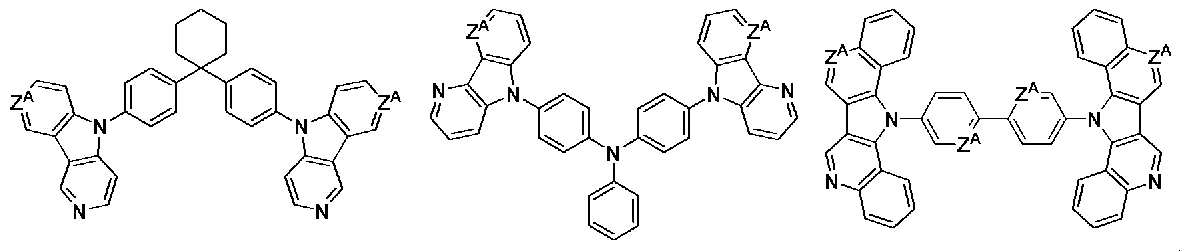
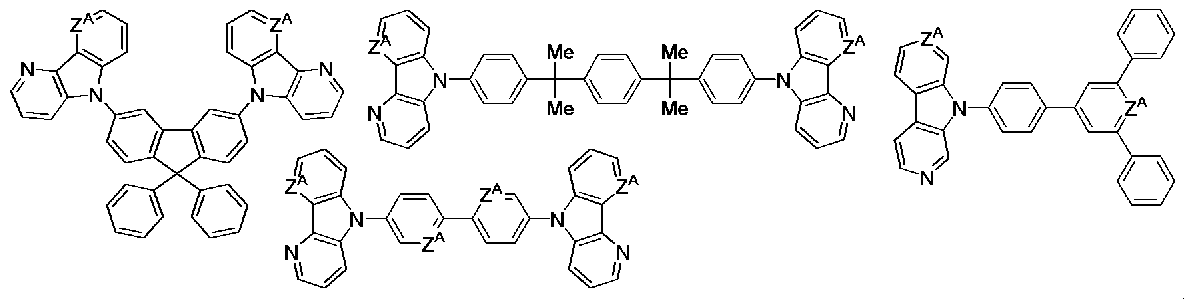
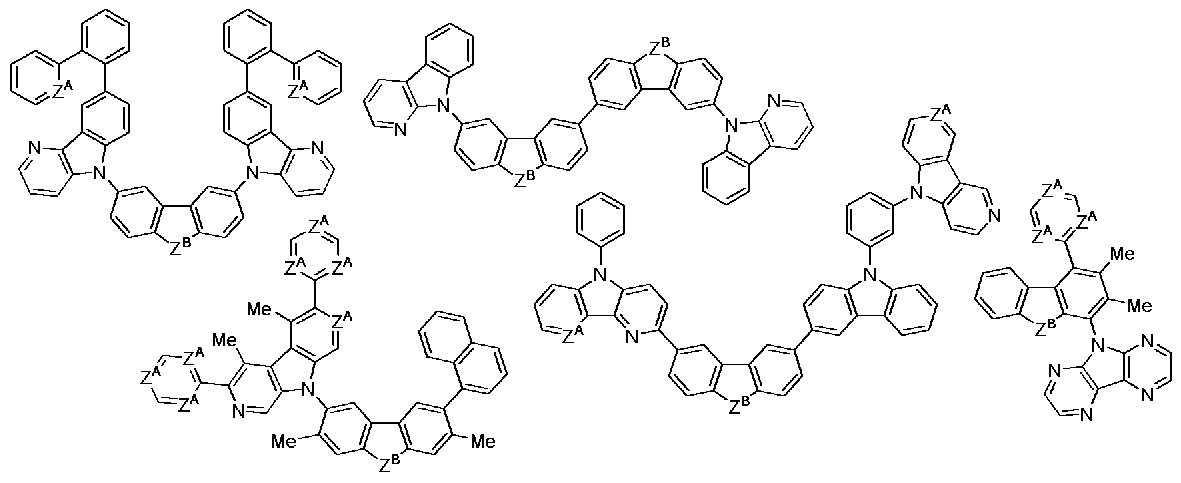
<発光素子>
本実施形態の発光素子は、陽極と、陰極と、陽極及び陰極の間に設けられた第1の層、陰極及び第1の層との間に設けられた第2の層と、陽極及び第1の層との間に設けられた第3の層とを有する発光素子であり、第1の層が、式(1)で表される金属錯体を含有する層であり、第2の層及び第3の層の少なくとも1層に、式(2)で表される金属錯体を含有し、第1の層、第2の層及び第3の層の少なくとも1層に、式(T-1)で表される化合物を含有する、発光素子である。
本実施形態の発光素子は、陽極と、陰極と、陽極及び陰極の間に設けられた第1の層、陰極及び第1の層との間に設けられた第2の層と、陽極及び第1の層との間に設けられた第3の層とを有する発光素子であり、第1の層が、式(1)で表される金属錯体を含有する層であり、第2の層及び第3の層の少なくとも1層に、式(2)で表される金属錯体を含有し、第1の層、第2の層及び第3の層の少なくとも1層が、式(3)で表される金属錯体を含有し、第1の層、第2の層及び第3の層の少なくとも1層に、式(T-1)で表される化合物を含有する、発光素子(以下、「発光素子1」ともいう。)であることが好ましい。
また、本実施形態の発光素子は、陽極と、陰極と、陽極及び陰極の間に設けられた第1の層、陰極及び第1の層との間に設けられた第2の層と、陽極及び第1の層との間に設けられた第3の層とを有する発光素子であり、第1の層が、式(1)で表される金属錯体を含有する層であり、第2の層及び第3の層の少なくとも1層に、式(2’)で表される金属錯体を含有し、第1の層、第2の層及び第3の層の少なくとも1層に、式(T-1)で表される化合物を含有する、発光素子(以下、「発光素子2」ともいう。)であることが好ましい。
本実施形態の発光素子は、陽極と、陰極と、陽極及び陰極の間に設けられた第1の層、陰極及び第1の層との間に設けられた第2の層と、陽極及び第1の層との間に設けられた第3の層とを有する発光素子であり、第1の層が、式(1)で表される金属錯体を含有する層であり、第2の層及び第3の層の少なくとも1層に、式(2)で表される金属錯体を含有し、第1の層、第2の層及び第3の層の少なくとも1層に、式(T-1)で表される化合物を含有する、発光素子である。
本実施形態の発光素子は、陽極と、陰極と、陽極及び陰極の間に設けられた第1の層、陰極及び第1の層との間に設けられた第2の層と、陽極及び第1の層との間に設けられた第3の層とを有する発光素子であり、第1の層が、式(1)で表される金属錯体を含有する層であり、第2の層及び第3の層の少なくとも1層に、式(2)で表される金属錯体を含有し、第1の層、第2の層及び第3の層の少なくとも1層が、式(3)で表される金属錯体を含有し、第1の層、第2の層及び第3の層の少なくとも1層に、式(T-1)で表される化合物を含有する、発光素子(以下、「発光素子1」ともいう。)であることが好ましい。
また、本実施形態の発光素子は、陽極と、陰極と、陽極及び陰極の間に設けられた第1の層、陰極及び第1の層との間に設けられた第2の層と、陽極及び第1の層との間に設けられた第3の層とを有する発光素子であり、第1の層が、式(1)で表される金属錯体を含有する層であり、第2の層及び第3の層の少なくとも1層に、式(2’)で表される金属錯体を含有し、第1の層、第2の層及び第3の層の少なくとも1層に、式(T-1)で表される化合物を含有する、発光素子(以下、「発光素子2」ともいう。)であることが好ましい。
本実施形態の発光素子(特に、発光素子1及び発光素子2であり、特記しない限り、以下、同様である。)において、本実施形態の発光素子の外部量子効率がより優れるので、第1の層又は第2の層に式(T-1)で表される化合物を含有することが好ましく、第2の層に式(T-1)で表される化合物を含有することがより好ましく、第2の層に式(T-1)で表される化合物を含有し、且つ、第1の層又は第3の層に式(T-1)で表される化合物を含有しないことが更に好ましく、第2の層に式(T-1)で表される化合物を含有し、且つ、第1の層及び第3の層に式(T-1)で表される化合物を含有しないことが特に好ましく、第2の層のみに式(T-1)で表される化合物を含有することがとりわけ好ましい。
本実施形態の発光素子(特に、発光素子1)において、本実施形態の発光素子の外部量子効率がより優れるので、第3の層に式(2)で表される金属錯体を含有することが好ましく、第3の層に式(2)で表される金属錯体を含有し、且つ、第2の層に式(2)で表される金属錯体を含有しないことがより好ましく、第3の層のみに式(2)で表される金属錯体を含有することが更に好ましい。
本実施形態の発光素子(特に、発光素子1)において、本実施形態の発光素子の外部量子効率がより優れるので、第1の層又は第3の層に式(3)で表される金属錯体を含有することが好ましく、第1の層又は第3の層に式(3)で表される金属錯体を含有し、且つ、第2の層に式(3)で表される金属錯体を含有しないことがより好ましく、第1の層又は第3の層のみに式(3)で表される金属錯体を含有することが更に好ましく、第1の層のみに式(3)で表される金属錯体を含有すること、又は、第3の層のみに式(3)で表される金属錯体を含有することが特に好ましい。
本実施形態の発光素子(特に、発光素子2)において、本実施形態の発光素子の外部量子効率がより優れるので、第3の層に式(2’)で表される金属錯体を含有することが好ましく、第3の層に式(2’)で表される金属錯体を含有し、且つ、第2の層に式(2’)で表される金属錯体を含有しないことがより好ましく、第3の層のみに式(2’)で表される金属錯体を含有することが更に好ましい。
本実施形態の発光素子(特に、発光素子1)において、本実施形態の発光素子の外部量子効率がより優れるので、第3の層に式(2)で表される金属錯体を含有することが好ましく、第3の層に式(2)で表される金属錯体を含有し、且つ、第2の層に式(2)で表される金属錯体を含有しないことがより好ましく、第3の層のみに式(2)で表される金属錯体を含有することが更に好ましい。
本実施形態の発光素子(特に、発光素子1)において、本実施形態の発光素子の外部量子効率がより優れるので、第1の層又は第3の層に式(3)で表される金属錯体を含有することが好ましく、第1の層又は第3の層に式(3)で表される金属錯体を含有し、且つ、第2の層に式(3)で表される金属錯体を含有しないことがより好ましく、第1の層又は第3の層のみに式(3)で表される金属錯体を含有することが更に好ましく、第1の層のみに式(3)で表される金属錯体を含有すること、又は、第3の層のみに式(3)で表される金属錯体を含有することが特に好ましい。
本実施形態の発光素子(特に、発光素子2)において、本実施形態の発光素子の外部量子効率がより優れるので、第3の層に式(2’)で表される金属錯体を含有することが好ましく、第3の層に式(2’)で表される金属錯体を含有し、且つ、第2の層に式(2’)で表される金属錯体を含有しないことがより好ましく、第3の層のみに式(2’)で表される金属錯体を含有することが更に好ましい。
<第1の層>
本実施形態の発光素子において、第1の層は、式(1)で表される金属錯体を含有する層である。第1の層は、式(1)で表される金属錯体の1種を単独で含有していてもよく、2種以上を含有していてもよい。
本実施形態の発光素子において、第1の層における、式(1)で表される金属錯体の含有量は、第1の層としての機能が奏される範囲であればよい。例えば、式(1)で表される金属錯体の含有量は、第1の層の全量基準で、0.01質量%以上100質量%以下であってよく、0.1質量%以上99質量%以下であってよく、1質量%以上70質量%以下であることが好ましく、5質量%以上50質量%以下であることがより好ましく、10質量%以上35質量%以下であることが更に好ましい。
本実施形態の発光素子において、第1の層は、式(1)で表される金属錯体を含有する層である。第1の層は、式(1)で表される金属錯体の1種を単独で含有していてもよく、2種以上を含有していてもよい。
本実施形態の発光素子において、第1の層における、式(1)で表される金属錯体の含有量は、第1の層としての機能が奏される範囲であればよい。例えば、式(1)で表される金属錯体の含有量は、第1の層の全量基準で、0.01質量%以上100質量%以下であってよく、0.1質量%以上99質量%以下であってよく、1質量%以上70質量%以下であることが好ましく、5質量%以上50質量%以下であることがより好ましく、10質量%以上35質量%以下であることが更に好ましい。
本実施形態の発光素子において、第1の層に式(T-1)で表される化合物を含有する場合、後述のホスト材料として、第1の層に含有されることが好ましい。第1の層は、式(T-1)で表される化合物の1種を単独で含有していてもよく、2種以上を含有していてもよい。
本実施形態の発光素子(特に、発光素子1)において、本実施形態の発光素子の外部量子効率向上の観点から、第1の層は、式(3)で表される金属錯体を更に含むことが好ましい。
本実施形態の発光素子(特に、発光素子1)において、第1の層が式(3)で表される金属錯体を更に含む場合、式(3)で表される金属錯体としては、本実施形態の発光素子を湿式法で作製できるので、式(1)で表される金属錯体を溶解することが可能な溶媒に対して溶解性を示すものが好ましい。
本実施形態の発光素子(特に、発光素子1)において、第1の層が、式(3)で表される金属錯体を更に含む場合、本実施形態の発光素子の外部量子効率がより優れるので、式(1)で表される金属錯体の有する最低励起三重項状態(T1)は式(3)で表される金属錯体の有する最低励起三重項状態(T1)より高いエネルギー準位であることが好ましい。
本実施形態の発光素子(特に、発光素子1)において、第1の層が式(3)で表される金属錯体を更に含む場合、第1の層において、式(1)で表される金属錯体及び式(3)で表される金属錯体の合計含有量は、第1の層としての機能が奏される範囲であればよい。例えば、式(1)で表される金属錯体及び式(3)で表される金属錯体の合計含有量は、第1の層の全量基準で、0.01質量%以上100質量%以下であってよく、0.1質量%以上99質量%以下であってよく、1質量%以上70質量%以下であることが好ましく、5質量%以上50質量%以下であることがより好ましく、10質量%以上35質量%以下であることが更に好ましい。
第1の層は、式(3)で表される金属錯体の1種を単独で含有していてもよく、2種以上を含有していてもよい。
本実施形態の発光素子(特に、発光素子1)において、第1の層が式(3)で表される金属錯体を更に含む場合、式(3)で表される金属錯体としては、本実施形態の発光素子を湿式法で作製できるので、式(1)で表される金属錯体を溶解することが可能な溶媒に対して溶解性を示すものが好ましい。
本実施形態の発光素子(特に、発光素子1)において、第1の層が、式(3)で表される金属錯体を更に含む場合、本実施形態の発光素子の外部量子効率がより優れるので、式(1)で表される金属錯体の有する最低励起三重項状態(T1)は式(3)で表される金属錯体の有する最低励起三重項状態(T1)より高いエネルギー準位であることが好ましい。
本実施形態の発光素子(特に、発光素子1)において、第1の層が式(3)で表される金属錯体を更に含む場合、第1の層において、式(1)で表される金属錯体及び式(3)で表される金属錯体の合計含有量は、第1の層としての機能が奏される範囲であればよい。例えば、式(1)で表される金属錯体及び式(3)で表される金属錯体の合計含有量は、第1の層の全量基準で、0.01質量%以上100質量%以下であってよく、0.1質量%以上99質量%以下であってよく、1質量%以上70質量%以下であることが好ましく、5質量%以上50質量%以下であることがより好ましく、10質量%以上35質量%以下であることが更に好ましい。
第1の層は、式(3)で表される金属錯体の1種を単独で含有していてもよく、2種以上を含有していてもよい。
[ホスト材料]
本実施形態の発光素子において、本実施形態の発光素子の外部量子効率がより優れるので、第1の層は、正孔注入性、正孔輸送性、電子注入性及び電子輸送性から選ばれる少なくとも1つの機能を有するホスト材料を更に含むことが好ましい。第1の層は、ホスト材料の1種を単独で含有していてもよく、2種以上を含有していてもよい。
本実施形態の発光素子において、本実施形態の発光素子の外部量子効率がより優れるので、第1の層は、正孔注入性、正孔輸送性、電子注入性及び電子輸送性から選ばれる少なくとも1つの機能を有するホスト材料を更に含むことが好ましい。第1の層は、ホスト材料の1種を単独で含有していてもよく、2種以上を含有していてもよい。
本実施形態の発光素子において、第1の層が、ホスト材料を更に含む場合、ホスト材料の含有量は、式(1)で表される金属錯体及びホスト材料の合計の含有量を100質量部とした場合、通常、1質量部以上99質量部以下であり、好ましくは10質量部以上95質量部以下であり、より好ましくは30質量部以上90質量部以下であり、更に好ましくは50質量部以上85質量部以下である。
本実施形態の発光素子(特に、発光素子1)において、第1の層が、ホスト材料及び式(3)で表される金属錯体を更に含む場合、ホスト材料の含有量は、式(1)で表される金属錯体、式(3)で表される金属錯体及びホスト材料の合計の含有量を100質量部とした場合、通常、1質量部以上99質量部以下であり、好ましくは10質量部以上95質量部以下であり、より好ましくは30質量部以上90質量部以下であり、更に好ましくは50質量部以上85質量部以下である。
本実施形態の発光素子(特に、発光素子1)において、第1の層が、ホスト材料及び式(3)で表される金属錯体を更に含む場合、ホスト材料の含有量は、式(1)で表される金属錯体、式(3)で表される金属錯体及びホスト材料の合計の含有量を100質量部とした場合、通常、1質量部以上99質量部以下であり、好ましくは10質量部以上95質量部以下であり、より好ましくは30質量部以上90質量部以下であり、更に好ましくは50質量部以上85質量部以下である。
本実施形態の発光素子において、ホスト材料の有する最低励起三重項状態(T1)は、本実施形態の発光素子の外部量子効率がより優れるので、式(1)で表される金属錯体の有する最低励起三重項状態(T1)より高いエネルギー準位であることが好ましい。
また、本実施形態の発光素子(特に、発光素子1)において、第1の層が、ホスト材料及び式(3)で表される金属錯体を更に含む場合、ホスト材料の有する最低励起三重項状態(T1)は、本実施形態の発光素子の外部量子効率がより優れるので、式(3)で表される金属錯体の有する最低励起三重項状態(T1)より高いエネルギー準位であることが好ましく、式(3)で表される金属錯体の有する最低励起三重項状態(T1)より高いエネルギー準位であり、且つ、式(1)で表される金属錯体の有する最低励起三重項状態(T1)より高いエネルギー準位であることがより好ましい。
また、本実施形態の発光素子(特に、発光素子1)において、第1の層が、ホスト材料及び式(3)で表される金属錯体を更に含む場合、本実施形態の発光素子の外部量子効率が更に優れるので、ホスト材料の有する最低励起三重項状態(T1)は、式(1)で表される金属錯体の有する最低励起三重項状態(T1)より高いエネルギー準位であり、且つ、式(1)で表される金属錯体の有する最低励起三重項状態(T1)は式(3)で表される金属錯体の有する最低励起三重項状態(T1)より高いエネルギー準位であることが好ましい。
また、本実施形態の発光素子(特に、発光素子1)において、第1の層が、ホスト材料及び式(3)で表される金属錯体を更に含む場合、ホスト材料の有する最低励起三重項状態(T1)は、本実施形態の発光素子の外部量子効率がより優れるので、式(3)で表される金属錯体の有する最低励起三重項状態(T1)より高いエネルギー準位であることが好ましく、式(3)で表される金属錯体の有する最低励起三重項状態(T1)より高いエネルギー準位であり、且つ、式(1)で表される金属錯体の有する最低励起三重項状態(T1)より高いエネルギー準位であることがより好ましい。
また、本実施形態の発光素子(特に、発光素子1)において、第1の層が、ホスト材料及び式(3)で表される金属錯体を更に含む場合、本実施形態の発光素子の外部量子効率が更に優れるので、ホスト材料の有する最低励起三重項状態(T1)は、式(1)で表される金属錯体の有する最低励起三重項状態(T1)より高いエネルギー準位であり、且つ、式(1)で表される金属錯体の有する最低励起三重項状態(T1)は式(3)で表される金属錯体の有する最低励起三重項状態(T1)より高いエネルギー準位であることが好ましい。
本実施形態の発光素子において、第1の層が、ホスト材料を更に含む場合、ホスト材料としては、本実施形態の発光素子を湿式法で作製できるので、式(1)で表される金属錯体を溶解することが可能な溶媒に対して溶解性を示すものが好ましい。
また、本実施形態の発光素子(特に、発光素子1)において、第1の層が、ホスト材料及び式(3)で表される金属錯体を更に含む場合、ホスト材料及び式(3)で表される金属錯体としては、本実施形態の発光素子を湿式法で作製できるので、式(1)で表される金属錯体を溶解することが可能な溶媒に対して溶解性を示すものが好ましい。
また、本実施形態の発光素子(特に、発光素子1)において、第1の層が、ホスト材料及び式(3)で表される金属錯体を更に含む場合、ホスト材料及び式(3)で表される金属錯体としては、本実施形態の発光素子を湿式法で作製できるので、式(1)で表される金属錯体を溶解することが可能な溶媒に対して溶解性を示すものが好ましい。
本実施形態の発光素子において、ホスト材料は、低分子化合物(低分子ホスト)と高分子化合物(高分子ホスト)とに分類され、第1の層はいずれのホスト材料を含有していてもよい。本実施形態の発光素子において、第1の層に含有されていてもよいホスト材料としては、低分子化合物が好ましい。
本実施形態の発光素子において、低分子ホストは、例えば、後述の正孔輸送材料である低分子化合物、及び、後述の電子輸送材料である低分子化合物が挙げられ、好ましくは、式(H-1)で表される化合物又は式(T-1)で表される化合物であり、より好ましくは、式(H-1)で表される化合物である。
本実施形態の発光素子において、高分子ホストとしては、例えば、後述の正孔輸送材料である高分子化合物、及び、後述の電子輸送材料である高分子化合物が挙げられる。
本実施形態の発光素子において、低分子ホストは、例えば、後述の正孔輸送材料である低分子化合物、及び、後述の電子輸送材料である低分子化合物が挙げられ、好ましくは、式(H-1)で表される化合物又は式(T-1)で表される化合物であり、より好ましくは、式(H-1)で表される化合物である。
本実施形態の発光素子において、高分子ホストとしては、例えば、後述の正孔輸送材料である高分子化合物、及び、後述の電子輸送材料である高分子化合物が挙げられる。
[組成物1及び組成物1’]
本実施形態の発光素子において、第1の層は、式(1)で表される金属錯体と、前述のホスト材料、正孔輸送材料、正孔注入材料、電子輸送材料、電子注入材料、発光材料及び酸化防止剤からなる群から選ばれる少なくとも1種とを含む組成物(以下、「組成物1」ともいう。)から形成された層であってもよい。但し、組成物1において、ホスト材料、正孔輸送材料、正孔注入材料、電子輸送材料、電子注入材料及び発光材料は、式(1)で表される金属錯体とは異なる。
本実施形態の発光素子(特に、発光素子1)において、第1の層は、式(1)で表される金属錯体と、式(3)で表される金属錯体と、前述のホスト材料、正孔輸送材料、正孔注入材料、電子輸送材料、電子注入材料、発光材料及び酸化防止剤からなる群から選ばれる少なくとも1種とを含む組成物(以下、「組成物1’」ともいう。)から形成された層であってもよい。但し、組成物1’において、ホスト材料、正孔輸送材料、正孔注入材料、電子輸送材料、電子注入材料及び発光材料は、式(1)で表される金属錯体及び式(3)で表される金属錯体とは異なる。
本実施形態の発光素子において、第1の層は、式(1)で表される金属錯体と、前述のホスト材料、正孔輸送材料、正孔注入材料、電子輸送材料、電子注入材料、発光材料及び酸化防止剤からなる群から選ばれる少なくとも1種とを含む組成物(以下、「組成物1」ともいう。)から形成された層であってもよい。但し、組成物1において、ホスト材料、正孔輸送材料、正孔注入材料、電子輸送材料、電子注入材料及び発光材料は、式(1)で表される金属錯体とは異なる。
本実施形態の発光素子(特に、発光素子1)において、第1の層は、式(1)で表される金属錯体と、式(3)で表される金属錯体と、前述のホスト材料、正孔輸送材料、正孔注入材料、電子輸送材料、電子注入材料、発光材料及び酸化防止剤からなる群から選ばれる少なくとも1種とを含む組成物(以下、「組成物1’」ともいう。)から形成された層であってもよい。但し、組成物1’において、ホスト材料、正孔輸送材料、正孔注入材料、電子輸送材料、電子注入材料及び発光材料は、式(1)で表される金属錯体及び式(3)で表される金属錯体とは異なる。
[正孔輸送材料]
正孔輸送材料は、低分子化合物と高分子化合物とに分類され、好ましくは高分子化合物である。正孔輸送材料は、架橋性基を有していてもよい。
低分子化合物としては、例えば、トリフェニルアミン及びその誘導体、N,N’-ジ-1-ナフチル-N,N’-ジフェニルベンジジン(α-NPD)、並びに、N,N’-ジフェニル-N,N’-ジ(m-トリル)ベンジジン(TPD)等の芳香族アミン化合物が挙げられる。
高分子化合物としては、例えば、ポリビニルカルバゾール及びその誘導体;側鎖又は主鎖に芳香族アミン構造を有するポリアリーレン及びその誘導体が挙げられる。高分子化合物は、電子受容性部位が結合された化合物でもよい。電子受容性部位としては、例えば、フラーレン、テトラフルオロテトラシアノキノジメタン、テトラシアノエチレン、トリニトロフルオレノン等が挙げられ、好ましくはフラーレンである。
組成物1において、正孔輸送材料の含有量は、式(1)で表される金属錯体の含有量を100質量部とした場合、通常、1質量部以上10000質量部以下である。
組成物1’において、正孔輸送材料の含有量は、式(1)で表される金属錯体及び式(3)で表される金属錯体の合計の含有量を100質量部とした場合、通常、1質量部以上10000質量部以下である。
正孔輸送材料は、一種単独で用いても二種以上を併用してもよい。
正孔輸送材料は、低分子化合物と高分子化合物とに分類され、好ましくは高分子化合物である。正孔輸送材料は、架橋性基を有していてもよい。
低分子化合物としては、例えば、トリフェニルアミン及びその誘導体、N,N’-ジ-1-ナフチル-N,N’-ジフェニルベンジジン(α-NPD)、並びに、N,N’-ジフェニル-N,N’-ジ(m-トリル)ベンジジン(TPD)等の芳香族アミン化合物が挙げられる。
高分子化合物としては、例えば、ポリビニルカルバゾール及びその誘導体;側鎖又は主鎖に芳香族アミン構造を有するポリアリーレン及びその誘導体が挙げられる。高分子化合物は、電子受容性部位が結合された化合物でもよい。電子受容性部位としては、例えば、フラーレン、テトラフルオロテトラシアノキノジメタン、テトラシアノエチレン、トリニトロフルオレノン等が挙げられ、好ましくはフラーレンである。
組成物1において、正孔輸送材料の含有量は、式(1)で表される金属錯体の含有量を100質量部とした場合、通常、1質量部以上10000質量部以下である。
組成物1’において、正孔輸送材料の含有量は、式(1)で表される金属錯体及び式(3)で表される金属錯体の合計の含有量を100質量部とした場合、通常、1質量部以上10000質量部以下である。
正孔輸送材料は、一種単独で用いても二種以上を併用してもよい。
[電子輸送材料]
電子輸送材料は、低分子化合物と高分子化合物とに分類される。電子輸送材料は、架橋性基を有していてもよい。
低分子化合物としては、例えば、8-ヒドロキシキノリンを配位子とする金属錯体、オキサジアゾール、アントラキノジメタン、ベンゾキノン、ナフトキノン、アントラキノン、テトラシアノアントラキノジメタン、フルオレノン、ジフェニルジシアノエチレン及びジフェノキノン、並びに、これらの誘導体が挙げられる。
高分子化合物としては、例えば、ポリフェニレン、ポリフルオレン、及び、これらの誘導体が挙げられる。高分子化合物は、金属でドープされていてもよい。
組成物1において、電子輸送材料の含有量は、式(1)で表される金属錯体の含有量を100質量部とした場合、通常、1質量部以上10000質量部以下である。
組成物1’において、電子輸送材料の含有量は、式(1)で表される金属錯体及び式(3)で表される金属錯体の合計の含有量を100質量部とした場合、通常、1質量部以上10000質量部以下である。
電子輸送材料は、一種単独で用いても二種以上を併用してもよい。
電子輸送材料は、低分子化合物と高分子化合物とに分類される。電子輸送材料は、架橋性基を有していてもよい。
低分子化合物としては、例えば、8-ヒドロキシキノリンを配位子とする金属錯体、オキサジアゾール、アントラキノジメタン、ベンゾキノン、ナフトキノン、アントラキノン、テトラシアノアントラキノジメタン、フルオレノン、ジフェニルジシアノエチレン及びジフェノキノン、並びに、これらの誘導体が挙げられる。
高分子化合物としては、例えば、ポリフェニレン、ポリフルオレン、及び、これらの誘導体が挙げられる。高分子化合物は、金属でドープされていてもよい。
組成物1において、電子輸送材料の含有量は、式(1)で表される金属錯体の含有量を100質量部とした場合、通常、1質量部以上10000質量部以下である。
組成物1’において、電子輸送材料の含有量は、式(1)で表される金属錯体及び式(3)で表される金属錯体の合計の含有量を100質量部とした場合、通常、1質量部以上10000質量部以下である。
電子輸送材料は、一種単独で用いても二種以上を併用してもよい。
[正孔注入材料及び電子注入材料]
正孔注入材料及び電子注入材料は、各々、低分子化合物と高分子化合物とに分類される。正孔注入材料及び電子注入材料は、架橋性基を有していてもよい。
低分子化合物としては、例えば、銅フタロシアニン等の金属フタロシアニン;カーボン;モリブデン、タングステン等の金属酸化物;フッ化リチウム、フッ化ナトリウム、フッ化セシウム、フッ化カリウム等の金属フッ化物が挙げられる。
高分子化合物としては、例えば、ポリアニリン、ポリチオフェン、ポリピロール、ポリフェニレンビニレン、ポリチエニレンビニレン、ポリキノリン及びポリキノキサリン、並びに、これらの誘導体;芳香族アミン構造を主鎖又は側鎖に含む重合体等の導電性高分子が挙げられる。
組成物1において、正孔注入材料及び電子注入材料の含有量は、各々、式(1)で表される金属錯体の含有量を100質量部とした場合、通常、1質量部以上10000質量部以下である。
組成物1’において、正孔注入材料及び電子注入材料の含有量は、各々、式(1)で表される金属錯体及び式(3)で表される金属錯体の合計の含有量を100質量部とした場合、通常、1質量部以上10000質量部以下である。
電子注入材料及び正孔注入材料は、各々、一種単独で用いても二種以上を併用してもよい。
正孔注入材料及び電子注入材料は、各々、低分子化合物と高分子化合物とに分類される。正孔注入材料及び電子注入材料は、架橋性基を有していてもよい。
低分子化合物としては、例えば、銅フタロシアニン等の金属フタロシアニン;カーボン;モリブデン、タングステン等の金属酸化物;フッ化リチウム、フッ化ナトリウム、フッ化セシウム、フッ化カリウム等の金属フッ化物が挙げられる。
高分子化合物としては、例えば、ポリアニリン、ポリチオフェン、ポリピロール、ポリフェニレンビニレン、ポリチエニレンビニレン、ポリキノリン及びポリキノキサリン、並びに、これらの誘導体;芳香族アミン構造を主鎖又は側鎖に含む重合体等の導電性高分子が挙げられる。
組成物1において、正孔注入材料及び電子注入材料の含有量は、各々、式(1)で表される金属錯体の含有量を100質量部とした場合、通常、1質量部以上10000質量部以下である。
組成物1’において、正孔注入材料及び電子注入材料の含有量は、各々、式(1)で表される金属錯体及び式(3)で表される金属錯体の合計の含有量を100質量部とした場合、通常、1質量部以上10000質量部以下である。
電子注入材料及び正孔注入材料は、各々、一種単独で用いても二種以上を併用してもよい。
[イオンドープ]
正孔注入材料又は電子注入材料が導電性高分子を含む場合、導電性高分子の電気伝導度は、好ましくは、1×10⁻⁵S/cm以上1×103S/cm以下である。導電性高分子の電気伝導度をかかる範囲とするために、導電性高分子に適量のイオンをドープすることができる。
ドープするイオンの種類は、正孔注入材料であればアニオン、電子注入材料であればカチオンである。アニオンとしては、例えば、ポリスチレンスルホン酸イオン、アルキルベンゼンスルホン酸イオン、樟脳スルホン酸イオンが挙げられる。カチオンとしては、例えば、リチウムイオン、ナトリウムイオン、カリウムイオン、テトラブチルアンモニウムイオンが挙げられる。
ドープするイオンは、一種単独で用いても二種以上を併用してもよい。
正孔注入材料又は電子注入材料が導電性高分子を含む場合、導電性高分子の電気伝導度は、好ましくは、1×10⁻⁵S/cm以上1×103S/cm以下である。導電性高分子の電気伝導度をかかる範囲とするために、導電性高分子に適量のイオンをドープすることができる。
ドープするイオンの種類は、正孔注入材料であればアニオン、電子注入材料であればカチオンである。アニオンとしては、例えば、ポリスチレンスルホン酸イオン、アルキルベンゼンスルホン酸イオン、樟脳スルホン酸イオンが挙げられる。カチオンとしては、例えば、リチウムイオン、ナトリウムイオン、カリウムイオン、テトラブチルアンモニウムイオンが挙げられる。
ドープするイオンは、一種単独で用いても二種以上を併用してもよい。
[発光材料]
発光材料は、低分子化合物と高分子化合物とに分類される。発光材料は、架橋性基を有していてもよい。
低分子化合物としては、例えば、ナフタレン及びその誘導体、アントラセン及びその誘導体、ペリレン及びその誘導体、並びに、イリジウム、白金又はユーロピウムを中心金属とする三重項発光錯体が挙げられる。
三重項発光錯体としては、例えば、以下に示す金属錯体、及び、後述の金属錯体G2が挙げられる。
発光材料は、低分子化合物と高分子化合物とに分類される。発光材料は、架橋性基を有していてもよい。
低分子化合物としては、例えば、ナフタレン及びその誘導体、アントラセン及びその誘導体、ペリレン及びその誘導体、並びに、イリジウム、白金又はユーロピウムを中心金属とする三重項発光錯体が挙げられる。
三重項発光錯体としては、例えば、以下に示す金属錯体、及び、後述の金属錯体G2が挙げられる。
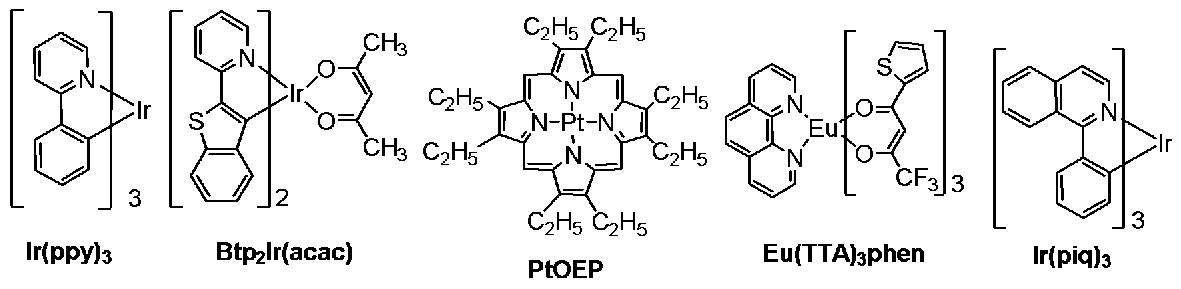
高分子化合物としては、例えば、フェニレン基、ナフタレンジイル基、フルオレンジイル基、フェナントレンジイル基、ジヒドロフェナントレンジイル基、アントラセンジイル基及びピレンジイル基等のアリーレン基;芳香族アミンから2個の水素原子を取り除いてなる基等の芳香族アミン残基;並びに、カルバゾールジイル基、フェノキサジンジイル基及びフェノチアジンジイル基等の2価の複素環基を含む高分子化合物が挙げられる。
組成物1において、発光材料の含有量は、式(1)で表される金属錯体の含有量を100質量部とした場合、通常、1質量部以上10000質量部以下である。
組成物1’において、発光材料の含有量は、式(1)で表される金属錯体及び式(3)で表される金属錯体の合計の含有量を100質量部とした場合、通常、1質量部以上10000質量部以下である。
発光材料は、一種単独で用いても二種以上を併用してもよい。
組成物1において、発光材料の含有量は、式(1)で表される金属錯体の含有量を100質量部とした場合、通常、1質量部以上10000質量部以下である。
組成物1’において、発光材料の含有量は、式(1)で表される金属錯体及び式(3)で表される金属錯体の合計の含有量を100質量部とした場合、通常、1質量部以上10000質量部以下である。
発光材料は、一種単独で用いても二種以上を併用してもよい。
[酸化防止剤]
酸化防止剤は、式(1)で表される金属錯体と同じ溶媒に可溶であり、発光及び電荷輸送を阻害しない化合物であればよく、例えば、フェノール系酸化防止剤、リン系酸化防止剤が挙げられる。
組成物1において、酸化防止剤の配合量は、式(1)で表される金属錯体の含有量を100質量部とした場合、通常、0.00001質量部以上10質量部以下である。
組成物1’において、酸化防止剤の配合量は、式(1)で表される金属錯体及び式(3)で表される金属錯体の合計の含有量を100質量部とした場合、通常、0.00001質量部以上10質量部以下である。
酸化防止剤は、一種単独で用いても二種以上を併用してもよい。
酸化防止剤は、式(1)で表される金属錯体と同じ溶媒に可溶であり、発光及び電荷輸送を阻害しない化合物であればよく、例えば、フェノール系酸化防止剤、リン系酸化防止剤が挙げられる。
組成物1において、酸化防止剤の配合量は、式(1)で表される金属錯体の含有量を100質量部とした場合、通常、0.00001質量部以上10質量部以下である。
組成物1’において、酸化防止剤の配合量は、式(1)で表される金属錯体及び式(3)で表される金属錯体の合計の含有量を100質量部とした場合、通常、0.00001質量部以上10質量部以下である。
酸化防止剤は、一種単独で用いても二種以上を併用してもよい。
[インク1及びインク1’]
本実施形態の発光素子において、第1の層は、例えば、式(1)で表される金属錯体と、溶媒とを含有する組成物(以下、「インク1」ともいう。)を用いて形成することができる。インク1は、スピンコート法、キャスティング法、マイクログラビアコート法、グラビアコート法、バーコート法、ロールコート法、ワイヤーバーコート法、ディップコート法、スプレーコート法、スクリーン印刷法、フレキソ印刷法、オフセット印刷法、インクジェット印刷法、キャピラリ-コート法、ノズルコート法等の湿式法に好適に使用することができる。
インク1の粘度は、湿式法の種類によって調整すればよいが、インクジェット印刷法等の溶液が吐出装置を経由する印刷法に適用する場合には、吐出時の目づまりと飛行曲がりが起こりづらいので、好ましくは25℃において1mPa・s以上20mPa・s以下である。
インク1に含有される溶媒は、好ましくは、インク中の固形分を溶解又は均一に分散できる溶媒である。溶媒としては、例えば、塩素系溶媒、エーテル系溶媒、芳香族炭化水素系溶媒、脂肪族炭化水素系溶媒、ケトン系溶媒、エステル系溶媒、多価アルコール系溶媒、アルコール系溶媒、スルホキシド系溶媒及びアミド系溶媒が挙げられる。溶媒は、一種単独で用いても二種以上を併用してもよい。
インク1において、溶媒の含有量は、式(1)で表される金属錯体の含有量を100質量部とした場合、通常、1000質量部以上1000000質量部以下である。
本実施形態の発光素子(特に、発光素子1)において、第1の層が式(3)で表される金属錯体を含有する場合、第1の層は、例えば、式(1)で表される金属錯体と、式(3)で表される金属錯体と、溶媒とを含有する組成物(以下、「インク1’」ともいう。)を用いて形成することができる。
インク1’は、インク1の項で説明した湿式法に好適に使用することができる。インク1’の粘度の好ましい範囲は、インク1の粘度の好ましい範囲と同じである。インク1’に含有される溶媒の例及び好ましい範囲は、インク1に含有される溶媒の例及び好ましい範囲と同じである。
インク1’において、溶媒の含有量は、式(1)で表される金属錯体及び式(3)で表される金属錯体の合計の含有量を100質量部とした場合、通常、1000質量部以上1000000質量部以下である。
本実施形態の発光素子において、第1の層は、例えば、式(1)で表される金属錯体と、溶媒とを含有する組成物(以下、「インク1」ともいう。)を用いて形成することができる。インク1は、スピンコート法、キャスティング法、マイクログラビアコート法、グラビアコート法、バーコート法、ロールコート法、ワイヤーバーコート法、ディップコート法、スプレーコート法、スクリーン印刷法、フレキソ印刷法、オフセット印刷法、インクジェット印刷法、キャピラリ-コート法、ノズルコート法等の湿式法に好適に使用することができる。
インク1の粘度は、湿式法の種類によって調整すればよいが、インクジェット印刷法等の溶液が吐出装置を経由する印刷法に適用する場合には、吐出時の目づまりと飛行曲がりが起こりづらいので、好ましくは25℃において1mPa・s以上20mPa・s以下である。
インク1に含有される溶媒は、好ましくは、インク中の固形分を溶解又は均一に分散できる溶媒である。溶媒としては、例えば、塩素系溶媒、エーテル系溶媒、芳香族炭化水素系溶媒、脂肪族炭化水素系溶媒、ケトン系溶媒、エステル系溶媒、多価アルコール系溶媒、アルコール系溶媒、スルホキシド系溶媒及びアミド系溶媒が挙げられる。溶媒は、一種単独で用いても二種以上を併用してもよい。
インク1において、溶媒の含有量は、式(1)で表される金属錯体の含有量を100質量部とした場合、通常、1000質量部以上1000000質量部以下である。
本実施形態の発光素子(特に、発光素子1)において、第1の層が式(3)で表される金属錯体を含有する場合、第1の層は、例えば、式(1)で表される金属錯体と、式(3)で表される金属錯体と、溶媒とを含有する組成物(以下、「インク1’」ともいう。)を用いて形成することができる。
インク1’は、インク1の項で説明した湿式法に好適に使用することができる。インク1’の粘度の好ましい範囲は、インク1の粘度の好ましい範囲と同じである。インク1’に含有される溶媒の例及び好ましい範囲は、インク1に含有される溶媒の例及び好ましい範囲と同じである。
インク1’において、溶媒の含有量は、式(1)で表される金属錯体及び式(3)で表される金属錯体の合計の含有量を100質量部とした場合、通常、1000質量部以上1000000質量部以下である。
<第2の層>
本実施形態の発光素子において、本実施形態の発光素子の外部量子効率が優れるので、第2の層に、式(T-1)で表される化合物を含有することが好ましい。第2の層は、式(T-1)で表される化合物の1種を単独で含有していてもよく、2種以上を含有していてもよい。
本実施形態の発光素子において、第2の層に式(T-1)で表される化合物を含有する場合、式(T-1)で表される化合物の含有量は、第2の層としての機能が奏される範囲であればよい。例えば、式(T-1)で表される化合物の含有量は、第2の層の全量基準で1質量%以上100質量%以下であってよく、30質量%以上100質量%以下であることが好ましく、60質量%以上100質量%以下であることがより好ましく、90質量%以上100質量%以下であることが更に好ましく、100質量%であることが特に好ましい。
本実施形態の発光素子において、本実施形態の発光素子の外部量子効率が優れるので、第2の層に、式(T-1)で表される化合物を含有することが好ましい。第2の層は、式(T-1)で表される化合物の1種を単独で含有していてもよく、2種以上を含有していてもよい。
本実施形態の発光素子において、第2の層に式(T-1)で表される化合物を含有する場合、式(T-1)で表される化合物の含有量は、第2の層としての機能が奏される範囲であればよい。例えば、式(T-1)で表される化合物の含有量は、第2の層の全量基準で1質量%以上100質量%以下であってよく、30質量%以上100質量%以下であることが好ましく、60質量%以上100質量%以下であることがより好ましく、90質量%以上100質量%以下であることが更に好ましく、100質量%であることが特に好ましい。
本実施形態の発光素子(特に、発光素子1)において、第2の層に式(2)で表される金属錯体を含有する場合、第2の層は、式(2)で表される金属錯体の1種を単独で含有していてもよく、2種以上を含有していてもよい。
本実施形態の発光素子(特に、発光素子1)において、第2の層に式(2)で表される金属錯体を含有する場合、式(2)で表される金属錯体の含有量は、第2の層としての機能が奏される範囲であればよい。例えば、式(2)で表される金属錯体の含有量は、第2の層の全量基準で、0.01質量%以上100質量%以下であってよく、0.01質量%以上99質量%以下であってよく、0.1質量%以上80質量%以下であることが好ましく、1質量%以上60質量%以下であることがより好ましく、5質量%以上50質量%以下であることが更に好ましく、10質量%以上40質量%以下であることが特に好ましい。
本実施形態の発光素子(特に、発光素子1)において、第2の層に式(2)で表される金属錯体を含有する場合、式(2)で表される金属錯体の含有量は、第2の層としての機能が奏される範囲であればよい。例えば、式(2)で表される金属錯体の含有量は、第2の層の全量基準で、0.01質量%以上100質量%以下であってよく、0.01質量%以上99質量%以下であってよく、0.1質量%以上80質量%以下であることが好ましく、1質量%以上60質量%以下であることがより好ましく、5質量%以上50質量%以下であることが更に好ましく、10質量%以上40質量%以下であることが特に好ましい。
本実施形態の発光素子(特に、発光素子1)において、第2の層に式(3)で表される金属錯体を含有する場合、第2の層は、式(3)で表される金属錯体の1種を単独で含有していてもよく、2種以上を含有していてもよい。
本実施形態の発光素子(特に、発光素子1)において、第2の層に式(3)で表される金属錯体を含有する場合、式(3)で表される金属錯体の含有量は、第2の層としての機能が奏される範囲であればよい。例えば、式(3)で表される金属錯体の含有量は、第2の層の全量基準で、0.01質量%以上100質量%以下であってよく、0.01質量%以上99質量%以下であってよく、0.1質量%以上80質量%以下であることが好ましく、1質量%以上60質量%以下であることがより好ましく、5質量%以上50質量%以下であることが更に好ましく、10質量%以上40質量%以下であることが特に好ましい。
本実施形態の発光素子(特に、発光素子1)において、第2の層に式(3)で表される金属錯体を含有する場合、式(3)で表される金属錯体の含有量は、第2の層としての機能が奏される範囲であればよい。例えば、式(3)で表される金属錯体の含有量は、第2の層の全量基準で、0.01質量%以上100質量%以下であってよく、0.01質量%以上99質量%以下であってよく、0.1質量%以上80質量%以下であることが好ましく、1質量%以上60質量%以下であることがより好ましく、5質量%以上50質量%以下であることが更に好ましく、10質量%以上40質量%以下であることが特に好ましい。
本実施形態の発光素子(特に、発光素子2)において、第2の層に式(2’)で表される金属錯体を含有する場合、第2の層は、式(2’)で表される金属錯体の1種を単独で含有していてもよく、2種以上を含有していてもよい。
本実施形態の発光素子(特に、発光素子2)において、第2の層に式(2’)で表される金属錯体を含有する場合、式(2’)で表される金属錯体の含有量は、第2の層としての機能が奏される範囲であればよい。例えば、式(2’)で表される金属錯体の含有量は、第2の層の全量基準で、0.01質量%以上100質量%以下であってよく、0.01質量%以上99質量%以下であってよく、0.1質量%以上80質量%以下であることが好ましく、1質量%以上60質量%以下であることがより好ましく、5質量%以上50質量%以下であることが更に好ましく、10質量%以上40質量%以下であることが特に好ましい。
本実施形態の発光素子(特に、発光素子2)において、第2の層に式(2’)で表される金属錯体を含有する場合、式(2’)で表される金属錯体の含有量は、第2の層としての機能が奏される範囲であればよい。例えば、式(2’)で表される金属錯体の含有量は、第2の層の全量基準で、0.01質量%以上100質量%以下であってよく、0.01質量%以上99質量%以下であってよく、0.1質量%以上80質量%以下であることが好ましく、1質量%以上60質量%以下であることがより好ましく、5質量%以上50質量%以下であることが更に好ましく、10質量%以上40質量%以下であることが特に好ましい。
[組成物2-1、組成物2-2、組成物2-2’及び組成物2-3]
本実施形態の発光素子において、第2の層が式(T-1)で表される化合物を含有する場合、第2の層は、式(T-1)で表される化合物と、正孔輸送材料、正孔注入材料、電子輸送材料、電子注入材料、発光材料及び酸化防止剤からなる群から選ばれる少なくとも1種の材料とを含む組成物(以下、「組成物2-1」ともいう。)を含有する層であってもよい。但し、組成物2-1において、正孔輸送材料、正孔注入材料、電子輸送材料、電子注入材料及び発光材料は、式(T-1)で表される化合物とは異なる。
本実施形態の発光素子(特に、発光素子1)において、第2の層が式(2)で表される金属錯体を含有する場合、第2の層は、式(2)で表される金属錯体と、前述のホスト材料、正孔輸送材料、正孔注入材料、電子輸送材料、電子注入材料、発光材料及び酸化防止剤からなる群から選ばれる少なくとも1種の材料とを含む組成物(以下、「組成物2-2」ともいう。)を含有する層であってもよい。但し、組成物2-2において、ホスト材料、正孔輸送材料、正孔注入材料、電子輸送材料、電子注入材料及び発光材料は、式(2)で表される金属錯体とは異なる。
本実施形態の発光素子(特に、発光素子1)において、第2の層が式(3)で表される金属錯体を含有する場合、第2の層は、式(3)で表される金属錯体と、前述のホスト材料、正孔輸送材料、正孔注入材料、電子輸送材料、電子注入材料、発光材料及び酸化防止剤からなる群から選ばれる少なくとも1種の材料とを含む組成物(以下、「組成物2-3」ともいう。)を含有する層であってもよい。但し、組成物2-3において、ホスト材料、正孔輸送材料、正孔注入材料、電子輸送材料、電子注入材料及び発光材料は、式(3)で表される金属錯体とは異なる。
本実施形態の発光素子(特に、発光素子2)において、第2の層が式(2’)で表される金属錯体を含有する場合、第2の層は、式(2’)で表される金属錯体と、前述のホスト材料、正孔輸送材料、正孔注入材料、電子輸送材料、電子注入材料、発光材料及び酸化防止剤からなる群から選ばれる少なくとも1種の材料とを含む組成物(以下、「組成物2-2’」ともいう。)を含有する層であってもよい。但し、組成物2-2’において、ホスト材料、正孔輸送材料、正孔注入材料、電子輸送材料、電子注入材料及び発光材料は、式(2’)で表される金属錯体とは異なる。
本実施形態の発光素子において、第2の層が式(T-1)で表される化合物を含有する場合、第2の層は、式(T-1)で表される化合物と、正孔輸送材料、正孔注入材料、電子輸送材料、電子注入材料、発光材料及び酸化防止剤からなる群から選ばれる少なくとも1種の材料とを含む組成物(以下、「組成物2-1」ともいう。)を含有する層であってもよい。但し、組成物2-1において、正孔輸送材料、正孔注入材料、電子輸送材料、電子注入材料及び発光材料は、式(T-1)で表される化合物とは異なる。
本実施形態の発光素子(特に、発光素子1)において、第2の層が式(2)で表される金属錯体を含有する場合、第2の層は、式(2)で表される金属錯体と、前述のホスト材料、正孔輸送材料、正孔注入材料、電子輸送材料、電子注入材料、発光材料及び酸化防止剤からなる群から選ばれる少なくとも1種の材料とを含む組成物(以下、「組成物2-2」ともいう。)を含有する層であってもよい。但し、組成物2-2において、ホスト材料、正孔輸送材料、正孔注入材料、電子輸送材料、電子注入材料及び発光材料は、式(2)で表される金属錯体とは異なる。
本実施形態の発光素子(特に、発光素子1)において、第2の層が式(3)で表される金属錯体を含有する場合、第2の層は、式(3)で表される金属錯体と、前述のホスト材料、正孔輸送材料、正孔注入材料、電子輸送材料、電子注入材料、発光材料及び酸化防止剤からなる群から選ばれる少なくとも1種の材料とを含む組成物(以下、「組成物2-3」ともいう。)を含有する層であってもよい。但し、組成物2-3において、ホスト材料、正孔輸送材料、正孔注入材料、電子輸送材料、電子注入材料及び発光材料は、式(3)で表される金属錯体とは異なる。
本実施形態の発光素子(特に、発光素子2)において、第2の層が式(2’)で表される金属錯体を含有する場合、第2の層は、式(2’)で表される金属錯体と、前述のホスト材料、正孔輸送材料、正孔注入材料、電子輸送材料、電子注入材料、発光材料及び酸化防止剤からなる群から選ばれる少なくとも1種の材料とを含む組成物(以下、「組成物2-2’」ともいう。)を含有する層であってもよい。但し、組成物2-2’において、ホスト材料、正孔輸送材料、正孔注入材料、電子輸送材料、電子注入材料及び発光材料は、式(2’)で表される金属錯体とは異なる。
組成物2-1、組成物2-2、組成物2-2’及び組成物2-3に含有される正孔輸送材料、電子輸送材料、正孔注入材料及び電子注入材料の例及び好ましい範囲は、組成物1に含有される正孔輸送材料、電子輸送材料、正孔注入材料及び電子注入材料の例及び好ましい範囲と同じである。
組成物2-1、組成物2-2、組成物2-2’及び組成物2-3に含有される発光材料としては、例えば、組成物1が含有していてもよい発光材料及び式(1)で表される金属錯体が挙げられる。発光材料は、一種単独で用いても二種以上を併用してもよい。
組成物2-2に含有されるホスト材料の例及び好ましい範囲は、組成物1に含有されるホスト材料の例及び好ましい範囲と同じであるが、ホスト材料の有する最低励起三重項状態(T1)は、本実施形態の発光素子の外部量子効率がより優れるので、式(2)で表される金属錯体の有する最低励起三重項状態(T1)より高いエネルギー準位であることが好ましい。
組成物2-3に含有されるホスト材料の例及び好ましい範囲は、組成物1に含有されるホスト材料の例及び好ましい範囲と同じであるが、ホスト材料の有する最低励起三重項状態(T1)は、本実施形態の発光素子の外部量子効率がより優れるので、式(3)で表される金属錯体の有する最低励起三重項状態(T1)より高いエネルギー準位であることが好ましい。
組成物2-2’に含有されるホスト材料の例及び好ましい範囲は、組成物1に含有されるホスト材料の例及び好ましい範囲と同じであるが、ホスト材料の有する最低励起三重項状態(T1)は、本実施形態の発光素子の外部量子効率がより優れるので、式(2’)で表される金属錯体の有する最低励起三重項状態(T1)より高いエネルギー準位であることが好ましい。
組成物2-1、組成物2-2、組成物2-2’及び組成物2-3に含有される発光材料としては、例えば、組成物1が含有していてもよい発光材料及び式(1)で表される金属錯体が挙げられる。発光材料は、一種単独で用いても二種以上を併用してもよい。
組成物2-2に含有されるホスト材料の例及び好ましい範囲は、組成物1に含有されるホスト材料の例及び好ましい範囲と同じであるが、ホスト材料の有する最低励起三重項状態(T1)は、本実施形態の発光素子の外部量子効率がより優れるので、式(2)で表される金属錯体の有する最低励起三重項状態(T1)より高いエネルギー準位であることが好ましい。
組成物2-3に含有されるホスト材料の例及び好ましい範囲は、組成物1に含有されるホスト材料の例及び好ましい範囲と同じであるが、ホスト材料の有する最低励起三重項状態(T1)は、本実施形態の発光素子の外部量子効率がより優れるので、式(3)で表される金属錯体の有する最低励起三重項状態(T1)より高いエネルギー準位であることが好ましい。
組成物2-2’に含有されるホスト材料の例及び好ましい範囲は、組成物1に含有されるホスト材料の例及び好ましい範囲と同じであるが、ホスト材料の有する最低励起三重項状態(T1)は、本実施形態の発光素子の外部量子効率がより優れるので、式(2’)で表される金属錯体の有する最低励起三重項状態(T1)より高いエネルギー準位であることが好ましい。
組成物2-1において、正孔輸送材料、電子輸送材料、正孔注入材料、電子注入材料及び発光材料の含有量は、各々、式(T-1)で表される化合物の含有量を100質量部とした場合、通常、1質量部以上1000質量部以下である。
組成物2-2において、正孔輸送材料、電子輸送材料、正孔注入材料、電子注入材料及び発光材料の含有量は、各々、式(2)で表される金属錯体の含有量を100質量部とした場合、通常、1質量部以上10000質量部以下である。
組成物2-2’において、正孔輸送材料、電子輸送材料、正孔注入材料、電子注入材料及び発光材料の含有量は、各々、式(2’)で表される金属錯体の含有量を100質量部とした場合、通常、1質量部以上10000質量部以下である。
組成物2-3において、正孔輸送材料、電子輸送材料、正孔注入材料、電子注入材料及び発光材料の含有量は、各々、式(3)で表される金属錯体の含有量を100質量部とした場合、通常、1質量部以上10000質量部以下である。
組成物2-2において、正孔輸送材料、電子輸送材料、正孔注入材料、電子注入材料及び発光材料の含有量は、各々、式(2)で表される金属錯体の含有量を100質量部とした場合、通常、1質量部以上10000質量部以下である。
組成物2-2’において、正孔輸送材料、電子輸送材料、正孔注入材料、電子注入材料及び発光材料の含有量は、各々、式(2’)で表される金属錯体の含有量を100質量部とした場合、通常、1質量部以上10000質量部以下である。
組成物2-3において、正孔輸送材料、電子輸送材料、正孔注入材料、電子注入材料及び発光材料の含有量は、各々、式(3)で表される金属錯体の含有量を100質量部とした場合、通常、1質量部以上10000質量部以下である。
組成物2-2において、ホスト材料の含有量は、式(2)で表される金属錯体及びホスト材料の合計の含有量を100質量部とした場合、通常、1質量部以上99質量部以下であり、好ましくは10質量部以上98質量部以下であり、より好ましくは30質量部以上97質量部以下であり、更に好ましくは50質量部以上95質量部以下である。また、組成物2-2において、ホスト材料の含有量は、式(2)で表される金属錯体及びホスト材料の合計の含有量を100質量部とした場合、10質量部以上95質量部以下であってもよく、30質量部以上90質量部以下であってもよく、更に好ましくは50質量部以上85質量部以下であってもよい。
組成物2-2’において、ホスト材料の含有量は、式(2’)で表される金属錯体及びホスト材料の合計の含有量を100質量部とした場合、通常、1質量部以上99質量部以下であり、好ましくは10質量部以上95質量部以下であり、より好ましくは30質量部以上90質量部以下であり、更に好ましくは50質量部以上85質量部以下である。
組成物2-3において、ホスト材料の含有量は、式(3)で表される金属錯体及びホスト材料の合計の含有量を100質量部とした場合、通常、1質量部以上99質量部以下であり、好ましくは10質量部以上95質量部以下であり、より好ましくは30質量部以上90質量部以下であり、更に好ましくは50質量部以上85質量部以下である。
組成物2-2’において、ホスト材料の含有量は、式(2’)で表される金属錯体及びホスト材料の合計の含有量を100質量部とした場合、通常、1質量部以上99質量部以下であり、好ましくは10質量部以上95質量部以下であり、より好ましくは30質量部以上90質量部以下であり、更に好ましくは50質量部以上85質量部以下である。
組成物2-3において、ホスト材料の含有量は、式(3)で表される金属錯体及びホスト材料の合計の含有量を100質量部とした場合、通常、1質量部以上99質量部以下であり、好ましくは10質量部以上95質量部以下であり、より好ましくは30質量部以上90質量部以下であり、更に好ましくは50質量部以上85質量部以下である。
組成物2-1、組成物2-2、組成物2-2’及び組成物2-3に含有される酸化防止剤の例及び好ましい範囲は、組成物1に含有される酸化防止剤の例及び好ましい範囲と同じである。組成物2-1において、酸化防止剤の含有量は、式(T-1)で表される化合物の含有量を100質量部とした場合、通常、0.001質量部以上10質量部以下である。組成物2-2において、酸化防止剤の含有量は、式(2)で表される金属錯体の含有量を100質量部とした場合、通常、0.00001質量部以上10質量部以下である。組成物2-2’において、酸化防止剤の含有量は、式(2’)で表される金属錯体の含有量を100質量部とした場合、通常、0.00001質量部以上10質量部以下である。組成物2-3において、酸化防止剤の含有量は、式(3)で表される金属錯体の含有量を100質量部とした場合、通常、0.00001質量部以上10質量部以下である。
本実施形態の発光素子において、第2の層が、式(T-1)で表される化合物を含有する場合、第2の層は、例えば、式(T-1)で表される化合物と、溶媒とを含有する組成物(以下、「インク2-1」ともいう。)を用いて形成することができる。
本実施形態の発光素子(特に、発光素子1)において、第2の層が、式(2)で表される金属錯体を含有する場合、第2の層は、例えば、式(2)で表される金属錯体と、溶媒とを含有する組成物(以下、「インク2-2」ともいう。)を用いて形成することができる。
本実施形態の発光素子(特に、発光素子1)において、第2の層が、式(3)で表される金属錯体を含有する場合、第2の層は、例えば、式(3)で表される金属錯体と、溶媒とを含有する組成物(以下、「インク2-3」ともいう。)を用いて形成することができる。
本実施形態の発光素子(特に、発光素子2)において、第2の層が、式(2’)で表される金属錯体を含有する場合、第2の層は、例えば、式(2’)で表される金属錯体と、溶媒とを含有する組成物(以下、「インク2-2’」ともいう。)を用いて形成することができる。
インク2-1、インク2-2、インク2-2’及びインク2-3は、インク1の項で説明した湿式法に好適に使用することができる。インク2-1、インク2-2、インク2-2’及びインク2-3の粘度の好ましい範囲は、インク1の粘度の好ましい範囲と同じである。インク2-1、インク2-2、インク2-2’及びインク2-3に含有される溶媒の例及び好ましい範囲は、インク1に含有される溶媒の例及び好ましい範囲と同じであるが、
インク2-1において、溶媒の含有量は、式(T-1)で表される化合物の含有量を100質量部とした場合、通常、1000質量部以上100000質量部以下である。インク2-2において、溶媒の含有量は、式(2)で表される金属錯体の含有量を100質量部とした場合、通常、1000質量部以上1000000質量部以下である。インク2-2’において、溶媒の含有量は、式(2’)で表される金属錯体の含有量を100質量部とした場合、通常、1000質量部以上1000000質量部以下である。インク2-3において、溶媒の含有量は、式(3)で表される金属錯体の含有量を100質量部とした場合、通常、1000質量部以上1000000質量部以下である。
本実施形態の発光素子(特に、発光素子1)において、第2の層が、式(2)で表される金属錯体を含有する場合、第2の層は、例えば、式(2)で表される金属錯体と、溶媒とを含有する組成物(以下、「インク2-2」ともいう。)を用いて形成することができる。
本実施形態の発光素子(特に、発光素子1)において、第2の層が、式(3)で表される金属錯体を含有する場合、第2の層は、例えば、式(3)で表される金属錯体と、溶媒とを含有する組成物(以下、「インク2-3」ともいう。)を用いて形成することができる。
本実施形態の発光素子(特に、発光素子2)において、第2の層が、式(2’)で表される金属錯体を含有する場合、第2の層は、例えば、式(2’)で表される金属錯体と、溶媒とを含有する組成物(以下、「インク2-2’」ともいう。)を用いて形成することができる。
インク2-1、インク2-2、インク2-2’及びインク2-3は、インク1の項で説明した湿式法に好適に使用することができる。インク2-1、インク2-2、インク2-2’及びインク2-3の粘度の好ましい範囲は、インク1の粘度の好ましい範囲と同じである。インク2-1、インク2-2、インク2-2’及びインク2-3に含有される溶媒の例及び好ましい範囲は、インク1に含有される溶媒の例及び好ましい範囲と同じであるが、
インク2-1において、溶媒の含有量は、式(T-1)で表される化合物の含有量を100質量部とした場合、通常、1000質量部以上100000質量部以下である。インク2-2において、溶媒の含有量は、式(2)で表される金属錯体の含有量を100質量部とした場合、通常、1000質量部以上1000000質量部以下である。インク2-2’において、溶媒の含有量は、式(2’)で表される金属錯体の含有量を100質量部とした場合、通常、1000質量部以上1000000質量部以下である。インク2-3において、溶媒の含有量は、式(3)で表される金属錯体の含有量を100質量部とした場合、通常、1000質量部以上1000000質量部以下である。
<第3の層>
本実施形態の発光素子(特に、発光素子1)において、本実施形態の発光素子の外部量子効率が優れるので、第3の層に、式(2)で表される金属錯体を含有することが好ましい。第3の層は、式(2)で表される金属錯体の1種を単独で含有していてもよく、2種以上を含有していてもよい。
本実施形態の発光素子(特に、発光素子1)において、第3の層が式(2)で表される金属錯体を含有する場合、式(2)で表される金属錯体の含有量は、第3の層としての機能が奏される範囲であればよい。例えば、式(2)で表される金属錯体の含有量は、第3の層の全量基準で、0.01質量%以上100質量%以下であってよく、0.01質量%以上99質量%以下であってよく、0.1質量%以上80質量%以下であることが好ましく、1質量%以上60質量%以下であることがより好ましく、5質量%以上50質量%以下であることが更に好ましく、10質量%以上40質量%以下であることが特に好ましい。
本実施形態の発光素子(特に、発光素子1)において、本実施形態の発光素子の外部量子効率が優れるので、第3の層に、式(2)で表される金属錯体を含有することが好ましい。第3の層は、式(2)で表される金属錯体の1種を単独で含有していてもよく、2種以上を含有していてもよい。
本実施形態の発光素子(特に、発光素子1)において、第3の層が式(2)で表される金属錯体を含有する場合、式(2)で表される金属錯体の含有量は、第3の層としての機能が奏される範囲であればよい。例えば、式(2)で表される金属錯体の含有量は、第3の層の全量基準で、0.01質量%以上100質量%以下であってよく、0.01質量%以上99質量%以下であってよく、0.1質量%以上80質量%以下であることが好ましく、1質量%以上60質量%以下であることがより好ましく、5質量%以上50質量%以下であることが更に好ましく、10質量%以上40質量%以下であることが特に好ましい。
本実施形態の発光素子(特に、発光素子1)において、本実施形態の発光素子の外部量子効率が優れるので、第3の層に、式(3)で表される金属錯体を含有することが好ましい。第3の層は、式(3)で表される金属錯体の1種を単独で含有していてもよく、2種以上を含有していてもよい。
本実施形態の発光素子(特に、発光素子1)において、第3の層が式(3)で表される金属錯体を含有する場合、式(3)で表される金属錯体の含有量は、第3の層としての機能が奏される範囲であればよい。例えば、式(3)で表される金属錯体の含有量は、第3の層の全量基準で、0.01質量%以上100質量%以下であってよく、0.01質量%以上99質量%以下であってよく、0.1質量%以上80質量%以下であることが好ましく、1質量%以上60質量%以下であることがより好ましく、5質量%以上50質量%以下であることが更に好ましく、10質量%以上40質量%以下であることが特に好ましい。
本実施形態の発光素子(特に、発光素子1)において、第3の層が式(3)で表される金属錯体を含有する場合、式(3)で表される金属錯体の含有量は、第3の層としての機能が奏される範囲であればよい。例えば、式(3)で表される金属錯体の含有量は、第3の層の全量基準で、0.01質量%以上100質量%以下であってよく、0.01質量%以上99質量%以下であってよく、0.1質量%以上80質量%以下であることが好ましく、1質量%以上60質量%以下であることがより好ましく、5質量%以上50質量%以下であることが更に好ましく、10質量%以上40質量%以下であることが特に好ましい。
本実施形態の発光素子(特に、発光素子1)において、本実施形態の発光素子の外部量子効率が優れるので、第3の層に、式(2)で表される金属錯体及び式(3)で表される金属錯体を含有することが好ましい。
本実施形態の発光素子(特に、発光素子1)において、第3の層が式(2)で表される金属錯体及び式(3)で表される金属錯体を含有する場合、式(3)で表される金属錯体としては、本実施形態の発光素子を湿式法で作製できるので、式(2)で表される金属錯体を溶解することが可能な溶媒に対して溶解性を示すものが好ましい。
本実施形態の発光素子(特に、発光素子1)において、第3の層が式(2)で表される金属錯体及び式(3)で表される金属錯体を含有する場合、本実施形態の発光素子の外部量子効率がより優れるので、式(3)で表される金属錯体の有する最低励起三重項状態(T1)は式(2)で表される金属錯体の有する最低励起三重項状態(T1)より高いエネルギー準位であることが好ましい。
本実施形態の発光素子(特に、発光素子1)において、第3の層が式(2)で表される金属錯体及び式(3)で表される金属錯体を含有する場合、式(3)で表される金属錯体の含有量は、第3の層としての機能が奏される範囲であればよい。例えば、式(3)で表される金属錯体の含有量は、第3の層の全量基準で、0.01質量%以上100質量%以下であってよく、0.01質量%以上99質量%以下であってよく、0.1質量%以上80質量%以下であることが好ましく、1質量%以上60質量%以下であることがより好ましく、5質量%以上50質量%以下であることが更に好ましく、10質量%以上40質量%以下であることが特に好ましい。
本実施形態の発光素子(特に、発光素子1)において、第3の層が式(2)で表される金属錯体及び式(3)で表される金属錯体を含有する場合、式(3)で表される金属錯体としては、本実施形態の発光素子を湿式法で作製できるので、式(2)で表される金属錯体を溶解することが可能な溶媒に対して溶解性を示すものが好ましい。
本実施形態の発光素子(特に、発光素子1)において、第3の層が式(2)で表される金属錯体及び式(3)で表される金属錯体を含有する場合、本実施形態の発光素子の外部量子効率がより優れるので、式(3)で表される金属錯体の有する最低励起三重項状態(T1)は式(2)で表される金属錯体の有する最低励起三重項状態(T1)より高いエネルギー準位であることが好ましい。
本実施形態の発光素子(特に、発光素子1)において、第3の層が式(2)で表される金属錯体及び式(3)で表される金属錯体を含有する場合、式(3)で表される金属錯体の含有量は、第3の層としての機能が奏される範囲であればよい。例えば、式(3)で表される金属錯体の含有量は、第3の層の全量基準で、0.01質量%以上100質量%以下であってよく、0.01質量%以上99質量%以下であってよく、0.1質量%以上80質量%以下であることが好ましく、1質量%以上60質量%以下であることがより好ましく、5質量%以上50質量%以下であることが更に好ましく、10質量%以上40質量%以下であることが特に好ましい。
本実施形態の発光素子(特に、発光素子2)において、第3の層が式(2’)で表される金属錯体を含有する場合、第3の層は、式(2’)で表される金属錯体の1種を単独で含有していてもよく、2種以上を含有していてもよい。
本実施形態の発光素子(特に、発光素子2)において、第3の層が式(2’)で表される金属錯体を含有する場合、式(2’)で表される金属錯体の含有量は、第3の層としての機能が奏される範囲であればよい。例えば、式(2’)で表される金属錯体の含有量は、第3の層の全量基準で、0.01質量%以上100質量%以下であってよく、0.01質量%以上99質量%以下であってよく、0.1質量%以上80質量%以下であることが好ましく、1質量%以上60質量%以下であることがより好ましく、5質量%以上50質量%以下であることが更に好ましく、10質量%以上40質量%以下であることが特に好ましい。
本実施形態の発光素子(特に、発光素子2)において、第3の層が式(2’)で表される金属錯体を含有する場合、式(2’)で表される金属錯体の含有量は、第3の層としての機能が奏される範囲であればよい。例えば、式(2’)で表される金属錯体の含有量は、第3の層の全量基準で、0.01質量%以上100質量%以下であってよく、0.01質量%以上99質量%以下であってよく、0.1質量%以上80質量%以下であることが好ましく、1質量%以上60質量%以下であることがより好ましく、5質量%以上50質量%以下であることが更に好ましく、10質量%以上40質量%以下であることが特に好ましい。
本実施形態の発光素子において、第3の層が式(T-1)で表される化合物を含有する場合、後述のホスト材料として、第3の層に含有されることが好ましい。
本実施形態の発光素子において、第3の層が式(T-1)で表される化合物を含有する場合、第3の層は、式(T-1)で表される化合物の1種を単独で含有していてもよく、2種以上を含有していてもよい。
本実施形態の発光素子において、第3の層が式(T-1)で表される化合物を含有する場合、式(T-1)で表される化合物の含有量は、第3の層としての機能が奏される範囲であればよい。例えば、式(T-1)で表される化合物の含有量は、第3の層の全量基準で1質量%以上100質量%以下であってよく、30質量%以上100質量%以下であってよく、60質量%以上100質量%以下であってよく、90質量%以上100質量%以下であってよく、100質量%であってよい。
本実施形態の発光素子(特に、発光素子1)において、第3の層が、式(T-1)で表される化合物、式(3)で表される金属錯体及び式(2)で表される金属錯体を含む場合、式(T-1)で表される化合物の含有量は、式(T-1)で表される化合物、式(3)で表される金属錯体及び式(2)で表される金属錯体の合計の含有量を100質量部とした場合、通常、1質量部以上99質量部以下であり、好ましくは10質量部以上95質量部以下であり、より好ましくは30質量部以上90質量部以下であり、更に好ましくは50質量部以上85質量部以下である。
本実施形態の発光素子(特に、発光素子1)において、第3の層が、式(T-1)で表される化合物及び式(2)で表される金属錯体を含む場合、式(T-1)で表される化合物の含有量は、式(T-1)で表される化合物及び式(2)で表される金属錯体の合計の含有量を100質量部とした場合、通常、1質量部以上99質量部以下であり、好ましくは10質量部以上98質量部以下であり、より好ましくは30質量部以上97質量部以下であり、更に好ましくは50質量部以上95質量部以下であり、10質量部以上95質量部以下であってもよく、30質量部以上90質量部以下であってもよく、50質量部以上85質量部以下であってもよい。
本実施形態の発光素子(特に、発光素子1)において、第3の層が、式(T-1)で表される化合物及び式(3)で表される金属錯体を含む場合、式(T-1)で表される化合物の含有量は、式(T-1)で表される化合物及び式(3)で表される金属錯体の合計の含有量を100質量部とした場合、通常、1質量部以上99質量部以下であり、好ましくは10質量部以上95質量部以下であり、より好ましくは30質量部以上90質量部以下であり、更に好ましくは50質量部以上85質量部以下である。
本実施形態の発光素子(特に、発光素子2)において、第3の層が、式(T-1)で表される化合物及び式(2’)で表される金属錯体を含む場合、式(T-1)で表される化合物の含有量は、式(T-1)で表される化合物及び式(2’)で表される金属錯体の合計の含有量を100質量部とした場合、通常、1質量部以上99質量部以下であり、好ましくは10質量部以上95質量部以下であり、より好ましくは30質量部以上90質量部以下であり、更に好ましくは50質量部以上85質量部以下である。
本実施形態の発光素子において、第3の層が式(T-1)で表される化合物を含有する場合、第3の層は、式(T-1)で表される化合物の1種を単独で含有していてもよく、2種以上を含有していてもよい。
本実施形態の発光素子において、第3の層が式(T-1)で表される化合物を含有する場合、式(T-1)で表される化合物の含有量は、第3の層としての機能が奏される範囲であればよい。例えば、式(T-1)で表される化合物の含有量は、第3の層の全量基準で1質量%以上100質量%以下であってよく、30質量%以上100質量%以下であってよく、60質量%以上100質量%以下であってよく、90質量%以上100質量%以下であってよく、100質量%であってよい。
本実施形態の発光素子(特に、発光素子1)において、第3の層が、式(T-1)で表される化合物、式(3)で表される金属錯体及び式(2)で表される金属錯体を含む場合、式(T-1)で表される化合物の含有量は、式(T-1)で表される化合物、式(3)で表される金属錯体及び式(2)で表される金属錯体の合計の含有量を100質量部とした場合、通常、1質量部以上99質量部以下であり、好ましくは10質量部以上95質量部以下であり、より好ましくは30質量部以上90質量部以下であり、更に好ましくは50質量部以上85質量部以下である。
本実施形態の発光素子(特に、発光素子1)において、第3の層が、式(T-1)で表される化合物及び式(2)で表される金属錯体を含む場合、式(T-1)で表される化合物の含有量は、式(T-1)で表される化合物及び式(2)で表される金属錯体の合計の含有量を100質量部とした場合、通常、1質量部以上99質量部以下であり、好ましくは10質量部以上98質量部以下であり、より好ましくは30質量部以上97質量部以下であり、更に好ましくは50質量部以上95質量部以下であり、10質量部以上95質量部以下であってもよく、30質量部以上90質量部以下であってもよく、50質量部以上85質量部以下であってもよい。
本実施形態の発光素子(特に、発光素子1)において、第3の層が、式(T-1)で表される化合物及び式(3)で表される金属錯体を含む場合、式(T-1)で表される化合物の含有量は、式(T-1)で表される化合物及び式(3)で表される金属錯体の合計の含有量を100質量部とした場合、通常、1質量部以上99質量部以下であり、好ましくは10質量部以上95質量部以下であり、より好ましくは30質量部以上90質量部以下であり、更に好ましくは50質量部以上85質量部以下である。
本実施形態の発光素子(特に、発光素子2)において、第3の層が、式(T-1)で表される化合物及び式(2’)で表される金属錯体を含む場合、式(T-1)で表される化合物の含有量は、式(T-1)で表される化合物及び式(2’)で表される金属錯体の合計の含有量を100質量部とした場合、通常、1質量部以上99質量部以下であり、好ましくは10質量部以上95質量部以下であり、より好ましくは30質量部以上90質量部以下であり、更に好ましくは50質量部以上85質量部以下である。
[組成物3-1、組成物3-2、組成物3-2’、組成物3-3及び組成物3-4]
本実施形態の発光素子において、第3の層が式(T-1)で表される化合物を含有する場合、第3の層は、式(T-1)で表される化合物と、正孔輸送材料、正孔注入材料、電子輸送材料、電子注入材料、発光材料及び酸化防止剤からなる群から選ばれる少なくとも1種の材料とを含む組成物(以下、「組成物3-1」ともいう。)を含有する層であってもよい。但し、組成物3-1において、正孔輸送材料、正孔注入材料、電子輸送材料、電子注入材料及び発光材料は、式(T-1)で表される化合物とは異なる。
本実施形態の発光素子(特に、発光素子1)において、第3の層が式(2)で表される金属錯体を含有する場合、第3の層は、式(2)で表される金属錯体と、前述のホスト材料、正孔輸送材料、正孔注入材料、電子輸送材料、電子注入材料、発光材料及び酸化防止剤からなる群から選ばれる少なくとも1種の材料とを含む組成物(以下、「組成物3-2」ともいう。)を含有する層であってもよい。但し、組成物3-2において、ホスト材料、正孔輸送材料、正孔注入材料、電子輸送材料、電子注入材料及び発光材料は、式(2)で表される金属錯体とは異なる。
本実施形態の発光素子(特に、発光素子1)において、第3の層が式(3)で表される金属錯体を含有する場合、第3の層は、式(3)で表される金属錯体と、前述のホスト材料、正孔輸送材料、正孔注入材料、電子輸送材料、電子注入材料、発光材料及び酸化防止剤からなる群から選ばれる少なくとも1種の材料とを含む組成物(以下、「組成物3-3」ともいう。)を含有する層であってもよい。但し、組成物3-3において、ホスト材料、正孔輸送材料、正孔注入材料、電子輸送材料、電子注入材料及び発光材料は、式(3)で表される金属錯体とは異なる。
本実施形態の発光素子(特に、発光素子1)において、第3の層が式(2)で表される金属錯体及び式(3)で表される金属錯体を含有する場合、第3の層は、式(2)で表される金属錯体と、式(3)で表される金属錯体と、前述のホスト材料、正孔輸送材料、正孔注入材料、電子輸送材料、電子注入材料、発光材料及び酸化防止剤からなる群から選ばれる少なくとも1種の材料とを含む組成物(以下、「組成物3-4」ともいう。)を含有する層であってもよい。但し、組成物3-4において、ホスト材料、正孔輸送材料、正孔注入材料、電子輸送材料、電子注入材料及び発光材料は、式(2)で表される金属錯体及び式(3)で表される金属錯体とは異なる。
本実施形態の発光素子(特に、発光素子2)において、第3の層が式(2’)で表される金属錯体を含有する場合、第3の層は、式(2’)で表される金属錯体と、前述のホスト材料、正孔輸送材料、正孔注入材料、電子輸送材料、電子注入材料、発光材料及び酸化防止剤からなる群から選ばれる少なくとも1種の材料とを含む組成物(以下、「組成物3-2’」ともいう。)を含有する層であってもよい。但し、組成物3-2’において、ホスト材料、正孔輸送材料、正孔注入材料、電子輸送材料、電子注入材料及び発光材料は、式(2’)で表される金属錯体とは異なる。
本実施形態の発光素子において、第3の層が式(T-1)で表される化合物を含有する場合、第3の層は、式(T-1)で表される化合物と、正孔輸送材料、正孔注入材料、電子輸送材料、電子注入材料、発光材料及び酸化防止剤からなる群から選ばれる少なくとも1種の材料とを含む組成物(以下、「組成物3-1」ともいう。)を含有する層であってもよい。但し、組成物3-1において、正孔輸送材料、正孔注入材料、電子輸送材料、電子注入材料及び発光材料は、式(T-1)で表される化合物とは異なる。
本実施形態の発光素子(特に、発光素子1)において、第3の層が式(2)で表される金属錯体を含有する場合、第3の層は、式(2)で表される金属錯体と、前述のホスト材料、正孔輸送材料、正孔注入材料、電子輸送材料、電子注入材料、発光材料及び酸化防止剤からなる群から選ばれる少なくとも1種の材料とを含む組成物(以下、「組成物3-2」ともいう。)を含有する層であってもよい。但し、組成物3-2において、ホスト材料、正孔輸送材料、正孔注入材料、電子輸送材料、電子注入材料及び発光材料は、式(2)で表される金属錯体とは異なる。
本実施形態の発光素子(特に、発光素子1)において、第3の層が式(3)で表される金属錯体を含有する場合、第3の層は、式(3)で表される金属錯体と、前述のホスト材料、正孔輸送材料、正孔注入材料、電子輸送材料、電子注入材料、発光材料及び酸化防止剤からなる群から選ばれる少なくとも1種の材料とを含む組成物(以下、「組成物3-3」ともいう。)を含有する層であってもよい。但し、組成物3-3において、ホスト材料、正孔輸送材料、正孔注入材料、電子輸送材料、電子注入材料及び発光材料は、式(3)で表される金属錯体とは異なる。
本実施形態の発光素子(特に、発光素子1)において、第3の層が式(2)で表される金属錯体及び式(3)で表される金属錯体を含有する場合、第3の層は、式(2)で表される金属錯体と、式(3)で表される金属錯体と、前述のホスト材料、正孔輸送材料、正孔注入材料、電子輸送材料、電子注入材料、発光材料及び酸化防止剤からなる群から選ばれる少なくとも1種の材料とを含む組成物(以下、「組成物3-4」ともいう。)を含有する層であってもよい。但し、組成物3-4において、ホスト材料、正孔輸送材料、正孔注入材料、電子輸送材料、電子注入材料及び発光材料は、式(2)で表される金属錯体及び式(3)で表される金属錯体とは異なる。
本実施形態の発光素子(特に、発光素子2)において、第3の層が式(2’)で表される金属錯体を含有する場合、第3の層は、式(2’)で表される金属錯体と、前述のホスト材料、正孔輸送材料、正孔注入材料、電子輸送材料、電子注入材料、発光材料及び酸化防止剤からなる群から選ばれる少なくとも1種の材料とを含む組成物(以下、「組成物3-2’」ともいう。)を含有する層であってもよい。但し、組成物3-2’において、ホスト材料、正孔輸送材料、正孔注入材料、電子輸送材料、電子注入材料及び発光材料は、式(2’)で表される金属錯体とは異なる。
組成物3-1、組成物3-2、組成物3-2’、組成物3-3及び組成物3-4に含有される正孔輸送材料、電子輸送材料、正孔注入材料、電子注入材料及び発光材料の例及び好ましい範囲は、組成物2-1、組成物2-2、組成物2-2’及び組成物2-3に含有される正孔輸送材料、電子輸送材料、正孔注入材料、電子注入材料及び発光材料の例及び好ましい範囲と同じである。
組成物3-2に含有されるホスト材料の例及び好ましい範囲は、組成物1に含有されるホスト材料の例及び好ましい範囲と同じであるが、ホスト材料の有する最低励起三重項状態(T1)は、本実施形態の発光素子の外部量子効率がより優れるので、式(2)で表される金属錯体の有する最低励起三重項状態(T1)より高いエネルギー準位であることが好ましい。また、組成物3-2に含有されるホスト材料としては、本実施形態の発光素子を湿式法で作製できるので、式(2)で表される金属錯体を溶解することが可能な溶媒に対して溶解性を示すものが好ましい。
組成物3-3に含有されるホスト材料の例及び好ましい範囲は、組成物1に含有されるホスト材料の例及び好ましい範囲と同じであるが、ホスト材料の有する最低励起三重項状態(T1)は、本実施形態の発光素子の外部量子効率がより優れるので、式(3)で表される金属錯体の有する最低励起三重項状態(T1)より高いエネルギー準位であることが好ましい。また、組成物3-3に含有されるホスト材料としては、本実施形態の発光素子を湿式法で作製できるので、式(3)で表される金属錯体を溶解することが可能な溶媒に対して溶解性を示すものが好ましい。
組成物3-4に含有されるホスト材料の例及び好ましい範囲は、組成物1に含有されるホスト材料の例及び好ましい範囲と同じであるが、ホスト材料の有する最低励起三重項状態(T1)は、本実施形態の発光素子の外部量子効率がより優れるので、式(2)で表される金属錯体の有する最低励起三重項状態(T1)より高いエネルギー準位であることが好ましく、式(2)で表される金属錯体の有する最低励起三重項状態(T1)より高いエネルギー準位であり、且つ、式(3)で表される金属錯体の有する最低励起三重項状態(T1)より高いエネルギー準位であることがより好ましい。また、組成物3-4に含有されるホスト材料の有する最低励起三重項状態(T1)は、本実施形態の発光素子の外部量子効率が更に優れるので、式(3)で表される金属錯体の有する最低励起三重項状態(T1)より高いエネルギー準位であり、且つ、式(3)で表される金属錯体の有する最低励起三重項状態(T1)は式(2)で表される金属錯体の有する最低励起三重項状態(T1)より高いエネルギー準位であることが好ましい。また、組成物3-4に含有されるホスト材料としては、本実施形態の発光素子を湿式法で作製できるので、式(2)で表される金属錯体及び式(3)で表される金属錯体を溶解することが可能な溶媒に対して溶解性を示すものが好ましい。
組成物3-2’に含有されるホスト材料の例及び好ましい範囲は、組成物1に含有されるホスト材料の例及び好ましい範囲と同じであるが、ホスト材料の有する最低励起三重項状態(T1)は、本実施形態の発光素子の外部量子効率がより優れるので、式(2’)で表される金属錯体の有する最低励起三重項状態(T1)より高いエネルギー準位であることが好ましい。また、組成物3-2’に含有されるホスト材料としては、本実施形態の発光素子を湿式法で作製できるので、式(2’)で表される金属錯体を溶解することが可能な溶媒に対して溶解性を示すものが好ましい。
組成物3-2に含有されるホスト材料の例及び好ましい範囲は、組成物1に含有されるホスト材料の例及び好ましい範囲と同じであるが、ホスト材料の有する最低励起三重項状態(T1)は、本実施形態の発光素子の外部量子効率がより優れるので、式(2)で表される金属錯体の有する最低励起三重項状態(T1)より高いエネルギー準位であることが好ましい。また、組成物3-2に含有されるホスト材料としては、本実施形態の発光素子を湿式法で作製できるので、式(2)で表される金属錯体を溶解することが可能な溶媒に対して溶解性を示すものが好ましい。
組成物3-3に含有されるホスト材料の例及び好ましい範囲は、組成物1に含有されるホスト材料の例及び好ましい範囲と同じであるが、ホスト材料の有する最低励起三重項状態(T1)は、本実施形態の発光素子の外部量子効率がより優れるので、式(3)で表される金属錯体の有する最低励起三重項状態(T1)より高いエネルギー準位であることが好ましい。また、組成物3-3に含有されるホスト材料としては、本実施形態の発光素子を湿式法で作製できるので、式(3)で表される金属錯体を溶解することが可能な溶媒に対して溶解性を示すものが好ましい。
組成物3-4に含有されるホスト材料の例及び好ましい範囲は、組成物1に含有されるホスト材料の例及び好ましい範囲と同じであるが、ホスト材料の有する最低励起三重項状態(T1)は、本実施形態の発光素子の外部量子効率がより優れるので、式(2)で表される金属錯体の有する最低励起三重項状態(T1)より高いエネルギー準位であることが好ましく、式(2)で表される金属錯体の有する最低励起三重項状態(T1)より高いエネルギー準位であり、且つ、式(3)で表される金属錯体の有する最低励起三重項状態(T1)より高いエネルギー準位であることがより好ましい。また、組成物3-4に含有されるホスト材料の有する最低励起三重項状態(T1)は、本実施形態の発光素子の外部量子効率が更に優れるので、式(3)で表される金属錯体の有する最低励起三重項状態(T1)より高いエネルギー準位であり、且つ、式(3)で表される金属錯体の有する最低励起三重項状態(T1)は式(2)で表される金属錯体の有する最低励起三重項状態(T1)より高いエネルギー準位であることが好ましい。また、組成物3-4に含有されるホスト材料としては、本実施形態の発光素子を湿式法で作製できるので、式(2)で表される金属錯体及び式(3)で表される金属錯体を溶解することが可能な溶媒に対して溶解性を示すものが好ましい。
組成物3-2’に含有されるホスト材料の例及び好ましい範囲は、組成物1に含有されるホスト材料の例及び好ましい範囲と同じであるが、ホスト材料の有する最低励起三重項状態(T1)は、本実施形態の発光素子の外部量子効率がより優れるので、式(2’)で表される金属錯体の有する最低励起三重項状態(T1)より高いエネルギー準位であることが好ましい。また、組成物3-2’に含有されるホスト材料としては、本実施形態の発光素子を湿式法で作製できるので、式(2’)で表される金属錯体を溶解することが可能な溶媒に対して溶解性を示すものが好ましい。
組成物3-1において、正孔輸送材料、電子輸送材料、正孔注入材料、電子注入材料及び発光材料の含有量は、各々、式(T-1)で表される化合物の含有量を100質量部とした場合、通常、1質量部以上1000質量部以下である。
組成物3-2において、正孔輸送材料、電子輸送材料、正孔注入材料、電子注入材料及び発光材料の含有量は、各々、式(2)で表される金属錯体の含有量を100質量部とした場合、通常、1質量部以上10000質量部以下である。
組成物3-3において、正孔輸送材料、電子輸送材料、正孔注入材料、電子注入材料及び発光材料の含有量は、各々、式(3)で表される金属錯体の含有量を100質量部とした場合、通常、1質量部以上10000質量部以下である。
組成物3-4において、正孔輸送材料、電子輸送材料、正孔注入材料、電子注入材料及び発光材料の含有量は、各々、式(2)で表される金属錯体及び式(3)で表される金属錯体の合計の含有量を100質量部とした場合、通常、1質量部以上10000質量部以下である。
組成物3-2’において、正孔輸送材料、電子輸送材料、正孔注入材料、電子注入材料及び発光材料の含有量は、各々、式(2’)で表される金属錯体の含有量を100質量部とした場合、通常、1質量部以上10000質量部以下である。
組成物3-2において、正孔輸送材料、電子輸送材料、正孔注入材料、電子注入材料及び発光材料の含有量は、各々、式(2)で表される金属錯体の含有量を100質量部とした場合、通常、1質量部以上10000質量部以下である。
組成物3-3において、正孔輸送材料、電子輸送材料、正孔注入材料、電子注入材料及び発光材料の含有量は、各々、式(3)で表される金属錯体の含有量を100質量部とした場合、通常、1質量部以上10000質量部以下である。
組成物3-4において、正孔輸送材料、電子輸送材料、正孔注入材料、電子注入材料及び発光材料の含有量は、各々、式(2)で表される金属錯体及び式(3)で表される金属錯体の合計の含有量を100質量部とした場合、通常、1質量部以上10000質量部以下である。
組成物3-2’において、正孔輸送材料、電子輸送材料、正孔注入材料、電子注入材料及び発光材料の含有量は、各々、式(2’)で表される金属錯体の含有量を100質量部とした場合、通常、1質量部以上10000質量部以下である。
組成物3-2において、ホスト材料の含有量は、式(2)で表される金属錯体及びホスト材料の合計の含有量を100質量部とした場合、通常、1質量部以上99質量部以下であり、好ましくは10質量部以上98質量部以下であり、より好ましくは30質量部以上97質量部以下であり、更に好ましくは50質量部以上95質量部以下である。また、組成物3-2において、ホスト材料の含有量は、式(2)で表される金属錯体及びホスト材料の合計の含有量を100質量部とした場合、10質量部以上95質量部以下であってもよく、30質量部以上90質量部以下であってもよく、50質量部以上85質量部以下であってもよい。
組成物3-3において、ホスト材料の含有量は、式(3)で表される金属錯体及びホスト材料の合計の含有量を100質量部とした場合、通常、1質量部以上99質量部以下であり、好ましくは10質量部以上95質量部以下であり、より好ましくは30質量部以上90質量部以下であり、更に好ましくは50質量部以上85質量部以下である。
組成物3-4において、ホスト材料の含有量は、式(2)で表される金属錯体、式(3)で表される金属錯体及びホスト材料の合計の含有量を100質量部とした場合、通常、1質量部以上99質量部以下であり、好ましくは10質量部以上95質量部以下であり、より好ましくは30質量部以上90質量部以下であり、更に好ましくは50質量部以上85質量部以下である。
組成物3-2’において、ホスト材料の含有量は、式(2’)で表される金属錯体及びホスト材料の合計の含有量を100質量部とした場合、通常、1質量部以上99質量部以下であり、好ましくは10質量部以上95質量部以下であり、より好ましくは30質量部以上90質量部以下であり、更に好ましくは50質量部以上85質量部以下である。
組成物3-3において、ホスト材料の含有量は、式(3)で表される金属錯体及びホスト材料の合計の含有量を100質量部とした場合、通常、1質量部以上99質量部以下であり、好ましくは10質量部以上95質量部以下であり、より好ましくは30質量部以上90質量部以下であり、更に好ましくは50質量部以上85質量部以下である。
組成物3-4において、ホスト材料の含有量は、式(2)で表される金属錯体、式(3)で表される金属錯体及びホスト材料の合計の含有量を100質量部とした場合、通常、1質量部以上99質量部以下であり、好ましくは10質量部以上95質量部以下であり、より好ましくは30質量部以上90質量部以下であり、更に好ましくは50質量部以上85質量部以下である。
組成物3-2’において、ホスト材料の含有量は、式(2’)で表される金属錯体及びホスト材料の合計の含有量を100質量部とした場合、通常、1質量部以上99質量部以下であり、好ましくは10質量部以上95質量部以下であり、より好ましくは30質量部以上90質量部以下であり、更に好ましくは50質量部以上85質量部以下である。
組成物3-1、組成物3-2、組成物3-2’、組成物3-3及び組成物3-4に含有される酸化防止剤の例及び好ましい範囲は、組成物1に含有される酸化防止剤の例及び好ましい範囲と同じである。組成物3-1において、酸化防止剤の含有量は、式(T-1)で表される化合物の含有量を100質量部とした場合、通常、0.001~10質量部である。組成物3-2において、酸化防止剤の含有量は、式(2)で表される金属錯体の含有量を100質量部とした場合、通常、0.00001質量部以上10質量部以下である。組成物3-3において、酸化防止剤の含有量は、式(3)で表される金属錯体の含有量を100質量部とした場合、通常、0.00001質量部以上10質量部以下である。組成物3-4において、酸化防止剤の含有量は、式(2)で表される金属錯体及び式(3)で表される金属錯体の合計の含有量を100質量部とした場合、通常、0.00001質量部以上10質量部以下である。組成物3-2’において、酸化防止剤の含有量は、式(2’)で表される金属錯体を100質量部とした場合、通常、0.00001質量部以上10質量部以下である。
本実施形態の発光素子において、第3の層が、式(T-1)で表される化合物を含有する場合、第3の層は、例えば、式(T-1)で表される化合物と、溶媒とを含有する組成物(以下、「インク3-1」ともいう。)を用いて形成することができる。
本実施形態の発光素子(特に、発光素子1)において、第3の層が、式(2)で表される金属錯体を含有する場合、第3の層は、例えば、式(2)で表される金属錯体と、溶媒とを含有する組成物(以下、「インク3-2」ともいう。)を用いて形成することができる。
本実施形態の発光素子(特に、発光素子1)において、第3の層が、式(3)で表される金属錯体を含有する場合、第3の層は、例えば、式(3)で表される金属錯体と、溶媒とを含有する組成物(以下、「インク3-3」ともいう。)を用いて形成することができる。
本実施形態の発光素子(特に、発光素子1)において、第3の層が、式(2)で表される金属錯体及び式(3)で表される金属錯体を含有する場合、第3の層は、例えば、式(2)で表される金属錯体と、式(3)で表される金属錯体と、溶媒とを含有する組成物(以下、「インク3-4」ともいう。)を用いて形成することができる。
本実施形態の発光素子(特に、発光素子2)において、第3の層が、式(2’)で表される金属錯体を含有する場合、第3の層は、例えば、式(2’)で表される金属錯体と、溶媒とを含有する組成物(以下、「インク3-2’」ともいう。)を用いて形成することができる。
インク3-1、インク3-2、インク3-3、インク3-4及びインク3-2’は、インク1の項で説明した湿式法に好適に使用することができる。インク3-1、インク3-2、インク3-3、インク3-4及びインク3-2’の粘度の好ましい範囲は、インク1の粘度の好ましい範囲と同じである。インク3-1、インク3-2、インク3-3、インク3-4及びインク3-2’に含有される溶媒の例及び好ましい範囲は、インク1に含有される溶媒の例及び好ましい範囲と同じであるが、
インク3-1において、溶媒の含有量は、式(T-1)で表される化合物の含有量を100質量部とした場合、通常、1000質量部以上100000質量部以下である。インク3-2において、溶媒の含有量は、式(2)で表される金属錯体の含有量を100質量部とした場合、通常、1000質量部以上1000000質量部以下である。インク3-3において、溶媒の含有量は、式(3)で表される金属錯体の含有量を100質量部とした場合、通常、1000質量部以上1000000質量部以下である。インク3-4において、溶媒の含有量は、式(2)で表される金属錯体及び式(3)で表される金属錯体の合計の含有量を100質量部とした場合、通常、1000質量部以上1000000質量部以下である。インク3-2’において、溶媒の含有量は、式(2’)で表される金属錯体の含有量を100質量部とした場合、通常、1000質量部以上1000000質量部以下である。
本実施形態の発光素子(特に、発光素子1)において、第3の層が、式(2)で表される金属錯体を含有する場合、第3の層は、例えば、式(2)で表される金属錯体と、溶媒とを含有する組成物(以下、「インク3-2」ともいう。)を用いて形成することができる。
本実施形態の発光素子(特に、発光素子1)において、第3の層が、式(3)で表される金属錯体を含有する場合、第3の層は、例えば、式(3)で表される金属錯体と、溶媒とを含有する組成物(以下、「インク3-3」ともいう。)を用いて形成することができる。
本実施形態の発光素子(特に、発光素子1)において、第3の層が、式(2)で表される金属錯体及び式(3)で表される金属錯体を含有する場合、第3の層は、例えば、式(2)で表される金属錯体と、式(3)で表される金属錯体と、溶媒とを含有する組成物(以下、「インク3-4」ともいう。)を用いて形成することができる。
本実施形態の発光素子(特に、発光素子2)において、第3の層が、式(2’)で表される金属錯体を含有する場合、第3の層は、例えば、式(2’)で表される金属錯体と、溶媒とを含有する組成物(以下、「インク3-2’」ともいう。)を用いて形成することができる。
インク3-1、インク3-2、インク3-3、インク3-4及びインク3-2’は、インク1の項で説明した湿式法に好適に使用することができる。インク3-1、インク3-2、インク3-3、インク3-4及びインク3-2’の粘度の好ましい範囲は、インク1の粘度の好ましい範囲と同じである。インク3-1、インク3-2、インク3-3、インク3-4及びインク3-2’に含有される溶媒の例及び好ましい範囲は、インク1に含有される溶媒の例及び好ましい範囲と同じであるが、
インク3-1において、溶媒の含有量は、式(T-1)で表される化合物の含有量を100質量部とした場合、通常、1000質量部以上100000質量部以下である。インク3-2において、溶媒の含有量は、式(2)で表される金属錯体の含有量を100質量部とした場合、通常、1000質量部以上1000000質量部以下である。インク3-3において、溶媒の含有量は、式(3)で表される金属錯体の含有量を100質量部とした場合、通常、1000質量部以上1000000質量部以下である。インク3-4において、溶媒の含有量は、式(2)で表される金属錯体及び式(3)で表される金属錯体の合計の含有量を100質量部とした場合、通常、1000質量部以上1000000質量部以下である。インク3-2’において、溶媒の含有量は、式(2’)で表される金属錯体の含有量を100質量部とした場合、通常、1000質量部以上1000000質量部以下である。
<発光素子の層構成>
図1は、本発明の一態様に係る発光素子の概略断面図である。図1に示される発光素子10は、陽極11と、陰極15と、陽極11及び陰極15の間に設けられた第1の層13と、陰極15及び第1の層13の間に設けられた第2の層14と、陽極11及び第1の層13の間に設けられた第3の層12とを有する。
本実施形態の発光素子は、陽極11、陰極15、第1の層13、第2の層14及び第3の層12以外の層を有していてもよい。
本実施形態の発光素子において、第1の層13は、通常、発光層(以下、「第1の発光層」と言う。)である。
本実施形態の発光素子において、第2の層14は、通常、発光層(第1の発光層とは別個の発光層であり、以下、「第2の発光層」と言う。)、電子輸送層又は電子注入層であり、より好ましくは電子輸送層である。
本実施形態の発光素子において、第3の層12は、通常、発光層(第1の発光層及び第2の発光層とは別個の発光層であり、以下、「第3の発光層」と言う。)、正孔輸送層又は正孔注入層であり、より好ましくは第3の発光層又は正孔輸送層であり、更に好ましくは第3の発光層である。
図1は、本発明の一態様に係る発光素子の概略断面図である。図1に示される発光素子10は、陽極11と、陰極15と、陽極11及び陰極15の間に設けられた第1の層13と、陰極15及び第1の層13の間に設けられた第2の層14と、陽極11及び第1の層13の間に設けられた第3の層12とを有する。
本実施形態の発光素子は、陽極11、陰極15、第1の層13、第2の層14及び第3の層12以外の層を有していてもよい。
本実施形態の発光素子において、第1の層13は、通常、発光層(以下、「第1の発光層」と言う。)である。
本実施形態の発光素子において、第2の層14は、通常、発光層(第1の発光層とは別個の発光層であり、以下、「第2の発光層」と言う。)、電子輸送層又は電子注入層であり、より好ましくは電子輸送層である。
本実施形態の発光素子において、第3の層12は、通常、発光層(第1の発光層及び第2の発光層とは別個の発光層であり、以下、「第3の発光層」と言う。)、正孔輸送層又は正孔注入層であり、より好ましくは第3の発光層又は正孔輸送層であり、更に好ましくは第3の発光層である。
本実施形態の発光素子において、第2の層14は、陰極15及び第1の層13の間に設けられた第2の発光層、電子輸送層又は電子注入層であることが好ましく、陰極15及び第1の層13の間に設けられた電子輸送層であることがより好ましい。
本実施形態の発光素子において、第1の層13と第2の層14とは、本実施形態の発光素子の外部量子効率がより優れるので、隣接していることが好ましい。
本実施形態の発光素子において、第1の層13と第2の層14とは、本実施形態の発光素子の外部量子効率がより優れるので、隣接していることが好ましい。
本実施形態の発光素子において、第3の層12は、陽極11及び第1の層13の間に設けられた第3の発光層、正孔輸送層又は正孔注入層であることが好ましく、陽極11及び第1の層13の間に設けられた第3の発光層又は正孔輸送層であることがより好ましく、陽極11及び第1の層13の間に設けられた第3の発光層であることが更に好ましい。
本実施形態の発光素子において、第1の層13と第3の層12とは、本実施形態の発光素子の外部量子効率がより優れるので、隣接していることが好ましい。
本実施形態の発光素子において、第1の層13と、第2の層14及び第3の層12とは、本実施形態の発光素子の外部量子効率が更に優れるので、隣接していることが好ましい。すなわち、第1の層13と第2の層14とが隣接しており、且つ、第1の層13と第3の層12とが隣接していることが好ましい。
本実施形態の発光素子において、第1の層13と第3の層12とは、本実施形態の発光素子の外部量子効率がより優れるので、隣接していることが好ましい。
本実施形態の発光素子において、第1の層13と、第2の層14及び第3の層12とは、本実施形態の発光素子の外部量子効率が更に優れるので、隣接していることが好ましい。すなわち、第1の層13と第2の層14とが隣接しており、且つ、第1の層13と第3の層12とが隣接していることが好ましい。
本実施形態の発光素子の外部量子効率がより優れるので、本実施形態の発光素子は、陽極11と第1の発光層(例えば、第1の層13)との間に、正孔注入層及び正孔輸送層のうちの少なくとも1つの層を更に有することが好ましい。また、本実施形態の発光素子の外部量子効率がより優れるので、本実施形態の発光素子は、陰極15と第1の発光層(例えば、第1の層13)との間に、電子注入層及び電子輸送層のうちの少なくとも1つの層を更に有することが好ましい。
本実施形態の発光素子が第2の発光層を有する場合、本実施形態の発光素子の外部量子効率がより優れるので、本実施形態の発光素子は、陽極11と第1の発光層(例えば、第1の層13)との間に、正孔注入層及び正孔輸送層のうちの少なくとも1つの層を更に有することが好ましい。また、本実施形態の発光素子が第2の発光層を有する場合、本実施形態の発光素子の外部量子効率がより優れるので、本実施形態の発光素子は、陰極15と第2の発光層(例えば、第2の層14)との間に、電子注入層及び電子輸送層のうちの少なくとも1つの層を更に有することが好ましい。
本実施形態の発光素子が第3の発光層を有する場合、本実施形態の発光素子の外部量子効率がより優れるので、本実施形態の発光素子は、陽極11と第3の発光層(例えば、第3の層12)との間に、正孔注入層及び正孔輸送層のうちの少なくとも1つの層を更に有することが好ましい。また、本実施形態の発光素子が第3の発光層を有する場合、本実施形態の発光素子の外部量子効率がより優れるので、本実施形態の発光素子は、陰極15と第1の発光層(例えば、第1の層13)との間に、電子注入層及び電子輸送層のうちの少なくとも1つの層を更に有することが好ましい。
本実施形態の発光素子が第2の発光層及び第3の発光層を有する場合、本実施形態の発光素子の外部量子効率がより優れるので、本実施形態の発光素子は、陽極11と第3の発光層(例えば、第3の層12)との間に、正孔注入層及び正孔輸送層のうちの少なくとも1つの層を更に有することが好ましい。また、本実施形態の発光素子が第2の発光層及び第3の発光層を有する場合、本実施形態の発光素子の外部量子効率がより優れるので、本実施形態の発光素子は、陰極15と第2の発光層(例えば、第2の層14)との間に、電子注入層及び電子輸送層のうちの少なくとも1つの層を更に有することが好ましい。
本実施形態の発光素子が第2の発光層を有する場合、本実施形態の発光素子の外部量子効率がより優れるので、本実施形態の発光素子は、陽極11と第1の発光層(例えば、第1の層13)との間に、正孔注入層及び正孔輸送層のうちの少なくとも1つの層を更に有することが好ましい。また、本実施形態の発光素子が第2の発光層を有する場合、本実施形態の発光素子の外部量子効率がより優れるので、本実施形態の発光素子は、陰極15と第2の発光層(例えば、第2の層14)との間に、電子注入層及び電子輸送層のうちの少なくとも1つの層を更に有することが好ましい。
本実施形態の発光素子が第3の発光層を有する場合、本実施形態の発光素子の外部量子効率がより優れるので、本実施形態の発光素子は、陽極11と第3の発光層(例えば、第3の層12)との間に、正孔注入層及び正孔輸送層のうちの少なくとも1つの層を更に有することが好ましい。また、本実施形態の発光素子が第3の発光層を有する場合、本実施形態の発光素子の外部量子効率がより優れるので、本実施形態の発光素子は、陰極15と第1の発光層(例えば、第1の層13)との間に、電子注入層及び電子輸送層のうちの少なくとも1つの層を更に有することが好ましい。
本実施形態の発光素子が第2の発光層及び第3の発光層を有する場合、本実施形態の発光素子の外部量子効率がより優れるので、本実施形態の発光素子は、陽極11と第3の発光層(例えば、第3の層12)との間に、正孔注入層及び正孔輸送層のうちの少なくとも1つの層を更に有することが好ましい。また、本実施形態の発光素子が第2の発光層及び第3の発光層を有する場合、本実施形態の発光素子の外部量子効率がより優れるので、本実施形態の発光素子は、陰極15と第2の発光層(例えば、第2の層14)との間に、電子注入層及び電子輸送層のうちの少なくとも1つの層を更に有することが好ましい。
本実施形態の発光素子において、第1の発光層と、第2の発光層又は第3の発光層とを有する場合、第1の発光層の発光色と、第2の発光層の発光色又は第3の発光層の発光色とを調整することにより、発光素子の発光色を調整することが可能であり、発光色を白色に調整することも可能である。
本実施形態の発光素子(特に、発光素子1)において、例えば、第1の発光層が第1の層13であり、且つ、第3の発光層が、式(2)で表される金属錯体を含有する第3の層12である場合、第1の層13における式(1)で表される金属錯体の含有量と、第3の層12における式(2)で表される金属錯体の含有量とを調整することにより、発光色を調整することが可能であり、発光色を白色に調整することも可能である。より詳細には、本実施形態の発光素子(特に、発光素子1)において、例えば、第1の発光層が第1の層13であり、第3の発光層が、式(2)で表される金属錯体を含有する第3の層12であり、且つ、第1の層13及び/又は第3の層12に式(3)で表される金属錯体を含有する場合、第1の層13における式(1)で表される金属錯体の含有量と、第3の層12における式(2)で表される金属錯体の含有量と、第1の層13における式(3)で表される金属錯体の含有量及び/又は第3の層12における式(3)で表される金属錯体の含有量とを調整することにより、発光色を調整することが可能であり、発光色を白色に調整することも可能である。
本実施形態の発光素子(特に、発光素子2)において、例えば、第1の発光層が第1の層13であり、且つ、第3の発光層が、式(2’)で表される金属錯体を含有する第3の層12である場合、第1の層13における式(1)で表される金属錯体の含有量と、第3の層12における式(2’)で表される金属錯体の含有量とを調整することにより、発光色を調整することが可能であり、発光色を白色に調整することも可能である。
本実施形態の発光素子(特に、発光素子1)において、例えば、第1の発光層が第1の層13であり、且つ、第3の発光層が、式(2)で表される金属錯体を含有する第3の層12である場合、第1の層13における式(1)で表される金属錯体の含有量と、第3の層12における式(2)で表される金属錯体の含有量とを調整することにより、発光色を調整することが可能であり、発光色を白色に調整することも可能である。より詳細には、本実施形態の発光素子(特に、発光素子1)において、例えば、第1の発光層が第1の層13であり、第3の発光層が、式(2)で表される金属錯体を含有する第3の層12であり、且つ、第1の層13及び/又は第3の層12に式(3)で表される金属錯体を含有する場合、第1の層13における式(1)で表される金属錯体の含有量と、第3の層12における式(2)で表される金属錯体の含有量と、第1の層13における式(3)で表される金属錯体の含有量及び/又は第3の層12における式(3)で表される金属錯体の含有量とを調整することにより、発光色を調整することが可能であり、発光色を白色に調整することも可能である。
本実施形態の発光素子(特に、発光素子2)において、例えば、第1の発光層が第1の層13であり、且つ、第3の発光層が、式(2’)で表される金属錯体を含有する第3の層12である場合、第1の層13における式(1)で表される金属錯体の含有量と、第3の層12における式(2’)で表される金属錯体の含有量とを調整することにより、発光色を調整することが可能であり、発光色を白色に調整することも可能である。
発光素子の発光色は、発光素子の発光色度を測定して色度座標(CIE色度座標)を求めることで確認することできる。白色の発光色は、色度座標のXが0.20~0.55の範囲内であり、かつ、色度座標のYが0.20~0.55の範囲内であることが好ましい。なお、CIE色度座標(x,y)は、国際照明委員会CIE(Commission Internationale de l’Eclairage)が1931年に策定した国際表示法であるXYZ表色系に基づくxy色度座標(x,y)である。
本実施形態の発光素子において、本実施形態の発光素子の発光色を調整する観点(特に、発光色を白色に調整する観点であり、以下、同様である。)から、式(1)で表される金属錯体の発光スペクトルの最大ピーク波長は、通常380nm以上495nm未満であり、好ましくは400nm以上490nm以下であり、より好ましくは420nm以上485nm以下であり、更に好ましくは450nm以上480nm以下である。
本実施形態の発光素子(特に、発光素子1)において、式(2)で表される金属錯体の発光スペクトルの最大ピーク波長は、570nm以上750nm未満であり、本実施形態の発光素子の発光色を調整する観点から、好ましくは570nm以上680nm以下であり、より好ましくは575nm以上640nm以下であり、更に好ましくは590nm以上640nm以下である。
本実施形態の発光素子(特に、発光素子1)において、式(3)で表される金属錯体の発光スペクトルの最大ピーク波長は、495nm以上570nm未満であり、本実施形態の発光素子の発光色を調整する観点から、好ましくは500nm以上570nm未満であり、より好ましくは505nm以上560nm以下であり、更に好ましくは510nm以上550nm以下である。
本実施形態の発光素子(特に、発光素子1)において、式(3)で表される金属錯体の発光スペクトルの最大ピーク波長は、495nm以上570nm未満であり、本実施形態の発光素子の発光色を調整する観点から、好ましくは500nm以上570nm未満であり、より好ましくは505nm以上560nm以下であり、更に好ましくは510nm以上550nm以下である。
本実施形態の発光素子(特に、発光素子2)において、式(2’)で表される金属錯体の発光スペクトルの最大ピーク波長は、570nm以上750nm未満であり、本実施形態の発光素子の発光色を調整する観点から、好ましくは570nm以上680nm以下であり、より好ましくは575nm以上640nm以下であり、更に好ましくは590nm以上640nm以下である。
化合物(金属錯体)の発光スペクトルの最大ピーク波長及び極大波長は、化合物を、キシレン、トルエン、クロロホルム、テトラヒドロフラン等の有機溶媒に溶解させ、希薄溶液を調製し(1×10⁻⁶~1×10⁻³質量%)、該希薄溶液のPLスペクトルを室温で測定することで評価することができる。化合物(金属錯体)を溶解させる有機溶媒としては、トルエン又はキシレンが好ましい。
本実施形態の発光素子(特に、発光素子1)において、第1の層13が式(1)で表される金属錯体及び式(3)で表される金属錯体を含む場合、本実施形態の発光素子の発光色を調整する観点から、式(3)で表される金属錯体の含有量は、式(1)で表される金属錯体及び式(3)で表される金属錯体の合計の含有量を100質量部とした場合、好ましくは0.01質量部以上100質量部以下であり、より好ましくは0.05質量部以上50質量部以下であり、更に好ましくは0.1質量部以上10質量部以下であり、特に好ましくは0.5質量部以上5質量部以下である。
本実施形態の発光素子(特に、発光素子1)において、第2の層14が式(2)で表される金属錯体及び式(3)で表される金属錯体を含む場合、本実施形態の発光素子の発光色を調整する観点から、式(2)で表される金属錯体の含有量は、式(2)で表される金属錯体及び式(3)で表される金属錯体の合計の含有量を100質量部とした場合、好ましくは0.01質量部以上100質量部以下であり、より好ましくは0.1質量部以上80質量部以下であり、更に好ましくは1質量部以上50質量部以下であり、特に好ましくは5質量部以上20質量部以下である。
本実施形態の発光素子(特に、発光素子1)において、第3の層12が式(2)で表される金属錯体及び式(3)で表される金属錯体を含む場合、本実施形態の発光素子の発光色を調整する観点から、式(2)で表される金属錯体の含有量は、式(2)で表される金属錯体及び式(3)で表される金属錯体の合計の含有量を100質量部とした場合、好ましくは0.01質量部以上100質量部以下であり、より好ましくは0.1質量部以上80質量部以下であり、更に好ましくは1質量部以上50質量部以下であり、特に好ましくは5質量部以上20質量部以下である。
本実施形態の発光素子(特に、発光素子1)において、第2の層14が式(2)で表される金属錯体及び式(3)で表される金属錯体を含む場合、本実施形態の発光素子の発光色を調整する観点から、式(2)で表される金属錯体の含有量は、式(2)で表される金属錯体及び式(3)で表される金属錯体の合計の含有量を100質量部とした場合、好ましくは0.01質量部以上100質量部以下であり、より好ましくは0.1質量部以上80質量部以下であり、更に好ましくは1質量部以上50質量部以下であり、特に好ましくは5質量部以上20質量部以下である。
本実施形態の発光素子(特に、発光素子1)において、第3の層12が式(2)で表される金属錯体及び式(3)で表される金属錯体を含む場合、本実施形態の発光素子の発光色を調整する観点から、式(2)で表される金属錯体の含有量は、式(2)で表される金属錯体及び式(3)で表される金属錯体の合計の含有量を100質量部とした場合、好ましくは0.01質量部以上100質量部以下であり、より好ましくは0.1質量部以上80質量部以下であり、更に好ましくは1質量部以上50質量部以下であり、特に好ましくは5質量部以上20質量部以下である。
本実施形態の発光素子の具体的な層構成としては、例えば、(D1)~(D10)で表される層構成が挙げられる。本実施形態の発光素子は、通常、基板を有するが、基板上に陽極11から積層されていてもよく、基板上に陰極15から積層されていてもよい。
(D1)陽極11/正孔注入層/第3の発光層(第3の層12)/第1の発光層(第1の層13)/電子輸送層(第2の層14)/電子注入層/陰極15
(D2)陽極11/正孔注入層/第3の発光層(第3の層12)/第1の発光層(第1の層13)/電子輸送層/電子注入層(第2の層14)/陰極15
(D3)陽極11/正孔注入層/第3の発光層(第3の層12)/第1の発光層(第1の層13)/第2の発光層(第2の層14)/電子輸送層/電子注入層/陰極15
(D4)陽極11/正孔注入層/第3の発光層(第3の層12)/第1の発光層(第1の層13)/第2の発光層/電子輸送層(第2の層14)/電子注入層/陰極15
(D5)陽極11/正孔注入層/正孔輸送層(第3の層12)/第1の発光層(第1の層13)/電子輸送層(第2の層14)/電子注入層/陰極15
(D6)陽極11/正孔注入層(第3の層12)/正孔輸送層/第1の発光層(第1の層13)/電子輸送層(第2の層14)/電子注入層/陰極15
(D7)陽極11/正孔注入層/正孔輸送層/第3の発光層(第3の層12)/第1の発光層(第1の層13)/電子輸送層(第2の層14)/電子注入層/陰極15
(D8)陽極11/正孔注入層/正孔輸送層/第3の発光層(第3の層12)/第1の発光層(第1の層13)/第2の発光層(第2の層14)/電子輸送層/電子注入層/陰極15
(D9)陽極11/正孔注入層/正孔輸送層/第3の発光層(第3の層12)/第1の発光層(第1の層13)/第2の発光層/電子輸送層(第2の層14)/電子注入層/陰極15
(D10)陽極11/正孔注入層/正孔輸送層(第3の層12)/第3の発光層/第1の発光層(第1の層13)/第2の発光層/電子輸送層(第2の層14)/電子注入層/陰極15
(D2)陽極11/正孔注入層/第3の発光層(第3の層12)/第1の発光層(第1の層13)/電子輸送層/電子注入層(第2の層14)/陰極15
(D3)陽極11/正孔注入層/第3の発光層(第3の層12)/第1の発光層(第1の層13)/第2の発光層(第2の層14)/電子輸送層/電子注入層/陰極15
(D4)陽極11/正孔注入層/第3の発光層(第3の層12)/第1の発光層(第1の層13)/第2の発光層/電子輸送層(第2の層14)/電子注入層/陰極15
(D5)陽極11/正孔注入層/正孔輸送層(第3の層12)/第1の発光層(第1の層13)/電子輸送層(第2の層14)/電子注入層/陰極15
(D6)陽極11/正孔注入層(第3の層12)/正孔輸送層/第1の発光層(第1の層13)/電子輸送層(第2の層14)/電子注入層/陰極15
(D7)陽極11/正孔注入層/正孔輸送層/第3の発光層(第3の層12)/第1の発光層(第1の層13)/電子輸送層(第2の層14)/電子注入層/陰極15
(D8)陽極11/正孔注入層/正孔輸送層/第3の発光層(第3の層12)/第1の発光層(第1の層13)/第2の発光層(第2の層14)/電子輸送層/電子注入層/陰極15
(D9)陽極11/正孔注入層/正孔輸送層/第3の発光層(第3の層12)/第1の発光層(第1の層13)/第2の発光層/電子輸送層(第2の層14)/電子注入層/陰極15
(D10)陽極11/正孔注入層/正孔輸送層(第3の層12)/第3の発光層/第1の発光層(第1の層13)/第2の発光層/電子輸送層(第2の層14)/電子注入層/陰極15
(D1)~(D10)中、「/」は、その前後の層が隣接して積層していることを意味する。具体的には、「第3の発光層(第3の層12)/第1の発光層(第1の層13)/電子輸送層(第2の層14)」とは、第3の発光層(第3の層12)と第1の発光層(第1の層13)と電子輸送層(第2の層14)とがこの順に隣接して積層していることを意味する。
本実施形態の発光素子において、陽極、正孔注入層、正孔輸送層、第2の発光層、第3の発光層、電子輸送層、電子注入層及び陰極は、それぞれ、必要に応じて、2層以上設けられていてもよい。
陽極、正孔注入層、正孔輸送層、第2の発光層、第3の発光層、電子輸送層、電子注入層及び陰極が複数存在する場合、それらはそれぞれ同一でも異なっていてもよい。
陽極、正孔注入層、正孔輸送層、第1の発光層、第2の発光層、電子輸送層、電子注入層及び陰極の厚さは、通常、1nm~1μmであり、好ましくは2nm~500nmであり、更に好ましくは5nm~150nmである。
本実施形態の発光素子において、積層する層の順番、数、及び厚さは、発光素子の発光効率、駆動電圧及び素子寿命を勘案して調整すればよい。
陽極、正孔注入層、正孔輸送層、第2の発光層、第3の発光層、電子輸送層、電子注入層及び陰極が複数存在する場合、それらはそれぞれ同一でも異なっていてもよい。
陽極、正孔注入層、正孔輸送層、第1の発光層、第2の発光層、電子輸送層、電子注入層及び陰極の厚さは、通常、1nm~1μmであり、好ましくは2nm~500nmであり、更に好ましくは5nm~150nmである。
本実施形態の発光素子において、積層する層の順番、数、及び厚さは、発光素子の発光効率、駆動電圧及び素子寿命を勘案して調整すればよい。
[第2の発光層]
本実施形態の発光素子において、第2の発光層は、通常、第2の層14又は発光材料を含有する層であり、好ましくは、発光材料を含有する層である。第2の発光層が発光材料を含有する層である場合、第2の発光層に含有される発光材料としては、例えば、前述の組成物2-1が含有していてもよい発光材料が挙げられる。第2の発光層に含有される発光材料は、1種単独で含有されていても、2種以上が含有されていてもよい。
本実施形態の発光素子が第2の発光層を有し、且つ、第2の層14が後述の電子輸送層及び後述の電子注入層ではない場合、第2の発光層は第2の層14であることが好ましい。
本実施形態の発光素子において、第2の発光層は、通常、第2の層14又は発光材料を含有する層であり、好ましくは、発光材料を含有する層である。第2の発光層が発光材料を含有する層である場合、第2の発光層に含有される発光材料としては、例えば、前述の組成物2-1が含有していてもよい発光材料が挙げられる。第2の発光層に含有される発光材料は、1種単独で含有されていても、2種以上が含有されていてもよい。
本実施形態の発光素子が第2の発光層を有し、且つ、第2の層14が後述の電子輸送層及び後述の電子注入層ではない場合、第2の発光層は第2の層14であることが好ましい。
[第3の発光層]
本実施形態の発光素子において、第3の発光層は、通常、第3の層12又は発光材料を含有する層であり、好ましくは、第3の層12である。第3の発光層が発光材料を含有する層である場合、第3の発光層に含有される発光材料としては、例えば、前述の組成物3-1が含有していてもよい発光材料が挙げられる。第3の発光層に含有される発光材料は、1種単独で含有されていても、2種以上が含有されていてもよい。
本実施形態の発光素子が第3の発光層を有し、且つ、第3の層12が後述の正孔輸送層及び後述の正孔注入層ではない場合、第3の発光層は第3の層12であることが好ましい。
本実施形態の発光素子において、第3の発光層は、通常、第3の層12又は発光材料を含有する層であり、好ましくは、第3の層12である。第3の発光層が発光材料を含有する層である場合、第3の発光層に含有される発光材料としては、例えば、前述の組成物3-1が含有していてもよい発光材料が挙げられる。第3の発光層に含有される発光材料は、1種単独で含有されていても、2種以上が含有されていてもよい。
本実施形態の発光素子が第3の発光層を有し、且つ、第3の層12が後述の正孔輸送層及び後述の正孔注入層ではない場合、第3の発光層は第3の層12であることが好ましい。
[正孔輸送層]
本実施形態の発光素子において、正孔輸送層は、通常、第3の層12又は正孔輸送材料を含有する層であり、好ましくは、正孔輸送材料を含有する層である。正孔輸送層が発光材料を含有する層である場合、正孔輸送層に含有される正孔輸送材料としては、例えば、前述の組成物1が含有していてもよい正孔輸送材料が挙げられる。正孔輸送層に含有される正孔輸送材料は、1種単独で含有されていてもよく、2種以上が含有されていてもよい。
本実施形態の発光素子が正孔輸送層を有し、且つ、第3の層12が前述の第3の発光層及び後述の正孔注入層ではない場合、正孔輸送層は第3の層12であることが好ましい。
本実施形態の発光素子において、正孔輸送層は、通常、第3の層12又は正孔輸送材料を含有する層であり、好ましくは、正孔輸送材料を含有する層である。正孔輸送層が発光材料を含有する層である場合、正孔輸送層に含有される正孔輸送材料としては、例えば、前述の組成物1が含有していてもよい正孔輸送材料が挙げられる。正孔輸送層に含有される正孔輸送材料は、1種単独で含有されていてもよく、2種以上が含有されていてもよい。
本実施形態の発光素子が正孔輸送層を有し、且つ、第3の層12が前述の第3の発光層及び後述の正孔注入層ではない場合、正孔輸送層は第3の層12であることが好ましい。
[電子輸送層]
本実施形態の発光素子において、電子輸送層は、通常、第2の層14又は電子輸送材料を含有する層であり、好ましくは、第2の層14である。電子輸送層が電子輸送材料を含有する層である場合、電子輸送層に含有される電子輸送材料としては、例えば、前述の組成物1が含有していてもよい電子輸送材料が挙げられる。電子輸送層に含有される電子輸送材料は、1種単独で含有されていても、2種以上が含有されていてもよい。
本実施形態の発光素子が電子輸送層を有し、且つ、第2の層14が前述の第2の発光層及び後述の電子注入層ではない場合、電子輸送層は第2の層14であることが好ましい。
本実施形態の発光素子において、電子輸送層は、通常、第2の層14又は電子輸送材料を含有する層であり、好ましくは、第2の層14である。電子輸送層が電子輸送材料を含有する層である場合、電子輸送層に含有される電子輸送材料としては、例えば、前述の組成物1が含有していてもよい電子輸送材料が挙げられる。電子輸送層に含有される電子輸送材料は、1種単独で含有されていても、2種以上が含有されていてもよい。
本実施形態の発光素子が電子輸送層を有し、且つ、第2の層14が前述の第2の発光層及び後述の電子注入層ではない場合、電子輸送層は第2の層14であることが好ましい。
[正孔注入層及び電子注入層]
本実施形態の発光素子において、正孔注入層は、通常、第3の層12又は正孔注入材料を含有する層であり、好ましくは、正孔注入材料を含有する層である。正孔注入層が正孔注入材料を含有する層である場合、正孔注入層に含有される正孔注入材料としては、例えば、前述の組成物1が含有していてもよい正孔注入材料が挙げられる。正孔注入層に含有される正孔注入材料は、1種単独で含有されていても、2種以上が含有されていてもよい。
本実施形態の発光素子が正孔注入層を有し、且つ、第3の層12が前述の第3の発光層及び前述の正孔輸送層ではない場合、正孔注入層は第3の層12であることが好ましい。
本実施形態の発光素子において、電子注入層は、通常、第2の層14又は電子注入材料を含有する層であり、好ましくは、電子注入材料を含有する層である。電子注入層が電子注入材料を含有する層である場合、電子注入層に含有される電子注入材料としては、例えば、前述の組成物1が含有していてもよい電子注入材料が挙げられる。電子注入層に含有される電子注入材料は、1種単独で含有されていても、2種以上が含有されていてもよい。
本実施形態の発光素子が電子注入層を有し、且つ、第2の層14が前述の第2の発光層及び前述の電子輸送層ではない場合、電子注入層は第2の層14であることが好ましい。
本実施形態の発光素子において、正孔注入層は、通常、第3の層12又は正孔注入材料を含有する層であり、好ましくは、正孔注入材料を含有する層である。正孔注入層が正孔注入材料を含有する層である場合、正孔注入層に含有される正孔注入材料としては、例えば、前述の組成物1が含有していてもよい正孔注入材料が挙げられる。正孔注入層に含有される正孔注入材料は、1種単独で含有されていても、2種以上が含有されていてもよい。
本実施形態の発光素子が正孔注入層を有し、且つ、第3の層12が前述の第3の発光層及び前述の正孔輸送層ではない場合、正孔注入層は第3の層12であることが好ましい。
本実施形態の発光素子において、電子注入層は、通常、第2の層14又は電子注入材料を含有する層であり、好ましくは、電子注入材料を含有する層である。電子注入層が電子注入材料を含有する層である場合、電子注入層に含有される電子注入材料としては、例えば、前述の組成物1が含有していてもよい電子注入材料が挙げられる。電子注入層に含有される電子注入材料は、1種単独で含有されていても、2種以上が含有されていてもよい。
本実施形態の発光素子が電子注入層を有し、且つ、第2の層14が前述の第2の発光層及び前述の電子輸送層ではない場合、電子注入層は第2の層14であることが好ましい。
[基板/電極]
本実施形態の発光素子における基板は、電極を形成することができ、かつ、層を形成する際に化学的に変化しない基板であればよく、例えば、ガラス、プラスチック、シリコン等の材料からなる基板であってよい。不透明な基板を使用する場合には、基板から最も遠くにある電極が透明又は半透明であることが好ましい。
本実施形態の発光素子における基板は、電極を形成することができ、かつ、層を形成する際に化学的に変化しない基板であればよく、例えば、ガラス、プラスチック、シリコン等の材料からなる基板であってよい。不透明な基板を使用する場合には、基板から最も遠くにある電極が透明又は半透明であることが好ましい。
本実施形態の発光素子において、陽極11の材料としては、例えば、導電性の金属酸化物、半透明の金属が挙げられ、好ましくは、酸化インジウム、酸化亜鉛、酸化スズ;インジウム・スズ・オキサイド(ITO)、インジウム・亜鉛・オキサイド等の導電性化合物;銀とパラジウムと銅との複合体(APC);NESA、金、白金、銀、銅である。
陰極15の材料としては、例えば、リチウム、ナトリウム、カリウム、ルビジウム、セシウム、ベリリウム、マグネシウム、カルシウム、ストロンチウム、バリウム、アルミニウム、亜鉛、インジウム等の金属;それらのうち2種以上の合金;それらのうち1種以上と、銀、銅、マンガン、チタン、コバルト、ニッケル、タングステン、錫のうち1種以上との合金;並びに、グラファイト及びグラファイト層間化合物が挙げられる。合金としては、例えば、マグネシウム-銀合金、マグネシウム-インジウム合金、マグネシウム-アルミニウム合金、インジウム-銀合金、リチウム-アルミニウム合金、リチウム-マグネシウム合金、リチウム-インジウム合金、カルシウム-アルミニウム合金が挙げられる。
本実施形態の発光素子において、陽極11及び陰極15の少なくとも一方は、通常、透明又は半透明であるが、陽極11が透明又は半透明であることが好ましい。
陽極11及び陰極15の形成方法としては、例えば、真空蒸着法、スパッタリング法、イオンプレーティング法、メッキ法及びラミネート法が挙げられる。
陽極11及び陰極15の形成方法としては、例えば、真空蒸着法、スパッタリング法、イオンプレーティング法、メッキ法及びラミネート法が挙げられる。
[発光素子の製造方法]
本実施形態の発光素子において、第1の層13、第2の層14、第3の層12、及び、その他の層の形成方法としては、低分子化合物を用いる場合、例えば、真空蒸着法等の乾式法及びインク1の項で説明した湿式法が挙げられ、また、高分子化合物を用いる場合、例えば、インク1の項で説明した湿式法が挙げられる。第1の層13、第2の層14、第3の層12、及び、その他の層は、上述した各種インク、各種材料を含むインクを用いて、前述のインク1の項で説明した湿式法により形成してもよいし、真空蒸着法等の乾式法により形成してもよい。
本実施形態の発光素子において、第1の層13、第2の層14、第3の層12、及び、その他の層の形成方法としては、低分子化合物を用いる場合、例えば、真空蒸着法等の乾式法及びインク1の項で説明した湿式法が挙げられ、また、高分子化合物を用いる場合、例えば、インク1の項で説明した湿式法が挙げられる。第1の層13、第2の層14、第3の層12、及び、その他の層は、上述した各種インク、各種材料を含むインクを用いて、前述のインク1の項で説明した湿式法により形成してもよいし、真空蒸着法等の乾式法により形成してもよい。
本実施形態の発光素子において、第1の層13を湿式法により形成する場合、インク1を用いることが好ましい。
また、本実施形態の発光素子(特に、発光素子1)において、第1の層13が式(1)で表される金属錯体及び式(3)で表される金属錯体を含み、且つ、第1の層13を湿式法により形成する場合、インク1’を用いることが好ましい。
本実施形態の発光素子において、第1の層13は、本実施形態の発光素子の製造が容易になるので、湿式法により形成することが好ましい。
また、本実施形態の発光素子(特に、発光素子1)において、第1の層13が式(1)で表される金属錯体及び式(3)で表される金属錯体を含み、且つ、第1の層13を湿式法により形成する場合、インク1’を用いることが好ましい。
本実施形態の発光素子において、第1の層13は、本実施形態の発光素子の製造が容易になるので、湿式法により形成することが好ましい。
本実施形態の発光素子において、第2の層14を湿式法により形成する場合、インク2-1、インク2-2、インク2-2’又はインク2-3を用いることが好ましく、インク2-1、インク2-2又はインク2-2’を用いてもよく、インク2-1又はインク2-2を用いてもよく、インク2-1を用いてもよい。
より詳細には、本実施形態の発光素子において、第2の層14が式(T-1)で表される化合物を含み、且つ、第2の層14を湿式法により形成する場合、インク2-1を用いることが好ましい。本実施形態の発光素子(特に、発光素子1)において、第2の層14が式(2)で表される金属錯体を含み、且つ、第2の層14を湿式法により形成する場合、インク2-2を用いることが好ましい。本実施形態の発光素子(特に、発光素子1)において、第2の層14が式(3)で表される金属錯体を含み、且つ、第2の層14を湿式法により形成する場合、インク2-3を用いることが好ましい。本実施形態の発光素子(特に、発光素子2)において、第2の層14が式(2’)で表される金属錯体を含み、且つ、第2の層14を湿式法により形成する場合、インク2-2’を用いることが好ましい。
本実施形態の発光素子において、第2の層14は、本実施形態の発光素子の製造が容易になるので、湿式法により形成することが好ましい。
より詳細には、本実施形態の発光素子において、第2の層14が式(T-1)で表される化合物を含み、且つ、第2の層14を湿式法により形成する場合、インク2-1を用いることが好ましい。本実施形態の発光素子(特に、発光素子1)において、第2の層14が式(2)で表される金属錯体を含み、且つ、第2の層14を湿式法により形成する場合、インク2-2を用いることが好ましい。本実施形態の発光素子(特に、発光素子1)において、第2の層14が式(3)で表される金属錯体を含み、且つ、第2の層14を湿式法により形成する場合、インク2-3を用いることが好ましい。本実施形態の発光素子(特に、発光素子2)において、第2の層14が式(2’)で表される金属錯体を含み、且つ、第2の層14を湿式法により形成する場合、インク2-2’を用いることが好ましい。
本実施形態の発光素子において、第2の層14は、本実施形態の発光素子の製造が容易になるので、湿式法により形成することが好ましい。
本実施形態の発光素子において、第3の層12を湿式法により形成する場合、インク3-1、インク3-2、インク3-3、インク3-4又はインク3-2’を用いることが好ましく、インク3-1、インク3-2、インク3-4又はインク3-2’を用いてもよく、インク3-1、インク3-2又はインク3-2’を用いてもよく、インク3-1又はインク3-2を用いてもよく、インク3-2を用いてもよい。
より詳細には、本実施形態の発光素子において、第3の層12が式(T-1)で表される化合物を含み、且つ、第3の層12を湿式法により形成する場合、インク3-1を用いることが好ましい。本実施形態の発光素子(特に、発光素子1)において、第3の層12が式(2)で表される金属錯体を含み、且つ、第3の層12を湿式法により形成する場合、インク3-2を用いることが好ましい。本実施形態の発光素子(特に、発光素子1)において、第3の層12が式(3)で表される金属錯体を含み、且つ、第3の層12を湿式法により形成する場合、インク3-3を用いることが好ましい。本実施形態の発光素子(特に、発光素子1)において、第3の層12が式(2)で表される金属錯体及び式(3)で表される金属錯体を含み、且つ、第3の層12を湿式法により形成する場合、インク3-4を用いることが好ましい。本実施形態の発光素子(特に、発光素子2)において、第3の層12が式(2’)で表される金属錯体を含み、且つ、第3の層12を湿式法により形成する場合、インク3-2’を用いることが好ましい。
本実施形態の発光素子において、第3の層12は、本実施形態の発光素子の製造が容易になるので、湿式法により形成することが好ましい。
より詳細には、本実施形態の発光素子において、第3の層12が式(T-1)で表される化合物を含み、且つ、第3の層12を湿式法により形成する場合、インク3-1を用いることが好ましい。本実施形態の発光素子(特に、発光素子1)において、第3の層12が式(2)で表される金属錯体を含み、且つ、第3の層12を湿式法により形成する場合、インク3-2を用いることが好ましい。本実施形態の発光素子(特に、発光素子1)において、第3の層12が式(3)で表される金属錯体を含み、且つ、第3の層12を湿式法により形成する場合、インク3-3を用いることが好ましい。本実施形態の発光素子(特に、発光素子1)において、第3の層12が式(2)で表される金属錯体及び式(3)で表される金属錯体を含み、且つ、第3の層12を湿式法により形成する場合、インク3-4を用いることが好ましい。本実施形態の発光素子(特に、発光素子2)において、第3の層12が式(2’)で表される金属錯体を含み、且つ、第3の層12を湿式法により形成する場合、インク3-2’を用いることが好ましい。
本実施形態の発光素子において、第3の層12は、本実施形態の発光素子の製造が容易になるので、湿式法により形成することが好ましい。
本実施形態の発光素子は、例えば、基板上に各層を順次積層することにより製造することができる。具体的には、基板上に陽極11を設け、その上に正孔注入層、正孔輸送層等の層を設け、その上に発光層を設け、その上に電子輸送層、電子注入層等の層を設け、更にその上に、陰極15を積層することにより、発光素子を製造することができる。他の製造方法としては、基板上に陰極15を設け、その上に電子注入層、電子輸送層、発光層、正孔輸送層、正孔注入層等の層を設け、更にその上に、陽極11を積層することにより、発光素子を製造することができる。更に他の製造方法としては、陽極11又は陽極11上に各層を積層した陽極側基材と陰極15又は陰極15上に各層を積層させた陰極側基材とを、対向させて接合することにより製造することができる。
本実施形態の発光素子の作製において、正孔注入層の形成に用いる材料、発光層の形成に用いる材料、正孔輸送層の形成に用いる材料、電子輸送層の形成に用いる材料、及び、電子注入層の形成に用いる材料が、各々、正孔注入層、発光層、正孔輸送層、電子輸送層及び電子注入層に隣接する層の形成時に使用される溶媒に溶解する場合、該溶媒に該材料が溶解することが回避されることが好ましい。材料の溶解を回避する方法としては、i)架橋性基を有する材料を用いる方法、又は、ii)隣接する層の溶媒への溶解性に差を設ける方法が好ましい。上記i)の方法では、架橋性基を有する材料を用いて層を形成した後、該架橋性基を架橋させることにより、該層を不溶化させることができる。また、上記ii)の方法としては、例えば、発光層の上に、溶解性の差を利用して電子輸送層を積層する場合、発光層に対して溶解性の低いインクを用いることで電子輸送層を発光層上に積層することができる。
[発光素子の用途]
発光素子を用いて面状の発光を得るためには、面状の陽極と陰極とが重なり合うように配置すればよい。パターン状の発光を得るためには、面状の発光素子の表面にパターン状の窓を設けたマスクを設置する方法、非発光部にしたい層を極端に厚く形成し実質的に非発光とする方法、陽極若しくは陰極、又は両方の電極をパターン状に形成する方法がある。これらのいずれかの方法でパターンを形成し、いくつかの電極を独立にON/OFFできるように配置することにより、数字、文字等を表示できるセグメントタイプの表示装置が得られる。ドットマトリックス表示装置とするためには、陽極と陰極を共にストライプ状に形成して直交するように配置すればよい。複数の種類の発光色の異なる高分子化合物を塗り分ける方法、カラーフィルター又は蛍光変換フィルターを用いる方法により、部分カラー表示、マルチカラー表示が可能となる。ドットマトリックス表示装置は、パッシブ駆動も可能であるし、TFT等と組み合わせてアクティブ駆動も可能である。これらの表示装置は、コンピュータ、テレビ、携帯端末等のディスプレイに用いることができる。面状の発光素子は、液晶表示装置のバックライト用の面状光源、又は、面状の照明用光源として好適に用いることができる。フレキシブルな基板を用いれば、曲面状の光源及び表示装置としても使用できる。
発光素子を用いて面状の発光を得るためには、面状の陽極と陰極とが重なり合うように配置すればよい。パターン状の発光を得るためには、面状の発光素子の表面にパターン状の窓を設けたマスクを設置する方法、非発光部にしたい層を極端に厚く形成し実質的に非発光とする方法、陽極若しくは陰極、又は両方の電極をパターン状に形成する方法がある。これらのいずれかの方法でパターンを形成し、いくつかの電極を独立にON/OFFできるように配置することにより、数字、文字等を表示できるセグメントタイプの表示装置が得られる。ドットマトリックス表示装置とするためには、陽極と陰極を共にストライプ状に形成して直交するように配置すればよい。複数の種類の発光色の異なる高分子化合物を塗り分ける方法、カラーフィルター又は蛍光変換フィルターを用いる方法により、部分カラー表示、マルチカラー表示が可能となる。ドットマトリックス表示装置は、パッシブ駆動も可能であるし、TFT等と組み合わせてアクティブ駆動も可能である。これらの表示装置は、コンピュータ、テレビ、携帯端末等のディスプレイに用いることができる。面状の発光素子は、液晶表示装置のバックライト用の面状光源、又は、面状の照明用光源として好適に用いることができる。フレキシブルな基板を用いれば、曲面状の光源及び表示装置としても使用できる。
以下、実施例によって本発明を更に詳細に説明するが、本発明はこれらの実施例に限定されるものではない。
実施例において、高分子化合物のポリスチレン換算の数平均分子量(Mn)及びポリスチレン換算の重量平均分子量(Mw)は、移動相にテトラヒドロフランを用い、サイズエクスクルージョンクロマトグラフィー(SEC)により求めた。SECの測定条件は、次のとおりである。
測定する高分子化合物を約0.05質量%の濃度でテトラヒドロフランに溶解させ、SECに10μL注入した。移動相は、2.0mL/分の流量で流した。カラムとして、PLgel MIXED-B(ポリマーラボラトリーズ製)を用いた。検出器にはUV-VIS検出器(島津製作所製、商品名:SPD-10Avp)を用いた。
測定する高分子化合物を約0.05質量%の濃度でテトラヒドロフランに溶解させ、SECに10μL注入した。移動相は、2.0mL/分の流量で流した。カラムとして、PLgel MIXED-B(ポリマーラボラトリーズ製)を用いた。検出器にはUV-VIS検出器(島津製作所製、商品名:SPD-10Avp)を用いた。
本実施例において、金属錯体の発光スペクトルの最大ピーク波長は、分光光度計(日本分光株式会社製、FP-6500)により室温にて測定した。化合物をキシレンに、約0.8×10⁻⁴質量%の濃度で溶解させたキシレン溶液を試料として用いた。励起光としては、波長325nmのUV光を用いた。
<合成例M> 化合物M1~M3の合成
化合物M1は国際公開第2015/145871号に記載の方法に従って合成した。
化合物M2は国際公開第2013/146806号に記載の方法に従って合成した。
化合物M3は国際公開第2005/049546号に記載の方法に従って合成した。
化合物M1は国際公開第2015/145871号に記載の方法に従って合成した。
化合物M2は国際公開第2013/146806号に記載の方法に従って合成した。
化合物M3は国際公開第2005/049546号に記載の方法に従って合成した。

<合成例HTL> 高分子化合物HTL-1の合成
高分子化合物HTL-1は、化合物M1、化合物M2及び化合物M3を用いて、国際公開第2015/145871号に記載の方法に従って合成した。高分子化合物HTL-1は、Mn=2.3×104及びMw=1.2×105であった。
高分子化合物HTL-1は、仕込み原料の量から求めた理論値では、化合物M1から誘導される構成単位と、化合物M2から誘導される構成単位と、化合物M3から誘導される構成単位とが、45:5:50のモル比で構成された共重合体である。
高分子化合物HTL-1は、化合物M1、化合物M2及び化合物M3を用いて、国際公開第2015/145871号に記載の方法に従って合成した。高分子化合物HTL-1は、Mn=2.3×104及びMw=1.2×105であった。
高分子化合物HTL-1は、仕込み原料の量から求めた理論値では、化合物M1から誘導される構成単位と、化合物M2から誘導される構成単位と、化合物M3から誘導される構成単位とが、45:5:50のモル比で構成された共重合体である。
<化合物HM-1及び化合物HTM-1>
化合物HM-1及び化合物HTM-1はLuminescence Technology社より購入した。
化合物HM-1及び化合物HTM-1はLuminescence Technology社より購入した。
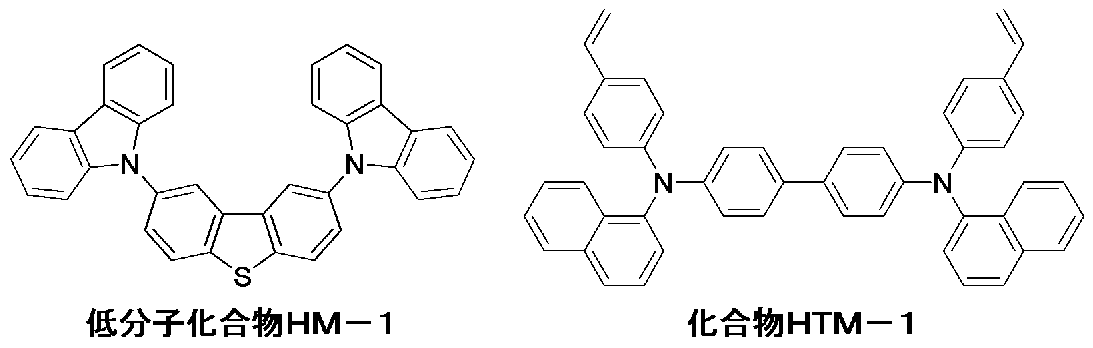
<合成例B> 金属錯体B1の合成
金属錯体B1は、国際公開第2006/121811号及び特開2013-048190号公報に記載の方法に準じて合成した。金属錯体B1の発光スペクトルの最大ピーク波長は471nmであった。
金属錯体B1は、国際公開第2006/121811号及び特開2013-048190号公報に記載の方法に準じて合成した。金属錯体B1の発光スペクトルの最大ピーク波長は471nmであった。
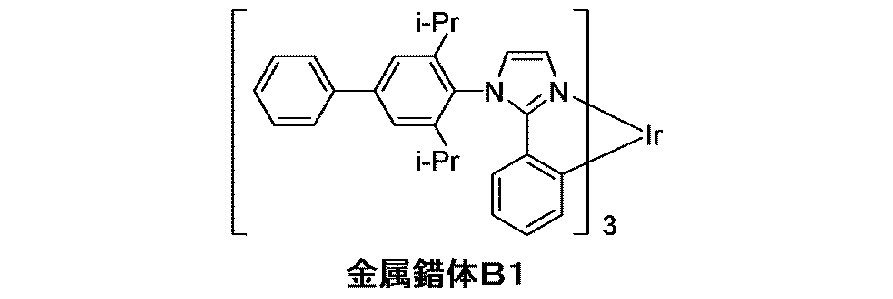
<合成例G> 金属錯体G1~G3の合成及び入手
金属錯体G1はLuminescence Technology社より購入した。
金属錯体G2は特開2013-237789号公報に記載の方法に従って合成した。
金属錯体G3は国際公開第2009/131255号に記載の方法に準じて合成した。
金属錯体G1はLuminescence Technology社より購入した。
金属錯体G2は特開2013-237789号公報に記載の方法に従って合成した。
金属錯体G3は国際公開第2009/131255号に記載の方法に準じて合成した。

化合物G1の発光スペクトルの最大ピーク波長は510nmであった。
化合物G2の発光スペクトルの最大ピーク波長は508nmであった。
化合物G3の発光スペクトルの最大ピーク波長は514nmであった。
化合物G2の発光スペクトルの最大ピーク波長は508nmであった。
化合物G3の発光スペクトルの最大ピーク波長は514nmであった。
<合成例R> 金属錯体R1~R4の合成及び入手
金属錯体R1はAmerican Dye Source社より購入した。
金属錯体R2はLuminescence Technology社より購入した。
金属錯体R3は特開2006-188673号公報に記載の方法に準じて合成した。
金属錯体R4は特開2008-179617号公報に記載の方法に従って合成した。
金属錯体R1はAmerican Dye Source社より購入した。
金属錯体R2はLuminescence Technology社より購入した。
金属錯体R3は特開2006-188673号公報に記載の方法に準じて合成した。
金属錯体R4は特開2008-179617号公報に記載の方法に従って合成した。

金属錯体R1の発光スペクトルの最大ピーク波長は618nmであった。
金属錯体R2の発光スペクトルの最大ピーク波長は620nmであった。
金属錯体R3の発光スペクトルの最大ピーク波長は619nmであった。
金属錯体R4の発光スペクトルの最大ピーク波長は594nmであった。
金属錯体R2の発光スペクトルの最大ピーク波長は620nmであった。
金属錯体R3の発光スペクトルの最大ピーク波長は619nmであった。
金属錯体R4の発光スペクトルの最大ピーク波長は594nmであった。
<合成例ET> 化合物ET1及び化合物ET3の合成
化合物ET1及び化合物ET3は、特開2010-235575号公報に記載の方法に準じて合成した。
化合物ET1及び化合物ET3は、特開2010-235575号公報に記載の方法に準じて合成した。

<化合物ET2> 化合物ET2の合成
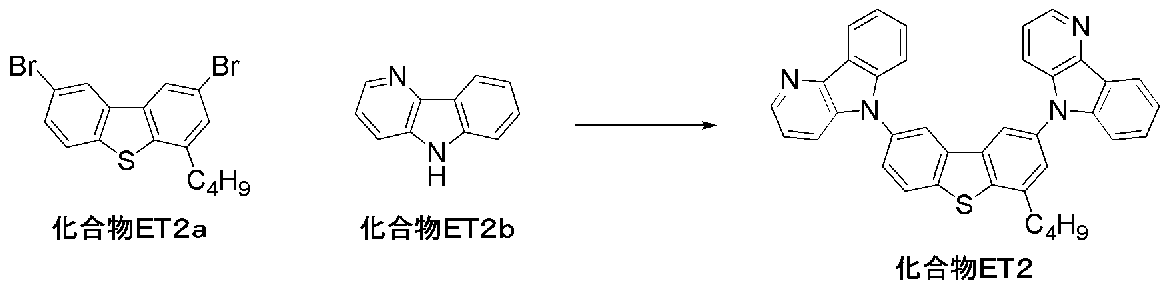
反応容器内を不活性ガス雰囲気とした後、化合物ET2a(8.7g)、化合物ET2b(8.1g)、ジメチルスルホキシド(218mL)、酸化銅(I)(1.3g)、リン酸三カリウム(16.7g)及びジピバロイルメタン(3.2g)を加え、150℃で10時間撹拌した。得られた反応液を室温まで冷却した後、トルエン及びイオン交換水を加え、セライトを敷いたグラスフィルターでろ過した。得られたろ液をイオン交換水で洗浄した後、得られた有機層を濃縮することにより、粗生成物を得た。得られた粗生成物をシリカゲルカラムクロマトグラフィー(ヘキサン及び酢酸エチルの混合溶媒)により精製し、次いで、アセトニトリル及びトルエンの混合溶媒を用いて晶析を行った。得られた固体を50℃で減圧乾燥させることにより、化合物ET2(8.0g)を得た。化合物ET2のHPLC面積百分率値は99.5%以上であった。
化合物ET2の分析結果は以下のとおりであった。
LC-MS(ESI,positive):m/z=573[M+H]+
1H-NMR(400MHz,THF-d8):δ(ppm)=1.01(t,3H),1.58-1.68(m,2H),1.95-2.05(m,2H),3.14-3.19(m,2H),7.32-7.39(m,4H),7.49-7.57(m,4H),7.72(s,1H),7.79-7.88(m,3H),8.34-8.42(m,3H),8.55-8.68(m,4H).
LC-MS(ESI,positive):m/z=573[M+H]+
1H-NMR(400MHz,THF-d8):δ(ppm)=1.01(t,3H),1.58-1.68(m,2H),1.95-2.05(m,2H),3.14-3.19(m,2H),7.32-7.39(m,4H),7.49-7.57(m,4H),7.72(s,1H),7.79-7.88(m,3H),8.34-8.42(m,3H),8.55-8.68(m,4H).
<実施例D1> 発光素子D1の作製と評価
(陽極及び正孔注入層の形成)
ガラス基板にスパッタ法により45nmの厚みでITO膜を付けることにより陽極を形成した。該陽極上に、正孔注入材料であるND-3202(日産化学工業製)をスピンコート法により35nmの厚さで成膜した。大気雰囲気下において、ホットプレート上で50℃、3分間加熱し、更に230℃、15分間加熱することにより正孔注入層を形成した。
(陽極及び正孔注入層の形成)
ガラス基板にスパッタ法により45nmの厚みでITO膜を付けることにより陽極を形成した。該陽極上に、正孔注入材料であるND-3202(日産化学工業製)をスピンコート法により35nmの厚さで成膜した。大気雰囲気下において、ホットプレート上で50℃、3分間加熱し、更に230℃、15分間加熱することにより正孔注入層を形成した。
(第3の層の形成)
キシレンに高分子化合物HTL-1及び金属錯体R4(高分子化合物HTL-1/金属錯体R4=65質量%/35質量%)を0.7質量%の濃度で溶解させた。得られたキシレン溶液を用いて、正孔注入層の上にスピンコート法により20nmの厚さで成膜し、窒素ガス雰囲気下において、ホットプレート上で180℃、60分間加熱させることにより、第3の層(発光層)を形成した。この加熱により、高分子化合物HTL-1は、架橋体となった。
キシレンに高分子化合物HTL-1及び金属錯体R4(高分子化合物HTL-1/金属錯体R4=65質量%/35質量%)を0.7質量%の濃度で溶解させた。得られたキシレン溶液を用いて、正孔注入層の上にスピンコート法により20nmの厚さで成膜し、窒素ガス雰囲気下において、ホットプレート上で180℃、60分間加熱させることにより、第3の層(発光層)を形成した。この加熱により、高分子化合物HTL-1は、架橋体となった。
(第1の層の形成)
トルエンに、化合物HM-1及び金属錯体B1(化合物HM-1/金属錯体B1=75質量%/25質量%)を2質量%の濃度で溶解させた。得られたトルエン溶液を用いて、第3の層の上にスピンコート法により80nmの厚さで成膜し、窒素ガス雰囲気下において、130℃、10分間加熱させることにより第1の層(発光層)を形成した。
トルエンに、化合物HM-1及び金属錯体B1(化合物HM-1/金属錯体B1=75質量%/25質量%)を2質量%の濃度で溶解させた。得られたトルエン溶液を用いて、第3の層の上にスピンコート法により80nmの厚さで成膜し、窒素ガス雰囲気下において、130℃、10分間加熱させることにより第1の層(発光層)を形成した。
(第2の層の形成)
2,2,3,3,4,4,5,5-オクタフルオロ-1-ペンタノールに、化合物ET1を0.25質量%の濃度で溶解させた。得られた2,2,3,3,4,4,5,5-オクタフルオロ-1-ペンタノール溶液を用いて、第1の層の上にスピンコート法により10nmの厚さで成膜し、窒素ガス雰囲気下において、130℃、10分間加熱させることにより第2の層(電子輸送層)を形成した。
2,2,3,3,4,4,5,5-オクタフルオロ-1-ペンタノールに、化合物ET1を0.25質量%の濃度で溶解させた。得られた2,2,3,3,4,4,5,5-オクタフルオロ-1-ペンタノール溶液を用いて、第1の層の上にスピンコート法により10nmの厚さで成膜し、窒素ガス雰囲気下において、130℃、10分間加熱させることにより第2の層(電子輸送層)を形成した。
(陰極の形成)
第1の層を形成した基板を蒸着機内において、1.0×10⁻⁴Pa以下にまで減圧した後、陰極として、第2の層の上にフッ化ナトリウムを約4nm、次いで、フッ化ナトリウム層の上にアルミニウムを約80nm蒸着した。蒸着後、ガラス基板を用いて封止することにより、発光素子D1を作製した。
第1の層を形成した基板を蒸着機内において、1.0×10⁻⁴Pa以下にまで減圧した後、陰極として、第2の層の上にフッ化ナトリウムを約4nm、次いで、フッ化ナトリウム層の上にアルミニウムを約80nm蒸着した。蒸着後、ガラス基板を用いて封止することにより、発光素子D1を作製した。
(発光素子の評価)
発光素子D1に電圧を印加することによりEL発光が観測された。3mA/cm2における外部量子効率[%]及びCIE色度座標(x,y)を測定した。
発光素子D1に電圧を印加することによりEL発光が観測された。3mA/cm2における外部量子効率[%]及びCIE色度座標(x,y)を測定した。
<実施例D2及び比較例CD1~CD2> 発光素子D2、CD1及びCD2の作製と評価
実施例D1の(第3の層の形成)における「高分子化合物HTL-1及び金属錯体R4(高分子化合物HTL-1/金属錯体R4=65質量%/35質量%)」に代えて、表1に記載の材料を用いた以外は、実施例D1と同様にして、発光素子D2、CD1及びCD2を作製した。
発光素子D2、CD1及びCD2に電圧を印加することによりEL発光が観測された。
3mA/cm2における外部量子効率[%]及びCIE色度座標(x,y)を測定した。
実施例D1の(第3の層の形成)における「高分子化合物HTL-1及び金属錯体R4(高分子化合物HTL-1/金属錯体R4=65質量%/35質量%)」に代えて、表1に記載の材料を用いた以外は、実施例D1と同様にして、発光素子D2、CD1及びCD2を作製した。
発光素子D2、CD1及びCD2に電圧を印加することによりEL発光が観測された。
3mA/cm2における外部量子効率[%]及びCIE色度座標(x,y)を測定した。
実施例D1~D2及び比較例CD1~CD2の結果を表1に示す。発光素子CD1の外部量子効率を1.0としたときの発光素子D1、D2及びCD2の外部量子効率の相対値を示す。

<実施例D3~D4及び比較例CD3~CD4> 発光素子D3、D4、CD3及びCD4の作製と評価
実施例D1の(第3の層の形成)における「高分子化合物HTL-1及び金属錯体R4(高分子化合物HTL-1/金属錯体R4=65質量%/35質量%)」に代えて、表2に記載の材料を用いた以外は、実施例D1と同様にして、発光素子D3、D4、CD3及びCD4を作製した。
発光素子D3、D4、CD3及びCD4に電圧を印加することによりEL発光が観測された。0.1mA/cm2における外部量子効率[%]及びCIE色度座標(x,y)を測定した。
実施例D1の(第3の層の形成)における「高分子化合物HTL-1及び金属錯体R4(高分子化合物HTL-1/金属錯体R4=65質量%/35質量%)」に代えて、表2に記載の材料を用いた以外は、実施例D1と同様にして、発光素子D3、D4、CD3及びCD4を作製した。
発光素子D3、D4、CD3及びCD4に電圧を印加することによりEL発光が観測された。0.1mA/cm2における外部量子効率[%]及びCIE色度座標(x,y)を測定した。
実施例D3~D4及び比較例CD3~CD4の結果を表2に示す。発光素子CD3の外部量子効率を1.0としたときの発光素子D3、D4及びCD4の外部量子効率の相対値を示す。

<実施例D5~D6及び比較例CD5~CD6> 発光素子D5、D6、CD5及びCD6の作製と評価
実施例D1の(第3の層の形成)における「高分子化合物HTL-1及び金属錯体R4(高分子化合物HTL-1/金属錯体R4=65質量%/35質量%)」に代えて、表3に記載の材料を用い、更に、実施例D1の(第2の層の形成)における「化合物ET1」に代えて、「化合物ET2」を用いた以外は、実施例D1と同様にして、発光素子D5、D6、CD5及びCD6を作製した。
発光素子D5、D6、CD5及びCD6に電圧を印加することによりEL発光が観測された。0.2mA/cm2における外部量子効率[%]及びCIE色度座標(x,y)を測定した。
実施例D1の(第3の層の形成)における「高分子化合物HTL-1及び金属錯体R4(高分子化合物HTL-1/金属錯体R4=65質量%/35質量%)」に代えて、表3に記載の材料を用い、更に、実施例D1の(第2の層の形成)における「化合物ET1」に代えて、「化合物ET2」を用いた以外は、実施例D1と同様にして、発光素子D5、D6、CD5及びCD6を作製した。
発光素子D5、D6、CD5及びCD6に電圧を印加することによりEL発光が観測された。0.2mA/cm2における外部量子効率[%]及びCIE色度座標(x,y)を測定した。
実施例D5~D6及び比較例CD5~CD6の結果を表3に示す。発光素子CD5の外部量子効率を1.0としたときの発光素子D5、D6及びCD6の外部量子効率の相対値を示す。

<実施例D7~D8及び比較例CD7~CD8> 発光素子D7、D8、CD7及びCD8の作製と評価
実施例D1の(第3の層の形成)における「高分子化合物HTL-1及び金属錯体R4(高分子化合物HTL-1/金属錯体R4=65質量%/35質量%)」に代えて、表4に記載の材料を用い、更に、実施例D1の(第2の層の形成)における「化合物ET1」に代えて、「化合物ET3」を用いた以外は、実施例D1と同様にして、発光素子D7、D8、CD7及びCD8を作製した。
発光素子D7、D8、CD7及びCD8に電圧を印加することによりEL発光が観測された。0.3mA/cm2における外部量子効率[%]及びCIE色度座標(x,y)を測定した。
実施例D1の(第3の層の形成)における「高分子化合物HTL-1及び金属錯体R4(高分子化合物HTL-1/金属錯体R4=65質量%/35質量%)」に代えて、表4に記載の材料を用い、更に、実施例D1の(第2の層の形成)における「化合物ET1」に代えて、「化合物ET3」を用いた以外は、実施例D1と同様にして、発光素子D7、D8、CD7及びCD8を作製した。
発光素子D7、D8、CD7及びCD8に電圧を印加することによりEL発光が観測された。0.3mA/cm2における外部量子効率[%]及びCIE色度座標(x,y)を測定した。
実施例D7~D8及び比較例CD7~CD8の結果を表4に示す。発光素子CD7の外部量子効率を1.0としたときの発光素子D7、D8及びCD8の外部量子効率の相対値を示す。
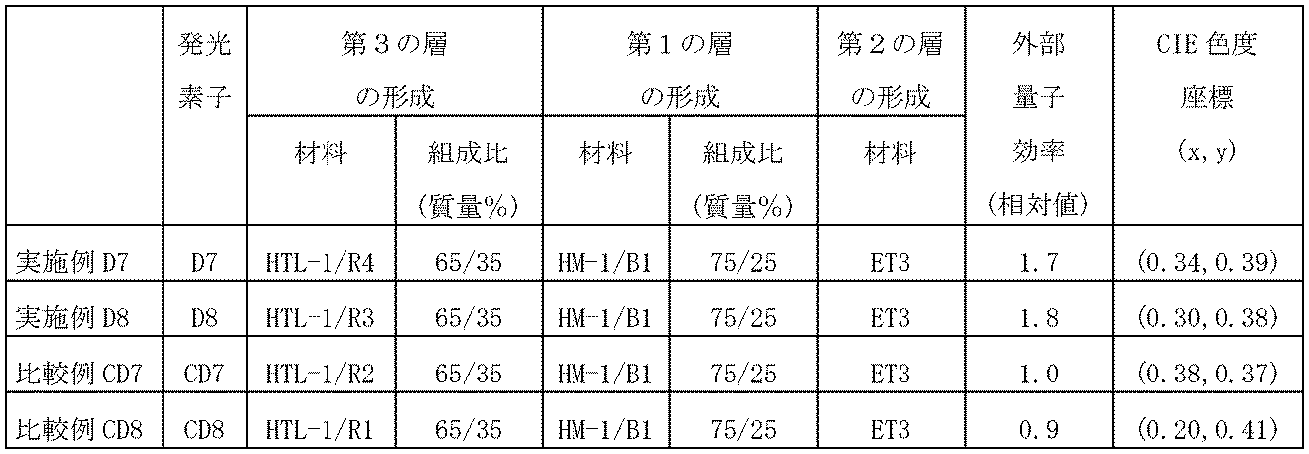
<実施例D9~D10及び比較例CD9> 発光素子D9、D10及びCD9の作製と評価
実施例D1の(第3の層の形成)における「高分子化合物HTL-1及び金属錯体R4(高分子化合物HTL-1/金属錯体R4=65質量%/35質量%)」に代えて、表5に記載の材料及び組成比(質量%)を用いた以外は、実施例D1と同様にして、発光素子D9、D10及びCD9を作製した。
発光素子D9、D10及びCD9に電圧を印加することによりEL発光が観測された。
0.1mA/cm2における外部量子効率[%]及びCIE色度座標(x,y)を測定した。
実施例D1の(第3の層の形成)における「高分子化合物HTL-1及び金属錯体R4(高分子化合物HTL-1/金属錯体R4=65質量%/35質量%)」に代えて、表5に記載の材料及び組成比(質量%)を用いた以外は、実施例D1と同様にして、発光素子D9、D10及びCD9を作製した。
発光素子D9、D10及びCD9に電圧を印加することによりEL発光が観測された。
0.1mA/cm2における外部量子効率[%]及びCIE色度座標(x,y)を測定した。
実施例D9~D10及び比較例CD9の結果を表5に示す。発光素子CD9の外部量子効率を1.0としたときの発光素子D9及びD10の外部量子効率の相対値を示す。
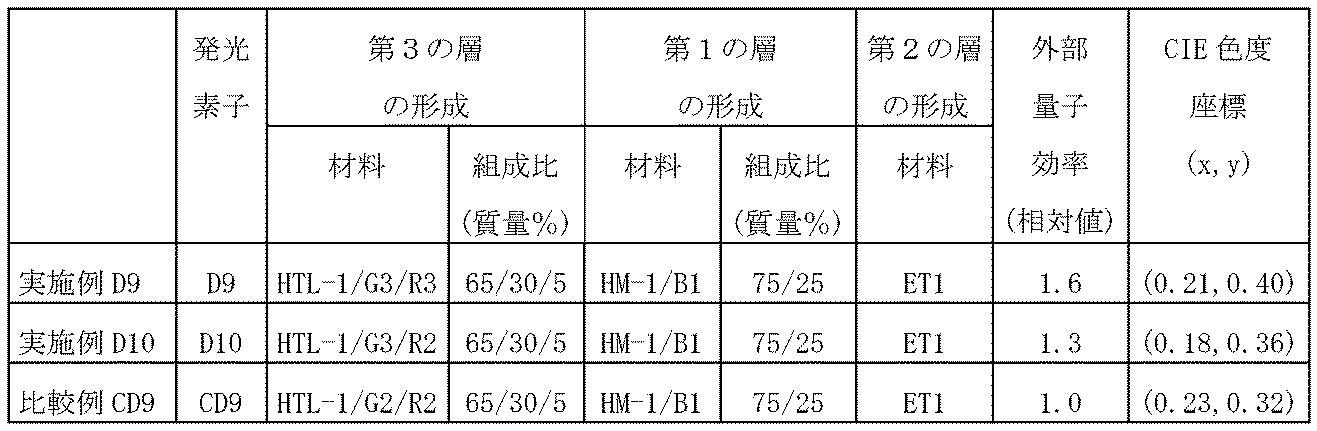
<実施例D11及び比較例CD10> 発光素子D11及びCD10の作製と評価
実施例D1の(第3の層の形成)における「高分子化合物HTL-1及び金属錯体R4(高分子化合物HTL-1/金属錯体R4=65質量%/35質量%)」に代えて、表6に記載の材料を用い、更に、実施例D1の(第1の層の形成)における「化合物HM-1及び金属錯体B1(化合物HM-1/金属錯体B1=75質量%/25質量%)」に代えて、表6に記載の材料及び組成比(質量%)を用いた以外は、実施例D1と同様にして、発光素子D11及びCD10を作製した。
発光素子D11及びCD10に電圧を印加することによりEL発光が観測された。0.075mA/cm2における外部量子効率[%]及びCIE色度座標(x,y)を測定した。
実施例D1の(第3の層の形成)における「高分子化合物HTL-1及び金属錯体R4(高分子化合物HTL-1/金属錯体R4=65質量%/35質量%)」に代えて、表6に記載の材料を用い、更に、実施例D1の(第1の層の形成)における「化合物HM-1及び金属錯体B1(化合物HM-1/金属錯体B1=75質量%/25質量%)」に代えて、表6に記載の材料及び組成比(質量%)を用いた以外は、実施例D1と同様にして、発光素子D11及びCD10を作製した。
発光素子D11及びCD10に電圧を印加することによりEL発光が観測された。0.075mA/cm2における外部量子効率[%]及びCIE色度座標(x,y)を測定した。
実施例D11及び比較例CD10の結果を表6に示す。発光素子CD10の外部量子効率を1.0としたときの発光素子D11の外部量子効率の相対値を示す。
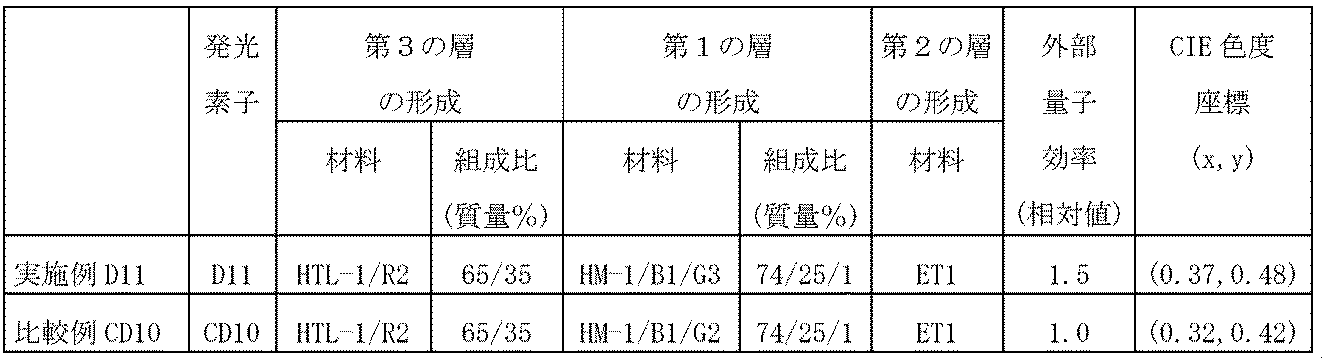
<実施例D12及び比較例CD11~CD12> 発光素子D12、CD11及びCD12の作製と評価
実施例D1の(第3の層の形成)における「高分子化合物HTL-1及び金属錯体R4(高分子化合物HTL-1/金属錯体R4=65質量%/35質量%)」に代えて、表7に記載の材料及び組成比(質量%)を用い、更に、実施例D1の(第2の層の形成)における「化合物ET1」に代えて、「化合物ET2」を用いた以外は、実施例D1と同様にして、発光素子D12、CD11及びCD12を作製した。
発光素子D12、CD11及びCD12に電圧を印加することによりEL発光が観測された。0.1mA/cm2における外部量子効率[%]及びCIE色度座標(x,y)を測定した。
実施例D1の(第3の層の形成)における「高分子化合物HTL-1及び金属錯体R4(高分子化合物HTL-1/金属錯体R4=65質量%/35質量%)」に代えて、表7に記載の材料及び組成比(質量%)を用い、更に、実施例D1の(第2の層の形成)における「化合物ET1」に代えて、「化合物ET2」を用いた以外は、実施例D1と同様にして、発光素子D12、CD11及びCD12を作製した。
発光素子D12、CD11及びCD12に電圧を印加することによりEL発光が観測された。0.1mA/cm2における外部量子効率[%]及びCIE色度座標(x,y)を測定した。
実施例D12及び比較例CD11~CD12の結果を表7に示す。発光素子CD11の外部量子効率を1.0としたときの発光素子D12及びCD12の外部量子効率の相対値を示す。
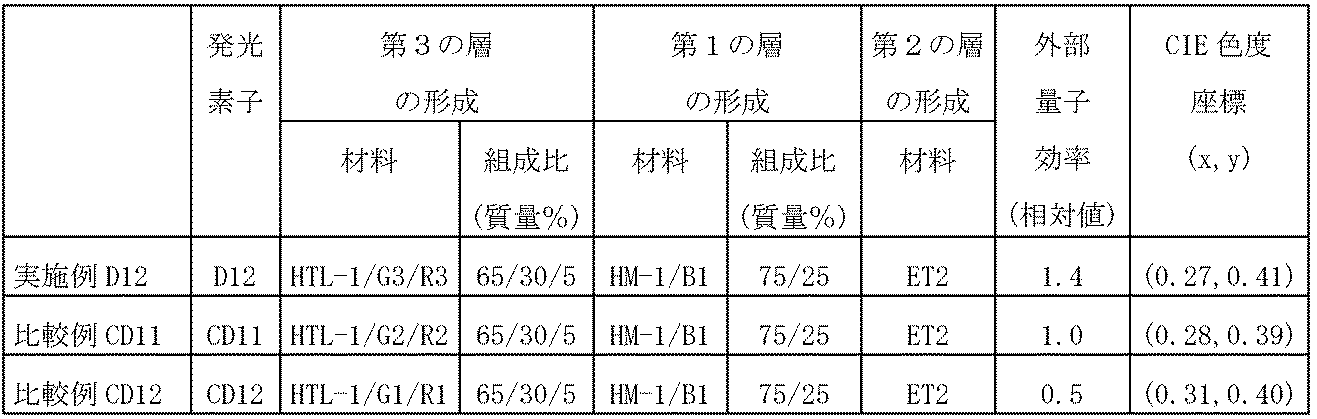
<実施例D13及び比較例CD13~CD14> 発光素子D13、CD13及びCD14の作製と評価
実施例D1の(第3の層の形成)における「高分子化合物HTL-1及び金属錯体R4(高分子化合物HTL-1/金属錯体R4=65質量%/35質量%)」に代えて、表8に記載の材料及び組成比(質量%)を用い、更に、実施例D1の(第2の層の形成)における「化合物ET1」に代えて、「化合物ET3」を用いた以外は、実施例D1と同様にして、発光素子D13、CD13及びCD14を作製した。
発光素子D13、CD13及びCD14に電圧を印加することによりEL発光が観測された。0.1mA/cm2における外部量子効率[%]及びCIE色度座標(x,y)を測定した。
実施例D1の(第3の層の形成)における「高分子化合物HTL-1及び金属錯体R4(高分子化合物HTL-1/金属錯体R4=65質量%/35質量%)」に代えて、表8に記載の材料及び組成比(質量%)を用い、更に、実施例D1の(第2の層の形成)における「化合物ET1」に代えて、「化合物ET3」を用いた以外は、実施例D1と同様にして、発光素子D13、CD13及びCD14を作製した。
発光素子D13、CD13及びCD14に電圧を印加することによりEL発光が観測された。0.1mA/cm2における外部量子効率[%]及びCIE色度座標(x,y)を測定した。
実施例D13及び比較例CD13~CD14の結果を表8に示す。発光素子CD13の外部量子効率を1.0としたときの発光素子D13及びCD14の外部量子効率の相対値を示す。
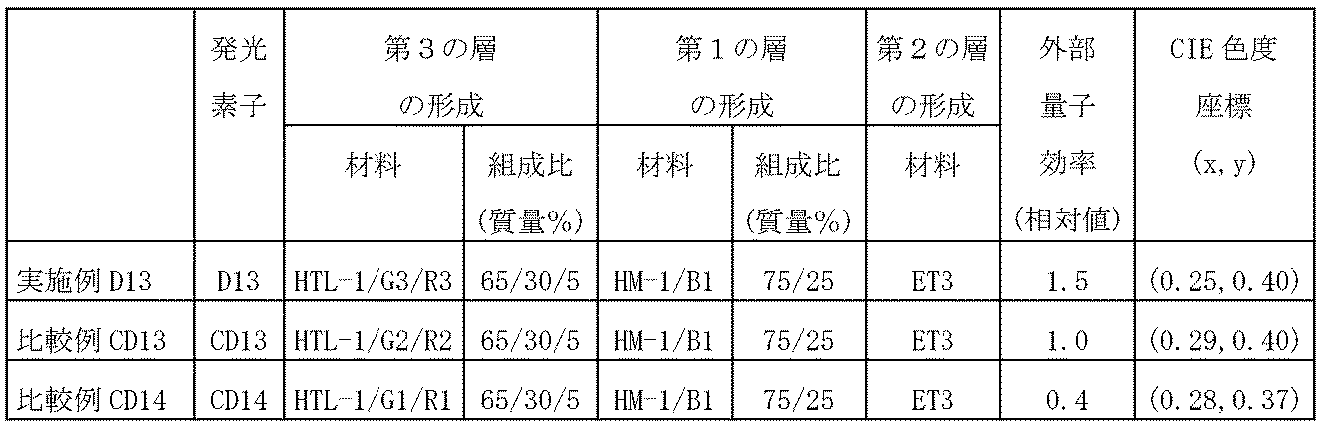
本発明によれば、外部量子効率が優れる発光素子を提供することができる。外部量子効率の優れた発光素子は、省資源化、省エネルギー化等の効果がある。
10 発光素子、11 陽極、12 第3の層、13 第1の層、14 第2の層、15 陰極。
Claims (18)
- 陽極と、陰極と、前記陽極及び前記陰極の間に設けられた第1の層、前記陰極及び前記第1の層の間に設けられた第2の層と、前記陽極及び前記第1の層の間に設けられた第3の層とを有する発光素子であり、
前記第1の層が、式(1)で表される金属錯体を含有する層であり、
前記第2の層及び前記第3の層の少なくとも1層が、発光スペクトルの最大ピーク波長が570nm以上750nm未満である式(2)で表される金属錯体を含有し、
前記第1の層、前記第2の層及び前記第3の層の少なくとも1層が、発光スペクトルの最大ピーク波長が495nm以上570nm未満である式(3)で表される金属錯体を含有し、
前記第1の層、前記第2の層及び前記第3の層の少なくとも1層が、式(T-1)で表される化合物を含有する、発光素子。

M1は、ロジウム原子、パラジウム原子、イリジウム原子又は白金原子を表す。
n1は1以上の整数を表し、n2は0以上の整数を表す。但し、M1がロジウム原子又はイリジウム原子の場合、n1+n2は3であり、M1がパラジウム原子又は白金原子の場合、n1+n2は2である。
E1及びE2は、それぞれ独立に、炭素原子又は窒素原子を表す。E1及びE2が複数存在する場合、それらはそれぞれ同一でも異なっていてもよい。
環R1は、5員の芳香族複素環を表し、この環は単一又は複数の置換基を有していてもよい。前記置換基が複数存在する場合、それらは同一でも異なっていてもよく、互いに結合して、それぞれが結合する原子とともに環を形成していてもよい。環R1が複数存在する場合、それらは同一でも異なっていてもよい。
環R2は、芳香族炭化水素環又は芳香族複素環を表し、これらの環は単一又は複数の置換基を有していてもよい。前記置換基が複数存在する場合、それらは同一でも異なっていてもよく、互いに結合して、それぞれが結合する原子とともに環を形成していてもよい。
環R2が複数存在する場合、それらは同一でも異なっていてもよい。
環R1が有していてもよい置換基と環R2が有していてもよい置換基とは、同一でも異なっていてもよく、互いに結合して、それぞれが結合する原子とともに環を形成していてもよい。
A1-G1-A2は、アニオン性の2座配位子を表す。A1及びA2は、それぞれ独立に、炭素原子、酸素原子又は窒素原子を表し、これらの原子は環を構成する原子であってもよい。G1は、単結合、又は、A1及びA2とともに2座配位子を構成する原子団を表す。A1-G1-A2が複数存在する場合、それらは同一でも異なっていてもよい。]

M2は、ロジウム原子、パラジウム原子、イリジウム原子又は白金原子を表す。
n3は1以上の整数を表し、n4は0以上の整数を表す。但し、M2がロジウム原子又はイリジウム原子の場合、n3+n4は3であり、M2がパラジウム原子又は白金原子の場合、n3+n4は2である。
ELは、炭素原子又は窒素原子を表す。ELが複数存在する場合、それらはそれぞれ同一でも異なっていてもよい。
環L1は、6員の芳香族複素環を表し、この環は単一又は複数の置換基を有していてもよい。前記置換基が複数存在する場合、それらは同一でも異なっていてもよく、互いに結合して、それぞれが結合する原子とともに環を形成していてもよい。環L1が複数存在する場合、それらは同一でも異なっていてもよい。
環L2は、芳香族炭化水素環又は芳香族複素環を表し、これらの環は単一又は複数の置換基を有していてもよい。前記置換基が複数存在する場合、それらは同一でも異なっていてもよく、互いに結合して、それぞれが結合する原子とともに環を形成していてもよい。
環L2が複数存在する場合、それらは同一でも異なっていてもよい。
環L1が有していてもよい置換基と環L2が有していてもよい置換基とは、同一でも異なっていてもよく、互いに結合して、それぞれが結合する原子とともに環を形成していてもよい。
但し、環L1及び環L2のうちの少なくとも1つは、置換基として、式(1-T)で表される基を有する。式(1-T)で表される基が複数存在する場合、それらは同一でも異なっていてもよい。
A3-G2-A4は、アニオン性の2座配位子を表す。A3及びA4は、それぞれ独立に、炭素原子、酸素原子又は窒素原子を表し、これらの原子は環を構成する原子であってもよい。G2は、単結合、又は、A3及びA4とともに2座配位子を構成する原子団を表す。A3-G2-A4が複数存在する場合、それらは同一でも異なっていてもよい。]


nT1は、0以上5以下の整数を表す。nT1が複数存在する場合、それらは同一でも異なっていてもよい。
nT2は、1以上10以下の整数を表す。
ArT1は、環内に二重結合を有さない窒素原子及び=N-で表される基を含む、縮合環の1価の複素環基であり、該基は単一又は複数の置換基を有していてもよい。前記置換基が複数存在する場合、互いに結合して、それぞれが結合する原子とともに環を形成していてもよい。ArT1が複数存在する場合、それらは同一でも異なっていてもよい。
LT1は、アルキレン基、シクロアルキレン基、アリーレン基、2価の複素環基、-NRT1’-で表される基、酸素原子又は硫黄原子を表し、これらの基は単一又は複数の置換基を有していてもよく、前記置換基が複数存在する場合、それらは同一でも異なっていてもよく、互いに結合して、それぞれが結合する原子とともに環を形成していてもよい。
RT1’は、水素原子、アルキル基、シクロアルキル基、アリール基又は1価の複素環基を表し、これらの基は単一又は複数の置換基を有していてもよく、前記置換基が複数存在する場合、それらは同一でも異なっていてもよく、互いに結合して、それぞれが結合する原子とともに環を形成していてもよい。LT1が複数存在する場合、それらは同一でも異なっていてもよい。
ArT2は、芳香族炭化水素基又は複素環基を表し、これらの基は単一又は複数の置換基を有していてもよく、前記置換基が複数存在する場合、互いに結合して、それぞれが結合する原子とともに環を形成していてもよい。]
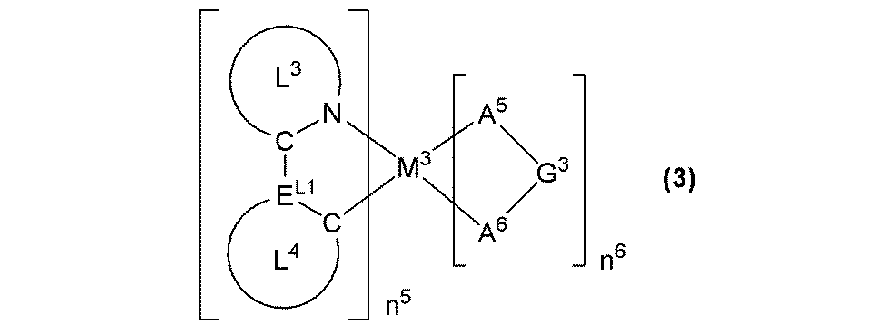
M3は、ロジウム原子、パラジウム原子、イリジウム原子又は白金原子を表す。
n5は1以上の整数を表し、n6は0以上の整数を表す。但し、M3がロジウム原子又はイリジウム原子の場合、n5+n6は3であり、M3がパラジウム原子又は白金原子の場合、n5+n6は2である。
EL1は、炭素原子又は窒素原子を表す。EL1が複数存在する場合、それらはそれぞれ同一でも異なっていてもよい。
環L3は、6員の芳香族複素環を表し、この環は単一又は複数の置換基を有していてもよい。前記置換基が複数存在する場合、それらは同一でも異なっていてもよく、互いに結合して、それぞれが結合する原子とともに環を形成していてもよい。環L3が複数存在する場合、それらは同一でも異なっていてもよい。
環L4は、芳香族炭化水素環又は芳香族複素環を表し、これらの環は単一又は複数の置換基を有していてもよい。前記置換基が複数存在する場合、それらは同一でも異なっていてもよく、互いに結合して、それぞれが結合する原子とともに環を形成していてもよい。
環L4が複数存在する場合、それらは同一でも異なっていてもよい。
環L3が有していてもよい置換基と環L4が有していてもよい置換基とは、同一でも異なっていてもよく、互いに結合して、それぞれが結合する原子とともに環を形成していてもよい。
但し、環L3及び環L4のうちの少なくとも1つは、置換基として、式(3-T)で表される基を有する。式(3-T)で表される基が複数存在する場合、それらは同一でも異なっていてもよい。
A5-G3-A6は、アニオン性の2座配位子を表す。A3及びA4は、それぞれ独立に、炭素原子、酸素原子又は窒素原子を表し、これらの原子は環を構成する原子であってもよい。G3は、単結合、又は、A5及びA6とともに2座配位子を構成する原子団を表す。A5-G3-A6が複数存在する場合、それらは同一でも異なっていてもよい。]

- 前記第3の層が、前記式(2)で表される金属錯体を含有する、請求項1に記載の発光素子。
- 前記環L1が、ピリジン環、ジアザベンゼン環、アザナフタレン環又はジアザナフタレン環であり、これらの環は単一又は複数の置換基を有していてもよく、且つ、前記環L2が、ベンゼン環、ピリジン環又はジアザベンゼン環であり、これらの環は単一又は複数の置換基を有していてもよい、請求項1又は2に記載の発光素子。
- 前記第1の層及び前記第3の層の少なくとも1層が、前記式(3)で表される金属錯体を含有する、請求項1~3のいずれか一項に記載の発光素子。
- 前記環L3が、ピリジン環又はジアザベンゼン環であり、これらの環は単一又は複数の置換基を有していてもよく、且つ、前記環L4が、ベンゼン環、ピリジン環又はジアザベンゼン環であり、これらの環は単一又は複数の置換基を有していてもよい、請求項1~4のいずれか一項に記載の発光素子。
- 前記式(1-T)で表される基が、式(2-T)で表される基である、請求項1~5のいずれか一項に記載の発光素子。

- 陽極と、陰極と、前記陽極及び前記陰極の間に設けられた第1の層、前記陰極及び前記第1の層の間に設けられた第2の層と、前記陽極及び前記第1の層の間に設けられた第3の層とを有する発光素子であり、
前記第1の層が、式(1)で表される金属錯体を含有する層であり、
前記第2の層及び前記第3の層の少なくとも1層が、発光スペクトルの最大ピーク波長が570nm以上750nm未満である式(2’)で表される金属錯体を含有し、
前記第1の層、前記第2の層及び前記第3の層の少なくとも1層が、式(T-1)で表される化合物を含有する、発光素子。
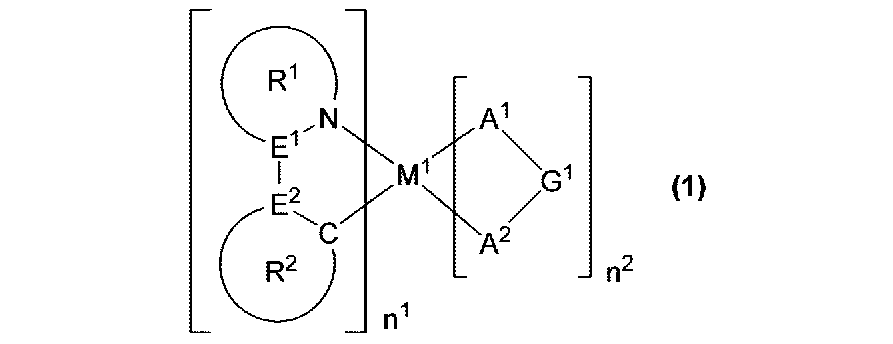
M1は、ロジウム原子、パラジウム原子、イリジウム原子又は白金原子を表す。
n1は1以上の整数を表し、n2は0以上の整数を表す。但し、M1がロジウム原子又はイリジウム原子の場合、n1+n2は3であり、M1がパラジウム原子又は白金原子の場合、n1+n2は2である。
E1及びE2は、それぞれ独立に、炭素原子又は窒素原子を表す。E1及びE2が複数存在する場合、それらはそれぞれ同一でも異なっていてもよい。
環R1は、5員の芳香族複素環を表し、この環は単一又は複数の置換基を有していてもよい。前記置換基が複数存在する場合、それらは同一でも異なっていてもよく、互いに結合して、それぞれが結合する原子とともに環を形成していてもよい。環R1が複数存在する場合、それらは同一でも異なっていてもよい。
環R2は、芳香族炭化水素環又は芳香族複素環を表し、これらの環は単一又は複数の置換基を有していてもよい。前記置換基が複数存在する場合、それらは同一でも異なっていてもよく、互いに結合して、それぞれが結合する原子とともに環を形成していてもよい。
環R2が複数存在する場合、それらは同一でも異なっていてもよい。
環R1が有していてもよい置換基と環R2が有していてもよい置換基とは、同一でも異なっていてもよく、互いに結合して、それぞれが結合する原子とともに環を形成していてもよい。
A1-G1-A2は、アニオン性の2座配位子を表す。A1及びA2は、それぞれ独立に、炭素原子、酸素原子又は窒素原子を表し、これらの原子は環を構成する原子であってもよい。G1は、単結合、又は、A1及びA2とともに2座配位子を構成する原子団を表す。A1-G1-A2が複数存在する場合、それらは同一でも異なっていてもよい。]
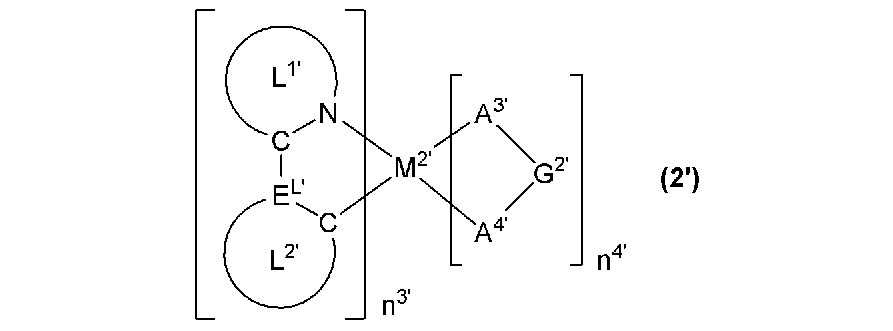
M2’は、ロジウム原子、パラジウム原子、イリジウム原子又は白金原子を表す。
n3’は1以上の整数を表し、n4’は0以上の整数を表す。但し、M2’がロジウム原子又はイリジウム原子の場合、n3’+n4’は3であり、M2’がパラジウム原子又は白金原子の場合、n3’+n4’は2である。
EL’は、炭素原子又は窒素原子を表す。EL’が複数存在する場合、それらはそれぞれ同一でも異なっていてもよい。
環L1’は、6員の芳香族複素環を表し、この環は単一又は複数の置換基を有していてもよい。前記置換基が複数存在する場合、それらは同一でも異なっていてもよく、互いに結合して、それぞれが結合する原子とともに環を形成していてもよい。環L1’が複数存在する場合、それらは同一でも異なっていてもよい。
環L2’は、芳香族炭化水素環又は芳香族複素環を表し、これらの環は単一又は複数の置換基を有していてもよい。前記置換基が複数存在する場合、それらは同一でも異なっていてもよく、互いに結合して、それぞれが結合する原子とともに環を形成していてもよい。環L2’が複数存在する場合、それらは同一でも異なっていてもよい。
環L1’が有していてもよい置換基と環L2’が有していてもよい置換基とは、同一でも異なっていてもよく、互いに結合して、それぞれが結合する原子とともに環を形成していてもよい。
但し、環L1’及び環L2’のうちの少なくとも1つは、置換基として、式(2-T)で表される基を有する。式(2-T)で表される基が複数存在する場合、それらは同一でも異なっていてもよい。
A3’-G2’-A4’は、アニオン性の2座配位子を表す。A3’及びA4’は、それぞれ独立に、炭素原子、酸素原子又は窒素原子を表し、これらの原子は環を構成する原子であってもよい。G2’は、単結合、又は、A3’及びA4’とともに2座配位子を構成する原子団を表す。A3’-G2’-A4’が複数存在する場合、それらは同一でも異なっていてもよい。]


nT1は、0以上5以下の整数を表す。nT1が複数存在する場合、それらは同一でも異なっていてもよい。
nT2は、1以上10以下の整数を表す。
ArT1は、環内に二重結合を有さない窒素原子及び=N-で表される基を含む、縮合環の1価の複素環基であり、該基は単一又は複数の置換基を有していてもよい。前記置換基が複数存在する場合、互いに結合して、それぞれが結合する原子とともに環を形成していてもよい。ArT1が複数存在する場合、それらは同一でも異なっていてもよい。
LT1は、アルキレン基、シクロアルキレン基、アリーレン基、2価の複素環基、-NRT1’-で表される基、酸素原子又は硫黄原子を表し、これらの基は単一又は複数の置換基を有していてもよく、前記置換基が複数存在する場合、それらは同一でも異なっていてもよく、互いに結合して、それぞれが結合する原子とともに環を形成していてもよい。
RT1’は、水素原子、アルキル基、シクロアルキル基、アリール基又は1価の複素環基を表し、これらの基は単一又は複数の置換基を有していてもよく、前記置換基が複数存在する場合、それらは同一でも異なっていてもよく、互いに結合して、それぞれが結合する原子とともに環を形成していてもよい。LT1が複数存在する場合、それらは同一でも異なっていてもよい。
ArT2は、芳香族炭化水素基又は複素環基を表し、これらの基は単一又は複数の置換基を有していてもよく、前記置換基が複数存在する場合、互いに結合して、それぞれが結合する原子とともに環を形成していてもよい。] - 前記第3の層が、前記式(2’)で表される金属錯体を含有する、請求項7に記載の発光素子。
- 前記環L1’が、ピリジン環、ジアザベンゼン環、アザナフタレン環又はジアザナフタレン環であり、これらの環は単一又は複数の置換基を有していてもよく、且つ、前記環L2’が、ベンゼン環、ピリジン環又はジアザベンゼン環であり、これらの環は単一又は複数の置換基を有していてもよい、請求項7又は8に記載の発光素子。
- 前記第2の層が、前記式(T-1)で表される化合物を含有する、請求項1~9のいずれか一項に記載の発光素子。
- 前記ArT1が、式(T1-1)で表される基である、請求項1~10のいずれか一項に記載の発光素子。

XT1は、単結合、酸素原子、硫黄原子、-N(RXT1)-で表される基、又は、-C(RXT1’)2-で表される基を表す。RXT1及びRXT1’は、それぞれ独立に、水素原子、アルキル基、シクロアルキル基、アルコキシ基、シクロアルコキシ基、アリール基、アリールオキシ基、1価の複素環基、置換アミノ基、ハロゲン原子又はシアノ基を表し、これらの基は単一又は複数の置換基を有していてもよく、前記置換基が複数存在する場合、それらは同一でも異なっていてもよく、互いに結合して、それぞれが結合する原子とともに環を形成していてもよい。複数存在するRXT1’は、同一でも異なっていてもよく、互いに結合して、それぞれが結合する原子とともに環を形成していてもよい。
環RT1及び環RT2は、それぞれ独立に、芳香族炭化水素環又は複素環を表し、これらの環は単一又は複数の置換基を有していてもよく、前記置換基が複数存在する場合、それらは同一でも異なっていてもよく、互いに結合して、それぞれが結合する原子とともに環を形成していてもよい。
但し、環RT1及び環RT2のうちの少なくとも一つは、環内に=N-で表される基を含む複素環であり、該環は単一又は複数の置換基を有していてもよく、前記置換基が複数存在する場合、それらは同一でも異なっていてもよく、互いに結合して、それぞれが結合する原子とともに環を形成していてもよい。] - 前記環RT1が、芳香族炭化水素環又は環内に=N-で表される基を含む複素環であり、これらの環は単一又は複数の置換基を有していてもよく、且つ、前記環RT2が、環内に=N-で表される基を含む複素環であり、該環は単一又は複数の置換基を有していてもよい、請求項11に記載の発光素子。
- 前記環RT1が、単環式の芳香族炭化水素環又は環内に=N-で表される基を含む単環式の複素環であり、これらの環は単一又は複数の置換基を有していてもよく、且つ、前記環RT2が、環内に=N-で表される基を含む単環式の複素環であり、該環は単一又は複数の置換基を有していてもよい、請求項12に記載の発光素子。
- 前記環RT1が、ベンゼン環、ピリジン環又はジアザベンゼン環であり、これらの環は単一又は複数の置換基を有していてもよく、且つ、前記環RT2が、ピリジン環又はジアザベンゼン環であり、これらの環は単一又は複数の置換基を有していてもよい、請求項13に記載の発光素子。
- 前記式(1)で表される金属錯体の発光スペクトルの最大ピーク波長が380nm以上495nm未満である、請求項1~14のいずれか一項に記載の発光素子。
- 前記環R1が、ジアゾール環又はトリアゾール環であり、これらの環は単一又は複数の置換基を有していてもよく、且つ、前記環R2が、ベンゼン環、ピリジン環又はジアザベンゼン環であり、これらの環は単一又は複数の置換基を有していてもよい、請求項1~15のいずれか一項に記載の発光素子。
- 前記第1の層が、式(H-1)で表される化合物を更に含有する、請求項1~16のいずれか一項に記載の発光素子。

ArH1及びArH2は、それぞれ独立に、アリール基、1価の複素環基又は置換アミノ基を表し、これらの基は単一又は複数の置換基を有していてもよい。前記置換基が複数存在する場合、それらは同一でも異なっていてもよく、互いに結合して、それぞれが結合する原子とともに環を形成していてもよい。
nH1は、0以上の整数を表す。
LH1は、アリーレン基、2価の複素環基、アルキレン基又はシクロアルキレン基を表し、これらの基は単一又は複数の置換基を有していてもよい。前記置換基が複数存在する場合、それらは同一でも異なっていてもよく、互いに結合して、それぞれが結合する原子とともに環を形成していてもよい。LH1が複数存在する場合、それらは同一でも異なっていてもよい。] - 前記第1の層と前記第2の層とが隣接しており、且つ、前記第1の層と前記第3の層とが隣接している、請求項1~17のいずれか一項に記載の発光素子。
Applications Claiming Priority (2)
| Application Number | Priority Date | Filing Date | Title |
|---|---|---|---|
| JP2018200626 | 2018-10-25 | ||
| JP2018-200626 | 2018-10-25 |
Publications (1)
| Publication Number | Publication Date |
|---|---|
| WO2020084922A1 true WO2020084922A1 (ja) | 2020-04-30 |
Family
ID=70000869
Family Applications (1)
| Application Number | Title | Priority Date | Filing Date |
|---|---|---|---|
| PCT/JP2019/034950 Ceased WO2020084922A1 (ja) | 2018-10-25 | 2019-09-05 | 発光素子 |
Country Status (2)
| Country | Link |
|---|---|
| JP (1) | JP6672518B1 (ja) |
| WO (1) | WO2020084922A1 (ja) |
Citations (6)
| Publication number | Priority date | Publication date | Assignee | Title |
|---|---|---|---|---|
| WO2015159744A1 (ja) * | 2014-04-18 | 2015-10-22 | 住友化学株式会社 | 組成物およびそれを用いた発光素子 |
| JP2016096155A (ja) * | 2010-02-05 | 2016-05-26 | 日東電工株式会社 | 効率が向上した有機発光ダイオード |
| JP2016519834A (ja) * | 2013-03-20 | 2016-07-07 | ビーエーエスエフ ソシエタス・ヨーロピアBasf Se | 白色有機発光素子 |
| JP2016207954A (ja) * | 2015-04-28 | 2016-12-08 | コニカミノルタ株式会社 | 有機エレクトロルミネッセンス素子及び有機エレクトロルミネッセンス素子材料 |
| WO2017153731A1 (en) * | 2016-03-08 | 2017-09-14 | Cambridge Display Technology Limited | Dibenzofuran and dibenzothiophene derivatives and organic light-emitting devices containing them |
| WO2018097156A1 (ja) * | 2016-11-25 | 2018-05-31 | コニカミノルタ株式会社 | 有機エレクトロルミネッセンス素子及び有機材料用組成物 |
-
2019
- 2019-08-26 JP JP2019153334A patent/JP6672518B1/ja not_active Expired - Fee Related
- 2019-09-05 WO PCT/JP2019/034950 patent/WO2020084922A1/ja not_active Ceased
Patent Citations (6)
| Publication number | Priority date | Publication date | Assignee | Title |
|---|---|---|---|---|
| JP2016096155A (ja) * | 2010-02-05 | 2016-05-26 | 日東電工株式会社 | 効率が向上した有機発光ダイオード |
| JP2016519834A (ja) * | 2013-03-20 | 2016-07-07 | ビーエーエスエフ ソシエタス・ヨーロピアBasf Se | 白色有機発光素子 |
| WO2015159744A1 (ja) * | 2014-04-18 | 2015-10-22 | 住友化学株式会社 | 組成物およびそれを用いた発光素子 |
| JP2016207954A (ja) * | 2015-04-28 | 2016-12-08 | コニカミノルタ株式会社 | 有機エレクトロルミネッセンス素子及び有機エレクトロルミネッセンス素子材料 |
| WO2017153731A1 (en) * | 2016-03-08 | 2017-09-14 | Cambridge Display Technology Limited | Dibenzofuran and dibenzothiophene derivatives and organic light-emitting devices containing them |
| WO2018097156A1 (ja) * | 2016-11-25 | 2018-05-31 | コニカミノルタ株式会社 | 有機エレクトロルミネッセンス素子及び有機材料用組成物 |
Also Published As
| Publication number | Publication date |
|---|---|
| JP2020072258A (ja) | 2020-05-07 |
| JP6672518B1 (ja) | 2020-03-25 |
Similar Documents
| Publication | Publication Date | Title |
|---|---|---|
| JP6934967B2 (ja) | 発光素子及び発光素子用組成物 | |
| KR20210146961A (ko) | 발광 소자 및 그의 제조 방법 그리고 발광 소자용 조성물 및 그의 제조 방법 | |
| JP6595069B1 (ja) | 発光素子 | |
| JP6595070B1 (ja) | 発光素子 | |
| JP6651041B1 (ja) | 発光素子 | |
| JP6589032B1 (ja) | 発光素子 | |
| KR102191197B1 (ko) | 발광 소자용 조성물, 발광 소자용 조성물의 제조 방법, 발광 소자용 조성물의 평가 방법, 발광 소자 및 발광 소자의 제조 방법 | |
| JP6672518B1 (ja) | 発光素子 | |
| JP6692980B2 (ja) | 発光素子 | |
| JP6600064B1 (ja) | 発光素子 | |
| KR102949933B1 (ko) | 발광 소자 및 발광 소자용 조성물 | |
| JP2020077852A (ja) | 発光素子 | |
| JP2020077853A (ja) | 発光素子 | |
| JP6688868B1 (ja) | 発光素子用組成物及び発光素子の製造方法 | |
| KR20230074202A (ko) | 발광 소자 및 조성물 | |
| KR20230074204A (ko) | 발광 소자 및 조성물 | |
| JP2020109874A (ja) | 発光素子用組成物及びそれを含有する発光素子 | |
| JP2020107822A (ja) | 発光素子用組成物及びそれを含有する発光素子 |
Legal Events
| Date | Code | Title | Description |
|---|---|---|---|
| 121 | Ep: the epo has been informed by wipo that ep was designated in this application |
Ref document number: 19875147 Country of ref document: EP Kind code of ref document: A1 |
|
| NENP | Non-entry into the national phase |
Ref country code: DE |
|
| 122 | Ep: pct application non-entry in european phase |
Ref document number: 19875147 Country of ref document: EP Kind code of ref document: A1 |