WO2020082006A1 - Low halogen two component toughened epoxy adhesive - Google Patents
Low halogen two component toughened epoxy adhesive Download PDFInfo
- Publication number
- WO2020082006A1 WO2020082006A1 PCT/US2019/057044 US2019057044W WO2020082006A1 WO 2020082006 A1 WO2020082006 A1 WO 2020082006A1 US 2019057044 W US2019057044 W US 2019057044W WO 2020082006 A1 WO2020082006 A1 WO 2020082006A1
- Authority
- WO
- WIPO (PCT)
- Prior art keywords
- formulation
- adhesive
- core
- cure
- impact modifier
- Prior art date
- Legal status (The legal status is an assumption and is not a legal conclusion. Google has not performed a legal analysis and makes no representation as to the accuracy of the status listed.)
- Ceased
Links
Classifications
-
- C—CHEMISTRY; METALLURGY
- C08—ORGANIC MACROMOLECULAR COMPOUNDS; THEIR PREPARATION OR CHEMICAL WORKING-UP; COMPOSITIONS BASED THEREON
- C08G—MACROMOLECULAR COMPOUNDS OBTAINED OTHERWISE THAN BY REACTIONS ONLY INVOLVING UNSATURATED CARBON-TO-CARBON BONDS
- C08G59/00—Polycondensates containing more than one epoxy group per molecule; Macromolecules obtained by polymerising compounds containing more than one epoxy group per molecule using curing agents or catalysts which react with the epoxy groups
- C08G59/18—Macromolecules obtained by polymerising compounds containing more than one epoxy group per molecule using curing agents or catalysts which react with the epoxy groups ; e.g. general methods of curing
- C08G59/40—Macromolecules obtained by polymerising compounds containing more than one epoxy group per molecule using curing agents or catalysts which react with the epoxy groups ; e.g. general methods of curing characterised by the curing agents used
- C08G59/50—Amines
-
- C—CHEMISTRY; METALLURGY
- C09—DYES; PAINTS; POLISHES; NATURAL RESINS; ADHESIVES; COMPOSITIONS NOT OTHERWISE PROVIDED FOR; APPLICATIONS OF MATERIALS NOT OTHERWISE PROVIDED FOR
- C09J—ADHESIVES; NON-MECHANICAL ASPECTS OF ADHESIVE PROCESSES IN GENERAL; ADHESIVE PROCESSES NOT PROVIDED FOR ELSEWHERE; USE OF MATERIALS AS ADHESIVES
- C09J163/00—Adhesives based on epoxy resins; Adhesives based on derivatives of epoxy resins
Definitions
- the present inventions in general relates to adhesives, and in particular to a low halogen two component toughened epoxy adhesive that is compliant with environmental regulations associated with the electronics industry.
- Epoxy adhesives are widely used in potting applications in the electronics industry. Important epoxy properties required for microelectronic electronic manufacturing include bond strength and toughness. It is also important that the adhesive is free from ionic contaminants such as sodium and chloride ions and is also free of bonded chlorines as this would lead to corrosion of semiconductor devices and their ultimate failure. Another important requirement for epoxies used in microelectronic and electronic manufacturing is rapid curing in order to meet the speed of an assembly line. Currently available adhesives may be cured in 30-60 seconds at an elevated temperature of about 200 °C. The process is called snap curing. However, snap curing has an inherent disadvantage of rapid evaporation of volatiles during the curing process leading to formation of micro voids in the cured adhesive. The micro voids result in bond weakening and often bond failure as the bond line is very thin.
- a two part adhesive formulation is provided that is REACH and RoHS compliant and cures at room temperature of 23 degrees Celsius at 1 atm.
- the two part adhesive has a first component part (component A) that is a resin that is a blend of epoxy and modified epoxy resins with fillers, thixotropes, solvent, and colorant, and a second component part (component B) that is a curative that is a blend of amines, fillers, solvent, and colorant.
- a toughening agent and an impact modifier is in at least one of the adhesive part or the activator part, part B.
- the adhesive formulation is designed with the right balance of viscosity and thixotropic behavior to enable seamless dispensing through a micro-orifice in an autodispenser that is used for application of adhesive on to magnetic elements or other electronic or microelectronic components.
- FIG. 1 is a functional block diagram of a process flow for producing a component A for embodiments of the two part adhesive that is produced in a mixing reactor/kettle equipped with a mechanical stirrer;
- FIG. 2 is a functional block diagram of a process flow for producing a component A for embodiments of the two part adhesive that is produced in a mixing reactor/kettle equipped with a mechanical stirrer.
- the present invention has utility as a two-component toughened epoxy adhesive composition that is REACH and RoHS compliant and cures at room temperature of 23 deg Celsius at 1 atm. Since all the ingredients used in the adhesive are REACH and RoHS compliant, the adhesive is of low halogen content. Hence, use of this adhesive does not induce corrosion in the bonding elements unlike the chloride / ionic contaminant containing conventional counterparts.
- Embodiments of the inventive adhesive have superior impact strength and overlap shear strength (OLS) on a variety of metal substrates illustratively including stainless steel, galvanized steel, and nickel plated/coated steel (NIS), which are materials often used in speaker phones.
- OLS overlap shear strength
- metal substrates illustratively including stainless steel, galvanized steel, and nickel plated/coated steel (NIS)
- NIS nickel plated/coated steel
- magnetic fillets are bonded in speaker phone assemblies without posing a threat to the magnetic behaviour of the magnet fillets since the adhesive cures at room temperature. Being room temperature curing, embodiments of the inventive adhesive invariably inhibit of microvoid formation during snap curing at elevated temperature.
- inventive adhesive are aptly designed with a balance of viscosity and thixotropic behaviour to enable seamless dispensing through a micro-orifice in an autodispenser that is used for application of adhesive on to magnetic elements or other electronic or microelectronic components.
- the uncured adhesive components are seamlessly dispensed separately or premixed through a 0.22 micron orifice needle of an autodispenser for bonding magnet fillets that are an integral part of an assembly in speaker phones.
- range is intended to encompass not only the end point values of the range but also intermediate values of the range as explicitly being included within the range and varying by the last significant figure of the range.
- a recited range of from 1 to 4 is intended to include 1-2, 1-3, 2-4, 3-4, and 1-4.
- An inventive formulation provided as a two-part formulation includes an adhesive part that is synonymously referred to as Part A, or an adhesive Part A.
- the adhesive part of inventive formulation as a two-part formulation in prototypical form includes all the components active in the polymerization reaction except that a cure activator.
- the activator is predominantly in an activator part that is synonymously referred to as Part B or an activator Part B.
- the following components of an inventive formulation are detailed as weight percentages of a formulated Part A or Part B inclusive of all components intended to be mixed at a part A: part B volume ratio of 2: 1 unless specifically specified. It is appreciated that these relative amounts are readily scaled to 1: 1 or other ratios using routine calculations.
- Embodiments of the inventive two-part adhesive have a first component part (component A) that is a resin that is a blend of epoxy and modified epoxy resins having impact modifier effects, and optionally additives such as fillers, thixotropes, solvent, a cure inhibitor, an adhesion promoter, a toughening agent, a part A colorant, or a combination thereof; and a second component part (component B) that is a curative that is a blend of amines, a toughening agent, and optionally additives such as fillers, thixotropes, solvent, a cure inhibitor, an adhesion promoter, a part B colorant.
- component A that is a resin that is a blend of epoxy and modified epoxy resins having impact modifier effects, and optionally additives such as fillers, thixotropes, solvent, a cure inhibitor, an adhesion promoter, a toughening agent, a part A colorant, or a combination thereof
- component part B that is a curative
- inventive formulation in certain embodiments is provided in a user friendly volume mix ratio of Adhesive Part A to Activator Part B of 1 : 1, 2: 1 or even 3-10: 1. Development of strength and fixture time of a cured inventive adhesive on a variety of metal substrates associated with speaker construction and microelectronics is found to perform better than conventional adhesives.
- An epoxy resin according to the present invention is present in part A.
- Typical expoxy resins are diglycidyl ethers of bisphenols, especially bisphenol A. These are made by reacting epichlorohydrin with bisphenol A in the presence of an alkaline catalyst. Through control of reaction conditions and stoichiometry resins of different molecular weight are made.
- Other usable epoxy resins include the diglycidyl ethers of other bisphenol compounds such as bisphenol B, F, G and H. Epoxy resins of the type described above based on various bisphenols are available from a wide variety of commercial sources.
- Still other epoxy resins operative in the present invention are epoxidized novolacs, particularly the epoxy cresol and epoxy phenol novolacs. These are produced by reacting a novolac resin with epichlorohydrin.
- Epoxy resins derived from non-benzenoid materials such as aliphatic or cycloaliphatic hydroxy-containing compounds are also operative in the present invention.
- Epoxy resins having non-aryl molecular structures generally are referred to in the art as being aliphatic epoxy resins or cycloaliphatic epoxy resins.
- Aliphatic epoxy resins are prepared by reacting hydroxy-containing aliphatic and cycloaliphatic compounds such as aliphatic diols and triols.
- ethylene glycol or glycerol can be reacted with a halogen-substituted aliphatic epoxide such as epichlorohydrin to form liquid epoxy resins characterized by viscosities which are lower than epoxy resins derived from aromatic hydroxy compounds.
- a halogen-substituted aliphatic epoxide such as epichlorohydrin
- the epoxy resins present in part A has an epoxy equivalency greater than 1.0.
- epoxy equivalence reference is made to the average number of 1, 2-epoxide groups contained in the average molecule of the glycidyl ether or ester.
- the epoxy equivalency of the products is not necessarily the integer 2.0.
- the equivalency is generally a value of between 1.0 and 2.0.
- Epoxidized novolac resins which are useful in the present invention generally are prepared by the reaction of epichlorohydrin with phenol formaldehyde condensates.
- the epoxidized novolacs may contain more than two epoxy groups per molecule, and epoxidized novolacs having up to 7 to more epoxy groups are commercially available.
- the use of epoxidized novolacs containing more than two epoxy groups per molecule results in products containing a highly cross-linked structure.
- An epoxy resin used in several of the following examples is a diglycidylether of bisphenol F (DGEBF) with epoxide equivalent weight: 166-176 g/equivalent and density at 25°C of 1.18 g/cm 3 , it is appreciated that variations in epoxide equivalent weight can vary between 140 and 500 g/equivalent and can vary in viscosities depending on the mode of application and convenience of use.
- Alternative epoxy resins can vary in monomer backbone as detailed above and include bisphenol A, B, F, G and H, aliphatics, novolocs, and copolymers thereof.
- the base epoxy resin are present from 35 to the remainder total weight percent of Part A, and in other formulations from 40 to 45 total weight percent of part A.
- An impact modifier is also present in an inventive formulation part A. It has also been surprisingly discovered that combination of a particulate impact modifier of core-shell structure such as core-shell rubber (CSR) in epoxy resin; a latex rubber particle with a crossbnked polymeric shell in epoxy resin, hollow plastic micro-spheres, a siloxane core with a crossbnked polymeric shell, or a combination thereof with a butadiene: acrylonitrile modified epoxy resin appear to operate synergistically in the present invention to increase the strength of the adhesive under physical stress conditions as compared to formulations devoid of the impact modifier combination.
- Crossbnked polymeric shell materials illustratively include acrylics, siloxanes, methylacrylics, and combinations thereof.
- a butadiene: acrylonitrile modified epoxy resin impact modifier operative herein includes amine-terminated butadiene acrylonitrile (ATBN) modified epoxy resin, and combinations thereof.
- butadiene: acrylonitrile impact modifier present from 8 to 15 total weight percent of Part A, where the butadiene: acrylonitrile impact modifier is typically present from 5 to 40 total weight percent in a curable epoxy resin medium
- the weight ratio of particulate impact modifier to the butadiene: acrylonitrile impact modifier is between 2-5: 1, exclusive of the epoxy resin medium when determining weight amounts.
- Still other impact modifiers operative herein illustratively include styrene butadiene copolymers, rubbers, and polycarbonates.
- Specific impact modifiers operative herein include methyl methacrylate butadiene styrene copolymers (MBS), nitrile rubber, blocked copolymers of styrene butadiene, buna rubbers, acrylonotrile butadiene styrene, and combinations thereof.
- MBS methyl methacrylate butadiene styrene copolymers
- nitrile rubber blocked copolymers of styrene butadiene
- buna rubbers acrylonotrile butadiene styrene
- impact modifiers devoid of moieties cured by the curative of part B, that such impact modifiers can be present in part A, part B, or a combination thereof.
- such impact modifiers are present from 0 to 15 total weight percent of part A, or a like total
- Adhesion promoter is also optionally present in certain inventive formulations to achieve improved surface bonding of inventive adhesive compared to formulations lacking the same by modifying the hydrophobicity of the substrate surface.
- Adhesion promoters operative herein illustratively include phosphate esters; phosphate ester polymers; mixtures of mono- and di-functional phosphates; functionalized methacrylates such as hydroxyethylmethacrylate succinate, acetoacetoxy ethyl methacrylate, N,N- diethylaminoethyl methacrylate, ethoxylated bisphenol A dimethacrylate and methacrylate silanes and combinations thereof.
- a silanizing agent modifies the substrate surface to achieve improved surface bonding of inventive adhesive compared to formulations lacking the same by modifying the hydrophobicity of the substrate surface.
- adhesion promoters are present from 0 to 0.5 total weight percent of Part A. In still other embodiments the adhesion promoter is present from 0.1 to 0.5 total weight percent of Part A. It is appreciated that adhesion promoters devoid of a moieties cured by the curative of part B, that such impact modifiers can be present in part A, or a like total amount when dispersed in part B, or a combination of parts A and B.
- An inventive formulation in certain embodiments includes a diluent that is otherwise unreactive and serves to modify the volume of the formulation.
- a diluent is defined herein as a miscible and non-reactive compound relative to the components of the part in which the diluent resides.
- formulation diluents are, for example, inert fillers to adjust the weight ratios between a Part A and Part B that facilitate ease of mixing at the situs of formulation application to a substrate. It is appreciated that the industry finds weight ratios between Part A: Part B of 1-10: 1 to be standard and thereby affording superior ease of use.
- Such diluents operative herein illustratively include propylated naphthalene, and plasticizing oil, or miscible combinations thereof. Typically, diluent is present from 0 to 10% total weight percent of Part A.
- a cure inhibitor is optionally present in an inventive formulation.
- a cure inhibitor operative herein illustratively includes benzoquinone, naphthoquinone, hydroquinone, 4-hydroxy 2,2,6,6-tetramethylpiperidine l-oxyl (TEMPOL) or TEMPO , halogenated tallow alkyl amines, aziridine, polyaziridines, dihydrocarbyl hydroxyl amine, 2,2,6,6-tetra-methyl-piperidimyloxyl (TEMPO); 2,2,5,5-tetra-methyl-pyrolyloxy (PROXYL) or a combination thereof that operate synergistically to provide storage stability to an inventive formulation.
- TMPOL 4-hydroxy 2,2,6,6-tetramethylpiperidine l-oxyl
- TEMPO halogenated tallow alkyl amines
- aziridine polyaziridines
- dihydrocarbyl hydroxyl amine 2,2,6,6-tetra-methyl-pipe
- a cure inhibitor is present from 0 to 0.2 total weight percent of Part A. In still other embodiments the cure inhibitor is present from 0.1 to 0.2 total weight percent of Part A. It is appreciated that a cure inhibitor is readily provided in both Parts A and B of an inventive formulation to promote storage stability and limit premature curing prior at application to a substrate.
- a cure accelerator is also present in an inventive formulation to kinetically speed curing of the formulation monomer compared to inventive formulations devoid of a cure accelerator. Cure of the monomers in contact with at least one substrate allows the formulation to function as an adhesive.
- Accelerators operative herein illustratively include a pyridine derivative, a butaraldehyde aniline condensate, N,N-dimethylaniline, N,N- dimethyltoludiene, N,N-diethyltoludiene, metal acetyl acetonate, and combinations thereof.
- cure accelerators are present from 0 to 2.5 total weight percent of Part A.
- the cure accelerator is present in both Parts A and B; however, storage stability is generally enhanced by segregation of the cure accelerator in Part B and separate from any cure initiators in the inventive formulation, that are commonly in Part A.
- an inventive formulation is readily modified to include other additives to modify the properties of the Part A, Part B during storage, or the resulting cured adhesive.
- additives illustratively include a thixotrope, a silane coupling agent, a pigment, a plasticizer, an inert filler, a chain terminating agent, a corrosion inhibitor, a fire retardant, and combinations thereof.
- Such additives are limited only by the requirement of compatibility with the other components of an inventive formulation.
- Such additives are provided to balance or otherwise modify at least one property of an inventive formulation as to handling, storage, cure rate, or adhesive properties.
- an additive of an inert filler is present from 0 to 20 total weight percent of an inventive formulation upon combination of Part A and Part B.
- the other aforementioned additives are each independently present from 0 to 5 total weight percent of Part A or a like total amount when dispersed in part B, or a combination of parts A and B.
- a thixotrope serves to modify the viscosity of the formulation in a shear dependent way.
- Thixotropes operative herein illustratively include fumed silica, fumed silica which has been surface treated with polydimethylsiloxane (PDMS), hydrogenated castor oil, organoclays, or miscible combinations thereof.
- PDMS polydimethylsiloxane
- a silane coupling agent promotes adhesion between the cured epoxy resin matrix and internal inclusion and disparate substrates on which the formulation is cured.
- Silane coupling agents operative herein illustratively include 3-aminopropyltrimethoxysilane, 3-aminopropyltriethoxysilane, 3-gylcidoxypropyltrimethoxysilane,
- 3-glycidoxypropyltriethoxysilane (3-glycidoxypropyl)bis(trimethylsiloxy)methylsilane, (3- glycidoxypropyl)dimethylethoxysilane, (3-glycidoxypropyl)methyldiethoxysilane,
- a pigment is a particulate colorant that provides a visual designator between parts A and B, as well confirmation of mixing therewith.
- Conventional pigments are black for part A and white for part B, or vice versa so as to afford a gray mixed formulation.
- a blue pigment is added to part A and a yellow pigment to part B, or vice versa so as to afford a green mixed formulation.
- Table 1 provides weight percentages for the ingredients of an embodiments of component A as described above.
- part A includes bis phenol F-epoxy resin with 166- 176 g/equivalent and density at 25°C of 1.18 g/cm 3 ; and impact modifiers of: a CSR epoxy resin of 25 wt. % of 100 nm SBd CSR particles, and phenol novolac resin modified at 40 wt. % with 74:26 butadiene: acrylonitrile liquid rubber, and adduct of the diglycidyl ether of Bisphenol A (DGEBA) and a butadiene-acrylonitrile (CTBN) elastomer.
- DGEBA diglycidyl ether of Bisphenol A
- CBN butadiene-acrylonitrile
- diluents of propylated naphthalene, or and plasticizing oil are each REACH and RoHS compliant in terms of halogen content.
- Embodiments of part B including a toughener, a curative, and optional additives.
- An inventive formulation also includes a toughening agent.
- a toughening agent is distinguished from an impact modifier in the present invention in having a lower Tg and can significantly improve the performance of cured adhesives at low temperatures such as - 40°F. (-40°C) and at the same time does not cause a negative impact on the performance of cured adhesives at elevated temperatures such as l80°F whereas the rubber component used in this invention are the core-shell structured impact modifiers and provide not only excellent impact strength but also non-sag, excellent thixotropic property and improved antisliding performance.
- Toughening agents operative herein illustratively include reactive liquid polymers (RLPs) that contain functional groups, usually on their terminal ends but occasionally as pendant groups that react with the resin in situ to form elastomeric domains.
- RLPs include, without limitation, vinyl terminated acrylonitrile butadiene (VTBN), carboxyl-terminated butadiene acrylonitrile (CTBN), amine-terminated butadiene acrylonitrile (ATBN), hydroxyl-terminated butadiene acrylonitrile (HTBN), epoxy- terminated butadiene acrylonitrile (ETBN), mercapto-terminated butadiene acrylonitrile (MTPN), and phenoxy -terminated butadiene acrylonitrile (PTBN).
- VTBN vinyl terminated acrylonitrile butadiene
- CBN carboxyl-terminated butadiene acrylonitrile
- ATBN amine-terminated butadiene acrylonitrile
- the toughening agent includes animated version of any of the aforementioned RLPs. It is appreciated that a toughening agent is present as a component of part A, part B, or both parts of an inventive formulation. In specific embodiments of the present invention, a toughening agent is present only in a part B but it is appreciated that the amount of toughening agent present depends on characteristics of the toughening agent as well as the weight ratio between part A:part B, typical loadings of toughening agent in a fully formulated inventive adhesive range from 40 to the remainder weight percent of the part B.
- a curative present in part B is reactive towards the epoxy resin components of part A.
- Curatives operative herein include aliphatic amines, aromatic amines, polyamine epoxy-resin adduct, ketimine, polyamide resin, polymercaptans, and combinations thereof.
- curatives operative herein include diethylenetriamine, triethylenetetramine, tetraethyl enepentamine, diproprenediamine, diethylaminopropylamine, n- aminoethylpiperazine, menthane diamine, isophoronediamine, m-xylenediamine, metaphenylene diamine, diaminodiphenylmethane, diaminodiphenylsulfone, polyamine epoxy-resin adduct, ketimine, polyamide resin, liquid polymercaptan, polysulfide resin.
- a given curative is selected alone or in combination with other curative to a desired cure rates and may be used in appropriate combinations to strike the right balance between open time and mechanical properties (i.e., to achieve desired cure properties) and are selected to assure that an inventive formulation is in total REACH and RoHS compliant.
- Aliphatic amine curatives are noted to be REACH and RoHS compliant.
- a specific inventive embodiment of a method for producing a part A for embodiments of the two part adhesive that is produced in a mixing reactor/kettle equipped with mechanical stirrer is as follows:
- FIG. 1 is a flowchart illustrating the process for producing a part A for embodiments of the two part adhesive that is produced in a mixing reactor/kettle equipped with a mechanical stirrer.
- a specific inventive embodiment for a method for producing part B for embodiments of the two part adhesive that is produced in a mixing reactor/kettle equipped with mechanical stirrer is as follows:
- FIG. 2 is a flowchart illustrating the process for producing a component B for embodiments of the two part adhesive that is produced in a mixing reactor/kettle equipped with a mechanical stirrer.
- an inventive formulation upon induction of pot life for the formulation, the formulation is present in simultaneous contact with two or more substrates for an amount of time sufficient to achieve a bond between the substrates. Two such substrates can be brought together to form various jointed structures such as a lap joint, butt joint, comer joint, edge joint, and T-joint.
- an inventive formulation is applied to a single substrate and allowed to cure to form a coating that affords substrate protection or is operative as a primer for subsequent material applications.
- inventive formulations typically achieve a rapid build in strength per ASTM D 1002, substrates are fixtured or otherwise held in relative desired alignment for a time period of from 5 minutes to 120 minutes.
- the joined substrates are then amenable to being removed from the fixture while an inventive formulation continues to cure to achieve terminal strength.
- an inventive formulation cures through typically nucleophilic ring opening addition reaction; in case of amines and amides; followed by crosslinking. Though in case of acid catalysts or catalysts with electron donating species the oxygen in the ring is protonated thereby facilitating nucleophilic ring opening reaction.
- the mechanism could be SN2 or SN1.
- An inventive formulation can be applied to a variety of thicknesses and still achieve cure polymerization. Typical thicknesses of an inventive formulation between substrates ranges from 0.001-4 mm.
- Table 3 summarizes test measurements taken for embodiments of a two part adhesive made with components A and component B with recipes based on the weight percentage of constituent ingredients of component A and component B as shown in Table 1 and Table 2, respectively.
- Sample III is based on a part A that uses spherical, reversibly agglomerated primary particles of a low-modulus, a siloxane core with a crossbnked polymeric acrylic shell (BET surface areas of 10 m 2 /g) as an impact modifier, and demonstrates high strength on to stainless steel with cohesive failure.
- the composition of this recipe has a siloxane core with a crosslinked polymeric acrylic shell as a major impact modifier present at 9 to 15 total weight percent of part A being the core-shell particulate (20 weight % particulate in epoxy resin medium).
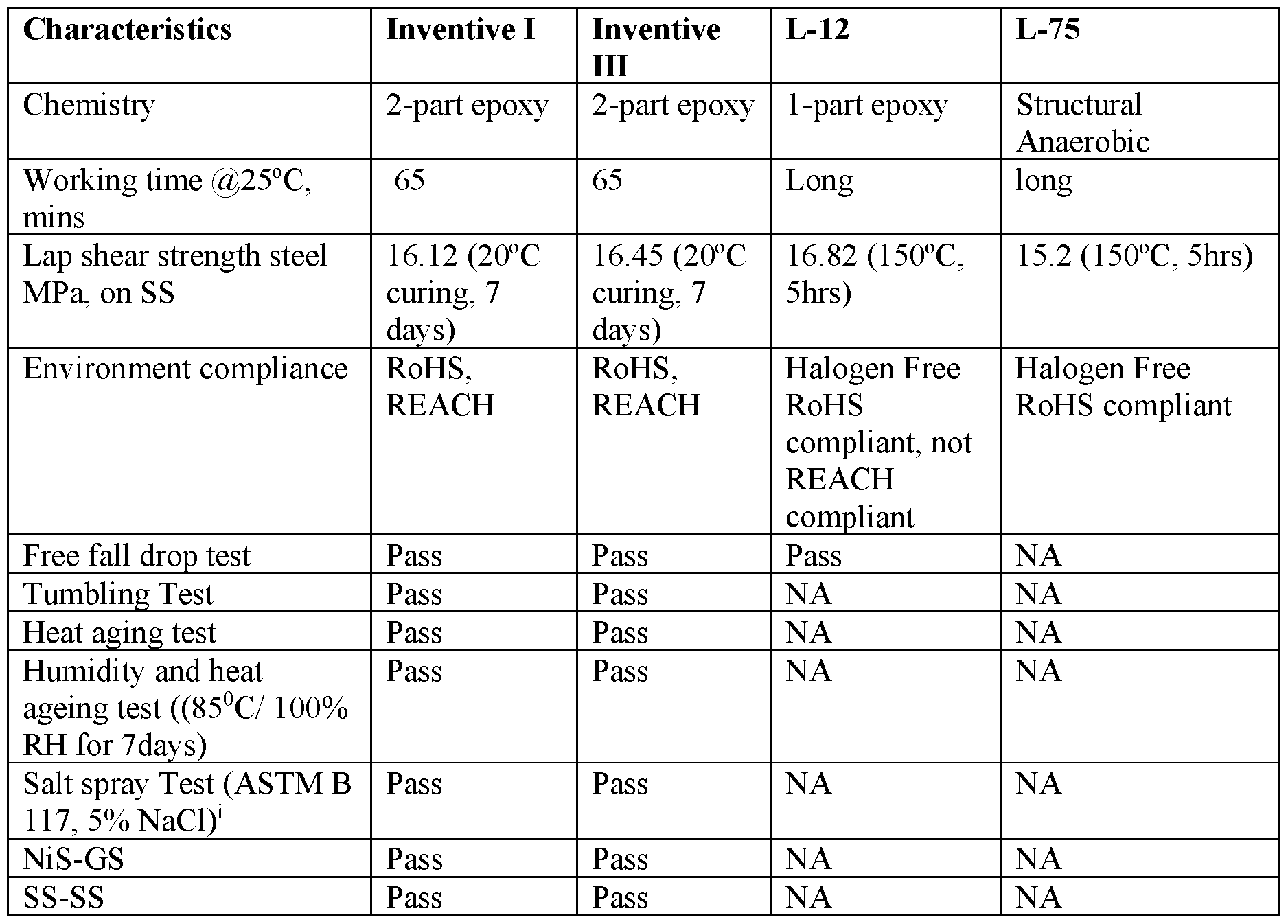
- Table 4 summarizes comparative data of the invented compositions I and III relative to similar products known in the market, designated as L-12 and L-75 hereafter.
Landscapes
- Chemical & Material Sciences (AREA)
- Organic Chemistry (AREA)
- Health & Medical Sciences (AREA)
- Chemical Kinetics & Catalysis (AREA)
- Medicinal Chemistry (AREA)
- Polymers & Plastics (AREA)
- Adhesives Or Adhesive Processes (AREA)
Abstract
A two part adhesive formulation is provided that is REACH and RoHS compliant and cures at room temperature of 23 degrees Celsius at 1 atm. The two part adhesive has a first component part (component A) that is a resin that is a blend of epoxy and modified epoxy resins with fillers, thixotropes, solvent, and colorant, and a second component part (component B) that is a curative that is a blend of amines, fillers, solvent, and colorant. A toughening agent and an impact modifier is in at least one of the adhesive part or the activator part, part B. The adhesive formulation is designed with the right balance of viscosity and thixotropic behavior to enable seamless dispensing through a micro-orifice in an auto dispenser that is used for application of adhesive on to magnetic elements or other electronic or microelectronic components.
Description
LOW HALOGEN TWO COMPONENT TOUGHENED EPOXY ADHESIVE
RELATED APPLICATIONS
[0001] This application is a non-provisional application that claims priority benefit of the US Provisional Application Serial Number 62/747,343 filed 18 October 2018, the content of which is hereby incorporated by reference.
FIELD OF THE INVENTION
[0002] The present inventions in general relates to adhesives, and in particular to a low halogen two component toughened epoxy adhesive that is compliant with environmental regulations associated with the electronics industry.
BACKGROUND OF THE INVENTION
[0003] Epoxy adhesives are widely used in potting applications in the electronics industry. Important epoxy properties required for microelectronic electronic manufacturing include bond strength and toughness. It is also important that the adhesive is free from ionic contaminants such as sodium and chloride ions and is also free of bonded chlorines as this would lead to corrosion of semiconductor devices and their ultimate failure. Another important requirement for epoxies used in microelectronic and electronic manufacturing is rapid curing in order to meet the speed of an assembly line. Currently available adhesives may be cured in 30-60 seconds at an elevated temperature of about 200 °C. The process is called snap curing. However, snap curing has an inherent disadvantage of rapid evaporation of volatiles during the curing process leading to formation of micro voids in the cured adhesive. The micro voids result in bond weakening and often bond failure as the bond line is very thin.
[0004] Furthermore, adhesive application in microelectronic assemblies is associated with stringent process requirements such as seamless dispensing through a needle with an orifice of about 0.2- 0.3 mm. This requires the adhesive to be low viscous. Usually the
viscosity is lowered either by using a reactive diluent or a solvent. In either way the mechanical properties such as overlap shear strength and toughness are compromised. In addition, the usual reactive diluents contain halogens or are not (Registration, Evaluation, Authorization and Restriction of Chemicals) REACH compliant circa 2018. REACH is a European Union regulation that addresses the production and use of chemical substances, and their potential impacts on both human health and the environment. Furthermore, recent European Union regulations also regulate what chemicals may be present in electronic components and assemblies under Restriction of Hazardous Substances Directive (RoHS) circa 2018.
[0005] Thus, there exists a need for developing an adhesive that can meet the stringent dispensing requirement of application in the microelectronic industry with excellent mechanical properties while being REACH and RoHS compliant circa 2018.
SUMMARY OF THE INVENTION
[0006] A two part adhesive formulation is provided that is REACH and RoHS compliant and cures at room temperature of 23 degrees Celsius at 1 atm. The two part adhesive has a first component part (component A) that is a resin that is a blend of epoxy and modified epoxy resins with fillers, thixotropes, solvent, and colorant, and a second component part (component B) that is a curative that is a blend of amines, fillers, solvent, and colorant. A toughening agent and an impact modifier is in at least one of the adhesive part or the activator part, part B. The adhesive formulation is designed with the right balance of viscosity and thixotropic behavior to enable seamless dispensing through a micro-orifice in an autodispenser that is used for application of adhesive on to magnetic elements or other electronic or microelectronic components.
BRIEF DESCRIPTION OF THE DRAWINGS
[0007] The present invention is further detailed with respect to the following drawings that are intended to show certain aspects of the present invention, but should not be construed as a limit on the practice of the present invention.
[0008] FIG. 1 is a functional block diagram of a process flow for producing a component A for embodiments of the two part adhesive that is produced in a mixing reactor/kettle equipped with a mechanical stirrer; and
[0009] FIG. 2 is a functional block diagram of a process flow for producing a component A for embodiments of the two part adhesive that is produced in a mixing reactor/kettle equipped with a mechanical stirrer.
DETAILED DESCRIPTION OF THE INVENTION
[0010] The present invention has utility as a two-component toughened epoxy adhesive composition that is REACH and RoHS compliant and cures at room temperature of 23 deg Celsius at 1 atm. Since all the ingredients used in the adhesive are REACH and RoHS compliant, the adhesive is of low halogen content. Hence, use of this adhesive does not induce corrosion in the bonding elements unlike the chloride / ionic contaminant containing conventional counterparts.
[0011] Embodiments of the inventive adhesive have superior impact strength and overlap shear strength (OLS) on a variety of metal substrates illustratively including stainless steel, galvanized steel, and nickel plated/coated steel (NIS), which are materials often used in speaker phones. In some embodiments of the present inventive adhesive magnetic fillets are bonded in speaker phone assemblies without posing a threat to the magnetic behaviour of the magnet fillets since the adhesive cures at room temperature. Being room temperature curing, embodiments of the inventive adhesive invariably inhibit of microvoid formation during snap
curing at elevated temperature. Some embodiments of the inventive adhesive are aptly designed with a balance of viscosity and thixotropic behaviour to enable seamless dispensing through a micro-orifice in an autodispenser that is used for application of adhesive on to magnetic elements or other electronic or microelectronic components. In a specific embodiment of an inventive adhesive, the uncured adhesive components are seamlessly dispensed separately or premixed through a 0.22 micron orifice needle of an autodispenser for bonding magnet fillets that are an integral part of an assembly in speaker phones.
[0012] It is to be understood that in instances where a range of values are provided that the range is intended to encompass not only the end point values of the range but also intermediate values of the range as explicitly being included within the range and varying by the last significant figure of the range. By way of example, a recited range of from 1 to 4 is intended to include 1-2, 1-3, 2-4, 3-4, and 1-4.
[0013] An inventive formulation provided as a two-part formulation includes an adhesive part that is synonymously referred to as Part A, or an adhesive Part A. The adhesive part of inventive formulation as a two-part formulation in prototypical form includes all the components active in the polymerization reaction except that a cure activator. The activator is predominantly in an activator part that is synonymously referred to as Part B or an activator Part B. The following components of an inventive formulation are detailed as weight percentages of a formulated Part A or Part B inclusive of all components intended to be mixed at a part A: part B volume ratio of 2: 1 unless specifically specified. It is appreciated that these relative amounts are readily scaled to 1: 1 or other ratios using routine calculations.
[0014] Embodiments of the inventive two-part adhesive have a first component part (component A) that is a resin that is a blend of epoxy and modified epoxy resins having impact modifier effects, and optionally additives such as fillers, thixotropes, solvent, a cure inhibitor, an adhesion promoter, a toughening agent, a part A colorant, or a combination
thereof; and a second component part (component B) that is a curative that is a blend of amines, a toughening agent, and optionally additives such as fillers, thixotropes, solvent, a cure inhibitor, an adhesion promoter, a part B colorant.
[0015] The inventive formulation in certain embodiments is provided in a user friendly volume mix ratio of Adhesive Part A to Activator Part B of 1 : 1, 2: 1 or even 3-10: 1. Development of strength and fixture time of a cured inventive adhesive on a variety of metal substrates associated with speaker construction and microelectronics is found to perform better than conventional adhesives.
[0016] An epoxy resin according to the present invention is present in part A. Typical expoxy resins are diglycidyl ethers of bisphenols, especially bisphenol A. These are made by reacting epichlorohydrin with bisphenol A in the presence of an alkaline catalyst. Through control of reaction conditions and stoichiometry resins of different molecular weight are made. Other usable epoxy resins include the diglycidyl ethers of other bisphenol compounds such as bisphenol B, F, G and H. Epoxy resins of the type described above based on various bisphenols are available from a wide variety of commercial sources.
[0017] Still other epoxy resins operative in the present invention are epoxidized novolacs, particularly the epoxy cresol and epoxy phenol novolacs. These are produced by reacting a novolac resin with epichlorohydrin.
[0018] Epoxy resins derived from non-benzenoid materials such as aliphatic or cycloaliphatic hydroxy-containing compounds are also operative in the present invention. Epoxy resins having non-aryl molecular structures generally are referred to in the art as being aliphatic epoxy resins or cycloaliphatic epoxy resins. Aliphatic epoxy resins are prepared by reacting hydroxy-containing aliphatic and cycloaliphatic compounds such as aliphatic diols and triols. For example, ethylene glycol or glycerol can be reacted with a halogen-substituted
aliphatic epoxide such as epichlorohydrin to form liquid epoxy resins characterized by viscosities which are lower than epoxy resins derived from aromatic hydroxy compounds.
[0019] The epoxy resins present in part A has an epoxy equivalency greater than 1.0. By epoxy equivalence, reference is made to the average number of 1, 2-epoxide groups contained in the average molecule of the glycidyl ether or ester. As a result of the method of preparing the glycidyl polyethers and polyesters, and since the reactants are typically mixtures of chemical compounds that vary in average molecular weights, the epoxy equivalency of the products is not necessarily the integer 2.0. Yet, according to the present invention, the equivalency is generally a value of between 1.0 and 2.0. Epoxidized novolac resins which are useful in the present invention generally are prepared by the reaction of epichlorohydrin with phenol formaldehyde condensates. The epoxidized novolacs may contain more than two epoxy groups per molecule, and epoxidized novolacs having up to 7 to more epoxy groups are commercially available. The use of epoxidized novolacs containing more than two epoxy groups per molecule results in products containing a highly cross-linked structure.
[0020] An epoxy resin used in several of the following examples is a diglycidylether of bisphenol F (DGEBF) with epoxide equivalent weight: 166-176 g/equivalent and density at 25°C of 1.18 g/cm3, it is appreciated that variations in epoxide equivalent weight can vary between 140 and 500 g/equivalent and can vary in viscosities depending on the mode of application and convenience of use. Alternative epoxy resins can vary in monomer backbone as detailed above and include bisphenol A, B, F, G and H, aliphatics, novolocs, and copolymers thereof. Typically, the base epoxy resin are present from 35 to the remainder total weight percent of Part A, and in other formulations from 40 to 45 total weight percent of part A.
[0021] An impact modifier is also present in an inventive formulation part A. It has also been surprisingly discovered that combination of a particulate impact modifier of core-shell
structure such as core-shell rubber (CSR) in epoxy resin; a latex rubber particle with a crossbnked polymeric shell in epoxy resin, hollow plastic micro-spheres, a siloxane core with a crossbnked polymeric shell, or a combination thereof with a butadiene: acrylonitrile modified epoxy resin appear to operate synergistically in the present invention to increase the strength of the adhesive under physical stress conditions as compared to formulations devoid of the impact modifier combination. Crossbnked polymeric shell materials illustratively include acrylics, siloxanes, methylacrylics, and combinations thereof. When a particulate impact modifier is dispersed in an epoxy resin medium, the particulate core-shell is typically present from 5 to 40 total weight percent of the epoxy resin medium. Typically, particulate impact modifier present from 24 to 45 total weight percent of Part A. A butadiene: acrylonitrile modified epoxy resin impact modifier operative herein includes amine-terminated butadiene acrylonitrile (ATBN) modified epoxy resin, and combinations thereof. Typically, butadiene: acrylonitrile impact modifier present from 8 to 15 total weight percent of Part A, where the butadiene: acrylonitrile impact modifier is typically present from 5 to 40 total weight percent in a curable epoxy resin medium In some inventive embodiments, the weight ratio of particulate impact modifier to the butadiene: acrylonitrile impact modifier is between 2-5: 1, exclusive of the epoxy resin medium when determining weight amounts.
[0022] Still other impact modifiers operative herein illustratively include styrene butadiene copolymers, rubbers, and polycarbonates. Specific impact modifiers operative herein include methyl methacrylate butadiene styrene copolymers (MBS), nitrile rubber, blocked copolymers of styrene butadiene, buna rubbers, acrylonotrile butadiene styrene, and combinations thereof. It is appreciated that impact modifiers devoid of moieties cured by the curative of part B, that such impact modifiers can be present in part A, part B, or a combination thereof. Typically, such impact modifiers are present from 0 to 15 total weight
percent of part A, or a like total amount when dispersed in part B, or a combination of parts A and B.
[0023] An adhesion promoter is also optionally present in certain inventive formulations to achieve improved surface bonding of inventive adhesive compared to formulations lacking the same by modifying the hydrophobicity of the substrate surface. Adhesion promoters operative herein illustratively include phosphate esters; phosphate ester polymers; mixtures of mono- and di-functional phosphates; functionalized methacrylates such as hydroxyethylmethacrylate succinate, acetoacetoxy ethyl methacrylate, N,N- diethylaminoethyl methacrylate, ethoxylated bisphenol A dimethacrylate and methacrylate silanes and combinations thereof. In still other embodiments, a silanizing agent modifies the substrate surface to achieve improved surface bonding of inventive adhesive compared to formulations lacking the same by modifying the hydrophobicity of the substrate surface. Typically, adhesion promoters are present from 0 to 0.5 total weight percent of Part A. In still other embodiments the adhesion promoter is present from 0.1 to 0.5 total weight percent of Part A. It is appreciated that adhesion promoters devoid of a moieties cured by the curative of part B, that such impact modifiers can be present in part A, or a like total amount when dispersed in part B, or a combination of parts A and B.
[0024] An inventive formulation in certain embodiments includes a diluent that is otherwise unreactive and serves to modify the volume of the formulation. A diluent is defined herein as a miscible and non-reactive compound relative to the components of the part in which the diluent resides. In particular, formulation diluents are, for example, inert fillers to adjust the weight ratios between a Part A and Part B that facilitate ease of mixing at the situs of formulation application to a substrate. It is appreciated that the industry finds weight ratios between Part A: Part B of 1-10: 1 to be standard and thereby affording superior ease of use. Such diluents operative herein illustratively include propylated naphthalene, and
plasticizing oil, or miscible combinations thereof. Typically, diluent is present from 0 to 10% total weight percent of Part A.
[0025] A cure inhibitor is optionally present in an inventive formulation. A cure inhibitor operative herein illustratively includes benzoquinone, naphthoquinone, hydroquinone, 4-hydroxy 2,2,6,6-tetramethylpiperidine l-oxyl (TEMPOL) or TEMPO , halogenated tallow alkyl amines, aziridine, polyaziridines, dihydrocarbyl hydroxyl amine, 2,2,6,6-tetra-methyl-piperidimyloxyl (TEMPO); 2,2,5,5-tetra-methyl-pyrolyloxy (PROXYL) or a combination thereof that operate synergistically to provide storage stability to an inventive formulation. Typically, a cure inhibitor is present from 0 to 0.2 total weight percent of Part A. In still other embodiments the cure inhibitor is present from 0.1 to 0.2 total weight percent of Part A. It is appreciated that a cure inhibitor is readily provided in both Parts A and B of an inventive formulation to promote storage stability and limit premature curing prior at application to a substrate.
[0026] A cure accelerator is also present in an inventive formulation to kinetically speed curing of the formulation monomer compared to inventive formulations devoid of a cure accelerator. Cure of the monomers in contact with at least one substrate allows the formulation to function as an adhesive. Accelerators operative herein illustratively include a pyridine derivative, a butaraldehyde aniline condensate, N,N-dimethylaniline, N,N- dimethyltoludiene, N,N-diethyltoludiene, metal acetyl acetonate, and combinations thereof. Typically, cure accelerators are present from 0 to 2.5 total weight percent of Part A. In certain inventive embodiments, the cure accelerator is present in both Parts A and B; however, storage stability is generally enhanced by segregation of the cure accelerator in Part B and separate from any cure initiators in the inventive formulation, that are commonly in Part A.
[0027] It is appreciated that in addition to the afore-mentioned components, an inventive formulation is readily modified to include other additives to modify the properties of the Part
A, Part B during storage, or the resulting cured adhesive. These additives illustratively include a thixotrope, a silane coupling agent, a pigment, a plasticizer, an inert filler, a chain terminating agent, a corrosion inhibitor, a fire retardant, and combinations thereof. Such additives are limited only by the requirement of compatibility with the other components of an inventive formulation. Such additives are provided to balance or otherwise modify at least one property of an inventive formulation as to handling, storage, cure rate, or adhesive properties. Typically, an additive of an inert filler is present from 0 to 20 total weight percent of an inventive formulation upon combination of Part A and Part B. Typically, the other aforementioned additives are each independently present from 0 to 5 total weight percent of Part A or a like total amount when dispersed in part B, or a combination of parts A and B.
[0028] A thixotrope serves to modify the viscosity of the formulation in a shear dependent way. Thixotropes operative herein illustratively include fumed silica, fumed silica which has been surface treated with polydimethylsiloxane (PDMS), hydrogenated castor oil, organoclays, or miscible combinations thereof.
[0029] A silane coupling agent promotes adhesion between the cured epoxy resin matrix and internal inclusion and disparate substrates on which the formulation is cured. Silane coupling agents operative herein illustratively include 3-aminopropyltrimethoxysilane, 3-aminopropyltriethoxysilane, 3-gylcidoxypropyltrimethoxysilane,
3-glycidoxypropyltriethoxysilane, (3-glycidoxypropyl)bis(trimethylsiloxy)methylsilane, (3- glycidoxypropyl)dimethylethoxysilane, (3-glycidoxypropyl)methyldiethoxysilane,
(3-glycidoxypropyl)methyldimethoxysilane, methacryloxymethyltriethoxysilane, methacryloxymethyltrimethoxysilane, methacryloxypropyldimethylethoxysilane, methacryloxypropyldimethylmethoxysilane, methacryloxypropylmethyldimethoxysilane, methacryloxypropyltrimethoxysilane;methacryloxypropyltriethoxysilane, 3- methacryloxypropyldimethylchlorosilane, methacryloxypropylmethyldichlorosilane,
methacryloxypropyltrichlorosilane, 3-isocyanotopropyldimethylchlorosilane, 3- isocyanatopropyltriethoxysilane, and methacryloxypropyltriethoxysilane, cyclic azasilanes, and combinations thereof.
[0030] A pigment is a particulate colorant that provides a visual designator between parts A and B, as well confirmation of mixing therewith. Conventional pigments are black for part A and white for part B, or vice versa so as to afford a gray mixed formulation. In still other embodiments, a blue pigment is added to part A and a yellow pigment to part B, or vice versa so as to afford a green mixed formulation.
[0031] Table 1 provides weight percentages for the ingredients of an embodiments of component A as described above.
[0032] Table 1. Weight percentage of constituent ingredients of part A.

[0033] In a specific embodiment, part A includes bis phenol F-epoxy resin with 166- 176 g/equivalent and density at 25°C of 1.18 g/cm3; and impact modifiers of: a CSR epoxy resin of 25 wt. % of 100 nm SBd CSR particles, and phenol novolac resin modified at 40 wt. % with 74:26 butadiene: acrylonitrile liquid rubber, and adduct of the diglycidyl ether of Bisphenol A (DGEBA) and a butadiene-acrylonitrile (CTBN) elastomer. The combination of
the core-shell rubber modified epoxy resin, and a butadiene: acrylonitrile modified epoxy resin appear to operate synergistically in the present invention in impact modification of the resulting cured epoxy resin. This part A with attention to the halogen content of optional additives is REACH and RoHS compliant.
[0034] It is noted that diluents of propylated naphthalene, or and plasticizing oil are each REACH and RoHS compliant in terms of halogen content.
[0035] Embodiments of part B including a toughener, a curative, and optional additives.
[0036] An inventive formulation also includes a toughening agent. A toughening agent is distinguished from an impact modifier in the present invention in having a lower Tg and can significantly improve the performance of cured adhesives at low temperatures such as - 40°F. (-40°C) and at the same time does not cause a negative impact on the performance of cured adhesives at elevated temperatures such as l80°F whereas the rubber component used in this invention are the core-shell structured impact modifiers and provide not only excellent impact strength but also non-sag, excellent thixotropic property and improved antisliding performance. Toughening agents operative herein illustratively include reactive liquid polymers (RLPs) that contain functional groups, usually on their terminal ends but occasionally as pendant groups that react with the resin in situ to form elastomeric domains. Examples of RLPs include, without limitation, vinyl terminated acrylonitrile butadiene (VTBN), carboxyl-terminated butadiene acrylonitrile (CTBN), amine-terminated butadiene acrylonitrile (ATBN), hydroxyl-terminated butadiene acrylonitrile (HTBN), epoxy- terminated butadiene acrylonitrile (ETBN), mercapto-terminated butadiene acrylonitrile (MTPN), and phenoxy -terminated butadiene acrylonitrile (PTBN). In specific embodiments of the present invention, the toughening agent includes animated version of any of the aforementioned RLPs. It is appreciated that a toughening agent is present as a component of part A, part B, or both parts of an inventive formulation. In specific embodiments of the
present invention, a toughening agent is present only in a part B but it is appreciated that the amount of toughening agent present depends on characteristics of the toughening agent as well as the weight ratio between part A:part B, typical loadings of toughening agent in a fully formulated inventive adhesive range from 40 to the remainder weight percent of the part B.
[0037] A curative present in part B is reactive towards the epoxy resin components of part A. Curatives operative herein include aliphatic amines, aromatic amines, polyamine epoxy-resin adduct, ketimine, polyamide resin, polymercaptans, and combinations thereof. Specific curatives operative herein include diethylenetriamine, triethylenetetramine, tetraethyl enepentamine, diproprenediamine, diethylaminopropylamine, n- aminoethylpiperazine, menthane diamine, isophoronediamine, m-xylenediamine, metaphenylene diamine, diaminodiphenylmethane, diaminodiphenylsulfone, polyamine epoxy-resin adduct, ketimine, polyamide resin, liquid polymercaptan, polysulfide resin. A given curative is selected alone or in combination with other curative to a desired cure rates and may be used in appropriate combinations to strike the right balance between open time and mechanical properties (i.e., to achieve desired cure properties) and are selected to assure that an inventive formulation is in total REACH and RoHS compliant. Aliphatic amine curatives are noted to be REACH and RoHS compliant.
[0038] The other components in the part B provided in Table 2 have the identities and amounts as detailed above with respect to part A.
[0039] Table 2. Weight percentage of constituent ingredients of part B.


[0040] A specific inventive embodiment of a method for producing a part A for embodiments of the two part adhesive that is produced in a mixing reactor/kettle equipped with mechanical stirrer is as follows:
1. Calculate the quantities of ingredients based on respective weight percentage for the required quantity.
2. Clean the reactor with solvent such as acetone or isopropanol and dry it completely.
3. Weigh and add epoxy resin into the reactor followed by CSR impact modifier under constant stirring at RPM of > 1500 and allow to stir for about 15 minutes.
4. Add Impact Modifier with butadiene: acrylonitrile under stirring and allow to stir for 30 minutes.
5. Add diluent and allow to stir for 15 minutes at about 1500 rpm.
6. Add fumed silica slowly in portions while stirring at a low rpm of less than 500 rpm. Ensure that all the fumed silica has integrated into adhesive mix. Then increase the rotational speed to about 1500 and stir for 30 minutes.
7. Add adhesion promoter and silane coupling agent slowly and stir for about 10 minutes.
8. Add the pigment under stirring and allow the entire mix to stir for 30 minutes at 1500 rpm.
9. Sample and pack the component A.
[0041] FIG. 1 is a flowchart illustrating the process for producing a part A for embodiments of the two part adhesive that is produced in a mixing reactor/kettle equipped with a mechanical stirrer.
[0042] A specific inventive embodiment for a method for producing part B for embodiments of the two part adhesive that is produced in a mixing reactor/kettle equipped with mechanical stirrer is as follows:
1. Calculate the quantities of ingredients based on respective weight percentage for the required quantity.
2. Clean reactor with solvent such as acetone or isopropanol and dry it completely.
3. Weigh and toughener and allow it to stir at low rpm
4. Add first amine curative and stir for 10 minutes while increasing the rpm to 1500 gradually.
5. Add second amine curative at low rpm and increase rpm gradually to 1500 and stir for 10 minutes
6. Add fumed silica slowly at low rpm until the whole of TS 720 is integrated into the adhesive mix. Increase the rpm to 1500 and stir for 30 minutes.
7. Add the pigment under slow stirring.
8. Stir the mixture for 30 minutes. At 1500 rpm.
9. Sample and pack.
[0043] FIG. 2 is a flowchart illustrating the process for producing a component B for embodiments of the two part adhesive that is produced in a mixing reactor/kettle equipped with a mechanical stirrer.
[0044] Based on the above description, it would be appreciated that an inventive two component adhesive readily formed that is complaint with REACH and RoHS circa 2018. Additionally, the rheological properties of the Parts A and B are readily adjusted for a range of viscosities to serve a desired application.
[0045] Regardless of the form of an inventive formulation, upon induction of pot life for the formulation, the formulation is present in simultaneous contact with two or more
substrates for an amount of time sufficient to achieve a bond between the substrates. Two such substrates can be brought together to form various jointed structures such as a lap joint, butt joint, comer joint, edge joint, and T-joint. In still other embodiments, an inventive formulation is applied to a single substrate and allowed to cure to form a coating that affords substrate protection or is operative as a primer for subsequent material applications. As inventive formulations typically achieve a rapid build in strength per ASTM D 1002, substrates are fixtured or otherwise held in relative desired alignment for a time period of from 5 minutes to 120 minutes. The joined substrates are then amenable to being removed from the fixture while an inventive formulation continues to cure to achieve terminal strength. As an inventive formulation cures through typically nucleophilic ring opening addition reaction; in case of amines and amides; followed by crosslinking. Though in case of acid catalysts or catalysts with electron donating species the oxygen in the ring is protonated thereby facilitating nucleophilic ring opening reaction. The mechanism could be SN2 or SN1. An inventive formulation can be applied to a variety of thicknesses and still achieve cure polymerization. Typical thicknesses of an inventive formulation between substrates ranges from 0.001-4 mm.
[0046] The present invention is further described with respect to the following non- limiting examples. These examples are intended to illustrate specific formulations according to the present invention and should not be construed as a limitation as to the scope of the present invention.
EXAMPLES
Example 1. Viscosity, Overlap Shear Strength, and Impact Strength
[0047] Table 3 summarizes test measurements taken for embodiments of a two part adhesive made with components A and component B with recipes based on the weight
percentage of constituent ingredients of component A and component B as shown in Table 1 and Table 2, respectively. Sample III is based on a part A that uses spherical, reversibly agglomerated primary particles of a low-modulus, a siloxane core with a crossbnked polymeric acrylic shell (BET surface areas of 10 m2/g) as an impact modifier, and demonstrates high strength on to stainless steel with cohesive failure. The composition of this recipe has a siloxane core with a crosslinked polymeric acrylic shell as a major impact modifier present at 9 to 15 total weight percent of part A being the core-shell particulate (20 weight % particulate in epoxy resin medium).
[0048] Table 3. Viscosity, Overlap Shear Strength, and Impact Strength of Inventive
Adhesives

Part A: of Inventive Formulation III


Part B: of Inventive Formulation III

Example 2. Comparative examples
[0049] Table 4 summarizes comparative data of the invented compositions I and III relative to similar products known in the market, designated as L-12 and L-75 hereafter.
[0050] As a person skilled in the art will recognize from the previous detailed description and from the figures and claims, modifications and changes can be made to the preferred embodiments of the invention without departing from the scope of this invention defined in the following claims.
Claims
1. A two-part adhesive formulation comprising:
an adhesive part A comprising:
epoxy resin;
a particulate impact modifier having a core-shell structure; and
a butadiene: acrylonitrile impact modifier; and
an activator part B comprising:
a toughener; and
a curative operative to cure said epoxy resin;
wherein the formulation is complaint with Registration, Evaluation, Authorization and Restriction of Chemicals (REACH) and Restriction of Hazardous Substances Directive (RoHS) circa 2018.
2. The formulation of claim 1 wherein said core-shell structure is a core-shell rubber.
3. The formulation of claim 1 wherein said core-shell structure is a latex rubber particle with a crosslinked polymeric shell.
4. The formulation of claim 3 wherein said crosslinked polymeric shell is formed of acrylics, siloxanes, methylacrylics, or combinations thereof.
5. The formulation of claim 1 wherein said core-shell structure is a siloxane core with a crosslinked polymeric shell.
6. The formulation of claim 4 wherein said crosslinked polymeric shell is formed of acrylics, siloxanes, methylacrylics, or combinations thereof.
7. The formulation of claim 1 wherein said core-shell structure are hollow plastic micro-spheres.
8. The formulation of claim 1 wherein said butadiene: acrylonitrile impact modifier is amine-terminated butadiene acrylonitrile (ATBN), or combinations thereof.
9. The formulation of claim 1 wherein said particulate impact modifier having the core-shell structure and said butadiene: acrylonitrile impact modifiers are present in a weight ratio of 2-5: 1.
10. The formulation of claim 1 wherein part A further comprises an adhesion promoter.
11. The formulation of claim 1 wherein part A further comprises a diluent.
12. The formulation of claim 1 wherein part A further comprises at least one of a cure inhibitor, a cure accelerator, a silane coupling agent, a thixotrope, a pigment, a plasticizer, an inert filler, a chain transfer agent, a corrosion inhibitor, or a fire retardant.
13. The formulation of claim 1 further comprising a toughening agent in at least one of said adhesive part A or said activator part B.
14. The formulation of claim 13 wherein said toughening agent is present only in said activator part B and includes an amine.
15. The formulation of claim 1 wherein said curative has amine functionality.
16. The formulation of claim 1 wherein part B further comprises an adhesion promoter.
17. The formulation of claim 1 wherein part B further comprises a diluent.
18. The formulation of claim 1 wherein part A further comprises at least one of: an impact modifier, a cure inhibitor, a cure accelerator, a thixotrope, a pigment, a plasticizer, an inert filler, a corrosion inhibitor, or a fire retardant.
19. The formulation of claim 1 wherein part A and part B are substantially free from ionic contaminants and bonded chlorine atoms.
20. A structure comprising:
a first substrate;
a second substrate; and
an adhesive formed by the cure of the formulation of any of claims 1 to 18 in simultaneous contact between the first substrate and the second substrate.
Applications Claiming Priority (2)
| Application Number | Priority Date | Filing Date | Title |
|---|---|---|---|
| US201862747343P | 2018-10-18 | 2018-10-18 | |
| US62/747,343 | 2018-10-18 |
Publications (1)
| Publication Number | Publication Date |
|---|---|
| WO2020082006A1 true WO2020082006A1 (en) | 2020-04-23 |
Family
ID=68696507
Family Applications (1)
| Application Number | Title | Priority Date | Filing Date |
|---|---|---|---|
| PCT/US2019/057044 Ceased WO2020082006A1 (en) | 2018-10-18 | 2019-10-18 | Low halogen two component toughened epoxy adhesive |
Country Status (1)
| Country | Link |
|---|---|
| WO (1) | WO2020082006A1 (en) |
Cited By (4)
| Publication number | Priority date | Publication date | Assignee | Title |
|---|---|---|---|---|
| CN111334231A (en) * | 2020-04-30 | 2020-06-26 | 淮阴工学院 | High elasticity and anti-aging waterproof glue and preparation method thereof |
| CN113845750A (en) * | 2020-06-28 | 2021-12-28 | 比亚迪股份有限公司 | Epoxy resin composition and preparation method of multicolor ceramic product |
| CN116606619A (en) * | 2023-07-17 | 2023-08-18 | 山东凯恩新材料科技有限公司 | Preparation method of single-component epoxy resin adhesive electronic pouring sealant |
| WO2024148211A1 (en) * | 2023-01-05 | 2024-07-11 | Henkel Ag & Co. Kgaa | A composition of matter for accelerating reaction of thermosetting monomers, oligomers and/or resins |
Citations (3)
| Publication number | Priority date | Publication date | Assignee | Title |
|---|---|---|---|---|
| EP2223966A1 (en) * | 2009-02-25 | 2010-09-01 | 3M Innovative Properties Company | Epoxy adhesive compositions with high mechanical strength over a wide temperature range |
| WO2013070415A1 (en) * | 2011-11-09 | 2013-05-16 | Cytec Technology Corp. | Structural adhesive and bonding application thereof |
| WO2016191403A1 (en) * | 2015-05-28 | 2016-12-01 | Dow Global Technologies Llc | A two part (2k) epoxy adhesive composition for bonding oily metals |
-
2019
- 2019-10-18 WO PCT/US2019/057044 patent/WO2020082006A1/en not_active Ceased
Patent Citations (3)
| Publication number | Priority date | Publication date | Assignee | Title |
|---|---|---|---|---|
| EP2223966A1 (en) * | 2009-02-25 | 2010-09-01 | 3M Innovative Properties Company | Epoxy adhesive compositions with high mechanical strength over a wide temperature range |
| WO2013070415A1 (en) * | 2011-11-09 | 2013-05-16 | Cytec Technology Corp. | Structural adhesive and bonding application thereof |
| WO2016191403A1 (en) * | 2015-05-28 | 2016-12-01 | Dow Global Technologies Llc | A two part (2k) epoxy adhesive composition for bonding oily metals |
Cited By (6)
| Publication number | Priority date | Publication date | Assignee | Title |
|---|---|---|---|---|
| CN111334231A (en) * | 2020-04-30 | 2020-06-26 | 淮阴工学院 | High elasticity and anti-aging waterproof glue and preparation method thereof |
| CN113845750A (en) * | 2020-06-28 | 2021-12-28 | 比亚迪股份有限公司 | Epoxy resin composition and preparation method of multicolor ceramic product |
| CN113845750B (en) * | 2020-06-28 | 2023-02-10 | 比亚迪股份有限公司 | Epoxy resin composition and preparation method of multi-color ceramic products |
| WO2024148211A1 (en) * | 2023-01-05 | 2024-07-11 | Henkel Ag & Co. Kgaa | A composition of matter for accelerating reaction of thermosetting monomers, oligomers and/or resins |
| CN116606619A (en) * | 2023-07-17 | 2023-08-18 | 山东凯恩新材料科技有限公司 | Preparation method of single-component epoxy resin adhesive electronic pouring sealant |
| CN116606619B (en) * | 2023-07-17 | 2023-09-26 | 山东凯恩新材料科技有限公司 | Preparation method of single-component epoxy resin adhesive electronic pouring sealant |
Similar Documents
| Publication | Publication Date | Title |
|---|---|---|
| EP0488949B1 (en) | High performance epoxy adhesive | |
| US20090308534A1 (en) | Next generation, highly toughened two part structural epoxy adhesive compositions | |
| US20170313918A1 (en) | Epoxy adhesive, automotive member, and method for manufacturing same | |
| CN103228696A (en) | One component epoxy resin composition | |
| US5140069A (en) | Tough epoxy casting resins based on polybutadiene-polyoxyalkleneglycol copolymers | |
| JP6981794B2 (en) | Epoxy adhesive | |
| WO2019239346A1 (en) | Adhesion promoters for curable compositions | |
| EP3959281B1 (en) | Adhesion promoters for structural adhesive applications | |
| KR102133123B1 (en) | Method for impact-resistant and thermal-resistant epoxy adhesive composition and epoxy adhesive composition thereof | |
| JP2001139770A (en) | Aqueous epoxy resin composition | |
| EP0527706A1 (en) | High performance epoxy adhesive composition with high flexibility and toughness | |
| JP2023524676A (en) | Curable composition | |
| JP2007106852A (en) | One-component thermosetting flame retardant composition and cured material of the same | |
| JP2016500728A (en) | Polymer particle dispersion using divinylarene dioxide | |
| US11820909B2 (en) | Epoxy coating composition with elevated temperature and abrasive environment performace and uses thereof | |
| JP4883264B2 (en) | Heat-curing one-part resin composition | |
| JP4590927B2 (en) | Adhesive composition | |
| CN117813360A (en) | Adhesive composition and method for producing adhesive composition | |
| WO2006088069A1 (en) | Thermosetting one-component resin composition | |
| JP2006057013A (en) | Resin composition | |
| JP2013127026A (en) | Curing type composition | |
| JPS648675B2 (en) | ||
| JP3941937B2 (en) | Epoxy resin composition | |
| CN120665395A (en) | Liquid epoxy resin composition and electronic component | |
| WO2025249411A1 (en) | Curable resin composition, use of curable resin composition, cured product, and method for producing cured product |
Legal Events
| Date | Code | Title | Description |
|---|---|---|---|
| 121 | Ep: the epo has been informed by wipo that ep was designated in this application |
Ref document number: 19809660 Country of ref document: EP Kind code of ref document: A1 |
|
| NENP | Non-entry into the national phase |
Ref country code: DE |
|
| 122 | Ep: pct application non-entry in european phase |
Ref document number: 19809660 Country of ref document: EP Kind code of ref document: A1 |