WO2020079565A1 - Continuous fiber reinforced composite prepreg formed of flame retardant polyester - Google Patents
Continuous fiber reinforced composite prepreg formed of flame retardant polyester Download PDFInfo
- Publication number
- WO2020079565A1 WO2020079565A1 PCT/IB2019/058742 IB2019058742W WO2020079565A1 WO 2020079565 A1 WO2020079565 A1 WO 2020079565A1 IB 2019058742 W IB2019058742 W IB 2019058742W WO 2020079565 A1 WO2020079565 A1 WO 2020079565A1
- Authority
- WO
- WIPO (PCT)
- Prior art keywords
- weight percent
- bisphenol
- poly
- terephthalate
- units
- Prior art date
- Legal status (The legal status is an assumption and is not a legal conclusion. Google has not performed a legal analysis and makes no representation as to the accuracy of the status listed.)
- Ceased
Links
- VTGYMXCBLHTEOQ-UHFFFAOYSA-N CCCNc1nc(N)nc(N)n1 Chemical compound CCCNc1nc(N)nc(N)n1 VTGYMXCBLHTEOQ-UHFFFAOYSA-N 0.000 description 1
Classifications
-
- C—CHEMISTRY; METALLURGY
- C08—ORGANIC MACROMOLECULAR COMPOUNDS; THEIR PREPARATION OR CHEMICAL WORKING-UP; COMPOSITIONS BASED THEREON
- C08J—WORKING-UP; GENERAL PROCESSES OF COMPOUNDING; AFTER-TREATMENT NOT COVERED BY SUBCLASSES C08B, C08C, C08F, C08G or C08H
- C08J5/00—Manufacture of articles or shaped materials containing macromolecular substances
- C08J5/24—Impregnating materials with prepolymers which can be polymerised in situ, e.g. manufacture of prepregs
- C08J5/249—Impregnating materials with prepolymers which can be polymerised in situ, e.g. manufacture of prepregs characterised by the additives used in the prepolymer mixture
-
- C—CHEMISTRY; METALLURGY
- C08—ORGANIC MACROMOLECULAR COMPOUNDS; THEIR PREPARATION OR CHEMICAL WORKING-UP; COMPOSITIONS BASED THEREON
- C08J—WORKING-UP; GENERAL PROCESSES OF COMPOUNDING; AFTER-TREATMENT NOT COVERED BY SUBCLASSES C08B, C08C, C08F, C08G or C08H
- C08J5/00—Manufacture of articles or shaped materials containing macromolecular substances
- C08J5/04—Reinforcing macromolecular compounds with loose or coherent fibrous material
- C08J5/0405—Reinforcing macromolecular compounds with loose or coherent fibrous material with inorganic fibres
- C08J5/042—Reinforcing macromolecular compounds with loose or coherent fibrous material with inorganic fibres with carbon fibres
-
- C—CHEMISTRY; METALLURGY
- C08—ORGANIC MACROMOLECULAR COMPOUNDS; THEIR PREPARATION OR CHEMICAL WORKING-UP; COMPOSITIONS BASED THEREON
- C08J—WORKING-UP; GENERAL PROCESSES OF COMPOUNDING; AFTER-TREATMENT NOT COVERED BY SUBCLASSES C08B, C08C, C08F, C08G or C08H
- C08J5/00—Manufacture of articles or shaped materials containing macromolecular substances
- C08J5/04—Reinforcing macromolecular compounds with loose or coherent fibrous material
- C08J5/0405—Reinforcing macromolecular compounds with loose or coherent fibrous material with inorganic fibres
-
- C—CHEMISTRY; METALLURGY
- C08—ORGANIC MACROMOLECULAR COMPOUNDS; THEIR PREPARATION OR CHEMICAL WORKING-UP; COMPOSITIONS BASED THEREON
- C08J—WORKING-UP; GENERAL PROCESSES OF COMPOUNDING; AFTER-TREATMENT NOT COVERED BY SUBCLASSES C08B, C08C, C08F, C08G or C08H
- C08J5/00—Manufacture of articles or shaped materials containing macromolecular substances
- C08J5/04—Reinforcing macromolecular compounds with loose or coherent fibrous material
- C08J5/0405—Reinforcing macromolecular compounds with loose or coherent fibrous material with inorganic fibres
- C08J5/043—Reinforcing macromolecular compounds with loose or coherent fibrous material with inorganic fibres with glass fibres
-
- C—CHEMISTRY; METALLURGY
- C08—ORGANIC MACROMOLECULAR COMPOUNDS; THEIR PREPARATION OR CHEMICAL WORKING-UP; COMPOSITIONS BASED THEREON
- C08J—WORKING-UP; GENERAL PROCESSES OF COMPOUNDING; AFTER-TREATMENT NOT COVERED BY SUBCLASSES C08B, C08C, C08F, C08G or C08H
- C08J5/00—Manufacture of articles or shaped materials containing macromolecular substances
- C08J5/04—Reinforcing macromolecular compounds with loose or coherent fibrous material
- C08J5/046—Reinforcing macromolecular compounds with loose or coherent fibrous material with synthetic macromolecular fibrous material
-
- C—CHEMISTRY; METALLURGY
- C08—ORGANIC MACROMOLECULAR COMPOUNDS; THEIR PREPARATION OR CHEMICAL WORKING-UP; COMPOSITIONS BASED THEREON
- C08J—WORKING-UP; GENERAL PROCESSES OF COMPOUNDING; AFTER-TREATMENT NOT COVERED BY SUBCLASSES C08B, C08C, C08F, C08G or C08H
- C08J5/00—Manufacture of articles or shaped materials containing macromolecular substances
- C08J5/04—Reinforcing macromolecular compounds with loose or coherent fibrous material
- C08J5/10—Reinforcing macromolecular compounds with loose or coherent fibrous material characterised by the additives used in the polymer mixture
-
- C—CHEMISTRY; METALLURGY
- C08—ORGANIC MACROMOLECULAR COMPOUNDS; THEIR PREPARATION OR CHEMICAL WORKING-UP; COMPOSITIONS BASED THEREON
- C08J—WORKING-UP; GENERAL PROCESSES OF COMPOUNDING; AFTER-TREATMENT NOT COVERED BY SUBCLASSES C08B, C08C, C08F, C08G or C08H
- C08J5/00—Manufacture of articles or shaped materials containing macromolecular substances
- C08J5/24—Impregnating materials with prepolymers which can be polymerised in situ, e.g. manufacture of prepregs
- C08J5/241—Impregnating materials with prepolymers which can be polymerised in situ, e.g. manufacture of prepregs using inorganic fibres
- C08J5/243—Impregnating materials with prepolymers which can be polymerised in situ, e.g. manufacture of prepregs using inorganic fibres using carbon fibres
-
- C—CHEMISTRY; METALLURGY
- C08—ORGANIC MACROMOLECULAR COMPOUNDS; THEIR PREPARATION OR CHEMICAL WORKING-UP; COMPOSITIONS BASED THEREON
- C08J—WORKING-UP; GENERAL PROCESSES OF COMPOUNDING; AFTER-TREATMENT NOT COVERED BY SUBCLASSES C08B, C08C, C08F, C08G or C08H
- C08J5/00—Manufacture of articles or shaped materials containing macromolecular substances
- C08J5/24—Impregnating materials with prepolymers which can be polymerised in situ, e.g. manufacture of prepregs
- C08J5/241—Impregnating materials with prepolymers which can be polymerised in situ, e.g. manufacture of prepregs using inorganic fibres
- C08J5/244—Impregnating materials with prepolymers which can be polymerised in situ, e.g. manufacture of prepregs using inorganic fibres using glass fibres
-
- C—CHEMISTRY; METALLURGY
- C08—ORGANIC MACROMOLECULAR COMPOUNDS; THEIR PREPARATION OR CHEMICAL WORKING-UP; COMPOSITIONS BASED THEREON
- C08L—COMPOSITIONS OF MACROMOLECULAR COMPOUNDS
- C08L67/00—Compositions of polyesters obtained by reactions forming a carboxylic ester link in the main chain; Compositions of derivatives of such polymers
- C08L67/02—Polyesters derived from dicarboxylic acids and dihydroxy compounds
-
- C—CHEMISTRY; METALLURGY
- C08—ORGANIC MACROMOLECULAR COMPOUNDS; THEIR PREPARATION OR CHEMICAL WORKING-UP; COMPOSITIONS BASED THEREON
- C08J—WORKING-UP; GENERAL PROCESSES OF COMPOUNDING; AFTER-TREATMENT NOT COVERED BY SUBCLASSES C08B, C08C, C08F, C08G or C08H
- C08J2367/00—Characterised by the use of polyesters obtained by reactions forming a carboxylic ester link in the main chain; Derivatives of such polymers
- C08J2367/02—Polyesters derived from dicarboxylic acids and dihydroxy compounds
-
- C—CHEMISTRY; METALLURGY
- C08—ORGANIC MACROMOLECULAR COMPOUNDS; THEIR PREPARATION OR CHEMICAL WORKING-UP; COMPOSITIONS BASED THEREON
- C08J—WORKING-UP; GENERAL PROCESSES OF COMPOUNDING; AFTER-TREATMENT NOT COVERED BY SUBCLASSES C08B, C08C, C08F, C08G or C08H
- C08J2469/00—Characterised by the use of polycarbonates; Derivatives of polycarbonates
-
- C—CHEMISTRY; METALLURGY
- C08—ORGANIC MACROMOLECULAR COMPOUNDS; THEIR PREPARATION OR CHEMICAL WORKING-UP; COMPOSITIONS BASED THEREON
- C08K—Use of inorganic or non-macromolecular organic substances as compounding ingredients
- C08K5/00—Use of organic ingredients
- C08K5/0008—Organic ingredients according to more than one of the "one dot" groups of C08K5/01 - C08K5/59
- C08K5/0066—Flame-proofing or flame-retarding additives
-
- C—CHEMISTRY; METALLURGY
- C08—ORGANIC MACROMOLECULAR COMPOUNDS; THEIR PREPARATION OR CHEMICAL WORKING-UP; COMPOSITIONS BASED THEREON
- C08K—Use of inorganic or non-macromolecular organic substances as compounding ingredients
- C08K5/00—Use of organic ingredients
- C08K5/49—Phosphorus-containing compounds
-
- C—CHEMISTRY; METALLURGY
- C08—ORGANIC MACROMOLECULAR COMPOUNDS; THEIR PREPARATION OR CHEMICAL WORKING-UP; COMPOSITIONS BASED THEREON
- C08K—Use of inorganic or non-macromolecular organic substances as compounding ingredients
- C08K5/00—Use of organic ingredients
- C08K5/49—Phosphorus-containing compounds
- C08K5/51—Phosphorus bound to oxygen
- C08K5/52—Phosphorus bound to oxygen only
- C08K5/521—Esters of phosphoric acids, e.g. of H3PO4
-
- C—CHEMISTRY; METALLURGY
- C08—ORGANIC MACROMOLECULAR COMPOUNDS; THEIR PREPARATION OR CHEMICAL WORKING-UP; COMPOSITIONS BASED THEREON
- C08K—Use of inorganic or non-macromolecular organic substances as compounding ingredients
- C08K5/00—Use of organic ingredients
- C08K5/49—Phosphorus-containing compounds
- C08K5/51—Phosphorus bound to oxygen
- C08K5/52—Phosphorus bound to oxygen only
- C08K5/524—Esters of phosphorous acids, e.g. of H3PO3
-
- C—CHEMISTRY; METALLURGY
- C08—ORGANIC MACROMOLECULAR COMPOUNDS; THEIR PREPARATION OR CHEMICAL WORKING-UP; COMPOSITIONS BASED THEREON
- C08K—Use of inorganic or non-macromolecular organic substances as compounding ingredients
- C08K5/00—Use of organic ingredients
- C08K5/49—Phosphorus-containing compounds
- C08K5/51—Phosphorus bound to oxygen
- C08K5/53—Phosphorus bound to oxygen bound to oxygen and to carbon only
- C08K5/5313—Phosphinic compounds, e.g. R2=P(:O)OR'
-
- C—CHEMISTRY; METALLURGY
- C08—ORGANIC MACROMOLECULAR COMPOUNDS; THEIR PREPARATION OR CHEMICAL WORKING-UP; COMPOSITIONS BASED THEREON
- C08K—Use of inorganic or non-macromolecular organic substances as compounding ingredients
- C08K5/00—Use of organic ingredients
- C08K5/49—Phosphorus-containing compounds
- C08K5/5399—Phosphorus bound to nitrogen
Definitions
- Fiber-containing composite materials generally include one or more layers of fiber materials embedded in a matrix material, and can include, for example, unidirectional (UD) tapes and prepregs.
- UD unidirectional
- Such composites can have high strength and stiffness as compared, for example, to an extruded plastic sheet without any fiber reinforcement.
- Composites can also advantageously be light weight, especially as compared to metallic sheets having comparable mechanical properties.
- Composite materials can be useful for applications in housing parts for electronic applications, as well as in the automotive and aerospace industries.
- thermoplastic compositions and composites prepared therefrom which can advantageously exhibit good structural performance, flame retardancy, chemical resistance, and heat performance.
- the present disclosure is directed to thermoplastic compositions including polyester, a phosphorus-containing flame retardant, and optionally one or more of a polycarbonate, an impact modifier, and a flame retardant synergist.
- the present inventors have discovered that such compositions can be useful for the preparation of fiber reinforced composite materials having desirable properties when the components are present in particular amounts.
- the fiber reinforced composites and laminates including the thermoplastic composition can exhibit good structural performance, flame retardancy, chemical resistance, and heat performance.
- an aspect of the present disclosure is a composite.
- the composite has at least one layer of a fibrous material and a thermoplastic matrix.
- the fibrous material can be embedded in the thermoplastic matrix.
- the composite of the present disclosure can be, for example, a unidirectional (UD) composite, for example, a tape or a prepreg.
- a UD composite is a composite having fibers that extend in substantially one direction.
- a UD tape or prepreg can be a thin strip or band of continuous UD fibers (as further described below) impregnated with the thermoplastic composition.
- UD tapes can have a width of 1 to 600 centimeters, and a thickness of less than 1 millimeter.
- UD tapes can be provided on a spool or reel or in sheet forms, including in bundled sheets.
- the fibrous material can include glass fibers, carbon fibers, oxide and non-oxide ceramic fibers (e.g., aluminum oxides, silicon oxides, boron oxides, titanium oxides, zirconium oxides, and the like, quartz, basalt, or a combination thereof), polymeric fibers (e.g., aramid fibers, liquid crystal polymer fibers, polyphenylene sulfide fibers, polyether ketone fibers, polyether ether ketone fibers, polyetherimide fibers, poly p-phenylene-2,6-benzobisoxazole, and the like, or a combination thereof), natural fibers (e.g.
- the fibers can be chopped or woven into fabric.
- the fibers can also be randomly oriented or can be unidirectional in orientation.
- the fibrous material can be a continuous fibrous material, a woven fibrous material, a non-crimp fabric, a veil, a random mat, a knitted fibrous material, a nonwoven material (i.e., a fibrous material comprising a plurality of fibers which are interlaid but not in an identifiable manner as in a knitted fabric, formed by, for example, melt blowing processes, melt spinning processes, air laying processes, bonded carded web processes, and the like), or a combination thereof.
- the fibrous material can be configured as a unidirectional fiber tape having a plurality of parallel fibers arranged therein.
- the average fiber diameter can be 4 to 500 micrometers (pm). Within this range, the average fiber diameter can be up to 400 pm, or up to 300 pm, or up to 200 pm, or up to 100 pm, or up to 50 pm, or up to 25 pm. Also within this range, the average fiber diameter can be at least 5 pm or at least 10 pm or at least 50 pm, or at least 100 pm. The average fiber diameter can be 4 to 25 pm, particularly preferably in the range from 6 to 18 pm. Preferably, the fibers can have a length that is at least 100 times the fiber diameter.
- Fibrous materials can vary in size.
- Woven materials can be woven from glass, ceramic, or polymeric fibers. Fibers can be sized from 100 to 3000 tex (grams per 1000 meters). Woven materials can be made from carbon fibers. Three to 60K fibers can be used, where 1K denotes that 1000 individual fibers have been combined into one yam.
- Carbon fiber wovens made of 200 tex (3K), 400 tex (6K), 800 tex (12K) or 1600 tex (24K) filament yams can be used.
- Carbon fiber wovens (e.g., prior to forming the composite material with the thermoplastic composition) can have an average basis weight of 20-1500 g/m 2 , particularly preferably in the range from 20 to 500 g/m 2 .
- Glass fiber wovens can have an average basis weight of 30 to 1500 g/m 2 , particularly 50 to 600 g/m 2 .
- Suitable glass fibers can generally be of any cross-sectional shape, including round, flat, oblong, hollow, elliptical, oval, cocoon shape, bean shape, cmciform shape, triangular shape, and the like.
- the glass fibers can have a circular cross-sectional area and an average filament diameter of 6 to 18 pm, preferably 9 to 17 pm, or a flat shape and noncircular cross-sectional area where the principal cross-sectional axis has an average width of 6 to 40 pm and the secondary cross- sectional axis has an average width of 3 to 20 pm.
- the glass fibers can be E-glass fibers, A-glass fibers, C-glass fibers, D-glass fibers, S-glass fibers, or R-glass fibers.
- E glass fibers can be preferred.
- S-glass fibers can be preferred.
- Fibers suitable for use in the present disclosure can have a tensile strength of 700 to 5500 MPa, a tensile modulus of 50 to 500 GPa, or both.
- An exemplary ceramic fiber material comprises polycrystalline alumina fiber, for example available as NEXTEL 610, from 3M.
- Exemplary woven ceramic fabrics can include, for example, NEXTEL Structural Fabric DF-6 and NEXTEL Structural Fabric DF-l 1 (woven NEXTEL 610 continuous ceramic oxide fiber rovings), available from 3M.
- NEXTEL fibers are described in US Patent No. 3,795,524, which is incorporated herein by reference in its entirety.
- the composite further includes a thermoplastic matrix.
- the thermoplastic matrix includes a thermoplastic composition.
- the thermoplastic composition includes a polyester, a phosphorus-containing flame retardant, and optionally, one or more of a polycarbonate, an impact modifier, and a flame retardant synergist.
- the polyester can include, for example, polyesters having repeating units of formula (1) O O
- J is a divalent group derived from a dihydroxy compound (including a reactive derivative thereof), and can be, for example, a C MO alkylene, a C5-20 cycloalkylene, a Ce-2o arylene, or a
- polyoxyalkylene in which the alkylene groups contain 2 to 6 carbon atoms, specifically 2, 3, or 4 carbon atoms; and T is a divalent group derived from a dicarboxylic acid (including a reactive derivative thereof), and can be, for example, a C1-20 alkylene, a C5-20 cycloalkylene, or a Ce-20 arylene. Copolyesters containing a combination of different T or J groups can be used.
- the polyester units can be branched or linear.
- Polyesters that can be used can include aromatic polyesters, poly((Ci-io alkylene) esters) including poly((Ci-io alkylene) arylates), and poly(C5-20 cycloalkylene diesters).
- Aromatic polyesters can have a polyester structure according to formula (1), wherein J and T are each aromatic groups as described above.
- Aromatic polyesters can include poly(isophthalate-terephthalate-resorcinol) esters, poly(isophthalate-terephthalate-bisphenol A) esters, poly[(isophthalate-terephthalate-resorcinol) ester-co- (isophthalate-terephthalate-bisphenol A)] ester, or a combination thereof.
- poly((Ci- 8 alkylene) arylates) can have a polyester structure according to the above formula, wherein T comprises groups derived from aromatic dicarboxylates, cycloaliphatic dicarboxylic acids, or derivatives thereof. Examples of specifically useful T groups include 1,2-, 1,3-, and l,4-phenylene; 1,4- and 1,5- naphthylenes; cis- or trans-l, 4-cyclohexylene; and the like.
- the poly((Ci- 8 alkylene) arylate) is a poly((Ci- 8 alkylene) terephthalate).
- useful alkylene groups J include, for example, ethylene, 1, 4-butylene, and bis-((C2-io alkylene)- disubstituted cyclohexane) including cis- or trans-l, 4-(cyclohexylene)dimethylene.
- poly((Ci- 8 alkylene) terephthalates) examples include polyethylene terephthalate) (PET), poly(l, 4-butylene terephthalate) (PBT), and poly(n-propylene terephthalate) (PPT). Also useful are poly((Ci- 8 alkylene) naphthoates), such as polyethylene naphthanoate) (PEN), and poly(butylene naphthanoate) (PBN).
- a poly(cycloalkylene diester) is poly(l,4-cyclohexanedimethylene terephthalate) (PCT). Combinations of the foregoing polyesters can also be used.
- Copolymers including alkylene terephthalate repeating ester units with other ester groups can also be useful.
- Specific ester units can include different alkylene terephthalate units, which can be present in the polymer chain as individual units, or as blocks of poly((Ci- 8 alkylene) terephthalates).
- Copolymers of this type include poly(cyclohexanedimethylene terephthalate)-co-poly(ethylene terephthalate), abbreviated as PETG where the polymer includes greater than or equal to 50 mol% of polyethylene terephthalate), and abbreviated as PCTG where the polymer includes greater than 50 mol% of poly(l,4-cyclohexanedimethylene terephthalate).
- Poly((C5 i2 cycloalkylene) diester)s can also include poly((C5 i2 cycloalkylene) cyclohexanedicarboxylate)s.
- poly((C5 i2 cycloalkylene) cyclohexanedicarboxylate)s can also include poly((C5 i2 cycloalkylene) cyclohexanedicarboxylate)s.
- PCCD poly( 1, 4-cyclohexane-dimethanol- 1,4- cyclohexanedicarboxylate)
- J is a l,4-cyclohexanedimethylene group derived from l,4-cyclohexanedimethanol
- T is a cyclohexane ring derived from cyclohexanedicarboxylate or a chemical equivalent thereof, and can include the cis-isomer, the trans-isomer, or a combination thereof.
- the polyester can be produced from recycled streams.
- poly(butylene terephthalate) can be derived from recycled polyethylene terephthalate) (PET), for example used PET soft drink bottles.
- PET polyethylene terephthalate
- PBT derived from a recycled component contains a polyethylene terephthalate) residue, e.g., a material such as ethylene glycol and isophthalic acid groups (components that are not present in virgin, monomer-based PBT).
- compositions and articles made from the composition comprising PBT from a recycled stream can exhibit similar performance properties as compositions and articles made from compositions containing monomer-based PBT.
- Use of PBT from recycled streams can provide a valuable way to effectively use underutilized scrap PET (from post-consumer or post-industrial streams) in PBT- containing compositions, thereby conserving non-renewable resources and reducing the formation of greenhouse gases, e.g., CO2.
- a PBT that is derived from recycled streams are available under the trade name VALOX iQ PBT from SABIC, including VALOX iQ 315 and VALOX iQ 195.
- the modified PBT is further described in U.S. Patent No. 7,902,263, which is incorporated herein by reference in its entirety.
- the modified PBT can be derived from the poly(ethylene terephthalate) component by any method that involves depolymerization of the polyethylene terephthalate) component and polymerization of the depolymerized poly(ethylene terephthalate) component with 1 ,4-butanediol to provide the modified PBT.
- the modified poly(butylene terephthalate) component can be made by a process that involves depolymerizing a poly(ethylene terephthalate) component selected from the group consisting of poly(ethylene terephthalate) and poly(ethylene terephthalate)copolymers, with a l,4-butanediol component at a temperature from 180° C.
- a molten mixture containing a component selected from the group consisting of oligomers containing ethylene terephthalate moieties, oligomers containing ethylene isophthalate moieties, oligomers containing diethylene terephthalate moieties, oligomers containing diethylene isophthalate moieties, oligomers containing butylene terephthalate moieties, oligomers containing butylene isophthalate moieties, covalently bonded oligomeric moieties containing at least two of the foregoing moieties, l,4-butanediol, ethylene glycol, and combinations thereof; and agitating the molten mixture at sub-atmospheric pressure and increasing the temperature of the molten mixture to an elevated temperature under conditions sufficient to form a modified PBT
- the polyester can be a poly((Ci- 8 alkylene) terephthalate).
- the polyester can be poly(butylene terephthalate), poly(ethylene terephthalate), glycol-modified polyethylene terephthalate), glycol-modified poly(cyclohexylene dimethylene terephthalate), spiro-glycol-modified poly(ethylene terephthalate), poly(cyclohexylene dimethylene terephthalate), poly(trimethylene terephthalate), glycol- modified poly(butylene terephthalate), or a combination thereof.
- the polyester is poly(butylene terephthalate), poly(ethylene terephthalate), or a combination thereof, preferably a poly(butylene terephthalate).
- polyesters can include, but are not limited to, poly(butylene terephthalate) sold by SABIC under the trade name VALOX, poly(butylene terephthalate) sold by DuPont under the trade name CRASTIN, polyethylene terephthalate) sold by DuPont under the trade name MYLAR, polycaprolactone sold by DURECT under the trade name LACTEL, poly(lactic acid) sold by Nature Works LLC under the trade name INGEO, copolyester having repeating units derived from dimethyl terephthalate, 2,2,4,4-tetramethyl-l,3-cyclobutanediol, and l,4-cyclohexanedimethanol sold by Eastman Chemical Company under the trade name TRITAN.
- the polyester can be present in an amount of 30 to 90 wt%, or 35 to 88 wt%, or 35 to 70 wt%, or 37 to 56 wt%, each based on the total weight of the composition.
- the composition further includes a phosphorus -containing flame retardant.
- the phosphorus-containing flame retardant can include a phosphate ester, a phosphinate, a phosphazene, a polyphosphonate or a combination thereof.
- Aromatic phosphates include, for example, phenyl bis(dodecyl) phosphate, phenyl bis(neopentyl) phosphate, phenyl bis(3,5,5'-trimethylhexyl) phosphate, ethyl diphenyl phosphate, 2-ethylhexyl di(p-tolyl) phosphate, bis(2-ethylhexyl) p-tolyl phosphate, tritolyl phosphate, bis(2-ethylhexyl) phenyl phosphate, tri(nonylphenyl) phosphate, bis(dodecyl) p-tolyl phosphate, dibutyl phenyl phosphate, 2-chloroethyl diphenyl phosphate, p-tolyl bis(2,5,5'-trimethylhexyl) phosphate, 2- ethylhexyl diphenyl phosphate,
- a specific aromatic phosphate is one in which each G is aromatic, for example, triphenyl phosphate, tricresyl phosphate, isopropylated triphenyl phosphate, and the like.
- Di- or polyfunctional aromatic phosphate esters are also useful, for example, compounds of the formula
- each G 2 is independently a hydrocarbyl or hydrocarbyloxy having 1 to 30 carbon atoms, and n is
- Specific aromatic phosphate esters have two or more phosphorus-containing groups, and are inclusive of acid esters of the formula
- R 16 , R 17 , R 18 , and R 19 are each independently Ci- 8 alkyl, C5-6 cycloalkyl, Ce-2o aryl, or C7-12 arylalkylene, each optionally substituted by C 1-12 alkyl, specifically by C H alkyl and X is a mono- or poly-nuclear aromatic Ce-3o moiety or a linear or branched C2-30 aliphatic radical, which can be OH- substituted and can contain up to 8 ether bonds, provided that at least one of R 16 , R 17 , R 18 , R 19 , and X is an aromatic group.
- R 16 , R 17 , R 18 , and R 19 are each independently C H alkyl, naphthyl, phenyl(Ci-4)alkylene, or aryl groups optionally substituted by C H alkyl. Specific aryl moieties are cresyl, phenyl, xylenyl, propylphenyl, or butylphenyl.
- X is a mono- or polynuclear aromatic Ce-3o moiety derived from a diphenol.
- n is each independently 0 or 1 ; in some embodiments n is equal to 1.
- q is from 0.5 to 30, from 0.8 to 15, from 1 to 5, or from 1 to 2.
- X can be represented by the following divalent groups, or a combination thereof.
- each of R 16 , R 17 , R 18 , and R 19 can be aromatic, i.e., phenyl, n is 1, and p is 1-5, specifically 1-2.
- at least one of R 16 , R 17 , R 18 , R 19 , and X corresponds to a monomer used to form the polycarbonate, e.g., bisphenol A or resorcinol.
- X is derived especially from resorcinol, hydroquinone, bisphenol A, or diphenylphenol
- R 16 , R 17 , R 18 , R 19 is aromatic, specifically phenyl.
- a specific phosphate ester of this type is resorcinol bis(diphenyl phosphate), also known as RDP.
- Another specific class of aromatic organophosphorus compounds having two or more phosphorus-containing groups are compounds of the formula
- R 16 , R 17 , R 18 , R 19 , n, and q are as defined for formula (19) and wherein Z is C 1-7 alkylidene, C 1-7 alkylene, C 5-12 cycloalkylidene, -O-, -S-, -SO 2 -, or -CO-, specifically isopropylidene.
- a specific aromatic organophosphorus compound of this type is bisphenol A bis(diphenyl phosphate), also known as BPADP, wherein R 16 , R 17 , R 18 , and R 19 are each phenyl, each n is 1, and q is from 1 to 5, from 1 to 2, or 1.
- BPADP bisphenol A bis(diphenyl phosphate
- R 16 , R 17 , R 18 , and R 19 are each phenyl, each n is 1, and q is from 1 to 5, from 1 to 2, or 1.
- the oligomeric or polymeric counterparts of the above phosphate esters can also be
- the phosphinate flame retardant can be a metal dialkyl phosphinate.
- metal dialkylphosphinate refers to a salt including at least one metal cation and at least one dialkylphosphinate anion.
- the metal dialkylphosphinate has the formula
- R a and R b are each independently C i -G, alkyl; M is calcium, magnesium, aluminum, or zinc; and d is 2 or 3.
- R a and R b include methyl, ethyl, n-propyl, isopropyl, n-butyl, tert-butyl, and n- pentyl.
- R a and R b can each be ethyl, M can be zinc, and d can be 2 (that is, the metal dialkylphosphinate can be zinc diethyl phosphinate).
- the metal dialkylphosphinate can be in particulate form.
- the metal dialkylphosphinate particles can have a median particle diameter (D50) less than or equal to 40 micrometers, or, more specifically, a D50 less than or equal to 30 micrometers, or, even more specifically, a D50 less than or equal to 25 micrometers, as determined using laser diffraction particle size analysis.
- D50 median particle diameter
- the phosphazene can preferably be a bis(phenoxy)phosphazene.
- bis(phenoxy)phosphazene can be oligomeric or polymeric, and it can be cyclic or linear. In some embodiments, the bis(phenoxy)phosphazene is cyclic and has the structure
- m is an integer of 3 to 25; x and y are each independently 0, 1, 2, 3, 4, or 5; and each occurrence of R 4 and R 5 is halogen, C1-12 alkyl, or C1-12 alkoxyl.
- the bis(phenoxy)phosphazene is linear and has the structure
- n is an integer from 3 to 10,000;
- Y 1 represents a -P(OPh)4 group or a -P(0)(OPh) 2 group;
- x and y are each independently 0, 1, 2, 3, 4, or 5; and each occurrence of R 4 and R 5 is halogen, C1-C12 alkyl, or C1-C12 alkoxyl.
- the polyphosphonate can be as described in US2007/203269, W02007/022008 W02007/065094 W02009/018336, each of which are incorporated herein by reference in their entirety.
- the polyphosphonate can be a homopolymer.
- the polyphosphonate homopolymer is typically the product of bisphenol A and tetraphenyl phosphonium phenolate, such as FRX-100, the synthesis of which is described in US2011/0237695, which is incorporated herein by reference in its entirety.
- the phosphorus-containing flame retardant can be present in a total amount of 5 to 50 wt%, based on the total weight of the composition. Within this range, the phosphorus -containing flame retardant can be present in an amount of 10 to 50 wt%, or 20 to 50 wt%.
- the phosphorus- containing flame retardant can comprise 15 to 35 wt%, preferably 20 to 30 wt% of the phosphinate, 5 to 30 wt%, preferably 20 to 30 wt% of the phosphate ester, 3 to 10 wt% of the phosphazene, or 15 to 50 wt%, preferably 25 to 45 wt% of the polyphosphonate, based on the total weight of the composition, provided that the total amount of phosphorus-containing flame retardant is in the range of 5 to 50 wt%.
- the composition can include 5 to 30 wt% of the phosphate ester.
- the composition can include 20 to 30 wt% of the phosphate ester.
- the composition can include 3 to 10 wt% of the phosphazene, 25 to 45 wt% of the polyphosphonate, or both.
- the composition can include 15 to 35 wt% of the phosphinate.
- the composition can exclude flame retardants other than the phosphorus -containing flame retardants described above.
- Halogenated flame retardants can be excluded from the present composition.
- Non-brominated and non-chlorinated phosphorus-containing flame retardants can be preferred.
- the composition can optionally further include one or more of a polycarbonate, an impact modifier, and a flame retardant synergist.
- the polycarbonate is present in the composition.
- “Polycarbonate” as used herein means a homopolymer or copolymer having repeating structural carbonate units of formula (2) wherein at least 60 percent of the total number of R 1 groups are aromatic, or each R 1 contains at least one Ce-3o aromatic group.
- each R 1 can be derived from a dihydroxy compound such as an aromatic dihydroxy compound of the formula p
- each R h is independently a halogen atom, for example bromine, a CMO hydrocarbyl group such as a CMO alkyl, a halogen-substituted CMO alkyl, a G-io aryl, or a halogen-substituted G-io aryl, and n is 0 to 4.
- R a and R b are each independently a halogen, C 2 alkoxy, or C 2 alkyl, and p and q are each independently integers of 0 to 4, such that when p or q is less than 4, the valence of each carbon of the ring is filled by hydrogen.
- p and q is each 0, or p and q is each 1, and R a and R b are each a C M alkyl group, specifically methyl, disposed meta to the hydroxy group on each arylene group.
- X a is a bridging group connecting the two hydroxy-substituted aromatic groups, where the bridging group and the hydroxy substituent of each G, arylene group are disposed ortho, meta, or para (specifically para) to each other on the G, arylene group, for example, a single bond, -0-, -S-, -S(O)-, -S(0) 2 -, -C(O)-, or a C 8 organic group, which can be cyclic or acyclic, aromatic or non-aromatic, and can further comprise heteroatoms such as halogens, oxygen, nitrogen, sulfur, silicon, or phosphorous.
- dihydroxy compounds that can be used are described, for example, in WO 2013/175448 Al, US 2014/0295363, and WO 2014/072923, each of which are incorporated herein by reference in their entirety.
- Specific dihydroxy compounds include resorcinol, 2,2-bis(4-hydroxyphenyl) propane (“bisphenol A” or“BPA”), 3,3-bis(4-hydroxyphenyl) phthalimidine, 2-phenyl-3,3’-bis(4-hydroxyphenyl) phthalimidine (also known as N-phenyl phenolphthalein bisphenol,“PPPBP”, or 3,3-bis(4- hydroxyphenyl)-2-phenylisoindolin-l-one), l, l-bis(4-hydroxy-3-methylphenyl)cyclohexane, and 1,1- bis(4-hydroxyphenyl)-3 ,3 , 5 -trimethylcyclohexane (isophorone bisphenol) .
- BPA 2,2-bis(4-hydroxyphenyl) propane
- BPA bisphenol A
- 2-phenyl-3,3’-bis(4-hydroxyphenyl) phthalimidine also known as N-phenyl phenolphthalein bisphenol,“PPP
- Polycarbonate as used herein also includes copolymers including carbonate units and ester units (“poly(ester-carbonate)s,” also known as polyester-polycarbonates). Poly(ester-carbonate)s further contain, in addition to recurring carbonate chain units described above, repeating ester units of formula (1) as described above.
- Specific dihydroxy compounds for use in the poly(ester-carbonate)s include aromatic dihydroxy compounds (e.g., resorcinol), bisphenols (e.g., bisphenol A), a C M aliphatic diol such as ethane diol, n-propane diol, i-propane diol, 1, 4-butane diol, 1, 4-cyclohexane diol, 1,4- hydroxymethylcyclohexane, or a combination thereof.
- aromatic dihydroxy compounds e.g., resorcinol
- bisphenols e.g., bisphenol A
- C M aliphatic diol such as ethane diol, n-propane diol, i-propane diol, 1, 4-butane diol, 1, 4-cyclohexane diol, 1,4- hydroxymethylcyclohexane, or a combination thereof.
- Aliphatic dicarboxylic acids that can be used include C5-20 aliphatic dicarboxylic acids (which includes the terminal carboxyl groups), specifically linear G- 1 2 aliphatic dicarboxylic acid such as decanedioic acid (sebacic acid); and alpha, omega-Cn dicarboxylic acids such as dodecanedioic acid (DDDA).
- Aromatic dicarboxylic acids that can be used include terephthalic acid, isophthalic acid, naphthalene dicarboxylic acid, 1, 4-cyclohexane dicarboxylic acid, or a combination thereof.
- a combination of isophthalic acid and terephthalic acid wherein the weight ratio of isophthalic acid to terephthalic acid is 91:9 to 2:98 can be used.
- ester units for use in the poly(ester-carbonate)s include ethylene terephthalate units, n-proplyene terephthalate units, n-butylene terephthalate units, ester units derived from isophthalic acid, terephthalic acid, and resorcinol (ITR ester units), and ester units derived from sebacic acid and bisphenol A.
- the molar ratio of ester units to carbonate units in the poly(ester-carbonate)s can vary broadly, for example 1:99 to 99:1, or 10:90 to 90: 10, or 25:75 to 75:25, or 2:98 to 15:85.
- the molar ratio of ester units to carbonate units in the poly(ester-carbonate)s can vary from 1:99 to 30:70, or 2:98 to 25:75, or 3:97 to 20:80, or 5:95 to 15:85.
- the polycarbonate can be a linear homopolymer containing bisphenol A carbonate units (BPA-PC), commercially available under the trade name LEXAN from SABIC; or a branched, cyanophenol end-capped bisphenol A homopolycarbonate produced via interfacial polymerization, containing 3 mol% l,l,l-tris(4-hydroxyphenyl)ethane (THPE) branching agent, commercially available under the trade name LEXAN CFR from SABIC.
- BPA-PC bisphenol A carbonate units
- LEXAN branched, cyanophenol end-capped bisphenol A homopolycarbonate produced via interfacial polymerization, containing 3 mol% l,l,l-tris(4-hydroxyphenyl)ethane (THPE) branching agent
- the polycarbonate can be a poly(carbonate-siloxane) copolymer including bisphenol A carbonate units and siloxane units, for example blocks containing 5 to 200 dimethylsiloxane units, such as those commercially available under the trade name EXL from SABIC.
- poly(aromatic ester-carbonate)s comprising bisphenol A carbonate units and isophthalate-terephthalate-bisphenol A ester units, also commonly referred to as poly(carbonate-ester)s (PCE) or poly(phthalate-carbonate)s (PPC), depending on the relative ratio of carbonate units and ester units.
- PCE poly(carbonate-ester)s
- PPC poly(phthalate-carbonate)s
- Another specific poly(ester-carbonate) comprises resorcinol isophthalate and terephthalate units and bisphenol A carbonate units.
- poly(ester-carbonate-siloxane)s comprising bisphenol A carbonate units, isophthalate-terephthalate-bisphenol A ester units, and siloxane units, for example blocks containing 5 to 200 dimethylsiloxane units, such as those commercially available under the trade name FST from SABIC.
- Poly(aliphatic ester-carbonate)s can be used, such as those comprising bisphenol A carbonate units and sebacic acid-bisphenol A ester units, such as those commercially available under the trade name LEXAN HFD from SABIC.
- a specific copolycarbonate includes bisphenol A and bulky bisphenol carbonate units, i.e., derived from bisphenols containing at least 12 carbon atoms, for example 12 to 60 carbon atoms or 20 to 40 carbon atoms.
- copolycarbonates examples include copolycarbonates comprising bisphenol A carbonate units and 2-phenyl-3,3’-bis(4-hydroxyphenyl) phthalimidine carbonate units (a BPA-PPPBP copolymer, commercially available under the trade name XHT from SABIC), a copolymer comprising bisphenol A carbonate units and l,l-bis(4-hydroxy-3-methylphenyl)cyclohexane carbonate units (a BPA-DMBPC copolymer commercially available under the trade name DMC from SABIC), and a copolymer comprising bisphenol A carbonate units and isophorone bisphenol carbonate units
- the polycarbonates can have an intrinsic viscosity, as determined in chloroform at 25 °C, of 0.3 to 1.5 deciliters per gram (dl/gm). specifically 0.45 to 1.0 dl/gm.
- the polycarbonates can have a weight average molecular weight (Mw) of 10,000 to 200,000 Daltons, specifically 20,000 to 100,000 Daltons, as measured by gel permeation chromatography (GPC), using a crosslinked styrene- divinylbenzene column and calibrated to bisphenol A homopolycarbonate references.
- GPC samples are prepared, for example, at a concentration of 1 milligram per milliliter, and are eluted at a flow rate of 1.5 milliliters per minute.
- the polycarbonate can include a homopolycarbonate including repeating units derived from bisphenol A, a copolycarbonate including repeating units derived from bisphenol A and siloxane units, a copolycarbonate including bisphenol A carbonate units and 2-phenyl-3,3’-bis(4-hydroxyphenyl) phthalimidine carbonate units, a copolycarbonate including bisphenol A carbonate units and sebacic acid- bisphenol A ester units, a poly(ester-carbonate-siloxane) including bisphenol A carbonate units, isophthalate-terephthalate-bisphenol A ester units, and siloxane units, a copolycarbonate including units derived from bisphenol A and l,l-bis(4-hydroxy-3-methylphenyl)cyclohexane, a (isophthalate- terephthalate-resorcinol)-carbonate copolyester, or a combination thereof.
- Polycarbonate as used herein can also include post-consumer recycled polycarbonate (PCR-PC).
- PCR-PC post-consumer recycled polycarbonate
- post-consumer recycled polycarbonate refers to polycarbonate that has reached the intended end user or consumer, is no longer being used for the intended purpose, and which has been collected or reclaimed after utilization by the end-user or consumer, e.g. collected apart or separated from the normal consumer waste streams.
- the polycarbonate can be included in the composition in an amount of 3 to 30 wt%, or 5 to 25 wt%, or 10 to 25 wt%, based on the total weight of the composition.
- polycarbonate can be included in an amount of 10 to less than 25 wt%, or 10 to 24 wt%, or 10 to 23 wt%.
- the composition can include the impact modifier.
- impact modifiers include natural rubber, fhioroelastomers, ethylene-propylene rubber (EPR), ethylene-butene rubber, ethylene- propylene-diene monomer rubber (EPDM), acrylate rubbers, hydrogenated nitrile rubber (HNBR), silicone elastomers, styrene-butadiene -styrene (SBS), styrene -butadiene rubber (SBR), styrene-(ethylene- butene)-styrene (SEBS), acrylonitrile-butadiene-styrene (ABS), acrylonitrile-ethylene-propylene-diene- styrene (AES), styrene-isoprene-styrene (SIS), styrene-(ethylene-propylene)-styrene (SEPS), methyl methacrylate-butad
- a specific type of impact modifier is an elastomer-modified graft copolymer comprising (i) an elastomeric (i.e., rubbery) polymer substrate having a Tg less than l0°C, more specifically less than -l0°C, or more specifically -40° to -80°C, and (ii) a rigid polymeric superstrate grafted to the elastomeric polymer substrate.
- an elastomeric (i.e., rubbery) polymer substrate having a Tg less than l0°C, more specifically less than -l0°C, or more specifically -40° to -80°C, and (ii) a rigid polymeric superstrate grafted to the elastomeric polymer substrate.
- Materials suitable for use as the elastomeric phase include, for example, conjugated diene rubbers, for example polybutadiene and polyisoprene; copolymers of a conjugated diene with less than 50 wt.% of a copolymerizable monomer, for example a monovinylic compound such as styrene, acrylonitrile, n-butyl acrylate, or ethyl acrylate; olefin rubbers such as ethylene propylene copolymers (EPR) or ethylene-propylene-diene monomer rubbers (EPDM); ethylene-vinyl acetate rubbers; silicone rubbers; elastomeric Ci-s alkyl (meth)acrylates; elastomeric copolymers of Ci-s alkyl (meth)acrylates with butadiene or styrene; or combinations of at least one of the foregoing elastomers.
- conjugated diene rubbers for example
- Materials suitable for use as the rigid phase include, for example, monovinyl aromatic monomers such as styrene and alpha- methyl styrene, and monovinylic monomers such as acrylonitrile, acrylic acid, methacrylic acid, and the Ci- 6 esters of acrylic acid and methacrylic acid, specifically methyl methacrylate.
- monovinyl aromatic monomers such as styrene and alpha- methyl styrene
- monovinylic monomers such as acrylonitrile, acrylic acid, methacrylic acid, and the Ci- 6 esters of acrylic acid and methacrylic acid, specifically methyl methacrylate.
- Specific elastomer-modified graft copolymers include those formed from styrene- butadiene-styrene (SBS), styrene-butadiene rubber (SBR), styrene-ethylene-butadiene-styrene (SEBS), ABS (acrylonitrile-butadiene-styrene), acrylonitrile-ethylene-propylene-diene-styrene (AES), styrene- isoprene-styrene (SIS), methyl methacrylate -butadiene -styrene (MBS), and styrene-acrylonitrile (SAN).
- the impact modifier comprises ABS (acrylonitrile-butadiene-styrene), styrene- acrylonitrile (SAN), or a combination thereof.
- Other impact modifiers can include poly(ether-ester) impact modifiers, such as those containing high molecular weight poly(caprolactone) or poly(tetrahydrofuran), such as poly(butylene terephthalate)-poly(tetrahydrofuran) block copolymers commercially available from DuPont under the tradename HYTREL and poly(cyclohexamethylene) cyclohexylene dicarboxylate-poly(tetrahydrofuran) block copolymers commercially-available from Eastman under the tradename ECDEL.
- poly(ether-ester) impact modifiers such as those containing high molecular weight poly(caprolactone) or poly(tetrahydrofuran), such as poly(butylene terephthalate)-poly(tetrahydrofuran) block copolymers commercially available from DuPont under the tradename HYTREL and poly(cyclohexamethylene) cyclohexylene dicarboxylate-poly
- the impact modifier can be included in the composition in an amount of 1 to 10 wt%, based on the total weight of the composition. Within this range, the impact modifier can be present in an amount of 2 to 8 wt%, or 3 to 7 wt%.
- the flame retardant synergist can be present in the composition.
- the flame retardant synergist can be a nitrogen-containing flame retardant synergist, for example including a nitrogen- containing heterocyclic base and a phosphate or pyrophosphate or polyphosphate acid.
- the nitrogen- containing flame retardant synergist can have the formula
- g is 1 to 10,000, and the ratio of f to g is 0.5:1 to 1.7: 1, or 0.7: 1 to 1.3: 1, or 0.9:1 to 1.1: 1. It will be understood that this formula includes species in which one or more protons are transferred from the phosphate group(s) to the melamine group(s).
- the nitrogen-containing flame retardant synergist is melamine phosphate (CAS Reg. No. 20208-95-1).
- g the nitrogen-containing flame retardant synergist is melamine pyrophosphate (CAS Reg. No. 15541 60-3).
- g is, on average, greater than 2
- the nitrogen-containing flame retardant synergist is a melamine polyphosphate (CAS Reg.
- the nitrogen-containing flame retardant synergist can be melamine pyrophosphate, melamine polyphosphate, or a combination thereof.
- g can have an average value of greater than 2 to 10,000, or 5 to
- melamine polyphosphate When the nitrogen-containing flame retardant synergist is melamine polyphosphate, g can have an average value of greater than 2 to 500.
- Methods for preparing melamine phosphate, melamine pyrophosphate, and melamine polyphosphate are known in the art, and all are commercially available.
- melamine polyphosphates can be prepared by reacting polyphosphoric acid and melamine, as described, for example, in U.S. Pat. No. 6,025,419, or by heating melamine pyrophosphate under nitrogen at 290°C to constant weight, as described in U.S. Patent No. 6,015,510, both of which are incorporated herein by reference in their entirety.
- the nitrogen-containing flame retardant synergist can include melamine cyanurate.
- the flame retardant synergist can include silica, preferably nanosilica.
- the nanosilica can include a solid silica.
- the nanosilica can include at least one of a fused silica or a fumed silica.
- the nanosilica can include at least one of a crystalline silica or an amorphous silica.
- Examples of solid silica include attapulgite, e.g., Min-U-GelTM commercially available from Active Minerals International, UltrasilTM commercially available from Degussa Corporation, and DavisilTM-643 commercially available from Sigma- Aldrich.
- the nanosilica can include a high purity nanosilica, where‘high purity nanosilica’ is a nanosilica that has greater than or equal to 70 wt%, or greater than or equal to 80 wt%, 90 to 100 wt% of silica oxide, based on the total weight of the nanosilica.
- the nanosilica can have a D50 particle size by volume of 5 to 50 nanometers (nm), or 5 to 40 nm, or 15 to 25 nm, as determined using laser light scattering particle size analysis techniques.
- the nanosilica can have a hydrophobic coating.
- the hydrophobic coating can include at least one of an organosiloxane or an organosilane.
- the organosiloxane can include at least one of an oligomeric linear siloxane (such as polydimethylsiloxane or polyphenylmethylsiloxane) or a cyclic siloxane (such as octamethyltetrasiloxane or hexamethyltrisiloxane).
- the hydrophobic coating can include a polysiloxane graft that can be comprise an organosiloxane (such as polydimethylsiloxane) grafted onto a surface of the nanosilica.
- the organosilane can include at least one of
- phenyltrimethoxysilane diphenyldimethoxysilane, polyethyleneglycoltrimethoxysilane,
- phenethyltrimethoxysilane gamma-methacryloxypropyltrimethoxysilane, gamma- aminopropyltrimethoxysilane, glycidyloxypropyltrimethoxysilane, N-aminoethyl-3- aminopropyltrimethoxysilane, aminoethylaminopropylmethyldimethoxysilane,
- diphenyldiethoxysilane polyethyleneglycoltriethoxysilane, phenyltriethoxysilane, gamma- methacryloxypropyltriethoxysilane, gamma-aminopropyltriethoxysilane,
- hydrophobic coating component can be added to the silica prior to or during formation of the composition.
- Other flame retardant synergists can also be optionally included in the composition in conventional amounts and as understood by those having skill in the field.
- Examples include silicone, metal oxides such as boehmite, aluminum oxide, iron oxide, titanium oxide, manganese oxide, magnesium oxide, zirconium oxide, zinc oxide, molybdenum oxide, cobalt oxide, bismuth oxide, chromium oxide, tin oxide, antimony oxide, nickel oxide, copper oxide and tungsten oxide, metal powder such as aluminum, iron, titanium, manganese, zinc, molybdenum, cobalt, bismuth, chromium, tin, antimony, nickel, copper and tungsten, metal salts such as zinc borate, zinc metaborate, barium metaborate, zinc carbonate, magnesium carbonate, calcium carbonate, and barium carbonate, clays, talc, or a combination thereof.
- the aforementioned optional flame retardant synergists can be excluded from the composition.
- the flame retardant synergist can be present in an amount of 0.5 to 20 wt%, based on the total weight of the composition. Within this range, the flame retardant synergist can be present in an amount of 10 to 20 wt%, or 12 to 18 wt%. In some embodiments, when the flame retardant synergist is nitrogen-containing flame retardant synergist, it can be present in the composition in an amount of 5 to 20 wt%, based on the total weight of the composition.
- the silica when the flame retardant synergist is silica, can be present in the composition in an amount of 0.5 to 5 wt%, or 0.5 to 3 wt%, or 0.5 to 2 wt%, or 0.5 to 1.5 wt%, based on the total weight of the composition.
- the thermoplastic composition can include various additives ordinarily incorporated into polymer compositions of this type, with the proviso that the additive(s) are selected so as to not significantly adversely affect the desired properties of the thermoplastic composition.
- additives can be mixed at a suitable time during the mixing of the components for forming the composition.
- Additives can include, fillers, reinforcing agents, antioxidants, heat stabilizers, light stabilizers, ultraviolet (UV) light stabilizers, plasticizers, lubricants, mold release agents, antistatic agents, colorants such as such as titanium dioxide, carbon black, and organic dyes, surface effect additives, radiation stabilizers, flame retardants, and anti-drip agents.
- a combination of additives can be used, for example a combination of an antioxidant, a UV stabilizer, a transesterification stabilizer, a mold release agent, an antistat agent, a nucleant, a pigment, a dye, a chain extender (e.g., a diglycidyl ether of bisphenol-A, triglycidyl isocyanurate, 3,4-epoxycyclohexanemethyl-3,4-epoxycyclohexanecarboxylate in combination with sodium stearate, JONCRYL ADR available from BASF, and the like, or a combination thereof) or a combination thereof.
- the total amount of the additives (other than any toughening agent, impact modifier, filler, or reinforcing agents) can be 0.01 to 5 wt%, based on the total weight of the composition.
- compositions can optionally exclude any polymer components not specifically defined herein.
- the composition can exclude polyamides, poly(phenylene ether)s, poly(etherimide)s, or polyolefins (e.g., poly(ethylene), poly(propylene), and copolymers thereof).
- the composition can exclude a triazine compound, or a salt thereof.
- the composition can advantageously exhibit one or more desired properties.
- the composition can have a shear melt viscosity of less than 200 Pa-s, as determined according to IS06721 using a shear rate of 100 s 1 at 250°C.
- the composition can have a shear melt viscosity of 30 to 100 Pa-s as determined according to IS06721 using a shear rate of 1 s 1 at 250°C.
- the composition can have a damping function value as determined using a combination of stress relaxation measurements and IS06721.
- the stress relaxation measurements can be carried out at 250°C using a 25 mm cone and plate geometry with a cone angle of 0.1 radians and strain amplitudes from 1 to 50 % strain.
- the composite can be manufactured by contacting the thermoplastic composition with the fibrous material to provide the composite.
- the fibrous material can be contacted with the composition where the composition is in the form of a melt.
- the fibrous material can be contacted with an aqueous slurry comprising the
- thermoplastic material in particulate form When the composition is provided in particulate form in an aqueous slurry, the thermoplastic composition can first be ground into a powder having an average particle size of 15 to 80 micrometers, for example 15 to 40 micrometers, or 15 to 25 micrometers.
- powder particles having a particle size close to fiber dimensions enable a more controlled concentration of particles to the fibers.
- amorphous polymers cannot be
- thermoplastic composition can be provided in particulate form wherein the particles have an average particle size of 200 to 400 micrometers, or 200 to 300 micrometers, or 200 to 250 micrometers, which is believed to enable good spreading of the powder and limit static electricity effects.
- the fibrous material can be contacted with the thermoplastic composition, wherein in the thermoplastic composition is in the form of a thin film.
- the fibrous material and the thin film of the thermoplastic composition can be contacted under heat, pressure, or both.
- the thin film of the thermoplastic composition can be prepared by extrusion of the thermoplastic composition, and can have a thickness of 20 to 300 micrometers, or 20 to 100 micrometers.
- the composite can have a thickness of 10 to 300 micrometers, or 15 to 300 micrometers, or, 50 to 300 micrometers, or 50 to 200 micrometers.
- the composite can also have a fiber volume fraction (FVF) of 30 to 65 volume percent, preferably 45 to 60 volume percent.
- the composite can also have a fiber weight fraction (FWF) of 30 to 85 wt%, or 50 to 85 wt%. FVF and FWF can be determined as described in the working examples below.
- the composite of the present disclosure can also be useful for forming laminates which include at least two layers, preferably at least three layers of the above-described composite.
- Each layer of the laminate can be the same or different in terms of the fibrous material and the thermoplastic composition.
- Each layer of the laminate can have the same or different thickness.
- Each layer can have the same or different FVF.
- each layer of the laminate can have the same or different orientation.
- the laminate preferably includes three layers of the composite, and the three superimposed layers of the composite are defined relative to each other than two outer layers of fiber composite material and at least one inner layer of fiber composite material.
- the inner layers can be fibrous composites oriented substantially equally and their orientation can be rotated relative to the outer layers of fiber composite material by 30° to 90°.
- At least some of the layers can have the same orientation and at least another part of the layers can be rotated by 30° to 90°, and the outer layers for this purpose are present in a 0° orientation.
- the inner layers can have the same orientation and their orientation is rotated relative to the outer layers of fiber composite material by 30° to 90°.
- the layers of the laminate can have the same or different fiber volume content (FVF).
- the fiber volume content of the outer layers of the laminate is at most 50 volume percent based on the volume of the outer layers of fiber composite material.
- the laminate can have a thickness of 40 micrometers to 5 millimeters, or 100 micrometers to 5 millimeters, or 0.5 to 5 millimeters, or 0.5 to 1.1 millimeters.
- the laminate comprising the composite as described herein can have one or more advantageous properties.
- the laminate can have a flammability rating of V2 or better, as determined according to UL 94 at a thickness of 1.0 millimeter.
- the laminate can exhibit not more than a minor surface change detected by visual inspection following exposure to sunscreen at 65 °C, 90% relative humidity under 0.5% strain.
- the properties of the laminates are further described in the working examples below.
- the composites as described herein can also exhibit desirable dielectric properties.
- the composites can have a dielectric constant (Dk) of 3 to 5, as determined at 1.1 or 5 GHz.
- the composites can also have a dissipation factor (Df) of less than 0.05, preferably less than 0.02, as determined at 1.1 or 5 GHz.
- a composite comprising: at least one layer of a fibrous material comprising glass fibers, carbon fibers, ceramic fibers, polymeric fibers, or a combination thereof, more preferably wherein the fibrous material is a continuous fibrous material, a unidirectional fibrous material, a woven fibrous material, non-crimp material, a knitted fibrous material, a nonwoven fibrous material, or a combination thereof; and a thermoplastic matrix comprising a thermoplastic composition comprising, based on the total weight of the thermoplastic composition: 30 to 90 wt%, preferably 35 to 88 wt%, more preferably 35 to 70 wt%, even more preferably 37 to 56 wt% of a polyester that comprises poly(butylene terephthalate), polyethylene terephthalate), glycol-modified polyethylene terephthalate), glycol-modified poly(cyclohexylene dimethylene terephthalate), spiro- glycol-modified poly(
- a laminate comprising at least two layers of the foregoing composite, preferably wherein the laminate has one or more of: a flammability rating of V2 or better, as determined according to UL 94 at a thickness of 1.0 millimeter; not more than a minor surface change detected by visual inspection following exposure to sunscreen at 65°C, 90% relative humidity under 0.5% strain; and a thickness of 0.5 to 5 millimeters, preferably 0.5 to 1.1 millimeters.
- a composite comprising: at least one layer of a fibrous material, preferably wherein the fibrous material comprises glass fibers, carbon fibers, ceramic fibers, polymeric fibers, or a combination thereof; and a thermoplastic matrix comprising a thermoplastic composition comprising, based on the total weight of the thermoplastic composition: 35 to 88 wt%, more preferably 35 to 70 wt%, of a polyester that comprises poly(butylene terephthalate), polyethylene terephthalate), glycol-modified polyethylene terephthalate), glycol-modified poly(cyclohexylene dimethylene terephthalate), spiro-glycol-modified poly(ethylene terephthalate), poly(cyclohexylene dimethylene terephthalate), poly(trimethylene terephthalate), glycol-modified poly(butylene
- a phosphorus-containing flame retardant that comprises a phosphinate, a phosphate ester, a phosphazene, a polyphosphonate, or a combination thereof; preferably 5 to 25 wt% of a polycarbonate homopolymer, a polycarbonate-polysiloxane copolymer, a
- copolycarbonate or a combination thereof; 1 to 10 wt% of an impact modifier, butadiene-styrene; and 5 to 20 wt% of a flame retardant synergist; one or more of an additive such as an antioxidant, a UV stabilizer, a transesterification stabilizer, a mold release agent, an antistat agent, a nucleant, a pigment, a dye, a chain extender, or a combination thereof; wherein the fibrous material is embedded in the thermoplastic matrix; wherein the composite has a thickness of 10 to 300 micrometers; wherein the composite has a fiber volume fraction of 30 to 65%, a fiber weight fraction of 30 to 85%; or both.
- an additive such as an antioxidant, a UV stabilizer, a transesterification stabilizer, a mold release agent, an antistat agent, a nucleant, a pigment, a dye, a chain extender, or a combination thereof
- the fibrous material is embedded in the thermoplastic matrix
- the composite has
- a laminate comprising at least two layers of the foregoing composite, wherein the laminate has one or more of: a flammability rating of V2 or better, as determined according to UL 94 at a thickness of 1.0 millimeter; not more than a minor surface change detected by visual inspection following exposure to sunscreen at 65°C, 90% relative humidity under 0.5% strain; and a thickness of 0.5 to 5 millimeters, preferably 0.5 to 1.1 millimeters.
- a composite comprising: at least one layer of a fibrous material comprising glass fibers, carbon fibers, ceramic fibers, polymeric fibers, or a combination thereof, wherein the fibrous material is a continuous fibrous material, a unidirectional fibrous material, a woven fibrous material, non-crimp material, a knitted fibrous material, a nonwoven fibrous material, or a combination thereof; and a thermoplastic matrix comprising a thermoplastic composition comprising, based on the total weight of the thermoplastic composition: 35 to 70 wt%, even more preferably 37 to 56 wt% of a poly(butylene terephthalate), polyethylene terephthalate), or a combination thereof; a flame retardant, which can be 15 to 35 wt%, preferably 20 to 30 wt% of a phosphinate, or 5 to 30 wt%, preferably 20 to 30 wt% of a phosphate ester, or 3 to 10 w
- a laminate comprising at least two layers of the foregoing composite, preferably wherein the laminate has one or more of: a flammability rating of V2 or better, as determined according to UL 94 at a thickness of 1.0 millimeter; not more than a minor surface change detected by visual inspection following exposure to sunscreen at 65°C, 90% relative humidity under 0.5% strain; and a thickness of 0.5 to 1.1 millimeters.
- the formulations were dry blended and extruded in a 25 mm Werner & Pfleiderer ZSK co-rotating twin screw extruder with a vacuum vented mixing screw, using a screw speed of 160 rpm.
- the temperature profile for compounding starting from feed zone to die zone was 40-70-l70-230-240-245-245-245°C.
- the desired torque was maintained during the extrusion by changing the throughput rate to achieve optimum mixing.
- the extrudate was cooled through a water bath prior to pelletization.
- the pellets were dried for 4 hours at 80°C in a forced air-circulating oven prior to injection molding.
- Test specimens were injection molded on a 110 Ton Engel injection molding machine as per ISO test protocols.
- the temperature profile for injection molding starting from feed zone to nozzle was 40-100-230-230-245-235 °C.
- Tensile properties of the injection molded specimens were evaluated as per ISO 527 and notched Izod impact testing was performed in accordance with ISO 180. Flame testing was performed with 1.0 mm thickness flame bars in accordance with UL-94. Vicat was measured as per ISO 306 at a heating rate of 120° C/hr at 50 Newton (N).
- the melt volume flow rate (MVR) of the pellets was determined according ISO 1133 at a specific load and temperature.
- the melt viscosity (MV) of the polymers was determined according IS06721 at various shear rates (l/s, s 1 ) and temperatures.
- DMA tensile modulus in Table 6 was measured using a Dynamic Mechanical Analyzer (DMA) run in tensile mode. DMA can be according to ASTM D5279.
- the polymer was also evaluated for its chemical resistance to sunscreen, by applying 1 milliliter of the sunscreen in the center of a tensile bar. Subsequently the tensile bars were exposed to 65 °C, 90% relative humidity (RH) under 0.5% strain. Through visual assessment one could differentiate the following classifications: [1]: Sample is unaffected; [2] Sample shows some minor surface change;
- Table 2 below shows various composition including PBT, and the properties associated with these compositions. As can be seen from Table 2, it was surprisingly found that by increasing the content of the phosphate ester flame retardant from 8.5 wt% to 25.5 wt%, the mechanical properties, ESCR, and heat properties were affected. Thus, an optimal loading of flame retardant is essential to balance these properties for use in composite structures.
- Pellets of the Table 2 compositions were cryogenically ground using a mill equipped with a 400 micrometer or 80 micrometer sieves to provide micronized powders having a D50 of 250 micrometers or 20 micrometers, respectively. Due to static effects, silica and antistatic agents were added to the powders in order to pass through the sieve.
- the powder dimensions were characterized using a Mastersizer 2000 with Hydro 2000 MU liquid feeding system from Malvern to determine particle size distribution (PSD) in methanol with laser diffraction technology providing Dio, D50 and D90 data.
- PSD particle size distribution
- Micronized powders are described in Table 3. As shown in Table 3, micronized powders having a D50 of about 250 pm can easily be obtained through cryogenic grinding, as exemplified by CE2, Ex6 and Ex8. In contrast, when the target was to obtain a powder having a D50 in the range of 20 pm, only Ex5 achieved these dimensions upon the addition of silica and antistatic agents. It was observed that the cryogenic grinding of Ex7 was slower, yield was lower, and the overall particle size was larger than Ex5, which, without wishing to be bound by theory, is believed to be attributed to the ductile polycarbonate phase reducing the grindability of the composition.
- Pellets of the Table 2 compositions were also converted to thin films using a film extruder having a 30 mm barrel, 3 zone screw (ratio 1 :4, L/D: 20), die width of 320 mm, and 100 pm gap. Films, having a thickness of 20-30 micrometers were obtained of CE3 and Ex 10 by using the film extrusion conditions as outlined in Table 4. However, Ex9 could not be extruded due to due to screw slippage (equipment limitations) or too high MVR of the polymer composition.
- compositions of Exl-4 and Exl 1-16 were used to manufacture unidirectional (UD) tapes using a variety of fibers (e.g., glass, ceramic, carbon, and the like) using a direct melt impregnation method. Adjustment of the extruder’s throughput, temperature, line speed, die temperature, and fiber tension was made to enable production of tapes. Compositions and results are shown in Table 6.
- the UD tapes were manufactured using the following commercial continuous fibers: HiperTex Glass, 2400 tex rovings, available from 3B; Nextel 610 ceramic oxide, 1111 tex rovings, available from 3M, and HR40 carbon fiber and approximately 600 tex rovings (12K), available from Mitsubishi.
- micronized powders of Ex5 having a D50 of 32 micrometers were used to manufacture UD prepregs using an aqueous slurry process.
- Thickness of the tapes was measured with a gauge at a minimum of three locations across the width of the tape.
- the fiber volume fraction (FVF) was either estimated after determining the thickness, width, and weight of the tape.
- the weight of 1 meter of tape was determined using a scale and the raw material densities.
- the fiber weight fraction (FWF) was determined by burning the matrix off the fiber. The sample was weighed before and after burning. Impregnation quality, porosity, and fiber/composition distribution in the tape was evaluated by optical microscopy and image analysis.
- Laminates can be made using any number of lamination processes including pressing in a hot press. FVF, FWF, UL94 flammability rating, ESCR, dimensions, mechanical properties, and dielectric performance of the laminates were evaluated. [0092] Flame retardancy of the laminates was determined according to Underwriter’s
- the afterflame times tl and t2 for each individual specimen must have been less than or equal to 10 seconds; and the total afterflame time for all five specimens (tl plus t2 for all five specimens) must have been less than or equal to 50 seconds; and the second afterflame time plus the afterglow time for each individual specimen (t2 + 13) must have been less than or equal to 30 seconds; and no specimen can have flamed or glowed up to the holding clamp; and the cotton indicator cannot have been ignited by flaming particles or drops.
- the afterflame times tl and t2 for each individual specimen must have been less than or equal to 30 seconds; and the total afterflame time for all five specimens (tl plus t2 for all five specimens) must have been less than or equal to 250 seconds; and the second afterflame time plus the afterglow time for each individual specimen (t2 + t3) must have been less than or equal to 60 seconds; and no specimen can have flamed or glowed up to the holding clamp; and the cotton indicator cannot have been ignited by flaming particles or drops.
- the afterflame times tl and t2 for each individual specimen must have been less than or equal to 30 seconds; and the total afterflame time for all five specimens (tl plus t2 for all five specimens) must have been less than or equal to 250 seconds; and the second afterflame time plus the afterglow time for each individual specimen (t2 + 13) must have been less than or equal to 60 seconds; and no specimen can have flamed or glowed up to the holding clamp; but the cotton indicator can have been ignited by flaming particles or drops.
- Specimens not achieving a rating of V-2 were considered to have failed. Samples that bum all the way to the clamp are considered to have failed, and are given the rating“NR,” or non-rated.
- Tensile properties of the laminates were measured according to ASTM D3039/D3039M- 17 test method.
- Tensile strength and modulus of the fabric based laminates (Ex31-33) varied between 650-700 MPa and 30-32 GPa, respectively.
- the tensile strength of the unidirectional 3B-Glass laminates (Ex34) varied between 900 and 950 MPa and 37-40 GPa respectively.
- Flexural properties were measured according to ASTM D7264/D7264M-15 test methods.
- the flexural strength of the roving based unidirectional laminates across the fiber direction varied between 800-950 and 35-45 GPa respectively (Ex34).
- the flexural strength of the S-glass fabric laminates (Ex31-33) varied between 500-550 MPa and 25-28 GPa respectively (Ex34).
- high glass transition additives can be used.
- polyphosphonates having a Tg of l05°C, were evaluated.
- the compositions exhibited a modulus of 2.6 to 2.8 GPa, whereas the composition of Ex 14 (using a phosphate ester flame retardant additive) exhibited a modulus of 0.56 GPa.
- the Vicat values of the compositions of Table 8 were 89-l02°C, whereas the composition of Ex 14 had a Vicat value of 68.6°C.
- all compositions of Table 8 exhibited low shear viscosities of less than 100 Pa.s, making them excellent candidates for preparing continuous fiber composites.
- compositions of Ex35-4l have good mechanical properties, heat resistance and high P content. When exposed to the sunscreen ESCR test they showed softening of the surface. Without wishing to be bound by theory, each of these compositions includes a high
- concentration e.g., 25-45 wt% of a polyphosphonate, which may be susceptible to the sunscreen, contributing to the observed softening.
- Formulations of Table 8 were converted into thin films by using a double belt press.
- the pellets of each experimental formulation were squeezed between two Teflon sheets into a film, having a 100 micrometer thickness using a double belt press under the following conditions: 240°C, 0.5 m/min, 10 N, 4 mm gap.
- Ex 45 and Ex 46 resulted in a V0 ETL94 rating of the composite laminate having a thickness of 1.0 mm. Furthermore, it was found that the addition of 1 wt% of fumed silica in Ex 48 resulted in a VI of the 1 mm laminate, while its compositional benchmark Ex 47 failed the UL94 V rating test (VNOT due to flame out times exceeding 35 seconds for one specimen). It was surprisingly found that the addition of fumed silica effectively reduced the flame out time during the flame retardancy testing according UL94 V rating test protocol. This resulted in an increase of the p(FTP) VI from 0.04 to 0.79. The high loadings of the polyphosphonate polymer was observed to affect the ESCR performance, and to decrease modulus and failure strain of the composite laminate.
- Table 10 shows compositions which include polyethylene terephthalate) (PET).
- a composite comprising: at least one layer of a fibrous material, preferably wherein the fibrous material comprises glass fibers, carbon fibers, ceramic fibers, polymeric fibers, or a combination thereof, more preferably wherein the fibrous material is a continuous fibrous material, a unidirectional fibrous material, a woven fibrous material, non-crimp material, a knitted fibrous material, a nonwoven fibrous material, or a combination thereof; and a thermoplastic matrix comprising a thermoplastic composition comprising, based on the total weight of the thermoplastic composition: 30 to 90 wt%, preferably 35 to 88 wt%, more preferably 35 to 70 wt%, even more preferably 37 to 56 wt% of a polyester; 5 to 50 wt%, preferably 10 to 50 wt%, more preferably 20 to 50 of a phosphorus -containing flame retardant; and optionally, one or more of: 3 to 30 wt%, preferably 5 to 25 wt
- Aspect 2 The composite of aspect 1, wherein the polyester comprises poly(butylene terephthalate), poly(ethylene terephthalate), glycol-modified polyethylene terephthalate), glycol- modified poly(cyclohexylene dimethylene terephthalate), spiro-glycol-modified polyethylene terephthalate), poly(cyclohexylene dimethylene terephthalate), poly(trimethylene terephthalate), glycol- modified poly(butylene terephthalate), poly(butylene terephthalate) derived from recycled poly(ethylene terephthalate), or a combination thereof; preferably wherein the polyester is poly(butylene terephthalate), polyethylene terephthalate), or a combination thereof; more preferably wherein the polyester is a poly(butylene terephthalate).
- Aspect 3 The composite of aspect 1 or 2, wherein the phosphorus-containing flame retardant is a phosphinate, a phosphate ester, a phosphazene, a polyphosphonate, or a combination thereof, preferably wherein the thermoplastic composition comprises: 15 to 35 wt%, preferably 20 to 30 wt% of the phosphinate; 5 to 30 wt%, preferably 20 to 30 wt% of the phosphate ester; 3 to 10 wt% of the phosphazene; or 15 to 50 wt%, preferably 25 to 45 wt% of the polyphosphonate.
- the thermoplastic composition comprises: 15 to 35 wt%, preferably 20 to 30 wt% of the phosphinate; 5 to 30 wt%, preferably 20 to 30 wt% of the phosphate ester; 3 to 10 wt% of the phosphazene; or 15 to 50 wt%, preferably 25 to 45 wt% of
- Aspect 4 The composite of any of aspects 1 to 3, wherein the polycarbonate is present in the thermoplastic composition, preferably wherein the polycarbonate comprises a polycarbonate homopolymer, a polycarbonate-polysiloxane copolymer, a copolycarbonate, or a combination thereof; more preferably wherein the polycarbonate comprises a homopolycarbonate comprising repeating units derived from bisphenol A, a copolycarbonate comprising repeating units derived from bisphenol A and siloxane units, a copolycarbonate comprising bisphenol A carbonate units and 2 -phenyl-3, 3’-bis(4- hydroxyphenyl) phthalimidine carbonate units, a copolycarbonate comprising bisphenol A carbonate units and sebacic acid-bisphenol A ester units, a poly(ester-carbonate-siloxane) comprising bisphenol A carbonate units, isophthalate-terephthalate-bisphenol A ester units, and siloxan
- Aspect 5 The composite of any of aspects 1 to 4, wherein the impact modifier is present in the thermoplastic composition, preferably wherein the impact modifier is poly(ether-ester) copolymer, a styrene-acrylonitrile copolymer, an acrylonitrile -butadiene-styrene copolymer, or a combination thereof.
- the impact modifier is poly(ether-ester) copolymer, a styrene-acrylonitrile copolymer, an acrylonitrile -butadiene-styrene copolymer, or a combination thereof.
- Aspect 6 The composite of any of aspects 1 to 5, wherein the flame retardant synergist is present in the thermoplastic composition, preferably wherein the flame retardant synergist comprises melamine polyphosphate, melamine cyanurate, melamine pyrophosphate, a melamine phosphate, silica, clay, talcum, or a combination thereof, more preferably wherein the flame retardant synergist comprises melamine polyphosphate, melamine cyanurate, melamine pyrophosphate, a melamine phosphate, silica, or a combination thereof.
- the flame retardant synergist comprises melamine polyphosphate, melamine cyanurate, melamine pyrophosphate, a melamine phosphate, silica, or a combination thereof.
- thermoplastic composition further comprises an additive, preferably wherein the additive is an antioxidant, a UV stabilizer, a transesterification stabilizer, a mold release agent, an antistat agent, a nucleant, a pigment, a dye, a chain extender, or a combination thereof.
- the additive is an antioxidant, a UV stabilizer, a transesterification stabilizer, a mold release agent, an antistat agent, a nucleant, a pigment, a dye, a chain extender, or a combination thereof.
- Aspect 8 The composite of any of aspects 1 to 7, wherein the composite has a thickness of 10 to 300 micrometers, preferably 15 to 300.
- Aspect 9 The composite of any of aspects 1 to 8, wherein the composite has a fiber volume fraction of 30 to 65%, preferably 45 to 60%; a fiber weight fraction of 30 to 85%, preferably 50 to 85%; or both.
- a laminate comprising at least two layers of the composite of any of aspects 1 to 9, preferably wherein the laminate has one or more of: a flammability rating of V2 or better, as determined according to UL 94 at a thickness of 1.0 millimeter; not more than a minor surface change detected by visual inspection following exposure to sunscreen at 65°C, 90% relative humidity under 0.5% strain; and a thickness of 0.5 to 5 millimeters, preferably 0.5 to 1.1 millimeters.
- a thermoplastic composition comprising: 30 to 90 wt%, preferably 35 to 88 wt%, more preferably 35 to 70 wt%, even more preferably 37 to 56 wt% of a polyester; 15 to 50 wt%, preferably 25 to 45 wt% of a polyphosphonate; and optionally, one or more of 3 to 30 wt%, preferably 5 to 25 wt%, more preferably 10 to 25 wt% of a polycarbonate; 1 to 10 wt% of an impact modifier; and 5 to 20 wt% of a flame retardant synergist, preferably wherein the flame retardant synergist comprises silica; wherein wt% of each component is based on the total weight of the composition; and wherein the thermoplastic composition exhibits one or more of: a shear melt viscosity of less than 200 Pa.s, as determined according to IS06721 using a shear rate of 100 s 1 at 250°C; a shear melt viscosity of
- Aspect 13 The thermoplastic composition of aspect 12, wherein the polycarbonate is present, preferably wherein the polycarbonate comprises a polycarbonate homopolymer, a polycarbonate - polysiloxane copolymer, a copolycarbonate, or a combination thereof; more preferably wherein the polycarbonate comprises a homopolycarbonate comprising repeating units derived from bisphenol A, a copolycarbonate comprising repeating units derived from bisphenol A and siloxane units, a
- copolycarbonate comprising bisphenol A carbonate units and 2-phenyl-3,3’-bis(4-hydroxyphenyl) phthalimidine carbonate units
- a copolycarbonate comprising bisphenol A carbonate units and sebacic acid-bisphenol A ester units
- a poly(ester-carbonate-siloxane) comprising bisphenol A carbonate units, isophthalate-terephthalate-bisphenol A ester units, and siloxane units
- a copolycarbonate comprising units derived from bisphenol A and l,l-bis(4-hydroxy-3-methylphenyl)cyclohexane, a (isophthalate- terephthalate-resorcinol)-carbonate copolyester, or a combination thereof.
- Aspect 14 The thermoplastic composition of aspect 12 or 13, wherein the composition is in the form of a micronized powder, preferably wherein the micronized powder has an average diameter of 15 to 40 micrometers, preferably 15 to 20 micrometers, or 200 to 400 micrometers, preferably 200 to 250 micrometers.
- Aspect 15 The thermoplastic composition of aspect 12 or 13, wherein the composition is in the form of a film, preferably having a thickness of 200 to 300 micrometers, preferably 20 to 100 micrometers.
- compositions, methods, and articles can alternatively comprise, consist of, or consist essentially of, any appropriate materials, steps, or components herein disclosed.
- the compositions, methods, and articles can additionally, or alternatively, be formulated so as to be devoid, or substantially free, of any materials (or species), steps, or components, that are otherwise not necessary to the achievement of the function or objectives of the compositions, methods, and articles.
- All ranges disclosed herein are inclusive of the endpoints, and the endpoints are independently combinable with each other.“Combinations” is inclusive of blends, mixtures, alloys, reaction products, and the like.
- the terms“first,”“second,” and the like do not denote any order, quantity, or importance, but rather are used to distinguish one element from another.
- test standards are the most recent standard in effect as of the filing date of this application, or, if priority is claimed, the filing date of the earliest priority application in which the test standard appears.
- hydrocarbyl refers to a residue that contains only carbon and hydrogen.
- the residue can be aliphatic or aromatic, straight-chain, cyclic, bicyclic, branched, saturated, or unsaturated. It can also contain combinations of aliphatic, aromatic, straight chain, cyclic, bicyclic, branched, saturated, and unsaturated hydrocarbon moieties.
- the hydrocarbyl residue when described as substituted, it may, optionally, contain heteroatoms over and above the carbon and hydrogen members of the substituent residue.
- the hydrocarbyl residue can also contain one or more carbonyl groups, amino groups, hydroxyl groups, or the like, or it can contain heteroatoms within the backbone of the hydrocarbyl residue.
- alkyl means a branched or straight chain, unsaturated aliphatic hydrocarbon group, e.g., methyl, ethyl, n-propyl, i-propyl, n-butyl, s- butyl, t-butyl, n-pentyl, s-pentyl, and n- and s-hexyl.
- Alkoxy means an alkyl group that is linked via an oxygen (i.e., alkyl-O-), for example methoxy, eth
- Alkylene means a straight or branched chain, saturated, divalent aliphatic hydrocarbon group (e.g., methylene (-CH 2 -) or, propylene (-(CFh ⁇ -)).
- Cycloalkylene means a divalent cyclic alkylene group, -C n Fh n-x , wherein x is the number of hydrogens replaced by cyclization(s).
- Cycloalkenyl means a monovalent group having one or more rings and one or more carbon-carbon double bonds in the ring, wherein all ring members are carbon (e.g., cyclopentyl and cyclohexyl).
- Aryl means an aromatic hydrocarbon group containing the specified number of carbon atoms, such as phenyl, tropone, indanyl, or naphthyl.“Arylene” means a divalent aryl group.
- Alkylarylene means an arylene group substituted with an alkyl group.
- Arylalkylene means an alkylene group substituted with an aryl group (e.g., benzyl).
- halo means a group or compound including one more of a fluoro, chloro, bromo, or iodo substituent. A combination of different halo groups (e.g., bromo and fluoro), or only chloro groups can be present.
Landscapes
- Chemical & Material Sciences (AREA)
- Engineering & Computer Science (AREA)
- Materials Engineering (AREA)
- Health & Medical Sciences (AREA)
- Chemical Kinetics & Catalysis (AREA)
- Medicinal Chemistry (AREA)
- Polymers & Plastics (AREA)
- Organic Chemistry (AREA)
- Manufacturing & Machinery (AREA)
- Inorganic Chemistry (AREA)
- Compositions Of Macromolecular Compounds (AREA)
Abstract
A composite includes at least one layer of a fibrous material, and a thermoplastic matrix including a thermoplastic composition. The thermoplastic composition includes a polyester; a phosphorus-containing flame retardant; and optionally, one or more of: a polycarbonate, an impact modifier, and a flame retardant synergist, wherein each component is present in the composition in a particular amount defined herein. The fibrous material is embedded in the thermoplastic matrix. The composites provided herein can achieve a desirable balance of properties including chemical resistance, heat resistance, mechanical performance, and flame retardance.
Description
CONTINUOUS FIBER REINFORCED COMPOSITE PREPREG FORMED OF FLAME
RETARDANT POLYESTER
BACKGROUND
[0001] Fiber-containing composite materials generally include one or more layers of fiber materials embedded in a matrix material, and can include, for example, unidirectional (UD) tapes and prepregs. Such composites can have high strength and stiffness as compared, for example, to an extruded plastic sheet without any fiber reinforcement. Composites can also advantageously be light weight, especially as compared to metallic sheets having comparable mechanical properties. Composite materials can be useful for applications in housing parts for electronic applications, as well as in the automotive and aerospace industries.
SUMMARY
[0002] There remains a continuing need in the art for thermoplastic compositions and composites prepared therefrom which can advantageously exhibit good structural performance, flame retardancy, chemical resistance, and heat performance. The present disclosure is directed to thermoplastic compositions including polyester, a phosphorus-containing flame retardant, and optionally one or more of a polycarbonate, an impact modifier, and a flame retardant synergist. The present inventors have discovered that such compositions can be useful for the preparation of fiber reinforced composite materials having desirable properties when the components are present in particular amounts.
Specifically, the fiber reinforced composites and laminates including the thermoplastic composition can exhibit good structural performance, flame retardancy, chemical resistance, and heat performance.
[0003] The above described and other features are exemplified by the following detailed description.
DETAILED DESCRIPTION
[0004] Accordingly, an aspect of the present disclosure is a composite. The composite has at least one layer of a fibrous material and a thermoplastic matrix. The fibrous material can be embedded in the thermoplastic matrix. The composite of the present disclosure can be, for example, a unidirectional (UD) composite, for example, a tape or a prepreg. A UD composite is a composite having fibers that extend in substantially one direction. A UD tape or prepreg can be a thin strip or band of continuous UD fibers (as further described below) impregnated with the thermoplastic composition. UD tapes can have a width of 1 to 600 centimeters, and a thickness of less than 1 millimeter. UD tapes can be provided on a spool or reel or in sheet forms, including in bundled sheets.
[0005] The fibrous material can include glass fibers, carbon fibers, oxide and non-oxide ceramic fibers (e.g., aluminum oxides, silicon oxides, boron oxides, titanium oxides, zirconium oxides, and the like, quartz, basalt, or a combination thereof), polymeric fibers (e.g., aramid fibers, liquid crystal polymer fibers, polyphenylene sulfide fibers, polyether ketone fibers, polyether ether ketone fibers,
polyetherimide fibers, poly p-phenylene-2,6-benzobisoxazole, and the like, or a combination thereof), natural fibers (e.g. flax, hemp, jute, kenaf, sisal, abaca, coconut, and the like, or a combination thereof), or a combination thereof. The fibers can be chopped or woven into fabric. The fibers can also be randomly oriented or can be unidirectional in orientation. The fibrous material can be a continuous fibrous material, a woven fibrous material, a non-crimp fabric, a veil, a random mat, a knitted fibrous material, a nonwoven material (i.e., a fibrous material comprising a plurality of fibers which are interlaid but not in an identifiable manner as in a knitted fabric, formed by, for example, melt blowing processes, melt spinning processes, air laying processes, bonded carded web processes, and the like), or a combination thereof. The fibrous material can be configured as a unidirectional fiber tape having a plurality of parallel fibers arranged therein.
[0006] The average fiber diameter can be 4 to 500 micrometers (pm). Within this range, the average fiber diameter can be up to 400 pm, or up to 300 pm, or up to 200 pm, or up to 100 pm, or up to 50 pm, or up to 25 pm. Also within this range, the average fiber diameter can be at least 5 pm or at least 10 pm or at least 50 pm, or at least 100 pm. The average fiber diameter can be 4 to 25 pm, particularly preferably in the range from 6 to 18 pm. Preferably, the fibers can have a length that is at least 100 times the fiber diameter.
[0007] Fibrous materials can vary in size. Woven materials can be woven from glass, ceramic, or polymeric fibers. Fibers can be sized from 100 to 3000 tex (grams per 1000 meters). Woven materials can be made from carbon fibers. Three to 60K fibers can be used, where 1K denotes that 1000 individual fibers have been combined into one yam.
[0008] When employing carbon fibers, wovens made of 200 tex (3K), 400 tex (6K), 800 tex (12K) or 1600 tex (24K) filament yams can be used. Carbon fiber wovens (e.g., prior to forming the composite material with the thermoplastic composition) can have an average basis weight of 20-1500 g/m2, particularly preferably in the range from 20 to 500 g/m2.
[0009] Glass fiber wovens can have an average basis weight of 30 to 1500 g/m2, particularly 50 to 600 g/m2. Suitable glass fibers can generally be of any cross-sectional shape, including round, flat, oblong, hollow, elliptical, oval, cocoon shape, bean shape, cmciform shape, triangular shape, and the like. In some embodiments, the glass fibers can have a circular cross-sectional area and an average filament diameter of 6 to 18 pm, preferably 9 to 17 pm, or a flat shape and noncircular cross-sectional area where the principal cross-sectional axis has an average width of 6 to 40 pm and the secondary cross- sectional axis has an average width of 3 to 20 pm. The glass fibers can be E-glass fibers, A-glass fibers, C-glass fibers, D-glass fibers, S-glass fibers, or R-glass fibers. In an embodiment, E glass fibers can be preferred. In another embodiment, S-glass fibers can be preferred.
[0010] High strength fibers can also be used. Fibers suitable for use in the present disclosure can have a tensile strength of 700 to 5500 MPa, a tensile modulus of 50 to 500 GPa, or both.
[0011] An exemplary ceramic fiber material comprises polycrystalline alumina fiber, for example available as NEXTEL 610, from 3M. Exemplary woven ceramic fabrics can include, for example, NEXTEL Structural Fabric DF-6 and NEXTEL Structural Fabric DF-l 1 (woven NEXTEL 610
continuous ceramic oxide fiber rovings), available from 3M. NEXTEL fibers are described in US Patent No. 3,795,524, which is incorporated herein by reference in its entirety.
[0012] In addition to the fibrous material, the composite further includes a thermoplastic matrix. The thermoplastic matrix includes a thermoplastic composition. The thermoplastic composition includes a polyester, a phosphorus-containing flame retardant, and optionally, one or more of a polycarbonate, an impact modifier, and a flame retardant synergist.
[0013] The polyester can include, for example, polyesters having repeating units of formula (1) O O
- C - T - C— O - J - O - ^
wherein J is a divalent group derived from a dihydroxy compound (including a reactive derivative thereof), and can be, for example, a CMO alkylene, a C5-20 cycloalkylene, a Ce-2o arylene, or a
polyoxyalkylene in which the alkylene groups contain 2 to 6 carbon atoms, specifically 2, 3, or 4 carbon atoms; and T is a divalent group derived from a dicarboxylic acid (including a reactive derivative thereof), and can be, for example, a C1-20 alkylene, a C5-20 cycloalkylene, or a Ce-20 arylene. Copolyesters containing a combination of different T or J groups can be used. The polyester units can be branched or linear.
[0014] Polyesters that can be used can include aromatic polyesters, poly((Ci-io alkylene) esters) including poly((Ci-io alkylene) arylates), and poly(C5-20 cycloalkylene diesters). Aromatic polyesters can have a polyester structure according to formula (1), wherein J and T are each aromatic groups as described above. Aromatic polyesters can include poly(isophthalate-terephthalate-resorcinol) esters, poly(isophthalate-terephthalate-bisphenol A) esters, poly[(isophthalate-terephthalate-resorcinol) ester-co- (isophthalate-terephthalate-bisphenol A)] ester, or a combination thereof. Also contemplated are aromatic polyesters with a minor amount, e.g., 0.5 to 10 weight percent (wt%), based on the total weight of the polyester, of units derived from an aliphatic diacid or an aliphatic polyol to make copolyesters. Poly((Ci-8 alkylene) arylates) can have a polyester structure according to the above formula, wherein T comprises groups derived from aromatic dicarboxylates, cycloaliphatic dicarboxylic acids, or derivatives thereof. Examples of specifically useful T groups include 1,2-, 1,3-, and l,4-phenylene; 1,4- and 1,5- naphthylenes; cis- or trans-l, 4-cyclohexylene; and the like. Specifically, where T is l,4-phenylene, the poly((Ci-8 alkylene) arylate) is a poly((Ci-8 alkylene) terephthalate). In addition, for poly((Ci-8 alkylene) arylate), useful alkylene groups J include, for example, ethylene, 1, 4-butylene, and bis-((C2-io alkylene)- disubstituted cyclohexane) including cis- or trans-l, 4-(cyclohexylene)dimethylene. Examples of poly((Ci-8 alkylene) terephthalates) include polyethylene terephthalate) (PET), poly(l, 4-butylene terephthalate) (PBT), and poly(n-propylene terephthalate) (PPT). Also useful are poly((Ci-8 alkylene) naphthoates), such as polyethylene naphthanoate) (PEN), and poly(butylene naphthanoate) (PBN). A poly(cycloalkylene diester) is poly(l,4-cyclohexanedimethylene terephthalate) (PCT). Combinations of the foregoing polyesters can also be used.
[0015] Copolymers including alkylene terephthalate repeating ester units with other ester groups can also be useful. Specific ester units can include different alkylene terephthalate units, which can be
present in the polymer chain as individual units, or as blocks of poly((Ci-8 alkylene) terephthalates).
Copolymers of this type include poly(cyclohexanedimethylene terephthalate)-co-poly(ethylene terephthalate), abbreviated as PETG where the polymer includes greater than or equal to 50 mol% of polyethylene terephthalate), and abbreviated as PCTG where the polymer includes greater than 50 mol% of poly(l,4-cyclohexanedimethylene terephthalate).
[0016] Poly((C5 i2 cycloalkylene) diester)s can also include poly((C5 i2 cycloalkylene) cyclohexanedicarboxylate)s. Of these, a specific example is poly( 1, 4-cyclohexane-dimethanol- 1,4- cyclohexanedicarboxylate) (PCCD), having recurring units of the formula

wherein J is a l,4-cyclohexanedimethylene group derived from l,4-cyclohexanedimethanol, and T is a cyclohexane ring derived from cyclohexanedicarboxylate or a chemical equivalent thereof, and can include the cis-isomer, the trans-isomer, or a combination thereof.
[0017] In some embodiments, the polyester can be produced from recycled streams. For example, poly(butylene terephthalate) can be derived from recycled polyethylene terephthalate) (PET), for example used PET soft drink bottles. Thus, unlike conventional virgin PBT (PBT that is derived from monomers), PBT derived from a recycled component contains a polyethylene terephthalate) residue, e.g., a material such as ethylene glycol and isophthalic acid groups (components that are not present in virgin, monomer-based PBT). Advantageously, despite using a PBT that is structurally different from virgin PBT, compositions and articles made from the composition comprising PBT from a recycled stream can exhibit similar performance properties as compositions and articles made from compositions containing monomer-based PBT. Use of PBT from recycled streams can provide a valuable way to effectively use underutilized scrap PET (from post-consumer or post-industrial streams) in PBT- containing compositions, thereby conserving non-renewable resources and reducing the formation of greenhouse gases, e.g., CO2.
[0018] Commercial examples of a PBT that is derived from recycled streams are available under the trade name VALOX iQ PBT from SABIC, including VALOX iQ 315 and VALOX iQ 195. The modified PBT is further described in U.S. Patent No. 7,902,263, which is incorporated herein by reference in its entirety. The modified PBT can be derived from the poly(ethylene terephthalate) component by any method that involves depolymerization of the polyethylene terephthalate) component and polymerization of the depolymerized poly(ethylene terephthalate) component with 1 ,4-butanediol to provide the modified PBT. For example, the modified poly(butylene terephthalate) component can be made by a process that involves depolymerizing a poly(ethylene terephthalate) component selected from the group consisting of poly(ethylene terephthalate) and poly(ethylene terephthalate)copolymers, with a l,4-butanediol component at a temperature from 180° C. to 230° C., under agitation, at a pressure that is at least atmospheric pressure in the presence of a catalyst component, at an elevated temperature, under an inert atmosphere, to produce a molten mixture containing a component selected from the group consisting of oligomers containing ethylene terephthalate moieties, oligomers containing ethylene
isophthalate moieties, oligomers containing diethylene terephthalate moieties, oligomers containing diethylene isophthalate moieties, oligomers containing butylene terephthalate moieties, oligomers containing butylene isophthalate moieties, covalently bonded oligomeric moieties containing at least two of the foregoing moieties, l,4-butanediol, ethylene glycol, and combinations thereof; and agitating the molten mixture at sub-atmospheric pressure and increasing the temperature of the molten mixture to an elevated temperature under conditions sufficient to form a modified PBT containing at least one residue derived from the poly(ethylene terephthalate) component.
[0019] The polyester can be a poly((Ci-8 alkylene) terephthalate). The polyester can be poly(butylene terephthalate), poly(ethylene terephthalate), glycol-modified polyethylene terephthalate), glycol-modified poly(cyclohexylene dimethylene terephthalate), spiro-glycol-modified poly(ethylene terephthalate), poly(cyclohexylene dimethylene terephthalate), poly(trimethylene terephthalate), glycol- modified poly(butylene terephthalate), or a combination thereof. In a specific embodiment, the polyester is poly(butylene terephthalate), poly(ethylene terephthalate), or a combination thereof, preferably a poly(butylene terephthalate).
[0020] Commercially available polyesters can include, but are not limited to, poly(butylene terephthalate) sold by SABIC under the trade name VALOX, poly(butylene terephthalate) sold by DuPont under the trade name CRASTIN, polyethylene terephthalate) sold by DuPont under the trade name MYLAR, polycaprolactone sold by DURECT under the trade name LACTEL, poly(lactic acid) sold by Nature Works LLC under the trade name INGEO, copolyester having repeating units derived from dimethyl terephthalate, 2,2,4,4-tetramethyl-l,3-cyclobutanediol, and l,4-cyclohexanedimethanol sold by Eastman Chemical Company under the trade name TRITAN.
[0021] The polyester can be present in an amount of 30 to 90 wt%, or 35 to 88 wt%, or 35 to 70 wt%, or 37 to 56 wt%, each based on the total weight of the composition.
[0022] In addition to the polyester, the composition further includes a phosphorus -containing flame retardant. The phosphorus-containing flame retardant can include a phosphate ester, a phosphinate, a phosphazene, a polyphosphonate or a combination thereof.
[0023] The phosphate ester can include a monomeric aromatic phosphate of the formula (GO)3P=0, wherein each G is independently a C 1-12 alkyl, C3-8 cycloalkyl, Ce-n aryl, C7-13 alkylarylene, or C7-13 arylalkylene group, provided that at least one G is an aromatic group. Two of the G groups can be joined together to provide a cyclic group. Aromatic phosphates include, for example, phenyl bis(dodecyl) phosphate, phenyl bis(neopentyl) phosphate, phenyl bis(3,5,5'-trimethylhexyl) phosphate, ethyl diphenyl phosphate, 2-ethylhexyl di(p-tolyl) phosphate, bis(2-ethylhexyl) p-tolyl phosphate, tritolyl phosphate, bis(2-ethylhexyl) phenyl phosphate, tri(nonylphenyl) phosphate, bis(dodecyl) p-tolyl phosphate, dibutyl phenyl phosphate, 2-chloroethyl diphenyl phosphate, p-tolyl bis(2,5,5'-trimethylhexyl) phosphate, 2- ethylhexyl diphenyl phosphate, and the like. A specific aromatic phosphate is one in which each G is aromatic, for example, triphenyl phosphate, tricresyl phosphate, isopropylated triphenyl phosphate, and the like.
[0024] Di- or polyfunctional aromatic phosphate esters are also useful, for example, compounds of the formula

wherein each G2 is independently a hydrocarbyl or hydrocarbyloxy having 1 to 30 carbon atoms, and n is
0 to 3.
[0025] Specific aromatic phosphate esters have two or more phosphorus-containing groups, and are inclusive of acid esters of the formula

wherein R16, R17, R18, and R19 are each independently Ci-8 alkyl, C5-6 cycloalkyl, Ce-2o aryl, or C7-12 arylalkylene, each optionally substituted by C 1-12 alkyl, specifically by CH alkyl and X is a mono- or poly-nuclear aromatic Ce-3o moiety or a linear or branched C2-30 aliphatic radical, which can be OH- substituted and can contain up to 8 ether bonds, provided that at least one of R16, R17, R18, R19, and X is an aromatic group. In some embodiments R16, R17, R18, and R19 are each independently CH alkyl, naphthyl, phenyl(Ci-4)alkylene, or aryl groups optionally substituted by CH alkyl. Specific aryl moieties are cresyl, phenyl, xylenyl, propylphenyl, or butylphenyl. In some embodiments X is a mono- or polynuclear aromatic Ce-3o moiety derived from a diphenol. Further, n is each independently 0 or 1 ; in some embodiments n is equal to 1. Also, q is from 0.5 to 30, from 0.8 to 15, from 1 to 5, or from 1 to 2.
Specifically, X can be represented by the following divalent groups, or a combination thereof.

In these embodiments, each of R16, R17, R18, and R19 can be aromatic, i.e., phenyl, n is 1, and p is 1-5, specifically 1-2. In some embodiments at least one of R16, R17, R18, R19, and X corresponds to a monomer used to form the polycarbonate, e.g., bisphenol A or resorcinol. In another embodiment, X is derived especially from resorcinol, hydroquinone, bisphenol A, or diphenylphenol, and R16, R17, R18, R19, is aromatic, specifically phenyl. A specific phosphate ester of this type is resorcinol bis(diphenyl phosphate), also known as RDP. Another specific class of aromatic organophosphorus compounds having two or more phosphorus-containing groups are compounds of the formula

wherein R16, R17, R18, R19, n, and q are as defined for formula (19) and wherein Z is C1-7 alkylidene, C1-7 alkylene, C5-12 cycloalkylidene, -O-, -S-, -SO2-, or -CO-, specifically isopropylidene. A specific aromatic organophosphorus compound of this type is bisphenol A bis(diphenyl phosphate), also known as BPADP, wherein R16, R17, R18, and R19 are each phenyl, each n is 1, and q is from 1 to 5, from 1 to 2, or 1. The oligomeric or polymeric counterparts of the above phosphate esters can also be used.
[0026] The phosphinate flame retardant can be a metal dialkyl phosphinate. As used herein, the term“metal dialkylphosphinate” refers to a salt including at least one metal cation and at least one dialkylphosphinate anion. In some embodiments, the metal dialkylphosphinate has the formula
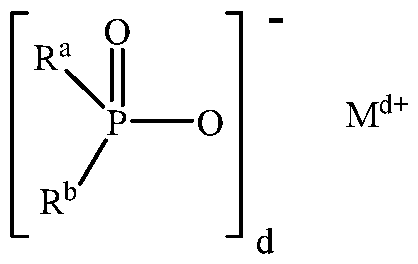
wherein Ra and Rb are each independently C i -G, alkyl; M is calcium, magnesium, aluminum, or zinc; and d is 2 or 3. Examples of Ra and Rb include methyl, ethyl, n-propyl, isopropyl, n-butyl, tert-butyl, and n- pentyl. Ra and Rb can each be ethyl, M can be zinc, and d can be 2 (that is, the metal dialkylphosphinate can be zinc diethyl phosphinate).
[0027] The metal dialkylphosphinate can be in particulate form. The metal dialkylphosphinate particles can have a median particle diameter (D50) less than or equal to 40 micrometers, or, more specifically, a D50 less than or equal to 30 micrometers, or, even more specifically, a D50 less than or equal to 25 micrometers, as determined using laser diffraction particle size analysis.
[0028] The phosphazene can preferably be a bis(phenoxy)phosphazene. The
bis(phenoxy)phosphazene can be oligomeric or polymeric, and it can be cyclic or linear. In some embodiments, the bis(phenoxy)phosphazene is cyclic and has the structure

wherein m is an integer of 3 to 25; x and y are each independently 0, 1, 2, 3, 4, or 5; and each occurrence of R4 and R5 is halogen, C1-12 alkyl, or C1-12 alkoxyl.
[0029] In other embodiments, the bis(phenoxy)phosphazene is linear and has the structure

wherein n is an integer from 3 to 10,000; X1 represents a— N=P(OPh)3 group or a -N=P(0)(OPh) group wherein Ph represents a phenyl group; Y1 represents a -P(OPh)4 group or a -P(0)(OPh)2 group; x and y are each independently 0, 1, 2, 3, 4, or 5; and each occurrence of R4 and R5 is halogen, C1-C12 alkyl, or C1-C12 alkoxyl.
[0030] The polyphosphonate can be as described in US2007/203269, W02007/022008 W02007/065094 W02009/018336, each of which are incorporated herein by reference in their entirety. In particular, the polyphosphonate can be a homopolymer. The polyphosphonate homopolymer is typically the product of bisphenol A and tetraphenyl phosphonium phenolate, such as FRX-100, the synthesis of which is described in US2011/0237695, which is incorporated herein by reference in its entirety.
[0031] The phosphorus-containing flame retardant can be present in a total amount of 5 to 50 wt%, based on the total weight of the composition. Within this range, the phosphorus -containing flame retardant can be present in an amount of 10 to 50 wt%, or 20 to 50 wt%. Preferably, the phosphorus- containing flame retardant can comprise 15 to 35 wt%, preferably 20 to 30 wt% of the phosphinate, 5 to 30 wt%, preferably 20 to 30 wt% of the phosphate ester, 3 to 10 wt% of the phosphazene, or 15 to 50 wt%, preferably 25 to 45 wt% of the polyphosphonate, based on the total weight of the composition, provided that the total amount of phosphorus-containing flame retardant is in the range of 5 to 50 wt%. The composition can include 5 to 30 wt% of the phosphate ester. The composition can include 20 to 30 wt% of the phosphate ester. The composition can include 3 to 10 wt% of the phosphazene, 25 to 45 wt% of the polyphosphonate, or both. The composition can include 15 to 35 wt% of the phosphinate.
[0032] The composition can exclude flame retardants other than the phosphorus -containing flame retardants described above. Halogenated flame retardants can be excluded from the present composition. Non-brominated and non-chlorinated phosphorus-containing flame retardants can be preferred.
[0033] In addition to the polyester and the phosphorus -containing flame retardant, the composition can optionally further include one or more of a polycarbonate, an impact modifier, and a flame retardant synergist.
[0034] In some embodiments, the polycarbonate is present in the composition.“Polycarbonate” as used herein means a homopolymer or copolymer having repeating structural carbonate units of formula (2)
 wherein at least 60 percent of the total number of R1 groups are aromatic, or each R1 contains at least one Ce-3o aromatic group. Specifically, each R1 can be derived from a dihydroxy compound such as an aromatic dihydroxy compound of the formula
 p
p
Wherein each Rh is independently a halogen atom, for example bromine, a CMO hydrocarbyl group such as a CMO alkyl, a halogen-substituted CMO alkyl, a G-io aryl, or a halogen-substituted G-io aryl, and n is 0 to 4. Ra and Rb are each independently a halogen, C 2 alkoxy, or C 2 alkyl, and p and q are each independently integers of 0 to 4, such that when p or q is less than 4, the valence of each carbon of the ring is filled by hydrogen. In an embodiment, p and q is each 0, or p and q is each 1, and Ra and Rb are each a CM alkyl group, specifically methyl, disposed meta to the hydroxy group on each arylene group. Xa is a bridging group connecting the two hydroxy-substituted aromatic groups, where the bridging group and the hydroxy substituent of each G, arylene group are disposed ortho, meta, or para (specifically para) to each other on the G, arylene group, for example, a single bond, -0-, -S-, -S(O)-, -S(0)2-, -C(O)-, or a C 8 organic group, which can be cyclic or acyclic, aromatic or non-aromatic, and can further comprise heteroatoms such as halogens, oxygen, nitrogen, sulfur, silicon, or phosphorous. For example, Xa can be a substituted or unsubstituted C3-18 cycloalkylidene; a C1-25 alkylidene of the formula -C(Rc)(Rd) - wherein Rc and Rd are each independently hydrogen, Ci-12 alkyl, Ci-12 cycloalkyl, C7-12 arylalkyl, Ci-12 heteroalkyl, or cyclic C7-12 heteroarylalkyl; or a group of the formula -C(=Re)- wherein Re is a divalent Ci-12 hydrocarbon group. Some illustrative examples of dihydroxy compounds that can be used are described, for example, in WO 2013/175448 Al, US 2014/0295363, and WO 2014/072923, each of which are incorporated herein by reference in their entirety.
[0035] Specific dihydroxy compounds include resorcinol, 2,2-bis(4-hydroxyphenyl) propane (“bisphenol A” or“BPA”), 3,3-bis(4-hydroxyphenyl) phthalimidine, 2-phenyl-3,3’-bis(4-hydroxyphenyl) phthalimidine (also known as N-phenyl phenolphthalein bisphenol,“PPPBP”, or 3,3-bis(4- hydroxyphenyl)-2-phenylisoindolin-l-one), l, l-bis(4-hydroxy-3-methylphenyl)cyclohexane, and 1,1- bis(4-hydroxyphenyl)-3 ,3 , 5 -trimethylcyclohexane (isophorone bisphenol) .
[0036] “Polycarbonate” as used herein also includes copolymers including carbonate units and ester units (“poly(ester-carbonate)s,” also known as polyester-polycarbonates). Poly(ester-carbonate)s further contain, in addition to recurring carbonate chain units described above, repeating ester units of formula (1) as described above.
[0037] Specific dihydroxy compounds for use in the poly(ester-carbonate)s include aromatic dihydroxy compounds (e.g., resorcinol), bisphenols (e.g., bisphenol A), a CM aliphatic diol such as ethane diol, n-propane diol, i-propane diol, 1, 4-butane diol, 1, 4-cyclohexane diol, 1,4- hydroxymethylcyclohexane, or a combination thereof. Aliphatic dicarboxylic acids that can be used include C5-20 aliphatic dicarboxylic acids (which includes the terminal carboxyl groups), specifically linear G- 1 2 aliphatic dicarboxylic acid such as decanedioic acid (sebacic acid); and alpha, omega-Cn
dicarboxylic acids such as dodecanedioic acid (DDDA). Aromatic dicarboxylic acids that can be used include terephthalic acid, isophthalic acid, naphthalene dicarboxylic acid, 1, 4-cyclohexane dicarboxylic acid, or a combination thereof. A combination of isophthalic acid and terephthalic acid wherein the weight ratio of isophthalic acid to terephthalic acid is 91:9 to 2:98 can be used.
[0038] Specific ester units for use in the poly(ester-carbonate)s include ethylene terephthalate units, n-proplyene terephthalate units, n-butylene terephthalate units, ester units derived from isophthalic acid, terephthalic acid, and resorcinol (ITR ester units), and ester units derived from sebacic acid and bisphenol A. The molar ratio of ester units to carbonate units in the poly(ester-carbonate)s can vary broadly, for example 1:99 to 99:1, or 10:90 to 90: 10, or 25:75 to 75:25, or 2:98 to 15:85. The molar ratio of ester units to carbonate units in the poly(ester-carbonate)s can vary from 1:99 to 30:70, or 2:98 to 25:75, or 3:97 to 20:80, or 5:95 to 15:85.
[0039] The polycarbonate can be a linear homopolymer containing bisphenol A carbonate units (BPA-PC), commercially available under the trade name LEXAN from SABIC; or a branched, cyanophenol end-capped bisphenol A homopolycarbonate produced via interfacial polymerization, containing 3 mol% l,l,l-tris(4-hydroxyphenyl)ethane (THPE) branching agent, commercially available under the trade name LEXAN CFR from SABIC.
[0040] The polycarbonate can be a poly(carbonate-siloxane) copolymer including bisphenol A carbonate units and siloxane units, for example blocks containing 5 to 200 dimethylsiloxane units, such as those commercially available under the trade name EXL from SABIC.
[0041] Other specific polycarbonates that can be used include poly(aromatic ester-carbonate)s comprising bisphenol A carbonate units and isophthalate-terephthalate-bisphenol A ester units, also commonly referred to as poly(carbonate-ester)s (PCE) or poly(phthalate-carbonate)s (PPC), depending on the relative ratio of carbonate units and ester units. Another specific poly(ester-carbonate) comprises resorcinol isophthalate and terephthalate units and bisphenol A carbonate units.
[0042] Other specific polycarbonates that can be used include poly(ester-carbonate-siloxane)s comprising bisphenol A carbonate units, isophthalate-terephthalate-bisphenol A ester units, and siloxane units, for example blocks containing 5 to 200 dimethylsiloxane units, such as those commercially available under the trade name FST from SABIC.
[0043] Poly(aliphatic ester-carbonate)s can be used, such as those comprising bisphenol A carbonate units and sebacic acid-bisphenol A ester units, such as those commercially available under the trade name LEXAN HFD from SABIC.
[0044] A specific copolycarbonate includes bisphenol A and bulky bisphenol carbonate units, i.e., derived from bisphenols containing at least 12 carbon atoms, for example 12 to 60 carbon atoms or 20 to 40 carbon atoms. Examples of such copolycarbonates include copolycarbonates comprising bisphenol A carbonate units and 2-phenyl-3,3’-bis(4-hydroxyphenyl) phthalimidine carbonate units (a BPA-PPPBP copolymer, commercially available under the trade name XHT from SABIC), a copolymer comprising bisphenol A carbonate units and l,l-bis(4-hydroxy-3-methylphenyl)cyclohexane carbonate units (a BPA-DMBPC copolymer commercially available under the trade name DMC from SABIC), and
a copolymer comprising bisphenol A carbonate units and isophorone bisphenol carbonate units
(available, for example, under the trade name APEC from Bayer).
[0045] The polycarbonates can have an intrinsic viscosity, as determined in chloroform at 25 °C, of 0.3 to 1.5 deciliters per gram (dl/gm). specifically 0.45 to 1.0 dl/gm. The polycarbonates can have a weight average molecular weight (Mw) of 10,000 to 200,000 Daltons, specifically 20,000 to 100,000 Daltons, as measured by gel permeation chromatography (GPC), using a crosslinked styrene- divinylbenzene column and calibrated to bisphenol A homopolycarbonate references. GPC samples are prepared, for example, at a concentration of 1 milligram per milliliter, and are eluted at a flow rate of 1.5 milliliters per minute.
[0046] The polycarbonate can include a homopolycarbonate including repeating units derived from bisphenol A, a copolycarbonate including repeating units derived from bisphenol A and siloxane units, a copolycarbonate including bisphenol A carbonate units and 2-phenyl-3,3’-bis(4-hydroxyphenyl) phthalimidine carbonate units, a copolycarbonate including bisphenol A carbonate units and sebacic acid- bisphenol A ester units, a poly(ester-carbonate-siloxane) including bisphenol A carbonate units, isophthalate-terephthalate-bisphenol A ester units, and siloxane units, a copolycarbonate including units derived from bisphenol A and l,l-bis(4-hydroxy-3-methylphenyl)cyclohexane, a (isophthalate- terephthalate-resorcinol)-carbonate copolyester, or a combination thereof.
[0047] “Polycarbonate” as used herein can also include post-consumer recycled polycarbonate (PCR-PC). The term "post-consumer recycled polycarbonate" refers to polycarbonate that has reached the intended end user or consumer, is no longer being used for the intended purpose, and which has been collected or reclaimed after utilization by the end-user or consumer, e.g. collected apart or separated from the normal consumer waste streams.
[0048] When present, the polycarbonate can be included in the composition in an amount of 3 to 30 wt%, or 5 to 25 wt%, or 10 to 25 wt%, based on the total weight of the composition. The
polycarbonate can be included in an amount of 10 to less than 25 wt%, or 10 to 24 wt%, or 10 to 23 wt%.
[0049] The composition can include the impact modifier. Examples of impact modifiers include natural rubber, fhioroelastomers, ethylene-propylene rubber (EPR), ethylene-butene rubber, ethylene- propylene-diene monomer rubber (EPDM), acrylate rubbers, hydrogenated nitrile rubber (HNBR), silicone elastomers, styrene-butadiene -styrene (SBS), styrene -butadiene rubber (SBR), styrene-(ethylene- butene)-styrene (SEBS), acrylonitrile-butadiene-styrene (ABS), acrylonitrile-ethylene-propylene-diene- styrene (AES), styrene-isoprene-styrene (SIS), styrene-(ethylene-propylene)-styrene (SEPS), methyl methacrylate-butadiene-styrene (MBS), high rubber graft (HRG), styrene-acrylonitrile (SAN), and the like.
[0050] A specific type of impact modifier is an elastomer-modified graft copolymer comprising (i) an elastomeric (i.e., rubbery) polymer substrate having a Tg less than l0°C, more specifically less than -l0°C, or more specifically -40° to -80°C, and (ii) a rigid polymeric superstrate grafted to the elastomeric polymer substrate. Materials suitable for use as the elastomeric phase include, for example, conjugated diene rubbers, for example polybutadiene and polyisoprene; copolymers of a conjugated diene with less
than 50 wt.% of a copolymerizable monomer, for example a monovinylic compound such as styrene, acrylonitrile, n-butyl acrylate, or ethyl acrylate; olefin rubbers such as ethylene propylene copolymers (EPR) or ethylene-propylene-diene monomer rubbers (EPDM); ethylene-vinyl acetate rubbers; silicone rubbers; elastomeric Ci-s alkyl (meth)acrylates; elastomeric copolymers of Ci-s alkyl (meth)acrylates with butadiene or styrene; or combinations of at least one of the foregoing elastomers. Materials suitable for use as the rigid phase include, for example, monovinyl aromatic monomers such as styrene and alpha- methyl styrene, and monovinylic monomers such as acrylonitrile, acrylic acid, methacrylic acid, and the Ci-6 esters of acrylic acid and methacrylic acid, specifically methyl methacrylate.
[0051] Specific elastomer-modified graft copolymers include those formed from styrene- butadiene-styrene (SBS), styrene-butadiene rubber (SBR), styrene-ethylene-butadiene-styrene (SEBS), ABS (acrylonitrile-butadiene-styrene), acrylonitrile-ethylene-propylene-diene-styrene (AES), styrene- isoprene-styrene (SIS), methyl methacrylate -butadiene -styrene (MBS), and styrene-acrylonitrile (SAN). In a specific embodiment, the impact modifier comprises ABS (acrylonitrile-butadiene-styrene), styrene- acrylonitrile (SAN), or a combination thereof.
[0052] Other impact modifiers can include poly(ether-ester) impact modifiers, such as those containing high molecular weight poly(caprolactone) or poly(tetrahydrofuran), such as poly(butylene terephthalate)-poly(tetrahydrofuran) block copolymers commercially available from DuPont under the tradename HYTREL and poly(cyclohexamethylene) cyclohexylene dicarboxylate-poly(tetrahydrofuran) block copolymers commercially-available from Eastman under the tradename ECDEL.
[0053] Combinations of any of the foregoing impact modifiers can be used.
[0054] When present, the impact modifier can be included in the composition in an amount of 1 to 10 wt%, based on the total weight of the composition. Within this range, the impact modifier can be present in an amount of 2 to 8 wt%, or 3 to 7 wt%.
[0055] The flame retardant synergist can be present in the composition. The flame retardant synergist can be a nitrogen-containing flame retardant synergist, for example including a nitrogen- containing heterocyclic base and a phosphate or pyrophosphate or polyphosphate acid. The nitrogen- containing flame retardant synergist can have the formula

wherein g is 1 to 10,000, and the ratio of f to g is 0.5:1 to 1.7: 1, or 0.7: 1 to 1.3: 1, or 0.9:1 to 1.1: 1. It will be understood that this formula includes species in which one or more protons are transferred from the phosphate group(s) to the melamine group(s). When g is 1, the nitrogen-containing flame retardant synergist is melamine phosphate (CAS Reg. No. 20208-95-1). When g is 2, the nitrogen-containing flame retardant synergist is melamine pyrophosphate (CAS Reg. No. 15541 60-3). When g is, on average, greater than 2, the nitrogen-containing flame retardant synergist is a melamine polyphosphate (CAS Reg. No. 56386-64-2). The nitrogen-containing flame retardant synergist can be melamine pyrophosphate,
melamine polyphosphate, or a combination thereof. When the nitrogen-containing flame retardant synergist is melamine polyphosphate, g can have an average value of greater than 2 to 10,000, or 5 to
1,000, or 10 to 500. When the nitrogen-containing flame retardant synergist is melamine polyphosphate, g can have an average value of greater than 2 to 500. Methods for preparing melamine phosphate, melamine pyrophosphate, and melamine polyphosphate are known in the art, and all are commercially available. For example, melamine polyphosphates can be prepared by reacting polyphosphoric acid and melamine, as described, for example, in U.S. Pat. No. 6,025,419, or by heating melamine pyrophosphate under nitrogen at 290°C to constant weight, as described in U.S. Patent No. 6,015,510, both of which are incorporated herein by reference in their entirety. The nitrogen-containing flame retardant synergist can include melamine cyanurate.
[0056] The flame retardant synergist can include silica, preferably nanosilica. The nanosilica can include a solid silica. The nanosilica can include at least one of a fused silica or a fumed silica. The nanosilica can include at least one of a crystalline silica or an amorphous silica. Examples of solid silica include attapulgite, e.g., Min-U-Gel™ commercially available from Active Minerals International, Ultrasil™ commercially available from Degussa Corporation, and Davisil™-643 commercially available from Sigma- Aldrich. The nanosilica can include a high purity nanosilica, where‘high purity nanosilica’ is a nanosilica that has greater than or equal to 70 wt%, or greater than or equal to 80 wt%, 90 to 100 wt% of silica oxide, based on the total weight of the nanosilica. The nanosilica can have a D50 particle size by volume of 5 to 50 nanometers (nm), or 5 to 40 nm, or 15 to 25 nm, as determined using laser light scattering particle size analysis techniques.
[0057] The nanosilica can have a hydrophobic coating. When present, the hydrophobic coating can include at least one of an organosiloxane or an organosilane. The organosiloxane can include at least one of an oligomeric linear siloxane (such as polydimethylsiloxane or polyphenylmethylsiloxane) or a cyclic siloxane (such as octamethyltetrasiloxane or hexamethyltrisiloxane). The hydrophobic coating can include a polysiloxane graft that can be comprise an organosiloxane (such as polydimethylsiloxane) grafted onto a surface of the nanosilica. The organosilane can include at least one of
phenyltrimethoxysilane, diphenyldimethoxysilane, polyethyleneglycoltrimethoxysilane,
phenethyltrimethoxysilane, gamma-methacryloxypropyltrimethoxysilane, gamma- aminopropyltrimethoxysilane, glycidyloxypropyltrimethoxysilane, N-aminoethyl-3- aminopropyltrimethoxysilane, aminoethylaminopropylmethyldimethoxysilane,
aminoethylaminopropyltrimethoxysilane, methyltrimethoxysilane, methyltriethoxysilane,
mercaptopropyltrimethoxysilane, mercaptopropylmethyldimethoxysilane, chloropropyltrimethoxysilane, chloropropyltriethoxysilane, chloropropylmethyldimethoxysilane, phenyltriethoxysilane,
diphenyldiethoxysilane, polyethyleneglycoltriethoxysilane, phenyltriethoxysilane, gamma- methacryloxypropyltriethoxysilane, gamma-aminopropyltriethoxysilane,
glycidyloxypropyltriethoxysilane, or N-aminoethyl-3-aminopropyltriethoxysilane. The hydrophobic coating component can be added to the silica prior to or during formation of the composition.
[0058] Other flame retardant synergists can also be optionally included in the composition in conventional amounts and as understood by those having skill in the field. Examples include silicone, metal oxides such as boehmite, aluminum oxide, iron oxide, titanium oxide, manganese oxide, magnesium oxide, zirconium oxide, zinc oxide, molybdenum oxide, cobalt oxide, bismuth oxide, chromium oxide, tin oxide, antimony oxide, nickel oxide, copper oxide and tungsten oxide, metal powder such as aluminum, iron, titanium, manganese, zinc, molybdenum, cobalt, bismuth, chromium, tin, antimony, nickel, copper and tungsten, metal salts such as zinc borate, zinc metaborate, barium metaborate, zinc carbonate, magnesium carbonate, calcium carbonate, and barium carbonate, clays, talc, or a combination thereof. In some embodiments, the aforementioned optional flame retardant synergists can be excluded from the composition.
[0059] When present, the flame retardant synergist can be present in an amount of 0.5 to 20 wt%, based on the total weight of the composition. Within this range, the flame retardant synergist can be present in an amount of 10 to 20 wt%, or 12 to 18 wt%. In some embodiments, when the flame retardant synergist is nitrogen-containing flame retardant synergist, it can be present in the composition in an amount of 5 to 20 wt%, based on the total weight of the composition. In some embodiments, when the flame retardant synergist is silica, the silica can be present in the composition in an amount of 0.5 to 5 wt%, or 0.5 to 3 wt%, or 0.5 to 2 wt%, or 0.5 to 1.5 wt%, based on the total weight of the composition.
[0060] In addition, the thermoplastic composition can include various additives ordinarily incorporated into polymer compositions of this type, with the proviso that the additive(s) are selected so as to not significantly adversely affect the desired properties of the thermoplastic composition. Such additives can be mixed at a suitable time during the mixing of the components for forming the composition. Additives can include, fillers, reinforcing agents, antioxidants, heat stabilizers, light stabilizers, ultraviolet (UV) light stabilizers, plasticizers, lubricants, mold release agents, antistatic agents, colorants such as such as titanium dioxide, carbon black, and organic dyes, surface effect additives, radiation stabilizers, flame retardants, and anti-drip agents. A combination of additives can be used, for example a combination of an antioxidant, a UV stabilizer, a transesterification stabilizer, a mold release agent, an antistat agent, a nucleant, a pigment, a dye, a chain extender (e.g., a diglycidyl ether of bisphenol-A, triglycidyl isocyanurate, 3,4-epoxycyclohexanemethyl-3,4-epoxycyclohexanecarboxylate in combination with sodium stearate, JONCRYL ADR available from BASF, and the like, or a combination thereof) or a combination thereof. The total amount of the additives (other than any toughening agent, impact modifier, filler, or reinforcing agents) can be 0.01 to 5 wt%, based on the total weight of the composition.
[0061] The compositions can optionally exclude any polymer components not specifically defined herein. For example, in some embodiments, the composition can exclude polyamides, poly(phenylene ether)s, poly(etherimide)s, or polyolefins (e.g., poly(ethylene), poly(propylene), and copolymers thereof). In a specific embodiment, the composition can exclude a triazine compound, or a salt thereof.
[0062] The composition can advantageously exhibit one or more desired properties. For example, the composition can have a shear melt viscosity of less than 200 Pa-s, as determined according to IS06721 using a shear rate of 100 s 1 at 250°C. The composition can have a shear melt viscosity of 30 to 100 Pa-s as determined according to IS06721 using a shear rate of 1 s 1 at 250°C. The composition can have a damping function value as determined using a combination of stress relaxation measurements and IS06721. The stress relaxation measurements can be carried out at 250°C using a 25 mm cone and plate geometry with a cone angle of 0.1 radians and strain amplitudes from 1 to 50 % strain.
[0063] The composite can be manufactured by contacting the thermoplastic composition with the fibrous material to provide the composite. The fibrous material can be contacted with the composition where the composition is in the form of a melt.
[0064] The fibrous material can be contacted with an aqueous slurry comprising the
thermoplastic material in particulate form. When the composition is provided in particulate form in an aqueous slurry, the thermoplastic composition can first be ground into a powder having an average particle size of 15 to 80 micrometers, for example 15 to 40 micrometers, or 15 to 25 micrometers.
Without wishing to be bound by theory, it is believed that in order to deposit, fuse and stabilize the fibrous materials, powder particles having a particle size close to fiber dimensions enable a more controlled concentration of particles to the fibers. Typically, amorphous polymers cannot be
cryogenically ground to these dimensions due to ductile behavior. On the other hand, semi-crystalline polymers of the present disclosure can be ground effectively.
[0065] Alternatively, contacting the fibrous material with the thermoplastic material can be by a powder scattering technique, wherein the thermoplastic composition can be provided in particulate form wherein the particles have an average particle size of 200 to 400 micrometers, or 200 to 300 micrometers, or 200 to 250 micrometers, which is believed to enable good spreading of the powder and limit static electricity effects.
[0066] The fibrous material can be contacted with the thermoplastic composition, wherein in the thermoplastic composition is in the form of a thin film. The fibrous material and the thin film of the thermoplastic composition can be contacted under heat, pressure, or both. The thin film of the thermoplastic composition can be prepared by extrusion of the thermoplastic composition, and can have a thickness of 20 to 300 micrometers, or 20 to 100 micrometers.
[0067] The composite can have a thickness of 10 to 300 micrometers, or 15 to 300 micrometers, or, 50 to 300 micrometers, or 50 to 200 micrometers. The composite can also have a fiber volume fraction (FVF) of 30 to 65 volume percent, preferably 45 to 60 volume percent. The composite can also have a fiber weight fraction (FWF) of 30 to 85 wt%, or 50 to 85 wt%. FVF and FWF can be determined as described in the working examples below.
[0068] The composite of the present disclosure can also be useful for forming laminates which include at least two layers, preferably at least three layers of the above-described composite. Each layer of the laminate can be the same or different in terms of the fibrous material and the thermoplastic composition. Each layer of the laminate can have the same or different thickness. Each layer can have the
same or different FVF. Furthermore, each layer of the laminate can have the same or different orientation. In some embodiments, the laminate preferably includes three layers of the composite, and the three superimposed layers of the composite are defined relative to each other than two outer layers of fiber composite material and at least one inner layer of fiber composite material. The inner layers can be fibrous composites oriented substantially equally and their orientation can be rotated relative to the outer layers of fiber composite material by 30° to 90°. At least some of the layers can have the same orientation and at least another part of the layers can be rotated by 30° to 90°, and the outer layers for this purpose are present in a 0° orientation. The inner layers can have the same orientation and their orientation is rotated relative to the outer layers of fiber composite material by 30° to 90°. As mentioned above, the layers of the laminate can have the same or different fiber volume content (FVF). In some embodiments, the fiber volume content of the outer layers of the laminate is at most 50 volume percent based on the volume of the outer layers of fiber composite material.
[0069] The laminate can have a thickness of 40 micrometers to 5 millimeters, or 100 micrometers to 5 millimeters, or 0.5 to 5 millimeters, or 0.5 to 1.1 millimeters.
[0070] The laminate comprising the composite as described herein can have one or more advantageous properties. For example, the laminate can have a flammability rating of V2 or better, as determined according to UL 94 at a thickness of 1.0 millimeter. The laminate can exhibit not more than a minor surface change detected by visual inspection following exposure to sunscreen at 65 °C, 90% relative humidity under 0.5% strain. The properties of the laminates are further described in the working examples below.
[0071] The composites as described herein can also exhibit desirable dielectric properties. For example, the composites can have a dielectric constant (Dk) of 3 to 5, as determined at 1.1 or 5 GHz. The composites can also have a dissipation factor (Df) of less than 0.05, preferably less than 0.02, as determined at 1.1 or 5 GHz.
[0072] In an aspect, disclosed herein is a composite comprising: at least one layer of a fibrous material comprising glass fibers, carbon fibers, ceramic fibers, polymeric fibers, or a combination thereof, more preferably wherein the fibrous material is a continuous fibrous material, a unidirectional fibrous material, a woven fibrous material, non-crimp material, a knitted fibrous material, a nonwoven fibrous material, or a combination thereof; and a thermoplastic matrix comprising a thermoplastic composition comprising, based on the total weight of the thermoplastic composition: 30 to 90 wt%, preferably 35 to 88 wt%, more preferably 35 to 70 wt%, even more preferably 37 to 56 wt% of a polyester that comprises poly(butylene terephthalate), polyethylene terephthalate), glycol-modified polyethylene terephthalate), glycol-modified poly(cyclohexylene dimethylene terephthalate), spiro- glycol-modified poly(ethylene terephthalate), poly(cyclohexylene dimethylene terephthalate), poly(trimethylene terephthalate), glycol-modified poly(butylene terephthalate), poly(butylene terephthalate) derived from recycled poly(ethylene terephthalate), or a combination thereof, preferably wherein the polyester is poly(butylene terephthalate), polyethylene terephthalate), or a combination thereof, and more preferably wherein the polyester is a poly(butylene terephthalate).; 5 to 50 wt%,
preferably 10 to 50 wt%, more preferably 20 to 50 of a phosphorus -containing flame retardant that comprises a phosphinate, a phosphate ester, a phosphazene, a polyphosphonate, or a combination thereof, preferably wherein the thermoplastic composition comprises: 15 to 35 wt%, preferably 20 to 30 wt% of the phosphinate; 5 to 30 wt%, preferably 20 to 30 wt% of the phosphate ester; 3 to 10 wt% of the phosphazene; or 15 to 50 wt%, preferably 25 to 45 wt% of the polyphosphonate; 3 to 30 wt%, preferably 5 to 25 wt%, more preferably 10 to 25 wt% of a polycarbonate wherein the polycarbonate comprises a polycarbonate homopolymer, a polycarbonate-polysiloxane copolymer, a copolycarbonate, or a combination thereof; more preferably wherein the polycarbonate comprises a homopolycarbonate comprising repeating units derived from bisphenol A, a copolycarbonate comprising repeating units derived from bisphenol A and siloxane units, a copolycarbonate comprising bisphenol A carbonate units and 2-phenyl-3,3’-bis(4-hydroxyphenyl) phthalimidine carbonate units, a copolycarbonate comprising bisphenol A carbonate units and sebacic acid-bisphenol A ester units, a poly(ester-carbonate-siloxane) comprising bisphenol A carbonate units, isophthalate-terephthalate-bisphenol A ester units, and siloxane units, a copolycarbonate comprising units derived from bisphenol A and l, l-bis(4-hydroxy-3- methylphenyl)cyclohexane, a (isophthalate-terephthalate-resorcinol)-carbonate copolyester, or a combination thereof; 1 to 10 wt% of an impact modifier, preferably wherein the impact modifier is poly(ether-ester) copolymer, a styrene -acrylonitrile copolymer, an acrylonitrile-butadiene-styrene copolymer, or a combination thereof; and 5 to 20 wt% of a flame retardant synergist, preferably wherein the flame retardant synergist comprises melamine polyphosphate, melamine cyanurate, melamine pyrophosphate, a melamine phosphate, silica, clay, talcum, or a combination thereof, more preferably wherein the flame retardant synergist comprises melamine polyphosphate, melamine cyanurate, melamine pyrophosphate, a melamine phosphate, silica, or a combination thereof; wherein the thermoplastic composition further comprises an additive, preferably wherein the additive is an antioxidant, a UV stabilizer, a transesterification stabilizer, a mold release agent, an antistat agent, a nucleant, a pigment, a dye, a chain extender, or a combination thereof; wherein the fibrous material is embedded in the thermoplastic matrix; wherein the composite has a thickness of 10 to 300 micrometers, preferably 15 to 300; wherein the composite has a fiber volume fraction of 30 to 65%, preferably 45 to 60%; a fiber weight fraction of 30 to 85%, preferably 50 to 85%; or both. Also disclosed is a laminate comprising at least two layers of the foregoing composite, preferably wherein the laminate has one or more of: a flammability rating of V2 or better, as determined according to UL 94 at a thickness of 1.0 millimeter; not more than a minor surface change detected by visual inspection following exposure to sunscreen at 65°C, 90% relative humidity under 0.5% strain; and a thickness of 0.5 to 5 millimeters, preferably 0.5 to 1.1 millimeters.
[0073] In an aspect, disclosed herein is a composite comprising: at least one layer of a fibrous material, preferably wherein the fibrous material comprises glass fibers, carbon fibers, ceramic fibers, polymeric fibers, or a combination thereof; and a thermoplastic matrix comprising a thermoplastic composition comprising, based on the total weight of the thermoplastic composition: 35 to 88 wt%, more preferably 35 to 70 wt%, of a polyester that comprises poly(butylene terephthalate), polyethylene
terephthalate), glycol-modified polyethylene terephthalate), glycol-modified poly(cyclohexylene dimethylene terephthalate), spiro-glycol-modified poly(ethylene terephthalate), poly(cyclohexylene dimethylene terephthalate), poly(trimethylene terephthalate), glycol-modified poly(butylene
terephthalate), poly(butylene terephthalate) derived from recycled polyethylene terephthalate), or a combination thereof; 10 to 50 wt%, of a phosphorus-containing flame retardant that comprises a phosphinate, a phosphate ester, a phosphazene, a polyphosphonate, or a combination thereof; preferably 5 to 25 wt% of a polycarbonate homopolymer, a polycarbonate-polysiloxane copolymer, a
copolycarbonate, or a combination thereof; 1 to 10 wt% of an impact modifier, butadiene-styrene; and 5 to 20 wt% of a flame retardant synergist; one or more of an additive such as an antioxidant, a UV stabilizer, a transesterification stabilizer, a mold release agent, an antistat agent, a nucleant, a pigment, a dye, a chain extender, or a combination thereof; wherein the fibrous material is embedded in the thermoplastic matrix; wherein the composite has a thickness of 10 to 300 micrometers; wherein the composite has a fiber volume fraction of 30 to 65%, a fiber weight fraction of 30 to 85%; or both. Also disclosed is a laminate comprising at least two layers of the foregoing composite, wherein the laminate has one or more of: a flammability rating of V2 or better, as determined according to UL 94 at a thickness of 1.0 millimeter; not more than a minor surface change detected by visual inspection following exposure to sunscreen at 65°C, 90% relative humidity under 0.5% strain; and a thickness of 0.5 to 5 millimeters, preferably 0.5 to 1.1 millimeters.
[0074] In an aspect, disclosed herein is a composite comprising: at least one layer of a fibrous material comprising glass fibers, carbon fibers, ceramic fibers, polymeric fibers, or a combination thereof, wherein the fibrous material is a continuous fibrous material, a unidirectional fibrous material, a woven fibrous material, non-crimp material, a knitted fibrous material, a nonwoven fibrous material, or a combination thereof; and a thermoplastic matrix comprising a thermoplastic composition comprising, based on the total weight of the thermoplastic composition: 35 to 70 wt%, even more preferably 37 to 56 wt% of a poly(butylene terephthalate), polyethylene terephthalate), or a combination thereof; a flame retardant, which can be 15 to 35 wt%, preferably 20 to 30 wt% of a phosphinate, or 5 to 30 wt%, preferably 20 to 30 wt% of a phosphate ester, or 3 to 10 wt% of a phosphazene, or 15 to 50 wt%, preferably 25 to 45 wt% of a polyphosphonate; 5 to 25 wt%, more preferably 10 to 25 wt% of a polycarbonate wherein the polycarbonate comprises a homopolycarbonate comprising repeating units derived from bisphenol A, a copolycarbonate comprising repeating units derived from bisphenol A and siloxane units, a copolycarbonate comprising bisphenol A carbonate units and 2 -phenyl-3, 3’-bis(4- hydroxyphenyl) phthalimidine carbonate units, a copolycarbonate comprising bisphenol A carbonate units and sebacic acid-bisphenol A ester units, a poly(ester-carbonate-siloxane) comprising bisphenol A carbonate units, isophthalate-terephthalate-bisphenol A ester units, and siloxane units, a copolycarbonate comprising units derived from bisphenol A and l,l-bis(4-hydroxy-3-methylphenyl)cyclohexane, a (isophthalate-terephthalate-resorcinol)-carbonate copolyester, or a combination thereof; 1 to 10 wt% of an impact modifier that comprises poly(ether-ester) copolymer, a styrene-acrylonitrile copolymer, an acrylonitrile-butadiene-styrene copolymer, or a combination thereof; and 5 to 20 wt% of a flame
retardant synergist that comprises melamine polyphosphate, melamine cyanurate, melamine pyrophosphate, a melamine phosphate, silica, or a combination thereof; wherein the thermoplastic composition further comprises an additive, preferably wherein the additive is an antioxidant, a UV stabilizer, a transesterification stabilizer, a mold release agent, an antistat agent, a nucleant, a pigment, a dye, a chain extender, or a combination thereof; wherein the fibrous material is embedded in the thermoplastic matrix; wherein the composite has a thickness of 15 to 300 micrometers; wherein the composite has a fiber volume fraction of 45 to 60%; a fiber weight fraction of 50 to 85%; or both. Also disclosed is a laminate comprising at least two layers of the foregoing composite, preferably wherein the laminate has one or more of: a flammability rating of V2 or better, as determined according to UL 94 at a thickness of 1.0 millimeter; not more than a minor surface change detected by visual inspection following exposure to sunscreen at 65°C, 90% relative humidity under 0.5% strain; and a thickness of 0.5 to 1.1 millimeters.
[0075] This disclosure is further illustrated by the following examples, which are non-limiting.
EXAMPLES
[0076] Materials used in the following examples are described in Table 1.
Table 1


[0077] In the following examples, the formulations were dry blended and extruded in a 25 mm Werner & Pfleiderer ZSK co-rotating twin screw extruder with a vacuum vented mixing screw, using a screw speed of 160 rpm. The temperature profile for compounding starting from feed zone to die zone was 40-70-l70-230-240-245-245-245°C. The desired torque was maintained during the extrusion by changing the throughput rate to achieve optimum mixing. The extrudate was cooled through a water bath prior to pelletization. The pellets were dried for 4 hours at 80°C in a forced air-circulating oven prior to injection molding.
[0078] Test specimens were injection molded on a 110 Ton Engel injection molding machine as per ISO test protocols. The temperature profile for injection molding starting from feed zone to nozzle was 40-100-230-230-245-235 °C. Tensile properties of the injection molded specimens were evaluated as per ISO 527 and notched Izod impact testing was performed in accordance with ISO 180. Flame testing was performed with 1.0 mm thickness flame bars in accordance with UL-94. Vicat was measured as per ISO 306 at a heating rate of 120° C/hr at 50 Newton (N). The melt volume flow rate (MVR) of the pellets was determined according ISO 1133 at a specific load and temperature. The melt viscosity (MV) of the polymers was determined according IS06721 at various shear rates (l/s, s 1) and temperatures. The parallel plate rheology was done on an ARES-G2 using 25 mm parallel plates at 250 °C. The measurements were performed using varying strain (0.1-100%) at various frequencies (0.1-100 rad/s) in a N2 atmosphere. The data from these tests were used to calculate a damping function of the form h=l/(l+a*strainn), where h is the damping function, a is a parameter related to the topology of the
polymer chain, and n is about 1.5. The damping function was used as a measure of elasticity of the systems. DMA tensile modulus in Table 6 was measured using a Dynamic Mechanical Analyzer (DMA) run in tensile mode. DMA can be according to ASTM D5279.
[0079] The polymer was also evaluated for its chemical resistance to sunscreen, by applying 1 milliliter of the sunscreen in the center of a tensile bar. Subsequently the tensile bars were exposed to 65 °C, 90% relative humidity (RH) under 0.5% strain. Through visual assessment one could differentiate the following classifications: [1]: Sample is unaffected; [2] Sample shows some minor surface change;
[3] Sample shows softening; [4] Material shows blisters and has cracked.
[0080] Table 2 below shows various composition including PBT, and the properties associated with these compositions. As can be seen from Table 2, it was surprisingly found that by increasing the content of the phosphate ester flame retardant from 8.5 wt% to 25.5 wt%, the mechanical properties, ESCR, and heat properties were affected. Thus, an optimal loading of flame retardant is essential to balance these properties for use in composite structures.
Table 2

[0081] Pellets of the Table 2 compositions were cryogenically ground using a mill equipped with a 400 micrometer or 80 micrometer sieves to provide micronized powders having a D50 of 250 micrometers or 20 micrometers, respectively. Due to static effects, silica and antistatic agents were added to the powders in order to pass through the sieve. The powder dimensions were characterized using a
Mastersizer 2000 with Hydro 2000 MU liquid feeding system from Malvern to determine particle size distribution (PSD) in methanol with laser diffraction technology providing Dio, D50 and D90 data.
[0082] Micronized powders are described in Table 3. As shown in Table 3, micronized powders having a D50 of about 250 pm can easily be obtained through cryogenic grinding, as exemplified by CE2, Ex6 and Ex8. In contrast, when the target was to obtain a powder having a D50 in the range of 20 pm, only Ex5 achieved these dimensions upon the addition of silica and antistatic agents. It was observed that the cryogenic grinding of Ex7 was slower, yield was lower, and the overall particle size was larger than Ex5, which, without wishing to be bound by theory, is believed to be attributed to the ductile polycarbonate phase reducing the grindability of the composition.
Table 3

[0083] Pellets of the Table 2 compositions were also converted to thin films using a film extruder having a 30 mm barrel, 3 zone screw (ratio 1 :4, L/D: 20), die width of 320 mm, and 100 pm gap. Films, having a thickness of 20-30 micrometers were obtained of CE3 and Ex 10 by using the film extrusion conditions as outlined in Table 4. However, Ex9 could not be extruded due to due to screw slippage (equipment limitations) or too high MVR of the polymer composition.
Table 4

[0084] Various black and white colored variants of Ex3 and Ex4 were compounded using the processing parameters explained above. It was noticed that Ex3 (see Table 1) did not process well due to coagulation/aggregate formation in the throat of the extruder due to the SOL-DP and IM combination. By
removal of the IM from the formulation of Ex3, the composition could be extruded without strand breakage. Therefore, formulations Exl 1 and Exl2 (white colored version) and Exl3 (black colored version) were compounded. Formulations and properties are shown in Table 5.
Table 5

[0085] From the data in Table 5, it can be seen that components such as the colorants, polymer components, and flame retardant can play a role in the rheological properties as well as the damping function. In general, addition of PC-3 (branched PC) increased the viscosity and decreased the damping function. The damping function can be a good indicator of elasticity (e.g., higher elasticity, lower damping function). Compositions with lower elasticity and damping function of greater than 100 can be preferred for use in fiber composites due to enhanced fiber wetting. It can also be seen that the colorants can affect the viscosity. For example, in the case of Exl4-l6 (PBT-PC blends), the presence of pigments increases the viscosity, while in the case of Exl 1-13 (PBT compositions), the presence of pigments decreases the viscosity.
[0086] The compositions of Exl-4 and Exl 1-16 were used to manufacture unidirectional (UD) tapes using a variety of fibers (e.g., glass, ceramic, carbon, and the like) using a direct melt impregnation
method. Adjustment of the extruder’s throughput, temperature, line speed, die temperature, and fiber tension was made to enable production of tapes. Compositions and results are shown in Table 6.
[0087] The UD tapes were manufactured using the following commercial continuous fibers: HiperTex Glass, 2400 tex rovings, available from 3B; Nextel 610 ceramic oxide, 1111 tex rovings, available from 3M, and HR40 carbon fiber and approximately 600 tex rovings (12K), available from Mitsubishi.
[0088] The micronized powders of Ex5, having a D50 of 32 micrometers were used to manufacture UD prepregs using an aqueous slurry process. The micronized powders of Ex6 and Ex8, having a D50 in the range of 250 to 350 micrometers were used in a powder scattering process to manufacture fabric semi-pregs.
[0089] Thickness of the tapes was measured with a gauge at a minimum of three locations across the width of the tape. The fiber volume fraction (FVF) was either estimated after determining the thickness, width, and weight of the tape. The weight of 1 meter of tape was determined using a scale and the raw material densities. Alternatively, the fiber weight fraction (FWF) was determined by burning the matrix off the fiber. The sample was weighed before and after burning. Impregnation quality, porosity, and fiber/composition distribution in the tape was evaluated by optical microscopy and image analysis.
[0090] It was observed that the viscosity of the composition plays an important role in retaining mechanical properties. Higher viscosity or elasticity gave less efficient impregnation, and thus lower modulus.
Table 6

direct melt impregnation 2Powder scattering 3Aqueous slurry
[0091] The prepregs of examples Ex20 and Ex27-29 were stacked in a specific configuration and subsequently used to manufacture laminates. Laminates can be made using any number of lamination processes including pressing in a hot press. FVF, FWF, UL94 flammability rating, ESCR, dimensions, mechanical properties, and dielectric performance of the laminates were evaluated.
[0092] Flame retardancy of the laminates was determined according to Underwriter’s
Laboratory Bulletin 94“Tests for Flammability of Plastic Materials, UL 94”, 20 mm Vertical Burning Flame Test. Before testing, samples were conditioned at 23 °C and 50% relative humidity for at least 48 hours. In the UL 94 20 mm Vertical Burning Flame Test, a set of five samples was tested. For each bar, a flame was applied to the bar then removed, and the time required for the bar to self-extinguish (first afterflame time, tl) was noted. The flame was then reapplied and removed, and the time required for the bar to self-extinguish (second afterflame time, t2) and the post-flame glowing time (afterglow time, t3) were noted. To achieve a rating of V-0, the afterflame times tl and t2 for each individual specimen must have been less than or equal to 10 seconds; and the total afterflame time for all five specimens (tl plus t2 for all five specimens) must have been less than or equal to 50 seconds; and the second afterflame time plus the afterglow time for each individual specimen (t2 + 13) must have been less than or equal to 30 seconds; and no specimen can have flamed or glowed up to the holding clamp; and the cotton indicator cannot have been ignited by flaming particles or drops. To achieve a rating of V-l, the afterflame times tl and t2 for each individual specimen must have been less than or equal to 30 seconds; and the total afterflame time for all five specimens (tl plus t2 for all five specimens) must have been less than or equal to 250 seconds; and the second afterflame time plus the afterglow time for each individual specimen (t2 + t3) must have been less than or equal to 60 seconds; and no specimen can have flamed or glowed up to the holding clamp; and the cotton indicator cannot have been ignited by flaming particles or drops. To achieve a rating of V-2, the afterflame times tl and t2 for each individual specimen must have been less than or equal to 30 seconds; and the total afterflame time for all five specimens (tl plus t2 for all five specimens) must have been less than or equal to 250 seconds; and the second afterflame time plus the afterglow time for each individual specimen (t2 + 13) must have been less than or equal to 60 seconds; and no specimen can have flamed or glowed up to the holding clamp; but the cotton indicator can have been ignited by flaming particles or drops. Specimens not achieving a rating of V-2 were considered to have failed. Samples that bum all the way to the clamp are considered to have failed, and are given the rating“NR,” or non-rated.
[0093] The results are shown in Table 7.
Table 7


[0094] Tensile properties of the laminates were measured according to ASTM D3039/D3039M- 17 test method. Tensile strength and modulus of the fabric based laminates (Ex31-33) varied between 650-700 MPa and 30-32 GPa, respectively. The tensile strength of the unidirectional 3B-Glass laminates (Ex34) varied between 900 and 950 MPa and 37-40 GPa respectively.
[0095] Flexural properties were measured according to ASTM D7264/D7264M-15 test methods. The flexural strength of the roving based unidirectional laminates across the fiber direction varied between 800-950 and 35-45 GPa respectively (Ex34). The flexural strength of the S-glass fabric laminates (Ex31-33) varied between 500-550 MPa and 25-28 GPa respectively (Ex34).
[0096] The determination of the dielectric constants (Dk) and dissipation factors (Df) of the laminate was conducted at 23°C, at 1.1 GHz or 5 GHz using the SPDR (Split Post Dielectric Resonator) test.
[0097] In order to maximize phosphorus content without comprising other properties, high glass transition additives can be used. For example, polyphosphonates, having a Tg of l05°C, were evaluated. As shown in Table 8, the compositions exhibited a modulus of 2.6 to 2.8 GPa, whereas the composition of Ex 14 (using a phosphate ester flame retardant additive) exhibited a modulus of 0.56 GPa. Similarly, the Vicat values of the compositions of Table 8 were 89-l02°C, whereas the composition of Ex 14 had a Vicat value of 68.6°C. Further, all compositions of Table 8 exhibited low shear viscosities of less than 100 Pa.s, making them excellent candidates for preparing continuous fiber composites.
Table 8


[0098] As shown in Table 8, compositions of Ex35-4l have good mechanical properties, heat resistance and high P content. When exposed to the sunscreen ESCR test they showed softening of the surface. Without wishing to be bound by theory, each of these compositions includes a high
concentration (e.g., 25-45 wt%) of a polyphosphonate, which may be susceptible to the sunscreen, contributing to the observed softening.
[0099] Formulations of Table 8 were converted into thin films by using a double belt press. The pellets of each experimental formulation were squeezed between two Teflon sheets into a film, having a 100 micrometer thickness using a double belt press under the following conditions: 240°C, 0.5 m/min, 10 N, 4 mm gap.
[0100] Subsequently, a 100 micrometer film was stacked between two S-glass fabrics and consolidated into a 1.0 millimeter laminate. Table 9 shows the laminate properties.
Table 9

“ND” is not determined.
[0101] Surprisingly, Ex 45 and Ex 46 resulted in a V0 ETL94 rating of the composite laminate having a thickness of 1.0 mm. Furthermore, it was found that the addition of 1 wt% of fumed silica in Ex 48 resulted in a VI of the 1 mm laminate, while its compositional benchmark Ex 47 failed the UL94 V rating test (VNOT due to flame out times exceeding 35 seconds for one specimen). It was surprisingly found that the addition of fumed silica effectively reduced the flame out time during the flame retardancy testing according UL94 V rating test protocol. This resulted in an increase of the p(FTP) VI from 0.04 to
0.79. The high loadings of the polyphosphonate polymer was observed to affect the ESCR performance, and to decrease modulus and failure strain of the composite laminate.
[0102] Table 10 shows compositions which include polyethylene terephthalate) (PET).
Compositions and properties are shown in Table 10.
Table 10

[0103] This disclosure further encompasses the following non-limiting aspects.
[0104] Aspect 1 : A composite comprising: at least one layer of a fibrous material, preferably wherein the fibrous material comprises glass fibers, carbon fibers, ceramic fibers, polymeric fibers, or a combination thereof, more preferably wherein the fibrous material is a continuous fibrous material, a unidirectional fibrous material, a woven fibrous material, non-crimp material, a knitted fibrous material, a nonwoven fibrous material, or a combination thereof; and a thermoplastic matrix comprising a thermoplastic composition comprising, based on the total weight of the thermoplastic composition: 30 to 90 wt%, preferably 35 to 88 wt%, more preferably 35 to 70 wt%, even more preferably 37 to 56 wt% of a polyester; 5 to 50 wt%, preferably 10 to 50 wt%, more preferably 20 to 50 of a phosphorus -containing flame retardant; and optionally, one or more of: 3 to 30 wt%, preferably 5 to 25 wt%, more preferably 10 to 25 wt% of a polycarbonate; 1 to 10 wt% of an impact modifier; 5 to 20 wt% of a flame retardant synergist; wherein the fibrous material is embedded in the thermoplastic matrix.
[0105] Aspect 2: The composite of aspect 1, wherein the polyester comprises poly(butylene terephthalate), poly(ethylene terephthalate), glycol-modified polyethylene terephthalate), glycol- modified poly(cyclohexylene dimethylene terephthalate), spiro-glycol-modified polyethylene terephthalate), poly(cyclohexylene dimethylene terephthalate), poly(trimethylene terephthalate), glycol- modified poly(butylene terephthalate), poly(butylene terephthalate) derived from recycled poly(ethylene terephthalate), or a combination thereof; preferably wherein the polyester is poly(butylene terephthalate), polyethylene terephthalate), or a combination thereof; more preferably wherein the polyester is a poly(butylene terephthalate).
[0106] Aspect 3: The composite of aspect 1 or 2, wherein the phosphorus-containing flame retardant is a phosphinate, a phosphate ester, a phosphazene, a polyphosphonate, or a combination thereof, preferably wherein the thermoplastic composition comprises: 15 to 35 wt%, preferably 20 to 30 wt% of the phosphinate; 5 to 30 wt%, preferably 20 to 30 wt% of the phosphate ester; 3 to 10 wt% of the phosphazene; or 15 to 50 wt%, preferably 25 to 45 wt% of the polyphosphonate.
[0107] Aspect 4: The composite of any of aspects 1 to 3, wherein the polycarbonate is present in the thermoplastic composition, preferably wherein the polycarbonate comprises a polycarbonate homopolymer, a polycarbonate-polysiloxane copolymer, a copolycarbonate, or a combination thereof; more preferably wherein the polycarbonate comprises a homopolycarbonate comprising repeating units derived from bisphenol A, a copolycarbonate comprising repeating units derived from bisphenol A and siloxane units, a copolycarbonate comprising bisphenol A carbonate units and 2 -phenyl-3, 3’-bis(4- hydroxyphenyl) phthalimidine carbonate units, a copolycarbonate comprising bisphenol A carbonate units and sebacic acid-bisphenol A ester units, a poly(ester-carbonate-siloxane) comprising bisphenol A carbonate units, isophthalate-terephthalate-bisphenol A ester units, and siloxane units, a copolycarbonate comprising units derived from bisphenol A and l,l-bis(4-hydroxy-3-methylphenyl)cyclohexane, a (isophthalate-terephthalate-resorcinol)-carbonate copolyester, or a combination thereof.
[0108] Aspect 5: The composite of any of aspects 1 to 4, wherein the impact modifier is present in the thermoplastic composition, preferably wherein the impact modifier is poly(ether-ester) copolymer, a styrene-acrylonitrile copolymer, an acrylonitrile -butadiene-styrene copolymer, or a combination thereof.
[0109] Aspect 6: The composite of any of aspects 1 to 5, wherein the flame retardant synergist is present in the thermoplastic composition, preferably wherein the flame retardant synergist comprises melamine polyphosphate, melamine cyanurate, melamine pyrophosphate, a melamine phosphate, silica, clay, talcum, or a combination thereof, more preferably wherein the flame retardant synergist comprises melamine polyphosphate, melamine cyanurate, melamine pyrophosphate, a melamine phosphate, silica, or a combination thereof.
[0110] Aspect 7: The composite of any of aspects 1 to 6, wherein the thermoplastic composition further comprises an additive, preferably wherein the additive is an antioxidant, a UV stabilizer, a transesterification stabilizer, a mold release agent, an antistat agent, a nucleant, a pigment, a dye, a chain extender, or a combination thereof.
[0111] Aspect 8: The composite of any of aspects 1 to 7, wherein the composite has a thickness of 10 to 300 micrometers, preferably 15 to 300.
[0112] Aspect 9: The composite of any of aspects 1 to 8, wherein the composite has a fiber volume fraction of 30 to 65%, preferably 45 to 60%; a fiber weight fraction of 30 to 85%, preferably 50 to 85%; or both.
[0113] Aspect 10: A method for the manufacture of the composite of any of aspects 1 to 9, the method comprising: contacting the thermoplastic composition with the fibrous material; preferably wherein the contacting comprises contacting the fibrous material with the thermoplastic composition in the form of a melt; contacting the fibrous material with an aqueous slurry comprising the thermoplastic composition in particulate form; contacting the fibrous material with the thermoplastic composition by powder scattering; or contacting the fibrous material with the thermoplastic composition in the form of a thin film under heat, pressure, or both.
[0114] Aspect 11 : A laminate comprising at least two layers of the composite of any of aspects 1 to 9, preferably wherein the laminate has one or more of: a flammability rating of V2 or better, as determined according to UL 94 at a thickness of 1.0 millimeter; not more than a minor surface change detected by visual inspection following exposure to sunscreen at 65°C, 90% relative humidity under 0.5% strain; and a thickness of 0.5 to 5 millimeters, preferably 0.5 to 1.1 millimeters.
[0115] Aspect 12: A thermoplastic composition comprising: 30 to 90 wt%, preferably 35 to 88 wt%, more preferably 35 to 70 wt%, even more preferably 37 to 56 wt% of a polyester; 15 to 50 wt%, preferably 25 to 45 wt% of a polyphosphonate; and optionally, one or more of 3 to 30 wt%, preferably 5 to 25 wt%, more preferably 10 to 25 wt% of a polycarbonate; 1 to 10 wt% of an impact modifier; and 5 to 20 wt% of a flame retardant synergist, preferably wherein the flame retardant synergist comprises silica; wherein wt% of each component is based on the total weight of the composition; and wherein the thermoplastic composition exhibits one or more of: a shear melt viscosity of less than 200 Pa.s, as determined according to IS06721 using a shear rate of 100 s 1 at 250°C; a shear melt viscosity of 30 to 100 Pa.s as determined according to IS06721 using a shear rate of 1 s 1 at 250°C; a damping function value above 50 and below 200.
[0116] Aspect 13: The thermoplastic composition of aspect 12, wherein the polycarbonate is present, preferably wherein the polycarbonate comprises a polycarbonate homopolymer, a polycarbonate - polysiloxane copolymer, a copolycarbonate, or a combination thereof; more preferably wherein the polycarbonate comprises a homopolycarbonate comprising repeating units derived from bisphenol A, a copolycarbonate comprising repeating units derived from bisphenol A and siloxane units, a
copolycarbonate comprising bisphenol A carbonate units and 2-phenyl-3,3’-bis(4-hydroxyphenyl) phthalimidine carbonate units, a copolycarbonate comprising bisphenol A carbonate units and sebacic acid-bisphenol A ester units, a poly(ester-carbonate-siloxane) comprising bisphenol A carbonate units, isophthalate-terephthalate-bisphenol A ester units, and siloxane units, a copolycarbonate comprising units derived from bisphenol A and l,l-bis(4-hydroxy-3-methylphenyl)cyclohexane, a (isophthalate- terephthalate-resorcinol)-carbonate copolyester, or a combination thereof.
[0117] Aspect 14: The thermoplastic composition of aspect 12 or 13, wherein the composition is in the form of a micronized powder, preferably wherein the micronized powder has an average diameter of 15 to 40 micrometers, preferably 15 to 20 micrometers, or 200 to 400 micrometers, preferably 200 to 250 micrometers.
[0118] Aspect 15: The thermoplastic composition of aspect 12 or 13, wherein the composition is in the form of a film, preferably having a thickness of 200 to 300 micrometers, preferably 20 to 100 micrometers.
[0119] The compositions, methods, and articles can alternatively comprise, consist of, or consist essentially of, any appropriate materials, steps, or components herein disclosed. The compositions, methods, and articles can additionally, or alternatively, be formulated so as to be devoid, or substantially free, of any materials (or species), steps, or components, that are otherwise not necessary to the achievement of the function or objectives of the compositions, methods, and articles.
[0120] All ranges disclosed herein are inclusive of the endpoints, and the endpoints are independently combinable with each other.“Combinations” is inclusive of blends, mixtures, alloys, reaction products, and the like. The terms“first,”“second,” and the like, do not denote any order, quantity, or importance, but rather are used to distinguish one element from another. The terms“a” and “an” and“the” do not denote a limitation of quantity and are to be construed to cover both the singular and the plural, unless otherwise indicated herein or clearly contradicted by context.“Or” means“and/or” unless clearly stated otherwise. Reference throughout the specification to“some embodiments,”“an embodiment,” and so forth, means that a particular element described in connection with the embodiment is included in at least one embodiment described herein, and may or may not be present in other embodiments. In addition, it is to be understood that the described elements may be combined in any suitable manner in the various embodiments. A“combination thereof’ is an open term, including at least two of the listed elements, or at least one of the listed elements and a like element not listed.
[0121] Unless specified to the contrary herein, all test standards are the most recent standard in effect as of the filing date of this application, or, if priority is claimed, the filing date of the earliest priority application in which the test standard appears.
[0122] Unless defined otherwise, technical and scientific terms used herein have the same meaning as is commonly understood by one of skill in the art to which this application belongs. All cited patents, patent applications, and other references are incorporated herein by reference in their entirety. However, if a term in the present application contradicts or conflicts with a term in the incorporated reference, the term from the present application takes precedence over the conflicting term from the incorporated reference.
[0123] Compounds are described using standard nomenclature. For example, any position not substituted by any indicated group is understood to have its valency filled by a bond as indicated, or a hydrogen atom. A dash
 that is not between two letters or symbols is used to indicate a point of attachment for a substituent. For example, -CHO is attached through carbon of the carbonyl group.
[0124] As used herein, the term“hydrocarbyl,” whether used by itself, or as a prefix, suffix, or fragment of another term, refers to a residue that contains only carbon and hydrogen. The residue can be aliphatic or aromatic, straight-chain, cyclic, bicyclic, branched, saturated, or unsaturated. It can also contain combinations of aliphatic, aromatic, straight chain, cyclic, bicyclic, branched, saturated, and unsaturated hydrocarbon moieties. However, when the hydrocarbyl residue is described as substituted, it may, optionally, contain heteroatoms over and above the carbon and hydrogen members of the substituent residue. Thus, when specifically described as substituted, the hydrocarbyl residue can also contain one or more carbonyl groups, amino groups, hydroxyl groups, or the like, or it can contain heteroatoms within the backbone of the hydrocarbyl residue. The term "alkyl" means a branched or straight chain, unsaturated aliphatic hydrocarbon group, e.g., methyl, ethyl, n-propyl, i-propyl, n-butyl, s- butyl, t-butyl, n-pentyl, s-pentyl, and n- and s-hexyl.“Alkenyl” means a straight or branched chain, monovalent hydrocarbon group having at least one carbon-carbon double bond (e.g., ethenyl (- HC=CH2)).“Alkoxy” means an alkyl group that is linked via an oxygen (i.e., alkyl-O-), for example
methoxy, ethoxy, and sec-butyloxy groups. "Alkylene" means a straight or branched chain, saturated, divalent aliphatic hydrocarbon group (e.g., methylene (-CH2-) or, propylene (-(CFh^-)).“Cycloalkylene” means a divalent cyclic alkylene group, -CnFhn-x, wherein x is the number of hydrogens replaced by cyclization(s).“Cycloalkenyl” means a monovalent group having one or more rings and one or more carbon-carbon double bonds in the ring, wherein all ring members are carbon (e.g., cyclopentyl and cyclohexyl). "Aryl" means an aromatic hydrocarbon group containing the specified number of carbon atoms, such as phenyl, tropone, indanyl, or naphthyl.“Arylene” means a divalent aryl group.
“Alkylarylene” means an arylene group substituted with an alkyl group.“Arylalkylene” means an alkylene group substituted with an aryl group (e.g., benzyl). The prefix "halo" means a group or compound including one more of a fluoro, chloro, bromo, or iodo substituent. A combination of different halo groups (e.g., bromo and fluoro), or only chloro groups can be present. The prefix“hetero” means that the compound or group includes at least one ring member that is a heteroatom (e.g., 1, 2, or 3 heteroatom(s)), wherein the heteroatom(s) is each independently N, O, S, Si, or P.“Substituted” means that the compound or group is substituted with at least one (e.g., 1, 2, 3, or 4) substituents that can each independently be a C1-9 alkoxy, a C1-9 haloalkoxy, a nitro (-NO2), a cyano (-CN), a CA alkyl sulfonyl (- S(=0)2-alkyl), a C 12 aryl sulfonyl (-S(=0)2-aryl), a thiol (-SH), a thiocyano (-SCN), a tosyl
(CH3C6H4SO2-), a C3-12 cycloalkyl, a C2-12 alkenyl, a C5-12 cycloalkenyl, a C 12 aryl, a C7-13 arylalkylene, a C4-12 heterocycloalkyl, and a C3-12 heteroaryl instead of hydrogen, provided that the substituted atom’s normal valence is not exceeded. The number of carbon atoms indicated in a group is exclusive of any substituents. For example -CH2CH2CN is a C2 alkyl group substituted with a nitrile.
[0125] While particular embodiments have been described, alternatives, modifications, variations, improvements, and substantial equivalents that are or may be presently unforeseen may arise to applicants or others skilled in the art. Accordingly, the appended claims as filed and as they may be amended are intended to embrace all such alternatives, modifications variations, improvements, and substantial equivalents.
Claims
1. A composite comprising:
at least one layer of a fibrous material, preferably wherein the fibrous material comprises glass fibers, carbon fibers, ceramic fibers, polymeric fibers, or a combination thereof, more preferably wherein the fibrous material is a continuous fibrous material, a unidirectional fibrous material, a woven fibrous material, non-crimp material, a knitted fibrous material, a nonwoven fibrous material, or a combination thereof; and
a thermoplastic matrix comprising a thermoplastic composition comprising, based on the total weight of the thermoplastic composition:
30 to 90 weight percent, preferably 35 to 88 weight percent, more preferably 35 to 70 weight percent, even more preferably 37 to 56 weight percent of a polyester;
5 to 50 weight percent, preferably 10 to 50 weight percent, more preferably 20 to 50 weight percent of a phosphorus-containing flame retardant; and
optionally, one or more of:
3 to 30 weight percent, preferably 5 to 25 weight percent, more preferably 10 to 25 weight percent of a polycarbonate;
1 to 10 weight percent of an impact modifier;
5 to 20 weight percent of a flame retardant synergist;
wherein the fibrous material is embedded in the thermoplastic matrix.
2. The composite of claim 1, wherein the polyester comprises poly(butylene terephthalate), polyethylene terephthalate), glycol-modified polyethylene terephthalate), glycol-modified
poly(cyclohexylene dimethylene terephthalate), spiro-glycol-modified polyethylene terephthalate), poly(cyclohexylene dimethylene terephthalate), poly(trimethylene terephthalate), glycol-modified poly(butylene terephthalate), poly(butylene terephthalate) derived from recycled polyethylene terephthalate), or a combination thereof;
preferably wherein the polyester is poly(butylene terephthalate), polyethylene terephthalate), or a combination thereof;
more preferably wherein the polyester is a poly(butylene terephthalate).
3. The composite of claim 1 or 2, wherein the phosphorus-containing flame retardant is a phosphinate, a phosphate ester, a phosphazene, a polyphosphonate, or a combination thereof,
preferably wherein the thermoplastic composition comprises:
15 to 35 weight percent, preferably 20 to 30 weight percent of the phosphinate;
5 to 30 weight percent, preferably 20 to 30 weight percent of the phosphate ester;
3 to 10 weight percent of the phosphazene; or
15 to 50 weight percent, preferably 25 to 45 weight percent of the polyphosphonate.
4. The composite of any of claims 1 to 3, wherein the polycarbonate is present in the thermoplastic composition,
preferably wherein the polycarbonate comprises a polycarbonate homopolymer, a polycarbonate- polysiloxane copolymer, a copolycarbonate, or a combination thereof;
more preferably wherein the polycarbonate comprises a homopolycarbonate comprising repeating units derived from bisphenol A, a copolycarbonate comprising repeating units derived from bisphenol A and siloxane units, a copolycarbonate comprising bisphenol A carbonate units and 2-phenyl- 3,3’-bis(4-hydroxyphenyl) phthalimidine carbonate units, a copolycarbonate comprising bisphenol A carbonate units and sebacic acid-bisphenol A ester units, a poly(ester-carbonate-siloxane) comprising bisphenol A carbonate units, isophthalate-terephthalate-bisphenol A ester units, and siloxane units, a copolycarbonate comprising units derived from bisphenol A and l,l-bis(4-hydroxy-3- methylphenyl)cyclohexane, a (isophthalate-terephthalate-resorcinol)-carbonate copolyester, or a combination thereof.
5. The composite of any of claims 1 to 4, wherein the impact modifier is present in the
thermoplastic composition,
preferably wherein the impact modifier is poly(ether-ester) copolymer, a styrene-acrylonitrile copolymer, an acrylonitrile-butadiene-styrene copolymer, or a combination thereof.
6. The composite of any of claims 1 to 5, wherein the flame retardant synergist is present in the thermoplastic composition,
preferably wherein the flame retardant synergist comprises melamine polyphosphate, melamine cyanurate, melamine pyrophosphate, a melamine phosphate, silica, clay, talcum, or a combination thereof,
more preferably wherein the flame retardant synergist comprises melamine polyphosphate, melamine cyanurate, melamine pyrophosphate, a melamine phosphate, silica, or a combination thereof.
7. The composite of any of claim 1 to 6, wherein the thermoplastic composition further comprises an additive, preferably wherein the additive is an antioxidant, a UV stabilizer, a transesterification stabilizer, a mold release agent, an antistat agent, a nucleant, a pigment, a dye, a chain extender, or a combination thereof.
8. The composite of any of claims 1 to 7, wherein the composite has a thickness of 10 to 300 micrometers, preferably 15 to 300.
9. The composite of any of claims 1 to 8, wherein the composite has
a fiber volume fraction of 30 to 65%, preferably 45 to 60%;
a fiber weight fraction of 30 to 85%, preferably 50 to 85%;
or both.
10. A method for the manufacture of the composite of any of claims 1 to 9, the method comprising: contacting the thermoplastic composition with the fibrous material;
preferably wherein the contacting comprises
contacting the fibrous material with the thermoplastic composition in the form of a melt; contacting the fibrous material with an aqueous slurry comprising the thermoplastic composition in particulate form;
contacting the fibrous material with the thermoplastic composition by powder scattering; or
contacting the fibrous material with the thermoplastic composition in the form of a thin film under heat, pressure, or both.
11. A laminate comprising at least two layers of the composite of any of claims 1 to 9,
preferably wherein the laminate has one or more of:
a flammability rating of V2 or better, as determined according to UL 94 at a thickness of 1.0 millimeter;
not more than a minor surface change detected by visual inspection following exposure to sunscreen at 65 °C, 90% relative humidity under 0.5% strain; and
a thickness of 0.5 to 5 millimeters, preferably 0.5 to 1.1 millimeters.
12. A thermoplastic composition comprising:
30 to 90 weight percent, preferably 35 to 88 weight percent, more preferably 35 to 70 weight percent, even more preferably 37 to 56 weight percent of a polyester;
15 to 50 weight percent, preferably 25 to 45 weight percent of a flame retardant comprising a polyphosphonate; and
optionally, one or more of
3 to 30 weight percent, preferably 5 to 25 weight percent, more preferably 10 to 25 weight percent of a polycarbonate;
1 to 10 weight percent of an impact modifier; and
5 to 20 weight percent of a flame retardant synergist, preferably wherein the flame retardant synergist comprises silica;
wherein weight percent of each component is based on the total weight of the composition; and wherein the thermoplastic composition exhibits one or more of:
a shear melt viscosity of less than 200 Pa.s, as determined according to IS06721 using a shear rate of 100 s 1 at 250°C;
a shear melt viscosity of 30 to 100 Pa.s as determined according to IS06721 using a shear rate of 1 s 1 at 250°C;
a damping function value above 50 and below 200.
13. The thermoplastic composition of claim 12, wherein the polycarbonate is present,
preferably wherein the polycarbonate comprises a polycarbonate homopolymer, a polycarbonate- polysiloxane copolymer, a copolycarbonate, or a combination thereof;
more preferably wherein the polycarbonate comprises a homopolycarbonate comprising repeating units derived from bisphenol A, a copolycarbonate comprising repeating units derived from bisphenol A and siloxane units, a copolycarbonate comprising bisphenol A carbonate units and 2-phenyl- 3,3’-bis(4-hydroxyphenyl) phthalimidine carbonate units, a copolycarbonate comprising bisphenol A carbonate units and sebacic acid-bisphenol A ester units, a poly(ester-carbonate-siloxane) comprising bisphenol A carbonate units, isophthalate-terephthalate-bisphenol A ester units, and siloxane units, a copolycarbonate comprising units derived from bisphenol A and l,l-bis(4-hydroxy-3- methylphenyl)cyclohexane, a (isophthalate-terephthalate-resorcinol)-carbonate copolyester, or a combination thereof.
14. The thermoplastic composition of claim 12 or 13, wherein the composition is in the form of a micronized powder,
preferably wherein the micronized powder has an average diameter of
15 to 40 micrometers, preferably 15 to 20 micrometers, or
200 to 400 micrometers, preferably 200 to 250 micrometers.
15. The thermoplastic composition of claim 12 or 13, wherein the composition is in the form of a film, preferably having a thickness of 200 to 300 micrometers, preferably 20 to 100 micrometers.
Applications Claiming Priority (2)
| Application Number | Priority Date | Filing Date | Title |
|---|---|---|---|
| US201862746144P | 2018-10-16 | 2018-10-16 | |
| US62/746,144 | 2018-10-16 |
Publications (1)
| Publication Number | Publication Date |
|---|---|
| WO2020079565A1 true WO2020079565A1 (en) | 2020-04-23 |
Family
ID=68654819
Family Applications (1)
| Application Number | Title | Priority Date | Filing Date |
|---|---|---|---|
| PCT/IB2019/058742 Ceased WO2020079565A1 (en) | 2018-10-16 | 2019-10-14 | Continuous fiber reinforced composite prepreg formed of flame retardant polyester |
Country Status (1)
| Country | Link |
|---|---|
| WO (1) | WO2020079565A1 (en) |
Cited By (9)
| Publication number | Priority date | Publication date | Assignee | Title |
|---|---|---|---|---|
| WO2021116153A3 (en) * | 2019-12-13 | 2021-08-05 | Elringklinger Ag | Flat material, sandwich material, electrochemical storage unit, and method for producing a flat material |
| WO2022107030A1 (en) * | 2020-11-18 | 2022-05-27 | Shpp Global Technologies B.V. | Polycarbonate composition, method for the manufacture thereof, and articles formed therefrom |
| WO2022107029A1 (en) * | 2020-11-18 | 2022-05-27 | Shpp Global Technologies B.V. | Polycarbonate composition, method for the manufacture thereof, and articles formed therefrom |
| US20230295422A1 (en) * | 2020-07-24 | 2023-09-21 | Shpp Global Technologies B.V. | Flame Retardant Compositions Including Recycled Polycarbonate and Polybutylene Terephthalate Blends |
| DE102022110684A1 (en) | 2022-05-02 | 2023-11-02 | Delcotex Delius Techtex Gmbh & Co. Kg | Process for producing a prepreg layer, prepreg layers and their use |
| CN117412864A (en) * | 2021-08-06 | 2024-01-16 | 东丽先端素材株式会社 | Flame retardant polyester decorative sheet |
| CN117645728A (en) * | 2024-01-29 | 2024-03-05 | 江苏恒力化纤股份有限公司 | Preparation method of flexibility-enhanced flame retardant and high-strength flexibility flame-retardant polyester industrial yarn |
| WO2025186412A1 (en) * | 2024-03-08 | 2025-09-12 | Trinseo Europe Gmbh | Fire retardant polycarbonate long glass fiber compositions |
| US12435218B2 (en) | 2017-12-18 | 2025-10-07 | Shpp Global Technologies B.V. | Polycarbonate compositions having improved chemical resistance, articles formed thereof, and methods of manufacture |
Citations (19)
| Publication number | Priority date | Publication date | Assignee | Title |
|---|---|---|---|---|
| US3795524A (en) | 1971-03-01 | 1974-03-05 | Minnesota Mining & Mfg | Aluminum borate and aluminum borosilicate articles |
| US6015510A (en) | 1996-08-29 | 2000-01-18 | E. I. Du Pont De Nemours And Company | Polymer flame retardant |
| US6025419A (en) | 1997-04-07 | 2000-02-15 | E. I. Du Pont De Nemours And Company | Flame retardant resin compositions |
| WO2007022008A2 (en) | 2005-08-11 | 2007-02-22 | Frx Polymers, Llp | Poly (block-phosphonato-ester) and poly (block-phosphonato-carbonate) and methods of making same |
| WO2007065094A2 (en) | 2005-12-01 | 2007-06-07 | Frx Polymers, Llc | Method for the production of block copolycarbonate/phosphonates and compositions therefrom |
| US20070203269A1 (en) | 2005-10-17 | 2007-08-30 | Dieter Freitag | Compositions comprising polyphosphonates and additives that exhibit an advantageous combination of properties, and methods related thereto |
| WO2009018336A2 (en) | 2007-07-30 | 2009-02-05 | Frx Polymers, Inc. | Insoluble and branched polyphosphonates and methods related thereto |
| US7902263B2 (en) | 2006-01-27 | 2011-03-08 | Sabic Innovative Plastics Ip B.V. | Process for making polybutylene terephthalate (PBT) from polyethylene terephthalate (PET) |
| US20110237695A1 (en) | 2010-03-23 | 2011-09-29 | Clariant International Ltd. | Flame Retardant Combinations For Polyester Elastomers And Flame Retarded Extrusion Or Molding Compositions Therefrom |
| US20110263745A1 (en) * | 2009-01-08 | 2011-10-27 | Frx Polymers, Inc. | Flame Retardant Combinations For Polyesters And Flame Retarded Polyester Moulding Compositions Therefrom |
| US20120121843A1 (en) * | 2010-11-17 | 2012-05-17 | Frx Polymers, Inc. | Phosphonate polymers, copolymers, and their respective oligomers as flame retardants for polyester fibers |
| US20120214913A1 (en) * | 2011-02-22 | 2012-08-23 | Sabic Innovative Plastics Ip B.V. | Impact modified poly(butylene terephthalate) ester compositions, methods of manufacture, and articles thereof |
| WO2013175448A1 (en) | 2012-05-24 | 2013-11-28 | Sabic Innovative Plastics Ip B.V. | Flame retardant thermoplastic compositions, methods of manufacture thereof and articles comprising the same |
| WO2014072923A1 (en) | 2012-11-07 | 2014-05-15 | Sabic Innovative Plastics Ip B.V. | Process for producing polycarbonate compositions |
| US20140295363A1 (en) | 2011-10-08 | 2014-10-02 | Sabic Innovative Plastics Ip B.V. | Plastic flame housing and method of making the same |
| DE202014009839U1 (en) * | 2014-12-11 | 2016-03-15 | Lanxess Deutschland Gmbh | Flame-retardant fiber-matrix semi-finished products |
| US20160257794A1 (en) * | 2013-10-08 | 2016-09-08 | Covestro Deutschland Ag | Fiber composite material, use therefor, and method for the production thereof |
| US20160340507A1 (en) * | 2014-01-28 | 2016-11-24 | Sabic Global Technologies B.V. | Halogen Free Flame Retardant Polycarbonate/Thermoplastic Polyester Molding Compositions with Polymeric Phosphorus Flame Retardant |
| WO2019231984A1 (en) * | 2018-05-31 | 2019-12-05 | Polyone Corporation | Flame retardant continuous fiber reinforced thermoplastic tape |
-
2019
- 2019-10-14 WO PCT/IB2019/058742 patent/WO2020079565A1/en not_active Ceased
Patent Citations (19)
| Publication number | Priority date | Publication date | Assignee | Title |
|---|---|---|---|---|
| US3795524A (en) | 1971-03-01 | 1974-03-05 | Minnesota Mining & Mfg | Aluminum borate and aluminum borosilicate articles |
| US6015510A (en) | 1996-08-29 | 2000-01-18 | E. I. Du Pont De Nemours And Company | Polymer flame retardant |
| US6025419A (en) | 1997-04-07 | 2000-02-15 | E. I. Du Pont De Nemours And Company | Flame retardant resin compositions |
| WO2007022008A2 (en) | 2005-08-11 | 2007-02-22 | Frx Polymers, Llp | Poly (block-phosphonato-ester) and poly (block-phosphonato-carbonate) and methods of making same |
| US20070203269A1 (en) | 2005-10-17 | 2007-08-30 | Dieter Freitag | Compositions comprising polyphosphonates and additives that exhibit an advantageous combination of properties, and methods related thereto |
| WO2007065094A2 (en) | 2005-12-01 | 2007-06-07 | Frx Polymers, Llc | Method for the production of block copolycarbonate/phosphonates and compositions therefrom |
| US7902263B2 (en) | 2006-01-27 | 2011-03-08 | Sabic Innovative Plastics Ip B.V. | Process for making polybutylene terephthalate (PBT) from polyethylene terephthalate (PET) |
| WO2009018336A2 (en) | 2007-07-30 | 2009-02-05 | Frx Polymers, Inc. | Insoluble and branched polyphosphonates and methods related thereto |
| US20110263745A1 (en) * | 2009-01-08 | 2011-10-27 | Frx Polymers, Inc. | Flame Retardant Combinations For Polyesters And Flame Retarded Polyester Moulding Compositions Therefrom |
| US20110237695A1 (en) | 2010-03-23 | 2011-09-29 | Clariant International Ltd. | Flame Retardant Combinations For Polyester Elastomers And Flame Retarded Extrusion Or Molding Compositions Therefrom |
| US20120121843A1 (en) * | 2010-11-17 | 2012-05-17 | Frx Polymers, Inc. | Phosphonate polymers, copolymers, and their respective oligomers as flame retardants for polyester fibers |
| US20120214913A1 (en) * | 2011-02-22 | 2012-08-23 | Sabic Innovative Plastics Ip B.V. | Impact modified poly(butylene terephthalate) ester compositions, methods of manufacture, and articles thereof |
| US20140295363A1 (en) | 2011-10-08 | 2014-10-02 | Sabic Innovative Plastics Ip B.V. | Plastic flame housing and method of making the same |
| WO2013175448A1 (en) | 2012-05-24 | 2013-11-28 | Sabic Innovative Plastics Ip B.V. | Flame retardant thermoplastic compositions, methods of manufacture thereof and articles comprising the same |
| WO2014072923A1 (en) | 2012-11-07 | 2014-05-15 | Sabic Innovative Plastics Ip B.V. | Process for producing polycarbonate compositions |
| US20160257794A1 (en) * | 2013-10-08 | 2016-09-08 | Covestro Deutschland Ag | Fiber composite material, use therefor, and method for the production thereof |
| US20160340507A1 (en) * | 2014-01-28 | 2016-11-24 | Sabic Global Technologies B.V. | Halogen Free Flame Retardant Polycarbonate/Thermoplastic Polyester Molding Compositions with Polymeric Phosphorus Flame Retardant |
| DE202014009839U1 (en) * | 2014-12-11 | 2016-03-15 | Lanxess Deutschland Gmbh | Flame-retardant fiber-matrix semi-finished products |
| WO2019231984A1 (en) * | 2018-05-31 | 2019-12-05 | Polyone Corporation | Flame retardant continuous fiber reinforced thermoplastic tape |
Non-Patent Citations (1)
| Title |
|---|
| CHEMICAL ABSTRACTS, Columbus, Ohio, US; abstract no. 56386-64-2 |
Cited By (13)
| Publication number | Priority date | Publication date | Assignee | Title |
|---|---|---|---|---|
| US12435218B2 (en) | 2017-12-18 | 2025-10-07 | Shpp Global Technologies B.V. | Polycarbonate compositions having improved chemical resistance, articles formed thereof, and methods of manufacture |
| WO2021116153A3 (en) * | 2019-12-13 | 2021-08-05 | Elringklinger Ag | Flat material, sandwich material, electrochemical storage unit, and method for producing a flat material |
| US20220289923A1 (en) * | 2019-12-13 | 2022-09-15 | Elringklinger Ag | Flat material, sandwich material, electrochemical storage unit, and method for producing a flat material |
| US20230295422A1 (en) * | 2020-07-24 | 2023-09-21 | Shpp Global Technologies B.V. | Flame Retardant Compositions Including Recycled Polycarbonate and Polybutylene Terephthalate Blends |
| US12577394B2 (en) * | 2020-07-24 | 2026-03-17 | Shpp Global Technologies B.V. | Flame retardant compositions including recycled polycarbonate and polybutylene terephthalate blends |
| WO2022107030A1 (en) * | 2020-11-18 | 2022-05-27 | Shpp Global Technologies B.V. | Polycarbonate composition, method for the manufacture thereof, and articles formed therefrom |
| WO2022107029A1 (en) * | 2020-11-18 | 2022-05-27 | Shpp Global Technologies B.V. | Polycarbonate composition, method for the manufacture thereof, and articles formed therefrom |
| CN116438261A (en) * | 2020-11-18 | 2023-07-14 | 高新特殊工程塑料全球技术有限公司 | Polycarbonate compositions, methods for making same, and articles formed therefrom |
| EP4324643A4 (en) * | 2021-08-06 | 2024-11-06 | Toray Advanced Materials Korea Inc. | Fire-retardant polyester decorative sheet |
| CN117412864A (en) * | 2021-08-06 | 2024-01-16 | 东丽先端素材株式会社 | Flame retardant polyester decorative sheet |
| DE102022110684A1 (en) | 2022-05-02 | 2023-11-02 | Delcotex Delius Techtex Gmbh & Co. Kg | Process for producing a prepreg layer, prepreg layers and their use |
| CN117645728A (en) * | 2024-01-29 | 2024-03-05 | 江苏恒力化纤股份有限公司 | Preparation method of flexibility-enhanced flame retardant and high-strength flexibility flame-retardant polyester industrial yarn |
| WO2025186412A1 (en) * | 2024-03-08 | 2025-09-12 | Trinseo Europe Gmbh | Fire retardant polycarbonate long glass fiber compositions |
Similar Documents
| Publication | Publication Date | Title |
|---|---|---|
| KR102063850B1 (en) | Reinforced thermoplastic compound with chemical resistance | |
| EP3289016B1 (en) | Flame retardant composition, methods of manufacture thereof and articles comprising the same | |
| EP3044264B1 (en) | Polycarbonate based ductile thermally conductive polymer compositions and uses | |
| CN105264017A (en) | Blended thermoplastic compositions with improved impact strength and flow | |
| EP2804907A1 (en) | Polycarbonate-polyester compositions, methods of manufacture, and articles thereof | |
| EP3161055B1 (en) | Flame retardant thermally conductive polymer compositions with good flow property and uses thereof | |
| KR20140037811A (en) | Impact modified poly(butylene terephthalate) ester compositions, methods of manufacture, and articles thereof | |
| WO2018106464A1 (en) | Polyetherimide composition and associated article and additive manufacturing method | |
| US11873375B2 (en) | Reinforced polycarbonate compositions with improved heat resistance | |
| JP2005112994A (en) | Thermoplastic resin composition | |
| EP3177686A1 (en) | Polycarbonate-polyester composition and article | |
| US20220081557A1 (en) | Processing aids for die lip buildup suppression and uses thereof | |
| CN104684973A (en) | Flame-resistant polycarbonate film | |
| CN111349327A (en) | Flame Retardant Glass Filled Polycarbonate Composition | |
| EP4077541B1 (en) | Reinforced flame retardant polycarbonate compositions with improved melt volume rates | |
| WO2020261080A1 (en) | Fiber-reinforced, flame retardant poly(ester-carbonate) compositions | |
| WO2020084575A1 (en) | Co-polycarbonate resin materials and materials made there-from | |
| EP3990546B1 (en) | Transparent ultra-low halogen flame retardant polycarbonate compositions with v0 at 0.6 mm | |
| EP4585645A1 (en) | Flame retardant polycarbonate compositions |
Legal Events
| Date | Code | Title | Description |
|---|---|---|---|
| 121 | Ep: the epo has been informed by wipo that ep was designated in this application |
Ref document number: 19808882 Country of ref document: EP Kind code of ref document: A1 |
|
| NENP | Non-entry into the national phase |
Ref country code: DE |
|
| 122 | Ep: pct application non-entry in european phase |
Ref document number: 19808882 Country of ref document: EP Kind code of ref document: A1 |