WO2020079528A1 - Mathematical biomarker for arterial viscoelasticity assessment - Google Patents
Mathematical biomarker for arterial viscoelasticity assessment Download PDFInfo
- Publication number
- WO2020079528A1 WO2020079528A1 PCT/IB2019/058566 IB2019058566W WO2020079528A1 WO 2020079528 A1 WO2020079528 A1 WO 2020079528A1 IB 2019058566 W IB2019058566 W IB 2019058566W WO 2020079528 A1 WO2020079528 A1 WO 2020079528A1
- Authority
- WO
- WIPO (PCT)
- Prior art keywords
- fractional
- order
- arterial
- cardiovascular system
- capacitor
- Prior art date
- Legal status (The legal status is an assumption and is not a legal conclusion. Google has not performed a legal analysis and makes no representation as to the accuracy of the status listed.)
- Ceased
Links
Classifications
-
- A—HUMAN NECESSITIES
- A61—MEDICAL OR VETERINARY SCIENCE; HYGIENE
- A61B—DIAGNOSIS; SURGERY; IDENTIFICATION
- A61B5/00—Measuring for diagnostic purposes; Identification of persons
- A61B5/02—Detecting, measuring or recording for evaluating the cardiovascular system, e.g. pulse, heart rate, blood pressure or blood flow
- A61B5/02007—Evaluating blood vessel condition, e.g. elasticity, compliance
-
- A—HUMAN NECESSITIES
- A61—MEDICAL OR VETERINARY SCIENCE; HYGIENE
- A61B—DIAGNOSIS; SURGERY; IDENTIFICATION
- A61B5/00—Measuring for diagnostic purposes; Identification of persons
- A61B5/02—Detecting, measuring or recording for evaluating the cardiovascular system, e.g. pulse, heart rate, blood pressure or blood flow
- A61B5/021—Measuring pressure in heart or blood vessels
-
- A—HUMAN NECESSITIES
- A61—MEDICAL OR VETERINARY SCIENCE; HYGIENE
- A61B—DIAGNOSIS; SURGERY; IDENTIFICATION
- A61B5/00—Measuring for diagnostic purposes; Identification of persons
- A61B5/02—Detecting, measuring or recording for evaluating the cardiovascular system, e.g. pulse, heart rate, blood pressure or blood flow
- A61B5/026—Measuring blood flow
-
- A—HUMAN NECESSITIES
- A61—MEDICAL OR VETERINARY SCIENCE; HYGIENE
- A61B—DIAGNOSIS; SURGERY; IDENTIFICATION
- A61B5/00—Measuring for diagnostic purposes; Identification of persons
- A61B5/72—Signal processing specially adapted for physiological signals or for diagnostic purposes
- A61B5/7235—Details of waveform analysis
- A61B5/7239—Details of waveform analysis using differentiation including higher order derivatives
-
- A—HUMAN NECESSITIES
- A61—MEDICAL OR VETERINARY SCIENCE; HYGIENE
- A61B—DIAGNOSIS; SURGERY; IDENTIFICATION
- A61B2560/00—Constructional details of operational features of apparatus; Accessories for medical measuring apparatus
- A61B2560/02—Operational features
- A61B2560/0223—Operational features of calibration, e.g. protocols for calibrating sensors
Definitions
- Embodiments of the subject matter disclosed herein generally relate to arterial hemodynamic assessment, and more specifically, to a fractional
- the arterial system is completely coupled to the heart such that the contractile state of the left ventricle and its produced central blood pressure (the pressure in the aorta) are in tune with the arterial mechanical properties.
- the interactions between the left ventricle and the systemic arteries are considered to govern an appropriate and normal cardiovascular function.
- numerous methods have been proposed to characterize the complex vascular after-load presented by the systemic arteries to the left ventricle, which are known as aortic input impedance models. In general, it is challenging to measure such vascular parameter directly.
- blood pressure and flow waveforms at the arterial entrance or alternatively aortic input impedance, which is expressed as the ratio of the blood pressure and flow in the frequency domain
- the WK models 1 comprise a reduced numbers of unknown parameters, 2) are able to fit the real input impedance at low and high frequency, and 3) involve physiologically interpretable elements.
- the WK models have various limitations such as the inability of presenting all the arterial mechanical properties of interest accurately, such as arterial stiffness.
- the WK models are capable of characterizing the arterial system parameters, such as: 1 ) aortic characteristic impedance, 2) arterial compliance, and 3) arterial peripheral resistance.
- the WK models can be classified into elastic and viscoelastic models.
- Elastic WK models consider the mechanical behavior of the vessel’s wall as purely elastic and represented by an ideal capacitor.
- the viscoelastic Windkessel (VWK) models assume that the blood vessel exhibit both elastic and viscous properties, which is consistent with several studies that have claimed that, similar to most biological tissues, the CVS wall material shows a viscoelastic behavior rather than pure elastic behavior.
- arteries are considered as a viscoelastic reservoir. They are modeled as a superposition of viscous and elastic components where the transmission of the mechanical energy might be split into two modules: the first module represents the stored energy into the wall tissues, which can be retrieved due to the elasticity capabilities, while the second module refers to the dissipated energy caused by the viscous property.
- the first module represents the stored energy into the wall tissues, which can be retrieved due to the elasticity capabilities
- the second module refers to the dissipated energy caused by the viscous property.
- fractional-order models consisting of fractional differential equations, thus reducing the number of parameters and showing a natural response [1 ]-[5].
- fractional-order models have interesting properties that help in more accurately modeling complex systems, including biological systems.
- a method for assessing a state of a cardiovascular system includes receiving a blood pressure Pa and a blood flow Qa of the cardiovascular system; calculating with a fractional-order, viscoelastic Windkessel model an arterial compliance C a of the cardiovascular system; and evaluating the state of the cardiovascular system based on a fractional- order parameter a associated with the fractional-order, viscoelastic Windkessel model.
- a computing device for assessing a state of a cardiovascular system
- the computing device includes an interface for receiving a blood pressure Pa and a blood flow Qa of the cardiovascular system; and a processor connected to the interface.
- the processor is configured to calculate with a fractional-order, viscoelastic, Windkessel model an arterial compliance C a of the cardiovascular system; and evaluate the state of the
- cardiovascular system based on a fractional-order parameter a associated with the fractional-order, viscoelastic Windkessel model.
- non-transitory computer readable medium including computer executable instructions, wherein the instructions, when executed by a processor, implement instructions for assessing a state of a cardiovascular system as discussed above.
- Figure 1 is a schematic illustration of an electrical circuit that represents the WK model
- Figure 2A illustrates the electrical circuit of the viscoelastic WK model having a complex capacitor
- Figure 2B illustrates the electrical circuit of the viscoelastic WK model having a ladder network
- Figure 3 illustrates a fractional-order capacitor and its equivalent electrical circuit
- Figure 4 illustrates a fractional-order WK model
- Figures 5A to 5D illustrate the distribution, mean value and standard deviation in (mmFIg) of (1 ) the mean blood pressure (MBP), (2) the pulse pressure (PP), (3) diastolic pressure (DP), and (4) systolic pressure (SP) at the level of ascending aorta for the in-silico data-base;
- MBP mean blood pressure
- PP pulse pressure
- DP diastolic pressure
- SP systolic pressure
- Figure 6 is a flowchart of a method for assessing the state of the arterial system in a patient
- Figure 7A is a table showing various parameters calculated for the novel model and traditional models, and Figure 7B presents box plots that illustrate summary statistics of the two- and three-elements novel models for various values of a fractional-order parameter;
- Figure 8 illustrates the RMSE for the novel models and traditional models;
- Figure 9 illustrates the deviation, in percentage, for the novel models and the traditional models
- Figure 10 illustrates the NMSE of the phase angle for the novel models and the traditional models
- Figure 1 1 illustrates the effective compliance for the novel models and the traditional models
- Figure 12 illustrates the effective compliance for a three-elements novel model and a corresponding three-elements traditional model
- Figure 13 illustrates the characteristic impedance for the three- elements novel model and a corresponding three-elements traditional model
- Figures 14A to 14F illustrate the blood pressure (BP) and flow (BF) at the level of the ascending aorta in time domain;
- Figures 15A to 15F illustrate the aortic input impedance modulus (presented in log-scale) and the phase angle as a function of frequency and a comparison between the reconstructed impedance modulus and phase angle, based on the two-elements WK model and a novel two-elements model;
- Figure 16 is a flowchart of a method for assessing a state of a cardiovascular system.
- Figure 17 is a schematic diagram of a computing device that implements the novel methods discussed herein. DETAILED DESCRIPTION
- the aortic characteristic impedance Zc the aortic characteristic impedance Zc
- a fractional-order capacitor (FoC) CF or Constant phase Element
- the total peripheral resistance R P the ideal capacitor of the 3-WK model is substituted in this method by the fractional-order capacitor CF.
- the latter non-ideal component combines both resistive and capacitive properties, which displays the fractional viscoelastic behavior of the arterial vessel.
- the contribution of both properties is controlled by the fractional differentiation order a, enabling thus an accurate and reliable physiological description.
- the effect of varying the fractional differentiation order value a on the complex and frequency dependent arterial compliance C a and arterial stiffness AS is discussed later.
- the effect of the a values on the modulus and phase angle of the aortic input impedance is also investigated.
- the WK lumped parameter model is the most commonly used 0-Dimension method (No space variation) that describes the arterial system as a function of two- or three elementary analog device components: a resistor, a capacitor, and an inductor. WK models describe the arterial hemodynamic by linking the blood flow, and blood pressure to the arterial resistance and compliance. This link is formulated based on the analogy between physiological, hydraulic and electrical systems.
- the two-elements WK model (WK2 herein) includes a resistor, which represents the total arterial peripheral resistance, and a capacitor, which is connected in parallel to the resistor.
- the WK2 model is shown in Figure 1 as block 1 10.
- the capacitor is an ideal capacitor, which characterizes the total vessel compliance. While the WK2 is very simple, it does not produce the real systemic input impedance and fails to predict the aortic pressure in the systolic phase. In fact, the frequency analysis of the aortic input impedance pattern shows that the complex modulus decreases to a negligible value and the phase angle reaches -90° at medium and high frequencies.
- the vascular vessel wall is characterized by a viscoelastic behavior rather than a pure elastic one.
- the transmission of the mechanical energy through the arteries might be split into two modules: a first module that represents the stored energy into the wall tissues that can be retrieved due to the elasticity capabilities, and a second module that represents the energy that is dissipated due to the viscosity property.
- VWK viscoelastic Windkessel
- the ideal capacitor C in the WK model is replaced by a complex and frequency dependent capacitor in the VWK model.
- the complex compliance in the VWK model is developed based on the mechanical Voigt cell model 200 shown in Figure 2A.
- the Voigt cell connects a lossless elastic element (spring) 202 and a lossy viscous damper (dashpot) 204 to represent respectively the elastic (often Hookean) and viscous (often Newtonian) properties of the bio-tissue.
- the Voigt mechanical cell (a spring connected in parallel to a dashpot), as shown in Figure 2A, is the elementary model that can describe the viscoelastic behavior of such bio-mechanics collagenous tissue.
- the electrical analogous of the Voigt mechanical cell 200 is a resistor Rd connected in series to a capacitor Cvw, as shown in Figure 2A.
- the resistor Rd and the capacitor Cvw represent the viscous and elastic phenomena.
- the ideal constant capacitor C accounting for the total arterial compliance in the WK model is now substituted by a complex and frequency dependent capacitor C C ( M).
- This capacitor C c in Figure 2A corresponds to the electrical analogy of the standard Voigt cell. It comprises the resistor Rd in serial with a capacitor Cvw, which represents the viscous losses and static compliance, respectively.
- FVM mechanical fractional-order viscoelasticity models
- a hemodynamic index e.g., heart rate (HR)
- HR heart rate
- a FVM model includes a pure spring and one or two fractional-order mechanical components, the spring-pots.
- the fractional element displays the fractional-order derivative relationship between the mechanical stress s( ⁇ ) and strain e(t ) on the vessel, as described in the following equation:
- a is the fractional differentiation order parameter that controls the level of viscoelasticity of the artery and 77 is a constant of proportionality.
- the artery’s behavior is similar to a pure viscous dashpot (more resistive) and when a borders 0, the vessel wall motion is more like a pure elastic spring.
- a fractional-order WK (FWK) model is introduced.
- This model relies on the fractional derivative (FD).
- FD fractional derivative
- the differentiation orders offer new parameters that allow capturing more general behaviors of the system that is investigated, than the integer order models.
- the biomechanical behavior of the arteries is determined by its three main wall components: smooth muscle fibers, elastin fibers, and collagen fibers.
- Vascular activation is defined as the smooth muscle fiber stretching action on the collagenous fiber.
- scientists have noticed that this activity affects the local viscoelastic behavior of the vessels.
- the fractional-order derivative is a generalization of the traditional integer derivative to a non-integer order.
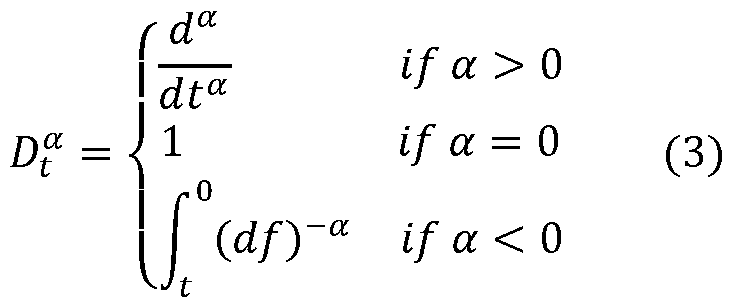
- the integral and the differential operators could be expressed as one unified (differ-integration) operator Df, which is defined as follows:
- fractional order is an arbitrary real order of the operator (integral or derivative) known as the fractional order and df is the derivative function.
- fractional order is an arbitrary real order of the operator (integral or derivative) known as the fractional order and df is the derivative function.
- the operator Df is converted into the standard differential-integral operator when a is integer.
- fractional order derivative a of a function g(t) can be formulated as:
- the fractional order derivative is now used in a systemic arterial system.
- a lumped parametric model is an analog circuit arrangement that leads to the same input impedance as the arterial network, in a specific frequency domain.
- the novel model has a similar configuration as the WK3 model, but incorporates a fractional-order capacitor rather than an ideal capacitor.
- the non-ideal capacitor represents the fractional arterial viscoelasticity behavior.
- a fractional order capacitor is an electrical component which consists of two parallel plates confining a lossy material.
- a lossy material is defined herein as a material that uses up electrical energy.
- an ideal capacitor has two parallel plates that confines a dielectric material.
- a dielectric material does not use electrical energy. This means that if an ideal capacitor is charged with a given charge, the ideal capacitor stores the energy associated with those charges. Flowever, a fractional order capacitor charged with the same energy slowly consumes that energy.
- a fractional order capacitor can also be defined as a constant phase element (CPE) whose equivalent impedance has a constant phase angle (between 0 and 90 over the entire frequency band, from zero to infinity.
- CPE constant phase element
- the impedance of an ideal capacitor is the ratio of the voltage to the current flowing, in the frequency domain. Accordingly, the capacitor’s impedance in the Laplace domain can be expressed as:
- a a is the coefficient of the pseudo capacitance expressed in units of Farad sec -1 .
- the fractional impedance ZF varies with the exponent a (0 ⁇ a ⁇ 1 ), which is the fractional differentiation order.
- the fractional order impedance Z F approximation noted in equation (12) might be implemented using an electrical circuit with a recursive association of resistance and capacitance elements.
- a Foster integer-order ladder RC network 300 may be used. This configuration is similar to the viscoelastic analog circuit model 220 illustrated in Figure 2B.
- the value of the fractional capacitor at a specific frequency w can be calculated using the expression:
- Z F refers to an ideal resistor whose phase angle equals 0 ° .
- Z F represents an ideal capacitor with a phase angle equal to -90 ° .
- the modulus of the fractional order impedance Z F is given by:
- the fractional order impedance Z F may be split into a dissipative component ZD (represented by the real part) and a storage component Zs
- the fractional capacitor has both resistive and capacitive properties, and thus, the fractional capacitor represents the fractional viscoelastic behavior of the arterial vessel.
- the impact of both properties is coordinated by the fractional factor a, allowing a real physiological description of the arteries and decreasing the number of variables necessary to describe the arteries.
- the fractional capacitor is used to describe the arteries as follows.
- the aortic input impedance Zin is considered to characterize the systemic arterial system.
- the aortic input impedance Zin is different from the aortic characteristic impedance Z c introduced in the model 100 in Figure 1 .
- the aortic input impedance Zin represents the arterial parameters in a comprehensive way.
- the aortic input impedance Zin represents a source of phenomenological information which depends just on the geometrical and mechanical characteristic of the arterial tree and the blood it encloses.
- Zin is defined as a linear time invariant transfer function that relates the arterial blood pressure (Pa) to the blood flow (Qa) in the frequency domain.
- the aortic input impedance Zin is defined as the ratio between (1 ) the frequency component of the output arterial blood pressure (Pa), and (2) the input blood flow (Qa) harmonics.
- the blood pressure Pa is considered to be the central blood pressure at the level of aorta and it has a dependency on the properties of both the arterial system tree and the heart.
- Zin is a complex function that comprises both real and imaginary parts. The hemodynamic analyses are usually based on the magnitude and phase of Zin. The quantification of the arterial network energy dissipation is described by the real value of Zin.
- aortic input impedance Zin is known, a given blood flow Qa permits the control of the arterial pressure Pa and vice versa.
- the model 400 that uses the fractional order capacitor is illustrated in Figure 4 as an analogy with an electrical circuit that is made up of three elements: a fractional order capacitor C a , the resistor Rp, and the characteristic impedance Z c .
- This is the three-parameter FWK model, called herein the FWK3 model. If the characteristic impedance Z c is selected to be zero, then a two-parameters FWK model is obtained, which is called herein the FWK2 model.
- the blood flow Qa corresponds to the current flowing through the electrical circuit and the arterial pressure Pa corresponds to the voltage applied to the electrical circuit.
- V Ca (t) P a (t) - Z c Q a (t).
- Equation (17) can be rewritten as:
- T N and T D are time constants and have the following expressions:
- fractional aortic input impedance Z“ corresponds to the aortic input impedance Zin defined above as the ratio of the blood pressure and the blood flow.
- the arterial stiffness (AS) is a metric used for the evaluation of the degenerative diseases physio-pathological mechanisms that affect CVS.
- AS characterizes the vessel material properties and is measured based on the Young’s Modulus E.
- E Young’s Modulus
- the pressure- volume and pressure-radius blood vessel relationships are used and these relationships define the total complex and frequency dependent arterial Compliance ⁇ C a ) and Elastance (E a ).
- C a complex and frequency dependent arterial Compliance
- E a Elastance
- Compliance C a is the inverse of Ea and they can be expressed as follow:
- n is the internal artery radius
- h is the vessel wall thickness
- I is the arterial length
- hemodynamic data is collected.
- the hemodynamic data may include blood pressure Pa and blood flow Qa.
- the hemodynamic data may also include a cardiac output.
- the blood pressure may be measured with any known device, for example, with a blood pressure monitor.
- the blood flow can be measured with ultrasonic or
- electromagnetic sensors for example, a Doppler flowmeter. While in a typical clinical situation, only the modulus of the blood pressure and the blood flow are measured, in one application, both the modulus and the phase angle of the blood pressure and the blood flow can be measured.
- step 602 the blood pressure Pa and the blood flow Qa are used to calculate, the arterial input impedance Zm.
- step 604 the modulus and the phase angle of the arterial input impedance Z are calculated (see equations (22) and (23)).
- step 606 the aortic characteristic impedance Zc, the fractional-order capacitance CF, and the arterial peripheral resistance R P are calculated from the modulus ⁇ Z P ⁇ and the phase angle F of the fractional-order arterial input impedance ZF.
- step 608 the arterial compliance C a is calculated so that the arterial compliance C a is the fractional-order impedance ZF of the fractional-order capacitor C (see equation (19)).
- step 610 the Young modulus E is calculated based on equations (24 and 25), from the compliance C a .
- step 612 the arterial stiffness AS is calculated based on the Young modulus E a .
- step 614 the fractional-order parameter a can be determined. For example, in one application, blood pressures and blood flows are collected from plural patients that have a known state of their cardiovascular system. The model 400 is run with these parameters and various fractional-order parameters a are applied until the curves of the three parameters of the model 400 fit the measured data of these patients.
- fractional-order parameters a that fit these curves are identified and ranges are established for this parameter.
- the model 400 can be calibrated based on known and accurate values of the arterial system and then, based only on the measured blood pressure and blood flow of a given patient, the model can produce a corresponding fractional-order parameter a that indicates the status of its
- the fractional-order parameter a can be used as a score for indicating the health of the patient.
- the numbers provided above are exemplary.
- the figures show the distribution, mean value and standard deviation in (mmHg) of: (a) mean blood pressure (MBP) in Figure 5A, (b) pulse pressure (PP) in Figure 5B, (c) diastolic blood pressure (DBP) in Figure 5C, and (d) systolic blood pressure (SBP) in Figure 5D, at the level of the ascending aorta for the in-silico data-base.
- MBP mean blood pressure
- PP pulse pressure
- DBP diastolic blood pressure
- SBP systolic blood pressure
- This database presents physiological values with well-balanced distributions.
- the Cardiac outputs vary between 3.5 and 7.21/min, depending on the values of the heart rate (53, 63, and72 beats/min) and stroke volume (66, 83, andlOOml).
- the in- silico blood flow and pressure for a single cardiac cycle expressed in the time domain were converted to the frequency domain using discrete Fourier transform, then the input impedance is formulated as the ratio of the harmonic of the blood pressure to the flow. Then, the optimal model parameters are identified by solving an optimization problem given by,
- 0 * is the optimal parameter 0 that minimizes the cost function of equation (27), which corresponds to the root mean square error (RMSE)
- Re and Im denote the real and imaginary parts of the in-silico aortic input impedance Z and modeled impedance Z evaluated at a specific harmonic i
- N is the total number of harmonics taken into account.
- NMSE normalized mean square error
- the fractional element, Ca combines both resistive and capacitive properties which displays the viscoelastic behavior of the arterial vessel.
- the contribution of both properties is controlled by the fractional differentiation order (a) enabling more flexible
- Figures 8 to 10 illustrate the comparison of the goodness of the fit between the proposed models (FWK2 and FWK3) and the standard WK models (WK2 and WK3) quantified respectively as: 1 ) RMSE for the overall models ( Figure 8), 2) Deviation[%] to evaluate the deviation of the modulus based model from the in- silico aortic input impedance modulus (Figure 9), and 3) the NMSE to quantify the error of the phase angle fit ( Figure 10). Analyzing these figures and Table I, it can be seen that for all the subjects, WK2 has the highest RMSE and Deviation[%]
- the proposed FWK3 model provides the best fitting, but it is overall comparable to the WK3 model.
- these results confirm the reliability of both the WK3 as well as the FWK2 models in overcoming the limitations of the WK2 model, in describing the real input impedance.
- the use of the fractional-order element offer a proper measure for the better physiological analysis of the arterial function.
- an ideal capacitor is considered as a pure storage element that can only imitate pure elastic behavior rather than viscoelastic ones.
- the fractional-order capacitor lumps both resistive and capacitive properties in one element allowing for a reduced-order description of the arterial viscoelastic characteristic.
- the proposed fractional-order model smoothly incorporates the complex effects and multi-scale properties of vascular tissues using a reduced-order configuration.
- the effective compliance has been calculated for both models.
- the effective compliance can be derived as follows. For the fractional-order two element
- Windkessel model FWK2 the fractional aortic input impedance in the frequency domain is given by:
- Figure 13 shows a comparative illustration of the estimated
- Figures 14A to 14F show the in-silico aortic input impedance patterns for different physiological states (normotensive in Figures 14A and 14B, hypertensive in Figures 14C and 14D, and severe-hypertensive in Figures 14E and 14F) with their corresponding aortic blood pressure and flow waveforms.
- Figures 15A to 15F illustrate the bar graphs of the hemodynamic parameters as well as the estimated parameters of both the proposed models and the standard Windkessel models. These results are in conformity with the conclusions afore-mentioned.
- the bar graphs in Figures 15A to 15F show that the FWK2 model is yielding to a good improvement in the prediction of the in-silico input impedance modulus and it is performing closely to WK3 and FWK3.
- the differentiation order a of the fractional-order operator is correlated with all the arterial parameter.
- the (a) values and the systolic blood pressure (SBP) or aortic pulse pressure (APP) show a negative correlation: from normotensive state to severe-hypertensive, SBP increases, however a for both FWK3 and FWK3 decreases.
- SBP systolic blood pressure
- APP aortic pulse pressure
- the new parameter a can be considered as a bio-marker that can lump the overall viscoelasticity properties of the human arterial tree. It might also have a potential role in enhancing the understanding of arterial stiffness
- a method for assessing a state of a cardiovascular system includes a step 1600 of receiving a blood pressure Pa and a blood flow Qa of the cardiovascular system, a step 1602 of calculating, with a three-element, fractional-order, viscoelastic Windkessel model an arterial compliance C a of the cardiovascular system, and a step 1604 of evaluating the state of the cardiovascular system based on a fractional-order parameter a associated with the three-element, fractional-order, viscoelastic Windkessel model.
- the method may also include a step of calculating an aortic input impedance Zin of the cardiovascular system as a ratio of (1 ) the blood pressure Pa and (2) the blood flow Qa.
- the blood pressure Pa is estimated at the aorta
- the blood flow Qa is estimated at the aorta.
- the three-element, fractional-order, viscoelastic Windkessel model includes an aortic specific impedance Z c , a fractional-order capacitor CF, and an arterial peripheral resistance R p .
- the fractional-order capacitor CF and the arterial peripheral resistance R P are connected in parallel, and the aortic specific impedance Z c is connected in series with a block formed by the fractional-order capacitor CF and the arterial peripheral resistance R P .
- the fractional-order capacitor CF is a constant phase element characterized by the fractional-order parameter a.
- the method may also include calculating a fractional-order impedance ZF of the fractional-order capacitor CF, where the arterial compliance C a of the cardiovascular system is the fractional-order impedance ZF of the fractional-order capacitor CF, and/or calculating the Young modulus E of arteries of the
- cardiovascular system as an inverse of the arterial compliance C a , and/or estimating an arterial stiffness of the cardiovascular system based on the Young modulus E, and/or determining whether a patient is hypotensive, hypertensive, or normotensive based on the fractional-order parameter a.
- Computing device 1700 suitable for performing the activities described in the embodiments discussed above may include a server 1701.
- a server 1701 may include a central processor (CPU) 1702 coupled to a random access memory (RAM) 1704 and to a read-only memory (ROM) 1706.
- ROM 1706 may also be other types of storage media to store programs, such as programmable ROM (PROM), erasable PROM (EPROM), etc.
- Processor 1702 may communicate with other internal and external components through input/output (I/O) circuitry 1708 and bussing 1710 to provide control signals and the like.
- I/O input/output
- Processor 1702 carries out a variety of functions as are known in the art, as dictated by software and/or firmware instructions.
- Server 1701 may also include one or more data storage devices, including hard drives 1712, CD-ROM drives 1714 and other hardware capable of reading and/or storing information, such as DVD, etc.
- software for carrying out the above-discussed steps may be stored and distributed on a CD- ROM or DVD 1716, a USB storage device 1718 or other form of media capable of portably storing information. These storage media may be inserted into, and read by, devices such as CD-ROM drive 1714, disk drive 1712, etc.
- Server 1701 may be coupled to a display 1720, which may be any type of known display or presentation screen, such as LCD, plasma display, cathode ray tube (CRT), etc.
- a user input interface 1722 is provided, including one or more user interface mechanisms such as a mouse, keyboard, microphone, touchpad, touch screen, voice-recognition system, etc.
- Server 1701 may be coupled to other devices, such as medical instruments, detectors, sensors, etc.
- the server may be part of a larger network configuration as in a global area network (GAN) such as the Internet 1728, which allows ultimate connection to various landline and/or mobile computing devices.
- GAN global area network
- the disclosed embodiments provide a method and system that is capable to assess the cardiovascular system using a two- or three-element fractional-order viscoelastic Windkessel model.
- the embodiments are intended to cover alternatives, modifications and equivalents, which are included in the spirit and scope of the invention as defined by the appended claims. Further, in the detailed description of the embodiments, numerous specific details are set forth in order to provide a comprehensive understanding of the claimed invention. However, one skilled in the art would understand that various embodiments may be practiced without such specific details.
Landscapes
- Health & Medical Sciences (AREA)
- Life Sciences & Earth Sciences (AREA)
- Engineering & Computer Science (AREA)
- Molecular Biology (AREA)
- Animal Behavior & Ethology (AREA)
- Physiology (AREA)
- Biophysics (AREA)
- Pathology (AREA)
- Cardiology (AREA)
- Biomedical Technology (AREA)
- Heart & Thoracic Surgery (AREA)
- Medical Informatics (AREA)
- Veterinary Medicine (AREA)
- Surgery (AREA)
- Physics & Mathematics (AREA)
- General Health & Medical Sciences (AREA)
- Public Health (AREA)
- Vascular Medicine (AREA)
- Hematology (AREA)
- Artificial Intelligence (AREA)
- Computer Vision & Pattern Recognition (AREA)
- Psychiatry (AREA)
- Signal Processing (AREA)
- Measuring Pulse, Heart Rate, Blood Pressure Or Blood Flow (AREA)
Abstract
Description






Claims
Priority Applications (1)
| Application Number | Priority Date | Filing Date | Title |
|---|---|---|---|
| US17/284,072 US20210353160A1 (en) | 2018-10-18 | 2019-10-08 | Mathematical biomarker for arterial viscoelasticity assessment |
Applications Claiming Priority (4)
| Application Number | Priority Date | Filing Date | Title |
|---|---|---|---|
| US201862747325P | 2018-10-18 | 2018-10-18 | |
| US62/747,325 | 2018-10-18 | ||
| US201962872305P | 2019-07-10 | 2019-07-10 | |
| US62/872,305 | 2019-07-10 |
Publications (1)
| Publication Number | Publication Date |
|---|---|
| WO2020079528A1 true WO2020079528A1 (en) | 2020-04-23 |
Family
ID=68281790
Family Applications (1)
| Application Number | Title | Priority Date | Filing Date |
|---|---|---|---|
| PCT/IB2019/058566 Ceased WO2020079528A1 (en) | 2018-10-18 | 2019-10-08 | Mathematical biomarker for arterial viscoelasticity assessment |
Country Status (2)
| Country | Link |
|---|---|
| US (1) | US20210353160A1 (en) |
| WO (1) | WO2020079528A1 (en) |
Families Citing this family (1)
| Publication number | Priority date | Publication date | Assignee | Title |
|---|---|---|---|---|
| US12426789B2 (en) | 2009-09-23 | 2025-09-30 | Lightlab Imaging, Inc. | Blood vessel lumen morphology and minimum lumen area measurements data collection by intravascular imaging systems for stenosis or stent planning |
-
2019
- 2019-10-08 US US17/284,072 patent/US20210353160A1/en not_active Abandoned
- 2019-10-08 WO PCT/IB2019/058566 patent/WO2020079528A1/en not_active Ceased
Non-Patent Citations (8)
| Title |
|---|
| BAHLOUL MOHAMED A ET AL: "Arterial Viscoelastic Model using Lumped Parameter Circuit With Fractional-Order Capacitor", 2018 IEEE 61ST INTERNATIONAL MIDWEST SYMPOSIUM ON CIRCUITS AND SYSTEMS (MWSCAS), IEEE, 5 August 2018 (2018-08-05), pages 53 - 56, XP033508660, DOI: 10.1109/MWSCAS.2018.8623862 * |
| BAHLOUL MOHAMED A ET AL: "Three-Element Fractional-Order Viscoelastic Arterial Windkessel Model", 2018 40TH ANNUAL INTERNATIONAL CONFERENCE OF THE IEEE ENGINEERING IN MEDICINE AND BIOLOGY SOCIETY (EMBC), IEEE, 18 July 2018 (2018-07-18), pages 5261 - 5266, XP033429472, DOI: 10.1109/EMBC.2018.8513473 * |
| D. CRAIEMF. J. ROJOJ. M. ATIENZAR. L. ARMENTANOG. V. GUINEA: "Fractional-order viscoelasticity applied to describe uniaxial stress relaxation of human arteries", PHYSICS IN MEDICINE AND BIOLOGY, vol. 53, no. 17, 2008, pages 4543, XP020141381, doi:10.1088/0031-9155/53/17/006 |
| D. CRAIEMF. ROJOJ. ATIENZAG. GUINEAR. L. ARMENTANO: "Fractional calculus applied to model arterial viscoelasticity", LATIN AMERICAN APPLIED RESEARCH, vol. 38, no. 2, 2008, pages 141 - 145 |
| D. CRAIEMR. L. ARMENTANO: "A fractional derivative model to describe arterial viscoelasticity", BIORHEOLOGY, vol. 44, no. 4, 2007, pages 251 - 263 |
| J. P. ZERPAA. CANELASB. SENSALED. B. SANTANAR. ARMENTANO: "Modeling the arterial wall mechanics using a novel high-order viscoelastic fractional element", APPLIED MATHEMATICAL MODELLING, vol. 39, no. 16, 2015, pages 4767 - 4780, XP029163035, doi:10.1016/j.apm.2015.04.018 |
| MOHAMED A BAHLOUL ET AL: "Fractional Order Models of Arterial Windkessel as an Alternative in the Analysis of the Left Ventricular Afterload", ARXIV.ORG, CORNELL UNIVERSITY LIBRARY, 201 OLIN LIBRARY CORNELL UNIVERSITY ITHACA, NY 14853, 1 August 2019 (2019-08-01), XP081462445 * |
| T. C. DOEHRINGA. D. FREEDE. O. CAREWI. VESELY: "Fractional order viscoelasticity of the aortic valve cusp: an alternative to quasi-linear viscoelasticity", JOURNAL OF BIOMECHANICAL ENGINEERING, vol. 127, no. 4, 2005, pages 700 - 708 |
Also Published As
| Publication number | Publication date |
|---|---|
| US20210353160A1 (en) | 2021-11-18 |
Similar Documents
| Publication | Publication Date | Title |
|---|---|---|
| US12525361B2 (en) | Systems and methods for modelling physiologic function using a combination of models of varying detail | |
| Garber et al. | The critical role of lumped parameter models in patient-specific cardiovascular simulations | |
| Zhou et al. | A review on low-dimensional physics-based models of systemic arteries: application to estimation of central aortic pressure | |
| Perdikaris et al. | An effective fractal-tree closure model for simulating blood flow in large arterial networks | |
| Perdikaris et al. | Fractional-order viscoelasticity in one-dimensional blood flow models | |
| Chen et al. | Simulation‐based uncertainty quantification of human arterial network hemodynamics | |
| CN101903884B (en) | Integration of physiological models in medical decision support systems | |
| Fevola et al. | An optimal control approach to determine resistance‐type boundary conditions from in‐vivo data for cardiovascular simulations | |
| Bahloul et al. | Three-element fractional-order viscoelastic arterial windkessel model | |
| Gul | Mathematical modeling and sensitivity analysis of lumped-parameter model of the human cardiovascular system | |
| Müller et al. | Reduced-order unscented kalman filter with observations in the frequency domain: application to computational hemodynamics | |
| Bahloul et al. | Assessment of fractional-order arterial windkessel as a model of aortic input impedance | |
| Quick et al. | Infinite number of solutions to the hemodynamic inverse problem | |
| Caforio et al. | A coupling strategy for a first 3D-1D model of the cardiovascular system to study the effects of pulse wave propagation on cardiac function | |
| Bahloul et al. | Arterial viscoelastic model using lumped parameter circuit with fractional-order capacitor | |
| CN119207835B (en) | Continuous blood pressure monitoring method and related equipment based on multiple physiological signals and electrical network | |
| Arnold et al. | Uncertainty quantification in a patient-specific one-dimensional arterial network model: EnKF-based inflow estimator | |
| Bahloul et al. | Fractional-order modeling of arterial compliance in vascular aging: A computational biomechanical approach for investigating cardiovascular dynamics | |
| Bahloul et al. | Two-element fractional-order windkessel model to assess the arterial input impedance | |
| US20210353160A1 (en) | Mathematical biomarker for arterial viscoelasticity assessment | |
| CN117064413A (en) | A method for non-invasive calculation of blood flow reserve fraction based on pulmonary circulation model | |
| Ding et al. | Simulating impaired left ventricular–arterial coupling in aging and disease: a systematic review | |
| Bahloul | Contributions to data-driven and fractional-order model-based approaches for arterial haemodynamics characterization and aortic stiffness estimation | |
| Bahloul et al. | Fractional order models of arterial windkessel as an alternative in the analysis of the left ventricular afterload | |
| Gdoura et al. | Regression and classification of Windkessel parameters from non-invasive cardiovascular quantities using a fully connected neural network |
Legal Events
| Date | Code | Title | Description |
|---|---|---|---|
| 121 | Ep: the epo has been informed by wipo that ep was designated in this application |
Ref document number: 19789759 Country of ref document: EP Kind code of ref document: A1 |
|
| NENP | Non-entry into the national phase |
Ref country code: DE |
|
| 122 | Ep: pct application non-entry in european phase |
Ref document number: 19789759 Country of ref document: EP Kind code of ref document: A1 |
|
| WWE | Wipo information: entry into national phase |
Ref document number: 521421786 Country of ref document: SA |
|
| WWE | Wipo information: entry into national phase |
Ref document number: 521421786 Country of ref document: SA |