WO2020074942A1 - Novel organic dyes and solar cells containing the same - Google Patents
Novel organic dyes and solar cells containing the same Download PDFInfo
- Publication number
- WO2020074942A1 WO2020074942A1 PCT/IB2018/057816 IB2018057816W WO2020074942A1 WO 2020074942 A1 WO2020074942 A1 WO 2020074942A1 IB 2018057816 W IB2018057816 W IB 2018057816W WO 2020074942 A1 WO2020074942 A1 WO 2020074942A1
- Authority
- WO
- WIPO (PCT)
- Prior art keywords
- substituted phenyl
- alkyl
- thioalkyl
- alkoxy
- far
- Prior art date
- Legal status (The legal status is an assumption and is not a legal conclusion. Google has not performed a legal analysis and makes no representation as to the accuracy of the status listed.)
- Ceased
Links
- 0 CC(C)(C(C)(C)O*c(cc1)c(cccc2)c2c1N(c1ccc(*)cc1)c1ccc(*)cc1)O Chemical compound CC(C)(C(C)(C)O*c(cc1)c(cccc2)c2c1N(c1ccc(*)cc1)c1ccc(*)cc1)O 0.000 description 1
Classifications
-
- C—CHEMISTRY; METALLURGY
- C09—DYES; PAINTS; POLISHES; NATURAL RESINS; ADHESIVES; COMPOSITIONS NOT OTHERWISE PROVIDED FOR; APPLICATIONS OF MATERIALS NOT OTHERWISE PROVIDED FOR
- C09B—ORGANIC DYES OR CLOSELY-RELATED COMPOUNDS FOR PRODUCING DYES, e.g. PIGMENTS; MORDANTS; LAKES
- C09B57/00—Other synthetic dyes of known constitution
- C09B57/008—Triarylamine dyes containing no other chromophores
-
- H—ELECTRICITY
- H01—ELECTRIC ELEMENTS
- H01G—CAPACITORS; CAPACITORS, RECTIFIERS, DETECTORS, SWITCHING DEVICES, LIGHT-SENSITIVE OR TEMPERATURE-SENSITIVE DEVICES OF THE ELECTROLYTIC TYPE
- H01G9/00—Electrolytic capacitors, rectifiers, detectors, switching devices, light-sensitive or temperature-sensitive devices; Processes of their manufacture
- H01G9/20—Light-sensitive devices
- H01G9/2059—Light-sensitive devices comprising an organic dye as the active light absorbing material, e.g. adsorbed on an electrode or dissolved in solution
-
- H—ELECTRICITY
- H10—SEMICONDUCTOR DEVICES; ELECTRIC SOLID-STATE DEVICES NOT OTHERWISE PROVIDED FOR
- H10K—ORGANIC ELECTRIC SOLID-STATE DEVICES
- H10K85/00—Organic materials used in the body or electrodes of devices covered by this subclass
- H10K85/60—Organic compounds having low molecular weight
- H10K85/631—Amine compounds having at least two aryl rest on at least one amine-nitrogen atom, e.g. triphenylamine
- H10K85/636—Amine compounds having at least two aryl rest on at least one amine-nitrogen atom, e.g. triphenylamine comprising heteroaromatic hydrocarbons as substituents on the nitrogen atom
-
- H—ELECTRICITY
- H10—SEMICONDUCTOR DEVICES; ELECTRIC SOLID-STATE DEVICES NOT OTHERWISE PROVIDED FOR
- H10K—ORGANIC ELECTRIC SOLID-STATE DEVICES
- H10K85/00—Organic materials used in the body or electrodes of devices covered by this subclass
- H10K85/60—Organic compounds having low molecular weight
- H10K85/649—Aromatic compounds comprising a hetero atom
- H10K85/657—Polycyclic condensed heteroaromatic hydrocarbons
- H10K85/6576—Polycyclic condensed heteroaromatic hydrocarbons comprising only sulfur in the heteroaromatic polycondensed ring system, e.g. benzothiophene
-
- H—ELECTRICITY
- H01—ELECTRIC ELEMENTS
- H01G—CAPACITORS; CAPACITORS, RECTIFIERS, DETECTORS, SWITCHING DEVICES, LIGHT-SENSITIVE OR TEMPERATURE-SENSITIVE DEVICES OF THE ELECTROLYTIC TYPE
- H01G9/00—Electrolytic capacitors, rectifiers, detectors, switching devices, light-sensitive or temperature-sensitive devices; Processes of their manufacture
- H01G9/20—Light-sensitive devices
- H01G9/2027—Light-sensitive devices comprising an oxide semiconductor electrode
- H01G9/2031—Light-sensitive devices comprising an oxide semiconductor electrode comprising titanium oxide, e.g. TiO2
-
- Y—GENERAL TAGGING OF NEW TECHNOLOGICAL DEVELOPMENTS; GENERAL TAGGING OF CROSS-SECTIONAL TECHNOLOGIES SPANNING OVER SEVERAL SECTIONS OF THE IPC; TECHNICAL SUBJECTS COVERED BY FORMER USPC CROSS-REFERENCE ART COLLECTIONS [XRACs] AND DIGESTS
- Y02—TECHNOLOGIES OR APPLICATIONS FOR MITIGATION OR ADAPTATION AGAINST CLIMATE CHANGE
- Y02E—REDUCTION OF GREENHOUSE GAS [GHG] EMISSIONS, RELATED TO ENERGY GENERATION, TRANSMISSION OR DISTRIBUTION
- Y02E10/00—Energy generation through renewable energy sources
- Y02E10/50—Photovoltaic [PV] energy
- Y02E10/542—Dye sensitized solar cells
-
- Y—GENERAL TAGGING OF NEW TECHNOLOGICAL DEVELOPMENTS; GENERAL TAGGING OF CROSS-SECTIONAL TECHNOLOGIES SPANNING OVER SEVERAL SECTIONS OF THE IPC; TECHNICAL SUBJECTS COVERED BY FORMER USPC CROSS-REFERENCE ART COLLECTIONS [XRACs] AND DIGESTS
- Y02—TECHNOLOGIES OR APPLICATIONS FOR MITIGATION OR ADAPTATION AGAINST CLIMATE CHANGE
- Y02E—REDUCTION OF GREENHOUSE GAS [GHG] EMISSIONS, RELATED TO ENERGY GENERATION, TRANSMISSION OR DISTRIBUTION
- Y02E10/00—Energy generation through renewable energy sources
- Y02E10/50—Photovoltaic [PV] energy
- Y02E10/549—Organic PV cells
Definitions
- the present invention relates to novel compounds, to the use of the compounds as dyes and/or sensitizers, and to optoelectronic devices, preferably solar cells, comprising the dyes and/or sensitizers.
- DSCs dye sensitized solar cells
- PCE power conversion efficiencies
- PCE of donor- -acceptor (D-p-A) organic sensitizers are attractive candidates to be used as sensitizers for DSC, since they reach more than 10% power conversion efficiency (Ito et al., Chem Commun., 2008, 5194).
- additional constraints have to be considered, such as manufacturing costs.
- the dye can be produced with starting materials that are readily available at comparatively low costs, few synthetic steps and comparatively high yields during each steps.
- the present invention is further interested in the use of dye- sensitized solar cells as construction elements, for example in windows, glass-structures in buildings in general, and/or facings for buildings, for example.
- Glass and plastic are widely-used in construction, for example for increasing the use of natural and/or sunlight inside buildings and also for exploiting the sunlight's heating properties.
- aesthetic factors such as the color of the sensitizer also becomes relevant.
- certain brownish colors may be considered less decorative than bright and basic colors, such as green, blue, red, and yellow, for example.
- the present invention addresses the problems depicted above.
- the present inventors provide novel compounds that are useful as sensitizers in dye- sensitized solar cells.
- the sensitizers have an interesting, characteristic red color, which renders the compounds suitable for dye- sensitized solar cells that are intended for use as construction elements, such solar cells thus fulfilling a functional purpose as construction element (window, cladding panel, facing tile, and ornamental element, for example), in addition to the benefit of producing electricity.
- the invention provides a compound of formula (I) or (II):
- R AI , R A 2, R BI , and R B 2 are independently selected from C1-C36 alkyl, and from the substituents (1) to (3) below:
- R A 3, R A 4, R A 5, in as far as present, are selected independently from H, C1-C36 alkyl, C1-C36 alkoxy, C1-C36 thioalkyl, C1-C36 alkyl substituted phenyl, C1-C36 alkoxy substituted phenyl and C1-C36 thioalkyl substituted phenyl;
- R A6 is selected from H, C1-C36 alkyl, C1-C36 alkyl substituted phenyl, Cl- C36 alkoxy substituted phenyl and C1-C36 thioalkyl substituted phenyl;
- R BI and R B2 may further be selected independently from H, C1-C36 alkoxy, C1-C36 thioalkyl;
- R x -R 5 in as far as present, are selected independently from the substituents as specified for R A3 -R AS ;
- A is an optionally substituted cyclic moiety comprising from 3 to 10 carbons and 0 to 3 heteroatoms, or, methanetriyl, wherein optional substituents of said cyclic moiety are independently selected from C1-C36 alkyl, C1-C36 alkoxy, C1-C36 thioalkyl, C1-C36 alkyl substituted phenyl, C1-C36 alkoxy substituted phenyl and C1-C36 thioalkyl substituted phenyl;
- X is a moiety selected from the moieties (10) to (24) below,
- RDI, RD2, RD3, RD4, RDS, and RD6 in as far as present, are independently selected from H, C1-C36 alkyl, C1-C36 alkoxy, C1-C36 thioalkyl, C1-C36 alkyl substituted phenyl, C1-C36 alkoxy substituted phenyl and C1-C36 thioalkyl substituted phenyl, wherein, E, El, E2, and E3, in as far as present, are independently selected from S, O, Se, and Te;
- Z in moiety (16) is selected from carbon and Si;
- Y is selected from the substituents (30) to (43) below,
- Ri, R 2 , R 3 , R 4 , and R 5 are selected independently from H and from anchoring groups selected from the group consisting of -COOH, -CONHOH, -PO3H 2 , -
- n 1 or 0.
- the present invention provides an optoelectronic device comprising the compound of any one of the preceding claims, said optoelectronic device preferably being a dye- sensitized solar cell.
- the present invention provides the use of the compounds of the invention as sensitizers, in particular as sensitizers of an optoelectronic device, in particular a dye- sensitized solar cell.
- the present invention provides a dye- sensitized solar cell comprising a sensitizer, wherein said sensitizer is selected from the compounds of the present invention.
- the present invention provides a construction element comprising the optoelectronic device of the invention, in particular the dye- sensitized solar cell of the invention.
- Figure 1 shows the reaction scheme for synthesizing compounds H1-H4 in accordance with preferred embodiments of the resent invention.
- Figure 2 shows the photocurrent action spectrum of a dye- sensitised solar cell sensitized with dyes H1-H4 shown in Figure 1 (top graph), and the current density-voltage characteristics of the solar cells under illumination of the AM 1.5G full sunlight (lOOmW cm 2 ) (bottom graph).
- said C1-C36 alkyl, C1-C36 alkoxy, C1-C36 thioalkyl, C1-C36 alkyl substituted phenyl, C1-C36 alkoxy substituted phenyl and C1-C36 thioalkyl substituted phenyl are C1-C20 alkyl, C1-C20 alkoxy, C1-C20 thioalkyl, C1-C10 alkyl substituted phenyl, C1-C20 alkoxy substituted phenyl and C1-C20 thioalkyl substituted phenyl, preferably Cl- C10 alkyl, C1-C10 alkoxy, C1-C10 thioalkyl, C1-C10 alkyl substituted phenyl, C1-C10 alkoxy substituted phenyl and C1-C10 thioalkyl substituted phenyl and most preferably C2- C8 alkyl, C2-
- RA3, RA4, RAS in as far as present, are selected independently from H, C1-C20 alkyl, C1-C20 alkoxy, C1-C20 thioalkyl, C1-C20 alkyl substituted phenyl, C1-C20 alkoxy substituted phenyl and C1-C20 thioalkyl substituted phenyl, preferably from H, C1-C10 alkyl, C1-C10 alkoxy, C1-C10 thioalkyl, Cl- C10 alkyl substituted phenyl, C1-C10 alkoxy substituted phenyl and C1-C10 thioalkyl substituted phenyl, most preferably from H, C2-C8 alkyl, C2-C8 alkoxy, C2-C8 thioalkyl.
- R A6 is selected from H, C1-C20 alkyl, C1-C20 alkyl substituted phenyl, C1-C20 alkoxy substituted phenyl and Cl- C20 thioalkyl substituted phenyl, more preferably from H, C1-C10 alkyl, C1-C10 alkyl substituted phenyl, C1-C10 alkoxy substituted phenyl and C1-C10 thioalkyl substituted phenyl, most preferably from H, C2-C8 alkyl, C2-C8 alkyl substituted phenyl, C2-C8 alkoxy substituted phenyl and C2-C8 thioalkyl substituted phenyl.
- RAI and RA2 are independently selected from substituents of the formula (1), and R A 3 is selected from C1-C20 alkyl, C1-C20 alkoxy, C1-C20 thioalkyl, preferably C1-C10 alkyl, C1-C10 alkoxy, C1-C10 thioalkyl, more preferably C2-C8 alkyl, C2-C8 alkoxy and C2-C8 thioalkyl, most preferably C2-C8 alkoxy.
- R'-R ⁇ in as far as present are selected independently from H and from the substituents as specified for R A 3-R AS indicated above.
- R x -R 5 are H.
- RBI, and RB2 are independently selected from C1-C20 alkyl and from the substituents of formula (1) as defined above, preferably from substituents of formula (1), in which R A 3 is selected from C1-C20 alkyl, C1-C20 alkoxy, C1-C20 thioalkyl, preferably R A 3 is selected from C1-C10 alkyl, Cl- C10 alkoxy, C1-C10 thioalkyl, more preferably C2-C8 alkyl.
- A is selected from any one of the moieties (50)-(52) below:
- R 6 , R 7 and R 8 are independently selected from H, and from the same substituents as specified for R A 3-R AS ;
- E4 is selected from S, O, Se and Te.
- E4 is S or O, more preferably S.
- A is selected from the moieties (50) and (51), and most preferably A is moiety (50), wherein in moiety (50) E4 is preferably S or O, more preferably S.
- R 6 , R 7 and R 8 in as far as present, are independently selected from H, C1-C10 alkyl, C1-C10 alkoxyl and C1-C10 thioalkyl. Most preferably R 6 , R 7 and R 8 , in as far as present, are H.
- X is selected from moieties (10)-(15), preferably ( 12)-( 12), more preferably X is moiety (10).
- E, El, E2, and E3 are preferably independently selected from S and O.
- R DI , R D 2, R D 3, and R D 4, in as far as present, are preferably independently selected from H, C1-C10 alkyl, C1-C10 alkoxyl and C1-C10 thioalkyl, more preferably R DI , R D 2, R D 3, and R D 4, in as far as present, are H.
- Y is selected from the substituents of formulae (30)-(33).
- R2-R4 in as far as present, are H.
- Ri is an anchoring group selected from the group consisting of -COOH, -CONHOH, -PO3H2, -PO4H2, -PiR ⁇ /EH, -SO3H2, -SO4H2, l,2-hydroxybenzene, l-hydroxy-2-carboxybenzene, acetylacetonate, deprotonated forms of the aforementioned, organic and/or inorganic salts of said deprotonated forms.
- Ri is selected from -COOH, the deprotonated form of the aforementioned, and organic and/or inorganic salts of said deprotonated form.
- A is selected from moiety (50) and (51) as shown herein above, wherein E4 is selected from S, O, Se and Te, and R 6 , R 7 and R 8 are independently selected from H, C1-C36 alkyl, C1-C36 alkoxyl, C1-C36 substituted phenyl, and C1-C36 alkoxy substituted phenyl; R 1 to R 6 , in as far as present, are all H; X is selected from moieties (10), (11) and (12) as shown herein above, wherein E in moiety (11) is selected S, O, Se, and Te, and R DI -R D 4, in as far as present, are independently selected from H, from H, C1-C36 alkyl, C1-C36 alkoxy, C1-C36 alkyl substituted phenyl, and C1-C36 alkoxy substituted phenyl; Y is selected of the substituents (30), (31), (32) and (33), in which Ri is selected from S, O
- the compound of the invention comprises the structure of any one of formulae (III), (IV), (V) or (VI) below:
- R AI , R A 2, R BI , R B 2, X, Y, and, in as far as present, R 1 , R 2 , R 3 , R 4 , and R 5 are independently as defined herein above with respect to the compounds of formulae (I) and (II) and preferred embodiments thereof.
- R 6 , R 7 and R 7 are independently defined as R x -R 5 ;
- R AI and R A 2 are independently selected from H, C1-C20 alkyl and from substituents of the formula (1), wherein R A 3 is selected from H, C1-C20 alkyl, C1-C20 alkoxy, C1-C20 thioalkyl, preferably C l-C 10 alkyl, C l-C 10 alkoxy, C l-C 10 thioalkyl, more preferably C2-C8 alkyl, C2-C8 alkoxy and C2-C8 thioalkyl, most preferably C2-C8 alkoxy.
- RBI and RB2 are independently selected from H, C1-C20 alkyl and from the substituents of formula (1) as defined above, preferably from substituents of formula (1), in which R A 3 is independently selected from H, C1-C20 alkyl, C1-C20 alkoxy, C1-C20 thioalkyl, preferably R A 3 is selected from C1-C10 alkyl, C1-C10 alkoxy, C1-C10 thioalkyl, more preferably C2-C8 alkyl.
- E4 is selected from S and O, more preferably E4 is S.
- X is selected from moieties (10)-(15), preferably moieties (10)-(12), more preferably X is moiety (10).
- E, El, E2, and E3, in as far as present, are preferably selected independently from S, O, Se and Te, preferably from S and O.
- R D I, R D 2, R D 3, and R D 4, in as far as present, are preferably selected independently from H, C1-C10 alkyl, C1-C10 alkoxyl and C1-C10 thioalkyl, more preferably R D I, R D 2, R D 3, and R , in as far as present, are H.
- Y is selected from the substituents of formulae (30)-(33).
- R2-R4 in as far as present, are H.
- Ri is an anchoring group selected from the group consisting of -COOH, -CONHOH, -PO3H2, -PO4H2, -P/R ⁇ jCbH, -SO3H2, -SO4H2, l,2-hydroxybenzene, l-hydroxy-2-carboxybenzene, acetylacetonate, deprotonated forms of the aforementioned, organic and/or inorganic salts of said deprotonated forms.
- Ri is selected from -COOH, the deprotonated form of the aforementioned, and organic and/or inorganic salts of said deprotonated form.
- R 1 , R 2 , R 3 , R 4 , R 5 , R 6 , R 7 , and R 8 are selected independently from H, C1-C20 alkyl, C1-C20 alkoxy, C1-C20 thioalkyl, preferably C1-C10 alkyl, C1-C10 alkoxy, C1-C10 thioalkyl, more preferably C2-C8 alkyl, C2-C8 alkoxy and C2-C8 thioalkyl, most preferably C2-C8 alkoxy. More preferably, R ' -R s , in as far as present, are H.
- the compound of the invention comprises the structure of any one of formulae (VII) and (VIII):
- n 0 or is 1;
- E4 is independently selected from S, O, Se, and Te;
- X is selected from any one of the moieties (10)-( 12) as shown in claim 1, wherein, in moieties (10)-(12), R D I-R D 4, in as far as present, are independently selected from H, C1-C15 alkyl, C1-C15 alkoxy, C1-C15 thioalkyl, C1-C10 alkyl substituted phenyl, C1-C15 alkoxy substituted phenyl and C1-C15 thioalkyl substituted phenyl, wherein, E, in as far as present, is independently selected from S and O;
- RAI, RA2, R B I , and R B 2 are independently selected from C1-C36 alkyl and from substituents of formula (1):
- R A 3 is selected from H, Cl -Cl 5 alkyl, C 15-05 alkoxy, Cl -Cl 5 thioalkyl, Cl -Cl 5 alkoxy substituted phenyl and Cl -Cl 5 thioalkyl substituted phenyl;
- R B I , and R B 2 may further be selected, independently, from Cl -Cl 5 alkoxy, Cl -Cl 5 thioalkyl;
- R ⁇ R 6 in as far as present, are selected independently from the substituents as specified for R A 3;
- Ri, R 2 , and R 3 are selected independently from H and from anchoring groups selected from the group consisting of -COOH, -CONHOH, -PO3H 2 , -PO 4 H 2 , -P(Rg)0 2 H, -SO3H 2 , - SO 4 H 2 , l,2-hydroxybenzene, l-hydroxy-2-carboxybenzene, acetylacetonate, deprotonated forms of the aforementioned, organic and/or inorganic salts of said deprotonated forms, and chelating groups with p-conducting character
- Rs is selected from alkyl, alkenyl, alkynyl, aryl, alkylaryl, alkoxyaryl, and thioalkylaryl, with the proviso that at least one of said Ri, R 2 , and R 3 , is an anchoring group.
- E4 is independently selected from S, O.
- E4 is S.
- X is selected from the moieties (10)-(15), preferably ( 10)-( 12), preferably moiety (10), wherein RDI-RD4, in as far as present, are independently selected from H, C1-C10 alkyl, C1-C10 alkoxy, C1-C10 thioalkyl, C1-C8 alkyl substituted phenyl, C1-C8 alkoxy substituted phenyl and C1-C8 thioalkyl substituted phenyl, wherein, E, El, E2 and E3, in as far as present, are independently selected from S and O, preferably S.
- RDI-RD4, in as far as present are H.
- RAI , RA2, RBI , and RB2 are independently selected from C1-C20 alkyl and from substituents of formula (1), wherein R A3 is selected from H, Cl -Cl 5 alkyl, Cl -Cl 5 alkoxy, and Cl -Cl 5 thioalkyl, preferably R A3 is selected from C1-C10 alkyl, C1-C10 alkoxy, and C1-C10 thioalkyl, and more preferably RA3 is selected from C2-C8 alkyl, C2-C8 alkoxy, and C2-C8 thioalkyl.
- RAI, RA2, RBI , and RB2 are independently selected from substituents of formula (1).
- Ri, R 2 , and R 3 are selected independently from H and from anchoring groups selected from the group consisting of -COOH, -CONHOH, -P0 3 H 2 , -P0 4 H 2 , -P(R 8 )0 2 H, -S0 3 H 2 , -S0 4 H 2 , 1,2- hydroxybenzene, l-hydroxy-2-carboxybenzene, acetylacetonate, deprotonated forms of the aforementioned, and organic and/or inorganic salts of said deprotonated forms.
- R 2 and R 3 are H, and Ri is selected from anchoring groups as defined in the present specification.
- a preferred anchoring group is -COOH, including the deprotonated form of the later and salts of said deprotonated form.
- X is selected from moieties (10)-(21), preferably moieties (10)-(18).
- X is selected from moieties (10)-(15), preferably ( 10)-( 12). Most preferably, X is selected from moieties of formula (10).
- X in as far as present, is selected from the moieties of formulae (10)-(12) as shown in claim 1, with E being selected from S and O, preferably S, and R D I-R D 4, in as far as present, are independently selected from H, C1-C20 alkyl, C1-C20 alkoxy, C1-C20 thioalkyl, C1-C20 alkyl substituted phenyl, Cl- C20 alkoxy substituted phenyl and C1-C20 thioalkyl substituted phenyl.
- R D I-R D 4 in as far as present, are independently selected from H, C1-C10 alkyl, C1-C10 alkoxy, Cl- C10 thioalkyl, more preferably from H, C1-C6 alkyl, C1-C6 alkoxy, C1-C6 thioalkyl. Most preferably, R D I-R D 4 are all H.
- R D I, R D 2, R D 3, Rm, R DS , and R D6 in as far as present, are independently selected from H, C1-C10 alkyl, C1-C10 alkoxy, C1-C10 thioalkyl, C1-C10 alkyl substituted phenyl, C1-C10 alkoxy substituted phenyl and C1-C10 thioalkyl substituted phenyl, and E, El, E2, and E3, in as far as present, are independently selected from S and O.
- RDI, RD2, RD3, Rm, RDS, and RD6 in as far as present, are independently selected from H, C1-C10 alkyl, C1-C10 alkoxy, C1-C10 thioalkyl.
- RDI, RD2, RD3, RD4, RDS, and RD6, in as far as present, are H.
- E, El, E2, and E3, in as far as present, are independently selected from S and O, preferably are S.
- R 1 , R 2 , R 3 , R 4 , R 5 and R 6 are independently selected from H, Cl -Cl 5 alkyl, Cl -Cl 5 alkoxy, Cl- C15 thioalkyl, Cl -Cl 5 alkyl substituted phenyl, Cl -Cl 5 alkoxy substituted phenyl and Cl- C15 thioalkyl substituted phenyl.
- R 1 , R 2 , R 3 , R 4 , R 5 and R 6 are independently selected from H, C1-C10 alkyl, C1-C10 alkoxy, Cl- C10 thioalkyl, C1-C10 alkyl substituted phenyl, C1-C10 alkoxy substituted phenyl and Cl- C10 thioalkyl substituted phenyl.
- R 1 , R 2 , R 3 , R 4 , R 5 and R 6 are independently selected from H, C1-C10 alkyl, C1-C10 alkoxy, and C1-C10 thioalkyl.
- R 1 , R 2 , R 3 , R 4 , R 5 and R 6 in as far as present, are H.
- RAI , RA2, R B I , and R B 2 are independently selected from C1-C36 alkyl, C1-C20 alkyl substituted phenyl, C1-C20 alkoxy substituted phenyl and C1-C20 thioalkyl substituted phenyl, and wherein R B I , and R B 2 may further be independently selected from C1-C20 alkoxyl and C1-C20 thioalkyl.
- RAI , RA2, RBI , and RB2 are independently selected from C1-C20 alkyl, Cl -Cl 5 alkyl substituted phenyl, Cl -Cl 5 alkoxy substituted phenyl and Cl -Cl 5 thioalkyl substituted phenyl, and wherein RBI , and RB2 may further be independently selected from Cl -Cl 5 alkoxyl and Cl -Cl 5 thioalkyl.
- RAI, RA2, R B I, and R B 2 are independently selected from C1-C15 alkyl, C1-C10 alkyl substituted phenyl, C1-C10 alkoxy substituted phenyl and C1-C10 thioalkyl substituted phenyl, and wherein R B I , and R B 2 may further be independently selected from C1-C10 alkoxyl and C1-C10 thioalkyl.
- RAI, RA2, R B I, and R B 2 are independently selected from C1-C10 alkyl substituted phenyl, C1-C10 alkoxy substituted phenyl and C1-C10 thioalkyl substituted phenyl.
- RAI, RA2 are independently selected from C1-C10 alkoxy substituted phenyl and C1-C10 thioalkyl substituted phenyl, and, RBI, and RB2 are independently selected from C1-C10 alkyl substituted phenyl.
- R AI and R A 2 are identical.
- RBI and RB2 are identical.
- said anchoring group is - COOH, the deprotonated form thereof or a salt of said deprotonated form.
- the compound of the invention comprises the structure of any one of formulae (IX) or (X):
- R A 31, R A 32, R B 31, R B 32 are independently selected from H, C1-C20 alkyl, C1-C20 alkoxyl, C1-C20 thioalkyl, C1-C20 alkyl substituted phenyl, C1-C20 alkoxy substituted phenyl and C1-C20 thioalkyl substituted phenyl;
- Ri is an anchoring group selected from -COOH, -CONHOH, -PO3H2, -PO4H2, -P(Rg)02H, - SO3H2, -SO4H2, l,2-hydroxybenzene, l-hydroxy-2-carboxybenzene, acetylacetonate, deprotonated forms of the aforementioned, organic and/or inorganic salts of said deprotonated forms, and chelating groups with p-conducting character
- Rs is selected from alkyl, alkenyl, alkynyl, aryl, alkylaryl, alkoxyaryl, and thioalkylaryl, preferably Ri is -COOH.
- RA31 , RA32, RB31 , RB32 are independently selected from H, C1-C10 alkyl, C1-C10 alkoxyl and C1-C10 thioalkyl.
- RA31 , RA32 are independently selected from C1-C10 alkyl, C1-C10 alkoxyl and C1-C10 thioalkyl, preferably C2-C8 alkoxyl and C2-C8 thioalkyl, and, RBI , and RB2 are independently selected from C1-C10 alkyl, preferably C2-C8 alkyl.
- the compound of the invention comprises the structure of any one of formulae (XI) to (XIV):
- the compounds of the invention are useful as dyes and/or sensitizers.
- they are useful in optoelectronic devices, in particular solar cells.
- the optoelectronic device preferably is a dye- sensitized solar cell.
- Dye- sensitized solar cells were prepared in accordance with a state of the art preparation protocol.
- a 4 pm compact layer of T1O2 was deposited on a transparent conductive ITO substrate (FTO glass).
- a mesoporous 4 pm mesoporous T1O2 layer was deposited on top the compact TiO 2 layer.
- the FTO glass comprising the T1O2 layers was immersed in a sovelt comprising the organic dyes H1-H4, respectively.
- Cells were sealed and solvent CF/EtOH 1/19 comprising a redox-shuttle based on 0.25M Cobpy(II), 0.15 M Cobpy(II), and additives 0.5M TBP, 0.1M LiTFSI.
Landscapes
- Engineering & Computer Science (AREA)
- Chemical & Material Sciences (AREA)
- Materials Engineering (AREA)
- Physics & Mathematics (AREA)
- Spectroscopy & Molecular Physics (AREA)
- Power Engineering (AREA)
- Organic Chemistry (AREA)
- Microelectronics & Electronic Packaging (AREA)
- Organic Low-Molecular-Weight Compounds And Preparation Thereof (AREA)
Abstract
The present invention concerns novel organic compounds that can be used as dyes or sensitizers of optoelectronic devices, in particular dye-sensitized solar cells. The invention further concerns optoelectronic devices comprising the compounds.
Description
Novel Organic Dyes And Solar Cells Containing the Same
Technical Field
The present invention relates to novel compounds, to the use of the compounds as dyes and/or sensitizers, and to optoelectronic devices, preferably solar cells, comprising the dyes and/or sensitizers.
Background Art and Problems Solved by the Invention
The worlds increasing demand for energy and global warming alarming us to reduce the use of fossil fuels and find alternate renewable energy sources. In the field of solar energy conversion to electricity, the dye sensitized solar cells (DSCs) have attracted considerable attention in recent years due to its low cost and high efficiency. For example, DSCs based on ruthenium sensitizers have reached overall power conversion efficiencies (PCE) of over 11% under standard Air Mass 1.5G illumination. With ruthenium being a relatively expensive earth metal, there have been efforts in replacing such dyes with organic dyes.
In recent years many efforts have been devoted to develop organic sensitizers for practical use due to their high molar absorption coefficients, ease of synthesis and structural modifications and to avoid the use of costly metal having limited availability.
Thus, PCE of donor- -acceptor (D-p-A) organic sensitizers are attractive candidates to be used as sensitizers for DSC, since they reach more than 10% power conversion efficiency (Ito et al., Chem Commun., 2008, 5194).
It is a permanent objective to provide dyes that allow obtaining devices with a high power conversion efficiency. When it comes to produce dye- sensitized solar cells for practical applications, additional constraints have to be considered, such as manufacturing costs. It is an objective of the present invention to provide a dye that can be produced at comparatively low costs and in high amounts. Preferably, the dye can be produced with starting materials that are readily available at comparatively low costs, few synthetic steps and comparatively high yields during each steps.
The present invention is further interested in the use of dye- sensitized solar cells as construction elements, for example in windows, glass-structures in buildings in general, and/or facings for buildings, for example. Glass and plastic are widely-used in construction, for example for increasing the use of natural and/or sunlight inside buildings and also for exploiting the sunlight's heating properties. When using construction elements comprising dye- sensitized solar cells, aesthetic factors, such as the color of the sensitizer also becomes relevant. Generally, certain brownish colors may be considered less decorative than bright and basic colors, such as green, blue, red, and yellow, for example. It is an objective of the present invention to provide sensitizing dyes having a red, red-like or red-related color, which when used in a dye- sensitized solar cell, provide devices with high stability and good power conversion efficiencies.
The present invention addresses the problems depicted above.
Summary of the Invention
Remarkably, the present inventors provide novel compounds that are useful as sensitizers in dye- sensitized solar cells. The sensitizers have an interesting, characteristic red color, which renders the compounds suitable for dye- sensitized solar cells that are intended for use as construction elements, such solar cells thus fulfilling a functional purpose as construction element (window, cladding panel, facing tile, and ornamental element, for example), in addition to the benefit of producing electricity.
In an aspect, the invention provides a compound of formula (I) or (II):

wherein:
RAI, RA2, RBI, and RB2 are independently selected from C1-C36 alkyl, and from the substituents (1) to (3) below:

and wherein:
RA3, RA4, RA5, in as far as present, are selected independently from H, C1-C36 alkyl, C1-C36 alkoxy, C1-C36 thioalkyl, C1-C36 alkyl substituted phenyl, C1-C36 alkoxy substituted phenyl and C1-C36 thioalkyl substituted phenyl;
wherein RA6 is selected from H, C1-C36 alkyl, C1-C36 alkyl substituted phenyl, Cl- C36 alkoxy substituted phenyl and C1-C36 thioalkyl substituted phenyl;
wherein RBI and RB2 may further be selected independently from H, C1-C36 alkoxy, C1-C36 thioalkyl;
Rx-R5, in as far as present, are selected independently from the substituents as specified for RA3-RAS;
A is an optionally substituted cyclic moiety comprising from 3 to 10 carbons and 0 to 3 heteroatoms, or, methanetriyl, wherein optional substituents of said cyclic moiety are independently selected from C1-C36 alkyl, C1-C36 alkoxy, C1-C36 thioalkyl, C1-C36 alkyl substituted phenyl, C1-C36 alkoxy substituted phenyl and C1-C36 thioalkyl substituted phenyl;
X is a moiety selected from the moieties (10) to (24) below,


wherein:
in moieties (l0)-(24), RDI, RD2, RD3, RD4, RDS, and RD6, in as far as present, are independently selected from H, C1-C36 alkyl, C1-C36 alkoxy, C1-C36 thioalkyl, C1-C36 alkyl substituted phenyl, C1-C36 alkoxy substituted phenyl and C1-C36 thioalkyl substituted phenyl, wherein, E, El, E2, and E3, in as far as present, are independently selected from S, O, Se, and Te;
Z in moiety (16) is selected from carbon and Si;
Y is selected from the substituents (30) to (43) below,

(42) (43)
wherein,
Ri, R2, R3, R4, and R5, in as far as present, are selected independently from H and from anchoring groups selected from the group consisting of -COOH, -CONHOH, -PO3H2, -
PO4H2, -P(Rg)02H, -SO3H2, -SO4H2, l,2-hydroxybenzene, l-hydroxy-2-carboxybenzene,
acetylacetonate, deprotonated forms of the aforementioned, organic and/or inorganic salts of said deprotonated forms, and chelating groups with p-conducting character, Rs is selected from alkyl, alkenyl, alkynyl, aryl, alkylaryl, alkoxyaryl, and thioalkylaryl, with the proviso that each substituent Y comprises at least one of said anchoring groups; wherein G is selected from S and O;
n is 1 or 0.
In an aspect, the present invention provides an optoelectronic device comprising the compound of any one of the preceding claims, said optoelectronic device preferably being a dye- sensitized solar cell.
In an aspect, the present invention provides the use of the compounds of the invention as sensitizers, in particular as sensitizers of an optoelectronic device, in particular a dye- sensitized solar cell.
In an aspect, the present invention provides a dye- sensitized solar cell comprising a sensitizer, wherein said sensitizer is selected from the compounds of the present invention.
In an aspect, the present invention provides a construction element comprising the optoelectronic device of the invention, in particular the dye- sensitized solar cell of the invention.
Further aspects and preferred embodiments are described in the detailed description of preferred embodiments and the appended claims.
Brief Description of the Drawings
Figure 1 shows the reaction scheme for synthesizing compounds H1-H4 in accordance with preferred embodiments of the resent invention.
Figure 2 shows the photocurrent action spectrum of a dye- sensitised solar cell sensitized with dyes H1-H4 shown in Figure 1 (top graph), and the current density-voltage characteristics of the solar cells under illumination of the AM 1.5G full sunlight (lOOmW cm 2) (bottom graph).
Detailed Description of the Preferred Embodiments
For the purpose of the present specification, the expression "comprising", and its various grammatical forms, means "includes, amongst other". It is not intended to mean "consists only of".
In a preferred embodiment, said C1-C36 alkyl, C1-C36 alkoxy, C1-C36 thioalkyl, C1-C36 alkyl substituted phenyl, C1-C36 alkoxy substituted phenyl and C1-C36 thioalkyl substituted phenyl are C1-C20 alkyl, C1-C20 alkoxy, C1-C20 thioalkyl, C1-C10 alkyl substituted phenyl, C1-C20 alkoxy substituted phenyl and C1-C20 thioalkyl substituted phenyl, preferably Cl- C10 alkyl, C1-C10 alkoxy, C1-C10 thioalkyl, C1-C10 alkyl substituted phenyl, C1-C10 alkoxy substituted phenyl and C1-C10 thioalkyl substituted phenyl and most preferably C2- C8 alkyl, C2-C8 alkoxy, C2-C8 thioalkyl, C2-C8 alkyl substituted phenyl, C2-C8 alkoxy substituted phenyl and C2-C8 thioalkyl substituted phenyl.
In a preferred embodiment of the compound of formulae (I) or (II), RA3, RA4, RAS, in as far as present, are selected independently from H, C1-C20 alkyl, C1-C20 alkoxy, C1-C20 thioalkyl, C1-C20 alkyl substituted phenyl, C1-C20 alkoxy substituted phenyl and C1-C20 thioalkyl substituted phenyl, preferably from H, C1-C10 alkyl, C1-C10 alkoxy, C1-C10 thioalkyl, Cl- C10 alkyl substituted phenyl, C1-C10 alkoxy substituted phenyl and C1-C10 thioalkyl substituted phenyl, most preferably from H, C2-C8 alkyl, C2-C8 alkoxy, C2-C8 thioalkyl.
In a preferred embodiment of the compound of formulae (I) or (II), RA6 is selected from H, C1-C20 alkyl, C1-C20 alkyl substituted phenyl, C1-C20 alkoxy substituted phenyl and Cl- C20 thioalkyl substituted phenyl, more preferably from H, C1-C10 alkyl, C1-C10 alkyl substituted phenyl, C1-C10 alkoxy substituted phenyl and C1-C10 thioalkyl substituted phenyl, most preferably from H, C2-C8 alkyl, C2-C8 alkyl substituted phenyl, C2-C8 alkoxy substituted phenyl and C2-C8 thioalkyl substituted phenyl.
In a preferred embodiment of the compound of formulae (I) or (II), RAI and RA2 are independently selected from substituents of the formula (1), and RA3 is selected from C1-C20 alkyl, C1-C20 alkoxy, C1-C20 thioalkyl, preferably C1-C10 alkyl, C1-C10 alkoxy, C1-C10 thioalkyl, more preferably C2-C8 alkyl, C2-C8 alkoxy and C2-C8 thioalkyl, most preferably C2-C8 alkoxy.
In a preferred embodiment of the compound of formulae (I) and (II), R'-R\ in as far as present, are selected independently from H and from the substituents as specified for RA3-RAS indicated above. Preferably, Rx-R5 are H.
In a preferred embodiment of the compound of formulae (I) and (II), RBI, and RB2 are independently selected from C1-C20 alkyl and from the substituents of formula (1) as defined above, preferably from substituents of formula (1), in which RA3 is selected from C1-C20 alkyl, C1-C20 alkoxy, C1-C20 thioalkyl, preferably RA3 is selected from C1-C10 alkyl, Cl- C10 alkoxy, C1-C10 thioalkyl, more preferably C2-C8 alkyl.
In a preferred embodiment of the compound of formulae (I) or (II), A is selected from any one of the moieties (50)-(52) below:

(50) (51) (52)
wherein,
the dotted line on the right side in the moieties (50) to (52) as shown above represents the single bond by which the moiety connects to X in formulae (I) or (II);
the dotted line towards the left side in the moieties (50) and (51) as shown above, on the carbon adjacent to E4 (moiety (50)) or adjacent to the carbon carrying R8 (moiety (51)), respectively, represents the single bond by which the moiety connects to the carbon of the naphthalene moiety in formulae (I) and (II);
the dotted line towards the left side in the moieties (50) and (51) as shown above, on the carbon adjacent to the carbon carrying R6 (moiety (50)) or adjacent to the carbon carrying R7 (moiety (51)), represents the single bond by which the moiety connects carbon carrying substituents RBI and RB2 in formulae (I) and (II);
R6, R7 and R8, in as far as present, are independently selected from H, and from the same substituents as specified for RA3-RAS;
E4 is selected from S, O, Se and Te. Preferably, E4 is S or O, more preferably S.
More preferably, A is selected from the moieties (50) and (51), and most preferably A is
moiety (50), wherein in moiety (50) E4 is preferably S or O, more preferably S. Preferably, R6, R7 and R8, in as far as present, are independently selected from H, C1-C10 alkyl, C1-C10 alkoxyl and C1-C10 thioalkyl. Most preferably R6, R7 and R8, in as far as present, are H.
In a preferred embodiment of the compound of formulae (I) or (II), X is selected from moieties (10)-(15), preferably ( 12)-( 12), more preferably X is moiety (10). E, El, E2, and E3 are preferably independently selected from S and O. RDI, RD2, RD3, and RD4, in as far as present, are preferably independently selected from H, C1-C10 alkyl, C1-C10 alkoxyl and C1-C10 thioalkyl, more preferably RDI, RD2, RD3, and RD4, in as far as present, are H.
In a preferred embodiment of the compound of formulae (I) or (II), Y is selected from the substituents of formulae (30)-(33). Preferably, R2-R4, in as far as present, are H. Preferably, Ri is an anchoring group selected from the group consisting of -COOH, -CONHOH, -PO3H2, -PO4H2, -PiR^/EH, -SO3H2, -SO4H2, l,2-hydroxybenzene, l-hydroxy-2-carboxybenzene, acetylacetonate, deprotonated forms of the aforementioned, organic and/or inorganic salts of said deprotonated forms. Most preferably, Ri is selected from -COOH, the deprotonated form of the aforementioned, and organic and/or inorganic salts of said deprotonated form.
In a preferred embodiment, A is selected from moiety (50) and (51) as shown herein above, wherein E4 is selected from S, O, Se and Te, and R6, R7 and R8 are independently selected from H, C1-C36 alkyl, C1-C36 alkoxyl, C1-C36 substituted phenyl, and C1-C36 alkoxy substituted phenyl; R1 to R6, in as far as present, are all H; X is selected from moieties (10), (11) and (12) as shown herein above, wherein E in moiety (11) is selected S, O, Se, and Te, and RDI-RD4, in as far as present, are independently selected from H, from H, C1-C36 alkyl, C1-C36 alkoxy, C1-C36 alkyl substituted phenyl, and C1-C36 alkoxy substituted phenyl; Y is selected of the substituents (30), (31), (32) and (33), in which Ri is -COOH, and R2 to R5, in as far as present, are all H.
In an embodiment, the compound of the invention comprises the structure of any one of formulae (III), (IV), (V) or (VI) below:

wherein,
RAI, RA2, RBI, RB2, X, Y, and, in as far as present, R1, R2, R3, R4, and R5 are independently as defined herein above with respect to the compounds of formulae (I) and (II) and preferred embodiments thereof.
R6, R7 and R7 are independently defined as Rx-R5;
E4 in moieties (III) and (IV), are as defined herein above with respect to the compounds of formulae (I) and (II) and preferred embodiments thereof.
In a preferred embodiment of the compound of formulae (III) -(VI), RAI and RA2 are independently selected from H, C1-C20 alkyl and from substituents of the formula (1), wherein RA3 is selected from H, C1-C20 alkyl, C1-C20 alkoxy, C1-C20 thioalkyl, preferably C l-C 10 alkyl, C l-C 10 alkoxy, C l-C 10 thioalkyl, more preferably C2-C8 alkyl, C2-C8 alkoxy and C2-C8 thioalkyl, most preferably C2-C8 alkoxy.
In a preferred embodiment of the compound of formulae (III)-(VI), RBI and RB2, are independently selected from H, C1-C20 alkyl and from the substituents of formula (1) as defined above, preferably from substituents of formula (1), in which RA3 is independently selected from H, C1-C20 alkyl, C1-C20 alkoxy, C1-C20 thioalkyl, preferably RA3 is selected
from C1-C10 alkyl, C1-C10 alkoxy, C1-C10 thioalkyl, more preferably C2-C8 alkyl.
In a preferred embodiment of the compound of formulae (III)-(IV), E4 is selected from S and O, more preferably E4 is S.
In a preferred embodiment of the compound of formulae (III)-(VI), X is selected from moieties (10)-(15), preferably moieties (10)-(12), more preferably X is moiety (10). E, El, E2, and E3, in as far as present, are preferably selected independently from S, O, Se and Te, preferably from S and O. RDI, RD2, RD3, and RD4, in as far as present, are preferably selected independently from H, C1-C10 alkyl, C1-C10 alkoxyl and C1-C10 thioalkyl, more preferably RDI, RD2, RD3, and R , in as far as present, are H.
In a preferred embodiment of the compound of formulae (III)-(VI), Y is selected from the substituents of formulae (30)-(33). Preferably, R2-R4, in as far as present, are H. Preferably, Ri is an anchoring group selected from the group consisting of -COOH, -CONHOH, -PO3H2, -PO4H2, -P/R^jCbH, -SO3H2, -SO4H2, l,2-hydroxybenzene, l-hydroxy-2-carboxybenzene, acetylacetonate, deprotonated forms of the aforementioned, organic and/or inorganic salts of said deprotonated forms. Most preferably, Ri is selected from -COOH, the deprotonated form of the aforementioned, and organic and/or inorganic salts of said deprotonated form.
In a preferred embodiment of the compound of formulae (III)-(VI), R1, R2, R3, R4, R5, R6, R7, and R8, in as far as present, are selected independently from H, C1-C20 alkyl, C1-C20 alkoxy, C1-C20 thioalkyl, preferably C1-C10 alkyl, C1-C10 alkoxy, C1-C10 thioalkyl, more preferably C2-C8 alkyl, C2-C8 alkoxy and C2-C8 thioalkyl, most preferably C2-C8 alkoxy. More preferably, R ' -Rs, in as far as present, are H.
In a preferred embodiment, the compound of the invention comprises the structure of any one of formulae (VII) and (VIII):

wherein,
n is = 0 or is 1;
E4 is independently selected from S, O, Se, and Te;
X is selected from any one of the moieties (10)-( 12) as shown in claim 1, wherein, in moieties (10)-(12), RDI-RD4, in as far as present, are independently selected from H, C1-C15 alkyl, C1-C15 alkoxy, C1-C15 thioalkyl, C1-C10 alkyl substituted phenyl, C1-C15 alkoxy substituted phenyl and C1-C15 thioalkyl substituted phenyl, wherein, E, in as far as present, is independently selected from S and O;
RAI, RA2, RBI , and RB2 are independently selected from C1-C36 alkyl and from substituents of formula (1):

wherein RA3 is selected from H, Cl -Cl 5 alkyl, C 15-05 alkoxy, Cl -Cl 5 thioalkyl, Cl -Cl 5 alkoxy substituted phenyl and Cl -Cl 5 thioalkyl substituted phenyl;
wherein RBI , and RB2 may further be selected, independently, from Cl -Cl 5 alkoxy, Cl -Cl 5 thioalkyl;
R^R6, in as far as present, are selected independently from the substituents as specified for RA3;
Ri, R2, and R3, are selected independently from H and from anchoring groups selected
from the group consisting of -COOH, -CONHOH, -PO3H2, -PO4H2, -P(Rg)02H, -SO3H2, - SO4H2, l,2-hydroxybenzene, l-hydroxy-2-carboxybenzene, acetylacetonate, deprotonated forms of the aforementioned, organic and/or inorganic salts of said deprotonated forms, and chelating groups with p-conducting character, Rs is selected from alkyl, alkenyl, alkynyl, aryl, alkylaryl, alkoxyaryl, and thioalkylaryl, with the proviso that at least one of said Ri, R2, and R3, is an anchoring group.
In a preferred embodiment of the compound of formulae (VII)-(VIII), E4 is independently selected from S, O. Preferably E4 is S.
In a preferred embodiment of the compound of formulae (VII) -(VIII), X is selected from the moieties (10)-(15), preferably ( 10)-( 12), preferably moiety (10), wherein RDI-RD4, in as far as present, are independently selected from H, C1-C10 alkyl, C1-C10 alkoxy, C1-C10 thioalkyl, C1-C8 alkyl substituted phenyl, C1-C8 alkoxy substituted phenyl and C1-C8 thioalkyl substituted phenyl, wherein, E, El, E2 and E3, in as far as present, are independently selected from S and O, preferably S. Preferably, RDI-RD4, in as far as present, are H.
In a preferred embodiment of the compound of formulae (VII)-(VIII), RAI , RA2, RBI , and RB2 are independently selected from C1-C20 alkyl and from substituents of formula (1), wherein RA3 is selected from H, Cl -Cl 5 alkyl, Cl -Cl 5 alkoxy, and Cl -Cl 5 thioalkyl, preferably RA3 is selected from C1-C10 alkyl, C1-C10 alkoxy, and C1-C10 thioalkyl, and more preferably RA3 is selected from C2-C8 alkyl, C2-C8 alkoxy, and C2-C8 thioalkyl. Preferably, RAI, RA2, RBI , and RB2 are independently selected from substituents of formula (1).
In a preferred embodiment of the compound of formulae (VII)-(VIII), Ri, R2, and R3, are selected independently from H and from anchoring groups selected from the group consisting of -COOH, -CONHOH, -P03H2, -P04H2, -P(R8)02H, -S03H2, -S04H2, 1,2- hydroxybenzene, l-hydroxy-2-carboxybenzene, acetylacetonate, deprotonated forms of the aforementioned, and organic and/or inorganic salts of said deprotonated forms.
In a preferred embodiment of the compound of formulae (VII)-(VIII), R2 and R3 are H, and Ri is selected from anchoring groups as defined in the present specification. A preferred anchoring group is -COOH, including the deprotonated form of the later and salts of said
deprotonated form.
In a preferred embodiment of the compound of formulae (I)-(VIII), X is selected from moieties (10)-(21), preferably moieties (10)-(18).
In a preferred embodiment of the compound of formulae (I)-(VIII), X is selected from moieties (10)-(15), preferably ( 10)-( 12). Most preferably, X is selected from moieties of formula (10).
In a preferred embodiment of the compound of formulae (I)-(VIII), X, in as far as present, is selected from the moieties of formulae (10)-(12) as shown in claim 1, with E being selected from S and O, preferably S, and RDI-RD4, in as far as present, are independently selected from H, C1-C20 alkyl, C1-C20 alkoxy, C1-C20 thioalkyl, C1-C20 alkyl substituted phenyl, Cl- C20 alkoxy substituted phenyl and C1-C20 thioalkyl substituted phenyl. Preferably RDI-RD4, in as far as present, are independently selected from H, C1-C10 alkyl, C1-C10 alkoxy, Cl- C10 thioalkyl, more preferably from H, C1-C6 alkyl, C1-C6 alkoxy, C1-C6 thioalkyl. Most preferably, RDI-RD4 are all H.
In a preferred embodiment of the compound of formulae (I)-(VIII), RDI, RD2, RD3, Rm, RDS, and RD6, in as far as present, are independently selected from H, C1-C10 alkyl, C1-C10 alkoxy, C1-C10 thioalkyl, C1-C10 alkyl substituted phenyl, C1-C10 alkoxy substituted phenyl and C1-C10 thioalkyl substituted phenyl, and E, El, E2, and E3, in as far as present, are independently selected from S and O.
In a preferred embodiment, RDI, RD2, RD3, Rm, RDS, and RD6, in as far as present, are independently selected from H, C1-C10 alkyl, C1-C10 alkoxy, C1-C10 thioalkyl.
In a preferred embodiment, RDI, RD2, RD3, RD4, RDS, and RD6, in as far as present, are H.
In a preferred embodiment, E, El, E2, and E3, in as far as present, are independently selected from S and O, preferably are S.
In a preferred embodiment of the compound of formulae (I)-(VIII), R1, R2, R3, R4, R5 and R6, in as far as present, are independently selected from H, Cl -Cl 5 alkyl, Cl -Cl 5 alkoxy, Cl-
C15 thioalkyl, Cl -Cl 5 alkyl substituted phenyl, Cl -Cl 5 alkoxy substituted phenyl and Cl- C15 thioalkyl substituted phenyl.
In a preferred embodiment of the compound of formulae (I)-(VIII), R1, R2, R3, R4, R5 and R6, in as far as present, are independently selected from H, C1-C10 alkyl, C1-C10 alkoxy, Cl- C10 thioalkyl, C1-C10 alkyl substituted phenyl, C1-C10 alkoxy substituted phenyl and Cl- C10 thioalkyl substituted phenyl.
In a preferred embodiment of the compound of formulae (I)-(VIII), R1, R2, R3, R4, R5 and R6, in as far as present, are independently selected from H, C1-C10 alkyl, C1-C10 alkoxy, and C1-C10 thioalkyl.
In a preferred embodiment of the compound of formulae (I)-(VIII), R1, R2, R3, R4, R5 and R6, in as far as present, are H.
In a preferred embodiment of the compound of formulae (I)-(VIII), RAI , RA2, RBI , and RB2 are independently selected from C1-C36 alkyl, C1-C20 alkyl substituted phenyl, C1-C20 alkoxy substituted phenyl and C1-C20 thioalkyl substituted phenyl, and wherein RBI , and RB2 may further be independently selected from C1-C20 alkoxyl and C1-C20 thioalkyl.
In a preferred embodiment of the compound of formulae (I)-(VIII), RAI , RA2, RBI , and RB2 are independently selected from C1-C20 alkyl, Cl -Cl 5 alkyl substituted phenyl, Cl -Cl 5 alkoxy substituted phenyl and Cl -Cl 5 thioalkyl substituted phenyl, and wherein RBI , and RB2 may further be independently selected from Cl -Cl 5 alkoxyl and Cl -Cl 5 thioalkyl.
In a preferred embodiment, RAI, RA2, RBI, and RB2 are independently selected from C1-C15 alkyl, C1-C10 alkyl substituted phenyl, C1-C10 alkoxy substituted phenyl and C1-C10 thioalkyl substituted phenyl, and wherein RBI , and RB2 may further be independently selected from C1-C10 alkoxyl and C1-C10 thioalkyl.
In a preferred embodiment, RAI, RA2, RBI, and RB2 are independently selected from C1-C10 alkyl substituted phenyl, C1-C10 alkoxy substituted phenyl and C1-C10 thioalkyl substituted phenyl.
In a preferred embodiment, RAI, RA2 are independently selected from C1-C10 alkoxy substituted phenyl and C1-C10 thioalkyl substituted phenyl, and, RBI, and RB2 are independently selected from C1-C10 alkyl substituted phenyl. In a preferred embodiment of the compound of formulae (I)-(VIII), RAI and RA2, are identical.
In a preferred embodiment of the compound of formulae (I)-(VIII), RBI and RB2, are identical.
In a preferred embodiment of the compound of formulae (I)-(VIII), wherein Ri is selected from said anchoring groups and R2 to R5, in as far as present, are H.
In a preferred embodiment of the compound of formulae (I)-(VIII), said anchoring group is - COOH, the deprotonated form thereof or a salt of said deprotonated form. In an embodiment, the compound of the invention comprises the structure of any one of formulae (IX) or (X):

wherein:
n is 0 or is 1;
E4 is S or O, preferably S;
RA31, RA32, RB31, RB32, are independently selected from H, C1-C20 alkyl, C1-C20 alkoxyl, C1-C20 thioalkyl, C1-C20 alkyl substituted phenyl, C1-C20 alkoxy substituted phenyl and C1-C20 thioalkyl substituted phenyl;
Ri is an anchoring group selected from -COOH, -CONHOH, -PO3H2, -PO4H2, -P(Rg)02H, - SO3H2, -SO4H2, l,2-hydroxybenzene, l-hydroxy-2-carboxybenzene, acetylacetonate, deprotonated forms of the aforementioned, organic and/or inorganic salts of said deprotonated forms, and chelating groups with p-conducting character, Rs is selected from alkyl, alkenyl, alkynyl, aryl, alkylaryl, alkoxyaryl, and thioalkylaryl, preferably Ri is -COOH.
In an embodiment of the compound of formulae (IX) and (X), RA31 , RA32, RB31 , RB32, are independently selected from H, C1-C10 alkyl, C1-C10 alkoxyl and C1-C10 thioalkyl.
In an embodiment of the compound of formulae (IX) and (X) RA31 , RA32, are independently selected from C1-C10 alkyl, C1-C10 alkoxyl and C1-C10 thioalkyl, preferably C2-C8 alkoxyl and C2-C8 thioalkyl, and, RBI , and RB2 are independently selected from C1-C10 alkyl, preferably C2-C8 alkyl.
In a preferred embodiment, the compound of the invention comprises the structure of any one of formulae (XI) to (XIV):


The compounds of the invention are useful as dyes and/or sensitizers. For example, they are useful in optoelectronic devices, in particular solar cells. In an embodiment, the optoelectronic device preferably is a dye- sensitized solar cell.
The following examples provide illustrative way of practicing the instant invention and are not intended to limit the scope of the invention in any way.

The synthetic scheme in Figure 1 shows the synthesis of compounds H1-H4 and also the intermediate products 1-5.
N,N-bis(4-(hexyloxy)phenyl)-4-(4,4,5,5-tetramethyl-l,3,2-dioxaborolan-2-yl)naphthalen-l- amine (2)
 intermediate 2
In a dried three-neck round-bottom were dissolved compound 1 in Fig. 1 (2.32 g, 4.04 mmol), bis(pinacolato)diboron (902mg, 4.85 mmol) and KOAc (1.19 g, 12.12 mmol) in toluene. Then Pd(dppf)Cl2 (l47mg, 0.20 mmol) was added to the reaction mixture under argon, which was refluxed 6 h. The mixture was extracted with dichloromethane before the organic phase was washed with water and dried over anhydrous sodium sulfate. After solvent removal under reduced pressure, the crude product 2 was purified by column chromatography (toluene/petroleum ether 60-90 °C, 2/1, v/v) on silica gel to yield a yellow solid as the desired product 2 (2.l3g, 87% yield). 1H NMR (400 MHz, CDCI3) d: 8.02-7.95 (m, 2H), 7.48-7.39 (m, 2H), 7.31-7.27 (m, 1H), 7.16 (d, / = 6.8 Hz, 1H), 6.88 (br, 4H), 6.74-6.72 (m, 4H), 3.89 (t, / = 5.8Hz, 4H), 1.77-1.71 (m, 4H), 1.48-1.42 (m, 16H), 1.33-1.27 (m, 8H), 0.92-0.88 (m, 6H). 13C NMR (100 MHz, CDCI3) d: 163.46, 154.57, 149.10, 145.89, 142.86, 134.37, 130.68, 130.51, 129.38, 128.64, 128.29, 126.50, 126.20, 125.99, 125.08, 124.95, 124.50, 123.99, 115.27, 68.42, 51.58, 31.79, 29.53, 25.95, 22.80, 14.24. HR-MS (MALDI-TOF) m/z calcd. for (C4OH52BN04): 621.39894. Found: 621.40984. Anal. Calcd. for C40H52BNO4: C, 77.28%; H, 8.43%; N, 2.25%. Found: C, 77.28%; H, 8.44%; N, 2.26%.
Methyl 2-(4-(bis(4-(hexyloxy)phenyl)amino)naphthalen- l-yl)thiophene-3-carboxylate (3)
 Intermediate 3
N,N-bis(4-(hexyloxy)phenyl)-4-(4,4,5,5-tetramethyl-l,3,2-dioxaborolan-2-yl)naphthalen-l- amine (intermediate 2) (2.89 g, 4.64 mmol) with methyl 2-bromothiophene-3-carboxylate (1.1 g, 4.98 mmol) was performed by sing catalytic amount of Pd(OAc)2 (47 mg, 0.21 mmol) and Sphos (86 mg, 0.21 mmol) in the presence of K3PO4 (4.4 g, 20.73 mmol) in dioxane/H20 (5/1, v/v,), then, the reaction mixture was refluxed 4h. The mixture was poured into wanter and extracted with dichloromethane after cooling. The organic phase was dried over anhydrous sodium sulfate and then the volatile was removed. The residue product was purified by column chromatography (toluene/petroleum ether 60-90 °C, 2/1, v/v) on silica gel to yield a yellow solid as the desired intermediate product 3 (2.58g, 88% yield). 1 H NMR (500 MHz, CDCI3) S: 8.02 (d, / = 8.0 Hz, 1H), 7.62-7.60 (m, 2H), 7.40 (d, / = 7.7 Hz, 1H), 7.35 (d, / = 5.5 Hz, 1H), 7.34-7.28 (m, 2H), 7.19 (d, / = 7.7 Hz, 1H), 6.95-6.93 (m, 4H), 6.77- 6.74 (m, 4H), 3.89 (t, / = 6.6 Hz, 4H), 3.50 (s, 3H), 1.78-1.72 (m, 4H), 1.47-1.41 (m, 4H), 1.34-1.31 (m, 8H), 0.97-0.88 (m, 6H). 13C NMR (125 MHz, CDCI3) d: 163.46, 154.57, 149.10, 145.89, 142.86, 134.37, 130.68, 130.51, 129.38, 128.64, 128.29, 126.50, 126.20,
125.99, 125.08, 124.95, 124.50, 123.99, 115.27, 68.42, 51.58, 31.79, 29.53, 25.95, 22.80, 14.24. HR-MS (MALDI-TOF) mlz calcd. for (C40H45NO4S): 635.30693. Found: 636.31603. Anal. Calcd. for C40H45NO4S: C, 75.56%; H, 7.13%; N, 2.20%. Found: C, 77.54%; H, 7.14%; N, 2.21%.
N,N-bis(4-(hexyloxy)phenyl)-7,7-bis(4-hexylphenyl)-7H-phenaleno[l,2-b]thiophen-3-amine
04 )

Intermediate 3 (1.27 g, 2.00 mmol), (4-hexylphenyl)magnesium bromide (8 mL, 2M in THF, 16.00 mmol), and THF (15 mL) were added to a three-neck flame-dried round-bottom flask. The resulting mixture was refluxed overnight under argon and then cooled to room temperature. Water was added to terminate the reaction, and the mixture was poured into cold 1 M hydrochloric acid aqueous solution. The resulting solution was extracted three times with dichloromethane before the organic phase was washed with water and dried over anhydrous sodium sulfate. After solvent removal under reduced pressure, the residue tertiary alcohol was used in the next reaction directly. The tertiary alcohol, Amberlyst 15 (0.75 g), and toluene (20 mL) were added to a three-neck round-bottom flask. The resulting mixture was refluxed overnight under argon and then cooled to room temperature. The solution was filtered and the filtrate was concentrated under reduced pressure. The residue was purified by column chromatography toluene/petroleum ether 60-90 °C, 1/3, v/v) on silica gel to yield a orange oil as the desired intermediate product 4 (819 mg, 45% yield). 1 H NMR (400 MHz, THF-i/s) S: 7.89 (d, / = 9.2 Hz, 1H), 7.54 (d, / = 7.8 Hz, 1H), 7.33-7.27 (m, 1H), 7.23-7.17 (m, 2H), 7.13 (d, J = 7.8 Hz, 1H), 7.06-7.00 (m, 8H), 6.90-6.87 (m, 4H), 6.75-6.70 (m, 5H), 3.86 (t, J = 6.4 Hz, 4H), 2.53 (t, / = 7.7 Hz, 4H), 1.76-1.69 (m, 4H), 1.61-1.53 (m, 4H), 1.50-1.42 (m, 4H), 1.36-1.31 (m, 20H), 0.93-0.87 (m, 12H). 13C NMR (100 MHz, THF-<¾) S: 155.70, 147.27, 145.54, 144.78, 143.83, 141.63, 135.83, 131.81, 131.14, 130.59, 130.50, 128.99, 128.74, 128.67, 126.83, 126.73, 126.66, 124.58, 124.23, 124.18, 120.43, 115.92, 68.84, 58.95, 36.54, 36.46, 32.86, 32.76, 32.70, 32.62, 30.52, 30.27, 30.20, 26.91, 23.70, 23.65, 14.60, 14.58. HR- MS (MALDI-TOF) mlz calcd. for (C63H75NO2S): 909.55185. Found: 910.55912. Anal. Calcd. for C63H75NO2S: C, 83.12%; H, 8.30%; N, 1.54%. Found: C, 83.10%; H, 8.31%; N, 1.55%.
N,N-bis(4-(hexyloxy)phenyl)-7,7-bis(4-hexylphenyl)-7H-benzo[6,7]indeno[l,2-b]thiophen-5- amine (5)

Intermediate 3 (1.27 g, 2.00 mmol), (4-hexylphenyl)magnesium bromide (8 mL, 2M in THF, 16.00 mmol), and THF (15 mL) were added to a three-neck flame-dried round-bottom flask. The resulting mixture was refluxed overnight under argon and then cooled to room temperature. Water was added to terminate the reaction, and the mixture was poured into cold 1 M hydrochloric acid aqueous solution. The resulting solution was extracted three times with dichloromethane before the organic phase was washed with water and dried over anhydrous sodium sulfate. After solvent removal under reduced pressure, the residue tertiary alcohol was used in the next reaction directly. The tertiary alcohol, Amberlyst 15 (0.75 g), and toluene (20 mL) were added to a three-neck round-bottom flask. The resulting mixture was refluxed overnight under argon and then cooled to room temperature. The solution was filtered and the filtrate was concentrated under reduced pressure. The residue was purified by column chromatography toluene/petroleum ether 60-90 °C, 1/3, v/v) on silica gel to yield a orange oil as the desired intermediate product 5 (819 mg, 45% yield). 1 H NMR (400 MHz, THF-i/s) S: 8.18 (d, 7 = 8.2 Hz, 1H), 8.01 (d, 7 = 8.6 Hz, 1H), 7.55-7.51 (m, 1H), 7.48 (d, 7 = 4.9 Hz, 1H), 7.36 (s, 1H), 7.33-7.29 (s, 1H), 7.15 (d, 7 = 4.9 Hz, 1H), 7.07-7.05 (m, 4H), 6.98-6.96 (m, 4H), 6.86-6.84 (m, 4H), 6.71-6.68 (m, 4H), 3.86 (t, 7 = 6.4 Hz, 4H), 2.55-2.50 (m, 4H), 1.76- 1.70 (m, 4H), 1.57-1.52 (m, 4H), 1.48-1.43 (m, 4H), 1.36-1.31 (m, 20H), 0.93-0.86 (m, 12H). 13C NMR (100 MHz, THF -d%) d: 157.60, 155.52, 152.99, 144.16, 143.70, 142.46, 142.21, 140.63, 131.96, 131.35, 129.10, 129.15, 129.10, 128.83, 127.41, 126.64, 126.50, 125.97, 125.66, 124.20, 124.02, 115.84, 68.86, 64.53, 36.54, 32.86, 32.78, 32.69, 30.53, 30.24, 26.93, 23.71, 23.67, 14.63, 14.59. HR-MS (MALDI-TOF) mlz calcd. for (C63H75NO2S): 909.55185. Found: 910.55912. Anal. Calcd. for C63H75NO2S: C, 83.12%; H, 8.30%; N, 1.54%. Found: C, 83.11%; H, 8.32%; N, 1.54%.
4-(7-(3-(bis(4-(hexyloxy)phenyl)amino)-7,7-bis(4-hexylphenyl)-7H-phenaleno[l,2- b]thiophen-9-yl)benzo[c][l,2,5]thiadiazol-4-yl)benzoic acid (HI)

In a three-neck flame-dried round-bottom flask was dissolved intermediate 4 (273 mg, 0.30 mmol) in THF (10 mL) and cooled to -78 °C using a dry ice/acetone cold bath. Under argon, n- BuLi (0.37 mL, 1.6 M in hexanes, 0.60 mmol) was added dropwise to the reaction mixture, which was stirred for 0.5 h at -78 °C. After trimethylstannyl chloride (120 mg, 0.60 mmol) was added in one portion via syringe, the mixture was slowly warmed up and stirred for 2 h at room temperature. Water was slowly added to terminate the reaction and the mixture was extracted three times with diethyl ether before the organic phase was washed with water and dried over anhydrous sodium sulfate. After solvent removal under reduced pressure, the crude product N,N-bis(4-(hexyloxy)phenyl)-4,4-bis(4-hexylphenyl)-2-(trimethylstannyl)-4H- benzo[l,l0]phenanthro[4,3-b]thiophen-8-amine was used as a precursor to synthesize Hl without further purification.
In a dried Schlenk tube were dissolved N,N-bis(4-(hexyloxy)phenyl)-7,7-bis(4-hexylphenyl)- 9-(trimethylstannyl)-7H-phenaleno[l,2-b]thiophen-3-amine and butyl 4-(7- bromobenzo[c][l,2,5]thiadiazol-4-yl)benzoate (138 mg, 0.36 mmol) in toluene (10 mL). Then Pd(PPh3)2Cl2 (26 mg, 0.04 mmol) was added to the reaction mixture, which was refluxed for 6 h. Water was added to terminate the reaction and the mixture was extracted three times with chloroform before the organic phase was washed with water and dried over anhydrous sodium sulfate. After solvent removal under reduced pressure, the crude product was purified by column chromatography (toluene/petroleum ether 60-90 °C, 2/1, v/v) on silica gel to yield a black powder as the desired butyl ester.
In a three-neck round-bottom flask were dissolved butyl ester and KOH (152 mg, 2.70 mmol) in a solvent mixture of THF/H20 (8 mL, 3/1, v/v). The reaction mixture was refluxed overnight and then cooled to room temperature. Chloroform was added before the organic phase was washed with 0.1 M hydrochloric acid and deionized water in turn and then dried over anhydrous sodium sulfate. After solvent removal under reduced pressure, the crude product was purified by column chromatography (chloroform/methanol, 10/1, v/v) on silica gel to yield a black solid as the desired product HI (283 mg, 81% yield). 1 H NMR (500 MHz, THF-i s) S: 8.14-8.10 (m, 4H), 7.99 (s, 1H), 7.93 (d, / = 8.3 Hz, 1H), 7.90 (d, / = 7.3 Hz, 1H),
7.77 (d, / = 7.4 Hz, 1H), 7.67 (d, / = 7.7 Hz, 1H), 7.32 (d, / = 7.3 Hz, 1H), 7.26 (t, / = 8.0 Hz, 1H), 7.18-7.16 (m, 5H), 7.06-7.04 (m, 4H), 6.92-6.90 (m, 4H) ,6.74-6.72 (m, 4H), 3.87 (t, / = 6.3 Hz, 4H), 2.53 (t, / = 7.7 Hz, 4H), 1.75-1.70 (m, 4H), 1.59-1.53 (m, 4H), 1.49-1.43 (m, 4H), 1.36-1.28 (m, 20H), 0.92-0.85 (m, 6H). 13C NMR (125 MHz, THF- s) S: 167.58, 155.84, 154.69, 153.60, 147.27, 145.75, 143.82, 143.66, 142.28, 141.79, 137.94, 137.82, 132.08, 131.87, 131.70, 131.48, 130.71, 129.99, 129.53, 129.05, 128.66, 127.88, 126.93, 126.03, 124.81, 124.44, 121.08, 115.98, 68.86, 58.92, 36.48, 32.84, 32.77, 32.57, 30.89, 30.80, 30.71, 30.64, 30.43, 30.28, 26.92, 23.70, 23.64, 14.59. HR-MS (MALDI-TOF) m/z calcd. for (C76H81N3O4S2): 1163.56685. Found: 1164.57412. Anal. Calcd. for C76H81N3O4S2: C, 78.38%; H, 7.01%; N, 3.61%. Found: C, 78.39%; H, 7.02%; N, 3.62%.
4-(7-(5-(bis(4-(hexyloxy)phenyl)amino)-7,7-bis(4-hexylphenyl)-7H-benzo[6,7]indeno[l,2- b]thiophen-9-yl)benzo[c] [ 1 ,2,5]thiadiazol-4-yl)benzoic acid (H2)
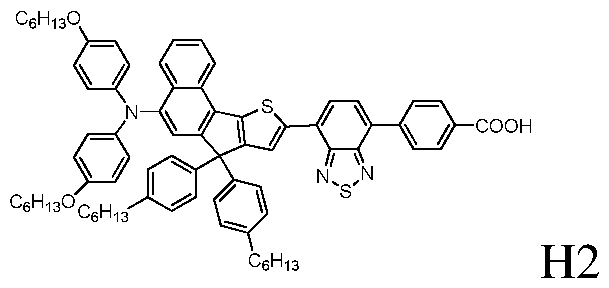
In a three-neck flame-dried round-bottom flask was dissolved 5 (273mg, 0.3 mmol) in THF (10 mL) and cooled to -78 °C using a dry ice/acetone cold bath. Under argon, 77-BuLi (0.37 mL, 1.6 M in hexanes, 0.60 mmol) was added dropwise to the reaction mixture, which was stirred for 0.5 h at -78 °C. After trimethylstannyl chloride (120 mg, 0.60 mmol) was added in one portion via syringe, the mixture was slowly warmed up and stirred for 2 h at room temperature. Water was slowly added to terminate the reaction and the mixture was extracted three times with diethyl ether before the organic phase was washed with water and dried over anhydrous sodium sulfate. After solvent removal under reduced pressure, the crude product N,N-bis(4-(hexyloxy)phenyl)-7,7-bis(4-hexylphenyl)-9-(trimethylstannyl)-7H- benzo[6,7]indeno[l,2-b]thiophen-5-amine as a precursor to synthesize H2 without further purification.
In a dried Schlenk tube were dissolved N,N-bis(4-(hexyloxy)phenyl)-7,7-bis(4-hexylphenyl)- 9-(trimethylstannyl)-7H-phenaleno[l,2-b]thiophen-3-amine and butyl 4-(7- bromobenzo[c][l,2,5]thiadiazol-4-yl)benzoate (138 mg, 0.36 mmol) in toluene (10 mL). Then Pd(PPh3)2Cl2 (26 mg, 0.04 mmol) was added to the reaction mixture, which was refluxed for 6 h. Water was added to terminate the reaction and the mixture was extracted three times with
chloroform before the organic phase was washed with water and dried over anhydrous sodium sulfate. After solvent removal under reduced pressure, the crude product was purified by column chromatography (toluene/petroleum ether 60-90 °C, 2/1, v/v) on silica gel to yield a black powder as the desired butyl ester.
In a three-neck round-bottom flask were dissolved butyl ester and KOH (152 mg, 2.70 mmol) in a solvent mixture of THF/H20 (8 mL, 3/1, v/v). The reaction mixture was refluxed overnight and then cooled to room temperature. Chloroform was added before the organic phase was washed with 0.1 M hydrochloric acid and deionized water in turn and then dried over anhydrous sodium sulfate. After solvent removal under reduced pressure, the crude product was purified by column chromatography (chloroform/methanol, 10/1, v/v) on silica gel to yield a black solid as the desired product H2 (283 mg, 81% yield). 1 H NMR (500 MHz, THF-i s) d : 8.33 (s, 1H), 8.30 (d, / = 8.3 Hz, 1H), 8.18-8.13 (m, 4H), 8.09-8.03 (m, 2H), 7.88 (d, / = 7.6 Hz, 1H), 7.60-7.58 (m, 1H), 7.38-7.34 (m, 2H), 7.20-7.18 (m, 4H), 7.03-7.02 (m, 4H), 6.89-6.87 (m, 4H), 6.73-6.71 (m, 4H), 3.88 (t, / = 6.3 Hz, 4H), 2.55-2.52 (m, 4H), 1.77- 1.74 (m, 4H), 1.58-1.53 (m, 4H), 1.49-1.47 (m, 4H), 1.36-1.28 (m, 20H), 0.93-0.85 (m, 12H). 13C NMR (125 MHz, THF -d%) d: 167.61, 158.12, 155.69, 154.79, 153.50, 153.44, 145.08, 143.69, 143.49, 143.11, 142.43, 142.31, 142.28, 131.70, 131.44, 131.38, 130.71, 129.98, 129.67, 129.26, 128.97, 128.71, 127.72, 126.86, 126.70, 126.27, 125.35, 125.33, 124.44, 124.36, 115.91, 68.89, 65.01, 36.57, 32.86, 32.78, 32.70, 30.89, 30.80, 30.72, 30.64, 30.53, 30.26, 26.94, 23.71, 23.66, 14.61, 14.58. HR-MS (MALDI-TOF) mlz calcd. for (C76H81N3O4S2): 1163.56685. Found: 1164.57209. Anal. Calcd. for C76H81N3O4S2: C, 78.38%; H, 7.01%; N, 3.61%. Found: C, 78.40%; H, 7.03%; N, 3.60%.
4-((7-(3-(bis(4-(hexyloxy)phenyl)amino)-7,7-bis(4-hexylphenyl)-7H-phenaleno[l,2- b]thiophen-9-yl)benzo[c][l,2,5]thiadiazol-4-yl)ethynyl)benzoic acid (H3)

In a three-neck flame-dried round-bottom flask was dissolved 4 (282 mg, 0.30 mmol) in THF (10 mL) and cooled to -78 °C using a dry ice/acetone cold bath. Under argon, 77-BuLi (0.37 mL, 1.6 M in hexanes, 0.60 mmol) was added dropwise to the reaction mixture, which was stirred for 0.5 h at -78 °C. After trimethylstannyl chloride (120 mg, 0.60 mmol) was added in
one portion via syringe, the mixture was slowly warmed up and stirred for 2 h at room temperature. Water was slowly added to terminate the reaction and the mixture was extracted three times with diethyl ether before the organic phase was washed with water and dried over anhydrous sodium sulfate. After solvent removal under reduced pressure, the crude product N,N-bis(4-(hexyloxy)phenyl)-4,4-bis(4-hexylphenyl)-2-(trimethylstannyl)-4H- benzo[l,l0]phenanthro[4,3-b]thiophen-8-amine as a precursor to synthesize H3 without further purification.
In a dried Schlenk tube were dissolved N,N-bis(4-(hexyloxy)phenyl)-7,7-bis(4-hexylphenyl)- 9-(trimethylstannyl)-7H-phenaleno[l,2-b]thiophen-3-amine and butyl 4-((7- bromobenzo[c][l,2,5]thiadiazol-4-yl)ethynyl)benzoate (150 mg, 0.36 mmol) in toluene (10 mL). Then Pd(PPh3)2Cl2 (26 mg, 0.04 mmol) was added to the reaction mixture, which was refluxed for 6 h. Water was added to terminate the reaction and the mixture was extracted three times with chloroform before the organic phase was washed with water and dried over anhydrous sodium sulfate. After solvent removal under reduced pressure, the crude product was purified by column chromatography (toluene/petroleum ether 60-90 °C, 2/1, v/v) on silica gel to yield a black powder as the desired butyl ester.
In a three-neck round-bottom flask were dissolved butyl ester and KOH (152 mg, 2.70 mmol) in a solvent mixture of THF/H20 (8 mL, 3/1, v/v). The reaction mixture was refluxed overnight and then cooled to room temperature. Chloroform was added before the organic phase was washed with 0.1 M phosphoric acid and deionized water in turn and then dried over anhydrous sodium sulfate. After solvent removal under reduced pressure, the crude product was purified by column chromatography (chloroform/methanol, 10/1, v/v) on silica gel to yield a black solid as the desired product H3 (292 mg, 82% yield). 1 H NMR (500 MHz, THF -d&) ό: 8.06 (d, / = 8.1 Hz, 2H), 8.02 (s, 1H), 7.92 (d, / = 8.2 Hz, 1H), 7.88 (d, 7 = 7.6 Hz, 1H), 7.77 (d, / = 7.6 Hz, 1H), 7.70-7.67 (m, 3H), 7.31 (d, / = 7.3 Hz, 1H), 7.27-7.24 (m, 1H), 7.18 (s, 1H), 7.16-7.14 (m, 4H), 7.06-7.05 (m, 4H), 6.92-6.90 (m, 4H), 6.75-6.73 (m, 4H), 3.87 (t, / = 6.3 Hz, 4H), 2.54 (t, / = 7.7 Hz, 4H), 1.76-1.70 (m, 4H), 1.60-1.54 (m, 4H), 1.47- 1.45 (m, 4H), 1.35-1.28 (m, 20H), 0.92-0.87 (m, 12H). 13C NMR (125 MHz, THF- s) S:
167.16, 156.21, 155.87, 152.65, 147.21, 146.44, 145.89, 143.81, 143.55, 141.82, 138.63,
137.54, 134.06, 132.50, 132.40, 132.02, 131.62, 130.81, 130.76, 130.69, 129.04, 128.91,
128.86, 128.30, 126.95, 126.61, 125.46, 125.35, 124.85, 124.47, 121.22, 115.98, 115.37,
96.24, 89.46, 68.86, 58.87, 36.47, 32.85, 32.76, 32.58, 30.52, 30.28, 26.92, 23.70, 23.64,
14.59, 14.57. HR-MS (MALDI-TOF) m/z calcd. for (C78H81N3O4S2): 1187.56685. Found: 1188.57412. Anal. Calcd. for C78H81N3O4S2: C, 78.82%; H, 6.87%; N, 3.54%. Found: C, 78.80%; H, 8.88%; N, 3.55%.
4-((7-(5-(bis(4-(hexyloxy)phenyl)amino)-7,7-bis(4-hexylphenyl)-7H-benzo[6,7]indeno[l,2- b]thiophen-9-yl)benzo[c][l,2,5]thiadiazol-4-yl)ethynyl)benzoic acid (H4)

In a three-neck flame-dried round-bottom flask was dissolved 5 (273mg, 0.3 mmol) in THF (10 mL) and cooled to -78 °C using a dry ice/acetone cold bath. Under argon, 77-BuLi (0.37 mL, 1.6 M in hexanes, 0.60 mmol) was added dropwise to the reaction mixture, which was stirred for 0.5 h at -78 °C. After trimethylstannyl chloride (120 mg, 0.60 mmol) was added in one portion via syringe, the mixture was slowly warmed up and stirred for 2 h at room temperature. Water was slowly added to terminate the reaction and the mixture was extracted three times with diethyl ether before the organic phase was washed with water and dried over anhydrous sodium sulfate. After solvent removal under reduced pressure, the crude product N,N-bis(4-(hexyloxy)phenyl)-7,7-bis(4-hexylphenyl)-9-(trimethylstannyl)-7H- benzo[6,7]indeno[l,2-b]thiophen-5-amine as a precursor to synthesize H4 without further purification.
In a dried Schlenk tube were dissolved N,N-bis(4-(hexyloxy)phenyl)-7,7-bis(4-hexylphenyl)- 9-(trimethylstannyl)-7H-phenaleno[l,2-b]thiophen-3-amine and butyl 4-((7- bromobenzo[c][l,2,5]thiadiazol-4-yl)ethynyl)benzoate (150 mg, 0.36 mmol) in toluene (10 mL). Then Pd(PPh3)2Cl2 (26 mg, 0.04 mmol) was added to the reaction mixture, which was refluxed for 6 h. Water was added to terminate the reaction and the mixture was extracted three times with chloroform before the organic phase was washed with water and dried over anhydrous sodium sulfate. After solvent removal under reduced pressure, the crude product was purified by column chromatography (toluene/petroleum ether 60-90 °C, 2/1, v/v) on silica gel to yield a black powder as the desired butyl ester.
In a three-neck round-bottom flask were dissolved butyl ester and KOH (152 mg, 2.70 mmol) in a solvent mixture of THF/H20 (8 mL, 3/1, v/v). The reaction mixture was refluxed
overnight and then cooled to room temperature. Chloroform was added before the organic phase was washed with 0.1 M phosphoric acid and deionized water in turn and then dried over anhydrous sodium sulfate. After solvent removal under reduced pressure, the crude product was purified by column chromatography (chloroform/methanol, 10/1, v/v) on silica gel to yield a black solid as the desired product H4 (292 mg, 82% yield). 1 H NMR (500 MHz, THF-i/s) d : 8.34 (s, 1H), 8.29 (d, / = 8.3 Hz, 1H), 8.07 (d, / = 8.3 Hz, 2H), 8.04-8.01 (m, 2H), 7.82 (d, / = 7.6 Hz, 1H), 7.70 (d, / = 8.3 Hz, 2H), 7.61-7.58 (m, 1H), 7.37 (s, 1H), 7.35 (t, / = 8.0 Hz, 1H), 7.18-7.17 (m, 4H), 7.03-7.02 (m, 4H), 6.89-6.87 (m, 4H), 6.73-6.71 (m, 4H), 3.88 (t, / = 6.4 Hz, 4H), 2.55-2.52 (m, 4H), 1.76-1.74 (m, 4H), 1.59-1.53 (m, 4H), 1.50-1.44 (m, 4H), 1.36-1.28 (m, 20H), 0.93-0.85 (m, 12H). 13C NMR (125 MHz, THF- s) S: 167.18, 158.23, 156.23, 156.28, 155.72, 153.63, 152.52, 145.34, 143.66, 142.83, 142.47, 142.17, 135.25, 132.48, 131.98, 131.54, 131.34, 130.77, 129.72, 129.27, 128.94, 128.37, 127.78, 126.88, 126.74, 126.23, 125.25, 124.85, 124.71, 124.50, 115.91, 114.92, 96.19, 89.59, 68.88, 64.99, 36.56, 32.86, 32.78, 32.70, 30.53, 30.26, 26.93, 23.71, 23.66, 14.61, 14.58. HR-MS (MALDI-TOF) m/z calcd. for (CTSHSINSCFSI): 1187.56685. Found: 1188.57940. Anal. Calcd. for C78H81N3O4S2: C, 78.82%; H, 6.87%; N, 3.54%. Found: C, 78.81%; H, 8.89%; N, 3.56%.
Examples 5-8
 of dye- sensitized solar cells
 sensitizers H1-H4
Dye- sensitized solar cells were prepared in accordance with a state of the art preparation protocol. A 4 pm compact layer of T1O2 was deposited on a transparent conductive ITO substrate (FTO glass). A mesoporous 4 pm mesoporous T1O2 layer was deposited on top the compact TiO2 layer. The FTO glass comprising the T1O2 layers was immersed in a sovelt comprising the organic dyes H1-H4, respectively. Cells were sealed and solvent CF/EtOH 1/19 comprising a redox-shuttle based on 0.25M Cobpy(II), 0.15 M Cobpy(II), and additives 0.5M TBP, 0.1M LiTFSI.
The photovoltaic parameters of the cells were assessed. The results are shown in Figure 2 and Table 1 below:
Table 1: Photovoltaic parameters of dye- sensitized solar cells comprising sensitizers H1-H4
Dye 2SC QE [mA cm 2] J sc [mAcm 2] Voc [mV] FF [%] PCE [%]
HI 15.59+0.06 16.17+0.09 937+6 73.9+0.3 11.2+0.1
H2 16.80+0.04 17.34+0.05 906+4 73.8+0.3 11.6+0.1
H3 15.06+0.06 15.73+0.09 919+6 72.2+0.3 10.4+0.1
H4 17.32+0.04 17.85+0.05 875+4 74.0+0.3 11.6+0.1
The results in Table 1 and Figure 2 show that the organic sensitizers H1-H4, which were prepared in accordance with the scheme of Figure 1, had impressive power conversion efficiencies of consistently above 10%. This renders the compounds H1-H4 suitable for use in solar cell applications
While certain of the preferred embodiments of the present invention have been described and specifically exemplified above, it is not intended that the invention be limited to such embodiments. Various modifications may be made thereto without departing from the scope and spirit of the present invention, as set forth in the following claims.
Claims
Claims
1. A compound comprising the structure of formula (I) or (II) below:

wherein
RAI, RA2, RBI, and RB2 are independently selected from C1-C36 alkyl, and from the substituents (1) to (3) below:

and wherein
RA3, RA4, RA5, in as far as present, are selected independently from H, C1-C36 alkyl, C1-C36 alkoxy, C1-C36 thioalkyl, C1-C36 alkyl substituted phenyl, C1-C36 alkoxy substituted phenyl and C1-C36 thioalkyl substituted phenyl;
wherein RA6 is selected from H, C1-C36 alkyl, C1-C36 alkyl substituted phenyl, Cl- C36 alkoxy substituted phenyl and C1-C36 thioalkyl substituted phenyl;
wherein RBI and RB2 may further be selected independently from H, C1-C36 alkoxy, C1-C36 thioalkyl;
Rx-R5, in as far as present, are selected independently from the substituents as specified for RA3-RAS;
A is an optionally substituted cyclic moiety comprising from 3 to 10 carbons and 0 to 3 heteroatoms, or, methanetriyl, wherein optional substituents of said cyclic moiety are independently selected from C1-C36 alkyl, C1-C36 alkoxy, C1-C36 thioalkyl, C1-C36 alkyl substituted phenyl, C1-C36 alkoxy substituted phenyl and C1-C36 thioalkyl substituted phenyl;
X is a moiety selected from the moieties (10) to (24) below,

10
 wherein,
in moieties (l0)-(24), RDI, RD2, RD3, RD4, RDS, and RD6, in as far as present, are independently selected from H, C 1-C36 alkyl, C 1-C36 alkoxy, C1-C36 thioalkyl, C1-C36 alkyl substituted phenyl, C 1-C36 alkoxy substituted phenyl and C 1-C36 thioalkyl substituted phenyl, wherein, E, El, E2, and E3, in as far as present, are independently selected from S, O,
Se, and Te;
Z in moiety (16) is selected from carbon and Si;
Y is selected from the substituents (30) to (43) below,


wherein,
Ri, R2, R3, R4, and R5, in as far as present, are selected independently from H and from anchoring groups independently selected from the group consisting of -COOH, -CONHOH, - PO3H2, -PO4H2, -P(Rg)02H, -SO3H2, -SO4H2, l,2-hydroxybenzene, l-hydroxy-2- carboxybenzene, acetylacetonate, deprotonated forms of the aforementioned, organic and/or inorganic salts of said deprotonated forms, and chelating groups with p-conducting character, Rs is selected from alkyl, alkenyl, alkynyl, aryl, alkylaryl, alkoxyaryl, and thioalkylaryl, with the proviso that each substituent Y comprises at least one of said anchoring groups; wherein G is selected from S and O;
n is 1 or 0.
2. The compound of formula (I) or (II), wherein A is selected from any one of the moieties (50)-(52) below:
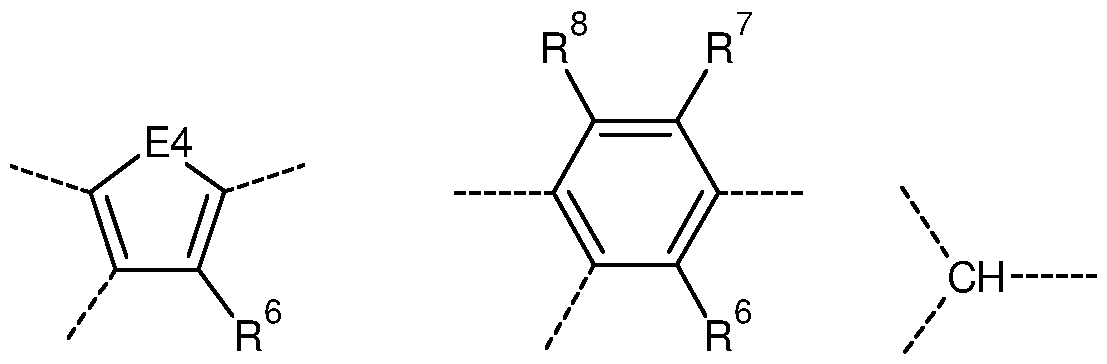
(50) (51) (52)
wherein,
the dotted line on the right side in the moieties (50) to (53) as shown above represents the single bond by which the moiety connects to X in formulae (I) or (II);
the dotted line towards the left side in the moieties (50) and (51) as shown above, on the carbon adjacent to E4 (moiety (50)) or adjacent to the carbon carrying R8 (moiety (51)), respectively, represents the single bond by which the moiety connects to the carbon of the naphthalene moiety in formulae (I) and (II);
the dotted line towards the left side in the moieties (50) and (51) as shown above, on the carbon adjacent to the carbon carrying R6 (moieties (50) and (51), represents the single bond by which the moiety connects to the carbon carrying substituents RBI and RB2 in formulae (I) and (II);
R6, R7 and R8, in as far as present, are independently selected from H, and from the same substituents as specified for RA3-RAS;
E4 is selected from S, O, Se and Te.
3. The compound of any one of claims 1 or 2, which comprises the structure of any one of formulae (III), (IV), (V) or (VI) below:

wherein,
RAI, RA2, RBI, RB2, X, Y, and, in as far as present, R1, R2, R3, R4, and R5 are independently as defined in claim 1
R6, R7 and R7 are independently defined as Rx-R5;
E4 in moieties (III) and (IV), are as defined in claim 2. 4. The compound of any one of the preceding claims, which comprises the structure of any one of formulae (VII) and (VIII):

wherein,
n is = 0 or is 1;
E4 is independently selected from S, O, Se, and Te;
X is selected from any one of the moieties (10)-( 12) as shown in claim 1, wherein, in moieties (10)-(12), RDI-RD4, in as far as present, are independently selected from H, C1-C15 alkyl, C1-C15 alkoxy, C1-C15 thioalkyl, C1-C10 alkyl substituted phenyl, C1-C15 alkoxy substituted phenyl and C1-C15 thioalkyl substituted phenyl, wherein, E, in as far as present, is independently selected from S and O;
RAI, RA2, RBI, and RB2 are independently selected from C1-C36 alkyl and from substituents of formula (1):

wherein RA3 is selected from H, Cl -Cl 5 alkyl, Cl -Cl 5 alkoxy, Cl -Cl 5 thioalkyl, Cl -Cl 5 alkoxy substituted phenyl and Cl -Cl 5 thioalkyl substituted phenyl;
wherein RBI, and RB2 may further be selected, independently, from Cl -Cl 5 alkoxy, Cl -Cl 5 thioalkyl;
R^R6, in as far as present, are selected independently from the substituents as specified for RA3;
Ri, R2, and R3, are selected independently from H and from anchoring groups selected from the group consisting of -COOH, -CONHOH, -PO3H2, -PO4H2, -P(Rg)02H, -SO3H2, - SO4H2, l,2-hydroxybenzene, l-hydroxy-2-carboxybenzene, acetylacetonate, deprotonated forms of the aforementioned, organic and/or inorganic salts of said deprotonated forms, and chelating groups with p-conducting character, Rs is selected from alkyl, alkenyl, alkynyl, aryl, alkylaryl, alkoxyaryl, and thioalkylaryl, with the proviso that at least one of said Ri, R2, and R3, is an anchoring group.
5. The compound of any one of the preceding claims, wherein X is selected from moieties (10)-(21), preferably moieties ( 10)-( 18), more preferably from moieties (10)-(15) and most preferably from moieties (10)-(12).
6. The compound of any one of the preceding claims, wherein
RDI, RD2, RD3, RD4, RD5, and RD6, in as far as present, are independently selected from H, C1-C10 alkyl, C1-C10 alkoxy, C1-C10 thioalkyl.
7. The compound of any one of the preceding claims, wherein RDI to RD6, in far as present, are H.
8. The compound of any one of the preceding claims, wherein E, El, E2, and E3, in as far as present, are independently selected from S and O, preferably are S.
9. The compound of any one of the preceding claims, wherein R1, R2, R3, R4, R5 and R6, in as far as present, are independently selected from H, C1-C10 alkyl, C1-C10 alkoxy, Cl- C10 thioalkyl, C1-C10 alkyl substituted phenyl, C1-C10 alkoxy substituted phenyl and Cl- C10 thioalkyl substituted phenyl.
10. The compound of any one of the preceding claims, wherein R1, R2, R3, R4, R5 and R6, in as far as present, are independently selected from H, C1-C10 alkyl, C1-C10 alkoxy, and C1-C10 thioalkyl.
11. The compound of any one of the preceding claims, wherein:
A is selected from moiety (50) and (51) as shown in claim 2, wherein E4 is selected from S, O, Se and Te, and R6, R7 and R8 are selected independently from H, C1-C36 alkyl, C1-C36 alkoxyl, C1-C36 substituted phenyl, and C1-C36 alkoxy substituted phenyl;
R1 to R6, in as far as present, are all H;
X is selected from moieties (10), (11) and (12) as shown in claim 1, wherein E in moiety (11) is selected S, O, Se, and Te, and RDI-RD4, in as far as present, are independently selected from H, from H, C1-C36 alkyl, C1-C36 alkoxy, C1-C36 alkyl substituted phenyl, and C1-C36 alkoxy substituted phenyl;
Y is selected of the substituents (30), (31), (32) and (33), in which Ri is -COOH, and R2 to R5, in as far as present, are all H.
12. The compound of any one of the preceding claims, wherein RAI, RA2, RBI, and RB2 are independently selected from C1-C36 alkyl, C1-C20 alkyl substituted phenyl, C1-C20 alkoxy substituted phenyl and C1-C20 thioalkyl substituted phenyl, and wherein RBI , and RB2 may further be selected from C1-C20 alkoxyl and C1-C20 thioalkyl.
13. The compound of any one of the preceding claims, wherein RAI, RA2, RBI, and RB2 are independently selected from C1-C20 alkyl, Cl -Cl 5 alkyl substituted phenyl, Cl -Cl 5 alkoxy substituted phenyl and Cl -Cl 5 thioalkyl substituted phenyl, and wherein RBI , and RB2 may further be selected from Cl -Cl 5 alkoxyl and Cl -Cl 5 thioalkyl.
14. The compound of any one of the preceding claims, wherein
RAI, RA2 are independently selected from C1-C10 alkoxy substituted phenyl and Cl- C10 thioalkyl substituted phenyl, and,
RBI, and RB2 are independently selected from C1-C10 alkyl substituted phenyl.
15. The compound of any one of the preceding claims, wherein Ri is selected from said anchoring groups and R2 to Rs, in as far as present, are H.
16. The compound of any one of the preceding claims, wherein said anchoring group is selected from -COOH, the deprotonated form thereof and/or a salt of said deprotonated form.
17. The compound of any one of the preceding claims, which comprises the structure of any one of formulae (XI) to (XIV):

18. An optoelectronic device comprising the compound of any one of the preceding claims, said optoelectronic device preferably being a dye- sensitized solar cell.
Priority Applications (1)
| Application Number | Priority Date | Filing Date | Title |
|---|---|---|---|
| PCT/IB2018/057816 WO2020074942A1 (en) | 2018-10-09 | 2018-10-09 | Novel organic dyes and solar cells containing the same |
Applications Claiming Priority (1)
| Application Number | Priority Date | Filing Date | Title |
|---|---|---|---|
| PCT/IB2018/057816 WO2020074942A1 (en) | 2018-10-09 | 2018-10-09 | Novel organic dyes and solar cells containing the same |
Publications (1)
| Publication Number | Publication Date |
|---|---|
| WO2020074942A1 true WO2020074942A1 (en) | 2020-04-16 |
Family
ID=70164192
Family Applications (1)
| Application Number | Title | Priority Date | Filing Date |
|---|---|---|---|
| PCT/IB2018/057816 Ceased WO2020074942A1 (en) | 2018-10-09 | 2018-10-09 | Novel organic dyes and solar cells containing the same |
Country Status (1)
| Country | Link |
|---|---|
| WO (1) | WO2020074942A1 (en) |
Citations (3)
| Publication number | Priority date | Publication date | Assignee | Title |
|---|---|---|---|---|
| CN101928469A (en) * | 2009-06-18 | 2010-12-29 | 精磁科技股份有限公司 | Organic dye and dye-sensitized solar cell using the same |
| CN107541093A (en) * | 2017-08-30 | 2018-01-05 | 浙江大学 | A kind of anthryl condensed-nuclei aromatics organic dyestuff and preparation method thereof |
| JP6307298B2 (en) * | 2014-02-18 | 2018-04-04 | 保土谷化学工業株式会社 | Sensitizing dye for photoelectric conversion, photoelectric conversion element using the same, and dye-sensitized solar cell |
-
2018
- 2018-10-09 WO PCT/IB2018/057816 patent/WO2020074942A1/en not_active Ceased
Patent Citations (3)
| Publication number | Priority date | Publication date | Assignee | Title |
|---|---|---|---|---|
| CN101928469A (en) * | 2009-06-18 | 2010-12-29 | 精磁科技股份有限公司 | Organic dye and dye-sensitized solar cell using the same |
| JP6307298B2 (en) * | 2014-02-18 | 2018-04-04 | 保土谷化学工業株式会社 | Sensitizing dye for photoelectric conversion, photoelectric conversion element using the same, and dye-sensitized solar cell |
| CN107541093A (en) * | 2017-08-30 | 2018-01-05 | 浙江大学 | A kind of anthryl condensed-nuclei aromatics organic dyestuff and preparation method thereof |
Similar Documents
| Publication | Publication Date | Title |
|---|---|---|
| US9359334B2 (en) | Ligands for sensitizing dyes of dye-sensitized solar cells | |
| Shi et al. | New efficient dyes containing tert-butyl in donor for dye-sensitized solar cells | |
| JP6139681B2 (en) | Diketopyrrolopyrrole (DPP) -based sensitizers for electrochemical or optoelectronic devices | |
| KR102062929B1 (en) | Organic colourant and uses thereof in photovoltaic cells | |
| US11248123B2 (en) | Organic photochromic dye and uses thereof for dye sensitized solar cells | |
| CN103554957A (en) | Triphenylamine-thiophene organic dyestuff as well as preparation method and application thereof | |
| Marco et al. | Pyranylidene/thienothiophene-based organic sensitizers for dye-sensitized solar cells | |
| CN103408962A (en) | Organic dye containing benzothiadiazole-thienocyclopenta and applications of organic dye in dye-sensitized solar cells | |
| CN108164546A (en) | Indoline-dithieno quinoxaline-dibenzo [a, c] phenazine dyes and its application in dye-sensitized solar cells | |
| JP6056605B2 (en) | Organic dye and photosensitive element | |
| CN106221280B (en) | Organic dye sensitizer containing BODIPY conjugated units and preparation method thereof | |
| KR20130020739A (en) | Donor-bridge-acceptor type organic semiconductors for solar cells | |
| WO2012107488A2 (en) | Metal-free photosensitizers | |
| JP5498355B2 (en) | Organic and inorganic sensitizing dyes | |
| JP2008274082A (en) | Dye having silicon-containing substituent, and dye-sensitized solar cell using the dye | |
| CN102212274A (en) | Triphenylamine-phenyl organic dye and application thereof | |
| KR101109548B1 (en) | Novel compounds containing fused-triarylamine, methods of preparing the compounds and dye-sensitized solar cells using dyes comprising the compounds | |
| JP5776099B2 (en) | Transition metal complex, photosensitizing dye, oxide semiconductor electrode containing the dye, and dye-sensitized solar cell | |
| CN113999217B (en) | A new compound, its preparation method and its application as co-sensitizer | |
| KR101433826B1 (en) | Dual-Channel Anchorable Heterocyclic Derivatives, Organic Dye Sensitizers Containing The Same for Highly Efficient Dye-sensitized Solar Cells And Dye-sensitized Solar Cells Containing The Same | |
| Liu et al. | Molecular design of organic dyes based on vinylene hexylthiophene bridge for dye-sensitized solar cells | |
| KR101806162B1 (en) | Dye sensitized solar cell and solar cell using the same | |
| CN104530747A (en) | Organic photosensitive dye with asymmetric pyrrole-pyrroledione as conjugated bridge | |
| KR101205922B1 (en) | Ruthenium Complex Compound And Dye-sensitized Solar Cells Comprising The Same | |
| KR102926445B1 (en) | UV selectively absorbing Dyes featuring a Fluorene, Preparation Method Thereof, and Dye-sensitized Solar Cells Comprising the Same |
Legal Events
| Date | Code | Title | Description |
|---|---|---|---|
| 121 | Ep: the epo has been informed by wipo that ep was designated in this application |
Ref document number: 18936327 Country of ref document: EP Kind code of ref document: A1 |
|
| NENP | Non-entry into the national phase |
Ref country code: DE |
|
| 122 | Ep: pct application non-entry in european phase |
Ref document number: 18936327 Country of ref document: EP Kind code of ref document: A1 |