WO2020069462A1 - Slip-resistant coating, method of coating a substrate and a coated substrate - Google Patents
Slip-resistant coating, method of coating a substrate and a coated substrate Download PDFInfo
- Publication number
- WO2020069462A1 WO2020069462A1 PCT/US2019/053685 US2019053685W WO2020069462A1 WO 2020069462 A1 WO2020069462 A1 WO 2020069462A1 US 2019053685 W US2019053685 W US 2019053685W WO 2020069462 A1 WO2020069462 A1 WO 2020069462A1
- Authority
- WO
- WIPO (PCT)
- Prior art keywords
- coating
- aggregate
- substrate
- polymer matrix
- coating composition
- Prior art date
- Legal status (The legal status is an assumption and is not a legal conclusion. Google has not performed a legal analysis and makes no representation as to the accuracy of the status listed.)
- Ceased
Links
Classifications
-
- C—CHEMISTRY; METALLURGY
- C09—DYES; PAINTS; POLISHES; NATURAL RESINS; ADHESIVES; COMPOSITIONS NOT OTHERWISE PROVIDED FOR; APPLICATIONS OF MATERIALS NOT OTHERWISE PROVIDED FOR
- C09D—COATING COMPOSITIONS, e.g. PAINTS, VARNISHES OR LACQUERS; FILLING PASTES; CHEMICAL PAINT OR INK REMOVERS; INKS; CORRECTING FLUIDS; WOODSTAINS; PASTES OR SOLIDS FOR COLOURING OR PRINTING; USE OF MATERIALS THEREFOR
- C09D175/00—Coating compositions based on polyureas or polyurethanes; Coating compositions based on derivatives of such polymers
- C09D175/04—Polyurethanes
-
- C—CHEMISTRY; METALLURGY
- C09—DYES; PAINTS; POLISHES; NATURAL RESINS; ADHESIVES; COMPOSITIONS NOT OTHERWISE PROVIDED FOR; APPLICATIONS OF MATERIALS NOT OTHERWISE PROVIDED FOR
- C09D—COATING COMPOSITIONS, e.g. PAINTS, VARNISHES OR LACQUERS; FILLING PASTES; CHEMICAL PAINT OR INK REMOVERS; INKS; CORRECTING FLUIDS; WOODSTAINS; PASTES OR SOLIDS FOR COLOURING OR PRINTING; USE OF MATERIALS THEREFOR
- C09D5/00—Coating compositions, e.g. paints, varnishes or lacquers, characterised by their physical nature or the effects produced; Filling pastes
-
- C—CHEMISTRY; METALLURGY
- C08—ORGANIC MACROMOLECULAR COMPOUNDS; THEIR PREPARATION OR CHEMICAL WORKING-UP; COMPOSITIONS BASED THEREON
- C08G—MACROMOLECULAR COMPOUNDS OBTAINED OTHERWISE THAN BY REACTIONS ONLY INVOLVING UNSATURATED CARBON-TO-CARBON BONDS
- C08G18/00—Polymeric products of isocyanates or isothiocyanates
- C08G18/06—Polymeric products of isocyanates or isothiocyanates with compounds having active hydrogen
- C08G18/28—Polymeric products of isocyanates or isothiocyanates with compounds having active hydrogen characterised by the compounds used containing active hydrogen
- C08G18/30—Low-molecular-weight compounds
- C08G18/302—Water
- C08G18/307—Atmospheric humidity
-
- C—CHEMISTRY; METALLURGY
- C09—DYES; PAINTS; POLISHES; NATURAL RESINS; ADHESIVES; COMPOSITIONS NOT OTHERWISE PROVIDED FOR; APPLICATIONS OF MATERIALS NOT OTHERWISE PROVIDED FOR
- C09D—COATING COMPOSITIONS, e.g. PAINTS, VARNISHES OR LACQUERS; FILLING PASTES; CHEMICAL PAINT OR INK REMOVERS; INKS; CORRECTING FLUIDS; WOODSTAINS; PASTES OR SOLIDS FOR COLOURING OR PRINTING; USE OF MATERIALS THEREFOR
- C09D5/00—Coating compositions, e.g. paints, varnishes or lacquers, characterised by their physical nature or the effects produced; Filling pastes
- C09D5/002—Priming paints
-
- C—CHEMISTRY; METALLURGY
- C09—DYES; PAINTS; POLISHES; NATURAL RESINS; ADHESIVES; COMPOSITIONS NOT OTHERWISE PROVIDED FOR; APPLICATIONS OF MATERIALS NOT OTHERWISE PROVIDED FOR
- C09D—COATING COMPOSITIONS, e.g. PAINTS, VARNISHES OR LACQUERS; FILLING PASTES; CHEMICAL PAINT OR INK REMOVERS; INKS; CORRECTING FLUIDS; WOODSTAINS; PASTES OR SOLIDS FOR COLOURING OR PRINTING; USE OF MATERIALS THEREFOR
- C09D7/00—Features of coating compositions, not provided for in group C09D5/00; Processes for incorporating ingredients in coating compositions
- C09D7/40—Additives
- C09D7/65—Additives macromolecular
-
- C—CHEMISTRY; METALLURGY
- C08—ORGANIC MACROMOLECULAR COMPOUNDS; THEIR PREPARATION OR CHEMICAL WORKING-UP; COMPOSITIONS BASED THEREON
- C08L—COMPOSITIONS OF MACROMOLECULAR COMPOUNDS
- C08L69/00—Compositions of polycarbonates; Compositions of derivatives of polycarbonates
-
- C—CHEMISTRY; METALLURGY
- C09—DYES; PAINTS; POLISHES; NATURAL RESINS; ADHESIVES; COMPOSITIONS NOT OTHERWISE PROVIDED FOR; APPLICATIONS OF MATERIALS NOT OTHERWISE PROVIDED FOR
- C09K—MATERIALS FOR MISCELLANEOUS APPLICATIONS, NOT PROVIDED FOR ELSEWHERE
- C09K3/00—Materials not provided for elsewhere
- C09K3/14—Anti-slip materials; Abrasives
- C09K3/149—Antislip compositions
Definitions
- the present disclosure is directed to a coating for a substrate, a method of making a coating for a substrate, a method of coating a substrate with the coating, and a substrate coated with the coating.
- the present disclosure is more particularly directed to a slip-resistant coating for a substrate, a method of making a slip-resistant coating for a substrate, a method of coating a substrate with the slip-resistant coating, and a substrate coated with the slip-resistant coating.
- Crystalline silica is a natural mineral that is found construction materials such as sand, stone, brick, concrete, and mortar. Significant known health risks are associated with exposure to crystalline silica, including silicosis, lung cancer, chronic obstructive pulmonary disease (“COPD”) and kidney disease.
- COPD chronic obstructive pulmonary disease
- Silica sand which includes respirable free crystalline silica, is commonly used as an anti slip or anti-skid additive in floor coating compositions.
- a floor coating is applied to the surface of a horizontal floor substrate by methods widely known in the industry to provide a seamless layer of a protective coating.
- the silica sand additive Prior to curing the floor coating composition, the silica sand additive is then typically spread by broadcasting across the coated surface of the floor substrate by contractor. The particles of silica sand become trapped within the floor coating near the surface of the coating to provide an anti-slip or anti-skid texture on the surface of the floor coating.
- the silica sand containing respirable crystalline silica is pre-mixed with the polymer matrix, and the mixture subsequently rolled onto the surface of the target substrate.
- a coating comprising an organic polymer matrix and a polymer aggregate.
- a coated substrate comprising a substrate having opposite facing first and second major surfaces, and at least one layer of a coating comprising a polymer matrix and an organic polymer aggregate on at least a portion of one of said first or second major surfaces of said substrate.
- a method for coating a surface of a substrate with a coating comprising coating at least one layer of a coating composition comprising a polymer matrix and an organic polymer aggregate on at least a portion of a surface of said substrate.
- a method for coating a substrate with a coating composition comprising coating at least one layer of a polymer coating on at least a portion of a surface of said substrate and spreading a plurality of organic polymer aggregate onto said polymer coating.
- a floor comprising a floor substrate having opposite facing first and second major surfaces and at least one layer of a coating comprising a polymer matrix and an organic polymer aggregate on at least a portion of one of said first or second major surfaces of said floor substrate.
- a deck comprising a deck substrate having opposite facing first and second major surfaces and at least one layer of a coating comprising a polymer matrix and an organic polymer aggregate on at least a portion of one of said first or second major surfaces of said deck substrate.
- a method for making a coating composition comprising mixing together a polymer matrix and a plurality of organic polymer aggregate.
- Figure 1 is a cross-sectional view of a substrate coated with an illustrative slip-resistant coating composition comprising a polymer matrix and an organic polymeric aggregate.
- Figure 2 is a cross-sectional view of a substrate coated with a base coat and top coat of an illustrative slip-resistant coating composition comprising a polymer matrix and an organic polymeric aggregate.
- Figure 3 is a scanning electron microscope (SEM) image of smooth round crystalline silica particles.
- Figure 4 is an SEM image of angular polyallyldiglycol carbonate aggregate particles.
- Figures 5 A and 5B are photographs of illustrative embodiments of the coating composition applied to a substrate and showing a surface texture suitable as a slip resistant coating for traffic.
- Figures 6A-6C are photographs of illustrative embodiments of the coating composition applied to a substrate and showing a surface texture suitable as a slip resistant coating for traffic.
- the present disclosure is directed to a coating composition for a substrate that minimizes or eliminates the amount of free crystalline silica present in the coating composition. While the coating composition minimizes, substantially eliminates, or completely eliminates the presence of free crystalline silica, the coating composition also possesses improved processability and anti slip performance.
- the present disclosure provides coating compositions having non-skid properties.
- the terms“non-skid,”“non-slip,”“anti-skid,”“anti-slip,”“slip-resistant,” and “skid-resistant” coatings are used interchangeably and refer to a coating that dries to a textured surface that resists sliding of pedestrians and vehicles on building floors, balcony decks, parking decks, parking ramps, plaza decks, stadium decks, stairs, and the like.
- the coating composition comprises a polymer matrix and an organic polymer aggregate.
- the coating composition is completely or substantially free of crystalline silica.
- the polymer matrix of the coating composition may be selected from epoxy, polyaspartic, polymethacrylate, polysulfides, polyurethane, and polyureas.
- the polymer matrix of the coating composition comprises a polyurethane as the polymer matrix.
- a polyurethane is a reaction product of at least isocyanate, at least one polyol, and optional other reactants. Any known isocyanate may be utilized to form the polyurethane polymer.
- the isocyanate may include at least one of aromatic isocyanates, aliphatic isocyanates, cycloaliphatic isocyanates, araliphatic isocyanates or mixtures thereof.
- the isocyanate component may be a diisocyanate or a triisocyanate or mixtures thereof.
- aromatic isocyanates which may be utilized include but are not limited to methylene diphenyl diisocyanates (MDI), toluene diisocyanates (TDI), polymeric methylene diphenyl diisocyanates (PMDI), p-phynyl diisocyanates (PDI), naphthalene diisocyanates (NDI), aliphatic isocyanates such as hexamethylene diisocyanates (HDI), hexamethylene diisocyanate trimers (HDI Trimers), dicyclohexylmethane diisocyanates (H 12 MDI), isophorone diisocyanates (IPDI), cyclohexane diisocyanate (CHDI), tetramethylxylylene diisocyanate (TMXDI) or mixtures thereof.
- MDI methylene diphenyl diisocyanates
- TDI toluene diisocyanates
- PMDI polymeric m
- any known polyol may be utilized to form the polyurethane polymer.
- Useful polyols include compounds having at least one isocyanate-reactive functionality.
- Suitable polyols include, without limitation, polyether polyols, polyester polyols, polyalkylene glycols, polybutadiene polyols, alkylene diols and combinations thereof.
- Suitable polyester polyols include for example those based on caprolactone, which are also referred to as "polycaprolactones”.
- Suitable polyurethane polymers are commercially available from BASF Corporation (Florham Park, NJ, USA) under the designations MASTERSEAL 225, 275 and 295.
- MASTERSEAL 225 is a liquid applied one-component moisture-curing polyurethane coating.
- MASTERSEAL 275 and 295 are both liquid applied two-component coatings comprising polyurethanes.
- a suitable epoxy coating is commercially available from BASF Corporation under the designation MASTERSEAL C350.
- the organic polymeric aggregate may be prepared a thermoset polymer resin.
- the organic polymeric aggregate used in the coating composition may be selected from polycarbonate, melamine formaldehyde, urea formaldehyde and the like.
- the organic polymeric aggregate comprises a polycarbonate aggregate.
- the organic polymeric aggregate is substantially free of any inorganic component.
- the organic polymeric aggregate is free of any inorganic component.
- the organic polymeric aggregate may also be treated an anti-static agent to prevent agglomeration of aggregate particles.
- the organic polymeric aggregate possesses a suitable hardness to impart abrasion and impact resistance, along with the desired slip-resistance, to the polymeric matrix.
- the organic polymeric aggregate possesses a Moh’s Hardeness of at least 3.0, or at least 3.5, at least 4.0, or at least 4.5 or at least 5.0.
- suitable polycarbonate aggregate for use in the coating is commercially available from Composition Materials Co., Inc. (Milford, CT, USA) under the trademark CLEAR-CUT®.
- CLEAR-CUT® polymeric aggregate is a thermoset polyallyldiglycol carbonate.
- Other non-limiting useful polymeric aggregates include PLASH-GRIT® TYPE III thermoset melamine formaldehyde and PLASTI-GRIT® TYPE II thermoset urea formaldehyde, both commercially available from Composition Materials Co., Inc.
- Further suitable organic polymeric aggregate include polyester and acrylic plastic aggregates commercially available from Composition Materials Co., polypropylene aggregate commercially available H&C Products Group, Cleveland, Ohio, USA under the designation Shark Grip, and ground up polyethylene aggregate.
- the coating composition may also include an aggregate other that the organic polymeric aggregate.
- the coating composition may comprise a polymeric matrix, organic polymeric aggregate, and a non-polymeric aggregate.
- the coating composition may comprise a polymeric matrix, organic polymeric aggregate, and silica sand aggregate as the non-polymeric aggregate.
- the coating composition may comprises a polymer matrix, polycarbonate, silica sand, and one or more other thermosplastic or thermoset aggregates.
- the coating composition may comprise other aggregate types, including, for example, polyesters, aromatic polycarbonates, polyarylates, polyaryl ethers, polyetherimides, polyimides, polyamides, glass beads, acrylic plastic, metal oxides (for example, aluminum oxide), and polyalkylenes (for example, polypropylene, polyethylene, etc).
- aggregate types including, for example, polyesters, aromatic polycarbonates, polyarylates, polyaryl ethers, polyetherimides, polyimides, polyamides, glass beads, acrylic plastic, metal oxides (for example, aluminum oxide), and polyalkylenes (for example, polypropylene, polyethylene, etc).
- the organic polymeric aggregate may comprise a non-round or non-spherical aggregate particle.
- the ratio of the longest dimension to the shortest dimension of the organic polymeric aggregate of the coating composition is greater than the ratio of longest dimension to the shortest dimension of crystalline silica sand.
- the ratio of the longest dimension to the shortest dimension of the polymeric aggregate of the coating composition is greater than 1.25: 1.
- the ratio of the longest dimension to the shortest dimension of the organic polymeric aggregate of the coating composition is greater than 1.3 : 1.
- the ratio of the longest dimension to the shortest dimension of the organic polymeric aggregate of the coating composition is greater than 1.4: 1.
- the ratio of the longest dimension to the shortest dimension of the organic polymeric aggregate of the coating composition is greater than 1.5: 1. According to certain embodiments, the ratio of the longest dimension to the shortest dimension of the organic polymeric aggregate of the coating composition is greater than 1.6: 1. According to certain embodiments, the ratio of the longest dimension to the shortest dimension of the organic polymeric aggregate of the coating composition is greater than 1.7: 1. According to certain embodiments, the ratio of the longest dimension to the shortest dimension of the organic polymeric aggregate of the coating composition is greater than 1.8: 1. According to certain embodiments, the ratio of the longest dimension to the shortest dimension of the organic polymeric aggregate of the coating composition is greater than 1.9: 1. According to certain embodiments, the ratio of the longest dimension to the shortest dimension of the organic polymeric aggregate of the coating composition is greater than 2: 1.
- the ratio of polymer matrix to organic polymeric aggregate in the coating composition may be in the range of about 1 : 1 to about 20: 1. According to certain illustrative embodiments, the ratio of polymer matrix to organic polymeric aggregate in the coating composition in the range of 2: 1 to 10: 1. According to certain illustrative embodiments, the ratio of polymer matrix to organic polymeric aggregate in the coating composition in the range of 3 : 1 to 10: 1. According to certain illustrative embodiments, the ratio of polymer matrix to organic polymeric aggregate in the coating composition in the range of 4: 1 to 10: 1. According to certain illustrative embodiments, the ratio of polymer matrix to organic polymeric aggregate in the coating composition in the range of 5: 1 to 10: 1.
- the ratio of polymer matrix to organic polymeric aggregate in the coating composition is about 2: 1. According to certain illustrative embodiments, the ratio of polymer matrix to organic polymeric aggregate in the coating composition is about 4: 1. According to certain illustrative embodiments, the ratio of polymer matrix to organic polymeric aggregate in the coating composition is about 6: 1. According to certain illustrative embodiments, the ratio of polymer matrix to organic polymeric aggregate in the coating composition is about 8: 1.
- the density of the organic polymer aggregate should approximate the density of the polymer matrix. According to certain illustrative embodiments, for example, the density of the polymer matrix and organic polymer aggregate should be within ⁇ 40 percent of each other. According to certain illustrative embodiments, for example, the density of the polymer matrix and organic polymer aggregate should be within ⁇ 25 percent of each other. According to other illustrative embodiments, for example, the density of the polymer matrix and organic polymer aggregate should be within ⁇ 20 percent of each other.
- the density of the polymer matrix and organic polymer aggregate should be within ⁇ 15 percent of each other. According to other illustrative embodiments, for example, the density of the polymer matrix and organic polymer aggregate should be within ⁇ 10 percent of each other. According to other illustrative embodiments, for example, the density of the polymer matrix and organic polymer aggregate should be within ⁇ 5 percent of each other. According to other illustrative embodiments, for example, the density of the polymer matrix and organic polymer aggregate should be within ⁇ 4 percent of each other. According to other illustrative embodiments, for example, the density of the polymer matrix and organic polymer aggregate should be within ⁇ 3 percent of each other.
- the density of the polymer matrix and organic polymer aggregate should be within ⁇ 2 percent of each other. According to other illustrative embodiments, for example, the density of the polymer matrix and organic polymer aggregate should be within ⁇ 1 percent of each other. According to other illustrative embodiments, for example, the density of the polymer matrix and organic polymer aggregate should be within ⁇ 0.9, ⁇ 0.8, ⁇ 0.7, ⁇ 0.6, ⁇ 0.5, ⁇ 0.4, ⁇ 0.3, ⁇ 0.2, or ⁇ 0.1 percent of each other.
- the disclosed coating composition may also additives such as abrasion resistance improvers, absorbents, rheological modifiers, plasticizers, antifoaming agents, antifouling agents, thixotropic agents, pigments, fillers, additional aggregate, extenders, reinforcing agents, flow control agents, catalysts, wetting agents, adhesion promoters, thickening agents, flame-retarding agents, antioxidants, elastomers, anti-settling agents, diluents, UV light stabilizers, air release agents, solvents, dispersing aids, and mixtures thereof.
- additives such as abrasion resistance improvers, absorbents, rheological modifiers, plasticizers, antifoaming agents, antifouling agents, thixotropic agents, pigments, fillers, additional aggregate, extenders, reinforcing agents, flow control agents, catalysts, wetting agents, adhesion promoters, thickening agents, flame-retarding agents, antioxidants, elasto
- the term“about” used in connection with a value is inclusive of the stated value and has the meaning dictated by the context.
- the term“about” includes at least the degree of error associated with the measurement of the particular value.
- One of ordinary skill in the art would understand the term“about” is used herein to mean that an amount of“about” of a recited value results the desired degree of effectiveness in the compositions and/or methods of the present disclosure.
- the metes and bounds of the term“about” with respect to the value of a percentage, amount or quantity of any component in an embodiment can be determined by varying the value, determining the effectiveness of the compositions for each value, and determining the range of values that produce compositions with the desired degree of effectiveness in accordance with the present disclosure.
- the term“about” is further used to reflect the possibility that a composition may contain trace components of other materials that do not alter the effectiveness of the composition.
- substantially refers to a degree of deviation that is sufficiently small so as to not measurably detract from the identified property or circumstance. The exact degree of deviation allowable may in some cases depend on the specific context.
- the aggregate used in the coating composition is substantially free of crystalline silica.
- substantially free of crystalline silica means that the total aggregate content of the coating composition includes from 0 to about 20 weight percent crystalline silica.
- the total aggregate content includes crystalline silica particles and/or aggregate having least one region of crystalline silica.
- substantially free of crystalline silica means that the total aggregate content of the coating composition includes from 0 to about 15 weight percent crystalline silica.
- substantially free of crystalline silica means that the total aggregate content of the coating composition includes from 0 to about 10 weight percent crystalline silica. According to certain embodiments, substantially free of crystalline silica means that the total aggregate content of the coating composition includes from 0 to about 9 weight percent crystalline silica. According to certain embodiments, substantially free of crystalline silica means that the total aggregate content of the coating composition includes from 0 to about 8 weight percent crystalline silica. According to certain embodiments, substantially free of crystalline silica means that the total aggregate content of the coating composition includes from 0 to about 7 weight percent crystalline silica.
- substantially free of crystalline silica means that the total aggregate content of the coating composition includes from 0 to about 6 weight percent crystalline silica. According to certain embodiments, substantially free of crystalline silica means that the total aggregate content of the coating composition includes from 0 to about 5 weight percent crystalline silica. According to certain embodiments, substantially free of crystalline silica means that the total aggregate content of the coating composition includes from 0 to about 4 weight percent crystalline silica. According to certain embodiments, substantially free of crystalline silica means that the total aggregate content of the coating composition includes from 0 to about 3 weight percent crystalline silica.
- substantially free of crystalline silica means that the total aggregate content of the coating composition includes from 0 to about 2 weight percent crystalline silica. According to certain embodiments, substantially free of crystalline silica means that the total aggregate content of the coating composition includes from 0 to about 1 weight percent crystalline silica. According to certain embodiments, substantially free of crystalline silica means that the total aggregate content of the coating composition includes from 0 to about 0.5 weight percent crystalline silica. According to certain illustrative embodiments, the coating composition is free of crystalline silica.
- any such amount of crystalline silica may be unintentionally present from the raw materials from which coating composition is made, or may be intentionally added, or both.
- the coating composition may be applied to any substrate that is in need of a durable and slip- or skid-resistant coating.
- the coating composition may be applied to any horizontal or substantially horizontal surface that experiences pedestrian or vehicular traffic.
- the coating composition may be applied to building floors, balcony decks, parking decks, parking ramps, plaza decks, stadium decks, stairs, roofs, and the like.
- a primer may be utilized to promote adhesion and bonding of the coating composition to the surface of the underlying substrate.
- the primer may penetrate the pore structure of the underlying structure to provide a high bond layer for the polymeric coating composition. Individuals of ordinary skill in the art can easily determine suitable primers without undue experimentation.
- useful primers for application to the underlying substrate include MasterSeal P173, P255, and P176, Sikaflex 429 Primer, Tremco Vulkem 171 Primer, and Neogard 7797/7798, 70714/70715, and 7740/7741.
- the primer may be applied to the surface of the substrate to be protected by any conventional method for application of a primer to a surface of a substrate.
- application of the primer may be performed using a roller, brush, spraying, squeegee and the like. Individuals of ordinary skill in the art can easily determine suitable methods for application of the primer without undue experimentation.
- a basecoat may be applied to a surface of an underlying substrate.
- suitable basecoats include those commercially available from BASF Corporation under the designations MASTERSEAL M200, M205, M265, and M350.
- the basecoat may be applied by a roller, brush, sprayer, squeegee and the like.
- a filler, patch or other repair material may also be utilized to fill small cracks, defects, flaws, or voids in the underlying substrate to which the coating composition is to be applied to provide a smooth and even surface for application of the coating composition.
- Such preparation provides a smooth surface to promote intimate contact and even support of subsequent layers and minimize surface irregularities which would otherwise become stress concentration sites.
- a useful filler or repair material that can be utilized is MASTEREMACO 1060 and 1061, or other cementitious materials. Individuals of ordinary skill in the art can easily determine suitable fillers without undue experimentation.
- One or more layers of the coating composition may be applied to the surface of a substrate to provide a slip- or skid-resistant coating on the surface of the substrate.
- the coating composition may be applied to the surface of a substrate with a brush, mop, roller, sprayer, or squeegee.
- the liquid coating composition may be applied to a wide variety of substrates, such as concrete, masonry, cement board, gypsum board, plywood, particle board, oriented strand board and the like.
- slip-resistant coating composition is readily understood when read in conjunction with illustrative FIGS. 1-2. It should be noted that the slip-resistant coating composition is not limited to any of the illustrative embodiments shown in the drawing figures, but rather should be construed in breadth and scope in accordance with the disclosure provided herein.
- Figure l is a cross-sectional view of a substrate (10) coated with an illustrative slip-resistant coating composition (12) comprising a polymer matrix and a polymeric aggregate that is substantially free of aggregates containing crystalline silica.
- the substrate (10) is first cleaned with conventionally-known commercial cleansers so as to remove any foreign substances such as oils, loose granular particles and the like.
- the cleaned substrate (10) may optionally be mechanically abraded to impart a roughened porous surface.
- the substrate (10) may then be cleaned again to remove dust and debris that was generated from the abrasion process. Once the substrate (10) has been properly cleaned and roughened, it is ready for application of the slip-resistant coating composition (12).
- Figure 2 is a cross-sectional view of a substrate (10) coated with a base coat (14) such as a primer, which is then top coated with an illustrative slip-resistant coating composition (12) comprising a polymer matrix and a polymeric aggregate that is substantially free of aggregates containing crystalline silica.
- a base coat (14) such as a primer
- a liquid applied coating composition comprising a one-component moisture-curing polyurethane (MASTERSEAL 225) and polycarbonate aggregate (CLEAR-CUT) was used to coat a 10 ft x 10 ft area of a test substrate.
- the mix ratio of the polyurethane to the polycarbonate aggregate was 2: 1 by volume.
- the mineral aggregate was then added to the polyurethane coating and mixed for 2-3 minutes. The mixture was then rolled onto the substrate area with roller, squeegee or both.
- a liquid applied coating composition comprising a two-component moisture-curing polyurethane (MASTERSEAL 275) and polycarbonate aggregate (CLEAR-CUT) was used to coat a 10 ft x 10 ft area of a test substrate.
- the mix ratio of the polyurethane to the polycarbonate aggregate was 2: 1 by volume.
- Part A and Part B was mixed for 2-3 minutes.
- the mineral aggregate was then added to the polyurethane coating and mixed for 2-3 minutes. The mixture was then rolled onto the substrate area with roller, squeegee or both.
- a liquid applied coating composition comprising a two-component moisture-curing polyurethane (MASTERSEAL 295) and polycarbonate aggregate (CLEAR-CUT).
- the mix ratio of the polyurethane to the polycarbonate aggregate was 2: 1 by volume.
- Part A and Part B was mixed for 2-3 minutes.
- the mineral aggregate was then added to the polyurethane coating and mixed for 2-3 minutes.
- the mixture was then rolled onto the substrate area with roller, squeegee or both.
- a liquid applied coating composition comprising a one-component moisture-curing polyurethane (MASTERSEAL 225) and polycarbonate aggregate (CLEAR-CUT) was used to coat a test substrate.
- the mix ratio of the polyurethane to the polycarbonate aggregate was 4: 1 by volume.
- the mineral aggregate was then added to the polyurethane coating and mixed for 2-3 minutes. The mixture was then rolled onto the substrate area with roller, squeegee or both.
- a liquid applied coating composition comprising a one-component moisture-curing polyurethane (MASTERSEAL 225) and polycarbonate aggregate (CLEAR-CUT) was used to coat a test substrate.
- the mix ratio of the polyurethane to the polycarbonate aggregate was 6: 1 by volume.
- the mineral aggregate was then added to the polyurethane coating and mixed for 2-3 minutes. The mixture was then rolled onto the substrate area with roller, squeegee or both.
- a liquid applied coating composition comprising a one-component moisture-curing polyurethane (MASTERSEAL 225) and polycarbonate aggregate (CLEAR-CUT) was used to coat a test substrate.
- the mix ratio of the polyurethane to the polycarbonate aggregate was 8: 1 by volume.
- the mineral aggregate was then added to the polyurethane coating and mixed for 2-3 minutes. The mixture was then rolled onto the substrate area with roller, squeegee or both. Part A and Part B was mixed for 2-3 minutes. Prior to curing the polyurethane coating, the mineral aggregate was spread by broadcasting across the surface of the substrate area. It was then rolled onto the substrate area with roller, squeegee or both.
- slip resistance properties for certain coating compositions were carried out under dry and wet conditions.
- a Gibson Pendulum Slip Tester was used to determine the slip resistance of certain coating compositions.
- the Slip Tester measures the frictional resistance between a rubber slider mounted on the end of a pendulum arm and the test surface.
- a pendulum consisting of a tubular arm rotates about a spindle attached to a vertical pillar.
- a head of constant mass is fitted with a rubber slider.
- the pendulum is released from a horizontal position so that it strikes the sample surface with a constant velocity.
- the distance traveled by the head after striking the sample is determined by the friction of the sample surface.
- the energy of the upswing is inversely related to the slip resistance and is quantified using a needle.
- Examples were prepared using polymer matrices comprising polyurethane polymers that are commercially available from BASF Corporation (Florham Park, NJ, USA) under the designations MASTERSEAL 225, 275 and 295.
- the aggregate used in the inventive examples of the coating composition was a polyallyldiglycol carbonate commercially available from Composition Materials Co., Inc.
- the mix ratio of the polymer matrix to the polycarbonate aggregate was 2: 1 by volume.
- the comparative examples (C8, C10, C12) were MASTERSEAL 225, 275 and 295 polyurethane polymers commercially available from BASF Corporation with silica sand (Unimin 2095) broadcast into the surface of the applied coating. The result of the slip resistance testing are shown in Table 1.
- Table 1 shows an overall improvement in both dry and wet slip resistance of coating compositions comprising a polymeric aggregate, as compared to the same coating compositions using broadcast crystalline silica sand aggregate as the anti-slip additive.
- Slip Resistance Test 2 shows an overall improvement in both dry and wet slip resistance of coating compositions comprising a polymeric aggregate, as compared to the same coating compositions using broadcast crystalline silica sand aggregate as the anti-slip additive.
- Examples were prepared using polymer matrix comprising a one-component polyurethane polymer commercially available from BASF Corporation under the designation MASTERSEAL 225.
- the aggregate used in the inventive examples (Examples 13, 15) of the coating composition was a polyallyldiglycol carbonate commercially available from Composition Materials Co., Inc.
- the mix ratio of the polymer matrix to the polycarbonate aggregate for invention example 13 was 6: 1 by volume.
- the mix ratio of the polymer matrix to the polycarbonate aggregate for invention example 15 was 8: 1 by volume.
- the comparative example (C14) was the MASTERSEAL 225 one-component polyurethane polymer commercially available from BASF Corporation with silica sand (ETnimin 2095) broadcast into the surface of the applied coating.
- the result of the slip resistance testing are shown in Table 2.
- Table 2 shows an overall improvement in both dry and wet slip resistance of coating compositions comprising a polymeric aggregate, as compared to the same coating compositions using broadcast crystalline silica sand aggregate as the anti-slip additive.
- the mix ratios of polymer matrix to polymer aggregate of 6: 1 and 8: 1 exhibit similar dry and wet slip resistance.
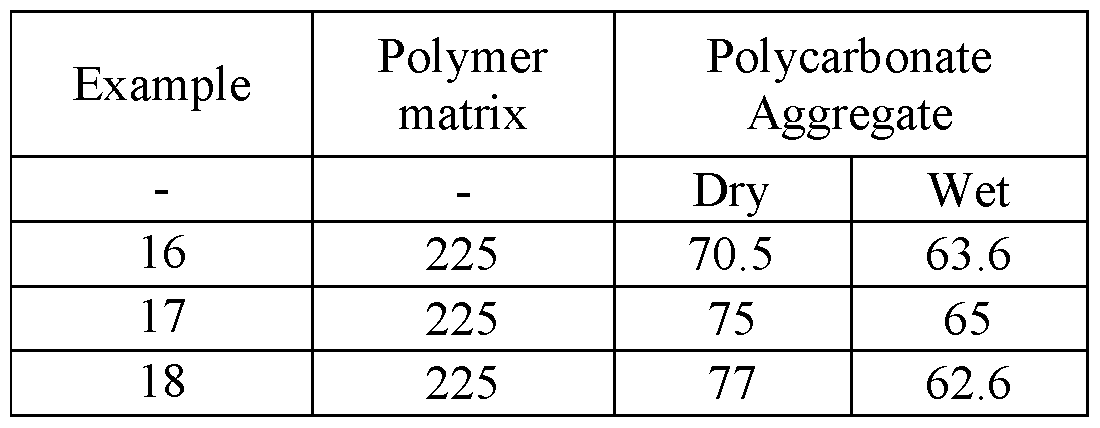
- Examples were prepared using polymer matrix comprising a one-component polyurethane polymer commercially available from BASF Corporation under the designation MASTERSEAL 225 and different thermoset polymeric aggregates.
- the polymeric aggregate used in example 16 was CLEAR-CUT polycarbonate.
- the polymeric aggregate used in example 17 was melamine formaldehyde.
- the polymeric aggregate used in example 18 was urea formaldehyde. All of the polymeric aggregates used in the inventive examples 16-18 are commercially available from Composition Materials Co., Inc.
- the mix ratio of the polymer matrix to the polymeric aggregate for each of examples 16-18 was 2: 1 by volume. The result of the slip resistance testing are shown in Table 3.
- Table 3 shows an overall improvement in both dry and wet slip resistance of coating compositions comprising polycarbonate, melamine or urea aggregate, as compared to coating compositions using crystalline silica sand aggregate as the anti-slip additive.
- Example 19 was a blend of MASTERSEAL TC 225 one-component polyurethane polymer matrix and CLEAR-CETT polycarbonate aggregate at a mix ratio of 2: 1 (polymer matrix to aggregate).
- Example 20 was a blend of MASTERSEAL TC 275 two-component polyurethane polymer matrix and CLEAR-CUT polycarbonate aggregate at a mix ratio of 2: 1 (polymer matrix to aggregate).
- Example 21 was a blend of MASTERSEAL TC 295 two-component polyurethane polymer matrix and CLEAR-CUT polycarbonate aggregate at a mix ratio of 2: 1 (polymer matrix to aggregate). All three examples of the inventive coating composition were easily applied to the surface of a horizontal substrate with a roller. Each of the examples exhibited excellent appearance and texture that was suitable as a slip resistant coating for pedestrian traffic.
- Figure 5 A is a photograph of the coating composition of Example 19 applied to a substrate.
- Figure 5B is a photograph of the coating composition of Example 20 applied to a substrate. Both Figures 5A and 5B demonstrate that the cured coating have an aesthetically pleasing appearance and suitable textured surface to provide a slip resistant coating for traffic.
- Example 22 was a blend of MASTERSEAL TC 225 one-component polyurethane polymer matrix and CLEAR-CETT polycarbonate aggregate at a mix ratio of 4: 1 (polymer matrix to aggregate).
- Example 23 was a blend of MASTERSEAL TC 225 one-component polyurethane polymer matrix and CLEAR-CUT polycarbonate aggregate at a mix ratio of 6: 1 (polymer matrix to aggregate).
- Example 24 was a blend of MASTERSEAL TC 225 one-component polyurethane polymer matrix and CLEAR-CUT polycarbonate aggregate at a mix ratio of 8: 1 (polymer matrix to aggregate).
- the examples of the inventive coating composition were easily applied to the surface of a horizontal substrate with a roller.
- FIG. 6A is a photograph of the coating composition of Example 22 applied to a substrate.
- Figure 6B is a photograph of the coating composition of Example 23 applied to a substrate.
- Figure 6B is a photograph of the coating composition of Example 24 applied to a substrate.
- Figures 6A-6C demonstrate that the cured coating have an aesthetically pleasing appearance and suitable textured surface to provide a slip resistant coating for traffic.
Landscapes
- Chemical & Material Sciences (AREA)
- Organic Chemistry (AREA)
- Engineering & Computer Science (AREA)
- Materials Engineering (AREA)
- Life Sciences & Earth Sciences (AREA)
- Wood Science & Technology (AREA)
- Health & Medical Sciences (AREA)
- Chemical Kinetics & Catalysis (AREA)
- Medicinal Chemistry (AREA)
- Polymers & Plastics (AREA)
- Paints Or Removers (AREA)
- Application Of Or Painting With Fluid Materials (AREA)
Abstract
Description



Claims
Priority Applications (4)
| Application Number | Priority Date | Filing Date | Title |
|---|---|---|---|
| US17/272,322 US12264256B2 (en) | 2018-09-28 | 2019-09-27 | Slip-resistant coating, method of coating a substrate and a coated substrate |
| CA3112659A CA3112659A1 (en) | 2018-09-28 | 2019-09-27 | Slip-resistant coating, method of coating a substrate and a coated substrate |
| MX2021003236A MX2021003236A (en) | 2018-09-28 | 2019-09-27 | Slip-resistant coating, method of coating a substrate and a coated substrate. |
| US19/066,590 US20250197669A1 (en) | 2018-09-28 | 2025-02-28 | Slip-resistant coating, method of coating a substrate and a coated substrate |
Applications Claiming Priority (2)
| Application Number | Priority Date | Filing Date | Title |
|---|---|---|---|
| US201862739136P | 2018-09-28 | 2018-09-28 | |
| US62/739,136 | 2018-09-28 |
Related Child Applications (2)
| Application Number | Title | Priority Date | Filing Date |
|---|---|---|---|
| US17/272,322 A-371-Of-International US12264256B2 (en) | 2018-09-28 | 2019-09-27 | Slip-resistant coating, method of coating a substrate and a coated substrate |
| US19/066,590 Continuation US20250197669A1 (en) | 2018-09-28 | 2025-02-28 | Slip-resistant coating, method of coating a substrate and a coated substrate |
Publications (1)
| Publication Number | Publication Date |
|---|---|
| WO2020069462A1 true WO2020069462A1 (en) | 2020-04-02 |
Family
ID=68296683
Family Applications (1)
| Application Number | Title | Priority Date | Filing Date |
|---|---|---|---|
| PCT/US2019/053685 Ceased WO2020069462A1 (en) | 2018-09-28 | 2019-09-27 | Slip-resistant coating, method of coating a substrate and a coated substrate |
Country Status (4)
| Country | Link |
|---|---|
| US (2) | US12264256B2 (en) |
| CA (1) | CA3112659A1 (en) |
| MX (1) | MX2021003236A (en) |
| WO (1) | WO2020069462A1 (en) |
Families Citing this family (2)
| Publication number | Priority date | Publication date | Assignee | Title |
|---|---|---|---|---|
| CN110919653B (en) * | 2019-11-29 | 2021-09-17 | 深圳市优必选科技股份有限公司 | Stair climbing control method and device for robot, storage medium and robot |
| EP4396805A1 (en) * | 2021-09-01 | 2024-07-10 | Recreational Systems International B.V. | Printable modular floor tiles |
Citations (4)
| Publication number | Priority date | Publication date | Assignee | Title |
|---|---|---|---|---|
| US3527146A (en) * | 1969-02-10 | 1970-09-08 | Porter Paint Co | Non-skid traffic bearing surfaces |
| WO1998000241A1 (en) * | 1996-07-03 | 1998-01-08 | Boogaard Beheer B.V. | Preparation and method for applying an anti-slip layer to a surface and product provided with an anti-slip layer |
| US20080167401A1 (en) * | 2007-01-05 | 2008-07-10 | David Robinson | Two-Part Lightweight and Low Heavy Metal Content Epoxy Non-Skid Coating for a Deck or Floor |
| EP3088632A1 (en) * | 2013-12-23 | 2016-11-02 | Two H Chem Ltd. | Anti-slip flooring material, method for manufacturing anti-slip flooring material, and method for constructing floor by using anti-slip flooring material |
Family Cites Families (1)
| Publication number | Priority date | Publication date | Assignee | Title |
|---|---|---|---|---|
| US6632860B1 (en) * | 2001-08-24 | 2003-10-14 | Texas Research International, Inc. | Coating with primer and topcoat both containing polysulfide, epoxy resin and rubber toughener |
-
2019
- 2019-09-27 CA CA3112659A patent/CA3112659A1/en active Pending
- 2019-09-27 MX MX2021003236A patent/MX2021003236A/en unknown
- 2019-09-27 US US17/272,322 patent/US12264256B2/en active Active
- 2019-09-27 WO PCT/US2019/053685 patent/WO2020069462A1/en not_active Ceased
-
2025
- 2025-02-28 US US19/066,590 patent/US20250197669A1/en active Pending
Patent Citations (4)
| Publication number | Priority date | Publication date | Assignee | Title |
|---|---|---|---|---|
| US3527146A (en) * | 1969-02-10 | 1970-09-08 | Porter Paint Co | Non-skid traffic bearing surfaces |
| WO1998000241A1 (en) * | 1996-07-03 | 1998-01-08 | Boogaard Beheer B.V. | Preparation and method for applying an anti-slip layer to a surface and product provided with an anti-slip layer |
| US20080167401A1 (en) * | 2007-01-05 | 2008-07-10 | David Robinson | Two-Part Lightweight and Low Heavy Metal Content Epoxy Non-Skid Coating for a Deck or Floor |
| EP3088632A1 (en) * | 2013-12-23 | 2016-11-02 | Two H Chem Ltd. | Anti-slip flooring material, method for manufacturing anti-slip flooring material, and method for constructing floor by using anti-slip flooring material |
Also Published As
| Publication number | Publication date |
|---|---|
| CA3112659A1 (en) | 2020-04-02 |
| US20250197669A1 (en) | 2025-06-19 |
| US12264256B2 (en) | 2025-04-01 |
| MX2021003236A (en) | 2021-05-12 |
| US20210189171A1 (en) | 2021-06-24 |
Similar Documents
| Publication | Publication Date | Title |
|---|---|---|
| US20250197669A1 (en) | Slip-resistant coating, method of coating a substrate and a coated substrate | |
| US9643887B2 (en) | Low dust joint compound and method of making the same | |
| CN102741480B (en) | Method for manufacturing pavement for outdoor facilities, facing material used therein, and pavement for outdoor facilities obtained therefrom | |
| AU2012344079B2 (en) | Repair method for road surfacings, in particular for open-pored asphalts | |
| JP2005538276A (en) | Resin mortar composition for building and floor construction method using the same | |
| US20210340401A1 (en) | Slip-resistant coating, method of coating a substrate and a coated substrate | |
| JP2512560B2 (en) | How to finish an elastic pavement surface | |
| US9221996B2 (en) | Process for repairing road surfacing systems, in particular for open-pore asphalts | |
| US20110183558A1 (en) | Coatings containing grouts or mortars | |
| KR102602458B1 (en) | Coating compositions for multilayer coating | |
| KR101241795B1 (en) | Process for paving with non-slip paving material | |
| JP4446364B2 (en) | Floor and its construction method | |
| JP2005282128A (en) | Resin pavement and method for finishing surface of resin pavement | |
| JP2005273147A (en) | Floor and its construction method | |
| US11326074B2 (en) | Slurry floor treatment technology, such as curable epoxy resin-based systems, other resin systems, and related resin coat methods | |
| JP2003013589A (en) | Floor adjusting material, floor and construction method thereof | |
| JP3796153B2 (en) | Repair floor and its construction method | |
| JP7394652B2 (en) | Concrete spalling prevention material and concrete spalling prevention method | |
| KR102891026B1 (en) | Floor crack repair and epoxy reconstruction method of underground parking lot floor capable of solving re-cracking and leaking | |
| JP7668559B2 (en) | Road construction method and road structure | |
| JP2004183388A (en) | Floor structure body and its construction method | |
| NZ625147B2 (en) | Repair method for road surfacings, in particular for open-pored asphalts | |
| JPH02194201A (en) | Paving method for road surface | |
| und Belag et al. | Technical Specification and Installation of Floor Levelling Compounds | |
| JPS6033911A (en) | elastic pavement method |
Legal Events
| Date | Code | Title | Description |
|---|---|---|---|
| 121 | Ep: the epo has been informed by wipo that ep was designated in this application |
Ref document number: 19790949 Country of ref document: EP Kind code of ref document: A1 |
|
| ENP | Entry into the national phase |
Ref document number: 3112659 Country of ref document: CA |
|
| WWE | Wipo information: entry into national phase |
Ref document number: MX/A/2021/003236 Country of ref document: MX |
|
| NENP | Non-entry into the national phase |
Ref country code: DE |
|
| WWP | Wipo information: published in national office |
Ref document number: MX/A/2021/003236 Country of ref document: MX |
|
| 122 | Ep: pct application non-entry in european phase |
Ref document number: 19790949 Country of ref document: EP Kind code of ref document: A1 |
|
| WWG | Wipo information: grant in national office |
Ref document number: 17272322 Country of ref document: US |
|
| WWG | Wipo information: grant in national office |
Ref document number: MX/A/2021/003236 Country of ref document: MX |