WO2020065086A1 - Selenoester-containing compounds for use in the treatment of microbial infections or colorectal cancer - Google Patents
Selenoester-containing compounds for use in the treatment of microbial infections or colorectal cancer Download PDFInfo
- Publication number
- WO2020065086A1 WO2020065086A1 PCT/EP2019/076366 EP2019076366W WO2020065086A1 WO 2020065086 A1 WO2020065086 A1 WO 2020065086A1 EP 2019076366 W EP2019076366 W EP 2019076366W WO 2020065086 A1 WO2020065086 A1 WO 2020065086A1
- Authority
- WO
- WIPO (PCT)
- Prior art keywords
- compound
- cyanomethyl
- mmol
- bis
- formula
- Prior art date
- Legal status (The legal status is an assumption and is not a legal conclusion. Google has not performed a legal analysis and makes no representation as to the accuracy of the status listed.)
- Ceased
Links
- LBKWODMDJMCDJL-UHFFFAOYSA-N CC(C)(C)c(cc1)ccc1C(SCC#N)=O Chemical compound CC(C)(C)c(cc1)ccc1C(SCC#N)=O LBKWODMDJMCDJL-UHFFFAOYSA-N 0.000 description 1
- UCWUWQXMTXGFNJ-UHFFFAOYSA-N CC(CSC(c(c(F)c1)ccc1F)=O)=O Chemical compound CC(CSC(c(c(F)c1)ccc1F)=O)=O UCWUWQXMTXGFNJ-UHFFFAOYSA-N 0.000 description 1
- ZGXHMWNPVSXCSF-UHFFFAOYSA-N Cc(cc1)ccc1C(SCC#N)=O Chemical compound Cc(cc1)ccc1C(SCC#N)=O ZGXHMWNPVSXCSF-UHFFFAOYSA-N 0.000 description 1
- MCABVAFIVUKINT-UHFFFAOYSA-N N#CCSC(c1ccccc1F)=O Chemical compound N#CCSC(c1ccccc1F)=O MCABVAFIVUKINT-UHFFFAOYSA-N 0.000 description 1
Classifications
-
- C—CHEMISTRY; METALLURGY
- C07—ORGANIC CHEMISTRY
- C07C—ACYCLIC OR CARBOCYCLIC COMPOUNDS
- C07C391/00—Compounds containing selenium
-
- A—HUMAN NECESSITIES
- A61—MEDICAL OR VETERINARY SCIENCE; HYGIENE
- A61K—PREPARATIONS FOR MEDICAL, DENTAL OR TOILETRY PURPOSES
- A61K31/00—Medicinal preparations containing organic active ingredients
- A61K31/095—Sulfur, selenium, or tellurium compounds, e.g. thiols
-
- A—HUMAN NECESSITIES
- A61—MEDICAL OR VETERINARY SCIENCE; HYGIENE
- A61K—PREPARATIONS FOR MEDICAL, DENTAL OR TOILETRY PURPOSES
- A61K31/00—Medicinal preparations containing organic active ingredients
- A61K31/12—Ketones
-
- A—HUMAN NECESSITIES
- A61—MEDICAL OR VETERINARY SCIENCE; HYGIENE
- A61K—PREPARATIONS FOR MEDICAL, DENTAL OR TOILETRY PURPOSES
- A61K31/00—Medicinal preparations containing organic active ingredients
- A61K31/275—Nitriles; Isonitriles
- A61K31/277—Nitriles; Isonitriles having a ring, e.g. verapamil
-
- A—HUMAN NECESSITIES
- A61—MEDICAL OR VETERINARY SCIENCE; HYGIENE
- A61P—SPECIFIC THERAPEUTIC ACTIVITY OF CHEMICAL COMPOUNDS OR MEDICINAL PREPARATIONS
- A61P31/00—Antiinfectives, i.e. antibiotics, antiseptics, chemotherapeutics
- A61P31/04—Antibacterial agents
-
- A—HUMAN NECESSITIES
- A61—MEDICAL OR VETERINARY SCIENCE; HYGIENE
- A61P—SPECIFIC THERAPEUTIC ACTIVITY OF CHEMICAL COMPOUNDS OR MEDICINAL PREPARATIONS
- A61P35/00—Antineoplastic agents
-
- Y—GENERAL TAGGING OF NEW TECHNOLOGICAL DEVELOPMENTS; GENERAL TAGGING OF CROSS-SECTIONAL TECHNOLOGIES SPANNING OVER SEVERAL SECTIONS OF THE IPC; TECHNICAL SUBJECTS COVERED BY FORMER USPC CROSS-REFERENCE ART COLLECTIONS [XRACs] AND DIGESTS
- Y02—TECHNOLOGIES OR APPLICATIONS FOR MITIGATION OR ADAPTATION AGAINST CLIMATE CHANGE
- Y02A—TECHNOLOGIES FOR ADAPTATION TO CLIMATE CHANGE
- Y02A50/00—TECHNOLOGIES FOR ADAPTATION TO CLIMATE CHANGE in human health protection, e.g. against extreme weather
- Y02A50/30—Against vector-borne diseases, e.g. mosquito-borne, fly-borne, tick-borne or waterborne diseases whose impact is exacerbated by climate change
Definitions
- the invention relates to a compound of formula I for use in the treatment of microbial infections or colorectal cancer.
- Colorectal cancer is one of the most frequent types of cancer, only behind lung and breast cancer (Globocan 2012) and thus finding novel treatments of this cancer location is crucial for the health systems.
- Colorectal cancer also known as bowel cancer and colon cancer, is the development of cancer from the colon or rectum (parts of the large intestine). Treatments used for colorectal cancer may include some combination of surgery, radiation therapy, chemotherapy and targeted therapy.
- Clostridium difficile methicillin resistant Staphylococcus aureus (MRSA), Streptococcus pneumoniae, Enterobacteriaceae (including known bacterial strains as Escherichia coli, Klebsiella pneumonia, Enterococcus spp. and Salmonella typhimurium, among others), Acinetobacter baumanii and Candida spp. All these microbes can cause healthcare-associated infections Antibiotics Resistance Threats, US 2013", US Centers for Disease Control and Prevention).
- MRSA methicillin resistant Staphylococcus aureus
- Streptococcus pneumoniae Enterobacteriaceae
- Enterobacteriaceae including known bacterial strains as Escherichia coli, Klebsiella pneumonia, Enterococcus spp. and Salmonella typhimurium, among others
- Acinetobacter baumanii and Candida spp. All these microbes can cause healthcare-associated infections Antibiotics Resistance Threats, US 2013", US Centers for Disease Control and Prevention
- MRSA can cause a range of bacterial illnesses, such as skin infections, wound infections, endocarditis, osteomyelitis, severe pneumonia, arthritis and bloodstream infections which can cause sepsis (Dayan et al, 2016, Expert Rev Vaccines, 15:1373-1392). And the fungi Candida, especially those strains resistant to fluconazole, can cause candidiasis, a severe nosocomial bloodstream infection (Ben-Ami, 2018, J Fungi, 4:E97).
- One aspect of the present invention relates to a compound of formula I for use in the treatment of microbial infections or colorectal cancer:
- Ri represents -Ph, -CN, -PhRs, -CORs, -SR5, -(SO)Rs or -(S02)Rs;
- R 2 represents -H, -CH 3 , -CH 2 CH 3 , -Ph or -COCH 3 ;
- each R 3 independently represents -(CH2)rCOSeCHR2-(CH2)n-Ri;
- each R 4 independently represents -H, -F, -Cl, -Br, -I, -(CH2) t H, -CH(CH 3 )2, -C(CH 3 ) 3 ,
- each R5 independently represents -(CH2) t H, -CH(CH 3 )2, -C(CH 3 ) 3 , -CF 3 , -Ph or -PhR 4 ; each R 6 independently represents -(CH2) t H, -CH(CH 3 )2, -C(CH 3 ) 3 or -Ph;
- t represents an integer that ranges between 1 and 6;
- X represents CH, N or S
- p 0 or 1 ;
- n an integer that ranges between 0 and 5;
- q 0, 1 or 2;
- r 0, 1 or 2;
- s represents an integer that ranges between 1 and 3
- the present invention also relates to the salts and solvates of the compounds of formula I.
- Some compounds of formula I can have chiral centers which can give rise to various stereoisomers.
- the present invention relates to each of these stereoisomers and also to mixtures thereof.
- the invention relates to a compound of formula I for use in the treatment of microbial infections or colorectal cancers defined above, wherein Ri represents -PhR 5 , -CORs, -SR5, -(SO)R5 or -(S0 2 )R5.
- the invention relates to a compound of formula I for use in the treatment of microbial infections or colorectal cancers as defined above, wherein R 2 represents -H.
- the invention relates to a compound of formula I for use in the treatment of a microbial infection or colorectal cancers defined above, wherein each R 4 independently represents -H, -F, -Br, -I, -(CH2) t H, -CH(CH3)2, -C(CH3)3, -OH, -OCOR 6 , -SRe, -(SO)R 6 , -(S0 2 )R 6 , -CN, -CF 3 , -COR 6 , -COOH, -Ph, -NH 2 , -NHR 6 , -N(R 6 ) 2 , or - NO2, preferably wherein each R 4 independently represents -H, -F, -Br, -I, -(CH2) t H, - CH(CH 3 ) 2 , -C(CH 3 ) 3 , -OCORe, -SR 6 , -(SO)R 6 , -(
- the invention relates to a compound of formula I for use in the treatment of microbial infections or colorectal cancers defined above, wherein t represents an integer that ranges between 1 and 3, and preferably wherein t represents 1.
- the invention relates to a compound of formula I for use in the treatment of microbial infections or colorectal cancers defined above, wherein n represents 0.
- the invention relates to a compound of formula I for use in the treatment of microbial infections or colorectal cancers defined above, wherein: Ri represents -PhR 5 , -CORs, -SR5, -(SO)Rs or -(S0 2 )Rs; and
- R2 represents -H.
- the invention relates to a compound of formula I for use in the treatment of microbial infections or colorectal cancers defined above, wherein:
- R1 represents -PhR 5 , -COR5, -SR5, -(SO)Rs or -(S02)Rs;
- R2 represents -H
- each R 4 independently represents -H, -F, -Br, -I, -(CH2) t H, -CH(CH 3 ) 2 , -C(CH 3 ) 3 , -OH, - OCORe, -SR 6 , -(SO)R 6 , -(S0 2 )R 6 , -CN, -CF 3 , -COR 6 , -COOH, -Ph, -NH 2 , -NHR 6 , - N(R 6 ) 2 , or -NO 2 , preferably wherein each R 4 independently represents -H, -F, -Br, -I, - (CH 2 )tH, -CH(CH 3 ) 2 , -C(CH 3 ) 3 , -OCORe, -SRe, -(SO)Re, -(S0 2 )R 6 , -CN, -CF 3 , -CORe, -
- the invention relates to a compound of formula I for use in the treatment of microbial infections or colorectal cancers defined above, wherein:
- R1 represents -PhRs, -COR5, -SR5, -(SO)Rs or -(S02)Rs;
- each R 4 independently represents -H, -F, -Br, -I, -(CH 2 ) t H, -CH(CH 3 ) 2 , -C(CH 3 ) 3 , -OH, - OCORe, -SRe, -(SO)Re, -(S0 2 )Re, -CN, -CF 3 , -CORe, -COOH, -Ph, -NH 2 , -NHRe, - N(Re)2, or -NO 2 , preferably wherein each R 4 independently represents -H, -F, -Br, -I, - (CH 2 )tH, -CH(CH 3 ) 2 , -C(CH 3 ) 3 , -OCORe, -SRe, -(SO)Re, -(S0 2 )Re, -CN, -CF 3 , -CORe, - COOH, -Ph, -NH 2
- the invention relates to a compound of formula I for use in the treatment of microbial infections or colorectal cancers defined above, wherein:
- R2 represents -H
- each R 4 independently represents -H, -F, -Br, -I, -(CH 2 ) t H, -CH(CH 3 ) 2 , -C(CH 3 ) 3 , -OH, - OCORe, -SRe, -(SO)Re, -(S0 2 )Re, -CN, -CF 3 , -CORe, -COOH, -Ph, -NH 2 , -NHRe, - N(Re) 2 , or -NO 2 , preferably wherein each R 4 independently represents -H, -F, -Br, -I, - (CH 2 ) t H, -CH(CH 3 ) 2 , -C(CH 3 ) 3 , -OCORe, -SR 6 , -(SO)R 6 , -(S0 2 )R 6 , -CN, -CF 3 , -COR 6 , - COOH,
- the invention relates to a compound of formula I for use in the treatment of microbial infections or colorectal cancers defined above, wherein:
- t represents an integer that ranges between 1 and 3, and preferably t represents 1 ; and n represents 0.
- the invention relates to a compound of formula I for use in the treatment of microbial infections or colorectal cancers defined above, wherein:
- Ri represents -PhRs, -CORs, -SR5, -(SO)Rs or -(S0 2 )Rs;
- R 2 represents -H
- each R 4 independently represents -(CH 2 ) t H or -CN;
- t represents an integer that ranges between 1 and 3, and preferably t represents 1 ; and n represents 0.
- the invention relates to a compound of formula I for use in the treatment of microbial infections or colorectal cancers as defined above, selected from: Se-(cyanomethyl) 4-fluorobenzoselenoate (1 );
- the invention relates to a compound of formula I for use in the treatment of microbial infections or colorectal cancers as defined above, selected from: Se-(cyanomethyl) 4-chlorobenzoselenoate (3);
- the invention relates to a compound of formula I for use in the treatment of microbial infections or colorectal cancers as defined above, selected from: Se-(cyanomethyl) 4-chlorobenzoselenoate (3);
- the invention relates to a compound of formula I for use in the treatment of microbial infections caused by Staphylococcus aureus, methicillin resistant Staphylococcus aureus, Candida spp and/or Escherichia coli or colorectal cancers.
- Another aspect of the present invention relates to a compound of formula II:
- Ri represents -CN, -PhRs, -SRs, -(SO)Rs or -(SC ⁇ Rs;
- R 2 represents -H, -Chh, -CH2CH3 or -COCH3;
- each R3 independently represents -[CH2]rCOSeCHR2-[CH2]n-Ri;
- each R 4 independently represents -H, -F, -Cl, -Br, -I, -(CH2) t H, -CH(CH3)2, -C(CH3)3,
- each R5 independently represents -(CH2)tH, -CH(CH3)2, -C(CH3)3, -CF3, -Ph, -PhR 4; each Re independently represents -(CH2)tH, -CH(CH3)2, -C(CH3)3, -CF3, -PhRe; each R7 independently represents -(CH2) t H, -CH(CH3)2, -C(CH3)3, -Ph;
- Re represents -F, -Cl, -Br, -I, -(CH 2 ) t H, -CH(CH 3 ) 2 , -C(CH 3 ) 3 , -OH, -OR 7 , -SR 7 , -(SO)R 7 , -(S0 2 )R 7 , -CN, -CF 3 , -COR7, -COOH, -Ph, -NH 2 , -NH(R 6 ) 2 , -N(R 7 ) 2 or -N0 2 ; t represents an integer that ranges between 1 and 6;
- X represents CH, N or S
- p 0 or 1 ;
- n an integer that ranges between 0 and 5;
- q 0, 1 or 2;
- r 0, 1 or 2;
- s represents an integer that ranges between 1 and 3
- the invention relates to a compound of formula II as defined above, wherein F3 ⁇ 4 represents -H.
- the invention relates to a compound of formula II as defined above, wherein each R 4 independently represents -(CH2) t H or -CN.
- the invention relates to a compound of formula II as defined above, wherein t represents 1.
- the invention relates to a compound of formula II as defined above, wherein n represents 0.
- the invention relates to a compound of formula II selected from: Se-(cyanomethyl) 4-fluorobenzoselenoate (1 );
- the invention relates to a compound of formula II selected from: Se-(cyanomethyl) 4-fluorobenzoselenoate (1 );
- the invention relates to a compound of formula II selected from: Se-(cyanomethyl) 4-chlorobenzoselenoate (3);
- the invention relates to a compound of formula II selected from: Se-(cyanomethyl) 4-chlorobenzoselenoate (3);
- Another aspect of the present invention relates to a compound of formula II as defined above or a pharmaceutical salt thereof for use in therapy.
- Another aspect of the present invention relates to a compound of formula II as defined above or a pharmaceutical salt thereof for use in the treatment of microbial infections, preferably for use in the treatment of microbial infections caused by Staphylococcus aureus, methicillin resistant Staphylococcus aureus, Candida spp and/or Escherichia coli, or colorectal cancer.
- Another aspect of the present invention relates to a method of treating a microbial infections, preferably for use in the treatment of microbial infections caused by Staphylococcus aureus, methicillin resistant Staphylococcus aureus, Candida spp and/or Escherichia coli, or colorectal cancer in a subject in need thereof, especially a human being, which comprises administering to said subject an effective amount of a compound of formula II as defined above or a pharmaceutically acceptable salt thereof.
- a pharmaceutical composition which comprises a compound of formula II as defined above or a pharmaceutically acceptable salt thereof and one or more pharmaceutically acceptable excipients.
- Another aspect of this invention relates to a pharmaceutical composition, which comprises a compound of formula II as defined above or a pharmaceutically acceptable salt thereof and one or more pharmaceutically acceptable excipients, for use in therapy.
- compositions which comprises a compound of formula II as defined above or a pharmaceutically acceptable salt thereof and one or more pharmaceutically acceptable excipients, for use in the treatment of microbial infections, preferably for use in the treatment of microbial infections caused by Staphylococcus aureus, methicillin resistant
- Staphylococcus aureus Candida spp and/or Escherichia coli, or colorectal cancer.
- pharmaceutically acceptable salt refers to those salts which are, according to medical judgment, suitable for use in contact with the tissues of humans and other mammals without undue toxicity, irritation, allergic response and the like. Pharmaceutically acceptable salts are well known in the art.
- the salts of a compound of formula I and II can be obtained during the final isolation and purification of the compounds of the invention or can be prepared by treating a compound of formula I and II with a sufficient amount of the desired acid or base to yield the salt in a conventional manner.
- the salts of the compounds of formula I and II can be converted into other salts of the compounds of formula I and II by ion exchange using ionic exchange resins.
- the compounds of formula I and II and their salts may differ in some physical properties but they are equivalent for the purposes of the present invention. All salts of the compounds of formula I and II are included within the scope of the invention.
- the compounds of the present invention may form complexes with solvents in which they are reacted or from which they are precipitated or crystallized. These complexes are known as solvates.
- solvate refers to a complex of variable stoichiometry formed by a solute (a compound of formula I and II or a salt thereof) and a solvent.
- solvents include pharmaceutically acceptable solvents such as water, ethanol and the like.
- a complex with water is known as a hydrate.
- Solvates of compounds of the invention (or salts thereof), including hydrates, are included within the scope of the invention.
- the compounds of formula I and II may exist in different physical forms, i.e. amorphous and crystalline forms. Moreover, the compounds of the invention may have the ability to crystallize in more than one form, a characteristic which is known as polymorphism. Polymorphs can be distinguished by various physical properties well known in the art such as X-ray diffraction pattern, melting point or solubility. All physical forms of the compounds of formula I and II, including all polymorphic forms (“polymorphs”) thereof, are included within the scope of the invention.
- Some of the compounds of the present invention may exist as several diastereoisomers and/or several optical isomers.
- Diastereoisomers can be separated by conventional techniques such as chromatography or fractional crystallization.
- Optical isomers can be resolved by conventional techniques of optical resolution to give optically pure isomers. This resolution can be carried out on any chiral synthetic intermediate or on products of formula I and II.
- Optically pure isomers can be obtained individually using enantiospecific synthesis.
- the present invention covers all individual isomers as well as mixtures thereof (for example racemic mixtures or mixtures of diastereomers), whether obtained by synthesis or by physically mixing them.
- the mixture was filtered and an equivalent of the adequate alkyl halide was added to the filtrate, and mixture was left reacting till the end of the reaction (usually one hour at 50°C and one hour at room temperature).
- Compound was isolated and purified applying the appropriate techniques in each case (usually filtration and washings for solids; and for liquids, extraction and column chromatography).
- the proportions of the different reagents can vary for the derivatives that contain two or three selenium atoms.
- Acyl chlorides or alkyl halides if not commercially available, can be synthesized using suitable chemical reactions, as for example the chlorination of the corresponding carboxylic acid with thionyl chloride, or the bromination of the appropriate starting material with /V-bromosuccinimide, respectively.
- Ri, R 2 , F3 ⁇ 4, R 4 , X, p, n, q, r and s have the meaning previously described in relation with a compound of formula I or II.
- H 2Ph + H 6Ph H 2Ph + H 6Ph ); 3.90 (s, 2H, PhCHz); 3.43 (s, 2H, SeCH 2 ).
- Se-(cyanomethyl) 2,4-dichlorobenzoselenoate (13) From sodium borohydride (0.360 g, 9.52 mmol), grey selenium (0.357 g, 4.52 mmol),
- Cytotoxicity assays in human colonic adenocarcinoma cell lines Colo 205 doxorubicin- sensitive (ATCC-CCL-222) and Colo 320/MDR-LRP multidrug resistant overexpressing ABCB1 (MDRI )-LRP (ATCC-CCL-220.1 ) were performed following the procedure described by Gajdacs et al, 2017, Bioorg Med Chem Lett. 27(4): 797-802. The effects of increasing concentrations of selenium compounds on cell growth were tested in 96- well flat-bottomed microtiter plates.
- the selectivity of the action towards cancer cells was assessed through the evaluation of cytotoxic activity in a non-tumoral cell line, the MRC-5 human embryonal lung fibroblast cell lines (ATCC CCL-171 ), as described in Gajdacs et al, 2017, Bioorg Med Chem Lett. 27(4): 797-802.
- All cell lines were purchased from LGC Promochem, Teddington, UK.
- the colonic cells were cultured in RPMI 1640 medium supplemented with 10% heat-inactivated fetal bovine serum, 2 mM L-glutamine, 1 mM Na-pyruvate and 100 mM Hepes.
- the cell lines were incubated at 37 ° C, in a 5% CO2, 95% air atmosphere.
- the semi-adherent human colon cancer cells were detached with Trypsin-Versene (EDTA) solution for 5 min at 37°C.
- EDTA Trypsin-Versene
- MRC-5 cells was cultured in Eagle’s Minimal Essential Medium (EMEM, containing 4.5 g/L glucose) supplemented with a non-essential amino acid mixture, a selection of vitamins and 10% heat-inactivated fetal bovine serum.
- EMEM Eagle’s Minimal Essential Medium
- the cell lines were incubated at 37 ° C, in a 5% CO2, 95% air atmosphere.
- the compounds were diluted in a volume of 100 mI_ of medium.
- the two-fold serial dilutions of selenocompounds were prepared in 100 mI_ of RPMI 1640, horizontally.
- the semi-adherent colonic adenocarcinoma cells were treated with Trypsin-Versene (EDTA) solution. They were adjusted to a density of 2x10 4 cells in 100 mI_ of RPMI 1640 medium, and were added to each well, with the exception of the medium control wells.
- the final volume of the wells containing selenocompounds and cells was 200 mI_.
- the culture plates were incubated at 37 ° C for 24 h; at the end of the incubation period, 20 mI_ of MTT (thiazolyl blue tetrazolium bromide, Sigma) solution (from a stock solution of 5 mg/ml_) were added to each well. After incubation at 37°C for 4 h, 100 pL of sodium dodecyl sulfate (SDS) (Sigma) solution (10% in 0.01 M HCI) were added to each well and the plates were further incubated at 37 ° C overnight. Cell growth was determined by measuring the optical density (OD) at 540/630 nm with Multiscan EX ELISA reader (Thermo Labsystems, Cheshire, WA, USA). Inhibition of the cell growth was determined according to the formula below:
- results are expressed in terms of I C50, defined as the inhibitory dose that reduces the growth of the cells exposed to the tested compounds by 50%.
- the selectivity indexes were calculate, being SI the quotient of the IC50 in non-tumoral cells (MRC-5) and the respective cancer cell (Colo-205 or Colo-320). Compound is considered moderately selective when SI ⁇ 6 and > 3; and strongly selective when SI > 6.
- I C50 values have been calculated as mentioned above in the methodology of evaluation of the cytotoxic activity and assessment of the selectivity. To express the cytotoxicity results in Table 2, four intervals have been defined in function of the I C50 values:
- This method is a fluorescence-based detection system which uses verapamil as reference inhibitor of the ABCB1 efflux pump.
- the colonic adenocarcinoma cells (the doxorubicin- sensitive Colo 205 and the multidrug resistant Colo 320) were adjusted to a density of 2x10 6 /mL, re-suspended in serum-free RPMI 1640 medium and distributed in 0.5 ml_ aliquots into Eppendorf centrifuge tubes.
- Verapamil was used as a positive control at 20 mM final concentration in the rhodamine 123 exclusion experiments.
- the mean fluorescence intensity (%) was calculated for the treated multidrug resistance (MRD) Colo 320 and sensitive Colo 205 cell lines as compared to the untreated cells.
- the fluorescence activity ratio (FAR) was calculated based on the following equation which relates the measured fluorescence values:
- MIC values have been calculated as mentioned above in the methodology of determination of the MIC values in different bacterial strains. To express the antibacterial activity in Table 4, five intervals have been defined in function of the MIC values:
- the compounds were tested for their antifungal and nematicidal properties against the fungi Candida albicans and Saccharomyces cerevisiae, and against the nematode Steinernema feltiae.
- Fungal cell densities were determined by measuring the optical density (OD) at 570 nm at 0 h (first measurement immediately after incubation), 4 h, and 24 h after incubation at 37 °C; and using a Universal Microplate Reader, EL800, Biotech Instruments, Inc. Highland Park, Winooski, VT, USA.
- Compounds were dissolved in 1 % DMSO and were tested at final concentrations of 50, 100, 150, and 200 mM.
- Nutrient Sabouraud Dextrose (SD), and Yeast Peptone Dextrose (YPD) were used as media for C. albicans, and S. cerevisiae, respectively.
- Ketoconazole was used as the positive control for C. albicans and S. cerevisiae.
- the growth culture with medium for each organism was used as the negative control.
- PBS phosphate buffered saline
- Viability of the nematodes was determined by counting the live and dead nematodes under a light microscope (TR 200, VWR International, Leuven, Belgium) at four-fold magnification. An initial viability value of more than 90 percent was considered necessary to perform the experiments.
- the inhibitory concentration 50% is defined as the concentration that inhibits the viability of the respective organism to a 50% of the viability determined for the negative control.
- I C50 values have been calculated as mentioned above in the methodology for the evaluation of the antifungal and nematicidai activity. To express the antifungal or nematicidai activity in Table 4, five intervals have been defined in function of the I C50 values:
Landscapes
- Health & Medical Sciences (AREA)
- Chemical & Material Sciences (AREA)
- Organic Chemistry (AREA)
- Medicinal Chemistry (AREA)
- Pharmacology & Pharmacy (AREA)
- Life Sciences & Earth Sciences (AREA)
- Animal Behavior & Ethology (AREA)
- General Health & Medical Sciences (AREA)
- Public Health (AREA)
- Veterinary Medicine (AREA)
- Epidemiology (AREA)
- Chemical Kinetics & Catalysis (AREA)
- General Chemical & Material Sciences (AREA)
- Nuclear Medicine, Radiotherapy & Molecular Imaging (AREA)
- Communicable Diseases (AREA)
- Oncology (AREA)
- Pharmaceuticals Containing Other Organic And Inorganic Compounds (AREA)
Abstract
The invention relates to a compound of formula (I) for use in the treatment of microbial infections or colorectal cancer, wherein R1 to R4, X, n, p, q, r and s are defined in the description.
Description
SELENOESTER-CONTAINING COMPOUNDS FOR USE IN THE TREATMENT OF MICROBIAL INFECTIONS OR COLORECTAL CANCER
The invention relates to a compound of formula I for use in the treatment of microbial infections or colorectal cancer.
BACKGROUND ART
According to the Globocan 2012 report of the IARC, the world risk of getting cancer before age 75 is of 18.5%, and according to the annual reports of United States National Statistic System, cancer is the second leading cause of death in the United States, only behind heart diseases. Colorectal cancer (CRC) is one of the most frequent types of cancer, only behind lung and breast cancer (Globocan 2012) and thus finding novel treatments of this cancer location is crucial for the health systems. Colorectal cancer, also known as bowel cancer and colon cancer, is the development of cancer from the colon or rectum (parts of the large intestine). Treatments used for colorectal cancer may include some combination of surgery, radiation therapy, chemotherapy and targeted therapy. Selenocompounds are emerging as novel approach as many of them showed interesting activity against different cancer cells, including among them colorectal cancer cell lines such as Colo205, Colo320, HCT-1 16 and HT-29 (Gajdacs et al, 2017, Bioorg Med Chem Lett. 27(4): 797-802; Alvarez- Perez et al, 2018, Molecules, 23(3): E628).
Cancer multidrug resistance is becoming slowly a troublesome problem due to the appearance of resistant types of cancer. In this context, the search for inhibitors of efflux pumps is a promising approach in the fight against resistance (Spengler et al, 201 1 , Anticancer Res. 31 :3285-3288). These efflux pumps are proteins overexpressed by resistant cancer cells which recognize exogenous agents as anticancer drugs to extrude them out of the cell, preventing them to exert their action and thus developing resistance to them. In this context, certain selenium-containing compounds have shown a very promising capacity to inhibit the efflux pumps, showing an activity up to 4-fold higher than the reference compound. Additionally, these compounds showed a potent cytotoxic activity accompanied by a noteworthy selectivity towards cancer cells in respect to non-tumoral cells (Gajdacs et al, 2017, Bioorg Med Chem Lett. 27(4): 797-
Similarly, resistant bacterial infections are becoming a troublesome and worrying problem nowadays, due to the worldwide increase of the bacterial infections which are resistant to several antibiotics, and that are reducing the efficacy of the antibiotics currently used in clinical practice (Pages et al, 2011 , Curr Med Chem, 18:2969-80). Resistant bacterial and fungal infections caused around 27,500 deaths in 2013 in the United States alone (“Antibiotics Resistance Threats, US 2013", US Centers for Disease Control and Prevention). The bacterial and fungal strains more frequently involved in resistant infections are Clostridium difficile, methicillin resistant Staphylococcus aureus (MRSA), Streptococcus pneumoniae, Enterobacteriaceae (including known bacterial strains as Escherichia coli, Klebsiella pneumonia, Enterococcus spp. and Salmonella typhimurium, among others), Acinetobacter baumanii and Candida spp. All these microbes can cause healthcare-associated infections Antibiotics Resistance Threats, US 2013", US Centers for Disease Control and Prevention). MRSA, for instance, can cause a range of bacterial illnesses, such as skin infections, wound infections, endocarditis, osteomyelitis, severe pneumonia, arthritis and bloodstream infections which can cause sepsis (Dayan et al, 2016, Expert Rev Vaccines, 15:1373-1392). And the fungi Candida, especially those strains resistant to fluconazole, can cause candidiasis, a severe nosocomial bloodstream infection (Ben-Ami, 2018, J Fungi, 4:E97).
Within this frame, the discovery of novel effective antibiotics, or of novel inhibitors of the resistance mechanisms as the efflux pumps involved in resistance is crucial in the fight against resistant infections. Certain forms of selenium, such as sodium selenite (Kumar et al, 2010, Scand J Infect Dis, 42:266-274) or selenium nanoparticles (Cihalova et al, 2015, Int J Mol Sci, 16:24656-24672), have shown antimicrobial properties or anti-biofilm properties against resistant bacteria. Knowing the activity of the selenoester-derived compounds against resistant cancer cells (Gajdacs et al, 2017, Bioorg Med Chem Lett. 27(4): 797-802), we have tested them against selected bacterial and fungal pathogens with promising results.
Therefore, it would be desirable to have series of novel selenocompounds that include in their structure a selenoester moiety (-CO-Se-) for its use as anticancer agents and as efflux-pump inhibitors for the treatment of microbial infections
SUMMARY OF THE INVENTION
One aspect of the present invention relates to a compound of formula I for use in the treatment of microbial infections or colorectal cancer:

I
wherein:
Ri represents -Ph, -CN, -PhRs, -CORs, -SR5, -(SO)Rs or -(S02)Rs;
R2 represents -H, -CH3, -CH2CH3, -Ph or -COCH3;
each R3 independently represents -(CH2)rCOSeCHR2-(CH2)n-Ri;
each R4 independently represents -H, -F, -Cl, -Br, -I, -(CH2)tH, -CH(CH3)2, -C(CH3)3,
-OH, -OR6, -OCORe, -SR6, -(SO)R6, -(S02)R6, -CN, -CF3, -COR6, -COOH, -Ph, -NH2, - NHR6, -N(R6)2, or -N02;
each R5 independently represents -(CH2)tH, -CH(CH3)2, -C(CH3)3, -CF3, -Ph or -PhR4; each R6 independently represents -(CH2)tH, -CH(CH3)2, -C(CH3)3 or -Ph;
t represents an integer that ranges between 1 and 6;
X represents CH, N or S;
p represents 0 or 1 ;
n represents an integer that ranges between 0 and 5;
q represents 0, 1 or 2;
r represents 0, 1 or 2; and
s represents an integer that ranges between 1 and 3,
with the proviso that the following compounds are excluded:

The present invention also relates to the salts and solvates of the compounds of formula I.
Some compounds of formula I can have chiral centers which can give rise to various stereoisomers. The present invention relates to each of these stereoisomers and also to mixtures thereof.
In another embodiment the invention relates to a compound of formula I for use in the treatment of microbial infections or colorectal cancers defined above, wherein Ri represents -PhR5, -CORs, -SR5, -(SO)R5 or -(S02)R5.
In another embodiment the invention relates to a compound of formula I for use in the treatment of microbial infections or colorectal cancers as defined above, wherein R2 represents -H.
In another embodiment the invention relates to a compound of formula I for use in the treatment of a microbial infection or colorectal cancers defined above, wherein each R4 independently represents -H, -F, -Br, -I, -(CH2)tH, -CH(CH3)2, -C(CH3)3, -OH, -OCOR6, -SRe, -(SO)R6, -(S02)R6, -CN, -CF3, -COR6, -COOH, -Ph, -NH2, -NHR6, -N(R6)2, or - NO2, preferably wherein each R4 independently represents -H, -F, -Br, -I, -(CH2)tH, - CH(CH3)2, -C(CH3)3, -OCORe, -SR6, -(SO)R6, -(S02)R6, -CN, -CF3, -CORe, -COOH, - Ph, -NH2, -NHR6, -N(R6)2, or -N02, more preferably wherein each R4 independently represents -H, -F, -Br, -I, -(CH2)tH, -CH(CH3)2, -C(CH3)3, -OCORe, -CN, -CF3, -CORe, - COOH, -Ph or N02, and even more preferably wherein each R4 independently represents -(CH2)tH or -CN.
In another embodiment the invention relates to a compound of formula I for use in the treatment of microbial infections or colorectal cancers defined above, wherein t represents an integer that ranges between 1 and 3, and preferably wherein t represents 1.
In another embodiment the invention relates to a compound of formula I for use in the treatment of microbial infections or colorectal cancers defined above, wherein n represents 0.
In another embodiment the invention relates to a compound of formula I for use in the treatment of microbial infections or colorectal cancers defined above, wherein:
Ri represents -PhR5, -CORs, -SR5, -(SO)Rs or -(S02)Rs; and
R2 represents -H.
In another embodiment the invention relates to a compound of formula I for use in the treatment of microbial infections or colorectal cancers defined above, wherein:
R1 represents -PhR5, -COR5, -SR5, -(SO)Rs or -(S02)Rs;
R2 represents -H; and
each R4 independently represents -H, -F, -Br, -I, -(CH2)tH, -CH(CH3)2, -C(CH3)3, -OH, - OCORe, -SR6, -(SO)R6, -(S02)R6, -CN, -CF3, -COR6, -COOH, -Ph, -NH2, -NHR6, - N(R6)2, or -NO2, preferably wherein each R4 independently represents -H, -F, -Br, -I, - (CH2)tH, -CH(CH3)2, -C(CH3)3, -OCORe, -SRe, -(SO)Re, -(S02)R6, -CN, -CF3, -CORe, - COOH, -Ph, -NH2, -NHR6, -N(Re)2, or -NO2, more preferably wherein each R4 independently represents -H, -F, -Br, -I, -(CH2)tH, -CH(CH3)2, -C(CH3)3, -OCORe, -CN, -CF3, -CORe, -COOH, -Ph or NO2, and even more preferably wherein each R4 independently represents -(CH2)tH or -CN.
In another embodiment the invention relates to a compound of formula I for use in the treatment of microbial infections or colorectal cancers defined above, wherein:
R1 represents -PhRs, -COR5, -SR5, -(SO)Rs or -(S02)Rs; and
each R4 independently represents -H, -F, -Br, -I, -(CH2)tH, -CH(CH3)2, -C(CH3)3, -OH, - OCORe, -SRe, -(SO)Re, -(S02)Re, -CN, -CF3, -CORe, -COOH, -Ph, -NH2, -NHRe, - N(Re)2, or -NO2, preferably wherein each R4 independently represents -H, -F, -Br, -I, - (CH2)tH, -CH(CH3)2, -C(CH3)3, -OCORe, -SRe, -(SO)Re, -(S02)Re, -CN, -CF3, -CORe, - COOH, -Ph, -NH2, -NHR6, -N(Re)2, or -NO2, more preferably wherein each R4 independently represents -H, -F, -Br, -I, -(CH2)tH, -CH(CHs)2, -C(CH3)3, -OCORe, -CN, -CF3, -CORe, -COOH, -Ph or NO2, and even more preferably wherein each R4 independently represents -(CH2)tH or -CN.
In another embodiment the invention relates to a compound of formula I for use in the treatment of microbial infections or colorectal cancers defined above, wherein:
R2 represents -H; and
each R4 independently represents -H, -F, -Br, -I, -(CH2)tH, -CH(CH3)2, -C(CH3)3, -OH, - OCORe, -SRe, -(SO)Re, -(S02)Re, -CN, -CF3, -CORe, -COOH, -Ph, -NH2, -NHRe, - N(Re)2, or -NO2, preferably wherein each R4 independently represents -H, -F, -Br, -I, -
(CH2)tH, -CH(CH3)2, -C(CH3)3, -OCORe, -SR6, -(SO)R6, -(S02)R6, -CN, -CF3, -COR6, - COOH, -Ph, -NH2, -NHR6, -N(R6)2, or -N02, more preferably wherein each R4 independently represents -H, -F, -Br, -I, -(CH2)tH, -CH(CH3)2, -C(CH3)3, -OCORe, -CN, -CF3, -COR6, -COOH, -Ph or N02, and even more preferably wherein each R4 independently represents -(CH2)tH or -CN.
In another embodiment the invention relates to a compound of formula I for use in the treatment of microbial infections or colorectal cancers defined above, wherein:
t represents an integer that ranges between 1 and 3, and preferably t represents 1 ; and n represents 0.
In another embodiment the invention relates to a compound of formula I for use in the treatment of microbial infections or colorectal cancers defined above, wherein:
Ri represents -PhRs, -CORs, -SR5, -(SO)Rs or -(S02)Rs;
R2 represents -H;
each R4 independently represents -(CH2)tH or -CN;
t represents an integer that ranges between 1 and 3, and preferably t represents 1 ; and n represents 0. In another embodiment the invention relates to a compound of formula I for use in the treatment of microbial infections or colorectal cancers as defined above, selected from: Se-(cyanomethyl) 4-fluorobenzoselenoate (1 );
Se-(cyanomethyl) 4-chlorobenzoselenoate (3);
Se-(cyanomethyl) benzoselenoate (6);
Se-(cyanomethyl) 4-methylbenzoselenoate (7);
Se-(cyanomethyl) 2-phenylethaneselenoate (11 );
Se-(cyanomethyl) 2,4-dichlorobenzoselenoate (13);
Se-(cyanomethyl) 3,4-dichlorobenzoselenoate (15);
Se-(cyanomethyl) 2-acetoxybenzoselenoate (17);
Se,Se-bis-(cyanomethyl) benzene-1 , 4-bis-(carboselenoate) (18);
Se,Se-bis-(cyanomethyl) benzene-1 , 3-bis-(carboselenoate) (19);
Se,Se,Se-tris-(cyanomethyl) benzene- 1 ,3,5-tris-(carboxyselenoate) (20);
Se,Se-bis-(2-oxopropyl) benzene-1 , 4-bis-(carboselenoate) (22);
Se,Se-bis-(2-oxopropyl) benzene-1 , 3-bis-(carboselenoate) (23);
Se, Se, Se-tris-(2-oxopropyl) benzene- 1 ,3,5-tris-(carboxyselenoate) (24);
Se-(2-oxopropyl) 2-fluorobenzoselenoate (27);
Se-(2-oxopropyl) 2,4-difluorobenzoselenoate (28);
Se-(2-oxopropyl) 2,6-difluorobenzoselenoate (29);
Se-(2-oxopropyl) 4-(trifluoromethyl)benzoselenoate (30); and
Se-(3,3-dimethyl-2-oxobutyl) 4-(trifluoromethyl)benzoselenoate (31 )
In another embodiment the invention relates to a compound of formula I for use in the treatment of microbial infections or colorectal cancers as defined above, selected from: Se-(cyanomethyl) 4-fluorobenzoselenoate (1 );
Se-(cyanomethyl) 4-chlorobenzoselenoate (3);
Se-(cyanomethyl) benzoselenoate (6);
Se-(cyanomethyl) 4-methylbenzoselenoate (7);
Se-(cyanomethyl) 2-phenylethaneselenoate (11 );
Se-(cyanomethyl) 2,4-dichlorobenzoselenoate (13);
Se-(cyanomethyl) 3,4-dichlorobenzoselenoate (15);
Se-(cyanomethyl) 2-acetoxybenzoselenoate (17);
Se,Se-bis-(cyanomethyl) benzene-1 , 4-bis-(carboselenoate) (18);
Se,Se-bis-(cyanomethyl) benzene-1 , 3-bis-(carboselenoate) (19);
Se,Se,Se-tris-(cyanomethyl) benzene- 1 ,3,5-tris-(carboxyselenoate) (20);
Se,Se-bis-(2-oxopropyl) benzene-1 , 4-bis-(carboselenoate) (22);
Se,Se-bis-(2-oxopropyl) benzene-1 , 3-bis-(carboselenoate) (23); and
Se, Se, Se-tris-(2-oxopropyl) benzene- 1 ,3,5-tris-(carboxyselenoate) (24).
In another embodiment the invention relates to a compound of formula I for use in the treatment of microbial infections or colorectal cancers as defined above, selected from: Se-(cyanomethyl) 4-chlorobenzoselenoate (3);
Se-(cyanomethyl) 2-phenylethaneselenoate (11 );
Se-(cyanomethyl) 2-acetoxybenzoselenoate (17);
Se,Se,Se-tris-(cyanomethyl) benzene- 1 ,3,5-tris-(carboxyselenoate) (20);
Se,Se-bis-(2-oxopropyl) benzene-1 , 4-bis-(carboselenoate) (22);
Se, Se, Se-tris-(2-oxopropyl) benzene- 1 ,3,5-tris-(carboxyselenoate) (24);
Se-(2-oxopropyl) 2-fluorobenzoselenoate (27);
Se-(2-oxopropyl) 2,4-difluorobenzoselenoate (28);
Se-(2-oxopropyl) 2,6-difluorobenzoselenoate (29);
Se-(2-oxopropyl) 4-(trifluoromethyl)benzoselenoate (30); and
Se-(3,3-dimethyl-2-oxobutyl) 4-(trifluoromethyl)benzoselenoate (31 ) In another embodiment the invention relates to a compound of formula I for use in the treatment of microbial infections or colorectal cancers as defined above, selected from: Se-(cyanomethyl) 4-chlorobenzoselenoate (3);
Se-(cyanomethyl) 2-phenylethaneselenoate (11 );
Se-(cyanomethyl) 2-acetoxybenzoselenoate (17);
Se,Se,Se-tris-(cyanomethyl) benzene-1 , 3, 5-tris-(carboxyselenoate) (20);
Se,Se-bis-(2-oxopropyl) benzene-1 , 4-bis-(carboselenoate) (22); and
Se, Se, Se-tris-(2-oxopropyl) benzene- 1 ,3,5-tris-(carboxyselenoate) (24).
In another embodiment the invention relates to a compound of formula I for use in the treatment of microbial infections caused by Staphylococcus aureus, methicillin resistant Staphylococcus aureus, Candida spp and/or Escherichia coli or colorectal cancers.
Another aspect of the present invention relates to a compound of formula II:

Ri represents -CN, -PhRs, -SRs, -(SO)Rs or -(SC^Rs;
R2 represents -H, -Chh, -CH2CH3 or -COCH3;
each R3 independently represents -[CH2]rCOSeCHR2-[CH2]n-Ri;
each R4 independently represents -H, -F, -Cl, -Br, -I, -(CH2)tH, -CH(CH3)2, -C(CH3)3,
-OH, -OR7, -OCOR7, -SR7, -(SO)R7, -(S02)R7, -CN, -CF3, -COR7, -COOH, -Ph, -NH2,
-NHRe, -N(R7)2, -NO2;
each R5 independently represents -(CH2)tH, -CH(CH3)2, -C(CH3)3, -CF3, -Ph, -PhR4; each Re independently represents -(CH2)tH, -CH(CH3)2, -C(CH3)3, -CF3, -PhRe; each R7 independently represents -(CH2)tH, -CH(CH3)2, -C(CH3)3, -Ph;
Re represents -F, -Cl, -Br, -I, -(CH2)tH, -CH(CH3)2, -C(CH3)3, -OH, -OR7, -SR7, -(SO)R7, -(S02)R7, -CN, -CF3, -COR7, -COOH, -Ph, -NH2, -NH(R6)2, -N(R7)2 or -N02;
t represents an integer that ranges between 1 and 6;
X represents CH, N or S;
p represents 0 or 1 ;
n represents an integer that ranges between 0 and 5;
q represents 0, 1 or 2;
r represents 0, 1 or 2; and
s represents an integer that ranges between 1 and 3,
with the proviso that the following compounds are excluded:

In another embodiment the invention relates to a compound of formula II as defined above, wherein F¾ represents -H.
In another embodiment the invention relates to a compound of formula II as defined above, wherein each R4 independently represents -(CH2)tH or -CN.
In another embodiment the invention relates to a compound of formula II as defined above, wherein t represents 1.
In another embodiment the invention relates to a compound of formula II as defined above, wherein n represents 0.
In another embodiment the invention relates to a compound of formula II selected from: Se-(cyanomethyl) 4-fluorobenzoselenoate (1 );
Se-(cyanomethyl) 4-chlorobenzoselenoate (3);
Se-(cyanomethyl) benzoselenoate (6);
Se-(cyanomethyl) 4-methylbenzoselenoate (7);
Se-(cyanomethyl) 2-phenylethaneselenoate (11 );
Se-(cyanomethyl) 2,4-dichlorobenzoselenoate (13);
Se-(cyanomethyl) 3,4-dichlorobenzoselenoate (15);
Se-(cyanomethyl) 2-acetoxybenzoselenoate (17);
Se,Se-bis-(cyanomethyl) benzene-1 , 4-bis-(carboselenoate) (18);
Se,Se-bis-(cyanomethyl) benzene-1 , 3-bis-(carboselenoate) (19);
Se,Se,Se-tris-(cyanomethyl) benzene- 1 ,3,5-tris-(carboxyselenoate) (20);
Se,Se-bis-(2-oxopropyl) benzene-1 , 4-bis-(carboselenoate) (22);
Se,Se-bis-(2-oxopropyl) benzene-1 , 3-bis-(carboselenoate) (23);
Se, Se, Se-tris-(2-oxopropyl) benzene- 1 ,3,5-tris-(carboxyselenoate) (24);
Se-(2-oxopropyl) 2-fluorobenzoselenoate (27);
Se-(2-oxopropyl) 2,4-difluorobenzoselenoate (28);
Se-(2-oxopropyl) 2,6-difluorobenzoselenoate (29);
Se-(2-oxopropyl) 4-(trifluoromethyl)benzoselenoate (30); and
Se-(3,3-dimethyl-2-oxobutyl) 4-(trifluoromethyl)benzoselenoate (31 ).
In another embodiment the invention relates to a compound of formula II selected from: Se-(cyanomethyl) 4-fluorobenzoselenoate (1 );
Se-(cyanomethyl) 4-chlorobenzoselenoate (3);
Se-(cyanomethyl) benzoselenoate (6);
Se-(cyanomethyl) 4-methylbenzoselenoate (7);
Se-(cyanomethyl) 2-phenylethaneselenoate (11 );
Se-(cyanomethyl) 2,4-dichlorobenzoselenoate (13);
Se-(cyanomethyl) 3,4-dichlorobenzoselenoate (15);
Se-(cyanomethyl) 2-acetoxybenzoselenoate (17);
Se,Se-bis-(cyanomethyl) benzene-1 , 4-bis-(carboselenoate) (18);
Se,Se-bis-(cyanomethyl) benzene-1 , 3-bis-(carboselenoate) (19);
Se,Se,Se-tris-(cyanomethyl) benzene- 1 ,3,5-tris-(carboxyselenoate) (20);
Se,Se-bis-(2-oxopropyl) benzene-1 , 4-bis-(carboselenoate) (22);
Se,Se-bis-(2-oxopropyl) benzene-1 , 3-bis-(carboselenoate) (23); and
Se, Se, Se-tris-(2-oxopropyl) benzene- 1 ,3,5-tris-(carboxyselenoate) (24).
In another embodiment the invention relates to a compound of formula II selected from: Se-(cyanomethyl) 4-chlorobenzoselenoate (3);
Se-(cyanomethyl) 2-phenylethaneselenoate (11 );
Se-(cyanomethyl) 2-acetoxybenzoselenoate (17);
Se,Se,Se-tris-(cyanomethyl) benzene- 1 ,3,5-tris-(carboxyselenoate) (20);
Se,Se-bis-(2-oxopropyl) benzene-1 , 4-bis-(carboselenoate) (22);
Se, Se, Se-tris-(2-oxopropyl) benzene- 1 ,3,5-tris-(carboxyselenoate) (24);
Se-(2-oxopropyl) 2-fluorobenzoselenoate (27);
Se-(2-oxopropyl) 2,4-difluorobenzoselenoate (28);
Se-(2-oxopropyl) 2,6-difluorobenzoselenoate (29);
Se-(2-oxopropyl) 4-(trifluoromethyl)benzoselenoate (30); and
Se-(3,3-dimethyl-2-oxobutyl) 4-(trifluoromethyl)benzoselenoate (31 )
In another embodiment the invention relates to a compound of formula II selected from: Se-(cyanomethyl) 4-chlorobenzoselenoate (3);
Se-(cyanomethyl) 2-phenylethaneselenoate (11 );
Se-(cyanomethyl) 2-acetoxybenzoselenoate (17);
Se,Se,Se-tris-(cyanomethyl) benzene- 1 ,3,5-tris-(carboxyselenoate) (20);
Se,Se-bis-(2-oxopropyl) benzene-1 , 4-bis-(carboselenoate) (22); and
Se, Se, Se-tris-(2-oxopropyl) benzene- 1 ,3,5-tris-(carboxyselenoate) (24).
Another aspect of the present invention relates to a compound of formula II as defined above or a pharmaceutical salt thereof for use in therapy.
Another aspect of the present invention relates to a compound of formula II as defined above or a pharmaceutical salt thereof for use in the treatment of microbial infections, preferably for use in the treatment of microbial infections caused by Staphylococcus aureus, methicillin resistant Staphylococcus aureus, Candida spp and/or Escherichia coli, or colorectal cancer.
Another aspect of the present invention relates to a method of treating a microbial infections, preferably for use in the treatment of microbial infections caused by Staphylococcus aureus, methicillin resistant Staphylococcus aureus, Candida spp and/or Escherichia coli, or colorectal cancer in a subject in need thereof, especially a human being, which comprises administering to said subject an effective amount of a compound of formula II as defined above or a pharmaceutically acceptable salt thereof.
Another aspect of this invention relates to a pharmaceutical composition, which comprises a compound of formula II as defined above or a pharmaceutically acceptable salt thereof and one or more pharmaceutically acceptable excipients.
Another aspect of this invention relates to a pharmaceutical composition, which comprises a compound of formula II as defined above or a pharmaceutically acceptable salt thereof and one or more pharmaceutically acceptable excipients, for use in therapy.
Another aspect of this invention relates to a pharmaceutical composition, which comprises a compound of formula II as defined above or a pharmaceutically acceptable salt thereof and one or more pharmaceutically acceptable excipients, for use in the treatment of microbial infections, preferably for use in the treatment of microbial infections caused by Staphylococcus aureus, methicillin resistant
Staphylococcus aureus, Candida spp and/or Escherichia coli, or colorectal cancer. There is no limitation on the type of salt which can be used, provided that these are pharmaceutically acceptable when used for therapeutic purposes. The term pharmaceutically acceptable salt refers to those salts which are, according to medical judgment, suitable for use in contact with the tissues of humans and other mammals without undue toxicity, irritation, allergic response and the like. Pharmaceutically acceptable salts are well known in the art.
The salts of a compound of formula I and II can be obtained during the final isolation and purification of the compounds of the invention or can be prepared by treating a compound of formula I and II with a sufficient amount of the desired acid or base to yield the salt in a conventional manner. The salts of the compounds of formula I and II can be converted into other salts of the compounds of formula I and II by ion exchange using ionic exchange resins.
The compounds of formula I and II and their salts may differ in some physical properties but they are equivalent for the purposes of the present invention. All salts of the compounds of formula I and II are included within the scope of the invention.
The compounds of the present invention may form complexes with solvents in which they are reacted or from which they are precipitated or crystallized. These complexes are known as solvates. As used herein, the term solvate refers to a complex of variable stoichiometry formed by a solute (a compound of formula I and II or a salt thereof) and a solvent. Examples of solvents include pharmaceutically acceptable solvents such as water, ethanol and the like. A complex with water is known as a hydrate. Solvates of compounds of the invention (or salts thereof), including hydrates, are included within the scope of the invention.
The compounds of formula I and II may exist in different physical forms, i.e. amorphous and crystalline forms. Moreover, the compounds of the invention may have the ability to crystallize in more than one form, a characteristic which is known as polymorphism. Polymorphs can be distinguished by various physical properties well known in the art such as X-ray diffraction pattern, melting point or solubility. All physical forms of the compounds of formula I and II, including all polymorphic forms (“polymorphs”) thereof, are included within the scope of the invention.
Some of the compounds of the present invention may exist as several diastereoisomers and/or several optical isomers. Diastereoisomers can be separated by conventional techniques such as chromatography or fractional crystallization. Optical isomers can be resolved by conventional techniques of optical resolution to give optically pure isomers. This resolution can be carried out on any chiral synthetic intermediate or on products of formula I and II. Optically pure isomers can be obtained individually using enantiospecific synthesis. The present invention covers all individual isomers as well as mixtures thereof (for example racemic mixtures or mixtures of diastereomers), whether obtained by synthesis or by physically mixing them.
Unless defined otherwise, all technical and scientific terms used herein have the same meaning as commonly understood by one of ordinary skilled in the art to which this invention belongs. Methods and materials similar or equivalent to those described herein can be used in the practice of the present invention. Throughout the description and claims the word "comprise" and its variations are not intended to exclude other technical features, additives, components, or steps. Additional objects, advantages and features of the invention will become apparent to those skilled in the art upon
examination of the description or may be learned by practice of the invention. The following examples are provided by way of illustration and are not intended to limit of the present invention. EXAMPLES
General synthetic procedure
A one-pot synthetic procedure with three reactions is followed to synthesize the compounds, as shown in Scheme 1. In a first step, an equivalent of selenium grey powder is suspended in 20 mL of water and over it are added slowly 2 equivalents of sodium borohydride. Mixture is left stirring at room temperature fifteen minutes after the end of the gas release. Afterwards, an equivalent of the corresponding acyl chloride is added and reaction is kept stirring during 90 min at 50-70°C. In some cases, the acyl chloride is poorly soluble in water and thus is necessary to add 8 mL of chloroform to perform the reaction in the interphase. Once completed the reaction, the mixture was filtered and an equivalent of the adequate alkyl halide was added to the filtrate, and mixture was left reacting till the end of the reaction (usually one hour at 50°C and one hour at room temperature). Compound was isolated and purified applying the appropriate techniques in each case (usually filtration and washings for solids; and for liquids, extraction and column chromatography). The proportions of the different reagents can vary for the derivatives that contain two or three selenium atoms. Acyl chlorides or alkyl halides, if not commercially available, can be synthesized using suitable chemical reactions, as for example the chlorination of the corresponding carboxylic acid with thionyl chloride, or the bromination of the appropriate starting material with /V-bromosuccinimide, respectively.
In certain cases, the low yield obtained in the procedure described above makes necessary to carry out the reaction in absolute ethanol instead of in water, being the rest of the procedure similar but with slight modifications. For instance, the reaction of the selenium with sodium borohydride is cooled in ice bath when performed in absolute ethanol. And to isolate the compound after the reaction, then is necessary to evaporate the reaction mixture in rotary, and to treat the crude residue with dichloromethane. After removing solid impurities, compound is isolated by evaporation of the solvent in rotary, and then is purified using the most appropriate technique in each case.
Scheme 1: General synthetic procedure of selenoesters

wherein Ri, R2, F¾, R4, X, p, n, q, r and s have the meaning previously described in relation with a compound of formula I or II.
Se-(cyanomethyl) 4-fluorobenzoselenoate (1)

From sodium borohydride (0.395 g, 20.44 mmol), grey selenium (0.395 g, 5.00 mmol), 4-fluorobenzoyl chloride (0.6 ml_, 5.08 mmol) and chloroacetonitrile (0.35 mL, 5.53 mmol). Chloroform addition was required. Final compound precipitated as a white solid that was isolated by filtration and washed with water, rendering 0.781 g (65%). Mp: 74- 76 °C. Elemental analysis, calculated/found (%): 44.65/44.63 C, 2.50/2.47 H, 5.79/5.77 N. 1H-NMR (400 MHz, CDCb) ppm: d = 7.90 (dd, J = 5.1 , 8.8 Hz, 2H, H2ph+H6ph); 7.19 (t, J = 8.5 Hz, 2H, H3ph+H5ph); 3.70 (s, 2H, SeCH2).
Se-(cyanomethyl) 2-fluorobenzoselenoate (2)

From sodium borohydride (0.197 g, 5.21 mmol), grey selenium (0.395 g, 2.50 mmol), 2- fluorobenzoyl chloride (0.3 mL, 2.51 mmol) and chloroacetonitrile (0.16 mL, 2.55 mmol). Chloroform addition was required. Final compound precipitated as a white solid that was isolated by filtration and washed with water, rendering 0.199 g (33%). Mp: 33- 35 °C. Elemental analysis, calculated/found (%): 44.65/44.54 C, 2.50/2.53 H, 5.79/5.81 N. 1H-NMR (400 MHz, CDCb) ppm: d = 7.89 (td, J = 1.7, 7.9 Hz, 1 H, H6ph);
7.63 (m, 1 H, H3ph); 7.30 (td, J = 0.9, 7.9 Hz, 1 H, H4ph); 7.22 (dd, J = 8.7, 1 1.14 Hz, 1 H, HgPh); 3.68 (s, 2H, SeCH2).
Se-(cyanomethyl) 4-chlorobenzoselenoate (3)

From sodium borohydride (0.475 g, 12.56 mmol), grey selenium (0.474 g, 6 mmol), p- chlorobenzoyl chloride (0.8 mL, 6.24 mmol) and chloroacetonitrile (0.6 ml_, 9.48 mmol). Final compound precipitated as a white solid that was isolated by filtration and washed with water, rendering 0.510 g (36%). Mp: 68-69 °C. Elemental analysis, calculated/found (%): 41 .81/41.67 C, 2.34/ 2.34 H, 5.42/5.35 N. 1H-NMR (400 MHz, CDCU) ppm: d = 7.80 (dt, J = 2.4, 8.6 Hz, 2H, H2Ph+H6ph); 7.49 (dt, J = 2.3, 8.6 Hz, 2H, HaPh+HsPh); 3.70 (s, 2H, SeCH2).
Se-(cya noethyl) 4-chlorobenzoselenoate (4)

From sodium borohydride (0.475 g, 12.56 mmol), grey selenium (0.476 g, 6.02 mmol), p-chlorobenzoyl chloride (0.8 ml_, 6.24 mmol) and 3-chloropropionitrile (0.5 ml_, 6.39 mmol). Final compound precipitated and was filtered and purified by column chromatography (Hexane:Ethyl acetate 4:1 ) obtaining a beige solid, rendering 0.163 g (12%). Mp: 73-75 °C. Elemental analysis calculated/found (%): 44.06/ 43.95 C,
2.96/2.01 H, 5.14/5.03 N. 1H-NMR (400 MHz, CDC ) ppm: d = 7.82 (m, 2H, H2Ph+H6Ph); 7.45 (m, 2H, H3Ph+H5Ph); 3.27 (dt, J = 2.1 , 7.1 Hz, 2H, SeCH2); 2.87 (dt, J = 1.5, 7.1 Hz, 2H, CH2CN). Se-(cyanopropyl) 4-chlorobenzoselenoate (5)

From sodium borohydride (0.358 g, 9.46 mmol), grey selenium (0.357 g, 4.52 mmol), p- chlorobenzoyl chloride (0.6 mL, 4.68 mmol) and 4-chlorobutironitrile (0.45 mL, 4.76
mmol). Extraction with dichloromethane (4x30 mL) was required. After solvent evaporation, the crude oil was purified by column chromatography using a eluent gradient (Dichloromethane: Hexane 3:1 1 :0) obtaining a transparent oil, rendering 0.104 g (8%). Elemental analysis calculated/found (%): 46.10/ 45.89 C, 3.52/3.40 H, 4.86/4.87 N. 1H-NMR (400 MHz, CDCI3) ppm: d = 7.83 (dt, J = 2.2, 9.0, 2H, H2Ph+H6ph);
7.44 (dt, J = 2.2, 9.0, 2H, H3Ph+H5Ph); 3.19 (t, J = 7.0 Hz, 2H, SeCH2); 2.49 (t, J = 7.2 Hz, 2H, CH2CN), 2.13 (quin, J = 7.1 Hz, 2H, CH2CH2CH2).
Se-(cyanomethyl) benzoselenoate (6)

From sodium borohydride (0.474 g, 12.52 mmol), grey selenium (0.474 g, 6.00 mmol), benzoyl chloride (0.7 mL, 6 mmol) and chloroacetonitrile (0.4 mL, 6.32 mmol). Final compound was precipitated and purified by column chromatography (Dichloromethane: Hexane 3:1 ) obtaining a yellow solid, rendering 0.195 g (14%). Mp: 32-34 °C. Elemental analysis calculated/found (%): 48.23/47.93 C, 3.15/3.15 H,
6.25/6.35 N. 1H-NMR (400 MHz, CDCI3) ppm: d = 7.86 (d, J = 8.3 Hz, 2H, H2Ph+H6ph); 7.7 (t, J = 7.4 Hz, 1 H, H4ph); 7.5 (t, J = 7.7 Hz, 2H, H3Ph+H5ph); d = 3.70 (s, 2H, SeCH2).
Se-(cyanomethyl) 4-methyl benzoselenoate (7)

From sodium borohydride (0.476 g, 12.58 mmol), grey selenium (0.475 g, 6.02 mmol), p-toluoyl chloride (0.8 mL, 6.05 mmol) and chloroacetonitrile (0.6 mL, 6.60 mmol). Chloroform addition was required. Final compound precipitated as a beige solid that was isolated by filtration and washed with water, rendering 0.202 g (14%). Mp: 51 -53 °C. Elemental analysis, calculated/found (%): 50.44/50.17 C, 3.81/3.75 H,
5.88/5.79% N. 1H-NMR (400 MHz, CDCI3) ppm: d = 7.76 (d, J = 8.2 Hz, 2H, H2Ph+H6ph); 7.30 (d, J = 8.0 Hz, 2H, H3Ph+H5ph); 3.68 (s, 2H, SeCH2); 2.43 (s, 3H, Ph-CH3).
Se-(cya noethyl) 4-methylbenzoselenoate (8)

From sodium borohydride (0.355 g, 9.38 mmol), grey selenium (0.355 g, 4.50 mmol), p- toluoyl chloride (0.6 ml_, 4.54 mmol) and 3-chloropropionitrile (0.5 ml_, 6.39 mmol). Chloroform was required. The mixture was heated at 70°C for 2 hours. Final compound precipitated and the impure solid was purified by column chromatography using a eluent gradient (Dichloromethane:Hexane 3:1 1 :0) obtaining a white solid, rendering 0.084 g (7%). Mp: 41 -43 °C. Elemental analysis calculated/found (%): 52.39/52.18 C, 4.40/4.83 H, 5.55/5.55 N. 1H-NMR (400 MHz, CDCI3) ppm: d = 7.71 (d, J = 8.3 Hz, 2H, HzPh+Heph); 7.20 (d, J = 8.5 Hz, 2H, H3ph+H5ph); 3.25 (t, J = 7.1 Hz, 2H, SeCH2); 2.86 (t, J = 7.1 Hz, 2H, CH2CN); 2.43 (s, 3H, Ph-CH3).
Se-(cyanopropyl) 4- methylbenzoselenoate (9)

From sodium borohydride (0.356 g, 9.41 mmol), grey selenium (0.355 g, 4.50 mmol), p- toluoyl chloride (0.6 mL, 4.54 mmol) and 4-chlorobutironitrile (0.45 ml_, 4.76 mmol). Chloroform was required. The product was extracted with dichloromethane (3x40 mL), dried over Na2S04 and concentrated to dryness. This compound purified was by column chromatography (Dichloromethane) obtaining a yellow oil 9 (0.064 g, 5%). Elemental analysis calculated/found (%): 54.14/ 53.89 C, 4.92/5.05 H, 5.26/5.29 N. 1H-NMR (400 MHz, CDCI3) ppm: d = 7.78 (d, J = 8.2, 2H, H2Ph+ H6ph); 7.24 (d, J = 8.2, 2H , H3Ph+H5ph); 3.15 (t, J = 7.0 Hz, 2H, SeCH2); 2.48 (t, J = 7.2 Hz, 2H, CH2CN), 2.1 1 (quin, J = 7.1 Hz, 2H, CH2CH2CH2).
Se-(cyanomethyl) 4-ferf-butylbenzoselenoate (10)

Synthesis in absolute ethanol. From sodium borohydride (0.400 g, 10.57 mmol), grey selenium (0.399 g, 5.05 mmol), p-ferf-butylbenzoyl chloride (1 .0 mL, 5.12 mmol) and chloroacetonitrile (0.35 mL, 5.54 mmol). The crude residue obtained after the reaction
and after initial purification was purified by column chromatography (Dichloromethane:Hexane 2:1 ) obtaining 10 (0.333 g, 33%) as a yellow oil. Elemental analysis, calculated/found (%): 55.72/55.51 C, 5.40/5.31 H, 5.00/5.07 N. 1H-NMR
(400 MHz, CDCSa) ppm: d = 7.80 (m, 2H, H2ph+H6Ph); 7.51 (m, 2H, H3Ph+H5Ph); 3.68 (s, 2H, SeCH2); 1.35 (s, 9H, C(CH3)3).
Se-(cyanomethyl) 2-phenylethaneselenoate (11)

From sodium borohydride (0.476 g, 12.58 mmol), grey selenium (0.476 g, 6.03 mmol), phenylacetyl chloride (0.8 mL, 6.05 mmol) and chloroacetonitrile (0.4 mL, 6.32 mmol). Chloroform addition was required. The product was extracted with dichloromethane (4x30 mL), dried over Na2S04 and concentrated to dryness. Crude oil was then purified by column chromatography (Dichloromethane) obtaining a transparent oil (11 , 0.051 g, 4%). Elemental analysis calculated/found (%): 50.44/50.05 C, 3.81/3.69 H, 5.88/5.81 N. 1H-NMR (400 MHz, CDCI3) ppm: d = 7.39 (m, 3H, H3Ph+H4Ph+H5Ph); 7.30 (m, 2H,
H2Ph +H6Ph); 3.90 (s, 2H, PhCHz); 3.43 (s, 2H, SeCH2).
Se-(cyanomethyl) 2,4-difluorobenzoselenoate (12)

From sodium borohydride (0.197 g, 5.21 mmol), grey selenium (0.197 g, 2.50 mmol), 2,4-difluorobenzoyl chloride (0.3 ml_, 2.55 mmol) and chloroacetonitrile (0.16 mL, 2.53 mmol). Chloroform addition was required. Final compound precipitated as a white solid and was isolated by filtration to obtain 12 (0.255 g, 39%). Mp: 58-60 °C. Elemental analysis, calculated/found (%): 41.56/41 .32 C, 1.94/1.90 H, 5.39/5.41 N. 1H NMR (400 MHz, CDCIa) ppm: d = 7.94 (td, J = 6.3, 8.5 Hz, 1 H, H6ph); 7.03 (m, 1 H, H3Ph); 6.96
(ddd, J = 2.4, 8.4, 10.9 Hz, 1 H, H5ph); 3.65 (s, 2H, SeCH2).
Se-(cyanomethyl) 2,4-dichlorobenzoselenoate (13)
 From sodium borohydride (0.360 g, 9.52 mmol), grey selenium (0.357 g, 4.52 mmol),
2,4-dichlorobenzoyl chloride (0.65 ml_, 4.24 mmol) and chloroacetonitrile (0.3 ml_, 4.74 mmol). Final compound precipitated and was isolated by filtration as a white solid 13 (0.481 g, 36%). Mp: 55-57 °C. Elemental analysis, calculated/found (%): 36.89/36.76 C, 1.72/1.88 H, 4.78/4.77 N. 1H NMR (400 MHz, CDCU) ppm: d = 7.65 (d,
J = 8.5 Hz, 1 H, H6Ph); 7.45 (t, J = 2.1 Hz, 1 H, H3Ph); 7.32 (dt, J = 1 .5, 8.5 Hz, 1 H, H5Ph); 3.63 (s, 2H, SeCH2).
Se-(cya noethyl) 2,4-dichlorobenzoselenoate (14)

From sodium borohydride (0.358 g, 9.46 mmol), grey selenium (0.357 g, 4.52 mmol),
2,4-dichlorobenzoyl chloride (0.65 ml_, 4.64 mmol) and 3-chloropropionitrile (0.35 ml_, 4.73 mmol). Chloroform addition was required. The product precipitated and was purified by column chromatography (Dichloromethane) obtaining a transparent oil 14 (0.057 g, 4%). Elemental analysis calculated/found (%): 39.12/38.95 C, 2.30/2.20 H,
4.56/4.53 N. 1H-NMR (400 MHz, CDCU) ppm: d = 7.68 (d, J = 8.4 Hz, 1 H, H6Ph); 7.49 (d, J = 1 .9 Hz, 1 H, H3Ph); 7.36 (dd, J = 2.0, 8.4 Hz, 1 H, H5Ph); 3.27 (t, J = 7.0 Hz, 2H, SeCHz); 2.89 (t, J = 7.0 Hz, 2H, CH2CN). Se-(cyanomethyl) 3,4-dichlorobenzoselenoate (15)

From sodium borohydride (0.357 g, 9.43 mmol), grey selenium (0.356 g, 4.51 mmol),
3,4-dichlorobenzoyl chloride (0.952 g, 4.55 mmol) and chloroacetonitrile (0.3 ml_, 4.74 mmol). Chloroform addition was required. Final compound precipitated as a white solid which was isolated by filtration as 15 (0.328 g, 25%). Mp: 76-77 °C. Elemental analysis, calculated/found (%): 36.89/36.76 C, 1 .72/1 .88 H, 4.78/4.82 N. 1H-NMR (400 MHz, CDCU) ppm: d = 7.94 (d, J = 1.9 Hz, 1 H, H2Ph); 7.69 (dd, J = 2.1 , 8.4 Hz, 1 H, H5Ph); 7.60 (d, J = 8.4 Hz, 1 H, H6Ph); 3.72 (s, 2H, SeCH2). Se-(cya noethyl) 3,4-dichlorobenzoselenoate (16)

Synthesis in absolute ethanol from sodium borohydride (0.360 g, 9.52 mmol), grey selenium (0.358 g, 4.53 mmol), 3,4-dichlorobenzoyl chloride (0.946 g, 4.52 mmol) and 3-chloropropionitrile (0.36 ml_, 4.60 mmol). The crude residue obtained after the reaction and after initial purification was purified by column chromatography (Dichloromethane:Hexane 4:1 ), obtaining 16 (0.333 g, 33%) as a grey solid. Mp: 35- 38°C. Elemental analysis, calculated/found (%): 39.12/38.92 C, 2.30/2.331 H, 4.56/4.394% N. 1H-NMR (400 MHz, CDCI3) ppm: d = 7.95 (d, J = 2.1 Hz, 1 H, H2Ph); 7.71 (dd, J = 2.1 , 8.4 Hz, 1 H, H5Ph); 7.57 (d, J = 8.4 Hz, 1 H, H6Ph); 3.29 (t, J = 7.0 Hz, 2H, SeCHz); 3.29 (t, J = 7.0 Hz, 2H, CH2CN).
Se-(cyanomethyl) 2-acetoxybenzoselenoate (17):

From sodium borohydride (0.399 g, 10.55 mmol), grey selenium (0.396 g, 5.01 mmol), o-acetylsalicyloyl chloride (0.997 g, 5.02 mmol) and chloroacetonitrile (0.35 mL, 5.54 mmol). A viscous oil was formed after the reaction, which was extracted with dichlorometane. The evaporation of the organic fraction rendered a solid which was purified by column chromatography (Dichloromethane), obtaining 17 (0.094 g, 13%) as a white crystalline solid. Mp: 49-51 °C. Elemental analysis, calculated/found (%): 46.83/46.56 C, 3.22/3.17 H, 4.96/5.04 N. 1H-NMR (400 MHz, CDCI3) (ppm): d = 7.89
(dd, J = 1.6, 7.9 Hz, 1 H, H6Ph); 7.65 (td, J = 1 .6, 8.1 Hz, 1 H, H4Ph); 7.39 (td, J = 1 .1 , 7.7 Hz, 1 H, H3Ph); 7.21 (dd, J = 1 .1 , 8.1 Hz, 1 H, H5Ph); 3.64 (s, 2H, SeCH2); 2.41 (s, 3H, OCOCH3). Se,Se-bis-(cyanomethyl) benzene-1 ,4-bis-(carboselenoate) (18)

Se,Se-bis-(cyanomethyl)benzene-1 ,3-bis-(carboselenoate) (19)

From isophthaloyl chloride (0.65 g, 3.2mmol), grey selenium (0.50 g, 6.33 mmol), sodium borohydride (0.50 g, 13.2 mmol) and chloroacetonitrile (0.68 g, 9.0 mmol). The precipitate was filtered, washed with water and dried to obtain a light orange solid (19, 0.795 g, 68%). Mp: 95-97 °C. Elemental analysis, calculated/found (%): C: 38.94/38.64; H: 2.18/2.32; N: 7.57/7.74. 1H-NMR (300 MHz, CDCU) ppm: d = 8.32 (t, 1 H, J = 1.8 Hz, H2ph), 8.15 (dd, 2H, J = 7.8 Hz, J = 1 .8 Hz, H4ph+H6ph), 7.71 (t, 1 H, J =
7.8 Hz, H5Ph), 3.76 (s, 4H, CH2(se)).
Se, Se, Se-tr i s -(cy a no methyl ) benzene-1 ,3,5-tris-(carboxyselenoate) (20)

From 1 ,3,5-benzenetricarbonyl chloride (0.80 g, 3.0 mmol), grey selenium (0.71 g, 9.0 mmol), sodium borohydride (0.71 g, 18.9 mmol) and chloroacetonitrile (1.06 g, 14 mmol). The precipitate was filtered, washed with water and dried to obtain a yellow- orange solid (20, 0.945 g, 61 %). Mp: 1 16-1 19 °C. Elemental analysis, calculated/found (%): C: 34.91/34.54; H: 1 .76/1 .96; N: 8.14/8.31 . 1H-NMR (300 MHz, CDCU) ppm: d = 8.53 (s, 3H, HiPh+H3Ph+H5ph), 3.81 (s, 6H, CH2(se)).
Se-(2 -oxo propyl) 4-fluorobenzoselenoate (21)

From sodium borohydride (0.396 g, 10.47 mmol), grey selenium (0.399 g, 5.05 mmol), p-fluorobenzoyl chloride (0.6 ml_, 5.08 mmol) and chloroacetone (0.41 ml_, 4.99 mmol). Final compound precipitated as yellow oil that was isolated by decantation, rendering 0.190 g of 21 (15%). Elemental analysis, calculated/found (%): 46.35/46.38 C,
3.50/3.66 H. 1H-RMN (300 MHz, CDCh, d): 7.93 (dd, J= 8.9, 5.2 Hz, 2H, H2Ph+H6ph), 7.16 (t, J = 8.6 Hz, 2H, H3Ph+H5Ph), 3.91 (s, 2H, SeCH2), 2.34 (s, 3H, CH3).
Se,Se-bis-(2-oxopropyl) benzene-1 ,4-bis-(carboselenoate) (22)

From terephthaloyl chloride (1.30 g, 6.4 mmol), grey selenium (1.04 g, 12.7 mmol), sodium borohydride (1.03 g, 26.4 mmol) and chloroacetone (1.17g, 12.7 mmol). The precipitate was filtered, washed with water and dried to obtain a yellow solid (22, 1.793 g, 70%). Mp: 101-102 °C. Elemental analysis, calculated/found (%): C: 41.60/41.47; H: 3.49/3.51. 1H-NMR (300 MHz, CDCh) ppm: d = 8.00 (s, 4H, H2Ph+H3ph+H5Ph+H6Ph), 3.97 (s, 4H, CH2(Se)), 2.37 (s, 6H, CH3(CO)).
Se, Se-b i s -(2 -oxo propyl) benzene-1 , 3-bis-(carboselenoate) (23)
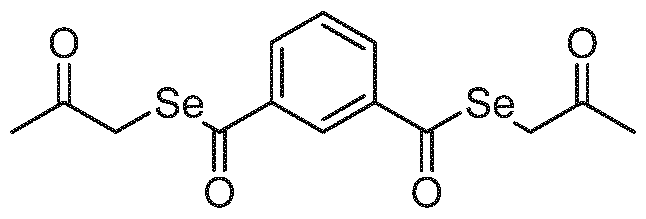
From isophthaloyl chloride (0.50 g, 2.5 mmol), grey selenium (0.41 g, 5.2 mmol), sodium borohydride (0.41 g, 10.8 mmol) and chloroacetone (0.46 g, 5.0 mmol). The precipitate was filtered, washed with water and dried to obtain a yellow solid (23, 0.549 g, 54%). Mp: 50-52 °C. Elemental analysis, calculated/found (%): C: 41.60/41 .44; H: 3.49/3.53; 1H-NMR (300 MHz, CDC ) ppm: d = 8.40 (d, 1 H, J = 1.3 Hz, H2Ph), 8.14 (c, 2H, J = 7.8 Hz, J = 1.7 Hz, H4ph+H6ph), 7.63 (t, 1 H, J = 7.8 Hz, H5Ph), 3.97 (s, 4H,
CH2(se)), 2.36 (s, 6H, CH3(co)).
Se,Se,Se-tris-(2-oxopropyl) benzene-1 ,3,5-tris-(carboxyselenoate) (24)

From 1 ,3,5-benzenetricarbonyl chloride (0.54 g, 2.0 mmol), grey selenium (0.49 g, 6.1 mmol), sodium borohydride (0.49 g, 12.8 mmol) and chloroacetone (0.83 g, 9.0 mmol). The precipitate was filtered, washed with water and dried to obtain a red solid. (24,
0.707 g, 62%). Mp: 87-89 °C. Elemental analysis, calculated/found (%): C:
ppm: d = 8.57 (s, 3H,

From sodium borohydride (0.198 g, 5.23 mmol), grey selenium (0.196 g, 2.48 mmol), p- fluorobenzoyl chloride (0.30 ml_, 2.54 mmol) and 1-chloropinacolone (0.33 ml_, 2.51 mmol). Final compound precipitated as a light yellow solid that was isolated by filtration and washed with water, rendering 0.356 g of 25 (47%). Mp: 58-60 °C. Elemental analysis, calculated/found (%): 51 .84/51.79 C, 5.02/4.95 H. 1H-RMN (300 MHz, CDCIs, d): 7.93 (dd, J= 8.9, 5.2 Hz, 2H, H2ph+H6ph), 7.14 (t, J= 8.6 Hz, 2H, H3ph+H5ph), 4.16 (s, 2H, SeCH2), 1.27 (s, 9H, 3CH3). Se,Se-bis-(3,3-dimethyl-2-oxobutyl)benzene-1 ,4-bis-(carboselenoate) (26)

From terephthaloyl chloride (0.64 g, 3.2 mmol), grey selenium (0.51 g, 6.4 mmol), sodium borohydride (0.51 g, 13.5 mmol) and chloropinacolone (0.85 g, 6.3 mmol). The precipitate was filtered, washed with water and dried to obtain a yellow solid. (26, 1.143 g, 74%). Mp: 142-144 °C. Elemental analysis, calculated/found (%): C: 49.19/48.86;
H: 5.37/5.21. 1H-NMR (300 MHz, CDCI3) ppm: d = 7.97 (s, 4H, H2ph+H3ph+H5Ph+H6Ph),
4.21 (s, 4H, CH2(se)), 2.28 (s, 18H, CH3).
Se-(2 -oxo p ropy S) 2-fluorobenzoselenoate (27)

From o-fluorobenzoyl chloride (0.398 g, 2.5 mmol), grey selenium (0.198 g, 2.5 mmol), sodium borohydride (0.200 g, 5.3 mmol) and chloroacetone (0.232 g, 2.5 mmol). Yellow liquid. The aqueous mixture was extracted with dichloromethane, combined organic layer was dried over sodium sulphate, concentrated and purified on a silica gel column eluted with dichloromethane (27, 0.149 g, 23%). Elemental analysis, calculated/found (%): C: 46.35/46.15; H: 3.50/3.53. 1H-NMR (300 MHz, CDCI3) ppm: d = 2.35 (s, 3H, CH3(CO)), 3.90 (s, 2H, CH2(se)), 7.19 (ddd, 1 H, H3Ph, J3-2 =1 1.0, J3-4=8.4, J3- 5=0.9 Hz), 7.26 (m, 1 H, H3Ph), 7.58 (dddd, 1 H, H4Ph, J4-3=8.3, J4-5=7.1 , J4-2=5.1 , J4- 6=1 .8 Hz) 7.86 (id, 1 H, H6Ph, J6-5= 7.6, J6-4=1 .8 Hz).
Se-(2 -oxo propyl) 2,4-difluorobenzoselenoate (28)

From 2,4-difluorobenzoyl chloride (0.441 g, 2.5 mmol), grey selenium (0.196 g, 2.5 mmol), sodium borohydride (0.200 g, 5.3 mmol) and chloroacetone (0.232 g, 2.5 mmol). Yellow liquid. The aqueous mixture was extracted with dichloromethane, combined organic layer was dried over sodium sulphate, and concentrated to give the yellow liquid (28, 0.326 g, 47%). Elemental analysis, calculated/found (%): C: 43.34/43.10; H: 2.91/2.87. 1H-NMR (300 MHz, CDCI3) ppm: d = 2.35 (s, 3H, CH3(Co)), 3.90 (s, 2H, CH2(Se)), 6.93 (ddd, 1 H, H3Ph, J3-2 =10.9, J3-4=8.5, J3-5=2.4 Hz), 6.99 (dddd, 1 H, Heph, JS-6-8.6, JS-4-7.6, JS-3-2.4, J5-2-O.8 Hz) 7.90 (td, 1 H, H6ph, Je- 5-8.5, J6-4,6-2-6.3
Hz ).
Se-(2 -oxo propyl) 2,6-difluorobenzoselenoate (29)

From 2,6-difluorobenzoyl chloride (0.533 g, 3 mmol), grey selenium (0.199 g,
2.5 mmol), sodium borohydride (0.200 g, 5.3 mmol) and chloroacetone (0.232 g,
2.5 mmol). Yellow liquid. The aqueous mixture was extracted with dichloromethane, combined organic layer was dried over sodium sulphate, and concentrated to give the yellow liquid (29, 0.130 g, 19%). Elemental analysis, calculated/found (%): C: 43.34/43.55; H: 2.91/2.86. 1H-NMR (300 MHz, CDCI3) ppm: d = 2.35 (s, 3H, CH3(co)), 3.94 (s, 2H, CH2(se)), 6.98 (t, 2H, H3Ph,5Ph, ^,5-4, =8.3 Hz), 7.46 (tt, 1 H, H4ph, J4-3,4-5=8.5, J4-I ,4-6=6.2 HZ).
Se-(2 -oxo propyl) 4-(trifluoromethyl)benzoselenoate (30)

From 4-(trifluoromethyl)benzoyl chloride (0.519 g, 2.5 mmol), grey selenium (0.195 g,
2.5 mmol), sodium borohydride (0.197 g, 5.2 mmol) and chloroacetone (0.232 g, 2.5 mmol). Pink solid. The solid was filtered, washed with water and dried (30, 0.241 g, 31%). Mp: 51-53 °C. Elemental analysis, calculated/found (%): C: 42.74/42.56; H: 2.93/2.91. 1H-NMR (300 MHz, CDCI3) ppm: d = 2.36 (s, 3H, CH3(co)), 3.96 (s, 2H, CH2(se)), 7.75 (d, 2H, H2Ph,6Ph, J2-3,6-5,=8.2 HZ), 8.01 (d, 2H, H3Ph,5Ph, J3-2, 5-6 =8.† Hz). Se-(3 , 3 -d i methyl -2 -oxo butyl ) 4-(trifluoromethyl)benzoselenoate (31)
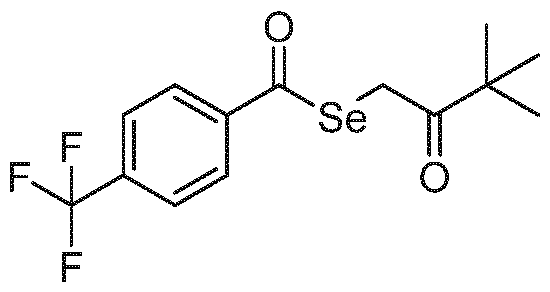
From 4-(trifluoromethyl)benzoyl chloride (0.519 g, 2.5 mmol), grey selenium (0.198 g,
2.5 mmol), sodium borohydride (0.198 g, 5.2 mmol) and 1-chloropinacolone (0.338 g, 2.5 mmol). Pink solid. (31 , 0.465 g, 53%). Elemental analysis, calculated/found (%): C: 47.88/47.33; H: 4.30/4.16. 1H-NMR (300 MHz, CDCI3) ppm: d = 1.27 (s, 9H,
3CH3(CO)), 4.20 (s, 2H, CH2(se)), 7.73 (d, 2H, Haph+Hsph J3-2, 5-6-8.3 Hz), 7.99 (d, 2H, H2Ph+ HePh, *^2-3, 6-5—8.1 ).
Evaluation of the cytotoxic activity and assessment of the selectivity. Methodology.
Cytotoxicity assays in human colonic adenocarcinoma cell lines Colo 205 doxorubicin- sensitive (ATCC-CCL-222) and Colo 320/MDR-LRP multidrug resistant overexpressing ABCB1 (MDRI )-LRP (ATCC-CCL-220.1 ) were performed following the procedure described by Gajdacs et al, 2017, Bioorg Med Chem Lett. 27(4): 797-802. The effects of increasing concentrations of selenium compounds on cell growth were tested in 96- well flat-bottomed microtiter plates. The selectivity of the action towards cancer cells was assessed through the evaluation of cytotoxic activity in a non-tumoral cell line, the MRC-5 human embryonal lung fibroblast cell lines (ATCC CCL-171 ), as described in Gajdacs et al, 2017, Bioorg Med Chem Lett. 27(4): 797-802.
All cell lines were purchased from LGC Promochem, Teddington, UK. The colonic cells were cultured in RPMI 1640 medium supplemented with 10% heat-inactivated fetal bovine serum, 2 mM L-glutamine, 1 mM Na-pyruvate and 100 mM Hepes. The cell lines were incubated at 37°C, in a 5% CO2, 95% air atmosphere. The semi-adherent human colon cancer cells were detached with Trypsin-Versene (EDTA) solution for 5 min at 37°C. Alternatively, MRC-5 cells was cultured in Eagle’s Minimal Essential Medium (EMEM, containing 4.5 g/L glucose) supplemented with a non-essential amino acid mixture, a selection of vitamins and 10% heat-inactivated fetal bovine serum. The cell lines were incubated at 37°C, in a 5% CO2, 95% air atmosphere.
The compounds were diluted in a volume of 100 mI_ of medium. The two-fold serial dilutions of selenocompounds were prepared in 100 mI_ of RPMI 1640, horizontally. The semi-adherent colonic adenocarcinoma cells were treated with Trypsin-Versene (EDTA) solution. They were adjusted to a density of 2x10⁴ cells in 100 mI_ of RPMI 1640 medium, and were added to each well, with the exception of the medium control wells. The final volume of the wells containing selenocompounds and cells was 200 mI_.
The culture plates were incubated at 37°C for 24 h; at the end of the incubation period, 20 mI_ of MTT (thiazolyl blue tetrazolium bromide, Sigma) solution (from a stock solution
of 5 mg/ml_) were added to each well. After incubation at 37°C for 4 h, 100 pL of sodium dodecyl sulfate (SDS) (Sigma) solution (10% in 0.01 M HCI) were added to each well and the plates were further incubated at 37°C overnight. Cell growth was determined by measuring the optical density (OD) at 540/630 nm with Multiscan EX ELISA reader (Thermo Labsystems, Cheshire, WA, USA). Inhibition of the cell growth was determined according to the formula below:
ICso = 100 100

Results are expressed in terms of I C50, defined as the inhibitory dose that reduces the growth of the cells exposed to the tested compounds by 50%. Regarding the selectivity, the selectivity indexes (SI) were calculate, being SI the quotient of the IC50 in non-tumoral cells (MRC-5) and the respective cancer cell (Colo-205 or Colo-320). Compound is considered moderately selective when SI < 6 and > 3; and strongly selective when SI > 6.
Cytotoxicity and selectivity of the selenocompounds.
I C50 values have been calculated as mentioned above in the methodology of evaluation of the cytotoxic activity and assessment of the selectivity. To express the cytotoxicity results in Table 2, four intervals have been defined in function of the I C50 values:
-Very active compounds: I C50 £ 1 mM. Signalled as ***.
-Active compounds: 1 mM < ICso £ 10 mM. Signalled as **.
-Slightly active compounds: 10 mM < ICso £ 50 mM. Signalled as *.
-Not cytotoxic compounds: IC50 ³ 50 mM. Signalled as NC. For the selectivity, the following intervals have been defined depending of the SI values:
-Strongly selective compounds: SI > 6. Signalled as ***.
-Moderately selective compounds: 3 < SI < 6. Signalled as **.
-Slightly selective compounds: 1 < SI < 3. Signalled as *.
-Not selective compounds: I C50 ³ 50 mM. Signalled as NS.
Table 2: Cytotoxicity and selectivity of the selenoesters.
Colo 205 CoSo 320 MRC-5 si SI
Compoun
^ Cytotoxicit Cytotoxicit Cytotoxicit (MRC- (MRC- y y y 5/Colo205) 5/Colo320)
1 ND ND ND
2 ** * ***
3 ** ND ND ND
4 ** ND ND ND
5 ** ND ND ND
ΊG ** ND ND ND
7 ** ND ND ND
8 ** ND ND ND
9 ** ND ND ND
10 ** ND ND ND T *** ND ND ND
12 ** * ***
13 ND ND ND
14 ND ND ND
15 ND ND ND
Tb NC
17 ND ND ND
18 NC
19 NC
20 NC
2? ND ND ND
22 *** *
23 *
24 *
25 ** ND ND ND
26 ** ND ND ND 27 ND ND ND
28 ** ** ND ND ND
29 ** ** ND ND ND
30 ** ** ND ND ND

ND: Not determined.
Evaluation of the inhibition of the multidrug resistance efflux pumps. Methodology.
This method, described in Gajdacs et at, 2017, Bioorg Med Chem Lett 27(4): 797-802, is a fluorescence-based detection system which uses verapamil as reference inhibitor of the ABCB1 efflux pump. The colonic adenocarcinoma cells (the doxorubicin- sensitive Colo 205 and the multidrug resistant Colo 320) were adjusted to a density of 2x10⁶/mL, re-suspended in serum-free RPMI 1640 medium and distributed in 0.5 ml_ aliquots into Eppendorf centrifuge tubes. Selenocompounds (1 and 10 pl_ from a stock solution of 1 mM, respectively) were added at different concentrations (2 mM and 20 mM final concentrations, respectively), and the samples were incubated for 10 min at room temperature. Next, 10 mI_ (5.2 mM final concentration) of rhodamine 123 was added to the samples and the cells were incubated for 20 minutes at 37°C, washed twice with phosphate buffered saline (PBS) and re-suspended in 1 mL PBS for analysis. The fluorescence intensity of the cell population was measured with a Partec CyFlow flow cytometer (Partec, Munster, Germany). Verapamil was used as a positive control at 20 mM final concentration in the rhodamine 123 exclusion experiments. The mean fluorescence intensity (%) was calculated for the treated multidrug resistance (MRD) Colo 320 and sensitive Colo 205 cell lines as compared to the untreated cells. The fluorescence activity ratio (FAR) was calculated based on the following equation which relates the measured fluorescence values:
MDRtreatec^ MDRcontrol
FAR- ; Quotient = 100 X (F ARcompound/F ARverapamil) parentalreatei}/ parentaLontroi
Inhibition of MDR efflux pumps exerted by the tested compounds.
FAR and quotient values have been calculated as mentioned above in the methodology of evaluation of the inhibition of the multidrug resistance efflux pumps. To express the cytotoxicity results in Table 3, four intervals have been defined in function of the quotient values determined from FAR values.
- Very potent inhibitors of MDR efflux pumps: Quotient > 200% (> 2-fold more potent than reference verapamil). Signalled as ***.
- Potent inhibitors of MDR efflux pumps: 100% < Quotient < 200% (from 1- to 2-fold more potent than reference verapamil). Signalled as **.
- Moderate inhibitors of MDR efflux pumps: 50% £ Quotient < 100% (inhibition higher than the 50% of the exerted by the reference verapamil). Signalled as *.
- Not active compounds: Quotient < 50%. Signalled as Nl.
Table 3: Inhibition of MDR efflux pumps exerted by the tested selenoesters in rhodamine assay.
Inhibition of efflux pumps Inhibition of efflux pumps Compoun - Compoun

18 25 Nl ND
19 26 ND
20 27 ND
21 ND 28 ND
22 29 ND
23 30 ND
24 31 ND
ND: Not determined.
Determination of the minimum inhibitory concentration (MIC) values in different bacterial strains. Methodology.
The effects exerted by different concentrations of the compounds on bacterial growth in Staphylococcus aureus 25923 ATCC, Staphylococcus aureus multidrug resistant 272123 clinical isolate (MRS A), Escherichia coli AG100 or Escherichia coli AG 100 A were tested in 96-well plates. The MIC of selenocompounds was determined according to Clinical and Laboratory Standard Institute (CLSI) guidelines. The solvent used (DMSO) had no antibacterial effect. Alternatively, the MICs of oxacillin of the compounds in MRS A HEMSA 5 were determined by a broth microdilution method in
cation-adjusted Mueller-Hinton Broth (MHB II) according to the recommendations of the CLSI. Results were recorded after a 20- or 24-hour incubation at 37°C.
Antibacterial activity of the selenocompounds.
MIC values have been calculated as mentioned above in the methodology of determination of the MIC values in different bacterial strains. To express the antibacterial activity in Table 4, five intervals have been defined in function of the MIC values:
- Very potent antibacterial compounds: MIC £ 1 mM. Signalled as ****.
- Potent antibacterial compounds: 1 mM < MIC < 10 mM. Signalled as ***.
- Moderate antibacterial compounds: 10 pM < MIC < 50 pM. Signalled as **.
- Slight antibacterial compounds: 50 pM < MIC < 100 pM. Signalled as *.
- Not antibacterial compounds: MIC > 100 pM. Signalled as NA.
Table 4: Antibacterial activity of the selenocompounds.
Antibacterial activity
c°mp°un Agajnst S. Against S.
Against E. coli Against E. coli a aureus aureus
AG100 AG100 A
25923 ATCC MRSA 272123
18
19 NA NA

22
23
24 ****
ND: Not determined.
Evaluation of the antifungal and nematicidal activity. Methodology.
The compounds were tested for their antifungal and nematicidal properties against the fungi Candida albicans and Saccharomyces cerevisiae, and against the nematode Steinernema feltiae.
Fungal cell densities were determined by measuring the optical density (OD) at 570 nm at 0 h (first measurement immediately after incubation), 4 h, and 24 h after incubation at 37 °C; and using a Universal Microplate Reader, EL800, Biotech Instruments, Inc. Highland Park, Winooski, VT, USA. Compounds were dissolved in 1 % DMSO and were tested at final concentrations of 50, 100, 150, and 200 mM. Nutrient Sabouraud Dextrose (SD), and Yeast Peptone Dextrose (YPD) were used as media for C. albicans, and S. cerevisiae, respectively. Ketoconazole was used as the positive control for C. albicans and S. cerevisiae. The growth culture with medium for each organism was used as the negative control. The Solvent 1 % DMSO stock was used as a solvent control. All experiments were carried out in triplicate and on three different occasions (n = 9).
The soil nematodes S. feltiae were purchased from Sautter and Stepper GmbH (Ammerbuch, Germany) and stored at 4 °C in the dark. Before each experiment, fresh samples of nematodes were purchased and stored in the fridge upon arrival and used for a maximum of six days. To perform the assay, 200 mg of nematodes was reconstituted in 50 mL of phosphate buffered saline (PBS) (pH = 7.4) to form a homogenous suspension to revive the nematodes. Afterwards, the individual suspensions were allowed to rest at room temperature. The sedimentation was avoided with occasional shaking in moderate light and at room temperature (25 °C) for 30 min. Viability of the nematodes was determined by counting the live and dead nematodes under a light microscope (TR 200, VWR International, Leuven, Belgium) at four-fold magnification. An initial viability value of more than 90 percent was considered necessary to perform the experiments.
Sample solutions were added into the wells of a 96-well plate to achieve at final concentrations of 50,100, 150, and 200 mM. Afterwards, 10 pL of nematode suspension was added to each well and the final volume in each well was adjusted to 100 pL with phosphate buffered saline (PBS) (pH = 7.4). PBS was used in the negative control and ethanol in the positive control. Viability was determined at 0 h and 24 h by counting the live and dead nematodes, whereby 50 pL of lukewarm water (40 °C) were added to each well to stimulate the nematodes for the 24 h reading. Each experiment was performed independently in triplicate and on three different occasions (n = 9).
For the three organisms considered (C. albicans, S. cerevisiae and S. feltiae), the inhibitory concentration 50% (I C50) is defined as the concentration that inhibits the viability of the respective organism to a 50% of the viability determined for the negative control.
Antifungal and nematicidai activity of the selenocompounds.
I C50 values have been calculated as mentioned above in the methodology for the evaluation of the antifungal and nematicidai activity. To express the antifungal or nematicidai activity in Table 4, five intervals have been defined in function of the I C50 values:
- Very potent antifungal/nematicidal compounds: IC50 £ 1 mM. Signalled as ****.
- Potent antifungal/nematicidal compounds: 1 mM < ICso £ 10 mM. Signalled as ***.
- Moderate antifungal/nematicidal compounds: 10 mM < ICso £ 50 mM. Signalled as
- Slight antifungal/nematicidal compounds: 50 mM < ICso £ 100 mM. Signalled as *.
- Not antifungal/nematicidal compounds: ICso ³ 100 mM. Signalled as NF/NM, respectively.
Antifungal activity Nematicidai activity
Compound Streptomyces
Candida albicans Steinernema feltiae


NF NM
NF NF NM
Claims
1.- A compound of formula I for use in the treatment of microbial infections or colorectal cancer:

Ri represents -Ph, -CN, -PhRs, -CORs, -SR5, -(SO)Rs or -(SC^Rs;
R2 represents -H, -CH3, -CH2CH3, -Ph or -COCH3;
each R3 independently represents -(CH2)rCOSeCHR2-(CH2)n-Ri;
each R4 independently represents -H, -F, -Cl, -Br, -I, -(CH2)tH, -CH(CH3)2,
C(CH3)3, -OH, -ORe, -OCORe, -SR6, -(SO)R6, -(S02)R6, -CN, -CF3, -COR6, -COOH, - Ph, -NH2, -NHRe, -N(R6)2, or -N02;
each R5 independently represents -(CH2)tH, -CH(CH3)2, -C(CH3)3, -CF3, -Ph or
PhR4;
each R6 independently represents -(CH2)tH, -CH(CH3)2, -C(CH3)3 or -Ph;
t represents an integer that ranges between 1 and 6;
X represents CH, N or S;
p represents 0 or 1 ;
n represents an integer that ranges between 0 and 5;
q represents 0, 1 or 2;
r represents 0, 1 or 2; and
s represents an integer that ranges between 1 and 3,
with the proviso that the following compounds are excluded:

2.- The compound for use according to claim 1 , wherein R1 represents -PhR5, -COR5, - SR5, -(SO)Rs or— (S02)R5.
3.- The compound for use according to any of claims 1 or 2, wherein R2 represents -H.
4 - The compound for use according to any of claims 1 to 3, wherein each R4 independently represents -H, -F, - -Br, -I, -(CH2)tH, -CH(CH3)2, -C(CH3)3, -OH, - OCORe, -SR6, -(SO)R6, -(S02)R6, -CN, -CF3, -COR6, -COOH, -Ph, -NH2, -NHR6, -
N(R6)2, or -N02.
5.- The compound according to claim 4, wherein each R4 independently represents -H, -F, -Br, -I, -(CH2)tH, -CH(CH3)2, -C(CH3)3, -OCORe, -CN, -CF3, -CO Re, -COOH, -Ph or N02.
6.- The compound for use according to claim 5, wherein each R independently represents -(CH2)tH or -CN.
7.- The compound for use according to any of claims 1 to 6, wherein t represents an integer that ranges between 1 and 3.
8.- The compound for use according to any of claims 1 to 7, wherein n represents 0.
9.- A compound of formula II:

II
wherein:
Ri represents -CN, -PhRs, -SRs, -(SO)R5 or -(S02)R5;
R2 represents -H, -CH3, -CH2CH3 or -COCH3;
each R3 independently represents -[CH2]rCOSeCHR2-[CH2]n-Ri;
each R4 independently represents -H, -F, -Cl, -Br, -I, -(CH2)tH, -CH(CH3)2, -C(CH3)3,
-OH, -OR7, -OCOR7, -SR7, -(SO)R7, -(S02)R7, -CN, -CF3, -COR7, -COOH, -Ph, -NH2, -NHRe, -N(R7)2, -N02;
each R5 independently represents -(CH2)tH, -CH(CH3)2, -C(CH3)3, -CF3, -Ph, -PhR4; each Re independently represents -(CH2)tH, -CH(CH3)2, -C(CH3)3, -CF3, -PhR3; each R7 independently represents -(CH2)tH, -CH(CH3)2, -C(CH3)3, -Ph;
R8 represents -F, -Cl, -Br, -I, -(CH2)tH, -CH(CH3)2, -C(CH3)3, -OH, -OR7, -SR7, -(SO)R7, -(S02)R7, -CN, -CF3, -COR7, -COOH, -Ph, -NH2, -NH(R6)2, -N(R7)2 or -N02;
t represents an integer that ranges between 1 and 6;
X represents CH, N or S;
p represents 0 or 1 ;
n represents an integer that ranges between 0 and 5;
q represents 0, 1 or 2;
r represents 0, 1 or 2; and
s represents an integer that ranges between 1 and 3,
with the proviso that the following compounds are excluded:

10.- The compound of formula II according to claim 9, wherein R2 represents -H.
1 1.- The compound of formula II according to any of claims 9 or 10, wherein each R4 independently represents -(CH2)tH or -CN.
12.- The compound of formula II according to any of claims 9 to 11 , wherein t represents 1.
13.- The compound of formula II according to any of claims 9 to 12, wherein n represents 0.
14.- The compound of formula II according to claim 9, selected from:
Se-(cyanomethyl) 4-fluorobenzoselenoate (1 );
Se-(cyanomethyl) 4-chlorobenzoselenoate (3);
Se-(cyanomethyl) benzoselenoate (6);
Se-(cyanomethyl) 4-methylbenzoselenoate (7);
Se-(cyanomethyl) 2-phenylethaneselenoate (11 );
Se-(cyanomethyl) 2,4-dichlorobenzoselenoate (13);
Se-(cyanomethyl) 3,4-dichlorobenzoselenoate (15);
Se-(cyanomethyl) 2-acetoxybenzoselenoate (17);
Se,Se-bis-(cyanomethyl) benzene-1 , 4-bis-(carboselenoate) (18);
Se,Se-bis-(cyanomethyl) benzene-1 , 3-bis-(carboselenoate) (19);
Se,Se,Se-tris-(cyanomethyl) benzene- 1 ,3,5-tris-(carboxyselenoate) (20);
Se,Se-bis-(2-oxopropyl) benzene-1 , 4-bis-(carboselenoate) (22);
Se,Se-bis-(2-oxopropyl) benzene-1 , 3-bis-(carboselenoate) (23);
Se,Se,Se-tris-(2-oxopropyl) benzene- 1 ,3,5-tris-(carboxyselenoate) (24);
Se-(2-oxopropyl) 2-fluorobenzoselenoate (27);
Se-(2-oxopropyl) 2,4-difluorobenzoselenoate (28);
Se-(2-oxopropyl) 2,6-difluorobenzoselenoate (29);
Se-(2-oxopropyl) 4-(trifluoromethyl)benzoselenoate (30); and
Se-(3,3-dimethyl-2-oxobutyl) 4-(trifluoromethyl)benzoselenoate (31 ).
15.- A pharmaceutical composition which comprises a compound of any of claims 9 to 14 or a pharmaceutical acceptable salt thereof and one or more pharmaceutically acceptable excipients.
16.- The compound of any of claims 9 to 14, a pharmaceutical acceptable salt thereof or the pharmaceutical composition of claim 15 for use in therapy.
17.- The compound of any of claims 9 to 14, a pharmaceutical acceptable salt thereof or the pharmaceutical composition of claim 15 for use in the treatment of microbial infections or colorectal cancer.
18.- The compound of any of claims 9 to 14, a pharmaceutical acceptable salt thereof or the pharmaceutical composition of claim 15 for use in the treatment of microbial infections caused by Staphylococcus aureus, methicillin resistant Staphylococcus aureus, Candida spp and/or Escherichia coli.
Applications Claiming Priority (2)
| Application Number | Priority Date | Filing Date | Title |
|---|---|---|---|
| EP18382693.2 | 2018-09-28 | ||
| EP18382693.2A EP3628659A1 (en) | 2018-09-28 | 2018-09-28 | Selenoester-containing compounds for use in the treatment of microbial infections or colorectal cancer |
Publications (1)
| Publication Number | Publication Date |
|---|---|
| WO2020065086A1 true WO2020065086A1 (en) | 2020-04-02 |
Family
ID=63857855
Family Applications (1)
| Application Number | Title | Priority Date | Filing Date |
|---|---|---|---|
| PCT/EP2019/076366 Ceased WO2020065086A1 (en) | 2018-09-28 | 2019-09-30 | Selenoester-containing compounds for use in the treatment of microbial infections or colorectal cancer |
Country Status (2)
| Country | Link |
|---|---|
| EP (1) | EP3628659A1 (en) |
| WO (1) | WO2020065086A1 (en) |
Cited By (2)
| Publication number | Priority date | Publication date | Assignee | Title |
|---|---|---|---|---|
| CN111676168A (en) * | 2020-06-30 | 2020-09-18 | 大连澎立生物科技有限公司 | Nano selenium detoxifier and preparation method thereof, detoxified biological protein selenium and preparation method and application thereof |
| WO2021247722A1 (en) * | 2020-06-02 | 2021-12-09 | The Penn State Research Foundation | Novel seleno-nsaid analogs and uses thereof |
-
2018
- 2018-09-28 EP EP18382693.2A patent/EP3628659A1/en not_active Withdrawn
-
2019
- 2019-09-30 WO PCT/EP2019/076366 patent/WO2020065086A1/en not_active Ceased
Non-Patent Citations (12)
| Title |
|---|
| ALVAREZ-PEREZ ET AL., MOLECULES, vol. 23, no. 3, 2018, pages E628 |
| BEN-AMI, J FUNGI, vol. 4, 2018, pages E97 |
| C.C. TJIN, ET AL.: "Glutathione-responsive selenosulfide prodrugs as a platform strategy for potent and selective mechanism-based inhibition of protein tyrosine phosphatases", ACS CENTRAL SCIENCE, vol. 3, no. 12, 6 December 2017 (2017-12-06), American Chemical Society, Washington, DC, US, pages 1322 - 1328, XP055562450, ISSN: 2374-7943, DOI: 10.1021/acscentsci.7b00486 * |
| C.C. TJIN, ET AL.: "Supporting information: Glutathione-responsive selenosulfide prodrugs as a platform strategy for potent and selective mechanism-based inhibition of protein tyrosine phosphatases", ACS CENTRAL SCIENCE, vol. 3, no. 12, 6 December 2017 (2017-12-06), American Chemical Society, Washington, DC, US, pages S1 - S58, XP055562454, ISSN: 2374-7943, DOI: 10.1021/acscentsci.7b00486 * |
| CIHALOVA ET AL., INT J MOL SCI, vol. 16, 2015, pages 24656 - 24672 |
| DAYAN ET AL., EXPERT REV VACCINES, vol. 15, 2016, pages 1373 - 1392 |
| GAJDACS ET AL., BIOORG MED CHEM LETT., vol. 27, no. 4, 2017, pages 797 - 802 |
| H. ISHIHARA, ET AL.: "A facile preparation of aliphatic and aromatic primary selenoamides using 4-methylselenobenzoate as a new selenating reagent", CHEMISTRY LETTERS, vol. 27, no. 12, December 1998 (1998-12-01), Chemical Society of Japan, Tokyo, JP, pages 1287 - 1288, XP055556742, ISSN: 0366-7022, DOI: 10.1246/cl.1998.1287 * |
| KUMAR ET AL., SCAND J INFECT DIS, vol. 42, 2010, pages 266 - 274 |
| M. GAJDÁCS, ET AL.: "Selenoesters and selenoanhydrides as novel multidrug resistance reversing agents: A confirmation study in a colon cancer MDR cell line", BIOORGANIC & MEDICINAL CHEMISTRY LETTERS, vol. 27, no. 4, 13 January 2017 (2017-01-13), Elsevier Science Publishers, Oxford, GB, pages 797 - 802, XP029906445, ISSN: 0960-894X, DOI: 10.1016/j.bmcl.2017.01.033 * |
| PAGES ET AL., CURR MED CHEM, vol. 18, 2011, pages 2969 - 80 |
| SPENGLER ET AL., ANTICANCER RES., vol. 31, 2011, pages 3285 - 3288 |
Cited By (3)
| Publication number | Priority date | Publication date | Assignee | Title |
|---|---|---|---|---|
| WO2021247722A1 (en) * | 2020-06-02 | 2021-12-09 | The Penn State Research Foundation | Novel seleno-nsaid analogs and uses thereof |
| CN111676168A (en) * | 2020-06-30 | 2020-09-18 | 大连澎立生物科技有限公司 | Nano selenium detoxifier and preparation method thereof, detoxified biological protein selenium and preparation method and application thereof |
| CN111676168B (en) * | 2020-06-30 | 2022-01-25 | 大连澎立生物科技有限公司 | Nano-selenium detoxicant and preparation method thereof, detoxified biological protein selenium and preparation method and application thereof |
Also Published As
| Publication number | Publication date |
|---|---|
| EP3628659A1 (en) | 2020-04-01 |
Similar Documents
| Publication | Publication Date | Title |
|---|---|---|
| Popiołek et al. | Synthesis and investigation of antimicrobial activities of nitrofurazone analogues containing hydrazide-hydrazone moiety | |
| Padmavathi et al. | Synthesis and antimicrobial activity of novel sulfone-linked bis heterocycles | |
| SU1535379A3 (en) | Method of producing 5-substituted 2,4-diaminopyrimidines or their acid-additive salts | |
| El Faydy et al. | Synthesis and investigation of antibacterial and antioxidants properties of some new 5-subsituted-8-hydroxyquinoline derivatives | |
| NL2000373C2 (en) | Antibacterial agents. | |
| Tuncbilek et al. | Synthesis of New 3‐(Substituted Phenacyl)‐5‐[3′‐(4H‐4‐oxo‐1‐benzopyran‐2‐yl)‐benzylidene]‐2, 4‐thiazolidinediones and their Antimicrobial Activity | |
| US20210115008A1 (en) | P300/cbp hat inhibitors | |
| Hameed et al. | Me 3 N-promoted synthesis of 2, 3, 4, 4 a-tetrahydroxanthen-1-one: preparation of thiosemicarbazone derivatives, their solid state self-assembly and antimicrobial properties | |
| Mewada et al. | Synthesis and biological evaluation of novel s-triazine based aryl/heteroaryl entities: Design, rationale and comparative study | |
| Gündüz et al. | S-alkylated thiosemicarbazone derivatives: Synthesis, crystal structure determination, antimicrobial activity evaluation and molecular docking studies | |
| Patel et al. | Synthesis and biological evaluation of coumarin based isoxazoles, pyrimidinthiones and pyrimidin-2-ones | |
| EP3628659A1 (en) | Selenoester-containing compounds for use in the treatment of microbial infections or colorectal cancer | |
| SU1151213A3 (en) | Method of obtaining cephalosporins or salts thereof | |
| WO2004058713A1 (en) | Differential tumor cytotoxocity compounds and compositions | |
| CN101805338A (en) | Oxadiazole-based piperazine derivative and application thereof | |
| JP6793927B2 (en) | Ciprofloxacin derivative antibacterial agent | |
| Thevissen et al. | Novel fungicidal benzylsulfanyl-phenylguanidines | |
| CN110960529A (en) | Tyrosine kinase inhibitor bulk drug with reduced toxic impurity content | |
| CN108440414A (en) | Pyrazolone amides antifungal drug and its preparation method and application | |
| SU1105117A3 (en) | Method of obtaining derivatives of 7 alpha-methoxycephalosporin or their salts with alkali metals | |
| Zhao et al. | Synthesis of novel 4-thiazolidione derivatives as antibacterial agents against drug-resistant Staphylococcus epidermidis | |
| Chfat et al. | Synthesis, Characterization, and Study of Antibacterial Activity of Some New Amphiphilic Sulfamethoxazole Derivatives | |
| CN110759900A (en) | Preparation method and use of thiophene compounds | |
| Chaudhary et al. | Synthesis and investigation of anthelmintic, antibacterial and antifungal activity of 3, 3-diphenyl propanamide derivatives | |
| RU2181361C2 (en) | Novel polycyclic derivatives of phthalazine and their use |
Legal Events
| Date | Code | Title | Description |
|---|---|---|---|
| 121 | Ep: the epo has been informed by wipo that ep was designated in this application |
Ref document number: 19773867 Country of ref document: EP Kind code of ref document: A1 |
|
| NENP | Non-entry into the national phase |
Ref country code: DE |
|
| 122 | Ep: pct application non-entry in european phase |
Ref document number: 19773867 Country of ref document: EP Kind code of ref document: A1 |