WO2020053600A1 - Enantiomeric compounds - Google Patents
Enantiomeric compounds Download PDFInfo
- Publication number
- WO2020053600A1 WO2020053600A1 PCT/GB2019/052581 GB2019052581W WO2020053600A1 WO 2020053600 A1 WO2020053600 A1 WO 2020053600A1 GB 2019052581 W GB2019052581 W GB 2019052581W WO 2020053600 A1 WO2020053600 A1 WO 2020053600A1
- Authority
- WO
- WIPO (PCT)
- Prior art keywords
- mmol
- group
- alkyl
- compound
- compound according
- Prior art date
- Legal status (The legal status is an assumption and is not a legal conclusion. Google has not performed a legal analysis and makes no representation as to the accuracy of the status listed.)
- Ceased
Links
- 0 **C1C(*)=C(*)C(*)(*)*(*)C1(*)* Chemical compound **C1C(*)=C(*)C(*)(*)*(*)C1(*)* 0.000 description 6
- IZIHKVIKLYFELH-UHFFFAOYSA-N CC1OCCN(Cc2ccccc2)C1 Chemical compound CC1OCCN(Cc2ccccc2)C1 IZIHKVIKLYFELH-UHFFFAOYSA-N 0.000 description 1
- QPJVMBTYPHYUOC-UHFFFAOYSA-N COC(c1ccccc1)=O Chemical compound COC(c1ccccc1)=O QPJVMBTYPHYUOC-UHFFFAOYSA-N 0.000 description 1
- SHDNROQFLSZXGF-HXUWFJFHSA-N FC(c1ccc(CCC[C@@H]2C=CCN(Cc3ccccc3)C2)cc1)(F)F Chemical compound FC(c1ccc(CCC[C@@H]2C=CCN(Cc3ccccc3)C2)cc1)(F)F SHDNROQFLSZXGF-HXUWFJFHSA-N 0.000 description 1
- QHMWPKMYNOOQJG-IBGZPJMESA-N FC(c1ccc(CC[C@@H]2C=CCN(Cc3ccccc3)C2)cc1)(F)F Chemical compound FC(c1ccc(CC[C@@H]2C=CCN(Cc3ccccc3)C2)cc1)(F)F QHMWPKMYNOOQJG-IBGZPJMESA-N 0.000 description 1
Classifications
-
- C—CHEMISTRY; METALLURGY
- C07—ORGANIC CHEMISTRY
- C07D—HETEROCYCLIC COMPOUNDS
- C07D211/00—Heterocyclic compounds containing hydrogenated pyridine rings, not condensed with other rings
- C07D211/04—Heterocyclic compounds containing hydrogenated pyridine rings, not condensed with other rings with only hydrogen or carbon atoms directly attached to the ring nitrogen atom
- C07D211/68—Heterocyclic compounds containing hydrogenated pyridine rings, not condensed with other rings with only hydrogen or carbon atoms directly attached to the ring nitrogen atom having one double bond between ring members or between a ring member and a non-ring member
- C07D211/72—Heterocyclic compounds containing hydrogenated pyridine rings, not condensed with other rings with only hydrogen or carbon atoms directly attached to the ring nitrogen atom having one double bond between ring members or between a ring member and a non-ring member with hetero atoms or with carbon atoms having three bonds to hetero atoms, with at the most one bond to halogen, directly attached to ring carbon atoms
-
- C—CHEMISTRY; METALLURGY
- C07—ORGANIC CHEMISTRY
- C07D—HETEROCYCLIC COMPOUNDS
- C07D211/00—Heterocyclic compounds containing hydrogenated pyridine rings, not condensed with other rings
- C07D211/04—Heterocyclic compounds containing hydrogenated pyridine rings, not condensed with other rings with only hydrogen or carbon atoms directly attached to the ring nitrogen atom
- C07D211/68—Heterocyclic compounds containing hydrogenated pyridine rings, not condensed with other rings with only hydrogen or carbon atoms directly attached to the ring nitrogen atom having one double bond between ring members or between a ring member and a non-ring member
- C07D211/70—Heterocyclic compounds containing hydrogenated pyridine rings, not condensed with other rings with only hydrogen or carbon atoms directly attached to the ring nitrogen atom having one double bond between ring members or between a ring member and a non-ring member with only hydrogen atoms, hydrocarbon or substituted hydrocarbon radicals, directly attached to ring carbon atoms
-
- C—CHEMISTRY; METALLURGY
- C07—ORGANIC CHEMISTRY
- C07D—HETEROCYCLIC COMPOUNDS
- C07D211/00—Heterocyclic compounds containing hydrogenated pyridine rings, not condensed with other rings
- C07D211/04—Heterocyclic compounds containing hydrogenated pyridine rings, not condensed with other rings with only hydrogen or carbon atoms directly attached to the ring nitrogen atom
- C07D211/68—Heterocyclic compounds containing hydrogenated pyridine rings, not condensed with other rings with only hydrogen or carbon atoms directly attached to the ring nitrogen atom having one double bond between ring members or between a ring member and a non-ring member
- C07D211/72—Heterocyclic compounds containing hydrogenated pyridine rings, not condensed with other rings with only hydrogen or carbon atoms directly attached to the ring nitrogen atom having one double bond between ring members or between a ring member and a non-ring member with hetero atoms or with carbon atoms having three bonds to hetero atoms, with at the most one bond to halogen, directly attached to ring carbon atoms
- C07D211/74—Oxygen atoms
-
- Y—GENERAL TAGGING OF NEW TECHNOLOGICAL DEVELOPMENTS; GENERAL TAGGING OF CROSS-SECTIONAL TECHNOLOGIES SPANNING OVER SEVERAL SECTIONS OF THE IPC; TECHNICAL SUBJECTS COVERED BY FORMER USPC CROSS-REFERENCE ART COLLECTIONS [XRACs] AND DIGESTS
- Y02—TECHNOLOGIES OR APPLICATIONS FOR MITIGATION OR ADAPTATION AGAINST CLIMATE CHANGE
- Y02P—CLIMATE CHANGE MITIGATION TECHNOLOGIES IN THE PRODUCTION OR PROCESSING OF GOODS
- Y02P20/00—Technologies relating to chemical industry
- Y02P20/50—Improvements relating to the production of bulk chemicals
- Y02P20/582—Recycling of unreacted starting or intermediate materials
Definitions
- the present invention relates to enantiomeric compounds, the use of these enantiomeric compounds in stereospecific reactions, and to a method of preparing these enantiomeric compounds.
- Asymmetric synthetic methods are of critical importance in the pharmaceutical industry to produce enantiomeric drug molecules.
- Tetrahydropyridines constitute an important subgroup of heterocycles that are found in a wide range of biologically active compounds, including alkaloids and iminosugars. 3 Moreover, they are precursors of various drug molecules that comprise a piperidine moiety with specific stereochemistry (see, for example, the drug structures shown in Figure 1). 4
- bond b is independently selected from a single bond or double bond
- X is a leaving group
- RP is a protecting group, hydrogen, (1-8C)alkyl, (3-10C)cycloalkyl or aryl;
- R 1a and R 1 b are identical and R 4a and R 4b are identical; and R 1a , R 1 b , R 4a and R 4b are selected from hydrogen, carbonyl, (1-8C)alkyl, (3-10C)cycloalkyl, (3-10C) cycloalkenyl, aryl, heteroaryl and heterocyclic wherein R 1a , R 1 b , R 4a and R 4b are optionally further substituted by one or more substituent groups independently selected from halo, (1- 4C)alkyl and (1-4C)haloalkyl;
- R 2b and R 3b are absent, R 2 is selected from hydrogen, halo, (1-8C)alkyl, (3-10C)cycloalkyl, (1-8C)alkoxy, hydroxyl and R 3 is selected from hydrogen, halo (1-8C)alkyl, (3-10C)cycloalkyl, (3-10C)cycloalkenyl, (1-8C)alkoxy, hydroxyl, epoxide and aryl; or
- R 2 and R 2b are identical and are selected from hydrogen, halo, (1-8C)alkyl and (3-10C)cycloalkyl; and R 3 and R 3b are identical and selected from hydrogen, halo (1-8C)alkyl, (3-10C)cycloalkyl, (3-10C)cycloalkenyl, (1- 8C)alkoxy, hydroxyl, epoxide and aryl; and
- R 2 , R 3 and, if present, R 2b and R 3b are optionally substituted by one or more substituent groups independently selected from halo, (1-4C)alkyl and (1- 4C)haloalkyl.
- the compounds defined herein may have an enantiomeric excess of the (R)- or (S)-enantiomer of the compound.
- X may be a leaving group which is readily displaceable by nucleophilic attack or elimination.
- X may be selected from alkoxy, halo, tosylate, mesylate, triflate and perfluoroalkylsulfonates.
- X is halo, e.g. chloro, bromo, fluoro. Most preferably, X is chloro.
- RP may be a protecting group selected from acyl, arylmethyl (e.g. benzyl), arylmethoxycarbonyl (e.g. benzyloxycarbonyl) and alkoxycarbonyl, or RP may be hydrogen, (1-8C)alkyl or (3-10C)cycloalkyl.
- RP is benzyl, benzyloxycarbonyl, hydrogen or (1-8C)alkyl.
- RP is benzyl or benzyloxycarbonyl.
- R 1a and R 1 b are identical.
- R 1a and R 1 b may both be selected from hydrogen, (1- 8C)alkyl, (3-10C)cycloalkyl, (3-10C)cycloalkenyl and aryl.
- R 1a and R 1 b are hydrogen or (1-4C)alkyl.
- R 1a and R 1 b may optionally be further substituted by one or more substituent groups independently selected from (1-4C)alkyl and (1-4C)haloalkyl.
- R 4a and R 4b are identical.
- R 4a and R 4b may both be selected from hydrogen, (1- 8C)alkyl, (3-10C)cycloalkyl, (3-10C)cycloalkenyl and aryl.
- R 1a and R 1 b are hydrogen or (1-4C)alkyl.
- R 4a and R 4b may optionally be further substituted by one or more substituent groups independently selected from (1-4C)alkyl and (1-4C)haloalkyl.
- R 1a and R 1 b must be identical but may be different to R 4a and R 4b .
- R 1a and R 1 b may both be hydrogen, whilst R 4a and R 4b may both be (1-4C)alkyl, or vice versa.
- R 2 may be selected from hydrogen, halo, (1-8C)alkyl or (3-10C)cycloalkyl.
- R 2 is selected from hydrogen, halo or (1-8C)alkyl.
- R 2b if present, will be identical to R 2 .
- R 3 may be selected from hydrogen, halo (1-8C)alkyl, (3-10C)cycloalkyl, (3- 10C)cycloalkenyl and aryl.
- R 3 is selected from hydrogen, halo, (1-8C)alkyl or aryl.
- R 3b if present, will be identical to R 3 .
- each of R 1a , R 1 b , R 2 , R 3 , R 4a , R 4b and, if present, R 2b and R 3b are hydrogen.
- R 1a , R 1 b , R 2 , R 2b , R 3 , R 3b , R 4a , R 4b and RP are as defined herein.
- Bond b may be a double bond.
- R 2b and R 3b will be absent and the compound has the formula (III) below:
- R 1a , R 1 b , R 2 , R 3 , R 4a , R 4b and R P are as defined herein.
- the compound is a compound according to Formula (III) and each of R 1a , R 1 b , R 2 , R 3 , R 4a , R 4b are hydrogen.
- the compound may be a compound having the formula (Ilia) or (I lib), shown below:
- the compound may be a compound having the formula (Ilia) or (I I lb), shown below:
- the compounds according to Formulas (I) to (IVb), defined herein, may have an enantiomeric excess of at least 40%, at least 60%, at least 80%, at least 90%, at least 95%, at least 98% or at least 99%.
- R is a substituent group
- R 1a , R 1 b , R 2 , R 2b , R 3 , R 3b , R 4a , R 4b and RP are as defined herein, and wherein the compound of formula (Va) or (Vb) has an enantiomeric excess of at least 20%;
- the process comprises reacting a compound according to any one of Formulas (I) to (IVb) defined above, with a nucleophilic compound comprising a R group, such that the X-group in the compound according to any one of Formulas (I) to (IVb) defined above is replaced by the R group to form a compound of formula (Va) or (Vb).
- nucleophilic compounds comprising R groups may be selected from organolithium compounds, alkenes, Grignard reagents, alcohols (including phenols), carboxylic acids, carbonyls, enols, sulphides, thiols, peroxides, azides, amines, nitrites, hydroxylamines, hydrazines, carbazides, phenylhydrazines, semicarbazides, and amides.
- the R group may be any substituent group.
- R groups that it might be desirable to couple to a compound of any one of Formulas (I) to (IVb), as evidenced by the structures shown in Figures 1 and 2 herein.
- the present invention is not limited by the nature of the R group in any way.
- the R group may be selected from the group consisting of alkyl, aryl, arylalkyl, heteroaryl, heteroarylalkyl, oxide, carboxylate, amine, amide, cyanide, sulphide, sulphoxide, halogen (e.g. fluoro), azide or hydroxide.
- the nucleophilic compound comprising the R group may be a compound of the formula:
- LG wherein L G is a leaving group (e.g. halo) that is displaced during the reaction with a compound of any one of formulae (I) to (IVb).
- L G is a leaving group (e.g. halo) that is displaced during the reaction with a compound of any one of formulae (I) to (IVb).
- the nucleophilic compound may be an alkene, e.g. a compound with the formula:
- R ’ is a remainder of the R substituent group. It will be appreciated that the alkene moiety reacts with the compound of any one of formulae (I) to (IVb) to form a R substituent group of the formula -CH2-CH2-R’.
- the compound according to Formulas (I) to (IVb) above may be the racemic form of the compound or may have an enantiomeric excess of either the (R)- or (S)- enantiomer.
- the method of the third aspect may favour the formation of one enantiomer over the other.
- the method may therefore increase the enantiomeric excess of one of the enantiomers of the starting materials.
- the starting material may be enantiomerically enriched by the method of the third aspect of the invention.
- the compound of formula (Va) or (Vb) has an enantiomeric excess of at least 40%, at least 60%, at least 80%, at least 90%, at least 95% or at least 99%.
- the method may further comprise the step of removing the protecting group on the compound according to Formula (Va) or (Vb).
- Figure 1 Selected piperidine drug molecules with substituents at C3 and/or C5 positions.
- Figure 2 Selected piperidine drug molecules with substituents at C2 and/or C6 positions.
- composition comprising a mixture of enantiomers, means said composition that comprises an excess of one enantiomer.
- a composition may be considered“enantiomerically enriched” relative to another composition where the enantiomeric excess differs between the two.
- “alkyl” includes both straight and branched chain alkyl groups. References to individual alkyl groups such as“propyl” are specific for the straight chain version only and references to individual branched chain alkyl groups such as “isopropyl” are specific for the branched chain version only.
- “(1 -6C)alkyl” includes (1-4C)alkyl, (1-3C)alkyl, propyl, isopropyl and f-butyl.
- “phenyl(1-6C)alkyl” includes phenyl(1-4C)alkyl, benzyl, 1-phenylethyl and 2-phenylethyl.
- alkenyl will be understood to include both straight and branched hydrocarbon groups comprising one or more carbon-carbon double bonds.
- Reference to, for example,“(2-6C)alkenyl” will be understood to refer to alkene groups containing from 3 to 6 carbon atoms and may includes, for example, hexenyl, pentenyl, butenyl, propenyl and ethylenyl.
- alkynyl will be understood to include both straight and branched hydrocarbon groups comprising one or more carbon-carbon triple bonds.
- reference to“(2-6C)alkynyl” groups will be understood to refer to alkyne groups containing from 3 to 6 carbon atoms and may includes, for example hexynyl, pentynyl, butynyl, propynyl and acetylenyl.
- (m-nC) or "(m-nC) group” used alone or as a prefix, refers to any group having m to n carbon atoms.
- An“alkylene,”“alkenylene,” or“alkynylene” group is an alkyl, alkenyl, or alkynyl group that is positioned between and serves to connect two other chemical groups.
- “(1-6C)alkylene” means a linear saturated divalent hydrocarbon radical of one to six carbon atoms or a branched saturated divalent hydrocarbon radical of three to six carbon atoms, for example, methylene, ethylene, propylene, 2-methylpropylene, pentylene, and the like.
- (3-10C)cycloalkyl means a hydrocarbon ring containing from 3 to 10 carbon atoms, for example, cyclopropyl, cyclobutyl, cyclopentyl, cyclohexyl, cycloheptyl or bicyclo[2.2.1]heptyl.
- “(3-10C)cycloalkenyl” means a hydrocarbon ring containing from 3 to 10 carbon atoms and at least one double bond, for example, cyclobutenyl, cyclopentenyl, cyclohexenyl or cycloheptenyl, such as 3-cyclohexen-1-yl, or cyclooctenyl.
- heterocyclyl means a non-aromatic saturated or partially saturated monocyclic, fused, bridged, or spiro bicyclic heterocyclic ring system(s).
- Monocyclic heterocyclic rings contain from about 3 to 12 (suitably from 3 to 7) ring atoms, with from 1 to 5 (suitably 1 , 2 or 3) heteroatoms selected from nitrogen, oxygen or sulfur in the ring.
- Bicyclic heterocycles contain from 7 to 17 member atoms, suitably 7 to 12 member atoms, in the ring.
- Bicyclic heterocyclic(s) rings may be fused, spiro, or bridged ring systems.
- Examples of heterocyclic groups include cyclic ethers such as oxiranyl, oxetanyl, tetrahydrofuranyl, dioxanyl, and substituted cyclic ethers.
- Heterocycles containing nitrogen include, for example, azetidinyl, pyrrolidinyl, piperidinyl, piperazinyl, tetrahydrotriazinyl, tetrahydropyrazolyl, and the like.
- Typical sulfur containing heterocycles include tetrahydrothienyl, dihydro-1 , 3-dithiol, tetrahydro-2/-/-thiopyran, and hexahydrothiepine.
- heterocycles include dihydro-oxathiolyl, tetrahydro-oxazolyl, tetrahydro-oxadiazolyl, tetrahydrodioxazolyl, tetrahydro-oxathiazolyl, hexahydrotriazinyl, tetrahydro-oxazinyl, morpholinyl, thiomorpholinyl, tetrahydropyrimidinyl, dioxolinyl, octahydrobenzofuranyl, octahydrobenzimidazolyl, and octahydrobenzothiazolyl.
- heterocycles containing sulfur the oxidized sulfur heterocycles containing SO or SO2 groups are also included. Examples include the sulfoxide and sulfone forms of
- tetrahydrothienyl and thiomorpholinyl such as tetrahydrothiene 1 ,1 -dioxide
- heterocyclyl groups are saturated monocyclic 3 to 7 membered heterocyclyls containing 1 , 2 or 3 heteroatoms selected from nitrogen, oxygen or sulfur, for example azetidinyl, tetrahydrofuranyl, tetrahydropyranyl, pyrrolidinyl, morpholinyl, tetrahydrothienyl, tetrahydrothienyl 1 ,1 -dioxide, thiomorpholinyl, thiomorpholinyl 1 ,1-dioxide, piperidinyl, homopiperidinyl, piperazinyl or homopiperazinyl.
- any heterocycle may be linked to another group via any suitable atom, such as via a carbon or nitrogen atom.
- reference herein to piperidino or morpholino refers to a piperidin-1-yl or morpholin-4-yl ring that is linked via the ring nitrogen.
- heteroaryl or“heteroaromatic” means an aromatic mono-, bi-, or polycyclic ring incorporating one or more (for example 1-4, particularly 1 , 2 or 3) heteroatoms selected from nitrogen, oxygen or sulfur.
- heteroaryl includes both monovalent species and divalent species. Examples of heteroaryl groups are monocyclic and bicyclic groups containing from five to twelve ring members, and more usually from five to ten ring members.
- the heteroaryl group can be, for example, a 5- or 6-membered monocyclic ring or a 9- or 10-membered bicyclic ring, for example a bicyclic structure formed from fused five and six membered rings or two fused six membered rings.
- Each ring may contain up to about four heteroatoms typically selected from nitrogen, sulfur and oxygen.
- the heteroaryl ring will contain up to 3 heteroatoms, more usually up to 2, for example a single heteroatom.
- the heteroaryl ring contains at least one ring nitrogen atom.
- the nitrogen atoms in the heteroaryl rings can be basic, as in the case of an imidazole or pyridine, or essentially non-basic as in the case of an indole or pyrrole nitrogen. In general, the number of basic nitrogen atoms present in the heteroaryl group, including any amino group substituents of the ring, will be less than five.
- heteroaryl examples include furyl, pyrrolyl, thienyl, oxazolyl, isoxazolyl, imidazolyl, pyrazolyl, thiazolyl, isothiazolyl, oxadiazolyl, thiadiazolyl, triazolyl, tetrazolyl, pyridyl, pyridazinyl, pyrimidinyl, pyrazinyl, 1 ,3,5-triazenyl, benzofuranyl, indolyl, isoindolyl, benzothienyl, benzoxazolyl, benzimidazolyl, benzothiazolyl, benzothiazolyl, indazolyl, purinyl, benzofurazanyl, quinolyl, isoquinolyl, quinazolinyl, quinoxalinyl, cinnolinyl, pteridinyl, naphthy
- Heteroaryl also covers partially aromatic bi- or polycyclic ring systems wherein at least one ring is an aromatic ring and one or more of the other ring(s) is a non-aromatic, saturated or partially saturated ring, provided at least one ring contains one or more heteroatoms selected from nitrogen, oxygen or sulfur.
- partially aromatic heteroaryl groups include for example, tetrahydroisoquinolinyl, tetrahydroquinolinyl, 2-oxo-1 ,2,3,4-tetrahydroquinolinyl,
- dihydrobenzthienyl dihydrobenzfuranyl, 2,3-dihydro-benzo[1 ,4]dioxinyl, benzo[1 ,3]dioxolyl, 2,2-dioxo-1 ,3-dihydro-2-benzothienyl, 4,5,6,7-tetrahydrobenzofuranyl, indolinyl,
- heteroaryl groups examples include but are not limited to pyrrolyl, furanyl, thienyl, imidazolyl, furazanyl, oxazolyl, oxadiazolyl, oxatriazolyl, isoxazolyl, thiazolyl, isothiazolyl, pyrazolyl, triazolyl and tetrazolyl groups.
- heteroaryl groups examples include but are not limited to pyridyl, pyrazinyl, pyridazinyl, pyrimidinyl and triazinyl.
- aryl means a cyclic or polycyclic aromatic ring having from 5 to 12 carbon atoms.
- aryl includes both monovalent species and divalent species.
- aryl groups include, but are not limited to, phenyl, biphenyl, naphthyl, anthraceneyl and the like.
- an aryl is phenyl.
- halo refers to any suitable halogen and may be selected from fluoro, chloro, bromo and iodo groups.
- halo refers to fluoro, chloro or bromo groups, and most suitably, chloro groups.
- alcohol means a compound which comprises a hydroxyl group, for example, methanol, phenol, primary alcohols, and substituted or unsubstituted secondary alcohols, tertiary alcohols.
- alcohol refers to saturated and unsaturated alcohols (e.g. phenols), alcohol having one hydroxyl group per alcohol molecule (mono-alcohol) and alcohol having a plurality of hydroxyl groups per alcohol molecule (di-alcohol, tri-alcohol, etc.), (iii) primary, secondary, and tertiary alcohol, (iv) alcohol having a terminal hydroxyl group (1- alcohol) and alcohol having a hydroxyl group in a non-terminal position (2-alcohol, 3- alcohol, etc.),
- optionally substituted refers to either groups, structures, or molecules that are substituted and those that are not substituted.
- the term“wherein a/any CH, CH 2 , CH 3 group or heteroatom (i.e. NH) within a R 1 group is optionally substituted” suitably means that (any) one of the hydrogen radicals of the R 1 group is substituted by a relevant stipulated group.
- LG means a chemical moiety that can be or is displaced by a nucleophile to form a new chemical bond, generally via an S N 2 type displacement mechanism.
- leaving group is a term well known in the art and usually used without definition. Reference leaving groups can be found in (a) Thomas H. Lowry and Kathleen Schueller Richardson, Mechanism and Theory in Organic Chemistry, Harper& Row, New York, 1976, p. 192; and (b) Jerry March, Advanced Organic Chemistry: Reactions, Mechanisms, and Structure, 4 th Ed., John Wiley and Sons, New York, 1992, pp. 352-357.
- Protecting groups may be removed by any convenient method described in the literature or known to the skilled chemist as appropriate for the removal of the protecting group in question, such methods being chosen so as to effect removal of the protecting group with the minimum disturbance of groups elsewhere in the molecule.
- reactants include, for example, groups such as amino, carboxy or hydroxy it may be desirable to protect the group in some of the reactions mentioned herein.
- a suitable protecting group for an amino or alkylamino group is, for example, an acyl group, for example an alkanoyl group such as acetyl, an
- alkoxycarbonyl group for example a methoxycarbonyl, ethoxycarbonyl or t-butoxycarbonyl group, an arylmethoxycarbonyl group, for example benzyloxycarbonyl, or an aroyl group, for example benzoyl.
- the deprotection conditions for the above protecting groups necessarily vary with the choice of protecting group.
- an acyl group such as an alkanoyl or alkoxycarbonyl group or an aroyl group may be removed by, for example, hydrolysis with a suitable base such as an alkali metal hydroxide, for example lithium or sodium hydroxide.
- an acyl group such as a te/f-butoxycarbonyl group may be removed, for example, by treatment with a suitable acid as hydrochloric, sulfuric or phosphoric acid or trifluoroacetic acid and an arylmethoxycarbonyl group such as a benzyloxycarbonyl group may be removed, for example, by hydrogenation over a catalyst such as palladium-on-carbon, or by treatment with a Lewis acid for example boron tris(trifluoroacetate).
- a suitable alternative protecting group for a primary amino group is, for example, a phthaloyl group which may be removed by treatment with an alkylamine, for example dimethylaminopropylamine, or with hydrazine.
- a suitable protecting group for a hydroxy group is, for example, an acyl group, for example an alkanoyl group such as acetyl, an aroyl group, for example benzoyl, or an arylmethyl group, for example benzyl.
- the deprotection conditions for the above protecting groups will necessarily vary with the choice of protecting group.
- an acyl group such as an alkanoyl or an aroyl group may be removed, for example, by hydrolysis with a suitable base such as an alkali metal hydroxide, for example lithium, sodium hydroxide or ammonia.
- an arylmethyl group such as a benzyl group may be removed, for example, by hydrogenation over a catalyst such as palladium-on-carbon.
- a suitable protecting group for a carboxy group is, for example, an esterifying group, for example a methyl or an ethyl group which may be removed, for example, by hydrolysis with a base such as sodium hydroxide, or for example a t-butyl group which may be removed, for example, by treatment with an acid, for example an organic acid such as trifluoroacetic acid, or for example a benzyl group which may be removed, for example, by hydrogenation over a catalyst such as palladium-on-carbon.
- an esterifying group for example a methyl or an ethyl group which may be removed, for example, by hydrolysis with a base such as sodium hydroxide, or for example a t-butyl group which may be removed, for example, by treatment with an acid, for example an organic acid such as trifluoroacetic acid, or for example a benzyl group which may be removed, for example, by hydrogenation over a catalyst such as palladium-on-carbon.
- AAA copper catalysed-asym metric allylic alkylations
- Racemic 3-chloro-1 ,2,3,6-tetrahydropyridines were subjected to Cu-catalysed AAA reactions and under optimized conditions allyl chloride 1 lead to enantioselective formation of novel 1 ,2,3,6-tetrahydropyridines (Table 1). More importantly unreacted allyl chloride was recovered with an elevated enantiomeric excess, showing the reaction is a kinetic resolution of racemic substrate (Table 1).
- Enantiopure allyl chloride was proven quite robust and versatile. The enantiomeric excess was preserved even under harsh reaction conditions (Scheme 2a). Removal of benzyl protecting group did not affect the stereochemical structure allowing, access to various tetrahydropyridine allyl chlorides with different functionalities on the N atom (Scheme 2b).
- Racemic 3-chloro-1 ,2,3,6-tetrahydropyridine 1 was prepared via two alternative synthesis methods (Scheme 4). While first method involved a ring closing metathesis and protecting group exchange (Scheme 4a), second method was more straightforward with key steps of formation and opening of oxa-3-azabicycloheptane (Scheme 4b). 5
- Chemical shifts are reported in ppm from the residual solvent peak. Chemical shifts (d) are given in ppm and coupling constants (J) are quoted in hertz (Hz). Resonances are described as s (singlet), d (doublet), t (triplet), q (quartet), m (multiplet) or b (broadened).
- Chiral HPLC separations were achieved using an Agilent 1230 Infinity series normal phase HPLC unit and HP Chemstation software. Chiralpak® columns (250 c 4.6 mm), fitted with matching Chiralpak® Guard Cartridges (10 x 4 mm), were used as specified in the text. Solvents used were of HPLC grade (Fisher Scientific, Sigma Alrich or Honeywell); all eluent systems were isocratic. Chiral SFC (supercritical fluid
- Dry THF, CHCh, DMF, 1 ,4-dioxane, toluene, MTBE and CH2CI2 were collected fresh from an mBraun SPS-5 solvent purification system having been passed through anhydrous alumina columns. All other dry solvents used were dried over 3 A or 4 A molecular sieves and stored under argon. All other solvents were used as purchased from Sigma Aldrich, Honeywell or Fisher Scientific. Unless stated otherwise, commercially available reagents were purchased from Sigma-Aldrich, Fisher Scientific, Apollo Scientific, Acros Organics, Strem Chemicals, Alfa Aesar or TCI UK and were used without purification. Petroleum ether refers to light petroleum boiling in the range 40-60 °C.
- Deuterated solvents were purchased from Sigma-Aldrich.
- Schwartz reagent was prepared according to the literature 1 from Cp2ZrCl2 purchased from Acros or Strem Chemicals.
- Phosphoramidite ligands were prepared according to literature. 2
- Benzylpyridinium bromide was dissolved in MeOH (240 ml) and cooled to 0 °C.
- NaBH 4 2.2 g, 56 mmol was added portionwise and the reaction solution was stirred at 0 °C for 4 hours. Reaction was quenched with H O and concentrated under vacuum.
- a round-bottom flask with a stirbar was flame dried under vacuum and re-filled with Ar upon cooling.
- the flask was charged with CuCI (4 mg, 0.04 mmol) and ligand A (23 mg, 0.04 mmol), flushed with argon, sealed with septum and wrapped with aluminum foil.
- Racemic products were synthesized by General Procedure 1 using racemic (3,5-dioxo-4- phosphacyclohepta[2,1-a:3,4-a’]dinaphthalen-4-yl)dimethylamine (MonoPhos ® ). Reactions were stirred at room temperature overnight.
- Literature procedure was followed. 8 Representative procedure; in a vial charged with a stirbar was added 1-benzyl-3-phenethyl-1 ,2,3,6-tetrahydropyridine (8b) (44 mg, 0.16 mmol), followed by addition of 0.5 M benzyl chloroformate solution in toluene (0.4 ml). Vial was flushed with Ar, sealed with a cap, heated to 80 °C and stirred at this temperature for 1.5 hours. The reaction solution was filtered through silica gel with 9/1 heaxane/EtOAc mixture to remove nonpolar impurities and unreacted benzyl chloroformate.
- CDCh ppm
- d 33.3, 35.74, 35.79, 53.2, 55.3, 62.8, 125.2, 125.7, 127.0, 128.2, 128.3, 128.4, 129.1 , 129.7, 136.6, 142.5;
- CDCU ppm
- d 33.6, 34.1, 35.9, 53.1, 55.3, 62.9, 124.4, 125.3, 127.0, 127.44, 127.50, 128.2, 129.1, 129.6, 130.3, 132.8, 138.5, 141.8;
- IR v max /cm 1
- HRMS (ESI) m/z calcd for C 20 H 2 3BrN + [M+H] + 356.10084, found 356.10046.
- a round-bottom flask with a stirbar was flame dried under vacuum and re-filled with Ar upon cooling.
- the flask was charged with CuCI (4 mg, 0.04 mmol) and ligand A (23 mg, 0.04 mmol), flushed with argon and wrapped with aluminum foil.
- DCM (2 ml, freshly collected from SPS) was added and the resultant colorless solution was stirred at room temperature for 1 hour.
- a separate round-bottom flask with a stirbar was flame dried under vacuum and re-filled with Ar upon cooling.
- the flask was charged with Cp2ZrHCI (206 mg, 0.8 mmol), flushed with argon and wrapped with aluminum foil.
Landscapes
- Chemical & Material Sciences (AREA)
- Organic Chemistry (AREA)
- Pharmaceuticals Containing Other Organic And Inorganic Compounds (AREA)
- Hydrogenated Pyridines (AREA)
Abstract
The present invention relates to enantiomeric compounds, their use in stereospecific reactions and to a method of preparing enantiomeric compounds.
Description
Enantiomeric Compounds
[0001] The present invention relates to enantiomeric compounds, the use of these enantiomeric compounds in stereospecific reactions, and to a method of preparing these enantiomeric compounds.
BACKGROUND
[0002] Asymmetric synthetic methods are of critical importance in the pharmaceutical industry to produce enantiomeric drug molecules.
[0003] Tetrahydropyridines constitute an important subgroup of heterocycles that are found in a wide range of biologically active compounds, including alkaloids and iminosugars.3 Moreover, they are precursors of various drug molecules that comprise a piperidine moiety with specific stereochemistry (see, for example, the drug structures shown in Figure 1).4
[0004] There is, however, a need for improved methods of acquiring stereospecific tetrahydropyridines for use as building blocks in the synthesis of drug molecules that comprise a stereospecific piperidine moiety.
[0005] The present invention was devised with the foregoing in mind.
BRIEF SUMMARY OF THE DISCLOSURE
[0006] In a first aspect of the invention there is provided a compound according to
Formula (I) or a salt, hydrate or solvate thereof, as shown below, with an enantiomeric excess of at least 20%:

Formula (I) wherein:
bond b is independently selected from a single bond or double bond;
X is a leaving group;
RP is a protecting group, hydrogen, (1-8C)alkyl, (3-10C)cycloalkyl or aryl;
wherein R1a and R1 b are identical and R4a and R4b are identical; and R1a, R1 b, R4a and R4b are selected from hydrogen, carbonyl, (1-8C)alkyl, (3-10C)cycloalkyl, (3-10C) cycloalkenyl, aryl, heteroaryl and heterocyclic wherein R1a, R1 b, R4a and R4b are optionally further substituted by one or more substituent groups independently selected from halo, (1- 4C)alkyl and (1-4C)haloalkyl;
when bond b is a double bond, R2b and R3b are absent, R2 is selected from hydrogen, halo, (1-8C)alkyl, (3-10C)cycloalkyl, (1-8C)alkoxy, hydroxyl and R3 is selected from hydrogen, halo (1-8C)alkyl, (3-10C)cycloalkyl, (3-10C)cycloalkenyl, (1-8C)alkoxy, hydroxyl, epoxide and aryl; or
when bond b is a single bond, R2 and R2b are identical and are selected from hydrogen, halo, (1-8C)alkyl and (3-10C)cycloalkyl; and R3 and R3b are identical and selected from hydrogen, halo (1-8C)alkyl, (3-10C)cycloalkyl, (3-10C)cycloalkenyl, (1- 8C)alkoxy, hydroxyl, epoxide and aryl; and
wherein R2, R3 and, if present, R2b and R3b, are optionally substituted by one or more substituent groups independently selected from halo, (1-4C)alkyl and (1- 4C)haloalkyl.
[0007] The compounds defined herein may have an enantiomeric excess of the (R)- or (S)-enantiomer of the compound.
[0008] X may be a leaving group which is readily displaceable by nucleophilic attack or elimination. X may be selected from alkoxy, halo, tosylate, mesylate, triflate and perfluoroalkylsulfonates. Preferably, X is halo, e.g. chloro, bromo, fluoro. Most preferably, X is chloro.
[0009] RP may be a protecting group selected from acyl, arylmethyl (e.g. benzyl), arylmethoxycarbonyl (e.g. benzyloxycarbonyl) and alkoxycarbonyl, or RP may be hydrogen, (1-8C)alkyl or (3-10C)cycloalkyl. Preferably, RP is benzyl, benzyloxycarbonyl, hydrogen or (1-8C)alkyl. Most preferably, RP is benzyl or benzyloxycarbonyl.
[0010] R1a and R1 b are identical. R1aand R1 b may both be selected from hydrogen, (1- 8C)alkyl, (3-10C)cycloalkyl, (3-10C)cycloalkenyl and aryl. Preferably, R1aand R1 b are hydrogen or (1-4C)alkyl. R1a and R1 b may optionally be further substituted by one or more substituent groups independently selected from (1-4C)alkyl and (1-4C)haloalkyl.
[0011] R4a and R4b are identical. R4a and R4b may both be selected from hydrogen, (1- 8C)alkyl, (3-10C)cycloalkyl, (3-10C)cycloalkenyl and aryl. Preferably, R1aand R1 b are
hydrogen or (1-4C)alkyl. R4a and R4b may optionally be further substituted by one or more substituent groups independently selected from (1-4C)alkyl and (1-4C)haloalkyl.
[0012] R1a and R1 b must be identical but may be different to R4a and R4b. For example, R1a and R1 b may both be hydrogen, whilst R4a and R4b may both be (1-4C)alkyl, or vice versa.
[0013] R2 may be selected from hydrogen, halo, (1-8C)alkyl or (3-10C)cycloalkyl.
Preferably, R2 is selected from hydrogen, halo or (1-8C)alkyl. R2b, if present, will be identical to R2.
[0014] R3 may be selected from hydrogen, halo (1-8C)alkyl, (3-10C)cycloalkyl, (3- 10C)cycloalkenyl and aryl. Preferably, R3 is selected from hydrogen, halo, (1-8C)alkyl or aryl. R3b, if present, will be identical to R3.
[0015] Preferably, each of R1a, R1 b, R2, R3, R4a, R4b and, if present, R2b and R3b are hydrogen.
[0016] If bond b is a single bond, R2b and R3b are present. As such, the compound has the formula (II) below:

Formula (II)
wherein X, R1a, R1 b, R2, R2b, R3, R3b, R4a, R4b and RP are as defined herein.
[0017] Bond b may be a double bond. As such, R2b and R3b will be absent and the compound has the formula (III) below:

[0018] Preferably, the compound is a compound according to Formula (III) and each of R1a, R1 b, R2, R3, R4a, R4b are hydrogen.
[0019] The compound may be a compound having the formula (Ilia) or (I lib), shown below:

[0020] The compound may be a compound having the formula (Ilia) or (I I lb), shown below:

[0021] The compounds according to Formulas (I) to (IVb), defined herein, may have an enantiomeric excess of at least 40%, at least 60%, at least 80%, at least 90%, at least 95%, at least 98% or at least 99%.
[0022] In a second aspect, there is provided the use of a compound according to formulas
(I) to (IVb) defined herein, in stereospecific reactions. The use may be in nucleophilic substitution reactions.
[0023] In a third aspect, there is provided a method of producing a compound having the formula (Va) or (Vb):

wherein R is a substituent group; and
bond b, R1a, R1 b, R2, R2b, R3, R3b, R4a, R4b and RP are as defined herein, and wherein the compound of formula (Va) or (Vb) has an enantiomeric excess of at least 20%; and
wherein the process comprises reacting a compound according to any one of Formulas (I) to (IVb) defined above, with a nucleophilic compound comprising a R group, such that the X-group in the compound according to any one of Formulas (I) to (IVb) defined above is replaced by the R group to form a compound of formula (Va) or (Vb).
[0024] A person skilled in the art will readily appreciate that there is a wide range of possible nucleophilic compounds comprising R groups that could be used in the reaction defined above. For example, the nucleophilic compound comprising the R group may be selected from organolithium compounds, alkenes, Grignard reagents, alcohols (including phenols), carboxylic acids, carbonyls, enols, sulphides, thiols, peroxides, azides, amines, nitrites, hydroxylamines, hydrazines, carbazides, phenylhydrazines, semicarbazides, and amides.
[0025] It will be appreciated that the R group may be any substituent group. There are a wide range of R groups that it might be desirable to couple to a compound of any one of Formulas (I) to (IVb), as evidenced by the structures shown in Figures 1 and 2 herein. The present invention is not limited by the nature of the R group in any way. For instance, the R group may be selected from the group consisting of alkyl, aryl, arylalkyl, heteroaryl, heteroarylalkyl, oxide, carboxylate, amine, amide, cyanide, sulphide, sulphoxide, halogen (e.g. fluoro), azide or hydroxide.
[0026] The nucleophilic compound comprising the R group may be a compound of the formula:
LG
wherein LG is a leaving group (e.g. halo) that is displaced during the reaction with a compound of any one of formulae (I) to (IVb).
[0027] Alternatively, the nucleophilic compound may be an alkene, e.g. a compound with the formula:

wherein R’ is a remainder of the R substituent group. It will be appreciated that the alkene moiety reacts with the compound of any one of formulae (I) to (IVb) to form a R substituent group of the formula -CH2-CH2-R’.
[0028] In the method of the third aspect, the compound according to Formulas (I) to (IVb) above, may be the racemic form of the compound or may have an enantiomeric excess of either the (R)- or (S)- enantiomer.
[0029] The method of the third aspect may favour the formation of one enantiomer over the other. The method may therefore increase the enantiomeric excess of one of the enantiomers of the starting materials. Thus, the starting material may be enantiomerically enriched by the method of the third aspect of the invention.
[0030] The compound of formula (Va) or (Vb) has an enantiomeric excess of at least 40%, at least 60%, at least 80%, at least 90%, at least 95% or at least 99%.
[0031] The method may further comprise the step of removing the protecting group on the compound according to Formula (Va) or (Vb).
BRIEF DESCRIPTION OF THE DRAWINGS
[0032] Embodiments of the invention are further described hereinafter with reference to the accompanying drawings, in which:
Figure 1 : Selected piperidine drug molecules with substituents at C3 and/or C5 positions. Figure 2: Selected piperidine drug molecules with substituents at C2 and/or C6 positions.
DETAILED DESCRIPTION
Definitions
[0033] Throughout the description and claims of this specification, the words“comprise” and“contain” and variations of them mean“including but not limited to”, and they are not intended to (and do not) exclude other moieties, additives, components, integers or steps. Throughout the description and claims of this specification, the singular encompasses the
plural unless the context otherwise requires. In particular, where the indefinite article is used, the specification is to be understood as contemplating plurality as well as singularity, unless the context requires otherwise.
[0034] Features, integers, characteristics, compounds, chemical moieties or groups described in conjunction with a particular aspect, embodiment or example of the invention are to be understood to be applicable to any other aspect, embodiment or example described herein unless incompatible therewith. All of the features disclosed in this specification (including any accompanying claims, abstract and drawings), and/or all of the steps of any method or process so disclosed, may be combined in any combination, except combinations where at least some of such features and/or steps are mutually exclusive. The invention is not restricted to the details of any foregoing embodiments.
The invention extends to any novel one, or any novel combination, of the features disclosed in this specification (including any accompanying claims, abstract and drawings), or to any novel one, or any novel combination, of the steps of any method or process so disclosed.
[0035] The reader's attention is directed to all papers and documents which are filed concurrently with or previous to this specification in connection with this application and which are open to public inspection with this specification, and the contents of all such papers and documents are incorporated herein by reference.
[0036] The term“enantiomeric excess” (ee) is well understood by those skilled in the art, and herein refers to the excess of one enantiomer relative to the opposite enantiomer within an enantiomeric mixture. Enantiomeric excess within is typically calculated using equation (1), where R and S refer to the respective mole fractions of the (R)- and (S)- enantiomers such that R + S = 1.
ee = ((R-S)/(R+S)) x 100 Equation (1)
[0037] Herein, the term“enantiomerically enriched” as applied to a composition
comprising a mixture of enantiomers, means said composition that comprises an excess of one enantiomer. A composition may be considered“enantiomerically enriched” relative to another composition where the enantiomeric excess differs between the two.
[0038] In this specification the term“alkyl” includes both straight and branched chain alkyl groups. References to individual alkyl groups such as“propyl” are specific for the straight chain version only and references to individual branched chain alkyl groups such as “isopropyl” are specific for the branched chain version only. For example,“(1 -6C)alkyl” includes (1-4C)alkyl, (1-3C)alkyl, propyl, isopropyl and f-butyl. A similar convention applies
to other radicals, for example“phenyl(1-6C)alkyl” includes phenyl(1-4C)alkyl, benzyl, 1-phenylethyl and 2-phenylethyl.
[0039] The term“alkenyl” will be understood to include both straight and branched hydrocarbon groups comprising one or more carbon-carbon double bonds. Reference to, for example,“(2-6C)alkenyl” will be understood to refer to alkene groups containing from 3 to 6 carbon atoms and may includes, for example, hexenyl, pentenyl, butenyl, propenyl and ethylenyl.
[0040] The term“alkynyl” will be understood to include both straight and branched hydrocarbon groups comprising one or more carbon-carbon triple bonds. Again, reference to“(2-6C)alkynyl” groups will be understood to refer to alkyne groups containing from 3 to 6 carbon atoms and may includes, for example hexynyl, pentynyl, butynyl, propynyl and acetylenyl.
[0041] The term "(m-nC)" or "(m-nC) group" used alone or as a prefix, refers to any group having m to n carbon atoms.
[0042] An“alkylene,”“alkenylene,” or“alkynylene” group is an alkyl, alkenyl, or alkynyl group that is positioned between and serves to connect two other chemical groups. Thus, “(1-6C)alkylene” means a linear saturated divalent hydrocarbon radical of one to six carbon atoms or a branched saturated divalent hydrocarbon radical of three to six carbon atoms, for example, methylene, ethylene, propylene, 2-methylpropylene, pentylene, and the like.
[0043] “(3-10C)cycloalkyl” means a hydrocarbon ring containing from 3 to 10 carbon atoms, for example, cyclopropyl, cyclobutyl, cyclopentyl, cyclohexyl, cycloheptyl or bicyclo[2.2.1]heptyl.
[0044]“(3-10C)cycloalkenyl” means a hydrocarbon ring containing from 3 to 10 carbon atoms and at least one double bond, for example, cyclobutenyl, cyclopentenyl, cyclohexenyl or cycloheptenyl, such as 3-cyclohexen-1-yl, or cyclooctenyl.
[0045] The term“heterocyclyl”,“heterocyclic” or“heterocycle” means a non-aromatic saturated or partially saturated monocyclic, fused, bridged, or spiro bicyclic heterocyclic ring system(s). Monocyclic heterocyclic rings contain from about 3 to 12 (suitably from 3 to 7) ring atoms, with from 1 to 5 (suitably 1 , 2 or 3) heteroatoms selected from nitrogen, oxygen or sulfur in the ring. Bicyclic heterocycles contain from 7 to 17 member atoms, suitably 7 to 12 member atoms, in the ring. Bicyclic heterocyclic(s) rings may be fused, spiro, or bridged ring systems. Examples of heterocyclic groups include cyclic ethers such as oxiranyl, oxetanyl, tetrahydrofuranyl, dioxanyl, and substituted cyclic ethers.
Heterocycles containing nitrogen include, for example, azetidinyl, pyrrolidinyl, piperidinyl,
piperazinyl, tetrahydrotriazinyl, tetrahydropyrazolyl, and the like. Typical sulfur containing heterocycles include tetrahydrothienyl, dihydro-1 , 3-dithiol, tetrahydro-2/-/-thiopyran, and hexahydrothiepine. Other heterocycles include dihydro-oxathiolyl, tetrahydro-oxazolyl, tetrahydro-oxadiazolyl, tetrahydrodioxazolyl, tetrahydro-oxathiazolyl, hexahydrotriazinyl, tetrahydro-oxazinyl, morpholinyl, thiomorpholinyl, tetrahydropyrimidinyl, dioxolinyl, octahydrobenzofuranyl, octahydrobenzimidazolyl, and octahydrobenzothiazolyl. For heterocycles containing sulfur, the oxidized sulfur heterocycles containing SO or SO2 groups are also included. Examples include the sulfoxide and sulfone forms of
tetrahydrothienyl and thiomorpholinyl such as tetrahydrothiene 1 ,1 -dioxide and
thiomorpholinyl 1 ,1 -dioxide. A suitable value for a heterocyclyl group which bears 1 or 2 oxo (=0) or thioxo (=S) substituents is, for example, 2-oxopyrrolidinyl, 2-thioxopyrrolidinyl, 2-oxoimidazolidinyl, 2-thioxoimidazolidinyl, 2-oxopiperidinyl, 2,5-dioxopyrrolidinyl,
2,5-dioxoimidazolidinyl or 2,6-dioxopiperidinyl. Particular heterocyclyl groups are saturated monocyclic 3 to 7 membered heterocyclyls containing 1 , 2 or 3 heteroatoms selected from nitrogen, oxygen or sulfur, for example azetidinyl, tetrahydrofuranyl, tetrahydropyranyl, pyrrolidinyl, morpholinyl, tetrahydrothienyl, tetrahydrothienyl 1 ,1 -dioxide, thiomorpholinyl, thiomorpholinyl 1 ,1-dioxide, piperidinyl, homopiperidinyl, piperazinyl or homopiperazinyl.
As the skilled person would appreciate, any heterocycle may be linked to another group via any suitable atom, such as via a carbon or nitrogen atom. However, reference herein to piperidino or morpholino refers to a piperidin-1-yl or morpholin-4-yl ring that is linked via the ring nitrogen.
[0046] The term“heteroaryl” or“heteroaromatic” means an aromatic mono-, bi-, or polycyclic ring incorporating one or more (for example 1-4, particularly 1 , 2 or 3) heteroatoms selected from nitrogen, oxygen or sulfur. The term heteroaryl includes both monovalent species and divalent species. Examples of heteroaryl groups are monocyclic and bicyclic groups containing from five to twelve ring members, and more usually from five to ten ring members. The heteroaryl group can be, for example, a 5- or 6-membered monocyclic ring or a 9- or 10-membered bicyclic ring, for example a bicyclic structure formed from fused five and six membered rings or two fused six membered rings. Each ring may contain up to about four heteroatoms typically selected from nitrogen, sulfur and oxygen. Typically, the heteroaryl ring will contain up to 3 heteroatoms, more usually up to 2, for example a single heteroatom. In one embodiment, the heteroaryl ring contains at least one ring nitrogen atom. The nitrogen atoms in the heteroaryl rings can be basic, as in the case of an imidazole or pyridine, or essentially non-basic as in the case of an indole or pyrrole nitrogen. In general, the number of basic nitrogen atoms present in the heteroaryl group, including any amino group substituents of the ring, will be less than five.
[0047] Examples of heteroaryl include furyl, pyrrolyl, thienyl, oxazolyl, isoxazolyl, imidazolyl, pyrazolyl, thiazolyl, isothiazolyl, oxadiazolyl, thiadiazolyl, triazolyl, tetrazolyl, pyridyl, pyridazinyl, pyrimidinyl, pyrazinyl, 1 ,3,5-triazenyl, benzofuranyl, indolyl, isoindolyl, benzothienyl, benzoxazolyl, benzimidazolyl, benzothiazolyl, benzothiazolyl, indazolyl, purinyl, benzofurazanyl, quinolyl, isoquinolyl, quinazolinyl, quinoxalinyl, cinnolinyl, pteridinyl, naphthyridinyl, carbazolyl, phenazinyl, benzisoquinolinyl, pyridopyrazinyl, thieno[2,3-b]furanyl, 2H-furo[3,2-b]-pyranyl, 5H-pyrido[2,3-d]-o-oxazinyl,
1 H-pyrazolo[4,3-d]-oxazolyl, 4H-imidazo[4,5-d]thiazolyl, pyrazino[2,3-d]pyridazinyl, imidazo[2,1-b]thiazolyl, imidazo[1 ,2-b][1 ,2,4]triazinyl.“Heteroaryl” also covers partially aromatic bi- or polycyclic ring systems wherein at least one ring is an aromatic ring and one or more of the other ring(s) is a non-aromatic, saturated or partially saturated ring, provided at least one ring contains one or more heteroatoms selected from nitrogen, oxygen or sulfur. Examples of partially aromatic heteroaryl groups include for example, tetrahydroisoquinolinyl, tetrahydroquinolinyl, 2-oxo-1 ,2,3,4-tetrahydroquinolinyl,
dihydrobenzthienyl, dihydrobenzfuranyl, 2,3-dihydro-benzo[1 ,4]dioxinyl, benzo[1 ,3]dioxolyl, 2,2-dioxo-1 ,3-dihydro-2-benzothienyl, 4,5,6,7-tetrahydrobenzofuranyl, indolinyl,
1.2.3.4-tetrahydro-1 ,8-naphthyridinyl, 1 ,2,3,4-tetrahydropyrido[2,3-b]pyrazinyl and
3.4-dihydro-2/-/-pyrido[3,2-b][1 ,4]oxazinyl.
[0048] Examples of five membered heteroaryl groups include but are not limited to pyrrolyl, furanyl, thienyl, imidazolyl, furazanyl, oxazolyl, oxadiazolyl, oxatriazolyl, isoxazolyl, thiazolyl, isothiazolyl, pyrazolyl, triazolyl and tetrazolyl groups.
[0049] Examples of six membered heteroaryl groups include but are not limited to pyridyl, pyrazinyl, pyridazinyl, pyrimidinyl and triazinyl.
[0050] The term“aryl” means a cyclic or polycyclic aromatic ring having from 5 to 12 carbon atoms. The term aryl includes both monovalent species and divalent species.
Examples of aryl groups include, but are not limited to, phenyl, biphenyl, naphthyl, anthraceneyl and the like. In particular embodiment, an aryl is phenyl.
[0051] The term“halo” refers to any suitable halogen and may be selected from fluoro, chloro, bromo and iodo groups. Suitably, the term halo refers to fluoro, chloro or bromo groups, and most suitably, chloro groups.
[0052] The term“alcohol” means a compound which comprises a hydroxyl group, for example, methanol, phenol, primary alcohols, and substituted or unsubstituted secondary alcohols, tertiary alcohols.
[0053] The term“alcohol” refers to saturated and unsaturated alcohols (e.g. phenols), alcohol having one hydroxyl group per alcohol molecule (mono-alcohol) and alcohol having
a plurality of hydroxyl groups per alcohol molecule (di-alcohol, tri-alcohol, etc.), (iii) primary, secondary, and tertiary alcohol, (iv) alcohol having a terminal hydroxyl group (1- alcohol) and alcohol having a hydroxyl group in a non-terminal position (2-alcohol, 3- alcohol, etc.),
[0054] The term "optionally substituted" refers to either groups, structures, or molecules that are substituted and those that are not substituted. The term“wherein a/any CH, CH2, CH3 group or heteroatom (i.e. NH) within a R1 group is optionally substituted” suitably means that (any) one of the hydrogen radicals of the R1 group is substituted by a relevant stipulated group.
[0055] The term“leaving group” (LG), as used herein, means a chemical moiety that can be or is displaced by a nucleophile to form a new chemical bond, generally via an SN2 type displacement mechanism. Thus, leaving group is a term well known in the art and usually used without definition. Reference leaving groups can be found in (a) Thomas H. Lowry and Kathleen Schueller Richardson, Mechanism and Theory in Organic Chemistry, Harper& Row, New York, 1976, p. 192; and (b) Jerry March, Advanced Organic Chemistry: Reactions, Mechanisms, and Structure, 4th Ed., John Wiley and Sons, New York, 1992, pp. 352-357.
Synthesis
[0056] In the description of the synthetic methods described herein and in any referenced synthetic methods that are used to prepare the starting materials, it is to be understood that all proposed reaction conditions, including choice of solvent, reaction atmosphere, reaction temperature, duration of the experiment and workup procedures, can be selected by a person skilled in the art.
[0057] It is understood by one skilled in the art of organic synthesis that the functionality present on various portions of the molecule must be compatible with the reagents and reaction conditions utilised.
[0058] It will be appreciated that during the synthesis of the compounds of the invention in the processes defined herein, or during the synthesis of certain starting materials, it may be desirable to protect certain substituent groups to prevent their undesired reaction. The skilled chemist will appreciate when such protection is required, and how such protecting groups may be put in place, and later removed.
[0059] For examples of protecting groups see one of the many general texts on the subject, for example,‘Protective Groups in Organic Synthesis’ by Theodora Green
(publisher: John Wiley & Sons). Protecting groups may be removed by any convenient
method described in the literature or known to the skilled chemist as appropriate for the removal of the protecting group in question, such methods being chosen so as to effect removal of the protecting group with the minimum disturbance of groups elsewhere in the molecule.
[0060] Thus, if reactants include, for example, groups such as amino, carboxy or hydroxy it may be desirable to protect the group in some of the reactions mentioned herein.
[0061] By way of example, a suitable protecting group for an amino or alkylamino group is, for example, an acyl group, for example an alkanoyl group such as acetyl, an
alkoxycarbonyl group, for example a methoxycarbonyl, ethoxycarbonyl or t-butoxycarbonyl group, an arylmethoxycarbonyl group, for example benzyloxycarbonyl, or an aroyl group, for example benzoyl. The deprotection conditions for the above protecting groups necessarily vary with the choice of protecting group. Thus, for example, an acyl group such as an alkanoyl or alkoxycarbonyl group or an aroyl group may be removed by, for example, hydrolysis with a suitable base such as an alkali metal hydroxide, for example lithium or sodium hydroxide. Alternatively, an acyl group such as a te/f-butoxycarbonyl group may be removed, for example, by treatment with a suitable acid as hydrochloric, sulfuric or phosphoric acid or trifluoroacetic acid and an arylmethoxycarbonyl group such as a benzyloxycarbonyl group may be removed, for example, by hydrogenation over a catalyst such as palladium-on-carbon, or by treatment with a Lewis acid for example boron tris(trifluoroacetate). A suitable alternative protecting group for a primary amino group is, for example, a phthaloyl group which may be removed by treatment with an alkylamine, for example dimethylaminopropylamine, or with hydrazine.
[0062] A suitable protecting group for a hydroxy group is, for example, an acyl group, for example an alkanoyl group such as acetyl, an aroyl group, for example benzoyl, or an arylmethyl group, for example benzyl. The deprotection conditions for the above protecting groups will necessarily vary with the choice of protecting group. Thus, for example, an acyl group such as an alkanoyl or an aroyl group may be removed, for example, by hydrolysis with a suitable base such as an alkali metal hydroxide, for example lithium, sodium hydroxide or ammonia. Alternatively, an arylmethyl group such as a benzyl group may be removed, for example, by hydrogenation over a catalyst such as palladium-on-carbon.
[0063] A suitable protecting group for a carboxy group is, for example, an esterifying group, for example a methyl or an ethyl group which may be removed, for example, by hydrolysis with a base such as sodium hydroxide, or for example a t-butyl group which may be removed, for example, by treatment with an acid, for example an organic acid such as trifluoroacetic acid, or for example a benzyl group which may be removed, for example, by hydrogenation over a catalyst such as palladium-on-carbon.
Experimental
[0064] The present inventors have developed copper catalysed-asym metric allylic alkylations (AAA’s) of in situ formed, non-stabilized alkylzirconocene nucleophiles with various cyclic allylic halides and pseudohalides.
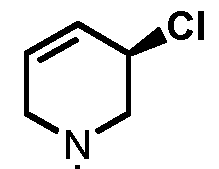
Racemic 3-chloro-1 ,2,3,6-tetrahydropyridines were subjected to Cu-catalysed AAA reactions and under optimized conditions allyl chloride 1 lead to enantioselective formation of novel 1 ,2,3,6-tetrahydropyridines (Table 1). More importantly unreacted allyl chloride was recovered with an elevated enantiomeric excess, showing the reaction is a kinetic resolution of racemic substrate (Table 1).
Table 1 Substrate scope.

Yield P: 44%; ee: 80% Yield P: 47%; ee: 87%
YieldSM: 43%; ee: 55% Yield SM: 46%; ee: 68%

Yieldp: 31 %; ee: 88% Yieldp: 25%; ee: 90%
YieldSM: 64%; ee: 30% YieldSM: 63%; ee: 34%
[0065] Further alteration of reaction conditions allowed the complete resolution of tetrahydropyridine allyl chloride (Scheme 1a). We showed that larger amounts of racemic substrate can be enantiomerically enriched (Scheme 1b) and resolution is succesful on recycled substrates using lower equivalences of Schwartz reagent (Scheme 1c).
Scheme 1 Kinetic resolution of tetrahydropyridine allyl chloride 1.

3 mmol 0 °C, 2h 57%
ee = 68% ee = 99%
[0066] Enantiopure allyl chloride was proven quite robust and versatile. The enantiomeric excess was preserved even under harsh reaction conditions (Scheme 2a). Removal of benzyl protecting group did not affect the stereochemical structure allowing, access to various tetrahydropyridine allyl chlorides with different functionalities on the N atom (Scheme 2b).
Scheme 2 Test reactions on enantiomeric allyl chloride.
Toluene
reflux
(a)


ee = 97% ee = 94%

DCM, reflux Dioxane
(b)

b) MeOH, reflux


Bn
 Boc
Boc
ee = 95% ee = 95%
[0067] Resolved allyl chloride went through simple but practical substitution reactions with phenol, thiophenol, dimedone, benzoic acid, dimethyl malonate and tetrabutylammonium fluoride with high stereospecificity (Scheme 3). Scheme 3 Stereospecific substitution reactions of enantiomeric tetrahydropyridine allyl chloride.

Yield = 62%
ee = 97% ee = 95% es = 98%

Yield = 47%
ee = 95% ee = 89% es = 94%
[0068] Racemic 3-chloro-1 ,2,3,6-tetrahydropyridine 1 was prepared via two alternative synthesis methods (Scheme 4). While first method involved a ring closing metathesis and protecting group exchange (Scheme 4a), second method was more straightforward with key steps of formation and opening of oxa-3-azabicycloheptane (Scheme 4b).5
Scheme 4 Preparation of racemic allyl chloride.
(a)


56%
°

85% Boc EtOAc, rt, 12 h Bn
75% 1


[0069] Latter method was utilized to synthesize deuterium labelled 3-chloro-1 ,2,3,6- tetrahydropyridine (Scheme 5). Reduction of benzylpyridinium bromide in deuterated methanol selectively substituted the deuterium atom on to C3 position and deuterium saturation was preserved during epoxide formation. A kinetic isotope effect was observed in the epoxide opening step leading to 71% deuterium saturation at C5 position. Final product was obtained with a resonable 61 % deuterium saturation (Scheme 5).
Scheme 5 Deuterium labelling reactions. A

[0070] Above mentioned nucleophillic substitution reactions (Scheme 3) were performed with deuterium-labelled allyl chloride in order to determine mechanistic pathway and absolute configurations of compounds in hand, mainly enantiopure allyl chloride (Table 1). Through out the reactions D atom percentange at C5 position was conserved, strongly suggesting an SN2 pathway (Scheme 6). Copper catalyzed asymmetric allylic alkylation reaction was also performed with D-labelled allyl chloride starting material, showing an SN2’ pathway is mainly preferred.
Scheme 6 Nucleophilic substitution reactions with deuterium labelled allylic chloride.


Bn Acetone, rt, 22 h Bn
71 %
Scheme 7 Cu-catalyzed asymmetric allylic alkylation with D-labelled allyl chloride.

References:
1. Maksymowicz, R. M.; Roth, P. M. C.; Fletcher, S. P. Nat. Chem. 2012, 4, 649.
2. Rideau, E.; You, H.; Sidera, M.; Claridge, T. D. W.; Fletcher, S. P. J. Am. Chem. Soc. 2017, 139, 5614.
3. Allais, C.; Roush, W. R. Org. Lett. 2017, 19, 2646.
4. (a) Cossy, J. Chem. Rec. 2005, 5, 70. (b) Sweeney, J. B.; Adams, K.; Doulcet, J.; Thapa, B.; Tran, F.; Crook, R. J. Catal. 2018, 360, 97. (c) Kubota, K.; Watanabe, Y.;
Hayama, K.; Ito, H. J. Am. Chem. Soc. 2016, 138, 4338. (d) Mesganaw, T.; Ellman, J. A. Org. Process. Res. Dev. 2014, 18, 1097. (e) Long, H.; Wang, G.; Lu, R.; Xu, M.; Zhang, K.; Qi, S.; He, Y.; Bu, Y.; Liu, L. Org. Lett. 2017, 19, 4146.
5. Grishina, G. V.; Borisenko, A. A.; Veselov, I. S.; Petrenko, A. M. Russ. J. Org. Chem. 2005, 41, 272.
Experimental Details and Spectral Data
General Information:
[0071] Procedures using oxygen/moisture-sensitive materials were performed with anhydrous solvents under an atmosphere of anhydrous argon in flame-dried flasks, using standard Schlenk techniques. Analytical thin-layer chromatography was performed on precoated glass-backed plates (Silica Gel 60 F254; Merck), and visualized using a combination of UV light (254 nm) and aqueous basic potassium permanganate (KMnCU) stain and developed upon heating. Flash column chromatography was carried out using Apollo Scientific silica gel 60 (0.040 - 0.063 nm), Merck 60 A silica gel, VWR (40-63 pm) silica gel and Sigma Aldrich silica gel. Pressure was applied at the column head via a flow of nitrogen with the solvent system used in parentheses.
[0072] Reactions at 0 °C were performed using an ice-water bath, covered with cotton wool and aluminum foil if overnight stirring is needed. Other temperatures were obtained using a Julabo FT902 immersion cooler or the heating plate of the stirrer.
[0073] NMR spectra were recorded at room temperature on Bruker AVIII HD 400 or AVIII HD 500 spectrometers and calibrated to the solvent signal (CDCh d = 7.26 ppm for 1H NMR, d = 77.0 ppm for 13C NMR, C6D6 d = 7.16 ppm for 1H NMR, d = 128.0 ppm for 13C NMR). Chemical shifts are reported in ppm from the residual solvent peak. Chemical shifts (d) are given in ppm and coupling constants (J) are quoted in hertz (Hz). Resonances are described as s (singlet), d (doublet), t (triplet), q (quartet), m (multiplet) or b (broadened).
[0074] Chiral HPLC separations were achieved using an Agilent 1230 Infinity series normal phase HPLC unit and HP Chemstation software. Chiralpak® columns (250 c 4.6 mm), fitted with matching Chiralpak® Guard Cartridges (10 x 4 mm), were used as
specified in the text. Solvents used were of HPLC grade (Fisher Scientific, Sigma Alrich or Honeywell); all eluent systems were isocratic. Chiral SFC (supercritical fluid
chromatography) separations were conducted on a Waters Acquity UPC2 system using Waters Empower software. Chiralpak® columns (150 c 3 mm, particle size 3 pm) were used as specified in the text. Solvents used were of HPLC grade (Fisher Scientific, Sigma Aldrich or Honeywell).
[0075] Low-resolution mass spectra were recorded using a Walters LCT premier XE. High resolution mass spectra (El and ESI) were recorded using a Bruker MicroTOF
spectrometer by the internal service at the University of Oxford. Infrared measurements (neat, thin film) were carried out using a Bruker Tensor 27 FT-IR with internal calibration in the range 600-4000 cm 1. Optical rotations were recorded on a Perkin-Elmer 241 polarimeter at 25°C in a 10 cm cell in the stated solvent; [O]D values are given in 10 1 deg. cm2 g_1 (concentration c given as g/100 mL).
[0076] Dry THF, CHCh, DMF, 1 ,4-dioxane, toluene, MTBE and CH2CI2 were collected fresh from an mBraun SPS-5 solvent purification system having been passed through anhydrous alumina columns. All other dry solvents used were dried over 3 A or 4 A molecular sieves and stored under argon. All other solvents were used as purchased from Sigma Aldrich, Honeywell or Fisher Scientific. Unless stated otherwise, commercially available reagents were purchased from Sigma-Aldrich, Fisher Scientific, Apollo Scientific, Acros Organics, Strem Chemicals, Alfa Aesar or TCI UK and were used without purification. Petroleum ether refers to light petroleum boiling in the range 40-60 °C.
Deuterated solvents were purchased from Sigma-Aldrich. Schwartz reagent was prepared according to the literature1 from Cp2ZrCl2 purchased from Acros or Strem Chemicals. Phosphoramidite ligands were prepared according to literature.2
Synthesis of 1-benzyl-3-chloro-1,2,3,6-tetrahydropyridine (4):
Method A:
1 ) H20, 100 °C, 6 h

A solution of A/-te/f-butoxycarbonyl-5-hydroxy-3-piperidene (2) prepared according to literature,3 (8.1 g, 41 mmol) in DMF (100 ml_) was cooled down to 0 °C and under argon atmosphere POCI3 (8.8 ml_, 94 mmol) was added dropwise. The reaction mixture was left gradually warming up to room temperature and was stirred overnight. H O was carefully added at 0 °C. The reaction solution was extracted with EtOAc. The combined organic phases were washed with brine and dried over MgSCU, filtered, concentrated under vacuum and purified by flash column chromatography on silica gel (pentane/EtOAc (10/1 to 9/1)) to give A/-te/f-butoxycarbonyl-5-chloro-3- piperidene (3) in 85% yield (7.6 g, 35 mmol) as a yellow oil. 1H NMR (400 MHz, CDCh, ppm) d: 1.48 (s, 9H), 3.55-4.15
(rotameric m, 4H), 4.51 (s, 1 H), 5.80-5.92 (m, 2H). Spectral data is in agreement with literature.4
1 -benzyl-3-chloro-1 ,2,3,6-tetrahydropyridine (4):
In a flame dried flask A/-te/f-butoxycarbonyl-5-chloro-3- piperidene (3) (3.5 g, 16 mmol) was dissolved in DCM (120 ml) and cooled to 0 °C. Trifluoroacetic acid (12 ml, 158 mmol) was added dropwise. Reaction was warmed to room temperature and monitored by TLC. Upon completion solvent was removed under vacuum. In a dried flask benzyl bromide (2.0 ml, 17 mmol) and EtOAc (25 ml) were mixed and cooled 0 °C. Crude material was dissolved in EtOAc (10 ml) and added to benzyl bromide solution dropwise. NaHCOs (20 g, 238 mmol) was added portionwise at 0 °C. The suspension was warmed up to room temperature and stirred overnight. The reaction was diluted with EtOAc and first washed with H O (x2) then with brine. Aqueous layers were back washed with EtOAc (x2). The combined organic phases were dried over MgS04, filtered, concentrated under vacuum and purified by flash column chromatography on silica gel (hexanes/EtOAc (9/1)) to give 1- benzyl-3-chloro-1 ,2,3,6-tetrahydropyridine (4) in 75% yield (2.5 g, 12 mmol) as a colorless oil. Note: A decrease in yield was observed for trials in larger scale.
1H NMR (400 MHz, CDCh, ppm) d: 2.73 (dd, J = 12.0, 6.0 Hz, 1 H), 2.96 (ddd, J = 12.0,
4.6, 0.8 Hz, 1 H), 2.99-3.12 (m, 2H), 3.62 (d, J = 13.2 Hz, 1 H), 3.70 (d, J = 13.2 Hz, 1 H), 4.57-4.61 (m, 1 H), 5.82-5.89 (m, 2H), 7.25-7.29 (m, 1 H), 7.31-7.38 (m, 4H); 13C NMR (101 MHz, CDCh, ppm) d: 52.0, 53.7, 57.2, 61.8, 126.8, 127.3, 128.3, 128.98, 129.04, 137.5; 1H NMR (400 MHz, C6D6, ppm) d: 2.53-2.58 (m, 3H), 2.67 (dd, J = 12.0, 4.6 Hz, 1 H), 3.21 (d, J = 13.2 Hz, 1 H), 3.28 (d, J = 13.2 Hz, 1 H), 4.30-4.35 (m, 1 H), 5.35 (dtd, J = 9.8, 3.2, 1.2 Hz, 1 H), 5.65 (bddd, J = 11.0, 5.2, 2.4 Hz, 1 H), 7.08-7.12 (m, 1 H), 7.16-7.19 (m, 2H), 7.26- 7.28 (m, 2H); IR (ATR) v (crrr1) neat: 3030, 2802, 1493, 1453, 1144, 1071 , 1026, 984, 911 , 792, 731 , 697; HRMS (ESI) m/z calcd for C12H15NCI+ [M+H]+ 208.08875, found 208.08884.
Method B:
TFA,UHP,TFAA, LDA
CM, rt, o.n. DCM THF, rt, 2 h MeOH, 0 °C, 4 h 94%
4 h 78%


DMF


1 -benzyl-1 ,2,3,6-tetrahydropyridine (5):
In a dried 100 ml-round-bottom flask pyridine (4 ml, 48 mmol) and DCM (12 ml) were mixed and cooled to 0 °C. Benzyl bromide (5.7 ml, 48 mmol) was added dropwise. The reaction solution was stirred overnight gradually warming up to room temperature. Solvent was removed on rotary evaporator. Et <D (10 ml) was added and evaporated off under vacuum affording pyridinium salt as off-white solid. Product was used in the next step without further purification.
Benzylpyridinium bromide was dissolved in MeOH (240 ml) and cooled to 0 °C. NaBH4 (2.2 g, 56 mmol) was added portionwise and the reaction solution was stirred at 0 °C for 4 hours. Reaction was quenched with H O and concentrated under vacuum. EtOAc (100 ml) was added and the resultant solution was washed with brine, dried over MgS04, filtered, concentrated under vacuum and purified by flash column chromatography on silica gel (hexanes/EtOAc/EtsN (4/1/0.05)) to give 1 -benzyl-1 ,2,3,6-tetrahydropyridine (5) in 84% yield (7.0 g, 40 mmol) as a viscous yellow oil. 1H NMR (400 MHz, CDCI3, ppm) d: 2.14- 2.18 (m, 2H), 2.56 (t, J = 5.6 Hz, 2H), 2.96-2.99 (m, 2H), 3.58 (s, 2H), 5.64-5.69 (m, 1 H),
5.73-5.77 (m, 1 H), 7.23-7.27 (m, 1 H), 7.29-7.37 (m, 4H). Spectral data is in agreement with literature.5
1 -benzyl-3, 4-epoxypiperidine (6):
In a dried flask urea hydrogen peroxide (UHP) (3.6 g, 38 mmol) and DCM (33 ml) were mixed and cooled 0 °C. A solution of trifluoroacetic anhydride (TFAA) (6.6 ml, 38 mmol) in DCM (20 ml) was added dropwise. The resultant suspension was stirred for 1 hour at 0 °C. Meanwhile TFA (2.8 ml, 35 mmol) was added dropwise into a solution of 1-benzyl-1 , 2,3,6- tetrahydropyridine (5) (4.7 g, 27 mmol) in DCM (20 ml) at 0 °C and stirred for 1 hour. Cold TFA/piperidine solution was added into UHP/TFAA solution dropwise and stirred for 4
hours at 0 °C. After completion H2O (50 ml) was added and biphasic solution was stirred for 15 minutes followed by addition of saturated Na2SC>3 solution. Organic layer was separated and aqueous layer was neutralized by K2CO3 addition and washed with DCM (x2). The combined organic phases were washed with saturated NaHC03 (x2), dried over MgSCU, filtered, concentrated under vacuum and purified by flash column chromatography on silica gel (hexanes/acetone (7/1)) to give 1 -benzyl-3, 4-epoxypiperidine (6) in 78% yield (4.0 g, 19 mmol) as a colorless oil. 1H NMR (400 MHz, CDCI3, ppm) d: 1.94-2.08 (m, 2H), 2.20 (ddd, = 11.4, 9.2, 4.2 Hz, 1 H), 2.30-2.36 (m, 1 H), 2.68 (d, J = 13.2 Hz, 1 H), 3.03 (ddd, J = 13.6, 4.0, 1.2 Hz, 1 H), 3.21-3.25 (m, 2H), 3.46 (s, 2H), 7.23-7.27 (m, 1 H), 7.28- 7.33 (m, 4H). Spectral data is in agreement with literature.6
1 -benzyl-1, 2, 3, 6-tetrahydropyridin-3-ol (7):
In a flame dried 250 ml-round-bottom flask THF (45 ml) and diisopropyl amine (2 ml, 14 mmol) were added and cooled 0 °C. 2.5 M n-butyllithium solution (5.7 ml, 14 mmol) was added dropwise and the resultant solution was stirred at 0 °C for 20-30 minutes. A solution of 1 -benzyl-3, 4-epoxypiperidine (6) (1.7 g, 9 mmol) in THF (20 ml) was added dropwise into the formed LDA solution, warmed up to room temperature and stirred for 2 hours. Reaction was quenched by addition of saturated NH4CI solution (40 ml) and extracted with DCM. The combined organic phases were washed with brine, dried over MgSCU, filtered, concentrated under vacuum and purified by flash column chromatography on silica gel (hexanes/acetone (5/1)) to give 1 -benzyl-1 , 2, 3, 6-tetrahydropyridin-3-ol (7) in 94% yield (1.6 g, 8.5 mmol) as a viscous yellow oil. 1H NMR (400 MHz, CDCI3, ppm) d: 2.21 (bs, 1 H (OH)), 2.51 (dd, J = 11.4, 3.2 Hz, 1 H), 2.74-2.81 (m, 2H), 3.13 (dd, J = 17.0, 3.2 Hz, 1 H), 3.61 (s, 2H), 4.05 (bd, J = 4.8 Hz, 1 H), 5.82 (ddd, J = 10.0, 4.0, 2.4 Hz, 1 H), 5.89-5.93 (m, 1 H), 7.23-7.28 (m, 1 H), 7.29-7.34 (m, 4H). Spectral data is in agreement with literature.6 1 -benzyl-3-chloro-1 ,2,3,6-tetrahydropyridine (4):
A solution of 1 -benzyl-1 , 2, 3, 6-tetrahydropyridin-3-ol (7) (2.8 g, 14.7 mmol) in DMF (60 ml_) was cooled down to 0 °C and under argon atmosphere POCI3 (2.8 ml_, 32.5 mmol) was added dropwise. The reaction mixture was left gradually warming up to room temperature and was stirred overnight. H2O was carefully added at 0 °C. The reaction solution was extracted with EtOAc. Aqueous layer was neutralized by K2CO3 and washed with EtOAc (x3). The combined organic phases were washed with brine (x2), dried over MgSCU, filtered, concentrated under vacuum and purified by flash column chromatography on silica gel (hexanes or pentane/EtOAc (9/1)) to give 1-benzyl-3-chloro-1 ,2,3,6-tetrahydropyridine (4) in 84% yield (2.6 g, 12.5 mmol) as a colorless oil.

A round-bottom flask with a stirbar was flame dried under vacuum and re-filled with Ar upon cooling. The flask was charged with CuCI (4 mg, 0.04 mmol) and ligand A (23 mg, 0.04 mmol), flushed with argon, sealed with septum and wrapped with aluminum foil.
CHC (2 ml, freshly collected from SPS) was added and the resultant colorless solution was stirred at room temperature for 1 hour. Meanwhile a separate round-bottom flask with a stirbar was flame dried under vacuum and re-filled with Ar upon cooling. The flask was charged with Cp2ZrHCI (206 mg, 0.8 mmol), flushed with argon, sealed with septum and wrapped with aluminum foil. DCM (0.4 ml) and then corresponding alkene (1 mmol) were added and the resultant suspension was stirred at room temperature until the mixture became completely clear (times for hydrozirconation vary with different alkene derivatives). After 1 hour fine crystalline Ag(OTf) (11.3 mg, 0.044 mmol) was quickly added to copper catalyst solution and stirred for 15 minutes until all the AgCI precipitated out. Suspension was filtered into alkylzirconocene solution using a syringe filter and the resultant black solution was cooled 0 °C. After 5 minutes neat 1-benzyl-3 chloro-1 ,2,3,6-tetrahydropyridine (4) (83 mg, 0.4 mmol) was added with a syringe at once. The reaction was stopped at the specified time (predetermined via NMR screening experiments) by pouring into Et2<D (10 ml) in a seperatory funnel. Remaining material in the flask was rinsed into Et2<D solution with EtOAc (2ml x2) and the resultant suspension was washed with saturated NaHCC>3 solution (5-7 ml x3). Aqueous phases were back washed with EtOAc (5-7 ml x2). The combined organic layers were dried over MgSCU, filtered, concentrated under vacuum and purified by flash column chromatography on silica gel. Yields in parenthesis were calculated with respect to consumed starting material. Enantiomeric excess of recovered ( )-1 -benzyl-3 chloro-1 ,2,3,6-tetrahydropyridine (4 R) were determined by HPLC
[Chiralpak® ID; flow: 1.0 mL/min; hexane:IPA 99.3:0.7; l = 210 nm]. Absolute
stereochemistry of products were assigned according to literature.4'7
Note·. The heterogeneity of the solution was found to influence reaction results (rate, yield and ee). Ideally, Cu-catalysed reactions should be conducted in a round-bottom flask with an egg-shaped stirbar, magnetically stirring at a rate of 350 rpm. Brand new septa were used to seal reaction flasks to prevent solvent evaporation.
General Procedure 2: Preparation of Racemic Products
Racemic products were synthesized by General Procedure 1 using racemic (3,5-dioxo-4- phosphacyclohepta[2,1-a:3,4-a’]dinaphthalen-4-yl)dimethylamine (MonoPhos®). Reactions were stirred at room temperature overnight.
General Procedure 3: Synthesis of Tetrahydropyridine Cbz-Carbamates for HPLC Analysis

Literature procedure was followed.8 Representative procedure; in a vial charged with a stirbar was added 1-benzyl-3-phenethyl-1 ,2,3,6-tetrahydropyridine (8b) (44 mg, 0.16 mmol), followed by addition of 0.5 M benzyl chloroformate solution in toluene (0.4 ml). Vial was flushed with Ar, sealed with a cap, heated to 80 °C and stirred at this temperature for 1.5 hours. The reaction solution was filtered through silica gel with 9/1 heaxane/EtOAc mixture to remove nonpolar impurities and unreacted benzyl chloroformate. Benzyl 3- phenethyl-3,6-dihydropyridine-1 (2/-/)-carboxylate (9) was obtained in 86% yield (42 mg, 0.14 mmol) as a colorless oil. 1H NMR (400 MHz, CDCh, ppm) d: 1.65-1.67 (m, 2H), 2.22 and 2.29 (rotameric bs), 2.60-2.72 (m, 2H), 3.26 and 3.36 (rotameric dd, J = 12.0, 6.6 and 4.8 Hz, 1 H), 3.66 and 3.80 (rotameric bd, J = 10.8 and 9.6 Hz, 1 H), 3.89-4.03 (m, 2H), 5.14-5.21 (rotameric m, 2H), 5.63-5.71 (m, 1 H), 5.80 (bd, = 8.8 Hz, 1 H), 7.10-7.21 (m, 3H), 7.26-7.37 (m, 7H); 13C NMR (101 MHz, CDCh, ppm) d: 33.1 , 34.3 and 34.6
(rotameric), 34.7 and 34.9 (rotameric), 43.5 and 43.7 (rotameric), 45.19 and 45.27
(rotameric), 67.1 , 123.5 and 124.1 (rotameric), 125.8, 127.9, 128.0, 128.39, 128.40, 128.5, 129.7 and 130.1 (rotameric), 136.9, 142.0 (m, rotameric), 155.5 and 155.7 (rotameric); IR (Vmax /crrr1): 695, 732, 1112, 1231 , 1426, 1495, 1697, 2855, 2922, 3029; HRMS (ESI) m/z calcd for C2iH2302NNa+ [M+Na]+ 344.16210, found 344.16202.
(R)- 1 -benzyl-3-(4-phenylbutyl)-1 ,2,3,6-tetrahydropyridine (8a):

1 H), 3.54 (d, J = 13.2 Hz, 1 H), 3.60 (d, J = 13.2 Hz, 1 H), 5.62-5.69 (m, 2H), 6.96-7.19 (m, 3H), 7.23-7.26 (m, 7H); 13C NMR (101 MHz, CDCh, ppm) d: 26.6, 31.7, 33.9, 35.89, 36.04, 53.1 , 55.6, 62.8, 124.8, 125.6, 126.9, 128.2, 128.4, 129.0, 130.1 , 138.5, 142.7; IR (vmax /cm 1): 695, 729, 908, 1026, 1 133, 1360, 1454, 1494, 2855, 2926, 3026; HRMS (ESI) m/z calcd for C22H28N+ [M+H]+ 306.22163, found 306.22150.
(R)- 1 -benzyl-3-phenethyl-1 ,2,3,6-tetrahydropyridine (8b):

According to General Procedure 1; the reaction proceed for 4 hours at 0 °C. Flash column chromatography on silica gel (hexanes/EtOAc (15/1) + 0.5 % Et8N) gave 4 in 48% yield (40 mg, 0.19 mmol, ee = 54%) and 8b in 42% (81 %) yield (47 mg, 0.17 mmol) as a yellow oil. Enantiomeric excess (for corresponding Cbz carbamate) of 88% was determined by HPLC [Chiralpak® IB; flow: 1.0 mL/min; hexane:IPA 97.5:2.5; l = 210 nm; major enantiomer tR = 10.7 min; minor enantiomer tR = 12.4 min]; [D]25s89 = -58.8 (c 0.40 CHCh) for 88% ee; [D]255S9 = -49.7 (c 0.50 CHCh) for 88% ee for Cbz carbamate; 1H NMR (400 MHz, CDCh, ppm) d: 1.59-1.72 (m, 2H), 2.18 (dd, J = 11.2, 7.2 Hz, 1 H), 2.30-2.36 (m, 1 H), 2.53-2.65 (m, 2H), 2.74 (dd, J = 11.2, 5.0 Hz, 1 H), 2.87-2.91 (m, 1 H), 3.04 (bd, J = 16.4 Hz, 1 H),
3.54 (d, J = 13.2 Hz, 1 H), 3.61 (d, J = 13.2 Hz, 1 H), 5.67-5.73 (m, 2H), 7.12-7.20 (m, 3H), 7.23-7.28 (m, 3H), 7.30-7.37 (m, 4H); 1H NMR (400 MHz, C6D6, ppm) d: 1.55-1.66 (m, 2H), 2.17 (dd, J = 10.4, 6.4 Hz, 1 H), 2.19-2.26 (m, 1 H), 2.42 (d, J = 8.0 Hz, 1 H), 2.44 (d, J = 8.0 Hz, 1 H), 2.58 (dd, J = 10.4, 4.4 Hz, 1 H), 2.78 (ddd, J = 16.2, 5.2, 2.6 Hz, 1 H), 2.88 (ddd, J = 16.0, 4.8, 2.4 Hz, 1 H), 3.35 (d, J = 13.2 Hz, 1 H), 3.45 (d, J = 13.2 Hz, 1 H), 5.54 (dtd, J = 9.8, 3.2, 2.0 Hz, 1 H), 5.64 (bddd, J = 10.0, 5.0, 3.0 Hz, 1 H), 7.02 (bd, J = 7.8 Hz, 2H), 7.05-7.14 (m, 3H), 7.16-7.22 (m, 3H), 7.37 (bd, J = 7.8 Hz, 2H); 13C NMR (101 MHz,
CDCh, ppm) d: 33.3, 35.74, 35.79, 53.2, 55.3, 62.8, 125.2, 125.7, 127.0, 128.2, 128.3,
128.4, 129.1 , 129.7, 136.6, 142.5; IR (vmax /cm 1): 695, 730, 998, 1028, 1 140, 1453, 1493,
2749, 2793, 2858, 2922, 3026; HRMS (ESI) m/z calcd for C20H24N+ [M+H]+ 278.19033, found 278.19022.
(R)- 1 -benzyl-3-(4-methoxyphenethyl)-1 ,2,3,6-tetrahydropyridine (8c):
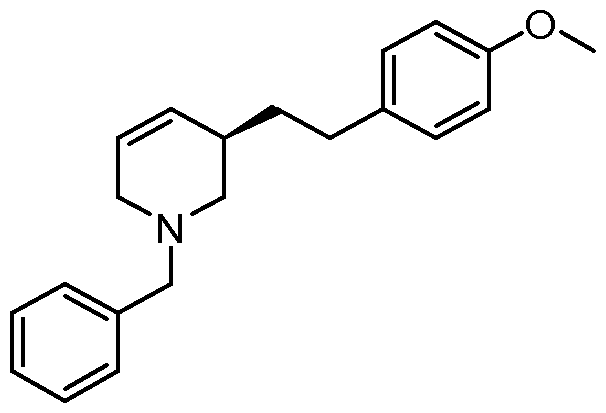
According to General Procedure 1; the reaction proceed for 5 hours at 0 °C. Flash column chromatography on silica gel (hexanes/EtOAc (15/1 to 9/1) + 0.5 % Et3N) gave 4 in 64% yield (40 mg, 0.19 mmol, ee = 37%) and 8c in 33% (92%) yield (40 mg, 0.13 mmol) as a colorless oil. Enantiomeric excess (for corresponding Cbz carbamate) of 92% was determined by HPLC [Chiralpak® IB; flow: 1.0 mL/min; hexane:IPA 97.5:2.5; l = 210 nm; major enantiomer tp = 13.4 min; minor enantiomer tp = 16.6 min]; [D]25589 = -42.7 (c 0.125 CHC ) for 92% ee; 1H NMR (400 MHz, CDCh, ppm) d: 1.54-168 (m, 2H), 2.17 (dd, J =
10.8, 7.2 Hz, 1 H), 2.23-2.32 (m, 1 H), 2.47-2.59 (m, 2H), 2.73 (dd, J = 10.8, 4.8 Hz, 1 H), 2.86-2.91 (m, 1 H), 3.04 (bd, J = 16.4 Hz, 1 H), 3.54 (d, J = 13.2 Hz, 1 H), 3.60 (d, J = 13.2 Hz, 1 H), 3.78 (s, 3H), 5.65-5.73 (m, 2H), 6.78-6.83 (m, 2H), 7.04 (bd, J = 8.8 Hz, 2H), 7.23-7.28 (m, 1 H), 7.29-7.37 (m, 4H); 13C NMR (101 MHz, CDCI3, ppm) d: 32.3, 35.6,
35.9, 53.2, 55.26, 55.28, 62.8, 1 13.7, 125.1 , 126.9, 128.2, 129.0, 129.2, 129.8, 134.5, 138.6, 157.7; IR (vmax /cm-1): 698, 729, 824, 1036, 1141 , 1245, 1456, 151 1 , 2750, 2793, 2857, 2926, 3027, 3732; HRMS (ESI) m/z calcd for C22H26ON+ [M+H]+ 308.20089, found 308.20071. For corresponding Cbz carbamate; 1H NMR (400 MHz, CDCh, ppm) d: 1.57-
1.67 (m, 2H), 2.20 and 2.26 (rotameric s, 1 H), 2.53-2.72 (m, 2H), 3.20-3.34 (m, 1 H), 3.60- 3.83 (m, 1 H), 3.78 (s, 3H), 3.83-4.02 (m, 2H), 5.12-5.20 (rotameric m, 2H), 5.57-5.70 (m,
1 H), 5.78 (bd, J = 8.4 Hz, 1 H), 6.81 (bs, 2H), 7.03 and 7.10 (rotameric bd, J = 7.2 Hz, 2H), 7.29-7.38 (m, 5H).
(R)- 1 -benzyl-3-(4-methylphenethyl)-1 ,2,3,6-tetrahydropyridine (8d):

HRMS (ESI) m/z calcd for C2I H26N+ [M+H]+ 292.20598, found 292.20585. For
corresponding Cbz carbamate; 1H NMR (400 MHz, CDCb, ppm) d: 1.57-1.70 (m, 2H), 2.21 and 2.26 (rotameric s, 1 H), 2.31 (s, 3H), 2.53-2.72 (m, 2H), 3.19-3.35 (m, 1 H), 3.73 (bdd, J = 16.0, 1 1.0 Hz, 1 H), 3.87-4.02 (m, 2H), 5.12-5.19 (rotameric m, 2H), 5.62 and 5.68 (rotameric bd, J = 9.4 Hz, 1 H), 5.79 (bd, J = 8.8 Hz, 1 H), 6.97-7.13 (m, 4H), 7.28-7.37 (m, 5H).
(R)- 1 -benzyl-3-(4-(trifluoromethyl)phenethyl)-1 ,2,3,6-tetrahydropyridine (8e):

According to General Procedure 1; the reaction proceed for 13 hours at 0 °C. Flash column chromatography on silica gel (hexanes/EtOAc (15/1) + 0.5 % EtsN) gave 4 in 69% yield (57 mg, 0.27 mmol, ee = 30%) and 8e in 22% (71 %) yield (30 mg, 0.09 mmol) as a white solid. Enantiomeric excess (for corresponding Cbz carbamate) of 91 % was determined by HPLC [Chiralpak® IB; flow: 1.0 mL/min; hexane:IPA 99.3:0.7; l = 210 nm; major enantiomer tR = 22.7 min; minor enantiomer tp = 24.8 min]; [D]25589 = -56.4 (c 1.08 CHCb) for 91 % ee for Cbz carbamate; 1H NMR (400 MHz, CDCIs, ppm) d: 1.56-1.73 (m, 2H), 2.19 (dd, J = 10.8, 7.0 Hz, 1 H), 2.25-2.33 (m, 1 H), 2.57-2.67 (m, 2H), 2.71 (dd, J = 10.8, 4.8 Hz, 1 H), 2.92 (dd, J = 16.0, 2.8 Hz, 1 H), 3.05 (bd, =16.0 Hz, 1 H), 3.55 (d, J = 13.2 Hz, 1 H), 3.61 (d, J = 12.8 Hz, 1 H), 5.68-5.73 (m, 2H), 7.22 (d, J = 8.0 Hz, 2H), 7.25-
7.29 (m, 1H), 7.31-7.37 (m, 4H), 7.51 (d, J= 8.0 Hz, 2H); 13C NMR (101 MHz, CDCI3, ppm) d: 33.1, 35.4, 35.6, 53.2, 54.9, 62.7, 125.2 (q, J= 3.8 Hz, 1C), 125.5, 128.2 (2C), 128.6, 129.0 (2C), 129.3, 138.5, 146.6; IR (vmax/cm·1): 698, 732, 842, 1067, 1117, 1161, 1323, 1456, 2797, 2966, 2926, 3032; HRMS (ESI) m/z calcd for C21H23NF3 + [M+H]+ 346.17771, found 346.17737. For corresponding Cbz carbamate; 1H NMR (400 MHz, CDC , ppm) d: 1.65 (bs, 2H), 2.20 and 2.26 (rotameric s, 1H), 2.58-2.88 (m, 2H), 3.29- 3.44 (m, 1H), 3.55-3.77 (m, 1H), 3.97 (bs, 2H), 5.11-5.21 (rotameric m, 2H), 5.61-5.72 (m, 1 H), 5.78 (bd, J= 9.6 Hz, 1H), 7.15-7.22 (m, 1H), 7.26-7.36 (m, 6H), 7.45-7.60 (m, 2H).
(R)- 1 -benzyl-3-(2-bromophenethyl)-1 ,2,3,6-tetrahydropyridine (8f):

According to General Procedure 1; the reaction proceed for 4 hours at 0 °C. Flash column chromatography on silica gel (hexanes/EtOAc (15/1) + 0.5 % Et3N) gave 4 in 41% yield (34 mg, 0.16 mmol, ee = 71%) and 8f in 44% (75%) yield (63 mg, 0.17 mmol) as a viscous colorless oil. Enantiomeric excess (for corresponding Cbz carbamate) of 88% was determined by HPLC [Chiralpak® IB; flow: 1.0 mL/min; hexane:IPA 99:1; l = 210 nm; major enantiomer tR= 15.9 min; minor enantiomer tp = 18.1 min]; [D]25589 = -55.1 (c0.70CHCU) for 88% ee; 1H NMR (400 MHz, CDCU, ppm) d: 1.65 (dd, J= 15.2, 7.6 Hz, 2H), 2.23 (dd, J = 11.2, 7.6 Hz, 1 H), 2.37 (bs, 1H), 2.70 (dd, J= 13.2, 8.0 Hz, 1H), 2.76 (dd, J= 13.6, 7.6 Hz, 1H), 2.81 (dd, J= 11.2, 5.2 Hz, 1H), 2.89 (bd, J = 16.4 Hz, 1H), 3.05 (bd, J= 16.0 Hz,
1 H), 3.48-3.69 (m, 2H), 5.62-5.86 (m, 2H), 7.0 (bt, J= 7.4 Hz, 1H), 7.15-7.23 (m, 2H), 7.25-7.29 (m, 1H), 7.32-7.39 (m, 4H), 7.51 (bd, J= 8.0 Hz, 1H); 13C NMR (101 MHz,
CDCU, ppm) d: 33.6, 34.1, 35.9, 53.1, 55.3, 62.9, 124.4, 125.3, 127.0, 127.44, 127.50, 128.2, 129.1, 129.6, 130.3, 132.8, 138.5, 141.8; IR (vmax /cm1): 696, 728, 748, 1069, 1142, 1202, 1492, 2749, 2794, 2861, 2966, 2921, 3027; HRMS (ESI) m/z calcd for C20H23BrN+ [M+H]+ 356.10084, found 356.10046. For corresponding Cbz carbamate; 1H NMR (400 MHz, CDCU, ppm) d: 1.48-1.65 (m, 2H), 2.26 and 2.33 (rotameric bs, 1 H), 2.75-2.81 (m, 2H), 3.20-3.39 (m, 1H), 3.62-4.05 (m, 3H), 5.13-5.21 (rotameric m, 2H), 5.66 and 5.71 (rotameric bd, J= 9.4 Hz, 1H), 5.82 (bs, 1H), 7.02-7.07 (m, 1H), 7.10-7.21 (m, 2H), 7.27- 7.36 (m, 5H), 7.51 (d, J= 7.6 Hz, 1H).
(R)- 1 -benzyl-3-(3-(4-(trifluoromethyl)phenyl)propyl)-1 ,2,3,6-tetrahydropyridine (8g):

According to General Procedure 1; the reaction proceed for 4 hours at 0 °C. Flash column chromatography on silica gel (hexanes/EtOAc (10/1) + 0.5 % Et3N) gave 4 in 70% yield (58 mg, 0.28 mmol, ee = 23%) and 8g in 24% (80%) yield (34 mg, 0.09 mmol) as a colorless oil. Enantiomeric excess (for corresponding Cbz carbamate) of 83% was determined by HPLC [Chiralpak® ID; flow: 1.0 mL/min; hexane:IPA 90: 10; l = 210 nm; minor enantiomer tp = 8.9 min; major enantiomer tp = 9.4 min]; [D]25589 = -40.0 (c 1.08 CHCL) for 83% ee; 1H NMR (400 MHz, CDCI3, ppm) d: 1.31-1.41 (m, 2H), 1.53-1.70 (m, 2H), 2.10 (dd, J = 10.8, 7.2 Hz, 1 H), 2.25-2.32 (m, 1 H), 2.63 (dd, J = 8.0, 7.6 Hz, 2H), 2.70 (dd, J = 11.2, 5.2 Hz,
1 H), 2.85 (dd, J = 16.4, 3.2 Hz, 1 H), 3.03 (bd, =16.0 Hz, 1 H), 3.53 (d, J = 12.8 Hz, 1 H), 3.59 (dd, J = 13.2 Hz, 1 H), 5.63-5.69 (m, 2H), 7.24 (d, J = 8.4 Hz, 2H) 7.23-7.27 (m, 1 H), 7.29-7.36 (m, 4H), 7.5 (d, J = 8.0 Hz, 2H); 13C NMR (101 MHz, CDCI3, ppm) d: 28.5, 33.4, 35.92, 35.96, 53.1 , 55.3, 62.8, 125.1 , 125.2 (q, J = 3.8 Hz, 1 C), 128.2 (2C), 128.7, 129.0 (2C), 129.7, 138.5, 146.6; IR (vmax /cm-1): 696, 730, 841 , 1066, 11 16, 1 161 , 1323, 2795, 2859, 2929, 3028; HRMS (ESI) m/z calcd for C22H25NF3 + [M+H]+ 360.19336, found 360.19302. For corresponding Cbz carbamate; 1H NMR (400 MHz, CDCL, ppm) d: 1.30- 1.43 (m, 2H), 1.60-1.79 (m, 2H), 2.19 and 2.25 (rotameric bs, 1 H), 2.64 (dt, J = 25.6, 7.2 Hz, 2H), 3.10-3.30 (m, 1 H), 3.59-3.79 (m, 1 H), 3.84-4.02 (m, 2H), 5.10-5.19 (rotameric m, 2H), 5.56-5.68 (m, 1 H), 5.73 (ddd, J = 10.4, 5.2, 2.0 Hz, 1 H), 7.19-7.36 (m, 7H), 7.51 (bs,
2H).
(R)- 1 -benzyl-3-(6-chlorohexyl)-1 ,2,3,6-tetrahydropyridine (8h):

According to General Procedure 1; the reaction proceed for 2 hours at room temperature. Flash column chromatography on silica gel (hexanes/EtOAc (15/1) + 0.5 % Et3N) gave 4 in 46% yield (38 mg, 0.18 mmol, ee = 43%) and 8h in 37% (68%) yield (43 mg, 0.15 mmol) as a colorless oil. Enantiomeric excess (for corresponding Cbz carbamate) of 86% was determined by HPLC [Chiralpak® ID; flow: 1.0 mL/min; hexane:IPA 90: 10; l = 210 nm; minor enantiomer tp = 10.8 min; major enantiomer tp = 11.2 min]; [D]25s89 = -35.2 (c 1.25 CHCh) for 86% ee; 1H NMR (400 MHz, CDCI3, ppm) d: 1.25-1.34 (m, 6H), 1.37-1.46 (m,
2H), 1.74 (p, J = 7.2 Hz, 2H), 2.08 (dd, =11.2, 7.6 Hz, 1 H), 2.25 (bs, 1 H), 2.72 (dd, J
= 11.2, 5.2 Hz, 1 H), 2.82-2.86 (m, 1 H), 3.01-3.07 (m, 1 H), 3.52 (t, J = 6.8 Hz, 2H), 3.53 (d,
J = 14.0 Hz, 1 H), 3.60 (d, J = 13.2 Hz, 1 H), 5.62-5.68 (m, 2H), 7.22-7.27 (m, 1 H), 7.29- 7.36 (m, 4H); 13C NMR (101 MHz, CDCI3, ppm) d: 26.73, 26.80, 29.0, 32.6, 33.8, 36.0, 45.1 , 53.1 , 55.6, 62.8, 124.8, 126.9, 128.1 , 129.0, 130.1 , 138.5; IR (vmax /cm-1): 697, 728, 997, 1130, 1393, 1455, 2749, 2793, 2855, 2926, 3027, 3742; HRMS (ESI) m/z calcd for
C18H27CIN+ [M+H]+ 292.18265, found 292.18242. For corresponding Cbz carbamate; 1H NMR (400 MHz, CDCh, ppm) d: 1.19-1.43 (m, 8H), 1.75 (bs, 2H), 2.16 and 2.22 (rotameric bs, 1 H), 3.08 and 3.24 (rotameric dd, J = 12.4, 6.6 Hz, 1 H), 3.52 (bs, 2H), 3.60-3.78 (m,
1 H), 3.87-4.03 (m, 2H), 5.1 1-5.20 (rotameric m, 2H), 5.60 and 5.66 (rotameric bd, J = 5.2 Hz, 1 H), 5.75 (bd, J = 10.4 Hz, 1 H), 7.02-7.63 (m, 5H).
(R)- 1 -benzyl-3-(4-((tert-butyldiphenylsilyl)oxy)butyl)-1 ,2,3,6-tetrahydropyridine (8i):

According to General Procedure 1; the reaction proceed for 30 minutes at room
temperature. Flash column chromatography on silica gel (hexanes/EtOAc (10/1) + 0.5 % Et3N) gave 4 in 43% yield (36 mg, 0.17 mmol, ee = 55%) and 8i in 44% (77%) yield (85 mg, 0.18 mmol) as a yellow oil. Enantiomeric excess (for corresponding Cbz carbamate) of 80% was determined by HPLC [Chiralpak® IC; flow: 1.0 mL/min; hexane:IPA 99: 1 ; l = 210 nm; major enantiomer tp = 20.7 min; minor enantiomer tp = 21.9 min]; [D]25589 = -22.6 (c 0.80 CHCh) for 80% ee; 1H NMR (400 MHz, CDCI3, ppm) d: 1.04 (s, 9H), 1.22-1.43 (m, 4H), 1.54 (p, J = 6.8 Hz, 2H), 2.05 (dd, J = 10.8, 7.6 Hz, 1 H), 2.25 (bs, 1 H), 2.73 (dd, J = 10.8, 4.8 Hz, 1 H), 2.83 (bdd, J = 16.4, 3.2 Hz, 1 H), 3.05 (bd, J = 16.4 Hz, 1 H), 3.55 (d, J = 12.8 Hz, 1 H), 3.60 (d, J = 13.2 Hz, 1 H), 3.64 (t, J = 6.4 Hz, 2H), 5.61-5.67 (m, 2H), 7.21- 7.43 (m, 1 1 H), 7.64-7.67 (m, 4H); 13C NMR (101 MHz, CDCI3, ppm) d: 19.2, 23.1 , 26.9, 32.7, 33.6, 36.0, 53.1 , 55.7, 62.8, 63.8, 124.7, 127.0, 127.6, 128.2, 129.0, 129.5, 130.1 , 134.1 , 135.6, 138.5; IR (vmax /cm-1): 699, 733, 822, 1107, 1457, 2796, 2930, 3027; HRMS (ESI) m/z calcd for C32H420NSi+ [M+H]+ 484.30302, found 484.30231. For corresponding Cbz carbamate; 1H NMR (400 MHz, CDCh, ppm) d: 1.05 (s, 9H), 1.20-1.59 (m, 8H), 2.15 and 2.22 (rotameric bs, 1 H), 3.01-3.20 (m, 1 H), 3.56-4.10 (m, 1 H), 3.65 (bs, 2H), 3.81-4.04 (m, 2H), 5.11-5.19 (rotameric m, 2H), 5.54-5.66 (m, 1 H), 5.74 (bd, J = 10.0 Hz, 1 H), 7.10- 7.61 (m, 1 1 H), 7.64 (bd, J = 10.4 Hz, 4H).
(R)- 1 -benzyl-3-hexyl-1 ,2,3,6-tetrahydropyridine (8j):

According to General Procedure 1; the reaction proceed for 40 minutes at room
temperature. Flash column chromatography on silica gel (CHCh to hexanes/EtOAc (10/1)
+ 0.5 % EhN) gave 4 in 46% yield (38 mg, 0.18 mmol, ee = 68%) and 8j in 47% (87%) yield (48 mg, 0.18 mmol) as a yellow oil. Enantiomeric excess (for corresponding Cbz carbamate) of 87% was determined by HPLC [Chiralpak® IC; flow: 1.0 mL/min; hexane:IPA 97:3; l = 210 nm; major enantiomer tp = 13.6 min; minor enantiomer tp = 14.3 min]; [D]25589 = -42.1 (c 0.30 CHCh) for 87% ee; 1H NMR (400 MHz, CDCh, ppm) d: 0.87 (t, J = 6.8 Hz, 3H), 1.25-1.35 (m, 10H), 2.08 (dd, J = 10.8, 8.0 Hz, 1 H), 2.27 (bs, 1 H), 2.74 (dd, J = 10.8, 4.8 Hz, 1 H), 2.83 (bd, J = 15.6 Hz, 1 H), 3.04 (bd, J = 16.4 Hz, 1 H), 3.54 (d, J = 13.2 Hz,
1 H), 3.61 (d, J = 12.8 Hz, 1 H), 5.61-5.69 (m, 2H), 7.23-7.27 (m, 1 H), 7.29-7.36 (m, 4H);
13C NMR (101 MHz, CDCh, ppm) d: 14.1 , 22.6, 26.8, 29.5, 31.8, 33.9, 36.1 , 53.1 , 55.7, 62.8, 124.6, 126.9, 128.1 , 129.0, 130.3, 138.5; IR (vmax /cm-1): 695, 727, 998, 1071 , 1 126, 1492, 2854, 2923, 2955, 3028; HRMS (ESI) m/z calcd for C18H28N+ [M+H]+ 258.22163, found 258.22156; For corresponding Cbz carbamate; 1H NMR (400 MHz, CDCh, ppm) d: 0.88 (t, J = 7.2 Hz, 3H), 1.25-1.30 (m, 10H), 2.16 and 2.23 (rotameric bs, 1 H), 3.01-3.25 (m, 1 H), 3.63-4.05 (m, 3H), 5.1 1-5.20 (rotameric m, 2H), 5.59 and 5.65 (rotameric bd, J = 9.4 Hz, 1 H), 5.75 (dd, J = 10.2, 1.4 Hz, 1 H), 7.04-7.64 (m, 5H).
(R)- 1 -benzyl-3-(3,3-dimethylbutyl)-1 ,2,3,6-tetrahydropyridine (8k):

According to General Procedure 1; the reaction proceed for 30 minutes at room
temperature. Flash column chromatography on silica gel (CHCh to hexanes/EtOAc (9/1) + 0.5 % EhN) gave 4 in 64% yield (53 mg, 0.25 mmol, ee = 30%) and 8k in 31 % (86%) yield (32 mg, 0.12 mmol) as a colorless oil. Enantiomeric excess (for corresponding Cbz carbamate) of 88% was determined by HPLC [Chiralpak® ID; flow: 1.0 mL/min; hexane:IPA 90: 10; l = 210 nm; minor enantiomer tp = 6.5 min major enantiomer tp = 7.5 min]; [D]25s89 = -50.7 (c 0.80 CHCh) for 88% ee; 1H NMR (400 MHz, CDCh, ppm) d: 0.86 (s, 9H), 1.09- 1.22 (m, 2H), 1.23-1.32 (m, 2H), 1.12 (dd, J = 10.8, 7.6 Hz, 1 H), 2.14-2.26 (m, 1 H), 2.73
(dd, J = 10.8, 4.8, Hz, 1 H), 2.84-2.89 (m, 1 H), 3.06 (dd, J = 16.4, 2.8 Hz, 1 H), 3.54 (d, J = 13.2 Hz, 1 H), 3.62 (d, J = 13.2 Hz, 1 H), 5.64-5.72 (m, 2H), 7.24-7.28 (m, 1 H), 7.31-7.38 (m, 4H); 13C NMR (101 MHz, CDCI3, ppm) d: 28.7, 29.3, 30.2, 36.8, 41.3, 53.2, 55.5, 62.8, 124.6, 126.9, 128.2, 129.0, 130.4, 138.6; IR (vmax /cm-1): 694, 726, 995, 1 137, 1393, 1456, 2863, 2952; HRMS (ESI) m/z calcd for C18H28N+ [M+H]+ 258.22163, found 258.22183. For corresponding Cbz carbamate; 1H NMR (400 MHz, CDCh, ppm) d: 0.85 (rotameric s, 9H), 1.19-1.33 (m, 4H), 2.09 and 2.16 (rotameric bs, 1 H), 2.98-3.27 (m, 1 H), 3.59-4.06 (m, 3H), 5.15 (bs, 2H), 5.60 and 5.65 (rotameric bd, J = 9.2 Hz, 1 H), 5.76 (ddd, J = 10.4, 5.2, 2.4 Hz, 1 H), 7.28-7.38 (m, 5H).
(R)- 1 -benzyl-3-ethyl-1 ,2,3,6-tetrahydropyridine (8I):

According to General Procedure 1; the reaction proceed for 30 minutes at room
temperature, under 1 atm of ethylene gas. Flash column chromatography on silica gel (CHCI3 to hexanes/EtOAc (9/1) + 0.5 % Et8N) gave 4 in 63% yield (52 mg, 0.25 mmol, ee = 34%) and 8I in 25% (68%) yield (20 mg, 0.10 mmol) as a colorless oil. Enantiomeric excess (for corresponding Cbz carbamate) of 90% was determined by HPLC [Chiralpak® IC; flow: 1.0 mL/min; hexane:IPA 97:3; l = 210 nm; major enantiomer tp = 16.0 min; minor enantiomer tp = 16.9 min]; [D]25s89 = -39.2 (c 0.75 CHCI3) for 90% ee for Cbz carbamate;
1H NMR (400 MHz, CDCU, ppm) d: 0.89 (t, J = 7.6 Hz, 3H), 1.29-1.41 (m, 2H), 2.09 (dd, J = 10.8, 8.0 Hz, 1 H), 2.16-2.25 (m, 1 H), 2.76 (dd, J = 10.8, 5.2 Hz, 1 H), 2.81-2.87 (m, 1 H), 3.06 (bd, J = 16.8 Hz, 1 H), 3.56 (d, J = 13.2 Hz, 1 H), 3.61 (d, J = 12.8 Hz, 1 H), 5.64-5.71 (m, 2H), 7.23-7.27 (m, 1 H), 7.30-7.37 (m, 4H); 13C NMR (101 MHz, CDCU, ppm) d: 1 1.4, 26.7, 37.7, 53.1 , 55.4, 62.9, 124.8, 126.9, 128.2, 129.0, 130.0, 138.6; IR (vmax /cm-1): 697, 727, 750, 978, 1151 , 1492, 2748, 2793, 2923, 2960, 3027; HRMS (ESI) m/z calcd for CMH2ON+ [M+H]+ 202.15903, found 202.15894. Spectral data is in agreement with literature.9 For corresponding Cbz carbamate; 1H NMR (400 MHz, CDCI3, ppm) d: 0.92- 0.94 (rotameric m, 3H), 1.25-1.43 (m, 2H), 2.10 and 2.16 (rotameric bs, 1 H), 3.04-3.24 (m, 1 H), 3.66-4.04 (m, 3H), 5.1 1-5.19 (rotameric m, 2H), 5.60 and 5.66 (rotameric bd, J = 10.0 Hz, 1 H), 5.76 (bdd, J = 10.0, 1.8 Hz, 1 H), 7.07-7.50 (m, 5H).

A round-bottom flask with a stirbar was flame dried under vacuum and re-filled with Ar upon cooling. The flask was charged with CuCI (4 mg, 0.04 mmol) and ligand A (23 mg, 0.04 mmol), flushed with argon and wrapped with aluminum foil. DCM (2 ml, freshly collected from SPS) was added and the resultant colorless solution was stirred at room temperature for 1 hour. Meanwhile a separate round-bottom flask with a stirbar was flame dried under vacuum and re-filled with Ar upon cooling. The flask was charged with Cp2ZrHCI (206 mg, 0.8 mmol), flushed with argon and wrapped with aluminum foil. DCM (0.4 ml) and then styrene (0.12 ml, 1.0 mmol) were added and the resultant suspension was stirred at room temperature until the mixture became completely clear. After 1 hour fine crystalline Ag(OTf) (12 mg, 0.044 mmol) was quickly added to copper catalyst solution and stirred for 15 minutes until all the AgCI precipitated out. Suspension was filtered into alkylzirconocene solution using a syringe filter and the resultant black solution was cooled 0 °C and more DCM (5.6 ml) was added for dilution. After 5 minutes neat 1 -benzyl-3 chloro-1 ,2,3,6-tetrahydropyridine (4) (83 mg, 0.4 mmol) was added with a syringe and solution was stirred for 18 hours at 0 °C. The reaction was stopped by pouring into Et2<D (10 ml) in a seperatory funnel. Remaining material in the reaction flask was rinsed into Et2<D solution with EtOAc (2 ml x2) and the resultant suspension was washed with saturated NaHCC>3 solution (5-7 ml x3). Aqueous phases were back washed with EtOAc (5-7 ml x2). The combined organic layers were dried over MgS04, filtered, concentrated under vacuum and purified by flash column chromatography on silica gel (hexanes/EtOAc (19/1)) to give 4 R in 30% yield (25 mg, 0.12 mmol) as a yellow oil. Enantiomeric excess of 99% was determined by HPLC [Chiralpak® ID; flow: 1.0 mL/min; hexane:IPA 99.3:0.7; l = 210 nm, minor enantiomer tp = 6.0 min, major enantiomer tp = 6.6 min]; [D]25s89 = +154.9 (c 1 CHCIs) for 99% ee.
Procedure for resolution of 4 in larger scale:
Above mentioned procedure was followed with 831 mg (4.00 mmol) 4, 1.2 ml (10.0 mmol) styrene, 40 mg (0.4 mmol) CuCI, 230 mg (0.4 mmol) ligand A, 120 mg (0.44 mmol) AgOTf and 2.0 g (8.0 mmol) Cp2ZrHCI. The reaction was run in 80 ml DCM (8 ml of DCM was used in hydrozirconation step and 52 ml of DCM was added for dilution) for 2 hours at 0
°C. Resolved 4/? was obtained in 37% yield (309 mg, 1.5 mmol). Enantiomeric excess of 92% was determined by HPLC [Chiralpak® ID; flow: 1.0 mL/min; hexane:IPA 99.3:0.7; l = 210 nm, minor enantiomer tp = 5.7 min major enantiomer tp = 6.2 min] Nucleophillic Substitution Reactions with 4R
(S)-1 -benzyl-3-phenoxy-1 ,2,3,6-tetrahydropyridine (10):

ee = 97% es = 98%
In a flame dried vial with a stirbar were added phenol (21 mg, 0.22 mmol) and K2CO3 (11 1 mg, 0.80 mmol) followed by a solution of ( )-1-benzyl-3-chloro-1 ,2,3,6-tetrahydropyridine (4 R) (42 mg, 0.20 mmol) in acetone (1.5 ml). The vial was sealed with a cap and resulting suspension was stirred at 60 °C for 24 hours. The reaction mixture was cooled to room temperature, transferred to a round-bottom flask and the reaction vial was rinsed with EtOAc (1 ml x 3). Flash column chromatography on silica gel (hexanes/EtOAc (19/1 to 9/1)) gave 10 in 74% yield (39 mg, 0.15 mmol) as off-white solid. Enantiomeric excess of 97% was determined by HPLC [Chiralpak® IB; flow: 1.0 mL/min; hexane:IPA 90: 10; l =
210 nm; major enantiomer tp = 5.6 min; minor enantiomer tp = 6.7 min]; [D]25s89 = +70.2 (c 0.85 CHCb) for 97% ee; 1H NMR (400 MHz, CDCU, ppm) d: 2.70 (dd, J = 11.2, 6.0 Hz,
1 H), 2.97 (dd, J = 11.2, 4.8 Hz, 1 H), 3.07 (bs, 2H), 3.66 (d, J = 12.8 Hz, 1 H), 3.71 (d, J = 13.2 Hz, 1 H), 4.91-4.94 (m, 1 H), 5.94-6.01 (m, 2H), 6.91-6.97 (m, 3H), 7.25-7.38 (m, 7H); 1H NMR (400 MHz, C6D6, ppm) d: 2.56 (dd, J = 10.8, 7.0 Hz, 1 H), 2.61 (ddd, J = 16.8, 5.2, 2.8 Hz, 1 H), 2.76-2.82 (m, 1 H), 2.94 (bdd, J = 11.0, 5.0 Hz, 1 H), 3.31 (d, J = 13.2 Hz, 1 H), 3.36 (d, J = 13.2 Hz, 1 H), 4.84-4.89 (m, 1 H), 5.52-5.56 (m, 1 H), 5.85-5.88 (m, 1 H), 6.78- 6.82 (m, 1 H), 6.85-6.88 (m, 2H,), 7.05-7.12 (m, 3H), 7.15-7.19 (m, 2H), 7.28-7.30 (m, 2H); 13C NMR (101 MHz, CDCU, ppm) d: 52.4, 54.0, 62.2, 70.7, 1 15.8, 120.9, 124.9, 127.2, 128.3, 129.0, 129.5, 129.8, 137.6, 157.7; IR (vmax /cm-1): 692, 751 , 773, 1032, 1238, 1490,
1591 ; HRMS (ESI) m/z calcd for C18H20ON+ [M+H]+ 266.15394, found 266.15396. Spectral data is in agreement with literature.9
(S)-1 -benzyl-1 , 2, 3, 6-tetrahydropyridin-3-yl benzoate (11):

Bn Acetone, 60 °C, 24 h Bn
ee = 97% Yield = 62%
ee = 95% es = 98%
In a flame dried vial with a stirbar were added benzoic acid (32 mg, 0.26 mmol) and K2CO3 (100 mg, 0.72 mmol) followed by a solution of (f?)-1-benzyl-3-chloro-1 , 2,3,6- tetrahydropyridine (4 R) (50 mg, 0.24 mmol) in acetone (2.5 ml). The vial was sealed with a cap and resulting suspension was stirred at 60 °C for 24 hours. The reaction mixture was cooled to room temperature, transferred to a round-bottom flask and the reaction vial was rinsed with EtOAc (1 ml x 3). Flash column chromatography on silica gel (hexanes/EtOAc (19/1 to 9/1) + 0.5% EΐbN) gave 11 in 62% yield (43 mg, 0.15 mmol) as white solid.
Enantiomeric excess of 95% was determined by HPLC [Chiralpak® ID; flow: 1.0 mL/min; hexane:IPA 90: 10; l = 210 nm; minor enantiomer tp = 6.6 min; major enantiomer tp = 7.7 min]; [D]25 589 = +175.4 (c 0.83 CHCU) for 95% ee; 1H NMR (400 MHz, CDCU, ppm) d: 2.76-2.84 (m, 2H), 2.96 (ddd, J = 16.8, 2.4, 2.0 Hz, 1 H), 3.14 (ddt, J = 16.8, 3.2, 2.0 1 H), 3.58 (d, J = 13.6 Hz, 1 H), 3.72 (d, J = 13.6 Hz, 1 H), 5.49-5.50 (bm, 1 H), 5.91 (ddt, J =
10.0, 3.6, 2.0 Hz, 1 H), 6.01 (dtd, J = 10.0, 3.2, 0.8 Hz, 1 H), 7.18-7.29 (m, 3H), 7.34-7.37 (m, 2H), 7.38-7.43 (m, 2H), 7.50-7.54 (m, 1 H), 8.01-8.05 (m, 2H); 13C NMR (101 MHz,
CDCU, ppm) d: 52.3, 53.9, 61.9, 68.2, 124.0, 127.2, 128.28, 128.29, 128.8, 129.7, 130.4, 131.1 , 132.9, 137.8, 166.3; IR (vmax /cm-1): 705, 731 , 1070, 1265, 171 1 ; HRMS (ESI) m/z calcd for C19H2o02N+ [M+H]+ 294.14886, found 294.14865. (S)-3-((1 -benzyl-1 ,2,3,6-tetrahydropyridin-3-yl)oxy)-5,5-dimethylcyclohex-2-en-1 -one
(12):
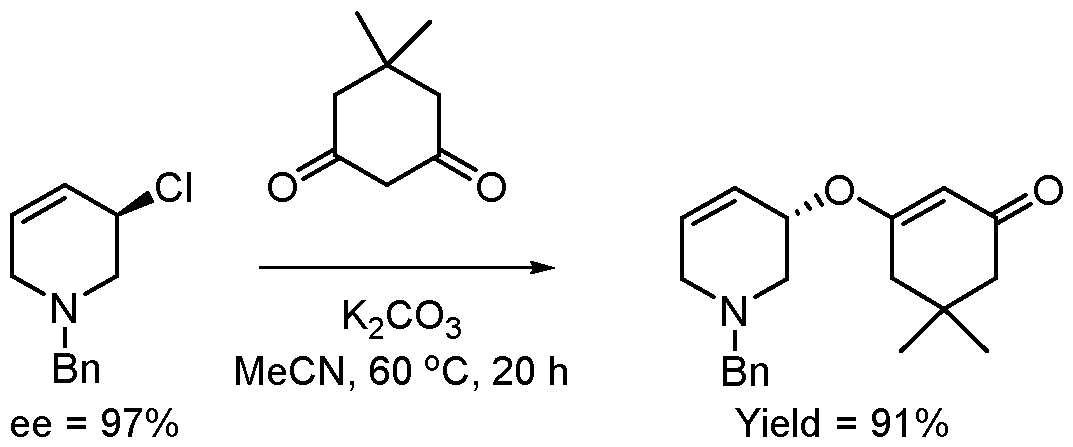
ee = 97% es = 99%
In a flame dried vial with a stirbar were added dimedone (67 mg, 0.48 mmol) and K2CC>3 (1 16 mg, 0.84 mmol) followed by a solution of ( )-1-benzyl-3-chloro-1 , 2,3,6- tetrahydropyridine (4 R) (50 mg, 0.24 mmol) in acetonitrile (2.5 ml). The vial was sealed with a cap and resulting suspension was stirred at 60 °C for 20 hours. The reaction mixture
was cooled to room temperature, transferred to a round-bottom flask and the reaction vial was rinsed with EtOAc (1 ml x 3). Flash column chromatography on silica gel
(hexanes/EtOAc (1/1)) gave 12 in 91% yield (68 mg, 0.22 mmol) as white solid.
Enantiomeric excess of 96% was determined by HPLC [Chiralpak® ID; flow: 1.0 mL/min; hexane:IPA 90:10; l = 210 nm; major enantiomer tp= 18.2 min; minor enantiomer tp = 19.4 min]; [D]25 589 = +29.0 (c 0.84 CHCb) for 96% ee; 1H NMR (400 MHz, CDCI3, ppm) d: 1.02 (s, 3H), 1.05 (s, 3H), 2.15 (d, J= 18.0 Hz, 1H), 2.19 (d, J= 16.8 Hz, 1H), 2.23 (d, J= 17.2 Hz, 1H), 2.29 (d, J= 17.6 Hz, 1H), 2.68 (dd, J= 12.0, 3.6 Hz, 1H), 2.77 (dd, J= 12.0, 4.8 Hz, 1H), 2.96 (bdd, J= 17.0, 1.8 Hz, 1H), 3.15 (bddt J= 16.8, 3.2, 1.6 Hz, 1H), 3.55 (d, J =
13.2 Hz, 1H), 3.72 (d, J= 13.2 Hz, 1H), 4.70 (bs, 1H), 5.33 (s, 1H), 5.85 (ddt, J= 10.0, 3.4,
2.2 Hz, 1 H), 6.03 (dtd, J= 10.0, 3.2, 2.0 Hz, 1H), 7.22-7.27 (m, 1H), 7.28-7.34 (m, 4H); 13C NMR (101 MHz, CDCI3, ppm) d: 28.22, 28.34, 32.4, 43.2, 50.7, 52.4, 52.9, 61.9, 70.9, 101.9, 122.6, 127.3, 128.3, 129.0, 131.7, 137.4, 174.9, 199.5; IR (vmax/cm-1): 729, 1042, 1144, 1219, 1378, 1589, 1638, 2965, 3749; HRMS (ESI) m/z calcd for C26H2202N+ [M+H]+ 312.19581, found 312.19556.
(S)-1-benzyl-3-(phenylthio)-1,2,3,6-tetrahydropyridine (13):

ee = 91 % es = 96%
In a flame dried vial with a stirbarwere added K2CO3 (166 mg, 1.2 mmol) and a solution of ( )-1-benzyl-3-chloro-1,2,3,6-tetrahydropyridine (4 R) (50 mg, 0.24 mmol) in acetone (2.5 ml) followed by the addition of thiophenol (0.06 ml, 0.48 mmol). The vial was sealed with a cap and resulting suspension was stirred at room temperature for 22 hours. The reaction mixture was diluted with H2O and extracted with Eΐ20 (x3). Combined organic layers were washed with brine, dried over MgSCL, filtered, concentrated under vacuum and purified by flash column chromatography on silica gel (hexanes/EtOAc (19/1 to 9/1)) to give 13 in 83% yield (56 mg, 0.20 mmol) as a yellow oil. Enantiomeric excess (for corresponding Cbz carbamate) of 91% was determined by HPLC [Chiralpak® ID; flow: 1.0 mL/min; hexane:IPA 90:10; l = 210 nm; minor enantiomer tp = 17.1 min; major enantiomer tp= 18.9 min];
[D ssg = -45.8 (c 0.72 CHC ) for 91% ee; 1H NMR (400 MHz, CDCU, ppm) d: 2.65 (dd, J = 11.6, 5.6 Hz, 1 H), 2.81 (dd, J= 11.6, 4.4 Hz, 1H), 2.96-3.01 (m, 1H), 3.07 (ddd, J= 16.8, 4.8, 2.4 Hz, 1H), 3.52 (d, J= 13.2 Hz, 1H), 3.72 (d, J= 13.2 Hz, 1H), 3.83-3.87 (m, 1H), 5.78-5.82 (m, 1H), 5.83-5.87 (m, 1H), 7.17-7.38 (m, 10H); 13C NMR (101 MHz, CDCU,
ppm) d: 44.7, 52.5, 54.7, 62.2, 125.8, 126.9, 127.1 , 128.0, 128.2, 128.8, 129.1 , 132.0, 135.1 , 137.8; IR (vmax /cm-1): 695, 736, 758, 1026, 1 134, 2756, 3710; HRMS (ESI) m/z calcd for CisH2oSN+ [M+H]+ 282.131 10, found 282.13092. For corresponding Cbz carbamate; 1H NMR (400 MHz, CDCU, ppm) d: 3.60-3.71 (m, 1 H), 3.77 (bs, 2H), 3.86 and 3.91 (rotameric bs, 1 H), 4.03 and 4.14 (rotameric bd, J = 19.0 Hz, 1 H), 5.12-5.19
(rotameric m, 2H), 5.76 and 5.84 (rotameric bd, J = 10.0 Hz, 1 H), 5.93 (bs, 1 H), 7.10-7.36 (m, 9H), 7.54 (d, = 6.4 Hz, 1 H).
Dimethyl (/?)-2-(1 -benzyl-1 , 2, 3, 6-tetrahydropyridin-3-yl)malonate (14):

Yield = 41 %
ee = 95% ee = 90% es = 95%
In a flame dried vial with a stirbar were added K2CO3 (166 mg, 1.2 mmol) and a solution of ( )-1-benzyl-3-chloro-1 ,2,3,6-tetrahydropyridine (4 R) (50 mg, 0.24 mmol) in acetone (2.5 ml) followed by the addition of dimethyl malonate (0.05 ml, 0.36 mmol). The vial was sealed with a cap and resulting suspension was stirred at 60 °C for 24 hours. The reaction mixture was diluted with H2O and extracted with EtOAc (x3). Combined organic layers were washed with brine, dried over MgSCU, filtered, concentrated under vacuum and purified by flash column chromatography on silica gel (hexanes/EtOAc (19/1)) to give 14 in 41 % yield (30 mg, 0.10 mmol) as a yellow oil. Enantiomeric excess (for corresponding Cbz carbamate) of 90% was determined by HPLC [Chiralpak® IB; flow: 1.0 mL/min; hexane:IPA 85: 15; l = 210 nm; minor enantiomer tp> = 8.5 min; major enantiomer tp> = 9.1 min]; [D]25s89 = +127.4 (c 0.27 CHC ) for 90% ee; [D]25 589 = +84.9 (c 0.90 CHCI3) for 91 % ee for Cbz carbamate; 1H NMR (400 MHz, CDCU, ppm) d: 2.49 (d, J = 4.0 Hz, 2H), 2.84 (ddd, J = 16.8, 4.8, 2.4 Hz, 1 H), 2.90-2.98 (m, 1 H), 3.11 (ddt, J = 16.4, 3.6, 2.0 Hz, 1 H), 3.44 (d, J = 12.8 Hz, 1 H), 3.57 (s, 3H), 3.62 (d, J = 12.8 Hz, 1 H), 3.66 (d, J = 10.0 Hz, 1 H), 3.73 (s,
3H), 5.64 (ddt, J = 10.0, 4.0, 2.0 Hz, 1 H), 5.77 (dtd, J = 10.0, 2.4, 1.2 Hz, 1 H), 7.21-7.26 (m, 1 H), 7.27-7.36 (m, 4H); 13C NMR (101 MHz, CDCU, ppm) d: 36.2, 52.46, 52.48, 52.56, 53.3, 55.3, 62.5, 125.5, 127.1 , 128.3, 128.5, 129.2, 138.4, 168.97, 169.06; IR (vmax /cm-1): 700, 735, 1020, 1 148, 1241 , 1492, 1733, 2801 , 2953, 3749; HRMS (ESI) m/z calcd for CI7H22C>4N+ [M+H]+ 304.15433, found 304.15439. Spectral data is in agreement with literature.9 For corresponding Cbz carbamate; 1H NMR (400 MHz, CDCU, ppm) d: 2.99 and 3.03 (rotameric bs, 1 H), 3.38 (bd, J = 9.2 Hz, 1 H), 3.45-3.52 (rotameric m, 2H), 3.69- 3.83 (rotameric m, 6H), 3.88-4.17 (rotameric m, 2H), 5.12 (bs, 2H), 5.67-5.83 (m, 2H),
7.30-7.37 (m, 5H). Spectral data is in agreement with and absolute stereochemistry was determined according to literature.10
(S)-1 -benzyl-3-fluoro-1 ,2,3,6-tetrahydropyridine (15):

Yield = 47%
ee = 95% ee = 89% es = 94%
In a flame dried vial with a stirbar were added TBAF 3H2O (152 mg, 0.48 mmol) and a solution of ( )-1-benzyl-3-chloro-1 ,2,3,6-tetrahydropyridine (4 R) (50 mg, 0.24 mmol) in dmso (2.5 ml). The vial was sealed with a cap and resulting solution was stirred at 60 °C for 14 hours. The reaction mixture was diluted with H2O and extracted with Et20 (x3). Combined organic layers were washed with brine, dried over MgSCU, filtered, concentrated under vacuum and purified by flash column chromatography on silica gel (hexanes/EtOAc (19/1)) to give 15 in 47% yield (21 mg, 0.1 1 mmol) as a yellow oil. Enantiomeric excess of 89% was determined by HPLC [Chiralpak® IC; flow: 1.0 mL/min; hexane:IPA 99:1 ; l = 210 nm; minor enantiomer tp = 7.1 min; major enantiomer tp = 7.7 min]; [D]25589 = +44.7 (c 0.27 CHC ) for 89% ee; 1H NMR (400 MHz, CDCU, ppm) d: 2.70 (dddd, J = 22.4, 12.2, 4.0, 1.2 Hz, 1 H), 2.82-2.93 (m, 2H), 3.09-3.16 (m, 1 H), 3.62 (d, J = 13.2 Hz, 1 H), 3.68 (d, J = 13.2 Hz, 1 H), 5.0 (dm, HF = 49.6 Hz, 1 H), 5.84-5.93 (m, 1 H), 6.03 (bddd, J = 10.0, 3.2, 2.8 Hz,
1 H), 7.24-7.28 (m, 1 H), 7.30-7.36 (m, 4H); 13C NMR (101 MHz, CDCU, ppm) d: 52.1 (d, 4 = 3.23 Hz), 54.5 (d, 2J = 22.5 Hz), 62.0, 84.7 (d, 1 = 166.9 Hz), 123.6 (d, 2J = 18.3 Hz), 127.2, 128.3, 129.0, 132.1 (d, 3 = 9.6 Hz), 137.5; 19F NMR (376 MHz, CDCI3, ppm) d: - 171.35 (m); IR (vmax /cm-1): 697, 736, 998, 1 147, 1493, 2759, 2804, 2922; HRMS (ESI) m/z calcd for C12H15FN+ [M+H]+ 192.1 1830, found 192.1 1801.
Preparation of 1-benzyl-3-chloro-1,2,3,6-tetrahydropyridine-5-d (4d)
1 -benzyl-1 ,2,3,6-tetrahydropyridine-3-c/ (5d):

Benzylpyridinium bromide (2 g, 8 mmol) was dissolved in MeOH-d4 (10 ml) and cooled to 0 °C. NaBhU (360 mg, 9.5 mmol) was added portionwise and the reaction solution was stirred at 0 °C for 4 hours. Reaction was quenched with H2O and washed with EtOAc (x3).
Combined organic layers were washed with brine, dried over MgSCU, filtered, concentrated under vacuum and purified by flash column chromatography on silica gel
(hexanes/EtOAc/EtsN (4/1/0.05)) to give 1 -benzyl-1 ,2, 3, 6-tetrahydropyridine-3-d (5d) in 91 % yield (1.27 g, 7.29 mmol) as a viscous yellow oil. 1H NMR (400 MHz, CDCU, ppm) d: 2.13-2.18 (m, 1 H, CD-3 H), 2.55 (d, J = 5.6 Hz, 2H, C-2 H), 2.97 (dd, J = 5.2, 2.8 Hz, 2H, C-6 H), 3.58 (s, 2H, benzylic), 5.66 (dtd, J = 10.0, 3.2, 2.0 Hz, 1 H, vinylic), 5.75 (ddt, J = 10.0, 3.2, 2.2 Hz, 1 H, vinylic), 7.23-7.27 (m, 1 H, aromatic), 7.29-7.37 (m, 4H, aromatic);
13C NMR (101 MHz, CDCI3, ppm) d: 25.8 (t, CDH), 49.6, 52.8, 63.0, 125.2, 125.5, 127.0, 128.2, 129.2, 138.4; HRMS (ESI) m/z calcd for C12H15DN+ [M+H]+ 175.13400, found 175.13403.
3-benzyl-7-oxa-3-azabicyclo[4.1.0]heptane-5-c/ (6d):

5d 6d
In a dried flask urea hydrogen peroxide (UHP) (2.7 g, 28 mmol) and DCM (24 ml) were mixed and cooled 0 °C. A solution of trifluoroacetic anhydride (TFAA) (4.8 ml, 28 mmol) in DCM (15 ml) was added dropwise. The resultant suspension was stirred for 1 hour at 0 °C. Meanwhile TFA (2.2 ml, 27.5 mmol) was added dropwise into a solution of 5d (3.4 g, 19 mmol) in DCM (15 ml) at 0 °C and stirred for 1 hour. Cold TFA/piperidine solution was added into UHP/TFAA solution dropwise and stirred for 4 hours at 0 °C. After completion H2O (40 ml) was added and biphasic solution was stirred for 15 minutes followed by addition of saturated Na2SC>3 solution. Organic layer was separated and aqueous layer was neutralized by K2CO3 and washed with DCM (x2). The combined organic phases were washed with saturated NaHC03 (x2), dried over MgSCU, filtered, concentrated under vacuum and purified by flash column chromatography on silica gel (hexanes/acetone (7/1)) to give 1 -benzyl-3, 4-epoxypiperidine-5-d (6d) in 70% yield (2.6 g, 13 mmol) as a colorless oil. 1H NMR (400 MHz, CDCI3, ppm) d: 1.94-2.03 (m, 1 H, CD-5 H), 2.16-2.23 (m, 1 H, C-6 H), 2.33 (dd, = 1 1.6, 4.4 Hz, 1 H, C-6 H), 2.68 (d, J = 13.6 Hz, 1 H, C-2 H), 3.02 (bdd, J = 13.6, 4.2 Hz, 1 H, C-2 H), 3.20-3.24 (m, 2H, C-3, C-4 H), 3.46 (s, 2H, benzylic), 7.22-7.29 (m, 1 H, aromatic), 7.30-7.33 (m, 4H, aromatic); 13C NMR (101 MHz, CDCU, ppm) d: 25.4 (t, CDH), 45.9 (m), 50.8 (m), 51.4 (d, J = 3.7 Hz), 52.5, 62.5, 127.2, 128.4, 129.2, 138.0; HRMS (ESI) m/z calcd for C12H15DON+ [M+H]+ 191.12892, found 191.12885.
1 -benzyl-1 ,2,3,6-tetrahydropyridin-5-c/-3-ol (7d):

In a flame dried 100 ml-round-bottom flask THF (20 ml) and diisopropyl amine (0.3 ml, 2.2 mmol) were added and cooled 0 °C. 2.5 M n-butyllithium solution (0.9 ml, 2.2 mmol) was added dropwise and the resultant solution was stirred at 0 °C for 20-30 minutes. A solution of 1-benzyl-3,4-epoxypiperidine-5-d (6d) (850 mg, 4.5 mmol) in THF (10 ml) was added dropwise into the formed LDA solution, warmed up to room temperature and stirred for 2 hours. Reaction was quenched by addition of saturated NH4CI solution (20 ml) and extracted with DCM. The combined organic phases were washed with brine, dried over MgSCU, filtered, concentrated under vacuum and purified by flash column chromatography on silica gel (hexanes/acetone (5/1)) to give (7d+7) in 31% yield (265 mg, 1.4 mmol, PO/PH = 2.85/1) as a viscous yellow oil. 1H NMR (400 MHz, CDCU, ppm) d: 2.19 (bs, 1 H (OH)), 2.52 (ddd, J = 11.4, 3.2, 1.0 Hz, 1 H, C-2 H), 2.73-2.81 (m, 2H, C-2 H and C-6 H), 3.12 (d, J = 16.8 Hz, 1 H, C-6 H), 3.61 (s, 2H, benzylic), 4.05 (bs, 1 H, C-3 H), 5.88-5.93 (m, 1 H, C-4 H), 7.23-7.29 (m, 1 H), 7.29-7.34 (m, 4H); 13C NMR (101 MHz, CDCU, ppm) d: 52.7 (d, J = 9.7 Hz, C-6), 57.6, 62.5, 64.6 (d, J = 1.7 Hz, C-3), 127.2, 127.8 (d, J = 13.0 Hz, C-4),
128.3, 128.8 (m, CD-5), 129.0, 137.9; HRMS (ESI) m/z calcd for C12H15DON+ [M+H]+ 191.12892, found 191.12871.
1 -benzyl-3-chloro-1 ,2,3,6-tetrahydropyridine-5-c/ (4d):

Nucleophillic Substitution Reactions with 4d
1 -benzyl-3-phenoxy-1 ,2,3,6-tetrahydropyridine-5-c/ (1 Od):

1H NMR (400 MHz, C6D6, ppm) d: 2.56 (dd, J = 10.8, 6.8 Hz, 1 H, C-2 H), 2.58-2.64 (m,
1 H, C-6 H), 2.76-2.82 (m, 1 H, C-6 H), 2.94 (dd, J = 10.8, 5.2 Hz, 1 H, C-2 H), 3.31 (d, J = 13.2 Hz, 1 H, benzylic), 3.36 (d, J = 13.2 Hz, 1 H, benzylic), 4.84-4.89 (m, 1 H, C-3 H), 5.85- 5.88 (m, 1 H, C-4 H), 6.76-6.82 (m, 1 H, aromatic), 6.85-6.88 (m, 2H, aromatic), 7.05-7.1 1 (m, 3H, aromatic), 7.15-7.19 (m, 2H, aromatic), 7.28-7.30 (m, 2H, aromatic); 13C NMR (101 MHz, CDCIs, ppm) d: 52.4 (d, J = 9.2 Hz, C-6), 54.0, 62.2, 70.7, 1 15.8, 120.9, 124.9 (d, J = 13.1 Hz, C-4), 127.2, 128.3, 129.0, 129.5, 129.8 (m, C-5), 137.6, 157.7; HRMS (ESI) m/z calcd for C18H19DON+ [M+H]+ 267.16022, found 267.15994.
1 -benzyl-1 ,2,3,6-tetrahydropyridin-3-yl benzoate-5-c/ (11 d):

1H NMR (400 MHz, CDCI3, ppm) d: 2.79-2.87 (m, 2H, C-2 H), 2.98 (bdt, J = 17.2, 2.0 Hz,
1 H, C-6 H), 3.16 (bdt, J = 16.8, 2.0 1 H, C-6 H), 3.61 (d, J = 13.2 Hz, 1 H, benzylic), 3.72 (d, J = 13.2 Hz, 1 H, benzylic), 5.50-5.54 (m, 1 H, C-3 H), 5.91-5.96 (m, 1 H, C-4 H), 7.20-7.31 (m, 3H), 7.37-7.39 (m, 2H), 7.42-7.45 (m, 2H), 7.53-7.58 (m, 1 H), 8.04-8.07 (m, 2H); 13C NMR (101 MHz, CDCI3, ppm) d: 52.2 (d, J = 9.3 Hz, C-6), 53.9, 61.9, 68.2, 123.9 (d, J = 13.1 Hz, C-4), 127.2, 128.27, 128.28, 128.8, 129.7, 130.4, 131.1 (m, C-5), 132.8, 137.8, 166.3; HRMS (ESI) m/z calcd for C19H19D02N+ [M+H]+ 295.15513, found 295.15475.
3-((1 -benzyl-1 ,2,3,6-tetrahydropyridin-3-yl-5-c/)oxy)-5,5-dimethylcyclohex-2-en-1 -one

1H NMR (400 MHz, CDCI3, ppm) d: 1.02 (s, 3H), 1.05 (s, 3H), 2.15 (d, J= 17.6 Hz, 1H), 2.19 (d, J= 16.8 Hz, 1H), 2.23 (d, J= 17.2 Hz, 1H), 2.29 (d, J= 17.2 Hz, 1H), 2.69 (dd, J = 12.0, 4.4 Hz, 1H, C-2 H), 2.77 (dd, J= 12.0, 4.4 Hz, 1H, C-2 H), 2.96 (bd, J= 16.8 Hz, 1H, C-6 H), 3.14 (bd J= 17.2 Hz, 1H, C-6 H), 3.55 (d, J= 13.2 Hz, 1H, benzylic), 3.72 (d, J = 13.2 Hz, 1H, benzylic), 4.70-4.71 (m, 1H, C-3 H), 5.33 (s, 1H), 5.83-5.86 (m, 1H, C-4 H), 7.22-7.27 (m, 1H), 7.28-7.34 (m, 4H); 13C NMR (101 MHz, CDCI3, ppm) d: 28.21, 28.33,
32.4, 43.2, 50.7, 52.3 (d, J= 9.6 Hz, C-6), 52.9, 61.9, 70.9, 101.9, 122.6 (d, J= 13.2 Hz, C-4), 127.3, 128.3, 128.9, 131.7 (m, C-5), 137.4, 174.9, 199.4; HRMS (ESI) m/z calcd for C2OH25D02N+ [M+H]+ 313.20208, found 313.20153. 1 -benzyl-3-(phenylthio)-1 ,2,3,6-tetrahydropyridine-5-c/ (13d):

1H NMR (400 MHz, CDCI3, ppm) d: 2.64 (dd, J= 11.8, 5.8 Hz, 1H, C-2 H), 2.81 (dd, J = 11.6, 4.8 Hz, 1H, C-2 H), 2.95-3.00 (m, 1H, C-6 H), 3.04-3.09 (m, 1H, C-2 H), 3.52 (d, J = 13.2 Hz, 1H, benzylic), 3.71 (d, J= 13.2 Hz, 1H, benzylic), 3.83-3.87 (m, 1H, C-3 H), 5.83- 5.87 (m, 1 H, C-4 H), 7.17-7.28 (m, 4H), 7.29-7.37 (m, 6H); 13C NMR (101 MHz, CDCI3, ppm) d: 44.7 (d, J= 2.5 Hz, C-3), 52.5 (d, J= 9.4 Hz, C-6), 54.7 (d, J= 10.3 Hz, C-2), 62.2, 125.8 (m, C-4), 126.9, 127.1, 128.0 (d, J= 5.9 Hz, C-5), 128.2, 128.8, 129.1, 131.9, 135.1, 137.9; HRMS (ESI) m/z calcd for C18H19DNS+ [M+H]+ 283.13737, found 283.13702.
Dimethyl 2-(1 -benzyl-1, 2, 3, 6-tetrahydropyridin-3-yl-5-c/)malonate (14d):

Hz, 1 H, C-6 H), 2.91-2.98 (m, 1H, C-3 H), 3.10 (dt, J= 16.4, 1.8 Hz, 1H, C-6 H), 3.44 (d, J = 12.8 Hz, 1 H, benzylic), 3.57 (s, 3H, CH3), 3.62 (d, J= 12.8 Hz, 1H, benzylic), 3.66 (d, J = 10.0 Hz, 1 H, CH(C02CH3)2), 3.73 (s, 3H, CH3), 5.62-5.66 (m, 1H, C-4 H), 7.21-7.26 (m,
1 H), 7.27-7.36 (m, 4H); 13C NMR (101 MHz, CDCI , ppm) d: 36.0, 52.3 (2C), 52.4, 53.1 (d, J= 9.5 Hz, C-6), 55.2, 62.4, 125.3 (d, J= 13.7 Hz, C-4), 127.0, 128.2, 128.3 (m, C-5), 129.0, 138.3, 168.85, 169.93; HRMS (ESI) m/z calcd for C17H2iD04N+ [M+H]+ 305.16061, found 305.16040.
1 -benzyl-3-fluoro-1 ,2,3,6-tetrahydropyridine-5-c/ (15d):

1H NMR (400 MHz, CDCI , ppm) d: 2.70 (dddd, J= 22.8, 12.4, 4.0, 1.2 Hz, 1H, C-2 H), 2.83-2.93 (m, 2H, C-2 and C-6 H), 3.12 (bdd, J= 17.0, 9.4 Hz, 1H, C-6 H), 3.62 (d, J =
13.2 Hz, 1H, benzylic), 3.68 (d, J= 13.2 Hz, 1H, benzylic), 5.0 (dm, HF = 49.2 Hz, 1H, C-3 H), 5.87-5.93 (m, 1H, C-4 H), 7.24-7.28 (m, 1H), 7.30-7.36 (m, 4H); 13C NMR (101 MHz, CDCI , ppm) d: 52.1 (dd, 4 = 3.28, J= 9.4 Hz, C-6), 54.5 (d, 2J = 22.4 Hz, C-2), 62.0,
84.7 (d, 1 = 166.8 Hz, C-3), 123.5 (bd, 2J = 18.3 Hz, C-4), 127.2, 128.3, 129.0, 132.2 (m, C-5), 137.5; HRMS (ESI) m/z calcd for C12H14DNF+ [M+H]+ 193.12458, found 193.1246.

Synthesis of (R)-1-benzyl-3-phenethylpiperidine (16)
0.18 equiv

A solution of ( )-1-benzyl-3-phenethyl-1 ,2,3,6-tetrahydropyridine (8b) (40 mg, 0.14 mmol), [RhCI(PPh3)3] (24 mg, 0.026 mmol) in toluene (2 ml_) was first flushed with argon and after with H2. The mixture was then stirred for 20 h at room temperature under H2 atmosphere (1 atm). The resulting mixture was concentrated in vacuo. Purification by column chromatography (pentane/EtOAc (9/1)) gave 16 in 62% yield (25 mg, 0.09 mmol) as a colourless oil. Enantiomeric excess (for corresponding Cbz carbamate) of 89% was determined by HPLC [Chiralpak® IB; flow: 1.0 mL/min; hexane:IPA 97.5:2.5; l = 210 nm; major enantiomer tp = 9.6 min; minor enantiomer tp = 12.3 min]; [D]25s89 = -6.5 (c 1.0 CHC ) for 89% ee; 1H NMR (400 MHz, CDCU, ppm) d: 1.43-1.71 (m, 7H), 1.78-1.82 (m,
1 H), 1.92 (td, = 1 1.2, 2.8 Hz, 1 H), 2.52-2.64 (m, 2H), 2.78 (bd, J = 10.8 Hz, 1 H), 2.84 (bd, J = 10.4 Hz, 1 H), 3.46 (d, J = 13.2 Hz, 1 H), 3.51 (d, J = 13.2 Hz, 1 H), 7.12-7.17 (m, 3H), 7.23-7.27 (m, 3H), 7.28-7.33 (m, 4H); 13C NMR (101 MHz, CDCU, ppm) d: 25.3, 30.9, 33.2, 35.7, 36.4, 54.3, 60.2, 63.6, 125.6, 126.8, 128.1 , 128.2, 128.3, 129.1 , 142.7 (2C); IR (Vmax /crrr1): 698, 739, 1029, 1075, 1107, 1157, 1452, 1494, 2337, 2361 , 2794, 2852, 2927, 3026; HRMS (ESI) m/z calcd for C20H26N+ [M+H]+ 280.20598, found 280.20590. For Cbz carbamate 1H NMR (400 MHz, CDCI3, ppm) d: 1.25-1.33 (m, 4H), 1.45-1.54 (m, 3H), 1.66 (bd, J = 9.2 Hz, 1 H), 1.88 (bd, J = 13.6 Hz, 1 H rotameric), 2.63 (bs, 1 H rotameric), 2.86 (td,
J = 11.6, 2.8 Hz, 1 H), 3.48-3.53 (m, 1 H), 4.00 (dt, J = 13.2, 4.0 Hz, 1 H rotameric), 5.13 (bs, 2H), 7.16-7.19 (m, 3H), 7.24-7.28 (m, 2H), 7.29-7.37 (m, 5H).
References to Experimental Details and Spectral Data
1. Buchwald, S. L; LaMaire, S. J.; Nielsen, R.B. Org. Synth. 1993, 71, 77-82.
2. Roth, P. M. C.; Sidera, M.; Maksymowicz, R. M.; Fletcher, S. P. Nat. Protoc. 2014, 9, 104-1 11.
3. Takahata, H.; Suto, Y.; Kato, E.; Yoshimura, Y.; Ouchia, H. Adv. Synth. Catal.
2007, 349, 685-693.
4. Schafer, P.; Palacin, T.; Sidera, M.; Fletcher, S. P. Nature Commun. 2017, 8,
15762.
5. Wichitnithad , W.; O’Callaghan, J. P.; Miller, D. B.; Train, B. C.; Callery, P. S.
Bioorg. Med. Chem. 2011 , 19, 7482-7492.
6. Grishina, G. V.; Borisenko, A. A.; Veselov, I. S.; Petrenko, A. M. Russ. J. Org.
Chem. 2005, 41, 281-287.
7. (a) Brehm, R.; Ohnhauser, D.; Gerlach, H. Helv. Chim. Acta 1987, 70, 1981-1986.
(b) Bettoni, G.; Franchini, C.; Morlacchi, F.; Tangari, N.; Tortorella, V. J. Org.
Chem. 1976, 41, 2780-2782. (c) Morlacchi, F.; Losacco, V.; Tortorella, V. J.
Heterocyclic Chem. 1979, 16, 297-299.
8. Sandmeier, T.; Krautwald, S.; Carreira, E. M. Angew. Chem. Int. Ed. 2017, 56, 11515-1 1519.
9. Jarvis, S. B. D.; Charette, A. B. Org. Lett. 2011 , 13, 3830-3833.
10. Schleich, S.; Helmchen, G. Eur. J. Org. Chem 1999, 2515-2521.
Claims
1. A compound according to Formula (I) or a salt, hydrate or solvate thereof, as shown below, with an enantiomeric excess of at least 20%:

Formula (I) wherein: bond b is independently selected from a single bond or double bond;
X is a leaving group;
RP is a protecting group, hydrogen, (1-8C)alkyl, (3-10C)cycloalkyl or aryl; wherein R1aand R1 b are identical and R4a and R4b are identical; and R1a, R1 b, R4a and R4b are selected from hydrogen, carbonyl, (1-8C)alkyl, (3-10C)cycloalkyl, (3- 10C)cycloalkenyl, aryl, heteroaryl and heterocyclyl; wherein R1a, R1 b, R4a and R4b are optionally further substituted by one or more substituent groups independently selected from halo, (1-4C)alkyl and (1-4C)haloalkyl; when bond b is a double bond, R2b and R3b are absent, R2 is selected from hydrogen, halo, (1-8C)alkyl, (3-10C)cycloalkyl, alkoxyl, hydroxyl and R3 is selected from hydrogen, halo (1-8C)alkyl, (3-10C)cycloalkyl, (3-10C)cycloalkenyl, (1-8C)alkoxy, hydroxyl, epoxide and aryl; or
when bond b is a single bond, R2 and R2b are identical and are selected from hydrogen, halo, (1-8C)alkyl and (3-10C)cycloalkyl; and R3 and R3b are identical and
selected from hydrogen, halo, (1-8C)alkyl, (3-10C)cycloalkyl, (3-10C)cycloalkenyl, (1- 8C)alkoxy, hydroxyl, epoxide and aryl; and
wherein R2, R3 and, if present R2b and R3b are optionally substituted by one or more substituent groups independently selected from halo, (1-4C)alkyl and (1-4C)haloalkyl.
2. A compound according to claim 1 , wherein X is selected from alkoxy, halo, tosylate, mesylate and perfluoroalkylsulfonates.
3. A compound according to any preceding claim, wherein X is halo, for example chloro.
4. A compound according to any preceding claim, wherein RP is a protecting group selected from acyl, arylmethyl (e.g. benzyl), arylmethoxycarbonyl (e.g. benzyloxycarbonyl) and alkoxycarbonyl, or RP is hydrogen, (1-8C)alkyl, (3-10C)cycloalkyl.
5. A compound according to claim 4, wherein RP is benzyl or benzyloxycarbonyl.
6. A compound according to any preceding claim, wherein R1aand R1 b are hydrogen or (1-4C)alkyl.
7. A compound according to any preceding claim, wherein R4a and R4b are hydrogen or (1-4C)alkyl.
8. A compound according to claim 1 , which has the formula (I la) below:

wherein X, R1a, R1 b, R2, R3, R4a, R4b and RP are as defined in any of the preceding claims.
9. A compound according to claim 8, wherein R2 is selected from hydrogen, halo or (1-8C)alkyl.
10. A compound according to claim 8 or 9, wherein R3 is selected from hydrogen, halo, (1-8C)alkyl, or aryl.
11. A compound according to any one of claims 8 to 10, wherein each of R1a, R1 b, R2, R3, R4a, R4b are hydrogen.
12. A compound according to any preceding claim, having the formula (Ilia) or (lllb), shown below:

wherein each of X, R1a, R1 b, R2, R3, R4a, R4b and RP are as defined in any of the preceding claims.
13. A compound according to any preceding claim, having the formula (Ilia) or (lllb), shown below:

wherein X and RP are as defined in any of the preceding claims.
14. A compound according to any preceding claim, with an enantiomeric excess of at least 20%, optionally at least 40%.
15. A compound according to any preceding claim, with an enantiomeric excess of at least 90%.
16. The use of a compound according to any of claims 1 to 15, in stereospecific reactions.
17. A method of producing a compound having the formula (Va) or (Vb):

wherein R is a substituent group; and
bond b, R1a, R1 b, R2, R2b, R3, R3b, R4a, R4b and RP are as defined in any one of claims 1 to 15, and wherein the compound of formula (Va) or (Vb) has an enantiomeric excess of at least 20%;
wherein the process comprises reacting a compound as defined in any one of claims 1 to 15, with a nucleophilic compound comprising and the R group, so that the X- group in the compound according to any one of claims 1 to 15 is replaced by the R group to form a compound of formula (Va) or (Vb).
18. A method according to claim 17, wherein the nucleophilic compound comprising an R group is a compound of the formula:
LG R
wherein LG is a displaceable group; or the nucleophilic compound comprising an R group is an alkene.
19. The method according to claim 17 or 18, wherein the compound of formula (Va) or (Vb) has an enantiomeric excess of at least 40%, preferably at least 60%.
20. The method according to any one of claims 17 to 19, further comprising the step of removing any protecting groups present on the compound of formula (Va) or (Vb).
Applications Claiming Priority (2)
| Application Number | Priority Date | Filing Date | Title |
|---|---|---|---|
| GB1815018.5 | 2018-09-14 | ||
| GBGB1815018.5A GB201815018D0 (en) | 2018-09-14 | 2018-09-14 | Enantiomeric compounds |
Publications (1)
| Publication Number | Publication Date |
|---|---|
| WO2020053600A1 true WO2020053600A1 (en) | 2020-03-19 |
Family
ID=64013412
Family Applications (1)
| Application Number | Title | Priority Date | Filing Date |
|---|---|---|---|
| PCT/GB2019/052581 Ceased WO2020053600A1 (en) | 2018-09-14 | 2019-09-13 | Enantiomeric compounds |
Country Status (2)
| Country | Link |
|---|---|
| GB (1) | GB201815018D0 (en) |
| WO (1) | WO2020053600A1 (en) |
Citations (6)
| Publication number | Priority date | Publication date | Assignee | Title |
|---|---|---|---|---|
| US20100137305A1 (en) * | 2007-03-20 | 2010-06-03 | Vertex Pharmaceuticals Incorporated | Aminopyrimidines useful as kinase inhibitors |
| WO2013012844A1 (en) * | 2011-07-19 | 2013-01-24 | Boehringer Ingelheim International Gmbh | Arylpyrazole ethers as inhibitors of leukotriene a4 hydrolase |
| WO2014060770A1 (en) * | 2012-10-19 | 2014-04-24 | Astex Therapeutics Limited | Bicyclic heterocycle compounds and their uses in therapy |
| US20150259323A1 (en) * | 2014-03-17 | 2015-09-17 | Pfizer Inc. | Diacylglycerol acyltransferase 2 inhibitors |
| WO2017083756A1 (en) * | 2015-11-13 | 2017-05-18 | Oppilan Pharma Ltd. | Heterocyclic compounds for the treatment of disease |
| WO2018129552A1 (en) * | 2017-01-09 | 2018-07-12 | Ardelyx, Inc. | Compounds useful for treating gastrointestinal tract disorders |
-
2018
- 2018-09-14 GB GBGB1815018.5A patent/GB201815018D0/en not_active Ceased
-
2019
- 2019-09-13 WO PCT/GB2019/052581 patent/WO2020053600A1/en not_active Ceased
Patent Citations (6)
| Publication number | Priority date | Publication date | Assignee | Title |
|---|---|---|---|---|
| US20100137305A1 (en) * | 2007-03-20 | 2010-06-03 | Vertex Pharmaceuticals Incorporated | Aminopyrimidines useful as kinase inhibitors |
| WO2013012844A1 (en) * | 2011-07-19 | 2013-01-24 | Boehringer Ingelheim International Gmbh | Arylpyrazole ethers as inhibitors of leukotriene a4 hydrolase |
| WO2014060770A1 (en) * | 2012-10-19 | 2014-04-24 | Astex Therapeutics Limited | Bicyclic heterocycle compounds and their uses in therapy |
| US20150259323A1 (en) * | 2014-03-17 | 2015-09-17 | Pfizer Inc. | Diacylglycerol acyltransferase 2 inhibitors |
| WO2017083756A1 (en) * | 2015-11-13 | 2017-05-18 | Oppilan Pharma Ltd. | Heterocyclic compounds for the treatment of disease |
| WO2018129552A1 (en) * | 2017-01-09 | 2018-07-12 | Ardelyx, Inc. | Compounds useful for treating gastrointestinal tract disorders |
Non-Patent Citations (33)
| Title |
|---|
| ANANTA KUMAR ATTA ET AL: "A Tandem Michael-SN2-Mediated General Route to Six-Membered Heterocycles and Carbocycles", EUROPEAN JOURNAL OF ORGANIC CHEMISTRY, vol. 2010, no. 35, 28 October 2010 (2010-10-28), DE, pages 6810 - 6819, XP055631826, ISSN: 1434-193X, DOI: 10.1002/ejoc.201000941 * |
| BETTONI, G.FRANCHINI, C.MORLACCHI, F.TANGARI, N.TORTORELLA, V., J. ORG. CHEM., vol. 41, 1976, pages 2780 - 2782 |
| BREHM, R.OHNHAUSER, D.GERLACH, H., HELV. CHIM. ACTA, vol. 70, 1987, pages 1981 - 1986 |
| BUCHWALD, S. L.LAMAIRE, S. J.NIELSEN, R.B., ORG. SYNTH., vol. 71, 1993, pages 77 - 82 |
| COSSY, J., CHEM. REC., vol. 5, 2005, pages 70 |
| EMELINE RIDEAU ET AL: "Mechanistic Studies on a Cu-Catalyzed Asymmetric Allylic Alkylation with Cyclic Racemic Starting Materials", JOURNAL OF THE AMERICAN CHEMICAL SOCIETY, vol. 139, no. 15, 10 April 2017 (2017-04-10), US, pages 5614 - 5624, XP055632631, ISSN: 0002-7863, DOI: 10.1021/jacs.7b02440 * |
| G. V. GRISHINA ET AL: "Preparation of enantiomeric pure (-)-(3R,4S)-1-benzyl-3,4-epoxypiperidine and enriched (-)-(R)-1-Benzyl-3-hydroxy-1,2,3,6-tetrahydropyridine by kinetic separation of ( )-1-benzyl-3,4-epoxypiperidine under the action of chiral lithium amides", RUSSIAN JOURNAL OF ORGANIC CHEMISTRY., vol. 44, no. 2, 1 February 2008 (2008-02-01), RU, pages 282 - 287, XP055631740, ISSN: 1070-4280, DOI: 10.1134/S1070428008020164 * |
| GRISHINA, G. V.BORISENKO, A. A.VESELOV, I. S.PETRENKO, A. M., RUSS. J. ORG. CHEM., vol. 41, 2005, pages 281 - 287 |
| HIDEKAZU OUCHI ET AL: "A New Route to Diverse 1-Azasugars from N -Boc-5-hydroxy-3-piperidene as a Common Building Block", THE JOURNAL OF ORGANIC CHEMISTRY, vol. 70, no. 13, 1 June 2005 (2005-06-01), pages 5207 - 5214, XP055059837, ISSN: 0022-3263, DOI: 10.1021/jo050519j * |
| HIDEKI SAKAGAMI ET AL: "Lipase-Mediated Synthesis of Enantiopure N-Carbobenzoxy-3-hydroxy-1,2,3,4-tetrahydro- and N-Carbobenzoxy-3-hydroxy-1,2,3,6-tetrahydropyridines from 3-Hydroxypyridine", SYNTHESIS, vol. 2000, no. 04, 1 January 2000 (2000-01-01), STUTTGART, DE., pages 521 - 524, XP055631649, ISSN: 0039-7881, DOI: 10.1055/s-2000-6363 * |
| JANINE COSSY ET AL: "Ring Expansion - Formation of Optically Active 3-Hydroxypiperidines from Pyrrolidinemethanol Derivatives", EUROPEAN JOURNAL OF ORGANIC CHEMISTRY, 1 January 1999 (1999-01-01), pages 1693 - 1699, XP055632758 * |
| JARVIS, S. B. D.CHARETTE, A. B., ORG. LETT., vol. 13, 2011, pages 3830 - 3833 |
| JERRY MARCH: "Advanced Organic Chemistry: Reactions, Mechanisms, and Structure", 1992, JOHN WILEY AND SONS, pages: 352 - 357 |
| KOECH P K ET AL: "Enantioselective total and formal syntheses of paroxetine (PAXIL) via phosphine-catalyzed enone @a-arylation using arylbismuth(V) reagents: a regiochemical complement to Heck arylation", TETRAHEDRON, ELSEVIER SCIENCE PUBLISHERS, AMSTERDAM, NL, vol. 62, no. 45, 6 November 2006 (2006-11-06), pages 10594 - 10602, XP025002871, ISSN: 0040-4020, [retrieved on 20061106], DOI: 10.1016/J.TET.2006.05.092 * |
| KOJI KUBOTA ET AL: "Enantioselective Synthesis of Chiral Piperidines via the Stepwise Dearomatization/Borylation of Pyridines", JOURNAL OF THE AMERICAN CHEMICAL SOCIETY, vol. 138, no. 13, 28 March 2016 (2016-03-28), US, pages 4338 - 4341, XP055632630, ISSN: 0002-7863, DOI: 10.1021/jacs.6b01375 * |
| KUBOTA, K.WATANABE, Y.HAYAMA, K.ITO, H., J. AM. CHEM. SOC., vol. 138, 2016, pages 4338 |
| LONG, H.WANG, G.LU, R.XU, M.ZHANG, K.QI, S.HE, Y.BU, Y.LIU, L., ORG. LETT., vol. 19, 2017, pages 4146 |
| MAKSYMOWICZ ET AL: "Catalytic asymmetric carbon carbon bond formation using alkenes as alkylmetal equivalents", NATURE CHEMISTRY,, vol. 4, 1 January 2012 (2012-01-01), pages 649 - 654, XP009166674 * |
| MAKSYMOWICZ, R. M.ROTH, P. M. C.FLETCHER, S. P., NAT. CHEM., vol. 4, 2012, pages 649 |
| MATTHEW H. KATCHER ET AL: "Palladium-Catalyzed Asymmetric Synthesis of Allylic Fluorides", JOURNAL OF THE AMERICAN CHEMICAL SOCIETY, vol. 132, no. 49, 18 November 2010 (2010-11-18), US, pages 17402 - 17404, XP055631143, ISSN: 0002-7863, DOI: 10.1021/ja109120n * |
| MESGANAW, T.ELLMAN, J. A., ORG. PROCESS. RES. DEV., vol. 18, 2014, pages 1097 |
| MORLACCHI, F.LOSACCO, V.TORTORELLA, V., J. HETEROCYCLIC CHEM., vol. 16, 1979, pages 297 - 299 |
| NAGLE A S ET AL: "Efficient synthesis of @b-amino bromides", TETRAHEDRON LETTERS, ELSEVIER, AMSTERDAM, NL, vol. 41, no. 17, 1 April 2000 (2000-04-01), pages 3011 - 3014, XP004196714, ISSN: 0040-4039, DOI: 10.1016/S0040-4039(00)00330-0 * |
| RIDEAU, E.YOU, H.SIDERA, M.CLARIDGE, T. D. W.FLETCHER, S. P., J. AM. CHEM. SOC., vol. 139, 2017, pages 5614 |
| RODRIGUEZ R ET AL: "Conformationally Restricted Analogues of Methionine: Synthesis of Chiral 3-Amino-5-methylthio-2-piperidones", TETRAHEDRON, ELSEVIER SCIENCE PUBLISHERS, AMSTERDAM, NL, vol. 52, no. 22, 27 May 1996 (1996-05-27), pages 7727 - 7736, XP004106226, ISSN: 0040-4020, DOI: 10.1016/S0040-4020(96)00340-7 * |
| ROTH, P. M. C.SIDERA, M.MAKSYMOWICZ, R. M.FLETCHER, S. P., NAT. PROTOC., vol. 9, 2014, pages 104 - 111 |
| SANDMEIER, T.KRAUTWALD, S.CARREIRA, E. M., ANGEW. CHEM. INT. ED., vol. 56, 2017, pages 11515 - 11519 |
| SCHAFER, P.PALACIN, T.SIDERA, M.FLETCHER, S. P., NATURE COMMUN., vol. 8, 2017, pages 15762 |
| SCHLEICH, S.HELMCHEN, G., EUR. J. ORG. CHEM, 1999, pages 2515 - 2521 |
| SWEENEY, J. B.ADAMS, K.DOULCET, J.THAPA, B.TRAN, F.CROOK, R., J. CATAL., vol. 360, 2018, pages 97 |
| TAKAHATA, H.SUTO, Y.KATO, E.YOSHIMURA, Y.OUCHIA, H., ADV. SYNTH. CATAL., vol. 349, 2007, pages 685 - 693 |
| UOZUMI Y ET AL: "Asymmetric @p-allylic etherification of cycloalkenyl esters with phenols in water using a resin-supported chiral palladium complex", TETRAHEDRON ASYMMETRY, PERGAMON PRESS LTD, OXFORD, GB, vol. 17, no. 1, 9 January 2006 (2006-01-09), pages 161 - 166, XP025970626, ISSN: 0957-4166, [retrieved on 20060119], DOI: 10.1016/J.TETASY.2005.11.026 * |
| WICHITNITHAD , W.O'CALLAGHAN, J. P.MILLER, D. B.TRAIN, B. C.CALLERY, P. S., BIOORG. MED. CHEM., vol. 19, 2011, pages 7482 - 7492 |
Also Published As
| Publication number | Publication date |
|---|---|
| GB201815018D0 (en) | 2018-10-31 |
Similar Documents
| Publication | Publication Date | Title |
|---|---|---|
| KR102107954B1 (en) | Substituted heterocycle fused gamma-carbolines synthesis | |
| Wipf et al. | Total synthesis and structure assignment of the antitumor antibiotic aranorosin | |
| Abraham et al. | Asymmetric synthesis of N, O, O, O-tetra-acetyl d-lyxo-phytosphingosine, jaspine B (pachastrissamine), 2-epi-jaspine B, and deoxoprosophylline via lithium amide conjugate addition | |
| TWI809018B (en) | Process for preparing quinoline derivatives | |
| CN115108927A (en) | Crystal forms and synthesis methods of (2R,6R) -hydroxynorketamine and (2S,6S) -hydroxynorketamine | |
| EP3630738B1 (en) | Process for the production of ozanimod | |
| Heinrich et al. | Total synthesis of the marine alkaloid halitulin | |
| Wu et al. | NIS-mediated oxidative arene C (sp 2)–H amidation toward 3, 4-dihydro-2 (1 H)-quinolinone, phenanthridone, and N-fused spirolactam derivatives | |
| Kim et al. | Synthesis and conformational analysis of 3-hydroxypipecolic acid analogs via CSI-mediated stereoselective amination | |
| Im et al. | Nucleophilic behaviour of DBU and DBN toward acetylated Baylis-Hillman adducts | |
| Malik et al. | Synthesis of polyhydroxylated pyrrolidines from sugar-derived bromonitriles through a cascade addition of allylmagnesium bromide/cyclization/reduction | |
| Scheunemann et al. | High regiocontrol in the nucleophilic ring opening of 1-aralkyl-3, 4-epoxypiperidines with amines—a short-step synthesis of 4-fluorobenzyltrozamicol and novel anilidopiperidines | |
| WO2021015108A1 (en) | Method for producing morphinan derivative | |
| EP4001280A1 (en) | Method for producing phenol derivative | |
| KR101681954B1 (en) | Boron-Catalyzed Silylative Reduction of N-Heteroaromatics | |
| Seitz et al. | Modular synthesis of chiral pentadentate bis (oxazoline) ligands | |
| KR20180004810A (en) | Neviolol synthesis method and intermediates thereof | |
| Cheng et al. | Concise synthesis of 1-epi-castanospermine | |
| WO2016057606A1 (en) | Large-scale diastereoselective syntheses of cycloheptadienylsulfones and stereotetrads | |
| Liu et al. | Diastereoselective Synthesis of Functionalized Tetrahydropyrimidin‐2‐thiones via ZnCl2 Promoted One‐pot Reactions | |
| EP1179532B1 (en) | Process for the production of indole derivatives and intermediates therefor | |
| WO2015077286A1 (en) | Hexahydroindenopyridine derivatives | |
| Welschoff et al. | Practical synthesis of optically pure menthylamines starting from racemic neomenthol | |
| Khalilzadeh et al. | Multicomponent reactions of dimethyl methoxymalonate and dialkyl acetylenedicarboxylate in the presence of N-Nucleophiles: one-pot synthesis of 2 H-pyridinyl-2-butenedioates in water | |
| WO2001062734A1 (en) | Process for producing quinolonecarboxylic acids and intermediates thereof |
Legal Events
| Date | Code | Title | Description |
|---|---|---|---|
| 121 | Ep: the epo has been informed by wipo that ep was designated in this application |
Ref document number: 19772807 Country of ref document: EP Kind code of ref document: A1 |
|
| NENP | Non-entry into the national phase |
Ref country code: DE |
|
| 122 | Ep: pct application non-entry in european phase |
Ref document number: 19772807 Country of ref document: EP Kind code of ref document: A1 |