WO2020052525A1 - 人脸面部光泽度分类装置、方法及计算机存储介质 - Google Patents
人脸面部光泽度分类装置、方法及计算机存储介质 Download PDFInfo
- Publication number
- WO2020052525A1 WO2020052525A1 PCT/CN2019/104985 CN2019104985W WO2020052525A1 WO 2020052525 A1 WO2020052525 A1 WO 2020052525A1 CN 2019104985 W CN2019104985 W CN 2019104985W WO 2020052525 A1 WO2020052525 A1 WO 2020052525A1
- Authority
- WO
- WIPO (PCT)
- Prior art keywords
- image
- face
- facial
- channel
- gloss
- Prior art date
- Legal status (The legal status is an assumption and is not a legal conclusion. Google has not performed a legal analysis and makes no representation as to the accuracy of the status listed.)
- Ceased
Links
Classifications
-
- G—PHYSICS
- G06—COMPUTING OR CALCULATING; COUNTING
- G06T—IMAGE DATA PROCESSING OR GENERATION, IN GENERAL
- G06T7/00—Image analysis
-
- G—PHYSICS
- G06—COMPUTING OR CALCULATING; COUNTING
- G06V—IMAGE OR VIDEO RECOGNITION OR UNDERSTANDING
- G06V10/00—Arrangements for image or video recognition or understanding
- G06V10/20—Image preprocessing
- G06V10/30—Noise filtering
-
- G—PHYSICS
- G06—COMPUTING OR CALCULATING; COUNTING
- G06V—IMAGE OR VIDEO RECOGNITION OR UNDERSTANDING
- G06V10/00—Arrangements for image or video recognition or understanding
- G06V10/40—Extraction of image or video features
-
- G—PHYSICS
- G06—COMPUTING OR CALCULATING; COUNTING
- G06V—IMAGE OR VIDEO RECOGNITION OR UNDERSTANDING
- G06V10/00—Arrangements for image or video recognition or understanding
- G06V10/40—Extraction of image or video features
- G06V10/56—Extraction of image or video features relating to colour
-
- G—PHYSICS
- G06—COMPUTING OR CALCULATING; COUNTING
- G06V—IMAGE OR VIDEO RECOGNITION OR UNDERSTANDING
- G06V40/00—Recognition of biometric, human-related or animal-related patterns in image or video data
- G06V40/10—Human or animal bodies, e.g. vehicle occupants or pedestrians; Body parts, e.g. hands
- G06V40/16—Human faces, e.g. facial parts, sketches or expressions
- G06V40/172—Classification, e.g. identification
-
- G—PHYSICS
- G16—INFORMATION AND COMMUNICATION TECHNOLOGY [ICT] SPECIALLY ADAPTED FOR SPECIFIC APPLICATION FIELDS
- G16H—HEALTHCARE INFORMATICS, i.e. INFORMATION AND COMMUNICATION TECHNOLOGY [ICT] SPECIALLY ADAPTED FOR THE HANDLING OR PROCESSING OF MEDICAL OR HEALTHCARE DATA
- G16H50/00—ICT specially adapted for medical diagnosis, medical simulation or medical data mining; ICT specially adapted for detecting, monitoring or modelling epidemics or pandemics
- G16H50/30—ICT specially adapted for medical diagnosis, medical simulation or medical data mining; ICT specially adapted for detecting, monitoring or modelling epidemics or pandemics for calculating health indices; for individual health risk assessment
Definitions
- the present invention relates to the technical field of traditional Chinese medicine facial image processing, and in particular, to a device, method, and computer storage medium for classifying facial glossiness of a human face in a traditional Chinese medical consultation.
- TCM facial inspection is an important part of TCM diagnosis. "Su Wen ⁇ The pulse must be subtle" said: "People who are savvy and five-colored, but also qi-hua.”
- the essence of qi and blood can be expressed in different colors, and facial gloss can assist Chinese medicine in diagnosing viscera and essence gas. These have an important role in inferring the condition. Therefore, it is necessary to use image recognition technology for TCM diagnosis. Become the research focus of TCM facial inspection.
- the main objective of the present invention is to provide a device, method and computer storage medium for facial gloss classification used in traditional Chinese medicine, which can improve the robustness of facial gloss classification, and thereby improve facial gloss. Classification accuracy.
- the present invention provides a device for classifying human face and facial glossiness, including a processor suitable for implementing various computer program instructions and a memory suitable for storing a plurality of computer program instructions, where the computer program instructions are provided by the processor Load and execute the following steps: receiving the input face image; segmenting and extracting the face image based on the elliptical clustering skin color model to obtain a binary image of the human skin color region; based on the projection method from the binary image of the human skin color region Remove the eyes and lips; convert the face image to HSV image space to extract the V-channel feature vector, and multiply the V-channel feature vector with the binary image from which the eyes and lips are removed to obtain the V-channel gray from which the eyes and lips are removed Degree image; positioning the face gloss area in the gray image of the V channel based on the OTSU binary loop method; filtering the connected areas of the white areas characterized by the face gloss area, and selecting the two largest white connected areas for feature extraction to Get the feature vector of the face image; use
- the step of segmenting and extracting a face image based on an elliptical clustering skin color model to obtain a binary image of the skin color region of the face includes the following steps: transforming the RGB three-channel of the face image into a YCbCr three-dimensional color space; YCbCr three-dimensional color space is converted to YCb'Cr 'three-dimensional coordinate space; YCb'Cr' three-dimensional coordinate space is projected to the Cb'-Cr 'two-dimensional subspace; in the Cb'-Cr' two-dimensional subspace, an All coordinate points are used to approximate whether it is the skin color area of the face.
- the analytical expression of the ellipse is as follows:
- the step of locating the gloss area of the face in the V-channel grayscale image based on the OTSU binary loop method includes the following steps: Step 1: Based on OTSU, the grayscale portion of the V-channel grayscale image is binarized to obtain V Binary image of channel grayscale image; Step 2: Multiply V channel grayscale image and its binarized image to remove matte skin tone area to get the remaining V channel grayscale image; Step 3: Count the remaining The ratio of the V-channel grayscale image area to the input V-channel grayscale image area; Step 4: Determine whether the ratio is greater than the set empirical threshold; if the ratio is greater than the set empirical threshold, repeat steps 1 to 4; if The ratio is less than or equal to the set experience threshold, and the loop step ends.
- the present invention also provides a facial facial gloss classification method, which is applied to a facial facial gloss classification device.
- the method includes the following steps: receiving an input facial image; The face image is segmented and extracted to obtain a binary image of the human skin color region; the eye and lip regions are removed from the binary image of the human skin color region based on the projection method; the face image is converted to the HSV image space to extract the V-channel feature vector And multiplying the V-channel feature vector with the binary image from which the eyes and lips are removed to obtain the V-channel gray image from which the eyes and lips are removed; based on the OTSU binary loop method to locate the glossy area of the face in the V-channel gray image ; Connected area filtering is performed on the white areas represented by the glossy areas of the face, and the largest two white connected areas are selected for feature extraction to obtain the feature vector of the face image; the SVM classifier is used to perform the feature vector of all face images Face gloss classification training is performed to generate a final face gloss classifier and stored in memory.
- the step of receiving an input face image includes: receiving a face image captured by the camera unit from the face of the person under test, or reading a pre-stored face image from a memory.
- the step of segmenting and extracting a face image based on an elliptical clustering skin color model to obtain a binary image of the skin color region of the face includes the following steps: transforming the RGB three-channel of the face image into a YCbCr three-dimensional color space; YCbCr three-dimensional color space is converted to YCb'Cr 'three-dimensional coordinate space; YCb'Cr' three-dimensional coordinate space is projected to the Cb'-Cr 'two-dimensional subspace; in the Cb'-Cr' two-dimensional subspace, an All coordinate points are used to approximate whether it is the skin color area of the face.
- the analytical expression of the ellipse is as follows:
- the step of locating the gloss area of the face in the V-channel grayscale image based on the OTSU binary loop method includes the following steps: Step 1: Based on OTSU, the grayscale portion of the V-channel grayscale image is binarized to obtain V Binary image of channel grayscale image; Step 2: Multiply V channel grayscale image and its binarized image to remove matte skin tone area to get the remaining V channel grayscale image; Step 3: Count the remaining The ratio of the V-channel grayscale image area to the input V-channel grayscale image area; Step 4: Determine whether the ratio is greater than the set empirical threshold; if the ratio is greater than the set empirical threshold, repeat steps 1 to 4; if The ratio is less than or equal to the set experience threshold, and the loop step ends.
- the present invention also provides a computer-readable storage medium storing a plurality of computer program instructions, wherein the computer program instructions are loaded by a processor of a computer device and executed by the person.
- the method steps of the facial gloss classification method are performed by a processor of a computer device and executed by the person.
- the facial gloss classification device, method and computer storage medium of the present invention can be applied to traditional Chinese medicine consultation.
- the present invention is effective Analyze facial glossiness and train based on a large number of face samples to obtain a classifier that judges the facial glossiness of other people's faces, which improves the robustness of facial glossiness classification of faces, and thus improves the accuracy of facial glossiness classification of faces. .
- FIG. 1 is a schematic block diagram of a preferred embodiment of a device for classifying human face and facial gloss according to the present invention
- FIG. 2 is a method flowchart of a preferred embodiment of a method for classifying a human face and facial gloss according to the present invention
- FIG. 3 is a detailed sub-flow chart of step S25 in FIG. 2.
- FIG. 1 is a schematic block diagram of a preferred embodiment of a device for classifying human face and facial gloss according to the present invention.
- the human face facial gloss classification system 1 is installed with a human face facial gloss classification system 10, and the human face facial gloss classification system 1 may be a personal computer installed with a human face facial gloss classification system 10 , Workstation computer, TCM facial imager, TCM four diagnostic instrument, and other computer devices with data processing functions and image processing functions.
- the face and facial gloss classification device 1 includes, but is not limited to, a face and facial gloss classification system 10, a camera unit 11, a memory 12 suitable for storing a plurality of computer program instructions, and executing various Computer program instructions of the processor 13.
- the camera unit 11 is an image input device such as a high-definition camera, and is used to input a human face image into the human face facial gloss classification device 1.
- the memory 12 may be a read-only memory ROM, a random access memory RAM, an electrically erasable memory EEPROM, a flash memory FLASH, a magnetic disk, or an optical disk.
- the processor 13 is a central processing unit (CPU), a microcontroller (MCU), a data processing chip, or an information processing unit having a data processing function.
- CPU central processing unit
- MCU microcontroller
- the classification of human face and facial gloss according to the present invention refers to the classification of human faces into two types with or without gloss, that is, there are two cases of facial gloss and no facial gloss, rather than specific gloss levels. .
- the facial gloss classification system 10 is composed of program modules composed of multiple computer program instructions, including, but not limited to, a face image input module 101, a face image processing module 102, and a gloss area.
- the module referred to in the present invention refers to a series of computer program instruction segments that can be executed by the processor 13 of the human face and facial gloss classification device 1 and can perform fixed functions, which are stored in the memory 12.
- Figure 3 illustrates the specific functions of each module.
- FIG. 2 is a flowchart of a preferred embodiment of a method for classifying a human face and facial gloss according to the present invention.
- various method steps of the method for classifying facial glossiness of a human face are implemented by a computer software program, and the computer software program is stored in a computer-readable storage medium (such as the memory 12) in the form of computer program instructions.
- the computer-readable storage medium may include: a read-only memory, a random access memory, a magnetic disk, or an optical disk.
- the computer program instructions can be loaded by a processor (for example, the processor 13) and execute steps S21 to S28 as follows.
- Step S21 Receive an input face image; specifically, the face image input module 101 receives a clear face image taken from the face of the person to be tested through the camera unit 11 (for example, a high-definition camera), and may also read it from the memory 12.
- the face image is a color RGB image composed of three channels of R, G, and B.
- the face image is segmented and extracted based on the ellipse cluster skin color model to obtain a binary image of the skin color region of the face; specifically, the face image processing module 102 is based on the ellipse cluster skin color model (proposed by Anil K. Jain et al. Of the ellipse skin color model) segment the skin color area of the face, that is, transform the RGB three channels of the face image into the YCbCr three-dimensional color space, and then convert the YCbCr three-dimensional color space to the YCb'Cr 'three-dimensional coordinate space, and then YCb'Cr' The three-dimensional coordinate space is projected into the Cb'-Cr 'two-dimensional subspace. Under the Cb'-Cr' two-dimensional subspace, all the coordinate points in an ellipse are used to approximately determine whether it is a human skin color region.
- the analytical expression of the ellipse is as follows As shown:
- the analytical expression parameters of the ellipse are empirical values defined according to the empirical characteristics of the human face.
- the analytical expression parameters of the ellipse may also define the parameter values according to the specific characteristics of the human face.
- step S23 the eye and lip areas are removed from the binary image of the human skin color area based on the projection method.
- the face image processing module 102 removes background images other than the human skin color to obtain the eyes and lip areas removed.
- Binary image Because the gloss area of the face is generally concentrated in the forehead, cheek, nose, chin and other areas, in order to effectively analyze the gloss area, the face image processing module 101 compares the binary image of the face obtained based on skin color segmentation in the height direction. Pixel values that are not in the skin color area are projected. Generally, two maximum wave peak positions will be obtained, which are respectively positioned in the eyebrow area and the lip area, so as to remove the human eye area and the lip area, thereby obtaining the eye and lip area. Binary image.
- step S24 the face image is converted to the HSV image space to extract the V-channel feature vector, and the V-channel feature vector is multiplied with the binary image from which the eyes and lips are removed to obtain a V-channel grayscale image from which the eyes and lips are removed.
- the glossy part of the human face is generally caused by the reflection of greasy light in the normal skin color, so the brightness in the human face will be significantly different from the normal skin color.
- H, S, and V in the HSV color space are respectively Represents hue, saturation, and lightness.
- the face image processing module 102 of the present invention analyzes and processes the V-channels in the HSV color space that can fully distinguish skin color and brightness to extract feature information to obtain V-channel feature vectors, and then extracts the features of the V-channels. Multiply the vector with the binary image from which the eyes and lips are removed to remove the background and the lips of the human eye to obtain a V-channel grayscale image from which the eyes and lips are removed. Grayscale image.
- step S25 the gloss area of the face in the gray image of the V channel is located based on the OTSU binary loop method.
- the human face gloss area is characterized as a white area
- the OTSU also known as the Otsu method
- the shiny area positioning module 103 locates the human face gloss area in the V-channel grayscale image based on the OTSU binary loop method, as shown in FIG. 3, which is a diagram of FIG.
- the detailed sub-flow chart of step S25 in 2 is as follows:
- Step S251 Binarize the grayscale portion of the grayscale image of the V-channel based on the OTSU to obtain a binary image of the grayscale image of the V-channel;
- Step S252 multiplying the V-channel grayscale image and its binarized image to remove the matte skin color region to obtain the remaining V-channel grayscale image;
- Step S253 Count the ratio of the area of the remaining gray image of the V channel to the area of the gray image of the input V channel;
- step S254 it is judged whether the ratio is greater than the set experience threshold; if the ratio is greater than the set experience threshold, steps S251 to S254 are looped; if the ratio is less than or equal to the set experience threshold, the loop step ends.
- the gloss region positioning module 103 binarizes the V-channel grayscale image based on OTSU, removes the black region each time, and V-channel grayscales the remaining white regions (that is, the glossy region of the face). For the image, use the OTSU binary loop method to process the channel gray image again until the white area is less than or equal to the set empirical threshold value of the entire V channel gray image area ratio. For example, the empirical threshold value is set to 20% ratio value. The accuracy of face gloss classification requires setting other scale values.
- step S26 the connected white area characterized by the glossy area of the face is filtered, and the two largest white connected areas are selected for feature extraction to obtain the feature vector of the face image.
- the gloss feature extraction module 104 performs connected area analysis on the obtained white areas characterized by the glossy areas of the face, and extracts two white connected areas with the largest area for analysis to extract feature vectors.
- the gloss feature extraction module 104 performs feature extraction on each connected region, and compares the R, G, and B averages of the connected regions, the V-channel grayscale average of the connected regions, and the V-channel grayscale average of the background and lips regions of the human eye. The difference, the area value of the connected area, and the ratio of the area of the connected area to the area of the entire face area are used as components of the feature vector, so that a connected area gets a 6-dimensional feature, and finally a 12-dimensional feature vector.
- step S27 it is determined whether the input face image reaches a predetermined number of faces.
- the facial gloss classification module 105 determines whether the input face image reaches a predetermined number of faces. If the input face image does not reach the predetermined number of faces, the flow returns to step S21 and continues from the next to-be-measured through the camera unit 11 The person takes a clear face image, or obtains a face image of the next person to be tested from the memory 12. If the input face image reaches a predetermined number of faces, the flow proceeds to step S28.
- step S28 the SVM classifier is used to perform face gloss classification training on the feature vectors of all input face images to generate a final face gloss classifier and stored in the memory 12.
- the facial gloss classification module 105 obtains the feature vectors of all the face images from the collected all-person face images through the feature extraction algorithm, and then prepares matte based on all the feature vectors and pre-classification.
- the facial skin color samples are trained with supervised SVM classifiers to obtain the final facial glossiness classifier and stored in the memory 12 for subsequent classification analysis of the facial glossiness.
- the face glossiness classifier can determine whether there are two cases of facial glossiness in the face part of the face image, that is, a face with a face can be obtained. Gloss and no facial gloss, not specific gloss levels.
- the collected face image can be used to judge the facial glossiness of the face using the trained face glossiness classifier of the present invention, and output can be Outputs whether the face has facial gloss or no facial gloss, thereby assisting TCM in diagnosing patients' internal organs and essences, improving TCM diagnostic results, and assisting doctors in TCM tongue diagnosis to obtain the health status of patients.
- the present invention also provides a computer-readable storage medium that stores a plurality of computer program instructions, the computer program instructions being loaded by a processor of a computer device and executing the method for classifying facial glossiness of a human face according to the present invention.
- the program may be stored in a computer-readable storage medium.
- the storage medium may include a read-only memory, a random access memory, Disk or CD, etc.
- the facial gloss classification device, method and computer storage medium of the present invention can be applied to traditional Chinese medicine consultation. Compared with the existing image-based facial attention classification algorithm, the present invention can effectively analyze facial gloss. Furthermore, a classifier that judges the facial glossiness of other people's faces is trained based on a large number of face samples, which improves the robustness of facial glossiness classification and further improves the accuracy of facial glossiness classification.
- the facial gloss classification device, method and computer storage medium of the present invention can be applied to traditional Chinese medicine consultation.
- the present invention is effective Analyze facial glossiness and train based on a large number of face samples to obtain a classifier that judges the facial glossiness of other people's faces, which improves the robustness of facial glossiness classification of faces, and thus improves the accuracy of facial glossiness classification of faces. .
Landscapes
- Engineering & Computer Science (AREA)
- Theoretical Computer Science (AREA)
- General Physics & Mathematics (AREA)
- Physics & Mathematics (AREA)
- Multimedia (AREA)
- Health & Medical Sciences (AREA)
- Medical Informatics (AREA)
- Public Health (AREA)
- General Health & Medical Sciences (AREA)
- Databases & Information Systems (AREA)
- Primary Health Care (AREA)
- Epidemiology (AREA)
- Pathology (AREA)
- Data Mining & Analysis (AREA)
- Biomedical Technology (AREA)
- Computer Vision & Pattern Recognition (AREA)
- Oral & Maxillofacial Surgery (AREA)
- Human Computer Interaction (AREA)
- Image Analysis (AREA)
Abstract
本申请提供一种人脸面部光泽度分类装置、方法及计算机存储介质,该方法包括步骤:对人脸图像进行分割并提取得到人脸肤色区域的二值图像;从人脸肤色区域的二值图像中去除掉眼睛嘴唇区域;将人脸图像转换到HSV图像空间上提取V通道特征向量,并将V通道特征向量与去除掉眼睛嘴唇区域的二值图像相乘得到去除掉眼睛嘴唇区域的V通道灰度图像;基于OTSU二值循环法定位V通道灰度图像中的人脸光泽区域;对人脸光泽区域进行连通区域筛选,筛选出最大的两个白色连通区域进行特征提取以获得人脸图像的特征向量;使用SVM分类器对所有人脸图像的特征向量进行人脸光泽度分类训练以产生人脸光泽度分类器。本申请能够提了人脸面部光泽度分类的准确性。
Description
本发明涉及中医面像处理的技术领域,尤其涉及一种应用于中医面诊中的人脸面部光泽度分类装置、方法及计算机存储介质。
中医面部望诊是中医诊断的重要组成部分,《素问·脉要精微论》曰:“夫精明五色者,气之华也”。这里认为气血精华可以通过不同色泽表现出来,而面部光泽可以协助中医诊断脏腑精气,这些对推测病情有着重要作用,因此需要运用图像识别技术进行中医诊断,如何通过图像识别技术判断面部光泽度成为中医面部望诊的研究重点。
对于运用计算机视觉理论与图像识别技术进行中医面诊方面,目前主要从面色唇色方面进行分类诊断分析,对于中医望诊中面部光泽度的分析目前提出的算法尚少。针对中医面诊中“神”的主要组成部分,因此有必要提出一种新的面部光泽度分析方法,能有效判断面部光泽度,提高人脸面部光泽度分类的鲁棒性,从而提高人脸面部光泽度分类的准确性。
本发明的主要目的在于提供一种应用于中医面诊中的人脸面部光泽度分类装置、方法及计算机存储介质,能够提高人脸面部光泽度分类的鲁棒性,从而提高人脸面部光泽度分类的准确性。
为实现上述目的,本发明提供一种人脸面部光泽度分类装置,包括适于实现各种计算机程序指令的处理器以及适于存储多条计算机程序指令的存储器,所述计算机程序指令由处理器加载并执行如下步骤:接收输入的人脸图像;基于椭圆聚类肤色模型对人脸图像进行分割并提取得到人脸肤色区域的二值图像;基于投影法从人脸肤色区域的二值图像中去除掉眼睛嘴唇区域;将人脸图像转换到HSV图像空间上提取V通道特征向量,并将V通道特征向量与去除掉眼睛嘴唇区域的二值图像相乘得到去除掉眼睛嘴唇区域的V通道灰度图像;基于OTSU二值循环法定位V通道灰度图像中的人脸光泽区域;对人脸光泽区域表征出的白色区域进行连通区域筛选,筛选出最大的两个白色连通区域进行特征提取以获得人脸图像的特征向量;使用SVM分类器对所有人脸图像的特征向量进行人脸光泽度分类训练以产生最终的人脸光泽度分类器并存储在存储器中。
进一步地,所述基于椭圆聚类肤色模型对人脸图像进行分割并提取得到人脸肤色区域的二值图像的步骤包括如下步骤:将人脸图像的RGB三通道变换到YCbCr三维颜色空间;将YCbCr三维颜色空间转换到YCb'Cr'三维坐标空间;将YCb'Cr'三维坐标空间投影到Cb'-Cr'二维子空间;在Cb'-Cr'二维子空间下用一个椭圆内的所有坐标点来近似判断是否为人脸肤色区域。
优选的,所述椭圆的解析表达式如下所示:


其中,椭圆的解析表达式参数定义如下:cx=109.38,cy=152.02,θ=2.53,ecx=1.6,ecy=2.41,a=25.39,b=14.03。
进一步地,所述基于OTSU二值循环法定位V通道灰度图像中的人脸光泽区域的步骤包括如下步骤:步骤1:基于OTSU对V通道灰度图像的灰度部分进行二值化得到V通道灰度图像的二值化图像;步骤2:将V通道灰度图像与其二值化图像相乘去除掉无光泽肤色区域,得到剩下的V通道灰度图像;步骤3:统计剩下的V通道灰度图像面积与输入V通道灰度图像面积的比值;步骤4:判断所述比值是否大于设定的经验阈值;若该比值大于设定的经验阈值,循环步骤1至步骤4;若该比值小于等于设定的经验阈值,结束循环步骤。
另一方面,本发明还提供一种人脸面部光泽度分类方法,应用于人脸面部光泽度分类装置中,该方法包括如下步骤:接收输入的人脸图像;基于椭圆聚类肤色模型对人脸图像进行分割并提取得到人脸肤色区域的二值图像;基于投影法从人脸肤色区域的二值图像中去除掉眼睛嘴唇区域;将人脸图像转换到HSV图像空间上提取V通道特征向量,并将V通道特征向量与去除掉眼睛嘴唇区域的二值图像相乘得到去除掉眼睛嘴唇区域的V通道灰度图像;基于OTSU二值循环法定位V通道灰度图像中的人脸光泽区域;对人脸光泽区域表征出的白色区域进行连通区域筛选,筛选出最大的两个白色连通区域进行特征提取以获得人脸图像的特征向量;使用SVM分类器对所有人脸图像的特征向量进行人脸光泽度分类训练以产生最终的人脸光泽度分类器并存储在存储器中。
进一步地,所述接收输入的人脸图像的步骤包括:接收摄像单元从待测者面部摄取的人脸图像,或者从存储器中读取预先存储的人脸图像。
进一步地,所述基于椭圆聚类肤色模型对人脸图像进行分割并提取得到人脸肤色区域的二值图像的步骤包括如下步骤:将人脸图像的RGB三通道变换到YCbCr三维颜色空间;将YCbCr三维颜色空间转换到YCb'Cr'三维坐标空间;将YCb'Cr'三维坐标空间投影到Cb'-Cr'二维子空间;在Cb'-Cr'二维子空间下用一个椭圆内的所有坐标点来近似判断是否为人脸肤色区域。
优选的,所述椭圆的解析表达式如下所示:

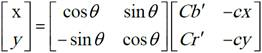
其中,椭圆的解析表达式参数定义如下:cx=109.38,cy=152.02,θ=2.53,ecx=1.6,ecy=2.41,a=25.39,b=14.03。
进一步地,所述基于OTSU二值循环法定位V通道灰度图像中的人脸光泽区域的步骤包括如下步骤:步骤1:基于OTSU对V通道灰度图像的灰度部分进行二值化得到V通道灰度图像的二值化图像;步骤2:将V通道灰度图像与其二值化图像相乘去除掉无光泽肤色区域,得到剩下的V通道灰度图像;步骤3:统计剩下的V通道灰度图像面积与输入V通道灰度图像面积的比值;步骤4:判断所述比值是否大于设定的经验阈值;若该比值大于设定的经验阈值,循环步骤1至步骤4;若该比值小于等于设定的经验阈值,结束循环步骤。
另一方面,本发明还提供一种计算机可读存储介质,该计算机可读存储介质存储多条计算机程序指令,其特征在于,所述计算机程序指令由计算机装置的处理器加载并执行所述人脸面部光泽度分类方法的各项方法步骤。
相较于现有技术,本发明所述人脸面部光泽度分类装置、方法及计算机存储介质,能够应用于中医面诊中,较现有的基于图像的面部关注度分类算法,本发明能够有效对面部光泽度进行分析,且基于大量人脸样本进行训练得到判别人脸面部光泽度的分类器,提高了人脸面部光泽度分类的鲁棒性,进而提高人脸面部光泽度分类的准确性。
图1是本发明人脸面部光泽度分类装置的优选实施例的方框示意图;
图2是本发明人脸面部光泽度分类方法优选实施例的方法流程图;
图3为图2中步骤S25的细化子流程图。
本发明目的的实现、功能特点及优点将结合实施例,参照附图做进一步说明。
为更进一步阐述本发明为达成预定发明目的所采取的技术手段及功效,以下结合附图及较佳实施例,对本发明的具体实施方式、结构、特征及其功效,详细说明如下。应当理解,此处所描述的具体实施例仅仅用以解释本发明,并不用于限定本发明。
参照图1所示,图1是本发明人脸面部光泽度分类装置的优选实施例的方框示意图。在本实施例中,所述人脸面部光泽度分类装置1安装有人脸面部光泽度分类系统10,所述人脸面部光泽度分类装置1可以为安装有人脸面部光泽度分类系统10的个人计算机、工作站计算机、中医面像仪、中医四诊仪等具有数据处理功能和图像处理功能的计算机装置。在本实施例中,所述人脸面部光泽度分类装置1包括,但不仅限于,人脸面部光泽度分类系统10、摄像单元11、适于存储多条计算机程序指令的存储器12以及执行各种计算机程序指令的处理器13。所述摄像单元11为一种高清摄像头等影像输入设备,用于人脸图像并输入至人脸面部光泽度分类装置1中。所述存储器12可以为一种只读存储器ROM,随机存储器RAM、电可擦写存储器EEPROM、快闪存储器FLASH、磁盘或光盘等。所述处理器13为一种中央处理器(CPU)、微控制器(MCU)、数据处理芯片、或者具有数据处理功能的信息处理单元。需要说明的是,本发明所述人脸面部光泽度分类是指将人脸面部分为有无光泽两种类型,即分为有面部光泽和无面部光泽两种情形,而不是具体的光泽程度大小。
在本实施例中,所述人脸面部光泽度分类系统10由多条计算机程序指令组成的程序模块组成,包括但不局限于,人脸图像输入模块101、人脸图像处理模块102、光泽区域定位模块103、光泽特征提取模块104以及面部光泽分类模块105。本发明所称的模块是指一种能够被人脸面部光泽度分类装置1的处理器13执行并且能够完成固定功能的一系列计算机程序指令段,其存储在存储器12中,以下结合图2和图3具体说明每一个模块的具体功能。
参考图2所示,是本发明人脸面部光泽度分类方法优选实施例的流程图。在本实施例中,所述人脸面部光泽度分类方法的各种方法步骤通过计算机软件程序来实现,该计算机软件程序以计算机程序指令的形式存储于计算机可读存储介质(例如存储器12)中,计算机可读存储介质可以包括:只读存储器、随机存储器、磁盘或光盘等,所述计算机程序指令能够被处理器(例如处理器13)加载并执行如下步骤S21至步骤S28。
步骤S21,接收输入的人脸图像;具体地,人脸图像输入模块101通过摄像单元11(例如高清摄像设备)接收从待测者面部摄取清晰的人脸图像,也可以从存储器12中读取预先存储的人脸图像,该人脸图像是由R、G、B三通道组成的彩色RGB图像。
步骤S22,基于椭圆聚类肤色模型对人脸图像进行分割并提取得到人脸肤色区域的二值图像;具体地,人脸图像处理模块102基于椭圆聚类肤色模型(由Anil K.Jain等提出的椭圆肤色模型)对人脸肤色区域进行分割,即将人脸图像的RGB三通道变换到YCbCr三维颜色空间,再将YCbCr三维颜色空间转换到YCb'Cr'三维坐标空间,再将YCb'Cr'三维坐标空间投影到Cb'-Cr'二维子空间,在Cb'-Cr'二维子空间下用一个椭圆内的所有坐标点来近似判断是否为人脸肤色区域,该椭圆的解析表达式如下所示:
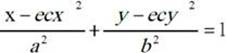
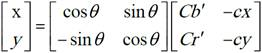
其中,椭圆的解析表达式参数定义如下:cx=109.38,cy=152.02,θ=2.53,ecx=1.6,ecy=2.41,a=25.39,b=14.03。本实施例椭圆的解析表达式参数是根据人脸面部的经验特征来定义的经验值,在其他实施例中,椭圆的解析表达式参数也可以根据人脸面部的具体特征来定义参数值。
步骤S23,基于投影法从人脸肤色区域的二值图像中去除掉眼睛嘴唇区域;在本实施例中,人脸图像处理模块102去除掉人脸肤色以外的背景图像,得到去除掉眼睛嘴唇区域的二值图像。由于人脸光泽区域一般集中在,额头、脸颊、鼻头、下巴等区域,为了能够有效的分析光泽区域,人脸图像处理模块101通过对基于肤色分割得到的人脸二值图像在高度方向上对不是肤色区域的像素值进行投影,一般情况下会得到两个最大波峰位置,分别定位在人眼眉毛区域与嘴唇区域,以此去除掉人眼区域与嘴唇区域,从而得到去除掉眼睛嘴唇区域的二值图像。
步骤S24,将人脸图像转换到HSV图像空间上提取V通道特征向量,并将V通道特征向量与去除掉眼睛嘴唇区域的二值图像相乘得到去除掉眼睛嘴唇区域的V通道灰度图像。在本实施例中,人脸中的光泽部分一般是由于正常肤色部分油腻光线反射产生的,因此人脸中的明亮度上会与正常肤色存在明显差异,HSV彩色空间中H、S、V分别代表了色相、饱和度、明度。为了更好的分析面部光泽区域,本发明人脸图像处理模块102对HSV彩色空间中能充分区分肤色明度的V通道进行分析处理以提取特征信息得到V通道特征向量,再将提取的V通道特征向量与去除掉眼睛嘴唇区域的二值图像相乘来去除掉背景与人眼嘴唇区域的部分得到去除掉眼睛嘴唇区域的V通道灰度图像,即得到包括额头、脸颊、鼻尖、下巴的V通道灰度图像。
步骤S25,基于OTSU二值循环法定位V通道灰度图像中的人脸光泽区域。在本实施例中,所述人脸光泽区域表征为白色区域,所述OTSU又称大津法,是一种分割图像二值化阈值的最大内间方差算法。为了有效定位分析人脸中有光泽的肤色区域,具体地,光泽区域定位模块103基于OTSU二值循环法定位V通道灰度图像中的人脸光泽区域,参考图3所示,图3为图2中步骤S25的细化子流程图,具体步骤如下:
步骤S251,基于OTSU对V通道灰度图像的灰度部分进行二值化得到V通道灰度图像的二值化图像;
步骤S252,将V通道灰度图像与其二值化图像相乘去除掉无光泽肤色区域,得到剩下的V通道灰度图像;
步骤S253,统计剩下的V通道灰度图像面积与输入V通道灰度图像面积的比值;
步骤S254,判断所述比值是否大于设定的经验阈值;若该比值大于设定的经验阈值,循环步骤S251至步骤S254;若该比值小于等于设定的经验阈值,结束循环步骤。
在本实施例中,光泽区域定位模块103基于OTSU对V通道灰度图像进行二值化,每一次循环去掉黑色区域,并对剩下的白色区域(即人脸光泽区域)的V通道灰度图像,再次使用OTSU二值循环法对通道灰度图像循环处理直到白色区域小于等于整个V通道灰度图像面积比例的设定经验阈值,例如经验阈值设定为20%比例值,也可以根据处理的人脸光泽度分类精度要求设定其他比例值。
步骤S26,对人脸光泽区域表征出的白色区域进行连通区域筛选,筛选出最大的两个白色连通区域进行特征提取以获得人脸图像的特征向量。在本实施例中,光泽特征提取模块104对得到的人脸光泽区域表征出的白色区域进行连通区域分析,提取出面积最大的2个白色连通区域进行分析提取出特征向量。光泽特征提取模块104对每个连通区域进行特征提取,将连通区域的R、G、B均值、连通区域的V通道灰度均值与去除掉背景与人眼嘴唇区域部分的V通道灰度均值的差、连通区域面积值、连通区域面积与整个人脸区域面积的比值分别作为特征向量的组成部分,这样一个连通区域就得到一个6维度,最终得到一个12维度的特征向量。
步骤S27,判断输入的人脸图像是否到达预定的人脸数量;在本实施例中,为了提高提高面部光泽度分类的准确性,需要实用大量不同待测者的人脸图像进行样本训练,因此面部光泽分类模块105判断输入的人脸图像是否到达预定的人脸数量,若输入的人脸图像未到达预定的人脸数量,则流程返回执行步骤S21,继续通过摄像单元11从下一个待测者面部摄取清晰的人脸图像,或者从存储器12中获取下一个待测者的人脸图像。若输入的人脸图像到达预定的人脸数量,则流程执行步骤S28。
步骤S28,使用SVM分类器对所有输入的人脸图像的特征向量进行人脸光泽度分类训练以产生最终的人脸光泽度分类器并存储在存储器12中。在本实施例中,面部光泽分类模块105对采集到的所有人脸图像通过所述的特征提取算法获得所有人脸图像的特征向量,再基于所有的特征向量与预先分类准备好有无光泽的人脸肤色样本进行有监督的SVM分类器训练,得到最终的人脸光泽度分类器并存储在存储器12中,以供后续对人脸光泽度分类分析使用。当输入人脸图像至本发明训练好的人脸光泽度分类器,该人脸光泽度分类器即能从人脸图像中判别出人脸面部分有无面部光泽两种情况,即能够得到有面部光泽和无面部光泽两种情形,而不是具体的光泽程度大小。当中医师对患者进行中医面诊并需要对患者的人脸光泽分析时,输入采集的人脸图像即可使用本发明训练好的人脸光泽度分类器进行人脸面部光泽度判别,并输出可输出人脸面部是否有面部光泽和无面部光泽两种情况,从而协助中医诊断患者的脏腑精气,提高中医诊断结果,辅助医生进行中医舌诊获得患者的健康状况。
本发明还一种计算机可读存储介质,该计算机可读存储介质存储多条计算机程序指令,所述计算机程序指令由计算机装置的处理器加载并执行本发明所述人脸面部光泽度分类方法的各个步骤。本领域技术人员可以理解,上述实施方式中各种方法的全部或部分步骤可以通过相关程序指令完成,该程序可以存储于计算机可读存储介质中,存储介质可以包括:只读存储器、随机存储器、磁盘或光盘等。
本发明所述人脸面部光泽度分类装置、方法及计算机存储介质,能够应用于中医面诊中,较现有的基于图像的面部关注度分类算法,本发明能够有效对面部光泽度进行分析,且基于大量人脸样本进行训练得到判别人脸面部光泽度的分类器,提高了人脸面部光泽度分类的鲁棒性,进而提高人脸面部光泽度分类的准确性。
以上仅为本发明的优选实施例,并非因此限制本发明的专利范围,凡是利用本发明说明书及附图内容所作的等效结构或等效流程变换,或直接或间接运用在其他相关的技术领域,均同理包括在本发明的专利保护范围内。
相较于现有技术,本发明所述人脸面部光泽度分类装置、方法及计算机存储介质,能够应用于中医面诊中,较现有的基于图像的面部关注度分类算法,本发明能够有效对面部光泽度进行分析,且基于大量人脸样本进行训练得到判别人脸面部光泽度的分类器,提高了人脸面部光泽度分类的鲁棒性,进而提高人脸面部光泽度分类的准确性。
Claims (10)
- 一种人脸面部光泽度分类装置,包括适于实现各种计算机程序指令的处理器以及适于存储多条计算机程序指令的存储器,其特征在于,所述计算机程序指令由处理器加载并执行如下步骤:接收输入的人脸图像;基于椭圆聚类肤色模型对人脸图像进行分割并提取得到人脸肤色区域的二值图像;基于投影法从人脸肤色区域的二值图像中去除掉眼睛嘴唇区域;将人脸图像转换到HSV图像空间上提取V通道特征向量,并将V通道特征向量与去除掉眼睛嘴唇区域的二值图像相乘得到去除掉眼睛嘴唇区域的V通道灰度图像;基于OTSU二值循环法定位V通道灰度图像中的人脸光泽区域;对人脸光泽区域表征出的白色区域进行连通区域筛选,筛选出最大的两个白色连通区域进行特征提取以获得人脸图像的特征向量;使用SVM分类器对所有人脸图像的特征向量进行人脸光泽度分类训练以产生最终的人脸光泽度分类器并存储在存储器中。
- 如权利要求1所述的人脸面部光泽度分类装置,其特征在于,所述基于椭圆聚类肤色模型对人脸图像进行分割并提取得到人脸肤色区域的二值图像的步骤包括如下步骤:将人脸图像的RGB三通道变换到YCbCr三维颜色空间;将YCbCr三维颜色空间转换到YCb'Cr'三维坐标空间;将YCb'Cr'三维坐标空间投影到Cb'-Cr'二维子空间;在Cb'-Cr'二维子空间下用一个椭圆内的所有坐标点来近似判断是否为人脸肤色区域。
- 如权利要求2所述的人脸面部光泽度分类装置,其特征在于,所述椭圆的解析表达式如下所示:,其中,
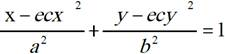
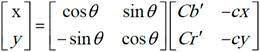 其中,椭圆的解析表达式参数定义如下:cx=109.38,cy=152.02,θ=2.53,ecx=1.6,ecy=2.41,a=25.39,b=14.03。
 - 如权利要求1所述的人脸面部光泽度分类装置,其特征在于,所述基于OTSU二值循环法定位V通道灰度图像中的人脸光泽区域的步骤包括如下:步骤1:基于OTSU对V通道灰度图像的灰度部分进行二值化得到V通道灰度图像的二值化图像;步骤2:将V通道灰度图像与其二值化图像相乘去除掉无光泽肤色区域,得到剩下的V通道灰度图像;步骤3:统计剩下的V通道灰度图像面积与输入V通道灰度图像面积的比值;步骤4:判断所述比值是否大于设定的经验阈值;若该比值大于设定的经验阈值,循环步骤1至步骤4;若该比值小于等于设定的经验阈值,结束循环步骤。
- 一种人脸面部光泽度分类方法,应用于人脸面部光泽度分类装置中,其特征在于,该方法包括如下步骤:接收输入的人脸图像;基于椭圆聚类肤色模型对人脸图像进行分割并提取得到人脸肤色区域的二值图像;基于投影法从人脸肤色区域的二值图像中去除掉眼睛嘴唇区域;将人脸图像转换到HSV图像空间上提取V通道特征向量,并将V通道特征向量与去除掉眼睛嘴唇区域的二值图像相乘得到去除掉眼睛嘴唇区域的V通道灰度图像;基于OTSU二值循环法定位V通道灰度图像中的人脸光泽区域;对人脸光泽区域表征出的白色区域进行连通区域筛选,筛选出最大的两个白色连通区域进行特征提取以获得人脸图像的特征向量;使用SVM分类器对所有人脸图像的特征向量进行人脸光泽度分类训练以产生最终的人脸光泽度分类器并存储在存储器中。
- 如权利要求5所述的人脸面部光泽度分类方法,其特征在于,所述接收输入的人脸图像的步骤包括:接收摄像单元从待测者面部摄取的人脸图像,或者从存储器中读取预先存储的人脸图像。
- 如权利要求5所述的人脸面部光泽度分类方法,其特征在于,所述基于椭圆聚类肤色模型对人脸图像进行分割并提取得到人脸肤色区域的二值图像的步骤包括如下步骤:将人脸图像的RGB三通道变换到YCbCr三维颜色空间;将YCbCr三维颜色空间转换到YCb'Cr'三维坐标空间;将YCb'Cr'三维坐标空间投影到Cb'-Cr'二维子空间;在Cb'-Cr'二维子空间下用一个椭圆内的所有坐标点来近似判断是否为人脸肤色区域。
- 如权利要求7所述的人脸面部光泽度分类方法,其特征在于,所述椭圆的解析表达式如下所示:,其中,

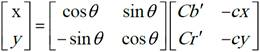 其中,椭圆的解析表达式参数定义如下:cx=109.38,cy=152.02,θ=2.53,ecx=1.6,ecy=2.41,a=25.39,b=14.03。
 - 如权利要求5所述的人脸面部光泽度分类方法,其特征在于,所述基于OTSU二值循环法定位V通道灰度图像中的人脸光泽区域的步骤包括如下步骤:步骤1:基于OTSU对V通道灰度图像的灰度部分进行二值化得到V通道灰度图像的二值化图像;步骤2:将V通道灰度图像与其二值化图像相乘去除掉无光泽肤色区域,得到剩下的V通道灰度图像;步骤3:统计剩下的V通道灰度图像面积与输入V通道灰度图像面积的比值;步骤4:判断所述比值是否大于设定的经验阈值;若该比值大于设定的经验阈值,循环步骤1至步骤4;若该比值小于等于设定的经验阈值,结束循环步骤。
- 一种计算机可读存储介质,该计算机可读存储介质存储多条计算机程序指令,其特征在于,所述计算机程序指令由计算机装置的处理器加载并执行如权利要求5至9任一项所述人脸面部光泽度分类方法的各项方法步骤。
Applications Claiming Priority (2)
| Application Number | Priority Date | Filing Date | Title |
|---|---|---|---|
| CN201811047851.6 | 2018-09-10 | ||
| CN201811047851.6A CN110890156A (zh) | 2018-09-10 | 2018-09-10 | 人脸面部光泽度分类装置、方法及计算机存储介质 |
Publications (1)
| Publication Number | Publication Date |
|---|---|
| WO2020052525A1 true WO2020052525A1 (zh) | 2020-03-19 |
Family
ID=69744868
Family Applications (1)
| Application Number | Title | Priority Date | Filing Date |
|---|---|---|---|
| PCT/CN2019/104985 Ceased WO2020052525A1 (zh) | 2018-09-10 | 2019-09-09 | 人脸面部光泽度分类装置、方法及计算机存储介质 |
Country Status (2)
| Country | Link |
|---|---|
| CN (1) | CN110890156A (zh) |
| WO (1) | WO2020052525A1 (zh) |
Cited By (1)
| Publication number | Priority date | Publication date | Assignee | Title |
|---|---|---|---|---|
| CN112699770A (zh) * | 2020-12-25 | 2021-04-23 | 深圳数联天下智能科技有限公司 | 一种检测肤色的方法及相关装置 |
Citations (5)
| Publication number | Priority date | Publication date | Assignee | Title |
|---|---|---|---|---|
| CN104573723A (zh) * | 2015-01-08 | 2015-04-29 | 上海中医药大学 | 一种基于中医望诊的“神”的特征提取与分类方法及系统 |
| CN105426816A (zh) * | 2015-10-29 | 2016-03-23 | 深圳怡化电脑股份有限公司 | 一种处理人脸图像的方法及装置 |
| CN105868735A (zh) * | 2016-04-25 | 2016-08-17 | 南京大学 | 一种跟踪人脸的预处理方法及基于视频的智慧健康监视系统 |
| US20170336199A1 (en) * | 2014-11-10 | 2017-11-23 | Shiseido Company, Ltd. | Method for evaluating glow of skin, method for examining skin glow improvers, and skin glow improver |
| CN108451500A (zh) * | 2017-12-27 | 2018-08-28 | 浙江大学台州研究院 | 一种用于中医望诊的面色检测和脸型识别设备 |
-
2018
- 2018-09-10 CN CN201811047851.6A patent/CN110890156A/zh active Pending
-
2019
- 2019-09-09 WO PCT/CN2019/104985 patent/WO2020052525A1/zh not_active Ceased
Patent Citations (5)
| Publication number | Priority date | Publication date | Assignee | Title |
|---|---|---|---|---|
| US20170336199A1 (en) * | 2014-11-10 | 2017-11-23 | Shiseido Company, Ltd. | Method for evaluating glow of skin, method for examining skin glow improvers, and skin glow improver |
| CN104573723A (zh) * | 2015-01-08 | 2015-04-29 | 上海中医药大学 | 一种基于中医望诊的“神”的特征提取与分类方法及系统 |
| CN105426816A (zh) * | 2015-10-29 | 2016-03-23 | 深圳怡化电脑股份有限公司 | 一种处理人脸图像的方法及装置 |
| CN105868735A (zh) * | 2016-04-25 | 2016-08-17 | 南京大学 | 一种跟踪人脸的预处理方法及基于视频的智慧健康监视系统 |
| CN108451500A (zh) * | 2017-12-27 | 2018-08-28 | 浙江大学台州研究院 | 一种用于中医望诊的面色检测和脸型识别设备 |
Cited By (1)
| Publication number | Priority date | Publication date | Assignee | Title |
|---|---|---|---|---|
| CN112699770A (zh) * | 2020-12-25 | 2021-04-23 | 深圳数联天下智能科技有限公司 | 一种检测肤色的方法及相关装置 |
Also Published As
| Publication number | Publication date |
|---|---|
| CN110890156A (zh) | 2020-03-17 |
Similar Documents
| Publication | Publication Date | Title |
|---|---|---|
| US8768014B2 (en) | System and method for identifying a person with reference to a sclera image | |
| CN108549884A (zh) | 一种活体检测方法及装置 | |
| CN111524080A (zh) | 脸部皮肤特征的识别方法、终端及计算机设备 | |
| JP2015500722A (ja) | 皮膚ゾーンにおける皮膚症状を検出して数量化する方法および装置 | |
| CN104766316B (zh) | 中医望诊中新型嘴唇分割算法 | |
| CN113781488A (zh) | 舌象图像的分割方法、装置及介质 | |
| CN102194108A (zh) | 一种聚类线性鉴别分析特征选择的笑脸表情识别方法 | |
| Frazao et al. | Diagnosis of diabetic retinopathy based on holistic texture and local retinal features | |
| Xiao et al. | Retinal hemorrhage detection by rule-based and machine learning approach | |
| Levinshtein et al. | Hybrid eye center localization using cascaded regression and hand-crafted model fitting | |
| KR102318194B1 (ko) | 안저 이미지를 이용한 시신경병증 예측 장치 및 시신경병증 예측 결과 제공 방법 | |
| WO2020108437A1 (zh) | 舌下静脉特征提取装置及方法 | |
| CN107229937A (zh) | 一种视网膜血管分类方法及装置 | |
| Chakour et al. | Blood vessel segmentation of retinal fundus images using dynamic preprocessing and mathematical morphology | |
| Sindhusaranya et al. | Retinal blood vessel segmentation using root Guided decision tree assisted enhanced Fuzzy C-mean clustering for disease identification | |
| CN117036905B (zh) | 一种基于hsv色彩空间颜色注意力的胶囊内窥镜图像病灶识别方法 | |
| CN114066850A (zh) | 一种基于分类框架的图像二值化方法 | |
| Karunarathne et al. | Nail abnormalities detection and prediction system | |
| Fondón et al. | Automatic optic cup segmentation algorithm for retinal fundus images based on random forest classifier | |
| Szczepański et al. | Pupil and iris detection algorithm for near-infrared capture devices | |
| Zheng | Static and dynamic analysis of near infra-red dorsal hand vein images for biometric applications | |
| CN112818957A (zh) | 基于运动能量识别眼睑痉挛的方法 | |
| Mukku et al. | A specular reflection removal technique in cervigrams | |
| Elbalaoui et al. | Segmentation of optic disc from fundus images | |
| CN110890156A (zh) | 人脸面部光泽度分类装置、方法及计算机存储介质 |
Legal Events
| Date | Code | Title | Description |
|---|---|---|---|
| 121 | Ep: the epo has been informed by wipo that ep was designated in this application |
Ref document number: 19860596 Country of ref document: EP Kind code of ref document: A1 |
|
| NENP | Non-entry into the national phase |
Ref country code: DE |
|
| 122 | Ep: pct application non-entry in european phase |
Ref document number: 19860596 Country of ref document: EP Kind code of ref document: A1 |