WO2020022892A1 - Tubulysin derivatives and methods for preparing the same - Google Patents
Tubulysin derivatives and methods for preparing the same Download PDFInfo
- Publication number
- WO2020022892A1 WO2020022892A1 PCT/NL2019/050481 NL2019050481W WO2020022892A1 WO 2020022892 A1 WO2020022892 A1 WO 2020022892A1 NL 2019050481 W NL2019050481 W NL 2019050481W WO 2020022892 A1 WO2020022892 A1 WO 2020022892A1
- Authority
- WO
- WIPO (PCT)
- Prior art keywords
- substituted
- unsubstituted
- benzyl
- general formula
- compound
- Prior art date
- Legal status (The legal status is an assumption and is not a legal conclusion. Google has not performed a legal analysis and makes no representation as to the accuracy of the status listed.)
- Ceased
Links
- 0 CC(C)CC(C)*(C)CC12C(C)=CC*C1(*=C)C=CC2 Chemical compound CC(C)CC(C)*(C)CC12C(C)=CC*C1(*=C)C=CC2 0.000 description 4
- MISDZSABTXRXRD-VIFPVBQESA-N C[C@@H](CC(Cc1ccccc1)=O)C(O)=O Chemical compound C[C@@H](CC(Cc1ccccc1)=O)C(O)=O MISDZSABTXRXRD-VIFPVBQESA-N 0.000 description 1
- PWEBQHMBYIBCKP-LCZUYKTBSA-N C[C@@H](C[C@H](Cc1ccccc1)NC(/C(/NC)=C/S)=O)C(O)=O Chemical compound C[C@@H](C[C@H](Cc1ccccc1)NC(/C(/NC)=C/S)=O)C(O)=O PWEBQHMBYIBCKP-LCZUYKTBSA-N 0.000 description 1
Classifications
-
- A—HUMAN NECESSITIES
- A61—MEDICAL OR VETERINARY SCIENCE; HYGIENE
- A61K—PREPARATIONS FOR MEDICAL, DENTAL OR TOILETRY PURPOSES
- A61K47/00—Medicinal preparations characterised by the non-active ingredients used, e.g. carriers or inert additives; Targeting or modifying agents chemically bound to the active ingredient
- A61K47/50—Medicinal preparations characterised by the non-active ingredients used, e.g. carriers or inert additives; Targeting or modifying agents chemically bound to the active ingredient the non-active ingredient being chemically bound to the active ingredient, e.g. polymer-drug conjugates
- A61K47/51—Medicinal preparations characterised by the non-active ingredients used, e.g. carriers or inert additives; Targeting or modifying agents chemically bound to the active ingredient the non-active ingredient being chemically bound to the active ingredient, e.g. polymer-drug conjugates the non-active ingredient being a modifying agent
- A61K47/54—Medicinal preparations characterised by the non-active ingredients used, e.g. carriers or inert additives; Targeting or modifying agents chemically bound to the active ingredient the non-active ingredient being chemically bound to the active ingredient, e.g. polymer-drug conjugates the non-active ingredient being a modifying agent the modifying agent being an organic compound
- A61K47/542—Carboxylic acids, e.g. a fatty acid or an amino acid
-
- A—HUMAN NECESSITIES
- A61—MEDICAL OR VETERINARY SCIENCE; HYGIENE
- A61K—PREPARATIONS FOR MEDICAL, DENTAL OR TOILETRY PURPOSES
- A61K47/00—Medicinal preparations characterised by the non-active ingredients used, e.g. carriers or inert additives; Targeting or modifying agents chemically bound to the active ingredient
- A61K47/50—Medicinal preparations characterised by the non-active ingredients used, e.g. carriers or inert additives; Targeting or modifying agents chemically bound to the active ingredient the non-active ingredient being chemically bound to the active ingredient, e.g. polymer-drug conjugates
- A61K47/51—Medicinal preparations characterised by the non-active ingredients used, e.g. carriers or inert additives; Targeting or modifying agents chemically bound to the active ingredient the non-active ingredient being chemically bound to the active ingredient, e.g. polymer-drug conjugates the non-active ingredient being a modifying agent
- A61K47/68—Medicinal preparations characterised by the non-active ingredients used, e.g. carriers or inert additives; Targeting or modifying agents chemically bound to the active ingredient the non-active ingredient being chemically bound to the active ingredient, e.g. polymer-drug conjugates the non-active ingredient being a modifying agent the modifying agent being an antibody, an immunoglobulin or a fragment thereof, e.g. an Fc-fragment
- A61K47/6801—Drug-antibody or immunoglobulin conjugates defined by the pharmacologically or therapeutically active agent
- A61K47/6803—Drugs conjugated to an antibody or immunoglobulin, e.g. cisplatin-antibody conjugates
- A61K47/6811—Drugs conjugated to an antibody or immunoglobulin, e.g. cisplatin-antibody conjugates the drug being a protein or peptide, e.g. transferrin or bleomycin
-
- C—CHEMISTRY; METALLURGY
- C07—ORGANIC CHEMISTRY
- C07K—PEPTIDES
- C07K5/00—Peptides containing up to four amino acids in a fully defined sequence; Derivatives thereof
- C07K5/02—Peptides containing up to four amino acids in a fully defined sequence; Derivatives thereof containing at least one abnormal peptide link
- C07K5/021—Peptides containing up to four amino acids in a fully defined sequence; Derivatives thereof containing at least one abnormal peptide link containing the structure -NH-(X)n-C(=0)-, n being 5 or 6; for n > 6, classification in C07K5/06 - C07K5/10, according to the moiety having normal peptide bonds
Definitions
- the invention relates to the field of medicinal chemistry.
- it relates to novel means and methods for the synthesis of tubulysin and derivatives thereof, for use as cytotoxic agents e.g. in targeted drug delivery.
- Antibody-drug conjugates or ADCs are an important class of highly potent biopharmaceutical drugs designed as a targeted therapy for the treatment of cancer. Unlike chemotherapy, ADCs are intended to target and kill only the cancer cells and spare healthy cells. ADCs are complex molecules composed of an antibody linked to a biologically active cytotoxic (anticancer) payload or drug. Antibody-drug conjugates are examples of bioconjugates and immunoconjugates. By combining the unique targeting capabilities of monoclonal antibodies with the cancer-killing ability of cytotoxic drugs, antibody-drug conjugates are designed to allow sensitive discrimination between healthy and diseased tissue. This means that, in contrast to traditional chemotherapeutic agents, antibody-drug conjugates should selectively target and attack the cancer cell so that healthy cells are less severely affected.
- a stable link between the antibody and cytotoxic agent is a crucial aspect of an ADC.
- a highly stable ADC linker will ensure that less of the cytotoxic payload falls off in circulation, driving an improved safety profile, and will also ensure that more of the payload arrives at the cancer cell, driving enhanced efficacy.
- Linkers are based on chemical motifs including disulfides, hydrazones or peptides (cleavable), or thioethers (noncleavable) and control the distribution and delivery of the cytotoxic agent to the target cell.
- Highly toxic small molecules or natural products have recently found important commercial applications in ADCs.
- dolastatine, maytansin and other natural product derivatives are coupled to antibodies to increase their efficacy.
- Several of such compounds are marketed already and multiple are in chnical trials. (Maturing antibody-drug conjugate pipeline hits 30 Asher Mullard, Nature Reviews Drug Discovery 12, 329- 332 (2013) doi: 10.1038/nrd4009).
- myxobacterial cultures are exceptionally potent cell-growth inhibitors that act by inhibiting tubulin polymerisation and thereby induce apoptosis. See Sasse et al. J. Antibiot. 2000, 53, 879-885; W098/13375. These compounds show high cytotoxicity in the low picomolar ICr,o in a panel of cancer cell lines and are thus of interest as potential anticancer therapeutics.
- Tubulysins (I) are tetrapep tides, containing three unusual amino acids; thus, the total synthesis poses a considerable challenge to organic chemists.
- tubulysins and to enhance their selectivity, polymer conjugates and bioconjugates of tubulysins were developed (see e.g. W02004/005326) which exhibit a higher selectivity by a given cytotoxicity as well as lower toxicity as compared to the unconjugated compounds.
- W02004/005326 a polymer conjugates and bioconjugates of tubulysins
- predominantly cancer cells are targeted in the human and the animal body and healthy tissue is not affected.
- tubulysin derivatives and (antibody) conjugates are very promising.
- tubulysin derivatives thus obtained are super potent and can be attached towards biological matter (e.g. mAbs) through at least 3 different linker positions. Furthermore, the synthetic method offers full stereo-control. The new approach allows to fine-tune the properties of tubulysin ADCs in a much better way than offered by current products.
- the invention provides method for preparing a tubulysin derivative, comprising reacting compounds A, B and C in a 3-component Passerini reaction,
- compound A is a carboxyhc acid according to the general formula A
- Ri represents a substituted or unsubstituted alkyl; a substituted or unsubstituted cycloalkyl; or a substituted or unsubstituted benzyl,
- R2 represents H, a substituted or unsubstituted alkyl, or a substituted or unsubstituted cycloalkyl
- R.3 represents a substituted or unsubstituted alkyl; a substituted or unsubstituted cycloalkyl; or a substituted or unsubstituted benzyl;
- R4 represents H, a substituted or unsubstituted alkyl, a substituted or unsubstituted cycloalkyl, a substituted or unsubstituted benzyl;
- Rr represents a substituted or unsubstituted alkyl or a substituted or unsubstituted cycloalkyl; preferably a substituted or unsubstituted cycloalkyl; or wherein R i and Rr, are connected to form a 4 to 7 membered ring;
- Re represents a substituted or unsubstituted alkyl; a substituted or unsubstituted cycloalkyl; a substituted or unsubstituted benzyl, or COOR’, where R’ is an optionally substituted alkyl, cycloalkyl, benzyl or aroyl moiety; wherein compound B is an aldehyde according to the general formula B
- R 7 , Re, R 3 ⁇ 4 Rio and Rn each independently represent H
- F a substituted or unsubstituted alkyl, a substituted or unsubstituted cycloalkyl or a substituted or unsubstituted benzyl;
- Pg 1 is an amine protecting group, preferably a carbamate, a substituted or an unsubstituted benzyl, or a substituted or an unsubstituted sulfonamide; wherein compound C is an isocyanide according to the general formula C
- R12 represents a substituted or unsubstituted alkyl, a substituted or unsubstituted cycloalkyl, or a substituted or unsubstituted benzyl;
- Ri3 represents H, a substituted or unsubstituted alkyl, a substituted or unsubstituted cycloalkyl, or a substituted or unsubstituted benzyl;
- X represents O, S, Se, or -NH-, preferably S;
- Pg- represents an X- protecting group, preferably selected from trityl, tert -butyl, adamantyl and substituted benzyl, more preferably tiityl or tert-butyl.
- a moiety may be substituted, such as by use of “unsubstituted or substituted” or“optionally substituted” phrasing as in “unsubstituted or substituted alkyl” or“optionally substituted benzyl,” such moiety may have one or more independently selected substituents, preferably one to five in number, more preferably one or two in number. Substituents and substitution patterns can be selected by one of ordinary skill in the art, having regard for the moiety to which the substituent is attached, to provide compounds that are chemically stable and that can be synthesized by techniques known in the art as well as the methods set forth herein.
- substituted refers to groups in which one or more hydrogen atoms are replaced with one or more moieties selected from the group consisting of hydroxyl, amino, alkylamino, arylamino, alkoxy , aryloxy, nitro, cyano, sulfonic acid, sulfate, phosphonic acid, phosphate and phosphonate.
- One or more of the hydrogen atoms attached to carbon atom may be replaced by one or more halogen atoms, e.g. fluorine or chlorine or both, such as trifluoromethyl, difluoromethyl, fluorochloroniethyl.
- This expression further refers to groups which are exclusively or ⁇ additionally replaced with unsubstituted Ci-Co alkyl, C2 -C G alkenyl, C2 -C G alkynyl, Ci -C G heteroalkyl, C;; -C10 cycloalkyl, C2 -C9 heterocycloalkyl, C G - Cio aryl, C 1 -Cg heteroaryl, C ? -C12 aralkyl or C2 -Cit heteroaralkyl groups.
- substituted alkyl refers to an alkyl, cycloalkyl or benzyl that is
- substituents preferably 1 or 2 substituents, selected from the group consisting of hydroxyl, amino, alkylamino, arylamino, alkoxy, aryloxy, nitro, cyano, sulfonic acid, sulfate, phosphonic acid, phosphate, and phosphonate.
- one or more e.g. 1- 5, 1-3 or 1, of the hydrogen atoms attached to carbon atom of the alkyl, cycloalkyl or benzyl is replaced by one or more halogen atoms, e.g. fluorine or chlorine or both, such as trifluoromethyl, difluoromethyl,
- alkyl refers to a saturated straight or branched hydrocarbon chain of typically Ci to Cio, and specifically includes methyl, ethyl, propyl, isopropyl, butyl, isobutyl, t-butyl, pentyl, isopentyl, neopentyl, hexyl, isohexyl, cyclohexyl, cyclohexylm ethyl, 3-methylpentyl, 2,2-dimethylbutyl, and 2,3-dimethylbutyl, and the like.
- the alkyl is a lower alkyl.
- alkyl when alkyl is a suitable moiety, lower alkyl is preferred. Similarly, when alkyl or lower alkyl is a suitable moiety, unsubstituted alkyl or lower alkyl is preferred.
- Alkyl groups can be optionally substituted with one or more moieties selected from the group consisting of hydroxyl, amino, alkylamino, arylamino, alkoxy, aryloxy, nitro, cyano, sulfonic acid, sulfate, phosphonic acid, phosphate, or phosphonate.
- One or more of the hydrogen atoms attached to carbon atom on alkyl may be replaces by one or more halogen atoms, e.g. fluorine or chlorine or both, such as trifluorom ethyl,
- cycloalkyl refers to a saturated or partially unsaturated (e.g. cycloalkenyl) cyclic group containing one or more rings (preferably 1 or 2), the total of 3 to 14 ring carbon atoms, preferably 3 to 10 (especially 3 containing 4, 5, 6 or 7) ring carbon atoms. In one embodiment, it refers to a saturated hydrocarbon ring having 3-8 carbon atoms, preferably, 3-6 carbon atoms, such as cyclopropyl, cyclobutyl, cyclopentyl and cyclohexyl.
- the cycloalkyl group may also be substituted on the ring by and alkyl group, such as cyclopropylmethyl and the like.
- the term“substituted benzyl” refers to a benzyl radical which is substituted by fluorine, chlorine, bromine, nitro, Ci-C i alkyl, C1-C4- halogenoalkyl or C 1 -Ui alkoxy.
- the benzyl is substituted with chlorine, bromine, nitro, methyl or methoxy.
- stereoisomers are specifically indicated (e.g., by a bolded or dashed bond at a relevant stereocenter in a structural formula, by depiction of a double bond as having E or Z configuration in a structural formula, or by use stereochemistry-designating nomenclature), all stereoisomers are included within the scope of the invention, as pure compounds as well as mixtures thereof. Unless otherwise indicated, individual enantiomers, diastereomers, geometrical isomers, and
- the invention uses a carboxylic acid compound A of the general formula A, wherein Rt represents isopropyl, tert-butyl, iso-butyl, sec-butyl, cyclopropylmethyl or cyclobutylmethyl;R2 is H; R3 is -(CFbhi- CHa, wherein n is 3, 4 or 5; R 4 and R5 are connected to form a 4 to 7 membered ring; or Rais a substituted or unsubstituted cycloalkyl; and/or Re is selected from the group consisting of benzyloxycarbonyl, 4- azidobenzyloxycarbonyl, 4-methoxybenzyloxycarbonyl, 2- nitr ob enzyloxy c arb onyl , 4,5- dimethoxy -2 -nitr ob enzyloxy c arb onyl , 3,5- dimethoxybenzyloxycarbonyl, 1-nap
- compound A is of the formula A’ wherein R 4 and R ⁇ , are connected, and together form a cyclic structure comprising 3, 4, 5, 6 or 7 carbon atoms.
- Ra represents H or methyl, and /or R ⁇ ; represents H, methyl, ethyl, propyl or cyclopropyl.
- the method uses an aldehyde compound B according to the general formula B wherein R? is H; Rg is H; R9 is selected from the group consisting of isopropyl, cyclopropyl, cyclobutyl, isobutyl, sec- butyl, tert -butyl and cyclopropylmethyl; Rio is H; and/or Rn is selected from the group consisting of methyl, ethyl, propyl, butyl, isopropyl, cyclopropyl and cyclopropylmethyl.
- the Pg 1 moiety in compound B is an amine protecting group, preferably a carbamate, a substituted or an unsubstituted benzyl.
- Pg 1 is selected from the group consisting of benzyloxycarbonyl, 4- azidobenzyloxycarbonyl, 4-methoxybenzyloxycarbonyl, 2- nitrobenzyloxycarbonyl, 4,5-dimethoxy-2-nitrobenzyloxycarbonyl, 3,5- dimethoxybenzyloxycarbonyl, 1-naphthylmethoxycarbonyl, 4- acetyloxyb enzyloxy c arb onyl , fluor enyloxy c arb onyl , tert -butyloxyc arb onyl , allyloxycarbonyl, methyl carbamate, ethyl carbamate, benzyl, 4- methoxybenzyl and 3,4-dimethoxybenzyl.
- Preferred isocyanide compounds C according to the general formula C include those wherein R12 is methyl, ethyl or tert -butyl; R13 is H or methyl, and/or wherein X represents S.
- the X-protecting group Pg 2 is preferably selected from trityl, tert -butyl, adamantyl and substituted benzyl, more preferably Pg 2 is trityl or tert-butyl.
- compounds A, B and C can be reacted in any suitable solvent or solvent mixture.
- a non-coordinating solvent or solvent mixture is used.
- good results can be obtained with CH 2 CI 2 , CHCI 3 , CCE, benzene, THF, CH 3 CN, 1,4-dioxane, or 1,2-dichloroethane.
- compounds A, B and C are reacted in a mixture of CE CbiTHF (1: 1 v/v).
- the reaction is most easily performed at room temperature. However, reaction conditions above or below room temperature are also encompassed.
- the reaction time can range from a few hours up to a few days.
- the three starting compounds may be present in the starting reaction mixture about equimolar amounts, for example wherein A : B : C is 0.8- 1.2: 0.8- 1.2: 0.8- 1.2, preferably 0.9-1.1:0.9-1.1:09-1.1.
- the Passerini reaction is preferably carried out from 1 mmol to 100 mmol scale.
- reaction products are suitably purified through flash chromatography (e.g. cyclohexane/EtOAc 20:80 v/v).
- the by-product can also be recovered and coupled with dipeptide acid to form an ester.
- a method of the invention further comprising isolating the 3-component Passerini reaction product of Formula D
- a method of the invention advantageously further comprises subjecting the Passerini reaction product of formula D to (a) an acyl migration reaction and (b) a cyclodehydration reaction of the Cys-amide. This will yield a thiazole compound of the general formula E having a hydroxyl moiety
- the acyl migration reaction is suitably performed in a two-step process involving exposure to diethylamine (DEA) followed by exposure to
- TSA trimethylamine
- Cyclodehydration of the Cys-amide may also be performed in a two-step process, preferably involving incubation in the presence of TiCL to obtain a thiazoline-containing compound, followed by oxidation in the presence of Mn0 2 to obtain a thiazole moiety.
- Activated M11O2 having a pore size of ⁇ 5 microns is preferred.
- acyl migration reaction and the cyclodehydration reaction are performed are not critical.
- acyl migration precedes cyclodehydration.
- cyclodehydration precedes acyl migration.
- the method comprises
- a method according to the invention advantageously further comprises hydrolyzing the Ria-containing ester of the general formula E to obtain a carboxylic acid compound of the general formula F
- carboxylic acid compound of the formula F may be reacted with a compound of the general formula G followed by removal of protecting moiety R 21 , to obtain a compound of the general formula H
- R14, R15, Rin, R20 and protecting moiety R21 each independently represent H, a substituted or unsubstituted alkyl, a substituted or
- R17 and Rts each independently represent H, F, a substituted or unsubstituted alkyl, or a substituted or unsubstituted cycloalkyl and Rtg represents H, F, a substituted or unsubstituted alkyl, a substituted or unsubstituted
- Pg 3 ⁇ 4 of compound G is an amine protecting group, preferably a carbamate, a substituted or unsubstituted benzyl, preferably selected from the group consisting of tertbutyl sulfine, benzyloxycarbonyl, 4-azidobenzyloxycarbonyl, 4-methoxybenzyloxycarbonyl, 2 -nitrobenzyloxy carbonyl, 4,5-dimethoxy-2- nitrobenzyloxycarbonyl, 3,5-dimethoxybenzyloxycarbonyl, 1- naphthylmethoxycarbonyl, 4-acetyloxybenzyloxycarbonyl,
- fluorenyloxycarbonyl tert-butyloxycarbonyl, allyloxycarbonyl, methyl carbamate, ethyl carbamate, benzyl, 4-methoxybenzyl and 3,4- dimethoxyb enzyl .
- R14 represents H
- Ri represents H, benzyl, (substituted) benzyl
- Ri ⁇ represents H, benzyl, substituted benzyl (if Rir > is H) and/or
- Ri T and Ris represent H or F.
- Rii and/or R20 are preferably independently selected from the group consisting of methyl, ethyl, propyl, butyl, isopropyl, cyclopropyl and cyclopropylmethyl.
- R21 is preferably H, methyl or ethyl.
- the carboxylic acid compound of the formula F is reacted with tubuphenylalanine of the formula
- a further aspect of the invention relates to a method for providing a tubuphenylalanine of the above formula using (S)-(-)methylsuccinic anhydride as intermediary compound. This method typically only comprising 6 steps, is shorter than the current synthetic procedures used and moreover has a better yield (up to nearly 60%) and increased stereoselectivity.
- the method comprises the steps of : (i) refluxing (S)-(-)methylsuccinic acid in the presence of acetyl chloride to obtain(S)-(-)methylsuccinic anhydride
- a method of the invention for providing a tubulysin derivative may further comprise the acylation of the hydroxyl group a compound of the general formula H to obtain an ac(et)ylated compound of the general Formula I
- R2 1 represent acetyl, acyl (substituted) alkyl, acyl cycloalkyl, or acyl benzyl, preferably acetyl or acyl derivative of methyl, ethyl, tert -butyl or benzyl.
- a method of the present invention allows for the introduction of a variety of different linker types used in the conjugation of payloads to small molecules, polymers, peptides, proteins, antibodies, antibody fragments etc. can be adopted and thereby, many different conjugation methods can be applied.
- Spacer systems at different positions can be used either directly for conjugation by using different conjugation technologies such as chemical conjugation methods known in the art, or enzymatic conjugations using transglutaminases, sortases or other enzymes or which can be used in combination with commonly described linker systems known in the art .
- a method as herein disclosed provides tubulysin derivatives that can be attached toward biological matter, e.g. monoclonal antibodies, through at least 3 different linker positions.
- the properties of, for example, ADC’s can be fine-tuned in a better way as compared to existing products.
- the present invention particularly finds it use in the manufacture of a cytotoxic tubulysin derivative or tubulysin prodrug.
- a method as herein disclosed provides a conjugate comprising a tubulysin compound covalently linked to a targeting moiety that specifically or preferentially binds to a chemical entity on a target cell, which target cell preferably is a cancer cell.
- the targeting moiety is an antibody— more preferably a monoclonal antibody; even more preferably a human monoclonal antibody— and the chemical entity is a tumor associated antigen.
- the tumor associated antigen can be one that is displayed on the surface of a cancer cell or one that is secreted by a cancer cell into the surrounding extracellular space.
- a method of the invention comprising a step of reacting the ac(et)ylated compound of the general Formula I with Glu-(OMe)2 or alternative amino acid ester to obtain a compound of the formula J wherein R22 is H or an amino acid side chain, preferably CH2-CH2-COOZ wherein Z is H or methyl,
- R23 H or a carboxyl protecting group, in particular methyl, ethyl, or tert- butyl; preferably H, methyl, ethyl or tert -butyl.
- the method comprises the synthesis of a glutamic acid conjugate of tubulysin, which finds its use in a prodrug approach using glucarpidase or an enzyme showing a similar activity.
- the method comprises the formation of a tubulysin-prodrug comprising one or more glutamate residue(s) linked to an amidic, urethanic or ureidic bond.
- the invention provides one of the following exemplary compounds
- Fmoc-6-Val 3 (1.0 mmol) was suspended in 20 mL of toluene, and
- reaction was cooled to room temperature and filtered through a medium glass frit.
- the filter cake was washed with 3 x 2 mL of ethyl acetate, and the combined filtrates were concentrated and purified by flash column chromatography to yield aldehyde 7 as a yellow gum.
- the ketoacid 18 (7.0 mmol) was dissolved in EtOH (40 mL), concentrated H2SO4 (1.1 mL, 21.0 mmol) was added at room temperature, and then the reaction mixture was refluxed overnight. After evaporation of the solvent, H2O (10 mL) was added, and the mixture was neutralized with a 2 M aqueous NaOH solution and extracted with EtOAc (3 x 15 mL). The combined organic phases were dried (NasSO i). After filtration and evaporation of the solvent, the expected ketoester obtained as oil.
- Ketone (1.0 mmol) was added to a solution of 20 (1.5 mmol) and Ti(OEt) i (3.0 mmol) in THF (15 mL) at room temperature (rt). The reaction mixture was heated at 70 °C for 8h and the reaction conversion was followed by TLC. Once the reaction was determined to be complete by TLC, the mixture was cooled to room temperature and then to -78 °C. L-Selectride (1 M solution in THF) was added dropwise. The reaction mixture was stirred at same temperature for 3 h. Once the reduction was determined to be complete by TLC, the reaction mixture was quenched by dropwise addition of MeOH at 0 °C until gas evolution was no longer observed.
- the crude reaction mixture was poured into an equal volume of brine while being rapidly stirred.
- the resulting suspension was filtered through a plug of Cellite, and the filter cake was washed with EtOAc.
- the filtrate was washed with brine, and the brine layer was extracted with EtOAc (3x).
- the combined organic portions were dried (Na 2 S0 4 ), filtered, and concentrated.
- the product 21 was purified by silica gel chromatography (hexanes/EtOAc).
- Acid 27 (1.0 mmol) was added to a 0.2 M solution of pentafluorophenol (1.25 mmol) and DIC (1.0 mmol) in CH 2 C1 2 at 0 °C. The reaction mixture was warmed to rt, stirred for 24 h, and concentrated under reduced pressure. EtOAc (10 mL) was added, and the crude product was filtered, with rinsing of the reaction vessel with EtOAc. The filtrate was concentrated under reduced pressure, and the crude material was used without further purification.
- the compound 29 (1.0 mmol) was dissolved in a mixture of MeOH (20 ml). Paraformaldehyde (300 mg, 10 mmol) and 20% Pd/C (106 mg, 0.1 mmol Pd) were added. The reaction mixture was stirred under hydrogen atmosphere for 16 h and afterwards filtered through Cellite. The solvent was then removed under reduced pressure. The product was purified through column chromatography.
- Acid 30 (1.0 mmol) was added to a 0.2 M solution of pentafluorophenol (1.25 mmol) and DIC (1.0 mmol) in a CH2CI2 at 0 °C. The reaction mixture was warmed to rt, stirred for 24 h, and concentrated under reduced pressure and dissolved in DMF (0.5 M). In another reaction vessel hydrochloride salt of H- Glu-(OMe)2 (3.0 mmol) and diisopropylethylamine (5.0 mmol) were dissolved in DMF (0.335 mL, 0.25 M) and this solution is added to the above prepared pent aflur ophenyl ester.
- Acid 30 (1.0 mmol) was added to a 0.2 M solution of pentafluorophenol (1.25 mmol) and DIC (1.0 mmol) in a CH2CI2 at 0 °C. The reaction mixture was warmed to rt, stirred for 24 h, and concentrated under reduced pressure and dissolved in acetonitrile (0.5 M).
- H-Asp-OH, (2.0 mmol) and sodium bicarbonate (4.0 mmole) were dissolved in 2 ml. of water and adjust the pH about 8. Then a solution of pentafluorophenyl ester prepared above (1.0 mmole) 3 mL of acetonitrile was added at room temperature.
- compound 30 (100 nM test concentration) is highly toxic to HeLa cells after 18hrs treatment, thus demonstrating its suitabihty as cytotoxic agent e.g. in targeted drug delivery.
- Tup Tubuphenylalanine
- tubulysin“derivative” is therefore considered in the broad context and allows for:
- R3 wide range of groups can be incorporated
Landscapes
- Health & Medical Sciences (AREA)
- Chemical & Material Sciences (AREA)
- Bioinformatics & Cheminformatics (AREA)
- Engineering & Computer Science (AREA)
- Life Sciences & Earth Sciences (AREA)
- Medicinal Chemistry (AREA)
- General Health & Medical Sciences (AREA)
- Public Health (AREA)
- Animal Behavior & Ethology (AREA)
- Epidemiology (AREA)
- Pharmacology & Pharmacy (AREA)
- Veterinary Medicine (AREA)
- Molecular Biology (AREA)
- Organic Chemistry (AREA)
- Crystallography & Structural Chemistry (AREA)
- Biochemistry (AREA)
- Biophysics (AREA)
- Genetics & Genomics (AREA)
- Proteomics, Peptides & Aminoacids (AREA)
- Immunology (AREA)
- Pharmaceuticals Containing Other Organic And Inorganic Compounds (AREA)
Abstract
The invention relates to novel means and methods for the synthesis of tubulysin and derivatives thereof, which find their use e.g. as cytotoxic agents in targeted drug delivery. Provided is a method for preparing a tubulysin derivative, comprising reacting compounds A, B and C in a 3- component Passerini reaction, wherein compound A is a carboxylic acid according to the general formula (A); wherein compound B is an aldehyde according to the general formula (B); and wherein compound C is an isocyanide according to the general formula (C).
Description
Title: Tubulysin derivatives and methods for preparing the same. The invention relates to the field of medicinal chemistry. In particular, it relates to novel means and methods for the synthesis of tubulysin and derivatives thereof, for use as cytotoxic agents e.g. in targeted drug delivery.
Antibody-drug conjugates or ADCs are an important class of highly potent biopharmaceutical drugs designed as a targeted therapy for the treatment of cancer. Unlike chemotherapy, ADCs are intended to target and kill only the cancer cells and spare healthy cells. ADCs are complex molecules composed of an antibody linked to a biologically active cytotoxic (anticancer) payload or drug. Antibody-drug conjugates are examples of bioconjugates and immunoconjugates. By combining the unique targeting capabilities of monoclonal antibodies with the cancer-killing ability of cytotoxic drugs, antibody-drug conjugates are designed to allow sensitive discrimination between healthy and diseased tissue. This means that, in contrast to traditional chemotherapeutic agents, antibody-drug conjugates should selectively target and attack the cancer cell so that healthy cells are less severely affected.
A stable link between the antibody and cytotoxic agent is a crucial aspect of an ADC. A highly stable ADC linker will ensure that less of the cytotoxic payload falls off in circulation, driving an improved safety profile, and will also ensure that more of the payload arrives at the cancer cell, driving enhanced efficacy. Linkers are based on chemical motifs including disulfides, hydrazones or peptides (cleavable), or thioethers (noncleavable) and control the distribution and delivery of the cytotoxic agent to the target cell.
Highly toxic small molecules or natural products have recently found important commercial applications in ADCs. Currently, dolastatine, maytansin and other natural product derivatives are coupled to antibodies to increase their efficacy. Several of such compounds are marketed already and multiple are in chnical trials. (Maturing antibody-drug conjugate pipeline hits 30 Asher Mullard, Nature Reviews Drug Discovery 12, 329- 332 (2013) doi: 10.1038/nrd4009).
However, current ADC suffer from a number of drawbacks. For example, there is only a limited number of useful drugs, and some induce toxic side effects based on the toxins, the inappropriate linkers, and/or the inappropriate targets/antibodies.
The tub uly sins, first isolated by the Hofle/Reichenbach group from
myxobacterial cultures are exceptionally potent cell-growth inhibitors that act by inhibiting tubulin polymerisation and thereby induce apoptosis. See Sasse et al. J. Antibiot. 2000, 53, 879-885; W098/13375. These compounds show high cytotoxicity in the low picomolar ICr,o in a panel of cancer cell lines and are thus of interest as potential anticancer therapeutics.
Tubulysins (I) are tetrapep tides, containing three unusual amino acids; thus, the total synthesis poses a considerable challenge to organic chemists.

coon o Tubulysin A: R'=CH2CH(C¾)2; R"=OH
o Tubulysin B: R'=CH2CH2CH3; R"=OH
o Tubulysin C: R'=CH2CH3; R"=OH
o Tubulysin D: R'=CH2CH(CH3)2; R"=H
o Tubulysin E: R'=CH2CH2CH3; R"=H
o Tubulysin F: R'=CH2CH3; R"=H
The extremely high cytotoxicity of some tubulysins also has the
disadvantage that a high general toxicity as well as a low selectivity against normal cells is observed. In an attempt to lower the toxicity of the
tubulysins and to enhance their selectivity, polymer conjugates and bioconjugates of tubulysins were developed (see e.g. W02004/005326) which exhibit a higher selectivity by a given cytotoxicity as well as lower toxicity as compared to the unconjugated compounds. Herewith, predominantly cancer cells are targeted in the human and the animal body and healthy tissue is not affected.
Thus, the therapeutic potential of tubulysin derivatives and (antibody) conjugates is very promising. Unfortunately, tubulysin
derivatives are very difficult to obtain by fermentation because of poor yields and cumbersome isolation procedures. Whereas different approaches are available for their complete chemical synthesis, these are quite lengthy and provide a low overall yield. The present inventors therefore set out to develop a new synthetic approach towards potent novel tubulysin derivatives. In particular, they aimed for a synthetic procedure which is short (in numbers of steps), cheap, allows for full stereoisomer control and has a high yield, preferably at a gram scale. At least some of these goals could be met by the provision of a highly efficient synthesis route (overall yield nearly 28%) based on only four building blocks, three of which (compounds A, B and C) are reacted in a multicomponent Passerini reaction. The tubulysin derivatives thus obtained are super potent and can be attached towards biological matter (e.g. mAbs) through at least 3 different linker positions. Furthermore, the synthetic
method offers full stereo-control. The new approach allows to fine-tune the properties of tubulysin ADCs in a much better way than offered by current products.
Accordingly, the invention provides method for preparing a tubulysin derivative, comprising reacting compounds A, B and C in a 3-component Passerini reaction,
wherein compound A is a carboxyhc acid according to the general formula A

Ri represents a substituted or unsubstituted alkyl; a substituted or unsubstituted cycloalkyl; or a substituted or unsubstituted benzyl,
R2 represents H, a substituted or unsubstituted alkyl, or a substituted or unsubstituted cycloalkyl;
R.3 represents a substituted or unsubstituted alkyl; a substituted or unsubstituted cycloalkyl; or a substituted or unsubstituted benzyl;
R4 represents H, a substituted or unsubstituted alkyl, a substituted or unsubstituted cycloalkyl, a substituted or unsubstituted benzyl;
Rr, represents a substituted or unsubstituted alkyl or a substituted or unsubstituted cycloalkyl; preferably a substituted or unsubstituted cycloalkyl;
or wherein R i and Rr, are connected to form a 4 to 7 membered ring;
Re represents a substituted or unsubstituted alkyl; a substituted or unsubstituted cycloalkyl; a substituted or unsubstituted benzyl, or COOR’, where R’ is an optionally substituted alkyl, cycloalkyl, benzyl or aroyl moiety; wherein compound B is an aldehyde according to the general formula B

F, a substituted or unsubstituted alkyl, a substituted or unsubstituted cycloalkyl or a substituted or unsubstituted benzyl;
Pg1 is an amine protecting group, preferably a carbamate, a substituted or an unsubstituted benzyl, or a substituted or an unsubstituted sulfonamide; wherein compound C is an isocyanide according to the general formula C

Ri3 represents H, a substituted or unsubstituted alkyl, a substituted or unsubstituted cycloalkyl, or a substituted or unsubstituted benzyl;
X represents O, S, Se, or -NH-, preferably S; and
Pg- represents an X- protecting group, preferably selected from trityl, tert -butyl, adamantyl and substituted benzyl, more preferably tiityl or tert-butyl.
Where it is indicated that a moiety may be substituted, such as by use of “unsubstituted or substituted” or“optionally substituted” phrasing as in “unsubstituted or substituted alkyl” or“optionally substituted benzyl,” such moiety may have one or more independently selected substituents, preferably one to five in number, more preferably one or two in number. Substituents and substitution patterns can be selected by one of ordinary skill in the art, having regard for the moiety to which the substituent is attached, to provide compounds that are chemically stable and that can be synthesized by techniques known in the art as well as the methods set forth herein.
The term "substituents" refers to groups in which one or more hydrogen atoms are replaced with one or more moieties selected from the group consisting of hydroxyl, amino, alkylamino, arylamino, alkoxy , aryloxy, nitro, cyano, sulfonic acid, sulfate, phosphonic acid, phosphate and phosphonate. One or more of the hydrogen atoms attached to carbon atom may be replaced by one or more halogen atoms, e.g. fluorine or chlorine or both, such as trifluoromethyl, difluoromethyl, fluorochloroniethyl. In one embodiment, one or more hydrogen atoms is replaced by fluorine, chlorine, bromine or iodine atoms or OH, = O, SH, = S, N¾, = NH or NO2 groups. This expression further refers to groups which are exclusively or
ί additionally replaced with unsubstituted Ci-Co alkyl, C2 -CG alkenyl, C2 -CG alkynyl, Ci -CG heteroalkyl, C;; -C10 cycloalkyl, C2 -C9 heterocycloalkyl, CG - Cio aryl, C 1 -Cg heteroaryl, C? -C12 aralkyl or C2 -Cit heteroaralkyl groups.
In a specific aspect, the term‘substituted alkyl”, "substituted cycloalkyl” or “substituted benzyl” refers to an alkyl, cycloalkyl or benzyl that is
substituted with 1-5 substituents, preferably 1 or 2 substituents, selected from the group consisting of hydroxyl, amino, alkylamino, arylamino, alkoxy, aryloxy, nitro, cyano, sulfonic acid, sulfate, phosphonic acid, phosphate, and phosphonate. In another specific aspect, one or more e.g. 1- 5, 1-3 or 1, of the hydrogen atoms attached to carbon atom of the alkyl, cycloalkyl or benzyl is replaced by one or more halogen atoms, e.g. fluorine or chlorine or both, such as trifluoromethyl, difluoromethyl,
fluorochloromethyl. Also encompassed are substituted alkyl, cycloalkyl and benzyl moieties wherein one or more e.g. 1-5, 1-3 or 1, hydrogen atom(s) is replaced by fluorine, chlorine, bromine or iodine atoms or OH, = O, SH, = S, NH2, = NH or NO2 groups.
The term“alkyl,” as used herein, unless otherwise specified, refers to a saturated straight or branched hydrocarbon chain of typically Ci to Cio, and specifically includes methyl, ethyl, propyl, isopropyl, butyl, isobutyl, t-butyl, pentyl, isopentyl, neopentyl, hexyl, isohexyl, cyclohexyl, cyclohexylm ethyl, 3-methylpentyl, 2,2-dimethylbutyl, and 2,3-dimethylbutyl, and the like.
In one embodiment, the alkyl is a lower alkyl. The term“lower alkyl,” as used herein, and unless otherwise specified, refers to a Ci to C4 saturated straight or branched alkyl group, including both substituted and
unsubstituted forms as defined above. Unless otherwise specifically stated in this apphcation, when alkyl is a suitable moiety, lower alkyl is preferred. Similarly, when alkyl or lower alkyl is a suitable moiety, unsubstituted alkyl or lower alkyl is preferred.
Alkyl groups can be optionally substituted with one or more moieties selected from the group consisting of hydroxyl, amino, alkylamino, arylamino, alkoxy, aryloxy, nitro, cyano, sulfonic acid, sulfate, phosphonic acid, phosphate, or phosphonate. One or more of the hydrogen atoms attached to carbon atom on alkyl may be replaces by one or more halogen atoms, e.g. fluorine or chlorine or both, such as trifluorom ethyl,
difluoromethyl, fluorochlorom ethyl.
The term“cycloalkyl”, as used herein, refers to a saturated or partially unsaturated (e.g. cycloalkenyl) cyclic group containing one or more rings (preferably 1 or 2), the total of 3 to 14 ring carbon atoms, preferably 3 to 10 (especially 3 containing 4, 5, 6 or 7) ring carbon atoms. In one embodiment, it refers to a saturated hydrocarbon ring having 3-8 carbon atoms, preferably, 3-6 carbon atoms, such as cyclopropyl, cyclobutyl, cyclopentyl and cyclohexyl. The cycloalkyl group may also be substituted on the ring by and alkyl group, such as cyclopropylmethyl and the like.
In one embodiment, the term“substituted benzyl” refers to a benzyl radical which is substituted by fluorine, chlorine, bromine, nitro, Ci-C i alkyl, C1-C4- halogenoalkyl or C 1 -Ui alkoxy. For example, the benzyl is substituted with chlorine, bromine, nitro, methyl or methoxy.
Unless particular stereoisomers are specifically indicated (e.g., by a bolded or dashed bond at a relevant stereocenter in a structural formula, by depiction of a double bond as having E or Z configuration in a structural formula, or by use stereochemistry-designating nomenclature), all stereoisomers are included within the scope of the invention, as pure compounds as well as mixtures thereof. Unless otherwise indicated, individual enantiomers, diastereomers, geometrical isomers, and
combinations and mixtures thereof are all encompassed.
As will be understood, any combination of preferred or specifically disclosed compounds A, B and C may be used in a method of the invention.
In one embodiment, the invention uses a carboxylic acid compound A of the general formula A, wherein Rt represents isopropyl, tert-butyl, iso-butyl, sec-butyl, cyclopropylmethyl or cyclobutylmethyl;R2 is H; R3 is -(CFbhi- CHa, wherein n is 3, 4 or 5; R4 and R5 are connected to form a 4 to 7 membered ring; or Rais a substituted or unsubstituted cycloalkyl; and/or Re is selected from the group consisting of benzyloxycarbonyl, 4- azidobenzyloxycarbonyl, 4-methoxybenzyloxycarbonyl, 2- nitr ob enzyloxy c arb onyl , 4,5- dimethoxy -2 -nitr ob enzyloxy c arb onyl , 3,5- dimethoxybenzyloxycarbonyl, 1-naphthylmethoxycarbonyl, 4- acetyloxybenzyloxycarbonyl, fluorenyloxycarbonyl, tert-butyloxycarbonyl, allyloxycarbonyl, methyl carbamate and ethyl carbamate.
In a specific aspect, compound A is of the formula A’ wherein R4 and R~, are connected, and together form a cyclic structure comprising 3, 4, 5, 6 or 7 carbon atoms.
Formula A’

In one embodiment, Ra represents H or methyl, and /or R<; represents H, methyl, ethyl, propyl or cyclopropyl.
In a preferred embodiment, the method uses an aldehyde compound B according to the general formula B wherein R? is H; Rg is H; R9 is selected from the group consisting of isopropyl, cyclopropyl, cyclobutyl, isobutyl, sec-
butyl, tert -butyl and cyclopropylmethyl; Rio is H; and/or Rn is selected from the group consisting of methyl, ethyl, propyl, butyl, isopropyl, cyclopropyl and cyclopropylmethyl.
The Pg1 moiety in compound B is an amine protecting group, preferably a carbamate, a substituted or an unsubstituted benzyl. For example, Pg1 is selected from the group consisting of benzyloxycarbonyl, 4- azidobenzyloxycarbonyl, 4-methoxybenzyloxycarbonyl, 2- nitrobenzyloxycarbonyl, 4,5-dimethoxy-2-nitrobenzyloxycarbonyl, 3,5- dimethoxybenzyloxycarbonyl, 1-naphthylmethoxycarbonyl, 4- acetyloxyb enzyloxy c arb onyl , fluor enyloxy c arb onyl , tert -butyloxyc arb onyl , allyloxycarbonyl, methyl carbamate, ethyl carbamate, benzyl, 4- methoxybenzyl and 3,4-dimethoxybenzyl.
Preferred isocyanide compounds C according to the general formula C include those wherein R12 is methyl, ethyl or tert -butyl; R13 is H or methyl, and/or wherein X represents S. The X-protecting group Pg2 is preferably selected from trityl, tert -butyl, adamantyl and substituted benzyl, more preferably Pg2 is trityl or tert-butyl.
An isocyanide compound according to the general formula C wherein X is S has been disclosed in Vishwanatha et al. (J. Org. Chem. 2017, 82, 9585- 9594). The invention provides an isocyanide compound (suitably derived from cysteine) according to the general formula C

wherein the substituents are as defined herein above, and the use of the compound in the manufacture of a tubulysin derivate, preferably involving a 3-component Passerini reaction as herein disclosed.
Any one of the starting compounds for use in a method of the invention can be readily synthesized using conventional organic synthesis routes.
Exemplary synthetic routes for exemplary compounds A, B and C are provided in the Examples.
In a method of the invention, compounds A, B and C can be reacted in any suitable solvent or solvent mixture. In one embodiment, a non-coordinating solvent or solvent mixture is used. For example, good results can be obtained with CH2CI2, CHCI3, CCE, benzene, THF, CH3CN, 1,4-dioxane, or 1,2-dichloroethane. In a specific aspect, compounds A, B and C are reacted in a mixture of CE CbiTHF (1: 1 v/v). The reaction is most easily performed at room temperature. However, reaction conditions above or below room temperature are also encompassed. The reaction time can range from a few hours up to a few days. Typically, it ranges from about 16 to 60 h, like 24 to 48 h. The three starting compounds may be present in the starting reaction mixture about equimolar amounts, for example wherein A : B : C is 0.8- 1.2: 0.8- 1.2: 0.8- 1.2, preferably 0.9-1.1:0.9-1.1:09-1.1. The Passerini reaction is preferably carried out from 1 mmol to 100 mmol scale.
After completion of the Passerini reaction, the solvent(s) may be evaporated under reduced pressure. The reaction products are suitably purified through flash chromatography (e.g. cyclohexane/EtOAc 20:80 v/v). The by-product can also be recovered and coupled with dipeptide acid to form an ester.
Hence, in one embodiment a method of the invention further comprising isolating the 3-component Passerini reaction product of Formula D

wherein each of the (preferred) substituents is as defined herein above.
In order to obtain a tubulysin derivative, a method of the invention advantageously further comprises subjecting the Passerini reaction product of formula D to (a) an acyl migration reaction and (b) a cyclodehydration reaction of the Cys-amide. This will yield a thiazole compound of the general formula E having a hydroxyl moiety

The acyl migration reaction is suitably performed in a two-step process involving exposure to diethylamine (DEA) followed by exposure to
trimethylamine (TEA) using slight modification of existing methods. See for
example Faure et al.(Org. Lett. 2009, 11(5), pp 1167-1170) disclosing conditions for Amine Deprotection-Acyl Migration.
Cyclodehydration of the Cys-amide may also be performed in a two-step process, preferably involving incubation in the presence of TiCL to obtain a thiazoline-containing compound, followed by oxidation in the presence of Mn02 to obtain a thiazole moiety. Activated M11O2 having a pore size of < 5 microns is preferred.
The order in which the acyl migration reaction and the cyclodehydration reaction are performed are not critical. In one embodiment, acyl migration precedes cyclodehydration. In another embodiment, cyclodehydration precedes acyl migration. Preferably, the method comprises
cyclcodehydration, then oxidation followed by Fmoc deprotection and acyl migration.
As a next step, a method according to the invention advantageously further comprises hydrolyzing the Ria-containing ester of the general formula E to obtain a carboxylic acid compound of the general formula F

Still further, the carboxylic acid compound of the formula F may be reacted with a compound of the general formula G
 followed by removal of protecting moiety R21, to obtain a compound of the general formula H

unsubstituted cycloalkyl, or a substituted or unsubstituted benzyl, R17 and Rts each independently represent H, F, a substituted or unsubstituted alkyl, or a substituted or unsubstituted cycloalkyl and Rtg represents H, F, a substituted or unsubstituted alkyl, a substituted or unsubstituted
cycloalkyl, or a substituted or unsubstituted benzyl.
Pg¾ of compound G is an amine protecting group, preferably a carbamate, a substituted or unsubstituted benzyl, preferably selected from the group consisting of tertbutyl sulfine, benzyloxycarbonyl, 4-azidobenzyloxycarbonyl, 4-methoxybenzyloxycarbonyl, 2 -nitrobenzyloxy carbonyl, 4,5-dimethoxy-2- nitrobenzyloxycarbonyl, 3,5-dimethoxybenzyloxycarbonyl, 1- naphthylmethoxycarbonyl, 4-acetyloxybenzyloxycarbonyl,
fluorenyloxycarbonyl, tert-butyloxycarbonyl, allyloxycarbonyl, methyl
carbamate, ethyl carbamate, benzyl, 4-methoxybenzyl and 3,4- dimethoxyb enzyl .
In a preferred embodiment, R14 represents H;
Ri represents H, benzyl, (substituted) benzyl;
Ri<; represents H, benzyl, substituted benzyl (if Rir> is H) and/or
Ri T and Ris represent H or F.
Rii and/or R20 are preferably independently selected from the group consisting of methyl, ethyl, propyl, butyl, isopropyl, cyclopropyl and cyclopropylmethyl.
R21 is preferably H, methyl or ethyl.
In a specific embodiment, the carboxylic acid compound of the formula F is reacted with tubuphenylalanine of the formula

or a salt thereof, such as the Na, K, Li or Ca salt,
wherein R22 is H, OH, F or NO2, preferably H, OH or F. A further aspect of the invention relates to a method for providing a tubuphenylalanine of the above formula using (S)-(-)methylsuccinic anhydride as intermediary compound. This method typically only comprising 6 steps, is shorter than the current synthetic procedures used and moreover has a better yield (up to nearly 60%) and increased stereoselectivity.
In one embodiment, the method comprises the steps of :
(i) refluxing (S)-(-)methylsuccinic acid in the presence of acetyl chloride to obtain(S)-(-)methylsuccinic anhydride
(ii) opening of the succinic anhydride in the presence of. (substituted) benzyl magnesium chloride and Cu I to obtain a keto- pentanoic acid
(iii) dissolving the keto-pentanoic acid in an alcoholic solvent and refluxing in the presence of a strong acid to yield the corresponding keto- pentanoic ester as oil;
(iv) reacting the keto-pentanoic ester with ((S )-tert- butylsulfinyl) amine in the presence of Ti(OEt)4
(v) coohng the reaction mixture of (iv) to a temperature below about -75°C; and
(vi) adding L-selectride in a drop wise fashion to obtain (2 S, 4R)-4- (((S)-tert-butylsulfLnyl)amino)-2- methyl-5-(substituted)phenylpentanoate.
An exemplary method for providing a tubuphenylalanine compound is depicted in the following scheme:

regioisomer separation
Yiled: 100% yield: 65%
. H2SO,
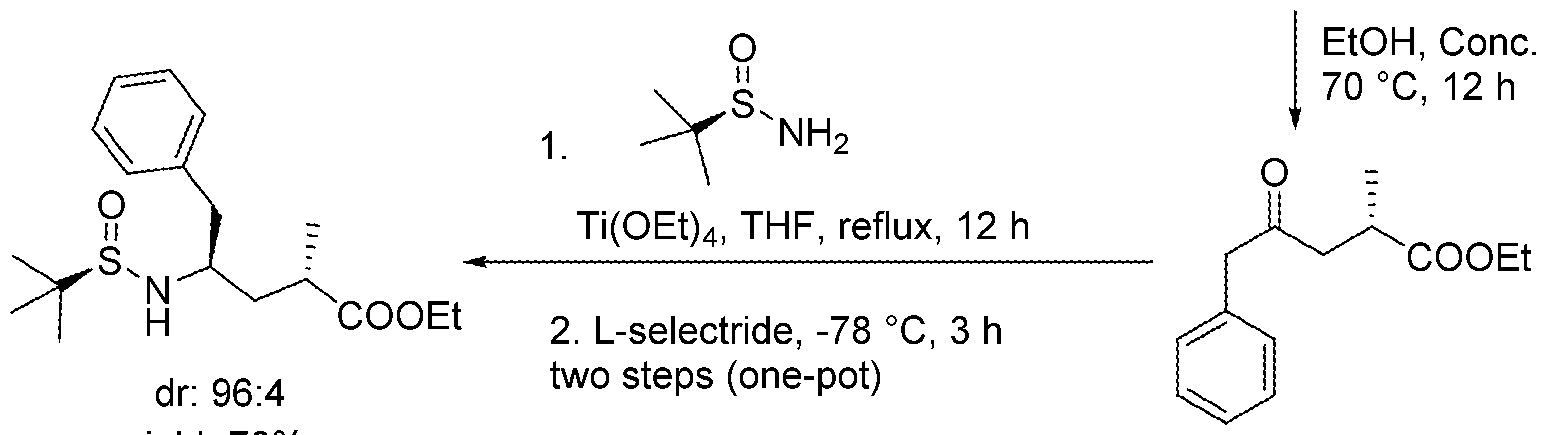
yield: 70%
yield: 78%
flux, 1 h

Yield: 100%
A method of the invention for providing a tubulysin derivative may further comprise the acylation of the hydroxyl group a compound of the general formula H to obtain an ac(et)ylated compound of the general Formula I

Therefore, the present invention particularly finds it use in the manufacture of a cytotoxic tubulysin derivative or tubulysin prodrug.
In one embodiment, a method as herein disclosed provides a conjugate comprising a tubulysin compound covalently linked to a targeting moiety that specifically or preferentially binds to a chemical entity on a target cell, which target cell preferably is a cancer cell. Preferably, the targeting moiety is an antibody— more preferably a monoclonal antibody; even more preferably a human monoclonal antibody— and the chemical entity is a tumor associated antigen. The tumor associated antigen can be one that is displayed on the surface of a cancer cell or one that is secreted by a cancer cell into the surrounding extracellular space.
In one aspect, a method of the invention comprising a step of reacting the ac(et)ylated compound of the general Formula I with Glu-(OMe)2 or alternative amino acid ester to obtain a compound of the formula J
 wherein R22 is H or an amino acid side chain, preferably CH2-CH2-COOZ wherein Z is H or methyl,
R23 = H or a carboxyl protecting group, in particular methyl, ethyl, or tert- butyl; preferably H, methyl, ethyl or tert -butyl.
In a specific aspect, the method comprises the synthesis of a glutamic acid conjugate of tubulysin, which finds its use in a prodrug approach using glucarpidase or an enzyme showing a similar activity. For example, the method comprises the formation of a tubulysin-prodrug comprising one or more glutamate residue(s) linked to an amidic, urethanic or ureidic bond. For example, the invention provides one of the following exemplary compounds

Example 1: Preparation of Na-Fmoc-valine diazoketone
1. IBCF, NMM
-25 °C, THF

FmocHN COOH FmocH
2. CH2N2 Ether, 0 °C
6h


Fmoc-Val-OH (1.63 g, 4.79mmol) was dissolved in anhydrous THF (lOmL) under nitrogen at 25 °C. N-Methylmorpholine (0.55mL, 5mmol) and isobutylchloroformate were then added to the mixture and after 5min of stirring, the mixture was cooled down to 78 °C. Anhydrous ether (lOmL) was added and the fine suspension was filtered under N2. Diazomethane
(294mg, 7mmol) was added dropwise and the reaction was allowed to stir for 2 h at room temperature. After evaporation of the solvent, the residue was dissolved in CH2CI2, and washed with water (3 X lOmL) before drying over MgS04 and concentration. Fmoc-Val-CHNa were purified via flash
chromatography using EtOAc/hexane (30/70, v/v).
TLC: 0.34 (Petroleum ether/EtOAc, 7:3)
Yield: 95%
[a] D25 = +16.3 (c 1, CHCI3)
MS (ESI) m/z calculated for C21H21N3O3 [M+Na]+ : 386.14, found 386.10
Ή NMR (500 MHz, CDCI3): d 8.43 -6.91 (8H, m), 6.24 (br, s, 1H), 5.07 (d, J = 6.9 Hz, 1H), 4.70 (d, J = 2.0 Hz, 2H), 4.48 - 4.43 (m, 1H), 2.54 (h, J = 6.8 Hz, 1H), 0.93 (dd, J = 24.9, 6.8 Hz, 6H).
13C NMR (100 MHz, CDCI3): 191.2, 158.6, 144.2, 139.6, 126.9, 126.8, 123.8, 122.7, 67.0, 65.9, 60.6, 48.4, 31.2, 19.4.
Ref: Tetrahedron Letters 45 (2004) 8603-8606.
Example 2: Synthesis of Fmoe-|3-Val-OH
C6H5COOAg (0.1 eq.)
Dioxane:H20

FmocH - FmocHN
N2
70 "C, 5h


A solution of 2 (1.0 mmol) in 1, 4-dioxane (10 mL) and water (5 mL) was treated with silver benzoate (0.02 mmol). It was refluxed at 70 °C for 5 h and then filtered. The solvent was evaporated under reduced pressure. The residue was dissolved in aqueous sodium carbonate (10%, 20 mL) and washed with diethyl ether (2 X 30 mL). The aqueous layer was acidified to pH 2-3 (using 2N HC1) and extracted with ethyl acetate (3 X 25 mL). The combined organic layer was washed with water and dried over anhydrous sodium sulphate and evaporated. The residue was recrystallized using ethyl acetate and n-hexane to give 3. (95% yield).
TLC: 0.3 (CH2CI2/ MeOH, 10: 0.5),
Yield: 98%
[a]h2d = + 25.5 (c 1, CHCI3)
MS (ESI) m/z calculated for C21H23NO4 [M+Na]+ : 376.15, found 376.08
Ή NMR (500 MHz, CDCI3): d 7.79- 7.43 (m, 8 H), 4.94 (s, 1H), 4.70 (d, J = 5.6 Hz, 2H), 4.43 (q, J = 7.0 Hz, 1H), 4.32 - 4.25 (m, 1H), 2.79 (dd, J = 12.4, 7.0 Hz, 1H), 2.67 - 2.53 (m, 2H), 0.81 (dd, J = 25.1, 6.8 Hz, 6H).
i3C NMR (100 MHz, CDCI3): 174.4, 158.5, 144.2, 139.6, 126.9, 126.8, 123.8, 122.7, 67.0, 58.9, 48.4, 34.6, 33.6, 19.1.
Ref: Syn. Commun., 2003, 33, 3089-3096.
Example 3: Synthesis of oxazolidinone 4
(HCHO)n
PTSA, toluene


FmocHN Fmoc

3
4
Fmoc-6-Val 3 (1.0 mmol) was suspended in 20 mL of toluene, and
paraformaldehyde (1 g) and p-toluenesulfonic acid (100 mg) were added. The mixture was refluxed for 30 min with azeotropic water removal. The solution was cooled, washed with 1 N aqueous NaHCOa (2 X 25 mL) and dried over Na^SO.i. Concentration in vacuo to yield 4 as yellow gum (yield:
88%).
TLC: 0.38 (Petroleum ether/EtOAc, 7:3)
Yield: 80%
[a]D 25 = -15.9 (c 1, CHCI3)
MS (ESI) m/z calculated for C21H23NO4 [M+Na]+: 388, 15, found 388.10.
Major rotamer: Ή NMR (500 MHz, CDCI3): d 8.10-7.44 (in, 8 H), 6.28 (cl, J = 11.5 Hz, 1H), 6.20 (d, J = 11.5 Hz, 1H), 4.81 (q, J = 7.0 Hz, 1H), 4.70 (d, J =
5.7 Hz, 2H), 4.36 - 4.29 (m, 1H), 2.69 - 2.53 (m, 2H), 2.46 (dd, J = 14.6, 7.0 Hz, 1H), 0.83 (dd, J = 25.1, 6.8 Hz, 6H).
Major rotamer:
 NMR (100 MHz, CDCI3): d 169.8, 158.3, 144.8, 139.1,
127.0, 126.8, 123.8, 122.7, 73.2, 67.4, 52.2, 47.9, 38.2, 32.1, 19.1.
Ref: J. Org. Chem., 1983, 48, 77-81.
Example 5: Synthesis of N-methyl-Fmoc-P-Val-OH 5
Et3SiH, TFA
Fmoc CHCI3 rt, 48 h
 COOH
COOH
FmocN

4 5
The oxazolidinone 4 (3.0 mmol) was dissolved in 15 mL of CHCI3, and 15 mL of trifluoro acetic acid and triethylsilane (1.43 mL, 1.04 g, 9.0 mmol) were added. The solution was stirred at room temperature for 48 h followed by concentration in vacuo to an oil. The oil was dissolved in CH2C I2 and reconcentrated several times. The resultant oil was purified on silica gel flash column chromatography (PE/ EA 100:0 to 20:80).
TLC: 0.34 (Petroleum ether/EtOAc, 7:3)
Yield: 85%
[a]n25 = -32.5 (c 1, CHCI3)
MS (ESI) m/z calculated for C22H25NO4 [M+Na]+: 390.16, 390.10.
Major rotamer: Ή NMR (500 MHz, CDC1;;): 6 8.25-7.43 (m, 8H), 4.70 (d, J = 4.9 Hz, 2H), 4.16 (q, J = 7.0 Hz, 1H), 3.09 (s, 3H), 2.65 - 2.50 (m, 2H), 2.36 (dd, J = 12.4, 7.0 Hz, 1H), 0.88 (dd, J = 25.0, 6.8 Hz, 6H).
Major rotamer: 13C NMR (100 MHz, CDCL): d 174.0, 156.0, 144.8, 139.1, 127.0, 126.8, 123.8, 122.7, 67.4, 53.6, 47.9, 34.2, 31.2, 19.1.
Ref: J. Org. Chem., 1983, 48, 77-81.
Example 6: Synthesis of 6
1. IBCF, NMM, Y
-15 °C, THF, 30 min 1 ^

FmocN 2. NaBH4 (aq.) |
5 min
6
0
A solution of 5 (25 mmol) in THF (50 mL) was cooled to -15 °C (ice/ salt bath) under a nitrogen atmosphere. NMM (25 mmol, 2.78 mL, 1 equiv) and IBCF (25 mmol, 3.40 mL, 1 equiv) were added successively in a dropwise manner. After 30 h, the reaction mixture was filtered. The filtrate was cooled to -15 °C (ice/ salt bath), and a solution of NaBH4 (37.5 mmol, 1.42 g, 1.5 equiv) in H2O (12.5 mL) was added in one portion. After complete reduction (TLC analysis), the suspension was diluted with EtOAc and H2O
(1: 1). The organic layer was separated and the aqueous layer was extracted with EtOAc (2X 25 mL) and the combined organic layer was dried over Na2SO i and evoprated under vaccum to yield 6 as gummy solid.
TLC: 0.25 (Petroleum ether/EtOAc, 5:5)
Yield: 96%
[a] D25 = +7.6 (c 1, CHC13)
MS (ESI] m/z calculated for C22 H27NO3 [M+Na]+: 376.18 (M + Na), found 376.08 Major rotamer: Ή NMR (500 MHz, CDCI3): d 8.10-7.15 (m, 8 H), 4.70 (d, J = 5.2 Hz, 2H), 3.84 - 3.73 (m, 1H), 3.69 - 3.57 (m, 2H), 3.11 (s, 3H), 2.67 - 2.53 (m, J = 6.8 Hz, 1H), 2.16 - 2.01 (m, 2H), 1.41 (t, J = 5.5 Hz, 1H), 0.90 (dd, J
= 25.1, 6.8 Hz, 6H).
Major rotamer: 13C NMR (100 MHz, CDCI3): d 156.0, 144.8, 139.1, 127.0, 126.8, 123.8, 122.7, 67.4, 59.5, 55.2, 47.9, 32.8, 31.2, 30.4, 19.1.
Ref: J. Org. Chem., 2001, 66, 8454-8462
Example 7: Synthesis of Aldehyde (Exemplary compound B)

Fmoc
 FmocN
FmocN


Alcohol 6 (1.00 mmol) was dissolved in CH3CN (7 mL) and IBX (2.00 mmol) was added. The resulting suspension was immersed in an oil bath set to 80 °C and stirred vigorously open to the atmosphere. After 2 h (TLC
monitoring), the reaction was cooled to room temperature and filtered through a medium glass frit. The filter cake was washed with 3 x 2 mL of ethyl acetate, and the combined filtrates were concentrated and purified by flash column chromatography to yield aldehyde 7 as a yellow gum.
TLC: 0.55 (Petroleum ether/EtOAc, 8:2)
Yield: 94%
[a]h25 = +11.4 (c 1, CHCla)
MS (ESI) m/z calculated for C22H25NO3 [M+Na]+: 374.17, found 374.10
Major rotamer: Ή NMR (500 MHz, CDCI3): 5 9.76 (t, J = 6.2 Hz, 1H), 8.10- 7.00 (m, 8H), 4.70 (d, J = 5.3 Hz, 2H), 4.33 - 4.27 (m, 1H), 3.92 (q, J = 7.0 Hz, 1H), 3.18 (s, 3H), 2.83 (ddd, J = 12.3, 7.0, 6.1 Hz, 1H), 2.67 - 2.53 (m, 2H), 0.89 (dd, J = 25.0, 6.8 Hz, 6H).
Major rotamer:
 NMR (100 MHz, CDCla): d 199.5, 156.0, 144.8, 139.1,
127.0, 126.8, 123.8, 122.7, 67.4, 55.1, 47.9, 41.8, 31.2, 30.2, 19.1.
Ref: Org. Lett., 2002, 4, 3001-3003.
Example 8: Synthesis of methyl S-trityl-L-eysteinate, 9
Trt SOCI2 Trt

8 9
To a solution of S-trityl-L-cysteine (1.0 g, 2.76 mmol) in 50 mL of methanol stirred at 0 °C was added thionyl chloride (1.50 mL, 0.206 mmol) in a drop wise fashion. The solution was allowed to warm up to room temperature and then refluxed at 80 °C for 5 h. The solvent was removed under reduced pressure and the crude product was extracted with ethyl acetate and washed with saturated sodium bicarbonate for several times. The organic layer was dried over anhydrous magnesium sulfate, filtered and
concentrated to give ester as pale yellow gum.
TLC: 0.32 (Petroleum ether/EtOAc, 5:5)
Yield: 80%
[a]n25 = +20.4 (c 1, CHCI3)
MS (ESI) m/z calculated for C2.3H2.3NO2S [M+Na]+: 400.13, found 400.10
Ή NMR (500 MHz, CDC13): d 7.68 - 7.61 (m, 6H), 7.40 - 7.32 (m, 6H), 7.27 - 7.19 (m, 3H), 3.79 (t, J = 7.0 Hz, 1H), 3.71 (s, 3H), 3.64 (dd, J = 12.3, 7.0 Hz, 1H), 2.82 (dd, J = 12.4, 7.0 Hz, 1H), 2.19 (s, 2H).
«C NMR (100 MHz, CDClg): d 172.0, 144.9, 129.0, 128.8, 128.4, 127.5, 126.5, 126.2, 67.4, 53.5, 52.4, 33.5.
Example 9: Synthesis of methyl N-formyl-S-trityl-L-cysteinate, 10

9 10
Amine 9 (1.0 g, 2.65 mmol ) was dissolved in methyl formate (10 mL, solvent) and the assembly was allowed to reflux at 60 °C until TLC showed complete consumption of starting material (usually 24 h). The solvent was evaporated and the product was purified through column chromatography to yield formyl ester 10 as a white solid.
TLC: 0.34 (Petroleum ether/EtOAc, 7:3)
Yield: 95%
[a]n25 = +9.6 (c 1, CHCls)
MS (ESI) m/z calculated for C24H23NO3S [M+Na]+: 428.12, found 428.10
Ή NMR (500 MHz, CDCI3) d 7.95 (d , J = 1.3 Hz, 1H), 7.50 - 7.11 (m, 16H), 6.14 (d, J = 8.1 Hz, 1H), 4.64 (dt, J = 8.2, 5.2 Hz, 1H), 3.68 (s, 3H), 2.77 (dd,
J = 12.7, 5.8 Hz, 1H), 2.69 (dd, J = 12.9, 6.5 Hz, 1H).
13C NMR (126 MHz, CDCI3) d 170.3, 160.4, 144.1, 129.4, 128.0, 128.0, 126.9, 126.8, 77.3, 77.1, 76.8, 67.0, 52.6, 49.7, 33.5.
Example 10: Synthesis of methyl (7?)-2-isocyano-3- (tritylthio)propanoate (11) (Exemplary compound C)

11
10
Asolution of iV-formyl Cys(Trt)-methyl ester (1.0 eq) in CH2CI2 (5.0 mL), was cooled to -78 °C. N-methylmorpholine (2.0 eq) was added. After 5 min triphosgene (0.35 eq.) in CH2CI2 (5.0 mL) was added drop wise and the reaction mixture was stirred for 3h at -78 0 C (TLC analysis). Saturated NaHCOs solution (10 mL) was added at same temperature and allowed to warm to room temperature. The reaction mixture was extracted with CH2CI2, the organic extracts were separated, dried over anhydrous Na2S04, filtered, and concentrated. The solution was diluted with diethyl ether (10 mL) and stored -15 °C for 5 h resulted in pure solid of isocyanide 11 which was collected by filtration.
TLC: 0.4 (Petroleum ether/EtOAc, 9: 1)
Yield: 84%
[a]D 25 = +55.2 (c 1, CHCI3)
MS (ESI) m/z calculated for C24H21NO2S [M+Na]+: 410.11, found 410.25
Ή NMR (500 MHz, CDCI3): Ή NMR (500 MHz, CDCI3) d 7.57 - 7.06 (m,
16H), 3.70 (s, 3H), 3.34 (ddd, J = 7.7, 5.8, 1.6 Hz, 1H), 2.89 - 2.63 (m, 2H). 13C NMR (126 MHz, CDCI3) d 165.6, 160.9, 143.9, 129.4, 129.2, 128.2, 128.0, 128.0, 127.9, 127.1, 67.5, 55.3, 53.4, 34.2.
Example 11: Synthesis of Acid component
11.1 Synthesis of Cbz-(D)-Pic-OH

12 13
D-picolinic acid (30 mmol) and NaHCO;; (60.0 mmol) were dissolved in a solution of H20 and dioxane (1: 1, 60 mL) was cooled to 0 °C.
Benzylchloroformate (33.0 mmol) was added dropwise and the resulting suspension was stirred overnight at room temperature. The reaction mixture was quenched with IN HC1 till pH 2. This solution was extracted with EtOAc (3 X 15 mL) treated with brine and dried over NaaSO^ The solvent was evoprated under reduced pressure followed by recrystallization with diethyl ether afforded a white solid 13.
TLC: 0.41 (Petroleum ether/EtOAc/TFA 5:5:0.1)
Yield: 95%
[a]ϋ25 = -155.2 (c 1, CHCL)
MS (ESI) m/z calculated for C14H17NO4 [M+Na]+: 286.10, found 286.18
Major Rotamer: Ή NMR (500 MHz, CDCL): d 7.38 - 7.27 (m, 5H), 5.83 (d, J = 12.4 Hz, 1H), 5.34 (d, J = 12.4 Hz, 1H), 5.05 (t, J = 6.9 Hz, 1H), 4.20 (dt, J = 12.5, 7.1 Hz, 1H), 3.32 (dt, J = 12.6, 7.1 Hz, 1H), 2.34 - 2.23 (m, 1H), 2.09 - 1.93 (m, 2H), 1.74 - 1.58 (m, 2H), 1.58 - 1.49 (m, 1H).
Major Rotamer:
 NMR (100 MHz, CDCL): d 173.7, 157.2, 137.1, 128.5,
128.0, 66.7, 55.3, 43.3, 26.3, 24.5, 20.7.
11.2 Synthesis of Dipeptide Acid (exemplary Compound A)

A solution Cbz-picolinic acid (1.0 eq.) in anhydrous CH2CI2 (10 mL) was cooled to 0 °C. N-hydroxysuccinimide (2.0 eq.) and DCC (1.2 eq.) were added. The reaction mixture was stirred at room temperature for 8h. The solution was filtered through pad of Cellite and the filtrate was evaporated under reduced pressure. In another flask Ile-OH (2 eq.) and NaHCOa (3.0 eq.) were dissolved in 15 mL of water. To this solution the succinamide ester in 20 mL of DMF were added dropwise over 10 min. The reaction mixture was stirred at room temperature for 2 h and then diluted with 20 mL of water. The reaction mixture was washed with diethyl ether (2 X 10 mL). The aqueous phase was acidified to pH 2 using IN HC1 and extracted with EtOAc (3 X 20 mL). The combined organic layer was washed with brine, dried over MgSO i filtered and the solvent evaporated under reduced pressure to yield 15 (exemplary compound D).
TLC: 0.34 (Petroleum ether/EtOAc, 7:3)
Yield: 79%
[a]n25 = -65.6 (c 1, CHCI3)
MS (ESI) m/z calculated for C20H28N2O5 [M+H]+: 376.11, found 376.10
Major Rotamer: Ή NMR (500 MHz, MeOD): d 7.50 (s, 1H), 7.38 - 7.27 (m,
5H), 5.49 (d, J = 12.4 Hz, 1H), 5.37 (d, J = 12.4 Hz, 1H), 5.07 (t, J = 7.0 Hz, 1H), 4.43 - 4.33 (m, 2H), 3.53 (dt, J = 12.6, 7.1 Hz, 1H), 2.44 (dpd, J = 12.3,
6.9, 2.7 Hz, 1H), 2.15 - 1.96 (m, 2H), 1.82 - 1.55 (m, 3H), 1.53 - 1.28 (m, 3H), 1.01 (d, J = 6.8 Hz, 3H), 0.92 (t, J = 8.0 Hz, 3H).
Major Rotamer: 13C NMR (100 MHz, MeOD): d 175.2, 171.0, 157.2, 137.1, 128.5, 128.0, 66.7, 58.6, 55.6, 43.3, 36.1, 26.6, 24.5, 24.3, 20.8, 15.0, 11.6.
Example 12: Synthesis of (S)-(-)-methyl succinic anhydride
0
(o

b
16 17
(S)-(-)-methyl succinic acid (10.0 mmol) and acetyl chloride (30.0 mmol) were placed in a single neck round bottomed flask and the assembly was refluxed on the steam bath for 3 h. The solution is allowed to cool undisturbed and is finally chilled in an ice bath. The succinic anhydride, which separates in beautiful crystals, is collected on a Buchner funnel, washed with two 75-cc. portions of cold ether, and dried in a vacuum desiccator.
TLC: 0.54 (Petroleum ether/EtOAc, 6:4)
Yield: 100%
[a]h2d = -11.0 (c 1, CHCI3)
MS (ESI) m/z calculated for C5H6O3 [M+Na]+: 137.12, found 137.10
Ή NMR (500 MHz, CDCI3): d 3.48 (h, J = 6.9 Hz, 1H), 3.02 (dd, J = 18.2, 7.0 Hz, 1H), 2.56 (dd, J = 18.2, 7.0 Hz, 1H), 1.17 (d, J = 6.8 Hz, 3H).
13C NMR (100 MHz, CDCI3): d 176.8, 172.9, 35.0, 30.3, 15.1.
Ref: Org. Synth. 1932, 12, 66
Example 13: Synthesis of (S)-2-methyl-4-oxo-5-phenylpentanoic acid, 18

To a solution of anhydride 17 (10 mmol) and Cul (0.1 mmol) in dry THF (50 mL) to -20 °C. benzyl magnesium bromide (2.0 M in THF, 12.0 mmol) slowly to the reaction mixture. (A purple color forms, but it disappear after the addition is finished). The reaction mixture was stirred at same temperature for additional 3h and then room temperature for lh. ¾0 (50 mL) and IN HC1 (50 mL) were added and stirred for 5 mins. The reaction mixture diluted with was EtOAc (50 mL X 2) and filtered through pad of Cellite. The organic layer was separated, dried over MgSO i and evaporated under reduced pressure. The crude product was purified though column chromatography. The regioisomers were purified again to obtain desired product 18.
TLC: 0.51 (Petroleum ether/EtOAc/TFA, 7:3:0.1)
Yield: 61%
[a]h2d = -25.8 (c 1, CHCL)
MS (ESI) m/z calculated for C12H14O3 [M+Na]+: 229.08, found 229.12
Ή NMR (500 MHz, CDCI3): d 7.38 - 7.28 (m, 4H), 7.28 - 7.20 (m, 1H), 3.71 (dt, J = 12.3, 1.0 Hz, 1H), 3.58 (d, J = 12.3 Hz, 1H), 2.98 (dd, J = 12.2, 7.0 Hz, 1H), 2.90 (dt, J = 13.6, 6.7 Hz, 1H), 2.61 (dd, J = 12.2, 6.8 Hz, 1H), 1.22 (d, J = 6.8 Hz, 3H).
13C NMR (100 MHz, CDCI3): d 209.5, 178.1, 136.7, 129.5, 129.0, 126.8, 48.7, 45.6, 36.0, 17.9.
Ref: J. Med. Chem., 2007, 50 (18), pp 4261-4264
Example 14: Synthesis of ethyl (S)-2-methyl-4-oxo-5- phenylpentanoate, 19

The ketoacid 18 (7.0 mmol) was dissolved in EtOH (40 mL), concentrated H2SO4 (1.1 mL, 21.0 mmol) was added at room temperature, and then the reaction mixture was refluxed overnight. After evaporation of the solvent, H2O (10 mL) was added, and the mixture was neutralized with a 2 M aqueous NaOH solution and extracted with EtOAc (3 x 15 mL). The combined organic phases were dried (NasSO i). After filtration and evaporation of the solvent, the expected ketoester obtained as oil.
TLC: 0.45 (Petroleum ether/EtOAc, 9.5:0.5)
Yield: 90%
[a]n26 = -20.6 (c 1, CHCI3)
MS (ESI) m/z calculated for C14H18O3 [M+Na]+: 257.11, found 257.10
Ή NMR (500 MHz, CDCI3): d 7.38 - 7.27 (m, 4H), 7.27 - 7.20 (m, 1H), 4.68 (dq, J = 12.1, 5.9 Hz, 1H), 3.83 (dt, J = 12.4, 1.0 Hz, 1H), 3.60 (dq, J = 12.1, 6.0 Hz, 1H), 3.45 (cl, J = 12.5 Hz, 1H), 3.35 (dd, J = 12.3, 7.0 Hz, 1H), 2.99 (h, J = 6.9 Hz, 1H), 2.46 (dd, J = 12.4, 7.0 Hz, 1H), 1.26 - 1.18 (m, 6H).
NMR (100 MHz, CDCI3): d 209.5, 176.6, 136.7, 129.5, 129.0, 126.8, 61.5, 48.7, 45.4, 36.0, 17.9, 14.1.
Ref: J. Org. Chem., 2013, 78, 3647
Example 15: Synthesis of ethyl (2S,4R)-4-(((S)-ferf- butylsulfinyl)amino)-2-methyl-5-phenylpentanoate, 21

Ketone (1.0 mmol) was added to a solution of 20 (1.5 mmol) and Ti(OEt) i (3.0 mmol) in THF (15 mL) at room temperature (rt). The reaction mixture was heated at 70 °C for 8h and the reaction conversion was followed by TLC. Once the reaction was determined to be complete by TLC, the mixture was cooled to room temperature and then to -78 °C. L-Selectride (1 M solution in THF) was added dropwise. The reaction mixture was stirred at same temperature for 3 h. Once the reduction was determined to be complete by TLC, the reaction mixture was quenched by dropwise addition of MeOH at 0 °C until gas evolution was no longer observed. The crude reaction mixture was poured into an equal volume of brine while being rapidly stirred. The resulting suspension was filtered through a plug of Cellite, and the filter cake was washed with EtOAc. The filtrate was washed with brine, and the brine layer was extracted with EtOAc (3x). The combined organic portions were dried (Na2S04), filtered, and concentrated. The product 21 was purified by silica gel chromatography (hexanes/EtOAc).
TLC: 0.42 (Petroleum ether/EtOAc, 6:4)
Yield: 89%
[a]n25 = +6 (c 1, CHCL)
MS (ESI) m/z calculated for C18H29NO3S [M+Na]+: 362.17, found 362.18
Ή NMR (500 MHz, CDCI.3): d 7.32 - 7.24 (m, 2H), 7.24 - 7.13 (m, 3H), 4.78 (dq, J = 12.1, 6.0 Hz, 1H), 3.85 (s, 1H), 3.69 (dq, J = 12.2, 6.0 Hz, 1H), 3.60
(dtd , J = 11.9, 7.0, 2.2 Hz, 1H), 3.31 (ddt, J = 12.5, 6.9, 1.1 Hz, 1H), 2.92 (ddq, J = 12.3, 7.0, 0.8 Hz, 1H), 2.59 (h, = 6.9 Hz, 1H), 2.28 (td, J = 12.1, 6.9 Hz, 1H), 2.13 - 2.05 (m, 1H), 1.29 - 1.20 (m, 15H).
13C NMR (100 MHz, CDCR): 6 177.6, 137.0, 129.3, 128.4, 126.3, 69.6, 61.5, 56.7, 39.9, 38.7, 37.7, 20.4, 18.1, 14.1.
Ref: J. Org. Chem., 2007, 72, 626-629
Example 16: Synthesis of Tubuphenylalanine (22) (Exemplary compound G).

H2O (3.07 mL) was added to 21 (1.0 mmol), followed by cone. HCI (3.07 mL), and the reaction mixture was heated to 100 °C for 2h. The mixture was then allowed to cool to room temperature and concentrated under vacuum. The resulting oil was triturated three times with Et20 to give 22 (100%) as a white powder.
TLC: 0.31 (CH2Cl2/MeOH/NH4OH, 9: 1:0.2)
Yield: 95%[a] 25 = +15.2 (c = 1, MeOH)
MS (ESI) m/z calculated for C12H17NO2 [M+H]+: 208.13, found 208.05
Ή NMR (500 MHz, D20) d 7.29 (m, 2H), 7.20 (t, 1H, J = 7.3 Hz), 7.22 (d, 2H, J = 7.1 Hz), 3.49 (m, 1H), 2.85 (dd, 1H, J = 6.6, 14.2 Hz), 2.82 (dd, 1H, J = 7.6, 14.2 Hz), 2.40-2.60 (m, 1H), 1.77-1.88 (m, 1H), 1.42-1.68 (m, 1H), 1.06 (d, 3H, J = 7.0 Hz).
13C NMR (125 MHz, D20) 5 180.1, 135.2, 129.8, 128.8, 128.0, 51.6, 39.0, 36.5, 36.0, 17.0.
129.8, 130.1, 136.1, 180.7.
Example 17: Total Synthesis of 23

0.5 M
rt, 24 h


diastereomers 23 were purified again and pure diastereomer 23A was used further.
TLC: 0.34 (Petroleum ether/EtOAc, 7:3)
Yield: 80%
[a]h2d = -96.5 (C 1, CHCI3)
MS (ESI) m/z calculated for C66H74N4O10S [M+Na]+: 1137.2, found 1137.25
Major rotamer: Ή NMR (500 MHz, CDCI3): 6 7.93 - 7.84 (m, 3H), 7.82 (dt, J = 7.2, 1.8 Hz, 2H), 7.71 - 7.64 (m, 2H), 7.59 - 7.52 (m, 4H), 7.50 (s, 2H), 7.45 (tdd, J = 7.5, 6.0, 1.5 Hz, 2H), 7.42 - 7.13 (m, 15H), 5.01 (t, J = 7.0 Hz,
1H), 4.92 (d, J = 7.0 Hz, 1H), 4.82 - 4.72 (m, 2H), 4.72 - 4.67 (m, 2H), 4.49 (dt, J = 12.5, 6.9 Hz, 1H), 4.35 - 4.28 (m, 1H), 4.17 (ddd, J = 11.9, 7.0, 2.5 Hz, 1H), 3.71 (s, 3H), 3.51 - 3.41 (m, 1H), 3.33 (dd, J = 12.4, 7.0 Hz, 1H),
3.25 (s, 3H), 2.98 - 2.84 (m, 2H), 2.81 - 2.69 (m, 1H), 2.67 - 2.53 (m, J = 6.8 Hz, 1H), 2.07 - 1.91 (m, 2H), 1.91 - 1.44 (m, 6H), 1.02 - 0.85 (m, 12H).
Major rotamer:
 NMR (100 MHz, CDCH): d 171.0, 169.9, 157.2, 156.0,
144.9, 139.1, 137.1, 128.8, 128.6, 128.5, 128.0, 127.5, 127.0, 126.8, 123.8, 122.7, 69.5, 66.7, 59.8, 55.6, 53.9, 53.5, 52.4, 47.9, 43.3, 35.5, 33.2, 32.2, 26.6, 24.5, 24.3, 20.8, 19.1, 15.0, 11.6.
Ref: Org. Lett., 2009, 11 (5), pp 1167-1170
Example 18: Synthesis of thiazoline, 24
TiCI4 (3 eq.) OOMe OOMe

Fmoc Fmoc


A solution of S-trityl -protected cysteine N-amicle 23A (1.0 mmol) in dry CH2CI2 (10 mL) was treated with TiCLi (1.0 M solution in CH2CI2, 3.0 mmol) and stirred at 0 °C for 18 h. The reaction mixture was stirred vigorously with cold saturated aqueous NaHCOs (2x) for 30 min. The aqueous layer was extracted with CH2CI2, and the combined organic layers were dried over MgSO i, filtered, and concentrated. The resultant crude product was purified by flash chromatography to afford 24 as a yellow foam.
TLC: 0.32 (Petroleum ether/EtOAc, 6:4)
Yield: 75%
[a]h2G> = -108.3 (C 1, CHCI3)
MS (ESI) m/z calculated for C47H58N4O9S [M+Na]+: 877.12, found 877.20
Ή NMR (500 MHz, CDClg): d 7.85 - 7.76 (m, 2H), 7.59 - 7.48 (m, 4H), 7.44 (td, J = 7.5, 1.5 Hz, 1H), 7.40 - 7.27 (m, 6H), 5.06 (dt, J = 26.4, 7.1 Hz, 2H), 4.77 - 4.67 (m, 3H), 4.55 (t, J = 6.9 Hz, 1H), 4.42 (dt, J = 12.5, 7.1 Hz, 1H), 4.27 (td, J = 7.3, 0.8 Hz, 1H), 4.08 (ddd, J = 11.9, 7.0, 2.4 Hz, 1H), 3.85 (dd, J
= 12.5, 7.0 Hz, 1H), 3.71 (s, 3H), 3.40 (dd, J = 12.5, 7.0 Hz, 1H), 3.22 (s, 3H), 3.03 (dt, J = 12.4, 7.1 Hz, 1H), 2.81 - 2.69 (m, 1H), 2.67 - 2.53 (m, J = 6.8 Hz, 1H), 2.17 (ddd, J = 12.4, 7.0, 2.4 Hz, 1H), 2.02 - 1.90 (m, 2H), 1.83 (dp, J = 13.0, 7.1 Hz, 1H), 1.76 - 1.48 (m, 3H), 1.42 (dp, J = 13.0, 7.1 Hz, 1H), 1.23 - 1.11 (m, 2H), 1.02 - 0.92 (m, 6H), 0.81 (d, J = 6.8 Hz, 3H), 0.72 (cl, J = 6.8
Hz, 3H).
Major Rotamer:
 NMR (125 MHz, CDCL): 172.9, 172.1, 171.0, 170.1,
157.2, 156.0, 144.8, 139.1, 137.1, 128.5, 128.0, 127.0, 126.8, 123.8, 122.7,
74.0, 67.4, 66.7, 65.6, 59.8, 55.6, 53.5, 51.7, 47.9, 43.3, 35.8, 35.5, 34.3, 26.6, 24.5, 24.3, 20.8, 19.1, 15.0, 11.6.
Ref: Org. Lett., 2000, 2, 3289.
Example 19: Synthesis of thiazole, 25

reflux, 5 h
OOMe OOMe
Fmoc Fmoc


To a solution of 24 (1 mmol) in CHCI3 (5 mL), activated Mn02 (< 10 micron, 10 mmol) was added. The reaction mixture was refluxed at 70 °C for 5 h, then filtered through a short silica gel and celite column and washed with CHCI3. The organic solution was concentrated. The resulting crude product
was purified by flash chromatography (EtO Ac/hexanes = 1/3) to afford compound 25 as a white foam.
TLC: 0.41 (Petroleum ether/EtOAc, 7:3)
Yield: 99%
[a]h25 = -33.2 (C 1, CHC13)
MS (ESI) m/z calculated for C47H56N4O9S [M+Na]+: 875.21, found 875.20
Ή NMR (500 MHz, CDCI3): d 7.83 - 7.72 (m, 2H), 7.66 (eld, J = 7.4, 1.5 Hz, 1H), 7.55 - 7.40 (m, 4H), 7.37 - 7.28 (m, 5H), 7.16 (dd, J = 7.5, 1.5 Hz, 1H), 7.07 (td, J = 7.5, 1.5 Hz, 1H), 5.89 (t, J = 7.0 Hz, 1H), 4.79 (dd, J = 6.9, 1.1 Hz, 1H), 4.70 (d, J = 7.0 Hz, 2H), 4.44 (clt, J = 12.6, 7.0 Hz, 1H), 4.35 (t, J = 7.2 Hz, 1H), 4.26 (t, J = 6.9 Hz, 1H), 4.13 (ddd, J = 11.2, 7.0, 4.2 Hz, 1H),
3.96 (s, 3H), 3.16 (s, 3H), 2.81 - 2.71 (m, 2H), 2.67 - 2.45 (m, 3H), 2.02 - 1.80 (m, 4H), 1.68 - 1.55 (m, 1H), 1.55 - 1.39 (m, 3H), 1.09 (t, J = 8.0 Hz, 3H), 0.97 (d, J = 6.8 Hz, 3H), 0.72 (dd, J = 24.0, 6.8 Hz, 6H).
13C NMR (100 MHz, CDCI3): d 172.1, 171.0, 169.6, 162.4, 157.2, 156.0, 139.1,
137.1, 128.5, 128.0, 127.0, 126.8, 123.8, 122.7, 118.8, 67.4, 66.7, 63.8, 59.8, 55.6, 53.5, 52.0, 47.9, 43.3, 35.8, 35.5, 26.6, 24.5, 24.3, 20.8, 19.1, 15.0, 11.6.
Example 20: Fmoc deprotection and acyl migration: synthesis of 26
Fmoc

25 26 To a solution of 25 (1.0 mmol) in CH3CN (12 mL) at 0 °C under Ar was added Et2NH (8 mL). The solution was stirred at room temperature for 1 h. After complete deprotection of Fmoc group (TLC analysis) the mixture was evaporated and co-evaporated with CH2CI2 to remove DEA. The crude crude product which was dissolved in CH2CI2 (0.8 mL) and Et¾N (0.3 mL) was added and the resulting mixture was stirred at room temperature for 18 h. The crude hydroxyl derivative 26 was purified by column chromatography. The non-acylated amine was isolated and again stirred in presence of EtsN for overnight.
TLC: 0.32 (Petroleum ether/EtOAc, 3:7)
Yield: 75%
[a]h2G> = +68.2 (C 1, MeOH)
MS (ESI) m/z calculated for C32H46N4O7S [M+Na]+: 653.29, found 653.10
Major rotamer: Ή NMR (500 MHz, MeOD): d 7.37 - 7.29 (m, 5H), 5.54 (d, J = 12.4 Hz, 1H), 5.38 - 5.31 (m, 1H), 5.12 (d, J = 6.7 Hz, 1H), 4.83 (td, J = 6.9, 4.6 Hz, 2H), 4.17 (dt, J = 12.4, 7.1 Hz, 1H), 3.96 (s, 3H), 3.82 (ddd, J = 11.7,
7.0, 2.7 Hz, 1H), 3.42 (dt, J = 12.6, 7.1 Hz, 1H), 3.23 (d, J = 4.9 Hz, 1H), 2.98 (s, 3H), 2.65 - 2.55 (m, 2H), 2.54 - 2.43 (m, 1H), 2.13 (dq, J = 13.0, 6.9 Hz, 1H), 1.99 - 1.78 (m, 2H), 1.77 - 1.37 (m, 6H), 0.92 (d, J = 6.8 Hz, 3H), 0.83 (d, J = 6.5 Hz, 3H), 0.71 (t , J = 7.9 Hz, 3H), 0.59 (d, J = 6.8 Hz, 3H).
13C NMR (125 MHz, MeOD): 6 173.9, 171.0, 170.7, 162.5, 157.2, 144.8, 137.1, 128.5, 128.0, 118.8, 66.7, 63.5, 56.7, 55.6, 54.6, 52.0, 43.3, 37.4, 36.0, 31.1, 30.8, 26.6, 24.5, 24.3, 20.8, 19.1, 14.8, 11.7. Example 21: Hydrolysis of methyl ester: Synthesis of acid 27

LiOH (2.0 mmol) was added to a solution of 26 in a mixture of THF and H20 (1: 1, 0.5 M), and the reaction mixture was stirred at room temperature for 6 h. The mixture was concentrated under reduced pressure. The crude product was purified through silica get column chromatography.
TLC: 0.25 (CH2Cl2/MeOH, 9: 1)
Yield: 99%
[a]D 25 = +18.5 (C 1, MeOH)
MS (ESI) m/z calculated for C31H44N4O7S [M+H]+: 617.32, found 617.15
Major rotamer: Ή NMR (500 MHz, MeOD): 6 7.37 - 7.28 (m, 5H), 5.69 (d, J = 12.5 Hz, 1H), 5.35 - 5.22 (m, 2H), 4.94 (d, J = 7.0 Hz, 1H), 4.85 (t, J = 6.9 Hz, 1H), 4.20 (dt, J = 12.4, 7.0 Hz, 1H), 3.67 (ddd, J = 7.1, 3.8, 2.3 Hz, 1H), 3.47 (dt, J = 12.4, 7.0 Hz, 1H), 3.23 (d, J = 4.9 Hz, 1H), 2.95 (s, 3H), 2.80
(ddd, J = 12.4, 7.0, 2.4 Hz, 1H), 2.59 (dp, J = 13.7, 6.8 Hz, 1H), 2.38 (ddd, J = 12.3, 7.0, 3.8 Hz, 1H), 2.04 (dq, J = 12.7, 6.9 Hz, 1H), 1.95 - 1.78 (m, 2H), 1.78 - 1.66 (m, 1H), 1.66 - 1.55 (m, 2H), 1.52 - 1.39 (m, 2H), 1.26 (tq, J = 12.6, 8.0 Hz, 1H), 0.98 (d, J = 6.8 Hz, 3H), 0.82 (dd, J = 13.2, 6.8 Hz, 6H), 0.71 (t, = 8.0 Hz, 3H).
Major rotamer: 13C NMR (125 MHz, MeOD): d 173.9, 173.0, 171.0, 162.3,
157.2, 150.6, 137.1, 128.5, 128.0, 122.1, 66.7, 63.5, 56.7, 55.6, 54.6, 43.3, 37.4, 36.0, 31.1, 30.8, 26.6, 24.5, 24.3, 20.8, 19.1, 14.8, 11.7. Example 22: Coupling of Tubuphenylalanine: Synthesis of 28

Acid 27 (1.0 mmol) was added to a 0.2 M solution of pentafluorophenol (1.25 mmol) and DIC (1.0 mmol) in CH2C12 at 0 °C. The reaction mixture was warmed to rt, stirred for 24 h, and concentrated under reduced pressure. EtOAc (10 mL) was added, and the crude product was filtered, with rinsing of the reaction vessel with EtOAc. The filtrate was concentrated under reduced pressure, and the crude material was used without further purification. DMF (0.335 mL, 0.25 M) was added to the crude product, followed by the hydrochloride salt of tubuphenylalanine (22) (2.0 mmol) and diisopropylethylamine (4.0 mmol). The reaction mixture was stirred for 24 h at rt, and DMF was removed under vacuum. The crude product was purified by column chromatography (5% CH2Cl2:MeOH) afforded 28 as white solid. TLC: 0.32 (CH2Cl2/MeOH/TFA, 9: 1:0.1)
Yield: 90%
[a]o2d = +75.2 (C 1, MeOH)
MS (ESI) m/z calculated for C43H59N5O8S [M+H]+: 806.10, found 806.21
Major rotamer: Ή NMR (500 MHz, MeOD): d 7.38 - 7.24 (m, 7H), 7.24 - 7.13 (m, 3H), 6.04 (d, J = 12.4 Hz, 1H), 5.14 - 5.05 (m, 3H), 4.69 (t, J = 6.9
Hz, 1H), 4.33 (dt, J = 12.5, 7.1 Hz, 1H), 4.11 (dtd, J = 11.5, 7.1, 1.0 Hz, 1H), 3.57 (ddd, J = 6.9, 4.2, 2.0 Hz, 1H), 3.42 (dt, J = 12.4, 7.0 Hz, 1H), 3.23 (d, J
= 4.9 Hz, 1H), 3.15 (cldt, J = 12.3, 6.9, 1.0 Hz, 1H), 2.97 - 2.84 (m, 4H), 2.79 (ddd, J = 12.4, 7.0, 2.0 Hz, 1H), 2.69 - 2.61 (m, 1H), 2.61 - 2.53 (m, 2H), 2.36 (ddd, J = 12.3, 7.0, 4.3 Hz, 1H), 2.12 (td, J = 11.7, 6.5 Hz, 1H), 2.01 - 1.54 (m, 7H), 1.49 (dp, J = 12.6, 6.8 Hz, 1H), 1.34 - 1.20 (m, 4H), 0.94 (d, J = 6.8 Hz, 3H), 0.81 (dd, J = 22.5, 6.8 Hz, 6H), 0.71 (t, J = 8.0 Hz, 3H).
Major rotamer:
 NMR (125 MHz, CDCH): d 179.2, 173.9, 171.0, 167.6,
161.5, 157.2, 150.4, 137.1, 129.3, 128.5, 128.0, 126.3, 118.6, 66.7, 63.5, 56.7, 55.6, 54.6, 53.8, 43.3, 39.3, 37.6, 37.4, 36.0, 31.1, 30.8, 26.6, 24.5, 24.3, 20.8, 19.1, 18.3, 14.8, 11.7.
Example 23: Acetylation of hydroxyl group: Synthesis of 29

A 0.1 M solution of 28 (1.0 mmol) in pyridine (10.0 mmol) was cooled to 0 °C, and acetic anhydride (10.0 mmol) was added. The reaction mixture was allowed to warm to rt over 2 h and was stirred at rt for 24 h. The reaction mixture was then cooled to 0 °C, and a 1: 1 mixture of dioxane/water (4 mL) was added. The mixture was allowed to warm to rt, and was stirred for 12 h at rt. The solvent was removed under reduced pressure. Column
chromatography (100% CH2CI2 to 10% MeOH/CH2Cl2) afforded 29 as an amorphous solid.
TLC: 0.50 (CH2 C12/MeOH/ TFA, 9: 1:0.1)
Yield: 95%
[a]D 25 = +26.5 (C 1, MeOH)
MS (ESI) m/z calculated for C45H61N5O S [M+H]+: 848.41, found 848.35
Major rotamer: Ή NMR (500 MHz, MeOD): d 6 7.38 - 7.24 (m, 7H), 7.24 - 7.13 (m, 3H), 5.68 (t , J = 7.0 Hz, 1H), 5.52 (d, J = 12.4 Hz, 1H), 5.42 - 5.35 (m, 1H), 4.92 (t, J = 7.0 Hz, 1H), 4.68 (d, J = 6.9 Hz, 1H), 4.24 (dt, J = 12.6, 7.1 Hz, 1H), 4.03 (ddd, J = 12.6, 7.0, 3.4 Hz, 1H), 3.92 (dtd, J = 10.5, 7.0, 1.8 Hz, 1H), 3.54 - 3.46 (m, 1H), 3.28 (dt, J = 12.4, 7.0 Hz, 1H), 3.09 (ddd, J =
11.7, 7.1, 3.4 Hz, 1H), 2.95 (s, 3H), 2.82 (ddt, J = 12.4, 7.0, 1.0 Hz, 1H), 2.59 (dp, J = 13.6, 6.8 Hz, 1H), 2.46 (h, J = 6.9 Hz, 1H), 2.20 - 2.12 (m, 5H), 2.10 - 1.93 (m, 3H), 1.93 - 1.82 (m, 1H), 1.77 - 1.51 (m, 4H), 1.39 (dp, J = 13.0,
7.0 Hz, 1H), 1.26 (d, J = 6.8 Hz, 3H), 1.17 (tq, J = 13.0, 8.2 Hz, 1H), 0.93 (d, J = 6.8 Hz, 3H), 0.77 - 0.67 (m, 9H).
Major rotamer:
 NMR (125 MHz, CDCR): d 179.2, 173.9, 171.0, 170.5,
164.6, 161.5, 157.2, 150.4, 137.1, 129.3, 128.5, 128.0, 126.3, 118.6, 66.7, 62.5,
56.7, 55.6, 54.2, 53.8, 43.3, 39.3, 37.6, 37.2, 36.0, 35.8, 31.1, 30.8, 26.6, 24.5, 24.3, 21.3, 20.8, 19.1, 18.3, 14.8, 11.7.
Example 24: Cbz deprotection and N-methylation: Synthesis of 30

TLC: 0.51 (CH2Cl2/MeOH/TFA; 9: 1:0.1).
Yield: 86%
[a] 25 = + 19.2 (c=1.0, MeOH).
MS (ESI) m/z calculated for C38H57N5O7S [M+H]+: 728.40, found 728.35.
Ή NMR (500 MHz, MeOD): d 8.08 (s, 1H), 7.19-7.25 (m, 4H), 7.13-7.18 (m, 1H), 5.71 (del, 1H, J = 2.5, 11.0 Hz), 4.73 (d, 1H, J = 8.0 Hz), 4.30-4.50 (m,
2H), 3.10 (s, 3H), 3.05 (d, 1H, J = 11.5 Hz), ), 2.92 (d, 2H, J = 6.5 Hz), 2.85 (d, 1H, J = 10.5 Hz, 2.51 (br s, 1H), 2.23-2.41 (m, 3H), 2.31 (s, 3H), 2.15 (s, 3H), 1.96-2.05 (m, 1H), 1.75-1.92 (m, 4H), 1.56-1.74 (m, 5H), 1.37-1.41 (m, 1H), 1.09-1.23 (m, 1H), 1.16 (d, 3H, J = 7.0 Hz), 1.03 (d, 3H, J = 6.5 Hz), 0.98 (d, 3H, J = 6.5 Hz), 0.92 (t, 3H, J=7.3 Hz), 0.81 (d, 3H, J = 6.5 Hz).
13C NMR (125 MHz, MeOD): 5 = 11.3, 16.4, 19.1, 20.4, 20.6, 20.9, 23.7, 25.5, 25.5, 30.9, 31.0, 31.1, 35.6, 37.6, 39.5, 39.6, 42.0, 44.2, 51.2, 55.2, 56.4, 69.7, 71.2, 125.1, 127.4, 129.3, 130.6, 139.8, 151.1, 162.7, 171.6, 171.8, 173.6, 175.0, 182.5 ppm.
Example 25 : Synthesis of tubulysin conjugate.

Acid 30 (1.0 mmol) was added to a 0.2 M solution of pentafluorophenol (1.25 mmol) and DIC (1.0 mmol) in a CH2CI2 at 0 °C. The reaction mixture was warmed to rt, stirred for 24 h, and concentrated under reduced pressure and dissolved in DMF (0.5 M). In another reaction vessel hydrochloride salt of H- Glu-(OMe)2 (3.0 mmol) and diisopropylethylamine (5.0 mmol) were dissolved in DMF (0.335 mL, 0.25 M) and this solution is added to the above prepared pent aflur ophenyl ester. The reaction mixture was stirred for 24 h at rt, and DMF was removed under vacuum. The crude product was purified by RP-
semi HPLC (20-80% CH3CN in H2O for 30 min at 214 nm) afforded 31 as white off solid.
HPLC analysis: tit = 3.44 min (Chromolith, gradient: 20-70% B/A over 5 min)
HPLC purification: Nucleosil C18, gradient: 20-21% B/A over 12 min, 25 °C Yield: 75%
[a]o2d = +75.2 (C 1, MeOH)
MS (ESI) m/z calculated for C45H68N6O10S [M+Na]+: 907.46, found 907.40
Major rotamer: Ή NMR (500 MHz, MeOD): 6 7.41 - 7.16 (m, 7H), 7.12 - 7.00 (m, 3H), 6.98 (d, J = 18.1 Hz, 1H), 6.04 (d, J = 12.4 Hz, 1H), 5.55 (br, s,
1H), 5.25 - 5.20 (m, 3H), 4.25 (t, J = 6.9 Hz, 1H), 4.23 - 4.10 (m, 3H), 3.65 (s, 3H), 3.61 (s, 3H), 3.57 - 3.55 (m, 1H), 3.42 (dt, J = 12.4, 7.0 Hz, 1H), 3.23 (cl, J = 4.9 Hz, 1H), 3.15 (ddt, J = 12.3, 6.9, 1.0 Hz, 1H), 3.10 - 3.00 (m, 2H),
2.97 - 2.84 (m, 4H), 2.79 - 2.72 (m, 3H), 2.69 - 2.61 (m, 1H), 2.61 - 2.53 (m, 2H), 2.36 (ddd, J = 12.3, 7.0, 4.3 Hz, 1H), 2.12 (td, J = 11.7, 6.5 Hz, 1H), 2.01
- 1.54 (m, 7H), 1.49 (d, J = 12.6, 6.8 Hz, 1H), 1.34 - 1.20 (m, 4H), 0.94 (d, J = 6.8 Hz, 3H), 0.81 (dd, J = 22.5, 6.8 Hz, 6H), 0.71 (t, J = 8.0 Hz, 3H).
Major rotamer:
 NMR (125 MHz, CDCI3): d 180.2, 179.4, 178.2, 178.0,
173.0, 171.5, 166.3, 161.9, 157.0, 150.5, 137.4, 129.0, 128.2, 128.0, 126.1, 118.1, 66.1, 63.7, 56.7, 55.5, 54.5, 53.0, 48.8, 45.5, 43.0, 39.7, 37.9, 36.5, 36.1,
31.1, 30.8, 26.7, 24.0, 24.1, 20.7, 19.1, 18.3, 14.8, 12.5, 11.9, 11.2.
Example 26 : Synthesis of tubulysin conjugate

Acid 30 (1.0 mmol) was added to a 0.2 M solution of pentafluorophenol (1.25 mmol) and DIC (1.0 mmol) in a CH2CI2 at 0 °C. The reaction mixture was warmed to rt, stirred for 24 h, and concentrated under reduced pressure and dissolved in acetonitrile (0.5 M). In another reaction vessel (L) H-Asp-OH, (2.0 mmol) and sodium bicarbonate (4.0 mmole) were dissolved in 2 ml. of water and adjust the pH about 8. Then a solution of pentafluorophenyl ester prepared above (1.0 mmole) 3 mL of acetonitrile was added at room temperature. The reaction mixture was stirred overnight. The solvent were removed under vacuum. The crude product was purified by RP-semi HPLC (20-60% CH3CN in H2O for 30 min at 214 nm) afforded 32 as white off solid. HPLC analysis: tR = 2.82 min (Chromolith, gradient: 20-60% B/A over 5 min)
HPLC purification: Nucleosil C18, gradient: 20-60% B/A over 30 min
Yield: 68 %
[a]c25 = + 125.6 (C 1, MeOH)
MS (ESI) m/z calculated for C42H62N6O10S [M+H]+: 842.42, found 842.40
Major rotamer: Ή NMR (500 MHz, MeOD): d 7.38 - 7.19 (m, 7H), 7.10 - 6.89 (m, 3H), 6.80 (d, J = 18.1 Hz, 1H), 6.55 (d, J = 12.4 Hz, 1H), 5.89 (br, s, 1H), 5.11 - 5.00 (m, 3H), 4.25 (t, J = 6.9 Hz, 1H), 4.32 - 4.13 (m, 3H), 3.55 - 3.38 (m, 1H), 3.40 (dt, J = 12.4, 7.0 Hz, 1H), 3.23 (d, J = 4.9 Hz, 1H), 3.15 (ddt, J = 12.3, 6.9, 1.0 Hz, 1H), 3.10 - 2.90 (m, 2H), 2.80 - 2.71 (m, 2H), 2.66 - 2.62 (m, 3H), 2.55 - 2.45 (m, 1H), 2.40 - 2.33 (m, 2H), 2.30 (ddd, J = 12.3, 7.0, 4.3 Hz, 1H), 2.10 (td, J = 11.7, 6.5 Hz, 1H), 1.96 - 1.64 (m, 7H), 1.52 (d,
J = 12.6, 6.8 Hz, 1H), 1.41 - 1.30 (m, 4H), 0.94 (d, J = 6.8 Hz, 3H), 0.81 (dd,
J = 22.5, 6.8 Hz, 6H), 0.71 (t, J = 8.0 Hz, 3H).
Major rotamer: 13C NMR (125 MHz, CDCI3): d 182.6, 180.1, 177.1, 172.0, 171.6, 165.3, 160.9, 155.2, 150.8, 138.2, 128.0, 127.2, 127.4, 126.2, 118.4, 65.8, 59.7, 55.7, 53.4, 53.7, 48.6, 45.0, 43.7, 38.1, 37.7, 37.5, 35.7, 31.0, 30.2, 26.7, 25.8, 24.1, 21.5, 19.8, 18.0, 13.6, 12.1, 11.0.
It was found that compound 30 (100 nM test concentration) is highly toxic to HeLa cells after 18hrs treatment, thus demonstrating its suitabihty as cytotoxic agent e.g. in targeted drug delivery.
Example 27: Further tubulysin derivatives
A person skilled in the art will understand and appreciate that the present invention relies on two parts. One part is the Passerini MCR- based approach to construct a tetrapeptide adduct in a good yield using only three synthetic steps.
Secondly, as is exemplified by the synthesis of Tubuphenylalanine (Tup; general formula G), the invention uses simple reagents and less steps to obtain Tup is a highly diastereoselective manner. Another major advantage of this method is that, any other unnatural y-amino acids are easily obtainable by the simple Grignard reaction. This diversity has never been studied so far.
The tubulysin“derivative” is therefore considered in the broad context and allows for:
• Variation on the V-alkylated Tuv substituents (Not only limited to N-Me),
• Diversity possible from the X-substituents from the
isocyanide
• Higher alkyl chains (not only iV-Me) can be incorporated on the N-terminal Picolinic acid
• Wide range of Tup derivatives are also constructed See the following scheme:
R3: wide range of groups can be incorporated

R1 : iate stage N-alkylations
through reductive amination All these variations can be easily adopted through the standard protocol as herein disclosed, thus allowing to obtain a wide range of tubulysin derivatives.
Claims
1. A method for preparing a tubulysin derivative, comprising reacting compounds A, B and C in a 3-component Passerini reaction, wherein compound A is a carboxylic acid according to the general formula A

Ri represents a substituted or unsubstituted alkyl; a substituted or unsubstituted cycloalkyl; or a substituted or unsubstituted benzyl,
R2 represents H, a substituted or unsubstituted alkyl, or a substituted or unsubstituted cycloalkyl;
R3 represents a substituted or unsubstituted alkyl; a substituted or unsubstituted cycloalkyl; or a substituted or unsubstituted benzyl;
Ri represents H, a substituted or unsubstituted alkyl, a substituted or unsubstituted cycloalkyl, a substituted or unsubstituted benzyl;
Rs represents a substituted or unsubstituted alkyl or a substituted or unsubstituted cycloalkyl; preferably a substituted or unsubstituted cycloalkyl;
or wherein R4 and Rr, are connected to form a 4- to 7- membered ring;
Re represents a substituted or unsubstituted alkyl; a substituted or unsubstituted cycloalkyl; a substituted or unsubstituted benzyl, or C=OOR’, where R’ is an optionally substituted alkyl, cycloalkyl, benzyl or aroyl moiety; wherein compound B is an aldehyde according to the general formula B

F, a substituted or unsubstituted alkyl, a substituted or unsubstituted cycloalkyl or a substituted or unsubstituted benzyl;
Pg1 is an amine protecting group, preferably a carbamate, a substituted or an unsubstituted benzyl, or a substituted or an unsubstituted sulfonamide; and wherein compound C is an isocyanide according to the general formula C

R12 represents a substituted or unsubstituted alkyl, a substituted or unsubstituted cycloalkyl, or a substituted or unsubstituted benzyl;
Rl3 represents H, a substituted or unsubstituted alkyl, a substituted or unsubstituted cycloalkyl, or a substituted or unsubstituted benzyl;
X represents O, S, Se, or -NH-, preferably S; and
Pg2 represents an X- protecting group, preferably selected from trityl, tert -butyl, adamantyl and substituted benzyl, more preferably trityl or tert-butyl.
2. Method according to claim 1, wherein
Ri represents isopropyl, tert-butyl, iso-butyl, sec-butyl, cyclopropylmethyl or cyclobutylmethyl;
R2 is H;
R:i is -(CH2)n-CH,3, wherein n is 3 to 5;
R4 is CH2-CH2- or -CH2-CH2-CH2- connected to R5;
R-, is a substituted or unsubstituted cycloalkyl; and/or
Re is selected from the group consisting of benzyloxycarbonyl, 4- azidobenzyloxycarbonyl, 4-methoxybenzyloxycarbonyl, 2- nitr ob enzyloxy c arb onyl , 4,5- dimethoxy -2 -nitr ob enzyloxy c arb onyl , 3,5- dimethoxybenzyloxycarbonyl, 1-naphthyhnethoxycarbonyl, 4- acetyloxybenzyloxycarbonyl, fluorenyloxycarbonyl, tert-butyloxycarbonyl, allyloxycarbonyl, methyl carbamate and ethyl carbamate.
3. Method according to claim 1 or 2, wherein
R7 is H;
Rs is H;
Ro is selected from the group consisting of isopropyl, cyclopropyl, cyclobutyl, isobutyl, sec-butyl, tert-butyl and cyclopropylmethyl;
Rio is H; and/or
Ri 1 is selected from the group consisting of methyl, ethyl, propyl, butyl, isopropyl, cyclopropyl and cyclopropylmethyl.
4. Method according to any one of the preceding claims, wherein Pg2 is selected from the group consisting of benzyloxy carbonyl, 4- azidobenzyloxy carbonyl, 4-methoxybenzyloxycarbonyl, 2- nitrobenzyloxycarbonyl, 4,5-dimethoxy-2-nitrobenzyloxycarbonyl, 3,5- dimethoxybenzyloxycarbonyl, 1-naphthylmethoxycarbonyl, 4- acetyloxyb enzyloxy carb onyl , fluor enyloxy c arb onyl , tert -butyloxycarb onyl , allyloxycarbonyl, methyl carbamate, ethyl carbamate, benzyl, 4- methoxybenzyl and 3,4-dimethoxybenzyl.
5. Method according to any one of the preceding claims, wherein R12 is methyl, ethyl or tert -butyl; and/or wherein R13 is H or methyl.
6. Method according to any one of the preceding claims, comprising reacting compounds A, B and C in a non-coordinating solvent or solvent mixture, preferably selected from the group consisting of CH2CI2, CHCI3, CCLt, benzene, THF, CH3CN, 1,4-dioxane, 1,2-dichloroethane and a mixture of CH2Cl2:THF (1: 1 v/v).
7. Method according to any one of the preceding claims, further comprising isolating the 3-component Passerini reaction product of Formula D

8. Method according to claim 7, further comprising subjecting the
Passerini reaction product of formula D to (a) an acyl migration reaction and (b) a cyclodehydration reaction of the Cys-amide to obtain a compound of the general formula E

9. Method according to claim 8, wherein said acyl migration reaction is performed in a two-step process involving exposure to diethylamine (DEA) followed by exposure to trimethylamine (TEA).
10. Method according to claim 8 or 9, wherein said cyclodehydration reaction is performed in a two-step process involving incubation in the
presence of TiCF, followed by oxidation in the presence of Mn02, preferably activated Mn02 having a pore size of < 5 microns.
11. Method according to any one of claims 8-10, wherein acyl migration precedes cyclodehydration.
12. Method according to any one of claims 8-10, wherein
cyclodehydration precedes acyl migration.
13. Method according to any one of claims 8 to 12, further comprising hydrolyzing the ester of the general formula E to obtain the carboxylic acid compound of the general formula F

14. Method according to claim 13, further comprising reacting the carboxylic acid compound of the formula F with a compound of the general formula G
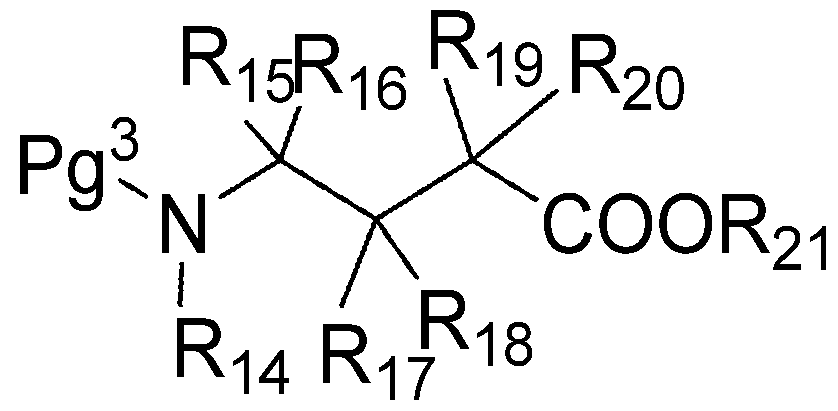
Rw, RIB, RIO, R20 and R21 each independently represent H, a substituted or unsubstituted alkyl, a substituted or unsubstituted cycloalkyl, or a substituted or unsubstituted benzyl;
Rl7 and Rig each independently represent H, F, a substituted or unsubstituted alkyl, or a substituted or unsubstituted cycloalkyl;
RI9 represents H, F, a substituted or unsubstituted alkyl, a substituted or unsubstituted cycloalkyl, or a substituted or unsubstituted benzyl; and
Pg3 is an amine protecting group, preferably a carbamate, a substituted or unsubstituted benzyl, preferably selected from the group consisting of tertbutyl sulfine, benzyloxycarbonyl, 4-azidobenzyloxycarbonyl, 4-methoxybenzyloxycarbonyl, 2 -nitrobenzyloxy carbonyl, 4,5-dimethoxy-2- nitrobenzyloxy carbonyl, 3,5-dimethoxybenzyloxycarbonyl, 1- naphthylmethoxycarbonyl, 4-acetyloxybenzyloxycarbonyl,
fluorenyloxycarbonyl, tert-butyloxycarbonyl, allyloxycarbonyl, methyl carbamate, ethyl carbamate, benzyl, 4-methoxybenzyl and 3,4- dimethoxybenzyl followed by removal of protecting moiety R21,
to obtain a compound of the general formula H

15. Method according to claim 14, wherein the compound of the general formula G is tubuphenylalanine of the formula.

or a salt thereof,
wherein R22 is H, OH, F or NO2, preferably H, OH or F.
16. Method according to claim 14 or 15, further comprising the steps of acylation of the hydroxyl group of the general formula H to obtain a compound of the general Formula I

17. An isocyanide compound according to the general formula C

R12 represents a substituted or unsubstituted alkyl, a substituted or unsubstituted cycloalkyl, or a substituted or unsubstitutecl benzyl;
R13 represents H, a substituted or unsubstituted alkyl, a substituted or unsubstituted cycloalkyl, or a substituted or unsubstituted benzyl;
X represents O, S, Se, or -NH-, preferably S; and
Pg2 represents a -X protecting group, preferably selected from the group consisting of trityl, tert-butyl, adamantly, and a substituted benzyl, more preferably trityl or tert-butyl.
18. The 3-component Passerini reaction product obtainable by the method of claim 7, having the general formula

19. The use of an isocyanide compound according to claim 17 in the manufacture of a tubulysin derivative.
20. The use of the Passerini reaction product according to claim 18 in the manufacture of a tubulysin derivative.
21. The use according to claim 19 or 20, in the manufacture of a tubulysin-prodrug or a tubulysin ADC.
Applications Claiming Priority (2)
| Application Number | Priority Date | Filing Date | Title |
|---|---|---|---|
| EP18185173.4 | 2018-07-24 | ||
| EP18185173 | 2018-07-24 |
Publications (1)
| Publication Number | Publication Date |
|---|---|
| WO2020022892A1 true WO2020022892A1 (en) | 2020-01-30 |
Family
ID=63041870
Family Applications (1)
| Application Number | Title | Priority Date | Filing Date |
|---|---|---|---|
| PCT/NL2019/050481 Ceased WO2020022892A1 (en) | 2018-07-24 | 2019-07-24 | Tubulysin derivatives and methods for preparing the same |
Country Status (1)
| Country | Link |
|---|---|
| WO (1) | WO2020022892A1 (en) |
Cited By (1)
| Publication number | Priority date | Publication date | Assignee | Title |
|---|---|---|---|---|
| CN111454230A (en) * | 2020-04-26 | 2020-07-28 | 深圳市老年医学研究所 | Synthesis method of key intermediate Tuv of natural anticancer drug Tubulysins |
Citations (3)
| Publication number | Priority date | Publication date | Assignee | Title |
|---|---|---|---|---|
| WO1998013375A1 (en) | 1996-09-23 | 1998-04-02 | GESELLSCHAFT FüR BIOTECHNOLOGISCHE FORSCHUNG MBH (GBF) | Compounds with antimycotic and cytostatic effect, preparation method, agent containing these compounds and dsm 11 092 |
| WO2004005326A2 (en) | 2002-07-09 | 2004-01-15 | Morphochem Aktiengellschaft Fu | Tubulysin conjugates |
| EP2409983A1 (en) * | 2010-07-19 | 2012-01-25 | Leibniz-Institut für Pflanzenbiochemie (IPB) | Tubulysin analogues |
-
2019
- 2019-07-24 WO PCT/NL2019/050481 patent/WO2020022892A1/en not_active Ceased
Patent Citations (3)
| Publication number | Priority date | Publication date | Assignee | Title |
|---|---|---|---|---|
| WO1998013375A1 (en) | 1996-09-23 | 1998-04-02 | GESELLSCHAFT FüR BIOTECHNOLOGISCHE FORSCHUNG MBH (GBF) | Compounds with antimycotic and cytostatic effect, preparation method, agent containing these compounds and dsm 11 092 |
| WO2004005326A2 (en) | 2002-07-09 | 2004-01-15 | Morphochem Aktiengellschaft Fu | Tubulysin conjugates |
| EP2409983A1 (en) * | 2010-07-19 | 2012-01-25 | Leibniz-Institut für Pflanzenbiochemie (IPB) | Tubulysin analogues |
Non-Patent Citations (18)
| Title |
|---|
| ASHER MULLARD, NATURE REVIEWS DRUG DISCOVERY, vol. 12, 2013, pages 329 - 332 |
| FAURE ET AL., ORG. LETT., vol. 11, no. 5, 2009, pages 1167 - 1170 |
| J. MED. CHEM., vol. 50, no. 18, 2007, pages 4261 - 4264 |
| J. ORG. CHEM., vol. 48, 1983, pages 77 - 81 |
| J. ORG. CHEM., vol. 66, 2001, pages 8454 - 8462 |
| J. ORG. CHEM., vol. 72, 2007, pages 626 - 629 |
| J. ORG. CHEM., vol. 78, 2013, pages 3647 |
| ORG. LETT., vol. 2, 2000, pages 3289 |
| ORG. LETT., vol. 4, 2002, pages 3001 - 3003 |
| ORG. SYNTH., vol. 12, 1932, pages 66 |
| REF: ORG. LETT., vol. 11, no. 5, 2009, pages 1167 - 1170 |
| SASSE ET AL., J. ANTIBIOT., vol. 53, 2000, pages 879 - 885 |
| SYN. COMMUN., vol. 33, 2003, pages 3089 - 3096 |
| TAKUYA FUKUDA ET AL: "Anti-barnacle Activity of Isocyanides Derived from Amino Acids", CHEMISTRY & BIODIVERSITY, vol. 13, no. 11, 1 November 2016 (2016-11-01), CH, pages 1502 - 1510, XP055544849, ISSN: 1612-1872, DOI: 10.1002/cbdv.201600063 * |
| TETRAHEDRON LETTERS, vol. 45, 2004, pages 8603 - 8606 |
| THIMMALAPURA M. VISHWANATHA ET AL: "Cysteine Isocyanide in Multicomponent Reaction: Synthesis of Peptido-Mimetic 1,3-Azoles", JOURNAL OF ORGANIC CHEMISTRY, vol. 82, no. 18, 25 August 2017 (2017-08-25), pages 9585 - 9594, XP055544660, ISSN: 0022-3263, DOI: 10.1021/acs.joc.7b01615 * |
| VISHWANATHA ET AL., J. ORG. CHEM., vol. 82, 2017, pages 9585 - 9594 |
| XUECHEN LI ET AL: "On the Two-Component Microwave-Mediated Reaction of Isonitriles with Carboxylic Acids: Regarding Alleged Formimidate Carboxylate Mixed Anhydrides", JOURNAL OF THE AMERICAN CHEMICAL SOCIETY, vol. 130, no. 40, 8 October 2008 (2008-10-08), pages 13222 - 13224, XP055544845, ISSN: 0002-7863, DOI: 10.1021/ja8047078 * |
Cited By (1)
| Publication number | Priority date | Publication date | Assignee | Title |
|---|---|---|---|---|
| CN111454230A (en) * | 2020-04-26 | 2020-07-28 | 深圳市老年医学研究所 | Synthesis method of key intermediate Tuv of natural anticancer drug Tubulysins |
Similar Documents
| Publication | Publication Date | Title |
|---|---|---|
| ES2888800T3 (en) | Improved process for the preparation of carfilzomib or pharmaceutically acceptable salts thereof | |
| WO1995003277A1 (en) | Novel pyrrolidine derivative | |
| Kurokawa et al. | Synthetic studies on antifungal cyclic peptides, echinocandins. Stereoselective total synthesis of echinocandin D via a novel peptide coupling | |
| US20250250299A1 (en) | Macrocyclic immunomodulators | |
| WO2000043000A1 (en) | Proteasome inhibitors | |
| CA2885973C (en) | Dolastatin-10 derivative, method of producing the same and anticancer drug composition containing the same | |
| US5504189A (en) | Peptides, their preparation and use | |
| US20150299250A1 (en) | Macrocyclic compounds and uses thereof | |
| CA2702605C (en) | Unprotected amino aldehydes and applications for same | |
| TW201932011A (en) | Method for the synthesis of cyclic depsipeptides | |
| CN118613490A (en) | Macrocyclic immunomodulators | |
| JP3163391B2 (en) | Stilbene derivatives and anticancer agents containing the same | |
| CN113710687A (en) | Cyclopeptide antibiotics | |
| WO2020022892A1 (en) | Tubulysin derivatives and methods for preparing the same | |
| EP2864321A1 (en) | SYNTHESIS OF TELAPREVIR AND BOCEPREVIR, OR PHARMACEUTICALLY ACCEPTABLE SALTS OR SOLVATES AS WELL AS INTERMEDIATE PRODUCTS THEREOF INCLUDING ß-AMINO ACIDS PREPARED VIA MUKAIYAMA ALDOL ADDITION | |
| CN109134512B (en) | C-18 fluorinated Laragzole analog, its preparation method and use for preparing antitumor agent | |
| CN106674252A (en) | Fluorinated olefin analogue of marine natural product cyclic depsipeptide as well as preparation method and application of fluorinated olefin analogue | |
| EP1806141B1 (en) | Par-2 antagonists | |
| WO2023274313A1 (en) | Amphotericin b semi-synthetic derivative, preparation method therefor and use thereof | |
| WO2001005814A1 (en) | Pseudomycin n-acyl side-chain analogs | |
| CN109134511B (en) | Largazole analogs fluorinated at C19 position, methods for their preparation and use | |
| EA014874B1 (en) | Compounds for the inhibition of apoptosis | |
| CN100488975C (en) | N-alkylated 1,6-bideoxyazaglucide compound, its synthesis method and uses | |
| EP4685151A1 (en) | Proteasome inhibitor | |
| CN119462824A (en) | A method for preparing sulfur-containing marine natural product Sunshinamide |
Legal Events
| Date | Code | Title | Description |
|---|---|---|---|
| 121 | Ep: the epo has been informed by wipo that ep was designated in this application |
Ref document number: 19755991 Country of ref document: EP Kind code of ref document: A1 |
|
| NENP | Non-entry into the national phase |
Ref country code: DE |
|
| 122 | Ep: pct application non-entry in european phase |
Ref document number: 19755991 Country of ref document: EP Kind code of ref document: A1 |