WO2020009208A1 - 抽出方法、抽出装置および抽出プログラム - Google Patents
抽出方法、抽出装置および抽出プログラム Download PDFInfo
- Publication number
- WO2020009208A1 WO2020009208A1 PCT/JP2019/026736 JP2019026736W WO2020009208A1 WO 2020009208 A1 WO2020009208 A1 WO 2020009208A1 JP 2019026736 W JP2019026736 W JP 2019026736W WO 2020009208 A1 WO2020009208 A1 WO 2020009208A1
- Authority
- WO
- WIPO (PCT)
- Prior art keywords
- vertex
- paragraph
- extraction
- vertices
- unit
- Prior art date
- Legal status (The legal status is an assumption and is not a legal conclusion. Google has not performed a legal analysis and makes no representation as to the accuracy of the status listed.)
- Ceased
Links
Images





Classifications
-
- G—PHYSICS
- G06—COMPUTING OR CALCULATING; COUNTING
- G06F—ELECTRIC DIGITAL DATA PROCESSING
- G06F40/00—Handling natural language data
- G06F40/10—Text processing
- G06F40/12—Use of codes for handling textual entities
- G06F40/14—Tree-structured documents
- G06F40/143—Markup, e.g. Standard Generalized Markup Language [SGML] or Document Type Definition [DTD]
-
- G—PHYSICS
- G06—COMPUTING OR CALCULATING; COUNTING
- G06F—ELECTRIC DIGITAL DATA PROCESSING
- G06F16/00—Information retrieval; Database structures therefor; File system structures therefor
-
- G—PHYSICS
- G06—COMPUTING OR CALCULATING; COUNTING
- G06F—ELECTRIC DIGITAL DATA PROCESSING
- G06F16/00—Information retrieval; Database structures therefor; File system structures therefor
- G06F16/30—Information retrieval; Database structures therefor; File system structures therefor of unstructured textual data
- G06F16/36—Creation of semantic tools, e.g. ontology or thesauri
-
- G—PHYSICS
- G06—COMPUTING OR CALCULATING; COUNTING
- G06F—ELECTRIC DIGITAL DATA PROCESSING
- G06F40/00—Handling natural language data
- G06F40/10—Text processing
- G06F40/12—Use of codes for handling textual entities
- G06F40/14—Tree-structured documents
-
- G—PHYSICS
- G06—COMPUTING OR CALCULATING; COUNTING
- G06F—ELECTRIC DIGITAL DATA PROCESSING
- G06F40/00—Handling natural language data
- G06F40/10—Text processing
- G06F40/12—Use of codes for handling textual entities
- G06F40/151—Transformation
- G06F40/154—Tree transformation for tree-structured or markup documents, e.g. XSLT, XSL-FO or stylesheets
-
- G—PHYSICS
- G06—COMPUTING OR CALCULATING; COUNTING
- G06F—ELECTRIC DIGITAL DATA PROCESSING
- G06F40/00—Handling natural language data
- G06F40/10—Text processing
- G06F40/166—Editing, e.g. inserting or deleting
-
- G—PHYSICS
- G06—COMPUTING OR CALCULATING; COUNTING
- G06F—ELECTRIC DIGITAL DATA PROCESSING
- G06F40/00—Handling natural language data
- G06F40/10—Text processing
- G06F40/12—Use of codes for handling textual entities
- G06F40/131—Fragmentation of text files, e.g. creating reusable text-blocks; Linking to fragments, e.g. using XInclude; Namespaces
Definitions
- the present invention relates to an extraction method, an extraction device, and an extraction program.
- Non-Patent Document 1 a device that accepts an original DSL (Domain-Specific Language) called DOT language as an input
- a device that accepts GXL (Graph eXchange Language) using XML (eXtensible Markup Language) as an input see Non-Patent Document 2
- a device that accepts GraphML as an input see Non-Patent Document 3
- These devices accept, as input, a graph structure described in a unique manner instead of a natural language.
- Non-Patent Document 4 there is known an apparatus which can add a simple graph structure described in a format such as MarkDown or reStructuredText as an input, which can provide a simple graph structure in a document (see Non-Patent Document 4).
- the present invention has been made in view of the above, and has as its object to simultaneously receive and process a document and a graph structure included in the document as inputs.
- an extraction method is an extraction method executed by an extraction device, and includes a process in which markup information indicating a vertex of a graph structure is added to a document.
- a document and a graph structure included in the document can be simultaneously received and processed as input.
- FIG. 1 is a schematic diagram illustrating a schematic configuration of the extraction device.
- FIG. 2 is an explanatory diagram for explaining the processing of the vertex extraction unit.
- FIG. 3 is an explanatory diagram for explaining the processing of the side extraction unit.
- FIG. 4 is an explanatory diagram for explaining the processing of the extraction device.
- FIG. 5 is a flowchart illustrating the extraction processing procedure.
- FIG. 6 is an explanatory diagram for explaining the effect of the extraction processing.
- FIG. 7 is a diagram illustrating an example of a computer that executes an extraction program.
- FIG. 1 is a schematic diagram illustrating a schematic configuration of the extraction device.
- the extraction device 10 is realized by a general-purpose computer such as a personal computer, and includes an input unit 11, an output unit 12, a communication control unit 13, a storage unit 14, and a control unit 15.
- the input unit 11 is realized using an input device such as a keyboard and a mouse, and inputs various kinds of instruction information such as the start of processing to the control unit 15 in response to an input operation by an operator.
- the output unit 12 is realized by a display device such as a liquid crystal display, a printing device such as a printer, and the like.
- the communication control unit 13 is realized by an NIC (Network Interface Card) or the like, and controls communication between the external device and the control unit 15 via an electric communication line such as a LAN (Local Area Network) or the Internet.
- NIC Network Interface Card
- LAN Local Area Network
- the storage unit 14 is realized by a semiconductor memory element such as a RAM (Random Access Memory) or a flash memory (Flash Memory), or a storage device such as a hard disk or an optical disk, and stores a generation model of data learned by an extraction process described later. Parameters and the like are stored.
- the storage unit 14 may be configured to communicate with the control unit 15 via the communication control unit 13.
- the storage unit 14 stores a schema 14a.
- the schema 14a is information for specifying an edge between the attributes of the vertices of the graph structure, and corresponds to a template of the graph structure.
- the side in the direction from the vertex of the attribute “sub” to the vertex of the attribute “super” is specified as the side “is-a”.
- the control unit 15 is realized using a CPU (Central Processing Unit) or the like, and executes a processing program stored in a memory. Thereby, the control unit 15 functions as a paragraph dividing unit 15a, a vertex extracting unit 15b, a side extracting unit 15c, and a vertex connecting unit 15d, as illustrated in FIG. Note that these functional units may be implemented in different or partially different hardware.
- CPU Central Processing Unit
- the control unit 15 functions as a paragraph dividing unit 15a, a vertex extracting unit 15b, a side extracting unit 15c, and a vertex connecting unit 15d, as illustrated in FIG. Note that these functional units may be implemented in different or partially different hardware.
- the paragraph division unit 15a divides a document to which markup information indicating a vertex of a graph structure is added into a unit for each paragraph. Specifically, the paragraph division unit 15a receives an input of a document to which markup information indicating a vertex of the graph structure and an attribute of the vertex is added, and divides the document into paragraphs.
- the vertex extraction unit 15b extracts a vertex for each paragraph. Specifically, the vertex extracting unit extracts, for each paragraph, the vertex and the attribute of the vertex.
- FIG. 2 is an explanatory diagram for explaining the processing of the vertex extraction unit 15b.
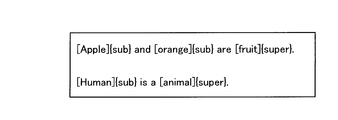
- markup information expressed in the form of [vertex name] ⁇ vertex attribute ⁇ is added to the input document as information indicating the vertices of the graph structure and the attributes of the vertices. Have been.
- the document illustrated in FIG. 2 includes, for example, vertex name “Apple” and markup information indicating the vertex having the attribute “sub”.
- the vertex extracting unit 15 b determines, from the first sentence of the document, the vertex having the vertex name “apple” and the vertex attribute “sub” and the vertex having the vertex name “orange” and the vertex attribute “sub”. And the vertex having the vertex name “fruit” and the vertex attribute “super”. Further, the vertex extracting unit 15b obtains the vertex having the vertex name “human” and the vertex attribute “sub”, the vertex name “animal”, and the vertex attribute “super” from the second sentence of the document illustrated in FIG. Extract vertices.
- the side extraction unit 15c extracts a side between the extracted vertices for each paragraph. Specifically, the side extracting unit 15c extracts the side specified in the schema 14a for each paragraph.
- FIG. 3 is an explanatory diagram for explaining the processing of the side extraction unit 15c.
- the edge extraction unit 15c starts from a vertex having the attribute “sub” and the vertex name “apple” to a vertex having the attribute “super” and the vertex name “fruit”.
- the side “is-a” in the direction is extracted.
- the side extracting unit 15c extracts a side “is-a” in the direction of the vertex having the attribute “super” and the vertex name “fruit” from the vertex having the attribute “sub” and the vertex name “orange”. In this way, a graph structure composed of three vertices and two edges is extracted from paragraph A of the document.
- the side extracting unit 15c determines, from the vertex having the attribute “sub” and the vertex name “human”, the side “is” in the direction of the vertex having the attribute “super” and the vertex name “animal”. -A "is extracted. In this way, a graph structure composed of two vertices and one edge is extracted from paragraph B of the document.
- edges can be efficiently extracted by referring to the same schema 14a from a document containing a similar graph structure.
- the edge extracting unit 15c determines that an edge is spanned between all extracted vertices for each paragraph, and You only need to extract it. Thereby, the description of the side can be omitted.
- the vertex combining unit 15d combines vertices extracted in duplicate between paragraphs. For example, when there is a vertex having the same vertex name and vertex attribute between the vertex of paragraph A and the vertex of paragraph B shown in FIG. 3, the graph structure of paragraph A and the graph structure of paragraph B are passed through the vertex. And join. As a result, a graph structure having higher reusability can be extracted from the document.
- FIG. 4 is an explanatory diagram for explaining the processing of the extraction device 10.
- the extraction device 10 receives an input of a document to which information indicating a vertex of a graph structure and an attribute of the vertex is added.
- the paragraph division unit 15a divides the input document into paragraphs.
- the vertex extraction unit 15b extracts a vertex and a vertex attribute from the paragraph.
- the extraction device 10 receives an input of a schema 14a, which is a model of a graph structure, and stores it in the storage unit 14.
- the side extracting unit 15c refers to the schema 14a and extracts the side specified by the schema 14a from between the extracted vertices.
- the vertex combining unit 15d combines vertices extracted in duplicate between paragraphs.
- the extraction device 10 performs processes such as graph visualization and conversion to another data format using the graph structure extracted in this manner. As described above, the extraction device 10 can receive an input of a document including a graph structure, extract a graph structure, and execute processing on the document and the extracted graph structure.
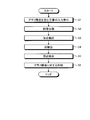
- FIG. 5 is a flowchart illustrating the extraction processing procedure.
- the flowchart in FIG. 5 is started, for example, at the timing when the user performs an operation input for instructing the start of the extraction process.
- the paragraph division unit 15a receives an input of a document including a graph structure to be processed (step S1). Then, the paragraph dividing unit 15a divides the input document into a unit for each paragraph (Step S2).
- the vertex extraction unit 15b extracts a vertex and a vertex attribute for each paragraph (step S3). Further, the side extracting unit 15c extracts, for each paragraph, the side specified by the schema 14a from between the extracted vertices (step S4). Thereby, a graph structure is extracted from the document.
- the vertex connecting unit 15d connects the graph structures via the vertex (step S5).
- the control unit 15 executes processing on the graph structure such as graph visualization and data format conversion processing (step S6). Further, the control unit 15 executes a process on the document from which the graph structure has been extracted. Thus, a series of extraction processing ends.
- the paragraph division unit 15a divides a document to which markup information indicating a vertex of a graph structure has been added into a unit for each paragraph.
- the vertex extracting unit 15b extracts vertices for each paragraph.
- the side extracting unit 15c extracts a side between the extracted vertices for each paragraph.
- the graph structure included in the document can be extracted using the lightweight markup information indicating the vertices of the graph structure. As described above, it is possible to simultaneously receive and process a document and a graph structure included in the document as inputs.
- the storage unit 14 may store a schema 14a for specifying an edge between the attributes of the vertices of the graph structure.
- the paragraph dividing unit 15a divides the document to which the markup information indicating the vertices of the graph structure and the attributes of the vertices is added into a unit for each paragraph, and the vertex extracting unit 15b , The vertex and the attribute of the vertex, and the side extracting unit 15c extracts, for each paragraph, the side specified in the schema 14a.
- the edges of the graph structure can be efficiently extracted by using the schema 14a, which is a template of the graph structure that changes less frequently.
- ⁇ Vertex combining unit 15d combines vertices extracted redundantly between paragraphs. This makes it possible to extract a larger graph structure from the document.
- FIG. 6 is an explanatory diagram for explaining the effect of the extraction processing.
- FIG. 6 conventionally, when an arbitrary process is performed by analyzing a document and a graph structure included in the document, the document and markup information of the graph structure extracted from the document are separately separated. It was necessary to input the data to the device and perform the processing.
- a document in which the markup information of the graph structure is described can be directly input, and arbitrary processing can be performed on the document and the graph structure. Therefore, reduce human costs such as the cost of creating and describing the graph structure separately from the document, and the maintenance cost such as training for the creation and the update of redrawing the graph structure when the document is changed. Can be.
- structured information with high reusability can be described in a document in a lightweight format, and can be efficiently shared. Also, visually, it is easy to grasp the correspondence between the document and the graph structure, and it is possible to suppress the possibility that a difference in meaning occurs. This facilitates sharing of various knowledge and knowledge that can be described as a graph structure.
- the extraction device 10 can be implemented by installing an extraction program that executes the above-described extraction processing on a desired computer as package software or online software.
- the information processing device can function as the extraction device 10.
- the information processing device referred to here includes a desktop or notebook personal computer.
- the information processing device includes mobile communication terminals such as a smartphone, a mobile phone, and a PHS (Personal Handyphone System), and a slate terminal such as a PDA (Personal Digital Assistants).
- the extraction device 10 may also be implemented as a server device that provides a terminal device used by a user as a client and provides the client with services related to the above-described extraction processing.
- the extraction device 10 is implemented as a server device that provides an extraction processing service that receives a document to which information indicating a graph structure is added and outputs a processing result for the document and the graph structure.
- the extraction device 10 may be implemented as a Web server, or may be implemented as a cloud that provides services related to the above-described extraction processing by outsourcing.
- a computer that executes an extraction program that realizes the same function as the extraction device 10 will be described.
- FIG. 7 is a diagram illustrating an example of a computer that executes an extraction program.
- the computer 1000 has, for example, a memory 1010, a CPU 1020, a hard disk drive interface 1030, a disk drive interface 1040, a serial port interface 1050, a video adapter 1060, and a network interface 1070. These units are connected by a bus 1080.
- the memory 1010 includes a ROM (Read Only Memory) 1011 and a RAM 1012.
- the ROM 1011 stores, for example, a boot program such as a BIOS (Basic Input Output System).
- BIOS Basic Input Output System
- the hard disk drive interface 1030 is connected to the hard disk drive 1031.
- the disk drive interface 1040 is connected to the disk drive 1041.
- a removable storage medium such as a magnetic disk or an optical disk is inserted into the disk drive 1041.
- a mouse 1051 and a keyboard 1052 are connected to the serial port interface 1050.
- the display 1061 is connected to the video adapter 1060, for example.
- the hard disk drive 1031 stores, for example, the OS 1091, the application program 1092, the program module 1093, and the program data 1094. Each piece of information described in the above embodiment is stored in, for example, the hard disk drive 1031 or the memory 1010.
- the extraction program is stored in the hard disk drive 1031 as, for example, a program module 1093 in which a command to be executed by the computer 1000 is described. Specifically, the program module 1093 in which each process executed by the extraction device 10 described in the above embodiment is described is stored in the hard disk drive 1031.
- Data used for information processing by the extraction program is stored as program data 1094, for example, in the hard disk drive 1031. Then, the CPU 1020 reads the program module 1093 and the program data 1094 stored in the hard disk drive 1031 into the RAM 1012 as necessary, and executes the above-described procedures.
- the program module 1093 and the program data 1094 relating to the extraction program are not limited to being stored in the hard disk drive 1031.
- the program modules 1093 and the program data 1094 are stored in a removable storage medium and read out by the CPU 1020 via the disk drive 1041 or the like. May be done.
- the program module 1093 and the program data 1094 related to the extraction program are stored in another computer connected via a network such as a LAN or a WAN (Wide Area Network), and read out by the CPU 1020 via the network interface 1070. May be.
Landscapes
- Engineering & Computer Science (AREA)
- Theoretical Computer Science (AREA)
- Physics & Mathematics (AREA)
- General Engineering & Computer Science (AREA)
- General Physics & Mathematics (AREA)
- Computational Linguistics (AREA)
- Audiology, Speech & Language Pathology (AREA)
- General Health & Medical Sciences (AREA)
- Health & Medical Sciences (AREA)
- Artificial Intelligence (AREA)
- Data Mining & Analysis (AREA)
- Databases & Information Systems (AREA)
- Information Retrieval, Db Structures And Fs Structures Therefor (AREA)
- Document Processing Apparatus (AREA)
Abstract
段落分割部(15a)が、グラフ構造の頂点を示すマークアップ情報が付与された文書を、段落ごとのまとまりに分割し、頂点抽出部(15b)が、段落ごとに、頂点を抽出し、辺抽出部(15c)が、段落ごとに、抽出された頂点間の辺を抽出する。記憶部(14)が、グラフ構造の頂点の属性間の辺を特定するスキーマ(14a)を記憶し、段落分割部(15a)が、グラフ構造の頂点と該頂点の属性とを示すマークアップ情報が付与された文書を、段落ごとのまとまりに分割し、頂点抽出部(15b)が、段落ごとに、頂点と該頂点の属性とを抽出し、辺抽出部(15c)が、段落ごとに、スキーマ(14a)において特定されている辺を抽出してもよい。頂点結合部(15d)が、段落間で重複して抽出された頂点を結合してもよい。
Description
本発明は、抽出方法、抽出装置および抽出プログラムに関する。
近年、情報セキュリティコミュニティにおいて、情報共有の必要性が広く認識されている。そして情報共有のため、頂点群と頂点間の連結関係を表す辺群とで構成されるグラフ構造を再利用可能に表現できる構造化形式が提案されている。一方、多くの場合、情報共有は、文書の形式でなされている。
従来、グラフ構造を入力として受け付けて、解析や表示等の処理を行う装置が知られている。例えば、DOT言語と呼ばれる独自のDSL(Domain-Specific Language)を入力として受け付ける、Graphvizと呼ばれる装置が知られている(非特許文献1参照)。また、XML(eXtensible Markup Language)を用いたGXL(Graph eXchange Language)を入力として受け付ける装置(非特許文献2参照)やGraphMLを入力として受け付ける装置(非特許文献3参照)等が知られている。これらの装置では、自然言語ではなく、独自の方式で記述されたグラフ構造を入力として受け付ける。
また、文書中に簡易なグラフ構造を付与することができる、MarkDown、reStructuredText等の形式で記述された簡易なグラフ構造を入力として受け付ける装置が知られている(非特許文献4参照)。
John Ellson, Emden R.Gansner, Eleftherios Koutsofios, Stephen C.North, Gordon Woodhull, "Graphviz and Dynagraph - Static and Dynamic Graph Drawing Tools", In Graph drawing software, Springer, 2004年, p.127-148
Richard C.Holt, Andreas Winter, Andy Schurr, "Gxl: Toward a Standard Eexchange Format", In ReverseEngineering, Seventh Working Conference, IEEE, 2000年, p.162-171
Ulrik Brandes, Markus Eiglsperger, Ivan Herman, Michael Himsolt, M.Scott Marshall, "GraphML Progress Report Structural Layer Proposal", In International Symposium on Graph Drawing, Springer, 2001年, p.501-512
John Gruber, Aaron Swartz, et al., "Markdown", [online],2004年,[2018年5月18日検索],インターネット<URL:https://daringfireball.net/projects/markdown/>
しかしながら、従来の技術では、文書と文書中に含まれるグラフ構造とを同時に入力として受け付けて処理することは困難であった。つまり、従来の技術では、文書中に複雑なグラフ構造のマークアップ情報を記述することは困難であった。したがって、ある文書と、文書から抽出できる知識等を表すグラフ構造との処理を行う場合には、文書と、文書から別途抽出したグラフ構造のマークアップ情報とを別々に入力する必要があった。
そのため、装置による再利用性の高いグラフ構造を、別途文書から抽出したり文書変更に伴って更新したりするための人的コストが高くなっていた。その結果、再利用性の高いグラフ構造の情報の普及が妨げられていた。
本発明は、上記に鑑みてなされたものであって、文書と文書に含まれるグラフ構造とを同時に入力として受け付けて処理することを目的とする。
上述した課題を解決し、目的を達成するために、本発明に係る抽出方法は、抽出装置で実行される抽出方法であって、グラフ構造の頂点を示すマークアップ情報が付与された文書を、段落ごとのまとまりに分割する段落分割工程と、前記段落ごとに、頂点と該頂点の属性とを抽出する頂点抽出工程と、前記段落ごとに、抽出された前記頂点間の辺を抽出する辺抽出工程と、を含んだことを特徴とする。
本発明によれば、文書と文書に含まれるグラフ構造とを同時に入力として受け付けて処理することができる。
以下、図面を参照して、本発明の一実施形態を詳細に説明する。なお、この実施形態により本発明が限定されるものではない。また、図面の記載において、同一部分には同一の符号を付して示している。
[抽出装置の構成]
図1は、抽出装置の概略構成を例示する模式図である。図1に例示するように、抽出装置10は、パソコン等の汎用コンピュータで実現され、入力部11、出力部12、通信制御部13、記憶部14、および制御部15を備える。
図1は、抽出装置の概略構成を例示する模式図である。図1に例示するように、抽出装置10は、パソコン等の汎用コンピュータで実現され、入力部11、出力部12、通信制御部13、記憶部14、および制御部15を備える。
入力部11は、キーボードやマウス等の入力デバイスを用いて実現され、操作者による入力操作に対応して、制御部15に対して処理開始などの各種指示情報を入力する。出力部12は、液晶ディスプレイなどの表示装置、プリンター等の印刷装置等によって実現される。
通信制御部13は、NIC(Network Interface Card)等で実現され、LAN(Local Area Network)やインターネットなどの電気通信回線を介した外部の装置と制御部15との通信を制御する。
記憶部14は、RAM(Random Access Memory)、フラッシュメモリ(Flash Memory)等の半導体メモリ素子、または、ハードディスク、光ディスク等の記憶装置によって実現され、後述する抽出処理により学習されたデータの生成モデルのパラメータ等が記憶される。なお、記憶部14は、通信制御部13を介して制御部15と通信する構成でもよい。本実施形態において、記憶部14には、スキーマ14aが記憶されている。
ここで、スキーマ14aとは、グラフ構造の頂点の属性間の辺を特定する情報であり、グラフ構造のひな形に該当する。例えば、スキーマ14aでは、属性「sub」の頂点から属性「super」の頂点への方向の辺は、辺「is-a」というように特定されている。
制御部15は、CPU(Central Processing Unit)等を用いて実現され、メモリに記憶された処理プログラムを実行する。これにより、制御部15は、図1に例示するように、段落分割部15a、頂点抽出部15b、辺抽出部15cおよび頂点結合部15dとして機能する。なお、これらの機能部は、それぞれあるいは一部が異なるハードウェアに実装されてもよい。
段落分割部15aは、グラフ構造の頂点を示すマークアップ情報が付与された文書を、段落ごとのまとまりに分割する。具体的には、段落分割部15aは、グラフ構造の頂点と該頂点の属性とを示すマークアップ情報が付与された文書の入力を受け付けて、段落ごとのまとまりに分割する。
頂点抽出部15bは、段落ごとに、頂点を抽出する。具体的には、頂点抽出部は、段落ごとに、頂点と該頂点の属性とを抽出する。
ここで、図2は、頂点抽出部15bの処理を説明するための説明図である。図2に例示するように、入力された文書には、グラフ構造の頂点と該頂点の属性とを示す情報として、例えば[頂点名]{頂点属性}の形式で表されるマークアップ情報が付与されている。図2に例示する文書には、例えば、頂点名「Apple」、その属性「sub」である頂点を示すマークアップ情報が含まれている。
頂点抽出部15bは、図2に例示した文書の第一文からは、頂点名「apple」、頂点属性「sub」である頂点と、頂点名「orange」、頂点属性「sub」である頂点と、頂点名「fruit」、頂点属性「super」である頂点とを抽出する。また、頂点抽出部15bは、図2に例示した文書の第二文からは、頂点名「human」、頂点属性「sub」である頂点と、頂点名「animal」、頂点属性「super」である頂点とを抽出する。
辺抽出部15cは、段落ごとに、抽出された頂点間の辺を抽出する。具体的には、辺抽出部15cは、段落ごとに、スキーマ14aにおいて特定されている辺を抽出する。
ここで、図3は、辺抽出部15cの処理を説明するための説明図である。図3に示すように、辺抽出部15cは、例えば、文書の段落Aからは、属性「sub」、頂点名「apple」である頂点から、属性「super」、頂点名「fruit」である頂点の方向の辺「is-a」を抽出する。また、辺抽出部15cは、属性「sub」、頂点名「orange」である頂点から、属性「super」、頂点名「fruit」である頂点の方向の辺「is-a」を抽出する。このようにして、文書の段落Aからは、3つの頂点と2つの辺で構成されるグラフ構造が抽出される。
同様に、辺抽出部15cは、文書の段落Bからは、属性「sub」、頂点名「human」である頂点から、属性「super」、頂点名「animal」である頂点の方向の辺「is-a」を抽出する。このようにして、文書の段落Bからは、2つの頂点と1つの辺で構成されるグラフ構造が抽出される。
このように、変更頻度の少ないスキーマ14aを予め記憶しておくことにより、同様のグラフ構造が含まれる文書から同一のスキーマ14aを参照して、効率よく辺を抽出することができる。
なお、スキーマ14aが記憶部14に記憶されていない場合には、辺抽出部15cは、段落ごとに、抽出された全ての頂点の間に辺が張られるものとして、全ての頂点間の辺を抽出すればよい。これにより、辺の記述を省略することができる。
図1の説明に戻る。頂点結合部15dは、段落間で重複して抽出された頂点を結合する。例えば、図3に示した段落Aの頂点と段落Bの頂点とで、頂点名および頂点属性が同一の頂点がある場合には、その頂点を介して段落Aのグラフ構造と段落Bのグラフ構造とを結合する。これにより、文書から、より再利用性の高いグラフ構造を抽出できる。
図4は、抽出装置10の処理を説明するための説明図である。図4に示すように、抽出装置10は、グラフ構造の頂点と該頂点の属性とを示す情報が付与された文書の入力を受け付ける。段落分割部15aは、入力された文書を段落ごとに分割する。頂点抽出部15bは、段落から頂点と頂点属性とを抽出する。
また、抽出装置10は、グラフ構造のひな形であるスキーマ14aの入力を受け付けて、記憶部14に記憶する。辺抽出部15cは、スキーマ14aを参照し、抽出された頂点間から、スキーマ14aで特定されている辺を抽出する。また、頂点結合部15dは、段落間で重複して抽出された頂点を結合する。
抽出装置10は、このようにして抽出したグラフ構造を用いて、グラフの可視化や、他のデータ形式への変換等の処理を行う。このように、抽出装置10では、グラフ構造を含んだ文書の入力を受け付けて、グラフ構造を抽出し、文書と、抽出したグラフ構造とに対する処理を実行することができる。
[抽出処理]
次に、図5を参照して、本実施形態に係る抽出装置10による抽出処理について説明する。図5は、抽出処理手順を示すフローチャートである。図5のフローチャートは、例えば、ユーザが抽出処理の開始を指示する操作入力を行ったタイミングで開始される。
次に、図5を参照して、本実施形態に係る抽出装置10による抽出処理について説明する。図5は、抽出処理手順を示すフローチャートである。図5のフローチャートは、例えば、ユーザが抽出処理の開始を指示する操作入力を行ったタイミングで開始される。
まず、段落分割部15aが、処理対象であるグラフ構造を含む文書の入力を受け付ける(ステップS1)。そして、段落分割部15aが入力された文書を段落ごとのまとまりに分割する(ステップS2)。
次に、頂点抽出部15bが、段落ごとに、頂点と頂点属性とを抽出する(ステップS3)。また、辺抽出部15cが、段落ごとに、抽出された頂点間から、スキーマ14aで特定されている辺を抽出する(ステップS4)。これにより、文書からグラフ構造が抽出される。
また、頂点結合部15dが、段落間で重複して抽出された頂点があれば、その頂点を介してグラフ構造を結合する(ステップS5)。制御部15は、このようにして文書から抽出したグラフ構造を用いて、グラフの可視化やデータ形式の変換処理等のグラフ構造に対する処理を実行する(ステップS6)。また、制御部15は、グラフ構造を抽出した文書に対する処理を実行する。これにより、一連の抽出処理が終了する。
以上、説明したように、本実施形態の抽出装置10において、段落分割部15aが、グラフ構造の頂点を示すマークアップ情報が付与された文書を、段落ごとのまとまりに分割する。また、頂点抽出部15bが、段落ごとに、頂点を抽出する。また、辺抽出部15cが、段落ごとに、抽出された頂点間の辺を抽出する。
これにより、煩雑に辺の記述がされていなくても、グラフ構造の頂点を示す軽量なマークアップ情報を用いて、文書に含まれるグラフ構造を抽出することができる。このように、文書と文書に含まれるグラフ構造とを同時に入力として受け付けて処理することが可能となる。
また、記憶部14が、グラフ構造の頂点の属性間の辺を特定するスキーマ14aを記憶してもよい。その場合には、段落分割部15aが、グラフ構造の頂点と該頂点の属性とを示すマークアップ情報が付与された文書を、段落ごとのまとまりに分割し、頂点抽出部15bが、段落ごとに、頂点と該頂点の属性とを抽出し、辺抽出部15cが、段落ごとに、スキーマ14aにおいて特定されている辺を抽出する。これにより、文書に煩雑な辺の記述がなくても、変更頻度の少ないグラフ構造のひな形であるスキーマ14aを用いて、効率よくグラフ構造の辺を抽出することができる。
また、頂点結合部15dが、段落間で重複して抽出された頂点を結合する。これにより、文書から、より規模の大きなグラフ構造を抽出することが可能となる。
ここで、図6は、抽出処理の効果を説明するための説明図である。図6に示すように、従来、文書と文書に含まれるグラフ構造に対して解析を行って任意の処理を行う場合には、文書と文書から抽出されたグラフ構造のマークアップ情報とを別々に装置に入力して処理を行わせる必要があった。
これに対し、本実施形態の抽出装置10による抽出処理では、グラフ構造のマークアップ情報が記述された文書をそのまま入力し、文書とグラフ構造とに対する任意の処理を行わせることができる。そのため、別途文書からグラフ構造を抽出して記述する作成コストや、作成のための訓練や文書が変更された場合にグラフ構造を抽出し直す更新等の保守コスト等の人的コストを削減することができる。
したがって、再利用性の高い構造化された情報を軽量な形式で文書に記述して、効率よく共有化することが可能となる。また、視覚的にも、文書とグラフ構造との対応関係を把握しやすく、意味の乖離が生じる恐れを抑止できる。これにより、グラフ構造として記述できる様々な知見や知識の共有を促進することが可能となる。
[プログラム]
上記実施形態に係る抽出装置10が実行する処理をコンピュータが実行可能な言語で記述したプログラムを作成することもできる。一実施形態として、抽出装置10は、パッケージソフトウェアやオンラインソフトウェアとして上記の抽出処理を実行する抽出プログラムを所望のコンピュータにインストールさせることによって実装できる。例えば、上記の抽出プログラムを情報処理装置に実行させることにより、情報処理装置を抽出装置10として機能させることができる。ここで言う情報処理装置には、デスクトップ型またはノート型のパーソナルコンピュータが含まれる。また、その他にも、情報処理装置にはスマートフォン、携帯電話機やPHS(Personal Handyphone System)などの移動体通信端末、さらには、PDA(Personal Digital Assistants)などのスレート端末などがその範疇に含まれる。
上記実施形態に係る抽出装置10が実行する処理をコンピュータが実行可能な言語で記述したプログラムを作成することもできる。一実施形態として、抽出装置10は、パッケージソフトウェアやオンラインソフトウェアとして上記の抽出処理を実行する抽出プログラムを所望のコンピュータにインストールさせることによって実装できる。例えば、上記の抽出プログラムを情報処理装置に実行させることにより、情報処理装置を抽出装置10として機能させることができる。ここで言う情報処理装置には、デスクトップ型またはノート型のパーソナルコンピュータが含まれる。また、その他にも、情報処理装置にはスマートフォン、携帯電話機やPHS(Personal Handyphone System)などの移動体通信端末、さらには、PDA(Personal Digital Assistants)などのスレート端末などがその範疇に含まれる。
また、抽出装置10は、ユーザが使用する端末装置をクライアントとし、当該クライアントに上記の抽出処理に関するサービスを提供するサーバ装置として実装することもできる。例えば、抽出装置10は、グラフ構造を示す情報が付与された文書を入力とし、文書およびグラフ構造に対する処理結果を出力する抽出処理サービスを提供するサーバ装置として実装される。この場合、抽出装置10は、Webサーバとして実装することとしてもよいし、アウトソーシングによって上記の抽出処理に関するサービスを提供するクラウドとして実装することとしてもかまわない。以下に、抽出装置10と同様の機能を実現する抽出プログラムを実行するコンピュータの一例を説明する。
図7は、抽出プログラムを実行するコンピュータの一例を示す図である。コンピュータ1000は、例えば、メモリ1010と、CPU1020と、ハードディスクドライブインタフェース1030と、ディスクドライブインタフェース1040と、シリアルポートインタフェース1050と、ビデオアダプタ1060と、ネットワークインタフェース1070とを有する。これらの各部は、バス1080によって接続される。
メモリ1010は、ROM(Read Only Memory)1011およびRAM1012を含む。ROM1011は、例えば、BIOS(Basic Input Output System)等のブートプログラムを記憶する。ハードディスクドライブインタフェース1030は、ハードディスクドライブ1031に接続される。ディスクドライブインタフェース1040は、ディスクドライブ1041に接続される。ディスクドライブ1041には、例えば、磁気ディスクや光ディスク等の着脱可能な記憶媒体が挿入される。シリアルポートインタフェース1050には、例えば、マウス1051およびキーボード1052が接続される。ビデオアダプタ1060には、例えば、ディスプレイ1061が接続される。
ここで、ハードディスクドライブ1031は、例えば、OS1091、アプリケーションプログラム1092、プログラムモジュール1093およびプログラムデータ1094を記憶する。上記実施形態で説明した各情報は、例えばハードディスクドライブ1031やメモリ1010に記憶される。
また、抽出プログラムは、例えば、コンピュータ1000によって実行される指令が記述されたプログラムモジュール1093として、ハードディスクドライブ1031に記憶される。具体的には、上記実施形態で説明した抽出装置10が実行する各処理が記述されたプログラムモジュール1093が、ハードディスクドライブ1031に記憶される。
また、抽出プログラムによる情報処理に用いられるデータは、プログラムデータ1094として、例えば、ハードディスクドライブ1031に記憶される。そして、CPU1020が、ハードディスクドライブ1031に記憶されたプログラムモジュール1093やプログラムデータ1094を必要に応じてRAM1012に読み出して、上述した各手順を実行する。
なお、抽出プログラムに係るプログラムモジュール1093やプログラムデータ1094は、ハードディスクドライブ1031に記憶される場合に限られず、例えば、着脱可能な記憶媒体に記憶されて、ディスクドライブ1041等を介してCPU1020によって読み出されてもよい。あるいは、抽出プログラムに係るプログラムモジュール1093やプログラムデータ1094は、LANやWAN(Wide Area Network)等のネットワークを介して接続された他のコンピュータに記憶され、ネットワークインタフェース1070を介してCPU1020によって読み出されてもよい。
以上、本発明者によってなされた発明を適用した実施形態について説明したが、本実施形態による本発明の開示の一部をなす記述および図面により本発明は限定されることはない。すなわち、本実施形態に基づいて当業者等によりなされる他の実施形態、実施例および運用技術等は全て本発明の範疇に含まれる。
10 抽出装置
11 入力部
12 出力部
13 通信制御部
14 記憶部
14a スキーマ
15 制御部
15a 段落分割部
15b 頂点抽出部
15c 辺抽出部
15d 頂点結合部
11 入力部
12 出力部
13 通信制御部
14 記憶部
14a スキーマ
15 制御部
15a 段落分割部
15b 頂点抽出部
15c 辺抽出部
15d 頂点結合部
Claims (5)
- 抽出装置で実行される抽出方法であって、
グラフ構造の頂点を示すマークアップ情報が付与された文書を、段落ごとのまとまりに分割する段落分割工程と、
前記段落ごとに、頂点を抽出する頂点抽出工程と、
前記段落ごとに、抽出された前記頂点間の辺を抽出する辺抽出工程と、
を含んだことを特徴とする抽出方法。 - 前記抽出装置は、グラフ構造の頂点の属性間の辺を特定するスキーマを記憶する記憶部を備え、
前記段落分割工程において、グラフ構造の頂点と該頂点の属性とを示すマークアップ情報が付与された文書を、段落ごとのまとまりに分割し、
前記頂点抽出工程において、前記段落ごとに、前記頂点と該頂点の属性とを抽出し、
前記辺抽出工程において、前記段落ごとに、前記スキーマにおいて特定されている辺を抽出することを特徴とする請求項1に記載の抽出方法。 - 前記段落間で重複して抽出された前記頂点を結合する頂点結合工程を、さらに含んだことを特徴とする請求項1または2に記載の抽出方法。
- グラフ構造の頂点を示すマークアップ情報が付与された文書を、段落ごとのまとまりに分割する段落分割部と、
前記段落ごとに、前記頂点を抽出する頂点抽出部と、
前記段落ごとに、抽出された前記頂点間の辺を抽出する辺抽出部と、
を備えることを特徴とする抽出装置。 - グラフ構造の頂点を示すマークアップ情報が付与された文書を、段落ごとのまとまりに分割する段落分割ステップと、
前記段落ごとに、前記頂点を抽出する頂点抽出ステップと、
前記段落ごとに、抽出された前記頂点間の辺を抽出する辺抽出ステップと、
をコンピュータに実行させるための抽出プログラム。
Priority Applications (1)
| Application Number | Priority Date | Filing Date | Title |
|---|---|---|---|
| US17/257,023 US20210124870A1 (en) | 2018-07-05 | 2019-07-04 | Extraction method, extraction device, and extraction program |
Applications Claiming Priority (2)
| Application Number | Priority Date | Filing Date | Title |
|---|---|---|---|
| JP2018-128341 | 2018-07-05 | ||
| JP2018128341A JP2020009054A (ja) | 2018-07-05 | 2018-07-05 | 抽出方法、抽出装置および抽出プログラム |
Publications (1)
| Publication Number | Publication Date |
|---|---|
| WO2020009208A1 true WO2020009208A1 (ja) | 2020-01-09 |
Family
ID=69059225
Family Applications (1)
| Application Number | Title | Priority Date | Filing Date |
|---|---|---|---|
| PCT/JP2019/026736 Ceased WO2020009208A1 (ja) | 2018-07-05 | 2019-07-04 | 抽出方法、抽出装置および抽出プログラム |
Country Status (3)
| Country | Link |
|---|---|
| US (1) | US20210124870A1 (ja) |
| JP (1) | JP2020009054A (ja) |
| WO (1) | WO2020009208A1 (ja) |
Citations (1)
| Publication number | Priority date | Publication date | Assignee | Title |
|---|---|---|---|---|
| US20150310096A1 (en) * | 2014-04-29 | 2015-10-29 | International Business Machines Corporation | Comparing document contents using a constructed topic model |
-
2018
- 2018-07-05 JP JP2018128341A patent/JP2020009054A/ja active Pending
-
2019
- 2019-07-04 US US17/257,023 patent/US20210124870A1/en not_active Abandoned
- 2019-07-04 WO PCT/JP2019/026736 patent/WO2020009208A1/ja not_active Ceased
Patent Citations (1)
| Publication number | Priority date | Publication date | Assignee | Title |
|---|---|---|---|---|
| US20150310096A1 (en) * | 2014-04-29 | 2015-10-29 | International Business Machines Corporation | Comparing document contents using a constructed topic model |
Non-Patent Citations (1)
| Title |
|---|
| YAMASAKI, MAYO ET AL.: "Automation Extraction of Threat and Vulnerability Knowledge from Documents", SYMPOSIUM SERIES OF INFORMATION PROCESSING SOCIETY OF JAPAN, vol. 2017, no. 2, 16 October 2017 (2017-10-16), pages 393 - 398 * |
Also Published As
| Publication number | Publication date |
|---|---|
| JP2020009054A (ja) | 2020-01-16 |
| US20210124870A1 (en) | 2021-04-29 |
Similar Documents
| Publication | Publication Date | Title |
|---|---|---|
| US8661132B2 (en) | Enabling service virtualization in a cloud | |
| CN105975576B (zh) | 终端内容适配显示方法、装置和终端 | |
| Ding | Consensus control of a class of Lipschitz nonlinear systems | |
| US9330077B2 (en) | Dynamic image generation for customizable user interfaces | |
| US20140164895A1 (en) | Systems and methods for managing spreadsheet models | |
| CN112559631B (zh) | 分布式图数据库的数据处理方法、装置以及电子设备 | |
| US9633332B2 (en) | Generating machine-understandable representations of content | |
| CN107783967A (zh) | 用于自动化的文档翻译的技术 | |
| CN113407745B (zh) | 数据标注方法、装置、电子设备及计算机可读存储介质 | |
| CN107766042A (zh) | 一种基于csar的模型文件的可视化设计方法及装置 | |
| CN114186680A (zh) | 网络结构的处理方法、装置、电子设备及存储介质 | |
| CN112541087A (zh) | 基于百科的跨语言知识图谱构建方法及装置 | |
| CN114627207B (zh) | 流程图处理方法以及装置 | |
| JP2020009054A (ja) | 抽出方法、抽出装置および抽出プログラム | |
| JP4928558B2 (ja) | 代替グラフィックス・パイプ | |
| CN107924574A (zh) | 针对分组对象的智能翻转操作 | |
| CN112487213A (zh) | 跨语言领域知识图谱构建方法及装置 | |
| US20240126978A1 (en) | Determining attributes for elements of displayable content and adding them to an accessibility tree | |
| WO2020095655A1 (ja) | 選定装置および選定方法 | |
| US20220404168A1 (en) | Intelligent transportation road network acquisition method and apparatus, electronic device and storage medium | |
| CN116820500A (zh) | 一种集群镜像部署方法、装置、设备及存储介质 | |
| US10402482B2 (en) | Content management system | |
| Asgharian Sardroud et al. | An approximation algorithm for the longest path problem in solid grid graphs | |
| CN114818627A (zh) | 一种表格信息抽取方法、装置、设备及介质 | |
| JP6554143B2 (ja) | 管理装置および管理方法 |
Legal Events
| Date | Code | Title | Description |
|---|---|---|---|
| 121 | Ep: the epo has been informed by wipo that ep was designated in this application |
Ref document number: 19831146 Country of ref document: EP Kind code of ref document: A1 |
|
| NENP | Non-entry into the national phase |
Ref country code: DE |
|
| 122 | Ep: pct application non-entry in european phase |
Ref document number: 19831146 Country of ref document: EP Kind code of ref document: A1 |