WO2020006432A1 - Fused tricyclic heterocycle compounds and therapeutic uses thereof - Google Patents

Fused tricyclic heterocycle compounds and therapeutic uses thereof Download PDF

Info

Publication number
WO2020006432A1
WO2020006432A1 PCT/US2019/039860 US2019039860W WO2020006432A1 WO 2020006432 A1 WO2020006432 A1 WO 2020006432A1 US 2019039860 W US2019039860 W US 2019039860W WO 2020006432 A1 WO2020006432 A1 WO 2020006432A1
Authority
WO
WIPO (PCT)
Prior art keywords
alkyl
heterocyclyl
cycloalkyl
group
heteroaryl
Prior art date
Legal status (The legal status is an assumption and is not a legal conclusion. Google has not performed a legal analysis and makes no representation as to the accuracy of the status listed.)
Ceased
Application number
PCT/US2019/039860
Other languages
French (fr)
Inventor
Dong Liu
Lei Chen
Linghang Zhuang
Puhui LI
Xinzhu ZHANG
Chunying Song
Matthew Miller
Qiyue Hu
Yuna YAN
Feng He
Weikang Tao
Current Assignee (The listed assignees may be inaccurate. Google has not performed a legal analysis and makes no representation or warranty as to the accuracy of the list.)
Eternity Bioscience Inc
Original Assignee
Eternity Bioscience Inc
Priority date (The priority date is an assumption and is not a legal conclusion. Google has not performed a legal analysis and makes no representation as to the accuracy of the date listed.)
Filing date
Publication date
Application filed by Eternity Bioscience Inc filed Critical Eternity Bioscience Inc
Priority to KR1020207037227A priority Critical patent/KR20210025016A/en
Priority to JP2020570791A priority patent/JP2021530442A/en
Priority to US17/255,712 priority patent/US11535633B2/en
Priority to EP19825637.2A priority patent/EP3813827A4/en
Priority to CN201980043105.6A priority patent/CN112351778B/en
Publication of WO2020006432A1 publication Critical patent/WO2020006432A1/en
Anticipated expiration legal-status Critical
Ceased legal-status Critical Current

Links

Classifications

    • AHUMAN NECESSITIES
    • A61MEDICAL OR VETERINARY SCIENCE; HYGIENE
    • A61KPREPARATIONS FOR MEDICAL, DENTAL OR TOILETRY PURPOSES
    • A61K31/00Medicinal preparations containing organic active ingredients
    • A61K31/33Heterocyclic compounds
    • A61K31/395Heterocyclic compounds having nitrogen as a ring hetero atom, e.g. guanethidine or rifamycins
    • A61K31/495Heterocyclic compounds having nitrogen as a ring hetero atom, e.g. guanethidine or rifamycins having six-membered rings with two or more nitrogen atoms as the only ring heteroatoms, e.g. piperazine or tetrazines
    • A61K31/4985Pyrazines or piperazines ortho- or peri-condensed with heterocyclic ring systems
    • CCHEMISTRY; METALLURGY
    • C07ORGANIC CHEMISTRY
    • C07DHETEROCYCLIC COMPOUNDS
    • C07D498/00Heterocyclic compounds containing in the condensed system at least one hetero ring having nitrogen and oxygen atoms as the only ring hetero atoms
    • C07D498/02Heterocyclic compounds containing in the condensed system at least one hetero ring having nitrogen and oxygen atoms as the only ring hetero atoms in which the condensed system contains two hetero rings
    • C07D498/06Peri-condensed systems
    • AHUMAN NECESSITIES
    • A61MEDICAL OR VETERINARY SCIENCE; HYGIENE
    • A61KPREPARATIONS FOR MEDICAL, DENTAL OR TOILETRY PURPOSES
    • A61K31/00Medicinal preparations containing organic active ingredients
    • A61K31/33Heterocyclic compounds
    • A61K31/395Heterocyclic compounds having nitrogen as a ring hetero atom, e.g. guanethidine or rifamycins
    • AHUMAN NECESSITIES
    • A61MEDICAL OR VETERINARY SCIENCE; HYGIENE
    • A61KPREPARATIONS FOR MEDICAL, DENTAL OR TOILETRY PURPOSES
    • A61K31/00Medicinal preparations containing organic active ingredients
    • A61K31/33Heterocyclic compounds
    • A61K31/395Heterocyclic compounds having nitrogen as a ring hetero atom, e.g. guanethidine or rifamycins
    • A61K31/535Heterocyclic compounds having nitrogen as a ring hetero atom, e.g. guanethidine or rifamycins having six-membered rings with at least one nitrogen and one oxygen as the ring hetero atoms, e.g. 1,2-oxazines
    • A61K31/5365Heterocyclic compounds having nitrogen as a ring hetero atom, e.g. guanethidine or rifamycins having six-membered rings with at least one nitrogen and one oxygen as the ring hetero atoms, e.g. 1,2-oxazines ortho- or peri-condensed with heterocyclic ring systems
    • AHUMAN NECESSITIES
    • A61MEDICAL OR VETERINARY SCIENCE; HYGIENE
    • A61KPREPARATIONS FOR MEDICAL, DENTAL OR TOILETRY PURPOSES
    • A61K31/00Medicinal preparations containing organic active ingredients
    • A61K31/33Heterocyclic compounds
    • A61K31/395Heterocyclic compounds having nitrogen as a ring hetero atom, e.g. guanethidine or rifamycins
    • A61K31/535Heterocyclic compounds having nitrogen as a ring hetero atom, e.g. guanethidine or rifamycins having six-membered rings with at least one nitrogen and one oxygen as the ring hetero atoms, e.g. 1,2-oxazines
    • A61K31/53751,4-Oxazines, e.g. morpholine
    • A61K31/53831,4-Oxazines, e.g. morpholine ortho- or peri-condensed with heterocyclic ring systems
    • AHUMAN NECESSITIES
    • A61MEDICAL OR VETERINARY SCIENCE; HYGIENE
    • A61PSPECIFIC THERAPEUTIC ACTIVITY OF CHEMICAL COMPOUNDS OR MEDICINAL PREPARATIONS
    • A61P29/00Non-central analgesic, antipyretic or antiinflammatory agents, e.g. antirheumatic agents; Non-steroidal antiinflammatory drugs [NSAID]
    • AHUMAN NECESSITIES
    • A61MEDICAL OR VETERINARY SCIENCE; HYGIENE
    • A61PSPECIFIC THERAPEUTIC ACTIVITY OF CHEMICAL COMPOUNDS OR MEDICINAL PREPARATIONS
    • A61P31/00Antiinfectives, i.e. antibiotics, antiseptics, chemotherapeutics
    • A61P31/12Antivirals
    • AHUMAN NECESSITIES
    • A61MEDICAL OR VETERINARY SCIENCE; HYGIENE
    • A61PSPECIFIC THERAPEUTIC ACTIVITY OF CHEMICAL COMPOUNDS OR MEDICINAL PREPARATIONS
    • A61P31/00Antiinfectives, i.e. antibiotics, antiseptics, chemotherapeutics
    • A61P31/12Antivirals
    • A61P31/14Antivirals for RNA viruses
    • A61P31/18Antivirals for RNA viruses for HIV
    • AHUMAN NECESSITIES
    • A61MEDICAL OR VETERINARY SCIENCE; HYGIENE
    • A61PSPECIFIC THERAPEUTIC ACTIVITY OF CHEMICAL COMPOUNDS OR MEDICINAL PREPARATIONS
    • A61P35/00Antineoplastic agents
    • CCHEMISTRY; METALLURGY
    • C07ORGANIC CHEMISTRY
    • C07DHETEROCYCLIC COMPOUNDS
    • C07D487/00Heterocyclic compounds containing nitrogen atoms as the only ring hetero atoms in the condensed system, not provided for by groups C07D451/00 - C07D477/00
    • C07D487/02Heterocyclic compounds containing nitrogen atoms as the only ring hetero atoms in the condensed system, not provided for by groups C07D451/00 - C07D477/00 in which the condensed system contains two hetero rings
    • C07D487/06Peri-condensed systems
    • CCHEMISTRY; METALLURGY
    • C07ORGANIC CHEMISTRY
    • C07DHETEROCYCLIC COMPOUNDS
    • C07D487/00Heterocyclic compounds containing nitrogen atoms as the only ring hetero atoms in the condensed system, not provided for by groups C07D451/00 - C07D477/00
    • C07D487/12Heterocyclic compounds containing nitrogen atoms as the only ring hetero atoms in the condensed system, not provided for by groups C07D451/00 - C07D477/00 in which the condensed system contains three hetero rings
    • C07D487/16Peri-condensed systems
    • CCHEMISTRY; METALLURGY
    • C07ORGANIC CHEMISTRY
    • C07DHETEROCYCLIC COMPOUNDS
    • C07D498/00Heterocyclic compounds containing in the condensed system at least one hetero ring having nitrogen and oxygen atoms as the only ring hetero atoms
    • C07D498/12Heterocyclic compounds containing in the condensed system at least one hetero ring having nitrogen and oxygen atoms as the only ring hetero atoms in which the condensed system contains three hetero rings
    • C07D498/16Peri-condensed systems

Definitions

  • the present invention relates to fused tricyclic heterocycles as agonists of the stimulator of interferon genes (STING), and preparation methods, pharmaceutical compositions, and medical uses thereof for the treatment of diseases in which modulation of STING is beneficial, for example, cancer, pre-cancerous disorders, hepatitis B virus (HBV), hepatitis C virus (HCV), influenza, human immunodeficiency virus infection, AIDS, inflammation, and infectious diseases, or use as immunogenic composition or vaccine adjuvants.
  • diseases in which modulation of STING is beneficial, for example, cancer, pre-cancerous disorders, hepatitis B virus (HBV), hepatitis C virus (HCV), influenza, human immunodeficiency virus infection, AIDS, inflammation, and infectious diseases, or use as immunogenic composition or vaccine adjuvants.
  • Innate immunity has no antigen specificity and executes the defense mechanisms immediately after an antigen's appearance in the body.
  • Adaptive immunity requires time to generate a full response, but is antigen- specific and long lasting.
  • the adaptive immune system utilizes a set of immune cells specifically designed to attack that antigen.
  • memory immune cells are generated which allow for a more rapid and effective response to re-exposure to antigens.
  • the innate immune system is required to activate our adaptive immune system. Numerous molecules and cells involved in innate immunity and adaptive immunity function cooperatively ( Shanker A. and Marincola F, Cancer Immunol. Immunother., 2011, 60: 1061-1074).
  • PAMPs pattern recognition receptors
  • Stimulator of interferon genes is a signaling molecule associated with the endoplasmic reticulum (ER).
  • ER endoplasmic reticulum
  • CDNs cyclic dinucleotides
  • c-di-AMP bacterial cyclic di-AMP
  • c-di-GMP bacterial cyclic di-AMP
  • TBK1 also phosphorylates residues on the protein I/cB, leading to its degradation, which causes the activation and translocation of NF-/cB to the nucleus and transcription of pro- inflammatory cytokines such as TNFa, IL-6 and IE-1b ⁇ Aim J. and Barber G., Current Opinion in Immunology 2014, 31:121-126).
  • STING-dependent signaling is critical in promoting antitumor immunity.
  • STING deficient mice have decreased tumor rejection observed when compared with wild type mice ( Woo S. et al, Immunity, 2014, 41:830-842). Activation of STING significantly suppressed the growth of multiple types of mouse tumor ( Corrales et al, Cell Reports, 2015, 11:1018-1030).
  • type I IFNs ⁇ Corrales L. and Gajewski F, Clin. Cancer Res., 2015, 21: 4774-4779 ).
  • IFNa/b type I IFNs
  • IFNa/b receptor Upon binding to IFNa/b, the IFNa/b receptor activates a cascade of events and induces the transcription of a wide variety of genes regulated by IFN-stimulated response elements (ISRE), thus modulating multiple types of immune cells.
  • IFN-stimulated response elements IFN-stimulated response elements
  • type I IFNs promote cross-priming, boost effector T cell function and expansion, mediate memory development, thereby coupling innate immunity with adaptive immunity ⁇ Zitvogel L.
  • Type I IFNs contribute to antitumor immunity in various types of cancer ⁇ Parker B. et al, Nat Rev Cancer, 2016, 16:131-144). TNFa may be another important contributor to the therapeutic effect observed with the activation of STING ⁇ Francica B. et al, Cancer Immunol Res., 2018, 6: 1-12).
  • STING modulators include W02010017248, W02013166000, WO2017175147 and WO2017175156.
  • STING activation may have significant impact on innate and adaptive immune response and accordingly may have a beneficial impact on the treatment of cancer and other diseases such as viral infection.
  • the present invention provides a new class of fused tricyclic heterocycle compounds as represented by formula (I) below useful as STING agonists and as therapeutic agents for the treatment of diseases in which modulation of STING is beneficial, for example, cancer, pre-cancerous disorders, hepatitis B virus (HBV), hepatitis C virus (HCV), influenza, human immunodeficiency virus infection, AIDS, inflammation, and other infectious diseases.
  • STING agonists useful as STING agonists and as therapeutic agents for the treatment of diseases in which modulation of STING is beneficial, for example, cancer, pre-cancerous disorders, hepatitis B virus (HBV), hepatitis C virus (HCV), influenza, human immunodeficiency virus infection, AIDS, inflammation, and other infectious diseases.
  • HBV hepatitis B virus
  • HCV hepatitis C virus
  • influenza human immunodeficiency virus infection
  • AIDS AIDS
  • inflammation inflammation
  • other infectious diseases for example, cancer, pre-cancerous disorders,
  • the present invention provides a compound of formula (I), or a tautomer, or a pharmaceutically acceptable salt, prodrug, or solvate thereof:
  • R a is selected from the group consisting of alkyl, alkenyl, alkynyl, haloalkyl, and hydroxyalkyl, wherein the alkyl, alkenyl or alkynyl is unsubstituted or substituted with one or more, preferably one to five, and sometimes more preferably one to three, substituents selected from the group consisting of halogen, alkyl, alkoxy, haloalkyl, amino, nitro, cyano, hydroxy, hydroxyalkyl, carboxylic acid, cycloalkyl, heterocyclyl, aryl and heteroaryl;
  • ring A is selected from the group consisting of cycloalkyl, heterocyclyl, aryl and heteroaryl;
  • G is O or NR b ;
  • R b is selected from the group consisting of hydrogen, alkyl, alkenyl, alkynyl alkoxy, alkoxyalkyl and haloalkyl; wherein the alkyl, alkenyl, alkynyl, alkoxy or alkoxyalkyl is unsubstituted or substituted with one or more, preferably one to five, and sometimes more preferably one to three, substituents selected from the group consisting of halogen, alkyl, alkoxy, haloalkyl, amino, cyano, hydroxy, hydroxyalkyl, carboxylic acid, cycloalkyl, heterocyclyl, aryl and heteroaryl;
  • R c is selected from the group consisting of hydrogen, alkyl, haloalkyl, alkenyl and alkynyl;
  • R 1 and R 2 are identical or different, and each is independently selected from the group consisting of hydrogen, alkyl, haloalkyl, cycloalkyl, heterocyclyl, aryl and heteroaryl; wherein the alkyl, cycloalkyl, heterocyclyl, aryl or heteroaryl is unsubstituted or substituted with one or more, preferably one to five, and sometimes more preferably one to three, substituents selected from the group consisting of halogen, alkyl, alkoxy, haloalkyl, amino, nitro, cyano, hydroxy, hydroxyalkyl, cycloalkyl, heterocyclyl, aryl and heteroaryl;
  • R 3 and R 4 are each independently selected from the group consisting of hydrogen, halogen, alkyl, alkoxy, haloalkyl, amino, nitro, hydroxy, hydroxyalkyl, cyano, cycloalkyl, heterocyclyl, aryl and heteroaryl;
  • R 5 , R 6 and R 7 are each independently selected from the group consisting of hydrogen, halogen, alkyl, alkoxy, haloalkyl, amino, nitro, hydroxy, hydroxyalkyl, cyano, cycloalkyl, heterocyclyl, aryl and heteroaryl;
  • L 1 is selected from the group consisting of alkylene, alkenylene, NH, -(CH2) S NH-, -(CH 2 ) s NH(CH 2 ) r -, O, S(0)m, C(O), -C(0)NH-, -NHC(O)-, and -HNC(0)NH-, wherein the alkylene or alkenylene is unsubstituted or substituted with one or more, preferably one to five, and sometimes more preferably one to three, substituents selected from the group consisting of halogen, alkyl, alkoxy, haloalkyl, amino, nitro, hydroxy, hydroxyalkyl, cyano, oxo,-C(0)OR 18 , R 19 , cycloalkyl, heterocyclyl, aryl and heteroaryl; two substitutes on the same carbon can form a cycloalkyl or heterocyclyl ring; two substitutes on adjacent carbons can form a cycloalkyl
  • Z is selected from the group consisting of -C(0)0-benzyl, butyloxy carbonyl, hydrogen, halogen, alkyl, alkenyl, alkynyl alkoxy, haloalkyl, amino, nitro, hydroxy, hydroxyalkyl, cyano, cycloalkyl, heterocyclyl, aryl and heteroaryl, wherein the alkyl, alkenyl, alkoxy, cycloalkyl, heterocyclyl, aryl or heteroaryl is unsubstituted or substituted with one or more, preferably one to five, and sometimes more preferably one to three, substituents selected from the group consisting of halogen, alkyl, alkoxy, haloalkyl, amino, nitro, hydroxy, hydroxyalkyl, cyano, -NR 9 R 10 , oxo,-C(0)OR 18 , R 19 , cycloalkyl, heterocyclyl, aryl and heteroaryl;
  • Z is fomula (Za) or a tautomer thereof:
  • ring B is selected from the group consisting of cycloalkyl, heterocyclyl, aryl and heteroaryl;
  • R 8 at each occurrence is independently selected from the group consisting of hydrogen, halogen, alkyl, alkoxy, haloalkyl, amino, nitro, hydroxy, hydroxyalkyl, cyano, cycloalkyl, heterocyclyl, aryl and heteroaryl, wherein the alkyl, alkoxy, cycloalkyl, heterocyclyl, aryl or heteroaryl is unsubstituted or substituted with one or more, preferably one to five, and sometimes more preferably one to three, substituents selected from the group consisting of halogen, alkyl, alkoxy, haloalkyl, amino, nitro, hydroxy, hydroxyalkyl, cyano, cycloalkyl, heterocyclyl, aryl and heteroaryl;
  • R 9 and R 10 are identical or different, and each is independently selected from the group consisting of hydrogen, alkyl, -C(0)0-benzyl, haloalkyl, cycloalkyl, heterocyclyl, aryl and heteroaryl;
  • R 11 at each occurrence is independently selected from the group consisting of hydrogen, halogen, alkyl, alkoxy, haloalkyl, amino, nitro, hydroxy, hydroxyalkyl, cyano, -C(0)NR 14 R 15 , cycloalkyl, heterocyclyl, aryl and heteroaryl; wherein the alkyl or alkoxy is unsubstituted or substituted with one or more, preferably one to five, and sometimes more preferably one to three, substituents selected from the group consisting of halogen, alkyl, alkoxy, alkenyl , alkynyl haloalkyl, amino, nitro, hydroxy, hydroxyalkyl, cyano, - 0-P(0)(0H) 2 , cycloalkyl, heterocyclyl and NR 16 R 17 ;
  • R 12 is selected from the group consisting of hydrogen, alkyl, alkenyl and alkynyl;
  • R 13 at each occurrence is independently selected from the group consisting of hydrogen, halogen, alkyl, alkoxy, haloalkyl, amino, nitro, hydroxy, hydroxyalkyl, cyano, cycloalkyl, heterocyclyl, aryl and heteroaryl, wherein the alkyl, alkoxy, cycloalkyl, heterocyclyl, aryl or heteroaryl is unsubstituted or substituted with one or more, preferably one to five, and sometimes more preferably one to three, substituents selected from the group consisting of halogen, alkyl, alkoxy, haloalkyl, amino, nitro, hydroxy, hydroxyalkyl, cyano, cycloalkyl, heterocyclyl, aryl and heteroaryl;
  • R 14 and R 15 are identical or different, and each is independently selected from the group consisting of hydrogen
  • R 16 and R 17 are identical or different, and each is independently selected from hydrogen or alkyl
  • R 16 and R 17 together with the nitrogen atom to which they are attached form a heterocyclyl, wherein the heterocyclyl contains one or two identical or different heteroatoms selected from the group consisting of N, O and S, and the heterocyclyl is optionally substituted by one or more, preferably one to five, and sometimes more preferably one to three, substituents selected from the group consisting of alkyl, alkoxy, halogen, amino, cyano, nitro, hydroxy and hydroxyalkyl;
  • R 18 is hydrogen or alkyl
  • R 19 is cycloalkyl, heterocyclyl, aryl or heteroaryl, wherein the cycloalkyl, heterocyclyl, aryl or heteroaryl is unsubstituted or substituted with one or more, preferably one to five, and sometimes more preferably one to three, substituents selected from the group consisting of halogen, alkyl, alkoxy, haloalkyl, amino, nitro, hydroxy, hydroxyalkyl and cyano;
  • n 0, 1, 2, 3 or 4;
  • n 0, 1 or 2;
  • s is integer of 1 to 6;
  • r is 1, 2, 3 or 4;
  • t 1, 2, 3 or 4;
  • p 0, 1, 2, 3 or 4;
  • q 0, 1, 2, 3 or 4.
  • the present invention provides a pharmaceutical composition, comprising a compound of formula (I), in any embodiment disclosed herein, or a tautomer, or a pharmaceutically acceptable salt, solvate, or prodrug thereof, and one or more pharmaceutically acceptable carriers, diluents, or other excipients.
  • the present invention provides a method of treating a STING- mediated disease or disorder, comprising administering to a subject in need thereof a therapeutically effective amount of a compound of formula (I), in any embodiment disclosed herein, or a tautomer, a pharmaceutically acceptable salt, solvate, prodrug, or composition thereof,
  • the present invention provides use of a compound of formula (I), in any embodiment disclosed herein, or a tautomer, a pharmaceutically acceptable salt, solvate, or prodrug thereof, in the manufacture of a medicament for the treatment of a STING- mediated disease or disorder.
  • the STING-mediated disease or disorder includes, but is not limited to various cancers, a pre-cancerous syndromes, and viral infections, e.g., hepatitis B vims (HBV), hepatitis C vims (HCV), influenza, human immunodeficiency vims infection, AIDS, inflammation, infectious diseases or the like.
  • viruses e.g., hepatitis B vims (HBV), hepatitis C vims (HCV), influenza, human immunodeficiency vims infection, AIDS, inflammation, infectious diseases or the like.
  • the present invention in one aspect, provides a compound of formula (I), or a tautomer, or a pharmaceutically acceptable salt, prodrug, or solvate thereof, as defined above:
  • R c when R c is hydrogen, the compound may exist in any of the tautomer forms (I), (G), or (I”), or a mixture thereof, all of which are encompassed by the present invention.
  • R a , L 1 , Z and R 1 to R 7 each as defined in formula (I).
  • L 1 is a bond
  • the compound of formula (I) is further characterized by formula (II) :
  • Z is selected from the group consisting of hydrogen, halogen, alkyl, alkenyl, alkynyl alkoxy, haloalkyl, amino, nitro, hydroxy, hydroxyalkyl, cyano, cycloalkyl, heterocyclyl, aryl and heteroaryl, wherein the alkyl, alkenyl, alkoxy, cycloalkyl, heterocyclyl, aryl or heteroaryl is unsubstituted or substituted with one or more, preferably one to five, and sometimes more preferably one to three, substituents selected from the group consisting of halogen, alkyl, alkoxy, haloalkyl, amino, nitro, hydroxy, hydroxyalkyl, cyano, oxo,-C(0)OR 18 , R 19 ,-NHC(0)0-benzyl, cycloalkyl, heterocyclyl, aryl and heteroaryl;
  • R 18 , R 19 ,t,R a , R c and R 1 to R 7 are each as defined in formula (I).
  • the compound of formula (I) is further characterized by formula (III) :
  • R a is selected from the group consisting of alkyl, alkenyl, alkynyl, haloalkyl, and hydroxyalkyl, wherein the alkyl, alkenyl or alkynyl is unsubstituted or substituted with one or more, preferably one to five, and sometimes more preferably one to three, substituents selected from the group consisting of halogen, alkyl, alkoxy, haloalkyl, amino, nitro, cyano, hydroxy, hydroxyalkyl, carboxylic acid, cycloalkyl, heterocyclyl, aryl and heteroaryl;
  • ring A is selected from the group consisting of cycloalkyl, heterocyclyl, aryl and heteroaryl;
  • R c is selected from the group consisting of hydrogen, alkyl, haloalkyl, alkenyl and alkynyl;
  • R 1 and R 2 are identical or different, and each is independently selected from the group consisting of hydrogen, alkyl, haloalkyl, cycloalkyl, heterocyclyl, aryl and heteroaryl; wherein the alkyl, cycloalkyl, heterocyclyl, aryl or heteroaryl is unsubstituted or substituted with one or more, preferably one to five, and sometimes more preferably one to three, substituents selected from the group consisting of halogen, alkyl, alkoxy, haloalkyl, amino, nitro, cyano, hydroxy, hydroxyalkyl, cycloalkyl, heterocyclyl, aryl and heteroaryl;
  • R 3 and R 4 are identical or different, and each is independently selected from the group consisting of hydrogen, halogen, alkyl, alkoxy, haloalkyl, amino, nitro, hydroxy, hydroxyalkyl, cyano, cycloalkyl, heterocyclyl, aryl and heteroaryl;
  • R 5 , R 6 and R 7 are identical or different, and each is independently selected from the group consisting of hydrogen, halogen, alkyl, alkoxy, haloalkyl, amino, nitro, hydroxy, hydroxyalkyl, cyano, cycloalkyl, heterocyclyl, aryl and heteroaryl;
  • L 1 is selected from the group consisting of alkylene, alkenylene, NH, -(CH2) S NH-, O, S(0) m , C(O), -C(0)NH-, -NHC(O)- or -HNC(0)NH-, wherein the alkylene or alkenylene is unsubstituted or substituted with one or more, preferably one to five, and sometimes more preferably one to three, substituents selected from the group consisting of halogen, alkyl, alkoxy, haloalkyl, amino, nitro, hydroxy, hydroxyalkyl, cyano, cycloalkyl, heterocyclyl, aryl and heteroaryl; two substitutes on the same carbon can form a cycloalkyl or heterocyclyl ring; two substitutes on adjacent carbons can form a cycloalkyl, heterocyclyl, aryl and heteroaryl ring;
  • Z is selected from the group consisting of -C(0)0-benzyl, butyloxy carbonyl, hydrogen, halogen, alkyl, alkenyl, alkynyl alkoxy, haloalkyl, amino, nitro, hydroxy, hydroxyalkyl, cyano, cycloalkyl, heterocyclyl, aryl and heteroaryl, wherein the alkyl, alkenyl, alkoxy, cycloalkyl, heterocyclyl, aryl or heteroaryl is unsubstituted or substituted with one or more, preferably one to five, and sometimes more preferably one to three, substituents selected from the group consisting of halogen, alkyl, alkoxy, haloalkyl, amino, nitro, hydroxy, hydroxyalkyl, cyano, -NR 9 R 10 , cycloalkyl, heterocyclyl, aryl and heteroaryl;
  • Z is selected from a fomula (Za) or a tautomer:
  • ring B is selected from the group consisting of cycloalkyl, heterocyclyl, aryl and heteroaryl;
  • R 8 each is identical or different, and each is independently selected from the group consisting of hydrogen, halogen, alkyl, alkoxy, haloalkyl, amino, nitro, hydroxy, hydroxyalkyl, cyano, cycloalkyl, heterocyclyl, aryl and heteroaryl, wherein the alkyl, alkoxy, cycloalkyl, heterocyclyl, aryl or heteroaryl is unsubstituted or substituted with one or more, preferably one to five, and sometimes more preferably one to three, substituents selected from the group consisting of halogen, alkyl, alkoxy, haloalkyl, amino, nitro, hydroxy, hydroxyalkyl, cyano, cycloalkyl, heterocyclyl, aryl and heteroaryl;
  • R 9 and R 10 are identical or different, and each is independently selected from the group consisting of hydrogen, alkyl, -C(0)0-benzyl, haloalkyl, cycloalkyl, heterocyclyl, aryl and heteroaryl;
  • R 11 each is identical or different, and each is independently selected from the group consisting of hydrogen, halogen, alkyl, alkoxy, haloalkyl, amino, nitro, hydroxy, hydroxyalkyl, cyano, -C(0)NR 14 R 15 , cycloalkyl, heterocyclyl, aryl and heteroaryl;
  • R 12 is selected from the group consisting of hydrogen, alkyl, alkenyl and alkynyl;
  • R 13 each is identical or different, and each is independently selected from the group consisting of hydrogen, halogen, alkyl, alkoxy, haloalkyl, amino, nitro, hydroxy, hydroxyalkyl, cyano, cycloalkyl, heterocyclyl, aryl and heteroaryl, wherein the alkyl, alkoxy, cycloalkyl, heterocyclyl, aryl or heteroaryl is unsubstituted or substituted with one or more, preferably one to five, and sometimes more preferably one to three, substituents selected from the group consisting of halogen, alkyl, alkoxy, haloalkyl, amino, nitro, hydroxy, hydroxyalkyl, cyano, cycloalkyl, heterocyclyl, aryl and heteroaryl;
  • R 14 and R 15 are identical or different, and each is independently selected from the group consisting of hydrogen, alkyl, haloalkyl, cycloalkyl, heterocyclyl, aryl and heteroaryl; wherein the alkyl, cycloalkyl, heterocyclyl, aryl or heteroaryl is unsubstituted or substituted with one or more, preferably one to five, and sometimes more preferably one to three, substituents selected from the group consisting of halogen, hydroxy, cyano, nitro, alkyl, alkoxy, cycloalkyl, heterocyclyl, aryl and heteroaryl;
  • n 0, 1 , 2, 3 or 4;
  • n 0, 1 or 2;
  • s is integer of 1 to 6;
  • p 0, 1 , 2, 3 or 4;
  • q 0, 1 , 2, 3 or 4.
  • R c When R c is hydrogen, the compound may exist in any of the tautomer forms (III), (IIG), or (IIG’), or a mixture thereof, all of which are encompassed by the present invention:
  • R a , L 1 , Z and R 1 to R 7 each as defined in formula (I).
  • L 1 is a bond
  • Z is selected from the group consisting of hydrogen, halogen, alkyl, alkenyl, alkynyl alkoxy, haloalkyl, amino, nitro, hydroxy, hydroxyalkyl, cyano, cycloalkyl, heterocyclyl, aryl and heteroaryl, wherein the alkyl, alkenyl, alkoxy, cycloalkyl, heterocyclyl, aryl or heteroaryl is unsubstituted or substituted with one or more, preferably one to five, and sometimes more preferably one to three, substituents selected from the group consisting of halogen, alkyl, alkoxy, haloalkyl, amino, nitro, hydroxy, hydroxyalkyl, cyano, -NHC(0)0-benzyl, cycloalkyl, heterocyclyl, aryl and heteroaryl; R a , R c and R 1 to R 7 are each as defined in formula (I).
  • R a is alkyl optionally substituted with one or more, preferably one to five, and sometimes more preferably one to three, carboxyl (-CO2H) groups;
  • ring A, R 8 and n are each as defined in formula (I).
  • the compound of formula I) is further characterized by formula (V) :
  • G,t, ring A, R c , R 1 to R 8 , L 1 , Z and n are each as defined in formula (I).
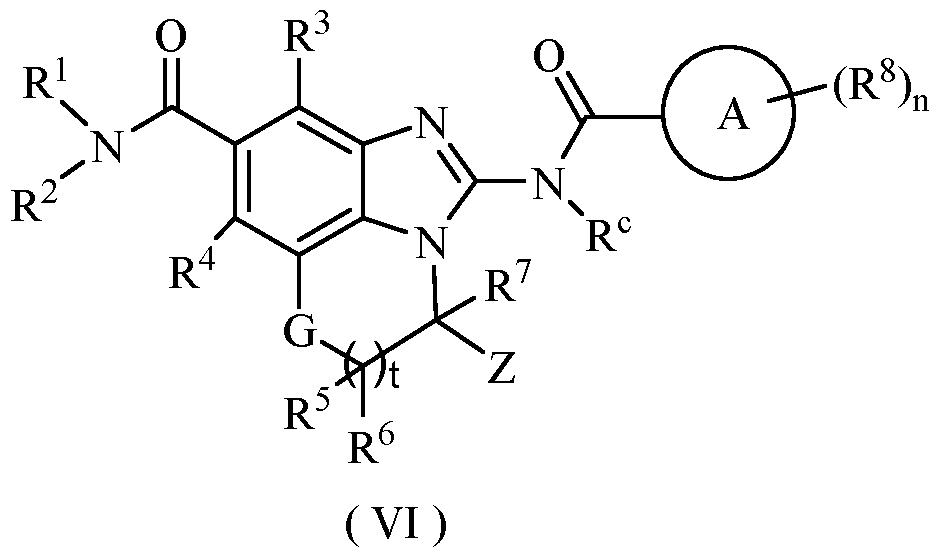
  • the compound of formula (I) is further characterized by formula (VI) :
  • Z is selected from the group consisting of hydrogen, halogen, alkyl, alkenyl, alkynyl alkoxy, haloalkyl, amino, nitro, hydroxy, hydroxyalkyl, cyano, cycloalkyl, heterocyclyl, aryl and heteroaryl, wherein the alkyl, alkenyl, alkoxy, cycloalkyl, heterocyclyl, aryl or heteroaryl is unsubstituted or substituted with one or more, preferably one to five, and sometimes more preferably one to three, substituents selected from the group consisting of halogen, alkyl, alkoxy, haloalkyl, amino, nitro, hydroxy, hydroxyalkyl, cyano, oxo,-C(0)OR 18 , R 19 , -NHC(0)0-benzyl, cycloalkyl, heterocyclyl, aryl and heteroaryl;
  • R 18 , R 19 ,t, ring A, R c , R 1 to R 8 and n are each as defined in formula (I).
  • R c , R 1 to R 8 , L 1 , Z and n are each as defined in formula (I).
  • R c is hydrogen and the compound of formula (VII) is further characterized by formula (VIF):
  • R c , R 1 to R 8 , L 1 , Z and n are each as defined in formula (VII).
  • R c is hydrogen and the compound of formula (VII) is further characterized by formula (VII”):
  • R c , R 1 to R 8 , L 1 , Z and n are each as defined in formula (VII).
  • Z is selected from the group consisting of hydrogen, halogen, alkyl, alkenyl, alkynyl alkoxy, haloalkyl, amino, nitro, hydroxy, hydroxyalkyl, cyano, cycloalkyl, heterocyclyl, aryl and heteroaryl, wherein the alkyl, alkenyl, alkoxy, cycloalkyl, heterocyclyl, aryl or heteroaryl is unsubstituted or substituted with one or more, preferably one to five, and sometimes more preferably one to three, substituents selected from the group consisting of halogen, alkyl, alkoxy, haloalkyl, amino, nitro, hydroxy, hydroxyalkyl, cyano, -NHC(0)0-benzyl, cycloalkyl, heterocyclyl, aryl and heteroaryl; and
  • R b , R c , R 1 to R 8 and n are each as defined in formula (I).
  • R 7 is selected from the group consisting of hydrogen and alkyl.
  • Z is selected from the group consisting of hydrogen, alkyl and alkenyl, wherein the alkyl is unsubstituted or substituted with one or more, preferably one to five, and sometimes more preferably one to three, substituents selected from the group consisting of halogen, hydroxyl and -NHC(0)0- benzyl.
  • R 11 is selected from the group consisting of hydrogen, alkoxy and -C(0)NR 14 R 15 ; wherein the alkoxy is unsubstituted or substituted with one or more, preferably one to five, and sometimes more preferably one to three, substituents selected from the group consisting of alkoxy, alkenyl , amino, hydroxy, hydroxyalkyl, cyano,-0-P(0)(OH)2, cycloalkyl, heterocyclyl and NR 16 R 17 ;
  • R 14 and R 15 are identical or different, and each is independently selected from hydrogen or alkyl
  • R 16 and R 17 are identical or different, and each is independently selected from hydrogen or alkyl
  • R 16 and R 17 together with the nitrogen atom to which they are attached form a heterocyclyl, wherein the heterocyclyl contains one or two identical or different heteroatoms selected from the group consisting of N, O and S.
  • the compound of formula (I) is further characterized by formula (IX) :
  • L 1 is selected from the group consisting of -(CH2) s NH(CH2) r -,alkylene and alkenylene, wherein the alkylene or alkenylene is unsubstituted or substituted with one or more, preferably one to five, and sometimes more preferably one to three, substituents selected from the group consisting of halogen, alkyl, alkoxy, haloalkyl, amino, nitro, hydroxy, hydroxyalkyl, cyano, cycloalkyl, heterocyclyl, aryl and heteroaryl;
  • R 14 and R 15 are identical or different, and each is independently selected from the group consisting of hydrogen and alkyl;
  • w 0, 1, 2 or 3;
  • ring A, ring B, R c , R 1 to R 6 , R 8 , R 11 , R 12 , R 13 , r, s n and q are each as defined in formula (I);
  • R 11 is selected from hydrogen or alkoxy; wherein the alkoxy is unsubstituted or substituted with one or more, preferably one to five, and sometimes more preferably one to three, substituents selected from the group consisting of alkoxy, alkenyl , amino, hydroxy, -0-P(0)(0H) 2 and NR 16 R 17 ;
  • R 16 and R 17 are identical or different, and each is independently selected from hydrogen or alkyl
  • R 16 and R 17 together with the nitrogen atom to which they are attached form a heterocyclyl, wherein the heterocyclyl contains one or two identical or different heteroatoms selected from the group consisting of N, O and S.
  • the compound of formula (I) is further characterized by formula (X) :
  • the compound of formula (I) is further characterized by formula (XI) :
  • t is 1.
  • L 1 is selected from the group consisting of alkylene and alkenylene, wherein the alkylene or alkenylene is unsubstituted or substituted with one or more, preferably one to five, and sometimes more preferably one to three, substituents selected from the group consisting of halogen and hydroxy.
  • L 1 is selected from the group consisting of alkylene and alkenylene, wherein the alkylene or alkenylene is unsubstituted or substituted with one or more, preferably one to five, and sometimes more preferably one to three, substituents selected from the group consisting of oxo,-C(0)OR 18 , R 19 , halogen and hydroxy;
  • R 18 is hydrogen or alkyl;
  • R 19 is heteroaryl unsubstituted or substituted with one or more, preferably one to five, and sometimes more preferably one to three, substituents selected from alkyl or alkoxy, preferably, R 19 is heteroaryl unsubstituted or substituted with one or more, preferably one to five, and sometimes more preferably one to three,
  • R 19 is group of substituted with one or more, preferably one to five, and sometimes more preferably one to three, substituents selected from alkyl or alkoxy;
  • L 1 is selected from the group consisting of alkylene and alkenylene, wherein the alkylene or alkenylene is unsubstituted or substituted with one or more, preferably one to five, and sometimes more preferably one to three, hydroxy.
  • ring A is selected from the group consisting of heteroaryl and aryl, preferably pyrazolyl or imidazolyl.
  • ring B is selected from the group consisting of heteroaryl and aryl, preferably pyrazolyl or imidazolyl.
  • R c is selected from the group consisting of hydrogen and alkyl.
  • R 1 and R 2 are identical or different, and each is independently selected from the group consisting of hydrogen and alkyl; wherein the alkyl is unsubstituted or substituted with one or more, preferably one to five, and sometimes more preferably one to three, hydroxy.
  • R 3 , R 4 , R 5 or R 6 are each hydrogen.
  • R 8 at each occurrence is independently selected from the group consisting of hydrogen and alkyl.
  • Exemplary compounds of the present invention include, but are not limited to the following:
  • this invention provides a compound of formula (IA), or a tautomer thereof, used as an intermediate for preparing a compound of formula (I) :
  • R a is selected from the group consisting of alkyl, alkenyl, alkynyl, haloalkyl, and hydroxyalkyl, wherein the alkyl, alkenyl or alkynyl is unsubstituted or substituted with one or more, preferably one to five, and sometimes more preferably one to three, substituents selected from the group consisting of halogen, alkyl, alkoxy, haloalkyl, amino, nitro, cyano, hydroxy, hydroxyalkyl, carboxylic acid, cycloalkyl, heterocyclyl, aryl and heteroaryl;
  • ring A is selected from the group consisting of cycloalkyl, heterocyclyl, aryl and heteroaryl;
  • G is O or NR b ;
  • R b is selected from the group consisting of hydrogen, alkyl, alkoxy , alkoxyalkyl and haloalkyl;
  • R c is selected from the group consisting of hydrogen, alkyl, haloalkyl, alkenyl and alkynyl;
  • R 3 and R 4 are identical or different, and each is independently selected from the group consisting of hydrogen, halogen, alkyl, alkoxy, haloalkyl, amino, nitro, hydroxy, hydroxyalkyl, cyano, cycloalkyl, heterocyclyl, aryl and heteroaryl;
  • R 5 , R 6 and R 7 are identical or different, and each is independently selected from the group consisting of hydrogen, halogen, alkyl, alkoxy, haloalkyl, amino, nitro, hydroxy, hydroxyalkyl, cyano, cycloalkyl, heterocyclyl, aryl and heteroaryl;
  • L 1 is selected from the group consisting of alkylene, alkenylene, NH, O, - (CH sNH-, -(CH 2 ) s NH(CH 2 ) r -,S(0) m , C(O), -C(0)NH-, -NHC(O)- or -HNC(0)NH-, wherein the alkylene or alkenylene is unsubstituted or substituted with one or more, preferably one to five, and sometimes more preferably one to three, substituents selected from the group consisting of halogen, alkyl, alkoxy, haloalkyl, amino, nitro, hydroxy, hydroxyalkyl, cyano, oxo,-C(0)OR 18 , R 19 , cycloalkyl, heterocyclyl, aryl and heteroaryl; or L 1 is absent;
  • Z is selected from the group consisting of -C(0)0-benzyl, Butyloxy carbonyl, hydrogen, halogen, alkyl, alkenyl, alkynyl alkoxy, haloalkyl, amino, nitro, hydroxy, hydroxyalkyl, cyano, cycloalkyl, heterocyclyl, aryl and heteroaryl, wherein the alkyl, alkoxy, cycloalkyl, heterocyclyl, aryl or heteroaryl is unsubstituted or substituted with one or more, preferably one to five, and sometimes more preferably one to three, substituents selected from the group consisting of halogen, alkyl, alkoxy, haloalkyl, amino, nitro, hydroxy, hydroxyalkyl, cyano, -NR 9 R 10 , oxo,-C(0)OR 18 , R 19 , cycloalkyl, heterocyclyl, aryl and heteroaryl;
  • Z is selected from a fomula (Za) or a tautomer
  • ring B is selected from the group consisting of cycloalkyl, heterocyclyl, aryl and heteroaryl;
  • R 8 each is identical or different, and each is independently selected from the group consisting of hydrogen, halogen, alkyl, alkoxy, haloalkyl, amino, nitro, hydroxy, hydroxyalkyl, cyano, cycloalkyl, heterocyclyl, aryl and heteroaryl, wherein the alkyl, alkoxy, cycloalkyl, heterocyclyl, aryl or heteroaryl is unsubstituted or substituted with one or more, preferably one to five, and sometimes more preferably one to three, substituents selected from the group consisting of halogen, alkyl, alkoxy, haloalkyl, amino, nitro, hydroxy, hydroxyalkyl, cyano, cycloalkyl, heterocyclyl, aryl and heteroaryl;
  • R 9 and R 10 are identical or different, and each is independently selected from the group consisting of hydrogen, alkyl, -C(0)0-benzyl, haloalkyl, cycloalkyl,
  • R 11 each is identical or different, and each is independently selected from the group consisting of hydrogen, halogen, alkyl, alkoxy, haloalkyl, amino, nitro, hydroxy, hydroxyalkyl, cyano, -C(0)NR 14 R 15 , cycloalkyl, heterocyclyl, aryl and heteroaryl; wherein the alkyl or alkoxy is unsubstituted or substituted with one or more, preferably one to five, and sometimes more preferably one to three, substituents selected from the group consisting of halogen, alkyl, alkoxy, alkenyl , alkynyl haloalkyl, amino, nitro, hydroxy, hydroxyalkyl, cyano, -0-P(0)(0H) 2 , cycloalkyl, heterocyclyl and NR 16 R 17 ;
  • R 12 is selected from the group consisting of hydrogen, alkyl, alkenyl and alkynyl;
  • R 13 each is identical or different, and each is independently selected from the group consisting of hydrogen, halogen, alkyl, alkoxy, haloalkyl, amino, nitro, hydroxy, hydroxyalkyl, cyano, cycloalkyl, heterocyclyl, aryl and heteroaryl, wherein the alkyl, alkoxy, cycloalkyl, heterocyclyl, aryl or heteroaryl is unsubstituted or substituted with one or more, preferably one to five, and sometimes more preferably one to three, substituents selected from the group consisting of halogen, alkyl, alkoxy, haloalkyl, amino, nitro, hydroxy, hydroxyalkyl, cyano, cycloalkyl, heterocyclyl, aryl and heteroaryl;
  • R 14 and R 15 are identical or different, and each is independently selected from the group consisting of hydrogen, alkyl, haloalkyl, cycloalkyl, heterocyclyl, aryl and heteroaryl; wherein the alkyl, cycloalkyl, heterocyclyl, aryl or heteroaryl is
  • R 16 and R 17 are identical or different, and each is independently selected from hydrogen or alkyl
  • R 16 and R 17 together with the nitrogen atom to which they are attached form a heterocyclyl, wherein the heterocyclyl contains one or two identical or different heteroatoms selected from the group consisting of N, O and S, and the heterocyclyl is optionally substituted by one or more, preferably one to five, and sometimes more preferably one to three, substituents selected from the group consisting of alkyl, alkoxy, halogen, amino, cyano, nitro, hydroxy and hydroxyalkyl;
  • R 18 is hydrogen or alkyl
  • R 19 is cycloalkyl, heterocyclyl, aryl or heteroaryl, wherein the cycloalkyl, heterocyclyl, aryl or heteroaryl is unsubstituted or substituted with one or more, preferably one to five, and sometimes more preferably one to three, substituents selected from the group consisting of halogen, alkyl, alkoxy, haloalkyl, amino, nitro, hydroxy, hydroxyalkyl and cyano;
  • n 0, 1, 2, 3 or 4;
  • n 0, 1 or 2;
  • s is integer of 1 to 6;
  • r is 1, 2, 3 or 4;
  • t 1, 2, 3 or 4;
  • p 0, 1, 2, 3 or 4;
  • q 0, 1, 2, 3 or 4.
  • this invention provides a compound of formula (IB), or a tautomer thereof, used as an intermediate for preparing a compound of formula (I) :
  • G is O or NR b ;
  • R b is selected from the group consisting of hydrogen, alkyl, alkoxy , alkoxyalkyl and haloalkyl;
  • R c is selected from the group consisting of hydrogen, alkyl, haloalkyl, alkenyl and alkynyl;
  • R 1 and R 2 are identical or different, and each is independently selected from the group consisting of hydrogen, alkyl, haloalkyl, cycloalkyl, heterocyclyl, aryl and heteroaryl; wherein the alkyl, cycloalkyl, heterocyclyl, aryl or heteroaryl is unsubstituted or substituted with one or more, preferably one to five, and sometimes more preferably one to three, substituents selected from the group consisting of halogen, alkyl, alkoxy, haloalkyl, amino, nitro, cyano, hydroxy, hydroxyalkyl, cycloalkyl, heterocyclyl, aryl and heteroaryl;
  • R 3 and R 4 are identical or different, and each is independently selected from the group consisting of hydrogen, halogen, alkyl, alkoxy, haloalkyl, amino, nitro, hydroxy, hydroxyalkyl, cyano, cycloalkyl, heterocyclyl, aryl and heteroaryl;
  • R 5 , R 6 and R 7 are identical or different, and each is independently selected from the group consisting of hydrogen, halogen, alkyl, alkoxy, haloalkyl, amino, nitro, hydroxy, hydroxyalkyl, cyano, cycloalkyl, heterocyclyl, aryl and heteroaryl;
  • L 1 is selected from the group consisting of alkylene, alkenylene, NH, O, - (CH 2 ) S NH-, -(CH 2 ) s NH(CH 2 )r -,S(0) m , C(O), -C(0)NH-, -NHC(O)- or -HNC(0)NH-, wherein the alkylene or alkenylene is unsubstituted or substituted with one or more, preferably one to five, and sometimes more preferably one to three, substituents selected from the group consisting of halogen, alkyl, alkoxy, haloalkyl, amino, nitro, hydroxy, hydroxyalkyl, cyano, oxo,-C(0)OR 18 , R 19 , cycloalkyl, heterocyclyl, aryl and heteroaryl; or L 1 is absent;
  • Z is selected from the group consisting of -C(0)0-benzyl, Butyloxy carbonyl, hydrogen, halogen, alkyl, alkenyl, alkynyl alkoxy, haloalkyl, amino, nitro, hydroxy, hydroxyalkyl, cyano, cycloalkyl, heterocyclyl, aryl and heteroaryl, wherein the alkyl, alkoxy, cycloalkyl, heterocyclyl, aryl or heteroaryl is unsubstituted or substituted with one or more, preferably one to five, and sometimes more preferably one to three, substituents selected from the group consisting of halogen, alkyl, alkoxy, haloalkyl, amino, nitro, hydroxy, hydroxyalkyl, cyano, -NR 9 R 10 , oxo,-C(0)OR 18 , R 19 , cycloalkyl, heterocyclyl, aryl and heteroaryl;
  • Z is selected from a fomula (Za) or a tautomer:
  • ring B is selected from the group consisting of cycloalkyl, heterocyclyl, aryl and heteroaryl;
  • R 9 and R 10 are identical or different, and each is independently selected from the group consisting of hydrogen, alkyl, -C(0)0-benzyl, haloalkyl, cycloalkyl, heterocyclyl, aryl and heteroaryl;
  • R 11 each is identical or different, and each is independently selected from the group consisting of hydrogen, halogen, alkyl, alkoxy, haloalkyl, amino, nitro, hydroxy, hydroxyalkyl, cyano, -C(0)NR 14 R 15 , cycloalkyl, heterocyclyl, aryl and heteroaryl; wherein the alkyl or alkoxy is unsubstituted or substituted with one or more, preferably one to five, and sometimes more preferably one to three, substituents selected from the group consisting of halogen, alkyl, alkoxy, alkenyl , alkynyl haloalkyl, amino, nitro, hydroxy, hydroxyalkyl, cyano, -0-P(0)(0H)2, cycloalkyl, heterocyclyl and NR 16 R 17 ;
  • R 12 is selected from the group consisting of hydrogen, alkyl, alkenyl and alkynyl;
  • R 13 each is identical or different, and each is independently selected from the group consisting of hydrogen, halogen, alkyl, alkoxy, haloalkyl, amino, nitro, hydroxy, hydroxyalkyl, cyano, cycloalkyl, heterocyclyl, aryl and heteroaryl, wherein the alkyl, alkoxy, cycloalkyl, heterocyclyl, aryl or heteroaryl is unsubstituted or substituted with one or more, preferably one to five, and sometimes more preferably one to three, substituents selected from the group consisting of halogen, alkyl, alkoxy, haloalkyl, amino, nitro, hydroxy, hydroxyalkyl, cyano, cycloalkyl, heterocyclyl, aryl and heteroaryl;
  • R 14 and R 15 are identical or different, and each is independently selected from the group consisting of hydrogen, alkyl, haloalkyl, cycloalkyl, heterocyclyl, aryl and heteroaryl; wherein the alkyl, cycloalkyl, heterocyclyl, aryl or heteroaryl is
  • R 16 and R 17 are identical or different, and each is independently selected from hydrogen or alkyl
  • R 16 and R 17 together with the nitrogen atom to which they are attached form a heterocyclyl, wherein the heterocyclyl contains one or two identical or different heteroatoms selected from the group consisting of N, O and S, and the heterocyclyl is optionally substituted by one or more, preferably one to five, and sometimes more preferably one to three, substituents selected from the group consisting of alkyl, alkoxy, halogen, amino, cyano, nitro, hydroxy and hydroxyalkyl;
  • R 18 is hydrogen or alkyl
  • R 19 is cycloalkyl, heterocyclyl, aryl or heteroaryl, wherein the cycloalkyl, heterocyclyl, aryl or heteroaryl is unsubstituted or substituted with one or more, preferably one to five, and sometimes more preferably one to three, substituents selected from the group consisting of halogen, alkyl, alkoxy, haloalkyl, amino, nitro, hydroxy, hydroxyalkyl and cyano;
  • n 0, 1 or 2;
  • s is integer of 1 to 6;
  • r is 1, 2, 3 or 4;
  • t 1, 2, 3 or 4;
  • p 0, 1, 2, 3 or 4;
  • q 0, 1, 2, 3 or 4.
  • this invention provides a compound of formula (IIIA), or a tautomer thereof, used as an intermediate for preparing a compound of formula (III):
  • R a is selected from the group consisting of alkyl, alkenyl, alkynyl, haloalkyl, and hydroxyalkyl, wherein the alkyl, alkenyl or alkynyl is unsubstituted or substituted with one or more, preferably one to five, and sometimes more preferably one to three, substituents selected from the group consisting of halogen, alkyl, alkoxy, haloalkyl, amino, nitro, cyano, hydroxy, hydroxyalkyl, carboxylic acid, cycloalkyl, heterocyclyl, aryl and heteroaryl;
  • ring A is selected from the group consisting of cycloalkyl, heterocyclyl, aryl and heteroaryl;
  • R c is selected from the group consisting of hydrogen, alkyl, haloalkyl, alkenyl and alkynyl;
  • R 3 and R 4 are identical or different, and each is independently selected from the group consisting of hydrogen, halogen, alkyl, alkoxy, haloalkyl, amino, nitro, hydroxy, hydroxyalkyl, cyano, cycloalkyl, heterocyclyl, aryl and heteroaryl;
  • R 5 , R 6 and R 7 are identical or different, and each is independently selected from the group consisting of hydrogen, halogen, alkyl, alkoxy, haloalkyl, amino, nitro, hydroxy, hydroxyalkyl, cyano, cycloalkyl, heterocyclyl, aryl and heteroaryl;
  • L 1 is selected from the group consisting of alkylene, alkenylene, NH, O, - (CH 2 ) S NH-, S(0) m , C(O), -C(0)NH-, -NHC(O)- or -HNC(0)NH-, wherein the alkylene or alkenylene is unsubstituted or substituted with one or more, preferably one to five, and sometimes more preferably one to three, substituents selected from the group consisting of halogen, alkyl, alkoxy, haloalkyl, amino, nitro, hydroxy, hydroxyalkyl, cyano, cycloalkyl, heterocyclyl, aryl and heteroaryl;
  • Z is selected from the group consisting of -C(0)0-benzyl, Butyloxy carbonyl, hydrogen, halogen, alkyl, alkenyl, alkynyl alkoxy, haloalkyl, amino, nitro, hydroxy, hydroxyalkyl, cyano, cycloalkyl, heterocyclyl, aryl and heteroaryl, wherein the alkyl, alkoxy, cycloalkyl, heterocyclyl, aryl or heteroaryl is unsubstituted or substituted with one or more, preferably one to five, and sometimes more preferably one to three, substituents selected from the group consisting of halogen, alkyl, alkoxy, haloalkyl, amino, nitro, hydroxy, hydroxyalkyl, cyano, -NR 9 R 10 , cycloalkyl, heterocyclyl, aryl and heteroaryl; or Z is selected from a fomula (Za):
  • ring B is selected from the group consisting of cycloalkyl, heterocyclyl, aryl and heteroaryl;
  • R 8 each is identical or different, and each is independently selected from the group consisting of hydrogen, halogen, alkyl, alkoxy, haloalkyl, amino, nitro, hydroxy, hydroxyalkyl, cyano, cycloalkyl, heterocyclyl, aryl and heteroaryl, wherein the alkyl, alkoxy, cycloalkyl, heterocyclyl, aryl or heteroaryl is unsubstituted or substituted with one or more, preferably one to five, and sometimes more preferably one to three, substituents selected from the group consisting of halogen, alkyl, alkoxy, haloalkyl, amino, nitro, hydroxy, hydroxyalkyl, cyano, cycloalkyl, heterocyclyl, aryl and heteroaryl;
  • R 9 and R 10 are identical or different, and each is independently selected from the group consisting of hydrogen, alkyl, -C(0)0-benzyl, haloalkyl, cycloalkyl,
  • R 11 each is identical or different, and each is independently selected from the group consisting of hydrogen, halogen, alkyl, alkoxy, haloalkyl, amino, nitro, hydroxy, hydroxyalkyl, cyano, -C(0)NR 14 R 15 , cycloalkyl, heterocyclyl, aryl and heteroaryl;
  • R 12 is selected from the group consisting of hydrogen, alkyl, alkenyl and alkynyl;
  • R 13 each is identical or different, and each is independently selected from the group consisting of hydrogen, halogen, alkyl, alkoxy, haloalkyl, amino, nitro, hydroxy, hydroxyalkyl, cyano, cycloalkyl, heterocyclyl, aryl and heteroaryl, wherein the alkyl, alkoxy, cycloalkyl, heterocyclyl, aryl or heteroaryl is unsubstituted or substituted with one or more, preferably one to five, and sometimes more preferably one to three, substituents selected from the group consisting of halogen, alkyl, alkoxy, haloalkyl, amino, nitro, hydroxy, hydroxyalkyl, cyano, cycloalkyl, heterocyclyl, aryl and heteroaryl;
  • R 14 and R 15 are identical or different, and each is independently selected from the group consisting of hydrogen, alkyl, haloalkyl, cycloalkyl, heterocyclyl, aryl and heteroaryl; wherein the alkyl, cycloalkyl, heterocyclyl, aryl or heteroaryl is
  • n 0, 1, 2, 3 or 4;
  • n 0, 1 or 2;
  • s is integer of 1 to 6;
  • p 0, 1, 2, 3 or 4;
  • q 0, 1, 2, 3 or 4.
  • this invention provides a compound of formula (IIIB), or a tautomer thereof, used as an intermediate for preparing a compound of formula (III):
  • R c is selected from the group consisting of hydrogen, alkyl, haloalkyl, alkenyl and alkynyl;
  • R 1 and R 2 are identical or different, and each is independently selected from the group consisting of hydrogen, alkyl, haloalkyl, cycloalkyl, heterocyclyl, aryl and heteroaryl; wherein the alkyl, cycloalkyl, heterocyclyl, aryl or heteroaryl is unsubstituted or substituted with one or more, preferably one to five, and sometimes more preferably one to three, substituents selected from the group consisting of halogen, alkyl, alkoxy, haloalkyl, amino, nitro, cyano, hydroxy, hydroxyalkyl, cycloalkyl, heterocyclyl, aryl and heteroaryl;
  • R 3 and R 4 are identical or different, and each is independently selected from the group consisting of hydrogen, halogen, alkyl, alkoxy, haloalkyl, amino, nitro, hydroxy, hydroxyalkyl, cyano, cycloalkyl, heterocyclyl, aryl and heteroaryl;
  • R 5 , R 6 and R 7 are identical or different, and each is independently selected from the group consisting of hydrogen, halogen, alkyl, alkoxy, haloalkyl, amino, nitro, hydroxy, hydroxyalkyl, cyano, cycloalkyl, heterocyclyl, aryl and heteroaryl;
  • L 1 is selected from the group consisting of alkylene, alkenylene, NH, O, - (CH 2 ) S NH-, S(0) m , C(O), -C(0)NH-, -NHC(O)- or -HNC(0)NH-, wherein the alkylene or alkenylene is unsubstituted or substituted with one or more, preferably one to five, and sometimes more preferably one to three, substituents selected from the group consisting of halogen, alkyl, alkoxy, haloalkyl, amino, nitro, hydroxy, hydroxyalkyl, cyano, cycloalkyl, heterocycly
  • Z is selected from the group consisting of -C(0)0-benzyl, Butyloxy carbonyl, hydrogen, halogen, alkyl, alkenyl, alkynyl alkoxy, haloalkyl, amino, nitro, hydroxy, hydroxyalkyl, cyano, cycloalkyl, heterocyclyl, aryl and heteroaryl, wherein the alkyl, alkoxy, cycloalkyl, heterocyclyl, aryl or heteroaryl is unsubstituted or substituted with one or more, preferably one to five, and sometimes more preferably one to three, substituents selected from the group consisting of halogen, alkyl, alkoxy, haloalkyl, amino, nitro, hydroxy, hydroxyalkyl, cyano, -NR 9 R 10 , cycloalkyl, heterocyclyl, aryl and heteroaryl;
  • Za fomula
  • ring B is selected from the group consisting of cycloalkyl, heterocyclyl, aryl and heteroaryl;
  • R 9 and R 10 are identical or different, and each is independently selected from the group consisting of hydrogen, alkyl, -C(0)0-benzyl, haloalkyl, cycloalkyl, heterocyclyl, aryl and heteroaryl;
  • R 11 each is identical or different, and each is independently selected from the group consisting of hydrogen, halogen, alkyl, alkoxy, haloalkyl, amino, nitro, hydroxy, hydroxyalkyl, cyano, -C(0)NR 14 R 15 , cycloalkyl, heterocyclyl, aryl and heteroaryl;
  • R 12 is selected from the group consisting of hydrogen, alkyl, alkenyl and alkynyl;
  • R 13 each is identical or different, and each is independently selected from the group consisting of hydrogen, halogen, alkyl, alkoxy, haloalkyl, amino, nitro, hydroxy, hydroxyalkyl, cyano, cycloalkyl, heterocyclyl, aryl and heteroaryl, wherein the alkyl, alkoxy, cycloalkyl, heterocyclyl, aryl or heteroaryl is unsubstituted or substituted with one or more, preferably one to five, and sometimes more preferably one to three, substituents selected from the group consisting of halogen, alkyl, alkoxy, haloalkyl, amino, nitro, hydroxy, hydroxyalkyl, cyano, cycloalkyl, heterocyclyl, aryl and heteroaryl;
  • R 14 and R 15 are identical or different, and each is independently selected from the group consisting of hydrogen, alkyl, haloalkyl, cycloalkyl, heterocyclyl, aryl and heteroaryl; wherein the alkyl, cycloalkyl, heterocyclyl, aryl or heteroaryl is
  • n 0, 1 or 2;
  • s is integer of 1 to 6;
  • p 0, 1 , 2, 3 or 4;
  • q 0, 1 , 2, 3 or 4.
  • this invention provides a preparation process of a compound of formula (I), or a tautomer, or a pharmaceutically acceptable salt, solvate, or prodrug thereof, comprising a step of:
  • G, t, R a , R c , R 1 to R 7 , L 1 and Z are each as defined in formula (I).
  • this invention provides a preparation process of a compound of formula (I), or a tautomer, or a pharmaceutically acceptable salt, solvate, or prodrug thereof, comprising a step of:
  • G, t, R a , R c , R 1 to R 7 , L 1 and Z are each as defined in formula (I).
  • this invention provides a preparation process of a compound of formula (III), or a tautomer, or a pharmaceutically acceptable salt, solvate, or prodrug thereof, the preparation process comprising the steps of:
  • R a , R c , R 1 to R 7 and Z are each as defined in formula (I).
  • this invention provides a method of preparing a compound of formula (III), or a tautomer, or a pharmaceutically acceptable salt, solvate, or prodrug thereof, the method comprising the steps of:
  • R a , R c , R 1 to R 7 and Z are each as defined in formula (III).
  • the present invention also provides a pharmaceutical composition, comprising a therapeutically effective amount of a compound of formula (I), or a tautomer, or a pharmaceutically acceptable salt, solvate, or prodrug thereof, together with one or more pharmaceutically acceptable carriers, diluents or excipients.
  • the present invention also relates to use of a compound of formula (I), or a tautomer, a pharmaceutically acceptable salt, solvate, prodrug, or a pharmaceutical composition thereof, in the preparation of a medicament for use as a STING agonist.
  • the present invention also relates to use of a compound of formula (I), or a tautomer, a pharmaceutically acceptable salt, solvate, or prodrug thereof, or a pharmaceutical composition thereof, in the preparation of a medicament for the treatment of a STING-mediated disease or disorder, wherein the disease or disorder is selected from a cancer, a pre-cancerous syndrome and viral infections, preferably a cancer and a pre- cancerous syndrome.
  • the present invention relates to a method for stimulating STING, comprising a step of administering to a subject in need thereof a therapeutically effective amount of a compound of formula (I), or a tautomer, a pharmaceutically acceptable salt, solvate, prodrug, or a pharmaceutical composition thereof.
  • the present invention relates to a method for treating a STING-mediated disease or disorder, comprising a step of administering to a subject in need thereof a therapeutically effective amount of a compound of formula (I), or a tautomer, a pharmaceutically acceptable salt, solvate, prodrug, or a pharmaceutical composition thereof; wherein the disease or disorder is selected from a cancer, a pre-cancerous syndrome and viral infections, preferably a cancer and a pre-cancerous syndrome.
  • compositions of this invention can be formulated by conventional methods using one or more pharmaceutically acceptable carriers.
  • the active compounds of this invention can be formulated as various dosage forms for oral, buccal, intranasal, parenteral (e.g., intravenous, intramuscular or subcutaneous), rectal administration, inhalation or insufflation administration.
  • the compounds of this invention can also be formulated as sustained release dosage forms.
  • compositions can be in the form of a tablet, troche, lozenge, aqueous or oily suspension, dispersible powder or granule, emulsion, hard or soft capsule, or syrup or elixir.
  • Oral compositions can be prepared according to any known method in the art for the preparation of pharmaceutical compositions.
  • Such compositions can contain one or more additives selected from the group consisting of sweeteners, flavoring agents, colorants and preservatives, in order to provide a pleasing and palatable pharmaceutical preparation.
  • Tablets contain the active ingredient and nontoxic pharmaceutically acceptable excipients suitable for the manufacture of tablets. These excipients can be inert excipients, granulating agents, disintegrating agents, and lubricants.
  • the tablet can be uncoated or coated by means of a known technique to mask the taste of the drug or delay the disintegration and absorption of the drug in the gastrointestinal tract, thereby providing sustained release over an extended period.
  • a known technique to mask the taste of the drug or delay the disintegration and absorption of the drug in the gastrointestinal tract, thereby providing sustained release over an extended period.
  • water soluble taste masking materials can be used.
  • Oral formulations can also be provided as soft gelatin capsules in which the active ingredient is mixed with an inert solid diluent, or the active ingredient is mixed with a water soluble carrier.
  • An aqueous suspension contains the active ingredient in admixture with excipients suitable for the manufacture of an aqueous suspension.
  • excipients are suspending agents, dispersants or humectants, and can be naturally occurring phospholipids.
  • the aqueous suspension can also contain one or more preservatives, one or more colorants, one or more flavoring agents, and one or more sweeteners.
  • An oil suspension can be formulated by suspending the active ingredient in a vegetable oil, or in a mineral oil.
  • the oil suspension can contain a thickener.
  • the aforementioned sweeteners and flavoring agents can be added to provide a palatable preparation. These compositions can be preserved by adding an antioxidant.
  • the active ingredient and the dispersants or wetting agents, suspending agent or one or more preservatives can be prepared as a dispersible powder or granule suitable for the preparation of an aqueous suspensionn by adding water. Suitable dispersants or wetting agents and suspending agents are exemplified by those already mentioned above. Additional excipients, such as sweeteners, flavoring agents and colorants, can also be added. These compositions can be preserved by adding an antioxidant such as ascorbic acid.
  • the present pharmaceutical composition can also be in the form of an oil-in- water emulsion.
  • the oil phase can be a vegetable oil, or a mineral oil, or mixture thereof.
  • Suitable emulsifying agents can be naturally occurring phospholipids. Sweeteners can be used.
  • Such formulations can also contain moderators, preservatives, colorants and antioxidants.
  • the pharmaceutical composition can be in the form of a sterile injectable aqueous solution.
  • the acceptable vehicles and solvents that can be employed are water, Ringer's solution and isotonic sodium chloride solution.
  • the sterile injectable preparation can also be a sterile injectable oil-in-water microemulsion in which the active ingredient is dissolved in the oil phase.
  • the injectable solution or microemulsion can be introduced into an individual’s bloodstream by local bolus injection. Alternatively, it can be advantageous to administer the solution or microemulsion in such a way as to maintain a constant circulating concentration of the present compound.
  • a continuous intravenous delivery device can be utilized. An example of such a device is Deltec CADD-PLUS. TM. 5400 intravenous injection pump.
  • the pharmaceutical composition can be in the form of a sterile injectable aqueous or oily suspension for intramuscular and subcutaneous administration.
  • a suspension can be formulated with suitable dispersants or wetting agents and suspending agents as described above according to known techniques.
  • the sterile injectable preparation can also be a sterile injectable solution or suspension prepared in a nontoxic parenterally acceptable diluent or solvent.
  • sterile fixed oils can easily be used as a solvent or suspending medium, and fatty acids can also be used to prepare injections.
  • the present compound can be administered in the form of a suppository for rectal administration.
  • These pharmaceutical compositions can be prepared by mixing the drug with a suitable non- irritating excipient that is solid at ordinary temperatures, but liquid in the rectum, thereby melting in the rectum to release the drug.
  • compositions can be formulated as tablets or lozenges by conventional means.
  • the active compounds of the present invention are conveniently delivered in the form of a solution or suspension released from a pump spray container that is squeezed or pumped by the patient, or as an aerosol spray released from a pressurized container or nebulizer, with the use of a suitable propellant, e.g., dichlorodifluoromethane, trichlorofluoromethane, dichlorotetrafluoroethane, carbon dioxide or other suitable gas.
  • a suitable propellant e.g., dichlorodifluoromethane, trichlorofluoromethane, dichlorotetrafluoroethane, carbon dioxide or other suitable gas.
  • the dosage unit can be determined by providing a valve to deliver a metered amount.
  • the pressurized container or nebulizer can contain a solution or suspension of the active compound.
  • Capsules or cartridges for example, made from gelatin
  • for use in an inhaler or insufflator can be formulated
  • the dosage of a drug depends on a variety of factors, including but not limited to, the following factors: activity of the specific compound, age, weight, general health, behavior, diet of the patient,
  • Alkyl refers to a saturated aliphatic hydrocarbon group including C1-C20 straight chain and branched chain groups.
  • an alkyl group is an alkyl having 1 to 12, sometimes preferably 1 to 8, sometimes more preferably 1 to 6, and sometimes most preferably 1 to 4, carbon atoms.
  • Representative examples include, but are not limited to methyl, ethyl, n-propyl, isopropyl, n-butyl, isobutyl, tert-butyl, sec -butyl, n-pentyl, 1,1- dimethyl propyl, 1 ,2-dimethyl propyl, 2,2-dimethyl propyl, 1 -ethyl propyl, 2-methylbutyl, 3-methylbutyl, n-hexyl, l-ethyl-2-methylpropyl, l,l,2-trimethylpropyl, 1,1- dimethylbutyl, 1 ,2-dimethylbutyl, 2,2-dimethylbutyl, l,3-dimethylbutyl, 2-ethylbutyl, 2- methylpentyl, 3-methylpentyl, 4-methylpentyl, 2,3-dimethylbutyl, n-heptyl, 2- methylhexyl, 3-methylhe
  • an alkyl group is a lower alkyl having 1 to 6 carbon atoms.
  • Representative examples include, but are not limited to, methyl, ethyl, n-propyl, isopropyl, n-butyl, isobutyl, tert-butyl, sec-butyl, n-pentyl, 1,1- dimethylpropyl, 1 ,2-dimethylpropyl, 2,2-dimethylpropyl, l-ethylpropyl, 2-methylbutyl, 3-methylbutyl, n-hexyl, l-ethyl-2-methylpropyl, l,l,2-trimethylpropyl, 1,1- dimethylbutyl, 1 ,2-dimethylbutyl, 2,2-dimethylbutyl, l,3-dimethylbutyl, 2-ethylbutyl, 2- methylpentyl, 3-methylpentyl, 4-methylpentyl, 2,3-dimethyl
  • the alkyl group can be substituted or unsubstituted.
  • the substituent group(s) can be substituted at any available connection point, preferably the substituent group(s) is one or more, preferably one to five, and sometimes more preferably one to three, groups independently selected from the group consisting of alkyl, halogen, alkoxy, alkenyl, alkynyl, alkylsulfo, alkylamino, thiol, hydroxy, nitro, cyano, amino, cycloalkyl, heterocyclic alkyl, aryl, heteroaryl, cycloalkoxyl, heterocylic, cycloalkylthio, heterocylic alkylthio, oxo group and -NR 9 R 10 .
  • Alkenyl refers to an alkyl defined as above that has at least two carbon atoms and at least one carbon-carbon double bond, for example, vinyl, l-propenyl, 2- propenyl, 1-, 2-, or 3-butenyl, etc. preferably C2-20 alkenyl, more preferably C2-12 alkenyl, sometimes more preferably C2-8 alkenyl, and most preferably C2-6 alkenyl.
  • the alkenyl group can be substituted or unsubstituted.
  • the substituent group(s) is preferably one or more, preferably one to five, and sometimes more preferably one to three, group(s) independently selected from the group consisting of alkyl, halogen, alkoxy, alkenyl, alkynyl, alkylsulfo, alkylamino, thiol, hydroxy, nitro, cyano, amino, cycloalkyl, heterocyclic alkyl, aryl, heteroaryl, cycloalkoxyl, heterocylic, cycloalkylthio, heterocylic alkylthio, oxo group and -NR 9 R 10 .
  • Alkynyl refers to an alkyl defined as above that has at least two carbon atoms and at least one carbon-carbon triple bond, for example, ethynyl, l-propynyl, 2-propynyl, 1-, 2-, or 3-butynyl etc., preferably C2-20 alkynyl, more preferably C2-12 alkynyl, sometimes more preferably C2-8 alkynyl, and most preferably C2-6 alkynyl.
  • the alkynyl group can be substituted or unsubstituted.
  • the substituent group(s) is preferably one or more, preferably one to five, and sometimes more preferably one to three, substituent(s) independently selected from the group consisting of alkyl, alkenyl, alkynyl, alkoxy, alkylsulfo, alkylamino, halogen, thiol, hydroxy, nitro, cyano, cycloalkyl, heterocyclic alkyl, aryl, heteroaryl, cycloalkoxyl, heterocylic alkoxyl, cycloalkylthio, heterocylic alkylthio and -NR 9 R 10 .
  • Alkylene refers to a saturated linear or branched aliphatic hydrocarbon group, wherein having 2 residues derived by removing two hydrogen atoms from the same carbon atom of the parent alkane or two different carbon atoms.
  • the straight or branched chain group containing 1 to 20 carbon atoms preferably has 1 to 12 carbon atoms, more preferably 1 to 8 carbons, more preferably 1 to 6 carbon atoms, and sometimes most preferably 1 to 4 carbon atoms.
  • Non-limiting examples of alkylene groups include, but are not limited to, methylene (-CH2-), l,l-ethylene (-CH(CH 3 )-), 1, 2-ethylene (- CH2CH2)-, 1,1 -propylene (-CH(CH 2 CH 3 )-), 1, 2-propylene (-CH 2 CH(CH 3 )-), 1,3- propylene (-CH2CH2CH2-), l,4-butylidene (-CH2CH2CH2CH2-) etc.
  • the alkylene group can be substituted or unsubstituted.
  • the substituent group(s) is preferably one or more, preferably one to five, and sometimes more preferably one to three, substituent(s) independently selected from the group consisting of selected from alkyl, alkenyl, alkynyl, alkoxy, alkylsulfo, alkylamino, halogen, thiol, hydroxy, nitro, cyano, cycloalkyl, heterocyclic alkyl, aryl, heteroaryl, cycloalkoxyl, heterocylic alkoxyl, cycloalkylthio, heterocylic alkylthio and -NR 9 R 10 .
  • Alkenylene refers to an alkylene defined as above that has at least two carbon atoms and at least one carbon-carbon double bond, preferably C2-20 alkenylene, more preferably C2-12 alkenylene, sometimes more preferably C2-8 alkenylene, and most preferably C2-6 alkenylene.
  • the alkenylene group can be substituted or unsubstituted.
  • the substituent group(s) is preferably one or more, preferably one to five, and sometimes more preferably one to three, substituent(s) independently selected from the group consisting of selected from alkyl, alkenyl, alkynyl, alkoxy, alkylsulfo, alkylamino, halogen, thiol, hydroxy, nitro, cyano, cycloalkyl, heterocyclic alkyl, aryl, heteroaryl, cycloalkoxyl, heterocylic alkoxyl, cycloalkylthio, heterocylic alkylthio and -NR 9 R 10 .
  • Cycloalkyl refers to a saturated and/or partially unsaturated monocyclic or polycyclic hydrocarbon group having 3 to 20 carbon atoms, preferably 3 to 12 carbon atoms, more preferably 3 to 10 carbon atoms, and most preferably 3 to 8 carbon atoms or 3 to 6 carbon atoms.
  • Representative examples of monocyclic cycloalkyls include, but are not limited to, cyclopropyl, cyclobutyl, cyclopentyl, cyclopentenyl, cyclohexyl, cyclohexenyl, cyclohexadienyl, cycloheptyl, cycloheptatrienyl, cyclooctyl, etc.
  • Polycyclic cycloalkyl includes a cycloalkyl having a spiro ring, fused ring or bridged ring.
  • “Spiro Cycloalkyl” refers to a 5 to 20 membered polycyclic group with rings connected through one common carbon atom (called a spiro atom), wherein one or more rings can contain one or more double bonds, but none of the rings has a completely conjugated pi-electron system.
  • a spiro cycloalkyl is 6 to 14 membered, and more preferably 7 to 10 membered.
  • a spiro cycloalkyl is divided into mono-spiro cycloalkyl, di-spiro cycloalkyl, or poly-spiro cycloalkyl, and preferably refers to a mono-spiro cycloalkyl or di-spiro cycloalkyl, more preferably 4-membered/4-membered, 4-membered/5 -membered, 4-membered/6- membered, 5-membered/5-membered, or 5-membered/6-membered mono-spiro cycloalkyl.
  • Representative examples of spiro cycloalkyl include, but are not limited to the following groups:
  • “Fused Cycloalkyl” refers to a 5 to 20 membered polycyclic hydrocarbon group, wherein each ring in the system shares an adjacent pair of carbon atoms with another ring, wherein one or more rings can contain one or more double bonds, but none of the rings has a completely conjugated pi-electron system.
  • a fused cycloalkyl group is 6 to 14 membered, more preferably 7 to 10 membered.
  • fused cycloalkyl is divided into bicyclic, tricyclic, tetracyclic or polycyclic fused cycloalkyl, and preferably refers to a bicyclic or tricyclic fused cycloalkyl, more preferably 5-membered/5-membered, or 5-membered/6-membered bicyclic fused cycloalkyl.
  • fused cycloalkyls include, but are not limited to, the following groups:
  • “Bridged Cycloalkyl” refers to a 5 to 20 membered polycyclic hydrocarbon group, wherein every two rings in the system share two disconnected carbon atoms. The rings can have one or more double bonds, but have no completely conjugated pi-electron system.
  • a bridged cycloalkyl is 6 to 14 membered, and more preferably 7 to 10 membered.
  • bridged cycloalkyl is divided into bicyclic, tricyclic, tetracyclic or polycyclic bridged cycloalkyl, and preferably refers to a bicyclic, tricyclic or tetracyclic bridged cycloalkyl, more preferably a bicyclic or tricyclic bridged cycloalkyl.
  • Representative examples of bridged cycloalkyls include, but are not limited to, the following groups:
  • the cycloalkyl can be fused to the ring of an aryl, heteroaryl or heterocyclic alkyl, wherein the ring bound to the parent structure is cycloalkyl.
  • Representative examples include, but are not limited to indanylacetic, tetrahydronaphthalene, benzocycloheptyl and so on.
  • the cycloalkyl is optionally substituted or unsubstituted.
  • the substituent group(s) is preferably one or more, preferably one to five, and sometimes more preferably one to three, substituents independently selected from the group consisting of alkyl, halogen, alkoxy, alkenyl, alkynyl, alkylsulfo, alkylamino, thiol, hydroxy, nitro, cyano, amino, cycloalkyl, heterocyclic alkyl, aryl, heteroaryl, cycloalkoxyl, heterocylic, cycloalkylthio, heterocylic alkylthio, oxo group and -NR 9 R 10 .
  • Heterocyclyl refers to a 3 to 20 membered saturated and/or partially unsaturated monocyclic or polycyclic hydrocarbon group having one or more heteroatoms selected from the group consisting of N, O, and S(0) m (wherein m is 0,1, or 2) as ring atoms, but excluding -0-0-, -O-S- or -S-S- in the ring, the remaining ring atoms being C.
  • heterocyclyl is a 3 to 12 membered having 1 to 4 heteroatoms; more preferably a 3 to 10 membered having 1 to 3 heteroatoms; most preferably a 5 to 6 membered having 1 to 2 heteroatoms.
  • monocyclic heterocyclyls include, but are not limited to, pyrrolidyl, piperidyl, piperazinyl, morpholinyl, sulfo-morpholinyl, homopiperazinyl, and so on.
  • Polycyclic heterocyclyl includes the heterocyclyl having a spiro ring, fused ring or bridged ring.
  • “Spiro heterocyclyl” refers to a 5 to 20 membered polycyclic heterocyclyl with rings connected through one common carbon atom (called a spiro atom), wherein said rings have one or more heteroatoms selected from the group consisting of N, O, and S(0) m (wherein m is 0,1 or 2) as ring atoms, the remaining ring atoms being C, wherein one or more rings can contain one or more double bonds, but none of the rings has a completely conjugated pi-electron system.
  • a spiro heterocyclyl is 6 to 14 membered, and more preferably 7 to 10 membered.
  • spiro heterocyclyl is divided into mono-spiro heterocyclyl, di-spiro heterocyclyl, or poly- spiro heterocyclyl, and preferably refers to mono-spiro heterocyclyl or di-spiro heterocyclyl, more preferably 4-membered/4-membered, 4-membered/5-membered, 4- membered/6-membered, 5-membered/5-membered, or 5-membered/6-membered mono- spiro heterocyclyl.
  • Representative examples of spiro heterocyclyl include, but are not limited to the following groups:
  • “Fused Heterocyclyl” refers to a 5 to 20 membered polycyclic heterocyclyl group, wherein each ring in the system shares an adjacent pair of carbon atoms with the other ring, wherein one or more rings can contain one or more double bonds, but none of the rings has a completely conjugated pi-electron system, and wherein said rings have one or more heteroatoms selected from the group consisting of N, O, and S(0) p (wherein p is 0, 1, or 2) as ring atoms, the remaining ring atoms being C.
  • a fused heterocyclyl is 6 to 14 membered, and more preferably 7 to 10 membered.
  • fused heterocyclyl is divided into bicyclic, tricyclic, tetracyclic or polycyclic fused heterocyclyl, preferably refers to bicyclic or tricyclic fused heterocyclyl, more preferably 5-membered/5-membered, or 5-membered/6-membered bicyclic fused heterocyclyl.
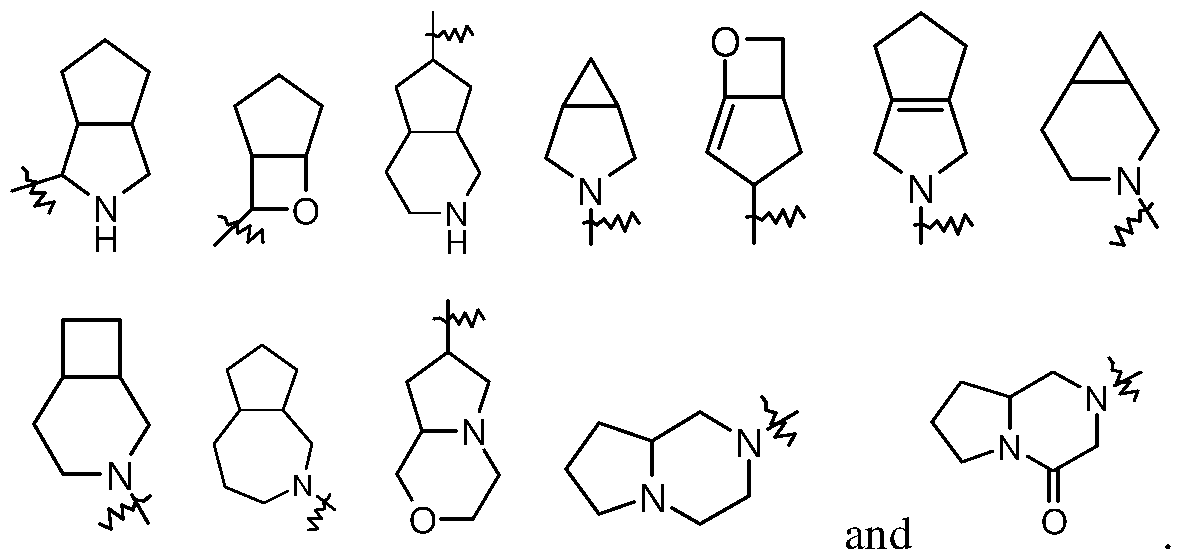
  • fused heterocyclyl include, but are not limited to, the following groups:
  • “Bridged Heterocyclyl” refers to a 5 to 14 membered polycyclic heterocyclic alkyl group, wherein every two rings in the system share two disconnected atoms, the rings can have one or more double bonds, but have no completely conjugated pi-electron system, and the rings have one or more heteroatoms selected from the group consisting of N, O, and S (O)m (wherein m is 0, 1, or 2) as ring atoms, the remaining ring atoms being C.
  • a bridged heterocyclyl is 6 to 14 membered, and more preferably 7 to 10 membered.
  • bridged heterocyclyl is divided into bicyclic, tricyclic, tetracyclic or polycyclic bridged heterocyclyl, and preferably refers to bicyclic, tricyclic or tetracyclic bridged heterocyclyl, more preferably bicyclic or tricyclic bridged heterocyclyl.
  • Representative examples of bridged heterocyclyl include, but are not limited to, the following groups:
  • the ring of said heterocyclyl can be fused to the ring of an aryl, heteroaryl or cycloalkyl, wherein the ring bound to the parent structure is heterocyclyl.
  • Representative examples include, but are not limited to the following groups: , etc.
  • the heterocyclyl is optionally substituted or unsubstituted.
  • the substituent group(s) is preferably one or more, preferably one to five, and sometimes more preferably one to three, substituent(s) independently selected from the group consisting of alkyl, alkenyl, alkynyl, alkoxy, alkylsulfo, alkylamino, halogen, thiol, hydroxy, nitro, cyano, cycloalkyl, heterocyclic alkyl, aryl, heteroaryl, cycloalkoxyl, heterocylic alkoxyl, cycloalkylthio, heterocylic alkylthio and -NR 9 R 10 .
  • 'Aryl refers to a 6 to 14 membered all-carbon monocyclic ring or a polycyclic fused ring (a "fused" ring system means that each ring in the system shares an adjacent pair of carbon atoms with another ring in the system) group, and has a completely conjugated pi-electron system.
  • aryl is 6 to 10 membered, such as phenyl and naphthyl, most preferably phenyl.
  • the aryl can be fused to the ring of heteroaryl, heterocyclyl or cycloalkyl, wherein the ring bound to parent structure is aryl. Representative examples include, but are not limited to, the following groups:
  • the aryl group can be substituted or unsubstituted.
  • the substituent group(s) is preferably one or more, preferably one to five, and sometimes more preferably one to three, substituents independently selected from the group consisting of alkyl, alkenyl, alkynyl, alkoxy, alkylsulfo, alkylamino, halogen, thiol, hydroxy, nitro, cyano, cycloalkyl, heterocyclic alkyl, aryl, heteroaryl, cycloalkoxyl, heterocylic alkoxyl, cycloalkylthio, heterocylic alkylthio and -NR 9 R 10 .
  • Heteroaryl refers to an aryl system having 1 to 4 heteroatoms selected from the group consisting of O, S and N as ring atoms and having 5 to 14 annular atoms.
  • a heteroaryl is 5- to 10- membered, more preferably 5- or 6- membered, for example, thiadiazolyl, pyrazolyl, oxazolyl, oxadiazolyl, imidazolyl, triazolyl, thiazolyl, furyl, thienyl, pyridyl, pyrrolyl, N-alkyl pyrrolyl, pyrimidinyl, pyrazinyl, imidazolyl, tetrazolyl, and the like.
  • the heteroaryl can be fused with the ring of an aryl, heterocyclyl or cycloalkyl, wherein the ring bound to parent structure is heteroaryl. Representative examples include, but are not limited to, the following groups:
  • the heteroaryl group can be substituted or unsubstituted.
  • the substituent group(s) is preferably one or more, preferably one to five, and sometimes more preferably one to three, substituents independently selected from the group consisting of alkyl, alkenyl, alkynyl, alkoxy, alkylsulfo, alkylamino, halogen, thiol, hydroxy, nitro, cyano, cycloalkyl, heterocyclic alkyl, aryl, heteroaryl, cycloalkoxyl, heterocylic alkoxyl, cycloalkylthio, heterocylic alkylthio and -NR 9 R 10 .
  • Alkoxy refers to both an -O-(alkyl) and an -0-(unsubstituted cycloalkyl) group, wherein the alkyl is defined as above. Representative examples include, but are not limited to, methoxy, ethoxy, propoxy, butoxy, cyclopropyloxy, cyclobutyloxy, cyclopentyloxy, cyclohexyloxy, and the like.
  • the alkoxyl can be substituted or unsubstituted.
  • the substituent is preferably one or more, preferably one to five, and sometimes more preferably one to three, substituents independently selected from the group consisting of alkyl, alkenyl, alkynyl, alkoxy, alkylsulfo, alkylamino, halogen, thiol, hydroxy, nitro, cyano, cycloalkyl, heterocyclic alkyl, aryl, heteroaryl, cycloalkoxyl, heterocylic alkoxyl, cycloalkylthio, heterocylic alkylthio and -NR 9 R 10 .
  • “Bond” refers to a covalent bond using a sign of“—
  • Hydroalkyl refers to an alkyl group substituted by a hydroxy group, wherein alkyl is as defined above.
  • Alkoxyalkyl refers to an alkyl group substituted by an alkoxyl group, wherein alkyl is as defined above.
  • Haldroxy refers to an -OH group.
  • Halogen refers to fluoro, chloro, bromo or iodo atoms.
  • Amino refers to a -Nhh group.
  • Cyano refers to a -CN group.
  • Niro refers to a -NO2 group.
  • Carboxyl refers to a -C(0)OH group.
  • Alkoxycarbonyl refers to a -C(0)0(alkyl) or (cycloalkyl) group, wherein the alkyl and cycloalkyl are defined as above.
  • “Optional” or“optionally” means that the event or circumstance described subsequently can, but need not, occur, and the description includes the instances in whichthe event or circumstance may or may not occur.
  • “the heterocyclic group optionally substituted by an alkyl” means that an alkyl group can be, but need not be, present, and the description includes the case of the heterocyclic group being substituted with an alkyl and the heterocyclic group being not substituted with an alkyl.
  • an alkyl or moiety is preferably Ci -6 alkyl, sometimes more preferably C 1-4 alkyl, and sometimes even more preferably methyl or ethyl; an alkenyl or moiety is preferably C 2-6 alkenyl, sometimes more preferably C2 alkenyl, and sometimes even more preferably vinyl; an alkynyl or moiety is preferably C 2-6 alkynyl, sometimes more preferably C 2-4 alkynyl, and sometimes even more preferably ethynyl; an aryl or moiety is preferably C 6-i o aryl, and sometimes more preferably phenyl; a heteroaryl or moiety is preferably 5- to lO-membered heteroaryl, and sometimes more preferably 5- to 6-membered heteroaryl; a heterocyclyl or moiety is preferably 5- to lO-membered heterocyclyl, and sometimes more preferably 5- to 6-membered heterocyclyl;
  • “Substituted” refers to one or more hydrogen atoms in the group, preferably up to 5, more preferably 1 to 3 hydrogen atoms, independently substituted with a corresponding number of substituents. It goes without saying that the substituents exist in their only possible chemical position. The person skilled in the art is able to determine if the substitution is possible or impossible without paying excessive efforts by experiment or theory. For example, the combination of amino or hydroxyl group having free hydrogen and carbon atoms having unsaturated bonds (such as olefinic) may be unstable.
  • A“pharmaceutical composition” refers to a mixture of one or more of the compounds described in the present invention or physiologically/pharmaceutically acceptable salts or prodrugs thereof and other chemical components such as physiologically/pharmaceutically acceptable carriers and excipients.
  • the purpose of a pharmaceutical composition is to facilitate administration of a compound to an organism, which is conducive to the absorption of the active ingredient and thus displaying biological activity.
  • “Pharmaceutically acceptable salts” refer to salts of the compounds of the invention, such salts being safe and effective when used in a mammal and have corresponding biological activity.
  • the salts can be prepared during the final isolation and purification of the compounds or separately by reacting a suitable nitrogen atom with a suitable acid.
  • Acids commonly employed to form pharmaceutically acceptable salts include inorganic acids such as hydrochloric acid, hydrobromic acid, hydro iodic acid, sulfuric acid, phosphoric acid, hydrogen bisulfide as well as organic acids, such as para- toluenesulfonic acid, salicylic acid, tartaric acid, bitartaric acid, ascorbic acid, maleic acid, besylic acid, fumaric acid, gluconic acid, glucuronic acid, formic acid, glutamic acid, methanesulfonic acid, ethanesulfonic acid, benzenesulfonic acid, lactic acid, oxalic acid, p am - br o m o p h en y 1 s u 11 b n i c acid, carbonic acid, succinic acid, citric acid, benzoic acid, acetic acid acid, and related inorganic and organic acids.
  • organic acids such as para- toluenesulfonic
  • Basic addition salts can be prepared during the final isolation and purification of the compounds by reacting a carboxy group with a suitable base such as the hydroxide, carbonate, or bicarbonate of a metal cation or with ammonia or an organic primary, secondary, or tertiary amine.
  • a suitable base such as the hydroxide, carbonate, or bicarbonate of a metal cation or with ammonia or an organic primary, secondary, or tertiary amine.
  • the cations of pharmaceutically acceptable salts include, but are not limited to, lithium, sodium, potassium, calcium, magnesium, and aluminum, as well as nontoxic quaternary amine cations such as ammonium, tetramethylammonium, tetraethylammonium, methylamine, dimethylamine, trimethylamine, triethylamine, diethylamine, ethylamine, tributylamine, pyridine, N,N-dimethylaniline, N- methylpiperidine, and N-methylmorpholine.
  • nontoxic quaternary amine cations such as ammonium, tetramethylammonium, tetraethylammonium, methylamine, dimethylamine, trimethylamine, triethylamine, diethylamine, ethylamine, tributylamine, pyridine, N,N-dimethylaniline, N- methylpiperidine, and N-methylmorpholine.
  • solvate means a physical association of a compound of this invention with one or more, preferably one to three, solvent molecules, whether organic or inorganic. This physical association includes hydrogen bonding. In certain instances the solvate will be capable of isolation, for example when one or more, preferably one to three, solvent molecules are incorporated in the crystal lattice of the crystalline solid. Exemplary solvates include, but are not limited to, hydrates, ethanolates, methanolates, and isopropanolates. Methods of solvation are generally known in the art.
  • therapeutically effective amount refers to the total amount of each active component that is sufficient to show a meaningful patient benefit, e.g., a sustained reduction in viral load. When applied to an individual active ingredient, administered alone, the term refers to that ingredient alone. When applied to a combination, the term refers to combined amounts of the active ingredients that result in the therapeutic effect, whether administered in combination, serially, or simultaneously.
  • pharmaceutically acceptable refers to those compounds, materials, compositions, and/or dosage forms which are, within the scope of sound medical judgment, suitable for use in contact with the tissues of patients without excessive toxicity, irritation, allergic response, or other problem or complication commensurate with a reasonable benefit/risk ratio, and are effective for their intended use.
  • subject or “patient” includes both human and other mammals, especially domestic animals, for example, dogs, cats, horses, or the like.
  • A“patient” is preferably a human.
  • treating refers to: (i) inhibiting the disease, disorder, or condition, i.e., arresting its development; and (ii) relieving the disease, disorder, or condition, i.e., causing regression of the disease, disorder, and/or condition.
  • the compounds of present invention may be used for their prophylactic effects in preventing a disease, disorder or condition from occurring in a subject that may be predisposed to the disease, disorder, and/or condition but has not yet been diagnosed as having it.
  • G, t, R a , R c , R 1 to R 7 , L 1 and Z are each as defined in formula (I).
  • G, t, R a , R c , R 1 to R 7 , L 1 and Z are each as defined in formula (I).
  • R a , R c , R 1 to R 7 , L 1 and Z are each as defined in formula (I).
  • R a , R c , R 1 to R 7 , L 1 and Z are each as defined in formula ( I ).
  • the reaction of technical solutions (1) to (4) is preferably in solvent, wherein solvent used herein includes, but is not limited to, acetic acid, methanol, ethanol, toluene, tetrahydrofuran, dichloromethane, dimethylsulfoxide, l,4-dioxane, water, NN- dimethylformamide and the mixture thereof.
  • solvent used herein includes, but is not limited to, acetic acid, methanol, ethanol, toluene, tetrahydrofuran, dichloromethane, dimethylsulfoxide, l,4-dioxane, water, NN- dimethylformamide and the mixture thereof.
  • each compound was indentified by nuclear magnetic resonsance (NMR) and/or mass spectrometry (MS). NMR chemical shifts (d) were given in 10 6 (ppm). NMR was determined by a Bruker AVANCE-400 machine. The solvents were deuterated-dimethyl sulfoxide ( D MS O-d ), deuterated-chloroform (CDCh) and deuterated-methanol (CD 3 OD), with tetramethylsilane (TMS) as an internal standard.
  • D MS O-d deuterated-dimethyl sulfoxide
  • CDCh deuterated-chloroform
  • CD 3 OD deuterated-methanol
  • TMS tetramethylsilane
  • HPLC High performance liquid chromatography
  • MS is determined by a SHIMADZU (ESI) liquid chromatography-mass spectrometer (manufacturer: Shimadzu , type: LC-20AD, LCMS-2020).
  • the average rates of kinase inhibition, and the IC50 values were determined by Microplate reader (BMG company, Germany).
  • the thin-layer silica gel plates used in thin-layer chromatography were Yantai Huanghai HSGF254 or Qingdao GF254 silica gel plate.
  • the dimension of the plates used in TLC was 0.15 mm to 0.2 mm, and the dimension of the plates used in thin-layer chromatography for product purification was 0.4 mm to 0.5 mm.
  • the known starting material of the invention can be prepared by the conventional synthesis method in the prior art, or can be purchased from ABCR GmbH & Co. KG, Acros Organics, Aldrich Chemical Company, Accela ChemBio Inc or Dari chemical Company, etc.
  • argon atmosphere or“nitrogen atmosphere” means that a reaction flask was equipped with a balloon having 1 L of argon or nitrogen.
  • Microwave reactions were performed with a CEM Discover-S 908860 microwave reactor.
  • the solution used in following reactions refers to an aqueous solution.
  • reaction temperature in the following reactions was room temperature.
  • the reaction process is monitored by thin layer chromatography (TLC), and the developing solvent system includes: A: dichloromethane and methanol, B: hexane and ethyl acetate.
  • the ratio of the volume of the solvent can be adjusted according to the polarity of the compounds.
  • the elution system for purification of the compounds by column chromatography, thin layer chromatography and CombiFlash flash rapid preparation instrument includes: A: dichloromethane and methanol, B: hexane and ethyl acetate.
  • the ratio of the volume of the solvent can be adjusted according to the polarity of the compounds, and sometimes a small amount of basic reagent such as ammonia or acidic reagent such as acetic acid can be added.
  • TEA is triethylamine
  • HATU is l-[Bis(dimethylamino)methylene]-lH-l,2,3-triazolo[4,5-b]pyridinium 3 -oxide hexafluorophosphate
  • HBTU is 0-(Benzotriazol-l-yl)-N,N,N',N'-tetramethyluronium hexafluoro phosphate
  • DCM is dichloromathene
  • DMF is N,N-dimethylformamide
  • DMSO dimethyl sulfoxide
  • DEAD is diethyl azodiformate
  • Prep HPLC is Prepative High performance liquid chromatography.
  • NMR is proton nuclear magnetic resonance
  • TBDPSC1 is z ⁇ ? rZ-Butyl(chloro)diphenylsilane
  • DIPEA is /V,/V-Diisopropylethylamine
  • the compoud 5 was seperated by Chiral Prep-HPLC chromatography to afford (/?,£>3-(buL-2-en- 1 -yl )-2-( 1 -ethyl-3-methyl- 1 //-pyrazole-5-carboxamido)-3,4-dihydro- 5-oxa-l,2a-diazaacenaphthylene-7-carboxamide 5-1 (250 mg, off-white solid); (S,Z)- 3- (but-2-en- 1 -yl)-2-( 1 -ethyl-3-methyl- 1 //-pyrazole-5-carboxamido)-3,4-dihydro-5-oxa- l,2a-diazaacenaphthylene-7-carboxamide 5-2 (50 mg, off-white solid); (5,£)-3-(but-2- en-l-yl)-2-(l-ethyl-3-methyl- 17/-pyrazole-5-carboxa
  • HPLC 99.676% @2l4nm, 99.620% @254nm.
  • HPLC 99.166% @2l4nm, 99.l39%@254nm.
  • HPLC 99.394% @2l4nm, 99.600% @254nm.
  • Hoveyda- Grubbs 2nd Gen Catalyst (10 mg, 0.016 mmol, 0.64 eq) was added, and then the sealed tube was degassed with nitrogenation. After stirring at 40 °C for 2 hours, the mixture was cooled down and then the solvents were removed under vacuum.
  • Step 2-Step 9 of Examples 10 was prepared with the similar procedures as Example 5.
  • step 10 the mixture was purified by prep-HPLC, eluated with AcCN/PLO/TLA to give title compound (S)-2-( 1 -ethyl-3-methyl- 1 //-pyrazole-5-carboxamido)-3-(3- hydroxypropyl)-3,4-dihydro-5-oxa-l,2a-diazaacenaphthylene-7-carboxamide 10.
  • Step 2-Step 7 of Examples 14 was prepared with the similar procedures as Example 5.
  • Step 2-8 of Examples 26 was prepared with the similar procedures as Example 5.
  • step 8 the mixture was acidified by TLA at room temperature amd stirred for 1 hour. During this process, TBDPS will fall off. If not, it can be removed by TBAL
  • Step 9 of Examples 26 was prepared with the similar procedures as Example 5.
  • step 9 the mixture was purified by prep-HPLC, eluated with MeCN/PLO/TLA to give title compound 1 -( 1 -ethyl-3-methyl- 1 //-pyrazole-5-carboxamido)- 10- ( hydroxymethyl )-7, 8, 9, 10-tetrahydro-6-oxa-2, 10a-diazacycloocta
  • NEt 3 8.23 mL, 87 mmol, 5 eq
  • B0C2O 7.59 g, 34.8 mmol, 2 eq
  • the resulting solution was stirred at room temperature for 48 hours.
  • the solvent was concentrated under vacuum.
  • the resulting mixture was purified by silica gel column (120 g ISCO cartridge with 0-25% EtOAc in hexanes) to give title compound tert-butyl (7-((tert-butyl)
  • Step 8-15 of Examples 27 was prepared with the similar procedures as Example 5.
  • Step 4 of Examples 29 was prepared with the similar procedures as Example 5.
  • Step 7-11 of Examples 29 was prepared with the similar procedures as Example 5.
  • step 11 the mixture was purified by prep-HPLC, eluated with ACN/H2O/TFA to give title compound (5)-4-allyl-2-(l-ethyl-3-methyl-l77-pyrazole-5-carboxamido)-5,6- dihydro-477-imidazo[l,5,4-de]quinoxaline-8-carboxamide 29.
  • Step 2-6 of Examples 30 was prepared with the similar procedures as Example 5.
  • step 6 the mixture was purified by prep-HPLC, eluated with
  • Step 1-6 of Examples 31 was prepared with the similar procedures as Example 30.
  • step 6 the mixture was purified by prep-HPLC, eluated with ACN/I hO/formic acid to give title compound (k)-4-allyl-2-( 1 -ethyl-3-methyl- l//-pyrazole-5- carboxamido)-6-methyl-5,6-dihydro-4//-imidazo
  • Test Example 1 Thermal shift assay for measuring the relative binding affinity to hSTING c-terminal domain.
  • Tm °C melting temperature
  • the compounds of the present invention showed binding affinity to a human STING protein.
  • Activation of STING in THPl-Dual KI-hSTING-R232 cells was determined by measuring the luminescence signal resulting from the expression of the IRF luciferase reporter gene. All reagent preparation and assay procedures were conducted according to the protocols provided by InvivoGen. In brief, test compounds and cells (1 x 10 5 cells per well) were dispensed into 96-well plates with a final volume per well of l50pl. Plates were incubated in a humidified, 5% CO2 incubator at 37°C for 24 hours. The expression level of the reporter gene was measured by transferring 20pl of the supernatant to a non transparent 96-well plate to which 50pl of QUANTI-LUC was dispensed into each well.
  • the resulting luminescence signal was immediately read using a TECAN plate reader.
  • the background luminescence signal from media was subtracted.
  • the fold induction effect of the luminescence signal at each compound concentration was determined relative to controls that lack compound treatment.
  • the plot of fold induction effect versus the log of compound concentration was fit in GraphPad Prism with a 4-parameter concentration response equation to calculate EC50 and Emax.
  • Lymphocyte Medium (Zenbio) 3. Culture and compound dilution media: RPMI with high glucose and glutamine (Genesee, Cat. # 25-506), 10% fetal bovine serum (Life Technologies, Cat. #
  • PBMCs peripheral blood human mononuclear cells

Landscapes

  • Health & Medical Sciences (AREA)
  • Chemical & Material Sciences (AREA)
  • Organic Chemistry (AREA)
  • Life Sciences & Earth Sciences (AREA)
  • General Health & Medical Sciences (AREA)
  • Medicinal Chemistry (AREA)
  • Pharmacology & Pharmacy (AREA)
  • Animal Behavior & Ethology (AREA)
  • Public Health (AREA)
  • Veterinary Medicine (AREA)
  • Epidemiology (AREA)
  • Nuclear Medicine, Radiotherapy & Molecular Imaging (AREA)
  • Chemical Kinetics & Catalysis (AREA)
  • General Chemical & Material Sciences (AREA)
  • Virology (AREA)
  • Oncology (AREA)
  • Communicable Diseases (AREA)
  • Rheumatology (AREA)
  • Molecular Biology (AREA)
  • Tropical Medicine & Parasitology (AREA)
  • AIDS & HIV (AREA)
  • Pain & Pain Management (AREA)
  • Pharmaceuticals Containing Other Organic And Inorganic Compounds (AREA)
  • Nitrogen Condensed Heterocyclic Rings (AREA)
  • Nitrogen And Oxygen Or Sulfur-Condensed Heterocyclic Ring Systems (AREA)

Abstract

This application discloses a new class of fused tricyclic heterocycles of formula (I), preparation methods thereof, pharmaceutical compositions comprising these compounds, and pharmaceutically acceptable salts, solvates, or prodrugs thereof, and their uses for the treatment of diseases in which modulation of STING is beneficial, for example, cancers, pre-cancerous disorders, and viral infections.

Description

FUSED TRICYCLIC HETEROCYCLE COMPOUNDS AND THERAPEUTIC USES
THEREOF
CROSS-REFERENCE TO RELATED APPLICATIONS
This application claims priority under 35 U.S.C. § 119(e) to United States Provisional Patent Application No. 62/ 691 ,208, filed on 28 June 2018, the disclosure of which is incorporated herein by reference in its entirety.
FIELD OF THE INVENTION
The present invention relates to fused tricyclic heterocycles as agonists of the stimulator of interferon genes (STING), and preparation methods, pharmaceutical compositions, and medical uses thereof for the treatment of diseases in which modulation of STING is beneficial, for example, cancer, pre-cancerous disorders, hepatitis B virus (HBV), hepatitis C virus (HCV), influenza, human immunodeficiency virus infection, AIDS, inflammation, and infectious diseases, or use as immunogenic composition or vaccine adjuvants.
BACKGROUND OF THE INVENTION
Vertebrates defend against microorganisms or respond to signals from cellular or tissue damage by innate and adaptive immunity. Innate immunity has no antigen specificity and executes the defense mechanisms immediately after an antigen's appearance in the body. Adaptive immunity requires time to generate a full response, but is antigen- specific and long lasting. Once an antigen has been processed and recognized, the adaptive immune system utilizes a set of immune cells specifically designed to attack that antigen. During the course of an adaptive immune response, memory immune cells are generated which allow for a more rapid and effective response to re-exposure to antigens. The innate immune system is required to activate our adaptive immune system. Numerous molecules and cells involved in innate immunity and adaptive immunity function cooperatively ( Shanker A. and Marincola F, Cancer Immunol. Immunother., 2011, 60: 1061-1074).
Innate immunity is initiated when the pathogen-associated molecular patterns
(PAMPs) present in pathogens are recognized by pattern recognition receptors (PRRs)
( Medzhitov , R. J. Immunol. 2013, 191, 4473-4474). Some endogenous damage-associated molecular patterns (DAMPs), including various tumor-derived antigens can also be recognized by these PRRs as well ( Matzinger, R, Science 2002, 296: 301-305). The free cytosolic DNA from pathogens and abnormal cells can be recognized by DNA sensors. cGAS (cyclic GMP-AMP Synthase) has been shown to be an important DNA sensor and catalyzes free cytosolic DNA into cyclic di-nucleotides (CDN) 2’3’ -GAMP ( Ng KW., et al, Trends in Immunology, 2018, 39: 44-54).
Stimulator of interferon genes (STING; also known as MITA and MPYS, and encoded by TMEM173) is a signaling molecule associated with the endoplasmic reticulum (ER). Upon binding to the cyclic dinucleotides (CDNs) generated by cGAS as well as bacterial cyclic di-AMP(c-di-AMP) or c-di-GMP in the cytosol, STING undergoes a conformational change and forms a complex with TBK1. This complex translocates from the ER to the perinuclear golgi and then phosphor ylates IRF3, which dimerizes and enters the nucleus to initiate the transcription of type I IFNs. TBK1 also phosphorylates residues on the protein I/cB, leading to its degradation, which causes the activation and translocation of NF-/cB to the nucleus and transcription of pro- inflammatory cytokines such as TNFa, IL-6 and IE-1b {Aim J. and Barber G., Current Opinion in Immunology 2014, 31:121-126). Accumulating evidence indicates that STING-dependent signaling is critical in promoting antitumor immunity. STING deficient mice have decreased tumor rejection observed when compared with wild type mice ( Woo S. et al, Immunity, 2014, 41:830-842). Activation of STING significantly suppressed the growth of multiple types of mouse tumor ( Corrales et al, Cell Reports, 2015, 11:1018-1030).
The antitumor activity mediated by STING is at least partially via type I IFNs {Corrales L. and Gajewski F, Clin. Cancer Res., 2015, 21: 4774-4779 ). The effect of type I IFNs (IFNa/b) on immune cells has been well established. Upon binding to IFNa/b, the IFNa/b receptor activates a cascade of events and induces the transcription of a wide variety of genes regulated by IFN-stimulated response elements (ISRE), thus modulating multiple types of immune cells. In particular, type I IFNs promote cross-priming, boost effector T cell function and expansion, mediate memory development, thereby coupling innate immunity with adaptive immunity {Zitvogel L. et al, Nature Reviews Immunology, 2015, 15: 405-414). Type I IFNs contribute to antitumor immunity in various types of cancer {Parker B. et al, Nat Rev Cancer, 2016, 16:131-144). TNFa may be another important contributor to the therapeutic effect observed with the activation of STING {Francica B. et al, Cancer Immunol Res., 2018, 6: 1-12).
The patent applications disclosing STING modulators include W02010017248, W02013166000, WO2017175147 and WO2017175156. In summary, STING activation may have significant impact on innate and adaptive immune response and accordingly may have a beneficial impact on the treatment of cancer and other diseases such as viral infection.
SUMMARY OF THE INVENTION
The present invention provides a new class of fused tricyclic heterocycle compounds as represented by formula (I) below useful as STING agonists and as therapeutic agents for the treatment of diseases in which modulation of STING is beneficial, for example, cancer, pre-cancerous disorders, hepatitis B virus (HBV), hepatitis C virus (HCV), influenza, human immunodeficiency virus infection, AIDS, inflammation, and other infectious diseases. These compounds can also be used as immunogenic composition or vaccine adjuvants.
Thus, in one aspect, the present invention provides a compound of formula (I), or a tautomer, or a pharmaceutically acceptable salt, prodrug, or solvate thereof:
Figure imgf000004_0001
( I )
wherein:
Ra is selected from the group consisting of alkyl, alkenyl, alkynyl, haloalkyl, and hydroxyalkyl, wherein the alkyl, alkenyl or alkynyl is unsubstituted or substituted with one or more, preferably one to five, and sometimes more preferably one to three, substituents selected from the group consisting of halogen, alkyl, alkoxy, haloalkyl, amino, nitro, cyano, hydroxy, hydroxyalkyl, carboxylic acid, cycloalkyl, heterocyclyl, aryl and heteroaryl;
Figure imgf000004_0002
ring A is selected from the group consisting of cycloalkyl, heterocyclyl, aryl and heteroaryl;
G is O or NRb;
Rb is selected from the group consisting of hydrogen, alkyl, alkenyl, alkynyl alkoxy, alkoxyalkyl and haloalkyl; wherein the alkyl, alkenyl, alkynyl, alkoxy or alkoxyalkyl is unsubstituted or substituted with one or more, preferably one to five, and sometimes more preferably one to three, substituents selected from the group consisting of halogen, alkyl, alkoxy, haloalkyl, amino, cyano, hydroxy, hydroxyalkyl, carboxylic acid, cycloalkyl, heterocyclyl, aryl and heteroaryl;
Rc is selected from the group consisting of hydrogen, alkyl, haloalkyl, alkenyl and alkynyl;
R1 and R2 are identical or different, and each is independently selected from the group consisting of hydrogen, alkyl, haloalkyl, cycloalkyl, heterocyclyl, aryl and heteroaryl; wherein the alkyl, cycloalkyl, heterocyclyl, aryl or heteroaryl is unsubstituted or substituted with one or more, preferably one to five, and sometimes more preferably one to three, substituents selected from the group consisting of halogen, alkyl, alkoxy, haloalkyl, amino, nitro, cyano, hydroxy, hydroxyalkyl, cycloalkyl, heterocyclyl, aryl and heteroaryl;
R3 and R4 are each independently selected from the group consisting of hydrogen, halogen, alkyl, alkoxy, haloalkyl, amino, nitro, hydroxy, hydroxyalkyl, cyano, cycloalkyl, heterocyclyl, aryl and heteroaryl;
R5, R6 and R7 are each independently selected from the group consisting of hydrogen, halogen, alkyl, alkoxy, haloalkyl, amino, nitro, hydroxy, hydroxyalkyl, cyano, cycloalkyl, heterocyclyl, aryl and heteroaryl;
L1 is selected from the group consisting of alkylene, alkenylene, NH, -(CH2)SNH-, -(CH2)sNH(CH2)r-, O, S(0)m, C(O), -C(0)NH-, -NHC(O)-, and -HNC(0)NH-, wherein the alkylene or alkenylene is unsubstituted or substituted with one or more, preferably one to five, and sometimes more preferably one to three, substituents selected from the group consisting of halogen, alkyl, alkoxy, haloalkyl, amino, nitro, hydroxy, hydroxyalkyl, cyano, oxo,-C(0)OR18, R19, cycloalkyl, heterocyclyl, aryl and heteroaryl; two substitutes on the same carbon can form a cycloalkyl or heterocyclyl ring; two substitutes on adjacent carbons can form a cycloalkyl, heterocyclyl, aryl and heteroaryl ring;
or L1 is absent;
Z is selected from the group consisting of -C(0)0-benzyl, butyloxy carbonyl, hydrogen, halogen, alkyl, alkenyl, alkynyl alkoxy, haloalkyl, amino, nitro, hydroxy, hydroxyalkyl, cyano, cycloalkyl, heterocyclyl, aryl and heteroaryl, wherein the alkyl, alkenyl, alkoxy, cycloalkyl, heterocyclyl, aryl or heteroaryl is unsubstituted or substituted with one or more, preferably one to five, and sometimes more preferably one to three, substituents selected from the group consisting of halogen, alkyl, alkoxy, haloalkyl, amino, nitro, hydroxy, hydroxyalkyl, cyano, -NR9R10, oxo,-C(0)OR18, R19, cycloalkyl, heterocyclyl, aryl and heteroaryl;
or Z is fomula (Za) or a tautomer thereof:
Figure imgf000006_0001
wherein ring B is selected from the group consisting of cycloalkyl, heterocyclyl, aryl and heteroaryl;
R8 at each occurrence is independently selected from the group consisting of hydrogen, halogen, alkyl, alkoxy, haloalkyl, amino, nitro, hydroxy, hydroxyalkyl, cyano, cycloalkyl, heterocyclyl, aryl and heteroaryl, wherein the alkyl, alkoxy, cycloalkyl, heterocyclyl, aryl or heteroaryl is unsubstituted or substituted with one or more, preferably one to five, and sometimes more preferably one to three, substituents selected from the group consisting of halogen, alkyl, alkoxy, haloalkyl, amino, nitro, hydroxy, hydroxyalkyl, cyano, cycloalkyl, heterocyclyl, aryl and heteroaryl;
R9 and R10 are identical or different, and each is independently selected from the group consisting of hydrogen, alkyl, -C(0)0-benzyl, haloalkyl, cycloalkyl, heterocyclyl, aryl and heteroaryl;
R11 at each occurrence is independently selected from the group consisting of hydrogen, halogen, alkyl, alkoxy, haloalkyl, amino, nitro, hydroxy, hydroxyalkyl, cyano, -C(0)NR14R15, cycloalkyl, heterocyclyl, aryl and heteroaryl; wherein the alkyl or alkoxy is unsubstituted or substituted with one or more, preferably one to five, and sometimes more preferably one to three, substituents selected from the group consisting of halogen, alkyl, alkoxy, alkenyl , alkynyl haloalkyl, amino, nitro, hydroxy, hydroxyalkyl, cyano, - 0-P(0)(0H)2, cycloalkyl, heterocyclyl and NR16R17;
R12 is selected from the group consisting of hydrogen, alkyl, alkenyl and alkynyl; R13 at each occurrence is independently selected from the group consisting of hydrogen, halogen, alkyl, alkoxy, haloalkyl, amino, nitro, hydroxy, hydroxyalkyl, cyano, cycloalkyl, heterocyclyl, aryl and heteroaryl, wherein the alkyl, alkoxy, cycloalkyl, heterocyclyl, aryl or heteroaryl is unsubstituted or substituted with one or more, preferably one to five, and sometimes more preferably one to three, substituents selected from the group consisting of halogen, alkyl, alkoxy, haloalkyl, amino, nitro, hydroxy, hydroxyalkyl, cyano, cycloalkyl, heterocyclyl, aryl and heteroaryl; R14 and R15 are identical or different, and each is independently selected from the group consisting of hydrogen, alkyl, haloalkyl, cycloalkyl, heterocyclyl, aryl and heteroaryl; wherein the alkyl, cycloalkyl, heterocyclyl, aryl or heteroaryl is unsubstituted or substituted with one or more, preferably one to five, and sometimes more preferably one to three, substituents selected from the group consisting of halogen, hydroxy, cyano, nitro, alkyl, alkoxy, cycloalkyl, heterocyclyl, aryl and heteroaryl;
R16 and R17 are identical or different, and each is independently selected from hydrogen or alkyl;
or, R16 and R17together with the nitrogen atom to which they are attached form a heterocyclyl, wherein the heterocyclyl contains one or two identical or different heteroatoms selected from the group consisting of N, O and S, and the heterocyclyl is optionally substituted by one or more, preferably one to five, and sometimes more preferably one to three, substituents selected from the group consisting of alkyl, alkoxy, halogen, amino, cyano, nitro, hydroxy and hydroxyalkyl;
R18 is hydrogen or alkyl;
R19 is cycloalkyl, heterocyclyl, aryl or heteroaryl, wherein the cycloalkyl, heterocyclyl, aryl or heteroaryl is unsubstituted or substituted with one or more, preferably one to five, and sometimes more preferably one to three, substituents selected from the group consisting of halogen, alkyl, alkoxy, haloalkyl, amino, nitro, hydroxy, hydroxyalkyl and cyano;
n is 0, 1, 2, 3 or 4;
m is 0, 1 or 2;
s is integer of 1 to 6;
r is 1, 2, 3 or 4;
t is 1, 2, 3 or 4;
p is 0, 1, 2, 3 or 4; and
q is 0, 1, 2, 3 or 4.
In another aspect, the present invention provides a pharmaceutical composition, comprising a compound of formula (I), in any embodiment disclosed herein, or a tautomer, or a pharmaceutically acceptable salt, solvate, or prodrug thereof, and one or more pharmaceutically acceptable carriers, diluents, or other excipients.
In another aspect, the present invention provides a method of treating a STING- mediated disease or disorder, comprising administering to a subject in need thereof a therapeutically effective amount of a compound of formula (I), in any embodiment disclosed herein, or a tautomer, a pharmaceutically acceptable salt, solvate, prodrug, or composition thereof,
In another aspect, the present invention provides use of a compound of formula (I), in any embodiment disclosed herein, or a tautomer, a pharmaceutically acceptable salt, solvate, or prodrug thereof, in the manufacture of a medicament for the treatment of a STING- mediated disease or disorder.
The STING-mediated disease or disorder includes, but is not limited to various cancers, a pre-cancerous syndromes, and viral infections, e.g., hepatitis B vims (HBV), hepatitis C vims (HCV), influenza, human immunodeficiency vims infection, AIDS, inflammation, infectious diseases or the like.
Other aspects and benefits of the present invention will be better understood through the detailed description, Examples, and claims.
DETAILED DESCRIPTION OF THE INVENTION
The present invention, in one aspect, provides a compound of formula (I), or a tautomer, or a pharmaceutically acceptable salt, prodrug, or solvate thereof, as defined above:
Figure imgf000008_0001
For illustration purpose, when Rc is hydrogen, the compound may exist in any of the tautomer forms (I), (G), or (I”), or a mixture thereof, all of which are encompassed by the present invention.
Figure imgf000008_0002
wherein: Ra, L1, Z and R1 to R7 each as defined in formula (I).
In one embodiment, L1 is a bond, and the compound of formula (I) is further characterized by formula (II) :
Figure imgf000009_0001
or a tautomer, or a pharmaceutically acceptable salt, solvate, or prodrug thereof;
wherein:
Z is selected from the group consisting of hydrogen, halogen, alkyl, alkenyl, alkynyl alkoxy, haloalkyl, amino, nitro, hydroxy, hydroxyalkyl, cyano, cycloalkyl, heterocyclyl, aryl and heteroaryl, wherein the alkyl, alkenyl, alkoxy, cycloalkyl, heterocyclyl, aryl or heteroaryl is unsubstituted or substituted with one or more, preferably one to five, and sometimes more preferably one to three, substituents selected from the group consisting of halogen, alkyl, alkoxy, haloalkyl, amino, nitro, hydroxy, hydroxyalkyl, cyano, oxo,-C(0)OR18, R19,-NHC(0)0-benzyl, cycloalkyl, heterocyclyl, aryl and heteroaryl;
G, R18, R19,t,Ra, Rc and R1 to R7 are each as defined in formula (I).
In another embodiment, the compound of formula (I) is further characterized by formula (III) :
Figure imgf000009_0002
wherein:
Ra is selected from the group consisting of alkyl, alkenyl, alkynyl, haloalkyl, and hydroxyalkyl, wherein the alkyl, alkenyl or alkynyl is unsubstituted or substituted with one or more, preferably one to five, and sometimes more preferably one to three, substituents selected from the group consisting of halogen, alkyl, alkoxy, haloalkyl, amino, nitro, cyano, hydroxy, hydroxyalkyl, carboxylic acid, cycloalkyl, heterocyclyl, aryl and heteroaryl;
Figure imgf000010_0001
ring A is selected from the group consisting of cycloalkyl, heterocyclyl, aryl and heteroaryl;
Rc is selected from the group consisting of hydrogen, alkyl, haloalkyl, alkenyl and alkynyl;
R1 and R2 are identical or different, and each is independently selected from the group consisting of hydrogen, alkyl, haloalkyl, cycloalkyl, heterocyclyl, aryl and heteroaryl; wherein the alkyl, cycloalkyl, heterocyclyl, aryl or heteroaryl is unsubstituted or substituted with one or more, preferably one to five, and sometimes more preferably one to three, substituents selected from the group consisting of halogen, alkyl, alkoxy, haloalkyl, amino, nitro, cyano, hydroxy, hydroxyalkyl, cycloalkyl, heterocyclyl, aryl and heteroaryl;
R3 and R4 are identical or different, and each is independently selected from the group consisting of hydrogen, halogen, alkyl, alkoxy, haloalkyl, amino, nitro, hydroxy, hydroxyalkyl, cyano, cycloalkyl, heterocyclyl, aryl and heteroaryl;
R5, R6 and R7 are identical or different, and each is independently selected from the group consisting of hydrogen, halogen, alkyl, alkoxy, haloalkyl, amino, nitro, hydroxy, hydroxyalkyl, cyano, cycloalkyl, heterocyclyl, aryl and heteroaryl;
L1 is selected from the group consisting of alkylene, alkenylene, NH, -(CH2)SNH-, O, S(0)m, C(O), -C(0)NH-, -NHC(O)- or -HNC(0)NH-, wherein the alkylene or alkenylene is unsubstituted or substituted with one or more, preferably one to five, and sometimes more preferably one to three, substituents selected from the group consisting of halogen, alkyl, alkoxy, haloalkyl, amino, nitro, hydroxy, hydroxyalkyl, cyano, cycloalkyl, heterocyclyl, aryl and heteroaryl; two substitutes on the same carbon can form a cycloalkyl or heterocyclyl ring; two substitutes on adjacent carbons can form a cycloalkyl, heterocyclyl, aryl and heteroaryl ring;
or L1 is absent;
Z is selected from the group consisting of -C(0)0-benzyl, butyloxy carbonyl, hydrogen, halogen, alkyl, alkenyl, alkynyl alkoxy, haloalkyl, amino, nitro, hydroxy, hydroxyalkyl, cyano, cycloalkyl, heterocyclyl, aryl and heteroaryl, wherein the alkyl, alkenyl, alkoxy, cycloalkyl, heterocyclyl, aryl or heteroaryl is unsubstituted or substituted with one or more, preferably one to five, and sometimes more preferably one to three, substituents selected from the group consisting of halogen, alkyl, alkoxy, haloalkyl, amino, nitro, hydroxy, hydroxyalkyl, cyano, -NR9R10, cycloalkyl, heterocyclyl, aryl and heteroaryl;
or Z is selected from a fomula (Za) or a tautomer:
Figure imgf000011_0001
( Za )
wherein, ring B is selected from the group consisting of cycloalkyl, heterocyclyl, aryl and heteroaryl;
R8 each is identical or different, and each is independently selected from the group consisting of hydrogen, halogen, alkyl, alkoxy, haloalkyl, amino, nitro, hydroxy, hydroxyalkyl, cyano, cycloalkyl, heterocyclyl, aryl and heteroaryl, wherein the alkyl, alkoxy, cycloalkyl, heterocyclyl, aryl or heteroaryl is unsubstituted or substituted with one or more, preferably one to five, and sometimes more preferably one to three, substituents selected from the group consisting of halogen, alkyl, alkoxy, haloalkyl, amino, nitro, hydroxy, hydroxyalkyl, cyano, cycloalkyl, heterocyclyl, aryl and heteroaryl;
R9 and R10 are identical or different, and each is independently selected from the group consisting of hydrogen, alkyl, -C(0)0-benzyl, haloalkyl, cycloalkyl, heterocyclyl, aryl and heteroaryl;
R11 each is identical or different, and each is independently selected from the group consisting of hydrogen, halogen, alkyl, alkoxy, haloalkyl, amino, nitro, hydroxy, hydroxyalkyl, cyano, -C(0)NR14R15, cycloalkyl, heterocyclyl, aryl and heteroaryl;
R12 is selected from the group consisting of hydrogen, alkyl, alkenyl and alkynyl;
R13 each is identical or different, and each is independently selected from the group consisting of hydrogen, halogen, alkyl, alkoxy, haloalkyl, amino, nitro, hydroxy, hydroxyalkyl, cyano, cycloalkyl, heterocyclyl, aryl and heteroaryl, wherein the alkyl, alkoxy, cycloalkyl, heterocyclyl, aryl or heteroaryl is unsubstituted or substituted with one or more, preferably one to five, and sometimes more preferably one to three, substituents selected from the group consisting of halogen, alkyl, alkoxy, haloalkyl, amino, nitro, hydroxy, hydroxyalkyl, cyano, cycloalkyl, heterocyclyl, aryl and heteroaryl;
R14 and R15 are identical or different, and each is independently selected from the group consisting of hydrogen, alkyl, haloalkyl, cycloalkyl, heterocyclyl, aryl and heteroaryl; wherein the alkyl, cycloalkyl, heterocyclyl, aryl or heteroaryl is unsubstituted or substituted with one or more, preferably one to five, and sometimes more preferably one to three, substituents selected from the group consisting of halogen, hydroxy, cyano, nitro, alkyl, alkoxy, cycloalkyl, heterocyclyl, aryl and heteroaryl;
n is 0, 1 , 2, 3 or 4;
m is 0, 1 or 2;
s is integer of 1 to 6;
p is 0, 1 , 2, 3 or 4; and
q is 0, 1 , 2, 3 or 4.
When Rc is hydrogen, the compound may exist in any of the tautomer forms (III), (IIG), or (IIG’), or a mixture thereof, all of which are encompassed by the present invention:
Figure imgf000012_0001
wherein: Ra, L1, Z and R1 to R7 each as defined in formula (I).
In one embodiment, L1 is a bond, and the compound of formula (I) or formula (III), further characterized by formula (IV):
Figure imgf000012_0002
( IV )
wherein:
Z is selected from the group consisting of hydrogen, halogen, alkyl, alkenyl, alkynyl alkoxy, haloalkyl, amino, nitro, hydroxy, hydroxyalkyl, cyano, cycloalkyl, heterocyclyl, aryl and heteroaryl, wherein the alkyl, alkenyl, alkoxy, cycloalkyl, heterocyclyl, aryl or heteroaryl is unsubstituted or substituted with one or more, preferably one to five, and sometimes more preferably one to three, substituents selected from the group consisting of halogen, alkyl, alkoxy, haloalkyl, amino, nitro, hydroxy, hydroxyalkyl, cyano, -NHC(0)0-benzyl, cycloalkyl, heterocyclyl, aryl and heteroaryl; Ra, Rc and R1 to R7 are each as defined in formula (I).
In another embodiment, in the compound of formula (I), or a tautomer, or a pharmaceutically acceptable salt, solvate, or prodrug thereof, Ra is alkyl optionally substituted with one or more, preferably one to five, and sometimes more preferably one to three, carboxyl (-CO2H) groups;
Figure imgf000013_0001
ring A, R8 and n are each as defined in formula (I).
In another embodiment, the compound of formula I) is further characterized by formula (V) :
Figure imgf000013_0002
or a tautomer, or a pharmaceutically acceptable salt, solvate, or prodrug thereof;
wherein:
G,t, ring A, Rc, R1 to R8, L1, Z and n are each as defined in formula (I).
In another embodiment, the compound of formula (I) is further characterized by formula (VI) :
Figure imgf000013_0003
or a tautomer, or a pharmaceutically acceptable salt, solvate, or prodrug thereof;
wherein:
Z is selected from the group consisting of hydrogen, halogen, alkyl, alkenyl, alkynyl alkoxy, haloalkyl, amino, nitro, hydroxy, hydroxyalkyl, cyano, cycloalkyl, heterocyclyl, aryl and heteroaryl, wherein the alkyl, alkenyl, alkoxy, cycloalkyl, heterocyclyl, aryl or heteroaryl is unsubstituted or substituted with one or more, preferably one to five, and sometimes more preferably one to three, substituents selected from the group consisting of halogen, alkyl, alkoxy, haloalkyl, amino, nitro, hydroxy, hydroxyalkyl, cyano, oxo,-C(0)OR18, R19, -NHC(0)0-benzyl, cycloalkyl, heterocyclyl, aryl and heteroaryl;
G, R18, R19,t, ring A, Rc, R1 to R8 and n are each as defined in formula (I).
In another embodiment, the compound of formula (I) or formula (III) is further characterized by formula (VII):
Figure imgf000014_0001
( VII )
or a tautomer, or a pharmaceutically acceptable salt, solvate, or prodrug thereof;
wherein:
ring A, Rc, R1 to R8, L1, Z and n are each as defined in formula (I).
In another embodiment, Rc is hydrogen and the compound of formula (VII) is further characterized by formula (VIF):
Figure imgf000014_0002
( VIF )
or a tautomer, or a pharmaceutically acceptable salt, solvate, or prodrug thereof; wherein:
ring A, Rc, R1 to R8, L1, Z and n are each as defined in formula (VII).
In another embodiment, Rc is hydrogen and the compound of formula (VII) is further characterized by formula (VII”):
Figure imgf000015_0001
or a tautomer, or a pharmaceutically acceptable salt, solvate, or prodrug thereof;
wherein:
ring A, Rc, R1 to R8, L1, Z and n are each as defined in formula (VII).
In another embodiment, the compound of formula (I) or formula (III) is further characterized by formula (VIII):
Figure imgf000015_0002
( VIII )
or a tautomer, or a pharmaceutically acceptable salt, solvate, or prodrug thereof;
wherein:
Z is selected from the group consisting of hydrogen, halogen, alkyl, alkenyl, alkynyl alkoxy, haloalkyl, amino, nitro, hydroxy, hydroxyalkyl, cyano, cycloalkyl, heterocyclyl, aryl and heteroaryl, wherein the alkyl, alkenyl, alkoxy, cycloalkyl, heterocyclyl, aryl or heteroaryl is unsubstituted or substituted with one or more, preferably one to five, and sometimes more preferably one to three, substituents selected from the group consisting of halogen, alkyl, alkoxy, haloalkyl, amino, nitro, hydroxy, hydroxyalkyl, cyano, -NHC(0)0-benzyl, cycloalkyl, heterocyclyl, aryl and heteroaryl; and
ring A, Rb, Rc, R1 to R8 and n are each as defined in formula (I).
In another embodiment, in the compound of formula (I), or a tautomer, or a pharmaceutically acceptable salt, solvate, or prodrug thereof, R7 is selected from the group consisting of hydrogen and alkyl. In another embodiment, in the compound of formula (I), or a tautomer, or a pharmaceutically acceptable salt, solvate, or prodrug thereof, Z is selected from the group consisting of hydrogen, alkyl and alkenyl, wherein the alkyl is unsubstituted or substituted with one or more, preferably one to five, and sometimes more preferably one to three, substituents selected from the group consisting of halogen, hydroxyl and -NHC(0)0- benzyl.
In another embodiment, in the compound of formula (I), or a tautomer, or a pharmaceutically acceptable salt, solvate, or prodrug thereof wherein R11 is selected from the group consisting of hydrogen, alkoxy and -C(0)NR14R15; wherein the alkoxy is unsubstituted or substituted with one or more, preferably one to five, and sometimes more preferably one to three, substituents selected from the group consisting of alkoxy, alkenyl , amino, hydroxy, hydroxyalkyl, cyano,-0-P(0)(OH)2, cycloalkyl, heterocyclyl and NR16R17;
R14 and R15 are identical or different, and each is independently selected from hydrogen or alkyl;
R16 and R17 are identical or different, and each is independently selected from hydrogen or alkyl;
or, R16 and R17together with the nitrogen atom to which they are attached form a heterocyclyl, wherein the heterocyclyl contains one or two identical or different heteroatoms selected from the group consisting of N, O and S.
In another embodiment, the compound of formula (I) is further characterized by formula (IX) :
Figure imgf000016_0001
or a tautomer, or a pharmaceutically acceptable salt, solvate, or prodrug thereof;
wherein:
L1 is selected from the group consisting of -(CH2)sNH(CH2)r-,alkylene and alkenylene, wherein the alkylene or alkenylene is unsubstituted or substituted with one or more, preferably one to five, and sometimes more preferably one to three, substituents selected from the group consisting of halogen, alkyl, alkoxy, haloalkyl, amino, nitro, hydroxy, hydroxyalkyl, cyano, cycloalkyl, heterocyclyl, aryl and heteroaryl;
R14 and R15 are identical or different, and each is independently selected from the group consisting of hydrogen and alkyl;
w is 0, 1, 2 or 3; and
ring A, ring B, Rc, R1 to R6, R8, R11, R12, R13, r, s n and q are each as defined in formula (I);
preferably, R11 is selected from hydrogen or alkoxy; wherein the alkoxy is unsubstituted or substituted with one or more, preferably one to five, and sometimes more preferably one to three, substituents selected from the group consisting of alkoxy, alkenyl , amino, hydroxy, -0-P(0)(0H)2 and NR16R17;
R16 and R17 are identical or different, and each is independently selected from hydrogen or alkyl;
or, R16 and R17together with the nitrogen atom to which they are attached form a heterocyclyl, wherein the heterocyclyl contains one or two identical or different heteroatoms selected from the group consisting of N, O and S.
In another embodiment, the compound of formula (I) is further characterized by formula (X) :
Figure imgf000017_0001
or a tautomer, or a pharmaceutically acceptable salt, solvate, or prodrug thereof;
wherein t, ring A, Rc, R1 to R8, L1, Z and n are each as defined in formula (I).
In another embodiment, the compound of formula (I) is further characterized by formula (XI) :
Figure imgf000018_0001
or a tautomer, or a pharmaceutically acceptable salt, solvate, or prodrug thereof;
wherein ring A, Rc, R1 to R8, L1, Z and n are each as defined in formula (I).
In another embodiment, in the compound of formula (I), or a tautomer, or a pharmaceutically acceptable salt, solvate, or prodrug thereof, t is 1.
In another embodiment, in the compound of formula (I), or a tautomer, or a pharmaceutically acceptable salt, solvate, or prodrug thereof, L1 is selected from the group consisting of alkylene and alkenylene, wherein the alkylene or alkenylene is unsubstituted or substituted with one or more, preferably one to five, and sometimes more preferably one to three, substituents selected from the group consisting of halogen and hydroxy.
In another embodiment, in the compound of formula (I), or a tautomer, or a pharmaceutically acceptable salt, solvate, or prodrug thereof, L1 is selected from the group consisting of alkylene and alkenylene, wherein the alkylene or alkenylene is unsubstituted or substituted with one or more, preferably one to five, and sometimes more preferably one to three, substituents selected from the group consisting of oxo,-C(0)OR18, R19, halogen and hydroxy;
R18 is hydrogen or alkyl; R19 is heteroaryl unsubstituted or substituted with one or more, preferably one to five, and sometimes more preferably one to three, substituents selected from alkyl or alkoxy, preferably, R19 is heteroaryl unsubstituted or substituted with one or more, preferably one to five, and sometimes more preferably one to three,
substituents selected from alkyl or alkoxy, preferably R19 is group of
Figure imgf000018_0002
substituted with one or more, preferably one to five, and sometimes more preferably one to three, substituents selected from alkyl or alkoxy;
preferably, L1 is selected from the group consisting of alkylene and alkenylene, wherein the alkylene or alkenylene is unsubstituted or substituted with one or more, preferably one to five, and sometimes more preferably one to three, hydroxy. In another embodiment, in the compound of formula (I), or a tautomer, or a pharmaceutically acceptable salt, solvate, or prodrug thereof, ring A is selected from the group consisting of heteroaryl and aryl, preferably pyrazolyl or imidazolyl.
In another embodiment, in the compound of formula (I), or a tautomer, or a pharmaceutically acceptable salt, solvate, or prodrug thereof, ring B is selected from the group consisting of heteroaryl and aryl, preferably pyrazolyl or imidazolyl.
In another embodiment, in the compound of formula (I), or a tautomer, or a pharmaceutically acceptable salt, solvate, or prodrug thereof, Rc is selected from the group consisting of hydrogen and alkyl.
In another embodiment of the invention, in the compound of formula (I), or a tautomer, or a pharmaceutically acceptable salt, solvate, or prodrug thereof, R1 and R2 are identical or different, and each is independently selected from the group consisting of hydrogen and alkyl; wherein the alkyl is unsubstituted or substituted with one or more, preferably one to five, and sometimes more preferably one to three, hydroxy.
In another embodiment, in the compound of formula (I), or a tautomer, or a pharmaceutically acceptable salt, solvate, or prodrug thereof, R3, R4, R5 or R6 are each hydrogen.
In another embodiment, in the compound of formula (I), or a tautomer, or a pharmaceutically acceptable salt, solvate, or prodrug thereof, R8 at each occurrence is independently selected from the group consisting of hydrogen and alkyl.
Exemplary compounds of the present invention include, but are not limited to the following:
Figure imgf000019_0001
Figure imgf000020_0001
Figure imgf000021_0001
Figure imgf000022_0001
Figure imgf000023_0001
Figure imgf000024_0001
Figure imgf000025_0001
Figure imgf000026_0001
Figure imgf000027_0002
or a tautomer, racemate, enantiomer, diastereomer, or mixture thereof, or a pharmaceutically acceptable salt, solvate, or prodrug thereof.
In another aspect, this invention provides a compound of formula (IA), or a tautomer thereof, used as an intermediate for preparing a compound of formula (I) :
Figure imgf000027_0001
wherein:
Ra is selected from the group consisting of alkyl, alkenyl, alkynyl, haloalkyl, and hydroxyalkyl, wherein the alkyl, alkenyl or alkynyl is unsubstituted or substituted with one or more, preferably one to five, and sometimes more preferably one to three, substituents selected from the group consisting of halogen, alkyl, alkoxy, haloalkyl, amino, nitro, cyano, hydroxy, hydroxyalkyl, carboxylic acid, cycloalkyl, heterocyclyl, aryl and heteroaryl;
Figure imgf000028_0001
ring A is selected from the group consisting of cycloalkyl, heterocyclyl, aryl and heteroaryl;
G is O or NRb;
Rb is selected from the group consisting of hydrogen, alkyl, alkoxy , alkoxyalkyl and haloalkyl;
Rc is selected from the group consisting of hydrogen, alkyl, haloalkyl, alkenyl and alkynyl;
R3 and R4 are identical or different, and each is independently selected from the group consisting of hydrogen, halogen, alkyl, alkoxy, haloalkyl, amino, nitro, hydroxy, hydroxyalkyl, cyano, cycloalkyl, heterocyclyl, aryl and heteroaryl;
R5, R6 and R7 are identical or different, and each is independently selected from the group consisting of hydrogen, halogen, alkyl, alkoxy, haloalkyl, amino, nitro, hydroxy, hydroxyalkyl, cyano, cycloalkyl, heterocyclyl, aryl and heteroaryl;
L1 is selected from the group consisting of alkylene, alkenylene, NH, O, - (CH sNH-, -(CH2)sNH(CH2)r -,S(0)m, C(O), -C(0)NH-, -NHC(O)- or -HNC(0)NH-, wherein the alkylene or alkenylene is unsubstituted or substituted with one or more, preferably one to five, and sometimes more preferably one to three, substituents selected from the group consisting of halogen, alkyl, alkoxy, haloalkyl, amino, nitro, hydroxy, hydroxyalkyl, cyano, oxo,-C(0)OR18, R19, cycloalkyl, heterocyclyl, aryl and heteroaryl; or L1 is absent;
Z is selected from the group consisting of -C(0)0-benzyl, Butyloxy carbonyl, hydrogen, halogen, alkyl, alkenyl, alkynyl alkoxy, haloalkyl, amino, nitro, hydroxy, hydroxyalkyl, cyano, cycloalkyl, heterocyclyl, aryl and heteroaryl, wherein the alkyl, alkoxy, cycloalkyl, heterocyclyl, aryl or heteroaryl is unsubstituted or substituted with one or more, preferably one to five, and sometimes more preferably one to three, substituents selected from the group consisting of halogen, alkyl, alkoxy, haloalkyl, amino, nitro, hydroxy, hydroxyalkyl, cyano, -NR9R10, oxo,-C(0)OR18, R19, cycloalkyl, heterocyclyl, aryl and heteroaryl;
or Z is selected from a fomula (Za) or a tautomer
Figure imgf000029_0001
( Za )
wherein, ring B is selected from the group consisting of cycloalkyl, heterocyclyl, aryl and heteroaryl;
R8 each is identical or different, and each is independently selected from the group consisting of hydrogen, halogen, alkyl, alkoxy, haloalkyl, amino, nitro, hydroxy, hydroxyalkyl, cyano, cycloalkyl, heterocyclyl, aryl and heteroaryl, wherein the alkyl, alkoxy, cycloalkyl, heterocyclyl, aryl or heteroaryl is unsubstituted or substituted with one or more, preferably one to five, and sometimes more preferably one to three, substituents selected from the group consisting of halogen, alkyl, alkoxy, haloalkyl, amino, nitro, hydroxy, hydroxyalkyl, cyano, cycloalkyl, heterocyclyl, aryl and heteroaryl;
R9 and R10 are identical or different, and each is independently selected from the group consisting of hydrogen, alkyl, -C(0)0-benzyl, haloalkyl, cycloalkyl,
heterocyclyl, aryl and heteroaryl;
R11 each is identical or different, and each is independently selected from the group consisting of hydrogen, halogen, alkyl, alkoxy, haloalkyl, amino, nitro, hydroxy, hydroxyalkyl, cyano, -C(0)NR14R15, cycloalkyl, heterocyclyl, aryl and heteroaryl; wherein the alkyl or alkoxy is unsubstituted or substituted with one or more, preferably one to five, and sometimes more preferably one to three, substituents selected from the group consisting of halogen, alkyl, alkoxy, alkenyl , alkynyl haloalkyl, amino, nitro, hydroxy, hydroxyalkyl, cyano, -0-P(0)(0H)2, cycloalkyl, heterocyclyl and NR16R17;
R12 is selected from the group consisting of hydrogen, alkyl, alkenyl and alkynyl;
R13 each is identical or different, and each is independently selected from the group consisting of hydrogen, halogen, alkyl, alkoxy, haloalkyl, amino, nitro, hydroxy, hydroxyalkyl, cyano, cycloalkyl, heterocyclyl, aryl and heteroaryl, wherein the alkyl, alkoxy, cycloalkyl, heterocyclyl, aryl or heteroaryl is unsubstituted or substituted with one or more, preferably one to five, and sometimes more preferably one to three, substituents selected from the group consisting of halogen, alkyl, alkoxy, haloalkyl, amino, nitro, hydroxy, hydroxyalkyl, cyano, cycloalkyl, heterocyclyl, aryl and heteroaryl;
R14 and R15 are identical or different, and each is independently selected from the group consisting of hydrogen, alkyl, haloalkyl, cycloalkyl, heterocyclyl, aryl and heteroaryl; wherein the alkyl, cycloalkyl, heterocyclyl, aryl or heteroaryl is
unsubstituted or substituted with one or more, preferably one to five, and sometimes more preferably one to three, substituents selected from the group consisting of halogen, hydroxy, cyano, nitro, alkyl, alkoxy, cycloalkyl, heterocyclyl, aryl and heteroaryl;
R16 and R17 are identical or different, and each is independently selected from hydrogen or alkyl;
or, R16 and R17 together with the nitrogen atom to which they are attached form a heterocyclyl, wherein the heterocyclyl contains one or two identical or different heteroatoms selected from the group consisting of N, O and S, and the heterocyclyl is optionally substituted by one or more, preferably one to five, and sometimes more preferably one to three, substituents selected from the group consisting of alkyl, alkoxy, halogen, amino, cyano, nitro, hydroxy and hydroxyalkyl;
R18 is hydrogen or alkyl;
R19 is cycloalkyl, heterocyclyl, aryl or heteroaryl, wherein the cycloalkyl, heterocyclyl, aryl or heteroaryl is unsubstituted or substituted with one or more, preferably one to five, and sometimes more preferably one to three, substituents selected from the group consisting of halogen, alkyl, alkoxy, haloalkyl, amino, nitro, hydroxy, hydroxyalkyl and cyano;
n is 0, 1, 2, 3 or 4;
m is 0, 1 or 2;
s is integer of 1 to 6;
r is 1, 2, 3 or 4;
t is 1, 2, 3 or 4;
p is 0, 1, 2, 3 or 4; and
q is 0, 1, 2, 3 or 4.
In another aspect, this invention provides a compound of formula (IB), or a tautomer thereof, used as an intermediate for preparing a compound of formula (I) :
Figure imgf000031_0001
wherein:
G is O or NRb;
Rb is selected from the group consisting of hydrogen, alkyl, alkoxy , alkoxyalkyl and haloalkyl;
Rc is selected from the group consisting of hydrogen, alkyl, haloalkyl, alkenyl and alkynyl;
R1 and R2 are identical or different, and each is independently selected from the group consisting of hydrogen, alkyl, haloalkyl, cycloalkyl, heterocyclyl, aryl and heteroaryl; wherein the alkyl, cycloalkyl, heterocyclyl, aryl or heteroaryl is unsubstituted or substituted with one or more, preferably one to five, and sometimes more preferably one to three, substituents selected from the group consisting of halogen, alkyl, alkoxy, haloalkyl, amino, nitro, cyano, hydroxy, hydroxyalkyl, cycloalkyl, heterocyclyl, aryl and heteroaryl;
R3 and R4 are identical or different, and each is independently selected from the group consisting of hydrogen, halogen, alkyl, alkoxy, haloalkyl, amino, nitro, hydroxy, hydroxyalkyl, cyano, cycloalkyl, heterocyclyl, aryl and heteroaryl;
R5, R6 and R7 are identical or different, and each is independently selected from the group consisting of hydrogen, halogen, alkyl, alkoxy, haloalkyl, amino, nitro, hydroxy, hydroxyalkyl, cyano, cycloalkyl, heterocyclyl, aryl and heteroaryl;
L1 is selected from the group consisting of alkylene, alkenylene, NH, O, - (CH2)SNH-, -(CH2)sNH(CH2)r -,S(0)m, C(O), -C(0)NH-, -NHC(O)- or -HNC(0)NH-, wherein the alkylene or alkenylene is unsubstituted or substituted with one or more, preferably one to five, and sometimes more preferably one to three, substituents selected from the group consisting of halogen, alkyl, alkoxy, haloalkyl, amino, nitro, hydroxy, hydroxyalkyl, cyano, oxo,-C(0)OR18, R19, cycloalkyl, heterocyclyl, aryl and heteroaryl; or L1 is absent;
Z is selected from the group consisting of -C(0)0-benzyl, Butyloxy carbonyl, hydrogen, halogen, alkyl, alkenyl, alkynyl alkoxy, haloalkyl, amino, nitro, hydroxy, hydroxyalkyl, cyano, cycloalkyl, heterocyclyl, aryl and heteroaryl, wherein the alkyl, alkoxy, cycloalkyl, heterocyclyl, aryl or heteroaryl is unsubstituted or substituted with one or more, preferably one to five, and sometimes more preferably one to three, substituents selected from the group consisting of halogen, alkyl, alkoxy, haloalkyl, amino, nitro, hydroxy, hydroxyalkyl, cyano, -NR9R10, oxo,-C(0)OR18, R19, cycloalkyl, heterocyclyl, aryl and heteroaryl;
or Z is selected from a fomula (Za) or a tautomer:
Figure imgf000032_0001
( Za )
wherein, ring B is selected from the group consisting of cycloalkyl, heterocyclyl, aryl and heteroaryl;
R9 and R10 are identical or different, and each is independently selected from the group consisting of hydrogen, alkyl, -C(0)0-benzyl, haloalkyl, cycloalkyl, heterocyclyl, aryl and heteroaryl;
R11 each is identical or different, and each is independently selected from the group consisting of hydrogen, halogen, alkyl, alkoxy, haloalkyl, amino, nitro, hydroxy, hydroxyalkyl, cyano, -C(0)NR14R15, cycloalkyl, heterocyclyl, aryl and heteroaryl; wherein the alkyl or alkoxy is unsubstituted or substituted with one or more, preferably one to five, and sometimes more preferably one to three, substituents selected from the group consisting of halogen, alkyl, alkoxy, alkenyl , alkynyl haloalkyl, amino, nitro, hydroxy, hydroxyalkyl, cyano, -0-P(0)(0H)2, cycloalkyl, heterocyclyl and NR16R17;
R12 is selected from the group consisting of hydrogen, alkyl, alkenyl and alkynyl;
R13 each is identical or different, and each is independently selected from the group consisting of hydrogen, halogen, alkyl, alkoxy, haloalkyl, amino, nitro, hydroxy, hydroxyalkyl, cyano, cycloalkyl, heterocyclyl, aryl and heteroaryl, wherein the alkyl, alkoxy, cycloalkyl, heterocyclyl, aryl or heteroaryl is unsubstituted or substituted with one or more, preferably one to five, and sometimes more preferably one to three, substituents selected from the group consisting of halogen, alkyl, alkoxy, haloalkyl, amino, nitro, hydroxy, hydroxyalkyl, cyano, cycloalkyl, heterocyclyl, aryl and heteroaryl;
R14 and R15 are identical or different, and each is independently selected from the group consisting of hydrogen, alkyl, haloalkyl, cycloalkyl, heterocyclyl, aryl and heteroaryl; wherein the alkyl, cycloalkyl, heterocyclyl, aryl or heteroaryl is
unsubstituted or substituted with one or more, preferably one to five, and sometimes more preferably one to three, substituents selected from the group consisting of halogen, hydroxy, cyano, nitro, alkyl, alkoxy, cycloalkyl, heterocyclyl, aryl and heteroaryl;
R16 and R17 are identical or different, and each is independently selected from hydrogen or alkyl;
or, R16 and R17 together with the nitrogen atom to which they are attached form a heterocyclyl, wherein the heterocyclyl contains one or two identical or different heteroatoms selected from the group consisting of N, O and S, and the heterocyclyl is optionally substituted by one or more, preferably one to five, and sometimes more preferably one to three, substituents selected from the group consisting of alkyl, alkoxy, halogen, amino, cyano, nitro, hydroxy and hydroxyalkyl;
R18 is hydrogen or alkyl;
R19 is cycloalkyl, heterocyclyl, aryl or heteroaryl, wherein the cycloalkyl, heterocyclyl, aryl or heteroaryl is unsubstituted or substituted with one or more, preferably one to five, and sometimes more preferably one to three, substituents selected from the group consisting of halogen, alkyl, alkoxy, haloalkyl, amino, nitro, hydroxy, hydroxyalkyl and cyano;
m is 0, 1 or 2;
s is integer of 1 to 6;
r is 1, 2, 3 or 4;
t is 1, 2, 3 or 4;
p is 0, 1, 2, 3 or 4; and
q is 0, 1, 2, 3 or 4.
In another aspect, this invention provides a compound of formula (IIIA), or a tautomer thereof, used as an intermediate for preparing a compound of formula (III):
Figure imgf000033_0001
( IIIA ) wherein:
Ra is selected from the group consisting of alkyl, alkenyl, alkynyl, haloalkyl, and hydroxyalkyl, wherein the alkyl, alkenyl or alkynyl is unsubstituted or substituted with one or more, preferably one to five, and sometimes more preferably one to three, substituents selected from the group consisting of halogen, alkyl, alkoxy, haloalkyl, amino, nitro, cyano, hydroxy, hydroxyalkyl, carboxylic acid, cycloalkyl, heterocyclyl, aryl and heteroaryl;
Figure imgf000034_0001
ring A is selected from the group consisting of cycloalkyl, heterocyclyl, aryl and heteroaryl;
Rc is selected from the group consisting of hydrogen, alkyl, haloalkyl, alkenyl and alkynyl;
R3 and R4 are identical or different, and each is independently selected from the group consisting of hydrogen, halogen, alkyl, alkoxy, haloalkyl, amino, nitro, hydroxy, hydroxyalkyl, cyano, cycloalkyl, heterocyclyl, aryl and heteroaryl;
R5, R6 and R7 are identical or different, and each is independently selected from the group consisting of hydrogen, halogen, alkyl, alkoxy, haloalkyl, amino, nitro, hydroxy, hydroxyalkyl, cyano, cycloalkyl, heterocyclyl, aryl and heteroaryl;
L1 is selected from the group consisting of alkylene, alkenylene, NH, O, - (CH2)SNH-, S(0)m, C(O), -C(0)NH-, -NHC(O)- or -HNC(0)NH-, wherein the alkylene or alkenylene is unsubstituted or substituted with one or more, preferably one to five, and sometimes more preferably one to three, substituents selected from the group consisting of halogen, alkyl, alkoxy, haloalkyl, amino, nitro, hydroxy, hydroxyalkyl, cyano, cycloalkyl, heterocyclyl, aryl and heteroaryl;
or L1 is absent;
Z is selected from the group consisting of -C(0)0-benzyl, Butyloxy carbonyl, hydrogen, halogen, alkyl, alkenyl, alkynyl alkoxy, haloalkyl, amino, nitro, hydroxy, hydroxyalkyl, cyano, cycloalkyl, heterocyclyl, aryl and heteroaryl, wherein the alkyl, alkoxy, cycloalkyl, heterocyclyl, aryl or heteroaryl is unsubstituted or substituted with one or more, preferably one to five, and sometimes more preferably one to three, substituents selected from the group consisting of halogen, alkyl, alkoxy, haloalkyl, amino, nitro, hydroxy, hydroxyalkyl, cyano, -NR9R10, cycloalkyl, heterocyclyl, aryl and heteroaryl; or Z is selected from a fomula (Za):
Figure imgf000035_0001
wherein, ring B is selected from the group consisting of cycloalkyl, heterocyclyl, aryl and heteroaryl;
R8 each is identical or different, and each is independently selected from the group consisting of hydrogen, halogen, alkyl, alkoxy, haloalkyl, amino, nitro, hydroxy, hydroxyalkyl, cyano, cycloalkyl, heterocyclyl, aryl and heteroaryl, wherein the alkyl, alkoxy, cycloalkyl, heterocyclyl, aryl or heteroaryl is unsubstituted or substituted with one or more, preferably one to five, and sometimes more preferably one to three, substituents selected from the group consisting of halogen, alkyl, alkoxy, haloalkyl, amino, nitro, hydroxy, hydroxyalkyl, cyano, cycloalkyl, heterocyclyl, aryl and heteroaryl;
R9 and R10 are identical or different, and each is independently selected from the group consisting of hydrogen, alkyl, -C(0)0-benzyl, haloalkyl, cycloalkyl,
heterocyclyl, aryl and heteroaryl;
R11 each is identical or different, and each is independently selected from the group consisting of hydrogen, halogen, alkyl, alkoxy, haloalkyl, amino, nitro, hydroxy, hydroxyalkyl, cyano, -C(0)NR14R15, cycloalkyl, heterocyclyl, aryl and heteroaryl;
R12 is selected from the group consisting of hydrogen, alkyl, alkenyl and alkynyl;
R13 each is identical or different, and each is independently selected from the group consisting of hydrogen, halogen, alkyl, alkoxy, haloalkyl, amino, nitro, hydroxy, hydroxyalkyl, cyano, cycloalkyl, heterocyclyl, aryl and heteroaryl, wherein the alkyl, alkoxy, cycloalkyl, heterocyclyl, aryl or heteroaryl is unsubstituted or substituted with one or more, preferably one to five, and sometimes more preferably one to three, substituents selected from the group consisting of halogen, alkyl, alkoxy, haloalkyl, amino, nitro, hydroxy, hydroxyalkyl, cyano, cycloalkyl, heterocyclyl, aryl and heteroaryl;
R14 and R15 are identical or different, and each is independently selected from the group consisting of hydrogen, alkyl, haloalkyl, cycloalkyl, heterocyclyl, aryl and heteroaryl; wherein the alkyl, cycloalkyl, heterocyclyl, aryl or heteroaryl is
unsubstituted or substituted with one or more, preferably one to five, and sometimes more preferably one to three, substituents selected from the group consisting of halogen, hydroxy, cyano, nitro, alkyl, alkoxy, cycloalkyl, heterocyclyl, aryl and heteroaryl;
n is 0, 1, 2, 3 or 4;
m is 0, 1 or 2;
s is integer of 1 to 6;
p is 0, 1, 2, 3 or 4; and
q is 0, 1, 2, 3 or 4.
In another aspect, this invention provides a compound of formula (IIIB), or a tautomer thereof, used as an intermediate for preparing a compound of formula (III):
Figure imgf000036_0001
( IPB )
wherein:
Rc is selected from the group consisting of hydrogen, alkyl, haloalkyl, alkenyl and alkynyl;
R1 and R2 are identical or different, and each is independently selected from the group consisting of hydrogen, alkyl, haloalkyl, cycloalkyl, heterocyclyl, aryl and heteroaryl; wherein the alkyl, cycloalkyl, heterocyclyl, aryl or heteroaryl is unsubstituted or substituted with one or more, preferably one to five, and sometimes more preferably one to three, substituents selected from the group consisting of halogen, alkyl, alkoxy, haloalkyl, amino, nitro, cyano, hydroxy, hydroxyalkyl, cycloalkyl, heterocyclyl, aryl and heteroaryl;
R3 and R4 are identical or different, and each is independently selected from the group consisting of hydrogen, halogen, alkyl, alkoxy, haloalkyl, amino, nitro, hydroxy, hydroxyalkyl, cyano, cycloalkyl, heterocyclyl, aryl and heteroaryl;
R5, R6 and R7 are identical or different, and each is independently selected from the group consisting of hydrogen, halogen, alkyl, alkoxy, haloalkyl, amino, nitro, hydroxy, hydroxyalkyl, cyano, cycloalkyl, heterocyclyl, aryl and heteroaryl; L1 is selected from the group consisting of alkylene, alkenylene, NH, O, - (CH2)SNH-, S(0)m, C(O), -C(0)NH-, -NHC(O)- or -HNC(0)NH-, wherein the alkylene or alkenylene is unsubstituted or substituted with one or more, preferably one to five, and sometimes more preferably one to three, substituents selected from the group consisting of halogen, alkyl, alkoxy, haloalkyl, amino, nitro, hydroxy, hydroxyalkyl, cyano, cycloalkyl, heterocyclyl, aryl and heteroaryl;
or L1 is absent;
Z is selected from the group consisting of -C(0)0-benzyl, Butyloxy carbonyl, hydrogen, halogen, alkyl, alkenyl, alkynyl alkoxy, haloalkyl, amino, nitro, hydroxy, hydroxyalkyl, cyano, cycloalkyl, heterocyclyl, aryl and heteroaryl, wherein the alkyl, alkoxy, cycloalkyl, heterocyclyl, aryl or heteroaryl is unsubstituted or substituted with one or more, preferably one to five, and sometimes more preferably one to three, substituents selected from the group consisting of halogen, alkyl, alkoxy, haloalkyl, amino, nitro, hydroxy, hydroxyalkyl, cyano, -NR9R10, cycloalkyl, heterocyclyl, aryl and heteroaryl;
or Z is selected from a fomula (Za):
Figure imgf000037_0001
( Za )
wherein, ring B is selected from the group consisting of cycloalkyl, heterocyclyl, aryl and heteroaryl;
R9 and R10 are identical or different, and each is independently selected from the group consisting of hydrogen, alkyl, -C(0)0-benzyl, haloalkyl, cycloalkyl, heterocyclyl, aryl and heteroaryl;
R11 each is identical or different, and each is independently selected from the group consisting of hydrogen, halogen, alkyl, alkoxy, haloalkyl, amino, nitro, hydroxy, hydroxyalkyl, cyano, -C(0)NR14R15, cycloalkyl, heterocyclyl, aryl and heteroaryl;
R12 is selected from the group consisting of hydrogen, alkyl, alkenyl and alkynyl;
R13 each is identical or different, and each is independently selected from the group consisting of hydrogen, halogen, alkyl, alkoxy, haloalkyl, amino, nitro, hydroxy, hydroxyalkyl, cyano, cycloalkyl, heterocyclyl, aryl and heteroaryl, wherein the alkyl, alkoxy, cycloalkyl, heterocyclyl, aryl or heteroaryl is unsubstituted or substituted with one or more, preferably one to five, and sometimes more preferably one to three, substituents selected from the group consisting of halogen, alkyl, alkoxy, haloalkyl, amino, nitro, hydroxy, hydroxyalkyl, cyano, cycloalkyl, heterocyclyl, aryl and heteroaryl;
R14 and R15 are identical or different, and each is independently selected from the group consisting of hydrogen, alkyl, haloalkyl, cycloalkyl, heterocyclyl, aryl and heteroaryl; wherein the alkyl, cycloalkyl, heterocyclyl, aryl or heteroaryl is
unsubstituted or substituted with one or more, preferably one to five, and sometimes more preferably one to three, substituents selected from the group consisting of halogen, hydroxy, cyano, nitro, alkyl, alkoxy, cycloalkyl, heterocyclyl, aryl and heteroaryl;
m is 0, 1 or 2;
s is integer of 1 to 6;
p is 0, 1 , 2, 3 or 4; and
q is 0, 1 , 2, 3 or 4.
In another aspect, this invention provides a preparation process of a compound of formula (I), or a tautomer, or a pharmaceutically acceptable salt, solvate, or prodrug thereof, comprising a step of:
Figure imgf000038_0001
reacting a compound of formula (IA) with a compound of formula (IC) to obtain the compound of formula (I);
wherein G, t, Ra, Rc, R1 to R7, L1 and Z are each as defined in formula (I).
In another aspect, this invention provides a preparation process of a compound of formula (I), or a tautomer, or a pharmaceutically acceptable salt, solvate, or prodrug thereof, comprising a step of:
Figure imgf000039_0001
reacting a compound of formula (IB) with a compound of formula (ID) to obtain the compound of formula (I);
wherein G, t, Ra, Rc, R1 to R7, L1 and Z are each as defined in formula (I).
In another aspect, this invention provides a preparation process of a compound of formula (III), or a tautomer, or a pharmaceutically acceptable salt, solvate, or prodrug thereof, the preparation process comprising the steps of:
Figure imgf000039_0002
reacting a compound of formula (IIIA) with a compound of formula (IC) to obtain the compound of formula (III);
wherein Ra, Rc, R1 to R7 and Z are each as defined in formula (I).
In another aspect, this invention provides a method of preparing a compound of formula (III), or a tautomer, or a pharmaceutically acceptable salt, solvate, or prodrug thereof, the method comprising the steps of:
Figure imgf000039_0003
( IPB ) ( III ) reacting a compound of formula (IIIB) with a compound of formula (ID) to obtain the compound of formula (III), preferably under an alkaline condition;
wherein Ra, Rc, R1 to R7 and Z are each as defined in formula (III).
The present invention also provides a pharmaceutical composition, comprising a therapeutically effective amount of a compound of formula (I), or a tautomer, or a pharmaceutically acceptable salt, solvate, or prodrug thereof, together with one or more pharmaceutically acceptable carriers, diluents or excipients.
The present invention also relates to use of a compound of formula (I), or a tautomer, a pharmaceutically acceptable salt, solvate, prodrug, or a pharmaceutical composition thereof, in the preparation of a medicament for use as a STING agonist.
The present invention also relates to use of a compound of formula (I), or a tautomer, a pharmaceutically acceptable salt, solvate, or prodrug thereof, or a pharmaceutical composition thereof, in the preparation of a medicament for the treatment of a STING-mediated disease or disorder, wherein the disease or disorder is selected from a cancer, a pre-cancerous syndrome and viral infections, preferably a cancer and a pre- cancerous syndrome.
In other words, the present invention relates to a method for stimulating STING, comprising a step of administering to a subject in need thereof a therapeutically effective amount of a compound of formula (I), or a tautomer, a pharmaceutically acceptable salt, solvate, prodrug, or a pharmaceutical composition thereof.
The present invention relates to a method for treating a STING-mediated disease or disorder, comprising a step of administering to a subject in need thereof a therapeutically effective amount of a compound of formula (I), or a tautomer, a pharmaceutically acceptable salt, solvate, prodrug, or a pharmaceutical composition thereof; wherein the disease or disorder is selected from a cancer, a pre-cancerous syndrome and viral infections, preferably a cancer and a pre-cancerous syndrome.
The compositions of this invention can be formulated by conventional methods using one or more pharmaceutically acceptable carriers. Thus, the active compounds of this invention can be formulated as various dosage forms for oral, buccal, intranasal, parenteral (e.g., intravenous, intramuscular or subcutaneous), rectal administration, inhalation or insufflation administration. The compounds of this invention can also be formulated as sustained release dosage forms.
The compositions can be in the form of a tablet, troche, lozenge, aqueous or oily suspension, dispersible powder or granule, emulsion, hard or soft capsule, or syrup or elixir. Oral compositions can be prepared according to any known method in the art for the preparation of pharmaceutical compositions. Such compositions can contain one or more additives selected from the group consisting of sweeteners, flavoring agents, colorants and preservatives, in order to provide a pleasing and palatable pharmaceutical preparation. Tablets contain the active ingredient and nontoxic pharmaceutically acceptable excipients suitable for the manufacture of tablets. These excipients can be inert excipients, granulating agents, disintegrating agents, and lubricants. The tablet can be uncoated or coated by means of a known technique to mask the taste of the drug or delay the disintegration and absorption of the drug in the gastrointestinal tract, thereby providing sustained release over an extended period. For example, water soluble taste masking materials can be used.
Oral formulations can also be provided as soft gelatin capsules in which the active ingredient is mixed with an inert solid diluent, or the active ingredient is mixed with a water soluble carrier.
An aqueous suspension contains the active ingredient in admixture with excipients suitable for the manufacture of an aqueous suspension. Such excipients are suspending agents, dispersants or humectants, and can be naturally occurring phospholipids. The aqueous suspension can also contain one or more preservatives, one or more colorants, one or more flavoring agents, and one or more sweeteners.
An oil suspension can be formulated by suspending the active ingredient in a vegetable oil, or in a mineral oil. The oil suspension can contain a thickener. The aforementioned sweeteners and flavoring agents can be added to provide a palatable preparation. These compositions can be preserved by adding an antioxidant.
The active ingredient and the dispersants or wetting agents, suspending agent or one or more preservatives can be prepared as a dispersible powder or granule suitable for the preparation of an aqueous suspensionn by adding water. Suitable dispersants or wetting agents and suspending agents are exemplified by those already mentioned above. Additional excipients, such as sweeteners, flavoring agents and colorants, can also be added. These compositions can be preserved by adding an antioxidant such as ascorbic acid.
The present pharmaceutical composition can also be in the form of an oil-in- water emulsion. The oil phase can be a vegetable oil, or a mineral oil, or mixture thereof. Suitable emulsifying agents can be naturally occurring phospholipids. Sweeteners can be used. Such formulations can also contain moderators, preservatives, colorants and antioxidants.
The pharmaceutical composition can be in the form of a sterile injectable aqueous solution. The acceptable vehicles and solvents that can be employed are water, Ringer's solution and isotonic sodium chloride solution. The sterile injectable preparation can also be a sterile injectable oil-in-water microemulsion in which the active ingredient is dissolved in the oil phase. The injectable solution or microemulsion can be introduced into an individual’s bloodstream by local bolus injection. Alternatively, it can be advantageous to administer the solution or microemulsion in such a way as to maintain a constant circulating concentration of the present compound. In order to maintain such a constant concentration, a continuous intravenous delivery device can be utilized. An example of such a device is Deltec CADD-PLUS. TM. 5400 intravenous injection pump.
The pharmaceutical composition can be in the form of a sterile injectable aqueous or oily suspension for intramuscular and subcutaneous administration. Such a suspension can be formulated with suitable dispersants or wetting agents and suspending agents as described above according to known techniques. The sterile injectable preparation can also be a sterile injectable solution or suspension prepared in a nontoxic parenterally acceptable diluent or solvent. Moreover, sterile fixed oils can easily be used as a solvent or suspending medium, and fatty acids can also be used to prepare injections.
The present compound can be administered in the form of a suppository for rectal administration. These pharmaceutical compositions can be prepared by mixing the drug with a suitable non- irritating excipient that is solid at ordinary temperatures, but liquid in the rectum, thereby melting in the rectum to release the drug.
For buccal administration, the compositions can be formulated as tablets or lozenges by conventional means.
For intranasal administration or administration by inhalation, the active compounds of the present invention are conveniently delivered in the form of a solution or suspension released from a pump spray container that is squeezed or pumped by the patient, or as an aerosol spray released from a pressurized container or nebulizer, with the use of a suitable propellant, e.g., dichlorodifluoromethane, trichlorofluoromethane, dichlorotetrafluoroethane, carbon dioxide or other suitable gas. In the case of a pressurized aerosol, the dosage unit can be determined by providing a valve to deliver a metered amount. The pressurized container or nebulizer can contain a solution or suspension of the active compound. Capsules or cartridges (for example, made from gelatin) for use in an inhaler or insufflator can be formulated containing a powder mix of the present invention and a suitable powder base such as lactose or starch.
It is well known to those skilled in the art that the dosage of a drug depends on a variety of factors, including but not limited to, the following factors: activity of the specific compound, age, weight, general health, behavior, diet of the patient,
administration time, administration route, excretion rate, drug combination and the like. In addition, the best treatment, such as treatment mode, daily dose of the compound of formula ( I ) or the type of pharmaceutically acceptable salt, solvate, or prodrug thereof can be verified by traditional therapeutic regimens.
Any terms in the present application, unless specifically defined, will take the ordinary meanings as understood by a person of ordinary skill in the art.
As used herein, the singular forms“a”,“an”, and“the” include plural reference unless the context clearly dictates otherwise.
Unless otherwise stated, the terms used in the specification and claims have the meanings described below.
“Alkyl” refers to a saturated aliphatic hydrocarbon group including C1-C20 straight chain and branched chain groups. Preferably an alkyl group is an alkyl having 1 to 12, sometimes preferably 1 to 8, sometimes more preferably 1 to 6, and sometimes most preferably 1 to 4, carbon atoms. Representative examples include, but are not limited to methyl, ethyl, n-propyl, isopropyl, n-butyl, isobutyl, tert-butyl, sec -butyl, n-pentyl, 1,1- dimethyl propyl, 1 ,2-dimethyl propyl, 2,2-dimethyl propyl, 1 -ethyl propyl, 2-methylbutyl, 3-methylbutyl, n-hexyl, l-ethyl-2-methylpropyl, l,l,2-trimethylpropyl, 1,1- dimethylbutyl, 1 ,2-dimethylbutyl, 2,2-dimethylbutyl, l,3-dimethylbutyl, 2-ethylbutyl, 2- methylpentyl, 3-methylpentyl, 4-methylpentyl, 2,3-dimethylbutyl, n-heptyl, 2- methylhexyl, 3-methylhexyl, 4-methylhexyl, 5-methylhexyl, 2,3-dimethylpentyl, 2,4- dimethylpentyl, 2,2-dimethylpentyl, 3,3-dimethylpentyl, 2-ethylpentyl, 3-ethylpentyl, n- octyl, 2,3-dimethylhexyl, 2,4-dimethylhexyl, 2,5-dimethylhexyl, 2,2-dimethylhexyl, 3,3- dimethylhexyl, 4,4-dimethylhexyl, 2-ethylhexyl, 3-ethylhexyl, 4-ethylhexyl, 2-methyl-2- ethylpentyl, 2-methyl-3-ethylpentyl, n-nonyl, 2-methyl-2-ethylhexyl, 2-methyl-3- ethylhexyl, 2,2-diethylpentyl, n-decyl, 3,3-diethylhexyl, 2,2-diethylhexyl, and the isomers of branched chain thereof. More preferably an alkyl group is a lower alkyl having 1 to 6 carbon atoms. Representative examples include, but are not limited to, methyl, ethyl, n-propyl, isopropyl, n-butyl, isobutyl, tert-butyl, sec-butyl, n-pentyl, 1,1- dimethylpropyl, 1 ,2-dimethylpropyl, 2,2-dimethylpropyl, l-ethylpropyl, 2-methylbutyl, 3-methylbutyl, n-hexyl, l-ethyl-2-methylpropyl, l,l,2-trimethylpropyl, 1,1- dimethylbutyl, 1 ,2-dimethylbutyl, 2,2-dimethylbutyl, l,3-dimethylbutyl, 2-ethylbutyl, 2- methylpentyl, 3-methylpentyl, 4-methylpentyl, 2,3-dimethylbutyl,etc. The alkyl group can be substituted or unsubstituted. When substituted, the substituent group(s) can be substituted at any available connection point, preferably the substituent group(s) is one or more, preferably one to five, and sometimes more preferably one to three, groups independently selected from the group consisting of alkyl, halogen, alkoxy, alkenyl, alkynyl, alkylsulfo, alkylamino, thiol, hydroxy, nitro, cyano, amino, cycloalkyl, heterocyclic alkyl, aryl, heteroaryl, cycloalkoxyl, heterocylic, cycloalkylthio, heterocylic alkylthio, oxo group and -NR9R10.
“Alkenyl” refers to an alkyl defined as above that has at least two carbon atoms and at least one carbon-carbon double bond, for example, vinyl, l-propenyl, 2- propenyl, 1-, 2-, or 3-butenyl, etc. preferably C2-20 alkenyl, more preferably C2-12 alkenyl, sometimes more preferably C2-8 alkenyl, and most preferably C2-6 alkenyl. The alkenyl group can be substituted or unsubstituted. When substituted, the substituent group(s) is preferably one or more, preferably one to five, and sometimes more preferably one to three, group(s) independently selected from the group consisting of alkyl, halogen, alkoxy, alkenyl, alkynyl, alkylsulfo, alkylamino, thiol, hydroxy, nitro, cyano, amino, cycloalkyl, heterocyclic alkyl, aryl, heteroaryl, cycloalkoxyl, heterocylic, cycloalkylthio, heterocylic alkylthio, oxo group and -NR9R10.
“Alkynyl” refers to an alkyl defined as above that has at least two carbon atoms and at least one carbon-carbon triple bond, for example, ethynyl, l-propynyl, 2-propynyl, 1-, 2-, or 3-butynyl etc., preferably C2-20 alkynyl, more preferably C2-12 alkynyl, sometimes more preferably C2-8 alkynyl, and most preferably C2-6 alkynyl. The alkynyl group can be substituted or unsubstituted. When substituted, the substituent group(s) is preferably one or more, preferably one to five, and sometimes more preferably one to three, substituent(s) independently selected from the group consisting of alkyl, alkenyl, alkynyl, alkoxy, alkylsulfo, alkylamino, halogen, thiol, hydroxy, nitro, cyano, cycloalkyl, heterocyclic alkyl, aryl, heteroaryl, cycloalkoxyl, heterocylic alkoxyl, cycloalkylthio, heterocylic alkylthio and -NR9R10.
“Alkylene” refers to a saturated linear or branched aliphatic hydrocarbon group, wherein having 2 residues derived by removing two hydrogen atoms from the same carbon atom of the parent alkane or two different carbon atoms. The straight or branched chain group containing 1 to 20 carbon atoms, preferably has 1 to 12 carbon atoms, more preferably 1 to 8 carbons, more preferably 1 to 6 carbon atoms, and sometimes most preferably 1 to 4 carbon atoms. Non-limiting examples of alkylene groups include, but are not limited to, methylene (-CH2-), l,l-ethylene (-CH(CH3)-), 1, 2-ethylene (- CH2CH2)-, 1,1 -propylene (-CH(CH2CH3)-), 1, 2-propylene (-CH2CH(CH3)-), 1,3- propylene (-CH2CH2CH2-), l,4-butylidene (-CH2CH2CH2CH2-) etc. The alkylene group can be substituted or unsubstituted. When substituted, the substituent group(s) is preferably one or more, preferably one to five, and sometimes more preferably one to three, substituent(s) independently selected from the group consisting of selected from alkyl, alkenyl, alkynyl, alkoxy, alkylsulfo, alkylamino, halogen, thiol, hydroxy, nitro, cyano, cycloalkyl, heterocyclic alkyl, aryl, heteroaryl, cycloalkoxyl, heterocylic alkoxyl, cycloalkylthio, heterocylic alkylthio and -NR9R10.
“Alkenylene” refers to an alkylene defined as above that has at least two carbon atoms and at least one carbon-carbon double bond, preferably C2-20 alkenylene, more preferably C2-12 alkenylene, sometimes more preferably C2-8 alkenylene, and most preferably C2-6 alkenylene. Non- limiting examples of alkenylene groups include, but are not limited to, -CH=CH-, -CH=CHCH2-, -CH=CHCH2CH2-, -CH2CH=CHCH2- etc. The alkenylene group can be substituted or unsubstituted. When substituted, the substituent group(s) is preferably one or more, preferably one to five, and sometimes more preferably one to three, substituent(s) independently selected from the group consisting of selected from alkyl, alkenyl, alkynyl, alkoxy, alkylsulfo, alkylamino, halogen, thiol, hydroxy, nitro, cyano, cycloalkyl, heterocyclic alkyl, aryl, heteroaryl, cycloalkoxyl, heterocylic alkoxyl, cycloalkylthio, heterocylic alkylthio and -NR9R10.
“Cycloalkyl” refers to a saturated and/or partially unsaturated monocyclic or polycyclic hydrocarbon group having 3 to 20 carbon atoms, preferably 3 to 12 carbon atoms, more preferably 3 to 10 carbon atoms, and most preferably 3 to 8 carbon atoms or 3 to 6 carbon atoms. Representative examples of monocyclic cycloalkyls include, but are not limited to, cyclopropyl, cyclobutyl, cyclopentyl, cyclopentenyl, cyclohexyl, cyclohexenyl, cyclohexadienyl, cycloheptyl, cycloheptatrienyl, cyclooctyl, etc. Polycyclic cycloalkyl includes a cycloalkyl having a spiro ring, fused ring or bridged ring.
“Spiro Cycloalkyl” refers to a 5 to 20 membered polycyclic group with rings connected through one common carbon atom (called a spiro atom), wherein one or more rings can contain one or more double bonds, but none of the rings has a completely conjugated pi-electron system. Preferably a spiro cycloalkyl is 6 to 14 membered, and more preferably 7 to 10 membered. According to the number of common spiro atoms, a spiro cycloalkyl is divided into mono-spiro cycloalkyl, di-spiro cycloalkyl, or poly-spiro cycloalkyl, and preferably refers to a mono-spiro cycloalkyl or di-spiro cycloalkyl, more preferably 4-membered/4-membered, 4-membered/5 -membered, 4-membered/6- membered, 5-membered/5-membered, or 5-membered/6-membered mono-spiro cycloalkyl. Representative examples of spiro cycloalkyl include, but are not limited to the following groups:
Figure imgf000046_0001
“Fused Cycloalkyl” refers to a 5 to 20 membered polycyclic hydrocarbon group, wherein each ring in the system shares an adjacent pair of carbon atoms with another ring, wherein one or more rings can contain one or more double bonds, but none of the rings has a completely conjugated pi-electron system. Preferably, a fused cycloalkyl group is 6 to 14 membered, more preferably 7 to 10 membered. According to the number of membered rings, fused cycloalkyl is divided into bicyclic, tricyclic, tetracyclic or polycyclic fused cycloalkyl, and preferably refers to a bicyclic or tricyclic fused cycloalkyl, more preferably 5-membered/5-membered, or 5-membered/6-membered bicyclic fused cycloalkyl. Representative examples of fused cycloalkyls include, but are not limited to, the following groups:
Figure imgf000046_0002
“Bridged Cycloalkyl” refers to a 5 to 20 membered polycyclic hydrocarbon group, wherein every two rings in the system share two disconnected carbon atoms. The rings can have one or more double bonds, but have no completely conjugated pi-electron system. Preferably, a bridged cycloalkyl is 6 to 14 membered, and more preferably 7 to 10 membered. According to the number of membered rings, bridged cycloalkyl is divided into bicyclic, tricyclic, tetracyclic or polycyclic bridged cycloalkyl, and preferably refers to a bicyclic, tricyclic or tetracyclic bridged cycloalkyl, more preferably a bicyclic or tricyclic bridged cycloalkyl. Representative examples of bridged cycloalkyls include, but are not limited to, the following groups:
Figure imgf000047_0001
The cycloalkyl can be fused to the ring of an aryl, heteroaryl or heterocyclic alkyl, wherein the ring bound to the parent structure is cycloalkyl. Representative examples include, but are not limited to indanylacetic, tetrahydronaphthalene, benzocycloheptyl and so on. The cycloalkyl is optionally substituted or unsubstituted. When substituted, the substituent group(s) is preferably one or more, preferably one to five, and sometimes more preferably one to three, substituents independently selected from the group consisting of alkyl, halogen, alkoxy, alkenyl, alkynyl, alkylsulfo, alkylamino, thiol, hydroxy, nitro, cyano, amino, cycloalkyl, heterocyclic alkyl, aryl, heteroaryl, cycloalkoxyl, heterocylic, cycloalkylthio, heterocylic alkylthio, oxo group and -NR9R10.
“Heterocyclyl” refers to a 3 to 20 membered saturated and/or partially unsaturated monocyclic or polycyclic hydrocarbon group having one or more heteroatoms selected from the group consisting of N, O, and S(0)m (wherein m is 0,1, or 2) as ring atoms, but excluding -0-0-, -O-S- or -S-S- in the ring, the remaining ring atoms being C. Preferably, heterocyclyl is a 3 to 12 membered having 1 to 4 heteroatoms; more preferably a 3 to 10 membered having 1 to 3 heteroatoms; most preferably a 5 to 6 membered having 1 to 2 heteroatoms. Representative examples of monocyclic heterocyclyls include, but are not limited to, pyrrolidyl, piperidyl, piperazinyl, morpholinyl, sulfo-morpholinyl, homopiperazinyl, and so on. Polycyclic heterocyclyl includes the heterocyclyl having a spiro ring, fused ring or bridged ring.
“Spiro heterocyclyl” refers to a 5 to 20 membered polycyclic heterocyclyl with rings connected through one common carbon atom (called a spiro atom), wherein said rings have one or more heteroatoms selected from the group consisting of N, O, and S(0)m (wherein m is 0,1 or 2) as ring atoms, the remaining ring atoms being C, wherein one or more rings can contain one or more double bonds, but none of the rings has a completely conjugated pi-electron system. Preferably a spiro heterocyclyl is 6 to 14 membered, and more preferably 7 to 10 membered. According to the number of common spiro atoms, spiro heterocyclyl is divided into mono-spiro heterocyclyl, di-spiro heterocyclyl, or poly- spiro heterocyclyl, and preferably refers to mono-spiro heterocyclyl or di-spiro heterocyclyl, more preferably 4-membered/4-membered, 4-membered/5-membered, 4- membered/6-membered, 5-membered/5-membered, or 5-membered/6-membered mono- spiro heterocyclyl. Representative examples of spiro heterocyclyl include, but are not limited to the following groups:
Figure imgf000048_0001
“Fused Heterocyclyl” refers to a 5 to 20 membered polycyclic heterocyclyl group, wherein each ring in the system shares an adjacent pair of carbon atoms with the other ring, wherein one or more rings can contain one or more double bonds, but none of the rings has a completely conjugated pi-electron system, and wherein said rings have one or more heteroatoms selected from the group consisting of N, O, and S(0)p (wherein p is 0, 1, or 2) as ring atoms, the remaining ring atoms being C. Preferably a fused heterocyclyl is 6 to 14 membered, and more preferably 7 to 10 membered. According to the number of membered rings, fused heterocyclyl is divided into bicyclic, tricyclic, tetracyclic or polycyclic fused heterocyclyl, preferably refers to bicyclic or tricyclic fused heterocyclyl, more preferably 5-membered/5-membered, or 5-membered/6-membered bicyclic fused heterocyclyl. Representative examples of fused heterocyclyl include, but are not limited to, the following groups:
Figure imgf000048_0002
“Bridged Heterocyclyl” refers to a 5 to 14 membered polycyclic heterocyclic alkyl group, wherein every two rings in the system share two disconnected atoms, the rings can have one or more double bonds, but have no completely conjugated pi-electron system, and the rings have one or more heteroatoms selected from the group consisting of N, O, and S (O)m (wherein m is 0, 1, or 2) as ring atoms, the remaining ring atoms being C. Preferably a bridged heterocyclyl is 6 to 14 membered, and more preferably 7 to 10 membered. According to the number of membered rings, bridged heterocyclyl is divided into bicyclic, tricyclic, tetracyclic or polycyclic bridged heterocyclyl, and preferably refers to bicyclic, tricyclic or tetracyclic bridged heterocyclyl, more preferably bicyclic or tricyclic bridged heterocyclyl. Representative examples of bridged heterocyclyl include, but are not limited to, the following groups:
Figure imgf000049_0001
The ring of said heterocyclyl can be fused to the ring of an aryl, heteroaryl or cycloalkyl, wherein the ring bound to the parent structure is heterocyclyl. Representative examples include, but are not limited to the following groups:
Figure imgf000049_0002
, etc.
The heterocyclyl is optionally substituted or unsubstituted. When substituted, the substituent group(s) is preferably one or more, preferably one to five, and sometimes more preferably one to three, substituent(s) independently selected from the group consisting of alkyl, alkenyl, alkynyl, alkoxy, alkylsulfo, alkylamino, halogen, thiol, hydroxy, nitro, cyano, cycloalkyl, heterocyclic alkyl, aryl, heteroaryl, cycloalkoxyl, heterocylic alkoxyl, cycloalkylthio, heterocylic alkylthio and -NR9R10.
'Aryl” refers to a 6 to 14 membered all-carbon monocyclic ring or a polycyclic fused ring (a "fused" ring system means that each ring in the system shares an adjacent pair of carbon atoms with another ring in the system) group, and has a completely conjugated pi-electron system. Preferably aryl is 6 to 10 membered, such as phenyl and naphthyl, most preferably phenyl. The aryl can be fused to the ring of heteroaryl, heterocyclyl or cycloalkyl, wherein the ring bound to parent structure is aryl. Representative examples include, but are not limited to, the following groups:
Figure imgf000049_0003
The aryl group can be substituted or unsubstituted. When substituted, the substituent group(s) is preferably one or more, preferably one to five, and sometimes more preferably one to three, substituents independently selected from the group consisting of alkyl, alkenyl, alkynyl, alkoxy, alkylsulfo, alkylamino, halogen, thiol, hydroxy, nitro, cyano, cycloalkyl, heterocyclic alkyl, aryl, heteroaryl, cycloalkoxyl, heterocylic alkoxyl, cycloalkylthio, heterocylic alkylthio and -NR9R10.
“Heteroaryl” refers to an aryl system having 1 to 4 heteroatoms selected from the group consisting of O, S and N as ring atoms and having 5 to 14 annular atoms. Preferably a heteroaryl is 5- to 10- membered, more preferably 5- or 6- membered, for example, thiadiazolyl, pyrazolyl, oxazolyl, oxadiazolyl, imidazolyl, triazolyl, thiazolyl, furyl, thienyl, pyridyl, pyrrolyl, N-alkyl pyrrolyl, pyrimidinyl, pyrazinyl, imidazolyl, tetrazolyl, and the like. The heteroaryl can be fused with the ring of an aryl, heterocyclyl or cycloalkyl, wherein the ring bound to parent structure is heteroaryl. Representative examples include, but are not limited to, the following groups:
Figure imgf000050_0001
The heteroaryl group can be substituted or unsubstituted. When substituted, the substituent group(s) is preferably one or more, preferably one to five, and sometimes more preferably one to three, substituents independently selected from the group consisting of alkyl, alkenyl, alkynyl, alkoxy, alkylsulfo, alkylamino, halogen, thiol, hydroxy, nitro, cyano, cycloalkyl, heterocyclic alkyl, aryl, heteroaryl, cycloalkoxyl, heterocylic alkoxyl, cycloalkylthio, heterocylic alkylthio and -NR9R10.
“Alkoxy” refers to both an -O-(alkyl) and an -0-(unsubstituted cycloalkyl) group, wherein the alkyl is defined as above. Representative examples include, but are not limited to, methoxy, ethoxy, propoxy, butoxy, cyclopropyloxy, cyclobutyloxy, cyclopentyloxy, cyclohexyloxy, and the like. The alkoxyl can be substituted or unsubstituted. When substituted, the substituent is preferably one or more, preferably one to five, and sometimes more preferably one to three, substituents independently selected from the group consisting of alkyl, alkenyl, alkynyl, alkoxy, alkylsulfo, alkylamino, halogen, thiol, hydroxy, nitro, cyano, cycloalkyl, heterocyclic alkyl, aryl, heteroaryl, cycloalkoxyl, heterocylic alkoxyl, cycloalkylthio, heterocylic alkylthio and -NR9R10. “Bond” refers to a covalent bond using a sign of“—
"Hydroxyalkyl" refers to an alkyl group substituted by a hydroxy group, wherein alkyl is as defined above.
“Alkoxyalkyl” refers to an alkyl group substituted by an alkoxyl group, wherein alkyl is as defined above.
“Hydroxy” refers to an -OH group.
“Halogen” refers to fluoro, chloro, bromo or iodo atoms.
“Amino” refers to a -Nhh group.
“Cyano” refers to a -CN group.
“Nitro” refers to a -NO2 group.
“Oxo group” refers to a =0 group.
“Carboxyl” refers to a -C(0)OH group.
“Alkoxycarbonyl” refers to a -C(0)0(alkyl) or (cycloalkyl) group, wherein the alkyl and cycloalkyl are defined as above.
“Optional” or“optionally” means that the event or circumstance described subsequently can, but need not, occur, and the description includes the instances in whichthe event or circumstance may or may not occur. For example,“the heterocyclic group optionally substituted by an alkyl” means that an alkyl group can be, but need not be, present, and the description includes the case of the heterocyclic group being substituted with an alkyl and the heterocyclic group being not substituted with an alkyl. In any“optional” substituents referred to or indicated herein, an alkyl or moiety is preferably Ci-6 alkyl, sometimes more preferably C1-4 alkyl, and sometimes even more preferably methyl or ethyl; an alkenyl or moiety is preferably C2-6 alkenyl, sometimes more preferably C2 alkenyl, and sometimes even more preferably vinyl; an alkynyl or moiety is preferably C2-6 alkynyl, sometimes more preferably C2-4 alkynyl, and sometimes even more preferably ethynyl; an aryl or moiety is preferably C6-io aryl, and sometimes more preferably phenyl; a heteroaryl or moiety is preferably 5- to lO-membered heteroaryl, and sometimes more preferably 5- to 6-membered heteroaryl; a heterocyclyl or moiety is preferably 5- to lO-membered heterocyclyl, and sometimes more preferably 5- to 6-membered heterocyclyl; and a cycloalkyl or moiety is preferably C3-8 cycloalkyl, and sometimes more preferably C2-3 cycloalkyl.
“Substituted” refers to one or more hydrogen atoms in the group, preferably up to 5, more preferably 1 to 3 hydrogen atoms, independently substituted with a corresponding number of substituents. It goes without saying that the substituents exist in their only possible chemical position. The person skilled in the art is able to determine if the substitution is possible or impossible without paying excessive efforts by experiment or theory. For example, the combination of amino or hydroxyl group having free hydrogen and carbon atoms having unsaturated bonds (such as olefinic) may be unstable.
A“pharmaceutical composition” refers to a mixture of one or more of the compounds described in the present invention or physiologically/pharmaceutically acceptable salts or prodrugs thereof and other chemical components such as physiologically/pharmaceutically acceptable carriers and excipients. The purpose of a pharmaceutical composition is to facilitate administration of a compound to an organism, which is conducive to the absorption of the active ingredient and thus displaying biological activity.
“Pharmaceutically acceptable salts” refer to salts of the compounds of the invention, such salts being safe and effective when used in a mammal and have corresponding biological activity. The salts can be prepared during the final isolation and purification of the compounds or separately by reacting a suitable nitrogen atom with a suitable acid. Acids commonly employed to form pharmaceutically acceptable salts include inorganic acids such as hydrochloric acid, hydrobromic acid, hydro iodic acid, sulfuric acid, phosphoric acid, hydrogen bisulfide as well as organic acids, such as para- toluenesulfonic acid, salicylic acid, tartaric acid, bitartaric acid, ascorbic acid, maleic acid, besylic acid, fumaric acid, gluconic acid, glucuronic acid, formic acid, glutamic acid, methanesulfonic acid, ethanesulfonic acid, benzenesulfonic acid, lactic acid, oxalic acid, p am - br o m o p h en y 1 s u 11 b n i c acid, carbonic acid, succinic acid, citric acid, benzoic acid, acetic acid acid, and related inorganic and organic acids.
Basic addition salts can be prepared during the final isolation and purification of the compounds by reacting a carboxy group with a suitable base such as the hydroxide, carbonate, or bicarbonate of a metal cation or with ammonia or an organic primary, secondary, or tertiary amine. The cations of pharmaceutically acceptable salts include, but are not limited to, lithium, sodium, potassium, calcium, magnesium, and aluminum, as well as nontoxic quaternary amine cations such as ammonium, tetramethylammonium, tetraethylammonium, methylamine, dimethylamine, trimethylamine, triethylamine, diethylamine, ethylamine, tributylamine, pyridine, N,N-dimethylaniline, N- methylpiperidine, and N-methylmorpholine.
As a person skilled in the art would understand, the compounds of formula (I) or Pharmaceutically acceptable salts thereof disclosed herein may exist in prodrug or solvate forms, which are all encompassed by the present invention.
The term“solvate,” as used herein, means a physical association of a compound of this invention with one or more, preferably one to three, solvent molecules, whether organic or inorganic. This physical association includes hydrogen bonding. In certain instances the solvate will be capable of isolation, for example when one or more, preferably one to three, solvent molecules are incorporated in the crystal lattice of the crystalline solid. Exemplary solvates include, but are not limited to, hydrates, ethanolates, methanolates, and isopropanolates. Methods of solvation are generally known in the art. The term“therapeutically effective amount,” as used herein, refers to the total amount of each active component that is sufficient to show a meaningful patient benefit, e.g., a sustained reduction in viral load. When applied to an individual active ingredient, administered alone, the term refers to that ingredient alone. When applied to a combination, the term refers to combined amounts of the active ingredients that result in the therapeutic effect, whether administered in combination, serially, or simultaneously.
The term “pharmaceutically acceptable,” as used herein, refers to those compounds, materials, compositions, and/or dosage forms which are, within the scope of sound medical judgment, suitable for use in contact with the tissues of patients without excessive toxicity, irritation, allergic response, or other problem or complication commensurate with a reasonable benefit/risk ratio, and are effective for their intended use.
The term“subject” or "patient" includes both human and other mammals, especially domestic animals, for example, dogs, cats, horses, or the like. A“patient” is preferably a human.
The term "treating" refers to: (i) inhibiting the disease, disorder, or condition, i.e., arresting its development; and (ii) relieving the disease, disorder, or condition, i.e., causing regression of the disease, disorder, and/or condition. In addition, the compounds of present invention may be used for their prophylactic effects in preventing a disease, disorder or condition from occurring in a subject that may be predisposed to the disease, disorder, and/or condition but has not yet been diagnosed as having it.
SYNTHETIC SCHEMES
To prepare the compounds disclosed herein, the present invention provides, but is not limited to, the following technical solutions: (1) A preparation process of a compound of formula (I) of the invention or a pharmaceutically acceptable salt, solvate, or prodrug thereof, comprising the following steps of:
Figure imgf000054_0001
reacting a compound of formula (IA) with a compound of formula (IC) to obtain the compound of formula (I);
wherein G, t, Ra, Rc, R1 to R7, L1 and Z are each as defined in formula (I).
(2) A preparation process of a compound of formula (I) of the invention or a pharmaceutically acceptable salt, solvate, or prodrug thereof, comprising the following steps of:
Figure imgf000054_0002
reacting a compound of formula (IB) with a compound of formula (ID) to obtain the compound of formula (I);
wherein G, t, Ra, Rc, R1 to R7, L1 and Z are each as defined in formula (I).
(3) A preparation process of a compound of formula (III) of the invention or a pharmaceutically acceptable salt, solvate, or prodrug thereof, comprising the following steps of:
Figure imgf000054_0003
reacting a compound of formula (IIIA) with a compound of formula (IC) to obtain the compound of formula (III);
wherein Ra, Rc, R1 to R7, L1 and Z are each as defined in formula (I).
(4) A preparation process of a compound or a salt of formula (III) of the invention, comprising the following steps of:
Figure imgf000055_0001
reacting a compound of formula (IIIB) with a compound of formula (ID) to obtain the compound of formula (III);
wherein Ra, Rc, R1 to R7, L1 and Z are each as defined in formula ( I ).
The reaction The reaction of technical solutions (1) to (4) is preferably in solvent, wherein solvent used herein includes, but is not limited to, acetic acid, methanol, ethanol, toluene, tetrahydrofuran, dichloromethane, dimethylsulfoxide, l,4-dioxane, water, NN- dimethylformamide and the mixture thereof.
EXAMPLES
The following examples serve to illustrate the invention, but the examples should not be considered as limiting the scope of the invention. If specific conditions for the experimental method are not specified in the examples of the present invention, they are generally in accordance with conventional conditions or recommended conditions of the raw materials and the product manufacturer. The reagents without a specific source indicated are commercially available, conventional reagents.
The structure of each compound was indentified by nuclear magnetic resonsance (NMR) and/or mass spectrometry (MS). NMR chemical shifts (d) were given in 10 6 (ppm). NMR was determined by a Bruker AVANCE-400 machine. The solvents were deuterated-dimethyl sulfoxide ( D MS O-d ), deuterated-chloroform (CDCh) and deuterated-methanol (CD3OD), with tetramethylsilane (TMS) as an internal standard.
High performance liquid chromatography (HPLC) was determined on an Agilent 1200DAD high pressure liquid chromatography spectrometer (Sunfire Cl 8 150x4.6 mm chromatographic column) and a Waters 2695-2996 high pressure liquid chromatography spectrometer (Gimini C18 150x4.6 mm chromatographic column).
Chiral High performance liquid chromatography (HPLC) is determined on LC- 10A vp (Shimadzu)or SFC-analytical (Berger Instruments Inc. )
MS is determined by a SHIMADZU (ESI) liquid chromatography-mass spectrometer (manufacturer: Shimadzu , type: LC-20AD, LCMS-2020).
The average rates of kinase inhibition, and the IC50 values were determined by Microplate reader (BMG company, Germany).
The thin-layer silica gel plates used in thin-layer chromatography were Yantai Huanghai HSGF254 or Qingdao GF254 silica gel plate. The dimension of the plates used in TLC was 0.15 mm to 0.2 mm, and the dimension of the plates used in thin-layer chromatography for product purification was 0.4 mm to 0.5 mm.
Column chromatography generally used Yantai Huanghai 200 to 300 mesh or ISCO 230 to 400 mesh silica gel as carrier.
The known starting material of the invention can be prepared by the conventional synthesis method in the prior art, or can be purchased from ABCR GmbH & Co. KG, Acros Organics, Aldrich Chemical Company, Accela ChemBio Inc or Dari chemical Company, etc.
Unless otherwise stated in the examples, the following reactions were placed under argon atmosphere or nitrogen atmosphere.
The term“argon atmosphere” or“nitrogen atmosphere” means that a reaction flask was equipped with a balloon having 1 L of argon or nitrogen.
The term“hydrogen atmosphere” means that a reaction flask was equipped with a balloon having 1 L of hydrogen.
High pressure hydrogenation reactions were performed with a Parr 3916EKX hydrogenation apparatus and clear blue QL-500 hydrogen generator or HC2-SS hydrogenation apparatus.
In hydrogenation reactions, the reaction system was generally vacuumed and filled with hydrogen, and the above operation was repeated three times.
Microwave reactions were performed with a CEM Discover-S 908860 microwave reactor.
Unless otherwise stated in the examples, the solution used in following reactions refers to an aqueous solution.
Unless otherwise stated in the examples, the reaction temperature in the following reactions was room temperature.
Room temperature was the most proper reaction temperature, which was 20 °C to
30 °C.
The reaction process is monitored by thin layer chromatography (TLC), and the developing solvent system includes: A: dichloromethane and methanol, B: hexane and ethyl acetate. The ratio of the volume of the solvent can be adjusted according to the polarity of the compounds. The elution system for purification of the compounds by column chromatography, thin layer chromatography and CombiFlash flash rapid preparation instrument includes: A: dichloromethane and methanol, B: hexane and ethyl acetate. The ratio of the volume of the solvent can be adjusted according to the polarity of the compounds, and sometimes a small amount of basic reagent such as ammonia or acidic reagent such as acetic acid can be added.
Final compounds are purified by Shimadzu (LC-20AD, SPD20A) Prepative HPLC (Phenomenex Gemini-NX 5uM C18 2l.2xl00mm column) with water/MeOH or water/ CFBCN elution systems with optional additives, such as HCOOH and TFA.
The following abbreviations are used:
TEA is triethylamine,
HATU is l-[Bis(dimethylamino)methylene]-lH-l,2,3-triazolo[4,5-b]pyridinium 3 -oxide hexafluorophosphate
HBTU is 0-(Benzotriazol-l-yl)-N,N,N',N'-tetramethyluronium hexafluoro phosphate,
Cbz is -C(0)0-benzyl,
DCM is dichloromathene,
DMF is N,N-dimethylformamide,
DMSO is dimethyl sulfoxide,
DEAD is diethyl azodiformate,
EtOAc is ethyl acetate,
Prep HPLC is Prepative High performance liquid chromatography.
NMR is proton nuclear magnetic resonance, and
MS is mass spectroscopy with (+) referring to the positive mode which generally gives a M+l (or M+H) absorption where M = the molecular mass.
TBDPSC1 is z<?rZ-Butyl(chloro)diphenylsilane
DIPEA is /V,/V-Diisopropylethylamine
H-G II: Hoveyda-Grubbs Catalyst 2nd Generation Example 1
(5,)-3-allyl-2-(l-ethyl-3-methyl- l//-pyrazole-5-carboxamido)-3,4-dihydro-5-oxa-l,2a- diazaacenaphthylene-7-carboxamide 1
Figure imgf000058_0001
Step 1
(5)-methyl 3-((2-((tert-butoxycarbonyl)amino)pent-4-en-l-yl)oxy)-4-chloro-5- nitrobenzoate lc
To the methylene chloride solution (15 mL) of Methyl 4-chloro-3-hydroxy-5- nitrobenzoate (205 mg, 0.885 mmol) and (5)-tert-butyl (l-hydroxypent-4-en-2- yl)carbamate (250 mg 1.24 mmol, 1.4 eq), was added PPh3 (350 mg, 1.33 mmol, 1.5 eq) followed with DEAD (210 uL, 1.33 mmol, 1.5 eq), the reaction mixture was stirred at room temperature for overnight. The Mixture was concentrated under vacum and purified by silica gel column (40 g ISCO cartridge with 20% EtOAc in Hexane) to give title compound lc (S)-methyl 3-((2-((tert-butoxycarbonyl)amino)pent-4-en-l-yl)oxy)-4- chloro-5-nitrobenzoate (280 mg, 76%).
Step 2
(5)-methyl 3-((2-aminopent-4-en-l-yl)oxy)-4-chloro-5-nitrobenzoate Id
To the methylene chloride solution (10 mL) of (5) -methyl 3-((2-((tert- butoxycarbonyl) amino) pent-4-en-l-yl)oxy)-4-chloro-5-nitrobenzoate (280 mg, 0.675 mmol) was added 4N HC1 in Dioxane (6 mL, 24 mmol) , the reaction mixture was stirred at room temperature for 3 hours. The volatile was evaporated under vacum to give title compound Id (5)-methyl 3-((2-aminopent-4-en-l-yl)oxy)-4-chloro-5-nitrobenzoate (230 mg, 97%). MS m/z (ESI): 315 [M+l]
Step 3
(5) -methyl 3-allyl-5-nitro-3,4-dihydro-2//-benzo|/;|| 1 ,4 |oxazine-7-carboxylate le To the DMSO solution (7 mL) of (5)-methyl 3-((2-aminopent-4-en-l-yl)oxy)-4- chloro-5-nitrobenzoate (230 mg, 0.655 mmol) was added triethylamine (140 uL, 0.98 mmol, 1.5 eq) followed with K2CO3 (270 mg, 1.96 mmol, 3 eq), the reaction mixture was heated at 100 °C for 3 hours. The mixture was cooled down to room temperature, water (30 mL) was added. The precipitated solid was filtered to give title compound le ( S )- methyl 3-allyl-5-nitro-3,4-dihydro-2//-benzo|/; || 1 ,4|oxazine-7-carboxlate (120 mg, 66%). MS m/z (ESI): 279 [M+l]
Step 4
(5)-methyl 3-allyl-5-amino-3,4-dihydro-27/-henzo| /;|| 1 ,4|oxazine-7-carboxylate If To the MeOH solution (15 mL) of (5)-methyl 3-allyl-5-nitro-3,4-dihydro-277- benzol b || 1 ,4 |oxazine-7-carboxylate (120 mg, 0.431 mmol) was added Na2S204 (75 l mg, 4.31 mmol, 10 eq) in 5 mL water, followed with cone. NH4OH (0.78 mL, 10.8 mmol), the reaction mixture was stirred at room temperature for 1 hour. The mixture was diluted with water (20 mL), extracted with EtOAc (30 mLX3). Organic layer was combined, washed with brine (20 mL X 1), dried over Na2S04, filtered and the filtrated was concentrated under vaccum to give crude title compound If (5)-methyl 3-allyl-5-amino- 3,4-dihydro-27/-benzo|/; || 1 ,4|oxazine-7-carboxylate (118 mg, 100%), which was used in the next step without further purification.
MS m/z (ESI): 249 [M+l]
Step 5
(5)-methyl 3-allyl-2-amino-3,4-dihydro-5-oxa-l,2a-diazaacenaphthylene-7-carboxylate
lg
To the MeOH solution (20 mL) of (5) -methyl 3-allyl-5-amino-3,4-dihydro-277- benzo| b || 1 ,4 |oxazine-7-carboxylate (120 mg, 0.475 mmol) was added BrCN (76 mg, 0.713 mmol, 2eq), the reaction mixture was stirred at room temperature for overnight. The mixture was concentrated under vaccum to give crude title compound lg (5)-methyl 3-allyl-2-amino-3,4-dihydro-5-oxa-l,2a-diazaacenaphthylene-7-carboxylate (160 mg, 95%), which was used in the next step without further purification. MS m/z (ESI): 274 [M+l]
Step 6
(5’) -methyl 3-allyl-2-( 1 -ethyl-3-methyl- 1 //-pyrazole-5-carboxamido)-3,4-dihydro-5-oxa- 1 ,2a-diazaacenaphthylene-7-carboxylate li
To the DCM(~l 5 mL) and DMF (3 mL) solution of (5)-methyl 3 -ally 1-2- amino- 3, 4-dihydro-5-oxa-l,2a-diazaacenaphthylene-7-carboxylate (160 mg, 0.463 mmol) was added 1 -ethyl-3-methyl- 17/-pyrazole-5-carboxylic acid (107 mg, 0.694 mmol, 1.5 eq), HATU (264 mg, 0.694 mmol, 1.5 eq) and TEA (325 uL, 2.32 mmol, 5 eq) the reaction mixture was stirred at room temperature for overnight. LC-Mass showed -25% SM exist, another 0.5 eq (36 mg, 0.232 mmol) (5)-methyl 3-allyl-2-amino-3,4-dihydro-5-oxa-l,2a- diazaacenaphthylene-7-carboxylate, HATU (88 mg, 0.232 mmol) was added and the mixture was stirred at room temperature for overnight. The mixture was diluted with DCM (30 mL), washed with water (10 mLXl), dried over Na2S04, filtered and the filtrated was concentrated under vaccum. The residue was purified by silica gel column (24 g ISCO cartrige with 10% EtOH and 30% EtOAc in Hexane) to give title compound li (.V)- ethyl 3-allyl-2-( 1 -ethyl-3-methyl- 1 //-pyrazole-5-carboxamido)-3,4-dihydro-5- oxa-l,2a-diazaacenaphthylene-7-carboxylate (150 mg, 80%).
MS m/z (ESI): 410 [M+l]
Step 7
(.V)-3-allyl-2-( 1 -ethyl-3-methyl- 17/-pyrazole-5-carhoxamido)-3,4-dihydro-5-oxa- 1 ,2a- diazaacenaphthylene-7-carboxylic acid lj
To the MeOH solution (1.5 mL) of (.V)- ethyl 3-allyl-2-( 1 -ethyl-3-methyl- 1 H- pyrazole-5-carboxamido)-3,4-dihydro-5-oxa-l,2a-diazaacenaphthylene-7-carboxylate (10 mg, 0.024 mmol) was added 5N KOH aqueous solution (1.5 mL, 7.5 mmol, 30 eq), the reaction mixture was stirred at room temperature for overnight. The mixture was acidified by 6N HC1 to pH<5, diluted with water (10 mL), extracted with EtOAc (10 mLX3). Organic layer was combined, washed with brine (10 mLX 1), dried over Na2S04, filtered and the filtrate was concentrated under vaccum to give crude title compound lj t A J-3-al 1 y 1-2-t 1 -ethyl-3-methyl- 1 //-pyrazole-5-carboxamido)-3,4-dihydro-5-oxa- 1 ,2a- diazaacenaphthylene-7-carboxylic acid (12 mg, 100%), which was used in the next step without further purification.
MS m/z (ESI): 396 [M+l]
Step 8
(.V)-3-allyl-2-( 1 -ethyl-3-methyl- 17/-pyrazole-5-carhoxamido)-3,4-dihydro-5-oxa- 1 ,2a- diazaacenaphthylene-7-carboxamide 1
To the DMF (1 mL) solution of (.V)-3-allyl-2-( 1 -ethyl-3-methyl- l//-pyrazole-5- carboxamido)-3,4-dihydro-5-oxa-l,2a-diazaacenaphthylene-7-carboxylic acid (12 mg, 0.024 mmol) was added 7N ammonia in MeOH (50 uL, 0.35 mmol, 12 eq), HATU (17.3 mg, 0.046 mmol, 1.5 eq) and TEA (12.6 uL, 0.09 mmol, 3 eq) the reaction mixture was stirred at room temperature for 2hr. The mixture was purified by reverse phase HPLC, eluated with AcCN/EhO/ElCOOEl to give title compound 1 (.V)-3-allyl-2-( 1 -ethyl-3- methyl- 17/-pyrazole-5-carhoxamido)-3,4- dihydro-5-oxa-l,2a-diazaacenaphthylene-7- carboxamide (2.2 mg, 23%).
MS m/z (ESI): 395 [M+l]
Example 2
2-( l-ethyl-3-methyl- 17/-pyrazole-5-carboxamido)-3,4-dihydro-5-oxa- 1 ,2a- diazaacenaphthylene-7-carboxamide 2
Figure imgf000061_0001
2
Examples 2 was prepared with the similar procedures as Example 1.
MS m/z (ESI): 355 [M+l]
Example 3
2-( 1 -ethyl- N, 3 -dimethyl- 17/-pyrazole-5-carboxamido)-3,4-dihydro-5-oxa- 1 ,2a- diazaacenaphthylene-7-carboxamide 3
Figure imgf000061_0002
3
Examples 3 was prepared with the similar procedures as Example 1.
MS m/z (ESI): 369 [M+l]
Example 4
(5)-benzyl (3-(7-carbamoyl-2-( 1 -ethyl-3-methyl- 1 //-pyrazole-5-carboxamido)-3,4- dihydro-5-oxa- 1 ,2a-diazaacenaphthylen-3-yl)propyl)carbamate 4
Figure imgf000062_0001
Step 1
(5)-benzyl tert-butyl (5-hydroxypentane-l,4-diyl)dicarbamate 4b To the THF (15 mL) solution of Boc-Orn-Z-OH (0.935 g, 2.55 mmol) at 0°C ice- water bath, was added Triethylamine (395 uL, 2.81 mmol, 1.1 eq), followed with i- BuOCOCl (380 uL, 2.81 mmol, 1.1 eq). The mixture was stirred at 0°C for 10 min, then NaBH4 (290 mg, 7.66 mmol, 3 eq) in 2 mL MeOH was added at 0°C . The mixture was stirred at 0°C for 30 min. The Mixture was diluted with water (50 mL), extracted with EtOAc (30 mL X3). Organic layer was combined, washed with 2N NaOH (20 mL XI), brine (20 mL Xl), dried over Na2S04, filtered and the filtrate was concentrated under vaccum to give crude title compound 4b (S)-benzyl tert-butyl (5-hydroxypentane-l,4- diyl)dicarbamate, which was used in the next step without further purification.
Step 2
(5)-methyl 3-((5-(((benzyloxy)carbonyl)amino)-2-((tert-butoxycarbonyl)
amino)pentyl)oxy)-4-chloro-5-nitrobenzoate 4c
To the methylene chloride solution (25 mL) of Methyl 4-chloro-3-hydroxy-5- nitrobenzoate (205 mg, 1.68 mmol) and (S)-benzyl tert-butyl (5-hydroxypentane-l,4- diyl)dicarbamate (888 mg 2.52 mmol, 1.5 eq), was added PPh3 (660 mg, 2.52 mmol, 1.5 eq) followed with DEAD (397 uL, 2.52 mmol, 1.5 eq), the reaction mixture was stirred at room temperature for overnight. The mixture was diluted with 20 mL DCM, washed with 0.5 N NaOH aqueous solution (15 mL X 1) to remove unreacted phenol, followed by washing with brine (20 mL X 1), dried over Na2S04, filtered and the filtrate was concentrated under vacum. The residue was purified by silica gel column (40 g ISCO cartrige with 30% EtOAc in Hexane) to give title compound 4c (5)-methyl 3-((5- (((benzyloxy)carbonyl)amino)-2-((tert-butoxycarbonyl)amino)pentyl)oxy)-4-chloro-5- nitrobenzoate (740 mg, 78%). MS m/z (ESI): 566 [M+l].
Step 3
(S)-benzyl tert-butyl (5-(5-carbamoyl-2-chloro-3-nitrophenoxy)pentane- 1 ,4- diyl)dicarbamate 4d
To the sealed tube charged with (.V)- ethyl 3-((5-(((benzyloxy)carbonyl)amino)- 2-((tert-butoxycarbonyl)amino)pentyl)oxy)-4-chloro-5-nitrobenzoate (140 mg, 0.247 mmol), was added 7N Ammonia in MeOH (10 mL, 70 mmol). The reaction mixture was heated at 60 °C for 3hr, another 5 mL 7N Ammonia in MeOH was addded and heated at 60°C for 1.5 hr, then additional 3 mL 7N NH3 in MeOH was then added and heated at 60 °C for overnight. LC-Mass showed reaction done. The volatile was evaporated under vacum to give title compound (.V)- benzyl tert-butyl (5-(5-carbamoyl-2-chloro-3- nitrophenoxy)pentane- 1 ,4-diyl)dicarbamate 4d, which was used in the next step without further purification. (140 mg, 100%). MS m/z (ESI): 551 [M+l].
Step 4
(S)-benzyl (4-amino-5-(5-carbamoyl-2-chloro-3-nitrophenoxy)pentyl)carbamate 4e To the methylene chloride solution (~5 mL) of (S)-benzyl tert-butyl (5-(5- carbamoyl-2-chloro-3-nitrophenoxy)pentane-l,4-diyl)dicarbamate (140 mg, 0.254 mmol) was added 4N HC1 in Dioxane (6 mL, 24 mmol), the reaction mixture was stirred at room temperature for 1 hour. The volatile was evaporated under vacum to give title compound 4e (S)-benzyl (4-amino-5-(5-carbamoyl-2-chloro-3- nitrophenoxy)pentyl)carbamate (140 mg, 100%), which was used in the next step without further purification. MS m/z (ESI): 451 [M+l].
Step 5
(S)-benzyl (3-(7-carbamoyl-5-nitro-3,4-dihydro-2//-benzo|/ || 1 ,4 |oxazin-3-yl) propyl) carbamate 4f
To the DMSO solution (~3 mL) of (S)-benzyl (4-amino-5-(5-carbamoyl-2-chloro- 3-nitrophenoxy)pentyl)carbamate (140 mg, 0.254 mmol) was added Triethylamine (72 uL, 0.508 mmol, 2 eq) followed with K2CO3 (105 mg, 0.762 mmol, 3 eq), the reaction mixture was heated at 120 °C for 2 hours. The Mixture was cooled down to room temperature, water (-10 mL) was added, mixture was extracted with DCM (10 mLX2), EtOAc (10 mL X2), Organic layer was combined, dried over Na2S04, filtered and the filtrate was concentrated under vacum. The residue was purified by silica gel column (l2g ISCO cartrige, elueted with 15% EtOH and 45% EtOAc in Hexane) to give title compound 4f (S)-benzyl (3-(7-carbamoyl-5-nitro-3,4-dihydro-2H-benzo|/; || 1 ,4|oxazin- 3-yl)propyl)carbamate (84 mg, 80%). MS m/z (ESI): 415 [M+l].
Step 6
(S)-benzyl (3-(5-amino-7-carbamoyl-3,4-dihydro-2//-benzo|/;|| 1 ,4|oxazin-3- yl)propyl)carbamate 4g
To the MeOH solution (~3 mL) of (S)-benzyl (3-(7-carbamoyl-5-nitro-3,4- dihydro-27/-benzo|/; || 1 ,4 |oxazin-3-yl)propyl)carbamate (84 mg, 0.2 mmol) was added Na2S204 (350 mg, 2.0 mmol, 10 eq) in 1 mL water, followed with cone. NH4OH (0.5 mL, 7 mmol), the reaction mixture was stirred at room temperature for 1 hour. The Mixture was diluted with water (10 mL), extracted with EtOAc (10 mL X3). Organic layer was combined, washed with brine (10 mL XI), dried over Na2S04, filtered and the filtrated was concentrated under vaccum to give crude title compound 4g (S)-benzyl (3-(5- amino-7-carbamoyl-3,4-dihydro-2//-benzo|/;|| 1 ,4|oxazin-3-yl)propyl)carbamate (35 mg, 45%), which was used in the next step without further purification. MS m/z (ESI): 385 [M+l]
Step 7
(S)-benzyl (3-(2-amino-7-carbamoyl-3,4-dihydro-5-oxa-l,2a-diazaacenaphthylen-3-yl) propyl)carbamate 4h
To the MeOH solution (5 mL) of (S)-benzyl (3-(5-amino-7-carbamoyl-3,4- dihydro-27/-benzo|/; || 1 ,4 |oxazin-3-yl)propyl)carbamate (35 mg, 0.09 mmol) was added BrCN (60 mg, 0.18 mmol, 6eq), the reaction mixture was stirred at room temperature for overnight. The Mixture was concentrated under vaccum to give crude title compound 4h (S)-benzyl (3-(2-amino-7-carbamoyl-3,4-dihydro-5-oxa-l,2a-diazaacenaphthylen-3- yl)propyl)carbamate (40 mg, 100%), which was used in the next step without further purification. MS m/z (ESI): 410 [M+l].
Step 8
(S)-benzyl (3-(7-carbamoyl-2-(l-ethyl-3-methyl-l//-pyrazole-5-carboxamido)- 3,4- dihydro-5-oxa- 1 ,2a-diazaacenaphthylen-3-yl)propyl)carbamate 4
To the DCM (3 mL) and DMF (1 mL) solution of (S)-benzyl (3-(2-amino-7- carbamoyl-3 ,4-dihydro-5-oxa- 1 ,2a-diazaacenaphthylen-3 -yl)propyl)carbamate (40 mg, 0.09 mmol) was added 1 -ethyl-3-methyl- 17/-pyrazole-5-carboxylic acid (21 mg, 0.136 mmol, 1.5 eq), HATU (52 mg, 0.136 mmol, 1.5 eq) and TEA (64 uL, 0.453 mmol, 5 eq) the reaction mixture was stirred at room temperature for 2hr. LC-Mass showed major diamide. The mixture was diluted with DCM (20 mL), washed with water (10 mL XI), dried over Na2S04, filtered and the filtrate was concentrated under vaccum. The residue was dissolved in 1 mL MeOH, added with 1.5 mL KOH aq. Solution, heated at 60 °C for lhr. LC-Mass showed desired product. The mixture was purified by reverse phase HPLC, eluated with AcCN/H20/HCOOH to give title compound (S)-benzyl (3-(7-carbamoyl-2- ( 1 -ethyl-3 -methyl- l/7-pyrazole-5 -carboxamido)-3 ,4-dihydro-5-oxa- 1 ,2a- diazaacenaphthylen-3-yl)propyl)carbamate 4 (20 mg, 40%). MS m/z (ESI): 546 [M+l].
Example 5
3-(but-2-en- 1 -yl)-2-( 1 -ethyl-3-methyl- 1 //-pyrazole-5-carboxamido)-3,4-dihydro-5-oxa- 1 ,2a-diazaacenaphthylene-7-carboxamide 5
(/?,£>3-(buL-2-en- 1 -yl)-2-( 1 -ethyl-3- methyl- 1 //-pyrazole-5-carboxamido)-3,4-dihydro- 5-oxa-l,2a-diazaacenaphthylene-7-carboxamide 5-1
(.V,Z)-3-(but-2-en- 1 -yl)-2-( 1 -ethyl-3 -methyl- 1 //-pyrazole-5-carboxamido)-3,4-dihydro- 5-oxa-l,2a-diazaacenaphthylene-7-carboxamide 5-2
(5,£)-3-(but-2-en-l-yl)-2-(l-ethyl-3-methyl-l77-pyrazole-5-carboxamido)-3,4-dihydro- 5-oxa-l,2a-diazaacenaphthylene-7-carboxamide 5-3
Figure imgf000065_0001
5
Figure imgf000066_0001
Step 1
Methyl 3-((2-((i<?ri-butoxycarbonyl)amino)hex-4-en-l-yl)oxy)-4-chloro-5-nitrobenzoate
5b
To the tetrahydrofuran solution (40 mL) of Methyl 4-chloro-3-hydroxy-5- nitrobenzoate la (689 mg, 2.98 mmol) and PPI13 (1.09 g, 4.18 mmol, 1.4 eq) under nitrogen atmosphere at room temperature was added DEAD (0.70 mL, 4.47 mmol, 1.5 eq). The resulting solution was stirred at room temperature for 1 hour before addition of ieri-butyl (l-hydroxyhex-4-en-2-yl)carbamate 5a (900 mg, 4.18 mmol, 1.4 eq). The reaction mixture was stirred overnight at room temperature. The mixture was concentrated under vacum and purified by silica gel column (80 g ISCO cartridge with 0- 50% EtOAc in Hexanes) to give title compound 5b methyl 3-((2 -((tert- butoxycarbonyl)amino)hex-4-en-l-yl)oxy)-4-chloro-5-nitrobenzoate (1.21 g, 94%).
Step 2
Methyl 3-((2-aminohex-4-en-l-yl)oxy)-4-chloro-5-nitrobenzoate 5c
To the methylene chloride solution (30 mL) of methyl 3 -((2 -((tert- butoxycarbonyl)amino)hex-4-en-l-yl)oxy)-4-chloro-5-nitrobenzoate 5b (1.21 g, 2.82 mmol) was added triflu oro acetic acid (3 mL) , the reaction mixture was stirred at room temperature for 3 hours. The volatile was evaporated under vacum to give title compound methyl 3-((2-aminohex-4-en-l-yl)oxy)-4-chloro-5-nitrobenzoate 5c. The crude was used for next step without further purification. MS m/z (ESI): 329 [M+l].
Step 3
Methyl 3-(but-2-en- 1 -yl)-5-nitro-3,4-dihydro-2//-benzo|/;|| 1 ,4 |oxazine-7-carboxylate
5d
To the dimethylformamide solution (20 mL) of methyl 3-((2-aminohex-4-en-l- yl)oxy)-4-chloro-5-nitrobenzoate 5c (Crude, 2.80 mmol) was added triethylamine (0.62 mL, 4.47 mmol, 1.6 eq) followed with K2CO3 (822 mg, 5.96 mmol, 2.2 eq). The reaction mixture was heated at 100 °C for 3 hours. The mixture was cooled down to room temperature. The mixture was concentrated under vacum and purified by silica gel column (80 g ISCO cartridge with 0-100% EtOAc in Hexane) to give title compound methyl 3-(but-2-en-l-yl)-5-nitro-3,4-dihydro-2//-benzo[/>][l,4]oxazine-7-carboxylate 5d (780 mg, 94%, two steps). MS m/z (ESI): 293 [M+l].
Step 4
Methyl 5-amino-3-(but-2-en-l-yl)-3,4-dihydro-277 -benzol /;|| 1 ,4|oxazine-7- carboxylate 5e
To the MeOH solution (50 mL) of Methyl 3-(but-2-en-l-yl)-5-nitro-3,4-dihydro- 277-benzo[b][l,4]oxazine-7-carboxylate 5d (940 mg, 3.22 mmol) was added Na2S204 (5.6 g, 32.2 mmol, 10 eq) in 25 mL water, followed with cone. NH4OH (3.2 mL, 80.47 mmol, 25 eq). The reaction mixture was stirred at room temperature for 2 hours. The mixture was diluted with brine (50 mL), extracted with EtOAc (50 mLX3). The organic layer was combined, dried over Na2S04 and filtered. The solvent was concentrated under vaccum to give methyl 5-ami no-3-(but-2-en- 1 -yl)-3,4-dihydro-2//-benzo|/; || 1 ,4 |oxazine-7- carboxylate 5e, which was used in the next step without further purification. MS m/z (ESI): 263 [M+l]
Step 5
Methyl 2-amino-3-(but-2-en-l-yl)-3,4-dihydro-5-oxa-l,2a-diazaacenaphthylene-7- carboxylate 5f
To the MeOH solution (20 mL) of Methyl 5-amino-3-(but-2-en-l-yl)-3,4-dihydro-
2//-benzo|/;|| 1 ,4|oxazine-7-carboxylate 5e (Crude, 3.22 mmol) was added BrCN (852 mg, 8.05 mmol, 2.5 eq). The reaction mixture was stirred overnight at room temperature. The mixture was concentrated under vaccum to give crude title compound methyl 2- amino-3-(but-2-en-l-yl)-3,4-dihydro-5-oxa-l,2a-diazaacenaphthylene-7-carboxylate 5f. The crude was used in the next step without further purification. MS m/z (ESI): 288 [M+l]
Step 6
Methyl 3-(but-2-en-l-yl)-2-(l-ethyl-3-methyl-lH-pyrazole-5-carboxamido)-3,4- dihydro-5-oxa- 1 ,2a-diazaacenaphthylene-7-carboxylate 5g
To the DMF (20 mL) solution of methyl 2-amino-3-(but-2-en-l-yl)-3,4-dihydro- 5-oxa-l,2a-diazaacenaphthylene-7-carboxylate 5f (Crude, 3.22 mmol) was added 1- ethyl-3-methyl- 17/-pyrazole-5-carhoxylic acid (744 mg, 4.83 mmol, 1.5 eq), HATU (1.84 g, 4.83 mmol, 1.5 eq) and TEA (2.24 mL, 3.01 mmol, 5 eq). The reaction mixture was stirred at room temperature for overnight. The mixture was diluted with EtOAc (50 mL), washed with brine (50 mLX3), dried over Na2S04 and filtered. The organic solvent was concentrated under vaccum and the residue was purified by silica gel column (80 g ISCO cartridge with 0-80% EtOAc in Hexane) to give title compound methyl 3-(but-2-en-l- yl)-2-(l-ethyl-3-methyl-lH-pyrazole-5-carboxamido)-3,4-dihydro-5-oxa-l,2a- diazaacenaphthylene-7-carboxylate 5g (966 mg, 70%, three steps). MS m/z (ESI): 424 [M+l]
Step 7
3-(hut-2-en- 1 -yl)-2-( 1 -ethyl-3-methyl- 1 //-pyrazole-5-carboxamido)-3,4-dihydro-5-oxa- l,2a-diazaacenaphthylene-7-carboxylic acid 5h
To the MeOH solution (15 mL) of methyl 3-(but-2-en-l-yl)-2-(l-ethyl-3-methyl- lH-pyrazole-5-carboxamido)-3,4-dihydro-5-oxa-l,2a-diazaacenaphthylene-7- carboxylate 5g (725 mg) was added Sat NaOH aqueous solution (6 mL). The reaction mixture was stirred at room temperature for overnight. The mixture was acidified by TFA at 0°C , and then purified by prep-HPLC, The mixture was acidified by TFA at 0°C , and then purified by prep-HPLC, eluated with ACCN/H2O/TFA to give title compound 3- (hut-2-en- 1 -yl)-2-( 1 -ethyl-3-methyl- 1 //-pyrazole-5-carboxamido)-3,4-dihydro-5-oxa- l,2a-diazaacenaphthylene-7-carboxylic acid 5h (349 mg, 50%). MS m/z (ESI): 410 [M+l]
Step 8
3-(but-2-en-l-yl)-2-(l-ethyl-3-methyl-177-pyrazole-5-carboxamido)-3,4-dihydro-5-oxa- 1 ,2a-diazaacenaphthylene-7-carboxamide 5 To the DMF (15 mL) solution of 3-(hut-2-en- 1 -yl)-2-( 1 -ethyl- 3-methyl- 1 H- pyrazole-5-carboxamido)-3,4-dihydro-5-oxa-l,2a-diazaacenaphthylene-7-carboxylic acid 5h (349 mg, 0.85 mmol) was added NH4CI (1.1 g), HATU (650 mg, 1.72 mmol, 2 eq) and TEA (0.36, 1.72 mmol, 3 eq). The reaction mixture was stirred at room temperature for 2hrs. The mixture was acidified by TFA at 0°C , and then purified by prep- HPLC, eluated with ACCN/H2O/TFA to give title compound 3-(but-2-en-l-yl)-2-(l- ethyl-3-methyl- 17/-pyrazole-5-carboxamido)-3,4-dihydro-5-oxa- 1 ,2a- diazaacenaphthylene-7-carboxamide 5 (183 mg, 53%). MS m/z (ESI): 409 [M+l]. 1 H NMR (400 MHz, MeOD) : d 7.59 (s, 1H), 7.33 (s, 1H), 6.71 (s, 1H), 5.57-5.45 (m, 2H), 4.86-4.66 (m, 4H), 4.32-4.27 (m, 1H), 2.59-2.54 (m, 2H), 2.26 (s, 3H), 1.57 (d, J = 6.0 Hz, 3H), 1.43 (t, J = 7.2 Hz, 3H).
Step 9
(/?,£>3-(buL-2-en- 1 -yl)-2-( 1 -ethyl-3- methyl- 1 //-pyrazole-5-carboxamido)-3,4-dihydro- 5-oxa-l,2a-diazaacenaphthylene-7-carboxamide 5-1
(.V,Z)-3-(but-2-en- 1 -yl)-2-( 1 -ethyl-3 -methyl- 1 //-pyrazole-5-carboxamido)-3,4-dihydro- 5-oxa-l,2a-diazaacenaphthylene-7-carboxamide 5-2
(5,£)-3-(but-2-en-l-yl)-2-(l-ethyl-3-methyl-l77-pyrazole-5-carboxamido)-3,4-dihydro- 5-oxa-l,2a-diazaacenaphthylene-7-carboxamide 5-3
The compoud 5 was seperated by Chiral Prep-HPLC chromatography to afford (/?,£>3-(buL-2-en- 1 -yl )-2-( 1 -ethyl-3-methyl- 1 //-pyrazole-5-carboxamido)-3,4-dihydro- 5-oxa-l,2a-diazaacenaphthylene-7-carboxamide 5-1 (250 mg, off-white solid); (S,Z)- 3- (but-2-en- 1 -yl)-2-( 1 -ethyl-3-methyl- 1 //-pyrazole-5-carboxamido)-3,4-dihydro-5-oxa- l,2a-diazaacenaphthylene-7-carboxamide 5-2 (50 mg, off-white solid); (5,£)-3-(but-2- en-l-yl)-2-(l-ethyl-3-methyl- 17/-pyrazole-5-carboxamido)-3,4-dihydro-5-oxa- 1 ,2a- diazaacenaphthylene-7-carboxamide 5-3 (300 mg, off-white solid).
5-1: ¾ NMR (400 MHz, MeOD): d 7.60 (s, 1H), 7.33 (d, J = 0.8 Hz, 1H), 6.71 (s, 1H), 5.61-5.43 (m, 2H), 4.86-4.66 (m, 4H), 4.32-4.25 (m, 1H), 2.60-2.56 (m, 2H), 2.26 (s, 3H), 1.57 (d, J = 6.0 Hz, 3H), 1.44 (t, J = 7.2 Hz, 3H).
HPLC: 99.676% @2l4nm, 99.620% @254nm.
Chiral HPLC: ee: 95.70%, Rt: 3.521 min.
MS m/z (ESI): 409.3 [M+H]
5-2: ¾ NMR (400 MHz, MeOD): d 7.60 (s, 1H), 7.34 (d, J = 0.8 Hz, 1H), 6.71
(s, 1H), 5.62-5.58 (m, 2H), 4.70-4.63 (m, 4H), 4.30 (brd, 7 = 10.0 Hz, 1H), 2.73-2.68 (m, 2H), 2.25 (s, 3H), 1.56 (d, J = 6.0 Hz, 3H), 1.43 (t, 7 = 7.2 Hz, 3H).
HPLC: 99.166% @2l4nm, 99.l39%@254nm.
Chiral HPLC: ee: 100%, Rt: 7.538 min.
MS m/z (ESI): 409.3 [M+H]
5-3: ¾ NMR (400 MHz, MeOD): d 7.59 (s, 1H), 7.33 (d, J = 0.8 Hz, 1H), 6.71
(s, 1H), 5.61-5.44 (m, 2H), 4.75-4.64 (m, 4H), 4.29 (dd, J = 12.0 Hz, 2.8 Hz, 1H), 2.60- 2.54 (m, 2H), 2.26 (s, 3H), 1.57 (d, J = 6.0 Hz, 3H), 1.43 (t, J = 7.2 Hz, 3H).
HPLC: 99.394% @2l4nm, 99.600% @254nm.
Chiral HPLC: ee: 100%, Rt: 9.942 min.
MS m/z (ESI): 409.3 [M+H]
Example 6
(/?)-3-allyl-2-( 1 -ethyl-3-methyl- 17/-pyrazole-5-carboxamido)-3,4-dihydro-5-oxa- 1 ,2a- diazaacenaphthylene-7-carboxamide 6
Figure imgf000070_0001
Step 1
(/?)-methyl 3-((2-((tert-butoxycarbonyl)amino)pent-4-en-l-yl)oxy)-4-chloro-5- nitrobenzoate 6b
To the methylene chloride solution (-15 mL) of Methyl 4-chloro-3-hydroxy-5- nitrobenzoate (205 mg, 0.885 mmol) and (R)-tert-butyl (l-hydroxypent-4-en-2- yl)carbamate 6a (250 mg 1.24 mmol, 1.4 eq), was added PPI13 (350 mg, 1.33 mmol, 1.5 eq) followed with DEAD (210 uL, 1.33 mmol, 1.5 eq), the reaction mixture was stirred at room temperature for overnight. The Mixture was concentrated under vaeum and purified by silica gel column (40 g iSCO eartrige with 20% EtOAc in Hexane) to give title compound 6b (/?)- methyl 3-((2-((tert-butoxycarbonyl)amino)pent-4-en-l-yl)oxy)-4- chloro-5-nitrobenzoate (280 rng, 76%).
Step 2
(/?)- methyl 3-((2-aminopent-4-en- l-yl)oxy)-4-chloro-5-nitrobenzoate 6c
To the methylene chloride solution (~10 mL) of (/?)-methyl 3-((2-((tert- butoxycarbonyl)amino)pent-4-en-l-yl)oxy)-4-chloro-5-nitrobenzoate (280 mg, 0.675 mmol) was added 4N HC1 in Dioxane (6 l,, 24 mmol) , the reaction mixture was stirred at roo temperature for 3 hours. The volatile was evaporated under vaeum to give title compound 6c (/?)-methyl 3-((2-aminopent-4-en-l-yl)oxy)-4-chloro-5-nitrobenzoate (230 mg, 97%). MS m/z (ESI): 315 [M+l]
Step 3
( ?)-methyl 3-allyl-5-nitro-3,4-dihydro-2//-henzo| /;|| 1 ,4 |oxazine-7 -carboxyl ate 6d To the DMSO solution (~7 mL) of ( ?)-methyl 3-((2-aminopent-4-en-l-yl)oxy)-4- chloro-5-nitrobenzoate (230 mg, 0.655 mmol) was added Triethylamine (140 uL, 0.98 mmol, 1.5 eq) followed with K2CO3 (270 mg, 1.96 mmol, 3 eq), the reaction mixture was heated at 100°C for 3 hours. The Mixture was cooled down to room temperature, water (~30 mL) was added. The precipitated solid was filtered to give title compound 6d
Figure imgf000071_0001
methyl 3-allyl-5-nitro-3,4-dihydro-2//-benzo|/;|| 1 ,4 |oxazine-7-carboxylate (120 mg, 66%). MS m/z (ESI): 279 [M+l]
Step 4
( ?)-methyl 3-allyl-5-amino-3,4-dihydro-2//-benzo|/;|| 1 ,4|oxazine-7-carboxylate 6e To the MeOH solution (-15 mL) of ( ?)-methyl 3-allyl-5-nitro-3,4-dihydro-2//- benzo[h][l,4]oxazine-7-carboxylate (120 mg, 0.431 mmol) was added Na2S204 (751 mg, 4.31 mmol, 10 eq) in 5 mL water, followed with cone. NH4OH (0.78 mL, 10.8 mmol), the reaction mixture was stirred at room temperature for 1 hour. The Mixture was diluted with water (20 mL), extracted with EtOAc (30 mLX3). Organic layer was combined, washed with brine (20 mL X 1), dried over Na2S04, filtered and the filtrated was concentrated under vaccum to give crude title compound 6e ( ?)-methyl 3-allyl-5- amino-3,4-dihydro-2//-benzo| A 11 1 ,4 |oxazine-7-carhoxylate (118 mg, 100%), which was used in the next step without further purification. MS m/z (ESI): 249 [M+l].
Step 5
(7?)-methyl 3-allyl-2-amino-3,4-dihydro-5-oxa-l,2a-diazaacenaphthylene-7-carboxylate
6f
To the MeOH solution (~20 mL) of (7?) -methyl 3-allyl-5-amino-3,4-dihydro-2/7- henzo| b || 1 ,4 |oxazine-7-carboxylate (120 mg, 0.475 mmol) was added BrCN (76 mg, 0.713 mmol, 2eq), the reaction mixture was stirred at room temperature for overnight. The Mixture was concentrated under vaccum to give crude title compound 6f (/?)- methyl 3-a]lyl-2-amino-3,4-dihydro-5-oxa-l,2a-diazaacenaphthylene-7-carboxylate (160 mg, 95%), which was used in the next step without further purification. MS m/z (ESI): 274 [M+l]
Step 6
(/?)-methyl 3-allyl-2-( 1 -ethyl-3-methyl- 177-pyrazole-5-carboxamido)-3,4-dihydro-5- oxa- 1 ,2a-diazaacenaphthylene-7-carboxylate 6g
To the DCM(~15 mL) and DMF (~3 mL) solution of (/?)-methyl 3 -ally 1-2- amino- 3,' 4-dihydro-5-oxa-l,2a-diazaacenaphthylene-7-carboxylate (160 mg, 0.463 mmol) was added 1 -ethyl-3-methyl- 17/-pyrazole-5-carhoxylic acid (107 mg, 0.694 mmol, 1.5 eq), HATU (264 mg, 0.694 mmol, 1.5 eq) and TEA (325 uL, 2.32 mmol, 5 eq) the reaction mixture was stirred at room temperature for overnight. LC-Mass showed -25% SM exist, another 0.5 eq (36 mg, 0.232 mmol) (/?)-methyl 3-allyl-2-amino-3,4-dihydro-5-oxa-l,2a- diazaacenaphthylene-7-carboxylate, HATU (88 mg, 0.232 mmol) was added and the mixture was stirred at room temperature for overnight. The Mixture was diluted with DCM (30 mL), washed with water (10 mLXl), dried over Na2S04, filtered and the filtrated was concentrated under vaccum. The residue was purified by silica gel column (24g ISCO cartrige with 10% EtOH and 30% EtOAc in Hexane) to give title compound 6g (/?)-methyl 3-allyl-2-( 1 -ethyl-3-methyl- 177-pyrazole-5-carboxamido)-3,4-dihydro-5- oxa-l,2a-diazaacenaphthylene-7-carboxylate (150 mg, 80%). MS m/z (ESI): 410 [M+l].
Step 7
(/?)-3-allyl-2-( 1 -ethyl-3-methyl- 177- pyrazole-5-carboxamido)-3,4-dihydro-5-oxa- 1,2a- diazaacenaphthylene-7-carboxylic acid 6h
To the MeOH solution (-1.5 mL) of (/?)- methyl 3-allyl-2-(l-ethyl-3-methyl-177- pyrazole-5-carboxamido)-3,4-dihydro-5-oxa-l,2a-diazaacenaphthylene-7-carboxylate
(10 mg, 0.024 mmol) was added 5N KOH aqueous solution (1.5 mL, 7.5 mmol, 30 eq), the reaction mixture was stirred at room temperature for overnight. The Mixture was acidified by 6N HC1 to pH<5, diluted with water (10 mL), extracted with EtOAc (10 mL X3). Organic layer was combined, washed with brine (10 mL Xl), dried over Na2S04, filtered and the filtrated was concentrated under vaccum to give crude title compound 6h (/?)-3-allyl-2-( 1 -ethyl-3-methyl- 1 //-pyrazole-5-carboxamido)-3,4-dihydro-5-oxa- 1 ,2a- diazaacenaphthylene-7-carboxylic acid (12 mg, 100%), which was used in the next step without further purification. MS m/z (ESI): 396 [M+l].
Step 8
(/?)-3-allyl-2-( 1 -ethyl-3-methyl- 1 //-pyrazole-5-carboxamido)-3,4-dihydro-5-oxa- 1 ,2a- diazaacenaphthylene-7-carboxamide 6
To the DMF (~l mL) solution of (/?)-3-allyl-2-( 1 -ethyl-3 -methyl- l//-pyrazole-5- carboxamido)-3,4-dihydro-5-oxa-l,2a-diazaacenaphthylene-7-carboxylic acid (12 mg, 0.024 mmol) was added 7N ammonia in MeOH (50 uL, 0.35 mmol, 12 eq), HATU (17.3 mg, 0.046 mmol, 1.5 eq) and TEA (12.6 uL, 0.09 mmol, 3 eq) the reaction mixture was stirred at room temperature for 2hr. The mixture was purified by reverse phase HPLC, eluated with AcCN/H20/HCOOH to give title compound 6 (/?)-3-allyl-2-( l -ethyl-3- methyl-lH-pyrazole-5-carboxamido)-3,4-dihydro-5-oxa-l,2a-diazaacenaphthylene-7- carboxamide (2.2 mg, 23%). MS m/z (ESI): 395 [M+l].
Example 7
(5)-2-(l-ethyl-3-methyl-l77-pyrazole-5-carboxamido)-3-propyl-3, 4-dihydro- 5-oxa- l,2a-diazaacenaphthylene-7-carboxamide 7
Figure imgf000073_0001
7
To the MeOH (-10 mL) solution of (.V)-3-allyl-2-( 1 -ethyl-3-methyl- 1 //-pyrazole- 5-carboxamido)-3,4-dihydro-5-oxa-l,2a-diazaacenaphthylene-7-carboxamide (Example 1, 4.8 mg, 0.037 mmol) was added Pd/C (1.5 mg, 20% W/W) and the mixture was hydrogenated under H2 balloon for 2 hrs. The mixture was filtered through a celite pad. The filtrate was concentrated under vacuum to purified by reverse phase HPLC, eluated with MeOH/H20/HCOOH to give title compound (S)-2-( 1 -ethyl-3-methyl- 1 //-pyrazole- 5-carboxamido)-3-propyl-3,4-dihydro-5-oxa-l,2a-diazaacenaphthylene-7-carboxamide (3.8 mg, 79%). MS m/z (ESI): 397 [M+l] Example 8
(5)-2-(l-ethyl-3-methyl-l /-pyrazole-5-carboxamido)-3-(pent-2-en-l-yl)-3,4-dihydro-5- oxa- 1 ,2a-diazaacenaphthylene-7-carboxamide 8
Figure imgf000074_0001
Step 1
(S)-2-( I -ethyl-3-methyl- 1 //-pyrazole-5-carboxamido)-3-(pent-2-en- 1 -yl)-3,4-dihydro-5- oxa- 1 ,2a-diazaacenaphthylene-7-carboxamide 8
To a solution of (5)-3-allyl-2-(l-ethyl-3-methyl-l77-pyrazole-5-carboxamido)- 3,4-dihydro-5-oxa-l,2a-diazaacenaphthylene-7-carboxamide 1 (10 mg, 0.025 mmol) and - to luenesul Ionic acid monohydrate (15 mg, 0.078 mmol) in MeOH (2 mL) was added 1 -Butene (ca. 10% in Hexane) (3 mL). The resulting solution was stirred at room temperature for 15 min before concentrated under vacuum removed solvents. The resideue was dissolved in DCM (3 mL) and transffered to a sealed tube. Hoveyda- Grubbs 2nd Gen Catalyst (10 mg, 0.016 mmol, 0.64 eq) was added, and then the sealed tube was degassed with nitrogenation. After stirring at 40 °C for 2 hours, the mixture was cooled down and then the solvents were removed under vacuum. The mixture was purified by prep-HPLC, eluated with ACCN/H2O/NH4HCO3 to give title compound (S)-2-( I -ethyl-3- methyl- l/7-pyrazole-5-carboxamido)-3-(pent-2-en- l-yl)-3,4-dihydro-5-oxa- 1 ,2a- diazaacenaphthylene-7-carboxamide 8 (2.7 mg, 25%). MS m/z (ESI): 423 [M+l]. 1 H
NMR (400 MHz, MeOD) : d 7.62 (s, 1H), 7.35 (s, 1H), 6.73 (s, 1H), 5.57-5.44 (m, 2H), 4.77-4.66 (m, 4H), 4.34-4.31 (m, 1H), 2.64-2.6l(m, 2H), 2.27 (s, 3H), 2.05-1.87 (m, 2H), 1.47 (d, J = 7.1 Hz, 3H), 0.82 (t, J = 7.4 Hz, 3H).
Example 9
(35)-3-(2,3-dihydroxypropyl)-2-(l-ethyl-3-methyl-l77-pyrazole-5-carboxamido)- 3,4- dihydro-5-oxa- 1 ,2a-diazaacenaphthylene-7-carboxamide 9
Figure imgf000075_0001
To a stirred solution of (.V)-3-allyl-2-( 1 -ethyl-3-methyl- l//-pyrazole-5- carboxamido)-3 ,4-dihydro-5-oxa- 1 ,2a-diazaacenaphthylene-7-carboxamide (Example 1 , 5 mg, 0.012 mmol) in acetone lmL and H2O(0.5mL) was added N- methyl morpho 1 i ne-/V- oxide (0.14 mg, 0.9 mmol) and osmium tetroxide (0.05 mL, 4% in water, 0.01 mmol) at room temperature. The mixture was stirred at room temperature overnight. The mixture was quenched with saturated Na2S2O3(l0ml) and then extracted with EtOAc. The organic layer was dried, and then concentrated. The residue was purified by reverse phase HPLC, eluated with MeOH/tbO/HCOOH give title compound (35)-3-(2,3-dihydroxypropyl)-2- ( 1 -ethyl-3-methyl- 1 //-pyrazole-5-carboxamido)-3,4-dihydro-5-oxa- 1 ,2a- diazaacenaphthylene-7-carboxamide (3.8 mg, 70.1%). MS m/z (ESI): 428 [M+l].
Example 10
(S)-2-( 1 -ethyl-3-methyl- 1 //-pyrazole-5-carboxamido)-3-(3-hydroxypropyl)-3,4- dihydro-5-oxa- 1 ,2a-diazaacenaphthylene-7-carboxamide 10
Figure imgf000075_0002
Step 1
(S)-z<?rZ-butyl(5-((tert-butyldiphenylsilyl)oxy)-l-hydroxypentan-2-yl)carbamate
10b
To the dichloromethane solution (200 mL) of (S)-./V-Boc-2-aminobutane-l,4-diol 10a (4 g, 19.5 mmol) at room temperature was added DIPEA (6.78 mL, 39 mmol, 2 eq) and TBDPSC1 (5.06 mL, 19.5 eq). The resulting solution was stirred at 45°C for 60 hours. The mixture was concentrated under vacum and purified by silica gel column (330 g ISCO cartridge with 1 :4:10 acetone:ether:hexanes) to give title compound (S)-z<?rZ-butyl (l-((tert-butyldiphenylsilyl)oxy)-5-hydroxypentan-2-yl)carbamate 10b (higher Rf on TLC, 1.7 g, 20%).
Step 2-Step 9 of Examples 10 was prepared with the similar procedures as Example 5.
In step 10, the mixture was purified by prep-HPLC, eluated with AcCN/PLO/TLA to give title compound (S)-2-( 1 -ethyl-3-methyl- 1 //-pyrazole-5-carboxamido)-3-(3- hydroxypropyl)-3,4-dihydro-5-oxa-l,2a-diazaacenaphthylene-7-carboxamide 10. MS m/z (ESI): 413 [M+l]
Example 11
t A)-3 -al 1 yl-2-( 3- methyl- 1 -propyl- 17/-pyrazole-5-carboxamido)-3,4-dihydro-5-oxa- 1 ,2a- diazaacenaphthylene-7-carboxamide 11
Figure imgf000076_0001
Figure imgf000077_0001
Step 1
ethyl 3 -methyl- 1 -propyl- lH-pyrazole-5-carboxylate 11a To the DMSO solution (~2 mL) of ethyl 3-methyl- 1 //-pyrazole-5-carboxylate
(100 mg, 0.65 mmol) was added l-iodopropane (165 mg, 1.0 mmol, 1.5 eq), Triethylamine (150 uL, 1.0 mmol, 1.5 eq) followed with K2CO3 (280 mg, 2.0 mmol, 3 eq), the reaction mixture was heated at l00°C for 3 hours. The Mixture was cooled down to room temperature, water (~25 mL) was added extracted with EtOAc (10 mL X3). Organic layer was combined, washed with brine (10 mLXl), dried over Na2S04, filtered and the filtrated was concentrated under vaccum. The residue was purified by silica gel column (12 g ISCO cartrige with 40% EtOAc in Hexane) to give title compound 1 la ethyl 3-methyl- 1 -propyl- 1 //-pyrazole-5-carboxylate (100 mg, 78%). MS m/z (ESI): 197 [M+l]
Step 2
3-methyl- 1 -propyl- 17/-pyrazole-5-carhoxylic acid lib To the MeOH solution (~5 mL) of ethyl 3-methyl- 1 -propyl- 1 //-pyrazole-5- carboxylate (100 mg, 0.51 mmol) was added 5N KOH aqueous solution (3 mL, 15 mmol, 30 eq), the reaction mixture was stirred at room temperature for overnight. The Mixture was acidified by 6N HC1 to pH<5 and concentrated then dried over Na2S04, redisolved in MeOH. Filtered and the filtrated was concentrated under vaccum to give crude title compound lib 3-methyl- l-propyl-l//-pyrazole-5-carboxylic acid (85 mg, 100%), which was used in the next step without further purification. MS m/z (ESI): 169 [M+l]. Step 3
(5)-methyl 3-((2-((tert-butoxycarbonyl)amino)pent-4-en-l-yl)oxy)-4-chloro-5- nitrobenzoate 11c To the methylene chloride solution (-15 mL) of Methyl 4-chloro-3-hydroxy-5- nitrobenzoate la (205 mg, 0.885 mmol) and (5)-tert-butyl (l-hydroxypent-4-yn-2- yl)carbamate lb (267 mg 1.32 mmol, 1.5 eq), was added PPh3 (350 mg, 1.33 mmol, 1.5 eq) followed with DEAD (210 uL, 1.33 mmol, 1.5 eq), the reaction mixture was stirred at room temperature for overnight. The Mixture was concentrated under vacum and purified by silica gel column (40 g ISCO cartrige with 20% EtOAc in Hexane) to give title compound 11c (.V)- ethyl 3-((2-((tert-butoxycarbonyl)amino)pent-4-en-l-yl)oxy)-4- chloro-5-nitrobenzoate (260 mg, 71%).
Step 4
(.V)- methyl 3-((2-aminopent-4-en- l-yl)oxy)-4-chloro-5-nitrobenzoate lid
To the methylene chloride solution (-10 mL) of (5)-methyl 3-((2-((tert- butoxycarbonyl)amino)pent-4-en-l-yl)oxy)-4-chloro-5-nitrobenzoate (260 mg, 0.631 mmol) was added 4N HC1 in Dioxane (5 mL, 24 mmol) , the reaction mixture was stirred at room temperature for 3 hours. The volatile was evaporated under vacum to give title compound lid (5)-methyl 3-((2-aminopent-4-en-l-yl)oxy)-4-chloro-5-nitrobenzoate (210 mg, 96%). MS m/z (ESI): 314 [M+l]
Step 5
(5)-methyl 3-allyl-5-nitro-3,4-dihydro-2//-benzo|/;|| 1 ,4|oxazine-7-carhoxylate lie To the DMSO solution (-7 mL) of (5)-methyl 3-((2-aminopent-4-en-l-yl)oxy)-4- chloro-5-nitrobenzoate (210 mg, 0.617 mmol) was added Triethylamine (150 uL, 1.0 mmol, 1.5 eq) followed with K2CO3 (280 mg, 2.0 mmol, 3 eq), the reaction mixture was heated at l00°C for 3 hours. The Mixture was cooled down to room temperature, water (-25 mL) was added. The precipitated solid was filtered to give title compound 11 e (S)- methyl 3-allyl-5-nitro-3,4-dihydro-2//-benzo|/;|| 1 ,4 |oxazine-7-carboxylate (100 mg, 66%). MS m/z (ESI): 279 [M+l]
Step 6
(5)-methyl 3-allyl-5-amino-3,4-dihydro-2//-benzo| b || 1 ,4|oxazine-7-carhoxylate Ilf
To the MeOH solution (-15 mL) of (5)-methyl 3-allyl-5-nitro-3,4-dihydro-277- benzo[Z>][l,4]oxazine-7-carboxylate (100 mg, 0.361 mmol) was added Na2S204 (630 mg,
3.62 mmol, 10 eq) in 5 mL water, followed with cone. NH4OH (0.78 mL, 10.8 mmol), the reaction mixture was stirred at room temperature for 1 hour. The Mixture was diluted with water (20 mL), extracted with EtOAc (30 mL X3). Organic layer was combined, washed with brine (20 mL), dried over Na2S04, filtered and the filtrated was concentrated under vaccum to give crude title compound Ilf (5’) -methyl 3-allyl-5-amino-3,4- dihydro-2//-benzo| b || 1 ,4 |oxazine-7-carboxylate (92 mg, 100%), which was used in the next step without further purification. MS m/z (ESI): 249 [M+l].
Step 7
(5)-methyl 3-allyl-2-amino-3,4-dihydro-5-oxa-l,2a-diazaacenaphthylene-7-carboxylate
Hg
To the MeOH solution (~20 mL) of (.V)- ethyl 3-allyl-5-amino-3,4-dihydro-2//- benzol b || 1 ,4 |oxazine-7-carboxylate (92 mg, 0.365 mmol) was added BrCN (68 mg, 0.73 mmol, 2eq), the reaction mixture was stirred at room temperature for overnight. The Mixture was concentrated under vaccum to give crude title compound llg (5)-methyl 3-allyl-2-amino-3,4-dihydro-5-oxa-l,2a-diazaacenaphthylene-7-carboxylate (100 mg, 99%), which was used in the next step without further purification. MS m/z (ESI): 274 [M+l]
Step 8
(5)-methyl 3-allyl-2-(3-methyl- 1 -propyl- 1 //-pyrazole-5-carboxamido)-3,4-dihydro-5- oxa-l,2a-diazaacenaphthylene-7-carboxylate llh
To the DCM (-15 mL) and DMF (-3 mL) solution of (.V)- ethyl 3 -ally 1-2- amino- 3, 4-dihydro-5-oxa-l,2a-diazaacenaphthylene-7-carboxylate (100 mg, 0.365 mmol) was added 3-methyl- 1 -propyl- 17/-pyrazole-5-carboxylic acid (85 mg, 0.51 mmol, 1.4 eq), HATU (205 mg, 0.54 mmol, 1.5 eq) and TEA (255 uL, 1.825 mmol, 5 eq) the reaction mixture was stirred at room temperature for overnight. The Mixture was diluted with DCM (30 mL), washed with water (10 mL), dried over Na2S04, filtered and the filtrated was concentrated under vaccum. The residue was purified by silica gel column (24 g ISCO cartrige with 10% EtOH and 30% EtOAc in Hexane) to give title compound llh (.V)- methyl 3-allyl-2-(3-methyl- 1 -propyl- 1 //-pyrazole-5-carboxamido)-3,4-dihydro-5- oxa-l,2a-diazaacenaphthylene-7-carboxylate (110 mg, 73%). MS m/z (ESI): 424 [M+l]
Step 9
t A)-3 -al 1 yl-2-( 3- methyl- 1 -propyl- 17/-pyrazole-5-carboxamido)-3,4-dihydro-5-oxa- 1 ,2a- diazaacenaphthylene-7-carboxylic acid Hi To the MeOH solution (-1.5 mL) of (5)-methyl 3-allyl-2-(3-methyl- 1 -propyl- 1 H- pyrazole-5-carboxamido)-3,4-dihydro-5-oxa-l,2a-diazaacenaphthylene-7-carboxylate (10 mg, 0.024 mmol) was added 5N KOH aqueous solution (1.5 mL, 7.5 mmol, 30 eq), the reaction mixture was stirred at room temperature for overnight. The Mixture was acidified by 6N HC1 to pH<5, diluted with water (10 mL), extracted with EtOAc (10 mL X3). Organic layer was combined, washed with brine (10 mL), dried over Na2S04, filtered and the filtrated was concentrated under vaccum to give crude title compound Hi (S)-3- allyl-2-(3-methyl- l-propyl- 1 //-pyrazole-5-carboxamido)-3,4-dihydro-5-oxa- 1 ,2a- diazaacenaphthylene-7-carboxylic acid (12 mg, 100%), which was used in the next step without further purification. MS m/z (ESI): 410 [M+l].
Step 10
(5)-3-allyl-2-(3-methyl-l-propyl-l//-pyrazole-5-carboxamido)-3,4-dihydro-5-oxa-l,2a- diazaacenaphthylene-7-carboxamide 11
To the DMF (~l mL) solution of (.V)-3-allyl-2-(3-methyl- 1 -propyl- 1 //-pyrazole- 5-carboxamido)-3,4-dihydro-5-oxa-l,2a-diazaacenaphthylene-7-carboxylic acid (12 mg, 0.024 mmol) was added NH4CI (50 uL, 0.35 mmol, 12 eq), HATU (17.3 mg, 0.046 mmol, 1.5 eq) and TEA (12.6 uL, 0.09 mmol, 3 eq) the reaction mixture was stirred at room temperature for 2hr. The mixture was purified by reverse phase HPLC, eluated with ACCN/H2O/HCOOH to give title compound 11 (.V)-3-allyl-2-(3-methyl- 1 -propyl- \ H- pyrazole-5-carboxamido)-3,4-dihydro-5-oxa-l,2a-diazaacenaphthylene-7-carboxamide (2.2 mg, 23%). MS m/z (ESI): 409 [M+l]
Example 12
(.V)-3-allyl-2-( 1 -(cyclopropylmethyl)-3-methyl- 1 //-pyrazole-5-carboxamido)-3,4- dihydro-5-oxa- 1 ,2a-diazaacenaphthylene-7-carboxamide 12
Figure imgf000080_0001
Figure imgf000081_0001
Step 1
ethyl l-(cyclopropylmethyl)-3-methyl- 1 //-pyrazole-5-carboxylate 12a
To the DMSO solution (~2 mL) of ethyl 3-methyl- 1 //-pyrazole-5-carboxylate (200 mg, 1.3 mmol) was added (iodomethyl)cyclopropane (365 mg, 2 mmol, 1.5 eq),
Triethylamine (300 uL, 2.0 mmol, 1.5 eq) followed with K2CO3 (560 mg, 4.0 mmol, 3 eq), the reaction mixture was heated at l00°C for 3 hours. The Mixture was cooled down to room temperature, water (~25 mL) was added extracted with EtOAc (10 mLX3). Organic layer was combined, washed with brine (10 mLX 1), dried over Na2S04, filtered and the filtrated was concentrated under vaccum. The residue was purified by silica gel column (12 g ISCO cartrige with 40% EtOAc in Hexane) to give title compound l2a ethyl l-(cyclopropylmethyl)-3-methyl-l//-pyrazole-5-carboxylate (189 mg, 70%). MS m/z (ESI): 209 [M+l]
Step 2
1 -(cyclopropylmethyl)-3-methyl- 17/-pyrazole-5-carhoxylic acid 12b
To the MeOH solution (~5 mL) of ethyl 1 -(cyclopropylmethyl )-3-methyl- 1 H- pyrazole-5-carboxylate (189 mg, 0.91 mmol) was added 5N KOH aqueous solution (3 mL, 15 mmol, 17 eq), the reaction mixture was stirred at room temperature for overnight. The Mixture was acidified by 6N HC1 to pH<5 and concentrated then dried over Na2S04, and redisolved in MeOH. Filtered and the filtrated was concentrated under vaccum to give crude title compound 12b 1 -(cyclopropylmethyl )-3-methyl- 1 //-pyrazole- 5 -carboxylic acid (163 mg, 100%), which was used in the next step without further purification. MS m/z (ESI): 181 [M+l].
Step 3
(5)-methyl 3-allyl-2-(l-(cyclopropylmethyl)-3-methyl-177-pyrazole-5-carboxamido)- 3,4-dihydro-5-oxa-l,2a-diazaacenaphthylene-7-carboxylate 12c
To the DCM (-15 mL) and DMF (-3 mL) solution of (5) -methyl 3 -ally 1-2- amino- 3,' 4-dihydro-5-oxa-l,2a-diazaacenaphthylene-7-carboxylate llg (100 mg, 0.365 mmol) was added 1 -(cyclopropylmethyl)-3-methyl- 1 //-pyrazole- 5-carboxylic acid (85 mg, 0.51 mmol, 1.4 eq), HATU (205 mg, 0.54 mmol, 1.5 eq) and TEA (255 uL, 1.825 mmol, 5 eq) the reaction mixture was stirred at room temperature for overnight. The Mixture was diluted with DCM (30 mL), washed with water (10 mL), dried over Na2SC>4, filtered and the filtrated was concentrated under vaccum. The residue was purified by silica gel column (24 g ISCO cartrige with 10% EtOH and 30% EtOAc in Hexane) to give title compound 12c (5)-methyl 3-allyl-2-( 1 -(cyclopropylmethyl)-3-methyl- 1 //-pyrazole-5- carboxamido)-3 ,4-dihydro-5-oxa- 1 ,2a-diazaacenaphthylene-7-carboxylate (120 mg, 72%). MS m/z (ESI): 436 [M+l].
Step 4
(5)-3-allyl-2-(l-(cyclopropylmethyl)-3-methyl-l77-pyrazole-5-carboxamido)-3,4- dihydro-5-oxa-l,2a-diazaacenaphthylene-7-carboxylic acid 12d
To the MeOH solution (-1.5 mL) of (.V)- ethyl 3-allyl-2-(l-(cyclopropylmethyl)- 3 -methyl- 17/-pyrazole-5-carhoxamido)-3,4-dihydro-5-oxa- 1 ,2a-diazaacenaphthylene-7- carboxylate (20 mg, 0.024 mmol) was added 5N KOH aqueous solution (1.5 mL, 7.5 mmol, 30 eq), the reaction mixture was stirred at room temperature for overnight. The Mixture was acidified by 6N HC1 to pH<5, diluted with water (10 mL), extracted with EtOAc (10 mLX3). Organic layer was combined, washed with brine (10 mL), dried over Na2S04, filtered and the filtrated was concentrated under vaccum to give crude title compound 12d (5)-3-allyl-2-(l-(cyclopropylmethyl)-3-methyl-l77-pyrazole-5- carboxamido)-3,4-dihydro-5-oxa-l,2a-diazaacenaphthylene-7-carboxylic acid (18 mg, 90%), which was used in the next step without further purification. MS m/z (ESI): 422 [M+l]
Step 5
(5)-3-allyl-2-(l-(cyclopropylmethyl)-3-methyl-l77-pyrazole-5-carboxamido)-3,4- dihydro-5-oxa- 1 ,2a-diazaacenaphthylene-7-carboxamide 12
To the DMF (-1 mL) solution of (S)-3-allyl-2-(l -(cycloprop ylmethyl)-3-methyl- l77-pyrazole-5-carboxamido)-3,4-dihydro-5-oxa-l,2a-diazaacenaphthylene-7-carboxylic acid (18 mg, 0.042 mmol) was added NH4CI (34 mg, 0.63 mmol, 15 eq), HATU (25.5 mg,
0.063 mmol, 1.5 eq) and TEA (31.5 uL, 0.14 mmol, 3 eq) the reaction mixture was stirred at room temperature for 2hr. The mixture was purified by reverse phase HPLC, eluated with AcCN/PhO/HCOOH to give title compound 12 (S)-3-allyl-2-(l-
(cyclopropylmethyl)-3-methyl- 17/-pyrazole-5-carboxamido)-3,4-dihydro-5-oxa- 1 ,2a- diazaacenaphthylene-7-carboxamide (4.6 mg, 25%). MS m/z (ESI): 421 [M+l]. Exanple 13
(.V)-3-(3-(5-carbamoyl-2-( 1 -ethyl-3- methyl- 17/-pyra/ole-5-carboxamido)-7-methoxy- 1 //-benzol d|imidazol- 1 -yl)propyl)-2-( 1 -ethyl-3 -methyl- 17/-pyra/ole-5-carboxamido)- 3,4-<7ihydro-5-oxa- 1 ,2a-diazaacenaphthylene-7-carboxamide 13
Figure imgf000083_0001
Step 1
(.V)-3-( 3-ami nopropyl )-2-( 1 -ethyl-3 -methyl- 1 /-pyrazole-5-carboxamido)-3,4-dihydro- 5-oxa-l,2a-diazaacenaphthylene-7-carboxamide 13a
To the MeOH (-10 mL) solution of (S)-benzyl (3-(7-carbamoyl-2-(l-ethyl-3- methyl- l//-pyrazole-5-carboxamido)-3,4-dihydro-5-oxa- 1 ,2a-diazaacenaphthylen-3- yl)propyl)carbamate (Example 4, 20 mg, 0.037 mmol) was added Pd/C (4 mg, 20% W W) and the mixture was hydrogenated under ¾ balloon for 2 hrs. The mixture was filtered through a celite pad. The filtrate was concentrated under vaccum to give crude title compound 13a (.V)-3-(3-aminopropyl)-2-( 1 -ethyl-3 -methyl- 1 //-pyrazole-5- carboxamido)-3,4-dihydro-5-oxa-l,2a-diazaacenaphthylene-7-carboxamide (12 mg, 80%), which was used in the next step without further purification. MS m/z (ESI): 412 [M+l]
Step 2
(.V)-3-(3-((4-carhamoyl-2-methoxy-6-nitrophenyl)amino)propyl)-2-( 1 -ethyl -3-methyl - 1 //-pyrazole-5-carboxamido)-3,4-dihydro-5-oxa- 1 ,2a-diazaacenaphthylene-7- carboxamide 13c
To the n-Butanol(~2 mL) solution of ( .V)-3-( 3-ami nopropyl )-2-( 1 -ethyl-3-methyl- 1 //-pyrazole-5-carboxamido)-3,4-dihydro-5-oxa- 1 ,2a-diazaacenaphthylene-7- carboxamide (10 mg, 0.024 mmol) and 4-chloro-3-methoxy-5-nitrobenzamide (0.036 mmol, 1.5eq)was added DIPEA(9.3 mg 0.072 mmol, 3eq) the mixture was stirred at room tempurature for 10 mins. Then was added NaHCOr (6 mg, 0.072 mmol, 3eq) and heated to l20°C for 12 hours. The mixture was filtered through a celite pad and washed with methol. The filtrate was concentrated under vacum. The residue was purified by silica gel column (12 g ISCO cartrige with 60% EtOAc, 30% EtOH in Hexane) to give title compound 13c (5)-3-(3-((4-carbamoyl-2-methoxy-6-nitrophenyl)amino)propyl)-2-(l- ethyl-3-methyl- 17/-pyrazole-5-carhoxamido)-3,4-dihydro-5-oxa- 1 ,2a- diazaacenaphthylene-7-carboxamide (8.1 mg, 55%). MS m/z (ESI): 606 [M+l].
Step 3
(5)-3-(3-((2-amino-4-carbamoyl-6-methoxyphenyl)amino)propyl)-2-(l-ethyl-3- methyl- 17/-pyrazole-5-carhoxamido)-3,4-dihydro-5-oxa- 1 ,2a-diazaacenaphthylene-7- carboxamide 13d
To the MeOH (-10 mL) solution of (5)-3-(3-((4-carbamoyl-2-methoxy-6- nitrophenyl)amino)propyl)-2-( 1 -ethyl-3-methyl- 17/-pyrazole-5-carhoxamido)-3,4- dihydro-5-oxa-l,2a-diazaacenaphthylene-7-carboxamide (8.1 mg, 0.013 mmol) was added Pd/C (2 mg, 25% W/W) and the mixture was hydrogenated under ¾ balloon for 4 hrs. The mixture was filtered through a celite pad. The filtrate was concentrated under vaccum to give crude title compound 13d (5)-3-(3-((2-amino-4-carbamoyl-6- methoxyphenyl)amino)propyl)-2-( 1 -ethyl-3- methyl- 1 //-pyrazole-5-carboxamido)-3,4- dihydro-5-oxa-l,2a-diazaacenaphthylene-7-carboxamide (5.7 mg, 70%), which was used in the next step without further purification. MS m/z (ESI): 576 [M+l].
Step 4
(5)-3-(3-(2-amino-5-carbamoyl-7-methoxy-l/7-benzo[<i]imidazol-l-yl)propyl)-2-(l- ethyl-3-methyl- 17/-pyrazole-5-carhoxamido)-3,4-dihydro-5-oxa- 1 ,2a- diazaacenaphthylene-7-carboxamide 13e To the MeOH solution (~5 mL) of (5)-3-(3-((2-amino-4-carbamoyl-6- methoxyphenyl)amino)propyl)-2-(l-ethyl-3-methyl-lH-pyrazole-5-carboxamido)-3,4- dihydro-5-oxa-l,2a-diazaacenaphthylene-7-carboxamide (5.7 mg, O.Olmmol) was added BrCN (20 mg, 0.06 mmol, 6eq), the reaction mixture was stirred at room temperature for overnight. The Mixture was concentrated under vaccum to give crude title compound 13e
(5)-3-(3-(2-amino-5-carbamoyl-7-methoxy-l77-benzo[<i]imidazol-l-yl)propyl)-2-(l- ethyl-3-methyl- 17/-pyrazole-5-carboxamido)-3,4-dihydro-5-oxa- 1 ,2a- diazaacenaphthylene-7-carboxamide (5.9 mg, 100%), which was used in the next step without further purification. MS m/z (ESI): 601 [M+l].
Step 5
(.V)-3-(3-(5-carbamoyl-2-( 1 -ethyl-3- methyl- 1 //-pyrazole-5-carboxamido)-7-methoxy- 17/-benzo| d|imidazol- 1 -yl)propyl)-2-( 1 -ethyl-3 -methyl- 17/-pyrazole-5-carboxamido)- 3,4-dihydro-5-oxa- 1 ,2a-diazaacenaphthylene-7-carboxamide 13
To the DCM (~3 mL) and DMF (~l mL) solution of (5)-3-(3-(2-amino-5- carbamoyl-7-methoxy- 1 //-benzol c/|imidazol- 1 -yl)propyl)-2-( 1 -ethyl-3 -methyl- 1 H- pyrazole-5-carboxamido)-3,4-dihydro-5-oxa-l,2a-diazaacenaphthylene-7-carboxamide (5.9 mg, 0.01 mmol) was added 1 -ethyl-3-methyl- 17/-pyrazole-5-carboxylic acid (2.5 mg, 0.015 mmol, 1.5 eq), HATU (5.7 mg, 0.015 mmol, 1.5 eq) and TEA (7.6 mg, 0.075 mmol, 5 eq) the reaction mixture was stirred at room temperature for 2hr. LC-Mass showed major diamide. The mixture was concentrated under vacuum. The mixture was purified by reverse phase HPLC, eluated with MeOH/thO to give title compound 13 (S)- 3-(3-(5- carbamoyl-2-(l-ethyl-3-methyl- 17/-pyrazole-5-carboxamido)-7-methoxy- 1 H- benzo|i/|imidazol- 1 -yl)propyl)-2-( 1 -ethyl -3-methyl- 17/-pyrazole-5-carboxamido)-3,4- dihydro-5-oxa-l,2a-diazaacenaphthylene-7-carboxamide (2.1 mg, 28%). MS m/z (ESI): 737 [M+l]; 1H NMR (400 MHz, Methanol-^) d 7.54 - 7.49 (m, 2H), 7.38 - 7.28 (m, 2H), 6.61 (s, 1H), 6.53 (s, 1H), 4.79 (s, 1H), 4.67 - 4.54 (m, 6H), 4.45 (s, 3H), 4.26 (d, J = 11.8 Hz, 1H), 3.86 (s, 3H), 2.19 (d, J = 10.0 Hz, 8H), 2.10 (s, 4H), 1.37 (t, J = 7.1 Hz, 6H). Example 14
(.V)-3-(3-(5-carbamoyl-2-( 1 -ethyl-3- methyl- 1 //-pyrazole-5-carboxamido)-7-methoxy- 1 //-benzol i/|imidazol- 1 -yl)prop- 1 -en- l-yl)-2-( 1 -ethyl-3- methyl- 1 //-pyrazole-5- carboxamido)-3 ,4-dihydro-5-oxa- 1 ,2a-diazaacenaphthylene-7-carboxamide 14
Figure imgf000086_0001
Step 1
(5)-feri-butyl(4-((feri-butyldiphenylsilyl)oxy)-l-hydroxybutan-2-yl)carbamate
14 b
To the dichloromethane solution (200 mL) of (S)-i<?ri-butyl (1, 4-dihydro xybutan--yl)carbamate 14a (4 g, 19.5 mmol) at room temperature was added DIPEA (6.78 mL,9 mmol, 2 eq) and TBDPSC1 (5.06 mL, 19.5 eq). The resulting solution was stirred at 45°C for 48 hours. The mixture was concentrated under vacum and purified by silica gel column (120 g ISCO cartridge with 0-100% EtOAc in Hexane) to give title compound (S)-tert- butyl (4-((z<?rZ-butyldiphenylsilyl)oxy)-l-hydroxybutan-2-yl)carbamate 14b and its regioisomer as ~ 1 :1 mixture (7.7 g, 89%).
Step 2-Step 7 of Examples 14 was prepared with the similar procedures as Example 5.
Step 8
Methyl 2-( l-ethyl-3-methyl- 17/-pyrazole-5-carboxamido)-3-(2-hydroxyethyl)-3 ,4- dihydro-5-oxa- 1 ,2a-diazaacenaphthylene-7-carboxylate 14i
To the tetrahydrofuran solution (30 mL) of mixture of (.V)- methyl 3-(2-((tert- butyldiphenylsilyl)oxy)ethyl)-2-(l-ethyl-3-methyl-lH-pyrazole-5-carboxamido)-3,4- dihydro-5-oxa-l,2a-diazaacenaphthylene-7-carboxylate 14h and its regioisomer (1.32 g, 20 mmol) was added TBAF (2.12 mL, 21 mmol, 1.05 eq). The reaction mixture was stirred at room temperature for 2 hours. The mixture was concentrated under vacum and purified by silica gel column (80 g ISCO cartridge with 0-100% EtOAc in Hexane) to give title compound Methyl 2-( 1 -ethyl-3-methyl- 1 //-pyrazole-5-carboxamido)-3-(2- hydroxyethyl)-3 ,4-dihydro-5-oxa- 1 ,2a-diazaacenaphthylene-7 -carboxylatel4i and its regioisomer (800 mg, 93%).
Step 9
(.V)- methyl 2-( 1 -ethyl-3-methyl- 1 //-pyrazole-5-carboxamido)-3-vinyl-3,4-dihydro-5- oxa- 1 ,2a-diazaacenaphthylene-7-carboxylate 14j
To the tetrahydrofuran solution (10 mL) of mixture of Methyl 2-(l-ethyl-3- methyl- 17/-pyrazole-5-carhoxamido)-3-(2-hydroxyethyl)-3,4-dihydro-5-oxa- 1 ,2a- diazaacenaphthylene-7-carboxylate 14i and its regioisomer (152 mg, 0.38 mmol) at 0°C under N2 was added 2-nitrophenyl selenocyanate (250 mg, 1.10 mmol) in THF (5 mL) dropwise, followed by addition of tri-n-butylphosphine (0.276 mL, 1.10 mmol). The resulting solution was stirred at rt for 1.5 hours, cooled to 0°C , and then added H2O2 (0.2 mL, 1.47 mmol). The resulting solution was slowly warm up to room temperature and stirred for 2 hours. The mixture was concentrated under vacum and purified by silica gel column (40 g ISCO cartridge with 0-100% EtOAc in Hexane) to give title compound ( S )- methyl 2-( 1 -ethyl-3-methyl- 1 //-pyrazole-5-carboxamido)-3-vinyl-3,4-dihydro-5-oxa- l,2a-diazaacenaphthylene-7-carboxylate 14j (52 mg, 35%). Step 10 and Step 11 of Examples 14 was prepared with the similar procedures as Example 5.
Step 12
(.V)-3-(3-(5-carbamoyl-2-( 1 -ethyl-3- methyl- 1 //-pyrazole-5-carboxamido)-7-methoxy- 17/-benzo| i/|imidazol- 1 -yl)prop- 1 -en- l-yl)-2-( 1 -ethyl-3- methyl- 1 //-pyrazole-5- carboxamido)-3 ,4-dihydro-5-oxa- 1 ,2a-diazaacenaphthylene-7-carboxamide 14
To the dichloromethane solution (1 mL) of (S)-2-( 1 -ethyl-3-methyl- 1 H-pyrazole- 5-carboxamido)-3-vinyl-3,4-dihydro-5-oxa-l,2a-diazaacenaphthylene-7-carboxamide 141 (12 mg) and 1 - all yl-2-( 1 -ethyl-3-methyl- 1 //-pyrazole-5-carboxamido)-7-methoxy- 17/-ben/o|i/|imidazole-5-carboxamide 14m (WO2017175156, 10 mg) at room temperature was added TsOH.thO (20 mg) in MeOH (0.5 mL). The resulting solution was stirred at room temperature for 15 min and then concentrated under vacuum. To re- dissoled resiude in DCM (2 mL) under N2 was added H-G II (15 mg). The resulting solution was stirred 6 hours at 80 °C. , The mixture was concentrated, and then purified by prep-HPLC, eluated with ACN /H2O/NH4HCO3 to give title compound (S)-3-(3-(5- carbamoyl-2-(l-ethyl-3-methyl- 17/-pyrazole-5-carboxamido)-7-methoxy- 1 H- benzo|d|imidazol- 1 -yl)prop- 1 -en- 1 -yl)-2-( 1 -ethyl- 3-methyl- 1 //-pyrazole-5- carboxamido)-3,4-dihydro-5-oxa-l,2a-diazaacenaphthylene-7-carboxamide 14 (3.8 mg, 19%). MS m/z (ESI): 735 [M+l]
Example 15
(.V,£>3-(4-(5-carbamoyl-2-( 1 -ethyl-3- methyl- 1 //-pyrazole-5-carboxamido)-7-methoxy- l/7-benzo[<i]imidazol- 1 -yl)but-2-en- 1 -yl)-2-( 1 -ethyl-3 -methyl- l/7-pyrazole-5- carboxamido)-3 ,4-dihydro-5-oxa- 1 ,2a-diazaacenaphthylene-7-carboxamide
Figure imgf000088_0001
Figure imgf000089_0001
The title compound was prepared from Example 1 and compound 14M with the same method as step 12 of Example 14. MS m/z (ESI): 749 [M+l].
Example 16
(.V)-3-(4-(5-carbamoyl-2-( 1 -ethyl-3- methyl- 1 //-pyrazole-5-carboxamido)-7-methoxy- 1 //-benzol i/|imidazol- 1 -yl)butyl)-2-( 1 -ethyl-3-methyl- 17/-pyra/ole-5-carboxamido)- 3 ,4-dihydro-5-oxa- 1 ,2a-diazaacenaphthylene-7-carboxamide 16
Figure imgf000089_0002
16
To the MeOH (0.5 mL) solution of (5,£)-3-(4-(5-carbamoyl-2-(l-ethyl-3-methyl-
1 //-pyrazole-5-carboxamido)-7-methoxy- 1 //-benzol d|imidazol- 1 - yl )but-2-en- 1 -yl)-2- ( 1 -ethyl-3-methyl- 17/-pyrazole-5-carboxamido)-3,4-dihydro-5-oxa- 1 ,2a- diazaacenaphthylene-7-carboxamide (Example 15, 5.5 mg, 0.0073 mmol) was added 10% Pd/C (5.5 mg) and the mixture was hydrogenated under ¾ balloon for 18 hrs. The mixture was filtered through a celite pad. The filtrate was concentrated under vacuum to purified by reverse phase HPLC, eluated with MeCN/fTO/TFA to give title compound (S)-3-(4- (5-carbamoyl-2-( 1 -ethyl-3-methyl- 17/-pyrazole-5-carboxamido)-7-methoxy- 1 H- benzo|d|imidazol- 1 -yl)butyl)-2-( 1 -ethyl-3 -methyl- 1 //-pyrazole-5-carboxamido)-3,4- dihydro-5-oxa-l,2a-diazaacenaphthylene-7-carboxamide 16 as white solid (1.4 mg). MS m/z (ESI): 751 [M+l]
Example 17
3-(2-((3-(5-carbamoyl-2-( 1 -ethyl-3-methyl- 1 //-pyrazole-5-carboxamido)-7-methoxy- 17/-benzo| i/|imidazol- 1 -yl)propyl)amino)ethyl)-2-( 1 -ethyl-3-methyl- 1 //-pyrazole-5- carboxamido)-3 ,4-dihydro-5-oxa- 1 ,2a-diazaacenaphthylene-7-carboxamide 17
Figure imgf000090_0001
Step 1
2-(l-ethyl-3-methyl-l//-pyrazole-5-carboxamido)-3-(2-oxoethyl)-3,4-dihydro-5-oxa-
1 ,2a-diazaacenaphthylene-7-carboxamide 17a
To 3-(but-2-en-l-yl)-2-(l-ethyl-3-methyl-lH-pyrazole-5-carboxamido)-3,4- dihydro-5-oxa-l,2a-diazaacenaphthylene-7-carboxamide (Example 5, 55 mg, 0.135 mmol) in MeCN (5 mL) under nitrogen atmosphere at 0°C was added Os04 (l.7lmL, 0.269 mmol, 4 wt% in H20, 2 eq). The resulting solution was stirred at 0°C for 5 min before adding NalC (144 mg, 0.675 mmol, 5 eq) in water (1 mL). The resulting solution was stirred for 2 hours before quenching with saturated NaHCCb solutio (30 mL), and then extracted with EtOAc (30 mL X3). The organic layer was combined, dried over Na2S04 and filtered. The solvent was concentrated under vaccum to give title compound 2-( 1 -ethyl-3-methyl- 1 //-pyrazole-5-carboxamido)-3-(2-oxoethyl)-3,4-dihydro-5-oxa- l,2a-diazaacenaphthylene-7-carboxamide 17a, which was used in the next step without further purification.
Step 2
3-(2-((3-(5-carbamoyl-2-( 1 -ethyl-3-methyl- 1 //-pyrazole-5-carboxamido)-7-methoxy- 1 //-benzol i/|imidazol- 1 -yl)propyl)amino)ethyl)-2-( 1 -ethyl-3-methyl- 1 //-pyrazole-5- carboxamido)-3 ,4-dihydro-5-oxa- 1 ,2a-diazaacenaphthylene-7-carboxamide 17 To solution of 2-( 1 -ethyl-3-methyl- 17/-pyrazole-5-carboxamido)-3-(2-oxoethyl)- 3,4-dihydro-5-oxa-l,2a-diazaacenaphthylene-7-carboxamide 17a (Crude, 0.135 mmol) and 1 -(3-aminopropyl)-2-( 1 -ethyl-3 -methyl- 17/-pyrazole-5-carboxamido)-7-methoxy- lH-benzo[d]imidazole-5-carboxamide 17b (WO2017175156, 28 mg, 0.07 mmol) in DCM (5 mL) was added acetic acid (0.5 mL). The resulting solution was stirred at room tempature for 5 min before adding NaBH(OAc)3 (80 mg, 0.377 mmol, 5 eq). The resulting solution was stirred overnight at room temapture. The mixture was diluted with brine (30 mL), extracted with EtOAc (30 mL X3). The mixture was concentrated under vacuum and and then purified by prep-HPLC, eluated with MeCN/thO/TFA to give title compound 3-(2-((3-(5-carbamoyl-2-( 1 -ethyl-3- methyl- 17/-pyrazole-5-carboxamido)-7- methoxy- 1 //- ben zo | d | i m i dazo 1 - 1 -yl)propyl)amino)ethyl)-2-( 1 -ethyl-3-methyl- 177- pyrazole-5-carboxamido)-3,4-dihydro-5-oxa-l,2a-diazaacenaphthylene-7-carboxamide 17 (9.6 mg, 17%). MS m/z (ESI): 780 [M+l] Example 18
(5)-3-(3-(5-carbamoyl-2-(l-ethyl-3-methyl-l77-pyrazole-5-carboxamido)-l77- benzo[<7]imidazol-l-yl)propyl)-2-(l-ethyl-3-methyl-l77-pyrazole-5-carboxamido)-3,4- dihydro-5-oxa- 1 ,2a-diazaacenaphthylene-7-carboxamide 18
Figure imgf000091_0001
The procedure of synthesis for example 18 is similar with example 13. In the step
2, the intermidiate 4-chloro-3-methoxy-5-nitrobenzamide is replaced by 4-chloro-3- nitrobenzamide. MS m/z (ESI): 707 [M+l]; 1 H NMR (400 MHz, Methanol-^) d 7.90 (s, 1H), 7.77 (d, J = 8.2 Hz, 1H), 7.54 (s, 1H), 7.44 - 7.37 (m, 1H), 7.32 (s, 1H), 6.62 (s, 1H), 6.54 (s, 1H), 4.64 (d, J = 12.3 Hz, 6H), 4.34 - 4.23 (m, 3H), 3.02 (s, 1H), 2.88 (s, 1H), 2.19 (d, J = 9.0 Hz, 7H), 2.12 (s, 3H), 1.38 (d, J = 6.9 Hz, 6H).
Example 19
(5)-3-(3-(5-carbamoyl-2-(l-ethyl-3-methyl-l77-pyrazole-5-carboxamido)-7-(3- hydroxypropoxy)- 1 //-benzol </|imidazol- 1 -yl)propyl)-2-( 1 -ethyl-3 -methyl- 177-pyrazole- 5-carboxamido)-3,4-dihydro-5-oxa-l,2a-diazaacenaphthylene-7-carboxamide 19
Figure imgf000092_0001
The procedure of synthesis for example 19 is similar with example 13. In the step 2, the intermidiate 4-chloro-3-methoxy-5-nitrobenzamide is replaced by 3-(3-((tert- butyldimethylsilyl)oxy)propoxy)-4-chloro-5-nitrobenzamide. MS m/z (ESI): 781 [M+l].
Example 20
(5)-3-(3-(5-carbamoyl-2-(l-ethyl-3-methyl-l77-pyrazole-5-carboxamido)-7-(2- hydroxyethoxy)- l/7-benzo[<i]imidazol- 1 -yl)propyl)-2-( l-ethyl-3-methyl- l/7-pyrazole-5- carboxamido)-3,4-dihydro-5-oxa-l,2a-diazaacenaphthylene-7-carboxamide 20
Figure imgf000092_0002
The procedure of synthesis for example 20 is similar with example 13. In the step 2, the intermidiate 4-chloro-3-methoxy-5-nitrobenzamide is replaced by 3-(2-((tert- butyldimethylsilyl)oxy)ethoxy)-4-chloro-5-nitrobenzamide. MS m/z (ESI): 767 [M+l]; 1H NMR (400 MHz, MeOD) d 7.42 (s, 2H), 7.20 (s, 2H), 6.53 (s, 1H), 6.42 (s, 1H), 4.54 (d, J = 19.6 Hz, 4H), 4.44 (s, 4H), 4.16 (d, J = 11.6 Hz, 1H), 4.07 (s, 1H), 3.98 (s, 1H), 3.74 - 3.67 (m, 1H), 3.63 (d, J = 13.5 Hz, 1H), 2.09 (d, J = 15.0 Hz, 7H), 2.01 (s, 4H), 1.27 (s, 8H).
Example 21
(5)-3-(3-(5-carbamoyl-2-(l-ethyl-3-methyl-l77-pyrazole-5-carboxamido)-7-(3- methoxypropoxy)- 1 //-benzol c/|imidazol- 1 -yl)propyl)-2-( 1 -ethyl-3 -methyl- 1 //-pyrazole- 5-carboxamido)-3,4-dihydro-5-oxa-l,2a-diazaacenaphthylene-7-carboxamide 21
Figure imgf000093_0001
Step 1
4-chloro-3-(3-methoxypropoxy)-5-nitrobenzamide 21b To a suspension of 4-chloro-3-hydroxy-5-nitrobenzamide (1.00 g, 4.62 mmol) in DMF (15 mL) was added l-bromo-3-methoxypropane (1.06 g, 6.93 mmol) and K2CO3 (1.91 mg, 13.9 mmol). The reaction mixture was stirred at 60°C in a sealed tube. After 3 hr, the reaction was cooled to RT and poured into water. The resulting light yellow precipitate was collected by filtration and washed with diethyl ether to provide the title compound 21b 4-chloro-3-(3-methoxypropoxy)-5-nitrobenzamide (1.1 g, 3.8 mmol, 83 percent yield). MS m/z (ESI): 289 [M+l].
(5)-3-(3-(5-carbamoyl-2-(l-ethyl-3-methyl-l /-pyrazole-5-carboxamido)-7-(3- methoxypropoxy)- 1 //-benzol c/|imidazol- 1 -yl)propyl)-2-( 1 -ethyl-3 -methyl- 1 //-pyrazole- 5-carboxamido)-3,4-dihydro-5-oxa-l,2a-diazaacenaphthylene-7-carboxamide 21
The procedure of synthesis for example 21 is similar with example 13. In the step 2, the intermidiate 4-chloro-3-methoxy-5-nitrobenzamide is replaced by 4-chloro-3-(3- methoxypropoxy)-5-nitrobenzamide. MS m/z (ESI): 795 [M+l]; 1 H NMR (400 MHz, Methanol-^) d 7.50 (d, J = 5.9 Hz, 2H), 7.32 (s, 1H), 7.27 (s, 1H), 6.67 (s, 1H), 6.63 (s, 1H), 4.64 (d, J = 10.0 Hz, 4H), 4.43 (s, 1H), 4.27 (d, J = 12.2 Hz, 1H), 4.13 (s,lH), 4.04
(s,lH), 3.45 (s, 2H), 3.33 (s, 8H), 2.21 (d, J = 19.2 Hz, 6H), 1.89 (s, 2H), 1.39 (d, J = 8.6 Hz, 8H), 1.31 (s, 2H). Example 22
(5)-3-(3-(5-carbamoyl-2-(l-ethyl-3-methyl-l77-pyrazole-5-carboxamido)-7-(3- morpholinopropoxy)- l77-benzo[<7]imidazol- 1 -yl)propyl)-2-( 1 -ethyl-3-methyl- 177- pyrazole-5-carboxamido)-3,4-dihydro-5-oxa-l,2a-diazaacenaphthylene-7-carboxamide
22
Figure imgf000094_0001
The procedure of synthesis for example 20 is similar with example 13. In the step 2, the intermidiate 4-chloro-3-methoxy-5-nitrobenzamide is replaced by 4-chloro-3-(3- morpholinopropoxy)-5-nitrobenzamide. MS m/z (ESI): 850 [M+l]; 1H NMR (400 MHz, Methanol-^) d 7.47 (d, J = 4.2 Hz, 2H), 7.32 (s, 1H), 7.19 (s, 1H), 6.67 (s, 1H), 6.53 (s, 1H), 4.78 (s, 1H), 4.65 (d, J = 11.3 Hz, 4H), 4.57 - 4.46 (m, 2H), 4.30 (t, J = 12.2 Hz, 2H), 4.09 (d, J = 17.0 Hz, 3H), 3.96 (s, 1H), 3.83 (d, J = 12.1 Hz, 2H), 3.46 (d, J = 14.3 Hz, 2H), 3.30 (d, J = 26.8 Hz, 6H), 3.13 (s, 2H), 2.22 (d, J = 19.0 Hz, 6H), 2.12 (s, 5H), 1.94 (s, 1H), 1.46 - 1.34 (m, 6H).
Example 23
(5)-3-((5-carbamoyl- l-(3-(7-carbamoyl-2-( 1 -ethyl- 3-methyl- 1 //-pyrazole-5- carboxamido)-3,4-dihydro-5-oxa-l,2a-diazaacenaphthylen-3-yl)propyl)-2-(l-ethyl-3- methyl- 1 //- p y razo 1 e- 5 - c arbo xa m i do ) - 17/-benzo|d|imidazol-7-yl)oxy)propyl dihydrogen phosphate 23
Figure imgf000094_0002
Figure imgf000095_0001
Step 1
(S)-di-i<?ri-butyl (3-((5-carbamoyl- 1 -(3-(7-carbamoyl-2-( 1 -ethyl-3-methyl- 1 //-pyrazole- 5-carboxamido)-3,4-dihydro-5-oxa-l,2a-diazaacenaphthylen-3-yl)propyl)-2-(l-ethyl-3- methyl- 17/-pyraxole-5-carboxamido)- 1 //-benzol <7|imidazol-7-yl)oxy)propyl ) phosphate
23a
To (5)-3-(3-(5-carbamoyl-2-(l-ethyl-3-methyl-l /-pyrazole-5-carboxamido)-7- (3-hydroxypropoxy)- 1 //-benzol <7 |imidazol- 1 -yl)propyl)-2-( 1 -ethyl-3 -methyl- 1 H- pyrazole-5-carboxamido)-3,4-dihydro-5-oxa-l,2a-diazaacenaphthylene-7-carboxamide (Example 19, 15 mg, 0.019 mmol) in DMF (0.5 mL) was added tetrazole (0.21 mL, 0.096 mmol, 5 eq, 0.45 M in MeCN). The resulting solution was concentrated under vacuum to remove MeCN before cooling down to 0°C. Di-ieri-butylchlorophosphine (21 mg, 0.077 mmol, 4 eq) in DMF (0.5 mL) was added to the mixture under nitrogen atmosphere. The resulting solution was slowly warm up to room temperature and stirred for 1 hour before cooled to 0°C again. H2O2 (0.02 mL) was added to the mixture at 0°C, and then the solution was slowly warm up to room temperature again and stirred for 1 hour. The mixture was then purified by prep-HPLC, eluated with MeCN/tbO to give title compound (3-((5- carbamoyl-l-(3-(7-carbamoyl-2-(l-ethyl-3-methyl- l //-pyrazole-5-carboxamido)-3,4- dihydro-5-oxa- 1 ,2a-diazaacenaphthylen-3-yl)propyl)-2-( l-ethyl-3-methyl- 1 //-pyrazole- 5-carboxamido)- 1 //-benzol </|imidazol-7-yl )oxy)propyl ) phosphate 23a.
Step 2
(.V)-3-((5-carbamoyl- l -(3-(7-carbamoyl-2-( 1 -ethyl- 3-methyl- 1 //-pyrazole-5- carboxamido)-3,4-dihydro-5-oxa-l,2a-diazaacenaphthylen-3-yl)propyl)-2-(l-ethyl-3- methyl- 1 //- p y razo 1 e- 5 - c arbo xa m i do ) - 1 //- ben zo | <71 i m i d a zo 1 - 7 - y 1 ) o x y ) p ro p y 1 dihydrogen phosphate 23
To (3-((5-carbamoyl- 1 -(3-(7-carbamoyl-2-( 1 -ethyl- 3-methyl- 1 //-pyrazole-5- carboxamido)-3,4-dihydro-5-oxa-l,2a-diazaacenaphthylen-3-yl)propyl)-2-(l-ethyl-3- methyl- l//-pyrazole-5-carboxamido)- 1 //- ben zo | <71 i m i da zo 1 - 7 - y 1 ) o x y ) p ro p y 1 ) phosphate 23a (all from above) in water (1 mL) was added 4 N HC1 in dioxane (0.1 mL). The resulting solution was stirrred at room temapture for 30 min. The mixture was basified by sat NH4HCO3 at 0°C, and then purified by prep-HPLC, eluated with MeCN/thO/ NH4HCO3 to give title compound (5)-3-((5-carbamoyl-l-(3-(7-carbamoyl-2-(l-ethyl- 3 -methyl- 1/7- pyrazole-5-carboxamido)-3 ,4-dihydro-5-oxa- 1 ,2a-diazaacenaphthylen-3- yl)propyl)-2-( 1 -ethyl-3-methyl- 17/-pyrazole-5-carboxamido)- 17/-benzo|i/|imidazol-7- yl)oxy)propyl dihydrogen phosphate 23 (2.2 mg, 13% two steps). MS m/z (ESI): 861 [M+l]
Example 24 and 25
(5)-3-(3-(5-carbamoyl-7-(3-(dimethylamino)propoxy)-2-(l-ethyl-3-methyl-l /- pyrazole-5-carboxamido)- 1 //-benzol <7|imidazol- 1 -yl)propyl)-2-( 1 -elhyl-3-melhyl- 1 H- pyrazole-5-carboxamido)-3,4-dihydro-5-oxa-l,2a-diazaacenaphthylene-7-carboxamide
24
(5)-3-(3-(7-(allyloxy)-5-carbamoyl-2-(l-ethyl-3-methyl-l77-pyrazole-5-carboxamido)- 17/-benzo| i/|imidazol- 1 -yl)propyl)-2-( 1 -elhyl-3-melhyl- 17/-pyrazole-5-carboxamido)- 3,4-dihydro-5-oxa-l,2a-diazaacenaphthylene-7-carboxamide 25
Figure imgf000096_0001
Step 1
(.V)-3-((5-carbamoyl- l-(3-(7-carbamoyl-2-( 1 -ethyl- 3-methyl- 1 //-pyrazole-5- carboxamido)-3,4-dihydro-5-oxa-l,2a-diazaacenaphthylen-3-yl)propyl)-2-(l-ethyl-3- methyl- 1 //-pyrazole-S-carboxamido)- 17/-benzo|i/|imidazol-7-yl)oxy)propyl methanesulfonate 24a
To (5)-3-(3-(5-carbamoyl-2-(l-ethyl-3-methyl-l /-pyrazole-5-carboxamido)-7- (3-hydroxypropoxy)- 1 //-benzol c/|imidazol- 1 -yl)propyl)-2-( 1 -ethyl-3 -methyl- 1 H- pyrazole-5-carboxamido)-3,4-dihydro-5-oxa-l,2a-diazaacenaphthylene-7-carboxamide (Example 19, 32 mg, 0.041 mmol) in DMF (1 mL) at 0°C under nitrogen atmosphere was added TEA (5 mg, 0.082 mmol) in DMF (0.2 mL) followed by addition of MsCl (4.68 mg, 0.041 mmol) in DMF (0.2 mL). The resulting solution was stirred at 0°C for 1.5 hours. The resulting solution was used for next step without further purification.
Step 2
(.V)-3-(3-(5-carbamoyl-7-(3-(dimethylamino)propoxy)-2-( 1 -ethyl-3-methyl- 1 H- pyrazole-5-carboxamido)- 1 //-benzo|d|imidazol- 1 -yl)propyl)-2-( 1 -ethyl -3 -methyl- 1 H- pyrazole-5-carboxamido)-3,4-dihydro-5-oxa-l,2a-diazaacenaphthylene-7-carboxamide
24
(.V)-3-(3-(7-(allyloxy)-5-carbamoyl-2-( 1 -ethyl-3 -methyl- 17/-pyrazole-5-carboxamido)- 1 //-benzol d|imidazol- 1 -yl)propyl)-2-( 1 -ethyl-3 -methyl- 17/-pyrazole-5-carboxamido)- 3 ,4-dihydro-5-oxa- 1 ,2a-diazaacenaphthylene-7-carboxamide 25
To above crude solution was added K2CO3 (28 mg, 0.205 mmol, 5 eq) followed by dimethylamine (0.23 mL, 0.45 mmol, 11 eq). The resulting solution was stirred 1 hour at 80°C. After cooling down, the mixture was purified by prep-HPLC, eluated with ACCN/H2O/NH4HCO3 to give title compound ( .V ) - 3 - ( 3 - ( 5 - c a r b a m o y 1 - 7 - ( 3 - (dimethylamino)propoxy)-2-( 1 -ethyl-3-methyl- 17/-pyrazole-5-carboxamido)- 1 H- benzo|i/|imidazol- 1 -yl)propyl)-2-( 1 -ethyl -3-methyl- 17/-pyrazole-5-carboxamido)-3,4- dihydro-5-oxa-l,2a-diazaacenaphthylene-7-carboxamide 24 (3.1 mg, 9%) with MS m/z (ESI): 808 [M+l] and (.V)-3-(3-(7-(allyloxy)-5-carbamoyl-2-( 1 -ethyl-3-methyl- 1 H- pyrazole-5-carboxamido)- 1 //-benzol c/|imidazol- 1 -yl)propyl)-2-( 1 -ethyl-3 -methyl- 1 H- pyrazole-5-carboxamido)-3,4-dihydro-5-oxa-l,2a-diazaacenaphthylene-7-carboxamide 25 (2.1 mg, 7%). MS m/z (ESI):763 [M+l]
Example 26
1 -( 1 -ethyl-3-methyl- 17/-pyrazole-5-carboxamido)- l0-(hydroxymethyl)-7,8,9, 10- tetrahydro-6-oxa-2,l0a-diazacycloocta[c<i]indene-4-carboxamide 26
Figure imgf000098_0001
Step 1
/<?/7- butyl (l-((tert-butyldiphenylsilyl)oxy)-5-hydroxypentan-2-yl)carbamate 26b
To the dichloromethane solution (200 mL) of tert- butyl ( 1,5 -dihydro xypentan-2- yl)carbamate 26a (4 g, 19.5 mmol) at room temperature was added DIPEA (6.78 mL, 39 mmol, 2 eq) and TBDPSC1 (5.06 mL, 19.5 eq). The resulting solution was stirred at 45°C for 60 hours. The mixture was concentrated under vacum and purified by silica gel column (330 g ISCO cartridge with 1:4:10 acetone:ether:hexanes) to give title compound /<?/7-butyl (l-((tert-butyldiphenylsilyl)oxy)-5-hydroxypentan-2-yl)carbamate 26b (lower Rf on TLC, 1.8 g, 22%).
Step 2-8 of Examples 26 was prepared with the similar procedures as Example 5.
In step 8, the mixture was acidified by TLA at room temperature amd stirred for 1 hour. During this process, TBDPS will fall off. If not, it can be removed by TBAL
Step 9 of Examples 26 was prepared with the similar procedures as Example 5.
In step 9, the mixture was purified by prep-HPLC, eluated with MeCN/PLO/TLA to give title compound 1 -( 1 -ethyl-3-methyl- 1 //-pyrazole-5-carboxamido)- 10- ( hydroxymethyl )-7, 8, 9, 10-tetrahydro-6-oxa-2, 10a-diazacycloocta|<-i/|indene-4- carboxamide 26. MS m/z (ESI): 413 [M+l].
Example 27
10-allyl- 1 -( 1 -ethyl-3-methyl- 1 //-pyrazole-5-carboxamido)-7,8,9, 10-tetrahydro-6-oxa- 2,l0a-diazacycloocta[cd]indene-4-carboxamide 27
Figure imgf000099_0001
Step 1
4-((z<?rZ-Zmry/diphenylsilyl)oxy)butan- l-ol 27b
To the dichloromethane solution (600 mL) of feri-butyl butane- l,4-diol 27a (10 g, 111 mmol) and DIPEA (21.3 mL, 122 mmol, 1,1 eq) at room temperature was added TBDPSC1 (31.6 mL, 122 mmol, 1.1 eq). The resulting solution was stirred at room tempature for 72 hours. The mixture was concentrated under vacum and purified by silica gel column (330 g ISCO cartridge with 0-40% ethyl acetate in hexanes) to give title compound 4-((z<?rZ-Zmry/diphenylsilyl)oxy)butan-l-ol 27b (36 g, 98%).
Step 2
4-((z<?rZ-ZmZy/diphenylsilyl)oxy)butanal 27c
To the dichloromethane solution (300 mL) of 4 -((tert- butyldiphenylsilyl)oxy)butan-l-ol 27b (23.5 g, 71.6 mmol) under nitrogen atmosphere at room temperature was added DMP(45.6 g, 107 mmol, 1.5 eq). The resulting solution was stirred at room tempature for 2 hours before worked up with saturated NaCl solution. After extraction with EtOAc (500 mLX3). The organic layer was combined, dried over Na2S04 and filtered. The solvent was concentrated under vaccum to give title compound 4-((z<?rZ-/?wZy/diphenylsilyl)oxy)butanal 27c, which was used in the next step without further purification.
Step 3
/V-(4-((z<?rZ-Z?wZy/diphenylsilyl)oxy)butylidene)-2-methylpropane-2-sulfmamide 27d To the THE solution (500 mL) of 4-((z<?rZ-butyldiphenylsilyl)oxy)butanal 27c (Crude, 71.6 mmol) and 2-Methyl-2-propanesu]fmamide (9.5 g, 78.8 mmol, 1.1 eq) under nitrogen atmosphere at room temperature was added Ti(OEt)4 (27 mL, 128 mmol, 1.8 eq). The resulting solution was stirred at room tempature for 1 hour before worked up with saturated NaHCCT solution. After extraction with EtOAc (500 mLX3). The organic layer was combined, dried over Na2S04 and filtered. The solvent was concentrated under vaccum to give title compound /V-(4-((z<?rZ-Z?wry/diphenylsilyl)oxy)butylidene)-2- methylpropane-2-sulfinamide 27d, which was used in the next step without further purification.
Step 4
/V-(7-((z<?rZ-Z?wZy/diphenylsilyl)oxy)hept-l-en-4-yl)-2-methylpropane-2-sulfmamide 27e To the THF solution (600 mL) of /V-(4-((z<?rZ-Z?wZy/diphenylsilyl)oxy)butylidene)- 2-methylpropane-2-sulfinamide 27d (Crude, 71.6 mmol) under nitrogen atmosphere at - 78 °C was added allyl magnesium bromide (143 mL, 143 mmol, 2 eq). The resulting solution was stirred at - 78 °C for 1 hour before worked up with saturated NH4CI solution. After extraction with EtOAc (500 mL X3). The organic layer was combined, dried over Na2S04 and filtered. The solvent was concentrated under vacuum. The resulting mixture was purified by silica gel column (2*330 g ISCO cartridge with 0-50% EtOAc in hexanes) to give title compound /V-(7-((z<?rZ-Z?wry/diphenylsilyl)oxy)hept-l-en-4-yl)-2- methylpropane-2-sulfinamide 27e (8.2 g, 24% three steps).
Step 5
7-((z<?rZ-/?wZy/diphenylsilyl)oxy)hept- l-en-4-amine 27f To the DCM solution (600 mL) of /V-(7-((z<?rZ-Z?wZy/diphenylsilyl)oxy)hept-l-en- 4-yl)-2-methylpropane-2-sulfinamide 27e (8.2 g, 17.4 mmol) at room temperature was added 4N HC1 in dioxnae (13 mL, 52.2 mmol, 3 eq). The resulting solution was stirred overnight at room temperature. The solvent was concentrated under vaccum to give title compound 7-((z<?rZ-Zmry/diphenylsilyl)oxy)hept-l-en-4-amine 27f, which was used in the next step without further purification.
Step 6
tert-butyl (7-((z<?rZ-/?wZy/diphenylsilyl)oxy)hept- l-en-4-yl)azanecarboxylate 27g To the DCM:THF solution (1:1, 300 mL) of 7-((z<?rZ-ZmZ_y/diphenylsilyl)oxy)hept- l-en-4-amine 27f (Crude, 17.4 mmol) at room temperature was added NEt3 (8.23 mL, 87 mmol, 5 eq) and B0C2O (7.59 g, 34.8 mmol, 2 eq). The resulting solution was stirred at room temperature for 48 hours. The solvent was concentrated under vacuum. The resulting mixture was purified by silica gel column (120 g ISCO cartridge with 0-25% EtOAc in hexanes) to give title compound tert-butyl (7-((tert-
Zmry/diphenylsilyl)oxy)hept-l-en-4-yl)-azanecarboxylate 27g (8.14 g, 98% two steps).
Step 7
tert-butyl (7-hydroxyhept-l-en-4-yl)azanecarboxylate 27h To the THF solution (300 mL) of 7 tert-butyl (7 -((tert-
Zmry/diphenylsilyl)oxy)hept-l-en-4-yl)azanecarboxylate 27g (8.14 g, 17.5 mmol) at room temperature was added TBAF (18.34 mL, 18.3 mmol, 1.05 eq). The resulting solution was stirred at room temperature for 6 hours. The solvent was concentrated under vacuum. The resulting mixture was purified by silica gel column (80 g ISCO cartridge with 0- 100% EtOAc in hexanes) to give title compound tert-butyl (7-hydroxyhept-l-en-4- yl)azanecarboxylate 27h (1.8 g, 45%).
Step 8-15 of Examples 27 was prepared with the similar procedures as Example 5.
The mixture was purified by prep-HPLC, eluated with ACN/H2O/TFA to give title compound 10-allyl- 1 -( 1 -ethyl-3-methyl- 17/-pyrazole-5-carboxamido)-7,8,9, 10- tetrahydro-6-oxa-2,l0a-diazacycloocta[c<i]indene-4-carboxamide 27. MS m/z (ESI): 423 [M+l] ¾ NMR (400 MHz, MeOD): d 7.82 (s, 1H), 7.57 (s, 1H), 6.78 (s, 1H), 5.71-5.61 (m, 2H), 4.83-4.64 (m, 3H), 3.78 (m, 1H), 3.01-2.72 (m, 3H), 2.34-2.09 (m,
7H), 1.74 (m, 1H), 1.48 (t, J = 6.4 Hz, 3H).
Example 28
(£)-6-((5)-7-carbamoyl-2-(l-ethyl-3-methyl-l /-pyrazole-5-carboxamido)-3, 4-dihydro- 5-oxa-l,2a-diazaacenaphthylen-3-yl)-2-(2-(5,6-dimethoxybenzo[A]thiophen-2-yl)-2- oxoethyl)hex-4-enoic acid 28
Figure imgf000102_0001
diethyl 2-allyl-3-(5,6-dimethoxybenzo[Z?]thiophene-2-carbonyl)succinate 28c
To a solution of ethyl 2-iodopent-4-enoate 28b (45 mg, 0.146 mmol) in DMF (lmL) were added ethyl 3-(5,6-dimethoxybenzo[b]thiophen-2-yl)-3-oxopropanoate 28a (45 mg, 0.146 mmol, purchased from www.specs.net) and K2CO3 (30 mg, 0.217 mmol). The mixture was stirred at room temperature for l8h. The mixture was diluted with water, extracted with EtOAc. The organic layer was combined, dried over Na2S04, filtered and concentrated. The residue was purified by silica gel column (eluted with 0-100% EtOAc in hexane) to give title compound diethyl 2-allyl-3-(5,6-dimethoxybenzo[b]thiophene-2- carbonyl)succinate 28c (55 mg) .
MS m/z (ESI): 435 [M+l] Step 2
2-(2-(5,6-dimethoxybenzo[Z?]thiophen-2-yl)-2-oxoethyl)pent-4-enoic acid 28d To a solution of diethyl 2-allyl-3-(5,6-dimethoxybenzo[b]thiophene-2- carbonyl)succinate 28c (4lmg) in THF (1 mL) was added 1M LiOH (0.5 mL) and MeOH (0.5 mL). The resulting mixture was stirred at room temperature for 6h, acidified with 1 M HC1, extracted with EtOAc. The organic layer was combined, dried over Na2S04, filtered and concentrated. The residue was purified by prep-HPLC, eluated with MeCN/H20/TFA to give title compound 2-(2-(5,6-dimethoxybenzo|/;|thiophen-2-yl)-2-oxoethyl)pent-4- enoic acid 28d (14 mg). MS m/z (ESI): 335 [M+l]. Step 3
(£>6-((.V)-7-carbamoyl-2-( 1 -ethyl-3- methyl- 1 //-pyrazole-5-carboxamido)-3,4-dihydro- 5-oxa-l,2a-diazaacenaphthylen-3-yl)-2-(2-(5,6-dimethoxybenzo[b]thiophen-2-yl)-2- oxoethyl)hex-4-enoic acid 28
The title compound was prepared from Example 1 and compound 28d with the same method as step 12 of Example 14. MS m/z (ESI): 701 [M+l].
Example 29
(.V)-4-allyl-2-( 1 -ethyl-3-methyl- 1 //-pyrazole-5-carboxamido)-5,6-dihydro-4//- imidazo [ 1 ,5 ,4-<7<?]quinoxaline- 8-carboxamide 29
Figure imgf000103_0001
Figure imgf000104_0001
Step 1
(5)-2-aminopent-4-en-l-ol 29b
To the THF solution (300 mL) of (5)-2-aminopent-4-enoic acid L-Allylglycine 29a (10 g, 86.7 mmol) under nitrogen atmosphere at room temperature was Li A1H4 (108 mL, 1M in THF). The resulting solution was stirred overnight room temptuare before quenching by addition of MeOH at 0°C . The mixture was diluted with brine (500 mL), extracted with EtOAc (500 mLX3). The organic layer was combined, dried over Na2S04 and filtered. The solvent was concentrated under vaccum to give ( .V ) - 2 - a m i no pen t- 4 - e n - l-ol 29b, which was used in the next step without further purification.
Step 2
(5)-4-((l-hydroxypent-4-en-2-yl)amino)-3,5-dinitrobenzoic acid 29d
To the water solution (100 mL) of methyl (5)-2-aminopent-4-en-l-ol 29b (Crude from above, 86.9 mmol) and Na2C03 (13.6 g, 129 mmol) at 75°C was added 4-chloro- 3,5-dinitrobenzoic acid 29c (21 g, 86.9 mmol). The resulting solution was stirred at 75°C for 2 hours. After cooling down, the mixture was concentrated. The resulting mixture was purified by silica gel column (2*330 g ISCO cartridge with 0-100% MeOH in DCM) to give title compound (5)-4-((l-hydroxypent-4-en-2-yl)amino)-3,5-dinitrobenzoic acid 29d.
Step 3
(5)-methyl 4-((l-hydroxypent-4-en-2-yl)amino)-3,5-dinitrobenzoate 29e To the MeOH solution (800 mL) of compound 29e (Crude, 1 eq) at 0°C was added SOCh (10 mL, catalytic ammout). The resulting solution was slowly warm up to 75°C and stirred for 2 hours. The mixture was cooled to room temperature before concentrated under vacuum, and purified by silica gel column (2*330 g ISCO cartridge with 0-100% hexanes : EtOAc) to give title compound (.V)- ethyl 4-(( 1 -hydro xypent-4-en-2-yl)amino)- 3,5-dinitrobenzoate 29e (9.2 g, 32% three steps).
Step 4 of Examples 29 was prepared with the similar procedures as Example 5.
Step 5 and Step 6
(.V)- methyl 2-allyl-8-nitro- 1,2,3 ,4-tetrahydroquinoxaline-6-carboxylate 29h
To the MeCN solution (40 mL) of methyl (5)-3-amino-4-((l-hydroxypent-4-en-2- yl)amino)-5-nitrobenzoate 29f (1.2 g, 4.06 mmol) and PPh3 (2.34 g, 8.95 mmol, 2.2 eq) under nitrogen atmosphere at room temperature was added CBr4 (3 g, 8.95 mmol, 2.2 eq) in MeCN (10 mL). The resulting solution was stirred atroom tempature for 15 min before addition of NEt3 (1.7 mL, 17.8 mmol, 4.4 eq). After stirring 30 min at roompature, the mixture was concentrated. The resulting mixture was purified by silica gel column (40 g ISCO cartridge with 0-100% with 0-100% EtOAc in Hexanes) to give title compound methyl (5)-2-allyl-8-nitro-l,2,3,4-tetrahydroquinoxaline-6-carboxylate 29h (872 mg, 77%).
Step 7-11 of Examples 29 was prepared with the similar procedures as Example 5.
In step 11, the mixture was purified by prep-HPLC, eluated with ACN/H2O/TFA to give title compound (5)-4-allyl-2-(l-ethyl-3-methyl-l77-pyrazole-5-carboxamido)-5,6- dihydro-477-imidazo[l,5,4-de]quinoxaline-8-carboxamide 29. MS m/z (ESI): 394 [M+l].
Example 30
(.V)-4-allyl-2-( 1 -ethyl -3-methyl- l//-pyrazole-5-carboxamido)-6-(3-methoxypropyl)-5,6- dihydro-477-imidazo[ 1 ,5 ,4-<7<?]quinoxaline- 8-carboxamide 30
Figure imgf000105_0001
Figure imgf000106_0001
Step 1
(5)-methyl 2-allyl-4-(3-methoxypropyl)-8-nitro-l,2,3,4-tetrahydroquinoxaline-6- carboxylate 30a
To the DMF solution (5 mL) of methyl (5)-2-allyl-8-nitro-l,2,3,4- tetrahydroquinoxaline-6-carboxylate 29h (97 mg, 0.35 mmol) and K2CO3 (97 mg, 0.70 mmol, 2 eq) under nitrogen atmosphere at 100 °C was added l-bromo-3-methoxypropane (2 mL). The resulting solution was stirred overnight at 100 °C . The mixture was concentrated under vacum and purified by silica gel column (20 g ISCO cartridge with 0- 100% EtOAc in Hexanes) to give title compound (5)-2-allyl-4-(3-methoxypropyl)-8- nitro- 1,2,3 ,4-tetrahydroquinoxaline-6-carboxylate 30a and its regioisomer (100 mg, 81%).
Step 2-6 of Examples 30 was prepared with the similar procedures as Example 5.
In step 6, the mixture was purified by prep-HPLC, eluated with
MeCN/H20/formic acid to give title compound (5)-4-allyl-2-( l -ethyl-3-methyl- 17/- pyrazole-5-carboxamido)-6-(3-methoxypropyl)-5,6-dihydro-477-imidazo[l,5,4- <7<?]quinoxaline- 8-carboxamide 30. MS m/z (ESI): 466 [M+l]. 1 H NMR (400 MHz,
MeOD): d 7.25 (s, 1H), 7.04 (s, 1H), 6.59 (s, 1H), 5.96-5.86 (m, 1H), 5.04-5.00 (m, 2H), 4.66-4.64 (m, 2H), 3.78-3.35 (m, 6H), 3.25-3.23 (m, 1H), 3.22 (s, 3H), 2.56-2.18 (m, 2H),
2.15 (s, 3H), 1.86-1.83 (m, 2H), 1.29 (t, J = 7.2 Hz, 3H).
Example 31
(5)-4-allyl-2-( 1 -ethyl-3- methyl- 17/-pyrazole-5-carboxamido)-6-methyl-5,6-dihydro-47/- imidazo[l,5,4-de]quinoxaline-8-carboxamide 31
Figure imgf000107_0001
Step 1-6 of Examples 31 was prepared with the similar procedures as Example 30.
In step 6, the mixture was purified by prep-HPLC, eluated with ACN/I hO/formic acid to give title compound (k)-4-allyl-2-( 1 -ethyl-3-methyl- l//-pyrazole-5- carboxamido)-6-methyl-5,6-dihydro-4//-imidazo| 1 ,5,4-de|quinoxaline-8-carboxamide 31. MS m/z (ESI): 408 [M+l]
Figure imgf000107_0002
7.42 (s, 1H), 7.12 (s, 1H), 6.71 (s, 1H), 6.05-5.96 (m, 1H), 5.15-5.12 (m, 2H), 4.76-4.68 (m, 3H), 3.56-3.37 (m, 1H), 3.36-3.33 (m,lH), 3.33 (s, 3H), 2.70-2.61 (m, 2H), 2.27 (s, 3H), 1.45 (t, J = 7.2 Hz, 3H).
BIOLOGICAL ASSAYS
Test Example 1. Thermal shift assay for measuring the relative binding affinity to hSTING c-terminal domain.
Material and Reagents
1. SYPRO Orange Stain (Thermo Fisher Scientific)
2. Buffer - 20 mM HEPES pH 7.2, 150 mM NaCl (Sigma)
3. DMSO (Thermo Fisher Scientific)
4. Purified hSTING(aal 54-342)
5. Compounds - 10 mM stock in DMSO
6. cGAMP - 10 mM stock in DMSO (Sigma)
7. Light Cycler 480 II (Roche)
8. Light Cycler 480 Multi-well Plates, 384-well white (Roche) Experimental procedure
From each of the 10 mM stock solutions of compounds in DMSO, dilutions are made to create samples with three concentrations 10 mM, 5 mM and 2.5 mM. From these dilutions a final 50 fold dilution is made into assay buffer, giving concentrations of 200 mM, 100 pM, and 50 pM. From each of the buffer dilutions, 5 pL is added to the 384 well assay plate. A positive control is setup with cGAMP using the same dilution scheme as the ligands. A baseline thermal shift for the negative control is determined using buffer and 2% DMSO.
An aliquot of protein is thawed on ice and SYPRO orange reagent is brought to room temperature. The 5000X SYPRO orange stock is diluted in assay buffer to a concentration of 10X. Protein is diluted to a concentration of 10 pM in the prepared buffer/dye solution. Five micro-liters of protein/buffer/dye solution is added to each of the sample and control wells, and the plate is sealed with the provided films. The plate is centrifuged for 5 min at 20°C at 1000 rpm.
On the Light Cycler instrument, measurements are made over a temperature gradient from 20°C to 99°C at 0.07°C/s and data acquisitions collected at a rate of 8/°C is used to measure the change in fluorescence as a function of temperature. Data analysis is performed using the Roche Light Cycler Software to determine the melting temperature (Tm °C) of each sample. A mean Tm °C for the negative control is calculated and subtracted from each of the samples to generate the ATm °C values for each of the ligands.
The relative binding affinity to hSTING c-terminal domain of the compounds of the present invention was determined by the above assay, and ATm °C values are shown in the following table 1.
Table 1. Thermal Shift ATm °C values of the compounds in the present invention.
Figure imgf000108_0001
Figure imgf000109_0001
Conclusion: The compounds of the present invention showed binding affinity to a human STING protein.
Test Example 2. Human THP1 reporter cell assay
Materials and Reagents
1. Human THPl-Dual KI-hSTING-R232 Cells (InvivoGen, Cat. # thpd-r232)
2. QU ANTI- LUC (InvivoGen, Cat. # rep-qlc2)
3. Media for cell culture and compound dilution: RPMI with high glucose and glutamine (Genesee, Cat. # 25-506), 10% fetal bovine serum (Life Technologies, Cat. #10082147), 25mM HEPES (Genesee, Cat. # 25-534), lOOpg/ml Normocin (InvivoGen, Cat. # ant-nr-2), 10 pg/ml blasticidin (InvivoGen, Cat. # ant-bl-05), lOOpg/ml Zeocin (InvivoGen, Cat. # ant-zn-5p) and Penicillin- Streptomycin (100X) (Life Technologies, Cat. # 15140122)
4. Infinite M1000 plate reader (TECAN)
Experimental Procedure
Activation of STING in THPl-Dual KI-hSTING-R232 cells was determined by measuring the luminescence signal resulting from the expression of the IRF luciferase reporter gene. All reagent preparation and assay procedures were conducted according to the protocols provided by InvivoGen. In brief, test compounds and cells (1 x 10⁵ cells per well) were dispensed into 96-well plates with a final volume per well of l50pl. Plates were incubated in a humidified, 5% CO2 incubator at 37°C for 24 hours. The expression level of the reporter gene was measured by transferring 20pl of the supernatant to a non transparent 96-well plate to which 50pl of QUANTI-LUC was dispensed into each well.
The resulting luminescence signal was immediately read using a TECAN plate reader. The background luminescence signal from media was subtracted. The fold induction effect of the luminescence signal at each compound concentration was determined relative to controls that lack compound treatment. The plot of fold induction effect versus the log of compound concentration was fit in GraphPad Prism with a 4-parameter concentration response equation to calculate EC50 and Emax.
Activation of STING in THP1 of the compounds in the present invention was determined by the above assay, and EC50 values are shown in the following table 2.
Table 2. Human THP1 reporter cell assay
Figure imgf000110_0001
Conclusion: The compounds of the present invention had significant stimulatory activity on human STING.
Test Example 3. IENb secretion in human PBMC
Materials and Reagents
1. Human PBMC cells (STEMCELL Technologies)
2. Lymphocyte Medium (Zenbio) 3. Culture and compound dilution media: RPMI with high glucose and glutamine (Genesee, Cat. # 25-506), 10% fetal bovine serum (Life Technologies, Cat. #
10082147), 100pg/ml Normocin (InvivoGen, Cat. # ant-nr-2) and Penicillin- Streptomycin (100X) (Life Technologies, Cat. # 15140122)
4. Human IRNb Quantikine ELISA kit (R&D systems)
5. Infinite Ml 000 plate reader (TEC AN)
Experimental procedure
Cryopreserved peripheral blood human mononuclear cells (PBMCs) were rapidly thawed and resuspended in Lymphocyte Media and centrifuged at 500 x g for 5 minutes. The supernatant was removed and the cell pellets were gently resuspended in cell culture and compound dilution media. Human PBMC cells were plated in a 96-well format at a concentration of L5xl05 cells per well. The test compounds, at varying concentrations, or vehicle control (<0.3% DMSO) were mixed with the cells giving a final volume of 150m1 per well. The plates were incubated for 5 hours in a humidified, 5%C02 incubator at 37 °C. After incubation, the human PTNίb in the supernatant and the IENb standard controls were measured using human IENb Quantikine ELISA kit according to the manufacturer’s protocol. The absorbance at 450nm was measured with Infinite M1000 plate reader and corrected by background reading at 540nm of each well. The amount of was calculated based on the standard curves. The plot of IENb concentration versus the log of compound concentration was fit in GraphPad Prism with a 4-parameter concentration response equation to calculate EC50 and Emax.
Table 3. IENb secretion in human PBMC
Figure imgf000111_0001
Conclusion: The compounds of the present invention showed significant activity in STING- specific PTNίb generation.
The foregoing examples and description of the preferred embodiments should be taken as illustrating, rather than as limiting, the present invention as defined by the claims. Numerous variations and combinations of the features set forth above may be utilized without departing from the present invention as set forth in the claims. All literature and references cited are incorporated herein by reference in their entireties.

Claims

CLAIMS What is claimed is :
1. A compound of formula (I), or a tautomer, or a pharmaceutically acceptable salt solvate, or prodrug thereof:
Figure imgf000113_0001
( I )
wherein:
Ra is selected from the group consisting of alkyl, alkenyl, alkynyl, haloalkyl, and hydroxyalkyl, wherein the alkyl, alkenyl or alkynyl is unsubstituted or substituted with one or more substituents independently selected from the group consisting of halogen, alkyl, alkoxy, haloalkyl, amino, nitro, cyano, hydroxy, hydroxyalkyl, carboxylic acid, cycloalkyl, heterocyclyl, aryl and heteroaryl;
Figure imgf000113_0002
ring A is selected from the group consisting of cycloalkyl, heterocyclyl, aryl and heteroaryl;
G is O or NRb;
Rb is selected from the group consisting of hydrogen, alkyl, alkenyl, alkynyl alkoxy, alkoxyalkyl and haloalkyl; wherein the alkyl, alkenyl, alkynyl, alkoxy or alkoxyalkyl is unsubstituted or substituted with one or more substituents selected from the group consisting of halogen, alkyl, alkoxy, haloalkyl, amino, cyano, hydroxy, hydroxyalkyl, carboxylic acid, cycloalkyl, heterocyclyl, aryl and heteroaryl;
Rc is selected from the group consisting of hydrogen, alkyl, haloalkyl, alkenyl and alkynyl;
R1 and R2 are identical or different, and each is independently selected from the group consisting of hydrogen, alkyl, haloalkyl, cycloalkyl, heterocyclyl, aryl and heteroaryl; wherein the alkyl, cycloalkyl, heterocyclyl, aryl or heteroaryl is unsubstituted or substituted with one or more substituents selected from the group consisting of halogen, alkyl, alkoxy, haloalkyl, amino, nitro, cyano, hydroxy, hydroxyalkyl, cycloalkyl, heterocyclyl, aryl and heteroaryl;
R3 and R4 are identical or different, and each is independently selected from the group consisting of hydrogen, halogen, alkyl, alkoxy, haloalkyl, amino, nitro, hydroxy, hydroxyalkyl, cyano, cycloalkyl, heterocyclyl, aryl and heteroaryl;
R5, R6 and R7 are identical or different, and each is independently selected from the group consisting of hydrogen, halogen, alkyl, alkoxy, haloalkyl, amino, nitro, hydroxy, hydroxyalkyl, cyano, cycloalkyl, heterocyclyl, aryl and heteroaryl;
L1 is selected from the group consisting of alkylene, alkenylene, NH, -(CH2)SNH-, -(CH2)sNH(CH2)r -, O, S(0)m, C(O), -C(0)NH-, -NHC(O)- or -HNC(0)NH-, wherein the alkylene or alkenylene is unsubstituted or substituted with one or more substituents selected from the group consisting of halogen, alkyl, alkoxy, haloalkyl, amino, nitro, hydroxy, hydroxyalkyl, cyano, oxo,-C(0)OR18, R19, cycloalkyl, heterocyclyl, aryl and heteroaryl; two substitutes on the same carbon can form a cycloalkyl or heterocyclyl ring; two substitutes on adjacent carbons can form a cycloalkyl, heterocyclyl, aryl and heteroaryl ring;
or L1 is absent;
Z is selected from the group consisting of -C(0)0-benzyl, butyloxy carbonyl, hydrogen, halogen, alkyl, alkenyl, alkynyl alkoxy, haloalkyl, amino, nitro, hydroxy, hydroxyalkyl, cyano, cycloalkyl, heterocyclyl, aryl and heteroaryl, wherein the alkyl, alkenyl, alkoxy, cycloalkyl, heterocyclyl, aryl or heteroaryl is unsubstituted or substituted with one or more substituents selected from the group consisting of halogen, alkyl, alkoxy, haloalkyl, amino, nitro, hydroxy, hydroxyalkyl, cyano, -NR9R10, oxo,- C(0)OR18, R19, cycloalkyl, heterocyclyl, aryl and heteroaryl;
or Z is selected from a fomula (Za) or a tautomer:
Figure imgf000114_0001
( Za )
wherein, ring B is selected from the group consisting of cycloalkyl, heterocyclyl, aryl and heteroaryl;
R8 at each occurrence is independently selected from the group consisting of hydrogen, halogen, alkyl, alkoxy, haloalkyl, amino, nitro, hydroxy, hydroxyalkyl, cyano, cycloalkyl, heterocyclyl, aryl and heteroaryl, wherein the alkyl, alkoxy, cycloalkyl, heterocyclyl, aryl or heteroaryl is unsubstituted or substituted with one or more substituents independently selected from the group consisting of halogen, alkyl, alkoxy, haloalkyl, amino, nitro, hydroxy, hydroxyalkyl, cyano, cycloalkyl, heterocyclyl, aryl and heteroaryl;
R9 and R10 are identical or different, and each is independently selected from the group consisting of hydrogen, alkyl, -C(0)0-benzyl, haloalkyl, cycloalkyl,
heterocyclyl, aryl and heteroaryl;
R11 each is identical or different, and each is independently selected from the group consisting of hydrogen, halogen, alkyl, alkoxy, haloalkyl, amino, nitro, hydroxy, hydroxyalkyl, cyano, -C(0)NR14R15, cycloalkyl, heterocyclyl, aryl and heteroaryl; wherein the alkyl or alkoxy is unsubstituted or substituted with one or more substituents selected from the group consisting of halogen, alkyl, alkoxy, alkenyl , alkynyl haloalkyl, amino, nitro, hydroxy, hydroxyalkyl, cyano, -0-P(0)(0H)2, cycloalkyl, heterocyclyl and NR16R17;
R12 is selected from the group consisting of hydrogen, alkyl, alkenyl and alkynyl;
R13 each is identical or different, and each is independently selected from the group consisting of hydrogen, halogen, alkyl, alkoxy, haloalkyl, amino, nitro, hydroxy, hydroxyalkyl, cyano, cycloalkyl, heterocyclyl, aryl and heteroaryl, wherein the alkyl, alkoxy, cycloalkyl, heterocyclyl, aryl or heteroaryl is unsubstituted or substituted with one or more substituents selected from the group consisting of halogen, alkyl, alkoxy, haloalkyl, amino, nitro, hydroxy, hydroxyalkyl, cyano, cycloalkyl, heterocyclyl, aryl and heteroaryl;
R14 and R15 are identical or different, and each is independently selected from the group consisting of hydrogen, alkyl, haloalkyl, cycloalkyl, heterocyclyl, aryl and heteroaryl; wherein the alkyl, cycloalkyl, heterocyclyl, aryl or heteroaryl is
unsubstituted or substituted with one or more substituents selected from the group consisting of halogen, hydroxy, cyano, nitro, alkyl, alkoxy, cycloalkyl, heterocyclyl, aryl and heteroaryl;
R16 and R17 are identical or different, and each is independently selected from hydrogen or alkyl;
or, R16 and R17together with the nitrogen atom to which they are attached form a heterocyclyl, wherein the heterocyclyl contains one or two identical or different heteroatoms selected from the group consisting of N, O and S, and the heterocyclyl is optionally substituted by one or more substituents selected from the group consisting of alkyl, alkoxy, halogen, amino, cyano, nitro, hydroxy and hydroxyalkyl;
R18 is hydrogen or alkyl;
R19 is cycloalkyl, heterocyclyl, aryl or heteroaryl, wherein the cycloalkyl, heterocyclyl, aryl or heteroaryl is unsubstituted or substituted with one or more substituents selected from the group consisting of halogen, alkyl, alkoxy, haloalkyl, amino, nitro, hydroxy, hydroxyalkyl and cyano;
n is 0, 1, 2, 3 or 4;
m is 0, 1 or 2;
s is integer of 1 to 6;
r is 1, 2, 3 or 4;
t is 1, 2, 3 or 4;
p is 0, 1, 2, 3 or 4; and
q is 0, 1, 2, 3 or 4.
2. The compound of formula (I) according to claim 1, being a compound of formula (II) :
Figure imgf000116_0001
or a tautomer, or a pharmaceutically acceptable salt, solvate, or prodrug thereof;
wherein:
Z is selected from the group consisting of hydrogen, halogen, alkyl, alkenyl, alkynyl alkoxy, haloalkyl, amino, nitro, hydroxy, hydroxyalkyl, cyano, cycloalkyl, heterocyclyl, aryl and heteroaryl, wherein the alkyl, alkenyl, alkoxy, cycloalkyl, heterocyclyl, aryl or heteroaryl is unsubstituted or substituted with one or more substituents selected from the group consisting of halogen, alkyl, alkoxy, haloalkyl, amino, nitro, hydroxy, hydroxyalkyl, cyano, oxo,-C(0)OR18, R19,-NHC(0)0-benzyl, cycloalkyl, heterocyclyl, aryl and heteroaryl;
G, R18, R19,t,Ra, Rc and R1 to R7 are each as defined in claim 1.
3. The compound of formula (I) according to claim 1 , being a compound of formula (III) :
Figure imgf000117_0001
( III )
or a tautomer, or a pharmaceutically acceptable salt, solvate, or prodrug thereof, wherein:
Ra is selected from the group consisting of alkyl, alkenyl, alkynyl, haloalkyl, and hydroxyalkyl, wherein the alkyl, alkenyl or alkynyl is unsubstituted or substituted with one or more substituents selected from the group consisting of halogen, alkyl, alkoxy, haloalkyl, amino, nitro, cyano, hydroxy, hydroxyalkyl, carboxylic acid, cycloalkyl, heterocyclyl, aryl and heteroaryl;
Figure imgf000117_0002
ring A is selected from the group consisting of cycloalkyl, heterocyclyl, aryl and heteroaryl;
Rc is selected from the group consisting of hydrogen, alkyl, haloalkyl, alkenyl and alkynyl;
R1 and R2 are identical or different, and each is independently selected from the group consisting of hydrogen, alkyl, haloalkyl, cycloalkyl, heterocyclyl, aryl and heteroaryl; wherein the alkyl, cycloalkyl, heterocyclyl, aryl or heteroaryl is
unsubstituted or substituted with one or more substituents selected from the group consisting of halogen, alkyl, alkoxy, haloalkyl, amino, nitro, cyano, hydroxy, hydroxyalkyl, cycloalkyl, heterocyclyl, aryl and heteroaryl;
R3 and R4 are identical or different, and each is independently selected from the group consisting of hydrogen, halogen, alkyl, alkoxy, haloalkyl, amino, nitro, hydroxy, hydroxyalkyl, cyano, cycloalkyl, heterocyclyl, aryl and heteroaryl;
R5, R6 and R7 are identical or different, and each is independently selected from the group consisting of hydrogen, halogen, alkyl, alkoxy, haloalkyl, amino, nitro, hydroxy, hydroxyalkyl, cyano, cycloalkyl, heterocyclyl, aryl and heteroaryl;
L1 is selected from the group consisting of alkylene, alkenylene, NH, -(CH2)SNH-, O, S(0)m, C(O), -C(0)NH-, -NHC(O)- or -HNC(0)NH-, wherein the alkylene or alkenylene is unsubstituted or substituted with one or more substituents selected from the group consisting of halogen, alkyl, alkoxy, haloalkyl, amino, nitro, hydroxy, hydroxyalkyl, cyano, cycloalkyl, heterocyclyl, aryl and heteroaryl; two substitutes on the same carbon can form a cycloalkyl or heterocyclyl ring; two substitutes on adjacent carbons can form a cycloalkyl, heterocyclyl, aryl and heteroaryl ring;
or L1 is absent;
Z is selected from the group consisting of -C(0)0-benzyl, butyloxy carbonyl, hydrogen, halogen, alkyl, alkenyl, alkynyl alkoxy, haloalkyl, amino, nitro, hydroxy, hydroxyalkyl, cyano, cycloalkyl, heterocyclyl, aryl and heteroaryl, wherein the alkyl, alkenyl, alkoxy, cycloalkyl, heterocyclyl, aryl or heteroaryl is unsubstituted or substituted with one or more substituents selected from the group consisting of halogen, alkyl, alkoxy, haloalkyl, amino, nitro, hydroxy, hydroxyalkyl, cyano, -NR9R10, cycloalkyl, heterocyclyl, aryl and heteroaryl;
or Z is selected from a fomula (Za) or a tautomer:
Figure imgf000118_0001
( Za )
wherein, ring B is selected from the group consisting of cycloalkyl, heterocyclyl, aryl and heteroaryl;
R8 each is identical or different, and each is independently selected from the group consisting of hydrogen, halogen, alkyl, alkoxy, haloalkyl, amino, nitro, hydroxy, hydroxyalkyl, cyano, cycloalkyl, heterocyclyl, aryl and heteroaryl, wherein the alkyl, alkoxy, cycloalkyl, heterocyclyl, aryl or heteroaryl is unsubstituted or substituted with one or more substituents selected from the group consisting of halogen, alkyl, alkoxy, haloalkyl, amino, nitro, hydroxy, hydroxyalkyl, cyano, cycloalkyl, heterocyclyl, aryl and heteroaryl;
R9 and R10 are identical or different, and each is independently selected from the group consisting of hydrogen, alkyl, -C(0)0-benzyl, haloalkyl, cycloalkyl, heterocyclyl, aryl and heteroaryl;
R11 each is identical or different, and each is independently selected from the group consisting of hydrogen, halogen, alkyl, alkoxy, haloalkyl, amino, nitro, hydroxy, hydroxyalkyl, cyano, -C(0)NR14R15, cycloalkyl, heterocyclyl, aryl and heteroaryl;
R12 is selected from the group consisting of hydrogen, alkyl, alkenyl and alkynyl;
R13 each is identical or different, and each is independently selected from the group consisting of hydrogen, halogen, alkyl, alkoxy, haloalkyl, amino, nitro, hydroxy, hydroxyalkyl, cyano, cycloalkyl, heterocyclyl, aryl and heteroaryl, wherein the alkyl, alkoxy, cycloalkyl, heterocyclyl, aryl or heteroaryl is unsubstituted or substituted with one or more substituents selected from the group consisting of halogen, alkyl, alkoxy, haloalkyl, amino, nitro, hydroxy, hydroxyalkyl, cyano, cycloalkyl, heterocyclyl, aryl and heteroaryl;
R14 and R15 are identical or different, and each is independently selected from the group consisting of hydrogen, alkyl, haloalkyl, cycloalkyl, heterocyclyl, aryl and heteroaryl; wherein the alkyl, cycloalkyl, heterocyclyl, aryl or heteroaryl is
unsubstituted or substituted with one or more substituents selected from the group consisting of halogen, hydroxy, cyano, nitro, alkyl, alkoxy, cycloalkyl, heterocyclyl, aryl and heteroaryl;
n is 0, 1, 2, 3 or 4;
m is 0, 1 or 2;
s is integer of 1 to 6;
p is 0, 1, 2, 3 or 4; and
q is 0, 1, 2, 3 or 4.
4. The compound of formula (I) according to any one of claims 1 to 3, being a compound of formula (IV) :
Figure imgf000119_0001
( IV ) or a tautomer, or a pharmaceutically acceptable salt, solvate, or prodrug thereof, wherein:
Z is selected from the group consisting of hydrogen, halogen, alkyl, alkenyl, alkynyl alkoxy, haloalkyl, amino, nitro, hydroxy, hydroxyalkyl, cyano, cycloalkyl, heterocyclyl, aryl and heteroaryl, wherein the alkyl, alkenyl, alkoxy, cycloalkyl, heterocyclyl, aryl or heteroaryl is unsubstituted or substituted with one or more substituents selected from the group consisting of halogen, alkyl, alkoxy, haloalkyl, amino, nitro, hydroxy, hydroxyalkyl, cyano, -NHC(0)0-benzyl, cycloalkyl, heterocyclyl, aryl and heteroaryl;
Ra, Rc, and R1 to R7 are each as defined in claim 1.
5. The compound of formula (I), or a tautomer, or a pharmaceutically acceptable salt, solvate, or prodrug thereof, according to any one of claims 1 to 4, wherein Ra is alkyl, wherein the alkyl is unsubstituted or substituted with one or more carboxylic acid (-CO2H) groups;
Figure imgf000120_0001
ring A, R8, and n are each as defined in claim 1.
6. The compound of formula (I) according to claim 1, being a compound of formula (V) :
Figure imgf000120_0002
or a tautomer, or a pharmaceutically acceptable salt, solvate, or prodrug thereof,
wherein:
G, t, ring A, Rc, R1 to R8, L1, Z, and n are each as defined in claim 1.
7. The compound of formula (I) according to claim 1 or claim 2, being a compound of formula (VI):
Figure imgf000121_0001
( VI )
or a tautomer, or a pharmaceutically acceptable salt, solvate, or prodrug thereof;
wherein:
Z is selected from the group consisting of hydrogen, halogen, alkyl, alkenyl, alkynyl alkoxy, haloalkyl, amino, nitro, hydroxy, hydroxyalkyl, cyano, cycloalkyl, heterocyclyl, aryl and heteroaryl, wherein the alkyl, alkenyl, alkoxy, cycloalkyl, heterocyclyl, aryl or heteroaryl is unsubstituted or substituted with one or more substituents selected from the group consisting of halogen, alkyl, alkoxy, haloalkyl, amino, nitro, hydroxy, hydroxyalkyl, cyano, oxo,-C(0)OR18, R19, -NHC(0)0-benzyl, cycloalkyl, heterocyclyl, aryl and heteroaryl;
G, R18, R19, t, ring A, Rc, R1 to R8, and n are each as defined in claim 1.
8. The compound of formula (I), or a tautomer, or a pharmaceutically acceptable salt, solvate, or prodrug thereof, according to any one of claims 1, 2, 6, or 7, wherein t is 1.
9. The compound of formula (I) according to any one of claims 1, 3, 5, or 6, being a compound of formula (VII) :
Figure imgf000121_0002
( VII )
or a tautomer, or a pharmaceutically acceptable salt, solvate, or prodrug thereof,
wherein: ring A, Rc, R1 to R8, L1, Z, and n are each as defined in claim 1.
10. The compound of formula (I) according to any one of claims 1, 2, 4, 5, or 7, being a compound of formula (VIII) :
Figure imgf000122_0001
( VIII )
or a tautomer, or a pharmaceutically acceptable salt, solvate, or prodrug thereof, wherein:
Z is selected from the group consisting of hydrogen, halogen, alkyl, alkenyl, alkynyl alkoxy, haloalkyl, amino, nitro, hydroxy, hydroxyalkyl, cyano, cycloalkyl, heterocyclyl, aryl and heteroaryl, wherein the alkyl, alkenyl, alkoxy, cycloalkyl, heterocyclyl, aryl or heteroaryl is unsubstituted or substituted with one or more substituents selected from the group consisting of halogen, alkyl, alkoxy, haloalkyl, amino, nitro, hydroxy, hydroxyalkyl, cyano, -NHC(0)0-benzyl, cycloalkyl, heterocyclyl, aryl and heteroaryl;
ring A, Rc, R1 to R8, and n are each as defined in claim 2.
11. The compound of formula (I), or a tautomer, or a pharmaceutically acceptable salt, solvate, or prodrug thereof, according to any one of claims 1 to 10, wherein R7 is selected from the group consisting of hydrogen and alkyl.
12. The compound of formula (I), or a tautomer, or a pharmaceutically acceptable salt, solvate, or prodrug thereof, according to any one of claims 1 to 11 , wherein Z is selected from the group consisting of hydrogen, alkyl and alkenyl, wherein the alkyl is unsubstituted or substituted with one or more substituents selected from the group consisting of halogen, hydroxyl and -NHC(0)0-benzyl.
13. The compound of formula (I), or a tautomer, or a pharmaceutically acceptable salt, solvate, or prodrug thereof, according to any one of claims 1 to 12, wherein R11 is selected from the group consisting of hydrogen, alkoxy and -C(0)NR14R15; wherein the alkoxy is unsubstituted or substituted with one or more substituents selected from the group consisting of alkoxy, alkenyl , amino, hydroxy, hydro xyalkyl, cyano,-0- P(0)(0H)2, cycloalkyl, heterocyclyl and NR16R17;
R14 and R15 are identical or different, and each is independently selected from hydrogen or alkyl;
R16 and R17 are identical or different, and each is independently selected from hydrogen or alkyl;
or, R16 and R17together with the nitrogen atom to which they are attached form a heterocyclyl, wherein the heterocyclyl contains one or two identical or different heteroatoms selected from the group consisting of N, O and S.
14. The compound of formula (VII) of claim 9, being a compound of formula (IX):
Figure imgf000123_0001
or a tautomer, or a pharmaceutically acceptable salt, solvate, or prodrug thereof,
wherein:
L1 is selected from the group consisting of -(CH2)sNH(CH2)r-, alkylene and alkenylene, wherein the alkylene or alkenylene is unsubstituted or substituted with one or more substituents selected from the group consisting of halogen, alkyl, alkoxy, haloalkyl, amino, nitro, hydroxy, hydroxyalkyl, cyano, cycloalkyl, heterocyclyl, aryl and heteroaryl; two substitutes on the same carbon can form a cycloalkyl or heterocyclyl ring; two substitutes on adjacent carbons can form a cycloalkyl, heterocyclyl, aryl and heteroaryl ring;
R14 and R15 are identical or different, and each is independently selected from the group consisting of hydrogen and alkyl; w is 0, 1, 2 or 3; and
ring A, ring B, Rc, R1 to R6, R8, R11, R12, R13, r, s, n and q are each as defined in claim 3.
15. The compound of formula (I), or a tautomer, or a pharmaceutically acceptable salt, solvate, or prodrug thereof, according to any one of claims 1, 3, 6 or 8, wherein L1 is selected from the group consisting of alkylene and alkenylene, wherein the alkylene or alkenylene is unsubstituted or substituted with one or more substituents selected from the group consisting of oxo,-C(0)OR18, R19, halogen and hydroxy;
R18 is hydrogen or alkyl; R19 is heteroaryl unsubstituted or substituted with one or more substituents selected from alkyl or alkoxy;
preferably, L1 is selected from the group consisting of alkylene and alkenylene, wherein the alkylene or alkenylene is unsubstituted or substituted with one or more hydroxy.
16. The compound of formula (I), or a tautomer, or a pharmaceutically acceptable salt, solvate, or prodrug thereof, according to any one of claims 1 to 15, wherein ring A is selected from the group consisting of heteroaryl and aryl, preferably pyrazolyl or imidazolyl.
17. The compound of formula (I), or a tautomer, or a pharmaceutically acceptable salt, solvate, or prodrug thereof, according to any one of claims 1 to 16, wherein ring B is selected from the group consisting of heteroaryl and aryl, preferably pyrazolyl or imidazolyl.
18. The compound of formula (I), or a tautomer, or a pharmaceutically acceptable salt, solvate, or prodrug thereof, according to any one of claims 1 to 17, wherein Rc is selected from the group consisting of hydrogen and alkyl.
19. The compound of formula (I), or a tautomer, or a pharmaceutically acceptable salt, solvate, or prodrug thereof, according to any one of claims 1 to 18, wherein R1 and R2 are identical or different, and each is independently selected from the group consisting of hydrogen and alkyl; wherein the alkyl is unsubstituted or substituted with one or more hydroxy.
20. The compound of formula (I), or a tautomer, or a pharmaceutically acceptable salt, solvate, or prodrug thereof, according to any one of claims 1 to 19, wherein R3, R4, R5 or R6 are identical or different, and each is independently hydrogen.
21. The compound of formula (I), or a tautomer, or a pharmaceutically acceptable salt, solvate, or prodrug thereof, according to any one of claims 1 to 20, wherein R8 at each occurrence is independently selected from the group consisting of hydrogen and alkyl.
22. The compound of formula (I), or a tautomer, or a pharmaceutically acceptable salt, solvate, or prodrug thereof, according to any one of claims 1, 2, 6 or 7, wherein G is NRb; and
Rb is selected from the group consisting of hydrogen, alkyl, alkenyl, alkynyl, alkoxy, alkoxyalkyl and haloalkyl; preferably Rb is hydrogen, alkyl, or alkoxyalkyl.
23. The compound of formula (I), or a tautomer, or a pharmaceutically acceptable salt, solvate, or prodrug thereof, according to any one of claims 1 to 22, wherein the compound is selected from the group consisting of:
Figure imgf000125_0001
Figure imgf000126_0001
Figure imgf000127_0001
24. A compound of formula (IA), or a tautomer, or a pharmaceutically acceptable salt, solvate, or prodrug thereof:
Figure imgf000127_0002
wherein:
Ra is selected from the group consisting of alkyl, alkenyl, alkynyl, haloalkyl, hydroxyalkyl, wherein the alkyl, alkenyl or alkynyl is unsubstituted or substituted with one or more substituents selected from the group consisting of halogen, alkyl, alkoxy, haloalkyl, amino, nitro, cyano, hydroxy, hydroxyalkyl, carboxylic acid, cycloalkyl, heterocyclyl, aryl and heteroaryl;
Figure imgf000127_0003
ring A is selected from the group consisting of cycloalkyl, heterocyclyl, aryl and heteroaryl;
G is O or NRb;
Rb is selected from the group consisting of hydrogen, alkyl, alkenyl, alkynyl alkoxy, alkoxyalkyl and haloalkyl; wherein the alkyl, alkenyl, alkynyl, alkoxy or alkoxyalkyl is unsubstituted or substituted with one or more substituents selected from the group consisting of halogen, alkyl, alkoxy, haloalkyl, amino, cyano, hydroxy, hydroxyalkyl, carboxylic acid, cycloalkyl, heterocyclyl, aryl and heteroaryl;
Rc is selected from the group consisting of hydrogen, alkyl, haloalkyl, alkenyl and alkynyl;
R3 and R4 are identical or different, and each is independently selected from the group consisting of hydrogen, halogen, alkyl, alkoxy, haloalkyl, amino, nitro, hydroxy, hydroxyalkyl, cyano, cycloalkyl, heterocyclyl, aryl and heteroaryl;
R5, R6 and R7 are identical or different, and each is independently selected from the group consisting of hydrogen, halogen, alkyl, alkoxy, haloalkyl, amino, nitro, hydroxy, hydroxyalkyl, cyano, cycloalkyl, heterocyclyl, aryl and heteroaryl;
L1 is selected from the group consisting of alkylene, alkenylene, NH, -(CH2)SNH-, -(CH2)sNH(CH2)r-,0, S(0)m, C(O), -C(0)NH-, -NHC(O)- or -HNC(0)NH-, wherein the alkylene or alkenylene is unsubstituted or substituted with one or more substituents selected from the group consisting of halogen, alkyl, alkoxy, haloalkyl, amino, nitro, hydroxy, hydroxyalkyl, cyano, oxo,-C(0)OR18, R19, cycloalkyl, heterocyclyl, aryl and heteroaryl; two substitutes on the same carbon can form a cycloalkyl or heterocyclyl ring; two substitutes on adjacent carbons can form a cycloalkyl, heterocyclyl, aryl and heteroaryl ring;
or L1 is absent;
Z is selected from the group consisting of -C(0)0-benzyl, Butyloxy carbonyl, hydrogen, halogen, alkyl, alkenyl, alkynyl alkoxy, haloalkyl, amino, nitro, hydroxy, hydroxyalkyl, cyano, cycloalkyl, heterocyclyl, aryl and heteroaryl, wherein the alkyl, alkenyl, alkoxy, cycloalkyl, heterocyclyl, aryl or heteroaryl is unsubstituted or substituted with one or more substituents selected from the group consisting of halogen, alkyl, alkoxy, haloalkyl, amino, nitro, hydroxy, hydroxyalkyl, cyano, -NR9R10, oxo,- C(0)OR18, R19, cycloalkyl, heterocyclyl, aryl and heteroaryl;
or Z is selected from a fomula (Za) or a tautomer:
Figure imgf000129_0001
( Za )
wherein, ring B is selected from the group consisting of cycloalkyl, heterocyclyl, aryl and heteroaryl;
R8 each is identical or different, and each is independently selected from the group consisting of hydrogen, halogen, alkyl, alkoxy, haloalkyl, amino, nitro, hydroxy, hydroxyalkyl, cyano, cycloalkyl, heterocyclyl, aryl and heteroaryl, wherein the alkyl, alkoxy, cycloalkyl, heterocyclyl, aryl or heteroaryl is unsubstituted or substituted with one or more substituents selected from the group consisting of halogen, alkyl, alkoxy, haloalkyl, amino, nitro, hydroxy, hydroxyalkyl, cyano, cycloalkyl, heterocyclyl, aryl and heteroaryl;
R9 and R10 are identical or different, and each is independently selected from the group consisting of hydrogen, alkyl, -C(0)0-benzyl, haloalkyl, cycloalkyl, heterocyclyl, aryl and heteroaryl;
R11 each is identical or different, and each is independently selected from the group consisting of hydrogen, halogen, alkyl, alkoxy, haloalkyl, amino, nitro, hydroxy, hydroxyalkyl, cyano, -C(0)NR14R15, cycloalkyl, heterocyclyl, aryl and heteroaryl; wherein the alkyl or alkoxy is unsubstituted or substituted with one or more substituents selected from the group consisting of halogen, alkyl, alkoxy, alkenyl , alkynyl haloalkyl, amino, nitro, hydroxy, hydroxyalkyl, cyano, -0-P(0)(0H)2, cycloalkyl, heterocyclyl and NR16R17;
R12 is selected from the group consisting of hydrogen, alkyl, alkenyl and alkynyl;
R13 each is identical or different, and each is independently selected from the group consisting of hydrogen, halogen, alkyl, alkoxy, haloalkyl, amino, nitro, hydroxy, hydroxyalkyl, cyano, cycloalkyl, heterocyclyl, aryl and heteroaryl, wherein the alkyl, alkoxy, cycloalkyl, heterocyclyl, aryl or heteroaryl is unsubstituted or substituted with one or more substituents selected from the group consisting of halogen, alkyl, alkoxy, haloalkyl, amino, nitro, hydroxy, hydroxyalkyl, cyano, cycloalkyl, heterocyclyl, aryl and heteroaryl;
R14 and R15 are identical or different, and each is independently selected from the group consisting of hydrogen, alkyl, haloalkyl, cycloalkyl, heterocyclyl, aryl and heteroaryl; wherein the alkyl, cycloalkyl, heterocyclyl, aryl or heteroaryl is
unsubstituted or substituted with one or more substituents selected from the group consisting of halogen, hydroxy, cyano, nitro, alkyl, alkoxy, cycloalkyl, heterocyclyl, aryl and heteroaryl;
R16 and R17 are identical or different, and each is independently selected from hydrogen or alkyl;
or, R16 and R17 together with the nitrogen atom to which they are attached form a heterocyclyl, wherein the heterocyclyl contains one or two identical or different heteroatoms selected from the group consisting of N, O and S, and the heterocyclyl is optionally substituted by one or more substituents selected from the group consisting of alkyl, alkoxy, halogen, amino, cyano, nitro, hydroxy and hydroxyalkyl;
R18 is hydrogen or alkyl;
R19 is cycloalkyl, heterocyclyl, aryl or heteroaryl, wherein the cycloalkyl, heterocyclyl, aryl or heteroaryl is unsubstituted or substituted with one or more substituents selected from the group consisting of halogen, alkyl, alkoxy, haloalkyl, amino, nitro, hydroxy, hydroxyalkyl and cyano;
n is 0, 1, 2, 3 or 4;
m is 0, 1 or 2;
s is integer of 1 to 6;
r is 1, 2, 3 or 4;
t is 1, 2, 3 or 4;
p is 0, 1, 2, 3 or 4; and
q is 0, 1, 2, 3 or 4.
25. A compound of formula (IB), or a tautomer, or a pharmaceutically acceptable salt, solvate, or prodrug thereof:
Figure imgf000130_0001
wherein: G is O or NRb;
Rb is selected from the group consisting of hydrogen, alkyl, alkenyl, alkynyl alkoxy, alkoxyalkyl and haloalkyl; wherein the alkyl, alkenyl, alkynyl, alkoxy or alkoxyalkyl is unsubstituted or substituted with one or more substituents selected from the group consisting of halogen, alkyl, alkoxy, haloalkyl, amino, cyano, hydroxy, hydroxyalkyl, carboxylic acid, cycloalkyl, heterocyclyl, aryl and heteroaryl;
Rc is selected from the group consisting of hydrogen, alkyl, haloalkyl, alkenyl and alkynyl;
R1 and R2 are identical or different, and each is independently selected from the group consisting of hydrogen, alkyl, haloalkyl, cycloalkyl, heterocyclyl, aryl and heteroaryl; wherein the alkyl, cycloalkyl, heterocyclyl, aryl or heteroaryl is
unsubstituted or substituted with one or more substituents selected from the group consisting of halogen, alkyl, alkoxy, haloalkyl, amino, nitro, cyano, hydroxy, hydroxyalkyl, cycloalkyl, heterocyclyl, aryl and heteroaryl;
R3 and R4 are identical or different, and each is independently selected from the group consisting of hydrogen, halogen, alkyl, alkoxy, haloalkyl, amino, nitro, hydroxy, hydroxyalkyl, cyano, cycloalkyl, heterocyclyl, aryl and heteroaryl;
R5, R6 and R7 are identical or different, and each is independently selected from the group consisting of hydrogen, halogen, alkyl, alkoxy, haloalkyl, amino, nitro, hydroxy, hydroxyalkyl, cyano, cycloalkyl, heterocyclyl, aryl and heteroaryl;
L1 is selected from the group consisting of alkylene, alkenylene, NH, -(CH2)SNH-,- (CH2)sNH(CH2)r-, O, S(0)m, C(O), -C(0)NH-, -NHC(O)- or -HNC(0)NH-, wherein the alkylene or alkenylene is unsubstituted or substituted with one or more substituents selected from the group consisting of halogen, alkyl, alkoxy, haloalkyl, amino, nitro, hydroxy, hydroxyalkyl, cyano, oxo,-C(0)OR18, R19, cycloalkyl, heterocyclyl, aryl and heteroaryl; two substitutes on the same carbon can form a cycloalkyl or heterocyclyl ring; two substitutes on adjacent carbons can form a cycloalkyl, heterocyclyl, aryl and heteroaryl ring;
or L1 is absent;
Z is selected from the group consisting of -C(0)0-benzyl, Butyloxy carbonyl, hydrogen, halogen, alkyl, alkenyl, alkynyl alkoxy, haloalkyl, amino, nitro, hydroxy, hydroxyalkyl, cyano, cycloalkyl, heterocyclyl, aryl and heteroaryl, wherein the alkyl, alkoxy, cycloalkyl, heterocyclyl, aryl or heteroaryl is unsubstituted or substituted with one or more substituents selected from the group consisting of halogen, alkyl, alkoxy, haloalkyl, amino, nitro, hydroxy, hydroxyalkyl, cyano, -NR9R10, oxo,-C(0)OR18, R19, cycloalkyl, heterocyclyl, aryl and heteroaryl;
or Z is selected from a fomula (Za) or a tautomer:
Figure imgf000132_0001
( Za )
wherein, ring B is selected from the group consisting of cycloalkyl, heterocyclyl, aryl and heteroaryl;
R9 and R10 are identical or different, and each is independently selected from the group consisting of hydrogen, alkyl, -C(0)0-benzyl, haloalkyl, cycloalkyl, heterocyclyl, aryl and heteroaryl;
R11 each is identical or different, and each is independently selected from the group consisting of hydrogen, halogen, alkyl, alkoxy, haloalkyl, amino, nitro, hydroxy, hydroxyalkyl, cyano, -C(0)NR14R15, cycloalkyl, heterocyclyl, aryl and heteroaryl; wherein the alkyl or alkoxy is unsubstituted or substituted with one or more substituents selected from the group consisting of halogen, alkyl, alkoxy, alkenyl , alkynyl haloalkyl, amino, nitro, hydroxy, hydroxyalkyl, cyano, -0-P(0)(0H)2, cycloalkyl, heterocyclyl and NR16R17;
R12 is selected from the group consisting of hydrogen, alkyl, alkenyl and alkynyl;
R13 each is identical or different, and each is independently selected from the group consisting of hydrogen, halogen, alkyl, alkoxy, haloalkyl, amino, nitro, hydroxy, hydroxyalkyl, cyano, cycloalkyl, heterocyclyl, aryl and heteroaryl, wherein the alkyl, alkoxy, cycloalkyl, heterocyclyl, aryl or heteroaryl is unsubstituted or substituted with one or more substituents selected from the group consisting of halogen, alkyl, alkoxy, haloalkyl, amino, nitro, hydroxy, hydroxyalkyl, cyano, cycloalkyl, heterocyclyl, aryl and heteroaryl;
R14 and R15 are identical or different, and each is independently selected from the group consisting of hydrogen, alkyl, haloalkyl, cycloalkyl, heterocyclyl, aryl and heteroaryl; wherein the alkyl, cycloalkyl, heterocyclyl, aryl or heteroaryl is
unsubstituted or substituted with one or more substituents selected from the group consisting of halogen, hydroxy, cyano, nitro, alkyl, alkoxy, cycloalkyl, heterocyclyl, aryl and heteroaryl; R16 and R17 are identical or different, and each is independently selected from hydrogen or alkyl;
or, R16 and R17 together with the nitrogen atom to which they are attached form a heterocyclyl, wherein the heterocyclyl contains one or two identical or different heteroatoms selected from the group consisting of N, O and S, and the heterocyclyl is optionally substituted by one or more substituents selected from the group consisting of alkyl, alkoxy, halogen, amino, cyano, nitro, hydroxy and hydroxyalkyl;
R18 is hydrogen or alkyl;
R19 is cycloalkyl, heterocyclyl, aryl or heteroaryl, wherein the cycloalkyl, heterocyclyl, aryl or heteroaryl is unsubstituted or substituted with one or more substituents selected from the group consisting of halogen, alkyl, alkoxy, haloalkyl, amino, nitro, hydroxy, hydroxyalkyl and cyano;
m is 0, 1 or 2;
s is integer of 1 to 6;
r is 1, 2, 3 or 4;
t is 1, 2, 3 or 4;
p is 0, 1, 2, 3 or 4; and
q is 0, 1, 2, 3 or 4.
26. A compound of formula (IIIA), or a tautomer, or a pharmaceutically acceptable salt, solvate, or prodrug thereof:
Figure imgf000133_0001
( IIIA )
wherein:
Ra is selected from the group consisting of alkyl, alkenyl, alkynyl, haloalkyl, hydroxyalkyl, wherein the alkyl, alkenyl or alkynyl is unsubstituted or substituted with one or more substituents selected from the group consisting of halogen, alkyl, alkoxy, haloalkyl, amino, nitro, cyano, hydroxy, hydroxyalkyl, carboxylic acid, cycloalkyl, heterocyclyl, aryl and heteroaryl;
Figure imgf000134_0001
ring A is selected from the group consisting of cycloalkyl, heterocyclyl, aryl and heteroaryl;
Rc is selected from the group consisting of hydrogen, alkyl, haloalkyl, alkenyl and alkynyl;
R3 and R4 are identical or different, and each is independently selected from the group consisting of hydrogen, halogen, alkyl, alkoxy, haloalkyl, amino, nitro, hydroxy, hydroxyalkyl, cyano, cycloalkyl, heterocyclyl, aryl and heteroaryl;
R5, R6 and R7 are identical or different, and each is independently selected from the group consisting of hydrogen, halogen, alkyl, alkoxy, haloalkyl, amino, nitro, hydroxy, hydroxyalkyl, cyano, cycloalkyl, heterocyclyl, aryl and heteroaryl;
L1 is selected from the group consisting of alkylene, alkenylene, NH, -(CH2)SNH-, O, S(0)m, C(O), -C(0)NH-, -NHC(O)- or -HNC(0)NH-, wherein the alkylene or alkenylene is unsubstituted or substituted with one or more substituents selected from the group consisting of halogen, alkyl, alkoxy, haloalkyl, amino, nitro, hydroxy, hydroxyalkyl, cyano, cycloalkyl, heterocyclyl, aryl and heteroaryl; two substitutes on the same carbon can form a cycloalkyl or heterocyclyl ring; two substitutes on adjacent carbons can form a cycloalkyl, heterocyclyl, aryl and heteroaryl ring;
or L1 is absent;
Z is selected from the group consisting of -C(0)0-benzyl, Butyloxy carbonyl, hydrogen, halogen, alkyl, alkenyl, alkynyl alkoxy, haloalkyl, amino, nitro, hydroxy, hydroxyalkyl, cyano, cycloalkyl, heterocyclyl, aryl and heteroaryl, wherein the alkyl, alkenyl, alkoxy, cycloalkyl, heterocyclyl, aryl or heteroaryl is unsubstituted or substituted with one or more substituents selected from the group consisting of halogen, alkyl, alkoxy, haloalkyl, amino, nitro, hydroxy, hydroxyalkyl, cyano, -NR9R10, cycloalkyl, heterocyclyl, aryl and heteroaryl;
or Z is selected from a fomula (Za) or a tautomer:
Figure imgf000134_0002
( Za ) wherein, ring B is selected from the group consisting of cycloalkyl, heterocyclyl, aryl and heteroaryl;
R8 each is identical or different, and each is independently selected from the group consisting of hydrogen, halogen, alkyl, alkoxy, haloalkyl, amino, nitro, hydroxy, hydroxyalkyl, cyano, cycloalkyl, heterocyclyl, aryl and heteroaryl, wherein the alkyl, alkoxy, cycloalkyl, heterocyclyl, aryl or heteroaryl is unsubstituted or substituted with one or more substituents selected from the group consisting of halogen, alkyl, alkoxy, haloalkyl, amino, nitro, hydroxy, hydroxyalkyl, cyano, cycloalkyl, heterocyclyl, aryl and heteroaryl;
R9 and R10 are identical or different, and each is independently selected from the group consisting of hydrogen, alkyl, -C(0)0-benzyl, haloalkyl, cycloalkyl,
heterocyclyl, aryl and heteroaryl;
R11 each is identical or different, and each is independently selected from the group consisting of hydrogen, halogen, alkyl, alkoxy, haloalkyl, amino, nitro, hydroxy, hydroxyalkyl, cyano, -C(0)NR14R15, cycloalkyl, heterocyclyl, aryl and heteroaryl;
R12 is selected from the group consisting of hydrogen, alkyl, alkenyl and alkynyl;
R13 each is identical or different, and each is independently selected from the group consisting of hydrogen, halogen, alkyl, alkoxy, haloalkyl, amino, nitro, hydroxy, hydroxyalkyl, cyano, cycloalkyl, heterocyclyl, aryl and heteroaryl, wherein the alkyl, alkoxy, cycloalkyl, heterocyclyl, aryl or heteroaryl is unsubstituted or substituted with one or more substituents selected from the group consisting of halogen, alkyl, alkoxy, haloalkyl, amino, nitro, hydroxy, hydroxyalkyl, cyano, cycloalkyl, heterocyclyl, aryl and heteroaryl;
R14 and R15 are identical or different, and each is independently selected from the group consisting of hydrogen, alkyl, haloalkyl, cycloalkyl, heterocyclyl, aryl and heteroaryl; wherein the alkyl, cycloalkyl, heterocyclyl, aryl or heteroaryl is
unsubstituted or substituted with one or more substituents selected from the group consisting of halogen, hydroxy, cyano, nitro, alkyl, alkoxy, cycloalkyl, heterocyclyl, aryl and heteroaryl;
n is 0, 1, 2, 3 or 4;
m is 0, 1 or 2;
s is integer of 1 to 6;
p is 0, 1, 2, 3 or 4; and
q is 0, 1, 2, 3 or 4.
27. A compound of formula (IIIB), or a tautomer, or a pharmaceutically acceptable salt, solvate, or prodrug thereof:
Figure imgf000136_0001
( IPB )
wherein:
Rc is selected from the group consisting of hydrogen, alkyl, haloalkyl, alkenyl and alkynyl;
R1 and R2 are identical or different, and each is independently selected from the group consisting of hydrogen, alkyl, haloalkyl, cycloalkyl, heterocyclyl, aryl and heteroaryl; wherein the alkyl, cycloalkyl, heterocyclyl, aryl or heteroaryl is
unsubstituted or substituted with one or more substituents selected from the group consisting of halogen, alkyl, alkoxy, haloalkyl, amino, nitro, cyano, hydroxy, hydroxyalkyl, cycloalkyl, heterocyclyl, aryl and heteroaryl;
R3 and R4 are identical or different, and each is independently selected from the group consisting of hydrogen, halogen, alkyl, alkoxy, haloalkyl, amino, nitro, hydroxy, hydroxyalkyl, cyano, cycloalkyl, heterocyclyl, aryl and heteroaryl;
R5, R6 and R7 are identical or different, and each is independently selected from the group consisting of hydrogen, halogen, alkyl, alkoxy, haloalkyl, amino, nitro, hydroxy, hydroxyalkyl, cyano, cycloalkyl, heterocyclyl, aryl and heteroaryl;
L1 is selected from the group consisting of alkylene, alkenylene, NH, -(CH2)SNH-,
O, S(0)m, C(O), -C(0)NH-, -NHC(O)- or -HNC(0)NH-, wherein the alkylene or alkenylene is unsubstituted or substituted with one or more substituents selected from the group consisting of halogen, alkyl, alkoxy, haloalkyl, amino, nitro, hydroxy, hydroxyalkyl, cyano, cycloalkyl, heterocyclyl, aryl and heteroaryl; two substitutes on the same carbon can form a cycloalkyl or heterocyclyl ring; two substitutes on adjacent carbons can form a cycloalkyl, heterocyclyl, aryl and heteroaryl ring;
or L1 is absent;
Z is selected from the group consisting of -C(0)0-benzyl, Butyloxy carbonyl, hydrogen, halogen, alkyl, alkenyl, alkynyl alkoxy, haloalkyl, amino, nitro, hydroxy, hydroxyalkyl, cyano, cycloalkyl, heterocyclyl, aryl and heteroaryl, wherein the alkyl, alkoxy, cycloalkyl, heterocyclyl, aryl or heteroaryl is unsubstituted or substituted with one or more substituents selected from the group consisting of halogen, alkyl, alkoxy, haloalkyl, amino, nitro, hydroxy, hydroxyalkyl, cyano, -NR9R10, cycloalkyl, heterocyclyl, aryl and heteroaryl;
or Z is selected from a fomula (Za) or a tautomer:
Figure imgf000137_0001
( Za )
wherein, ring B is selected from the group consisting of cycloalkyl, heterocyclyl, aryl and heteroaryl;
R9 and R10 are identical or different, and each is independently selected from the group consisting of hydrogen, alkyl, -C(0)0-benzyl, haloalkyl, cycloalkyl, heterocyclyl, aryl and heteroaryl;
R11 each is identical or different, and each is independently selected from the group consisting of hydrogen, halogen, alkyl, alkoxy, haloalkyl, amino, nitro, hydroxy, hydroxyalkyl, cyano, -C(0)NR14R15, cycloalkyl, heterocyclyl, aryl and heteroaryl;
R12 is selected from the group consisting of hydrogen, alkyl, alkenyl and alkynyl;
R13 each is identical or different, and each is independently selected from the group consisting of hydrogen, halogen, alkyl, alkoxy, haloalkyl, amino, nitro, hydroxy, hydroxyalkyl, cyano, cycloalkyl, heterocyclyl, aryl and heteroaryl, wherein the alkyl, alkoxy, cycloalkyl, heterocyclyl, aryl or heteroaryl is unsubstituted or substituted with one or more substituents selected from the group consisting of halogen, alkyl, alkoxy, haloalkyl, amino, nitro, hydroxy, hydroxyalkyl, cyano, cycloalkyl, heterocyclyl, aryl and heteroaryl;
R14 and R15 are identical or different, and each is independently selected from the group consisting of hydrogen, alkyl, haloalkyl, cycloalkyl, heterocyclyl, aryl and heteroaryl; wherein the alkyl, cycloalkyl, heterocyclyl, aryl or heteroaryl is
unsubstituted or substituted with one or more substituents selected from the group consisting of halogen, hydroxy, cyano, nitro, alkyl, alkoxy, cycloalkyl, heterocyclyl, aryl and heteroaryl; m is 0, 1 or 2;
s is integer of 1 to 6;
p is 0, 1, 2, 3 or 4; and
q is 0, 1, 2, 3 or 4.
28. A process of preparing the compound of formula (I) according to claim 1, or a tautomer, or a pharmaceutically acceptable salt, solvate, or prodrug thereof, comprising a step of:
Figure imgf000138_0001
reacting a compound of formula (IA) with a compound of formula (IC) to obtain the compound of formula (I);
wherein G, t, Ra, Rc, R1 to R7, L1 and Z are each as defined in claim 1.
29. A process of preparing the compound of formula (D) according to claim 1, or a tautomer, or a pharmaceutically acceptable salt, solvate, or prodrug thereof, comprising a step of:
Figure imgf000138_0002
reacting a compound of formula (IB) with a compound of formula (ID) to obtain the compound of formula (I);
wherein G, t, Ra, Rc, R1 to R7, L1 and Z are each as defined in claim 1.
30. A process of preparing the compound of formula (III) according to claim 3, or a tautomer, or a pharmaceutically acceptable salt, solvate, or prodrug thereof, comprising a step of:
Figure imgf000139_0001
( IIIA ) ( III ) reacting a compound of formula (IA) with a compound of formula (IC) to obtain the compound of formula (I);
wherein Ra, Rc, R1 to R7, L1 and Z are each as defined in claim 3.
31. A process of preparing the compound of formula (III) according to claim 3, or a tautomer, or a pharmaceutically acceptable salt, solvate, or prodrug thereof, comprising a step of:
Figure imgf000139_0002
reacting a compound of formula (IPB) with a compound of formula (ID) to obtain the compound of formula (III);
wherein Ra, Rc, R1 to R7, L1 and Z are each as defined in claim 3.
32. A pharmaceutical composition comprising a therapeutically effective amount of a compound, or a tautomer, or a pharmaceutically acceptable salt, solvate, or prodrug thereof according to any one of claims 1 to 23, and one or more pharmaceutically acceptable carriers, diluents or other excipients.
33. A compound, or a tautomer, or a pharmaceutically acceptable salt, solvate, or prodrug thereof according to any one of claims 1 to 23 for use as STING agonist.
34. Use of the compound of formula (I), or a tautomer, or a pharmaceutically acceptable salt, solvate, or prodrug thereof according to any one of claims 1 to 23 , or the pharmaceutical composition according to claim 32, in the preparation of a medicament for the treatment of a disease in which modulation of STING is beneficial, for example cancer, pre-cancerous disorders, hepatitis B virus (HBV), hepatitis C virus (HCV), influenza, human immunodeficiency virus infection, AIDS, inflammation, infectious diseases and as immunogenic composition or vaccine adjuvants.
35. The use according to claim 34, wherein the disease or disorder is selected from the group consisting of a cancer, a pre-cancerous syndrome and viral infections.
36. A method of stimulating STING, comprising a step of administering to a subject in need thereof a therapeutically effective amount of the compound, or a tautomer, or a pharmaceutically acceptable salt, solvate, or prodrug thereof according to any one of claims 1 to 23, or the pharmaceutical composition according to claim 32.
37. A method for treating a STING-mediated disease or disorder, comprising a step of administering to a subject in need thereof a therapeutically effective amount of a compound, or a tautomer, or a pharmaceutically acceptable salt, solvate, or prodrug thereof according to any one of claims 1 to 23, or the pharmaceutical composition according to claim 32.
38. The method according to claim 37, wherein the disease or disorder is selected from the group consisting of a cancer, a pre-cancerous syndrome and viral infections.
PCT/US2019/039860 2018-06-28 2019-06-28 Fused tricyclic heterocycle compounds and therapeutic uses thereof Ceased WO2020006432A1 (en)

Priority Applications (5)

Application Number Priority Date Filing Date Title
KR1020207037227A KR20210025016A (en) 2018-06-28 2019-06-28 Conjugated tricyclic heterocycle compound and its therapeutic use
JP2020570791A JP2021530442A (en) 2018-06-28 2019-06-28 Condensed tricyclic heterocyclic compounds and their therapeutic use
US17/255,712 US11535633B2 (en) 2018-06-28 2019-06-28 Fused tricyclic heterocycle compounds and therapeutic uses thereof
EP19825637.2A EP3813827A4 (en) 2018-06-28 2019-06-28 FUSIONED TRICYCLIC HETEROCYCLIC COMPOUNDS AND THERAPEUTIC USES THEREOF
CN201980043105.6A CN112351778B (en) 2018-06-28 2019-06-28 Fused tricyclic heterocycles and therapeutic uses thereof

Applications Claiming Priority (2)

Application Number Priority Date Filing Date Title
US201862691208P 2018-06-28 2018-06-28
US62/691,208 2018-06-28

Publications (1)

Publication Number Publication Date
WO2020006432A1 true WO2020006432A1 (en) 2020-01-02

Family

ID=68987618

Family Applications (1)

Application Number Title Priority Date Filing Date
PCT/US2019/039860 Ceased WO2020006432A1 (en) 2018-06-28 2019-06-28 Fused tricyclic heterocycle compounds and therapeutic uses thereof

Country Status (7)

Country Link
US (1) US11535633B2 (en)
EP (1) EP3813827A4 (en)
JP (1) JP2021530442A (en)
KR (1) KR20210025016A (en)
CN (1) CN112351778B (en)
TW (1) TW202019408A (en)
WO (1) WO2020006432A1 (en)

Cited By (11)

* Cited by examiner, † Cited by third party
Publication number Priority date Publication date Assignee Title
WO2020042995A1 (en) 2018-08-29 2020-03-05 杭州阿诺生物医药科技有限公司 Highly active sting protein agonist compound
US10875872B2 (en) 2018-07-31 2020-12-29 Incyte Corporation Heteroaryl amide compounds as sting activators
US10947227B2 (en) 2018-05-25 2021-03-16 Incyte Corporation Tricyclic heterocyclic compounds as sting activators
US11008344B2 (en) 2018-07-31 2021-05-18 Incyte Corporation Tricyclic heteroaryl compounds as STING activators
WO2021206158A1 (en) 2020-04-10 2021-10-14 小野薬品工業株式会社 Method of cancer therapy
US11155567B2 (en) 2019-08-02 2021-10-26 Mersana Therapeutics, Inc. Sting agonist compounds and methods of use
JP2021534250A (en) * 2018-08-24 2021-12-09 アドライ・ノーティ・バイオファーマ・カンパニー・リミテッドAdlai Nortye Biopharma Co., Ltd. Highly active STING protein agonist
CN115554303A (en) * 2021-09-18 2023-01-03 上海科技大学 A kind of tricyclic compound, its preparation method and application
US11596692B1 (en) 2018-11-21 2023-03-07 Incyte Corporation PD-L1/STING conjugates and methods of use
US12129267B2 (en) 2019-01-07 2024-10-29 Incyte Corporation Heteroaryl amide compounds as sting activators
US12156870B2 (en) 2020-04-02 2024-12-03 Mersana Therapeutics, Inc. Antibody drug conjugates comprising sting agonists

Families Citing this family (2)

* Cited by examiner, † Cited by third party
Publication number Priority date Publication date Assignee Title
US20220056044A1 (en) * 2018-12-14 2022-02-24 Jiangsu Hengrui Medicine Co., Ltd. Tricyclic compounds as sting agonists, and preparation methods and medicinal uses thereof
US20250171461A1 (en) * 2022-02-21 2025-05-29 Geode Therapeutics Inc. Stimulator of interferon genes (sting) modulators, and compositions and methods thereof

Citations (7)

* Cited by examiner, † Cited by third party
Publication number Priority date Publication date Assignee Title
US20020160984A1 (en) * 1998-05-15 2002-10-31 Guilford Pharmaceuticals Inc. Fused tricyclic compounds, methods and compositions for inhibiting parp activity
US6548494B1 (en) * 1999-08-31 2003-04-15 Agouron Pharmaceuticals, Inc. Tricyclic inhibitors of poly(ADP-ribose) polymerases
US20080318999A1 (en) 2005-08-05 2008-12-25 Methvin Isaac Tricyclic Benzimidazoles and Their Use as Metabotropic Glutamate Receptor Modulators
WO2010017248A2 (en) 2008-08-04 2010-02-11 University Of Miami Sting (stimulator of interferon genes), a regulator of innate immune responses
WO2013166000A1 (en) 2012-04-30 2013-11-07 Barber Glen N Modulating immune responses
WO2017175147A1 (en) 2016-04-07 2017-10-12 Glaxosmithkline Intellectual Property Development Limited Heterocyclic amides useful as protein modulators
WO2017175156A1 (en) 2016-04-07 2017-10-12 Glaxosmithkline Intellectual Property Development Limited Heterocyclic amides useful as protein modulators

Family Cites Families (5)

* Cited by examiner, † Cited by third party
Publication number Priority date Publication date Assignee Title
FR2731708B1 (en) * 1995-03-13 1997-04-30 Synthelabo PIPERIDINE DERIVATIVES, THEIR PREPARATION PROCESS AND THEIR THERAPEUTIC APPLICATION
FR2747678B1 (en) * 1996-04-22 1998-05-22 Synthelabo COMPOUNDS DERIVED FROM IMIDAZOBENZOXAZINE, PROCESSES FOR THEIR PREPARATION AND THERAPEUTIC USES
CA2324090A1 (en) 1999-10-25 2001-04-25 Leviton Manufacturing Co., Inc. Electrical wiring device with multiple types of wire terminations
RU2013138835A (en) * 2011-02-09 2015-03-20 Ф. Хоффманн-Ля Рош Аг HETEROCYCLIC COMPOUNDS AS PI3 KINASE INHIBITORS
JP6599979B2 (en) * 2014-09-15 2019-10-30 インサイト・コーポレイション Tricyclic heterocyclic compounds for use as BET protein inhibitors

Patent Citations (7)

* Cited by examiner, † Cited by third party
Publication number Priority date Publication date Assignee Title
US20020160984A1 (en) * 1998-05-15 2002-10-31 Guilford Pharmaceuticals Inc. Fused tricyclic compounds, methods and compositions for inhibiting parp activity
US6548494B1 (en) * 1999-08-31 2003-04-15 Agouron Pharmaceuticals, Inc. Tricyclic inhibitors of poly(ADP-ribose) polymerases
US20080318999A1 (en) 2005-08-05 2008-12-25 Methvin Isaac Tricyclic Benzimidazoles and Their Use as Metabotropic Glutamate Receptor Modulators
WO2010017248A2 (en) 2008-08-04 2010-02-11 University Of Miami Sting (stimulator of interferon genes), a regulator of innate immune responses
WO2013166000A1 (en) 2012-04-30 2013-11-07 Barber Glen N Modulating immune responses
WO2017175147A1 (en) 2016-04-07 2017-10-12 Glaxosmithkline Intellectual Property Development Limited Heterocyclic amides useful as protein modulators
WO2017175156A1 (en) 2016-04-07 2017-10-12 Glaxosmithkline Intellectual Property Development Limited Heterocyclic amides useful as protein modulators

Non-Patent Citations (12)

* Cited by examiner, † Cited by third party
Title
AHN J.BARBER G., CURRENT OPINION IN IMMUNOLOGY, vol. 31, 2014, pages 121 - 126
CORRALES ET AL., CELL REPORTS, vol. 11, 2015, pages 1018 - 1030
CORRALES L.GAJEWSKI F., CLIN. CANCER RES., vol. 21, 2015, pages 4774 - 4779
FRANCICA B. ET AL., CANCER IMMUNOL RES., vol. 6, 2018, pages 1 - 12
MATZINGER, P., SCIENCE, vol. 296, 2002, pages 301 - 305
MEDZHITOV, R., J. IMMUNOL., vol. 191, 2013, pages 4473 - 4474
NG KW. ET AL., TRENDS IN IMMUNOLOGY, vol. 39, 2018, pages 44 - 54
PARKER B. ET AL., NAT REV CANCER, vol. 16, 2016, pages 131 - 144
See also references of EP3813827A4
SHANKER A.MARINCOLA F., CANCER IMMUNOL. IMMUNOTHER., vol. 60, 2011, pages 1061 - 1074
WOO S. ET AL., IMMUNITY, vol. 41, 2014, pages 830 - 842
ZITVOGEL L. ET AL., NATURE REVIEWS IMMUNOLOGY, vol. 15, 2015, pages 405 - 414

Cited By (24)

* Cited by examiner, † Cited by third party
Publication number Priority date Publication date Assignee Title
US10947227B2 (en) 2018-05-25 2021-03-16 Incyte Corporation Tricyclic heterocyclic compounds as sting activators
US11713317B2 (en) 2018-05-25 2023-08-01 Incyte Corporation Tricyclic heterocyclic compounds as sting activators
US11427597B2 (en) 2018-07-31 2022-08-30 Incyte Corporation Heteroaryl amide compounds as sting activators
US10875872B2 (en) 2018-07-31 2020-12-29 Incyte Corporation Heteroaryl amide compounds as sting activators
US11008344B2 (en) 2018-07-31 2021-05-18 Incyte Corporation Tricyclic heteroaryl compounds as STING activators
US11912722B2 (en) 2018-07-31 2024-02-27 Incyte Corporation Tricyclic heteroaryl compounds as sting activators
AU2019326633B2 (en) * 2018-08-24 2022-09-08 Adlai Nortye Biopharma Co., Ltd. High activity sting protein agonist
US20240287093A1 (en) * 2018-08-24 2024-08-29 Adlai Nortye Biopharma Co., Ltd. High activity sting protein agonist
JP2021534250A (en) * 2018-08-24 2021-12-09 アドライ・ノーティ・バイオファーマ・カンパニー・リミテッドAdlai Nortye Biopharma Co., Ltd. Highly active STING protein agonist
EP3842437A4 (en) * 2018-08-24 2022-06-01 Adlai Nortye Biopharma Co., Ltd. HIGH ACTIVITY STING PROTEIN AGONIST
JP2021535909A (en) * 2018-08-29 2021-12-23 アドライ・ノーティ・バイオファーマ・カンパニー・リミテッドAdlai Nortye Biopharma Co., Ltd. Highly active STING protein agonist compound
US12364702B2 (en) 2018-08-29 2025-07-22 Adlai Nortye Biopharma Co., Ltd. Highly active sting protein agonist compound
WO2020042995A1 (en) 2018-08-29 2020-03-05 杭州阿诺生物医药科技有限公司 Highly active sting protein agonist compound
JP7166028B2 (en) 2018-08-29 2022-11-07 アドライ・ノーティ・バイオファーマ・カンパニー・リミテッド Highly active STING protein agonist compounds
AU2019331993B2 (en) * 2018-08-29 2022-06-02 Adlai Nortye Biopharma Co., Ltd. Highly active sting protein agonist compound
EP3848366A4 (en) * 2018-08-29 2022-03-16 Adlai Nortye Biopharma Co., Ltd. Highly active sting protein agonist compound
US11596692B1 (en) 2018-11-21 2023-03-07 Incyte Corporation PD-L1/STING conjugates and methods of use
US12129267B2 (en) 2019-01-07 2024-10-29 Incyte Corporation Heteroaryl amide compounds as sting activators
US11939343B2 (en) 2019-08-02 2024-03-26 Mersana Therapeutics, Inc. Sting agonist compounds and methods of use
US11155567B2 (en) 2019-08-02 2021-10-26 Mersana Therapeutics, Inc. Sting agonist compounds and methods of use
US12156870B2 (en) 2020-04-02 2024-12-03 Mersana Therapeutics, Inc. Antibody drug conjugates comprising sting agonists
US12440576B2 (en) 2020-04-02 2025-10-14 Mersana Therapeutics, Inc. Antibody drug conjugates comprising sting agonists
WO2021206158A1 (en) 2020-04-10 2021-10-14 小野薬品工業株式会社 Method of cancer therapy
CN115554303A (en) * 2021-09-18 2023-01-03 上海科技大学 A kind of tricyclic compound, its preparation method and application

Also Published As

Publication number Publication date
TW202019408A (en) 2020-06-01
CN112351778B (en) 2023-04-04
EP3813827A4 (en) 2022-04-13
JP2021530442A (en) 2021-11-11
US20210300944A1 (en) 2021-09-30
KR20210025016A (en) 2021-03-08
US11535633B2 (en) 2022-12-27
EP3813827A1 (en) 2021-05-05
CN112351778A (en) 2021-02-09

Similar Documents

Publication Publication Date Title
WO2020006432A1 (en) Fused tricyclic heterocycle compounds and therapeutic uses thereof
JP7297871B2 (en) Substituted heterocyclic inhibitors of PTPN11
JP7174143B2 (en) Heterobicyclic compounds that inhibit SHP2 activity
WO2020108590A1 (en) Pyrimidine and five-membered nitrogen heterocycle derivative, preparation method therefor, and medical uses thereof
JP7721501B2 (en) Heterobicyclic amides as inhibitors of CD38
JP6878615B2 (en) A novel heterocyclic derivative useful as an SHP2 inhibitor
EP2807159B1 (en) New indolizine derivatives, method for preparing same and pharmaceutical compositions containing them for the treatment of cancer
CN109983015B (en) 6-pyrazole- [1,2,4] triazolo [4,3-a ] pyridine-3-amide derivatives, preparation method and medical application thereof
CN114907377A (en) Condensed tetracyclic compound, its preparation method and its application in medicine
JP2022534224A (en) Substituted Fused Bicyclic Derivatives, Methods for Their Preparation, and Their Applications in Medicine
WO2022199676A1 (en) Fused tetracyclic compound, preparation method therefor and application thereof in medicine
CN113195473B (en) Tricyclic compound as STING agonist and preparation method and medical application thereof
CN114805400A (en) Dihydropurine thioketone derivative, preparation method and application thereof in medicine
CN115073472A (en) Condensed bicyclic compound, preparation method and application thereof in medicine
CN114656486B (en) Purinone compounds, their preparation methods and their applications in medicine
CN114456173B (en) Condensed ring group substituted cyclohexanediimide derivative, preparation method and medical application thereof
CN115835863B (en) Oxazabicyclo derivatives, preparation method thereof and application thereof in medicines
HK40045549A (en) Fused tricyclic heterocycle compounds and therapeutic uses thereof
EA050883B1 (en) 8-OXA-3-AZABICYCLO[3.2.1]OCTANE COMPOUNDS OR THEIR SALTS, METHOD OF THEIR PRODUCTION AND APPLICATION
WO2023109540A1 (en) Heterocyclic compound with akt kinase inhibitory activity, preparation method therefor and medical use thereof
HK40090714B (en) Sulfur-containing isoindoline derivative, and preparation method therefor and medical use thereof
HK40090714A (en) Sulfur-containing isoindoline derivative, and preparation method therefor and medical use thereof
OA16963A (en) New indolizine derivatives, their preparation process and pharmaceutical compositions containing them.

Legal Events

Date Code Title Description
121 Ep: the epo has been informed by wipo that ep was designated in this application

Ref document number: 19825637

Country of ref document: EP

Kind code of ref document: A1

ENP Entry into the national phase

Ref document number: 2020570791

Country of ref document: JP

Kind code of ref document: A

ENP Entry into the national phase

Ref document number: 20207037227

Country of ref document: KR

Kind code of ref document: A

NENP Non-entry into the national phase

Ref country code: DE

WWE Wipo information: entry into national phase

Ref document number: 2019825637

Country of ref document: EP

ENP Entry into the national phase

Ref document number: 2019825637

Country of ref document: EP

Effective date: 20210128