WO2020003723A1 - 加水分解用触媒及び水溶性糖類の製造方法 - Google Patents
加水分解用触媒及び水溶性糖類の製造方法 Download PDFInfo
- Publication number
- WO2020003723A1 WO2020003723A1 PCT/JP2019/017474 JP2019017474W WO2020003723A1 WO 2020003723 A1 WO2020003723 A1 WO 2020003723A1 JP 2019017474 W JP2019017474 W JP 2019017474W WO 2020003723 A1 WO2020003723 A1 WO 2020003723A1
- Authority
- WO
- WIPO (PCT)
- Prior art keywords
- carbon material
- cellulose
- water
- functional group
- carbon
- Prior art date
- Legal status (The legal status is an assumption and is not a legal conclusion. Google has not performed a legal analysis and makes no representation as to the accuracy of the status listed.)
- Ceased
Links
Images





Classifications
-
- B—PERFORMING OPERATIONS; TRANSPORTING
- B01—PHYSICAL OR CHEMICAL PROCESSES OR APPARATUS IN GENERAL
- B01J—CHEMICAL OR PHYSICAL PROCESSES, e.g. CATALYSIS OR COLLOID CHEMISTRY; THEIR RELEVANT APPARATUS
- B01J21/00—Catalysts comprising the elements, oxides, or hydroxides of magnesium, boron, aluminium, carbon, silicon, titanium, zirconium, or hafnium
- B01J21/18—Carbon
-
- C—CHEMISTRY; METALLURGY
- C07—ORGANIC CHEMISTRY
- C07H—SUGARS; DERIVATIVES THEREOF; NUCLEOSIDES; NUCLEOTIDES; NUCLEIC ACIDS
- C07H1/00—Processes for the preparation of sugar derivatives
-
- C—CHEMISTRY; METALLURGY
- C07—ORGANIC CHEMISTRY
- C07H—SUGARS; DERIVATIVES THEREOF; NUCLEOSIDES; NUCLEOTIDES; NUCLEIC ACIDS
- C07H3/00—Compounds containing only hydrogen atoms and saccharide radicals having only carbon, hydrogen, and oxygen atoms
- C07H3/02—Monosaccharides
-
- C—CHEMISTRY; METALLURGY
- C07—ORGANIC CHEMISTRY
- C07H—SUGARS; DERIVATIVES THEREOF; NUCLEOSIDES; NUCLEOTIDES; NUCLEIC ACIDS
- C07H3/00—Compounds containing only hydrogen atoms and saccharide radicals having only carbon, hydrogen, and oxygen atoms
- C07H3/04—Disaccharides
-
- C—CHEMISTRY; METALLURGY
- C07—ORGANIC CHEMISTRY
- C07H—SUGARS; DERIVATIVES THEREOF; NUCLEOSIDES; NUCLEOTIDES; NUCLEIC ACIDS
- C07H3/00—Compounds containing only hydrogen atoms and saccharide radicals having only carbon, hydrogen, and oxygen atoms
- C07H3/06—Oligosaccharides, i.e. having three to five saccharide radicals attached to each other by glycosidic linkages
-
- C—CHEMISTRY; METALLURGY
- C08—ORGANIC MACROMOLECULAR COMPOUNDS; THEIR PREPARATION OR CHEMICAL WORKING-UP; COMPOSITIONS BASED THEREON
- C08B—POLYSACCHARIDES; DERIVATIVES THEREOF
- C08B1/00—Preparatory treatment of cellulose for making derivatives thereof, e.g. pre-treatment, pre-soaking, activation
-
- C—CHEMISTRY; METALLURGY
- C08—ORGANIC MACROMOLECULAR COMPOUNDS; THEIR PREPARATION OR CHEMICAL WORKING-UP; COMPOSITIONS BASED THEREON
- C08B—POLYSACCHARIDES; DERIVATIVES THEREOF
- C08B15/00—Preparation of other cellulose derivatives or modified cellulose, e.g. complexes
- C08B15/08—Fractionation of cellulose, e.g. separation of cellulose crystallites
-
- C—CHEMISTRY; METALLURGY
- C13—SUGAR INDUSTRY
- C13K—SACCHARIDES OBTAINED FROM NATURAL SOURCES OR BY HYDROLYSIS OF NATURALLY OCCURRING DISACCHARIDES, OLIGOSACCHARIDES OR POLYSACCHARIDES
- C13K1/00—Glucose; Glucose-containing syrups
- C13K1/02—Glucose; Glucose-containing syrups obtained by saccharification of cellulosic materials
-
- C—CHEMISTRY; METALLURGY
- C13—SUGAR INDUSTRY
- C13K—SACCHARIDES OBTAINED FROM NATURAL SOURCES OR BY HYDROLYSIS OF NATURALLY OCCURRING DISACCHARIDES, OLIGOSACCHARIDES OR POLYSACCHARIDES
- C13K13/00—Sugars not otherwise provided for in this class
-
- C—CHEMISTRY; METALLURGY
- C07—ORGANIC CHEMISTRY
- C07B—GENERAL METHODS OF ORGANIC CHEMISTRY; APPARATUS THEREFOR
- C07B61/00—Other general methods
Definitions
- One embodiment of the present invention relates to a hydrolysis catalyst and a method for producing a water-soluble saccharide.
- the process of producing sugar from cellulose plays an important role in realizing a sustainable society as a non-edible biomass process in a biorefinery system that includes energy conversion of renewable biomass and chemical synthesis.
- Important compounds in the chemical industry such as 5-hydroxymethylfurfural, levulinic acid, and 2,5-dimethylfuran, can be prepared from glucose. Therefore, the development of a catalyst for producing glucose by hydrolyzing cellulose is very important industrially.
- saccharification of biomass with solid acids can reduce the environmental burden and can be used repeatedly, and is expected to be lower in cost than enzyme catalysts. If the solid acid has an activity similar to that of sulfuric acid and a long life (high repetition resistance), it is highly promising as a next-generation biomass saccharification method.
- Non-Patent Document 1 describes a method in which iron oxide is bonded to graphene oxide and separated by magnetic force after a catalytic reaction.
- graphene oxide itself is very expensive to manufacture and is not suitable for mass production.
- Patent Document 1 proposes a method of decomposing cellulose in an ionic liquid using a sulfonated carbon obtained by sulfonating carbon obtained by carbonizing an organic substance as a solid acid catalyst. Patent Document 1 proposes using a porous sulfonated carbon in order to promote a hydrolysis reaction. However, in order to produce sulfonated carbon, an oxidizing step using concentrated sulfuric acid, fuming sulfuric acid, or sulfonylic acid is required in the process. There is a concern that the load will be applied.
- Patent Document 2 proposes a method in which activated carbon activated with steam or a chemical and vegetable biomass are mixed and ground in advance, and then hydrolyzed to produce an oligosaccharide having a polymerization degree of glucose of 3 to 6.
- Patent Literature 3 proposes a method of producing a sugar liquid by mixing and grinding a carbonized carbonized biomass and a biomass-derived polysaccharide in advance and then hydrolyzing the mixture.
- JP 2012-005384 A International Publication No. WO 2017/104687 Japanese Patent No. 6197470
- Patent Document 2 describes that, in order to secure contact between activated carbon and vegetable biomass and improve reactivity, simultaneous grinding of activated carbon and vegetable biomass is performed before adding water.
- the activated carbon described in Patent Literature 2 has insufficient catalytic activity, and the hydrolysis reaction cannot be sufficiently promoted without simultaneous pulverization. Further, in Patent Document 2, since an oligosaccharide of 3 to 6 saccharides is used as a target substance, further catalytic activity is required to further promote the hydrolysis reaction.
- Patent Literature 3 the charcoalized biomass and the crushed biomass are mixed in advance before being added to water to improve the contact efficiency and promote the hydrolysis reaction after adding water. Is described. Paragraph 0060 of Patent Document 3 describes mixing unground carbonized material and water with the crushed biomass, but a specific method, evaluation of the resulting product, and the like have not been confirmed.
- the carbon material has a functional group such as a phenolic hydroxyl group and a carboxy group on its surface, so that the hydrolysis reaction can be promoted.
- a functional group such as a phenolic hydroxyl group and a carboxy group on its surface
- the amount of functional groups introduced into the surface is insufficient, so that simultaneous grinding of activated carbon and biomass ensures sufficient contact with biomass. , Increasing the catalytic activity.
- sulfonated carbon has been surface-treated, sulfo groups are mainly introduced, and the amount of phenolic hydroxyl groups, carboxy groups, and the like introduced is reduced.
- graphene oxide has a different molecular structure from a general carbon material, so that the amount of phenolic hydroxyl groups introduced is particularly small.
- An object of the present invention is to provide a hydrolysis catalyst that promotes a hydrolysis reaction of a polysaccharide contained in a biomass material.
- a hydrolysis catalyst for hydrolyzing polysaccharides contained in a biomass material wherein a functional group capable of releasing CO at 500 ° C. to 700 ° C. by a thermal desorption method is converted into a phenolic hydroxyl group.
- a hydrolysis catalyst which is a carbon material having 0.4 mmol / g or more.
- the carbon material has a functional group capable of leaving the CO 2 at 100 ° C. ⁇ 450 ° C.
- the amount of the functional group to be converted is not less than 0.1 mmol / g in terms of carboxy group, and is smaller than the amount of the functional group capable of releasing CO at 500 ° C. to 700 ° C. by the above-mentioned temperature-programmed desorption method in terms of the phenolic hydroxyl group.
- the catalyst for hydrolysis according to [1] or [2]. [4] A method for producing a water-soluble saccharide, comprising adding the hydrolysis catalyst according to any one of [1] to [3] and non-crystalline cellulose to water and mixing.
- a hydrolysis catalyst that promotes a hydrolysis reaction of a polysaccharide contained in a biomass material.
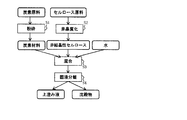
- FIG. 1A is a flowchart of an example of a method for producing a water-soluble saccharide according to one embodiment.
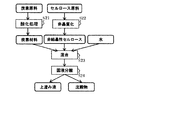
- FIG. 1B is a flowchart of another example of the method for producing a water-soluble saccharide according to one embodiment.
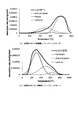
- FIG. 2 shows the measurement result of the desorbed gas amount by the thermal desorption method and the fitting result by the Gaussian function after the peak separation in Example 1, (a) is the result of CO, and (b) is the result of CO. Is the result of CO 2 .
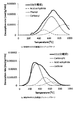
- FIG. 3 shows the measurement result of the desorbed gas amount by the temperature programmed desorption method and the fitting result by the Gaussian function after the peak separation in Example 2, (a) is the result of CO, and (b) is the result of CO.
- FIG. 4 shows the measurement result of the desorbed gas amount by the thermal desorption method and the fitting result by the Gaussian function after the peak separation for Comparative Example 3, where (a) is the result of CO and (b) Is the result of CO 2 .
- FIG. 5 shows the measurement result of the desorbed gas amount by the thermal desorption method and the fitting result by the Gaussian function after the peak separation for Comparative Example 4, (a) is the result of CO, and (b) is the result of CO. Is the result of CO 2 .
- FIG. 5 shows the measurement result of the desorbed gas amount by the thermal desorption method and the fitting result by the Gaussian function after the peak separation for Comparative Example 4, (a) is the result of CO, and (b) is the result of CO. Is the result of CO 2 .
- FIGS. 7A and 7B show the measurement results of the desorbed gas amount by the thermal desorption method and the fitting results by the Gaussian function after the peak separation for Example 4, where FIG. 7A shows the results of CO and FIG. Is the result of CO 2 .
- FIG. 8 shows the measurement result of the desorbed gas amount by the thermal desorption method and the fitting result by the Gaussian function after the peak separation for Comparative Example 8, (a) is the result of CO, and (b) is the result of CO.
- FIG. 9 shows the measurement result of the desorbed gas amount by the temperature-programmed desorption method and the fitting result by the Gaussian function after the peak separation for Example 5, (a) is the result of CO, and (b) is the result of CO. Is the result of CO 2 .
- the hydrolysis catalyst is a hydrolysis catalyst for hydrolyzing polysaccharides contained in a biomass material, and is a functional group that releases CO at 500 ° C. to 700 ° C. by a thermal desorption method. Is a carbon material having a phenolic hydroxyl group equivalent of 0.4 mmol / g or more.
- This hydrolysis catalyst can promote the hydrolysis reaction of the polysaccharide contained in the biomass material. Since this hydrolysis catalyst has high catalytic activity, the hydrolysis catalyst and the polysaccharide are separately added to water without mixing and grinding before adding the hydrolysis catalyst and the polysaccharide to water. Can be used, and the process can be simplified. By using this hydrolysis catalyst, the hydrolysis reaction can be promoted without using an acid catalyst or an enzyme catalyst.
- a plant biomass material can be preferably used as the biomass material.
- Vegetable biomass materials are broadly classified into pulp and lignin, and pulp is further broadly classified into cellulose and hemicellulose.
- the polysaccharides contained in the biomass material are mainly cellulose, hemicellulose, starch, pectin and the like.
- This hydrolysis catalyst can be used for the hydrolysis reaction of these polysaccharides, and is particularly suitable for the hydrolysis reaction of cellulose.
- Cellulose contained in biomass materials is often contained as water-insoluble crystalline cellulose. By making this crystalline cellulose amorphous, amorphous cellulose can be obtained. Hydrolysis using this non-crystalline cellulose makes it possible to efficiently obtain a low-molecular-weight cellulose decomposed product of 3 to 6 saccharides such as cellulose, cellobiose, and glucose.
- Hydrolysis catalyst As the hydrolysis catalyst, a carbon material having a functional group capable of releasing CO at 500 ° C. to 700 ° C. by a thermal desorption method at 0.4 mmol / g or more in terms of a phenolic hydroxyl group can be used.
- the amount of the functional group capable of releasing CO at 500 ° C. to 700 ° C. by the temperature-programmed desorption method of the carbon material is preferably 0.6 mmol / g or more, more preferably 0.8 mmol / g or more in terms of phenolic hydroxyl group. More preferably, it is 1.0 mmol / g or more.
- the amount of the functional group capable of releasing CO at 500 ° C. to 700 ° C. by the temperature-programmed desorption method of the carbon material is not limited to this in terms of phenolic hydroxyl group, but is preferably 5.0 mmol / g or less.
- the phenolic hydroxyl equivalent amount of the functional group capable of desorbing CO at a temperature of 500 ° C. to 700 ° C. by the thermal desorption method is obtained by raising the desorption amount of CO gas from the carbon material by the temperature desorption method. It can be determined by measuring the temperature, separating a Gaussian function having a peak around 500 ° C. to 700 ° C. from the measurement result of the CO gas desorption amount, and integrating the Gaussian function. The measurement of the amount of CO gas desorbed by the thermal desorption method can be performed, for example, in a temperature range from room temperature to 1000 ° C.
- the Gaussian function having a peak around 500 ° C. to 700 ° C. after the separation mainly includes the amount of CO eliminated from the phenolic hydroxyl group. The details can be measured according to the procedure of the example.
- a carbon material having a functional group capable of releasing CO 2 at 100 ° C. to 450 ° C. by a temperature-programmed desorption method in an amount of 0.1 mmol / g or more in terms of a carboxy group is used.
- the amount of the functional group capable of releasing CO 2 at 100 ° C. to 450 ° C. by the temperature-programmed desorption method of the carbon material is preferably 0.3 mmol / g or more, more preferably 0.5 mmol / g or more in terms of carboxy group. It is more preferably at least 0.7 mmol / g.
- the amount of the functional group capable of releasing CO 2 at 100 ° C. to 450 ° C. by the temperature-programmed desorption method of the carbon material is not limited to this in terms of carboxy group, but is preferably 3.0 mmol / g or less.
- the amount of a carboxy group converted into a functional group capable of desorbing CO 2 at 100 ° C. to 450 ° C. by a thermal desorption method is determined by increasing the desorption amount of CO 2 gas from the carbon material by a thermal desorption method. It can be determined by measuring the temperature and temperature, separating a Gaussian function having a peak around 100 ° C. to 450 ° C. from the measurement result of the amount of desorbed CO 2 gas, and integrating the Gaussian function. The measurement of the amount of CO 2 desorbed by the thermal desorption method can be performed, for example, in a temperature range from room temperature to 1000 ° C.
- the Gaussian function having a peak around 100 ° C. to 450 ° C. after the separation mainly includes the amount of CO eliminated from the carboxy group. The details can be measured according to the procedure of the example.
- the amount of the functional group capable of desorbing CO 2 at 100 ° C. to 450 ° C. by the thermal desorption method in terms of carboxy group is determined by converting the functional group capable of desorbing CO at 500 ° C. to 700 ° C. by the thermal desorption method to phenolic It is preferable that the amount is smaller than the amount converted to hydroxyl groups.
- the function of adsorbing the functional group that releases CO at 500 ° C. to 700 ° C. from the floating cellulose by the above-mentioned temperature-programmed desorption method is obtained. It does not hinder, thus preventing a decrease in the cellulose to be hydrolyzed.
- the degassing amount by the temperature-programmed desorption method will be described in detail later, for example, it can be obtained by analyzing the degassing gas when the sample is heated and heated in a helium gas flow using a gas chromatograph. .
- the carbon material is a material mainly containing carbon (C), and may be either a crystalline carbon material or an amorphous carbon material.
- the type of the carbon material is not particularly limited, and examples thereof include natural graphite, artificial graphite, easily graphitizable carbon (soft carbon), non-graphitizable carbon, carbon black, and a porous carbon material. These carbon materials may be used alone or in combination of two or more.
- the functional group that releases CO at a temperature of 500 ° C. to 700 ° C. by a temperature rising desorption method of a carbon material is preferably contained in the surface layer of the carbon material. It is preferable that the functional group that releases CO at 500 ° C. to 700 ° C. by the temperature rising desorption method of the carbon material be contained more in the surface layer than in the center of the carbon material. In addition, the functional group that releases CO at a temperature of 500 ° C. to 700 ° C. by the temperature-programmed desorption method of the carbon material may be entirely contained in the surface layer of the carbon material and hardly contained in the center of the carbon material. preferable.
- the functional group that releases CO 2 at 100 ° C. to 450 ° C. by the temperature rising desorption method of the carbon material is preferably included in the surface layer of the carbon material. It is preferable that the functional group which releases CO 2 at 100 ° C. to 450 ° C. by the temperature-programmed desorption method of the carbon material is contained more in the surface layer than in the center of the carbon material. In addition, the entire amount of the functional group that releases CO 2 at 100 ° C. to 450 ° C. by the temperature-programmed desorption method of the carbon material is included in the surface layer of the carbon material and hardly contained in the center of the carbon material. Is preferred.
- the carbon material may include other elements other than carbon and oxygen.
- the total amount of the impurity elements is preferably limited to 10% by mass or less, more preferably 5% by mass or less, based on the total number of atoms of the carbon material.
- sulfur derived from sulfuric acid and phosphorus derived from phosphoric acid are each preferably 5% by mass or less, more preferably 1% by mass or less, and still more preferably 0.1% by mass or less, based on the total number of atoms of the carbon material.
- the ratio of each atom can be determined by quantitative analysis using an organic trace element analyzer.
- the carbon material is preferably a particulate solid catalyst in order to react with the polysaccharide in water.
- the particle shape may be spherical, crushed, scale-like, flake-like, or the like.
- the average particle size of the carbon material varies depending on the type of the raw material of the carbon material, but is preferably 10 nm or more, and more preferably 20 nm or more.
- the average particle size of the carbon material is preferably 200 nm or less.
- the average particle diameter of the carbon material can be determined by observing the carbon material with a scanning electron microscope (SEM), measuring the major axis of particles observed in a region of 1000 nm ⁇ 1000 nm, and calculating the average value. .
- SEM scanning electron microscope
- the carbon material according to one embodiment is not limited to those manufactured by the following manufacturing method.
- An example of a method for producing a carbon material includes a step of pulverizing a carbon raw material to produce a carbon material.
- the carbon material include natural graphite, artificial graphite, graphitizable carbon (soft carbon), non-graphitizable carbon, carbon black, and a porous carbon material. These carbon raw materials can be used alone or in combination of two or more.
- a pulverizing method for example, a ball mill such as a rotary mill, a vibration mill, and a planetary mill, a jet mill, a roller mill, a hammer mill, a pin mill, a disk mill, and the like can be used.
- a ball mill can be used as a pulverizing method for directly hitting the carbon material so as to crush the crystal structure of the carbon material using a carbon material having crystallinity.
- a carbon material having a graphite crystal structure is used as the carbon material, the use of a ball mill allows the graphite layer to be peeled off and the carbon material to be further refined to obtain catalytic activity.
- the pulverization time of the carbon raw material may be appropriately set according to the type, particle size, and pulverization method of the carbon raw material, but the pulverization time is preferably from 30 to 480 minutes, more preferably from 100 to 200 minutes.
- the pulverization of the carbon raw material may be performed by either a dry method or a wet method, but is preferably performed by a dry method.
- a dry method since the carbon raw material does not come into contact with the solvent, it is possible to prevent the carbon raw material from containing impurities and to omit the step of removing the solvent.
- Dry pulverization is performed in an air atmosphere, and at the stage where the carbon raw material is refined, oxygen in the air, moisture, or a combination thereof contacts the carbon raw material, and the carbon raw material contains oxygen. Groups will be introduced. Dry pulverization can be performed in an inert atmosphere such as a nitrogen atmosphere or an Ar atmosphere in addition to the air atmosphere.
- the surface of the carbon material pulverized under an inert atmosphere is in an active state, and after being pulverized, oxygen is supplied from the air to the carbon material by being opened to the atmosphere, and the surface of the carbon material contains oxygen. It is believed that a functional group will be introduced.
- the amount of the functional group of the carbon material can be adjusted.
- an argon gas, a nitrogen gas, a helium gas, or the like can be used.
- an argon gas is preferable from the viewpoint of promoting the elimination of the functional group.
- Another example of the method for producing a carbon material includes a step of producing a carbon material by oxidizing a carbon raw material.
- the carbon material include natural graphite, artificial graphite, easily graphitizable carbon (soft carbon), non-graphitizable carbon, carbon black, and a porous carbon material. These carbon raw materials can be used alone or in combination of two or more.
- the oxidation treatment can be performed, for example, by immersing the carbon material in an oxidizing liquid, exposing the carbon material to an oxidizing gas, or the like. From the viewpoint that more functional groups can be modified on the surface, oxidation treatment by immersion in an oxidizing liquid is preferable.
- nitric acid As the oxidizing liquid, nitric acid, hydrochloric acid, sulfuric acid and the like can be used. It is preferable to use nitric acid as the oxidizing liquid from the viewpoint that the use of sulfuric acid increases the burden on the environment and that the modification of functional groups is not sufficient with hydrochloric acid. From the viewpoint that more functional groups can be obtained, the higher the concentration of the oxidizing liquid, the better.
- the nitric acid concentration is preferably 40% by mass or more, more preferably 50% by mass or more.
- the oxidizing liquid is preferably heated.
- the temperature for immersion in the oxidizing liquid is preferably 50 ° C. or higher, more preferably 60 ° C. or higher.
- the temperature of the oxidizing liquid is preferably 100 ° C. or lower, more preferably 95 ° C. or lower, from the viewpoint of suppressing evaporation of the oxidizing liquid during immersion.
- the temperature of the oxidizing liquid can be further raised from 100 ° C.
- the carbon raw material can be oxidized by putting the carbon raw material in the oxidizing liquid and maintaining the carbon raw material at a predetermined temperature for a predetermined time.
- the retention time depends on the type, concentration, and temperature of the oxidizing liquid, but is preferably about 1 hour to 36 hours.
- the oxidizing liquid can be stirred while the carbon material is being oxidized in the oxidizing liquid.
- the carbon material is separated and collected by filtration, centrifugation, etc., and the oxidizing liquid is thoroughly washed and removed with pure water, etc., and dried to introduce a carbon material with a functional group containing oxygen on the surface. Can be obtained.
- An example of a method for producing a water-soluble saccharide includes a method for producing a water-soluble saccharide from a polysaccharide contained in a biomass material using the above-described hydrolysis catalyst.
- the hydrolysis reaction is performed in the presence of the polysaccharide, the hydrolysis catalyst, and water to produce a water-soluble saccharide.
- Polysaccharides contained in the biomass material include, for example, cellulose, hemicellulose, starch, pectin, and the like.
- Water-soluble saccharides produced from polysaccharides by this method include, for example, 3 to 6 saccharides such as cellulose, cellobiose, and glucose.
- One example of a method for producing a water-soluble saccharide includes adding a hydrolysis catalyst and non-crystalline cellulose to water and mixing them.
- the step of mixing and grinding the carbon material and the non-crystalline cellulose in advance can be omitted.
- the carbon material has the above-mentioned properties, a sufficient catalytic action for hydrolyzing the amorphous cellulose can be obtained.
- the non-crystalline cellulose is hydrolyzed to obtain a decomposed product of about 6 or less saccharides.
- the obtained cellulose decomposition product include water-soluble saccharides such as cellulose of three to six saccharides, cellobiose, and glucose.
- the pH is preferably from 5 to 8, and more preferably from 6 to 7.
- the hydrolysis catalyst By using the hydrolysis catalyst, the hydrolysis reaction can be promoted even in the vicinity of neutrality, and the addition of acid or alkali can be eliminated.
- the amount of the carbon material is preferably 1% by mass or more, more preferably 5% by mass or more, based on the total amount of the non-crystalline cellulose and the carbon material. 10 mass% or more is more preferable. Further, the blending amount of the carbon material is preferably 20% by mass or less, more preferably 15% by mass or less, based on the total amount of the non-crystalline cellulose and the carbon material.
- the total amount of the non-crystalline cellulose and the carbon material is 0.1% by mass or more based on the total amount of the mixture containing the non-crystalline cellulose, the carbon material, and water. Is preferable, and 0.5 mass% or more is more preferable. In addition, the total amount of the non-crystalline cellulose and the carbon material is preferably 20% by mass or less, more preferably 10% by mass or less, based on the total amount of the mixture containing the non-crystalline cellulose, the carbon material, and water.
- the hydrolysis reaction can be further advanced by heating, stirring, or a combination thereof, if necessary.
- the heating temperature is preferably from 100 ° C to 250 ° C, more preferably from 150 to 200 ° C.
- the heating time is preferably from 10 to 1920 minutes, more preferably from 30 to 480 minutes. The heating time needs to be optimally adjusted according to the heating temperature, and the lower the heating temperature, the longer the heating time tends to be preferably.
- the non-crystalline cellulose is decomposed to produce a water-soluble saccharide.
- the reaction system is subjected to solid-liquid separation using filtration, centrifugation, or the like, and the water-soluble saccharide can be recovered from the separated liquid.
- the separated solid content contains undecomposed cellulose and carbon material.
- the carbon material contained in the solid content when the crystalline cellulose and the carbon material are added to water, the solid content can be further used.
- the unresolved cellulose contained in the solid content is recycled, so that the hydrolysis reaction can proceed.
- An example of the above-described method for producing a water-soluble saccharide can further include a step of producing amorphous cellulose by making crystalline cellulose amorphous.
- a method for making the crystalline cellulose amorphous include a pulverization treatment and an acid treatment. Above all, pulverization is preferred because the efficiency of amorphization is high and waste liquid treatment is unnecessary. It is preferable that the amorphous cellulose becomes amorphous cellulose in which the crystallinity of the crystalline cellulose is reduced by the amorphization.
- the non-crystalline cellulose preferably has no diffraction peak from cellulose crystals observed by X-ray diffraction analysis.
- FIG. 1A shows a flowchart of an example of a method for producing a water-soluble saccharide.
- a step of pulverizing a carbon material to obtain a carbon material (S1) a step of amorphizing a cellulose material to obtain non-crystalline cellulose (S2), adding a carbon material and non-crystalline cellulose to water And a mixing step (S3) and a solid-liquid separation step (S4).
- the supernatant liquid after solid-liquid separation contains the water-soluble saccharide after hydrolysis, and the precipitate contains undegraded cellulose and carbon materials. This precipitate can be recycled by re-entering the heating and stirring step.
- FIG. 1A shows a flowchart of an example of a method for producing a water-soluble saccharide.
- FIG. 1B shows a flowchart of another example of the method for producing a water-soluble saccharide.
- the flowchart shown in FIG. 1B includes a step (S21) of obtaining a carbon material by oxidizing a carbon raw material, and the other steps can be performed in the same manner as the flowchart shown in FIG. 1A.
- Another example of a method for producing a water-soluble saccharide includes a step of adding a hydrolysis catalyst and a polysaccharide contained in a biomass material to water.
- the polysaccharide contained in the biomass material is cellulose
- the method may further include a step of extracting cellulose from the biomass material.
- the cellulose may be crystalline cellulose, non-crystalline cellulose, or a mixture thereof.
- the polysaccharide contained in the biomass material is cellulose, and a step of extracting crystalline cellulose from the biomass material and amorphizing the crystalline cellulose before adding the crystalline cellulose to water is further performed.
- the carbon material and the cellulose component are separately pulverized and then mixed.However, the carbon material and the cellulose component are simultaneously mixed and pulverized, and then water is added thereto for hydrolysis. Good.
- ⁇ Evaluation method> (Degassing analysis by thermal desorption method)
- the functional group of the carbon material was quantitatively analyzed by thermal desorption analysis in a helium stream using a thermal desorption method.
- 100 mg of a carbon material was set in a glass tube, and a helium gas was flowed at a flow rate of 200 mL / min, and the carbon material was heated with a heater from the outside of the glass tube so that the heating rate was 5 ° C./min. .
- the measurement temperature was from room temperature to 1000 ° C. Since the functional group desorbed with the temperature rise becomes CO gas and / or CO 2 gas and flows out of the glass tube together with helium, this component was analyzed using a Varian gas chromatograph “Micro GC CP-4900”. .
- Method for calculating the amount of functional group It is difficult to determine the type and amount of the functional group only from the degassing measurement result by the thermal desorption method. This is because the desorption temperature range also changes depending on the difference in the fine structure, crystal structure, pores, and the like of the carbon material. Therefore, in order to specify the type of the functional group, it is common to use infrared spectroscopy or X-ray photoelectron spectroscopy in addition to the above-mentioned thermal desorption method. However, since the purpose is not to specify a functional group here, the functional group of the carbon material was estimated by the following means, and the amount was calculated.
- Phenolic hydroxyl group 500 ° C to 700 ° C (CO)
- Carboxy group 100 ° C to 450 ° C (CO 2 )
- Carbonyl group 700 ° C to 1000 ° C (CO)
- Acid anhydride 400 ° C. to 600 ° C. (CO + CO 2 )
- Lactone group 600 ° C to 800 ° C (CO 2 )
- the desorption temperature has a wide range because the bonding state of the functional groups differs depending on the fine structure, crystal structure, pores, etc. of the carbon material, and furthermore, the atmosphere gas type, pressure, flow rate, etc. during heating are different. . Therefore, the type of the functional group is not specified, and is treated as a functional group that desorbs gas in the above temperature range. Further, for quantification of each functional group, a peak was separated by fitting using a Gaussian function in each temperature range of the desorption temperature of each functional group.
- FIG. 2 shows the measurement results of degassing of CO and CO 2 by the thermal desorption method and the fitting and peak separation results by the Gaussian function in Example 1.
- the amount of desorbed CO with respect to the temperature increase is indicated by a thick line.
- the measurement data of the amount of CO desorbed is separated into the following three Gaussian functions, which are also shown in FIG. a1) Gaussian function having a peak around 500 ° C. to 700 ° C .: derived from a phenolic hydroxyl group or the like (the thin solid line in the figure).
- a1 For the Gaussian function having a peak around 500 ° C. to 700 ° C. (the thin solid line in the figure), the numerical value integrated over the entire temperature range is described as “the phenolic hydroxyl group of the functional group that releases CO at 500 ° C. to 700 ° C. Conversion amount (mmol / g) ".
- the integrated value of the entire temperature range of the Gaussian function having a peak around 400 ° C. to 600 ° C. is b2) of the following FIG. Equivalent to the integrated value.
- the amount of CO 2 desorbed with respect to the temperature increase is indicated by a thick line.
- the measurement data of the amount of CO 2 desorbed is separated into the following three Gaussian functions, which are also shown in FIG. b1) Gaussian function having a peak around 100 ° C. to 450 ° C .: derived from a carboxy group or the like (the thin solid line in the figure).
- FIGS. 3 to 5 show the measurement results of degassing of CO and CO 2 by the thermal desorption method and the fitting and peak separation results by the Gaussian function in Example 2 and Comparative Examples 3 and 4.
- the details are the same as in the first embodiment.
- FIG. 4 there is a fitting curve that cannot be confirmed because it overlaps with the horizontal axis.
- Example 7 Comparative Example 7, Comparative Example 8, and Example 5
- the results of degassing measurement of CO and CO 2 by the thermal desorption method, the fitting by Gaussian function and the results of peak separation are shown in FIGS. 6 to 9.
- the details are the same as in the first embodiment.
- FIG. 8 there is a fitting curve that cannot be confirmed by overlapping the horizontal axis.
- the amount of each functional group was determined in the same manner in other Examples and Comparative Examples.
- Cellulose water-solubility (mass%) ⁇ (mass of charged carbon material and cellulose (g)) ⁇ (mass of solid residue after hydrolysis (g)) ⁇ / (mass of charged carbon material and cellulose (g)) ) ⁇ 100
- the water-soluble components contained in the filtrate separated in the filtration step for measuring the cellulose water-solubility were analyzed by high performance liquid chromatography (HPLC).
- ⁇ Production Example> (Comparative Example 1) As a benchmark for evaluating the catalytic activity, a catalytic activity evaluation process was performed using an example in which no carbon material serving as a catalyst was used, that is, using only cellulose, and the water solubility and the generation rate of decomposition products due to thermal decomposition of cellulose were evaluated. 1.25 g of commercially available microcrystalline cellulose (Avicel PH-101, manufactured by Sigma-Aldrich) is put into a 45 mL zirconia pot together with 50 g of 55 mm zirconia balls, and dry-ground with a planetary ball mill at 500 rpm for 120 minutes to prepare ground cellulose. did.
- Avicel PH-101 manufactured by Sigma-Aldrich
- the diffraction peak from the cellulose crystals was not observed in the cellulose after pulverization, and it was confirmed that the cellulose was amorphous and noncrystalline cellulose.
- 0.324 g of the pulverized cellulose and 40 g of purified water were sealed in a Teflon (registered trademark) container, and the Teflon (registered trademark) container was further placed in a stainless steel pressure-resistant container. While stirring at 600 rpm, the water in the Teflon (registered trademark) container was heated with a heater such that the temperature of the water became 180 ° C. Natural cooling was started 60 minutes after reaching 180 ° C. The highest temperature reached during this period was 181 ° C.
- the mixture of the solution and the solid substance in the Teflon (registered trademark) container was subjected to reduced pressure filtration (suction filtration) using a 0.1-micron hydrophilic membrane filter, and the water-soluble components passed through the filter and on the filter. And the remaining solids. After the solid content was sufficiently dried at 120 ° C., the dry weight was measured, and the water solubility of the cellulose was calculated. As a result, 33% by mass of the cellulose was water-soluble. When the water-soluble component was subjected to component analysis by HPLC, 12.0% by mass of glucose was obtained. This example is a benchmark when no carbon material is used as a catalyst.
- Example 1 Artificial graphite (manufactured by Osaka Gas Chemical Co., Ltd., product name “Gramax”) was used as a carbon raw material. 0.5 g of artificial graphite was put into a 45 mL zirconia pot together with 50 g of zirconia balls of 5 mm in diameter, and ground with a planetary ball mill at 500 rpm for 120 minutes to obtain a carbon material for catalyst 1. As a result of degassing analysis of the functional groups of the carbon material for catalyst 1 by a temperature-programmed desorption method, the functional group capable of desorbing CO at 500 ° C. to 700 ° C. had 2.2 mmol / g in terms of phenolic hydroxyl groups.
- I was Further, it has a functional group capable of releasing CO 2 at 100 ° C. to 450 ° C. in an amount of 0.7 mmol / g in terms of carboxy group, and the phenolic hydroxyl group of the functional group capable of releasing CO at 500 ° C. to 700 ° C.
- the converted amount was less than 2.2 mmol / g. 0.050 g of the carbon material for catalyst 1 described above and 0.324 g of the pulverized cellulose described in Comparative Example 1 were sealed in a Teflon (registered trademark) container together with 40 g of purified water, and further the Teflon (registered trademark) container was used.
- Teflon registered trademark
- the water in the Teflon (registered trademark) container was heated with a heater such that the temperature of the water became 180 ° C. Natural cooling was started 60 minutes after reaching 180 ° C. The highest temperature reached during this period was 181 ° C.
- the mixture of the solution and the solid substance in the Teflon (registered trademark) container was subjected to reduced pressure filtration (suction filtration) using a 0.1-micron hydrophilic membrane filter, and the water-soluble components passed through the filter and on the filter. And the remaining solids.
- the solid content was sufficiently dried at 120 ° C., and the dry weight was measured to calculate the water solubility of cellulose. As a result, the cellulose water solubility was 57% by mass, and the glucose production rate was 35.9% by mass. From these results, it was found that the carbon material for catalyst 1 was suitable as a catalyst for hydrolyzing cellulose.
- Example 2 The same artificial graphite as the carbon raw material of Example 1 was used without grinding as the carbon raw material. As a result of degassing analysis by a programmed temperature desorption method, almost no functional group capable of desorbing CO at 500 ° C. to 700 ° C. was detected, and the amount was 0.0 mmol / g in terms of phenolic hydroxyl group. No functional group capable of releasing CO 2 at 100 ° C. to 450 ° C. was detected, and the amount was 0.0 mmol / g in terms of carboxy groups.
- the mixture of the solution and the solid substance in the Teflon (registered trademark) container was subjected to reduced pressure filtration (suction filtration) using a 0.1-micron hydrophilic membrane filter, and the water-soluble components passed through the filter and on the filter. And the remaining solids.
- the dry weight was measured, and the water solubility of cellulose was calculated.
- the water solubility of cellulose was 33% by mass, the glucose production rate was 19.1% by mass, The catalytic activity for hydrolysis was found to be small.
- Example 2 As a carbon raw material, the carbon material for catalyst 1 used in Example 1 was further heat-treated at 500 ° C. in an argon atmosphere to adjust the amount of functional groups. 200 mg of the carbon material for catalyst 1 obtained in the same manner as in Example 1 was weighed and heated to 500 ° C. at a rate of 10 ° C./min in an argon gas flow at a flow rate of 200 mL / min. After holding for 1 hour, the mixture was gradually cooled to room temperature to obtain a carbon material 2 for a catalyst. After the collection, it was handled in an argon atmosphere using a glove box or the like.
- the functional material capable of releasing CO at 500 ° C. to 700 ° C. had 1.1 mmol / g in terms of phenolic hydroxyl group. Further, it has a functional group capable of releasing CO 2 at 100 ° C. to 450 ° C. in an amount of 0.1 mmol / g in terms of carboxy group, and the phenolic hydroxyl group of the functional group capable of releasing CO at 500 ° C. to 700 ° C. The converted amount was less than 1.1 mmol / g. Thus, it was found that the carbon material for catalyst 2 was suitable as a catalyst for hydrolyzing cellulose.
- Example 3 As a carbon raw material, the carbon material for catalyst 1 used in Example 1 was further heat-treated at 800 ° C. in an argon atmosphere to adjust the amount of functional groups. 200 mg of the carbon material for catalyst 1 obtained in the same manner as in Example 1 was weighed and heated to 800 ° C. at a rate of 10 ° C./min in an argon gas flow at a flow rate of 200 mL / min. After holding for 1 hour, the mixture was gradually cooled to room temperature to obtain MA-Gra800. After the collection, it was handled in an argon atmosphere using a glove box or the like.
- the mixture of the solution and the solid substance in the Teflon (registered trademark) container was subjected to reduced pressure filtration (suction filtration) using a 0.1-micron hydrophilic membrane filter, and the water-soluble components passed through the filter and on the filter. And the remaining solids.
- the dry weight was measured, and the water solubility of cellulose was calculated.
- the water solubility of cellulose was 33% by mass, the glucose production rate was 19.1% by mass, The catalytic activity for hydrolysis was found to be small.
- Example 3 The same flaky natural graphite (manufactured by Nippon Graphite Industry Co., Ltd., product name "CPB") as in Comparative Example 5 was used as a carbon raw material, and pulverized. 0.5 g of flaky natural graphite was placed in a 45 mL zirconia pot together with 50 g of zirconia balls of 5 mm in diameter, and pulverized with a planetary ball mill at 500 rpm for 120 minutes to obtain a carbon material for catalyst 3. As a result of degassing analysis of the functional group of the carbon material for catalyst 3 by a temperature-programmed desorption method, it was found that the functional group capable of releasing CO at 500 ° C. to 700 ° C.
- the catalytic activity of the catalytic carbon material 3 was evaluated in the same manner as in Example 1. As a result, the cellulose water-solubilization rate was 58% by mass and the glucose production rate was 35.7% by mass, and it was found that the carbon material for catalyst 3 had catalytic activity for hydrolysis of cellulose. Thus, it was found that the carbon material for catalyst 3 was suitable as a catalyst for hydrolyzing cellulose.
- the mixture of the solution and the solid substance in the Teflon (registered trademark) container was subjected to reduced pressure filtration (suction filtration) using a 0.1-micron hydrophilic membrane filter, and the water-soluble components passed through the filter and on the filter. And the remaining solids.
- reduced pressure filtration suction filtration
- the dry weight was measured, and the water solubility of cellulose was calculated.
- the water solubility of cellulose was 29% by mass, and the glucose production rate was 16.3% by mass.
- the catalytic activity for hydrolysis was found to be small.
- Example 4 The same carbon black as that of Comparative Example 7 (N234 manufactured by Asahi Carbon Co., Ltd.) was used as a carbon raw material. 1 g of a carbon material and 200 mL of nitric acid adjusted to a concentration of 60% by mass were put in a glass flask, and the mixture was kept at 80 ° C. for 8 hours while stirring at 500 rpm using a stirrer and an oil bath. After cooling, the mixture was filtered under reduced pressure (suction filtration) using a 1-micron hydrophilic membrane filter, and the solid content remaining on the filter was sufficiently dried at 150 ° C. to obtain a carbon material for catalyst N-N234.
- the functional groups capable of releasing CO at 500 ° C. to 700 ° C. were 1.2 mmol / g in terms of phenolic hydroxyl groups. Had. Further, it has a functional group capable of releasing CO 2 at 100 ° C. to 450 ° C. as 0.6 mmol / g in terms of carboxy group, and the phenolic hydroxyl group of the functional group capable of releasing CO at 500 ° C. to 700 ° C.
- the conversion amount was less than 1.2 mmol / g.
- the mixture of the solution and the solid substance in the Teflon (registered trademark) container was subjected to reduced pressure filtration (suction filtration) using a 0.1-micron hydrophilic membrane filter, and the water-soluble components passed through the filter and on the filter. And the remaining solids.
- the solid content was sufficiently dried at 120 ° C., the dry weight was measured, and the water solubility of cellulose was calculated. As a result, the cellulose water solubility was 52% by mass, and the glucose production rate was 36.8% by mass. From these results, it was found that the catalyst carbon material NN234 was suitable as a catalyst for hydrolyzing cellulose.
- the mixture of the solution and the solid substance in the Teflon (registered trademark) container was subjected to reduced pressure filtration (suction filtration) using a 0.1-micron hydrophilic membrane filter, and the water-soluble components passed through the filter and on the filter. And the remaining solids.
- the solid content was sufficiently dried at 120 ° C., and the dry weight was measured to calculate the water solubility of cellulose.
- the water solubility of cellulose was 33% by mass, and the glucose production rate was 18.9% by mass.
- the catalytic activity for hydrolysis was found to be small.
- Example 5 The same carbon black KB as in Comparative Example 8 was used as a carbon raw material. 1 g of a carbon material and 200 mL of nitric acid adjusted to a concentration of 60% by mass were put in a glass flask, and the mixture was kept at 80 ° C. for 8 hours while stirring at 500 rpm using a stirrer and an oil bath. After cooling, the mixture was filtered under reduced pressure (suction filtration) using a 1-micron hydrophilic membrane filter, and the solid content remaining on the filter was sufficiently dried at 150 ° C. to obtain a carbon material for catalyst N-KB.
- the functional group capable of releasing CO at 500 ° C. to 700 ° C. was found to be 2.2 mmol / g in terms of phenolic hydroxyl group. Had. Further, it has a functional group capable of releasing CO 2 at 100 ° C. to 450 ° C. as 1.3 mmol / g in terms of carboxy group, and the phenolic hydroxyl group of the functional group capable of releasing CO at 500 ° C. to 700 ° C. The converted amount was less than 2.2 mmol / g.
- the mixture of the solution and the solid substance in the Teflon (registered trademark) container was subjected to reduced pressure filtration (suction filtration) using a 0.1-micron hydrophilic membrane filter, and the water-soluble components passed through the filter and on the filter. And the remaining solids.
- the solid content was sufficiently dried at 120 ° C., and the dry weight was measured to calculate the water solubility of cellulose. As a result, the water solubility of cellulose was 54% by mass, and the glucose production rate was 39.8% by mass. From these results, it was found that the carbon material for catalyst N-KB was suitable as a catalyst for hydrolyzing cellulose.
- the mixture of the solution and the solid substance in the Teflon (registered trademark) container was subjected to reduced pressure filtration (suction filtration) using a 0.1-micron hydrophilic membrane filter, and the water-soluble components passed through the filter and on the filter. And the remaining solids.
- the solid content was sufficiently dried at 120 ° C., and the dry weight was measured to calculate the water solubility of cellulose.
- the water solubility of cellulose was 39% by mass and the glucose production rate was 17.4% by mass.
- the catalytic activity for hydrolysis was found to be small.
- Example 6 The same carbon black SB935 as in Comparative Example 9 was used as a carbon raw material. 1 g of a carbon material and 200 mL of nitric acid adjusted to a concentration of 60% by mass were put in a glass flask, and the mixture was kept at 80 ° C. for 8 hours while stirring at 500 rpm using a stirrer and an oil bath. After cooling, the mixture was filtered under reduced pressure (suction filtration) using a 1-micron hydrophilic membrane filter, and the solid content remaining on the filter was sufficiently dried at 150 ° C. to obtain a carbon material for catalyst N-SB935.
- the functional group capable of releasing CO at 500 ° C. to 700 ° C. was 1.3 mmol / g in terms of phenolic hydroxyl group. Had. Further, it has a functional group capable of releasing CO 2 at 100 ° C. to 450 ° C. as 0.6 mmol / g in terms of carboxy group, and the phenolic hydroxyl group of the functional group capable of releasing CO at 500 ° C. to 700 ° C. The conversion amount was less than 1.3 mmol / g.
- a carbon material can be provided as a catalyst capable of hydrolyzing polysaccharides such as cellulose derived from biomass materials such as herbs without using a liquid acid and an enzyme.
Landscapes
- Chemical & Material Sciences (AREA)
- Organic Chemistry (AREA)
- Life Sciences & Earth Sciences (AREA)
- Biochemistry (AREA)
- Engineering & Computer Science (AREA)
- Health & Medical Sciences (AREA)
- General Health & Medical Sciences (AREA)
- Molecular Biology (AREA)
- Biotechnology (AREA)
- Genetics & Genomics (AREA)
- Materials Engineering (AREA)
- Chemical Kinetics & Catalysis (AREA)
- Medicinal Chemistry (AREA)
- Polymers & Plastics (AREA)
- Emergency Medicine (AREA)
- Analytical Chemistry (AREA)
- Crystallography & Structural Chemistry (AREA)
- Catalysts (AREA)
- Low-Molecular Organic Synthesis Reactions Using Catalysts (AREA)
- Polysaccharides And Polysaccharide Derivatives (AREA)
Abstract
バイオマス材料に含まれる多糖類を加水分解するための加水分解用触媒であって、昇温脱離法により500℃~700℃でCOを脱離する官能基を、フェノール性水酸基換算で0.4mmol/g以上で有する炭素材料である、加水分解用触媒である。
Description
本発明の一実施形態は、加水分解用触媒及び水溶性糖類の製造方法に関する。
セルロースから糖を生産するプロセスは、再生可能なバイオマスのエネルギー転換や化学品合成を包括するバイオリファイナリ体系の中で、非可食性バイオマスプロセスとして、持続可能な社会を実現する上で重要な役割を担う。化学産業において重要な化合物である5-ヒドロキシメチルフルフラール、レブリン酸、2,5-ジメチルフラン等は、グルコースから作製することが可能である。そのため、セルロースを加水分解してグルコースを作製する触媒の開発は、工業上、非常に重要である。
バイオマスの糖化プロセスに酵素触媒を使う酵素糖化法は、古くから行われている方法であり、反応条件がマイルドで反応を制御しやすい。しかし、酵素の値段が高く、プロセスの経済性が損なわれるデメリットがある。一方で、酸(主に硫酸)によるバイオマス分解もよく行われている方法であり、硫酸は安価であり反応速度は速いが、使用済み硫酸の処理など環境負荷が大きいという問題点がある。また、生成した糖類との分離が困難で繰返し利用ができないため、環境負荷が大きな問題となっている。廃硫酸は、石膏に固定化して廃棄されている。
これらに対し、固体酸によるバイオマスの糖化は、環境負荷を低減できるとともに繰り返し利用が可能で、酵素触媒よりも低コストが期待されている。固体酸が硫酸並みの活性を持ち、長寿命(高繰り返し耐性)ならば、次世代のバイオマス糖化法として大いに期待が持てる。
セルロースを加水分解してグルコースを生成するための触媒として、炭素系固体触媒が盛んに研究されている。炭素系固体触媒として、比表面積が大きく、官能基密度の高い、酸化グラフェンが有力な候補の一つであるが、酸化グラフェンは、その径が数十nmから数百nmと非常に小さいため、触媒反応後の溶液からの分離が困難である。非特許文献1には、酸化グラフェンに酸化鉄を結合させ、触媒反応後に磁力で分離する方法が記載されている。しかし、酸化グラフェンはそれ自体の製造に非常にコストがかかるため、量産レベルには適していない。
特許文献1には、有機物を炭化処理したカーボンをスルホン化処理したスルホン化カーボンを固体酸触媒として用いて、セルロースをイオン液体中で分解する方法が提案されている。特許文献1では、加水分解反応を促進するために、多孔性のスルホン化カーボンを用いることが提案されている。
しかし、スルホン化カーボンを作製するためには、そのプロセスの中で濃硫酸、発煙硫酸、またはスルフォニル酸等による酸化工程が必要であり、触媒製造工程で使用した硫酸等の廃棄処理に、大きな環境負荷が掛かることが懸念される。
しかし、スルホン化カーボンを作製するためには、そのプロセスの中で濃硫酸、発煙硫酸、またはスルフォニル酸等による酸化工程が必要であり、触媒製造工程で使用した硫酸等の廃棄処理に、大きな環境負荷が掛かることが懸念される。
特許文献2には、水蒸気や薬剤で賦活した活性炭と植物性バイオマスとを予め混合粉砕し、そのあと加水分解して、グルコースの重合度3~6のオリゴ糖を製造する方法が提案されている。
特許文献3には、バイオマスを炭化処理した炭化物と、バイオマス由来の多糖を予め混合粉砕した後に加水分解して、糖液を製造する方法が提案されている。
特許文献3には、バイオマスを炭化処理した炭化物と、バイオマス由来の多糖を予め混合粉砕した後に加水分解して、糖液を製造する方法が提案されている。
Chemical Engineering Journal, vol. 280, pp. 90-98 (2015)
炭化物などの触媒と分解対象物であるバイオマスとを予め混合粉砕しておくことは、この粉砕混合の工程に多大なエネルギーを要し、なおかつバッチ式処理であるため量産には向かない問題がある。また、分解液から固液分離した固体酸触媒を再利用する際にも再度粉砕混合の工程に戻す必要があるため、リサイクルによるコストダウンの期待が薄い。
特許文献2では、活性炭と植物性バイオマスとの接触を確保して反応性を向上させるために、水を添加する前に、活性炭と植物性バイオマスとを同時粉砕処理することが記載されている。特許文献2に記載の活性炭では、触媒活性作用が不十分であり、同時粉砕処理をしない場合は、加水分解反応を十分に促進することができない。また、特許文献2では、3~6糖類のオリゴ糖を目的物とするため、さらに加水分解反応を進めるためには、さらなる触媒活性が必要になる。
特許文献3では、バイオマスを炭化処理した炭化物と粉砕されたバイオマスとを水に添加する前に予め混合することで、接触効率を向上させ、水を添加してからの加水分解反応を促進することが記載されている。特許文献3の段落0060には、粉砕されたバイオマスに、未粉砕の炭化物及び水を混合することが記載されるが、具体的な方法、結果物の評価等は確認できてない。
炭素材料は、その表面にフェノール性水酸基、カルボキシ基等の官能基を有することで加水分解反応を促進させることができる。しかし、従来の活性炭、バイオマスを炭化処理した炭化物等では、表面への官能基の導入量が不十分であるため、活性炭とバイオマスとを同時粉砕することで、バイオマスとの接触を十分に確保し、触媒活性を高めている。また、スルホン化カーボンは表面処理されているため、スルホ基が主に導入されており、フェノール性水酸基、カルボキシ基等の導入量は少なくなる。また、酸化グラフェンは、分子構造が一般的な炭素材料と異なるため、特にフェノール性水酸基の導入量が少なくなる。
本発明の一目的としては、バイオマス材料に含まれる多糖類の加水分解反応を促進させる加水分解用触媒を提供することである。
本発明の一目的としては、バイオマス材料に含まれる多糖類の加水分解反応を促進させる加水分解用触媒を提供することである。
上記課題を達成するための具体的手段は以下の通りである。
[1]バイオマス材料に含まれる多糖類を加水分解するための加水分解用触媒であって、昇温脱離法により500℃~700℃でCOを脱離する官能基を、フェノール性水酸基換算で0.4mmol/g以上で有する炭素材料である、加水分解用触媒。
[2]前記昇温脱離法により500℃~700℃でCOを脱離する官能基は、前記炭素材料の表層部に含まれる、[1]に記載の加水分解用触媒。
[3]前記炭素材料は、昇温脱離法により100℃~450℃でCO2を脱離する官能基を有し、前記昇温脱離法により100℃~450℃でCO2を脱離する官能基の量は、カルボキシ基換算で0.1mmol/g以上であり、かつ、前記昇温脱離法により500℃~700℃でCOを脱離する官能基のフェノール性水酸基換算量より少ない、[1]又は[2]に記載の加水分解用触媒。
[4][1]から[3]のいずれかに記載の加水分解用触媒と、非結晶性セルロースとを水に添加し混合することを含む、水溶性糖類の製造方法。
[1]バイオマス材料に含まれる多糖類を加水分解するための加水分解用触媒であって、昇温脱離法により500℃~700℃でCOを脱離する官能基を、フェノール性水酸基換算で0.4mmol/g以上で有する炭素材料である、加水分解用触媒。
[2]前記昇温脱離法により500℃~700℃でCOを脱離する官能基は、前記炭素材料の表層部に含まれる、[1]に記載の加水分解用触媒。
[3]前記炭素材料は、昇温脱離法により100℃~450℃でCO2を脱離する官能基を有し、前記昇温脱離法により100℃~450℃でCO2を脱離する官能基の量は、カルボキシ基換算で0.1mmol/g以上であり、かつ、前記昇温脱離法により500℃~700℃でCOを脱離する官能基のフェノール性水酸基換算量より少ない、[1]又は[2]に記載の加水分解用触媒。
[4][1]から[3]のいずれかに記載の加水分解用触媒と、非結晶性セルロースとを水に添加し混合することを含む、水溶性糖類の製造方法。
本発明の一実施形態によれば、バイオマス材料に含まれる多糖類の加水分解反応を促進させる加水分解用触媒を提供することができる。
以下、本発明の一実施形態について説明するが、以下の例示によって本発明は限定されない。
一実施形態の加水分解用触媒は、バイオマス材料に含まれる多糖類を加水分解するための加水分解用触媒であって、昇温脱離法により500℃~700℃でCOを脱離する官能基を、フェノール性水酸基換算で0.4mmol/g以上を有する炭素材料である、ことを特徴とする。
この加水分解用触媒は、バイオマス材料に含まれる多糖類の加水分解反応を促進させることができる。この加水分解用触媒は、触媒活性が高いため、加水分解用触媒と多糖類とを水に添加する前に混合粉砕することなく、加水分解用触媒と多糖類とを別々に水に添加して用いることができ、工程を簡略化することができる。この加水分解用触媒を用いることで、酸触媒又は酵素触媒を用いることなく、加水分解反応を促進することができる。
この加水分解用触媒は、バイオマス材料に含まれる多糖類の加水分解反応を促進させることができる。この加水分解用触媒は、触媒活性が高いため、加水分解用触媒と多糖類とを水に添加する前に混合粉砕することなく、加水分解用触媒と多糖類とを別々に水に添加して用いることができ、工程を簡略化することができる。この加水分解用触媒を用いることで、酸触媒又は酵素触媒を用いることなく、加水分解反応を促進することができる。
バイオマス材料は、植物性バイオマス材料を好ましく用いることができる。植物性バイオマス材料は、パルプとリグニンに大きく分類され、パルプがさらにセルロースとヘミセルロースに大きく分類される。バイオマス材料に含まれる多糖類は、主にセルロース、ヘミセルロース、でんぷん、ペクチン等である。この加水分解用触媒は、これらの多糖類の加水分解反応に用いることができ、特に、セルロースの加水分解反応に適する。
バイオマス材料に含まれるセルロースは、水不溶性の結晶性セルロースとして含まれることが多い。この結晶性セルロースを非晶質化することで、非結晶性セルロースを得ることができる。この非結晶性セルロースを用いて加水分解することで、3~6糖類のセルロース、セロビオース、グルコース等の低分子量のセルロース分解物を効率よく得ることができる。
バイオマス材料に含まれるセルロースは、水不溶性の結晶性セルロースとして含まれることが多い。この結晶性セルロースを非晶質化することで、非結晶性セルロースを得ることができる。この非結晶性セルロースを用いて加水分解することで、3~6糖類のセルロース、セロビオース、グルコース等の低分子量のセルロース分解物を効率よく得ることができる。
(加水分解用触媒)
加水分解用触媒には、昇温脱離法により500℃~700℃でCOを脱離する官能基を、フェノール性水酸基換算で0.4mmol/g以上で有する炭素材料を用いることができる。
炭素材料が有する昇温脱離法により500℃~700℃でCOを脱離する官能基の量は、フェノール性水酸基換算で、0.6mmol/g以上が好ましく、0.8mmol/g以上がより好ましく、1.0mmol/g以上がさらに好ましい。これによって、炭素材料の表面の親水性及びセルロース吸着性が高まり、水中で分散している非水溶性セルロースと撹拌した際に浮遊しているセルロースをより吸着しやすくなり、セルロースの加水分解反応を促進することができる。
炭素材料が有する昇温脱離法により500℃~700℃でCOを脱離する官能基の量は、フェノール性水酸基換算で、これに限定されないが、5.0mmol/g以下が好ましい。
加水分解用触媒には、昇温脱離法により500℃~700℃でCOを脱離する官能基を、フェノール性水酸基換算で0.4mmol/g以上で有する炭素材料を用いることができる。
炭素材料が有する昇温脱離法により500℃~700℃でCOを脱離する官能基の量は、フェノール性水酸基換算で、0.6mmol/g以上が好ましく、0.8mmol/g以上がより好ましく、1.0mmol/g以上がさらに好ましい。これによって、炭素材料の表面の親水性及びセルロース吸着性が高まり、水中で分散している非水溶性セルロースと撹拌した際に浮遊しているセルロースをより吸着しやすくなり、セルロースの加水分解反応を促進することができる。
炭素材料が有する昇温脱離法により500℃~700℃でCOを脱離する官能基の量は、フェノール性水酸基換算で、これに限定されないが、5.0mmol/g以下が好ましい。
炭素材料において、昇温脱離法により500℃~700℃でCOを脱離する官能基のフェノール性水酸基換算量は、昇温脱離法によって炭素材料からのCOガスの脱離量を昇温温度に対して測定し、COガス脱離量の測定結果から500℃~700℃付近にピークを持つガウス関数を分離し、このガウス関数を積算することで求めることができる。
昇温脱離法によるCOガスの脱離量の測定は、例えば室温から1000℃までの温度範囲で行うことができる。
分離後の500℃~700℃付近にピークを持つガウス関数には、フェノール性水酸基から脱離したCO量が主に含まれる。
詳細については実施例の手順に従って測定することができる。
昇温脱離法によるCOガスの脱離量の測定は、例えば室温から1000℃までの温度範囲で行うことができる。
分離後の500℃~700℃付近にピークを持つガウス関数には、フェノール性水酸基から脱離したCO量が主に含まれる。
詳細については実施例の手順に従って測定することができる。
加水分解用触媒には、炭素材料が有する昇温脱離法により100℃~450℃でCO2を脱離する官能基を、カルボキシ基換算で0.1mmol/g以上で有する炭素材料を用いることが好ましい。
炭素材料が有する昇温脱離法により100℃~450℃でCO2を脱離する官能基の量は、カルボキシ基換算で、0.3mmol/g以上が好ましく、0.5mmol/g以上がより好ましく、0.7mmol/g以上がさらに好ましい。これによって、炭素材料の表面に吸着捕獲されたセルロースを加水分解する際の分解に寄与する酸点が多くなることで、セルロースの加水分解を促進することができる。
炭素材料が有する昇温脱離法により100℃~450℃でCO2を脱離する官能基の量は、カルボキシ基換算で、これに限定されないが、3.0mmol/g以下が好ましい。
炭素材料が有する昇温脱離法により100℃~450℃でCO2を脱離する官能基の量は、カルボキシ基換算で、0.3mmol/g以上が好ましく、0.5mmol/g以上がより好ましく、0.7mmol/g以上がさらに好ましい。これによって、炭素材料の表面に吸着捕獲されたセルロースを加水分解する際の分解に寄与する酸点が多くなることで、セルロースの加水分解を促進することができる。
炭素材料が有する昇温脱離法により100℃~450℃でCO2を脱離する官能基の量は、カルボキシ基換算で、これに限定されないが、3.0mmol/g以下が好ましい。
炭素材料において、昇温脱離法により100℃~450℃でCO2を脱離する官能基のカルボキシ基換算量は、昇温脱離法によって炭素材料からのCO2ガスの脱離量を昇温温度に対して測定し、CO2ガス脱離量の測定結果から100℃~450℃付近にピークを持つガウス関数を分離し、このガウス関数を積算することで求めることができる。
昇温脱離法によるCO2ガスの脱離量の測定は、例えば室温から1000℃までの温度範囲で行うことができる。
分離後の100℃~450℃付近にピークを持つガウス関数には、カルボキシ基から脱離したCO量が主に含まれる。
詳細については実施例の手順に従って測定することができる。
昇温脱離法によるCO2ガスの脱離量の測定は、例えば室温から1000℃までの温度範囲で行うことができる。
分離後の100℃~450℃付近にピークを持つガウス関数には、カルボキシ基から脱離したCO量が主に含まれる。
詳細については実施例の手順に従って測定することができる。
昇温脱離法により100℃~450℃でCO2を脱離する官能基をカルボキシ基換算した量は、昇温脱離法により500℃~700℃でCOを脱離する官能基をフェノール性水酸基に換算した量より少ないことが好ましい。これによって、水中で分散している非水溶性セルロースと撹拌した際に、浮遊しているセルロースを前記昇温脱離法により500℃~700℃でCOを脱離する官能基が吸着する作用を妨げることがなくなり、したがって加水分解されるセルロースが減少することを防ぐことができる。
ここで、昇温脱離法による脱ガス量は、詳細は後述するが、例えばヘリウム気流中で試料を加熱昇温したときの脱離ガスをガスクロマトグラフを用いて分析することで求めることができる。
ここで、昇温脱離法による脱ガス量は、詳細は後述するが、例えばヘリウム気流中で試料を加熱昇温したときの脱離ガスをガスクロマトグラフを用いて分析することで求めることができる。
炭素材料は、炭素(C)を主に含む材料であって、結晶質炭素材料、非晶質炭素材料のいずれであってもよい。
炭素材料の種類は、特に制限されないが、天然黒鉛、人造黒鉛、易黒鉛化性炭素(ソフトカーボン)、難黒鉛化性炭素、カーボンブラック、多孔質炭素材料等が例示できる。
これらの炭素材料は単独で、または2種以上を組み合わせて用いてもよい。
炭素材料の種類は、特に制限されないが、天然黒鉛、人造黒鉛、易黒鉛化性炭素(ソフトカーボン)、難黒鉛化性炭素、カーボンブラック、多孔質炭素材料等が例示できる。
これらの炭素材料は単独で、または2種以上を組み合わせて用いてもよい。
炭素材料の昇温脱離法により500℃~700℃でCOを脱離する官能基は、炭素材料の表層部に含まれることが好ましい。炭素材料の昇温脱離法により500℃~700℃でCOを脱離する官能基は、炭素材料の中心部よりも表層部に多く含まれることが好ましい。また、炭素材料の昇温脱離法により500℃~700℃でCOを脱離する官能基は、その全量が炭素材料の表層部に含まれ、炭素材料の中心部にほとんど含まれないことが好ましい。
炭素材料の昇温脱離法により100℃~450℃でCO2を脱離する官能基は、炭素材料の表層部に含まれることが好ましい。炭素材料の昇温脱離法により100℃~450℃でCO2を脱離する官能基は、炭素材料の中心部よりも表層部に多く含まれることが好ましい。また、炭素材料の昇温脱離法により100℃~450℃でCO2を脱離する官能基は、その全量が炭素材料の表層部に含まれ、炭素材料の中心部にほとんど含まれないことが好ましい。
炭素材料は、炭素及び酸素以外のその他の元素を含んでもよい。その他の元素が不純物として含まれる場合は、不純物元素の合計量は、炭素材料の全原子数に対し、10質量%以下に制限されることが好ましく、5質量%以下がより好ましい。また、硫酸由来の硫黄及びリン酸由来のリンは、それぞれ炭素材料の全原子数に対し、5質量%以下が好ましく、1質量%以下がより好ましく、0.1質量%以下がさらに好ましい。
ここで、各原子の割合は、有機微量元素分析装置を用いて定量分析することで求めることができる。
ここで、各原子の割合は、有機微量元素分析装置を用いて定量分析することで求めることができる。
炭素材料は、水中で多糖類と反応させるために、粒子状の固体触媒であることが好ましい。粒子形状は、球状、破砕状、鱗片状、薄片状等であってよい。
炭素材料の平均粒子径は、炭素材料の原料の種類によって異なるが、10nm以上が好ましく、20nm以上がより好ましい。また、炭素材料の平均粒子径は、200nm以下が好ましい。
ここで、炭素材料の平均粒子径は、炭素材料を走査型電子顕微鏡(SEM)で観察し、1000nm×1000nmの領域内に観察される粒子の長径を測定し、その平均値から求めることができる。
炭素材料の平均粒子径は、炭素材料の原料の種類によって異なるが、10nm以上が好ましく、20nm以上がより好ましい。また、炭素材料の平均粒子径は、200nm以下が好ましい。
ここで、炭素材料の平均粒子径は、炭素材料を走査型電子顕微鏡(SEM)で観察し、1000nm×1000nmの領域内に観察される粒子の長径を測定し、その平均値から求めることができる。
以下、加水分解用触媒としての炭素材料の製造方法の一例を説明する。なお、一実施形態による炭素材料は、以下の製造方法によって製造されたものに限定されるものではない。
炭素材料の製造方法の一例としては、炭素原料を粉砕し炭素材料を作製する工程を含む。
炭素原料としては、例えば、天然黒鉛、人造黒鉛、易黒鉛化炭素(ソフトカーボン)、難黒鉛化炭素、カーボンブラック、多孔質炭素材料等が例示できる。これらの炭素原料は単独で、又は2種以上を組み合わせて用いることができる。
粉砕方法としては、例えば、回転ミル、振動ミル、遊星ミル等のボールミル、ジェットミル、ローラーミル、ハンマーミル、ピンミル、ディスクミル等を用いることができる。
好ましくは結晶性を有する炭素原料を用いて炭素原料の結晶構造を破砕するように、炭素原料に直接打撃を与える粉砕方法としてボールミルを用いることができる。炭素材料に黒鉛の結晶構造を有する炭素材料を用いる場合では、ボールミルを用いることで、黒鉛の層を剥がして、炭素材料をより微細化して触媒活性を得ることができる。
炭素原料の種類や粒子径、粉砕方法に応じて、炭素原料の粉砕時間は適宜設定すればよいが、粉砕時間は30~480分間が好ましく、100~200分時間がより好ましい。
炭素原料としては、例えば、天然黒鉛、人造黒鉛、易黒鉛化炭素(ソフトカーボン)、難黒鉛化炭素、カーボンブラック、多孔質炭素材料等が例示できる。これらの炭素原料は単独で、又は2種以上を組み合わせて用いることができる。
粉砕方法としては、例えば、回転ミル、振動ミル、遊星ミル等のボールミル、ジェットミル、ローラーミル、ハンマーミル、ピンミル、ディスクミル等を用いることができる。
好ましくは結晶性を有する炭素原料を用いて炭素原料の結晶構造を破砕するように、炭素原料に直接打撃を与える粉砕方法としてボールミルを用いることができる。炭素材料に黒鉛の結晶構造を有する炭素材料を用いる場合では、ボールミルを用いることで、黒鉛の層を剥がして、炭素材料をより微細化して触媒活性を得ることができる。
炭素原料の種類や粒子径、粉砕方法に応じて、炭素原料の粉砕時間は適宜設定すればよいが、粉砕時間は30~480分間が好ましく、100~200分時間がより好ましい。
炭素原料の粉砕は乾式及び湿式のいずれで行ってもよいが、乾式で行うことが好ましい。
乾式の粉砕では、炭素原料が溶媒に接触しないため、炭素原料に不純物が含まれることを防止することができ、また、溶媒を除去する工程を不要にすることができる。
乾式の粉砕は、大気雰囲気下で行われることで、炭素原料が微細化される段階で、炭素原料に空気中の酸素、水分、又はこれらの組み合わせが接触し、炭素原料に酸素を含んだ官能基が導入されるようになる。
また、乾式の粉砕は、大気雰囲気のほかにも、窒素雰囲気、Ar雰囲気等の不活性雰囲気で行うことができる。不活性雰囲気下で粉砕した炭素原料は、その表面が活性状態であり、粉砕後に大気雰囲気に開放されることで、炭素原料に空気中から酸素が供給され、炭素原料の表面には酸素を含んだ官能基が導入されるようになると考えられる。
乾式の粉砕では、炭素原料が溶媒に接触しないため、炭素原料に不純物が含まれることを防止することができ、また、溶媒を除去する工程を不要にすることができる。
乾式の粉砕は、大気雰囲気下で行われることで、炭素原料が微細化される段階で、炭素原料に空気中の酸素、水分、又はこれらの組み合わせが接触し、炭素原料に酸素を含んだ官能基が導入されるようになる。
また、乾式の粉砕は、大気雰囲気のほかにも、窒素雰囲気、Ar雰囲気等の不活性雰囲気で行うことができる。不活性雰囲気下で粉砕した炭素原料は、その表面が活性状態であり、粉砕後に大気雰囲気に開放されることで、炭素原料に空気中から酸素が供給され、炭素原料の表面には酸素を含んだ官能基が導入されるようになると考えられる。
官能基が導入された炭素材料は不活性ガス中で熱処理することで、その炭素材料が有する官能基の量を調整することができる。
不活性ガスにはアルゴンガス、窒素ガス、ヘリウムガスなどを用いることができるが、中でも官能基の脱離を促進するという観点からアルゴンガスが好ましい。不活性ガス密封中もしくは不活性ガス気流中で熱処理することで、熱処理の際の温度より低温で脱離する官能基は炭素材料の表面から脱離する。官能基が導入された炭素材料を各温度で熱処理することで、官能器の量を制御した炭素材料を得ることができる。
不活性ガスにはアルゴンガス、窒素ガス、ヘリウムガスなどを用いることができるが、中でも官能基の脱離を促進するという観点からアルゴンガスが好ましい。不活性ガス密封中もしくは不活性ガス気流中で熱処理することで、熱処理の際の温度より低温で脱離する官能基は炭素材料の表面から脱離する。官能基が導入された炭素材料を各温度で熱処理することで、官能器の量を制御した炭素材料を得ることができる。
炭素材料の製造方法の他の一例としては、炭素原料を酸化処理して炭素材料を作製する工程を含む。
炭素原料としては、例えば、天然黒鉛、人造黒鉛、易黒鉛化炭素(ソフトカーボン)、難黒鉛化炭素、カーボンブラック、多孔質炭素材料等が挙げられる。これらの炭素原料は単独で、又は2種以上を組み合わせて用いることができる。
酸化処理の方法としては、例えば、炭素原料を酸化性液体中へ浸漬すること、炭素原料を酸化性気体へ暴露することなどにより行うことができる。より多くの官能基を表面に修飾させることができるという観点から、酸化性液体中への浸漬による酸化処理が好ましい。
炭素原料としては、例えば、天然黒鉛、人造黒鉛、易黒鉛化炭素(ソフトカーボン)、難黒鉛化炭素、カーボンブラック、多孔質炭素材料等が挙げられる。これらの炭素原料は単独で、又は2種以上を組み合わせて用いることができる。
酸化処理の方法としては、例えば、炭素原料を酸化性液体中へ浸漬すること、炭素原料を酸化性気体へ暴露することなどにより行うことができる。より多くの官能基を表面に修飾させることができるという観点から、酸化性液体中への浸漬による酸化処理が好ましい。
酸化性液体としては、硝酸、塩酸、硫酸等を用いることができる。硫酸の使用は環境への負荷が増大し、塩酸では官能基の修飾が十分ではないという点から、酸化性液体として硝酸を用いることが好ましい。
より多くの官能基を得ることができるという点から、酸化性液体の濃度は高い方がよい。酸化性液体の種類にもよるが、例えば硝酸の場合であれば、硝酸濃度は40質量%以上が好ましく、50質量%以上がより好ましい。
さらに、炭素原料を酸化性液体に浸漬する際には、酸化性液体を加熱しておくとよい。
酸化性液体に浸漬する際の温度は50℃以上が好ましく、60℃以上がより好ましい。浸漬中の酸化性液体の蒸散を抑える点から、酸化性液体の温度は100℃以下が好ましく、95℃以下がより好ましい。オートクレーブなどの耐圧力性及び耐酸性の容器を用いる場合では、酸化性液体の温度を100℃よりさらに高めることができる。
より多くの官能基を得ることができるという点から、酸化性液体の濃度は高い方がよい。酸化性液体の種類にもよるが、例えば硝酸の場合であれば、硝酸濃度は40質量%以上が好ましく、50質量%以上がより好ましい。
さらに、炭素原料を酸化性液体に浸漬する際には、酸化性液体を加熱しておくとよい。
酸化性液体に浸漬する際の温度は50℃以上が好ましく、60℃以上がより好ましい。浸漬中の酸化性液体の蒸散を抑える点から、酸化性液体の温度は100℃以下が好ましく、95℃以下がより好ましい。オートクレーブなどの耐圧力性及び耐酸性の容器を用いる場合では、酸化性液体の温度を100℃よりさらに高めることができる。
一方法では、酸化性液体の中に炭素原料を入れ、所定の温度で所定の時間保持することで、炭素原料を酸化処理することができる。保持時間は、酸化性液体の種類や濃度、温度にもよるが、おおむね1時間以上36時間以内が好ましい。酸化性液体の中で炭素原料を酸化処理している間は、酸化性液体を攪拌しておくことができる。
酸化処理のあと、ろ過や遠心分離などにより炭素原料を分離採取し、酸化性液体を純水などでよく洗浄除去し、乾燥させることで、表面に酸素を含んだ官能基が導入された炭素材料を得ることができる。
酸化処理のあと、ろ過や遠心分離などにより炭素原料を分離採取し、酸化性液体を純水などでよく洗浄除去し、乾燥させることで、表面に酸素を含んだ官能基が導入された炭素材料を得ることができる。
(水溶性糖類の製造方法)
以下、水溶性糖類の製造方法の一例について説明する。
水溶性糖類の製造方法の一例には、上記した加水分解用触媒を用いて、バイオマス材料に含まれる多糖類から水溶性糖類を製造する方法が含まれる。好ましくは、多糖類と加水分解用触媒と水の存在下で加水分解反応を行わせて、水溶性糖類を生成することができる。
バイオマス材料に含まれる多糖類には、例えば、セルロース、ヘミセルロース、でんぷん、ペクチン等が含まれる。
この方法によって多糖類から製造される水溶性糖類には、例えば、3~6糖類のセルロース、セロビオース、グルコース等が含まれる。
以下、水溶性糖類の製造方法の一例について説明する。
水溶性糖類の製造方法の一例には、上記した加水分解用触媒を用いて、バイオマス材料に含まれる多糖類から水溶性糖類を製造する方法が含まれる。好ましくは、多糖類と加水分解用触媒と水の存在下で加水分解反応を行わせて、水溶性糖類を生成することができる。
バイオマス材料に含まれる多糖類には、例えば、セルロース、ヘミセルロース、でんぷん、ペクチン等が含まれる。
この方法によって多糖類から製造される水溶性糖類には、例えば、3~6糖類のセルロース、セロビオース、グルコース等が含まれる。
水溶性糖類の製造方法の一例は、加水分解用触媒と、非結晶性セルロースとを水に添加し混合することを含む。
この製造方法では、炭素材料と非結晶性セルロースとが別々の状態で水に添加されるため、予め炭素材料と非結晶性セルロースとを混合し粉砕する工程を不要にすることができる。炭素材料が上記した特性を有することで、非結晶性セルロースを加水分解するための触媒作用を十分に得ることができる。
炭素材料を加水分解用触媒として用いて、非結晶性セルロースと水を反応させることで、非結晶性セルロースが加水分解されて、およそ6糖類以下のセルロース分解物を得ることができる。得られるセルロース分解物には、3~6糖類のセルロース、セロビオース、グルコース等の水溶性糖類が挙げられる。
この製造方法では、炭素材料と非結晶性セルロースとが別々の状態で水に添加されるため、予め炭素材料と非結晶性セルロースとを混合し粉砕する工程を不要にすることができる。炭素材料が上記した特性を有することで、非結晶性セルロースを加水分解するための触媒作用を十分に得ることができる。
炭素材料を加水分解用触媒として用いて、非結晶性セルロースと水を反応させることで、非結晶性セルロースが加水分解されて、およそ6糖類以下のセルロース分解物を得ることができる。得られるセルロース分解物には、3~6糖類のセルロース、セロビオース、グルコース等の水溶性糖類が挙げられる。
非結晶性セルロースと炭素材料を水に添加する工程では、pHが5~8が好ましく、pH6~7がより好ましい。加水分解用触媒を用いることで、中性付近においても加水分解反応を促進させることができ、酸やアルカリの添加を不要にできる。
非結晶性セルロースと炭素材料を水に添加する工程では、非結晶性セルロース及び炭素材料の全量に対して、炭素材料の配合量は、1質量%以上が好ましく、5質量%以上がより好ましく、10質量%以上がさらに好ましい。
また、非結晶性セルロース及び炭素材料の全量に対して、炭素材料の配合量は、20質量%以下が好ましく、15質量%以下がより好ましい。
非結晶性セルロースと炭素材料を水に添加する工程では、非結晶性セルロース及び炭素材料の全量に対して、炭素材料の配合量は、1質量%以上が好ましく、5質量%以上がより好ましく、10質量%以上がさらに好ましい。
また、非結晶性セルロース及び炭素材料の全量に対して、炭素材料の配合量は、20質量%以下が好ましく、15質量%以下がより好ましい。
非結晶性セルロースと炭素材料を水に添加する工程では、非結晶性セルロース、炭素材料、及び水を含む混合物全量に対し、非結晶性セルロース及び炭素材料の合計量は、0.1質量%以上が好ましく、0.5質量%以上がより好ましい。
また、非結晶性セルロース、炭素材、及び水を含む混合物全量に対し、非結晶性セルロース及び炭素材料の合計量は、20質量%以下が好ましく、10質量%以下がより好ましい。
また、非結晶性セルロース、炭素材、及び水を含む混合物全量に対し、非結晶性セルロース及び炭素材料の合計量は、20質量%以下が好ましく、10質量%以下がより好ましい。
加水分解反応は、必要であれば加熱、撹拌、又はこれらを組み合わせることでより進行させることができる。加熱温度は100℃~250℃が好ましく、150~200℃がより好ましい。加熱時間は10~1920分間が好ましく、30~480分間がより好ましい。加熱時間は、加熱温度により最適に調整する必要があり、加熱温度は低いほど加熱時間は長いほうが好ましい傾向にある。
加水分解反応が終了すると、非結晶性セルロースが分解されて水溶性糖類が生成される。反応系をろ過、遠心分離等を用いて固液分離し、分離した液体から水溶性糖類を回収することができる。
分離した固形分には、未分解のセルロースと炭素材料とが含まれる。この固形分に含まれる炭素材料を再利用するために、結晶性セルロースと炭素材料とを水に添加する際に、さらにこの固形分を添加して用いることができる。また固形分に含まれる未分解のセルロースもリサイクルされることで、加水分解反応を進行させることができる。
分離した固形分には、未分解のセルロースと炭素材料とが含まれる。この固形分に含まれる炭素材料を再利用するために、結晶性セルロースと炭素材料とを水に添加する際に、さらにこの固形分を添加して用いることができる。また固形分に含まれる未分解のセルロースもリサイクルされることで、加水分解反応を進行させることができる。
上記した水溶性糖類の製造方法の一例は、非結晶性セルロースを、結晶性セルロースを非晶質化して作製する工程をさらに含むことができる。
結晶性セルロースを非晶質化する方法としては、粉砕処理、酸処理等が挙げられる。なかでも、非晶質化の効率がよく、廃液処理が不要であるため、粉砕処理が好ましい。非晶質化によって、結晶性セルロースの結晶性が低下した非結晶性セルロースとなることが好ましい。非結晶性セルロースは、エックス線回折分析にてセルロース結晶からの回折ピークが観察されないものであることが好ましい。
結晶性セルロースを非晶質化する方法としては、粉砕処理、酸処理等が挙げられる。なかでも、非晶質化の効率がよく、廃液処理が不要であるため、粉砕処理が好ましい。非晶質化によって、結晶性セルロースの結晶性が低下した非結晶性セルロースとなることが好ましい。非結晶性セルロースは、エックス線回折分析にてセルロース結晶からの回折ピークが観察されないものであることが好ましい。
図1Aに水溶性糖類の製造方法の一例のフローチャートを示す。
図1Aに示すフローチャートでは、炭素原料を粉砕し炭素材料を得る工程(S1)、セルロース原料を非晶質化し非結晶性セルロースを得る工程(S2)、炭素材料、非結晶性セルロースを水に添加し、混合する工程(S3)、固液分離する工程(S4)を有する。
固液分離した上澄み液には、加水分解後の水溶性糖類が含まれ、沈殿物には未分解物のセルロース、炭素材料が含まれる。この沈殿物は、加熱、撹拌工程に再投入してリサイクルすることができる。
図1Bに水溶性糖類の製造方法の他の一例のフローチャートを示す。
図1Bに示すフローチャートでは、炭素原料を酸化処理して炭素材料を得る工程(S21)を有し、それ以外の工程は、上記図1Aに示すフローチャートと同様に行うことができる。
図1Aに示すフローチャートでは、炭素原料を粉砕し炭素材料を得る工程(S1)、セルロース原料を非晶質化し非結晶性セルロースを得る工程(S2)、炭素材料、非結晶性セルロースを水に添加し、混合する工程(S3)、固液分離する工程(S4)を有する。
固液分離した上澄み液には、加水分解後の水溶性糖類が含まれ、沈殿物には未分解物のセルロース、炭素材料が含まれる。この沈殿物は、加熱、撹拌工程に再投入してリサイクルすることができる。
図1Bに水溶性糖類の製造方法の他の一例のフローチャートを示す。
図1Bに示すフローチャートでは、炭素原料を酸化処理して炭素材料を得る工程(S21)を有し、それ以外の工程は、上記図1Aに示すフローチャートと同様に行うことができる。
水溶性糖類の製造方法の他の例は、加水分解用触媒と、バイオマス材料に含まれる多糖類とを水に添加する工程を含む。
この例では、バイオマス材料に含まれる多糖類はセルロースであって、バイオマス材料からセルロースを取り出す工程をさらに含むことができる。この工程で、セルロースは結晶性セルロース、非結晶性セルロース、又はこれらの混合物であってよい。
また、この例では、バイオマス材料に含まれる多糖類はセルロースであって、バイオマス材料から結晶性セルロースを取り出し、結晶性セルロースを水に添加する前に結晶性セルロースを非晶質化する工程をさらに含むことができる。
上記した各例では、炭素原料とセルロース成分とを別々に粉砕してから混合しているが、炭素原料とセルロース成分とを同時に混合及び粉砕し、その後に水を添加して加水分解してもよい。
この例では、バイオマス材料に含まれる多糖類はセルロースであって、バイオマス材料からセルロースを取り出す工程をさらに含むことができる。この工程で、セルロースは結晶性セルロース、非結晶性セルロース、又はこれらの混合物であってよい。
また、この例では、バイオマス材料に含まれる多糖類はセルロースであって、バイオマス材料から結晶性セルロースを取り出し、結晶性セルロースを水に添加する前に結晶性セルロースを非晶質化する工程をさらに含むことができる。
上記した各例では、炭素原料とセルロース成分とを別々に粉砕してから混合しているが、炭素原料とセルロース成分とを同時に混合及び粉砕し、その後に水を添加して加水分解してもよい。
以下、本発明を実施例により具体的に説明するが、本発明はこれらの実施例に限定されるものではない。
<評価方法>
(昇温脱離法による脱ガス分析)
炭素材料の官能基は昇温脱離法を用いて、ヘリウム気流中での昇温脱ガス分析にて定量分析して測定した。ガラスチューブの中に炭素材料100mgをセットし、ヘリウムガスを流量200mL/分で流しながら、炭素材料部の昇温速度が5℃/分となるように、ガラスチューブの外からヒーターにて加熱した。測定温度は室温~1000℃とした。昇温にともない脱離した官能基はCOガス及び/又はCO2ガスとなってヘリウムとともにガラスチューブから流れ出てくるので、この成分をVarian製ガスクロマトグラフ「Micro GC CP-4900」を用いて分析した。
(昇温脱離法による脱ガス分析)
炭素材料の官能基は昇温脱離法を用いて、ヘリウム気流中での昇温脱ガス分析にて定量分析して測定した。ガラスチューブの中に炭素材料100mgをセットし、ヘリウムガスを流量200mL/分で流しながら、炭素材料部の昇温速度が5℃/分となるように、ガラスチューブの外からヒーターにて加熱した。測定温度は室温~1000℃とした。昇温にともない脱離した官能基はCOガス及び/又はCO2ガスとなってヘリウムとともにガラスチューブから流れ出てくるので、この成分をVarian製ガスクロマトグラフ「Micro GC CP-4900」を用いて分析した。
(官能基量の算出方法)
昇温脱離法による脱ガス測定結果からのみで官能基の種類及び量を求めるのは困難である。なぜならば、炭素材料の微細構造、結晶構造、細孔等の違いによっても脱離する温度域が変わるからである。したがって、官能基の種類を特定するためには、上記の昇温脱離法に加えて赤外分光分析やエックス線光電子分光分析を併用することが一般的である。しかし、ここでは官能基を特定することを目的とはしていないので、次に示す手段にて炭素材料が有する官能基を推定し、またその量を算出した。
昇温脱離法による脱ガス測定結果からのみで官能基の種類及び量を求めるのは困難である。なぜならば、炭素材料の微細構造、結晶構造、細孔等の違いによっても脱離する温度域が変わるからである。したがって、官能基の種類を特定するためには、上記の昇温脱離法に加えて赤外分光分析やエックス線光電子分光分析を併用することが一般的である。しかし、ここでは官能基を特定することを目的とはしていないので、次に示す手段にて炭素材料が有する官能基を推定し、またその量を算出した。
まず、主な含酸素官能基とその脱離温度を以下に示す。
フェノール性水酸基:500℃~700℃(CO)
カルボキシ基:100℃~450℃(CO2)
カルボニル基:700℃~1000℃(CO)
酸無水物:400℃~600℃(CO+CO2)
ラクトン基:600℃~800℃(CO2)
フェノール性水酸基:500℃~700℃(CO)
カルボキシ基:100℃~450℃(CO2)
カルボニル基:700℃~1000℃(CO)
酸無水物:400℃~600℃(CO+CO2)
ラクトン基:600℃~800℃(CO2)
脱離する温度に幅があるのは、炭素材料の微細構造、結晶構造、細孔等により官能基の結合状態が異なること、さらに加熱時の雰囲気ガス種や圧力、流量等が異なるためである。そこで、官能基の種類を特定することはせず、上記の温度範囲でガスを脱離する官能基として扱うこととした。さらに、各官能基の定量化には、上記の各官能基の脱離温度の各温度範囲にてガウス関数を用いてフィッティングさせピーク分離した。
実施例1について、昇温脱離法によるCO及びCO2の脱ガス測定結果、ガウス関数によるフィッティング及びピーク分離結果を図2に示す。
図2(a)では、昇温温度に対するCOの脱離量を太線で示している。COの脱離量の測定データを、以下の3つのガウス関数に分離し、図2(a)に併せて示す。
a1)500℃~700℃付近にピークを持つガウス関数:フェノール性水酸基などに由来する(図中、細実線)。
a2)700℃~1000℃付近にピークを持つガウス関数:カルボニル基などに由来する(図中、破線)。
a3)400℃~600℃付近にピークを持つガウス関数:酸無水物などに由来する(図中、点線)。
a1)500℃~700℃付近にピークを持つガウス関数(図中、細実線)について、全温度範囲について積算した数値を、「500℃~700℃でCOを脱離する官能基のフェノール性水酸基換算量(mmol/g)」として求めた。
また、a3)400℃~600℃付近にピークを持つガウス関数の全温度範囲の積算値は、下記図2(b)のb2)400℃~600℃付近にピークを持つガウス関数全温度範囲の積算値と等量とした。
図2(a)では、昇温温度に対するCOの脱離量を太線で示している。COの脱離量の測定データを、以下の3つのガウス関数に分離し、図2(a)に併せて示す。
a1)500℃~700℃付近にピークを持つガウス関数:フェノール性水酸基などに由来する(図中、細実線)。
a2)700℃~1000℃付近にピークを持つガウス関数:カルボニル基などに由来する(図中、破線)。
a3)400℃~600℃付近にピークを持つガウス関数:酸無水物などに由来する(図中、点線)。
a1)500℃~700℃付近にピークを持つガウス関数(図中、細実線)について、全温度範囲について積算した数値を、「500℃~700℃でCOを脱離する官能基のフェノール性水酸基換算量(mmol/g)」として求めた。
また、a3)400℃~600℃付近にピークを持つガウス関数の全温度範囲の積算値は、下記図2(b)のb2)400℃~600℃付近にピークを持つガウス関数全温度範囲の積算値と等量とした。
図2(b)では、昇温温度に対するCO2の脱離量を太線で示している。CO2の脱離量の測定データを、以下の3つのガウス関数に分離し、図2(b)に併せて示す。
b1)100℃~450℃付近にピークを持つガウス関数:カルボキシ基などに由来する(図中、細実線)。
b2)400℃~600℃付近にピークを持つガウス関数:酸無水物などに由来する(図中、破線)。
b3)600℃~800℃付近にピークを持つガウス関数:ラクトンなどに由来する(図中、点線)。
b1)100℃~450℃付近にピークを持つガウス関数(図中、細実線)について、全温度範囲について積算した数値を、「100℃~450℃でCO2を脱離する官能基のカルボキシ基換算量(mmol/g)」として求めた。
b1)100℃~450℃付近にピークを持つガウス関数:カルボキシ基などに由来する(図中、細実線)。
b2)400℃~600℃付近にピークを持つガウス関数:酸無水物などに由来する(図中、破線)。
b3)600℃~800℃付近にピークを持つガウス関数:ラクトンなどに由来する(図中、点線)。
b1)100℃~450℃付近にピークを持つガウス関数(図中、細実線)について、全温度範囲について積算した数値を、「100℃~450℃でCO2を脱離する官能基のカルボキシ基換算量(mmol/g)」として求めた。
実施例2、比較例3、4について、昇温脱離法によるCO及びCO2の脱ガス測定結果、ガウス関数によるフィッティング及びピーク分離結果を図3~図5に示す。詳細については、上記実施例1と同様である。なお、図4には、横軸と重なって確認できないフィッティングカーブがある。
比較例7、実施例4、比較例8、実施例5について、昇温脱離法によるCO及びCO2の脱ガス測定結果、ガウス関数によるフィッティング及びピーク分離結果を図6~図9に示す。詳細については、上記実施例1と同様である。なお、図8には、横軸と重なって確認できないフィッティングカーブがある。
図示しないが、その他の実施例及び比較例も同様にして各官能基量を求めた。
比較例7、実施例4、比較例8、実施例5について、昇温脱離法によるCO及びCO2の脱ガス測定結果、ガウス関数によるフィッティング及びピーク分離結果を図6~図9に示す。詳細については、上記実施例1と同様である。なお、図8には、横軸と重なって確認できないフィッティングカーブがある。
図示しないが、その他の実施例及び比較例も同様にして各官能基量を求めた。
(セルロース水溶化率の測定)
下記の手順で加水分解操作後、容器内に残った溶液と固形物の混合物を、ろ過することで固液分離した。ろ過分離は、ろ紙として0.1ミクロンの親水性メンブレンフィルター用いて減圧濾過(吸引ろ過)した。
ろ紙の上に残った固形物は、乾かないよう注意し湿った状態を保ったまま充分に水洗した後に120℃で乾燥させ、固形物残渣とした。加水分解前後で炭素材料の質量は変化しないものとし、仕込み質量の合計から固形物残渣への質量減少分はセルロースが水溶化した分とみなし、この質量減少分からセルロース水溶化率を算出した。
セルロース水溶化率(質量%)={(炭素原料とセルロースの仕込質量(g))-(加水分解後の固形物残渣の質量(g))}/(炭素原料とセルロースの仕込質量(g))×100
下記の手順で加水分解操作後、容器内に残った溶液と固形物の混合物を、ろ過することで固液分離した。ろ過分離は、ろ紙として0.1ミクロンの親水性メンブレンフィルター用いて減圧濾過(吸引ろ過)した。
ろ紙の上に残った固形物は、乾かないよう注意し湿った状態を保ったまま充分に水洗した後に120℃で乾燥させ、固形物残渣とした。加水分解前後で炭素材料の質量は変化しないものとし、仕込み質量の合計から固形物残渣への質量減少分はセルロースが水溶化した分とみなし、この質量減少分からセルロース水溶化率を算出した。
セルロース水溶化率(質量%)={(炭素原料とセルロースの仕込質量(g))-(加水分解後の固形物残渣の質量(g))}/(炭素原料とセルロースの仕込質量(g))×100
(分解生成物の生成率)
上記セルロース水溶化率の測定のろ過工程で分離されたろ液に含まれる水溶性成分を、高速液体クロマトグラフィー(HPLC)により成分分析した。
水溶性成分には、オリゴ糖(DP=3~6)、セロビオース、グルコース、エーテル類が含まれた。これらの試薬を用いて検量線を作成して、定量分析した。定量分析では、セルロースの仕込量に対して、オリゴ糖(DP=3~6)、セロビオース、グルコース、エーテル類が水溶性成分に含まれる質量の割合を求めた。
上記セルロース水溶化率の測定のろ過工程で分離されたろ液に含まれる水溶性成分を、高速液体クロマトグラフィー(HPLC)により成分分析した。
水溶性成分には、オリゴ糖(DP=3~6)、セロビオース、グルコース、エーテル類が含まれた。これらの試薬を用いて検量線を作成して、定量分析した。定量分析では、セルロースの仕込量に対して、オリゴ糖(DP=3~6)、セロビオース、グルコース、エーテル類が水溶性成分に含まれる質量の割合を求めた。
<製造例>
(比較例1)
触媒活性評価のベンチマークとして、触媒となる炭素材料を用いない例、つまりセルロースだけを用いて触媒活性評価プロセスを実施し、セルロースの熱分解による水溶化率及び分解生成物の生成率を評価した。
市販の微結晶性セルロース(シグマ・アルドリッチ製、Avicel PH-101)1.25gをφ5mmジルコニアボール50gとともに45mLジルコニアポットに入れ、遊星ボールミルにて回転数500rpmで120分間乾式粉砕し、粉砕セルロースを準備した。粉砕後のセルロースは、XRD分析の結果、セルロース結晶からの回折ピークが観察されず、非結晶性の非結晶性セルロースになっていることを確認した。
この粉砕セルロース0.324gと精製水40gとをテフロン(登録商標)容器に封入し、更にそのテフロン(登録商標)容器をステンレス製耐圧容器に収めた。600rpmで撹拌しながら、テフロン(登録商標)容器内の水の温度が180℃となるようにヒーターで加熱した。180℃到達から60分後に自然冷却を始めた。なお、この間の最高到達温度は181℃であった。
冷却後、テフロン(登録商標)容器内の溶液と固形物の混合物を、0.1ミクロンの親水性メンブレンフィルターを用いての減圧濾過(吸引ろ過)によって、フィルタを通過した水溶性成分とフィルタ上に残った固形分とに分離した。固形分は120℃で充分乾燥させてから乾燥重量を測定し、セルロースの水溶化率を算出したところ33質量%のセルロースが水溶化していた。また、水溶性成分をHPLCにより成分分析したところ、12.0質量%のグルコースが得られていた。
この例を触媒としての炭素材料を用いない場合のベンチマークとする。
(比較例1)
触媒活性評価のベンチマークとして、触媒となる炭素材料を用いない例、つまりセルロースだけを用いて触媒活性評価プロセスを実施し、セルロースの熱分解による水溶化率及び分解生成物の生成率を評価した。
市販の微結晶性セルロース(シグマ・アルドリッチ製、Avicel PH-101)1.25gをφ5mmジルコニアボール50gとともに45mLジルコニアポットに入れ、遊星ボールミルにて回転数500rpmで120分間乾式粉砕し、粉砕セルロースを準備した。粉砕後のセルロースは、XRD分析の結果、セルロース結晶からの回折ピークが観察されず、非結晶性の非結晶性セルロースになっていることを確認した。
この粉砕セルロース0.324gと精製水40gとをテフロン(登録商標)容器に封入し、更にそのテフロン(登録商標)容器をステンレス製耐圧容器に収めた。600rpmで撹拌しながら、テフロン(登録商標)容器内の水の温度が180℃となるようにヒーターで加熱した。180℃到達から60分後に自然冷却を始めた。なお、この間の最高到達温度は181℃であった。
冷却後、テフロン(登録商標)容器内の溶液と固形物の混合物を、0.1ミクロンの親水性メンブレンフィルターを用いての減圧濾過(吸引ろ過)によって、フィルタを通過した水溶性成分とフィルタ上に残った固形分とに分離した。固形分は120℃で充分乾燥させてから乾燥重量を測定し、セルロースの水溶化率を算出したところ33質量%のセルロースが水溶化していた。また、水溶性成分をHPLCにより成分分析したところ、12.0質量%のグルコースが得られていた。
この例を触媒としての炭素材料を用いない場合のベンチマークとする。
(実施例1)
炭素原料として人造黒鉛(大阪ガスケミカル株式会社製、製品名「Gramax」)を用いた。人造黒鉛0.5gを、φ5mmジルコニアボール50gとともに45mLジルコニアポットに入れ、遊星ボールミルで500rpm、120分間粉砕して触媒用炭素材料1を得た。この触媒用炭素材料1の官能基を昇温脱離法にて脱ガス分析した結果、500℃~700℃でCOを脱離する官能基を、フェノール性水酸基換算で2.2mmol/g有していた。また、100℃~450℃でCO2を脱離する官能基を、カルボキシ基換算で0.7mmol/g有しており、前述500℃~700℃でCOを脱離する官能基のフェノール性水酸基換算量2.2mmol/gより少なかった。
上述の触媒用炭素材料1を0.050gと、比較例1で述べた粉砕セルロースを0.324gとを、精製水40gとともにテフロン(登録商標)容器に封入し、更にそのテフロン(登録商標)容器をステンレス製耐圧容器に収めた。600rpmで撹拌しながら、テフロン(登録商標)容器内の水の温度が180℃となるようにヒーターで加熱した。180℃到達から60分後に自然冷却を始めた。なお、この間の最高到達温度は181℃であった。
冷却後、テフロン(登録商標)容器内の溶液と固形物の混合物を、0.1ミクロンの親水性メンブレンフィルターを用いての減圧濾過(吸引ろ過)によって、フィルタを通過した水溶性成分とフィルタ上に残った固形分とに分離した。固形分は120℃で充分乾燥させてから乾燥重量を測定し、セルロースの水溶化率を算出したところ、セルロース水溶化率は57質量%、グルコース生成率は35.9質量%であった。
これらの結果から、触媒用炭素材料1は、セルロースを加水分解するための触媒として適していることがわかった。
炭素原料として人造黒鉛(大阪ガスケミカル株式会社製、製品名「Gramax」)を用いた。人造黒鉛0.5gを、φ5mmジルコニアボール50gとともに45mLジルコニアポットに入れ、遊星ボールミルで500rpm、120分間粉砕して触媒用炭素材料1を得た。この触媒用炭素材料1の官能基を昇温脱離法にて脱ガス分析した結果、500℃~700℃でCOを脱離する官能基を、フェノール性水酸基換算で2.2mmol/g有していた。また、100℃~450℃でCO2を脱離する官能基を、カルボキシ基換算で0.7mmol/g有しており、前述500℃~700℃でCOを脱離する官能基のフェノール性水酸基換算量2.2mmol/gより少なかった。
上述の触媒用炭素材料1を0.050gと、比較例1で述べた粉砕セルロースを0.324gとを、精製水40gとともにテフロン(登録商標)容器に封入し、更にそのテフロン(登録商標)容器をステンレス製耐圧容器に収めた。600rpmで撹拌しながら、テフロン(登録商標)容器内の水の温度が180℃となるようにヒーターで加熱した。180℃到達から60分後に自然冷却を始めた。なお、この間の最高到達温度は181℃であった。
冷却後、テフロン(登録商標)容器内の溶液と固形物の混合物を、0.1ミクロンの親水性メンブレンフィルターを用いての減圧濾過(吸引ろ過)によって、フィルタを通過した水溶性成分とフィルタ上に残った固形分とに分離した。固形分は120℃で充分乾燥させてから乾燥重量を測定し、セルロースの水溶化率を算出したところ、セルロース水溶化率は57質量%、グルコース生成率は35.9質量%であった。
これらの結果から、触媒用炭素材料1は、セルロースを加水分解するための触媒として適していることがわかった。
(比較例2)
炭素原料として実施例1の炭素原料と同じ人造黒鉛を粉砕せずに用いた。昇温脱離法にて脱ガス分析した結果、500℃~700℃でCOを脱離する官能基はほぼ検出されず、フェノール性水酸基換算で0.0mmol/gであった。また、100℃~450℃でCO2を脱離する官能基も検出されず、カルボキシ基換算で0.0mmol/gであった。
炭素原料として実施例1の炭素原料と同じ人造黒鉛を粉砕せずに用いた。昇温脱離法にて脱ガス分析した結果、500℃~700℃でCOを脱離する官能基はほぼ検出されず、フェノール性水酸基換算で0.0mmol/gであった。また、100℃~450℃でCO2を脱離する官能基も検出されず、カルボキシ基換算で0.0mmol/gであった。
上述の人造黒鉛を0.050gと、比較例1で述べた粉砕セルロースを0.324gとを、精製水40gとともにテフロン(登録商標)容器に封入し、更にそのテフロン(登録商標)容器をステンレス製耐圧容器に収めた。600rpmで撹拌しながら、テフロン(登録商標)容器内の水の温度が180℃となるようにヒーターで加熱した。180℃到達から60分後に自然冷却を始めた。なお、この間の最高到達温度は181℃であった。
冷却後、テフロン(登録商標)容器内の溶液と固形物の混合物を、0.1ミクロンの親水性メンブレンフィルターを用いての減圧濾過(吸引ろ過)によって、フィルタを通過した水溶性成分とフィルタ上に残った固形分とに分離した。固形分は120℃で充分乾燥させてから乾燥重量を測定し、セルロースの水溶化率を算出したところ、セルロース水溶化率は33質量%、グルコース生成率は19.1質量%であり、セルロースの加水分解に対する触媒活性は小さいことがわかった。
冷却後、テフロン(登録商標)容器内の溶液と固形物の混合物を、0.1ミクロンの親水性メンブレンフィルターを用いての減圧濾過(吸引ろ過)によって、フィルタを通過した水溶性成分とフィルタ上に残った固形分とに分離した。固形分は120℃で充分乾燥させてから乾燥重量を測定し、セルロースの水溶化率を算出したところ、セルロース水溶化率は33質量%、グルコース生成率は19.1質量%であり、セルロースの加水分解に対する触媒活性は小さいことがわかった。
(実施例2)
炭素原料として、実施例1で用いた触媒用炭素材料1をさらに500℃アルゴン雰囲気下で熱処理し、官能基量の調整を行った。
実施例1と同様にして得た触媒用炭素材料1を200mg秤量し、流量200mL/分のアルゴンガス気流中で、昇温速度10℃/分で500℃まで加熱した。1時間保持したのちに室温まで徐冷し、触媒用炭素材料2を得た。回収後は、グローブボックスなどを用いて、アルゴン雰囲気中で取り扱った。
触媒用炭素材料2を昇温脱離法にて脱ガス分析した結果、500℃~700℃でCOを脱離する官能基を、フェノール性水酸基換算で1.1mmol/g有していた。また、100℃~450℃でCO2を脱離する官能基を、カルボキシ基換算で0.1mmol/g有しており、前述500℃~700℃でCOを脱離する官能基のフェノール性水酸基換算量1.1mmol/gより少なかった。
このように、触媒用炭素材料2は、セルロースを加水分解するための触媒として適していることがわかった。
炭素原料として、実施例1で用いた触媒用炭素材料1をさらに500℃アルゴン雰囲気下で熱処理し、官能基量の調整を行った。
実施例1と同様にして得た触媒用炭素材料1を200mg秤量し、流量200mL/分のアルゴンガス気流中で、昇温速度10℃/分で500℃まで加熱した。1時間保持したのちに室温まで徐冷し、触媒用炭素材料2を得た。回収後は、グローブボックスなどを用いて、アルゴン雰囲気中で取り扱った。
触媒用炭素材料2を昇温脱離法にて脱ガス分析した結果、500℃~700℃でCOを脱離する官能基を、フェノール性水酸基換算で1.1mmol/g有していた。また、100℃~450℃でCO2を脱離する官能基を、カルボキシ基換算で0.1mmol/g有しており、前述500℃~700℃でCOを脱離する官能基のフェノール性水酸基換算量1.1mmol/gより少なかった。
このように、触媒用炭素材料2は、セルロースを加水分解するための触媒として適していることがわかった。
(比較例3)
炭素原料として、実施例1で用いた触媒用炭素材料1をさらに800℃アルゴン雰囲気下で熱処理し、官能基量の調整を行った。
実施例1と同様にして得た触媒用炭素材料1を200mg秤量し、流量200mL/分のアルゴンガス気流中で、昇温速度10℃/分で800℃まで加熱した。1時間保持したのちに室温まで徐冷し、MA-Gra800を得た。回収後は、グローブボックスなどを用いて、アルゴン雰囲気中で取り扱った。
MA-Gra800を昇温脱離法にて脱ガス分析した結果、500℃~700℃でCOを脱離する官能基は検出されず、フェノール性水酸基換算で0.0mmol/gであった。また、100℃~450℃でCO2を脱離する官能基も検出されず、カルボキシ基換算で0.0mmol/gであった。
実施例1と同様にMA-Gra800の触媒活性を評価した。その結果、セルロース水溶化率は31質量%、グルコース生成率は12.2質量%であり、セルロースの加水分解に対する触媒活性は小さいことがわかった。
炭素原料として、実施例1で用いた触媒用炭素材料1をさらに800℃アルゴン雰囲気下で熱処理し、官能基量の調整を行った。
実施例1と同様にして得た触媒用炭素材料1を200mg秤量し、流量200mL/分のアルゴンガス気流中で、昇温速度10℃/分で800℃まで加熱した。1時間保持したのちに室温まで徐冷し、MA-Gra800を得た。回収後は、グローブボックスなどを用いて、アルゴン雰囲気中で取り扱った。
MA-Gra800を昇温脱離法にて脱ガス分析した結果、500℃~700℃でCOを脱離する官能基は検出されず、フェノール性水酸基換算で0.0mmol/gであった。また、100℃~450℃でCO2を脱離する官能基も検出されず、カルボキシ基換算で0.0mmol/gであった。
実施例1と同様にMA-Gra800の触媒活性を評価した。その結果、セルロース水溶化率は31質量%、グルコース生成率は12.2質量%であり、セルロースの加水分解に対する触媒活性は小さいことがわかった。
(比較例4)
炭素原料としてカーボンブラック(東海カーボン株式会社製親水性カーボンブラック、製品名「Aqua-Black」、固形分濃度19質量%、以下AQBと記す)を、水に分散された状態のまま、粉砕せずにそのまま用いた。
この水に分散された状態のAQBの官能基を調べるために、まずは120℃で乾燥させ充分に水を蒸発させたのちに、その乾燥粉の官能基を昇温脱離法にて脱ガス分析した。その結果、500℃~700℃でCOを脱離する官能基を、フェノール性水酸基換算で0.0mmol/g有していた。また、100℃~450℃でCO2を脱離する官能基を、カルボキシ基換算で0.9mmol/g有しており、前述500℃~700℃でCOを脱離する官能基のフェノール性水酸基換算量0.0mmol/gより多かった。
実施例1と同様にAQBの触媒活性を評価した。ただしAQBは水に分散された状態であるため、秤量する質量が異なる。すなわち、固形分濃度19質量%で水に分散された状態のAQBを水と合わせて0.263g(固形分で0.050gに相当)と、比較例1で述べた粉砕セルロースを0.324gとを、精製水39.787gとともにテフロン(登録商標)容器に封入する。この秤量以外の手順は実施例1と同様である。
その結果、セルロース水溶化率は46質量%、グルコース生成率は16.2質量%であり、セルロースの加水分解に対する触媒活性は小さいことがわかった。
AQBは、100℃~450℃でCO2を脱離する官能基を多く有してはいるものの、500℃~700℃でCOを脱離する官能基が少ないため、セルロースを加水分解するための触媒としては適していないことがわかった。
炭素原料としてカーボンブラック(東海カーボン株式会社製親水性カーボンブラック、製品名「Aqua-Black」、固形分濃度19質量%、以下AQBと記す)を、水に分散された状態のまま、粉砕せずにそのまま用いた。
この水に分散された状態のAQBの官能基を調べるために、まずは120℃で乾燥させ充分に水を蒸発させたのちに、その乾燥粉の官能基を昇温脱離法にて脱ガス分析した。その結果、500℃~700℃でCOを脱離する官能基を、フェノール性水酸基換算で0.0mmol/g有していた。また、100℃~450℃でCO2を脱離する官能基を、カルボキシ基換算で0.9mmol/g有しており、前述500℃~700℃でCOを脱離する官能基のフェノール性水酸基換算量0.0mmol/gより多かった。
実施例1と同様にAQBの触媒活性を評価した。ただしAQBは水に分散された状態であるため、秤量する質量が異なる。すなわち、固形分濃度19質量%で水に分散された状態のAQBを水と合わせて0.263g(固形分で0.050gに相当)と、比較例1で述べた粉砕セルロースを0.324gとを、精製水39.787gとともにテフロン(登録商標)容器に封入する。この秤量以外の手順は実施例1と同様である。
その結果、セルロース水溶化率は46質量%、グルコース生成率は16.2質量%であり、セルロースの加水分解に対する触媒活性は小さいことがわかった。
AQBは、100℃~450℃でCO2を脱離する官能基を多く有してはいるものの、500℃~700℃でCOを脱離する官能基が少ないため、セルロースを加水分解するための触媒としては適していないことがわかった。
(比較例5)
炭素原料として鱗片状天然黒鉛(日本黒鉛工業株式会社製、製品名「CPB」)を粉砕せずに用いた。昇温脱離法にて脱ガス分析した結果、500℃~700℃でCOを脱離する官能基はほぼ検出されず、フェノール性水酸基換算で0.0mmol/gであった。また、100℃~450℃でCO2を脱離する官能基も検出されず、カルボキシ基換算で0.0mmol/gであった。
炭素原料として鱗片状天然黒鉛(日本黒鉛工業株式会社製、製品名「CPB」)を粉砕せずに用いた。昇温脱離法にて脱ガス分析した結果、500℃~700℃でCOを脱離する官能基はほぼ検出されず、フェノール性水酸基換算で0.0mmol/gであった。また、100℃~450℃でCO2を脱離する官能基も検出されず、カルボキシ基換算で0.0mmol/gであった。
上述の鱗片状天然黒鉛を0.050gと、比較例1で述べた粉砕セルロースを0.324gとを、精製水40gとともにテフロン(登録商標)容器に封入し、更にそのテフロン(登録商標)容器をステンレス製耐圧容器に収めた。600rpmで撹拌しながら、テフロン(登録商標)容器内の水の温度が180℃となるようにヒーターで加熱した。180℃到達から60分後に自然冷却を始めた。なお、この間の最高到達温度は181℃であった。
冷却後、テフロン(登録商標)容器内の溶液と固形物の混合物を、0.1ミクロンの親水性メンブレンフィルターを用いての減圧濾過(吸引ろ過)によって、フィルタを通過した水溶性成分とフィルタ上に残った固形分とに分離した。固形分は120℃で充分乾燥させてから乾燥重量を測定し、セルロースの水溶化率を算出したところ、セルロース水溶化率は33質量%、グルコース生成率は19.1質量%であり、セルロースの加水分解に対する触媒活性は小さいことがわかった。
冷却後、テフロン(登録商標)容器内の溶液と固形物の混合物を、0.1ミクロンの親水性メンブレンフィルターを用いての減圧濾過(吸引ろ過)によって、フィルタを通過した水溶性成分とフィルタ上に残った固形分とに分離した。固形分は120℃で充分乾燥させてから乾燥重量を測定し、セルロースの水溶化率を算出したところ、セルロース水溶化率は33質量%、グルコース生成率は19.1質量%であり、セルロースの加水分解に対する触媒活性は小さいことがわかった。
(実施例3)
炭素原料として比較例5と同じ鱗片状天然黒鉛(日本黒鉛工業株式会社製、製品名「CPB」)を用い、これを粉砕した。鱗片状天然黒鉛0.5gを、φ5mmジルコニアボール50gとともに45mLジルコニアポットに入れ、遊星ボールミルで500rpm、120分間粉砕して触媒用炭素材料3を得た。この触媒用炭素材料3の官能基を昇温脱離法にて脱ガス分析した結果、500℃~700℃でCOを脱離する官能基を、フェノール性水酸基換算で1.6mmol/g有していた。また、100℃~450℃でCO2を脱離する官能基を、カルボキシ基換算で0.6mmol/g有しており、前述500℃~700℃でCOを脱離する官能基のフェノール性水酸基換算量1.6mmol/gより少なかった。
実施例1と同様に触媒用炭素材料3の触媒活性を評価した。その結果、セルロース水溶化率は58質量%、グルコース生成率は35.7質量%であり、触媒用炭素材料3はセルロースの加水分解に対する触媒活性を有することがわかった。
このように、触媒用炭素材料3は、セルロースを加水分解するための触媒として適していることがわかった。
炭素原料として比較例5と同じ鱗片状天然黒鉛(日本黒鉛工業株式会社製、製品名「CPB」)を用い、これを粉砕した。鱗片状天然黒鉛0.5gを、φ5mmジルコニアボール50gとともに45mLジルコニアポットに入れ、遊星ボールミルで500rpm、120分間粉砕して触媒用炭素材料3を得た。この触媒用炭素材料3の官能基を昇温脱離法にて脱ガス分析した結果、500℃~700℃でCOを脱離する官能基を、フェノール性水酸基換算で1.6mmol/g有していた。また、100℃~450℃でCO2を脱離する官能基を、カルボキシ基換算で0.6mmol/g有しており、前述500℃~700℃でCOを脱離する官能基のフェノール性水酸基換算量1.6mmol/gより少なかった。
実施例1と同様に触媒用炭素材料3の触媒活性を評価した。その結果、セルロース水溶化率は58質量%、グルコース生成率は35.7質量%であり、触媒用炭素材料3はセルロースの加水分解に対する触媒活性を有することがわかった。
このように、触媒用炭素材料3は、セルロースを加水分解するための触媒として適していることがわかった。
(比較例6)
炭素原料として活性炭(味の素ファインテクノ株式会社製、製品名「ホクエツBA」)を粉砕せずに用いた。昇温脱離法にて脱ガス分析した結果、500℃~700℃でCOを脱離する官能基は、フェノール性水酸基換算で0.3mmol/gであった。また、100℃~450℃でCO2を脱離する官能基は、カルボキシ基換算で0.2mmol/gであった。
上記した各実施例及び比較例について、炭素材料の物性、触媒活性評価を表1にまとめた。
炭素原料として活性炭(味の素ファインテクノ株式会社製、製品名「ホクエツBA」)を粉砕せずに用いた。昇温脱離法にて脱ガス分析した結果、500℃~700℃でCOを脱離する官能基は、フェノール性水酸基換算で0.3mmol/gであった。また、100℃~450℃でCO2を脱離する官能基は、カルボキシ基換算で0.2mmol/gであった。
上記した各実施例及び比較例について、炭素材料の物性、触媒活性評価を表1にまとめた。
(比較例7)
炭素原料としてカーボンブラック(旭カーボン株式会社製、N234(以下、「N234」と記述))をそのまま用いた。昇温脱離法にて脱ガス分析した結果、500℃~700℃でCOを脱離する官能基は、フェノール性水酸基換算で0.1mmol/gであった。また、100℃~450℃でCO2を脱離する官能基は、カルボキシ基換算で0.1mmol/gであった。
炭素原料としてカーボンブラック(旭カーボン株式会社製、N234(以下、「N234」と記述))をそのまま用いた。昇温脱離法にて脱ガス分析した結果、500℃~700℃でCOを脱離する官能基は、フェノール性水酸基換算で0.1mmol/gであった。また、100℃~450℃でCO2を脱離する官能基は、カルボキシ基換算で0.1mmol/gであった。
上述の炭素原料を0.050gと、比較例1で述べた粉砕セルロースを0.324gとを、精製水40gとともにテフロン(登録商標)容器に封入し、更にそのテフロン(登録商標)容器をステンレス製耐圧容器に収めた。500rpmで撹拌しながら、テフロン(登録商標)容器内の水の温度が160℃となるようにヒーターで加熱した。160℃到達から8時間後に自然冷却を始めた。なお、この間の最高到達温度は161℃であった。
冷却後、テフロン(登録商標)容器内の溶液と固形物の混合物を、0.1ミクロンの親水性メンブレンフィルターを用いての減圧濾過(吸引ろ過)によって、フィルタを通過した水溶性成分とフィルタ上に残った固形分とに分離した。固形分は120℃で充分乾燥させてから乾燥重量を測定し、セルロースの水溶化率を算出したところ、セルロース水溶化率は29質量%、グルコース生成率は16.3質量%であり、セルロースの加水分解に対する触媒活性は小さいことがわかった。
冷却後、テフロン(登録商標)容器内の溶液と固形物の混合物を、0.1ミクロンの親水性メンブレンフィルターを用いての減圧濾過(吸引ろ過)によって、フィルタを通過した水溶性成分とフィルタ上に残った固形分とに分離した。固形分は120℃で充分乾燥させてから乾燥重量を測定し、セルロースの水溶化率を算出したところ、セルロース水溶化率は29質量%、グルコース生成率は16.3質量%であり、セルロースの加水分解に対する触媒活性は小さいことがわかった。
(実施例4)
炭素原料として比較例7と同じカーボンブラック(旭カーボン株式会社製、N234)を用いた。ガラス製のフラスコに炭素材料1gと、濃度を60質量%に調整した硝酸200mLを入れ、スターラーとオイルバスを用いて、500rpmで攪拌しながら80℃で8時間保持した。冷却後、1ミクロンの親水性メンブレンフィルターを用いて減圧濾過(吸引ろ過)し、フィルタ上に残った固形分を150℃で充分乾燥させることで、触媒用炭素材料N-N234を得た。
この触媒用炭素材料N-N234の官能基を昇温脱離法にて脱ガス分析した結果、500℃~700℃でCOを脱離する官能基を、フェノール性水酸基換算で1.2mmol/g有していた。また、100℃~450℃でCO2を脱離する官能基を、カルボキシ基換算で0.6mmol/g有しており、前述500℃~700℃でCOを脱離する官能基のフェノール性水酸基換算量1.2mmol/gより少なかった。
上述の触媒用炭素材料N-N234を0.050gと、比較例1で述べた粉砕セルロースを0.324gとを、精製水40gとともにテフロン(登録商標)容器に封入し、更にそのテフロン(登録商標)容器をステンレス製耐圧容器に収めた。500rpmで撹拌しながら、テフロン(登録商標)容器内の水の温度が160℃となるようにヒーターで加熱した。160℃到達から8時間後に自然冷却を始めた。なお、この間の最高到達温度は161℃であった。
冷却後、テフロン(登録商標)容器内の溶液と固形物の混合物を、0.1ミクロンの親水性メンブレンフィルターを用いての減圧濾過(吸引ろ過)によって、フィルタを通過した水溶性成分とフィルタ上に残った固形分とに分離した。固形分は120℃で充分乾燥させてから乾燥重量を測定し、セルロースの水溶化率を算出したところ、セルロース水溶化率は52質量%、グルコース生成率は36.8質量%であった。
これらの結果から、触媒用炭素材料N-N234は、セルロースを加水分解するための触媒として適していることがわかった。
炭素原料として比較例7と同じカーボンブラック(旭カーボン株式会社製、N234)を用いた。ガラス製のフラスコに炭素材料1gと、濃度を60質量%に調整した硝酸200mLを入れ、スターラーとオイルバスを用いて、500rpmで攪拌しながら80℃で8時間保持した。冷却後、1ミクロンの親水性メンブレンフィルターを用いて減圧濾過(吸引ろ過)し、フィルタ上に残った固形分を150℃で充分乾燥させることで、触媒用炭素材料N-N234を得た。
この触媒用炭素材料N-N234の官能基を昇温脱離法にて脱ガス分析した結果、500℃~700℃でCOを脱離する官能基を、フェノール性水酸基換算で1.2mmol/g有していた。また、100℃~450℃でCO2を脱離する官能基を、カルボキシ基換算で0.6mmol/g有しており、前述500℃~700℃でCOを脱離する官能基のフェノール性水酸基換算量1.2mmol/gより少なかった。
上述の触媒用炭素材料N-N234を0.050gと、比較例1で述べた粉砕セルロースを0.324gとを、精製水40gとともにテフロン(登録商標)容器に封入し、更にそのテフロン(登録商標)容器をステンレス製耐圧容器に収めた。500rpmで撹拌しながら、テフロン(登録商標)容器内の水の温度が160℃となるようにヒーターで加熱した。160℃到達から8時間後に自然冷却を始めた。なお、この間の最高到達温度は161℃であった。
冷却後、テフロン(登録商標)容器内の溶液と固形物の混合物を、0.1ミクロンの親水性メンブレンフィルターを用いての減圧濾過(吸引ろ過)によって、フィルタを通過した水溶性成分とフィルタ上に残った固形分とに分離した。固形分は120℃で充分乾燥させてから乾燥重量を測定し、セルロースの水溶化率を算出したところ、セルロース水溶化率は52質量%、グルコース生成率は36.8質量%であった。
これらの結果から、触媒用炭素材料N-N234は、セルロースを加水分解するための触媒として適していることがわかった。
(比較例8)
炭素原料としてカーボンブラック(ライオン・スペシャリティ・ケミカルズ株式会社製、ケッチェンブラックEC600JD(以下、「KB」と記述))をそのまま用いた。昇温脱離法にて脱ガス分析した結果、500℃~700℃でCOを脱離する官能基は、フェノール性水酸基換算で0.0mmol/gであった。また、100℃~450℃でCO2を脱離する官能基は、カルボキシ基換算で0.0mmol/gであった。
炭素原料としてカーボンブラック(ライオン・スペシャリティ・ケミカルズ株式会社製、ケッチェンブラックEC600JD(以下、「KB」と記述))をそのまま用いた。昇温脱離法にて脱ガス分析した結果、500℃~700℃でCOを脱離する官能基は、フェノール性水酸基換算で0.0mmol/gであった。また、100℃~450℃でCO2を脱離する官能基は、カルボキシ基換算で0.0mmol/gであった。
上述の炭素原料を0.050gと、比較例1で述べた粉砕セルロースを0.324gとを、精製水40gとともにテフロン(登録商標)容器に封入し、更にそのテフロン(登録商標)容器をステンレス製耐圧容器に収めた。500rpmで撹拌しながら、テフロン(登録商標)容器内の水の温度が160℃となるようにヒーターで加熱した。160℃到達から8時間後に自然冷却を始めた。なお、この間の最高到達温度は161℃であった。
冷却後、テフロン(登録商標)容器内の溶液と固形物の混合物を、0.1ミクロンの親水性メンブレンフィルターを用いての減圧濾過(吸引ろ過)によって、フィルタを通過した水溶性成分とフィルタ上に残った固形分とに分離した。固形分は120℃で充分乾燥させてから乾燥重量を測定し、セルロースの水溶化率を算出したところ、セルロース水溶化率は33質量%、グルコース生成率は18.9質量%であり、セルロースの加水分解に対する触媒活性は小さいことがわかった。
冷却後、テフロン(登録商標)容器内の溶液と固形物の混合物を、0.1ミクロンの親水性メンブレンフィルターを用いての減圧濾過(吸引ろ過)によって、フィルタを通過した水溶性成分とフィルタ上に残った固形分とに分離した。固形分は120℃で充分乾燥させてから乾燥重量を測定し、セルロースの水溶化率を算出したところ、セルロース水溶化率は33質量%、グルコース生成率は18.9質量%であり、セルロースの加水分解に対する触媒活性は小さいことがわかった。
(実施例5)
炭素原料として比較例8と同じカーボンブラックKBを用いた。ガラス製のフラスコに炭素材料1gと、濃度を60質量%に調整した硝酸200mLを入れ、スターラーとオイルバスを用いて、500rpmで攪拌しながら80℃で8時間保持した。冷却後、1ミクロンの親水性メンブレンフィルターを用いて減圧濾過(吸引ろ過)し、フィルタ上に残った固形分を150℃で充分乾燥させることで、触媒用炭素材料N-KBを得た。
この触媒用炭素材料N-KBの官能基を昇温脱離法にて脱ガス分析した結果、500℃~700℃でCOを脱離する官能基を、フェノール性水酸基換算で2.2mmol/g有していた。また、100℃~450℃でCO2を脱離する官能基を、カルボキシ基換算で1.3mmol/g有しており、前述500℃~700℃でCOを脱離する官能基のフェノール性水酸基換算量2.2mmol/gより少なかった。
上述の触媒用炭素材料N-KBを0.050gと、比較例1で述べた粉砕セルロースを0.324gとを、精製水40gとともにテフロン(登録商標)容器に封入し、更にそのテフロン(登録商標)容器をステンレス製耐圧容器に収めた。500rpmで撹拌しながら、テフロン(登録商標)容器内の水の温度が160℃となるようにヒーターで加熱した。160℃到達から8時間後に自然冷却を始めた。なお、この間の最高到達温度は161℃であった。
冷却後、テフロン(登録商標)容器内の溶液と固形物の混合物を、0.1ミクロンの親水性メンブレンフィルターを用いての減圧濾過(吸引ろ過)によって、フィルタを通過した水溶性成分とフィルタ上に残った固形分とに分離した。固形分は120℃で充分乾燥させてから乾燥重量を測定し、セルロースの水溶化率を算出したところ、セルロース水溶化率は54質量%、グルコース生成率は39.8質量%であった。
これらの結果から、触媒用炭素材料N-KBは、セルロースを加水分解するための触媒として適していることがわかった。
炭素原料として比較例8と同じカーボンブラックKBを用いた。ガラス製のフラスコに炭素材料1gと、濃度を60質量%に調整した硝酸200mLを入れ、スターラーとオイルバスを用いて、500rpmで攪拌しながら80℃で8時間保持した。冷却後、1ミクロンの親水性メンブレンフィルターを用いて減圧濾過(吸引ろ過)し、フィルタ上に残った固形分を150℃で充分乾燥させることで、触媒用炭素材料N-KBを得た。
この触媒用炭素材料N-KBの官能基を昇温脱離法にて脱ガス分析した結果、500℃~700℃でCOを脱離する官能基を、フェノール性水酸基換算で2.2mmol/g有していた。また、100℃~450℃でCO2を脱離する官能基を、カルボキシ基換算で1.3mmol/g有しており、前述500℃~700℃でCOを脱離する官能基のフェノール性水酸基換算量2.2mmol/gより少なかった。
上述の触媒用炭素材料N-KBを0.050gと、比較例1で述べた粉砕セルロースを0.324gとを、精製水40gとともにテフロン(登録商標)容器に封入し、更にそのテフロン(登録商標)容器をステンレス製耐圧容器に収めた。500rpmで撹拌しながら、テフロン(登録商標)容器内の水の温度が160℃となるようにヒーターで加熱した。160℃到達から8時間後に自然冷却を始めた。なお、この間の最高到達温度は161℃であった。
冷却後、テフロン(登録商標)容器内の溶液と固形物の混合物を、0.1ミクロンの親水性メンブレンフィルターを用いての減圧濾過(吸引ろ過)によって、フィルタを通過した水溶性成分とフィルタ上に残った固形分とに分離した。固形分は120℃で充分乾燥させてから乾燥重量を測定し、セルロースの水溶化率を算出したところ、セルロース水溶化率は54質量%、グルコース生成率は39.8質量%であった。
これらの結果から、触媒用炭素材料N-KBは、セルロースを加水分解するための触媒として適していることがわかった。
(比較例9)
炭素原料としてカーボンブラック(旭カーボン株式会社製、SUNBLACK SB935(以下、「SB935」と記述))をそのまま用いた。昇温脱離法にて脱ガス分析した結果、500℃~700℃でCOを脱離する官能基は、フェノール性水酸基換算で0.1mmol/gであった。また、100℃~450℃でCO2を脱離する官能基は、カルボキシ基換算で0.1mmol/gであった。
炭素原料としてカーボンブラック(旭カーボン株式会社製、SUNBLACK SB935(以下、「SB935」と記述))をそのまま用いた。昇温脱離法にて脱ガス分析した結果、500℃~700℃でCOを脱離する官能基は、フェノール性水酸基換算で0.1mmol/gであった。また、100℃~450℃でCO2を脱離する官能基は、カルボキシ基換算で0.1mmol/gであった。
上述の炭素原料を0.050gと、比較例1で述べた粉砕セルロースを0.324gとを、精製水40gとともにテフロン(登録商標)容器に封入し、更にそのテフロン(登録商標)容器をステンレス製耐圧容器に収めた。500rpmで撹拌しながら、テフロン(登録商標)容器内の水の温度が160℃となるようにヒーターで加熱した。160℃到達から8時間後に自然冷却を始めた。なお、この間の最高到達温度は161℃であった。
冷却後、テフロン(登録商標)容器内の溶液と固形物の混合物を、0.1ミクロンの親水性メンブレンフィルターを用いての減圧濾過(吸引ろ過)によって、フィルタを通過した水溶性成分とフィルタ上に残った固形分とに分離した。固形分は120℃で充分乾燥させてから乾燥重量を測定し、セルロースの水溶化率を算出したところ、セルロース水溶化率は39質量%、グルコース生成率は17.4質量%であり、セルロースの加水分解に対する触媒活性は小さいことがわかった。
冷却後、テフロン(登録商標)容器内の溶液と固形物の混合物を、0.1ミクロンの親水性メンブレンフィルターを用いての減圧濾過(吸引ろ過)によって、フィルタを通過した水溶性成分とフィルタ上に残った固形分とに分離した。固形分は120℃で充分乾燥させてから乾燥重量を測定し、セルロースの水溶化率を算出したところ、セルロース水溶化率は39質量%、グルコース生成率は17.4質量%であり、セルロースの加水分解に対する触媒活性は小さいことがわかった。
(実施例6)
炭素原料として比較例9と同じカーボンブラックSB935を用いた。ガラス製のフラスコに炭素材料1gと、濃度を60質量%に調整した硝酸200mLを入れ、スターラーとオイルバスを用いて、500rpmで攪拌しながら80℃で8時間保持した。冷却後、1ミクロンの親水性メンブレンフィルターを用いて減圧濾過(吸引ろ過)し、フィルタ上に残った固形分を150℃で充分乾燥させることで、触媒用炭素材料N-SB935を得た。
この触媒用炭素材料N-SB935の官能基を昇温脱離法にて脱ガス分析した結果、500℃~700℃でCOを脱離する官能基を、フェノール性水酸基換算で1.3mmol/g有していた。また、100℃~450℃でCO2を脱離する官能基を、カルボキシ基換算で0.6mmol/g有しており、前述500℃~700℃でCOを脱離する官能基のフェノール性水酸基換算量1.3mmol/gより少なかった。
上述の触媒用炭素材料N-SB935を0.050gと、比較例1で述べた粉砕セルロースを0.324gとを、精製水40gとともにテフロン(登録商標)容器に封入し、更にそのテフロン(登録商標)容器をステンレス製耐圧容器に収めた。500rpmで撹拌しながら、テフロン(登録商標)容器内の水の温度が160℃となるようにヒーターで加熱した。160℃到達から8時間後に自然冷却を始めた。なお、この間の最高到達温度は161℃であった。
冷却後、テフロン(登録商標)容器内の溶液と固形物の混合物を、0.1ミクロンの親水性メンブレンフィルターを用いての減圧濾過(吸引ろ過)によって、フィルタを通過した水溶性成分とフィルタ上に残った固形分とに分離した。固形分は120℃で充分乾燥させてから乾燥重量を測定し、セルロースの水溶化率を算出したところ、セルロース水溶化率は69質量%、グルコース生成率は51.2質量%であった。
これらの結果から、触媒用炭素材料N-SB935は、セルロースを加水分解するための触媒として適していることがわかった。
上記した各実施例及び比較例について、炭素材料の物性、触媒活性評価を表2にまとめた。
炭素原料として比較例9と同じカーボンブラックSB935を用いた。ガラス製のフラスコに炭素材料1gと、濃度を60質量%に調整した硝酸200mLを入れ、スターラーとオイルバスを用いて、500rpmで攪拌しながら80℃で8時間保持した。冷却後、1ミクロンの親水性メンブレンフィルターを用いて減圧濾過(吸引ろ過)し、フィルタ上に残った固形分を150℃で充分乾燥させることで、触媒用炭素材料N-SB935を得た。
この触媒用炭素材料N-SB935の官能基を昇温脱離法にて脱ガス分析した結果、500℃~700℃でCOを脱離する官能基を、フェノール性水酸基換算で1.3mmol/g有していた。また、100℃~450℃でCO2を脱離する官能基を、カルボキシ基換算で0.6mmol/g有しており、前述500℃~700℃でCOを脱離する官能基のフェノール性水酸基換算量1.3mmol/gより少なかった。
上述の触媒用炭素材料N-SB935を0.050gと、比較例1で述べた粉砕セルロースを0.324gとを、精製水40gとともにテフロン(登録商標)容器に封入し、更にそのテフロン(登録商標)容器をステンレス製耐圧容器に収めた。500rpmで撹拌しながら、テフロン(登録商標)容器内の水の温度が160℃となるようにヒーターで加熱した。160℃到達から8時間後に自然冷却を始めた。なお、この間の最高到達温度は161℃であった。
冷却後、テフロン(登録商標)容器内の溶液と固形物の混合物を、0.1ミクロンの親水性メンブレンフィルターを用いての減圧濾過(吸引ろ過)によって、フィルタを通過した水溶性成分とフィルタ上に残った固形分とに分離した。固形分は120℃で充分乾燥させてから乾燥重量を測定し、セルロースの水溶化率を算出したところ、セルロース水溶化率は69質量%、グルコース生成率は51.2質量%であった。
これらの結果から、触媒用炭素材料N-SB935は、セルロースを加水分解するための触媒として適していることがわかった。
上記した各実施例及び比較例について、炭素材料の物性、触媒活性評価を表2にまとめた。

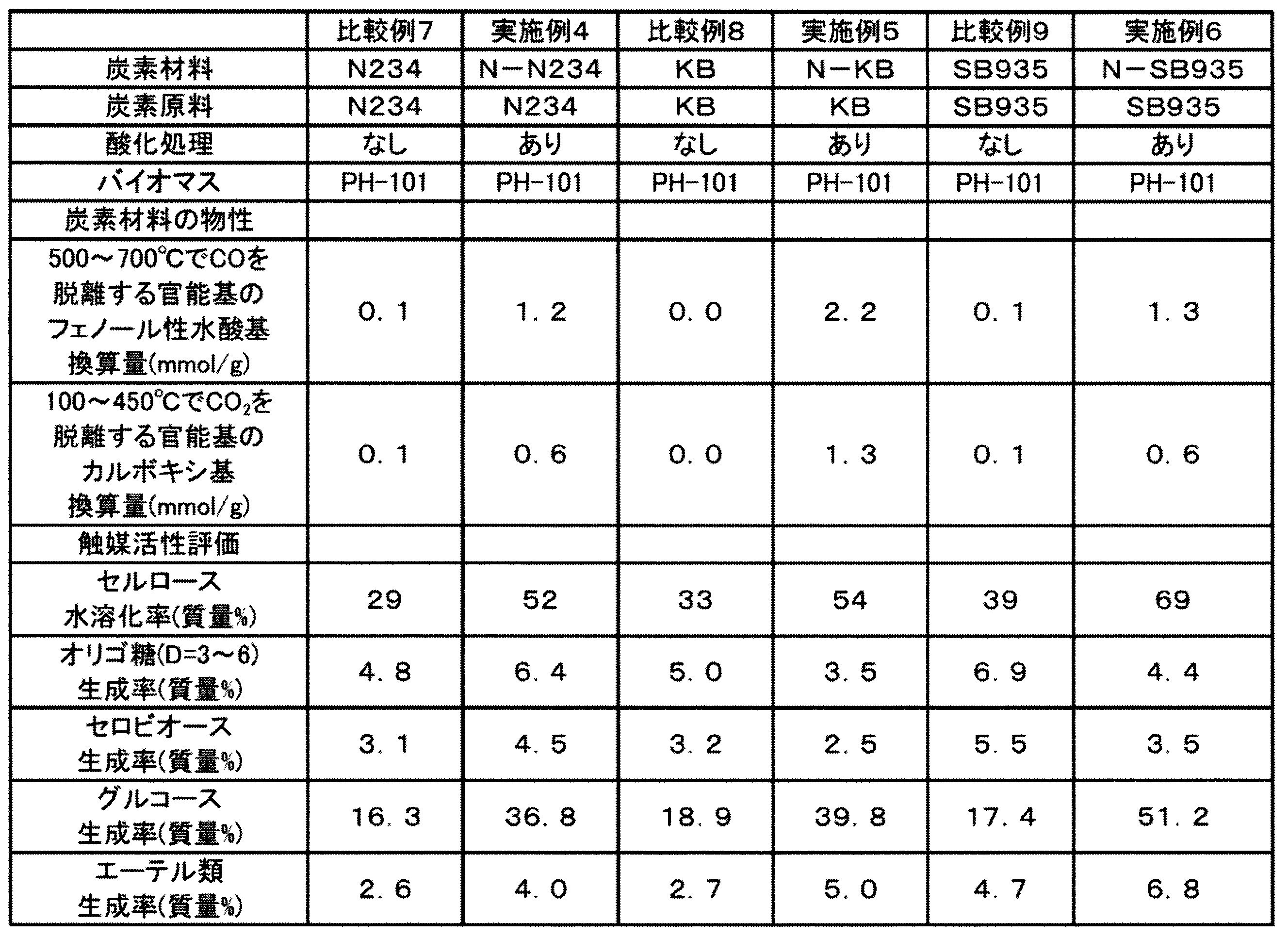
本願の開示は、2018年6月29日に出願された特願2018-125255号、並びに2018年11月14日に出願された特願2018-213683号に記載の主題と関連しており、それらのすべての開示内容は引用によりここに援用される。
既に述べられたもの以外に、本発明の新規かつ有利な特徴から外れることなく、上記の実施形態に様々な修正や変更を加えてもよいことに注意すべきである。したがって、そのような全ての修正や変更は、添付の請求の範囲に含まれることが意図されている。
既に述べられたもの以外に、本発明の新規かつ有利な特徴から外れることなく、上記の実施形態に様々な修正や変更を加えてもよいことに注意すべきである。したがって、そのような全ての修正や変更は、添付の請求の範囲に含まれることが意図されている。
本発明により、草本類などのバイオマス材料に由来するセルロース等の多糖類を、液体酸及び酵素を使わずに加水分解することのできる触媒として炭素材料を提供することができる。
Claims (4)
- バイオマス材料に含まれる多糖類を加水分解するための加水分解用触媒であって、
昇温脱離法により500℃~700℃でCOを脱離する官能基を、フェノール性水酸基換算で0.4mmol/g以上で有する炭素材料である、加水分解用触媒。 - 前記昇温脱離法により500℃~700℃でCOを脱離する官能基は、前記炭素材料の表層部に含まれる、請求項1に記載の加水分解用触媒。
- 前記炭素材料は、昇温脱離法により100℃~450℃でCO2を脱離する官能基を有し、
前記昇温脱離法により100℃~450℃でCO2を脱離する官能基の量は、カルボキシ基換算で0.1mmol/g以上であり、かつ、前記昇温脱離法により500℃~700℃でCOを脱離する官能基のフェノール性水酸基換算量より少ない、請求項1又は2に記載の加水分解用触媒。 - 請求項1から3のいずれか1項に記載の加水分解用触媒と、非結晶性セルロースとを水に添加し混合することを含む、水溶性糖類の製造方法。
Priority Applications (1)
| Application Number | Priority Date | Filing Date | Title |
|---|---|---|---|
| JP2020527235A JPWO2020003723A1 (ja) | 2018-06-29 | 2019-04-24 | 加水分解用触媒及び水溶性糖類の製造方法 |
Applications Claiming Priority (4)
| Application Number | Priority Date | Filing Date | Title |
|---|---|---|---|
| JP2018-125255 | 2018-06-29 | ||
| JP2018125255 | 2018-06-29 | ||
| JP2018-213683 | 2018-11-14 | ||
| JP2018213683 | 2018-11-14 |
Publications (1)
| Publication Number | Publication Date |
|---|---|
| WO2020003723A1 true WO2020003723A1 (ja) | 2020-01-02 |
Family
ID=68987061
Family Applications (1)
| Application Number | Title | Priority Date | Filing Date |
|---|---|---|---|
| PCT/JP2019/017474 Ceased WO2020003723A1 (ja) | 2018-06-29 | 2019-04-24 | 加水分解用触媒及び水溶性糖類の製造方法 |
Country Status (3)
| Country | Link |
|---|---|
| JP (1) | JPWO2020003723A1 (ja) |
| TW (1) | TW202000588A (ja) |
| WO (1) | WO2020003723A1 (ja) |
Citations (1)
| Publication number | Priority date | Publication date | Assignee | Title |
|---|---|---|---|---|
| WO2011036955A1 (ja) * | 2009-09-25 | 2011-03-31 | 国立大学法人北海道大学 | セルロースまたはヘミセルロースの加水分解用触媒、並びにこの触媒を用いる糖含有液の製造方法 |
-
2019
- 2019-04-24 JP JP2020527235A patent/JPWO2020003723A1/ja active Pending
- 2019-04-24 WO PCT/JP2019/017474 patent/WO2020003723A1/ja not_active Ceased
- 2019-04-25 TW TW108114550A patent/TW202000588A/zh unknown
Patent Citations (1)
| Publication number | Priority date | Publication date | Assignee | Title |
|---|---|---|---|---|
| WO2011036955A1 (ja) * | 2009-09-25 | 2011-03-31 | 国立大学法人北海道大学 | セルロースまたはヘミセルロースの加水分解用触媒、並びにこの触媒を用いる糖含有液の製造方法 |
Non-Patent Citations (3)
| Title |
|---|
| GAN, L. ET AL.: "Cellulose hydrolysis catalyzed by highly acidic lignin-derived carbonaceous catalyst synthesized via hydrothermal carbonization", CELLULOSE, vol. 24, no. 12, 3 October 2017 (2017-10-03), pages 5327 - 5339, XP036362103, ISSN: 0969-0239, DOI: 10.1007/s10570-017-1515-3 * |
| SUGANUMA, S. ET AL.: "Hydrolysis of Cellulose by Amorphous Carbon Bearing SO3H, COON, and OH Group", JOURNAL OF THE AMERICAN CHEMICAL SOCIETY, vol. 130, no. 138, 24 September 2008 (2008-09-24), pages 12787 - 12793, XP055119611, ISSN: 0002-7863, DOI: 10.1021/ja803983h * |
| TAKATSUKI, AKIRA ET AL.: "2. Experiment, 3. Results and Observations, non- official translation", CELLULOSE HYDROLYSIS USING DRY GROUND CARBON POWDER AS A CATALYST. 44TH ANNUAL MEETING OF THE CARBON SOCIETY OF JAPAN, 2017, pages 117 * |
Also Published As
| Publication number | Publication date |
|---|---|
| JPWO2020003723A1 (ja) | 2021-08-05 |
| TW202000588A (zh) | 2020-01-01 |
Similar Documents
| Publication | Publication Date | Title |
|---|---|---|
| Zhang et al. | Synthesis, formation mechanisms and applications of biomass-derived carbonaceous materials: a critical review | |
| JP5528036B2 (ja) | 炭素系固体酸及びその製造方法 | |
| CN108722356B (zh) | 一种纳米零价铁负载亲水性多孔生物炭复合材料的制备方法 | |
| Zheng et al. | Sweet potato-derived carbon nanoparticles as anode for lithium ion battery | |
| KR100669750B1 (ko) | 탄소 나노 튜브가 포함된 중형 다공성 탄소 복합체 | |
| Babitha et al. | Development of ZnO@ rGO nanocomposites for the enzyme free electrochemical detection of urea and glucose | |
| CN104150460B (zh) | 模板法制备高比表面生物质碳材料的方法 | |
| JP2005154268A (ja) | メソポーラスカーボンモレキュラーシーブ及びこれを使用した担持触媒 | |
| CN108421545A (zh) | 二氧化锰复合材料及其制备方法和应用 | |
| CN110721717A (zh) | 多孔片状氮化钨/碳复合材料及其制备方法和应用 | |
| Gu et al. | Carbon materials from high ash bio-char: a nanostructure similar to activated graphene | |
| Rehman et al. | Sono-assisted sulfuric acid process for economical recovery of fermentable sugars and mesoporous pure silica from rice straw | |
| Devi et al. | Rice straw: a major renewable lignocellulosic biomass for value-added carbonaceous materials | |
| CN104555987A (zh) | 一种氮硫共掺杂碳材料的制备方法 | |
| CN110526228A (zh) | 一种类花瓣状碳纳米片的制备方法 | |
| Fathy et al. | Synthesis of transparent amorphous carbon thin films from cellulose powder in rice straw | |
| JP2003246613A (ja) | 金属添加炭素材料の製造方法及びこの方法により製造された金属添加炭素材料を用いた燃料電池用電極材料、化学反応用触媒担体、ガス貯蔵材 | |
| Arvizu‐Rodríguez et al. | Carbons Derived from Agave tequilana Fibers as Efficient Sulfur Supports for High‐Performance Lithium–Sulfur Batteries | |
| JP2017171523A (ja) | 還元型酸化黒鉛の製造方法 | |
| Yadav et al. | Effective remediation of lead and cadmium from aqueous solution using sustainable nanolignin derived from protic ionic liquid-pretreated cocoa pod husk | |
| CN104759636B (zh) | 用山楂籽提取液制备纳米金的方法 | |
| WO2020003723A1 (ja) | 加水分解用触媒及び水溶性糖類の製造方法 | |
| CN109482200B (zh) | 一种多孔碳担载缺陷化硫化钼电催化剂及其制备方法 | |
| Rwayhah et al. | Nanoporous activated carbon from olive stones wastes | |
| JP2019097515A (ja) | 水溶性多糖類の製造方法 |
Legal Events
| Date | Code | Title | Description |
|---|---|---|---|
| 121 | Ep: the epo has been informed by wipo that ep was designated in this application |
Ref document number: 19825064 Country of ref document: EP Kind code of ref document: A1 |
|
| ENP | Entry into the national phase |
Ref document number: 2020527235 Country of ref document: JP Kind code of ref document: A |
|
| NENP | Non-entry into the national phase |
Ref country code: DE |
|
| 122 | Ep: pct application non-entry in european phase |
Ref document number: 19825064 Country of ref document: EP Kind code of ref document: A1 |