WO2019239382A1 - Condensed azaheteroaryl compounds having antibacterial activity against tuberculosis bacteria - Google Patents
Condensed azaheteroaryl compounds having antibacterial activity against tuberculosis bacteria Download PDFInfo
- Publication number
- WO2019239382A1 WO2019239382A1 PCT/IB2019/054997 IB2019054997W WO2019239382A1 WO 2019239382 A1 WO2019239382 A1 WO 2019239382A1 IB 2019054997 W IB2019054997 W IB 2019054997W WO 2019239382 A1 WO2019239382 A1 WO 2019239382A1
- Authority
- WO
- WIPO (PCT)
- Prior art keywords
- methyl
- carboxamide
- hydroxycyclopropyl
- methoxy
- pyrazine
- Prior art date
- Legal status (The legal status is an assumption and is not a legal conclusion. Google has not performed a legal analysis and makes no representation as to the accuracy of the status listed.)
- Ceased
Links
- 0 *C1(CN)CC1 Chemical compound *C1(CN)CC1 0.000 description 1
Classifications
-
- C—CHEMISTRY; METALLURGY
- C07—ORGANIC CHEMISTRY
- C07D—HETEROCYCLIC COMPOUNDS
- C07D471/00—Heterocyclic compounds containing nitrogen atoms as the only ring hetero atoms in the condensed system, at least one ring being a six-membered ring with one nitrogen atom, not provided for by groups C07D451/00 - C07D463/00
- C07D471/02—Heterocyclic compounds containing nitrogen atoms as the only ring hetero atoms in the condensed system, at least one ring being a six-membered ring with one nitrogen atom, not provided for by groups C07D451/00 - C07D463/00 in which the condensed system contains two hetero rings
- C07D471/04—Ortho-condensed systems
-
- A—HUMAN NECESSITIES
- A61—MEDICAL OR VETERINARY SCIENCE; HYGIENE
- A61K—PREPARATIONS FOR MEDICAL, DENTAL OR TOILETRY PURPOSES
- A61K31/00—Medicinal preparations containing organic active ingredients
- A61K31/33—Heterocyclic compounds
- A61K31/395—Heterocyclic compounds having nitrogen as a ring hetero atom, e.g. guanethidine or rifamycins
- A61K31/495—Heterocyclic compounds having nitrogen as a ring hetero atom, e.g. guanethidine or rifamycins having six-membered rings with two or more nitrogen atoms as the only ring heteroatoms, e.g. piperazine or tetrazines
- A61K31/505—Pyrimidines; Hydrogenated pyrimidines, e.g. trimethoprim
- A61K31/506—Pyrimidines; Hydrogenated pyrimidines, e.g. trimethoprim not condensed and containing further heterocyclic rings
-
- A—HUMAN NECESSITIES
- A61—MEDICAL OR VETERINARY SCIENCE; HYGIENE
- A61K—PREPARATIONS FOR MEDICAL, DENTAL OR TOILETRY PURPOSES
- A61K45/00—Medicinal preparations containing active ingredients not provided for in groups A61K31/00 - A61K41/00
- A61K45/06—Mixtures of active ingredients without chemical characterisation, e.g. antiphlogistics and cardiaca
-
- A—HUMAN NECESSITIES
- A61—MEDICAL OR VETERINARY SCIENCE; HYGIENE
- A61P—SPECIFIC THERAPEUTIC ACTIVITY OF CHEMICAL COMPOUNDS OR MEDICINAL PREPARATIONS
- A61P31/00—Antiinfectives, i.e. antibiotics, antiseptics, chemotherapeutics
- A61P31/04—Antibacterial agents
-
- A—HUMAN NECESSITIES
- A61—MEDICAL OR VETERINARY SCIENCE; HYGIENE
- A61P—SPECIFIC THERAPEUTIC ACTIVITY OF CHEMICAL COMPOUNDS OR MEDICINAL PREPARATIONS
- A61P31/00—Antiinfectives, i.e. antibiotics, antiseptics, chemotherapeutics
- A61P31/04—Antibacterial agents
- A61P31/06—Antibacterial agents for tuberculosis
-
- C—CHEMISTRY; METALLURGY
- C07—ORGANIC CHEMISTRY
- C07D—HETEROCYCLIC COMPOUNDS
- C07D487/00—Heterocyclic compounds containing nitrogen atoms as the only ring hetero atoms in the condensed system, not provided for by groups C07D451/00 - C07D477/00
- C07D487/02—Heterocyclic compounds containing nitrogen atoms as the only ring hetero atoms in the condensed system, not provided for by groups C07D451/00 - C07D477/00 in which the condensed system contains two hetero rings
- C07D487/04—Ortho-condensed systems
Definitions
- the present invention relates to novel compounds of the general formula (I) having an excellent antibacterial activity against tuberculosis bacteria, including their tautomeric forms, their stereoisomers, their pharmaceutically acceptable salts, pharmaceutical compositions containing them, methods for their preparation, use of these compounds in medicine and the intermediates involved in their preparation.
- the compounds of the general formula (I) have DprEl enzyme inhibitory activity.
- Tuberculosis is one of the leading cause of human death from infectious disease in the world. About 33% of world’s population is thought to be infected with Mycobacterium tuberculosis (Mtb), the pathogen that causes TB disease (WHO“Global Tuberculosis Report 2016”, World Health Organization, 2017). Current treatment has a potential to cure drug-sensitive TB, however treatment of drug-resistant or multi drug- resistant TB (MDR-TB) is challenging and needs a two years of combination chemotherapy (WHO “Multidrug-Resistant Tuberculosis (MDR-TB) 2016 Update”, World Health Organization, 2016). Resistance to current treatment for MDR-TB and extensively resistant TB (XDR-TB) highlights the need of new drugs with novel mechanism of actions.
- MDR-TB drug-resistant or multi drug- resistant TB
- the enzyme DprE (decaprenylphosphoryl-P-D-ribose2’-epimerase) has received significant attention as a new therapeutic strategy to tackle Mtb infection.
- the enzyme is composed of two proteins encoded by the dprEl and dprE2 genes.
- DprEl enzyme is the FAD-containing oxidoreductase, while DprE2 is the NADH-dependent reductase, both acts as key enzymes in the biosynthesis of decaprenylphosphoryl-P-D-arabinofuranose (DPA).
- DPA is a precursor of mycobacterial cell wall arabinan (Wolucka B. A. et al. FEBS J. 275, 2691-2711 (2008)).
- inhibition of DprEl enzyme provides a method to inhibit bacterial cell wall biosynthesis and provides a new mechanism to identify novel drugs to treat TB.
- DprEl enzyme has expression only in bacteria and not in human which makes it safer antibacterial target.
- DprEl target is validated by the identification of BTZ-043, a covalent inhibitor of DprEl enzyme (Trefzer, C. et al. J. Am. Chem. Soc. 132, 13663-13665, (2010)), which has demonstrated in vivo efficacy in mouse model of TB (Makarov et al. Science, 324, 801- 804, (2009)).
- Next generation benzothiazinone derivative PBTZ-169 has shown improved antibacterial activity than BTZ-043 (Makarov et al. EMBO Mol. Med. 6, 372-383, (2014)).
- WO2015009525 describes azaindole derivatives for the treatment of mycobacterium infection or tuberculosis.
- WO2016031255 describes heterocyclic compounds and their use for the treatment of tuberculosis.
- WO2017146246 describes piperidine derivatives having antibacterial activity against mycobacterium tuberculosis.
- W02018055048 describes new series of benzothiazinone compounds for the treatment of mammalian infections.
- MDR-TB multidrug-resistant TB
- the present invention discloses novel compounds of the general formula (I) having an excellent antibacterial activity against tuberculosis bacteria.
- the compounds of the present invention are useful in the treatment of the human or animal body, by regulation of DprEl enzyme.
- the compounds of this invention are therefore suitable for the treatment of tuberculosis or Mycobacterium infection.
- the main objective of the present invention is to provide novel compounds of general formula (I), their tautomeric forms, novel intermediates involved in their synthesis, their pharmaceutically acceptable salts, their pharmaceutically acceptable solvates and pharmaceutical compositions containing them or their mixtures suitable for the treatment of tuberculosis or Mycobacterium infection.
- compositions containing compounds of general formula (I), their tautomeric forms, their pharmaceutically acceptable salts, solvates and their mixtures having pharmaceutically acceptable carriers, solvents, diluents, excipients and other media normally employed in their manufacture are provided.
- novel compounds of the present invention for the treatment of mammalian infections such as tuberculosis, by administering a therapeutically effective & non-toxic amount of the compound of formula (I), or their pharmaceutically acceptable compositions to the mammals.
- a pharmaceutical composition comprising the compound of formula (I) and a second suitable therapeutic agent for the treatment of mammalian infections such as tuberculosis.
- A represents optionally substituted 6-membered ring systems as given below:
- X and“Y” independently represents either CH or N ; provided that X and Y both can not be CH together;
- Ri is independently selected from the group comprising of hydrogen, halo, haloalkyl cyano, -OR 4 , -S(0) P R 4 , -NR 4 R 5 , -COOR 4 , optionally substituted (Ci-C 6 )alkyl, (C 3 -C 6 )cycloalkyl, and heterocyclyl derivatives;
- R 2 is independently selected from the group comprising of halogen, -OR 6 , and -S(0) p R 6 ;
- R 3 at each occurrence is independently selected from the group comprising of hydrogen, halo, cyano, haloalkyl, -NR 4 R 5 , S(0) p R 4 , -OR 4 and optionally substituted (Ci-C 6 )alkyl;
- Each of R 4 and R 5 are at each occurrence is independently selected from hydrogen, optionally substituted (Ci-C 6 )alkyl, (C 3 -C 6 )cycloalkyl, cycloalkanyl alkyl, heterocyclyl, haloalkyl; alternatively, R 4 and R 5 together with the N atom to which they are attached may form a 5-8 membered cyclic ring which may contain additional heteroatoms O, -S(0) p and - NR 6 ;
- R 6 is selected from the H or (Ci-C 6 ) alkyl
- the (Ci-C 6 ) alkyl chain as used herein before may further substituted with hydrogen, hydroxy, cyano, halo, haloalkyl, oxo, (Ci-C 6 )alkyl, (C 3 -C 6 )cycloalkyl, heterocyclyl, alkylsulfonyloxy, -COOR 4 , -OR 4 , -S(0) P R 4 , -NR 4 R 5 , -CONR 4 R 5 , N(R 4 )COR 5 , -SO 2 NR 4 R 5 , -N(R 4) S0 2 R s derivatives; wherein, R 4 and R 5 are as defined earlier;
- Preferred“A” may be selected from following groups;
- Preferred Ri group is selected from -CH 3 , -OCH 3 , and halogen;
- Preferred R 2 group is hydroxy
- R 3 group is selected from -CH 3 , -OR 4 , -SCH 3 , -N(CH 3 ) 2 and halogen, wherein R 4 is as defined earlier;
- radicals described above may be selected from:
- the“alkyl” group used either alone or in combination with other radicals denotes a linear or branched radical containing one to six carbons, selected from methyl, ethyl, n- propyl, iso-propyl, /7-butyl , sec-butyl, /e / /-butyl, amyl, /-amyl, //-pentyl, //-hexyl, and the like;
- the“cycloalkyl”, or“alicyclic” group used either alone or in combination with other radicals is selected from a cyclic radical containing three to six carbons, more preferably cyclopropyl, cyclobutyl, cyclopentyl, cyclohexyl and the like;
- the“haloalkyl” group is selected from an alkyl radical, as defined above, suitably substituted with one or more halogens; such as fluoromethyl, difluoromethyl, trifluoromethyl, fluoroethyl, difluoroethyl, trifluoroethyl, mono or polyhalo substituted methyl, ethyl, propyl, butyl, pentyl or hexyl groups;
- the“heterocyclyl” or“heterocyclic” group used either alone or in combination with other radicals is selected from suitable saturated, partially saturated or unsaturated aromatic or non-aromatic mono, bi or tricyclic radicals, containing one or more heteroatoms selected from nitrogen, sulfur and oxygen, more preferably selected from aziridinyl, azetidinyl, pyrrolidinyl, imidazolidinyl, piperidinyl, piperazinyl, 2- oxopiperidinyl, 4-oxopiperidinyl, 2-oxopiperazinyl, 3-oxopiperazinyl, morpholinyl, thiomorpholinyl, 2-oxomorpholinyl, azepinyl, diazepinyl, oxapinyl, thiazepinyl, oxazolidinyl, thiazolidinyl, dihydro thiophene, dihydropyran, dihydrofuran, dihydro
- the“heteroaryl” or“heteroaromatic” group used either alone or in combination with other radicals is selected from aromatic heterocyclic radicals containing one or more hetero atoms selected from N, more preferably the groups are selected from pyridyl, pyrimidinyl, pyridazinyl, triazinyl, pyrazinyl and the like;
- the“cycloalkanyl alkyl” group used either alone or in combination with other radicals is selected from groups containing an cycloalkyl radical, as defined above, attached directly to an alkyl radical, as define above;
- alkylsulfonyloxy refers to an alkylsulfonyl group attached directly to an oxygen atom, wherein a suitable alkyl group as defined above is attached to a sulfonyl radical;
- Suitable groups and substituents on the groups may be selected from those described anywhere in the specification.
- Preferred compounds according to the present invention include but not limited to:
- novel compounds of this invention may be prepared using the reactions and techniques as shown in scheme below and described in this section.
- the reactions are performed in solvents appropriate to the reagents and materials employed and are suitable for the transformations being affected. It is understood by those skilled in the art that the nature and order of the synthetic steps presented may be varied for the purpose of optimizing the formation of the compounds of the present invention. It will also be well appreciated that one or more of the reactants may be protected and deprotected for facile synthesis by techniques known to persons skilled in the art. It will also be appreciated that one or more of the compounds of the present invention may exist in stereoisomeric and/or diastereomeric forms.
- Such stereoisomers and/or diastereoisomers as well as their optical antipodes are to be construed to be within the scope of the present invention. It will also be well appreciated that one or more of these compounds may be converted to their salts and other derivatives based on the specific groups present on the compounds, which can be well comprehended by persons skilled in the art. Such salts and/or other derivatives, as the case may be should also be construed to be within the scope of the present invention.
- R’ is alkyl group such as methyl, ethyl etc.
- L suitable leaving group such as Cl, Br, I, mesyl etc.
- the compounds of the general formula (II) can be prepared as described in the literature (Faming Zhuanli Shenqing, 102911174, (2013), WO201481732, WO2017120429 and WO2018049271) using appropriate modifications well known to a skilled person.
- the compound (IV) can be obtained by reacting compounds of the formula (II) with (III) in the presence of base such as sodium carbonate, potassium carbonate, sodium hydride etc. in solvents such as THF, DMF, methanol etc.
- the compounds of general formula (V) can be obtained from (IV) by hydrolysis of ester group using inorganic bases such as LiOH, NaOH, KOH etc. in solvent(s) such as water, THF, methanol or mixture thereof.
- the compounds of the general formula (I) are then obtained by reacting (V) with amines of general formula (VI) using various amide bond formation techniques as described for e.g. in Tetrahedron 2005, 61, 10827.
- CDCI3 Deuterated chloroform
- DIPEA Disopropyl ethyl amine
- EDC.HC1 N-(3-Dimethyl aminopropyl)-N’ -ethyl carbodiimide hydrochloride
- TPP Triphenyl phosphine
- MABA Microplate Alamar Blue Assay
- Step 1 l-(tert-butyl) 3-ethyl 2-(5-methyl-3-nitropyridin-2-yl)malonate
- Step 4 ethyl 6-methyl-lH-pyrazolo[4,3-b]pyridine-3-carboxylate
- reaction mixture was stirred at 25-30°C for 30 min.
- the pH of the reaction mixture was adjusted to 7 by using 10 % NaOH solution. Stirring was continued for further 60 min at 25-30°C. After complete conversion of starting material, reaction mixture was diluted with 50 ml water and extracted with ethyl acetate.
- Step 1 ethyl l-((6-methoxy-5-methylpyrimidin-4-yl)methyl)-6-methyl-lH- pyrazolo[4,3-b]pyridine-3-carboxylate
- Step 2 l-((6-methoxy-5-methylpyrimidin-4-yl)methyl)-6-methyl-lH-pyrazolo[4,3- b]pyridine-3-carboxylic acid
- Step 3 Preparation of N-((l-hydroxycyclopropyl)methyl)-l-((6-methoxy-5- methylpyrimidin-4-yl)methyl)-6-methyl-lH-pyrazolo[4,3-b]pyridine-3-carboxamide
- reaction mixture was diluted with DCM (10 ml). Then the reaction mixture was washed with saturated solution of NaHC0 3 , dried over NaoSC , and filtered. Removal of the solvent under reduced pressure gave crude product, which was further purified by column chromatography (0-60% Ethyl acetate in Hexane) to get title product.
- Step 1 ethyl l-((6-ethoxy-5-methylpyrimidin-4-yl)methyl)-6-methyl-lH-pyrazolo[4,3- b]pyridine-3-carboxylate
- Step 2 l-((6-ethoxy-5-methylpyrimidin-4-yl)methyl)-6-methyl-lH-pyrazolo[4,3- b]pyridine-3-carboxylic acid
- Step 3 l-((6-ethoxy-5-methylpyrimidin-4-yl)methyl)-N-((l-hydroxycyclopropyl) methyl)-6-methyl-lH-pyrazolo[4,3-b]pyridine-3-carboxamide
- EDC.HC1 100 mg, 0.519 mmol
- HOBT 70 mg, 0.158 mmol
- DIPEA 80 mg, 0.611 mmol
- reaction mi ture was diluted with DCM (10 ml). Reaction mixture was then washed with saturated solution of NaHC0 3 , dried over NaoSCU, and filtered. Removal of the solvent under reduced pressure gave product as a yellow solid, which was further purified by column chromatography (0-60% Ethyl acetate in Hexane) to get the title product.
- Step 1 ethyl 5-methyl-6-(methylthio)pyrimidine-4-carboxylate
- Step 2 6-methyl-l-((5-methyl-6-(methylthio)pyrimidin-4-yl)methyl)-lH-pyrazolo[4,3- b]pyridine-3-carboxylic acid
- Step 1 ethyl 6-(2-methoxyethoxy)-5-methylpyrimidine-4-carboxylate
- Step 1 ethyl l-((6-(2-methoxyethoxy)-5-methylpyrimidin-4-yl)methyl)-6-methyl-lH- pyrazolo[4,3-b]pyridine-3-carboxylate
- Step 2 l-((6-(2-methoxyethoxy)-5-methylpyrimidin-4-yl)methyl)-6-methyl-lH- pyrazolo[4,3-b]pyridine-3-carboxylic acid
- Step 3 N-((l-hydroxycyclopropyl)methyl)-l-((6-(2-methoxyethoxy)-5- methylpyrimidin-4-yl)methyl)-6-methyl-lH-pyrazolo[4,3-b]pyridine-3-carboxamide
- Step 1 (6-chloro-5-methylpyrimidin-4-yl)methanol To a stirring solution of ethyl 6-chloro-5-methylpyrimidine-4-carboxylate (3.0 g, 14.95 mmol) in CH 3 OH (15 ml) was added sodium borohydride (1.13 g, 29.9 mmol) portion wise over period of 10 min at 25-30°C. The reaction mixture was stirred at 25-30°C for 3 h. After complete conversion of starting material reaction mixture was cooled to lO°C and the reaction mixture was diluted with cold water (100 ml) followed by extraction with ethyl acetate (2 X 50 ml). Organic layer was separated, washed with water, dried over Na 2 S04 and evaporated under reduced pressure to get crude product which was used without further purification. ESI-MS (m/z): 159.38 (M+H) + .
- Step 3 ethyl l-((6-chloro-5-methylpyrimidin-4-yl)methyl)-6-methyl-lH-pyrazolo[4,3- b]pyridine-3-carboxylate
- Step 4 ethyl l-((6-(dimethylamino)-5-methylpyrimidin-4-yl)methyl)-6-methyl-lH- pyrazolo[4,3-b]pyridine-3-carboxylate
- Step 5 l-((6-(dimethylamino)-5-methylpyrimidin-4-yl)methyl)-6-methyl-lH- pyrazolo[4,3-b]pyridine-3-carboxylic acid
- Step 6 l-((6-(dimethylamino)-5-methylpyrimidin-4-yl)methyl)-N-((l- hydroxycyclopropyl)methyl)-6-methyl-lH-pyrazolo[4,3-b]pyridine-3-carboxamide
- Step 1 ethyl 6-methyl-l-((5-methyl-6-morpholinopyrimidin-4-yl)methyl)-lH- pyrazolo[4,3-b]pyridine-3-carboxylate
- ethyl l-((6-chloro-5-methylpyrimidin-4-yl)methyl)-6-methyl-lH- pyrazolo[4,3-b]pyridine-3-carboxylate (0.350 g, 1.01 mmol) and K 2 C0 3 (0.21 g, 1.51 mmol) in dry DMF (5 ml) was added Morpholine (0.176 g, 2.02 mmol) at 5-l0°C and the resulting mixture was stirred at 50°C for 3 h.
- Step 2 6-methyl-l-((5-methyl-6-morpholinopyrimidin-4-yl)methyl)-lH-pyrazolo[4,3- b]pyridine-3-carboxylic acid
- Step 3 N-((l-hydroxycyclopropyl)methyl)-6-methyl-l-((5-methyl-6- morpholinopyrimidin-4-yl)methyl)-lH-pyrazolo[4,3-b]pyridine-3-carboxamide
- Step 1 ethyl 6-(cyclopropylmethoxy)-5-methylpyrimidine-4-carboxylate
- Step 3 4-(bromomethyl)-6-(cyclopropylmethoxy)-5-methylpyrimidine
- TPP 614 mg, 2.343 mmol
- CBr 4 777 mg, 2.343 mmol
- the reaction mixture was stirred at 25-30°C for 1 h.
- reaction mixture diluted with 15 ml water.
- Organic layer was separated, washed with water, dried over Na 2 S0 4 and evaporated under reduced pressure to get title product which was further purified by column chromatography (0-5% Ethyl acetate in Hexane) to get the title product.
- ESI-MS m/z: 259.01 (M+H) + .
- Step 4 ethyl l-((6-(cyclopropylmethoxy)-5-methylpyrimidin-4-yl)methyl)-6-methyl- lH-pyrazolo[4,3-b]pyridine-3-carboxylate
- ethyl 6-methyl-lH-pyrazolo[4,3-b]pyridine-3-carboxylate 160 mg, 0.780 mmol
- K 2 C0 3 162 mg, 1.169 mmol
- step 3 241 mg, 0.936 mmol
- Step 5 l-((6-(cyclopropylmethoxy)-5-methylpyrimidin-4-yl)methyl)-6-methyl-lH- pyrazolo[4,3-b]pyridine-3-carboxylic acid
- Step 6 l-((6-(cyclopropylmethoxy)-5-methylpyrimidin-4-yl)methyl)-N-((l- hydroxycyclopropyl)methyl)-6-methyl-lH-pyrazolo[4,3-b]pyridine-3-carboxamide
- the reaction mixture was filtered to get the title product.
- step 1 Product of step 1 (7 g, 52.2 mmol) and 20% aq. NaOH (26 mL) was heated at l40-l45°C for 16 h. The reaction mixture was cooled and pH was adjusted to 8 with 35% HC1 and extracted with DCM. The aqueous phase was acidified to get yellow solid which was filtered, washed with water, and dried to get the title compound.
- ESI-MS m/z: 154.05 (M+H) + .
- Step 3 methyl 2-methoxy-6-methylnicotinate To a stirring solution of product of step 2 (2.50 g, 16.33 mmol) in CHCl 3 (80 ml) was added silver carbonate (4.50 g, 16.33 mmol) followed by iodomethane (3.06 ml, 49.0 mmol) and reaction mixture was stirred at 25-30°C for 16 h. After complete conversion of starting material, reaction mixture was diluted with CHCI3 and water. Organic layer was separated, dried and evaporated to get crude product which was purified by column chromatography to get the title product. ESI-MS (m/z): 182.11 (M+H) + .
- Step 6 ethyl l-((2-methoxy-6-methylpyridin-3-yl)methyl)-6-methyl-lH-pyrazolo[4,3- b]pyridine-3-carboxylate
- Step 7 l-((2-methoxy-6-methylpyridin-3-yl)methyl)-6-methyl-lH-pyrazolo[4,3- b]pyridine-3-carboxylic acid
- Step 8 N-((l-hydroxycyclopropyl)methyl)-l-((2-methoxy-6-methylpyridin-3- yl)methyl)-6-methyl-lH-pyrazolo[4,3-b]pyridine-3-carboxamide
- Step 4 3-chloro-5-((6-methoxy-5-methylpyrimidin-4-yl)methyl)-5H-pyrrolo[2,3- b]pyrazine-7-carbaldehyde
- Step 5 5-((6-methoxy-5-methylpyrimidin-4-yl)methyl)-3-methyl-5H-pyrrolo[2,3- b]pyrazine-7-carbaldehyde
- Step 6 5-((6-methoxy-5-methylpyrimidin-4-yl)methyl)-3-methyl-5H-pyrrolo[2,3- b]pyrazine-7-carboxylic acid
- Step 7 N-((l-hydroxycyclopropyl)methyl)-5-((6-methoxy-5-methylpyrimidin-4- yl)methyl)-3-methyl-5H-pyrrolo[2,3-b]pyrazine-7-carboxamide
- Step 2 3-methoxy-5-((6-methoxy-5-methylpyrimidin-4-yl)methyl)-5H-pyrrolo[2,3- b]pyrazine-7-carboxylic acid
- Step 3 N-((l-hydroxycyclopropyl)methyl)-3-methoxy-5-((6-methoxy-5- methylpyrimidin-4-yl)methyl)-5H-pyrrolo[2,3-b]pyrazine-7-carboxamide
- Step 2 5-((6-ethoxy-5-methylpyrimidin-4-yl)methyl)-3-methyl-5H-pyrrolo[2,3- b]pyrazine-7-carbaldehyde
- Step 3 5-((6-ethoxy-5-methylpyrimidin-4-yl)methyl)-3-methyl-5H-pyrrolo[2,3- b]pyrazine-7-carboxylic acid
- Step 4 Preparation of 5-((6-ethoxy-5-methylpyrimidin-4-yl)methyl)-N-((l- hydroxycyclopropyl)methyl)-3-methyl-5H-pyrrolo[2,3-b]pyrazine-7-carboxamide
- Step 1 ethyl 2-(3,5-dichloropyrazin-2-yl)-2-oxoacetate
- Step 2 ethyl-2-(3,5-dichloropyrazin-2-yl)-2-hydrazineylideneacetate
- Step 3 ethyl 6-chloro-lH-pyrazolo[3,4-b]pyrazine-3-carboxylate
- Step 5 ethyl l-((6-methoxy-5-methylpyrimidin-4-yl)methyl)-6-methyl-lH- pyrazolo[3,4-b]pyrazine-3-carboxylate
- Step 6 l-((6-methoxy-5-methylpyrimidin-4-yl)methyl)-6-methyl-lH-pyrazolo[3,4- b]pyrazine-3-carboxylic acid
- Step 7 N-((l-hydroxycyclopropyl)methyl)-l-((6-methoxy-5-methylpyrimidin-4- yl)methyl)-6-methyl-lH-pyrazolo[3,4-b]pyrazine-3-carboxamide
- Step 1 ethyl 6-methoxy-l-((6-methoxy-5-methylpyrimidin-4-yl)methyl)-lH- pyrazolo[3,4-b]pyrazine-3-carboxylate
- Step 2 6-methoxy-l-((6-methoxy-5-methylpyrimidin-4-yl)methyl)-lH-pyrazolo[3,4- b]pyrazine-3-carboxylic acid
- Step 3 Preparation of N-((l-hydroxycyclopropyl)methyl)-6-methoxy-l-((6-methoxy-5- methylpyrimidin-4-yl)methyl)-lH-pyrazolo[3,4-b]pyrazine-3-carboxamide
- Step 1 ethyl 3-(dimethylamino)-2-(5-methyl-3-nitropyridin-2-yl)acrylate
- Step 3 ethyl l-((6-methoxy-5-methylpyrimidin-4-yl)methyl)-6-methyl-lH-pyrrolo[3,2- b]pyridine-3-carboxylate
- Step 4 l-((6-methoxy-5-methylpyrimidin-4-yl)methyl)-6-methyl-lH-pyrrolo[3,2- b]pyridine-3-carboxylic acid
- Step 5 N-((l-hydroxycyclopropyl)methyl)-l-((6-methoxy-5-methylpyrimidin-4- yl)methyl)-6-methyl-lH-pyrrolo[3,2-b]pyridine-3-carboxamide
- MIC Minimum inhibitory concentration
- MABA assay was performed with log phase culture of Mycobacterium tuberculosis H37Rv.
- Bacterial culture of optical density 0.6-0.8 was diluted to final density of 0.02 in 7H9 medium.
- IOOmI of diluted Mycobacterium tuberculosis H37Rv was incubated with the test compounds in microtiter plate.
- a drug free control containing DMSO also was also prepared.
- 20m1 of 0.02% alamar blue freshly prepared was added in each well. The color was allowed to develop for 16 h at 37 °C.
- MIC value is defined as the lowest concentration that prevents the color change from blue to pink. Fluorescence was measured at excitation at 530 nm and emission at 590 nm. MIC values of the selected compounds are shown in Table 2.
- mice were obtained from Zydus Research Centre, Ahmedabad India, AAALAC Accreditation. All animals were housed in temperature-control rooms with appropriate light/dark cycles. The animals were overnight fasted before oral gavage dosing but were given access to water ad libitum. Food was provided 4 h after dosing. All animal studies were conducted according to protocols reviewed and approved by the Institutional Animal Care and Ethics Committee at the Zydus Research Centre. Compounds were dosed as a solution in 10% NMP and 10% solutol in Normal Saline (Intravenous (IV), 1 mg/kg) and homogenous suspension (Oral (PO), 3 mg/kg) in 0.5% Tween 80 in 0.5% methyl cellulose as a single dose in mice.
- IV Intravenous
- PO homogenous suspension
- PK parameters were calculated by non- compartmental analysis using Phoenix (Pharsight Corp., Mountain View, California). A model was selected based on the vascular (IV bolus) or extravascular (PO) routes of administration. For the PO route, concentration at time zero was assumed to be zero. Plasma concentrations below the limit of quantitation were treated as zero concentration for the purpose of calculating the mean plasma concentration values.
- Pharmacokinetic parameters such as maximum plasma concentration (Cmax), area under the curve of concentration over the time (AUC (0-t)) and absolute oral bioavailability (F(%)) of the selected compounds are shown in Table 3. Table 3:
- novel compounds of the present invention can be formulated into suitable pharmaceutically acceptable compositions by combining with suitable excipients by techniques and processes and concentrations as are well known.
- Pharmaceutical composition comprising the compounds of the present invention may comprise a suitable binder, suitable bulking agent &/or diluent and any other suitable agents as may be necessary.
- Novel compounds of the present invention can be used for the treatment of mammalian infections such as tuberculosis by administrating therapeutically active and non-toxic amount of compounds of formula (I) or pharmaceutically acceptable compositions thereof.
- a method of treating anti-tuberculosis infection in a subject comprising administering to a patient in need thereof an effective amount of a compound of Formula (I) or its suitable pharmaceutical composition.
- compositions according to this invention can exist in various forms.
- the pharmaceutical composition is in the topical, oral or parenteral administration.
- a provided combination, or composition thereof is administered in combination with other therapeutic agents such as isoniazide, rifampin, rifapentine, rifabutin, ethambutol, pyrazinamide, streptomycin, amikacin, levofloxacin, ofloxacin, p-aminosalicylic acid.
- other therapeutic agents such as isoniazide, rifampin, rifapentine, rifabutin, ethambutol, pyrazinamide, streptomycin, amikacin, levofloxacin, ofloxacin, p-aminosalicylic acid.
Landscapes
- Chemical & Material Sciences (AREA)
- Organic Chemistry (AREA)
- Health & Medical Sciences (AREA)
- Animal Behavior & Ethology (AREA)
- General Health & Medical Sciences (AREA)
- Veterinary Medicine (AREA)
- Public Health (AREA)
- Life Sciences & Earth Sciences (AREA)
- Medicinal Chemistry (AREA)
- Pharmacology & Pharmacy (AREA)
- Nuclear Medicine, Radiotherapy & Molecular Imaging (AREA)
- General Chemical & Material Sciences (AREA)
- Communicable Diseases (AREA)
- Chemical Kinetics & Catalysis (AREA)
- Oncology (AREA)
- Epidemiology (AREA)
- Pulmonology (AREA)
- Pharmaceuticals Containing Other Organic And Inorganic Compounds (AREA)
Abstract
Present invention relates to novel compound of general formula (I), their enantiomers, their diastereomers, their pharmaceutically accepted salts, or pro-drugs thereof, which are useful for the treatment of bacterial infection. The compounds of general formula (I) exhibit DprE1 enzyme inhibitory activity.
Description
CONDENSED AZAHETEROARYL COMPOUNDS HAVING ANTIBACTERIAL
ACTIVITY AGAINST TUBERCULOSIS BACTERIA
FIELD OF INVENTION
The present invention relates to novel compounds of the general formula (I) having an excellent antibacterial activity against tuberculosis bacteria, including their tautomeric forms, their stereoisomers, their pharmaceutically acceptable salts, pharmaceutical compositions containing them, methods for their preparation, use of these compounds in medicine and the intermediates involved in their preparation. The compounds of the general formula (I) have DprEl enzyme inhibitory activity.

BACKGROUND OF THE INVENTION
Tuberculosis (TB) is one of the leading cause of human death from infectious disease in the world. About 33% of world’s population is thought to be infected with Mycobacterium tuberculosis (Mtb), the pathogen that causes TB disease (WHO“Global Tuberculosis Report 2016”, World Health Organization, 2017). Current treatment has a potential to cure drug-sensitive TB, however treatment of drug-resistant or multi drug- resistant TB (MDR-TB) is challenging and needs a two years of combination chemotherapy (WHO “Multidrug-Resistant Tuberculosis (MDR-TB) 2016 Update”, World Health Organization, 2016). Resistance to current treatment for MDR-TB and extensively resistant TB (XDR-TB) highlights the need of new drugs with novel mechanism of actions.
The enzyme DprE (decaprenylphosphoryl-P-D-ribose2’-epimerase) has received significant attention as a new therapeutic strategy to tackle Mtb infection. The enzyme is composed of two proteins encoded by the dprEl and dprE2 genes. DprEl enzyme is the FAD-containing oxidoreductase, while DprE2 is the NADH-dependent reductase, both acts as key enzymes in the biosynthesis of decaprenylphosphoryl-P-D-arabinofuranose (DPA). DPA is a precursor of mycobacterial cell wall arabinan (Wolucka B. A. et al. FEBS J. 275,
2691-2711 (2008)). Hence, inhibition of DprEl enzyme provides a method to inhibit bacterial cell wall biosynthesis and provides a new mechanism to identify novel drugs to treat TB. Furthermore, DprEl enzyme has expression only in bacteria and not in human which makes it safer antibacterial target.
DprEl target is validated by the identification of BTZ-043, a covalent inhibitor of DprEl enzyme (Trefzer, C. et al. J. Am. Chem. Soc. 132, 13663-13665, (2010)), which has demonstrated in vivo efficacy in mouse model of TB (Makarov et al. Science, 324, 801- 804, (2009)). Next generation benzothiazinone derivative PBTZ-169 has shown improved antibacterial activity than BTZ-043 (Makarov et al. EMBO Mol. Med. 6, 372-383, (2014)). WO2015009525 describes azaindole derivatives for the treatment of mycobacterium infection or tuberculosis. WO2016031255 describes heterocyclic compounds and their use for the treatment of tuberculosis. WO2017146246 describes piperidine derivatives having antibacterial activity against mycobacterium tuberculosis. W02018055048 describes new series of benzothiazinone compounds for the treatment of mammalian infections.
As per WHO report (2018), 558 000 people developed TB in year 2017 that was resistant to rifampicin, the most effective first line drug, and of these, 82% had multidrug-resistant TB (MDR-TB). 10% of MDR patients converted to XDR-TB (extensively drug-resistant TB). This highlights the importance of new anti-TB drugs with new mechanism of action such as DprEl that can tackle the issue of MDR-TB.
Preclinical evaluation of TB treatment outcome occurs primarily in mouse models (The Journal of infectious diseases 2l l(Suppl 3), S83-95, 2015). Hence it is desirable that investigational compounds show good oral bioavailability and high blood exposure in mice. Compounds of the invention have shown excellent oral bioavailability and blood exposure in mice (Table 3) in addition to desired biological activity.
SUMMARY OF THE INVENTION
The present invention discloses novel compounds of the general formula (I) having an excellent antibacterial activity against tuberculosis bacteria. The compounds of the present invention are useful in the treatment of the human or animal body, by regulation of DprEl enzyme. The compounds of this invention are therefore suitable for the treatment of tuberculosis or Mycobacterium infection.
EMBODIMENTS OF THE INVENTION
The main objective of the present invention is to provide novel compounds of general formula (I), their tautomeric forms, novel intermediates involved in their synthesis, their pharmaceutically acceptable salts, their pharmaceutically acceptable solvates and pharmaceutical compositions containing them or their mixtures suitable for the treatment of tuberculosis or Mycobacterium infection.
In an embodiment is provided a process for the preparation of novel compounds of general formula (I), their tautomeric forms, novel intermediates involved in their synthesis, their pharmaceutically acceptable salts, pharmaceutically acceptable solvates and pharmaceutical compositions containing them.
In another embodiment is provided pharmaceutical compositions containing compounds of general formula (I), their tautomeric forms, their pharmaceutically acceptable salts, solvates and their mixtures having pharmaceutically acceptable carriers, solvents, diluents, excipients and other media normally employed in their manufacture.
In a further embodiment is provided the use of the novel compounds of the present invention for the treatment of mammalian infections such as tuberculosis, by administering a therapeutically effective & non-toxic amount of the compound of formula (I), or their pharmaceutically acceptable compositions to the mammals.
In yet another embodiment is provided a pharmaceutical composition comprising the compound of formula (I) and a second suitable therapeutic agent for the treatment of mammalian infections such as tuberculosis.
DESCRIPTION OF THE INVENTION
Accordingly, the present invention relates to compounds of the general formula (I),

Wherein,
“A” represents optionally substituted 6-membered ring systems as given below:

“X” and“Y” independently represents either CH or N ; provided that X and Y both can not be CH together;
Ri is independently selected from the group comprising of hydrogen, halo, haloalkyl cyano, -OR4, -S(0)PR4, -NR4R5, -COOR4, optionally substituted (Ci-C6)alkyl, (C3-C6)cycloalkyl, and heterocyclyl derivatives;
With a proviso that when Ri is H, then‘A’ represents cyclic ring other than phenyl and pyridine;
R2 is independently selected from the group comprising of halogen, -OR6, and -S(0)pR6;
R3 at each occurrence is independently selected from the group comprising of hydrogen, halo, cyano, haloalkyl, -NR4R5, S(0)pR4, -OR4 and optionally substituted (Ci-C6)alkyl;
Each of R4 and R5 are at each occurrence is independently selected from hydrogen, optionally substituted (Ci-C6)alkyl, (C3-C6)cycloalkyl, cycloalkanyl alkyl, heterocyclyl, haloalkyl; alternatively, R4 and R5 together with the N atom to which they are attached may form a 5-8 membered cyclic ring which may contain additional heteroatoms O, -S(0)p and - NR6;
R6 is selected from the H or (Ci-C6) alkyl;
In an embodiment, the (Ci-C6) alkyl chain as used herein before, may further substituted with hydrogen, hydroxy, cyano, halo, haloalkyl, oxo, (Ci-C6)alkyl, (C3-C6)cycloalkyl, heterocyclyl, alkylsulfonyloxy, -COOR4, -OR4, -S(0)PR4, -NR4R5, -CONR4R5, N(R4)COR5, -SO2NR4R5, -N(R4)S02Rs derivatives; wherein, R4 and R5 are as defined earlier;
p represents integers from 0-2; m represents integers from 1-5;
Further preferred embodiments are those disclosed below.
Preferred“A” may be selected from following groups;
 Preferred Ri group is selected from -CH3, -OCH3, and halogen;
Preferred R2 group is hydroxy;
Preferred R3 group is selected from -CH3, -OR4, -SCH3, -N(CH3)2 and halogen, wherein R4 is as defined earlier;
In a further embodiment the groups, radicals described above may be selected from:
the“alkyl” group used either alone or in combination with other radicals, denotes a linear or branched radical containing one to six carbons, selected from methyl, ethyl, n- propyl, iso-propyl, /7-butyl , sec-butyl, /e / /-butyl, amyl, /-amyl, //-pentyl, //-hexyl, and the like;
the“cycloalkyl”, or“alicyclic” group used either alone or in combination with other radicals, is selected from a cyclic radical containing three to six carbons, more preferably cyclopropyl, cyclobutyl, cyclopentyl, cyclohexyl and the like;
the“haloalkyl” group is selected from an alkyl radical, as defined above, suitably substituted with one or more halogens; such as fluoromethyl, difluoromethyl, trifluoromethyl, fluoroethyl, difluoroethyl, trifluoroethyl, mono or polyhalo substituted methyl, ethyl, propyl, butyl, pentyl or hexyl groups;
the“heterocyclyl” or“heterocyclic” group used either alone or in combination with other radicals, is selected from suitable saturated, partially saturated or unsaturated aromatic or non-aromatic mono, bi or tricyclic radicals, containing one or more heteroatoms selected from nitrogen, sulfur and oxygen, more preferably selected from aziridinyl, azetidinyl, pyrrolidinyl, imidazolidinyl, piperidinyl, piperazinyl, 2- oxopiperidinyl, 4-oxopiperidinyl, 2-oxopiperazinyl, 3-oxopiperazinyl, morpholinyl, thiomorpholinyl, 2-oxomorpholinyl, azepinyl, diazepinyl, oxapinyl, thiazepinyl, oxazolidinyl, thiazolidinyl, dihydro thiophene, dihydropyran, dihydrofuran, dihydrothiazole, benzopyranyl, benzopyranonyl, benzodihydrofuranyl, benzodihydrothienyl, pyrazolopyrimidonyl, azaquinazolinoyl, thienopyrimidonyl, quinazolonyl, pyrimidonyl, benzoxazinyl, benzoxazinonyl, benzothiazinyl, benzothiazinonyl, thieno piperidinyl, and the like; In one embodiment, the heterocycle group, wherever applicable, may consists of appropriate number of carbon atoms and include from 1-4 heteroatoms selected from the group consisting of N, O, and S(0)p, p = 0-2;
the“aryl” or“aromatic” group used either alone or in combination with other radicals, is selected from a suitable aromatic system such as phenyl and the like;
the“heteroaryl” or“heteroaromatic” group used either alone or in combination with other radicals, is selected from aromatic heterocyclic radicals containing one or more hetero atoms selected from N, more preferably the groups are selected from pyridyl, pyrimidinyl, pyridazinyl, triazinyl, pyrazinyl and the like;
the“cycloalkanyl alkyl” group used either alone or in combination with other radicals, is selected from groups containing an cycloalkyl radical, as defined above, attached directly to an alkyl radical, as define above;
the “alkylsulfonyloxy” group used either alone or in combination, refers to an alkylsulfonyl group attached directly to an oxygen atom, wherein a suitable alkyl group as defined above is attached to a sulfonyl radical;
the“oxo” or“carbonyl” group used either alone (-C=0-) or in combination with other radicals such as alkyl described above, for e.g.“alkyl carbonyl”, denotes a carbonyl radical (-C=0-) substituted with an alkyl radical described above such as acyl or alkanoyl;
Suitable groups and substituents on the groups may be selected from those described anywhere in the specification.
Preferred compounds according to the present invention include but not limited to:
N-((l-hydroxycyclopropyl)methyl)-l-((6-methoxy-5-methylpyrimidin-4-yl)methyl)-6- methyl-lH-pyrazolo[4,3-b]pyridine-3-carboxamide;
l-((6-methoxy-5-methylpyrimidin-4-yl)methyl)-N-((l-methoxycyclopropyl)methyl)-6- methyl-lH-pyrazolo[4,3-b]pyridine-3-carboxamide;
l-((6-ethoxy-5-methylpyrimidin-4-yl)methyl)-N-((l-hydroxycyclopropyl)methyl)-6- methyl-lH-pyrazolo[4,3-b]pyridine-3-carboxamide;
N-((l-hydroxycyclopropyl)methyl)-6-methyl-l-((5-methyl-6-(methylthio)pyrimidin-4- yl)methyl)-lH-pyrazolo[4,3-b]pyridine-3-carboxamide;
N-((l-hydroxycyclopropyl)methyl)-l-((6-(2-methoxyethoxy)-5-methylpyrimidin-4- yl)methyl)-6-methyl-lH-pyrazolo[4,3-b]pyridine-3-carboxamide;
l-((6-(dimethylamino)-5-methylpyrimidin-4-yl)methyl)-N-((l-hydroxycyclopropyl) methyl)-6-methyl-lH-pyrazolo[4,3-b]pyridine-3-carboxamide;
N-((l-hydroxycyclopropyl)methyl)-6-methyl-l-((5-methyl-6-morpholinopyrimidin-4- yl)methyl)-lH-pyrazolo[4,3-b]pyridine-3-carboxamide;
l-((6-(cyclopropylmethoxy)-5-methylpyrimidin-4-yl)methyl)-N-((l-hydroxycyclopropyl) methyl)-6-methyl-lH-pyrazolo[4,3-b]pyridine-3-carboxamide;
N-((l-hydroxycyclopropyl)methyl)-l-((2-methoxy-6-methylpyridin-3-yl)methyl)-6-methyl- lH-pyrazolo[4,3-b]pyridine-3-carboxamide;
l-((6-methoxy-5-methylpyrimidin-4-yl)methyl)-N-(2-methoxyethyl)-6-methyl-lH- pyrazolo [4,3 -b]pyridine- 3 -carboxamide ;
N-((l-hydroxycyclopropyl)methyl)-5-((6-methoxy-5-methylpyrimidin-4-yl)methyl)-3- methyl-5H-pyrrolo[2,3-b]pyrazine-7-carboxamide;
N-((l-hydroxycyclopropyl)methyl)-3-methoxy-5-((6-methoxy-5-methylpyrimidin-4- yl)methyl)-5H-pyrrolo [2,3 -b]pyrazine-7-carboxamide ;
5-((6-ethoxy-5-methylpyrimidin-4-yl)methyl)-N-((l-hydroxycyclopropyl)methyl)-3- methyl-5H-pyrrolo[2,3-b]pyrazine-7-carboxamide;
N-((l-hydroxycyclopropyl)methyl)-l-((6-methoxy-5-methylpyrimidin-4-yl)methyl)-6- methyl-lH-pyrazolo[3,4-b]pyrazine-3-carboxamide;
N-((l-hydroxycyclopropyl)methyl)-6-methoxy-l-((6-methoxy-5-methylpyrimidin-4- yl)methyl)-lH-pyrazolo[3,4-b]pyrazine-3-carboxamide;
N-((l-hydroxycyclopropyl)methyl)-6-methyl-l-((5-methyl-6-(oxetan-3-yloxy)pyrimidin-4- yl)methyl)-lH-pyrazolo[4,3-b]pyridine-3-carboxamide;
N-((l-hydroxycyclopropyl)methyl)-6-methoxy-l-((6-methoxy-5-methylpyrimidin-4- yl)methyl)-lH-pyrazolo[4,3-b]pyridine-3-carboxamide;
l-((6-ethoxy-5-methylpyrimidin-4-yl)methyl)-N-((l-hydroxycyclopropyl)methyl)-6- methoxy- 1 H-pyrazolo [4 ,3 -b] pyridine-3 -carboxamide ;
l-((6-(dimethylamino)-5-methylpyrimidin-4-yl)methyl)-N-((l-hydroxycyclopropyl) methyl)-6-methoxy-lH-pyrazolo[4,3-b]pyridine-3-carboxamide;
l-((6-(ethylthio)-5-methylpyrimidin-4-yl)methyl)-N-((l-hydroxycyclopropyl)methyl)-6- methyl-lH-pyrazolo[4,3-b]pyridine-3-carboxamide;
l-((6-(difluoromethoxy)-5-methylpyrimidin-4-yl)methyl)-N-((l-hydroxycyclopropyl) methyl)-6-methyl-lH-pyrazolo[4,3-b]pyridine-3-carboxamide;
N-((l-fluorocyclopropyl)methyl)-l-((6-methoxy-5-methylpyrimidin-4-yl)methyl)-6- methyl-lH-pyrazolo[4,3-b]pyridine-3-carboxamide;
l-((5-fluoro-2,6-dimethylpyridin-3-yl)methyl)-N-((l-hydroxycyclopropyl)methyl)-6- methyl-lH-pyrazolo[4,3-b]pyridine-3-carboxamide;
l-((3,5-dimethylpyrazin-2-yl)methyl)-N-((l-hydroxycyclopropyl)methyl)-6-methyl-lH- pyrazolo [4,3 -b]pyridine- 3 -carboxamide ;
6-chloro-N-((l-hydroxycyclopropyl)methyl)-l-((6-methoxy-5-methylpyrimidin-4- yl)methyl)-lH-pyrazolo[4,3-b]pyridine-3-carboxamide;
l-((5-fluoro-2-methoxy-6-methylpyridin-3-yl)methyl)-N-((l-hydroxycyclopropyl) methyl)- 6-methyl- lH-pyrazolo[4,3-b]pyridine-3-carboxamide;
N-((l-hydroxycyclopropyl)methyl)-l-((2-methoxy-5-(trifluoromethyl)pyridin-3-yl)methyl)-
6-methyl-lH-pyrazolo[4,3-b]pyridine-3-carboxamide;
l-((5-fluoro-2-methoxypyridin-3-yl)methyl)-N-((l-hydroxycyclopropyl)methyl)-6-methyl- lH-pyrazolo[4,3-b]pyridine-3-carboxamide;
l-(2,4-dimethylbenzyl)-N-((l-hydroxycyclopropyl)methyl)-6-methyl-lH-pyrazolo[4,3- b]pyridine-3-carboxamide;
5-((6-ethoxy-5-methylpyrimidin-4-yl)methyl)-N-((l-hydroxycyclopropyl)methyl)-3- methoxy-5H-pyrrolo[2,3-b]pyrazine-7-carboxamide;
5-((6-(dimethylamino)-5-methylpyrimidin-4-yl)methyl)-N-((l-hydroxycyclopropyl) methyl)-3-methyl-5H-pyrrolo[2,3-b]pyrazine-7-carboxamide;
5-((6-(dimethylamino)-5-methylpyrimidin-4-yl)methyl)-N-((l-hydroxycyclopropyl) methyl)-3-methoxy-5H-pyrrolo[2,3-b]pyrazine-7-carboxamide;
N-((l-hydroxycyclopropyl)methyl)-3-methoxy-5-((5-methyl-6-(methylthio)pyrimidin-4- yl)methyl)-5H-pyrrolo[2,3-b]pyrazine-7-carboxamide
N-((l-hydroxycyclopropyl)methyl)-3-methyl-5-((5-methyl-6-(methylthio)pyrimidin-4- yl)methyl)-5H-pyrrolo [2,3 -b]pyrazine-7-carboxamide ;
5-((6-(ethylthio)-5-methylpyrimidin-4-yl)methyl)-N-((l-hydroxycyclopropyl)methyl)-3- methyl-5H-pyrrolo[2,3-b]pyrazine-7-carboxamide
5-((6-(ethylthio)-5-methylpyrimidin-4-yl)methyl)-N-((l-hydroxycyclopropyl)methyl)-3- methoxy-5H-pyrrolo[2,3-b]pyrazine-7-carboxamide;
5-((6-(difluoromethoxy)-5-methylpyrimidin-4-yl)methyl)-N-((l-hydroxycyclopropyl) methyl)-3-methyl-5H-pyrrolo[2,3-b]pyrazine-7-carboxamide;
5-((6-(difluoromethoxy)-5-methylpyrimidin-4-yl)methyl)-N-((l-hydroxycyclopropyl) methyl)-3-methoxy-5H-pyrrolo[2,3-b]pyrazine-7-carboxamide;
N-((l-fluorocyclopropyl)methyl)-5-((6-methoxy-5-methylpyrimidin-4-yl)methyl)-3- methyl-5H-pyrrolo[2,3-b]pyrazine-7-carboxamide;
N-((l-fluorocyclopropyl)methyl)-3-methoxy-5-((6-methoxy-5-methylpyrimidin-4- yl)methyl)-5H-pyrrolo [2,3 -b]pyrazine-7-carboxamide ;
N-((l-hydroxycyclopropyl)methyl)-5-((2-methoxy-6-methylpyridin-3-yl)methyl)-3-methyl- 5H-pyrrolo[2,3-b]pyrazine-7-carboxamide;
N-((l-hydroxycyclopropyl)methyl)-3-methoxy-5-((2-methoxy-6-methylpyridin-3- yl)methyl)-5H-pyrrolo [2,3 -b]pyrazine-7-carboxamide ;
5-((5-fluoro-2,6-dimethylpyridin-3-yl)methyl)-N-((l-hydroxycyclopropyl)methyl)-3- methyl-5H-pyrrolo[2,3-b]pyrazine-7-carboxamide;
5-((5-fluoro-2,6-dimethylpyridin-3-yl)methyl)-N-((l-hydroxycyclopropyl)methyl)-3- methoxy-5H-pyrrolo[2,3-b]pyrazine-7-carboxamide;
5-((3,5-dimethylpyrazin-2-yl)methyl)-N-((l-hydroxycyclopropyl)methyl)-3-methyl-5H- pyrrolo[2,3-b]pyrazine-7-carboxamide;
5-((3,5-dimethylpyrazin-2-yl)methyl)-N-((l-hydroxycyclopropyl)methyl)-3-methoxy-5H- pyrrolo[2,3-b]pyrazine-7-carboxamide;
N-((l-hydroxycyclopropyl)methyl)-5-((6-methoxy-5-methylpyrimidin-4-yl)methyl)-5H- pyrrolo[2,3-b]pyrazine-7-carboxamide;
5-((5-fluoro-2-methoxy-6-methylpyridin-3-yl)methyl)-N-((l-hydroxycyclopropyl) methyl)- 3-methyl-5H-pyrrolo[2,3-b]pyrazine-7-carboxamide;
5-((5-fluoro-2-methoxy-6-methylpyridin-3-yl)methyl)-N-(( l-hydroxycyclopropyl) methyl)- 3-methoxy-5H-pyrrolo[2,3-b]pyrazine-7-carboxamide;
5-((5-fluoro-2-methoxypyridin-3-yl)methyl)-N-((l-hydroxycyclopropyl)methyl)-3-methyl-
5H-pyrrolo[2,3-b]pyrazine-7-carboxamide;
5-((5-fluoro-2-methoxypyridin-3-yl)methyl)-N-((l-hydroxycyclopropyl)methyl)-3- methoxy-5H-pyrrolo[2,3-b]pyrazine-7-carboxamide;
N-((l-hydroxycyclopropyl)methyl)-5-((2-methoxy-5-(trifluoromethyl)pyridin-3-yl)methyl)-
3-methyl-5H-pyrrolo[2,3-b]pyrazine-7-carboxamide;
N-((l-hydroxycyclopropyl)methyl)-3-methoxy-5-((2-methoxy-5-(trifluoromethyl)pyridin-
3-yl)methyl)-5H-pyrrolo[2,3-b]pyrazine-7-carboxamide;
3-(dimethylamino)-N-((l-hydroxycyclopropyl)methyl)-5-((6-methoxy-5-methylpyrimidin-
4-yl)methyl)-5H-pyrrolo[2,3-b]pyrazine-7-carboxamide;
3-cyano-N-((l-hydroxycyclopropyl)methyl)-5-((6-methoxy-5-methylpyrimidin-4- yl)methyl)-5H-pyrrolo [2,3 -b]pyrazine-7-carboxamide ;
3-ethoxy-N-((l-hydroxycyclopropyl)methyl)-5-((6-methoxy-5-methylpyrimidin-4- yl)methyl)-5H-pyrrolo[2,3-b]pyrazine-7-carboxamide;
N-((l-hydroxycyclopropyl)methyl)-3-isopropoxy-5-((6-methoxy-5-methylpyrimidin-4- yl)methyl)-5H-pyrrolo [2,3 -b]pyrazine-7-carboxamide ;
N-((l-hydroxycyclopropyl)methyl)-6-methyl-l-((5-methyl-6-(methylthio)pyrimidin-4- yl)methyl)-lH-pyrazolo[3,4-b]pyrazine-3-carboxamide;
N-((l-hydroxycyclopropyl)methyl)-6-methoxy-l-((5-methyl-6-(methylthio)pyrimidin-4- yl)methyl)-lH-pyrazolo[3,4-b]pyrazine-3-carboxamide;
l-((6-(dimethylamino)-5-methylpyrimidin-4-yl)methyl)-N-((l-hydroxycyclopropyl) methyl)-6-methoxy-lH-pyrazolo[3,4-b]pyrazine-3-carboxamide;
l-((6-(dimethylamino)-5-methylpyrimidin-4-yl)methyl)-N-((l-hydroxycyclopropyl) methyl)-6-methyl-lH-pyrazolo[3,4-b]pyrazine-3-carboxamide;
l-((6-ethoxy-5-methylpyrimidin-4-yl)methyl)-N-((l-hydroxycyclopropyl)methyl)-6- methyl-lH-pyrazolo[3,4-b]pyrazine-3-carboxamide;
l-((6-ethoxy-5-methylpyrimidin-4-yl)methyl)-N-((l-hydroxycyclopropyl)methyl)-6- methoxy- 1 H-pyrazolo [3 ,4-b]pyrazine-3 -carboxamide ;
l-((6-(difluoromethoxy)-5-methylpyrimidin-4-yl)methyl)-N-((l-hydroxycyclopropyl) methyl)-6-methyl-lH-pyrazolo[3,4-b]pyrazine-3-carboxamide;
l-((6-(difluoromethoxy)-5-methylpyrimidin-4-yl)methyl)-N-((l-hydroxycyclopropyl) methyl)-6-methoxy-lH-pyrazolo[3,4-b]pyrazine-3-carboxamide;
N-((l-hydroxycyclopropyl)methyl)-l-((2-methoxy-6-methylpyridin-3-yl)methyl)-6-methyl- 1 H-pyrazolo[3 ,4-b]pyrazine-3 -carboxamide ;
N-((l-hydroxycyclopropyl)methyl)-6-methoxy-l-((2-methoxy-6-methylpyridin-3- yl)methyl)-lH-pyrazolo[3,4-b]pyrazine-3-carboxamide;
l-((5-fluoro-2,6-dimethylpyridin-3-yl)methyl)-N-((l-hydroxycyclopropyl)methyl)-6- methyl-lH-pyrazolo[3,4-b]pyrazine-3-carboxamide;
l-((5-fluoro-2,6-dimethylpyridin-3-yl)methyl)-N-((l-hydroxycyclopropyl)methyl)-6- methoxy- 1 H-pyrazolo [3 ,4-b]pyrazine-3 -carboxamide ;
l-((3,5-dimethylpyrazin-2-yl)methyl)-N-((l-hydroxycyclopropyl)methyl)-6-methyl-lH- pyrazolo[3,4-b]pyrazine-3-carboxamide;
l-((3,5-dimethylpyrazin-2-yl)methyl)-N-((l-hydroxycyclopropyl)methyl)-6-methoxy-lH- pyrazolo[3,4-b]pyrazine-3-carboxamide;
N-((l-fluorocyclopropyl)methyl)-l-((6-methoxy-5-methylpyrimidin-4-yl)methyl)-6- methyl-lH-pyrazolo[3,4-b]pyrazine-3-carboxamide;
N-((l-fluorocyclopropyl)methyl)-6-methoxy-l-((6-methoxy-5-methylpyrimidin-4- yl)methyl)-lH-pyrazolo[3,4-b]pyrazine-3-carboxamide;
l-((5-fluoro-2-methoxy-6-methylpyridin-3-yl)methyl)-N-((l-hydroxycyclopropyl) methyl)- 6-methyl-lH-pyrazolo[3,4-b]pyrazine-3-carboxamide;
l-((5-fluoro-2-methoxy-6-methylpyridin-3-yl)methyl)-N-((l-hydroxycyclopropyl) methyl)- 6-methoxy-lH-pyrazolo[3,4-b]pyrazine-3-carboxamide;
l-((5-fluoro-2-methoxypyridin-3-yl)methyl)-N-((l-hydroxycyclopropyl)methyl)-6-methyl- 1 H-pyrazolo[3 ,4-b]pyrazine-3 -carboxamide ;
l-((5-fluoro-2-methoxypyridin-3-yl)methyl)-N-((l-hydroxycyclopropyl)methyl)-6- methoxy- 1 H-pyrazolo [3 ,4-b]pyrazine-3 -carboxamide ;
N-((l-hydroxycyclopropyl)methyl)-l-((2-methoxy-5-(trifluoromethyl)pyridin-3-yl)methyl)-
6-methyl-lH-pyrazolo[3,4-b]pyrazine-3-carboxamide;
N-((l-hydroxycyclopropyl)methyl)-6-methoxy-l-((2-methoxy-5-(trifluoromethyl)pyridin-
3-yl)methyl)-lH-pyrazolo[3,4-b]pyrazine-3-carboxamide;
N-((l-hydroxycyclopropyl)methyl)-6-methoxy-l-((6-methoxy-5-methylpyrimidin-4- yl)methyl)-lH-pyrrolo[3,2-b]pyridine-3-carboxamide;
l-((6-(dimethylamino)-5-methylpyrimidin-4-yl)methyl)-N-((l- hydroxycyclopropyl)methyl)-6-methoxy-lH-pyrrolo[3,2-b]pyridine-3-carboxamide;
l-((6-(dimethylamino)-5-methylpyrimidin-4-yl)methyl)-N-((l- hydroxycyclopropyl)methyl)-6-methyl-lH-pyrrolo[3,2-b]pyridine-3-carboxamide;
l-((6-ethoxy-5-methylpyrimidin-4-yl)methyl)-N-((l-hydroxycyclopropyl)methyl)-6- methyl-lH-pyrrolo[3,2-b]pyridine-3-carboxamide;
l-((6-ethoxy-5-methylpyrimidin-4-yl)methyl)-N-((l-hydroxycyclopropyl)methyl)-6- methoxy-lH-pyrrolo[3,2-b]pyridine-3-carboxamide;
N-((l-hydroxycyclopropyl)methyl)-l-((6-methoxy-5-methylpyrimidin-4-yl)methyl)-6- methyl-lH-pyrrolo[3,2-b]pyridine-3-carboxamide.
N-((l-hydroxycyclopropyl)methyl)-5-((6-methoxy-5-methylpyrimidin-4-yl)methyl)-3- (methylthio)-5H-pyrrolo[2,3-b]pyrazine-7-carboxamide;
3-cyclopropyl-N-((l-hydroxycyclopropyl)methyl)-5-((6-methoxy-5-methylpyrimidin-4- yl)methyl)-5H-pyrrolo[2,3-b]pyrazine-7-carboxamide;
N-((l-hydroxycyclopropyl)methyl)-5-((6-methoxy-5-methylpyrimidin-4-yl)methyl)-3-
(oxetan-3-yl)-5H-pyrrolo[2,3-b]pyrazine-7-carboxamide;
N-((l-hydroxycyclopropyl)methyl)-5-((6-methoxy-5-methylpyrimidin-4-yl)methyl)-3- (oxetan-3-yloxy)-5H-pyrrolo[2,3-b]pyrazine-7-carboxamide;
3-(cyclopropylmethoxy)-N-((l-hydroxycyclopropyl)methyl)-5-((6-methoxy-5- methylpyrimidin-4-yl)methyl)-5H-pyrrolo[2,3-b]pyrazine-7-carboxamide;
N-((l-hydroxycyclopropyl)methyl)-5-((6-methoxy-5-methylpyrimidin-4-yl)methyl)-3-(2- methoxyethoxy)-5H-pyrrolo[2,3-b]pyrazine-7-carboxamide;
5-((6-methoxy-5-methylpyrimidin-4-yl)methyl)-3-methyl-N-(( 1 - (methylthio)cyclopropyl)methyl)-5H-pyrrolo[2,3-b]pyrazine-7-carboxamide;
N-((l-hydroxycyclopropyl)methyl)-5-((6-methoxy-4-methylpyridazin-3-yl)methyl)-3- methyl-5H-pyrrolo[2,3-b]pyrazine-7-carboxamide;
5-((4-(dimethylamino)-6-methyl-l,3,5-triazin-2-yl)methyl)-N-((l- hydroxycyclopropyl)methyl)-3-methyl-5H-pyrrolo[2,3-b]pyrazine-7-carboxamide;
The novel compounds of this invention may be prepared using the reactions and techniques as shown in scheme below and described in this section. The reactions are performed in solvents appropriate to the reagents and materials employed and are suitable for the transformations being affected. It is understood by those skilled in the art that the
nature and order of the synthetic steps presented may be varied for the purpose of optimizing the formation of the compounds of the present invention. It will also be well appreciated that one or more of the reactants may be protected and deprotected for facile synthesis by techniques known to persons skilled in the art. It will also be appreciated that one or more of the compounds of the present invention may exist in stereoisomeric and/or diastereomeric forms. Such stereoisomers and/or diastereoisomers as well as their optical antipodes are to be construed to be within the scope of the present invention. It will also be well appreciated that one or more of these compounds may be converted to their salts and other derivatives based on the specific groups present on the compounds, which can be well comprehended by persons skilled in the art. Such salts and/or other derivatives, as the case may be should also be construed to be within the scope of the present invention.
Scheme 1: Synthesis of compounds of general formula (I)

Where R’ is alkyl group such as methyl, ethyl etc.
L = suitable leaving group such as Cl, Br, I, mesyl etc.
The compounds of the general formula (II) can be prepared as described in the literature (Faming Zhuanli Shenqing, 102911174, (2013), WO201481732, WO2017120429 and WO2018049271) using appropriate modifications well known to a skilled person. The compound (IV) can be obtained by reacting compounds of the formula (II) with (III) in the presence of base such as sodium carbonate, potassium carbonate, sodium hydride etc. in solvents such as THF, DMF, methanol etc. The compounds of general formula (V) can be
obtained from (IV) by hydrolysis of ester group using inorganic bases such as LiOH, NaOH, KOH etc. in solvent(s) such as water, THF, methanol or mixture thereof. The compounds of the general formula (I) are then obtained by reacting (V) with amines of general formula (VI) using various amide bond formation techniques as described for e.g. in Tetrahedron 2005, 61, 10827.
The invention is explained in further details by the examples given below, which are provided by way of illustration only and therefore should not be construed to limit the scope of the invention.
The 1 H NMR spectra were recorded on a Brucker Avance-400 spectrometer (400 MHz). The chemical shifts (d) are reported in parts per million (ppm) relative to Tetramethyl silane (TMS), in either CDCl3 or DMSO-<i6 solution. Mass spectra (ESI-MS) were obtained on Shimadzu LC-MS 2010- A spectrometer.
List of Abbreviations
CBr4: Tetrabromome thane
CDCI3: Deuterated chloroform
CHCI3: Chloroform
CH3OH: Methanol
DIPEA: Disopropyl ethyl amine
EtOH: Ethanol
DMF: Dimethyl formamide
DCM: Dichloromethane
DMF-DMA: N,N-Dimethylformamide dimethyl acetal
DMSO: Dimethyl sulfoxide
DMSO-de: Hexadeuterodimethyl sulfoxide
EDC.HC1: N-(3-Dimethyl aminopropyl)-N’ -ethyl carbodiimide hydrochloride
HOBT: 1 -Hydroxy benzotriazole
HC1: Hydrochloric acid
K2C03: Potassium carbonate
LiAlHp Lithium aluminum hydride
Na2S04: Sodium sulfate
NaH: Sodium Hydride
NaHC03: Sodium bicarbonate
NaN02: Sodium nitrite
NaOH: Sodium hydroxide
NaOEt: Sodium ethoxide
NaOCH3: Sodium methoxide
NH4C1: Ammonium chloride
NMP: N-methyl-2-pyrrolidone
Pd/C: Palladium charcoal
Pd(dppf)Cl2: [l,r-Bis(diphenylphosphino)ferrocene]dichloropalladium(II)
POCl3: Phosphoryl chloride
THF: Tetrahydrofuran
TPP: Triphenyl phosphine
1H NMR: Proton Nuclear Magnetic Resonance
h: Hour(s)
min: Minute(s)
J: Coupling constant in units of Hz
Hz: Hertz
MABA: Microplate Alamar Blue Assay
Preparation of compounds
EXAMPLE 1
Preparation of N-((l-hydroxycyclopropyl)methyl)-l-((6-methoxy-5-methylpyrimidin- 4-yl)methyl)-6-methyl-lH-pyrazolo[4,3-b]pyridine-3-carboxamide
Preparation of ethyl 6-methyl-lH-pyrazolo[4,3-b]pyridine-3-carboxylate
(Intermediate 1A)
Step 1: l-(tert-butyl) 3-ethyl 2-(5-methyl-3-nitropyridin-2-yl)malonate
To a stirring suspension of 60% NaH (3.5 g, 87 mmol) in dry DMF (100 ml) was added tert-butyl ethyl malonate (14.18 g, 75 mmol) drop wise over a period of 15 min. To this
was added 2-chloro-5-methyl-3-nitropyridine (10 g, 57.9 mmol) portion wise over a period of 15 min. and the resulting mixture was stirred at 25-30°C for 6 h. After complete conversion of starting material reaction mixture was cooled to l5°C. The reaction mixture was diluted with water (500 ml) and extracted by ethyl acetate (2 X 200 ml). Organic layer was separated, washed with water, dried over Na2S04 and evaporated under reduced pressure to get crude product which was further purified by column chromatography (0- 40% Ethyl acetate in Hexane) to get the 12.3 g of the title product. ESI-MS (m/z): 323.04 (M-H).
Step 2: ethyl 2-(5-methyl-3-nitropyridin-2-yl)acetate
To a stirring solution of product of step 1 (12.2 g, 37.6 mmol) in DCM (250 ml) was added trifluoro acetic acid (29 ml, 376 mmol) at l0-l5°C. The reaction mixture was stirred at 25- 30°C for 10 h. After complete conversion of starting material, reaction mixture was cooled to l0°C and washed with saturated solution of NaHC03 (150 ml). Organic layer was separated, washed with water, dried over Na2S04 and evaporated under reduced pressure to get the 7.5 g of the title product. ESI-MS (m/z): 225.18 (M+H)+.
Step 3: ethyl 2-(3-amino-5-methylpyridin-2-yl)acetate
To a stirring solution of product of step 2 (7.5 g, 33.5 mmol) in CH3OH (75 ml) was added Pd/C (10 %) (0.712 g, 6.69 mmol). The reaction mixture was stirred at 25-30°C under H2 pressure for 3 h. After complete conversion of starting material reaction mixture was filtered through Hyflo. The filtrate was evaporated to get the 5.1 g of the title product. ESI- MS (m/z): 195.19 (M+H)+.
Step 4: ethyl 6-methyl-lH-pyrazolo[4,3-b]pyridine-3-carboxylate
To a stirring solution of product of step 3 (5.0 g, 25.7 mmol) in Conc.HCl (50 ml) was added a solution of NaN02 (3.0 g (48.3 mmol) in 10 ml water) at 0-5°C over a period of 30 min. Reaction mixture was stirred at 25-30°C for 30 min. The pH of the reaction mixture was adjusted to 7 by using 10 % NaOH solution. Stirring was continued for further 60 min at 25-30°C. After complete conversion of starting material, reaction mixture was diluted with 50 ml water and extracted with ethyl acetate. Organic layer was separated, washed with water, dried over Na2S04 and evaporated under reduced pressure to get the crude
product, which was purified by column chromatography (0-30% Ethyl acetate in Hexane) to get 2.2 g of the title product. ESI-MS (m/z): 206.17 (M+H)+.
Preparation of 4-(chloromethyl)-6-methoxy-5-methylpyrimidine (Intermediate IB) Step 1: diethyl 2-methyl-3-oxosuccinate
To a solution of diethyl oxalate (100 g, 684 mmol) and ethyl propionate (69.9 g, 684 mmol) in 600 ml of anhydrous EtOH was added NaOEt (69.8 g, 1026 mmol) at room temperature. The mixture was stirred overnight. After cooling, the mixture was adjusted to pH = 7 with 6N HC1. The residue was diluted with water, and then extracted with DCM. The combined organic layers were dried over NaoSCT and concentrated under vacuum to get the title product as a red liquid.
Step 2: ethyl 6-hydroxy-5-methylpyrimidine-4-carboxylate
To a stirring solution of product of step 1 (92 g, 455 mmol) and formamidine acetate (71.1 g, 682 mmol) in EtOH (700 mL) was added NaOEt (46.40 g, 682 mmol) and reaction mixture was heated to reflux for 12 h. After cooling, the reaction mixture was adjusted to pH = 7 with 6N HC1. The mixture was concentrated under vacuum. The residue was diluted with water, and then extracted with DCM. The combined DCM layers were washed with water, and evaporated to get crude product. The crude product was stirred with 200 ml n- Hexane for 30 min and filtered to get yellowish solid as a product. ESI-MS (m/z): 183.05 (M+H)+.
Step 3: ethyl 6-chloro-5-methylpyrimidine-4-carboxylate
Stirring solution of product of step 2 (29.0 g, 455 mmol) in POCl3 (290 ml) was heated to reflux for 4 hours. After cooling, the excess POCI3 was removed under reduced pressure and the residue was diluted with cold water (500 ml) and extracted by n-Hexane. Organic layer was separated, washed with water, dried over Na2S04 and evaporated under reduced pressure to get title product. ESI-MS (m/z): 201.02 (M+H)+.
Step 4: ethyl 6-methoxy-5-methylpyrimidine-4-carboxylate
To a stirring solution of product of step 3 (7.0 g, 38.4 mmol) in dry CH3OH (70 ml) was added NaOCH3 (2.7 g, 50.0 mmol) at 0-5°C. The resulting mixture was stirred at 25-30°C for 3 h. After complete conversion of starting material reaction mixture was cooled to l5°C. The reaction mixture was diluted with cold water (25 ml) and extracted by ethyl
acetate. Organic layer was separated, washed with water, dried over Na2S04 and evaporated under reduced pressure to get crude product which was used without further purification. ESI-MS (m/z): 197.08 (M+H)+.
Step 5: (6-methoxy-5-methylpyrimidin-4-yl)methanol
To a stirring solution of product of step 4 (5.6 g, 28.5 mmol) in CH3OH (56 ml) was added Sodium borohydride (1.62 g, 42.8 mmol) portion wise over a period of 10 min. at 25-30°C. The reaction mixture was stirred for 3 h. After complete conversion of starting material reaction mixture was cooled to lO°C and was diluted with cold water (100 ml) and extracted by ethyl acetate. Organic layer was separated, washed with water, dried over Na2S04 and evaporated under reduced pressure to get crude product which was used without further purification. ESI-MS (m/z): 155.30 (M+H)+.
Step 6 : 4-(chloromethyl)-6-methoxy-5-methylpyrimidine
To a stirring solution of product of step 5 (4.0 g, 25.9 mmol) in DCM (40 ml) was added Thionyl chloride (3.80 ml, 51.9 mmol) at 5-l0°C. The reaction mixture was stirred at 25- 30°C for 1 h. After complete conversion of starting material, solvent was evaporated under reduced pressure to get the residue. 50 ml DCM was added to the residue and evaporated the solvent to get yellowish solid as title product. ESI-MS (m/z): 173.04 (M+H)+.
Preparation of N-((l-hydroxycyclopropyl)methyl)-l-((6-methoxy-5-methylpyrimidin- 4-yl)methyl)-6-methyl-lH-pyrazolo[4,3-b]pyridine-3-carboxamide
Step 1: ethyl l-((6-methoxy-5-methylpyrimidin-4-yl)methyl)-6-methyl-lH- pyrazolo[4,3-b]pyridine-3-carboxylate
To a stirring suspension of product of intermediate 1A (0.500 g , 2.43 mmol) and K2C03 (0.505 g, 3.65 mmol) in dry DMF (5 ml) was added intermediate 1B (0.505 g, 2.92 mmol) at 5-l0°C and the resulting mixture was stirred at 25-30°C for 3 h. After complete conversion of starting material reaction mixture was diluted with water (20 ml) and extracted by ethyl acetate. Organic layer was separated, washed with water, dried over Na2S04 and evaporated under reduced pressure to get the crude product which was further
purified by column chromatography (0-20% Ethyl acetate in Hexane) to get the title product. ESI-MS (m/z): 342.15 (M+H)+.
Step 2: l-((6-methoxy-5-methylpyrimidin-4-yl)methyl)-6-methyl-lH-pyrazolo[4,3- b]pyridine-3-carboxylic acid
To a stirring solution of product of step 1 (0.5 g, 1.46 mmol) prepared above in EtOH (4 ml) was added NaOH (90 mg (2.19 mmol) in 1 ml water). The reaction mixture was stirred at 25-30°C for 1 h. After complete conversion of starting material reaction mixture was diluted with water (5 ml) and acidified by using dil. HC1. The reaction mixture was extracted by ethyl acetate (2 X 10 ml). Organic layer was separated, washed with water, dried over Na2S04 and evaporated under reduced pressure to get the title product. ESI-MS (m/z): 314.10 (M+H)+.
Step 3: Preparation of N-((l-hydroxycyclopropyl)methyl)-l-((6-methoxy-5- methylpyrimidin-4-yl)methyl)-6-methyl-lH-pyrazolo[4,3-b]pyridine-3-carboxamide
To a stirring solution of product of step 2 (150 mg, 0.479 mmol) in DCM (3 mL) was added EDC.HC1 (184 mg, 0.958 mmol) and HOBT (147 mg, 0.958 mmol) at 25-30°C. Reaction mixture was stirred for 10 min. at 25-30°C. To this was added 1- (aminomethyl)cyclopropanol (83 mg, 0.958 mmol) and stirred for 16 h. After 16 h, reaction mixture was diluted with DCM (10 ml). Reaction mixture was then washed with saturated solution of NaHC03, dried over NaoSCT, and filtered. Removal of the solvent under reduced pressure to get the product as a yellow solid, which was further purified by column chromatography (0-60% Ethyl acetate in Hexane) to get title product. 1 H NMR (DMSO -d6) 8.88-8.85 (t, / = 5.6 Hz, 1H), 8.59-8.58 (d, / = 1.2 Hz, 1H) , 8.40 (s, 1H), 8.07 (s, 1H), 5.89 (s, 2H), 5.52 (s, 1H), 3.94 (s, 3H ), 3.54-3.53 (d, / = 5.6 Hz, 2H), 2.51 (s, 3H ), 2.25 (s, 3H), 0.63-0.56 (m, 4H). ESI-MS (m/z): 383.18 (M+H)+.
EXAMPLE 2
Preparation of l-((6-methoxy-5-methylpyrimidin-4-yl)methyl)-N-((l- methoxycyclopropyl)methyl)-6-methyl-lH-pyrazolo[4,3-b]pyridine-3-carboxamide
To a stirring solution of l-((6-methoxy-5-methylpyrimidin-4-yl)methyl)-6-methyl-lH- pyrazolo[4,3-b]pyridine-3-carboxylic acid (150 mg, 0.479 mmol) in DCM (3 mL) was added EDC.HC1 (184 mg, 0.958 mmol), HOBT (147 mg, 0.958 mmol) and DIPEA (124
mg, 0.958 mmol) at 25-30°C. Reaction mixture was stirred for 10 min. at 25-30°C. To this was added (l-methoxycyclopropyl)methanamine (97 mg, 0.958 mmol) and stirred for 16 h. After 16 h, reaction mixture was diluted with DCM (10 ml). Then the reaction mixture was washed with saturated solution of NaHC03, dried over NaoSC , and filtered. Removal of the solvent under reduced pressure gave crude product, which was further purified by column chromatography (0-60% Ethyl acetate in Hexane) to get title product. 1 H NMR (CDCl3): 8.99-8.97 (t, J = 5.6 Hz, 1H), 8.55 (s, 1H), 8.518-8.514 (d, J = 1.6 Hz, 1H) , 7.74 (s, 1H), 5.71 (s, 2H ), 3.99 (s, 3H ), 3.81-3.79 (d, J = 5.6 Hz, 2H), 3.42 (s, 3H), 2.52 (s, 3H), 2.27 (s, 3H), 0.91-0.88 (m, 2H), 0.74-0.71 (m, 2H). ESI-MS (m/z): 397.13 (M+H)+.
EXAMPLE 3
Preparation of 1 -((6-ethoxy-5-methylpyrimidin-4-yl)methyl)-N-((l - hydroxycyclopropyl)methyl)-6-methyl-lH-pyrazolo[4,3-b]pyridine-3-carboxamide
Preparation of 4-(chloromethyl)-6-ethoxy-5-methylpyrimidine (Intermediate 3B)
Step 1: ethyl 6-ethoxy-5-methylpyrimidine-4-carboxylate
To a stirring solution of ethyl 6-chloro-5-methylpyrimidine-4-carboxylate (7.0 g, 38.4 mmol) in dry EtOH (70 ml) was added NaOEt (3.4 g, 50.0 mmol) at 0-5°C. The resulting mixture was stirred at 25-30°C for 3 h. After complete conversion of starting material reaction mixture was cooled to l5°C. The reaction mixture was diluted with cold water and extracted by ethyl acetate. Organic layer was separated, washed with water, dried over Na2S04 and evaporated under reduced pressure to get crude product which was used without further purification. ESI-MS (m/z): 211.15 (M+H)+.
Step 2: (6-ethoxy-5-methylpyrimidin-4-yl)methanol
To a stirring solution of product of step 1 (5.4 g, 25.7 mmol) in EtOH (54 ml) was added Sodium borohydride (1.45 g, 38.5 mmol) portion wise over a period of 10 min. at 25-30°C. The reaction mixture was stirred at 25-30°C for 3 h. After complete conversion of starting material reaction mixture was cooled to l0°C. Reaction mixture was diluted with cold water) and extracted by ethyl acetate). Organic layer was separated, washed with water, dried over Na2S04 and evaporated under reduced pressure to get crude product which was used without further purification. ESI-MS (m/z): 169.09 (M+H)+.
Step 3 : 4-(chloromethyl)-6-ethoxy-5-methylpyrimidine
To a stirring solution of product of step 2 (4.0 g, 23.78 mmol) in DCM (40 ml) was added Thionyl chloride (3.50 ml, 47.6 mmol) at 5-10 °C. The reaction mixture was stirred at 25- 30°C for 1 h. After complete conversion of starting material, solvent was evaporated under reduced pressure to get the residue. 50 ml DCM was added to the residue and evaporated the solvent to get yellowish solid as title product. ESI-MS (m/z): 187.20 (M+H)+.
Preparation of l-((6-ethoxy-5-methylpyrimidin-4-yl)methyl)-N-((l- hydroxycyclopropyl)methyl)-6-methyl-lH-pyrazolo[4,3-b]pyridine-3-carboxamide
Step 1: ethyl l-((6-ethoxy-5-methylpyrimidin-4-yl)methyl)-6-methyl-lH-pyrazolo[4,3- b]pyridine-3-carboxylate
To a stirring suspension of ethyl 6-methyl-lH-pyrazolo[4,3-b]pyridine-3-carboxylate (0.200 g, 0.975 mmol) and K2C03 (0.229 g, 1.65 mmol) in dry DMF (2 ml) was added Intermediate 3B (0.273 g, 1.46 mmol) at 5-l0°C. The resulting mixture was stirred at 25- 30°C for 3 h. After complete conversion of starting material reaction mixture was diluted with water and extracted by ethyl acetate. Organic layer was separated, washed with water, dried over Na2S04 and evaporated under reduced pressure to get the crude product which was further purified by column chromatography (0-20% Ethyl acetate in Hexane) to get the title product. ESI-MS (m/z): 356.21 (M+H)+.
Step 2: l-((6-ethoxy-5-methylpyrimidin-4-yl)methyl)-6-methyl-lH-pyrazolo[4,3- b]pyridine-3-carboxylic acid
To a stirring solution of product of step 1 (0.16 g, 0.45 mmol) in Ethanol (2 ml) was added NaOH (27 mg (0.675 mmol) in 0.5 ml water). The reaction mixture was stirred at 25-30°C for 1 h. After complete conversion of starting material reaction mixture was diluted with water and acidified by using dil. HC1. The reaction mixture was extracted with DCM. Organic layer was separated, washed with water, dried over Na2S04 and evaporated under reduced pressure to get the title product. ESI-MS (m/z): 328.10 (M+H)+.
Step 3: l-((6-ethoxy-5-methylpyrimidin-4-yl)methyl)-N-((l-hydroxycyclopropyl) methyl)-6-methyl-lH-pyrazolo[4,3-b]pyridine-3-carboxamide
To a stirring solution of product of step 2 (100 mg, 0.305 mmol) in DCM (3 mL) was added EDC.HC1 (100 mg, 0.519 mmol) followed by HOBT (70 mg, 0.158 mmol) and DIPEA (80 mg, 0.611 mmol) at 25-30°C. Reaction mixture was stirred for 10 min at 25-30 °C. To this was added l-(aminomethyl)cyclopropanol (53 mg, 0.611 mmol) and stirred for 16 h. After 16 h, reaction mi ture was diluted with DCM (10 ml). Reaction mixture was then washed with saturated solution of NaHC03, dried over NaoSCU, and filtered. Removal of the solvent under reduced pressure gave product as a yellow solid, which was further purified by column chromatography (0-60% Ethyl acetate in Hexane) to get the title product. 1H NMR (CDCl3): 9.09-9.07 (m, 1H), 8.52 (s, 1H), 8.49-8.48 (d, / = 1.2 Hz, 1H), 7.79 (s, 1H), 5.71 (s, 2H), 4.45-4.40 (m, 2H), 4.09 (s, 1H), 3.75-3.74 (d, / = 6.0 Hz, 2H),
2.54 (s, 3H) , 2.29 (s, 3H), 1.42-1.39 (t, J = 7.2 Hz, 3H), 0.91-0.88 (m, 2H), 0.73-0.70 (m, 2H). ESI-MS (m/z): 397.19 (M+H)+.
EXAMPLE 4
Preparation of N-((l-hydroxycyclopropyl)methyl)-6-methyl-l-((5-methyl-6- (methylthio)pyrimidin-4-yl)methyl)-lH-pyrazolo[4,3-b]pyridine-3-carboxamide
Preparation of 4-(bromomethyl)-5-methyl-6-(methylthio)pyrimidine (Intermediate 4B)
Step 1: ethyl 5-methyl-6-(methylthio)pyrimidine-4-carboxylate
To a stirring solution of ethyl 6-chloro-5-methylpyrimidine-4-carboxylate (2 g, 9.97 mmol) in dry DMF (10 ml) was added Sodium thiomethoxide (1.4 g, 19.94 mmol) at 0-5°C. The resulting mixture was stirred at 25-30°C for 3 h. After complete conversion of starting material reaction mixture was cooled to l5°C. The reaction mixture was diluted with cold water (25 ml) and extracted by ethyl acetate (2 X 20 ml). Organic layer was separated, washed with water, dried over Na2S04 and evaporated under reduced pressure to get crude product which was further purified by column chromatography (0-5% Ethyl acetate in Hexane) to get the title product. ESI-MS (m/z): 213.05 (M+H)+.
Step 2: (5-methyl-6-(methylthio)pyrimidin-4-yl)methanol
To a stirring solution of product of step 1 (1.70 g, 8.01 mmol) in EtOH (17.00 ml) was added sodium borohydride (0.515 g, 13.61 mmol) portion wise over a period of 10 min. at
25-30°C. The reaction mixture was stirred at 25-30°C for 1 h. After complete conversion of starting material reaction mixture was cooled to lO°C and washed with saturated solution of NH4CI (15 ml). Organic layer was separated, washed with water, dried over Na2S04 and evaporated under reduced pressure to get the title product. ESI-MS (m/z): 171.60 (M+H)+. Step 3: 4-(bromomethyl)-5-methyl-6-(methylthio)pyrimidine
To a stirring solution of product of step 2 (1.0 g, 5.87 mmol) in DCM (25 ml) was added TPP (2.0 g, 7.64 mmol) followed by CBr4 (2.53 g, 7.64 mmol) at 5-10 °C. The reaction mixture was stirred at 25-30°C for 1 h. After complete conversion of starting material reaction mixture further diluted with 15 ml water. Organic layer was separated, washed with water, dried over Na2S04 and evaporated under reduced pressure to get title product which was further purified by column chromatography (0-5% Ethyl acetate in Hexane) to get the title product. ESI-MS (m/z): 234.96 (M+H)+.
Preparation of N-((l-hydroxycyclopropyl)methyl)-6-methyl-l-((5-methyl-6- (methylthio)pyrimidin-4-yl)methyl)-lH-pyrazolo[4,3-b]pyridine-3-carboxamide Step 1: ethyl 6-methyl-l-((5-methyl-6-(methylthio)pyrimidin-4-yl)methyl)-lH- pyrazolo[4,3-b]pyridine-3-carboxylate
To a stirring suspension of ethyl 6-methyl-lH-pyrazolo[4,3-b]pyridine-3-carboxylate (0.400 g, 1.94 mmol) and K2C03 (0.404 g, 2.92 mmol) in dry DMF (5 ml) was added Intermediate 4B (0.545 g, 2.33 mmol) at 5-l0°C and the resulting mixture was stirred at 25- 30°C for 1 h. After complete conversion of starting material reaction mixture was diluted with cold water (20 ml) and extracted by ethyl acetate (2 X 20 ml). Organic layer was separated, washed with water, dried over Na2S04 and evaporated under reduced pressure to get the crude product which was further purified by column chromatography (0-50% Ethyl acetate in Hexane) to get the title product. ESI-MS (m/z): 358.25 (M+H)+.
Step 2: 6-methyl-l-((5-methyl-6-(methylthio)pyrimidin-4-yl)methyl)-lH-pyrazolo[4,3- b]pyridine-3-carboxylic acid
To a stirring solution of product of step 1 (0.55 g, 1.53 mmol) in EtOH (10 ml) was added NaOH (92 mg (2.30 mmol) in 1 ml water). The reaction mixture was stirred at 25-30°C for
1 h. After complete conversion of starting material reaction mixture was diluted with water (5 ml) and acidified by using dil. HC1. The reaction mixture was extracted with DCM. Organic layer was separated, washed with water, dried over Na2S04 and evaporated under reduced pressure to get the title product. ESI-MS (m/z): 330.14 (M+H)+.
Step 3: N-((l-hydroxycyclopropyl)methyl)-6-methyl-l-((5-methyl-6-
(methylthio)pyrimidin-4-yl)methyl)-lH-pyrazolo[4,3-b]pyridine-3-carboxamide
To a stirring solution of product of step 2 (100 mg, 0.304 mmol) in DCM (6 mL) was added EDC.HC1 (99 mg, 0.516 mmol) followed by HOBT (70 mg, 0.455 mmol) at 25- 30°C. Reaction mixture was stirred for 10 min at 25-30°C. To this was added 1- (aminomethyl)cyclopropan-l-ol (53 mg, 0.607 mmol) and stirred for 16 h. After 16 h, reaction mixture was diluted with DCM (10 ml). Reaction mixture was washed with saturated solution of NaHC03, dried over NaoSCU and filtered. Removal of the solvent under reduced pressure gave product as a yellow oil which was further purified by column chromatography (0-60% Ethyl acetate in Hexane) to get title product as solid. 1 H NMR (DMSO -d6): 8.88-8.87 (m, 1H), 8.59-8.58 (d, J = 2.4 Hz, 2H), 8.06 (s, 1H), 5.94 (s, 2H),
5.53 (brs, 1H), 3.54-3.53 (d, / = 5.6 Hz, 2H), 2.54 (s, 3H), 2.50 (s, 3H), 2.33 (s, 3H), 0.64- 0.56 (m, 4H), ESI-MS (m/z): 399.11 (M+H)+.
EXAMPLE 5
Preparation of N-((l-hydroxycyclopropyl)methyl)-l-((6-(2-methoxyethoxy)-5- methylpyrimidin-4-yl)methyl)-6-methyl-lH-pyrazolo[4,3-b]pyridine-3-carboxamide
Preparation of 4-(chloromethyl)-6-(2-methoxyethoxy)-5-methylpyrimidine (Intermediate 5B)
Step 1: ethyl 6-(2-methoxyethoxy)-5-methylpyrimidine-4-carboxylate
To a stirring suspension of 60% NaH (0.916 g, 22.93 mmol) in dry THF (10 ml) was added 2-methoxyethanol (1.6 g, 20.93 mmol) drop wise over a period of 15 min. at 0°C. To this was added ethyl 6-chloro-5-methylpyrimidine-4-carboxylate (2 g, 9.97 mmol) portion wise over a period of 5 min. and the resulting mixture was stirred at 0-5°C for 15 min. After complete conversion of starting material reaction mixture was cooled to l5°C. The reaction mixture was diluted with cold water (25 ml) and extracted by ethyl acetate (2 X 20 ml).
Organic layer was separated, washed with water, dried over Na2S04 and evaporated under reduced pressure to get crude product which was further purified by column chromatography (0-40% Ethyl acetate in Hexane) to get the title product. ESI-MS (m/z): 241.10 (M+H)+.
Step 2: (6-(2-methoxyethoxy)-5-methylpyrimidin-4-yl)methanol
To a stirring solution of product of step 1 (1.0 g, 4.16 mmol) in EtOH (5.00 ml) was added sodium borohydride (0.315 g, 8.32 mmol) portion wise over a period of 10 min. at 25- 30°C. The reaction mixture was stirred at 25-30°C for 1 h. After complete conversion of starting material reaction mixture was cooled to l0°C and washed with saturated solution of NH4CI (15 ml). Organic layer was separated, washed with water, dried over Na2S04 and evaporated under reduced pressure to get the title product. ESI-MS (m/z): 199.14. (M+H)+.
Step 3: 4-(chloromethyl)-6-(2-methoxyethoxy)-5-methylpyrimidine
To a stirring solution of product of step 2 (0.65 g, 3.28 mmol) in DCM (5 ml) was added Thionyl chloride (0.585 g, 4.92 mmol) at 25-30 °C. The reaction mixture was stirred at 25- 30°C for 1 h. After complete conversion of starting material solvent was evaporated under vacuum and the residue was diluted with cold water (25 ml) and extracted by DCM (2 X 10 ml). Organic layer was separated, washed with water, dried over Na2S04 and evaporated under reduced pressure to get title product. ESI-MS (m/z): 217.50 (M+H)+.
Preparation of N-((l-hydroxycyclopropyl)methyl)-l-((6-(2-methoxyethoxy)-5- methylpyrimidin-4-yl)methyl)-6-methyl-lH-pyrazolo[4,3-b]pyridine-3-carboxamide
Step 1: ethyl l-((6-(2-methoxyethoxy)-5-methylpyrimidin-4-yl)methyl)-6-methyl-lH- pyrazolo[4,3-b]pyridine-3-carboxylate
To a stirring suspension of ethyl 6-methyl-lH-pyrazolo[4,3-b]pyridine-3-carboxylate (0.200 g, 0.975 mmol) and K2C03 (0.202 g, 1.46 mmol) in dry DMF (5 ml) was added Intermediate 5B (0.275 g, 1.26 mmol) at 25-30°C. Reaction mixture was further stirred at 25-30°C for 3 h. After complete conversion of starting material reaction mixture was diluted with cold water (20 ml) and extracted by ethyl acetate (2 X 20 ml). Organic layer was separated, washed with water, dried over Na2S04 and evaporated under reduced
pressure to get the crude product which was further purified by column chromatography (0- 50% Ethyl acetate in Hexane) to get the title product. ESI-MS (m/z): 386.15 (M+H)+.
Step 2: l-((6-(2-methoxyethoxy)-5-methylpyrimidin-4-yl)methyl)-6-methyl-lH- pyrazolo[4,3-b]pyridine-3-carboxylic acid
To a stirring solution of product of step 1 (0.150 g, 0.389 mmol) in EtOH (3 ml) was added NaOH (23 mg (0.584 mmol) in 0.5 ml water). The reaction mi ture was stirred at 25-30°C for 1 h. After complete conversion of starting material reaction mixture was diluted with water (10 ml) and acidified by using dil. HC1. The reaction mixture was extracted by DCM (4 X 30 ml). Organic layer was separated, washed with water, dried over Na2S04 and evaporated under reduced pressure to get the title product. ESI-MS (m/z): 358.1 l(M+H)+.
Step 3: N-((l-hydroxycyclopropyl)methyl)-l-((6-(2-methoxyethoxy)-5- methylpyrimidin-4-yl)methyl)-6-methyl-lH-pyrazolo[4,3-b]pyridine-3-carboxamide
To a stirring solution of of product of step 2 (120 mg, 0.336 mmol) in DCM (6 mL) was added EDC.HC1 (129 mg, 0.672 mmol) followed by HOBT (87 mg, 0.571 mmol) at 25- 30°C. Reaction mixture was stirred for 10 min. at 25-30°C. To this was added 1-
(aminomethyl)cyclopropan-l-ol (44 mg, 0.504 mmol) and stirred for 16 h. After 16 h, reaction mixture was diluted with DCM (10 ml). Reaction mixture was washed with saturated solution of NaHC03, dried over NaoSCT and filtered. Removal of the solvent under reduced pressure gave crude product as a yellow oil which was further purified by column chromatography (0-60% Ethyl acetate in Hexane) to get title product as solid. 1 H NMR (DMSO -d6) 8.88-8.85 (m, 1H), 8.59-8.58 (d, / = 1.6 Hz, 1H), 8.37 (s, 1H), 8.07 (s, 1H), 5.90 (s, 2H), 5.53 (s, 1H), 4.49-4.46 (m, 2H), 3.70-3.67 (m, 2H), 3.54-3.52 (d, / = 6.0 Hz, 2H), 3.34 (s, 3H), 2.53 (s, 3H), 2.29 (s, 3H), 1.24 (m, 3H), 0.61-0.56 (m, 4H). ESI-MS (m/z): 427.16 (M+H)+.
EXAMPLE 6
Preparation of l-((6-(dimethylamino)-5-methylpyrimidin-4-yl)methyl)-N-((l- hydroxycyclopropyl)methyl)-6-methyl-lH-pyrazolo[4,3-b]pyridine-3-carboxamide
Step 1: (6-chloro-5-methylpyrimidin-4-yl)methanol
To a stirring solution of ethyl 6-chloro-5-methylpyrimidine-4-carboxylate (3.0 g, 14.95 mmol) in CH3OH (15 ml) was added sodium borohydride (1.13 g, 29.9 mmol) portion wise over period of 10 min at 25-30°C. The reaction mixture was stirred at 25-30°C for 3 h. After complete conversion of starting material reaction mixture was cooled to lO°C and the reaction mixture was diluted with cold water (100 ml) followed by extraction with ethyl acetate (2 X 50 ml). Organic layer was separated, washed with water, dried over Na2S04 and evaporated under reduced pressure to get crude product which was used without further purification. ESI-MS (m/z): 159.38 (M+H)+.
Step 2: 4-chloro-6-(chloromethyl)-5-methylpyrimidine
To a stirring solution of product of step 1 (2.2 g, 13.87 mmol) in DCM (22 ml) was added Thionyl chloride (1.50 ml, 20.81 mmol) at 5-l0°C. The reaction mixture was stirred at 25- 30°C for 1 h. After complete conversion of starting material, reaction mixture was washed with saturated solution of NaHC03, dried over NaoSCU and filtered. Removal of the solvent under reduced pressure gave product as oil. ESI-MS (m/z): 178.34 (M+H)+.
Step 3: ethyl l-((6-chloro-5-methylpyrimidin-4-yl)methyl)-6-methyl-lH-pyrazolo[4,3- b]pyridine-3-carboxylate
To a stirring suspension of ethyl 6-methyl- lH-pyrazolo[4,3-b]pyridine-3-carboxylate (1.2 g, 5.85 mmol) and K2CO3 (1.20 g, 8.77 mmol) in dry DMF (12 ml) was added 4-chloro-6- (chloromethyl)-5-methylpyrimidine (1.24 g, 7.02 mmol) at 5-l0°C. Resulting mixture was stirred at 25-30°C for 3 h. After complete conversion of starting material reaction mixture was diluted with water (20 ml) and extracted by ethyl acetate (2 X 50 ml). Organic layer was separated, washed with water, dried over Na2S04 and evaporated under reduced pressure to get the crude product which was further purified by column chromatography (0- 20% Ethyl acetate in Hexane) to get the title product. ESI-MS (m/z): 346.15. (M+H)+
Step 4: ethyl l-((6-(dimethylamino)-5-methylpyrimidin-4-yl)methyl)-6-methyl-lH- pyrazolo[4,3-b]pyridine-3-carboxylate
To a stirring suspension of product of step 3 (0.350 g, 1.01 mmol) and K2C03 (0.20 g, 1.51 mmol) in dry DMF (5 ml) was added Dimethylamine hydrochloride (0.413 g, 5.06 mmol)
at 5-lO°C and the resulting mixture was stirred at 50°C for 1 h. After complete conversion of starting material reaction mixture was diluted with water (20 ml) and extracted by ethyl acetate (2X20 ml). Organic layer was separated, washed with water, dried over Na2S04 and evaporated under reduced pressure to get the crude product which was further purified by column chromatography (0-20% Ethyl acetate in Hexane) to get the title product. ESI-MS (m/z): 355.33 (M+H)+.
Step 5: l-((6-(dimethylamino)-5-methylpyrimidin-4-yl)methyl)-6-methyl-lH- pyrazolo[4,3-b]pyridine-3-carboxylic acid
To a stirring solution of product of step 4 (0.26 g, 0.73 mmol) in EtOH (3 ml) was added NaOH (44 mg (1.10 mmol) in 0.5 ml water). The reaction mixture was stirred at 25-30°C for 1 h. After complete conversion of starting material reaction mixture was diluted with water (10 ml) and the pH was adjusted to 4 by using 5 % HC1 solution. The reaction mixture was extracted by DCM (3 X 30 ml). Organic layer was separated, washed with water, dried over Na2SC>4 and evaporated under reduced pressure to get the title product. ESI-MS (m/z): 327.10 (M+H)+.
Step 6: l-((6-(dimethylamino)-5-methylpyrimidin-4-yl)methyl)-N-((l- hydroxycyclopropyl)methyl)-6-methyl-lH-pyrazolo[4,3-b]pyridine-3-carboxamide
To a stirring solution of product of step 5 (100 mg, 0.306 mmol) in DCM (3 mL) was added EDC.HC1 (117 mg, 0.613 mmol) followed by HOBT (80 mg, 0.521 mmol) and DIPEA (79 mg, 0.613 mmol) at 25-30°C. Reaction mixture was stirred for 10 min. at 25- 30°C. To this was added 1 -(aminomethyl)cyclopropanol (40 mg, 0.460 mmol) and stirred for 16 h. After 16 h, reaction mixture was diluted with DCM (10 ml). Reaction mixture was washed with saturated solution of NaHC03, dried over Na2SC>4, and filtered. Removal of the solvent under reduced pressure to get the product as a yellow solid, which was further purified by column chromatography (3-5% CH3OH in Ethyl acetate) to get the title product. 1H NMR (DMSO -d6) 8.87-8.85 (m, 1H), 8.58 (s, 1H), 8.19 (s, 1H), 8.06 (s, 1H), 5.79 (s, 2H), 5.53 (brs, 1H), 3.54 (d, / = 6 Hz, 2H), 2.50 (s, 3H), 2.96 (s, 6H), 2.30 (s, 3H), 0.61- 0.56 (m, 4H). ESI-MS (m/z): 396.19 (M+H)+.
EXAMPLE 7
Preparation of N-((l-hydroxycyclopropyl)methyl)-6-methyl-l-((5-methyl-6- morpholinopyrimidin-4-yl)methyl)-lH-pyrazolo[4,3-b]pyridine-3-carboxamide
Step 1: ethyl 6-methyl-l-((5-methyl-6-morpholinopyrimidin-4-yl)methyl)-lH- pyrazolo[4,3-b]pyridine-3-carboxylate To a stirring solution of ethyl l-((6-chloro-5-methylpyrimidin-4-yl)methyl)-6-methyl-lH- pyrazolo[4,3-b]pyridine-3-carboxylate (0.350 g, 1.01 mmol) and K2C03 (0.21 g, 1.51 mmol) in dry DMF (5 ml) was added Morpholine (0.176 g, 2.02 mmol) at 5-l0°C and the resulting mixture was stirred at 50°C for 3 h. After complete conversion of starting material reaction mixture was diluted with water (20 ml) and extracted by ethyl acetate (3 X 20 ml). Organic layer was separated, washed with water, dried over Na2SC>4 and evaporated under reduced pressure to get the crude product which was further purified by column chromatography (0-40% Ethyl acetate in Hexane) to get the title product. ESI-MS (m/z): 397.21 (M+H)+.
Step 2: 6-methyl-l-((5-methyl-6-morpholinopyrimidin-4-yl)methyl)-lH-pyrazolo[4,3- b]pyridine-3-carboxylic acid
To a stirring solution of product of step 1 (0.275 g, 0.69 mmol) in EtOH (3 ml) was added NaOH (42 mg (1.10 mmol) in 0.5 ml water). The reaction mixture was stirred at 25-30°C for 1 h. After complete conversion of starting material reaction mixture was diluted with water (10 ml) and pH was adjusted to 4 by using 5 % HC1 solution. The reaction mixture was extracted by DCM (4 X 30 ml). Organic layer was separated, washed with water, dried over Na2S04 and evaporated under reduced pressure to get the title product. ESI-MS (m/z): 369.51 (M+H)+.
Step 3: N-((l-hydroxycyclopropyl)methyl)-6-methyl-l-((5-methyl-6- morpholinopyrimidin-4-yl)methyl)-lH-pyrazolo[4,3-b]pyridine-3-carboxamide
To a stirring solution of product of step 2 (100 mg, 0.271 mmol) in DCM (3 mL) was added EDC.HC1 (104 mg, 0.543 mmol) followed by HOBT (71 mg, 0.461 mmol) and DIPEA (70 mg , 0.543 mmol) at 25-30°C. Reaction mixture was stirred for 10 min. at 25- 30°C. To this was added 1 -(aminomethyl)cyclopropanol (35 mg, 0.407 mmol) and stirred for 16 h. After 16 h, reaction mixture was diluted with DCM (10 ml). Reaction mixture was
washed with saturated solution of NaHC03, dried over NaoSCU, and filtered. Removal of the solvent under reduced pressure gave product as a yellow solid, which was further purified by column chromatography (3-5% CH3OH in Ethyl acetate) to get the title product. 1H NMR (DMSO-de): 8.88-8.85 (m, 1H), 8.589-8.585 (d, J = 1.6 Hz, 1H), 8.33 (s, 1H), 8.06 (s, 1H), 5.84 (s, 2H), 5.53 (brs, 1H), 3.73-3.71 (t, J = 4.0 Hz, 4H), 3.54-3.53 (d, J = 5.6
Hz, 2H), 3.30-3.27 (t, J = 4.8 Hz, 4H), 2.54 (s, 3H), 2.29 (s, 3H), 0.63-0.56 (m, 4H). ESI- MS (m/z): 438.21 (M+H)+.
EXAMPLE 8
Preparation of l-((6-(cyclopropylmethoxy)-5-methylpyrimidin-4-yl)methyl)-N-((l- hydroxycyclopropyl)methyl)-6-methyl-lH-pyrazolo[4,3-b]pyridine-3-carboxamide
Step 1: ethyl 6-(cyclopropylmethoxy)-5-methylpyrimidine-4-carboxylate
To a stirring suspension of 60% NaH (0.299 g, 7.48 mmol) in dry THF (10 ml) was added cyclopropylmethanol (0.359 g, 4.98 mmol) drop wise over a period of 15 min. at 0°C. To this was added ethyl 6-chloro-5-methylpyrimidine-4-carboxylate (1 g, 4.98 mmol) portion wise over a period of 5 min. and the resulting mixture was stirred at 0-5°C for further 15 min. After complete conversion of starting material reaction mixture was diluted with cold water (15 ml) and extracted by ethyl acetate (2 X 15 ml). Organic layer was separated, washed with water, dried over Na2S04 and evaporated under reduced pressure to get crude product which was further purified by column chromatography (0-30% Ethyl acetate in Hexane) to get the title product. ESI-MS (m/z): 237.10 (M+H)+.
Step 2: (6-(cyclopropylmethoxy)-5-methylpyrimidin-4-yl)methanol
To a stirring solution of product of step 1 (550 mg, 2.328 mmol) in EtOH (17 ml) was added sodium borohydride (106 mg, 2.79 mmol) portion wise over a period of 10 min. at 25-30°C. The reaction mixture was stirred at 25-30°C for 1 h. After complete conversion of starting material reaction mixture was cooled to l0°C and washed with saturated solution of NH4CI (15 ml). Organic layer was separated, washed with water, dried over Na2S04 and evaporated under reduced pressure to get the title product. ESI-MS (m/z): 195.10 (M+H)+.
Step 3: 4-(bromomethyl)-6-(cyclopropylmethoxy)-5-methylpyrimidine
To a stirring solution of product of step 2 (350 mg, 1.802 mmol) in DCM (10 ml) was added TPP (614 mg, 2.343 mmol) and CBr4 (777 mg, 2.343 mmol) at 5-l0°C. The reaction mixture was stirred at 25-30°C for 1 h. After complete conversion of starting material, reaction mixture diluted with 15 ml water. Organic layer was separated, washed with water, dried over Na2S04 and evaporated under reduced pressure to get title product which was further purified by column chromatography (0-5% Ethyl acetate in Hexane) to get the title product. ESI-MS (m/z): 259.01 (M+H)+.
Step 4: ethyl l-((6-(cyclopropylmethoxy)-5-methylpyrimidin-4-yl)methyl)-6-methyl- lH-pyrazolo[4,3-b]pyridine-3-carboxylate To a stirring suspension of ethyl 6-methyl-lH-pyrazolo[4,3-b]pyridine-3-carboxylate (160 mg, 0.780 mmol) and K2C03 (162 mg, 1.169 mmol) in dry DMF (5 ml) was added product of step 3 (241 mg, 0.936 mmol) at 5-l0°C and the resulting mixture was stirred at 25-30°C for 1 h. After complete conversion of starting material reaction mixture was diluted with cold water (10 ml) and extracted by ethyl acetate (2 X 10 ml). Organic layer was separated, washed with water, dried over Na2S04 and evaporated under reduced pressure to get the crude product which was further purified by column chromatography (0-50% Ethyl acetate in Hexane) to get the title product. ESI-MS (m/z): 382.17 (M+H)+.
Step 5: l-((6-(cyclopropylmethoxy)-5-methylpyrimidin-4-yl)methyl)-6-methyl-lH- pyrazolo[4,3-b]pyridine-3-carboxylic acid
To a stirring solution of product of step 4 (220 mg, 0.577 mmol) in EtOH (10 ml) was added NaOH (34.6 mg (0.865 mmol) in 1 ml water). The reaction mixture was stirred at 25- 30°C for 1 h. After complete conversion of starting material reaction mixture was diluted with water (5 ml) and acidified by using dil. HC1. The reaction mixture was extracted by DCM (3 X 10 ml). Organic layer was separated, washed with water, dried over Na2S04 and evaporated under reduced pressure to get the title product. ESI-MS (m/z): 354.15 (M+H)+.
Step 6: l-((6-(cyclopropylmethoxy)-5-methylpyrimidin-4-yl)methyl)-N-((l- hydroxycyclopropyl)methyl)-6-methyl-lH-pyrazolo[4,3-b]pyridine-3-carboxamide
To a stirring solution of product of step 5 (170 mg, 0.481 mmol) in DCM (6 mL) was added EDC.HC1 (157 mg, 0.818 mmol) followed by HOBT (111 mg, 0.722 mmol) and
DIPEA (0.252 ml, 1.443 mmol) at 25-30°C. Reaction mixture was stirred for 10 min. at 25- 30°C. To this was added l-(aminomethyl)cyclopropan-l-ol (84 mg, 0.962 mmol) and stirred for 16 h. After 16 h, reaction mixture was diluted with DCM (10 ml). Reaction mixture was washed with saturated solution of NaHC03, dried over NaoSCU and filtered. Removal of the solvent under reduced pressure gave crude product which was further purified by column chromatography (0-60% Ethyl acetate in Hexane) to get title product as solid. 1H NMR (CDCl3): 9.07 (bs, 1H), 8.52-8.49 (m, 2H), 7.80 (d, / = 0.8 Hz , 1H), 5.71 (s, 2H), 4.21 (d, 2H), 3.75 (d, 2H), 2.54 (s, 3H), 2.32 (s, 3H), 1.28-1.22 (m, 1H), 0.77-0.70 (m, 2H), 0.66-0.63 (m, 2H), 0.61-0.59 (m, 2H), 0.38-0.34 (m, 2H). ESI-MS (m/z): 423.17 (M+H)+.
EXAMPLE 9
Preparation of N-((l-hydroxycyclopropyl)methyl)-l-((2-methoxy-6-methylpyridin-3- yl)methyl)-6-methyl-lH-pyrazolo[4,3-b]pyridine-3-carboxamide
Step 1: 6-methyl-2-oxo-l,2-dihydropyridine-3-carbonitrile
To a stirring suspension of NaOEt (5.97 g, 88 mmol) in diethyl ether (95 ml) was added a solution of ethyl formate (6.44 ml) in acetone (5.85 ml, 80 mmol) at 0°C. The reaction mixture was stirred at 30-40°C for 2 h. Diethyl ether was evaporated at 50°C. To this was added 2-cyanoacetamide (6.70 g, 80 mmol) dissolved in water (40 ml) followed by piperidine acetate (2.011 g, 13.95 mmol). Reaction mixture was heated to l00°C for 2 h. After complete conversion of starting material, reaction mixture was cooled to 0°C and acetic acid was added till pH = 5 to get solid product. The reaction mixture was filtered to get the title product. ESI-MS (m/z): 135.12 (M+H)+.
Step 2: 6-methyl-2-oxo-l,2-dihydropyridine-3-carboxylic acid
Product of step 1 (7 g, 52.2 mmol) and 20% aq. NaOH (26 mL) was heated at l40-l45°C for 16 h. The reaction mixture was cooled and pH was adjusted to 8 with 35% HC1 and extracted with DCM. The aqueous phase was acidified to get yellow solid which was filtered, washed with water, and dried to get the title compound. ESI-MS (m/z): 154.05 (M+H)+.
Step 3: methyl 2-methoxy-6-methylnicotinate
To a stirring solution of product of step 2 (2.50 g, 16.33 mmol) in CHCl3 (80 ml) was added silver carbonate (4.50 g, 16.33 mmol) followed by iodomethane (3.06 ml, 49.0 mmol) and reaction mixture was stirred at 25-30°C for 16 h. After complete conversion of starting material, reaction mixture was diluted with CHCI3 and water. Organic layer was separated, dried and evaporated to get crude product which was purified by column chromatography to get the title product. ESI-MS (m/z): 182.11 (M+H)+.
Step 4 : (2-methoxy-6-methylpyridin-3-yl)methanol
To a stirring solution of methyl product of step 3 (1.75 g, 9.66 mmol) in THF (15 ml) was added LiAlPLt (0.403 g, 10.62 mmol) at 5-l0°C and stirred for 1 h. After complete conversion of starting material, reaction mixture was quenched with 2 ml water. Decant the organic layer, wash with water and evaporate to get the title product. ESI-MS (m/z): 154.11 (M+H)+.
Step 5: 3-(bromomethyl)-2-methoxy-6-methylpyridine
To a stirring solution of product of step 4 (1.60 g, 10.45 mmol) in DCM (25 ml) was added TPP (4.11 g, 15.67 mmol) and CBr4 (5.02 g, 15.15 mmol) at 5-l0°C and stirred at 25-30°C for 3 h. After complete conversion of starting material, reaction mixture was diluted with DCM (20 ml) and water (10 ml). Organic layer was washed with water, dried and evaporated to get crude product which was purified by column chromatography to get the title product. ESI-MS (m/z): 217.98 (M+H)+.
Step 6: ethyl l-((2-methoxy-6-methylpyridin-3-yl)methyl)-6-methyl-lH-pyrazolo[4,3- b]pyridine-3-carboxylate
To a stirring solution of product of step 5 (0.3 g, 1.462 mmol) in DMF (10 ml) was added K2CO3 (0.303 g, 2.193 mmol) and Intermediate 1A (0.379 g, 1.754 mmol) at 25-30°C and stirred for 3 h. After complete conversion of starting material, reaction mixture was diluted with ethyl acetate (50 ml) and water (10 ml). Organic layer was washed with water, dried and evaporated to get crude product which was purified by column chromatography to get the title product. ESI-MS (m/z): 341.30 (M+H)+.
Step 7: l-((2-methoxy-6-methylpyridin-3-yl)methyl)-6-methyl-lH-pyrazolo[4,3- b]pyridine-3-carboxylic acid
To a stirring solution of product of step 6 (0.440 g, 1.293 mmol) in EtOH (8.80 ml) and water (1.76 ml) was added NaOH (0.078 g, 1.939 mmol) at 25-30°C and stirred for 3 h.
Reaction mixture was diluted with water (10 ml). Acidification up to pH = 4-5 by 35% HC1 gave solid product which was filtered to get the title product. ESI-MS (m/z): 313.30 (M+H)+.
Step 8: N-((l-hydroxycyclopropyl)methyl)-l-((2-methoxy-6-methylpyridin-3- yl)methyl)-6-methyl-lH-pyrazolo[4,3-b]pyridine-3-carboxamide
To a stirring solution of product of step 7 (120 mg, 0.384 mmol) in DCM (6 mL) was added EDC.HC1 (125 mg, 0.653 mmol) and HOBT (88 mg, 0.576 mmol) at 25-30°C. Reaction mixture was stirred for 10 min. at 25-30°C. To this was added 1- (aminomethyl)cyclopropan-l-ol (50 mg, 0.576 mmol) and stirred for 16 h. After 16 h, reaction mixture was diluted with DCM (10 ml). Reaction mixture was washed with saturated solution of NaHC03, dried over NaoSCT and filtered. Removal of the solvent under reduced pressure gave product as a yellow oil which was further purified by column chromatography (0-60% Ethyl acetate in Hexane) to get title product as solid. 1 H NMR (DMSO -d6): 8.87-8.84 (m, 1H), 8.593-8.590 (d, J = 1.2 Hz, 1H), 8.15 (s, 1H) , 7.25-7.23 (d, J = 7.2 Hz, 1H), 7.80-7.79 (d, J = 7.6 Hz, 1H), 5.60 (s, 2H), 5.50 (brs, 1H), 3.82 (s, 3H), 3.53-3.51 (d, J = 5.6 Hz, 2H), 2.51 (s, 3H), 2.36 (s, 3H), 0.60-0.55 (m, 4H), ESI-MS (m/z): 382.14 (M+H)+.
EXAMPLE 10
Preparation of l-((6-methoxy-5-methylpyrimidin-4-yl)methyl)-N-(2-methoxyethyl)-6- methyl-lH-pyrazolo[4,3-b]pyridine-3-carboxamide
To a stirring solution of l-((6-methoxy-5-methylpyrimidin-4-yl)methyl)-6-methyl-lH- pyrazolo[4,3-b]pyridine-3-carboxylic acid (100 mg, 0.319 mmol) in DCM (3 mL) was added EDC.HC1 (122 mg, 0.638 mmol) and HOBT (98 mg, 0.638 mmol) at 25-30°C. Reaction mixture was stirred for 10 minutes at 25-30°C. To this was added 2- methoxyethanamine (71 mg, 0.638 mmol) and stirred for 16 h. After 16 h, reaction mixture was diluted with DCM (10 ml). Reaction mixture was washed with saturated solution of NaHC03, dried over Na2S04 and filtered. Removal of the solvent under reduced pressure gave product as a yellow oil which was further purified by column chromatography (0-60% Ethyl acetate in Hexane) to get title product as solid. 1 H NMR (DMSO-<i6): 8.76-8.73 (t, J = 5.2 Hz, 1H), 8.575-8.571 (d, J = 1.6 Hz, 1H), 8.39 (s, 1H), 8.06 (s, 1H), 5.89 (s, 2H), 3.94
(s, 3H), 3.61-3.57 (m, 2H), 3.52-3.49 (m, 2H), 3.33 (s, 3H), 2.51 (s, 3H), 2.23 (s, 3H). ESI- MS (m/z): 371.20 (M+H)+.
EXAMPLE 11
Preparation of N-((l-hydroxycyclopropyl)methyl)-5-((6-methoxy-5-methylpyrimidin-
4-yl)methyl)-3-methyl-5H-pyrrolo[2,3-b]pyrazine-7-carboxamide
Step 1: 6-chloro-3-((trimethylsilyl)ethynyl)pyrazin-2-amine
To a stirring solution of 3-bromo-6-chloropyrazin-2-amine (10 g, 48.0 mmol) in 67 mL of triethyl amine was added Copper(I) iodide (0.822 g, 4.32 mmol) followed by Palladium(II)bis(triphenylphosphine) (1.684 g, 2.399 mmol) and ethynyltrimethylsilane (5.18 g, 52.8 mmol). The reaction mixture was stirred for 12 h at 25-30°C. After completion of reaction it was diluted with ethyl acetate (100 ml) and 100 ml of water. Organic layer was separated, dried over Na2S04 and evaporated to get desired product. ESI-MS (m/z): 226.09 (M+H)+.
Step 2: 3-chloro-5H-pyrrolo[2,3-b]pyrazine
To a stirring solution of product of step 1 (6 g, 26.6 mmol) in NMP (50 ml) was added Pottassium tert-butoxide (5.96 g, 53.2 mmol) and reaction mixture was refluxed for 12 h. After completion of reaction it was diluted with ethyl acetate (100 ml) and 100 ml of water. Organic layer was separated, dried over Na2S04 and evaporated to get oily product. ESI- MS (m/z): 154.04 (M+H)+.
Step 3: 3-chloro-5H-pyrrolo[2,3-b]pyrazine-7-carbaldehyde
To a stirring solution of product of step 2 (20 mg, 0.130 mmol) in acetic acid (1 ml) and water (2.0 ml) was added Hexamethylenetetramine (20.08 mg, 0.143 mmol) and the reaction mixture was heated for 5 h at l20°C. After completion of reaction it was diluted with ethyl acetate (10 ml) and 10 ml of water. Organic layer was separated, dried over Na2S04 and evaporated to get desired product. ESI-MS (m/z): 180.00 (M-H).
Step 4: 3-chloro-5-((6-methoxy-5-methylpyrimidin-4-yl)methyl)-5H-pyrrolo[2,3- b]pyrazine-7-carbaldehyde
To a stirring solution of 4-(chloromethyl)-6-methoxy-5-methylpyrimidine (47.5 mg, 0.275 mmol) and product of step 3 (50 mg, 0.275 mmol) in DMF (5 ml) was added K2C03 (114 mg, 0.826 mmol). Reaction mixture was stirred for 12 h at 25-30°C. After completion of reaction it was diluted with ethyl acetate (10 ml) and 10 ml of water. Organic layer was
separated, dried over Na2S04 evaporated to get desired product. ESI-MS (m/z): 318.07 (M+H)+.
Step 5: 5-((6-methoxy-5-methylpyrimidin-4-yl)methyl)-3-methyl-5H-pyrrolo[2,3- b]pyrazine-7-carbaldehyde
To a stirring solution of product of step 4 (50 mg, 0.157 mmol) in 2 mL Dioxane was added Pd(dppf)Cl2 (5.76 mg, 7.87 pmol) followed by K2C03 (65.2 mg, 0.472 mmol) and Methyl boronic acid (11.30 mg, 0.189 mmol). The reaction mixture was stirred for 12 h at 90°C. After completion of reaction it was diluted with ethyl acetate (10 ml) and 10 ml of water. Organic layer was separated, dried over Na2S04 and evaporated to get desired product. ESI-MS (m/z): 298.30 (M+H)+.
Step 6: 5-((6-methoxy-5-methylpyrimidin-4-yl)methyl)-3-methyl-5H-pyrrolo[2,3- b]pyrazine-7-carboxylic acid
To a stirring solution of product of step 5 (20 mg, 0.067 mmol) in tert-butanol (2 ml) was added a solution of sodium chlorite (30.4 mg, 0.336 mmol) and sodium phosphate mono basic (38.2 mg, 0.269 mmol) dissolved in 1 mL of water. Reaction mixture and stirred for 3 h at 25-30°C. After completion of reaction it was diluted with ethyl acetate (10 ml) and 10 ml of water. Organic layer was separated, dried over Na2S04 and evaporated to get desired product. ESI-MS (m/z): 314.20 (M+H)+.
Step 7: N-((l-hydroxycyclopropyl)methyl)-5-((6-methoxy-5-methylpyrimidin-4- yl)methyl)-3-methyl-5H-pyrrolo[2,3-b]pyrazine-7-carboxamide
To a stirring solution of product of step 6 (100 mg, 0.319 mmol) in DCM (5.0 ml) was added EDC:HCl (86 mg, 0.451 mmol) followed by HOBT (58.8 mg, 0.372 mmol). To this was added l-(aminomethyl)cyclopropan-l-ol (28.2 mg, 0.312 mmol). The reaction mixture was stirred at 25-30°C for 16 h. After completion of reaction it was diluted with ethyl acetate (10 ml) and 10 ml of water. Organic layer was separated, dried over Na2S04 and evaporated to get desired product. 1H NMR (DMSO-<i6): 8.51 (s, 1H), 8.40 (s, 1H), 8.37- 8.35 (d, J = 8.4 Hz, 2H), 5.76 (s, 2H), 5.50 (s, 1H), 3.94(s, 3H), 3.51-3.32 (m, 2H), 2.67 (s, 3H), 2.33 (s, 3H), 0.63-0.55 (m, 2H), 3.57-3.55 (m, 2H). ESI-MS (m/z): 383.18 (M+H)+.
EXAMPLE 12
Preparation of N-((l-hydroxycyclopropyl)methyl)-3-methoxy-5-((6-methoxy-5- methylpyrimidin-4-yl)methyl)-5H-pyrrolo[2,3-b]pyrazine-7-carboxamide
Step 1 : 3-methoxy-5-((6-methoxy-5-methylpyrimidin-4-yl)methyl)-5H-pyrrolo[2,3- b]pyrazine-7-carbaldehyde
To a stirring solution of 3-chloro-5-((6-methoxy-5-methylpyrimidin-4-yl)methyl)-5H- pyrrolo[2,3-b]pyrazine-7-carbaldehyde (10 mg, 0.0.031 mmol) in CH3OH (1 ml) was added NaOCTT (2.55 mg, 0.047 mmol). Reaction mixture was stirred for 5 h at 25-30°C. After completion of reaction it was diluted with ethyl acetate (10 ml) and 10 ml of water. Organic layer was separated, dried over Na2S04 and evaporated to get desired product. ESI-MS (m/z): 314.10 (M+H)+.
Step 2: 3-methoxy-5-((6-methoxy-5-methylpyrimidin-4-yl)methyl)-5H-pyrrolo[2,3- b]pyrazine-7-carboxylic acid
To a stirring solution of product of step 1 (20 mg, 0.067 mmol) in tert-butanol (2 ml) was added a solution of sodium chlorite (30.4 mg, 0.336 mmol) and sodium phosphate monobasic (38.2 mg, 0.269 mmol) dissolved in 1 mL of water and reaction mixture was stirred for 3 h at 25-30°C. After completion of reaction it was diluted with ethyl acetate (10 ml) and 10 ml of water. Organic layer was separated, dried over Na2S04 and evaporated to get desired product. ESI-MS (m/z): 330.31 (M+H)+.
Step 3: N-((l-hydroxycyclopropyl)methyl)-3-methoxy-5-((6-methoxy-5- methylpyrimidin-4-yl)methyl)-5H-pyrrolo[2,3-b]pyrazine-7-carboxamide
To a stirring solution of product of step 2 (100 mg, 0.319 mmol) in DCM (5.0 ml) was added EDC:HCl (87 mg, 0.459 mmol) and HOBT (55.8 mg, 0.364 mmol). To this was added l-(aminomethyl)cyclopropan-l-ol (26.5 mg, 0.304 mmol). The reaction mixture was stirred at 25-30°C for 16 h. After completion of reaction it was diluted with ethyl acetate (10 ml) and 10 ml of water. Organic layer was separated, dried over Na2S04 and evaporated to get desired product. 1H NMR (DMSO-i 6): 8.46 (s, 1H), 8.26 (s, 2H), 8.17 (s, 1H), 5.58 (s, 2H), 5.48 (s, 1H), 3.94 (s, 3H), 3.89 (s, 3H), 3.49-3.48 (d, J = 5.6 Hz, 2H), 2.32 (s, 3H), 1.05-1.03 (t, J = 6.4 Hz, 2H), 0.61-0.60 (d, J = 3.6 Hz, 2H), 0.57-0.56 (d, J = 3.6 Hz, 2H). ESI-MS (m/z): 399.16 (M+H)+.
EXAMPLE 13
Preparation of 5-((6-ethoxy-5-methylpyrimidin-4-yl)methyl)-N-((l- hydroxycyclopropyl)methyl)-3-methyl-5H-pyrrolo[2,3-b]pyrazine-7-carboxamide
Step 1 : 3-chloro-5-((6-ethoxy-5-methylpyrimidin-4-yl)methyl)-5H-pyrrolo[2,3- b]pyrazine-7-carbaldehyde
To a stirring solution of 4-(chloromethyl)-6-ethoxy-5-methylpyrimidine (50 mg, 0.281 mmol) and 3-chloro-5H-pyrrolo[2,3-b]pyrazine-7-carbaldehyde (55 mg, 0.281 mmol) in DMF (5 ml) was added K2C03 (122 mg, 0.831 mmol). Reaction mixture was stirred for 12 h at 25-30°C. After completion of reaction it was diluted with ethyl acetate (10 ml) and 10 ml of water. Organic layer was separated, dried over Na2S04 and evaporated to get desired product. ESI-MS (m/z): 332.73 (M+H)+.
Step 2: 5-((6-ethoxy-5-methylpyrimidin-4-yl)methyl)-3-methyl-5H-pyrrolo[2,3- b]pyrazine-7-carbaldehyde
To a stirring solution of product of step 1 (100 mg, 0.32 mmol) in 2 mL Dioxane was added Pd(dppf)Cl2 (11.46 mg, 15.67 pmol) followed by K2C03 (13.4 mg, 0.94 mmol) and methyl boronic acid (22.60 mg, 0.38 mmol). The reaction mixture was stirred for 12 h at 90°C. After completion of reaction it was diluted with ethyl acetate (10 ml) and 10 ml of water. Organic layer was separated, dried over Na2S04 and evaporated to get desired product. ESI-MS (m/z): 312.20 (M+H)+.
Step 3: 5-((6-ethoxy-5-methylpyrimidin-4-yl)methyl)-3-methyl-5H-pyrrolo[2,3- b]pyrazine-7-carboxylic acid
To a stirring solution of product of step 2 (60 mg, 0.20 mmol) in tert-butanol (2 ml) was added a solution of sodium chlorite (90.9 mg, 0.99 mmol) and sodium phosphate monobasic (114.2 mg, 0.78 mmol) dissolved in 1 ml, of water. Reaction mixture was stirred for 3 h at 25-30°C. After completion of reaction it was diluted with ethyl acetate (10 ml) and 10 ml of water. Organic layer was separated, dried over Na2S04 and evaporated to get desired product. ESI-MS (m/z): 328.20 (M+H)+.
Step 4: Preparation of 5-((6-ethoxy-5-methylpyrimidin-4-yl)methyl)-N-((l- hydroxycyclopropyl)methyl)-3-methyl-5H-pyrrolo[2,3-b]pyrazine-7-carboxamide
To a stirring solution of product of step 3 (100 mg, 0.319 mmol) in DCM (5.0 ml) was added EDC:HCl (87 mg, 0.459 mmol) and HOBT (55.8 mg, 0.364 mmol). To this was added l-(aminomethyl)cyclopropan-l-ol (26.5 mg, 0.304 mmol). The reaction mixture was stirred at 25-30°C for 16 h. After completion of reaction it was diluted with ethyl acetate
(10 ml) and 10 ml of water. Organic layer was separated, dried over Na2S04 and evaporated to get desired product. 1H NMR (DMSO-<i6): 8.51 (s, 1H), 8.37-8.34 (m, 3H), 5.64 (s, 2H), 5.50 (s, 1H), 4.41-4.39 (q, J = 7.2 Hz, 2H), 3.51-3.49 (d, J = 8.4 Hz, 2H), 2.28 (s, 3H), 1.36-1.32 (t, 7 = 7.2 Hz, 3H), 0.61-0.57 (m, 4H). ESI-MS (m/z): 397.18 (M+H)+.
EXAMPLE 14
Preparation of N-((l-hydroxycyclopropyl)methyl)-l-((6-methoxy-5-methylpyrimidin-
4-yl)methyl)-6-methyl-lH-pyrazolo[3,4-b]pyrazine-3-carboxamide
Step 1: ethyl 2-(3,5-dichloropyrazin-2-yl)-2-oxoacetate
To a stirring solution of 2,6-dichloropyrazine (2 g, 13.43 mmol) and diethyl oxalate (2.158 g, 14.77 mmol) in dry THF (20 ml) was added Lithium 2,2,6,6-tetramethylpiperidide (593 mg, 4.03 mmol) at -60°C over a period of 15 min. and the resulting mixture was stirred at - 30°C for 6 h. After complete conversion of starting material reaction mixture was diluted with water (50 ml) and extracted by ethyl acetate (2 X 50 ml). Organic layer was separated, washed with water, dried over Na2S04 and evaporated under reduced pressure to get crude product which was further purified by column chromatography (0-40% Ethyl acetate in Hexane) to get the title product. ESI-MS (m/z): 250.04 (M+H)+.
Step 2: ethyl-2-(3,5-dichloropyrazin-2-yl)-2-hydrazineylideneacetate
To a stirring solution of product of step 1 (660 mg, 2.65 mmol) in EtOH (10 ml) was added hydrazine hydrobromide (299 mg, 2.65 mmol). The reaction mixture was stirred at 25-30°C for 10 h. After complete conversion of starting material reaction mixture was cooled to l0°C and washed with saturated solution of NaHC03 (150 ml). Organic layer was separated, washed with water, dried over Na2S04 and evaporated under reduced pressure to get the title product. ESI-MS (m/z): 263.0 (M+H)+.
Step 3: ethyl 6-chloro-lH-pyrazolo[3,4-b]pyrazine-3-carboxylate
To a stirring solution of product of step 2 (1 g, 3.80 mmol) in THF (10 ml) was added sodium hydride (0.27 g, 11.40 mmol) at 0°C. The reaction mixture was stirred at 25-30°C for 2 h. After complete conversion of starting material reaction mixture was cooled to l0°C and washed with saturated solution of NaHCCT (150 ml). Organic layer was separated, washed with water, dried over Na2S04 and evaporated under reduced pressure to get the title product. ESI-MS (m/z): 225.0 (M-H).
Step 4: ethyl 6-chloro-l-((6-methoxy-5-methylpyrimidin-4-yl)methyl)-lH- pyrazolo[3,4-b]pyrazine-3-carboxylate
To a stirring solution of product of step 3 (1 g, 4.41 mmol) in DMF (10 ml) was added 4- (chloromethyl)-6-methoxy-5-methylpyrimidine (0.914 g, 5.30 mmol) and K2C03 (0.915 g, 6.62 mmol). The reaction mixture was stirred at 25-30°C for 12 h. After complete conversion of starting material reaction mixture was added to cold water. The precipitated product was filtered, washed with water, and dried to get the title product. ESI-MS (m/z): 363.05 (M+H)+.
Step 5: ethyl l-((6-methoxy-5-methylpyrimidin-4-yl)methyl)-6-methyl-lH- pyrazolo[3,4-b]pyrazine-3-carboxylate
To a stirring solution of product of step 4 (10 mg, 0.028 mmol) in Dioxane (2 ml) was added Pd(dppf)Cl2 (2.017 mg, 2.76 pmol) followed by methyl boronic acid (3.30 mg, 0.055 mmol) and cesium carbonate (13.47 mg, 0.041 mmol). The reaction mixture was stirred at 25-30°C for 12 h. After complete conversion of starting material reaction mixture was diluted with water. The precipitated product was filtered, washed with water, dried to get the title product. ESI-MS (m/z): 343.30 (M+H)+.
Step 6: l-((6-methoxy-5-methylpyrimidin-4-yl)methyl)-6-methyl-lH-pyrazolo[3,4- b]pyrazine-3-carboxylic acid
To a stirring solution of product of step 5 (150 mg, 0.438 mmol) in EtOH (4 ml) was added NaOH (52.6 mg (1.314 mmol) in 1 ml water). The reaction mixture was stirred at 25-30°C for 1 h. After complete conversion of starting material reaction mixture was diluted with water (5 ml) and acidified by using dil. HC1. The reaction mixture was extracted by ethyl acetate (2 X 10 ml). Organic layer was separated, washed with water, dried over Na2S04 and evaporated under reduced pressure to get the title product. ESI-MS (m/z): 315.20 (M+H)+.
Step 7:N-((l-hydroxycyclopropyl)methyl)-l-((6-methoxy-5-methylpyrimidin-4- yl)methyl)-6-methyl-lH-pyrazolo[3,4-b]pyrazine-3-carboxamide
To a stirring solution of product of step 6 (80 mg, 0.242 mmol) in DCM (5 ml) was added EDC:HCl (65 mg, 0.399 mmol) and HOBT (55.6 mg, 0.363 mmol). To this was added 1- (aminomethyl)cyclopropan-l-ol (31.7 mg, 0.363 mmol). The reaction mixture was stirred at 25-30°C for 16 h. After completion of reaction it was diluted with ethyl acetate (10 ml) and
10 ml of water. Organic layer was separated, dried over Na2S04 and evaporated to get the title product.1!! NMR (DMSO-<¾): 8.86 (s, 1H), 8.37-8.38 (m, 2H), 5.90 (s, 2H), 5.53 (s, 1H), 3.95(s, 3H), 3.52-3.50 (d, J = 5.6 Hz, 2H), 2.67 (s, 3H), 2.27 (s, 3H), 1.04-1.03 (d, J = 6.0 Hz, 1H), 0.63-0.56 (m, 4H). ESI-MS (m/z): 384.13 (M+H)+.
EXAMPLE 15
Preparation of N-((l-hydroxycyclopropyl)methyl)-6-methoxy-l-((6-methoxy-5- methylpyrimidin-4-yl)methyl)-lH-pyrazolo[3,4-b]pyrazine-3-carboxamide
Step 1: ethyl 6-methoxy-l-((6-methoxy-5-methylpyrimidin-4-yl)methyl)-lH- pyrazolo[3,4-b]pyrazine-3-carboxylate
To a stirring solution of ethyl 6-chloro-l-((6-methoxy-5-methylpyrimidin-4-yl)methyl)-lH- pyrazolo[3,4-b]pyrazine-3-carboxylate (150 mg, 0.413 mmol) in CH3OH (1 ml) was added NaOCHs (22.34 mg, 0.413 mmol) and the reaction mixture was stirred for 5 h at 25-30°C. After completion of reaction it was diluted with ethyl acetate (10 ml) and 10 ml of water. Organic layer was separated, dried over Na2S04 and evaporated to get desired product. ESI-MS (m/z): 359.10 (M+H)+.
Step 2: 6-methoxy-l-((6-methoxy-5-methylpyrimidin-4-yl)methyl)-lH-pyrazolo[3,4- b]pyrazine-3-carboxylic acid
To a stirring solution of product of step 1 (110 mg, 0.307 mmol) in EtOH (4 ml) was added NaOH (36.8 mg (0.92 mmol) in 1 ml water). The reaction mixture was stirred at 25-30°C for 1 h. After complete conversion of starting material reaction mixture was diluted with water (5 ml) and acidified by using dil. HC1. The reaction mixture was extracted by ethyl acetate (2 X 10 ml). Organic layer was separated, washed with water, dried over Na2S04 and evaporated under reduced pressure to get the title product. ESI-MS (m/z): 331.10 (M+H)+.
Step 3: Preparation of N-((l-hydroxycyclopropyl)methyl)-6-methoxy-l-((6-methoxy-5- methylpyrimidin-4-yl)methyl)-lH-pyrazolo[3,4-b]pyrazine-3-carboxamide
To a stirring solution of product of step 2 (80 mg, 0.242 mmol) in DCM (5 ml) was added EDC:HCl (65 mg, 0.399 mmol) and HOBT (55.6 mg, 0.363 mmol). To this was added 1- (aminomethyl)cyclopropan-l-ol (31.7 mg, 0.363 mmol). The reaction mixture was stirred at 25-30°C for 16 h. After completion of reaction it was diluted with ethyl acetate (10 ml) and 10 ml of water. Organic layer was separated, dried over Na2S04 and evaporated to get
desired product.1H NMR (DMSO-d6): 8.79-8.43 (m, 3H), 8.28 (s, 1H), 5.77 (s, 2H), 5.52 (s, 1H), 4.48 (m, 2H), 3.98 (s, 3H), 3.48 (s, 3H), 2.67 (s, 3H), 2.26-2.50 (m, 4H), 0.63-0.56 (m, 4H).
Using appropriate starting materials and suitable modifications of the process described in above examples, including suitable addition and/or deletion of steps as may be necessary, well within the scope of a person skilled in the art the following compounds were prepared in an analogues manner.
Table 1:


EXAMPLE 85
Preparation of N-((l-hydroxycyclopropyl)methyl)-l-((6-methoxy-5-methylpyrimidin- 4-yl)methyl)-6-methyl-lH-pyrrolo[3,2-b]pyridine-3-carboxamide
Step 1: ethyl 3-(dimethylamino)-2-(5-methyl-3-nitropyridin-2-yl)acrylate
To a stirring solution of ethyl 2-(5-methyl-3-nitropyridin-2-yl)acetate (8.7 g, 38.8 mmol) in DMF (87 ml) was added DMF-DMA (5 g, 58.2 mmol) at 25-30°C. The reaction mixture was stirred at 80°C for 16 h. After complete conversion of starting material reaction mixture was cooled to l5°C. The reaction mixture was diluted with water (500 ml) and
extracted by ethyl acetate (2 X 200 ml). Organic layer was separated, washed with water, dried over Na2S04 and evaporated under reduced pressure to get the title product. The crude material was taken for next step without further purification. ESI-MS (m/z): 280.18. (M+H)+.
Step 2: ethyl 6-methyl-lH-pyrrolo[3,2-b]pyridine-3-carboxylate
To a stirring solution of product of step 1 (10 g, 35.8 mmol) in EtOH (200 ml) was added 10 % Pd/C (50 % wet) (1.9 g, 17.9 mmol) at 25-30°C in hydrogenation vessel. The reaction mixture was stirred at 25-30°C for 16 h under hydrogen pressure. After complete conversion of starting material reaction mixture was filtered through celite bad and evaporated under reduced pressure to get the title product. The crude material was taken for next step without further purification. ESI-MS (m/z): 205.10 (M+H)+.
Step 3: ethyl l-((6-methoxy-5-methylpyrimidin-4-yl)methyl)-6-methyl-lH-pyrrolo[3,2- b]pyridine-3-carboxylate
To a stirring suspension of product of step 2 (1.0 g , 4.90 mmol) and K2C03 (1.0 g, 7.34 mmol) in dry DMF (5 ml) was added 4-(chloromethyl)-6-methoxy-5-methylpyrimidine (1.0 g, 7.88 mmol) at l0-l5°C and the resulting mixture was stirred at 55-60°C for 3 h. After complete conversion of starting material reaction mixture was diluted with water (20 ml) and extracted by DCM (3 X 30 ml). Organic layer was separated, washed with water, dried over Na2S04 and evaporated under reduced pressure to get the crude product which was further purified by column chromatography (0-50% Ethyl acetate in Hexane) to get the title product. ESI-MS (m/z): 341.16 (M+H)+.
Step 4: l-((6-methoxy-5-methylpyrimidin-4-yl)methyl)-6-methyl-lH-pyrrolo[3,2- b]pyridine-3-carboxylic acid
To a stirring solution of product of step 3 (1.0 g, 2.94 mmol) in EtOH (10 ml) was added NaOH (235 mg (5.88 mmol) in 1 ml water). The reaction mixture was stirred at 55-60°C for 1 h. After complete conversion of starting material reaction mixture was diluted with water (5 ml) and pH was adjusted to 4 by using 5 % HC1 solution. The precipitate was filtered, washed with water and dried to get the tile product as solid. ESI-MS (m/z): 311.03 (M-H).
Step 5: N-((l-hydroxycyclopropyl)methyl)-l-((6-methoxy-5-methylpyrimidin-4- yl)methyl)-6-methyl-lH-pyrrolo[3,2-b]pyridine-3-carboxamide
To a stirring solution of product of step 4 (150 mg, 0.48 mmol) in DCM (6 mL) was added EDC.HC1 (184 mg, 0.960 mmol) and HOBT (125 mg, 0.816 mmol) at 25-30°C. Reaction mixture was stirred for 10 min. at 25-30°C. To this was added 1-
(aminomethyl)cyclopropan-l-ol (63 mg, 0.720 mmol) and stirred for 16 h. After 16 h, reaction mixture was diluted with DCM (10 ml). Reaction mixture was washed with saturated solution of NaHC03, dried over NaoSCh and filtered. Removal of the solvent under reduced pressure gave crude product which was further purified by column chromatography (0-5% CH3OH in Ethyl acetate to get title product as solid. 1 H NMR (DMSO -d6) 8.92-8.89 (t, J = 5.6 Hz, 1H), 8.42 (s, 1H), 8.35 (s, 1H), 8.12 (s, 1H), 7.75 (s, 1H), 5.64 (s, 2H), 5.48 (s, 1H), 3.94 (s, 3H), 3.51-3.50 (d, J = 5.6 Hz, 2H), 2.40 (s, 3H), 2.24 (s, 3H), 0.62-0.54 (m, 4H). ESI-MS (m/z): 382.11 (M+H)+. Examples 80-84 were prepared using appropriate starting materials and suitable modifications of the process described in example 85
The following compounds can be prepared by procedure similar to those described above with appropriate variations of reactions, reaction conditions, reagents and quantities of reagents which are within the scope of person skilled in the art.
N-((l-hydroxycyclopropyl)methyl)-5-((6-methoxy-5-methylpyrimidin-4-yl)methyl)-3-
(methylthio)-5H-pyrrolo[2,3-b]pyrazine-7-carboxamide;
3-cyclopropyl-N-((l-hydroxycyclopropyl)methyl)-5-((6-methoxy-5-methylpyrimidin-4- yl)methyl)-5H-pyrrolo [2,3 -b]pyrazine-7-carboxamide ;
N-((l-hydroxycyclopropyl)methyl)-5-((6-methoxy-5-methylpyrimidin-4-yl)methyl)-3-
(oxetan-3-yl)-5H-pyrrolo[2,3-b]pyrazine-7-carboxamide;
N-((l-hydroxycyclopropyl)methyl)-5-((6-methoxy-5-methylpyrimidin-4-yl)methyl)-3-
(oxetan-3-yloxy)-5H-pyrrolo[2,3-b]pyrazine-7-carboxamide;
3-(cyclopropylmethoxy)-N-(( 1 -hydroxycyclopropyl)methyl)-5-((6-methoxy-5- methylpyrimidin-4-yl)methyl)-5H-pyrrolo[2,3-b]pyrazine-7-carboxamide;
N-((l-hydroxycyclopropyl)methyl)-5-((6-methoxy-5-methylpyrimidin-4-yl)methyl)-3-(2- methoxyethoxy)-5H-pyrrolo[2,3-b]pyrazine-7-carboxamide;
5-((6-methoxy-5-methylpyrimidin-4-yl)methyl)-3-methyl-N-(( 1 - (methylthio)cyclopropyl)methyl)-5H-pyrrolo[2,3-b]pyrazine-7-carboxamide;
N-((l-hydroxycyclopropyl)methyl)-5-((6-methoxy-4-methylpyridazin-3-yl)methyl)-3- methyl-5H-pyrrolo[2,3-b]pyrazine-7-carboxamide;
5-((4-(dimethylamino)-6-methyl-l,3,5-triazin-2-yl)methyl)-N-((l- hydroxycyclopropyl)methyl)-3-methyl-5H-pyrrolo[2,3-b]pyrazine-7-carboxamide. Biological evaluation:
Minimum inhibitory concentration (MIC) determination
To assess the bacterial growth inhibitory effect of the compounds of the invention, MABA assay was performed with log phase culture of Mycobacterium tuberculosis H37Rv. Bacterial culture of optical density 0.6-0.8 was diluted to final density of 0.02 in 7H9 medium. IOOmI of diluted Mycobacterium tuberculosis H37Rv was incubated with the test compounds in microtiter plate. A drug free control containing DMSO also was also prepared. Following incubation of the compound with culture for 7 days at 37°C, 20m1 of 0.02% alamar blue (freshly prepared) was added in each well. The color was allowed to develop for 16 h at 37 °C. Blue color in the well indicated no growth whereas pink color signifies growth in the well. MIC value is defined as the lowest concentration that prevents the color change from blue to pink. Fluorescence was measured at excitation at 530 nm and emission at 590 nm. MIC values of the selected compounds are shown in Table 2.
Table 2:
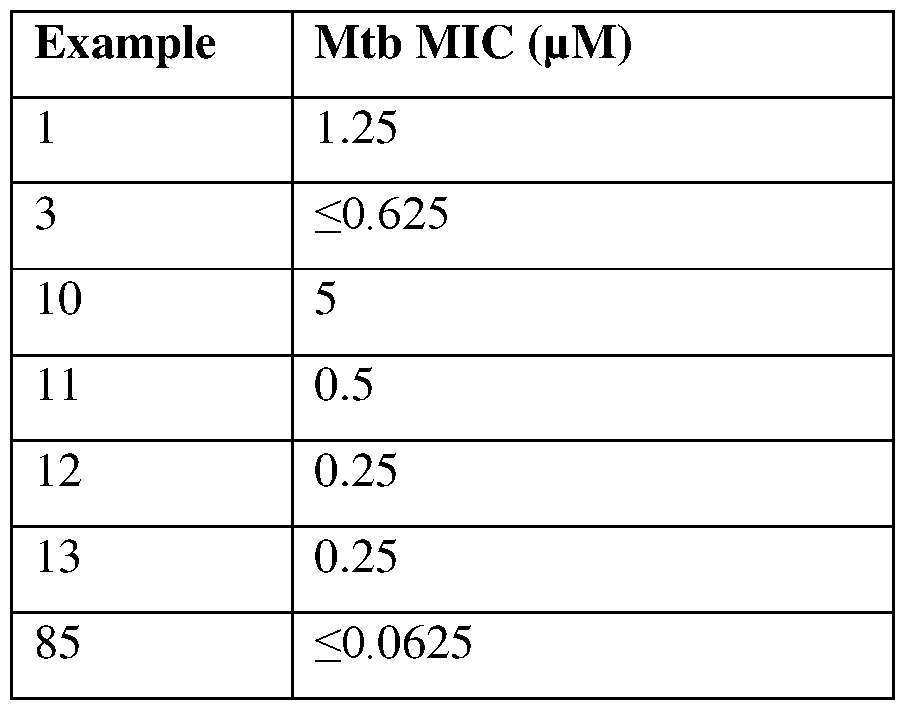
Pharmacokinetics of the compounds
Balb/c mice were obtained from Zydus Research Centre, Ahmedabad India, AAALAC Accreditation. All animals were housed in temperature-control rooms with appropriate light/dark cycles. The animals were overnight fasted before oral gavage dosing but were given access to water ad libitum. Food was provided 4 h after dosing. All animal studies were conducted according to protocols reviewed and approved by the Institutional Animal Care and Ethics Committee at the Zydus Research Centre. Compounds were dosed as a solution in 10% NMP and 10% solutol in Normal Saline (Intravenous (IV), 1 mg/kg) and homogenous suspension (Oral (PO), 3 mg/kg) in 0.5% Tween 80 in 0.5% methyl cellulose as a single dose in mice. For mouse composite PK profile was generated. Blood samples were collected at 0.08 (IV only), 0.25, 0.5, 1, 2, 4, 6, 7.5, and 24 h post-dose in Na-heparin coated micro centrifuge tubes. Blood samples were centrifuged to separate plasma which were then stored at -70°C until analysis. PK parameters were calculated by non- compartmental analysis using Phoenix (Pharsight Corp., Mountain View, California). A model was selected based on the vascular (IV bolus) or extravascular (PO) routes of administration. For the PO route, concentration at time zero was assumed to be zero. Plasma concentrations below the limit of quantitation were treated as zero concentration for the purpose of calculating the mean plasma concentration values. Pharmacokinetic parameters such as maximum plasma concentration (Cmax), area under the curve of concentration over the time (AUC (0-t)) and absolute oral bioavailability (F(%)) of the selected compounds are shown in Table 3.
Table 3:

The novel compounds of the present invention can be formulated into suitable pharmaceutically acceptable compositions by combining with suitable excipients by techniques and processes and concentrations as are well known. Pharmaceutical composition comprising the compounds of the present invention may comprise a suitable binder, suitable bulking agent &/or diluent and any other suitable agents as may be necessary.
Novel compounds of the present invention can be used for the treatment of mammalian infections such as tuberculosis by administrating therapeutically active and non-toxic amount of compounds of formula (I) or pharmaceutically acceptable compositions thereof.
A method of treating anti-tuberculosis infection in a subject that comprising administering to a patient in need thereof an effective amount of a compound of Formula (I) or its suitable pharmaceutical composition.
The pharmaceutical compositions according to this invention can exist in various forms. In some embodiments, the pharmaceutical composition is in the topical, oral or parenteral administration.
In certain embodiment, a provided combination, or composition thereof, is administered in combination with other therapeutic agents such as isoniazide, rifampin, rifapentine, rifabutin, ethambutol, pyrazinamide, streptomycin, amikacin, levofloxacin, ofloxacin, p-aminosalicylic acid.
Claims
1. The compounds of general formula (I),

Wherein,
“A” represents optionally substituted 6-membered ring systems as given below:

“X” and“Y” independently represents either CH or N ; provided that X and Y both can not be CH together;
Ri is independently selected from the group comprising of hydrogen, halo, haloalkyl cyano, -OR4, -S(0)pR4, -NR4R3, -COOR4, optionally substituted (Ci-C6)alkyl, (C3- C6)cycloalkyl, and heterocyclyl derivatives;
with a proviso that when Ri is H, then‘A’ represents cyclic ring other than phenyl and pyridine;
R2 is independently selected from the group comprising of halogen, -OR6, and - S(0)pR6;
R3 at each occurrence is independently selected from the group comprising of hydrogen, halo, cyano, haloalkyl, -NR4R5, S(0)pR4, -OR4 and optionally substituted (Ci-C6)alkyl;
each of R4 and R5 are at each occurrence is independently selected from hydrogen, optionally substituted (Ci-C6)alkyl, (C3-C6)cycloalkyl, cycloalkanyl alkyl, heterocyclyl, haloalkyl; alternatively, R4 and R5 together with the N atom to which they are attached may form a 5-8 membered cyclic ring which may contain additional heteroatoms O, -S(0)p and -NR6;
R6 is selected from the H or (Ci-C6)alkyl;
the (Ci-C6) alkyl chain as used herein before, may further substituted with hydrogen, hydroxy, cyano, halo, haloalkyl, oxo, (Ci-C6)alkyl, (C3-C6)cycloalkyl, heterocyclyl, alkylsulfonyloxy, -COOR4, -OR4, -S(0)PR4, -NR4R5, -CONR4R5, -N(R4)COR5, - S02NR4R5, -N(R4)S02R5 derivatives; wherein, R4 and R5 are as defined earlier;
p represents integers from 0-2; m represents integers from 1-5;
2. The compound of formula (I) as claimed in claim 1 wherein A is selected from following groups:

3. The compound of formula (I) as claimed in claim 1 wherein Ri is selected from -CH3, -OCH3, and halogen.
4. The compound of formula (I) as claimed in claim 1 wherein R2 is hydroxy group.
5. The compound of formula (I) as claimed in claim 1 wherein R3 group is selected from -CH3, -OR4, -SCH3, -N(CH3)2 and halogen.
6. The compounds selected from
N-(( 1 -hydroxycyclopropyl)methyl)- 1 -((6-methoxy-5-methylpyrimidin-4- yl)methyl)-6-methyl-lH-pyrazolo[4,3-b]pyridine-3-carboxamide;
l-((6-methoxy-5-methylpyrimidin-4-yl)methyl)-N-((l- methoxycyclopropyl)methyl)-6-methyl-lH-pyrazolo[4,3-b]pyridine-3-carboxamide; l-((6-ethoxy-5-methylpyrimidin-4-yl)methyl)-N-(( l-hydroxycyclopropyl)methyl)-
6-methyl-lH-pyrazolo[4,3-b]pyridine-3-carboxamide;
N-(( 1 -hydroxycyclopropyl)methyl)-6-methyl- 1 -((5-methyl-6-
(methylthio)pyrimidin-4-yl)methyl)-lH-pyrazolo[4,3-b]pyridine-3-carboxamide;
N-((l-hydroxycyclopropyl)methyl)-l-((6-(2-methoxyethoxy)-5-methylpyrimidin-4- yl)methyl)-6-methyl-lH-pyrazolo[4,3-b]pyridine-3-carboxamide;
l-((6-(dimethylamino)-5-methylpyrimidin-4-yl)methyl)-N-((l-hydroxycyclopropyl) methyl)-6-methyl-lH-pyrazolo[4,3-b]pyridine-3-carboxamide;
N-((l-hydroxycyclopropyl)methyl)-6-methyl-l-((5-methyl-6-morpholinopyrimidin-
4-yl)methyl)-lH-pyrazolo[4,3-b]pyridine-3-carboxamide;
l-((6-(cyclopropylmethoxy)-5-methylpyrimidin-4-yl)methyl)-N-((l- hydroxycyclopropyl) methyl)-6-methyl-lH-pyrazolo[4,3-b]pyridine-3-carboxamide; N-((l-hydroxycyclopropyl)methyl)-l-((2-methoxy-6-methylpyridin-3-yl)methyl)-6- methyl-lH-pyrazolo[4,3-b]pyridine-3-carboxamide;
l-((6-methoxy-5-methylpyrimidin-4-yl)methyl)-N-(2-methoxyethyl)-6-methyl-lH- pyrazolo[4,3-b]pyridine-3-carboxamide;
N-((l-hydroxycyclopropyl)methyl)-5-((6-methoxy-5-methylpyrimidin-4- yl)methyl)-3-methyl-5H-pyrrolo[2,3-b]pyrazine-7-carboxamide;
N-((l-hydroxycyclopropyl)methyl)-3-methoxy-5-((6-methoxy-5-methylpyrimidin-
4-yl)methyl)-5H-pyrrolo[2,3-b]pyrazine-7-carboxamide;
5-((6-ethoxy-5-methylpyrimidin-4-yl)methyl)-N-((l-hydroxycyclopropyl)methyl)-
3-methyl-5H-pyrrolo[2,3-b]pyrazine-7-carboxamide;
N-(( 1 -hydroxycyclopropyl)methyl)- 1 -((6-methoxy-5-methylpyrimidin-4- yl)methyl)-6-methyl-lH-pyrazolo[3,4-b]pyrazine-3-carboxamide;
N-((l-hydroxycyclopropyl)methyl)-6-methoxy-l-((6-methoxy-5-methylpyrimidin-
4-yl)methyl)-lH-pyrazolo[3,4-b]pyrazine-3-carboxamide;
N-(( 1 -hydroxycyclopropyl)methyl)-6-methyl- 1 -((5-methyl-6-(oxetan-3- yloxy)pyrimidin-4-yl)methyl)-lH-pyrazolo[4,3-b]pyridine-3-carboxamide;
N-((l-hydroxycyclopropyl)methyl)-6-methoxy-l-((6-methoxy-5-methylpyrimidin- 4-yl)methyl)-lH-pyrazolo[4,3-b]pyridine-3-carboxamide;
l-((6-ethoxy-5-methylpyrimidin-4-yl)methyl)-N-((l-hydroxycyclopropyl)methyl)-
6-methoxy- 1 H-pyrazolo[4, 3-b]pyridine-3 -carboxamide ;
l-((6-(dimethylamino)-5-methylpyrimidin-4-yl)methyl)-N-((l-hydroxycyclopropyl) methyl)-6-methoxy-lH-pyrazolo[4,3-b]pyridine-3-carboxamide;
l-((6-(ethylthio)-5-methylpyrimidin-4-yl)methyl)-N-((l- hydroxycyclopropyl)methyl)-6-methyl-lH-pyrazolo[4,3-b]pyridine-3-carboxamide; l-((6-(difluoromethoxy)-5-methylpyrimidin-4-yl)methyl)-N-((l- hydroxycyclopropyl) methyl)-6-methyl-lH-pyrazolo[4,3-b]pyridine-3-carboxamide; N-((l-fluorocyclopropyl)methyl)-l-((6-methoxy-5-methylpyrimidin-4-yl)methyl)-6- methyl-lH-pyrazolo[4,3-b]pyridine-3-carboxamide;
l-((5-fluoro-2,6-dimethylpyridin-3-yl)methyl)-N-((l-hydroxycyclopropyl)methyl)-
6-methyl-lH-pyrazolo[4,3-b]pyridine-3-carboxamide;
l-((3,5-dimethylpyrazin-2-yl)methyl)-N-((l-hydroxycyclopropyl)methyl)-6-methyl- lH-pyrazolo[4,3-b]pyridine-3-carboxamide;
6-chloro-N-((l-hydroxycyclopropyl)methyl)-l-((6-methoxy-5-methylpyrimidin-4- yl)methyl)-lH-pyrazolo[4,3-b]pyridine-3-carboxamide;
l-((5-fluoro-2-methoxy-6-methylpyridin-3-yl)methyl)-N-((l-hydroxycyclopropyl) methyl)-6-methyl-lH-pyrazolo[4,3-b]pyridine-3-carboxamide;
N-((l-hydroxycyclopropyl)methyl)-l-((2-methoxy-5-(trifluoromethyl)pyridin-3- yl)methyl)-6-methyl-lH-pyrazolo[4,3-b]pyridine-3-carboxamide;
l-((5-fluoro-2-methoxypyridin-3-yl)methyl)-N-((l-hydroxycyclopropyl)methyl)-6- methyl-lH-pyrazolo[4,3-b]pyridine-3-carboxamide;
1 -(2,4-dimethylbenzyl)-N-(( 1 -hydroxycyclopropyl)methyl)-6-methyl- 1H- pyrazolo[4,3-b]pyridine-3-carboxamide;
5-((6-ethoxy-5-methylpyrimidin-4-yl)methyl)-N-((l-hydroxycyclopropyl)methyl)-
3-methoxy-5H-pyrrolo[2,3-b]pyrazine-7-carboxamide;
5-((6-(dimethylamino)-5-methylpyrimidin-4-yl)methyl)-N-((l-hydroxycyclopropyl) methyl)-3-methyl-5H-pyrrolo[2,3-b]pyrazine-7-carboxamide;
5-((6-(dimethylamino)-5-methylpyrimidin-4-yl)methyl)-N-((l-hydroxycyclopropyl) methyl)-3-methoxy-5H-pyrrolo[2,3-b]pyrazine-7-carboxamide;
N-((l-hydroxycyclopropyl)methyl)-3-methoxy-5-((5-methyl-6-
(methylthio)pyrimidin-4-yl)methyl)-5H-pyrrolo[2,3-b]pyrazine-7-carboxamide
N-((l-hydroxycyclopropyl)methyl)-3-methyl-5-((5-methyl-6-
(methylthio)pyrimidin-4-yl)methyl)-5H-pyrrolo[2,3-b]pyrazine-7-carboxamide; 5-((6-(ethylthio)-5-methylpyrimidin-4-yl)methyl)-N-((l- hydroxycyclopropyl)methyl)-3-methyl-5H-pyrrolo[2,3-b]pyrazine-7-carboxamide
5-((6-(ethylthio)-5-methylpyrimidin-4-yl)methyl)-N-((l- hydroxycyclopropyl)methyl)-3-methoxy-5H-pyrrolo[2,3-b]pyrazine-7- carboxamide;
5-((6-(difluoromethoxy)-5-methylpyrimidin-4-yl)methyl)-N-((l- hydroxycyclopropyl) methyl)-3-methyl-5H-pyrrolo[2,3-b]pyrazine-7-carboxamide;
5-((6-(difluoromethoxy)-5-methylpyrimidin-4-yl)methyl)-N-((l- hydroxycyclopropyl) methyl)-3-methoxy-5H-pyrrolo[2,3-b]pyrazine-7- carboxamide;
N-((l-fluorocyclopropyl)methyl)-5-((6-methoxy-5-methylpyrimidin-4-yl)methyl)-3- methyl-5H-pyrrolo[2,3-b]pyrazine-7-carboxamide;
N-((l-fluorocyclopropyl)methyl)-3-methoxy-5-((6-methoxy-5-methylpyrimidin-4- yl)methyl)-5H-pyrrolo[2,3-b]pyrazine-7-carboxamide;
N-((l-hydroxycyclopropyl)methyl)-5-((2-methoxy-6-methylpyridin-3-yl)methyl)-3- methyl-5H-pyrrolo[2,3-b]pyrazine-7-carboxamide;
N-((l-hydroxycyclopropyl)methyl)-3-methoxy-5-((2-methoxy-6-methylpyridin-3- yl)methyl)-5H-pyrrolo[2,3-b]pyrazine-7-carboxamide;
5-((5-fluoro-2,6-dimethylpyridin-3-yl)methyl)-N-((l-hydroxycyclopropyl)methyl)-
3-methyl-5H-pyrrolo[2,3-b]pyrazine-7-carboxamide;
5-((5-fluoro-2,6-dimethylpyridin-3-yl)methyl)-N-((l-hydroxycyclopropyl)methyl)- 3-methoxy-5H-pyrrolo[2,3-b]pyrazine-7-carboxamide;
5-((3,5-dimethylpyrazin-2-yl)methyl)-N-((l-hydroxycyclopropyl)methyl)-3-methyl-
5H-pyrrolo[2,3-b]pyrazine-7-carboxamide;
5-((3,5-dimethylpyrazin-2-yl)methyl)-N-((l-hydroxycyclopropyl)methyl)-3- methoxy-5 H-pyrrolo [2 , 3 -b] pyrazine-7 -carboxamide ;
N-((l-hydroxycyclopropyl)methyl)-5-((6-methoxy-5-methylpyrimidin-4- yl)methyl)-5H-pyrrolo[2,3-b]pyrazine-7-carboxamide;
5-((5-fluoro-2-methoxy-6-methylpyridin-3-yl)methyl)-N-((l-hydroxycyclopropyl) methyl)-3-methyl-5H-pyrrolo[2,3-b]pyrazine-7-carboxamide;
5-((5-fluoro-2-methoxy-6-methylpyridin-3-yl)methyl)-N-((l-hydroxycyclopropyl) methyl)-3-methoxy-5H-pyrrolo[2,3-b]pyrazine-7-carboxamide;
5-((5-fluoro-2-methoxypyridin-3-yl)methyl)-N-((l-hydroxycyclopropyl)methyl)-3- methyl-5H-pyrrolo[2,3-b]pyrazine-7-carboxamide;
5-((5-fluoro-2-methoxypyridin-3-yl)methyl)-N-((l-hydroxycyclopropyl)methyl)-3- methoxy-5 H-pyrrolo [2 , 3 -b] pyrazine-7 -carboxamide ;
N-((l-hydroxycyclopropyl)methyl)-5-((2-methoxy-5-(trifluoromethyl)pyridin-3- yl)methyl)-3-methyl-5H-pyrrolo[2,3-b]pyrazine-7-carboxamide;
N-((l-hydroxycyclopropyl)methyl)-3-methoxy-5-((2-methoxy-5-
(trifluoromethyl)pyridin-3-yl)methyl)-5H-pyrrolo[2,3-b]pyrazine-7-carboxamide;
3-(dimethylamino)-N-((l-hydroxycyclopropyl)methyl)-5-((6-methoxy-5- methylpyrimidin-4-yl)methyl)-5H-pyrrolo[2,3-b]pyrazine-7-carboxamide;
3-cyano-N-((l-hydroxycyclopropyl)methyl)-5-((6-methoxy-5-methylpyrimidin-4- yl)methyl)-5H-pyrrolo[2,3-b]pyrazine-7-carboxamide;
3-ethoxy-N-((l-hydroxycyclopropyl)methyl)-5-((6-methoxy-5-methylpyrimidin-4- yl)methyl)-5H-pyrrolo[2,3-b]pyrazine-7-carboxamide;
N-((l-hydroxycyclopropyl)methyl)-3-isopropoxy-5-((6-methoxy-5- methylpyrimidin-4-yl)methyl)-5H-pyrrolo[2,3-b]pyrazine-7-carboxamide;
N-(( 1 -hydroxycyclopropyl)methyl)-6-methyl- 1 -((5-methyl-6-
(methylthio)pyrimidin-4-yl)methyl)-lH-pyrazolo[3,4-b]pyrazine-3-carboxamide;
N-(( 1 -hydroxycyclopropyl)methyl)-6-methoxy- 1 -((5-methyl-6-
(methylthio)pyrimidin-4-yl)methyl)-lH-pyrazolo[3,4-b]pyrazine-3-carboxamide; l-((6-(dimethylamino)-5-methylpyrimidin-4-yl)methyl)-N-((l- hydroxycyclopropyl)methyl)-6-methoxy-lH-pyrazolo[3,4-b]pyrazine-3- carboxamide;
l-((6-(dimethylamino)-5-methylpyrimidin-4-yl)methyl)-N-((l- hydroxycyclopropyl)methyl)-6-methyl-lH-pyrazolo[3,4-b]pyrazine-3-carboxamide; l-((6-ethoxy-5-methylpyrimidin-4-yl)methyl)-N-((l-hydroxycyclopropyl)methyl)-
6-methyl-lH-pyrazolo[3,4-b]pyrazine-3-carboxamide;
l-((6-ethoxy-5-methylpyrimidin-4-yl)methyl)-N-((l-hydroxycyclopropyl)methyl)-
6-methoxy-lH-pyrazolo[3,4-b]pyrazine-3-carboxamide;
l-((6-(difluoromethoxy)-5-methylpyrimidin-4-yl)methyl)-N-((l- hydroxycyclopropyl)methyl)-6-methyl-lH-pyrazolo[3,4-b]pyrazine-3-carboxamide; l-((6-(difluoromethoxy)-5-methylpyrimidin-4-yl)methyl)-N-((l- hydroxycyclopropyl)methyl)-6-methoxy-lH-pyrazolo[3,4-b]pyrazine-3- carboxamide;
N-((l-hydroxycyclopropyl)methyl)-l-((2-methoxy-6-methylpyridin-3-yl)methyl)-6- methyl- 1 H-pyrazolo[3 ,4-b]pyrazine-3 -carboxamide ;
N-((l-hydroxycyclopropyl)methyl)-6-methoxy-l-((2-methoxy-6-methylpyridin-3- yl)methyl)-lH-pyrazolo [3, 4-b]pyrazine-3 -carboxamide;
l-((5-fluoro-2,6-dimethylpyridin-3-yl)methyl)-N-((l-hydroxycyclopropyl)methyl)-
6-methyl-lH-pyrazolo[3,4-b]pyrazine-3-carboxamide;
l-((5-fluoro-2,6-dimethylpyridin-3-yl)methyl)-N-((l-hydroxycyclopropyl)methyl)-
6-methoxy-lH-pyrazolo[3,4-b]pyrazine-3-carboxamide;
l-((3,5-dimethylpyrazin-2-yl)methyl)-N-((l-hydroxycyclopropyl)methyl)-6-methyl- lH-pyrazolo[3,4-b]pyrazine-3-carboxamide;
l-((3,5-dimethylpyrazin-2-yl)methyl)-N-((l-hydroxycyclopropyl)methyl)-6- methoxy-lH-pyrazolo[3,4-b]pyrazine-3-carboxamide;
N-((l-fluorocyclopropyl)methyl)-l-((6-methoxy-5-methylpyrimidin-4-yl)methyl)-6- methyl- 1 H-pyrazolo[3 ,4-b]pyrazine-3 -carboxamide ;
N-((l-fluorocyclopropyl)methyl)-6-methoxy-l-((6-methoxy-5-methylpyrimidin-4- yl)methyl)-lH-pyrazolo [3, 4-b]pyrazine-3 -carboxamide;
l-((5-fluoro-2-methoxy-6-methylpyridin-3-yl)methyl)-N-((l-hydroxycyclopropyl) methyl)-6-methyl-lH-pyrazolo[3,4-b]pyrazine-3-carboxamide;
l-((5-fluoro-2-methoxy-6-methylpyridin-3-yl)methyl)-N-((l-hydroxycyclopropyl) methyl)-6-methoxy-lH-pyrazolo [3, 4-b]pyrazine-3 -carboxamide;
l-((5-fluoro-2-methoxypyridin-3-yl)methyl)-N-((l-hydroxycyclopropyl)methyl)-6- methyl- lH-pyrazolo[3,4-b]pyrazine-3-carboxamide;
l-((5-fluoro-2-methoxypyridin-3-yl)methyl)-N-((l-hydroxycyclopropyl)methyl)-6- methoxy-lH-pyrazolo[3,4-b]pyrazine-3-carboxamide;
N-((l-hydroxycyclopropyl)methyl)-l-((2-methoxy-5-(trifluoromethyl)pyridin-3- yl)methyl)-6-methyl-lH-pyrazolo[3,4-b]pyrazine-3-carboxamide;
N-(( 1 -hydroxycyclopropyl)methyl)-6-methoxy- 1 -((2-methoxy-5-
(trifluoromethyl)pyridin-3-yl)methyl)-lH-pyrazolo[3,4-b]pyrazine-3-carboxamide; N-(( 1 -hydroxycyclopropyl)methyl)- 1 -((6-methoxy-5-methylpyrimidin-4- yl)methyl)-6-methyl-lH-pyrrolo[3,2-b]pyridine-3-carboxamide;
N-((l-hydroxycyclopropyl)methyl)-6-methoxy-l-((6-methoxy-5-methylpyrimidin- 4-yl)methyl)-lH-pyrrolo[3,2-b]pyridine-3-carboxamide;
l-((6-(dimethylamino)-5-methylpyrimidin-4-yl)methyl)-N-((l- hydroxycyclopropyl)methyl)-6-methyl-lH-pyrrolo[3,2-b]pyridine-3-carboxamide; l-((6-(dimethylamino)-5-methylpyrimidin-4-yl)methyl)-N-((l- hydroxycyclopropyl)methyl)-6-methoxy-lH-pyrrolo[3,2-b]pyridine-3-carboxamide; l-((6-ethoxy-5-methylpyrimidin-4-yl)methyl)-N-((l-hydroxycyclopropyl)methyl)-
6-methyl-lH-pyrrolo[3,2-b]pyridine-3-carboxamide;
l-((6-ethoxy-5-methylpyrimidin-4-yl)methyl)-N-((l-hydroxycyclopropyl)methyl)- 6-methoxy-lH-pyrrolo[3,2-b]pyridine-3-carboxamide;
N-((l-hydroxycyclopropyl)methyl)-5-((6-methoxy-5-methylpyrimidin-4- yl)methyl)-3-(methylthio)-5H-pyrrolo[2,3-b]pyrazine-7-carboxamide;
3-cyclopropyl-N-((l-hydroxycyclopropyl)methyl)-5-((6-methoxy-5- methylpyrimidin-4-yl)methyl)-5H-pyrrolo[2,3-b]pyrazine-7-carboxamide;
N-((l-hydroxycyclopropyl)methyl)-5-((6-methoxy-5-methylpyrimidin-4- yl)methyl)-3-(oxetan-3-yl)-5H-pyrrolo[2,3-b]pyrazine-7-carboxamide;
N-((l-hydroxycyclopropyl)methyl)-5-((6-methoxy-5-methylpyrimidin-4- yl)methyl)-3-(oxetan-3-yloxy)-5H-pyrrolo[2,3-b]pyrazine-7-carboxamide;
3-(cyclopropylmethoxy)-N-((l-hydroxycyclopropyl)methyl)-5-((6-methoxy-5- methylpyrimidin-4-yl)methyl)-5H-pyrrolo[2,3-b]pyrazine-7-carboxamide;
N-((l-hydroxycyclopropyl)methyl)-5-((6-methoxy-5-methylpyrimidin-4- yl)methyl)-3-(2-methoxyethoxy)-5H-pyrrolo[2,3-b]pyrazine-7-carboxamide;
5-((6-methoxy-5-methylpyrimidin-4-yl)methyl)-3-methyl-N-(( 1 - (methylthio)cyclopropyl)methyl)-5H-pyrrolo[2,3-b]pyrazine-7-carboxamide;
N-((l-hydroxycyclopropyl)methyl)-5-((6-methoxy-4-methylpyridazin-3-yl)methyl)- 3-methyl-5H-pyrrolo[2,3-b]pyrazine-7-carboxamide;
5-((4-(dimethylamino)-6-methyl-l,3,5-triazin-2-yl)methyl)-N-((l- hydroxycyclopropyl)methyl)-3-methyl-5H-pyrrolo[2,3-b]pyrazine-7-carboxamide.
7. A pharmaceutical composition comprising a therapeutically effective amount of a compound as claimed in any of the preceding claims and optionally one or more pharmaceutically acceptable carriers, diluents or excipients.
8. Use of a compound as claimed in any preceding claim in the preparation of a medicament for the prevention or treatment of anti-tuberculosis infection.
9. A method of treating anti-tuberculosis infection comprising administering to a patient in need thereof an effective amount of a compound of formula (I) as claimed in any of the preceding claims or its suitable pharmaceutical composition.
10. Compound of formula (I) or its pharmaceutical composition as claimed in any of preceding claim in combination with one or more suitable pharmaceutically active agents selected from group of isoniazide, rifampin, rifapentine, rifabutin, ethambutol, pyrazinamide, streptomycin, amikacin, levofloxacin, ofloxacin, p-aminosalicylic acid .
Priority Applications (3)
| Application Number | Priority Date | Filing Date | Title |
|---|---|---|---|
| US17/252,494 US20210292333A1 (en) | 2018-06-15 | 2019-06-14 | Condensed azaheteroaryl compounds having antibacterial activity against tuberculosis bacteria |
| KR1020217001229A KR20210021042A (en) | 2018-06-15 | 2019-06-14 | Novel compounds for treatment of mammalian infections |
| CN201980049637.0A CN112543757A (en) | 2018-06-15 | 2019-06-14 | Condensed azaheteroaryl compounds having antibacterial activity against tubercle bacillus |
Applications Claiming Priority (4)
| Application Number | Priority Date | Filing Date | Title |
|---|---|---|---|
| IN201821022468 | 2018-06-15 | ||
| IN201821022468 | 2018-06-15 | ||
| IN201921007053 | 2019-02-22 | ||
| IN201921007053 | 2019-02-22 |
Publications (1)
| Publication Number | Publication Date |
|---|---|
| WO2019239382A1 true WO2019239382A1 (en) | 2019-12-19 |
Family
ID=67439271
Family Applications (1)
| Application Number | Title | Priority Date | Filing Date |
|---|---|---|---|
| PCT/IB2019/054997 Ceased WO2019239382A1 (en) | 2018-06-15 | 2019-06-14 | Condensed azaheteroaryl compounds having antibacterial activity against tuberculosis bacteria |
Country Status (4)
| Country | Link |
|---|---|
| US (1) | US20210292333A1 (en) |
| KR (1) | KR20210021042A (en) |
| CN (1) | CN112543757A (en) |
| WO (1) | WO2019239382A1 (en) |
Cited By (2)
| Publication number | Priority date | Publication date | Assignee | Title |
|---|---|---|---|---|
| CN112679497A (en) * | 2020-03-16 | 2021-04-20 | 青岛吉澳医药科技有限公司 | Azaindole amide compound and preparation method and application thereof |
| EP4296674A1 (en) | 2022-06-20 | 2023-12-27 | Université Toulouse III - Paul Sabatier | Innovative molecules decreasing virulence of mycobacterium for the treatment of tuberculosis |
Families Citing this family (1)
| Publication number | Priority date | Publication date | Assignee | Title |
|---|---|---|---|---|
| KR200498648Y1 (en) | 2023-03-20 | 2024-12-20 | 임수현 | Function flight memo tool |
Citations (8)
| Publication number | Priority date | Publication date | Assignee | Title |
|---|---|---|---|---|
| WO2014081732A1 (en) | 2012-11-20 | 2014-05-30 | Principia Biopharma Inc. | Azaindole derivatives as jak3 inhibitors |
| WO2015009525A1 (en) | 2013-07-17 | 2015-01-22 | Global Alliance For Tb Drug Development | Azaindole compounds, synthesis thereof, and methods of using the same |
| WO2015028483A1 (en) * | 2013-08-30 | 2015-03-05 | F. Hoffmann-La Roche Ag | Pyrrolopyridine or pyrazolopyridine derivatives |
| WO2016031255A1 (en) | 2014-08-28 | 2016-03-03 | Otsuka Pharmaceutical Co., Ltd. | Heterobicyclic compounds and their use for the treatment of tuberculosis |
| WO2017120429A1 (en) | 2016-01-07 | 2017-07-13 | CS Pharmasciences, Inc. | Selective inhibitors of clinically important mutants of the egfr tyrosine kinase |
| WO2017146246A1 (en) | 2016-02-26 | 2017-08-31 | 大塚製薬株式会社 | Piperidine derivative |
| WO2018049271A1 (en) | 2016-09-09 | 2018-03-15 | Flx Bio, Inc. | Chemokine receptor modulators and uses thereof |
| WO2018055048A1 (en) | 2016-09-22 | 2018-03-29 | Leibniz-Institut Für Naturstoff-Forschung Und Infektionsbiologie E.V. Hans-Knöll Institut (Hki) | New antimicrobial compounds, their use for the treatment of mammalian infections and a new metabolic mechanism |
-
2019
- 2019-06-14 WO PCT/IB2019/054997 patent/WO2019239382A1/en not_active Ceased
- 2019-06-14 KR KR1020217001229A patent/KR20210021042A/en not_active Withdrawn
- 2019-06-14 CN CN201980049637.0A patent/CN112543757A/en active Pending
- 2019-06-14 US US17/252,494 patent/US20210292333A1/en not_active Abandoned
Patent Citations (8)
| Publication number | Priority date | Publication date | Assignee | Title |
|---|---|---|---|---|
| WO2014081732A1 (en) | 2012-11-20 | 2014-05-30 | Principia Biopharma Inc. | Azaindole derivatives as jak3 inhibitors |
| WO2015009525A1 (en) | 2013-07-17 | 2015-01-22 | Global Alliance For Tb Drug Development | Azaindole compounds, synthesis thereof, and methods of using the same |
| WO2015028483A1 (en) * | 2013-08-30 | 2015-03-05 | F. Hoffmann-La Roche Ag | Pyrrolopyridine or pyrazolopyridine derivatives |
| WO2016031255A1 (en) | 2014-08-28 | 2016-03-03 | Otsuka Pharmaceutical Co., Ltd. | Heterobicyclic compounds and their use for the treatment of tuberculosis |
| WO2017120429A1 (en) | 2016-01-07 | 2017-07-13 | CS Pharmasciences, Inc. | Selective inhibitors of clinically important mutants of the egfr tyrosine kinase |
| WO2017146246A1 (en) | 2016-02-26 | 2017-08-31 | 大塚製薬株式会社 | Piperidine derivative |
| WO2018049271A1 (en) | 2016-09-09 | 2018-03-15 | Flx Bio, Inc. | Chemokine receptor modulators and uses thereof |
| WO2018055048A1 (en) | 2016-09-22 | 2018-03-29 | Leibniz-Institut Für Naturstoff-Forschung Und Infektionsbiologie E.V. Hans-Knöll Institut (Hki) | New antimicrobial compounds, their use for the treatment of mammalian infections and a new metabolic mechanism |
Non-Patent Citations (11)
| Title |
|---|
| "Global Tuberculosis Report 2016", 2017, WHO |
| "Multidrug-Resistant Tuberculosis (MDR-TB) 2016 Update", 2016, WHO |
| FAMING ZHUANLI SHENQING, vol. 102911174, 2013 |
| MAKAROV ET AL., EMBO MOL. MED., vol. 6, 2014, pages 372 - 383 |
| MAKAROV ET AL., SCIENCE, vol. 324, 2009, pages 801 - 804 |
| PRAVIN S. SHIRUDE ET AL: "Lead Optimization of 1,4-Azaindoles as Antimycobacterial Agents", JOURNAL OF MEDICINAL CHEMISTRY, vol. 57, no. 13, 20 June 2014 (2014-06-20), US, pages 5728 - 5737, XP055614565, ISSN: 0022-2623, DOI: 10.1021/jm500571f * |
| SHIRUDE P 1 ET AL: "Azaindoles. Noncovalent DprE1 Inhibitors from Scaffold Morphing Efforts, Kill Mycobacterium Tuberculosis and are Efficacious in Vivo", JOURNAL OF MEDICINAL CHEMISTRY, AMERICAN CHEMICAL SOCIETY, US, vol. 56, no. 23, 12 December 2013 (2013-12-12), pages 9701 - 9708, XP002730637, ISSN: 0022-2623, [retrieved on 20131121], DOI: 10.1021/JM401382V * |
| TETRAHEDRON, vol. 61, 2005, pages 10827 |
| THE JOURNAL OF INFECTIOUS DISEASES, vol. 211, no. 3, 2015, pages 83 - 95 |
| TREFZER, C. ET AL., J. AM. CHEM. SOC., vol. 132, 2010, pages 13663 - 13665 |
| WOLUCKA B. A. ET AL., FEBS J., vol. 275, 2008, pages 2691 - 2711 |
Cited By (2)
| Publication number | Priority date | Publication date | Assignee | Title |
|---|---|---|---|---|
| CN112679497A (en) * | 2020-03-16 | 2021-04-20 | 青岛吉澳医药科技有限公司 | Azaindole amide compound and preparation method and application thereof |
| EP4296674A1 (en) | 2022-06-20 | 2023-12-27 | Université Toulouse III - Paul Sabatier | Innovative molecules decreasing virulence of mycobacterium for the treatment of tuberculosis |
Also Published As
| Publication number | Publication date |
|---|---|
| KR20210021042A (en) | 2021-02-24 |
| US20210292333A1 (en) | 2021-09-23 |
| CN112543757A (en) | 2021-03-23 |
Similar Documents
| Publication | Publication Date | Title |
|---|---|---|
| US11905299B2 (en) | Cot modulators and methods of use thereof | |
| US10167279B2 (en) | Compounds and compositions as RAF kinase inhibitors | |
| JP5654715B1 (en) | Tetrahydroimidazo [1,5-d] [1,4] oxazepine derivative (TETRAHYDROIMIDAZO [1,5-d] [1,4] OXAZEPINEDERIVEIVE) | |
| KR20240069725A (en) | Pyridine derivatives and their uses | |
| JP6923543B2 (en) | Substitution as NR2B selective NMDA regulator 1,2,3-triazole | |
| US9718804B2 (en) | GSK-3 inhibitors | |
| KR101697982B1 (en) | Novel pyrimidine and pyridine compounds and their usage | |
| AU2021209744B2 (en) | Novel heterocyclic compounds useful as Aurora A selective inhibitors | |
| KR20190032420A (en) | Heterocyclic compounds used as FGFR inhibitors | |
| CA2987328A1 (en) | 2-(pyrazolopyridin-3-yl)pyrimidine derivatives as jak inhibitors | |
| US20240216357A1 (en) | Polycyclic compound and application thereof | |
| KR20150135794A (en) | 6-(5-hydroxy-1h-pyrazol-1-yl)nicotinamide derivatives and their use as phd inhibitors | |
| BR112016028845B1 (en) | COMPOUND, PHARMACEUTICAL COMPOSITION AND USE OF A COMPOUND | |
| TWI891753B (en) | Amide compounds and uses thereof | |
| WO2019239382A1 (en) | Condensed azaheteroaryl compounds having antibacterial activity against tuberculosis bacteria | |
| US20250289820A1 (en) | Non-covalent modifiers of akt1 and uses thereof | |
| JP2016124810A (en) | Novel condensed pyrazole derivative and medical uses thereof | |
| EP4041714A1 (en) | Bi-aryl dihydroorotate dehydrogenase inhibitors | |
| KR20220137709A (en) | Heterocyclic Compounds as Dihydroorotate Dehydrogenase Inhibitors | |
| KR20220097438A (en) | Fluorinated quinolines and quinoxaline derivatives as dihydroorotate dehydrogenase (DHODH) inhibitors for the treatment of cancer, autoimmune, and inflammatory diseases | |
| US20210284658A1 (en) | Novel thiazole derivatives and pharmaceutically acceptable salts thereof | |
| US20220017483A1 (en) | Aminopyridine compound, preparation method therefor and use thereof | |
| JP2019515939A (en) | Pyridin-3-ylacetic acid derivatives as inhibitors of human immunodeficiency virus replication | |
| HK40039580A (en) | Condensed azaheteroaryl compounds having antibacterial activity against tuberculosis bacteria | |
| EA045220B1 (en) | Cot MODULATORS AND METHODS OF THEIR APPLICATION |
Legal Events
| Date | Code | Title | Description |
|---|---|---|---|
| 121 | Ep: the epo has been informed by wipo that ep was designated in this application |
Ref document number: 19744852 Country of ref document: EP Kind code of ref document: A1 |
|
| NENP | Non-entry into the national phase |
Ref country code: DE |
|
| ENP | Entry into the national phase |
Ref document number: 20217001229 Country of ref document: KR Kind code of ref document: A |
|
| 122 | Ep: pct application non-entry in european phase |
Ref document number: 19744852 Country of ref document: EP Kind code of ref document: A1 |