WO2019217985A1 - A method of generating radicals by ultrasound - Google Patents
A method of generating radicals by ultrasound Download PDFInfo
- Publication number
- WO2019217985A1 WO2019217985A1 PCT/AU2018/050887 AU2018050887W WO2019217985A1 WO 2019217985 A1 WO2019217985 A1 WO 2019217985A1 AU 2018050887 W AU2018050887 W AU 2018050887W WO 2019217985 A1 WO2019217985 A1 WO 2019217985A1
- Authority
- WO
- WIPO (PCT)
- Prior art keywords
- ultrasound
- rate
- frequency
- polymerisation
- radicals
- Prior art date
- Legal status (The legal status is an assumption and is not a legal conclusion. Google has not performed a legal analysis and makes no representation as to the accuracy of the status listed.)
- Ceased
Links
Classifications
-
- C—CHEMISTRY; METALLURGY
- C08—ORGANIC MACROMOLECULAR COMPOUNDS; THEIR PREPARATION OR CHEMICAL WORKING-UP; COMPOSITIONS BASED THEREON
- C08F—MACROMOLECULAR COMPOUNDS OBTAINED BY REACTIONS ONLY INVOLVING CARBON-TO-CARBON UNSATURATED BONDS
- C08F2/00—Processes of polymerisation
- C08F2/04—Polymerisation in solution
-
- C—CHEMISTRY; METALLURGY
- C08—ORGANIC MACROMOLECULAR COMPOUNDS; THEIR PREPARATION OR CHEMICAL WORKING-UP; COMPOSITIONS BASED THEREON
- C08F—MACROMOLECULAR COMPOUNDS OBTAINED BY REACTIONS ONLY INVOLVING CARBON-TO-CARBON UNSATURATED BONDS
- C08F12/00—Homopolymers and copolymers of compounds having one or more unsaturated aliphatic radicals, each having only one carbon-to-carbon double bond, and at least one being terminated by an aromatic carbocyclic ring
- C08F12/02—Monomers containing only one unsaturated aliphatic radical
- C08F12/04—Monomers containing only one unsaturated aliphatic radical containing one ring
- C08F12/06—Hydrocarbons
- C08F12/08—Styrene
-
- C—CHEMISTRY; METALLURGY
- C08—ORGANIC MACROMOLECULAR COMPOUNDS; THEIR PREPARATION OR CHEMICAL WORKING-UP; COMPOSITIONS BASED THEREON
- C08F—MACROMOLECULAR COMPOUNDS OBTAINED BY REACTIONS ONLY INVOLVING CARBON-TO-CARBON UNSATURATED BONDS
- C08F2/00—Processes of polymerisation
- C08F2/46—Polymerisation initiated by wave energy or particle radiation
- C08F2/56—Polymerisation initiated by wave energy or particle radiation by ultrasonic vibrations
-
- B—PERFORMING OPERATIONS; TRANSPORTING
- B01—PHYSICAL OR CHEMICAL PROCESSES OR APPARATUS IN GENERAL
- B01J—CHEMICAL OR PHYSICAL PROCESSES, e.g. CATALYSIS OR COLLOID CHEMISTRY; THEIR RELEVANT APPARATUS
- B01J19/00—Chemical, physical or physico-chemical processes in general; Their relevant apparatus
- B01J19/08—Processes employing the direct application of electric or wave energy, or particle radiation; Apparatus therefor
- B01J19/10—Processes employing the direct application of electric or wave energy, or particle radiation; Apparatus therefor employing sonic or ultrasonic vibrations
-
- C—CHEMISTRY; METALLURGY
- C08—ORGANIC MACROMOLECULAR COMPOUNDS; THEIR PREPARATION OR CHEMICAL WORKING-UP; COMPOSITIONS BASED THEREON
- C08F—MACROMOLECULAR COMPOUNDS OBTAINED BY REACTIONS ONLY INVOLVING CARBON-TO-CARBON UNSATURATED BONDS
- C08F2438/00—Living radical polymerisation
- C08F2438/03—Use of a di- or tri-thiocarbonylthio compound, e.g. di- or tri-thioester, di- or tri-thiocarbamate, or a xanthate as chain transfer agent, e.g . Reversible Addition Fragmentation chain Transfer [RAFT] or Macromolecular Design via Interchange of Xanthates [MADIX]
-
- C—CHEMISTRY; METALLURGY
- C09—DYES; PAINTS; POLISHES; NATURAL RESINS; ADHESIVES; COMPOSITIONS NOT OTHERWISE PROVIDED FOR; APPLICATIONS OF MATERIALS NOT OTHERWISE PROVIDED FOR
- C09D—COATING COMPOSITIONS, e.g. PAINTS, VARNISHES OR LACQUERS; FILLING PASTES; CHEMICAL PAINT OR INK REMOVERS; INKS; CORRECTING FLUIDS; WOODSTAINS; PASTES OR SOLIDS FOR COLOURING OR PRINTING; USE OF MATERIALS THEREFOR
- C09D133/00—Coating compositions based on homopolymers or copolymers of compounds having one or more unsaturated aliphatic radicals, each having only one carbon-to-carbon double bond, and at least one being terminated by only one carboxyl radical, or of salts, anhydrides, esters, amides, imides, or nitriles thereof; Coating compositions based on derivatives of such polymers
- C09D133/04—Homopolymers or copolymers of esters
- C09D133/06—Homopolymers or copolymers of esters of esters containing only carbon, hydrogen and oxygen, the oxygen atom being present only as part of the carboxyl radical
- C09D133/062—Copolymers with monomers not covered by C09D133/06
- C09D133/066—Copolymers with monomers not covered by C09D133/06 containing -OH groups
Definitions
- the present invention relates to radical initiated chemical reactions.
- the present invention relates to free radical polymerisation including conventional and controlled radical polymerisation.
- Radicals are used to initiate a variety of reactions such as polymerisation. Typically, such reactions involve the addition of exogenous chemical initiators to provide a source of radicals which are then used to initiate a reaction to form the desired product.
- Polymers are one class of product that may be produced by radical reaction. Polymers are important across a broad range of industries, for example the coatings and medical industries. 40-45% of all industrial polymers are produced by radical polymerisation techniques, typically conventional free radical polymerisation.
- the purity of the final product may be adversely affected by the incorporation of the initiator fragment into the final reaction product or the final reaction product may contain residual unreacted initiator. Purification of the final product, which may be costly and time consuming would then be required to obtain the desired final product.
- thermal initiators such as azo-based initiators are explosive and require thermal induction. This makes their storage and transportation potentially hazardous.
- a further problem faced by exogeneous thermal initiators is that heat is often required to decompose the initiators to form radicals for reaction. This may be undesirable for biological reactions which often have to be performed at ambient or sub-ambient conditions to avoid deactivation or denaturing of biological reagents or products.
- the present invention is generally directed towards a method of reacting carbon-containing molecules (e.g. monomers) using ultrasound (US) to synthesise a reaction product (e.g. polymer) without the need for exogenous initiating reagents (e.g. initiators). This eliminates the need to (i) use/store explosive exogenous initiating reagents and to (ii) purify the reaction product from residual exogenous initiating reagents.
- carbon-containing molecules e.g. monomers
- US ultrasound
- the present invention is directed towards a method of reacting carbon-containing molecules (e.g. monomers) using ultrasound (US) to synthesise a reaction product (e.g. polymer) without the need for exogenous initiating reagents and an irradiating light source.
- carbon-containing molecules e.g. monomers
- US ultrasound
- a reaction product e.g. polymer
- a method of producing a polymer from monomers in a solvent including the steps of:
- a method of reacting at carbon-containing molecules in a solvent to synthesise a reaction product including the steps of:
- a method of reacting carbon-containing molecules in a solvent to synthesise a reaction product including:
- a method of producing a polymer by conventional free radical polymerisation from monomers in a solvent including the steps of:
- radicals generated by the application of ultrasound may be solvent-derived or monomer- derived radicals.
- the radicals are solvent derived radicals.
- exogenous initiating reagent refers to a radical generating species that is not derived from either the carbon-containing molecules or the solvent.
- the method may further comprise a step of isolating the reaction product.
- Each of the above aspects relate to techniques for reacting carbon-containing molecules using ultrasound (US) to synthesise a reaction product without the need for exogenous initiating reagents. This is achieved by applying US to generative radicals.
- US ultrasound
- reaction product to be synthesised that is free from initiator end-groups or residual unreacted initiators.
- Figure 1 A graphical representation of forces generated under different ultrasonic frequencies.
- Figure 2 Graphs illustrating the differences in (a) rate of radical generation and (b) polydispersity between sonochemically-induced and thermally-initiated polymerisations.
- Figure 3 A schematic illustration of a theoretical mechanism for sonoRAFT.
- FIG. 6 GPC chromatograms showing (a) different chain lengths of P(HEA) formed via sonoRAFT using different [M]:[TTC] and (b) polymers formed using different monomers.
- DMA N,N’-dimethyl acrylamide
- NAM N-acryloylmorpholine
- OEGA oligo(ethylene glycol) methyl ether acrylate
- OEGMA oligo(ethylene glycol) methyl ether methacrylate.
- a linear line in (a) denotes a constant rate of radical formation.
- FIG. 12 GPC chromatograms showing that when performed in the absence of a suitable trithiocarbonate (TTC) RAFT agent, the resulting polymer is of high molecular weight at low monomer conversion as for a traditional free radical polymerisation. Note: low/noisy signal intensity due to low sample concentration.
- TTC trithiocarbonate
- Figure 13 Graphs showing sonoRAFT of HEA (0.75 M) conducted at different applied powers: (a) monomer conversion; (b) semi-logarithmic plot.
- Figure 14 Graphs showing (a) the relationship between applied power and the observed rate constant of polymerisation (derived from the plot in Table 3); (b) that the observed rate constant for polymerisation increases with the rate of H 2 0 2 generation at different applied powers (from calibration data in Fig. 7).
- Figure 16 A graph showing the organo-sonoRAFT polymerisation of HEA in DMF performed at 2 different concentrations. Reducing the concentration appears to have a slight positive affect on the polymerisation, reaching higher final conversion values.
- FIG 19. A graph showing the organo-sonoRAFT polymerisation of fBA in DMF performed at 0.35M. Note that under these conditions a“limiting” conversion value is reached of ⁇ 35%.
- Figure 21 MALDI-TOF MS of poly(tBA) prepared via sonoRAFT using DCTB matrix and (A) potassium trifluoroacetic acid or (B) sodium trifluoroacetic acid as the counter ion.
- Figure 22 A graph showing aqueous free radical sonoCFRP of acrylic acid (AA) and acrylamide (Am) at different concentrations. Lowering the concentration has a significant positive effect, likely due to the effect of viscosity on sonochemical events (i.e. cavitation).
- Figure 23 (a) GPC chromatograms of poly(acrylamide) (PAm) synthesized via aqueous sonoCFRP; (b) Molecular weight characterization of PAm synthesized via aqueous sonoCFRP at different conversions at 2 different concentrations.
- PAm poly(acrylamide)
- Figure 24 A graph showing the effect of molecular weight and PDI with sonication time of the polymer formed via sonoCFRP in Figure 23.
- Figure 25 A graph showing the effect of different ultrasonic frequencies on the aqueous sonoCFRP of AA and Am. The higher radical generation efficiency at high operating frequency (490 kHz) significantly improves the rate of sonoCFRP for both monomers.
- Figure 26 A graph showing sonoCFRP vs conventional (thermal) radical initiation for the polymerisation of HEA under a variety of conditions (monomer concentration, initiator concentration).
- Figure 27 A graph showing change in molecular weight (M w ) of free radical polymerisations using sonochemical initiation and conventional (thermal) initiation (i.e. ACVA).
- Conventional initiation forms a polymer that does not change M w significantly with conversion, while for sonoCFRP there is a clear decrease in M w with conversion.
- the M w of the sonochemically-initiated poly(HEA) are much lower than the ACVA-initiated equivalents.
- the y-axis is a log-based scale.
- Figure 29 (a) GPC chromatograms at various polymerisation times; (b) a graph of Mw and polydispersity against conversion for conventional (thermal) radical polymerisation of HEA in aqueous medium initiated by ACVA at 60°C. Molecular weight remains relatively constant (no degradation), while the polydispersity is higher than the sonoCFRP case. Note: the M n y- axis scale is linear.
- FIG. 30 GPC chromatograms of poly(HEA) formed via aqueous radical polymerisation using sonochemical and conventional (thermal) initiation. Note: Similar monomer conversions are chosen for the comparison, although the reactions times and monomer concentrations vary significantly.
- FIG 31 A graph showing sonoRAFT vs conventional (thermal) radical initiation at 60°C of HEA at a concentration of 0.75M using a symmetrical trithiocarbonate (TTC) RAFT agent with a targeted degree of polymerization ([monomer] 0 /[TTC]o) of 200.
- TTC symmetrical trithiocarbonate
- a molar equivalent of 0.2 thermal initiator per TTC was chosen for the conventional RAFT polymerization.
- Figure 32 A graph showing free radical sonoCFRP of fe/f-butyl acrylate (fBA) in DMF performed at 2 different concentrations at an ultrasonic frequency of 490kHz.
- Figure 34 A graph showing observed monomer conversion for MA and MMA sonoCFRP in DMF at 490kHz.
- the present invention relates to a method of producing a polymer from monomers in a solvent including the steps of:
- the method involves the selection of reaction conditions, for example ultrasound frequency, power and intensity/density.
- the selected conditions may be used to control the concentration of radicals generated and to reduce shear stress on the reaction product.
- the production of the radical-generating species from the solvent i.e. endogenous radical generation
- ultrasound which is in some embodiments conducted at a particular frequency, or in a homogeneous reaction mixture
- the advantages may include:
- radical species under US conditions is the result of “acoustic cavitation”. This occurs from the vaporization of solvent molecules into cavitation bubbles, followed by their growth and, eventually, spontaneous collapse. It is believed that this creates localised regions of extreme pressure and heat (up to 5,000 K and 500 atm) within the solvent that can pyrolytically degrade the vaporized molecules into a variety of radical species.
- Ultrasound (US) - defined as sound waves in the frequency
- US has not been extensively used in chemical reactions. When US is used in chemical reactions, it is typically at a low frequency in the range of 20-100 kHz.
- the concentration of radical formation and the shear stress on the reaction product may be controlled by adjusting the frequency and/or power of the ultrasound.
- the present application relates primarily to the production of polymers form monomers, which are carbon-containing molecules suitable for the production of polymers.
- carbon-containing molecules encompasses carbon-containing (i.e. organic) molecules of a single chemical species, or of two or more chemical species that is suited to the production of polymers (i.e. monomers) through radical reaction.
- the monomers include a polymerisable vinyl group.
- a single chemical species is suited to the production of a homopolymer.
- two or more chemical species are required.
- the present application is broadly applicable to any chemical species that is suited to the production of polymers through radical reaction.
- the reaction of the carbon-containing molecules may be viewed as involving coupling of the carbon-containing molecules.
- the carbon-containing molecules are of the same species, for example when the reaction is for the formation of a homopolymer, but in other embodiments, the molecules may be of different species for the formation of a copolymer.
- the present invention is suitable for synthesising a number of polymers.
- the polymers may be hydrophilic or hydrophobic polymers.
- the polymers may be homopolymers or copolymers, including block copolymers and random copolymers.
- a list of polymers that may be synthesised using the present invention is set out below:
- the carbon-containing molecules (i.e. monomers) that may be reacted to produce a polymeric reaction product may comprise acrylic acids, acrylamides, alkyl acrylamides, alkyl acrylates, glycols and vinyl monomers (encompassing styrene, acrylonitrile, and so forth), each of which may be substituted or unsubstituted.
- alkyl refers to ClC12 alkanes, preferably C1-C6 alkanes.
- any substituents typically present in monomers that may be polymerised by radical polymerisation may be present as substituents on the monomers, examples of which include alkyl, alkenyl, alkynyl, cyano, carboxyl, carboxylate, hydroxy, alkoxy (C1-C6 alkoxy), amino, thiol, and so forth.
- the rate of radical formation may be controlled by the ultrasound to be constant and without variation by greater than 10%.
- the expression“constant and without variation by greater than 10%” is a reference to the relatively constant rate of radical generation that is achieved at a given frequency of ultrasound application, or for a given acoustic intensity.
- Another way to express this is a“relatively constant” rate of radical formation (or radical generation).
- the steady rate of radical generation is an advantage of the methods of the present application, and allow for very good control to be applied on the reaction, leading to low variation in the polymers produced.
- the rate of radical formation may be controlled by the ultrasound provide a monomer-to- initiator ratio that is constant and without variation by greater than 10%.
- the ultrasound frequency is at least 200 kHz, and may be at least 300 kHz, to provide the desired reaction product. It is believed that conducting the reaction using US at a high frequency reduces the shear stress on the reaction product to a point at which the reaction product does not experience significant polymer degradation.
- the frequency of ultrasound application may be above or below 200 kHz, although in those embodiments, the application of ultrasound at a frequency of at least 200 kHz, or at least 300 kHz, is also preferred.
- the reaction is conducted in a solvent, and the radicals for initiating the radical reaction can be derived from the solvent.
- the solvent may also be known as a reaction medium.
- the solvent may be an organic solvent, aqueous solvent, or a mixture thereof.
- the solvent may be selected from the group consisting of aqueous and organic solvents. Mixtures of organic solvents may be used, but mixtures of immiscible organic solvents and water are excluded from the range of solvents that may be used in accordance with the invention. Examples of suitable solvents include water, N,N’-dimethylformamide (DMF), N,N’-dimethylacetamide (DMAc) or mixtures of the organic solvents. It can be appreciated that any miscible solvents capable of being cleaved by ultrasound to form radicals can be used. Thus, solvent is suitably an ultrasound-cleavable solvent.
- the solvent may specifically be an ultrasound-cleavable solvent that is capable of generating one of the radical species specified below.
- the solvent-derived radicals may include hydroxyl radicals, hydrogen radical or carbon- centred radicals such as methyl radicals.
- radicals are generated from the organic solvent, even in the absence of water.
- Step (ii) is performed in the absence of exogenous initiating reagents.
- Step (ii) may be performed in the absence of exogenous initiating reagents and an irradiating light source.
- Step (ii) may involve applying ultrasound at a frequency of at least 200 kHz.
- the frequency may be at least 250kHz, 300 kHz, 350kHz or 400 kHz.
- the frequency may be up to 20 MHz, up to 1 ,000 kHz, or up to 800 kHz. Any minimum and maximum can be combined without limitation to form a range.
- step (ii) may involve applying ultrasound at a frequency in the range of 200 kHz-20 MHz, 200-1 ,000 kHz, 300-1 ,000 kHz, 400-800 kHz, or around 400 kHz.
- Step (ii) may include reacting the radicals with a component of the reaction mixture to initiate the reaction.
- the component may be the carbon-containing molecules or a polymerisation control agent.
- the method may include a step of applying the ultrasound to the reaction mixture at a power of up to 100W.
- the power may be up to 40 W, 60 W or 80W.
- the power may be in the range of 20-60 W. More suitably, the ultrasound may be applied at a power of about 40W.
- the method may include a step of applying the ultrasound to the reaction mixture at an acoustic intensity of at least 0.50 W/cm 2 .
- the acoustic intensity may be at least 1 .00 W/cm 2 , 2.00 W/cm 2 , 3.00 W/cm 2 or 4.00 W/cm 2 .
- the frequency may be up to 10 W/cm 2 , up to 8 W/cm 2 , or up to 6 W/cm 2 . Any minimum and maximum can be combined without limitation to form a range.
- the method may involve applying the ultrasound to the reaction mixture at an acoustic intensity in the range of 0.50-5.00 W/cm 2 , 1.00-2.00 W/cm 2 or 1 .20- 1 .80 W/cm 2 .
- the acoustic intensity may be about 1 60W/cm 2 .
- ultrasound may be applied for a time period up to 24 hours to achieve a conversion of at least 80%.
- the time period may be shorter, such as up to 18 hours, up to 12 hours, up to 8 hours, up to 4 hours, up to 3 hours or up to 1 hour.
- the method may include adjusting the frequency and/or power to achieve a reaction conversion of at least 80% within the above mentioned time periods.
- the ultrasound may be applied continuously or pulsed.
- the method may be conducted without the need for heating.
- the method may be conducted at ambient temperature.
- the method may be conducted at a temperature in the range of 0- 50°C, 10-40°C or 20-40°C.
- the method is conducted at a temperature in the range of 20-40°C.
- the present application enables the generation of radicals at a rate within the range of 5- 50pmol/min.
- the method may involve the step of controlling the frequency and/or power of ultrasound application to generate radicals at a rate within the range of 5- 50pmol/min, 5-40pmol/min, 5-30pmol/min or 5-20pmol/min.
- the rate of radical generation is controlled in this manner to be about 15pmol/min.
- the method enables the synthesis of polymers in which at least 80% of the polymers have at least 90% chain-end fidelity.
- the method can also enable the synthesis of a polymer product in which at least 90% of the polymers have at least 90% chain-end fidelity.
- the rate of radical formation may be controlled by the ultrasound to provide a monomer conversion rate of at least 1.0%/min, at least 2.0%/min, at least 4.0%/min, at least 6.0%/min or at least 8.0%/min over the time period from 20-80% monomer conversion.
- the rate of radical formation may be controlled by the ultrasound to provide a monomer conversion rate in the range of 1.5-10%/min over the time period from 20-80% monomer conversion.
- the rate of radical formation is controlled by the ultrasound to provide a monomer conversion rate in the range of 1.5-5%/min over the time period from 20-80% monomer conversion.
- the rate of monomer conversion for sonoCFRP is in the range of 1.6-2.7%/min and 0.4- 0.5%/min for the ACVA-initiated CFRP polymerisation over the time period for 20-80% monomer conversion. This calculates to an increased polymerisation rate of at least 4 times for the sonoCFRP reaction.
- the rate of radical formation may be controlled by the ultrasound to provide a monomer conversion rate at least twice as fast, three times as fast, four times as fast or five times as fast compared to equivalent reactions using exogenous initiating reagents over the time period from 20-80% monomer conversion.
- the references to 20-80% monomer conversion refers to the time period from the point at which 20% of the monomers have been reacted, to the time point at which 80% of the monomers have been reacted.
- the examples e.g. Figures 26 and 34 demonstrate the plotting of this data, and demonstrate the efficacy of the methods of the present application in achieving these rates of monomer conversion.
- the method may enable the production of polymers having a polydispersity (PDI) of less than 1.5.
- PDI polydispersity
- the PDI may be less than 1.2, or less than 1.1.
- the method may include applying ultrasound at at least two different frequencies during the polymerisation process.
- two (or more) different frequencies may be applied to control the monomer-to-initiator ratio over time. Changing the frequency can aid in maintaining a relatively constant monomer-to-initiator ratio (i.e. maintaining at a ratio that is constant and without variation by greater than 10%).
- the method includes applying ultrasound at a first frequency to generate initiating radicals at a first rate and subsequently applying ultrasound at a second different frequency to generate initiating radicals at a second rate, the second frequency being applied after any one of a predetermined (i) monomer conversion value, (ii) time period or (iii) molecular weight is reached.
- the expression“homogenous reaction mixture” refers to a reaction mixture containing
- the solvent can be either an organic solvent, an aqueous solvent or a mixture thereof. It can be appreciated that the homogeneous reaction mixture can contain small or insignificant amounts of insoluble additives.
- the method may be applied to controlled radical polymerisation or conventional free radical polymerisation.
- the application of the present invention to each of these polymerisation methods are described below.
- the form of reaction that is conducted is a controlled radical polymerisation (CRP), particularly RAFT.
- CRP relies on agents to provide reversible deactivation of propagating polymer chains to synthesise low polydispersity polymer chains.
- CRP reactions typically require the addition of a polymerisation control agent to the reaction mixture to control the molecular weight distribution.
- the method may include a step of combining a polymerisation control agent with the reaction mixture.
- the polymerisation control agent is combined with the reaction mixture prior to applying ultrasound to the reaction mixture.
- the method may include a step of applying ultrasound at a frequency in the range of 400-800 kHz. More suitably, the method includes a step of applying ultrasound at a frequency of about 400 kHz.
- the polymerisation control agent is a RAFT chain transfer agent.
- suitable RAFT agents include macromonomer RAFT agents and thiocarbonylthio RAFT agents.
- step (ii) includes reacting the radicals with the carbon-containing molecules.
- the form of reaction that is conducted is a conventional free radical polymerisation (CFRP)
- CFRP typically involves reacting monomers in a solvent using a CFRP initiator which generates radicals by thermal, light or redox processes.
- CFRP is typically conducted in the absence of a polymerisation control agent.
- the polymers formed have a higher polydispersity compared to polymers formed by CRP.
- the present invention is suitable for conventional free radical polymerisation of
- initiation of the polymerisation occurs without the need for exogenous conventional free radical initiators. This is achieved by using ultrasound as a source of initiating radicals.
- the shear stress on the polymer may be controlled by varying the ultrasound frequency and/or power.
- step (ii) may be performed in the absence of exogenous initiators.
- step (ii) may include applying ultrasound at a frequency in the range of 200kHz-20MHz.
- step (ii) includes applying ultrasound at a frequency in the range of 400-800kHz.
- Ultrasound may be applied at a frequency in the range of 400-600kHz.
- the method may include a step of applying ultrasound to the reaction mixture at a power of up to 100W and at a frequency in the range of 200-800kHz.
- the method includes a step of applying ultrasound at a power of up to 40W and a frequency in the range of 400-800kHz.
- the method may include a step of applying ultrasound to the reaction mixture at a power of more than 100W to the reaction mixture when the ultrasound frequency is less than 200kHz.
- the method may include a step of providing an acoustic intensity in the range of 0.50-5.00W/cm 2 to the reaction mixture when the ultrasound frequency in the range of 200-800kHz.
- the method includes a step of providing an acoustic intensity of up to 1.60W/cm 2 to the reaction mixture when the ultrasound frequency in the range of 200- 800kHz. More suitably, the method includes a step of providing an acoustic intensity of about 1.60W/cm 2 to the reaction mixture when the ultrasound frequency in the range of 200- 800kHz.
- the method may include a step of applying ultrasound to the reaction mixture at an acoustic intensity of more than 5.00W/cm 2 and a frequency of less than 200kHz.
- step (ii) ultrasound is applied for a time period up to 4 hours to achieve a conversion of at least 80%.
- the time period may be shorter, such as up to 3 hours or up to 1 hour.
- the method may include adjusting the frequency and/or power to achieve a reaction conversion of at least 80% within 4 hours.
- the ultrasound may be applied continuously or pulsed.
- the method may be conducted without the need for heating.
- the method may be conducted at ambient temperature. More suitably, the method may be conducted at a temperature in the range of 0-50°C. Even more suitably, the method may be conducted at a temperature in the range of 20-40°C.
- the solvent, and radicals may be as described previously.
- the present application enables the generation of radicals at a rate within the range of 5-50pmol/min.
- the method may involve the step of controlling the frequency and/or power of ultrasound application to generate radicals at a rate within the range of 5-50pmol/min.
- the rate of radical generation may be controlled in this manner to be within the range of 5-20pmol/min, for example about 15pmol/min.
- the method may be performed in the absence of a polymerisation control reagent.
- the present invention also provides a polymer product produced by any one of the methods described above.
- the ultrasonic reactor was jacketed with a water circulation system maintained at 21 °C, the reaction vessel was placed at a depth of ca. 2 cm with a working distance from the transducer plate of ca. 3 cm ( Figure 4(a)). As the range of ultrasonically generated radicals is wider for air-saturated liquids, all reaction mixtures were thoroughly degassed with argon prior to irradiation.
- the fast cycling time indicates the rapid switchability of this activation/deactivation, and is thought to be the result of the short lifetime of the active hydroxyl radicals as well as the rapid timescale of sonochemical events.
- GPC analysis of the polymers formed during this experiment clearly show no polymer growth during the dormant periods (Figure 11).
- 2-Hydroxyethyl acrylate (HEA, Sigma-Aldrich, 96%) was purified via washing with hexane 10 times to remove divinyl impurities, then passed through a short column of alumina to remove inhibitors before use.
- oligo(ethylene glycol) methyl ether methacrylate (OEGMA, Mw 475 g mof 1 ) were all purchased from Sigma-Aldrich and passed over alumina to remove inhibitors prior to use.
- the GPC system consisted of three Waters Ultrahydrogel columns in series ((i) 250 A porosity, 6 pm bead size; (ii) and (iii) linear, 10 pm bead size).
- a Shimadzu RID-10 refractometer and Wyatt 3-angle MiniDawn light scattering detector were connected in series. Milli-Q water with 0.1 vol% TFA was used as eluent at a flow rate of 1 ml_ min-1 and the system operated at ambient temperature.
- dn/dc values were determined via a method of 100% mass recovery.
- Molecular weight and dispersity values were calculated using the Wyatt ASTRA software package from MALS data using a Debye model.
- Typical sonoRAFT polymerisation reaction In a 14 mL glass vial, 0.3 g HEA (200 eq.) and 3.6 mg TTC-1 (1 eq.) were dissolved in 3.15 mL of water to give an initial monomer concentration ([M] 0 ) of 0.75 M. The vial was fitted with a rubber septum and sparged with Ar for 30 min. The sparging needle was then removed and the vial submerged in the ultrasonic water bath (fitted with circulating cooling water operated at ambient temperature). The ultrasonic plate was then switched on (414 kHz, 40 W) to mark the start of the reaction with samples extracted periodically to monitor the progress of the reaction via NMR and GPC. After 60 min of continuous ultrasonic irradiation a sample reaction mixture was measured to have increased in temperature only slightly to 32°C.
- Table 2 Calorimetric calibration was employed to determine the actual power delivered via the plate transducer. The power density is calculated from the dimensions of the circular plate.
- Sonochemicallv-induced RAFT (sonoRAFT) in organic solvent A number of experiments were performed to determine the reaction conditions required for sonoRAFT in organic solvent.
- Result #2 GPC analysis of the resulting poly(fBA) showed a single polymer peak that grew/increased M w with conversion (Fig. 20), again providing key evidence for a“living” chain-growth mechanism controlled via the RAFT process.
- Result #3 MALDI-TOF MS of poly(fBA) prepared via sonoRAFT using DCTB matrix and A) potassium trifluoroacetic acid or B) sodium trifluoroacetic acid as the counter ion. Chain-end fidelity of >90% is observed in both cases (Fig. 21) Sonochemically-induced CFRP (sonoCFRP) in aqueous solvent
- Experiment #1 SonoCFRP of acrylamide (Am) and acrylic acid (AA) in aqueous medium using high frequency (490 kHz) ultrasound.
- Result #2 M w analysis of the resultant polymers via gel permeation chromatography (GPC) shows a decreasing Mw with monomer conversion, while much lower Mw polymers were obtained at low reagent concentrations compared with higher ones (Fig. 23). This may be due to the enhanced radical generation at low monomer concentrations providing more initiating species, thereby lowering the final M w .
- the effect of sonication time on molecular weight and PDI of the polymer formed via sonoCFRP is illustrated in Figure 24. The figure reveals that the molecular weight decreases with increasing sonication time while PDI increases with increasing sonication time. It is believed that this is the result of the steady generation of initiating radicals reacting a depleting amount of monomer over time to form low molecular weight polymers.
- This experiment was performed to directly compare the polymerisation kinetics and M w characteristics of polymers synthesized via aqueous sonoCFRP and aqueous conventional free radical polymerisation using a thermally-labile radical initiator.
- the sonochemically-synthesized polymers were much smaller than the thermally-initiated analogues (Fig. 27, orange dots vs blue dots, and Fig. 30 for overlay of chromatograms). This is perhaps again due to the higher radical flux in the sono-system producing more initiating species.
- the rate of monomer conversion for sonoRAFT is in the range of 1.6-2.7%/min and 0.4- 0.5%/min for the ACVA-initiated RAFT polymerisation over the time period for 20-80% monomer conversion. This calculates to an increased polymerisation rate of at least 4 times for the sonoRAFT reaction.
- Sonochemically-induced CFRP in organic solvent
- Experiment #1 SonoCFRP of fe/f-butyl acrylate (fBA) in organic medium (L/,/V-dimethyl formamide (DMF)) using high frequency (490 kHz) ultrasound.
Landscapes
- Chemical & Material Sciences (AREA)
- Health & Medical Sciences (AREA)
- Chemical Kinetics & Catalysis (AREA)
- Medicinal Chemistry (AREA)
- Polymers & Plastics (AREA)
- Organic Chemistry (AREA)
- Addition Polymer Or Copolymer, Post-Treatments, Or Chemical Modifications (AREA)
Abstract
A method of producing a polymer from monomers in a solvent including the steps of: (i) dissolving the monomers in the solvent to form a homogeneous reaction mixture; and (ii) applying ultrasound at a frequency of at least 200kHz to the reaction mixture to generate radicals in situ to synthesize the polymer.
Description
A METHOD OF GENERATING RADICALS BY ULTRASOUND
FIELD OF INVENTION
The present invention relates to radical initiated chemical reactions. In one aspect, the present invention relates to free radical polymerisation including conventional and controlled radical polymerisation.
BACKGROUND OF INVENTION
Radicals are used to initiate a variety of reactions such as polymerisation. Typically, such reactions involve the addition of exogenous chemical initiators to provide a source of radicals which are then used to initiate a reaction to form the desired product.
Polymers are one class of product that may be produced by radical reaction. Polymers are important across a broad range of industries, for example the coatings and medical industries. 40-45% of all industrial polymers are produced by radical polymerisation techniques, typically conventional free radical polymerisation.
However, there are a number of problems associated with using exogeneous initiators, particularly thermally sensitive initiators. For example, the purity of the final product may be adversely affected by the incorporation of the initiator fragment into the final reaction product or the final reaction product may contain residual unreacted initiator. Purification of the final product, which may be costly and time consuming would then be required to obtain the desired final product.
Another problem faced by exogeneous initiators is that thermal initiators such as azo-based initiators are explosive and require thermal induction. This makes their storage and transportation potentially hazardous.
A further problem faced by exogeneous thermal initiators is that heat is often required to decompose the initiators to form radicals for reaction. This may be undesirable for biological reactions which often have to be performed at ambient or sub-ambient conditions to avoid deactivation or denaturing of biological reagents or products.
It is desirable to establish a methodology of generating radicals for reaction in which the addition of exogenous chemical initiators, particularly thermal sensitive chemical initiators, can be avoided.
SUMMARY OF INVENTION
The present invention is generally directed towards a method of reacting carbon-containing molecules (e.g. monomers) using ultrasound (US) to synthesise a reaction product (e.g. polymer) without the need for exogenous initiating reagents (e.g. initiators). This eliminates the need to (i) use/store explosive exogenous initiating reagents and to (ii) purify the reaction product from residual exogenous initiating reagents.
Suitably, the present invention is directed towards a method of reacting carbon-containing molecules (e.g. monomers) using ultrasound (US) to synthesise a reaction product (e.g. polymer) without the need for exogenous initiating reagents and an irradiating light source.
In a first aspect, there is provided a method of producing a polymer from monomers in a solvent including the steps of:
(i) dissolving the monomers in the solvent to form a homogeneous reaction mixture; and (ii) applying ultrasound at a frequency of at least 200kHz to the reaction mixture to generate radicals in situ to synthesise the polymer.
In a second aspect, there is provided a method of reacting at carbon-containing molecules in a solvent to synthesise a reaction product including the steps of:
(i) combining the carbon-containing molecules with the solvent to form a reaction mixture; and
(ii) applying ultrasound at a frequency at least 200 kHz to the reaction mixture to generate radicals to initiate a reaction to synthesise the reaction product without the need for exogenous initiating reagents.
In a third aspect, there is provided a method of reacting carbon-containing molecules in a solvent to synthesise a reaction product including:
(i) dissolving the carbon-containing molecules in the solvent to form a homogeneous reaction mixture; and
(ii) applying ultrasound at a frequency at least 200 kHz to the reaction mixture to generate radicals to initiate a reaction to synthesise the reaction product without the need for exogenous initiating reagents.
In a fourth aspect, there is provided a method of producing a polymer by conventional free radical polymerisation from monomers in a solvent including the steps of:
(i) dissolving the monomers in the solvent to form a homogeneous reaction mixture; and
(ii) applying ultrasound to the reaction mixture to generate radicals to initiate polymerisation to synthesise the polymer without the need for exogenous initiating reagents.
The radicals generated by the application of ultrasound may be solvent-derived or monomer- derived radicals. Suitably, the radicals are solvent derived radicals.
The term“exogenous initiating reagent” refers to a radical generating species that is not derived from either the carbon-containing molecules or the solvent.
In each aspect, the method may further comprise a step of isolating the reaction product.
Each of the above aspects relate to techniques for reacting carbon-containing molecules using ultrasound (US) to synthesise a reaction product without the need for exogenous initiating reagents. This is achieved by applying US to generative radicals.
The methods described herein allow for a reaction product to be synthesised that is free from initiator end-groups or residual unreacted initiators.
BRIEF DESCRIPTION OF THE DRAWINGS
Figure 1. A graphical representation of forces generated under different ultrasonic frequencies.
Figure 2. Graphs illustrating the differences in (a) rate of radical generation and (b) polydispersity between sonochemically-induced and thermally-initiated polymerisations.
Figure 3. A schematic illustration of a theoretical mechanism for sonoRAFT.
Figure 4. (a) A photograph of experimental setup for typical sonoRAFT experiment (note: power supply and water circulation pump not shown) (b) A graph showing reaction kinetics under continuous ultrasonic irradiation (f = 414 kHz, power = 40 W) of HEA (200 equiv. per TTC, [HEA]o = 0.75M). (c) GPC chromatograms showing polymer growth with time of applied ultrasound (d) A graph showing molecular weight characterization data of formed poly(HEA) (dotted line represents theoretical molecular weight).
Figure 5. A graph showing monomer conversion with alternating on/off periods of applied ultrasound ([HEA]/[TTC-1]=200/1 , [HEA]0 = 0.75 M, f = 414 kHz, P = 40 W).
Figure 6. GPC chromatograms showing (a) different chain lengths of P(HEA) formed via sonoRAFT using different [M]:[TTC] and (b) polymers formed using different monomers. DMA=N,N’-dimethyl acrylamide, NAM=N-acryloylmorpholine, OEGA=oligo(ethylene glycol) methyl ether acrylate), OEGMA=oligo(ethylene glycol) methyl ether methacrylate.
Figure 7. Graphs showing (a) quantification of H202 (and indirectly, HOx) generated ultrasonically at different applied powers (frequency = 414kHz) and (b) rate of H202 production as a function of applied power. A linear line in (a) denotes a constant rate of radical formation.
Figure 8. A graph showing sonoRAFT polymerisation of HEA at different monomer concentrations ([M]0/[TTC]0 = 200 for all cases).
Figure 9. GPC-DRI chromatograms of polyHEA formed via SonoRAFT ([HEA]0/[TTC]0 = 200, [HEA]0 = 0.75M, 414kHz, 40W).
Figure 10. A graph showing sonoRAFT performed in organic solvents and an aqueous- organic mixture. Conditions: [HEA]0/[TTC]0 = 200, [HEA]0 = 0.75 M, 414 kHz, 40W. DMF = L/,/V-dimethylformamide, and MeCN = acetonitrile.
Figure 1 1 . Όh-off’ experiment GPC-DRI chromatograms showing no polymer growth when ultrasound is switched off (note: samples t=10 and 20 min had insufficient polymer for GPC analysis): (a) normalized to polymer peak; and (b) normalized to residual monomer peak; potential oligomer peak identified due to the mechanism of RAFT radical initiation.
Figure 12. GPC chromatograms showing that when performed in the absence of a suitable trithiocarbonate (TTC) RAFT agent, the resulting polymer is of high molecular weight at low monomer conversion as for a traditional free radical polymerisation. Note: low/noisy signal intensity due to low sample concentration.
Figure 13. Graphs showing sonoRAFT of HEA (0.75 M) conducted at different applied powers: (a) monomer conversion; (b) semi-logarithmic plot.
Figure 14. Graphs showing (a) the relationship between applied power and the observed rate constant of polymerisation (derived from the plot in Table 3); (b) that the observed rate constant for polymerisation increases with the rate of H202 generation at different applied powers (from calibration data in Fig. 7).
Figure 15. 1H-NMR spectrum (in D20) of P(HEA) sonoRAFT reaction mixture ( t = 60 min). Reaction conditions: HEA/TTC = 200/1 , f = 414 kHz, P = 40 W, [HEA]0 = 0.75 M.
Figure 16. A graph showing the organo-sonoRAFT polymerisation of HEA in DMF performed at 2 different concentrations. Reducing the concentration appears to have a slight positive affect on the polymerisation, reaching higher final conversion values.
Figure 17. A graph showing the organo-sonoRAFT polymerisation of HEA in DMF performed at 2 different operating powers. Note: [HEA]0 = 0.75 M, f = 490 kHz. Similar kinetics are observed for both.
Figure 18. (a) GPC (DRI) chromatograms showing chain growth with sonication time; and (b) a graph showing Mw characterization data via GPC-MALS analysis for poly(HEA) synthesized via organo-sonoRAFT polymerisation in DMF. Note: [HEA]0 = 0.35M, f = 490kHz, / = 50W. Clear shifts in the GPC chromatograms with sonication time along with increasing calculated molecular weights indicate a chain-growth mechanism likely occurring via the RAFT process.
Figure 19. A graph showing the organo-sonoRAFT polymerisation of fBA in DMF performed at 0.35M. Note that under these conditions a“limiting” conversion value is reached of <35%. Figure 20. (a) GPC (DRI) chromatograms showing chain growth with sonication time; and (b) Mw characterization data via DMF-GPC (via PSt calibration) for poly(fBA) synthesized via organo-sonoRAFT polymerisation in DMF. Note: [fBA]0 = 0.35M, f = 490kHz, / = 50W). A clear shift in the GPC chromatograms is observed, with the calculated molecular weights match closely with theoretical values. Figure 21 . MALDI-TOF MS of poly(tBA) prepared via sonoRAFT using DCTB matrix and (A) potassium trifluoroacetic acid or (B) sodium trifluoroacetic acid as the counter ion.
Figure 22. A graph showing aqueous free radical sonoCFRP of acrylic acid (AA) and acrylamide (Am) at different concentrations. Lowering the concentration has a significant positive effect, likely due to the effect of viscosity on sonochemical events (i.e. cavitation). Figure 23. (a) GPC chromatograms of poly(acrylamide) (PAm) synthesized via aqueous sonoCFRP; (b) Molecular weight characterization of PAm synthesized via aqueous sonoCFRP at different conversions at 2 different concentrations.
Figure 24. A graph showing the effect of molecular weight and PDI with sonication time of the polymer formed via sonoCFRP in Figure 23.
Figure 25. A graph showing the effect of different ultrasonic frequencies on the aqueous sonoCFRP of AA and Am. The higher radical generation efficiency at high operating frequency (490 kHz) significantly improves the rate of sonoCFRP for both monomers. Figure 26. A graph showing sonoCFRP vs conventional (thermal) radical initiation for the polymerisation of HEA under a variety of conditions (monomer concentration, initiator concentration).
Figure 27: A graph showing change in molecular weight (Mw) of free radical polymerisations using sonochemical initiation and conventional (thermal) initiation (i.e. ACVA). Conventional initiation forms a polymer that does not change Mw significantly with conversion, while for sonoCFRP there is a clear decrease in Mw with conversion. Additionally, the Mw of the sonochemically-initiated poly(HEA) are much lower than the ACVA-initiated equivalents. Note: the y-axis is a log-based scale. Figure 28. (a) GPC chromatograms at various sonication times; (b) molecular weight and dispersity with conversion show significant degradation of initially formed polymer for sonoCFRP of HEA in aqueous medium. Note: the Mn y-axis scale is linear.
Figure 29. (a) GPC chromatograms at various polymerisation times; (b) a graph of Mw and polydispersity against conversion for conventional (thermal) radical polymerisation of HEA in aqueous medium initiated by ACVA at 60°C. Molecular weight remains relatively constant (no degradation), while the polydispersity is higher than the sonoCFRP case. Note: the Mn y- axis scale is linear.
Figure 30. GPC chromatograms of poly(HEA) formed via aqueous radical polymerisation using sonochemical and conventional (thermal) initiation. Note: Similar monomer conversions are chosen for the comparison, although the reactions times and monomer concentrations vary significantly.
Figure 31 . A graph showing sonoRAFT vs conventional (thermal) radical initiation at 60°C of HEA at a concentration of 0.75M using a symmetrical trithiocarbonate (TTC) RAFT agent with a targeted degree of polymerization ([monomer]0/[TTC]o) of 200. For the conventional RAFT polymerization, a molar equivalent of 0.2 thermal initiator per TTC was chosen.
Figure 32. A graph showing free radical sonoCFRP of fe/f-butyl acrylate (fBA) in DMF performed at 2 different concentrations at an ultrasonic frequency of 490kHz.
Figure 33. A graph showing change in molecular weight of poly(fBA) synthesized via free radical sonoCFRP in DMF performed at 0.75M. Note: [fBA]0 = 0.75M, f = 490kHz.
Figure 34. A graph showing observed monomer conversion for MA and MMA sonoCFRP in DMF at 490kHz.
DETAILED DESCRIPTION
The present invention relates to a method of producing a polymer from monomers in a solvent including the steps of:
(i) dissolving the monomers in the solvent to form a homogeneous reaction mixture; and
(ii) applying ultrasound at a frequency of at least 200kHz to the reaction mixture to generate radicals in situ to synthesise the polymer.
Suitably, the method involves the selection of reaction conditions, for example ultrasound frequency, power and intensity/density. The selected conditions may be used to control the concentration of radicals generated and to reduce shear stress on the reaction product.
The production of the radical-generating species from the solvent (i.e. endogenous radical generation) using ultrasound (which is in some embodiments conducted at a particular frequency, or in a homogeneous reaction mixture), provides a number of advantages.
Depending on the form of reaction conducted, the advantages may include:
(i) The generation of radicals at a more steady concentration (i.e. rate of radical generation, or radical formation) compared to polymerisations conducted with conventional free radical polymerisation (CFRP) initiators. In embodiments relating to CFRP, the rate of generation of radicals will typically not vary by more than 50% over time compared, which is in contrast to conventional free radical polymerisation (CFRP) initiators. In this respect, it is believed that initiation by ultrasound generates radicals at a more constant rate compared to CFRP initiators (which typically generate radicals based on their half-life).
(ii) The ability to achieve a reaction rate at ambient temperature that is higher than the reaction rate of a similar method using exogenous thermal sensitive initiating reagents under the same reaction conditions. Thermally sensitive CFRP initiators typically have to be heated above ambient conditions in order to achieve a reasonable rate of reaction. The present invention typically provides a comparable rate of reaction under less demanding conditions (e.g. at a lower temperature).
(iii) The ability to produce polymers with high chain-end fidelity. In embodiments relating to the production of polymers, the present invention allows the polymerisation to proceed in an environment in which the polymers are subjected to low shear stress which in turn reduces polymer degradation such as mid chain lyses.
(iv) The ability to produce polymers with comparable or improved properties, such as polydispersity and molecular weight, as compared to similar polymers synthesised using non-ultrasound initiated techniques.
(v) An environmentally friendly and scalable means of polymer synthesis.
It is believed that the formation of radical species under US conditions is the result of “acoustic cavitation”. This occurs from the vaporization of solvent molecules into cavitation bubbles, followed by their growth and, eventually, spontaneous collapse. It is believed that this creates localised regions of extreme pressure and heat (up to 5,000 K and 500 atm) within the solvent that can pyrolytically degrade the vaporized molecules into a variety of radical species.
Generally, it is believed that two primary effects can stem from US irradiation: physical forces (i.e. high shear), and chemical effects (i.e. radical formation). The extent of each effect is highly dependent on the irradiating frequency. At low frequencies (~20-100 kHz) physical forces are dominant with minimal chemical effects, while at higher frequencies (>200 kHz) the situation is reversed (Figure 1).
Ultrasound (US) - defined as sound waves in the frequency
range of 20 kHz to 20 MHz - has been used for drug delivery (i.e., sonodynamic therapy), imaging, and water treatment. However, US has not been extensively used in chemical reactions. When US is used in chemical reactions, it is typically at a low frequency in the range of 20-100 kHz.
However, there are disadvantages involved in using low frequency ultrasonic irradiation including unintended heating of the reaction mixture and/or subjecting the reaction products to high shear stress. This is undesirable particularly for biological reactions which often have to be performed at ambient or sub-ambient conditions to avoid deactivation or denaturing of biological reagents or products.
It is believed that the ultrasonic or sonochemical generation of radicals is strongly dependent on a number of factors including the frequency, power, intensity/density of the ultrasound.
Without being bound by theory, it was thought that increasing frequency of the ultrasound from 20 kHz to 500 kHz at a given power produces a number of effects on the reaction mixture. Firstly, it increases the concentration of radicals generated. Secondly, it reduces
shear stress on the reactants, for example reducing mid chain lyses of the polymer, due to the formation of smaller cavitation bubbles which in turn reduces shear on the reaction product.
It was also thought that increasing power/intensity of the ultrasound (i.e. acoustic intensity) reduces shear stress on the reaction product and that shear stress on the reaction product begins to appreciably reduce with a power greater than 100W. However, it may be undesirable to operate at high power because of increased energy consumption.
Additionally, it was thought that increasing the ultrasound frequency beyond about 500 kHz at the same power eventually reduces the concentration of radicals.
Accordingly, it was realised that the concentration of radical formation and the shear stress on the reaction product may be controlled by adjusting the frequency and/or power of the ultrasound.
The present application relates primarily to the production of polymers form monomers, which are carbon-containing molecules suitable for the production of polymers. The term “carbon-containing molecules” encompasses carbon-containing (i.e. organic) molecules of a single chemical species, or of two or more chemical species that is suited to the production of polymers (i.e. monomers) through radical reaction. Suitably, the monomers include a polymerisable vinyl group.
A single chemical species is suited to the production of a homopolymer. For the production of a copolymer, two or more chemical species are required. The present application is broadly applicable to any chemical species that is suited to the production of polymers through radical reaction.
In each case, the reaction of the carbon-containing molecules may be viewed as involving coupling of the carbon-containing molecules. In some embodiments, the carbon-containing molecules are of the same species, for example when the reaction is for the formation of a homopolymer, but in other embodiments, the molecules may be of different species for the formation of a copolymer.
The present invention is suitable for synthesising a number of polymers. The polymers may be hydrophilic or hydrophobic polymers. The polymers may be homopolymers or copolymers, including block copolymers and random copolymers.
A list of polymers that may be synthesised using the present invention is set out below:
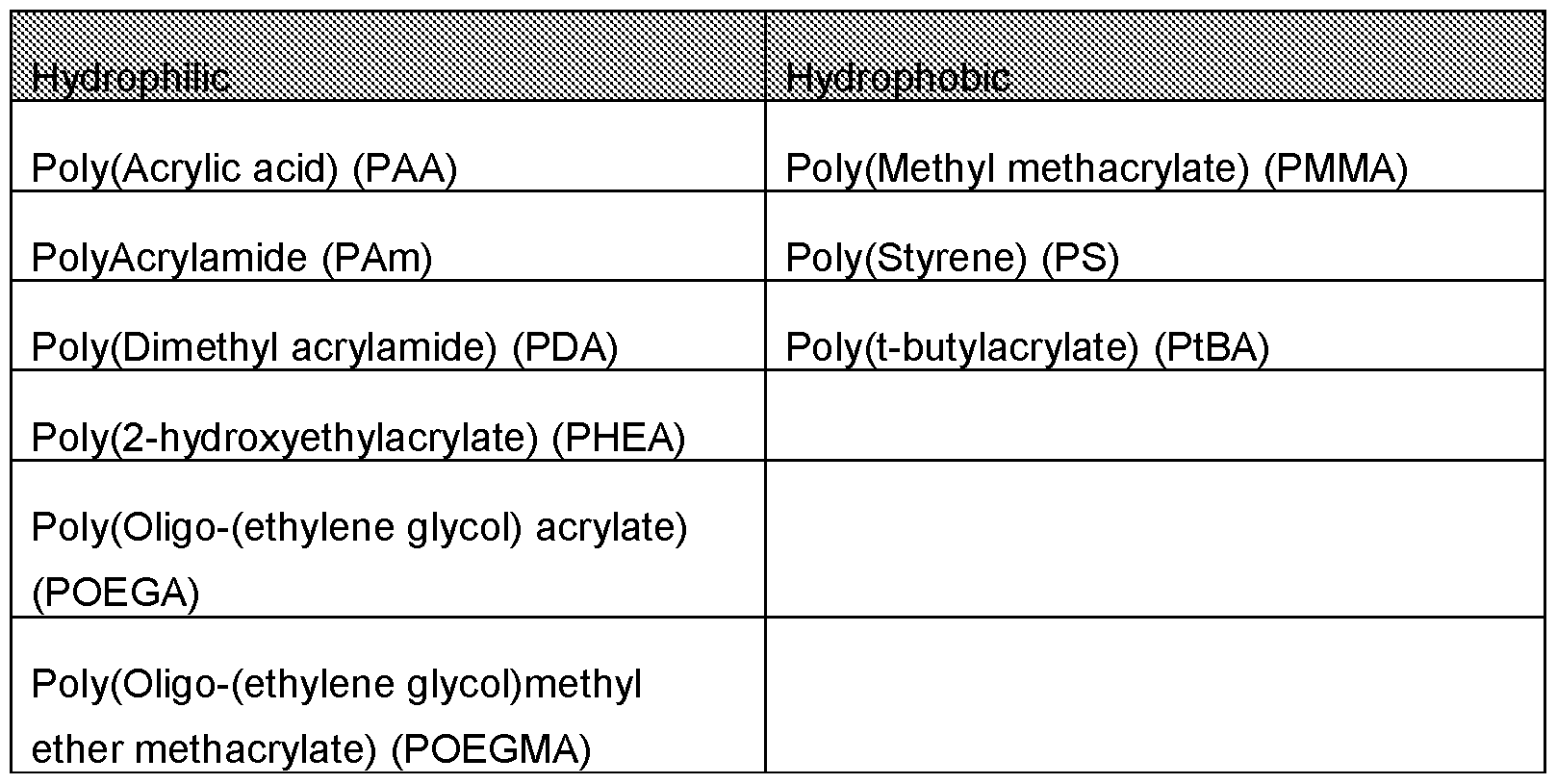
It follows that the present invention is suitable for polymerising the monomeric constituents of these polymers. Thus, in embodiments of the invention, the carbon-containing molecules (i.e. monomers) that may be reacted to produce a polymeric reaction product may comprise acrylic acids, acrylamides, alkyl acrylamides, alkyl acrylates, glycols and vinyl monomers (encompassing styrene, acrylonitrile, and so forth), each of which may be substituted or unsubstituted. There may be one or more monomer species. The term“alkyl” refers to ClC12 alkanes, preferably C1-C6 alkanes. Any substituents typically present in monomers that may be polymerised by radical polymerisation may be present as substituents on the monomers, examples of which include alkyl, alkenyl, alkynyl, cyano, carboxyl, carboxylate, hydroxy, alkoxy (C1-C6 alkoxy), amino, thiol, and so forth. The rate of radical formation may be controlled by the ultrasound to be constant and without variation by greater than 10%. The expression“constant and without variation by greater than 10%” is a reference to the relatively constant rate of radical generation that is achieved at a given frequency of ultrasound application, or for a given acoustic intensity. Any variation in the rate of radical formation at a given frequency or for a given acoustic intensity, if any, is very low, and within a range of +/- 10%. Another way to express this is a“relatively constant” rate of radical formation (or radical generation). The steady rate of radical generation is an advantage of the methods of the present application, and allow for very good control to be applied on the reaction, leading to low variation in the polymers produced. The rate of radical formation may be controlled by the ultrasound provide a monomer-to- initiator ratio that is constant and without variation by greater than 10%. Because of the
relationship between frequency and rate of radical generation, and the relationship between acoustic intensity and rate of radical generation, it is possible to control the rate of radical formation over the course of the polymerisation process so as to ensure that the monomer- to-initiator ratio remains relatively constant (i.e. at a set ratio, with any variation being within +/- 10% of that set ratio). The monomer concentration changes over the course of the polymerisation reaction, so by using frequency or acoustic intensity to change the amount of initiator species present to provide a relatively constant ratio, an optimised polymer product can be produced.
The ultrasound frequency is at least 200 kHz, and may be at least 300 kHz, to provide the desired reaction product. It is believed that conducting the reaction using US at a high frequency reduces the shear stress on the reaction product to a point at which the reaction product does not experience significant polymer degradation. In further embodiments described below, the frequency of ultrasound application may be above or below 200 kHz, although in those embodiments, the application of ultrasound at a frequency of at least 200 kHz, or at least 300 kHz, is also preferred.
The reaction is conducted in a solvent, and the radicals for initiating the radical reaction can be derived from the solvent. The solvent may also be known as a reaction medium. The solvent may be an organic solvent, aqueous solvent, or a mixture thereof.
The solvent may be selected from the group consisting of aqueous and organic solvents. Mixtures of organic solvents may be used, but mixtures of immiscible organic solvents and water are excluded from the range of solvents that may be used in accordance with the invention. Examples of suitable solvents include water, N,N’-dimethylformamide (DMF), N,N’-dimethylacetamide (DMAc) or mixtures of the organic solvents. It can be appreciated that any miscible solvents capable of being cleaved by ultrasound to form radicals can be used. Thus, solvent is suitably an ultrasound-cleavable solvent. The solvent may specifically be an ultrasound-cleavable solvent that is capable of generating one of the radical species specified below.
The solvent-derived radicals may include hydroxyl radicals, hydrogen radical or carbon- centred radicals such as methyl radicals. In embodiments using an organic solvent in particular, it is a feature of the present application that radicals are generated from the organic solvent, even in the absence of water.
Step (ii) is performed in the absence of exogenous initiating reagents.
Step (ii) may be performed in the absence of exogenous initiating reagents and an irradiating light source.
Step (ii) may involve applying ultrasound at a frequency of at least 200 kHz. The frequency may be at least 250kHz, 300 kHz, 350kHz or 400 kHz. The frequency may be up to 20 MHz, up to 1 ,000 kHz, or up to 800 kHz. Any minimum and maximum can be combined without limitation to form a range. Accordingly, step (ii) may involve applying ultrasound at a frequency in the range of 200 kHz-20 MHz, 200-1 ,000 kHz, 300-1 ,000 kHz, 400-800 kHz, or around 400 kHz.
Step (ii) may include reacting the radicals with a component of the reaction mixture to initiate the reaction. The component may be the carbon-containing molecules or a polymerisation control agent.
The method may include a step of applying the ultrasound to the reaction mixture at a power of up to 100W. The power may be up to 40 W, 60 W or 80W. Suitably, the power may be in the range of 20-60 W. More suitably, the ultrasound may be applied at a power of about 40W.
The method may include a step of applying the ultrasound to the reaction mixture at an acoustic intensity of at least 0.50 W/cm2. The acoustic intensity may be at least 1 .00 W/cm2, 2.00 W/cm2, 3.00 W/cm2 or 4.00 W/cm2. The frequency may be up to 10 W/cm2, up to 8 W/cm2, or up to 6 W/cm2. Any minimum and maximum can be combined without limitation to form a range. Accordingly, the method may involve applying the ultrasound to the reaction mixture at an acoustic intensity in the range of 0.50-5.00 W/cm2, 1.00-2.00 W/cm2 or 1 .20- 1 .80 W/cm2. The acoustic intensity may be about 1 60W/cm2.
In step (ii), ultrasound may be applied for a time period up to 24 hours to achieve a conversion of at least 80%.
The time period may be shorter, such as up to 18 hours, up to 12 hours, up to 8 hours, up to 4 hours, up to 3 hours or up to 1 hour. The method may include adjusting the frequency and/or power to achieve a reaction conversion of at least 80% within the above mentioned time periods.
The ultrasound may be applied continuously or pulsed.
The method may be conducted without the need for heating. The method may be conducted at ambient temperature. The method may be conducted at a temperature in the range of 0- 50°C, 10-40°C or 20-40°C. Suitably, the method is conducted at a temperature in the range of 20-40°C.
The present application enables the generation of radicals at a rate within the range of 5- 50pmol/min. To this end, the method may involve the step of controlling the frequency and/or power of ultrasound application to generate radicals at a rate within the range of 5- 50pmol/min, 5-40pmol/min, 5-30pmol/min or 5-20pmol/min. Suitably, the rate of radical generation is controlled in this manner to be about 15pmol/min.
The method enables the synthesis of polymers in which at least 80% of the polymers have at least 90% chain-end fidelity. The method can also enable the synthesis of a polymer product in which at least 90% of the polymers have at least 90% chain-end fidelity.
The rate of radical formation may be controlled by the ultrasound to provide a monomer conversion rate of at least 1.0%/min, at least 2.0%/min, at least 4.0%/min, at least 6.0%/min or at least 8.0%/min over the time period from 20-80% monomer conversion.
The rate of radical formation may be controlled by the ultrasound to provide a monomer conversion rate in the range of 1.5-10%/min over the time period from 20-80% monomer conversion. Suitably, the rate of radical formation is controlled by the ultrasound to provide a monomer conversion rate in the range of 1.5-5%/min over the time period from 20-80% monomer conversion.
The rate of monomer conversion for sonoCFRP is in the range of 1.6-2.7%/min and 0.4- 0.5%/min for the ACVA-initiated CFRP polymerisation over the time period for 20-80% monomer conversion. This calculates to an increased polymerisation rate of at least 4 times for the sonoCFRP reaction.
The rate of radical formation may be controlled by the ultrasound to provide a monomer conversion rate at least twice as fast, three times as fast, four times as fast or five times as fast compared to equivalent reactions using exogenous initiating reagents over the time period from 20-80% monomer conversion.
The references to 20-80% monomer conversion refers to the time period from the point at which 20% of the monomers have been reacted, to the time point at which 80% of the monomers have been reacted. The examples (e.g. Figures 26 and 34) demonstrate the
plotting of this data, and demonstrate the efficacy of the methods of the present application in achieving these rates of monomer conversion.
The method may enable the production of polymers having a polydispersity (PDI) of less than 1.5. The PDI may be less than 1.2, or less than 1.1.
In this respect, it was found that ultrasound allows the rate of generation of radicals (and consequently the concentration of radicals in the reaction mixture) to be controlled to a greater degree compared to conventional CFRP and RAFT polymerisation initiated by exogenous initiating reagents (Figure 2a).
The method may include applying ultrasound at at least two different frequencies during the polymerisation process. By way of example, two (or more) different frequencies may be applied to control the monomer-to-initiator ratio over time. Changing the frequency can aid in maintaining a relatively constant monomer-to-initiator ratio (i.e. maintaining at a ratio that is constant and without variation by greater than 10%).
In one embodiment, the method includes applying ultrasound at a first frequency to generate initiating radicals at a first rate and subsequently applying ultrasound at a second different frequency to generate initiating radicals at a second rate, the second frequency being applied after any one of a predetermined (i) monomer conversion value, (ii) time period or (iii) molecular weight is reached.
This enables polymers to be synthesised with lower polydispersity compared to their equivalent thermally initiated counterparts (Figure 2b).
In this specification, the expression“homogenous reaction mixture” refers to a reaction mixture containing
carbon-containing molecules which are substantially soluble in the solvent or in which the reaction is not compartmentalised or confined to particular regions of the solvent.
The solvent can be either an organic solvent, an aqueous solvent or a mixture thereof. It can be appreciated that the homogeneous reaction mixture can contain small or insignificant amounts of insoluble additives.
The method may be applied to controlled radical polymerisation or conventional free radical polymerisation.
The application of the present invention to each of these polymerisation methods are described below.
Controlled Radical Polymerisation
In one embodiment of the invention, the form of reaction that is conducted is a controlled radical polymerisation (CRP), particularly RAFT. CRP relies on agents to provide reversible deactivation of propagating polymer chains to synthesise low polydispersity polymer chains. As a consequence, CRP reactions typically require the addition of a polymerisation control agent to the reaction mixture to control the molecular weight distribution.
Proposed mechanisms of sonochemically (induced i.e. ultrasound-induced) RAFT
(sonoRAFT) are presented in Figure 3 below.
When the present invention is applied to CRP techniques, the method may include a step of combining a polymerisation control agent with the reaction mixture. Suitably, the polymerisation control agent is combined with the reaction mixture prior to applying ultrasound to the reaction mixture.
When the present invention is applied to CRP techniques, the method may include a step of applying ultrasound at a frequency in the range of 400-800 kHz. More suitably, the method includes a step of applying ultrasound at a frequency of about 400 kHz.
The polymerisation control agent is a RAFT chain transfer agent. Examples of suitable RAFT agents include macromonomer RAFT agents and thiocarbonylthio RAFT agents.
In this embodiment, step (ii) includes reacting the radicals with the carbon-containing molecules.
Conventional Free Radical Polymerisation (CFRP)
In another embodiment of the invention, the form of reaction that is conducted is a conventional free radical polymerisation (CFRP)
CFRP typically involves reacting monomers in a solvent using a CFRP initiator which generates radicals by thermal, light or redox processes. CFRP is typically conducted in the absence of a polymerisation control agent. As a result, the polymers formed have a higher polydispersity compared to polymers formed by CRP.
The present invention is suitable for conventional free radical polymerisation of
homogeneous reaction mixtures in which the polymerisation is not compartmentalised or confined to particular regions of the solvent.
In this embodiment, initiation of the polymerisation occurs without the need for exogenous conventional free radical initiators. This is achieved by using ultrasound as a source of initiating radicals. The shear stress on the polymer may be controlled by varying the ultrasound frequency and/or power.
In this embodiment, step (ii) may be performed in the absence of exogenous initiators.
In this embodiment, step (ii) may include applying ultrasound at a frequency in the range of 200kHz-20MHz. Suitably, step (ii) includes applying ultrasound at a frequency in the range of 400-800kHz. Ultrasound may be applied at a frequency in the range of 400-600kHz.
In this embodiment, the method may include a step of applying ultrasound to the reaction mixture at a power of up to 100W and at a frequency in the range of 200-800kHz. Suitably, the method includes a step of applying ultrasound at a power of up to 40W and a frequency in the range of 400-800kHz.
In this embodiment, the method may include a step of applying ultrasound to the reaction mixture at a power of more than 100W to the reaction mixture when the ultrasound frequency is less than 200kHz.
In this embodiment, the method may include a step of providing an acoustic intensity in the range of 0.50-5.00W/cm2 to the reaction mixture when the ultrasound frequency in the range of 200-800kHz. Suitably, the method includes a step of providing an acoustic intensity of up to 1.60W/cm2 to the reaction mixture when the ultrasound frequency in the range of 200- 800kHz. More suitably, the method includes a step of providing an acoustic intensity of about 1.60W/cm2 to the reaction mixture when the ultrasound frequency in the range of 200- 800kHz.
In this embodiment, the method may include a step of applying ultrasound to the reaction mixture at an acoustic intensity of more than 5.00W/cm2 and a frequency of less than 200kHz.
In this embodiment, in step (ii), ultrasound is applied for a time period up to 4 hours to achieve a conversion of at least 80%. The time period may be shorter, such as up to 3 hours
or up to 1 hour. The method may include adjusting the frequency and/or power to achieve a reaction conversion of at least 80% within 4 hours.
The ultrasound may be applied continuously or pulsed.
In this embodiment, the method may be conducted without the need for heating. Suitably, the method may be conducted at ambient temperature. More suitably, the method may be conducted at a temperature in the range of 0-50°C. Even more suitably, the method may be conducted at a temperature in the range of 20-40°C.
The solvent, and radicals, may be as described previously. The present application enables the generation of radicals at a rate within the range of 5-50pmol/min. To this end, the method may involve the step of controlling the frequency and/or power of ultrasound application to generate radicals at a rate within the range of 5-50pmol/min. The rate of radical generation may be controlled in this manner to be within the range of 5-20pmol/min, for example about 15pmol/min.
In this embodiment, the method may be performed in the absence of a polymerisation control reagent.
The present invention also provides a polymer product produced by any one of the methods described above.
EXAMPLES
Various experiments were performed to demonstrate ultrasound initiation of CRP and CFRP polymerisation techniques in aqueous and organic solvents.
Sonochemicallv-induced RAFT (sonoRAFT) in aqueous solvent
For this investigation, a model water-soluble acrylate monomer, 2-hydroxyethylacrylate (HEA), and a suitable thiocarbonylthio RAFT agent (S,S’-a, a’-methyl-a”-acetic acid trithiocarbonate, TTC) were selected. Therefore, the reaction mixture consisted of a homogeneous mixture of monomer and RAFT agent dissolved in water.
The formation of radicals was quantified via a hydrogen peroxide (H202) assay, where it is assumed that hydroxyl radical combination leads directly to the formation of H202. The rate of H202 formation at an ultrasonic frequency of 414 kHz initially increased with increasing power, before plateauing at moderate to high power levels (Figure 7). A maximum radical generation rate was observed at an applied power of 40W. Delivered powers were
determined calorimetrically (Table 2), however, for simplicity, powers described are the applied/set values. The optimum conditions (i.e. frequency f=414 Hz, applied power P=40 W) were selected for the investigations into the ultrasonic polymerisation reaction. These conditions produced hydroxyl radicals at a rate of ~15 pmol min 1.
For all experiments, the ultrasonic reactor was jacketed with a water circulation system maintained at 21 °C, the reaction vessel was placed at a depth of ca. 2 cm with a working distance from the transducer plate of ca. 3 cm (Figure 4(a)). As the range of ultrasonically generated radicals is wider for air-saturated liquids, all reaction mixtures were thoroughly degassed with argon prior to irradiation.
Initially, relatively high monomer concentrations (ca. 5m) were attempted; however, minimal polymerisation was observed (Figure 8). The monomer concentration was then reduced, and the reaction repeated. Interestingly, for moderate concentrations polymerisation plateaued, while lower concentrations displayed excellent monomer conversion up to 90% in less than 60 minutes (Figures 4(b) and 8). The sonochemical generation of radicals is strongly dependent on a number of factors. Among them, the volume fraction, vapour pressure, and surface activity of the monomer can cause changes in cavitation events, directly influencing the formation of radicals.
At the lowest concentration attempted (0.1 m) the rate of polymerisation was slow, but did not appear to plateau on the timescale investigated (Figure 8). The optimal monomer concentration was therefore found to be in the range of 0.5-1 5m, for which the gel permeation chromatography (GPC) chromatograms of the resulting polymers show narrow monomodal peaks that shift to higher molecular weights with increasing monomer conversion, with observed molecular weight values close to their theoretical ones (Figure 4(c,d), Table 1 , Figure 9). These results strongly indicate that the polymerisation proceeds via the RAFT mechanism following initiation by sonochemically generated radicals.
Having established efficient working conditions, the reaction was then investigated in more detail. Temporal control over the activation of polymerisation was assessed via an experiment in which the ultrasonic irradiation was turned off for given time intervals, with samples extracted periodically for characterization. As shown in Figure 5, monomer conversion stopped completely in the absence of ultrasound, while restarting efficiently when it was turned back on.

Table 1 : Characterization data for various polymers synthesized via sonoRAFT
polymerisation.
The fast cycling time indicates the rapid switchability of this activation/deactivation, and is thought to be the result of the short lifetime of the active hydroxyl radicals as well as the rapid timescale of sonochemical events. GPC analysis of the polymers formed during this experiment clearly show no polymer growth during the dormant periods (Figure 11).
Interestingly, unlike in an iniferter polymerisation, for RAFT polymerisation there is no mechanism for the reinitiation of terminated polymer chains following halted chain growth. However, this switchability is commonly observed for analogous photo-initiated RAFT polymerisations.
One of the key features of any controlled polymerisation is the ability to predetermine the polymer chain length by adjusting the monomer-to-initiator ratio. As such, sonoRAFT was conducted with a range of different targeted degrees of polymerisation (DPn), with high monomer conversions obtained (>75%) after 60 min and GPC chromatograms that increase with increasing targeted DPn (Figure 6(a)).
Additionally, when the experiment was performed in the absence of the chain transfer agent, a polymer of high molecular weight at a low monomer conversion was obtained as per a free radical polymerisation process (Figure 12). These experiments confirm the participation of the RAFT agent in controlling the chain-growth process.
The polymerisation of different monomers was also attempted. While excellent results were observed for most
of the monomers attempted, the bulky monomer oligo-(ethylene glycol) acrylate (OEGA.Mw = 480 gmof1) showed
no polymerisation when conducted at a similar molar concentration (0.5 M). The
concentration was lowered to 0.15 M (giving a more similar volume fraction to the others), achieving 79% conversion (Figure 6(b)). This further implicates the importance of monomer- dependent factors in the ability for ultrasonic irradiation to successfully generate radicals. A methacrylate-type monomer (OEGMA) was also polymerised effectively (94% conversion in 60 mins), indicating the versatility of this technique.
Lastly, the effect of applied power was investigated. The results observed are in excellent agreement with the initial radical formation assay (Figure 7): the observed rate of polymerisation (kp app) increased in accordance with the increase in H202 formation observed at various applied powers (Figures 13 and 14). This shows the potential for reaction rates to be additionally controlled via the applied power.
In conclusion, a sonochemically induced RAFT polymerisation with efficient temporal control was demonstrated using high-frequency ultrasound. Unlike the low frequencies used in mechanically induced controlled polymerisations, the high frequency employed in this study produces very little shear force, potentially avoiding chain-breaking“depolymerisation” events that may limit the attainable molecular weights.
Materials and Methods
Materials
2-Hydroxyethyl acrylate (HEA, Sigma-Aldrich, 96%) was purified via washing with hexane 10 times to remove divinyl impurities, then passed through a short column of alumina to remove inhibitors before use. L/,/V-dimethylacrylamide (DMA, 99%), /V-acryloyl morpholine (NAM, 97%), oligo(ethylene glycol) methyl ether acrylate (OEGA, Mw 480 g mof1), and
oligo(ethylene glycol) methyl ether methacrylate (OEGMA, Mw 475 g mof1) were all purchased from Sigma-Aldrich and passed over alumina to remove inhibitors prior to use. The water-soluble trithiocarbonate RAFT agent S,S’-bis(a,a’-dimethyl-a”-acetic acid) trithiocarbonate (TTC) was synthesized according to a known procedure and characterized via 1H and 13C NMR spectroscopy. Water employed was obtained from a reverse-osmosis purification system and used as is. Sodium hydroxide (> 97%), potassium iodine (> 99%), ammonium molybdite tetrahydrate (> 99.98%), and potassium hydrogen phthalate (>
99.5%), were all purchased from Sigma-Aldrich and used without further purification.
Instruments and Characterization
Aliquots of the reaction mixture were extracted via the syringe technique and analysed directly by aqueous gel permeation chromatography (GPC) with inline differential refractive index (DRI) and multi-angle light scattering (MALS) detectors, and nuclear magnetic resonance (NMR) spectroscopy.
The GPC system consisted of three Waters Ultrahydrogel columns in series ((i) 250 A porosity, 6 pm bead size; (ii) and (iii) linear, 10 pm bead size). A Shimadzu RID-10 refractometer and Wyatt 3-angle MiniDawn light scattering detector were connected in series. Milli-Q water with 0.1 vol% TFA was used as eluent at a flow rate of 1 ml_ min-1 and the system operated at ambient temperature. For all polymers, dn/dc values were determined via a method of 100% mass recovery. Molecular weight and dispersity values were calculated using the Wyatt ASTRA software package from MALS data using a Debye model. For 1 H NMR spectra, D20 was used as a reference and the spectra were obtained using a Varian Unity 400 MHz spectrometer operating at 400 MHz at ambient temperature. An RF generator (AG series amplifier LVG 60-10 produced by T&C Power Conversion Inc.) in combination with a 400 kHz plate transducer (Model 6G12 by Honda Electronics Co. Ltd.) was used, operating at RF powers for 20, 30, 40, 50, and 60 W (calorimetric measurements are reported in Figure 7(b)).
Methods
Typical sonoRAFT polymerisation reaction: In a 14 mL glass vial, 0.3 g HEA (200 eq.) and 3.6 mg TTC-1 (1 eq.) were dissolved in 3.15 mL of water to give an initial monomer concentration ([M]0) of 0.75 M. The vial was fitted with a rubber septum and sparged with Ar for 30 min. The sparging needle was then removed and the vial submerged in the ultrasonic water bath (fitted with circulating cooling water operated at ambient temperature). The ultrasonic plate was then switched on (414 kHz, 40 W) to mark the start of the reaction with samples extracted periodically to monitor the progress of the reaction via NMR and GPC. After 60 min of continuous ultrasonic irradiation a sample reaction mixture was measured to have increased in temperature only slightly to 32°C.
Όh-Off experiment: The reaction mixture was prepared as above. The sealed vial was submerged in the ultrasonic water bath and the ultrasound switched on (414 kHz, 40 W). After 10 minutes the ultrasound was switched off and a sample extracted. The vial was left in the ultrasonic bath with the power off for a further 10 minutes before another sample was extracted. The ultrasound was then switched back on and the process repeated (i.e. 10 minute intervals).
Quantification of generated hydrogen peroxide (H2O2): For the determination of the yield of H2O2, the spectroscopic method described by Hochanadel3 was used. In this method, I- is oxidised to 13- by hydrogen peroxide in a ratio 1 :1 , under the catalytic activity of ammonium molybdite. In details, 1 ml of each of the two solutions, A (0.4 M Kl, 0.1 M NaOH, and 0.02 mM (NH4)6Mo7q24) and B (0.1 M C8H5KO4), were mixed with 1 ml of a freshly sonicated sample and analysed via UV/Vis spectroscopy.
A molar extinction coefficient for l3 _ of 26,400 M-1 cnr1 at 353 nm at room temperature was used. In Figure 7(a) is the reported production of hydroxyl radicals over time.

Table 2: Calorimetric calibration was employed to determine the actual power delivered via the plate transducer. The power density is calculated from the dimensions of the circular plate.

$0 22 ST 22 20402 1/02
Table 3: Characterization data for polv(HEA) synthesized via sonoRAFT at different applied powers. Reaction conditions: HEA/TTC = 200, [HEAlo = 0 75 M. f = 414 kHz determined via 1H NMR spectroscopy. Calculated via GPC-MALS using ASTRA software. cDefined as: Mn.th = (conv x DPn) x where DPn = [HEAln/tTTCln.

Sonochemicallv-induced RAFT (sonoRAFT) in organic solvent
A number of experiments were performed to determine the reaction conditions required for sonoRAFT in organic solvent.
Experiment #1 : SonoCFRP of 2-hydroxyethyl acrylate (HEA) in DMF in the presence of a trithiocarbonate chain transfer agent (i.e., organo-sonoRAFT). This experiment was performed to test conditions for aqueous sonoRAFT with DMF as the solvent. Operating parameters such as the ultrasonic intensity (i.e., power in watts (W)) and the reagent concentrations were adjusted and the reaction kinetics and Mw characteristics observed.
Result #1 : Two concentrations were attempted (0.75 and 0.35 M), with both showing incomplete monomer conversion after 300 mins (Fig. 16). These results were similar to the organic free radical systems reported above, although slightly higher final conversions were reach for the controlled (RAFT) case (>60%).
Result #2: Increasing the applied ultrasonic intensity from 50 W to 80 W did not change the polymerisation kinetics (Fig. 17), indicating that the threshold cavitation intensity had already been met at 50 W and the limiting conversions observed were not due to an insufficient applied intensity.
Result #3: GPC analysis of the polymerisation at various time points revealed a growing polymer chain increasing in Mwwith conversion (Fig. 18). This important observation implies a“living” chain-growth mechanism initiated almost exclusively from the added
thiocarbonylthio-containing chain transfer agent.
Experiment #2: SonoRAFT of fe/f-butyl acrylate (fBA) in DMF in the presence of a trithiocarbonate chain transfer agent (i.e., organo-sonoRAFT). The experiment was to determine whether a hydrophobic polymer could be synthesised in organic solvent via ultrasound-induced RAFT polymerisation. Result #1 : The polymerisation of fBA under ultrasound (490 kHz) occurred smoothly up to a limiting conversion of ca. 30% (Fig. 19).
Result #2: GPC analysis of the resulting poly(fBA) showed a single polymer peak that grew/increased Mwwith conversion (Fig. 20), again providing key evidence for a“living” chain-growth mechanism controlled via the RAFT process. Result #3: MALDI-TOF MS of poly(fBA) prepared via sonoRAFT using DCTB matrix and A) potassium trifluoroacetic acid or B) sodium trifluoroacetic acid as the counter ion. Chain-end fidelity of >90% is observed in both cases (Fig. 21)
Sonochemically-induced CFRP (sonoCFRP) in aqueous solvent
The free radical polymerisation of a range of (meth)acrylate/acrylamide-based monomers has been conducted under a variety of operating conditions to assess the effect of ultrasonic frequency, reagent concentration, and comparison with a traditional system in which a thermally-labile radical initiator was used.
Experiment #1 : SonoCFRP of acrylamide (Am) and acrylic acid (AA) in aqueous medium using high frequency (490 kHz) ultrasound.
This experiment was performed to assess the effect of reagent (i.e. monomer) concentration on the polymerisation kinetics and molecular weight (MW) characteristics of the polymer products.
Result #1 : It is observed that lower concentrations lead to high monomer conversion values (Fig. 22; tables 12-185-1 to 12-185-4 below detail the reaction conditions for sonoCFRP of acrylic acid and acrylamide in Figure 22).
This is attributed to the effect the increasing solution viscosity during polymerisation has, acting to‘dampen’ acoustic cavitation (and hence inhibit/halt the radical generation).

Result #2: Mw analysis of the resultant polymers via gel permeation chromatography (GPC) shows a decreasing Mw with monomer conversion, while much lower Mw polymers were obtained at low reagent concentrations compared with higher ones (Fig. 23). This may be due to the enhanced radical generation at low monomer concentrations providing more initiating species, thereby lowering the final Mw.
The effect of sonication time on molecular weight and PDI of the polymer formed via sonoCFRP is illustrated in Figure 24. The figure reveals that the molecular weight decreases with increasing sonication time while PDI increases with increasing sonication time. It is believed that this is the result of the steady generation of initiating radicals reacting a depleting amount of monomer over time to form low molecular weight polymers.
Experiment #2: SonoCFRP of acrylamide (Am) and acrylic acid (AA) in aqueous medium: effect of frequency (490 kHz vs. 45 kHz) employed.
This experiment was performed to assess the effect of ultrasonic frequency on the polymerisation kinetics and Mw characteristics of the resultant polymers. Result #1 : At the same reagent concentration (0.15 M) the polymerisation is much more efficient at 490 kHz compared with 45 kHz (Fig. 25). This is expected due to the more efficient radical generation occurring typically at frequencies between 200 and 800 kHz.
Experiment #3: Comparison of free radical polymerisation of 2-hydroxyethylacrylate (HEA) via sono- and conventional (thermal initiation using 4,4’-azobis(4-cyanovaleric acid) (ACVA) at 60°C)) polymerisation.
This experiment was performed to directly compare the polymerisation kinetics and Mw characteristics of polymers synthesized via aqueous sonoCFRP and aqueous conventional free radical polymerisation using a thermally-labile radical initiator.
Result #1 : SonoCFRP of HEA was rapid at low concentration (0.15 M), with >90% conversion after 90 min (blue dots, Fig. 26; tables 12-185-5 to 12-185-8 detail the properties of reagents used to synthesise the polymers in Figure 26). For the same concentration with 1wt% loading of thermal initiator, no monomer conversion was observed after 4 h (red dots). For the higher concentration (0.75 M), 1wt% loading of ACVA gave a similar conversion value as the sono-experiment (orange dot), however the reaction mixture was at this stage was a viscous physical gel and so the reaction was terminated. Intermediate cases with either high monomer concentration and lower initiator loading (green dots), or low monomer concentration with higher initiator loading (brown dots), yielded smooth polymerisations, albeit at much slower rates than the sonoCFRP.
It was calculated that the rate of monomer conversion for sonoCFRP HEA (0.15M) is in the range of 1.7-4%/min and 0%/min for the 1 wt% ACVA-initiated CFRP HEA (0.15M) polymerisation over the time period for 20-80% monomer conversion.
 Result #2: Mw analysis of the above experiments showed that the Mws of the polymers formed via thermal-initiation were relatively stable over the course of polymerisation, with only minor changes in the observed Mn values (Figs. 27 and 29). Conversely, the sonochemically-synthesized polymers underwent a shift to smaller Mw values with monomer conversion (Figs. 27 and 29). Additionally, the sonochemically-synthesized polymers were much smaller than the thermally-initiated analogues (Fig. 27, orange dots vs blue dots, and Fig. 30 for overlay of chromatograms). This is perhaps again due to the higher radical flux in the sono-system producing more initiating species.
Experiment #4: Comparison of free radical polymerisation of 2-hydroxyethylacrylate (HEA) via sono- and conventional (thermal initiation using 4,4’-azobis(4-cyanovaleric acid) (ACVA) at 60°C)) RAFT polymerisation.
This experiment was performed to directly compare the polymerisation kinetics and Mw characteristics of polymers synthesized via aqueous sonoRAFT and aqueous conventional RAFT polymerisation using a thermally-labile radical initiator. Result #1 : SonoRAFT of HEA was rapid with >90% conversion after about 70 min (blue dots, Fig. 31). For the same concentration with 0.2wt% loading of thermal initiator, ACVA- initiated conventional RAFT was consistently slower than the sonoRAFT. Both
polymerizations reached >90% monomer conversion, with sonoRAFT achieving this in ca.
60 min, while the thermally-initiated RAFT took ca. 300 min. The rate of monomer conversion for sonoRAFT is in the range of 1.6-2.7%/min and 0.4- 0.5%/min for the ACVA-initiated RAFT polymerisation over the time period for 20-80% monomer conversion. This calculates to an increased polymerisation rate of at least 4 times for the sonoRAFT reaction.
Sonochemically-induced CFRP (sonoCFRP) in organic solvent Experiment #1 : SonoCFRP of fe/f-butyl acrylate (fBA) in organic medium (L/,/V-dimethyl formamide (DMF)) using high frequency (490 kHz) ultrasound.
This experiment was performed to assess the effect of reagent (i.e. monomer) concentration on the polymerisation kinetics and molecular weight (Mw) characteristics of the polymer products. Result #1 : As for the aqueous system, the polymerisation of fBA in DMF under ultrasonic irradiation showed a noticeable effect of monomer concentration; lowering the concentration from 2 M to 0.75 M increased the observed limiting conversion from ca. 10% to >40% (Fig.
32). The polymerisation is also considerable slower than the aqueous system due to the less efficient formation of initiating radicals from the organic solvent.
Result #2: The Mw of the obtained poly(fBA) was found to only decrease slightly during the course of polymerisation, from just over 100 kDa to around 90 kDa (Fig. 33). Experiment #2: SonoCFRP of methyl acrylate (MA) and methyl methacrylate (MMA) in DMF with an ultrasonic frequency of 490 kHz.
This experiment was performed to assess the possibility of polymerising other hydrophobic monomers via organic media sonoCFRP; particularly the industrially-relevant MMA monomer. Result #1 : The SonoCFRP of MA and MMA was slow, with ca. 20% conversion reached after 60 min and 360 min, respectively (Fig. 34). The difference between the conversions for MA and MMA can be ascribed to their differing intrinsic propagation rate constants.
Claims
1 . A method of producing a polymer from monomers in a solvent including the steps of: (i) dissolving the monomers in the solvent to form a homogeneous reaction mixture; and (ii) applying ultrasound at a frequency of at least 200kHz to the reaction mixture to generate radicals in situ to synthesize the polymer.
2. The method according to claim 1 , wherein the rate of radical formation is controlled by the ultrasound to be constant and without variation by greater than 10%.
3. The method according to claim 1 , wherein the rate of radical formation is controlled by the ultrasound provide a monomer-to-initiator ratio that is constant and without variation by greater than 10%.
4. The method according to any one of the preceding claims, including applying ultrasound for a time period up to 24 hours to achieve a monomer conversion of at least 80%.
5. The method according to any one of the preceding claims, wherein the rate of radical formation is controlled by the ultrasound to provide a monomer conversion rate of at least
1 .0%/min over the time period from 20-80% monomer conversion.
6. The method according to any one of the preceding claims, wherein the rate of radical formation is controlled by the ultrasound to provide a monomer conversion rate of at least twice as fast compared to equivalent reactions using exogenous initiating reagents over the time period from 20-80% monomer conversion.
7. The method according to any one of the preceding claims, wherein the rate of radical formation is controlled by the ultrasound to provide a monomer conversion rate at least three times faster than equivalent reactions using exogenous initiating reagents over the time period from 20-80% monomer conversion.
8. The method according to any one of the preceding claims, wherein the polymer has a polydispersity less than 1.5.
9. The method according to any one of the preceding claims, being conducted without the need for heating.
10. The method according to claim 9, being conducted at a temperature in the range of 20-40°C.
1 1. The method according to any one of the preceding claims, wherein the solvent is an ultrasound-cleavable solvent that is capable of generating an initiating radical.
12. The method according to any one of the preceding claims, including applying ultrasound at a frequency within the range of 200kHz-20MHz.
13. The method according to claim 12, including applying ultrasound at a frequency within the range of 400-1 ,000kHz.
14. The method according to any one of the preceding claims, including applying ultrasound at at least two different frequencies.
15. The method according to claim 14, including applying ultrasound at a first frequency to generate initiating radicals at a first rate and subsequently applying ultrasound at a second different frequency to generate initiating radicals at a second rate, the second frequency being applied after any one of a predetermined (i) monomer conversion value, (ii) time period or (iii) molecular weight is reached.
16. The method according to any one of the preceding claims, including applying ultrasound at a power of up to 100 W.
17. The method according to any one of the preceding claims, including applying ultrasound at an acoustic intensity in the range of 0.50-5.00 W/cm2.
18. The method according to any one of the preceding claims, including generating radicals at a rate within the range of 5-50 pmol/min.
19. The method according to any one of the preceding claims, including applying pulsed ultrasound.
20. The method according to any one of the preceding claims, including combining the homogenous reaction mixture with a polymerization control agent.
21. The method according to claim 20, wherein the polymerization control agent is a RAFT agent.
22. The method according to either claim 20 or 21 , wherein at least 80% of the polymers have at least 90% chain-end fidelity.
23. A reaction product produced by any one of the preceding claims.
Applications Claiming Priority (2)
| Application Number | Priority Date | Filing Date | Title |
|---|---|---|---|
| AU2018901654 | 2018-05-14 | ||
| AU2018901654A AU2018901654A0 (en) | 2018-05-14 | A method of generating radicals by ultrasound |
Publications (1)
| Publication Number | Publication Date |
|---|---|
| WO2019217985A1 true WO2019217985A1 (en) | 2019-11-21 |
Family
ID=68539103
Family Applications (1)
| Application Number | Title | Priority Date | Filing Date |
|---|---|---|---|
| PCT/AU2018/050887 Ceased WO2019217985A1 (en) | 2018-05-14 | 2018-08-21 | A method of generating radicals by ultrasound |
Country Status (1)
| Country | Link |
|---|---|
| WO (1) | WO2019217985A1 (en) |
Cited By (3)
| Publication number | Priority date | Publication date | Assignee | Title |
|---|---|---|---|---|
| CN114181341A (en) * | 2021-12-30 | 2022-03-15 | 广东粤港澳大湾区国家纳米科技创新研究院 | Method for preparing quantum dot fluorescent microspheres by ultrasonic initiation |
| CN115477728A (en) * | 2022-09-20 | 2022-12-16 | 江苏永威环境科技股份有限公司 | Preparation method of cationic polyacrylamide |
| WO2025172652A1 (en) | 2024-02-16 | 2025-08-21 | Coatex | Sonopolymerization of unsaturated carboxylic acid |
Citations (2)
| Publication number | Priority date | Publication date | Assignee | Title |
|---|---|---|---|---|
| JP2003096121A (en) * | 2001-09-20 | 2003-04-03 | Masahiko Abe | Method for producing polymer particles |
| US20160297997A1 (en) * | 2013-12-11 | 2016-10-13 | Forschungszentrum Jülich GmbH | Method and device for polymerizing a composition comprising hydridosilanes and subsequently using the polymers to produce silicon-containing layers |
-
2018
- 2018-08-21 WO PCT/AU2018/050887 patent/WO2019217985A1/en not_active Ceased
Patent Citations (2)
| Publication number | Priority date | Publication date | Assignee | Title |
|---|---|---|---|---|
| JP2003096121A (en) * | 2001-09-20 | 2003-04-03 | Masahiko Abe | Method for producing polymer particles |
| US20160297997A1 (en) * | 2013-12-11 | 2016-10-13 | Forschungszentrum Jülich GmbH | Method and device for polymerizing a composition comprising hydridosilanes and subsequently using the polymers to produce silicon-containing layers |
Non-Patent Citations (3)
| Title |
|---|
| COLLINS, J. ET AL.: "High frequency sonoATRP of 2-hydroxyethyl acrylate in an aqueous medium", POLYMER CHEMISTRY, vol. 9, 9 April 2018 (2018-04-09), pages 2562 - 2568, XP055653952, ISSN: 1759-9954, DOI: 10.1039/C8PY00456K * |
| MCKENZIE, T. G. ET AL.: "Sono-RAFT Polymerization in Aqueous Medium", ANGEWANDTE CHEMIE, vol. 56, 2017, pages 12302 - 12306, Retrieved from the Internet <URL:https://onlinelibrary.wiley.com/action/downloadSupplement?doi=10.1002%2Fanie.2017*06771&file-anie201706771-sup-0001-misc_information.pdf> * |
| RAJAN, M. A. J. ET AL.: "Sonochemical Synthesis of Poly (Methyl Acrylate)", SOLID STATE PHENOMENA, vol. 136, 27 February 2008 (2008-02-27), pages 175 - 190, XP055653957, DOI: 10.4028/www.scientific.net/SSP.136.175 * |
Cited By (5)
| Publication number | Priority date | Publication date | Assignee | Title |
|---|---|---|---|---|
| CN114181341A (en) * | 2021-12-30 | 2022-03-15 | 广东粤港澳大湾区国家纳米科技创新研究院 | Method for preparing quantum dot fluorescent microspheres by ultrasonic initiation |
| CN114181341B (en) * | 2021-12-30 | 2024-01-19 | 朱小波 | A method for preparing quantum dot fluorescent microspheres induced by ultrasound |
| CN115477728A (en) * | 2022-09-20 | 2022-12-16 | 江苏永威环境科技股份有限公司 | Preparation method of cationic polyacrylamide |
| WO2025172652A1 (en) | 2024-02-16 | 2025-08-21 | Coatex | Sonopolymerization of unsaturated carboxylic acid |
| FR3159388A1 (en) * | 2024-02-16 | 2025-08-22 | Coatex | SONOPOLYMERIZATION OF UNSATURATED CARBOXYLIC ACID |
Similar Documents
| Publication | Publication Date | Title |
|---|---|---|
| McKenzie et al. | Ultrasound and sonochemistry for radical polymerization: sound synthesis | |
| McKenzie et al. | Sono‐RAFT polymerization in aqueous medium | |
| US5466722A (en) | Ultrasonic polymerization process | |
| Collins et al. | High frequency sonoATRP of 2-hydroxyethyl acrylate in an aqueous medium | |
| Zaborniak et al. | Riboflavin-induced metal-free ATRP of (meth) acrylates | |
| EP1928919B1 (en) | Atom transfer radical polymerization in microemulsion and true emulsion polymerization | |
| Hill et al. | Expanding the scope of RAFT polymerization: recent advances and new horizons | |
| WO2019217985A1 (en) | A method of generating radicals by ultrasound | |
| JP5703316B2 (en) | Controlled continuous polymerization of polycarboxylic acid polymers. | |
| JP3389272B2 (en) | Method for producing tetrafluoroethylene polymer | |
| Rinaldi et al. | RAFT copolymerization of methacrylic acid and poly (ethylene glycol) methyl ether methacrylate in the presence of a hydrophobic chain transfer agent in organic solution and in water | |
| US20150057419A1 (en) | Free radical and controlled radical polymerization processes using azide radical initiators | |
| Li et al. | A surfactant-free emulsion RAFT polymerization of methyl methacrylate in a continuous tubular reactor | |
| Soliman et al. | Amphiphilic photosensitive dextran-g-poly (o-nitrobenzyl acrylate) glycopolymers | |
| Vandenbergh et al. | Acid-induced room temperature RAFT polymerization: synthesis and mechanistic insights | |
| Padmakumar et al. | High chain-end fidelity in sono-RAFT polymerization | |
| EP4306554A1 (en) | Method for producing polymer, composition for radical polymerization, and radical polymerization inhibitor | |
| Padmakumar et al. | Ultrasound-Assisted RAFT polymerization in a continuous flow method | |
| Zeitler et al. | Shake, shear, and grind!–the evolution of mechanoredox polymerization methodology | |
| JP2611125B2 (en) | Improvement in the production of powdered water-absorbent resin by inverse suspension polymerization of acrylic monomer | |
| Versteeg et al. | Reversible Addition‐Fragmentation Chain‐Transfer Polymerization in Supercritical CO2: A Review | |
| Rabea et al. | Ultrasonically enhanced bulk ATRP of methyl methacrylate at high conversion with good livingness and control | |
| JPH03195709A (en) | Production of polymer having high water absorption | |
| McKenzie et al. | Hydroxyl radical activated RAFT polymerization | |
| WO2006008905A1 (en) | Method for producing water-absorbing resin |
Legal Events
| Date | Code | Title | Description |
|---|---|---|---|
| 121 | Ep: the epo has been informed by wipo that ep was designated in this application |
Ref document number: 18918780 Country of ref document: EP Kind code of ref document: A1 |
|
| NENP | Non-entry into the national phase |
Ref country code: DE |
|
| 122 | Ep: pct application non-entry in european phase |
Ref document number: 18918780 Country of ref document: EP Kind code of ref document: A1 |