WO2019215427A1 - Process for forming a carbon-carbon bond - Google Patents
Process for forming a carbon-carbon bond Download PDFInfo
- Publication number
- WO2019215427A1 WO2019215427A1 PCT/GB2019/051228 GB2019051228W WO2019215427A1 WO 2019215427 A1 WO2019215427 A1 WO 2019215427A1 GB 2019051228 W GB2019051228 W GB 2019051228W WO 2019215427 A1 WO2019215427 A1 WO 2019215427A1
- Authority
- WO
- WIPO (PCT)
- Prior art keywords
- alkyl
- heteroaryl
- aryl
- group
- cycloalkyl
- Prior art date
- Legal status (The legal status is an assumption and is not a legal conclusion. Google has not performed a legal analysis and makes no representation as to the accuracy of the status listed.)
- Ceased
Links
- 0 C*1C2=C*(*)C=CC=C2**1 Chemical compound C*1C2=C*(*)C=CC=C2**1 0.000 description 2
- GRTWYIODJKVPEV-UHFFFAOYSA-N Cc(cccc1)c1-c1ccccn1 Chemical compound Cc(cccc1)c1-c1ccccn1 GRTWYIODJKVPEV-UHFFFAOYSA-N 0.000 description 2
- AXDXGLZRYZCNKS-UHFFFAOYSA-N C(c1ccccc1)P(C1(C2)CC(C3)CC2C3C1)C1(CC(C2)C3)CC3CC2C1 Chemical compound C(c1ccccc1)P(C1(C2)CC(C3)CC2C3C1)C1(CC(C2)C3)CC3CC2C1 AXDXGLZRYZCNKS-UHFFFAOYSA-N 0.000 description 1
- PCFUWBOSXMKGIP-UHFFFAOYSA-N C(c1ccccc1)c1ccccn1 Chemical compound C(c1ccccc1)c1ccccn1 PCFUWBOSXMKGIP-UHFFFAOYSA-N 0.000 description 1
- NLVFHLWFCBHNDQ-UHFFFAOYSA-N CC(C)(C)c1ccc(CN(C)C)cc1 Chemical compound CC(C)(C)c1ccc(CN(C)C)cc1 NLVFHLWFCBHNDQ-UHFFFAOYSA-N 0.000 description 1
- BVURNMLGDQYNAF-UHFFFAOYSA-N CC(c1ccccc1)N(C)C Chemical compound CC(c1ccccc1)N(C)C BVURNMLGDQYNAF-UHFFFAOYSA-N 0.000 description 1
- OTIPUJJPMXLPDF-UHFFFAOYSA-N CN(C)Cc(cc1)ccc1F Chemical compound CN(C)Cc(cc1)ccc1F OTIPUJJPMXLPDF-UHFFFAOYSA-N 0.000 description 1
- AXNYOLNCWZUOAD-UHFFFAOYSA-N CN(C)Cc(cc1)ccc1Oc1ccccc1 Chemical compound CN(C)Cc(cc1)ccc1Oc1ccccc1 AXNYOLNCWZUOAD-UHFFFAOYSA-N 0.000 description 1
- XTRIIQZLQXVVGS-UHFFFAOYSA-N CN(C)Cc(ccc(F)c1)c1F Chemical compound CN(C)Cc(ccc(F)c1)c1F XTRIIQZLQXVVGS-UHFFFAOYSA-N 0.000 description 1
- FWTFEDBNZPBAPH-UHFFFAOYSA-N CN(C)Cc1cc2ccccc2cc1 Chemical compound CN(C)Cc1cc2ccccc2cc1 FWTFEDBNZPBAPH-UHFFFAOYSA-N 0.000 description 1
- GVCGISVXAMONQN-UHFFFAOYSA-N CN(C)Cc1ccc(C(F)(F)F)cc1 Chemical compound CN(C)Cc1ccc(C(F)(F)F)cc1 GVCGISVXAMONQN-UHFFFAOYSA-N 0.000 description 1
- XXBDWLFCJWSEKW-UHFFFAOYSA-N CN(C)Cc1ccccc1 Chemical compound CN(C)Cc1ccccc1 XXBDWLFCJWSEKW-UHFFFAOYSA-N 0.000 description 1
- BMUFYMBAPXLSPK-UHFFFAOYSA-N CN(CCOC)Cc1ccccc1 Chemical compound CN(CCOC)Cc1ccccc1 BMUFYMBAPXLSPK-UHFFFAOYSA-N 0.000 description 1
- YRCDHUGKVCWQQU-UHFFFAOYSA-N Cc(c(-c1ccccn1)c(c(F)c1F)F)c1F Chemical compound Cc(c(-c1ccccn1)c(c(F)c1F)F)c1F YRCDHUGKVCWQQU-UHFFFAOYSA-N 0.000 description 1
- DQQBHRQAWSHSQD-UHFFFAOYSA-N Cc(c1c2cccn1)ccc2OC Chemical compound Cc(c1c2cccn1)ccc2OC DQQBHRQAWSHSQD-UHFFFAOYSA-N 0.000 description 1
- NXXYKOUNUYWIHA-UHFFFAOYSA-N Cc(cccc1C)c1O Chemical compound Cc(cccc1C)c1O NXXYKOUNUYWIHA-UHFFFAOYSA-N 0.000 description 1
- FLNKRLQGQMQBQT-UHFFFAOYSA-N Cc1c(C)cnc(-c(cc(c(C)c2C)F)c2F)c1 Chemical compound Cc1c(C)cnc(-c(cc(c(C)c2C)F)c2F)c1 FLNKRLQGQMQBQT-UHFFFAOYSA-N 0.000 description 1
- HQDXJLVJWABLEK-UHFFFAOYSA-N Cc1c(C)cnc(-c(cc(c(F)c2)F)c2F)c1 Chemical compound Cc1c(C)cnc(-c(cc(c(F)c2)F)c2F)c1 HQDXJLVJWABLEK-UHFFFAOYSA-N 0.000 description 1
- SDEYZVJILHHGEF-UHFFFAOYSA-N Cc1cc(C)c(CN(C)C)cc1 Chemical compound Cc1cc(C)c(CN(C)C)cc1 SDEYZVJILHHGEF-UHFFFAOYSA-N 0.000 description 1
- VCBUGWOFLYITCB-UHFFFAOYSA-N Cc1cccc(CN(C)C)c1 Chemical compound Cc1cccc(CN(C)C)c1 VCBUGWOFLYITCB-UHFFFAOYSA-N 0.000 description 1
- IXIRNVAMPRBXIX-UHFFFAOYSA-N Cc1ccccc1-c1cc(C)c(C)cn1 Chemical compound Cc1ccccc1-c1cc(C)c(C)cn1 IXIRNVAMPRBXIX-UHFFFAOYSA-N 0.000 description 1
- NAPBMUCLZDZBOT-UHFFFAOYSA-N Fc(cc(c(F)c1)F)c1-c1ccccn1 Chemical compound Fc(cc(c(F)c1)F)c1-c1ccccn1 NAPBMUCLZDZBOT-UHFFFAOYSA-N 0.000 description 1
- SSABEFIRGJISFH-UHFFFAOYSA-N Fc(cc1)cc(F)c1-c1ccccn1 Chemical compound Fc(cc1)cc(F)c1-c1ccccn1 SSABEFIRGJISFH-UHFFFAOYSA-N 0.000 description 1
- WZJYKHNJTSNBHV-UHFFFAOYSA-N c1ccc2c(nccc3)c3ccc2c1 Chemical compound c1ccc2c(nccc3)c3ccc2c1 WZJYKHNJTSNBHV-UHFFFAOYSA-N 0.000 description 1
Classifications
-
- C—CHEMISTRY; METALLURGY
- C07—ORGANIC CHEMISTRY
- C07F—ACYCLIC, CARBOCYCLIC OR HETEROCYCLIC COMPOUNDS CONTAINING ELEMENTS OTHER THAN CARBON, HYDROGEN, HALOGEN, OXYGEN, NITROGEN, SULFUR, SELENIUM OR TELLURIUM
- C07F15/00—Compounds containing elements of Groups 8, 9, 10 or 18 of the Periodic Table
- C07F15/0006—Compounds containing elements of Groups 8, 9, 10 or 18 of the Periodic Table compounds of the platinum group
- C07F15/0046—Ruthenium compounds
-
- C—CHEMISTRY; METALLURGY
- C07—ORGANIC CHEMISTRY
- C07D—HETEROCYCLIC COMPOUNDS
- C07D211/00—Heterocyclic compounds containing hydrogenated pyridine rings, not condensed with other rings
- C07D211/04—Heterocyclic compounds containing hydrogenated pyridine rings, not condensed with other rings with only hydrogen or carbon atoms directly attached to the ring nitrogen atom
- C07D211/06—Heterocyclic compounds containing hydrogenated pyridine rings, not condensed with other rings with only hydrogen or carbon atoms directly attached to the ring nitrogen atom having no double bonds between ring members or between ring members and non-ring members
- C07D211/08—Heterocyclic compounds containing hydrogenated pyridine rings, not condensed with other rings with only hydrogen or carbon atoms directly attached to the ring nitrogen atom having no double bonds between ring members or between ring members and non-ring members with hydrocarbon or substituted hydrocarbon radicals directly attached to ring carbon atoms
-
- C—CHEMISTRY; METALLURGY
- C07—ORGANIC CHEMISTRY
- C07D—HETEROCYCLIC COMPOUNDS
- C07D211/00—Heterocyclic compounds containing hydrogenated pyridine rings, not condensed with other rings
- C07D211/04—Heterocyclic compounds containing hydrogenated pyridine rings, not condensed with other rings with only hydrogen or carbon atoms directly attached to the ring nitrogen atom
- C07D211/06—Heterocyclic compounds containing hydrogenated pyridine rings, not condensed with other rings with only hydrogen or carbon atoms directly attached to the ring nitrogen atom having no double bonds between ring members or between ring members and non-ring members
- C07D211/08—Heterocyclic compounds containing hydrogenated pyridine rings, not condensed with other rings with only hydrogen or carbon atoms directly attached to the ring nitrogen atom having no double bonds between ring members or between ring members and non-ring members with hydrocarbon or substituted hydrocarbon radicals directly attached to ring carbon atoms
- C07D211/10—Heterocyclic compounds containing hydrogenated pyridine rings, not condensed with other rings with only hydrogen or carbon atoms directly attached to the ring nitrogen atom having no double bonds between ring members or between ring members and non-ring members with hydrocarbon or substituted hydrocarbon radicals directly attached to ring carbon atoms with radicals containing only carbon and hydrogen atoms attached to ring carbon atoms
-
- C—CHEMISTRY; METALLURGY
- C07—ORGANIC CHEMISTRY
- C07D—HETEROCYCLIC COMPOUNDS
- C07D231/00—Heterocyclic compounds containing 1,2-diazole or hydrogenated 1,2-diazole rings
- C07D231/54—Heterocyclic compounds containing 1,2-diazole or hydrogenated 1,2-diazole rings condensed with carbocyclic rings or ring systems
-
- C—CHEMISTRY; METALLURGY
- C07—ORGANIC CHEMISTRY
- C07D—HETEROCYCLIC COMPOUNDS
- C07D243/00—Heterocyclic compounds containing seven-membered rings having two nitrogen atoms as the only ring hetero atoms
- C07D243/06—Heterocyclic compounds containing seven-membered rings having two nitrogen atoms as the only ring hetero atoms having the nitrogen atoms in positions 1 and 4
- C07D243/10—Heterocyclic compounds containing seven-membered rings having two nitrogen atoms as the only ring hetero atoms having the nitrogen atoms in positions 1 and 4 condensed with carbocyclic rings or ring systems
- C07D243/14—1,4-Benzodiazepines; Hydrogenated 1,4-benzodiazepines
- C07D243/16—1,4-Benzodiazepines; Hydrogenated 1,4-benzodiazepines substituted in position 5 by aryl radicals
- C07D243/18—1,4-Benzodiazepines; Hydrogenated 1,4-benzodiazepines substituted in position 5 by aryl radicals substituted in position 2 by nitrogen, oxygen or sulfur atoms
- C07D243/24—Oxygen atoms
-
- C—CHEMISTRY; METALLURGY
- C07—ORGANIC CHEMISTRY
- C07D—HETEROCYCLIC COMPOUNDS
- C07D243/00—Heterocyclic compounds containing seven-membered rings having two nitrogen atoms as the only ring hetero atoms
- C07D243/06—Heterocyclic compounds containing seven-membered rings having two nitrogen atoms as the only ring hetero atoms having the nitrogen atoms in positions 1 and 4
- C07D243/10—Heterocyclic compounds containing seven-membered rings having two nitrogen atoms as the only ring hetero atoms having the nitrogen atoms in positions 1 and 4 condensed with carbocyclic rings or ring systems
- C07D243/14—1,4-Benzodiazepines; Hydrogenated 1,4-benzodiazepines
- C07D243/16—1,4-Benzodiazepines; Hydrogenated 1,4-benzodiazepines substituted in position 5 by aryl radicals
- C07D243/18—1,4-Benzodiazepines; Hydrogenated 1,4-benzodiazepines substituted in position 5 by aryl radicals substituted in position 2 by nitrogen, oxygen or sulfur atoms
- C07D243/24—Oxygen atoms
- C07D243/30—Preparation including building-up the benzodiazepine skeleton from compounds already containing hetero rings
-
- C—CHEMISTRY; METALLURGY
- C07—ORGANIC CHEMISTRY
- C07D—HETEROCYCLIC COMPOUNDS
- C07D261/00—Heterocyclic compounds containing 1,2-oxazole or hydrogenated 1,2-oxazole rings
- C07D261/02—Heterocyclic compounds containing 1,2-oxazole or hydrogenated 1,2-oxazole rings not condensed with other rings
- C07D261/06—Heterocyclic compounds containing 1,2-oxazole or hydrogenated 1,2-oxazole rings not condensed with other rings having two or more double bonds between ring members or between ring members and non-ring members
- C07D261/08—Heterocyclic compounds containing 1,2-oxazole or hydrogenated 1,2-oxazole rings not condensed with other rings having two or more double bonds between ring members or between ring members and non-ring members with only hydrogen atoms, hydrocarbon or substituted hydrocarbon radicals, directly attached to ring carbon atoms
Definitions
- C-H (cyclo)alkylation reactions are typically conducted under reaction conditions that are too harsh to be applied at late stages in synthesis to already functionalised compounds and functional groups present in such functionalised compounds can interfere with and poison the metal catalyst.
- the term “comprising” or “comprises” means including the component(s) specified but not to the exclusion of the presence of other components.
- the term“consisting essentially of” or“consists essentially of means including the components specified but excluding other components except for components added for a purpose other than achieving the technical effect of the invention.
- the term“consisting of or“consists of means including the components specified but excluding other components.
- the use of the term“comprises” or“comprising” may also be taken to include the meaning“consists essentially of” or“consisting essentially of, and also may also be taken to include the meaning“consists of or“consisting of.
- L does not represent a tridendate ligand of the q 6 -arene type.
- q 6 -arene ligands are benzene, o-, m-, p-xylene, mesitylene, p-cymene, and hexamethylbenzene.
- the organic group represented by Y may comprise a group of formula (II) bonded to the ruthenium via an sp2 or an sp3 carbon atom:
- R 6 and R 7 are each independently selected from H, (1 -10C)alkyl, phenyl or (4- 10C)cycloalkyl, wherein each (1 -10C)alkyl, phenyl and (4-10C)cycloalkyl is optionally substituted by one or more substituents independently selected from (1 -15C)alkoxy, fluoro, trifluoromethyl and (1 -15C)alkyl;
- each R 26 and R 32 is independently selected from halo, (1 -10C)alkyl, (1 -10C)alkoxy, phenoxy, trifluoromethyl, (3-8C)cycloalkyl, aryl, heteroaryl, (2-10C)alkenyl, hydroxyl, amino, (1 - 10C)alkylamino, di[(1 -10C)alkyl]amino, (1 -10C)alkanoyl, (1 -10C)alkylthio, amido, (1 - 10C)alkylamido, di[(1 -10C)alkyl]amido and carboxy(1 -10C)alkyl.
- A represents an optionally substituted aryl or heteroaryl group
- R 14 and R 15 can together with the N or C to which they are attached form a heterocyclyl or heteroaryl ring, wherein the heterocyclyl or heteroaryl ring so formed is optionally substituted.
- suitable optional substituents for the aryl or heteroaryl group represented by A in the formula (IB) include halo (for example fluoro), (1 -10C)alkyl, (1 -10C)alkoxy, phenoxy, trifluoromethyl, (3-8C)cycloalkyl, aryl, heteroaryl, (2-10C)alkenyl, hydroxyl, amino, (1 - 10C)alkylamino, di[(1 -10C)alkyl]amino, (1 -10C)alkanoyl, (1 -10C)alkylthio, amido, (1 - 10C)alkylamido, di[(1 -10C)alkyl]amido and carboxy(1 -10C)alkyl. Any suitable number of optional substituents may be
- R 14 and R 15 are each independently selected from H, (1-10C)alkyl, (1- 10C)alkoxy, heteroaryl, heterocyclyl, aryl and (4-10C)cycloalkyl, wherein any of the (1- 10C)alkyl, (1-10C)alkoxy, heteroaryl, heterocyclyl, aryl and (4-10C)cycloalkyl, groups is optionally substituted;
- u may represent 0 or 1.
- v may represent 0 or 1 , such as 0.
- the directing group may be bonded to the second ring atom of the second compound directly or via an intervening linker group.
- the first compound comprises an aryl or heteroaryl group, for example having a first ring atom which is a carbon atom having a hydrogen bonded thereto and a second ring atom which is adjacent (for example ortho) to the first ring atom and which has a nitrogen containing directing group (or a salt or protected derivative thereof) bonded thereto.
- Any suitable nitrogen containing directing group (or a salt or protected derivative thereof) may be used.
- suitable nitrogen containing directing groups include (but are not limited to):
- the process may be conducted at any suitable temperature, for example at a temperature from 25 to 50°C.
- the process is suitably conducted in the presence of a suitable base, such as potassium carbonate.
- a cationic ruthenium(ll) catalyst as follows:
- the cyclometalating ligand was synthesized according to known literature (for example, see J. Am. Chem. Soc. 2003, 125, 8708-8709). In some cases, known literature procedures were used for synthetizing suitable cyclometalated h 6 - arene-conatining Ru(ll) complexes, and therefore used in replacement of the first step of this two-step synthetic route (for example, see Angew. Chem., Int. Ed. 2015, 54, 5513-5517).
Landscapes
- Chemical & Material Sciences (AREA)
- Organic Chemistry (AREA)
- Organic Low-Molecular-Weight Compounds And Preparation Thereof (AREA)
- Catalysts (AREA)
Abstract
A process for forming a carbon-carbon bond to couple an aryl or heteroaryl group of a first compound with an alkyl or cycloalkyl moietyof a second compound, the process comprising reacting the first compound with the second compound in the presence of a catalytically effective amount of a neutral or cationic ruthenium(II) catalyst of formula (I).
Description
PROCESS FOR FORMING A CARBON-CARBON BOND
Technical Field of the Invention
The invention relates to a process for forming a carbon-carbon bond to couple an aryl or heteroaryl group of a first compound with an alkyl or cycloalkyl moiety of a second compound. The process comprises reacting the first compound with the second compound in the presence of a catalytically effective amount of a neutral or cationic ruthenium(ll) catalyst.
Background to the Invention
Coupled aryl/alkyl, aryl/cycloalkyl, heteroaryl/cycloalkyl and heteroaryl/alkyl units are common structural motifs in many compounds, such as pharmaceutically active compounds and agrochemicals. Such coupled units are typically incorporated into compounds during their synthesis using cross-coupling reactions (in the presence of metal catalysts) that are well known to persons skilled in the art.
It would be desirable to incorporate coupled aryl/alkyl, aryl/cycloalkyl, heteroaryl/cycloalkyl and heteroaryl/alkyl units into complex compounds via late-stage C-H alkylation reactions, as this would enable the preparation of compounds of diverse structures and potentially novel compounds. However, C-H (cyclo)alkylation reactions are typically conducted under reaction conditions that are too harsh to be applied at late stages in synthesis to already functionalised compounds and functional groups present in such functionalised compounds can interfere with and poison the metal catalyst.
Ru(ll)-catalysed C-H alkylation reactions between directing group (DG)-containing arenes and alkyl halides are known (for example see, Angew. Chem., Int. Ed. 2009, 48, 6045; Chem. Commun. 2015, 51, 12807; J. Am. Chem. Soc. 2015, 137, 13894), but it would be desirable to establish more general and efficient reaction conditions. For example, it would be desirable to provide such reactions that do not require the use of high temperatures and/or several fold excess of the (cyclo)alkyl (pseudo)halide. It would also be desirable to provide such reactions that can be used with polar sensitive groups, which are ubiquitous in pharmaceutical and natural products.
Thus, it is an object of the invention to provide a process for forming a carbon-carbon bond to couple an aryl or heteroaryl group of a first compound with an alkyl or cycloalkyl moiety of a second compound, for example to prepare compounds including coupled aryl/alkyl, aryl/cycloalkyl, heteroaryl/cycloalkyl and/or heteroaryl/alkyl units (such as, for example, compounds including such units as part of complex compound, such as a pharmaceutically
active compound or agrochemical) by a late stage formation of a carbon-carbon bond, for example by adding alkyl units to already functionalised complex molecules.
Summary of the Invention
According to a first aspect of the invention, there is provided a process for forming a carbon- carbon bond to couple an aryl or heteroaryl group of a first compound with an alkyl (preferably (4-15C)alkyl) or cycloalkyl (preferably (4-10C)cycloalkyl) moiety of a second compound, the process comprising reacting the first compound with the second compound in the presence of a catalytically effective amount of a neutral or cationic ruthenium(ll) catalyst of formula (I):

formula (I)
wherein:
each L is independently selected from neutral and anionic ligands in any combination that balances the bonding and charge requirements of the ruthenium, and wherein any two ligands L can be linked so as to form a bidentate ligand; and
X and Y together form a bidentate cyclometalated ligand for the ruthenium (for example resulting in a five- or six-membered metallacycle), wherein the bidentate cyclometalated ligand comprises an organic group represented by X which is bonded to the ruthenium by a heteroatom selected from N, P or O (preferably N or P) and an organic group represented by Y which is bonded to the ruthenium via an sp2 or an sp3 carbon.
The process of the present invention can be conducted under mild reaction conditions, such as at low temperatures. The ruthenium(ll) catalysts used in the process are inexpensive, display extremely high reactivity and are highly robust. The ruthenium(ll) catalysts display unprecedented high reactivity under remarkably mild reaction conditions. Thus, the process of the invention may be used for forming carbon-carbon bonds at a late-stage in the preparation of a wide range of complex compounds, wherein the complex compounds may include a range of functional groups previously considered to be incompatible with such coupling reactions.
The ruthenium(ll) catalyst of formula (I) may be neutral or it may be cationic, depending on the nature of the ligands bonded to the ruthenium. When the catalyst is charged, it includes an associated counterion, such as for example hexafluorophosphate (PF6 ), tetrafluoro borate (BF4 ), trifluoromethanesulfonate (OTf), perchlorate (CI04 ), tetrakis(3,5- bis(trifluoromethyl)phenyl)borate (BArV), nitrate (N03 ), or bis(trifluoromethylsulfonyl)imide
(NTf2 ).
Unless otherwise stated, the following terms used in the specification and claims have the meanings set out below.
The term “alkyl” includes both straight and branched chain alkyl groups. References to individual alkyl groups such as“propyl” are specific for the straight chain version only and references to individual branched chain alkyl groups such as“isopropyl” are specific for the branched chain version only. For example,“(1-20C)alkyl” includes (1-10C)alkyl, (1-4C)alkyl, propyl, isopropyl and t-butyl. References to“alkyl” within other functional groups, such as in “alkylamino” and“alkylthio” groups etc, are to be interpreted analogously. For example,“(1- 10C)alkylamino” includes (1-4C)alkylamino, methylamino, propylamino, isopropylamino and tert-butylamino.
As would be appreciated by persons skilled in the art, a “moiety” is a group within a molecule/compound. Thus, by the term“alkyl moiety” we mean an alkyl (functional) group that is part of a compound (i.e. part of the second compound). In other words, the second compound includes an alkyl moiety in addition to at least one other (functional group). For example, the second compound may comprise (or consist of) an alkyl moiety and a leaving group (such as when the second compound is n-octyl bromide or tert-butylbromide for example). In addition to the alkyl moiety and the leaving group, the second compound may comprise any additional group(s) required to form the desired final product.
The term“alkenyl” includes both straight and branched chain alkenyl groups. References to individual alkenyl groups such as“propenyl” are specific for the straight chain version only and references to individual branched chain alkenyl groups such as“isopropenyl” are specific for the branched chain version only. For example, “(2-10C)alkenyl” includes (2-6C)alkenyl, propenyl, isopropenyl and t-butenyl.
The term “cycloalkyl” means a saturated hydrocarbon ring. The term “(4-10C)cycloalkyl” means a hydrocarbon ring containing from 4 to 10 carbon atoms, for example, cyclopropyl, cyclobutyl, cyclopentyl, cyclohexyl, cycloheptyl, adamantyl, bicyclo[2.2.2]octyl, bycyclo[2.1.1 ]hexyl, bicyclo[1.1.1 Jpentyl and bicyclo[2.2.1]heptyl. by the term “cycloalkyl moiety” we mean a cycloalkyl (functional) group that is part of a compound (i.e. part of the second compound). In other words, the second compound includes a cycloalkyl moiety in addition to at least one other (functional group). For example, the second compound may comprise (or consist of) a cycloalkyl moiety and a leaving group (such as when the second compound is cyclohexylbromide or cycloheptylbromide for example). In addition to the cycloalkyl moiety and the leaving group, the second compound may comprise any additional group(s) required to form the desired final product.
The term“alkoxy” includes both straight and branched chain alkoxy groups. References to individual alkoxy groups such as“propoxy” are specific for the straight chain version only and references to individual branched chain alkyl groups such as“isopropoxy” are specific for the branched chain version only. For example, “(1 -10C)alkoxy” includes (1 -6C)alkoxy, (1 - 4C)alkoxy, propoxy, isopropoxy and t-butoxy.
The term“heterocyclic ring” means a non-aromatic saturated or partially saturated monocyclic or fused, bridged or spiro bicyclic heterocyclic ring system.
The term“aryl” means a cyclic or polycyclic aromatic ring having from 5 to 20 carbon atoms. . Examples of aryl groups include, but are not limited to, phenyl, biphenyl, naphthyl, pyrenyl and perylenyl. In particular, an aryl is phenyl.
The term“heteroaryl” means an aromatic mono-, bi- or poly-cyclic ring incorporating one or more (for example from 1 to 4, such as 1 , 2 or 3) heteroatoms selected from nitrogen, oxygen and sulfur. Examples of heteroaryl groups are monocyclic and bicyclic groups containing from 5 to 12 ring members, typically from 5 to 10 ring members. The heteroaryl group can, for example, be a 5 or 6 membered monocyclic ring or a 9 or 10 membered bicyclic ring, for example a bicyclic structure formed from fused 5 and 6 membered rings or two 6 membered rings. Each ring may contain up to 4 heteroatoms typically selected from nitrogen, oxygen and sulfur. Typically, the heteroaryl ring will contain up to 3 heteroatoms, for example up to 2, such as 1 heteroatom.
The term“halo” includes fluoro, chloro, bromo and iodo.
The term“pseudohalide” means a substituent that behaves like a‘halo’ in the context of the present invention and includes triflate, tosylate, mesylate.
The term “optionally substituted” is used to indicate optional substitution by the group or groups specified at any suitable position. Examples of suitable optional substituents include halo, (1 -10C)alkyl, (1 -10C)alkoxy, phenoxy, trifluoromethyl, (4-10C)cycloalkyl, aryl, heteroaryl, (2-10C)alkenyl, hydroxyl, amino, (1 -10C)alkylamino, di[(1 -10C)alkyl]amino, (1 -10C)alkanoyl, (1 -10C)aikylthio, amido, (1 -10C)alkylamido, di[(1 -10C)alkyl]amido and carboxy(1 -10C)alkyl.
Throughout this specification, the term “comprising” or “comprises” means including the component(s) specified but not to the exclusion of the presence of other components. The term“consisting essentially of” or“consists essentially of means including the components specified but excluding other components except for components added for a purpose other than achieving the technical effect of the invention. The term“consisting of or“consists of
means including the components specified but excluding other components. Whenever appropriate, depending upon the context, the use of the term“comprises” or“comprising” may also be taken to include the meaning“consists essentially of” or“consisting essentially of, and also may also be taken to include the meaning“consists of or“consisting of.
In formula (I), each L is independently selected from neutral and anionic ligands in any combination that balances the bonding and charge requirements of the ruthenium, and wherein any two ligands L can be linked so as to form a bidentate ligand. As the skilled person would appreciate, each L may be the same or different.
Examples of suitable neutral ligands L include H20, benzonitrile, (1 -20C)alkylnitrile, tri-[(2- 10C)alkyl]amine, (2-10C)alkenyl and di[(2-10C)alkyl]sulfide, wherein each benzonitrile, (1 - 20C)alkylnitrile, tri[(2-10C)alkyl]amine, (2-10C)alkenyl or di[(2-10C)alkyl]sulfide group is optionally substituted. For example, each benzonitrile, (1 -20C)alkylnitrile, tri[(2- 10C)alkyl]amine, (2-10C)alkenyl or di[(2-10C)alkyl]sulfide group may be optionally substituted by one or more substituents independently selected from (1 -10C)alkyl, (3-8C)cycloalkyl, aryl, heteroaryl, (2-10C)alkenyl, (1 -10C)alkoxy, trifluoromethyl, hydroxyl, amino, (1 -10C)alkylamino, di[(1 -10C)alkyl]amino, (1 -10C)alkanoyl and (1 -10C)alkylthio. Examples of suitable anionic ligands L include halides such as chloride, bromide and iodide, (1 -20C)alkylcarboxylate and aryl carboxylate.
Suitably, L does not represent a tridendate ligand of the q6-arene type. Examples of unsuitable such q6-arene ligands are benzene, o-, m-, p-xylene, mesitylene, p-cymene, and hexamethylbenzene.
Suitably, the ligand L represents (1 -20C)alkylnitrile, such as (1 -5C)alkylnitrile, for example methylnitrile (i.e. acetonitrile). Suitably, all four ligands L represent acetonitrile.
X and Y together form a bidentate cyclometalated ligand for the ruthenium, wherein the bidentate cyclometalated ligand comprises an organic group represented by X which is bonded to the ruthenium by a heteroatom selected from N, P or O (preferably N or P, more preferably N) and an organic group represented by Y which is bonded to the ruthenium via an sp2 or an sp3 carbon. The organic group represented by X may be any group provided it is bonded to the ruthenium by a heteroatom selected from N, P or O. The organic group represented by Y may be any group provided that it is bonded to the ruthenium via an sp2 or sp3 carbon atom.
The bidentate cyclometalated ligand may form a 5- or 6-membered ruthenacycle with the ruthenium.
The organic group represented by Y may comprise an aryl or heteroaryl group bonded to the ruthenium via an sp2 or an sp3 carbon atom.
For example, the organic group represented by Y may comprise a group of formula (II) bonded to the ruthenium via an sp2 or an sp3 carbon atom:

formula (II)
wherein
A represents an optionally substituted aryl or heteroaryl group;
n is 0 or 1 ; and
RT and R2 are each independently selected from H or (1 -4C)alkyl.
The group of formula (II) is bonded to the ruthenium either via the sp3 carbon of the CR^ group (when n is 1) or via an sp2 ring carbon of the group A.
In formula (II) n represents 0 or 1 , particularly 0. Suitably, when n represents 1 , RT and R2 are each independently selected from H or (1 -2C)alkyl and in particular RT and R2 may both represent H. The group A in the formula (II) may be optionally substituted by any suitable substituent, for example by one or more (suitably 0, 1 , 2, 3 or 4) substituents independently selected from halo, (1 -10C)alkyl, (1 -10C)alkoxy, phenoxy, trifluoromethyl, (3-8C)cycloalkyl, aryl, heteroaryl, (2-10C)alkenyl, hydroxyl, amino, (1 -10C)alkylamino, di[(1 -10C)alkyl]amino, (1 -10C)alkanoyl, (1 -10C)alkylthio, amido, (1 -10C)alkylamido, di[(1 -10C)alkyl]amido and carboxy(1 -10C)alkyl. For example, suitable substituents may be selected from fluoro, methyl, butyl (such as tert- butyl), methoxy, phenoxy and trifluoromethyl.
Suitably, the neutral or cationic ruthenium(ll) catalyst may be represented by the formula (IA):

wherein
L is as defined above;
A represents an optionally substituted aryl or heteroaryl group;
X’ represents NR6R7 and Y’ represents NR , CR12R13 or C(O), or X’ represents PR8R9 and Y’ represents CR12R13 or X’ represents O and Y’ represents CR12R13 or C(O); wherein R6
R7 R8, Rg, R , R12 and R13 are each independently selected from H, (1-10C)alkyl, (1- 10C)alkoxy, heteroaryl, heterocyclyl, aryl and (4-10C)cycloalkyl, or R6 and R7 or R8 and Rg together with the N or P to which they are attached form a 4 to 6 membered heterocyclyl group and/or R12 and R13 together with the C to which they are attached form a (4-10C)cycloalkyl group, wherein any of the (1-10C)alkyl, (1-10C)alkoxy, heteroaryl, heterocyclyl, aryl and (4- 10C)cycloalkyl groups is optionally substituted;
or any of the groups R6 R7 R8 or Rg, and any of the groups R , R12 or R13 togetherwith the N, C or P to which they are attached may form a cycloalkyl, heterocyclyl, heteroaryl or aryl ring, wherein the cycloalkyl, heterocyclyl, heteroaryl or aryl ring so formed is optionally substituted.
Examples of suitable optional substituents for the aryl or heteroaryl group represented by A in the formula (IA) include halo (for example fluoro), (1-10C)alkyl, (1-10C)alkoxy, phenoxy, trifluoromethyl, (3-8C)cycloalkyl, aryl, heteroaryl, (2-10C)alkenyl, hydroxyl, amino, (1- 10C)alkylamino, di[(1-10C)alkyl]amino, (1-10C)alkanoyl, (1-10C)alkylthio, amido, (1- 10C)alkylamido, di[(1-10C)alkyl]amido and carboxy(1-10C)alkyl. Any suitable number of optional substituents may be present depending on the particular aryl or heteroaryl group A. Suitably, in the formula (IA), the group A may represent an optionally substituted aryl group, such as an optionally substituted phenyl or napthyl group, particularly an optionally substituted phenyl group. Examples of suitable optional substituents for the aryl group represented by A include halo (for example fluoro), (1-10C)alkyl, (1-10C)alkoxy, phenoxy, trifluoromethyl, (3- 8C)cycloalkyl, aryl, heteroaryl, (2-10C)alkenyl, hydroxyl, amino, (1-10C)alkylamino, di[(1- 10C)alkyl]amino, (1-10C)alkanoyl, (1-10C)alkylthio, amido, (1-10C)alkylamido, di[(1- 10C)alkyl]amido and carboxy(1-10C)alkyl. Suitably, optional substituents for the aryl group represented by A include halo (for example fluoro), (1-5C)alkyl (for example methyl or tert- butyl), phenoxy and trifluoromethyl.
Suitably, the neutral or cationic ruthenium(ll) catalyst may be represented by the formula (IA’):

formula (IA’)
wherein:
L is as defined above;
q represents 0, 1 , 2, 3 or 4;
X’ represents NR6R7 and Y’ represents CR12R13 or C(O), or X’ represents PR8R9 and Y’ represents CR12R13, or X’ represents O and Y’ represents CR12R13 or C(O);
wherein R6 R7 R8, Rg, R12 and R13 are each independently selected from H, (1- 10C)alkyl, (1-10C)alkoxy, heteroaryl, heterocyclyl, aryl and (4-10C)cycloalkyl, or R6 and R7 or
R8 and Rg together with the N or P to which they are attached form a 4 to 8 membered heterocyclyl group and/or R12 and R13 together with the C to which they are attached form a (4- 10C)cycloalkyl group, wherein any of the (1-10C)alkyl, (1-10C)alkoxy, heteroaryl, heterocyclyl, aryl and (4-10C)cycloalkyl groups is optionally substituted;
each R16 is independently selected from halo, (1-10C)alkyl, (1-10C)alkoxy, phenoxy, trifluoromethyl, (3-8C)cycloalkyl, aryl, heteroaryl, (2-10C)alkenyl, hydroxyl, amino, (1- 10C)alkylamino, di[(1-10C)alkyl]amino, (1-10C)alkanoyl, (1-10C)alkylthio, amido, (1- 10C)alkylamido, di[(1-10C)alkyl]amido and carboxy(1-10C)alkyl. In the formulae (IA and IA’), X’ may suitably represent NR6R7 and Y’ may represent CR12Ri3, wherein R6, R7, R12 and R13 are as defined above. For example, R6 and R7 may suitably each be independently selected from (1-10C)alkyl, wherein each (1-10C)alkyl is optionally substituted by one or more substituents independently selected from (1-15C)alkoxy, fluoro, trifluoromethyl and (1-15C)alkyl (especially (1-15C)alkoxy), or R6 and R7 together with the N to which they are attached may form a 4 to 8 membered heterocyclic ring, wherein the heterocyclic ring is optionally substituted by one or more substituents independently selected from (1-10C)alkyl, (3-8C)cycloalkyl, aryl, heteroaryl, (2-10C)alkenyl, (1-10C)alkoxy, trifluoromethyl, hydroxyl, amino, (1-10C)alkylamino, di[(1-10C)alkyl]amino, (1-10C)alkanoyl and (1-10C)alkylthio. Suitably, R12 and R13 may each be independently selected from H or (1- 4C)alkyl, such as from H, methyl or ethyl.
In the formulae (IA and IA’), X’ may suitably represent PR8R9 and Y’ may represent CR12R13, wherein R8, Rg, R12 and R13 are as defined above. R8 and Rg may for example each independently represent (4-10C)cycloalkyl, such as for example adamantyl. Suitably, R12 and R13 may each be independently selected from H or (1-4C)alkyl, such as from H, methyl or ethyl.
In the formulae (IA and IA’), X’ may suitably represent O and Y’ may represent C(O). Suitably, the neutral or cationic ruthenium(ll) catalyst may be represented by the formula (IA”):

formula (IA”)
wherein:
L is as defined above;
q represents 0, 1 , 2, 3 or 4;
B represents a heteroaryl or heterocyclyl group containing a heteroatom N or P represented by X” and an sp2 or sp3 heteroatom N or an sp2 or sp3 C represented by Y”, wherein the heteroaryl or heterocyclyl group is optionally substituted;
each R16 is independently selected from halo, (1-10C)alkyl, (1-10C)alkoxy, phenoxy, trifluoromethyl, (3-8C)cycloalkyl, aryl, heteroaryl, (2-10C)alkenyl, hydroxyl, amino, (1- 10C)alkylamino, di[(1-10C)alkyl]amino, (1-10C)alkanoyl, (1-10C)alkylthio, amido, (1- 10C)alkylamido, di[(1-10C)alkyl]amido and carboxy(1-10C)alkyl.
Suitably, the neutral or cationic ruthenium(ll) catalyst may be represented by the formula (IA’”):

formula (IA’”)
wherein:
L is as defined above;
q represents 0, 1 , 2, 3 or 4;
R6 R7 R12 and R13 are each independently selected from H, (1-10C)alkyl, (1-10C)alkoxy, heteroaryl, heterocyclyl, aryl and (4-10C)cycloalkyl, or R6 and R7 together with the N to which they are attached form a 4 to 6 membered heterocyclyl group, wherein any of the (1-10C)alkyl, (1-10C)alkoxy, heteroaryl, heterocyclyl, aryl and (4-10C)cycloalkyl groups is optionally substituted;
each R16 is independently selected from halo, (1-10C)alkyl, (1-10C)alkoxy, phenoxy, trifluoromethyl, (3-8C)cycloalkyl, aryl, heteroaryl, (2-10C)alkenyl, hydroxyl, amino, (1- 10C)alkylamino, di[(1-10C)alkyl]amino, (1-10C)alkanoyl, (1-10C)alkylthio, amido, (1- 10C)alkylamido, di[(1-10C)alkyl]amido and carboxy(1-10C)alkyl. In the formulae (IA), (IA’), (IA”) and (IA’”), the (1-10C)alkyl, (1-10C)alkoxy, heteroaryl, heterocyclyl, aryl and cycloalkyl groups may be optionally substituted by any suitable substituents. Examples of suitable optional substituents include halo (such as fluoro), (1- 15C)alkyl, (3-8C)cycloalkyl, aryl, heteroaryl, (2-10C)alkenyl, (1-15C)alkoxy, trifluoromethyl, hydroxyl, amino, (1-10C)alkylamino, di[(1-10C)alkyl]amino, (1-10C)alkanoyl and (1- 10C)alkylthio.
The substituent(s) R16 (when present) in the formula (IA’), (IA”) and (IA’”) may be located at any suitable position on the phenyl ring. Suitably, the neutral or cationic ruthenium(ll) catalyst may be represented by the formula (IA””):

formula (IA””) wherein:
L is as defined above;
m’ represents 0, 1 , 2, 3, 4, 5 or 6;
R6 and R7 are each independently selected from H, (1 -10C)alkyl, phenyl or (4- 10C)cycloalkyl, wherein each (1 -10C)alkyl, phenyl and (4-10C)cycloalkyl is optionally substituted by one or more substituents independently selected from (1 -15C)alkoxy, fluoro, trifluoromethyl and (1 -15C)alkyl;
R12 and R13 are each independently selected from H or (1 -10C)alkyl, wherein each (1 - 10C)alkyl is optionally substituted by one or more substituents independently selected from (1 - 10C)alkyl, (3-8C)cycloalkyl, aryl, heteroaryl, (2-10C)alkenyl, (1 -10C)alkoxy, trifluoromethyl, hydroxyl, amino, (1 -10C)alkylamino, di[(1 -10C)alkyl]amino, (1 -10C)alkanoyl and (1 - 10C)alkylthio;
each R27 (is independently selected from halo, (1 -10C)alkyl, (1 -10C)alkoxy, phenoxy, trifluoromethyl, (3-8C)cycloalkyl, aryl, heteroaryl, (2-10C)alkenyl, hydroxyl, amino, (1 - 10C)alkylamino, di[(1 -10C)alkyl]amino, (1 -10C)alkanoyl, (1 -10C)alkylthio, amido, (1 - 10C)alkylamido, di[(1 -10C)alkyl]amido and carboxy(1 -10C)alkyl.
The substituent(s) R27 (when present) in the formula (IA””) may be located on one or both of the rings of the napthyl group and at any suitable position on the rings.
Suitably, the neutral or cationic ruthenium(ll) catalyst may be represented by the formula (IA”’”):

formula (IA’””) wherein:
L is as defined above;
m’ represents 0, 1 , 2, 3 or 4;
m” represents 0, 1 , 2 or 3;
each R26 and R32 is independently selected from halo, (1 -10C)alkyl, (1 -10C)alkoxy, phenoxy, trifluoromethyl, (3-8C)cycloalkyl, aryl, heteroaryl, (2-10C)alkenyl, hydroxyl, amino, (1 - 10C)alkylamino, di[(1 -10C)alkyl]amino, (1 -10C)alkanoyl, (1 -10C)alkylthio, amido, (1 - 10C)alkylamido, di[(1 -10C)alkyl]amido and carboxy(1 -10C)alkyl.
Suitably, the neutral or cationic ruthenium(ll) catalyst may be represented by the formula (IB):

formula (IB)
wherein
L is as defined above;
n is 0 or 1 ;
RT and R2 are each independently selected from H or (1 -4C)alkyl;
A represents an optionally substituted aryl or heteroaryl group;
p represents 0 or 1 ;
Z represents CR3R4, O or NR5, wherein R3, R4 and R5 each independently represent H or (1 -4C)alkyl;
X’ represents NR14 and Y’ represents CR15 or N, wherein R14 and R15 are each independently selected from H, (1 -10C)alkyl, (1 -10C)alkoxy, heteroaryl, heterocyclyl, aryl and (4-10C)cycloalkyl, wherein any of the (1 -10C)alkyl, (1 -10C)alkoxy, heteroaryl, heterocyclyl, aryl and (4-10C)cycloalkyl groups is optionally substituted
or R14 and R15 can together with the N or C to which they are attached form a heterocyclyl or heteroaryl ring, wherein the heterocyclyl or heteroaryl ring so formed is optionally substituted. Examples of suitable optional substituents for the aryl or heteroaryl group represented by A in the formula (IB) include halo (for example fluoro), (1 -10C)alkyl, (1 -10C)alkoxy, phenoxy, trifluoromethyl, (3-8C)cycloalkyl, aryl, heteroaryl, (2-10C)alkenyl, hydroxyl, amino, (1 - 10C)alkylamino, di[(1 -10C)alkyl]amino, (1 -10C)alkanoyl, (1 -10C)alkylthio, amido, (1 - 10C)alkylamido, di[(1 -10C)alkyl]amido and carboxy(1 -10C)alkyl. Any suitable number of optional substituents may be present depending on the particular aryl or heteroaryl group A.
Suitably, in the formula (IB), the group A may represent an optionally substituted aryl group, such as an optionally substituted phenyl or napthyl group, particularly an optionally substituted phenyl group. Examples of suitable optional substituents for the aryl group represented by A include halo (for example fluoro), (1 -10C)alkyl, (1 -10C)alkoxy, phenoxy, trifluoromethyl, (3- 8C)cycloalkyl, aryl, heteroaryl, (2-10C)alkenyl, hydroxyl, amino, (1 -10C)alkylamino, di[(1 -
10C)alkyl]amino, (1-10C)alkanoyl, (1-10C)alkylthio, amido, (1-10C)alkylamido, di[(1- 10C)alkyl]amido and carboxy(1-10C)alkyl. Suitably, optional substituents for the aryl group represented by A include halo (for example fluoro), (1-5C)alkyl (for example methyl or tert- butyl), phenoxy and trifluoromethyl. In particular, the optional substituents may include fluoro and methyl.
Suitably, in the formula (IB), n is 0.
Suitably, in the formula (IB), X’ represents NR14 and Y’ represents CR15, wherein R14 and R15 are each independently selected from (1-10C)alkyl and aryl, wherein any of the (1-10C)alkyl and aryl groups is optionally substituted, or the group R14 and the group R15 together with the N and C to which they are attached form a heterocyclyl or heteroaryl ring, wherein the heterocyclyl or heteroaryl ring so formed is optionally substituted. Suitably, the neutral or cationic ruthenium(ll) catalyst may be represented by the formula (IB’):

formula (IB’)
wherein:
L is as defined as above;
p represents 0 or 1 ;
r represents 0, 1 , 2, 3 or 4;
Z represents CR3R4, O or NR5, wherein R3, R4 and R5 each independently represent H or (1-4C)alkyl;
wherein R14 and R15 are each independently selected from H, (1-10C)alkyl, (1- 10C)alkoxy, heteroaryl, heterocyclyl, aryl and (4-10C)cycloalkyl, wherein any of the (1- 10C)alkyl, (1-10C)alkoxy, heteroaryl, heterocyclyl, aryl and (4-10C)cycloalkyl, groups is optionally substituted;
or the group R14 and the group R15 can together with the N and C to which they are attached form a heterocyclyl or heteroaryl ring, wherein the heterocyclyl or heteroaryl ring so formed is optionally substituted;
each R17 is independently selected from halo, (1-10C)alkyl, (1-10C)alkoxy, phenoxy, trifluoromethyl, (3-8C)cycloalkyl, aryl, heteroaryl, (2-10C)alkenyl, hydroxyl, amino, (1- 10C)alkylamino, di[(1-10C)alkyl]amino, (1-10C)alkanoyl, (1-10C)alkylthio, amido, (1- 10C)alkylamido, di[(1-10C)alkyl]amido and carboxy(1-10C)alkyl.
In the formulae (IB) and (IB’), the (1-10C)alkyl, (1-10C)alkoxy, heteroaryl, heterocyclyl, aryl and cycloalkyl groups may be optionally substituted by any suitable substituents. Examples of suitable optional substituents include halo (such as fluoro), (1 -15C)alkyl, (3-8C)cycloalkyl, aryl, heteroaryl, (2-10C)alkenyl, (1-15C)alkoxy, trifluoromethyl, hydroxyl, amino, (1-10C)alkylamino, di[(1-10C)alkyl]amino, (1-10C)alkanoyl and (1-10C)alkylthio.
Suitably, in the formulae (IB) and (IB’), Z (when present) represents CH2, O or NH.
Suitably, the neutral or cationic ruthenium(ll) catalyst may be represented by the formula (IB”):

formula (IB”)
wherein:
L is as defined above;
w is 0, 1 , 2, 3 or 4;
r is 0, 1 , 2, 3 or 4; and
each R17 and R24 is independently selected from halo, (1-10C)alkyl, (1-10C)alkoxy, phenoxy, trifluoromethyl, (3-8C)cycloalkyl, aryl, heteroaryl, (2-10C)alkenyl, hydroxyl, amino, (1- 10C)alkylamino, di[(1-10C)alkyl]amino, (1-10C)alkanoyl, (1-10C)alkylthio, amido, (1- 10C)alkylamido, di[(1-10C)alkyl]amido and carboxy(1-10C)alkyl.
Suitably, the neutral or cationic ruthenium(ll) catalyst may be represented by the formula (IB’”):

formula (IB’”) wherein:
L is as defined above;
Z represents CR3R4, O or NR5, wherein R3, R4 and R5 each independently represent H, (1-4C)alkyl or aryl (preferably H or (1-4C)alkyl);
w represents 0, 1 , 2, 3 or 4;
r represents 0, 1 , 2, 3 or 4;
each R17 and R24 (when present) is independently selected from halo, (1-10C)alkyl, (1- 10C)alkoxy, phenoxy, trifluoromethyl, (3-8C)cycloalkyl, aryl, heteroaryl, (2-10C)alkenyl, hydroxyl, amino, (1-10C)alkylamino, di[(1-10C)alkyl]amino, (1-10C)alkanoyl, (1-10C)alkylthio, amido, (1-10C)alkylamido, di[(1 -10C)alkyl]amido and carboxy(1 -10C)alkyl.
In the formula (IB”), w may represent 0 or 1 (especially 0). In the formula (IB”), r may represent 0 or 1 (especially 0). Suitably, in the formula (IB”), each R17 and R24 is independently selected from halo (for example fluoro), (1-5C)alkyl (for example methyl or tert-butyl), phenoxy and trifluoromethyl. In particular, the optional substituents may include fluoro and methyl.
Suitably, the neutral or cationic ruthenium(ll) catalyst may be represented by the formula (IB””):

formula (IB””)
wherein:
L is as defined above;
n’ represents 0, 1 , 2, 3 or 4;
R28 and R30 are each independently selected from H, (1-10C)alkyl, phenyl or (4- 10C)cycloalkyl, wherein each (1-10C)alkyl, phenyl and (4-10C)cycloalkyl is optionally substituted by one or more substituents independently selected from (1-15C)alkoxy, fluoro, trifluoromethyl and (1-15C)alkyl.
Suitably, the neutral or cationic ruthenium(ll) catalyst may be represented by the formula (IB”’”):

formula (IB’””) wherein:
L is as defined above;
m’ represents 0, 1 or 2;
m” represents 0, 1 , 2, 3 or 4;
each R31 and R33 (when present) is independently selected from halo, (1 -10C)alkyl, (1 - 10C)alkoxy, phenoxy, trifluoromethyl, (3-8C)cycloalkyl, aryl, heteroaryl, (2-10C)alkenyl, hydroxyl, amino, (1 -10C)alkylamino, di[(1 -10C)alkyl]amino, (1 -10C)alkanoyl, (1 -10C)alkylthio, amido, (1 -10C)alkylamido, di[(1 -10C)alkyl]amido and carboxy(1 -10C)alkyl.
Suitably, the neutral or cationic ruthenium(ll) catalyst may be represented by the formula (IC):

formula (IC)
wherein:
L is as defined above;
s represents 0, 1 , 2 or 3;
t represents 0, 1 , 2 or 3;
each R18 and R19 is independently selected from halo, (1 -10C)alkyl, (1 -10C)alkoxy, phenoxy, trifluoromethyl, (3-8C)cycloalkyl, aryl, heteroaryl, (2-10C)alkenyl, hydroxyl, amino, (1 - 10C)alkylamino, di[(1 -10C)alkyl]amino, (1 -10C)alkanoyl, (1 -10C)alkylthio, amido, (1 - 10C)alkylamido, di[(1 -10C)alkyl]amido and carboxy(1 -10C)alkyl;
å! represents -C=C-, -C=N- or -N=C-.
In the formula (IC), s may represent 0 or 1 , such as 0. In the formula (IC), t may represent 0 or 1 , such as 0.
Suitably, in the formula (IC), each R18 and R19 (when present) may be independently selected from halo and (1 -10C)alkyl (especially (1 -4C)alkyl, such as methyl).
Suitably, the neutral or cationic ruthenium(ll) catalyst may be represented by the formula (ID):

formula (ID)
wherein:
L is as defined above;
RT and R2 are each independently selected from H or (1 -4C)alkyl;
u represents 0, 1 , 2 or 3;
v represents 0, 1 , 2 or 3;
each R22 and R23 is independently selected from halo, (1-10C)alkyl, (1-10C)alkoxy, phenoxy, trifluoromethyl, (3-8C)cycloalkyl, aryl, heteroaryl, (2-10C)alkenyl, hydroxyl, amino, (1- 10C)alkylamino, di[(1-10C)alkyl]amino, (1-10C)alkanoyl, (1-10C)alkylthio, amido, (1- 10C)alkylamido, di[(1-10C)alkyl]amido and carboxy(1-10C)alkyl.
In the formula (ID), u may represent 0 or 1. In the formula (ID), v may represent 0 or 1 , such as 0.
Suitably, in the formula (ID), each R22 and R23 (when present) may be independently selected from halo, (1-10C)alkyl and (1-10C)alkoxy (especially (1-4C)alkyl, such as methyl, and (1- 4C)alkoxy, such as methoxy). In the formula (ID), suitably R22 and R23 (when present) may each independently be selected from (1-10C)alkoxy, such as (1-4C)alkoxy, especially methoxy.
Examples of suitable cyclometalating ligands that may be bonded to the ruthenium to provide a suitable neutral or cationic ruthenium(ll) catalyst for use in the process of the invention include (but are not limited to):

Examples of suitable cyclometalating ligands that may be bonded to the ruthenium to provide a suitable neutral or cationic ruthenium(ll) catalyst for use in the process of the invention include (but are not limited to):


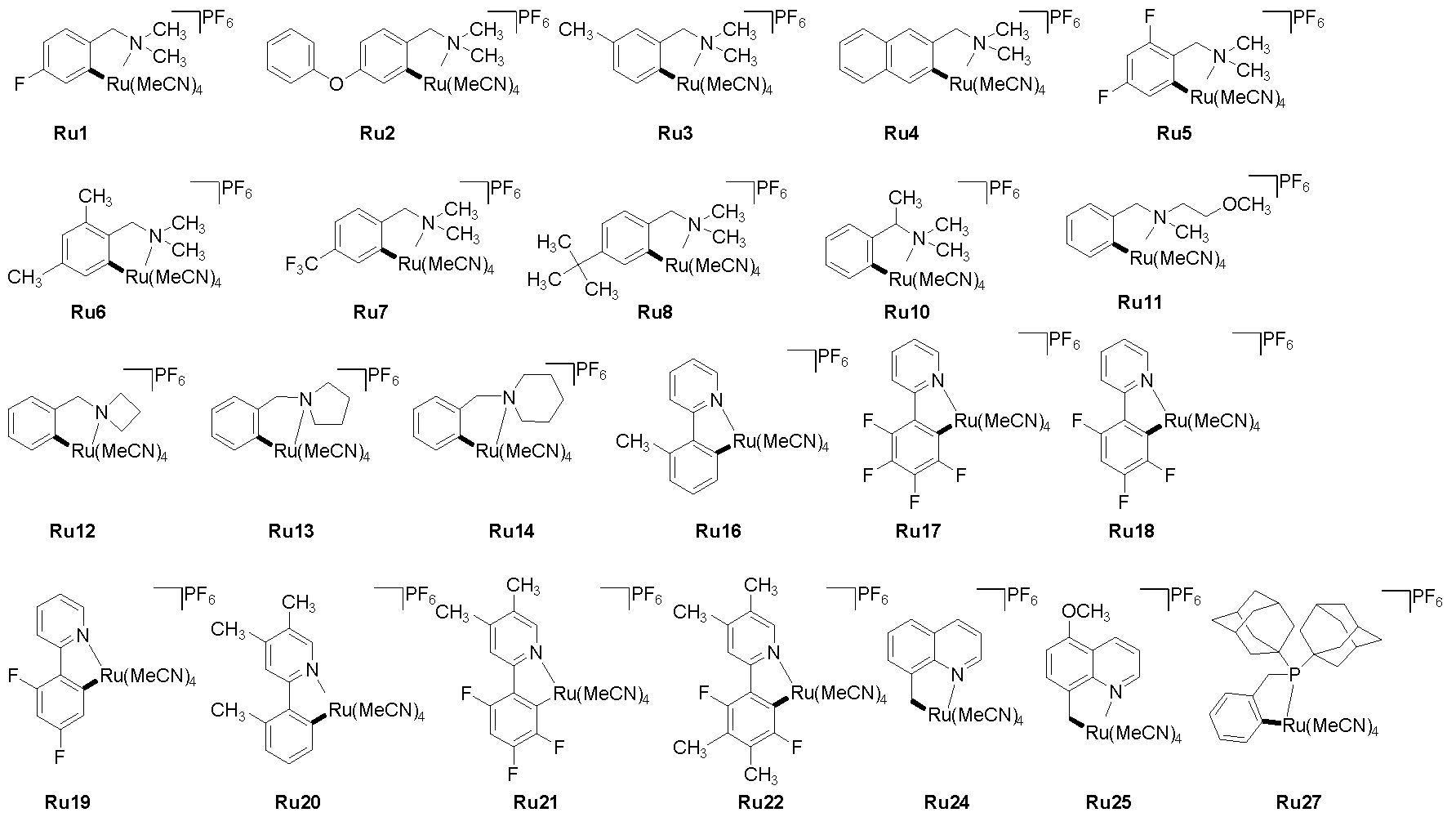
Examples of neutral or cationic ruthenium(ll) catalysts for use in the process of the invention include (but are not limited to):

wherein each L is as defined above. Further examples of suitable cationic ruthenium(ll) catalysts for use in the process of the invention include (but are not limited to):

Further examples of cationic ruthenium(ll) catalysts for use in the process of the invention include (but are not limited to):

The cyclometalating ligands and ruthenium complexes may be prepared according to standard procedures known to persons skilled in the art (see, for example, J. Am. Chem. Soc. 2011 ,
133, 10161 ; Organometallics, 1999, 18, 2390-2394; Polymer 2014, 55, 1656-1665). For example a suitable ligand precursor may be reacted with a ruthenium complex such as [Ru(CI)2(benzene)]2 in the presence of acetonitrile and a suitable base.
The ruthenium catalyst as discussed herein is used in the process of the invention in a catalytically effect amount. As would be appreciated by persons skilled in the art, this amount may vary depending on the exact nature of the process (for example depending on the nature of the first and second compounds, the solvent used and the reaction temperature), but typically the ruthenium catalyst may be used in an amount ranging from a 1 mol % to 10 mol %.
The process of the invention may be conducted with a wide range of first and second compounds so as to prepare a wide range of further compounds. The first compound may comprise a reactive aryl or heteroaryl group, i.e. in addition to other chemical groups. The second compound may comprise a reactive alkyl or cycloalkyl moiety, i.e. in addition to other chemical groups. As the skilled person would appreciate, it is the aryl or heteroaryl group in the first compound that reacts with the alkyl or cycloalkyl moiety in the second compound to form a new carbon-carbon bond.
The first compound may, for example, be any of a wide range of functional aryl and/or heteroaryl containing compounds, including pharmaceuticals, agrochemicals, natural products and organic electronic compounds.
The second compound may, for example, be any of a wide range of functional alkyl and/or cycloalkyl containing compounds, including pharmaceuticals, agrochemicals, natural products and organic electronic compounds.
The first compound comprises an aryl or heteroaryl group and may comprise other organic groups in addition thereto (including further aryl and/or heteroaryl groups).
The second compound comprises an alkyl or cycloalkyl moiety and may comprise other organic groups in addition thereto (including further alkyl and/or cycloalkyl groups). As discussed herein, the second compound further comprises a suitable leaving group.
The process may be one in which the first compound comprises an aryl or heteroaryl group having a first ring atom which is a carbon atom having a hydrogen bonded thereto and a second ring atom which is adjacent to the first ring atom and which has a nitrogen containing directing group (or a salt or protected derivative thereof) bonded thereto, and wherein the second compound comprises an alkyl or cycloalkyl moiety having a first (sp3) carbon atom
having a leaving group bonded thereto, such that the reaction between the first compound and the second compound results in the formation of a carbon-carbon bond between the first ring atom of the first compound and the first (sp3) carbon atom of the second compound. The process may be one in which the first compound comprises an aryl or heteroaryl group having a first ring atom which is a carbon atom having a hydrogen bonded thereto and a second ring atom which is separated from the first ring atom by one non-bridging third ring atom, wherein the second ring atom has a nitrogen containing directing group (or a salt or protected derivative thereof) bonded thereto and is adjacent to a ring carbon atom having a hydrogen bonded thereto, and wherein the second compound comprises an alkyl or cycloalkyl moiety having a first (sp3) carbon atom having a leaving group bonded thereto, such that the reaction between the first compound and the second compound results in the formation of a carbon-carbon bond between the first ring atom of the first compound and the first (sp3) carbon atom of the second compound.
In this case, the second ring atom of the aryl or heteroaryl group may be separated from the first ring atom by one or more (for example 1 or 2) bridging ring atoms in addition to the one non-bridging ring atom. Examples of such processes are as follows:

The first and/or second compound may comprise one or more protecting groups, which protecting groups may be added or removed therefrom by methods well known in the art.
For example, the process may be represented generally as follows:

or
LG - Cycloalkyl
First Second Coupled first and second aryl or heteroaryl compound compounds wherein LG represents a suitable leaving group, DG represents a nitrogen containing directing group (or a salt or protected derivative thereof) and alkyl and cycloalkyl represent an alkyl and cycloalkyl moiety of a second compound.
The nitrogen containing directing group may be bonded to a second ring atom of the first compound. The second ring atom may be adjacent (or ortho) to a first ring atom which is a carbon atom having a hydrogen bonded thereto. The directing group is suitably an ortho directing group.
The second ring atom may be separated from the first ring atom of the first compound by one non-bridging third ring atom (and optionally, when present in the first compound, one or more bridging ring atoms). In this case, the second ring atom is adjacent to a ring carbon atom having a hydrogen bonded thereto.
The directing group may be bonded to the second ring atom of the second compound directly or via an intervening linker group.
The leaving group is bonded to a first (sp3) carbon atom of the alkyl or cycloalkyl moiety of the second compound. Upon reaction, a carbon-carbon bond is formed between the first ring atom of the first compound and the first (sp3) carbon atom of the second compound.
For example, the process may couple a (first) phenyl compound and an alkyl containing (second) compound as follows:

First compound Second compound Coupled first and second
Compound
In this particular process, where the first compound comprises a phenyl group, it is preferred that the alkyl group of the second compound comprises at least one C-H bond (for example is a primary or secondary halide).
For example, the process may couple a (first) phenyl compound and an alkyl containing (second) compound as follows:

In this particular process, where the first compound comprises a phenyl group, it is preferred that the alkyl group of the second compound comprises at least two C-C bonds (for example is a tertiary or secondary halide).
In the processes shown above, the phenyl and alkyl groups may, of course, be substituted by any suitable substituents, which substituents may be protected by any suitable protecting groups as required and/or may be in the form of suitable salts.
Suitably, the first compound comprises an aryl or heteroaryl group, for example having a first ring atom which is a carbon atom having a hydrogen bonded thereto and a second ring atom which is adjacent (for example ortho) to the first ring atom and which has a nitrogen containing directing group (or a salt or protected derivative thereof) bonded thereto.
Suitably, the first compound comprises an aryl or heteroaryl group, for example having a first ring atom which is a carbon atom having a hydrogen bonded thereto and a second ring atom which is separated from the first ring atom by one non-bridging third ring atom, wherein the second ring atom has a nitrogen containing directing group (or a salt or protected derivative thereof) bonded thereto and is adjacent to a ring carbon atom having a hydrogen bonded thereto.
As the skilled person would appreciate, it is possible for more than one carbon-carbon bond to be formed according to the process of the present invention. For example, two second compounds may couple to a single first compound (for example phenyl compound) forming two C-C bonds as follows:

G
Cycloalkyl

First Second Coupled compound compound compound
Any suitable nitrogen containing directing group (or a salt or protected derivative thereof) may be used. Examples of suitable nitrogen containing directing groups include (but are not limited to):

Examples of suitable directing group-containing arenes (i.e. first compounds) include (but are not limited to):
 wherein fBu represents fe/f-butyl, and Bn represents benzyl, and Ph represents phenyl
Particularly, an example of a suitable first compound is 2-phenyl pyridine (N1).
The second compound comprises an alkyl or cycloalkyl moiety, for example having a first (sp3) carbon atom having a leaving group bonded thereto. Examples of suitable leaving groups include (but are not limited to) chloro, bromo, iodo, trifluoromethanesulfonate (OTf) p- toluenesulfonate (OTs) and methanesulfonate (OMs), N-alkylpyridinium derivatives such as N alkylated derivatives of 2,4,6-triphenylpyridine, suitably bromo and iodo.
The second compound may be any suitable compound comprising an alkyl or cycloalkyl moiety and having a leaving group bonded to a first (sp3) carbon atom. Examples of suitable second compounds include (but are not limited to):

Examples of suitable processes for forming carbon-carbon bonds according to the present invention that can be conducted are (but are not limited to) as follows:

The process may be conducted at any suitable temperature, for example at a temperature from 25 to 50°C.
The process is suitably conducted in the presence of a suitable base, such as potassium carbonate.
The ruthenium(ll) catalysts are typically prepared and isolated prior to use in the process of the invention, but may alternatively be prepared in situ.
The process may be conducted in any suitable solvent. Examples of suitable solvents include tetrahydrofuran, toluene, gamma-valerolactone, propylene carbonate, ethylacetate, acetone, gamma-butyrolactone, dioxane and /V-methyl pyrrolidone.
Cyclometalated ruthenium(ll) catalysts are well-known for being oxygen sensitive (see, for example, Organometallics 1999, 18, 2390-2394) and therefore generally need to be manipulated and stored under inert atmosphere. To overcome this limitation the neutral or cationic ruthenium(ll) catalysts discussed herein may be encapsulated in an inert medium such as paraffin to obtain an air stable preparation (for example using the method as discussed in Org. Lett. 2016, 18, 3934-3936). By using an encapsulated cyclometalated ruthenium(ll) catalyst the process can be carried out using standard Schlenk techniques without the need of specialised equipment such as a glove-box.
According to a second aspect of the invention, there is provided a neutral or cationic (preferably cationic) ruthenium(ll) catalyst of formula (IA) as defined above.
According to a second aspect of the invention, there is provided a neutral or cationic (preferably cationic) ruthenium(ll) catalyst of formula (IA’) as defined above.
According to a second aspect of the invention, there is provided a neutral or cationic (preferably cationic) ruthenium(ll) catalyst of formula (IA”) as defined above.
According to a second aspect of the invention, there is provided a neutral or cationic (preferably cationic) ruthenium(ll) catalyst of formula (IA’”) as defined above.
According to a second aspect of the invention, there is provided a neutral or cationic (preferably cationic) ruthenium(ll) catalyst of formula (IA””) as defined above.
According to a second aspect of the invention, there is provided a neutral or cationic (preferably cationic) ruthenium(ll) catalyst of formula (IA’””) as defined above.
According to a second aspect of the invention, there is provided a neutral or cationic (preferably cationic) ruthenium(ll) catalyst of formula (IB) as defined above.
According to a second aspect of the invention, there is provided a neutral or cationic (preferably cationic) ruthenium(ll) catalyst of formula (IB’) as defined above.
According to a second aspect of the invention, there is provided a neutral or cationic (preferably cationic) ruthenium(ll) catalyst of formula (IB”) as defined above.
According to a second aspect of the invention, there is provided a neutral or cationic (preferably cationic) ruthenium(ll) catalyst of formula (IB’”) as defined above. According to a second aspect of the invention, there is provided a neutral or cationic (preferably cationic) ruthenium(ll) catalyst of formula (IB””) as defined above.
According to a second aspect of the invention, there is provided a neutral or cationic (preferably cationic) ruthenium(ll) catalyst of formula (IB’””) as defined above.
According to a second aspect of the invention, there is provided a neutral or cationic (preferably cationic) ruthenium(ll) catalyst of formula (IC) as defined above.
According to a second aspect of the invention, there is provided a neutral or cationic (preferably cationic) ruthenium(ll) catalyst of formula (ID) as defined above.
For example, according to the second aspect of the present invention, there may be provided a cationic ruthenium(ll) catalyst as follows:
For example, according to the second aspect of the present invention, there may be provided a cationic ruthenium(ll) catalyst as follows:

According to a third aspect of the invention, there is provided an encapsulated (such as a paraffin encapsulated) cyclometalated ruthenium(ll) catalyst of formula (I) (such as of formula (IA), (IB), (1 A’), (IA”), (IA”’), (IA””), (IA”’”), (IB’), (IB”), (IB”’), (IB””), (IB’””), (IC) or (ID)).
All of the features disclosed in this specification (including any accompanying claims and drawings), and/or all of the steps of any method or process so disclosed, may be combined in any combination, except combinations where at most some of such features and/or steps are mutually exclusive. Each feature disclosed in this specification (including any accompanying claims, and drawings) may be replaced by alternative features serving the same, equivalent or similar purpose, unless expressly stated otherwise. Thus, unless expressly stated otherwise, each feature disclosed is one example only of a generic series of equivalent or similar features.
The invention is not restricted to the details of the foregoing embodiment(s). The invention extends to any novel one, or any novel combination, of the features disclosed in this specification (including any accompanying claims and drawings), or to any novel one, or any novel combination, of the steps of any method or process so disclosed.
The optional features set out herein may be used either individually or in combination with each other where appropriate and particularly in the combinations as set out in the accompanying claims. The optional features for each exemplary embodiment of the invention, as set out herein are also applicable to any other aspects or exemplary embodiments of the invention, where appropriate. In other words, the skilled person reading this specification should consider the optional features for each aspect or embodiment of the invention as interchangeable and combinable between different aspects of the invention.
The invention will be further discussed with reference to the following non-limiting Examples.
Examples
General Procedure A: preparation of cyclometalated ruthenium(ll) catalysts

If not available from commercial source, the cyclometalating ligand was synthesized according to known literature (for example, see J. Am. Chem. Soc. 2003, 125, 8708-8709). In some cases, known literature procedures were used for synthetizing suitable cyclometalated h6- arene-conatining Ru(ll) complexes, and therefore used in replacement of the first step of this two-step synthetic route (for example, see Angew. Chem., Int. Ed. 2015, 54, 5513-5517).
The General Procedure A was applied with L/,/V-dimethylbenzylamine L9
(216.3 mg, 1 .6 mmol, 1 equiv.) affording Ru9 as an off white solid (653.3 mg,
75%).
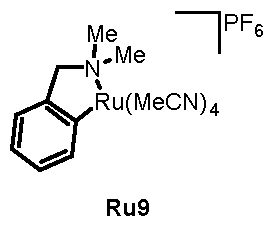
1H-NMR (400 MHz, MeCN -d3) d 2.97 (s, 3 H), 2.23 (s, 6 H), 2.42 (s, 3 H), 2.46 (s, 6 H), 3.64 (s, 2 H), 6.76 (t, J = 7.4 Hz, 1 H), 6.88-6.95 (m, 2 H), 7.56 (d, J = 7.6 Hz, 1 H) ppm; 13C-NMR (100 MHz, MeCN -d3) d 4.2, 4.4, 53.7, 73.6, 121 .2, 121 .5, 123.1 , 123.3, 125.3, 138.6, 149.6, 175.2 ppm; 19F-NMR (376 MHz, MeCN -c/3) d -72.9 (d, J = 705.4 Hz) ppm; IR vmax (neat/cm _1): 3048, 2977, 2926, 2897, 2855, 2265, 1575, 1472, 1442, 831 , 748; HRMS calcd for C15H21N4Ru+ [M-
MeCN-PF6]+: 359.0804, found 359.0798.
The General Procedure A was applied with 1 -benzylpiperidine L14 (280.4 mg,
1 .6 mmol, 1 equiv.) affording Ru14 as an off white solid (598.5 mg, 64%).

1H NMR (500 MHz, CD3CN) d 7.55 (dd, J = 7.3, 1 .3 Hz, 1 H), 6.95 (dd, J = 7.3,
Ru14 1 .3 Hz, 1 H), 6.90 (td, J = 7.3, 1 .4 Hz, 1 H), 6.75 (td, J = 7.3, 1 .3 Hz, 1 H), 3.90
(s, 2H), 2.98 (ddd, J = 13.2, 11 .5, 3.3 Hz, 2H), 2.75 - 2.65 (m, 2H), 2.42 (s, MeCN), 2.22 (s, 2xMeCN), 1.96 or 2.13 (MeCN), 1.84 - 1.73 (m, 2H), 1 .71 - 1.63 (m, 1 H), 1.54 - 1.36 (m, 3H) The signals of the coordinated acetonitriles integrate less than expected due to exchange with CD3CN; 13C NMR (126 MHz, CD3CN) d 175.4, 149.4, 138.3, 125.2, 123.2, 123.1 , 121.7, 121.1 , 59.8, 24.3, 21.9, 4.3, 4.2; 19F NMR (471 MHz, CD3CN) d -72.2, -73.7; ESI-MS calcd for
C18H25N4RU [M -PF6 -MeCN]+: 399.1 , found 399.1 .
The General Procedure A was applied with 8-methylquinoline L24 (229.1 mg, 1.6 HPFs mmol, 1 equiv.) affording Ru24 as a red solid (123.9 mg, 14%). However, the
reaction time for the first step was extended from 3 to 48 hours.

1H NMR (500 MHz, CD3CN) d 9.14 (dd, J = 5.0, 1.5 Hz, 1 H), 8.14 (dd, J = 8.3,
1.5 Hz, 1 H), 7.74 (dd, J = 7.0, 1.4 Hz, 1 H), 7.58 (dd, J = 8.0, 1.3 Hz, 1 H), 7.47 (dd, J = 8.0, 7.0 Hz, 1 H), 7.33 (dd, J = 8.3, 5.0 Hz, 1 H), 2.79 (t, J = 1.2 Hz, 2H), 2.41 (s, MeCN), 2.07 (s, 2xMeCN), 1.96 (s, MeCN) The signals of the coordinated acetonitriles integrate less than expected due to exchange with CD3CN; 13C NMR (126 MHz, CD3CN) d 156.2, 155.7, 153.5, 135.9, 132.0, 129.3, 127.9, 124.3, 123.9, 122.2, 121 .7, 17.1 , 4.3, 4.0 both carbons of one acetonitrile were not observed. IR vmax (neat/crrf1): 3088, 2845, 2261 , 1500, 871 ; ESI-MS calcd for C17H19N4Ru [M -PF6 -MeCN]+: 381 .1 , found 381.1.
The General Procedure A was applied with 2-benzylpyridine L26 (270.7 mg,
1.6 mmol, 1 equiv.) affording Ru26 as a yellow solid (219.1 mg, 22%).
However, the reaction time for the first step was extended from 3 to 72 hours.
Spectroscopic data matched those previously reported (Organometallics 1999,

18, 2390-2394).
1H NMR (500 MHz, CD3CN) d 8.83 (dd, J = 5.8, 1.6 Hz, 1 H), 7.68 (td, J = 7.6, 1.7 Hz, 1 H), 7.59 (dd, J = 7.4, 1.4 Hz, 1 H), 7.38 (dt, J = 7.8, 1.0 Hz, 1 H), 7.14 (ddd, J = 7.4, 5.8, 1.6 Hz, 1 H), 6.99 (dd, J = 7.2, 1 .4 Hz, 1 H), 6.88 (td, J = 7.4, 1.6 Hz, 1 H), 6.78 (td, J = 7.3, 1.4 Hz, 1 H),
4.23 (s, 2H), 2.45 (s, MeCN), 2.22 (s, 2xMeCN), 2.14 (s, MeCN); 13C NMR (126 MHz, CD3CN) d 170.5, 165.6, 156.8, 143.0, 141.5, 137.4, 126.0, 125.2, 125.0, 124.0, 122.8, 121.7, 48.5, 4.3, 4.2; 19F NMR (471 MHz, CD3CN) d -72.2, -73.7.
The General Procedure A was applied with di(1- adamantyl)benzylphosphine L27 (628.1 mg, 1.6 mmol, 1 equiv.) affording
Ru27 as a white solid (365.9 mg, 28%). However, the reaction time for the
first step was extended from 3 to 24 hours.

1H NMR (500 MHz, CD3CN) d 7.54 (dd, J = 7.5, 1 .4 Hz, 1 H), 7.00 (d, J = 7.2 Hz, 1 H), 6.77 (td, J = 7.3, 1 .5 Hz, 1 H), 6.69 (t, J = 7.2 Hz, 1 H), 3.11 (d, J = 9.4 Hz, 2H), 2.39 (s, MeCN), 2.20 (s, MeCN), 2.13 (s, 2MeCN), 2.05 - 1.99 (m, 12H), 1.91 - 1.88 (m, 6H), 1.74 - 1.61 (m, 12H). The
signals of the coordinated acetonitriles integrate less than expected due to fast exchange with CD3CN. 13C NMR (126 MHz, CD3CN) d 171 .9 (d, J = 6.7 Hz), 151 .8 (d, J = 1 1 .7 Hz), 139.3, 125.0 (2C), 124.1 , 123.3 (d, J = 14.4 Hz), 121 .8, 42.3 (d, J = 14.2 Hz), 40.2, 37.5, 31 .8 (d, J = 24.6 Hz), 29.7 (d, J = 7.7 Hz), 4.9, 4.6; 19F NMR (471 MHz, CD3CN) d -72.2, -73.7; 31P NMR (202 MHz, CD3CN) d 89.7; ESI-MS calcd for C33H45N3PRu [M -PF6 -MeCN]+: 616.2, found
616.2.
General Procedure B: preparation of cyclometalated ruthenium(ll) catalysts

Unless otherwise stated, an oven dried 100 mL Ace pressure tube equipped with a stirring bar was transferred to a glove box, then [RuCI2(p-cymene)]2 (489.9 mg, 0.8 mmol, 0.5 equiv.), KOAc (235.6 mg, 2.4 mmol, 1 .5 equiv.), KPF6 (589.0 mg, 3.2 mmol, 2 equiv.), the appropriate cyclometalating ligand (like L15-L23, L28-L37, L39-L43, 1 .6 mmol, 1 equiv.) and MeCN (10
mL, 0.16 M) were added. The tube was sealed, transferred out of the box, placed in an oil bath at 100 °C and stirred for 16 h. Upon completion, the reaction crude was loaded in an aluminium oxide (Al203, neutral) column conditioned with CH2CI2, and quickly eluted with MeCN/CH2CI2 (1 :1) using N2 in replacement of compressed air collecting the yellow/orange band. The solution was concentrated under reduced pressure and then quickly precipitated with Et20 affording the corresponding cyclometalated ruthenium(ll) catalyst (like Ru15-Ru23, Ru28-Ru37, Ru39-Ru43) as a yellow/orange solid. These complexes must be kept in a glove box as they quickly decompose turning blue/black if exposed to air.
If not available from commercial source, the cyclometalating ligand was synthesized according to known literature (for example, Angew. Chem., Int. Ed. 2015, 54, 14103-141
The General Procedure B was applied with 2-(o-tolyl) pyridine L16 (270.8
mg, 1 .6 mmol, 1 equiv.) affording Ru16 as an orange solid (879.3 mg,
95%).

1H-NMR (500 MHz, CDCI3) d 1 .96 (s, 3 H), 2.00 (s, 6 H), 2.50 (s, 3 H), 2.68 (s, 3 H), 6.74 (d, J = 7.5 Hz, 1 H), 6.94 (t, J = 7.5 Hz, 1 H), 7.14 (t, J = 6.5 Hz, 1 H), 7.75 (t, J = 7.5 Hz, 1 H), 7.88 (d, J = 7.5 Hz, 1 H), 8.09 (d, J = 7.5 Hz, 1 H), 9.05 (d, J = 5.5 Hz, 1 H) ppm; 13C-NMR (125 MHz, CDCI3) d 3.8, 4.4, 24.7, 121 .4, 121 .7, 122.9, 123.7, 126.4, 127.5, 136.1 , 136.6, 136.9, 146.4, 153.8, 169.9, 187.7 ppm (signals for both carbons of one of the MeCN ligands were not observed); 19F-NMR (470 MHz, MeCN -d3) d -73.0 (d, J = 705.9 Hz) ppm; IR vmax (neat/cm 1): 3046, 2274, 1605, 1498, 1269, 1 169, 830, 768; HRMS calcd for C18H19N4Ru [M-MeCN-PF6]+: 393.0648, found 393.0635.
The General Procedure B was applied with 2-(2,5-difluoro-3,4- dimethylphenyl)-4,5-dimethylpyridine L22 (395.7 mg, 1 .6 mmol, 1 equiv.)
affording Ru22 as a yellow solid (924.4 mg, 88%).
1H-NMR (500 MHz, MeCN -d3) d 1 .96 (s, 3 H), 2.05 (s, 6 H), 2.20 (d, J =

2.5 Hz, 3 H), 2.22 (d, J = 2.5 Hz, 3 H), 2.31 (s, 3 H), 2.39 (s, 3 H), 2.43 (s, 3 H), 8.01 (d, J = 1 .5 Hz, 1 H), 8.65 (s, 1 H) ppm (exchange with MeCN-cf3 shows a lower integration than expected for the MeCN ligand at 2.43 ppm); 13C-NMR (125 MHz, MeCN -d3) d 3.9, 4.0, 1 1 .0 (dd, J = 7.3, 2.1 Hz), 1 1 .9 (dd, J = 4.9, 1 .9 Hz), 16.5, 19.7, 121 .9, 122.5, 123.8, 124.0, 124.1 , 124.8 (dd, J = 25.9, 4.9 Hz), 131 .6 (d, J = 1 .4 Hz), 133.7 (dd, J = 19.4, 6.1 Hz), 148.0, 152.6, 156.0 (dd, J = 247.8, 1 .4 Hz), 160.4 (dd, J = 50.9, 2.3 Hz), 164.4 (d, J = 7.5 Hz), 167.6 (d, J = 223.8 Hz) ppm (signals for both carbons of one of the MeCN ligands were not observed); 19F-NMR (470 MHz, MeCN -d3) d -124.4 (d, J = 22.9 Hz), -106.7 (d, J = 22.9 Hz), -72.9 (d, J = 705.8 Hz) ppm; IR vmax (neat/cm 1): 3006, 2927, 2272, 1605, 1484, 1403, 1287, 832; HRMS calcd for C21H23F2N4RU+ [M-MeCN-PF6]+: 471 .0929, found 471 .0925.
The General Procedure B was applied with benzo[/?]quinoline L23 (286.7 mg,
1.6 mmol, 1 equiv.) affording Ru23 as a light orange solid (782.1 mg, 81 %).
Spectroscopic data matched those previously reported (Inorganics Chim. Acta

2010, 363, 567-573).
1H NMR (500 MHz, CD3CN) d 9.18 (dd, J = 5.3, 1.4 Hz, 1 H), 8.27 (dd, J = 8.0, 1.3 Hz, 1 H), 8.17 (dd, J = 6.4, 1.8 Hz, 1 H), 7.84 (d, J = 8.8 Hz, 1 H), 7.68 (d, J = 8.7 Hz, 1 H), 7.57 - 7.44 (m, 3H), 2.58 (s, MeCN), 2.14 (s, MeCN) 1.91 (s, 2xMeCN) The signals of the coordinated acetonitriles integrate less than expected due to fast exchange with CD3CN; 13C NMR (126 MHz, CD3CN) d 181.9, 158.5, 152.4, 144.1 , 136.6, 135.7, 134.1 , 129.9, 128.5, 126.7, 124.4,
124.0, 122.1 , 121 .6, 119.6, 4.4, 3.8 both carbon of one acetonitrile ligand were not observed; 19F NMR (471 MHz, CD3CN) d -72.2, -73.7.
General Procedure C: alkylation of DG-containing (hetero)arenes with alkyl (pseudo)halides using cyclometalated ruthenium(ll) catalysts

In an Argon filled glove-box a crimp-cap microwave vial equipped with a magnetic stirring bar was charged with the appropriate cyclometalated Ru(ll)-catalyst (like Ru1-Ru46, from 1 mol % to 10 mol %), KOAc (5.9 mg, 0.06 mmol, 30 mol %), K2C03 (0.60 mmol, 3.0 equiv.), the appropriate DG-containing arene (like N1-N20, 0.20 mmol, 1.0 equiv.), the appropriate alkyl (pseudo)halide (like X1-X16, 1.0 - 3.0 equiv.) and A/-methyl-2-pyrrolidone (NMP) (0.2 M - 1 M). The vial was capped and stirred at 35 °C for 24 hours. Upon completion, the crude mixture was loaded on a silica gel column and purified by flash chromatography.
General Procedure D: glove-box free alkylation of DG-containing (hetero)arenes with alkyl (pseudo)halides using cyclometalated ruthenium(ll) catalysts

DG
Cycloalkyl Cycloalkyl Cycloalkyl
^Y ^ RU(L)4 and/or


(cat.)
LG— Cycloalkyl

solvent, 25 - 35 °C,
24 - 48 h
and/or


Characterization data for arylated compounds
The General Procedure C was applied with Ru9 (5.5 mg,
0.01 mmol, 5 mol %), 2-phenylpyridine N1 (28.6 pL, 0.20

l 1 i t l b id X1 104 I 0 60 l
a
 fforded A1 (46.0 mg, 86%) and A1-bis (9.9 mg, 13%)
both as colourless oils.
The General Procedure C was applied with Ru9 (5.5 mg, 0.01 mmol, 5 mol %), 2- phenylpyridine N1 (28.6 pL, 0.20 mmol, 1 equiv.), n-octyl bromide X1 (35 pL, 0.20 mmol, 1 .0 equiv.) and NMP (1 ml_, 0.2 M) without KOAc. Column chromatography (hexane/DCM/EtOAc 8:1 :1 ) afforded A1 (35.8 mg, 67%) and A1 -bis (3.8 mg, 5%). both as colourless oils.
The General Procedure C was applied with Ru9 (5.5 mg, 0.01 mmol, 5 mol %), 2- phenylpyridine N1 (28.6 pL, 0.20 mmol, 1 equiv.), n-octyl iodide X6 (108 pL, 0.20 mmol, 3.0 equiv.) and NMP (1 ml_, 0.2 M) without KOAc. Column chromatography (hexane/DCM/EtOAc 8:1 :1 ) afforded A1 (42.8 mg, 80%) and A1 -bis ( 6.8 mg, 9%) both as colourless oils.
The General Procedure D was applied with encapsulated Ru9 (5.5 mg, 0.01 mmol, 5 mol %), 2-phenylpyridine N1 (28.6 pL, 0.20 mmol, 1 equiv.), n-octyl bromide X1 (104 pl_, 0.60 mmol, 3.0 equiv.), A/./V-dicyclohexylcetimidamide (13.3 mg, 0.06 mmol, 30 mol %; synthesised as previously reported US5834058,1998,A) in replacement of KOAc, and dioxane (1 ml_, 0.2 M) at 25 °C for 48 hours. Column chromatography (hexane/DCM/EtOAc 8:1 :1) afforded A1 (44.9 mg, 84%) and A1 -bis (6.8 mg, 9%) both as colourless oils.
Spectroscopic data matched those previously reported (Synthesis, 2014, 46, 2024-2039).
1H NMR (500 MHz, CDCI3) d 8.67 (ddd, J = 4.9, 1 .8, 0.9 Hz, 1 H), 7.71
(td, J = 7.7, 1 .9 Hz, 1 H), 7.36 (dt, J = 7.8, 1 .2 Hz, 1 H), 7.34 - 7.27 (m,
3H), 7.27 - 7.20 (m, 2H), 2.78 - 2.59 (m, 2H), 1 .44 (ddd, J = 12.0, 9.9,
6.6 Hz, 2H), 1 .29 - 1 .05 (m, 10H), 0.85 (t, J = 7.1 Hz, 3H); 13C NMR (126

MHz, CDCI3) d 160.4, 149.2, 140.9, 140.4, 136.1 , 129.8 (2C), 128.3, 125.8, 124.2, 121 .7, 33.0, 31 .9, 31 .4, 29.5, 29.3, 29.2, 22.8, 14.2.
1H NMR (500 MHz, CDCI3) d 8.70 (d, J = 4.7 Hz, 1 H),

= 14.4, 7.3 Hz, 6H); 13C NMR (126 MHz, CDCI3) d 159.8,
149.4, 140.9, 140.0, 135.8, 128.1 , 126.6, 125.1 , 121 .7, 33.7, 32.0, 31 .2, 29.7, 29.3, 29.3, 22.8, 14.3.
The General Procedure C was applied with Ru9 (1 .1 mg, 0.002
mmol, 1 mol %), 2-(o-tolyl) pyridine N2 (33.9 mg, 0.20 mmol, 1
equiv.), n-octyl bromide X1 (104 pL, 0.60 mmol, 3.0 equiv.), and NMP

(1 ml_, 0.2 M). Column chromatography (hexane/EtOAc 85:15)
afforded A2 as a colourless oil (23.1 mg, 41 %).
The General Procedure D was applied with encapsulated Ru9 (5.5 mg, 0.01 mmol, 5 mol %), 2-(o-tolyl) pyridine N2 (33.9 mg, 0.20 mmol, 1 equiv.), n-octyl bromide X1 (104 mI_, 0.60 mmol, 3.0 equiv.), and dioxane (1 mL, 0.2 M). Column chromatography (hexane/EtOAc 85:15) afforded A2 as a colourless oil (31.0 mg, 55%).
1H NMR (500 MHz, CDCI3) d 8.78 - 8.67 (m, 1 H), 7.75 (td, J = 7.7, 1.9 Hz, 1 H), 7.25 - 7.19 (m, 3H), 7.16 - 7.06 (m, 2H), 2.31 (t, J = 8.0 Hz, 2H), 2.02 (s, 3H), 1.43 - 1.39 (m, 2H), 1 .25 - 1.02 (m, 10H), 0.85 (t, J = 7.2 Hz, 3H). 13C NMR (126 MHz, CDCI3) d 160.0, 149.6, 140.8, 140.3, 136.1 , 136.0, 128.0, 127.6, 126.8, 124.8, 121.7, 33.6, 32.0, 31.3, 29.6, 29.4, 29.3, 22.8, 20.5, 14.3.; EI-MS calcd for C2oH26N [M-H]+: 280.2, found 280.2.0
The purity of the Atazanavir purchased from

The General Procedure C was applied with Ru9 (10.9 mg, 0.02 mmol, 10 mol %), Atazanavir N4 (152.3 mg, 0.2 mmol, 1.0 equiv), n-octyl bromide X1 (104 pL, 0.60 mmol, 3.0 equiv) and NMP (1 mL, 0.2 M) for 48 hours. Column chromatography (hexane/EtOAc 1 :1 to EtOAc) afforded A3 as a yellow wax (58.2 mg, 35%).
1H NMR (500 MHz, CDCI3) d 8.60 (dd, J = 5.0, 1 .7 Hz, 1 H), 7.67 (td, J = 7.7, 1 .9 Hz, 1 H), 7.23 (dd, J = 13.4, 7.7 Hz, 2H), 7.18 - 7.10 (m, 7H), 7.08 (td, J = 6.3, 2.5 Hz, 1 H), 6.50 (s, 1 H), 6.38 (s, 1 H), 5.29 (d, J = 9.3 Hz, 1 H), 5.18 (d, J = 8.6 Hz, 1 H), 4.80 (s, 1 H), 3.97 (d, J = 11.7 Hz,
2H), 3.83 (d, J = 13.9 Hz, 1 H), 3.74 (d, J = 8.6 Hz, 1 H), 3.63 - 3.48 (m, 9H), 2.87 (d, J = 7.6 Hz, 2H), 2.80 (t, J = 11 .5 Hz, 1 H), 2.67 - 2.51 (m, 2H), 2.47 (d, J = 12.2 Hz, 1 H), 1.33 (p, J = 7.3 Hz, 2H), 1 .18 - 1.02 (m, 10H), 0.83 (s, 9H), 0.79 (t, J = 7.1 Hz, 3H), 0.74 (s, 9H); 13C NMR (126 MHz, CDCI3) d 170.9, 170.8, 160.0, 157.1 , 157.0, 149.3, 141 .4, 140.2, 138.2, 136.2, 135.3, 130.4, 130.3, 129.5, 128.4, 126.4, 124.1 , 121.8, 67.3, 63.7, 62.8, 61 .6, 61 .3, 52.6, 52.5,
52.3, 38.8, 34.4, 34.1 , 33.1 , 32.0, 31 .5, 29.7, 29.3, 29.3, 26.7, 26.4, 22.8, 14.3, One carbon was not observed; ESI-MS calcd for C46H69N607 [M+H]+: 817.5, found 817.5.
The General Procedure C was applied with Ru9 (10.9 mg, 0.02 mmol,
10 mol %), Zolpidem N5 (61.5.0 mg, 0.2 mmol, 1.0 equiv), n-octyl
bromide X1 (104 pL, 0.60 mmol, 3.0 equiv) and NMP (1 mL, 0.2 M) at
50 °C. Column chromatography (EtOAc/MeOH 100:0 to 98:2) afforded
A4 product as a light orange wax (18.5 mg, 22%).
 1H NMR (400 MHz, CDCI3) d 8.11 (s, 1 H), 7.33 (d, J = 9.2 Hz, 1 H), 7.17 - 7.10 (m, 2H), 7.07 - 6.99 (m, 2H), 3.85 (s, 2H), 2.89 (s, 3H), 2.77 (s, 3H), 2.62 - 2.50 (m, 2H), 2.38 (s, 3H), 2.36 (s, 3H), 2.17 (s, 2H), 1 .41 (q, J = 7.7, 7.3 Hz, 2H), 1 .21 - 1 .06 (m, 10H), 0.82 (t, J = 7.0 Hz, 3H); 13C NMR (101 MHz, CDCI3) d 168.4, 143.5, 142.7, 138.2, 130.9, 130.2, 127.9, 126.5, 122.9, 122.1 , 116.2, 115.2, 37.6, 35.9, 33.1 , 32.0, 31.3, 29.7, 29.6, 29.3, 22.8, 21 .5, 18.6, 14.3; El-
MS calcd for C27H36N30 [M-H]+: 418.3, found 418.3.
The General Procedure C was applied with Ru9 (10.9 mg, 0.02 mmol,
10 mol %), Oxaprozin N6 (61.5.0 mg, 0.2 mmol, 1.0 equiv), ), n-octyl
bromide X1 (104 mI_, 0.60 mmol, 3.0 equiv) and NMP (1 ml_, 0.2 M) at
50 °C. Column chromatography (hexane/DCM/Et20 7:3.5:0.5) afforded

A5 as a colourless oil (18.5 mg, 22%).
1H NMR (400 MHz, CDCI3) d 7.43 - 7.06 (m, 9H), 3.71 (s, 3H), 3.19 (dd, J = 8.4, 6.7 Hz, 2H), 2.91 (t, J = 7.6 Hz, 2H), 2.52 (dd, J = 9.1 , 6.6 Hz, 2H), 1.41 (dd, J = 9.2, 5.9 Hz, 2H), 1.27 - 1.04 (m, 10H), 0.82 (t, J = 7.0 Hz, 3H); 13C NMR (101 MHz, CDCI3) d 172.6, 161 .3, 145.8, 142.6, 135.2, 132.1 , 130.7, 129.9, 128.9, 128.8, 128.7, 127.9, 126.2, 125.0, 52.0, 33.4, 32.0,
31 .0, 30.9, 29.5, 29.4, 29.3, 23.7, 22.8, 14.2; EI-MS calcd for C27H32N03 [M-H]+: 418.3, found 418.3.
The purity of the Sulfaphenazole purchased from Fluorochem was
assessed to be 86% by quantitative 1H-NMR with an internal
standard. The impurity was not NMR-active.

The General Procedure C was applied with Ru9 (10.9 mg, 0.02 mmol, 10 mol %), Sulfaphenazole N7 (71 .7 mg, 0.2 mmol, 1.0 equiv), neopentyl bromide X2 (77 pL, 0.60 mmol, 3.0 equiv) and NMP (1 ml_, 0.2 M) at 50 °C for 48 hours. Column chromatography (DCM/MeOH 99:1 to 97:3) afforded A6 as a white wax (20.8 mg, 27%).
1H NMR (500 MHz, CDCI3) d 7.56 - 7.50 (m, 3H), 7.35 (t, J = 7.5 Hz, 1 H), 7.30 (d, J = 6.9 Hz, 1 H), 7.19 (td, J = 7.5, 1.6 Hz, 1 H), 6.70 (d, J = 7.8 Hz, 1 H), 6.63 (d, J = 8.7 Hz, 2H), 6.30 (d, J = 2.1 Hz, 1 H), 4.21 (s, 2H), 0.67 (s, 9H); 13C NMR (126 MHz, CDCI3) d 151 .5, 139.7, 137.8, 136.1 (2C), 133.2, 129.8, 129.1 , 128.2, 127.4, 126.5, 114.0, 97.3, 43.9, 32.3, 29.7; EI-MS calcd for CzoHzsN^S [M-H]+: 383.2, found 383.2.
The General Procedure C was applied with Ru9 (5.5 mg, 0.01
mmol, 5 mol %), 2-phenylpyridine N1 (28.6 mI_, 0.20 mmol, 1
equiv.), cyclohexyl bromide X3 (74 mI_, 0.60 mmol, 3.0 equiv.) and
NMP (1 ml_, 0.2 M) without KOAc. Column chromatography
 (hexane/DCM/EtOAc 8:1 :1) afforded B1 (20.4 mg, 43%) as colourless oil and B1-bis (27.5 mg, 43%) as a white solid.
1H NMR (500 MHz, CDCI3) d 8.68 (dt, J = 4.9, 1.2 Hz, 1 H), 7.70 (td, J = 7.7, 1 .9 Hz,
1 H), 7.44 - 7.27 (m, 4H), 7.27 - 7.17 (m, 2H), 2.74 (tt, J = 1 1.9, 3.3 Hz, 1 H), 1 .85 - 1.76 (m, 3H), 1.75 - 1.70 (m, 2H), 1.68 - 1.61 (m, 1 H), 1.43 (qd, J = 12.2, 3.2 Hz,

2H), 1 .27 - 1.11 (m, 3H); 13C NMR (126 MHz, CDCI3) d 160.4, 149.3, 145.6, 140.1 ,
136.0, 129.8, 128.5, 126.4, 125.5, 124.3, 121 .6, 40.0, 34.5, 26.9, 26.3;EI-MS calcd for C17H18N [M-H]+: 236.1 , found 236.2.
1H NMR (500 MHz, CDCI3) d 8.72 - 8.68 (m, 1 H), 7.71 (td, J = 7.6, 1.9 Hz,
1 H), 7.33 (t, J = 7.7 Hz, 1 H), 7.26 (ddd, J = 7.7, 4.7, 1.2 Hz, 1 H), 7.22 (d, J =
7.7 Hz, 1 H), 7.18 (d, J = 7.8 Hz, 2H), 2.02 (td, J = 12.0, 6.0 Hz, 2H), 1.83 -
1.78 (m, 2H), 1.70 - 1.63 (m, 6H), 1.60 - 1.54 (m, 2H), 1.36 (qdd, J = 12.0,

8.4, 3.7 Hz, 4H), 1.16 (qt, J = 13.0, 3.4 Hz, 2H), 1.06 - 0.92 (m, 4H); 13C NMR (126 MHz, CDCI3) d 160.1 , 149.3, 145.6, 139.2, 135.6, 128.3, 124.9, 123.4, 121.6, 41 .3, 34.6, 34.1 , 27.0, 26.9, 26.2; EI-MS calcd for C23H29N [M-H]+: 318.2, found 318.2.
The General Procedure C was applied with Ru9 (5.5 mg, 0.01 mmol, 5 mol %),
23-methyl-2-phenylpyridine N2 (33.9 mg, 0.20 mmol, 1 equiv.), cyclohexyl
bromide X3 (74 pL, 0.60 mmol, 3.0 equiv.) and NMP (1 mL, 0.2 M) at 50 °C

B2 as a colourless oil (44.7 mg, 89%).
1H NMR (500 MHz, CDCI3) d 8.50 (dd, J = 4.9, 1 .6 Hz, 1 H), 7.63 - 7.51 (m, 1 H), 7.41 - 7.31 (m, 2H), 7.26 - 7.16 (m, 2H), 7.10 (dd, J = 7.5, 1 .3 Hz, 1 H), 2.21 (tt, J = 12.0, 3.3 Hz, 1 H), 2.09 (s, 3H), 1.90 - 1.80 (m, 1 H), 1.76 - 1.56 (m, 4H), 1.55 - 1f.44 (m, 1 H), 1.37 - 0.97 (m, 4H); 13C NMR (126 MHz, CDCI3) d 160.0, 146.6, 145.4, 139.6, 137.6, 131.7, 128.7, 128.2, 126.2, 125.6, 122.2, 40.8, 34.7, 33.6, 27.0, 27.0, 26.3, 19.5; EI-MS calcd for C18H20N [M-H]+: 251 .2, found
251 .1.

(hexane/DCM/EtOAc 8:1 :1) afforded B3 (31.7 mg, 63%) and B3-bis (12.5 mg, 18%) both as colourless oils.
Spectroscopic data for B3 matched those previously reported (J. Am. Chem. Soc. 2013, 135, 5877-5884).
1H NMR (500 MHz, CDCI3) d 8.73 - 8.66 (m, 1 H), 7.84 (s, 1 H), 7.79 - 7.69 (m,
3H), 7.37 (t, J = 7.6 Hz, 1 H), 7.28 - 7.23 (m, 1 H), 7.21 (ddd, J = 7.3, 5.4, 2.3 Hz,
1 H), 2.76 (tt, J = 10.7, 3.6 Hz, 1 H), 1 .96 (ddt, J = 13.4, 6.3, 3.2 Hz, 2H), 1 .81 (ddq,
J = 13.4, 6.6, 3.3 Hz, 2H), 1 .77 - 1.67 (m, 4H), 1.65 - 1.51 (m, 4H); 13C NMR (126
 MHz, CDCI3) d 158.0, 150.7, 149.8, 139.5, 136.8, 128.8, 127.5, 125.6, 124.3, 122.1 , 120.8, 47.4, 37.0, 28.1 , 27.5.
1H NMR (500 MHz, CDCI3) d 8.69 (d, J = 4.8 Hz, 1 H), 7.75 - 7.68 (m, 2H),
7.60 (s, 1 H), 7.20 (td, J = 5.2, 3.1 Hz, 1 H), 7.08 (s, 1 H), 2.73 (tt, J = 10.7, 3.6
Hz, 2H), 2.08 - 1.91 (m, 4H), 1.81 (ddq, J = 12.9, 6.1 , 3.3 Hz, 4H), 1.77 - 1.50 (m, 16H); 13C NMR (126 MHz, CDCI3) d 158.4, 150.6, 149.7, 139.4,

136.7, 126.1 , 122.8, 121 .9, 120.9, 47.5, 37.1 , 28.1 , 27.5; EI-MS calcd for CzsHssN [M]+: 347.3, found 347.3.
The General Procedure C was applied with Ru9 (10.9 mg, 0.01 mmol, 5 mol %), 2- phenylpyridine N1 (28.6 pL, 0.20 mmol, 1 equiv.), fe/ -butyl bromide X5 (68 pl_,
0.60 mmol, 3.0 equiv.) and NMP (200 mI_, 1 M) without KOAc. Column chromatography (hexane/DCM/EtOAc 8:1 :1) afforded C1 as a colourless oil (23.2
 mg, 55%).
The General Procedure D was applied with encapsulated Ru9 (5.5 mg, 0.01 mmol, 5 mol %), 2-phenylpyridine N1 (28.6 mI_, 0.20 mmol, 1 equiv.), te/ -butyl bromide X5 (68 mI_, 0.60 mmol, 3.0 equiv.), KTFA (9.1 mg, 0.06 mmol, 30 mol %) in replacement of KOAc, and dioxane (200 pl_, 1 M) for 48 hours. Column chromatography (hexane/DCM/EtOAc 8:1 :1) afforded C1 as a colourless oil (23.2 mg, 80%).
Spectroscopic data matched those previously reported ( Chem . Commun. 2015, 51, 12807- 12810)
1H-NMR (400 MHz, CDCI3) d 8.71 (dt, J = 4.9, 1 .3 Hz, 1 H), 8.05 (t, J = 1.9 Hz, 1 H), 7.79 - 7.69 (m, 4H), 7.47 (dt, J = 7.9, 1 .5 Hz, 1 H), 7.42 (t, J = 7.7 Hz, 1 H), 7.22 (ddd, J = 6.6, 4.8, 2.0 Hz, 1 H), 1.40 (s, 9H); 13C-NMR (100 MHz, CDCI3) d 158.21 , 151 .75, 149.76, 139.35, 136.76, 128.57, 126.19, 124.31 , 124.10, 122.04, 120.90, 35.01 , 31.55.

1H NMR (500 MHz, CDCI3) d 8.70 - 8.63 (m, 1 H), 8.06 (d, J = 1 .9 Hz, 1 H), 7.92 (d, J = 8.1 Hz, 1 H), 7.73 (td, J = 7.7, 1 .8 Hz, 2H), 7.66 (d, J = 7.9 Hz, 1 H), 7.25 - 7.17 (m, 5H), 7.17 - 7.1 1
(m, 1 H), 6.58 (s, 1 H), 6.37 (s, 1 H), 5.33 (d, J = 9.4 Hz, 1 H), 5.20 (d, J = 8.7 Hz, 1 H), 4.92 (s, 1 H), 4.32 - 4.20 (m, 2H), 4.03 (q, J = 8.1 Hz, 1 H), 3.73 (d, J = 8.7 Hz, 1 H), 3.64 (s, 8H), 2.91 (dd, J = 15.2, 9.2 Hz, 3H), 2.57 (d, J = 12.2 Hz, 1 H), 1.43 (s, 9H), 0.79 (s, 9H), 0.70 (s, 9H); 13C NMR (126 MHz, CDCI3) d 171.1 , 170.8, 157.7, 157.1 , 156.9, 149.8, 148.3, 138.5, 138.2, 136.8, 135.5, 131 .4, 129.5, 128.4, 126.4, 125.3, 124.7, 122.1 , 120.7, 67.3, 63.6, 61 .6, 61.0,
52.6, 52.4, 52.3, 39.0, 36.0, 34.4, 34.0, 31 .8, 29.8, 26.6, 26.2; ESI-MS calcd for C42H61N607 [M+H]+: 761.5, found 761.5
The General Procedure C was applied with Ru9 (10.9 mg, 0.02 mmol, 10
mol %), Zolpidem N5 (61 .5 mg, 0.2 mmol, 1 .0 equiv), fe/f-butyl bromide X5
(68 pL, 0.60 mmol, 3.0 equiv) and NMP (200 pl_, 1 M) for 48 hours.
Column chromatography (EtOAc/MeOH 100:0 to 98:2) afforded C3 product
as an off-white solid (49.4 mg, 68%).

1H NMR (400 MHz, CDCI3) d 7.99 - 7.89 (m, 1 H), 7.63 (d, J = 1 .7 Hz, 1 H), 7.52 (d, J = 9.1 Hz, 1 H), 7.37 (dd, J = 7.7, 1.8 Hz, 1 H), 7.20 (d, J = 7.7 Hz, 1 H), 7.03 (dd, J = 9.2, 1 .6 Hz, 1 H), 4.08 (s, 2H), 2.95 (s, 3H), 2.91 (s, 3H), 2.58 (s, 3H), 2.34 (s, 3H), 1.44 (s, 9H); 13C NMR (101 MHz,
CDCI3) d 168.5, 148.2, 144.5, 144.2, 135.9, 133.2, 132.1 , 127.5, 126.6, 126.0, 122.2, 121 .8, 116.7, 113.8, 37.6, 36.1 , 35.9, 30.9, 30.5, 23.3, 18.6; ESI-MS calcd for C23H29N3O [M+H]+: 364.2, found 364.2.
The General Procedure C was applied with Ru9 (10.9 mg, 0.02 mmol,
10 mol %), Oxaprozin methyl ester N6 (61.5 mg, 0.2 mmol, 1.0 equiv),
fe/f-butyl bromide X5 (68 mI_, 0.60 mmol, 3.0 equiv) and NMP (200 mI_,
1 M) at 50 °C. Column chromatography (hexane/DCM/Et20 7:3.5:0.5)

afforded C4 product as a colourless oil (48.0 mg, 66%).
1H NMR (400 MHz, CDCI3) d 7.65 (t, J = 1.9 Hz, 1 H), 7.61 - 7.55 (m, 2H), 7.45 (dt, J = 7.3, 1.6 Hz, 1 H), 7.38 - 7.28 (m, 5H), 3.74 (s, 3H), 3.20 (dd, J = 8.4, 6.8 Hz, 2H), 2.92 (dd, J = 8.3, 6.8 Hz, 2H), 1.28 (s, 9H); 13C NMR (101 MHz, CDCI3) d 172.7, 161 .7, 151.3, 145.4, 135.8, 132.1 , 129.2, 128.7, 128.5, 128.4, 126.6, 125.3, 125.2, 125.1 , 52.1 , 34.9, 31.4, 31 .1 , 23.7; EI-MS calcd for C23H25NO3 [M]+: 363.2, found 363.2.
The General Procedure C was applied with Ru9 (10.9 mg, 0.02 mmol, 10
mol %), Diazepam N8 (57.0 mg, 0.2 mmol, 1 .0 equiv), fe/f-butyl bromide X5
(68 pL, 0.60 mmol, 3.0 equiv) and NMP (200 pl_, 1 M). Column
chromatography (hexane/EtOAc 7:3) afforded the desired product as a white
solid (16.4 mg, 24%).

1H NMR (400 MHz, CDCI3) d 7.65 (t, J = 1 .9 Hz, 1 H), 7.61 - 7.55 (m, 2H), 7.45 (dt, J = 7.3, 1 .6 Hz, 1 H), 7.38 - 7.28 (m, 5H), 3.74 (s, 3H), 3.20 (dd, J = 8.4, 6.8 Hz, 2H), 2.92 (dd, J = 8.3, 6.8 Hz, 2H), 1 .28 (s, 9H); 13C NMR (101 MHz, CDCI3) d 172.7, 161 .7, 151 .3, 145.4, 135.8, 132.1 , 129.2, 128.7, 128.5, 128.4, 126.6, 125.3, 125.2, 125.1 , 52.1 , 34.9, 31 .4, 31 .1 , 23.7; EI-MS calcd for C H CIN O [M]+: 340.1 , found 340.2.
Cyclometalated ruthenium(ll) catalysts screening for the alkylation reaction of 2- phenylpyridine (N1 ) with n-octyl bromide (X1 )

. entry [Ru] A1 (%) A1 -bis (%)
1 Ru9 86 13
2 Ru14 86 1 1
3 Ru15 91 1 1
4 Ru23 88 1 1
5 Ru24 85 13
6 Ru26 87 12
7 Ru27 87 13
Table 1
The results in Table 1 show that the ruthenium(ll) catalysts of formula (I) all display a unique efficacy towards the C-H arylation of DG-containing (hetero)arenes with primary alkyl halides.
Cyclometalated ruthenium(ll) catalysts screening for the alkylation reaction of 2- phenylpyridine (N1 ) with cyclohexyl bromide (X3)

N1 (1 equiv) X3 (3 equiv) B1-bis
The General Procedure C was applied with the appropriate cyclometalated ruthenium(ll) catalyst (0.01 mmol, 5 mol %; see Table 2 below, denoted as [Ru]: Ru9, 5.6 mg; Ru14, 5.8 mg; Ru15, 5.6 mg; Ru23, 6.0 mg; Ru24, 5.5 mg; Ru26, 5.8 mg; or Ru27, 8.2 mg), 2- phenylpyridine N1 (28.6 pL, 0.20 mmol, 1 equiv.), cyclohexyl bromide X3 (74 pl_, 0.60 mmol, 3.0 equiv.) and NMP (1 mL, 0.2 M) at 50 °C without KOAc. Column chromatography (hexane/DCM/EtOAc 8:1 :1) afforded B1 as colourless oil and B1 -bis as a white solid (yield, see Table 2 below).
. entry [Ru] B1 (%) B1 -bis (%)
1 Ru9 43 43
2 Ru14 63 28
3 Ru15 72 31
4 Ru23 59 32
5 Ru24 56 34
6 Ru26 70 22
7 Ru27 85 15
Table 2
The results in Table 2 show that the ruthenium(ll) catalysts of formula (I) all display a unique efficacy towards the C-H arylation of DG-containing (hetero)arenes with secondary alkyl halides.
Cyclometalated ruthenium(ll) catalysts screening for the alkylation reaction of 2- phenylpyridine (N1 ) with fert-butyl bromide (X5)

. entry [Ru] C1 (%)
1 Ru9 55
2 Ru14 62
3 Ru15 70
4 Ru23 10
5 Ru24 63
6 Ru26 59
7 Ru27 32
Table 3
The results in Table 3 show that the ruthenium(ll) catalysts of formula (I) all display a unique efficacy towards the C-H arylation of DG-containing (hetero)arenes with tertiary alkyl halides. Solvent screening for the alkylation reaction of 2-phenylpyridine (N1 ) with cycloheptyl bromide (X4)
N1

The General Procedure C was applied with Ru9 (5.6 mg, 0.01 mmol, 5 mol %) 2- phenylpyridine N1 (28.6 pL, 0.20 mmol, 1 equiv.), cycloheptyl bromide X4 (83 mI_, 0.60 mmol, 3.0 equiv.) and the appropriate solvent (see Table 4 below, 200 mI_, 1 M) at 50 °C without KOAc. Column chromatography hexane/DCM/EtOAc 8:1 :1) afforded B3 and B3-bis both as colourless oils (yield, see Table 4 below). entry solvent B3 B3-bis
1 NMP 63 ~
2 dioxane 61 15
3 gamma-butyrolactone 53 9
4 ethyl acetate 55
5 acetone 66 4
6 propylene carbonate 56 12
Table 4
The results from Table 4 indicate that cycloruthenated catalysts of formula (I) retain their exceptional catalytic activity in a wide range of organic solvents in the coupling with secondary alkyl halides.
Solvent screening for the alkylation reaction of 2-phenylpyridine (N1 ) with fert-butyl bromide (X5)

N1 (1 equiv) X5 (3 equiv) C1
The General Procedure C was applied with Ru9 (5.6 mg, 0.01 mmol, 5 mol %) 2- phenylpyridine N1 (28.6 pL, 0.20 mmol, 1 equiv.), fe/f-butyl bromide X5 (68 pl_, 0.60 mmol, 3.0 equiv.) and the appropriate solvent (see Table 5 below, 200 pL, 1 M) without KOAc. Column chromatography hexane/DCM/EtOAc 8:1 :1) afforded C1 as a colourless oil (yield, see Table 4 below).
entry solvent C1
1 dioxane 51
2 gamma-butyrolactone 37
3 ethyl acetate 22
4 acetone 46
5 propylene carbonate 32
Table 5
The results from Table 5 indicate that cycloruthenated catalysts of formula (I) retain their exceptional catalytic activity in a wide range of organic solvents in the coupling with tertiary alkyl halides.
Claims
1. A process for forming a carbon-carbon bond to couple an aryl or heteroaryl group of a first compound with an alkyl or cycloalkyl moiety of a second compound, the process comprising reacting the first compound with the second compound in the presence of a catalytically effective amount of a neutral or cationic ruthenium(ll) catalyst of formula (I):

formula (I)
wherein:
each L is independently selected from neutral and anionic ligands in any combination that balances the bonding and charge requirements of the ruthenium, and wherein any two ligands L can be linked so as to form a bidentate ligand; and
X and Y together form a bidentate cyclometalated ligand for the ruthenium, wherein the bidentate cyclometalated ligand comprises an organic group represented by X which is bonded to the ruthenium by a heteroatom selected from N, P or O (preferably N or P) and an organic group represented by Y which is bonded to the ruthenium via an sp2 or an sp3 carbon.
2. A process according to claim 1 , wherein the organic group represented by Y comprises an aryl or heteroaryl group bonded to the ruthenium via an sp2 or an sp3 carbon atom.
3. A process according to a claim 1 or 2, wherein the bidentate cyclometalated ligand forms a 5- or 6-membered ruthenacycle with the ruthenium.
4. A process according to any preceding claim, wherein the organic group represented by Y comprises a group of formula (II) bonded to the ruthenium via an sp2 or an sp3 carbon atom:

formula (II)
wherein
A represents an optionally substituted aryl or heteroaryl group;
n is 0 or 1 ; and
RT and R2 are each independently selected from H or (1-4C)alkyl.
5. A process according to any preceding claim, wherein the neutral or cationic ruthenium(ll) catalyst is represented by the formula (IA):
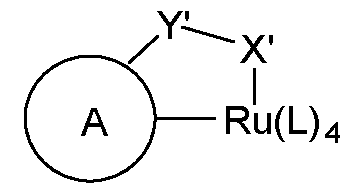
formula (IA)
wherein
L is as defined in claim 1 ;
A represents an optionally substituted aryl or heteroaryl group;
X’ represents NR6R7 and Y’ represents NR , CR12Ri3 or C(O), or X’ represents PR8R9 and Y’ represents CR12Ri3, or X’ represents O and Y’ represents CR12R13 or C(O); wherein R6 R7 R8, Rg, R , R12 and R13 are each independently selected from H, (1-10C)alkyl, (1- 10C)alkoxy, heteroaryl, heterocyclyl, aryl and (4-10C)cycloalkyl, or R6 and R7 or R8 and Rg together with the N or P to which they are attached form a 4 to 8 membered heterocyclyl group and/or R12 and R13 together with the C to which they are attached form a (4-10C)cycloalkyl group, wherein any of the (1-10C)alkyl, (1-10C)alkoxy, heteroaryl, heterocyclyl, aryl and (4- 10C)cycloalkyl groups is optionally substituted;
or any of the groups R6 R7 R8 or Rg, and any of the groups R , R12 or R13 togetherwith the N, C or P to which they are attached may form a cycloalkyl, heterocyclyl, heteroaryl or aryl ring, wherein the cycloalkyl, heterocyclyl, heteroaryl or aryl ring so formed is optionally substituted.
6. A process according to any of claims 1 to 4, wherein the neutral or cationic ruthenium(ll) catalyst is represented by the formula (IB):
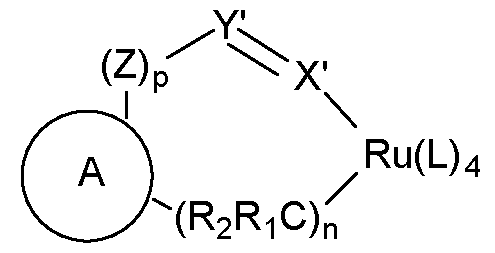
formula (IB)
wherein
L is as defined in claim 1 ;
n is 0 or 1 ;
RT and R2 are each independently selected from H or (1-4C)alkyl;
A represents an optionally substituted aryl or heteroaryl group;
p represents 0 or 1 ;
Z represents CR3R4, O or NR5, wherein R3, R4 and R5 each independently represent H or (1-4C)alkyl;
X’ represents NR14 and Y’ represents CR15 or N, wherein R14 and R15 are each independently selected from H, (1-10C)alkyl, (1-10C)alkoxy, heteroaryl, heterocyclyl, aryl and (4-10C)cycloalkyl, wherein any of the (1-10C)alkyl, (1-10C)alkoxy, heteroaryl, heterocyclyl, aryl and (4-10C)cycloalkyl groups is optionally substituted;
or the group R14 and the group R15 can together with the N or C to which they are attached form a heterocyclyl or heteroaryl ring, wherein the heterocyclyl or heteroaryl ring so formed is optionally substituted.
7. A process according to any of claims 4 to 6, wherein A represents an optionally substituted phenyl group.
8. A process according to claim 5 or 7, wherein the neutral or cationic ruthenium(ll) catalyst is represented by the formula (IA’):

formula (IA’)
wherein:
L is as defined in claim 1 ;
q represents 0, 1 , 2, 3 or 4;
X’ represents NR6R7 and Y’ represents CR12Ri3 or C(O), or X’ represents PR8R9 and Y’ represents CR12Ri3, X’ represents O and Y’ represents CR12R13 or C(O);
wherein R6 R7 R8, Rg, R12 and R13 are each independently selected from H, (1- 10C)alkyl, (1-10C)alkoxy, heteroaryl, heterocyclyl, aryl and (4-10C)cycloalkyl, or R6 and R7 or R8 and Rg together with the N or P to which they are attached form a 4 to 8 membered heterocyclyl group and/or R12 and R13 together with the C to which they are attached form a (4- 10C)cycloalkyl group, wherein any of the (1-10C)alkyl, (1-10C)alkoxy, heteroaryl, heterocyclyl, aryl and (4-10C)cycloalkyl groups is optionally substituted;
each R16 is independently selected from halo, (1-10C)alkyl, (1-10C)alkoxy, phenoxy, trifluoromethyl, (3-8C)cycloalkyl, aryl, heteroaryl, (2-10C)alkenyl, hydroxyl, amino, (1- 10C)alkylamino, di[(1-10C)alkyl]amino, (1-10C)alkanoyl, (1-10C)alkylthio, amido, (1- 10C)alkylamido, di[(1-10C)alkyl]amido and carboxy(1-10C)alkyl.
9. A process according to claim 5 or 7, wherein the neutral or cationic ruthenium(ll) catalyst is represented by the formula (IA”):

formula (IA”)
wherein:
L is as defined in claim 1 ;
q represents 0, 1 , 2, 3 or 4;
B represents a heteroaryl or heterocyclyl group containing a heteroatom N or P represented by X” and a heteroatom N or an sp2 or sp3 C represented by Y”, wherein the heteroaryl or heterocyclyl group is optionally substituted;
each R16 is independently selected from halo, (1-10C)alkyl, (1-10C)alkoxy, phenoxy, trifluoromethyl, (3-8C)cycloalkyl, aryl, heteroaryl, (2-10C)alkenyl, hydroxyl, amino, (1- 10C)alkylamino, di[(1-10C)alkyl]amino, (1-10C)alkanoyl, (1-10C)alkylthio, amido, (1- 10C)alkylamido, di[(1-10C)alkyl]amido and carboxy(1-10C)alkyl.
10. A process according to claim 6 or 7, wherein the neutral or cationic ruthenium(ll) catalyst is represented by the formula (IB’):

formula (IB’)
wherein:
L is as defined in claim 1 ;
p represents 0 or 1 ;
r represents 0, 1 , 2, 3 or 4;
Z represents CR3R4, O or NR5, wherein R3, R4 and R5 each independently represent H or (1-4C)alkyl;
wherein R14 and R15 are each independently selected from H, (1-10C)alkyl, (1-
10C)alkoxy, heteroaryl, heterocyclyl, aryl and (4-10C)cycloalkyl, wherein any of the (1- 10C)alkyl, (1-10C)alkoxy, heteroaryl, heterocyclyl, aryl and (4-10C)cycloalkyl, groups is optionally substituted;
or the group R14 and the group R15 can together with the N and C to which they are attached form a heterocyclyl or heteroaryl ring, wherein the heterocyclyl or heteroaryl ring so formed is optionally substituted;
each R17 is independently selected from halo, (1-10C)alkyl, (1-10C)alkoxy, phenoxy, trifluoromethyl, (3-8C)cycloalkyl, aryl, heteroaryl, (2-10C)alkenyl, hydroxyl, amino, (1- 10C)alkylamino, di[(1-10C)alkyl]amino, (1-10C)alkanoyl, (1-10C)alkylthio, amido, (1- 10C)alkylamido, di[(1-10C)alkyl]amido and carboxy(1-10C)alkyl.
11. A process according to any of claims 1 to 4, wherein the neutral or cationic ruthenium(ll) catalyst is represented by the formula (IC):

formula (IC)
wherein:
L is as defined in claim 1 ;
s represents 0, 1 , 2 or 3;
t represents 0, 1 , 2 or 3;
each R18 and R19 is independently selected from halo, (1 -10C)alkyl, (1 -10C)alkoxy, phenoxy, trifluoromethyl, (3-8C)cycloalkyl, aryl, heteroaryl, (2-10C)alkenyl, hydroxyl, amino, (1 - 10C)alkylamino, di[(1 -10C)alkyl]amino, (1 -10C)alkanoyl, (1 -10C)alkylthio, amido, (1 - 10C)alkylamido, di[(1 -10C)alkyl]amido and carboxy(1 -10C)alkyl;
å! represents -C=C-, -C=N- or -N=C-.
12. A process according to any of claims 1 to 4, wherein the neutral or cationic ruthenium(ll) catalyst is represented by the formula (ID):

formula (ID)
wherein:
L is as defined in claim 1 ;
RT and R2 are each independently selected from H or (1 -4C)alkyl;
u represents 0, 1 , 2 or 3;
v represents 0, 1 , 2 or 3;
each R22 and R23 is independently selected from halo, (1 -10C)alkyl, (1 -10C)alkoxy, phenoxy, trifluoromethyl, (3-8C)cycloalkyl, aryl, heteroaryl, (2-10C)alkenyl, hydroxyl, amino, (1 - 10C)alkylamino, di[(1 -10C)alkyl]amino, (1 -10C)alkanoyl, (1 -10C)alkylthio, amido, (1 - 10C)alkylamido, di[(1 -10C)alkyl]amido and carboxy(1 -10C)alkyl.
13. A process according to any preceding claim, wherein the neutral or cationic ruthenium(ll) catalyst is selected from any one of the following:
 wherein L is as defined in claim 1 .
14. A process according to claims 1 to 10, wherein the neutral or cationic ruthenium(ll) catalyst is selected from any one of the following:

wherein L is as defined in claim 1 .
15. A process according to any preceding claim wherein the first compound comprises an aryl or heteroaryl group having a first ring atom which is a carbon atom having a hydrogen bonded thereto and a second ring atom which is adjacent to the first ring atom and which has a nitrogen containing directing group (or a salt or protected derivative thereof) bonded thereto, and wherein the second compound comprises a compound containing an alkyl or cycloalkyl moiety having a first sp3 carbon having a leaving group bonded thereto, such that the reaction between the first compound and the second compound results in the formation of a carbon- carbon bond between the first ring atom of the first compound and the first sp3 carbon of the second compound.
16. A process according to any preceding claim wherein the first compound comprises an aryl or heteroaryl group having a first ring atom which is a carbon atom having a hydrogen bonded thereto and a second ring atom which is separated from the first ring atom by one nonbridging third ring atom, wherein the second ring atom has a nitrogen containing directing group (or a salt or protected derivative thereof) bonded thereto and is adjacent to a ring carbon atom having a hydrogen bonded thereto, and wherein the second compound comprises a compound containing an alkyl or cycloalkyl moiety having a first sp3 carbon having a leaving group bonded thereto, such that the reaction between the first compound and the second compound results in the formation of a carbon-carbon bond between the first ring atom of the first compound and the first sp3 carbon of the second compound.
17. A process according to claim 15 or 16, wherein the directing group is selected from any one of the following:

18. A process according to any preceding claim which is conducted at a temperature from 25 to 50°C.
19. A cationic ruthenium(ll) catalyst selected from any one of the following:

Applications Claiming Priority (2)
| Application Number | Priority Date | Filing Date | Title |
|---|---|---|---|
| GBGB1807674.5A GB201807674D0 (en) | 2018-05-11 | 2018-05-11 | Process |
| GB1807674.5 | 2018-05-11 |
Publications (1)
| Publication Number | Publication Date |
|---|---|
| WO2019215427A1 true WO2019215427A1 (en) | 2019-11-14 |
Family
ID=62623300
Family Applications (1)
| Application Number | Title | Priority Date | Filing Date |
|---|---|---|---|
| PCT/GB2019/051228 Ceased WO2019215427A1 (en) | 2018-05-11 | 2019-05-02 | Process for forming a carbon-carbon bond |
Country Status (2)
| Country | Link |
|---|---|
| GB (1) | GB201807674D0 (en) |
| WO (1) | WO2019215427A1 (en) |
Cited By (1)
| Publication number | Priority date | Publication date | Assignee | Title |
|---|---|---|---|---|
| WO2025103462A1 (en) * | 2023-11-17 | 2025-05-22 | Shenzhen Catalys Technology Co., Ltd | Substituted 2, 3-dihydrobenzo [d] [1, 3] oxaphosphole ligand, preparation method and use thereof |
Citations (1)
| Publication number | Priority date | Publication date | Assignee | Title |
|---|---|---|---|---|
| US5834058A (en) | 1993-08-02 | 1998-11-10 | The Associated Octel Company Limited | Organometallic complexes of aluminium, gallium and indium |
-
2018
- 2018-05-11 GB GBGB1807674.5A patent/GB201807674D0/en not_active Ceased
-
2019
- 2019-05-02 WO PCT/GB2019/051228 patent/WO2019215427A1/en not_active Ceased
Patent Citations (1)
| Publication number | Priority date | Publication date | Assignee | Title |
|---|---|---|---|---|
| US5834058A (en) | 1993-08-02 | 1998-11-10 | The Associated Octel Company Limited | Organometallic complexes of aluminium, gallium and indium |
Non-Patent Citations (18)
| Title |
|---|
| ANGEW. CHEM., INT. ED., vol. 48, 2009, pages 6045 |
| ANGEW. CHEM., INT. ED., vol. 54, 2015, pages 14103 - 14107 |
| ANGEW. CHEM., INT. ED., vol. 54, 2015, pages 5513 - 5517 |
| CHEM. COMMUN., vol. 51, 2015, pages 12807 |
| CHEM. COMMUN., vol. 51, 2015, pages 12807 - 12810 |
| INORGANICA CHIM. ACTA, vol. 363, 2010, pages 567 - 573 |
| J. AM. CHEM. SOC., vol. 125, 2003, pages 8708 - 8709 |
| J. AM. CHEM. SOC., vol. 133, 2011, pages 10161 |
| J. AM. CHEM. SOC., vol. 135, 2013, pages 5877 - 5884 |
| J. AM. CHEM. SOC., vol. 137, 2015, pages 13894 |
| LARRY N. LEWIS: "Catalytic C-C Bond Formation via Ortho-Metalated Complexes", J. AM. CHEM. SOC, vol. 108, 1 May 1986 (1986-05-01), pages 2728 - 2735, XP002791894 * |
| LEYVA, LIDA ET AL.: "Synthesis of cycloruthenated compounds as potential anticancer agents", EUROPEAN JOURNAL OF INORGANIC CHEMISTRY, vol. 19, 21 June 2007 (2007-06-21), pages 3055 - 3066, XP002791897, ISSN: 1434-1948 * |
| LUTZ ACKERMANN ET AL.: "Ruthenium Catalyzed Regioselective Direct Alkylation of Arenes with Unactivated Alkyl Halides through C-H Bond Cleavage", ANGEW. CHEM. IN. ED., vol. 48, 29 July 2009 (2009-07-29), pages 6045 - 6048, XP002791895 * |
| MOTLEY, TYLER C.; TROIAN-GAUTIER, LUDOVIC; BRENNAMAN, M. KYLE; MEYER, GERALD J.: "Excited-State Decay Pathways of Tris(bidentate) Cyclometalated Ruthenium(II) Compounds", INORGANIC CHEMISTRY, vol. 56, no. 21, 25 October 2017 (2017-10-25), pages 13579 - 13592, XP002791896, ISSN: 0020-1669 * |
| ORG. LETT., vol. 18, 2016, pages 3934 - 3936 |
| ORGANOMETALLICS, vol. 18, 1999, pages 2390 - 2394 |
| POLYMER, vol. 55, 2014, pages 1656 - 1665 |
| SYNTHESIS, vol. 46, 2014, pages 2024 - 2039 |
Cited By (1)
| Publication number | Priority date | Publication date | Assignee | Title |
|---|---|---|---|---|
| WO2025103462A1 (en) * | 2023-11-17 | 2025-05-22 | Shenzhen Catalys Technology Co., Ltd | Substituted 2, 3-dihydrobenzo [d] [1, 3] oxaphosphole ligand, preparation method and use thereof |
Also Published As
| Publication number | Publication date |
|---|---|
| GB201807674D0 (en) | 2018-06-27 |
Similar Documents
| Publication | Publication Date | Title |
|---|---|---|
| US6909009B2 (en) | Alkane and alkane group dehydrogenation with organometallic catalysts | |
| Dochnahl et al. | Intramolecular Hydroamination with Homogeneous Zinc Catalysts: Evaluation of Substituent Effects in N, N′‐Disubstituted Aminotroponiminate Zinc Complexes | |
| Sattar et al. | Palladium‐Catalyzed C H Functionalization of Ferrocenecarboxylic Acid by using 8‐Aminoquinoline as a Removable Directing Group | |
| WO2006138166A2 (en) | Stable cyclic (alkyl)(amino) carbenes as ligands for transition metal catalysts | |
| Tang et al. | Dynamic ligand reactivity in a rhodium pincer complex | |
| Malan et al. | Facile Suzuki-Miyaura coupling of activated aryl halides using new CpNiBr (NHC) complexes | |
| Mendoza-Espinosa et al. | Copper (II) complexes supported by click generated mixed NN, NO, and NS 1, 2, 3-triazole based ligands and their catalytic activity in azide–alkyne cycloaddition | |
| WO2013159229A1 (en) | Silanyloxyaryl phosphine ligand and uses thereof in c-n cross-coupling | |
| Braunstein et al. | Synthesis and structure of bimetallic allyl, alkoxysilyl complexes [Fe {Si (OMe) 3}(CO) 3 (. mu.-dppm) M (. eta. 3-2-RC3H4)] M= Pd, Pt; R= H, Me) and of [Fe {. mu.-Si (OMe) 2 (OMe)}(CO) 3 (. mu.-dppm) Pd (SnPh3)], a Sn-Pd-Fe-Si chain complex with a. mu. 2-. eta. 2-SiO bridge | |
| KR20180101330A (en) | Tri- (adamantyl) phosphine and its application | |
| US20030032808A1 (en) | Tri-and bidentate amido ligands prepared by palladium0 coupling and metallation threreof to form metal-amido catalysts | |
| WO2019215427A1 (en) | Process for forming a carbon-carbon bond | |
| Schrock et al. | Cyclooctatetraene complexes of niobium and tantalum and the structure of Nb (. eta. 4-C8H8)[. eta. 5-C8H8 (C6H5)][(CH3) 2AsC6H4As (CH3) 2] | |
| Cetin et al. | Synthesis, structures, photophysical properties, and catalytic characteristics of 2, 9‐dimesityl‐1, 10‐phenanthroline (dmesp) transition metal complexes | |
| Chavan et al. | Mixed-ligand complexes of copper (I) with Schiff base and triphenylphosphine: Effective catalysts for the amination of aryl halide | |
| Yamamoto et al. | Luminescent rhenium (I)–gold (I) hetero organometallics linked by ethynylphenanthrolines | |
| Adas et al. | Sodium naphthalenide reduction of 1, 3–diphenyl–6–(tert-butyl) fulvene: Stabilizing Eu2+ with a sterically demanding ansa–ligand framework | |
| Schümann et al. | Synthesis and Structure of a Phenylsodium Solvate, Bis [μ‐phenyl (pentamethyldiethylenetriamine) sodium] | |
| Huynh et al. | Synthesis and structural characterization of palladium dicarbene complexes bearing labile co-ligands | |
| Reger et al. | Syntheses and structural characterizations of rhenium carbonyl complexes of a bitopic ferrocene-linked bis (pyrazolyl) methane ligand | |
| CN114437143B (en) | A kind of pyridyl bridged bistetrazole cheap metal complex and its preparation and application | |
| Shi et al. | Palladium-catalyzed aminations of aryl halides with phosphine-functionalized imidazolium ligands | |
| CA3024425A1 (en) | Novel ionic half sandwich ruthenium complexes supported by n-heterocyclic carbene and/or phosphines, as efficient transfer hydrogenation catalysts | |
| WO2019215426A1 (en) | Process for forming a carbon-carbon bond | |
| Yamada et al. | Structural Characteristics of S-Bridged Tainuclear Complexes [{Pd (terpy)} 2 {Pd (aet) 2}] 4+(terpy= 2, 2': 6', 2"-Terpyridine, aet= 2-Aminoethanethiolate). Effects of Counter Anions and Solvent on Intra-and Intermolecular Stacking Arrangements. |
Legal Events
| Date | Code | Title | Description |
|---|---|---|---|
| 121 | Ep: the epo has been informed by wipo that ep was designated in this application |
Ref document number: 19723183 Country of ref document: EP Kind code of ref document: A1 |
|
| NENP | Non-entry into the national phase |
Ref country code: DE |
|
| 122 | Ep: pct application non-entry in european phase |
Ref document number: 19723183 Country of ref document: EP Kind code of ref document: A1 |