WO2019215426A1 - Process for forming a carbon-carbon bond - Google Patents
Process for forming a carbon-carbon bond Download PDFInfo
- Publication number
- WO2019215426A1 WO2019215426A1 PCT/GB2019/051226 GB2019051226W WO2019215426A1 WO 2019215426 A1 WO2019215426 A1 WO 2019215426A1 GB 2019051226 W GB2019051226 W GB 2019051226W WO 2019215426 A1 WO2019215426 A1 WO 2019215426A1
- Authority
- WO
- WIPO (PCT)
- Prior art keywords
- alkyl
- heteroaryl
- aryl
- mmol
- equiv
- Prior art date
- Legal status (The legal status is an assumption and is not a legal conclusion. Google has not performed a legal analysis and makes no representation as to the accuracy of the status listed.)
- Ceased
Links
- 0 CC*C(C(*(CCCCCCCCC(C1)*1(C)C=*)C=C)=CC=C1)=C[C@@]1(C)C(N)=*** Chemical compound CC*C(C(*(CCCCCCCCC(C1)*1(C)C=*)C=C)=CC=C1)=C[C@@]1(C)C(N)=*** 0.000 description 8
- DAYFQMXLAIIXAI-UHFFFAOYSA-N CC(C)[n]1nccc1NS(c(cc1)ccc1N)(=O)=O Chemical compound CC(C)[n]1nccc1NS(c(cc1)ccc1N)(=O)=O DAYFQMXLAIIXAI-UHFFFAOYSA-N 0.000 description 1
- ONEOXKJKMWDSJZ-UHFFFAOYSA-N CCC(c(cc(cc1)Cl)c1N1C)=NCC1=O Chemical compound CCC(c(cc(cc1)Cl)c1N1C)=NCC1=O ONEOXKJKMWDSJZ-UHFFFAOYSA-N 0.000 description 1
- AGKGZTUSZIPPRS-UGKPPGOTSA-N CCc1ncnc2c1nc[n]2[C@@H]([C@@H]1O)O[C@H](CO)[C@H]1O Chemical compound CCc1ncnc2c1nc[n]2[C@@H]([C@@H]1O)O[C@H](CO)[C@H]1O AGKGZTUSZIPPRS-UGKPPGOTSA-N 0.000 description 1
- QAJCBIWMMSIQTB-UHFFFAOYSA-N COc(cc1)ccc1/N=C/N Chemical compound COc(cc1)ccc1/N=C/N QAJCBIWMMSIQTB-UHFFFAOYSA-N 0.000 description 1
- MZNKXIYEYSHBAT-UHFFFAOYSA-N Cc1c(-c2ccccc2)[o]c(CCC(OC)=O)n1 Chemical compound Cc1c(-c2ccccc2)[o]c(CCC(OC)=O)n1 MZNKXIYEYSHBAT-UHFFFAOYSA-N 0.000 description 1
- BZACBBRLMWHCNM-UHFFFAOYSA-N Cc1c[n](cccc2)c2n1 Chemical compound Cc1c[n](cccc2)c2n1 BZACBBRLMWHCNM-UHFFFAOYSA-N 0.000 description 1
- DQJNSWGXHAHEAG-UHFFFAOYSA-N Cc1cc(-c(cccc2)c2-c2ccccn2)cc(C)c1 Chemical compound Cc1cc(-c(cccc2)c2-c2ccccn2)cc(C)c1 DQJNSWGXHAHEAG-UHFFFAOYSA-N 0.000 description 1
- RNEVRMJXOWGHIA-UHFFFAOYSA-N Cc1cc(-c2c(-c3c[n](cccc4)c4n3)c(-c3cc(C)cc(C)c3)cc(S(C)(=O)=O)c2)cc(C)c1 Chemical compound Cc1cc(-c2c(-c3c[n](cccc4)c4n3)c(-c3cc(C)cc(C)c3)cc(S(C)(=O)=O)c2)cc(C)c1 RNEVRMJXOWGHIA-UHFFFAOYSA-N 0.000 description 1
- ANURCCFVNQSAKH-UHFFFAOYSA-N Cc1cc(-c2cccc(-c3cc(C)cc(C)c3)c2-c2c(-c3ccccc3)[o]c(CCC(OC)=O)n2)cc(C)c1 Chemical compound Cc1cc(-c2cccc(-c3cc(C)cc(C)c3)c2-c2c(-c3ccccc3)[o]c(CCC(OC)=O)n2)cc(C)c1 ANURCCFVNQSAKH-UHFFFAOYSA-N 0.000 description 1
- IWEFRVGCXILWEE-UHFFFAOYSA-N Cc1cc(-c2cccc(-c3cc(C)cc(C)c3)c2-c2ccccn2)cc(C)c1 Chemical compound Cc1cc(-c2cccc(-c3cc(C)cc(C)c3)c2-c2ccccn2)cc(C)c1 IWEFRVGCXILWEE-UHFFFAOYSA-N 0.000 description 1
- WTXYXLMSIWWFAO-UHFFFAOYSA-N Cc1nnc[n]1-c1ccccc1 Chemical compound Cc1nnc[n]1-c1ccccc1 WTXYXLMSIWWFAO-UHFFFAOYSA-N 0.000 description 1
Classifications
-
- C—CHEMISTRY; METALLURGY
- C07—ORGANIC CHEMISTRY
- C07F—ACYCLIC, CARBOCYCLIC OR HETEROCYCLIC COMPOUNDS CONTAINING ELEMENTS OTHER THAN CARBON, HYDROGEN, HALOGEN, OXYGEN, NITROGEN, SULFUR, SELENIUM OR TELLURIUM
- C07F15/00—Compounds containing elements of Groups 8, 9, 10 or 18 of the Periodic Table
- C07F15/0006—Compounds containing elements of Groups 8, 9, 10 or 18 of the Periodic Table compounds of the platinum group
- C07F15/0046—Ruthenium compounds
Definitions
- the invention relates to a process for forming a carbon-carbon bond to couple an aryl or heteroaryl group of a first compound with an aryl or heteroaryl group of a second compound.
- the process comprises reacting the first compound with the second compound in the presence of a catalytically effective amount of a neutral or cationic ruthenium(ll) catalyst.
- Coupled aryl/aryl, aryl/heteroaryl and heteroaryl/heteroaryl units are common structural motifs in many compounds, such as pharmaceutically active compounds and agrochemicals. Such coupled units are typically incorporated into compounds during their synthesis using crosscoupling reactions (in the presence of metal catalysts) that are well known to persons skilled in the art.
- Ru(ll)- catalysed C-H arylation reactions between directing group (DG)-containing arenes and aryl halides are known, but it would be desirable to establish more general and efficient reaction conditions. For example, it would be desirable to provide such reactions that do not require the use of high temperatures and/or several fold excess of the aryl (pseudo)halide. It would also be desirable to provide such reactions that can be used with polar sensitive groups, which are ubiquitous in pharmaceutical and natural products.
- coupled aryl/aryl, aryl/heteroaryl and/or heteroaryl/heteroaryl units such as, for example, compounds including biaryl units as part of complex compound, such as a pharmaceutically active compound or agrochemical
- a process for forming a carbon- carbon bond to couple an aryl or heteroaryl group of a first compound with an aryl or heteroaryl group of a second compound comprising reacting the first compound with the second compound in the presence of a catalytically effective amount of a neutral or cationic ruthenium(ll) catalyst of formula (I):
- each L is independently selected from neutral and anionic ligands in any combination that balances the bonding and charge requirements of the ruthenium, and wherein any two ligands L can be linked so as to form a bidentate ligand;
- X and Y together form a bidentate cyclometalated ligand for the ruthenium, resulting in a five- or six-memebered metallacycle, wherein the bidentate cyclometalated ligand comprises an organic group represented by X which is bonded to the ruthenium by a heteroatom selected from N, P or O (preferably N or P) and an organic group represented by Y which is bonded to the ruthenium via an sp2 or an sp3 carbon.
- the process of the present invention can be conducted under mild reaction conditions, such as at low temperatures.
- the ruthenium(ll) catalysts used in the process are inexpensive, display extremely high reactivity and are highly robust.
- the ruthenium(ll) catalysts display unprecedented high reactivity under remarkably mild reaction conditions.
- the process of the invention may be used for forming carbon-carbon bonds at a late-stage in the preparation of a wide range of complex compounds, wherein the complex compounds may include a range of functional groups previously considered to be incompatible with such coupling reactions.
- the ruthenium(ll) catalyst of formula (I) may be neutral or it may be cationic, depending on the nature of the ligands bonded to the ruthenium.
- an associated counterion such as for example hexafluorophosphate (PF 6 ), tetrafluoro borate (BF 4 ), trifluoromethanesulfonate (OTf), perchlorate (CI0 4 ), tetrakis(3,5- bis(trifluoromethyl)phenyl)borate (BArV), nitrate (N0 3 ), or bis(trifluoromethylsulfonyl)imide (NTf 2 ).
- PF 6 hexafluorophosphate
- BF 4 tetrafluoro borate
- OTf trifluoromethanesulfonate
- CI0 4 perchlorate
- BArV tetrakis(3,5- bis(trifluoromethyl)phenyl)borate
- alkyl includes both straight and branched chain alkyl groups. References to individual alkyl groups such as“propyl” are specific for the straight chain version only and references to individual branched chain alkyl groups such as“isopropyl” are specific for the branched chain version only.
- “(1-20C)alkyl” includes (1-10C)alkyl, (1-4C)alkyl, propyl, isopropyl and t-butyl. References to“alkyl” within other functional groups, such as in “alkylamino” and“alkylthio” groups etc, are to be interpreted analogously.
- “(1- 10C)alkylamino” includes (1-4C)alkylamino, methylamino, propylamino, isopropylamino and tert-butylamino.
- alkenyl includes both straight and branched chain alkenyl groups. References to individual alkenyl groups such as“propenyl” are specific for the straight chain version only and references to individual branched chain alkenyl groups such as“isopropenyl” are specific for the branched chain version only.
- (2-10C)alkenyl includes (2-6C)alkenyl, propenyl, isopropenyl and t-butenyl.
- (4-10C)cycloalkyl means a hydrocarbon ring containing from 4 to 10 carbon atoms, for example, cyclopropyl, cyclobutyl, cyclopentyl, cyclohexyl, cycloheptyl, adamantyl, bicyclo[2.2.2]octyl, bycyclo[2.1.1 ]hexyl, bicyclo[1.1.1 Jpentyl and bicyclo[2.2.1]heptyl.
- alkoxy includes both straight and branched chain alkoxy groups. References to individual alkoxy groups such as“propoxy” are specific for the straight chain version only and references to individual branched chain alkyl groups such as“isopropoxy” are specific for the branched chain version only.
- (1-10C)alkoxy includes (1-6C)alkoxy, (1- 4C)alkoxy, propoxy, isopropoxy and t-butoxy.
- heterocyclic ring means a non-aromatic saturated or partially saturated monocyclic or fused, bridged or spiro bicyclic heterocyclic ring system.
- aryl means a cyclic or polycyclic aromatic ring having from 5 to 20 carbon atoms.
- aryl groups include, but are not limited to, phenyl, biphenyl, naphthyl, pyrenyl and perylenyl.
- an aryl is phenyl.
- heteroaryl means an aromatic mono-, bi- or poly-cyclic ring incorporating one or more (for example from 1 to 4, such as 1 , 2 or 3) heteroatoms selected from nitrogen, oxygen and sulfur.
- heteroaryl groups are monocyclic and bicyclic groups containing from 5 to 12 ring members, typically from 5 to 10 ring members.
- the heteroaryl group can, for example, be a 5 or 6 membered monocyclic ring or a 9 or 10 membered bicyclic ring, for example a bicyclic structure formed from fused 5 and 6 membered rings or two 6 membered rings.
- Each ring may contain up to 4 heteroatoms typically selected from nitrogen, oxygen and sulfur.
- the heteroaryl ring will contain up to 3 heteroatoms, for example up to 2, such as 1 heteroatom.
- halo includes fluoro, chloro, bromo and iodo.
- pseudohalide means a substituent that behaves like a‘halo’ in the context of the present invention and includes triflate, tosylate, mesylate.
- optional substituents include halo, (1-10C)alkyl, (1-10C)alkoxy, phenoxy, trifluoromethyl, (4-10C)cycloalkyl, aryl, heteroaryl, (2-10C)alkenyl, hydroxyl, amino, (1-10C)alkylamino, di[(1-10C)alkyl]amino, (1-10C)alkanoyl, (1 -10C)alkylthio, amido, (1-10C)alkylamido, di[(1-10C)alkyl]amido and carboxy(1-10C)alkyl.
- the term “comprising” or “comprises” means including the component(s) specified but not to the exclusion of the presence of other components.
- the term“consisting essentially of” or“consists essentially of means including the components specified but excluding other components except for components added for a purpose other than achieving the technical effect of the invention.
- the term“consisting of or“consists of means including the components specified but excluding other components.
- the use of the term“comprises” or“comprising” may also be taken to include the meaning“consists essentially of” or“consisting essentially of, and also may also be taken to include the meaning“consists of or“consisting of.
- each L is independently selected from neutral and anionic ligands in any combination that balances the bonding and charge requirements of the ruthenium, and wherein any two ligands L can be linked so as to form a bidentate ligand. As the skilled person would appreciate, each L may be the same or different.
- Suitable neutral ligands L include H 2 0, benzonitrile, (1-20C)alkylnitrile, tri-[(2- 10C)alkyl]amine, (2-10C)alkenyl and di[(2-10C)alkyl]sulfide, wherein each benzonitrile, (1- 20C)alkylnitrile, tri[(2-10C)alkyl]amine, (2-10C)alkenyl or di[(2-10C)alkyl]sulfide group is optionally substituted.
- each benzonitrile, (1 -20C)alkylnitrile, tri[(2- 10C)alkyl]amine, (2-10C)alkenyl or di[(2-10C)alkyl]sulfide group may be optionally substituted by one or more substituents independently selected from (1 -10C)alkyl, (3-8C)cycloalkyl, aryl, heteroaryl, (2-10C)alkenyl, (1 -10C)alkoxy, trifluoromethyl, hydroxyl, amino, (1 -10C)alkylamino, di[(1 -10C)alkyl]amino, (1 -10C)alkanoyl and (1 -10C)alkylthio.
- suitable anionic ligands L include halides such as chloride, bromide and iodide, (1 -20C)alkylcarboxylate and aryl carboxylate.
- L does not represent a tridendate ligand of the g 6 -arene type.
- g 6 -arene ligands are benzene, o-, m-, p-xylene, mesitylene, p-cymene, and hexamethylbenzene.
- the ligand L represents (1 -20C)alkylnitrile, such as (1 -5C)alkylnitrile, for example methylnitrile (i.e. acetonitrile).
- all four ligands L represent acetonitrile.
- X and Y together form a bidentate cyclometalated ligand for the ruthenium, wherein the bidentate cyclometalated ligand comprises an organic group represented by X which is bonded to the ruthenium by a heteroatom selected from N, P or O (preferably N or P, more preferably N) and an organic group represented by Y which is bonded to the ruthenium via an sp2 or an sp3 carbon.
- the organic group represented by X may be any group provided it is bonded to the ruthenium by a heteroatom selected from N, P or O.
- the organic group represented by Y may be any group provided that it is bonded to the ruthenium via an sp2 or sp3 carbon atom.
- the bidentate cyclometalated ligand may form a 5- or 6-membered ruthenacycle with the ruthenium.
- the organic group represented by Y may comprise an aryl or heteroaryl group bonded to the ruthenium via an sp2 or an sp3 carbon atom.
- the organic group represented by Y may comprise a group of formula (II) bonded to the ruthenium via an sp2 or an sp3 carbon atom:
- A represents an optionally substituted aryl or heteroaryl group
- n 0 or 1 ; and RT and R 2 are each independently selected from H or (1 -4C)alkyl.
- the group of formula (II) is bonded to the ruthenium either via the sp3 carbon of the CR ⁇ group (when n is 1) or via an sp2 ring carbon of the group A.
- n 0 or 1 , particularly 0.
- RT and R 2 are each independently selected from H or (1 -2C)alkyl and in particular RT and R 2 may both represent H.
- the group A in the formula (II) may be optionally substituted by any suitable substituent, for example by one or more (suitably 0, 1 , 2, 3 or 4) substituents independently selected from halo, (1 -10C)alkyl, (1 -10C)alkoxy, phenoxy, trifluoromethyl, (3-8C)cycloalkyl, aryl, heteroaryl, (2-10C)alkenyl, hydroxyl, amino, (1 -10C)alkylamino, di[(1 -10C)alkyl]amino, (1 -10C)alkanoyl, (1 -10C)alkylthio, amido, (1 -10C)alkylamido, di[(1 -10C)alkyl]amido and carboxy(1
- the neutral or cationic ruthenium(ll) catalyst may be represented by the formula (IA):
- A represents an optionally substituted aryl or heteroaryl group
- X’ represents NR 6 R 7 and Y’ represents NR , CR 12 R 13 or C(O), or X’ represents PR 8 R 9 and Y’ represents CR 12 R 13 or X’ represents O and Y’ represents CR 12 R 13 or C(O); wherein R 6 R 7 R 8 , R g , R , R 12 and R 13 are each independently selected from H, (1 -10C)alkyl, (1 - 10C)alkoxy, heteroaryl, heterocyclyl, aryl and (4-10C)cycloalkyl, or R 6 and R 7 or R 8 and R g together with the N or P to which they are attached form a 4 to 6 membered heterocyclyl group and/or R 12 and R 13 together with the C to which they are attached form a (4-10C)cycloalkyl group, wherein any of the (1 -10C)alkyl, (1 -10C)alkoxy, heteroaryl, heterocyclyl, aryl and (4- 10C)cycloalky
- any of the groups R 6 R 7 R 8 or R g , and any of the groups R , R 12 or R 13 together with the N, C or P to which they are attached may form a cycloalkyl, heterocyclyl, heteroaryl or aryl ring, wherein the cycloalkyl, heterocyclyl, heteroaryl or aryl ring so formed is optionally substituted.
- Suitable optional substituents for the aryl or heteroaryl group represented by A in the formula (IA) include halo (for example fluoro), (1-10C)alkyl, (1-10C)alkoxy, phenoxy, trifluoromethyl, (3-8C)cycloalkyl, aryl, heteroaryl, (2-10C)alkenyl, hydroxyl, amino, (1- 10C)alkylamino, di[(1-10C)alkyl]amino, (1-10C)alkanoyl, (1-10C)alkylthio, amido, (1- 10C)alkylamido, di[(1-10C)alkyl]amido and carboxy(1-10C)alkyl. Any suitable number of optional substituents may be present depending on the particular aryl or heteroaryl group A.
- the group A may represent an optionally substituted aryl group, such as an optionally substituted phenyl or napthyl group, particularly an optionally substituted phenyl group.
- suitable optional substituents for the aryl group represented by A include halo (for example fluoro), (1-10C)alkyl, (1-10C)alkoxy, phenoxy, trifluoromethyl, (3- 8C)cycloalkyl, aryl, heteroaryl, (2-10C)alkenyl, hydroxyl, amino, (1-10C)alkylamino, di[(1- 10C)alkyl]amino, (1-10C)alkanoyl, (1-10C)alkylthio, amido, (1-10C)alkylamido, di[(1- 10C)alkyl]amido and carboxy(1-10C)alkyl.
- optional substituents for the aryl group represented by A include halo (for example fluoro), (1-10C)alkyl, (1-10
- the neutral or cationic ruthenium(ll) catalyst may be represented by the formula (IA’):
- q 0, 1 , 2, 3 or 4;
- X’ represents NR 6 R 7 and Y’ represents CR 12 Ri3 or C(O), or X’ represents PR 8 R 9 and Y’ represents CR 12 Ri3, or X’ represents O and Y’ represents CR 12 R 13 or C(O);
- R 6 R 7 R 8 , R g , R 12 and R 13 are each independently selected from H, (1- 10C)alkyl, (1-10C)alkoxy, heteroaryl, heterocyclyl, aryl and (4-10C)cycloalkyl, or R 6 and R 7 or R 8 and R g together with the N or P to which they are attached form a 4 to 8 membered heterocyclyl group and/or R 12 and R 13 together with the C to which they are attached form a (4- 10C)cycloalkyl group, wherein any of the (1-10C)alkyl, (1-10C)alkoxy, heteroaryl, heterocyclyl, aryl and (4-10C)cycloalkyl groups is optionally substituted;
- each R 16 is independently selected from halo, (1-10C)alkyl, (1-10C)alkoxy, phenoxy, trifluoromethyl, (3-8C)cycloalkyl, aryl, heteroaryl, (2-10C)alkenyl, hydroxyl, amino, (1- 10C)alkylamino, di[(1-10C)alkyl]amino, (1-10C)alkanoyl, (1-10C)alkylthio, amido, (1- 10C)alkylamido, di[(1 -10C)alkyl]amido and carboxy(1 -10C)alkyl.
- X’ may suitably represent NR 6 R 7 and Y’ may represent CR 12 Ri3, wherein R 6 , R 7 , R 12 and R 13 are as defined above.
- R 6 and R 7 may suitably each be independently selected from (1-10C)alkyl, wherein each (1-10C)alkyl is optionally substituted by one or more substituents independently selected from (1-15C)alkoxy, fluoro, trifluoromethyl and (1-15C)alkyl (especially (1-15C)alkoxy), or R 6 and R 7 together with the N to which they are attached may form a 4 to 8 membered heterocyclic ring, wherein the heterocyclic ring is optionally substituted by one or more substituents independently selected from (1-10C)alkyl, (3-8C)cycloalkyl, aryl, heteroaryl, (2-10C)alkenyl, (1-10C)alkoxy, trifluoromethyl, hydroxyl, amino, (1-10C)alkyla
- X’ may suitably represent PR 8 R 9 and Y’ may represent CR 12 R 13 , wherein R 8 , R g , R 12 and R 13 are as defined above.
- R 8 and R g may for example each independently represent (4-10C)cycloalkyl, such as for example adamantyl.
- R 12 and R 13 may each be independently selected from H or (1-4C)alkyl, such as from H, methyl or ethyl.
- X’ may suitably represent O and Y’ may represent C(O).
- the neutral or cationic ruthenium(ll) catalyst may be represented by the formula (IA”):
- q 0, 1 , 2, 3 or 4;
- B represents a heteroaryl or heterocyclyl group containing a heteroatom N or P represented by X” and an sp2 or sp3 heteroatom N or an sp2 or sp3 C represented by Y”, wherein the heteroaryl or heterocyclyl group is optionally substituted;
- each R 16 is independently selected from halo, (1-10C)alkyl, (1-10C)alkoxy, phenoxy, trifluoromethyl, (3-8C)cycloalkyl, aryl, heteroaryl, (2-10C)alkenyl, hydroxyl, amino, (1- 10C)alkylamino, di[(1-10C)alkyl]amino, (1-10C)alkanoyl, (1-10C)alkylthio, amido, (1- 10C)alkylamido, di[(1-10C)alkyl]amido and carboxy(1-10C)alkyl.
- the neutral or cationic ruthenium(ll) catalyst may be represented by the formula (IA’”):
- q 0, 1 , 2, 3 or 4;
- R6, R7, R12 and R 13 are each independently selected from H, (1 -10C)alkyl, (1 -10C)alkoxy, heteroaryl, heterocyclyl, aryl and (4-10C)cycloalkyl, or R 6 and R 7 together with the N to which they are attached form a 4 to 6 membered heterocyclyl group, wherein any of the (1 -10C)alkyl, (1 -10C)alkoxy, heteroaryl, heterocyclyl, aryl and (4-10C)cycloalkyl groups is optionally substituted;
- each R 16 is independently selected from halo, (1 -10C)alkyl, (1 -10C)alkoxy, phenoxy, trifluoromethyl, (3-8C)cycloalkyl, aryl, heteroaryl, (2-10C)alkenyl, hydroxyl, amino, (1 - 10C)alkylamino, di[(1 -10C)alkyl]amino, (1 -10C)alkanoyl, (1 -10C)alkylthio, amido, (1 - 10C)alkylamido, di[(1 -10C)alkyl]amido and carboxy(1 -10C)alkyl.
- the (1 -10C)alkyl, (1 -10C)alkoxy, heteroaryl, heterocyclyl, aryl and cycloalkyl groups may be optionally substituted by any suitable substituents.
- Suitable optional substituents include halo (such as fluoro), (1 - 15C)alkyl, (3-8C)cycloalkyl, aryl, heteroaryl, (2-10C)alkenyl, (1 -15C)alkoxy, trifluoromethyl, hydroxyl, amino, (1 -10C)alkylamino, di[(1 -10C)alkyl]amino, (1 -10C)alkanoyl and (1 - 10C)alkylthio.
- the substituent(s) R 16 (when present) in the formula (IA’), (IA”) and (IA’”) may be located at any suitable position on the phenyl ring.
- the neutral or cationic ruthenium(ll) catalyst may be represented by the formula (IA””):
- R 6 and R 7 are each independently selected from H, (1 -10C)alkyl, phenyl or (4- 10C)cycloalkyl, wherein each (1 -10C)alkyl, phenyl and (4-10C)cycloalkyl is optionally substituted by one or more substituents independently selected from (1 -15C)alkoxy, fluoro, trifluoromethyl and (1 -15C)alkyl;
- R 12 and R 13 are each independently selected from H or (1 -10C)alkyl, wherein each (1 -
- 10C)alkyl is optionally substituted by one or more substituents independently selected from (1 - 10C)alkyl, (3-8C)cycloalkyl, aryl, heteroaryl, (2-10C)alkenyl, (1 -10C)alkoxy, trifluoromethyl, hydroxyl, amino, (1 -10C)alkylamino, di[(1 -10C)alkyl]amino, (1 -10C)alkanoyl and (1 - 10C)alkylthio;
- each R 27 is independently selected from halo, (1 -10C)alkyl, (1 -10C)alkoxy, phenoxy, trifluoromethyl, (3-8C)cycloalkyl, aryl, heteroaryl, (2-10C)alkenyl, hydroxyl, amino, (1 - 10C)alkylamino, di[(1 -10C)alkyl]amino, (1 -10C)alkanoyl, (1 -10C)alkylthio, amido, (1 - 10C)alkylamido, di[(1 -10C)alkyl]amido and carboxy(1 -10C)alkyl.
- the substituent(s) R 27 (when present) in the formula (IA””) may be located on one or both of the rings of the napthyl group and at any suitable position on the rings.
- the neutral or cationic ruthenium(ll) catalyst may be represented by the formula (IA”’”):
- m’ represents 0, 1 , 2, 3 or 4;
- n 0, 1 , 2 or 3;
- each R 26 and R 32 is independently selected from halo, (1 -10C)alkyl, (1 -10C)alkoxy, phenoxy, trifluoromethyl, (3-8C)cycloalkyl, aryl, heteroaryl, (2-10C)alkenyl, hydroxyl, amino, (1 - 10C)alkylamino, di[(1 -10C)alkyl]amino, (1 -10C)alkanoyl, (1 -10C)alkylthio, amido, (1 - 10C)alkylamido, di[(1 -10C)alkyl]amido and carboxy(1 -10C)alkyl.
- the neutral or cationic ruthenium(ll) catalyst may be represented by the formula (IB):
- n 0 or 1 ;
- R T and R 2 are each independently selected from H or (1-4C)alkyl
- A represents an optionally substituted aryl or heteroaryl group
- p 0 or 1 ;
- Z represents CR 3 R 4 , O or NR 5 , wherein R 3 , R 4 and R 5 each independently represent H or (1-4C)alkyl;
- X’ represents NR 14 and Y’ represents CR 15 or N, wherein R 14 and R 15 are each independently selected from H, (1-10C)alkyl, (1-10C)alkoxy, heteroaryl, heterocyclyl, aryl and (4-10C)cycloalkyl, wherein any of the (1-10C)alkyl, (1-10C)alkoxy, heteroaryl, heterocyclyl, aryl and (4-10C)cycloalkyl groups is optionally substituted
- R 14 and R 15 can together with the N or C to which they are attached form a heterocyclyl or heteroaryl ring, wherein the heterocyclyl or heteroaryl ring so formed is optionally substituted.
- Suitable optional substituents for the aryl or heteroaryl group represented by A in the formula (IB) include halo (for example fluoro), (1-10C)alkyl, (1-10C)alkoxy, phenoxy, trifluoromethyl, (3-8C)cycloalkyl, aryl, heteroaryl, (2-10C)alkenyl, hydroxyl, amino, (1- 10C)alkylamino, di[(1-10C)alkyl]amino, (1-10C)alkanoyl, (1-10C)alkylthio, amido, (1- 10C)alkylamido, di[(1-10C)alkyl]amido and carboxy(1-10C)alkyl. Any suitable number of optional substituents may be present depending on the particular aryl or heteroaryl group A.
- the group A may represent an optionally substituted aryl group, such as an optionally substituted phenyl or napthyl group, particularly an optionally substituted phenyl group.
- suitable optional substituents for the aryl group represented by A include halo (for example fluoro), (1-10C)alkyl, (1-10C)alkoxy, phenoxy, trifluoromethyl, (3- 8C)cycloalkyl, aryl, heteroaryl, (2-10C)alkenyl, hydroxyl, amino, (1-10C)alkylamino, di[(1- 10C)alkyl]amino, (1-10C)alkanoyl, (1-10C)alkylthio, amido, (1-10C)alkylamido, di[(1- 10C)alkyl]amido and carboxy(1-10C)alkyl.
- optional substituents for the aryl group represented by A include halo (for example fluoro), (1-5C)alkyl (for example methyl or tert- butyl), phenoxy and trifluoromethyl.
- the optional substituents may include fluoro and methyl.
- n is 0.
- X’ represents NR 14 and Y’ represents CR 15 , wherein R 14 and R 15 are each independently selected from (1-10C)alkyl and aryl, wherein any of the (1-10C)alkyl and aryl groups is optionally substituted, or the group R 14 and the group R 15 together with the N and C to which they are attached form a heterocyclyl or heteroaryl ring, wherein the heterocyclyl or heteroaryl ring so formed is optionally substituted.
- the neutral or cationic ruthenium(ll) catalyst may be represented by the formula (IB’):
- p 0 or 1 ;
- r 0, 1 , 2, 3 or 4;
- Z represents CR 3 R 4 , O or NR 5 , wherein R 3 , R 4 and R 5 each independently represent H or (1-4C)alkyl;
- R 14 and R 15 are each independently selected from H, (1-10C)alkyl, (1- 10C)alkoxy, heteroaryl, heterocyclyl, aryl and (4-10C)cycloalkyl, wherein any of the (1- 10C)alkyl, (1-10C)alkoxy, heteroaryl, heterocyclyl, aryl and (4-10C)cycloalkyl, groups is optionally substituted;
- R 14 and the group R 15 can together with the N and C to which they are attached form a heterocyclyl or heteroaryl ring, wherein the heterocyclyl or heteroaryl ring so formed is optionally substituted;
- each R 17 is independently selected from halo, (1-10C)alkyl, (1-10C)alkoxy, phenoxy, trifluoromethyl, (3-8C)cycloalkyl, aryl, heteroaryl, (2-10C)alkenyl, hydroxyl, amino, (1- 10C)alkylamino, di[(1-10C)alkyl]amino, (1-10C)alkanoyl, (1-10C)alkylthio, amido, (1- 10C)alkylamido, di[(1-10C)alkyl]amido and carboxy(1-10C)alkyl.
- the (1-10C)alkyl, (1-10C)alkoxy, heteroaryl, heterocyclyl, aryl and cycloalkyl groups may be optionally substituted by any suitable substituents.
- suitable optional substituents include halo (such as fluoro), (1 -15C)alkyl, (3-8C)cycloalkyl, aryl, heteroaryl, (2-10C)alkenyl, (1-15C)alkoxy, trifluoromethyl, hydroxyl, amino, (1-10C)alkylamino, di[(1-10C)alkyl]amino, (1-10C)alkanoyl and (1-10C)alkylthio.
- Z when present
- the neutral or cationic ruthenium(ll) catalyst may be represented by the formula (IB”):
- w 0, 1 , 2, 3 or 4;
- r is 0, 1 , 2, 3 or 4;
- each R 17 and R 24 is independently selected from halo, (1-10C)alkyl, (1-10C)alkoxy, phenoxy, trifluoromethyl, (3-8C)cycloalkyl, aryl, heteroaryl, (2-10C)alkenyl, hydroxyl, amino, (1- 10C)alkylamino, di[(1-10C)alkyl]amino, (1-10C)alkanoyl, (1-10C)alkylthio, amido, (1- 10C)alkylamido, di[(1-10C)alkyl]amido and carboxy(1-10C)alkyl.
- the neutral or cationic ruthenium(ll) catalyst may be represented by the formula (IB’”):
- Z represents CR 3 R 4 , O or NR 5 , wherein R 3 , R 4 and R 5 each independently represent H, (1-4C)alkyl or aryl (preferably H or (1-4C)alkyl);
- w 0, 1 , 2, 3 or 4;
- r 0, 1 , 2, 3 or 4;
- each R 17 and R 24 (when present) is independently selected from halo, (1-10C)alkyl, (1- 10C)alkoxy, phenoxy, trifluoromethyl, (3-8C)cycloalkyl, aryl, heteroaryl, (2-10C)alkenyl, hydroxyl, amino, (1-10C)alkylamino, di[(1-10C)alkyl]amino, (1-10C)alkanoyl, (1-10C)alkylthio, amido, (1-10C)alkylamido, di[(1-10C)alkyl]amido and carboxy(1-10C)alkyl.
- w may represent 0 or 1 (especially 0).
- r may represent 0 or 1 (especially 0).
- each R 17 and R 24 is independently selected from halo (for example fluoro), (1-5C)alkyl (for example methyl or tert-butyl), phenoxy and trifluoromethyl.
- the optional substituents may include fluoro and methyl.
- the neutral or cationic ruthenium(ll) catalyst may be represented by the formula (IB””):
- n’ represents 0, 1 , 2, 3 or 4;
- R 28 and R 30 are each independently selected from H, (1-10C)alkyl, phenyl or (4- 10C)cycloalkyl, wherein each (1-10C)alkyl, phenyl and (4-10C)cycloalkyl is optionally substituted by one or more substituents independently selected from (1-15C)alkoxy, fluoro, trifluoromethyl and (1-15C)alkyl.
- the neutral or cationic ruthenium(ll) catalyst may be represented by the formula (IB’””):
- n 0, 1 or 2;
- n 0, 1 , 2, 3 or 4;
- each R 31 and R 33 (when present) is independently selected from halo, (1-10C)alkyl, (1- 10C)alkoxy, phenoxy, trifluoromethyl, (3-8C)cycloalkyl, aryl, heteroaryl, (2-10C)alkenyl, hydroxyl, amino, (1-10C)alkylamino, di[(1-10C)alkyl]amino, (1-10C)alkanoyl, (1-10C)alkylthio, amido, (1-10C)alkylamido, di[(1-10C)alkyl]amido and carboxy(1-10C)alkyl.
- the neutral or cationic ruthenium(ll) catalyst may be represented by the formula (IC):
- s 0, 1 , 2 or 3;
- t 0, 1 , 2 or 3;
- each R 18 and R 19 is independently selected from halo, (1-10C)alkyl, (1-10C)alkoxy, phenoxy, trifluoromethyl, (3-8C)cycloalkyl, aryl, heteroaryl, (2-10C)alkenyl, hydroxyl, amino, (1- 10C)alkylamino, di[(1-10C)alkyl]amino, (1-10C)alkanoyl, (1-10C)alkylthio, amido, (1- 10C)alkylamido, di[(1-10C)alkyl]amido and carboxy(1-10C)alkyl;
- each R 18 and R 19 may be independently selected from halo and (1-10C)alkyl (especially (1-4C)alkyl, such as methyl).
- the neutral or cationic ruthenium(ll) catalyst may be represented by the formula (ID):
- R T and R 2 are each independently selected from H or (1-4C)alkyl
- u 0, 1 , 2 or 3;
- v 0, 1 , 2 or 3;
- each R 22 and R 23 is independently selected from halo, (1-10C)alkyl, (1-10C)alkoxy, phenoxy, trifluoromethyl, (3-8C)cycloalkyl, aryl, heteroaryl, (2-10C)alkenyl, hydroxyl, amino, (1- 10C)alkylamino, di[(1-10C)alkyl]amino, (1-10C)alkanoyl, (1-10C)alkylthio, amido, (1- 10C)alkylamido, di[(1-10C)alkyl]amido and carboxy(1-10C)alkyl.
- u may represent 0 or 1.
- v may represent 0 or 1 , such as 0.
- each R 22 and R 23 may be independently selected from halo, (1-10C)alkyl and (1-10C)alkoxy (especially (1-4C)alkyl, such as methyl, and (1- 4C)alkoxy, such as methoxy).
- R 22 and R 23 may each independently be selected from (1-10C)alkoxy, such as (1-4C)alkoxy, especially methoxy.
- Suitable cyclometalating ligands that may be bonded to the ruthenium to provide a suitable neutral or cationic ruthenium(ll) catalyst for use in the process of the invention include (but are not limited to):
- Suitable cyclometalating ligands that may be bonded to the ruthenium to provide a suitable neutral or cationic ruthenium(ll) catalyst for use in the process of the invention include (but are not limited to):
- Suitable neutral or cationic ruthenium(ll) catalysts for use in the process of the invention include (but are not limited to):
- each L is as defined above.
- Suitable cationic ruthenium(ll) catalysts for use in the process of the invention include (but are not limited to):
- cationic ruthenium(ll) catalysts for use in the process of the invention include (but are not limited to):
- the cyclometalating ligands and ruthenium complexes may be prepared according to standard procedures known to persons skilled in the art (see, for example, J. Am. Chem. Soc. 2011 , 133, 10161 ; Organometallics, 1999, 18, 2390-2394; Polymer 2014, 55, 1656-1665).
- a suitable ligand precursor may be reacted with a ruthenium complex such as [Ru(CI) 2 (benzene)] 2 in the presence of acetonitrile and a suitable base.
- the ruthenium catalyst as discussed herein is used in the process of the invention in a catalytically effect amount. As would be appreciated by persons skilled in the art, this amount may vary depending on the exact nature of the process (for example depending on the nature of the first and second compounds, the solvent used and the reaction temperature), but typically the ruthenium catalyst may be used in an amount ranging from 3 mol % to 10 mol %.
- the process of the invention may be conducted with a wide range of first and second compounds so as to prepare a wide range of further compounds.
- the first compound may comprise an aryl or heteroaryl group, i.e. in addition to other chemical groups.
- the second compound may comprise an aryl or heteroaryl group, i.e. in addition to other chemical groups.
- it is the aryl or heteroaryl groups in the first and second compounds that react and form a new carbon-carbon bond.
- the aryl or heteroaryl groups in the first and second compounds may be the same or different.
- the first and second compounds may each comprise a phenyl ring, which phenyl rings may be coupled in the process of the invention.
- the first and second compounds may, for example, be any of a wide range of functional aryl or heteroaryl containing compounds, including pharmaceuticals, agrochemicals, natural products and organic electronic compounds.
- the process may be one in which the first compound comprises an aryl or heteroaryl group having a first ring atom which is a carbon atom having a hydrogen bonded thereto and a second ring atom which is ortho to the first ring atom and which has a nitrogen containing directing group (or a salt or protected derivative thereof) bonded thereto, and wherein the second compound comprises an aryl or heteroaryl group having a first ring atom which is a carbon atom having a leaving group bonded thereto, such that the reaction between the first compound and the second compound results in the formation of a carbon-carbon bond between the first ring atom of the first compound and the first ring atom of the second compound.
- the first and/or second compound may comprise one or more protecting groups, which protecting groups may be added or removed therefrom by methods well known in the art.
- the process may be represented as follows:
- first and second compounds compound compound wherein Lg represents a suitable leaving group and DG represents a nitrogen containing directing group (or a salt or protected derivative thereof).
- the nitrogen containing directing group is bonded to a second ring atom of the first compound, which second ring atom is ortho to a first ring atom which is a carbon atom having a hydrogen bonded thereto.
- the directing group is suitably an ortho directing group.
- the directing group may be bonded to the second ring atom of the first compound directly or via an intervening linker group.
- the leaving group is bonded to a first ring atom of the second compound. Upon reaction, a carbon-carbon bond is formed between the first ring atom of the first compound and the first ring atom of the second compound.
- the process may comprise the preparation of a biphenyl compound from a first phenyl compound and a second phenyl compound as follows:
- the first compound comprises an aryl or heteroaryl group having a first ring atom which is a carbon atom having a hydrogen bonded thereto and a second ring atom which is ortho to the first ring atom and which has a nitrogen containing directing group (or a salt or protected derivative thereof) bonded thereto.
- two second compounds may couple to single first compound (for example phenyl compound) forming two C-C bonds as follows:
- two first compounds may couple to different locations on a single second compound forming two C-C bonds as follows:
- Any suitable nitrogen containing directing group (or a salt or protected derivative thereof) may be used.
- suitable nitrogen containing directing groups include (but are not limited to):
- Suitable directing group-containing arenes include (but are not limited to):
- fBu fe/ -butyl
- Bn benzyl
- first compounds examples include (but are not limited to) 2-(o-toly I) py rid i ne and 2- phenyl pyridine.
- the first compound may be 2-(o-toly I) py rid i ne (N10 above).
- the second compound comprises an aryl or heteroaryl group having a first ring atom having a leaving group bonded thereto.
- suitable leaving groups include (but are not limited to) chloro, bromo, iodo, trifluoromethanesulfonate (OTf) p-toluenesulfonate (OTs) and methanesulfonate (OMs) (suitably chloro, bromo, iodo and trifluoromethanesulfonate).
- the second compound may be any suitable compound having a leaving group bonded to a first ring atom in the aryl group. Examples of suitable second compounds include (but are not limited to):
- Examples of suitable processes for forming carbon-carbon bonds according to the present invention that can be conducted are (but are not limited to) as follows: Examples of suitable processes for forming carbon-carbon bonds according to the present invention that can be conducted are (but are not limited to) as follows:
- fBu fe/ -butyl
- Bn benzyl
- Examples of suitable processes for forming carbon-carbon bonds according to the present invention that can be conducted are (but are not limited to) as follows: wherein fBu represents fe/f-butyl, and Bn represents benzyl.
- the process may be conducted at any suitable temperature, for example at a temperature from 25 to 60 °C.
- the ruthenium(ll) catalysts are typically prepared and isolated prior to use in the process of the invention, but may alternatively be prepared in situ.
- the process may be conducted in any suitable solvent.
- suitable solvents include tetrahydrofuran, toluene, gamma-valerolactone, propylene carbonate, ethylacetate, acetone, gamma-butyrolactone, dioxane and /V-methyl pyrrolidone.
- the present inventors have determined that a second C-H activation event is required to form the bis-cyclometalated Ru(ll) complex iii, prior to the oxidative addition step leading to the Ru(IV) species iv as shown in Scheme 2 below.
- the present inventors have identified the new key catalytic species iii in the arylation reaction.
- Cyclometalated ruthenium(ll) catalysts are well-known for being oxygen sensitive (see, for example, Organometallics 1999, 18, 2390-2394) and therefore generally need to be manipulated and stored under inert atmosphere.
- the neutral or cationic ruthenium(ll) catalysts discussed herein may be encapsulated in an inert medium such as paraffin to obtain an air stable preparation (for example using the method as discussed in Org. Lett. 2016, 18, 3934-3936).
- an encapsulated cyclometalated ruthenium(ll) catalyst the process can be carried out using standard Schlenk techniques without the need of specialised equipment such as a glove-box.
- a neutral or cationic (preferably cationic) ruthenium(ll) catalyst of formula (ID) as defined above there may be provided a cationic ruthenium(ll) catalyst as follows:
- a cationic ruthenium(ll) catalyst as follows:
- an encapsulated (such as a paraffin encapsulated) cyclometalated ruthenium(ll) catalyst of formula (I) (such as of formula (IA), (IB), (1 A’), (IA”), (IA’”), (IA””), (IA’""), (IB’), (IB”), (IB”’), (IB””), (IB’””), (IC) or (ID)).
- Figures 1 a and 1 b show the reaction scheme and 1 H and 19 F NMR spectra for the reaction of cyclometalated complex Ru22 with 2-arylpyridine L22.
- Figure 2 shows a comparison of the catalytic activity of the system constituted by cycloruthenated Ru16 catalyst and KOAc with respect to cym-Ru1 and cym-Ru1 catalysts.
- the tube was sealed, transferred out of the box and placed in an oil bath at 45 °C and the reaction was stirred for 3 h.
- the reaction crude was loaded in an aluminium oxide (Al 2 0 3 , neutral) column conditioned with CH 2 CI 2 , and quickly eluted with MeCN or CH 2 CI 2 using N 2 in replacement of compressed air collecting the yellow/colourless band.
- the solution was concentrated under reduced pressure and then quickly precipitated with Et 2 0 affording a yellow solid/orange solid, which was promptly transferred to a glove box as it decomposes turning green/blue if exposed to air.
- the cyclometalating ligand was synthesized according to known literature (for example, see J. Am. Chem. Soc. 2003, 125, 8708-8709). In some cases, known literature procedures were used for synthetizing suitable cyclometalated h 6 - arene-conatining Ru(ll) complexes, and therefore used in replacement of the first step of this two-step synthetic route (for example, see Angew. Chem., Int. Ed. 2015, 54, 5513-5517).
- reaction time for the first step was extended from 3 to 48 hours.
- reaction time for the first step was extended from 3 to 72 hours.
- first step was extended from 3 to 24 hours.
- the tube was sealed, transferred out of the box, placed in an oil bath at 100 °C and stirred for 16 h.
- the reaction crude was loaded in an aluminium oxide (Al 2 0 3 , neutral) column conditioned with CH 2 CI 2 , and quickly eluted with MeCN/CH 2 CI 2 (1 :1) using N 2 in replacement of compressed air collecting the yellow/orange band.
- the solution was concentrated under reduced pressure and then quickly precipitated with Et 2 0 affording the corresponding cyclometalated ruthenium(ll) catalyst (like Ru15-Ru23, Ru28-Ru37, Ru39-Ru43) as a yellow/orange solid.
- These complexes must be kept in a glove box as they quickly decompose turning blue/black if exposed to air.
- Non-anhydrous solvents degassed by bubbling with nitrogen for 5-10 minutes were used. All other reagents were used as received.
- the paraffin encapsulated cyclometalated Ru(ll)- catalyst was prepared according to known literature (for example, see Org. Lett. 2016, 18 , 3934-3936).
- Nefazodone X8 (94.0 mg, 0.20 mmol, 1 equiv.), K 2 C0 3 (55.3 mg, 0.4 mmol, 2 equiv.) in NMP (300 pL) and toluene (500 pl_).
- Column chromatography CH 2 CI 2 /MeOH, from 99:1 to 95:5) afforded A8 as a light brown solid (78.4 mg, 65%).
- Trazodone ⁇ HCI X9 (81 .7 mg, 0.20 mmol, 1 equiv.)
- A15 After purification, A15 must be stored under inert atmosphere at low temperature to prevent olefin isomerization.
- the product A26 was obtained as a mixture of isomers ( 1 H-NMR ratio 79:21) matching the isomer ratio of X26.
- estradiol-OTf X27 (80.9 mg, 0.20 mmol, 1 equiv.) and K 2 C0 3 (55.3
- Hymechromone-OTf X28 (61 .7 mg, 0.20 mmol, 1 equiv.), KOBz (9.6 mg,
- Naltrexone-OTf X30 (94.7 mg, 0.20 mmol, 1 equiv.) and (55.3 mg, 0.4
- Harmol-OTf X32 (66.1 mg, 0.20 mmol, 1 equiv.) and K 2 C0 3 (55.3 mg,
- NMR analysis at 25 °C shows the product as a mixture of conformers (73:27 ratio) as determined from 19 F-NMR (see, Tetrahedron 2013, 69, 10783-10795). Spectra were also recorded at 120 °C to observe the product as a single species.
- the impurity was not NMR-active.
- Clozapine X13 (65.4 mg, 0.20 mmol, 1 equiv.) and K 2 C0 3 (55.3 mg,
- Hymechromone-OTf X28 (61.7 mg, 0.20 mmol, 1 equiv.), KOBz (9.6 mg,
- the impurity was not NMR-active.
- the combined organic phases were acidified with HCI (1 M, 200 mL) and the aqueous layer was washed with EtOAc (150 mL, x2 times), CH 2 CI 2 (150 mL, x4 times), and Et 2 0 (150 mL, x2 times). Then, the aqueous phase was basified with NaOH solution (1 M, 300 mL), extracted with Et 2 0 (200 mL, x4 times), washed with brine, dried over MgS0 4 , and evaporated to dryness to afford A12 as an off-white solid (12.916 g, 95%).
- Estradiol-OTf (X27) as a white solid (792.7 mg, 98%).
- Hymechromone-OTf X28 as a white solid (548.7 mg, 89%).
- the product X26 was obtained as a mixture of isomers ( 1 H-NMR ratio 79:21) matching the isomer ratio of g-Oryzanol (purchased from TCI).
- phenylbis(trifluoromethanesulfonimide) (393.0 mg, 1 .1 mmol, 1 .1 equiv.) was added. The mixture was stirred at 0 °C for 2 h and then at room temperature for additional 16 h. After this time, the reaction was diluted with 50 mL of Et 2 0 and washed with 7% NH 4 OH solution (2x20 mL). The combined organic phases were further washed with K 2 CQ 3 (2 M) until disappearance of phenylbis(trifluoromethanesulfonimide) (10x20 ml_). The organic phase was dried over MgS0 4 and evaporated to dryness to afford Naltrexone-OTf X30 as a colourless film (336.2 mg, 71 %).
- reaction crude was carefully poured in a vigorously stirred mixture composed by saturated K 2 C0 3 solution (200 ml_), saturated Na 2 S 2 0 3 solution (200 ml_), ice (200 g) and EtOAc (200 ml_).
- the mixture was stirred for 10 minutes, the organic layer separated, and the aqueous phase further extracted with 100 ml_ of EtOAc.
- the combined organic phases were dried over MgS0 4 , evaporated to dryness, and the residue was purified by column chromatography (CH 2 CI 2 /MeOH, from 99:1 to 94:6) affording the title compound as a white solid.
- Br-Strychnine was further purified by slow recrystallization from MeOH (1 .21 g, 73%). After purification, Br-Strychnine X20 must be stored under inert atmosphere as an impurity that makes it unsuitable for the arylation process quickly develops.
- Figure 1 b shows 1 H NMR and 19 F NMR expansions of the diagnostic area of the NMR spectra of: (a) Ru22 in acetonitrile-cf 3 ; (b) A freshly prepared sample of Ru22 in 400 pL benzene-cf 6 + 100 pl_ NMP showing the formation of Ru22-a likely due to ligand exchange of MeCN ligand(s) with NMP solvent; (c) Ru22 after 12 hours at 25 °C in 400 mI_ benzene-cf 6 + 100 mI_ NMP showing a different ratio between Ru22 and Ru22-a with respect that present in (b); ( d) L22 in 400 pl_ benzene-cf 6 + 100 mI_ NMP; ( Time 0-180 min) Reaction between Ru22/Ru22-a and L22 showing the formation of Ru22-bis.
- the NMR samples (a)-(f) were prepared in a glove box using NMR tubes equipped with J. Young valves and their spectra are displayed in Figure 1 b for clarity.
- reaction crude was diluted with benzene and filtered through a short plug of Celite ® .
- the solution was concentrated under reduced pressure and the resulting residue was redissolved in a minimum amount of benzene.
- Ru22-bis was precipitated after the addition pentane as a deep red solid (48.7 mg, 72%). Ru22-bis must be kept in a glove box as it quickly decomposes if exposed to air.
- the corresponding pyridinium derivative was obtained as light brown powder, dried under vacuum and directly employed in the next step.
- a 100 mL round-bottom flask equipped with a magnetic stirring bar was loaded with the pyridinium salt (4.8 g, 12.38 mmol, 1 equiv.), ammonium acetate (3.82 g, 49.52 mmol, 4 equiv.), tiglic aldehyde (2.48 mL, 24.76 mmol, 2 equiv.), formamide (31 mL, 0.4 M) and heated at 80 °C for 16 h. After this time, the mixture was cooled to room temperature and extracted with Et 2 0 (3x150 mL). The ethereal phases were united, evaporated to dryness, and the residue was purified by column chromatography (hexane/Et 2 0, 85:15) affording L22 as a colourless solid (2.01 g, 58% over 2 steps).
- Figure 2 shows a comparison of the catalytic activity of the system constituted by cycloruthenated Ru16 catalyst and KOAc (filled squares) with respect to cym-Ru1 (hollowed circles) and cym-Ru1 (crosses) catalysts.
- Table 3 shows a comparison of the catalytic activity of the system constituted by cycloruthenated Ru16 catalyst and KOAc (filled squares) with respect to cym-Ru1 (hollowed circles) and cym-Ru1 (crosses) catalysts.
- cym-Ru1 , cym-Ru2 and Ru9 catalysts were used for the coupling of two heavily-functionalised substrates. While Ru9 provided superb yield of the targeted arylated compounds D1 -D4, catalysts cym-Ru1 and cym-Ru2 were essentially inactive (see Table 5 below).
Landscapes
- Chemical & Material Sciences (AREA)
- Organic Chemistry (AREA)
- Organic Low-Molecular-Weight Compounds And Preparation Thereof (AREA)
- Catalysts (AREA)
Abstract
A process for forming a carbon-carbon bond to couple an aryl or heteroaryl group of a first compound with an aryl or heteroaryl group of a second compound, the process comprising reacting the first compound with the second compound in the presence of a catalytically effective amount of a neutral or cationic ruthenium(II) catalyst of formula (I):
Description
PROCESS FOR FORMING A CARBON-CARBON BOND
Technical Field of the Invention
The invention relates to a process for forming a carbon-carbon bond to couple an aryl or heteroaryl group of a first compound with an aryl or heteroaryl group of a second compound. The process comprises reacting the first compound with the second compound in the presence of a catalytically effective amount of a neutral or cationic ruthenium(ll) catalyst.
Background to the Invention
Coupled aryl/aryl, aryl/heteroaryl and heteroaryl/heteroaryl units are common structural motifs in many compounds, such as pharmaceutically active compounds and agrochemicals. Such coupled units are typically incorporated into compounds during their synthesis using crosscoupling reactions (in the presence of metal catalysts) that are well known to persons skilled in the art.
It would be desirable to incorporate coupled aryl/aryl, aryl/heteroaryl and heteroaryl/heteroaryl units into complex compounds via late-stage C-H arylation reactions, as this would enable the preparation of compounds of diverse structures and potentially novel compounds. However, C-H arylation reactions are typically conducted under reaction conditions that are too harsh to be applied at late stages in synthesis to already functionalised compounds and functional groups present in such functionalised compounds can interfere with and poison the metal catalyst.
In the context of o/fho-directed C-H arylation reactions with aryl (pseudo)halides, palladium- catalysed processes are by far the most studied (see, for example, Adv. Organomet. Chem. 2017, 67, 299-399). The use of ruthenium however often brings several benefits. In addition to being more than 15 times cheaper than palladium, electrophiles like aryl chlorides, triflates, and bromides can be coupled by ruthenium with similar levels of efficiency (see, for example, ACS Catal. 2017, 7, 5721-5745; Adv. Organomet. Chem. 2017, 67, 299-399). Ru(ll)- catalysed C-H arylation reactions between directing group (DG)-containing arenes and aryl halides are known, but it would be desirable to establish more general and efficient reaction conditions. For example, it would be desirable to provide such reactions that do not require the use of high temperatures and/or several fold excess of the aryl (pseudo)halide. It would also be desirable to provide such reactions that can be used with polar sensitive groups, which are ubiquitous in pharmaceutical and natural products.
Thus, it is an object of the invention to provide a process for forming a carbon-carbon bond to couple an aryl or heteroaryl group of a first compound with an aryl or heteroaryl group of a second compound, for example to prepare compounds including coupled aryl/aryl, aryl/heteroaryl and/or heteroaryl/heteroaryl units (such as, for example, compounds including biaryl units as part of complex compound, such as a pharmaceutically active compound or agrochemical) by a late stage formation of a carbon-carbon bond, for example by adding aryl or heteroaryl units to already functionalised complex molecules.
Summary of the Invention
According to a first aspect of the invention, there is provided a process for forming a carbon- carbon bond to couple an aryl or heteroaryl group of a first compound with an aryl or heteroaryl group of a second compound, the process comprising reacting the first compound with the second compound in the presence of a catalytically effective amount of a neutral or cationic ruthenium(ll) catalyst of formula (I):

formula (I)
wherein:
each L is independently selected from neutral and anionic ligands in any combination that balances the bonding and charge requirements of the ruthenium, and wherein any two ligands L can be linked so as to form a bidentate ligand; and
X and Y together form a bidentate cyclometalated ligand for the ruthenium, resulting in a five- or six-memebered metallacycle, wherein the bidentate cyclometalated ligand comprises an organic group represented by X which is bonded to the ruthenium by a heteroatom selected from N, P or O (preferably N or P) and an organic group represented by Y which is bonded to the ruthenium via an sp2 or an sp3 carbon.
The process of the present invention can be conducted under mild reaction conditions, such as at low temperatures. The ruthenium(ll) catalysts used in the process are inexpensive, display extremely high reactivity and are highly robust. The ruthenium(ll) catalysts display unprecedented high reactivity under remarkably mild reaction conditions. Thus, the process of the invention may be used for forming carbon-carbon bonds at a late-stage in the preparation of a wide range of complex compounds, wherein the complex compounds may include a range of functional groups previously considered to be incompatible with such coupling reactions.
The ruthenium(ll) catalyst of formula (I) may be neutral or it may be cationic, depending on the nature of the ligands bonded to the ruthenium. When the catalyst is charged, it includes an
associated counterion, such as for example hexafluorophosphate (PF6 ), tetrafluoro borate (BF4 ), trifluoromethanesulfonate (OTf), perchlorate (CI04 ), tetrakis(3,5- bis(trifluoromethyl)phenyl)borate (BArV), nitrate (N03 ), or bis(trifluoromethylsulfonyl)imide (NTf2 ).
Unless otherwise stated, the following terms used in the specification and claims have the meanings set out below.
The term “alkyl” includes both straight and branched chain alkyl groups. References to individual alkyl groups such as“propyl” are specific for the straight chain version only and references to individual branched chain alkyl groups such as“isopropyl” are specific for the branched chain version only. For example,“(1-20C)alkyl” includes (1-10C)alkyl, (1-4C)alkyl, propyl, isopropyl and t-butyl. References to“alkyl” within other functional groups, such as in “alkylamino” and“alkylthio” groups etc, are to be interpreted analogously. For example,“(1- 10C)alkylamino” includes (1-4C)alkylamino, methylamino, propylamino, isopropylamino and tert-butylamino.
The term“alkenyl” includes both straight and branched chain alkenyl groups. References to individual alkenyl groups such as“propenyl” are specific for the straight chain version only and references to individual branched chain alkenyl groups such as“isopropenyl” are specific for the branched chain version only. For example, “(2-10C)alkenyl” includes (2-6C)alkenyl, propenyl, isopropenyl and t-butenyl.
The term“(4-10C)cycloalkyl” means a hydrocarbon ring containing from 4 to 10 carbon atoms, for example, cyclopropyl, cyclobutyl, cyclopentyl, cyclohexyl, cycloheptyl, adamantyl, bicyclo[2.2.2]octyl, bycyclo[2.1.1 ]hexyl, bicyclo[1.1.1 Jpentyl and bicyclo[2.2.1]heptyl.
The term“alkoxy” includes both straight and branched chain alkoxy groups. References to individual alkoxy groups such as“propoxy” are specific for the straight chain version only and references to individual branched chain alkyl groups such as“isopropoxy” are specific for the branched chain version only. For example, “(1-10C)alkoxy” includes (1-6C)alkoxy, (1- 4C)alkoxy, propoxy, isopropoxy and t-butoxy.
The term“heterocyclic ring” means a non-aromatic saturated or partially saturated monocyclic or fused, bridged or spiro bicyclic heterocyclic ring system.
The term“aryl” means a cyclic or polycyclic aromatic ring having from 5 to 20 carbon atoms. . Examples of aryl groups include, but are not limited to, phenyl, biphenyl, naphthyl, pyrenyl and perylenyl. In particular, an aryl is phenyl.
The term“heteroaryl” means an aromatic mono-, bi- or poly-cyclic ring incorporating one or more (for example from 1 to 4, such as 1 , 2 or 3) heteroatoms selected from nitrogen, oxygen and sulfur. Examples of heteroaryl groups are monocyclic and bicyclic groups containing from 5 to 12 ring members, typically from 5 to 10 ring members. The heteroaryl group can, for example, be a 5 or 6 membered monocyclic ring or a 9 or 10 membered bicyclic ring, for example a bicyclic structure formed from fused 5 and 6 membered rings or two 6 membered rings. Each ring may contain up to 4 heteroatoms typically selected from nitrogen, oxygen and sulfur. Typically, the heteroaryl ring will contain up to 3 heteroatoms, for example up to 2, such as 1 heteroatom.
The term“halo” includes fluoro, chloro, bromo and iodo.
The term“pseudohalide” means a substituent that behaves like a‘halo’ in the context of the present invention and includes triflate, tosylate, mesylate.
The term “optionally substituted” is used to indicate optional substitution by the group or groups specified at any suitable position. Examples of suitable optional substituents include halo, (1-10C)alkyl, (1-10C)alkoxy, phenoxy, trifluoromethyl, (4-10C)cycloalkyl, aryl, heteroaryl, (2-10C)alkenyl, hydroxyl, amino, (1-10C)alkylamino, di[(1-10C)alkyl]amino, (1-10C)alkanoyl, (1 -10C)alkylthio, amido, (1-10C)alkylamido, di[(1-10C)alkyl]amido and carboxy(1-10C)alkyl.
Throughout this specification, the term “comprising” or “comprises” means including the component(s) specified but not to the exclusion of the presence of other components. The term“consisting essentially of” or“consists essentially of means including the components specified but excluding other components except for components added for a purpose other than achieving the technical effect of the invention. The term“consisting of or“consists of means including the components specified but excluding other components. Whenever appropriate, depending upon the context, the use of the term“comprises” or“comprising” may also be taken to include the meaning“consists essentially of” or“consisting essentially of, and also may also be taken to include the meaning“consists of or“consisting of.
In formula (I), each L is independently selected from neutral and anionic ligands in any combination that balances the bonding and charge requirements of the ruthenium, and wherein any two ligands L can be linked so as to form a bidentate ligand. As the skilled person would appreciate, each L may be the same or different.
Examples of suitable neutral ligands L include H20, benzonitrile, (1-20C)alkylnitrile, tri-[(2- 10C)alkyl]amine, (2-10C)alkenyl and di[(2-10C)alkyl]sulfide, wherein each benzonitrile, (1- 20C)alkylnitrile, tri[(2-10C)alkyl]amine, (2-10C)alkenyl or di[(2-10C)alkyl]sulfide group is
optionally substituted. For example, each benzonitrile, (1 -20C)alkylnitrile, tri[(2- 10C)alkyl]amine, (2-10C)alkenyl or di[(2-10C)alkyl]sulfide group may be optionally substituted by one or more substituents independently selected from (1 -10C)alkyl, (3-8C)cycloalkyl, aryl, heteroaryl, (2-10C)alkenyl, (1 -10C)alkoxy, trifluoromethyl, hydroxyl, amino, (1 -10C)alkylamino, di[(1 -10C)alkyl]amino, (1 -10C)alkanoyl and (1 -10C)alkylthio. Examples of suitable anionic ligands L include halides such as chloride, bromide and iodide, (1 -20C)alkylcarboxylate and aryl carboxylate.
Suitably, L does not represent a tridendate ligand of the g6-arene type. Examples of unsuitable such g6-arene ligands are benzene, o-, m-, p-xylene, mesitylene, p-cymene, and hexamethylbenzene.
Suitably, the ligand L represents (1 -20C)alkylnitrile, such as (1 -5C)alkylnitrile, for example methylnitrile (i.e. acetonitrile). Suitably, all four ligands L represent acetonitrile.
X and Y together form a bidentate cyclometalated ligand for the ruthenium, wherein the bidentate cyclometalated ligand comprises an organic group represented by X which is bonded to the ruthenium by a heteroatom selected from N, P or O (preferably N or P, more preferably N) and an organic group represented by Y which is bonded to the ruthenium via an sp2 or an sp3 carbon. The organic group represented by X may be any group provided it is bonded to the ruthenium by a heteroatom selected from N, P or O. The organic group represented by Y may be any group provided that it is bonded to the ruthenium via an sp2 or sp3 carbon atom.
The bidentate cyclometalated ligand may form a 5- or 6-membered ruthenacycle with the ruthenium.
The organic group represented by Y may comprise an aryl or heteroaryl group bonded to the ruthenium via an sp2 or an sp3 carbon atom.
For example, the organic group represented by Y may comprise a group of formula (II) bonded to the ruthenium via an sp2 or an sp3 carbon atom:

formula (II)
wherein
A represents an optionally substituted aryl or heteroaryl group;
n is 0 or 1 ; and
RT and R2 are each independently selected from H or (1 -4C)alkyl.
The group of formula (II) is bonded to the ruthenium either via the sp3 carbon of the CR^ group (when n is 1) or via an sp2 ring carbon of the group A.
In formula (II) n represents 0 or 1 , particularly 0. Suitably, when n represents 1 , RT and R2 are each independently selected from H or (1 -2C)alkyl and in particular RT and R2 may both represent H. The group A in the formula (II) may be optionally substituted by any suitable substituent, for example by one or more (suitably 0, 1 , 2, 3 or 4) substituents independently selected from halo, (1 -10C)alkyl, (1 -10C)alkoxy, phenoxy, trifluoromethyl, (3-8C)cycloalkyl, aryl, heteroaryl, (2-10C)alkenyl, hydroxyl, amino, (1 -10C)alkylamino, di[(1 -10C)alkyl]amino, (1 -10C)alkanoyl, (1 -10C)alkylthio, amido, (1 -10C)alkylamido, di[(1 -10C)alkyl]amido and carboxy(1 -10C)alkyl. For example, suitable substituents may be selected from fluoro, methyl, butyl (such as tert- butyl), methoxy, phenoxy and trifluoromethyl.
Suitably, the neutral or cationic ruthenium(ll) catalyst may be represented by the formula (IA):

formula (IA)
wherein
L is as defined above;
A represents an optionally substituted aryl or heteroaryl group;
X’ represents NR6R7 and Y’ represents NR , CR12R13 or C(O), or X’ represents PR8R9 and Y’ represents CR12R13 or X’ represents O and Y’ represents CR12R13 or C(O); wherein R6 R7 R8, Rg, R , R12 and R13 are each independently selected from H, (1 -10C)alkyl, (1 - 10C)alkoxy, heteroaryl, heterocyclyl, aryl and (4-10C)cycloalkyl, or R6 and R7 or R8 and Rg together with the N or P to which they are attached form a 4 to 6 membered heterocyclyl group and/or R12 and R13 together with the C to which they are attached form a (4-10C)cycloalkyl group, wherein any of the (1 -10C)alkyl, (1 -10C)alkoxy, heteroaryl, heterocyclyl, aryl and (4- 10C)cycloalkyl groups is optionally substituted;
or any of the groups R6 R7 R8 or Rg, and any of the groups R , R12 or R13 together with the N, C or P to which they are attached may form a cycloalkyl, heterocyclyl, heteroaryl or aryl ring, wherein the cycloalkyl, heterocyclyl, heteroaryl or aryl ring so formed is optionally substituted.
Examples of suitable optional substituents for the aryl or heteroaryl group represented by A in the formula (IA) include halo (for example fluoro), (1-10C)alkyl, (1-10C)alkoxy, phenoxy, trifluoromethyl, (3-8C)cycloalkyl, aryl, heteroaryl, (2-10C)alkenyl, hydroxyl, amino, (1- 10C)alkylamino, di[(1-10C)alkyl]amino, (1-10C)alkanoyl, (1-10C)alkylthio, amido, (1- 10C)alkylamido, di[(1-10C)alkyl]amido and carboxy(1-10C)alkyl. Any suitable number of optional substituents may be present depending on the particular aryl or heteroaryl group A.
Suitably, in the formula (IA), the group A may represent an optionally substituted aryl group, such as an optionally substituted phenyl or napthyl group, particularly an optionally substituted phenyl group. Examples of suitable optional substituents for the aryl group represented by A include halo (for example fluoro), (1-10C)alkyl, (1-10C)alkoxy, phenoxy, trifluoromethyl, (3- 8C)cycloalkyl, aryl, heteroaryl, (2-10C)alkenyl, hydroxyl, amino, (1-10C)alkylamino, di[(1- 10C)alkyl]amino, (1-10C)alkanoyl, (1-10C)alkylthio, amido, (1-10C)alkylamido, di[(1- 10C)alkyl]amido and carboxy(1-10C)alkyl. Suitably, optional substituents for the aryl group represented by A include halo (for example fluoro), (1-5C)alkyl (for example methyl or tert- butyl), phenoxy and trifluoromethyl.
Suitably, the neutral or cationic ruthenium(ll) catalyst may be represented by the formula (IA’):

formula (IA’)
wherein:
L is as defined above;
q represents 0, 1 , 2, 3 or 4;
X’ represents NR6R7 and Y’ represents CR12Ri3 or C(O), or X’ represents PR8R9 and Y’ represents CR12Ri3, or X’ represents O and Y’ represents CR12R13 or C(O);
wherein R6 R7 R8, Rg, R12 and R13 are each independently selected from H, (1- 10C)alkyl, (1-10C)alkoxy, heteroaryl, heterocyclyl, aryl and (4-10C)cycloalkyl, or R6 and R7 or R8 and Rg together with the N or P to which they are attached form a 4 to 8 membered heterocyclyl group and/or R12 and R13 together with the C to which they are attached form a (4- 10C)cycloalkyl group, wherein any of the (1-10C)alkyl, (1-10C)alkoxy, heteroaryl, heterocyclyl, aryl and (4-10C)cycloalkyl groups is optionally substituted;
each R16 is independently selected from halo, (1-10C)alkyl, (1-10C)alkoxy, phenoxy, trifluoromethyl, (3-8C)cycloalkyl, aryl, heteroaryl, (2-10C)alkenyl, hydroxyl, amino, (1- 10C)alkylamino, di[(1-10C)alkyl]amino, (1-10C)alkanoyl, (1-10C)alkylthio, amido, (1- 10C)alkylamido, di[(1 -10C)alkyl]amido and carboxy(1 -10C)alkyl.
In the formulae (IA and IA’), X’ may suitably represent NR6R7 and Y’ may represent CR12Ri3, wherein R6, R7, R12 and R13 are as defined above. For example, R6 and R7 may suitably each be independently selected from (1-10C)alkyl, wherein each (1-10C)alkyl is optionally substituted by one or more substituents independently selected from (1-15C)alkoxy, fluoro, trifluoromethyl and (1-15C)alkyl (especially (1-15C)alkoxy), or R6 and R7 together with the N to which they are attached may form a 4 to 8 membered heterocyclic ring, wherein the heterocyclic ring is optionally substituted by one or more substituents independently selected from (1-10C)alkyl, (3-8C)cycloalkyl, aryl, heteroaryl, (2-10C)alkenyl, (1-10C)alkoxy, trifluoromethyl, hydroxyl, amino, (1-10C)alkylamino, di[(1-10C)alkyl]amino, (1-10C)alkanoyl and (1-10C)alkylthio. Suitably, R12 and R13 may each be independently selected from H or (1- 4C)alkyl, such as from H, methyl or ethyl.
In the formulae (IA and IA’), X’ may suitably represent PR8R9 and Y’ may represent CR12R13, wherein R8, Rg, R12 and R13 are as defined above. R8 and Rg may for example each independently represent (4-10C)cycloalkyl, such as for example adamantyl. Suitably, R12 and R13 may each be independently selected from H or (1-4C)alkyl, such as from H, methyl or ethyl.
In the formulae (IA and IA’), X’ may suitably represent O and Y’ may represent C(O).
Suitably, the neutral or cationic ruthenium(ll) catalyst may be represented by the formula (IA”):

formula (IA”)
wherein:
L is as defined above;
q represents 0, 1 , 2, 3 or 4;
B represents a heteroaryl or heterocyclyl group containing a heteroatom N or P represented by X” and an sp2 or sp3 heteroatom N or an sp2 or sp3 C represented by Y”, wherein the heteroaryl or heterocyclyl group is optionally substituted;
each R16 is independently selected from halo, (1-10C)alkyl, (1-10C)alkoxy, phenoxy, trifluoromethyl, (3-8C)cycloalkyl, aryl, heteroaryl, (2-10C)alkenyl, hydroxyl, amino, (1- 10C)alkylamino, di[(1-10C)alkyl]amino, (1-10C)alkanoyl, (1-10C)alkylthio, amido, (1- 10C)alkylamido, di[(1-10C)alkyl]amido and carboxy(1-10C)alkyl. Suitably, the neutral or cationic ruthenium(ll) catalyst may be represented by the formula (IA’”):

formula (IA’”)
wherein:
L is as defined above;
q represents 0, 1 , 2, 3 or 4;
R6, R7, R12 and R13 are each independently selected from H, (1 -10C)alkyl, (1 -10C)alkoxy, heteroaryl, heterocyclyl, aryl and (4-10C)cycloalkyl, or R6 and R7 together with the N to which they are attached form a 4 to 6 membered heterocyclyl group, wherein any of the (1 -10C)alkyl, (1 -10C)alkoxy, heteroaryl, heterocyclyl, aryl and (4-10C)cycloalkyl groups is optionally substituted;
each R16 is independently selected from halo, (1 -10C)alkyl, (1 -10C)alkoxy, phenoxy, trifluoromethyl, (3-8C)cycloalkyl, aryl, heteroaryl, (2-10C)alkenyl, hydroxyl, amino, (1 - 10C)alkylamino, di[(1 -10C)alkyl]amino, (1 -10C)alkanoyl, (1 -10C)alkylthio, amido, (1 - 10C)alkylamido, di[(1 -10C)alkyl]amido and carboxy(1 -10C)alkyl.
In the formulae (IA), (IA’), (IA”) and (IA’”), the (1 -10C)alkyl, (1 -10C)alkoxy, heteroaryl, heterocyclyl, aryl and cycloalkyl groups may be optionally substituted by any suitable substituents. Examples of suitable optional substituents include halo (such as fluoro), (1 - 15C)alkyl, (3-8C)cycloalkyl, aryl, heteroaryl, (2-10C)alkenyl, (1 -15C)alkoxy, trifluoromethyl, hydroxyl, amino, (1 -10C)alkylamino, di[(1 -10C)alkyl]amino, (1 -10C)alkanoyl and (1 - 10C)alkylthio.
The substituent(s) R16 (when present) in the formula (IA’), (IA”) and (IA’”) may be located at any suitable position on the phenyl ring.
Suitably, the neutral or cationic ruthenium(ll) catalyst may be represented by the formula (IA””):

formula (IA””) wherein:
L is as defined above;
m’ represents 0, 1 , 2, 3, 4, 5 or 6;
R6 and R7 are each independently selected from H, (1 -10C)alkyl, phenyl or (4- 10C)cycloalkyl, wherein each (1 -10C)alkyl, phenyl and (4-10C)cycloalkyl is optionally substituted by one or more substituents independently selected from (1 -15C)alkoxy, fluoro, trifluoromethyl and (1 -15C)alkyl;
R12 and R13 are each independently selected from H or (1 -10C)alkyl, wherein each (1 -
10C)alkyl is optionally substituted by one or more substituents independently selected from (1 - 10C)alkyl, (3-8C)cycloalkyl, aryl, heteroaryl, (2-10C)alkenyl, (1 -10C)alkoxy, trifluoromethyl, hydroxyl, amino, (1 -10C)alkylamino, di[(1 -10C)alkyl]amino, (1 -10C)alkanoyl and (1 - 10C)alkylthio;
each R27 (is independently selected from halo, (1 -10C)alkyl, (1 -10C)alkoxy, phenoxy, trifluoromethyl, (3-8C)cycloalkyl, aryl, heteroaryl, (2-10C)alkenyl, hydroxyl, amino, (1 - 10C)alkylamino, di[(1 -10C)alkyl]amino, (1 -10C)alkanoyl, (1 -10C)alkylthio, amido, (1 - 10C)alkylamido, di[(1 -10C)alkyl]amido and carboxy(1 -10C)alkyl. The substituent(s) R27 (when present) in the formula (IA””) may be located on one or both of the rings of the napthyl group and at any suitable position on the rings.
Suitably, the neutral or cationic ruthenium(ll) catalyst may be represented by the formula (IA”’”):

formula (IA’””) wherein:
L is as defined above;
m’ represents 0, 1 , 2, 3 or 4;
m” represents 0, 1 , 2 or 3;
each R26 and R32 is independently selected from halo, (1 -10C)alkyl, (1 -10C)alkoxy, phenoxy, trifluoromethyl, (3-8C)cycloalkyl, aryl, heteroaryl, (2-10C)alkenyl, hydroxyl, amino, (1 - 10C)alkylamino, di[(1 -10C)alkyl]amino, (1 -10C)alkanoyl, (1 -10C)alkylthio, amido, (1 - 10C)alkylamido, di[(1 -10C)alkyl]amido and carboxy(1 -10C)alkyl.
Suitably, the neutral or cationic ruthenium(ll) catalyst may be represented by the formula (IB):

formula (IB)
wherein
L is as defined above;
n is 0 or 1 ;
RT and R2 are each independently selected from H or (1-4C)alkyl;
A represents an optionally substituted aryl or heteroaryl group;
p represents 0 or 1 ;
Z represents CR3R4, O or NR5, wherein R3, R4 and R5 each independently represent H or (1-4C)alkyl;
X’ represents NR14 and Y’ represents CR15 or N, wherein R14 and R15 are each independently selected from H, (1-10C)alkyl, (1-10C)alkoxy, heteroaryl, heterocyclyl, aryl and (4-10C)cycloalkyl, wherein any of the (1-10C)alkyl, (1-10C)alkoxy, heteroaryl, heterocyclyl, aryl and (4-10C)cycloalkyl groups is optionally substituted
or R14 and R15 can together with the N or C to which they are attached form a heterocyclyl or heteroaryl ring, wherein the heterocyclyl or heteroaryl ring so formed is optionally substituted.
Examples of suitable optional substituents for the aryl or heteroaryl group represented by A in the formula (IB) include halo (for example fluoro), (1-10C)alkyl, (1-10C)alkoxy, phenoxy, trifluoromethyl, (3-8C)cycloalkyl, aryl, heteroaryl, (2-10C)alkenyl, hydroxyl, amino, (1- 10C)alkylamino, di[(1-10C)alkyl]amino, (1-10C)alkanoyl, (1-10C)alkylthio, amido, (1- 10C)alkylamido, di[(1-10C)alkyl]amido and carboxy(1-10C)alkyl. Any suitable number of optional substituents may be present depending on the particular aryl or heteroaryl group A.
Suitably, in the formula (IB), the group A may represent an optionally substituted aryl group, such as an optionally substituted phenyl or napthyl group, particularly an optionally substituted phenyl group. Examples of suitable optional substituents for the aryl group represented by A include halo (for example fluoro), (1-10C)alkyl, (1-10C)alkoxy, phenoxy, trifluoromethyl, (3- 8C)cycloalkyl, aryl, heteroaryl, (2-10C)alkenyl, hydroxyl, amino, (1-10C)alkylamino, di[(1- 10C)alkyl]amino, (1-10C)alkanoyl, (1-10C)alkylthio, amido, (1-10C)alkylamido, di[(1- 10C)alkyl]amido and carboxy(1-10C)alkyl. Suitably, optional substituents for the aryl group represented by A include halo (for example fluoro), (1-5C)alkyl (for example methyl or tert- butyl), phenoxy and trifluoromethyl. In particular, the optional substituents may include fluoro and methyl.
Suitably, in the formula (IB), n is 0.
Suitably, in the formula (IB), X’ represents NR14 and Y’ represents CR15, wherein R14 and R15 are each independently selected from (1-10C)alkyl and aryl, wherein any of the (1-10C)alkyl and aryl groups is optionally substituted, or the group R14 and the group R15 together with the N and C to which they are attached form a heterocyclyl or heteroaryl ring, wherein the heterocyclyl or heteroaryl ring so formed is optionally substituted.
Suitably, the neutral or cationic ruthenium(ll) catalyst may be represented by the formula (IB’):

formula (IB’)
wherein:
L is as defined as above;
p represents 0 or 1 ;
r represents 0, 1 , 2, 3 or 4;
Z represents CR3R4, O or NR5, wherein R3, R4 and R5 each independently represent H or (1-4C)alkyl;
wherein R14 and R15 are each independently selected from H, (1-10C)alkyl, (1- 10C)alkoxy, heteroaryl, heterocyclyl, aryl and (4-10C)cycloalkyl, wherein any of the (1- 10C)alkyl, (1-10C)alkoxy, heteroaryl, heterocyclyl, aryl and (4-10C)cycloalkyl, groups is optionally substituted;
or the group R14 and the group R15 can together with the N and C to which they are attached form a heterocyclyl or heteroaryl ring, wherein the heterocyclyl or heteroaryl ring so formed is optionally substituted;
each R17 is independently selected from halo, (1-10C)alkyl, (1-10C)alkoxy, phenoxy, trifluoromethyl, (3-8C)cycloalkyl, aryl, heteroaryl, (2-10C)alkenyl, hydroxyl, amino, (1- 10C)alkylamino, di[(1-10C)alkyl]amino, (1-10C)alkanoyl, (1-10C)alkylthio, amido, (1- 10C)alkylamido, di[(1-10C)alkyl]amido and carboxy(1-10C)alkyl. In the formulae (IB) and (IB’), the (1-10C)alkyl, (1-10C)alkoxy, heteroaryl, heterocyclyl, aryl and cycloalkyl groups may be optionally substituted by any suitable substituents. Examples of suitable optional substituents include halo (such as fluoro), (1 -15C)alkyl, (3-8C)cycloalkyl, aryl, heteroaryl, (2-10C)alkenyl, (1-15C)alkoxy, trifluoromethyl, hydroxyl, amino, (1-10C)alkylamino, di[(1-10C)alkyl]amino, (1-10C)alkanoyl and (1-10C)alkylthio.
Suitably, in the formulae (IB) and (IB’), Z (when present) represents CH2, O or NH.
Suitably, the neutral or cationic ruthenium(ll) catalyst may be represented by the formula (IB”):

formula (IB”)
wherein:
L is as defined above;
w is 0, 1 , 2, 3 or 4;
r is 0, 1 , 2, 3 or 4; and
each R17 and R24 is independently selected from halo, (1-10C)alkyl, (1-10C)alkoxy, phenoxy, trifluoromethyl, (3-8C)cycloalkyl, aryl, heteroaryl, (2-10C)alkenyl, hydroxyl, amino, (1- 10C)alkylamino, di[(1-10C)alkyl]amino, (1-10C)alkanoyl, (1-10C)alkylthio, amido, (1- 10C)alkylamido, di[(1-10C)alkyl]amido and carboxy(1-10C)alkyl. Suitably, the neutral or cationic ruthenium(ll) catalyst may be represented by the formula (IB’”):

formula (IB’”) wherein:
L is as defined above;
Z represents CR3R4, O or NR5, wherein R3, R4 and R5 each independently represent H, (1-4C)alkyl or aryl (preferably H or (1-4C)alkyl);
w represents 0, 1 , 2, 3 or 4;
r represents 0, 1 , 2, 3 or 4;
each R17 and R24 (when present) is independently selected from halo, (1-10C)alkyl, (1- 10C)alkoxy, phenoxy, trifluoromethyl, (3-8C)cycloalkyl, aryl, heteroaryl, (2-10C)alkenyl, hydroxyl, amino, (1-10C)alkylamino, di[(1-10C)alkyl]amino, (1-10C)alkanoyl, (1-10C)alkylthio, amido, (1-10C)alkylamido, di[(1-10C)alkyl]amido and carboxy(1-10C)alkyl.
In the formula (IB”), w may represent 0 or 1 (especially 0). In the formula (IB”), r may represent 0 or 1 (especially 0).
Suitably, in the formula (IB”), each R17 and R24 is independently selected from halo (for example fluoro), (1-5C)alkyl (for example methyl or tert-butyl), phenoxy and trifluoromethyl. In particular, the optional substituents may include fluoro and methyl.
Suitably, the neutral or cationic ruthenium(ll) catalyst may be represented by the formula (IB””):

formula (IB””)
wherein:
L is as defined above;
n’ represents 0, 1 , 2, 3 or 4;
R28 and R30 are each independently selected from H, (1-10C)alkyl, phenyl or (4- 10C)cycloalkyl, wherein each (1-10C)alkyl, phenyl and (4-10C)cycloalkyl is optionally substituted by one or more substituents independently selected from (1-15C)alkoxy, fluoro, trifluoromethyl and (1-15C)alkyl.
Suitably, the neutral or cationic ruthenium(ll) catalyst may be represented by the formula (IB’””):

formula (IB’””) wherein:
L is as defined above;
m’ represents 0, 1 or 2;
m” represents 0, 1 , 2, 3 or 4;
each R31 and R33 (when present) is independently selected from halo, (1-10C)alkyl, (1- 10C)alkoxy, phenoxy, trifluoromethyl, (3-8C)cycloalkyl, aryl, heteroaryl, (2-10C)alkenyl,
hydroxyl, amino, (1-10C)alkylamino, di[(1-10C)alkyl]amino, (1-10C)alkanoyl, (1-10C)alkylthio, amido, (1-10C)alkylamido, di[(1-10C)alkyl]amido and carboxy(1-10C)alkyl.
Suitably, the neutral or cationic ruthenium(ll) catalyst may be represented by the formula (IC):

formula (IC)
wherein:
L is as defined above;
s represents 0, 1 , 2 or 3;
t represents 0, 1 , 2 or 3;
each R18 and R19 is independently selected from halo, (1-10C)alkyl, (1-10C)alkoxy, phenoxy, trifluoromethyl, (3-8C)cycloalkyl, aryl, heteroaryl, (2-10C)alkenyl, hydroxyl, amino, (1- 10C)alkylamino, di[(1-10C)alkyl]amino, (1-10C)alkanoyl, (1-10C)alkylthio, amido, (1- 10C)alkylamido, di[(1-10C)alkyl]amido and carboxy(1-10C)alkyl;
å! represents -C=C-, -C=N- or -N=C-.
In the formula (IC), s may represent 0 or 1 , such as 0. In the formula (IC), t may represent 0 or 1 , such as 0. Suitably, in the formula (IC), each R18 and R19 (when present) may be independently selected from halo and (1-10C)alkyl (especially (1-4C)alkyl, such as methyl).
Suitably, the neutral or cationic ruthenium(ll) catalyst may be represented by the formula (ID):

formula (ID)
wherein:
L is as defined above;
RT and R2 are each independently selected from H or (1-4C)alkyl;
u represents 0, 1 , 2 or 3;
v represents 0, 1 , 2 or 3;
each R22 and R23 is independently selected from halo, (1-10C)alkyl, (1-10C)alkoxy, phenoxy, trifluoromethyl, (3-8C)cycloalkyl, aryl, heteroaryl, (2-10C)alkenyl, hydroxyl, amino, (1-
10C)alkylamino, di[(1-10C)alkyl]amino, (1-10C)alkanoyl, (1-10C)alkylthio, amido, (1- 10C)alkylamido, di[(1-10C)alkyl]amido and carboxy(1-10C)alkyl.
In the formula (ID), u may represent 0 or 1. In the formula (ID), v may represent 0 or 1 , such as 0.
Suitably, in the formula (ID), each R22 and R23 (when present) may be independently selected from halo, (1-10C)alkyl and (1-10C)alkoxy (especially (1-4C)alkyl, such as methyl, and (1- 4C)alkoxy, such as methoxy).
In the formula (ID), suitably R22 and R23 (when present) may each independently be selected from (1-10C)alkoxy, such as (1-4C)alkoxy, especially methoxy.
Examples of suitable cyclometalating ligands that may be bonded to the ruthenium to provide a suitable neutral or cationic ruthenium(ll) catalyst for use in the process of the invention include (but are not limited to):


Examples of suitable neutral or cationic ruthenium(ll) catalysts for use in the process of the invention include (but are not limited to):

wherein each L is as defined above
Examples of neutral or cationic ruthenium(ll) catalysts for use in the process of the invention include (but are not limited to):

Further examples of suitable cationic ruthenium(ll) catalysts for use in the process of the invention include (but are not limited to):


The cyclometalating ligands and ruthenium complexes may be prepared according to standard procedures known to persons skilled in the art (see, for example, J. Am. Chem. Soc. 2011 , 133, 10161 ; Organometallics, 1999, 18, 2390-2394; Polymer 2014, 55, 1656-1665). For example a suitable ligand precursor may be reacted with a ruthenium complex such as [Ru(CI)2(benzene)]2 in the presence of acetonitrile and a suitable base.
The ruthenium catalyst as discussed herein is used in the process of the invention in a catalytically effect amount. As would be appreciated by persons skilled in the art, this amount may vary depending on the exact nature of the process (for example depending on the nature of the first and second compounds, the solvent used and the reaction temperature), but typically the ruthenium catalyst may be used in an amount ranging from 3 mol % to 10 mol %.
The process of the invention may be conducted with a wide range of first and second compounds so as to prepare a wide range of further compounds. The first compound may comprise an aryl or heteroaryl group, i.e. in addition to other chemical groups. The second compound may comprise an aryl or heteroaryl group, i.e. in addition to other chemical groups. As the skilled person would appreciate, it is the aryl or heteroaryl groups in the first and second compounds that react and form a new carbon-carbon bond.
The aryl or heteroaryl groups in the first and second compounds may be the same or different. For example, the first and second compounds may each comprise a phenyl ring, which phenyl rings may be coupled in the process of the invention.
The first and second compounds may, for example, be any of a wide range of functional aryl or heteroaryl containing compounds, including pharmaceuticals, agrochemicals, natural products and organic electronic compounds. The process may be one in which the first compound comprises an aryl or heteroaryl group having a first ring atom which is a carbon atom having a hydrogen bonded thereto and a second ring atom which is ortho to the first ring atom and which has a nitrogen containing directing group (or a salt or protected derivative thereof) bonded thereto, and wherein the second compound comprises an aryl or heteroaryl group having a first ring atom which is a carbon atom having a leaving group bonded thereto, such that the reaction between the first compound and the second compound results in the formation of a carbon-carbon bond between the first ring atom of the first compound and the first ring atom of the second compound. The first and/or second compound, may comprise one or more protecting groups, which protecting groups may be added or removed therefrom by methods well known in the art.
For example, the process may be represented as follows:

First Second Coupled first and second compounds compound compound wherein Lg represents a suitable leaving group and DG represents a nitrogen containing directing group (or a salt or protected derivative thereof). The nitrogen containing directing group is bonded to a second ring atom of the first compound, which second ring atom is ortho to a first ring atom which is a carbon atom having a hydrogen bonded thereto. The directing group is suitably an ortho directing group. The directing group may be bonded to the second ring atom of the first compound directly or via an intervening linker group. The leaving group is bonded to a first ring atom of the second compound. Upon reaction, a carbon-carbon bond is formed between the first ring atom of the first compound and the first ring atom of the second compound.
For example, the process may comprise the preparation of a biphenyl compound from a first phenyl compound and a second phenyl compound as follows:

First aryl (phenyl) Second aryl (phenyl) Biaryl (biphenyl) containing containing compound
compound compound
In the above process, the phenyl groups may, of course, be substituted by any suitable substituents, which substituents may be protected by any suitable protecting groups as required and/or may be in the form of suitable salts. The first compound comprises an aryl or heteroaryl group having a first ring atom which is a carbon atom having a hydrogen bonded thereto and a second ring atom which is ortho to the first ring atom and which has a nitrogen containing directing group (or a salt or protected derivative thereof) bonded thereto.
As the skilled person would appreciate, it is possible for more than one carbon-carbon bond to be formed according to the process of the present invention. For example, two second compounds (for example phenyl compounds) may couple to single first compound (for example phenyl compound) forming two C-C bonds as follows:

First Second Coupled compound compound compound
Alternatively, two first compounds (for example phenyl compounds) may couple to different locations on a single second compound forming two C-C bonds as follows:

First Second compound Coupled compound compound
Any suitable nitrogen containing directing group (or a salt or protected derivative thereof) may be used. Examples of suitable nitrogen containing directing groups include (but are not limited to):

Examples of suitable directing group-containing arenes include (but are not limited to):

Examples of suitable first compounds include (but are not limited to) 2-(o-toly I) py rid i ne and 2- phenyl pyridine. In particular, the first compound may be 2-(o-toly I) py rid i ne (N10 above).
The second compound comprises an aryl or heteroaryl group having a first ring atom having a leaving group bonded thereto. Examples of suitable leaving groups include (but are not limited to) chloro, bromo, iodo, trifluoromethanesulfonate (OTf) p-toluenesulfonate (OTs) and methanesulfonate (OMs) (suitably chloro, bromo, iodo and trifluoromethanesulfonate).
The second compound may be any suitable compound having a leaving group bonded to a first ring atom in the aryl group. Examples of suitable second compounds include (but are not limited to):

Examples of suitable processes for forming carbon-carbon bonds according to the present invention that can be conducted are (but are not limited to) as follows:
 Examples of suitable processes for forming carbon-carbon bonds according to the present invention that can be conducted are (but are not limited to) as follows:

Examples of suitable processes for forming carbon-carbon bonds according to the present invention that can be conducted are (but are not limited to) as follows:
 wherein fBu represents fe/f-butyl, and Bn represents benzyl. The process may be conducted at any suitable temperature, for example at a temperature from 25 to 60 °C.
The ruthenium(ll) catalysts are typically prepared and isolated prior to use in the process of the invention, but may alternatively be prepared in situ.
The process may be conducted in any suitable solvent. Examples of suitable solvents include tetrahydrofuran, toluene, gamma-valerolactone, propylene carbonate, ethylacetate, acetone, gamma-butyrolactone, dioxane and /V-methyl pyrrolidone. The mechanism of Ru(ll)-catalyzed processes for forming C-C bonds as discussed herein (for example C-H arylation of DG-containing (hetero)arenes with (hetero)aryl (pseudo)halides) was previously proposed to operate via a catalytic cycle as shown in Scheme 1 below, involving an initial C-H activation step to form cycloruthenated species i, which was believed to undergo oxidative addition with the aryl (pseudo)halide (Ar-Lg) generating the Ru(IV) intermediate ii. The latter, after the reductive elimination step, was understood to then release the biaryl product restarting the cycle (see Adv. Organomet Chem. 2017, 67, 299-399; ACS Catal.
2017, 7, 5721-5745):

Scheme 1
The present inventors have determined that a second C-H activation event is required to form the bis-cyclometalated Ru(ll) complex iii, prior to the oxidative addition step leading to the Ru(IV) species iv as shown in Scheme 2 below. Thus, the present inventors have identified the new key catalytic species iii in the arylation reaction.

Scheme 2
This understanding of the mechanism enabled the development of cycloruthenated complexes of formula (I), which are able to catalyse the C-H arylation process at remarkably low temperatures, with equimolar amounts of the (hetero)aryl (pseudo)halide.
Cyclometalated ruthenium(ll) catalysts are well-known for being oxygen sensitive (see, for example, Organometallics 1999, 18, 2390-2394) and therefore generally need to be manipulated and stored under inert atmosphere. To overcome this limitation the neutral or cationic ruthenium(ll) catalysts discussed herein may be encapsulated in an inert medium
such as paraffin to obtain an air stable preparation (for example using the method as discussed in Org. Lett. 2016, 18, 3934-3936). By using an encapsulated cyclometalated ruthenium(ll) catalyst the process can be carried out using standard Schlenk techniques without the need of specialised equipment such as a glove-box.
According to a second aspect of the invention, there is provided a neutral or cationic (preferably cationic) ruthenium(ll) catalyst of formula (IA) as defined above.
According to a second aspect of the invention, there is provided a neutral or cationic (preferably cationic) ruthenium(ll) catalyst of formula (IA’) as defined above.
According to a second aspect of the invention, there is provided a neutral or cationic (preferably cationic) ruthenium(ll) catalyst of formula (IA”) as defined above.
According to a second aspect of the invention, there is provided a neutral or cationic (preferably cationic) ruthenium(ll) catalyst of formula (IA’”) as defined above.
According to a second aspect of the invention, there is provided a neutral or cationic (preferably cationic) ruthenium(ll) catalyst of formula (IA””) as defined above.
According to a second aspect of the invention, there is provided a neutral or cationic (preferably cationic) ruthenium(ll) catalyst of formula (IA’””) as defined above.
According to a second aspect of the invention, there is provided a neutral or cationic (preferably cationic) ruthenium(ll) catalyst of formula (IB) as defined above.
According to a second aspect of the invention, there is provided a neutral or cationic (preferably cationic) ruthenium(ll) catalyst of formula (IB’) as defined above.
According to a second aspect of the invention, there is provided a neutral or cationic (preferably cationic) ruthenium(ll) catalyst of formula (IB”) as defined above.
According to a second aspect of the invention, there is provided a neutral or cationic (preferably cationic) ruthenium(ll) catalyst of formula (IB’”) as defined above.
According to a second aspect of the invention, there is provided a neutral or cationic (preferably cationic) ruthenium(ll) catalyst of formula (IB””) as defined above.
According to a second aspect of the invention, there is provided a neutral or cationic (preferably cationic) ruthenium(ll) catalyst of formula (IB’””) as defined above.
According to a second aspect of the invention, there is provided a neutral or cationic (preferably cationic) ruthenium(ll) catalyst of formula (IC) as defined above.
According to a second aspect of the invention, there is provided a neutral or cationic (preferably cationic) ruthenium(ll) catalyst of formula (ID) as defined above. For example, according to the second aspect of the present invention, there may be provided a cationic ruthenium(ll) catalyst as follows:

For example, according to the second aspect of the present invention, there may be provided a cationic ruthenium(ll) catalyst as follows:

According to a third aspect of the invention, there is provided an encapsulated (such as a paraffin encapsulated) cyclometalated ruthenium(ll) catalyst of formula (I) (such as of formula (IA), (IB), (1 A’), (IA”), (IA’”), (IA””), (IA’""), (IB’), (IB”), (IB”’), (IB””), (IB’””), (IC) or (ID)).
All of the features disclosed in this specification (including any accompanying claims and drawings), and/or all of the steps of any method or process so disclosed, may be combined in any combination, except combinations where at most some of such features and/or steps are mutually exclusive. Each feature disclosed in this specification (including any accompanying claims, and drawings) may be replaced by alternative features serving the same, equivalent or similar purpose, unless expressly stated otherwise. Thus, unless expressly stated otherwise, each feature disclosed is one example only of a generic series of equivalent or similar features.
The invention is not restricted to the details of the foregoing embodiment(s). The invention extends to any novel one, or any novel combination, of the features disclosed in this specification (including any accompanying claims and drawings), or to any novel one, or any novel combination, of the steps of any method or process so disclosed.
The optional features set out herein may be used either individually or in combination with each other where appropriate and particularly in the combinations as set out in the accompanying claims. The optional features for each exemplary embodiment of the invention, as set out herein are also applicable to any other aspects or exemplary embodiments of the invention, where appropriate. In other words, the skilled person reading this specification should consider the optional features for each aspect or embodiment of the invention as interchangeable and combinable between different aspects of the invention.
For a better understanding of the invention, and to show how exemplary embodiments of the same may be carried into effect, reference will be made, by way of example only, to the accompanying diagrammatic Figures, in which: Figures 1 a and 1 b show the reaction scheme and 1H and 19F NMR spectra for the reaction of cyclometalated complex Ru22 with 2-arylpyridine L22.
Figure 2 shows a comparison of the catalytic activity of the system constituted by cycloruthenated Ru16 catalyst and KOAc with respect to cym-Ru1 and cym-Ru1 catalysts.
The invention will be further discussed with reference to the following non-limiting Examples.
Examples
General Procedure A: preparation of cyclometalated ruthenium(ll) catalysts

If not available from commercial source, the cyclometalating ligand was synthesized according to known literature (for example, see J. Am. Chem. Soc. 2003, 125, 8708-8709). In some cases, known literature procedures were used for synthetizing suitable cyclometalated h6- arene-conatining Ru(ll) complexes, and therefore used in replacement of the first step of this two-step synthetic route (for example, see Angew. Chem., Int. Ed. 2015, 54, 5513-5517).
The General Procedure A was applied with L/,/V-dimethylbenzylamine L9
(216.3 mg, 1 .6 mmol, 1 equiv.) affording Ru9 as an off white solid (653.3 mg,
75%).

1H-NMR (400 MHz, MeCN -d3) d 2.97 (s, 3 H), 2.23 (s, 6 H), 2.42 (s, 3 H), 2.46
(s, 6 H), 3.64 (s, 2 H), 6.76 (t, J = 7.4 Hz, 1 H), 6.88-6.95 (m, 2 H), 7.56 (d, J = 7.6 Hz, 1 H) ppm; 13C-NMR (100 MHz, MeCN -d3) d 4.2, 4.4, 53.7, 73.6, 121 .2, 121 .5, 123.1 , 123.3, 125.3, 138.6, 149.6, 175.2 ppm; 19F-NMR (376 MHz, MeCN -d3) d -72.9 (d, J = 705.4 Hz) ppm; IR vmax (neat/cm-1): 3048, 2977, 2926, 2897, 2855, 2265, 1575, 1472, 1442, 831 , 748; HRMS calcd for C15H21N4Ru+ [M-MeCN-PF6]+: 359.0804, found 359.0798.
The General Procedure A was applied with 1 -benzylpiperidine L14 (280.4 mg,
1 .6 mmol, 1 equiv.) affording Ru24 as an off white solid (598.5 mg, 64%).

1H NMR (500 MHz, CD3CN) d 7.55 (dd, J = 7.3, 1 .3 Hz, 1 H), 6.95 (dd, J = 7.3,
1 .3 Hz, 1 H), 6.90 (td, J = 7.3, 1 .4 Hz, 1 H), 6.75 (td, J = 7.3, 1 .3 Hz, 1 H), 3.90
(s, 2H), 2.98 (ddd, J = 13.2, 1 1 .5, 3.3 Hz, 2H), 2.75 - 2.65 (m, 2H), 2.42 (s, MeCN), 2.22 (s,
2xMeCN), 1.96 or 2.13 (MeCN), 1.84 - 1.73 (m, 2H), 1.71 -1.63 (m, 1H), 1.54- 1.36 (m, 3H) The signals of the coordinated acetonitriles integrate less than expected due to exchange with CD3CN; 13C NMR (126 MHz, CD3CN) d 175.4, 149.4, 138.3, 125.2, 123.2, 123.1, 121.7, 121.1, 59.8, 24.3, 21.9, 4.3, 4.2; 19F NMR (471 MHz, CD3CN) d -72.2, -73.7; ESI-MS calcd for C18H25N4RU [M -PF6 -MeCNf: 399.1 , found 399.1.
The General Procedure A was applied with 8-methylquinoline L24 (229.1 mg, 1.6 HPFs mmol, 1 equiv.) affording Ru24 as a red solid (123.9 mg, 14%). However, the
reaction time for the first step was extended from 3 to 48 hours.

1H NMR (500 MHz, CD3CN) d 9.14 (dd, J = 5.0, 1.5 Hz, 1H), 8.14 (dd, J = 8.3,
1.5 Hz, 1 H), 7.74 (dd, J = 7.0, 1.4 Hz, 1H), 7.58 (dd, J= 8.0, 1.3 Hz, 1H), 7.47 (dd, J = 8.0, 7.0
Hz, 1 H), 7.33 (dd, J = 8.3, 5.0 Hz, 1H), 2.79 (t, J = 1.2 Hz, 2H), 2.41 (s, MeCN), 2.07 (s, 2xMeCN), 1.96 (s, MeCN) The signals of the coordinated acetonitriles integrate less than expected due to exchange with CD3CN; 13C NMR (126 MHz, CD3CN) d 156.2, 155.7, 153.5, 135.9, 132.0, 129.3, 127.9, 124.3, 123.9, 122.2, 121.7, 17.1, 4.3, 4.0 both carbons of one acetonitrile were not observed. IR vmax (neat/crrf1): 3088, 2845, 2261, 1500, 871; ESI-MS calcd for C17H19N4Ru [M -PF6 -MeCN]+: 381.1 , found 381.1.
The General Procedure A was applied with 2-benzylpyridine L26 (270.7 mg,
1.6 mmol, 1 equiv.) affording Ru26 as a yellow solid (219.1 mg, 22%).
However, the reaction time for the first step was extended from 3 to 72 hours.
Spectroscopic data matched those previously reported (Organometallics 1999,

18, 2390-2394).
1H NMR (500 MHz, CD3CN) d 8.83 (dd, J = 5.8, 1.6 Hz, 1H), 7.68 (td, J = 7.6, 1.7 Hz, 1H), 7.59 (dd, J = 7.4, 1.4 Hz, 1H), 7.38 (dt, J = 7.8, 1.0 Hz, 1H), 7.14 (ddd, J = 7.4, 5.8, 1.6 Hz, 1 H), 6.99 (dd, J = 7.2, 1.4 Hz, 1 H), 6.88 (td, J = 7.4, 1.6 Hz, 1 H), 6.78 (td, J = 7.3, 1.4 Hz, 1 H), 4.23 (s, 2H), 2.45 (s, MeCN), 2.22 (s, 2xMeCN), 2.14 (s, MeCN); 13C NMR (126 MHz, CD3CN) d 170.5, 165.6, 156.8, 143.0, 141.5, 137.4, 126.0, 125.2, 125.0, 124.0, 122.8, 121.7, 48.5, 4.3, 4.2; 19F NMR (471 MHz, CD3CN) d -72.2, -73.7.
The General Procedure A was applied with di(1- adamantyl)benzylphosphine L27 (628.1 mg, 1.6 mmol, 1 equiv.) affording
Ru27 as a white solid (365.9 mg, 28%). However, the reaction time for the
first step was extended from 3 to 24 hours.

1H NMR (500 MHz, CD3CN) d 7.54 (dd, J = 7.5, 1.4 Hz, 1 H), 7.00 (d, J = 7.2 Hz, 1 H), 6.77 (td, J = 7.3, 1.5 Hz, 1 H), 6.69 (t, J = 7.2 Hz, 1 H), 3.11 (d ,J = 9.4 Hz, 2H), 2.39 (s, MeCN), 2.20 (s, MeCN), 2.13 (s, 2MeCN), 2.05-1.99 (m, 12H), 1.91 -1.88 (m, 6H), 1.74-1.61 (m, 12H).The signals of the coordinated acetonitriles integrate less than expected due to fast exchange with CD3CN.13C NMR (126 MHz, CD3CN) d 171.9 (d, J = 6.7 Hz), 151.8 (d, J = 11.7 Hz), 139.3,
125.0 (2C), 124.1 , 123.3 (d, J = 14.4 Hz), 121 .8, 42.3 (d, J = 14.2 Hz), 40.2, 37.5, 31 .8 (d, J = 24.6 Hz), 29.7 (d, J = 7.7 Hz), 4.9, 4.6; 19F NMR (471 MHz, CD3CN) d -72.2, -73.7; 31P NMR (202 MHz, CD3CN) d 89.7; ESI-MS calcd for C33H45N3PRu [M -PF6 -MeCN]+: 616.2, found 616.2.
General Procedure B: preparation of cyclometalated ruthenium(ll) catalysts

If not available from commercial source, the cyclometalating ligand was synthesized according to known literature (for example, Angew. Chem., Int. Ed. 2015, 54, 14103-14107).
The General Procedure B was applied with 2-(o-tolyl) pyridine L16 (270.8
mg, 1 .6 mmol, 1 equiv.) affording Ru16 as an orange solid (879.3 mg,
95%).

1H-NMR (500 MHz, CDCI3) d 1 .96 (s, 3 H), 2.00 (s, 6 H), 2.50 (s, 3 H), 2.68 (s, 3 H), 6.74 (d, J = 7.5 Hz, 1 H), 6.94 (t, J = 7.5 Hz, 1 H), 7.14 (t, J = 6.5 Hz, 1 H), 7.75 (t, J = 7.5 Hz, 1 H), 7.88 (d, J = 7.5 Hz, 1 H), 8.09 (d, J = 7.5 Hz, 1 H), 9.05 (d, J = 5.5 Hz, 1 H) ppm; 13C-NMR (125 MHz, CDCI3) d 3.8, 4.4, 24.7, 121 .4, 121 .7, 122.9, 123.7, 126.4, 127.5, 136.1 , 136.6, 136.9, 146.4, 153.8, 169.9, 187.7 ppm (signals for both carbons of one of the MeCN ligands were not observed); 19F-NMR (470 MHz, MeCN -d3) d -73.0 (d, J = 705.9 Hz) ppm; IR vmax (neat/cm 1): 3046, 2274, 1605, 1498, 1269, 1 169, 830, 768; HRMS calcd for C18H19N4Ru [M-MeCN-PF6]+: 393.0648, found 393.0635.
The General Procedure B was applied with 2-(2,5-difluoro-3,4- dimethylphenyl)-4,5-dimethylpyridine L22 (395.7 mg, 1 .6 mmol, 1 equiv.)
affording Ru22 as a yellow solid (924.4 mg, 88%).
1H-NMR (500 MHz, MeCN -d3) d 1 .96 (s, 3 H), 2.05 (s, 6 H), 2.20 (d, J =

2.5 Hz, 3 H), 2.22 (d, J = 2.5 Hz, 3 H), 2.31 (s, 3 H), 2.39 (s, 3 H), 2.43 (s, 3 H), 8.01 (d, J = 1 .5 Hz, 1 H), 8.65 (s, 1 H) ppm (exchange with MeCN-cf3 shows a lower integration than expected for the MeCN ligand at 2.43 ppm); 13C-NMR (125 MHz, MeCN -d3) d 3.9, 4.0, 1 1 .0 (dd, J = 7.3, 2.1 Hz), 1 1 .9 (dd, J = 4.9, 1 .9 Hz), 16.5, 19.7, 121 .9, 122.5, 123.8, 124.0, 124.1 , 124.8 (dd, J = 25.9, 4.9 Hz), 131 .6 (d, J = 1 .4 Hz), 133.7 (dd, J = 19.4, 6.1 Hz), 148.0, 152.6, 156.0 (dd, J = 247.8, 1 .4 Hz), 160.4 (dd, J = 50.9, 2.3 Hz), 164.4 (d, J = 7.5 Hz), 167.6 (d, J = 223.8 Hz) ppm
(signals for both carbons of one of the MeCN ligands were not observed); 19F-NMR (470 MHz, MeCN -c/3) d -124.4 (d, J = 22.9 Hz), -106.7 (d, J = 22.9 Hz), -72.9 (d, J = 705.8 Hz) ppm; IR vmax (neat/cm 1): 3006, 2927, 2272, 1605, 1484, 1403, 1287, 832; HRMS calcd for C iH23F N4Ru+ [M-MeCN-PF6]+: 471.0929, found 471.0925.
The General Procedure B was applied with benzo[/?]quinoline L23 (286.7 mg,
1.6 mmol, 1 equiv.) affording Ru23 as a light orange solid (782.1 mg, 81 %).
Spectroscopic data matched those previously reported (Inorganics Chim. Acta

2010, 363, 567-573).
1H NMR (500 MHz, CD3CN) d 9.18 (dd, J = 5.3, 1.4 Hz, 1 H), 8.27 (dd, J = 8.0, 1.3 Hz, 1 H), 8.17 (dd, J = 6.4, 1.8 Hz, 1 H), 7.84 (d, J = 8.8 Hz, 1 H), 7.68 (d, J = 8.7 Hz, 1 H), 7.57 - 7.44 (m, 3H), 2.58 (s, MeCN), 2.14 (s, MeCN) 1.91 (s, 2xMeCN) The signals of the coordinated acetonitriles integrate less than expected due to fast exchange with CD3CN; 13C NMR (126 MHz, CD3CN) d 181.9, 158.5, 152.4, 144.1 , 136.6, 135.7, 134.1 , 129.9, 128.5, 126.7, 124.4,
124.0, 122.1 , 121 .6, 119.6, 4.4, 3.8 both carbon of one acetonitrile ligand were not observed; 19F NMR (471 MHz, CD3CN) d -72.2, -73.7.
General Procedure C: arylation of DG-containing (hetero)arenes with (hetero)aryl (pseudo)halides using cyclometalated ruthenium(ll) catalysts

Unless otherwise stated, in an Argon filled glove-box a crimp-cap microwave vial equipped with a magnetic stirring bar was charged with the appropriate cyclometalated Ru(ll)-catalyst (like Ru1-Ru46, from 3 mol % to 10 mol %), KOAc (5.9 mg, 0.06 mmol, 30 mol %), K2CO3 (2.0 - 4.0 equiv.), the appropriate DG-containing arene (like N1-N12, 0.20 mmol, 1.0 equiv.), the appropriate (hetero)aryl (pseudo)halide (like X1-X42, 0.2 mmol, 1.0 equiv) and /V-methyl-2- pyrrolidone (NMP) (200 pL, 1 M). The vial was capped and stirred at 35 °C for 24 hours. Upon completion, the crude mixture was loaded on a silica gel column and purified by flash chromatography.
General Procedure D: glove-box free arylation of DG-containing (hetero)arenes with (hetero)aryl (pseudo)halides using cyclometalated ruthenium(ll) catalysts

Non-anhydrous solvents degassed by bubbling with nitrogen for 5-10 minutes were used. All other reagents were used as received. The paraffin encapsulated cyclometalated Ru(ll)- catalyst was prepared according to known literature (for example, see Org. Lett. 2016, 18 , 3934-3936). Unless otherwise stated, a screw-cap schlenk tube equipped with a magnetic stirring bar was charged under air with the appropriate paraffin-encapsulated cyclometalated Ru(ll)-catalyst (like Ru1-Ru46, from 3 mol % to 10 mol %), KOAc (5.9 mg, 0.06 mmol, 30 mol %), K2C03 (2.0 - 4.0 equiv.) and if solid the appropriate (hetero)aryl (pseudo)halide (like X1-
X42, 0.20 mmol, 1.0 equiv.). The tube was evacuated and back-filled with nitrogen three times, then the appropriate DG-containing arene (like N1-N12, 0.20 mmol, 1.0 equiv.), if liquid the appropriate (hetero)aryl (pseudo)halide (like X1-X42, 0.20 mmol, 1.0 equiv.) and the appropriate solvents) (from 0.2 M to 1 M) were added under a flow of nitrogen. The tube was sealed and stirred at 35 °C 24 hours. Upon completion, the crude mixture was loaded on a silica gel column and purified by flash chromatography.
Characterization data for arylated compounds
The General Procedure C was applied with Ru9 (10.9 mg

The crude reaction mixture was diluted with H20 (20 ml_)
and extracted with Et20 (3x20 ml_). Acetate buffer was added to the aqueous phase (pH = 4.5) and the mixture was extracted with EtOAc (3x20 ml_). The organic phases were reunited, dried over Na2S04 and evaporated to dryness. The residue was recrystallized from EtOAc/pentane at 4 °C to afford A1 as an off-white powder (89.0 mg, 90%).
1H-NMR (500 MHz, CDCI3) d 1.51 (s, 6 H), 2.13 (s, 3 H), 2.75 (t, J = 7.1 Hz, 2 H), 3.50 (q, J = 6.6 Hz, 2 H), 6.31-6-48 (m, 1 H), 6.75 (d, J = 8.2 Hz, 2 H), 6.90 (d, J = 7.9 Hz, 1 H), 6.95 (d, J = 8.2 Hz, 2 H), 7.04 (d, J = 8.0 Hz, 2 H), 7.1 1-7.17 (m, 1 H), 7.19 (d, J = 7.6 Hz, 1 H), 7.29 (d,
J = 7.6 Hz, 1 H), 7.35 (t, J = 7.7 Hz, 1 H), 7.40 (d, J = 8.1 Hz, 2 H), 7.50 (td, J = 7.7, 1 .7 Hz, 1 H), 8.61 (d, J = 5.2 Hz, 1 H), 10.92 (bs, 1 H) ppm; 13C-NMR (125 MHz, CDCI3) d 20.5, 25.4, 34.7, 41 .3, 79.4, 1 19.8, 122.3, 126.2, 126.5, 127.5, 128.6, 129.5, 129.8, 130.0, 132.4, 132.5, 137.1 , 137.2, 138.0, 140.5, 144.7, 148.0, 154.1 , 158.4, 167.7, 176.8 ppm; mp > 1 14 °C (decomposition); IR vmax (neat/cm 1): 3338, 3060, 2992, 2847, 1726, 1642, 1604, 1513, 1459, 1300, 1231 , 1 148, 851 , 767; HRMS calcd for C31H2904N2 [M-H]~: 493.2133, found 493.2134.
The General Procedure C was a lied with Ru9 (10 9 m
e
 quiv.) and K2C03 (55.3 mg, 0.4 mmol, 2 equiv.). Column
chromatography (hexane/Et2Q, from 7:3 to 4:6) afforded A2 as an off-white solid (88.8 mg,
90%).
1H-NMR (400 MHz, CDCI3) d 1 .20 (d, J = 6.4 Hz, 6 H), 1 .65 (s, 6 H), 2.20 (s, 3 H), 5.09 (hept, J = 6.4 Hz, 1 H), 6.84 (d, J = 8.8 Hz, 2 H), 6.92 (d, J = 7.6 Hz, 1 H), 7.12 (ddd, J = 7.6, 4.8, 1 .2 Hz, 1 H), 7.18 (d, J = 8.2, 2 H), 7.31 (d, J = 7.2 Hz, 1 H), 7.34 (d, J = 7.2 Hz, 1 H), 7.40 (t, J = 7.2 Hz, 1 H), 7.48 (td, J = 7.6, 1 .9, 1 H), 7.55 (d, J = 8.2 Hz, 2 H), 7.69 (d, J = 8.8 Hz, 2 H), 8.63 (d, J = 4.8 Hz, 1 H) ppm; 13C-NMR (100 MHz, CDCI3) d 20.4, 21 .5, 25.3, 69.3, 79.3, 1 17.0, 121 .5, 125.6, 127.4, 128.2, 129.3, 129.4, 130.0, 130.6, 131 .9, 135.7, 135.9, 136.9, 139.3, 140.2, 145.7, 148.9, 159.1 , 159.4, 173.1 , 195.3 ppm; mp 135-137 °C; IR vmax (neat/cm 1): 3058, 2982, 2938, 1729, 1651 , 1597, 1286, 1249, 1 176, 1 147, 1 102; HRMS calcd for C32H3204N [M+H]+: 494.2326, found 494.2322.
The General Procedure C was applied with Ru9 (10.9 mg, 0.02 mmol,
10 mol %), 2-(o-tolyl) pyridine N10 (33.9 mg, 0.20 mmol, 1 equiv.),
Indometacin methyl ester X3 (74.4 mg, 0.20 mmol, 1 equiv.) and
K2C03 (55.3 mg, 0.4 mmol, 2 equiv.). Column chromatography
(hexane/Et20, 4:6) afforded A3 as a pale yellow solid (92.8 mg, 92%).

1H-NMR (400 MHz, CDCI3) d 2.22 (s, 3 H), 2.32 (s, 3 H), 3.66 (s, 2 H), 3.70 (s, 3 H), 3.85 (s, 3 H), 6.63 (dd, J = 9.0, 2.6 Hz, 1 H), 6.75 (d, J = 9.0 Hz, 1 H), 6.95 (d, J = 2.6 Hz, 1 H), 6.97 (d, J = 7.6 Hz, 1 H), 7.16 (ddd, J = 7.6, 4.8, 1 .2 Hz, 1 H), 7.20 (d, J = 8.0 Hz, 2 H), 7.30-7.38 (m, 2 H), 7.41 (t, J = 7.6 Hz, 1 H), 7.47-7.57 (m, 3 H), 8.62 (d, J = 4.0 Hz, 1 H) ppm; 13C-NMR (100
MHz, CDCI3) d 13.2, 20.4, 30.1 , 52.1 , 55.6, 100.8, 1 1 1 .5, 1 12.0, 1 14.9, 121 .6, 125.6, 127.2, 128.2, 129.1 , 129.9, 130.1 , 130.4, 130.8, 133.1 , 135.8, 136.0, 136.9, 139.2, 140.0, 146.6, 149.0, 155.8, 159.0, 169.2, 171 .3 ppm; mp 58-62 °C; IR vmax (neat/cm-1): 2952, 2928, 2834, 1736, 1680, 1477, 1456, 1356, 1313, 1262, 1224; HRMS calcd for C32H2804N2Na [M+Na]+: 527.1941 , found 527.1942.
The General Procedure C was applied with Ru9 (10.9 mg, 0.02 mmol,
10 mol %), 2-(o-tolyl) pyridine N10 (33.9 mg, 0.20 mmol, 1 equiv.),
Chlormezanone X4 (54.7 mg, 0.20 mmol, 1 equiv.) and K2C03 (55.3 mg,

0.4 mmol, 2 equiv.). Column chromatography (hexane/EtOAc, from 2:8
to 1 :9) afforded A4 an off-white wax (75.6 mg, 93%).
1H-NMR (400 MHz, CDCI3) d 2.20 (s, 3 H), 2.89 (s, 3 H), 2.98-3.32 (m, 4 H), 5.18 (d, J = 1 .2 Hz, 1 H), 6.90 (d, J = 8.0 Hz, 1 H), 7.08-7.21 (m, 5 H), 7.25-7.31 (m, 1 H), 7.34 (d, J = 6.8 Hz, 1 H), 7.39 (t, J = 7.6 Hz, 1 H), 7.46 (td, J = 7.6, 1 .6 Hz, 1 H), 8.61 (d, J = 4.4 Hz, 1 H) ppm; 13C-NMR (100 MHz, CDCI3) d 20.4, 30.5, 36.1 , 43.2, 80.3, 121 .5, 125.6, 127.3 (2xC), 127.8, 128.3, 130.1 , 130.5, 135.7, 136.9, 139.3, 139.9, 144.1 , 149.0, 159.1 , 166.1 ppm; IR vmax
(neat/cm 1): 3057, 2926, 2855, 1651 , 1331 , 1322, 1 131 ; HRMS calcd for C23H2203N2NaS [M+Na]+: 429.1243, found 429.1235.
The General Procedure C was applied with Ru9 (10.9 mg, 0.02 mmol,
10 mol %), 2-(o-tolyl) pyridine N10 (33.9 mg, 0.20 mmol, 1 equiv.),
Chlorpropham X5 (42.7 mg, 0.20 mmol, 1 equiv.) and K2C03 (55.3 mg,

0.4 mmol, 2 equiv.). Column chromatography (hexane/Et20, 1 :1)
afforded A5 as a white solid (63.7 mg, 92%).
1H-NMR (400 MHz, CDCI3) d 1 .28 (d, J = 6.2, 6 H), 2.17 (s, 3 H), 4.99 (hept, J = 6.2, 1 H), 6.59 (bs, 1 H), 6.67 (d, J = 7.6 Hz, 1 H), 6.92 (d, J = 7.6 Hz, 1 H), 7.01 (d, J = 8.4 Hz, 1 H), 7.03 (s, 1 H), 7.10 (ddd, J = 7.4, 5.0, 1 .2 Hz, 1 H), 7.22-7.36 (m, 4 H), 7.47 (td, J = 7.6, 2.0 Hz, 1 H),
8.63 (d, J = 4.8 Hz, 1 H) ppm; 13C-NMR (100 MHz, CDCI3) d 20.4, 22.1 , 68.6, 1 16.4, 1 19.6, 121 .3, 124.7, 125.6, 127.5, 128.0, 128.1 , 129.5, 135.8, 136.6, 137.6, 139.1 , 140.7, 142.4, 148.7, 153.1 , 159.4 ppm; mp 65-68 °C; IR vmax (neat/cm 1): 331 1 , 3059, 2979, 2934, 1724, 1704, 1590, 1550, 1222, 1 1 12; HRMS calcd for C22H2302N2 [M+H]+: 347.1754, found 347.1762.
The General Procedure C was applied with Ru9 (10.9 mg, 0.02 mmol, 10
mol %), 2-(o-tolyl) pyridine N10 (33.9 mg, 0.20 mmol, 1 equiv.), Diazoxide
X6 (46.1 mg, 0.20 mmol, 1 equiv.) and K2C03 (55.3 mg, 0.4 mmol, 2
equiv.) for 48 hours. Column chromatography (acetone/EtOAc, 2:8)

afforded A6 as a white solid (66.1 mg, 91 %).
1H-NMR (400 MHz, DMSO -cfe) d 2.07 (s, 3 H), 2.25 (s, 3 H), 7.03-7.1 1 (m, 2 H), 7.24 (dd, J = 6.8, 5.2 Hz, 1 H), 7.26-7.32 (m, 2 H), 7.32-7.36 (m, 1 H), 7.38 (d, J = 7.4 Hz, 1 H), 7.44 (d, J = 7.4 Hz, 1 H), 7.66 (td, J = 7.6, 1 .6 Hz, 1 H), 8.57 (d, J = 4.8 Hz, 1 H), 1 1 .96 (s, 1 H) ppm; 13C- NMR (125 MHz, DMSO -cfe) d 20.1 , 22.5, 1 16.7, 120.6, 122.0, 123.5, 125.3, 127.2, 128.3,
129.7, 133.5, 133.7, 136.4 (2 x C), 138.5, 138.9, 139.3, 149.0, 157.1 , 158.0 ppm; mp > 250 °C; IR vmax (neat/cm 1): 3534, 3270, 3170, 2924, 2853, 1698, 1625, 1583, 1520, 1498, 1461 , 1301 , 1 161 ; HRMS calcd for C20H17O2N3NaS [M+Na]+: 386.0920, found 386.0921 .
The General Procedure C was applied with Ru9 (10.9 mg, 0.02
mmol, 10 mol %), 2-(o-tolyl) pyridine N10 (33.9 mg, 0.20 mmol, 1
equiv.), Azelastine · HCI X7 (83.7 mg, 0.20 mmol, 1 equiv.) and
K2C03 (82.9 mg, 0.6 mmol, 3 equiv.) for 72 hours. Column
chromatography (CH2CI2/MeOH, from 99:1 to 95:5) afforded A7 as a

light brown solid (92.6 mg, 90%).
1H-NMR (400 MHz, CDCI3) d 1 .72-1 .87 (m, 1 H), 1 .93-2.21 (m, 7 H), 2.21 -2.34 (m, 1 H), 2.42 (s, 3 H), 2.57-2.70 (m, 2 H), 2.71 -2.81 (m, 1 H), 2.82-2.91 (m, 1 H), 4.20 (s, 2 H), 5.30-5.41 (m, 1 H), 6.83 (d, J = 7.6 Hz, 1 H), 6.98 (d, J = 8.4 Hz, 2 H), 7.01 -7.09 (m, 3 H), 7.22 (d, J = 7.6 Hz, 1 H), 7.26-7.30 (m, 1 H), 7.33 (t, J = 7.6 Hz, 1 H), 7.38 (td, J = 7.6, 1 .6 Hz, 1 H), 7.58-7.73 (m, 3 H), 8.44-8.47 (m, 1 H), 8.57-8.62 (m, 1 H) ppm; 13C-NMR (100 MHz, CDCI3) d 20.4, 24.7, 32.2, 33.2, 38.8, 47.0, 54.5, 56.1 , 58.9, 121 .2, 124.8, 125.6, 127.4, 127.4, 127.7, 128.0, 128.2,
128.7, 129.4, 129.9, 130.9, 132.5, 135.6, 135.9, 136.7, 139.3, 140.0, 140.8, 144.9, 148.8, 158.4, 159.5 ppm; mp 60-63 °C; IR vmax (neat/cm 1): 3060, 2926, 2852, 2793, 1650, 1585, 1460, 1322; HRMS calcd for C34H34ON4Na [M+Na]+: 537.2625, found 537.2618.
The General Procedure C was applied with Ru9 (10.9 mg, 0.02 mmol, 10 mol %), 2-(o- tolyl)pyridine N10 (33.9 mg, 0.20 mmol, 1 equiv.), Nefazodone X8 (94.0 mg, 0.20 mmol, 1

tolyl)pyridine N10 (33.9 mg, 0.20 mmol, 1 equiv.), (33.9 mg,
0.20 mmol, 1 equiv.), Nefazodone X8 (94.0 mg, 0.20 mmol, 1 equiv.), K2C03 (55.3 mg, 0.4 mmol, 2 equiv.) in NMP (300 pL) and toluene (500 pl_). Column chromatography (CH2CI2/MeOH, from 99:1 to 95:5) afforded A8 as a light brown solid (78.4 mg, 65%).
1H-NMR (400 MHz, CDCI3) d 1 .32 (t, J = 7.4 Hz, 3 H), 1 .97 (quint, J = 7.2 Hz, 2 H), 2.18 (s, 3 H), 2.48 (t, J = 7.4 Hz, 2 H), 2.49-2.57 (m, 4 H), 2.70 (q, J = 7.4 Hz, 2 H), 2.90-3.02 (m, 4 H), 3.82 (t, J = 7.0 Hz, 2 H), 4.01 (t, J = 5.0 Hz, 2 H), 4.19 (t, J = 5.0 Hz, 2 H), 6.53-6.57 (m, 1 H), 6.63-3.71 (m, 2 H), 6.84 (d, J = 8.4 Hz, 2 H), 6.88 (d, J = 7.6 Hz, 1 H), 6.96 (t, J = 7.4 Hz, 1 H), 7.04-7.13 (m, 2 H), 7.23-7.32 (m, 4 H), 7.35 (t, J = 7.4 Hz, 1 H), 7.45 (td, J = 7.6, 1 .6 Hz, 1 H), 8.63 (d, J = 4.4 Hz, 1 H) ppm; 13C-NMR (100 MHz, CDCI3) d 10.1 , 19.1 , 20.2, 25.9, 41 .2, 43.3,
48.7, 52.9, 55.4, 65.3, 1 14.0, 1 14.2, 1 18.0, 121 .0, 121 .2, 121 .3, 125.6, 127.4, 128.0, 128.4,
129.3, 129.6, 135.9, 136.7, 139.2, 141 .5, 142.3, 147.9, 148.6, 150.2, 153.7, 158.0, 159.8 ppm; mp 57-60 °C; IR vmax (neat/cm 1): 2943, 2879, 2820, 1699, 1599, 1574, 1465, 1455, 1241 ; HRMS calcd for C37H4302N6 [M+H]+: 603.3442, found 603.3440. The General Procedure C was applied with Ru9 (10.9 mg, 0.02
mmol, 10 mol %), 2- (o-to ly I) py rid i n e N10 (33.9 mg, 0.20 mmol, 1
equiv.), Trazodone · HCI X9 (81 .7 mg, 0.20 mmol, 1 equiv.) and
K2C03 (82.9 mg, 0.6 mmol, 3 equiv.) at 50 °C. Column

chromatography (CH2CI2/MeOH, from 99:1 to 95:5) afforded A9
as an off-white solid (93.9 mg, 93%).
1H-NMR (400 MHz, CDCI3) d 2.07 (quint, J = 7.2 Hz, 2 H), 2.17 (s, 3 H), 2.42-2.56 (m, 6 H), 2.87-2.99 (m, 4 H), 4.08 (t, J = 7.2 Hz, 2 H), 6.44-6.51 (m, 1 H), 6.54 (s, 1 H), 6.62-6.70 (m, 2 H), 6.87 (d, J = 8.0 Hz, 1 H), 7.02-7.13 (m, 4 H), 7.24-7.31 (m, 2 H), 7.34 (t, J = 7.4 Hz, 1 H), 7.44 (td, J = 7.6, 1 .6 Hz, 1 H), 7.75 (d, J = 7.2 Hz, 1 H), 8.62 (d, J = 4.4 Hz, 1 H) ppm; 13C- NMR (100 MHz, CDCI3) 6 20.4, 26.0, 44.3, 48.8, 53.0, 55.5, 1 10.5, 1 13.9, 1 15.3, 1 18.0, 120.8,
121 .2, 123.6, 125.5, 127.4, 127.9, 128.3, 129.2, 129.7, 135.8, 136.6, 139.1 , 141 .4, 141 .5,
142.2, 148.5, 148.6, 150.2, 159.8 ppm; mp 60-62 °C; IR vmax (neat/cm 1): 2947, 2820, 1705, 1639,1593, 1542, 1455, 1225; HRMS calcd for C31H33ON6 [M+H]+: 505.2710, found 505.2705.
The General Procedure C was applied with Ru9 (10.9 mg,
0.02 mmol, 10 mol %), 2-(o-tolyl) pyridine N10 (33.9 mg, 0.20
mmol, 1 equiv.), Haloperidol X10 (75.2 mg, 0.20 mmol, 1

equiv.) and K2C03 (55.3 mg, 0.4 mmol, 2 equiv.) for 48
hours. Column chromatography (CH2CI2/MeOH, from 99:1 to 95:5) afforded A10 as a white solid (93.6 mg, 92%).
1H-NMR (500 MHz, CDCI3) 6 1 .69 (d, J = 13.5 Hz, 2 H), 2.04-2.18 (m, 5 H), 2.19-2.37 (m, 2 H),
2.62-2.89 (m, 4 H), 2.90-3.15 (m, 4 H), 6.89 (d, J = 7.5 Hz, 1 H), 7.00 (d, J = 7.5 Hz, 2 H),
7.08-7.17 (m, 3 H), 7.18-7.25 (m, 3 H), 7.28 (d, J = 8.0 Hz, 1 H), 7.35 (t, J = 7.5 Hz, 1 H), 7.46 (t, J = 7.5 Hz, 1 H), 7.94-8.08 (m, 2 H), 8.54 (d, J = 4.0 Hz, 1 H) ppm; 13C-NMR (125 MHz, CDCI3) 6 20.4, 35.9, 36.7, 49.1 , 57.2, 65.8, 70.0, 1 15.7 (d, J = 22.5 Hz), 121 .5, 123.8, 125.6, 127.6, 128.1 , 129.4, 129.5, 130.6 (d, J = 10.0 Hz), 133.2, 135.9, 136.8, 139.1 , 140.4, 140.6,
145.1 , 148.7, 159.3, 165.7 (d, J = 252.5 Hz), 197.6 ppm; 19F-NMR (470 MHz, CDCI3) 6 -105.0 ppm; mp 140-143 °C; IR vmax (neat/cm 1): 3333, 3062, 2943, 2820, 1683, 1596, 1460, 1231 ; HRMS calcd for C33H3402N2F [M+H]+: 509.2599, found 509.2598.
The General Procedure C was applied with Ru9 (10.9 mg, 0.02 mmol,
10 mol %), 2-(o-tolyl) pyridine N10 (33.9 mg, 0.20 mmol, 1 equiv.),
Bupropion · HCI X11 (55.2 mg, 0.20 mmol, 1 equiv.) and K2C03 (82.9
mg, 0.6 mmol, 3 equiv.) at 50 °C. Column chromatography

(Et20/acetone, 9:1) afforded A11 as an off-white wax (61.8 mg, 83%).
1H-NMR (400 MHz, CDCI3) d 1.11 (s, 9 H), 1.22-1.34 (m, 3 H), 2.19 (s, 3 H), 4.12-4.26 (m, 1 H), 6.92 (d, J = 7.6 Hz, 1 H), 7.06-7.16 (m, 1 H), 7.28-7.35 (m, 1 H), 7.35-7.45 (m, 3 H), 7.45- 7.55 (m, 2 H), 7.57 (s, 1 H), 7.79 (d, J = 7.6 Hz, 1 H), 8.66 (d, J = 4.4 Hz, 1 H) ppm; 13C-NMR (125 MHz, CDCI3) d 20.4, 21 .5, 28.7, 52.3, 68.1 , 121.7, 125.6, 126.6, 127.6, 128.4, 128.8, 129.7, 130.2, 133.4, 134.9, 136.1 , 137.1 , 139.2, 139.7, 142.4, 149.2, 159.2, 196.5 ppm; IR vmax
(neat/cm 1): 3058, 2962, 2925, 2857, 1683, 1585, 1458, 1231 , 1206; HRMS calcd for C25H28ON2Na [M+Na]+: 395.2094, found 395.2084.
The General Procedure C was applied with Ru9 (10.9 mg, 0.02 mmol,
10 mol %), 2-(o-toly I) py rid i n e N10 (33.9 mg, 0.20 mmol, 1 equiv.),
Clomipramine · HCI X12 (70.3 mg, 0.20 mmol, 1 equiv.) and K2C03

(82.9 mg, 0.6 mmol, 3 equiv.). Column chromatography
(CH2CI2/MeOH, from 99:1 to 95:5) afforded A12 as a white solid (86.8 mg, 97%).
1H-NMR (500 MHz, CDCI3) d 1.63-1.82 (m, 2 H), 2.16 (s, 3 H), 2.38 (s, 6 H), 2.55-2.68 (m, 2 H), 2.98-3.13 (m, 4 H), 3.43 (bs, 2 H), 6.69 (s, 1 H), 6.80 (d, J = 8.0 Hz, 1 H), 6.85-6.98 (m, 4H), 7.04-7.15 (m, 2 H), 7.15-7.22 (m, 1 H), 7.22-7.31 (m, 2 H), 7.34 (t, J = 7.5 Hz, 1 H), 7.50
(t, J = 7.5 Hz, 1 H), 8.69 (d, J = 4.5 Hz, 1 H) ppm; 13C-NMR (125 MHz, CDCI3) d 20.4, 23.7, 31 .8, 31 .9, 43.8, 47.5, 56.7, 119.8, 121 .5, 121.6, 123.0, 123.7, 125.5, 126.5, 127.5, 128.1 , 129.3, 129.6, 129.6, 131 .3, 134.7, 136.1 , 136.8, 139.0, 139.8, 140.6, 146.9, 147.5, 148.9, 159.9 ppm; mp 49-51 °C; IR vmax (neat/cm 1): 2921 , 2855, 2765, 1593, 1584, 1490, 1460, 1404; HRMS calcd for C31H34N3 [M+H]+: 448.2747, found 448.2753.
The General Procedure C was applied with Ru9 (10.9 mg, 0.02 mmol, 10
mol %), 2-(o-tolyl) pyridine N10 (33.9 mg, 0.20 mmol, 1 equiv.), Clozapine
X13 (65.4 mg, 0.20 mmol, 1 equiv.) and (55.3 mg, 0.4 mmol, 2 equiv.) for
48 hours. Column chromatography (CH2CI2/MeOH, from 99:1 to 95:5)
afforded A13 as a yellow solid (88.2 mg, 96%).

1H-NMR (400 MHz, CDCI3) d 2.15 (s, 3 H), 2.38 (s, 3 H), 2.56 (bs, 4 H), 3.39-355 (m, 4 H),
4.86 (s, 1 H), 6.33 (d, J = 8.0 Hz, 1 H), 6.36 (dd, J = 8.0, 2.0 Hz, 1 H), 6.75 (d, J = 8.0 Hz, 1 H), 6.90 (d, J = 8.0 Hz, 1 H), 6.98 (td, J = 7.5, 0.8 Hz, 1 H), 7.04 (d, J = 2.0 Hz, 1 H), 7.07 (ddd, J = 7.6, 4.8, 1 .2 Hz, 1 H), 7.20-7.32 (m, 5 H), 7.42 (td, J = 7.6, 2.0 Hz, 1 H), 8.63 (d, J = 5.2 Hz, 1 H) ppm; 13C-NMR (100 MHz, CDCI3) d 20.5, 45.9, 47.1 , 54.8, 118.3, 119.9, 121 .1 , 122.6,
123.3, 125.7, 125.7, 127.6, 127.8, 128.3, 129.0, 130.3, 131 .7, 135.8, 136.6, 137.7, 139.1 ,
139.8, 140.0, 140.6, 148.6, 153.1 , 159.8, 162.3 ppm; mp 140-144 °C; IR vmax (neat/cm 1): 3265, 2936, 2847, 2795, 1601 , 1566, 1456, 1377, 1287, 1232; HRMS calcd for C30H30N5 [M+H]+: 460.2496, found 460.2490. The General Procedure C was applied with Ru9 (10.9 mg, 0.02 mmol, 10
mol %), 2-(o-tolyl) pyridine N10 (33.9 mg, 0.20 mmol, 1 equiv.),
Prochlorperazine · 2HCI X14 (89.4 mg, 0.20 mmol, 1 equiv.) and K2C03
(1 10.6 mg, 0.8 mmol, 4 equiv.) at 50 °C for 48 hours. Column
chromatography (CH2CI2/MeOH, from 99:1 to 95:5) afforded A14 as a light

brown solid (86.1 mg, 85%).
1H-NMR (400 MHz, CDCI3) d 1 .77 (quint, J = 6.8 Hz, 2 H), 2.17 (s, 3 H), 2.26-2.88 (m, 13 H), 3.57-3.72 (m, 2 H), 6.56 (s, 1 H), 6.71 (dd, J = 7.6, 1 .6 Hz, 1 H), 6.79 (d, J = 8.0 Hz, 1 H), 6.85- 6.97 (m, 3 H), 7.05-7.18 (m, 3 H), 7.24 (d, J = 7.6 Hz, 1 H), 7.30 (d, J = 7.6 Hz, 1 H), 7.36 (t, J = 7.6 Hz, 1 H), 7.50 (td, J = 7.4, 2.0 Hz, 1 H), 8.66 (d, J = 4.8 Hz, 1 H) ppm; 13C-NMR (100 MHz, CDCI3) d 20.5, 24.1 , 45.0, 45.5, 52.6, 54.6, 55.4, 1 15.5, 1 17.3, 121 .4, 122.3, 123.0,
123.7, 124.9, 125.5, 126.7, 127.1 , 127.3, 127.4, 128.1 , 129.5, 136.1 , 136.9, 139.0, 140.7, 140.9, 144.5, 144.8, 148.8, 159.6 ppm; mp 75-78 °C; IR vmax (neat/cm 1): 3056, 2932, 2795, 1584, 1456; HRMS calcd for C32H35N4S [M+H]+: 507.2577, found 507.2588.
The General Procedure C was applied with Ru9 (10.9 mg, 0.02 mmol, 10
mol %), 2-(o-tolyl) pyridine N10 (33.9 mg, 0.20 mmol, 1 equiv.),
Chlorprothixene · HCI X15 (70.5 mg, 0.20 mmol, 1 equiv.) and K2C03
(82.9 mg, 0.6 mmol, 3 equiv.) for 48 hours. Column chromatography
(CH2CI2/MeOH, from 99:1 to 95:5) afforded A15 as an off-white solid (80.8

mg, 90%). After purification, A15 must be stored under inert atmosphere at low temperature to prevent olefin isomerization.
1H-NMR (500 MHz, CDCI3) d 2.17 (s, 3 H), 2.29 (s, 6 H), 2.46-2.58 (m, 4 H), 5.86 (t, J = 6.8
Hz, 1 H), 6.88 (dd, J = 8.0, 1 .6 Hz, 1 H), 6.93 (d, J = 7.5 Hz, 1 H), 7.09 (ddd, J = 7.5, 5.0, 1 .0
Hz, 1 H), 7.16-7.21 (m, 2 H), 7.21 -7.27 (m, 3 H), 7.28-7.33 (m, 2 H), 7.36 (t, J = 7.5 Hz, 1 H), 7.43-7.48 (m, 2 H), 8.62 (d, J = 5.0 Hz, 1 H) ppm; 13C-NMR (125 MHz, CDCI3) d 20.5, 27.3, 44.9, 59.0, 121 .5, 125.6, 125.7, 125.8, 126.0, 126.8, 126.9, 127.7, 128.2, 128.6, 129.1 , 129.5,
129.7, 131 .6, 131 .7, 133.1 , 136.1 , 136.6, 136.9, 138.3, 139.2, 139.6, 140.3, 149.0, 159.4 ppm; mp 77-80 °C; IR vmax (neat/cm 1): 3058, 2969, 2940, 2856, 2815, 2768, 1584, 1563, 1456, 1439; HRMS calcd for C30H28N2NaS [M+Na]+: 471 .1865, found 471 .1855.
The General Procedure C was applied with Ru9 (10.9 mg,
0.02 mmol, 10 mol %), 2- (o-to ly I) py rid i n e N10 (33.9 mg, 0.20
mmol, 1 equiv.), Meclizine · 2HCI X16 (92.8 mg, 0.20 mmol, 1 N

equiv.) and K2C03 (1 10.6 mg, 0.8 mmol, 4 equiv.) at 50 °C.
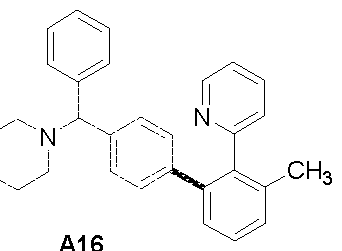 Aie
Aie
Column chromatography (hexane/Et2Q, 1 :1 ) afforded A16 as a white solid (94.3 mg, 90%).
1H-NMR (400 MHz, CDCI3) d 2.16 (s, 3 H), 2.22-2.55 (m, 1 1 H), 3.42 (d, J = 13.4 Hz, 1 H), 3.46 (d, J = 13.4 Hz, 1 H), 4.13 (s, 1 H), 6.75 (d, J = 8.0 Hz, 1 H), 6.91 (d, J = 8.4 Hz, 2 H), 6.96-7.16 (m, 8 H), 7.17, 7.26 (m, 5 H), 7.26-7.31 (m, 3 H), 8.55 (d, J = 4.8 Hz, 1 H) ppm; 13C- NMR (100 MHz, CDCI3) 6 20.4, 21 .3, 51 .6, 53.3, 63.0, 75.5, 121 .1 , 125.7, 126.3, 126.7, 127.2, 127.3, 127.7, 127.9, 128.0, 128.0, 128.2, 129.3, 129.6, 129.9, 135.3, 136.5, 137.7, 137.9,
139.3, 140.2, 140.4, 141 .1 , 142.5, 148.6, 159.5 ppm; mp 167-169 °C; IR vmax (neat/cm 1): 2956, 2806, 1585, 1453, 1 136, 1007; HRMS calcd for C37H38ON3 [M+H]+: 524.3052, found 524.3051 .
The General Procedure C was applied with Ru9 (10.9 mg, 0.02 mmol, 10
mol %), 2- (o-to ly I) py rid i n e N10 (67.7 mg, 0.40 mmol, 2 equiv.),
Chlorpheniramine · 2HCI X17 (69.5 mg, 0.20 mmol, 1 equiv.) and K2C03
(1 10.6 mg, 0.8 mmol, 4 equiv.) at 50 °C for 72 hours. Column

chromatography (CH2CI2/MeOH, from 95:5 to 85:15) afforded A17 as a light brown wax (66.0 mg, 81 %).
1H-NMR (400 MHz, CDCI3) d 2.17 (s, 3 H), 2.18-2.28 (m, 1 H), 2.29-2.40 (m, 8 H), 2.42-2.54 (m, 1 H), 4.04 (t, J = 7.6 Hz, 1 H), 6.84 (d, J = 8.0 Hz, 1 H), 6.98 (d, J = 7.6 Hz, 2 H), 7.04-7.1 1 (m, 5 H), 7.23 (dd, J = 7.6, 0.8 Hz, 1 H), 7.25-7.29 (m, 1 H), 7.33 (t, J = 7.6 Hz, 1 H), 7.41 (td, J = 7.6, 1 .8 Hz, 1 H), 7.54 (td, J = 7.6, 1 .8 Hz, 1 H), 8.53 (ddd, J = 4.8, 2.0, 0.8 Hz, 1 H), 8.60 (ddd, J = 4.8, 1 .6, 0.8 Hz, 1 H) ppm; 13C-NMR (100 MHz, CDCI3) d 20.4, 31 .4, 44.5, 50.5, 57.3, 121 .2, 121 .4, 123.0, 125.6, 127.1 , 127.4, 127.9, 129.3, 129.8, 135.6, 136.4, 136.6, 139.3,
139.9, 140.8, 140.9, 148.7, 149.1 , 159.5, 162.8 ppm; IR vmax (neat/cm 1): 3419, 3058, 2927, 2855, 2768, 1587, 1461 , 1432; HRMS calcd for C28H30ON3 [M+H]+: 408.2434, found 408.2423.

Column chromatography (hexane/EtOAc, 4:6) afforded A18 as a
white solid (57.8 mg, 56%).
1H-NMR (400 MHz, CDCI3) d 1 .26 (t, J = 7.2 Hz, 3 H), 2.19 (s, 3 H), 2.21 -2.36 (m, 3 H), 2.39- 2.50 (m, 1 H), 2.54-2.75 (m, 2 H), 3.05-3.18 (m, 2 H), 3.19-3.31 (m, 2 H), 3.69-3.86 (m, 2 H),
4.14 (q, J = 7.2 Hz, 2 H), 6.82-6.90 (m, 3 H), 6.94 (d, J = 7.6 Hz, 1 H), 7.05-7.12 (m, 2 H), 7.24-7.31 (m, 2 H), 7.25 (t, J = 7.4 Hz, 1 H), 7.37-7.44 (m, 2 H), 8.39 (d, J = 4.4 Hz, 1 H), 8.61 (d, J = 4.4 Hz, 1 H) ppm; 13C-NMR (100 MHz, CDCI3) d 14.7, 20.5, 30.5, 30.7, 31.7, 31.8, 44.8, 61 .3, 121 .2, 122.0, 125.7, 127.1 , 127.3, 128.0, 128.6, 129.4, 130.4, 133.8, 135.0, 135.6, 136.7, 136.8, 136.9, 136.9, 137.3, 139.3, 140.6, 140.8, 146.4, 148.7, 155.5, 157.5, 159.6 ppm; mp 93-95 °C; IR vmax (neat/cm 1): 3057, 2978, 2922, 2856, 1694, 1436, 1228; HRMS calcd for C34H3402N3 [M+H]+: 516.2646, found 516.2638.
The General Procedure C was a lied with Ru9 (10 9 m
e
 quiv.), KOBz (9.6 mg, 0.06 mmol, 0.3 equiv.) in
replacement of KOAc, K2C03 (55.3 mg, 0.4 mmol, 2 equiv.) and NMP (0.4 mL, 0.5 M) at 50 °C for 72 hours. Column chromatography (CH2CI2/MeOH, from 99:1 to 97:3) afforded A19 as a light brown solid (97.8 mg, 78%).
1H-NMR (400 MHz, CDCI3) d 0.96-1.29 (m, 5 H), 1.41-1.61 (m, 3 H), 1.65-1.78 (m, 2 H), 2.06 (s, 3 H), 2.91 (t, J = 7.0 Hz, 2 H), 3.40-3.53 (m, 1 H), 3.55-3.68 (m, 5 H), 6.34 (d, J = 7.6 Hz, 1 H), 6.54 (d, J = 8.5 Hz, 1 H), 6.84 (d, J = 8.0 Hz, 1 H), 6.91 (dd, J = 8.5, 2.1 Hz, 1 H), 7.03 (dd, J = 7.2, 5.2 Hz, 1 H), 7.13-7.21 (m, 3 H), 7.24 (d, J = 7.6 Hz, 1 H), 7.30 (d, J = 8.4 Hz, 2 H), 7.41 (t, J = 7.4 Hz, 1 H), 7.70-7.80 (m, 3 H), 7.97 (d, J = 2.1 Hz, 1 H), 8.54 (d, J = 4.8 Hz, 1 H) ppm; 13C-NMR (125 MHz, CDCI3) d 20.4, 24.5, 25.3, 32.9, 35.6, 40.5, 49.1 , 55.8, 110.6, 120.4, 121 .4, 125.8, 127.3, 127.7, 128.2, 129.5, 129.7, 132.8, 134.3, 134.8, 136.1 , 136.7, 137.9, 139.1 , 139.7, 145.9, 148.8, 150.5, 156.0, 159.4, 165.4 ppm; mp 140-144 °C; IR vmax (neat/cm 1): 3367, 3061 , 2929, 2854, 1709, 1631 , 1537, 1459, 1161 ; HRMS calcd for C35H3705N4S [M-H] : 625.2490, found 625.2493. The General Procedure C was applied with Ru9 (10.9 mg, 0.02 mmol, 10
mol %), 2-(o-tolyl) pyridine N10 (33.9 mg, 0.20 mmol, 1 equiv.), Br- Strychnine X20 (82.7 mg, 0.20 mmol, 1 equiv.) and K2C03 (55.3 mg, 0.4
mmol, 2 equiv.) for 48 hours. Column chromatography (CH2CI2/MeOH,

from 97:3 to 92:8) afforded A20 as a light brown solid (91.3 mg, 91 %).
1H-NMR (400 MHz, CDCI3) d 1.10-1.34 (m, 3 H), 1.47-1.69 (m, 1 H), 1.71-1.84 (m, 1 H), 2.13
(s, 3 H), 2.29 (d, J = 13.6 Hz, 1 H), 2.61 (dd, J = 17.6, 2.4 Hz, 1 H), 2.79-2.99 (m, 1 H), 3.09
(dd, J = 17.6, 8.3 Hz, 1 H), 3.15 (bs, 1 H), 3.26-3.51 (m, 1 H), 3.61-3.91 (m, 3 H), 4.02 (dd, J = 13.8, 5.8 Hz, 1 H), 4.14 (dd, J = 13.8, 7.0 Hz, 1 H), 4.24 (dt, J = 8.3, 3.5 Hz, 1 H), 5.95-610 (m, 1 H), 6.70 (s, 1 H), 6.85-8.97 (m, 1 H), 7.03-7.13 (m, 1 H), 7.17 (dd, J = 8.5, 1 .5 Hz, 1 H), 7.20- 7.29 (m, 2 H), 7.32 (t, J = 7.8 Hz, 1 H), 7.50 (t, J = 7.5 Hz, 1 H), 7.93 (d, J = 8.5 Hz, 1 H), 8.59-
8.70 (m, 1 H) ppm; 13C-NMR (100 MHz, CDCI3) d 20.4, 26.1 , 41.7, 42.2, 47.6, 50.2, 51 .5, 52.3,
59.8, 60.2, 64.3, 77.2, 77.3, 1 15.6, 121 .1 , 123.8, 125.6, 127.3, 128.1 , 129.3, 130.2, 130.2, 130.3, 135.8, 136.7, 137.8, 139.2, 140.1 , 140.3, 149.1 , 159.6, 168.9 ppm; mp > 250 °C; IR vmax (neat/cm 1): 3426, 2926, 2862, 1670, 1492, 1462, 1383; HRMS calcd for C33H3102N3Na [M+Na]+: 524.2308, found 524.2302. The General Procedure C was applied with Ru9 (10.9 mg, 0.02 mmol, 10
mol %), 2-(o-tolyl) pyridine N10 (67.7 mg, 0.40 mmol, 2 equiv.), Q
Bromhexine · HCI X21 (82.5 mg, 0.20 mmol, 1 equiv.) and K2CO3 (1 10.6
mg, 0.8 mmol, 4 equiv.) at 50 °C for 72 hours. Column chromatography
(EtOAc) afforded A21 as a light brown solid (76.3 mg, 69%).

1H-NMR (400 MHz, CDCI3) d 1 .01 -1 .20 (m, 4 H), 1 .52-1 .83 (m, 9 H), 2.09-
2.23 (m, 7 H), 2.99 (d, J = 12.4 Hz, 1 H), 3.42-3.56 (m, 1 H), 4.53 (m, 2 H), 6.32 (d, J = 1 .4 Hz, 1 H), 6.77 (d, J = 1 .4 Hz, 1 H), 6.87 (d, J = 7.6 Hz, 1 H), 7.04-7.15 (m, 4 H), 7.18 (d, J = 7.6 Hz, 1 H), 7.22-7.31 (m, 3 H), 7.34 (t, J = 7.6 Hz, 1 H), 7.36-7.46 (m, 2 H), 8.55 (d, J = 4.4 Hz, 1 H), 8.64 (d, J = 4.8 Hz, 1 H), ppm; 13C-NMR (100 MHz, CDCI3) d 20.4, 20.5, 25.8, 25.9, 26.3, 28.0, 28.4, 36.0, 57.5, 61 .9, 120.9, 121 .1 , 122.5, 125.2, 125.8, 126.7, 127.5, 127.8, 128.2,
128.3, 128.4, 129.6, 129.6, 130.5, 131 .0, 135.0, 135.3, 136.5, 136.8, 138.2, 138.8, 140.1 , 141 .2, 143.1 , 148.5, 148.6, 159.2, 160.4 ppm; mp 93-96 °C; IR vmax (neat/cm 1): 3435, 3267, 3061 , 2927, 2853, 2791 , 1615, 1585, 1453; HRMS calcd for C38H4iN4 [M+H]+: 553.3326, found 553.3313. The General Procedure C was applied with Ru9 (10.9 mg, 0.02 mmol,
10 mol %), 2-(o-tolyl) pyridine N10 (27.6 mg, 0.163 mmol, 1 equiv.), a
grinded pill of Ladastan containing 50 mg of Bromantane (0.163 mmol,

1 equiv.), KOAc (4.8 mg, 0.049 mmol, 0.3 equiv.) and K2C03 (45.1 mg,
0.326 mmol, 2 equiv.). The excipients contained in a pill of Ladasten are potato starch, magnesium stearate and microcrystalline cellulose in unknown amounts. Column chromatography (hexane/Et20, 7:3) afforded A22 as a pale yellow solid (60.5 mg, 94%).
1H-NMR (400 MHz, CDCI3) d 1 .54-1 .62 (m, 2 H), 1 .72-1 .93 (m, 10 H), 1 .97 (bs, 2 H), 2.16 (s, 3
H), 3.47 (bs, 1 H), 3.90 (bs, 1 H), 6.38 (d, J = 8.2 Hz, 2 H), 6.86 (d, J = 8.2 Hz, 2 H), 6.92 (d, J
= 7.6 Hz, 1 H), 7.09-7.15 (m, 1 H), 7.20-7.29 (m, 2 H), 7.33 (t, J = 7.6 Hz, 1 H), 7.49 (t, J = 7.8 Hz, 1 H), 7.67 (d, J = 4.8 Hz, 1 H) ppm; 13C-NMR (100 MHz, CDCI3) d 20.6, 27.3, 27.4, 31 .6,
31 .6, 37.4, 37.7, 56.7, 1 12.3, 121 .1 , 125.8, 127.6, 128.0, 128.5, 130.0, 130.6, 135.9, 136.6, 139.0, 141 .3, 145.8, 148.7, 160.1 ppm; mp 220-224 °C; IR vmax (neat/cm 1): 2905, 2851 , 1610, 1521 ; HRMS calcd for C28H31N2 [M+H]+: 395.2482, found 395.2481 .
The purity of Trametinib purchased from Generon was assessed
to be 70% by quantitative 1H-NMR with an internal standard. The
impurity was not NMR-active. Trametinib was further purified by
centrifuging the solid in H20 and by removing the white particles
which were not depositing at the bottom of the vial (x10 times).
The purity was then assessed to be 84% by quantitative 1H-NMR

with an internal standard.
The General Procedure C was applied with Ru9 (10.9 mg, 0.02 mmol, 10 mol %), 2-(o- tolyl)pyridine N10 (33.9 mg, 0.20 mmol, 1 equiv.), Trametinib X23 (142.8 mg, 0.20 mmol, 1 equiv.) and K2C03 (55.3 mg, 0.4 mmol, 2 equiv.). Column chromatography (EtOAc) afforded A23 as a white solid (1 10.3 mg, 84%).
1H-NMR (400 MHz, CDCI3) d 0.73-0.83 (m, 2 H), 1 .05-1 .16 (m, 2 H), 1 .39 (s, 3 H), 2.13 (s, 3 H), 2.19 (s, 3 H), 2.67-2.79 (m, 1 H), 3.04 (s, 3 H), 6.75 (t, J = 8.2 Hz, 1 H), 6.81 (d, J = 8.2 Hz, 1 H), 6.87-7.02 (m, 3 H), 7.14-7.22 (m, 1 H), 7.22-7.31 (m, 3 H), 7.34 (d, J = 7.6 Hz, 1 H), 7.39 (t, J = 7.6 Hz, 1 H), 7.56 (t, J = 7.6 Hz, 1 H), 7.62-7.75 (m, 2 H), 8.64 (d, J = 4.8 Hz, 1 H),
1 1 .31 (s, 1 H) ppm; 13C-NMR (125 MHz, CDCI3) d 8.4, 13.3, 20.4, 24.5, 25.2, 34.4, 89.3, 102.9, 1 17.5 (d, J = 19.9 Hz), 1 18.9, 120.3, 121 .8, 123.6, 124.2, 125.5, 125.8 (d, J = 1 1 .8 Hz), 126.0 (d, J = 3.3 Hz), 127.2, 128.3, 129.1 , 130.1 , 136.0, 137.0, 138.8, 139.0, 139.2, 140.3, 141 .1 (d, J = 7.3 Hz), 144.9, 149.1 , 151 .8, 152.6, 154.9 (d, J = 247.0 Hz), 159.0, 163.0, 164.8, 168.4 ppm; 19F-NMR (376 MHz, CDCI3) d -124.8 ppm; mp 236-240 °C; IR vmax (neat/cm 1):
331 1 , 2924, 2855, 1630, 1605, 1551 , 1422; HRMS calcd for C38H3404N6F [M+H]+: 657.2620, found 657.2607.
The General Procedure C was applied with Ru9 (10.9 mg, 0.02 mmol, 10 mol %), 2-(o- tolyl) pyridine N10 (33.9 mg, 0.20 mmol, 1 equiv.), d-Tocopherol-OTf X24 (106.9 mg, 0.20 mmol, 1 equiv.) and K2C03 (55.3 mg, 0.4 mmol, 2 equiv.). Column chromatography (Et20/hexane, 1 :9) afforded A24 as a colourless oil
(99.7 mg, 90%).
The General Procedure D was applied was applied

with encapsulated Ru9 (10.9 mg, 0.02 mmol, 10 mol
%), 2-(o-tolyl) pyridine N10 (33.9 mg, 0.20 mmol, 1 equiv.), d-Tocopherol-OTf X24 (106.9 mg,
0.20 mmol, 1 equiv.) and K2C03 (55.3 mg, 0.4 mmol, 2 equiv.) in NMP (300 pL) and toluene (500 pl_). Column chromatography (Et20/hexane, 1 :9) afforded A24 as a colourless oil (68.7 mg, 62%).
1H-NMR (400 MHz, CDCI3) d 0.80-0.91 (m, 12 H), 0.96-1 .59 (m, 24 H), 1 .60-1 .76 (m, 2 H), 2.00 (s, 3 H), 2.17 (s, 3 H), 2.45-2.58 (m, 2 H), 6.55 (d, J = 1 .4 Hz, 1 H), 6.67 (d, J = 1 .4 Hz, 1
H), 6.89 (d, J = 8.0 Hz, 1 H), 7.08 (ddd, J = 7.6, 5.2, 0.8 Hz, 1 H), 7.22 (d, J = 7.4 Hz, 1 H),
7.26 (d, J = 7.4 Hz, 1 H), 7.31 (t, J = 7.4 Hz, 1 H), 7.45 (td, J = 7.6, 2.0 Hz, 1 H), 8.63 (d, J = 4.8 Hz, 1 H) ppm; 13C-NMR (100 MHz, CDCI3) d 15.8, 19.6, 19.7, 20.5, 20.9, 22.1, 22.6, 22.7, 24.1, 24.4, 24.8, 28.0, 31.2, 32.7, 32.8, 37.3, 37.4 (x3), 39.3, 40.1, 75.9, 119.5, 121.0, 125.2, 125.7, 127.5, 127.9, 128.2, 128.6, 129.7, 132.0, 135.6, 136.5, 139.2, 141.3, 148.5, 150.6, 160.2 ppm; I R vmax (neat/cm 1): 2924, 2866, 1584, 1486, 1459, 1377, 1225, 1201, 1149, 1112;
HRMS calcd for CsgHssONNa [M+Na]+: 576.4176, found 576.4176.
The General Proced re C as a lied ith R 9 109 m

Column chromatography (Et20) afforded A25 as a pale yellow wax (64.8 mg, 71%).
NMR analysis shows the product as a mixture of two amide isomers: 1H-NMR (400 MHz, CDCI3) d 0.81-1.00 (m, 6 H), 1.09-1.55 (m, 5 H), 1.59-1.72 (m, 2 H), 1.95-2.05 (m, 1 H), 2.14- 2.27 (m, 5 H), 3.52 (bs, 3 H), 4.35 (d, J = 5.2 Hz, 2 H), 5.25-5.43 (m, 1 H), 5.66-5.78 (m, 1 H), 6.59 (s, 1 H), 6.67 (d, J= 7.6 Hz, 1 H), 6.91-7.01 (m, 2 H), 7.04 (ddd, J= 7.6, 4.7, 1.1 Hz, 1 H),
7.18 (d, J = 7.2 Hz, 1 H), 7.28 (d, J = 7.2 Hz, 1 H), 7.33 (t, J = 7.2 Hz, 1 H), 7.44 (td, J = 7.6, 1.1 Hz, 1 H), 8.52 (d, J = 4.7 Hz, 1 H) ppm; 13C-NMR (100 MHz, CDCI3) d 20.6, 22.6, 22.7, 25.3, 25.8, 27.2, 28.0, 29.3, 29.4, 29.6, 31.0, 32.2, 36.7, 36.9, 39.0, 43.5, 55.1, 109.7, 119.1, 121.2, 125.0, 126.5, 127.7, 128.2, 129.6, 129.7, 131.9, 135.3, 136.3, 137.5, 138.1, 138.7, 139.9, 148.4, 156.4, 159.4, 172.9, 173.0 ppm; IR vmax (neat/cm 1): 3081, 3064, 2954, 2924,
2954, 1647, 1461; HRMS calcd for C3oH3602N2Na [M+Na]+: 479.2669, found 479.2663.

ml_, 0.5 M) at 50 °C for 72 hours. Column chromatography (Et20/hexane, 4:6) afforded A26 as a white solid (126.7 mg, 84%).
The product A26 was obtained as a mixture of isomers (1H-NMR ratio 79:21) matching the isomer ratio of X26.1H-NMR (400 MHz, CDCI3) d 0.37 (d, J = 4.2 Hz, 1 H), 0.61 (d, J = 4.2 Hz, 1 H), 0.74-2.41 (m, 48 H), 3.58 (s, 3 H), 4.65-4.77 (m, 2 H), 6.31-6.42 (m, 1 H), 6.79-6.85 (m, 1 H), 6.92-7.00 (m, 2 H), 7.01-7.08 (m, 2 H), 7.21 (d, J = 7.2 Hz, 1 H), 7.31 (d, J = 6.8 Hz, 1 H), 7.35 (t, J= 7.4 Hz, 1 H), 7.42 (td, J= 7.6, 1.6 Hz, 1 H), 7.57 (d, J= 16.0 Hz, 1 H), 8.56 (d, J = 4.8 Hz, 1 H) ppm; 13C-NMR chemical shifts of the major isomer: 13C-NMR (100 MHz, CDCI3) d 15.3, 18.0, 18.3, 19.3, 20.1, 20.5, 20.9, 21.9, 22.0, 25.5, 25.8, 26.0, 26.5, 26.9, 28.1, 31.3,
31 .6, 32.8, 33.8, 35.0, 35.5, 36.1 , 39.7, 45.3, 47.2, 47.8, 48.8, 52.2, 55.1 , 80.7, 105.9, 109.1 , 1 18.5, 120.4, 121 .1 , 124.8, 127.7, 127.9, 129.8, 132.1 , 132.9, 134.6, 135.1 , 136.3, 137.2, 139.9, 144.1 , 148.5, 156.4, 156.8, 159.2, 166.7 ppm; mp 88-92 °C; IR vmax (neat/cm 1): 2936, 2867, 1708, 1636, 1461 , 1271 , 1243, 1 173; HRMS calcd for C52H6703NNa [M+Na]+: 776.5013, found 776.5509.
The General Procedure C was applied with Ru9 (10.9 mg, 0.02 mmol,
10 mol %), 2-(o-tolyl) pyridine N10 (33.9 mg, 0.20 mmol, 1 equiv.),
Estradiol-OTf X27 (80.9 mg, 0.20 mmol, 1 equiv.) and K2C03 (55.3
mg, 0.4 mmol, 2 equiv.). Column chromatography (Et20/hexane, 7:3)

afforded A27 as a white solid (82.2 mg, 97%).
1H-NMR (500 MHz, CDCI3) d 0.76 (s, 3 H), 1 .06-1 .76 (m, 9 H), 1 .78-1 .86 (m, 1 H), 1 .89-1 .96 (m, 1 H), 2.03-2.21 (m, 5 H), 2.21 -2.29 (m, 1 H), 2.60-2.77 (m, 2 H), 3.71 (t, J = 8.5 Hz, 1 H), 6.78-6.85 (m, 2 H), 6.92 (d, J = 8.0 Hz, 1 H), 7.03 (d, J = 8.0 Hz, 1 H), 7.09-7.14 (m, 1 H), 7.24-7.30 (m, 2 H), 7.34 (t, J = 7.5 Hz, 1 H), 7.49 (t, J = 7.5 Hz, 1 H), 8.65 (d, J = 4.5 Hz, 1 H) ppm; 13C-NMR (125 MHz, CDCI3) d 1 1 .0, 20.5, 23.1 , 25.9, 27.2, 29.3, 30.6, 36.7, 38.5, 43.2,
44.2, 50.2, 81 .8, 121 .2, 124.5, 125.6, 126.8, 127.6, 128.0, 129.1 , 130.3, 135.8, 135.8, 136.7,
138.2, 138.7, 139.2, 141 .0, 148.7, 159.8 ppm; mp decomposes above 200 °C; IR vmax (neat/cm 1): 3327, 2927, 2868, 1594, 1462, 1424, 1055, 909; HRMS calcd for C30H33ONNa [M+Na]+: 446.2454, found 446.2450. The General Procedure C was applied with Ru9 (10.9 mg, 0.02 mmol, 10
mol %), 2-(o-tolyl) pyridine N10 (33.9 mg, 0.20 mmol, 1 equiv.),
Hymechromone-OTf X28 (61 .7 mg, 0.20 mmol, 1 equiv.), KOBz (9.6 mg,
0.06 mmol, 0.3 equiv.) in replacement of KOAc, and K2C03 (55.3 mg, 0.4

mmol, 2 equiv.) at 50 °C for 48 hours. Column chromatography (Et20/hexane, 1 :1) afforded A28 as an off-white solid (60.2 mg, 92%).
1H-NMR (400 MHz, CDCI3) d 2.19 (s, 3 H), 2.37 (s, 3 H), 6.22 (s, 1 H), 6.97 (d, J = 8.0 Hz, 1 H), 7.01 (dd, J = 7.6, 1 .6 Hz, 1 H), 7.09 (d, J = 1 .6 Hz, 1 H), 7.12-7.17 (m, 1 H), 7.24-7.31 (m, 1 H), 7.32-7.44 (m, 3 H), 7.52 (td, J = 7.6, 1 .6 Hz, 1 H), 8.63 (d, J = 4.4 Hz, 1 H) ppm; 13C-NMR (100 MHz, CDCI3) d 18.5, 20.4, 1 14.6, 1 17.8, 1 18.1 , 121 .7, 123.6, 125.5, 125.9, 127.5, 128.3,
130.3, 136.1 , 137.1 , 139.2, 139.3, 145.8, 149.1 , 152.2, 153.0, 158.8, 161 .0 ppm; mp 70-72 °C; IR vmax (neat/cm 1): 3061 , 2922, 1716, 1614, 1387, 1 162; HRMS calcd for C22H1802N [M+H]+:
328.1332, found 328.1328.
The General Procedure C was applied with Ru9 (10.9 mg, 0.02 mmol, 10 mol
%), 2-(o-tolyl) pyridine N10 (101 .5 mg, 0.60 mmol, 3 equiv.), Vanillin-OTf X29
 (56.8 mg, 0.20 mmol, 1 equiv.), KOBz (9.6 mg, 0.06 mmol, 0.3 equiv.) in replacement of KOAc, and K2C03 (55.3 mg, 0.4 mmol, 2 equiv.) at 50 °C for 72 hours. Column chromatography (Et20/hexane, 1 :1) afforded A29 as an off-white wax (37.6 mg, 62%).
1H-NMR (400 MHz, CDCI3) d 2.23 (s, 3 H), 3.62 (s, 3 H), 6.97 (d, J = 8.0 Hz, 1 H), 7.04 (ddd, J = 7.6, 4.8, 1 .2 Hz, 1 H), 7.18-7.25 m, 3 H), 7.30 (d, J = 7.6 Hz, 1 H), 7.32-7.35 (m, 1 H), 7.37 (t,
J = 7.6 Hz, 1 H), 7.43 (d, J = 7.6, 1.6 Hz, 1 H), 8.53 (d, J = 4.4 Hz, 1 H), 9.89 (s, 1 H) ppm; 13C- NMR (100 MHz, CDCI3) d 20.5, 55.3, 108.4, 121 .3, 123.8, 124.8, 127.6, 127.8, 130.2, 132.3, 135.2, 136.4, 136.5, 136.8, 137.7, 139.8, 148.6, 156.9, 159.0, 191.9 ppm; IR vmax (neat/cm 1): 3060, 3002, 2928, 2850, 2732, 1689, 1548, 1460, 1412, 1387, 1266, 1154, 1034; HRMS calcd for C20H18O2N [M+H]+: 304.1332, found 304.1321 .
The General Procedure C was applied with Ru9 (10.9 mg, 0.02 mmol,
10 mol %), 2-(o-tolyl) pyridine N10 (33.9 mg, 0.20 mmol, 1 equiv.),
Naltrexone-OTf X30 (94.7 mg, 0.20 mmol, 1 equiv.) and (55.3 mg, 0.4
mmol, 2 equiv.) for 48 hours. Column chromatography (CH2CI2/MeOH,
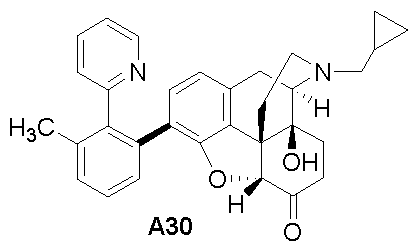
from 99:1 to 95:5) afforded A30 as a pale yellow wax (70.0 mg, 71 %).
1H-NMR (500 MHz, CDCI3) d 0.17 (bs, 2 H), 0.58 (d, J = 7.5 Hz, 2 H), 0.79-0.99 (m, 2 H), 1.27- 1.43 (m, 2 H), 1.50-1.65 (m, 1 H), 1.82-1.97 (m, 1 H), 1.98-2.10 (m, 1 H), 2.17 (s, 3 H), 2.29 (dt, J = 14.5, 3.0 Hz, 1 H), 2.35-2.51 (m, 2 H), 2.52-2.64 (m, 1 H), 2.64-2.80 (m, 1 H), 2.93- 3.049 (m, 2 H), 3.12-3.35 (m, 1 H), 4.62 (s, 1 H), 6.38 (d, J = 7.8 Hz, 1 H), 6.59 (d, J = 7.8 Hz, 1 H), 6.99-7.07 (m, 2 H), 7.27 (d, J = 7.0 Hz, 1 H), 7.32-7.48 (m, 3 H), 8.56 (d, J = 4.0 Hz, 1 H) ppm; 13C-NMR (125 MHz, CDCI3) d 3.8, 4.1 , 9.2, 20.4, 23.2, 30.6, 31 .6, 36.1 , 43.6, 50.3, 59.1 , 61 .8, 70.2, 89.7, 118.1 , 121 .1 , 122.6, 125.7, 127.3, 127.8, 128.0, 129.7, 131 .5, 135.4, 135.5, 136.5, 139.7, 148.4, 154.6, 159.6, 208.3 ppm; IR vmax (neat/cm 1): 3390, 3060, 3001 , 2925, 2850, 1726, 1585, 1461 , 1426, 1407; HRMS calcd for C32H3203N2Na [M+Na]+: 515.2305, found 515.2294. ~
The General Procedure C was applied with Ru9 (10.9 mg, 0.02 mmol, 10
mol %), 2-(o-tolyl) pyridine N10 (33.9 mg, 0.20 mmol, 1 equiv.), Bufotenin-
OTf X31 (67.3 mg, 0.20 mmol, 1 equiv., for its preparation see: J. Med.
Chem. 1996, 39, 4717-4726), and K2C03 (55.3 mg, 0.4 mmol, 2 equiv.)
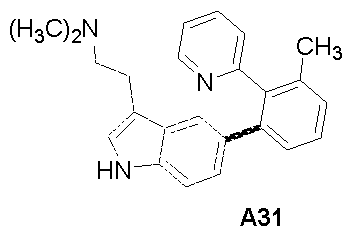
for 72 hours. Column chromatography (CH2CI2/MeOH, from 9:1 to 8:2) afforded A31 as a white solid (55.5 mg, 78%).
1H-NMR (400 MHz, CDCI3) d 2.20 (s, 3 H), 2.35 (s, 6 H), 2.50-2.59 (m, 2 H), 2.76-2.85 (m, 2 H), 6.82-6.92 (m, 2 H), 6.94 (dd, J = 8.4 Hz, 1 H), 7.04 (ddd, J = 7.4, 5.0, 1.2 Hz, 1 H), 7.09 (d, J = 8.4 Hz, 1 H), 7.24-7.32 (m, 2 H), 7.33-7.41 (m, 3 H), 8.33 (bs, 1 H), 8.65 (d, J = 4.0 Hz, 1 H) ppm; 13C-NMR (100 MHz, CDCI3) d 20.6, 23.2, 45.2, 59.8, 110.3, 113.9, 120.0, 121.1 ,
121 .9, 124.1 , 125.7, 126.9, 127.9, 128.2, 128.7, 132.6, 134.9, 135.8, 136.6, 139.4, 142.2, 148.6, 160.2 ppm; mp 128-131 °C; IR vmax (neat/cm 1): 3142, 3043, 2924, 2855, 2820, 2777, 1592, 1456; HRMS calcd for C24H25N3Na [M+Na]+: 378.1941 , found 378.1932.
The General Procedure C was applied with Ru9 (10.9 mg, 0.02 mmol,
10 mol %), 2-(o-tolyl) pyridine N10 (33.9 mg, 0.20 mmol, 1 equiv.),
Harmol-OTf X32 (66.1 mg, 0.20 mmol, 1 equiv.) and K2C03 (55.3 mg,

0.4 mmol, 2 equiv.) at 50 °C for 48 hours. Column chromatography
(EtOAc) afforded A32 as a pale yellow solid (48.9 mg, 70%).
1H-NMR (400 MHz, CDCI3) d 2.19 (s, 3 H), 2.73 (s, 3 H), 6.92 (d, J = 8.0 Hz, 1 H), 7.01 (d, J = 8.0 Hz, 1 H), 7.05-7.1 1 (m, 1 H), 7.21 (s, 1 H), 7.30-7.35 (m, 2 H), 7.36-7.44 (m, 2 H), 7.73 (d,
J = 5.2 Hz, 1 H), 7.84 (d, J = 8.0 Hz, 1 H), 8.28 (d, J = 5.2 Hz, 1 H), 8.59 (d, J = 4.4 Hz, 1 H), 9.34 (bs, 1 H) ppm; 13C-NMR (125 MHz, CDCI3) d 20.0, 20.5, 1 12.7, 1 12.8, 120.1 , 120.8,
121 .4, 122.4, 125.7, 127.9, 128.1 , 128.2, 129.6, 134.9, 135.9, 136.7, 137.7, 139.3, 140.2,
141 .4, 141 .5, 142.2, 148.8, 159.5 ppm; mp 90-93 °C; IR vmax (neat/cm 1): 3147, 3062, 2956, 2924, 2854, 1629, 1593, 1567, 1446, 1421 , 1325, 1260; HRMS calcd for C24H19N3Na [M+Na]+:
372.1471 , found 372.1466.
The General Procedure C was applied with Ru9 (10.9 mg, 0.02 mmol,
10 mol %), 2-(o-tolyl) pyridine N10 (33.9 mg, 0.20 mmol, 1 equiv.),
Ezetimibe-OTf X33 (108.3 mg, 0.20 mmol, 1 equiv.) and K2C03 (55.3
mg, 0.4 mmol, 2 equiv.). Column chromatography (Et20/hexane, 8:2)
afforded A33 as a white solid (102.0 mg, 91 %).

1H-NMR (400 MHz, CDCI3) d 1 .76-2.05 (m, 4 H), 2.17 (s, 3 H), 2.87-3.07 (m, 2 H), 4.51 (d, J =
2.0 Hz, 1 H), 4.59-4.67 (m, 1 H), 6.86 (d, J = 8.0 Hz, 1 H), 6.91 (d, J = 8.6 Hz, 2 H), 6.99 (d, J = 8.6 Hz, 2 H), 7.02-7.10 (m, 5 H), 7.1 1 -7.17 (m, 2 H), 7.21 -7.32 (m, 4 H), 7.33-7.43 (m, 2 H), 8.55 (d, J = 4.8 Hz, 1 H) ppm; 13C-NMR (125 MHz, CDCI3) d 20.4, 25.1 , 36.6, 60.1 , 61 .1 , 72.8, 1 15.2 (d, J = 21 .3 Hz), 1 15.6 (d, J = 22.5 Hz), 1 18.3 (d, J = 7.8 Hz), 121 .4, 125.2, 125.6, 127.3, 127.3 (d, J = 7.9 Hz), 128.1 , 129.7, 130.4, 133.8 (d, J = 2.6 Hz), 135.3, 135.7, 136.8, 139.1 , 140.3 (d, J = 3.0 Hz), 140.4, 142.0, 148.7, 158.9 (d, J = 241 .8 Hz), 159.2, 162.1 (d, J = 243.9 Hz), 167.4 ppm; 19F-NMR (470 MHz, CDCI3) d -1 18.1 , -1 15.0 ppm; mp 80-84 °C; IR vmax (neat/cm 1): 3353, 3059, 2924, 2856, 1741 , 1508, 1385, 1219; HRMS calcd for C36H30O2N2F2Na [M+Na]+: 583.2186, found 583.2157.
The General Procedure C was applied with Ru9 (10.9 mg, 0.02 mmol, 10
mol %), 2-(o-tolyl) pyridine N10 (33.9 mg, 0.20 mmol, 1 equiv.), Arbutin-OTf
X34 (80.9 mg, 0.20 mmol, 1 equiv.) and K2C03 (55.3 mg, 0.4 mmol, 2
 equiv.) for 48 hours. Column chromatography (CH2CI2/MeOH, from 97:3 to 92:8) afforded A34 as an off-white solid (74.5 mg, 88%).
1H-NMR (400 MHz, aceton e-cfe) d 2.10 (s, 3 H), 3.36-3.53 (m, 4 H), 3.57-3.74 (m, 2 H), 3.80- 3.90 (m, 1 H), 4.24 (d, J = 3.2 Hz, 1 H), 4.28-4.33 (m, 1 H), 4.53 (d, J = 3.6 Hz, 1 H), 4.89 (d, J = 7.6 Hz, 1 H), 6.84 (d, J = 8.8 Hz, 2 H), 6.93 (d, J = 8.0 Hz, 1 H), 6.98 (d, J = 8.8 Hz, 2 H),
7.19 (ddd, J = 7.6, 4.8, 1 .2 Hz, 1 H), 7.23 (d, J = 7.6 Hz, 1 H), 7.28 (d, J = 7.6 Hz, 1 H), 7.35 (t, J = 7.6 Hz, 1 H), 7.58 (td, J = 7.6, 1 .6 Hz, 1 H), 8.61 (d, J = 4.8 Hz, 1 H), ppm; 13C-NMR (100 MHz, acetone-c/6) d 20.6, 62.6, 71 .3, 74.7, 77.7, 78.0, 101 .7, 1 16.4, 122.3, 126.3, 128.3, 128.7, 129.7, 131 .3, 136.4, 136.6, 137.5, 140.7, 141 .5, 149.7, 157.4, 160.7 ppm; mp 85-88 °C; IR vmax (neat/cm 1): 3358, 2923, 2854, 151 1 , 1460, 1231 , 1072, 1045; HRMS calcd for C24H2506NNa [M+Na]+: 446.1574, found 446.1568.
The General Procedure C was applied with Ru9 (10.9 mg, 0.02 mmol, 10
mol %), 2-(o-tolyl) pyridine N10 (33.9 mg, 0.20 mmol, 1 equiv.), 5-iodo-m- xylene X38 (29.0 pL, 0.2 mmol, 1 equiv.), and K2C03 (55.3 mg, 0.4 mmol, 2

equiv.). Column chromatography (hexane/Et20, 9:1) afforded A36 as a
white solid (53.0 mg, 97%).
1H-NMR (400 MHz, CDCI3) d 2.17 (s, 6 H), 2.21 (s, 3 H), 6.73 (s, 2 H), 6, 78 (s, 1 H), 6.92 (d, J = 7.8 Hz, 1 H), 7.10 (dd, J = 7.5, 5.1 Hz, 1 H), 7.25-7.32 (m, 2 H), 7.36 (t, J = 7.4 Hz, 1 H), 7.47 (t, J = 7.6 Hz, 1 H), 8.66 (d, J = 4.4 Hz, 1 H) ppm; 13C-NMR (100 MHz, CDCI3) d 20.4, 21 .1 , 121 .1 , 125.5, 127.4, 127.5, 127.7, 127.9, 129.1 , 135.6, 136.5, 136.8, 139.2, 141 .3,
141 .3, 148.6, 159.7 ppm; mp 58-60 °C; IR vmax (neat/cm 1): 3013, 2912, 2868, 1600, 1460, 1024, 792, 748, 704; HRMS calcd for C20H20N [M+H]+: 274.1596, found 274.1583.
The urit of the Atazanavir urchased from Molekula was

1 equiv.), 5-bromo-m-xylene X37 (54.5 mI_, 0.4 mmol, 2
equiv.), K2C03 (82.9 mg, 0.6 mmol, 3 equiv.) and NMP (0.4 ml_, 0.5 M) for 72 hours. Column chromatography (EtOAc/hexane, 6:4) afforded B1 as an off-white solid (146.1 mg, 80%).
1H-NMR (400 MHz, CDCI3) d 0.80 (s, 9 H), 0.86 (s, 9 H), 2.14 (s, 12 H), 2.63 (dd, J = 12.0, 2.4 Hz, 1 H), 2.90-3.01 (m, 3 H), 3.56-3.71 (m, 8 H), 3.80 (d, J = 8.0 Hz, 1 H), 3.96 (d, J = 14.0 Hz, 1 H), 4.09 (q, J = 8.4 Hz, 1 H), 4.17 (d, J = 14.0 Hz, 1 H), 4.94 (bs, 1 H), 5.25 (d, J = 8.4 Hz, 1 H), 5.42 (d, J = 8.8 Hz, 1 H), 6.44-6.59 (m, 1 H), 6.67 (s, 4 H), 6.76 (s, 2 H), 6.79 (d, J = 7.6 Hz, 1 H), 6.88-6.97 (m, 2 H), 7.08-7.17 (m, 1 H), 7.18-7.25 (m, 4 H), 7.32 (td, J = 7.6, 1 .2 Hz, 1
H), 7.41 (bs, 2 H), 8.34 (d, J = 4.4 Hz, 1 H) ppm; 13C-NMR (100 MHz, CDCI3) d 21 .1 , 26.2,
26.5, 33.8, 34.3, 38.7, 52.0, 52.3, 52.4, 61 .4, 61 .4, 62.5, 63.6, 67.3, 120.7, 126.2, 126.6,
127.5, 127.9, 128.2, 129.3, 129.5, 134.7, 135.7, 136.9, 138.0, 140.9, 142.2, 148.1 , 156.8, 156.9, 159.0 170.6, 170.9 ppm, 1 x C not observed; mp 135-138 °C; IR vmax (neat/crrf 1): 3449, 3365, 3240, 2955, 2913, 1715, 1669, 1651 , 1510, 1249; HRMS calcd for C54H6807N6Na
[M+Na]+: 935.5042, found 935.5026.
The General Procedure C was applied with Ru9 (10.9 mg, 0.02 mmol,
10 mol %), Zolimidine N2 (54.5 mg, 0.20 mmol, 1 equiv., for its
preparation see: Chin. Chem. Lett. 2015, 26, 881-884), 5-bromo-m- xylene X37 (54.5 pL, 0.4 mmol, 2 equiv.) and K2C03 (82.9 mg, 0.6
mmol, 3 equiv.) for 72 hours. Column chromatography (Et20/hexane,

8:2) afforded B2 as a pale yellow solid (78.8 mg, 82%).
1H-NMR (400 MHz, CDCI3) d 2.15 (s, 12 H), 3.13 (s, 3 H), 6.60-6.69 (m, 1 H), 6.80 (s, 2 H), 6.89 (s, 4 H), 6.98 (s, 1 H), 7.02-7.10 (m, 1 H), 7.46 (d, J = 8.0 Hz, 1 H), 7.83 (d, J = 6.8 Hz, 1 H), 7.96 (s, 2 H) ppm; 13C-NMR (100 MHz, CDCI3) d 21 .1 , 44.6, 1 12.0, 1 12.3, 1 17.3, 124.0,
125.4, 127.2, 127.2, 128.7, 137.1 , 137.4, 139.8, 139.9, 142.4, 143.9, 145.1 ppm; mp 245-248 °C; IR vmax (neat/cm 1): 3021 , 2920, 2857, 1602, 1499, 1358, 1312, 1 143; HRMS calcd for C30H29O2N2S [M+H]+: 481 .1917, found 481 .1929.
The General Procedure C was applied with Ru9 (10.9 mg, 0.02
mmol, 10 mol %), Zolpidem N3 (61 .5 mg, 0.20 mmol, 1 equiv.), 5- bromo-m-xylene X37 (54.5 mI_, 0.4 mmol, 2 equiv.) and K2C03 (82.9
mg, 0.6 mmol, 3 equiv.) for 72 hours. Column chromatography
(EtOAc/hexane, 4:6) afforded the title product as a light brown solid

(88.7 mg, 86%).
H-NMR (400 MHz, CDCI3) d 2.1 1 (s, 12 H), 2.24 (s, 3 H), 2.47 (s, 3 H), 2.57 (s, 3 H), 2.79 (s, 3 H), 3.14 (s, 2 H), 6.73 (s, 2 H), 6.85 (s, 4 H), 6.90 (d, J = 9.2 Hz, 1 H), 7.26 (s, 2 H), 7.37 (d, J = 9.2 Hz, 1 H), 7.83 (s, 1 H) ppm; 13C-NMR (100 MHz, CDCI3) d 18.4, 21 .1 , 21 .3, 29.1 , 35.4, 37.3, 1 15.9, 1 16.2, 120.7, 122.2, 126.4, 127.3, 128.0, 128.4, 129.8, 136.7, 138.0, 141 .5, 142.0, 143.1 , 143.7, 168.5 ppm; mp 21 1 -213 °C; IR vmax (neat/cm 1): 3023, 2919, 2861 , 1647, 1599, 1395, 1377; HRMS calcd for C35H37ON3Na [M+Na]+: 538.2829,
found 538.2818.
The General Procedure C was applied with Ru9 (10.9 mg, 0.02 mmol,
10 mol %), Diazepam N4 (56.9 mg, 0.20 mmol, 1 equiv.), 5-iodo-m- xylene X38 (58.0 mI_, 0.4 mmol, 2 equiv.) and K2C03 (82.9 mg, 0.6
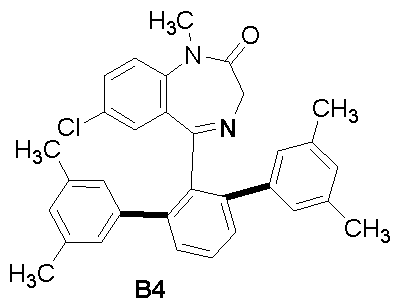 mmol, 3 equiv.) for 72 hours. Column chromatography (Et20/hexane, 6:4) afforded the title product as a white solid (93.7 mg, 95%).
1H-NMR (400 MHz, CDCI3) d 2.15 (s, 6 H), 2.30 (s, 6 H), 2.90 (s, 3 H), 3.32 (d, J = 10.8 Hz, 1 H), 4.52 (d, J = 10.8 Hz, 1 H), 6.57 (bs, 2 H), 6.76 (bs, 1 H), 6.81 (d, J = 8.8 Hz, 1 H), 6.93 (bs, 1 H), 7.01 -7.09 (m, 3 H), 7.15-7.21 (m, 1 H), 7.24 (dd, J = 8.8, 6.8 Hz, 1 H), 7.44-7.52 (m, 2 H) ppm; 13C-NMR (100 MHz, CDCI3) d 21 .1 , 21 .3, 34.4, 56.0, 121 .3, 127.2, 127.5, 128.0, 128.5, 128.6, 128.7, 129.0, 129.5, 130.4, 131 .8, 136.7, 136.9, 137.1 , 140.6, 140.9, 141 .2, 142.2, 142.5, 168.2, 169.1 ppm; mp 173-175 °C; IR vmax (neat/cm 1): 2916, 2856, 1677, 1602, 1482, 1399, 1342; HRMS calcd for C32H29ON2CINa [M+Na]+: 515.1861 , found 515.1856. The General Procedure C was applied with Ru9 (10.9 mg, 0.02
mmol, 10 mol %), Diazepam N4 (56.9 mg, 0.20 mmol, 1 equiv.), 5- iodo-m-xylene X38 (58.0 pL, 0.4 mmol, 2 equiv.), K2C03 (1 10.6 mg,
0.8 mmol, 4 equiv.) and NMP (0.4 mL, 0.5 M) for 72 hours. After this
time, 2-(o-tolyl) pyridine N10 (50.8 mg, 0.3 mmol, 1 .5 equiv.) was
added and the reaction was stirred for additional 72 hours. Column

chromatography (EtOAc/hexane, 6:4) afforded A35 as a white solid (1 18.9 mg, 95%).
1H-NMR (400 MHz, CDCI3) d 2.06-2.22 (m, 9 H), 2.30 (s, 6 H), 2.78 (s, 3 H), 3.30 (d, J = 10.4 Hz, 1 H), 4.54 (d, J = 10.4 Hz, 1 H), 6.51 (bs, 2 H), 6.58 (d, J = 8.4 Hz, 1 H), 6.76 (bs, 1 H), 6.79-6.86 (m, 2 H), 6.88-6.99 (m, 2 H), 7.02 (d, J = 2.0 Hz, 1 H), 7.06-7.20 (m, 4 H), 7.30 (d, J = 7.4 Hz, 1 H), 7.35 (d, J = 7.4 Hz, 1 H), 7.40-7.50 (m, 3 H), 8.58 (bs, 1 H) ppm; 13C-NMR (100
MHz, CDCI3) d 20.4, 21 .3, 34.4, 55.9, 1 19.1 , 121 .6, 125.2, 127.4, 127.6, 128.2, 128.2, 128.4, 128.4, 128.9, 129.3, 129.8, 129.8, 130.2, 132.0, 135.8, 136.7, 136.8, 136.9, 137.1 , 137.3, 139.1 , 139.4, 140.6, 141 .0, 141 .6, 141 .9, 149.2, 159.2, 168.5, 170.2 ppm; mp 1 15-1 18 °C; IR vmax (neat/cm 1): 2916, 2857, 1677, 1602, 1459, 1327; HRMS calcd for C44H39ON3Na [M+Na]+: 648.2985, found 648.2978.
The General Procedure C was applied with Ru9 (10.9 mg, 0.02 mmol, 10
mol %), Flurazepam N5 (77.6 mg, 0.20 mmol, 1 equiv.), 5-iodo-m-xylene
X38 (29.0 mI_, 0.2 mmol, 1 equiv.) and K2C03 (55.3 mg, 0.4 mmol, 2 equiv.)
at 50 °C for 48 hours. Column chromatography (CH2CI2/MeOH, from 99:1
to 95:5) afforded B5 as a pale yellow wax (90.5 mg, 92%).

NMR analysis at 25 °C shows the product as a mixture of conformers (73:27 ratio) as determined from 19F-NMR (see, Tetrahedron 2013, 69, 10783-10795). Spectra were also recorded at 120 °C to observe the product as a single species. 1H-NMR (500 MHz, DMSO -cf6, 120 °C) d 0.69-1 .10 (m, 8 H), 1 .23 (3, 2 H), 2.18 (s, 6 H), 2.52-2.64 (m, 4 H), 3.18-4.40 (m, 2 H), 6.65 (bs, 2 H), 6.88 (s, 1 H), 6.92 (s, 1 H), 7.10-7.19 (m, 1 H), 7.31 (t, J = 9.0 Hz, 1 H),
7.47-7.61 (m, 3 H) ppm; 13C-NMR (125 MHz, CDCI3, 25 °C) d 11 .9, 21 .2, 29.7, 47.7, 51.0, 57.2, 114.6 (d, J = 22.0 Hz), 123.2, 125.9, 126.2 (d, J = 1 .9 Hz), 126.9 (2 x C), 128.6 (d, J = 39.6 Hz), 129.0, 130.4, 130.7 (d, J = 65.1 Hz), 130.7, 137.2, 139.1 , 141 .2, 144.2, 157.7 (d, J = 244.8 Hz), 165.6, 166.5 ppm; 19F-NMR (470 MHz, DMSO -d6, 25 °C) d -136.6 (bs, 1 F), 117.4 ppm (bs, 1 F); 19F-NMR (470 MHz, DMSO -d6, 120 °C) d -116.3 (bs, 1 F) ppm; IR vmax (neat/cm 1): 2968, 2931 , 1678, 1482, 1458, 1406; HRMS calcd for C29H32ON3CIF [M+H]+: 492.2212, found 492.2200.
The General Procedure C was applied with Ru9

50 °C for 48 hours. Column chromatography
(CH2CI2/MeOH, 95:5) afforded the B6 (12.1 mg, 14%) and B6-bis (64.4 mg, 60%) as pale yellow solids.
1H-NMR (400 MHz, CDCI3) d 2.13 (s, 6 H), 2.19 (s, 1 H), 2.64 (s, 1 H),
3.70-3.84 (m, 1 H), 3.96 (d, J = 12.0 Hz, 1 H), 4.34 (s, 1 H), 4.43 (d, J
= 5.2 Hz, 1 H), 4.73 (dd, J = 6.8, 5.2 Hz, 1 H), 5.51 (d, J = 10.4 Hz, 1
H), 5.78 (d, J = 7.2 Hz, 1 H), 6.73 (s, 2 H), 6.76 (s, 1 H), 7.48-7.66 (m,
4 H), 7.89 (s, 1 H), 8.81 (s, 1 H) ppm; 13C-NMR (125 MHz, CDCI3) d

21 .2, 63.1 , 72.4, 73.5, 87.8, 91 .6, 127.1 , 127.3, 128.4, 130.2, 130.9, 130.9, 133.4, 133.5, 137.3, 140.6, 142.1 , 144.1 , 149.8, 151 .4, 160.4 ppm; mp 90-93 °C; IR vmax (neat/cm 1): 3331 , 2922, 2855, 1599, 1586, 1502, 1456, 1391 , 1332, 1212; HRMS calcd for C24H2304N4 [M-H]~:
431 .1725, found 431.1721.
1H-NMR (400 MHz, CDCI3) d 2.04 (s, 6 H), 2.07 (s, 6 H), 3.46 (bs, 1
H), 3.65 (t, J = 11 .6 Hz, 1 H), 3.75-3.96 (m, 2 H), 4.22 (s, 1 H), 4.32 (d,
J = 4.0 Hz, 1 H), 4.67-4.80 (m, 1 H), 5.46 (d, J = 10.4 Hz, 1 H), 5.68 (d,
J = 6.8 Hz, 1 H), 6.61-6.80 (m, 6 H), 7.37-7.46 (m, 2 H), 7.53 (t, J = 7.6
Hz, 1 H), 7.81 (s, 1 H), 8.66 (s, 1 H) ppm; 13C-NMR (100 MHz, CDCI3)
d 21 .0, 20.1 , 62.8, 71.9, 73.8, 87.5, 91 .2, 127.0, 127.0, 128.3, 128.4,

129.0 (2 x C), 129.2, 132.5, 135.6, 136.9, 137.0, 140.5, 140.6, 142.1 , 142.1 , 144.1 , 149.3, 150.6, 161.0 ppm; mp 130-133 °C; IR vmax (neat/cm 1): 3281 , 2919, 2861 , 1595, 1332, 1209, 1109, 1083, 1052; HRMS calcd for C32H3204N4Na [M+Na]+: 559.2316, found 559.2312.
The General Procedure C was applied with Ru9

for 72 hours. Column chromatography B7 B7 bis
(Et20/hexane, 3:7) afforded B7 as a white wax (51.9 mg, 63%) and B7-bis as a white solid (4.1 mg, 4%).
1H-NMR (400 MHz, CDCI3) d 2.12 (s, 6 H), 2.84 (t, J = 7.6 Hz, 2 H), 3.14
(t, J = 7.6 Hz, 2 H), 3.72 (s, 3 H), 6.65 (s, 2 H), 6.72 (s, 1 H), 7.09-7.21 (m,
5 H), 7.35-7.49 (m, 3 H), 7.53 (d, J = 7.2 Hz, 1 H) ppm; 13C-NMR (100
MHz, CDCI3) d 21 .1 , 23.4, 31.0, 51 .9, 125.3, 126.9, 127.4, 127.5, 128.0,
128.1 , 128.3, 128.7, 130.2, 130.7, 131 .1 , 134.8, 136.8, 140.6, 142.4,

146.0, 161 .0, 172.4 ppm; IR vmax (neat/cm 1): 2951 , 2923, 2854, 1741 , 1437, 1223, 1201 , 1167; HRMS calcd for C27H2503NNa [M+Na]+: 434.1727, found 434.1725.
1H-NMR (400 MHz, CDCI3) d 2.14 (s, 12 H), 2.76 (t, J = 7.6 Hz, 2 H),
2.99 (t, J = 7.6 Hz, 2 H), 3.68 (s, 3 H), 6.63-6.86 (m, 6 H), 6.98-7.10
(m, 2 H), 7.1 1-7.23 (m, 3 H), 7.38 (d, J = 7.2 Hz, 2 H), 7.50 (t, J = 7.6
Hz, 1 H) ppm; 13C-NMR (100 MHz, CDCI3) d 21.1 , 23.3, 31 .3, 51.8,
124.8, 127.1 , 127.3, 128.0, 128.1 , 128.4, 128.7, 129.1 , 129.6, 133.6,

136.7, 141 .1 , 143.8, 146.8, 160.1 , 172.3 ppm; mp 1 16-118 °C; IR vmax
(neat/cm 1): 2950, 2920, 2853, 1742, 1602, 1571 , 1437, 1224, 1167; HRMS calcd for
CssHssOsNNa [M+Na]+: 538.2353, found 538.2351 . The purity of the Sulfaphenazole purchased from Fluorochem was
assessed to be 86% by quantitative 1H-NMR with an internal standard.
The impurity was not NMR-active.

The General Procedure C was applied with Ru9 (10.9 mg, 0.02 mmol, 10
mol %), Sulfaphenazole N8 (71.7 mg, 0.20 mmol, 1 equiv.), 5-bromo-m-xylene X37 (28.5 pl_, 0.2 mmol, 1 equiv.) and K2C03 (55.3 mg, 0.4 mmol, 2 equiv.) at 50 °C for 72 h. Column chromatography (CH2CI2/Et20, 9:1) afforded the title product as a pale yellow solid (72.0 mg, 86%).
1H-NMR (400 MHz, CDCI3) d 2.23 (s, 6 H), 4.12 (bs, 2 H), 5.52 (bs, 1 H), 6.12 (d, J = 1 .6 Hz, 1 H), 6.44 (d, J = 8.2 Hz, 2 H), 6.65 (s, 2 H), 6.91-6.99 (m, 2 H), 7.16 (d, J = 8.2 Hz, 2 H), 7.27- 7.34 (m, 1 H), 7.42-7.50 (m, 2 H), 7.56 (d, J = 2.0 Hz, 1 H) ppm; 13C-NMR (100 MHz, CDCI3) d
21 .3, 102.3, 113.7, 125.7, 126.4, 128.2, 128.3, 129.1 , 129.4, 129.9, 130.1 , 134.8, 135.1 , 137.1 , 137.9, 138.8, 139.9, 150.9 ppm; mp 133-135 °C; IR vmax (neat/cm 1): 3475, 3381 , 2921 ,
1628, 1595, 1503, 1373, 1318, 1 154; HRMS calcd for C23H2202N4NaS [M+Na]+: 441 .1356, found 441 .1349.
The General Procedure C was

(82.9 mg, 0.6 mmol, 3 equiv.) at
50 °C for 72 hours. Column chromatography (acetone/Et20/hexane, 2:2:6) afforded a 88:12 mixture of B9-a:B9-b as a white solid (35.2 mg, 33%) and B9-bis as a pale yellow solid (53.6 mg, 42%).

H), 7.62 (dd, J = 8.0, 2.2 Hz, 1 H), 7.82 (d, J = 8.0 Hz, 1 H) ppm; 13C-NMR (100 MHz, CDCI3) d
21 .1 , 31 .1 , 34.7, 124.1 , 124.9, 125.2, 125.8, 126.5, 126.5, 127.1 , 127.6, 127.8, 128.2, 128.3, 128.5, 128.7, 128.8, 132.6, 133.9, 137.7, 139.6, 140.0, 142.1 , 143.0, 152.6, 153.7, 155.2 ppm; mp decomposes above 200 °C; IR vmax (neat/crrf1): 2962, 2922, 2868, 1599, 1499, 1477, 1451 , 1424; HRMS calcd for CssHseNs [M+H]+: 534.2904, found 534.2890.
1H-NMR (400 MHz, CDCI3) d 1 .32 (s, 9 H), 2.09 (s, 12 H), 5.35 (s, 1
H), 5.37 (s, 1 H), 6.15 (s, 2 H), 6.21 (s, 2 H), 6.53 (t, J = 8.0 Hz, 2 H),
6.68-6.74 (m, 2 H), 6.86 (t, J = 7.6 Hz, 1 H), 7.12 (d, J = 2.0 Hz, 1 H),
7.34-7.40 (m, 2 H), 7.41 -7.51 (m, 3 H), 7.59-7.65 (m, 2 H), 7.67-7.73
(m, 2 H), 7.84 (d, J = 8.0 Hz, 1 H) ppm; 13C-NMR (100 MHz, CDCI3)
d 21 .1 , 31 .2, 34.8, 123.2, 124.5, 124.7, 125.2, 125.6, 126.0, 126.1 ,

126.1 , 126.6, 127.1 , 127.4, 127.8 , 128.2, 128.5, 128.9, 131 .2, 132.1 , 132.8, 137.4, 137.5, 139.5, 140.1 , 140.1 , 141 .1 , 141 .9, 142.9, 153.5, 154.3, 154.7 ppm; mp 240-245 °C; IR vmax
(neat/cm 1): 3030, 2962, 2916, 2866, 1600, 1499, 1450, 1418; HRMS calcd for C46H44N3 [M+H]+: 638.3530, found 638.3513.
The General Procedure C was applied with Ru9 (10.9 mg, 0.02 mmol, 10 mol %), 2- phenylpyridine N11 (28.6 pL, 0.20 mmol, 1 equiv.), 5-iodo-m-xylene X38 (58.0 mI_, 0.4 mmol, 2 equiv.) and K2C03 (82.9 mg, 0.6 mmol, 3 equiv.). Column chromatography (hexane/Et20, 9:1) afforded B10-bis as a white solid (69.8 mg, 96%).
The General Procedure D was applied with encapsulated Ru9 (10.9
mg, 0.02 mmol, 10 mol %), 2-phenylpyridine N11 (28.6 mI_, 0.20 mmol,

1 equiv.), 5-bromo-m-xylene X37 (55.0 mI_, 0.4 mmol, 2 equiv.) and K2C03 (82.9 mg, 0.6 mmol, 3 equiv.) in EtOAc (400 mI_) at 45 °C. Column chromatography (hexane/Et20, 9:1) afforded B10-bis as a white solid (68.3 mg, 94%).
Spectroscopic data for B10-bis matched those previously reported ( J . Am. Chem. Soc. 2016 138, 3596-3606).
1H-NMR (400 MHz, CDCI3) d 2.16 (s, 12 H), 6.73 (s, 4 H), 6.78 (s, 2 H), 6.88-6.95 (m, 2 H), 7.33 (td, J = 7.6, 2.0 Hz, 1 H), 7.40-7.45 (m, 2 H), 7.49 (dd, J = 8.8, 6.4 Hz, 1 H), 8.35 (ddd, J = 4.8, 1 .6, 0.8 Hz, 1 H) ppm; 13C-NMR (125 MHz, CDCI3) d 21 .1 , 120.6, 126.7, 127.6, 127.8, 127.9, 129.1 , 134.7, 136.9, 138.4, 141 .4, 141 .8, 148.1 , 159.3 ppm.

mmol, 2 equiv.). Column chromatography (hexane/Et20, 9:1) afforded B10 as a clear oil (28.5 mg, 55%) and B10-bis as white solid (14.5 mg, 20%).
Spectroscopic data for B10 matched those previously reported (J. Am. Chem. Soc. 2016 138, 3596-3606).
1H-NMR (500 MHz, CDCI3) d 2.21 (s, 6 H), 6.78 (bs, 2 H), 6.87 (bs, 1 H), 6.92
(dt, J = 8.0, 1 .0 Hz, 1 H), 7.1 1 (ddd, J = 7.6, 4.8, 1 .2 Hz, 1 H), 7.37-7.48 (m, 4
H), 7.66-7.75 (m, 1 H), 8.65 (ddd, J = 4.8, 1 .8, 1 .0 Hz, 1 H) ppm; 13C-NMR (100
MHz, CDCI3) d 21 .2, 121 .2, 125.3, 127.4, 127.5, 128.2, 128.4, 130.3, 130.4,

135.0, 137.4, 139.4, 140.8, 141 .1 , 149.2, 159.4 ppm.
The General Procedure C was applied with Ru9 (10.9 mg, 0.02 mmol, 10
mol %), 2-arylpyridine N12 (49.5 mg, 0.20 mmol, 1 equiv.), 5-iodo-m-xylene
X38 (29.0 mI_, 0.2 mmol, 1 equiv.) and K2C03 (55.3 mg, 0.4 mmol, 2 equiv.).
Column chromatography (hexane/Et20, 9:1) afforded B11 as a white solid

(66.1 mg, 94%).
1H-NMR (500 MHz, CDCI3) d 2.12 (s, 3 H), 2.14-2.23 (m, 9 H), 2.24-2.33 (m, 6 H), 6.74 (s, 2 H), 6.80 (s, 2 H), 8.36 (s, 1 H) ppm; 13C-NMR (125 MHz, CDCI3) d 1 1 .3 (dd, J = 5.4, 2.1 Hz), 1 1 .4 (dd, J = 5.5, 2.3 Hz), 16.1 , 19.0, 21 .1 , 124.2 (dd, J = 19.1 , 4.5 Hz), 125.0 (dd, J = 19.6, 4.8 Hz), 126.1 (dd, J = 18.9, 3.3 Hz), 126.7, 126.9 (dd, J = 19.8, 3.4 Hz), 128.3 (d, J = 1 .1 Hz), 128.6, 130.3, 133.5 (d, J = 2.0 Hz), 136.8, 145.0, 149.2, 151 .3 (d, J = 2.4 Hz), 153.8 (dd, J =
236.8, 1 .9 Hz), 154.4 (dd, J = 237.9, 2.1 Hz) ppm; 19F-NMR (470 MHz, CDCI3) d -124.2 (d, J = 17.9 Hz), -123.6 (d, J = 18.3 Hz) ppm; mp 109-1 10 °C; IR vmax (neat/cm 1): 3008, 2946, 2920, 2863, 1604, 1593, 1444, 1410, 1377, 1342, 1228, 1086; HRMS calcd for C23H24NF2 [M+H]+: 352.1871 , found 352.1877.

not depositing at the bottom of the vial (x10 times). The purity was then assessed to be 84% by quantitative 1H-NMR with an internal standard.
The General Procedure C was applied with Ru9 (10.9 mg, 0.02 mmol, 10 mol %), Atazanavir N1 (152.3 mg, 0.20 mmol, 1 equiv.), Trametinib X23 (285.4 mg, 0.4 mmol, 2 equiv.), K2C03 (82.9 mg, 0.6 mmol, 3 equiv.) and NMP (0.4 mL, 0.5 M) for 72 hours. Column chromatography (acetone/hexane 6:4) afforded D1 as a pale yellow solid (218.4 mg, 65%).
1H-NMR (400 MHz, CDCI3) d 0.70-0.75 (m, 13 H), 0.83-0.95 (m, 9 H), 0.95-1 .03 (m, 4 H), 1 .34 (s, 7 H), 2.10 (s, 6 H), 2.62-2.70 (m, 2 H), 2.74-2.82 (m, 1 H), 2.90-2.95 (m, 2 H), 2.99-3.08 (m,
7 H), 3.57 (s, 3 H), 3.59 (s, 3 H), 3.73-3.83 (m, 2 H), 3.94 (d, J = 8.4 Hz, 1 H), 4.13-4.24 (m, 2 H), 4.29 (d, J = 14.0 Hz, 1 H), 5.03 (bs, 1 H), 6.04-6.18 (m, 2 H), 6.91 -7.01 (m, 4 H), 7.02-7.10 (m, 5 H), 7.10-7.18 (m, 2 H), 7.18-7.27 (m, 4 H), 7.34 (t, J = 8.0 Hz, 2 H), 7.52 (td, J = 8.0, 1 .6 Hz, 1 H), 7.64-7.69 (m, 4 H), 7.73-7.78 (m, 2 H), 8.42 (d, J = 4.8 Hz, 1 H), 8.52 (bs, 1 H), 9.39 (s, 2 H), 1 1 .43 (s, 2 H) ppm; 13C-NMR (125 MHz, CDCI3) d 8.9, 13.6, 24.3, 25.7, 26.8, 27.2,
34.3, 34.4, 34.8, 39.4, 52.2, 52.3, 52.7, 55.5, 62.3, 62.4, 64.7, 68.8, 90.6, 102.9, 1 18.2 (d, J = 20.0 Hz), 1 19.1 , 121 .2, 122.5, 124.3, 125.0, 126.8, 127.3 (d, J = 2.6 Hz), 127.5 (d, J = 1 1 .8 Hz), 127.6, 129.0, 129.4, 130.2, 130.9, 136.3, 139.0, 139.1 , 139.9, 140.7, 140.9, 141 .1 (d, J = 7.3 Hz), 141 .8, 146.1 , 149.5, 152.1 , 153.3, 155.5 (d, J = 244.1 Hz), 157.5, 157,6, 159.2, 164.0, 165.0, 169.2, 171 .3, 172.3 ppm; 19F-NMR (376 MHz, CDCI3) d -127.8 ppm; mp >250 °C; IR vmax (neat/cm 1): 3435, 2958, 2924, 2854, 1704, 1628, 1548, 1423, 1234; HRMS calcd for C9oH96015N16F2Na [M+Na]+: 1701 .7101 , found 1701 .7101 .
The General Procedure C was applied with Ru9 (10.9 mg, 0.02
mmol, 10 mol %), Zolpidem N3 (61.5 mg, 0.20 mmol, 1 equiv.),
Clozapine X13 (65.4 mg, 0.20 mmol, 1 equiv.) and K2C03 (55.3 mg,
0.40 mmol, 2 equiv.) for 144 hours. Column chromatography
(CH2CI2/MeOH, from 9:1 to 8:2) afforded D2 as a pale yellow solid
(90.9 mg, 76%).

1H-NMR (400 MHz, CDCI3) d 2.29 (s, 3 H), 2.40 (s, 6 H), 2.49-2.62 (m, 4 H), 2.66 (s, 3 H), 2.75
(s, 3 H), 3.30 (s, 2 H), 3.37-3.59 (m, 4 H), 4.86 (s, 1 H), 6.35 (d, J = 8.0 Hz, 1 H), 6.44 (d, J =
8.0 Hz, 1 H), 6.74 (d, J = 8.0 Hz, 1 H), 6.94-7.04 (m, 2 H), 7.14-7.22 (m, 2 H), 7.22-7.30 (m, 3 H), 7.48-7.57 (m, 2 H), 7.85 (s, 1 H) ppm; 13C-NMR (100 MHz, CDCI3) d 18.5, 21.2, 29.5, 35.6,
37.2, 46.0, 47.2, 54.9, 114.5, 116.3, 119.1 , 120.0, 121.1 , 122.7, 122.8, 123.4, 125.5, 126.9, 127.0, 127.9, 129.9, 130.2, 130.6, 131 .7, 132.2, 137.1 , 137.9, 140.2, 140.2, 140.3, 143.2, 144.3, 153.1 , 162.3, 167.6 ppm; mp decomposes at 168-171 °C; IR vmax (neat/crrf1): 3294, 2926, 2845, 2361 , 2191 , 1641 , 1601 , 1462, 1153, 907, 762; HRMS calcd for C37H39ON7Na [M+Na]+: 620.3108, found 620.3108.
The General Procedure C was applied with Ru9 (10.9 mg, 0.02 mmol, 10
mol %), Flurazepam N5 (77.6 mg, 0.20 mmol, 1.0 equiv),
Hymechromone-OTf X28 (61.7 mg, 0.20 mmol, 1 equiv.), KOBz (9.6 mg,
0.06 mmol, 0.3 equiv.) in replacement of KOAc, and K2C03 (55.3 mg, 0.4
mmol, 2 equiv.) at 50 °C for 48 hours. Column chromatography

(CH2CI2/MeOH, from 99:1 to 97:3) afforded the title product as a white wax (98.3 mg, 90%).
NMR analysis at 25 °C shows the product as a mixture of conformers (72:28 ratio) as determined from 19F-NMR (see, Tetrahedron 2013, 69, 10783-10795). Spectra were also recorded at 120 °C to acquire spectra with sharper signals. 1H-NMR (500 MHz, DMSO -cf6, 120 °C) d 0.93 (t, J = 7.3 Hz, 6 H), 1.38 (s, 3 H), 2.39-2.58 (m, 8 H), 3.71 +4.55 (2 x bs, 2 H), 6.33-
6.43 (m, 1 H), 6.82-7.21 (m, 3 H), 7.23-7.34 (m, 1 H), 7.37-7.60 (m, 3 H), 7.61-7.73 (m, 2 H) ppm; 13C-NMR (125 MHz, DMSO -d6, 70 °C) d 11 .8, 17.5, 30.2, 46.8, 50.2, 56.7, 114.4, 115.4 (d, J = 22.0 Hz), 116.1 , 1 18.4, 123.7, 124.5, 124.7, 125.6 (d, J = 15.1 Hz), 125.8, 126.9, 131.1 (d, J = 9.1 Hz), 131 .3, 138.7, 140.7, 141 .2, 142.3, 151.1 , 152.1 , 152.2, 159.0, 159.3 (d, J = 246.4 Hz), 163.6, 165.9 ppm; 19F-NMR (470 MHz, DMSO -d6, 25 °C) d -113.5 (bs, 1 F), -116.6
(bs, 1 F) ppm 19F-NMR (470 MHz, DMSO -d6, 120 °C) d -116.2 (bs, 2F) ppm; IR vmax (neat/cm 1): 2969, 2801 , 1723, 1674, 1614, 1405, 1162, 893, 798; HRMS calcd for C31H30CIFN3O3 [M+H]+: 546.1960, found 546.1936.
The purity of the Sulfaphenazole purchased from Fluorochem was
assessed to be 86% by quantitative 1H-NMR with an internal
standard. The impurity was not NMR-active.
The General Procedure C was applied with Ru9 (10.9 mg, 0.02

mmol, 10 mol %), Sulfaphenazole N8 (71 .7 mg, 0.20 mmol, 1 equiv.), Br-Strychnine X20 (82.7 mg, 0.20 mmol, 1 equiv.) and K2C03 (55.3 mg, 0.4 mmol, 2 equiv.) at 50 °C for 48 hours. Column chromatography (CH2CI2/MeOI-l, from 9:1 to 8:2) afforded the title product as a white solid (86.7 mg, 67%).
1H-NMR was recorded both on CDCI3 and DMSO -c/6. 1H-NMR (400 MHz, CDCI3) d 1 .18-1 .24 (m, 3 H), 1 .64-1 .88 (m, 2 H), 2.22-2.36 (m, 1 H), 2.59-2.72 (m, 1 H), 2.75-2.97 (m, 2 H), 3.07- 3.22 (m, 2 H), 3.24-3.48 (m, 1 H), 3.77 (d, J = 13.6 Hz, 1 H), 3.84 (d, J = 10.0 Hz, 1 H), 4.06 (dd, J = 13.4, 5.8 Hz, 1 H), 4.13-4.4 (m, 2 H), 4.27-4.35 (m, 1 H), 5.31 (s, 3 H), 5.96-6.06 (m, 2 H), 6.50 (d, J = 8.0 Hz, 2 H), 6.61 (bs, 1 H), 7.12-7.26 (m, 3 H), 7.33-7.41 (m, 1 H), 7.44-7.57 (m, 3 H), 8.07 (d, J = 7.2 Hz, 1 H) ppm; 1H-NMR (400 MHz, DMSO -c/6) d 1 .1 1 -1 .23 (m, 3 H), 1 .46-1 .63 (m, 1 H), 1 .78-1 .91 (m, 1 H), 2.15-2.26 (m, 1 H), 2.60 (dd, J = 13.2, 3.2 Hz, 1 H), 2.75-2.88 (m, 1 H), 2.90-3.04 (m, 2 H), 3.16 (bs, 1 H), 3.21 -3.28 (m, 1 H), 3.66-3.80 (m, 2 H), 3.84 (d, J = 10.8 Hz, 1 H), 4.01 -4.13 (m, 2 H), 4.28-4.39 (m, 1 H), 5.50 (d, J = 0.8 Hz, 1 H), 5.68-6.36 (m, 3 H), 6.45-6.66 (m, 3 H), 7.23 (d, J = 8.4 Hz, 1 H), 7.26-7.39 (m, 4 H), 7.43-7.50 (m, 1 H), 7.53-7.61 (m, 2 H), 7.87 (d, J = 8.0 Hz, 1 H) ppm; 13C-NMR (100 MHz, DMSO -c/6) d
25.2, 30.4, 41 .1 , 41 .6, 46.9, 50.1 , 50.9, 51 .7, 59.6, 60.0, 63.4, 76.3, 1 12.5, 1 14.9, 121 .9,
125.2, 127.4, 128.7, 128.9, 129.1 , 129.2, 130.1 , 131 .6, 133.9, 135.9, 138.4, 138.8 (2 x C), 141 .0, 152.7, 169.0 ppm, 1 C was not observed; mp > 210 °C; IR vmax (neat/crrf1): 3399, 2917, 2851 , 1660, 1594, 1481 , 1382, 1 136, 1 107, 766, 682; HRMS calcd for C36H3504N6S [M]+: 646.2362, found 646.2335.
10 g scale arylation reaction of 2-(o-tolyl)pyridine (N10) with Clomipramine · HCI (X12)

N10, 1 .03 equiv. X12, 1 equiv. A12, 95%
In a glove box, an oven-dried 250 ml_ round-bottom flask equipped with a magnetic stirring bar was charged with Ru9 (496.1 mg, 0.91 1 mmol, 3 mol%,), Clomipramine · HCI X12 (10.671 g, 30.374 mmol, 1 .0 equiv), 2-(o-tolyl) pyridine N10 (5.294 g, 31 .285 mmol, 1 .03 equiv.), KOAc
(894.4 mg, 9.1 12 mmol, 0.3 equiv.), K2C03 (12.594 g, 91 .122 mmol, 3 equiv.) and NMP (30.4
mL, 1 M). The flask was sealed with a septa and the reaction was stirred at 35 °C for 48 hours. Upon completion, the flask was transferred out of the glove box, the crude mixture was diluted with Et20 (400 mL) and filtered with a short plug of Celite®. The resulting organic mixture was washed with H20 (200 mL, x3 times) and the combined aqueous phases were extracted with Et20 (200 mL, x2 times). The combined organic phases were acidified with HCI (1 M, 200 mL) and the aqueous layer was washed with EtOAc (150 mL, x2 times), CH2CI2 (150 mL, x4 times), and Et20 (150 mL, x2 times). Then, the aqueous phase was basified with NaOH solution (1 M, 300 mL), extracted with Et20 (200 mL, x4 times), washed with brine, dried over MgS04, and evaporated to dryness to afford A12 as an off-white solid (12.916 g, 95%).
1H-NMR (500 MHz, CDCI3) d 1 .63-1 .82 (m, 2 H), 2.16 (s, 3 H), 2.38 (s,
6 H), 2.55-2.68 (m, 2 H), 2.98-3.13 (m, 4 H), 3.43 (bs, 2 H), 6.69 (s, 1
H), 6.80 (d, J = 8.0 Hz, 1 H), 6.85-6.98 (m, 4H), 7.04-7.15 (m, 2 H),
7.15-7.22 (m, 1 H), 7.22-7.31 (m, 2 H), 7.34 (t, J = 7.5 Hz, 1 H), 7.50

(t, J = 7.5 Hz, 1 H), 8.69 (d, J = 4.5 Hz, 1 H) ppm; 13C-NMR (125 MHz, CDCI3) d 20.4, 23.7, 31 .8, 31 .9, 43.8, 47.5, 56.7, 1 19.8, 121 .5, 121 .6, 123.0, 123.7, 125.5, 126.5, 127.5, 128.1 , 129.3, 129.6, 129.6, 131 .3, 134.7, 136.1 , 136.8, 139.0, 139.8, 140.6, 146.9, 147.5, 148.9, 159.9 ppm; mp 49-51 °C; IR vmax (neat/cm 1): 2921 , 2855, 2765, 1593, 1584, 1490, 1460, 1404; HRMS calcd for C31H34N3 [M+H]+: 448.2747, found 448.2749.
Solvent screening for the arylation reaction of 2-(o-tolyl)pyridine (N10) with 5-bromo-m- xylene (X37)
Ru9 (5 mol %)

N10 (1 equiv) X37 (1 equiv) A36
The General Procedure C was applied with Ru9 (5.5 mg, 0.01 mmol, 5 mol %), 2-(o- tolyl)pyridine N10 (33.9 mg, 0.20 mmol, 1 equiv.), 5-bromo-m-xylene X37 (29.0 pL, 0.2 mmol, 1 equiv.), K2C03 (55.3 mg, 0.4 mmol, 2 equiv.), and the appropriate solvent (if needed, see Table 1 below, 200 pL, 1 M) Column chromatography (hexane/Et20, 9:1) afforded A36 as a white solid (yield, see Table 1 below)
1H-NMR (400 MHz, CDCI3) d 2.17 (s, 6 H), 2.21 (s, 3 H), 6.73 (s, 2 H), 6.78
(s, 1 H), 6.92 (d, J = 7.8 Hz, 1 H), 7.10 (dd, J = 7.5, 5.1 Hz, 1 H), 7.25-7.32
(m, 2 H), 7.36 (t, J = 7.4 Hz, 1 H), 7.47 (t, J = 7.6 Hz, 1 H), 8.66 (d, J = 4.4
Hz, 1 H) ppm; 13C-NMR (100 MHz, CDCI3) d 20.4, 21 .1 , 121 .1 , 125.5, 127.4,
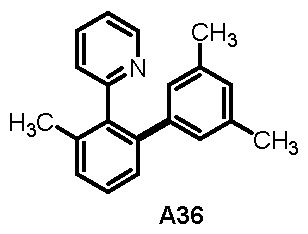 127.5, 127.7, 127.9, 129.1 , 135.6, 136.5, 136.8, 139.2, 141 .3, 141.3, 148.6, 159.7 ppm; mp 58-60 °C; IR vmax (neat/cm 1): 3013, 2912, 2868, 1600, 1460, 1024, 792, 748, 704; HRMS calcd for C2oH2oN [M+H]+: 274.1596, found 274.1583. entry Solvent A36 (%)

2 Toluene 92
3 Gamma-valerolactone 87
4 Propylene carbonate 88
5 EtOAc 95
6 Acetone 87
7 GBL 89
8 Dioxane 87
9 No solvent 12
10 NMP 97
Table 1
The results from Table 1 indicate that cycloruthenated catalysts of formula (I) retain their exceptional catalytic activity in a wide range of organic solvents.
Cyclometalated ruthenium(ll) catalysts screening for the arylation reaction of 2-(o- tolyl)pyridine (N10) with 4-chloroanisole (X40)

The General Procedure C was applied with the appropriate cyclometalated ruthenium(ll) catalyst (0.01 mmol, 5 mol %; see Table 2 below, denoted as [Ru]: Ru1 , 5.7 mg; Ru2, 6.5 mg; Ru3, 5.7 mg; Ru4, 6.1 mg; Ru5, 5.9 mg; Ru6, 5.9 mg; Ru7, 6.3 mg; Ru8, 6.2 mg; Ru9, 5.6 mg; Ru10, 5.7 mg; Ru11 , 6.0 mg; Ru12, 5.6 mg; Ru13, 5.7 mg; Ru14, 5.8 mg; Ru15, 5.6 mg; Ru16, 5.8 mg; Ru17, 6.4 mg; Ru18, 6.2 mg; Ru19, 6.0 mg; Ru20, 6.2 mg; Ru21 , 6.5 mg; Ru22, 6.6 mg; Ru23, 6.0 mg; Ru24, 5.5 mg; Ru25, 6.0 mg; Ru26, 5.8 mg; or Ru27, 8.2 mg), 2-(o-tolyl) pyridine N10 (33.9 mg, 0.20 mmol, 1 equiv.), 4-chloroanisole X40 (24.5 pL, 0.2 mmol, 1 equiv.), and K2C03 (55.3 mg, 0.4 mmol, 2 equiv.) without KOAc. Column
chromatography (hexane/Et20, 9:1) afforded A37 as a light yellow oil (yield, see Table 2 below).
1H-NMR (400 MHz, CDCI3) d 2.17 (s, 3 H), 3.72 (s, 3 H), 6.68 (d, J = 8.4 Hz, 2 H), 6.89 (d, J = 7.8 Hz, 1 H), 6.99 (d, J = 8.4 Hz, 2 H), 7.08-7.1 1 (m, 1 H), 7.27 (d, J = 5.7
Hz, 2 H), 7.34 (t, J = 7.5 Hz, 1 H), 7.45-7.48 (m, 1 H), 8.64 (d, J = 4.8 Hz, 1
H) ppm; 13C-NMR (75 MHz, CDCI3) d 20.5, 55.0, 1 13.0, 121 .2, 125.5,

127.5, 128.0, 129.0, 130.6, 134.0, 135.8, 136.6, 139.2, 140.7, 148.8, 158.0,
159.7 ppm; IR vmax (neat/cm 1): 3000, 2846, 2898, 1598, 1460, 1026, 715; HRMS calcd for C19H18NO [M+H]+: 276.1388, found 276.1382.


Table 2
The results in Table 2 show that the ruthenium(ll) catalysts of formula (I) all display a unique efficacy towards the C-H arylation of DG-containing (hetero)arenes with (hetero)aryl (pseudo)halides.
General Procedure E: preparation of triflate-containing drug derivatives

A 25 mL round bottom flask equipped with a magnetic stirring bar was charged with the appropriate phenol derivative (2.0 mmol, 1 equiv.), K2C03 (552.8 mg, 4.0 mmol, 2 equiv.) and
DMF (7 ml_, 0.29 M). The reaction mixture was stirred at room temperature for 5 min, then 4- nitrophenyltriflate (596.6 mg, 2.2 mmol, 1 .1 equiv.) was added in one portion and the reaction was stirred for additional 4 h. Upon completion, the reaction mixture was diluted with H20 (60 ml_) and extracted with Et20 (3x60 ml_). The intense yellow organic phases were combined and repeatedly washed with saturated K2C03 solution and H20 until a colourless aqueous phase was obtained. The organic phase was further washed with brine, dried over MgS04 and evaporated to dryness. The residue was purified by column chromatography or by trituration with a suitable solvent.
The General Procedure E was applied with d-Tocopherol
(805.3 mg, 2.0 mmol, 1 equiv.). Column chromatography

hexane/CH2CI2 (95:5) afforded d-Tocopherol-OTf X24 as
a colourless oil (802.1 mg, 75%).
1H-NMR (400 MHz, CDCI3) d 0.84-0.94 (m, 12 H), 1 .01 -1 .68 (m, 24 H), 1 .72-1 .91 (m, 2 H), 2.19 (s, 3 H), 2.71 -2.84 (m, 2 H), 6.83 (d, J = 2.8 Hz, 1 H), 6.88 (d, J = 2.8 Hz, 1 H) ppm; 13C- NMR (100 MHz, CDCI3) d 16.2, 19.6, 19.7, 20.9, 22.4, 22.6, 22.7, 24.1 , 24.5, 24.8, 28.0, 30.7,
32.7, 32.8, 37.3, 37.4, 37.4, 37.5, 39.4, 40.1 , 76.8, 1 18.8 (q, J = 320.0 Hz), 1 19.1 , 120.7,
121 .7, 128.4, 141 .5, 151 .7 ppm; 19F-NMR (376 MHz, CDCI3) d -73.1 ppm; I R vmax (neat/cm 1): 2926, 2868, 1472, 1421 , 1206, 1 142; HRMS calcd for C28H4604F3S [M+H]+: 535.3063, found 535.3063 The General Procedure E was applied with Estradiol (544.8 mg, 2.0 mmol,
1 equiv.). Column chromatography (hexane/CH2CI2, 95:5) afforded t
Estradiol-OTf (X27) as a white solid (792.7 mg, 98%).

1H-NMR (400 MHz, CDCI3) d 0.80 (s, 3 H), 1 .14-1 .62 (m, 8 H), 1 .66-1 .79 (m, 1 H), 1 .86-2.04 (m, 2 H), 2.07-2.39 (m, 3 H), 2.84-2.97 (m, 2 H), 3.70-3.81 (m, 1 H), 6.98 (d, J = 2.4 Hz, 1 H), 7.03 (dd, J = 8.4, 2.4 Hz, 1 H), 7.35 (d, J = 8.4 Hz, 1 H) ppm; 13C-NMR (100 MHz, CDCI3) d
1 1 .0, 23.1 , 26.1 , 26.7, 29.5, 30.5, 36.6, 38.2, 43.1 , 44.1 , 50.5, 81 .7, 1 18.1 , 1 18.8 (q, J = 320.0 Hz), 121 .1 , 127.1 , 139.5, 140.9, 147.4 ppm; 19F-NMR (376 MHz, CDCI3) d -73.0 ppm; mp 1 15- 1 18 °C; IR vmax (neat/cm 1): 3376, 2930, 2870, 1418, 1207, 1 139, 919; HRMS calcd for C19H2304CIF3S [M+CI] : 439.0963, found 439.0956.
The General Procedure E was applied with Hymechromone (352.4 mg, 2.0
mmol, 1 equiv.). Column chromatography (hexane/Et20, 9:1) afforded
Hymechromone-OTf X28 as a white solid (548.7 mg, 89%).

1H-NMR (500 MHz, CDCI3) d 2.47 (d, J = 1 .3 Hz, 3 H), 6.37 (q, J = 1 .4 Hz, 1 H), 7.25 (dd, J = 9.0, 2.5 Hz, 1 H), 7.29 (d, J = 2.5 Hz, 1 H), 7.71 (d, J = 9.0 Hz, 1 H) ppm; 13C-NMR (125 MHz,
CDCI3) d 18.7, 1 10.5, 1 16.0, 1 17.4, 1 18.6 (q, J = 319.0 Hz), 120.0, 126.3, 150.7, 151 .2, 154.1 , 159.4 ppm; 19F-NMR (470 MHz, CDCI3) d -72.6 ppm; mp 92-94 °C; IR vmax (neat/cm 1): 3053, 1747, 1608, 1429, 1419, 1241 , 1207, 1 138, 1 1 12, 977; HRMS calcd for C HgOsFsS [M+H]+: 309.0039, found 309.0036. The General Procedure E was applied with Harmol (396.5 mg, 2.0 mmol, 1 H Me equiv.). Column chromatography (EtOAc/CH2CI2, 7:3) afforded Harmol-OTf

X32 as a light brown solid (363.3 mg, 55%). c32
1H-NMR (400 MHz, CDCI3) d 2.85 (s, 3 H), 7.20 (dd, J = 8.8, 2.0 Hz, 1 H), 7.45 (d, J = 2.0 Hz, 1 H), 7.84 (d, J = 5.2 Hz, 1 H), 8.15 (d, J = 8.8 Hz, 1 H), 8.44 (d, J = 5.2 Hz, 1 H), 9.34 (bs, 1 H) ppm; 13C-NMR (100 MHz, CDCI3) d 20.3, 104.9, 1 13.0, 1 13.4, 1 18.8 (q, J = 318.7 Hz), 121 .9, 123.3, 127.4, 135.5, 139.3, 140.0, 142.3, 149.1 ppm; 19F-NMR (376 MHz, CDCI3) d - 72.7 ppm; mp 184-187 °C; IR vmax (neat/cm 1): 3065, 2924, 2854, 1632, 1421 , 1220, 1 140, 1 100; HRMS calcd for C13H803N2F3S [M-H]~: 329.0213, found 329.0209.
The General Procedure E was applied with Ezetimibe (818.9 mg, 2.0
mmol, 1 equiv.). Column chromatography (hexane/Et20, 7:3) afforded
Ezetimibe-OTf X33 as a white solid (953.0 mg, 88%).
1H-NMR (500 MHz, CDCI3) d 1 .85-2.12 (m, 4 H), 2.27 (bs, 1 H), 3.09

(td, J = 7.5, 2.0 Hz, 1 H), 4.68 (d, J = 2.0 Hz, 1 H), 4.73 (t, J = 5.5 Hz, 1 H), 6.97 (t, J = 8.8 Hz, 2 H), 7.03 (t, J = 8.8 Hz, 2 H), 7.17-7.24 (m, 2 H), 7.28-7.34 (m, 4 H), 7.42 (d, J = 8.8 Hz, 2 H) ppm; 13C-NMR (125 MHz, CDCI3) d 25.1 , 36.5, 60.3, 60.5, 73.1 , 1 15.4 (d, J = 21 .3 Hz), 1 16.0 (d, J = 22.5 Hz), 18.3 (d, J = 7.5 Hz), 1 18.6 (q, J = 318.8 Hz), 122.4, 127.3 (d, J = 8.8 Hz), 127.7, 133.4 (d, J = 3.8 Hz), 138.2, 139.9 (d, J = 3.8 Hz), 149.3, 159.1 (d, J = 242.5 Hz), 162.2 (d, J = 245.0 Hz), 166.8 ppm; 19F-NMR (470 MHz, CDCI3) d -1 17.4, -1 14.7, -72.8 ppm; mp 48-51 °C; IR vmax (neat/cm 1): 3433, 2922, 1745, 1509, 1421 , 1216, 1 139; HRMS calcd for C25H2o05NF5NaS [M+Na]+: 564.0875, found 564.0874.
The General Procedure E was applied with Arbutin (544.5 mg, 2.0 mmol,
1 equiv.). After removing the volatile under reduced pressure, the residue

was triturated in CHCI3. The insoluble material was filtered and washed
with CHCI3to afford Arbutin-OTf X34 as a white solid (477.1 mg, 59%).
1H-NMR (400 MHz, aceton e-c/6) d 3.42-3.61 (m, 4 H), 3.71 (dd, J = 9.4, 4.4 Hz, 1 H), 3.89 (dd, J = 9.4, 2.0 Hz, 1 H), 4.29 (bs, 4 H), 5.02 (d, J = 6.0 Hz, 1 H), 7.23 (d, J = 7.2 Hz, 2 H), 7.37 (d, J = 7.2 Hz, 2 H) ppm; 13C-NMR (100 MHz, aceton e-c/6) d 62.5, 71 .2, 74.6, 77.8, 77.9, 102.0, 1 18.8, 1 19.6 (q, J = 254.0 Hz), 123.3, 144.9, 158.5 ppm; 19F-NMR (376 MHz, CDCI3) d -74.1
ppm; mp 129-132 °C; IR vmax (neat/cm 1): 3352, 2889, 1499, 1418, 1210, 1 138, 1071 ; HRMS calcd for C^H^OgCIFsS [M+CI] : 439.0083, found 439.0085.
General Procedure F: preparation of triflate-containing drug derivatives

An oven-dried 25 ml_ Schlenk vial equipped with a magnetic stirring bar was charged with the appropriate phenol derivative (1 .0 mmol, 1 equiv.), sealed with a septum, and evacuated and back-filled with N2 three times. The vial was cooled to -78 °C, then anhydrous CH2CI2 (12.5 mL, 0.08 M) and anhydrous DIPEA (435 pL, 2.5 mmol, 2.5 equiv.) were added. Triflic anhydride (202 pl_, 1 .2 mmol, 1 .2 equiv.) was added dropwise over 5 min and the reaction was stirred at - 78 °C for 1 h. After this time, the mixture was allowed to warm up to room temperature, then it was carefully poured in mixture of saturated NH4CI solution (50 mL) and Et20 (50 mL). The organic phase was separated, and the aqueous phase was further extracted with Et20 (50 mL). The combined organic phases were dried over MgS04, evaporated to dryness and the residue was purified by column chromatography. The General Procedure F was applied with Capsaicin (305.4
mg, 1 .0 mmol, 1 equiv.). Column chromatography

(CH2CI2/Et20, 95:5) afforded Capsaicin-OTf X25 as a white
solid (223.1 mg, 51 %).
NMR analysis shows the product as a mixture of two amide isomers: 1H-NMR (400 MHz, CDCI3) d 0.79-1 .03 (m, 6 H), 1 .07-1 .57 (m, 5 H), 1 .59-1 .76 (m, 2 H), 1 .89-2.12 (m, 1 H), 2.14- 2.30 (m, 2 H), 3.90 (s, 3 H), 4.43 (d, J = 6.0 Hz, 2 H), 5.20-5.46 (m, 1 H), 5.74-5.98 (m, 1 H),
6.86 (d, J = 8.0 Hz, 1 H), 6.97 (s, 1 H), 7.16 (d, J = 8.0 Hz, 1 H) ppm; 13C-NMR (100 MHz, CDCI3) d 22.6, 25.2, 25.7, 27.2, 27.9, 29.3, 29.3, 29.6, 30.9, 32.2, 36.6, 36.7, 38.9, 43.0, 56.2, 1 12.6, 1 18.7 (q, J = 320.0 Hz), 1 19.8, 122.4, 126.3, 137.9, 138.1 , 140.3, 151 .5, 173.0, 173.1 ppm; 19F-NMR (376 MHz, CDCI3) d -73.9 ppm; mp 56-58 °C; IR vmax (neat/cm 1): 3292, 2957, 2929, 2866, 1647, 1505, 1422, 1209, 1 142, 1 109; HRMS calcd for C19H2705NF3S [M+H]+:
438.1557, found 438.1543.

The product X26 was obtained as a mixture of isomers (1H-NMR ratio 79:21) matching the isomer ratio of g-Oryzanol (purchased from TCI). 1H-NMR (500 MHz, CDCI3) d 0.38 (d, J = 4.0 Hz, 1 H), 0.62 (d, J = 4.0 Hz, 1 H), 0.74-2.45 (m, 45 H), 3.94-3.99 (m, 3 H), 4.65-4.77 (m, 2 H), 6.39-6.47 (m, 1 H), 7.1 1 -7.19 (m, 2 H), 7.24 (d, J = 8.5 Hz, 1 H), 7.62 (d, J = 16.0 Hz, 1 H) ppm; 13C-NMR chemical shifts of the major isomer: 13C-NMR (125 MHz, CDCI3) d 15.3, 18.0, 18.3, 19.3, 20.2, 20.9, 21 .9, 22.0, 25.5, 25.8, 25.9, 26.5, 26.9, 28.1 , 29.8, 31 .3, 31 .6, 32.8, 33.8, 35.0, 35.5, 36.1 , 39.7, 47.2, 47.8, 48.8, 52.2, 56.3, 81 .1 , 105.9, 1 1 1 .9, 1 18.7 (q, J = 318.8 Hz), 120.9, 120.9, 122.8, 135.8, 139.6, 142.4, 151 .6, 156.9, 166.2 ppm; 19F-NMR (470 MHz, CDCI3) d -73.8 ppm; mp 150-153 °C; IR vmax (neat/cm 1): 2940, 2869, 1709, 1424, 1208, 1 175, 1 141 , 1 109; HRMS calcd for C4I H5807N5F3S [M+H]+: 735.3901 , found 735.3875.
Preparation of triflate-containing drug derivative Naltrexone-OTf (X30)

(1 equiv., 1.0 mmol) (1.1 equiv.) X30, 71 %
An oven-dried 25 ml_ Schlenk vial equipped with a magnetic stirring bar was charged with Naltrexone · HCI (377.9 mg, 1 .0 mmol, 1 equiv.) and DMAP (6.1 mg, 0.05 mmol, 5 mol%). The vial was sealed with a septum, evacuated and back-filled with N2 three times, cooled to 0 °C, and anhydrous CH2CI2 (12.5 ml, 0.08 M) and anhydrous DIPEA (523 pL, 3.0 mmol, 3 equiv.) were added via syringe. Under a positive flow of N2, phenylbis(trifluoromethanesulfonimide) (393.0 mg, 1 .1 mmol, 1 .1 equiv.) was added. The mixture was stirred at 0 °C for 2 h and then at room temperature for additional 16 h. After this time, the reaction was diluted with 50 mL of Et20 and washed with 7% NH4OH solution (2x20 mL). The combined organic phases were further washed with K2CQ3 (2 M) until disappearance of phenylbis(trifluoromethanesulfonimide)
(10x20 ml_). The organic phase was dried over MgS04 and evaporated to dryness to afford Naltrexone-OTf X30 as a colourless film (336.2 mg, 71 %).
1H-NMR (500 MHz, CDCI3) d 0.1 1 -0.21 (m, 2 H), 0.53-0.63 (m, 2 H), 0.82-0.93 (m, 1 H), 1 .54 (dd, J = 13.0, 3.0 Hz, 1 H), 1 .60 (td, J = 14.0, 3.5 Hz, 1 H), 1 .93 (ddd, J = 13.5, 5.3, 3.0 Hz, 1 H), 2.09 (td, J = 12.5, 4.0 Hz, 1 H), 2.34 (dt, J = 14.5, 3.3 Hz, 1 H), 2.42 (d, J = 6.5 Hz, 2 H),
2.47 (td, J = 12.5, 5.5 Hz, 1 H), 2.63 (dd, J = 19.0, 6.0 Hz, 1 H), 2.74 (dd, J = 12.0, 5.0 Hz, 1 H), 3.04 (td, J = 14.5, 5.0 Hz, 1 H), 3.12 (d, J = 19.0 Hz, 1 H), 3.23 (d, J = 6.0 Hz, 1 H), 4.80 (s, 1 H), 5.17 (bs, 1 H), 6.73 (d, J = 8.3 Hz, 1 H), 7.01 (d, J = 8.3 Hz, 1 H) ppm; 13C-NMR (125 MHz, CDCI3) d 3.8, 4.0, 9.3, 23.0, 30.8, 31 .3, 36.0, 43.2, 50.9, 59.2, 61 .7, 69.8, 91 .4, 1 18.6 (q, J = 318.9 Hz), 1 19.8, 122.7, 131 .2, 131 .6, 133.3, 147.7, 206.3 ppm; 19F-NMR (470 MHz, CDCI3) d -73.1 ppm; IR vmax (neat/cm 1): 3006, 2928, 2829, 1730, 1450, 1423, 1221 , 1 140; HRMS calcd for C21H2306NF3S [M+H]+: 474.1 193, found 474.1 180.
Preparation of the natural product derivative Br-Strychnine (X20)

(1 equiv., 4 mmol) X20, 73%
In a 100 ml_ round-bottom flask equipped with a magnetic stirring bar, Strychnine (1 .338 g, 4.0 mmol, 1 equiv.) was stirred in AcOH (40 ml_, 0.1 M) until complete dissolution. Then the mixture was cooled to 10 °C and bromine (226 pL, 4.4 mmol, 1 .1 equiv.) was added dropwise over 5 min. Terminated the addition, the cooling bath was removed and the stirring was continued for additional 20 min. After this time, the reaction crude was carefully poured in a vigorously stirred mixture composed by saturated K2C03 solution (200 ml_), saturated Na2S203 solution (200 ml_), ice (200 g) and EtOAc (200 ml_). The mixture was stirred for 10 minutes, the organic layer separated, and the aqueous phase further extracted with 100 ml_ of EtOAc. The combined organic phases were dried over MgS04, evaporated to dryness, and the residue was purified by column chromatography (CH2CI2/MeOH, from 99:1 to 94:6) affording the title compound as a white solid. Br-Strychnine was further purified by slow recrystallization from MeOH (1 .21 g, 73%). After purification, Br-Strychnine X20 must be stored under inert atmosphere as an impurity that makes it unsuitable for the arylation process quickly develops.
1H-NMR (400 MHz, CDCI3) d 1 .25 (dt, J = 10.4, 3.2 Hz, 1 H), 1 .45 (d, J = 14.4 Hz, 1 H), 1 .81 - 1 .94 (m, 2 H), 2.36 (dt, J = 14.4, 4.4 Hz, 1 H), 2.64 (dd, J = 17.6, 3.2 Hz, 1 H), 2.72 (d, J = 14.8 Hz, 1 H), 2.79-2.92 (m, 1 H), 3.06-3.17 (m, 2 H), 3.18-3.26 (m, 1 H), 3.69 (d, J = 14.8 Hz, 1 H), 3.83-3.93 (m, 2 H), 4.04 (dd, J = 13.8, 6.0 Hz, 1 H), 4.14 (dd, J = 13.8, 6.8 Hz, 1 H), 4.28 (dt, J = 8.4, 3.2 Hz, 1 H), 5.91 (t, J = 5.8 Hz, 1 H), 7.24 (d, J = 2.0 Hz, 1 H), 7.34 (dd, J = 8.4, 2.0 Hz, 1 H), 7.96 (d, J = 8.4 Hz, 1 H) ppm; 13C-NMR (100 MHz, CDCI3) d 26.8, 31 .4, 42.3, 42.7, 48.0,
50.2, 51 .8, 52.5, 60.2, 60.3, 64.5, 77.4, 1 16.5, 1 17.6, 125.5, 127.6, 131 .4, 135.0, 139.9, 141 .3, 169.3 ppm; mp decomposes above 200 °C; IR vmax (neat/crrf1): 2948, 2902, 2860, 1668, 1470, 1379, 1 103; HRMS calcd for C21H2202N2Br [M+H]+: 413.0859, found 413.0866.
General Procedure G: preparation of methyl ester derivatives
K2C03 (2 equiv.)
CK + CHol
DMF (0.5 M),
OH
40 °C, 16 h CK O.CH3
(1 equiv.) (1.2 equiv.)

In a 25 ml_ round-bottom flask equipped with a magnetic stirring bar, the appropriate carboxylic acid derivative (2.0 mmol, 1 equiv.), K2C03 (552.8 mg, 4.0 mmol, 2 equiv.) and DMF (4 mL, 0.5 M) were added. Then, methyl iodide (149 pL, 2.4 mmol, 1 .2 equiv.) was added and the reaction mixture was heated at 40 °C for 16 h. Upon completion, the reaction crude was diluted with H20 (30 mL) and Et20 (30 mL). The organic phase was washed with H20 (3x20 mL), saturated K2C03 (3x20 mL), brine (30 mL), dried over MgS04, and evaporated to dryness to afford the desired methyl ester derivative.
The General Procedure G was applied with Indometacin (715.6 mg, 2.0
mmol, 1 equiv.). Indometacin methyl ester X3 was obtained as a pale
yellow solid (699.0 mg, 94%).
1H-NMR (400 MHz, CDCI3) d 2.40 (s, 3 H), 3.68 (s, 2 H), 3.72 (s, 3 H),

3.85 (s, 3 H), 6.68 (dd, J = 9.2, 2.4 Hz, 1 H), 6.87 (d, J = 9.2 Hz, 1 H), 6.97
(d, J = 2.4 Hz, 1 H), 7.48 (d, J = 8.4 Hz, 2 H), 7.67 (d, J = 8.4 Hz, 2 H) ppm; 13C-NMR (100 MHz, CDCI3) d 13.3, 30.1 , 52.1 , 55.7, 101 .3, 1 1 1 .6, 1 12.5, 1 14.9, 129.1 , 130.6, 130.7, 131 .1 , 133.8, 135.9, 139.2, 156.0, 168.2, 171 .3 ppm; mp 86-87 °C; IR vmax (neat/cm 1): 3124, 2961 ,
2830, 1731 , 1 1667, 1363, 1 167, 913, 751 ; HRMS calcd for C2oH1904NCI [M+H]+: 372.0996, found 372.0997.
The General Procedure G was applied with Oxaprozin (586.6 mg, 2.0 mmol, 1 equiv.). Oxaprozin methyl ester N7 was obtained as a pale
yellow solid (596.3 mg, 97%).

1H-NMR (400 MHz, CDCI3) d 2.93 (t, J = 7.6 Hz, 2 H), 3.21 (t, J = 7.6 Hz,
2 H), 3.75 (s, 3 H), 7.29-7.42 (m, 6 H), 7.59 (d, J = 6.4 Hz, 2 H), 7.65 (t, J = 6.8 Hz, 2 H) ppm; 13C-NMR (100 MHz, CDCI3) d 23.6, 30.9, 51 .9, 126.5, 127.9, 128.1 , 128.5, 128.6, 128.6, 129.0, 132.5, 135.2, 145.4, 161 .7, 172.5 ppm; mp 58-60 °C; IR vmax (neat/cm 1): 3059, 2951 , 1738, 1437, 1 169; HRMS calcd for C19H1803N [M+H]+: 308.1281 , found 308.1277. Identification of the key bis-cyclometalated Ru(ll) intermediate iii described in Scheme 2

An oven dried NMR tube equipped with J. Young valve was transferred to a glove box, then Ru22 (16.4 mg, 0.025 mmol, 1 equiv.), 2-arylpyridine L22 (6.5 mg, 1 .05 equiv.), K2C03 (10.4 mg, 3 equiv.), KOAc (0.7 mg, 0.3 equiv.), benzene-cf6 (400 pL) and NMP (100 pl_) were added. The tube was transferred out of the glove and analysed by NMR (time= 0 min). Then, it was placed in oil bath at 80 °C where it was periodically shaken. At 20, 40, 80, and 180 min the tube was removed from the oil bath just for the time needed for acquiring the NMR data. A change in colour from yellow/orange to deep red is associated with the formation of Ru22-bis. After this time, the tube was brought inside a glove and 5-iodo-m-xylene X38 (9 mI_, 2.5 equiv.) was added. Finally, the tube was transferred out of the glove box and the reaction was monitored at 3, 20, 60, 100, 260 and 600 min by NMR at 25 °C. The reaction of cyclometalated complex Ru22 with 2-arylpyridine L22 was followed by 1H and 19F NMRs (see Figure 1 b). A rapid ligand exchange took place at room temperature between the acetonitrile ligands of Ru22 and NMP to produce Ru22-a (Figure 1 b, spectra a-c). After 180 min
at 80 °C, Ru22/Ru22-a had quantitatively reacted with L22 forming the bis-cyclometalated Ru(ll) species Ru22-bis. Then, 5-iodo-m-xylene X38 was added and the reaction was monitored at 25 °C. Over 600 min, Ru22-bis quantitatively reacted with X38 forming arylated product B11 , along with the cyclometalated complexes Ru22-a and Ru22-b deriving from reductive elimination. This experiment provides evidence that the catalytic cycle reported in Scheme 2 is, indeed, operating.
Figure 1 b shows 1H NMR and 19F NMR expansions of the diagnostic area of the NMR spectra of: (a) Ru22 in acetonitrile-cf3; (b) A freshly prepared sample of Ru22 in 400 pL benzene-cf6 + 100 pl_ NMP showing the formation of Ru22-a likely due to ligand exchange of MeCN ligand(s) with NMP solvent; (c) Ru22 after 12 hours at 25 °C in 400 mI_ benzene-cf6 + 100 mI_ NMP showing a different ratio between Ru22 and Ru22-a with respect that present in (b); ( d) L22 in 400 pl_ benzene-cf6 + 100 mI_ NMP; ( Time 0-180 min) Reaction between Ru22/Ru22-a and L22 showing the formation of Ru22-bis. The relative intensity of the NMR peaks of Ru22/Ru22-a and L22are due to partial solubility of Ru22/Ru22-a in the solvent system; ( Time 3-600 min) Reaction between Ru22-bis and X38 showing the formation of B11 , Ru22-a and Ru22-b; (e) B11 in 400 pL benzene-cf6 + 100 mI_ NMP; ( f) A freshly prepared sample of Ru22 + Kl (excess) in 400 mI_ benzene-cf6 + 100 pL NMP. Ru22-b was instantaneously formed after the addition of Kl. The NMR samples (a)-(f) were prepared in a glove box using NMR tubes equipped with J. Young valves and their spectra are displayed in Figure 1 b for clarity.
Preparation of the bis-cycloruthenated intermediate Ru22-bis described in Figure 1a

Ru22 (1.0 equiv) L22 (1.1 equiv.) Ru22-bis, 72%
An oven dried crimp-cap microwave vial equipped with a stirring bar was transferred to a glove box, then Ru22 (65.7 mg, 0.1 mmol, 1 equiv.), 2-arylpyridine L22 (27.2 mg, 0.1 1 mmol, 1 .1 equiv.), K2C03 (41 .5 mg, 0.3 mmol, 3 equiv.), KOAc (4.9 mg, 0.05 mmol, 0.5 equiv.), benzene (1 .9 ml_) and NMP (0.1 ml_) were added. The vial was placed in a heating block at 80 °C and stirred for 18 h. Upon completion, the reaction crude was diluted with benzene and filtered through a short plug of Celite®. The solution was concentrated under reduced pressure and the resulting residue was redissolved in a minimum amount of benzene. Ru22-bis was precipitated after the addition pentane as a deep red solid (48.7 mg, 72%). Ru22-bis must be kept in a glove box as it quickly decomposes if exposed to air.
1H-NMR (500 MHz, C6D6) d 0.59 (s, 6 H), 1 .84 (s, 6 H), 2.01 (s, 6H), 2.06 (s, 6 H), 2.10 (s, 6 H), 8.56 (s, 2 H), 9.30 (s, 2 H) ppm; 13C-NMR (125 MHz, C6D6) d 10.9 (dd, J = 7.1 Hz), 1 1 .8- 11.9 (m), 16.7, 19.4, 114.1 (dd, J = 20.4, 3.4 Hz), 122.4 (dd, J = 26.6, 4.8 Hz), 123.4 (d, J = 22.3 Hz), 127.4, 133.3 (dd, J = 21 .6, 4.9 Hz), 142.0, 149.5 (d, J = 41 .3 Hz), 151 .2, 156.6 (d, J = 246.1 Hz), 165.1 (d, J = 7.6 Hz), 167.6 (d, J = 222.8 Hz), 170.3 (d, J = 54.4 Hz) ppm (Me group of the MeCN ligand is missing due to an upfield shift); 19F-NMR (376 MHz, C6D6) d -124.2 (d, J = 23.3 Hz), -123.6 (d, J = 23.3 Hz) ppm.
Preparation of 2-arylpyridine L22

(28 mmol, 1 equiv.) (1 .5 equiv.)
 A 50 mL Schlenk flask equipped with a magnetic stirring bar was charged with 1 ,4-difluoro-2,3- dimethylbenzene (3.98 g, 28 mmol, 1 equiv.) and AICI3 (8.96 g, 67.2 mmol, 2.4 equiv.). The reaction was heated at 60 °C under vigorous stirring and acetyl chloride (3.0 mL, 42 mmol, 1 .5 equiv.) was slowly added via syringe over 5 min. Then, the mixture was heated at 95 °C and the progression of the reaction was monitored by GC-MS. At complete conversion (about 2 h) the mixture was slowly poured onto a mixture of ice (200 g) and H20 (200 mL). The aqueous phase was extracted with Et20, dried over MgS04 and evaporated to dryness. The residue was purified by column chromatography (hexane/Et20, 9:1) affording the desired acetophenone derivative as a pale yellow oil (4.13 g, 80%).
1H-NMR (500 MHz, CDCI3) d 2.21-2.26 (m, 6 H), 2.59-2.64 (m, 3 H), 7.35 (dd, J
= 9.5, 6.0 Hz, 1 H) ppm; 13C-NMR (125 MHz, CDCI3) d 1 1.2 (dd, J = 6.5, 2.0 Hz),
11.7 (dd, J = 4.5, 2.0 Hz), 31.3 (d, J = 8.3 Hz), 112.7 (dd, J = 26.9, 3.6 Hz),

123.6 (dd, J = 17.0, 6.9 Hz), 126.7 (dd, J = 20.3, 4.1 Hz), 131.4 (dd, J = 18.5,
5.3 Hz), 156.4 (dd, J = 246.8, 2.0 Hz), 156.8 (dd, J = 239.6, 2.0 Hz), 195.0 (dd, J = 3.5, 1.1 Hz) ppm; 19F-NMR (470 MHz, CDCI3) d -121.0 (d, J = 18.8 Hz), -117.6 (d, J = 18.8 Hz) ppm; IR vmax (neat/cm 1): 3006, 2932, 1684, 1625, 1473, 1416, 1361 , 1322, 1286, 1237, 1192, 1088; HRMS calcd for C^H OFz [M+H]+: 185.0772, found 185.0772.

A 50 mL round-bottom flask equipped with a magnetic stirring bar was charged with 1 -(2,5- difluoro-34-dimethylphenyl)ethan-1 -one (2.58 g, 14 mmol, 1 equiv.) and dry pyridine (3.5 mL, 4 M). A solution of Iodine (3.64 g, 14.35 mmol, 1 .025 equiv.) in dry pyridine (5.6 mL, 2.56 M) was added and the mixture was stirred at 80 °C for 16 h. Upon completion, the reaction was cooled to room temperature. The precipitate was filtered, washed once with pyridine, diethyl ether, dried under vacuum and recrystallized from boiling ethanol. The corresponding pyridinium derivative was obtained as light brown powder, dried under vacuum and directly employed in the next step. A 100 mL round-bottom flask equipped with a magnetic stirring bar was loaded with the pyridinium salt (4.8 g, 12.38 mmol, 1 equiv.), ammonium acetate (3.82 g, 49.52 mmol, 4 equiv.), tiglic aldehyde (2.48 mL, 24.76 mmol, 2 equiv.), formamide (31 mL, 0.4 M) and heated at 80 °C for 16 h. After this time, the mixture was cooled to room temperature and extracted with Et20 (3x150 mL). The ethereal phases were united, evaporated to dryness, and the residue was purified by column chromatography (hexane/Et20, 85:15) affording L22 as a colourless solid (2.01 g, 58% over 2 steps).
1H-NMR (500 MHz, CDCI3) d 2.24 (d, J = 2.0 Hz, 3 H), 2.26 (d, J = 2.5 Hz, 3 H), Me
2.29 (s, 3 H), 2.33 (s, 3 H), 7.46 (dd, J = 10.5, 6.5 Hz, 1 H), 7.55 (d, J = 2.0 Hz, 1
H), 8.42 (s, 1 H) ppm; 13C-NMR (125 MHz, CDCI3) d 1 1 .3 (dd, J = 4.6, 2.0 Hz),
1 1 .4 (dd, J = 6.5, 2.3 Hz), 16.2, 19.4, 1 13.3 (dd, J = 26.9, 4.0 Hz), 125.1 (d, J =
9.3 Hz), 125.3-125.9 (m, 3 C), 131 .2, 145.9, 149.9, 150.7, 154.4 (dd, J = 240.9,

Me
2.1 Hz), 157.1 (dd, J = 237.5, 2.1 Hz) ppm; 19F-NMR (470 MHz, CDCI3) d -125.8 L22 (d, J = 18.3 Hz), -122.3 (d, J = 19.3 Hz) ppm; mp 105-109 °C; IR vmax (neat/cm 1): 2994, 2921 , 2854, 1594, 1557, 1489, 1467, 1442, 1417, 1236, 1 193, 1083; HRMS calcd for C15H16NF2 [M+H]+: 248.1245, found 248.1240.
Comparison of the catalytic activity of cyclometalated ruthenium(ll) catalysts and ruthenium-catalysts cym-Ru1 and cym-Ru2
The rate of the reaction catalysed by Ru16 and KOAc was compared to that of cym-Ru1 and cym-Ru2, which are the most widely employed state-of-the-art ruthenium-catalysts (for examples see: Adv. Organomet Chem. 2017, 67, 299-399; ACS Catal. 2017, 7, 5721-5745). Particularly, the C-H arylation of 2-phenylpyridine N11 with 5-iodo-m-xylene X38 was monitored over time at 35 °C (see Table 3 below and Figure 2). Remarkably, while the cyclometalated Ru16 catalyst afforded a combined yield of 89% of mono (B10) and diarylated (B10-bis) adducts in 420 min, cym-Ru1 and cym-Ru1 were essentially inactive. These results
demonstrate that cycloruthenated catalysts of formula (I) possess a far superior catalytic activity than the commonly employed Ru(ll) species like cym-Ru1 or cym-Ru2, enabling reactivity to occur at unprecedentedly low temperatures.


Table 3. An oven dried crimp-cap microwave vial equipped with a stirring bar was transferred to a glove box, then the appropriate Ru-catalyst denoted as [Ru] (10 mol %, 0.08 mmol: cym- Ru1 , 45.1 mg; cym-Ru2, 28.3 mg; Ru16, 46.3 mg), K2C03 (331.7 mg, 2.4 mmol, 3 equiv.), KOAc (if needed: 15.7 mg, 0.16 mmol, 0.2 equiv.), 2-phenylpyridine N11 (124.2 mg, 0.8 mmol,
1 equiv.), 5-iodo-m-xylene X38 (230.9 mI_, 1 .6 mmol, 2 equiv.) and hexadecane (internal standard^ 5 mI_, 0.064 equiv.) were loaded. NMP (800 mI_, 1 M) that had been preheated to 35 °C was added and the vial instantly placed in a heating block set at 35 °C. Aliquots (=50-100 mI_) were taken at the given time periods via syringe (1 mL disposable). Then, the syringes were transferred out of the glove box, flushed and eluted in a short silica plug with Et20/pyridine (99:1) directly inside a GC vial. The yields were determined by quantitative GC- FID analysis
Figure 2 shows a comparison of the catalytic activity of the system constituted by cycloruthenated Ru16 catalyst and KOAc (filled squares) with respect to cym-Ru1 (hollowed circles) and cym-Ru1 (crosses) catalysts. For further information see Table 3.
Comparison of the activity of cyclometalated ruthenium(ll) catalyst Ru9 with that of catalysts cym-Ru1 and cym-Ru2
To further illustrate the disparity in reactivity between cycloruthenated catalysts of formula (I) and commonly employed Ru(ll) catalysts in C-H arylation, cym-Ru1 , cym-Ru2 and Ru9 catalysts were used for the coupling of two heavily-functionalised substrates. While Ru9 provided superb yield of the targeted arylated compounds D1 -D4, catalysts cym-Ru1 and cym-Ru2 were essentially inactive (see Table 5 below).

Claims
1 . A process for forming a carbon-carbon bond to couple an aryl or heteroaryl group of a first compound with an aryl or heteroaryl group of a second compound, the process comprising reacting the first compound with the second compound in the presence of a catalytically effective amount of a neutral or cationic ruthenium(ll) catalyst of formula (I):

formula (I)
wherein:
each L is independently selected from neutral and anionic ligands in any combination that balances the bonding and charge requirements of the ruthenium, and wherein any two ligands L can be linked so as to form a bidentate ligand; and
X and Y together form a bidentate cyclometalated ligand for the ruthenium, wherein the bidentate cyclometalated ligand comprises an organic group represented by X which is bonded to the ruthenium by a heteroatom selected from N, P or O (preferably N or P) and an organic group represented by Y which is bonded to the ruthenium via an sp2 or an sp3 carbon.
2. A process according to claim 1 , wherein the organic group represented by Y comprises an aryl or heteroaryl group bonded to the ruthenium via an sp2 or an sp3 carbon atom.
3. A process according to a claim 1 or 2, wherein the bidentate cyclometalated ligand forms a 5- or 6-membered ruthenacycle with the ruthenium.
4. A process according to any preceding claim, wherein the organic group represented by Y comprises a group of formula (II) bonded to the ruthenium via an sp2 or an sp3 carbon atom:

formula (II)
wherein
A represents an optionally substituted aryl or heteroaryl group;
n is 0 or 1 ; and
RT and R2 are each independently selected from H or (1 -4C)alkyl.
5. A process according to any preceding claim, wherein the neutral or cationic ruthenium(ll) catalyst is represented by the formula (IA):

formula (IA)
wherein
L is as defined in claim 1 ;
A represents an optionally substituted aryl or heteroaryl group;
X’ represents NR6R7 and Y’ represents NR , CR12Ri3 or C(O), or X’ represents PR8R9 and Y’ represents CR12Ri3, or X’ represents O and Y’ represents CR12R13 or C(O); wherein R6 R7 R8, Rg, R , R12 and R13 are each independently selected from H, (1 -10C)alkyl, (1 - 10C)alkoxy, heteroaryl, heterocyclyl, aryl and (4-10C)cycloalkyl, or R6 and R7 or R8 and Rg together with the N or P to which they are attached form a 4 to 8 membered heterocyclyl group and/or R12 and R13 together with the C to which they are attached form a (4-10C)cycloalkyl group, wherein any of the (1 -10C)alkyl, (1 -10C)alkoxy, heteroaryl, heterocyclyl, aryl and (4- 10C)cycloalkyl groups is optionally substituted;
or any of the groups R6 R7 R8 or Rg, and any of the groups R , R12 or R13 together with the N, C or P to which they are attached may form a cycloalkyl, heterocyclyl, heteroaryl or aryl ring, wherein the cycloalkyl, heterocyclyl, heteroaryl or aryl ring so formed is optionally substituted.
6. A process according to any of claims 1 to 4, wherein the neutral or cationic ruthenium(ll) catalyst is represented by the formula (IB):

formula (IB)
wherein
L is as defined in claim 1 ;
n is O oM ;
RT and R2 are each independently selected from H or (1 -4C)alkyl;
A represents an optionally substituted aryl or heteroaryl group;
p represents 0 or 1 ;
Z represents CR3R4, O or NR5, wherein R3, R4 and R5 each independently represent H or (1 -4C)alkyl;
X’ represents NR14 and Y’ represents CR15 or N, wherein R14 and R15 are each independently selected from H, (1 -10C)alkyl, (1 -10C)alkoxy, heteroaryl, heterocyclyl, aryl and (4-10C)cycloalkyl, wherein any of the (1 -10C)alkyl, (1 -10C)alkoxy, heteroaryl, heterocyclyl, aryl and (4-10C)cycloalkyl groups is optionally substituted;
or the group R14 and the group R15 can together with the N or C to which they are attached form a heterocyclyl or heteroaryl ring, wherein the heterocyclyl or heteroaryl ring so formed is optionally substituted.
7. A process according to any of claims 4 to 6, wherein A represents an optionally substituted phenyl group.
8. A process according to claim 5 or 7, wherein the neutral or cationic ruthenium(ll) catalyst is represented by the formula (IA’):

formula (IA’) wherein:
L is as defined in claim 1 ;
q represents 0, 1 , 2, 3 or 4;
X’ represents NR6R7 and Y’ represents CR12Ri3 or C(O), or X’ represents PR8R9 and Y’ represents CR12Ri3, X’ represents O and Y’ represents CR12R13 or C(O);
wherein R6 R7 R8, Rg, R12 and R13 are each independently selected from H, (1- 10C)alkyl, (1-10C)alkoxy, heteroaryl, heterocyclyl, aryl and (4-10C)cycloalkyl, or R6 and R7 or R8 and Rg together with the N or P to which they are attached form a 4 to 8 membered heterocyclyl group and/or R12 and R13 together with the C to which they are attached form a (4- 10C)cycloalkyl group, wherein any of the (1-10C)alkyl, (1-10C)alkoxy, heteroaryl, heterocyclyl, aryl and (4-10C)cycloalkyl groups is optionally substituted;
each R16 is independently selected from halo, (1-10C)alkyl, (1-10C)alkoxy, phenoxy, trifluoromethyl, (3-8C)cycloalkyl, aryl, heteroaryl, (2-10C)alkenyl, hydroxyl, amino, (1- 10C)alkylamino, di[(1-10C)alkyl]amino, (1-10C)alkanoyl, (1-10C)alkylthio, amido, (1- 10C)alkylamido, di[(1-10C)alkyl]amido and carboxy(1-10C)alkyl.
9. A process according to claim 5 or 7, wherein the neutral or cationic ruthenium(ll) catalyst is represented by the formula (IA”):

formula (IA”)
wherein:
L is as defined in claim 1 ;
q represents 0, 1 , 2, 3 or 4;
B represents a heteroaryl or heterocyclyl group containing a heteroatom N or P represented by X” and a heteroatom N or an sp2 or sp3 C represented by Y”, wherein the heteroaryl or heterocyclyl group is optionally substituted;
each R16 is independently selected from halo, (1-10C)alkyl, (1-10C)alkoxy, phenoxy, trifluoromethyl, (3-8C)cycloalkyl, aryl, heteroaryl, (2-10C)alkenyl, hydroxyl, amino, (1- 10C)alkylamino, di[(1-10C)alkyl]amino, (1-10C)alkanoyl, (1-10C)alkylthio, amido, (1- 10C)alkylamido, di[(1-10C)alkyl]amido and carboxy(1-10C)alkyl.
10. A process according to claim 6 or 7, wherein the neutral or cationic ruthenium(ll) catalyst is represented by the formula (IB’):

formula (IB’)
wherein:
L is as defined in claim 1 ;
p represents 0 or 1 ;
r represents 0, 1 , 2, 3 or 4;
Z represents CR3R4, O or NR5, wherein R3, R4 and R5 each independently represent H or (1-4C)alkyl;
wherein R14 and R15 are each independently selected from H, (1-10C)alkyl, (1- 10C)alkoxy, heteroaryl, heterocyclyl, aryl and (4-10C)cycloalkyl, wherein any of the (1- 10C)alkyl, (1-10C)alkoxy, heteroaryl, heterocyclyl, aryl and (4-10C)cycloalkyl, groups is optionally substituted;
or the group R14 and the group R15 can together with the N and C to which they are attached form a heterocyclyl or heteroaryl ring, wherein the heterocyclyl or heteroaryl ring so formed is optionally substituted;
each R17 is independently selected from halo, (1-10C)alkyl, (1-10C)alkoxy, phenoxy, trifluoromethyl, (3-8C)cycloalkyl, aryl, heteroaryl, (2-10C)alkenyl, hydroxyl, amino, (1- 10C)alkylamino, di[(1-10C)alkyl]amino, (1-10C)alkanoyl, (1-10C)alkylthio, amido, (1- 10C)alkylamido, di[(1-10C)alkyl]amido and carboxy(1-10C)alkyl.
11. A process according to any of claims 1 to 4, wherein the neutral or cationic ruthenium(ll) catalyst is represented by the formula (IC):

formula (IC)
wherein:
L is as defined in claim 1 ;
s represents 0, 1 , 2 or 3;
t represents 0, 1 , 2 or 3;
each R18 and R19 is independently selected from halo, (1 -10C)alkyl, (1 -10C)alkoxy, phenoxy, trifluoromethyl, (3-8C)cycloalkyl, aryl, heteroaryl, (2-10C)alkenyl, hydroxyl, amino, (1 - 10C)alkylamino, di[(1 -10C)alkyl]amino, (1 -10C)alkanoyl, (1 -10C)alkylthio, amido, (1 - 10C)alkylamido, di[(1 -10C)alkyl]amido and carboxy(1 -10C)alkyl;
å! represents -C=C-, -C=N- or -N=C-.
12. A process according to any of claims 1 to 4, wherein the neutral or cationic ruthenium(ll) catalyst is represented by the formula (ID):

formula (ID)
wherein:
L is as defined in claim 1 ;
RT and R2 are each independently selected from H or (1 -4C)alkyl;
u represents 0, 1 , 2 or 3;
v represents 0, 1 , 2 or 3;
each R22 and R23 is independently selected from halo, (1 -10C)alkyl, (1 -10C)alkoxy, phenoxy, trifluoromethyl, (3-8C)cycloalkyl, aryl, heteroaryl, (2-10C)alkenyl, hydroxyl, amino, (1 - 10C)alkylamino, di[(1 -10C)alkyl]amino, (1 -10C)alkanoyl, (1 -10C)alkylthio, amido, (1 - 10C)alkylamido, di[(1 -10C)alkyl]amido and carboxy(1 -10C)alkyl.
13. A process according to any preceding claim, wherein the neutral or cationic ruthenium(ll) catalyst is selected from any one of the following:
 wherein L is as defined in claim 1 .
14. A process according to claims 1 to 10, wherein the neutral or cationic ruthenium(ll) catalyst is selected from any one of the following:

15. A process according to any preceding claim wherein the first compound comprises an aryl or heteroaryl group having a first ring atom which is a carbon atom having a hydrogen bonded thereto and a second ring atom which is ortho to the first ring atom and which has a nitrogen containing directing group (or a salt or protected derivative thereof) bonded thereto,
and wherein the second compound comprises an aryl or heteroaryl group having a first ring atom which is a carbon atom having a leaving group bonded thereto, such that the reaction between the first compound and the second compound results in the formation of a carbon- carbon bond between the first ring atom of the first compound and the first ring atom of the second compound.
16. A process according to claim 15, wherein the directing group is selected from any one of the following:

17. A process according to any preceding claim which is conducted at a temperature from 25 to 60°C, preferably 25 to 50°C.
18. A cationic ruthenium(ll) catalyst selected from any one of the following:

Applications Claiming Priority (2)
| Application Number | Priority Date | Filing Date | Title |
|---|---|---|---|
| GBGB1807672.9A GB201807672D0 (en) | 2018-05-11 | 2018-05-11 | Process |
| GB1807672.9 | 2018-05-11 |
Publications (1)
| Publication Number | Publication Date |
|---|---|
| WO2019215426A1 true WO2019215426A1 (en) | 2019-11-14 |
Family
ID=62623249
Family Applications (1)
| Application Number | Title | Priority Date | Filing Date |
|---|---|---|---|
| PCT/GB2019/051226 Ceased WO2019215426A1 (en) | 2018-05-11 | 2019-05-02 | Process for forming a carbon-carbon bond |
Country Status (2)
| Country | Link |
|---|---|
| GB (1) | GB201807672D0 (en) |
| WO (1) | WO2019215426A1 (en) |
Cited By (1)
| Publication number | Priority date | Publication date | Assignee | Title |
|---|---|---|---|---|
| WO2025132190A1 (en) | 2023-12-22 | 2025-06-26 | Synthon B.V. | A process for making trametinib |
-
2018
- 2018-05-11 GB GBGB1807672.9A patent/GB201807672D0/en not_active Ceased
-
2019
- 2019-05-02 WO PCT/GB2019/051226 patent/WO2019215426A1/en not_active Ceased
Non-Patent Citations (19)
| Title |
|---|
| ACS CATAL., vol. 7, 2017, pages 5721 - 5745 |
| ADV. ORGANOMET. CHEM., vol. 67, 2017, pages 299 - 399 |
| ANGEW. CHEM., INT. ED., vol. 54, 2015, pages 14103 - 14107 |
| ANGEW. CHEM., INT. ED., vol. 54, 2015, pages 5513 - 5517 |
| CHIN. CHEM. LETT., vol. 26, 2015, pages 881 - 884 |
| EUR. J. MED. CHEM., vol. 85, 2014, pages 418 - 437 |
| INORGANICA CHIM. ACTA, vol. 363, 2010, pages 567 - 573 |
| J. AM. CHEM. SOC., vol. 125, 2003, pages 8708 - 8709 |
| J. AM. CHEM. SOC., vol. 133, 2011, pages 10161 |
| J. AM. CHEM. SOC., vol. 138, 2016, pages 3596 - 3606 |
| J. MED. CHEM., vol. 39, 1996, pages 4717 - 4726 |
| LARRY N LEWIS ED - LARRY N LEWIS: "Catalytic C-C Bond Formation via Ortho-Metalated Complexes", J. AM. CHEM. SOC,, vol. 108, 1 May 1986 (1986-05-01), pages 2728 - 2735, XP002791894 * |
| MOTLEY TYLER C ET AL: "Excited-State Decay Pathways of Tris(bidentate) Cyclometalated Ruthenium(II) Compounds", INORGANIC CHEMISTRY, AMERICAN CHEMICAL SOCIETY, EASTON, US, vol. 56, no. 21, 25 October 2017 (2017-10-25), pages 13579 - 13592, XP002791896, ISSN: 0020-1669 * |
| NAVID DASTBARAVARDEH ET AL.: "Aryl Bromides and Aryl Chlorides for the Direct Arylation of Benzylic AminesMediated by Ruthenium(II)", EUR. J. ORG. CHEM., vol. 2013, no. 14, 22 March 2013 (2013-03-22), pages 2878 - 2890, XP002792080 * |
| ORG. LETT., vol. 18, 2016, pages 3934 - 3936 |
| ORGANOMETALLICS, vol. 18, 1999, pages 2390 - 2394 |
| POLYMER, vol. 55, 2014, pages 1656 - 1665 |
| SATOSHI UENO ET AL.: "Ruthenium-Catalyzed Carbon-Carbon Bond Formation via the Cleavage of an Unreactive Aryl Carbon-Nitrogen Bond in Aniline Derivatives with Organoboronates", J. AM. CHEM. SOC., vol. 129, 20 April 2007 (2007-04-20), pages 6098 - 6099, XP002792079 * |
| TETRAHEDRON, vol. 69, 2013, pages 10783 - 10795 |
Cited By (1)
| Publication number | Priority date | Publication date | Assignee | Title |
|---|---|---|---|---|
| WO2025132190A1 (en) | 2023-12-22 | 2025-06-26 | Synthon B.V. | A process for making trametinib |
Also Published As
| Publication number | Publication date |
|---|---|
| GB201807672D0 (en) | 2018-06-27 |
Similar Documents
| Publication | Publication Date | Title |
|---|---|---|
| JP5993104B2 (en) | Catalytic complexes with carbene ligands | |
| CN105294667B (en) | NNN ligand, metal complex thereof, preparation method and application | |
| Dangroo et al. | An efficient synthesis of phosphoramidates from halides in aqueous ethanol | |
| Reynoso-Esparza et al. | Synthesis and characterization of Au (I) and Au (III) complexes containing N-heterocyclic ligands derived from amino acids | |
| CN110201721B (en) | complex | |
| Topchiy et al. | Fluorinated Unsymmetrical N, N′‐Diaryl Imidazolium Salts—New Functionalized NHC‐Ligand Precursors | |
| Glushkov et al. | Adamantanyl-substituted PEPPSI-type palladium (II) N-heterocyclic carbene complexes: synthesis and catalytic application for CH activation of substituted thiophenes | |
| Malan et al. | Facile Suzuki-Miyaura coupling of activated aryl halides using new CpNiBr (NHC) complexes | |
| EP3004120A1 (en) | Spiro-1,1'-biindane-7,7-bisphosphine oxides as highly active supporting ligands for palladium-catalyzed asymmetric heck reaction | |
| Ayinla et al. | Intermolecular hydroamination of oxygen-substituted allenes. New routes for the synthesis of N, O-chelated zirconium and titanium amido complexes | |
| WO2019215426A1 (en) | Process for forming a carbon-carbon bond | |
| CN110551116B (en) | Oxazoline ligand, preparation method and application thereof | |
| CN111777479A (en) | A kind of catalytic asymmetric synthesis method of chiral nitrogen-containing heteroaromatic compounds | |
| Liu et al. | Reagents for direct trifluoromethylthiolation | |
| Sharma et al. | Synthesis and structures of organoantimony compounds containing intramolecular Sb–N interactions | |
| EP3204356A1 (en) | Method for coupling a first compound to a second compound | |
| Pérez-Gómez et al. | Palladium-Mediated Functionalization of Benzofuran and Benzothiophene Cores | |
| WO2013028132A9 (en) | Chiral phosphines for palladium-catalyzed asymmetric alpha-arylation of ester enolates to produce tertiary stereocenters in high enantioselectivity | |
| CN109503387A (en) | Method for catalyzing asymmetric synthesis of binaphthyl diamine | |
| CN112142732B (en) | A kind of preparation method of chiral indolizidine compound | |
| Raja et al. | N-heterocyclic iminium ions catalyzed Friedel–Crafts type alkenylation of arenes with alkynes: A metal free and solvent free approach | |
| CN114426560A (en) | A kind of chiral bisphosphine ligand and its rhodium complex and preparation method and application thereof | |
| Alajarin et al. | A Practical Synthesis of the First P-Phosphinoylmethyl-λ5-phosphazenes | |
| Crespo et al. | Cyclometallated platinum compounds with chiral imines. Crystal structure of [PtMe (2-FC6H3CH N-(S)-CHMePh)(PPh3)] | |
| WO2019215427A1 (en) | Process for forming a carbon-carbon bond |
Legal Events
| Date | Code | Title | Description |
|---|---|---|---|
| 121 | Ep: the epo has been informed by wipo that ep was designated in this application |
Ref document number: 19723181 Country of ref document: EP Kind code of ref document: A1 |
|
| NENP | Non-entry into the national phase |
Ref country code: DE |
|
| 122 | Ep: pct application non-entry in european phase |
Ref document number: 19723181 Country of ref document: EP Kind code of ref document: A1 |