WO2019195754A1 - Densely charged catenanes - Google Patents
Densely charged catenanes Download PDFInfo
- Publication number
- WO2019195754A1 WO2019195754A1 PCT/US2019/026095 US2019026095W WO2019195754A1 WO 2019195754 A1 WO2019195754 A1 WO 2019195754A1 US 2019026095 W US2019026095 W US 2019026095W WO 2019195754 A1 WO2019195754 A1 WO 2019195754A1
- Authority
- WO
- WIPO (PCT)
- Prior art keywords
- catenane
- viologen
- cationic
- subunits
- moiety
- Prior art date
- Legal status (The legal status is an assumption and is not a legal conclusion. Google has not performed a legal analysis and makes no representation as to the accuracy of the status listed.)
- Ceased
Links
- 0 Cc(cc1)ccc1S(OCC*)(=O)=O Chemical compound Cc(cc1)ccc1S(OCC*)(=O)=O 0.000 description 1
Classifications
-
- C—CHEMISTRY; METALLURGY
- C07—ORGANIC CHEMISTRY
- C07D—HETEROCYCLIC COMPOUNDS
- C07D401/00—Heterocyclic compounds containing two or more hetero rings, having nitrogen atoms as the only ring hetero atoms, at least one ring being a six-membered ring with only one nitrogen atom
- C07D401/14—Heterocyclic compounds containing two or more hetero rings, having nitrogen atoms as the only ring hetero atoms, at least one ring being a six-membered ring with only one nitrogen atom containing three or more hetero rings
-
- C—CHEMISTRY; METALLURGY
- C07—ORGANIC CHEMISTRY
- C07D—HETEROCYCLIC COMPOUNDS
- C07D471/00—Heterocyclic compounds containing nitrogen atoms as the only ring hetero atoms in the condensed system, at least one ring being a six-membered ring with one nitrogen atom, not provided for by groups C07D451/00 - C07D463/00
- C07D471/22—Heterocyclic compounds containing nitrogen atoms as the only ring hetero atoms in the condensed system, at least one ring being a six-membered ring with one nitrogen atom, not provided for by groups C07D451/00 - C07D463/00 in which the condensed systems contains four or more hetero rings
-
- H—ELECTRICITY
- H10—SEMICONDUCTOR DEVICES; ELECTRIC SOLID-STATE DEVICES NOT OTHERWISE PROVIDED FOR
- H10K—ORGANIC ELECTRIC SOLID-STATE DEVICES
- H10K85/00—Organic materials used in the body or electrodes of devices covered by this subclass
- H10K85/60—Organic compounds having low molecular weight
- H10K85/649—Aromatic compounds comprising a hetero atom
- H10K85/654—Aromatic compounds comprising a hetero atom comprising only nitrogen as heteroatom
-
- C—CHEMISTRY; METALLURGY
- C07—ORGANIC CHEMISTRY
- C07B—GENERAL METHODS OF ORGANIC CHEMISTRY; APPARATUS THEREFOR
- C07B2200/00—Indexing scheme relating to specific properties of organic compounds
- C07B2200/13—Crystalline forms, e.g. polymorphs
-
- H—ELECTRICITY
- H10—SEMICONDUCTOR DEVICES; ELECTRIC SOLID-STATE DEVICES NOT OTHERWISE PROVIDED FOR
- H10K—ORGANIC ELECTRIC SOLID-STATE DEVICES
- H10K10/00—Organic devices specially adapted for rectifying, amplifying, oscillating or switching; Organic capacitors or resistors having potential barriers
- H10K10/50—Bistable switching devices
-
- H—ELECTRICITY
- H10—SEMICONDUCTOR DEVICES; ELECTRIC SOLID-STATE DEVICES NOT OTHERWISE PROVIDED FOR
- H10N—ELECTRIC SOLID-STATE DEVICES NOT OTHERWISE PROVIDED FOR
- H10N70/00—Solid-state devices having no potential barriers, and specially adapted for rectifying, amplifying, oscillating or switching
- H10N70/20—Multistable switching devices, e.g. memristors
- H10N70/24—Multistable switching devices, e.g. memristors based on migration or redistribution of ionic species, e.g. anions, vacancies
- H10N70/245—Multistable switching devices, e.g. memristors based on migration or redistribution of ionic species, e.g. anions, vacancies the species being metal cations, e.g. programmable metallization cells
Definitions
- MIMs mechanically interlocked molecules
- the catenane comprising a central cationic ring and two or more radial cationic rings mechanically interlocked with the central cationic ring.
- the central cationic ring comprises two or more viologen subunits and two reactive linkers, and the catenane comprises an equal number of radial cationic rings as viologen subunits.
- the central cationic ring may comprise two, three, or four viologen subunits.
- the catenanes are cationic catenanes or radical/cationic catenanes.
- the catenanes disclosed herein demonstrate reversible molecular switching and changing the redox state of the catenanes results in reversible switching of the molecular topologies.
- the catenanes may reversibly switch between a 12+ cationic oxidation state and a 6( ⁇ +) radical/cationic oxidation state, a 18+ cationic oxidation state and a 9( ⁇ +) radical/cationic oxidation state, and a 24+ cationic oxidation state and a 12( ⁇ +) radical/cationic oxidation state.
- compositions including crystalline compositions, and devices comprising the catenanes are also described herein.
- the method comprises providing a pseudorotaxane.
- the pseudorotaxane comprises a threading component having a first terminal moiety, a second terminal moiety, and two or more radi cal/ cation viologen subunits between the first terminal moiety and the second terminal moiety.
- the threading component comprises two, three, or four viologen subunits.
- the pseudorotaxane also comprises two or more diradical/dicationic rings threaded by the threading component. The number of diradical/dicationic rings threaded by the threading component is equal to the number violgen subunits of the threading component.
- the method further comprises contacting the first terminal moiety with the second terminal moiety to form a central cationic ring that mechanically interlocks the two or more diradical/dicationic rings, thereby forming the catenane.
- the method may optionally comprise preparing the pseudorotaxane from one or more pseudoraxanes and/or oxidizing the catenane.
- FIGURES 1 A-1D 1H NMR Spectra (600 MHz, CD 3 CN) of [3]C 12+ and its tetracationic non-interlocked macrocycles.
- FIGG 1A [3]O l2PF 6 recorded at 343 K showing much better resolved signals of the two CBPQT 4+ rings compared to those recorded at RT (FIG 1D), an indication of their fast pirouetting at this elevated temperature.
- FIG.B CBPQT » 4PF 6 recorded at 343 K.
- FIG 1C TB*4PFe recorded at 343 K.
- FIG 1D [3]Ol2PF 6 recorded at 298 K showing that the two chemically equivalent cyclobis(paraquat-/i-phenylene) (CBPQT 4+ ) rings are pirouetting slowly on the 3 ⁇ 4 NMR timescale.
- the resonance for H /; indicated with an asterisk (*) is very broad and could hardly be observed when plotted on the same intensity scale as the other signals.
- the peak assignments correspond to the protons labeled in FIG 5A.
- FIGURES 2A-2F Solid-state structures of [3]C 12+ deduced from single-crystal X-ray crystallography. Two CBPQT 4+ rings are mechanically interlocked with a central TB 4+ ring. (Figs.
- FIG 2A-2C Ball-and-stick representations - (FIG 2A) viewed from above the plane containing the TB 4+ ring, (FIG 2B) viewed from above the plane containing the two CBPQT 4+ rings, and (FIG 2C) viewed along the axis connecting the centroids of three rings.
- Hydrogen atoms, PF 6 counter ions, and solvent molecules have been omitted for sake of clarity.
- FIGURES 2G-2J Space-filling representations of the structure of [3]Ol2PF 6 from several views with hydrogen atoms, PF 6 counter ions, and solvent molecules omitted for the sake of clarity.
- FIG 2G shows a first space-filling representation.
- FIG 2H shows a space-filling representation from a second view of the representation of FIG 2G.
- FIG 21 shows a space-filling representation from a third view of the representation of FIG 2G.
- FIG 2J shows a space-filling representation from a fourth view of the representation of FIG 2G.
- FIGURES 3A-3B Reversible switching between [3]C 12+ and [3]C 6(,+) .
- FIG 3A Cyclic voltammogram of [3]Ol2PF 6 recorded in a MeCN solution containing 0.1 M TBAPF 6 as supporting electrolyte. Scan rate, 100 mV s 1 .
- FIG 4B UV-vis-NIR Spectra of [3]C 12+ (transparent sample) and [3]C 6(,+) (colored sample), along with the photographs of the two solutions.
- FIGURES 3C-3D UV-Vis-NIR spectra during reversible switching between the fully oxidized [3]C 12+ and the reduced-state [3]C 6(,+) catenanes using chemical stimuli. UV-Vis-NIR spectra of the two [3]catenane [3]C 12+ and [3]C 6(,+) states.
- FIG. 3C Absorption intensities of [3]C 12+ (lower points) and [3]C 6(,+) (upper points) at 1162 nm wavelength showing the reversible switching between the two states during each cycle.
- FIGG 3D Absorption intensity of [3]C 12+ (upper points) and [3]C 6(,+) (lower points) at 272 nm recorded during each cycle.
- FIGURES 4AI-4AII Mass spectrum of the hexaradical / hexacationic [3]catenane [3]C 6(,+) .
- FIG. 4AI ESI-TOF Mass spectrum of salt
- FIGURES 4B-4D Ball-and-stick representations of the solid-state structures of [3
- FIGURE 4E shows a comparison of the solid-state superstructures of [3]C 6(,+) (left) and [3]C 12+ (right) depicted with combinations of ball-and-stick and space-filling representations.
- FIGURE 4F Space-filling representations of the supramolecular arrangements of [3]C 6(,+) revealing the molecular packing into 2D layers as a result of both radical-radical interactions between BIPY ("+) units and the p-p interactions of the phenylene units in the CBPQT 2("+) rings. Hydrogen atoms, PF 6 counter ions, and solvent molecules have been omitted for sake of clarity.
- FIGURES 4G-4J Space filling representations of the structure of the solid state structure of [3]06PF 6 .
- FIG 4G shows a first space-filling representation.
- FIG 4H shows a space-filling representation from a second view of the representation of FIG 4G.
- FIG 41 shows a space-filling representation from a third view of the representation of FIG 4G.
- FIG 4J shows a space-filling representation from a fourth view of the representation of FIG 4G.
- FIGURES 5A-5B Chemical formulae of [3]C 12+ (FIG 5A) and r[5]C 24+ (FIG 5B) showing proton assignments.
- FIGURES 6AI-6AII Structural characterization of r[5]C 24+ .
- FIGG 6AI 'H NMR Spectrum (500 MHz, CD3CN) of r[5]024PF 6 recorded at 298 K. The spectrum has been abridged in the region of the residual solvent and water resonances, while all signals for are displayed
- FIGURES 6B-6D Solid-state structures of + deduced from single-crystal X-ray
- FIGS 6C and 6D A first side-on view.
- FIGS 6C and 6D A second side-on view. Hydrogen atoms in FIGS 6C and 6D, PF 6 counter ions, and solvent molecules have been omitted for the sake of clarity.
- FIGURES 6E-6F Representations of the structure of r[5]024PF 6.
- Solid-state structures of r[5]C 24+ including a view from above the plane containing the BTB 8+ central ring (FIG 6E) and side-on view (FIG 6F). Hydrogen atoms, PF 6 counter ions, and solvent molecules omitted for the sake of clarity.
- FIGURES 7A-7B Redox switching behavior of r[5]C 24+ .
- FIG. 7A UV-vis-NIR Spectrum along with the photograph of the solutions of the dodecacationic/dodecaradical radial [5]catenane r[5]C 12(,+) and the tetracosacationic r [5]C 24+ obtained by reducing r[5]C 24+ with Zn dust in MeCN.
- FIG. 7B Cyclic voltammogram of r[5]024PF 6 recorded in a DMF solution containing 0.1 M TBAPFe as supporting electrolyte. Scan rate, 100 mV s l .
- FIGURES 7C-7D Cyclic voltammograms of r[5]024PF 6 in the -0.6 to +0.9 V potential window.
- FIG. 7C CV scans starting with a positive sweep. As there is little to no current found at potential ca. +478 mV in the first scan, the detected current at this potential region in the second and third scans is, therefore, attributed to the oxidation of the generated reduced species, i.e., r[5]C 12(,+) .
- FIGG 7D CV scans starting with a negative sweep showing no change in peak currents for the first three scans.
- FIGURES 8A-8B Analytical RP-HPLC trace of TB*4PF 6 (FIG 8A) and [3]Ol2PF 6 (FIG 8B).
- the photodiode array was set to detect absorbance at 300 nm.
- the densely-charged radial catenanes may be a [3]catenane, [4]catenane, or a [5]catenane.
- the present invention demonstrates a rational strategy, using radical-radical interaction and tandem Click chemistry, to synthesize mechanically interlocked molecules, i.e., radial catenanes, consisting all electrostatically repulsive components.
- the catenanes disclosed herein demonstrate reversible molecular switching and changing the redox state of the catenanes results in reversible switching of the molecular topologies.
- compositions comprising the catenanes described herein may have a charge density of 5.0+ charge / nm 3 or greater, including 6.0+ charge / nm 3 or greater or 7.0+ charge / nm 3 or greater.
- the archetypical molecular structure and switching in our invention could hold great promise for the fabrication of next generation organic electronic devices and/or nonaqueous redox-flow batteries.
- the radial catenanes may have a high cationic charge density such as a 12+ or a 24+ charge.
- One exemplary embodiment includes a dodecacationic [3]catenane, comprising three mechanically interlocked positively charged rings despite their mutual Coulombic repulsion. The constitution and topology of this [3]catenane were confirmed by NMR spectroscopy, mass spectrometry, and X-ray crystallography on a single crystal. The solid-state structure shows that two mechanical bonds result in the nano-confinement of 12 positive charges within a volume of less than 1.65 nm 3 , corresponding to 7.3+charges / nm 3 .
- Another exemplary embodiment includes a radial [5]catenane, comprising four mechanically interlocked rings around a fifth ring and can bears up to 24 positive charges in its co-constitution.
- the solid-state structure of this organic tetracosacation determined by X-ray crystallography, reveals a molecular length of 3.7 nm and a charge density of 6.0+charge / nm 3 .
- the template- directed strategy for constructing MIMs, consisting of multiply charged interlocked rings, represents a departure in the chemistry of these compounds that is tantamount to producing a blueprint to explore a novel class of organic molecules which boast large numbers and high densities of like charges.
- an asterisk“*” or a plus sign“+” may be used to designate the point of attachment for any radical group or substituent group.
- alkyl as contemplated herein includes a straight-chain or branched alkyl radical in all of its isomeric forms.
- the number of atoms in the alkyl group can be specified using Cn-Cm nomenclature where n is an integer specifying the lowest number of carbon atoms, m is an integer specifying the greatest number of carbon atoms, and the group may comprise any number of carbon atoms inclusive of n and m.
- the alkyl is a C1-C12 alkyl, a C1-C 6 alkyl, or a C1-C3 alkyl.
- alkylene refers to a diradical of an alkyl group.
- An exemplary alkylene group is— (CH2)n— where n is an integer greater than or equal to 1. In some embodiments, n is equal to any of 1-12, 1-6, or 1-3.
- alkenyl refers to an unsaturated straight or branched hydrocarbon having at least one carbon-carbon double bond.
- the number of atoms in the alkenyl group can be specified using Cn-Cm nomenclature where n is an integer specifying the lowest number of carbon atoms, m is an integer specifying the greatest number of carbon atoms, and the group may comprise any number of carbon atoms inclusive of n and m.
- the alkenyl is a C1-C12 alkenyl, a C1-C 6 alkenyl, or a C1-C3 alkenyl.
- alkynyl refers to an unsaturated straight or branched hydrocarbon having at least one carbon-carbon triple bond.
- the number of atoms in the alkynyl group can be specified using Cn-Cm nomenclature where n is an integer specifying the lowest number of carbon atoms, m is an integer specifying the greatest number of carbon atoms, and the group may comprise any number of carbon atoms inclusive of n and m.
- the alkynyl is a C1-C12 alkynyl, a C1-C 6 alkynyl, or a C1-C3 alkynyl.
- aryl refers to a carbocyclic aromatic group. Representative aryl groups include phenyl and the like. Unless specified otherwise, the aromatic ring may be substituted, for example, an alkyl. In certain other embodiments, the aromatic ring is not substituted, i.e., it is unsubstituted.
- the number of atoms in the aryl group can be specified using Cn-Cm nomenclature where n is an integer specifying the lowest number of carbon atoms, m is an integer specifying the greatest number of carbon atoms, and the group may comprise any number of carbon atoms inclusive of n and m. In some embodiments, the aryl is a C5-C1 0 alkenyl or a C6- C10 aryl.
- azide moiety refers to a radical comprising— N 3.
- catenane means a mechanically-interlocked molecular architecture consisting of two or more interlocked macrocylic components. Once the catenane is formed, the interlocked macrocyclic components cannot be separated without breaking a covalent bond of at least one macrocyclic component.
- Catenanes by may be prefixed with an integer to indicate the number of mechanically-interlocked macrocyclic components, e.g., [2]catenane or [2]C indicates a catenane comprises two interlocked macrocyclic components, [3]catenane or [3]C indicates a catenane comprises three interlocked macrocyclic components, [4]catenane or [4]C indicates a catenane comprises four interlocked macrocyclic components, and [5]catenane or [5]C indicates a catenane comprises five interlocked macrocyclic components.
- a radial catenane comprises a central ring and three or more radial rings each mechanically interlocked with the central ring.
- heterocyclyl and “heterocyclic group” are art-recognized and refer to saturated, partially unsaturated, or aromatic 3- to lO-membered ring structures, alternatively 3 -to 7-membered rings, whose ring structures include one to four heteroatoms, such as nitrogen, oxygen, and sulfur.
- the number of ring atoms in the heterocyclyl group can be specified using Cn- Cm nomenclature where n is an integer specifying the lowest number of atoms in the ring, m is an integer specifying the greatest number of atoms in the ring, and the group may comprise any number of atoms inclusive of n and m.
- Exemplary heterocyclic groups include triazole groups and alkyl triazole groups.
- “macrocyclic component” means a molecule that has at least one ring (cycle) large enough to allow it to be threaded onto a linear sub-chain of another molecule.
- Macrocyclic components include cyclobis(paraquat-p-phenylene) (CBPQT). Depending on context, the macrocyclic component may be used interchangeably with "ring”.
- “Pseudorotaxane” means a molecular assembly comprising at least one molecule with a linear section threaded through at least one macrocyclic component of another or the same molecule in which the threading component has an end small enough to permit threading or dethreading of the macrocyclic component.
- Pseudorotaxane s by may be prefixed with an integer to indicate the number of threading components and macrocyclic components, e.g., [2]pseudorotaxane indicates a pseudorotaxane comprising a molecular with at least one linear section onto which one macrocyclic component is threaded and [3]pseudorotaxane indicates a pseudorotaxane comprising a molecular with at least one linear section onto which two macrocyclic components is threaded.
- Reactive linker means a linker formed from a reaction between moieties that allows for a continuous bridge of atom between viologen subunits. Reactive linkers may be used to extend threading components or close macrocyclic components. Suitably the reaction resulting in the formation of a reactive linker is a click chemistry, e.g., alkyne-azide reaction resulting in a triazole reactive linker, or other suitable reaction.
- Threaded component means a molecule with at least one linear section onto which at least one macrocyclic component is threaded.
- Viologen subunit means a subunit that is derivative of 4,4’ -bipyridine (C 10 H 8 N 2 ).
- Viologens include 4,4'-bipyridinium (BIPY) subunits.
- BIPY 4,4'-bipyridinium subunits.
- Viologen subunits may be in a dicationic oxidation state (i.e., V 2+ ) or a radical/cationic oxidation state (i.e., V + ).
- V 2+ dicationic oxidation state
- V + radical/cationic oxidation state
- One aspect of the invention is directed to densely charged catenanes.
- the catenanes have a positive charge distributed between mechanically interlocked rings.
- Catenanes comprise a central cationic ring and two or more radial cationic rings mechanically interlocked with the central cationic ring.
- Each of the rings is a macrocyclic component that is threaded by a sub-chain of another ring.
- the central cationic rings comprises two or more viologen subunits (V) and two reactive linkers.
- V may comprise two, three, or four V.
- V may comprise 4,4'-bipyridinium (BIPY) subunits.
- V may reversibly switch between a dicationic oxidation state (V 2+ ) or a radi cal/ cationic oxidation state (V + ).
- each V is in a dicationic state.
- each V is in a radical/cationic oxidation state.
- the V of the central cationic ring may be in any combination of the dicationic state and the radical/cationic oxidation state.
- the central cationic ring comprises two V
- one V may be in the dicationic state and the other V may be in the radical/cationic state.
- the cationic rings comprises three V, one V may be in the dicationic state and the other two V may be in the radical/cationic state or one V may be in the radical/cationic state and the other V may be in the dicationic state.
- the catenane comprises an equal number of radial cationic rings as V of the central cationic ring.
- the central cationic ring comprises two, three, or four V
- the catenane comprises two, three, and four radial cationic rings, respectively.
- the radial cationic rings may reversibly switch between oxidation states.
- each of the radial cationic rings are in the same oxidation state. In other embodiments, the radial cationic rings are in different oxidation states.
- the radial cationic rings comprises cyclobis(paraquat-p-phenylene) (CBPQT) which may reversibly switch between the tetracationic oxidation state (CBPQT 4+ ) and the diradical/dicationic state (CBPQT 2("+) ).
- CBPQT cyclobis(paraquat-p-phenylene)
- each CBPQT is in a tetracationic state.
- each CBPQT is in a diradical/dicationic oxidation state.
- the CBPQT of the central cationic ring may be in any combination of the tetracationic state and the diradical/dicationic oxidation states.
- the central cationic ring comprises two V.
- the central cationic ring may comprise
- each V may be in a dicationic oxidation state, resulting in a positive charge of 4+ on the central cationic ring.
- the two radial rings may be in a tetracationic oxidation state.
- the catenane is a dodecacationic catenane ([3]C 12+ ).
- each V may be in a radical/cationic oxidation state, resulting in a positive charge of 2+.
- each radial rings may be in a diradical/dicationic oxidation state. In such cases, the radial catenane is a dodecacationic radial catenane
- the central cationic ring comprises three V.
- the central cationic ring may comprise
- each V may be in a dicationic oxidation state, resulting in a positive charge of 6+ on the central cationic ring.
- the two radial rings may be in a tetracationic oxidation state.
- the radial catenane is a octodecacationic radial catenane (r[4]C 18+ ).
- each V may be in a radical/cationic oxidation state, resulting in a positive charge of 2+.
- each radial rings may be in a diradical/dicationic oxidation state. In such cases, the radial catenane is a nonacationic radial catenane
- the central cationic ring comprises four V.
- the central cationic ring may comprise
- each V may be in a dicationic oxidation state, resulting in a positive charge of 8+ on the central cationic ring.
- the two radial rings may be in a tetracationic oxidation state.
- the radial catenane is a tetracosacationic radial catenane (r[5]C 24+ ).
- each V may be in a radical/cationic oxidation state, resulting in a positive charge of 2+.
- each radial rings may be in a diradical/di cationic oxidation state.
- the radial catenane is a dodecacationic radial catenane (r[5]C 12"+) ).
- V is a viologen subunit.
- R 1 and R 2 are reactive linkers.
- Each L is a linker bridging adjacent V, either alone or in combination with another L and/or a reactive linker.
- the reactive linkers R 1 and R 2 may be formed from a click chemistry reaction.
- Click chemistry encompasses a group of linking reactions that are simple to perform, have high yields, require no or minimal purification, and are versatile in joining diverse structures without the prerequisite of protection steps.
- the click chemistry is a cycloaddition, nucleophilic ring-opening, non-aldol carbonyl chemistry, or a carbon multiple bond reaction.
- R 1 and R 2 are formed from the same click chemistry reaction.
- R 1 and R 2 are formed from different click chemistry reactions.
- R 1 and/or R 2 is formed from a cycloaddition reaction such as an alkyne-azide reaction forming a triazole.
- each L is independently selected from an alkyl, an alkenyl, an aryl, an alkylaryl, a triazole, or an alkyltriazole.
- a linker L may bridge adjacent V, either alone or in combination with another L and/or a reactive linker.
- the bridge comprises a continuous bride of 8, 9, 10, 11, or 12 atoms between V.
- the method for forming the catenane comprises contacting terminal moieties of a pseduorotaxane to form a central cationic ring that mechanically interlocks radials cationic rings.
- the pseudorotaxane comprises a threading component having a first terminal moiety, a second terminal moiety, and two or more radi cal/ cation viologen subunits between the first terminal moiety and the second terminal moiety and two or more diradical/dicationic rings threaded by the threading component.
- the pseudorotaxane may comprise an equal number of diradical/dicationic rings as viologen subunits.
- the threading component may comprises two, three, or four viologen subunits.
- V is in a radical/cationic oxidation state (V ’+ ).
- V may be in a dicationic state
- the viologen subunit may form stabilizing radical-radical interactions with radial rings that also have unpaired electrons that are threaded by the threading component.
- the radial cationic rings comprises cyclobis(paraquat-p- phenylene) (CBPQT) in the diradical/dicationic state (CBPQT 2( +) ).
- each CBPQT is in a tetracationic state.
- each CBPQT is in a diradical/dicationic oxidation state.
- the CBPQT of the central cationic ring may be in any combination of the tetracationic state and the diradical/dicationic oxidation states.
- the threading component comprises two V.
- the threading component of the pseudorotaxane may comprise
- each V may be in a radical/cationic oxidation state, resulting in a positive charge of 2+ as well as two unpaired electrons, which may interact with radial cationic rings that also have unpaired electrons to stabilize the pseudorotaxane.
- the first of these threading components may be formed by contacting threading components
- each V may be in a radical/cationic oxidation state, resulting in a positive charge of 1+ as well as one unpaired electrons.
- each of these threading components form a pseudorotaxane thatthreads a radial ring. These threading components may interact with a radial cationic ring having unpaired electrons to stabilize the pseduorotaxane.
- the second of these threading components may be formed by contacting
- each V may be in a radical/cationic oxidation state, resulting in a positive charge of 2+ as well as two unpaired electrons on the threading component.
- the threading component forms a pseudorotaxane that threads two radial rings. These threading component may interact with the radial cationic rings having unpaired electrons to stabilize the pseduorotaxane.
- the threading component comprises three V.
- the threading component of the pseudorotaxane comprises
- each V may be in a radical/cationic oxidation state, resulting in a positive charge of 3+ as well as three unpaired electrons, which may interact with radial cationic rings that also have unpaired electrons to stabilize the pseudorotaxane.
- the threading components may be formed by contacting threading components
- each V may be in a radical/cationic oxidation state, resulting in a positive charge of 1+ as well as one unpaired electron, one of the threading componentsand a positive charge of 2+ as well as two unpaired electrons on the other threading component.
- each of these threading components may form a pseudorotaxanes that threads one or two radial rings, respectively. These threading componentsmay interact with radial cationic rings associated therewith that also have unpaired electrons to stabilize the pseduorotaxanes.
- the threading component comprises four V.
- the threading component of the pseudorotaxane may comprise
- each V may be in a radical/cationic oxidation state, resulting in a positive charge of 4+ as well as four unpaired electrons, which may interact with radial cationic rings that also have unpaired electrons to stabilize the pseudorotaxane.
- the threading components may be formed by contacting threading components
- each V may be in a radical/cationic oxidation state, resulting in a positive charge of 2+ as well as two unpaired electrons on each threading component.
- each of these threading component may form a pseudorotaxane that threads two radial rings. These threading componentsmay interact with radial cationic rings associated therewith that also has unpaired electrons to stabilize the pseduorotaxane reactants.
- Terminal moieties r 2 and r 2 ' may suitably be selected to react and form the reactive linker R 2 and r 1 and r 1 ' may suitably be selected to react and form the reactive linker R 1 .
- r 2 and r 2 ' and r 1 and r 1 ' may be selected from moieties capable of performing a click chemistry reaction.
- r 2 and r 2 ' and r 1 and r 1 ' are selected to perform a cycloaddition reaction such as an alkyne-azide reaction forming a triazole.
- the catenanes may be reversibly oxidized with a suitably selected oxidant or reductant.
- a radial catenane in a reduced state may be oxidized by an oxidant such as NOPF 6 or a radial catenane in an oxidized state may be reduced by a reductant such as Zn dust.
- a reductant such as Zn dust.
- One aspect of the invention is directed to dodecacationic and hexaradical/hexacationic [3]catenanes.
- the dodecacationic and hexaradical/hexacationic [3]catenanes may be reversibly interconverted between the different oxidation states as well as molecular topologies.
- the dodecacationic [3]catenane (r[3]C 12+ ) comprises a central tetracationic ring mechanically interlocked with a second tetracationic ring and a third tetracationic ring.
- An exemplary [3]C 12+ is provided in FIG 5A.
- the hexaradical/hexacationic [3]catenane (r[3]C 6(,+) ) comprises a central diradical/dicationic ring mechanically interlocked with a second diradical/dicationic ring and a third diradical/dicationic ring.
- Linker R 1 , linker R 2 , or both linker R 1 and linker R 2 may comprise a triazole group formed from a click reaction between a azide and akyne moiety. Both or at least one of the linkers R 1 and R 2 may allow the opposing viologen subunits to be separated by a distance of about 9.5 A and restrict the separation from 8.0 to 12.0 A or anything in between, including from about 9.0 A to about 11.0 A. In order to allow for these separations, the linkers may comprise a continuous bridge of about 7 to about 16 atoms or anything in between, including from about 8 to about 12 atoms. For the purposes of counting, if the continuous bridge of atoms bifurcates, e.g., at a triazole group, one counts the atoms along the bridge formed by the fewest number of atoms.
- the second tetracationic ring and the third tetracationic ring may be any tetracationic macrocyclic component.
- the second or third ring comprises cyclobis(paraquat-p-phenylene) tetracation (CBPQT 4+ )
- the [3]C 12+ comprises the catenane of Formula la
- X and Y together with the triazole group form the linkers R 1 and R 2 .
- X may comprise diradicals of alkyl groups, alkenyl groups, aryl groups, alkylaryl groups, triazole groups, or alkyltriazole groups.
- Y may comprise diradicals of alkyl groups, alkenyl groups, aryl groups, alkylaryl groups, triazole groups, or alkyltriazole groups.
- the length of the X-triazole-Y linker may be any suitable length.
- the X- triazole-Y linker of Formula lb or Formula Ila comprises a continuous bridge of 8, 9, 10, 11, or 12 atoms.
- X comprises— (CFh)nx— where nx is 0, 1, 2, 3, 4, 5, or 6,— (CH2)mx(C2N3H)(CH2)mx— where mx + mx’ is 0, 1, or 2, or— (CH2)ix(C6H 4 )(CH2)ix— where lx + lx’ is 0, 1, or 2.
- Y comprises— (CH2)ny— where ny is 0, 1, 2, 3, 4, 5, or 6,— (CH2)my(C2N3H)(CH2)my— where my + my’ is 0, 1, or 2, or— (CH2)i y (C6H4)(CH2)i y— where ly + ly’ is 0, 1, or 2.
- X comprises— (CH2)nx— where nx is 0, 1, 2, 3, 4, 5, or 6, — (CH2)mx(C2N 3 H)(CH2)mx— where mx + mx’ is 0, 1, or 2, or —
- X and Y both comprise alkyl groups.
- X comprises— (CFh)nx—
- Y comprises— (CH2)n y—
- X comprises an alkyl group and Y comprises an aryl or alkylaryl group.
- X comprises — (CH2)nx—
- Y comprises — (CH2)iy(C6H 4 )(CH2)i y—
- X comprises a triazole or alkyltriazole group and Y comprises an alkyl.
- Y comprises — (CH2)ny—
- the [3]C 12+ comprises the catenane of Formula lb or Formula Ic
- X may comprise an alkyl, an alkenyl, an aryl, an alkylaryl, a triazole, or an alkyltriazole and Y may comprise an alkyl, an alkenyl, an aryl, an alkylaryl, a triazole, or an alkyltriazole.
- the X-triazole-L-triazole-X linker and the Y linker may be any suitable length.
- X-triazole-L-triazole-X linker of Formulas lb, Ic, lib or lie may comprise a continuous bridge of 8, 9, 10, 11, or 12 atoms.
- Y linker of Formulas lb, Ic, lib or lie may comprise a continuous bridge of 8, 9, 10, 11, or 12 atoms.
- X-triazole-L-triazole-X linker and the Y linker of Formulas lb, Ic, lib or lie may comprise a continuous bridge of 8, 9, 10, 11, or 12 atoms.
- X may comprise— (CH 2 )nx— where nx is 0, 1, 2, 3, or 4.
- Y may comprise— (CH 2 )ni— where nl is 0, 1, 2, 3, or 4.
- Y may comprise— (CH 2 )ny— where ny is 8, 9, 10, 11, or 12.
- X may comprise— (CH 2 )nx— where nx is 0, 1, 2, 3, or 4
- L may comprise — (CH 2 )ni— where nl is 0, 1, 2, 3, or 4
- Y may comprise— (CFb)ny— where ny is 8, 9, 10, 11, or 12.
- nx 1 or 2
- nl 1 or 2
- ny 9 or 11.
- Crystalline compositions may be prepared from the [3]catenanes described herein.
- the crystalline composition may comprise any of the [3]catenanes described above.
- the composition further comprises a counter anion, e.g, PF 6 as used in the Examples that follow.
- the counter anion may be provided to balance the charge of the [3]catenane, including having a molar ration of counter anion to [3]catenane from about 12: 1 to 6: 1 or anything in between.
- the method comprises ring-closing a [3]pseudorotaxane to prepare the [3]catenane.
- the [3]pseudorotaxane comprises a threading component threading two diradical/dicationic rings, and the threading component comprises two viologen subunits between terminal moieties that each comprise a click-functionalized moiety.
- the method also comprises contacting a click-functionalized terminal moiety with a corresponding click-functionalized moiety to form a central diradical/dicationic ring mechanically interlocking the two diradical/dicationic rings.
- the two diradical/dicationic rings may each comprise cyclobis(paraquat-p-phenylene) bisradical dication (CBPQT 2( +) ).
- the click-functionalized moiety may be any click-functionalized moiety.
- the [3]pseudorotaxane comprises one azide terminal moiety or two azide terminal moieties.
- the [3]pseudorotaxane comprises one alkynyl terminal moiety or two alkynyl terminal moieties.
- the [3]pseudorotaxane comprises one alkynyl terminal moiety and one azide terminal moiety. Ring-closing via a click reaction results in the macrocyclic component of Formula II as described above.
- a [3]catenane may be formed by ring-closing the [3]pseudo rotaxane
- the central diradical/dicationic ring is formed mechanically interlocking the CBPQT 2(,+) rings to form the [3]catencane of Formula Ila.
- the [3]catenane of Formula Ila may be oxidized to form the [3]catencane of Formula la.
- the [3]pseudorotaxane may be prepared from reaction of a first [2]pseudorotaxane and a second [2]pseudorotaxane.
- One of the [2]pseudorotaxanes may comprise a pseudorotaxane of Formula IVa
- the other [2]pseudorotaxane comprises a pseudorotaxane of Formula IVb
- the [3]pseudorotaxane comprises terminal moieties each comprising the same click- functionalized moiety.
- the [3]pseudorotaxane may comprise a compound of Formula Illb or a compound of Formula IIIc
- Ring-closing may be accomplished by reacting the [3]pseudorotaxane of Formula Illb and Formula IIIc with compounds of Formula Va
- Ring-closing forms the central diradical/dicationic ring to mechanically interlocking the CBPQT 2( +) rings to form the [3]catencane of Formula lib and lie.
- the [3]catenane of Formulas lib or lie may be oxidized to form the [3]catencane of Formulas lb or Ic, respectively.
- An exemplary [3]catenane may be prepared from the synthetic scheme shown in Scheme 1 and as demonstrated in the Examples.
- Two trisradical [2]pseudorotaxanes - one azide- functionalized and the other alkyne-functionalized - were synthesized by treating two independent solutions of (i) bis(2-azidoethyl)viologen (AV 2+ ) and CBPQT 4+ and (ii) bis(6-hexynyl)viologen (HV 2+ ) and CBPQT 4+ with Cu powder under an inert atmosphere in a N2-filled glovebox.
- Tandem copper(I)-catalyzed azide-alkyne cycloaddition (CuAAC) reactions then occurred between the two bis(azide)-functionalized and bis(alkyne)-functionalized axles of the two [2]pseudorotaxanes with the lingering copper(I) catalytic species in situ generated from the previous reduction step.
- the first of the two Click reactions brings together the two [2]pseudorotaxanes to produce a [3]pseudorotaxane intermediate, while the second CuAAC is the ring-closing step, driven by the face-to-face radical interactions between two bipyridinium radical cations of the CBPQT 2("+) subunits of the [3]pseudorotaxanes.
- This inter-ring recognition coupled with the high dilution conditions (1.25 mM), resulted in the formation of a more complex mechanically interlocked species, i.e., a [3]catenane, in a hexaradical / hexacationic state.
- the fully oxidized [3]catenane [3]C 12+ was obtained either by reacting the reduced-state [3]catenane with nitrosonium hexafluorophosphate (NOPF 6 ), which oxidized all three rings within seconds, or by exposing the dark purple intermediate in air overnight.
- NOPF 6 nitrosonium hexafluorophosphate
- the formation of all the radical intermediates (Scheme 1) was monitored by mass spectrometry, UV-vis-NIR spectroscopy, and single-crystal X-ray diffraction when possible.
- [3]Ol2PF 6 recorded in CD3CN at 298 K (FIG 1D), support the proposed structure of [3]C 12+ in solution with all the and 13 C assignments being confirmed by two-dimensional NMR measurements (data not shown).
- the NMR spectrum (FIG 1D) of [3]Ol2PF 6 reveals that the two equivalent CBPQT 4+ rings are located on the 1 -( 1 -(ethylene)-! //-! , 2, 3 -triazole-4-yl (butylene linkers in the central TB 4+ ring and undergo slow pirouetting motions at room temperature as indicated by the broadening of all the CBPQT 4+ resonances.
- FIG 2D-2J The compactness of the [3]C 12+ dodecacation is illustrated in FIG 2D-2J by space- filling representations, where it becomes apparent that there is little or no free space between the two CBPQT 4+ rings with a 3.2 A plane-to-plane separation between their closest phenylene units. This separation is considerably shorter than the range (3.3 - 4.0 A) of distances associated with typical p-p interactions.
- Reversible switching can be repeated by up to five times as confirmed (FIG 3B-3D) by UV-vis-NIR spectroscopy.
- X-Ray diffraction analysis (FIG 4B-4J) of a single crystal, grown by vapor diffusion of diisopropyl ether into an MeCN solution of [3]06PF 6 in an N2-filled glovebox, confirms the constitution of [3]C 6("+) , but reveals a marked difference in topology from that of its oxidized
- [3]C 12+ form The two CBPQT 2("+) rings display a change in their relative geometries when compared with their fully oxidized states in the [3]C 12+ form, i.e., moving from the triazole linkers to encircling the BIPY ( +) unit of the TB 2( +) ring. This change results in an intramolecular p-p interaction across the six adjacent viologen radical cations with an average plane-to-plane distance of 3.24 A. All the BIPY ( +) units become flattened in comparison to their corresponding BIPY 2+ units in [3]C 12+ .
- the mean torsional angle in the BIPY ("+) which is 3.6°, further corroborates the presence of radical cationic states for these BIPY ( +) units.
- the changes in the relative dispositions of the three rings in [3]C 12+ and [3]C 6(,+) — wherein electron sharing and delocalization among the units are only present in — may explain the smaller number of observed redox states found in this [3]catenane, compared to the previously reported homo[2]catenane, wherein the two rings are rigid and retain the same relative dispositions, irrespective of the different redox states.
- the hexaradical/hexacations [3]C 6("+) assemble (FIG 4F) into 2D layers wherein the CBPQT 2("+) rings are located in a single plane within each layer driven by the intermolecular interactions between both BIPY-to-BIPY and phenyl ene-to-phenylene pairs.
- Tetracosacationic and dodecaradical/dedecacationic r[5]catenanes may be prepared from the reaction of [3]pseudorotaxanes as described above. As will be shown in the Examples below, the tetracosacationic and dodecaradical/dedecacationic r[5]catenanes may be reversibly interconverted between the different oxidation states as well as molecular topologies.
- the tetracosacationic r[5]catenane comprises a central octacationic ring mechanically interlocked with a second tetracationic ring, a third tetracationic ring, a fourth tetracationic ring, and a fifth tetracationic ring.
- An exemplary r[5]C 24+ is provided in FIG 5B.
- the dodecaradical/dedecacationic r[5]catenane comprises a central tetraradical/tetracationic ring mechanically interlocked with a second diradical/dicationic ring, a third diradical/dicationic ring, a fourth diradical/dicationic ring, and a fifth diradical/dicationic ring.
- Each of the linkers R 1 and R 2 may comprise a triazole group prepared from azide-alkyne click reactions between the terminal moieties of the [3]pseudorotaxanes.
- Each of the linkers L 1 and L 2 may be independently selected from an alkyl, an alkenyl, an aryl, an alkylaryl, a triazole, or an alkyltriazole. Suitable linkers for each of R 1 , R 2 , L 1 , and L 2 are described above and those of skill in the art may make particular selections based upon the teachings herein.
- the tetracation ring may comprise cyclobis(paraquat-p-phenylene) tetracation (CBPQT 4+ ).
- the diradical/dication ring may comprise cyclobis(paraquat-p-phenylene) diradical/di cation (CBPQT 2(,+) ).
- Another aspect of the invention is methods of preparing [5]catenanes.
- Exemplary methods for preparing [5]catenanes are provided in Scheme 4.
- the method comprises reacting two [3]pseudorotaxanes to prepare the [5]catenane.
- the [3]pseudorotaxane comprises a threading component threading two diradical/dicationic rings, and the threading component comprises two viologen subunits between terminal moieties that each comprise a click-functionalized moiety.
- the method also comprises contacting a click-functionalized terminal moiety with a corresponding click-functionalized moiety to form a central diradical/dicationic ring mechanically interlocking the two diradical/dicationic rings.
- the two diradical/dicationic rings may each comprise cyclobis(paraquat-p-phenylene) bisradical dication (CBPQT 2( +) ).
- Scheme 4 Preparation of r[5]C 24+ and r[5]C 12(,+) via ring-closing of a [5]pseudorotaxane prepared from two [3]pseudorotaxanes
- the click-functionalized moiety may be any click-functionalized moiety.
- the [3]pseudorotaxane comprises two azide terminal moiety or two alkynyl terminal moieties. Ring-closing via a click reaction results in the macrocyclic component of Formula V as described above.
- [3]pseudorotaxanes comprising a compound of Formula Illb
- the second [3]pseudorotaxane comprises a pseudorotaxane of Formula IIIc
- X of either of the [3]pseudorotaxanes may comprises an alkyl, alkenyl, aryl, alkylaryl, triazole, or alkyltriazole as described above.
- Y of either of the [3]pseudorotaxanes may comprise an alkyl, alkenyl, aryl, alkylaryl, triazole, or alkyltriazole.
- linkers are described above.
- the 3D geometry of r[5]C 24+ was determined unequivocally by X-ray diffraction analysis on single crystals grown by slow diffusion of diisopropyl ether into a MeCN solution of r[5]024PF 6 .
- FIG 6B-D illustrate the solid-state structure of r[5]C 24+ , demonstrating clearly the mechanically interlocked nature of the tetracosacationic radial [5]catenane and further supporting the structural assignments from the NMR spectroscopic investigations, as well as the relative location of the four CBPQT 4+ rings within the co-constitution of this MIM.
- the tetracosacation r[5]C 24+ with a molecular formula of [OT icHi ii,Nni] 24- exhibits a length of 3.7 nm in one dimension and occupies a volume ca. 4.0 nm 3 , corresponding to 6.0+charges / nm 3 .
- this catenane can be switched either electrochemically or chemically between two stable states, i.e., its dodecationic and hexaradical / hexacationic forms. It turned out to be possible to grow good quality single crystals of these two different redox states, which were shown by X-ray diffraction to exist in two distinct geometries in the solid states. These geometries are the result of circumrotation of the two outer cyclophanes from encircling the triazole linkers to encircling the BIPY ( +) units, following their reduction from CBPQT 4+ to CBPQT 2( +) .
- the molecular switch is reversible in its operation and can be switched in solution as monitored by UV-vis-NIR spectroscopy.
- redox switching accompanied by relative geometrical changes, could be harnessed in the development of new stimuli-responsive macromolecular architectures and could be of potential use in molecular electronics which require bistable switching of electron conductance.
- UV/Vis/NIR Absorption spectra were recorded using a UV-3600 Shimadzu spectrophotometer.
- Nuclear magnetic resonance (NMR) spectra were recorded at 298 K on a Bruker Advance 500 and 600 spectrometers, with working frequencies of 500 and 600 MHz for 3 ⁇ 4, and 125 and 150 MHz for 13 C, respectively. Chemical shifts are reported in ppm relative to the signals corresponding to the residual non-deuterated solvents (CD3CN: d 1.94 ppm; CDCh: d 7.26 ppm).
- HPLC was performed as described in the methods.
- a suitable crystal was selected and mounted in inert oil and transferred to the cold gas stream of a Bruker Kappa APEX CCD area detector diffractometer. The crystal was kept at 100.0 K during data collection.
- Olex2 2 the structure was solved with the XT 3 structure solution program employing Dual Space and refined with the XL 4 refinement package using least squares minimization.
- the coordinates of the non-hydrogen atoms were refined anisotropically, while hydrogen atoms were included in the calculation isotropically but not refined.
- the crystallographic information, structural parameters, and additional refinement details for are given below
- the hexaradical hexacationic catenane was obtained by treating a solution of its oxidized form [3]C•l2PF 6 in MeCN with Zn dust for 20 minutes in a glovebox under positive N2.
- the purple solution was filtered through a 0.2-pm filter into a culture tube to remove the excess of zinc dust and single crystals of [3]06PF 6 were grown by slow diffusion of /PnO vapor into the MeCN solution over the course of 1 week under a nitrogen atmosphere at room temperature.
- a plate-shape crystal was picked out, quickly mounted using paratone oil (Infmeum V8512) on a microloop and flash frozen under a continuous cold stream of nitrogen gas.
- UV-Vis-NIR spectroscopy was performed as described in the methods. UV-Vis-NIR spectra of all radical intermediates during the synthesis of dodecacationic [3]catenane, [3]C 12+ (Scheme 1) were obtained (data not shown).
- the radical species AV (,+) , HV (,+) , and CBPQT 2(,+) were obtained by treating their oxidized forms (HV 2+ , AV 2+ , and CBPQT 4+ , respectively) either with copper powder for 1 h or with activated zinc dust for 20 min under inert atmosphere.
- the two radical species AV (,+) , HV (,+) , and CBPQT 2(,+) were obtained by treating their oxidized forms (HV 2+ , AV 2+ , and CBPQT 4+ , respectively) either with copper powder for 1 h or with activated zinc dust for 20 min under inert atmosphere.
- UV-Vis-NIR spectra were obtained during reversible switching between the fully oxidized
- UV-Vis-NIR spectra were also obtained of radical intermediates form in the synthesis of r[5]C 24+ , (data not shown), and of r[5]C 12(+,) and r[5]C 24+ generated by the reduction of r[5]C » 24PF 6 with Zn dust, followed by a re-oxidation of the reduced state r[5]C 12(+,) by NOPF 6 , respectively, shown in FIG 7A.
Landscapes
- Chemical & Material Sciences (AREA)
- Organic Chemistry (AREA)
- Physics & Mathematics (AREA)
- Spectroscopy & Molecular Physics (AREA)
- Engineering & Computer Science (AREA)
- Materials Engineering (AREA)
- Medicinal Preparation (AREA)
- Organic Low-Molecular-Weight Compounds And Preparation Thereof (AREA)
Abstract
Cationic radial catenane comprising a central cationic ring and two or more radial cationic rings mechanically interlocked central cationic ring and methods for making the same are disclosed herein.
Description
DENSELY CHARGED CATENANES
CROSS-REFERENCE TO RELATED APPLICATIONS
This application claims benefit of priority to U.S. Provisional Application No. 62/691,923, filed June 29, 2018, and U.S. Provisional Application No. 62/653,301, filed April 5, 2018, the contents of each are hereby incorporated by reference in their entireties.
BACKGROUND
The advent of supramolecular chemistry has paved the way for the template-directed syntheses of mechanically interlocked molecules (MIMs) whose unique structural features raise the prospect of their potential use in areas as diverse as molecular electronics and artificial molecular machines. Notwithstanding the many synthetic protocols for producing MIMs, mechanically interlocked structures containing multiple components, which intrinsically repel each other, remain undocumented for the most part.
BRIEF SUMMARY OF THE INVENTION
Disclosed herein are densely-charged radial catenanes and methods of making the same. The catenane comprising a central cationic ring and two or more radial cationic rings mechanically interlocked with the central cationic ring. The central cationic ring comprises two or more viologen subunits and two reactive linkers, and the catenane comprises an equal number of radial cationic rings as viologen subunits. Suitably, the central cationic ring may comprise two, three, or four viologen subunits.
Suitably the catenanes are cationic catenanes or radical/cationic catenanes. Moreover, the catenanes disclosed herein demonstrate reversible molecular switching and changing the redox state of the catenanes results in reversible switching of the molecular topologies. In some embodiments, the catenanes may reversibly switch between a 12+ cationic oxidation state and a 6(·+) radical/cationic oxidation state, a 18+ cationic oxidation state and a 9(·+) radical/cationic oxidation state, and a 24+ cationic oxidation state and a 12(·+) radical/cationic oxidation state.
Compositions, including crystalline compositions, and devices comprising the catenanes are also described herein.
Another aspect of the method comprises methods for making the catenanes described herein. The method comprises providing a pseudorotaxane. The pseudorotaxane comprises a
threading component having a first terminal moiety, a second terminal moiety, and two or more radi cal/ cation viologen subunits between the first terminal moiety and the second terminal moiety. Suitably, the threading component comprises two, three, or four viologen subunits. The pseudorotaxane also comprises two or more diradical/dicationic rings threaded by the threading component. The number of diradical/dicationic rings threaded by the threading component is equal to the number violgen subunits of the threading component. The method further comprises contacting the first terminal moiety with the second terminal moiety to form a central cationic ring that mechanically interlocks the two or more diradical/dicationic rings, thereby forming the catenane. The method may optionally comprise preparing the pseudorotaxane from one or more pseudoraxanes and/or oxidizing the catenane.
These and other features, objects and advantages of the present invention will become better understood from the description that follows. In the description, reference is made to the accompanying drawings, which form a part hereof and in which there is shown by way of illustration, not limitation, embodiments of the invention.
BRIEF DESCRIPTION OF THE DRAWINGS
Non-limiting embodiments of the present invention will be described by way of example with reference to the accompanying figures, which are schematic and are not intended to be drawn to scale. In the figures, each identical or nearly identical component illustrated is typically represented by a single numeral. For purposes of clarity, not every component is labeled in every figure, nor is every component of each embodiment of the invention shown where illustration is not necessary to allow those of ordinary skill in the art to understand the invention.
FIGURES 1 A-1D. 1H NMR Spectra (600 MHz, CD3CN) of [3]C12+ and its tetracationic non-interlocked macrocycles. (FIG 1A) [3]O l2PF6 recorded at 343 K showing much better resolved signals of the two CBPQT4+ rings compared to those recorded at RT (FIG 1D), an indication of their fast pirouetting at this elevated temperature. (FIG 1B) CBPQT»4PF6 recorded at 343 K. (FIG 1C) TB*4PFe recorded at 343 K. (FIG 1D) [3]Ol2PF6 recorded at 298 K showing that the two chemically equivalent cyclobis(paraquat-/i-phenylene) (CBPQT4+) rings are pirouetting slowly on the ¾ NMR timescale. The resonance for H/; indicated with an asterisk (*) is very broad and could hardly be observed when plotted on the same intensity scale as the other signals. The peak assignments correspond to the protons labeled in FIG 5A.
FIGURES 2A-2F. Solid-state structures of [3]C12+ deduced from single-crystal X-ray crystallography. Two CBPQT4+ rings are mechanically interlocked with a central TB4+ ring. (Figs. 2A-2C) Ball-and-stick representations - (FIG 2A) viewed from above the plane containing the TB4+ ring, (FIG 2B) viewed from above the plane containing the two CBPQT4+ rings, and (FIG 2C) viewed along the axis connecting the centroids of three rings. Space-filling representations - (FIG 2D) viewed from above the plane containing the TB4+ ring, (FIG 2E) viewed from above the plane containing the two CBPQT4+ rings, and (FIG 2F) viewed along the axis connecting the centroids of three rings, showing the compactness and rigidity along the centroids of the three interlocked rings. Hydrogen atoms, PF6 counter ions, and solvent molecules have been omitted for sake of clarity.
FIGURES 2G-2J. Space-filling representations of the structure of [3]Ol2PF6 from several views with hydrogen atoms, PF6 counter ions, and solvent molecules omitted for the sake of clarity. FIG 2G shows a first space-filling representation. FIG 2H shows a space-filling representation from a second view of the representation of FIG 2G. FIG 21 shows a space-filling representation from a third view of the representation of FIG 2G. FIG 2J shows a space-filling representation from a fourth view of the representation of FIG 2G.
FIGURES 3A-3B. Reversible switching between [3]C12+ and [3]C6(,+). (FIG 3A) Cyclic voltammogram of [3]Ol2PF6 recorded in a MeCN solution containing 0.1 M TBAPF6 as supporting electrolyte. Scan rate, 100 mV s 1. (FIG 4B) UV-vis-NIR Spectra of [3]C12+ (transparent sample) and [3]C6(,+) (colored sample), along with the photographs of the two solutions.
FIGURES 3C-3D. UV-Vis-NIR spectra during reversible switching between the fully oxidized [3]C12+ and the reduced-state [3]C6(,+) catenanes using chemical stimuli. UV-Vis-NIR spectra of the two [3]catenane [3]C12+ and [3]C6(,+) states. (FIG 3C) Absorption intensities of [3]C12+ (lower points) and [3]C6(,+) (upper points) at 1162 nm wavelength showing the reversible switching between the two states during each cycle. (FIG 3D) Absorption intensity of [3]C12+ (upper points) and [3]C6(,+) (lower points) at 272 nm recorded during each cycle.
FIGURES 4AI-4AII. Mass spectrum of the hexaradical / hexacationic [3]catenane [3]C6(,+). (FIG 4AI) ESI-TOF Mass spectrum of salt) recorded under N2. FIG 4AII
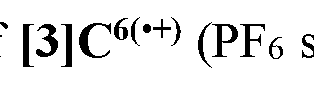
shows the expanded spectrum of the 3+ peak, both calculated (top) and observed (bottom).
FIGURES 4B-4D. Ball-and-stick representations of the solid-state structures of [3|C6('+,(FIG 4B) viewed from above the plane containing the TB4+ ring, (FIG 4C) viewed from above the plane containing the two CBPQT4+ rings, and (FIG 4D) viewed along the axis connecting the centroids of three rings.
FIGURE 4E shows a comparison of the solid-state superstructures of [3]C6(,+) (left) and [3]C12+ (right) depicted with combinations of ball-and-stick and space-filling representations.
FIGURE 4F. Space-filling representations of the supramolecular arrangements of [3]C6(,+) revealing the molecular packing into 2D layers as a result of both radical-radical interactions between BIPY("+) units and the p-p interactions of the phenylene units in the CBPQT2("+) rings. Hydrogen atoms, PF6 counter ions, and solvent molecules have been omitted for sake of clarity.
FIGURES 4G-4J. Space filling representations of the structure of the solid state structure of [3]06PF6. FIG 4G shows a first space-filling representation. FIG 4H shows a space-filling representation from a second view of the representation of FIG 4G. FIG 41 shows a space-filling representation from a third view of the representation of FIG 4G. FIG 4J shows a space-filling representation from a fourth view of the representation of FIG 4G.
FIGURES 5A-5B. Chemical formulae of [3]C12+ (FIG 5A) and r[5]C24+ (FIG 5B) showing proton assignments.
FIGURES 6AI-6AII. Structural characterization of r[5]C24+. (FIG 6AI) 'H NMR Spectrum (500 MHz, CD3CN) of r[5]024PF6 recorded at 298 K. The spectrum has been abridged in the region of the residual solvent and water resonances, while all signals for are displayed

with peak assignments corresponding to the protons labelled in Figure 5B. FIG 6AII shows the HR-ESI-TOF mass spectrum of r[5]C24+ (PF6 salt) with signals corresponding to the loss from three to five PF6 counter ions. Calculated peaks m/z = 2092.9542 [M - 3PF6]3+; 1533.2693 [M - .

FIGURES 6B-6D. Solid-state structures of + deduced from single-crystal X-ray

crystallography. (FIG 6B) View from above the plane containing the BTB8+ ring. The CBPQT4+ rings are represented in the space-filling fashion. (FIG 6C) A first side-on view. (FIG 6D) A second side-on view. Hydrogen atoms in FIGS 6C and 6D, PF6 counter ions, and solvent molecules have been omitted for the sake of clarity.
FIGURES 6E-6F. Representations of the structure of r[5]024PF6. Solid-state structures of r[5]C24+ including a view from above the plane containing the BTB8+ central ring (FIG 6E) and
side-on view (FIG 6F). Hydrogen atoms, PF6 counter ions, and solvent molecules omitted for the sake of clarity.
FIGURES 7A-7B. Redox switching behavior of r[5]C24+. (FIG 7A) UV-vis-NIR Spectrum along with the photograph of the solutions of the dodecacationic/dodecaradical radial [5]catenane r[5]C12(,+) and the tetracosacationic r [5]C24+ obtained by reducing r[5]C24+ with Zn dust in MeCN. (FIG 7B) Cyclic voltammogram of r[5]024PF6 recorded in a DMF solution containing 0.1 M TBAPFe as supporting electrolyte. Scan rate, 100 mV s l.
FIGURES 7C-7D. Cyclic voltammograms of r[5]024PF6 in the -0.6 to +0.9 V potential window. (FIG 7C) CV scans starting with a positive sweep. As there is little to no current found at potential ca. +478 mV in the first scan, the detected current at this potential region in the second and third scans is, therefore, attributed to the oxidation of the generated reduced species, i.e., r[5]C12(,+). (FIG 7D) CV scans starting with a negative sweep showing no change in peak currents for the first three scans.
FIGURES 8A-8B. Analytical RP-HPLC trace of TB*4PF6 (FIG 8A) and [3]Ol2PF6 (FIG 8B). The photodiode array was set to detect absorbance at 300 nm.
DETAILED DESCRIPTION
Disclosed herein are densely-charged radial catenanes and methods of making the same. The densely-charged radial catenanes may be a [3]catenane, [4]catenane, or a [5]catenane. The present invention demonstrates a rational strategy, using radical-radical interaction and tandem Click chemistry, to synthesize mechanically interlocked molecules, i.e., radial catenanes, consisting all electrostatically repulsive components. Moreover the catenanes disclosed herein demonstrate reversible molecular switching and changing the redox state of the catenanes results in reversible switching of the molecular topologies.
The presented materials are suited for use in applications that require either (i) densely charged or high-energy-density organic redox materials or (ii) effective switching between different states of a molecule and therefore the material properties, which has been utilized in many electronic devices such as switches, transistors, memory devices and electrochromic devices. Suitably, compositions comprising the catenanes described herein may have a charge density of 5.0+ charge / nm3 or greater, including 6.0+ charge / nm3 or greater or 7.0+ charge / nm3 or greater. The archetypical molecular structure and switching in our invention could hold great promise for
the fabrication of next generation organic electronic devices and/or nonaqueous redox-flow batteries.
As demonstrated in the Examples that follow, the radial catenanes may have a high cationic charge density such as a 12+ or a 24+ charge. One exemplary embodiment includes a dodecacationic [3]catenane, comprising three mechanically interlocked positively charged rings despite their mutual Coulombic repulsion. The constitution and topology of this [3]catenane were confirmed by NMR spectroscopy, mass spectrometry, and X-ray crystallography on a single crystal. The solid-state structure shows that two mechanical bonds result in the nano-confinement of 12 positive charges within a volume of less than 1.65 nm3, corresponding to 7.3+charges / nm3. Another exemplary embodiment includes a radial [5]catenane, comprising four mechanically interlocked rings around a fifth ring and can bears up to 24 positive charges in its co-constitution. The solid-state structure of this organic tetracosacation, determined by X-ray crystallography, reveals a molecular length of 3.7 nm and a charge density of 6.0+charge / nm3. The template- directed strategy for constructing MIMs, consisting of multiply charged interlocked rings, represents a departure in the chemistry of these compounds that is tantamount to producing a blueprint to explore a novel class of organic molecules which boast large numbers and high densities of like charges.
Definitions
As used herein, an asterisk“*” or a plus sign“+” may be used to designate the point of attachment for any radical group or substituent group.
The term“alkyl” as contemplated herein includes a straight-chain or branched alkyl radical in all of its isomeric forms. The number of atoms in the alkyl group can be specified using Cn-Cm nomenclature where n is an integer specifying the lowest number of carbon atoms, m is an integer specifying the greatest number of carbon atoms, and the group may comprise any number of carbon atoms inclusive of n and m. In some embodiments, the alkyl is a C1-C12 alkyl, a C1-C6 alkyl, or a C1-C3 alkyl.
The term“alkylene” refers to a diradical of an alkyl group. An exemplary alkylene group is— (CH2)n— where n is an integer greater than or equal to 1. In some embodiments, n is equal to any of 1-12, 1-6, or 1-3.
The term“alkenyl” as used herein refers to an unsaturated straight or branched hydrocarbon having at least one carbon-carbon double bond. The number of atoms in the alkenyl group can be
specified using Cn-Cm nomenclature where n is an integer specifying the lowest number of carbon atoms, m is an integer specifying the greatest number of carbon atoms, and the group may comprise any number of carbon atoms inclusive of n and m. In some embodiments, the alkenyl is a C1-C12 alkenyl, a C1-C6 alkenyl, or a C1-C3 alkenyl.
The term “alkynyl” as used herein refers to an unsaturated straight or branched hydrocarbon having at least one carbon-carbon triple bond. The number of atoms in the alkynyl group can be specified using Cn-Cm nomenclature where n is an integer specifying the lowest number of carbon atoms, m is an integer specifying the greatest number of carbon atoms, and the group may comprise any number of carbon atoms inclusive of n and m. In some embodiments, the alkynyl is a C1-C12 alkynyl, a C1-C6 alkynyl, or a C1-C3 alkynyl.
The term“aryl” as used herein refers to a carbocyclic aromatic group. Representative aryl groups include phenyl and the like. Unless specified otherwise, the aromatic ring may be substituted, for example, an alkyl. In certain other embodiments, the aromatic ring is not substituted, i.e., it is unsubstituted. The number of atoms in the aryl group can be specified using Cn-Cm nomenclature where n is an integer specifying the lowest number of carbon atoms, m is an integer specifying the greatest number of carbon atoms, and the group may comprise any number of carbon atoms inclusive of n and m. In some embodiments, the aryl is a C5-C10 alkenyl or a C6- C10 aryl.
The term“azide moiety” as used herein refers to a radical comprising— N3.
As described herein,“catenane” means a mechanically-interlocked molecular architecture consisting of two or more interlocked macrocylic components. Once the catenane is formed, the interlocked macrocyclic components cannot be separated without breaking a covalent bond of at least one macrocyclic component. Catenanes by may be prefixed with an integer to indicate the number of mechanically-interlocked macrocyclic components, e.g., [2]catenane or [2]C indicates a catenane comprises two interlocked macrocyclic components, [3]catenane or [3]C indicates a catenane comprises three interlocked macrocyclic components, [4]catenane or [4]C indicates a catenane comprises four interlocked macrocyclic components, and [5]catenane or [5]C indicates a catenane comprises five interlocked macrocyclic components. A radial catenane comprises a central ring and three or more radial rings each mechanically interlocked with the central ring.
The terms “heterocyclyl” and “heterocyclic group” are art-recognized and refer to saturated, partially unsaturated, or aromatic 3- to lO-membered ring structures, alternatively 3 -to
7-membered rings, whose ring structures include one to four heteroatoms, such as nitrogen, oxygen, and sulfur. The number of ring atoms in the heterocyclyl group can be specified using Cn- Cm nomenclature where n is an integer specifying the lowest number of atoms in the ring, m is an integer specifying the greatest number of atoms in the ring, and the group may comprise any number of atoms inclusive of n and m. Exemplary heterocyclic groups include triazole groups and alkyl triazole groups.
As described herein,“macrocyclic component” means a molecule that has at least one ring (cycle) large enough to allow it to be threaded onto a linear sub-chain of another molecule. Macrocyclic components include cyclobis(paraquat-p-phenylene) (CBPQT). Depending on context, the macrocyclic component may be used interchangeably with "ring".
“Pseudorotaxane” means a molecular assembly comprising at least one molecule with a linear section threaded through at least one macrocyclic component of another or the same molecule in which the threading component has an end small enough to permit threading or dethreading of the macrocyclic component. Pseudorotaxane s by may be prefixed with an integer to indicate the number of threading components and macrocyclic components, e.g., [2]pseudorotaxane indicates a pseudorotaxane comprising a molecular with at least one linear section onto which one macrocyclic component is threaded and [3]pseudorotaxane indicates a pseudorotaxane comprising a molecular with at least one linear section onto which two macrocyclic components is threaded.
"Reactive linker" means a linker formed from a reaction between moieties that allows for a continuous bridge of atom between viologen subunits. Reactive linkers may be used to extend threading components or close macrocyclic components. Suitably the reaction resulting in the formation of a reactive linker is a click chemistry, e.g., alkyne-azide reaction resulting in a triazole reactive linker, or other suitable reaction.
“Threading component” means a molecule with at least one linear section onto which at least one macrocyclic component is threaded.
“Viologen subunit” (V) means a subunit that is derivative of 4,4’ -bipyridine (C10H8N2). Viologens include 4,4'-bipyridinium (BIPY) subunits. Viologen subunits may be in a dicationic oxidation state (i.e., V2+) or a radical/cationic oxidation state (i.e., V +).
Densely charged radial catenanes
One aspect of the invention is directed to densely charged catenanes. The catenanes have a positive charge distributed between mechanically interlocked rings. Catenanes comprise a central cationic ring and two or more radial cationic rings mechanically interlocked with the central cationic ring. Each of the rings is a macrocyclic component that is threaded by a sub-chain of another ring. The central cationic rings comprises two or more viologen subunits (V) and two reactive linkers. Suitably, the central cationic ring may comprise two, three, or four V. V may comprise 4,4'-bipyridinium (BIPY) subunits.
V may reversibly switch between a dicationic oxidation state (V2+) or a radi cal/ cationic oxidation state (V +). In certain embodiments each V is in a dicationic state. In other embodiments, each V is in a radical/cationic oxidation state. In yet other embodiments, the V of the central cationic ring may be in any combination of the dicationic state and the radical/cationic oxidation state. For example when the central cationic ring comprises two V, one V may be in the dicationic state and the other V may be in the radical/cationic state. Similarly when the cationic rings comprises three V, one V may be in the dicationic state and the other two V may be in the radical/cationic state or one V may be in the radical/cationic state and the other V may be in the dicationic state.
The catenane comprises an equal number of radial cationic rings as V of the central cationic ring. For example, when the central cationic ring comprises two, three, or four V, the catenane comprises two, three, and four radial cationic rings, respectively. Suitably, the radial cationic rings may reversibly switch between oxidation states. In some embodiments, each of the radial cationic rings are in the same oxidation state. In other embodiments, the radial cationic rings are in different oxidation states. Suitably the radial cationic rings comprises cyclobis(paraquat-p-phenylene) (CBPQT) which may reversibly switch between the tetracationic oxidation state (CBPQT4+) and the diradical/dicationic state (CBPQT2("+)). In certain embodiments each CBPQT is in a tetracationic state. In other embodiments, each CBPQT is in a diradical/dicationic oxidation state. In yet other embodiments, the CBPQT of the central cationic ring may be in any combination of the tetracationic state and the diradical/dicationic oxidation states.
In some embodiments, the central cationic ring comprises two V. Suitably, the central cationic ring may comprise

In some embodiments, each V may be in a dicationic oxidation state, resulting in a positive charge of 4+ on the central cationic ring. When each V is in a dicationic oxidation state, the two radial rings may be in a tetracationic oxidation state. In such cases, the catenane is a dodecacationic catenane ([3]C12+). In other embodiments, each V may be in a radical/cationic oxidation state, resulting in a positive charge of 2+. When each V is in a radical/cationic oxidation state, each radial rings may be in a diradical/dicationic oxidation state. In such cases, the radial catenane is a dodecacationic radial catenane

In some embodiments, the central cationic ring comprises three V. Suitably, the central cationic ring may comprise

In some embodiments, each V may be in a dicationic oxidation state, resulting in a positive charge of 6+ on the central cationic ring. When each V is in a dicationic oxidation state, the two radial rings may be in a tetracationic oxidation state. In such cases, the radial catenane is a octodecacationic radial catenane (r[4]C18+ ). In other embodiments, each V may be in a radical/cationic oxidation state, resulting in a positive charge of 2+. When each V is in a radical/cationic oxidation state, each radial rings may be in a diradical/dicationic oxidation state. In such cases, the radial catenane is a nonacationic radial catenane

In some embodiments, the central cationic ring comprises four V. Suitably, the central cationic ring may comprise

V is a viologen subunit. R1 and R2 are reactive linkers. Each L is a linker bridging adjacent V, either alone or in combination with another L and/or a reactive linker.
Suitably the reactive linkers R1 and R2 may be formed from a click chemistry reaction. Click chemistry encompasses a group of linking reactions that are simple to perform, have high yields, require no or minimal purification, and are versatile in joining diverse structures without the prerequisite of protection steps. Suitably the click chemistry is a cycloaddition, nucleophilic ring-opening, non-aldol carbonyl chemistry, or a carbon multiple bond reaction. In some embodiments, R1 and R2 are formed from the same click chemistry reaction. In other embodiments, R1 and R2 are formed from different click chemistry reactions. Suitably, R1 and/or R2 is formed from a cycloaddition reaction such as an alkyne-azide reaction forming a triazole.
Suitably each L is independently selected from an alkyl, an alkenyl, an aryl, an alkylaryl, a triazole, or an alkyltriazole. A linker L may bridge adjacent V, either alone or in combination with another L and/or a reactive linker. In some embodiments, the bridge comprises a continuous bride of 8, 9, 10, 11, or 12 atoms between V.
Methods of making densely charged radial catenanes
Methods for making the catenanes described above are also provided. The method for forming the catenane comprises contacting terminal moieties of a pseduorotaxane to form a central cationic ring that mechanically interlocks radials cationic rings. The pseudorotaxane comprises a threading component having a first terminal moiety, a second terminal moiety, and two or more radi cal/ cation viologen subunits between the first terminal moiety and the second terminal moiety and two or more diradical/dicationic rings threaded by the threading component. The pseudorotaxane may comprise an equal number of diradical/dicationic rings as viologen subunits. Suitably, the threading component may comprises two, three, or four viologen subunits.
Suitably V is in a radical/cationic oxidation state (V’+). Although V may be in a dicationic state, when V is in the radical/cationic oxidation state the viologen subunit may form stabilizing radical-radical interactions with radial rings that also have unpaired electrons that are threaded by the threading component. Suitably the radial cationic rings comprises cyclobis(paraquat-p- phenylene) (CBPQT) in the diradical/dicationic state (CBPQT2( +)). In certain embodiments each CBPQT is in a tetracationic state. In other embodiments, each CBPQT is in a diradical/dicationic oxidation state. In yet other embodiments, the CBPQT of the central cationic ring may be in any combination of the tetracationic state and the diradical/dicationic oxidation states.
In some embodiments, the threading component comprises two V. The threading component of the pseudorotaxane may comprise

Suitably, each V may be in a radical/cationic oxidation state, resulting in a positive charge of 2+ as well as two unpaired electrons, which may interact with radial cationic rings that also have unpaired electrons to stabilize the pseudorotaxane.
The first of these threading components may be formed by contacting threading components

Suitably, each V may be in a radical/cationic oxidation state, resulting in a positive charge of 1+ as well as one unpaired electrons. Suitably each of these threading components form a pseudorotaxane thatthreads a radial ring. These threading components may interact with a radial cationic ring having unpaired electrons to stabilize the pseduorotaxane.
The second of these threading components may be formed by contacting
and threading component
 Suitably, each V may be in a radical/cationic oxidation state, resulting in a positive charge of 2+ as well as two unpaired electrons on the threading component. Suitably the threading component forms a pseudorotaxane that threads two radial rings. These threading component may interact with the radial cationic rings having unpaired electrons to stabilize the pseduorotaxane.
In some embodiments, the threading component comprises three V. Suitably, the threading component of the pseudorotaxane comprises

Suitably, each V may be in a radical/cationic oxidation state, resulting in a positive charge of 3+ as well as three unpaired electrons, which may interact with radial cationic rings that also have unpaired electrons to stabilize the pseudorotaxane.
The threading components may be formed by contacting threading components

Suitably, each V may be in a radical/cationic oxidation state, resulting in a positive charge of 1+ as well as one unpaired electron, one of the threading componentsand a positive charge of 2+ as well as two unpaired electrons on the other threading component. Suitably each of these threading components may form a pseudorotaxanes that threads one or two radial rings, respectively. These threading componentsmay interact with radial cationic rings associated therewith that also have unpaired electrons to stabilize the pseduorotaxanes.
In some embodiments, the threading componentcomprises four V. The threading component of the pseudorotaxane may comprise

Suitably, each V may be in a radical/cationic oxidation state, resulting in a positive charge of 4+ as well as four unpaired electrons, which may interact with radial cationic rings that also have unpaired electrons to stabilize the pseudorotaxane.
The threading components may be formed by contacting threading components

Suitably, each V may be in a radical/cationic oxidation state, resulting in a positive charge of 2+ as well as two unpaired electrons on each threading component. Suitably each of these threading component may form a pseudorotaxane that threads two radial rings. These threading componentsmay interact with radial cationic rings associated therewith that also has unpaired electrons to stabilize the pseduorotaxane reactants.
Terminal moieties r2 and r2' may suitably be selected to react and form the reactive linker R2 and r1 and r1' may suitably be selected to react and form the reactive linker R1. Suitably r2 and r2' and r1 and r1' may be selected from moieties capable of performing a click chemistry reaction. In some embodiments, r2 and r2' and r1 and r1' are selected to perform a cycloaddition reaction such as an alkyne-azide reaction forming a triazole.
Suitably, the catenanes may be reversibly oxidized with a suitably selected oxidant or reductant. For example, a radial catenane in a reduced state may be oxidized by an oxidant such as NOPF6 or a radial catenane in an oxidized state may be reduced by a reductant such as Zn dust. Dodecacationic and hexaradical/hexacationic radial [3] catenanes
One aspect of the invention is directed to dodecacationic and hexaradical/hexacationic [3]catenanes. As will be shown in the Examples below, the dodecacationic and hexaradical/hexacationic [3]catenanes may be reversibly interconverted between the different oxidation states as well as molecular topologies.
The dodecacationic [3]catenane (r[3]C12+) comprises a central tetracationic ring mechanically interlocked with a second tetracationic ring and a third tetracationic ring. An exemplary [3]C12+ is provided in FIG 5A.
The hexaradical/hexacationic [3]catenane (r[3]C6(,+)) comprises a central diradical/dicationic ring mechanically interlocked with a second diradical/dicationic ring and a third diradical/dicationic ring.
Linker R1, linker R2, or both linker R1 and linker R2 may comprise a triazole group formed from a click reaction between a azide and akyne moiety. Both or at least one of the linkers R1 and
R2 may allow the opposing viologen subunits to be separated by a distance of about 9.5 A and restrict the separation from 8.0 to 12.0 A or anything in between, including from about 9.0 A to about 11.0 A. In order to allow for these separations, the linkers may comprise a continuous bridge of about 7 to about 16 atoms or anything in between, including from about 8 to about 12 atoms. For the purposes of counting, if the continuous bridge of atoms bifurcates, e.g., at a triazole group, one counts the atoms along the bridge formed by the fewest number of atoms.
The second tetracationic ring and the third tetracationic ring may be any tetracationic macrocyclic component. In some embodiments, the second or third ring comprises cyclobis(paraquat-p-phenylene) tetracation (CBPQT4+)
In some embodiments, the [3]C12+ comprises the catenane of Formula la

or the hexaradical/hexacationic [3]catenane ([3]C6(●+)) comprises the catenane of Formula Ila

X and Y together with the triazole group form the linkers R1 and R2. X may comprise diradicals of alkyl groups, alkenyl groups, aryl groups, alkylaryl groups, triazole groups, or alkyltriazole
groups. Y may comprise diradicals of alkyl groups, alkenyl groups, aryl groups, alkylaryl groups, triazole groups, or alkyltriazole groups.
The length of the X-triazole-Y linker may be any suitable length. In some cases, the X- triazole-Y linker of Formula lb or Formula Ila comprises a continuous bridge of 8, 9, 10, 11, or 12 atoms. In some embodiments, X comprises— (CFh)nx— where nx is 0, 1, 2, 3, 4, 5, or 6,— (CH2)mx(C2N3H)(CH2)mx— where mx + mx’ is 0, 1, or 2, or— (CH2)ix(C6H4)(CH2)ix— where lx + lx’ is 0, 1, or 2. In some embodiments, Y comprises— (CH2)ny— where ny is 0, 1, 2, 3, 4, 5, or 6,— (CH2)my(C2N3H)(CH2)my— where my + my’ is 0, 1, or 2, or— (CH2)iy(C6H4)(CH2)iy— where ly + ly’ is 0, 1, or 2. In some embodiments, X comprises— (CH2)nx— where nx is 0, 1, 2, 3, 4, 5, or 6, — (CH2)mx(C2N3H)(CH2)mx— where mx + mx’ is 0, 1, or 2, or —
(CH2)ix(C6H4)(CH2)ix— where lx + lx’ is 0, 1, or 2 and Y comprises— (CH2)ny— where ny is 0, 1, 2, 3, 4, 5, or 6, — (CH2)my(C2N3H)(CH2)my— where my + my’ is 0, 1, or 2, or— (CH2)iy(C6H4)(CH2)iy— where ly + ly’ is 0, 1, or 2.
In some embodiments, X and Y both comprise alkyl groups. In certain embodiments, X comprises— (CFh)nx— ,Y comprises— (CH2)ny— , and nx + ny = 6, including an embodiment where nx = 4 and ny = 2, nx = 3 and ny = 3, or nx = 2 and ny = 4.
In some embodiments, X comprises an alkyl group and Y comprises an aryl or alkylaryl group. In certain embodiments, X comprises — (CH2)nx— , Y comprises — (CH2)iy(C6H4)(CH2)iy— , and nx + ly + ly’ = 3, including an embodiment where nx = 2 and ly + ly’ = 1.
In some embodiments, X comprises a triazole or alkyltriazole group and Y comprises an alkyl. In certain embodiments, wherein X comprises— (CH2)my(C2N3H)(CH2)my— ,Y comprises — (CH2)ny— , and my + my’ + ny = 4, including an embodiment where my + my’ = 2 and ny = 2.
In some embodiments, the [3]C12+ comprises the catenane of Formula lb or Formula Ic

or the hexaradical/hexacationic [3]catenane ([3]C6(#+)) comprises the catenane of Formula lib or lie
or


X may comprise an alkyl, an alkenyl, an aryl, an alkylaryl, a triazole, or an alkyltriazole and Y may comprise an alkyl, an alkenyl, an aryl, an alkylaryl, a triazole, or an alkyltriazole.
The X-triazole-L-triazole-X linker and the Y linker may be any suitable length. In some embodiments, X-triazole-L-triazole-X linker of Formulas lb, Ic, lib or lie may comprise a continuous bridge of 8, 9, 10, 11, or 12 atoms. In some embodiment, Y linker of Formulas lb, Ic, lib or lie may comprise a continuous bridge of 8, 9, 10, 11, or 12 atoms. In certain embodiment, X-triazole-L-triazole-X linker and the Y linker of Formulas lb, Ic, lib or lie may comprise a continuous bridge of 8, 9, 10, 11, or 12 atoms. In some embodiments, X may comprise— (CH2)nx— where nx is 0, 1, 2, 3, or 4. In some embodiments, Y may comprise— (CH2)ni— where nl is 0, 1, 2, 3, or 4. In some embodiments, Y may comprise— (CH2)ny— where ny is 8, 9, 10, 11, or 12. In certain embodiments, X may comprise— (CH2)nx— where nx is 0, 1, 2, 3, or 4, L may comprise — (CH2)ni— where nl is 0, 1, 2, 3, or 4, and, Y may comprise— (CFb)ny— where ny is 8, 9, 10, 11, or 12. In particular embodiments, nx = 1 or 2, nl = 1 or 2, and ny = 9 or 11.
Crystalline compositions may be prepared from the [3]catenanes described herein. The crystalline composition may comprise any of the [3]catenanes described above. In some embodiments, the composition further comprises a counter anion, e.g, PF6 as used in the Examples that follow. The counter anion may be provided to balance the charge of the [3]catenane, including having a molar ration of counter anion to [3]catenane from about 12: 1 to 6: 1 or anything in between.
Synthesis of [3]Catenane
Another aspect of the invention is methods of preparing [3]catenanes. Exemplary methods for preparing [3]catenanes are provided in Schemes 1-3. The method comprises ring-closing a [3]pseudorotaxane to prepare the [3]catenane. The [3]pseudorotaxane comprises a threading component threading two diradical/dicationic rings, and the threading component comprises two viologen subunits between terminal moieties that each comprise a click-functionalized moiety. The method also comprises contacting a click-functionalized terminal moiety with a corresponding click-functionalized moiety to form a central diradical/dicationic ring mechanically interlocking the two diradical/dicationic rings. The two diradical/dicationic rings may each comprise cyclobis(paraquat-p-phenylene) bisradical dication (CBPQT2( +)).
Scheme 1. Preparation of [3]C12+ and [3]C6(,+) via ring-closing of a [3]pseudorotaxane prepared from two [2]pseudorotaxanes

Scheme 2. Preparation of [3]C12+ and [3]C6(,+) via ring-closing of a [3]pseudorotaxane

Scheme 3. Preparation of [3]C12+ and [3]C6(,+) via ring-closing of a [3]pseudorotaxane

As shown in Scheme 1, a [3]catenane may be formed by ring-closing the [3]pseudo rotaxane

When the azide terminal moiety is contacted with the alkynyl terminal moiety, the central diradical/dicationic ring is formed mechanically interlocking the CBPQT2(,+) rings to form the [3]catencane of Formula Ila. The [3]catenane of Formula Ila may be oxidized to form the [3]catencane of Formula la.
The [3]pseudorotaxane may be prepared from reaction of a first [2]pseudorotaxane and a second [2]pseudorotaxane. One of the [2]pseudorotaxanes may comprise a pseudorotaxane of Formula IVa

The other [2]pseudorotaxane comprises a pseudorotaxane of Formula IVb

When the azide terminal moiety of a [2]pseudorotaxane reacts with the alkynyl terminal moiety of the other [2]pseudorotaxane, the [3]pseudorotaxane of Formula Ilia is formed.
Alternative methods of preparing the [3]catenane is shown in Schemes 2-3. In this embodiment, the [3]pseudorotaxane comprises terminal moieties each comprising the same click- functionalized moiety. The [3]pseudorotaxane may comprise a compound of Formula Illb or a compound of Formula IIIc
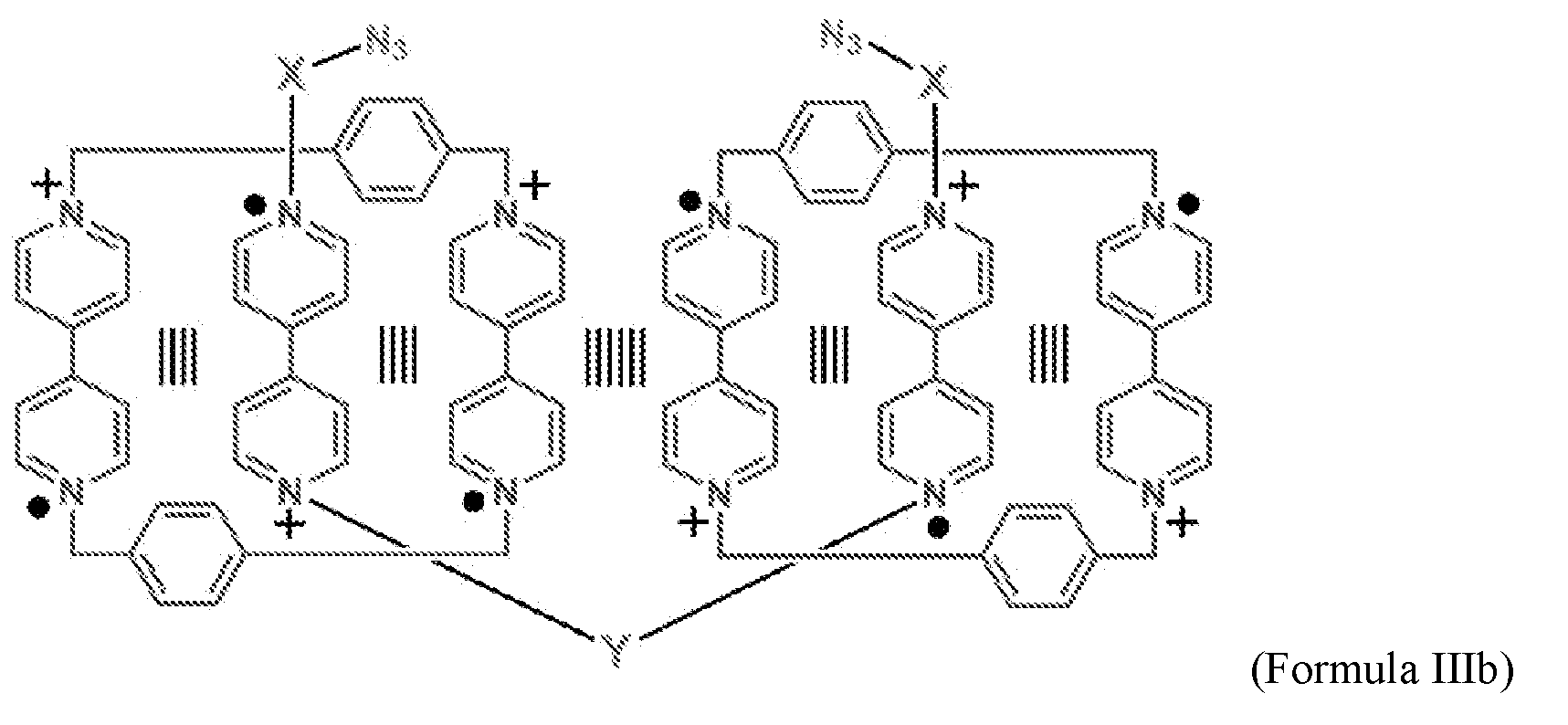

Ring-closing may be accomplished by reacting the [3]pseudorotaxane of Formula Illb and Formula IIIc with compounds of Formula Va

respectively. Ring-closing forms the central diradical/dicationic ring to mechanically interlocking the CBPQT2( +) rings to form the [3]catencane of Formula lib and lie. The [3]catenane of Formulas lib or lie may be oxidized to form the [3]catencane of Formulas lb or Ic, respectively.
An exemplary [3]catenane may be prepared from the synthetic scheme shown in Scheme 1 and as demonstrated in the Examples. Two trisradical [2]pseudorotaxanes - one azide- functionalized and the other alkyne-functionalized - were synthesized by treating two independent solutions of (i) bis(2-azidoethyl)viologen (AV2+) and CBPQT4+ and (ii) bis(6-hexynyl)viologen (HV2+) and CBPQT4+ with Cu powder under an inert atmosphere in a N2-filled glovebox. The complexation between the viologens and their respective CBPQT2( +) bisradical dication is driven by radical -radical recognition to form [AV( +)c=CBPQT2( +)] and [HV( +)cCBPQT2( +)] inclusion complexes, which were allowed to coalesce over a period of an hour before the two dark-purple solutions were mixed together. Tandem copper(I)-catalyzed azide-alkyne cycloaddition (CuAAC) reactions then occurred between the two bis(azide)-functionalized and bis(alkyne)-functionalized axles of the two [2]pseudorotaxanes with the lingering copper(I) catalytic species in situ generated from the previous reduction step. The first of the two Click reactions brings together the two
[2]pseudorotaxanes to produce a [3]pseudorotaxane intermediate, while the second CuAAC is the ring-closing step, driven by the face-to-face radical interactions between two bipyridinium radical cations of the CBPQT2("+) subunits of the [3]pseudorotaxanes. This inter-ring recognition, coupled with the high dilution conditions (1.25 mM), resulted in the formation of a more complex mechanically interlocked species, i.e., a [3]catenane, in a hexaradical / hexacationic state. The fully oxidized [3]catenane [3]C12+ was obtained either by reacting the reduced-state [3]catenane with nitrosonium hexafluorophosphate (NOPF6), which oxidized all three rings within seconds, or by exposing the dark purple intermediate in air overnight. The formation of all the radical intermediates (Scheme 1) was monitored by mass spectrometry, UV-vis-NIR spectroscopy, and single-crystal X-ray diffraction when possible. Upon purification by reverse-phase flash chromatography (Cis: water/acetonitrile, 0.1% TFA - trifluoroacteic acid) and counterion exchange (NH4PF6 / FhO) to give [3]Ol2PF6 which was obtained in 41% yield overall. The identity and purity of the [3]catenane were confirmed by high-resolution electrospray mass spectrometry (HR-ESI-MS) and analytical high performance liquid chromatography (HPLC, FIG 8B), respectively.
The and 13C (data not shown) nuclear magnetic resonance (NMR) spectra of
[3]Ol2PF6, recorded in CD3CN at 298 K (FIG 1D), support the proposed structure of [3]C12+ in solution with all the and 13C assignments being confirmed by two-dimensional NMR measurements (data not shown). The NMR spectrum (FIG 1D) of [3]Ol2PF6 reveals that the two equivalent CBPQT4+ rings are located on the 1 -( 1 -(ethylene)-! //-! , 2, 3 -triazole-4-yl (butylene linkers in the central TB4+ ring and undergo slow pirouetting motions at room temperature as indicated by the broadening of all the CBPQT4+ resonances. The 'H NMR spectrum (FIG 1 A) of [3]Ol2PF6, recorded at 343 K, reveals that these resonances for the two CBPQT4+ ring protons become much better resolved as a result of fast exchange (i) associated with the facile pirouetting of the CBPQT4+ rings around the linkers and (ii) supplemented, most likely, by rapid rotation along the axes of the bipyridinium and phenylene units within the CBPQT4+ rings.
The characteristics of the mechanically interlocked structure of [3]Ol2PF6 emerge clearly when comparing its 'H NMR spectrum (FIG 1 A) with those (FIG 1B-C) of its non-interlocked macrocyclic counterparts— CBPQT»4PF6 (FIG 1C) and TB»4PF6 (FIG 1B), which is synthesized from AV»2PF6 and HV»2PF6 using traditional CuAAC conditions. There are significant upfield shifts in the resonances associated with the methylene protons of the triazole linkers in [3]C12+
compared to those in TB4+. For example, the chemical shifts for protons Hd, He, and Hf change from 2.76, 2.06 and 1.63 ppm in the free macrocycle (TB4+) to 1.30, -0.36 and -0.46 ppm, respectively, in the interlocked [3]catenane [3]C12+. This evidence supports strongly the significant change in the local electronic environment induced by the constrained CBPQT4+ cations within the [3]catenane.
Unambiguous evidence for the constitution of the [3]catenane is achieved from X-ray crystallographic analysis of single crystals obtained by slow diffusion of diisopropyl ether into an MeCN solution of [3]Ol2PF6. The solid-state structure (FIG 2A-2J) confirms the topology and 12 positive charges (by counting the anions) associated with the dodecacationic [3]catenane where the two CBPQT4+ rings are mechanically interlocked to a central TB4+ macrocycle. The three tetracationic rings aligns themselves in a collinear fashion in which their centroids lie almost in a straight line. The compactness of the [3]C12+ dodecacation is illustrated in FIG 2D-2J by space- filling representations, where it becomes apparent that there is little or no free space between the two CBPQT4+ rings with a 3.2 A plane-to-plane separation between their closest phenylene units. This separation is considerably shorter than the range (3.3 - 4.0 A) of distances associated with typical p-p interactions. As a result of the compact mechanically interlocked structure, the six bipyridinium (BIPY2+) units in [3]C12+ exhibit much smaller torsional angles (mean angle = 17°) than those found for BIPY units in isolated CBPQT4+ (40°) and/or TB4+ (73°) free macrocycles.
The six bipyridinium units in the [3]catenane offer a possibility of the dodecacation taking up a total of 12 electrons in a system with potentially 13 redox states. Cyclic voltammetry of
[3]C12+ revealed (FIG 3A), however, that the two most prevalent redox states characterized by widely separated potential windows are the dodecacationic [3]C12+ form and the hexaradical / hexacationic [3]C6( +) form. These two states can be interconverted reversibly by means of both electrochemical (FIG 3A) and chemical (FIG 3B-3D) stimuli. Treatment (298 K / 20 min) of
[3]C•l2PF6 in MeCN with Zn dust resulted in a characteristic color change from colorless to dark purple, indicating the formation of [3]C6("+). This color change was corroborated by air-free ESI- MS experiments (FIG 4AI-4AII) in which prominent peaks, corresponding to [[3]06PF6 - nPF6]n+ (n = 3 - 5), were observed. The reverse process ([3]C6("+) to [3]C12+) occurs within seconds on treating the hexaradical hexacation [3]C6("+) with NOPF6. Reversible switching can be repeated by up to five times as confirmed (FIG 3B-3D) by UV-vis-NIR spectroscopy.
X-Ray diffraction analysis (FIG 4B-4J) of a single crystal, grown by vapor diffusion of diisopropyl ether into an MeCN solution of [3]06PF6 in an N2-filled glovebox, confirms the constitution of [3]C6("+), but reveals a marked difference in topology from that of its oxidized
[3]C12+ form. The two CBPQT2("+) rings display a change in their relative geometries when compared with their fully oxidized states in the [3]C12+ form, i.e., moving from the triazole linkers to encircling the BIPY( +) unit of the TB2( +) ring. This change results in an intramolecular p-p interaction across the six adjacent viologen radical cations with an average plane-to-plane distance of 3.24 A. All the BIPY( +) units become flattened in comparison to their corresponding BIPY2+ units in [3]C12+. The mean torsional angle in the BIPY("+), which is 3.6°, further corroborates the presence of radical cationic states for these BIPY( +) units. The changes in the relative dispositions of the three rings in [3]C12+ and [3]C6(,+)— wherein electron sharing and delocalization among the
 units are only present in
 — may explain the smaller number of observed redox states found in this [3]catenane, compared to the previously reported homo[2]catenane, wherein the two
 rings are rigid and retain the same relative dispositions, irrespective of the different redox states. At the supramolecular level, the hexaradical/hexacations [3]C6("+) assemble (FIG 4F) into 2D layers wherein the CBPQT2("+) rings are located in a single plane within each layer driven by the intermolecular interactions between both BIPY-to-BIPY and phenyl ene-to-phenylene pairs.
Tetracosacationic and dodecaradical/dedecacationic radial [5]catenanes
Tetracosacationic and dodecaradical/dedecacationic r[5]catenanes may be prepared from the reaction of [3]pseudorotaxanes as described above. As will be shown in the Examples below, the tetracosacationic and dodecaradical/dedecacationic r[5]catenanes may be reversibly interconverted between the different oxidation states as well as molecular topologies.
The tetracosacationic r[5]catenane comprises a central octacationic ring mechanically interlocked with a second tetracationic ring, a third tetracationic ring, a fourth tetracationic ring, and a fifth tetracationic ring. An exemplary r[5]C24+ is provided in FIG 5B.
The dodecaradical/dedecacationic r[5]catenane comprises a central tetraradical/tetracationic ring mechanically interlocked with a second diradical/dicationic ring, a third diradical/dicationic ring, a fourth diradical/dicationic ring, and a fifth diradical/dicationic ring.
Each of the linkers R1 and R2 may comprise a triazole group prepared from azide-alkyne click reactions between the terminal moieties of the [3]pseudorotaxanes. Each of the linkers L1 and L2 may be independently selected from an alkyl, an alkenyl, an aryl, an alkylaryl, a triazole, or an alkyltriazole. Suitable linkers for each of R1, R2, L1, and L2 are described above and those of skill in the art may make particular selections based upon the teachings herein.
The tetracation ring may comprise cyclobis(paraquat-p-phenylene) tetracation (CBPQT4+). The diradical/dication ring may comprise cyclobis(paraquat-p-phenylene) diradical/di cation (CBPQT2(,+)).
Reversible switching between the fully oxidized tetracosacationic [24+] and the halfway- reduced dodecaradical/dodecacationic [12(·+)] states was also promoted in the case of the radial [5]catenane by both chemical and electrochemical means. ETpon the reduction of r[5]C24+ with Zn dust, the formation of the r[5]C12(*+) species can be monitored (FIG 7A) by ETV-Vis spectroscopy with a characteristic absorption band at 1116 nm. The identity of this dodecaradical/dodecacationic radial [5]catenane, which could be facilely converted back to r[5]C24+ by an oxidation with NOPF6, was confirmed by the air-free ESI-MS, wherein prominent peaks were observed at m/z = 1512.8240 and 1098.3773, corresponding to the [M- nPF6]n+ peaks with n = 3 and 4, respectively. Electrochemical studies on r[5]C•24PF6 lend (FIG 7B) the reversible inter-conversion between the two dodecaradical/dodecacationic and tetracosacationic states, in which CV scans can be repeated several times without any changes (FIG 7C-7D) of the peak currents.
Synthesis of [5]Catenane
Another aspect of the invention is methods of preparing [5]catenanes. Exemplary methods for preparing [5]catenanes are provided in Scheme 4. The method comprises reacting two [3]pseudorotaxanes to prepare the [5]catenane. The [3]pseudorotaxane comprises a threading component threading two diradical/dicationic rings, and the threading component comprises two viologen subunits between terminal moieties that each comprise a click-functionalized moiety. The method also comprises contacting a click-functionalized terminal moiety with a corresponding click-functionalized moiety to form a central diradical/dicationic ring mechanically interlocking the two diradical/dicationic rings. The two diradical/dicationic rings may each comprise cyclobis(paraquat-p-phenylene) bisradical dication (CBPQT2( +)).
Scheme 4. Preparation of r[5]C24+ and r[5]C12(,+) via ring-closing of a [5]pseudorotaxane prepared from two [3]pseudorotaxanes

The click-functionalized moiety may be any click-functionalized moiety. In some embodiments, the [3]pseudorotaxane comprises two azide terminal moiety or two alkynyl terminal moieties. Ring-closing via a click reaction results in the macrocyclic component of Formula V as described above.
In particular embodiments, [3]pseudorotaxanes comprising a compound of Formula Illb

and the second [3]pseudorotaxane comprises a pseudorotaxane of Formula IIIc

X of either of the [3]pseudorotaxanes may comprises an alkyl, alkenyl, aryl, alkylaryl, triazole, or alkyltriazole as described above. Y of either of the [3]pseudorotaxanes may comprise an alkyl, alkenyl, aryl, alkylaryl, triazole, or alkyltriazole. Suitably linkers are described above.
Employing the radical-templated synthetic strategy that was used to make [3]C12+, we have been able to synthesize (FIG 5) a radial [5]catenane r[5]C24+ - which can also be named a [5]molecular necklace - bearing up to 24 positive charges within its co-constitution. Two bis- viologen axles, BAV4+ and BHV4+, with octamethylene spacers between the two viologen units were used to drive the formation of two pseudo[3]rotaxanes with bisradical dicationic CBPQT2(,+) rings under reducing conditions. The tandem click reactions between these two pseudo[3]rotaxanes, catalyzed by the in situ generated Cu(I) species, followed by oxidation with NOPF6, gave r[5]C24+ in 36% overall yield. The use of Cu° powder as both a reducing agent and a catalytic precursor for the click reactions together with the tri azole-based ETB linkers to facilitate
the cyclization of the central ring, has been shown, yet again, to be an effective way for the production of highly charged MIMs.
The mechanically interlocked nature of the radial [5]catenane r[5]C24+ was established by NMR spectroscopy. The 'H NMR spectrum (FIG 6AI) of r[5]024PF6, recorded in CD3CN at 298 K, reveals significant upfield chemical shifts for methylene protons associated with the octamethylene chains and the triazole-based ETB linkers. In particular, the dramatic shielding of protons Ha (5 = -2.37 ppm) and Hw (5 = -2.41 ppm) on the two octamethylene chains indicates their encirclement by two CBPQT4+ rings. The resonances (5 = ca. -0.58 and -0.15 ppm) associated with protons Hi and Hk, respectively, suggest that the other two CBPQT4+ rings reside on the triazole-based ETB linkers as in the case of [3]C12+. The ¾ NMR spectrum of the radial [5]catenane supports the averaged Civ symmetry of this molecule as demonstrated by (i) a small chemical shift difference (Hpi and Hp3; Ad = 0.1 ppm, FIG 6A1) for the resonances associated with the phenylene protons in the two CBPQT4+ rings encircling the octamethylene chains and (ii) a single set of proton resonances for the two CBPQT4+ rings encircling the triazole-based ETB linkers. HR-ESI-MS supports the structural assignment of r[5]C24+ as its PF6 salt, in which m/z fragments, corresponding to the [M- nPF6]n+ species for n = 3, 4, and 5, are observed (FIG 6AII) for the radial [5]catenane along with the loss of three to five PF6 counter ions, respectively. The 3D geometry of r[5]C24+ was determined unequivocally by X-ray diffraction analysis on single crystals grown by slow diffusion of diisopropyl ether into a MeCN solution of r[5]024PF6. FIG 6B-D illustrate the solid-state structure of r[5]C24+, demonstrating clearly the mechanically interlocked nature of the tetracosacationic radial [5]catenane and further supporting the structural assignments from the NMR spectroscopic investigations, as well as the relative location of the four CBPQT4+ rings within the co-constitution of this MIM. The tetracosacation r[5]C24+ with a molecular formula of [OT icHi ii,Nni]24- exhibits a length of 3.7 nm in one dimension and occupies a volume ca. 4.0 nm3, corresponding to 6.0+charges / nm3.
Summary
We demonstrate the synthesis and characterization of densely charged catenanes. We synthesized by radical templation a dodecacationic [3]catenane, which consists of three mechanically interlocked 4+ charged rings despite their mutual Coulombic repulsion. This highly (12+) charged [3]catenane has the ability to accept up to 12 electrons and occupies a volume of less than 1.65 nm3, corresponding to 7.3 +charges / nm3 which, to the best of our knowledge, is
the highest charge density ever observed in a polycationic organic mechanically interlocked molecule. Moreover, this catenane can be switched either electrochemically or chemically between two stable states, i.e., its dodecationic and hexaradical / hexacationic forms. It turned out to be possible to grow good quality single crystals of these two different redox states, which were shown by X-ray diffraction to exist in two distinct geometries in the solid states. These geometries are the result of circumrotation of the two outer cyclophanes from encircling the triazole linkers to encircling the BIPY( +) units, following their reduction from CBPQT4+ to CBPQT2( +). The molecular switch is reversible in its operation and can be switched in solution as monitored by UV-vis-NIR spectroscopy. We envision that such redox switching, accompanied by relative geometrical changes, could be harnessed in the development of new stimuli-responsive macromolecular architectures and could be of potential use in molecular electronics which require bistable switching of electron conductance.
The possibility of expanding the radical templation strategy has been realized with the construction of a more complex MIM, namely, a tetracosacationic radial [5]catenane that bears up to 24 positive charges in its co-constitution. With a length of up to 3.7 nm, this redox-active tetracosacation has a capability of storing as many as 24 electrons per molecule. Overall, our synthetic approach lays the foundation for exploring highly and densely charged organic materials which could find applications in energy storage technologies where novel oligomeric organic redox-active molecules capable of storing and transferring multiple electrons are highly desired. In particular, these MIMs are potentially well-suited to be incorporated into redox flow batteries utilizing oligomeric organic redox-active materials in size exclusion strategies to overcome membrane cross-contamination and, therefore, improve cell performance.
References
Bruns, C. J.; Stoddart, J. F. In The Nature of the Mechanical Bond: From Molecules to Machines, John Wiley & Sons, Inc.: 2016.
Xue, M.; Yang, Y.; Chi, X.; Yan, X.; Huang, F. (2015). Development of pseudorotaxanes and rotaxanes: from synthesis to stimuli-responsive motions to applications. Chem. Rev. 115, 7398- 7501.
Evans, N. H.; Beer, P. D. (2014). Progress in the synthesis and exploitation of catenanes since the millennium. Chem. Soc. Rev. 43, 4658-4683.
Gil-Ramirez, G.; Leigh, D. A.; Stephens, A. J. (2015). Catenanes: fifty years of molecular links. Angew. Chem. Int. Ed. 54, 6110-6150.
Frisch, H.; Martin, I.; Mark, H. (1953). Zur struktur der polysiloxene. I. Monatsh. Chem. 84, 250- 256.
Feringa, B. L. (2017). The art of building small: from molecular switches to motors (Nobel Lecture). Angew. Chem. Int. Ed. 56, 11060-11078.
Stoddart, J. F. (2017). Mechanically interlocked molecules (MIMs)— molecular shuttles, switches, and machines (Nobel Lecture). Angew. Chem. Int. Ed. 56, 11094-11125.
Sauvage, J.-P. (2017). From chemical topology to molecular machines (Nobel Lecture). Angew. Chem. Int. Ed. 56, 11080-11093.
Erbas-Cakmak, S.; Leigh, D. A.; McTernan, C. T.; Nussbaumer, A. L. (2015). Artificial molecular machines. Chem. Rev. 115, 10081-10206.
Li, Z.; Barnes, J. C.; Bosoy, A.; Stoddart, J. F.; Zink, J. I. (2012). Mesoporous silica nanoparticles in biomedical applications. Chem. Soc. Rev. 41, 2590-2605.
Barat, R.; Legigan, T.; Tranoy-Opalinski, F; Renoux, B.; Peraudeau, E.; Clarhaut, J.; Poinot, P.; Fernandes, A. E.; Aucagne, V.; Leigh, D. A.; Papot, S. (2015). A mechanically interlocked molecular system programmed for the delivery of an anticancer drug. Chem. Sci. 6, 2608-2613. Asakawa, M.; Higuchi, M.; Mattersteig, G.; Nakamura, T.; Pease, A. R.; Raymo, F. M.; Shimizu, T.; Stoddart, J. F. (2000). Current/voltage characteristics of monolayers of redox-switchable [2]catenanes on gold. Adv. Mater. 12, 1099-1102.
Collier, C. P.; Mattersteig, G.; Wong, E. W.; Luo, Y.; Beverly, K.; Sampaio, J.; Raymo, F. M.; Stoddart, J. F.; Heath, J. R. (2000). A [2]catenane-based solid state electronically reconfigurable switch. Science 289, 1172-1175.
Green, J. E.; Wook Choi, J.; Boukai, A.; Bunimovich, Y.; Johnston-Halperin, E.; Delonno, E.; Luo, Y.; Sheriff, B. A.; Xu, K.; Shik Shin, Y.; Tseng, H.-R.; Stoddart, J. F.; Heath, J. R. (2007). A 160-kilobit molecular electronic memory patterned at 1011 bits per square centimetre. Nature 445, 414.
Coskun, A.; Spruell, J. M.; Barin, G.; Dichtel, W. R.; Flood, A. H.; Botros, Y. Y.; Stoddart, J. F. (2012). High hopes: can molecular electronics realise its potential? Chem. Soc. Rev. 41, 4827- 4859.
Wasserman, E. (1960). the preparation of interlocking rings: a catenanel . J. Am. Chem. Soc. 82, 4433-4434.
Dietrich-Buchecker, C. O.; Sauvage, J. P.; Kintzinger, J. P. (1983). Une nouvelle famille de molecules : les metallo-catenanes. Tetrahedron Lett. 24, 5095-5098.
Mobian, P.; Kern, J.-M.; Sauvage, J.-P. (2003). A [2]catenane constructed around a Ru(diimine)32+ complex used as a template. J. Am. Chem. Soc. 125, 2016-2017.
Fuller, A.-M. L.; Leigh, D. A.; Lusby, P. J.; Slawin, A. M. Z.; Walker, D. B. (2005). Selecting topology and connectivity through metal-directed macrocyclization reactions: a square planar palladium [2]catenate and two noninterlocked isomers. J. Am. Chem. Soc. 127 , 12612-12619. Dietrich-Buchecker, C. O.; Sauvage, J. P.; Kern, J. M. (1984). Templated synthesis of interlocked macrocyclic ligands: the catenands. J. Am. Chem. Soc. 106, 3043-3045.
Wu, C.; Lecavalier, P. R.; Shen, Y. X.; Gibson, H. W. (1991). Synthesis of a rotaxane via the template method. Chem. Mater. 3, 569-572.
Megiatto, J. D.; Schuster, D. I. (2008). General method for synthesis of functionalized macrocycles and catenanes utilizing“click” chemistry. J. Am. Chem. Soc. 130, 12872-12873.
Tung, S.-T.; Lai, C.-C.; Liu, Y.-LL; Peng, S.-M.; Chiu, S.-H. (2013). Synthesis of a [2]catenane from the sodium ion templated orthogonal arrangement of two diethylene glycol chains. Angew. Chem. Int. Ed. 52, 13269-13272.
Ashton, P. R.; Goodnow, T. T.; Kaifer, A. E.; Reddington, M. V.; Slawin, A. M. Z.; Spencer, N.; Stoddart, J. F.; Vicent, C.; Williams, D. J. (1989). A [2]catenane made to order. Angew. Chem., Int. Ed. Engl. 28, 1396-1399.
Bravo, J. A.; Raymo, F. M.; Stoddart, J. F.; White, A. J. P.; Williams, D. J. (1998). High yielding template-directed syntheses of [2]rotaxanes. Eur. J. Org. Chem. 1998, 2565-2571.
G. Hamilton, D.; K. M. Sanders, J.; E. Davies, J.; Clegg, W.; J. Teat, S. (1997). Neutral [2]catenanes from oxidative coupling of [small pi]-stacked components. Chem. Commun., 897- 898.
Hunter, C. A. (1992). Synthesis and structure elucidation of a new [2]-catenane. J. Am. Chem. Soc. 114, 5303-5311.
Vogtle, F.; Meier, S.; Hoss, R. (1992). One-Step synthesis of a fourfold functionalized catenane. Angew. Chem., Int. Ed. Engl. 37, 1619-1622.
Xue, M.; Su, Y.-S.; Chen, C.-F. (2010). Isomeric squaraine-based [2]pseudorotaxanes and [2]rotaxanes: synthesis, optical properties, and their tubular structures in the solid state. Chem. Eur. J. 16, 8537-8544.
Johnston, A. G.; Leigh, D. A.; Pritchard, R. J.; Deegan, M. D. (1995). Facile synthesis and solid- state structure of a benzylic amide [2]catenane. Angew. Chem., Int. Ed. Engl. 34 , 1209-1212.
Fu, N.; Baumes, J. M.; Arunkumar, E.; Noll, B. C.; Smith, B. D. (2009). Squaraine rotaxanes with boat conformation macrocycles. J. Org. Chem. 74 , 6462-6468.
Armspach, D.; Ashton, P. R.; Moore, C. P.; Spencer, N.; Stoddart, J. F.; Wear, T. J.; Williams, D. J. (1993). The self-assembly of catenated cyclodextrins. Angew. Chem., Int. Ed. Engl. 32, 854- 858.
Fujita, M.; Ibukuro, F.; Hagihara, FL; Ogura, K. (1994). Quantitative self-assembly of a [2]catenane from two preformed molecular rings. Nature 367 , 720-723.
Wasserman, E. (1962). Chemical topology. Sci. Amer. 207, 94-102.
Li, FL; Fahrenbach, A. C.; Dey, S. K.; Basu, S.; Trabolsi, A.; Zhu, Z.; Botros, Y. Y.; Stoddart, J. F. (2010). Mechanical bond formation by radical templation. Angew. Chem. Int. Ed. 49, 8260- 8265.
Li, FL; Zhu, Z.; Fahrenbach, A. C.; Savoie, B. M.; Ke, C.; Barnes, J. C.; Lei, J.; Zhao, Y.-L.; Lilley, L. M.; Marks, T. J.; Ratner, M. A.; Stoddart, J. F. (2013). Mechanical bond-induced radical stabilization. J. Am. Chem. Soc. 135, 456-467.
Wang, Y.; Frasconi, M.; Liu, W.-G.; Sun, J.; Wu, Y.; Nassar, M. S.; Botros, Y. Y.; Goddard, W. A.; Wasielewski, M. R.; Stoddart, J. F. (2016). Oligorotaxane radicals under orders. ACS Cent. Sci. 2, 89-98.
Barnes, J. C.; Fahrenbach, A. C.; Cao, D.; Dyar, S. M.; Frasconi, M.; Giesener, M. A.; Benitez, D.; Tkatchouk, E.; Chernyashevskyy, O.; Shin, W. FL; Li, FL; Sampath, S.; Stem, C. L.; Sarjeant, A. A.; Hartlieb, K. J.; Liu, Z.; Carmieli, R.; Botros, Y. Y.; Choi, J. W.; Slawin, A. M. Z.; Ketterson, J. B.; Wasielewski, M. R.; Goddard, W. A.; Stoddart, J. F. (2013). A Radically configurable six- state compound. Science 339, 429-433.
Sun, J.; Wu, Y.; Wang, Y.; Liu, Z.; Cheng, C.; Hartlieb, K. J.; Wasielewski, M. R.; Stoddart, J. F. (2015). An electrochromic tristable molecular switch. J. Am. Chem. Soc. 137, 13484-13487. Wang, Y.; Sun, J.; Liu, Z.; Nassar, M. S.; Botros, Y. Y.; Stoddart, J. F. (2016). Symbiotic control in mechanical bond formation. Angew. Chem. Int. Ed. 55, 12387-12392.
Gibbs-Hall, I. C.; Vermeulen, N. A.; Dale, E. J.; Henkelis, J. J.; Blackburn, A. K.; Barnes, J. C.; Stoddart, J. F. (2015). Catenation through a combination of radical templation and ring-closing metathesis. J. Am. Chem. Soc. 737, 15640-15643.
Sun, J.; Liu, Z.; Liu, W.-G.; Wu, Y.; Wang, Y.; Barnes, J. C.; Hermann, K. R.; Goddard, W. A.; Wasielewski, M. R.; Stoddart, J. F. (2017). Mechanical bond-protected air-stable radicals. J. Am. Chem. Soc. 139, 12704-12709.
Trabolsi, A.; Khashab, N.; Fahrenbach, A. C.; Friedman, D. C.; Colvin, M. T.; Coti, K. K.; Benitez, D.; Tkatchouk, E.; Olsen, J.-C.; Belowich, M. E.; Carmielli, R.; Khatib, H. A.; Goddard, W. A.; Wasielewski, M. R.; Stoddart, J. F. (2010). Radically enhanced molecular recognition. Nat. Chem. 2, 42-49.
Wu, Q.; Rauscher, P. M.; Lang, X.; Wojtecki, R. J.; de Pablo, J. J.; Hore, M. J. A.; Rowan, S. J. (2017). Poly[n]catenanes: Synthesis of molecular interlocked chains. Science. DOI: l0. H26/science.aap7675.
Niu, Z.; Gibson, H. W. (2009). Polycatenanes. Chem. Rev. 109, 6024-6046.
Rostovtsev, V. V.; Green, L. G.; Fokin, V. V.; Sharpless, K. B. (2002). A stepwise huisgen cycloaddition process: copper(i)-catalyzed regioselective “ligation” of azides and terminal alkynes. Angew. Chem. Int. Ed. 41, 2596-2599.
Sue, C.-H.; Basu, S.; Fahrenbach, A. C.; Shveyd, A. K.; Dey, S. K.; Botros, Y. Y.; Stoddart, J. F. (2010). Enabling tetracationic cyclophane production by trading templates. Chemical Science 1, 119-125.
Park, K.-M.; Kim, S.-Y.; Heo, J.; Whang, D.; Sakamoto, S.; Yamaguchi, K.; Kim, K. (2002). Designed Self-Assembly of Molecular Necklaces. J. Am. Chem. Soc. 124, 2140-2147.
Schwarz, F.; Kastlunger, G.; Lissel, F.; Egler-Lucas, C.; Semenov, S. N.; Venkatesan, K.; Berke, H.; Stadler, R.; Lortscher, E. (2015). Field-induced Conductance Switching by Charge-State Alternation in Organometallic Single-Molecule Junctions. Nat. Nanotechnol. 77, 170.
Wen, H.; Li, W.; Chen, J.; He, G; Li, L.; Olson, M. A.; Sue, A. C.-H.; Stoddart, J. F.; Guo, X. (2016). Complex Formation Dynamics in a Single-Molecule Electronic Device. Science Advances 2
Jia, C.; Migliore, A.; Xin, N.; Huang, S.; Wang, J.; Yang, Q.; Wang, S.; Chen, H.; Wang, D.; Feng, B.; Liu, Z.; Zhang, G.; Qu, D.-H.; Tian, H.; Ratner, M. A.; Xu, H. Q.; Nitzan, A.; Guo, X. (2016).
Covalently Bonded Single-Molecule Junctions with Stable and Reversible Photoswitched Conductivity. Science 352, 1443-1445.
Florian, S.; Michael, K.; Georg, K.; Heinz, B.; Robert, S.; Koushik, V.; Emanuel, L. (2016). Charge Transport and Conductance Switching of Redox-Active Azulene Derivatives. Angew. Chem. Int. Ed. 55, 11781-11786.
Burgess, M.; Chenard, E.; Hernandez-Burgos, K.; Nagarjuna, G.; Assary, R. S.; Hui, J.; Moore, J. S.; Rodriguez-Lopez, J. (2016). Impact of backbone tether length and structure on the electrochemical performance of viologen redox active polymers. Chem. Mater. 28, 7362-7374. Doris, S. E.; Ward, A. L.; Baskin, A.; Frischmann, P. D.; Gavvalapalli, N.; Chenard, E.; Sevov, C. S.; Prendergast, D.; Moore, J. S.; Helms, B. A. (2017). Macromolecular design strategies for preventing active-material crossover in non-aqueous all-organic redox-flow batteries. Angew. Chem. Int. Ed. 56, 1595-1599.
Hendriks, K. H.; Robinson, S. G.; Braten, M. N.; Sevov, C. S.; Helms, B. A.; Sigman, M. S.; Minteer, S. D.; Sanford, M. S. (2018). High-performance oligomeric catholytes for effective macromolecular separation in nonaqueous redox flow batteries. ACS Cent. Sci. 4, 189-196. Winsberg, J.; Hagemann, T.; Janoschka, T.; Hager, M. D.; Schubert, El. S. (2017). Redox-flow batteries: from metals to organic redox-active materials. Angew. Chem. Int. Ed. 56, 686-711.
Wei, X.; Pan, W.; Duan, W.; Hollas, A.; Yang, Z.; Li, B.; Nie, Z.; Liu, J.; Reed, D.; Wang, W.; Sprenkle, V. (2017). Materials and Systems for Organic Redox Flow Batteries: Status and Challenges. ACS Energy Letters 2, 2187-2204.
Park, M.; Ryu, J.; Wang, W.; Cho, J. (2016). Material Design and Engineering of Next-Generation Flow-Battery Technologies. Nat. Rev. Mater. 2, 16080.
Zhang, L.; Ding, Y.; Zhang, C.; Zhou, Y.; Zhou, X.; Liu, Z.; Yu, G. (2018). Enabling Graphene- Oxide-Based Membranes for Large-Scale Energy Storage by Controlling Hydrophilic Microstructures. Chem 4, 1035-1046.
EXAMPLES
General Methods
All chemicals and reagents were purchased from commercial suppliers (Aldrich or Fisher) and used without further purification. 2-Azidoethyl 4-methylbenzenesulfonate was prepared according to literature procedures.1 Thin layer chromatography (TLC) was carried out on silica gel 60 F254 (E. Merck). Analytical high performance chromatography (HPLC) was performed on
reverse phase HPLC (RP-HPLC) instruments, using C18 columns and a binary solvent system (MeCN and H2O with 0.1% CF3CO2H). Column chromatography was carried out on silica gel 60F (Merck 9385, 0.040-0.063 mm). UV/Vis/NIR Absorption spectra were recorded using a UV-3600 Shimadzu spectrophotometer. Nuclear magnetic resonance (NMR) spectra were recorded at 298 K on a Bruker Advance 500 and 600 spectrometers, with working frequencies of 500 and 600 MHz for ¾, and 125 and 150 MHz for 13C, respectively. Chemical shifts are reported in ppm relative to the signals corresponding to the residual non-deuterated solvents (CD3CN: d 1.94 ppm; CDCh: d 7.26 ppm). High-resolution mass spectra were measured on an Agilent 6210 Time of Flight (TOF) LC-MS, using an ESI source, coupled with Agilent 1100 HPLC stack, using direct infusion (0.6 mL/min). Cyclic voltammetry (CV) experiments were carried out at room temperature in Ar- purged solutions of MeCN with a Gamry multipurpose instrument (Reference 600) interfaced to a PC. All CV experiments were performed using a platinum working electrode (0.0314 cm2). The electrode surface was polished routinely with 0.05 pm alumina-methanol slurry on a felt surface immediately before use. The counter electrode was a Pt coil and the reference electrode was an Ag/AgCl electrode. The concentration of the sample and supporting electrolyte, tetrabutylammonium hexafluorophosphate (TBAPF6), were 1.0 mM and 0.1 M, respectively. The CV cell was dried in an oven immediately before use, and Ar was flushed continually through the cell as it was cooled down to room temperature to avoid condensation of water.
Synthetic Protocols
a) AV 2PF6.
Scheme 5. Preparation of AV

As depicted in Scheme 5, a mixture of 4,4'-bipyridine (450 mg, 2.9 mmol) and 2-azidoethyl 4-methylbenzenesulfonate1 (2.0 g, 8.7 mmol) in dry MeCN (20 mL) was heated at 105 °C / 6 psi under N2 for 3 h. The reaction mixture was cooled to room temperature followed by the addition
of an excess tetraethylammonium bromide. The resulting precipitate was filtered and washed thoroughly with MeCN. The solid was dissolved in H2O (100 mL), followed by the addition of excess of NH4PF6, resulting in the precipitation of an off-white solid which was collected by centrifugation, washed with H2O several times and dried in vacuo to yield AV»2PF6 as a white solid (1.57 g) in 91% yield. ¾ NMR (500 MHz, CD3CN, 298 K) d = 8.92 (d, J = 6.4 Hz, 4H), 8.42 (d, J = 6.4 Hz, 4H), 4.74 (t, j = 5.3 Hz, 4H), 4.01 (4.74 (t, J = 5.3 Hz, 4H). 13C NMR (125 MHz, CD3CN, 298 K) d = 151.4, 147.1, 128.1, 61.6, 51.2. ESI-HRMS calcd for [M- PF6]+ m/z = 441.1134, found 441.1141.

Scheme 6. Preparation of HV

As depicted in Scheme 6, a mixture of 4,4'-bipyridine (1.0 g, 6.4 mmol) and 6-iodo-l- hexyne (4.6 g, 22 mmol) in dry MeCN (30 mL) was heated at 105 °C / 6 psi under N2 for 3 h. The reaction mixture was cooled to room temperature and the resulting reddish precipitate was filtered and washed thoroughly with MeCN. The solid was dissolved in H2O (100 mL), followed by the addition of excess of NH4PF6, resulting in the precipitation of an off-white solid which was collected by centrifugation, washed with H2O (3 x 20 mL), MeOH (1 x 20 mL) and dried in vacuo to yield HV«2PFe as a light brown solid (2.4 g) in 62% yield. Ή NMR (500 MHz, CD3CN, 298 K) d = 8.90 (d, J= 6.4 Hz, 4H), 8.39 (d, J= 6.4 Hz, 4H), 4.65 (t, J= 7.5 Hz, 4H), 2.28 (dt, J= 2.6 Hz, J = 7.0 Hz, 4H), 2.23 (t, j = 2.6 Hz, 2H), 2.13 (p, j = 7.6 Hz, 4H), 1.60 (p, J = 7.4 Hz, 4H). 13C NMR (125 MHz, CD3CN, 298 K) d = 150.9, 146.5, 128.2, 84.2, 70.5, 62.5, 31.0, 25.5, 18.2. ESI-HRMS calcd for [M- PF6]+ m/z = 463.1732, found 463.1740.
c) TB«4PF6.
Scheme 7. Preparation of AV

As depicted in Scheme 7, a solution of CuS04*5H20 (10 mg, 0.04 mmol) in DMF (15 mL) was added to a solution of HV»2PF6 (98 mg, 0.16 mmol) and AV»2PF6 (95 mg, 0.16 mmol) in DMF (50 mL). After stirring for 30 min under a N2 atmosphere, an excess of ascorbic acid (80 mg) was added. The reaction mixture was then stirred for 1 day at room temperature. Solvent was removed by rotary evaporation and the residue was redissolved in MeCN, followed by vacuum filtration. The filtrate was concentrated to ca. 5 mL and an excess of NFLPF6 (aq) solution was added. The resulting white precipitate was filtered and purified by RP-HPLC (FLO-MeCN, 0.1% TFA, 0-100% MeCN in 60 min). A counter anion exchange from TFA salt to PF6 salt using NH4PF6 resulted in a white precipitate which was collected by centrifugation and washed several times with FLO to afford TB»4PF6 as a white solid (62 mg, 32 %). ¾ NMR (500 MHz, CD3CN, 298 K) d = 8.86 (d, J= 6.8 Hz, 4H), 8.71 (d, J= 6.8 Hz, 4H), 8.35 (d, J= 6.8 Hz, 4H), 8.29 (d, J = 6.8 Hz, 4H), 7.83 (s, 2H), 5.18 (m, 4H), 5.01 (m, 4H), 4.70 (t, J = 6.5 Hz, 4H), 2.76 (t, J = 6.5 Hz, 4H), 2.06 (p, J= 6.9 Hz, 4H), 1.63 (p, J= 7.7 Hz, 4H). 13C NMR (125 MHz, CD3CN, 298 K) d = 151.2, 151.0, 147.0, 146.9, 146.3, 128.1, 128.1, 125.6, 62.7, 61.1, 51.5, 30.6, 25.0, 24.3. Low- resolution ESI-MS calcd w/z = 1049.2 [M- PF6]+, found 1049.1; m/z = 452A [M- 2PF6]2+, found 452.2; in z = 253.1 [M - 3PF6]3+, found 253.1. High-resolution ESI-MS calcd for [M - PF6]+ m/z = 1049.2514 and [M- 2PF6]2+ m/z = 452.1433, found 1049.2517 and 452.1433, respectively d) [3]C 12PF6.
As depicted in Scheme 1, an excess of Cu powder was added to a solution of AV»2PF6 (29 mg, 0.05 mmol) and CBPQT-4 PF6 (55 mg, 0.05 mmol) dissolved in dry MeCN (20 mL) in an N2- filled glovebox. In a separate flask, HV»2PF6 (30 mg, 0.05 mmol) and CBPQT»4PF6 (55 mg, 0.05 mmol) were dissolved in dry MeCN (20 mL) and subjected to an excess amount of Cu powder. The two solutions were stirred at room temperature for 1 h before being mixed together quickly in another reaction flask. The reaction mixture was stirred at room temperature in the inert
environment of a N2-filled glovebox for 4 days. The resulting dark purple mixture was filtered inside the glovebox and NOPF6 was added in small aliquots to the filtrate until the dark purple solution turned clear. The resulting solution was taken out of the glovebox and solvent was removed by rotary evaporation. The residue was purified using reversed-phase flash chromatography (C ix: water/MeCN 0.1% TFA 0-100%), followed by anion exchange from TFA to PF6 by treating the aqueous fractions with an excess amount of NH4PF6, resulting in a white precipitate which was collected by centrifugation and washed with FLO several times before being dried in vacuo to yield an off-white solid (69 mg, 41 %). ¾ NMR (500 MHz, CD3CN, 298 K) S = 9.61 (d, J = 6.7 Hz, 4H), 9.43 (d, J = 6.7 Hz, 4H), 9.38 (d, J = 6.7 Hz, 4H), 9.36 (d, J = 6.7 Hz, 4H), 8.95-8.45 (s, br, 16H), 8.15-7.95 (s, br, 16H), 6.60 (s, br, 16H), 5.93 (s, 2H), 5.48 (s, br, 16H), 5.46 (m, 4H), 4.99 (m, 4H), 4.74 (t, J= 6.1 Hz, 4H), 1.30 (p , J= 6.8 Hz, 4H), -0.36 (t, J = 6.2 Hz, 4H), -0.46 (p, j = 7.6 Hz, 4H). 13C NMR (125 MHz, CD3CN, 298 K) d = 149.5, 149.0 (br), 148.6, 147.5, 147.4, 146.1 (br), 142.9, 135.9 (br), 130.9 (br), 128.9 (br, 2C), 127.5 (br), 123.4, 65.0 (br), 64.1, 62.1, 48.6, 30.3, 23.4, 23.3. Low-resolution ESI-MS calcd m/z = 986.8 [M - 3PF6]3+, found 986.6, m/z = 703.9 [M - 4PF6]4+, found 703.8, m/z = 534.1 [M - 5PF6]5+, found 534.1, m/z = 420.9 \M- 6PF6]6+, found 420.9. High-resolution ESI-MS calcd for [M- 2PF6]2+ m/z = 1552.7641 and [M- 3PF6]3+ m/z = 986.8540, found 1552.7628 and 986.8540, respectively

Scheme 8. Preparation of ME2TB

As depicted in Scheme 8, an excess of methyl iodide (0.1 mL) was added to a solution of TB»4PF6 (8.0 mg, 6.7 pmol) in MeCN (1.0 mL) and the reaction mixture was heated to 80 °C and stirred for 1 day. After cooling to room temperature, the solution was concentrated to ca. 0.2 mL and an excess of NLLPF6 (aq) solution was added. The resulting white precipitate was collected by centrifugation, washed several times with FLO, and dried in vacuo. Recrystallization of the
crude mixture (-90% pure by NMR) by slow diffusion of 'PnO vapor into its solution in MeCN yielded Me2TB*6PFe as an off-white solid (7.8 mg, 76 %). ¾ NMR (500 MHz, CD3CN, 298 K) d = 8.86 - 8.81 (two overlapping doublets, ./ = 8.7 Hz each, 4H each), 8.32 (two overlapping doublets, J = 8.7 Hz each, 4H each), 8.10 (s, 2H), 7.83 (s, 2H), 5.30 (m, 4H), 5.15 (m, 4H), 4.69 (t, j= 6.5 Hz, 4H), 4.02 (s, 6H), 2.82 (t, j= 6.5 Hz, 4H), 2.10 (p, j= 6.9 Hz, 4H), 1.59 (p, j= 7.7 Hz, 4H). 13C NMR (125 MHz, CD3CN, 298 K) d = 151.7, 150.9, 147.2, 146.5, 145.5, 130.1, 128.5, 128.2, 62.6, 59.3, 53.7, 38.7, 30.3, 23.5, 23.2. ESI-MS calcd m/z = 612.13 [M - 2PF6]2+, found 612.10; m/z = 359.77 [M- 3PF6]3+, found 359.71.
Scheme 9. Preparation of BBP

As depicted in Scheme 9, 4,4'-Bipyridine (5.0 g, 32 mmol) was dissolved in MeCN (50 mL) and heated under reflux. A solution of l,8-dibromooctane (1.75 g, 6.4 mmol) in MeCN (20 mL) was added to the above solution during 30 min using a syringe pump. The reaction mixture was then heated at 105 °C / 6 psi under N2 for 2 h before cooled to room temperature. The resulting precipitate was collected by vacuum filtration and washed thoroughly with MeCN. The solid was dissolved in H2O (50 mL), followed by the addition of excess of NH4PF6, resulting in the precipitation of a white solid, which was collected by centrifugation, washed with H2O several times and dried in vacuo to yield BBP»2PF6 as a white solid (4.6 g) in 90% yield. ¾ NMR (500 MHz, CD3CN, 298 K) d = 8.84 (d, J= 6.4 Hz, 4H), 8.76 (d, J= 6.4 Hz, 4H), 8.31 (d, J= 6.4 Hz, 4H), 7.79 (d, J= 6.4 Hz, 4H), 4.54 (t, J= 7.5 Hz, 4H), 1.99 (m, 4H), 1.37 (m, 8H). 13C NMR (125 MHz, CD3CN, 298 K) d = 154.9, 152.0, 145.8, 142.2, 126.9, 122.7, 62.4, 31.7, 29.2, 26.3. ESI- HRMS calcd for [M- PF6]+ m/z = 569.2263, found 569.2270.
g) BAV«4PF6.
Scheme 10. Preparation of BAY

As depicted in Scheme 10, a mixture of BBP»2PF6 (130 mg, 0.18 mmol) and 2-azidoethyl 4-methylbenzenesulfonate1 (200 mg, 0.83 mmol) in dry DMF (1.0 mL) was heated at 160 °C under N2 for 1 h. The reaction mixture was cooled to room temperature, followed by the addition of an excess of a saturated solution of tetraethylammonium bromide in MeCN. The resulting precipitate was filtered off and washed thoroughly with MeCN. The solid was dissolved in ThO (15 mL), followed by the addition of excess of NH4PF6, resulting in the precipitation of an off-white solid which was collected by centrifugation, washed with FLO several times and dried in vacuo to yield BAV«4PF6 as an off-white solid (129 mg) in 62% yield. ¾ NMR (500 MHz, CD3CN, 298 K) d = 8.90 (m, 8H), 8.40 (m, 8H), 4.74 (t, J= 5.4 Hz, 4H), 4.61 (t, J= 7.5 Hz, 4H), 4.01 (t, J= 5.4 Hz,
4H), 2.02 (m, 4H), 1.40 (m, 8H). 13C NMR (125 MHz, CD3CN, 298 K) d = 151.5, 150.8, 147.1, 146.5, 128.2, 128.1, 63.1, 61.6, 51.2, 31.9, 29.3, 26.5, 23.1. ESI-HRMS cal cd for [M- PF6]+ w/z = 999.2356, found 999.2384.
h) BHV«4PF6.
Scheme 11. Preparation of BHV

As depicted in Scheme 11, a mixture of BBP»2PF6 (150 mg, 0.21 mmol) and 6-iodo-l- hexyne (200 mg, 0.96 mmol) in dry DMF (1.0 mL) was heated at 160 °C under N2 for 1 h. The reaction mixture was cooled to room temperature and suspended in MeCN (10 mL), followed by the addition of an excess of a saturated solution of tetraethylammonium bromide in MeCN. The resulting precipitate was filtered and washed thoroughly with MeCN. The solid was dissolved in H2O (15 mL), followed by the addition of excess of NH4PF6, resulting in the precipitation of an off-white solid which was collected by centrifugation, washed with H2O several times and dried
in vacuo to yield BHVMPFr, as an off-white solid (180 mg) in 74% yield. 'H NMR (500 MHz, CD3CN, 298 K) d = 8.90 (m, 8H), 8.38 (m, 8H), 4.65 (t, J= 7.6 Hz, 4H), 4.61 (t, J= 7.6 Hz, 4H), 2.29 (dt, J = 2.6 Hz, J = 7.0 Hz, 4H), 2.23 (t, J = 2.6 Hz, 2H), 2.13 (p, j = 7.6 Hz, 4H), 2.02 (m, 4H), 1.60 (p, j = 7.4 Hz, 4H), 1.40 (m, 8H). 13C NMR (125 MHz, CD3CN, 298 K) d = 151.0, 150.9, 146.5, 128.3, 128.2, 84.3, 70.6, 63.1, 62.6, 31.9, 31.1, 29.3, 26.5, 25.6, 18.3. ESI-HRMS calcd for [M- PF6]+ m/z = 1021.2955, found 1021.3019.

As depiected in Scheme 4, an excess of Cu powder was added to a solution of BAV»4PF6 (7 mg, 6.1 nmol) and CBPQT-4 PF6 (27 mg, 24.5 nmol) dissolved in dry MeCN (6 mL) in an N2- filled glovebox. In a separate flask, BHVMPFr, (7.1 mg, 6.1 nmol) and CBPQT»4PF6 (27 mg, 24.5 nmol) were dissolved in dry MeCN (6 mL) and subjected to an excess of Cu powder. The two solutions were stirred at room temperature for 2 h before being mixed together quickly in another reaction flask. The reaction mixture was stirred at room temperature in the inert environment of a N2-filled glovebox for 4 days. The resulting dark purple mixture was filtered inside the glovebox and NOPF6 was added in small aliquots to the filtrate until the dark purple solution turned clear. The resulting solution was taken out of the glovebox and solvent was removed by rotary evaporation. The residue was purified using reverse-phase flash chromatography (Cis: water/MeCN 0.1% TFA 0-100%), followed by anion exchange from TFA to PF6 by treating the aqueous fractions with an excess of NH4PF6, resulting in a white precipitate which was collected by centrifugation and washed with H2O several times before being dried in vacuo to yield an off- white solid (14.8 mg, 36 %). ¾ NMR (500 MHz, CD3CN, 298 K) d = 9.28 (d, J = 6.8 Hz, 4H), 9.13-9.05 (br, 22H), 8.96 (d, br, 8H), 8.88 (br, 2H), 8.82 (br, 4H), 8.77 (d, J = 6.3 Hz, 2H), 8.46 (d, j= 6.7 Hz, 8H), 7.98 (d, j= 6.7 Hz, 8H), 7.66 (s, 16H), 7.48 (s, 8H), 7.47 (s, 8H), 5.81 (s, 8H), 5.79 (s, 8H), 5.78 (s, 16H), 5.37 (s, 2H), 5.21 (t, J = 6.5 Hz, 4H), 4.68 (t, J = 6.5 Hz, 4H), 4.60- 4.51 (m, br, 6H), 1.43 (p, J= 7.7 Hz, 4H), 0.85 (p, J= 7.7 Hz, 4H), 0.79 (p, J= 7.7 Hz, 4H), -0.15 (p, J= 7.7 Hz, 4H), (-0.49) - (-0.63) (m, br, 8H), -2.37 (m, br, 4H), -2.41 (m, br, 4H). 13C NMR (125 MHz, CD3CN, 298 K) <5 = 152.2, 151.5, 151.1, 151.1, 149.2 (x2), 148.7, 147.5, 146.8, 146.5, 146.4, 146.3, 143.7, 137.1, 137.0 (x2), 131.4, 131.2, 128.8, 128.5, 127.9, 127.2, 122.2, 68.7, 65.9, 65.7, 62.1 (x2), 62.0, 60.0, 49.6, 32.0, 31.6, 31.4, 28.8 (x2), 26.6, 26.5, 24.1, 23.6. High-resolution ESI-MS calcd m/z = 2092.6833 [M - 3PF6]3+, found 2092.6853, m/z = 1533.2713 [M - 4PF6]4+, found 1533.2693, m/z = 1197.6241 [M- 5PF6]5+, found 1197.6225.
Analytical HPLC Analysis
HPLC was performed as described in the methods. The HPLC traces of the compounds TB»4PF6 and [3 |C* 12PFr, are shown in FIG 8A and FIG 8B, respectively.
Crystallographic Characterization
In a typical data collection, a suitable crystal was selected and mounted in inert oil and transferred to the cold gas stream of a Bruker Kappa APEX CCD area detector diffractometer. The crystal was kept at 100.0 K during data collection. Using Olex2,2 the structure was solved with the XT3 structure solution program employing Dual Space and refined with the XL4 refinement package using least squares minimization. The coordinates of the non-hydrogen atoms were refined anisotropically, while hydrogen atoms were included in the calculation isotropically but not refined. The crystallographic information, structural parameters, and additional refinement details for
 are given below

Method. Single crystals of TB»4PF6 were grown by slow diffusion of /PnO vapor into a solution of TB»4PF6 in MeCN over the course of three days.
Crystal Parameters. C36H42F24N10P4. Clear block (0.255 x 0.117 x 0.090 mm). Monoclinic, C 2 !m, a = 12.5832(9), b = 26.390(2), c = 17.5713(13) A, a = 90, b = 96.326(4), y = 90°, V =
Of a total of 38804

reflections which were collected, 5302 were unique (Run = 0.0618). Final R\ (A2 > 2c l·2) = 0.0657 and WR2 = 0.2047 (all data). CCDC deposition number 1828432.
Refinement Details. The two bipyridinium units within one TB4+ macrocycle were found to be crystallography equivalent while there is disorder found for the two 1 -( 1 -(ethyl ene)- 1 //- l,2,3-triazole-4-yl)butylene linkers, which have been modeled over two sites with a 50% occupancy for each site. The solvent-masking procedure, as implemented in 01ex2, was used to remove the electronic contributions of heavily disordered solvent molecules from the refinement. As the exact solvent content is not known, only the atoms used in the refinement model are reported here in the formula. Total solvent accessible volume / cell = 206.1 A3 [3.6%]. Three of the four PF6 anions were modeled over two positions and their anisotropic displacement parameters were refined using SIMU and DELU restraints.5
b) [A V czCBPQT] »3PF 6
Method. Single crystals of the trisradical tricationic complex [AVcCBPQT]«3PFr, - a [2]pseudorotaxane - were grown in a glovebox under positive N2 by treating a solution of 1 : 1 HV»2PFr, / CBPQT»4PFr, in MeCN with Cu powder for 1 h, followed by filtration of the resulted purple solution through a 0.2-pm filter into a culture tube. Thereafter, slow diffusion of /PnO vapor into the MeCN solution was allowed to happen over the course of 2 days under nitrogen atmosphere. A rod-like crystal was picked out, quickly mounted using paratone oil (Infmeum V8512) on a microloop and flash frozen under a continuous cold stream of nitrogen gas.
Crystal Parameters. C54H54F18N14P3. Dark block (0.203 x 0.114 x 0.084 mm). Triclinic, PI, a = 9.7754(13), b = 11.0040(14), c = 14.024(2) A, a = 73.827(3), b = 76.518(3), g = 80.565(3) °, V = 1401.0(3) A3, Z = 1, T = 100(2) K, pcalc = 1.581 g cnT3, m = 0.220 mm 1. Of a total of 17383 reflections which were collected, 4757 were unique (Run = 0.0286). Final R\ (A2 > 2c l·'2) = 0.0343 and WR2 = 0.0839 (all data). No disorder was observed in the sample; no restraints were used in the refinement.
c) [3]C*l2PFe
Method. Single crystals of [3]C»l2PF6 were grown by slow diffusion of /PnO vapor into a solution of [3]C•l2PF6 in MeCN under ambient conditions at room temperature over the course of four days.
Crystal Parameters. C112H112F72N20P12. Colorless block (0.117 x 0.083 x 0.074 mm). Triclinic, PI, a = 13.0318(3), b = 17.5225(5), c = 20.1997(6) A, a = 64.483(2), b = 89.085(2), g = 72.334(2), V = 3930.9(2) A3, Z = 1, T = 100(2) K, pcalc = 1.469 g cm 3, m = 0.264 mm 1. Of a total of 44829 reflections which were collected, 13817 were unique (Aint = 0.0471). Final Ri (F2 > 2 cF2) = 0.1232 and WR2 = 0.3963 (all data). CCDC deposition number 1828429.
Refinement Details . The two CBPQT4+ macrocycles as well as the two bipyridinium units of the central macrocycle (TB4+) in [3]C12+ were found to be crystallography equivalent with an inversion center at the centroid of the TB4+ ring. As such, the 1 -(1 -(ethylene)- \H- 1,2,3 -triazole-4- yl)butylene linkers of the TB4+ macrocycle were found to be disordered and were modeled over two positions with half-occupancy. The solvent-masking procedure, as implemented in Olex2, was used to remove the electronic contributions of heavily disordered solvent molecules from the refinement. As the exact solvent content is not known, only the atoms used in the refinement model are reported here in the formula. Total solvent accessible volume / cell = 109.2 A3 [2.8%]. Three
of the six PF6 anions in the asymmetric unit were modeled over two positions and their anisotropic displacement parameters were refined using SIMU and DELU restraints.5 Stick representations of the solid-state structure of
 are shown in FIG 2A-2C and space-filling representations of the superstructure are shown in FIG 2D-2J. As the result of being interlocked in a [3]catenane, the two crystallography equivalent CBPQT4+ macrocycles exhibit much smaller torsional angles (mean angle = 17.1°) of the bipyridinium units compared to either those found in the non- interlocked
 structure (torsional angle = 39.80)6 or the BIPY"+ units within the non- interlocked TB4+ (torsional angle = 72.8°).

Method. The hexaradical hexacationic
 catenane was obtained by treating a solution of its oxidized form [3]C•l2PF6 in MeCN with Zn dust for 20 minutes in a glovebox under positive N2. The purple solution was filtered through a 0.2-pm filter into a culture tube to remove the excess of zinc dust and single crystals of [3]06PF6 were grown by slow diffusion of /PnO vapor into the MeCN solution over the course of 1 week under a nitrogen atmosphere at room temperature. A plate-shape crystal was picked out, quickly mounted using paratone oil (Infmeum V8512) on a microloop and flash frozen under a continuous cold stream of nitrogen gas.
Crystal Parameters. C108H80F36N18P6. Dark purple plate (0.116 x 0.098 x 0.057 mm). Triclinic, PI, a = 13.7572(11), b = 19.6568(17), c = 24.923(2) A, a = 112.045(7), b = 103.053(7),
 f a total of 31109 reflections which were collected, 9216 were unique ( Final R

Refinement Details . The two 1 -( 1 -(ethylene)-! //-! , 2, 3 -triazole-4-yl (butylene linkers of the ) macrocycle within the structure of were found to be disordered and were modeled


over two positions with half-occupancy. The solvent-masking procedure, as implemented in 01ex2, was used to remove the electronic contributions of heavily disordered solvent molecules from the refinement. As the exact solvent content is not known, only the atoms used in the refinement model are reported here in the formula. Total solvent accessible volume / cell = 61.88 A3 [1.0%]. Three of the six PF6 anions were modeled over two positions and their anisotropic displacement parameters were refined using SIMU and DELU restraints.5
On account of the poor diffraction power of the crystal (resolution of 1.11 A) and the disorders of both the 1 -( 1 -(ethylene)- ! //- ! , 2, 3 -triazole-4-yl (butylene linkers and three of the PF6
anions, the CheckCif gives 3 A and 8 B alerts. All A alerts result from the poor scattering of the crystal while the B alerts are due to the disorders of the structure components. Stick representations of the X-ray crystal structure of [3]06PF6 are shown in FIG 4B-4D and space-filling representations of the superstructure are shown in FIG 4F-4J.
e) r[5]024PF6
Method. Single crystals of r[5]024PF6 were grown by slow diffusion of /PnO vapor into a solution of r[5]C•24PF6 in MeCN under ambient conditions at room temperature over the course of a week.
Crystal Parameters. C248H264F132N46P22. Colorless block (0.444 x 0.179 x 0.173 mm). Triclinic, PI, a = 12.349(14), * = 27.43(3), c = 28.24(3), a = 117.225(18), b = 92.74(2), g = 100.084(19)°, V= 8285(17) A3, Z = 1, T= 100.0 K, m(MoKa) = 0.238 mm \ pcaic = 1.419 g/cm3, 72212 reflections measured (1.64° < 2Q < 45.44°), 21338 unique ( Amt = 0.0781, Rsigma = 0.0890) which were used in all calculations. The final Ri was 0.1371 (I > 2s(I)) and wRi was 0.4050 (all data). CCDC deposition number 1844970.
Refinement Details. Two sets of CBPQT4+ rings, as well as the bipyridinium units of the central ring (BTB8+), in r[5]C24+ were found to be crystallography equivalent with an inversion center at the centroid of the BTB8+ ring. The 1 -( 1 -(ethylene)-! //-] , 2, 3 -triazole-4-yl (butylene linkers of the BTB8+ ring were found to be disordered and were modeled over two positions with half-occupancy. The solvent-masking procedure, as implemented in 01ex2,2 was used to remove the electronic contributions of one PF6 counterion and solvent molecules, which were found to be heavily disordered and could not be refined satisfactorily, from the refinement. As the exact solvent content is not known, only the atoms used in the refinement model are reported here in the formula. Total solvent accessible volume / cell = 364.85 A3 [4.4%]. Three of the 12 PF6 counter ions in the asymmetric unit were modeled over two positions and their anisotropic displacement parameters were refined using SIMU and DELU restraints.5 Solid-state structures of r[5]C24+ are shown in FIG 6A-6C and space-filling representations of the superstructure of r[5]024PF6 are shown in FIG 6D-6E.
UV-Vis-NIR Absorption Spectroscopy
UV-Vis-NIR spectroscopy was performed as described in the methods. UV-Vis-NIR spectra of all radical intermediates during the synthesis of dodecacationic [3]catenane, [3]C12+ (Scheme 1) were obtained (data not shown). The radical species AV(,+), HV(,+), and CBPQT2(,+)
were obtained by treating their oxidized forms (HV2+, AV2+, and CBPQT4+, respectively) either with copper powder for 1 h or with activated zinc dust for 20 min under inert atmosphere. The two
[2]pseudorotaxanes |AV<=CBPQT|3('+) and |HVcCBPQT|3('+) were prepared either by mixing their two corresponding radical cations (AV(,+) + CBPQT2(,+) and HV(,+) + CBPQT2(,+), respectively) in 1 : 1 ratio or by treating the corresponding oxidized components with copper powder/zinc dust under inert atmosphere. [3]C6(,+) was obtained by treating the purified [3]C12+ with copper powder for an hour or with zinc dust for 20 min under inert atmosphere. The concentration of all solutions used in these UV-Vis-NIR measurements is 0.05 mM in MeCN. The reduction was carried out inside a N2-filled glove box while the UV-Vis-NIR measurements were performed outside the glovebox using an airtight cuvette.
UV-Vis-NIR spectra were obtained during reversible switching between the fully oxidized
[3]C12+ and the reduced-state [3]C6(,+) [3]catenanes using chemical stimuli. UV-Vis-NIR Spectra of the two [3]catenane [3]C12+ and [3]C6(,+) states are shown in FIG 3B-3D The switching between the two states was repeated five times starting with [3]C12+. In one cycle, a spectrum of the [3]Ol2PF6 solution (1.5 mL / 0.03 mM in MeCN) was recorded before being treated with zinc dust for 20 min, filtered through a 0.2-pm filter and subjected to the UV-vis-NIR measurement for the resulting reduced [3]catenane. The re-oxidization of the [3]C6(,+) back to [3]C12+ was achieved by using NOPF6 (which takes place in less than 3 s) to complete one cycle. Absorption intensities of [3]C12+ (blue) and [3]C6(,+) (purple) at 1162 nm wavelength showing the reversible switching between the two states during each cycle are shown in FIG 3C, and absorption intensity of [3]C12+ (blue) and [3]C6(,+) (purple) at 272 nm recorded during each cycle are shown in FIG 3D.
UV-Vis-NIR spectra were also obtained of radical intermediates form in the synthesis of r[5]C24+, (data not shown), and of r[5]C12(+,) and r[5]C24+ generated by the reduction of r[5]C»24PF6 with Zn dust, followed by a re-oxidation of the reduced state r[5]C12(+,) by NOPF6, respectively, shown in FIG 7A.
References
1. Yapici, N. B.; Mandalapu, S. R.; Chew, T.-U; Khuon, S.; Bi, L. (2012). Determination of intracellular pH using sensitive, clickable fluorescent probes. Bioorg. Med. Chem. Lett. 22, 2440-2443.
Dolomanov, O. V.; Bourhis, L. J.; Gildea, R. J.; Howard, J. A. K.; Puschmann, H. (2009). OLEX2: a complete structure solution, refinement and analysis program. J. Appl. Crystallogr. 42 , 339-341.
Sheldrick, G. (2015). SHELXT - Integrated space-group and crystal-structure determination. Acta Crystallogr. Sect. A 77, 3-8.
Sheldrick, G. (2008). A short history of SHELX. Acta Crystallogr. Sect. A 64 , 112-122. Spek, A. (2003). Single-crystal structure validation with the program PLATON. J. Appl. Crystallogr. 36 , 7-13.
Sue, C.-H.; Basu, S.; Fahrenbach, A. C.; Shveyd, A. K.; Dey, S. K.; Botros, Y. Y.; Stoddart, J. F. (2010). Enabling tetracationic cyclophane production by trading templates. Chem. Sci. 7, 119-125.
Claims
1. A cationic catenane comprising a central cationic ring and two or more radial cationic rings mechanically interlocked with the central cationic ring, wherein the central cationic ring comprises two or more viologen subunits and two reactive linkers and wherein the catenane comprises an equal number of radial cationic rings as viologen subunits.
2. The catenane of claim 1, wherein each of the radial cationic rings comprise cyclobis(paraquat-p-phenylene) (CBPQT).
3. The catenane of claim 1, wherein the central cationic ring comprises two, three, or four viologen subunits.
4. The catenane of claim 3, wherein the central cationic ring comprises two viologen subunits.
5. The catenane of claim 4, wherein the central cationic ring comprises

wherein V is a viologen subunit, R1 and R2 are reactive linkers formed by a click reaction, and L1, L2, L3, and L4 are independently selected from an alkyl, an alkenyl, an aryl, an alkylaryl, a triazole, or an alkyltriazole or
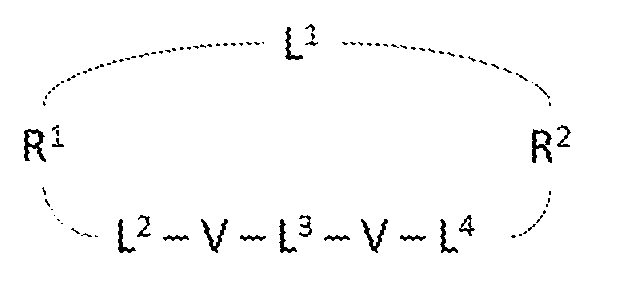
wherein V is a viologen subunit, R1 and R2 are reactive linkers formed by a click reaction, and L1, L2, L3, and L4 are independently selected from an alkyl, an alkenyl, an aryl, an alkylaryl, a triazole, or an alkyltriazole.
6. The catenane of claim 5, wherein the central cationic ring comprises
 and wherein either or both of I^-R^L3 and L2-R2-L4 comprise a continuous bridge of 8, 9, 10, 11, or 12 atoms between viologen subunits.
7. The catenane of claim 5, wherein the central cationic ring comprises

8. The catenane of any one of claims 5-7, wherein (i) each of the viologen subunits are in a dicationic oxidation state, (ii) each of the viologen subunits are in a radical-cationic oxidation state, or (iii) viologen subunits are in a combination of the dicationic oxidation state and the radical-cationic oxidation state.
9. The catenane of claim 8, wherein each of the viologen subunits are in the dicationic oxidation state.
10. The catenane of claim 9, wherein the catenane is a dodecacationic catenane (r[3]C12+).
11. The catenane of any of claims 4-10, wherein each of the radial cationic rings comprise cyclobis(paraquat-p-phenylene) tetracation (CBPQT4+).
12. The catenane of claim 8, wherein each of the viologen subunits are in the radical-cationic oxidation state.
13. The catenane of claim 9, wherein the catenane is a hexaradical/hexacationic catenane (r[3]C6( +)).
14. The catenane of any of claims 4-8 or 12-13, wherein each of the radial cationic rings comprise cyclobis(paraquat-p-phenylene) bisradical dication (CBPQT2( +)).
15. The catenane of claim 8, wherein the viologen subunits are in the combination of the dicationic oxidation state and the radical-cationic oxidation state.
16. The catenane of claim 3, wherein the central cationic ring comprises three viologen subunits.
17. The catenane of claim 4, wherein the central cationic ring comprises

wherein V is a viologen subunit, R1 and R2 are reactive linkers formed by a click reaction, and L1, L2, L3, L4, and L5 are independently selected from an alkyl, an alkenyl, an aryl, an alkylaryl, a triazole, or an alkyltriazole.
18. The catenane of claim 17, wherein any or all of iri-RkL3, L4, and L2-R2-L5 comprise a continuous bridge of 8, 9, 10, 11, or 12 atoms between viologen subunits.
19. The catenane of any one of claims 16-18, wherein (i) each of the viologen subunits are in a dicationic oxidation state, (ii) each of the viologen subunits are in a radical-cationic oxidation state, or (iii) viologen subunits are in a combination of the dicationic oxidation state and the radical-cationic oxidation state.
20 The catenane of claim 19, wherein each of the viologen subunits are in the dicationic oxidation state.
21 The catenane of claim 20, wherein the catenane is an octodecacationic catenane (r[4]C18+).
22 The catenane of any one of claims 16-21, wherein each of the radial cationic rings comprise cyclobis(paraquat-p-phenylene) tetracation (CBPQT4+).
23. The catenane of claim 19, wherein each of the viologen subunits are in the radical-cationic oxidation state.
24 The catenane of claim 23, wherein the catenane is a nonaradical/nonacationic catenane

25. The catenane of any one of claims 16-19 or 23-24, wherein each of the radial cationic rings comprise cyclobis(paraquat-p-phenylene) bisradical dication (CBPQT2( +)).
26. The catenane of claim 3, wherein the central cationic ring comprises four viologen subunits.
27. The catenane of claim 26, wherein the central cationic ring comprises

wherein V is a viologen subunit, R1 and R2 are reactive linkers formed by a click reaction, and L1, L2, L3, L4, L5, and L6 are independently selected from an alkyl, an alkenyl, an aryl, an alkylaryl, a triazole, or an alkyltriazole.
28. The catenane of claim 17, wherein any or all of I^-R^L3, L2, L5, and L3-R2-L6 each independently comprise a continuous bridge of 8, 9, 10, 11, or 12 atoms between viologen subunits.
29. The catenane of any one of claims 26-28, wherein (i) each of the viologen subunits are in a dicationic oxidation state, (ii) each of the viologen subunits are in a radical-cationic oxidation state, or (iii) viologen subunits are in a combination of the dicationic oxidation state and the radical-cationic oxidation state.
30. The catenane of claim 29, wherein each of the viologen subunits are in the dicationic oxidation state.
31. The catenane of claim 30, wherein the catenane is a tetracosacationic catenane (r[5]C24+).
32. The catenane of any one of claims 26-31, wherein each of the radial cationic rings comprise cyclobis(paraquat-p-phenylene) tetracation (CBPQT4+).
33. The catenane of claim 19, wherein each of the viologen subunits are in the radical-cationic oxidation state.
34. The catenane of claim 23, wherein the catenane is a dodecaaradical/dodecacationic catenane (r[5]C12( +)).
35. The catenane of any one of claims 16-19 or 23-24, wherein each of the radial cationic rings comprise cyclobis(paraquat-p-phenylene) bisradical dication (CBPQT2( +)).
36. A composition comprising the catenane of claim 1.
37. The composition of claim 36 further comprising a counterion.
38. The composition of claim 37, wherein the composition has a molar ratio of the counterion to the catenane is greater than or equal to 6: 1.
39. The composition of claim 37, wherein the composition has a molar ratio of the counterion to the catenane is greater than or equal to 12: 1.
40. The composition of claim 38 or 39, wherein the molar ratio is 6: 1, 9: 1, 12: 1, 18: 1, or 24: l.
41. The composition of any one of claims 36-40, wherein the catenane is the catenane of any one of claims 2-35.
42. A crystalline composition comprising the catenane of claim 1.
43. The crystalline composition of claim 42, wherein the catenane further comprises a counterion.
44. The crystalline composition of claim 42 or 43, wherein the crystalline composition catenane comprises the catenane of any one of claims 2-35 or the composition of any one of claims 37-41.
45. A device comprising the catenane of any one of claim 1.
46. The device of claim 42, wherein the device is a switch, transitor, memory device, electrochromic device, or redox-flow battery.
47. The device of claim 45 or 46, wherein the device comprises the catenane of any one of claims 2-35, the composition of any one of claims 36-41, or the crystalline composition of any one of claims 42-44.
48. A method of forming a cationic catenane, the method comprising:
providing a pseudorotaxane, the pseudorotaxane comprising:
a threading component having a first terminal moiety, a second terminal moiety, and two or more radical/cation viologen subunits between the first terminal moiety and the second terminal moiety and
two or more diradical/dicationic rings threaded by the threading component, wherein the pseudorotaxane comprises an equal number of diradical/dicationic rings as viologen subunits; and
contacting the first terminal moiety with the second terminal moiety to form a central cationic ring that mechanically interlocks the two or more diradical/dicationic rings, thereby forming the catenane.
49. The method of claim 48, wherein each of the radial cationic rings comprise cyclobis(paraquat-p-phenylene) bisradical dication (CBPQT2( +)).
50. The method of claim 48 or 49 further comprising oxidizing the catenane.
51. The method of claim 48, wherein the threading component comprises two, three, or four viologen subunits.
52. The method of claim 51, wherein the threading component comprises two viologen subunits.
53. The method of claim 52, wherein the threading component comprises

wherein V is a viologen subunit, R1 is a reactive linker formed by a click reaction, r2 is the first terminal moiety comprising a click-functionalized moiety, r2' is the second terminal moiety comprising a corresponding click-functionalized moiety to the first terminal moiety, and L1, L2, L3, and L4 are independently selected from an alkyl, an alkenyl, an aryl, an alkylaryl, a triazole, or an alkyltriazole or

wherein V is a viologen subunit, R1 is a reactive linker formed by a click reaction, r2 is the first terminal moiety comprising a click-functionalized moiety, r2' is the second terminal moiety comprising a corresponding click-functionalized moiety to the first terminal moiety, and L1, L2, L3, and L4 are independently selected from an alkyl, an alkenyl, an aryl, an alkylaryl, a triazole, or an alkyltriazole or
54. The method of claim 53, wherein the threading component comprises
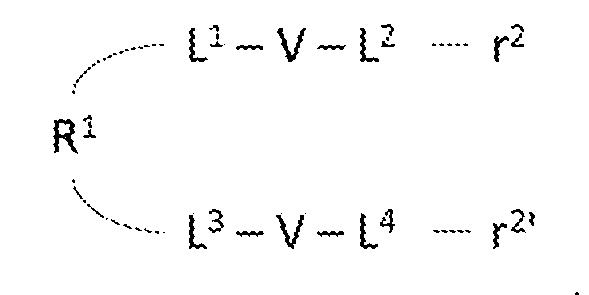
55. The method of claim 54, wherein the threading component is prepared by contacting

56. The method of claim 53, wherein the threading component comprises

57. The method of claim 54, wherein the threading component is prepared by contacting


wherein r1 is a terminal moiety comprising a click-functionalized moiety and r1' is a corresponding click-functionalized moiety to r1.
58. The method of any one of claims 52-57, wherein each of the radial cationic rings comprise cyclobis(paraquat-p-phenylene) bisradical dication (CBPQT2( +)).
59. The method of any one of claims 52-58 further comprising oxidizing the catenane.
60. The method of claim 51, wherein the threading component comprises three viologen subunits.
61. The method of claim 60, wherein the threading component comprises

62. The method of claim 61, wherein the threading component is prepared by contacting

63. The method of any one of claims 60-62, wherein each of the radial cationic rings comprise cyclobis(paraquat-p-phenylene) bisradical dication (CBPQT2(,+)).
64. The method of any one of claims 60-63 further comprising oxidizing the catenane.
65. The method of claim 51, wherein the threading component comprises four viologen subunits.
66 The method of claim 65, wherein the threading component comprises

67. The method of claim 66, wherein the threading component is prepared by contacting

wherein r1 is a terminal moiety comprising a click-functionalized moiety and r1' is a corresponding click-functionalized moiety to r1.
68 The method of any one of claims 65-67, wherein each of the radial cationic rings comprise cyclobis(paraquat-p-phenylene) bisradical dication (CBPQT2( +)).
69. The method of any one of claims 65-68 further comprising oxidizing the catenane.
Priority Applications (1)
| Application Number | Priority Date | Filing Date | Title |
|---|---|---|---|
| US17/045,288 US11566014B2 (en) | 2018-04-05 | 2019-04-05 | Densely charged catenanes |
Applications Claiming Priority (4)
| Application Number | Priority Date | Filing Date | Title |
|---|---|---|---|
| US201862653301P | 2018-04-05 | 2018-04-05 | |
| US62/653,301 | 2018-04-05 | ||
| US201862691923P | 2018-06-29 | 2018-06-29 | |
| US62/691,923 | 2018-06-29 |
Publications (1)
| Publication Number | Publication Date |
|---|---|
| WO2019195754A1 true WO2019195754A1 (en) | 2019-10-10 |
Family
ID=68101268
Family Applications (1)
| Application Number | Title | Priority Date | Filing Date |
|---|---|---|---|
| PCT/US2019/026095 Ceased WO2019195754A1 (en) | 2018-04-05 | 2019-04-05 | Densely charged catenanes |
Country Status (2)
| Country | Link |
|---|---|
| US (1) | US11566014B2 (en) |
| WO (1) | WO2019195754A1 (en) |
Families Citing this family (1)
| Publication number | Priority date | Publication date | Assignee | Title |
|---|---|---|---|---|
| US11977028B2 (en) * | 2020-04-15 | 2024-05-07 | Northwestern University | Mechanical-bond-induced exciplex fluorescence |
Citations (1)
| Publication number | Priority date | Publication date | Assignee | Title |
|---|---|---|---|---|
| US20140350242A1 (en) * | 2013-05-24 | 2014-11-27 | National Taiwan University | Pseudorotaxanes, rotaxanes and catenanes formed by metal ions templating |
Family Cites Families (2)
| Publication number | Priority date | Publication date | Assignee | Title |
|---|---|---|---|---|
| US9120799B2 (en) | 2011-09-22 | 2015-09-01 | Northwestern University | Crystalline bipyridinium radical complexes and uses thereof |
| EP3652175A4 (en) * | 2017-07-11 | 2021-03-24 | Northwestern University | MECHANICALLY LOCKED AIR STABLE RADICALS |
-
2019
- 2019-04-05 US US17/045,288 patent/US11566014B2/en active Active
- 2019-04-05 WO PCT/US2019/026095 patent/WO2019195754A1/en not_active Ceased
Patent Citations (1)
| Publication number | Priority date | Publication date | Assignee | Title |
|---|---|---|---|---|
| US20140350242A1 (en) * | 2013-05-24 | 2014-11-27 | National Taiwan University | Pseudorotaxanes, rotaxanes and catenanes formed by metal ions templating |
Non-Patent Citations (4)
| Title |
|---|
| AMABILINO ET AL.: "Olympiadane", ANGEWANDTE CHEMIE, vol. 33, no. 12, 6 June 1994 (1994-06-06), pages 1286 - 1290, XP055640860 * |
| AU-YEUNG ET AL.: "Strategies To Assemble Catenanes with Multiple Interlocked Macrocycles", INORGANIC CHEMISTRY, vol. 57, 11 December 2017 (2017-12-11), pages 3475 - 3485, XP055640867 * |
| GIBBS-HALL ET AL.: "Catenation through a Combination of Radical Templation and Ring-Closing Metathesis", JOURNAL OF THE AMERICAN CHEMICAL SOCIETY, vol. 137, 14 December 2015 (2015-12-14), pages 15640 - 15643, XP055640862 * |
| NGUYEN ET AL.: "Densely Charged Dodecacationic [3]- and Tetracosacationic Radial [5]Catenans", CHEM, vol. 4, 9 August 2018 (2018-08-09), pages 2329 - 2344, XP055640870 * |
Also Published As
| Publication number | Publication date |
|---|---|
| US11566014B2 (en) | 2023-01-31 |
| US20210147384A1 (en) | 2021-05-20 |
Similar Documents
| Publication | Publication Date | Title |
|---|---|---|
| Nguyen et al. | Densely charged dodecacationic [3]-and tetracosacationic radial [5] catenanes | |
| Zheng et al. | Self-assembly of a highly emissive pure organic imine-based stack for electroluminescence and cell imaging | |
| Spanggaard et al. | Multiple-bridged bis-tetrathiafulvalenes: new synthetic protocols and spectroelectrochemical investigations | |
| Dale et al. | Supramolecular Ex plorations: Ex hibiting the Ex tent of Ex tended cationic cyclophanes | |
| Saura-Sanmartin et al. | Mechanically interlocked molecules in metal–organic frameworks | |
| Cao et al. | Probing Donor− Acceptor Interactions and Co-Conformational Changes in Redox Active Desymmetrized [2] Catenanes | |
| Fahrenbach et al. | Solution-phase mechanistic study and solid-state structure of a tris (bipyridinium radical cation) inclusion complex | |
| Nalluri et al. | Chiral redox-active isosceles triangles | |
| Finelli et al. | Threading Salen-type Cu-and Ni-complexes into one-dimensional coordination polymers: solution versus solid state and the size effect of the alkali metal ion | |
| US9120799B2 (en) | Crystalline bipyridinium radical complexes and uses thereof | |
| Li et al. | Catalyst-free one-step synthesis of ortho-tetraaryl perylene diimides for efficient OPV non-fullerene acceptors | |
| Malthus et al. | Improved access to 1, 8-diformyl-carbazoles leads to metal-free carbazole-based [2+ 2] Schiff base macrocycles with strong turn-on fluorescence sensing of zinc (II) ions | |
| Juríček et al. | An ExBox [2] catenane | |
| Senevirathna et al. | Synthesis, characterization and photovoltaic properties of azadipyrromethene-based acceptors: effect of pyrrolic substituents | |
| Fan et al. | Host–guest capability of a three-dimensional heterometallic macrocycle | |
| Koldemir et al. | Orthogonal 4, 10 and 6, 12 substitution of dibenzo [def, mno] chrysene polycyclic aromatic small molecules | |
| Prakash et al. | Mono-and tri-β-substituted unsymmetrical metalloporphyrins: synthesis, structural, spectral and electrochemical properties | |
| Belhadj et al. | Terpyridine–tetrathiafulvalene hybrid ligands and their electroactive metal complexes | |
| Skibiński et al. | Redox responsive molecular tweezers with tetrathiafulvalene units: synthesis, electrochemistry, and binding properties | |
| US11566014B2 (en) | Densely charged catenanes | |
| Chatterjee et al. | Stabilization of hexa-coordinated P (v) corroles by axial silyloxy groups | |
| Matlachowski et al. | Synthesis and characterization of mono-and dinuclear phenanthroline-extended tetramesitylporphyrin complexes as well as UV-Vis and EPR studies on their one-electron reduced species | |
| EP3408269A1 (en) | Viologen-based rotaxanes | |
| US9130233B2 (en) | Metal complex, modified compound thereof and useful compound thereof | |
| Koszarna et al. | The synthesis and properties of bis-1, 1′-(porphyrinyl) ferrocenes |
Legal Events
| Date | Code | Title | Description |
|---|---|---|---|
| 121 | Ep: the epo has been informed by wipo that ep was designated in this application |
Ref document number: 19781116 Country of ref document: EP Kind code of ref document: A1 |
|
| NENP | Non-entry into the national phase |
Ref country code: DE |
|
| 122 | Ep: pct application non-entry in european phase |
Ref document number: 19781116 Country of ref document: EP Kind code of ref document: A1 |