WO2019079264A1 - Methods and compositions for improving growth and performance - Google Patents

Methods and compositions for improving growth and performance Download PDF

Info

Publication number
WO2019079264A1
WO2019079264A1 PCT/US2018/056033 US2018056033W WO2019079264A1 WO 2019079264 A1 WO2019079264 A1 WO 2019079264A1 US 2018056033 W US2018056033 W US 2018056033W WO 2019079264 A1 WO2019079264 A1 WO 2019079264A1
Authority
WO
WIPO (PCT)
Prior art keywords
lactobacillus
strain
deposited
accession number
ncbi database
Prior art date
Legal status (The legal status is an assumption and is not a legal conclusion. Google has not performed a legal analysis and makes no representation as to the accuracy of the status listed.)
Ceased
Application number
PCT/US2018/056033
Other languages
French (fr)
Inventor
Timothy Johnson
Jessica DANZEISEN
Bonnie WEBER
Current Assignee (The listed assignees may be inaccurate. Google has not performed a legal analysis and makes no representation or warranty as to the accuracy of the list.)
University of Minnesota Twin Cities
University of Minnesota System
Original Assignee
University of Minnesota Twin Cities
University of Minnesota System
Priority date (The priority date is an assumption and is not a legal conclusion. Google has not performed a legal analysis and makes no representation as to the accuracy of the date listed.)
Filing date
Publication date
Application filed by University of Minnesota Twin Cities, University of Minnesota System filed Critical University of Minnesota Twin Cities
Priority to US16/756,675 priority Critical patent/US20200236969A1/en
Publication of WO2019079264A1 publication Critical patent/WO2019079264A1/en
Anticipated expiration legal-status Critical
Ceased legal-status Critical Current

Links

Classifications

    • AHUMAN NECESSITIES
    • A23FOODS OR FOODSTUFFS; TREATMENT THEREOF, NOT COVERED BY OTHER CLASSES
    • A23KFODDER
    • A23K50/00Feeding-stuffs specially adapted for particular animals
    • A23K50/70Feeding-stuffs specially adapted for particular animals for birds
    • A23K50/75Feeding-stuffs specially adapted for particular animals for birds for poultry
    • AHUMAN NECESSITIES
    • A23FOODS OR FOODSTUFFS; TREATMENT THEREOF, NOT COVERED BY OTHER CLASSES
    • A23KFODDER
    • A23K10/00Animal feeding-stuffs
    • A23K10/10Animal feeding-stuffs obtained by microbiological or biochemical processes
    • AHUMAN NECESSITIES
    • A23FOODS OR FOODSTUFFS; TREATMENT THEREOF, NOT COVERED BY OTHER CLASSES
    • A23KFODDER
    • A23K10/00Animal feeding-stuffs
    • A23K10/10Animal feeding-stuffs obtained by microbiological or biochemical processes
    • A23K10/16Addition of microorganisms or extracts thereof, e.g. single-cell proteins, to feeding-stuff compositions
    • AHUMAN NECESSITIES
    • A23FOODS OR FOODSTUFFS; TREATMENT THEREOF, NOT COVERED BY OTHER CLASSES
    • A23KFODDER
    • A23K10/00Animal feeding-stuffs
    • A23K10/10Animal feeding-stuffs obtained by microbiological or biochemical processes
    • A23K10/16Addition of microorganisms or extracts thereof, e.g. single-cell proteins, to feeding-stuff compositions
    • A23K10/18Addition of microorganisms or extracts thereof, e.g. single-cell proteins, to feeding-stuff compositions of live microorganisms
    • AHUMAN NECESSITIES
    • A61MEDICAL OR VETERINARY SCIENCE; HYGIENE
    • A61KPREPARATIONS FOR MEDICAL, DENTAL OR TOILETRY PURPOSES
    • A61K35/00Medicinal preparations containing materials or reaction products thereof with undetermined constitution
    • A61K35/66Microorganisms or materials therefrom
    • A61K35/74Bacteria
    • A61K35/741Probiotics
    • A61K35/742Spore-forming bacteria, e.g. Bacillus coagulans, Bacillus subtilis, clostridium or Lactobacillus sporogenes
    • AHUMAN NECESSITIES
    • A61MEDICAL OR VETERINARY SCIENCE; HYGIENE
    • A61KPREPARATIONS FOR MEDICAL, DENTAL OR TOILETRY PURPOSES
    • A61K35/00Medicinal preparations containing materials or reaction products thereof with undetermined constitution
    • A61K35/66Microorganisms or materials therefrom
    • A61K35/74Bacteria
    • A61K35/741Probiotics
    • A61K35/744Lactic acid bacteria, e.g. enterococci, pediococci, lactococci, streptococci or leuconostocs
    • AHUMAN NECESSITIES
    • A61MEDICAL OR VETERINARY SCIENCE; HYGIENE
    • A61KPREPARATIONS FOR MEDICAL, DENTAL OR TOILETRY PURPOSES
    • A61K35/00Medicinal preparations containing materials or reaction products thereof with undetermined constitution
    • A61K35/66Microorganisms or materials therefrom
    • A61K35/74Bacteria
    • A61K35/741Probiotics
    • A61K35/744Lactic acid bacteria, e.g. enterococci, pediococci, lactococci, streptococci or leuconostocs
    • A61K35/747Lactobacilli, e.g. L. acidophilus or L. brevis
    • AHUMAN NECESSITIES
    • A23FOODS OR FOODSTUFFS; TREATMENT THEREOF, NOT COVERED BY OTHER CLASSES
    • A23VINDEXING SCHEME RELATING TO FOODS, FOODSTUFFS OR NON-ALCOHOLIC BEVERAGES AND LACTIC OR PROPIONIC ACID BACTERIA USED IN FOODSTUFFS OR FOOD PREPARATION
    • A23V2400/00Lactic or propionic acid bacteria
    • A23V2400/11Lactobacillus
    • A23V2400/113Acidophilus
    • AHUMAN NECESSITIES
    • A23FOODS OR FOODSTUFFS; TREATMENT THEREOF, NOT COVERED BY OTHER CLASSES
    • A23VINDEXING SCHEME RELATING TO FOODS, FOODSTUFFS OR NON-ALCOHOLIC BEVERAGES AND LACTIC OR PROPIONIC ACID BACTERIA USED IN FOODSTUFFS OR FOOD PREPARATION
    • A23V2400/00Lactic or propionic acid bacteria
    • A23V2400/11Lactobacillus
    • A23V2400/151Johnsonii
    • AHUMAN NECESSITIES
    • A23FOODS OR FOODSTUFFS; TREATMENT THEREOF, NOT COVERED BY OTHER CLASSES
    • A23VINDEXING SCHEME RELATING TO FOODS, FOODSTUFFS OR NON-ALCOHOLIC BEVERAGES AND LACTIC OR PROPIONIC ACID BACTERIA USED IN FOODSTUFFS OR FOOD PREPARATION
    • A23V2400/00Lactic or propionic acid bacteria
    • A23V2400/11Lactobacillus
    • A23V2400/173Reuteri
    • AHUMAN NECESSITIES
    • A23FOODS OR FOODSTUFFS; TREATMENT THEREOF, NOT COVERED BY OTHER CLASSES
    • A23VINDEXING SCHEME RELATING TO FOODS, FOODSTUFFS OR NON-ALCOHOLIC BEVERAGES AND LACTIC OR PROPIONIC ACID BACTERIA USED IN FOODSTUFFS OR FOOD PREPARATION
    • A23V2400/00Lactic or propionic acid bacteria
    • A23V2400/11Lactobacillus
    • A23V2400/181Salivarius
    • AHUMAN NECESSITIES
    • A23FOODS OR FOODSTUFFS; TREATMENT THEREOF, NOT COVERED BY OTHER CLASSES
    • A23VINDEXING SCHEME RELATING TO FOODS, FOODSTUFFS OR NON-ALCOHOLIC BEVERAGES AND LACTIC OR PROPIONIC ACID BACTERIA USED IN FOODSTUFFS OR FOOD PREPARATION
    • A23V2400/00Lactic or propionic acid bacteria
    • A23V2400/41Pediococcus
    • A23V2400/413Acidilactici
    • AHUMAN NECESSITIES
    • A61MEDICAL OR VETERINARY SCIENCE; HYGIENE
    • A61KPREPARATIONS FOR MEDICAL, DENTAL OR TOILETRY PURPOSES
    • A61K35/00Medicinal preparations containing materials or reaction products thereof with undetermined constitution
    • A61K2035/11Medicinal preparations comprising living procariotic cells
    • A61K2035/115Probiotics

Definitions

  • antibiotic-free alternatives are needed to prevent disease and promote animal growth.
  • One of the current challenges facing commercial turkey production is declining performance as a result of reducing antimicrobial use.
  • compositions including a bacterial species or a combination of bacterial species and methods of using those compositions.
  • use of those compositions prevents disease and/or promotes growth in an animal.
  • the animal is a turkey.
  • the composition is antibiotic-free.
  • this disclosure describes a composition that includes at least 4 bacterial species or strains selected from the following bacterial species: Clostridium bartlettii; Lactobacillus acidophilus; Lactobacillus aviarius; Lactobacillus crispatus; Lactobacillus gallinarum;
  • At least one of the bacterial species or strains is an avian-sourced strain. In some embodiments, at least one of the bacterial species or strains is a turkey-sourced strain.
  • this disclosure describes a method that includes administering the composition to an animal.
  • the animal is a turkey.
  • the method further comprises administering a prebiotic to the animal.
  • the steps may be conducted in any feasible order. And, as appropriate, any combination of two or more steps may be conducted simultaneously.
  • FIG. 1 shows a phylogenetic tree of Lactobacillus johnsonii isolates. Turkey-source isolates are shown by gray lines, chicken- source isolates are shown by dotted lines, pig-source isolates are shown by dashed lines, and human/rodent-source isolates are shown by dotted/dashed lines.
  • Turkey-source (gray lines) isolates were further subdivided into clades 1-8 based upon their single- nucleotide polymorphism (SNP) and gene content differences.
  • SNP single- nucleotide polymorphism
  • the scale bar in the lower left indicates a scale of 4000 SNPs.
  • FIG. 3 shows a phylogenetic tree of Lactobacillus aviarius isolates. Turkey-source isolates of L. aviarius subsp. aviarius are shown by gray lines, and chicken- source isolates of L. aviarius subsp. aviarius and L. aviarius subsp. araffinosus are shown by dotted lines.
  • FIG. 4A and FIG. 4B show average body weights in grams (y-axis) for day-of-hatch turkeys treated with a 4-strain probiotic blend, a 10-strain (derived from birds aged 3 weeks) probiotic blend, and a 10-strain (derived from birds aged 6 weeks) probiotic blend, as described in Example 2, compared to body weights for day-of-hatch turkeys treated with a saline negative control and day-of-hatch turkeys treated with an existing commercial probiotic derived from chickens (FM- Bl 1).
  • FIG. 4A Turkeys were weighed on day 0 (that is, day-of-hatch), day 7, day 10, and day 14. Error bars depict standard error of means.
  • FIG. 5A and FIG. 5B show average body weights in grams (y-axis) for day-of-hatch turkeys treated with a 4-strain probiotic blend inoculation group, day-of-hatch turkeys treated with an existing commercial probiotic derived from chickens (FM-Bl 1), and day-of-hatch turkeys treated with a low-dose antibiotic (bacitracin methylene disalicylate or BMD), as described in Example 2, compared to day-of-hatch turkeys treated with a saline negative control.
  • FIG. 5 A Turkeys were weighed on day 0 (that is, day-of-hatch), day 3, day 6, and day 13. Error bars depict standard error of means.
  • compositions including a bacterial species or a combination of bacterial species and methods of using those compositions.
  • Alternatives to antimicrobials such as antibiotics exist for the broiler chicken industry, but such alternatives are lacking for the commercial turkey industry.
  • many alternatives to antimicrobials are aimed at pathogen reduction and not performance.
  • the compositions disclosed herein prevent disease and/or promote growth in an animal.
  • the animal is preferably a bird. In some embodiments, the animal is preferably a turkey.
  • compositions of the present disclosure include a bacterial species or a combination of bacterial species.
  • a composition includes a combination of specific bacterial species or strains.
  • the composition is preferably antibiotic-free. Bacterial species and/or strains in the composition
  • the composition includes at least 4 bacterial species or strains, at least 5 bacterial species or strains, at least 6 bacterial species or strains, at least 7 bacterial species or strains, at least 8 bacterial species or strains, at least 9 bacterial species or strains, at least 10 bacterial species or strains, at least 1 1 bacterial species or strains, or at least 12 bacterial species or strains selected from the following bacterial species: Clostridium (Intestinibacter) bartlettii;
  • Lactobacillus acidophilus Lactobacillus aviarius; Lactobacillus crispatus; Lactobacillus gallinarum; Lactobacillus helveticus; Lactobacillus ingluviei; Lactobacillus johnsonii;
  • Lactobacillus reuteri Lactobacillus salivarius; Lactobacillus vaginalis; and Pediococcus acidilactici.
  • At least one of the bacterial species or strains may have been isolated from an avian source (that is, is avian-sourced). In some embodiments, at least 2 bacterial species or strains, at least 3 bacterial species or strains, at least 4 bacterial species or strains, or all of the bacterial species or strains are from an avian source.
  • At least one of the bacterial species or strains may have been isolated from a turkey (that is, is turkey-sourced). In some embodiments, at least 2 bacterial species or strains, at least 3 bacterial species or strains, at least 4 bacterial species or strains, or all of the bacterial species or strains are from a turkey.
  • the composition includes a strain of Clostridium bartlettii.
  • the strain of Clostridium bartlettii includes Clostridium bartlettii DSM 16795 (deposited in the NCBI database under GE BA K accession number FUXV00000000.1).
  • the composition includes a strain of Lactobacillus acidophilus.
  • a strain of Lactobacillus acidophilus includes Lactobacillus acidophilus strain UMNPBX11 (deposited in the NCBI database under Bioproject accession number PRJNA412075 and GENBANK accession number PCYZ00000000).
  • the composition includes a strain of Lactobacillus aviaries.
  • a strain of Lactobacillus aviarius includes at least one of Lactobacillus aviarius subspecies araffinosus and Lactobacillus aviarius subspecies aviaries.
  • a strain of Lactobacillus acidophilus includes at least one of Lactobacillus aviarius strain UMNLavl2 (deposited in the NCBI database under GENBANK accession number NZ_LWUE00000000.1); Lactobacillus aviarius strain UMNLavl3 deposited in the NCBI database under GENBANK accession number NZ_LWUF00000000.1); Lactobacillus aviarius strain UMNLAv76 (deposited in the NCBI database under GENBANK accession number PCZQ00000000); Lactobacillus aviarius strain UMNLav97 (deposited in the NCBI database under GENBANK accession number
  • PCZP00000000 Lactobacillus aviarius strain UMNLav98 (deposited in the NCBI database under GENBANK accession number PCZO00000000); Lactobacillus aviarius strain DSM 20653 (deposited in the NCBI database under GENBANK accession number NZ_AYYZ00000000.1); and Lactobacillus aviarius strain DSM 20655 (deposited in the NCBI database under GENBANK accession number NZ_AYZA00000000.1).
  • the composition includes a strain of Lactobacillus crispatus.
  • a strain of Lactobacillus crispatus includes at least one of Lactobacillus crispatus strain UMNPBXl (deposited in the NCBI database under GENBANK accession number
  • Lactobacillus crispatus strain UMNPBXl 5 (deposited in the NCBI database under GENBANK accession number PCYV00000000); and Lactobacillus crispatus strain UMNPBXl 6 (deposited in the NCBI database under GENBANK accession number PCYU00000000).
  • the composition includes a strain of Lactobacillus gallinarum.
  • a strain of Lactobacillus gallinarum includes at least one of Lactobacillus gallinarum strain UMNPBX4 (deposited in the NCBI database under GENBANK accession number PCZF00000000); Lactobacillus gallinarum strain UMNPBXl 4 (deposited in the NCBI database under GENBANK accession number PCYWOOOOOOOO); and Lactobacillus gallinarum strain UMNPBXl 7 (deposited in NCBI databases under GENBANK accession number
  • the composition includes a strain of Lactobacillus helveticus.
  • a strain of Lactobacillus helveticus includes Lactobacillus helveticus strain UMNPBX6 (deposited in the NCBI database under GENBANK accession number
  • the composition includes Lactobacillus ingluviei.
  • a strain of Lactobacillus ingluviei includes Lactobacillus ingluviei strain
  • the composition includes a strain of Lactobacillus johnsonii.
  • a strain of Lactobacillus johnsonii includes at least one of Lactobacillus johnsonii strain UMNLJ21 (deposited in the NCBI database under GENBANK accession numbers
  • Lactobacillus johnsonii strain UMNLJ94 (deposited in the NCBI database under GENBANK accession number PCZK00000000); and Lactobacillus johnsonii strain UMNLJl 13 (deposited in the NCBI database under GENBANK accession number
  • the composition includes a strain of Lactobacillus reuteri.
  • a strain of Lactobacillus reuteri includes at least one of Lactobacillus reuteri strain UMNPBX3 (deposited in the NCBI database under GENBANK accession number
  • the composition includes a strain of Lactobacillus salivarius.
  • a strain of Lactobacillus salivarius includes at least one of Lactobacillus salivarius strain UMNPBX2 (deposited in the NCBI database under GENBANK accession number
  • the composition includes a strain of Lactobacillus vaginalis.
  • a strain of Lactobacillus vaginalis includes at least one of Lactobacillus vaginalis strain UMNPBX5 (deposited in the NCBI database GENBANK accession number
  • the composition includes a strain of Pediococcus acidolactici .
  • a strain of Pediococcus acidolactici includes Pediococcus acidolactici
  • strains described herein are, in some embodiments, described by reference to particular sequences, a person having skill in the art will recognize that a sequence having some genetic variations from a sequence provided for the strain described herein will still describe the same strain.
  • a sequence differing by fewer than 20,000 SNPs, fewer than 10,000 SNPs, fewer than 5,000 SNPs, fewer than 1,000 SNPs, fewer than 750 SNPs, fewer than 500 SNPs, fewer than 400 SNPs, fewer than 300 SNPs, fewer than 200 SNPs, or fewer than 100 SNPs from the sequence of a strain described herein is defined as describing the same strain.
  • a sequence differing by less than 0.5%, less than 0.4%, less than 0.3%, less than 0.2%), or less than 0.1%> from the sequence of a strain described herein is defined as describing the same strain.
  • Percent identity between two sequences may be determined in any one of numerous ways known to a person having skill in the art including, for example, using publicly available computer software such as the Smith- Waterman algorithm, BESTFIT alignment, BLAST, FASTA, CLUSTALW, etc.
  • the composition includes at least 1X10 5 colony-forming units (CFU) of each of the bacterial species or strains, at least 1X10 6 CFU of each of the species or strains, at least 1X10 7 CFU of each of the species or strains, or at least 1X10 8 CFU of each of the species or strains.
  • the composition includes up to 1X10 6 CFU of each of the species or strains, up to 1X10 7 CFU each of the species or strains, up to 1X10 8 CFU each of the species or strains, up to 1X10 9 CFU each of the species or strains, up to 1X10 10 CFU each of the species or strains, or up to 1X10 11 CFU each of the species or strains.
  • a composition may include at least 1X10 7 CFU of each of the species or strains and up tolXlO 9 CFU of each of the species or strains.
  • a composition may include IX 10 8 CFU of each of the species or strains.
  • a viability count may be used to determine the number of CFU of the composition.
  • compositions described herein may be administered to an animal using any suitable method.
  • the composition may be administered as a feed additive.
  • the composition may be administered by oral gavage.
  • the composition may be administered in water and/or in a nutrient gel.
  • the composition may be micro-encapsulated.
  • the composition may be administered multiple times. For example, the composition may be administered at least twice, at least three times, or at least four times.
  • the composition may be administered up to four times, up to five times, up to 10 times, up to 15 times, or up to 18 times.
  • the composition may be administered on multiple days. In some embodiments the composition may be administered weekly.
  • the composition may be administered daily and/or continuously, for example, in feed.
  • the administration of the composition may be timed to coincide with an event in the animal's development or treatment.
  • the composition may be administered in combination with one or more of the following events: before and/or after vaccination, before and/or after a move of the animal; before and/or after a diet change, before and/or after diagnosis with a disease, and before and/or after treatment for a disease.
  • the composition may be administered to an animal that is less than a week old.
  • the composition may be administered to a day-of- hatch bird.
  • the animal may be at least one week old, at least two weeks old, at least three weeks old, or at least four weeks old.
  • the composition may be administered to an animal in combination with a prebiotic.
  • the prebiotic may be administered by any suitable method.
  • a prebiotic may be administered at the same time - including, for example, in the composition that includes a combination of bacterial species or strains - or at a different time or different times from the composition.
  • a prebiotic may be administered continuously to the animal.
  • the prebiotic may be included in the animal's feed.
  • the prebiotic may include any suitable prebiotic including, for example, one or more of a disaccharide, an oligosaccharide, and a polysaccharide.
  • a prebiotic may include one or more of lactose, lactulose, mannan-oligosaccharide (MOS), inulin, soy Fructo-oligosaccharide (FOS), galacto-oligosaccharide (GOS), and a ⁇ -glucan.
  • lactose lactose
  • lactulose mannan-oligosaccharide
  • MOS mannan-oligosaccharide
  • FOS soy Fructo-oligosaccharide
  • GOS galacto-oligosaccharide
  • ⁇ -glucan a prebiotic may include one or more of lactose, lactulose, mannan-oligosaccharide (MOS), inulin, soy Fructo-oligosaccharide (FOS), galacto-oligosaccharide (GOS), and a ⁇ -glucan.
  • the prebiotic may preferably include lactose.
  • the prebiotic may preferably include a mannan-oligosaccharide, and/or a ⁇ -glucan.
  • the prebiotic may include SAFMAN AN (available from Phileo Lesaffre Animal Care, Marcq-En- Baroeul Cedex, France).
  • Each isolate was identified at the bacterial species level using sequencing of the full length bacterial 16S rRNA, as previously described (Lane DJ, 1991, 16S/23S rRNA sequencing. In: E. Stackebrandt, M. Goodfellow. Nucleic acid techniques in bacterial systematics. New York, N.Y., John Wiley & Sons, Inc., pp. 115-176.). Following species-level identification of these isolates, representative isolates from each bacterial species were subjected to whole genome sequencing using Illumina MiSeq at a depth of at least 50x coverage (Illumina, Inc., San Diego, CA).
  • each isolate was mapped to a reference genome matching its respective bacterial species using CLC Genomics Workbench (Qiagen, N. V., Hilden, Germany). Following mapping, single nucleotide polymorphisms (SNPs) were identified using variant calling in CLC Genomics Workbench. SNPs were then combined for each bacterial species of interest, and subsequently analyzed. Using Maximum Parsimony methods (MEGA, available at on the world wide web at megasoftware.net, version 6.06), a phylogenetic tree was constructed to group isolates based upon genetic similarity and to establish clades within each bacterial species. Finally, a pangenome analysis was performed for every isolate within each clade of a species, to establish core and unique genes belonging to each subset; an exemplary process is described in Example 1 A.
  • CLC Genomics Workbench Qiagen, N. V., Hilden, Germany.
  • SNPs single nucleotide polymorphisms
  • MEGA Maximum Parsimony methods
  • strains were selected based upon their dominance in high- performing turkey flocks and upon the isolation of the strains from commercial turkeys of certain age groups.
  • Example 1A Selection of Lactobacillus johnsonii Strain UMNLJ21
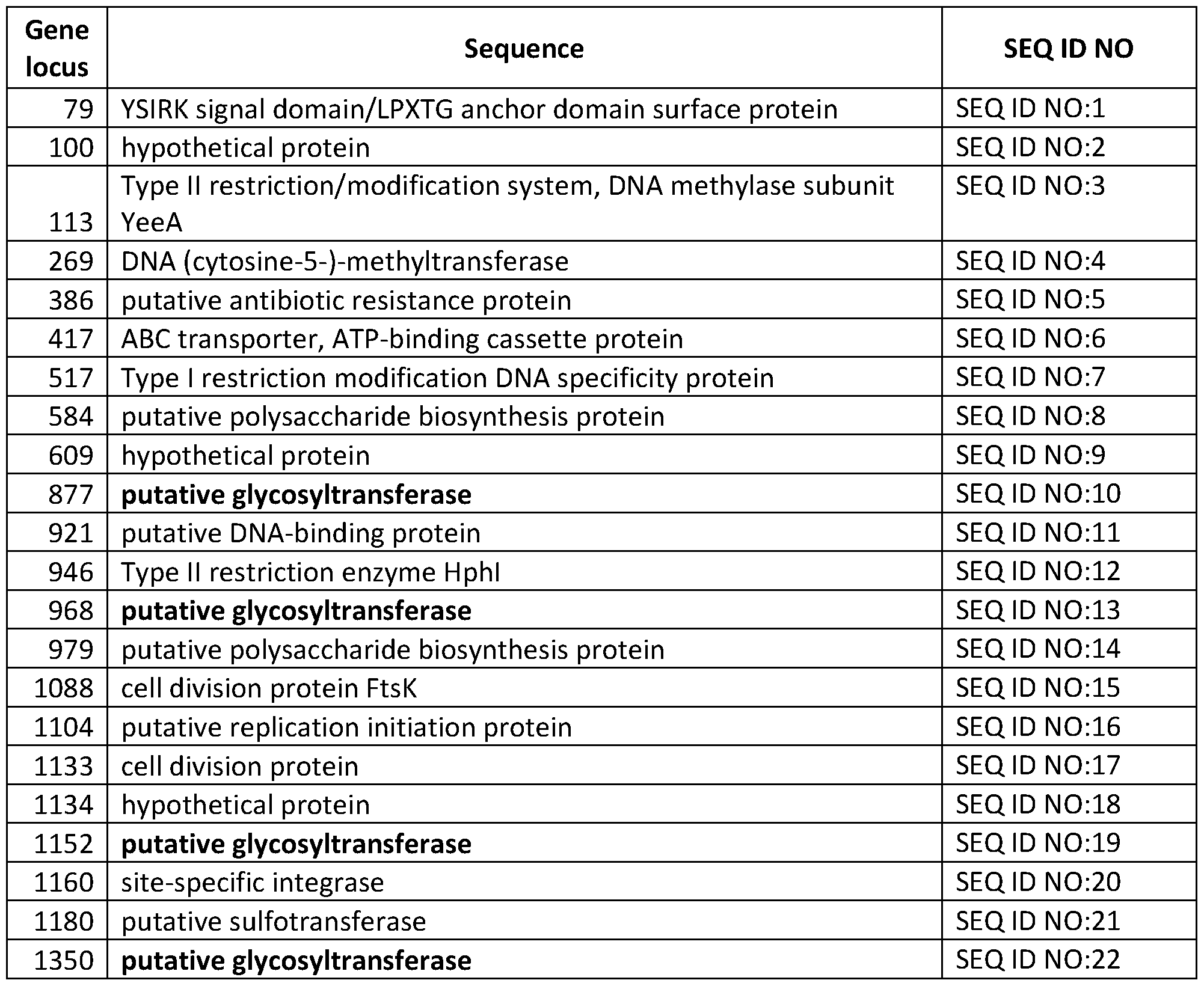
  • Pangenome comparisons identified genes that were unique to Clade 1 isolates. A total of 49 genes were identified that were conserved across Clade 1 isolates, but unique to Clade 1 isolates compared to all other L. johnsonii . A list of the genes and their predicted functions are provided in Table 2; corresponding sequences of the genes of Table 2 are provided as SEQ ID NOs: l-49. These genes included those predicted to encode for ABC transport systems (predicted for novel sugar utilization), CRISPR/Cas system (for bacterial defense against foreign DNA), mucus-binding proteins (for colonization), exopolysaccharide production (for survival and colonization), and restriction modification systems (for bacterial defense against foreign DNA). Thus, this gene subset includes unique proteins that may encode for the beneficial growth properties conferred in commercial turkeys.
  • Clade 1 isolates differ from their closest clade (clade 2) by at least 2,921 SNPs, and differ from a chicken- source isolate described in the literature for its probiotic properties in broiler chickens (PMID Nos. 28318296, 19767436, 14962040) by 20,509 SNPs.
  • Table 2 List of unique genes present in clade 1 of L. johnsonii and their predicted functions.
  • Example IB Lactobacillus aviarius
  • J. aviarius isolates were analyzed as described above. SNPs were used for phylogenetic analysis including all L. aviarius isolates in the NCBI database (February 2017). Using Maximum Parsimony methods, a phylogenetic tree was constructed. Isolates were separated into clades based upon their host source of isolation (chicken or turkey). Furthermore, distinct clades were identified among the 104 turkey-source isolates differentiating J. aviarius subsp. aviarius isolates ( Figure 3).
  • strains from clades 1 and 4 were selected for further study (see Example 2 (4-strain probiotic blend)).
  • Strains selected included UMNLavl2 (NCBI Biosample SAMN04573032) and UMNLavl3 (NCBI Biosample AMN04573033). These strains differ from chicken source L. aviarius by at least 42,318 SNPs. Also, each clade-associated strain within turkeys differs from strains of other clades by at least 31,264 SNPs.
  • a strain of Clostridium bartlettii was isolated from a 6-week-old commercial turkey.
  • Lactobacillus aviarius strain UMNLavl2 deposited in the NCBI database under Bioproject accession number PRJNA316009 and GENBANK accession number
  • Lactobacillus aviarius strain UMNLavl3 deposited in the NCBI database under Bioproject accession number and GENBANK accession number NZ_LWUF00000000.1
  • Lactobacillus johnsonii strain UMNLJ21 deposited in the NCBI database under Bioproject accession number PRJNA316010 and GENBANK accession numbers CP021701,
  • Lactobacillus crispatus strain UMNPBXl (deposited in the NCBI database under Bioproject accession number PRJNA412075 and GENBANK accession number PCZI00000000)
  • Lactobacillus crispatus strain UMNPBX8 (deposited in the NCBI database under Bioproject accession number PRJNA412075 and GENBANK accession number PCZB00000000)
  • PCZH00000000 Lactobacillus reuteri strain UMNPBX3 (deposited in the NCBI database under Bioproject accession number PRJNA412075 and GENBANK accession number PCZG00000000)
  • Lactobacillus gallinarum strain UMNPBX4 (deposited in the NCBI database under
  • Lactobacillus vaginalis strain UMNPBX5 (deposited in the NCBI database under Bioproject accession number PRJNA412075 and GENBANK accession number PCZE00000000)
  • Lactobacillus aviarius strain UMNLAv76 (deposited in the NCBI database under Bioproject accession number PRJNA316009 and GENBANK accession number PCZQ00000000)
  • Lactobacillus reuteri strain UMNPBX7 (deposited in the NCBI database under Bioproject accession number PRJNA412075 and GENBANK accession number PCZC00000000) -strain (6 week) probiotic blend:
  • Lactobacillus reuteri strain UMNPBXIO deposited in the NCBI database under Bioproject accession number PRJNA412075 and GENBANK accession number PCZL00000000
  • Lactobacillus crispatus strain UMNPBX12 (deposited in the NCBI database under
  • Lactobacillus crispatus strain UMNPBX15 (deposited in the NCBI database under
  • Lactobacillus johnsonii strain UMNLJ21 deposited in the NCBI database under Bioproject accession number PRJNA316010 and GENBANK accession numbers CP021701,
  • Lactobacillus aviarius strain UMNLav97 deposited in the NCBI database under Bioproject accession number PRJNA316009 and GENBANK accession number PCZP00000000
  • Lactobacillus aviarius strain UMNLav98 deposited in the NCBI database under Bioproject accession number PRJNA316009 and GENBANK accession number PCZO00000000
  • -strain (wild card) probiotic blend
  • Lactobacillus aviarius strain UMNLAv97 deposited in NCBI databases under Bioproject accession number PRJNA316009 and GENBANK accession number PCZP00000000
  • Lactobacillus aviarius strain UMNLAv98 deposited in NCBI databases under Bioproject accession number PRJNA316009 and GENBANK accession number PCZO00000000
  • Lactobacillus aviarius strain DSM 20653 deposited in NCBI databases under Bioproject accession number PRJNA222257 and GENBANK accession number
  • Lactobacillus aviarius strain DSM 20655 deposited in NCBI databases under Bioproject accession number PRJNA222257 and GENBANK accession number
  • Lactobacillus crispatus strain UMNPBX16 (deposited in NCBI databases under Bioproject accession number PRJNA412075 and GENBANK accession number PCYUOOOOOOOO) Lactobacillus gallinarum strain UMNPBX17 (deposited in NCBI databases under
  • Lactobacillus ingluviei strain UMNPBX19 (deposited in NCBI databases under Bioproject accession number PRJNA412075 and GENBANK accession number PCYROOOOOOOO)
  • Lactobacillus johnsonii strain UMNLJ94 (deposited in NCBI databases under Bioproject accession number PRJNA316010 and GENBANK accession number PCZK00000000)
  • Lactobacillus johnsonii strain UMNLJ21 deposited in NCBI databases under Bioproject accession number PRJNA316010 and GENBANK accession numbers CP021701,
  • Lactobacillus reuteri strain UMNPBX18 (deposited in the NCBI database under Bioproject accession number PRJNA412075 and GENBANK accession number PCYS00000000)
  • Pediococcus acidilactici strain UMNPBX20 (deposited in the NCBI database under Bioproject accession number PRJNA412075 and GENBANK accession number
  • the 4-strain probiotic blend, 10-strain (3 week) probiotic blend, and 10-strain (6 week) probiotic blend were tested for their ability to enhance turkey performance in two separate trials.
  • day-of-hatch turkey poults in a caged trial with 5 replicate cages per treatment group were inoculated via oral gavage with either a negative saline control (Negative control), a commercially available probiotic derived from chicken isolates (FM- Bl 1, applied according to manufacturer's instructions), or 1X10 8 CFU of each of the strains described above for the 4-strain combination and the two 10-strain combinations.
  • Birds were weighed at four time points. Feeds were weighed back at each sampling time point to calculate feed conversion rate.
  • all of the novel turkey-source strain combination groups had significantly higher final body weights than the saline control and the commercial chicken source probiotic (P ⁇ 0.05).
  • Feed conversion was also assessed over the course of the experiment. Average feed conversion rate was reduced in all treatment groups from 1.35 (Control) to 1.29 (FM-B 11), 1.31 (4- strain combination), 1.29 (10-strain combination from 3-wk-old birds), and 1.32 (10-strain combination from 6-wk-old birds). All groups except the 10-strain combination from 6-wk-old birds were significantly different from the negative control group.
  • a second trial was performed to repeat the 4-strain combination inoculation and compare it again with a negative saline control, an existing commercial probiotic derived from chickens (FM- Bl 1), and a low-dose antibiotic (bacitracin methylene disalicylate or BMD) administered continuously at 50g/ton in the feed. In this trial, the 4-strain combination again displayed
  • Pen trial experiments were performed using the 4-strain probiotic blend and 10-strain (3 week) probiotic blend described in Example 2. The effect of each combination was assessed alone and in combination with one of two prebiotics, Lactose 1% in feed or 0.5 lbs SAFMANNAN per ton of feed (Phileo Lesaffre Animal Care, Marcq-En-Baroeul Cedex, France). The prebiotic was administered continuously in feed. The experimental design is shown in Table 6.
  • Feed conversion was significantly enhanced from 0-2 weeks of age, with a 0.03-0.10 enhancement with prebiotic + probiotic treatment groups compared to control (Table 9). This trend was not observed across the entire experiment. Overall, this experiment demonstrated that the probiotic blends tested had the ability to enhance performance in pen trials mimicking real life conditions, resulting in higher body weights, improved feed conversion, and increased bird uniformity. The addition of prebiotics further enhanced these effects of the probiotic blends.
  • Table 9 Feed conversion ratios from 0-2 and 0-6 weeks of age.

Landscapes

  • Life Sciences & Earth Sciences (AREA)
  • Health & Medical Sciences (AREA)
  • Chemical & Material Sciences (AREA)
  • Microbiology (AREA)
  • Polymers & Plastics (AREA)
  • Mycology (AREA)
  • Engineering & Computer Science (AREA)
  • Molecular Biology (AREA)
  • Zoology (AREA)
  • Animal Husbandry (AREA)
  • Food Science & Technology (AREA)
  • Epidemiology (AREA)
  • Medicinal Chemistry (AREA)
  • Pharmacology & Pharmacy (AREA)
  • Animal Behavior & Ethology (AREA)
  • General Health & Medical Sciences (AREA)
  • Public Health (AREA)
  • Veterinary Medicine (AREA)
  • Birds (AREA)
  • Biotechnology (AREA)
  • Biomedical Technology (AREA)
  • Physiology (AREA)
  • Biochemistry (AREA)
  • Medicines Containing Material From Animals Or Micro-Organisms (AREA)

Abstract

L'invention concerne des compositions comprenant une espèce bactérienne ou une combinaison d'espèces bactériennes et des méthodes d'utilisation de ces compositions. Dans certains modes de réalisation, l'utilisation des compositions empêche une maladie et/ou favorise la croissance chez un animal. Dans certains modes de réalisation, l'animal est une dinde. Dans certains modes de réalisation, la composition est exempte d'antibiotiques.The invention provides compositions comprising a bacterial species or a combination of bacterial species and methods of using these compositions. In some embodiments, the use of the compositions prevents disease and / or promotes growth in an animal. In some embodiments, the animal is a turkey. In some embodiments, the composition is free of antibiotics.

Description

METHODS AND COMPOSITIONS FOR IMPROVING GROWTH AND PERFORMANCE
CONTINUING APPLICATION DATA
This application claims the benefit of U.S. Provisional Application Serial No. 62/572,732, filed October 16, 2017, which is incorporated by reference herein. SEQUENCE LISTING
This application contains a Sequence Listing electronically submitted to the United States Patent and Trademark Office via EFS-Web as an ASCII text file entitled "Sequence-Listing- 110.05240201_ST25.txt" having a size of 56 kilobytes and created on October 12, 2018. Due to the electronic filing of the Sequence Listing, the electronically submitted Sequence Listing serves as both the paper copy required by 37 CFR § 1.821(c) and the CRF required by § 1.821(e). The information contained in the Sequence Listing is incorporated by reference herein.
BACKGROUND
Because of concerns related to the use of antibiotics in animal agriculture, antibiotic-free alternatives are needed to prevent disease and promote animal growth. One of the current challenges facing commercial turkey production is declining performance as a result of reducing antimicrobial use.
SUMMARY OF THE INVENTION
This disclosure describes methods and compositions for improving animal growth and performance. In one embodiment, this disclosure describes compositions including a bacterial species or a combination of bacterial species and methods of using those compositions. In some embodiments, use of those compositions prevents disease and/or promotes growth in an animal. In some embodiments, the animal is a turkey. In some embodiments, the composition is antibiotic-free.
In one aspect, this disclosure describes a composition that includes at least 4 bacterial species or strains selected from the following bacterial species: Clostridium bartlettii; Lactobacillus acidophilus; Lactobacillus aviarius; Lactobacillus crispatus; Lactobacillus gallinarum;
Lactobacillus helveticus; Lactobacillus ingluviei; Lactobacillus johnsonii; Lactobacillus reuteri; Lactobacillus salivarius; Lactobacillus vaginalis; and Pediococcus acidolactici . In some embodiments, at least one of the bacterial species or strains is an avian-sourced strain. In some embodiments, at least one of the bacterial species or strains is a turkey-sourced strain.
In another aspect, this disclosure describes a method that includes administering the composition to an animal. In some embodiments, the animal is a turkey. In some embodiments, the method further comprises administering a prebiotic to the animal.
The words "preferred" and "preferably" refer to embodiments of the invention that may afford certain benefits, under certain circumstances. However, other embodiments may also be preferred, under the same or other circumstances. Furthermore, the recitation of one or more preferred embodiments does not imply that other embodiments are not useful, and is not intended to exclude other embodiments from the scope of the invention.
The terms "comprises" and variations thereof do not have a limiting meaning where these terms appear in the description and claims.
Unless otherwise specified, "a," "an," "the," and "at least one" are used interchangeably and mean one or more than one.
Also herein, the recitations of numerical ranges by endpoints include all numbers subsumed within that range (for example, 1 to 5 includes 1, 1.5, 2, 2.75, 3, 3.80, 4, 5, etc.).
For any method disclosed herein that includes discrete steps, the steps may be conducted in any feasible order. And, as appropriate, any combination of two or more steps may be conducted simultaneously.
Unless otherwise indicated, all numbers expressing quantities of components, molecular weights, and so forth used in the specification and claims are to be understood as being modified in all instances by the term "about." Accordingly, unless otherwise indicated to the contrary, the numerical parameters set forth in the specification and claims are approximations that may vary depending upon the desired properties sought to be obtained by the present invention. At the very least, and not as an attempt to limit the doctrine of equivalents to the scope of the claims, each numerical parameter should at least be construed in light of the number of reported significant digits and by applying ordinary rounding techniques.
Notwithstanding that the numerical ranges and parameters setting forth the broad scope of the invention are approximations, the numerical values set forth in the specific examples are reported as precisely as possible. All numerical values, however, inherently contain a range necessarily resulting from the standard deviation found in their respective testing measurements. All headings are for the convenience of the reader and should not be used to limit the meaning of the text that follows the heading, unless so specified.
The above summary of the present invention is not intended to describe each disclosed embodiment or every implementation of the present invention. The description that follows more particularly exemplifies illustrative embodiments. In several places throughout the application, guidance is provided through lists of examples, which examples can be used in various
combinations. In each instance, the recited list serves only as a representative group and should not be interpreted as an exclusive list.
BRIEF DESCRIPTION OF THE FIGURES
FIG. 1 shows a phylogenetic tree of Lactobacillus johnsonii isolates. Turkey-source isolates are shown by gray lines, chicken- source isolates are shown by dotted lines, pig-source isolates are shown by dashed lines, and human/rodent-source isolates are shown by dotted/dashed lines.
Turkey-source (gray lines) isolates were further subdivided into clades 1-8 based upon their single- nucleotide polymorphism (SNP) and gene content differences. The scale bar in the lower left indicates a scale of 4000 SNPs.
FIG. 2 shows body weights in grams (y-axis) of day-of-hatch turkeys inoculated with five different L. johnsonii isolates, compared with a saline (negative control) inoculum. Days are presented in age of turkeys. Error bars depict standard error of means. Letters depict groups based on statistical significance using ANOVA with Tukey's adjustment (P<0.05); "a" is significantly different from "b." For each treatment group, five replicate cages were used with 10 birds per cage (n=50 per treatment group).
FIG. 3 shows a phylogenetic tree of Lactobacillus aviarius isolates. Turkey-source isolates of L. aviarius subsp. aviarius are shown by gray lines, and chicken- source isolates of L. aviarius subsp. aviarius and L. aviarius subsp. araffinosus are shown by dotted lines.
FIG. 4A and FIG. 4B show average body weights in grams (y-axis) for day-of-hatch turkeys treated with a 4-strain probiotic blend, a 10-strain (derived from birds aged 3 weeks) probiotic blend, and a 10-strain (derived from birds aged 6 weeks) probiotic blend, as described in Example 2, compared to body weights for day-of-hatch turkeys treated with a saline negative control and day-of-hatch turkeys treated with an existing commercial probiotic derived from chickens (FM- Bl 1). FIG. 4A. Turkeys were weighed on day 0 (that is, day-of-hatch), day 7, day 10, and day 14. Error bars depict standard error of means. Letters depict groups based on statistical significance using ANOVA (P<0.05); "a" is significantly different from "b," and "ab" is not significantly different from either "a" or "b". FIG. 4B shows average body weights in grams (y-axis) for day 14 turkeys with an adjusted y-axis. For each treatment group, five replicate cages were used with 10 birds per cage (n=50 per treatment group).
FIG. 5A and FIG. 5B show average body weights in grams (y-axis) for day-of-hatch turkeys treated with a 4-strain probiotic blend inoculation group, day-of-hatch turkeys treated with an existing commercial probiotic derived from chickens (FM-Bl 1), and day-of-hatch turkeys treated with a low-dose antibiotic (bacitracin methylene disalicylate or BMD), as described in Example 2, compared to day-of-hatch turkeys treated with a saline negative control. FIG. 5 A. Turkeys were weighed on day 0 (that is, day-of-hatch), day 3, day 6, and day 13. Error bars depict standard error of means. Letters depict groups based on statistical significance using ANOVA with Tukey's adjustment (P<0.05); "a" is significantly different from "b," and "ab" is not significantly different from either "a" or "b". FIG. 5B shows average body weights in grams (y-axis) for day 13 turkeys with an adjusted y-axis. For each treatment group, eight replicate cages were used with 10 birds per cage (n=80 per treatment group).
DETAILED DESCRIPTION OF ILLUSTRATIVE EMBODIMENTS
This disclosure describes compositions including a bacterial species or a combination of bacterial species and methods of using those compositions. Alternatives to antimicrobials such as antibiotics exist for the broiler chicken industry, but such alternatives are lacking for the commercial turkey industry. Moreover, many alternatives to antimicrobials are aimed at pathogen reduction and not performance. In some embodiments, the compositions disclosed herein prevent disease and/or promote growth in an animal.
In some embodiments, the animal is preferably a bird. In some embodiments, the animal is preferably a turkey.
Compositions
The compositions of the present disclosure include a bacterial species or a combination of bacterial species. In some embodiments, as further described below, a composition includes a combination of specific bacterial species or strains.
In some embodiments, the composition is preferably antibiotic-free. Bacterial species and/or strains in the composition
In some embodiments, the composition includes at least 4 bacterial species or strains, at least 5 bacterial species or strains, at least 6 bacterial species or strains, at least 7 bacterial species or strains, at least 8 bacterial species or strains, at least 9 bacterial species or strains, at least 10 bacterial species or strains, at least 1 1 bacterial species or strains, or at least 12 bacterial species or strains selected from the following bacterial species: Clostridium (Intestinibacter) bartlettii;
Lactobacillus acidophilus; Lactobacillus aviarius; Lactobacillus crispatus; Lactobacillus gallinarum; Lactobacillus helveticus; Lactobacillus ingluviei; Lactobacillus johnsonii;
Lactobacillus reuteri; Lactobacillus salivarius; Lactobacillus vaginalis; and Pediococcus acidilactici.
In some embodiments, at least one of the bacterial species or strains may have been isolated from an avian source (that is, is avian-sourced). In some embodiments, at least 2 bacterial species or strains, at least 3 bacterial species or strains, at least 4 bacterial species or strains, or all of the bacterial species or strains are from an avian source.
In some embodiments, at least one of the bacterial species or strains may have been isolated from a turkey (that is, is turkey-sourced). In some embodiments, at least 2 bacterial species or strains, at least 3 bacterial species or strains, at least 4 bacterial species or strains, or all of the bacterial species or strains are from a turkey.
In some embodiments, the composition includes a strain of Clostridium bartlettii. In some embodiments, the strain of Clostridium bartlettii includes Clostridium bartlettii DSM 16795 (deposited in the NCBI database under GE BA K accession number FUXV00000000.1).
In some embodiments, the composition includes a strain of Lactobacillus acidophilus. In some embodiments, a strain of Lactobacillus acidophilus includes Lactobacillus acidophilus strain UMNPBX11 (deposited in the NCBI database under Bioproject accession number PRJNA412075 and GENBANK accession number PCYZ00000000).
In some embodiments, the composition includes a strain of Lactobacillus aviaries. In some embodiments, a strain of Lactobacillus aviarius includes at least one of Lactobacillus aviarius subspecies araffinosus and Lactobacillus aviarius subspecies aviaries. In some embodiments, a strain of Lactobacillus acidophilus includes at least one of Lactobacillus aviarius strain UMNLavl2 (deposited in the NCBI database under GENBANK accession number NZ_LWUE00000000.1); Lactobacillus aviarius strain UMNLavl3 deposited in the NCBI database under GENBANK accession number NZ_LWUF00000000.1); Lactobacillus aviarius strain UMNLAv76 (deposited in the NCBI database under GENBANK accession number PCZQ00000000); Lactobacillus aviarius strain UMNLav97 (deposited in the NCBI database under GENBANK accession number
PCZP00000000); Lactobacillus aviarius strain UMNLav98 (deposited in the NCBI database under GENBANK accession number PCZO00000000); Lactobacillus aviarius strain DSM 20653 (deposited in the NCBI database under GENBANK accession number NZ_AYYZ00000000.1); and Lactobacillus aviarius strain DSM 20655 (deposited in the NCBI database under GENBANK accession number NZ_AYZA00000000.1).
In some embodiments, the composition includes a strain of Lactobacillus crispatus. In some embodiments, a strain of Lactobacillus crispatus includes at least one of Lactobacillus crispatus strain UMNPBXl (deposited in the NCBI database under GENBANK accession number
PCZIOOOOOOOO); Lactobacillus crispatus strain UMNPBX8 (deposited in the NCBI database under GENBANK accession number PCZB00000000); Lactobacillus crispatus strain UMNPBXl 2 (deposited in the NCBI database under GENBANK accession number PCYY00000000);
Lactobacillus crispatus strain UMNPBXl 5 (deposited in the NCBI database under GENBANK accession number PCYV00000000); and Lactobacillus crispatus strain UMNPBXl 6 (deposited in the NCBI database under GENBANK accession number PCYU00000000).
In some embodiments, the composition includes a strain of Lactobacillus gallinarum. In some embodiments, a strain of Lactobacillus gallinarum includes at least one of Lactobacillus gallinarum strain UMNPBX4 (deposited in the NCBI database under GENBANK accession number PCZF00000000); Lactobacillus gallinarum strain UMNPBXl 4 (deposited in the NCBI database under GENBANK accession number PCYWOOOOOOOO); and Lactobacillus gallinarum strain UMNPBXl 7 (deposited in NCBI databases under GENBANK accession number
PCYT00000000).
In some embodiments, the composition includes a strain of Lactobacillus helveticus. In some embodiments, a strain of Lactobacillus helveticus includes Lactobacillus helveticus strain UMNPBX6 (deposited in the NCBI database under GENBANK accession number
PCZD00000000).
In some embodiments, the composition includes Lactobacillus ingluviei. In some embodiments, a strain of Lactobacillus ingluviei includes Lactobacillus ingluviei strain
UMNPBX19 (deposited in the NCBI database under GENBANK accession number
PCYR00000000). In some embodiments, the composition includes a strain of Lactobacillus johnsonii. In some embodiments, a strain of Lactobacillus johnsonii includes at least one of Lactobacillus johnsonii strain UMNLJ21 (deposited in the NCBI database under GENBANK accession numbers
CP021701, CP021702, and CP021703); Lactobacillus johnsonii strain UMNLJ94 (deposited in the NCBI database under GENBANK accession number PCZK00000000); and Lactobacillus johnsonii strain UMNLJl 13 (deposited in the NCBI database under GENBANK accession number
PCZJ00000000).
In some embodiments, the composition includes a strain of Lactobacillus reuteri. In some embodiments, a strain of Lactobacillus reuteri includes at least one of Lactobacillus reuteri strain UMNPBX3 (deposited in the NCBI database under GENBANK accession number
PCZGOOOOOOOO); Lactobacillus reuteri strain UMNPBX7 (deposited in the NCBI database under GENBANK accession number PCZC00000000); Lactobacillus reuteri strain UMNPBXIO
(deposited in the NCBI database under GENBANK accession number PCZL00000000); and Lactobacillus reuteri strain UMNPBX18 (deposited in the NCBI database under GENBANK accession number PCYS00000000).
In some embodiments, the composition includes a strain of Lactobacillus salivarius. In some embodiments, a strain of Lactobacillus salivarius includes at least one of Lactobacillus salivarius strain UMNPBX2 (deposited in the NCBI database under GENBANK accession number
PCZHOOOOOOOO); and Lactobacillus salivarius strain UMNPBX9 (deposited in the NCBI database under GENBANK accession number PCZA00000000).
In some embodiments, the composition includes a strain of Lactobacillus vaginalis. In some embodiments, a strain of Lactobacillus vaginalis includes at least one of Lactobacillus vaginalis strain UMNPBX5 (deposited in the NCBI database GENBANK accession number
PCZE00000000); and Lactobacillus vaginalis strain UMNPBX 13 (deposited in the NCBI database under GENBANK accession number PCYX00000000).
In some embodiments, the composition includes a strain of Pediococcus acidolactici . In some embodiments, a strain of Pediococcus acidolactici includes Pediococcus acidolactici
UMNPBX20 (deposited in the NCBI database under GENBANK accession number
PCYQ00000000).
Although the strains described herein are, in some embodiments, described by reference to particular sequences, a person having skill in the art will recognize that a sequence having some genetic variations from a sequence provided for the strain described herein will still describe the same strain. In some embodiments, a sequence differing by fewer than 20,000 SNPs, fewer than 10,000 SNPs, fewer than 5,000 SNPs, fewer than 1,000 SNPs, fewer than 750 SNPs, fewer than 500 SNPs, fewer than 400 SNPs, fewer than 300 SNPs, fewer than 200 SNPs, or fewer than 100 SNPs from the sequence of a strain described herein is defined as describing the same strain. In some embodiments, a sequence differing by less than 0.5%, less than 0.4%, less than 0.3%, less than 0.2%), or less than 0.1%> from the sequence of a strain described herein is defined as describing the same strain. Percent identity between two sequences (for example, nucleic acid sequences or amino acids sequences) may be determined in any one of numerous ways known to a person having skill in the art including, for example, using publicly available computer software such as the Smith- Waterman algorithm, BESTFIT alignment, BLAST, FASTA, CLUSTALW, etc.
Concentration of the bacteria in the composition
In some embodiments, the composition includes at least 1X10⁵ colony-forming units (CFU) of each of the bacterial species or strains, at least 1X10⁶ CFU of each of the species or strains, at least 1X10⁷ CFU of each of the species or strains, or at least 1X10⁸ CFU of each of the species or strains. In some embodiments, the composition includes up to 1X10⁶ CFU of each of the species or strains, up to 1X10⁷ CFU each of the species or strains, up to 1X10⁸ CFU each of the species or strains, up to 1X10⁹ CFU each of the species or strains, up to 1X10¹⁰ CFU each of the species or strains, or up to 1X10¹¹ CFU each of the species or strains. For example, in some embodiments, a composition may include at least 1X10⁷ CFU of each of the species or strains and up tolXlO9 CFU of each of the species or strains. In some embodiments, a composition may include IX 108 CFU of each of the species or strains.
In some embodiments, a viability count may be used to determine the number of CFU of the composition.
Methods of Using the Compositions
The compositions described herein may be administered to an animal using any suitable method. In some embodiments, the composition may be administered as a feed additive. In some embodiments, the composition may be administered by oral gavage. In some embodiments, the composition may be administered in water and/or in a nutrient gel. In some embodiments, the composition may be micro-encapsulated. In some embodiments, the composition may be administered multiple times. For example, the composition may be administered at least twice, at least three times, or at least four times. In some embodiments, the composition may be administered up to four times, up to five times, up to 10 times, up to 15 times, or up to 18 times. In some embodiments, the composition may be administered on multiple days. In some embodiments the composition may be administered weekly. In some embodiments, the composition may be administered daily and/or continuously, for example, in feed. In some embodiments, the administration of the composition may be timed to coincide with an event in the animal's development or treatment. For example, the composition may be administered in combination with one or more of the following events: before and/or after vaccination, before and/or after a move of the animal; before and/or after a diet change, before and/or after diagnosis with a disease, and before and/or after treatment for a disease.
In some embodiments, the composition may be administered to an animal that is less than a week old. For example, in some embodiments, the composition may be administered to a day-of- hatch bird. In some embodiments, the animal may be at least one week old, at least two weeks old, at least three weeks old, or at least four weeks old.
In some embodiments, the composition may be administered to an animal in combination with a prebiotic. The prebiotic may be administered by any suitable method. In some embodiments, a prebiotic may be administered at the same time - including, for example, in the composition that includes a combination of bacterial species or strains - or at a different time or different times from the composition. In some embodiments, a prebiotic may be administered continuously to the animal. In some embodiments, as described, for example, in Example 3, the prebiotic may be included in the animal's feed. The prebiotic may include any suitable prebiotic including, for example, one or more of a disaccharide, an oligosaccharide, and a polysaccharide. For example, a prebiotic may include one or more of lactose, lactulose, mannan-oligosaccharide (MOS), inulin, soy Fructo-oligosaccharide (FOS), galacto-oligosaccharide (GOS), and a β-glucan. In some
embodiments, the prebiotic may preferably include lactose. In some embodiments, the prebiotic may preferably include a mannan-oligosaccharide, and/or a β-glucan. In some embodiments, the prebiotic may include SAFMAN AN (available from Phileo Lesaffre Animal Care, Marcq-En- Baroeul Cedex, France).
The present invention is illustrated by the following examples. It is to be understood that the particular examples, materials, amounts, and procedures are to be interpreted broadly in accordance with the scope and spirit of the invention as set forth herein. EXAMPLES
Example 1
Approximately 100 different hybrid turkeys ranging in age from 0-12 weeks were used to collect bacterial strains. Upon humane euthanization, the ileum was aseptically removed from each turkey and contents from each ileum section were homogenized using a stomacher. Ten-fold serial dilutions of each homogenized sample were performed in phosphate-buffered saline. Samples were then plated onto three types of media: 1) Lactobacillus selection (LBS) agar (BD Diagnostics Systems, Hunt Valley, MD), 2) Lactobacilli MRS agar (BD Diagnostic Systems, Hunt Valley, MD), and 3) Trypticase Soy Agar with 5% sheep blood (BD Diagnostic Systems, Hunt Valley, MD). Plates were incubated both aerobically and anaerobically overnight at 37°C. Isolated colonies were then selected from each plate and stored for further use in 20 percent weight-volume (% w:v) glycerol. In total, 1,267 isolates were obtained.
Each isolate was identified at the bacterial species level using sequencing of the full length bacterial 16S rRNA, as previously described (Lane DJ, 1991, 16S/23S rRNA sequencing. In: E. Stackebrandt, M. Goodfellow. Nucleic acid techniques in bacterial systematics. New York, N.Y., John Wiley & Sons, Inc., pp. 115-176.). Following species-level identification of these isolates, representative isolates from each bacterial species were subjected to whole genome sequencing using Illumina MiSeq at a depth of at least 50x coverage (Illumina, Inc., San Diego, CA).
For L. johnsonii and Z. aviarius, each isolate was mapped to a reference genome matching its respective bacterial species using CLC Genomics Workbench (Qiagen, N. V., Hilden, Germany). Following mapping, single nucleotide polymorphisms (SNPs) were identified using variant calling in CLC Genomics Workbench. SNPs were then combined for each bacterial species of interest, and subsequently analyzed. Using Maximum Parsimony methods (MEGA, available at on the world wide web at megasoftware.net, version 6.06), a phylogenetic tree was constructed to group isolates based upon genetic similarity and to establish clades within each bacterial species. Finally, a pangenome analysis was performed for every isolate within each clade of a species, to establish core and unique genes belonging to each subset; an exemplary process is described in Example 1 A.
For other bacterial species, strains were selected based upon their dominance in high- performing turkey flocks and upon the isolation of the strains from commercial turkeys of certain age groups. Example 1A - Selection of Lactobacillus johnsonii Strain UMNLJ21
One hundred seventeen L. johnsonii isolates were analyzed as described above. S Ps were used for phylogenetic analysis including all L. johnsonii isolates in the NCBI database (February 2017). Using Maximum Parsimony methods (MEGA, available at on the world wide web at megasoftware.net, version 6.06) a phylogenetic tree was constructed using the following non-turkey species sequences: chicken strain FI9785, GE BANK accession NC_013504; human strain NCC 533, GENBANK accession NC_005362; pig strain BS15, GENBANK accession NZ_CP016400; pig strain DPC 6026, GENBANK accession NC_017477; human strain N6.2, GENBANK accession NC 022909. Isolates were separated into clades based upon their host source of isolation (human, rodent, pig, chicken, or turkey). Furthermore, eight distinct clades were identified among the 117 turkey-source isolates (Figure 1). These clades were used for further study.
Strains were selected from each major clade and tested for their ability to enhance turkey growth. In this experiment, day-of-hatch turkey poults (n=360 total) in a caged trial with 6 replicate cages per treatment group (n=60 per treatment) were inoculated via oral gavage with either a negative saline control (negative control) or 1X10⁹ colony forming units (CFU) of L. johnsonii belonging to one of five clades (Clades 1, 2, 4, 7, and 8, see Figure 1). Birds were weighed at four time points. Only the Clade 1 isolate was able to significantly enhance body weight in this experiment (P<0.01). Results are shown in Figure 2 and Table 1. These results indicated that Clade 1 isolates have the propensity to enhance performance in commercial turkeys.
Table 1. Average body weights for turkey poults administered single strain L. johnsonii combinations. SEM = standard error of means.
Figure imgf000012_0001
Pangenome comparisons identified genes that were unique to Clade 1 isolates. A total of 49 genes were identified that were conserved across Clade 1 isolates, but unique to Clade 1 isolates compared to all other L. johnsonii . A list of the genes and their predicted functions are provided in Table 2; corresponding sequences of the genes of Table 2 are provided as SEQ ID NOs: l-49. These genes included those predicted to encode for ABC transport systems (predicted for novel sugar utilization), CRISPR/Cas system (for bacterial defense against foreign DNA), mucus-binding proteins (for colonization), exopolysaccharide production (for survival and colonization), and restriction modification systems (for bacterial defense against foreign DNA). Thus, this gene subset includes unique proteins that may encode for the beneficial growth properties conferred in commercial turkeys.
The genome sequence of this strain is available in the NCBI database under accession numbers CP021701, CP021702, and CP021703. Clade 1 isolates differ from their closest clade (clade 2) by at least 2,921 SNPs, and differ from a chicken- source isolate described in the literature for its probiotic properties in broiler chickens (PMID Nos. 28318296, 19767436, 14962040) by 20,509 SNPs.
Table 2. List of unique genes present in clade 1 of L. johnsonii and their predicted functions.
Figure imgf000013_0001
1537 hypothetical protein SEQ ID NO:23
1569 DNA methyltransferase SEQ ID NO:24
1638 hypothetical protein SEQ ID NO:25
1696 hypothetical protein SEQ ID NO:26
1726 putative glycosyltransferase SEQ ID NO:27
2099 hypothetical protein SEQ ID NO:28
2228 hypothetical protein SEQ ID NO:29
2447 type ll-A CRISPR-associated protein Csn2 SEQ ID NO:30
2469 hypothetical protein SEQ ID NO:31
2499 putative membrane protein SEQ ID NO:32
2502 IS110 transposase SEQ ID NO:33
2529 ISL3 transposase SEQ ID NO:34
3071 hypothetical protein SEQ ID NO:35
3106 bacteriophage infection resistance protein SEQ ID NO:36
3140 hypothetical protein SEQ ID NO:37
3220 hypothetical protein SEQ ID NO:38
3641 hypothetical protein SEQ ID NO:39
3725 hypothetical protein SEQ ID NO:40
3836 hypothetical protein SEQ ID NO:41
3879 hypothetical protein SEQ ID NO:42
3880 transposase SEQ ID NO:43
3963 hypothetical protein SEQ ID NO:44
3979 hypothetical protein SEQ ID NO:45
4005 hypothetical protein SEQ ID NO:46
4021 hypothetical protein SEQ ID NO:47
4040 hypothetical protein SEQ ID NO:48
4044 hypothetical protein SEQ ID NO:49
Example IB - Lactobacillus aviarius
One hundred and four J. aviarius isolates were analyzed as described above. SNPs were used for phylogenetic analysis including all L. aviarius isolates in the NCBI database (February 2017). Using Maximum Parsimony methods, a phylogenetic tree was constructed. Isolates were separated into clades based upon their host source of isolation (chicken or turkey). Furthermore, distinct clades were identified among the 104 turkey-source isolates differentiating J. aviarius subsp. aviarius isolates (Figure 3).
Two strains from clades 1 and 4 were selected for further study (see Example 2 (4-strain probiotic blend)). Strains selected included UMNLavl2 (NCBI Biosample SAMN04573032) and UMNLavl3 (NCBI Biosample AMN04573033). These strains differ from chicken source L. aviarius by at least 42,318 SNPs. Also, each clade-associated strain within turkeys differs from strains of other clades by at least 31,264 SNPs.
Example 1C - Clostridium bartlettii (or Intestinibacter bartlettii)
A strain of Clostridium bartlettii was isolated from a 6-week-old commercial turkey.
Example 2
The following combinations of bacterial species and/or strains were tested. Additional information about the strains in each blend is provided in Tables 3A, 3B, 3C, and 3D, respectively.
4-strain probiotic blend:
• Clostridium bartlettii strain DSM 16795 (deposited in the NCBI database under Bioproject accession number PRJNA245632 and GENBANK accession number FUXV00000000.1)
• Lactobacillus aviarius strain UMNLavl2 (deposited in the NCBI database under Bioproject accession number PRJNA316009 and GENBANK accession number
NZ_LWUE00000000.1)
• Lactobacillus aviarius strain UMNLavl3 (deposited in the NCBI database under Bioproject accession number and GENBANK accession number NZ_LWUF00000000.1)
• Lactobacillus johnsonii strain UMNLJ21 (deposited in the NCBI database under Bioproject accession number PRJNA316010 and GENBANK accession numbers CP021701,
CP021702, and CP021703)
10-strain (3 week) probiotic blend:
• Lactobacillus crispatus strain UMNPBXl (deposited in the NCBI database under Bioproject accession number PRJNA412075 and GENBANK accession number PCZI00000000)
• Lactobacillus crispatus strain UMNPBX8 (deposited in the NCBI database under Bioproject accession number PRJNA412075 and GENBANK accession number PCZB00000000)
• Lactobacillus salivarius strain UMNPBX2 (deposited in the NCBI database under
Bioproject accession number PRJNA412075 and GENBANK accession number
PCZH00000000) • Lactobacillus reuteri strain UMNPBX3 (deposited in the NCBI database under Bioproject accession number PRJNA412075 and GENBANK accession number PCZG00000000)
• Lactobacillus gallinarum strain UMNPBX4 (deposited in the NCBI database under
Bioproject accession number PRJNA412075 and GENBANK accession number
PCZF00000000)
• Lactobacillus vaginalis strain UMNPBX5 (deposited in the NCBI database under Bioproject accession number PRJNA412075 and GENBANK accession number PCZE00000000)
• Lactobacillus helveticus strain UMNPBX6 (deposited in the NCBI database under
Bioproject accession number PRJNA412075 and GENBANK accession number
PCZD00000000)
• Lactobacillus johnsonii strain UMNLJl 13 (deposited in the NCBI database under
Bioproject accession number PRJNA316010 and GENBANK accession number
PCZJ00000000)
• Lactobacillus aviarius strain UMNLAv76 (deposited in the NCBI database under Bioproject accession number PRJNA316009 and GENBANK accession number PCZQ00000000)
• Lactobacillus reuteri strain UMNPBX7 (deposited in the NCBI database under Bioproject accession number PRJNA412075 and GENBANK accession number PCZC00000000) -strain (6 week) probiotic blend:
• Lactobacillus salivarius strain UMNPBX9 (deposited in the NCBI database under
Bioproject accession number PRJNA412075 and GENBANK accession number
PCZA00000000)
• Lactobacillus reuteri strain UMNPBXIO (deposited in the NCBI database under Bioproject accession number PRJNA412075 and GENBANK accession number PCZL00000000)
• Lactobacillus acidophilus strain UMNPBXl 1 (deposited in the NCBI database under
Bioproject accession number PRJNA412075 and GENBANK accession number
PCYZ00000000)
• Lactobacillus crispatus strain UMNPBX12 (deposited in the NCBI database under
Bioproject accession number PRJNA412075 and GENBANK accession number
PCYY00000000) • Lactobacillus vaginalis strain UMNPBX13 (deposited in the NCBI database under
Bioproject accession number PRJNA412075 and GENBANK accession number
PCYX00000000)
• Lactobacillus gallinarum strain UMNPBX14 (deposited in the NCBI database under
Bioproject accession number PRJNA412075 and GENBANK accession number
PCYW00000000)
• Lactobacillus crispatus strain UMNPBX15 (deposited in the NCBI database under
Bioproject accession number PRJNA412075 and GENBANK accession number
PCYV00000000)
• Lactobacillus johnsonii strain UMNLJ21 (deposited in the NCBI database under Bioproject accession number PRJNA316010 and GENBANK accession numbers CP021701,
CP021702, and CP021703)
• Lactobacillus aviarius strain UMNLav97 (deposited in the NCBI database under Bioproject accession number PRJNA316009 and GENBANK accession number PCZP00000000)
• Lactobacillus aviarius strain UMNLav98 (deposited in the NCBI database under Bioproject accession number PRJNA316009 and GENBANK accession number PCZO00000000) -strain (wild card) probiotic blend:
• Clostridium bartlettii strain DSM 16795 (deposited in NCBI databases under Bioproject accession number PRJNA245632 and GENBANK accession number FUXVOOOOOOOO. l)
• Lactobacillus aviarius strain UMNLAv97 (deposited in NCBI databases under Bioproject accession number PRJNA316009 and GENBANK accession number PCZP00000000)
• Lactobacillus aviarius strain UMNLAv98 (deposited in NCBI databases under Bioproject accession number PRJNA316009 and GENBANK accession number PCZO00000000)
• Lactobacillus aviarius strain DSM 20653 (deposited in NCBI databases under Bioproject accession number PRJNA222257 and GENBANK accession number
NZ_AYYZ00000000.1)
• Lactobacillus aviarius strain DSM 20655 (deposited in NCBI databases under Bioproject accession number PRJNA222257 and GENBANK accession number
NZ_AYZA00000000.1) Lactobacillus crispatus strain UMNPBX16 (deposited in NCBI databases under Bioproject accession number PRJNA412075 and GENBANK accession number PCYUOOOOOOOO) Lactobacillus gallinarum strain UMNPBX17 (deposited in NCBI databases under
Bioproject accession number PRJNA412075 and GENBANK accession number
PCYT00000000)
Lactobacillus ingluviei strain UMNPBX19 (deposited in NCBI databases under Bioproject accession number PRJNA412075 and GENBANK accession number PCYROOOOOOOO) Lactobacillus johnsonii strain UMNLJ94 (deposited in NCBI databases under Bioproject accession number PRJNA316010 and GENBANK accession number PCZK00000000) Lactobacillus johnsonii strain UMNLJ21 (deposited in NCBI databases under Bioproject accession number PRJNA316010 and GENBANK accession numbers CP021701,
CP021702, and CP021703)
Lactobacillus reuteri strain UMNPBX18 (deposited in the NCBI database under Bioproject accession number PRJNA412075 and GENBANK accession number PCYS00000000) Pediococcus acidilactici strain UMNPBX20 (deposited in the NCBI database under Bioproject accession number PRJNA412075 and GENBANK accession number
PCYQ00000000)
Table 3A. 4-strain combination
Figure imgf000019_0001
Table 3B. 10-strain combination from 3-wk-old birds
Figure imgf000019_0002
Table 3C. 10-strain combination from 6-wk-old birds
Figure imgf000020_0001
Table 3D. Wild card combination
Figure imgf000021_0001
Testing and Results
The 4-strain probiotic blend, 10-strain (3 week) probiotic blend, and 10-strain (6 week) probiotic blend (described above) were tested for their ability to enhance turkey performance in two separate trials.
In the first trial, day-of-hatch turkey poults in a caged trial with 5 replicate cages per treatment group (n=50 per treatment) were inoculated via oral gavage with either a negative saline control (Negative control), a commercially available probiotic derived from chicken isolates (FM- Bl 1, applied according to manufacturer's instructions), or 1X10⁸ CFU of each of the strains described above for the 4-strain combination and the two 10-strain combinations. Birds were weighed at four time points. Feeds were weighed back at each sampling time point to calculate feed conversion rate. In this study, all of the novel turkey-source strain combination groups had significantly higher final body weights than the saline control and the commercial chicken source probiotic (P<0.05).
Results are shown in Figure 4 and Table 4. These results indicate that the strain
combinations performed equally well at enhancing turkey poult body weights over the course of 14 days in cages.
Table 4. Average body weights for turkey poults administered various probiotic combinations. SEM = standard error of means.
Figure imgf000022_0001
Feed conversion was also assessed over the course of the experiment. Average feed conversion rate was reduced in all treatment groups from 1.35 (Control) to 1.29 (FM-B 11), 1.31 (4- strain combination), 1.29 (10-strain combination from 3-wk-old birds), and 1.32 (10-strain combination from 6-wk-old birds). All groups except the 10-strain combination from 6-wk-old birds were significantly different from the negative control group. A second trial was performed to repeat the 4-strain combination inoculation and compare it again with a negative saline control, an existing commercial probiotic derived from chickens (FM- Bl 1), and a low-dose antibiotic (bacitracin methylene disalicylate or BMD) administered continuously at 50g/ton in the feed. In this trial, the 4-strain combination again displayed
significantly higher final body weights than the saline control and the commercial FM-B 11 probiotic (P<0.05). Results are shown in Figure 5 and Table 5 and indicate that there is repeatability in the ability of this 4-strain combination to enhance turkey performance related to weight gain.
Table 5. Average body weights for turkey poults administered various probiotic combinations. SEM = standard error of means.
Figure imgf000023_0001
Example 3
Pen trial experiments were performed using the 4-strain probiotic blend and 10-strain (3 week) probiotic blend described in Example 2. The effect of each combination was assessed alone and in combination with one of two prebiotics, Lactose 1% in feed or 0.5 lbs SAFMANNAN per ton of feed (Phileo Lesaffre Animal Care, Marcq-En-Baroeul Cedex, France). The prebiotic was administered continuously in feed. The experimental design is shown in Table 6.
Table 6. Experimental design for pen trials.
Figure imgf000023_0002
This Experiment started in December 2017 and lasted 15 weeks. Poults were housed in pens through 6 weeks of age then moved to a common area. They remained on experimental feed through 6 weeks; then were all given control feed. Probiotic inoculations were performed at day of hatch and 3 weeks of age.
Prior to shared housing, the combination of prebiotic with probiotic consistently resulted in the most enhanced bird weights, as compared to the control group or prebiotic or probiotic alone. Significant body weight enhancements in birds treated with the combination of prebiotic with probiotic compared to control birds and, in some cases, in birds treated with probiotic alone were observed at weeks 2 and 3 of age, and body weight trended higher than controls throughout the experiment (Table 7). The best enhancements in body weights from control ranged from 2% to 6% across these time points.
Table 7. Body weights of turkey poults fed different combinations of prebiotics and probiotics.
Figure imgf000024_0001
A significant positive effect on bird uniformity was observed with treatment at week 6 of age and probiotic administration at week 3 of age (Table 8). These enhancements trended throughout the experiment, particularly with prebiotic + probiotic administration.
Feed conversion was significantly enhanced from 0-2 weeks of age, with a 0.03-0.10 enhancement with prebiotic + probiotic treatment groups compared to control (Table 9). This trend was not observed across the entire experiment. Overall, this experiment demonstrated that the probiotic blends tested had the ability to enhance performance in pen trials mimicking real life conditions, resulting in higher body weights, improved feed conversion, and increased bird uniformity. The addition of prebiotics further enhanced these effects of the probiotic blends.
Table 8. Coefficient of variation as a measure of bird uniformity at weeks 3 and 6 of age.
Figure imgf000025_0001
Table 9. Feed conversion ratios from 0-2 and 0-6 weeks of age.
Figure imgf000025_0002
The complete disclosure of all patents, patent applications, and publications, and electronically available material (including, for instance, nucleotide sequence submissions in, for example, GenBank and RefSeq, and amino acid sequence submissions in, for example, SwissProt, PIR, PRF, PDB, and translations from annotated coding regions in GenBank and RefSeq) cited herein are incorporated by reference. In the event that any inconsistency exists between the disclosure of the present application and the disclosure(s) of any document incorporated herein by reference, the disclosure of the present application shall govern. The foregoing detailed description and examples have been given for clarity of understanding only. No unnecessary limitations are to be understood therefrom. The invention is not limited to the exact details shown and described, for variations obvious to one skilled in the art will be included within the invention defined by the claims.

Claims

What is claimed is:
1. A composition comprising at least 4 bacterial species or strains selected from the following bacterial species:
Clostridium bartlettii;
Lactobacillus acidophilus;
Lactobacillus aviarius;
Lactobacillus crispatus;
Lactobacillus gallinarum;
Lactobacillus helveticus;
Lactobacillus ingluviei;
Lactobacillus johnsonii;
Lactobacillus reuteri;
Lactobacillus salivarius;
Lactobacillus vaginalis; and
Pediococcus acidolactici.
2. The composition of claim 1, wherein at least one of the bacterial species or strains is an avian- sourced strain.
3. The composition of claim 1 or claim 2, wherein at least one of the bacterial species or strains is a turkey-sourced strain.
4. The composition of any one of the previous claims, wherein the bacterial species or strains comprise Clostridium bartlettii strain DSM 16795 (deposited in the NCBI database under
GENBANK accession number FUXV00000000.1).
5. The composition of any one of the previous claims, wherein the bacterial species or strains comprise Lactobacillus acidophilus strain UMNPBXl 1 (deposited in the NCBI database under GENBANK accession number PCYZ00000000).
6. The composition of any one of the previous claims, wherein the bacterial species or strains comprise at least one of Lactobacillus aviarius subspecies araffinosus and Lactobacillus aviarius subspecies aviarius.
7. The composition of any one of the previous claims, wherein the bacterial species or strains comprise at least one of:
Lactobacillus aviarius strain UMNLavl2 (deposited in the NCBI database under
GE BA K accession number NZ_LWUE00000000.1);
Lactobacillus aviarius strain UMNLavl3 deposited in the NCBI database under GENBANK accession number NZ_LWUF00000000.1);
Lactobacillus aviarius strain UMNLAv76 (deposited in the NCBI database under
GENBANK accession number PCZQ00000000);
Lactobacillus aviarius strain UMNLav97 (deposited in the NCBI database under
GENBANK accession number PCZP00000000);
Lactobacillus aviarius strain UMNLav98 (deposited in the NCBI database under
GENBANK accession number PCZO00000000);
Lactobacillus aviarius strain DSM 20653 (deposited in the NCBI database under
GENBANK accession number NZ_ A YYZ00000000.1); and
Lactobacillus aviarius strain DSM 20655 (deposited in the NCBI database under
GENBANK accession number NZ_AYZA00000000.1).
8. The composition of any one of the previous claims, wherein the bacterial species or strains comprise at least one of:
Lactobacillus crispatus strain UMNPBXl (deposited in the NCBI database under
GENBANK accession number PCZI00000000);
Lactobacillus crispatus strain UMNPBX8 (deposited in the NCBI database under
GENBANK accession number PCZB00000000);
Lactobacillus crispatus strain UMNPBX12 (deposited in the NCBI database under
GENBANK accession number PCYY00000000);
Lactobacillus crispatus strain UMNPBXl 5 (deposited in the NCBI database under GENBANK accession number PCYV00000000); and Lactobacillus crispatus strain UMNPBX16 (deposited in the NCBI database under GE BA K accession number PCYU00000000).
9. The composition of any one of the previous claims, wherein the bacterial species or strains comprise at least one of:
Lactobacillus gallinarum strain UMNPBX4 (deposited in the NCBI database under GENBANK accession number PCZF00000000);
Lactobacillus gallinarum strain UMNPBX14 (deposited in the NCBI database under GENBANK accession number PCYW00000000); and
Lactobacillus gallinarum strain UMNPBX17 (deposited in NCBI databases under GENBANK accession number PCYT00000000).
10. The composition of any one of the previous claims, wherein the bacterial species or strains comprise Lactobacillus helveticus strain UMNPBX6 (deposited in the NCBI database under GENBANK accession number PCZD00000000).
11. The composition of any one of the previous claims, wherein the bacterial species or strains comprise Lactobacillus ingluviei strain UMNPBX19 (deposited in the NCBI database under GENBANK accession number PCYR00000000).
12. The composition of any one of the previous claims, wherein the bacterial species or strains comprise at least one of:
Lactobacillus johnsonii strain UMNLJ21 (deposited in the NCBI database under GENBANK accession numbers CP021701, CP021702, and CP021703);
Lactobacillus johnsonii strain UMNLJ94 (deposited in the NCBI database under GENBANK accession number PCZK00000000); and
Lactobacillus johnsonii strain UMNLJl 13 (deposited in the NCBI database under GENBANK accession number PCZJ00000000).
13. The composition of any one of the previous claims, wherein the bacterial species or strains comprise at least one of: Lactobacillus reuteri strain UMNPBX3 (deposited in the NCBI database under GENBANK accession number PCZG00000000);
Lactobacillus reuteri strain UMNPBX7 (deposited in the NCBI database under GENBANK accession number PCZC00000000);
Lactobacillus reuteri strain UMNPBXIO (deposited in the NCBI database under
GENBANK accession number PCZL00000000); and
Lactobacillus reuteri strain UMNPBX18 (deposited in the NCBI database under
GENBANK accession number PCYS00000000).
14. The composition of any one of the previous claims, wherein the bacterial species or strains comprise at least one of:
Lactobacillus salivarius strain UMNPBX2 (deposited in the NCBI database under GENBANK accession number PCZH00000000); and
Lactobacillus salivarius strain UMNPBX9 (deposited in the NCBI database under GENBANK accession number PCZA00000000).
15. The composition of any one of the previous claims, wherein the bacterial species or strains comprise at least one of:
Lactobacillus vaginalis strain UMNPBX5 (deposited in the NCBI database GENBANK accession number PCZE00000000); and
Lactobacillus vaginalis strain UMNPBX13 (deposited in the NCBI database under GENBANK accession number PCYX00000000).
16. The composition of any one of the previous claims, wherein the bacterial species or strains comprise Pediococcus acidolactici UMNPBX20 (deposited in the NCBI database under
GENBANK accession number PCYQ00000000).
17. The composition of any one of claims 1 to 3, the composition comprising at least 4 bacterial species or strains selected from the following:
Clostridium bartlettii;
Lactobacillus aviaries; and
Lactobacillus johnsonii.
18. The composition of any one of claims 1 to 3 or claim 17, wherein the bacterial species or strains comprise:
Clostridium bartlettii DSM 16795 (deposited in the NCBI database under accession number FUXV00000000.1);
Lactobacillus aviarius strain UMNLavl2 (deposited in the NCBI database under accession number NZ_LWUE00000000.1);
Lactobacillus aviarius strain UMNLavl3 (deposited in the NCBI database under accession number NZ_LWUF00000000.1); and
Lactobacillus johnsonii strain UMNLJ21 (deposited in the NCBI database under accession numbers CP021701, CP021702, and CP021703);
19. The composition of any one of claims 1 to 3, the composition comprising at least 4 bacterial species or strains selected from the following:
Lactobacillus aviarius;
Lactobacillus crispatus;
Lactobacillus gallinarum;
Lactobacillus helveticus;
Lactobacillus johnsonii;
Lactobacillus reuteri;
Lactobacillus salivarius; and
Lactobacillus vaginalis.
20. The composition of any one of claims 1 to 3 or claim 19, the composition comprising at least 4, at least 5, at least 6, at least 7, at least 8, at least 9, or at least 10 bacterial species or strains selected from the following:
Lactobacillus aviarius strain UMNLav76 (deposited in the NCBI database under
GENBANK accession number PCZQ00000000);
Lactobacillus crispatus strain UMNPBXl (deposited in the NCBI database under
GENBANK accession number PCZI00000000);
Lactobacillus crispatus strain UMNPBX8 (deposited in the NCBI database under
GENBANK accession number PCZB00000000); Lactobacillus gallinarum strain UMNPBX4 (deposited in the NCBI database under GE BA K accession number PCZF00000000);
Lactobacillus helveticus strain UMNPBX6 (deposited in the NCBI database under
GENBANK accession number PCZD00000000);
Lactobacillus johnsonii strain (deposited in the NCBI database under GENBANK accession number PCZJ00000000);
Lactobacillus reuteri strain UMNPBX3 (deposited in the NCBI database under GENBANK accession number PCZG00000000);
Lactobacillus reuteri strain UMNPBX7 (deposited in the NCBI database under GENBANK accession number PCZC00000000);
Lactobacillus salivarius strain UMNPBX2 (deposited in the NCBI database under
GENBANK accession number PCZH00000000); and
Lactobacillus vaginalis strain UMNPBX5 (deposited in the NCBI database GENBANK accession number PCZE00000000).
21. The composition of any one of claims 1 to 3, the composition comprising at least 4 bacterial species or strains selected from the following:
Lactobacillus acidophilus;
Lactobacillus aviarius;
Lactobacillus crispatus;
Lactobacillus gallinarum;
Lactobacillus johnsonii;
Lactobacillus reuteri;
Lactobacillus salivarius; and
Lactobacillus vaginalis.
22. The composition of any one of claims 1 to 3 or claim 21, the composition comprising at least 4, at least 5, at least 6, at least 7, at least 8, at least 9, or at least 10 bacterial species or strains selected from the following:
Lactobacillus acidophilus strain UMNPBXl 1 (deposited in the NCBI database under GENBANK accession number PCYZ00000000); Lactobacillus aviarius strain UMNLav97 (deposited in the NCBI database under
GENBANK accession number PCZP00000000);
Lactobacillus aviarius strain UMNLav98 (deposited in the NCBI database under
GENBANK accession number PCZO00000000);
Lactobacillus crispatus strain UMNPBX12 (deposited in the NCBI database under GENBANK accession number PCYY00000000);
Lactobacillus crispatus strain UMNPBX15 (deposited in the NCBI database under GENBANK accession number PCYV00000000);
Lactobacillus gallinarum strain UMNPBX14 (deposited in the NCBI database under GENBANK accession number PCYW00000000);
Lactobacillus johnsonii strain UMNLJ21 (deposited in the NCBI database under accession numbers CP021701, CP021702, and CP021703);
Lactobacillus reuteri strain UMNPBXIO (deposited in the NCBI database under
GENBANK accession number PCZL00000000);
Lactobacillus salivarius strain UMNPBX9 (deposited in the NCBI database under GENBANK accession number PCZA00000000); and
Lactobacillus vaginalis strain UMNPBX13 (deposited in the NCBI database under GENBANK accession number PCYX00000000).
23. The composition of any one of claims 1 to 3, the composition comprising at least 4 bacterial species or strains selected from the following:
Clostridium bartlettii;
Lactobacillus aviarius;
Lactobacillus crispatus;
Lactobacillus gallinarum;
Lactobacillus ingluviei;
Lactobacillus johnsonii;
Lactobacillus reuteri; and
Pediococcus acidolactici .
24. The composition of any one of claims 1 to 3 or claim 23, the composition comprising at least 4, at least 5, at least 6, at least 7, at least 8, at least 9, at least 10, or at least 11 bacterial species or strains selected from the following:
Clostridium bartlettii strain DSM 16795 (deposited in the NCBI database under GE BA K accession number FUXV00000000.1);
Lactobacillus aviarius strain UMNLAv97 (deposited the NCBI database under GENBANK accession number PCZP00000000);
Lactobacillus aviarius strain UMNLAv98 (deposited in the NCBI database under
GENBANK accession number PCZO00000000);
Lactobacillus aviarius strain DSM 20653 (deposited in the NCBI database under
GENBANK accession number NZ_ A YYZ00000000.1);
Lactobacillus aviarius strain DSM 20655 (deposited in the NCBI database under
GENBANK accession number NZ_AYZA00000000.1);
Lactobacillus crispatus strain UMNPBX16 (deposited in the NCBI database under
GENBANK accession number PCYU00000000);
Lactobacillus gallinarum strain UMNPBX17 (deposited in the NCBI database under GENBANK accession number PCYT00000000);
Lactobacillus ingluviei strain UMNPBX19 (deposited in the NCBI database under
GENBANK accession number PCYR00000000);
Lactobacillus johnsonii strain UMNLJ94 (deposited in the NCBI database under
GENBANK accession number PCZK00000000);
Lactobacillus johnsonii strain UMNLJ21 (deposited in the NCBI database under
GENBANK accession numbers CP021701, CP021702, and CP021703);
Lactobacillus reuteri strain UMNPBX18 (deposited in the NCBI database under
GENBANK accession number PCYS00000000); and
Pediococcus acidolactici strain UMNPBX20 (deposited in the NCBI database under GENBANK accession number PCYQ00000000).
25. The composition of any one of the previous claims, wherein the composition is antibiotic free.
26. The composition of any one of the previous claims, wherein the composition comprises at least 1X10⁵ colony-forming units (CFU) of each of the bacterial species or strains.
27. A method of using the composition of any one of the previous claims, wherein the method comprises administering the composition to an animal.
28. The method of claim 27, wherein the composition is administered by oral gavage.
29. The method of claim 27 or 28, wherein the animal is a turkey.
30. The method of claim 29, wherein the method comprises administering the composition to a turkey when the turkey is less than a week old.
31. The method of claim 29 of claim 30, wherein the method comprises administering the composition to a turkey when the turkey is greater than a week old.
32. The method of any one of claims 27 to 31, wherein the method further comprises administering a prebiotic to the animal.
33. The method of claim 32, the method comprising administering the prebiotic in the animal's feed.
34. The method of claim 32 or 33, wherein the prebiotic comprises one or more of lactose, a mannan-oligosaccharide, and a β-glucan.
PCT/US2018/056033 2017-10-16 2018-10-16 Methods and compositions for improving growth and performance Ceased WO2019079264A1 (en)

Priority Applications (1)

Application Number Priority Date Filing Date Title
US16/756,675 US20200236969A1 (en) 2017-10-16 2018-10-16 Methods and compositions for improving growth and performance

Applications Claiming Priority (2)

Application Number Priority Date Filing Date Title
US201762572732P 2017-10-16 2017-10-16
US62/572,732 2017-10-16

Publications (1)

Publication Number Publication Date
WO2019079264A1 true WO2019079264A1 (en) 2019-04-25

Family

ID=66173447

Family Applications (1)

Application Number Title Priority Date Filing Date
PCT/US2018/056033 Ceased WO2019079264A1 (en) 2017-10-16 2018-10-16 Methods and compositions for improving growth and performance

Country Status (2)

Country Link
US (1) US20200236969A1 (en)
WO (1) WO2019079264A1 (en)

Cited By (2)

* Cited by examiner, † Cited by third party
Publication number Priority date Publication date Assignee Title
WO2024178170A1 (en) * 2023-02-23 2024-08-29 Can Technologies, Inc. Lactobacillus johnsonii compositions and methods to support chicken performance
CN119242474A (en) * 2024-07-16 2025-01-03 华中农业大学 Lactobacillus gallinaceus and microecological additives and applications thereof

Citations (2)

* Cited by examiner, † Cited by third party
Publication number Priority date Publication date Assignee Title
US4980164A (en) * 1986-10-02 1990-12-25 Bio Techniques Laboratories, Inc. Strains of lactobacillus for enhancing feed conversion efficiency
US20140328815A1 (en) * 2011-11-11 2014-11-06 Nutrition Physiology Company, Llc Lactic Acid Bacteria And Their Use As Dietary Supplementals For Poultry

Patent Citations (2)

* Cited by examiner, † Cited by third party
Publication number Priority date Publication date Assignee Title
US4980164A (en) * 1986-10-02 1990-12-25 Bio Techniques Laboratories, Inc. Strains of lactobacillus for enhancing feed conversion efficiency
US20140328815A1 (en) * 2011-11-11 2014-11-06 Nutrition Physiology Company, Llc Lactic Acid Bacteria And Their Use As Dietary Supplementals For Poultry

Cited By (2)

* Cited by examiner, † Cited by third party
Publication number Priority date Publication date Assignee Title
WO2024178170A1 (en) * 2023-02-23 2024-08-29 Can Technologies, Inc. Lactobacillus johnsonii compositions and methods to support chicken performance
CN119242474A (en) * 2024-07-16 2025-01-03 华中农业大学 Lactobacillus gallinaceus and microecological additives and applications thereof

Also Published As

Publication number Publication date
US20200236969A1 (en) 2020-07-30

Similar Documents

Publication Publication Date Title
Bonacina et al. A genomic view of food-related and probiotic Enterococcus strains
Baccouri et al. Probiotic potential and safety evaluation of Enterococcus faecalis OB14 and OB15, isolated from traditional tunisian testouri cheese and rigouta, using physiological and genomic analysis
Xiao et al. Microbial community mapping in intestinal tract of broiler chicken
Qiao et al. After the storm—Perspectives on the taxonomy of Lactobacillaceae
EFSA Panel on Biological Hazards (BIOHAZ) Scientific Opinion on the maintenance of the list of QPS biological agents intentionally added to food and feed (2013 update)
Brito et al. Genetic competence drives genome diversity in Bacillus subtilis
Hymes et al. Functional analysis of an S-layer-associated fibronectin-binding protein in Lactobacillus acidophilus NCFM
Torok et al. Identification and characterization of potential performance-related gut microbiotas in broiler chickens across various feeding trials
Frese et al. Comparison of the colonization ability of autochthonous and allochthonous strains of lactobacilli in the human gastrointestinal tract
Johnson et al. Evidence of host specificity in Lactobacillus johnsonii genomes and its influence on probiotic potential in poultry
Guevarra et al. Comprehensive genomic analysis reveals virulence factors and antibiotic resistance genes in Pantoea agglomerans KM1, a potential opportunistic pathogen
Pantůček et al. Staphylococcus petrasii sp. nov. including S. petrasii subsp. petrasii subsp. nov. and S. petrasii subsp. croceilyticus subsp. nov., isolated from human clinical specimens and human ear infections
Maki et al. Turicibacter bilis sp. nov., a novel bacterium isolated from the chicken eggshell and swine ileum
Peng et al. Whole genome and acid stress comparative transcriptome analysis of Lactiplantibacillus plantarum ZDY2013
EP3478082A1 (en) Composition for treatment and/or nutrition of poultry
Babot et al. Selection of indigenous lactic acid bacteria to reinforce the intestinal microbiota of newly hatched chicken–relevance of in vitro and ex vivo methods for strains characterization
US20190231828A1 (en) Methods of microbial treatment of poultry
Opota et al. Genomics of the new species Kingella negevensis: diagnostic issues and identification of a locus encoding a RTX toxin
Lee et al. Pan-genomic approaches in Lactobacillus reuteri as a porcine probiotic: investigation of host adaptation and antipathogenic activity
Park et al. Diversity of Clostridium perfringens isolates from various sources and prevalence of conjugative plasmids
Beye et al. Genome analysis of Listeria ivanovii strain G770 that caused a deadly aortic prosthesis infection
Moon et al. Genome sequence analysis of potential probiotic strain Leuconostoc lactis EFEL005 isolated from kimchi
Nishimura Exopolysaccharides produced from Lactobacillus delbrueckii subsp. bulgaricus
Jang et al. Genome characteristics of Lactobacillus fermentum strain JDFM216 for application as probiotic bacteria
Smith et al. Bacteria and fungi in day-old turkeys vary among companies, collection periods, and breeder flocks

Legal Events

Date Code Title Description
121 Ep: the epo has been informed by wipo that ep was designated in this application

Ref document number: 18867623

Country of ref document: EP

Kind code of ref document: A1

NENP Non-entry into the national phase

Ref country code: DE

122 Ep: pct application non-entry in european phase

Ref document number: 18867623

Country of ref document: EP

Kind code of ref document: A1