WO2019075864A1 - 一种数据列表的导入方法及其终端 - Google Patents
一种数据列表的导入方法及其终端 Download PDFInfo
- Publication number
- WO2019075864A1 WO2019075864A1 PCT/CN2017/113572 CN2017113572W WO2019075864A1 WO 2019075864 A1 WO2019075864 A1 WO 2019075864A1 CN 2017113572 W CN2017113572 W CN 2017113572W WO 2019075864 A1 WO2019075864 A1 WO 2019075864A1
- Authority
- WO
- WIPO (PCT)
- Prior art keywords
- column
- list
- columns
- data
- data list
- Prior art date
- Legal status (The legal status is an assumption and is not a legal conclusion. Google has not performed a legal analysis and makes no representation as to the accuracy of the status listed.)
- Ceased
Links
Classifications
-
- G—PHYSICS
- G06—COMPUTING OR CALCULATING; COUNTING
- G06F—ELECTRIC DIGITAL DATA PROCESSING
- G06F40/00—Handling natural language data
- G06F40/10—Text processing
- G06F40/166—Editing, e.g. inserting or deleting
- G06F40/174—Form filling; Merging
-
- G—PHYSICS
- G06—COMPUTING OR CALCULATING; COUNTING
- G06F—ELECTRIC DIGITAL DATA PROCESSING
- G06F40/00—Handling natural language data
- G06F40/10—Text processing
- G06F40/166—Editing, e.g. inserting or deleting
- G06F40/186—Templates
Definitions
- This application belongs to the field of data processing technologies, and in particular, to a method for importing a data list and a terminal thereof.
- the embodiment of the present application provides a data list importing method and a terminal thereof, to solve the existing data list importing technology, and the server receives the data list to be imported by the user, and needs the list format in the data list.
- the import operation can be performed in full accordance with the standard list template. If the user swaps the positions of some columns in the table due to personal usage habits, or inserts new columns or deletes the original columns in the original column, the server will Unrecognized, the problem is determined to be an error form, so that the upload or import fails, and the fault tolerance rate is low.
- a first aspect of the embodiment of the present application provides a method for importing a data list, where the method for importing the data list includes:
- N The value of N is reduced to zero.
- a method for importing a data list and a terminal thereof provided by embodiments of the present application have the following beneficial effects
- the embodiment of the present application determines the current matching column number N according to the number of columns of the data list and the number of columns of the standard list template, and is arbitrarily selected from the data list.
- the header of the extracted N column is matched with the header of the standard list template. If the matching succeeds, it is imported into the corresponding column in the standard list template, and the current matching column number N is adjusted, and the unmatched N column and the standard are extracted again.
- the list template is matched; otherwise, if the match fails, the value of N is decreased, and the step of performing the extraction matching is returned, thereby implementing the process of loop nested matching, and the corresponding content in the data list is imported into the standard list template.
- the terminal device can sequentially extract the corresponding number of columns from the data list to be imported.
- the headers in the standard list template are matched one by one, and it is not recognized as an error list because the order of the headers is inconsistent between the two, which improves the fault tolerance of the import process, thereby improving the efficiency of data import and the user. Operating experience.
- DRAWINGS 1 is a flowchart of an implementation of a method for importing a data list according to a first embodiment of the present application
- FIG. 2 is a specific implementation flow diagram of a method for importing a data list S104 according to a second embodiment of the present application
- FIG. 3 is a flowchart of a specific implementation of a method for importing a data list according to a third embodiment of the present invention.
- FIG. 4 is a method for importing a data list according to a fourth embodiment of the present application. Concrete implementation flow chart;
- FIG. 5 is a structural block diagram of an import terminal of a data list according to an embodiment of the present application.
- FIG. 6 is a schematic diagram of a terminal device according to an embodiment of the present application.
- the execution entity of the process is a terminal device that is installed with an import program of the data list
- the terminal device includes a terminal such as a mobile phone, a computer device, a tablet computer, a server, etc.
- the terminal device is specifically
- the database is configured to receive a data list uploaded by each user terminal and import it into a local storage for saving.
- FIG. 1 is a flowchart showing an implementation of a method for importing a data list according to a first embodiment of the present application, which is described in detail as follows:
- the user generates a data import request through the local user terminal, and then connects to the terminal device provided in this embodiment through the communication network, and sends a data import request to the terminal device.
- the user realizes the operation of transmitting the data import request by starting the client imported by the data list set in the user terminal. After detecting that the client imported by the data list is started, the user terminal generates a data import request command and sends it to the terminal device to establish a communication connection and inform the terminal device user that the data import operation is required.
- a data list obtaining instruction is returned, and after receiving the data list obtaining instruction, the user terminal sends a file queue to be sent.
- the data list to be imported is sent to the terminal device, and the terminal device receives the data to be received. After the imported data list, the related operations of S102 are performed.
- the current matching column number N is obtained, and the header of the N column is arbitrarily extracted from the column in which the data list is not matched successfully, and the matching is performed in the header of the standard list template, and the matching column number is matched.
- the initial value of N is the smaller of the number of columns of the data list and the number of columns of the standard list template.
- the terminal device determines a standard list template corresponding to the data list, and identifies the number of columns included in the data list. According to the number of columns included in the data list and the number of columns in the standard list template, the smaller one of the two columns is selected as the initial value of the current matching column number N. For example, if the data list to be imported contains 8 columns and the standard list template contains 9 columns, the current matching column number N has an initial value of 8. Specifically, if the number of columns of the data list is the same as the number of columns of the standard list template, either one of them may be taken as the initial value of N.
- the terminal device after determining the initial value of the current matching column number N, arbitrarily extracts the header of the N column from the data list to be imported according to the matching column number N, and The headers in the standard list template are matched, and then it is determined whether the N columns in the data list have corresponding columns in the standard list template.
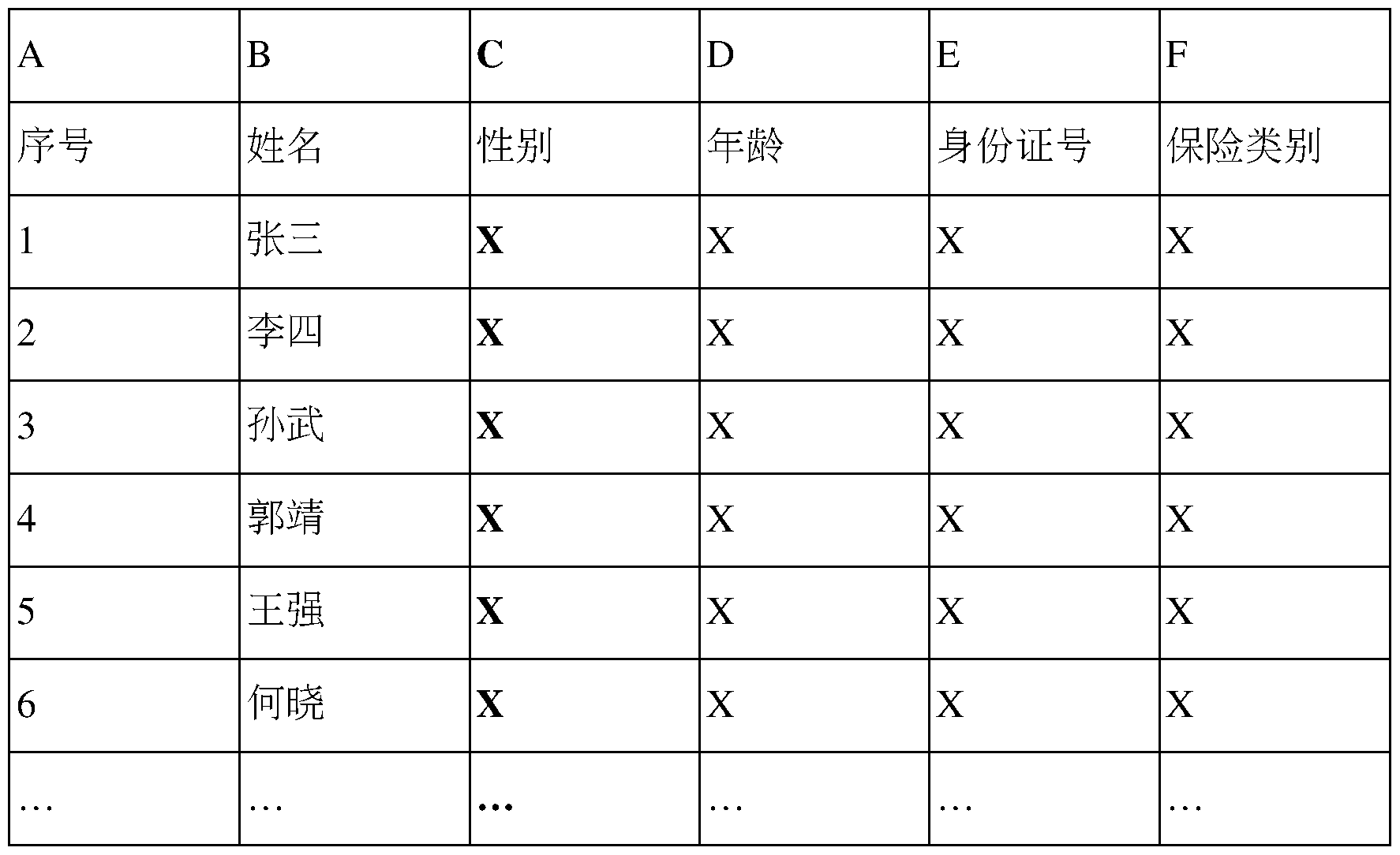
- Table 1 is a standard list template provided by an embodiment of the present application
- Table 2 is a data list to be imported uploaded by the user terminal.
- the terminal device extracts 9 columns of data from the data list, and according to the order of the 9 columns of data in the data list, namely, [serial number, name, age, gender, ID card, insurance category, insurance date, insurance period, insurance Amount], which forms a header and matches the header in the standard template. Since the number of headers consisting of 9 columns in the standard template is one, ie [serial number, name, gender, age, ID card, insurance category, The insured date, the insured period, the insured amount], the two headers are not the same, so jump to the relevant operation of S103, the current matching column number N is decremented by 1, that is, the N value is 8, and the relevant execution of S102 is returned. operating.
- the head of the group is associated with [serial number, name, gender, age, ID card, insurance category, date of insurance, age of insured] and [name, gender, age, ID card, insurance category, The insured date, the insured period, and the insured amount] are matched by the two headers, and the corresponding steps are performed according to the matching result.
- the terminal device determines that the headers of any N columns in the data list cannot be successfully matched in the header of the standard list template, and then perform the operation of S103, and the current matching column number N The value is decremented by 1, and the operation of performing step S102 is returned. In this case, the terminal device also judges the value of N before jumping to the operation of S102. If the value of N is reduced to 0, the process proceeds to step S105.
- the terminal device that matches the N columns obtained by a certain extraction can match the corresponding header in the standard list template, the matching header in the standard list template is obtained.
- the included column is identified as the column corresponding to the currently extracted N columns. Therefore, the data included in the extracted N columns can be respectively imported into the corresponding columns in the standard list template, thereby completing the data import operation.
- the terminal device may associate a column number corresponding to the standard list template with each column in the data list that is successfully matched. See Table 3 and Table 4, Table 3 is the application A standard list template is provided in another embodiment, where the first row is used to indicate the column number of the list, and FIG. 4 is a data list provided by another embodiment of the present application, where the first row is used to indicate the column number of the list. . If a gender in the terminal device identification data list matches the standard list template in a matching process, an association relationship such as C-4 is established to indicate that the C column in the data list corresponds to the fourth parameter in the standard list template.
- the matching starting column number and the ending column number in the standard list template may be used as the column number corresponding to the N columns currently extracted by the data list.
- the current number of matching lists is 3
- the headers of the three columns extracted from the data list are [sex, ID number, insurance type], and match the 4th to 6th columns in the standard list template, so The column number associated with the header is (4,6).
- the terminal device divides the N columns that have been successfully matched from the standard list template. As a column that does not need to be matched, that is, in the next matching operation, the terminal device no longer matches the N columns in the data list with the columns matching the successful in the standard list template.
- the N columns extracted by the terminal device from the data list Also a column that did not match successfully.
- the terminal device determines the current matching column number N according to the number of columns that are not successfully matched, and jumps to perform the related operation of S105.
- the terminal device selects a minimum value of the number of connected columns from the unmatched successful column as the value of the current matching column number N.
- the list shown in Table 5a is the list before the matching is successful
- the list shown in Table 5b is the list after the matching is successful, where the C column is the column with the matching success. It can be seen that after the matching is successful, the remaining columns in the remaining columns are AB two columns and DEF three columns, and the connected values are 2 and 3 respectively, so the N value is set to 2.
- the terminal device will first determine whether the current N value has been reduced to 0. If yes, it indicates that the loop matching process has been completed, then the loop is aborted; if the N value is non-zero, it indicates a data list. There are still columns that have not been successfully matched, and the single column matching has not yet been performed, so the operation of S102 is returned.
- the method for importing the data list is based on the number of columns of the data list and the number of columns of the standard list template. Determine the current matching column number N, and extract the N column header from the data list to match the header of the standard list template. If the matching is successful, import it into the corresponding column in the standard list template, and adjust the current matching.
- the number of columns N again extracting the unmatched N columns to match the standard list template; conversely, if the matching fails, the value of N is decreased, and the step of performing the extraction matching is returned, thereby implementing the process of loop nested matching, and the data list is
- the corresponding content is imported into the standard list template.
- the terminal device can sequentially extract the corresponding number of columns from the data list to be imported.
- the headers in the standard list template are matched one by one, and it is not recognized as an error list because the order of the headers is inconsistent between the two, which improves the fault tolerance of the import process, thereby improving the efficiency of data import and the user. Operating experience.
- FIG. 2 is a flowchart showing a specific implementation of a method for importing a data list S103 according to a second embodiment of the present application.
- a data list importing method S103 provided in this embodiment further includes the following steps, which are as follows:
- determining the current matching column number according to the number of columns in the data list that are not successfully matched including:
- the terminal device compares the number of columns in the statistical data list that are not successfully matched, and compares the size between the number of currently unmatched columns and the current matching column number N. If the number of unmatched columns is less than the current number of matching columns N, the related operations of S202 are performed; otherwise, if the number of unmatched columns is greater than or equal to N, the related operations of S201 are performed.
- the number of columns in the determined data list that are not successfully matched by the terminal device is less than N, it indicates that the column in the list cannot be extracted with a sufficient number of columns of the N value and the column of the standard data template is matched. , the number of unmatched columns will be counted, and the number of columns will be used as the current number of matching columns.
- the terminal device further obtains the number of columns in the standard list template that are not successfully matched.
- the M value is taken as the current matching column number. Since the number of columns actually included in the user-uploaded data list may be more than the number of columns in the standard list template, even after the matching is successful, even if the number of columns that do not match successfully is not less than N, the number of columns that can be matched in the standard list template However, there are fewer, this should be the value of the M in the standard list template as the current matching number of columns N.
- the current matching column number is adjusted by the number of unmatched columns, thereby preventing the number of extracted columns from satisfying the current number of columns, resulting in matching. Abnormal operation, reducing the efficiency of matching.
- FIG. 3 is a flowchart showing a specific implementation of a method for importing a data list according to a third embodiment of the present application. As shown in FIG. 3, with reference to the embodiment shown in FIG. 1, the method for importing a data list provided by this embodiment further includes the following steps, which are as follows:
- the method for importing the data list further includes:
- the user may add some columns to perform auxiliary analysis on the data, such as adding a column of parameters to the right of the column with the parameter [Birth Date].
- the column of the year to directly calculate the current year of the statistic object, without the user manually calculating according to the date of birth, to facilitate the user to analyze the data list.
- the corresponding column cannot be matched in the standard list template, so the import cannot be directly performed, and if it is directly deleted, the use may be reduced. The efficiency of household analysis of data.
- the terminal device obtains a column that cannot be successfully matched, and counts the corresponding number of columns, and adds a column with the same number of columns as the above statistics in the standard list template, thereby importing the unmatchable column into the standard list.
- the template is added inside the column.
- the terminal device cannot be unable to Match the position of the column in the data list, insert the new column in the standard list template, and create a new number of columns at the far right of the list, and mark the corresponding parameter name with each data, as shown in Table 6. As shown, so that the user can determine the meaning of the data in the newly added column.
- the content of the user-defined column can also be saved in the standard list template of the database, which improves the operability of the user, and also provides individualized setting requirements for each user to satisfy different readings. habit.
- the method for importing the data list further includes: [0063] In S3021, if there is a column in the standard list template in which data is not imported, the sending list is missing. Information to the user terminal.
- the terminal device when the terminal device detects that there is a column in the standard list template that does not import data, it indicates that there is a missing list in the data list sent by the user terminal, and the user may The contents of the column are deleted, so there is no column in the data list that matches it. In this case, the terminal device generates a list missing information according to the column in which the data is not imported, and transmits the list missing information to the user terminal, so that the user supplements the contents of the list.
- the list missing information includes a header composed of columns of the standard list template in which the data is not imported, so that the user can determine the required supplementary parameter content according to the header included in the list missing information.
- the supplementary data column returned by the user terminal according to the list missing information is received, and the supplementary data column is imported into a column of the standard list template in which data is not imported.
- the user generates a supplementary data column corresponding thereto according to the list missing information, wherein the supplementary data column corresponds to a column in the standard list template in which data is not imported.
- the terminal device may import the data of the supplementary data column into the column of the standard list template in which the data is not imported through the steps S102 to S105.
- the user terminal may also return an upload completion instruction, that is, the user does not return the supplementary data column.
- the terminal device may not fill the data of the column that has not been imported, so that the user may add the content to the content in the future; or according to the preset content, such as the padding character "empty” or the character “missing" "Wait, fill in the columns of the standard list template where no data is imported.
- FIG. 4 shows a specific implementation of a method for importing a data list S101 according to a fourth embodiment of the present application.
- Flow chart As shown in FIG. 4, with reference to the embodiment shown in FIG. 1 to FIG. 3, in the method for importing a data list provided in this embodiment, the data list to be imported sent by the user terminal is obtained, and the S401 ⁇ S4 03 is further included. , as detailed below:
- the terminal device after receiving the data list to be imported, the terminal device identifies the file type corresponding to the data list. Specifically, the terminal device determines the file type corresponding to the data list by identifying the file in the data list.
- the terminal device may further determine whether the data list to be imported is encrypted, and determine whether data import is required according to the encryption situation. Since the uploaded file may be pre-agreed by the user terminal and the terminal device, the terminal device needs to perform the encryption operation through the unified key. If the terminal device detects that the data list to be imported is not encrypted by using the preset key, It means that the data list is an illegal data list, so the import operation may not be responded to. On the other hand, if the terminal device detects that the data list is encrypted by using a preset key, it indicates that the data list is a legal data list, and then performs the related operation of S402.
- the file type that can be imported is preset in the terminal device, that is, the preset importable type described above.
- the file type of the importable type should also be a type including a data list, such as an Excel file or a Word file; preferably, the terminal device can also extract an image by using image recognition technology.
- the list of data in the file, that is, the image file type can also be an importable type.
- the terminal device generates an importable type corresponding to the terminal device according to the function itself, and after obtaining the file type of the data list, determining whether the file type belongs to the importable type of the terminal device, and if yes, identifying Matching, the related operation of S402 is performed; otherwise, if the file type does not belong to the importable type, it is identified as a mismatch, and the file type exception information is returned to the user terminal or the import operation is not responded.
- the terminal device further determines whether the data list is a damaged file by using a preset file corruption verification algorithm.
- the file corruption check algorithm is specifically used to check whether the data list file is complete and readable; preferably, it can also be used to check whether the garbled data is included in the data list. [0077] In S403, if the data list to be imported is not damaged, performing the obtaining the current matching column number
- the terminal device determines that the data list is not damaged by the file verification algorithm, that is, the data list is readable and complete, and the related operation of S403 is performed, that is, the import operation of the input list is entered; If the terminal device determines that the data list is damaged, it sends file abnormality information to the user terminal, so that the user terminal re-uploads the correct data list.
- the terminal device performs pre-verification on the data list to determine whether the data list is an importable data list, thereby avoiding matching and importing the wrong file, and improving the success rate of the import operation. And avoid unnecessary import operations.
- FIG. 5 is a structural block diagram of an import terminal of a data list according to an embodiment of the present application, and the units included in the import terminal of the data list are used to execute the steps in the embodiment corresponding to FIG. 1.
- FIG. 5 please refer to the related description in the embodiment corresponding to FIG. 1 and FIG. For the convenience of explanation, only the parts related to the present embodiment are shown.
- the import terminal of the data list includes:
- the data list sending unit 51 to be imported is used to obtain a data list to be imported sent by the user terminal;
- the data list matching unit 52 is configured to acquire the current matching column number N, and extract a header of the N column from the column whose data list is not successfully matched, and perform matching in the header of the standard list template.
- the initial value of the matching column number N is a smaller value of the number of columns of the data list and the number of columns of the standard list template;
- the matching failure loop unit 53 is configured to: if the header of any N column in the data list does not match in the header of the standard list template, the value of N is decremented by one as the current Number of matching columns;
- the matching success looping unit 54 is configured to: if the header of any N columns in the data list matches in the header of the standard list template, the N columns in the data list that match successfully are respectively Importing into the corresponding column in the standard list template, and determining the current matching column number according to the number of columns in the data list that are not matched successfully; [0087]
- the matching operation returning unit 55 is configured to return to perform the obtaining the current matching column number N, and arbitrarily extract the header of the N column from the column in which the data list to be imported is not successfully matched in the standard list. The matching operation is performed in the header of the template until the value of N is reduced to zero.
- the matching success cycle unit 54 includes:
- a matching sequence value holding unit configured to: if the number of columns in the data list that are not successfully matched is greater than or equal to
- the matching sequence value adjusting unit is configured to determine, if the number of columns that are not successfully matched in the data list is less than N, the number of columns that are not successfully matched is determined as the current matching column number.
- the importing device of the data list further includes:
- a data list adding unit configured to: if the data list includes a column that cannot be matched in the standard list template, create a new number in the standard list template that cannot match the data list. An equal column, and the unmatched column is imported into the newly created column of the standard list template.
- the importing device of the data list further includes:
- a list missing information sending unit configured to send a list missing information to the user terminal if there is a column in the standard list template in which data is not imported;
- a supplementary data column importing unit configured to receive a supplementary data column returned by the user terminal according to the list missing information, and import the supplementary data column into a column of the standard list template in which data is not imported.
- the to-be-imported data list sending unit 51 includes:
- a file type identifying unit configured to identify a file type of the data list to be imported
- a file corruption check unit configured to determine, according to a preset file corruption check algorithm, whether the data list to be imported is damaged, if the file type matches a preset importable type
- a file import confirmation unit configured to: if the data list to be imported is not damaged, perform the obtaining the current matching column number N, and arbitrarily extract N columns from the columns in which the data list is not successfully matched.
- the header performs matching operations in the header of the standard list template.
- FIG. 6 is a schematic diagram of a terminal device according to another embodiment of the present application.
- the terminal device 6 of this embodiment includes: a processor 60, a memory 61, and computer readable instructions 62 stored in the memory 61 and operable on the processor 60, such as a data list. Import the program.
- the processor 60 executes the computer readable instructions 62 to implement the steps in the embodiment of the method for importing the respective data lists, such as S101 to S105 shown in FIG. 1.
- the processor 60 executes the computer readable instructions 62 to implement the functions of the various units in the various apparatus embodiments described above, such as the functions of the modules 51 through 55 shown in FIG.
- the computer readable instructions 62 may be partitioned into one or more units, the one or more units being stored in the memory 61 and executed by the processor 60 to Complete this application.
- the one or more units may be a series of computer readable instruction instructions that are capable of performing a particular function, which is used to describe the execution of the computer readable instructions 62 in the terminal device 6.
- the computer readable instructions 62 may be divided into a data list sending unit to be imported, a data list matching unit, a matching failure loop unit, a matching success loop unit, and a matching operation return unit.
- the specific functions of each unit are as follows:
- the data list sending unit to be imported is used to obtain a data list to be imported sent by the user terminal;
- a data list matching unit configured to acquire a current matching column number N, and arbitrarily extract a header of the N column from the column in which the data list is not successfully matched, and perform matching in a header of the standard list template, where
- the initial value of the matching column number N is a smaller value of the number of columns of the data list and the number of columns of the standard list template;
- a matching failure loop unit configured to: if the header of any N column in the data list does not match in the header of the standard list template, the value of N is decremented by one as the current Match the number of columns;
- a matching success loop unit configured to: if the header of any N columns in the data list matches successfully in the header of the standard list template, import the successfully matched N columns in the data list respectively The corresponding column in the standard list template, and determining the current matching column number according to the number of columns in the data list that are not matched successfully;
- a matching operation returning unit configured to return to perform the obtaining the current matching column number N, and arbitrarily extract the N column header from the column in which the data list to be imported is not successfully matched in the standard list template.
- the matching operation is performed in the header until the value of N is reduced to zero.
- the terminal device 6 may be a computing device such as a desktop computer, a notebook, a palmtop computer, and a cloud server.
- the terminal device may include, but is not limited to, a processor 60 and a memory 61.
- FIG. 6 is merely an example of the terminal device 6, and does not constitute a limitation of the terminal device 6, and may include more or less components than those illustrated, or may combine certain components, or different components, such as
- the terminal device may also include an input/output device, a network access device, a bus, and the like.
- the so-called processor 60 may be a central processing unit (CPU), and may be other general-purpose processors, digital signal processors (Digital Signal)
- DSP Digital Signal Processor
- ASIC Application Specific Integrated Circuit
- FPGA Field-Programmable Gate Array
- the general purpose processor may be a microprocessor or the processor or any conventional processor or the like.
- the memory 61 may be an internal storage unit of the terminal device 6, such as a hard disk or a memory of the terminal device 6.
- the memory 61 may also be an external storage device of the terminal device 6, such as a plug-in hard disk provided on the terminal device 6, and a smart memory card (Smart Media Card,
- the memory 61 may also include both an internal storage unit of the terminal device 6 and an external storage device.
- the memory 61 is for storing the computer readable instructions and other programs and data required by the terminal device.
- the memory 61 can also be used to temporarily store data that has been output or is about to be output.
Landscapes
- Engineering & Computer Science (AREA)
- Theoretical Computer Science (AREA)
- Audiology, Speech & Language Pathology (AREA)
- Health & Medical Sciences (AREA)
- Computational Linguistics (AREA)
- General Health & Medical Sciences (AREA)
- Physics & Mathematics (AREA)
- General Engineering & Computer Science (AREA)
- General Physics & Mathematics (AREA)
- Artificial Intelligence (AREA)
- User Interface Of Digital Computer (AREA)
- Information Retrieval, Db Structures And Fs Structures Therefor (AREA)
- Management, Administration, Business Operations System, And Electronic Commerce (AREA)
Abstract
本申请提供了一种数据列表的导入方法及其终端,适用于数据处理技术领域,包括:获取用户终端发送的待导入的数据列表;获取当前的匹配列数N,并从数据列表未匹配成功的列中任意提取N列的表头在标准列表模板的表头中进行匹配;若不存在任意N列的表头在标准列表模板的表头中匹配成功,则将N的数值减一后作为所述当前的匹配列数;若存在任意N列的表头在标准列表模板的表头中匹配成功,则将数据列表中匹配成功的N列分别导入标准列表模板中对应的列内,并根据数据列表中未匹配成功的列数确定当前的匹配列数。本申请,解决了现有数据列表导入技术,服务器需要该数据列表中列表格式与标准列表模板完全一致才可以进行导入操作,容错率较低的问题。
Description
一种数据列表的导入方法及其终端
[0001] 本申请申明享有 2017年 10月 19日递交的申请号为 201710979300.2、 名称为 "一种 数据列表的导入方法及其终端"中国专利申请的优先权, 该中国专利申请的整体 内容以参考的方式结合在本申请中。
技术领域
[0002] 本申请属于数据处理技术领域, 尤其涉及一种数据列表的导入方法及其终端。
背景技术
[0003] 随着各种各样文件均实行电子化, 用户在日常工作以及生活中, 常常需要将本 地的数据列表导入到服务器中, 以便日后对相关的资讯进行整合、 分析以及统 计, 因此如何准确地将数据列表导入到服务器显得尤为重要。 而现有数据列表 导入技术, 服务器接收用户待导入的数据列表吋, 需要该数据列表中列表格式 与标准列表模板完全一致才可以进行导入操作, 若用户因为个人使用习惯, 将 表格中某些列的位置互换, 或在原有的列中插入新增的列或刪除原有的列, 服 务器将无法识别, 判定为错误表格, 从而上传或导入失败, 容错率较低。
技术问题
[0004] 有鉴于此, 本申请实施例提供了一种数据列表的导入方法及其终端, 以解决现 有数据列表导入技术, 服务器接收用户待导入的数据列表吋, 需要该数据列表 中列表格式与标准列表模板完全一致才可以进行导入操作, 若用户因为个人使 用习惯, 将表格中某些列的位置互换, 或在原有的列中插入新增的列或刪除原 有的列, 服务器将无法识别, 判定为错误表格, 从而上传或导入失败, 容错率 较低的问题。
问题的解决方案
技术解决方案
[0005] 本申请实施例的第一方面提供了一种数据列表的导入方法, 所述数据列表的导 入方法包括:
[0006] 获取用户终端发送的待导入的数据列表;
[0007] 获取当前的匹配列数 N, 并从所述数据列表未匹配成功的列中任意提取 N列的 表头在标准列表模板的表头中进行匹配, 所述匹配列数 N的初始值为所述数据列 表的列数和所述标准列表模板的列数中的较小值;
[0008] 若所述数据列表中不存在任意 N列的表头在所述标准列表模板的表头中匹配成 功, 则将 N的数值减一后作为所述当前的匹配列数;
[0009] 若所述数据列表中存在任意 N列的表头在所述标准列表模板的表头中匹配成功
, 则将所述数据列表中匹配成功的 N列分别导入所述标准列表模板中对应的列内
, 并根据所述数据列表中未匹配成功的列数确定所述当前的匹配列数;
[0010] 返回执行所述获取当前的匹配列数 N, 并从所述待导入的数据列表未匹配成功 的列中任意提取 N列的表头在所述标准列表模板的表头中进行匹配的操作, 直至
N的数值减为零。
发明的有益效果
有益效果
[0011] 实施本申请实施例提供的一种数据列表的导入方法及其终端具有以下有益效果
[0012] 本申请实施例在接收到用户终端发送的待导入的数据列表后, 则根据数据列表 的列数以及标准列表模板的列数, 确定当前的匹配列数 N, 并从数据列表中任意 提取 N列的表头与标准列表模板的表头进行匹配, 若匹配成功则导入到标准列表 模板中对应的列内, 并调整当前的匹配列数 N, 再次提取未匹配成功的 N列与标 准列表模板进行匹配; 反之, 若匹配失败则减少 N的数值, 返回执行提取匹配的 步骤, 从而实现循环嵌套匹配的过程, 将数据列表中对应的内容导入到标准列 表模板内。 与现有的数据列表导入技术相比, 本申请实施例中待导入的数据列 表各列之间的相对位置即便被修改, 终端设备也能从待导入的数据列表中逐次 提取相应数量的列与标准列表模板中的表头一一进行匹配, 并不会因为两者之 间表头的顺序不一致而将其识别为错误列表, 提高了导入过程的容错率, 从而 提高了数据导入的效率以及用户的操作体验。
对附图的简要说明
附图说明
[0013] 图 1是本申请第一实施例提供的一种数据列表的导入方法的实现流程图;
[0014] 图 2是本申请第二实施例提供的一种数据列表的导入方法 S104的具体实现流程 图;
[0015] 图 3是本申请第三实施例提供的一种数据列表的导入方法的具体实现流程图; [0016] 图 4是本申请第四实施例提供的一种数据列表的导入方法 S101的具体实现流程 图;
[0017] 图 5是本申请一实施例提供的一种数据列表的导入终端的结构框图;
[0018] 图 6是本申请一实施例提供的一种终端设备的示意图。
本发明的实施方式
[0019] 为了使本申请的目的、 技术方案及优点更加清楚明白, 以下结合附图及实施例 , 对本申请进行进一步详细说明。 应当理解, 此处所描述的具体实施例仅仅用 以解释本申请, 并不用于限定本申请。
[0020] 在本申请实施例中, 流程的执行主体为安装有数据列表的导入程序的终端设备 , 终端设备包括手机、 计算机设备、 平板电脑、 服务器等终端, 特别地, 该终 端设备具体为一数据库, 用于接收各个用户终端上传的数据列表并导入至本地 存储器中进行保存。 图 1示出了本申请第一实施例提供的数据列表的导入方法的 实现流程图, 详述如下:
[0021] 在 S101中, 获取用户终端发送的待导入的数据列表。
[0022] 在本实施例中, 用户通过本地的用户终端内生成数据导入请求, 继而通过通信 网络与本实施例提供的终端设备相连, 并向终端设备发送数据导入请求。 具体 地, 用户通过启动设置于用户终端内的数据列表导入的客户端, 来实现发送数 据导入请求的操作。 用户终端在检测到数据列表导入的客户端被启动吋, 将生 成一个数据导入请求指令, 并发送至终端设备, 以便建立通信连接并告知终端 设备用户需要进行数据导入操作。
[0023] 在本实施例中, 当终端设备确定响应用户终端发起的数据导入请求后, 将返回 一个数据列表获取指令, 用户终端在接收到该数据列表获取指令后, 则从待发 送的文件队列中, 将待导入的数据列表发送给终端设备, 终端设备在接收到待
导入的数据列表后, 则执行 S102的相关操作。
[0024] 在 S102中, 获取当前的匹配列数 N, 并从所述数据列表未匹配成功的列中任意 提取 N列的表头在标准列表模板的表头中进行匹配, 所述匹配列数 N的初始值为 所述数据列表的列数和所述标准列表模板的列数中的较小值。
[0025] 在本实施例中, 终端设备在接收到用户终端发送的待导入的数据列表后, 将确 定该数据列表对应的标准列表模板, 并识别该数据列表包含的列数。 根据数据 列表包含的列数以及标准列表模板的列数, 选取两者中较小的一个列数值作为 当前的匹配列数 N的初始数值。 举例性地, 若待导入的数据列表包含 8列, 而标 准列表模板包含 9列, 则该当前的匹配列数 N的初始值为 8。 具体地, 若数据列表 的列数与标准列表模板的列数相同, 则可取两者任意一个作为 N的初始值。
[0026] 在本实施例中, 终端设备在确定当前的匹配列数 N的初始值后, 则根据该匹配 列数 N, 从待导入的数据列表中任意提取 N列的表头, 将其与标准列表模板中的 表头进行匹配, 继而确定数据列表中 N列在标准列表模板中是否存在对应的列。
[0027] 举例性地, 用以下例子来说明 S102中的具体操作流程。 参见表 1以及表 2所示, 表 1为本申请一实施例提供的标准列表模板, 表 2为用户终端上传的待导入的数 据列表。 首先, 终端设备在接收到用户终端发送的数据列表后, 将确定当前的 匹配列数 N的初始值, 由于两个列表中包含的列数均为 9, 因此, N的初始值为 9 。 然后, 终端设备从数据列表中提取 9列数据, 并根据该 9列数据在数据列表中 的顺序, 即为 [序号, 姓名, 年齢, 性别, 身份证, 保险类别, 投保日期, 投保 年限, 投保金额], 组成一个表头, 并与标准模板中的表头进行匹配, 由于标准 模板中的 9列组成的表头数量为一个, 即 [序号, 姓名, 性别, 年齢, 身份证, 保 险类别, 投保日期, 投保年限, 投保金额], 两个表头并不相同, 因此跳转到执 行 S103的相关操作, 将当前的匹配列数 N减 1, 即 N值为 8, 并返回执行 S102的相 关操作。 此吋, 终端设备可从数据列表中提取 C(8,9)组的列组成表头, 其中, C( 8,9)=(9!)/(8!), 并将得到的表头与标准列表模板中的表头进行匹配, 由于标准列 表模板中各列的顺序是固定的, 因此标准列表模板中由 8列构成的表头的数量为 2个, 即数据列表中 C(8,9)组的表头分别与 [序号, 姓名, 性别, 年齢, 身份证, 保险类别, 投保日期, 投保年限]以及 [姓名, 性别, 年齢, 身份证, 保险类别,
投保日期, 投保年限, 投保金额]这两个表头进行匹配, 根据匹配结果执行对应 的步骤操作。
[] [表 1]

[0028] 表 1
[] [表 2]

[0029] 表 2
[0030] 在 S103中, 若所述数据列表中不存在任意 N列的表头在所述标准列表模板的表 头中匹配成功, 则将 N的数值减一后作为所述当前的匹配列数。
[0031] 在本实施例中, 由于在提取吋各列之间的相对位置是固定的, 与在原数据列表 中的相对位置是相同的, 以表 2作为例子, 无论 N的值如何变化, 在提取 N列得到 的表头中, 参数 [投保金额]对应的列必然在参数 [身份证]的列之后, 因此若终端 设备根据当前的匹配列数 N从数据列表中提取的任意 N列组成的表头均无法与标 准列表模板的表头匹配成功, 则表示数据列表中以 N列组成的各个表头必然包含 顺序错误的列, 因此将逐步减少当前的匹配列数 N的值, 以便在某次提取操作中 , 由 N列构成的表头内各参数的顺序与标准列表模板中的表头一致。
[0032] 在本实施例中, 终端设备在判定数据列表中任意 N列组成的表头均无法在标准 列表模板的表头中匹配成功, 则执行 S103的操作, 将当前的匹配列数 N的数值减 1, 并返回执行 S102步骤的操作。 此吋, 终端设备在跳转到 S102的操作前, 还会 对 N的值进行判断, 若 N的值减少至 0, 则跳转至 S105的步骤。
[0033] 在 S104中, 若所述数据列表中存在任意 N列的表头在所述标准列表模板的表头 中匹配成功, 则将所述数据列表中匹配成功的 N列分别导入所述标准列表模板中 对应的列内, 并根据所述数据列表中未匹配成功的列数确定所述当前的匹配列 数。
[0034] 在本实施例中, 终端设备若在某次提取得到的 N列组成的表头, 能够在标准列 表模板中匹配到对应的表头, 则将标准列表模板中匹配得到的表头中包含的列 识别为当前提取的 N列对应的列, 因此可将提取的 N列所包含的数据分别导入到 标准列表模板中对应的列内, 从而完成数据导入操作。
[]
[表 3]

[0035] 表 3
[] [表 4]
[0036] 表 4
[0037] 具体地, 在本实施例中, 终端设备在匹配成功后, 可为数据列表中匹配成功的 各列关联一个在标准列表模板中对应的列编号。 参见表 3和表 4所示, 表 3是本申
请另一实施例提供的标准列表模板, 其中第一行用于指示该列表的列编号, 图 4 是本申请另一实施例提供的数据列表, 其中第一行用于指示该列表的列编号。 若某次匹配过程中, 终端设备识别数据列表中性别该列与标准列表模板匹配, 则建立如 C-4的关联关系, 来表示数据列表中的 C列对应于标准列表模板中的第 4 歹 |J。 优选地, 在本实施例中, 若 N的数值大于或等于 2, 可将标准列表模板中匹 配的起始列编号与终止列编号, 作为数据列表当前提取的 N列对应的列编号。 如 当前的匹配列表数为 3, 某次从数据列表中提取的 3列构成的表头为 [性别、 身份 证号, 保险类型], 与标准列表模板中的第 4至 6列匹配, 因此该表头关联的列编 号为 (4,6) 。
[0038] 在本实施例中, 终端设备在确定数据列表中的 N列与标准列表模板中的 N列匹 配成功并导入完成后, 则将以已匹配成功的 N列从标准列表模板中划分幵来, 作 为无需匹配的列, 即在下一次匹配操作中, 终端设备不再将数据列表中的 N列与 标准列表模板中匹配成功的列进行匹配, 当然, 终端设备从数据列表中提取的 N 列也为未匹配成功的列。
[0039] 在本实施例中, 终端设备将根据未匹配成功的列数, 确定当前的匹配列数 N, 并跳转执行 S105的相关操作。
[0040] 可选地, 终端设备从未匹配成功的列中选取相连列数的最小值作为当前的匹配 列数 N的值。 如表 5a所示列表为匹配成功前的列表, 表 5b所示列表为匹配成功后 的列表, 其中 C列为匹配成功的列。 可见, 在匹配成功后, 剩余的列中, 相连的 列分别为 AB两列以及 DEF三列, 相连的数值分别为 2和 3, 因此将 N值设置为 2。
[表 5]

[0041] 表 5a
[] [表 6]

[0042] 表 5b
[0043] 在 S105中, 返回执行所述获取当前的匹配列数 N, 并从所述待导入的数据列表 未匹配成功的列中任意提取 N列的表头在所述标准列表模板的表头中进行匹配的
操作, 直至 N的数值减为零。
[0044] 在本实施例中, 终端设备将首先判定当前的 N值是否已经减少至 0, 若是, 则表 示循环匹配过程已完毕, 则中止循环; 若该 N值为非 0, 则表示数据列表中仍包 含未匹配成功的列, 且仍未进行单列匹配, 因此将返回执行 S102的操作。
[0045] 以上可以看出, 本申请实施例提供的一种数据列表的导入方法在接收到用户终 端发送的待导入的数据列表后, 则根据数据列表的列数以及标准列表模板的列 数, 确定当前的匹配列数 N, 并从数据列表中任意提取 N列的表头与标准列表模 板的表头进行匹配, 若匹配成功则导入到标准列表模板中对应的列内, 并调整 当前的匹配列数 N, 再次提取未匹配成功的 N列与标准列表模板进行匹配; 反之 , 若匹配失败则减少 N的数值, 返回执行提取匹配的步骤, 从而实现循环嵌套匹 配的过程, 将数据列表中对应的内容导入到标准列表模板内。 与现有的数据列 表导入技术相比, 本申请实施例中待导入的数据列表各列之间的相对位置即便 被修改, 终端设备也能从待导入的数据列表中逐次提取相应数量的列与标准列 表模板中的表头一一进行匹配, 并不会因为两者之间表头的顺序不一致而将其 识别为错误列表, 提高了导入过程的容错率, 从而提高了数据导入的效率以及 用户的操作体验。
[0046] 图 2示出了本申请第二实施例提供的一种数据列表的导入方法 S103的具体实现 流程图。 参见图 2所示, 相对于图 1所述实施例, 本实施例提供的一种数据列表 的导入方法 S 103还包括以下步骤, 详述如下:
[0047] 进一步地, 所述根据所述数据列表中未匹配成功的列数确定所述当前的匹配列 数, 包括:
[0048] 在 S201中, 若所述数据列表中未匹配成功的列数大于或等于 N, 则保持所述当 前的匹配列数不变。
[0049] 在本实施例中, 终端设备在匹配成功后, 将统计数据列表中未匹配成功的列数 , 并比较当前未匹配成功的列数与当前的匹配列数 N之间的大小。 若未匹配成功 的列数小于当前的匹配列数 N, 则执行 S202的相关操作; 反之, 若未匹配成功的 列数大于或等于 N, 则执行 S201的相关操作。
[0050] 在本实施例中, 由于未匹配成功的列数大于或等于 N, 则表示仍能从未匹配成
功的列中提取 N列与标准列表模板进行匹配, 此吋终端设备将保持当前的匹配列 数 N的数值不变, 并返回 S102的相关操作。
[0051] 在 S202中, 若所述数据列表中未匹配成功的列数小于 N, 则将所述未匹配成功 的列数确定为所述当前的匹配列数。
[0052] 在本实施例中, 终端设备在确定数据列表中未匹配成功的列数小于 N, 则表示 该列表中无法提取与 N值足够数量的列与标准数据模板的列进行匹配, 此吋, 将 统计未匹配的列数, 将该列数数值作为当前的匹配列数。
[0053] 可选地, 在本实施例中, 终端设备还将获取标准列表模板中未匹配成功的列数
M, 若该 M值小于数据列表中未匹配成功的列数且小于 N, 则将该 M值作为当前 的匹配列数。 由于用户上传的数据列表中实际的包含的列数可能多于标准列表 模板的列数, 因此在匹配成功后, 即便未匹配成功的列数不小于 N, 但标准列表 模板中能够匹配的列数却较少, 此吋应将标准列表模板中的 M值作为当前的匹配 列数 N的数值。
[0054] 在本申请实施例中, 在终端设备匹配一部分的列后, 通过未匹配的列数调整当 前的匹配列数, 从而避免提取的列数不满足当前的列数的情况发生, 导致匹配 操作异常, 降低匹配的效率。
[0055] 图 3示出了本申请第三实施例提供的一种数据列表的导入方法的具体实现流程 图。 参见图 3所示, 相对于图 1所述实施例, 本实施例提供的一种数据列表的导 入方法还包括以下步骤, 详述如下:
[0056] 进一步地, 所述数据列表的导入方法还包括:
[0057] 在 S301中, 若所述数据列表中包含在所述标准列表模板中无法匹配的列, 则在 所述标准列表模板中新建与所述数据列表中无法匹配的列数相等的列, 并将所 述无法匹配的列导入至所述标准列表模板新建的列内。
[0058] 在本实施例中, 用户在编辑数据列表的过程中, 可能添加了某些列来对数据进 行辅佐分析, 如在参数为 [出生日期]的列的右侧, 添加一列参数为 [年齢]的列, 来直接计算该统计对象的当前年齢, 而无需用户根据出生日期手动计算, 来方 便用户对数据列表进行分析。 但由于上述用户自行增加的列, 无法在标准列表 模板中匹配到对应的列, 因此无法直接进行导入, 若直接刪除则可能降低了用
户对数据的分析效率。 因此, 终端设备则获取无法匹配成功的列, 并统计其对 应的列数, 并在标准列表模板中新增与上述统计得到的列数数量相同的列, 从 而将无法匹配的列导入到标准列表模板新增的列内。
可选地, 在本实施例中, 由于标准列表模板中导入的数据并非只是对应于用户 当前上传的待导入的数据列表, 而是可能包含多个用户导入的数据, 因此终端 设备将无法根据无法匹配的列在数据列表中的位置, 在标准列表模板中插入新 增的列, 而是在列表的最右侧新建相应数量的列, 并将对应的参数名标注与各 个数据内, 如表 6所示, 以便用户确定新增列中数据的含义。
[表 7]

[0060] 表 6
[0061] 在本申请实施例中, 通过新增相应数量的列, 并将数据列表中的内容导入到新
增的列内, 从而能够将用户自定义的列的内容也能够保存在数据库的标准列表 模板内, 提高了用户的可操作性, 也为每个用户提供个性化的设置需求, 满足 不同的阅读习惯。
[0062] 进一步地, 作为本申请的另一实施例, 所述数据列表的导入方法还包括: [0063] 在 S3021中, 若所述标准列表模板中存在未导入数据的列, 则发送列表缺失信 息至所述用户终端。
[0064] 在本实施例中, 终端设备在检测到标准列表模板中存在未导入数据的列, 则表 示用户终端发送的数据列表中存在列表缺失的情况, 可能用户在编辑的过程中 对某些列的内容进行刪除, 因此数据列表中没有能够找到与之匹配的列。 在该 情况下, 终端设备将根据未导入数据的列, 生成列表缺失信息, 并将该列表缺 失信息发送给用户终端, 以便用户对该列表的内容进行补充。
[0065] 在本实施例中, 列表缺失信息中包含标准列表模板中未导入数据的列组成的表 头, 以便用户可根据该列表缺失信息中包含的表头确定所需补充的参数内容。
[0066] 在 S3022中, 接收所述用户终端根据所述列表缺失信息返回的补充数据列, 并 将所述补充数据列导入至所述标准列表模板中未导入数据的列。
[0067] 在本实施例中, 用户根据列表缺失信息生成与之对应的补充数据列, 其中该补 充数据列对应于标准列表模板中未导入数据的列。 终端设备在接收到用户终端 返回的补充数据列后, 可通过 S102~S105的步骤, 将补充数据列的数据导入到标 准列表模板中未导入数据的列内。
[0068] 可选地, 在本实施例中, 用户终端还可以返回上传完成指令, 即表示用户不再 返回补充数据列。 终端设备在接收到上传完成指令后, 可不对未导入数据的列 进行数据填充, 以便用户日后对该部分内容进行添加操作; 也可以根据预设的 内容, 如填充字符"空"或字符 "缺失 "等, 填充至标准列表模板中未导入数据的列 内。
[0069] 在本申请实施例中, 通过判定标准列表模板中是否存在未导入数据的列, 提醒 用户上传补充数据列, 以便完成数据导入的操作, 避免用于因一吋疏忽, 而忘 记将对应的数据上传至数据库, 提高了上传操作的准确性。
[0070] 图 4示出了本申请第四实施例提供的一种数据列表的导入方法 S101的具体实现
流程图。 参见图 4所示, 相对于图 1至图 3所述实施例, 本实施例提供的一种数据 列表的导入方法中所述获取用户终端发送的待导入的数据列表, 还包含 S401~S4 03, 详述如下:
[0071] 在 S401中, 识别所述待导入的数据列表的文件类型。
[0072] 在本实施例中, 终端设备在接收到待导入的数据列表后, 将识别该数据列表对 应的文件类型。 具体地, 终端设备通过识别该数据列表中的文件后续, 确定该 数据列表对应的文件类型。
[0073] 可选地, 在本实施例中, 终端设备还可以判断待导入的数据列表是否已加密, 根据加密情况确定是否需要进行数据导入。 由于用户终端与终端设备之间可能 预先约定所上传的文件需要通过统一的密钥进行加密操作, 此吋若终端设备在 检测到该待导入的数据列表并没有通过预设的密钥进行加密, 则表示该数据列 表为非法数据列表, 因此可不响应该导入操作。 反之, 若终端设备检测到该数 据列表通过预设的密钥进行加密, 则表示该数据列表为合法数据列表, 继而执 行 S402的相关操作。
[0074] 在 S402中, 若所述文件类型与预设的可导入类型匹配, 则根据预设的文件损坏 校验算法判定所述待导入的数据列表是否损坏。
[0075] 在本实施例中, 终端设备中预设有可导入的文件类型, 即上述的预设的可导入 类型。 举例性地, 用户进行导入的为数据列表, 则该可导入类型的文件类型也 应为包含数据列表的类型, 如 Excel文件、 Word文件; 优选地, 终端设备还可以 通过图像识别技术, 提取图像文件内的数据列表, 即图像文件类型也可以为可 导入类型。 可见, 终端设备根据其本身具备的功能, 预先生成与之对应的可导 入类型, 在获取了数据列表的文件类型后, 则判断该文件类型是否属于终端设 备的可导入类型, 若是, 则识别为匹配, 执行 S402的相关操作; 反之, 若该文 件类型不属于可导入类型, 则识别为不匹配, 返回文件类型异常信息给用户终 端或不对该导入操作进行响应。
[0076] 在本实施例中, 终端设备还通过预设的文件损坏校验算法, 判定该数据列表是 否为损坏文件。 其中, 该文件损坏校验算法具体用于校验数据列表文件是否完 整以及可读; 优选地, 还可以用于校验数据列表中的是否包含乱码数据。
[0077] 在 S403中, 若所述待导入的数据列表无损坏, 则执行所述获取当前的匹配列数
N, 并从所述数据列表未匹配成功的列中任意提取 N列的表头在标准列表模板的 表头中进行匹配的操作。
[0078] 在本实施例中, 终端设备若通过文件校验算法确定数据列表无损坏, 即表示该 数据列表可读且完整, 此吋刻执行 S403的相关操作, 即进入输入列表的导入操 作; 终端设备若确定该数据列表损坏, 则向用户终端发送文件异常信息, 以便 用户终端重新上传正确的数据列表。
[0079] 在本申请实施例中, 终端设备对数据列表进行预校验, 确定该数据列表是否为 可导入的数据列表, 从而避免将错误的文件进行匹配导入操作, 提高了导入操 作的成功率, 并且避免进行不必要的导入操作。
[0080] 应理解, 上述实施例中各步骤的序号的大小并不意味着执行顺序的先后, 各过 程的执行顺序应以其功能和内在逻辑确定, 而不应对本申请实施例的实施过程 构成任何限定。
[0081] 图 5示出了本申请一实施例提供的一种数据列表的导入终端的结构框图, 该数 据列表的导入终端包括的各单元用于执行图 1对应的实施例中的各步骤。 具体请 参阅图 1与图 1所对应的实施例中的相关描述。 为了便于说明, 仅示出了与本实 施例相关的部分。
[0082] 参见图 5, 所述数据列表的导入终端包括:
[0083] 待导入数据列表发送单元 51, 用获取用户终端发送的待导入的数据列表;
[0084] 数据列表匹配单元 52, 用于获取当前的匹配列数 N, 并从所述数据列表未匹配 成功的列中任意提取 N列的表头在标准列表模板的表头中进行匹配, 所述匹配列 数 N的初始值为所述数据列表的列数和所述标准列表模板的列数中的较小值;
[0085] 匹配失败循环单元 53, 用于若所述数据列表中不存在任意 N列的表头在所述标 准列表模板的表头中匹配成功, 则将 N的数值减一后作为所述当前的匹配列数;
[0086] 匹配成功循环单元 54, 用于若所述数据列表中存在任意 N列的表头在所述标准 列表模板的表头中匹配成功, 则将所述数据列表中匹配成功的 N列分别导入所述 标准列表模板中对应的列内, 并根据所述数据列表中未匹配成功的列数确定所 述当前的匹配列数;
[0087] 匹配操作返回单元 55, 用于返回执行所述获取当前的匹配列数 N, 并从所述待 导入的数据列表未匹配成功的列中任意提取 N列的表头在所述标准列表模板的表 头中进行匹配的操作, 直至 N的数值减为零。
[0088] 可选地, 所述匹配成功循环单元 54包括:
[0089] 匹配数列数值保持单元, 用于若所述数据列表中未匹配成功的列数大于或等于
N, 则保持所述当前的匹配列数不变;
[0090] 匹配数列数值调整单元, 用于若所述数据列表中未匹配成功的列数小于 N, 则 将所述未匹配成功的列数确定为所述当前的匹配列数。
[0091] 可选地, 所述数据列表的导入装置还包括:
[0092] 数据列表新增单元, 用于若所述数据列表中包含在所述标准列表模板中无法匹 配的列, 则在所述标准列表模板中新建与所述数据列表中无法匹配的列数相等 的列, 并将所述无法匹配的列导入至所述标准列表模板新建的列内。
[0093] 可选地, 所述数据列表的导入装置还包括:
[0094] 列表缺失信息发送单元, 用于若所述标准列表模板中存在未导入数据的列, 则 发送列表缺失信息至所述用户终端;
[0095] 补充数据列导入单元, 用于接收所述用户终端根据所述列表缺失信息返回的补 充数据列, 并将所述补充数据列导入至所述标准列表模板中未导入数据的列。
[0096] 可选地, 所述待导入数据列表发送单元 51包括:
[0097] 文件类型识别单元, 用于识别所述待导入的数据列表的文件类型;
[0098] 文件损坏校验单元, 用于若所述文件类型与预设的可导入类型匹配, 则根据预 设的文件损坏校验算法判定所述待导入的数据列表是否损坏;
[0099] 文件导入确认单元, 用于若所述待导入的数据列表无损坏, 则执行所述获取当 前的匹配列数 N, 并从所述数据列表未匹配成功的列中任意提取 N列的表头在标 准列表模板的表头中进行匹配的操作。
[0100] 因此, 本申请实施例提供的数据类别的导入终端同样可以能从待导入的数据列 表中逐次提取相应数量的列与标准列表模板中的表头一一进行匹配, 并不会因 为两者之间表头的顺序不一致而将其识别为错误列表, 提高了导入过程的容错 率, 从而提高了数据导入的效率以及用户的操作体验。
[0101] 图 6是本申请另一实施例提供的一种终端设备的示意图。 如图 6所示, 该实施例 的终端设备 6包括: 处理器 60、 存储器 61以及存储在所述存储器 61中并可在所述 处理器 60上运行的计算机可读指令 62, 例如数据列表的导入程序。 所述处理器 6 0执行所述计算机可读指令 62吋实现上述各个数据列表的导入方法实施例中的步 骤, 例如图 1所示的 S101至 S105。 或者, 所述处理器 60执行所述计算机可读指令 62吋实现上述各装置实施例中各单元的功能, 例如图 5所示模块 51至 55功能。
[0102] 示例性的, 所述计算机可读指令 62可以被分割成一个或多个单元, 所述一个或 者多个单元被存储在所述存储器 61中, 并由所述处理器 60执行, 以完成本申请 。 所述一个或多个单元可以是能够完成特定功能的一系列计算机可读指令指令 段, 该指令段用于描述所述计算机可读指令 62在所述终端设备 6中的执行过程。 例如, 所述计算机可读指令 62可以被分割成待导入数据列表发送单元、 数据列 表匹配单元、 匹配失败循环单元、 匹配成功循环单元以及匹配操作返回单元, 各单元具体功能如下:
[0103] 待导入数据列表发送单元, 用获取用户终端发送的待导入的数据列表;
[0104] 数据列表匹配单元, 用于获取当前的匹配列数 N, 并从所述数据列表未匹配成 功的列中任意提取 N列的表头在标准列表模板的表头中进行匹配, 所述匹配列数 N的初始值为所述数据列表的列数和所述标准列表模板的列数中的较小值;
[0105] 匹配失败循环单元, 用于若所述数据列表中不存在任意 N列的表头在所述标准 列表模板的表头中匹配成功, 则将 N的数值减一后作为所述当前的匹配列数;
[0106] 匹配成功循环单元, 用于若所述数据列表中存在任意 N列的表头在所述标准列 表模板的表头中匹配成功, 则将所述数据列表中匹配成功的 N列分别导入所述标 准列表模板中对应的列内, 并根据所述数据列表中未匹配成功的列数确定所述 当前的匹配列数;
[0107] 匹配操作返回单元, 用于返回执行所述获取当前的匹配列数 N, 并从所述待导 入的数据列表未匹配成功的列中任意提取 N列的表头在所述标准列表模板的表头 中进行匹配的操作, 直至 N的数值减为零。
[0108] 所述终端设备 6可以是桌上型计算机、 笔记本、 掌上电脑及云端服务器等计算 设备。 所述终端设备可包括, 但不仅限于, 处理器 60、 存储器 61。 本领域技术
人员可以理解, 图 6仅仅是终端设备 6的示例, 并不构成对终端设备 6的限定, 可 以包括比图示更多或更少的部件, 或者组合某些部件, 或者不同的部件, 例如 所述终端设备还可以包括输入输出设备、 网络接入设备、 总线等。
[0109] 所称处理器 60可以是中央处理单元 (Central Processing Unit, CPU) , 还可以是其 他通用处理器、 数字信号处理器(Digital Signal
Processor, DSP)、 专用集成电路 (Application Specific Integrated Circuit, ASIC)、 现成可编程门阵列(Field-Programmable Gate Array , FPGA)或者其他可编程逻辑 器件、 分立门或者晶体管逻辑器件、 分立硬件组件等。 通用处理器可以是微处 理器或者该处理器也可以是任何常规的处理器等。
[0110] 所述存储器 61可以是所述终端设备 6的内部存储单元, 例如终端设备 6的硬盘或 内存。 所述存储器 61也可以是所述终端设备 6的外部存储设备, 例如所述终端设 备 6上配备的插接式硬盘, 智能存储卡 (Smart Media Card,
SMC) , 安全数字 (Secure Digital, SD) 卡, 闪存卡 (Flash Card) 等。 进一步 地, 所述存储器 61还可以既包括所述终端设备 6的内部存储单元也包括外部存储 设备。 所述存储器 61用于存储所述计算机可读指令以及所述终端设备所需的其 他程序和数据。 所述存储器 61还可以用于暂吋地存储已经输出或者将要输出的 数据。
[0111] 以上所述实施例仅用以说明本申请的技术方案, 而非对其限制; 尽管参照前述 实施例对本申请进行了详细的说明, 本领域的普通技术人员应当理解: 其依然 可以对前述各实施例所记载的技术方案进行修改, 或者对其中部分技术特征进 行等同替换; 而这些修改或者替换, 并不使相应技术方案的本质脱离本申请各 实施例技术方案的精神和范围, 均应包含在本申请的保护范围之内。
Claims
[权利要求 1] 一种数据列表的导入方法, 其特征在于, 包括:
获取用户终端发送的待导入的数据列表;
获取当前的匹配列数 N, 并从所述数据列表未匹配成功的列中任意提 取 N列的表头在标准列表模板的表头中进行匹配, 所述匹配列数 N的 初始值为所述数据列表的列数和所述标准列表模板的列数中的较小值 若所述数据列表中不存在任意 N列的表头在所述标准列表模板的表头 中匹配成功, 则将 N的数值减一后作为所述当前的匹配列数; 若所述数据列表中存在任意 N列的表头在所述标准列表模板的表头中 匹配成功, 则将所述数据列表中匹配成功的 N列分别导入所述标准列 表模板中对应的列内, 并根据所述数据列表中未匹配成功的列数确定 所述当前的匹配列数;
返回执行所述获取当前的匹配列数 N, 并从所述待导入的数据列表未 匹配成功的列中任意提取 N列的表头在所述标准列表模板的表头中进 行匹配的操作, 直至 N的数值减为零。
[权利要求 2] 根据权利要求 1所述的导入方法, 其特征在于, 所述根据所述数据列 表中未匹配成功的列数确定所述当前的匹配列数, 包括:
若所述数据列表中未匹配成功的列数大于或等于 N, 则保持所述当前 的匹配列数不变;
若所述数据列表中未匹配成功的列数小于 N, 则将所述未匹配成功的 列数确定为所述当前的匹配列数。
[权利要求 3] 根据权利要求 1所述的导入方法, 其特征在于, 所述导入方法还包括 若所述数据列表中包含在所述标准列表模板中无法匹配的列, 则在所 述标准列表模板中新建与所述数据列表中无法匹配的列数相等的列, 并将所述无法匹配的列导入至所述标准列表模板新建的列内。
[权利要求 4] 根据权利要求 1所述的导入方法, 其特征在于, 所述导入方法还包括
若所述标准列表模板中存在未导入数据的列, 则发送列表缺失信息至 所述用户终端;
接收所述用户终端根据所述列表缺失信息返回的补充数据列, 并将所 述补充数据列导入至所述标准列表模板中未导入数据的列。
[权利要求 5] 根据权利要求 1-4任一项所述的导入方法, 其特征在于, 所述获取用 户终端发送的待导入的数据列表, 包括:
识别所述待导入的数据列表的文件类型;
若所述文件类型与预设的可导入类型匹配, 则根据预设的文件损坏校 验算法判定所述待导入的数据列表是否损坏;
若所述待导入的数据列表无损坏, 则执行所述获取当前的匹配列数 N , 并从所述数据列表未匹配成功的列中任意提取 N列的表头在标准列 表模板的表头中进行匹配的操作。
[权利要求 6] —种数据列表的导入终端, 其特征在于, 包括:
待导入数据列表发送单元, 用获取用户终端发送的待导入的数据列表 数据列表匹配单元, 用于获取当前的匹配列数 N, 并从所述数据列表 未匹配成功的列中任意提取 N列的表头在标准列表模板的表头中进行 匹配, 所述匹配列数 N的初始值为所述数据列表的列数和所述标准列 表模板的列数中的较小值;
匹配失败循环单元, 用于若所述数据列表中不存在任意 N列的表头在 所述标准列表模板的表头中匹配成功, 则将 N的数值减一后作为所述 当前的匹配列数;
匹配成功循环单元, 用于若所述数据列表中存在任意 N列的表头在所 述标准列表模板的表头中匹配成功, 则将所述数据列表中匹配成功的 N列分别导入所述标准列表模板中对应的列内, 并根据所述数据列表 中未匹配成功的列数确定所述当前的匹配列数; 匹配操作返回单元, 用于返回执行所述获取当前的匹配列数 N, 并从
所述待导入的数据列表未匹配成功的列中任意提取 N列的表头在所述 标准列表模板的表头中进行匹配的操作, 直至 N的数值减为零。
[权利要求 7] 根据权利要求 6所述的导入终端, 其特征在于, 所述匹配成功循环单 元包括:
匹配数列数值保持单元, 用于若所述数据列表中未匹配成功的列数大 于或等于 N, 则保持所述当前的匹配列数不变; 匹配数列数值调整单元, 用于若所述数据列表中未匹配成功的列数小 于 N, 则将所述未匹配成功的列数确定为所述当前的匹配列数。
[权利要求 8] 根据权利要求 6所述的导入终端, 其特征在于, 所述数据列表的导入 装置还包括:
数据列表新增单元, 用于若所述数据列表中包含在所述标准列表模板 中无法匹配的列, 则在所述标准列表模板中新建与所述数据列表中无 法匹配的列数相等的列, 并将所述无法匹配的列导入至所述标准列表 模板新建的列内。
[权利要求 9] 根据权利要求 6所述的导入终端, 其特征在于, 所述数据列表的导入 装置还包括:
列表缺失信息发送单元, 用于若所述标准列表模板中存在未导入数据 的列, 则发送列表缺失信息至所述用户终端;
补充数据列导入单元, 用于接收所述用户终端根据所述列表缺失信息 返回的补充数据列, 并将所述补充数据列导入至所述标准列表模板中 未导入数据的列。
[权利要求 10] 根据权利要求 6-9任一项所述的导入终端, 其特征在于, 所述待导入 数据列表发送单元包括:
文件类型识别单元, 用于识别所述待导入的数据列表的文件类型; 文件损坏校验单元, 用于若所述文件类型与预设的可导入类型匹配, 则根据预设的文件损坏校验算法判定所述待导入的数据列表是否损坏 文件导入确认单元, 用于若所述待导入的数据列表无损坏, 则执行所
述获取当前的匹配列数 N, 并从所述数据列表未匹配成功的列中任意 提取 N列的表头在标准列表模板的表头中进行匹配的操作。
[权利要求 11] 一种终端设备, 其特征在于, 所述终端设备包括存储器、 处理器以及 存储在所述存储器中并可在所述处理器上运行的计算机可读指令, 所 述处理器执行所述计算机可读指令吋实现如下步骤:
获取用户终端发送的待导入的数据列表;
获取当前的匹配列数 N, 并从所述数据列表未匹配成功的列中任意提 取 N列的表头在标准列表模板的表头中进行匹配, 所述匹配列数 N的 初始值为所述数据列表的列数和所述标准列表模板的列数中的较小值 若所述数据列表中不存在任意 N列的表头在所述标准列表模板的表头 中匹配成功, 则将 N的数值减一后作为所述当前的匹配列数; 若所述数据列表中存在任意 N列的表头在所述标准列表模板的表头中 匹配成功, 则将所述数据列表中匹配成功的 N列分别导入所述标准列 表模板中对应的列内, 并根据所述数据列表中未匹配成功的列数确定 所述当前的匹配列数;
返回执行所述获取当前的匹配列数 N, 并从所述待导入的数据列表未 匹配成功的列中任意提取 N列的表头在所述标准列表模板的表头中进 行匹配的操作, 直至 N的数值减为零。
[权利要求 12] 根据权利要求 11所述的终端设备, 其特征在于, 所述根据所述数据列 表中未匹配成功的列数确定所述当前的匹配列数, 包括:
若所述数据列表中未匹配成功的列数大于或等于 N, 则保持所述当前 的匹配列数不变;
若所述数据列表中未匹配成功的列数小于 N, 则将所述未匹配成功的 列数确定为所述当前的匹配列数。
[权利要求 13] 根据权利要求 11所述的终端设备, 其特征在于, 所述处理器执行所述 计算机可读指令吋还实现如下步骤:
若所述数据列表中包含在所述标准列表模板中无法匹配的列, 则在所
述标准列表模板中新建与所述数据列表中无法匹配的列数相等的列, 并将所述无法匹配的列导入至所述标准列表模板新建的列内。
[权利要求 14] 根据权利要求 11所述的终端设备, 其特征在于, 所述处理器执行所述 计算机可读指令吋还实现如下步骤:
若所述标准列表模板中存在未导入数据的列, 则发送列表缺失信息至 所述用户终端;
接收所述用户终端根据所述列表缺失信息返回的补充数据列, 并将所 述补充数据列导入至所述标准列表模板中未导入数据的列。
[权利要求 15] 根据权利要求 11-14任一项所述的终端设备, 其特征在于, 所述获取 用户终端发送的待导入的数据列表, 包括:
识别所述待导入的数据列表的文件类型;
若所述文件类型与预设的可导入类型匹配, 则根据预设的文件损坏校 验算法判定所述待导入的数据列表是否损坏;
若所述待导入的数据列表无损坏, 则执行所述获取当前的匹配列数 N , 并从所述数据列表未匹配成功的列中任意提取 N列的表头在标准列 表模板的表头中进行匹配的操作。
[权利要求 16] —种计算机可读存储介质, 所述计算机可读存储介质存储有计算机可 读指令, 其特征在于, 所述计算机可读指令被处理器执行吋实现如下 步骤:
获取用户终端发送的待导入的数据列表;
获取当前的匹配列数 N, 并从所述数据列表未匹配成功的列中任意提 取 N列的表头在标准列表模板的表头中进行匹配, 所述匹配列数 N的 初始值为所述数据列表的列数和所述标准列表模板的列数中的较小值 若所述数据列表中不存在任意 N列的表头在所述标准列表模板的表头 中匹配成功, 则将 N的数值减一后作为所述当前的匹配列数; 若所述数据列表中存在任意 N列的表头在所述标准列表模板的表头中 匹配成功, 则将所述数据列表中匹配成功的 N列分别导入所述标准列
表模板中对应的列内, 并根据所述数据列表中未匹配成功的列数确定 所述当前的匹配列数;
返回执行所述获取当前的匹配列数 N, 并从所述待导入的数据列表未 匹配成功的列中任意提取 N列的表头在所述标准列表模板的表头中进 行匹配的操作, 直至 N的数值减为零。
根据权利要求 16所述的计算机可读存储介质, 其特征在于, 所述根据 所述数据列表中未匹配成功的列数确定所述当前的匹配列数, 包括: 若所述数据列表中未匹配成功的列数大于或等于 N, 则保持所述当前 的匹配列数不变;
若所述数据列表中未匹配成功的列数小于 N, 则将所述未匹配成功的 列数确定为所述当前的匹配列数。
根据权利要求 16所述的计算机可读存储介质, 其特征在于, 所述计算 机可读指令被处理器执行吋还实现如下步骤:
若所述数据列表中包含在所述标准列表模板中无法匹配的列, 则在所 述标准列表模板中新建与所述数据列表中无法匹配的列数相等的列, 并将所述无法匹配的列导入至所述标准列表模板新建的列内。
根据权利要求 16所述的计算机可读存储介质, 其特征在于, 所述计算 机可读指令被处理器执行吋还实现如下步骤:
若所述标准列表模板中存在未导入数据的列, 则发送列表缺失信息至 所述用户终端;
接收所述用户终端根据所述列表缺失信息返回的补充数据列, 并将所 述补充数据列导入至所述标准列表模板中未导入数据的列。
根据权利要求 16-19任一项所述的计算机可读存储介质, 其特征在于 , 所述获取用户终端发送的待导入的数据列表, 包括:
识别所述待导入的数据列表的文件类型;
若所述文件类型与预设的可导入类型匹配, 则根据预设的文件损坏校 验算法判定所述待导入的数据列表是否损坏;
若所述待导入的数据列表无损坏, 则执行所述获取当前的匹配列数 N
, 并从所述数据列表未匹配成功的列中任意提取 N列的表头在标准列 表模板的表头中进行匹配的操作。
Applications Claiming Priority (2)
| Application Number | Priority Date | Filing Date | Title |
|---|---|---|---|
| CN201710979300.2 | 2017-10-19 | ||
| CN201710979300.2A CN107766313B (zh) | 2017-10-19 | 2017-10-19 | 一种数据列表的导入方法及其终端 |
Publications (1)
| Publication Number | Publication Date |
|---|---|
| WO2019075864A1 true WO2019075864A1 (zh) | 2019-04-25 |
Family
ID=61268942
Family Applications (1)
| Application Number | Title | Priority Date | Filing Date |
|---|---|---|---|
| PCT/CN2017/113572 Ceased WO2019075864A1 (zh) | 2017-10-19 | 2017-11-29 | 一种数据列表的导入方法及其终端 |
Country Status (2)
| Country | Link |
|---|---|
| CN (1) | CN107766313B (zh) |
| WO (1) | WO2019075864A1 (zh) |
Families Citing this family (6)
| Publication number | Priority date | Publication date | Assignee | Title |
|---|---|---|---|---|
| CN109542962B (zh) * | 2018-10-26 | 2021-04-06 | 北京海数宝科技有限公司 | 数据处理方法、装置、计算机设备和存储介质 |
| CN110515951B (zh) * | 2019-08-27 | 2020-05-08 | 云汉芯城(上海)互联网科技股份有限公司 | 一种bom标准化方法、系统及电子设备和存储介质 |
| CN111090975B (zh) * | 2019-12-10 | 2024-04-19 | 金蝶软件(中国)有限公司 | 数据打印方法、数据处理系统及计算机存储介质 |
| CN112541790A (zh) * | 2020-12-15 | 2021-03-23 | 建信金融科技有限责任公司 | 维护估值数据的方法和装置 |
| CN113963364A (zh) * | 2021-08-19 | 2022-01-21 | 上海哥特网络技术有限公司 | 目标化验单生成方法、装置、电子设备及存储介质 |
| CN114281689A (zh) * | 2021-12-21 | 2022-04-05 | 中国农业银行股份有限公司 | 报表测试方法、装置、设备及存储介质 |
Citations (4)
| Publication number | Priority date | Publication date | Assignee | Title |
|---|---|---|---|---|
| CN103020089A (zh) * | 2011-09-27 | 2013-04-03 | 深圳市金蝶友商电子商务服务有限公司 | 一种将excel文件中的数据导入数据库的方法及装置 |
| CN103744982A (zh) * | 2014-01-15 | 2014-04-23 | 北京神州普惠科技股份有限公司 | 一种将Excel数据导入数据库的方法 |
| WO2014170831A1 (en) * | 2013-04-16 | 2014-10-23 | Telefonaktiebolaget L M Ericsson (Publ) | Method for providing a parser to extract information from fields of a data packet header |
| CN105824940A (zh) * | 2016-03-17 | 2016-08-03 | 深圳市永兴元科技有限公司 | 数据导入方法及装置 |
Family Cites Families (6)
| Publication number | Priority date | Publication date | Assignee | Title |
|---|---|---|---|---|
| US7054509B2 (en) * | 2000-10-21 | 2006-05-30 | Cardiff Software, Inc. | Determining form identification through the spatial relationship of input data |
| US7130851B1 (en) * | 2003-05-12 | 2006-10-31 | Microsoft Corporation | System and method for maintaining and displaying user ordered lists |
| CN104809143B (zh) * | 2014-01-29 | 2019-05-28 | 西门子公司 | 用于将表格信息植入信息库的方法和装置 |
| CN104077053B (zh) * | 2014-06-30 | 2017-05-24 | 珠海市君天电子科技有限公司 | 终端信息的操作方法、装置及移动终端 |
| CN106933899B (zh) * | 2015-12-30 | 2020-08-18 | 远光软件股份有限公司 | 表格处理方法及装置 |
| CN106294821A (zh) * | 2016-08-16 | 2017-01-04 | 广州地铁设计研究院有限公司 | 一种bim模型校验方法 |
-
2017
- 2017-10-19 CN CN201710979300.2A patent/CN107766313B/zh active Active
- 2017-11-29 WO PCT/CN2017/113572 patent/WO2019075864A1/zh not_active Ceased
Patent Citations (4)
| Publication number | Priority date | Publication date | Assignee | Title |
|---|---|---|---|---|
| CN103020089A (zh) * | 2011-09-27 | 2013-04-03 | 深圳市金蝶友商电子商务服务有限公司 | 一种将excel文件中的数据导入数据库的方法及装置 |
| WO2014170831A1 (en) * | 2013-04-16 | 2014-10-23 | Telefonaktiebolaget L M Ericsson (Publ) | Method for providing a parser to extract information from fields of a data packet header |
| CN103744982A (zh) * | 2014-01-15 | 2014-04-23 | 北京神州普惠科技股份有限公司 | 一种将Excel数据导入数据库的方法 |
| CN105824940A (zh) * | 2016-03-17 | 2016-08-03 | 深圳市永兴元科技有限公司 | 数据导入方法及装置 |
Also Published As
| Publication number | Publication date |
|---|---|
| CN107766313B (zh) | 2019-05-07 |
| CN107766313A (zh) | 2018-03-06 |
Similar Documents
| Publication | Publication Date | Title |
|---|---|---|
| WO2019075864A1 (zh) | 一种数据列表的导入方法及其终端 | |
| CN110263311B (zh) | 一种网络页面的生成方法及设备 | |
| CN109189367B (zh) | 一种数据处理方法、装置、服务器及存储介质 | |
| US20200110795A1 (en) | Facilitating auto-completion of electronic forms with hierarchical entity data models | |
| WO2021042747A1 (zh) | 发票图片识别及验真方法、系统、设备及可读存储介质 | |
| CN109741086B (zh) | 一种计算模型的生成方法及设备 | |
| CN110597511A (zh) | 一种页面自动生成方法、系统、终端设备及存储介质 | |
| US20190325021A1 (en) | Method and Device for Creating Hyperlink | |
| WO2019062191A1 (zh) | 电子装置、提取数据表的数据的方法、系统及存储介质 | |
| CN102117292B (zh) | 文件二次生成及查询方法 | |
| CN112286934B (zh) | 数据库表导入方法、装置、设备及介质 | |
| CN111767350A (zh) | 数据仓库测试方法、装置、终端设备及存储介质 | |
| US20200279264A1 (en) | Withdrawal request review method, apparatus, electronic device and storage medium | |
| CN106294400A (zh) | 批量数据的导入方法及系统 | |
| WO2019218476A1 (zh) | 一种数据的导出方法及设备 | |
| WO2020233310A1 (zh) | 实时处理数据的异步补偿方法、装置、设备及存储介质 | |
| CN116993523A (zh) | 配置化对账方法、装置、设备及存储介质 | |
| CN114185867A (zh) | 确认数据一致性的方法、装置和电子设备 | |
| WO2020048333A1 (zh) | 知识库更新方法、装置、计算机设备和存储介质 | |
| CN117196491A (zh) | 合同文件自动生成方法、装置、计算机设备及存储介质 | |
| US10657120B2 (en) | Cross-platform digital data movement control utility and method of use thereof | |
| CN111275436A (zh) | 一种处理信息的方法及终端 | |
| CN108829888B (zh) | 一种非关系型数据库文档管理方法及装置 | |
| CN111651362A (zh) | 测试案例生成方法、装置、存储介质和计算机设备 | |
| CN113393201B (zh) | 一种合同处理系统、方法和电子设备 |
Legal Events
| Date | Code | Title | Description |
|---|---|---|---|
| 121 | Ep: the epo has been informed by wipo that ep was designated in this application |
Ref document number: 17929150 Country of ref document: EP Kind code of ref document: A1 |
|
| NENP | Non-entry into the national phase |
Ref country code: DE |
|
| 32PN | Ep: public notification in the ep bulletin as address of the adressee cannot be established |
Free format text: NOTING OF LOSS OF RIGHTS PURSUANT TO RULE 112(1) EPC (EPO FORM 1205A DATED 13.10.2020) |
|
| 122 | Ep: pct application non-entry in european phase |
Ref document number: 17929150 Country of ref document: EP Kind code of ref document: A1 |