WO2019027828A1 - Anti-il-17 antibody dose regimen - Google Patents
Anti-il-17 antibody dose regimen Download PDFInfo
- Publication number
- WO2019027828A1 WO2019027828A1 PCT/US2018/044064 US2018044064W WO2019027828A1 WO 2019027828 A1 WO2019027828 A1 WO 2019027828A1 US 2018044064 W US2018044064 W US 2018044064W WO 2019027828 A1 WO2019027828 A1 WO 2019027828A1
- Authority
- WO
- WIPO (PCT)
- Prior art keywords
- antibody
- pharmaceutical formulation
- administering
- subcutaneous
- seq
- Prior art date
- Legal status (The legal status is an assumption and is not a legal conclusion. Google has not performed a legal analysis and makes no representation as to the accuracy of the status listed.)
- Ceased
Links
Classifications
-
- C—CHEMISTRY; METALLURGY
- C07—ORGANIC CHEMISTRY
- C07K—PEPTIDES
- C07K16/00—Immunoglobulins [IG], e.g. monoclonal or polyclonal antibodies
- C07K16/18—Immunoglobulins [IG], e.g. monoclonal or polyclonal antibodies against material from animals or humans
- C07K16/24—Immunoglobulins [IG], e.g. monoclonal or polyclonal antibodies against material from animals or humans against cytokines, lymphokines or interferons
- C07K16/244—Interleukins [IL]
-
- A—HUMAN NECESSITIES
- A61—MEDICAL OR VETERINARY SCIENCE; HYGIENE
- A61P—SPECIFIC THERAPEUTIC ACTIVITY OF CHEMICAL COMPOUNDS OR MEDICINAL PREPARATIONS
- A61P17/00—Drugs for dermatological disorders
- A61P17/06—Antipsoriatics
-
- A—HUMAN NECESSITIES
- A61—MEDICAL OR VETERINARY SCIENCE; HYGIENE
- A61K—PREPARATIONS FOR MEDICAL, DENTAL OR TOILETRY PURPOSES
- A61K39/00—Medicinal preparations containing antigens or antibodies
- A61K2039/505—Medicinal preparations containing antigens or antibodies comprising antibodies
-
- A—HUMAN NECESSITIES
- A61—MEDICAL OR VETERINARY SCIENCE; HYGIENE
- A61K—PREPARATIONS FOR MEDICAL, DENTAL OR TOILETRY PURPOSES
- A61K39/00—Medicinal preparations containing antigens or antibodies
- A61K2039/54—Medicinal preparations containing antigens or antibodies characterised by the route of administration
-
- A—HUMAN NECESSITIES
- A61—MEDICAL OR VETERINARY SCIENCE; HYGIENE
- A61K—PREPARATIONS FOR MEDICAL, DENTAL OR TOILETRY PURPOSES
- A61K39/00—Medicinal preparations containing antigens or antibodies
- A61K2039/545—Medicinal preparations containing antigens or antibodies characterised by the dose, timing or administration schedule
-
- C—CHEMISTRY; METALLURGY
- C07—ORGANIC CHEMISTRY
- C07K—PEPTIDES
- C07K2317/00—Immunoglobulins specific features
- C07K2317/20—Immunoglobulins specific features characterized by taxonomic origin
- C07K2317/24—Immunoglobulins specific features characterized by taxonomic origin containing regions, domains or residues from different species, e.g. chimeric, humanized or veneered
-
- C—CHEMISTRY; METALLURGY
- C07—ORGANIC CHEMISTRY
- C07K—PEPTIDES
- C07K2317/00—Immunoglobulins specific features
- C07K2317/70—Immunoglobulins specific features characterized by effect upon binding to a cell or to an antigen
- C07K2317/76—Antagonist effect on antigen, e.g. neutralization or inhibition of binding
Definitions
- the present invention relates to the field of medicine. More particularly, the present invention relates to a dose regimen of pharmaceutical formulations of an anti-IL- 17 antibody which is expected to be useful in treating Psoriasis (Ps), Ankylosing
- AS Spondilitis
- PA Psoriatic Arthritis
- RA Rheumatoid Arthritis
- MM Multiple Myeloma
- Ixekizumab is an anti-IL-17 antibody, approved by the United States Food and Drug Administration, for the treatment of moderate-to-severe Ps and marketed under the tradename Taltz ® .
- up to 90% of patients based on PASI 75 assesment; up to 83%) under sPGA 0,1 assessment
- sufficient improvement in Ps was not obtained under current treatment dose regimens.
- Anti-IL-17 antibodies including ixekizumab, are disclosed in U.S. Patent Number 7,838,638 as useful for the treatment of autoimmune disorders including Ps, AS, PA, RA and MM.
- U.S. Patent Number 9,376,491 dislcoses specific pharmaceutical formulations of anti-IL-17 antibodies including ixekizumab useful for the treatment of autoimmune disorders including Ps, AS, PA, RA and MM.
- ixekizumab was approved by the U.S. Food and Drug Administration with a dose regiment of: an initial dose of 160mg (two 80 mg injections) at Day 0, followed by an 80 mg dose at each of Weeks 2, 4, 6, 8, 10, and 12, then an 80 mg dose every 4 weeks.
- the present invention provides a dose regimen for administering an anti-IL-17 antibody, or a pharmaceutical formulation thereof, to a patient, comprising: administering subcutaneous an initial dose of about 160 mg of the anti-IL-17 antibody or pharmaceutical formulation thereof (e.g., a pharmaceutical formulation comprising about 160 mg of the anti-IL-17 antibody or two doses of a pharmaceutical formulation each comprising about 80 mg of the anti-IL-17 antibody); administering subcutaneously a second dose of about 80 mg of the anti-IL-17 antibody or pharmaceutical formulation thereof (e.g., a pharmaceutical formulation comprising about 80 mg of the anti-IL-17 antibody) 14 days after the said step of administering the initial dose; and administering subcutaneous a dose of about 80 mg of the anti-IL-17 antibody or pharmaceutical formulation thereof every 14 days after said step of administering the second dose, wherein the anti-IL-17 antibody or pharmaceutical formulation thereof comprises an antibody with a light chain variable region (LCVR) and a heavy chain variable region (HCVR), wherein said LCVR is the amino acid sequence of SEQ ID NO: 2 and
- the antibody comprises a light chain (LC) and a heavy chain (HC), wherein said LC is the amino acid sequence of SEQ ID NO: 4 and said HC is the amino acid sequence of SEQ ID NO: 5.
- the antibody is ixekizumab.
- the step of administering subcutaneous an initial dose of about 160 mg comprises administering two subcutaneous doses of about 80 mg of the anti-IL-17 antibody or pharmaceutical formulation thereof, the two subcutaneous doses being administered on the same day.
- the patient is in need of treatment for one of Psoriasis (Ps), Ankylosing Spondilitis (AS), Psoriatic Arthritis (PA), Rheumatoid Arthritis (RA) or Multiple Myeloma (MM).
- Ps Psoriasis
- AS Ankylosing Spondilitis
- PA Psoriatic Arthritis
- RA Rheumatoid Arthritis
- MM Multiple Myeloma
- the patient is in need of treatment for psoriasis.
- some embodiments of the dose regimen provided herein include said steps of
- administering comprise administering a pharmaceutical formulation of the anti-IL-17 antibody, said pharmaceutical formulation comprising the anti-IL-17 antibody at a concentration of about 80 mg/mL, citrate buffer at a concentration of about 20 mM, sodium chloride at a concentration of about 200 mM, polysorbate-80 at a concentration in the range of about 0.02% (w/v) to about 0.03% (w/v), and pH at about 5.7.
- the concentration of polysorbate-80 is about 0.03% (w/v).
- Embodiments of the present invention further provide a method of treating a patient in need of treatment for psoriasis comprising: (a) during an initial 12-week period, administering an initial dose subcutaneous of about 160 mg of an anti-IL-17 antibody, or a pharmaceutical formulation thereof (e.g., a pharmaceutical formulation comprising about 160 mg of the anti-IL-17 antibody or two doses of a pharmaceutical formulation each comprising about 80 mg of the anti-IL-17 antibody), on day 0, followed by administering subcutaneous about 80 mg of the anti-IL-17 antibody, or pharmaceutical formulation thereof (e.g., a pharmaceutical formulation comprising about 80 mg of the anti-IL-17 antibody), at each of Days 14, 28, 42, 56, 70 and 84; (b) following the initial 12-week period, assessing the patient for a clinical response of one of static Physician Global Assessment 0, 1 ("sPGA 0,1"), sPGA 0, and Psoriasis Area and Severity Index 75 ("PASI 75"); and for patients assessed as not achieving or maintaining the one of sPGA 0, 1,
- the step of administering subcutaneous an initial dose of about 160 mg comprises administering two subcutaneous doses of about 80 mg of the anti-IL-17 antibody or pharmaceutical formulation thereof.
- patients assessed as not achieving or maintaining the one of sPGA 0,1, sPGA 0, or PASI 75 the step of administering subcutaneous about 80 mg of the anti-IL- 17 antibody or pharmaceutical formulation thereof every two weeks is performed for a period of 16 weeks following said step of assessing the patient.
- the method of treating further includes, following the period of 16 weeks following said step of assessing the patient, administering subcutaneous about 80 mg of the anti-IL-17 antibody or pharmaceutical formulation thereof every four weeks.
- the antibody comprises a light chain (LC) and a heavy chain (HC), wherein said LC is the amino acid sequence of SEQ ID NO: 4 and said HC is the amino acid sequence of SEQ ID NO: 5.
- said steps of administering comprise administering a pharmaceutical formulation of the anti-IL-17 antibody, said pharmaceutical formulation comprising the anti-IL-17 antibody at a concentration of about 80 mg/mL, citrate buffer at a concentration of about 20 mM, sodium chloride at a concentration of about 200 mM, polysorbate-80 at a concentration in the range of about 0.02% (w/v) to about 0.03% (w/v), and pH at about 5.7.
- the concentration of polysorbate-80 is about 0.03% (w/v).
- the anti-IL-17-antibody is ixekizumab.
- an improved method of treating a patient in need of treatment for psoriasis comprising, during an initial 12-week period, administering an initial dose subcutaneous of about 160 mg of an anti-IL-17 antibody, or a pharmaceutical formulation thereof (e.g., a pharmaceutical formulation comprising about 160 mg of the anti-IL-17 antibody or two doses of a pharmaceutical formulation each comprising about 80 mg of the anti-IL-17 antibody), on day 0, followed by administering subcutaneously about 80 mg of the anti-IL-17 antibody, or pharmaceutical formulation thereof (e.g., a
- the anti-IL-17 antibody or pharmaceutical formulation thereof comprises an antibody with a light chain (LC) and a heavy chain (HC), wherein said LC is the amino acid sequence of SEQ ID NO: 4 and said HC is the amino acid sequence of SEQ ID NO: 5, wherein the improvement comprises, following the initial 12-week period, assessing the patient for a clinical response of one of sPGA 0, 1, sPGA 0, or PASI 75, and for patients assessed as not achieving or maintaining the one of sPGA 0,1, sPGA 0, or PASI 75, administering subcutaneously about 80 mg of the anti-IL-17 antibody or pharmaceutical formulation thereof every two weeks.
- LC light chain
- HC heavy chain
- the step of administering subcutaneously about 80 mg of the anti-IL-17 antibody or pharmaceutical formulation thereof every two weeks is performed for a period of 16 weeks following said step of assessing the patient.
- Some embodiments include the further step of, following the period of 16 weeks following said step of assessing the patient, administering subcutaneously about 80 mg of the anti-IL-17 antibody or pharmaceutical formulation thereof every four weeks.
- the step of administering subcutaneously an initial dose of about 160 mg comprises administering two subcutaneous doses of about 80 mg of the anti-IL-17 antibody or pharmaceutical formulation thereof, the two subcutaneous doses being administered on the same day.
- the steps of administering comprise administering a pharmaceutical formulation of the anti-IL-17 antibody, said pharmaceutical formulation comprising the anti-IL-17 antibody at a concentration of about 80 mg/mL, citrate buffer at a concentration of about 20 mM, sodium chloride at a concentration of about 200 mM, polysorbate-80 at a concentration in the range of about 0.02% (w/v) to about 0.03% (w/v), and pH at about 5.7.
- the concentration of polysorbate-80 is about 0.03% (w/v).
- the anti-IL-17-antibody is ixekizumab.
- Ps Psoriasis
- AS Ankylosing Spondilitis
- PA Psoriatic Arthritis
- RA Rheumatoid Arthritis
- Myeloma comprising, administering subcutaneously an initial dose of about 160 mg of an anti-IL-17 antibody, or a pharmaceutical formulation thereof (e.g., a
- the anti-IL-17 antibody or pharmaceutical formulation thereof comprises an antibody with a light chain variable region (LCVR) and a heavy chain variable region (HCVR), wherein said LCVR is the amino acid sequence of SEQ ID NO: 2 and said HCVR is the amino acid sequence of SEQ ID NO: 3.
- LCVR light chain variable region
- HCVR heavy chain variable region
- the antibody comprises a light chain (LC) and a heavy chain (HC), wherein said LC is the amino acid sequence of SEQ ID NO: 4 and said HC is the amino acid sequence of SEQ ID NO: 5.
- the step of administering comprises a light chain (LC) and a heavy chain (HC), wherein said LC is the amino acid sequence of SEQ ID NO: 4 and said HC is the amino acid sequence of SEQ ID NO: 5.
- subcutaneously an initial dose of about 160 mg comprises administering two
- the steps of administering comprise administering a pharmaceutical formulation of the anti-IL-17 antibody, said pharmaceutical formulation comprising the anti-IL-17 antibody at a concentration of about 80 mg/mL, citrate buffer at a concentration of about 20 mM, sodium chloride at a concentration of about 200 mM, polysorbate-80 at a concentration in the range of about 0.02% (w/v) to about 0.03% (w/v), and pH at about 5.7.
- the concentration of polysorbate-80 is about 0.03% (w/v).
- the anti-IL-17-antibody is ixekizumab.
- the present invention also provides a method of treating Psoriasis comprising, administering subcutaneously an initial dose of about 160 mg of an anti-IL-17 antibody, or a pharmaceutical formulation thereof (e.g., a pharmaceutical formulation comprising about 160 mg of the anti-IL-17 antibody or two doses of a pharmaceutical formulation each comprising about 80 mg of the anti-IL-17 antibody), on Day 0, and administering subcutaneously subsequent doses of about 80 mg of the anti-IL-17 antibody or pharmaceutical formulation thereof (e.g., a pharmaceutical formulation comprising about 80 mg of the anti-IL-17 antibody) at every 14th day interval after the initial dose, wherein the anti-IL-17 antibody or pharmaceutical formulation thereof comprises an antibody with a light chain variable region (LCVR) and a heavy chain variable region (HCVR), wherein said LCVR is the amino acid sequence of SEQ ID NO: 2 and said HCVR is the amino acid sequence of SEQ ID NO: 3.
- the antibody comprises a light chain (LC) and a heavy chain (HC), wherein said LC is the amino acid
- the step of administering subcutaneously an initial dose of about 160 mg comprises administering two subcutaneous doses of about 80 mg of the anti-IL-17 antibody or pharmaceutical formulation thereof.
- the steps of administering comprises administering a pharmaceutical formulation of the anti-IL-17 antibody, said pharmaceutical formulation comprising the anti-IL-17 antibody at a concentration of about 80 mg/mL, citrate buffer at a concentration of about 20 mM, sodium chloride at a concentration of about 200 mM, polysorbate-80 at a concentration in the range of about 0.02% (w/v) to about 0.03% (w/v), and pH at about 5.7.
- the concentration of polysorbate-80 is about 0.03% (w/v).
- the anti-IL-17-antibody is ixekizumab.
- the invention provides an improved method of treating Psoriasis comprising, during an initial 12-week period, administering an initial dose subcutaneously of about 160 mg of an anti-IL-17 antibody, or a pharmaceutical formulation thereof (e.g., a pharmaceutical formulation comprising about 160 mg of the anti-IL-17 antibody or two doses of a pharmaceutical formulation each comprising about 80 mg of the anti-IL-17 antibody), on Day 0, followed by administering
- subcutaneouslyabout 80 mg of the anti-IL-17 antibody, or pharmaceutical formulation thereof e.g., a pharmaceutical formulation comprising about 80 mg of the anti-IL-17 antibody
- the anti-IL-17 antibody or pharmaceutical formulation thereof comprises an antibody with a light chain (LC) and a heavy chain (HC), wherein said LC is the amino acid sequence of SEQ ID NO: 4 and said HC is the amino acid sequence of SEQ ID NO: 5, wherein the improvement comprises: following the initial 12-week period, assessing the patient for a clinical response, the clinical response being of one of sPGA 0, 1, sPGA 0, and PASI 75; and for patients assessed as not achieving or maintaining the one of sPGA 0,1, sPGA 0, or PASI 75, administering subcutaneously about 80 mg of the anti-IL-17 antibody or pharmaceutical formulation thereof every two weeks.
- the step of administering subcutaneously an initial dose of about 160 mg comprises administering two
- subcutaneous doses of about 80 mg of the anti-IL-17 antibody or pharmaceutical formulation thereof.
- Some embodiments further comprises the step of, following the period of 16 weeks following said step of assessing the patient, administering
- the steps of administering comprise administering a pharmaceutical formulation of the anti-IL-17 antibody, said pharmaceutical formulation comprising the anti-IL-17 antibody at a concentration of about 80 mg/mL, citrate buffer at a concentration of about 20 mM, sodium chloride at a concentration of about 200 mM, polysorbate-80 at a concentration in the range of about 0.02% (w/v) to about 0.03% (w/v), and pH at about 5.7.
- the concentration of polysorbate-80 is about 0.03% (w/v).
- the anti-IL-17-antibody is ixekizumab.
- the present invention provides use of an anti-IL-17 antibody in any of the dose regimens or methods provided herein.
- the present invention provides use of anti-IL-17 antibody in the treatment of Psoriasis (Ps) in a patient not achieving or maintaining sufficient clinical response at the completion of a 12 week induction treatment period, the induction treatment period comprising an initial dose of about 160 mg of an anti-IL-17 antibody administered subcutaneously on Day 0 and treatment doses of about 80 mg of the anti-IL-17 antibody administered
- the anti-IL-17 antibody or pharmaceutical formulation thereof comprises an antibody with a light chain variable region (LCVR) and a heavy chain variable region (HCVR), wherein said LCVR is the amino acid sequence of SEQ ID NO: 2 and said HCVR is the amino acid sequence of SEQ ID NO: 3.
- the antibody comprises a light chain (LC) and a heavy chain (HC), wherein said LC is the amino acid sequence of SEQ ID NO: 4 and said HC is the amino acid sequence of SEQ ID NO: 5.
- the antibody is ixekizumab.
- administering subcutaneously about 80 mg of the anti-IL-17 antibody every two weeks after the induction treatment period is performed for a period of 16 weeks.
- the invention provides use of an anti-IL-17 antibody in an improved dose regimen for treating Psoriasis (Ps) in a patient not achieving or maintaining sufficient clinical response at the completion of a 12 week induction treatment period, the induction treatment period comprising administering subcutaneously an initial dose of about 160 mg of the anti-IL-17 antibody on Day 0 and treatment doses of about 80 mg of the anti-IL-17 antibody administered subcutaneously at each of days 14, 28, 42, 56, 70 and 84, said improvement comprising administering subcutaneously about 80 mg of the anti-IL-17 antibody every two weeks after the induction treatment period, wherein the anti-IL-17 antibody or pharmaceutical formulation thereof comprises an antibody with a light chain variable region (LCVR) and a heavy chain variable region (HCVR), wherein said LCVR is the amino acid sequence of SEQ ID NO: 2 and said HCVR is the amino acid sequence of SEQ ID NO: 3.
- LCVR light chain variable region
- HCVR heavy chain variable region
- the antibody comprises a light chain (LC) and a heavy chain (HC), wherein said LC is the amino acid sequence of SEQ ID NO: 4 and said HC is the amino acid sequence of SEQ ID NO: 5.
- the antibody is ixekizumab.
- administering subcutaneous about 80 mg of the anti-IL-17 antibody every two weeks after the induction treatment period is performed for a period of 16 weeks.
- dose regimens for anti-IL-17 antibodies As referred to herein, and as generally known in the art, the term “dose” refers to an amount (e.g., a concentration) of anti-IL-17 antibody which is administered to a subject.
- dose regimen or “dosage regimen” as generally known in the field and as may be referred to interchangably herein includes a treatment schedule for administering a set (i.e., series or sequence) of doses to be administered to a patient over a period of time.
- the invention describes a dose regimen for the administration of anti-IL-17 antibody, or pharmaceutical formulation thereof, wherein the antibody or formulation thereof, at a given dose (e.g., two separate 80 mg subcutaneous injections) is first administered as an initial dose on a first day (e.g., Day 0) and then administered in treatment doses (e.g., a single 80 mg subcutaneous injection) given at every two week interval (e.g., Day 14, 28, 42, 56, 70, 84 and so on respectively).
- a given dose e.g., two separate 80 mg subcutaneous injections
- treatment doses e.g., a single 80 mg subcutaneous injection
- an initial dose of about 160 mg of an anti-IL-17 antibody or pharmaceutical formulation thereof (comprising two separate doses of about 80 mg) is administered subcutaneously on the first day of treatment (e.g., Day 0), followed by subcutaneous administration of treatment doses of about 80 mg of the anti-IL-17 antibody or formulation thereof at 14- day (or two week intervals) (e.g., a treatment dose given at each of Days 14, 28, 42, 56, 70 and 84 during the initial 12-week period), whereby following the initial 12-week period, the patient is assessed for a desired or sufficient clinical response.
- a desired or sufficient clinical response for example, with Ps, may be based on sPGA 0, 1, sPGA 0, PASI 75, PASI 90, or the like, or a combination of any of these assessment metrics.
- Patients not achieving or maintaining the desired or sufficient clinical response are administered subcutaneous about 80 mg of the anti-IL-17 antibody or pharmaceutical formulation thereof every two weeks, for example for an additional 16 weeks after the initial 12-week period.
- the instant invention also provides improved dose regimens for administering anti- IL-17 antibodies (or pharmaceutical formulation thereof) or treating a specific condition (e.g., treating a patient for Ps).
- the anti-IL-17 antibody is ixekizumab.
- Day 0 refers to the day on which the initial dose is administered (which, in at least some dose regimens provided herein marks the start of an "initial 12-week period" as also referred to herein).
- Day 14 or “Day 14, 28,” and so on, refers to the calendar day which comes 14 days (or 28 days in the case of Day 28; or 42 days in the case of Day 42, and so on) after Day 0, inclusive of Day 14, 28 and so on.
- Day 0 falls on the calendar date January 1 st
- Day 14 would fall on the calendar date January 15 th and Day 28 would fall on the calendar date January 29 th and so on.
- “2 week intervaP'or "2 week intervals” refer to the calendar days which come on the 14 day intervals following Day 0 (e.g., administration of the initial dose).
- sPGA 0,1 refers to a physican's global assessment of a patient's Ps lesions at a given point.
- the sPGA includes assement of the Ps lesions for induration, erythema, and scaling, and an overall rating of Ps severity is given using the anchors of clear (0), minimal (1), mild (2), moderate (3), severe (4), or very severe (5).
- An assessment of sPGA 0, 1, is understood to represent clinically meaningful response of minimal plaque severity and / or complete resolution of Ps plaque (where sPGA 0 is indicative of complete resolution of psoriatic plaques).
- Information, as understood in the art, regarding sPGA is further provided at "European Medicines Agency, Committee for Medicinal Products for Human Use, Guidelines on clinical investigation of medicinal products indicated for the treatment of psoriasis, November 2004, available at:
- Psoriasis Area and Severity Index refers to a combined assessment of the extent of body-surface involvement in four anatomical regions (head, and neck, trunk, arms, and legs) and the severity of scaling, redness, and plaque induration / infiltration (thickness) in each region.
- PASI 75 represents at least a 75% decrease (improvement) from the baseline PASI score and with increased levels of clearance referred to with higher numbers, e.g. "PASI 90").
- PASI90 response the new standard in therapeutic efficacy for psoriasis, J Eur Acad
- human interleukin 17 or human IL-17 refers to human IL-17A.
- human IL-17A is a 20-30 kD dimeric (i.e., IL17AA homodimeric or IL17AF heterodimeric) glycoprotein which functions as a proinflammatory cytokine.
- antibody as used herein, is an anti-IL-17 antibody that comprises two light chain variable regions (LCVR) each having the amino acid sequence SEQ ID NO: 2 and two heavy chain variable regions (HCVR) each having the amino acid sequence SEQ ID NO: 3.
- LCVR light chain variable regions
- HCVR heavy chain variable regions
- the antibody comprises two light chains (LC) each having the amino acid sequence SEQ ID NO: 4 and two heavy chains (HC) each having the amino acid sequence SEQ ID NO: 5, and wherein the HCs are cross-linked by disulfide bonds.
- LC light chains
- HC heavy chains
- the anti-IL-17 antibody is ixekizumab.
- Anti-IL-17 antibodies for use in the present invention are engineered to have frameworks, hinge regions, and constant regions of human origin that are identical with or substantially identical (substantially human) with frameworks and constant regions derived from human genomic sequences.
- Fully human frameworks, hinge regions, and constant regions are those human germline sequences as well as sequences with naturally- occurring somatic mutations and/or those with engineered mutations.
- An antibody for use in the present invention may comprise framework, hinge, or constant regions derived from a fully human framework, hinge, or constant region containing one or more amino acid substitutions, deletions, or additions therein.
- an antibody for use in the present invention is substantially non-immunogenic in humans. Further characterization of antibodies for use in the present invention are provided in U.S. Patent Number
- Embodiments of the present invention also include the use of anti-IL-17 antibodies incorporated in pharmaceutical formulations.
- a pharmaceutical formulation as used herein, is a stable formulation comprising the anti-IL-17 antibody of the present invention, preferably ixekizumab, wherein the degree of degradation, modification, aggregation, loss of biological activity and the like, of proteins/antibodies therein is acceptably controlled, and does not increase unacceptably with time. Stability of an antibody in solution depends on the chemical and physical stability of the antibody in the formulation in which the antibody is solubilized.
- Stability may be assessed by methods well-known in the art, including measurement of a sample's light scattering, apparent attenuation of light (absorbance, or optical density), size (e.g. by size exclusion chromatography (SEC)), in vitro or in vivo biological activity and/or properties measured by differential scanning calorimetry (DSC).
- SEC size exclusion chromatography
- compositions for use in the improved dose regimens of the present invention can be in the liquid dosage form of a solution, emulsion, or suspension and may be administered via parenteral administration including intravenous, intramuscular, subcutaneous, and intraperitoneal.
- parenteral administration including intravenous, intramuscular, subcutaneous, and intraperitoneal.
- Specific embodiments of anti-IL-17 antibody pharmaceutical formulations include the pharmaceutical formulation of Table 1.
- anti-IL-17 antibody pharmaceutical formulations for use in the present invention are provided in U.S. Patent Number 9,376,491.
- the pharmaceutical formulations for use in the dose regimens and methods, and improvements thereof, provided herein preferably include the anti-IL-17 antibody being ixekizumab and even more preferably include the commercially available pharmaceutical formulation Taltz ® .
- the terms “individual,” “subject,” and “patient,” used interchangeably herein, refer to a human.
- the subject is further characterized with a disease or disorder or condition that would benefit from a decreased bioactivity of IL-17.
- treatment and/or “treating” and/or “treat” are intended to refer to all processes wherein there may be a slowing, interrupting, arresting, controlling, stopping, or reversing of the progression of the disorders described herein, but does not necessarily indicate a total elimination of all disorder symptoms.
- Treatment includes administration of an antibody of the present invention for treatment of a disease or condition in a human that would benefit from a reduction in IL-17 activity, and includes: (a) inhibiting further progression of the disease, i.e., arresting its development; and (b) relieving the disease, i.e., causing regression of the disease or disorder or alleviating symptoms or complications thereof.
- the dose regimen consisted of an induction period comprising: an initial dose of 160 mg of ixekizumab (administered as two subcutaneous doses of 80 mg) administered on Day 0, followed by an 80 mg dose administered subcutaneously at every 2 week interval following the initial dose (e.g., at Weeks 2, 4, 6, 8, 10 and 12).
- the maintenance period (that followed the induction period) comprised an 80 mg dose administered subcutaneous at every 4 week interval following the Week 12 dose (e.g., the first injection of the maintenance period given at week 16 followed by weeks 20, 24, 28, 32, 36, 40, 44, 48, 52, 56, and 60).
- a double-blind, parallel group, Phase 3 trial is conducted over 52 weeks for patients with moderate-to-severe psoriasis for three dose regimens of ixekizumab (an anti-IL-17 antibody having heavy chains of amino acid sequence of SEQ ID NO: 5 and light chains of amino acid sequence of SEQ ID NO: 4, described herein and in U.S.
- Dose regimens include: (a) Dose Regimen 1, an initial dose of 160 mg of the anti-IL-17 antibody at Day 0 (administered as two subcutaneous 80 mg injections), and then a treatment dose of 80 mg of the anti-IL-17 antibody administered subcutaneous at every four week interval starting from Day 0 (e.g., week 4, 8, 12, and so on) through week 50; and (b) Dose Regimen 2: an initial dose of 160 mg of the anti-IL-17 antibody at Day 0 (administered as two subcutaneous 80 mg injections) and then a treatment dose of 80 mg of the anti-IL-17 antibody administered subcutaneous at every four week interval starting from Day 0 (e.g., week 4, 8, 12 and so on), with a possible dose frequency adjustment to every 2 weeks during weeks 16-40 for patients having a sPGA score of > 2 over two consecutive months; and (c) Dose Regimen 3: an initial dose of
- sPGA scores are entered into the rWRS every 4 weeks, beginning at Week 0 through Week 48 wherein two consecutive sPGA scores of > 2 between Week 12 through Week 40 results in dose titration / dose-adjustment to 80 mg every two weeks beginning at Week 16.
- the patient Upon a patient being dose-adjusted from every four week to every two week dosing, the patient remains on every two week dosing through the final dose at administered at Week 50.
- PASI 75 (e.g., at least a 75% improvement from baseline in PASI score) and / or sPGA 0, 1 responses of patients from all three studied dose regimens are assessed and compared to results of patients on the FDA approved ixekizumab dose regiment (i.e., 160mg (administered as two 80 mg subcutaneous injections) at Day 0, followed by an 80 mg subcutaneous dose at each of Weeks 2, 4, 6, 8, 10, and 12, then an 80 mg subcutaneous dose every 4 weeks, referred to for purposes of this Example as the "Comparator Dose Regimen"). Patients in each dose
- non-responders Patients not achieveing sPGA 0, 1 at Week 12 are identified, and may be referred to herein as "non-responders.”
- Tables 2 through 5 demonstrates Dose Regimens 2 and 3, provided herein, represent unexpectedly improved dose regimen for patients not achieveing sPGA 0, 1 by Week 12. More specifically, Table 2 shows for patients not achieveing sPGA 0, 1 by Week 12, Dose Regimen 3 provides unexpectedly improved sPGA 0, 1 and PASI 75 results by Week 28 over Comparator Dose Regimen (showing a 20.6% improvement in patients achieveing sPGA 0, 1 (95%CI), and greater than approx. 17%) improvement in patients achieveing PASI 75 over Comparator Dose Regimen). Similiarly, benefits in sPGA 0, 1, PASI 75 at week 52, as well as sPGA 0 at both Weeks 28 and 52 are shown in Tables 3 through 5.
- Dose Regimen 3 provides unexpectedly improved sPGA 0 results at both Week 28 and Week 52, with Week 52 showing a 13.2% improvement in patients achieveing sPGA 0 (95%>CI) over Comparator Dose Regimen.
- Tables 2 through 5 demonstrate Dose Regimen 2 provides an unexpectedly improved Dose Regimen for the anti-IL-17 antibody in sPGA 0, 1, PASI 75 and sPGA 0, at both Weeks 28 and 52 over Comparator Dose Regimen for patients not achieveing sPGA 0, 1 by Week 12.
- Safety data is also collected for all patients assigned to a Dose Regimen which is administered at least one dose of the anti-IL-17 antibody.
- DIVMTQTPLS LSVTPGQPAS ISCRSSRSLV HSRGNTYLHW YLQKPGQSPQ LLIYKVSNRF IGVPDRFSGS GSGTDFTLKI SRVEAEDVGV YYCSQSTHLP FTFGQGTKLE IKRTVAAPSV FIFPPSDEQL KSGTASVVCL LNNFYPREAK VQWKVDNALQ SGNSQESVTE QDSKDSTYSL SSTLTLSKAD YEKHKVYACE VTHQGLSSPV TKSFNRGEC
Landscapes
- Health & Medical Sciences (AREA)
- Chemical & Material Sciences (AREA)
- Organic Chemistry (AREA)
- General Health & Medical Sciences (AREA)
- Life Sciences & Earth Sciences (AREA)
- Medicinal Chemistry (AREA)
- Engineering & Computer Science (AREA)
- Chemical Kinetics & Catalysis (AREA)
- Biophysics (AREA)
- Molecular Biology (AREA)
- Proteomics, Peptides & Aminoacids (AREA)
- Biochemistry (AREA)
- Immunology (AREA)
- Bioinformatics & Cheminformatics (AREA)
- Dermatology (AREA)
- Genetics & Genomics (AREA)
- General Chemical & Material Sciences (AREA)
- Nuclear Medicine, Radiotherapy & Molecular Imaging (AREA)
- Pharmacology & Pharmacy (AREA)
- Animal Behavior & Ethology (AREA)
- Public Health (AREA)
- Veterinary Medicine (AREA)
- Medicinal Preparation (AREA)
- Medicines Containing Antibodies Or Antigens For Use As Internal Diagnostic Agents (AREA)
Abstract
The present invention provides dose regimens for anti-IL-17 antibodies. These anti-IL-17 antibody dose regiments can be used to treat psoriasis, ankylosing spondilitis, rheumatoid arthritis, psoriatic arthritis or multiple myeloma.
Description
Anti-IL-17 Antibody Dose Regimen
The present invention relates to the field of medicine. More particularly, the present invention relates to a dose regimen of pharmaceutical formulations of an anti-IL- 17 antibody which is expected to be useful in treating Psoriasis (Ps), Ankylosing
Spondilitis (AS), Psoriatic Arthritis (PA), Rheumatoid Arthritis (RA) or Multiple Myeloma (MM).
Ixekizumab is an anti-IL-17 antibody, approved by the United States Food and Drug Administration, for the treatment of moderate-to-severe Ps and marketed under the tradename Taltz®. In clinical trials, up to 90% of patients (based on PASI 75 assesment; up to 83%) under sPGA 0,1 assessment) saw a significant improvement of their Ps while 4 out of 10 achieved completely clear skin. However, for approximately 10%> of patients (based on PASI 75 assessment; approx. 18%> based on sPGA 0,1 assessment) sufficient improvement in Ps was not obtained under current treatment dose regimens. Thus, there remains a need for improved treatment dose regimens which benefits those patients who do not experience sufficient improvement of their Ps under current treatment regimens of ixekizumab. As with all treatment regimens, safety and toxicity remain a limitation for any therapeutic, and thus any improved treatment regimens must not be attendant on unacceptable safety and toxicity profiles.
Anti-IL-17 antibodies, including ixekizumab, are disclosed in U.S. Patent Number 7,838,638 as useful for the treatment of autoimmune disorders including Ps, AS, PA, RA and MM. In addition, U.S. Patent Number 9,376,491 dislcoses specific pharmaceutical formulations of anti-IL-17 antibodies including ixekizumab useful for the treatment of autoimmune disorders including Ps, AS, PA, RA and MM. Following three Phase 3 clinical trials, ixekizumab was approved by the U.S. Food and Drug Administration with a dose regiment of: an initial dose of 160mg (two 80 mg injections) at Day 0, followed by an 80 mg dose at each of Weeks 2, 4, 6, 8, 10, and 12, then an 80 mg dose every 4 weeks. While, as noted above, with the FDA approved dose regimen up to 90% of patients achieve Psoriasis Area and Severity Index 75 ("PASI 75") (approx. 83%> static Physician Global Assessment ("sPGA 0, 1")) by Week 12 (the end of the treatment induction period), ten percent of patients did not achieve PASI 75 at the end of the induction phase of treatment. Thus, a need exists for a dose regimen that enables at least
a portion, and preferably a majority, of patients not achieving PASI 75 (and / or sPGA 0, 1) by end of the induction period to achieve PASI 75 (and / or sPGA 0,1). Furthermore, such dose regimen must not be attendant on unacceptable safety and toxicity profiles, and preferably safety profiles will not significantly deviate from safety profiles associated with the FDA approved dose regimen.
Accordingly, the present invention provides a dose regimen for administering an anti-IL-17 antibody, or a pharmaceutical formulation thereof, to a patient, comprising: administering subcutaneous an initial dose of about 160 mg of the anti-IL-17 antibody or pharmaceutical formulation thereof (e.g., a pharmaceutical formulation comprising about 160 mg of the anti-IL-17 antibody or two doses of a pharmaceutical formulation each comprising about 80 mg of the anti-IL-17 antibody); administering subcutaneously a second dose of about 80 mg of the anti-IL-17 antibody or pharmaceutical formulation thereof (e.g., a pharmaceutical formulation comprising about 80 mg of the anti-IL-17 antibody) 14 days after the said step of administering the initial dose; and administering subcutaneous a dose of about 80 mg of the anti-IL-17 antibody or pharmaceutical formulation thereof every 14 days after said step of administering the second dose, wherein the anti-IL-17 antibody or pharmaceutical formulation thereof comprises an antibody with a light chain variable region (LCVR) and a heavy chain variable region (HCVR), wherein said LCVR is the amino acid sequence of SEQ ID NO: 2 and said HCVR is the amino acid sequence of SEQ ID NO: 3. According to some more specific embodiments, the antibody comprises a light chain (LC) and a heavy chain (HC), wherein said LC is the amino acid sequence of SEQ ID NO: 4 and said HC is the amino acid sequence of SEQ ID NO: 5. In preferred embodiments, the antibody is ixekizumab. In some embodiments, the step of administering subcutaneous an initial dose of about 160 mg comprises administering two subcutaneous doses of about 80 mg of the anti-IL-17 antibody or pharmaceutical formulation thereof, the two subcutaneous doses being administered on the same day. In some embodiments of the dose regimen provided herein, the patient is in need of treatment for one of Psoriasis (Ps), Ankylosing Spondilitis (AS), Psoriatic Arthritis (PA), Rheumatoid Arthritis (RA) or Multiple Myeloma (MM). In more specific embodiments, the patient is in need of treatment for psoriasis. Further, some embodiments of the dose regimen provided herein include said steps of
administering comprise administering a pharmaceutical formulation of the anti-IL-17
antibody, said pharmaceutical formulation comprising the anti-IL-17 antibody at a concentration of about 80 mg/mL, citrate buffer at a concentration of about 20 mM, sodium chloride at a concentration of about 200 mM, polysorbate-80 at a concentration in the range of about 0.02% (w/v) to about 0.03% (w/v), and pH at about 5.7. In even further specific embodiments, the concentration of polysorbate-80 is about 0.03% (w/v).
Embodiments of the present invention further provide a method of treating a patient in need of treatment for psoriasis comprising: (a) during an initial 12-week period, administering an initial dose subcutaneous of about 160 mg of an anti-IL-17 antibody, or a pharmaceutical formulation thereof (e.g., a pharmaceutical formulation comprising about 160 mg of the anti-IL-17 antibody or two doses of a pharmaceutical formulation each comprising about 80 mg of the anti-IL-17 antibody), on day 0, followed by administering subcutaneous about 80 mg of the anti-IL-17 antibody, or pharmaceutical formulation thereof (e.g., a pharmaceutical formulation comprising about 80 mg of the anti-IL-17 antibody), at each of Days 14, 28, 42, 56, 70 and 84; (b) following the initial 12-week period, assessing the patient for a clinical response of one of static Physician Global Assessment 0, 1 ("sPGA 0,1"), sPGA 0, and Psoriasis Area and Severity Index 75 ("PASI 75"); and for patients assessed as not achieving or maintaining the one of sPGA 0, 1, sPGA 0, or PASI 75, administering subcutaneously about 80 mg of the anti-IL-17 antibody or pharmaceutical formulation thereof every two weeks, wherein the anti-IL-17 antibody or pharmaceutical formulation thereof comprises an antibody with a light chain variable region (LCVR) and a heavy chain variable region (HCVR), wherein said LCVR is the amino acid sequence of SEQ ID NO: 2 and said HCVR is the amino acid sequence of SEQ ID NO: 3. In some embodiments, the step of administering subcutaneous an initial dose of about 160 mg comprises administering two subcutaneous doses of about 80 mg of the anti-IL-17 antibody or pharmaceutical formulation thereof. In some embodiments, patients assessed as not achieving or maintaining the one of sPGA 0,1, sPGA 0, or PASI 75, the step of administering subcutaneous about 80 mg of the anti-IL- 17 antibody or pharmaceutical formulation thereof every two weeks is performed for a period of 16 weeks following said step of assessing the patient. In further specific embodiments the method of treating further includes, following the period of 16 weeks following said step of assessing the patient, administering subcutaneous about 80 mg of the anti-IL-17 antibody or pharmaceutical formulation thereof every four weeks. In some
embodiments, the antibody comprises a light chain (LC) and a heavy chain (HC), wherein said LC is the amino acid sequence of SEQ ID NO: 4 and said HC is the amino acid sequence of SEQ ID NO: 5. Further, in some more specific embodiments, said steps of administering comprise administering a pharmaceutical formulation of the anti-IL-17 antibody, said pharmaceutical formulation comprising the anti-IL-17 antibody at a concentration of about 80 mg/mL, citrate buffer at a concentration of about 20 mM, sodium chloride at a concentration of about 200 mM, polysorbate-80 at a concentration in the range of about 0.02% (w/v) to about 0.03% (w/v), and pH at about 5.7. In even further specific embodiments, the concentration of polysorbate-80 is about 0.03% (w/v). In preferred embodiments, the anti-IL-17-antibody is ixekizumab.
Further, provided is an improved method of treating a patient in need of treatment for psoriasis comprising, during an initial 12-week period, administering an initial dose subcutaneous of about 160 mg of an anti-IL-17 antibody, or a pharmaceutical formulation thereof (e.g., a pharmaceutical formulation comprising about 160 mg of the anti-IL-17 antibody or two doses of a pharmaceutical formulation each comprising about 80 mg of the anti-IL-17 antibody), on day 0, followed by administering subcutaneously about 80 mg of the anti-IL-17 antibody, or pharmaceutical formulation thereof (e.g., a
pharmaceutical formulation comprising about 80 mg of the anti-IL-17 antibody), at each of Days 14, 28, 42, 56, 70 and 84, wherein the anti-IL-17 antibody or pharmaceutical formulation thereof comprises an antibody with a light chain (LC) and a heavy chain (HC), wherein said LC is the amino acid sequence of SEQ ID NO: 4 and said HC is the amino acid sequence of SEQ ID NO: 5, wherein the improvement comprises, following the initial 12-week period, assessing the patient for a clinical response of one of sPGA 0, 1, sPGA 0, or PASI 75, and for patients assessed as not achieving or maintaining the one of sPGA 0,1, sPGA 0, or PASI 75, administering subcutaneously about 80 mg of the anti-IL-17 antibody or pharmaceutical formulation thereof every two weeks. According to some embodiments, for patients assessed as not achieving or maintaining the one of sPGA 0, 1, sPGA 0, or PASI 75, the step of administering subcutaneously about 80 mg of the anti-IL-17 antibody or pharmaceutical formulation thereof every two weeks is performed for a period of 16 weeks following said step of assessing the patient. Some embodiments include the further step of, following the period of 16 weeks following said step of assessing the patient, administering subcutaneously about 80 mg of the anti-IL-17
antibody or pharmaceutical formulation thereof every four weeks. In some embodiments, the step of administering subcutaneously an initial dose of about 160 mg comprises administering two subcutaneous doses of about 80 mg of the anti-IL-17 antibody or pharmaceutical formulation thereof, the two subcutaneous doses being administered on the same day. Additionally, in more specific embodiments, the steps of administering comprise administering a pharmaceutical formulation of the anti-IL-17 antibody, said pharmaceutical formulation comprising the anti-IL-17 antibody at a concentration of about 80 mg/mL, citrate buffer at a concentration of about 20 mM, sodium chloride at a concentration of about 200 mM, polysorbate-80 at a concentration in the range of about 0.02% (w/v) to about 0.03% (w/v), and pH at about 5.7. In even more specific embodiments, the concentration of polysorbate-80 is about 0.03% (w/v). In preferred embodiments, the anti-IL-17-antibody is ixekizumab.
Further, provided is a method of treating one of Psoriasis (Ps), Ankylosing Spondilitis (AS), Psoriatic Arthritis (PA), Rheumatoid Arthritis (RA) or Multiple
Myeloma (MM) comprising, administering subcutaneously an initial dose of about 160 mg of an anti-IL-17 antibody, or a pharmaceutical formulation thereof (e.g., a
pharmaceutical formulation comprising about 160 mg of the anti-IL-17 antibody or two doses of a pharmaceutical formulation each comprising about 80 mg of the anti-IL-17 antibody), on Day 0, and administering subcutaneously subsequent doses of about 80 mg of the anti-IL-17 antibody or pharmaceutical formulation thereof (e.g., a pharmaceutical formulation comprising about 80 mg of the anti-IL-17 antibody) at every 14th day interval after the initial dose, wherein the anti-IL-17 antibody or pharmaceutical formulation thereof comprises an antibody with a light chain variable region (LCVR) and a heavy chain variable region (HCVR), wherein said LCVR is the amino acid sequence of SEQ ID NO: 2 and said HCVR is the amino acid sequence of SEQ ID NO: 3. In some embodiments, the antibody comprises a light chain (LC) and a heavy chain (HC), wherein said LC is the amino acid sequence of SEQ ID NO: 4 and said HC is the amino acid sequence of SEQ ID NO: 5. In some embodiments, the step of administering
subcutaneously an initial dose of about 160 mg comprises administering two
subcutaneous doses of about 80 mg of the anti-IL-17 antibody or pharmaceutical formulation thereof. In some embodiments, the steps of administering comprise administering a pharmaceutical formulation of the anti-IL-17 antibody, said
pharmaceutical formulation comprising the anti-IL-17 antibody at a concentration of about 80 mg/mL, citrate buffer at a concentration of about 20 mM, sodium chloride at a concentration of about 200 mM, polysorbate-80 at a concentration in the range of about 0.02% (w/v) to about 0.03% (w/v), and pH at about 5.7. In more specific embodiments, the concentration of polysorbate-80 is about 0.03% (w/v). In preferred embodiments, the anti-IL-17-antibody is ixekizumab.
The present invention also provides a method of treating Psoriasis comprising, administering subcutaneously an initial dose of about 160 mg of an anti-IL-17 antibody, or a pharmaceutical formulation thereof (e.g., a pharmaceutical formulation comprising about 160 mg of the anti-IL-17 antibody or two doses of a pharmaceutical formulation each comprising about 80 mg of the anti-IL-17 antibody), on Day 0, and administering subcutaneously subsequent doses of about 80 mg of the anti-IL-17 antibody or pharmaceutical formulation thereof (e.g., a pharmaceutical formulation comprising about 80 mg of the anti-IL-17 antibody) at every 14th day interval after the initial dose, wherein the anti-IL-17 antibody or pharmaceutical formulation thereof comprises an antibody with a light chain variable region (LCVR) and a heavy chain variable region (HCVR), wherein said LCVR is the amino acid sequence of SEQ ID NO: 2 and said HCVR is the amino acid sequence of SEQ ID NO: 3. In some embodiments, the antibody comprises a light chain (LC) and a heavy chain (HC), wherein said LC is the amino acid sequence of SEQ ID NO: 4 and said HC is the amino acid sequence of SEQ ID NO: 5. In some
embodiments, the step of administering subcutaneously an initial dose of about 160 mg comprises administering two subcutaneous doses of about 80 mg of the anti-IL-17 antibody or pharmaceutical formulation thereof. In some embodiments, the steps of administering comprises administering a pharmaceutical formulation of the anti-IL-17 antibody, said pharmaceutical formulation comprising the anti-IL-17 antibody at a concentration of about 80 mg/mL, citrate buffer at a concentration of about 20 mM, sodium chloride at a concentration of about 200 mM, polysorbate-80 at a concentration in the range of about 0.02% (w/v) to about 0.03% (w/v), and pH at about 5.7. In even more specific embodiments, the concentration of polysorbate-80 is about 0.03% (w/v). In preferred embodiments, the anti-IL-17-antibody is ixekizumab.
According to further embodiments, the invention provides an improved method of treating Psoriasis comprising, during an initial 12-week period, administering an initial
dose subcutaneously of about 160 mg of an anti-IL-17 antibody, or a pharmaceutical formulation thereof (e.g., a pharmaceutical formulation comprising about 160 mg of the anti-IL-17 antibody or two doses of a pharmaceutical formulation each comprising about 80 mg of the anti-IL-17 antibody), on Day 0, followed by administering
subcutaneouslyabout 80 mg of the anti-IL-17 antibody, or pharmaceutical formulation thereof (e.g., a pharmaceutical formulation comprising about 80 mg of the anti-IL-17 antibody), at each of Days 14, 28, 42, 56, 70 and 84, wherein the anti-IL-17 antibody or pharmaceutical formulation thereof comprises an antibody with a light chain (LC) and a heavy chain (HC), wherein said LC is the amino acid sequence of SEQ ID NO: 4 and said HC is the amino acid sequence of SEQ ID NO: 5, wherein the improvement comprises: following the initial 12-week period, assessing the patient for a clinical response, the clinical response being of one of sPGA 0, 1, sPGA 0, and PASI 75; and for patients assessed as not achieving or maintaining the one of sPGA 0,1, sPGA 0, or PASI 75, administering subcutaneously about 80 mg of the anti-IL-17 antibody or pharmaceutical formulation thereof every two weeks. In some embodiments, the step of administering subcutaneously an initial dose of about 160 mg comprises administering two
subcutaneous doses of about 80 mg of the anti-IL-17 antibody or pharmaceutical formulation thereof. In some embodiments, patients assessed as not achieving or maintaining the one sPGA 0,1, sPGA 0, or PASI 75, the step of administering
subcutaneously about 80 mg of the anti-IL-17 antibody or pharmaceutical formulation thereof every two weeks is performed for a period of 16 weeks following said step of assessing the patient. Some embodiments further comprises the step of, following the period of 16 weeks following said step of assessing the patient, administering
subcutaneously about 80 mg of the anti-IL-17 antibody or pharmaceutical formulation thereof every four weeks. According to some embodiments, the steps of administering comprise administering a pharmaceutical formulation of the anti-IL-17 antibody, said pharmaceutical formulation comprising the anti-IL-17 antibody at a concentration of about 80 mg/mL, citrate buffer at a concentration of about 20 mM, sodium chloride at a concentration of about 200 mM, polysorbate-80 at a concentration in the range of about 0.02% (w/v) to about 0.03% (w/v), and pH at about 5.7. In even more specific embodiments, the concentration of polysorbate-80 is about 0.03% (w/v). In preferred embodiments, the anti-IL-17-antibody is ixekizumab.
Furthermore, the present invention provides use of an anti-IL-17 antibody in any of the dose regimens or methods provided herein. In some embodiments, the present invention provides use of anti-IL-17 antibody in the treatment of Psoriasis (Ps) in a patient not achieving or maintaining sufficient clinical response at the completion of a 12 week induction treatment period, the induction treatment period comprising an initial dose of about 160 mg of an anti-IL-17 antibody administered subcutaneously on Day 0 and treatment doses of about 80 mg of the anti-IL-17 antibody administered
subcutaneously at each of days 14, 28, 42, 56, 70 and 84, said use comprising
administering subcutaneously about 80 mg of the anti-IL-17 antibody every two weeks after the induction treatment period, wherein the anti-IL-17 antibody or pharmaceutical formulation thereof comprises an antibody with a light chain variable region (LCVR) and a heavy chain variable region (HCVR), wherein said LCVR is the amino acid sequence of SEQ ID NO: 2 and said HCVR is the amino acid sequence of SEQ ID NO: 3. According to some embodiments, the antibody comprises a light chain (LC) and a heavy chain (HC), wherein said LC is the amino acid sequence of SEQ ID NO: 4 and said HC is the amino acid sequence of SEQ ID NO: 5. In even further embodiments, the antibody is ixekizumab. In some embodiments, administering subcutaneously about 80 mg of the anti-IL-17 antibody every two weeks after the induction treatment period is performed for a period of 16 weeks.
In further embodiments, the invention provides use of an anti-IL-17 antibody in an improved dose regimen for treating Psoriasis (Ps) in a patient not achieving or maintaining sufficient clinical response at the completion of a 12 week induction treatment period, the induction treatment period comprising administering subcutaneously an initial dose of about 160 mg of the anti-IL-17 antibody on Day 0 and treatment doses of about 80 mg of the anti-IL-17 antibody administered subcutaneously at each of days 14, 28, 42, 56, 70 and 84, said improvement comprising administering subcutaneously about 80 mg of the anti-IL-17 antibody every two weeks after the induction treatment period, wherein the anti-IL-17 antibody or pharmaceutical formulation thereof comprises an antibody with a light chain variable region (LCVR) and a heavy chain variable region (HCVR), wherein said LCVR is the amino acid sequence of SEQ ID NO: 2 and said HCVR is the amino acid sequence of SEQ ID NO: 3. According to some embodiments, the antibody comprises a light chain (LC) and a heavy chain (HC), wherein said LC is the
amino acid sequence of SEQ ID NO: 4 and said HC is the amino acid sequence of SEQ ID NO: 5. In even further embodiments, the antibody is ixekizumab. In some
embodiments, administering subcutaneous about 80 mg of the anti-IL-17 antibody every two weeks after the induction treatment period is performed for a period of 16 weeks.
The present invention provides dose regimens for anti-IL-17 antibodies. As referred to herein, and as generally known in the art, the term "dose" refers to an amount (e.g., a concentration) of anti-IL-17 antibody which is administered to a subject. A "dose regimen" or "dosage regimen" as generally known in the field and as may be referred to interchangably herein includes a treatment schedule for administering a set (i.e., series or sequence) of doses to be administered to a patient over a period of time. In one embodiment, the invention describes a dose regimen for the administration of anti-IL-17 antibody, or pharmaceutical formulation thereof, wherein the antibody or formulation thereof, at a given dose (e.g., two separate 80 mg subcutaneous injections) is first administered as an initial dose on a first day (e.g., Day 0) and then administered in treatment doses (e.g., a single 80 mg subcutaneous injection) given at every two week interval (e.g., Day 14, 28, 42, 56, 70, 84 and so on respectively). In another exemplary embodiment of the dose regimens provided herein, during an initial 12-week period, an initial dose of about 160 mg of an anti-IL-17 antibody or pharmaceutical formulation thereof (comprising two separate doses of about 80 mg) is administered subcutaneously on the first day of treatment (e.g., Day 0), followed by subcutaneous administration of treatment doses of about 80 mg of the anti-IL-17 antibody or formulation thereof at 14- day (or two week intervals) (e.g., a treatment dose given at each of Days 14, 28, 42, 56, 70 and 84 during the initial 12-week period), whereby following the initial 12-week period, the patient is assessed for a desired or sufficient clinical response. A desired or sufficient clinical response, for example, with Ps, may be based on sPGA 0, 1, sPGA 0, PASI 75, PASI 90, or the like, or a combination of any of these assessment metrics.
Patients not achieving or maintaining the desired or sufficient clinical response (e.g., sPGA 0, 1, sPGA 0, PASI 75, and / or PASI 90) are administered subcutaneous about 80 mg of the anti-IL-17 antibody or pharmaceutical formulation thereof every two weeks, for example for an additional 16 weeks after the initial 12-week period. Also, as provided herein, the instant invention also provides improved dose regimens for administering anti- IL-17 antibodies (or pharmaceutical formulation thereof) or treating a specific condition
(e.g., treating a patient for Ps). In preferred embodiments of the dose regimens provided herein, the anti-IL-17 antibody is ixekizumab.
Further, as should be understood, Day 0 as used herein refers to the day on which the initial dose is administered (which, in at least some dose regimens provided herein marks the start of an "initial 12-week period" as also referred to herein). Also, as referred to herein, "Day 14" or "Day 14, 28," and so on, refers to the calendar day which comes 14 days (or 28 days in the case of Day 28; or 42 days in the case of Day 42, and so on) after Day 0, inclusive of Day 14, 28 and so on. By way of example and as understood in the art, if Day 0 falls on the calendar date January 1st, Day 14 would fall on the calendar date January 15th and Day 28 would fall on the calendar date January 29th and so on. Likewise, when referred to herein, "2 week intervaP'or "2 week intervals" refer to the calendar days which come on the 14 day intervals following Day 0 (e.g., administration of the initial dose).
As referred to herein, "static Physician Global Assessment 0,1" and "sPGA 0,1", as used interchangably herein, refers to a physican's global assessment of a patient's Ps lesions at a given point. As understood in the art, the sPGA includes assement of the Ps lesions for induration, erythema, and scaling, and an overall rating of Ps severity is given using the anchors of clear (0), minimal (1), mild (2), moderate (3), severe (4), or very severe (5). An assessment of sPGA 0, 1, is understood to represent clinically meaningful response of minimal plaque severity and / or complete resolution of Ps plaque (where sPGA 0 is indicative of complete resolution of psoriatic plaques). Information, as understood in the art, regarding sPGA is further provided at "European Medicines Agency, Committee for Medicinal Products for Human Use, Guidelines on clinical investigation of medicinal products indicated for the treatment of psoriasis, November 2004, available at:
http://www.ema.europa.eu/docs/en_GB/document_library/Scientific_guideline/2009/09/ WC50.
As referred to interchangeably herein, Psoriasis Area and Severity Index "PASI" (e.g., PASI 75 or PASI 90), refer to a combined assessment of the extent of body-surface involvement in four anatomical regions (head, and neck, trunk, arms, and legs) and the severity of scaling, redness, and plaque induration / infiltration (thickness) in each region. For example, "PASI 75" represents at least a 75% decrease (improvement) from the
baseline PASI score and with increased levels of clearance referred to with higher numbers, e.g. "PASI 90"). Information, as understood in the art, regarding PASI assessment is further provided at: Fredriksson T, Pettersson U., Severe psoriasis—oral therapy with a new retinoid, Dermatologica, 1978; 157(4):238-244; and Puig L., PASI90 response: the new standard in therapeutic efficacy for psoriasis, J Eur Acad
Dermatol Venereol, 2015;29(4):645-648.
The present invention relates to monoclonal antibodies that specifically bind human IL-17 with high affinity. As used herein, human interleukin 17 or human IL-17 refers to human IL-17A. As is known, human IL-17A is a 20-30 kD dimeric (i.e., IL17AA homodimeric or IL17AF heterodimeric) glycoprotein which functions as a proinflammatory cytokine. More specifically, antibody, as used herein, is an anti-IL-17 antibody that comprises two light chain variable regions (LCVR) each having the amino acid sequence SEQ ID NO: 2 and two heavy chain variable regions (HCVR) each having the amino acid sequence SEQ ID NO: 3. In more specific embodiments, the antibody comprises two light chains (LC) each having the amino acid sequence SEQ ID NO: 4 and two heavy chains (HC) each having the amino acid sequence SEQ ID NO: 5, and wherein the HCs are cross-linked by disulfide bonds. In preferred embodiments of the dose regimens and methods, and improvements thereof, provided herein the anti-IL-17 antibody is ixekizumab.
Anti-IL-17 antibodies for use in the present invention are engineered to have frameworks, hinge regions, and constant regions of human origin that are identical with or substantially identical (substantially human) with frameworks and constant regions derived from human genomic sequences. Fully human frameworks, hinge regions, and constant regions are those human germline sequences as well as sequences with naturally- occurring somatic mutations and/or those with engineered mutations. An antibody for use in the present invention may comprise framework, hinge, or constant regions derived from a fully human framework, hinge, or constant region containing one or more amino acid substitutions, deletions, or additions therein. Further, an antibody for use in the present invention is substantially non-immunogenic in humans. Further characterization of antibodies for use in the present invention are provided in U.S. Patent Number
7,838,638.
Embodiments of the present invention also include the use of anti-IL-17 antibodies incorporated in pharmaceutical formulations. A pharmaceutical formulation, as used herein, is a stable formulation comprising the anti-IL-17 antibody of the present invention, preferably ixekizumab, wherein the degree of degradation, modification, aggregation, loss of biological activity and the like, of proteins/antibodies therein is acceptably controlled, and does not increase unacceptably with time. Stability of an antibody in solution depends on the chemical and physical stability of the antibody in the formulation in which the antibody is solubilized. Issues such as oxidation, deamidation, and hydrolysis are examples of chemical stability issues while aggregation, gel formation and liquid-liquid phase separation are examples of physical stability issues that an antibody can have in a formulation. Stability may be assessed by methods well-known in the art, including measurement of a sample's light scattering, apparent attenuation of light (absorbance, or optical density), size (e.g. by size exclusion chromatography (SEC)), in vitro or in vivo biological activity and/or properties measured by differential scanning calorimetry (DSC).
Additionally, pharmaceutical formulations for use in the improved dose regimens of the present invention can be in the liquid dosage form of a solution, emulsion, or suspension and may be administered via parenteral administration including intravenous, intramuscular, subcutaneous, and intraperitoneal. Specific embodiments of anti-IL-17 antibody pharmaceutical formulations include the pharmaceutical formulation of Table 1.
Table 1. Anti-IL-17 Antibody Pharmaceutical Formulation

Further characterization of anti-IL-17 antibody pharmaceutical formulations for use in the present invention are provided in U.S. Patent Number 9,376,491. The pharmaceutical
formulations for use in the dose regimens and methods, and improvements thereof, provided herein preferably include the anti-IL-17 antibody being ixekizumab and even more preferably include the commercially available pharmaceutical formulation Taltz®.
As referred to herein, the terms "individual," "subject," and "patient," used interchangeably herein, refer to a human. In a certain embodiment, the subject, is further characterized with a disease or disorder or condition that would benefit from a decreased bioactivity of IL-17.
As used interchangeably herein, "treatment" and/or "treating" and/or "treat" are intended to refer to all processes wherein there may be a slowing, interrupting, arresting, controlling, stopping, or reversing of the progression of the disorders described herein, but does not necessarily indicate a total elimination of all disorder symptoms. Treatment includes administration of an antibody of the present invention for treatment of a disease or condition in a human that would benefit from a reduction in IL-17 activity, and includes: (a) inhibiting further progression of the disease, i.e., arresting its development; and (b) relieving the disease, i.e., causing regression of the disease or disorder or alleviating symptoms or complications thereof.
Examples
Three double-blind, randomized, Phase 3 clinical studies established the superiority of ixekizumab (an anti-IL-17 antibody having a LC with the amino acid sequence of SEQ ID NO. 4 and a HC with the amino acid sequence of SEQ ID NO. 5, and further described in U.S. Patent Numbers 7,838,638 and 9,376,491) to placebo and etanercept in patients with moderate-to-severe Ps. These studies examined safety and efficacy in a 60 week study comprising an induction period (starting with Day 0 through week 12) and a maintenance period (treatment weeks 12-60). The dose regimen consisted of an induction period comprising: an initial dose of 160 mg of ixekizumab (administered as two subcutaneous doses of 80 mg) administered on Day 0, followed by an 80 mg dose administered subcutaneously at every 2 week interval following the initial dose (e.g., at Weeks 2, 4, 6, 8, 10 and 12). The maintenance period (that followed the induction period) comprised an 80 mg dose administered subcutaneous at every 4 week interval following the Week 12 dose (e.g., the first injection of the maintenance period given at week 16 followed by weeks 20, 24, 28, 32, 36, 40, 44, 48, 52, 56, and 60). Although the
dose regimen tested in the three Phase 3 clinical trials referenced above was highly efficacious (up to 90% of patients achieving PASI 75, 83% achieveing sPGA 0, by week 12, and 4 out of 10 patients experiencing complete clearance), an efficacious and safe treatment option for patients not achieving or maintaining PASI 75 or sPGA 0, 1, is desired. The dosing regimens for anti-IL-17 antibodies provided herein unexpectedly provide an efficacious and safe treatment option for patients not achieving or maintaining an adequate or desired clinical response, for example PASI 75 and / or sPGA 0,1.
A double-blind, parallel group, Phase 3 trial is conducted over 52 weeks for patients with moderate-to-severe psoriasis for three dose regimens of ixekizumab (an anti-IL-17 antibody having heavy chains of amino acid sequence of SEQ ID NO: 5 and light chains of amino acid sequence of SEQ ID NO: 4, described herein and in U.S.
Patent Number 7,838,638, and formulated as described herein and in U.S. Patent Number 9,376,491). Dose regimens include: (a) Dose Regimen 1, an initial dose of 160 mg of the anti-IL-17 antibody at Day 0 (administered as two subcutaneous 80 mg injections), and then a treatment dose of 80 mg of the anti-IL-17 antibody administered subcutaneous at every four week interval starting from Day 0 (e.g., week 4, 8, 12, and so on) through week 50; and (b) Dose Regimen 2: an initial dose of 160 mg of the anti-IL-17 antibody at Day 0 (administered as two subcutaneous 80 mg injections) and then a treatment dose of 80 mg of the anti-IL-17 antibody administered subcutaneous at every four week interval starting from Day 0 (e.g., week 4, 8, 12 and so on), with a possible dose frequency adjustment to every 2 weeks during weeks 16-40 for patients having a sPGA score of > 2 over two consecutive months; and (c) Dose Regimen 3: an initial dose of 160 mg of the anti-IL-17 antibody at Day 0 (administered as two subcutaneous 80 mg injections) and then a treatment dose of 80 mg of the anti-IL-17 antibody administered subcutaneous at every two week interval starting from Day 0 (e.g., week 2, 4, 6 and so on) through week 50. Assignment of patients to a respective dose regimen is determined by a computer- generated random sequence using an interactive web response system (rvVRS) (total patients assigned per dose regimen: Dose Regimen 1 (N=310); Dose Regimen 2
(N=306); Dose Regimen 3 (N=611)). For blinding of patients within Dose Regimen 2, sPGA scores are entered into the rWRS every 4 weeks, beginning at Week 0 through Week 48 wherein two consecutive sPGA scores of > 2 between Week 12 through Week 40 results in dose titration / dose-adjustment to 80 mg every two weeks beginning at
Week 16. Upon a patient being dose-adjusted from every four week to every two week dosing, the patient remains on every two week dosing through the final dose at administered at Week 50.
PASI 75 (e.g., at least a 75% improvement from baseline in PASI score) and / or sPGA 0, 1 responses of patients from all three studied dose regimens are assessed and compared to results of patients on the FDA approved ixekizumab dose regiment (i.e., 160mg (administered as two 80 mg subcutaneous injections) at Day 0, followed by an 80 mg subcutaneous dose at each of Weeks 2, 4, 6, 8, 10, and 12, then an 80 mg subcutaneous dose every 4 weeks, referred to for purposes of this Example as the "Comparator Dose Regimen"). Patients in each dose
regimen are assessed for sPGA 0,1 at Week 12. Patients not achieveing sPGA 0, 1 at Week 12 are identified, and may be referred to herein as "non-responders."
Following assessment at Week 12, treatment is continued and all patients are reassessed at Week 28. Results are provided in Tables 2, 3, 4 and 5:
Table 2. Week 28 Assessment of "Non-Responders" ( % achieving sPGA 0,1 or PASI
75

Table 3. Week 52 Assessment of "Non-Responders" ( % achieving sPGA 0,1 or PASI
75J
sPGA 0,1 PASI 75
Dose Regimen 1 (N=95) 42.1% 60.0%
Dose Regimen 2 (N=75, 72 52.0% 78.7%
recieve dose escalation)
Dose Regimen 3 (N=96) 63.5% 81.3%
Comparator Dose Regimen 35.8% 58.2%
(nonresponder N = 165)
Table 4. Week 28 Assessment of "Non-Responders" ( % achieveing sPGA 0)

Table 5. Week 52 Assessment of "Non-Responders" ( % achieveing sPGA 0)

The results presented in Tables 2 through 5 demonstrates Dose Regimens 2 and 3, provided herein, represent unexpectedly improved dose regimen for patients not achieveing sPGA 0, 1 by Week 12. More specifically, Table 2 shows for patients not achieveing sPGA 0, 1 by Week 12, Dose Regimen 3 provides unexpectedly improved sPGA 0, 1 and PASI 75 results by Week 28 over Comparator Dose Regimen (showing a 20.6% improvement in patients achieveing sPGA 0, 1 (95%CI), and greater than approx. 17%) improvement in patients achieveing PASI 75 over Comparator Dose Regimen). Similiarly, benefits in sPGA 0, 1, PASI 75 at week 52, as well as sPGA 0 at both Weeks 28 and 52 are shown in Tables 3 through 5. For example, for patients not achieveing sPGA 0, 1 by Week 12, Dose Regimen 3 provides unexpectedly improved sPGA 0 results at both Week 28 and Week 52, with Week 52 showing a 13.2% improvement in patients achieveing sPGA 0 (95%>CI) over Comparator Dose Regimen. The results provided in Tables 2 through 5 also demonstrate Dose Regimen 2 provides an unexpectedly improved Dose Regimen for the anti-IL-17 antibody in sPGA 0, 1, PASI 75 and sPGA 0, at both Weeks 28 and 52 over Comparator Dose Regimen for patients not achieveing sPGA 0, 1 by Week 12.
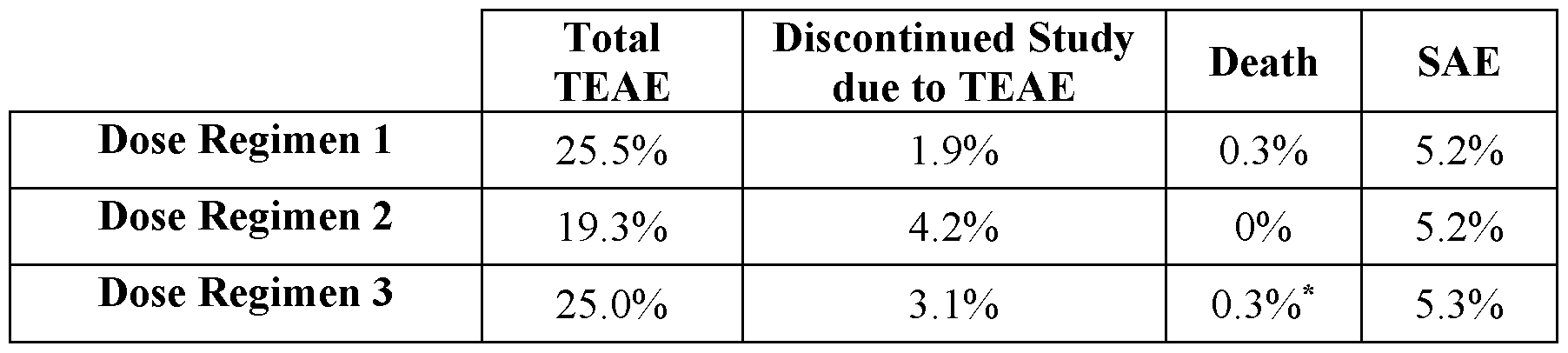
Safety data is also collected for all patients assigned to a Dose Regimen which is administered at least one dose of the anti-IL-17 antibody. As reflected in Tables 6 and 7, percentages of patients experiencing a treat-emergent adverse event ("TEAE") are similar across all the three Dose Regimen groups and the majority of TEAEs are mild-to- moderate in severity. Additionally, the data presented in Tables 6 and 7 for all Dose Regimens studied is consistent with the Comparator Dose Regimen (data not shown). The most common TEAEs are upper respiratory infection, nasopharyngitis, injection-site reaction, and headache. Dose Regimen 3 demonstrates no clinically significant safety findings related to infections or cytopenias and MACE, malignancies, and IBD events are rare and consistent with the Comparator Dose Regimen (data not shown). Percentages of patients with serious adverse events ("SAE")s are approx. 5% in each treatment group (and no difference is found between patients achieving and not achieveing sPGA 0,1 at Week 12). Fisher's exact test is used for comparisons of all categories of data. Results are provided in Tables 6 and 7.
Table 6. TEAE Assessment
Unrelated to the study treatment per investigator assessment.
Table 7. TEAE Severity Assessment

The results provided in Table 6 and 7 demonstrate that Dose Regimens 2 and 3 do not present an increased safety risk over Dose Regimen 1 and are consistent with Comparator Dose Regimen. In view of the results provided in Tables 2 through 5, the results provided
in Tables 6 and 7 demonstrate Dose Regimens 2 and 3 are unexpectedly improved Dose Regimens for anti-IL-17 antibodies which are not attendant on increased safety risk.
Sequence Listing SEQ ID NO: 1 (human IL-17)
MTPGKTSLVS LLLLLSLEAI VKAGITIPRN PGCPNSEDKN FPRTVMV LN IHNRNTNTNP KRSSDYYNRS TSPWNLHRNE DPERYPSVIW EAKCRHLGCI NADGNVDYHM NSVPIQQEIL VLRREPPHCP NSFRLEKILV SVGCTCVTPI VHHVA
SEQ ID NO: 2 (LCVR)
DIVMTQTPLS LSVTPGQPAS ISCRSSRSLV HSRGNTYLHW YLQKPGQSPQ LLIYKVSNRF IGVPDRFSGS GSGTDFTLKI SRVEAEDVGV YYCSQSTHLP FTFGQGTKLE IK
SEQ ID NO: 3 (HCVR)
QVQLVQSGAE VKKPGSSVKV SCKASGYSFT DYHIHWVRQA PGQGLEWMGV INPMYGTTDY NQRFKGRVTI TADESTSTAY MELSSLRSED TAVYYCARYD YFTGTGVYWG QGTLVTVSS
SEQ ID NO: 4 (Light chain)
DIVMTQTPLS LSVTPGQPAS ISCRSSRSLV HSRGNTYLHW YLQKPGQSPQ LLIYKVSNRF IGVPDRFSGS GSGTDFTLKI SRVEAEDVGV YYCSQSTHLP FTFGQGTKLE IKRTVAAPSV FIFPPSDEQL KSGTASVVCL LNNFYPREAK VQWKVDNALQ SGNSQESVTE QDSKDSTYSL SSTLTLSKAD YEKHKVYACE VTHQGLSSPV TKSFNRGEC
SEQ ID NO: 5 (Heavy chain)
QVQLVQSGAE VKKPGSSVKV SCKASGYSFT DYHIHWVRQA PGQGLEWMGV INPMYGTTDY NQRFKGRVTI TADESTSTAY MELSSLRSED TAVYYCARYD YFTGTGVYWG QGTLVTVSS A STKGPSVFPL APCSRSTSES TAALGCLVKD YFPEPVTVSW NSGALTSGVH TFPAVLQSSG LYSLSSVVTV PSSSLGTKTY TCNVDHKPSN TKVDKRVESK YGPPCPPCPA PEFLGGPSVF LFPPKPKDTL MISRTPEVTC VVVDVSQEDP EVQFNWYVDG VEVHNAKTKP REEQFNSTYR
VVSVLTVLHQ DWLNGKEYKC KVSNKGLPSS lEKTISKAKG QPREPQVYTL PPSQEEMTKN QVSLTCLVKG FYPSDIAVEW ESNGQPENNY KTTPPVLDSD GSFFLYSRLT VDKSRWQEGN VFSCSVMHEA LHNHYTQKSL SLSLG
Claims
1. A dose regimen for administering an anti-IL-17 antibody, or a pharmaceutical formulation thereof, to a patient, comprising:
administering subcutaneous an initial dose of about 160 mg of the anti-IL-17 antibody or pharmaceutical formulation thereof;
administering subcutaneous a second dose of about 80 mg of the anti-IL-17 antibody or pharmaceutical formulation thereof 14 days after the said step of
administering the initial dose; and
administering subcutaneous a dose of about 80 mg of the anti-IL-17 antibody or pharmaceutical formulation thereof every 14 days after said step of administering the second dose,
wherein the anti-IL-17 antibody or pharmaceutical formulation thereof comprises an antibody with a light chain variable region (LCVR) and a heavy chain variable region (HCVR), wherein said LCVR is the amino acid sequence of SEQ ID NO: 2 and said HCVR is the amino acid sequence of SEQ ID NO: 3.
2. The dose regimen of Claim 1, wherein the antibody comprises a light chain (LC) and a heavy chain (HC), wherein said LC is the amino acid sequence of SEQ ID NO: 4 and said HC is the amino acid sequence of SEQ ID NO: 5.
3. The dose regimen of Claim 2, wherein the antibody is ixekizumab.
4. The dose regimen of any one of Claims 1-3 wherein the patient is in need of treatment for one of Psoriasis (Ps), Ankylosing Spondilitis (AS), Psoriatic Arthritis (PA), Rheumatoid Arthritis (RA) or Multiple Myeloma (MM).
5. The dose regimen of any one of Claims 1-4 wherein the patient is in need of treatment for psoriasis.
6. The dose regimen of any one of Claims 1-5, wherein said step of administering subcutaneous an initial dose of about 160 mg comprises administering two subcutaneous doses of about 80 mg of the anti-IL-17 antibody or pharmaceutical formulation thereof.
7. The dose regimen of any one of Claims 1-6, wherein said steps of administering comprise administering a pharmaceutical formulation of the anti-IL-17 antibody, said pharmaceutical formulation comprising the anti-IL-17 antibody at a concentration of about 80 mg/mL, citrate buffer at a concentration of about 20 mM, sodium chloride at a concentration of about 200 mM, polysorbate-80 at a concentration in the range of about 0.02% (w/v) to about 0.03% (w/v), and pH at about 5.7.
8. The dose regimen of Claim 7, wherein the concentration of polysorbate-80 is about 0.03% (w/v).
9. A method of treating a patient in need of treatment for psoriasis comprising:
(a) during an initial 12-week period, administering an initial dose subcutaneous of about 160 mg of an anti-IL-17 antibody, or a pharmaceutical formulation thereof, on day 0, followed by administering subcutaneous about 80 mg of the anti-IL-17 antibody, or pharmaceutical formulation thereof, at each of days 14, 28, 42, 56, 70 and 84;
(b) following the initial 12-week period, assessing the patient for sufficient clinical response; and
(c) for patients assessed as not achieving or maintaining sufficient clinical response, administering subcutaneous about 80 mg of the anti-IL-17 antibody or pharmaceutical formulation thereof every two weeks,
wherein the anti-IL-17 antibody or pharmaceutical formulation thereof comprises an antibody with a light chain variable region (LCVR) and a heavy chain variable region (HCVR), wherein said LCVR is the amino acid sequence of SEQ ID NO: 2 and said HCVR is the amino acid sequence of SEQ ID NO: 3.
10. The method of Claim 9, wherein sufficient clinical response is one of: static Physician Global Assessment 0,1 ("sPGA 0, 1"); sPGA 0; Psoriasis Area and Severity Index "PASI 75"; and PASI 90.
11. The method of Claim 10, wherein for patients assessed as not achieving or maintaining sufficient clinical response, the step of administering subcutaneous about 80
mg of the anti-IL-17 antibody or pharmaceutical formulation thereof every two weeks is performed for a period of 16 weeks following said step of assessing the patient.
12. The method of Claim 1 1 further comprising the step of, following the period of 16 weeks following said step of assessing the patient, administering subcutaneous about 80 mg of the anti-IL-17 antibody or pharmaceutical formulation thereof every four weeks.
13. The method of any one of Claims 9-12, wherein the antibody comprises a light chain (LC) and a heavy chain (HC), wherein said LC is the amino acid sequence of SEQ ID NO: 4 and said HC is the amino acid sequence of SEQ ID NO: 5.
14. The method of any one of Claims 9-13, wherein the antibody is ixekizumab.
15. The method of any one of Claims 9-14, wherein said step of administering subcutaneous an initial dose of about 160 mg comprises administering two subcutaneous doses of about 80 mg of the anti-IL-17 antibody or pharmaceutical formulation thereof.
16. The method of any one of Claims 9-15, wherein said steps of administering comprise administering a pharmaceutical formulation of the anti-IL-17 antibody, said pharmaceutical formulation comprising the anti-IL-17 antibody at a concentration of about 80 mg/mL, citrate buffer at a concentration of about 20 mM, sodium chloride at a concentration of about 200 mM, polysorbate-80 at a concentration in the range of about 0.02% (w/v) to about 0.03% (w/v), and pH at about 5.7.
17. The method of Claim 16, wherein the concentration of polysorbate-80 is about 0.03% (w/v).
18. A method of treating one of Psoriasis (Ps), Ankylosing Spondilitis (AS), Psoriatic Arthritis (PA), Rheumatoid Arthritis (RA) or Multiple Myeloma (MM) comprising, administering subcutaneous an initial dose of about 160 mg of an anti-IL-17 antibody, or a pharmaceutical formulation thereof, on day 0, and administering subcutaneous subsequent doses of about 80 mg of the anti-IL-17 antibody or pharmaceutical
formulation thereof at every 14th day interval after the initial dose, wherein the anti-IL-17 antibody or pharmaceutical formulation thereof comprises an antibody with a light chain variable region (LCVR) and a heavy chain variable region (HCVR), wherein said LCVR is the amino acid sequence of SEQ ID NO: 2 and said HCVR is the amino acid sequence of SEQ ID NO: 3.
19. The method of Claim 18, wherein the antibody comprises a light chain (LC) and a heavy chain (HC), wherein said LC is the amino acid sequence of SEQ ID NO: 4 and said HC is the amino acid sequence of SEQ ID NO: 5.
20. The method of any one of Claims 18-19, wherein the antibody is ixekizumab.
21. The method of any one of Claims 18-20, wherein said step of administering subcutaneous an initial dose of about 160 mg comprises administering two subcutaneous doses of about 80 mg of the anti-IL-17 antibody or pharmaceutical formulation thereof.
22. The method of any one of Claims 18-21, wherein said steps of administering comprise administering a pharmaceutical formulation of the anti-IL-17 antibody, said pharmaceutical formulation comprising the anti-IL-17 antibody at a concentration of about 80 mg/mL, citrate buffer at a concentration of about 20 mM, sodium chloride at a concentration of about 200 mM, polysorbate-80 at a concentration in the range of about 0.02% (w/v) to about 0.03% (w/v), and pH at about 5.7.
23. The method of Claim 22, wherein the concentration of polysorbate-80 is about 0.03% (w/v).
24. A method of treating Psoriasis comprising, administering subcutaneous an initial dose of about 160 mg of an anti-IL-17 antibody, or a pharmaceutical formulation thereof, on day 0, and administering subcutaneous subsequent doses of about 80 mg of the anti- IL-17 antibody or pharmaceutical formulation thereof at every 14th day interval after the initial dose, wherein the anti-IL-17 antibody or pharmaceutical formulation thereof comprises an antibody with a light chain variable region (LCVR) and a heavy chain
variable region (HCVR), wherein said LCVR is the amino acid sequence of SEQ ID NO: 2 and said HCVR is the amino acid sequence of SEQ ID NO: 3.
25. The method of Claim 24, wherein the antibody comprises a light chain (LC) and a heavy chain (HC), wherein said LC is the amino acid sequence of SEQ ID NO: 4 and said HC is the amino acid sequence of SEQ ID NO: 5.
26. The method of any one of Claims 24-25, wherein the antibody is ixekizumab.
27. The method of any one of Claims 24-26 wherein said step of administering subcutaneous an initial dose of about 160 mg comprises administering two subcutaneous doses of about 80 mg of the anti-IL-17 antibody or pharmaceutical formulation thereof.
28. The method of any one of Claims 24-27, wherein said steps of administering comprise administering a pharmaceutical formulation of the anti-IL-17 antibody, said pharmaceutical formulation comprising the anti-IL-17 antibody at a concentration of about 80 mg/mL, citrate buffer at a concentration of about 20 mM, sodium chloride at a concentration of about 200 mM, polysorbate-80 at a concentration in the range of about 0.02% (w/v) to about 0.03% (w/v), and pH at about 5.7.
28. The method of Claim 28, wherein the concentration of polysorbate-80 is about 0.03% (w/v).
29. A method of treating a patient in need of treatment for psoriasis comprising:
(a) during an initial 12-week period, administering an initial dose subcutaneous of about 160 mg of an anti-IL-17 antibody, or a pharmaceutical formulation thereof, on day 0, followed by administering subcutaneous about 80 mg of the anti-IL-17 antibody, or pharmaceutical formulation thereof, at each of days 14, 28, 42, 56, 70 and 84; and
(b) for patients not achieving or maintaining sufficient clinical response following the initial 12-week period, administering subcutaneous about 80 mg of the anti-IL-17 antibody or pharmaceutical formulation thereof every two weeks,
wherein the anti-IL-17 antibody or pharmaceutical formulation thereof comprises an antibody with a light chain variable region (LCVR) and a heavy chain variable region (HCVR), wherein said LCVR is the amino acid sequence of SEQ ID NO: 2 and said HCVR is the amino acid sequence of SEQ ID NO: 3.
30. The method of Claim 29, wherein sufficient clinical response is one of: static Physician Global Assessment 0,1 ("sPGA 0, 1"); sPGA 0; Psoriasis Area and Severity Index "PASI 75"; and PASI 90.
31. The method of Claim 30, wherein for patients not achieving or maintaining sufficient clinical response following the initial 12-week period, the step of administering subcutaneous about 80 mg of the anti-IL-17 antibody or pharmaceutical formulation thereof every two weeks is performed for a period of 16 weeks.
32. The method of Claim 31 further comprising the step of, following the period of 16 weeks, administering subcutaneous about 80 mg of the anti-IL-17 antibody or pharmaceutical formulation thereof every four weeks.
33. The method of any one of Claims 29-32, wherein the antibody comprises a light chain (LC) and a heavy chain (HC), wherein said LC is the amino acid sequence of SEQ ID NO: 4 and said HC is the amino acid sequence of SEQ ID NO: 5.
34. The method of any one of Claims 29-33, wherein the antibody is ixekizumab.
35. The method of any one of Claims 29-34, wherein said step of administering subcutaneous an initial dose of about 160 mg comprises administering two subcutaneous doses of about 80 mg of the anti-IL-17 antibody or pharmaceutical formulation thereof.
36. The method of any one of Claims 29-35, wherein said steps of administering comprise administering a pharmaceutical formulation of the anti-IL-17 antibody, said pharmaceutical formulation comprising the anti-IL-17 antibody at a concentration of about 80 mg/mL, citrate buffer at a concentration of about 20 mM, sodium chloride at a
concentration of about 200 mM, polysorbate-80 at a concentration in the range of about 0.02% (w/v) to about 0.03% (w/v), and pH at about 5.7.
37. The method of Claim 36, wherein the concentration of polysorbate-80 is about 0.03% (w/v).
38. A method of treating Psoriasis (Ps) in a patient not achieving or maintaining sufficient clinical response at the completion of a 12 week induction treatment period, the induction treatment period comprising an initial dose of about 160 mg of an anti-IL-17 antibody administered subcutaneous on Day 0 and treatment doses of about 80 mg of the anti-IL-17 antibody administered subcutaneous at each of days 14, 28, 42, 56, 70 and 84, said method comprising administering subcutaneous about 80 mg of the anti-IL-17 antibody every two weeks after the induction treatment period,
wherein the anti-IL-17 antibody or pharmaceutical formulation thereof comprises an antibody with a light chain variable region (LCVR) and a heavy chain variable region (HCVR), wherein said LCVR is the amino acid sequence of SEQ ID NO: 2 and said HCVR is the amino acid sequence of SEQ ID NO: 3.
39. The method of Claim 38, wherein the antibody comprises a light chain (LC) and a heavy chain (HC), wherein said LC is the amino acid sequence of SEQ ID NO: 4 and said HC is the amino acid sequence of SEQ ID NO: 5.
40. The method of any one of Claims 38-39, wherein the antibody is ixekizumab.
41. The method of any one of Claims 38-40, wherein said step of administering subcutaneous about 80 mg of the anti-IL-17 antibody every two weeks after the induction treatment period is performed for a period of 16 weeks.
42. The method of any one of Claims 38-41 further comprising the step of, following the period of 16 weeks, administering subcutaneous about 80 mg of the anti-IL-17 antibody thereof every four weeks.
43. An anti-IL-17 antibody, or a pharmaceutical formulation thereof, for use in the treatment of Psoriasis (Ps), Ankylosing Spondilitis (AS), Psoriatic Arthritis (PA), Rheumatoid Arthritis (RA) or Multiple Myeloma (MM), wherein the anti-IL-17 antibody or pharmaceutical formulation thereof is administered in a dose regimen of, during an initial 12-week period, on day 0 about 160 mg of the anti-IL-17 antibody or
pharmaceutical formulation thereof is administered subcutaneously and on each of days 14, 28, 42, 56, 70 and 84 about 80 mg of the anti-IL-17 antibody or pharmaceutical formulation thereof is administered subcutaneously; following the initial 12-week period, assessing the patient for sufficient clinical response; and for patients assessed as not achieving or maintaining sufficient clinical response, administering subcutaneous about 80 mg of the anti-IL-17 antibody or pharmaceutical formulation thereof every two weeks, wherein the anti-IL-17 antibody or pharmaceutical formulation thereof comprises an antibody with a light chain variable region (LCVR) and a heavy chain variable region (HCVR), wherein said LCVR is the amino acid sequence of SEQ ID NO: 2 and said HCVR is the amino acid sequence of SEQ ID NO: 3.
44. The antibody of Claim 43, wherein sufficient clinical response is one of: static Physician Global Assessment 0, 1 ("sPGA 0,1"); sPGA 0; Psoriasis Area and Severity Index "PASI 75"; and PASI 90.
45. The antibody of Claim 44, wherein for patients assessed as not achieving or maintaining sufficient clinical response, the step of administering subcutaneous about 80 mg of the anti-IL-17 antibody or pharmaceutical formulation thereof every two weeks is performed for a period of 16 weeks following said step of assessing the patient.
46. The antibody of Claim 45 further comprising, following the period of 16 weeks following assessing the patient, administering subcutaneous about 80 mg of the anti-IL-17 antibody or pharmaceutical formulation thereof every four weeks.
47. The antibody of any one of Claims 43-46, wherein the antibody comprises a light chain (LC) and a heavy chain (HC), wherein said LC is the amino acid sequence of SEQ ID NO: 4 and said HC is the amino acid sequence of SEQ ID NO: 5.
48. The antibody of any one of Claims 43-47, wherein the antibody is ixekizumab.
49. The antibody of any one of Claims 43-48, wherein administering subcutaneously an initial dose of about 160 mg comprises administering two subcutaneous doses of about 80 mg of the anti-IL-17 antibody or pharmaceutical formulation thereof.
50. The antibody of any one of Claims 43-49, wherein said pharmaceutical formulation comprises the anti-IL-17 antibody at a concentration of about 80 mg/mL, citrate buffer at a concentration of about 20 mM, sodium chloride at a concentration of about 200 mM, polysorbate-80 at a concentration in the range of about 0.02% (w/v) to about 0.03%) (w/v), and pH at about 5.7.
51. The method of Claim 50, wherein the concentration of polysorbate-80 is about 0.03% (w/v).
52. An anti-IL-17 antibody, or a pharmaceutical formulation thereof, for use in the treatment of one of Psoriasis (Ps), Ankylosing Spondilitis (AS), Psoriatic Arthritis (PA), Rheumatoid Arthritis (RA) or Multiple Myeloma (MM), wherein the anti-IL-17 antibody or pharmaceutical formulation thereof is administered to a patient not achieving or maintaining sufficient clinical response at the completion of a 12 week induction treatment period in a dose regimen of: the 12 week induction treatment period comprising an initial dose of about 160 mg of an anti-IL-17 antibody administered subcutaneous on Day 0 and treatment doses of about 80 mg of the anti-IL-17 antibody administered subcutaneous at each of days 14, 28, 42, 56, 70 and 84, and after the 12 week induction treatment period administering subcutaneous about 80 mg of the anti-IL- 17 antibody,
wherein the anti-IL-17 antibody or pharmaceutical formulation thereof comprises an antibody with a light chain variable region (LCVR) and a heavy chain variable region (HCVR), wherein said LCVR is the amino acid sequence of SEQ ID NO: 2 and said HCVR is the amino acid sequence of SEQ ID NO: 3.
53. The antibody of Claim 52, wherein the antibody comprises a light chain (LC) and a heavy chain (HC), wherein said LC is the amino acid sequence of SEQ ID NO: 4 and said HC is the amino acid sequence of SEQ ID NO: 5.
54. The antibody of Claim 53, for use in the treatment of Ps.
55. The antibody of any one of Claims 52-54, wherein the antibody is ixekizumab.
56. The antibody of any one of Claims 52-55, wherein administering subcutaneous about 80 mg of the anti-IL-17 antibody every two weeks after the induction treatment period is performed for a period of 16 weeks.
57. The antibody of any one of Claims 52-56 further comprising, following the period of 16 weeks, administering subcutaneous about 80 mg of the anti-IL-17 antibody thereof every four weeks.
Applications Claiming Priority (6)
| Application Number | Priority Date | Filing Date | Title |
|---|---|---|---|
| US201762541246P | 2017-08-04 | 2017-08-04 | |
| US62/541,246 | 2017-08-04 | ||
| US201762542940P | 2017-08-09 | 2017-08-09 | |
| US62/542,940 | 2017-08-09 | ||
| US201762554752P | 2017-09-06 | 2017-09-06 | |
| US62/554,752 | 2017-09-06 |
Publications (1)
| Publication Number | Publication Date |
|---|---|
| WO2019027828A1 true WO2019027828A1 (en) | 2019-02-07 |
Family
ID=63442768
Family Applications (1)
| Application Number | Title | Priority Date | Filing Date |
|---|---|---|---|
| PCT/US2018/044064 Ceased WO2019027828A1 (en) | 2017-08-04 | 2018-07-27 | Anti-il-17 antibody dose regimen |
Country Status (1)
| Country | Link |
|---|---|
| WO (1) | WO2019027828A1 (en) |
Cited By (2)
| Publication number | Priority date | Publication date | Assignee | Title |
|---|---|---|---|---|
| EP4136110A4 (en) * | 2020-04-17 | 2024-04-17 | Eli Lilly and Company | TREATMENT OF RESPIRATORY DISEASES |
| EP4070817A4 (en) * | 2019-12-06 | 2026-03-04 | Livzon Mabpharm Inc | Liquid preparation containing anti-il-17 antibody |
Citations (2)
| Publication number | Priority date | Publication date | Assignee | Title |
|---|---|---|---|---|
| US7838638B2 (en) | 2005-12-13 | 2010-11-23 | Eli Lilly And Company | Anti-IL-17 antibodies |
| WO2013134052A1 (en) * | 2012-03-07 | 2013-09-12 | Eli Lilly And Company | Il-17 antibody formulation |
-
2018
- 2018-07-27 WO PCT/US2018/044064 patent/WO2019027828A1/en not_active Ceased
Patent Citations (3)
| Publication number | Priority date | Publication date | Assignee | Title |
|---|---|---|---|---|
| US7838638B2 (en) | 2005-12-13 | 2010-11-23 | Eli Lilly And Company | Anti-IL-17 antibodies |
| WO2013134052A1 (en) * | 2012-03-07 | 2013-09-12 | Eli Lilly And Company | Il-17 antibody formulation |
| US9376491B2 (en) | 2012-03-07 | 2016-06-28 | Eli Lilly And Company | IL-17 antibody formulation and method of treatment using same |
Non-Patent Citations (8)
| Title |
|---|
| DÉSIRÉE VAN DER HEIJDE ET AL: "Efficacy and Safety of Ixekizumab in Patients with Active Psoriatic Arthritis: 52-week Results from a Phase III Study (SPIRIT-P1)", JOURNAL OF RHEUMATOLOGY, vol. 45, no. 3, 15 December 2017 (2017-12-15), CA, pages 367 - 377, XP055509859, ISSN: 0315-162X, DOI: 10.3899/jrheum.170429 * |
| FREDRIKSSON T; PETTERSSON U.: "Severe psoriasis--oral therapy with a new retinoid", DERMATOLOGICA, vol. 157, no. 4, 1978, pages 238 - 244, XP008121505 |
| K B GORDON ET AL: "Phase 3 Trials of Ixekizumab in Moderate-to-Severe Plaque Psoriasis", THE NEW ENGLAND JOURNAL OF MEDICINE, vol. 375, 28 July 2016 (2016-07-28), pages 345 - 356, XP055508926 * |
| MARK C. GENOVESE ET AL: "Safety and efficacy of ixekizumab in patients with PsA and previous inadequate response to TNF inhibitors: week 52 results from SPIRIT-P2", RHEUMATOLOGY, vol. Key182, 24 July 2018 (2018-07-24), pages 1 - 11, XP055509868 * |
| NASH PETER ET AL: "Ixekizumab for the treatment of patients with active psoriatic arthritis and an inadequate response to tumour necrosis factor inhibitors: results from the 24-week randomised, double-blind, placebo-controlled period of the SPIRIT-P2 phase 3 trial", LANCET, ELSEVIER, AMSTERDAM, NL, vol. 389, no. 10086, 24 May 2017 (2017-05-24), pages 2317 - 2327, XP085061195, ISSN: 0140-6736, DOI: 10.1016/S0140-6736(17)31429-0 * |
| PUIG L.: "PASI90 response: the new standard in therapeutic efficacy for psoriasis", J EUR ACAD DERMATOL VENEREOL, vol. 29, no. 4, 2015, pages 645 - 648 |
| R.G. LANGLEY ET AL: "Efficacy and safety of continuous every-2-week dosing of ixekizumab over 52 weeks in patients with moderate-to-severe plaque psoriasis in a randomized phase III trial (IXORA-P)", BRITISH JOURNAL OF DERMATOLOGY, vol. 178, no. 6, 15 May 2018 (2018-05-15), UK, pages 1315 - 1323, XP055509856, ISSN: 0007-0963, DOI: 10.1111/bjd.16426 * |
| R.G. LANGLEY ET AL: "Long-term efficacy and safety of ustekinumab, with and without dosing adjustment, in patients with moderate-to-severe psoriasis: results from the PHOENIX 2 study through 5 years of follow-up", BRITISH JOURNAL OF DERMATOLOGY, vol. 172, no. 5, 22 March 2015 (2015-03-22), UK, pages 1371 - 1383, XP055509838, ISSN: 0007-0963, DOI: 10.1111/bjd.13469 * |
Cited By (2)
| Publication number | Priority date | Publication date | Assignee | Title |
|---|---|---|---|---|
| EP4070817A4 (en) * | 2019-12-06 | 2026-03-04 | Livzon Mabpharm Inc | Liquid preparation containing anti-il-17 antibody |
| EP4136110A4 (en) * | 2020-04-17 | 2024-04-17 | Eli Lilly and Company | TREATMENT OF RESPIRATORY DISEASES |
Similar Documents
| Publication | Publication Date | Title |
|---|---|---|
| US20220144969A1 (en) | Methods for reducing cardiovascular risk | |
| KR102560808B1 (en) | Use of Bispecific Antibodies Recognizing Coagulant IX and/or Activated Coagulant IX and Factor X and/or Activated Coagulant X | |
| US20230116380A1 (en) | Long-acting gm-csf and methods of use | |
| CN112153982A (en) | Methods for treating atopic dermatitis by administering IL-4R inhibitors | |
| JP2017512193A (en) | Method for treating skin infection by administering an IL-4R antagonist | |
| JP2018138551A (en) | Treatment of rheumatoid arthritis | |
| DE112019003835T5 (en) | MEDICINAL PRODUCTS FOR USE IN THE TREATMENT OR PREVENTION OF A C5-RELATED DISEASE, AND METHODS OF TREATMENT OR PREVENTION OF A C5-RELATED DISEASE | |
| WO2019027828A1 (en) | Anti-il-17 antibody dose regimen | |
| JP2021509103A (en) | Treatment of skin lesions and prurigo in patients with prurigo nodularis | |
| KR20230084166A (en) | How to treat OX40 related disorders | |
| AU2023375340A1 (en) | Methods for the treatment of cardiovascular disease | |
| Lotan et al. | New treatment perspectives for acute relapses in neuromyelitis optica spectrum disorder | |
| KR102644938B1 (en) | Anti-vegfr-2 antibody | |
| CN115515978A (en) | PAN-ELR + CXC chemokine antibodies for treating respiratory diseases | |
| JP2023534576A5 (en) | ||
| KR20250029297A (en) | Pan-elr+ cxc chemokine antibodies for the treatment of hidradenitis suppurativa | |
| JP2002521491A (en) | CD25 binding molecules for use in treating rheumatoid arthritis or skin diseases | |
| Conner et al. | Gastrointestinal adverse events related to study drug and leading to discontinuation through 5 years of tildrakizumab exposure in 2 phase 3 clinical trials | |
| TW202535463A (en) | Treatment of anca-associated vasculitis | |
| TW202448944A (en) | Il-22r antibody for use in treating atopic dermatitis | |
| TW202535464A (en) | pharmaceutical composition | |
| WO2022245816A1 (en) | Treatment of autoimmune inflammatory diseases with tnfrsf25-binding agents | |
| WO2026028163A1 (en) | Methods for treating high-risk smoldering multiple myeloma | |
| CA2848510C (en) | Combination therapy using immunoglobulin and c1-inhibitor | |
| HK1232890B (en) | Methods for reducing cardiovascular risk |
Legal Events
| Date | Code | Title | Description |
|---|---|---|---|
| 121 | Ep: the epo has been informed by wipo that ep was designated in this application |
Ref document number: 18762412 Country of ref document: EP Kind code of ref document: A1 |
|
| NENP | Non-entry into the national phase |
Ref country code: DE |
|
| 122 | Ep: pct application non-entry in european phase |
Ref document number: 18762412 Country of ref document: EP Kind code of ref document: A1 |