WO2019020657A1 - Pyridine-3-sulfonamide compounds as pi3-kinase inhibitors - Google Patents
Pyridine-3-sulfonamide compounds as pi3-kinase inhibitors Download PDFInfo
- Publication number
- WO2019020657A1 WO2019020657A1 PCT/EP2018/070094 EP2018070094W WO2019020657A1 WO 2019020657 A1 WO2019020657 A1 WO 2019020657A1 EP 2018070094 W EP2018070094 W EP 2018070094W WO 2019020657 A1 WO2019020657 A1 WO 2019020657A1
- Authority
- WO
- WIPO (PCT)
- Prior art keywords
- sulfonamide
- methyl
- pyridin
- morpholinopyridine
- mmol
- Prior art date
- Legal status (The legal status is an assumption and is not a legal conclusion. Google has not performed a legal analysis and makes no representation as to the accuracy of the status listed.)
- Ceased
Links
- VBDZHOQCTAKPDH-UHFFFAOYSA-N CC(C)N1CCN(Cc(cc2)ccc2-c2cc(NS(c3cc(N4CCOCC4)cnc3N(C)C)(=O)=O)cnc2)CC1 Chemical compound CC(C)N1CCN(Cc(cc2)ccc2-c2cc(NS(c3cc(N4CCOCC4)cnc3N(C)C)(=O)=O)cnc2)CC1 VBDZHOQCTAKPDH-UHFFFAOYSA-N 0.000 description 1
- CFAPDIBNSORPTO-UHFFFAOYSA-N CC(C)N1CCN(Cc(ccc(Br)c2)c2F)CC1 Chemical compound CC(C)N1CCN(Cc(ccc(Br)c2)c2F)CC1 CFAPDIBNSORPTO-UHFFFAOYSA-N 0.000 description 1
- CYEYLYGHCOHIDC-UHFFFAOYSA-N CC1(C)OB(c2ccc(CN3CCN(C)CC3)cc2)OC1(C)C Chemical compound CC1(C)OB(c2ccc(CN3CCN(C)CC3)cc2)OC1(C)C CYEYLYGHCOHIDC-UHFFFAOYSA-N 0.000 description 1
- MKHJVVGQJIZDDH-PHIMTYICSA-N CCN([C@H](C)C1)[C@@H](C)CN1C(OC(C)(C)C)=O Chemical compound CCN([C@H](C)C1)[C@@H](C)CN1C(OC(C)(C)C)=O MKHJVVGQJIZDDH-PHIMTYICSA-N 0.000 description 1
- BAWBIAFBTDNEJB-UHFFFAOYSA-N CN1CCN(CNC=C)CC1 Chemical compound CN1CCN(CNC=C)CC1 BAWBIAFBTDNEJB-UHFFFAOYSA-N 0.000 description 1
- DLUZQXCNCHHJKB-UHFFFAOYSA-N CN1CCN(Cc(c(F)c2)ccc2Br)CC1 Chemical compound CN1CCN(Cc(c(F)c2)ccc2Br)CC1 DLUZQXCNCHHJKB-UHFFFAOYSA-N 0.000 description 1
- OPQHCAQGXCCUEH-UHFFFAOYSA-N COc(c(S(N)(=O)=O)c1)ncc1N1CCOCC1 Chemical compound COc(c(S(N)(=O)=O)c1)ncc1N1CCOCC1 OPQHCAQGXCCUEH-UHFFFAOYSA-N 0.000 description 1
- AJDSLFFCTAZKNE-UHFFFAOYSA-N COc(c(S(Nc1cncc(-c2ccc(C=O)cc2F)c1)(=O)=O)c1)ncc1N1CCOCC1 Chemical compound COc(c(S(Nc1cncc(-c2ccc(C=O)cc2F)c1)(=O)=O)c1)ncc1N1CCOCC1 AJDSLFFCTAZKNE-UHFFFAOYSA-N 0.000 description 1
Classifications
-
- C—CHEMISTRY; METALLURGY
- C07—ORGANIC CHEMISTRY
- C07D—HETEROCYCLIC COMPOUNDS
- C07D401/00—Heterocyclic compounds containing two or more hetero rings, having nitrogen atoms as the only ring hetero atoms, at least one ring being a six-membered ring with only one nitrogen atom
- C07D401/14—Heterocyclic compounds containing two or more hetero rings, having nitrogen atoms as the only ring hetero atoms, at least one ring being a six-membered ring with only one nitrogen atom containing three or more hetero rings
-
- A—HUMAN NECESSITIES
- A61—MEDICAL OR VETERINARY SCIENCE; HYGIENE
- A61P—SPECIFIC THERAPEUTIC ACTIVITY OF CHEMICAL COMPOUNDS OR MEDICINAL PREPARATIONS
- A61P11/00—Drugs for disorders of the respiratory system
-
- C—CHEMISTRY; METALLURGY
- C07—ORGANIC CHEMISTRY
- C07D—HETEROCYCLIC COMPOUNDS
- C07D213/00—Heterocyclic compounds containing six-membered rings, not condensed with other rings, with one nitrogen atom as the only ring hetero atom and three or more double bonds between ring members or between ring members and non-ring members
- C07D213/02—Heterocyclic compounds containing six-membered rings, not condensed with other rings, with one nitrogen atom as the only ring hetero atom and three or more double bonds between ring members or between ring members and non-ring members having three double bonds between ring members or between ring members and non-ring members
- C07D213/04—Heterocyclic compounds containing six-membered rings, not condensed with other rings, with one nitrogen atom as the only ring hetero atom and three or more double bonds between ring members or between ring members and non-ring members having three double bonds between ring members or between ring members and non-ring members having no bond between the ring nitrogen atom and a non-ring member or having only hydrogen or carbon atoms directly attached to the ring nitrogen atom
- C07D213/60—Heterocyclic compounds containing six-membered rings, not condensed with other rings, with one nitrogen atom as the only ring hetero atom and three or more double bonds between ring members or between ring members and non-ring members having three double bonds between ring members or between ring members and non-ring members having no bond between the ring nitrogen atom and a non-ring member or having only hydrogen or carbon atoms directly attached to the ring nitrogen atom with hetero atoms or with carbon atoms having three bonds to hetero atoms with at the most one bond to halogen, e.g. ester or nitrile radicals, directly attached to ring carbon atoms
- C07D213/72—Nitrogen atoms
- C07D213/76—Nitrogen atoms to which a second hetero atom is attached
-
- C—CHEMISTRY; METALLURGY
- C07—ORGANIC CHEMISTRY
- C07D—HETEROCYCLIC COMPOUNDS
- C07D413/00—Heterocyclic compounds containing two or more hetero rings, at least one ring having nitrogen and oxygen atoms as the only ring hetero atoms
- C07D413/14—Heterocyclic compounds containing two or more hetero rings, at least one ring having nitrogen and oxygen atoms as the only ring hetero atoms containing three or more hetero rings
Definitions
- the present invention is directed to compounds which are inhibitors of kinase activity, pharmaceutical compositions comprising the compounds, and the use of the compounds or the compositions in the treatment of various disorders. More specifically, the compounds of the invention are inhibitors of the activity or function of the phosphoinositide 3 ⁇ kinase family (hereinafter PI3- kinases), for example PI3K ⁇ , ⁇ 3 ⁇ ⁇ , PI3K ⁇ and/or ⁇ 3 ⁇ ⁇ .
- PI3- kinases for example PI3K ⁇ , ⁇ 3 ⁇ ⁇ , PI3K ⁇ and/or ⁇ 3 ⁇ ⁇ .
- PI3-kinases e.g. PI3Kdelta
- Class I PI3Ks convert the membrane phospholipid PI(4,5)P2 into PI(3,4,5)P3, which functions as a second messenger.
- PI and PI(4)P are also substrates of PI3K and can be phosphorylated and converted into PI3P and PI(3,4)P2, respectively.
- phosphoinositides can be converted into other phosphoinositides by 5'-specific and 3'-specific phosphatases.
- PI3K enzymatic activity results either directly or indirectly in the generation of two 3'-phosphoinositide subtypes which function as second messengers in intracellular signal transduction pathways (Trends Biochem. Sci. 22(7) p. 267-72 (1997) by Vanhaesebroeck etal.; Chem. Rev. 101(8) p. 2365-80 (2001) by Leslie et al.; Annu. Rev. Cell Dev. Biol. 17 p. 615-75 (2001) by Katso et al.; and Cell. Mol. Life Sci. 59(5) p.
- class I PI3Ks can phosphorylate phosphatidyl inositol (PI), phosphatidylinositol-4-phosphate (PI4P), and phosphatidylinositol-4,5-bisphosphate (PI(4,5)P2) to produce phosphatidylinositol-3-phosphate (PI3P), phosphatidylinositol-3,4-bisphosphate (PI(3,4)P2, and phosphatidylinositol-3,4,5- trisphosphate (PI(3,4,5)P3, respectively.
- PI phosphatidyl inositol
- P4P phosphatidylinositol-4-phosphate
- PI(4,5)P2 phosphatidylinositol-4,5-bisphosphate
- Class II PI3Ks can phosphorylate PI and PI4P.
- Class III PI3Ks can only phosphorylate PI (Vanhaesebroeck et al. (1997), above; Vanhaesebroeck et al. Exp. Cell Res. 253(1) p. 239-54 (1999); and Leslie et al. (2001), above).
- Class I PI3K is a heterodimer consisting of a pi 10 catalytic subunit and a regulatory subunit, and the family is further divided into class la and class lb enzymes on the basis of regulatory partners and mechanism of regulation.
- Class la enzymes consist of three distinct catalytic subunits (pllOa, ⁇ , and ⁇ ) that dimerise with five distinct regulatory subunits (p85a, p55a, p50a, ⁇ 85 ⁇ , and p55y), with all catalytic subunits being able to interact with all regulatory subunits to form a variety of heterodimers.
- Class la PI3K are generally activated in response to growth factor-stimulation of receptor tyrosine kinases, via interaction of the regulatory subunit SH2 domains with specific phospho- tyrosine residues of the activated receptor or adaptor proteins such as IRS-1.
- Small GTPases (ras as an example) are also involved in the activation of PI3K in conjunction with receptor tyrosine kinase activation. Both pi 10a and ⁇ are constitutively expressed in all cell types, whereas p110 ⁇ expression is more restricted to leukocyte populations and some epithelial cells.
- the single Class lb enzyme consists of a pllOy catalytic subunit that interacts with a plOl regulatory subunit.
- GPCR G-protein coupled receptor
- phosphoinositide 3-kinases phosphorylate the hydroxyl of the third carbon of the inositol ring.
- the phosphorylation of phosphoinositides to generate PtdIns(3,4,5)P3, PtdIns(3,4)P 2 and PtdIns(3)P produces second messengers for a variety of signal transduction pathways, including those essential to cell proliferation, cell differentiation, cell growth, cell size, cell survival, apoptosis, adhesion, cell motility, cell migration, chemotaxis, invasion, cytoskeletal rearrangement, cell shape changes, vesicle trafficking and metabolic pathway (Katso et al. (2001), above; and Mol. Med.
- PI3-kinases responsible for generating these phosphorylated signalling products was originally identified as being associated with viral oncoproteins and growth factor receptor tyrosine kinases that phosphorylate phosphatidylinositol (PI) and its phosphorylated derivatives at the 3'-hydroxyl of the inositol ring (Panayotou etal. Trends Cell Biol. 2 p. 358-60 (1992)).
- PI phosphatidylinositol
- biochemical studies have revealed that class I PI3-kinases (e.g.
- class IA isoform PI3K ⁇ are dual-specific kinase enzymes, meaning they display both lipid kinase (phosphorylation of phosphoinositides) as well as protein kinase activity, which have been shown to be capable of phosphorylation of other protein as substrates, including auto-phosphorylation as an intramolecular regulatory mechanism (EMBO J. 18(5) p. 1292-302 (1999) by Vanhaesebroeck et al.).
- PI3Ks Cellular processes in which PI3Ks play an essential role include suppression of apoptosis, reorganization of the actin skeleton, cardiac myocyte growth, glycogen synthase stimulation by insulin, TNF ⁇ -mediated neutrophil priming and superoxide generation, and leukocyte migration and adhesion to endothelial cells.
- PI3-kinase activation is believed to be involved in a wide range of cellular responses including cell growth, differentiation, and apoptosis (Parker, Current Biology 5(6) p. 577-79 (1995); and Yao et al. Science 267(5206) p. 2003-06 (1995)).
- PI3-kinase appears to be involved in a number of aspects of leukocyte activation.
- a p85-associated PI3-kinase has been shown to physically associate with the cytoplasmic domain of CD28, which is an important costimulatory molecule for the activation of T- cells in response to antigen (Pages et al. Nature 369 p. 327-29 (1994); and udd, Immunity 4 p.
- T cells Activation of T cells through CD28 lowers the threshold for activation by antigen and increases the magnitude and duration of the proliferative response. These effects are linked to increases in the transcription of a number of genes including interleukin-2 (IL2), an important T cell growth factor (Fraser et al. Science 251(4991) p. 313-16 (1991)).
- IL2 interleukin-2
- IL3 an important T cell growth factor
- ⁇ 3 ⁇ has been identified as a mediator of G beta-gamma-dependent regulation of JNK activity, and G beta-gamma are subunits of heterotrimeric G proteins (Lopez-Ilasaca et al. 1 Biol. Chem. 273(5) p. 2505-8 (1998)). Recently, (Laffargue et al. Immunity 16(3) p.
- ⁇ 3 ⁇ relays inflammatory signals through various G(i)-coupled receptors and is central to mast cell function, stimuli in the context of leukocytes, and immunology including cytokines, chemokines, adenosines, antibodies, integrins, aggregation factors, growth factors, viruses or hormones for example (J. Cell Sci. 114 (Pt 16) p. 2903-10 (2001) by Lawlor et al.; Laffargue et al. (2002), above; and Curr. Opinion Cell Biol. 14(2) p. 203-13 (2002) by Stephens et al.).
- PI3-kinase inhibitors Two compounds, LY294002 and wortmannin (hereinafter), have been widely used as PI3-kinase inhibitors. These compounds are non-specific PI3K inhibitors, as they do not distinguish among the four members of Class I PI3-kinases.
- the IC50 values of wortmannin against each of the various Class I PI3-kinases are in the range of 1-10 nM.
- the IC50 values for LY294002 against each of these PI3-kinases is about 15-20 ⁇ (Fruman et a/. Ann. Rev. Biochem. 67 p.
- wortmannin is a fungal metabolite which irreversibly inhibits PI3K activity by binding covalently to the catalytic domain of this enzyme. Inhibition of PI3K activity by wortmannin eliminates subsequent cellular response to the extracellular factor.
- neutrophils respond to the chemokine fMet-Leu-Phe (fMLP) by stimulating PI3K and synthesizing Ptdlns (3, 4, 5)P3. This synthesis correlates with activation of the respiratory burst involved in neutrophil destruction of invading microorganisms.
- PI3-kinase function is also required for some aspects of leukocyte signaling through G-protein coupled receptors (Thelen et al. (1994), above). Moreover, it has been shown that wortmannin and LY294002 block neutrophil migration and superoxide release.
- PI3K effector proteins initiate signalling pathways and networks by translocating to the plasma membrane through a conserved Pleckstrin Homology (PH) domain, which specifically interacts with PtdIns(3,4,5)P3 (Vanhaesebroeck et al. Annu. Rev. Biochem. (2001) 70 p. 535-602).
- the effector proteins signalling through PtdIns(3,4,5)P3 and PH domains include Serine/Threonine (Ser/Thr) kinases, Tyrosine kinases, Rac or Arf GEFs (Guanine nucleotide exchange factors) and Arf GAPs (GTPase activating proteins).
- PI3Ks In B and T cells PI3Ks have an important role through activation of the Tec family of protein tyrosine kinases which include Bruton's tyrosine kinase (BTK) in B cells and Interleukin-2-inducible T- cell kinase (ITK) in T cells. Upon PI3K activation, BTK or ITK translocate to the plasma membrane where they are subsequently phosphorylated by Src kinases.
- BTK Bruton's tyrosine kinase
- ITK Interleukin-2-inducible T- cell kinase
- PLCyl phospholipase C-gamma
- DAG diacylglycerol
- ⁇ is expressed in a tissue restricted fashion. Its high expression level in lymphocytes and lymphoid tissues suggests a role in PI3K-mediated signalling in the immune system.
- the ⁇ kinase dead knock-in mice are also viable and their phenotype is restricted to defects in immune signalling (Okkenhaug et al. Science (2002) 297 p. 1031-4). These transgenic mice have offered insight into the function of PI3K ⁇ in B-cell and T-cell signalling. In particular, ⁇ is required for PtdIns(3,4,5)P3 formation downstream of CD28 and/or T cell Receptor (TCR) signalling.
- TCR T cell Receptor
- a key effect of PI3K signalling downstream of TCR is the activation of Akt, which phosphorylates anti-apoptotic factors as well as various transcription factors for cytokine production.
- T cells with inactive ⁇ have defects in proliferation and Thl and Th2 cytokine secretion.
- Activation of T cells through CD28 lowers the threshold for TCR activation by antigen and increases the magnitude and duration of the proliferative response.
- PI3K inhibitors are anticipated to provide therapeutic benefit via its role in modulating T-cell mediated inflammatory responses associated to respiratory diseases such as asthma, COPD and cystic fibrosis.
- T-cell directed therapies may provide corticosteroid sparing properties (Alexander et al. Lancet (1992) 339 p. 324-8) suggesting that it may provide a useful therapy either as a standalone or in combination with inhaled or oral glucocorticosteroids in respiratory diseases.
- a PI3K inhibitor might also be used alongside other conventional therapies such as a long acting beta-agonist (LABA) or leukotriene antagonist in asthma.
- ⁇ 3 ⁇ is expressed by endothelial cells and participates in neutrophil trafficking by modulating the proadhesive state of these cells in response to TNFalpha (Puri er al. Blood (2004) 103(9) p. 3448-56.).
- a role for ⁇ 3 ⁇ in TNFalpha-induced signalling of endothelial cells is demonstrated by the pharmacological inhibition of Akt phosphorylation and PDK1 activity.
- ⁇ 3 ⁇ is implicated in vascular permeability and airway tissue edema through the VEGF pathway (Lee et al. 1 Allergy Clin. Immunol. (2006) 118(2) p. 403-9).
- PI3K ⁇ in B cell proliferation, antibody secretion, B-cell antigen and IL-4 receptor signalling, B-cell antigen presenting function is also well established Okkenhaug et al. (2002), above; Al-Alwan etal. J. Immunol. (2007) 178(4) p. 2328-35; and Bilancio et al. Blood (2006) 107(2) p. 642- 50) and indicates a role in autoimmune diseases such as rheumatoid arthritis or systemic lupus erythematosus (SLE). Therefore PI3K inhibitors may also be of benefit for these indications.
- PI3K ⁇ inhibition may also lead to cancer immunotherapy.
- PI3K ⁇ has a critical signalling role in regulatory T cells (Tregs), which enables their expansion (Patton et al. PLoS One. 2011;6(3):el7359).
- Tregs regulatory T cells
- Activation of Tregs is one of the key processes that allow cancer cells to build immunological tolerance and escape immune surveillance.
- Another aspect of cancer immunity where PI3K ⁇ inhibitors may play a role is in upregulating the expression of PD-L1 (Programmed cell death 1 ligand 1) as has been shown in cultured airway epithelial cells (Kan-0 et al. Biochem Biophys Res Commun. 2013;435(2): 195-201).
- PD-L1 expressed on various cell types such as T and B lymphocytes, NK and DC cells or epithelial cells, is involved in suppressing T cell dependent immunity such as the activation of cytotoxic CD8 T cells.
- T cell dependent immunity such as the activation of cytotoxic CD8 T cells.
- Neutralising antibodies targeting PD-L1 are currently being developed as cancer immuno-therapeutics. Therefore, PI3K ⁇ inhibition may provide a novel way of enhancing anti-tumour responses.
- a similar rationale may also be applied to anti-infective immunity where the balance of Tregs and CD8s are known to play an important role in the outcome of the immune response such as viral infections.
- the central nervous system is also enriched with PI3K ⁇ expression (Eickholt et al. PLoS One 2007 ll;2(9):e869).
- a more recent report further uncovered a link between PI3K ⁇ and the neuregulin NRG-1 and ErbB4 receptor in the CNS with implications for schizophrenia (Law et al. Proc Natl Acad Sci U S A. 2012;109(30): 12165-70). It was previously known that increased expression of a splice variant of ErbB4 containing the cytoplasmic portion, Cytl, resulted in activation of the PI3K pathway as well as increased risk of schizophrenia. The publication by Law et al.
- PI3K ⁇ inhibitors have the potential to form the basis for new schizophrenia therapy approaches.
- class IA PI3K enzymes also contribute to tumourigenesis in a wide variety of human cancers, either directly or indirectly (Vivanco and Sawyers, Nature Reviews Cancer (2002) 2(7) p. 489-501).
- inhibition of PI3K ⁇ may have a therapeutic role for the treatment of malignant haematological disorders such as acute myeloid leukaemia (Billottet et al. Oncogene (2006) 25(50) p. 6648-59).
- activating mutations within pi 10a (PIK3CA gene) have been associated with various other tumours such as those of the colon and of the breast and lung (Samuels et al. Science (2004) 304(5670) p. 554).
- PI3K inhibitors may have anti-viral properties in addition to more established oncolytic and anti-inflammatory indications. These antiviral effects raise interesting prospects in viral induced inflammatory exacerbations.
- HRV common cold human rhinovirus
- Rhinoviral infection of epithelial cells leads to a PI3K dependent cytokine and chemokine secretion (J. Biol. Chem. (2005) 280(44) p. 36952 by Newcomb et al.). This inflammatory response correlates with worsening of respiratory symptoms during infection. Therefore PI3K inhibitors may dampen an exaggerated immune response to an otherwise benign virus.
- the majority of HRV strains infect bronchial epithelial cells by initially binding to the ICAM-1 receptor.
- the HRV-ICAM-1 complex is then further internalised by endocytosis and it has been shown that this event requires PI3K activity (1 Immunol. (2008) 180(2) p. 870-880 by Lau et al.). Therefore, PI3K inhibitors may also block viral infections by inhibiting viral entry into host cells.
- PI3K inhibitors may be useful in reducing other types of respiratory infections including the fungal infection aspergillosis (Mucosal Immunol. (2010) 3(2) p. 193-205 by Bonifazi etal.).
- PI3K ⁇ deficient mice are more resistant towards infections by the protozoan parasite Leishmania major (J. Immunol. (2009) 183(3) p. 1921-1933 by Liu etal.) or by the intracellular bacteria Listeria (Pearce et al. J. Immunol. (2015) 195(7) p. 3206-17).
- these reports suggest that PI3K inhibitors may be useful for the treatment of a wide variety of infections.
- PI3K ⁇ inhibitors having potential benefits in preventing infections by the common airway bacterial pathogen S. Pneumoniae ( Fa I la h et at., Mech. Ageing Dev. 2011; 132(6-7): 274-86).
- PI3K ⁇ is shown to reduce the macrophage-derived cytokines required to mount an effective antibody response to S. pneumoniae in the elderly.
- the anti-bacterial benefit of PI3K ⁇ inhibitors may thus be useful in the treatment of bacterial respiratory tract infections and bacterial exacerbations of respiratory conditions and lung damage such as asthma, COPD and cystic fibrosis, and pneumonia.
- PI3K inhibition has also been shown to promote regulatory T cell differentiation (Proc. Natl. Acad. Sci. U S A (2008) 105(22) p. 7797-7802 by Sauer et at.) suggesting that PI3K inhibitors may serve therapeutic purposes in auto-immune or allergic indications by inducing immuno-tolerance towards self antigen or allergen.
- the PI3K ⁇ isoform has also been linked to smoke induced glucocorticoid insensitivity (Am. J. Respir. Crit. Care Med. (2009) 179(7) p. 542-548 by Marwick et at.). This observation suggests that COPD patients, which otherwise respond poorly to corticosteroids, may benefit from the combination of a PI3K inhibitor with a corticosteroid.
- IPF idiopathic pulmonary fibrosis
- IPF idiopathic pulmonary fibrosis
- PI3K is required for both signalling and expression of CXCR4 (Int. J. Biochem. and Cell Biol. (2009) 41 p.1708-1718 by Mehrad et at.). Therefore, by reducing CXCR4 expression and blocking its effector function, a PI3K inhibitor should inhibit the recruitment of fibrocytes to the lung and consequently slow down the fibrotic process underlying IPF, a disease with high unmet need.
- the present inventors have discovered compounds which are inhibitors of kinase activity, in particular PI3-kinase activity.
- Compounds which are PI3-kinase inhibitors may be useful in the treatment of disorders associated with inappropriate kinase activity, in particular inappropriate PI3- kinase activity, for example in the treatment and prevention of disorders mediated by PI3-kinase mechanisms.
- disorders include respiratory diseases including asthma, chronic obstructive pulmonary disease (COPD) and idiopathic pulmonary fibrosis (IPF); ciliopathy including primary ciliary dyskinesia, polycystic liver disease and nephronophthisis; bacterial infections including bacterial respiratory tract infections, for example infections by S. Pneumoniae, H.
- Influenzae, M. Catarrhalis and/or mycobacteria such as Mycobacterium tuberculosis, and bacterial exacerbations of respiratory conditions and lung damage such as asthma, COPD and cystic fibrosis
- viral infections including viral respiratory tract infections, for example infections by influenza, rhinovirus, respiratory syncytial virus (RSV), human parainfluenza virus (HPIV), adenovirus and/or coronavirus, and viral exacerbation of respiratory conditions and lung damage such as asthma, COPD and cystic fibrosis
- other non-viral respiratory infections including aspergillosis and leishmaniasis
- allergic diseases including allergic rhinitis, atopic dermatitis and psoriasis
- autoimmune diseases including ankylosing spondylitis, Churg- Strauss syndrome, Crohn's disease, Glomerulonephritis, Henoch-Schonlein purpura, idiopathic thrombocytopenic purpura (
- compounds of the invention may show selectivity for PI3-kinases over other kinases.
- compounds of the invention may be potent inhibitors of PI3K ⁇ . In another embodiment, compounds of the invention may show selectivity for ⁇ 3 ⁇ over other PI3-kinases.
- compounds of the invention may have properties which make them particularly suitable for oral administration.
- the invention is directed to certain novel compounds. Specifically, the invention is directed to compounds of formula (I)
- a and R 1 to R 8 are as defined below, and salts thereof.
- the compounds are inhibitors of kinase activity, in particular PI3-kinase activity.
- Compounds which are PI3-kinase inhibitors may be useful in the treatment of disorders associated with inappropriate PI3-kinase activity.
- the invention is further directed to pharmaceutical compositions comprising a compound of formula (I) or a pharmaceutically acceptable salt thereof, and one or more pharmaceutically acceptable excipients.
- the invention is still further directed to methods of treating disorders mediated by inappropriate PI3-kinase activity comprising administering a compound of formula (I) or a pharmaceutically acceptable salt thereof, to a patient in need thereof.
- the invention is directed to compounds of formula (I)
- R 2 is hydrogen
- R 3 , R 4 , R 5 and R 6 are each independently selected from hydrogen and halogen;
- R 7 and R 8 are each independently C 1-6 alkyl, or
- R 7 and R 8 together with the nitrogen atom to which they are attached, are linked to form a 5- or 6-membered heterocyclyl wherein the 5- or 6-membered heterocyclyl optionally contains an oxygen atom or a further nitrogen atom and is substituted by from one to three substituents independently selected from C 1-6 alkyl, or
- R 7 and R 8 together with the nitrogen atom to which they are attached, are linked to form a 5- or 6- membered heterocyclyl wherein the 5- or 6-membered heterocyclyl optionally contains a further nitrogen atom and is substituted by two or three substituents independently selected from Ci-6alkyl; and salts thereof (hereinafter "compounds of the invention").
- A is N-(2-aminoethyl)-2-aminoethyl-N-(2-aminoethyl)-2-aminoethyl-N-(2-aminoethyl)-2-aminoethyl-N-(2-aminoethyl)-2-aminoethyl-N-(2-aminoethyl)-2-aminoethyl-N-phenyl
- R 1 is C 1-6 alkoxy. In another embodiment, R 1 is ethoxy. In a further embodiment, R 1 is methoxy.
- R 3 , R 4 , R 5 and R 6 are each independently selected from hydrogen and fluoro. In another embodiment, R 3 is fluoro and R 4 , R 5 and R 6 are each hydrogen. In a further embodiment, R 4 is fluoro and R 3 , R 5 and R 6 are each hydrogen.
- R 7 and R 8 together with the nitrogen atom to which they are attached, are linked to
- 6-membered heterocyclyl wherein the 6-membered heterocyclyl contains a further nitrogen atom and is substituted by three C 1-6 alkyl groups.
- Compounds of the invention include the compounds of Examples 1 to 33 and salts thereof.
- the compound of the invention is:
- the compound of the invention is:
- the compound of the invention is:
- the compound of the invention is:
- Alkyl refers to a saturated hydrocarbon chain having the specified number of member atoms.
- C 1-6 alkyl refers to an alkyl group having from 1 to 6 member atoms, for example from 1 to 4 member atoms.
- Alkyl groups may be straight or branched. Representative branched alkyl groups have one, two, or three branches. Alkyl groups may be optionally substituted with one or more substituents as defined herein.
- Alkyl includes methyl, ethyl, propyl (n-propyl and isopropyl), butyl (n-butyl, isobutyl, and t-butyl), pentyl (n-pentyl, isopentyl, and neopentyl), and hexyl.
- Alkyl groups may also be part of other groups, for example C 1-6 alkoxy.
- Enantiomerically enriched refers to products whose enantiomeric excess is greater than zero.
- enantiomerically enriched refers to products whose enantiomeric excess is greater than 50% ee, greater than 75% ee, and greater than 90% ee.
- Enantiomeric excess or "ee” is the excess of one enantiomer over the other expressed as a percentage. As a result, since both enantiomers are present in equal amounts in a racemic mixture, the enantiomeric excess is zero (0% ee). However, if one enantiomer was enriched such that it constitutes 95% of the product, then the enantiomeric excess would be 90% ee (the amount of the enriched enantiomer, 95%, minus the amount of the other enantiomer, 5%).
- Enantiomerically pure refers to products whose enantiomeric excess is 99% ee or greater.
- Half-life refers to the time required for half of a quantity of a substance to be converted to another chemically distinct species in vitro or in vivo.
- Halogen refers to the halogen radical fluoro, choro, bromo or iodo.
- Heteroatom refers to a nitrogen or oxygen atom.
- Heterocyclyl refers to a saturated ring having the specified number of member atoms and containing 1 or 2 heteroatoms as member atoms in the ring. Heterocyclyl groups may be optionally substituted with one or more substituents as defined herein.
- the heterocyclyl groups herein are monocyclic ring systems having 4-, 5- or 6-member atoms.
- Monocyclic heterocyclyl includes oxetanyl, pyrrolidinyl, piperidinyl, piperazinyl and morpholinyl. In one embodiment, the heterocycle is piperazinyl.
- Member atoms refers to the atom or atoms that form a chain or ring. Where more than one member atom is present in a chain and within a ring, each member atom is covalently bound to an adjacent member atom in the chain or ring. Atoms that make up a substituent group on a chain or ring are not member atoms in the chain or ring.
- Optionally substituted indicates that a group may be unsubstituted or substituted with one or more substituents as defined herein.
- Substituted in reference to a group indicates that a hydrogen atom attached to a member atom within a group is replaced. It should be understood that the term “substituted” includes the implicit provision that such substitution be in accordance with the permitted valence of the substituted atom and the substituent and that the substitution results in a stable compound (i.e. one that does not spontaneously undergo transformation such as by rearrangement, cyclization, or elimination). In certain embodiments, a single atom may be substituted with more than one substituent as long as such substitution is in accordance with the permitted valence of the atom. Suitable substituents are defined herein for each substituted or optionally substituted group.
- “Pharmaceutically acceptable” refers to those compounds, salts, materials, compositions, and dosage forms which are, within the scope of sound medical judgment, suitable for use in contact with the tissues of human beings and animals without excessive toxicity, irritation, or other problem or complication, commensurate with a reasonable benefit/risk ratio.
- DIPEA N,N-Diisopropylethylamine
- Pd(dba)2 bis(Dibenzylideneacetone)palladium(0)
- Pd2(dba)3 Tris(dibenzylideneacetone)dipalladium(0)
- XPhos Pd G2 Chloro(2-dicyclohexylphosphino-2',4',6'-triisopropyl-l,l'-biphenyl)[2-(2'-amino-l,l'- biphenyl)]palladium(II)
- Included within the scope of the "compounds of the invention” are all polymorphs, radiolabeled derivatives, stereoisomers and optical isomers of the compounds of formula (I) and salts thereof.
- the compounds of the invention may exist in solid or liquid form. In the solid state, the compounds of the invention may exist in crystalline or noncrystalline form, or as a mixture thereof.
- pharmaceutically acceptable solvates may be formed wherein solvent molecules are incorporated into the crystalline lattice during crystallization.
- the compounds of the invention may exist in solvated and unsolvated form.
- Solvates may involve nonaqueous solvents such as ethanol, isopropanol, DMSO, acetic acid, ethanolamine, and EtOAc, or they may involve water as the solvent that is incorporated into the crystalline lattice.
- Solvates wherein water is the solvent that is incorporated into the crystalline lattice are typically referred to as "hydrates". Hydrates include stoichiometric hydrates as well as compositions containing variable amounts of water.
- polymorphs may exhibit polymorphism (i.e. the capacity to occur in different crystalline structures). These different crystalline forms are typically known as "polymorphs".
- the invention includes all such polymorphs. Polymorphs have the same chemical composition but differ in packing, geometrical arrangement, and other descriptive properties of the crystalline solid state. Polymorphs, therefore, may have different physical properties such as shape, density, hardness, deformability, stability, and dissolution properties. Polymorphs typically exhibit different melting points, IR spectra, and X-ray powder diffraction patterns, which may be used for identification.
- polymorphs may be produced, for example, by changing or adjusting the reaction conditions or reagents, used in making the compound. For example, changes in temperature, pressure, or solvent may result in polymorphs. In addition, one polymorph may spontaneously convert to another polymorph under certain conditions.
- the invention also includes isotopically-labelled compounds, which are identical to the compounds of the invention, but for the fact that one or more atoms are replaced by an atom having an atomic mass or mass number different from the atomic mass or mass number most commonly found in nature.
- isotopes that can be incorporated into the compounds of the invention include isotopes of hydrogen, carbon, nitrogen, oxygen and fluorine, such as 2 H, 3 H, 1 1 C, 14 C and 18 F.
- the compounds of the invention may contain one or more asymmetric center (also referred to as a chiral center) and may, therefore, exist as individual enantiomers, diastereomers, or other stereoisomeric forms, or as mixtures thereof.
- Chiral centers such as chiral carbon atoms, may also be present in a substituent such as an alkyl group.
- the stereochemistry of a chiral center present in a compound of the invention, or in any chemical structure illustrated herein, is not specified the structure is intended to encompass any stereoisomer and all mixtures thereof.
- compounds of the invention containing one or more chiral center may be used as racemic mixtures, enantiomerically enriched mixtures, or as enantiomerically pure individual stereoisomers.
- Individual stereoisomers of a compound of the invention which contain one or more asymmetric center may be resolved by methods known to those skilled in the art. For example, such resolution may be carried out (1) by formation of diastereoisomeric salts, complexes or other derivatives; (2) by selective reaction with a stereoisomer-specific reagent, for example by enzymatic oxidation or reduction; or (3) by gas-liquid or liquid chromatography in a chiral enviornment, for example, on a chiral support such as silica with a bound chiral ligand or in the presence of a chiral solvent.
- stereoisomers may be synthesized by asymmetric synthesis using optically active reagents, substrates, catalysts or solvents, or by converting one enantiomer to the other by asymmetric transformation.
- the compounds of the invention may also contain centers of geometric asymmetry. Where the stereochemistry of a center of geometric asymmetry present in a compound of the invention, or in any chemical structure illustrated herein, is not specified, the structure is intended to encompass the trans geometric isomer, the cis geometric isomer, and all mixtures thereof. Likewise, all tautomeric forms are also included whether such tautomers exist in equilibrium or predominately in one form.
- references herein to compounds of formula (I) and salts thereof covers the compounds of formula (I) as free acids or free bases, or as salts thereof, for example as pharmaceutically acceptable salts thereof.
- the invention is directed to a compound of formula (I) as the free acid or free base.
- the invention is directed to a compound of formula (I) or a salt thereof.
- the invention is directed to a compound of formula (I) or a pharmaceutically acceptable salt thereof.
- pharmaceutically acceptable salts of the compounds according to formula (I) may be prepared. Indeed, in certain embodiments of the invention, pharmaceutically acceptable salts of the compounds according to formula (I) may be preferred over the respective free base or free acid because such salts may impart greater stability or solubility to the molecule thereby facilitating formulation into a dosage form.
- pharmaceutically acceptable salts refers to salts that retain the desired biological activity of the subject compound and exhibit minimal undesired toxicological effects. These pharmaceutically acceptable salts may be prepared in situ during the final isolation and purification of the compound, or by separately reacting the purified compound in its free acid or free base form, or a non-pharmaceutically acceptable salt, with a suitable base or acid, respectively.
- Salts and solvates having non-pharmaceutically acceptable counter-ions or associated solvents are within the scope of the present invention, for example, for use as intermediates in the preparation of other compounds of formula (I) and their pharmaceutically acceptable salts.
- one embodiment of the invention embraces compounds of formula (I) and salts thereof.
- compounds according to formula (I) may contain an acidic functional group.
- suitable pharmaceutically-acceptable salts include salts of such acidic functional groups.
- Representative salts include pharmaceutically acceptable metal salts such as sodium, potassium, lithium, calcium, magnesium, aluminum, and zinc salts; carbonates and bicarbonates of a pharmaceutically acceptable metal cation such as sodium, potassium, lithium, calcium, magnesium, aluminum, and zinc; pharmaceutically acceptable organic primary, secondary, and tertiary amines including aliphatic amines, aromatic amines, aliphatic diamines, and hydroxy alkylamines such as methylamine, ethylamine, 2-hydroxyethylamine, diethylamine, TEA, ethylenediamine, ethanolamine, diethanolamine, and cyclohexylamine.
- compounds according to formula (I) may contain a basic functional group and are therefore capable of forming pharmaceutically acceptable acid addition salts by treatment with a suitable acid.
- suitable acids include pharmaceutically acceptable inorganic acids and pharmaceutically acceptable organic acids.
- Representative pharmaceutically acceptable acid addition salts include hydrochloride, hydrobromide, nitrate, methyl nitrate, sulfate, bisulfate, sulfamate, phosphate, acetate, hydroxyacetate, phenylacetate, propionate, butyrate, isobutyrate, valerate, maleate, hydroxymaleate, acrylate, fumarate, malate, tartrate, citrate, salicylate, p-aminosalicyclate, glycollate, lactate, heptanoate, phthalate, oxalate, succinate, benzoate, o-acetoxybenzoate, chlorobenzoate, methyl benzoate, dinitrobenzoate, hydroxybenzoate, methoxybenzoate,
- the compounds of the invention may be made by a variety of methods, including standard chemistry. Any previously defined variable will continue to have the previously defined meaning unless otherwise indicated. Illustrative general synthetic methods are set out below and then specific compounds of the invention are prepared in the Examples section.
- a and R 1 to R 8 are as defined above and X 1 is halogen, for example chloro or bromo, with morpholine in the presence of a suitable catalyst.
- the catalyst used in the formation of the compound of formula (I) is typically a palladium catalyst complex, for example a palladium complex with a suitable ligand.
- the ligand may be, for example, a Buchwald ligand such as RuPhos (2-dicyclohexylphosphino-2',6'-diisopropoxybiphenyl) or DavePhos (2'-(dicyclohexylphosphino)-N,N-dimethyl-[l, -biphenyl]-2-amine).
- the palladium catalyst is a palladium comp-lex with RuPhos.
- the compound of formula (II) or salt thereof may be prepared by reacting a compound of formula (III) or a salt thereof
- A, R 1 , R 2 and X 1 are as defined above and X 2 is halogen, for example bromo, with a boronic acid or ester of formula (IVa) or formula (IVb)
- R 3 to R 8 are as defined above, in the presence of a suitable catalyst.
- the catalyst used in the formation of the compound of formula (II) is typically a palladium catalyst complex, for example [l,l'-bis(diphenylphosphino)ferrocene]dichloropalladium(II).
- the compound of formula (II) or salt thereof may be prepared by reacting compound of formula (V) or a salt thereof
- R 3 to R 8 are as defined above, in the presence of a suitable catalyst.
- the catalyst used in the formation of the compound of formula (V) is typically a palladium catalyst complex, for example [1,1'- bis(diphenylphosphino)ferrocene]dichloropalladium(II) or XPhos Pd G2.
- a and R 1 to R 6 are as defined above, with a compound of formula (VI) as defined above, in the presence of a reducing agent.
- a and R 1 to R 6 are as defined above and X 3 is halogen, for example chloro or bromo, with a boronic acid or ester of formula (Vila) or (Vllb) as defined above, in the presence of a suitable catalyst.
- the catalyst used in the formation of the compound of formula (IX) is typically a palladium catalyst complex, for example XPhos Pd Gl.
- A, R 1 and R 2 are as defined above and X 4 is halogen, for example chloro, with a compound of formula (IVa) or (IVb) as defined above.
- a compound of formula (X) or a salt thereof may be prepared by reacting a compound of formula (III) or a salt thereof as defined above with morpholine.
- the invention provides a process for preparing a compound of formula (I) or a salt thereof comprising:
- a and R 1 to R 8 are as defined above and X 1 is halogen, with morpholine in the presence of a suitable catalyst,
- a and R 1 to R 6 are as defined above, with a compound of formula (VI) as defined above, in the presence of a reducing agent, or
- the compounds of the invention are inhibitors of kinase activity, in particular PI3-kinase activity.
- Compounds which are PI3-kinase inhibitors may be useful in the treatment of disorders wherein the underlying pathology is (at least in part) attributable to inappropriate PI3-kinase activity, such as asthma and chronic obstructive pulmonary disease (COPD).
- inappropriate PI3-kinase activity refers to any PI3-kinase activity that deviates from the normal PI3-kinase activity expected in a particular patient.
- Inappropriate PI3-kinase may take the form of, for instance, an abnormal increase in activity, or an aberration in the timing and or control of PI3-kinase activity. Such inappropriate activity may result then, for example, from overexpression or mutation of the PI3-kinase leading to inappropriate or uncontrolled activation. Accordingly, in another aspect the invention is directed to methods of treating such disorders.
- Such disorders include respiratory diseases including asthma, chronic obstructive pulmonary disease (COPD) and idiopathic pulmonary fibrosis (IPF); ciliopathy including primary ciliary dyskinesia, polycystic liver disease and nephronophthisis; bacterial infections including bacterial respiratory tract infections, for example infections by S. Pneumoniae, H. Influenzae, M.
- COPD chronic obstructive pulmonary disease
- IPF idiopathic pulmonary fibrosis
- ciliopathy including primary ciliary dyskinesia, polycystic liver disease and nephronophthisis
- bacterial infections including bacterial respiratory tract infections, for example infections by S. Pneumoniae, H. Influenzae, M.
- Catarrhalis and/or mycobacteria such as Mycobacterium tuberculosis, and bacterial exacerbations of respiratory conditions and lung damage such as asthma, COPD and cystic fibrosis
- viral infections including viral respiratory tract infections, for example infections by influenza, rhinovirus, respiratory syncytial virus (RSV), human parainfluenza virus (HPIV), adenovirus and/or coronavirus, and viral exacerbation of respiratory conditions and lung damage such as asthma, COPD and cystic fibrosis
- other non-viral respiratory infections including aspergillosis and leishmaniasis
- allergic diseases including allergic rhinitis, atopic dermatitis and psoriasis
- autoimmune diseases including ankylosing spondylitis, Churg-Strauss syndrome, Crohn's disease, Glomerulonephritis, Henoch-Schonlein purpura, idiopathic thrombocytopenic purpura (ITP), interstitial
- Such fibrotic diseases may include idiopathic pulmonary fibrosis, interstitial lung diseases, non-specific interstitial pneumonia (NSIP), usual interstitial pneumonia (UIP), endomyocardial fibrosis, mediastinal fibrosis, myelofibrosis, retroperitoneal fibrosis, progressive massive fibrosis (a complication of coal workers' pneumoconiosis), nephrogenic systemic fibrosis, Crohn's disease, old myocardial infarction, scleroderma/systemic sclerosis, neurofibromatosis, Hermansky-Pudlak syndrome, diabetic nephropathy, renal fibrosis, hypertrophic cardiomyopathy (HCM), hypertension- related nephropathy, focal segmental glomerulosclerosis (FSGS), radiation-induced fibrosis, uterine leiomyomas (fibroids), alcoholic liver disease, hepatic steatosis, hepatic
- the disorder is asthma. In a further embodiment, the disorder is COPD.
- the term "psychotic disorder” includes Schizophrenia including the subtypes Paranoid Type (295.30), Disorganised Type (295.10), Catatonic Type (295.20), Undifferentiated Type (295.90) and Residual Type (295.60); Schizophreniform Disorder (295.40); Schizoaffective Disorder (295.70) including the subtypes Bipolar Type and Depressive Type; Delusional Disorder (297.1) including the subtypes Erotomanic Type, Grandiose Type, Jealous Type, Persecutory Type, Somatic Type, Mixed Type and Unspecified Type; Brief Psychotic Disorder (298.8); Shared Psychotic Disorder (297.3); Psychotic Disorder Due to a General Medical Condition including the subtypes With Delusions and With Hallucinations; Substance-Induced Psychotic Disorder including the subtypes With Delusions (293.81) and With Hallucinations (293.82); and Psychotic Disorder Not Otherwise Specified (298.9).
- depression includes depression and mood disorders including Major Depressive Episode, Manic Episode, Mixed Episode and Hypomanic Episode; Depressive Disorders including Major Depressive Disorder, Dysthymic Disorder (300.4), Depressive Disorder Not Otherwise Specified (311); Bipolar Disorders including Bipolar I Disorder, Bipolar II Disorder (Recurrent Major Depressive Episodes with Hypomanic Episodes) (296.89), Cyclothymic Disorder (301.13) and Bipolar Disorder Not Otherwise Specified (296.80); Other Mood Disorders including Mood Disorder Due to a General Medical Condition (293.83) which includes the subtypes With Depressive Features, With Major Depressive-like Episode, With Manic Features and With Mixed Features), Substance-Induced Mood Disorder (including the subtypes With Depressive Features, With Manic Features and With Mixed Features) and Mood Disorder Not Otherwise Specified (296.90).
- the methods of treatment of the invention comprise administering a compound of formula (I) or a pharmaceutically acceptable salt thereof to a patient in need thereof.
- Individual embodiments of the invention include methods of treating any one of the above-mentioned disorders by administering a safe and effective amount of a compound of formula (I) or a pharmaceutically acceptable salt thereof to a patient in need thereof.
- treat in reference to a disorder means: (1) to ameliorate or prevent the disorder or one or more of the biological manifestations of the disorder, (2) to interfere with (a) one or more points in the biological cascade that leads to or is responsible for the disorder or (b) one or more of the biological manifestations of the disorder, (3) to alleviate one or more of the symptoms or effects associated with the disorder, or (4) to slow the progression of the disorder or one or more of the biological manifestations of the disorder.
- treatment includes prevention of the disorder.
- prevention is not an absolute term.
- prevention is understood to refer to the prophylactic administration of a drug to substantially diminish the likelihood or severity of a disorder or biological manifestation thereof, or to delay the onset of such disorder or biological manifestation thereof.
- the methods of the invention are directed to treating a disorder. In another embodiment, the methods of the invention are directed to preventing a disorder.
- safe and effective amount in reference to a compound of formula (I) or a pharmaceutically acceptable salt thereof or other pharmaceutically-active agent means an amount of the compound sufficient to treat the patient's condition but low enough to avoid serious side effects (at a reasonable benefit/risk ratio) within the scope of sound medical judgment.
- a safe and effective amount of a compound will vary with the particular compound chosen (e.g.
- patient refers to a human (including adults and children) or other animal. In one embodiment, “patient” refers to a human.
- the compounds of formula (I) or pharmaceutically acceptable salts thereof may be administered by any suitable route of administration, including both systemic administration and topical administration.
- Systemic administration includes oral administration, parenteral administration, transdermal administration and rectal administration.
- Parenteral administration refers to routes of administration other than enteral or transdermal, and is typically by injection or infusion.
- Parenteral administration includes intravenous, intramuscular, and subcutaneous injection or infusion.
- Topical administration includes application to the skin as well as intraocular, otic, intravaginal, inhaled and intranasal administration.
- Inhalation refers to administration into the patient's lungs whether inhaled through the mouth or through the nasal passages.
- the compounds of formula (I) or pharmaceutically acceptable salts thereof may be administered orally.
- the compounds of formula (I) or pharmaceutically acceptable salts thereof may be administered by inhalation.
- the compounds of formula (I) or pharmaceutically acceptable salts thereof may be administered intranasally.
- the compounds of formula (I) or pharmaceutically acceptable salts thereof may be administered once or according to a dosing regimen wherein a number of doses are administered at varying intervals of time for a given period of time. For example, doses may be administered one, two, three, or four times per day. In one embodiment, a dose is administered once per day. In a further embodiment, a dose is administered twice per day. Doses may be administered until the desired therapeutic effect is achieved or indefinitely to maintain the desired therapeutic effect. Suitable dosing regimens for a compound of formula (I) or a pharmaceutically acceptable salt thereof depend on the pharmacokinetic properties of that compound, such as absorption, distribution, and half-life, which can be determined by the skilled artisan.
- suitable dosing regimens including the duration such regimens are administered, for a compound of formula (I) or a pharmaceutically acceptable salt thereof depend on the disorder being treated, the severity of the disorder being treated, the age and physical condition of the patient being treated, the medical history of the patient to be treated, the nature of concurrent therapy, the desired therapeutic effect, and like factors within the knowledge and expertise of the skilled artisan. It will be further understood by such skilled artisans that suitable dosing regimens may require adjustment given an individual patient's response to the dosing regimen or over time as individual patient needs change.
- Typical daily dosages may vary depending upon the particular route of administration chosen. Typical daily dosages for oral administration range from O.OOlmg to 50mg per kg of total body weight, for example from lmg to lOmg per kg of total body weight. For example, daily dosages for oral administration may be from 0.5mg to 2g per patient, such as lOmg to lg per patient.
- a prodrug of a compound of formula (I) is a functional derivative of the compound which, upon administration to a patient, eventually liberates the compound of formula (I) in vivo.
- Administration of a compound of formula (I) as a prodrug may enable the skilled artisan to do one or more of the following: (a) modify the onset of the activity of the compound in vivo; (b) modify the duration of action of the compound in vivo; (c) modify the transportation or distribution of the compound in vivo; (d) modify the solubility of the compound in vivo; and (e) overcome a side effect or other difficulty encountered with the compound.
- Typical functional derivatives used to prepare prodrugs include modifications of the compound that are chemically or enzymatically cleavable in vivo. Such modifications, which include the preparation of phosphates, amides, esters, thioesters, carbonates, and carbamates, are well known to those skilled in the art.
- the invention thus provides a method of treating a disorder mediated by inappropriate PI3-kinase activity comprising administering a compound of formula (I) or a pharmaceutically acceptable salt thereof to a patient in need thereof.
- the invention provides a method of treating a disorder mediated by inappropriate PI3-kinase activity comprising administering a safe and effective amount of a compound of formula (I) or a pharmaceutically acceptable salt thereof to a patient in need thereof.
- the disorder mediated by inappropriate PI3-kinase activity is selected from the group consisting of respiratory diseases (including asthma, chronic obstructive pulmonary disease (COPD) and idiopathic pulmonary fibrosis (IPF)); ciliopathy (including primary ciliary dyskinesia, polycystic liver disease and nephronophthisis); bacterial infections (including bacterial respiratory tract infections, for example infections by S. Pneumoniae, H. Influenzae, M.
- respiratory diseases including asthma, chronic obstructive pulmonary disease (COPD) and idiopathic pulmonary fibrosis (IPF)
- COPD chronic obstructive pulmonary disease
- IPF idiopathic pulmonary fibrosis
- ciliopathy including primary ciliary dyskinesia, polycystic liver disease and nephronophthisis
- bacterial infections including bacterial respiratory tract infections, for example infections by S. Pneumoniae, H. Influenzae, M.
- Catarrhalis and/or mycobacteria such as Mycobacterium tuberculosis and bacterial exacerbations of respiratory conditions and lung damage (such as asthma, COPD and cystic fibrosis); viral infections (including viral respiratory tract infections, for example infections by influenza, rhinovirus, respiratory syncytial virus (RSV), human parainfluenza virus (HPIV), adenovirus and/or coronavirus) and viral exacerbation of respiratory conditions and lung damage (such as asthma, COPD and cystic fibrosis); other non-viral respiratory infections (including aspergillosis and leishmaniasis); allergic diseases (including allergic rhinitis, atopic dermatitis and psoriasis); autoimmune diseases (including ankylosing spondylitis, Churg-Strauss syndrome, Crohn's disease, Glomerulonephritis, Henoch-Schonlein purpura, idiopathic thrombocytopenic purpura (ITP), intersti
- the disorder mediated by inappropriate PI3-kinase activity is a respiratory disease. In another embodiment, the disorder mediated by inappropriate PI3-kinase activity is asthma. In a further embodiment, the disorder mediated by inappropriate PI3-kinase activity is chronic obstructive pulmonary disease (COPD).
- COPD chronic obstructive pulmonary disease
- the invention provides a compound of formula (I) or a pharmaceutically acceptable salt thereof for use in medical therapy.
- the invention provides a compound of formula (I) or a pharmaceutically acceptable salt thereof for use in the treatment of a disorder mediated by inappropriate PI3-kinase activity.
- the invention provides the use of a compound of formula (I) or a pharmaceutically acceptable salt thereof in the manufacture of a medicament for use in the treatment of a disorder mediated by inappropriate PI3-kinase activity.
- this mutation may result in patients being particularly susceptible to developing respiratory infections and/or exacerbations of respiratory infections, and damage to the airway wall, large and small airways, and lung parenchyma (Angulo et al., Science DOI: 10.1125/science. 1243292).
- Other gain of function mutations identified in the PIK3CD gene and leading to immune deficiencies include the amino acid residue substitution N334K or E525K (Lucas et al. Nat. Immunol. (2014) 15 p. 88-97).
- the invention thus provides a method of treating or preventing a respiratory infection, treating airway damage, and/or preventing airway injury in a patient with a PI3K ⁇ mutation, or increased PI3K ⁇ expression or activity, comprising administering a compound of formula (I) or a pharmaceutically acceptable salt thereof to a patient in need thereof.
- the invention provides a compound of formula (I) or a pharmaceutically acceptable salt thereof for use in the treatment or prevention of a respiratory infection, the treatment of airway damage, and/or the prevention of airway injury in a patient with a PI3K ⁇ mutation, or increased PI3K ⁇ expression or activity.
- the invention provides the use of a compound of formula (I) or a pharmaceutically acceptable salt thereof in the manufacture of a medicament for use in the treatment or prevention of a respiratory infection, the treatment of airway damage, and/or the prevention of airway injury in a patient with a PI3K ⁇ mutation, or increased PI3K ⁇ expression or activity.
- the present invention provides a compound of formula (I) or a pharmaceutically acceptable salt thereof for use in the treatment or prevention of a respiratory infection, the treatment of airway damage, and/or the prevention of airway injury in a patient, comprising:
- the invention provides a compound of formula (I) or a pharmaceutically acceptable salt thereof for use in the treatment or prevention of a respiratory infection, the treatment of airway damage, and/or the prevention of airway injury in a patient classified as a responder, wherein a responder is characterised by the presence of a PI3K ⁇ mutation, or increased PI3K ⁇ expression or activity.
- the invention provides use of a compound of formula (I) or a pharmaceutically acceptable salt thereof in the manufacture of a medicament for use in the treatment or prevention of a respiratory infection, the treatment of airway damage, and/or the prevention of airway injury in a patient classified as a responder, wherein a responder is characterised by the presence of a PI3K ⁇ mutation, or increased PI3K ⁇ expression or activity.
- the invention provides a method of evaluating therapy with a compound of formula (I) or a pharmaceutically acceptable salt thereof, comprising:
- Such respiratory infections may be the result of bacterial infections including, for example, infections by S. Pneumoniae, H. Influenzae, M. Catarrhalis and/or mycobacteria such as
- Mycobacterium tuberculosis including, for example, infections by influenza, rhinovirus, respiratory syncytial virus (RSV), human parainfluenza virus (HPIV), adenovirus and/or coronavirus; and other non-viral respiratory infections including aspergillosis and/or leishmaniasis.
- RSV respiratory syncytial virus
- HPIV human parainfluenza virus
- adenovirus and/or coronavirus and other non-viral respiratory infections including aspergillosis and/or leishmaniasis.
- patients with a PI3K ⁇ mutation may be particularly susceptible to developing respiratory infections and/or exacerbations of respiratory infections as a result of bacterial infections by S.
- airway damage refers to damage to the airway wall, large and small airways, and/or lung parenchyma which is present at the time a patient commences treatment.
- Airway damage such as inflammation, scarring and/or remodelling, may be caused by, for example, repeated respiratory infections in a patient with a PI3K ⁇ mutation.
- airway injury refers to damage, or further damage, to the airway wall, large and small airways, and/or lung parenchyma which may develop in a patient if treatment does not occur.
- the term "responder” means someone who is identified (using a particular test or method) to be more likely to derive benefit in response to treatment (e.g. positive response to drug, reduction in adverse events, etc.). It is understood that not all people who have been identified as a responder will necessarily derive benefit, but as a patient class, they are more likely to do so. For example, it may be that out of the total untested diseased population, approximately 80% of that population derive benefit from a drug, but out of the group of "responders" (i.e. those individuals who have been tested, and identified as a responder according to the set criteria) approximately 99% will derive benefit.
- evaluating therapy means determining whether therapy with a compound of formula (I), or a pharmaceutically acceptable salt thereof, would be beneficial to a patient.
- Patients with a PI3K ⁇ mutation may be particularly susceptible to an exacerbation of a respiratory infection.
- exacerbation of a respiratory infection refers to a respiratory infection characterised by the worsening of an underlying persistent respiratory infection, including bacterial infections, viral infections and/or other non-viral respiratory infections.
- the present invention thus provides a method of treating or preventing an exacerbation of a respiratory infection in a patient with a ⁇ 3 ⁇ mutation comprising administering a compound of formula (I) or a pharmaceutically acceptable salt thereof to a patient in need thereof.
- the PI3K ⁇ mutation results in the substitution of glutamic acid for lysine.
- the PI3K ⁇ mutation results in the substitution of glutamic acid for lysine at codon 1021 (E1021K).
- the PI3K ⁇ mutation results in a single base-pair missense mutation m.3256G>A in the mRNA (wherein the nucleotide number is based on the sequence data on GenBank: NM_005026).
- the ⁇ 3 ⁇ mutation is c.3061G>A.
- the compounds of formula (I) and pharmaceutically acceptable salts thereof will normally, but not necessarily, be formulated into pharmaceutical compositions prior to administration to a patient.
- the invention is directed to pharmaceutical compositions comprising a compound of formula (I) or a pharmaceutically acceptable salt thereof and one or more pharmaceutically acceptable excipients.
- the invention is directed to pharmaceutical compositions comprising 0.05 to lOOOmg of a compound of formula (I) or a pharmaceutically acceptable salt thereof and 0.1 to 2g of one or more pharmaceutically acceptable excipients.
- the invention is directed to a pharmaceutical composition for the treatment or prophylaxis of a disorder mediated by inappropriate PI3-kinase activity comprising a compound of formula (I) or a pharmaceutically acceptable salt thereof.
- compositions of the invention may be prepared and packaged in bulk form wherein a compound of formula (I) or a pharmaceutically acceptable salt thereof can be extracted and then given to the patient such as with powders or syrups.
- the pharmaceutical compositions of the invention may be prepared and packaged in unit dosage form wherein each physically discrete unit contains a compound of formula (I) or a pharmaceutically acceptable salt thereof.
- the pharmaceutical compositions of the invention typically may contain, for example, from 0.5mg to lg, or from lmg to 700mg, or from 5mg to lOOmg of a compound of formula (I) or a pharmaceutically acceptable salt thereof.
- compositions of the invention typically contain one compound of formula (I) or a pharmaceutically acceptable salt thereof.
- pharmaceutically acceptable excipient means a pharmaceutically acceptable material, composition or vehicle involved in giving form or consistency to the pharmaceutical composition.
- Each excipient must be compatible with the other ingredients of the pharmaceutical composition when commingled such that interactions which would substantially reduce the efficacy of the compound of formula (I) or a pharmaceutically acceptable salt thereof when administered to a patient and interactions which would result in pharmaceutical compositions that are not pharmaceutically acceptable are avoided.
- each excipient must of course be pharmaceutically-acceptable eg of sufficiently high purity.
- dosage forms include those adapted for (1) oral administration such as tablets, capsules, caplets, pills, troches, powders, syrups, elixers, suspensions, solutions, emulsions, sachets, and cachets; (2) parenteral administration such as sterile solutions, suspensions, and powders for reconstitution; (3) transdermal administration such as transdermal patches; (4) rectal administration such as suppositories; (5) inhalation such as aerosols, solutions, and dry powders; and (6) topical administration such as creams, ointments, lotions, solutions, pastes, sprays, foams, and gels.
- Suitable pharmaceutically acceptable excipients will vary depending upon the particular dosage form chosen.
- suitable pharmaceutically acceptable excipients may be chosen for a particular function that they may serve in the composition.
- certain pharmaceutically acceptable excipients may be chosen for their ability to facilitate the production of uniform dosage forms.
- Certain pharmaceutically acceptable excipients may be chosen for their ability to facilitate the production of stable dosage forms.
- Certain pharmaceutically acceptable excipients may be chosen for their ability to facilitate the carrying or transporting of the compound or compounds of formula (I) or pharmaceutically acceptable salts thereof once administered to the patient from one organ, or portion of the body, to another organ, or portion of the body.
- Certain pharmaceutically acceptable excipients may be chosen for their ability to enhance patient compliance.
- Suitable pharmaceutically acceptable excipients include the following types of excipients: diluents, fillers, binders, disintegrants, lubricants, glidants, granulating agents, coating agents, wetting agents, solvents, co-solvents, suspending agents, emulsifiers, sweetners, flavoring agents, flavor masking agents, coloring agents, anticaking agents, hemectants, chelating agents, plasticizers, viscosity increasing agents, antioxidants, preservatives, stabilizers, surfactants, and buffering agents.
- excipients include the following types of excipients: diluents, fillers, binders, disintegrants, lubricants, glidants, granulating agents, coating agents, wetting agents, solvents, co-solvents, suspending agents, emulsifiers, sweetners, flavoring agents, flavor masking agents, coloring agents, anticaking agents, hemectants, chelating agents
- the invention is directed to process for the preparation of a pharmaceutical composition comprising a compound of formula (I) or a pharmaceutically acceptable salt thereof and one or more pharmaceutically acceptable excipients which comprises mixing the ingredients.
- a pharmaceutical composition comprising a compound of formula (I) or a pharmaceutically acceptable salt thereof may be prepared by, for example, admixture at ambient temperature and atmospheric pressure.
- the compounds of formula (I) or pharmaceutically acceptable salts thereof will be formulated for oral administration. In another embodiment, the compounds of formula (I) or pharmaceutically acceptable salts thereof will be formulated for inhaled administration. In a further embodiment, the compounds of formula (I) or pharmaceutically acceptable salts thereof will be formulated for intranasal administration.
- the invention is directed to a solid oral dosage form such as a tablet or capsule comprising a compound of formula (I) or a pharmaceutically acceptable salt thereof and a diluent or filler.
- Suitable diluents and fillers include lactose, sucrose, dextrose, mannitol, sorbitol, starch (e.g. corn starch, potato starch, and pre-gelatinized starch), cellulose and its derivatives (e.g. microcrystalline cellulose), calcium sulfate, and dibasic calcium phosphate.
- the oral solid dosage form may further comprise a binder. Suitable binders include starch (e.g.
- the oral solid dosage form may further comprise a disintegrant. Suitable disintegrants include crospovidone, sodium starch glycolate, croscarmelose, alginic acid, and sodium carboxymethyl cellulose.
- the oral solid dosage form may further comprise a lubricant. Suitable lubricants include stearic acid, magnesuim stearate, calcium stearate, and talc.
- dosage unit formulations for oral administration can be microencapsulated.
- the composition can also be prepared to prolong or sustain the release as for example by coating or embedding particulate material in polymers, wax or the like.
- the compounds of formula (I) or pharmaceutically acceptable salts thereof may also be coupled with soluble polymers as targetable drug carriers.
- soluble polymers can include polyvinylpyrrolidone, pyran copolymer, polyhydroxypropylmethacrylamide -phenol, polyhydroxyethylaspartamidephenol, or polyethyleneoxidepolylysine substituted with palmitoyl residues.
- the compounds of formula (I) or pharmaceutically acceptable salts thereof may be coupled to a class of biodegradable polymers useful in achieving controlled release of a drug, for example, polylactic acid, polepsilon caprolactone, polyhydroxy butyric acid, polyorthoesters, polyacetals, polydihydropyrans, polycyanoacrylates and cross-linked or amphipathic block copolymers of hydrogels.
- biodegradable polymers useful in achieving controlled release of a drug
- a drug for example, polylactic acid, polepsilon caprolactone, polyhydroxy butyric acid, polyorthoesters, polyacetals, polydihydropyrans, polycyanoacrylates and cross-linked or amphipathic block copolymers of hydrogels.
- the invention is directed to a liquid oral dosage form.
- Oral liquids such as solution, syrups and elixirs can be prepared in dosage unit form so that a given quantity contains a predetermined amount of a compound of formula (I) or a pharmaceutically acceptable salt thereof.
- Syrups can be prepared by dissolving the compound of formula (I) or a pharmaceutically acceptable salt thereof in a suitably flavored aqueous solution, while elixirs are prepared through the use of a non-toxic alcoholic vehicle.
- Suspensions can be formulated by dispersing the compound of formula (I) or a pharmaceutically acceptable salt thereof in a non-toxic vehicle.
- Solubilizers and emulsifiers such as ethoxylated isostearyl alcohols and polyoxy ethylene sorbitol ethers, preservatives, flavor additive such as peppermint oil or natural sweeteners or saccharin or other artificial sweeteners, and the like can also be added.
- the invention is directed to a dosage form adapted for administration to a patient by inhalation, for example as a dry powder, an aerosol, a suspension, or a solution composition.
- the invention is directed to a dosage form adapted for administration to a patient by inhalation as a dry powder.
- the invention is directed to a dosage form adapted for administration to a patient by inhalation via a nebulizer.
- Dry powder compositions for delivery to the lung by inhalation typically comprise a compound of formula (I) or a pharmaceutically acceptable salt thereof as a finely divided powder together with one or more pharmaceutically-acceptable excipients as finely divided powders.
- Pharmaceutically- acceptable excipients particularly suited for use in dry powders are known to those skilled in the art and include lactose, starch, mannitol, and mono-, di-, and polysaccharides.
- the finely divided powder may be prepared by, for example, micronisation and milling.
- the size-reduced (eg micronised) compound can be defined by a D50 value of about 1 to about 10 microns (for example as measured using laser diffraction).
- the dry powder may be administered to the patient via a reservoir dry powder inhaler (RDPI) having a reservoir suitable for storing multiple (un-metered doses) of medicament in dry powder form.
- RDPIs typically include a means for metering each medicament dose from the reservoir to a delivery position.
- the metering means may comprise a metering cup, which is movable from a first position where the cup may be filled with medicament from the reservoir to a second position where the metered medicament dose is made available to the patient for inhalation.
- the dry powder may be presented in capsules (e.g. gelatin or plastic), cartridges, or blister packs for use in a multi-dose dry powder inhaler (MDPI).
- MDPIs are inhalers wherein the medicament is comprised within a multi-dose pack containing (or otherwise carrying) multiple defined doses (or parts thereof) of medicament.
- the dry powder is presented as a blister pack, it comprises multiple blisters for containment of the medicament in dry powder form.
- the blisters are typically arranged in regular fashion for ease of release of the medicament therefrom.
- the blisters may be arranged in a generally circular fashion on a disc-form blister pack, or the blisters may be elongate in form, for example comprising a strip or a tape.
- Each capsule, cartridge, or blister may, for example, contain between 20 g-10mg of the compound of formula (I) or a pharmaceutically acceptable salt thereof.
- Aerosols may be formed by suspending or dissolving a compound of formula (I) or a pharmaceutically acceptable salt thereof in a liquified propellant.
- Suitable propellants include halocarbons, hydrocarbons, and other liquified gases.
- propellants include: trichlorofluoromethane (propellant 11), dichlorofluoromethane (propellant 12), dichlorotetrafluoroethane (propellant 114), tetrafluoroethane (HFA-134a), 1,1-difluoroethane (HFA- 152a), difluoromethane (HFA-32), pentafluoroethane (HFA-12), heptafluoropropane (HFA-227a), perfluoropropane, perfluorobutane, perfluoropentane, butane, isobutane, and pentane.
- Aerosols comprising a compound of formula (I) or a pharmaceutically acceptable salt thereof will typically be administered to a patient via a metered dose inhaler (MDI). Such devices are known to those skilled in the art.
- MDI metered dose inhaler
- the aerosol may contain additional pharmaceutically-acceptable excipients typically used with
- MDIs such as surfactants, lubricants, cosolvents and other excipients to improve the physical stability of the formulation, to improve valve performance, to improve solubility, or to improve taste.
- a pharmaceutical aerosol formulation comprising a compound of formula (I) or a pharmaceutically acceptable salt thereof and a fluorocarbon or hydrogen-containing chlorofluorocarbon as propellant, optionally in combination with a surfactant and/or a cosolvent.
- a pharmaceutical aerosol formulation wherein the propellant is selected from 1,1,1,2-tetrafluoroethane, 1,1,1,2,3,3,3- heptafluoro-n-propane and mixtures thereof.
- compositions of the invention may be buffered by the addition of suitable buffering agents.
- Capsules and cartridges for use in an inhaler or insufflator may be formulated containing a powder mix for inhalation of a compound of formula (I) or a pharmaceutically acceptable salt thereof and a suitable powder base such as lactose or starch.
- a powder mix for inhalation of a compound of formula (I) or a pharmaceutically acceptable salt thereof and a suitable powder base such as lactose or starch.
- Each capsule or cartridge may generally contain from 20 g to lOmg of the compound of formula (I) or pharmaceutically acceptable salt thereof.
- the compound of formula (I) or pharmaceutically acceptable salt thereof may be presented without excipients such as lactose.
- the proportion of the active compound of formula (I) or pharmaceutically acceptable salt thereof in the local compositions according to the invention depends on the precise type of formulation to be prepared but will generally be within the range of from 0.001 to 10% by weight. Generally, for most types of preparations, the proportion used will be within the range of from 0.005 to 1%, for example from 0.01 to 0.5%. However, in powders for inhalation or insufflation the proportion used will normally be within the range of from 0.1 to 5%. Aerosol formulations are preferably arranged so that each metered dose or "puff" of aerosol contains from 20pg to lOmg, preferably from 20 ⁇ g to 2000 ⁇ g, more preferably from about 20 ⁇ g to 500 ⁇ g of a compound of formula (I).
- Administration may be once daily or several times daily, for example 2, 3, 4 or 8 times, giving for example 1, 2 or 3 doses each time.
- the overall daily dose with an aerosol will be within the range from 100 ⁇ g to lOmg, preferably from 200 ⁇ g to 2000 ⁇ g.
- the overall daily dose and the metered dose delivered by capsules and cartridges in an inhaler or insufflator will generally be double that delivered with aerosol formulations.
- the particle size of the particulate (e.g., micronised) drug should be such as to permit inhalation of substantially all the drug into the lungs upon administration of the aerosol formulation and will thus be less than 100 microns, desirably less than 20 microns, and in particular in the range of from 1 to 10 microns, such as from 1 to 5 microns, more preferably from 2 to 3 microns.
- the formulations of the invention may be prepared by dispersal or dissolution of the medicament and a compound of formula (I) or a pharmaceutically acceptable salt thereof in the selected propellant in an appropriate container, for example, with the aid of sonication or a high-shear mixer.
- the process is desirably carried out under controlled humidity conditions.
- the chemical and physical stability and the pharmaceutical acceptability of the aerosol formulations according to the invention may be determined by techniques well known to those skilled in the art.
- the chemical stability of the components may be determined by HPLC assay, for example, after prolonged storage of the product.
- Physical stability data may be gained from other conventional analytical techniques such as, for example, by leak testing, by valve delivery assay (average shot weights per actuation), by dose reproducibility assay (active ingredient per actuation) and spray distribution analysis.
- the stability of the suspension aerosol formulations according to the invention may be measured by conventional techniques, for example, by measuring flocculation size distribution using a back light scattering instrument or by measuring particle size distribution by cascade impaction or by the "twin impinger” analytical process.
- twin impinger assay means "Determination of the deposition of the emitted dose in pressurised inhalations using apparatus A” as defined in British Pharmacopaeia 1988, pages A204-207, Appendix XVII C.
- Such techniques enable the "respirable fraction" of the aerosol formulations to be calculated.
- MDI means a unit comprising a can, a secured cap covering the can and a formulation metering valve situated in the cap.
- MDI system includes a suitable channelling device. Suitable channelling devices comprise for example, a valve actuator and a cylindrical or cone-like passage through which medicament may be delivered from the filled canister via the metering valve to the nose or mouth of a patient such as a mouthpiece actuator.
- MDI canisters generally comprise a container capable of withstanding the vapour pressure of the propellant used such as a plastic or plastic-coated glass bottle or preferably a metal can, for example, aluminium or an alloy thereof which may optionally be anodised, lacquer-coated and/or plastic-coated (for example incorporated herein by reference WO96/32099 wherein part or all of the internal surfaces are coated with one or more fluorocarbon polymers optionally in combination with one or more non-fluorocarbon polymers), which container is closed with a metering valve.
- the cap may be secured onto the can via ultrasonic welding, screw fitting or crimping.
- MDIs taught herein may be prepared by methods of the art (e.g. see Byron, above and WO96/32099).
- the canister is fitted with a cap assembly, wherein a drug-metering valve is situated in the cap, and said cap is crimped in place.
- the metallic internal surface of the can is coated with a fluoropolymer, more preferably blended with a non-fluoropolymer.
- the metallic internal surface of the can is coated with a polymer blend of polytetrafluoroethylene (PTFE) and polyethersulfone (PES).
- the whole of the metallic internal surface of the can is coated with a polymer blend of polytetrafluoroethylene (PTFE) and polyethersulfone (PES).
- the metering valves are designed to deliver a metered amount of the formulation per actuation and incorporate a gasket to prevent leakage of propellant through the valve.
- the gasket may comprise any suitable elastomeric material such as, for example, low density polyethylene, chlorobutyl, bromobutyl, EPDM, black and white butadiene-acrylonitrile rubbers, butyl rubber and neoprene.
- Suitable valves are commercially available from manufacturers well known in the aerosol industry, for example, from Valois, France (e.g. DF10, DF30, DF60), Bespak pic, UK (e.g. BK300, BK357) and 3M-Neotechnic Ltd, UK (e.g. Spraymiser ).
- the MDIs may also be used in conjunction with other structures such as, without limitation, overwrap packages for storing and containing the MDIs, including those described in U.S. Patent Nos. 6,119,853; 6,179,118; 6,315,112; 6,352,152; 6,390,291; and 6,679,374, as well as dose counter units such as, but not limited to, those described in U.S. Patent Nos. 6,360,739 and 6,431,168.
- overwrap packages for storing and containing the MDIs, including those described in U.S. Patent Nos. 6,119,853; 6,179,118; 6,315,112; 6,352,152; 6,390,291; and 6,679,374, as well as dose counter units such as, but not limited to, those described in U.S. Patent Nos. 6,360,739 and 6,431,168.
- a metering valve is crimped onto an aluminium can to form an empty canister.
- the particulate medicament is added to a charge vessel and liquefied propellant together with the optional excipients is pressure filled through the charge vessel into a manufacturing vessel.
- the drug suspension is mixed before recirculation to a filling machine and an aliquot of the drug suspension is then filled through the metering valve into the canister.
- a metering valve is crimped onto an aluminium can to form an empty canister.
- the liquefied propellant together with the optional excipients and the dissolved medicament is pressure filled through the charge vessel into a manufacturing vessel.
- an aliquot of the liquefied formulation is added to an open canister under conditions which are sufficiently cold to ensure the formulation does not vaporise, and then a metering valve crimped onto the canister.
- each filled canister is check-weighed, coded with a batch number and packed into a tray for storage before release testing.
- Suspensions and solutions comprising a compound of formula (I) or a pharmaceutically acceptable salt thereof may also be administered to a patient via a nebulizer.
- the solvent or suspension agent utilized for nebulization may be any pharmaceutically-acceptable liquid such as water, aqueous saline, alcohols or glycols, e.g., ethanol, isopropylalcohol, glycerol, propylene glycol, polyethylene glycol, etc. or mixtures thereof.
- Saline solutions utilize salts which display little or no pharmacological activity after administration.
- organic salts such as alkali metal or ammonium halogen salts, e.g., sodium chloride, potassium chloride or organic salts, such as potassium, sodium and ammonium salts or organic acids, e.g., ascorbic acid, citric acid, acetic acid, tartaric acid, etc. may be used for this purpose.
- alkali metal or ammonium halogen salts e.g., sodium chloride, potassium chloride or organic salts, such as potassium, sodium and ammonium salts or organic acids, e.g., ascorbic acid, citric acid, acetic acid, tartaric acid, etc.
- organic acids e.g., ascorbic acid, citric acid, acetic acid, tartaric acid, etc.
- the compound of formula (I) or pharmaceutically acceptable salt thereof may be stabilized by the addition of an inorganic acid, e.g., hydrochloric acid, nitric acid, sulphuric acid and/or phosphoric acid; an organic acid, e.g., ascorbic acid, citric acid, acetic acid, and tartaric acid, etc., a complexing agent such as EDTA or citric acid and salts thereof; or an antioxidant such as antioxidant such as vitamin E or ascorbic acid. These may be used alone or together to stabilize the compound of formula (I) or pharmaceutically acceptable salt thereof.
- an inorganic acid e.g., hydrochloric acid, nitric acid, sulphuric acid and/or phosphoric acid
- an organic acid e.g., ascorbic acid, citric acid, acetic acid, and tartaric acid, etc.
- a complexing agent such as EDTA or citric acid and salts thereof
- an antioxidant such as antioxidant such as vitamin E or as
- Preservatives may be added such as benzalkonium chloride or benzoic acid and salts thereof.
- Surfactant may be added particularly to improve the physical stability of suspensions. These include lecithin, disodium dioctylsulphosuccinate, oleic acid and sorbitan esters.
- the invention is directed to a dosage form adapted for intranasal administration.
- Formulations for administration to the nose may include pressurised aerosol formulations and aqueous formulations administered to the nose by pressurised pump. Formulations which are non- pressurised and adapted to be administered topically to the nasal cavity are of particular interest. Suitable formulations contain water as the diluent or carrier for this purpose. Aqueous formulations for administration to the lung or nose may be provided with conventional excipients such as buffering agents, tonicity modifying agents and the like. Aqueous formulations may also be administered to the nose by nebulisation.
- the compounds of formula (I) or pharmaceutically acceptable salts thereof may be formulated as a fluid formulation for delivery from a fluid dispenser, for example a fluid dispenser having a dispensing nozzle or dispensing orifice through which a metered dose of the fluid formulation is dispensed upon the application of a user-applied force to a pump mechanism of the fluid dispenser.
- a fluid dispenser for example a fluid dispenser having a dispensing nozzle or dispensing orifice through which a metered dose of the fluid formulation is dispensed upon the application of a user-applied force to a pump mechanism of the fluid dispenser.
- Such fluid dispensers are generally provided with a reservoir of multiple metered doses of the fluid formulation, the doses being dispensable upon sequential pump actuations.
- the dispensing nozzle or orifice may be configured for insertion into the nostrils of the user for spray dispensing of the fluid formulation into the nasal cavity.
- a fluid dispenser of the aforementioned type is described and illustrated in WO05/044354, the entire content of which is hereby incorporated herein by reference.
- the dispenser has a housing which houses a fluid discharge device having a compression pump mounted on a container for containing a fluid formulation.
- the housing has at least one finger- operable side lever which is movable inwardly with respect to the housing to cam the container upwardly in the housing to cause the pump to compress and pump a metered dose of the formulation out of a pump stem through a nasal nozzle of the housing.
- the fluid dispenser is of the general type illustrated in Figures 30-40 of WO05/044354.
- compositions adapted for intranasal administration wherein the carrier is a solid include a coarse powder having a particle size for example in the range 20 to 500 microns which is administered by rapid inhalation through the nasal passage from a container of the powder held close up to the nose.
- suitable compositions wherein the carrier is a liquid, for administration as a nasal spray or as nasal drops include aqueous or oil solutions of the compound of formula (I) or a pharmaceutically acceptable salt thereof.
- compositions adapted for transdermal administration may be presented as discrete patches intended to remain in intimate contact with the epidermis of the patient for a prolonged period of time.
- the active ingredient may be delivered from the patch by iontophoresis as generally described in Pharmaceutical Research, 3(6), 318 (1986).
- compositions adapted for topical administration may be formulated as ointments, creams, suspensions, lotions, powders, solutions, pastes, gels, sprays, aerosols or oils.
- Ointments, creams and gels may, for example, be formulated with an aqueous or oily base with the addition of suitable thickening and/or gelling agent and/or solvents.
- bases may thus, for example, include water and/or an oil such as liquid paraffin or a vegetable oil such as arachis oil or castor oil, or a solvent such as polyethylene glycol.
- Thickening agents and gelling agents which may be used according to the nature of the base include soft paraffin, aluminium stearate, cetostearyl alcohol, polyethylene glycols, woolfat, beeswax, carboxypolymethylene and cellulose derivatives, and/or glyceryl monostearate and/or non-ionic emulsifying agents.
- Lotions may be formulated with an aqueous or oily base and will in general also contain one or more emulsifying agents, stabilising agents, dispersing agents, suspending agents or thickening agents.
- Powders for external application may be formed with the aid of any suitable powder base, for example, talc, lactose or starch.
- Drops may be formulated with an aqueous or non-aqueous base also comprising one or more dispersing agents, solubilising agents, suspending agents or preservatives.
- Topical preparations may be administered by one or more applications per day to the affected area; over skin areas occlusive dressings may advantageously be used. Continuous or prolonged delivery may be achieved by an adhesive reservoir system.
- compositions may be applied as a topical ointment or cream.
- the compound of formula (I) or a pharmaceutically acceptable salt thereof may be employed with either a paraffinic or a water-miscible ointment base.
- the compound of formula (I) or pharmaceutically acceptable salt thereof may be formulated in a cream with an oil-in-water cream base or a water-in-oil base.
- compositions adapted for parenteral administration include aqueous and nonaqueous sterile injection solutions which may contain antioxidants, buffers, bacteriostats and solutes which render the formulation isotonic with the blood of the intended recipient; and aqueous and nonaqueous sterile suspensions which may include suspending agents and thickening agents.
- the compositions may be presented in unit-dose or multi-dose containers, for example sealed ampoules and vials, and may be stored in a freeze-dried (lyophilized) condition requiring only the addition of the sterile liquid carrier, for example water for injections, immediately prior to use.
- Extemporaneous injection solutions and suspensions may be prepared from sterile powders, granules and tablets.
- the compound and pharmaceutical formulations according to the invention may be used in combination with or include one or more other therapeutic agents, for example selected from antiinflammatory agents, anticholinergic agents, ⁇ 2 - adrenoreceptor agonists, leukotriene antagonists (such as montelukast, zafirlukast or pranlukast), antiinfective agents, antihistamines, antigen immunotherapy, corticosteroids (such as fluticasone propionate, fluticasone furcate, beclomethasone diproprionate, budesonide, ciclesonide, mometasone furoate, triamcinolone or flunisolide), iNOS inhibitors, tryptase inhibitors, IKK2 inhibitors, p38 inhibitors, Syk inhibitors, elastase inhibitors, beta- 2 integrin antagonists, adenosine a2a agonists, chemokine antagonists such as CCR.3 antagonists or
- the invention thus provides, in a further aspect, a combination comprising a compound of formula (I) or a pharmaceutically acceptable salt thereof together with one or more other therapeutically active agents, for example selected from an anti-inflammatory agent, an anticholinergic agent, a 2 -adrenoreceptor agonist, a leukotriene antagonist, an antiinfective agent, an antihistamine, antigen immunotherapy, a corticosteroid, an iNOS inhibitor, a tryptase inhibitor, an IKK2 inhibitor, a p38 inhibitor, a Syk inhibitor, an elastase inhibitor, a beta-2 integrin antagonist, an adenosine a2a agonist, a chemokine antagonist, a mediator release inhibitor, a 5-lipoxygenase inhibitors, a DPI antagonist, a DP2 antagonist, a PDE4 inhibitor, a PI3-kinase inhibitor, a PI4-kinase inhibitor, an ITK inhibitor,
- the invention encompasses a method of treating a disorder mediated by inappropriate PI3-kinase activity comprising administering a combination comprising a compound of formula (I) or a pharmaceutically acceptable salt thereof together with one or more therapeutically active agents.
- Certain compounds of the invention may show selectivity for PI3K ⁇ over other PI3-kinases.
- the invention thus provides, in a further aspect, a combination comprising a compound of formula (I) or a pharmaceutically acceptable salt thereof which is selective for PI3K ⁇ together with a compound or pharmaceutically acceptable salt thereof which is selective for another PI3-kinase, for example ⁇ 3 ⁇ .
- One embodiment of the invention encompasses combinations comprising one or two other therapeutic agents.
- the other therapeutic ingredient(s) may be used in the form of salts, for example as alkali metal or amine salts or as acid addition salts, or prodrugs, or as esters, for example lower alkyl esters, or as solvates, for example hydrates to optimise the activity and/or stability and/or physical characteristics, such as solubility, of the therapeutic ingredient. It will be clear also that, where appropriate, the therapeutic ingredients may be used in optically pure form.
- the invention encompasses a combination comprising a compound of formula (I) or a pharmaceutically acceptable salt thereof together with a ⁇ 2 -adrenoreceptor agonist.
- 2 -adrenoreceptor agonists examples include salmeterol (which may be a racemate or a single enantiomer such as the R-enantiomer), salbutamol (which may be a racemate or a single enantiomer such as the R-enantiomer), formoterol (which may be a racemate or a single duastereomer such as the R,R-diastereomer), salmefamol, fenoterol carmoterol, etanterol, naminterol, clenbuterol, pirbuterol, flerbuterol, reproterol, bambuterol, indacaterol, terbutaline and salts thereof, for example the xinafoate (l-hydroxy-2-naphthalenecarboxylate) salt of salmeterol, the sulphate salt or free base of salbutamol or the fumarate salt of formoterol.
- salmeterol which may be
- long-acting ⁇ 2 -adrenoreceptor agonists for example, compounds which provide effective bronchodilation for about 12 hrs or longer, are preferred.
- Other 2 -adrenoreceptor agonists include those described in WO 02/066422, WO 02/070490,
- WO 02/076933 WO 03/024439, WO 03/072539, WO 03/091204, WO 04/016578, WO 2004/022547, WO 2004/037807, WO 2004/037773, WO 2004/037768, WO 2004/039762, WO 2004/039766, WO01/42193 and WO03/042160.
- ⁇ 2 -a drenoreceptor agonists examples include:
- the 2-adrenoreceptor agonist may be in the form of a salt formed with a pharmaceutically acceptable acid selected from sulphuric, hydrochloric, fumaric, hydroxynaphthoic (for example 1- or 3-hydroxy-2-naphthoic), cinnamic, substituted cinnamic, triphenylacetic, sulphamic, sulphanilic, naphthaleneacrylic, benzoic, 4-methoxybenzoic, 2- or 4-hydroxybenzoic, 4-chlorobenzoic and 4- phenylbenzoic acid.
- a pharmaceutically acceptable acid selected from sulphuric, hydrochloric, fumaric, hydroxynaphthoic (for example 1- or 3-hydroxy-2-naphthoic), cinnamic, substituted cinnamic, triphenylacetic, sulphamic, sulphanilic, naphthaleneacrylic, benzoic, 4-methoxy
- the invention encompasses a combination comprising a compound of formula (I) or a pharmaceutically acceptable salt thereof together with a leukotriene antagonist.
- leukotriene antagonists include, for example, montelukast.
- Suitable anti-inflammatory agents include corticosteroids.
- Suitable corticosteroids which may be used in combination with the compounds of formula (I) or pharmaceutically acceptable salts thereof are those oral and inhaled corticosteroids and their pro-drugs which have anti-inflammatory activity.
- Examples include methyl prednisolone, prednisolone, dexamethasone, fluticasone propionate, 6 ⁇ ,9a-difluoro-11 ⁇ -hydroxy-16 ⁇ -methyl-17a-[(4-methyl-l,3-thiazole-5-carbonyl)oxy]-3- oxo-androsta-l,4-diene-17 ⁇ -carbothioic acid S-fluoromethyl ester, 6 ⁇ ,9a-difluoro-17a-[(2- furanylcarbonyl)oxy]-11 ⁇ -hydroxy-16 ⁇ -methyl-3-oxo-androsta-l,4-diene-17 ⁇ -carbothioic acid S- fluoromethyl ester (fluticasone furoate), 6 ⁇ ,9a-difluoro-lip-hydroxy-16 ⁇ -methyl-3-oxo-17a- propionyloxy- androsta-l,4-diene-17 ⁇ -carbothioic acid S-(2-oxo-tetrahydro-
- Preferred corticosteroids include fluticasone propionate, 6 ⁇ ,9a-difluoro-11 ⁇ -hydroxy-16 ⁇ -methyl-17a-[(4- methyl-l,3-thiazole-5-carbonyl)oxy]-3-oxo-androsta-l,4-diene-17 ⁇ -carbothioic acid S-fluoromethyl ester, 6 ⁇ ,9 ⁇ -difluoro-17a-[(2-furanylcarbonyl)oxy]-lip-hydroxy-16 ⁇ -methyl-3-oxo-androsta-l,4- diene-17 ⁇ -carbothioic acid S-fluoromethyl ester, 6 ⁇ ,9a-difluoro-lip-hydroxy-16 ⁇ -methyl-3-oxo-17a- (2,2,3, 3-tetramethycyclopropylcarbonyl)oxy-androsta-l,4-diene-17 ⁇ -carbothioic acid S-cyanomethyl ester and 6 ⁇ ,9a-difluoro-11 ⁇ -hydroxy
- the corticosteroid is 6 ⁇ ,9a-difluoro-17a-[(2-furanylcarbonyl)oxy]-lip-hydroxy-16 ⁇ -methyl-3-oxo-androsta-l,4-diene- 17 ⁇ -carbothioic acid S-fluoromethyl ester.
- corticosteroids may include those described in WO2002/088167, WO2002/100879, WO2002/12265, WO2002/12266, WO2005/005451, WO2005/005452, WO2006/072599 and WO2006/072600.
- Non-steroidal compounds having glucocorticoid agonism that may possess selectivity for transrepression over transactivation and that may be useful in combination therapy include those covered in the following patents: WO03/082827, W098/54159, WO04/005229, WO04/009017, WO04/018429, WO03/104195, WO03/082787, WO03/082280, WO03/059899, WO03/101932, WO02/02565, WOOl/16128, WOOO/66590, WO03/086294, WO04/026248, WO03/061651 and WO03/08277. Further non-steroidal compounds are covered in: WO2006/000401, WO2006/000398 and WO2006/015870.
- anti-inflammatory agents include non-steroidal anti-inflammatory drugs (NSAID's).
- NSAID's non-steroidal anti-inflammatory drugs
- NSAID's examples include sodium cromoglycate, nedocromil sodium, phosphodiesterase (PDE) inhibitors (for example, theophylline, PDE4 inhibitors or mixed PDE3/PDE4 inhibitors), leukotriene antagonists, inhibitors of leukotriene synthesis (for example montelukast), tryptase and elastase inhibitors, beta-2 integrin antagonists and adenosine receptor agonists or antagonists (e.g. adenosine 2a agonists), cytokine antagonists, or inhibitors of cytokine synthesis, or 5-lipoxygenase inhibitors.
- PDE phosphodiesterase
- leukotriene antagonists inhibitors of leukotriene synthesis (for example montelukast), tryptase and elastase inhibitors, beta-2 integrin antagonists and adenosine receptor agonists or antagonists (e.g. adeno
- the invention provides the use of the compounds of formula (I) in combination with a phosphodiesterase 4 (PDE4) inhibitor, especially in the case of a formulation adapted for inhalation.
- PDE4-specific inhibitor useful in this aspect of the invention may be any compound that is known to inhibit the PDE4 enzyme or which is discovered to act as a PDE4 inhibitor, and which are only PDE4 inhibitors, not compounds which inhibit other members of the PDE family, such as PDE3 and PDE5, as well as PDE4.
- anticholinergic agents are those compounds that act as antagonists at the muscarinic receptors, in particular those compounds which are antagonists of the Mi or M3 receptors, dual antagonists of the M1/M3 or M2/M3, receptors or pan-antagonists of the M1/M2/M3 receptors.
- exemplary compounds for administration via inhalation include ipratropium (for example, as the bromide, CAS 22254-24-6, sold under the name Atrovent), oxitropium (for example, as the bromide, CAS 30286-75-0) and tiotropium (for example, as the bromide, CAS 136310-93-5, sold under the name Spiriva).
- revatropate for example, as the hydrobromide, CAS 262586-79- 8
- LAS-34273 which is disclosed in WO01/04118.
- Exemplary compounds for oral administration include pirenzepine (CAS 28797-61-7), darifenacin (CAS 133099-04-4, or CAS 133099-07-7 for the hydrobromide sold under the name Enablex), oxybutynin (CAS 5633-20-5, sold under the name Ditropan), terodiline (CAS 15793-40-5), tolterodine (CAS 124937-51-5, or CAS 124937-52-6 for the tartrate, sold under the name Detrol), otilonium (for example, as the bromide, CAS 26095-59-0, sold under the name Spasmomen), trospium chloride (CAS 10405-02-4) and solifenacin (CAS 242478-37- 1, or CAS 242478-38-2 for the succinate also known as Y
- anticholinergic agents include compounds which are disclosed in US patent application
- 60/487981 including, for example:
- anticholinergic agents include compounds which are disclosed in US patent application
- 60/511009 including, for example:
- the invention provides a combination comprising a compound of formula (I) or a pharmaceutically acceptable salt thereof together with an HI antagonist.
- HI antagonists include, without limitation, amelexanox, astemizole, azatadine, azelastine, acrivastine, brompheniramine, cetirizine, levocetirizine, efletirizine, chlorpheniramine, clemastine, cyclizine, carebastine, cyproheptadine, carbinoxamine, descarboethoxyloratadine, doxylamine, dimethindene, ebastine, epinastine, efletirizine, fexofenadine, hydroxyzine, ketotifen, loratadine, levocabastine, mizolastine, mequitazine, mianserin, noberastine, meclizine, norastemizole, olopatad
- the invention provides a combination comprising a compound of formula (I) or a pharmaceutically acceptable salt thereof together with an H3 antagonist (and/or inverse agonist).
- H3 antagonists include, for example, those compounds disclosed in WO2004/035556 and in WO2006/045416.
- Other histamine receptor antagonists which may be used in combination with the compounds of the present invention include antagonists (and/or inverse agonists) of the H4 receptor, for example, the compounds disclosed in Jablonowski et a/., J. Med. Chem. 46:3957-3960 (2003).
- the invention provides a combination comprising a compound of formula (I) or a pharmaceutically acceptable salt thereof together with an anti-infective agent.
- the anti- infective agent may be an antibiotic, an antiviral or an antifungal.
- suitable antibiotics may include amoxicillin/clavulanate, flucloxacillin, cefalexin, cefixime, erythromycin, ciprofloxacin and tobramycin.
- suitable antivirals may include oseltamivir, zanamivir and ribavirin.
- suitable antifungals may include fluconazole and itraconazole.
- the combination comprising a compound of formula (I) or a pharmaceutically acceptable salt thereof together with an anti-infective agent may be administered by inhalation.
- anti-infective agents particularly suitable for inhalation include those that may be inhaled or nebulized, for example, antibiotics such as tobramycin or ciprofloxacin, and antivirals such as zanamivir or ribavirin.
- the invention provides a combination comprising a compound of formula (I) or a pharmaceutically acceptable salt thereof together with an anti-infective agent that has a compatible duration of action with the compound of formula (I).
- compatible duration of action is meant that the duration of action is such that both compounds may be administered to treat a particular patient, for example, they may be administered the same number of times each day such as once daily or 2, 3, 4 or 8 times.
- the invention thus provides, in a further aspect, a combination comprising a compound of formula (I) or a pharmaceutically acceptable salt thereof together with a PDE4 inhibitor.
- the invention thus provides, in a further aspect, a combination comprising a compound of formula (I) or a pharmaceutically acceptable salt thereof together with a agonist.
- the invention thus provides, in a further aspect, a combination comprising a compound of formula (I) or a pharmaceutically acceptable salt thereof together with a leukotriene antagonist.
- the invention thus provides, in a further aspect, a combination comprising a compound of formula (I) or a pharmaceutically acceptable salt thereof together with a corticosteroid.
- the invention thus provides, in a further aspect, a combination comprising a compound of formula (I) or a pharmaceutically acceptable salt thereof together with a non-steroidal GR agonist.
- the invention thus provides, in a further aspect, a combination comprising a compound of formula (I) or a pharmaceutically acceptable salt thereof together with an anticholinergic.
- the invention thus provides, in a further aspect, a combination comprising a compound of formula (I) or a pharmaceutically acceptable salt thereof together with an antihistamine.
- the invention thus provides, in a further aspect, a combination comprising a compound of formula (I) or a pharmaceutically acceptable salt thereof together with a PDE4 inhibitor and a ⁇ 2 - adrenoreceptor agonist.
- the invention thus provides, in a further aspect, a combination comprising a compound of formula (I) or a pharmaceutically acceptable salt thereof together with an anticholinergic and a PDE- 4 inhibitor.
- the invention thus provides, in a further aspect, a combination comprising a compound of formula (I) or a pharmaceutically acceptable salt thereof together with an anti-infective agent.
- compositions comprising a combination as defined above together with a pharmaceutically acceptable diluent or carrier represent a further aspect of the invention.
- the individual compounds of such combinations may be administered either sequentially or simultaneously in separate or combined pharmaceutical formulations.
- the individual compounds will be administered simultaneously in a combined pharmaceutical formulation.
- Appropriate doses of known therapeutic agents will readily be appreciated by those skilled in the art.
- the invention thus provides, in a further aspect, a pharmaceutical composition
- a pharmaceutical composition comprising a combination of a compound of formula (I) or a pharmaceutically acceptable salt thereof together with another therapeutically active agent.
- the invention thus provides, in a further aspect, a pharmaceutical composition
- a pharmaceutical composition comprising a combination of a compound of formula (I) or a pharmaceutically acceptable salt thereof together with a PDE4 inhibitor.
- the invention thus provides, in a further aspect, a pharmaceutical composition
- a pharmaceutical composition comprising a combination of a compound of formula (I) or a pharmaceutically acceptable salt thereof together with a 2 -adrenoreceptor agonist.
- the invention thus provides, in a further aspect, a pharmaceutical composition comprising a combination of a compound of formula (I) or a pharmaceutically acceptable salt thereof together with a leukotriene antagonist.
- a pharmaceutical composition comprising a combination of a compound of formula (I) or a pharmaceutically acceptable salt thereof together with a corticosteroid.
- the invention thus provides, in a further aspect, a pharmaceutical composition
- a pharmaceutical composition comprising a combination of a compound of formula (I) or a pharmaceutically acceptable salt thereof together with a non-steroidal GR agonist.
- the invention thus provides, in a further aspect, a pharmaceutical composition
- a pharmaceutical composition comprising a combination of a compound of formula (I) or a pharmaceutically acceptable salt thereof together with an anticholinergic.
- the invention thus provides, in a further aspect, a pharmaceutical composition
- a pharmaceutical composition comprising a combination of a compound of formula (I) or a pharmaceutically acceptable salt thereof together with an antihistamine.
- the invention thus provides, in a further aspect, a pharmaceutical composition
- a pharmaceutical composition comprising a combination of a compound of formula (I) or a pharmaceutically acceptable salt thereof together with a PDE4 inhibitor and a d ⁇ r 2 e-anoreceptor agonist.
- the invention thus provides, in a further aspect, a pharmaceutical composition
- a pharmaceutical composition comprising a combination of a compound of formula (I) or a pharmaceutically acceptable salt thereof together with an anticholinergic and a PDE4 inhibitor.
- the invention thus provides, in a further aspect, a pharmaceutical composition
- a pharmaceutical composition comprising a combination of a compound of formula (I) or a pharmaceutically acceptable salt thereof together with an anti-infective agent.
- the names of the Examples have been obtained using a compound naming programme which matches structure to name (e.g. ACD/Name Batch v 9.0).
- the compound or reagent When the name of a commercial supplier is given after the name of a compound or a reagent, this means that the compound is obtainable from a commercial supplier, such as the commercial supplier named. If not referenced herein the compound or reagent can be purchased from a standard supplier such as Sigma Aldrich, Lancaster, Fluorochem, TCI etc.
- the UPLC analysis was conducted on an Acquity UPLC CSH C18 column (50 mm x 2.1 mm i.d. 1.7 ⁇ m packing diameter) at 40°C.
- the UV detection was a summed signal from wavelength of 210 nm to 350 nm.
- the UPLC analysis was conducted on an Acquity UPLC CSH C18 column (50 mm x 2.1 mm i.d. 1.7 ⁇ m packing diameter) at 40°C.
- A 10 mM ammonium bicarbonate in water adjusted to pH 10 with ammonia solution.
- B MeCN.
- the UV detection was a summed signal from wavelength of 210 nm to 350 nm.
- the analytical HPLC was conducted on an Acquity BEH C18 (50 mm x 2.1 mm i.d. 1.7 ⁇ m packing diameter) at 35°C.
- A 5 mM ammonium bicarbonate in water.
- UV 190 nm to 400 nm.
- Mass spectrometry Method MS Waters SQD - 3100 Mass Detector
- A 0.05% formic acid in water.
- A 0.1% formic acid in water.
- UV 190 nm to 400 nm.
- A 5 mM ammonium bicarbonate in water.
- UV 190 nm to 400 nm.
- the analytical HPLC was conducted on an Acquity BEH C18 (50 mm x 2.1 mm i.d. 1.7 pm packing diameter) at 35°C.
- A 0.1% formic acid in water.
- UV 190 nm to 400 nm.
- the analytical HPLC was conducted on an Acquity BEH C18 (50 mm x 2.1 mm i.d. 1.7 ⁇ packing diameter) at 35°C.
- A 0.1% formic acid in water.
- UV 190 nm to 400 nm.
- Mass spectrometry Method MS Waters SQD - 3100 Mass Detector
- A 0.1% formic acid in water.
- MS mass spectra
- the analytical HPLC was conducted on an Acquity BEH C18 (50 mm x 2.1 mm i.d. 1.7 ⁇ packing diameter) at 35°C.
- A 5 mM ammonium bicarbonate in water (pH 10).
- UV 190 nm to 400 nm.
- the analytical HPLC was conducted on a XSelect CSH C18 (150 mm x 3.0 mm i.d. 2.5 ⁇ packing diameter) at 35°C.
- UV 190 nm to 400 nm.
- the analytical HPLC was conducted on an Acquity BEH C18 (100 mm x 2.1mm i.d. 1.7 ⁇ packing diameter) at 50°C.
- Scan range 100-1000
- the analytical HPLC was conducted on an Xbridge C18 (50 mm x 4.6 mm i.d. 2.5 pm packing diameter) at 35°C.
- A 5 mM ammonium bicarbonate in water (pH 10).
- Mass Directed Automated Preparative HPLC used for the purification of compounds are described below: Mass Directed Automated Preparative HPLC column, conditions and eluent
- A 10 mM ammonium bicaronate adjusted to pH 10 with ammonia in water.
- the DAD detection was 210 nm to 350 nm.
- the DAD detection was 210 nm to 350 nm.
- Mobile Phase A 10 mM ammonium bicarbonate (aqueous).
- Mobile Phase B MeCN.
- Step A Charge water (2.1 L) into a first reaction vessel, adjust the temperature to -5-0°C.
- Step B Charge 5-bromo-2-chloropyridin-3-amine (140.0 g) and concentrated HCI (1.4 L) into a second reaction vessel, adjust the temperature to about -15°C. Add NaN02 (84.2 g) to the reaction vessel slowly to maintain the temperature at about -5°C, stir the mixture at around -5°C for 15-30 min.
- Step A Thionyl chloride (8.96 mL, 123 mmol) was added slowly to water (2 mL) at 0 °C in the first reaction vessel. The solution was stirred at 12 °C for 17 h. CuCI (0.03 g, 0.307 mmol) was added and the resulting mixture was cooled to -3 °C.
- Step B Concentrated HCI (40 mL, 434 mmol) was added to 2,5-dichloropyridin-3-amine (5 g, 30.7 mmol) at 0 °C in a second reaction vessel. The reaction mixture was cooled to -3 °C. A solution of NaN02 (4.23 g, 61.3 mmol) in water (2 mL) was added slowly, maintaining the temperature below 0 °C.
- 5-bromo-2-chloro-N-(5-chloropyridin-3-yl)pyridine-3-sulfonamide To a solution of 5-chloropyridin-3-amine (15.9 g, 124 mmol) in pyridine (150 mL) stirred under nitrogen at 0 °C was added 5-bromo-2-chloropyridine-3-sulfonyl chloride (45 g, 155 mmol) portionwise over 15 min. The reaction mixture was stirred at 25 °C for 18 h. The reaction mixture was cooled to 0 °C and water (2500 mL) was added slowly. The resultant mixture was stirred for 30 min at room temperature and the resulting solid was isolated by filtration then dried under vacuum to afford the title compound (23 g) as a brown solid.
- N,N-dimethylformamide (0.05 mL, 0.65 mmol) was added to a stirred suspension of 5-chloro-2- methoxypyridine-3-sulfonic acid (10 g, 44.7 mmol) and thionyl chloride (50 mL, 685 mmol).
- the reaction mixture was heated to 70 °C for 2 h.
- the solvent was removed under a positive pressure of nitrogen and the residue was taken up in DCM (50 mL).
- This mixture was added to stirred solution of 5-bromopyridin-3-amine (7.74 g, 44.7 mmol) and pyridine (20 mL, 247 mmol) in DCM (50 mL) at 0 °C.
- the aqueous phase was extracted with EtOAc (2 x 2.0 L).
- the aqueous layer was acidified to pH 3 by the addition of 2 M aqueous HCI (150 mL) and was further extracted with EtOAc (2 x 2.0 L).
- the combined organic extracts were dried over sodium sulphate, filtered and concentrated in vacuo.
- the residue was taken up in EtOAc (120 mL) and the mixture was heated to 75 °C for 1 h then cooled to 25 °C.
- the resulting solid was isolated by filtration, washing with diethyl ether (50 mL), then dried under vacuum to afford the title compound (9.0 g) as a white solid.
- reaction mixture was stirred at 130 °C for 30 min.
- the reaction mixture was filtered through celite, washing with EtOAc (25 mL) and the filtrate concentrated in vacuo.
- the residue was purified by Preparative HPLC (Method A). Collected fractions were lyophilized to afford the title compound (450 mg) as an off-white solid.
- the reaction mixture was cooled to room temparature, filtered through celite, washing with EtOAc (300 mL). The filtrate was concentrated in vacuo and the residue was pre-adsorbed onto Fluorosil (75 g, 100-200 mesh) and purified by normal phase column chromatography on Fluorosil (500g, 100-200 mesh), eluting with 0-30% EtOAc in hexane. The desired fractions were combined and concentrated in vacuo to afford the crude product (22 g). The crude product was used for the next step directly.
- the reaction mixture was cooled to room temperature, water was added and the aqueous phase was extracted with DCM (3 x 100 mL). The combined organic extracts were dried over sodium sulphate, filtered and concentrated in vacuo. The residue was purified by normal phase column chromatography on a 45 g Biotage ZIP Sphere silica column, eluting with 0-5% MeOH in DCM. The desired fractions were combined and concentrated in vacuo then triturated with pentane to afford the title compound (500 mg) as a cream solid.
- the reaction mixture was allowed to cool to room temperature, then filtered through celite and washed with 10% MeOH/DCM (2L). The filtrate was concentrated under reduced pressure to afford a crude residue (140 g) as a black liquid.
- the above crude compound (140 g), sodium sulfate (80 g, 560 mmol) and 1-isopropylpiperazine (0.042 L, 280 mmol) in DCM (1.5 L) were stirred for 30 min, then sodium triacetoxyborohydride (178 g, 840 mmol) was added and the resulting mixture was stirred at room temperature for 4 h.
- the reaction mixture was diluted with DCM (3 L) and quenched with aqueous NaHCCb solution (3 L).
- the reaction mixture filtered over celite, washing with MeOH (30 mL). The solvent was removed in vacuo and the residue was diluted with water (30 mL) and extracted with EtOAc (5 x 30 mL). The combined organic extracts were dried by passing through a hydrophobic frit and the solvent was removed in vacuo. The residue was dissolved in 5% MeOH:DCM (20 mL) and filtered through a 1 g silica cartridge. The solvent was removed in vacuo to afford the crude product (200 mg). The crude product was used for the next step directly.
- the reaction mixture was filtered through celite, washing with MeOH (100 mL) and the filtrate was concentrated in vacuo.
- the residue was taken up in EtOAc (120 mL) and water (60 mL) and the phases were separated.
- the aqueous phase was basified to pH 10 with 2 M aqueous NaOH solution and extracted with EtOAc (2 x 100 mL).
- the aqueous phase was further basified to pH 13 with 2 M aqueous NaOH solution and extracted with EtOAc (2 x 100 mL).
- the combined organic extracts were dried by passing through a hydrophobic frit and concentrated in vacuo.
- the crude material was pre-adsorbed onto Florosil and purified by normal phase column chromatography on silica (80 g) eluting with a gradient of 0 to 15% MeOH in DCM over 18 CV. The appropriate fractions were combined and concentrated in vacuo. The aqueous phase still contained product so was concentrated in vacuo and the residue was taken up in MeOH and loaded onto a SCX cartridge. The cartridge was eluted with MeOH (4 CV) then 2 M ammonia in MeOH (3 CV).
- a vial was charged with morpholine (8.10 mL, 93 mmol), 2-isobutyrylcyclohexanone (1.558 mL, 9.26 mmol), copper(I) iodide (588 mg, 3.09 mmol), potassium carbonate (6398 mg, 46.3 mmol), 5-bromo- /V-(2-chloropyridin-4-yl)-2-methoxypyridine-3-sulfonamide (5843 mg, 15.43 mmol) and DMSO (60 mL).
- the vial was sealed, placed under vacuum then flushed with nitrogen (10 times), heated to 110°C and left to stir for 18 h.
- the pH of the aqueous layer was then adjusted to 6 with aqueous HCI (4M) and re-extracted with EtOAc (200 mL).
- the pH of the aqueous layer was then adjusted to 4 with aqueous HCI (4M), and re-extracted with EtOAc (200 mL).
- the organic layers were combined, dried using a hydrophobic frit, and concentrated under reduced pressure. The residue was then dissolved in the minimum amount of MeOH and sonicated. The precipitate was collected by filtration and dried to afford the title compound (6.531 g) as a tan solid.
- PdCl2(dppf)-CH2Cl2 adduct (4.31 g, 5.28 mmol) was added and the mixture was again degassed using argon for 30 min.
- the reaction mixture was heated under argon at 90 °C for 6 h.
- the mixture was filtered through celite, washed with 10:1 DCM:MeOH (2 x 250 mL) and the solvent removed in vacuo.
- the residue was taken up in 1 M aqueous HCI (100 mL) and the aqueous phase was extracted with EtOAc (2 x 250 mL). 25% aqueous ammonia solution was added to reach pH 8-9 and the aqueous phase was extracted with 10:1 DCM:MeOH (2 x 250 mL).
- the combined organic extracts were dried over sodium sulfate, filtered and concentrated in vacuo.
- the crude compound was pre-adsorbed onto silica gel (60 g, 100-200 mesh) and purified by normal phase column chromatography on silica gel (1000 g, 100-200 mesh) eluting with 10:1 DCM:MeOH.
- the desired fractions were combined and concentrated in vacuo to afford the title compound (45 g) as a white solid.
- reaction mixture was heated in the sealed tube at 100 °C for 18 h.
- the mixture was filtered through celite, washed with MeOH (2 x 10 mL) and the solvent removed in vacuo.
- the residue was triturated with diethyl ether (2 x 15 mL) to afford the title compound (400 mg) as a brown solid.
- the reaction mixture was heated in the sealed tube at 90 °C for 4 h.
- the mixture was filtered through celite, washed with 10% MeOH/DCM (50 mL) and the solvent removed in vacuo.
- the residue was triturated with diethyl ether (2 x 20 mL) to afford the crude product (900 mg).
- the crude product was used for next step directly.
- reaction mixture was stirred at 100 °C for 16 h.
- the reaction mixture was filtered through celite and the filtrate was concentrated in vacuo.
- the residue was taken up in EtOAc (50 mL) and water (10 mL), stirred for 5 min then the organic phase was separated and concentrated in vacuo.
- the residue was triturated with diethyl ether (2 x 25 mL) to afford the title compound (300 mg) as an off-white solid.
- the reaction mixture was stirred at 110 °C for 18 h.
- the reaction mixture was filtered through celite, washing with EtOAc (50 mL) and the filtrate was concentrated in vacuo.
- the crude material was triturated with diethyl ether (2 x 30 mL) and dried under vacuum to afford the title compound (250 mg) as a pale yellow solid.
- reaction mixture was filtered through celite, washing with MeOH (10 mL) and the solvent removed in vacuo.
- the crude material was purified by normal phase column chromatography on silica eluting with 20% EtOAc in petroleum ether. The appropriate fractions were combined and concentrated in vacuo to afford the title compound (100 mg) as a yellow solid.
- XPhos Palladacycle Gl (1.30 g, 1.75 mmol) was added and the reaction mixture was degassed again with argon for 10 min. The reaction mixture was stirred at 90 °C for 18 hr. The reaction mixture was cooled to room temperature, diluted with EtOAc (250 mL) and filtered through celite washing with more EtOAc (250 mL). The filtrate was concentrated in vacuo and the residue was diluted with water (50 mL), acidifed by the addition of 2 M aqueous HCI (100 mL) and washed with EtOAc (2 x 500 mL).
- aqueous phase was basified by the addition of aqueous ammonia solution (100 mL) and extracted with 10: 1 DCM:MeOH (2 x 1000 mL). The combined organic extracts were dried over sodium sulfate, filtered and concentrated in vacuo. The residue was triturated with MeOH (2 x 25 mL) and dried under vacuum. The reaction was repeated on 4 g scale and the combined crude batches were taken up in DMSO (200 mL). The solution was heated to 90 °C then cooled to room temperature and stirring was continued for 18 h. The resulting solid was isolated by filtration, washing with IPA (20 mL), then dried under vacuum to afford the title compound (6.3 g) as a white solid.
Landscapes
- Chemical & Material Sciences (AREA)
- Organic Chemistry (AREA)
- Health & Medical Sciences (AREA)
- Engineering & Computer Science (AREA)
- Bioinformatics & Cheminformatics (AREA)
- Pulmonology (AREA)
- Chemical Kinetics & Catalysis (AREA)
- General Chemical & Material Sciences (AREA)
- Medicinal Chemistry (AREA)
- Nuclear Medicine, Radiotherapy & Molecular Imaging (AREA)
- Pharmacology & Pharmacy (AREA)
- Life Sciences & Earth Sciences (AREA)
- Animal Behavior & Ethology (AREA)
- General Health & Medical Sciences (AREA)
- Public Health (AREA)
- Veterinary Medicine (AREA)
- Pharmaceuticals Containing Other Organic And Inorganic Compounds (AREA)
Abstract
The invention is directed to compounds of formula (I) and salts thereof. The compounds are inhibitors of kinase activity, in particular PI3-kinase activity.
Description
PYRIDINE-3-SULFONAMIDE COMPOUNDS AS PI3-KINASE INHIBITORS
FIELD OF THE INVENTION
The present invention is directed to compounds which are inhibitors of kinase activity, pharmaceutical compositions comprising the compounds, and the use of the compounds or the compositions in the treatment of various disorders. More specifically, the compounds of the invention are inhibitors of the activity or function of the phosphoinositide 3ΌΗ kinase family (hereinafter PI3- kinases), for example PI3K δ , ΡΙ3Κ α , PI3Kβ and/or ΡΙ3Κ γ .
BACKGROUND OF THE INVENTION
Cellular membranes represent a large store of second messengers that can be enlisted in a variety of signal transduction pathways. In relation to function and regulation of effector enzymes in phospholipids signalling pathways, class I PI3-kinases (e.g. PI3Kdelta) generate second messengers from the membrane phospholipid pools. Class I PI3Ks convert the membrane phospholipid PI(4,5)P2 into PI(3,4,5)P3, which functions as a second messenger. PI and PI(4)P are also substrates of PI3K and can be phosphorylated and converted into PI3P and PI(3,4)P2, respectively. In addition, these phosphoinositides can be converted into other phosphoinositides by 5'-specific and 3'-specific phosphatases. Thus, PI3K enzymatic activity results either directly or indirectly in the generation of two 3'-phosphoinositide subtypes which function as second messengers in intracellular signal transduction pathways (Trends Biochem. Sci. 22(7) p. 267-72 (1997) by Vanhaesebroeck etal.; Chem. Rev. 101(8) p. 2365-80 (2001) by Leslie et al.; Annu. Rev. Cell Dev. Biol. 17 p. 615-75 (2001) by Katso et al.; and Cell. Mol. Life Sci. 59(5) p. 761-79 (2002) by Toker). To date, eight mammalian PI3Ks have been identified, divided into three main classes (I, II, and III) on the basis of sequence homology, structure, binding partners, mode of activation, and substrate preference. In vitro, class I PI3Ks can phosphorylate phosphatidyl inositol (PI), phosphatidylinositol-4-phosphate (PI4P), and phosphatidylinositol-4,5-bisphosphate (PI(4,5)P2) to produce phosphatidylinositol-3-phosphate (PI3P), phosphatidylinositol-3,4-bisphosphate (PI(3,4)P2, and phosphatidylinositol-3,4,5- trisphosphate (PI(3,4,5)P3, respectively. Class II PI3Ks can phosphorylate PI and PI4P. Class III PI3Ks can only phosphorylate PI (Vanhaesebroeck et al. (1997), above; Vanhaesebroeck et al. Exp. Cell Res. 253(1) p. 239-54 (1999); and Leslie et al. (2001), above).
Class I PI3K is a heterodimer consisting of a pi 10 catalytic subunit and a regulatory subunit, and the family is further divided into class la and class lb enzymes on the basis of regulatory partners and mechanism of regulation. Class la enzymes consist of three distinct catalytic subunits (pllOa, ρΐΐθβ, and ρΐΐθδ) that dimerise with five distinct regulatory subunits (p85a, p55a, p50a, ρ85β, and p55y), with all catalytic subunits being able to interact with all regulatory subunits to form a variety of heterodimers. Class la PI3K are generally activated in response to growth factor-stimulation of receptor tyrosine kinases, via interaction of the regulatory subunit SH2 domains with specific phospho- tyrosine residues of the activated receptor or adaptor proteins such as IRS-1. Small GTPases (ras as
an example) are also involved in the activation of PI3K in conjunction with receptor tyrosine kinase activation. Both pi 10a and ρΐΐθβ are constitutively expressed in all cell types, whereas p110δ expression is more restricted to leukocyte populations and some epithelial cells. In contrast, the single Class lb enzyme consists of a pllOy catalytic subunit that interacts with a plOl regulatory subunit. Furthermore, the Class lb enzyme is activated in response to G-protein coupled receptor (GPCR) systems and its expression appears to be limited to leukocytes.

As illustrated in Scheme A above, phosphoinositide 3-kinases (PI3Ks) phosphorylate the hydroxyl of the third carbon of the inositol ring. The phosphorylation of phosphoinositides to generate PtdIns(3,4,5)P3, PtdIns(3,4)P2 and PtdIns(3)P, produces second messengers for a variety of signal transduction pathways, including those essential to cell proliferation, cell differentiation, cell growth, cell size, cell survival, apoptosis, adhesion, cell motility, cell migration, chemotaxis, invasion, cytoskeletal rearrangement, cell shape changes, vesicle trafficking and metabolic pathway (Katso et al. (2001), above; and Mol. Med. Today 6(9) p. 347-57 (2000) by Stein et a/.).
The activity of PI3-kinases responsible for generating these phosphorylated signalling products was originally identified as being associated with viral oncoproteins and growth factor receptor tyrosine kinases that phosphorylate phosphatidylinositol (PI) and its phosphorylated derivatives at the 3'-hydroxyl of the inositol ring (Panayotou etal. Trends Cell Biol. 2 p. 358-60 (1992)). However, more recent biochemical studies have revealed that class I PI3-kinases (e.g. class IA isoform PI3Kδ) are dual-specific kinase enzymes, meaning they display both lipid kinase (phosphorylation of phosphoinositides) as well as protein kinase activity, which have been shown to be capable of phosphorylation of other protein as substrates, including auto-phosphorylation as an intramolecular regulatory mechanism (EMBO J. 18(5) p. 1292-302 (1999) by Vanhaesebroeck et al.). Cellular processes in which PI3Ks play an essential role include suppression of apoptosis, reorganization of the actin skeleton, cardiac myocyte growth, glycogen synthase stimulation by insulin, TNFα-mediated neutrophil priming and superoxide generation, and leukocyte migration and adhesion to endothelial cells.
PI3-kinase activation, is believed to be involved in a wide range of cellular responses including cell growth, differentiation, and apoptosis (Parker, Current Biology 5(6) p. 577-79 (1995); and Yao et al. Science 267(5206) p. 2003-06 (1995)). PI3-kinase appears to be involved in a number of aspects of leukocyte activation. A p85-associated PI3-kinase has been shown to physically associate with the cytoplasmic domain of CD28, which is an important costimulatory molecule for the activation of T- cells in response to antigen (Pages et al. Nature 369 p. 327-29 (1994); and udd, Immunity 4 p. 527- 34 (1996)). Activation of T cells through CD28 lowers the threshold for activation by antigen and increases the magnitude and duration of the proliferative response. These effects are linked to increases in the transcription of a number of genes including interleukin-2 (IL2), an important T cell growth factor (Fraser et al. Science 251(4991) p. 313-16 (1991)).
ΡΙ3Κγ has been identified as a mediator of G beta-gamma-dependent regulation of JNK activity, and G beta-gamma are subunits of heterotrimeric G proteins (Lopez-Ilasaca et al. 1 Biol. Chem. 273(5) p. 2505-8 (1998)). Recently, (Laffargue et al. Immunity 16(3) p. 441-51 (2002)) it has been described that ΡΙ3Κγ relays inflammatory signals through various G(i)-coupled receptors and is central to mast cell function, stimuli in the context of leukocytes, and immunology including cytokines, chemokines, adenosines, antibodies, integrins, aggregation factors, growth factors, viruses or hormones for example (J. Cell Sci. 114 (Pt 16) p. 2903-10 (2001) by Lawlor et al.; Laffargue et al. (2002), above; and Curr. Opinion Cell Biol. 14(2) p. 203-13 (2002) by Stephens et al.).
Specific inhibitors against individual members of a family of enzymes provide invaluable tools for deciphering functions of each enzyme. Two compounds, LY294002 and wortmannin (hereinafter), have been widely used as PI3-kinase inhibitors. These compounds are non-specific PI3K inhibitors, as they do not distinguish among the four members of Class I PI3-kinases. For example, the IC50 values of wortmannin against each of the various Class I PI3-kinases are in the range of 1-10 nM. Similarly, the IC50 values for LY294002 against each of these PI3-kinases is about 15-20 μΜ (Fruman
et a/. Ann. Rev. Biochem. 67 p. 481-507 (1998)), also 5-10 microM on CK2 protein kinase and some inhibitory activity on phospholipases. Wortmannin is a fungal metabolite which irreversibly inhibits PI3K activity by binding covalently to the catalytic domain of this enzyme. Inhibition of PI3K activity by wortmannin eliminates subsequent cellular response to the extracellular factor. For example, neutrophils respond to the chemokine fMet-Leu-Phe (fMLP) by stimulating PI3K and synthesizing Ptdlns (3, 4, 5)P3. This synthesis correlates with activation of the respiratory burst involved in neutrophil destruction of invading microorganisms. Treatment of neutrophils with wortmannin prevents the fMLP-induced respiratory burst response (Thelen et al. Proc. Natl. Acad. Sci. USA 91 p. 4960-64 (1994)). Indeed, these experiments with wortmannin, as well as other experimental evidence, show that PI3K activity in cells of hematopoietic lineage, particularly neutrophils, monocytes, and other types of leukocytes, is involved in many of the non-memory immune response associated with acute and chronic inflammation.

LY294002 WORTMANNIN
Based on studies using wortmannin, there is evidence that PI3-kinase function is also required for some aspects of leukocyte signaling through G-protein coupled receptors (Thelen et al. (1994), above). Moreover, it has been shown that wortmannin and LY294002 block neutrophil migration and superoxide release.
It is now well understood that deregulation of oncogenes and tumour suppressor genes contributes to the formation of malignant tumours, for example by way of increased cell growth and proliferation or increased cell survival. It is also now known that signalling pathways mediated by the PI3K family have a central role in a number of cell processes including proliferation and survival, and deregulation of these pathways is a causative factor a wide spectrum of human cancers and other diseases (Katso et al. Annual Rev. Cell Dev. Biol. (2001) 17 p. 615-675 and Foster et al. 1 Cell Science (2003) 116(15) p. 3037-3040). PI3K effector proteins initiate signalling pathways and networks by translocating to the plasma membrane through a conserved Pleckstrin Homology (PH) domain, which specifically interacts with PtdIns(3,4,5)P3 (Vanhaesebroeck et al. Annu. Rev. Biochem. (2001) 70 p.
535-602). The effector proteins signalling through PtdIns(3,4,5)P3 and PH domains include Serine/Threonine (Ser/Thr) kinases, Tyrosine kinases, Rac or Arf GEFs (Guanine nucleotide exchange factors) and Arf GAPs (GTPase activating proteins).
In B and T cells PI3Ks have an important role through activation of the Tec family of protein tyrosine kinases which include Bruton's tyrosine kinase (BTK) in B cells and Interleukin-2-inducible T- cell kinase (ITK) in T cells. Upon PI3K activation, BTK or ITK translocate to the plasma membrane where they are subsequently phosphorylated by Src kinases. One of the major targets of activated ITK is phospholipase C-gamma (PLCyl), which hydrolyses PtdIns(4,5)P2 into Ins(3,4,5)P3 and initiates an intracellular increase in calcium levels and diacylglycerol (DAG) which can activate Protein Kinases C in activated T cells.
Unlike the Class IA pllOa and ρΐΐθβ, ρΐΐθδ is expressed in a tissue restricted fashion. Its high expression level in lymphocytes and lymphoid tissues suggests a role in PI3K-mediated signalling in the immune system. The ρΐΐθδ kinase dead knock-in mice are also viable and their phenotype is restricted to defects in immune signalling (Okkenhaug et al. Science (2002) 297 p. 1031-4). These transgenic mice have offered insight into the function of PI3Kδ in B-cell and T-cell signalling. In particular, ρΐΐθδ is required for PtdIns(3,4,5)P3 formation downstream of CD28 and/or T cell Receptor (TCR) signalling. A key effect of PI3K signalling downstream of TCR is the activation of Akt, which phosphorylates anti-apoptotic factors as well as various transcription factors for cytokine production. As a consequence, T cells with inactive ρΐΐθδ have defects in proliferation and Thl and Th2 cytokine secretion. Activation of T cells through CD28 lowers the threshold for TCR activation by antigen and increases the magnitude and duration of the proliferative response. These effects are mediated by the PI3K6-dependent increase in the transcription of a number of genes including IL2, an important T cell growth factor.
Therefore, PI3K inhibitors are anticipated to provide therapeutic benefit via its role in modulating T-cell mediated inflammatory responses associated to respiratory diseases such as asthma, COPD and cystic fibrosis. In addition, there is indication that T-cell directed therapies may provide corticosteroid sparing properties (Alexander et al. Lancet (1992) 339 p. 324-8) suggesting that it may provide a useful therapy either as a standalone or in combination with inhaled or oral glucocorticosteroids in respiratory diseases. A PI3K inhibitor might also be used alongside other conventional therapies such as a long acting beta-agonist (LABA) or leukotriene antagonist in asthma.
In the vasculature, ΡΙ3Κδ is expressed by endothelial cells and participates in neutrophil trafficking by modulating the proadhesive state of these cells in response to TNFalpha (Puri er al. Blood (2004) 103(9) p. 3448-56.). A role for ΡΙ3Κδ in TNFalpha-induced signalling of endothelial cells is demonstrated by the pharmacological inhibition of Akt phosphorylation and PDK1 activity. In addition, ΡΙ3Κδ is implicated in vascular permeability and airway tissue edema through the VEGF pathway (Lee et al. 1 Allergy Clin. Immunol. (2006) 118(2) p. 403-9). These observations suggest additional benefits of ΡΙ3Κδ inhibition in asthma by the combined reduction of leukocyte extravasation
and vascular permeability associated with asthma. In addition, PI3Kδ activity is required for mast cell function both in vitro and in vivo (Ali et al. Nature (2004) 431 p. 1007-11; and Ali et al. 1 Immunol. (2008) 180(4) p. 2538-44) further suggesting that PI3K inhibition should be of therapeutical benefit for allergic indications such asthma, allergic rhinitis and atopic dermatitis.
The role of PI3Kδ in B cell proliferation, antibody secretion, B-cell antigen and IL-4 receptor signalling, B-cell antigen presenting function is also well established Okkenhaug et al. (2002), above; Al-Alwan etal. J. Immunol. (2007) 178(4) p. 2328-35; and Bilancio et al. Blood (2006) 107(2) p. 642- 50) and indicates a role in autoimmune diseases such as rheumatoid arthritis or systemic lupus erythematosus (SLE). Therefore PI3K inhibitors may also be of benefit for these indications.
Pharmacological inhibition of PI3Kδ inhibits fMLP-dependent neutrophil chemotaxis on an
ICAM coated agarose matrix integrin-dependent biased system (Sadhu et al., J. Immunol. (2003) 170(5) p. 2647-54.). Inhibition of PI3Kδ regulates neutrophil activation, adhesion and migration without affecting neutrophil mediated phagocytosis and bactericidal activity over Staphylococcus aureus (Sadhu et al. Biochem. Biophys. Res. Commun. (2003) 308(4) p. 764-9). Overall, the data suggest that PI3Kδ inhibition should not globally inhibit neutrophil functions required for innate immune defence. PI3Kδ's role in neutrophils offers further scope for treating inflammatory diseases involving tissue remodeling such as COPD or rheumatoid arthritis.
PI3Kδ inhibition may also lead to cancer immunotherapy. For instance, PI3Kδ has a critical signalling role in regulatory T cells (Tregs), which enables their expansion (Patton et al. PLoS One. 2011;6(3):el7359). Activation of Tregs is one of the key processes that allow cancer cells to build immunological tolerance and escape immune surveillance. Another aspect of cancer immunity where PI3Kδ inhibitors may play a role is in upregulating the expression of PD-L1 (Programmed cell death 1 ligand 1) as has been shown in cultured airway epithelial cells (Kan-0 et al. Biochem Biophys Res Commun. 2013;435(2): 195-201). PD-L1, expressed on various cell types such as T and B lymphocytes, NK and DC cells or epithelial cells, is involved in suppressing T cell dependent immunity such as the activation of cytotoxic CD8 T cells. Neutralising antibodies targeting PD-L1 are currently being developed as cancer immuno-therapeutics. Therefore, PI3Kδ inhibition may provide a novel way of enhancing anti-tumour responses. A similar rationale may also be applied to anti-infective immunity where the balance of Tregs and CD8s are known to play an important role in the outcome of the immune response such as viral infections.
The central nervous system (CNS) is also enriched with PI3Kδ expression (Eickholt et al. PLoS One 2007 ll;2(9):e869). A more recent report further uncovered a link between PI3Kδ and the neuregulin NRG-1 and ErbB4 receptor in the CNS with implications for schizophrenia (Law et al. Proc Natl Acad Sci U S A. 2012;109(30): 12165-70). It was previously known that increased expression of a splice variant of ErbB4 containing the cytoplasmic portion, Cytl, resulted in activation of the PI3K pathway as well as increased risk of schizophrenia. The publication by Law et al. indicates that the schizophrenia genetically associated Cytl couples preferentially to the PI3Kδ isoform. Furthermore,
the ΡΙ3Κδ selective inhibitor, IC87114, showed remarkable efficacy in a mouse model of amphetamine-induced psychosis (Law et al. Proc Natl Acad Sci U S A. 2012;109(30): 12165-70). Therefore PI3Kδ inhibitors have the potential to form the basis for new schizophrenia therapy approaches.
In addition, there is also good evidence that class IA PI3K enzymes also contribute to tumourigenesis in a wide variety of human cancers, either directly or indirectly (Vivanco and Sawyers, Nature Reviews Cancer (2002) 2(7) p. 489-501). For example, inhibition of PI3Kδ may have a therapeutic role for the treatment of malignant haematological disorders such as acute myeloid leukaemia (Billottet et al. Oncogene (2006) 25(50) p. 6648-59). Moreover, activating mutations within pi 10a (PIK3CA gene) have been associated with various other tumours such as those of the colon and of the breast and lung (Samuels et al. Science (2004) 304(5670) p. 554).
It has also been shown that PI3K is involved in the establishment of central sensitization in painful inflammatory conditions (Pezet et al. The J. of Neuroscience (2008) 28 (16) p. 4261-4270).
A wide variety of retroviruses and DNA based viruses activate the PI3K pathway as a way of preventing host cell death during viral infection and ultimately exploiting the host cell synthesis machinery for its replication (Virology 344(1) p. 131-8 (2006) by Vogt et al.; and Nat. Rev. Microbiol. 6(4) p. 265-75 (2008) by Buchkovich et al.). Therefore PI3K inhibitors may have anti-viral properties in addition to more established oncolytic and anti-inflammatory indications. These antiviral effects raise interesting prospects in viral induced inflammatory exacerbations. For example, the common cold human rhinovirus (HRV) is responsible for more than 50% of respiratory tract infections but complications of these infections can be significant in certain populations. This is particularly the case in respiratory diseases such as asthma or chronic obstruction pulmonary disease (COPD). Rhinoviral infection of epithelial cells leads to a PI3K dependent cytokine and chemokine secretion (J. Biol. Chem. (2005) 280(44) p. 36952 by Newcomb et al.). This inflammatory response correlates with worsening of respiratory symptoms during infection. Therefore PI3K inhibitors may dampen an exaggerated immune response to an otherwise benign virus. The majority of HRV strains infect bronchial epithelial cells by initially binding to the ICAM-1 receptor. The HRV-ICAM-1 complex is then further internalised by endocytosis and it has been shown that this event requires PI3K activity (1 Immunol. (2008) 180(2) p. 870-880 by Lau et al.). Therefore, PI3K inhibitors may also block viral infections by inhibiting viral entry into host cells.
PI3K inhibitors may be useful in reducing other types of respiratory infections including the fungal infection aspergillosis (Mucosal Immunol. (2010) 3(2) p. 193-205 by Bonifazi etal.). In addition, PI3Kδ deficient mice are more resistant towards infections by the protozoan parasite Leishmania major (J. Immunol. (2009) 183(3) p. 1921-1933 by Liu etal.) or by the intracellular bacteria Listeria (Pearce et al. J. Immunol. (2015) 195(7) p. 3206-17). Taken with effects on viral infections, these reports suggest that PI3K inhibitors may be useful for the treatment of a wide variety of infections.
A published report points towards PI3Kδ inhibitors having potential benefits in preventing infections by the common airway bacterial pathogen S. Pneumoniae ( Fa I la h et at., Mech. Ageing Dev. 2011; 132(6-7): 274-86). In this report PI3Kδ is shown to reduce the macrophage-derived cytokines required to mount an effective antibody response to S. pneumoniae in the elderly. The anti-bacterial benefit of PI3Kδ inhibitors may thus be useful in the treatment of bacterial respiratory tract infections and bacterial exacerbations of respiratory conditions and lung damage such as asthma, COPD and cystic fibrosis, and pneumonia.
PI3K inhibition has also been shown to promote regulatory T cell differentiation (Proc. Natl. Acad. Sci. U S A (2008) 105(22) p. 7797-7802 by Sauer et at.) suggesting that PI3K inhibitors may serve therapeutic purposes in auto-immune or allergic indications by inducing immuno-tolerance towards self antigen or allergen. The PI3Kδ isoform has also been linked to smoke induced glucocorticoid insensitivity (Am. J. Respir. Crit. Care Med. (2009) 179(7) p. 542-548 by Marwick et at.). This observation suggests that COPD patients, which otherwise respond poorly to corticosteroids, may benefit from the combination of a PI3K inhibitor with a corticosteroid.
PI3K has also been involved in other respiratory conditions such as idiopathic pulmonary fibrosis (IPF). IPF is a fibrotic disease with progressive decline of lung function and increased mortality due to respiratory failure. In IPF, circulating fibrocytes are directed to the lung via the chemokine receptor CXCR4. PI3K is required for both signalling and expression of CXCR4 (Int. J. Biochem. and Cell Biol. (2009) 41 p.1708-1718 by Mehrad et at.). Therefore, by reducing CXCR4 expression and blocking its effector function, a PI3K inhibitor should inhibit the recruitment of fibrocytes to the lung and consequently slow down the fibrotic process underlying IPF, a disease with high unmet need.
Attempts have been made to prepare compounds which inhibit PI3-kinase activity and a number of such compounds have been disclosed in the art. However, in view of the number of pathological responses which are mediated by PI3-kinases, there remains a continuing need for inhibitors of PI3-kinase which can be used in the treatment of a variety of conditions.
The present inventors have discovered compounds which are inhibitors of kinase activity, in particular PI3-kinase activity. Compounds which are PI3-kinase inhibitors may be useful in the treatment of disorders associated with inappropriate kinase activity, in particular inappropriate PI3- kinase activity, for example in the treatment and prevention of disorders mediated by PI3-kinase mechanisms. Such disorders include respiratory diseases including asthma, chronic obstructive pulmonary disease (COPD) and idiopathic pulmonary fibrosis (IPF); ciliopathy including primary ciliary dyskinesia, polycystic liver disease and nephronophthisis; bacterial infections including bacterial respiratory tract infections, for example infections by S. Pneumoniae, H. Influenzae, M. Catarrhalis and/or mycobacteria such as Mycobacterium tuberculosis, and bacterial exacerbations of respiratory conditions and lung damage such as asthma, COPD and cystic fibrosis; viral infections including viral respiratory tract infections, for example infections by influenza, rhinovirus, respiratory syncytial virus (RSV), human parainfluenza virus (HPIV), adenovirus and/or coronavirus, and viral exacerbation of
respiratory conditions and lung damage such as asthma, COPD and cystic fibrosis; other non-viral respiratory infections including aspergillosis and leishmaniasis; allergic diseases including allergic rhinitis, atopic dermatitis and psoriasis; autoimmune diseases including ankylosing spondylitis, Churg- Strauss syndrome, Crohn's disease, Glomerulonephritis, Henoch-Schonlein purpura, idiopathic thrombocytopenic purpura (ITP), interstitial cystitis, pemphigus, primary sclerosing cholangitis, psoriasis, rheumatoid arthritis, sarcoidosis, Sjogren's syndrome, Type 1 diabetes, ulcerative colitis, vasculitis and Wegener's granulomatosis; inflammatory disorders including inflammatory bowel disease; diabetes; cardiovascular diseases including thrombosis, atherosclerosis and hypertension; hematologic malignancies; neurodegenerative diseases; pancreatitis; multiorgan failure; kidney diseases; platelet aggregation; cancer; sperm motility; transplantation rejection; graft rejection; lung injuries; pain including pain associated with rheumatoid arthritis or osteoarthritis, back pain, general inflammatory pain, post hepatic neuralgia, diabetic neuropathy, inflammatory neuropathic pain (trauma), trigeminal neuralgia and Central pain; fibrotic diseases; depression; psychotic disorders including schizophrenia; bronchiectasis; and activated PI3Kδ syndrome (APDS).
In one embodiment, compounds of the invention may show selectivity for PI3-kinases over other kinases.
In another embodiment, compounds of the invention may be potent inhibitors of PI3Kδ. In another embodiment, compounds of the invention may show selectivity for ΡΙ3Κδ over other PI3-kinases.
In a further embodiment, compounds of the invention may have properties which make them particularly suitable for oral administration.
SUMMARY OF THE INVENTION
The invention is directed to certain novel compounds. Specifically, the invention is directed to compounds of formula (I)

(I)
wherein A and R1 to R8 are as defined below, and salts thereof.
The compounds are inhibitors of kinase activity, in particular PI3-kinase activity. Compounds which are PI3-kinase inhibitors may be useful in the treatment of disorders associated with inappropriate PI3-kinase activity. Accordingly, the invention is further directed to pharmaceutical
compositions comprising a compound of formula (I) or a pharmaceutically acceptable salt thereof, and one or more pharmaceutically acceptable excipients. The invention is still further directed to methods of treating disorders mediated by inappropriate PI3-kinase activity comprising administering a compound of formula (I) or a pharmaceutically acceptable salt thereof, to a patient in need thereof.
DETAILED DESCRIPTION OF THE INVENTION
In one embodiment, the invention is directed to compounds of formula (I)


R2 is hydrogen;
R3, R4, R5 and R6 are each independently selected from hydrogen and halogen;
when A is

R7 and R8 are each independently C1-6alkyl, or
R7 and R8, together with the nitrogen atom to which they are attached, are linked to form a 5- or 6-membered heterocyclyl wherein the 5- or 6-membered heterocyclyl optionally contains an oxygen atom or a further nitrogen atom and is substituted by from one to three substituents independently selected from C1-6alkyl, or
when A is
R7 and R8, together with the nitrogen atom to which they are attached, are linked to form a 5- or 6- membered heterocyclyl wherein the 5- or 6-membered heterocyclyl optionally contains a further nitrogen atom and is substituted by two or three substituents independently selected from Ci-6alkyl;
and salts thereof (hereinafter "compounds of the invention").
In one embodiment, A is

In one embodiment, R1 is C1-6alkoxy. In another embodiment, R1 is ethoxy. In a further embodiment, R1 is methoxy.
In one embodiment, R3, R4, R5 and R6 are each independently selected from hydrogen and fluoro. In another embodiment, R3 is fluoro and R4, R5 and R6 are each hydrogen. In a further embodiment, R4 is fluoro and R3, R5 and R6 are each hydrogen.
In one embodiment, when A is R7 and R8, together with the nitrogen atom to

which they are attached, are linked to form a 5- or 6-membered heterocyclyl wherein the 5- or 6- membered heterocyclyl optionally contains a further nitrogen atom and is optionally substituted by from one to three substituents selected from Ci-6alkyl. In a further embodiment, when A is
R7 and R8, together with the nitrogen atom to which they are attached, are linked to

form a 6-membered heterocyclyl wherein the 6-membered heterocyclyl contains a further nitrogen atom and is substituted by three C1-6alkyl groups.
It is to be understood that the present invention covers all combinations of substituent groups described hereinabove.
Compounds of the invention include the compounds of Examples 1 to 33 and salts thereof. In one embodiment, the compound of the invention is:
2-ethoxy-N-(5-(2-fluoro-4-(((3S,5R)-3,4,5-trimethylpiperazin-l-yl)methyl)phenyl)pyridin-3-yl)-5- morpholinopyridine-3-sulfonamide;
2- ethoxy-5-morpholino-N-(5-(4-(((3S,5R)-3,4,5-trimethylpiperazin-l-yl)methyl)phenyl)pyridin-3- yl)pyridine-3-sulfonamide;
N-(5-(4-((4-(tert-butyl)piperazin-l-yl)methyl)phenyl)pyridin-3-yl)-2-methoxy-5-morpholinopyridine-
3- sulfonamide;
N-(5-(2-fluoro-4-((4-methylpiperazin-l-yl)methyl)phenyl)pyridin-3-yl)-2-methoxy-5- morpholinopyridine-3-sulfonamide;
N-(5-(2-fluoro-4-((4-isopropylpiperazin-l-yl)methyl)phenyl)pyridin-3-yl)-2-methoxy-5- morpholinopyridine-3-sulfonamide;
N-(5-(3-fluoro-4-((4-isopropylpiperazin-l-yl)methyl)phenyl)pyridin-3-yl)-2-methoxy-5- morpholinopyridine-3-sulfonamide;
N-(5-(4-((4-isopropylpiperazin-l-yl)methyl)phenyl)pyridin-3-yl)-2-methoxy-5-morpholinopyridine-3- sulfonamide;
N-(2-(4-(((3S,5R)-4-ethyl-3,5-dimethylpiperazin-l-yl)methyl)-2-fluorophenyl)pyridin-4-yl)-2- methoxy-5-morpholinopyridine-3-sulfonamide;
N-(2-(2-fluoro-4-(((3S,5R)-3,4,5-trimethylpiperazin-l-yl)methyl)phenyl)pyridin-4-yl)-2-methoxy-5- morpholinopyridine-3-sulfonamide;
N-(2-(4-(((3S,5R)-3,5-dimethylpiperazin-l-yl)methyl)-2-fluorophenyl)pyridin-4-yl)-2-methoxy-5- morpholinopyridine-3-sulfonamide;
N-(2-(2-fluoro-4-(((3S,5R)-4-isopropyl-3,5-dimethylpiperazin-l-yl)methyl)phenyl)pyridin-4-yl)-2- methoxy-5-morpholinopyridine-3-sulfonamide;
N-(5-(2-fluoro-4-(((3R,5S)-3,4,5-trimethylpiperazin-l-yl)methyl)phenyl)pyridin-3-yl)-2-methoxy-5- morpholinopyridine 3-sulfonamide;
N-(5-(4-(((3S,5R)-3,5-dimethylpiperazin-l-yl)iTiethyl)-2-fluorophenyl)pyridin-3-yl)-2-methoxy-5- morpholinopyridine-3-sulfonamide;
N-(5-(4-(((2S,6R)-2,6-dimethylmorpholino)methyl)-2-fluorophenyl)pyridin-3-yl)-2-methoxy-5- morpholinopyridine-3-sulfonamide;
N-(5-(4-(((2S,6R)-2,6-dimethylmorpholino)methyl)-2-fluorophenyl)pyridin-3-yl)-2-ethoxy-5- morpholinopyridine-3-sulfonamide;
N-(5-(4-((3;3-dimethylpyrrolidin-l-yl)methyl)-2-fluorophenyl)pyridin-3-yl)-2-methoxy-5- morpholinopyridine-3-sulfonamide;
N-(5-(4-((3-ethylpyrrolidin-l-yl)methyl)-2-fluorophenyl)pyridin-3-yl)-2-nnethoxy-5- morpholinopyridine-3-sulfonamide;
N-(5-(3-fluoro-4-((4-methylpiperazin-l-yl)methyl)phenyl)pyridin-3-yl)-2-rriethoxy-5- morpholinopyridine-3-sulfonamide;
2-methoxy-N-(5-(4-((4-methylpiperazin-l-yl)methyl)phenyl)pyridin-3-yl)-5-morpholinopyridine-3- sulfonamide;
2-(dimethylamino)-N-(5-(4-((4-isopropylpiperazin-l-yl)methyl)phenyl)pyridin-3-yl)-5- morpholinopyridine-3-sulfonamide;
N-(2-(2-fluoro-4-(((3S,5R)-3,4,5-trimethylpiperazin-l-yl)methyl)phenyl)pyridin-4-yl)-2-isopropoxy-5- morpholinopyridine-3-sulfonamide;
N-(5-(4-((4-ethylpiperazin-l-yl)methyl)phenyl)pyridin-3-yl)-2-methoxy-5-morpholinopyridine-3- sulfonamide;
N-(5-(4-((3,4-dimethylpiperazin-l-yl)methyl)phenyl)pyridin-3-yl)-2-methoxy-5-morpholinopyridi sulfonamide;
2-methoxy-5-morpholino-N-(5-(4-(((3R,5S)-
3,4,5-trimethylpiperazin-l-yl)methyl)phenyl)pyridin-3-yl)pyridine-3-sulfonamide;
N-(5-(2-fluoro-4-((2-methylpyrrolidin-l-yl)methyl)phenyl)pyridin-3-yl)-2-methoxy-5- morpholinopyridine-3-sulfonamide;
(R)-N-(5-(2-fluoro-4-((3-methylpyrrolidin-l-yl)methyl)phenyl)pyridin-3-yl)-2-methoxy-5- morpholinopyridine-3-sulfonamide;
(S)-N-(5-(2-fluoro-4-((3-methylpyrrolidin-l-yl)methyl)phenyl)pyridin-3-yl)-2-methoxy-5- morpholinopyridine-3-sulfonamide;

In another embodiment, the compound of the invention is:
2- ethoxy-N-(5-(2-fluoro-4-(((3S,5R)-3,4,5-trimethylpiperazin-l-yl)methyl)phenyl)pyridin-3-yl)-5- morpholinopyridine-3-sulfonamide;
2-ethoxy-5-morpholino-N-(5-(4-(((3S,5R)-3,4,5-trimethylpiperazin-l-yl)methyl)phenyl)pyridin-3- yl)pyridine-3-sulfonamide;
/V-(5-(4-((4-(tert-butyl)piperazin-l-yl)methyl)phenyl)pyridin-3-yl)-2-methoxy-5-morpholinopyridine-
3- sulfonamide;
/V-(5-(2-fluoro-4-((4-methylpiperazin-l-yl)methyl)phenyl)pyridin-3-yl)-2-methoxy-5- morpholinopyridine-3-sulfonamide;
N-(5-(2-fluoro-4-((4-isopropylpiperazin-l-yl)methyl)phenyl)pyridin-3-yl)-2-methoxy-5- morpholinopyridine-3-sulfonamide;
N-(5-(3-fluoro-4-((4-isopropylpiperazin-l-yl)methyl)phenyl)pyridin-3-yl)-2-methoxy-5- morpholinopyridine-3-sulfonamide;
N-(5-(4-((4-isopropylpiperazin-l-yl)methyl)phenyl)pyridin-3-yl)-2-methoxy-5-morpholinopyridine-3- sulfonamide;
N 2-(4-(((3S,5R)-4-ethyl-3,5-dimethylpiperazin-l-yl)methyl)-2-fluorophenyl)pyridin-4-yl)-2- methoxy-5-morpholinopyridine-3-sulfonamide;
N-(2-(2-fluoro-4-(((3S,5R)-3,4,5-trimethylpiperazin-l-yl)methyl)phenyl)pyridin-4-yl)-2-methoxy-5- morpholinopyridine-3-sulfonamide;
N-(2-(4-(((3S,5R)-3,5-dimethylpiperazin-l-yl)methyl)-2-fluorophenyl)pyridin-4-yl)-2-methoxy-5- morpholinopyridine-3-sulfonamide;
N-(2-(2-fluoro-4-(((3S,5R)-4-isopropyl-3,5-dimethylpiperazin-l-yl)methyl)phenyl)pyridin-4-yl)-2- methoxy-5-morpholinopyridine-3-sulfonamide;
N-(5-(2-fluoro-4-(((3R,5S)-3,4,5-trimethylpiperazin-l-yl)methyl)phenyl)pyridin-3-yl)-2-methoxy-5- morpholinopyridine 3-sulfonamide;
N-(5-(4-(((3S,5R)-3,5-dimethylpiperazin-l-yl)methyl)-2-fluorophenyl)pyridin-3-yl)-2-methoxy-5- morpholinopyridine-3-sulfonamide;
N-(5-(4-(((2S,6R)-2,6-dimethylmorpholino)methyl)-2-fluorophenyl)pyridin-3-yl)-2-methoxy-5- morpholinopyridine-3-sulfonamide;
N-(5-(4-(((2S,6R)-2,6-dimethylmorpholino)methyl)-2-fluorophenyl)pyridin-3-yl)-2-ethoxy-5- morpholinopyridine-3-sulfonamide;
N-(5-(4-((3,3-dimethylpyrrolidin-l-yl)methyl)-2-fluorophenyl)pyridin-3-yl)-2-methoxy-5- morpholinopyridine-3-sulfonamide;
N-(5-(4-((3-ethylpyrrolidin-l-yl)methyl)-2-fluorophenyl)pyridin-3-yl)-2-methoxy-5- morpholinopyridine-3-sulfonamide;
N-(5-(3-fluoro-4-((4-methylpiperazin-l-yl)methyl)phenyl)pyridin-3-yl)-2-methoxy-5- morpholinopyridine-3-sulfonamide;
2-methoxy-N-(5-(4-((4-methylpiperazin-l-yl)methyl)phenyl)pyridin-3-yl)-5-morpholinopyridi sulfonamide;
2-(dimethylamino)-N-(5-(4-((4-isopropylpiperazi
morpholinopyridine-3-sulfonamide;
N-(2-(2-fluoro-4-(((3S,5R)-3,4,5-trimethylpiperazin-l-yl)methyl)phenyl)pyridin-4-yl)-2-isopropoxy-5- morpholinopyridine-3-sulfonamide;
N-(5-(4-((4-ethylpiperazin-l-yl)methyl)phenyl)pyridin-3-yl)-2-methoxy-5-morpholinopyridine-3- sulfonamide;
N-(5-(4-((3,4-dimethylpiperazin-l-yl)methyl)phenyl)pyridin-3-yl)-2-methoxy-5-morpholinopyridi sulfonamide;
2-methoxy-5-morpholino-N-(5-(4-(((3R,5S)-
3,4,5-trimethylpiperazin-l-yl)methyl)phenyl)pyridin-3-yl)pyridine-3-sulfonamide;
N-(5-(2-fluoro-4-((2-methylpyrrolidin-l-yl)methyl)phenyl)pyridin-3-yl)-2-methoxy-5- morpholinopyridine-3-sulfonamide;
(R)-N-(5-(2-fluoro-4-((3-methylpyrrolidin-l-yl)methyl)phenyl)pyridin-3-yl)-2-methoxy-5- morpholinopyridine-3-sulfonamide;
(S)-N-(5-(2-fluoro-4-((3-methylpyrrolidin-l-yl)methyl)phenyl)pyridin-3-yl)-2-methoxy-5- morpholinopyridine-3-sulfonamide;
or a salt thereof.
In another embodiment, the compound of the invention is:

or a salt thereof.
In a further embodiment, the compound of the invention is:

or a salt thereof.
Terms and Definitions
"Alkyl" refers to a saturated hydrocarbon chain having the specified number of member atoms. For example, C1-6alkyl refers to an alkyl group having from 1 to 6 member atoms, for example from 1 to 4 member atoms. Alkyl groups may be straight or branched. Representative branched alkyl groups have one, two, or three branches. Alkyl groups may be optionally substituted with one or more substituents as defined herein. Alkyl includes methyl, ethyl, propyl (n-propyl and isopropyl), butyl (n-butyl, isobutyl, and t-butyl), pentyl (n-pentyl, isopentyl, and neopentyl), and hexyl. Alkyl groups may also be part of other groups, for example C1-6alkoxy.
"Enantiomerically enriched" refers to products whose enantiomeric excess is greater than zero. For example, enantiomerically enriched refers to products whose enantiomeric excess is greater than 50% ee, greater than 75% ee, and greater than 90% ee.
"Enantiomeric excess" or "ee" is the excess of one enantiomer over the other expressed as a percentage. As a result, since both enantiomers are present in equal amounts in a racemic mixture, the enantiomeric excess is zero (0% ee). However, if one enantiomer was enriched such that it constitutes 95% of the product, then the enantiomeric excess would be 90% ee (the amount of the enriched enantiomer, 95%, minus the amount of the other enantiomer, 5%).
"Enantiomerically pure" refers to products whose enantiomeric excess is 99% ee or greater.
"Half-life" (or "half-lives") refers to the time required for half of a quantity of a substance to be converted to another chemically distinct species in vitro or in vivo.
"Halogen" refers to the halogen radical fluoro, choro, bromo or iodo.
"Heteroatom" refers to a nitrogen or oxygen atom.
"Heterocyclyl", unless otherwise defined, refers to a saturated ring having the specified number of member atoms and containing 1 or 2 heteroatoms as member atoms in the ring. Heterocyclyl groups may be optionally substituted with one or more substituents as defined herein. The heterocyclyl groups herein are monocyclic ring systems having 4-, 5- or 6-member atoms.
Monocyclic heterocyclyl includes oxetanyl, pyrrolidinyl, piperidinyl, piperazinyl and morpholinyl. In one embodiment, the heterocycle is piperazinyl.
"Member atoms" refers to the atom or atoms that form a chain or ring. Where more than one member atom is present in a chain and within a ring, each member atom is covalently bound to an adjacent member atom in the chain or ring. Atoms that make up a substituent group on a chain or ring are not member atoms in the chain or ring.
"Optionally substituted" indicates that a group may be unsubstituted or substituted with one or more substituents as defined herein.
"Substituted" in reference to a group indicates that a hydrogen atom attached to a member atom within a group is replaced. It should be understood that the term "substituted" includes the implicit provision that such substitution be in accordance with the permitted valence of the substituted atom and the substituent and that the substitution results in a stable compound (i.e. one that does not spontaneously undergo transformation such as by rearrangement, cyclization, or elimination). In certain embodiments, a single atom may be substituted with more than one substituent as long as such substitution is in accordance with the permitted valence of the atom. Suitable substituents are defined herein for each substituted or optionally substituted group.
"Pharmaceutically acceptable" refers to those compounds, salts, materials, compositions, and dosage forms which are, within the scope of sound medical judgment, suitable for use in contact with the tissues of human beings and animals without excessive toxicity, irritation, or other problem or complication, commensurate with a reasonable benefit/risk ratio.
As used herein the symbols and conventions used in these processes, schemes and examples are consistent with those used in the contemporary scientific literature, for example, the Journal of the American Chemical Society or the Journal of Biological Chemistry. Standard single-letter or three- letter abbreviations are generally used to designate amino acid residues, which are assumed to be in the L-configuration unless otherwise noted. Unless otherwise noted, all starting materials were obtained from commercial suppliers and used without further purification. Specifically, the following abbreviations may be used in the examples and throughout the specification:
Ac: Acetate
Boc: rert-Butyloxycarbonyl
BrettPhos: 2-(Dicyclohexylphosphino)3,6-dimethoxy-2',4',6'-triisopropyl-1,1'- biphenyl
EtOAc: Ethyl acetate
DavePhos: 2'-(Dicyclohexylphosphino)-N,N-dimethyl-[1,1'-biphenyl]-2-amine
DCM: Dichloromethane
DIPEA: N,N-Diisopropylethylamine
DMF: N,N-Dimethylformamide
DMSO: Dimethylsulfoxide
EDTA: Ethylenediaminetetraacetic acid
Et: Ethyl
EtOH: Ethanol
h: Hour(s)
HPLC: High performance liquid chromatography
IPA: Isopropanol
LCMS: Liquid chromatography mass spectroscopy
μL: Microliter(s)
min: Minute(s)
mL: Millilitre(s)
mmol: Millimole(s)
M: Molar
Me: Methyl
MeCN: Acetonitrile
MeOH: Methanol
MS: Mass Spectra
NMR: Nuclear magnetic resonance
PdCl2(dppf): [l,l'-Bis(diphenylphosphino)ferrocene]dichloropalladium(II)
Pd(dba)2: bis(Dibenzylideneacetone)palladium(0)
Pd2(dba)3: Tris(dibenzylideneacetone)dipalladium(0)
Pd(OAc)2: Palladium(II) acetate
Rac: racemic
Rt: Retention time
RuPhos: 2-Dicyclohexylphosphino-2',6'-diisopropoxybiphenyl
s: Second(s)
tBu: Tertiary butyl
TFA: Trifluoroacetic acid
THF: Tetrahydrofuran
UPLC: Ultra performance liquid chromatography
UV: Ultraviolet
v/v: By volume
w/w: By weight
Xantphos: 4,5-Bis(diphenylphosphino)-9,9-dimethylxanthene
XPhos: 2-dicyclohexylphosphino-2',4',6'-triisopropyl-l,l'-biphenyl
XPhos Pd Gl: (2-Dicyclohexylphosphino-2',4',6'-triisopropyl-l,l'-biphenyl)[2-(2- aminoethyl)phenyl)]palladium(II) chloride
XPhos Pd G2: Chloro(2-dicyclohexylphosphino-2',4',6'-triisopropyl-l,l'-biphenyl)[2-(2'-amino-l,l'- biphenyl)]palladium(II)
Included within the scope of the "compounds of the invention" are all polymorphs, radiolabeled derivatives, stereoisomers and optical isomers of the compounds of formula (I) and salts thereof.
The compounds of the invention may exist in solid or liquid form. In the solid state, the compounds of the invention may exist in crystalline or noncrystalline form, or as a mixture thereof. For compounds of the invention that are in crystalline form, the skilled artisan will appreciate that pharmaceutically acceptable solvates may be formed wherein solvent molecules are incorporated into the crystalline lattice during crystallization. The compounds of the invention may exist in solvated and unsolvated form. Solvates may involve nonaqueous solvents such as ethanol, isopropanol, DMSO, acetic acid, ethanolamine, and EtOAc, or they may involve water as the solvent that is incorporated into the crystalline lattice. Solvates wherein water is the solvent that is incorporated into the crystalline lattice are typically referred to as "hydrates". Hydrates include stoichiometric hydrates as well as compositions containing variable amounts of water.
The skilled artisan will further appreciate that certain compounds of the invention that exist in crystalline form, including the various solvates thereof, may exhibit polymorphism (i.e. the capacity to occur in different crystalline structures). These different crystalline forms are typically known as "polymorphs". The invention includes all such polymorphs. Polymorphs have the same chemical composition but differ in packing, geometrical arrangement, and other descriptive properties of the crystalline solid state. Polymorphs, therefore, may have different physical properties such as shape, density, hardness, deformability, stability, and dissolution properties. Polymorphs typically exhibit different melting points, IR spectra, and X-ray powder diffraction patterns, which may be used for identification. The skilled artisan will appreciate that different polymorphs may be produced, for example, by changing or adjusting the reaction conditions or reagents, used in making the compound. For example, changes in temperature, pressure, or solvent may result in polymorphs. In addition, one polymorph may spontaneously convert to another polymorph under certain conditions.
The invention also includes isotopically-labelled compounds, which are identical to the compounds of the invention, but for the fact that one or more atoms are replaced by an atom having an atomic mass or mass number different from the atomic mass or mass number most commonly found in nature. Examples of isotopes that can be incorporated into the compounds of the invention include isotopes of hydrogen, carbon, nitrogen, oxygen and fluorine, such as 2H, 3H, 1 1C, 14C and 18F.
The compounds of the invention may contain one or more asymmetric center (also referred to as a chiral center) and may, therefore, exist as individual enantiomers, diastereomers, or other stereoisomeric forms, or as mixtures thereof. Chiral centers, such as chiral carbon atoms, may also be present in a substituent such as an alkyl group. Where the stereochemistry of a chiral center present in a compound of the invention, or in any chemical structure illustrated herein, is not specified the structure is intended to encompass any stereoisomer and all mixtures thereof. Thus, compounds
of the invention containing one or more chiral center may be used as racemic mixtures, enantiomerically enriched mixtures, or as enantiomerically pure individual stereoisomers.
Individual stereoisomers of a compound of the invention which contain one or more asymmetric center may be resolved by methods known to those skilled in the art. For example, such resolution may be carried out (1) by formation of diastereoisomeric salts, complexes or other derivatives; (2) by selective reaction with a stereoisomer-specific reagent, for example by enzymatic oxidation or reduction; or (3) by gas-liquid or liquid chromatography in a chiral enviornment, for example, on a chiral support such as silica with a bound chiral ligand or in the presence of a chiral solvent. The skilled artisan will appreciate that where the desired stereoisomer is converted into another chemical entity by one of the separation procedures described above, a further step is required to liberate the desired form. Alternatively, specific stereoisomers may be synthesized by asymmetric synthesis using optically active reagents, substrates, catalysts or solvents, or by converting one enantiomer to the other by asymmetric transformation.
The compounds of the invention may also contain centers of geometric asymmetry. Where the stereochemistry of a center of geometric asymmetry present in a compound of the invention, or in any chemical structure illustrated herein, is not specified, the structure is intended to encompass the trans geometric isomer, the cis geometric isomer, and all mixtures thereof. Likewise, all tautomeric forms are also included whether such tautomers exist in equilibrium or predominately in one form.
It is to be understood that the references herein to compounds of formula (I) and salts thereof covers the compounds of formula (I) as free acids or free bases, or as salts thereof, for example as pharmaceutically acceptable salts thereof. Thus, in one embodiment, the invention is directed to a compound of formula (I) as the free acid or free base. In another embodiment, the invention is directed to a compound of formula (I) or a salt thereof. In a further embodiment, the invention is directed to a compound of formula (I) or a pharmaceutically acceptable salt thereof.
The skilled artisan will appreciate that pharmaceutically acceptable salts of the compounds according to formula (I) may be prepared. Indeed, in certain embodiments of the invention, pharmaceutically acceptable salts of the compounds according to formula (I) may be preferred over the respective free base or free acid because such salts may impart greater stability or solubility to the molecule thereby facilitating formulation into a dosage form.
As used herein, the term "pharmaceutically acceptable salts" refers to salts that retain the desired biological activity of the subject compound and exhibit minimal undesired toxicological effects. These pharmaceutically acceptable salts may be prepared in situ during the final isolation and purification of the compound, or by separately reacting the purified compound in its free acid or free base form, or a non-pharmaceutically acceptable salt, with a suitable base or acid, respectively.
Salts and solvates having non-pharmaceutically acceptable counter-ions or associated solvents are within the scope of the present invention, for example, for use as intermediates in the preparation
of other compounds of formula (I) and their pharmaceutically acceptable salts. Thus one embodiment of the invention embraces compounds of formula (I) and salts thereof.
In certain embodiments, compounds according to formula (I) may contain an acidic functional group. Suitable pharmaceutically-acceptable salts include salts of such acidic functional groups. Representative salts include pharmaceutically acceptable metal salts such as sodium, potassium, lithium, calcium, magnesium, aluminum, and zinc salts; carbonates and bicarbonates of a pharmaceutically acceptable metal cation such as sodium, potassium, lithium, calcium, magnesium, aluminum, and zinc; pharmaceutically acceptable organic primary, secondary, and tertiary amines including aliphatic amines, aromatic amines, aliphatic diamines, and hydroxy alkylamines such as methylamine, ethylamine, 2-hydroxyethylamine, diethylamine, TEA, ethylenediamine, ethanolamine, diethanolamine, and cyclohexylamine.
In certain embodiments, compounds according to formula (I) may contain a basic functional group and are therefore capable of forming pharmaceutically acceptable acid addition salts by treatment with a suitable acid. Suitable acids include pharmaceutically acceptable inorganic acids and pharmaceutically acceptable organic acids. Representative pharmaceutically acceptable acid addition salts include hydrochloride, hydrobromide, nitrate, methyl nitrate, sulfate, bisulfate, sulfamate, phosphate, acetate, hydroxyacetate, phenylacetate, propionate, butyrate, isobutyrate, valerate, maleate, hydroxymaleate, acrylate, fumarate, malate, tartrate, citrate, salicylate, p-aminosalicyclate, glycollate, lactate, heptanoate, phthalate, oxalate, succinate, benzoate, o-acetoxybenzoate, chlorobenzoate, methyl benzoate, dinitrobenzoate, hydroxybenzoate, methoxybenzoate, naphthoate, hydroxynaphthoate, mandelate, tannate, formate, stearate, ascorbate, palmitate, oleate, pyruvate, pamoate, malonate, laurate, glutarate, glutamate, estolate, methanesulfonate (mesylate), ethanesulfonate (esylate), 2-hydroxyethanesulfonate, benzenesulfonate (besylate), p- aminobenzenesulfonate, p-toluenesulfonate (tosylate), and napthalene-2-sulfonate.
Compound Preparation
The compounds of the invention may be made by a variety of methods, including standard chemistry. Any previously defined variable will continue to have the previously defined meaning unless otherwise indicated. Illustrative general synthetic methods are set out below and then specific compounds of the invention are prepared in the Examples section.
Process A
Compounds of formula (I) and salts thereof may be prepared by reacting a compound of formula (II) or a salt thereof

wherein A and R1 to R8 are as defined above and X1 is halogen, for example chloro or bromo, with morpholine in the presence of a suitable catalyst.
The catalyst used in the formation of the compound of formula (I) is typically a palladium catalyst complex, for example a palladium complex with a suitable ligand. The ligand may be, for example, a Buchwald ligand such as RuPhos (2-dicyclohexylphosphino-2',6'-diisopropoxybiphenyl) or DavePhos (2'-(dicyclohexylphosphino)-N,N-dimethyl-[l, -biphenyl]-2-amine). In one embodiment, the palladium catalyst is a palladium comp-lex with RuPhos.
The compound of formula (II) or salt thereof may be prepared by reacting a compound of formula (III) or a salt thereof

wherein A, R1, R2 and X1 are as defined above and X2 is halogen, for example bromo, with a boronic acid or ester of formula (IVa) or formula (IVb)
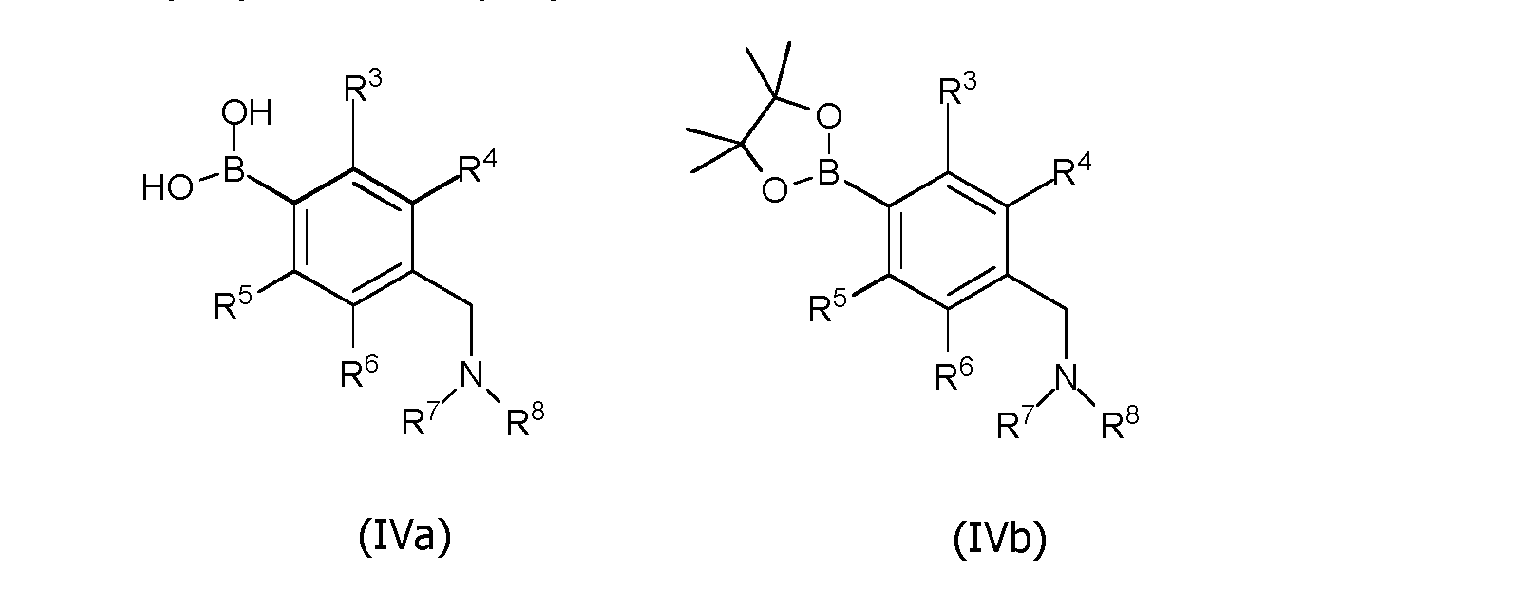
wherein R3 to R8 are as defined above, in the presence of a suitable catalyst.
The catalyst used in the formation of the compound of formula (II) is typically a palladium catalyst complex, for example [l,l'-bis(diphenylphosphino)ferrocene]dichloropalladium(II).
Examples of suitable processes for the preparation of compounds of formulae (IVa) and (IVb) are summarised in Scheme 1 below.

Alternatively, the compound of formula (II) or salt thereof may be prepared by reacting compound of formula (V) or a salt thereof

wherein A, R1 to R6 and X1 are as defined above, with a compound of formula (VI)
HNR7R8
(VI)
wherein 7 and R8 are as defined above, in the presence of a reducing agent.
Compounds of formula (V) and salts thereof may be prepared by reacting a compound of formula (III) as defined above with a boronic acid or ester of formulae (Vila) or (Vllb)

wherein R3 to R8 are as defined above, in the presence of a suitable catalyst.
The catalyst used in the formation of the compound of formula (V) is typically a palladium catalyst complex, for example [1,1'- bis(diphenylphosphino)ferrocene]dichloropalladium(II) or XPhos Pd G2.
Examples of process A are depicted in Schemes 2 to 4 below.


Process B
Compounds of formula (I) and salts thereof may also be prepared by reacting a compound of formula (VIII) or a salt thereof

(VIII)
wherein A and R1 to R6 are as defined above, with a compound of formula (VI) as defined above, in the presence of a reducing agent.
Compounds of formula (VIII) and salts thereof may be prepared by reacting a compound of formula (IX)

(IX)
wherein A and R1 to R6 are as defined above and X3 is halogen, for example chloro or bromo, with a boronic acid or ester of formula (Vila) or (Vllb) as defined above, in the presence of a suitable catalyst.
The catalyst used in the formation of the compound of formula (IX) is typically a palladium catalyst complex, for example XPhos Pd Gl.
Compounds of formula (IX) and salts thereof may be prepared by reacting a compound of formula (III) or a salt thereof as defined above with morpholine.
Examples of process B are depicted in Schemes 5 to 7 below.

Process C
Compounds of formula (I) and salts thereof may also be prepared by reacting a compound of formula (X) or a salt thereof

(X)
wherein A, R1 and R2 are as defined above and X4 is halogen, for example chloro, with a compound of formula (IVa) or (IVb) as defined above.
A compound of formula (X) or a salt thereof may be prepared by reacting a compound of formula (III) or a salt thereof as defined above with morpholine.
An example of process C is depicted in Scheme 8 below.

Thus, in one embodiment the invention provides a process for preparing a compound of formula (I) or a salt thereof comprising:
a) reacting a compound of formula (II) or a salt thereof

wherein A and R1 to R8 are as defined above and X1 is halogen, with morpholine in the presence of a suitable catalyst,
b) reacting a compound of formula (VIII) or a salt thereof

wherein A and R1 to R6 are as defined above, with a compound of formula (VI) as defined above, in the presence of a reducing agent, or
c) reacting a compound of formula (X) or a salt thereof

wherein A, R1 and R2 are as defined above and X4 is halogen with a compound of formula (IVa) or (IVb) as defined above.
Methods of Use
The compounds of the invention are inhibitors of kinase activity, in particular PI3-kinase activity. Compounds which are PI3-kinase inhibitors may be useful in the treatment of disorders wherein the underlying pathology is (at least in part) attributable to inappropriate PI3-kinase activity, such as asthma and chronic obstructive pulmonary disease (COPD). "Inappropriate PI3-kinase activity" refers to any PI3-kinase activity that deviates from the normal PI3-kinase activity expected in a particular patient. Inappropriate PI3-kinase may take the form of, for instance, an abnormal increase in activity, or an aberration in the timing and or control of PI3-kinase activity. Such inappropriate activity may result then, for example, from overexpression or mutation of the PI3-kinase leading to inappropriate or uncontrolled activation. Accordingly, in another aspect the invention is directed to methods of treating such disorders.
Such disorders include respiratory diseases including asthma, chronic obstructive pulmonary disease (COPD) and idiopathic pulmonary fibrosis (IPF); ciliopathy including primary ciliary dyskinesia, polycystic liver disease and nephronophthisis; bacterial infections including bacterial respiratory tract infections, for example infections by S. Pneumoniae, H. Influenzae, M. Catarrhalis and/or mycobacteria
such as Mycobacterium tuberculosis, and bacterial exacerbations of respiratory conditions and lung damage such as asthma, COPD and cystic fibrosis; viral infections including viral respiratory tract infections, for example infections by influenza, rhinovirus, respiratory syncytial virus (RSV), human parainfluenza virus (HPIV), adenovirus and/or coronavirus, and viral exacerbation of respiratory conditions and lung damage such as asthma, COPD and cystic fibrosis; other non-viral respiratory infections including aspergillosis and leishmaniasis; allergic diseases including allergic rhinitis, atopic dermatitis and psoriasis; autoimmune diseases including ankylosing spondylitis, Churg-Strauss syndrome, Crohn's disease, Glomerulonephritis, Henoch-Schonlein purpura, idiopathic thrombocytopenic purpura (ITP), interstitial cystitis, pemphigus, primary sclerosing cholangitis, psoriasis, rheumatoid arthritis, sarcoidosis, Sjogren's syndrome, Type 1 diabetes, ulcerative colitis, vasculitis and Wegener's granulomatosis; inflammatory disorders including inflammatory bowel disease; diabetes; cardiovascular diseases including thrombosis, atherosclerosis and hypertension; hematologic malignancies; neurodegenerative diseases; pancreatitis; multiorgan failure; kidney diseases; platelet aggregation; cancer; sperm motility; transplantation rejection; graft rejection; lung injuries; pain including pain associated with rheumatoid arthritis or osteoarthritis, back pain, general inflammatory pain, post hepatic neuralgia, diabetic neuropathy, inflammatory neuropathic pain (trauma), trigeminal neuralgia and Central pain; fibrotic diseases; depression; psychotic disorders including schizophrenia; bronchiectasis; and activated PI3Kδ syndrome (APDS).
Such fibrotic diseases may include idiopathic pulmonary fibrosis, interstitial lung diseases, non- specific interstitial pneumonia (NSIP), usual interstitial pneumonia (UIP), endomyocardial fibrosis, mediastinal fibrosis, myelofibrosis, retroperitoneal fibrosis, progressive massive fibrosis (a complication of coal workers' pneumoconiosis), nephrogenic systemic fibrosis, Crohn's disease, old myocardial infarction, scleroderma/systemic sclerosis, neurofibromatosis, Hermansky-Pudlak syndrome, diabetic nephropathy, renal fibrosis, hypertrophic cardiomyopathy (HCM), hypertension- related nephropathy, focal segmental glomerulosclerosis (FSGS), radiation-induced fibrosis, uterine leiomyomas (fibroids), alcoholic liver disease, hepatic steatosis, hepatic fibrosis, hepatic cirrhosis, hepatitis C virus (HCV) infection, chronic organ transplant rejection, fibrotic conditions of the skin, keloid scarring, Dupuytren contracture, Ehlers-Danlos syndrome, epidermolysis bullosa dystrophica, oral submucous fibrosis, and fibro-proliferative disorders.
In one embodiment, the disorder is asthma. In a further embodiment, the disorder is COPD.
Within the context of the present invention, the following terms describing the indications used herein are classified in the Diagnostic and Statistical Manual of Mental Disorders, 4th Edition, published by the American Psychiatric Association (DSM-IV) and/or the International Classification of Diseases, 10th Edition (ICD-10). The various subtypes of the disorders mentioned herein are contemplated as part of the present invention. Numbers in brackets after the listed diseases below refer to the classification code in DSM-IV.
Within the context of the present invention, the term "psychotic disorder" includes Schizophrenia including the subtypes Paranoid Type (295.30), Disorganised Type (295.10), Catatonic Type (295.20), Undifferentiated Type (295.90) and Residual Type (295.60); Schizophreniform Disorder (295.40); Schizoaffective Disorder (295.70) including the subtypes Bipolar Type and Depressive Type; Delusional Disorder (297.1) including the subtypes Erotomanic Type, Grandiose Type, Jealous Type, Persecutory Type, Somatic Type, Mixed Type and Unspecified Type; Brief Psychotic Disorder (298.8); Shared Psychotic Disorder (297.3); Psychotic Disorder Due to a General Medical Condition including the subtypes With Delusions and With Hallucinations; Substance-Induced Psychotic Disorder including the subtypes With Delusions (293.81) and With Hallucinations (293.82); and Psychotic Disorder Not Otherwise Specified (298.9).
Within the context of the present invention, the term "depression" includes depression and mood disorders including Major Depressive Episode, Manic Episode, Mixed Episode and Hypomanic Episode; Depressive Disorders including Major Depressive Disorder, Dysthymic Disorder (300.4), Depressive Disorder Not Otherwise Specified (311); Bipolar Disorders including Bipolar I Disorder, Bipolar II Disorder (Recurrent Major Depressive Episodes with Hypomanic Episodes) (296.89), Cyclothymic Disorder (301.13) and Bipolar Disorder Not Otherwise Specified (296.80); Other Mood Disorders including Mood Disorder Due to a General Medical Condition (293.83) which includes the subtypes With Depressive Features, With Major Depressive-like Episode, With Manic Features and With Mixed Features), Substance-Induced Mood Disorder (including the subtypes With Depressive Features, With Manic Features and With Mixed Features) and Mood Disorder Not Otherwise Specified (296.90).
The methods of treatment of the invention comprise administering a compound of formula (I) or a pharmaceutically acceptable salt thereof to a patient in need thereof. Individual embodiments of the invention include methods of treating any one of the above-mentioned disorders by administering a safe and effective amount of a compound of formula (I) or a pharmaceutically acceptable salt thereof to a patient in need thereof.
As used herein, "treat" in reference to a disorder means: (1) to ameliorate or prevent the disorder or one or more of the biological manifestations of the disorder, (2) to interfere with (a) one or more points in the biological cascade that leads to or is responsible for the disorder or (b) one or more of the biological manifestations of the disorder, (3) to alleviate one or more of the symptoms or effects associated with the disorder, or (4) to slow the progression of the disorder or one or more of the biological manifestations of the disorder.
As indicated above, "treatment" of a disorder includes prevention of the disorder. The skilled artisan will appreciate that "prevention" is not an absolute term. In medicine, "prevention" is understood to refer to the prophylactic administration of a drug to substantially diminish the likelihood or severity of a disorder or biological manifestation thereof, or to delay the onset of such disorder or biological manifestation thereof. In one embodiment, the methods of the invention are directed to
treating a disorder. In another embodiment, the methods of the invention are directed to preventing a disorder.
As used herein, "safe and effective amount" in reference to a compound of formula (I) or a pharmaceutically acceptable salt thereof or other pharmaceutically-active agent means an amount of the compound sufficient to treat the patient's condition but low enough to avoid serious side effects (at a reasonable benefit/risk ratio) within the scope of sound medical judgment. A safe and effective amount of a compound will vary with the particular compound chosen (e.g. consider the potency, efficacy, and half-life of the compound); the route of administration chosen; the disorder being treated; the severity of the disorder being treated; the age, size, weight, and physical condition of the patient being treated; the medical history of the patient to be treated; the duration of the treatment; the nature of concurrent therapy; the desired therapeutic effect; and like factors, but can nevertheless be routinely determined by the skilled artisan.
As used herein, "patient" refers to a human (including adults and children) or other animal. In one embodiment, "patient" refers to a human.
The compounds of formula (I) or pharmaceutically acceptable salts thereof may be administered by any suitable route of administration, including both systemic administration and topical administration. Systemic administration includes oral administration, parenteral administration, transdermal administration and rectal administration. Parenteral administration refers to routes of administration other than enteral or transdermal, and is typically by injection or infusion. Parenteral administration includes intravenous, intramuscular, and subcutaneous injection or infusion. Topical administration includes application to the skin as well as intraocular, otic, intravaginal, inhaled and intranasal administration. Inhalation refers to administration into the patient's lungs whether inhaled through the mouth or through the nasal passages. In one embodiment, the compounds of formula (I) or pharmaceutically acceptable salts thereof may be administered orally. In another embodiment, the compounds of formula (I) or pharmaceutically acceptable salts thereof may be administered by inhalation. In a further embodiment, the compounds of formula (I) or pharmaceutically acceptable salts thereof may be administered intranasally.
The compounds of formula (I) or pharmaceutically acceptable salts thereof may be administered once or according to a dosing regimen wherein a number of doses are administered at varying intervals of time for a given period of time. For example, doses may be administered one, two, three, or four times per day. In one embodiment, a dose is administered once per day. In a further embodiment, a dose is administered twice per day. Doses may be administered until the desired therapeutic effect is achieved or indefinitely to maintain the desired therapeutic effect. Suitable dosing regimens for a compound of formula (I) or a pharmaceutically acceptable salt thereof depend on the pharmacokinetic properties of that compound, such as absorption, distribution, and half-life, which can be determined by the skilled artisan. In addition, suitable dosing regimens, including the duration such regimens are administered, for a compound of formula (I) or a
pharmaceutically acceptable salt thereof depend on the disorder being treated, the severity of the disorder being treated, the age and physical condition of the patient being treated, the medical history of the patient to be treated, the nature of concurrent therapy, the desired therapeutic effect, and like factors within the knowledge and expertise of the skilled artisan. It will be further understood by such skilled artisans that suitable dosing regimens may require adjustment given an individual patient's response to the dosing regimen or over time as individual patient needs change.
Typical daily dosages may vary depending upon the particular route of administration chosen. Typical daily dosages for oral administration range from O.OOlmg to 50mg per kg of total body weight, for example from lmg to lOmg per kg of total body weight. For example, daily dosages for oral administration may be from 0.5mg to 2g per patient, such as lOmg to lg per patient.
Additionally, the compounds of formula (I) may be administered as prodrugs. As used herein, a "prodrug" of a compound of formula (I) is a functional derivative of the compound which, upon administration to a patient, eventually liberates the compound of formula (I) in vivo. Administration of a compound of formula (I) as a prodrug may enable the skilled artisan to do one or more of the following: (a) modify the onset of the activity of the compound in vivo; (b) modify the duration of action of the compound in vivo; (c) modify the transportation or distribution of the compound in vivo; (d) modify the solubility of the compound in vivo; and (e) overcome a side effect or other difficulty encountered with the compound. Typical functional derivatives used to prepare prodrugs include modifications of the compound that are chemically or enzymatically cleavable in vivo. Such modifications, which include the preparation of phosphates, amides, esters, thioesters, carbonates, and carbamates, are well known to those skilled in the art.
In one aspect, the invention thus provides a method of treating a disorder mediated by inappropriate PI3-kinase activity comprising administering a compound of formula (I) or a pharmaceutically acceptable salt thereof to a patient in need thereof.
In one embodiment, the invention provides a method of treating a disorder mediated by inappropriate PI3-kinase activity comprising administering a safe and effective amount of a compound of formula (I) or a pharmaceutically acceptable salt thereof to a patient in need thereof.
In one embodiment, the disorder mediated by inappropriate PI3-kinase activity is selected from the group consisting of respiratory diseases (including asthma, chronic obstructive pulmonary disease (COPD) and idiopathic pulmonary fibrosis (IPF)); ciliopathy (including primary ciliary dyskinesia, polycystic liver disease and nephronophthisis); bacterial infections (including bacterial respiratory tract infections, for example infections by S. Pneumoniae, H. Influenzae, M. Catarrhalis and/or mycobacteria such as Mycobacterium tuberculosis) and bacterial exacerbations of respiratory conditions and lung damage (such as asthma, COPD and cystic fibrosis); viral infections (including viral respiratory tract infections, for example infections by influenza, rhinovirus, respiratory syncytial virus (RSV), human parainfluenza virus (HPIV), adenovirus and/or coronavirus) and viral exacerbation of respiratory conditions and lung damage (such as asthma, COPD and cystic fibrosis); other non-viral
respiratory infections (including aspergillosis and leishmaniasis); allergic diseases (including allergic rhinitis, atopic dermatitis and psoriasis); autoimmune diseases (including ankylosing spondylitis, Churg-Strauss syndrome, Crohn's disease, Glomerulonephritis, Henoch-Schonlein purpura, idiopathic thrombocytopenic purpura (ITP), interstitial cystitis, pemphigus, primary sclerosing cholangitis, psoriasis, rheumatoid arthritis, sarcoidosis, Sjogren's syndrome, Type 1 diabetes, ulcerative colitis, vasculitis and Wegener's granulomatosis); inflammatory disorders (including inflammatory bowel disease); diabetes; cardiovascular diseases (including thrombosis, atherosclerosis and hypertension); hematologic malignancies; neurodegenerative diseases; pancreatitis; multiorgan failure; kidney diseases; platelet aggregation; cancer; sperm motility; transplantation rejection; graft rejection; lung injuries; pain (including pain associated with rheumatoid arthritis or osteoarthritis, back pain, general inflammatory pain, post hepatic neuralgia, diabetic neuropathy, inflammatory neuropathic pain (trauma), trigeminal neuralgia and Central pain); fibrotic diseases; depression; psychotic disorders (including schizophrenia); bronchiectasis; and activated PI3Kδ syndrome (APDS).
In one embodiment, the disorder mediated by inappropriate PI3-kinase activity is a respiratory disease. In another embodiment, the disorder mediated by inappropriate PI3-kinase activity is asthma. In a further embodiment, the disorder mediated by inappropriate PI3-kinase activity is chronic obstructive pulmonary disease (COPD).
In one aspect, the invention provides a compound of formula (I) or a pharmaceutically acceptable salt thereof for use in medical therapy.
In another aspect, the invention provides a compound of formula (I) or a pharmaceutically acceptable salt thereof for use in the treatment of a disorder mediated by inappropriate PI3-kinase activity.
In a further aspect, the invention provides the use of a compound of formula (I) or a pharmaceutically acceptable salt thereof in the manufacture of a medicament for use in the treatment of a disorder mediated by inappropriate PI3-kinase activity.
A number of different genetic variants in PI3Kδ have been observed (Jou et al., International Journal of Immunogenetics, 2006, 33, 361 to 369). One mutation (c.3061G>A, corresponding to m.3256G>A in the mRNA wherein the nucleotide number is based on the sequence data on GenBank: NM_005026) observed in a highly conserved position in the domain responsible for catalytic function results in a glutamic acid to lysine substitution (E1021K). It is believed that this mutation may result in patients being particularly susceptible to developing respiratory infections and/or exacerbations of respiratory infections, and damage to the airway wall, large and small airways, and lung parenchyma (Angulo et al., Science DOI: 10.1125/science. 1243292). Other gain of function mutations identified in the PIK3CD gene and leading to immune deficiencies include the amino acid residue substitution N334K or E525K (Lucas et al. Nat. Immunol. (2014) 15 p. 88-97). Mutations leading to aberrant splicing of PIK3R1 exon 10 and truncation of the p85 « protein result in elevated PI3Kδ activity and
to symptoms similar to the gain of function mutations in the PIK3CD gene (Deau et al. 1 Clin. Invest. (2014) 124(9) p. 3923-8).
Thus, in one aspect, the invention thus provides a method of treating or preventing a respiratory infection, treating airway damage, and/or preventing airway injury in a patient with a PI3Kδ mutation, or increased PI3Kδ expression or activity, comprising administering a compound of formula (I) or a pharmaceutically acceptable salt thereof to a patient in need thereof.
In one embodiment, the invention provides a compound of formula (I) or a pharmaceutically acceptable salt thereof for use in the treatment or prevention of a respiratory infection, the treatment of airway damage, and/or the prevention of airway injury in a patient with a PI3Kδ mutation, or increased PI3Kδ expression or activity.
In another embodiment, the invention provides the use of a compound of formula (I) or a pharmaceutically acceptable salt thereof in the manufacture of a medicament for use in the treatment or prevention of a respiratory infection, the treatment of airway damage, and/or the prevention of airway injury in a patient with a PI3Kδ mutation, or increased PI3Kδ expression or activity.
In another embodiment, the present invention provides a compound of formula (I) or a pharmaceutically acceptable salt thereof for use in the treatment or prevention of a respiratory infection, the treatment of airway damage, and/or the prevention of airway injury in a patient, comprising:
a) assaying a sample from the patient,
b) determining if the patient has a PI3Kδ mutation, or increased ΡΙ3Κδ expression or activity, and
c) administering a therapeutically effective amount of a compound of formula (I) or a pharmaceutically acceptable salt thereof to the patient if they have a ΡΙ3Κδ mutation, or increased PI3Kδ expression or activity.
In another embodiment, the invention provides a compound of formula (I) or a pharmaceutically acceptable salt thereof for use in the treatment or prevention of a respiratory infection, the treatment of airway damage, and/or the prevention of airway injury in a patient classified as a responder, wherein a responder is characterised by the presence of a PI3Kδ mutation, or increased PI3Kδ expression or activity.
In another embodiment, the invention provides use of a compound of formula (I) or a pharmaceutically acceptable salt thereof in the manufacture of a medicament for use in the treatment or prevention of a respiratory infection, the treatment of airway damage, and/or the prevention of airway injury in a patient classified as a responder, wherein a responder is characterised by the presence of a PI3Kδ mutation, or increased PI3Kδ expression or activity.
In a further embodiment, the invention provides a method of evaluating therapy with a compound of formula (I) or a pharmaceutically acceptable salt thereof, comprising:
a) obtaining a sample from the patient,
b) testing for a PI3Kδ mutation, or increased PI3Kδ expression or activity, and c) determining if the patient should undergo therapy with a compound of formula (I) or a pharmaceutically acceptable salt thereof if a PI3Kδ mutation, or increased PI3Kδ expression or activity, is present.
Such respiratory infections may be the result of bacterial infections including, for example, infections by S. Pneumoniae, H. Influenzae, M. Catarrhalis and/or mycobacteria such as
Mycobacterium tuberculosis; viral infections including, for example, infections by influenza, rhinovirus, respiratory syncytial virus (RSV), human parainfluenza virus (HPIV), adenovirus and/or coronavirus; and other non-viral respiratory infections including aspergillosis and/or leishmaniasis. In one embodiment, patients with a PI3Kδ mutation may be particularly susceptible to developing respiratory infections and/or exacerbations of respiratory infections as a result of bacterial infections by S.
Pneumoniae, H. Influenzae, and/or M. Catarrhalis.
As used herein, the term "airway damage" refers to damage to the airway wall, large and small airways, and/or lung parenchyma which is present at the time a patient commences treatment. Airway damage, such as inflammation, scarring and/or remodelling, may be caused by, for example, repeated respiratory infections in a patient with a PI3Kδ mutation.
As used herein, the term "airway injury" refers to damage, or further damage, to the airway wall, large and small airways, and/or lung parenchyma which may develop in a patient if treatment does not occur.
As used herein, the term "responder" means someone who is identified (using a particular test or method) to be more likely to derive benefit in response to treatment (e.g. positive response to drug, reduction in adverse events, etc.). It is understood that not all people who have been identified as a responder will necessarily derive benefit, but as a patient class, they are more likely to do so. For example, it may be that out of the total untested diseased population, approximately 80% of that population derive benefit from a drug, but out of the group of "responders" (i.e. those individuals who have been tested, and identified as a responder according to the set criteria) approximately 99% will derive benefit.
As used herein, the term "evaluating therapy" means determining whether therapy with a compound of formula (I), or a pharmaceutically acceptable salt thereof, would be beneficial to a patient.
Patients with a PI3Kδ mutation may be particularly susceptible to an exacerbation of a respiratory infection. As used herein, the term "exacerbation of a respiratory infection" refers to a respiratory infection characterised by the worsening of an underlying persistent respiratory infection, including bacterial infections, viral infections and/or other non-viral respiratory infections. In one embodiment, the present invention thus provides a method of treating or preventing an exacerbation of a respiratory infection in a patient with a ΡΙ3Κδ mutation comprising administering a compound of formula (I) or a pharmaceutically acceptable salt thereof to a patient in need thereof.
In one embodiment, the PI3Kδ mutation results in the substitution of glutamic acid for lysine. In another embodiment, the PI3Kδ mutation results in the substitution of glutamic acid for lysine at codon 1021 (E1021K).
In one embodiment, the PI3Kδ mutation results in a single base-pair missense mutation m.3256G>A in the mRNA (wherein the nucleotide number is based on the sequence data on GenBank: NM_005026).
In one embodiment, the ΡΙ3Κδ mutation is c.3061G>A.
Compositions
The compounds of formula (I) and pharmaceutically acceptable salts thereof will normally, but not necessarily, be formulated into pharmaceutical compositions prior to administration to a patient.
Accordingly, in one aspect the invention is directed to pharmaceutical compositions comprising a compound of formula (I) or a pharmaceutically acceptable salt thereof and one or more pharmaceutically acceptable excipients.
In another aspect the invention is directed to pharmaceutical compositions comprising 0.05 to lOOOmg of a compound of formula (I) or a pharmaceutically acceptable salt thereof and 0.1 to 2g of one or more pharmaceutically acceptable excipients.
In a further aspect the invention is directed to a pharmaceutical composition for the treatment or prophylaxis of a disorder mediated by inappropriate PI3-kinase activity comprising a compound of formula (I) or a pharmaceutically acceptable salt thereof.
The pharmaceutical compositions of the invention may be prepared and packaged in bulk form wherein a compound of formula (I) or a pharmaceutically acceptable salt thereof can be extracted and then given to the patient such as with powders or syrups. Alternatively, the pharmaceutical compositions of the invention may be prepared and packaged in unit dosage form wherein each physically discrete unit contains a compound of formula (I) or a pharmaceutically acceptable salt thereof. When prepared in unit dosage form, the pharmaceutical compositions of the invention typically may contain, for example, from 0.5mg to lg, or from lmg to 700mg, or from 5mg to lOOmg of a compound of formula (I) or a pharmaceutically acceptable salt thereof.
The pharmaceutical compositions of the invention typically contain one compound of formula (I) or a pharmaceutically acceptable salt thereof.
As used herein, "pharmaceutically acceptable excipient" means a pharmaceutically acceptable material, composition or vehicle involved in giving form or consistency to the pharmaceutical composition. Each excipient must be compatible with the other ingredients of the pharmaceutical composition when commingled such that interactions which would substantially reduce the efficacy of the compound of formula (I) or a pharmaceutically acceptable salt thereof when administered to a patient and interactions which would result in pharmaceutical compositions that are not
pharmaceutically acceptable are avoided. In addition, each excipient must of course be pharmaceutically-acceptable eg of sufficiently high purity.
The compound of formula (I) or a pharmaceutically acceptable salt thereof and the pharmaceutically acceptable excipient or excipients will typically be formulated into a dosage form adapted for administration to the patient by the desired route of administration. For example, dosage forms include those adapted for (1) oral administration such as tablets, capsules, caplets, pills, troches, powders, syrups, elixers, suspensions, solutions, emulsions, sachets, and cachets; (2) parenteral administration such as sterile solutions, suspensions, and powders for reconstitution; (3) transdermal administration such as transdermal patches; (4) rectal administration such as suppositories; (5) inhalation such as aerosols, solutions, and dry powders; and (6) topical administration such as creams, ointments, lotions, solutions, pastes, sprays, foams, and gels.
Suitable pharmaceutically acceptable excipients will vary depending upon the particular dosage form chosen. In addition, suitable pharmaceutically acceptable excipients may be chosen for a particular function that they may serve in the composition. For example, certain pharmaceutically acceptable excipients may be chosen for their ability to facilitate the production of uniform dosage forms. Certain pharmaceutically acceptable excipients may be chosen for their ability to facilitate the production of stable dosage forms. Certain pharmaceutically acceptable excipients may be chosen for their ability to facilitate the carrying or transporting of the compound or compounds of formula (I) or pharmaceutically acceptable salts thereof once administered to the patient from one organ, or portion of the body, to another organ, or portion of the body. Certain pharmaceutically acceptable excipients may be chosen for their ability to enhance patient compliance.
Suitable pharmaceutically acceptable excipients include the following types of excipients: diluents, fillers, binders, disintegrants, lubricants, glidants, granulating agents, coating agents, wetting agents, solvents, co-solvents, suspending agents, emulsifiers, sweetners, flavoring agents, flavor masking agents, coloring agents, anticaking agents, hemectants, chelating agents, plasticizers, viscosity increasing agents, antioxidants, preservatives, stabilizers, surfactants, and buffering agents. The skilled artisan will appreciate that certain pharmaceutically acceptable excipients may serve more than one function and may serve alternative functions depending on how much of the excipient is present in the formulation and what other excipients are present in the formulation.
Skilled artisans possess the knowledge and skill in the art to enable them to select suitable pharmaceutically-acceptable excipients in appropriate amounts for use in the invention. In addition, there are a number of resources that are available to the skilled artisan which describe pharmaceutically acceptable excipients and may be useful in selecting suitable pharmaceutically acceptable excipients. Examples include Remington's Pharmaceutical Sciences (Mack Publishing Company), The Handbook of Pharmaceutical Additives (Gower Publishing Limited), and The Handbook of Pharmaceutical Excipients (the American Pharmaceutical Association and the Pharmaceutical Press).
The pharmaceutical compositions of the invention are prepared using techniques and methods known to those skilled in the art. Some of the methods commonly used in the art are described in Remington's Pharmaceutical Sciences (Mack Publishing Company).
Accordingly, in another aspect the invention is directed to process for the preparation of a pharmaceutical composition comprising a compound of formula (I) or a pharmaceutically acceptable salt thereof and one or more pharmaceutically acceptable excipients which comprises mixing the ingredients. A pharmaceutical composition comprising a compound of formula (I) or a pharmaceutically acceptable salt thereof may be prepared by, for example, admixture at ambient temperature and atmospheric pressure.
In one embodiment, the compounds of formula (I) or pharmaceutically acceptable salts thereof will be formulated for oral administration. In another embodiment, the compounds of formula (I) or pharmaceutically acceptable salts thereof will be formulated for inhaled administration. In a further embodiment, the compounds of formula (I) or pharmaceutically acceptable salts thereof will be formulated for intranasal administration.
In one aspect, the invention is directed to a solid oral dosage form such as a tablet or capsule comprising a compound of formula (I) or a pharmaceutically acceptable salt thereof and a diluent or filler. Suitable diluents and fillers include lactose, sucrose, dextrose, mannitol, sorbitol, starch (e.g. corn starch, potato starch, and pre-gelatinized starch), cellulose and its derivatives (e.g. microcrystalline cellulose), calcium sulfate, and dibasic calcium phosphate. The oral solid dosage form may further comprise a binder. Suitable binders include starch (e.g. corn starch, potato starch, and pre-gelatinized starch), gelatin, acacia, sodium alginate, alginic acid, tragacanth, guar gum, povidone, and cellulose and its derivatives (e.g. microcrystalline cellulose). The oral solid dosage form may further comprise a disintegrant. Suitable disintegrants include crospovidone, sodium starch glycolate, croscarmelose, alginic acid, and sodium carboxymethyl cellulose. The oral solid dosage form may further comprise a lubricant. Suitable lubricants include stearic acid, magnesuim stearate, calcium stearate, and talc.
Where appropriate, dosage unit formulations for oral administration can be microencapsulated. The composition can also be prepared to prolong or sustain the release as for example by coating or embedding particulate material in polymers, wax or the like.
The compounds of formula (I) or pharmaceutically acceptable salts thereof may also be coupled with soluble polymers as targetable drug carriers. Such polymers can include polyvinylpyrrolidone, pyran copolymer, polyhydroxypropylmethacrylamide -phenol, polyhydroxyethylaspartamidephenol, or polyethyleneoxidepolylysine substituted with palmitoyl residues. Furthermore, the compounds of formula (I) or pharmaceutically acceptable salts thereof may be coupled to a class of biodegradable polymers useful in achieving controlled release of a drug, for example, polylactic acid, polepsilon caprolactone, polyhydroxy butyric acid, polyorthoesters,
polyacetals, polydihydropyrans, polycyanoacrylates and cross-linked or amphipathic block copolymers of hydrogels.
In another aspect, the invention is directed to a liquid oral dosage form. Oral liquids such as solution, syrups and elixirs can be prepared in dosage unit form so that a given quantity contains a predetermined amount of a compound of formula (I) or a pharmaceutically acceptable salt thereof. Syrups can be prepared by dissolving the compound of formula (I) or a pharmaceutically acceptable salt thereof in a suitably flavored aqueous solution, while elixirs are prepared through the use of a non-toxic alcoholic vehicle. Suspensions can be formulated by dispersing the compound of formula (I) or a pharmaceutically acceptable salt thereof in a non-toxic vehicle. Solubilizers and emulsifiers such as ethoxylated isostearyl alcohols and polyoxy ethylene sorbitol ethers, preservatives, flavor additive such as peppermint oil or natural sweeteners or saccharin or other artificial sweeteners, and the like can also be added.
In another aspect, the invention is directed to a dosage form adapted for administration to a patient by inhalation, for example as a dry powder, an aerosol, a suspension, or a solution composition. In one embodiment, the invention is directed to a dosage form adapted for administration to a patient by inhalation as a dry powder. In a further embodiment, the invention is directed to a dosage form adapted for administration to a patient by inhalation via a nebulizer.
Dry powder compositions for delivery to the lung by inhalation typically comprise a compound of formula (I) or a pharmaceutically acceptable salt thereof as a finely divided powder together with one or more pharmaceutically-acceptable excipients as finely divided powders. Pharmaceutically- acceptable excipients particularly suited for use in dry powders are known to those skilled in the art and include lactose, starch, mannitol, and mono-, di-, and polysaccharides. The finely divided powder may be prepared by, for example, micronisation and milling. Generally, the size-reduced (eg micronised) compound can be defined by a D50 value of about 1 to about 10 microns (for example as measured using laser diffraction).
The dry powder may be administered to the patient via a reservoir dry powder inhaler (RDPI) having a reservoir suitable for storing multiple (un-metered doses) of medicament in dry powder form. RDPIs typically include a means for metering each medicament dose from the reservoir to a delivery position. For example, the metering means may comprise a metering cup, which is movable from a first position where the cup may be filled with medicament from the reservoir to a second position where the metered medicament dose is made available to the patient for inhalation.
Alternatively, the dry powder may be presented in capsules (e.g. gelatin or plastic), cartridges, or blister packs for use in a multi-dose dry powder inhaler (MDPI). MDPIs are inhalers wherein the medicament is comprised within a multi-dose pack containing (or otherwise carrying) multiple defined doses (or parts thereof) of medicament. When the dry powder is presented as a blister pack, it comprises multiple blisters for containment of the medicament in dry powder form. The blisters are typically arranged in regular fashion for ease of release of the medicament therefrom.
For example, the blisters may be arranged in a generally circular fashion on a disc-form blister pack, or the blisters may be elongate in form, for example comprising a strip or a tape. Each capsule, cartridge, or blister may, for example, contain between 20 g-10mg of the compound of formula (I) or a pharmaceutically acceptable salt thereof.
Aerosols may be formed by suspending or dissolving a compound of formula (I) or a pharmaceutically acceptable salt thereof in a liquified propellant. Suitable propellants include halocarbons, hydrocarbons, and other liquified gases. Representative propellants include: trichlorofluoromethane (propellant 11), dichlorofluoromethane (propellant 12), dichlorotetrafluoroethane (propellant 114), tetrafluoroethane (HFA-134a), 1,1-difluoroethane (HFA- 152a), difluoromethane (HFA-32), pentafluoroethane (HFA-12), heptafluoropropane (HFA-227a), perfluoropropane, perfluorobutane, perfluoropentane, butane, isobutane, and pentane. Aerosols comprising a compound of formula (I) or a pharmaceutically acceptable salt thereof will typically be administered to a patient via a metered dose inhaler (MDI). Such devices are known to those skilled in the art.
The aerosol may contain additional pharmaceutically-acceptable excipients typically used with
MDIs such as surfactants, lubricants, cosolvents and other excipients to improve the physical stability of the formulation, to improve valve performance, to improve solubility, or to improve taste.
There is thus provided as a further aspect of the invention a pharmaceutical aerosol formulation comprising a compound of formula (I) or a pharmaceutically acceptable salt thereof and a fluorocarbon or hydrogen-containing chlorofluorocarbon as propellant, optionally in combination with a surfactant and/or a cosolvent.
According to another aspect of the invention, there is provided a pharmaceutical aerosol formulation wherein the propellant is selected from 1,1,1,2-tetrafluoroethane, 1,1,1,2,3,3,3- heptafluoro-n-propane and mixtures thereof.
The formulations of the invention may be buffered by the addition of suitable buffering agents.
Capsules and cartridges for use in an inhaler or insufflator, of for example gelatine, may be formulated containing a powder mix for inhalation of a compound of formula (I) or a pharmaceutically acceptable salt thereof and a suitable powder base such as lactose or starch. Each capsule or cartridge may generally contain from 20 g to lOmg of the compound of formula (I) or pharmaceutically acceptable salt thereof. Alternatively, the compound of formula (I) or pharmaceutically acceptable salt thereof may be presented without excipients such as lactose.
The proportion of the active compound of formula (I) or pharmaceutically acceptable salt thereof in the local compositions according to the invention depends on the precise type of formulation to be prepared but will generally be within the range of from 0.001 to 10% by weight. Generally, for most types of preparations, the proportion used will be within the range of from 0.005 to 1%, for example from 0.01 to 0.5%. However, in powders for inhalation or insufflation the proportion used will normally be within the range of from 0.1 to 5%.
Aerosol formulations are preferably arranged so that each metered dose or "puff" of aerosol contains from 20pg to lOmg, preferably from 20μg to 2000μg, more preferably from about 20μg to 500μg of a compound of formula (I). Administration may be once daily or several times daily, for example 2, 3, 4 or 8 times, giving for example 1, 2 or 3 doses each time. The overall daily dose with an aerosol will be within the range from 100μg to lOmg, preferably from 200μg to 2000μg. The overall daily dose and the metered dose delivered by capsules and cartridges in an inhaler or insufflator will generally be double that delivered with aerosol formulations.
In the case of suspension aerosol formulations, the particle size of the particulate (e.g., micronised) drug should be such as to permit inhalation of substantially all the drug into the lungs upon administration of the aerosol formulation and will thus be less than 100 microns, desirably less than 20 microns, and in particular in the range of from 1 to 10 microns, such as from 1 to 5 microns, more preferably from 2 to 3 microns.
The formulations of the invention may be prepared by dispersal or dissolution of the medicament and a compound of formula (I) or a pharmaceutically acceptable salt thereof in the selected propellant in an appropriate container, for example, with the aid of sonication or a high-shear mixer. The process is desirably carried out under controlled humidity conditions.
The chemical and physical stability and the pharmaceutical acceptability of the aerosol formulations according to the invention may be determined by techniques well known to those skilled in the art. Thus, for example, the chemical stability of the components may be determined by HPLC assay, for example, after prolonged storage of the product. Physical stability data may be gained from other conventional analytical techniques such as, for example, by leak testing, by valve delivery assay (average shot weights per actuation), by dose reproducibility assay (active ingredient per actuation) and spray distribution analysis.
The stability of the suspension aerosol formulations according to the invention may be measured by conventional techniques, for example, by measuring flocculation size distribution using a back light scattering instrument or by measuring particle size distribution by cascade impaction or by the "twin impinger" analytical process. As used herein reference to the "twin impinger" assay means "Determination of the deposition of the emitted dose in pressurised inhalations using apparatus A" as defined in British Pharmacopaeia 1988, pages A204-207, Appendix XVII C. Such techniques enable the "respirable fraction" of the aerosol formulations to be calculated. One method used to calculate the "respirable fraction" is by reference to "fine particle fraction" which is the amount of active ingredient collected in the lower impingement chamber per actuation expressed as a percentage of the total amount of active ingredient delivered per actuation using the twin impinger method described above.
The term "metered dose inhaler" or MDI means a unit comprising a can, a secured cap covering the can and a formulation metering valve situated in the cap. MDI system includes a suitable channelling device. Suitable channelling devices comprise for example, a valve actuator and a
cylindrical or cone-like passage through which medicament may be delivered from the filled canister via the metering valve to the nose or mouth of a patient such as a mouthpiece actuator.
MDI canisters generally comprise a container capable of withstanding the vapour pressure of the propellant used such as a plastic or plastic-coated glass bottle or preferably a metal can, for example, aluminium or an alloy thereof which may optionally be anodised, lacquer-coated and/or plastic-coated (for example incorporated herein by reference WO96/32099 wherein part or all of the internal surfaces are coated with one or more fluorocarbon polymers optionally in combination with one or more non-fluorocarbon polymers), which container is closed with a metering valve. The cap may be secured onto the can via ultrasonic welding, screw fitting or crimping. MDIs taught herein may be prepared by methods of the art (e.g. see Byron, above and WO96/32099). Preferably the canister is fitted with a cap assembly, wherein a drug-metering valve is situated in the cap, and said cap is crimped in place.
In one embodiment of the invention the metallic internal surface of the can is coated with a fluoropolymer, more preferably blended with a non-fluoropolymer. In another embodiment of the invention the metallic internal surface of the can is coated with a polymer blend of polytetrafluoroethylene (PTFE) and polyethersulfone (PES). In a further embodiment of the invention the whole of the metallic internal surface of the can is coated with a polymer blend of polytetrafluoroethylene (PTFE) and polyethersulfone (PES).
The metering valves are designed to deliver a metered amount of the formulation per actuation and incorporate a gasket to prevent leakage of propellant through the valve. The gasket may comprise any suitable elastomeric material such as, for example, low density polyethylene, chlorobutyl, bromobutyl, EPDM, black and white butadiene-acrylonitrile rubbers, butyl rubber and neoprene. Suitable valves are commercially available from manufacturers well known in the aerosol industry, for example, from Valois, France (e.g. DF10, DF30, DF60), Bespak pic, UK (e.g. BK300, BK357) and 3M-Neotechnic Ltd, UK (e.g. Spraymiser ).
In various embodiments, the MDIs may also be used in conjunction with other structures such as, without limitation, overwrap packages for storing and containing the MDIs, including those described in U.S. Patent Nos. 6,119,853; 6,179,118; 6,315,112; 6,352,152; 6,390,291; and 6,679,374, as well as dose counter units such as, but not limited to, those described in U.S. Patent Nos. 6,360,739 and 6,431,168.
Conventional bulk manufacturing methods and machinery well known to those skilled in the art of pharmaceutical aerosol manufacture may be employed for the preparation of large-scale batches for the commercial production of filled canisters. Thus, for example, in one bulk manufacturing method for preparing suspension aerosol formulations a metering valve is crimped onto an aluminium can to form an empty canister. The particulate medicament is added to a charge vessel and liquefied propellant together with the optional excipients is pressure filled through the charge vessel into a manufacturing vessel. The drug suspension is mixed before recirculation to a filling machine and an aliquot of the drug suspension is then filled through the metering valve into the canister. In one
example bulk manufacturing method for preparing solution aerosol formulations a metering valve is crimped onto an aluminium can to form an empty canister. The liquefied propellant together with the optional excipients and the dissolved medicament is pressure filled through the charge vessel into a manufacturing vessel.
In an alternative process, an aliquot of the liquefied formulation is added to an open canister under conditions which are sufficiently cold to ensure the formulation does not vaporise, and then a metering valve crimped onto the canister.
Typically, in batches prepared for pharmaceutical use, each filled canister is check-weighed, coded with a batch number and packed into a tray for storage before release testing.
Suspensions and solutions comprising a compound of formula (I) or a pharmaceutically acceptable salt thereof may also be administered to a patient via a nebulizer. The solvent or suspension agent utilized for nebulization may be any pharmaceutically-acceptable liquid such as water, aqueous saline, alcohols or glycols, e.g., ethanol, isopropylalcohol, glycerol, propylene glycol, polyethylene glycol, etc. or mixtures thereof. Saline solutions utilize salts which display little or no pharmacological activity after administration. Both organic salts, such as alkali metal or ammonium halogen salts, e.g., sodium chloride, potassium chloride or organic salts, such as potassium, sodium and ammonium salts or organic acids, e.g., ascorbic acid, citric acid, acetic acid, tartaric acid, etc. may be used for this purpose.
Other pharmaceutically-acceptable excipients may be added to the suspension or solution. The compound of formula (I) or pharmaceutically acceptable salt thereof may be stabilized by the addition of an inorganic acid, e.g., hydrochloric acid, nitric acid, sulphuric acid and/or phosphoric acid; an organic acid, e.g., ascorbic acid, citric acid, acetic acid, and tartaric acid, etc., a complexing agent such as EDTA or citric acid and salts thereof; or an antioxidant such as antioxidant such as vitamin E or ascorbic acid. These may be used alone or together to stabilize the compound of formula (I) or pharmaceutically acceptable salt thereof. Preservatives may be added such as benzalkonium chloride or benzoic acid and salts thereof. Surfactant may be added particularly to improve the physical stability of suspensions. These include lecithin, disodium dioctylsulphosuccinate, oleic acid and sorbitan esters.
In a further aspect, the invention is directed to a dosage form adapted for intranasal administration.
Formulations for administration to the nose may include pressurised aerosol formulations and aqueous formulations administered to the nose by pressurised pump. Formulations which are non- pressurised and adapted to be administered topically to the nasal cavity are of particular interest. Suitable formulations contain water as the diluent or carrier for this purpose. Aqueous formulations for administration to the lung or nose may be provided with conventional excipients such as buffering agents, tonicity modifying agents and the like. Aqueous formulations may also be administered to the nose by nebulisation.
The compounds of formula (I) or pharmaceutically acceptable salts thereof may be formulated as a fluid formulation for delivery from a fluid dispenser, for example a fluid dispenser having a dispensing nozzle or dispensing orifice through which a metered dose of the fluid formulation is dispensed upon the application of a user-applied force to a pump mechanism of the fluid dispenser. Such fluid dispensers are generally provided with a reservoir of multiple metered doses of the fluid formulation, the doses being dispensable upon sequential pump actuations. The dispensing nozzle or orifice may be configured for insertion into the nostrils of the user for spray dispensing of the fluid formulation into the nasal cavity. A fluid dispenser of the aforementioned type is described and illustrated in WO05/044354, the entire content of which is hereby incorporated herein by reference. The dispenser has a housing which houses a fluid discharge device having a compression pump mounted on a container for containing a fluid formulation. The housing has at least one finger- operable side lever which is movable inwardly with respect to the housing to cam the container upwardly in the housing to cause the pump to compress and pump a metered dose of the formulation out of a pump stem through a nasal nozzle of the housing. In one embodiment, the fluid dispenser is of the general type illustrated in Figures 30-40 of WO05/044354.
Pharmaceutical compositions adapted for intranasal administration wherein the carrier is a solid include a coarse powder having a particle size for example in the range 20 to 500 microns which is administered by rapid inhalation through the nasal passage from a container of the powder held close up to the nose. Suitable compositions wherein the carrier is a liquid, for administration as a nasal spray or as nasal drops, include aqueous or oil solutions of the compound of formula (I) or a pharmaceutically acceptable salt thereof.
Pharmaceutical compositions adapted for transdermal administration may be presented as discrete patches intended to remain in intimate contact with the epidermis of the patient for a prolonged period of time. For example, the active ingredient may be delivered from the patch by iontophoresis as generally described in Pharmaceutical Research, 3(6), 318 (1986).
Pharmaceutical compositions adapted for topical administration may be formulated as ointments, creams, suspensions, lotions, powders, solutions, pastes, gels, sprays, aerosols or oils.
Ointments, creams and gels, may, for example, be formulated with an aqueous or oily base with the addition of suitable thickening and/or gelling agent and/or solvents. Such bases may thus, for example, include water and/or an oil such as liquid paraffin or a vegetable oil such as arachis oil or castor oil, or a solvent such as polyethylene glycol. Thickening agents and gelling agents which may be used according to the nature of the base include soft paraffin, aluminium stearate, cetostearyl alcohol, polyethylene glycols, woolfat, beeswax, carboxypolymethylene and cellulose derivatives, and/or glyceryl monostearate and/or non-ionic emulsifying agents.
Lotions may be formulated with an aqueous or oily base and will in general also contain one or more emulsifying agents, stabilising agents, dispersing agents, suspending agents or thickening agents.
Powders for external application may be formed with the aid of any suitable powder base, for example, talc, lactose or starch. Drops may be formulated with an aqueous or non-aqueous base also comprising one or more dispersing agents, solubilising agents, suspending agents or preservatives.
Topical preparations may be administered by one or more applications per day to the affected area; over skin areas occlusive dressings may advantageously be used. Continuous or prolonged delivery may be achieved by an adhesive reservoir system.
For treatments of the eye or other external tissues, for example mouth and skin, the compositions may be applied as a topical ointment or cream. When formulated in an ointment, the compound of formula (I) or a pharmaceutically acceptable salt thereof may be employed with either a paraffinic or a water-miscible ointment base. Alternatively, the compound of formula (I) or pharmaceutically acceptable salt thereof may be formulated in a cream with an oil-in-water cream base or a water-in-oil base.
Pharmaceutical compositions adapted for parenteral administration include aqueous and nonaqueous sterile injection solutions which may contain antioxidants, buffers, bacteriostats and solutes which render the formulation isotonic with the blood of the intended recipient; and aqueous and nonaqueous sterile suspensions which may include suspending agents and thickening agents. The compositions may be presented in unit-dose or multi-dose containers, for example sealed ampoules and vials, and may be stored in a freeze-dried (lyophilized) condition requiring only the addition of the sterile liquid carrier, for example water for injections, immediately prior to use. Extemporaneous injection solutions and suspensions may be prepared from sterile powders, granules and tablets.
The compound and pharmaceutical formulations according to the invention may be used in combination with or include one or more other therapeutic agents, for example selected from antiinflammatory agents, anticholinergic agents, β2- adrenoreceptor agonists, leukotriene antagonists (such as montelukast, zafirlukast or pranlukast), antiinfective agents, antihistamines, antigen immunotherapy, corticosteroids (such as fluticasone propionate, fluticasone furcate, beclomethasone diproprionate, budesonide, ciclesonide, mometasone furoate, triamcinolone or flunisolide), iNOS inhibitors, tryptase inhibitors, IKK2 inhibitors, p38 inhibitors, Syk inhibitors, elastase inhibitors, beta- 2 integrin antagonists, adenosine a2a agonists, chemokine antagonists such as CCR.3 antagonists or CC 4 antagonists, mediator release inhibitors (such as sodium chromoglycate), 5-lipoxygenase inhibitors (zyflo), DPI antagonists, DP2 antagonists, PDE4 inhibitors, PI3-kinase inhibitors, PI4-kinase inhibitors, ITK inhibitors, LP (lysophosphatidic) inhibitors, FLAP (5-lipoxygenase activating protein) inhibitors (such as sodium 3-(3-(tert-butylthio)-l-(4-(6-ethoxypyridin-3-yl)benzyl)-5-((5- methylpyridin-2-yl)methoxy)-lH-indol-2-yl)-2,2-dimethylpropanoate), DMARDs (disease-modifying anti-rheumatic drugs) (such as methotrexate, leflunomide or azathioprine), monoclonal antibody therapy (such as anti-TSLP, anti-IgE, anti-TNF, anti-IL-5, anti-IL-6, anti-IL-12 or anti-IL-1), receptor therapies (such as etanercept), and/or antigen non-specific immunotherapies (such as interferon or
other cytokines/chemokines, cytokine/chemokine receptor modulators, cytokine agonists or antagonists, or TL agonists).
The invention thus provides, in a further aspect, a combination comprising a compound of formula (I) or a pharmaceutically acceptable salt thereof together with one or more other therapeutically active agents, for example selected from an anti-inflammatory agent, an anticholinergic agent, a 2-adrenoreceptor agonist, a leukotriene antagonist, an antiinfective agent, an antihistamine, antigen immunotherapy, a corticosteroid, an iNOS inhibitor, a tryptase inhibitor, an IKK2 inhibitor, a p38 inhibitor, a Syk inhibitor, an elastase inhibitor, a beta-2 integrin antagonist, an adenosine a2a agonist, a chemokine antagonist, a mediator release inhibitor, a 5-lipoxygenase inhibitors, a DPI antagonist, a DP2 antagonist, a PDE4 inhibitor, a PI3-kinase inhibitor, a PI4-kinase inhibitor, an ITK inhibitor, a LP (lysophosphatidic) inhibitor, a FLAP (5-lipoxygenase activating protein) inhibitor, a DMARD, monoclonal antibody therapy, receptor therapy, and/or antigen non-specific immunotherapy.
In one embodiment, the invention encompasses a method of treating a disorder mediated by inappropriate PI3-kinase activity comprising administering a combination comprising a compound of formula (I) or a pharmaceutically acceptable salt thereof together with one or more therapeutically active agents.
Certain compounds of the invention may show selectivity for PI3Kδ over other PI3-kinases. The invention thus provides, in a further aspect, a combination comprising a compound of formula (I) or a pharmaceutically acceptable salt thereof which is selective for PI3Kδ together with a compound or pharmaceutically acceptable salt thereof which is selective for another PI3-kinase, for example ΡΙ3Κγ.
One embodiment of the invention encompasses combinations comprising one or two other therapeutic agents.
It will be clear to a person skilled in the art that, where appropriate, the other therapeutic ingredient(s) may be used in the form of salts, for example as alkali metal or amine salts or as acid addition salts, or prodrugs, or as esters, for example lower alkyl esters, or as solvates, for example hydrates to optimise the activity and/or stability and/or physical characteristics, such as solubility, of the therapeutic ingredient. It will be clear also that, where appropriate, the therapeutic ingredients may be used in optically pure form.
In one embodiment, the invention encompasses a combination comprising a compound of formula (I) or a pharmaceutically acceptable salt thereof together with a β2-adrenoreceptor agonist.
Examples of 2-adrenoreceptor agonists include salmeterol (which may be a racemate or a single enantiomer such as the R-enantiomer), salbutamol (which may be a racemate or a single enantiomer such as the R-enantiomer), formoterol (which may be a racemate or a single duastereomer such as the R,R-diastereomer), salmefamol, fenoterol carmoterol, etanterol, naminterol, clenbuterol, pirbuterol, flerbuterol, reproterol, bambuterol, indacaterol, terbutaline and salts thereof, for example
the xinafoate (l-hydroxy-2-naphthalenecarboxylate) salt of salmeterol, the sulphate salt or free base of salbutamol or the fumarate salt of formoterol. In one embodiment, long-acting β2-adrenoreceptor agonists, for example, compounds which provide effective bronchodilation for about 12 hrs or longer, are preferred. Other 2-adrenoreceptor agonists include those described in WO 02/066422, WO 02/070490,
WO 02/076933, WO 03/024439, WO 03/072539, WO 03/091204, WO 04/016578, WO 2004/022547, WO 2004/037807, WO 2004/037773, WO 2004/037768, WO 2004/039762, WO 2004/039766, WO01/42193 and WO03/042160.
Examples of β2-a drenoreceptor agonists include:
3-(4-{[6-({(2R)-2-hydroxy-2-[4-hydroxy-3-(hydroxymethyl)phenyl]ethyl}amino)
hexyl]oxy}butyl)benzenesulfonamide;
3- (3-{[7-({(2R)-2-hydroxy-2-[4-hydroxy-3-hydroxymethyl)phenyl]ethyl}amino)heptyl]oxy} propyl) benzenesulfonamide;
4- {(lR)-2-[(6-{2-[(2,6-dichlorobenzyl)oxy]ethoxy}hexyl)amino]-l-hydroxyethyl}-2- (hydroxy methyl) phenol;
4- {(lR)-2-[(6-{4-[3-(cyclopentylsulfonyl)phenyl]butoxy}hexyl)amino]-l-hydroxyethyl}-2- ( hyd roxymethy I ) phenol ;
N-[2-hydroxyl-5-[(lR)-l-hydroxy-2-[[2-4-[[(2R)-2-hydroxy-2-phenylethyl]amino]phenyl]- ethyl]amino]ethyl]phenyl]formamide;
N-2{2-[4-(3-phenyl-4-methoxyphenyl)aminophenyl]ethyl}-2-hydroxy-2-(8-hydroxy-2(lW)- quinolinon-5-yl)ethylamine; and
5- [(R)-2-(2-{4-[4-(2-amino-2-methyl-propoxy)-phenylamino]-phenyl}-ethylamino)-l- hyd roxy-ethyl] -8-hyd roxy- 1 H -q uinol in-2-one.
The 2-adrenoreceptor agonist may be in the form of a salt formed with a pharmaceutically acceptable acid selected from sulphuric, hydrochloric, fumaric, hydroxynaphthoic (for example 1- or 3-hydroxy-2-naphthoic), cinnamic, substituted cinnamic, triphenylacetic, sulphamic, sulphanilic, naphthaleneacrylic, benzoic, 4-methoxybenzoic, 2- or 4-hydroxybenzoic, 4-chlorobenzoic and 4- phenylbenzoic acid.
In one embodiment, the invention encompasses a combination comprising a compound of formula (I) or a pharmaceutically acceptable salt thereof together with a leukotriene antagonist. Suitable leukotriene antagonists include, for example, montelukast.
Suitable anti-inflammatory agents include corticosteroids. Suitable corticosteroids which may be used in combination with the compounds of formula (I) or pharmaceutically acceptable salts thereof are those oral and inhaled corticosteroids and their pro-drugs which have anti-inflammatory activity. Examples include methyl prednisolone, prednisolone, dexamethasone, fluticasone
propionate, 6α,9a-difluoro-11β-hydroxy-16α-methyl-17a-[(4-methyl-l,3-thiazole-5-carbonyl)oxy]-3- oxo-androsta-l,4-diene-17β-carbothioic acid S-fluoromethyl ester, 6α,9a-difluoro-17a-[(2- furanylcarbonyl)oxy]-11β-hydroxy-16α-methyl-3-oxo-androsta-l,4-diene-17β-carbothioic acid S- fluoromethyl ester (fluticasone furoate), 6α,9a-difluoro-lip-hydroxy-16α-methyl-3-oxo-17a- propionyloxy- androsta-l,4-diene-17β-carbothioic acid S-(2-oxo-tetrahydro-furan-3S-yl) ester, 6α,9α- difluoro-lip-hydroxy-16α-methyl-3-oxo-17a-(2,2,3,3-tetramethycyclopropylcarbonyl)oxy-androsta- l,4-diene-17β-carbothioic acid S-cyanomethyl ester and 6α,9a-difluoro-lip-hydroxy-16α-methyl- 17a-(l-methylcyclopropylcarbonyl)oxy-3-oxo-androsta-l,4-diene-17β-carbothioic acid S-fluoromethyl ester, beclomethasone esters (for example the 17-propionate ester or the 17,21-dipropionate ester), budesonide, flunisolide, mometasone esters (for example mometasone furoate), triamcinolone acetonide, rofleponide, ciclesonide (16a,17-[[(R)-cyclohexylmethylene]bis(oxy)]-lip,21-dihydroxy- pregna-l,4-diene-3,20-dione), butixocort propionate, RPR-106541, and ST-126. Preferred corticosteroids include fluticasone propionate, 6α,9a-difluoro-11β-hydroxy-16α-methyl-17a-[(4- methyl-l,3-thiazole-5-carbonyl)oxy]-3-oxo-androsta-l,4-diene-17β-carbothioic acid S-fluoromethyl ester, 6α,9α-difluoro-17a-[(2-furanylcarbonyl)oxy]-lip-hydroxy-16α-methyl-3-oxo-androsta-l,4- diene-17β-carbothioic acid S-fluoromethyl ester, 6α,9a-difluoro-lip-hydroxy-16α-methyl-3-oxo-17a- (2,2,3, 3-tetramethycyclopropylcarbonyl)oxy-androsta-l,4-diene-17β-carbothioic acid S-cyanomethyl ester and 6α,9a-difluoro-11β-hydroxy-16α-methyl-17a-(l-methycyclopropylcarbonyl)oxy-3-oxo- androsta-l,4-diene- 17β-carbothioic acid S-fluoromethyl ester. In one embodiment the corticosteroid is 6α,9a-difluoro-17a-[(2-furanylcarbonyl)oxy]-lip-hydroxy-16α-methyl-3-oxo-androsta-l,4-diene- 17β-carbothioic acid S-fluoromethyl ester.
Examples of corticosteroids may include those described in WO2002/088167, WO2002/100879, WO2002/12265, WO2002/12266, WO2005/005451, WO2005/005452, WO2006/072599 and WO2006/072600.
Non-steroidal compounds having glucocorticoid agonism that may possess selectivity for transrepression over transactivation and that may be useful in combination therapy include those covered in the following patents: WO03/082827, W098/54159, WO04/005229, WO04/009017, WO04/018429, WO03/104195, WO03/082787, WO03/082280, WO03/059899, WO03/101932, WO02/02565, WOOl/16128, WOOO/66590, WO03/086294, WO04/026248, WO03/061651 and WO03/08277. Further non-steroidal compounds are covered in: WO2006/000401, WO2006/000398 and WO2006/015870.
Examples of anti-inflammatory agents include non-steroidal anti-inflammatory drugs (NSAID's).
Examples of NSAID's include sodium cromoglycate, nedocromil sodium, phosphodiesterase (PDE) inhibitors (for example, theophylline, PDE4 inhibitors or mixed PDE3/PDE4 inhibitors), leukotriene antagonists, inhibitors of leukotriene synthesis (for example montelukast), tryptase and elastase inhibitors, beta-2 integrin antagonists and adenosine receptor agonists or antagonists (e.g.
adenosine 2a agonists), cytokine antagonists, or inhibitors of cytokine synthesis, or 5-lipoxygenase inhibitors.
In one embodiment, the invention provides the use of the compounds of formula (I) in combination with a phosphodiesterase 4 (PDE4) inhibitor, especially in the case of a formulation adapted for inhalation. The PDE4-specific inhibitor useful in this aspect of the invention may be any compound that is known to inhibit the PDE4 enzyme or which is discovered to act as a PDE4 inhibitor, and which are only PDE4 inhibitors, not compounds which inhibit other members of the PDE family, such as PDE3 and PDE5, as well as PDE4.
Com pou nds incl ude c/s-4-cya no-4-(3-cyclopentyloxy-4-methoxyphenyl)cyclohexa n- 1 - carboxylic acid, 2-carbomethoxy-4-cyano-4-(3-cyclopropylmethoxy-4-difluoromethoxy- phenyl)cyclohexan-l-one and c/s-[4-cyano-4-(3-cyclopropylmethoxy-4-difluoromethoxy- phenyl)cyclohexan-l-ol]. Also, c/s-4-cyano-4-[3-(cyclopentyloxy)-4-methoxyphenyl]cyclohexane-l- carboxylic acid (also known as cilomilast) and its salts, esters, pro-drugs or physical forms, which is described in U.S. patent 5,552,438 issued 03 September, 1996; this patent and the compounds it discloses are incorporated herein in full by reference.
Other compounds include AWD-12-281 from Elbion (Hofgen, N. et al. 15th EFMC Int Symp Med Chem (Sept 6-10, Edinburgh) 1998, Abst P.98; CAS reference No. 247584020-9); a 9- benzyladenine derivative nominated NCS-613 (INSERM); D-4418 from Chiroscience and Schering- Plough; a benzodiazepine PDE4 inhibitor identified as CI-1018 (PD-168787) and attributed to Pfizer; a benzodioxole derivative disclosed by Kyowa Hakko in W099/16766; K-34 from Kyowa Hakko; V- 11294A from Napp (Landells, LJ. et al. Eur Resp J [Annu Cong Eur Resp Soc (Sept 19-23, Geneva) 1998] 1998, 12 (Suppl. 28): Abst P2393); roflumilast (CAS reference No 162401-32-3) and a pthalazinone (WO99/47505, the disclosure of which is hereby incorporated by reference) from Byk- Gulden; Pumafentrine, (-)-p-[(4aR*,100S*)-9-ethoxy-l,2,3,4,4a,10b-hexahydro-8-methoxy-2- methylbenzo[c][l,6]naphthyridin-6-yl]-N,N-diisopropylbenzamide which is a mixed PDE3/PDE4 inhibitor which has been prepared and published on by Byk-Gulden, now Altana; arofylline under development by Almirall-Prodesfarma; VM554/UM565 from Vernalis; or T-440 (Tanabe Seiyaku; Fuji, K. et al. J Pharmacol Exp Ther,1998, 284(1): 162), and T2585.
Further compounds are disclosed in the published international patent application WO04/024728 (Glaxo Group Ltd), WO04/056823 (Glaxo Group Ltd) and WO04/103998 (Glaxo Group Ltd) (e.g. Example 399 or 544 disclosed therein). Further compounds are also disclosed in WO2005/058892, WO2005/090348, WO2005/090353, and WO2005/090354, all in the name of Glaxo Group Limited.
Examples of anticholinergic agents are those compounds that act as antagonists at the muscarinic receptors, in particular those compounds which are antagonists of the Mi or M3 receptors, dual antagonists of the M1/M3 or M2/M3, receptors or pan-antagonists of the M1/M2/M3 receptors. Exemplary compounds for administration via inhalation include ipratropium (for example, as the
bromide, CAS 22254-24-6, sold under the name Atrovent), oxitropium (for example, as the bromide, CAS 30286-75-0) and tiotropium (for example, as the bromide, CAS 136310-93-5, sold under the name Spiriva). Also of interest are revatropate (for example, as the hydrobromide, CAS 262586-79- 8) and LAS-34273 which is disclosed in WO01/04118. Exemplary compounds for oral administration include pirenzepine (CAS 28797-61-7), darifenacin (CAS 133099-04-4, or CAS 133099-07-7 for the hydrobromide sold under the name Enablex), oxybutynin (CAS 5633-20-5, sold under the name Ditropan), terodiline (CAS 15793-40-5), tolterodine (CAS 124937-51-5, or CAS 124937-52-6 for the tartrate, sold under the name Detrol), otilonium (for example, as the bromide, CAS 26095-59-0, sold under the name Spasmomen), trospium chloride (CAS 10405-02-4) and solifenacin (CAS 242478-37- 1, or CAS 242478-38-2 for the succinate also known as YM-905 and sold under the name Vesicare).
Additional compounds are disclosed in WO 2005/037280, WO 2005/046586 and WO 2005/104745, incorporated herein by reference. The present combinations include, but are not limited to:
(3-endo)-3-(2,2-di-2-thienylethenyl)-8,8-dimethyl-8-azoniabicyclo[3.2.1]octane iodide;
(3-endo)-3-(2-cyano-2,2-diphenylethyl)-8,8-dimethyl-8-azoniabicyclo[3.2.1]octane bromide;
4-[hydroxy(diphenyl)methyl]-l-{2-[(phenylmethyl)oxy]ethyl}-l-azoniabicyclo[2.2.2]octane bromide; and
(lR,5S)-3-(2-cyano-2,2-diphenylethyl)-8-methyl-8-{2-[(phenylmethyl)oxy]ethyl}-8- azoniabicyclo[3.2.1]octane bromide.
Other anticholinergic agents include compounds which are disclosed in US patent application
60/487981 including, for example:
(3-endo)-3-(2,2-di-2-thienylethenyl)-8,8-dimethyl-8-azoniabicyclo[3.2.1]octane bromide;
(3-endo)-3-(2,2-diphenylethenyl)-8,8-dimethyl-8-azoniabicyclo[3.2.1]octane bromide;
(3-endo)-3-(2,2-diphenylethenyl)-8,8-dimethyl-8-azoniabicyclo[3.2.1]octane 4-methyl- benzenesulfonate;
(3-endo)-8,8-dimethyl-3-[2-phenyl-2-(2-thienyl)ethenyl]-8-azoniabicyclo[3.2.1]octane bromide; and/or
(3-endo)-8,8-dimethyl-3-[2-phenyl-2-(2-pyridinyl)ethenyl]-8-azoniabicyclo[3.2.1]octane bromide.
Further anticholinergic agents include compounds which are disclosed in US patent application
60/511009 including, for example:
(endo)-3-(2-methoxy-2,2-di-thiophen-2-yl-ethyl)-8,8-dimethyl-8-azonia-bicyclo[3.2.1]octane iodide;
3-( (endo)-8-methyl-8-aza-bicyclo[3.2.1]oct-3-yl)-2,2-diphenyl-propionitrile;
(endo)-8-methyl-3-(2,2,2-triphenyl-ethyl)-8-aza-bicyclo[3.2.1]octane;
3-((endo)-8-methyl-8-aza-bicyclo[3.2.1]oct-3-yl)-2,2-diphenyl-propionamide;
3-( (endo)-8-methyl-8-aza-bicyclo[3.2.1]oct-3-yl)-2,2-diphenyl-propionic acid; (endo)-3-(2-cyano-2,2-diphenyl-ethyl)-8,8-dimethyl-8-azonia-bicyclo[3.2.1]octan iodide; (endo)-3-(2-cyano-2,2-diphenyl-ethyl)-8,8-dimethyl-8-azonia-bicyclo[3.2.1]octan bromide; 3-( (endo)-8-methyl-8-aza-bicyclo[3.2.1]oct-3-yl)-2,2-diphenyl-propan-l-ol;
N-benzyl-3-((endo)-8-methyl-8-aza-bicyclo[3.2.1]oct-3-yl)-2,2-diphenyl-propionamide;
(endo)-3-(2-carbamoyl-2,2-diphenyl-ethyl)-8,8-dimethyl-8-azonia-bicyclo[3.2.1]octane iodide;
l-benzyl-3-[3-((endo)-8-methyl-8-aza-bicyclo[3.2.1]oct-3-yl)-2,2-diphenyl-propyl]-urea; l-ethyl-3-[3-((endo)-8-methyl-8-aza-bicyclo[3.2.1]oct-3-yl)-2,2-diphenyl-propyl]-urea;
N-[3-((endo)-8-methyl-8-aza-bicyclo[3.2.1]oct-3-yl)-2,2-diphenyl-propyl]-acetamide;
W-[3-((endo)-8-methyl-8-aza-bicyclo[3.2.1]oct-3-yl)-2,2-diphenyl-propyl]-benzamide;
3-((endo)-8-methyl8-aza-bicyclo[3.2.1]ort-3-yl)-2,2-di-thiophen-2-yl-propionitrile;
(endo)-3-(2-cyano-2,2-di-thiophen

iodide;
N-[ 3-((endo)-8-methyl-8-aza-bicyclo[3.2.1]oct-3-yl)-2,2-diphenyl-propyl]-benzene- sulfonamide;
[3-((endo)-8-methyl-8-aza-bicyclo[3.2.1]oct-3-yl)-2,2-diphenyl-propyl]-urea;
W-[3-((endo)-8-methyl-8-aza-bicyclo[3.2.1]oct-3-yl)-2,2-diphenyl-propyl]-methane- sulfonamide; and/or
(endo)-3-{2,2-diphenyl-3-[(l-phenyl-methanoyl)-amino]-propyl}-8,8-dimethyl-8-azonia- bicyclo[3.2.1]octane bromide.
Further compounds include:
(endo)-3-(2-methoxy-2,2-di-thiophen-2-yl-ethyl)-8,8-dimethyl-8-azonia-bicyclo[3.2.1]octane iodide;
(endo)-3-(2-cyano-2,2-diphenyl-ethyl)-8,8-dimethyl-8-azonia-bicyclo[3.2.1]octane iodide; (endo)-3-(2-cyano-2,2-diphenyl-ethyl)-8,8-dimethyl-8-azonia-bicyclo[3.2.1]octane bromide; (endo)-3-(2-carbamoyl-2,2-diphenyl-ethyl)-8,8-dimethyl-8-azonia-bicyclo[3.2.1]octane iodide;
(endo)-3-(2-cyano-2,2-di-thiophen-2-yl-ethyl)-8,8-dimethyl-8-azonia-bicyclo[3.2.1]octane iodide; and/or
(endo)-3-{2,2-diphenyl-3-[(l-phenyl-methanoyl)-amino]-propyl}-8,8-dimethyl-8-azonia- bicyclo[3.2.1]octane bromide.
In one embodiment the invention provides a combination comprising a compound of formula (I) or a pharmaceutically acceptable salt thereof together with an HI antagonist. Examples of HI antagonists include, without limitation, amelexanox, astemizole, azatadine, azelastine, acrivastine,
brompheniramine, cetirizine, levocetirizine, efletirizine, chlorpheniramine, clemastine, cyclizine, carebastine, cyproheptadine, carbinoxamine, descarboethoxyloratadine, doxylamine, dimethindene, ebastine, epinastine, efletirizine, fexofenadine, hydroxyzine, ketotifen, loratadine, levocabastine, mizolastine, mequitazine, mianserin, noberastine, meclizine, norastemizole, olopatadine, picumast, pyrilamine, promethazine, terfenadine, tripelennamine, temelastine, trimeprazine and triprolidine, particularly cetirizine, levocetirizine, efletirizine and fexofenadine. In a further embodiment the invention provides a combination comprising a compound of formula (I) or a pharmaceutically acceptable salt thereof together with an H3 antagonist (and/or inverse agonist). Examples of H3 antagonists include, for example, those compounds disclosed in WO2004/035556 and in WO2006/045416. Other histamine receptor antagonists which may be used in combination with the compounds of the present invention include antagonists (and/or inverse agonists) of the H4 receptor, for example, the compounds disclosed in Jablonowski et a/., J. Med. Chem. 46:3957-3960 (2003).
In one embodiment the invention provides a combination comprising a compound of formula (I) or a pharmaceutically acceptable salt thereof together with an anti-infective agent. The anti- infective agent may be an antibiotic, an antiviral or an antifungal. Examples of suitable antibiotics may include amoxicillin/clavulanate, flucloxacillin, cefalexin, cefixime, erythromycin, ciprofloxacin and tobramycin. Examples of suitable antivirals may include oseltamivir, zanamivir and ribavirin. Examples of suitable antifungals may include fluconazole and itraconazole.
In one embodiment the combination comprising a compound of formula (I) or a pharmaceutically acceptable salt thereof together with an anti-infective agent may be administered by inhalation. Examples of anti-infective agents particularly suitable for inhalation include those that may be inhaled or nebulized, for example, antibiotics such as tobramycin or ciprofloxacin, and antivirals such as zanamivir or ribavirin.
In one embodiment the invention provides a combination comprising a compound of formula (I) or a pharmaceutically acceptable salt thereof together with an anti-infective agent that has a compatible duration of action with the compound of formula (I). By the term "compatible duration of action" as used herein, is meant that the duration of action is such that both compounds may be administered to treat a particular patient, for example, they may be administered the same number of times each day such as once daily or 2, 3, 4 or 8 times.
The invention thus provides, in a further aspect, a combination comprising a compound of formula (I) or a pharmaceutically acceptable salt thereof together with a PDE4 inhibitor.
The invention thus provides, in a further aspect, a combination comprising a compound of formula (I) or a pharmaceutically acceptable salt thereof together with a
 agonist.
The invention thus provides, in a further aspect, a combination comprising a compound of formula (I) or a pharmaceutically acceptable salt thereof together with a leukotriene antagonist.
The invention thus provides, in a further aspect, a combination comprising a compound of formula (I) or a pharmaceutically acceptable salt thereof together with a corticosteroid.
The invention thus provides, in a further aspect, a combination comprising a compound of formula (I) or a pharmaceutically acceptable salt thereof together with a non-steroidal GR agonist.
The invention thus provides, in a further aspect, a combination comprising a compound of formula (I) or a pharmaceutically acceptable salt thereof together with an anticholinergic.
The invention thus provides, in a further aspect, a combination comprising a compound of formula (I) or a pharmaceutically acceptable salt thereof together with an antihistamine.
The invention thus provides, in a further aspect, a combination comprising a compound of formula (I) or a pharmaceutically acceptable salt thereof together with a PDE4 inhibitor and a β2- adrenoreceptor agonist.
The invention thus provides, in a further aspect, a combination comprising a compound of formula (I) or a pharmaceutically acceptable salt thereof together with an anticholinergic and a PDE- 4 inhibitor.
The invention thus provides, in a further aspect, a combination comprising a compound of formula (I) or a pharmaceutically acceptable salt thereof together with an anti-infective agent.
The combinations referred to above may conveniently be presented for use in the form of a pharmaceutical composition and thus pharmaceutical compositions comprising a combination as defined above together with a pharmaceutically acceptable diluent or carrier represent a further aspect of the invention.
The individual compounds of such combinations may be administered either sequentially or simultaneously in separate or combined pharmaceutical formulations. In one embodiment, the individual compounds will be administered simultaneously in a combined pharmaceutical formulation. Appropriate doses of known therapeutic agents will readily be appreciated by those skilled in the art.
The invention thus provides, in a further aspect, a pharmaceutical composition comprising a combination of a compound of formula (I) or a pharmaceutically acceptable salt thereof together with another therapeutically active agent.
The invention thus provides, in a further aspect, a pharmaceutical composition comprising a combination of a compound of formula (I) or a pharmaceutically acceptable salt thereof together with a PDE4 inhibitor.
The invention thus provides, in a further aspect, a pharmaceutical composition comprising a combination of a compound of formula (I) or a pharmaceutically acceptable salt thereof together with a 2-adrenoreceptor agonist.
The invention thus provides, in a further aspect, a pharmaceutical composition comprising a combination of a compound of formula (I) or a pharmaceutically acceptable salt thereof together with a leukotriene antagonist.
The invention thus provides, in a further aspect, a pharmaceutical composition comprising a combination of a compound of formula (I) or a pharmaceutically acceptable salt thereof together with a corticosteroid.
The invention thus provides, in a further aspect, a pharmaceutical composition comprising a combination of a compound of formula (I) or a pharmaceutically acceptable salt thereof together with a non-steroidal GR agonist.
The invention thus provides, in a further aspect, a pharmaceutical composition comprising a combination of a compound of formula (I) or a pharmaceutically acceptable salt thereof together with an anticholinergic.
The invention thus provides, in a further aspect, a pharmaceutical composition comprising a combination of a compound of formula (I) or a pharmaceutically acceptable salt thereof together with an antihistamine.
The invention thus provides, in a further aspect, a pharmaceutical composition comprising a combination of a compound of formula (I) or a pharmaceutically acceptable salt thereof together with a PDE4 inhibitor and a dβr2e-anoreceptor agonist.
The invention thus provides, in a further aspect, a pharmaceutical composition comprising a combination of a compound of formula (I) or a pharmaceutically acceptable salt thereof together with an anticholinergic and a PDE4 inhibitor.
The invention thus provides, in a further aspect, a pharmaceutical composition comprising a combination of a compound of formula (I) or a pharmaceutically acceptable salt thereof together with an anti-infective agent.
The invention will now be illustrated by way of the following non-limiting examples.
EXAMPLES
The following examples illustrate the invention. These examples are not intended to limit the scope of the present invention, but rather to provide guidance to the skilled artisan to prepare and use the compounds, compositions, and methods of the present invention. While particular embodiments of the present invention are described, the skilled artisan will appreciate that various changes and modifications can be made without departing from the spirit and scope of the invention.
The names of the Examples have been obtained using a compound naming programme which matches structure to name (e.g. ACD/Name Batch v 9.0).
When the name of a commercial supplier is given after the name of a compound or a reagent, this means that the compound is obtainable from a commercial supplier, such as the commercial supplier named. If not referenced herein the compound or reagent can be purchased from a standard supplier such as Sigma Aldrich, Lancaster, Fluorochem, TCI etc.
General Methods
LCMS (Liquid Chromatography Mass Spectroscopy)
LCMS analysis has been carried out using one of the following methods listed below. LCMS method A
The UPLC analysis was conducted on an Acquity UPLC CSH C18 column (50 mm x 2.1 mm i.d. 1.7 μm packing diameter) at 40°C.
The solvents employed were:
A = 0.1% v/v solution of formic acid in water.
B = 0.1% v/v solution of formic acid in MeCN.
The gradient employed was:

The UV detection was a summed signal from wavelength of 210 nm to 350 nm.
Injection volume : 0.5 μL
MS Conditions
MS : Waters ZQ
Ionisation mode : Alternate-scan Positive and Negative Electrospray
Scan Range : 100 to 1000 AMU
Scan Time : 0.27 s
Inter scan Delay : 0.10 s
LCMS method B
The UPLC analysis was conducted on an Acquity UPLC CSH C18 column (50 mm x 2.1 mm i.d. 1.7 μm packing diameter) at 40°C.
The solvents employed were:
A = 10 mM ammonium bicarbonate in water adjusted to pH 10 with ammonia solution. B = MeCN.
The gradient employed was:

The UV detection was a summed signal from wavelength of 210 nm to 350 nm.
Injection volume : 0.3 μL
MS Conditions
MS : Waters ZQ
Ionisation mode : Alternate-scan Positive and Negative Electrospray
Scan Range : 100 to 1000 AMU
Scan Time : 0.27 s
Inter scan Delay : 0.10 s
LCMS method C
The analytical HPLC was conducted on an Acquity BEH C18 (50 mm x 2.1 mm i.d. 1.7 μm packing diameter) at 35°C.
The solvents employed were:
A = 5 mM ammonium bicarbonate in water.
B = MeCN.
The gradient employed was:

UV: 190 nm to 400 nm.
Mass spectrometry Method
MS: Waters SQD - 3100 Mass Detector
Ionisation mode : Electrospray Ionisation (ESI)
Polarity Switching: Positive/Negative
Scan range: 100-1000
Scan time: 0.5 (sees)
Inter scan delay: 0.1 (sees)
LCMS method D The analytical HPLC was conducted on an Acquity BEH C18 (50 mm x 2.1 mm i.d. 1.7 μηη packing diameter) at 35°C.
The solvents employed were either:
A = 0.05% formic acid in water.
B = 0.05% formic acid in MeCN.
or
A = 0.1% formic acid in water.
B = 0.1% formic acid in MeCN.
The gradient employed was:

UV: 190 nm to 400 nm.
Mass spectrometry Method:
MS: Waters SQD - 3100 Mass Detector
Ionisation mode : Electrospray Ionisation (ESI)
Polarity Switching: Positive/Negative
Scan range: 100-1000
Scan time: 0.5 (sees)
Inter scan delay: 0.1 (sees) LCMS method E
The analytical HPLC was conducted on an Acquity BEH C18 (50 mm x 4.6 mm i.d. 2.5 μιτι packing diameter) at 35°C.
The solvents employed were:
A = 5 mM ammonium bicarbonate in water.
B = MeCN.
The gradient employed was:

UV: 190 nm to 400 nm.
Mass spectrometry Method:
MS: Waters SQD - 3100 Mass Detector
Ionisation mode : Electrospray Ionisation (ESI)
Polarity Switching: Positive/Negative
Scan range: 100-1000
Scan time: 0.5 (sees)
Inter scan delay: 0.1 (sees)
LCMS method F
The analytical HPLC was conducted on an Acquity BEH C18 (50 mm x 2.1 mm i.d. 1.7 pm packing diameter) at 35°C.
The solvents employed were:
A = 0.1% formic acid in water.
B = 0.1% formic acid in MeCN.
The gradient employed was:

UV: 190 nm to 400 nm.
Mass spectrometry Method:
MS: Waters SQD - 3100 Mass Detector
Ionisation mode : Electrospray Ionisation (ESI)
Polarity Switching: Positive/Negative
Scan range: 100-1000
Scan time: 0.5 (sees)
Inter scan delay: 0.1 (sees)
LCMS method G
The analytical HPLC was conducted on an Acquity BEH C18 (50 mm x 2.1 mm i.d. 1.7 μιτι packing diameter) at 35°C.
The solvents employed were:
A = 0.1% formic acid in water.
B = 0.1% formic acid in MeCN.
The gradient employed was:

UV: 190 nm to 400 nm.
Mass spectrometry Method
MS: Waters SQD - 3100 Mass Detector
Ionisation mode : Electrospray Ionisation (ESI)
Polarity Switching: Positive/Negative
Scan range: 100-1000
Scan time: 0.5 (sees)
Inter scan delay: 0.1 (sees)
LCMS method H The analytical HPLC was conducted on a X-Select CSH C18 XP column (30 mm x 4.6 mm i.d.
2.5 μηη packing diameter) at 40°C.
The solvents employed were:
A = 0.1% formic acid in water.
B = 0.1% formic acid in MeCN.
The gradient employed was:

The mass spectra (MS) were recorded on a Waters ZQ mass spectrometer using electrospray positive ionisation or electrospray negative ionisation modes.
LCMS Method I
The analytical HPLC was conducted on an Acquity BEH C18 (50 mm x 2.1 mm i.d. 1.7 μηη packing diameter) at 35°C.
The solvents employed were:
A = 5 mM ammonium bicarbonate in water (pH 10).
B = MeCN.
The gradient employed was:


UV: 190 nm to 400 nm.
Mass spectrometry Method:
MS: Waters SQD - 3100 Mass Detector
lonisation mode : Electrospray lonisation (ESI)
Polarity Switching: Positive/Negative
Scan range: 100-1000
Scan time: 0.5 (sees)
Inter scan delay: 0.1 (sees)
LCMS method J
The analytical HPLC was conducted on a XSelect CSH C18 (150 mm x 3.0 mm i.d. 2.5 μηη packing diameter) at 35°C.
The solvents employed were:
A = 0.05% TFA in water.
B = 0.05% TFA in MeCN.
The gradient employed was:

UV: 190 nm to 400 nm.
Mass Spectrometry Method:
MS: Agilent SQD - 6130 Mass Detector
lonisation mode : Electrospray lonisation (ESI)
Polarity Switching: Positive/Negative
Scan range: 100-1000
Step Size: 0.10
Peak width: 0.080 min
LCMS Method K
The analytical HPLC was conducted on an Acquity BEH C18 (100 mm x 2.1mm i.d. 1.7 μιτι packing diameter) at 50°C.
The solvents employed were:
A = 0.1% TFA in water.
B = 0.1% TFA in MeCN.
The gradient employed was:

Mass spectrometry Method:
MS : Waters SQD - 3100 Mass Detector
Ionisation mode : Electrospray Ionisation (ESI)
Polarity Switching : Positive/Negative
Scan range : 100-1000
Scan time : 0.5 s
Inter scan delay : 0.1 s
LCMS method L
The analytical HPLC was conducted on an Xbridge C18 (50 mm x 4.6 mm i.d. 2.5 pm packing diameter) at 35°C.
The solvents employed were:
A = 5 mM ammonium bicarbonate in water (pH 10).
B = MeCN.
The gradient employed was:

Mass spectrometry Method:
MS: Waters TQD - Quattro micro API
Ionisation mode : Electrospray Ionisation (ESI)
Polarity Switching: Positive/Negative
Scan range: 100-1000
Scan time: 0.5 s
Inter scan delay: 0.1 s
Mass Directed Automated Preparative HPLC
The methods for the Mass Directed Automated Preparative HPLC used for the purification of compounds are described below: Mass Directed Automated Preparative HPLC column, conditions and eluent
Method A
Column: Xselect CSH C18 column (150 mm x 30 mm i.d. 5 μηη packing diameter) at ambient temperature.
The solvents employed were:
A = 10 mM ammonium bicaronate adjusted to pH 10 with ammonia in water.
B = MeCN.
Injection Volume : 1 mL
The DAD detection was 210 nm to 350 nm.
MS Conditions
MS : Waters ZQ
Ionisation mode : Alternate scan positive/negative Electrospray
Scan Range : 100 to 1000 AMU
Scan Time : 0.50 s
Inter scan Delay : 0.2 s
Method B
Column: Xselect CSH C18 column (150 mm x 30 mm i.d. 5 μm packing diameter) at ambient temperature.
The solvents employed were:
A = 0.1% v/v solution of formic acid in water
B = 0.1% v/v solution of formic acid in MeCN.
Injection Volume : 1 mL
The DAD detection was 210 nm to 350 nm.
MS Conditions
MS : Waters ZQ
Ionisation mode : Alternate scan positive/negative Electrospray
Scan Range : 100 to 1000 AMU
Scan Time : 0.50 s
Inter scan Delay : 0.2 s
Preparative HPLC column, conditions and eluent
The methods for the Preparative HPLC used for the purification of compounds are described below:
Method A:
Column: Xterra (250 mm x 19 mm, 5 μιτι packing diameter).
Mobile Phase A : 0.1 % formic acid in water.
Mobile Phase B : MeCN.
The gradient employed was:

Method B:
Column: Sunfire C18 (250 mm x 30 mm, 5 μιτι packing diameter).
Mobile Phase A : 10 mM ammonium bicarbonate (aqueous).
Mobile Phase B : MeCN.
The gradient employed was:

Method C:
Column: Waters Sunfire C18 OBD™ (150 mm x 30 mm i.d. 5 μm packing diameter) at ambient temperature.
Mobile Phase A : 0.25% v/v TFA in Water.
Mobile Phase B : 0.25% v/v TFA in Acetonitrile.
The gradient employed was:

Method D:
Column: Kromosil Phenyl C18 (250 mm x 25 mm, 10 μιτι packing diameter).
Mobile Phase A : 10 mM ammonium bicarbonate (aqueous).
Mobile Phase B : MeCN.
The gradient employed was:


Method E:
Column: Xbridge C18 (250 mm x 30 mm, 10 μm packing diameter).
Mobile Phase A : 10 mM ammonium bicarbonate (aqueous).
Mobile Phase B : MeCN.
The gradient employed was:
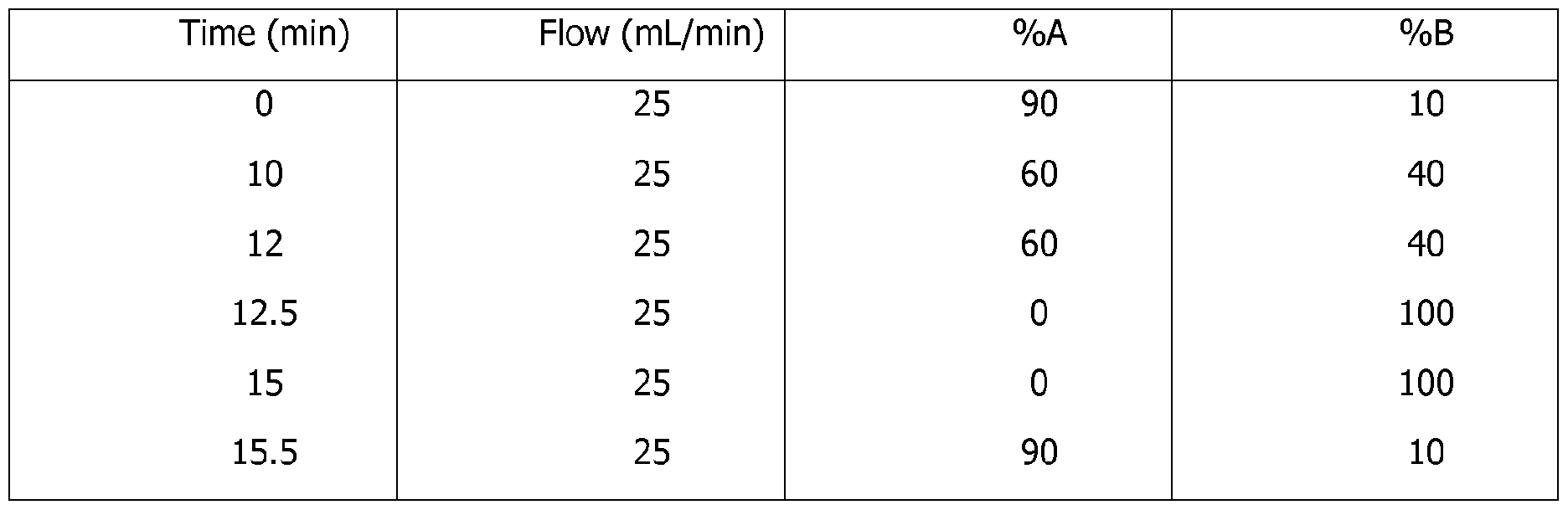
Method F:
Column: Xbridge C18 (150 mm x 19 mm, 5 μιη packing diameter). Mobile Phase A : 0.1 % formic acid in water.
Mobile Phase B : MeCN.
The gradient employed

Method G:
Column: Kromosil Phenyl C18 (250 mm x 25 mm, 10 μm packing diameter).
Mobile Phase A : 5 mM ammonium bicarbonate (aqueous).
Mobile Phase B : MeCN.
The gradient employed was:

Column: AtlantisT319X250 (250 mm x 19 mm, 10 μm packing diameter). Mobile Phase A : 0.1 % formic acid in water.
Mobile Phase B : MeCN.
The gradient employed was:

Method I:
Column: Xbridge C18 (150 mm x 19 mm, 10 μm packing diameter).
Mobile Phase A : 10 mM ammonium bicarbonate (aqueous).
Mobile Phase B : MeCN.
The gradient employed was:

Method J:
Column: Kinetix Phenyl Hexyl (150 mm x 30 mm, 5 μm packing diameter). Mobile Phase A : 10 mM ammonium bicarbonate (aqueous).
Mobile Phase B : MeCN.
The gradient employed was:

Method K:
Column: Sunfire C18 (250 mm x 30 mm, 5 μm packing diameter).
Mobile Phase A : 10 mM ammonium bicarbonate (aqueous).
Mobile Phase B : MeCN.
The gradient employed was:

Intermediate 1
5-Bromo-2-chloropyridine-3-sulfonyl chloride

Method A
Step A: Charge water (2.1 L) into a first reaction vessel, adjust the temperature to -5-0°C. Charge SOCI2 (550.0 g) to the reaction vessel slowly at -5-0°C, stir the solution at 0-5°C for 18 h. Add CuCI (1.34 g) to the reaction vessel and adjust the temperature to about -15°C.
Step B: Charge 5-bromo-2-chloropyridin-3-amine (140.0 g) and concentrated HCI (1.4 L) into a second reaction vessel, adjust the temperature to about -15°C. Add NaN02 (84.2 g) to the reaction vessel slowly to maintain the temperature at about -5°C, stir the mixture at around -5°C for 15-30 min.
Transfer the mixture in the second reaction vessel to the first reaction vessel slowly and maintain the temperature of the first reaction vessel around -10°C. Stir the resulting mixture in the first reaction vessel at -10°C for 2 h. Filter the mixture and collect the solid. Dry the solid under reduced pressure at 45-55°C for 18 h to give crude product (159.2 g) as light yellow solid.
Purification: Treat crude product (320 g) with EtOAc (700 mL). Stir the mixture for 5 min. Filter the mixture and wash the solid (inorganic salt) with EtOAc (100 mL). Concentrate the filtrate under reduced pressure to about 300 mL. Add n-heptane (300 mL) to the mixture and concentrate. Dry the product under reduced pressure at 35-40°C for 18 h to give the title compound (292 g) as orange solid.
Method B
In vessel 1, thionyl chloride (110.0 kg) was added into water (430 kg) at ca. 0 °C. The mixture was stirred at ca. 3 °C for 7 h before copper(I) chloride (0.27 kg) was added at ca. 3 °C.
In vessel 2, 5-bromo-2-chloropyridin-3-amine (28.2 kg, 136 Mol) was mixed with 35% aqueous hydrochloric acid solution (202 kg) at ca. 5 °C. A solution of sodium nitrite (8.5-14.1 kg) in water (19.7-25.4 kg) was then added at ca. -10 °C.
The solution in Vessel 2 was added to the solution in vessel 1 while maintaining the temperature at ca. -7 °C. The reaction mixture was stirred for 2 h at ca. -2 °C. The solid product was isolated by filtration and dried in vacuo at ca. 23 °C for 18 h. 30.9 kg of the title compound was obtained in 66 %th yield and 84.3 % assay.
Intermediate 2
-(benzylthio)-5-chloro-2-methoxy pyridine

To a stirred solution of 3-bromo-5-chloro-2-methoxypyridine (available from J&W Pharma Lab, 50 g, 225 mmol) in toluene (500 mL) was added phenylmethanethiol (33.5 g, 270 mmol), Xantphos (11.7 g, 20.2 mmol) and DIPEA (79 mL, 450 mmol). The mixture was degassed with argon for 1 h then Pd(dba)2 (7.75 g, 13.49 mmol) was added. The mixture was degassed with argon for 1 h then stirred for 18 h at 100 °C. The mixture was filtered through celite and the filtrate was concentrated in vacuo. The residue was taken up in in EtOAc (400 mL) and water (200 mL) was added. The aqueous phase was extracted with EtOAc (2 x 200 mL). The combined organic extracts were dried dried over sodium sulphate, filtered and concentrated in vacuo. The crude material was purified by normal phase column chromatography on silica eluting with 2% EtOAc in hexane. The appropriate fractions were combined and concentrated in vacuo to afford the title compound (27 g) as an off-white solid.
LCMS (Method C) Rt = 4.13 min, [M+H]+ = 266.3.
Intermediate 3
5-chloro-2-methoxypyridine-3-sulfonic acid
CI
To a stirred solution of 3-(benzylthio)-5-chloro-2-methoxypyridine (48 g, 181 mmol) in acetonitrile (400 mL) was added 2M aqueous hydrochloric acid (60 mL, 120 mmol). The reaction mixture was cooled to 10 °C then N-chlorosuccinimide (96 g, 722 mmol) was added portionwise. The reaction mixture was stirred at 28 °C for 3 h. The mixture was diluted with water (500 mL) and extracted with EtOAc (2 x 1000 mL). The combined organic extracts were washed with brine solution (2 x 300 mL) then dried over sodium sulphate, filtered and concentrated in vacuo. The crude material was purified by normal phase column chromatography on silica eluting with 5% EtOAc in hexane. The appropriate fractions were combined and concentrated in vacuo to afford the title compound (25 g) as an off- white solid.
1H NMR (400 MHz, DMSO-ds) δ (ppm) 14.60-14.00 (br. s., 1 H) 8.19 (s, 1H), 7.95 (s, 1H), 3.85 (s, 3H).
Intermediate 4
3-(benzylthio)-5-bromo-2-methoxypyridine

To a solution of 5-bromo-3-iodo-2-methoxypyridine (50 g, 159 mmol) in toluene (1000 mL) was added phenylmethanethiol (17.8 g, 143 mmol), DIPEA (55.6 mL, 319 mmol), XantPhos (7.37 g, 12.74 mmol). The mixture was degassed with argon for 10 min then Pd(dba)2 (4.58 g, 7.96 mmol) was added and the reaction mixture was stirred at 70 °C for 1 h. The reaction mixture was filtered through celite, washing with EtOAc (200 mL) and the filtrate was concentrated in vacuo. The crude material was purified by normal phase column chromatography on silica eluting with 5% EtOAc in petroleum ether. The appropriate fractions were combined and concentrated in vacuo to afford the title compound (90 g) as a solid. LCMS (Method D) Rt = 2.68 min, [M+H]+ = 308.9.
Intermediate 5
5-bromo-2-methoxypyridine-3-sulfonic acid

LCMS (Method E) Rt = 3.75 min, [M-H]+ Intermediate 6
2,5-dichloropyridine-3-sulfonic acid

Step B: Concentrated HCI (40 mL, 434 mmol) was added to 2,5-dichloropyridin-3-amine (5 g, 30.7 mmol) at 0 °C in a second reaction vessel. The reaction mixture was cooled to -3 °C. A solution of NaN02 (4.23 g, 61.3 mmol) in water (2 mL) was added slowly, maintaining the temperature below 0 °C.
The mixture in the second reaction vessel was transferred to the first reaction vessel slowly, maintaining the temperature at -3 °C. The resulting mixture in the first reaction vessel was stirred at -5 °C for 1.5 h. The mixture was filtered and the residue was washed with water. The resulting solid was dried to afford the title compound (4.2 g) as an off-white solid.
1H NMR (400 MHz, CDC ) δ (ppm) 8.65 (s, 1H), 8.41 (s, 1H).
Intermediate 7
5-bromo-3-iodo-2-methoxy pyridine

To a solution of 5-bromo-3-iodopyridin-2-ol (50 g, 167 mmol) in Toluene (1.5 L) was added silver carbonate (55.2 g, 200 mmol) and methyl iodide (0.031 L, 500 mmol). The reaction mixture was heated to 50 °C for 16 h. The reaction mixture was filtered through celite, washing with toluene (100 mL) and the filtrate was concentrated in vacuo. The crude material was purified by normal phase column chromatography on silica eluting with 5% EtOAc in petroleum ether. The appropriate fractions were combined and concentrated in vacuo to afford the title compound (90 g) as a solid.
LCMS (Method D) Rt = 2.69 min, [M+H]+ = 312.9. Intermediate 8
N-(5-bromopyridin-3-yl)-2,5-dichloropyridine-3-sulfonamide

Thionyl chloride (5 mL, 68.5 mmol) was added to 2,5-dichloropyridine-3-sulfonic acid (3.8 g, 16.66 mmol) and DMF (0.065 ml, 0.833 mmol) at 0 °C. The reaction mixture was heated to 80 °C for 3 h. The solvent was removed in vacuo and the residue was added to a stirred solution of 5-bromopyridin- 3-amine (2.87 g, 16.59 mmol) in pyridine (35 mL) at 0 °C. The reaction mixture was stirred at room temperature for 16 h. The reaction mixture was diluted with EtOAc (150 mL) and washed with water (2 x 100 mL) then brine. The organic phase was dried over sodium sulfate, filtered and concentrated in vacuo. The residue was washed with with diethyl ether then n-pentane and dried to afford the title compound (3.8 g) as an off-white solid.
LCMS (Method F) Rt = 2.43 min, [M+H]+ = 380.9.
Intermediate 9
5-bromo-2-chloro-N-(5-chloropyridin-3-yl)pyridine-3-sulfonamide
To a solution of 5-chloropyridin-3-amine (15.9 g, 124 mmol) in pyridine (150 mL) stirred under nitrogen at 0 °C was added 5-bromo-2-chloropyridine-3-sulfonyl chloride (45 g, 155 mmol) portionwise over 15 min. The reaction mixture was stirred at 25 °C for 18 h. The reaction mixture was cooled to 0 °C and water (2500 mL) was added slowly. The resultant mixture was stirred for 30 min at room temperature and the resulting solid was isolated by filtration then dried under vacuum to afford the title compound (23 g) as a brown solid.
LCMS (Method D) Rt = 2.12 min, [M+H]+ = 381.8 Intermediate 10
5-bromo- N-(5-chloropyridin-3-yl)-2-methoxypyridine-3-sulfonamide

To a solution of 5-bromo-2-chloro-N-(5-chloropyridin-3-yl)pyridine-3-sulfonamide (21 g, 54.8 mmol) in MeOH (40 mL) stirred under nitrogen at 0 °C was added sodium methoxide (200 mL, 54.8 mmol) dropwise over 5 min. The reaction mixture was stirred at 80 °C for 2 h. The reaction mixture was cooled to 0 °C and 20% citric acid solution (1.5 L) was added slowly. The resulting mixture was stirred for 30 min at room temperature and the resulting solid was isolated by filtration then dried under vacuum to afford the title compound (20 g) as a pale brown solid.
LCMS (Method F) Rt = 2.80 min, [M+H]+ = 378.0.
Intermediate 11
N-(5-bromopyridin-3-yl)-5-chloro-2-methoxypyridine-3-sulfonamide
N,N-dimethylformamide (0.05 mL, 0.65 mmol) was added to a stirred suspension of 5-chloro-2- methoxypyridine-3-sulfonic acid (10 g, 44.7 mmol) and thionyl chloride (50 mL, 685 mmol). The reaction mixture was heated to 70 °C for 2 h. The solvent was removed under a positive pressure of
nitrogen and the residue was taken up in DCM (50 mL). This mixture was added to stirred solution of 5-bromopyridin-3-amine (7.74 g, 44.7 mmol) and pyridine (20 mL, 247 mmol) in DCM (50 mL) at 0 °C. The mixture was allowed to warm to room temperature and stirring was continued for 18 h. Ice cold water (100 mL) was added and the mixture was stirred for 30 min. The resulting solid was isolated by filtration and dried under vaccum. The crude material was triturated with diethyl ether (2 x 200mL), and isolated solid was dried under vaccum to afford the title compound (13.2 g) as an off white solid.
LCMS (Method D) Rt = 2.24 min, [M+H]+ = 379.8 Intermediate 12
N-(2-bromopyridin-4-yl)-5-chloro-2-ethoxypyridine-3-sulfonamide

To a stirred solution of N-(2-bromopyridin-4-yl)-2,5-dichloropyridine-3-sulfonamide (1 g, 2.61 mmol) in ethanol (10 mL) under nitrogen at room temperature sodium ethoxide (10 mL, 2.61 mmol) was added dropwise. The reaction mixture was stirred at 80 °C for 1 h then cooled to room temperature and concentrated in vacuo. The residue was taken up in 10 % aqueous citric acid solution (50 mL) and the resulting precipitate was isolated by filtration to afford the title compound (0.9 g) as a brown solid.
LCMS (Method D) Rt = 2.29 min, [M+H]+ = 391.9/393.9. Intermediate 13
N-( 5-chloropyridin-3-yl)-2-methoxy-5-morpholinopyridine-3-sulfonamide
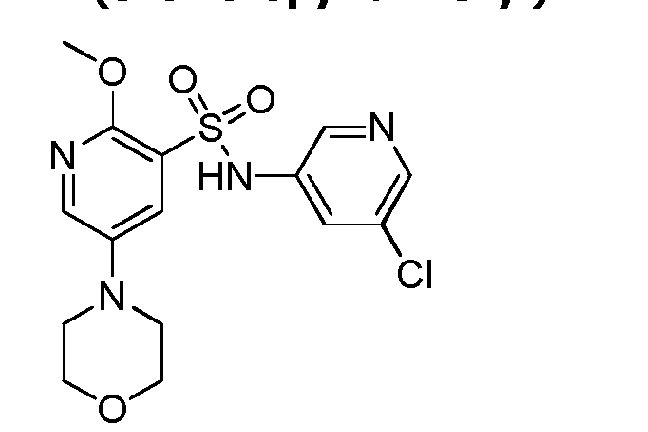
To a solution of 5-bromo-W-(5-chloropyridin-3-yl)-2-methoxypyridine-3-sulfonamide (30 g, 79 mmol), potassium carbonate (32.9 g, 238 mmol) and copper(I) iodide (3.02 g, 15.85 mmol) in DMSO (300 mL) and degassed with argon for 15 min. Morpholine (41.4 mL, 475 mmol) and 2- isobutyrylcyclohexanone (9.33 g, 55.5 mmol) were added and the reaction mixture was degassed with
argon for 15 min. The reaction mixture was stirred at 110 °C for 16 hr then water (2.5 L) was added. The aqueous phase was extracted with EtOAc (2 x 2.0 L). The aqueous layer was acidified to pH 3 by the addition of 2 M aqueous HCI (150 mL) and was further extracted with EtOAc (2 x 2.0 L). The combined organic extracts were dried over sodium sulphate, filtered and concentrated in vacuo. The residue was taken up in EtOAc (120 mL) and the mixture was heated to 75 °C for 1 h then cooled to 25 °C. The resulting solid was isolated by filtration, washing with diethyl ether (50 mL), then dried under vacuum to afford the title compound (9.0 g) as a white solid.
LCMS (Method F) Rt = 2.38 min, [M+H]+ = 385.1.
Intermediate 14
5-bromo- N-(5-chloropyridin-3-yl)-2-ethoxypyridine-3-sulfonamide

LCMS (Method D) Rt = 2.85 min, [M+H]+ = 392.0.
Intermediate 15
N-(5- chloropyridin-3-yl)-2-ethoxy-5-morpholinopyridine-3-sulfonamide

To a solution of 5-bromo-W-(5-chloropyridin-3-yl)-2-ethoxypyridine-3-sulfonamide (35.0 g, 89 mmol), potassium carbonate (37.0 g, 267 mmol) and copper(I) iodide (3.4 g, 17.8 mmol) in DMSO (350 mL)
was degassed with argon for 15 min. Morpholine (46.6 mL, 535 mmol) and 2-isobutyrylcyclohexanone (10.5 g, 62.4 mmol) were added and the reaction mixture was degassed with argon for 15 min. The reaction mixture was stirred at 110 °C for 16 hr then water (1.5 L) was added. The aqueous phase was extracted with EtOAc (2 x 3.0 L). The aqueous layer was acidified to pH 3 by the addition of 2 M aqueous HCI (500 mL) and was further extracted with EtOAc (2 x 1.5 L). The combined organic extracts were dried over sodium sulphate, filtered and concentrated in vacuo. MeOH (50 mL) was added to the residue and the solid was isolated by filtration, washing with diethyl ether (20 mL), then dried in under vacuum to afford the title compound (18.5 g) as an off-white solid. LCMS (Method G) Rt = 2.02 min, [M+H]+ = 399.1.
Intermediate 16
N-(5-chloropyridin-3-yl)-2-methoxy-5-morpholinopyridine-3-sulfonamide

To a solution of 5-bromo-N-(5-chloropyridin-3-yl)-2-methoxypyridine-3-sulfonamide (2 g, 5.28 mmol), morpholine (0.598 g, 6.87 mmol) in 1,4-Dioxane (24 mL) in sealed tube under nitrogen was added sodium tert-butoxide (1.015 g, 10.56 mmol). The reaction mixture was degassed with argon for 5 min then 2-dicyclohexylphosphino-2,4,6,-triisopropylbiphenyl (0.101 g, 0.211 mmol), and Pd2(dba)3 (0.193 g, 0.211 mmol) were added. The reaction mixture was stirred at 130 °C for 30 min. The reaction mixture was filtered through celite, washing with EtOAc (25 mL) and the filtrate concentrated in vacuo. The residue was purified by Preparative HPLC (Method A). Collected fractions were lyophilized to afford the title compound (450 mg) as an off-white solid.
LCMS (Method D) Rt = 1.94 min, [M+H]+ = 384.1.
Intermediate 17
3-fluoro-4-(4,4,5,5-tetramethyl-l,3,2-dioxaborolan-2-yl)benzaldehyde

Intermediate 18
rac-((2S,6R)-4-(3-fluoro-4-(4,4,5,5-tetramethyl-l,3,2-dioxaborolan-2-yl)benzyl)-l,2,6- trimethylpiperazine

A mixture of 3-fluoro-4-(4,4,5,5-tetramethyl-l,3,2-dioxaborolan-2-yl)benzaldehyde (15 g, 60.0 mmol), sodium sulfate (25.6 g, 180 mmol) and (2S,6R)-l,2,6-trimethylpiperazine (available from Activate Scientific, 8.5 g, 66.0 mmol) in DCM (200 mL) was stirred for 1 h at room temperature then sodium triacetoxyborohydride (38.1 g, 180 mmol) was added at 0 °C. The reaction mixture was stirred at 30 °C for 16 h then DCM (100 mL) was added, followed by saturated aqueous NaHC03 solution (80 mL). The layers were separated and the aqueous phase was extracted with DCM (2 x 100 mL). The combined organic extracts were washed with water (200 mL), brine (200 mL), over sodium sulphate, filtered and concentrated in vacuo to afford the crude product (15 g). The crude product was used for the next step directly.
Intermediate 19
rac-(4-(((3S,5R)-3,4,5-trimethylpiperazin-l-yl)methyl)phenyl)boronic acid

Intermediate 20
l-(ter -Butyl)-4-(4-(4,4,5,5-tetramethyl-l,3,2-dioxaborolan-2-yl)benzyl)piperazine

A mixture of 2-(4-(bromomethyl)phenyl)-4,4,5,5-tetramethyl-l,3,2-dioxaborolane (0.5 g, 1.684 mmol) and sodium carbonate (0.232 g, 2.189 mmol) in acetone (4 mL) was treated dropwise with a solution of l-(tert-butyl)piperazine (0.239 g, 1.684 mmol) in acetone (1 mL). The reaction mixture was stirred for 24 h. The reaction mixture was concentrated under reduced pressure, and partitioned between 2: 1 saturated NaCI solution: water (30 mL) and EtOAc (50 mL). The organic layer was separated and the aqueous layer was further extracted with EtOAc (50 mL). The organic layers were combined, dried using a hydrophobic frit and concentrated under reduced pressure to afford the title compound (482 mg) as a pale yellow oil that solidified overnight. 1H NMR (400 MHz, DMSO-ds) δ (ppm) 7.62 (d, J=8.0 Hz, 2H), 7.29 (d, J=8.0 Hz, 2H), 3.44 (s, 2H), 2.49 (br. s, 4H), 2.34 (br. s., 4H), 1.27-1.30 (m, 12H), 0.98 (s, 9H).
Intermediate 21
(2-fluoro-4-((4-methylpiperazin-l-yl)methyl)phenyl)boronic acid

To a suspension of (2-fluoro-4-formylphenyl)boronic acid (3 g, 17.86 mmol) in DCM (50 mL) was added 1-methylpiperazine (2.147 g, 21.44 mmol) then sodium triacetoxyborohydride (4.54 g, 21.44 mmol). The reaction mixture was stirred at room temperature for 18 h then passed through a pad of
silica gel, eluting with 15% MeOH in DCM. The filtrate was concentrated in vacuo to afford the title compound (2.8 g) as a pale yellow foam.
LCMS (Method H) Rt = 0.65 min, [M+H]+ = 253.1.
Intermediate 22
l-(4-bromo-2-fluorobenzyl)-4-methylpiperazine

A mixture of 1-methylpiperazine (1.65 g, 16.42 mmol) and potassium carbonate (5.2 g, 37.6 mmol) in acetone (100 mL) was stirred at room temperature for 15 mins. A solution of 4-bromo-l- (bromomethyl)-2-fluorobenzene (4 g, 14.93 mmol) in 25 mL of acetone was added dropwise over 20 mins and the reaction mixture was stirred at room temperature for 1 h. The solvent was removed in vacuo and the residue taken up in water (300 mL) then extracted with DCM (2 x 100 mL). The combined organic extracts were dried over sodium sulphate, filtered and concentrated in vacuo. The residue was purified by normal phase column chromatography on a 45 g Biotage ZIP Sphere silica column, eluting with 0-5% MeOH in DCM. The desired fractions were combined and concentrated in vacuo to afford the title compound (2.5 g) as a colourless oil that solidified. LCMS (Method H) Rt = 1.19 min, [M+H]+ = 288-289.
Intermediate 23
l-(2-fluoro-4-(4,4,5,5-tetramethyl-l,3,2-dioxaborolan-2-yl)benzyl)-4-methylpiperazine

l-(4-bromo-2-fluorobenzyl)-4-methylpiperazine (2.5 g, 8.71 mmol), 4,4,4',4',5,5,5,,5,-octamethyl- 2,2'-bi(l,3,2-dioxaborolane) (2.43 g, 9.58 mmol), potassium acetate (1.71 g, 17.41 mmol) and PdCl2(dppf) (50 mg, 0.068 mmol) were sealed in a microwave vial. 1,4-Dioxane (20 ml) was added and the reaction mixture was evacuated and purged with nitrogen five times. The reaction mixture was heated to 100 °C under an atmosphere of nitrogen for 6 h. The reaction mixture was cooled to
room temperature, water was added and the aqueous phase was extracted with DCM (3 x 100 mL). The combined organic extracts were dried over sodium sulphate, filtered and concentrated in vacuo. The residue was purified by normal phase column chromatography on a 45 g Biotage ZIP Sphere silica column, eluting with 0-5% MeOH in DCM. The desired fractions were combined and concentrated in vacuo then triturated with pentane to afford the title compound (500 mg) as a cream solid.
LCMS (Method H) Rt = 1.66 min, [M+H]+ = 335.2.
Intermediate 24
l-(2-fluoro-4-(4,4,5,5-tetramethyl-l,3,2-dioxaborolan-2-yl)benzyl)-4-methylpiperazine

A solution of 1-methylpiperazine (2 mL, 18.0 mmol) in acetone (5 mL) was added dropwise to a mixture of 2-(4-(bromomethyl)phenyl)-4,4,5,5-tetramethyl-l,3,2-dioxaborolane (3.0 g, 10.1 mmol) and sodium carbonate (1.78 g, 16.8 mmol) in acetone (50 mL). The reaction mixture was stirred at room temperature for 1 h then concentrated in vacuo. The residue was taken up in EtOAc (50 mL) and water (25 mL) and saturated sodium bicarbonate (25 mL) were added. The aqueous phase was extracted with EtOAc (50 mL), then basified to pH 14 with 2M NaOH solution, and extracted further with EtOAc (100 mL). The combined organic extracts were dried by passing through a hydrophobic frit and concentrated in vacuo to afford the title compound (2.71 g) as a yellow oil that solidified.
LCMS (Method B) Rt = 1.15 min, [M+H]+ = 235.4. Intermediate 25
l-(3-Fluoro-4-(4,4,5,5-tetramethyl-l,3,2-dioxaborolan-2-yl)benzyl)-4- isopropylpiperazine

Method A
To a solution of 4-bromo-3-fluorobenzaldehyde (100 g, 493 mmol), 4,4,4',4',5,5,5,,5,-octamethyl-2,2'- bi(l,3,2-dioxaborolane) (150 g, 591 mmol) in 1,4-dioxane (1000 mL) was added potassium acetate (121 g, 1231 mmol). The reaction mixture was degassed with argon for 30 min then PdCl2(dppf)- CH2CI2 adduct (20.11 g, 24.63 mmol) was added. The resulting reaction mixture was stirred at 100°C for 3 h. The reaction mixture was allowed to cool to room temperature, then filtered through celite and washed with 10% MeOH/DCM (2L). The filtrate was concentrated under reduced pressure to afford a crude residue (140 g) as a black liquid. The above crude compound (140 g), sodium sulfate (80 g, 560 mmol) and 1-isopropylpiperazine (0.042 L, 280 mmol) in DCM (1.5 L) were stirred for 30 min, then sodium triacetoxyborohydride (178 g, 840 mmol) was added and the resulting mixture was stirred at room temperature for 4 h. The reaction mixture was diluted with DCM (3 L) and quenched with aqueous NaHCCb solution (3 L). The organic layer was separated, washed with water (2 L), dried over anhydrous Na2S04, filtered and the filtrate was concentrated under reduced pressure to obtain a crude residue (180 g) as a brown liquid. The crude compound (180g) was pre-adsorbed onto Florisil (250g, 100-200 mesh) and purified by normal phase column chromatography on Florisil (100-200 mesh, 2.5 kg) eluting with hexane initially, then 5% MeOH in DCM. The desired fractions were combined and concentrated under reduced pressure to afford the title compound (150 g) as a light yellow liquid.
1H NMR (400 MHz, DMSO-de) δ (ppm) 7.56-7.61 (m, 1H), 7.13 (d, J=7.7 Hz, 1H), 7.04 (d, J=10.3 Hz, 1H), 3.46 (s, 2H), 2.54-2.63 (m, 1H), 2.29-2.46 (m, 8H), 1.29 (s, 12H), 0.94 (d, J=6.58 Hz, 6H).
Method B
Charge 4-bromo-3-fluorobenzaldehyde (150.0 g), 4,4,4',4',5,5,5,,5,-octamethyl-2,2,-bi(l,3,2- dioxaborolane) (205.7 g) and 1,4-dioxane (1.5 L) into a reaction vessel, charge KOAc (181.6g) into the reaction vessel, degas the reaction vessel with N2 three times, add Pd(dppf)Cl2 (27. lg) into the reaction vessel, adjust the reaction vessel to 90-100°C, stir the reaction vessel at 90-100°C for 2 hrs. Check the reaction with TLC till the disappearance of 4-bromo-3-fluorobenzaldehyde (Mobile phase: 10% Ethyl acetate in n-heptane, Rf=0.6). Cool the reaction mixture to 20~25°C then switch the solvent to ethyl acetate (1.5 L), filter the mixture through celite (150.0 g), wash the filtrate with water (300 mi x 3), combine the organic phase and concentrate under reduced pressure to give the title compound (243.3 g) as black oil. The crude product was used for next step directly.
Charge 3-fluoro-4-(4,4,5,5-tetramethyl-l,3,2-dioxaborolan-2-yl)benzaldehyde (243.3 g), 1- isopropylpiperazine (103.9 g) and DCM (2.4 L) into a reaction vessel, stir the reaction mixture at 20- 30°C for 15-30 min, charge NaBH(OAc)3 (410.5 g) into the reaction vessel. Adjust the reaction vessel to 20-30°C, stir the reaction vessel at 20-30°C for 2 hrs. Switch the reaction solvent to ethyl acetate and wash with 5% aq. NaHCCb solution. Separate the organic phase and concentrate under reduced pressure to give the title compound (210 g, 78%th for two steps) as brown oil.
Method C
4-Bromo-3-fluorobenzaldehyde (18.8 kg, 92.6 mol) was dissolved in 2-methyltetrahydrofuran (86 kg) at ca. 20°C. Potassium acetate (23 kg) and 4,4,4',4',5,5,5',5'-octamethyl-2,2'-bi(l,3,2-dioxaborolane) (28.5 kg) were added in sequence and the reaction was stirred for 1 h at ca. 25 °C. Nitrogen was bubbled through the mixture for 3 h at ca. 25 °C before [1,1'- Bis(diphenylphosphino)ferrocene]dichloropalladium(II) (0.7kg) was added. Nitrogen was bubbled through the mixture for a further 3 h before the mixture was stirred for 7 h at ca. 80 °C. The temperature was reduced to 25°C and water (95kg) was added. After stirring for 3 h the aqueous layer was discarded. The organic layer was concentrated to 18.8-37.6 L under reduced pressure while maintaining the temperature below 45 °C. 2-Methyltetrahydrofuran (136 kg) was added in two portions during the concentration step. After completion of the concentration step, additional 2- methyltetrahydrofuran (86 kg) was added. 1-Isopropylpiperazine (13.7 kg) was added to the mixture over 3 h at ca. 25 °C, before the mixture was stirred for 1 h. Sodium triacetoxyborohhydride (50.8 kg) was added in portions and the reaction mixture was stirred for 4.5 h at ca. 28 °C. Water (61 kg) was added over 5 h at ca. 28 °C and the resulting mixture was stirred for 2 h. 30% aqueous sodium hydroxide solution (54 kg) was added until the pH reached 7.0. The aqueous layer was discarded, before the organic layer was washed with an aqueous solution of 5% sodium bicarbonate and 10% sodium chloride (76 kg). Finally, 151.8 kg of a solution of the title compound (31.1 kg) in 2-methyltetrahydrofuran was obtained in 93 %th yield.
Intermediate 26
l-(4-bromo-2-fluorobenzyl)-4-isopropylpiperazine

To 4-bromo-2-fluorobenzaldehyde (500 mg, 2.46 mmol) in DCM (20 mL) was added acetic acid (0.2 mL) and 1-isopropylpiperazine (0.35 mL, 2.46 mmol). The mixture was stirred at room temperature for 5 min, then sodium triacetoxyborohydride (783 mg, 3.69 mmol) was added. The reaction mixture was stirred at room temperature for 3 h then was concentrated in vacuo. The residue was taken up in MeOH and loaded onto a 20 g SCX cartridge. The cartridge was eluted with MeOH (2 CV) then 2 M ammonia in MeOH (4 CV). The appropriate fractions were collected and concentrated in vacuo to afford the title compound (643 mg).
LCMS (Method B) t = 1.24 min, [M+H]+ = 315.3.
Intermediate 27
l-(2-fluoro-4-(4,4,5,5-tetramethyl-l,3,2-dioxaborolan-2-yl)benzyl)-4- isopropylpiperazine

l-(4-bromo-2-fluorobenzyl)-4-isopropylpiperazine (384 mg, 1.218 mmol), 4,4,4',4',5,5,5',5'- octamethyl-2,2'-bi(l,3,2-dioxaborolane) (371 mg, 1.462 mmol), potassium acetate (299 mg, 3.05 mmol) and PdCI2(dppf) (45 mg, 0.062 mmol) were sealed in a microwave vial. 1,4-Dioxane (20 mL) was added and the reaction mixture was evacuated and purged 5 times with nitrogen. The reaction mixture was heated to 100 °C for 3 h. The reaction mixture filtered over celite, washing with MeOH (30 mL). The solvent was removed in vacuo and the residue was diluted with water (30 mL) and extracted with EtOAc (5 x 30 mL). The combined organic extracts were dried by passing through a hydrophobic frit and the solvent was removed in vacuo. The residue was dissolved in 5% MeOH:DCM (20 mL) and filtered through a 1 g silica cartridge. The solvent was removed in vacuo to afford the crude product (200 mg). The crude product was used for the next step directly.
Intermediate 28
l-isopropyl-4-(4-(4,4,5,5-tetramethyl-l,3,2-dioxaborolan-2-yl)benzyl)piperazine

To a suspension of 2-(4-(bromomethyl)phenyl)-4,4,5,5-tetramethyl-l,3,2-dioxaborolane (2 g, 6.73 mmol) and potassium carbonate (1.210 g, 8.75 mmol) in DMF (20 mL) stirred at room temperature was added 1-isopropylpiperazine (1.349 mL, 9.43 mmol) dropwise. The reaction mixture was heated to 80°C. After 1 h, the reaction was cooled and concentrated in vacuo. The reaction mixture was dissolved in EtOAc (100 mL), washed with water (100 mL), the organic phase separated and the aqueous phase re-extracted with EtOAc (2 x 100 mL). The organic phases were combined, dried using a hydrophobic frit and evaporated in vacuo to afford the title compound (2.525 g) as an orange/brown oil.
LCMS (Method A) Rt = 0.62 min, [M+H]+ = 345.2.
Intermediate 29
5-chloro-N-(5-(4-((4-isopropylpiperazin-l-yl)methyl)phenyl)pyridin-3-yl)-2- methoxypyridine-3-sulfonamide

A mixture of N-(5-bromopyridin-3-yl)-5-chloro-2-methoxypyridine-3-sulfonamide (1.49 g, 3.94 mmol), l-isopropyl-4-(4-(4,4,5,5-tetramethyl-l,3,2-dioxaborolan-2-yl)benzyl)piperazine (3.98 g, 11.56 mmol), PdCI2(dppf) (0.29 g, 0.396 mmol) and sodium carbonate (1.26 g, 11.89 mmol) in 1,4-dioxane (6 mL) and water (1.5 mL) was sealed in a microwave vial and heated in a Biotage Initiator microwave to 130 °C for 30 min. The reaction mixture was filtered through celite, washing with MeOH (100 mL) and the filtrate was concentrated in vacuo. The residue was taken up in EtOAc (120 mL) and water (60 mL) and the phases were separated. The aqueous phase was basified to pH 10 with 2 M aqueous NaOH solution and extracted with EtOAc (2 x 100 mL). The aqueous phase was further basified to pH 13 with 2 M aqueous NaOH solution and extracted with EtOAc (2 x 100 mL). The combined organic extracts were dried by passing through a hydrophobic frit and concentrated in vacuo. The crude material was pre-adsorbed onto Florosil and purified by normal phase column chromatography on silica (80 g) eluting with a gradient of 0 to 15% MeOH in DCM over 18 CV. The appropriate fractions were combined and concentrated in vacuo. The aqueous phase still contained product so was concentrated in vacuo and the residue was taken up in MeOH and loaded onto a SCX cartridge. The cartridge was eluted with MeOH (4 CV) then 2 M ammonia in MeOH (3 CV). Appropriate fractions were concentrated in vacuo and the crude material was pre-adsorbed onto Florosil and purified by normal phase column chromatography on silica (40 g) eluting a gradient of 0 to 15% MeOH in DCM over 22 CV. The appropriate fractions were combined and concentrated in vacuo. The two residues isolated from normal phase chromatography were combined, taken up in DMSO and purified by reverse phase C18 silica chromatography eluting with a gradient of 0 to 50% MeCN (containing 0.1% NH3) in water (with an ammonium bicarbonate modifier adjusted to pH 10). The appropriate fractions were combined and concentrated in vacuo to afford the title compound (447 mg) as a brown solid. Further fractions were combined and concentrated in vacuo then taken up in DMSO (2 mL) and MeOH (2 mL), left to stand for 5 min and water added. The resulting solid was isolated by filtration, washing with water to afford the title compound (611 mg) as a brown solid.
LCMS (Method A) Rt = 0.64 min, [M+H]+ = 516.5.
Intermediate 30
N-(5-bromopyridin-3-yl)-5-chloro-2-(dimethylamino)pyridine-3-sulfonamide

To a solution of N-(5-bromopyridin-3-yl)-2,5-dichloropyridine-3-sulfonamide (2.8 g, 7.31 mmol) in ethanol (28 mL) was added dimethylamine (18.27 mL, 36.5 mmol). The reaction mixture was stirred in sealed tube at 100 °C for 16 h. The reaction mixture was concentrated in vacuo and the residue was taken up in EtOAc (100 mL) and washed with water (3 x 80 mL). The organic phase was concentrated in vacuo and the residue was washed with with diethyl ether (60 mL) then n-pentane (2 x 50 mL) to afford the title compound (1.45 g) as an off-white solid.
LCMS (Method F) Rt = 2.39 min, [M+H]+ = 391.1.
Intermediate 31
5-chloro-2-(dimethylamino)-N-(5-(4-((4-isopropylpiperazin-l- yl)methyl)phenyl)pyridin-3-yl)pyridine-3-sulfonamide

A mixture of N-(5-bromopyridin-3-yl)-5-chloro-2-(dimethylamino)pyridine-3-sulfonamide (101 mg, 0.26 mmol), l-isopropyl-4-(4-(4,4,5,5-tetramethyl-l,3,2-dioxaborolan-2-yl)benzyl)piperazine (98 mg, 0.29 mmol), PdCI2(dppf) (19 mg, 0.026 mmol), sodium carbonate (82 mg, 0.77 mmol), 1,4-Dioxane (4 mL) and Water (1 mL) was sealed in a microwave vial and heated in a Biotage Initiator microwave to 130 °C for 30 min. The reaction mixture was filtered through celite, washing with MeOH and the filtrate was concentrated in vacuo. The residue was taken up in EtOAc (20 mL), water (20 mL) and brine (20 mL) and the phases were separated. The aqueous phase was extracted with EtOAc (30 mL). The combined organic extracts dried by passing through a hydrophobic frit and concentrated in vacuo. The resulting solid was dried on a high vacuum line for 63 h to afford the title compound (152 mg) as a brown solid.
LCMS (Method A) Rt = 0.65 min, [M+H]+ = 529.5.
Intermediate 32
N-(2--(2-fluoro-4-formylphenyl)pyridin-4-yl)-2-methoxy-5-morpholinopyridine-3- sulfonamide

A vial was charged with N-(2-chloropyridin-4-yl)-2-methoxy-5-morpholinopyridine-3- sulfonamide (2809 mg, 7.30 mmol), (2-fluoro-4-formylphenyl)boronic acid (2494 mg, 14.85 mmol), sodium carbonate (3100 mg, 29.2 mmol) and XPhos palladacycle (520 mg, 0.704 mmol) in water (8 mL) and 1,4-dioxane (24 mL). The vial was sealed and the reaction mixture was heated at 120°C for 60 min thermally. The reaction mixture was filtered through celite and washed with MeOH. The filtrate was concentrated under reduced pressure. The residue was pre-absorbed on florisil and purified by chromatography on silica eluting with a gradient of 0 to 50% 3: 1 EtOAcEtOH in cyclohexane. The desired fractions were concentrated under reduced pressure and the residue was dissolved in the minimum amount of MeOH and sonicated. The precipitate was collected by filtration and dried to afford the title compound (874 mg) as a yellow solid. LCMS (Method A) Rt = 0.87 min, [M+H]+ = 473.3.
Intermediate 33
N-(2--Chloropyridin-4-yl)-2-methoxy-5-morpholinopyridine-3-sulfonamide

A vial was charged with morpholine (8.10 mL, 93 mmol), 2-isobutyrylcyclohexanone (1.558 mL, 9.26 mmol), copper(I) iodide (588 mg, 3.09 mmol), potassium carbonate (6398 mg, 46.3 mmol), 5-bromo- /V-(2-chloropyridin-4-yl)-2-methoxypyridine-3-sulfonamide (5843 mg, 15.43 mmol) and DMSO (60
mL). The vial was sealed, placed under vacuum then flushed with nitrogen (10 times), heated to 110°C and left to stir for 18 h. The reaction was cooled and the reaction mixture added to water (200 mL), acidified to pH 1 with aqueous HCI (4M), extracted with EtOAc (200 mL) and the organic layer was separated. The aqueous layer was readjusted to pH 1 with aqueous HCI (4M) and re-extracted with EtOAc (2 x 200 mL). The organic layers were combined, filtered using a hydrophobic frit and concentrated under reduced pressure to afford the crude product as a brown oil that solidified. The residue was diluted with MeOH (30 mL) and sonicated. The tan precipitate was collected by filtration, washed with MeOH (5 mL), and dried to afford the title compound (3373 mg) as a tan solid. LCMS (Method A) Rt = 0.89 min, [M+H]+ = 385.0.
Intermediate 34
5-bromo-N -(2-chloropyridin-4-yl)-2-methoxypyridine-3-sulfonamide

A round bottomed flask was charged with 5-bromo-2-chloro-W-(2-chloropyridin-4-yl)pyridine-3- sulfonamide (8 g, 20.89 mmol). Sodium methoxide in MeOH (0.5 M, 200 mL, 100 mmol) was added and the reaction mixture was placed under vacuum then flushed with nitrogen, sealed, and heated at 100°C for 6 h. The reaction mixture was concentrated under reduced pressure and the pH of the mixture was adjusted to 7 with aqueous HCI (4M). The residue was partitioned between water (100 mL) and EtOAc (200 mL). The organic layer was separated and the aqueous layer was re-extracted with EtOAc (200 mL). The pH of the aqueous layer was then adjusted to 6 with aqueous HCI (4M) and re-extracted with EtOAc (200 mL). The pH of the aqueous layer was then adjusted to 4 with aqueous HCI (4M), and re-extracted with EtOAc (200 mL). The organic layers were combined, dried using a hydrophobic frit, and concentrated under reduced pressure. The residue was then dissolved in the minimum amount of MeOH and sonicated. The precipitate was collected by filtration and dried to afford the title compound (6.531 g) as a tan solid.
LCMS (Method A) Rt = 1.06 min, [M+H]+ = 379.9.
Intermediate 35
5-bromo-2-chloro-N -(2-chloropyridin-4-yl)pyridine-3-sulfonamide

To a solution of 5-bromo-2-chloropyridine-3-sulfonyl chloride (13.73 g, 47.2 mmol) in pyridine (50 mL, 618 mmol) was added portionwise 2-chloropyridin-4-amine (6.7 g, 52.1 mmol). The reaction mixture was stirred at room temperature for 3 h. The reaction mixture was concentrated under reduced pressure. The residue was treated with MeOH (50 mL) and the mixture was sonicated. The brown precipitate was collected by filtration, washed with MeOH (5 mL), dried, then dissolved in MeCN and concentrated under reduced pressure to afford the title compound (15.44 g) as a brown solid. LCMS (Method A) Rt = 0.64 min, [M+H]+ = 383.8.
Intermediate 36
N -(2-bromopyridin-4-yl)-5-chloro-2-methoxypyridine-3-sulfonamide

Sodium methoxide solution (30% w/w in MeOH, 600 mL, 157 mmol) was added dropwise to solid N- (2-bromopyridin-4-yl)-2,5-dichloropyridine-3-sulfonamide (60 g, 157 mmol) stirring under nitrogen at room temperature. The reaction mixture was then stirred at 80°C for 1 h, then cooled to 0°C and quenched with 20% citric acid solution (2 L). The resultant solid was collected by filtration and dried to afford the title compound (50 g) as a brown solid.
LCMS (Method D) Rt = 2.31 min, [M+H]+ = 377.9/379.9
Intermediate 37
N -(2-bromopyridin-4-yl)-2,5-dichloropyridine-3-sulfonamide

To a solution of 2-bromopyridin-4-amine (75 g, 433 mmol) in pyridine (750 mL) stirred under nitrogen at 0°C was added 2,5-dichloropyridine-3-sulfonyl chloride (128 g, 520 mmol) portionwise. The reaction
mixture was stirred at room temperature for 16 h. After this time, pyridine was evaporated under reduced pressure to obtain a crude residue which was poured into ice water. The resulting solid was collected by filtration and dried. The solid was dissolved in EtOAc (2 L) and the organic layer was washed with 10% EDTA solution (2 L). The organic phase was dried over Na2S04, filtered and concentrated under reduced pressure to afford the title compound (120 g) as a brown solid.
LCMS (Method D) Rt = 2.16 min, [M+H]+ = 381.9/383.9/385.9.
Intermediate 38
rac-(2S,6R)-tert-butyl-4-(3-fluoro-4-(4-(2-methoxy-5-morpholinopyridine-3- sulfonamido)pyridin-2-yl)benzyl)-2,6-dimethylpiperazine-l-carboxylate

To a stirred solution of /V-(2-(2-fluoro-4-formylphenyl)pyridin-4-yl)-2-methoxy-5-morpholinopyridine- 3-sulfonamide (200 mg, 0.423 mmol) in MeOH (2 mL) and acetic acid (0.5 mL) was added rac-(2R,6S)- tert-butyl 2,6-dimethylpiperazine-l-carboxylate (available from Pharmablock, 91 mg, 0.423 mmol) and 2-picolineborane (68 mg, 0.635 mmol). After stirring for 18 h at 50 °C, the mixture was filtered through celite, washed with 10: 1 DCM:MeOH (50 mL) and the solvent removed in vacuo. The residue was purified by Preparative HPLC (Method B). Collected fractions were concentrated in vacuo to afford the title compound (140 mg) as a white solid.
LCMS (Method D) Rt = 2.15 min, [M+H]+ = 671.3.
Intermediate 39
rac-(2S,6R)-l-isopropyl-2,6-dimethylpiperazine

To a solution of rac-(3S,5R)-tert-butyl 4-isopropyl-3,5-dimethylpiperazine-l-carboxylate (2.5 g, 9.75 mmol) in DCM (20 mL) stirred under nitrogen at 0 °C was added TFA (7.51 mL, 98 mmol) dropwise. The reaction mixture was stirred at 25 °C for 16 h. The mixture was concentrated in vacuo and the residue was basified with saturated aqueous sodium bicarbonate then extracted with 10: 1 DCM:MeOH
(3 x 50 mL). The combined organic extracts were dried over sodium sulfate, filtered and concentrated in vacuo to afford the crude product (800 mg). The crude product was used for the next step directly.
Intermediate 40
rac-(3S,5R)-tert-butyl 4-isopropyl-3,5-dimethylpiperazine-l-carboxylate

To a solution of rac-(3S,5R)-tert-butyl 3,5-dimethylpiperazine-l-carboxylate (5 g, 23.3 mmol), 2- iodopropane (7.00 mL, 70.0 mmol) and K2CO3 (8.06 g, 58.3 mmol) in Acetonitrile (50 mL). The reaction mixture was stirred at 80 °C for 120 h. The mixture was filtered and concentrated in vacuo. The residue was taken up in DCM (200 mL) and washed with water, which was then extracted with further DCM (100 mL). The combined organic extracts were dried over sodium sulfate, filtered and concentrated in vacuo. The residue was pre-adsorbed onto silica gel (10 g, 100-200 mesh) and purified by normal phase column chromatography on silica gel (300 g, 100-200 mesh) eluting with EtOAc initially, then 1% MeOH in EtOAc. The desired fractions were combined and concentrated in vacuo to afford the title compound (2.5 g) as a light yellow oil.
LCMS (Method D) Rt = 1.27 min, [M+H]+ = 257.5. Intermediate 41
rac-(3S,5R)-tert-butyl 3,5-dimethylpiperazine-l-carboxylate

To a solution of rac-(2S,6R)-2,6-dimethylpiperazine (3 g, 26.3 mmol) in DCM (100 mL) stirred under nitrogen at 0 °C was added a solution of Boc-anhydride (6.10 mL, 26.3 mmol) in DCM (10 mL) dropwise over 10 min. The reaction mixture was stirred at 25 °C for 16 h then DCM (lOOmL) and saturated K2CO3 solution (250mL) were added. The layers were separated and the aqueous phase was extracted with DCM (2 x 150 mL). The combined organic extracts were washed with brine, dried over sodium sulfate, filtered and concentrated in vacuo to afford the crude product (5.5 g). The crude product was used for the next step directly. Intermediate 42
rac-5-chloro-A -f2-(4-fff3S.5R)-4-ethyl-3.5-dimethylpiperazin-l-vnmethylV2-

A mixture of /V-(2-bromopyridin-4-yl)-5-chloro-2-methoxypyridine-3-sulfonamide (40 g, 106 mmol), rac-(2S,6R)-l-ethyl-4-(3-fluoro-4-(4,4,5,5-tetramethyl-l,3,2-dioxaborolan-2-yl)benzyl)-2,6- dimethylpiperazine (39.8 g, 106 mmol) and Na2C03 (44.8 g, 423 mmol) in isopropanol (450 ml) and water (150 ml) was degassed using argon for 20 min. PdCl2(dppf)-CH2Cl2 adduct (4.31 g, 5.28 mmol) was added and the mixture was again degassed using argon for 30 min. The reaction mixture was heated under argon at 90 °C for 6 h. The mixture was filtered through celite, washed with 10:1 DCM:MeOH (2 x 250 mL) and the solvent removed in vacuo. The residue was taken up in 1 M aqueous HCI (100 mL) and the aqueous phase was extracted with EtOAc (2 x 250 mL). 25% aqueous ammonia solution was added to reach pH 8-9 and the aqueous phase was extracted with 10:1 DCM:MeOH (2 x 250 mL). The combined organic extracts were dried over sodium sulfate, filtered and concentrated in vacuo. The crude compound was pre-adsorbed onto silica gel (60 g, 100-200 mesh) and purified by normal phase column chromatography on silica gel (1000 g, 100-200 mesh) eluting with 10:1 DCM:MeOH. The desired fractions were combined and concentrated in vacuo to afford the title compound (45 g) as a white solid.
LCMS (Method I) Rt = 1.54 min, [M+H]+ = 548.1.
Intermediate 43
rac-(2S,6R)-l-ethyl-4-(3-fluoro-4-(4,4,5,5-tetramethyl-l,3,2-dioxaborolan-2-

To a solution of 3-fluoro-4-(4,4,5,5-tetramethyl-l,3,2-dioxaborolan-2-yl)benzaldehyde (40 g, 160 mmol) and rac-(2S,6R)-l-ethyl-2,6-dimethylpiperazine (22.75 g, 160 mmol) in methanol (400mL) that
had been degassed with nitrogen, acetic acid (1 mL) was added. The mixture was stirred under nitrogen at room temperature for 15 min then 2-picolineborane (25.6 g, 240 mmol) was added. After stirring for 16 h at 50 °C, the solvent was removed in vacuo and the residue was taken up in saturated aqueous sodium bicarbonate solution (500 mL). The aqueous phase was extracted with EtOAc (500 mL) and the organic phase was washed with water (2 x 500mL), dried over sodium sulfate, filtered and concentrated in vacuo. The crude compound was pre-adsorbed onto Florosil (50 g, 100-200 mesh) and purified by normal phase column chromatography on Florosil (500 g, 100-200 mesh) eluting with hexane. The desired fractions were combined and concentrated in vacuo to afford the title compound (43 g) as a pale yellow solid.
LCMS (Method D) Rt = 1.76 min, [M+H]+ = 377.2. Intermediate 44
4-ethyl-3,5-dimethylpiperazine-l-carboxylate

To a solution of rac-(3S,5R)-ie t-butyl 4-ethyl-3,5-dimethylpiperazine-l-carboxylate (30 g, 124 mmol) in DCM (300 mL) at 0 °C was added TFA (47.7 mL, 619 mmol). The reaction mixture was stirred at 28 °C for 16 h. The mixture was concentrated in vacuo and the residue was basified with aqueous ammonia solution (300 mL) then extracted with 10: 1 DCM:MeOH (2 x 300 mL). The combined organic extracts were washed with brine, dried over sodium sulfate, filtered and concentrated in vacuo to afford the title compound (16 g) as a yellow gum.
LCMS (Method J) Rt = 1.01 min, [M+H]+ = 143.3. Intermediate 45
4-ethyl-3,5-dimethylpiperazine-l-carboxylate

To a solution of rac-(3S,5R)-te/†-butyl 3,5-dimethylpiperazine-l-carboxylate (30 g, 140 mmol), ethyl iodide (33.9 mL, 420 mmol) and K2CO3 (58 g, 420 mmol) in Acetonitrile (500 mL). The reaction mixture was stirred at 80 °C for 120 h. The mixture was filtered and concentrated in vacuo. The residue was taken up in DCM (200 mL) and washed with water, which was then extracted with further DCM (200 mL). The combined organic extracts were dried over sodium sulfate, filtered and concentrated in vacuo. The residue was pre-adsorbed onto silica gel (60 g, 100-200 mesh) and purified by normal
phase column chromatography on silica gel (200 g, 100-200 mesh) eluting with EtOAc initially, then 1% MeOH in EtOAc. The desired fractions were combined and concentrated in vacuo to afford the title compound (25 g) as a light brown liquid. LCMS (Method D) Rt = 1.23 min, [M+H]+ = 243.3. Intermediate 46
rac-5-chloro-N -(2-(2-fluoro-4-(((3S,5R)-3,4,5-trimethylpiperazin-l-

To a stirred solution of 5-chloro-W-(2-(2-fluoro-4-formylphenyl)pyridin-4-yl)-2-isopropoxypyridine-3- sulfonamide (400 mg, 0.889 mmol) and rac-(2S,6R)-l,2,6-trimethylpiperazine (available from Activate Scientific, 171 mg, 1.334 mmol) in DCM (10 mL) was added sodium sulfate (379 mg, 2.67 mmol). After stirring for 2 h at room temperature, sodium triacetoxyborohydride (471 mg, 2.223 mmol) was added at 0 °C. The mixture was stirred at room temperature for 16 h then saturated aqueous sodium bicarbonate (12 mL) was added, followed by DCM (20 mL). The organic phase was separated, washed with brine (2 x 50 mL), dried over sodium sulfate, filtered and concentrated in vacuo. The crude compound was pre-adsorbed onto silica gel (50 g, 60-120 mesh) and purified by normal phase column chromatography on silica gel (40 g, 60-120 mesh) eluting with 5% methanol/DCM. The desired fractions were combined and concentrated in vacuo to afford the title compound (300 mg) as a brown solid.
LCMS (Method D) Rt = 1.80 min, [M+H]+ = 562.5. Intermediate 47
5-chloro- v-(2-(2-fluoro-4-formylphenyl)pyridin-4-yl)-2-isopropoxypyridine-3- sulfonamide
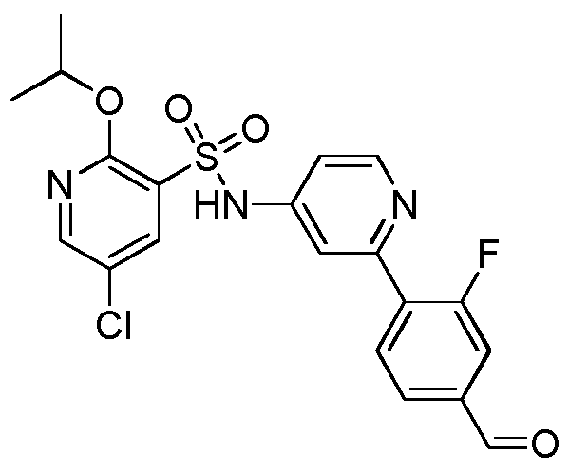
To a stirred solution of /V-(2-bromopyridin-4-yl)-5-chloro-2-isopropoxypyridine-3-sulfonamide (500 mg, 1.229 mmol) and (2-fluoro-4-formylphenyl)boronic acid (351 mg, 2.090 mmol) in isopropanol (7.5 mL) and water (2.5mL) in a sealed tube was added Na2C03 (391 mg, 3.69 mmol). The mixture was degassed with argon for 15 min at room temperature. PdCl2(dppf)-CH2Cl2 adduct (50 mg, 0.061 mmol) was added and the mixture was degassed again using argon for 10 min. The reaction mixture was heated in the sealed tube at 100 °C for 18 h. The mixture was filtered through celite, washed with MeOH (2 x 10 mL) and the solvent removed in vacuo. The residue was triturated with diethyl ether (2 x 15 mL) to afford the title compound (400 mg) as a brown solid.
LCMS (Method D) Rt = 2.39 min, [M+H]+ = 450.5. Intermediate 48

To isopropanol (20 mL) under nitrogen at room temperature was added solid sodium (0.5 g, 21.75 mmol) portionwise over 10 min. The reaction mixture was stirred at 40 °C for 30 minutes then N-(2- bromopyridin-4-yl)-2,5-dichloropyridine-3-sulfonamide (2 g, 5.22 mmol) was added at 40 °C. After stirring at 40 °C for 18 h, the mixture was cooled to 0 °C and 20 % aqueous citric acid (100 mL) was added slowly. The mixture was stirred at room temperature for 30 min and the resulting solid was removed by filtration. The filtrate was concentrated in vacuo to afford the title compound (1 g) as a brown solid.
LCMS (Method D) Rt = 2.50 min, [M+H]+ = 406.0/408.1.
Intermediate 49
rac-5-chloro-N -(2-(4-(((2S,6R)-2,6-dimethylmorpholino)methyl)-2- fluorophenyl)pyridin-4-yl)-2-methoxypyridine-3-sulfonamide

To a solution of 5-chloro-W-(2-(2-fluoro-4-formylphenyl)pyridin-4-yl)-2-methoxypyridine-3- sulfonamide (200 mg, 0.474 mmol), rac-(2R,6S)-2,6-dimethylmorpholine (82 mg, 0.711 mmol) in MeOH (0.2 mL) and acetic acid (5 mL) under nitrogen was added 2-picolineborane (75 mg, 0.711 mmol) portionwise at 0 °C. After stirring for 16 h at 50 °C, the mixture was quenched with saturated aqueous sodium bicarbonate solution (5 mL) and extracted with DCM (2 x 10 mL). The combined organic extracts were washed with brine (10 mL), dried over sodium sulfate, filtered and concentrated in vacuo to afford the title compound (150 mg) as a brown solid.
LCMS (Method D) Rt = 1.57 min, [M+H]+ = 519.1/521.0. Intermediate 50
2-fluoro-4-formylphenyl)pyridin-4-yl)pyridine-3-sulfonamide

A stirred solution of /V-(2-bromopyridin-4-yl)-5-chloro-2-ethoxypyridine-3-sulfonamide (900 mg, 2.292 mmol), (2-fluoro-4-formylphenyl)boronic acid (462 mg, 2.75 mmol) and NazCC (972 mg, 9.17 mmol) in isopropanol (10 mL) and water (3.33 mL) in a sealed tube was degassed with argon for 15 min at room temperature. PdCl2(dppf)-CH2Cl2 adduct (94 mg, 0.115 mmol) was added and the mixture was degassed again using argon for 10 min. The reaction mixture was heated in the sealed tube at 90 °C for 4 h. The mixture was filtered through celite, washed with 10% MeOH/DCM (50 mL) and the solvent removed in vacuo. The residue was triturated with diethyl ether (2 x 20 mL) to afford the crude product (900 mg). The crude product was used for next step directly.
Intermediate 51

To a solution of N-(5-chloropyridin-3-yl)-2-methoxy-5-morpholinopyridine-3-sulfonannicle (450 mg, 1.169 mmol), (4-formylphenyl)boronic acid (386 mg, 2.57 mmol) in 1,4-Dioxane (3 mL) and water (1 mL) in a sealed tube was added tripotassium phosphate (496 mg, 2.339 mmol). The reaction mixture was degassed with argon for 10 min. XPhos Palladacycle Gl (46.0 mg, 0.058 mmol) was added and the reaction mixture was degassed again with argon for 10 min. The reaction mixture was stirred at 100 °C for 16 h. The reaction mixture was filtered through celite and the filtrate was concentrated in vacuo. The residue was taken up in EtOAc (50 mL) and water (10 mL), stirred for 5 min then the organic phase was separated and concentrated in vacuo. The residue was triturated with diethyl ether (2 x 25 mL) to afford the title compound (300 mg) as an off-white solid.
LCMS (Method D) Rt = 1.95 min, [M+H]+ = 455.1. Intermediate 52
N-(5-(2-fluoro-4-formylphenyl)pyridin-3-yl)-2-methoxy-5-morpholinopyridine-3- sulfonamide

To N-(5-chloropyridin-3-yl)-2-methoxy-5-morpholinopyridine-3-sulfonamide (6 g, 15.6 mmol) and (2- fluoro-4-formylphenyl)boronic acid (5.24 g, 31.2 mmol) in ethanol (84 mL) and water (36 mL) in a sealed tube was added sodium carbonate (4.96 g, 46.8 mmol). The reaction mixture was degassed with argon for 10 min. XPhos Palladacycle Gl (0.613 g, 0.78 mmol) was added and the reaction mixture was degassed again with argon for 10 min. The reaction mixture was stirred at 130 °C for 18 h. The reaction mixture was cooled to room temperature and diluted with EtOAc (50 mL). The mixture was filtered through celite, washing with EtOAc (50 mL), and the filtrate was concentrated in vacuo. The reidue was taken up in water (100 mL) and EtOAc (100 mL). The organic phase was separated, dried over sodium sulfate, filtered and concentrated in vacuo. The residue material was triturated with MeOH (2 x 30 mL) and dried under vacuum to afford the title compound (1.6 g) as a brown solid.
LCMS (Method D) Rt = 1.96 min, [M+H]+ = 473.6.
Intermediate 53
2-ethoxy-N-(5-(2-fluoro-4-formylphenyl)pyridin-3-yl)-5-morpholinopyridine-3- sulfonamide

To a stirred solution of N-(5-chloropyridin-3-yl)-2-ethoxy-5-morpholinopyridine-3-sulfonamide (500 mg, 1.254 mmol) in 1,4-Dioxane (10 mL) and water (3 mL) was added (2-fluoro-4- formylphenyl)boronic acid (632 mg, 3.76 mmol) and tripotassium phosphate (664 mg, 3.13 mmol). The reaction mixture was degassed with argon for 30 min. XPhos Palladacycle Gl (99 mg, 0.125 mmol) was added and the reaction mixture was degassed again with argon for 30 min. The reaction mixture was stirred at 110 °C for 18 h. The reaction mixture was filtered through celite, washing with EtOAc (50 mL) and the filtrate was concentrated in vacuo. The crude material was triturated with diethyl ether (2 x 30 mL) and dried under vacuum to afford the title compound (250 mg) as a pale yellow solid.
LCMS (Method D) Rt = 2.12 min, [M+H]+ = 487.2. Intermediate 54
rac-(2S,6R)-tert-butyl-4-(3-fluoro-4-(5-(2-methoxy-5-morpholinopyridine-3-

To a stirred solution of N-(5-(2-fluoro-4-formylphenyl)pyridin-3-yl)-2-methoxy-5-morpholinopyridine- 3-sulfonamide (200 mg, 0.423 mmol) in MeOH (4 mL) and acetic acid (0.5 mL) was added rac-(2R,6S)- tert-butyl 2,6-dimethylpiperazine-l-carboxylate (available from Pharmablock, 181 mg, 0.847 mmol).
After stirring for 2 h at room temperature, 2-picolineborane (68 mg, 0.635 mmol) was added and the reaction mixture was heated to 50 °C for 16 h. The reaction mixture was filtered through celite, washing with MeOH (10 mL) and the solvent removed in vacuo. The crude material was purified by normal phase column chromatography on silica eluting with 20% EtOAc in petroleum ether. The appropriate fractions were combined and concentrated in vacuo to afford the title compound (100 mg) as a yellow solid.
LCMS (Method D) Rt = 2.30 min, [M+H]+ = 671.5. Example 1
Rac-2-ethoxy-N-(5-(2-fluoro-4-(((3S,5R)-3,4,5-trimethylpiperazin-l- yl)methyl)phenyl)pyridin-3-yl)-5-morpholinopyridine-3-sulfonamide

To a solution of /V-(5-chloropyridin-3-yl)-2-ethoxy-5-morpholinopyridine-3-sulfonamide (14.0 g, 35.1 mmol) and (2S,6R)-4-(3-fluoro-4-(4,4,5,5-tetramethyl-l,3,2-dioxaborolan-2-yl)benzyl)-l,2,6- trimethylpiperazine (15.3 g, 42.1 mmol) in THF (210 mL) and water (90 mL) in a sealed tube was added sodium carbonate (11.2 g, 105 mmol). The reaction mixture was degassed with argon for 10 min. XPhos Palladacycle Gl (1.30 g, 1.75 mmol) was added and the reaction mixture was degassed again with argon for 10 min. The reaction mixture was stirred at 90 °C for 18 hr. The reaction mixture was cooled to room temperature, diluted with EtOAc (250 mL) and filtered through celite washing with more EtOAc (250 mL). The filtrate was concentrated in vacuo and the residue was diluted with water (50 mL), acidifed by the addition of 2 M aqueous HCI (100 mL) and washed with EtOAc (2 x 500 mL). The aqueous phase was basified by the addition of aqueous ammonia solution (100 mL) and extracted with 10: 1 DCM:MeOH (2 x 1000 mL). The combined organic extracts were dried over sodium sulfate, filtered and concentrated in vacuo. The residue was triturated with MeOH (2 x 25 mL) and dried under vacuum. The reaction was repeated on 4 g scale and the combined crude batches were taken up in DMSO (200 mL). The solution was heated to 90 °C then cooled to room temperature and stirring was continued for 18 h. The resulting solid was isolated by filtration, washing with IPA (20 mL), then dried under vacuum to afford the title compound (6.3 g) as a white solid.
LCMS (Method K) Rt = 2.95 min, [M+H]+ = 599.4.
Example 2
Rac-2-ethoxy-5-morpholino-N-(5-(4-(((3S,5R)-3,4,5-trimethylpiperazin-l-

/V-(5-Chloropyridin-3-yl)-2-ethoxy-5-morpholinopyridine-3-sulfonamide (50 mg, 0.125 mmol), (4- (((3S,5R)-3,4,5-trimethylpiperazin-l-yl)methyl)phenyl)boronic acid (53 mg, 0.182 mmol), XPhos Palladacycle G2 (5 mg, 6.35 μιτιοΙ), tripotassium phosphate (80 mg, 0.376 mmol) in 1,4-Dioxane (1 mL) and Water (0.2 mL) were added to a microwave vial and degassed with nitrogen for 10 min. The reaction vessel was sealed and heated in a Biotage Initiator to 100 °C for 1 h. The reaction mixture was filtered through celite and the filtrate was concentrated under a stream of nitrogen. The residue was purified by Mass Directed Automated Preparative HPLC (Method A). Collected fractions were concentrated in vacuo to afford the title compound (48 mg) as a white solid.
LCMS (Method B) Rt = 0.75 min, [M+H]+ = 581.1.
Example 3
N-(5-(4-((4-(tert-Butyl)piperazin-l-yl)methyl)phenyl)pyridin-3-yl)-2-methoxy-5-

/V-(5-Chloropyridin-3-yl)-2-methoxy-5-morpholinopyridine-3-sulfonamide (90 mg, 0.234 mmol), 1- (tert-butyl)-4-(4-(4,4,5,5-tetramethyl-l,3,2-dioxaborolan-2-yl)benzyl)piperazine (126 mg, 0.351 mmol), sodium carbonate (99 mg, 0.935 mmol), XPhos Palladacycle Gl (17.28 mg, 0.023 mmol), EtOH (4 mL) and water (1 mL) were added to a microwave vial. The reaction vessel was sealed and
heated in a Biotage Initiator to 100 °C for 30 min. The reaction mixture was filtered through celite and the filtrate was concentrated in vacuo. The residue was purified by Mass Directed Automated Preparative HPLC (Method A). Collected fractions were concentrated in vacuo. The residue was purified by Preparative HPLC (Method C). Combined fractions were concentrated in vacuo to remove acetonitrile and the residual aqueous solution was basified with aqueous ammonia solution (Specific Gravity 0.880) to ca. pH 10 and partitioned between saturated sodium chloride solution (50 imL) and DCM (200 imL). The aqueous layer was further extracted with DCM (3 x 200 imL) and the combined organic extracts were dried over anhydrous sodium sulphate, filtered and concentrated in vacuo. The residue was re-dissolved in a minimal amount of dichloromethane (ca. 2-3 mL) and precipitated using a mixture of diethyl ether (5 mL) and n-hexane (10 mL). The solvents were removed under a stream of nitrogen and the solid dried under vacuum to afford the title compound (58 mg) as a colourless solid.
LCMS (Method A) Rt = 0.56 min, [M+H]+ = 581.6.
Example 4
zin-l-yl)methyl)phenyl)pyridin-3-yl)-2-methoxy-5-
N-(5-

N-(5-Chloropyridin-3-yl)-2-methoxy-5-morpholinopyridine-3-sulfonamide (101 mg, 0.262 mmol), (2- fluoro-4-((4-methylpiperazin-l-yl)methyl)phenyl)boronic acid (106 mg, 0.420 mmol), tripotassium phosphate (113 mg, 0.532 mmol), XPhos Palladacycle Gl (20.5 mg, 0.028 mmol), 1,4-dioxane (4 mL) and water (1 mL) were added to a microwave vial. The reaction vessel was sealed and heated in a Biotage Initiator Microwave using initial high absorption to 130 °C for 45 minutes. The reaction mixture was filtered through celite, washing with MeOH, and the filtrate was concentrated in vacuo. The residue was purified by Mass Directed Automated Preparative HPLC (Method B). Collected fractions were concentrated in vacuo to afford the title compound (52 mg) as a white solid.
LCMS (Method A) Rt = 0.57 min, [M+H]+ = 557
Example 5
N-(5-(2-Fluoro-4-((4-isopropylpiperazin-l-yl)methyl)phenyl)pyridin-3-Yl)-2-methoxy-5-

l-(3-Fluoro-4-(4,4,5,5-tetramethyl-l,3,2-dioxaborolan-2-yl)benzyl)-4-isopropylpiperazine (424 mg, 1.17 mmol), N-(5-chloropyridin-3-yl)-2-methoxy-5-morpholinopyridine-3-sulfonamide (300 mg, 0.78 mmol), XPhos Palladacycle Gl (10 mg, 0.014 mmol), tripotassium phosphate (331 mg, 1.56 mmol), 1,4-Dioxane (3 mL) and Water (1 mL) were added to a microwave vial. The reaction vessel was sealed and heated in a Biotage Initiator to 130 °C for 30 min. The reaction mixture was filtered through celite, washing with MeOH (30 mL). The filtrate was concentrated in vacuo and the residue was taken up in water (30 mL) and extracted with DCM (5 x 30 mL). The combined organic extracts were dried by passing through a hydrophobic frit and concentrated in vacuo. The residue was purified by Mass Directed Automated Preparative HPLC (Method B). Collected fractions were concentrated in vacuo and the residue was purified further by reverse phase C18 silica chromatography eluting with a gradient of 0 to 50% MeCN (containing 0.1% NH3) in water (with an ammonium bicarbonate modifier adjusted to pH 10). The appropriate fractions were combined and re-purified by Mass Directed Automated Preparative HPLC (Method A). Collected fractions were concentrated in vacuo and the residue was purified further by reverse phase C18 silica chromatography eluting with a gradient of 0 to 95% MeCN (containing 0.1% NH3) in water (with an ammonium bicarbonate modifier adjusted to pH 10). The appropriate fractions were combined and concentrated in vacuo to afford the title compound (12 mg) as a white solid.
LCMS (Method A) Rt = 0.56 min, [M+H]+ = 585.5.
Example 6
N-(5-(3-Fluoro-4-((4-isopropylpiperazin-l-yl)methyl)phenyl)pyridin-3-yl)-2-methoxy-5-

LCMS (Method A) Rt = 0.58 min, [M+H]+ = 585.6.
Example 7
N-(5-(4-((4-Isopropylpiperazin-l-yl)methyl)phenyl)pyridin-3-yl)-2-methoxy-5-

2-Dicyclohexylphosphino-2',6'-diisopropoxybiphenyl (88 mg, 0.19 mmol) and Pd(OAc)2 (21 mg, 0.094 mmol) were added to a stirred solution of 5-chloro-N-(5-(4-((4-isopropylpiperazin-l- yl)methyl)phenyl)pyridin-3-yl)-2-methoxypyridine-3-sulfonamide (496 mg, 0.96 mmol), sodium tert- butoxide (557 mg, 5.80 mmol) and morpholine (0.17 mL, 1.97 mmol) in toluene (7 mL). The resulting reaction mixture was stirred at 90 °C for 2 h. The reaction mixture was diluted with MeOH (5 mL), activated charcoal (0.15 g) was added and the mixture was shaken for 45 min. The reaction mixture was filtered and concentrated in vacuo. The product was split into two batches, each dissolved in a minimum volume of MeOH and precipitated with diethyl ether. The resulting slurries were aged in a fridge for between 4-18 h and the resulting solid was filtered and dried to afford the title compound (371 mg) as an off-white solid.
LCMS (Method B) Rt = 0.73 min, [M+H]+ = 567.6.
Example 8

A solution of rac-5-chloro-/V-(2-(4-(((3S,5R)-4-ethyl-3,5-dimethylpiperazin-l-yl)methyl)-2- fluorophenyl)pyridin-4-yl)-2-methoxypyridine-3-sulfonamide (30 g, 54.7 mmol) and sodium tert- butoxide (15.78 g, 164 mmol) in anhydrous toluene (300 mL) was degassed using argon for 20 min. Pd2(dba)3 (2.506 g, 2.74 mmol) and [l,l'-biphenyl]-2-yldi-tert-butylphosphine (3.27 g, 10.95 mmol) were added followed by morpholine (47.7 mL, 547 mmol). The resulting reaction mixture was stirred in sealed tube at 110 °C for 6 h. The mixture was filtered through celite, washed with 10: 1 DCM:MeOH (200 mL) and the solvent removed in vacuo. The residue was taken up in 2 M aqueous HCI (250 mL) and the aqueous phase was extracted with EtOAc (2 x 600 mL). 25% aqueous ammonia solution (200 mL) was added and the aqueous phase was extracted with 10:1 DCM:MeOH (2 x 500 mL). The combined organic extracts were dried over sodium sulfate, filtered and concentrated in vacuo. The reaction was repeated on 5 g scale and the combined crude batches were pre-adsorbed onto silica gel (100 g, 100-200 mesh) and purified by normal phase column chromatography on silica gel (500 g, 100-200 mesh) eluting with 0-10% 7 M ammonia in methanol/DCM. The desired fractions were combined and concentrated in vacuo. The residue was further purified by Preparative-SFC (Method A). Collected fractions were concentrated in vacuo and the residue was suspended in 7:3 MeCN:EtOAc (600 mL). The suspension was heated to 70 °C for 15 min then the resulting clear solution was allowed to cool to room temperature and was left standing for 48 h. The resulting precipitate was collected by vacuum filtration and the isolated solid was suspended in in 7:3 MeCN:EtOAc (480 mL). The suspension was heated to 70 °C for 15 min then the resulting clear solution was allowed to cool to room temperature and was left standing for 48 h. The resulting precipitate was collected by vacuum filtration to afford the title compound (10.65 g) as a white solid.
LCMS (Method K) Rt = 3.19 min, [M+H]+ = 599.2. Example 9
rac-yv-f2-f2-Fluoro-4-(((3S,5RV3,4,5-trimethylpiperazin-l-ylmethylphenylpyridin-4- yl)-2-methoxy-5-morpholinopyridine-3-sulfonamide

To a stirred solution of /V-(2-(2-fluoro-4-formylphenyl)pyridin-4-yl)-2-methoxy-5-morpholinopyridine- 3-sulfonamide (200 mg, 0.423 mmol) in MeOH (2 mL) and acetic acid (0.5 mL) was added rac-(2R,6S)- 1,2,6-trimethylpiperazine (54 mg, 0.423 mmol) and 2-picolineborane (68 mg, 0.635 mmol). After stirring for 18 h at 50 °C, the solvent was removed in vacuo and the residue was purified by Preparative HPLC (Method E). Collected fractions were lyophilized to afford the title compound (58 mg) as a white solid. LCMS (Method D) Rt = 3.48 min, [M+H]+ = 585.3. Example 10
rac-N -(2-(4-(((3S,5R)-3,5-Dimethylpiperazin-l-yl)methyl)-2-fluorophenyl)pyridin-4-yl)-

To a stirred solution of rac-(2S,6R)-tert-butyl 4-(3-fluoro-4-(4-(2-methoxy-5-morpholinopyridine- 3-sulfonamido)pyridin-2-yl)benzyl)-2,6-dimethylpiperazine-l-carboxylate (140 mg, 0.209 mmol) in DCM (5 mL) at 0 °C was added TFA (0.080 mL, 1.044 mmol). The mixture was allowed to warm to room temperature and stirring was continued for 16 h. The mixture was concentrated in vacuo and the residue was purified by Preparative HPLC (Method F). Collected fractions were lyophilized to afford the title compound (17 mg) as an off-white solid.
LCMS (Method D) Rt = 3.44 min, [M+H]+ = 571.2. Example 11
rac-yv-(2-(2-Fluoro-4-(((3S,5R)-4-isopropyl-3,5-dimethylpiperazin-l-

To a stirred solution of /V-(2-(2-fluoro-4-formylphenyl)pyridin-4-yl)-2-methoxy-5-morpholinopyridine- 3-sulfonamide (220 mg, 0.466 mmol) and rac-(2S,6R)-l-isopropyl-2,6-dimethylpiperazine (109 mg, 0.698 mmol) in DCM (10 mL) was added sodium sulfate (198 mg, 1.397 mmol). After stirring for 2 h at room temperature, the mixture was cooled to 0 °C and sodium triacetoxyborohydride (247 mg, 1.164 mmol) was added. The mixture was stirred at room temperature for 16 h then saturated aqueous sodium bicarbonate (10 mL) was added, followed by DCM (100 mL). The organic phase was separated, washed with brine (2 x 50 mL), dried over sodium sulfate, filtered and concentrated in vacuo. The residue was purified by Preparative HPLC (Method G). Collected fractions were concentrated in vacuo to afford the title compound (79 mg) as an off-white solid.
LCMS (Method D) Rt = 1.46 min, [M+H]+ = 613.3.
Example 12
rac-yv-(5-(2-Fluoro-4-(((3R,5S)-3,4,5-trimethylpiperazin-l-yl)methyl)phenyl)pyridin-3-

To a stirred solution of N-(5-(2-fluoro-4-formylphenyl)pyridin-3-yl)-2-methoxy-5-morpholinopyridine- 3-sulfonamide (300 mg, 0.635 mmol) in MeOH (2 mL) and acetic acid (0.5 mL) was added rac-(2R,6S)- 1,2,6-trimethylpiperazine (90 mg, 0.698 mmol) and 2-picolineborane (102 mg, 0.952 mmol). After stirring for 18 h at 50 °C, the solvent was removed in vacuo and the residue was taken up in water (15 mL) and the aqueous phase was extracted with EtOAc (2 x 150 mL). The combined organic extracts were washed with brine, dried over sodium sulfate, filtered and concentrated in vacuo. The
crude material was purified by Preparative HPLC (Method I). Collected fractions were lyophilized to afford the title compound (98 mg) as a white solid.
LCMS (Method D) Rt = 3.75 min, [M+H]+ = 585.3.
Example 13
rac-A/-(5-(4-(((3S,5R)-3,5-Dimethylpiperazin-l-yl)methyl)-2-fluorophenyl)pyridin-3-yl)-

To a stirred solution of rac-(2S,6R)-tert-butyl 4-(3-fluoro-4-(5-(2-methoxy-5-morpholinopyridine-3- sulfonamido)pyridin-3-yl)benzyl)-2,6-dimethylpiperazine-l-carboxylate (100 mg, 0.149 mmol) in DCM (5 ml_) at 0 °C was added TFA (0.057 ml_, 0.745 mmol). The mixture was allowed to warm to room temperature and stirring was continued for 16 h. The mixture was concentrated in vacuo and the residue was purified by Preparative HPLC (Method J). Collected fractions were lyophilized to afford the title compound (47 mg) as a white solid.
LCMS (Method L) Rt = 3.62 min, [M+H]+ = 571.1. Example 14
rac-/V-(5-(4-(((2S,6R)-2,6-Dimethylmorpholino)methyl)-2-fluorophenyl)pyridin-3-yl)-2-

To a stirred solution of N-(5-(2-fluoro-4-formylphenyl)pyridin-3-yl)-2-methoxy-5-morpholinopyridine 3-sulfonamide (200 mg, 0.423 mmol) in MeOH (2 mL) and acetic acid (0.5 mL) was added rac-(2S,6R)
2,6-dimethylmorpholine (54 mg, 0.466 mmol) and 2-picolineborane (68 mg, 0.635 mmol). After stirring for 18 h at room temperature, the solvent was removed in vacuo and the residue was taken up in ice water (15 mL) and stirred for 30 min at room temperature. The resulting solid was isolated by filtration, washed with diethyl ether (3 x 20 mL) and dried under vacuum. The crude material was purified by Preparative HPLC (Method I). Collected fractions were lyophilized to afford the title compound (93 mg) as a white solid.
LCMS (Method D) Rt = 4.31 min, [M+H]+ = 572.2. Example 15
rac-A/-(5-(4-(((2S,6R)-2,6-Dimethylmorpholino)methyl)-2-fluorophenyl)pyridin-3-yl)-2-

To a stirred solution of 2-ethoxy-N-(5-(2-fluoro-4-formylphenyl)pyridin-3-yl)-5-morpholinopyridine-3- sulfonamide (250 mg, 0.514 mmol) in MeOH (2 mL) and acetic acid (0.5 mL) was added rac-(2S,6R)- 2,6-dimethylmorpholine (59 mg, 0.514 mmol). After stirring at room temperature for 2 h, 2- picolineborane (82 mg, 0.771 mmol) was added and stirring was continued for 16 h at room temperature. The solvent was removed in vacuo and the crude material was purified by Preparative HPLC (Method K). Collected fractions were lyophilized to afford the title compound (60 mg) as a white solid.
LCMS (Method D) Rt = 1.74 min, [M+H]+ = 586.4. Example 16
V-(5-(4-((3.3-Dimethylpyrrolidin-l-yl)methyl)-2-fluorophenyl)pyridin-3-yl)-2-methoxy- 5-morpholinopyridine-3-sulfonamide

N-(5-(2-Fluoro-4-formylphenyl)pyridin-3-yl)-2-methoxy-5-morpholinopyridin (71 mg,
0.15 mmol) was added to 3,3-dimethylpyrrolidine (15 mg, 0.15 mmol) and 2-picolineborane (16 mg, 0.15 mmol) in MeOH (0.45 mL) and acetic acid (0.05 mL) was added. After stirring for 2 h at 20 °C, more 3,3-dimethylpyrrolidine (15 mg, 0.15 mmol) and 2-picolineborane (16 mg, 0.15 mmol) were added. After stirring for a further 6 h at 20 °C, the solvent was removed under a stream of nitrogen and the crude material was purified by Mass Directed Automated Preparative HPLC (Method A). Collected fractions were concentrated in vacuo to afford the title compound (44 mg) as a solid.
LCMS (Method A) Rt = 0.62 min, [M+H]+ = 556.3.
Similarly prepared was:


Example 18
/V-(5-(3-Fluoro-4-((4-methylpiperazin-l-yl)methyl)phenyl)pyridin-3-yl)-2-methoxy-5-

1- (2-Fluoro-4-(4^5,5-tetramethyl-l,3,2-dioxaborolan-2-yl)benzyl)-4-methylpiperazine (130 mg, 0.390 mmol), /V-(5-chloropyridin-3-yl)-2-methoxy-5-morpholinopyridine-3-sulfonamide (100 mg, 0.260 mmol), XPhos Palladacycle Gl (10 mg, 0.014 mmol), tripotassium phosphate (120 mg, 0.565 mmol), 1,4-Dioxane (5 mL) and water (0.8 ml.) were added to a microwave vial. The reaction vessel was sealed and heated in a Biotage Initiator to 100 °C for 30 min. The reaction mixture was partitioned between water (20 mL) and DCM (20 mL). The layers were separated and the aqueous phase was extracted with DCM (2 x 10 mL). The combined organic extracts were dried by passing through a hydrophobic frit and concentrated in vacuo. The residue was purified by Mass Directed Automated Preparative HPLC (Method B). Collected fractions were concentrated in vacuo and the residue was purified further by reverse phase C18 silica chromatography eluting with a gradient of 5 to 85% MeCN (containing 0.1% Nhb) in water (with an ammonium bicarbonate modifier adjusted to pH 10). The appropriate fractions were combined and concentrated in vacuo to afford the title compound (51 mg) as a white solid. LCMS (Method A) Rt = 0.56 min, [M+H]+ = 557.5.
Example 19
2- Methoxy-yv-(5-(4-((4-methylpiperazin-l-yl)methyl)phenyl)pyridin-3-yl)-5- morpholinopyridine-3-sulfonamide

LCMS (Method B) Rt = 0.65 min, [M+H]+ = 539.4. Example 20
2- (Dimethylamino)-/V-(5-(4-((4-isopropylpiperazin-l-yl)methyl)phenyl)pyridin-3-yl)-5-

LCMS (Method A) Rt = 0.56 min, [M+H]+ = 580.8.
Example 21
rac-yv-(2-(2-Fluoro-4-(((3S,5R)-3,4,5-trimethylpiperazin-l-Yl)methyl)phenyl)pyridin-4-

A solution of rac-5-chloro-N-(2-(2-fluoro-4-(((3S,5R)-3,4,5-trimethylpiperazin- lyl)methyl)phenyl)pyridin-4-yl)-2-isopropoxypyridine-3-sulfonannide (200 mg, 0.356 mmol), sodium tert-butoxide (103 mg, 1.067 mmol) and morpholine (0.062 mL, 0.712 mmol) in anhydrous toluene (10 mL) was degassed using argon for 30 min. 2-Dicyclohexylphosphino-2',6'-diisopropoxybiphenyl (17 mg, 0.036 mmol) and Pd(OAc)2 (4 mg, 0.018 mmol) were added. The resulting reaction mixture was stirred in sealed tube at 90 °C for 18 h. The mixture was filtered through celite, washing with EtOAc (20 mL) and the solvent removed in vacuo. The residue was triturated with a minimum amount of diethyl ether. The reaction was repeated on 2 x 100 mg scale and the combined crude batches were purified by Preparative HPLC (Method D). Collected fractions were lyophilized to afford the title compound (20 mg) as a white solid.
LCMS (Method D) Rt = 1.59 min, [M+H]+ = 613.4.
Example 22
/V-(5-(4-((4-Ethylpiperazin-l-yl)methyl)phenyl)pyridin-3-yl)-2-methoxy-5-

To a stirred solution of N-(5-(4-formylphenyl)pyridin-3-yl)-2-methoxy-5-morpholinopyridine-3- sulfonamide (100 mg, 0.220 mmol) in MeOH (10 mL) were added 4A molecular seives (50 mg) and 1-ethylpiperazine (27.6 mg, 0.242 mmol). The reaction mixture was stirred for 2 h at room
temperature then the reaction mixture was cooled to 0°C and NaCNBhU (34.6 mg, 0.550 mmol) was added. The reaction mixture was heated at 50°C for 16 h then filtered through celite, washing with EtOAc, and the filtrate was concentrated in vacuo. The reaction was repeated on 50 mg scale and the combined crude batches were purified by Preparative HPLC (Method H). Collected fractions were lyophilized to afford the title compound (23 mg) as an off-white solid.
LCMS (Method D) Rt = 1.38 min, [M+H]+ = 553.1.
Similarly prepared were:

e
Example 25
/V-f5-f2-Fluoro-4-((2-methylpyrrolidin-l-vnmethvnphenvnpyridin-3-vn-2-methoxy-5-

N-(5-(2-Fluoro-4-formylphenyl)pyridin-3-yl)-2-methoxy-5-morpholinopyridin (47 mg,
0.10 mmol) was added to 2-methylpyrrolidine (9 mg, 0.15 mmol) and 2-picolineborane (11 mg, 0.10 mmol) in MeOH (0.45 mL) and acetic acid (0.05 mL) was added. After stirring for 2 h at 20 °C, more 2-picolineborane (16 mg, 0.15 mmol) was added. After stirring for a further 24 h at 20 °C, the solvent was removed under a stream of nitrogen and the crude material was purified by Mass Directed Automated Preparative HPLC (Method A). Collected fractions were concentrated in vacuo to afford the title compound (37 mg) as a solid. LCMS (Method A) Rt = 0.58 min, [M+H]+ = 542.3.
Similarly prepared was:


The following compounds were also prepared by similar methods:


BIOLOGICAL DATA PI3K HTRF assay
The binding of compounds to PI3K-alpha/beta/delta/gamma is determined by homogeneous time resolved fluorescence (HTRF) assays as follows;
Briefly, solid compound is dissolved in 100% DMSO at a concentration of 2mM. Dilutions are prepared in 100% DMSO using a 1 in 4 serial step dilution. The dilutions are transferred to black low volume Greiner assay plates ensuring that the DMSO concentration is constant across the plate at 1% (O.lul/well).
PI3K Reaction Buffer (contains 50mM HEPES pH7.0 (NaOH), 150mM NaCI, lOmM MgCI2,
2.3mM sodium cholate, 10μΜ CHAPS made up in milliQ water). Fresh DTT is added at a final concentration of ImM on the day of use. Wortmannin at a concentration sufficient to produce 100% inhibition (8.33e-6 M) is added to column 18 of compound plates.
Enzyme solutions: IX PI3K assay Buffer containing:
· 550pM PI3K-Alpha enzyme (275pM final assay concentration)
• 800pM PI3K-Beta enzyme (400pM final assay concentration)
• 3nM PI3K-Delta enzyme (1.5nM final assay concentration)
• 10ηΜ PI3K-Gamma enzyme (5nM final assay concentration)
These concentrations are optimal to achieve a signakbackground of between 1.5-4.5. The enzyme solution is added to columns 1-24 (3ul/well) and plates are incubated for 15 minutes at room temperature.
Substrate solution: IX PI3K assay buffer containing:
• PI3K-Alpha: 500μΜ ATP, 20μΜ PIP2 and 120nM biotin-PIP3. (Final assay concentrations are 250μΜ ATP, 10μΜ PIP2 (both at Km) and 40nM biotin-PIP3)
· PI3K-Beta: 800μΜ ATP, 20μΜ PIP2 and 120nM biotin-PIP3. (Final assay concentrations are 400μΜ ATP, 10μΜ PIP2 (both at Km) and 40nM biotin-PIP3)
• PI3K-Delta: 160μΜ ATP, 20μΜ PIP2 and 120nM biotin-PIP3. (Final assay concentrations are 80μΜ ATP, 10μΜ PIP2 (both at Km) and 40nM biotin-PIP3)
• PI3K-Gamma: 30μΜ ATP, 20μΜ PIP2 and 120nM biotin-PIP3. (Final assay concentrations are 15μΜ ATP, 10μΜ PIP2 (both at Km) and 40nM biotin-PIP3)
This is added to all wells and plates are incubated for 1 hour at room temperature.
Detection solution: PI3K Detection Buffer (contains 50mM HEPES pH7.0 (HCI), 150mM NaCI, 2.3mM sodium cholate, 10μΜ CHAPS, 240mM potassium fluoride) containing 2mM DTT (2X final concentration), 90nM GRP-1 PH domain, 300nM Streptavidin-APC and 24nM Europium-anti-GST (6X final concentrations)
This is mixed left at room temperature (protected from light).
STOP solution: PI3K STOP Buffer (contains 50mM HEPES pH7.0 (HCI), 150mM NaCI, 2.3mM sodium cholate, 10μΜ CHAPS, 150mM EDTA).
Detection solution is diluted 1: 1 with STOP solution and added to all wells (3 l/well). Plates are covered and incubated on the bench for 45-60 minutes.
Plates are read on a PerkinElmer Envision, measuring TR-FRET between the complex formed between the GST-tagged PH domain and biotinylated PIP3 which both recruit fluorophores (Europium- labelled anti-GST & Strep-APC respectively). In the presence of an inhibitor, this complex is disrupted by the competitive action of non-biotinylated PIP3 (formed in the assay by the phosphorylation of PIP2 by the kinase & ATP). From this, the ratio of acceptor/donor was calculated (Aex = 317nm, Aem donor = 615nm, em acceptor = 665nm) and used for data analysis.
The compounds and salts of Examples 1 to 28 were tested in the PI3K Alpha, Beta, Delta and/or Gamma assays above or similar assays and were found to have a mean pICso in the PI3K Delta assay of at least 5 or greater. Examples 1 to 17, 23 to 24 and 26 to 28 were found to have a mean
PIC50 in the PI3K Delta assay of at least 8.5 or greater. For example, Example 1 was found to have a mean pICso in the PI3K Delta assay of 9.1.
Claims
Claims 1 . A compound of formula (I)

wherein

R2 is hydrogen;
R3, R4, R5 and R6 are each independently selected from hydrogen and halogen;
when A is

R7 and R8 are each independently C1-6alkyl, or
R7 and R8, together with the nitrogen atom to which they are attached, are linked to form a 5- or 6-membered heterocyclyl wherein the 5- or 6-membered heterocyclyl optionally contains an oxygen atom or a further nitrogen atom and is substituted by from one to three substituents independently selected from C1-6alkyl, or
when A is

R7 and R8, together with the nitrogen atom to which they are attached, are linked to form a 5- or 6- membered heterocyclyl wherein the 5- or 6-membered heterocyclyl optionally contains a further nitrogen atom and is substituted by two or three substituents independently selected from C1-6alkyl; or a salt thereof.
2. A compound according to claim 1, or a salt thereof, wherein A is

3. A compound according to claim 1 or claim 2, or a salt thereof, wherein R1 is C1-6alkoxy. 4. A compound according to any one of the preceding claims, or a salt thereof, wherein
R3, R4, R5 and R6 are each independently selected from hydrogen and fluoro.
5. A compound according to any one of claims 2 to 4 wherein R7 and R8, together with the nitrogen atom to which they are attached, are linked to form a 5- or 6-membered heterocyclyl wherein the 5- or 6-membered heterocyclyl optionally contains a further nitrogen atom and is optionally substituted by from one to three substituents selected from Ci-6alkyl.
6. A compound which is:
2-ethoxy-N-(5-(2-fluoro-4-(((3S,5R)-3,4,5-trimethylpiperazin-l-yl)methyl)phenyl)pyridin-3-yl)-5- morpholinopyridine-3-sulfonamide;
2- ethoxy-5-morpholino-N-(5-(4-(((3S,5R)-3,4,5-trimethylpiperazin-l-yl)methyl)phenyl)pyridin-3- yl)pyridine-3-sulfonamide;
/V-(5-(4-((4-(tert-butyl)piperazin-l-yl)methyl)phenyl)pyridin-3-yl)-2-methoxy-5-morpholinopyridine-
3- sulfonamide;
/V-(5-(2-fluoro-4-((4-methylpiperazin-l-yl)methyl)phenyl)pyridin-3-yl)-2-methoxy-5- morpholinopyridine-3-sulfonamide;
N-(5-(2-fluoro-4-((4-isopropylpiperazin-l-yl)methyl)phenyl)pyridin-3-yl)-2-methoxy-5- morpholinopyridine-3-sulfonamide;
N-(5-(3-fluoro-4-((4-isopropylpiperazin-l-yl)methyl)phenyl)pyridin-3-yl)-2-methoxy-5- morpholinopyridine-3-sulfonamide;
N-(5-(4-((4-isopropylpiperazin-l-yl)methyl)phenyl)pyridin-3-yl)-2-methoxy-5-morpholinopyridine-3- sulfonamide;
N-(2-(4-(((3S,5R)-4-ethyl-3,5-dimethylpiperazin-l-yl)methyl)-2-fluorophenyl)pyridin-4-yl)-2- methoxy-5-morpholinopyridine-3-sulfonamide;
N-(2-(2-fluoro-4-(((3S,5R)-3,4,5-trimethylpiperazin-l-yl)methyl)phenyl)pyridin-4-yl)-2-methoxy-5- morpholinopyridine-3-sulfonamide;
N-(2-(4-(((3S,5R)-3,5-dimethylpiperazin-l-yl)methyl)-2-fluorophenyl)pyridin-4-yl)-2-methoxy-5- morpholinopyridine-3-sulfonamide;
N-(2-(2-fluoro-4-(((3S,5R)-4-isopropyl-3,5-dimethylpiperazin-l-yl)methyl)phenyl)pyridin-4-yl)-2- methoxy-5-morpholinopyridine-3-sulfonamide;
N-(5-(2-fluoro-4-(((3R,5S)-3,4,5-trimethylpiperazin-l-yl)methyl)phenyl)pyridin-3-yl)-2-methoxy-5- morpholinopyridine 3-sulfonamide;
N-(5-(4-(((3S,5R)-3,5-dimethylpiperazin-l-yl)methyl)-2-fluorophenyl)pyridin-3-yl)-2-methoxy-5- morpholinopyridine-3-sulfonamide;
N-(5-(4-(((2S,6R)-2,6-dimethylmorpholino)methyl)-2-fluorophenyl)pyridin-3-yl)-2-methoxy-5- morpholinopyridine-3-sulfonamide;
N-(5-(4-(((2S,6R)-2,6-dimethylmorpholino)methyl)-2-fluorophenyl)pyridin-3-yl)-2-ethoxy-5- morpholinopyridine-3-sulfonamide;
N-(5-(4-((3,3-dimethylpyrrolidin-l-yl)methyl)-2-fluorophenyl)pyridin-3-yl)-2-methoxy-5- morpholinopyridine-3-sulfonamide;
N-(5-(4-((3-ethylpyrrolidin-l-yl)methyl)-2-fluorophenyl)pyridin-3-yl)-2-nnethoxy-5- morpholinopyridine-3-sulfonamide;
N-(5-(3-fluoro-4-((4-methylpiperazin-l-yl)methyl)phenyl)pyridin-3-yl)-2-rriethoxy-5- morpholinopyridine-3-sulfonamide;
2-methoxy-N^5-(4-((4-methylpiperazin-l-yl)methyl)phenyl)pyridin-3-yl)-5-morpholinopyridine-3- sulfonamide;
2-(dimethylamino)-N-(5-(4-((4-isopropylpiperazin-l-yl)methyl)phenyl)pyridin-3-yl)^
morpholinopyridine-3-sulfonamide;
N-(2-(2-fluoro-4-(((3S,5R)-3,4,5-trimethylpiperazin-l-yl)methyl)phenyl)pyridin-4-yl)-2-isopropoxy-5- morpholinopyridine-3-sulfonamide;
N-(5-(4-((4-ethylpiperazin-l-yl)methyl)phenyl)pyridin-3-yl)-2-methoxy-5-morpholinopyridine-3- sulfonamide;
N-(5-(4-((3,4-dimethylpiperazin-l-yl)methyl)phenyl)pyridin-3-yl)-2-methoxy-5-morph
sulfonamide;
2-methoxy-5-morpholino-N-(5-(4-(((3R,5S)-
3,4,5-trimethylpiperazin-l-yl)methyl)phenyl)pyridin-3-yl)pyridine-3-sulfonamide;
N-(5-(2-fluoro-4-((2-methylpyrrolidin-l-yl)methyl)phenyl)pyridin-3-yl)-2-methoxy-5- morpholinopyridine-3-sulfonamide;
(R)-N-(5-(2-fluoro-4-((3-methylpyrrolidin-l-yl)methyl)phenyl)pyridin-3-yl)-2-methoxy-5- morpholinopyridine-3-sulfonamide;
(S)-N-(5-(2-fluoro-4-((3-methylpyrrolidin-l-yl)methyl)phenyl)pyridin-3-yl)-2-methoxy-5- morpholinopyridine-3-sulfonamide;

salt thereof.
A connpound which is:

or a salt thereof
8. A compound according to any one of claims 1 to 8 in the form of a pharmaceutically acceptable salt thereof.
9. A pharmaceutical composition comprising a compound as defined in any one of claims 1 to 7, or a pharmaceutically acceptable salt thereof, and one or more pharmaceutically acceptable excipients.
10. A compound as defined in any one of claims 1 to 7, or a pharmaceutically acceptable salt thereof, for use in medical therapy.
11. A compound as defined in any one of claims 1 to 7, or a pharmaceutically acceptable salt thereof, for use in the treatment of a disorder mediated by inappropriate PI3-kinase activity.
12. Use of a compound as defined in any one of claims 1 to 7, or a pharmaceutically acceptable salt thereof, in the manufacture of a medicament for use in the treatment of a disorder mediated by inappropriate PI3-kinase activity.
13. A method of treating a disorder mediated by inappropriate PI3-kinase activity comprising administering a compound as defined in any one of claims 1 to 7, or a pharmaceutically acceptable salt thereof, to a patient in need thereof. 14. A method according to claim 13 wherein the disorder mediated by inappropriate PI3-kinase activity is a respiratory disease, a ciliopathy, a bacterial infection or bacterial exacerbation of a respiratory condition or lung damage, a viral infection or viral exacerbation of a respiratory condition or lung damage, a non-viral respiratory infection, an allergic disease, an autoimmune disease, an inflammatory disorder, diabetes, a cardiovascular disease, a hematologic malignancy, a neurodegenerative disease, pancreatitis, multiorgan failure, kidney disease, platelet aggregation,
cancer, sperm motility, transplantation rejection, graft rejection, lung injury, pain, fibrotic disease, depression or a psychotic disorder.
15. A method according to claim 13 wherein the disorder mediated by inappropriate PI3-kinase activity is a respiratory disease.
16. A method according to claim 13 wherein the disorder mediated by inappropriate PI3-kinase activity is asthma. 17. A method according to claim 13 wherein the disorder mediated by inappropriate PI3-kinase activity is COPD.
Applications Claiming Priority (2)
| Application Number | Priority Date | Filing Date | Title |
|---|---|---|---|
| GBGB1712081.7A GB201712081D0 (en) | 2017-07-27 | 2017-07-27 | Chemical compounds |
| GB1712081.7 | 2017-07-27 |
Publications (1)
| Publication Number | Publication Date |
|---|---|
| WO2019020657A1 true WO2019020657A1 (en) | 2019-01-31 |
Family
ID=59779002
Family Applications (1)
| Application Number | Title | Priority Date | Filing Date |
|---|---|---|---|
| PCT/EP2018/070094 Ceased WO2019020657A1 (en) | 2017-07-27 | 2018-07-25 | Pyridine-3-sulfonamide compounds as pi3-kinase inhibitors |
Country Status (2)
| Country | Link |
|---|---|
| GB (1) | GB201712081D0 (en) |
| WO (1) | WO2019020657A1 (en) |
Citations (67)
| Publication number | Priority date | Publication date | Assignee | Title |
|---|---|---|---|---|
| US5552438A (en) | 1992-04-02 | 1996-09-03 | Smithkline Beecham Corporation | Compounds useful for treating allergic and inflammatory diseases |
| WO1996032099A1 (en) | 1995-04-14 | 1996-10-17 | Glaxo Wellcome Inc. | Metered dose inhaler for albuterol |
| WO1998054159A1 (en) | 1997-05-30 | 1998-12-03 | Schering Aktiengesellschaft | Non-steroidal (hetero) cyclically substituted acylanilides with mixed gestagen and androgen activity |
| WO1999016766A1 (en) | 1997-10-01 | 1999-04-08 | Kyowa Hakko Kogyo Co., Ltd. | Benzodioxole derivatives |
| WO1999047505A1 (en) | 1998-03-14 | 1999-09-23 | Byk Gulden Lomberg Chemische Fabrik Gmbh | Phthalazinone pde iii/iv inhibitors |
| US6119853A (en) | 1998-12-18 | 2000-09-19 | Glaxo Wellcome Inc. | Method and package for storing a pressurized container containing a drug |
| WO2000066590A2 (en) | 1999-05-04 | 2000-11-09 | Ligand Pharmaceuticals, Inc. | Tetracyclic progesterone receptor modulator compounds and methods |
| WO2001004118A2 (en) | 1999-07-14 | 2001-01-18 | Almirall Prodesfarma S.A. | Quinuclidine derivatives and their use as muscarinic m3 receptor ligands |
| WO2001016128A1 (en) | 1999-09-01 | 2001-03-08 | Abbott Laboratories | Dibenzopyrans as glucocorticoid receptor antagonists for treatment of diabetes |
| WO2001042193A1 (en) | 1999-12-08 | 2001-06-14 | Theravance, Inc. | β2-ADRENERGIC RECEPTOR AGONISTS |
| US6315112B1 (en) | 1998-12-18 | 2001-11-13 | Smithkline Beecham Corporation | Method and package for storing a pressurized container containing a drug |
| WO2002002565A2 (en) | 2000-07-05 | 2002-01-10 | Abbott Laboratories | Glucocortiocoid-selective antiinflammatory agents |
| WO2002012265A1 (en) | 2000-08-05 | 2002-02-14 | Glaxo Group Limited | 6.ALPHA., 9.ALPHA.-DIFLUORO-17.ALPHA.-`(2-FURANYLCARBOXYL) OXY!-11.BETA.-HYDROXY-16.ALPHA.-METHYL-3-OXO-ANDROST-1,4,-DIENE-17-CARBOTHIOIC ACID S-FLUOROMETHYL ESTER AS AN ANTI-INFLAMMATORY AGENT |
| US6352152B1 (en) | 1998-12-18 | 2002-03-05 | Smithkline Beecham Corporation | Method and package for storing a pressurized container containing a drug |
| US6360739B1 (en) | 1997-06-10 | 2002-03-26 | Smithkline Beecham Corporation | Dispenser with doses counter |
| US6390291B1 (en) | 1998-12-18 | 2002-05-21 | Smithkline Beecham Corporation | Method and package for storing a pressurized container containing a drug |
| WO2002066422A1 (en) | 2001-02-14 | 2002-08-29 | Glaxo Group Limited | Phenethanolamine derivatives for treatment of respiratory diseases |
| WO2002070490A1 (en) | 2001-03-08 | 2002-09-12 | Glaxo Group Limited | Agonists of beta-adrenoceptors |
| WO2002076933A1 (en) | 2001-03-22 | 2002-10-03 | Glaxo Group Limited | Formailide derivatives as beta2-adrenoreceptor agonists |
| WO2002088167A1 (en) | 2001-04-30 | 2002-11-07 | Glaxo Group Limited | Anti-inflammatory 17.beta.-carbothioate ester derivatives of androstane with a cyclic ester group in position 17.alpha |
| WO2002100879A1 (en) | 2001-06-12 | 2002-12-19 | Glaxo Group Limited | Novel anti-inflammatory 17.alpha.-heterocyclic-esters of 17.beta.carbothioate androstane derivatives |
| WO2003008277A2 (en) | 2001-07-17 | 2003-01-30 | Riverwood International Corporation | Carton with improved dispenser and handle |
| WO2003024439A1 (en) | 2001-09-14 | 2003-03-27 | Glaxo Group Limited | Phenethanolamine derivatives for treatment of respiratory diseases |
| WO2003042160A1 (en) | 2001-11-13 | 2003-05-22 | Theravance, Inc. | Aryl aniline beta-2 adrenergic receptor agonists |
| WO2003059899A1 (en) | 2002-01-14 | 2003-07-24 | Boehringer Ingelheim Pharmaceuticals, Inc. | Glucocorticoid mimetics, methods of making them, pharmaceutical formulations containing them and uses thereof |
| WO2003061651A1 (en) | 2002-01-22 | 2003-07-31 | The Regents Of The University Of California | Non-steroidal ligands for the glucocorticoid receptor, compositions and uses thereof |
| WO2003072539A1 (en) | 2002-02-28 | 2003-09-04 | Glaxo Group Limited | Phenethanolamine derivatives for treatment of respiratory diseases |
| WO2003082827A1 (en) | 2002-04-02 | 2003-10-09 | Schering Aktiengesellschaft | Quinoline and isoquinoline derivatives, method for the production thereof and use thereof as anti-inflammatory agents |
| WO2003082787A1 (en) | 2002-03-26 | 2003-10-09 | Boehringer Ingelheim Pharmaceuticals, Inc. | Glucocorticoid mimetics, methods of making them, pharmaceutical compositions, and uses thereof |
| WO2003082280A1 (en) | 2002-03-26 | 2003-10-09 | Boehringer Ingelheim Pharmaceuticals, Inc. | Glucocorticoid mimetics, methods of making them, pharmaceutical compositions, and uses thereof |
| WO2003086294A2 (en) | 2002-04-11 | 2003-10-23 | Merck & Co., Inc. | 1h-benzo[f]indazol-5-yl derivatives as selective glucocorticoid receptor modulators |
| WO2003091204A1 (en) | 2002-04-25 | 2003-11-06 | Glaxo Group Limited | Phenethanolamine derivatives |
| WO2003101932A2 (en) | 2002-05-29 | 2003-12-11 | Boehringer Ingelheim Pharmaceuticals, Inc. | Glucocorticoid mimetics, methods of making them, pharmaceutical compositions, and uses thereof |
| WO2003104195A1 (en) | 2002-06-06 | 2003-12-18 | Boehringer Ingelheim Pharmaceuticals, Inc. | 4-(aryl or heteroaryl) -2-butylamine derivatives and their use as glucocorticoid ligans |
| WO2004005229A1 (en) | 2002-07-08 | 2004-01-15 | Pfizer Products Inc. | Modulators of the glucocorticoid receptor |
| WO2004009017A2 (en) | 2002-07-18 | 2004-01-29 | Bristol-Myers Squibb Company | Modulators of the glucocorticoid receptor and method |
| WO2004016578A2 (en) | 2002-07-25 | 2004-02-26 | Glaxo Group Limited | Arylethanolamine beta2-adrenoreceptor agonist compounds |
| WO2004018429A2 (en) | 2002-08-21 | 2004-03-04 | Boehringer Ingelheim Pharmaceuticals, Inc. | Substituted hihydroquinolines as glucocorticoid mimetics, methods of making them, pharmaceutical compositions, and uses thereof |
| WO2004022547A1 (en) | 2002-09-06 | 2004-03-18 | Glaxo Group Limited | Phenethanolamine derivatives and their use in the treatment of respiratory diseases |
| WO2004024728A2 (en) | 2002-09-16 | 2004-03-25 | Glaxo Group Limited | Pyrazolo[3,4-b]pyridine compounds, and their use as phosphodiesterase inhibitors |
| WO2004026248A2 (en) | 2002-09-20 | 2004-04-01 | Merck & Co., Inc. | Octahydro-2-h-naphtho[1,2-f] indole-4-carboxamide derivatives as selective glucocorticoid receptor modulators |
| WO2004035556A1 (en) | 2002-10-16 | 2004-04-29 | Glaxo Group Limited | Substituted piperazines, (1,4) diaszepines, and 2,5-diazabicyclo (2.2.1) heptanes as histamine h1 and/or h3 antagonists or histamine h3 reverse antagonists |
| WO2004037768A2 (en) | 2002-10-28 | 2004-05-06 | Glaxo Group Limited | Phenethanolamine derivatives |
| WO2004037807A2 (en) | 2002-10-22 | 2004-05-06 | Glaxo Group Limited | Medicinal arylethanolamine compounds |
| WO2004037773A1 (en) | 2002-10-28 | 2004-05-06 | Glaxo Group Limited | Phenethanolamine derivative for the treatment of respiratory diseases |
| WO2004039766A1 (en) | 2002-11-01 | 2004-05-13 | Glaxo Group Limited | Phenylethanolamine derivatives for the treatment of respiratory diseases |
| WO2004039762A1 (en) | 2002-11-01 | 2004-05-13 | Glaxo Group Limited | Phenethanolamine derivatives for the treatment of respiratory diseases |
| WO2004056823A1 (en) | 2002-12-23 | 2004-07-08 | Glaxo Group Limited | PYRAZOLO[3,4-b]PYRIDINE COMPOUNDS, AND THEIR USE AS PHOSPHODIESTERASE INHIBITORS |
| WO2004103998A1 (en) | 2003-05-21 | 2004-12-02 | Glaxo Group Limited | Quinoline derivatives as phosphodiesterase inhibitors |
| WO2005005452A1 (en) | 2003-07-11 | 2005-01-20 | Glaxo Group Limited | Specific glucocorticosteroid compound having anti- inflammatory activity |
| WO2005037280A1 (en) | 2003-10-14 | 2005-04-28 | Glaxo Group Limited | Muscarinic acetycholine receptor antagonists |
| WO2005044354A1 (en) | 2003-11-03 | 2005-05-19 | Glaxo Group Limited | A fluid dispensing device |
| WO2005046586A2 (en) | 2003-11-04 | 2005-05-26 | Glaxo Group Limited | M3 muscarinic acetylcholine receptor antagonists |
| WO2005058892A1 (en) | 2003-12-19 | 2005-06-30 | Glaxo Group Limited | Pyrazolo [3,4-b] pyridine compounds, and their use as phosphodiesterase inhibitors |
| WO2005090348A1 (en) | 2004-03-16 | 2005-09-29 | Glaxo Group Limited | Pyrazolo ’3,4-b! pyridine compounds, and their use as phosphodiesterase type 4 (pde4) inhibitors |
| WO2005090354A1 (en) | 2004-03-16 | 2005-09-29 | Glaxo Group Limited | PYRAZOLO[3,4-b] PYRIDINE COMPOUNDS, AND THEIR USE AS PDE4 INHIBITORS |
| WO2005090353A1 (en) | 2004-03-16 | 2005-09-29 | Glaxo Group Limited | PYRAZOLO[3,4-b]PYRIDINE COMPOUNDS, AND THEIR USE AS PDE4 INHIBITORS |
| WO2005104745A2 (en) | 2004-04-27 | 2005-11-10 | Glaxo Group Limited | Muscarinic acetylcholine receptor antagonists |
| WO2006000401A1 (en) | 2004-06-28 | 2006-01-05 | Glaxo Group Limited | Substituted oxazines as glucocorticoid receptor modulators |
| WO2006000398A1 (en) | 2004-06-28 | 2006-01-05 | Glaxo Group Limited | 2,3-benzoxazin derivatives as non-steroidal glucocorticoid receptor modulators |
| WO2006015870A1 (en) | 2004-08-12 | 2006-02-16 | Glaxo Group Limited | Tetrahydro-naphthalene derivatives as glucocorticoid receptor modulators |
| WO2006045416A1 (en) | 2004-10-19 | 2006-05-04 | F. Hoffmann-La Roche Ag | Quinoline derivatives |
| WO2006072599A2 (en) | 2005-01-10 | 2006-07-13 | Glaxo Group Limited | Androstane 17-alpha carbonate derivatives for use in the treatment of allergic and inflammatory conditions |
| WO2006072600A1 (en) | 2005-01-10 | 2006-07-13 | Glaxo Group Limited | Androstane 17-alpha-carbonate for use in the treatment of inflammatory and allergic conditions |
| WO2009055418A1 (en) * | 2007-10-22 | 2009-04-30 | Smithkline Beecham Corporation | Pyridosulfonamide derivatives as pi3 kinase inhibitors |
| WO2009155121A2 (en) * | 2008-05-30 | 2009-12-23 | Amgen Inc. | Inhibitors of pi3 kinase |
| WO2017137535A1 (en) * | 2016-02-12 | 2017-08-17 | Glaxosmithkline Intellectual Property Development Limited | Chemical compounds as inhibitors of kinase activity |
-
2017
- 2017-07-27 GB GBGB1712081.7A patent/GB201712081D0/en not_active Ceased
-
2018
- 2018-07-25 WO PCT/EP2018/070094 patent/WO2019020657A1/en not_active Ceased
Patent Citations (72)
| Publication number | Priority date | Publication date | Assignee | Title |
|---|---|---|---|---|
| US5552438A (en) | 1992-04-02 | 1996-09-03 | Smithkline Beecham Corporation | Compounds useful for treating allergic and inflammatory diseases |
| WO1996032099A1 (en) | 1995-04-14 | 1996-10-17 | Glaxo Wellcome Inc. | Metered dose inhaler for albuterol |
| WO1998054159A1 (en) | 1997-05-30 | 1998-12-03 | Schering Aktiengesellschaft | Non-steroidal (hetero) cyclically substituted acylanilides with mixed gestagen and androgen activity |
| US6360739B1 (en) | 1997-06-10 | 2002-03-26 | Smithkline Beecham Corporation | Dispenser with doses counter |
| US6431168B1 (en) | 1997-06-10 | 2002-08-13 | Smithkline Beecham Corporation | Dispenser with doses′ counter |
| WO1999016766A1 (en) | 1997-10-01 | 1999-04-08 | Kyowa Hakko Kogyo Co., Ltd. | Benzodioxole derivatives |
| WO1999047505A1 (en) | 1998-03-14 | 1999-09-23 | Byk Gulden Lomberg Chemische Fabrik Gmbh | Phthalazinone pde iii/iv inhibitors |
| US6679374B2 (en) | 1998-12-18 | 2004-01-20 | Smith Kline Beecham Corporation | Package for storing a pressurized container containing a drug |
| US6179118B1 (en) | 1998-12-18 | 2001-01-30 | Glaxo Wellcome Inc. | Method and package for storing a pressurized container containing a drug |
| US6352152B1 (en) | 1998-12-18 | 2002-03-05 | Smithkline Beecham Corporation | Method and package for storing a pressurized container containing a drug |
| US6315112B1 (en) | 1998-12-18 | 2001-11-13 | Smithkline Beecham Corporation | Method and package for storing a pressurized container containing a drug |
| US6390291B1 (en) | 1998-12-18 | 2002-05-21 | Smithkline Beecham Corporation | Method and package for storing a pressurized container containing a drug |
| US6119853A (en) | 1998-12-18 | 2000-09-19 | Glaxo Wellcome Inc. | Method and package for storing a pressurized container containing a drug |
| WO2000066590A2 (en) | 1999-05-04 | 2000-11-09 | Ligand Pharmaceuticals, Inc. | Tetracyclic progesterone receptor modulator compounds and methods |
| WO2001004118A2 (en) | 1999-07-14 | 2001-01-18 | Almirall Prodesfarma S.A. | Quinuclidine derivatives and their use as muscarinic m3 receptor ligands |
| WO2001016128A1 (en) | 1999-09-01 | 2001-03-08 | Abbott Laboratories | Dibenzopyrans as glucocorticoid receptor antagonists for treatment of diabetes |
| WO2001042193A1 (en) | 1999-12-08 | 2001-06-14 | Theravance, Inc. | β2-ADRENERGIC RECEPTOR AGONISTS |
| WO2002002565A2 (en) | 2000-07-05 | 2002-01-10 | Abbott Laboratories | Glucocortiocoid-selective antiinflammatory agents |
| WO2002012265A1 (en) | 2000-08-05 | 2002-02-14 | Glaxo Group Limited | 6.ALPHA., 9.ALPHA.-DIFLUORO-17.ALPHA.-`(2-FURANYLCARBOXYL) OXY!-11.BETA.-HYDROXY-16.ALPHA.-METHYL-3-OXO-ANDROST-1,4,-DIENE-17-CARBOTHIOIC ACID S-FLUOROMETHYL ESTER AS AN ANTI-INFLAMMATORY AGENT |
| WO2002012266A1 (en) | 2000-08-05 | 2002-02-14 | Glaxo Group Limited | 17.beta.-carbothioate 17.alpha.-arylcarbonyloxyloxy androstane derivative as anti-inflammatory agents |
| WO2002066422A1 (en) | 2001-02-14 | 2002-08-29 | Glaxo Group Limited | Phenethanolamine derivatives for treatment of respiratory diseases |
| WO2002070490A1 (en) | 2001-03-08 | 2002-09-12 | Glaxo Group Limited | Agonists of beta-adrenoceptors |
| WO2002076933A1 (en) | 2001-03-22 | 2002-10-03 | Glaxo Group Limited | Formailide derivatives as beta2-adrenoreceptor agonists |
| WO2002088167A1 (en) | 2001-04-30 | 2002-11-07 | Glaxo Group Limited | Anti-inflammatory 17.beta.-carbothioate ester derivatives of androstane with a cyclic ester group in position 17.alpha |
| WO2002100879A1 (en) | 2001-06-12 | 2002-12-19 | Glaxo Group Limited | Novel anti-inflammatory 17.alpha.-heterocyclic-esters of 17.beta.carbothioate androstane derivatives |
| WO2003008277A2 (en) | 2001-07-17 | 2003-01-30 | Riverwood International Corporation | Carton with improved dispenser and handle |
| WO2003024439A1 (en) | 2001-09-14 | 2003-03-27 | Glaxo Group Limited | Phenethanolamine derivatives for treatment of respiratory diseases |
| WO2003042160A1 (en) | 2001-11-13 | 2003-05-22 | Theravance, Inc. | Aryl aniline beta-2 adrenergic receptor agonists |
| WO2003059899A1 (en) | 2002-01-14 | 2003-07-24 | Boehringer Ingelheim Pharmaceuticals, Inc. | Glucocorticoid mimetics, methods of making them, pharmaceutical formulations containing them and uses thereof |
| WO2003061651A1 (en) | 2002-01-22 | 2003-07-31 | The Regents Of The University Of California | Non-steroidal ligands for the glucocorticoid receptor, compositions and uses thereof |
| WO2003072539A1 (en) | 2002-02-28 | 2003-09-04 | Glaxo Group Limited | Phenethanolamine derivatives for treatment of respiratory diseases |
| WO2003082787A1 (en) | 2002-03-26 | 2003-10-09 | Boehringer Ingelheim Pharmaceuticals, Inc. | Glucocorticoid mimetics, methods of making them, pharmaceutical compositions, and uses thereof |
| WO2003082280A1 (en) | 2002-03-26 | 2003-10-09 | Boehringer Ingelheim Pharmaceuticals, Inc. | Glucocorticoid mimetics, methods of making them, pharmaceutical compositions, and uses thereof |
| WO2003082827A1 (en) | 2002-04-02 | 2003-10-09 | Schering Aktiengesellschaft | Quinoline and isoquinoline derivatives, method for the production thereof and use thereof as anti-inflammatory agents |
| WO2003086294A2 (en) | 2002-04-11 | 2003-10-23 | Merck & Co., Inc. | 1h-benzo[f]indazol-5-yl derivatives as selective glucocorticoid receptor modulators |
| WO2003091204A1 (en) | 2002-04-25 | 2003-11-06 | Glaxo Group Limited | Phenethanolamine derivatives |
| WO2003101932A2 (en) | 2002-05-29 | 2003-12-11 | Boehringer Ingelheim Pharmaceuticals, Inc. | Glucocorticoid mimetics, methods of making them, pharmaceutical compositions, and uses thereof |
| WO2003104195A1 (en) | 2002-06-06 | 2003-12-18 | Boehringer Ingelheim Pharmaceuticals, Inc. | 4-(aryl or heteroaryl) -2-butylamine derivatives and their use as glucocorticoid ligans |
| WO2004005229A1 (en) | 2002-07-08 | 2004-01-15 | Pfizer Products Inc. | Modulators of the glucocorticoid receptor |
| WO2004009017A2 (en) | 2002-07-18 | 2004-01-29 | Bristol-Myers Squibb Company | Modulators of the glucocorticoid receptor and method |
| WO2004016578A2 (en) | 2002-07-25 | 2004-02-26 | Glaxo Group Limited | Arylethanolamine beta2-adrenoreceptor agonist compounds |
| WO2004018429A2 (en) | 2002-08-21 | 2004-03-04 | Boehringer Ingelheim Pharmaceuticals, Inc. | Substituted hihydroquinolines as glucocorticoid mimetics, methods of making them, pharmaceutical compositions, and uses thereof |
| WO2004022547A1 (en) | 2002-09-06 | 2004-03-18 | Glaxo Group Limited | Phenethanolamine derivatives and their use in the treatment of respiratory diseases |
| WO2004024728A2 (en) | 2002-09-16 | 2004-03-25 | Glaxo Group Limited | Pyrazolo[3,4-b]pyridine compounds, and their use as phosphodiesterase inhibitors |
| WO2004026248A2 (en) | 2002-09-20 | 2004-04-01 | Merck & Co., Inc. | Octahydro-2-h-naphtho[1,2-f] indole-4-carboxamide derivatives as selective glucocorticoid receptor modulators |
| WO2004035556A1 (en) | 2002-10-16 | 2004-04-29 | Glaxo Group Limited | Substituted piperazines, (1,4) diaszepines, and 2,5-diazabicyclo (2.2.1) heptanes as histamine h1 and/or h3 antagonists or histamine h3 reverse antagonists |
| WO2004037807A2 (en) | 2002-10-22 | 2004-05-06 | Glaxo Group Limited | Medicinal arylethanolamine compounds |
| WO2004037768A2 (en) | 2002-10-28 | 2004-05-06 | Glaxo Group Limited | Phenethanolamine derivatives |
| WO2004037773A1 (en) | 2002-10-28 | 2004-05-06 | Glaxo Group Limited | Phenethanolamine derivative for the treatment of respiratory diseases |
| WO2004039766A1 (en) | 2002-11-01 | 2004-05-13 | Glaxo Group Limited | Phenylethanolamine derivatives for the treatment of respiratory diseases |
| WO2004039762A1 (en) | 2002-11-01 | 2004-05-13 | Glaxo Group Limited | Phenethanolamine derivatives for the treatment of respiratory diseases |
| WO2004056823A1 (en) | 2002-12-23 | 2004-07-08 | Glaxo Group Limited | PYRAZOLO[3,4-b]PYRIDINE COMPOUNDS, AND THEIR USE AS PHOSPHODIESTERASE INHIBITORS |
| WO2004103998A1 (en) | 2003-05-21 | 2004-12-02 | Glaxo Group Limited | Quinoline derivatives as phosphodiesterase inhibitors |
| WO2005005451A1 (en) | 2003-07-11 | 2005-01-20 | Glaxo Group Limited | Specific glucocorticosteroid compound having anti- inflammatory activity |
| WO2005005452A1 (en) | 2003-07-11 | 2005-01-20 | Glaxo Group Limited | Specific glucocorticosteroid compound having anti- inflammatory activity |
| WO2005037280A1 (en) | 2003-10-14 | 2005-04-28 | Glaxo Group Limited | Muscarinic acetycholine receptor antagonists |
| WO2005044354A1 (en) | 2003-11-03 | 2005-05-19 | Glaxo Group Limited | A fluid dispensing device |
| WO2005046586A2 (en) | 2003-11-04 | 2005-05-26 | Glaxo Group Limited | M3 muscarinic acetylcholine receptor antagonists |
| WO2005058892A1 (en) | 2003-12-19 | 2005-06-30 | Glaxo Group Limited | Pyrazolo [3,4-b] pyridine compounds, and their use as phosphodiesterase inhibitors |
| WO2005090348A1 (en) | 2004-03-16 | 2005-09-29 | Glaxo Group Limited | Pyrazolo ’3,4-b! pyridine compounds, and their use as phosphodiesterase type 4 (pde4) inhibitors |
| WO2005090354A1 (en) | 2004-03-16 | 2005-09-29 | Glaxo Group Limited | PYRAZOLO[3,4-b] PYRIDINE COMPOUNDS, AND THEIR USE AS PDE4 INHIBITORS |
| WO2005090353A1 (en) | 2004-03-16 | 2005-09-29 | Glaxo Group Limited | PYRAZOLO[3,4-b]PYRIDINE COMPOUNDS, AND THEIR USE AS PDE4 INHIBITORS |
| WO2005104745A2 (en) | 2004-04-27 | 2005-11-10 | Glaxo Group Limited | Muscarinic acetylcholine receptor antagonists |
| WO2006000401A1 (en) | 2004-06-28 | 2006-01-05 | Glaxo Group Limited | Substituted oxazines as glucocorticoid receptor modulators |
| WO2006000398A1 (en) | 2004-06-28 | 2006-01-05 | Glaxo Group Limited | 2,3-benzoxazin derivatives as non-steroidal glucocorticoid receptor modulators |
| WO2006015870A1 (en) | 2004-08-12 | 2006-02-16 | Glaxo Group Limited | Tetrahydro-naphthalene derivatives as glucocorticoid receptor modulators |
| WO2006045416A1 (en) | 2004-10-19 | 2006-05-04 | F. Hoffmann-La Roche Ag | Quinoline derivatives |
| WO2006072599A2 (en) | 2005-01-10 | 2006-07-13 | Glaxo Group Limited | Androstane 17-alpha carbonate derivatives for use in the treatment of allergic and inflammatory conditions |
| WO2006072600A1 (en) | 2005-01-10 | 2006-07-13 | Glaxo Group Limited | Androstane 17-alpha-carbonate for use in the treatment of inflammatory and allergic conditions |
| WO2009055418A1 (en) * | 2007-10-22 | 2009-04-30 | Smithkline Beecham Corporation | Pyridosulfonamide derivatives as pi3 kinase inhibitors |
| WO2009155121A2 (en) * | 2008-05-30 | 2009-12-23 | Amgen Inc. | Inhibitors of pi3 kinase |
| WO2017137535A1 (en) * | 2016-02-12 | 2017-08-17 | Glaxosmithkline Intellectual Property Development Limited | Chemical compounds as inhibitors of kinase activity |
Non-Patent Citations (82)
| Title |
|---|
| "Diagnostic and Statistical Manual of Mental Disorders", THE AMERICAN PSYCHIATRIC ASSOCIATION (DSM-IV |
| "GenBank", Database accession no. NM_005026 |
| "Remington's Pharmaceutical Sciences", MACK PUBLISHING COMPANY |
| "The Handbook of Pharmaceutical Additives", GOWER PUBLISHING LIMITED |
| "The Handbook of Pharmaceutical Excipients", THE AMERICAN PHARMACEUTICAL ASSOCIATION AND THE PHARMACEUTICAL PRESS |
| AL-ALWAN ET AL., J. IMMUNOL., vol. 178, no. 4, 2007, pages 2328 - 35 |
| ALEXANDER ET AL., LANCET, vol. 339, 1992, pages 324 - 8 |
| ALI ET AL., J. IMMUNOL., vol. 180, no. 4, 2008, pages 2538 - 44 |
| ALI ET AL., NATURE, vol. 431, 2004, pages 1007 - 11 |
| ANGULO ET AL., SCIENCE |
| BILANCIO ET AL., BLOOD, vol. 107, no. 2, 2006, pages 642 - 50 |
| BILLOTTET ET AL., ONCOGENE, vol. 25, no. 50, 2006, pages 6648 - 59 |
| BONIFAZI, MUCOSAL IMMUNOL., vol. 3, no. 2, 2010, pages 193 - 205 |
| BUCHKOVICH, NAT. REV. MICROBIOL., vol. 6, no. 4, 2008, pages 265 - 75 |
| CHEMICAL ABSTRACTS, Columbus, Ohio, US; abstract no. 10405-02-4 |
| CHEMICAL ABSTRACTS, Columbus, Ohio, US; abstract no. 124937-51-5 |
| CHEMICAL ABSTRACTS, Columbus, Ohio, US; abstract no. 124937-52-6 |
| CHEMICAL ABSTRACTS, Columbus, Ohio, US; abstract no. 133099-04-4 |
| CHEMICAL ABSTRACTS, Columbus, Ohio, US; abstract no. 133099-07-7 |
| CHEMICAL ABSTRACTS, Columbus, Ohio, US; abstract no. 136310-93-5 |
| CHEMICAL ABSTRACTS, Columbus, Ohio, US; abstract no. 15793-40-5 |
| CHEMICAL ABSTRACTS, Columbus, Ohio, US; abstract no. 162401-32-3 |
| CHEMICAL ABSTRACTS, Columbus, Ohio, US; abstract no. 22254-24-6 |
| CHEMICAL ABSTRACTS, Columbus, Ohio, US; abstract no. 242478-37-1 |
| CHEMICAL ABSTRACTS, Columbus, Ohio, US; abstract no. 242478-38-2 |
| CHEMICAL ABSTRACTS, Columbus, Ohio, US; abstract no. 247584020-9 |
| CHEMICAL ABSTRACTS, Columbus, Ohio, US; abstract no. 26095-59-0 |
| CHEMICAL ABSTRACTS, Columbus, Ohio, US; abstract no. 262586-79-8 |
| CHEMICAL ABSTRACTS, Columbus, Ohio, US; abstract no. 28797-61-7 |
| CHEMICAL ABSTRACTS, Columbus, Ohio, US; abstract no. 30286-75-0 |
| CHEMICAL ABSTRACTS, Columbus, Ohio, US; abstract no. 5633-20-5 |
| DEAU ET AL., J. CLIN. INVEST., vol. 124, no. 9, 2014, pages 3923 - 8 |
| EICKHOLT ET AL., PLOS ONE, vol. 2, no. 9, 2007, pages e869 |
| FALLAH ET AL., MECH. AGEING DEV., vol. 132, no. 6-7, 2011, pages 274 - 86 |
| FOSTER ET AL., J. CELL SCIENCE, vol. 116, no. 15, 2003, pages 3037 - 3040 |
| FRASER ET AL., SCIENCE, vol. 251, no. 4991, 1991, pages 313 - 16 |
| FRUMAN ET AL., ANN. REV. BIOCHEM., vol. 67, 1998, pages 481 - 507 |
| FUJI, K. ET AL., J PHARMACOL EXP THER, vol. 284, no. 1, 1998, pages 162 |
| HOFGEN, N. ET AL., 15TH EFMC INT SYMP MED CHEM, 6 September 1998 (1998-09-06) |
| JABLONOWSKI ET AL., J. MED. CHEM., vol. 46, 2003, pages 3957 - 3960 |
| JOU ET AL., INTERNATIONAL JOURNAL OF IMMUNOGENETICS, vol. 33, 2006, pages 361 - 369 |
| KAN-0 ET AL., BIOCHEM BIOPHYS RES COMMUN, vol. 435, no. 2, 2013, pages 195 - 201 |
| KATSO ET AL., ANNUAL REV. CELL DEV. BIOL., vol. 17, 2001, pages 615 - 675 |
| KATSO, ANNU. REV. CELL DEV. BIOL., vol. 17, 2001, pages 615 - 75 |
| LAFFARGUE ET AL., IMMUNITY, vol. 16, no. 3, 2002, pages 441 - 51 |
| LANDELLS, L.J. ET AL., EUR RESP J [ANNU CONG EUR RESP SOC, vol. 12, no. 28, 19 September 1998 (1998-09-19) |
| LAU, J. IMMUNOL., vol. 180, no. 2, 2008, pages 870 - 880 |
| LAW ET AL., PROC NATL ACAD SCI USA, vol. 109, no. 30, 2012, pages 12165 - 70 |
| LAW ET AL., PROC NATL ACAD SCI USA., vol. 109, no. 30, 2012, pages 12165 - 70 |
| LAWLOR, J. CELL SCI., vol. 114, 2001, pages 2903 - 10 |
| LEE ET AL., J. ALLERGY CLIN. IMMUNOL., vol. 118, no. 2, 2006, pages 403 - 9 |
| LESLIE, CHEM. REV., vol. 101, no. 8, 2001, pages 2365 - 80 |
| LIU, J. IMMUNOL., vol. 183, no. 3, 2009, pages 1921 - 1933 |
| LOPEZ-ILASACA ET AL., J. BIOL. CHEM., vol. 273, no. 5, 1998, pages 2505 - 8 |
| LUCAS ET AL., NAT. IMMUNOL., vol. 15, 2014, pages 88 - 97 |
| MARWICK, AM. J. RESPIR. CRIT. CARE MED., vol. 179, no. 7, 2009, pages 542 - 548 |
| MEHRAD, INT. J. BIOCHEM. AND CELL BIOL., vol. 41, 2009, pages 1708 - 1718 |
| NEWCOMB, J. BIOL. CHEM., vol. 280, no. 44, 2005, pages 36952 |
| OKKENHAUG, SCIENCE, vol. 297, 2002, pages 1031 - 4 |
| PAGES ET AL., NATURE, vol. 369, 1994, pages 327 - 29 |
| PANAYOTOU ET AL., TRENDS CELL BIOL., vol. 2, 1992, pages 358 - 60 |
| PARKER, CURRENT BIOLOGY, vol. 5, no. 6, 1995, pages 577 - 79 |
| PATTON ET AL., PLOS ONE, vol. 6, no. 3, 2011, pages e17359 |
| PEARCE ET AL., J. IMMUNOL., vol. 195, no. 7, 2015, pages 3206 - 17 |
| PEZET ET AL., THE J. OF NEUROSCIENCE, vol. 28, no. 16, 2008, pages 4261 - 4270 |
| PURI ET AL., BLOOD, vol. 103, no. 9, 2004, pages 3448 - 56 |
| RUDD, IMMUNITY, vol. 4, 1996, pages 527 - 34 |
| SADHU ET AL., BIOCHEM. BIOPHYS. RES. COMMUN., vol. 308, no. 4, 2003, pages 764 - 9 |
| SADHU ET AL., J. IMMUNOL., vol. 170, no. 5, 2003, pages 2647 - 54 |
| SAMUELS ET AL., SCIENCE, vol. 304, no. 5670, 2004, pages 554 |
| SAUER, PROC. NATL. ACAD. SCI. U S A, vol. 105, no. 22, 2008, pages 7797 - 7802 |
| STEIN, MOL. MED. TODAY, vol. 6, no. 9, 2000, pages 347 - 57 |
| STEPHENS, CURR. OPINION CELL BIOL., vol. 14, no. 2, 2002, pages 203 - 13 |
| THELEN ET AL., PROC. NATL. ACAD. SCI. USA, vol. 91, 1994, pages 4960 - 64 |
| TOKER, CELL. MOL. LIFE SCI., vol. 59, no. 5, 2002, pages 761 - 79 |
| VANHAESEBROECK ET AL., ANNU. REV. BIOCHEM., vol. 70, 2001, pages 535 - 602 |
| VANHAESEBROECK ET AL., EXP. CELL RES., vol. 253, no. 1, 1999, pages 239 - 54 |
| VANHAESEBROECK, EMBO J., vol. 18, no. 5, 1999, pages 1292 - 302 |
| VANHAESEBROECK, TRENDS BIOCHEM. SCI., vol. 22, no. 7, 1997, pages 267 - 72 |
| VIVANCO; SAWYERS, NATURE REVIEWS CANCER, vol. 2, no. 7, 2002, pages 489 - 501 |
| VOGT, VIROLOGY, vol. 344, no. 1, 2006, pages 131 - 8 |
| YAO ET AL., SCIENCE, vol. 267, no. 5206, 1995, pages 2003 - 06 |
Also Published As
| Publication number | Publication date |
|---|---|
| GB201712081D0 (en) | 2017-09-13 |
Similar Documents
| Publication | Publication Date | Title |
|---|---|---|
| US10624898B2 (en) | Compounds | |
| WO2011067365A1 (en) | Benzpyrazole derivatives as inhibitors of p13 kinases | |
| US10793559B2 (en) | Chemical compounds | |
| US20190161480A1 (en) | Chemical Compounds | |
| US11555040B2 (en) | Oxepinopyrazole derivatives as inhibitors of P13-kinase activity | |
| WO2019020657A1 (en) | Pyridine-3-sulfonamide compounds as pi3-kinase inhibitors | |
| CA3013404C (en) | Morpholinopyridine derivatives and compositions thereof for use as kinase inhibitors | |
| HK1240915A1 (en) | Oxazole substituted indazoles as pi3-kinase inhibitors | |
| HK1209102B (en) | Oxazole substituted indazoles as pi3-kinase inhibitors | |
| HK1165801B (en) | Oxazole substituted indazoles as pi3-kinase inhibitors |
Legal Events
| Date | Code | Title | Description |
|---|---|---|---|
| 121 | Ep: the epo has been informed by wipo that ep was designated in this application |
Ref document number: 18753071 Country of ref document: EP Kind code of ref document: A1 |
|
| NENP | Non-entry into the national phase |
Ref country code: DE |
|
| 122 | Ep: pct application non-entry in european phase |
Ref document number: 18753071 Country of ref document: EP Kind code of ref document: A1 |