WO2019020072A1 - Erianin derivatives and use thereof - Google Patents

Erianin derivatives and use thereof Download PDF

Info

Publication number
WO2019020072A1
WO2019020072A1 PCT/CN2018/097183 CN2018097183W WO2019020072A1 WO 2019020072 A1 WO2019020072 A1 WO 2019020072A1 CN 2018097183 W CN2018097183 W CN 2018097183W WO 2019020072 A1 WO2019020072 A1 WO 2019020072A1
Authority
WO
WIPO (PCT)
Prior art keywords
erianin
compound
forms
group
composition
Prior art date
Legal status (The legal status is an assumption and is not a legal conclusion. Google has not performed a legal analysis and makes no representation as to the accuracy of the status listed.)
Ceased
Application number
PCT/CN2018/097183
Other languages
French (fr)
Inventor
Chi-Ming Che
Eva Yi-Man FUNG
Yungen LIU
Chun Nam LOK
Current Assignee (The listed assignees may be inaccurate. Google has not performed a legal analysis and makes no representation or warranty as to the accuracy of the list.)
University of Hong Kong HKU
Original Assignee
University of Hong Kong HKU
Priority date (The priority date is an assumption and is not a legal conclusion. Google has not performed a legal analysis and makes no representation as to the accuracy of the date listed.)
Filing date
Publication date
Application filed by University of Hong Kong HKU filed Critical University of Hong Kong HKU
Priority to CN201880049806.6A priority Critical patent/CN110958998B/en
Publication of WO2019020072A1 publication Critical patent/WO2019020072A1/en
Anticipated expiration legal-status Critical
Ceased legal-status Critical Current

Links

Images

Classifications

    • CCHEMISTRY; METALLURGY
    • C07ORGANIC CHEMISTRY
    • C07CACYCLIC OR CARBOCYCLIC COMPOUNDS
    • C07C69/00Esters of carboxylic acids; Esters of carbonic or haloformic acids
    • C07C69/66Esters of carboxylic acids having esterified carboxylic groups bound to acyclic carbon atoms and having any of the groups OH, O—metal, —CHO, keto, ether, acyloxy, groups, groups, or in the acid moiety
    • C07C69/67Esters of carboxylic acids having esterified carboxylic groups bound to acyclic carbon atoms and having any of the groups OH, O—metal, —CHO, keto, ether, acyloxy, groups, groups, or in the acid moiety of saturated acids
    • C07C69/708Ethers
    • AHUMAN NECESSITIES
    • A61MEDICAL OR VETERINARY SCIENCE; HYGIENE
    • A61PSPECIFIC THERAPEUTIC ACTIVITY OF CHEMICAL COMPOUNDS OR MEDICINAL PREPARATIONS
    • A61P35/00Antineoplastic agents
    • CCHEMISTRY; METALLURGY
    • C07ORGANIC CHEMISTRY
    • C07CACYCLIC OR CARBOCYCLIC COMPOUNDS
    • C07C229/00Compounds containing amino and carboxyl groups bound to the same carbon skeleton
    • C07C229/02Compounds containing amino and carboxyl groups bound to the same carbon skeleton having amino and carboxyl groups bound to acyclic carbon atoms of the same carbon skeleton
    • C07C229/04Compounds containing amino and carboxyl groups bound to the same carbon skeleton having amino and carboxyl groups bound to acyclic carbon atoms of the same carbon skeleton the carbon skeleton being acyclic and saturated
    • C07C229/06Compounds containing amino and carboxyl groups bound to the same carbon skeleton having amino and carboxyl groups bound to acyclic carbon atoms of the same carbon skeleton the carbon skeleton being acyclic and saturated having only one amino and one carboxyl group bound to the carbon skeleton
    • C07C229/10Compounds containing amino and carboxyl groups bound to the same carbon skeleton having amino and carboxyl groups bound to acyclic carbon atoms of the same carbon skeleton the carbon skeleton being acyclic and saturated having only one amino and one carboxyl group bound to the carbon skeleton the nitrogen atom of the amino group being further bound to acyclic carbon atoms or to carbon atoms of rings other than six-membered aromatic rings
    • C07C229/12Compounds containing amino and carboxyl groups bound to the same carbon skeleton having amino and carboxyl groups bound to acyclic carbon atoms of the same carbon skeleton the carbon skeleton being acyclic and saturated having only one amino and one carboxyl group bound to the carbon skeleton the nitrogen atom of the amino group being further bound to acyclic carbon atoms or to carbon atoms of rings other than six-membered aromatic rings to carbon atoms of acyclic carbon skeletons
    • CCHEMISTRY; METALLURGY
    • C07ORGANIC CHEMISTRY
    • C07CACYCLIC OR CARBOCYCLIC COMPOUNDS
    • C07C69/00Esters of carboxylic acids; Esters of carbonic or haloformic acids
    • C07C69/34Esters of acyclic saturated polycarboxylic acids having an esterified carboxyl group bound to an acyclic carbon atom
    • C07C69/40Succinic acid esters
    • CCHEMISTRY; METALLURGY
    • C07ORGANIC CHEMISTRY
    • C07CACYCLIC OR CARBOCYCLIC COMPOUNDS
    • C07C69/00Esters of carboxylic acids; Esters of carbonic or haloformic acids
    • C07C69/66Esters of carboxylic acids having esterified carboxylic groups bound to acyclic carbon atoms and having any of the groups OH, O—metal, —CHO, keto, ether, acyloxy, groups, groups, or in the acid moiety
    • C07C69/67Esters of carboxylic acids having esterified carboxylic groups bound to acyclic carbon atoms and having any of the groups OH, O—metal, —CHO, keto, ether, acyloxy, groups, groups, or in the acid moiety of saturated acids
    • C07C69/708Ethers
    • C07C69/712Ethers the hydroxy group of the ester being etherified with a hydroxy compound having the hydroxy group bound to a carbon atom of a six-membered aromatic ring
    • CCHEMISTRY; METALLURGY
    • C07ORGANIC CHEMISTRY
    • C07DHETEROCYCLIC COMPOUNDS
    • C07D279/00Heterocyclic compounds containing six-membered rings having one nitrogen atom and one sulfur atom as the only ring hetero atoms
    • C07D279/101,4-Thiazines; Hydrogenated 1,4-thiazines
    • C07D279/121,4-Thiazines; Hydrogenated 1,4-thiazines not condensed with other rings
    • CCHEMISTRY; METALLURGY
    • C07ORGANIC CHEMISTRY
    • C07DHETEROCYCLIC COMPOUNDS
    • C07D295/00Heterocyclic compounds containing polymethylene-imine rings with at least five ring members, 3-azabicyclo [3.2.2] nonane, piperazine, morpholine or thiomorpholine rings, having only hydrogen atoms directly attached to the ring carbon atoms
    • C07D295/04Heterocyclic compounds containing polymethylene-imine rings with at least five ring members, 3-azabicyclo [3.2.2] nonane, piperazine, morpholine or thiomorpholine rings, having only hydrogen atoms directly attached to the ring carbon atoms with substituted hydrocarbon radicals attached to ring nitrogen atoms
    • C07D295/14Heterocyclic compounds containing polymethylene-imine rings with at least five ring members, 3-azabicyclo [3.2.2] nonane, piperazine, morpholine or thiomorpholine rings, having only hydrogen atoms directly attached to the ring carbon atoms with substituted hydrocarbon radicals attached to ring nitrogen atoms substituted by carbon atoms having three bonds to hetero atoms with at the most one bond to halogen, e.g. ester or nitrile radicals
    • C07D295/145Heterocyclic compounds containing polymethylene-imine rings with at least five ring members, 3-azabicyclo [3.2.2] nonane, piperazine, morpholine or thiomorpholine rings, having only hydrogen atoms directly attached to the ring carbon atoms with substituted hydrocarbon radicals attached to ring nitrogen atoms substituted by carbon atoms having three bonds to hetero atoms with at the most one bond to halogen, e.g. ester or nitrile radicals with the ring nitrogen atoms and the carbon atoms with three bonds to hetero atoms attached to the same carbon chain, which is not interrupted by carbocyclic rings
    • C07D295/15Heterocyclic compounds containing polymethylene-imine rings with at least five ring members, 3-azabicyclo [3.2.2] nonane, piperazine, morpholine or thiomorpholine rings, having only hydrogen atoms directly attached to the ring carbon atoms with substituted hydrocarbon radicals attached to ring nitrogen atoms substituted by carbon atoms having three bonds to hetero atoms with at the most one bond to halogen, e.g. ester or nitrile radicals with the ring nitrogen atoms and the carbon atoms with three bonds to hetero atoms attached to the same carbon chain, which is not interrupted by carbocyclic rings to an acyclic saturated chain
    • CCHEMISTRY; METALLURGY
    • C07ORGANIC CHEMISTRY
    • C07DHETEROCYCLIC COMPOUNDS
    • C07D487/00Heterocyclic compounds containing nitrogen atoms as the only ring hetero atoms in the condensed system, not provided for by groups C07D451/00 - C07D477/00
    • C07D487/02Heterocyclic compounds containing nitrogen atoms as the only ring hetero atoms in the condensed system, not provided for by groups C07D451/00 - C07D477/00 in which the condensed system contains two hetero rings
    • C07D487/04Ortho-condensed systems

Definitions

  • the disclosed invention is generally in the field of cancer treatment and specifically in the area of targeted cancer therapy.
  • cancer remains the second leading cause of mortality in the United States, superseded only by heart disease.
  • the most common cancers worldwide are lung, liver, stomach, colorectal, breast, and oesophageal cancers.
  • Solid tumors account for more than 85%of cancer mortality.
  • the primary treatment modality for solid tumors is cytoreductive surgery followed by adjuvant chemotherapy and/or radiotherapy. While this strategy has been successfully employed in a number of patients, it is accompanied by cytotoxicity to normal cells and tissues, and the development of multidrug resistance. Accordingly, there remains a need for improved cancer treatment options.
  • Targeted cancer therapies offer the potential to improve cancer treatment. By targeting therapeutic agents to solid tumors, cytotoxicity to normal cells and tissues may be minimized. In addition, targeted therapies provide the opportunity to more rigorously control the concentration of therapeutic agent at the site of a tumor, potentially limiting the emergence of drug resistance.
  • Erianin is a natural compound that is derived from Dendrobium chrysotoxum, a widely cultivated orchid plant. Phytochemical and pharmacological studies have revealed several classes of biologically active components in Dendrobium chrysotoxum such as alkaloids, terpenoids, and phenanthraquinones. Erianin has been shown to exhibit potential antitumor activity in various malignancies, including in hepatocarcinoma, melanoma, osteosarcoma and promyelocytic leukemia (Wang et al. Cell Death Dis 7 (6) : e2247; 2016) . Erianin is soluble in organic solvents such as chloroform, acetone and methanol; however it is only slightly soluble in water.
  • organic solvents such as chloroform, acetone and methanol
  • erianin As a therapeutic is its tendency to be degraded by proteolytic enzymes, to be rapidly cleared by the kidneys, generate neutralizing antibodies and have a short circulating half-life.
  • compositions and methods for treating cancer using derivatives of erianin include derivatives of erianin, where erianin has the chemical structure:
  • compositions are compounds according to Formula (I) having an erianin-based core conjugated to a functional moiety via a cleavable linker.
  • the functional moiety may confer improved water solubility and prolonged half-life to the composition.
  • the compounds of the composition are biodegradable and/or biocompatible.
  • the compound is defined according to Formula (I) :
  • each R 1 -R 4 group is independently selected from a hydrogen, C 1-10 alkyl, C 2-10 alkenyl, C 2-10 alkynyl, C 3-10 cycloalkyl, C 1-10 heteroalkyl, C 2-10 heteroalkenyl, C 2-10 heteroalkynyl, or C 3-10 heterocyclyl.
  • each of the R 1 -R 4 groups is a methyl group.
  • the core of the compound is an active agent which is erianin or a derivative thereof.
  • Erianin has notable antitumor activity in various malignancies. Erianin effects antiangiogenic activity by inhibiting endothelial metabolism in a JNK/SAPK-dependent manner and inducing endothelial cytoskeletal disorganization. Erianin is soluble in organic solvents such as chloroform, acetone and methanol; however it is only slightly soluble in water.
  • the functional moiety F of Formula (I) is a water-soluble small molecule having the formula
  • n 1-7 is an integer from 0 to 10
  • X - is a negatively charged counterion (i.e., Cl - , Br - )
  • M + is a positively charged counterion (i.e., H + , Na + , K + ) .
  • the water-soluble small molecule can be poly-ethylene glycol (PEG) , peptides, polyamides, polyesters, polysaccharides, polyvinylpyrrolidone, Poly- (lactic-co-glycolic acid) , poly (acrylic acid) , poly (L-glutamic acid) , or poly (alkylcyanoacrylate) .
  • the erianin core is conjugated to a water-soluble small molecule includes but is not necessarily limited to the following formulas:
  • the functional moiety F of Formula (I) has the following structure
  • x is an integer from 1 to 200, preferably from 1 to 150, preferably from 1 to 100.
  • the erianin core conjugated to the functional moiety includes, but is not necessarily limited to the following formulas:
  • n 7-10 is an integer from 0 to 200, preferably from 0 to 150, preferably from 0 to 100, preferably from 0 to 50, preferably from 0 to 10.
  • the functional moiety F of Formula (I) includes a targeting antigen.
  • the targeting antigen can be folic acid, biotin, GLUT5, estrone, or sialic acid.
  • the erianin core is conjugated to a targeting antigen includes, but is not necessarily limited to the following formulas:
  • the core of the compound can be linked to functional moieties by various cleavable L linkers, as discussed below.
  • the linker is designed to be cleaved in response to an endogenous stimulus characteristic of the tumor microenvironment, such as a change in pH or the presence of an enzyme.
  • Linkers can contain any assembly of atoms, including oligomeric and polymeric chains.
  • the linker is an alkyl group, an alkylaryl group, an oligo-or polyethylene glycol chain, or an oligo-or poly (amino acid) chain.
  • the linker is an ether bond.
  • the linker may include one or more hydrolysable functional groups, such as an ester, amide, or glycosidic bond, which can be hydrolyzed in acidic conditions.
  • the linker L can include, but is not necessarily limited to
  • n 1-6 , n 11-20 , and p 1-3 are each independently selected from integer values 0, 1, 2, 3, 4, 5, 6, 7, 8, 9, or 10.
  • the pharmaceutical composition consists of erianin linked to poly-ethylene glycol (PEG) via an ester linkage, as illustrated below,
  • n 7 is an integer from 0 to 200, preferably from 0 to 150, preferably from 0 to 100, preferably from 0 to 50, preferably from 0 to 10.
  • the disclosed compositions target one or more proteins involved in cancer cell signaling.
  • these proteins include BRICK1 (BRK1) , Cadherin-17 (CDH17) , Epsin-1 (Epn1) , High mobility group protein HMG-I/HMG-Y (HMGA1) , Microtubule-associated serine/threonine-protein kinase 4 (MAST4) , Migration and invasion enhancer 1 (MIEN1) , Nuclear factor NF-kappa-B p100 subunit (NFKB2) , Tyrosine-protein phosphatase non-receptor type 23 (PTPN23) , tumor protein D52 (TPD52) , or Epidermal growth factor receptor (EGFR) .
  • BRICK1 BRICK1
  • CDH17 Cadherin-17
  • Epsin-1 Epsin-1
  • HMG-I/HMG-Y HMGA1
  • MAST4 Microtubule-associated serine/threonine-protein kinase 4
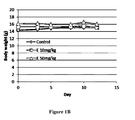
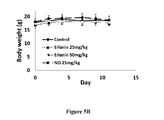
  • Figures 1A and 1B are graphs showing the changes in tumor volume and body weight, respectively, in mice, after treatment with erianin, compared to control mice.
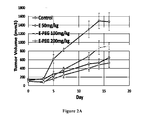
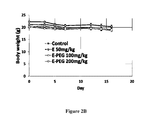
  • Figures 2A and 2B are graphs showing the changes in tumor volume and body weight, respectively, in mice, after treatment with erianin and two different concentrations of erianin-PEG, compared to control mice.
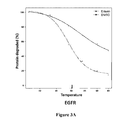
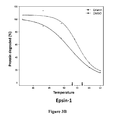
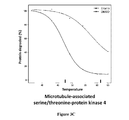
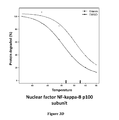
  • Figures 3A-3D are graphs showing CETSA curves of Epidermal growth factor receptor (EGFR) ( Figure 3A) ; Epsin-1 (EPN1) ( Figure 3B) ; Microtubule-associated serine/threonine-protein kinase 4 (MAST4) ( Figure 3C) ; and Nuclear factor NF-kappa-B p100 subunit (NFKB2) ( Figure 3D) .
  • EGFR Epidermal growth factor receptor
  • EPN1 Epsin-1
  • MAST4 Microtubule-associated serine/threonine-protein kinase 4
  • NFKB2 Nuclear factor NF-kappa-B p100 subunit
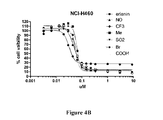
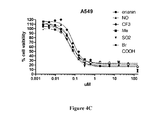
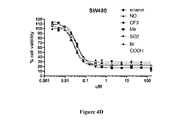
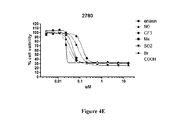
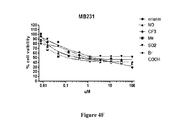
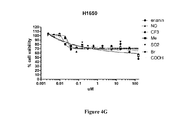
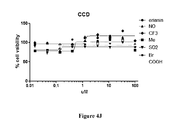
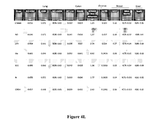
  • Figures 4A-4L are graphs showing cytotoxicity of Erianin and its six derivatives on a panel of cancer cell line (NCI-H460, A549, NCI-H1650, SW480, HCT-116, A2780, MCF7, MDA-MB231, Hep2G) and normal cell line (NCM-460, CCD-19lu) .
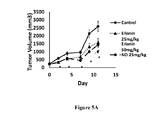
  • Figures 5A-5B are graphs showing anti-tumor effect of Erianin and Erianin derivatives on NCI H460 non-small lung cancer xenograft, wherein *denotes p ⁇ 0.05 when 25mg/kg erianin at days 2, 9 and 11; and 50mg/kg Erianin at days 2-11; and 25mg/kg NO at days 2, 7, 9 and 11 compared with control. Data represents mean ⁇ SEM. No significant change of body weight was observed in all treatment group.
  • compositions and methods for treating cancer using derivatives of erianin include derivatives of erianin.
  • the compounds include derivatives of erianin.
  • the disclosed compositions are compounds according to Formula (I) having an erianin-based core conjugated to a functional moiety via a cleavable linker.
  • the functional moiety may confer improved water solubility and prolonged half-life to the composition. It was discovered that pegylation, the process by which polyethylene glycol chains are attached to protein and peptide drugs, can overcome these and other shortcomings with erianin. By changing the hydrophobic/hydrophilic balance and increasing the molecular mass of the compound, pegylation improves pharmacokinetics for erianin.
  • the pharmaceutical composition can include one or more compounds according to Formula (I) :
  • F can be a functional moiety capable of conferring water solubility, targeting, increased half-life, or combinations thereof;
  • L can be a cleavable linker; and where each R 1 -R 4 group can independently be a hydrogen, C 1-10 alkyl, C 2-10 alkenyl, C 2-10 alkynyl, C 3-10 cycloalkyl, C 1-10 heteroalkyl, C 2-10 heteroalkenyl, C 2-10 heteroalkynyl, or C 3-10 heterocyclyl.
  • each of the R 1 -R 4 groups is a methyl group.
  • each R 1 -R 4 group can independently be methyl, ethyl, propyl, butyl, pentyl, hexyl, heptyl, octyl, nonyl, or decyl.
  • each propyl, butyl, pentyl, hexyl, heptyl, octyl, nonyl, and decyl can independently be branched or unbranched.
  • the functional moiety F can be a water-soluble small molecule such as
  • n 1-7 can be an integer from 0 to 10
  • X - can be a negatively charged counterion (e.g., Cl - , Br - )
  • M + can be a positively charged counterion (e.g., H + , Na + , K + ) .
  • the functional moiety F can be or include a water soluble polymeric moiety such as poly-ethylene glycol (PEG) , peptides, polyamides, polyesters, polysaccharides, polyvinylpyrrolidone, poly- (lactic-co-glycolic acid) , poly (acrylic acid) , poly (L-glutamic acid) , and poly (alkylcyanoacrylate) .
  • PEG poly-ethylene glycol
  • peptides amino acids
  • polyamides polyamides
  • polyesters polysaccharides
  • polyvinylpyrrolidone poly- (lactic-co-glycolic acid)
  • poly (acrylic acid) poly (L-glutamic acid)
  • poly (alkylcyanoacrylate) poly(alkylcyanoacrylate)
  • x is an integer from 1 to 200, preferably from 1 to 150, preferably from 1 to 100.
  • the functional moiety F can include a targeting antigen.
  • the targeting antigen can be, for example, folic acid, biotin, GLUT5, estrone, or sialic acid.
  • the cleavable linker L can be a hydrolytically cleavable group. In some forms, the cleavable linker L can be, for example,
  • n 1-6 , n 11-20 , and p 1-3 are each independently selected from integer values 0, 1, 2, 3, 4, 5, 6, 7, 8, 9, or 10.
  • the composition can further include one or more pharmaceutically acceptable excipients, additives, or adjuvants.
  • the composition can reduce tumor growth.
  • the composition can target one or more of the proteins, such as BRICK1 (BRK1) , Cadherin-17 (CDH17) , Epsin-1 (Epn1) , High mobility group protein HMG-I/HMG-Y (HMGA1) , Microtubule-associated serine/threonine-protein kinase 4 (MAST4) , Migration and invasion enhancer 1 (MIEN1) , Nuclear factor NF-kappa-B p100 subunit (NFKB2) , Tyrosine-protein phosphatase non-receptor type 23 (PTPN23) , tumor protein D52 (TPD52) , and Epidermal growth factor receptor (EGFR) .
  • BRICK1 BRICK1
  • CDH17 Cadherin-17
  • Epsin-1 Epsin-1
  • HMGA1 High mobility group protein HMG-I/HMG
  • the method can be a method of treating a subject having cancer. In some forms, the method can include administering to the subject an effective amount of one or more of the disclosed compositions.
  • the composition can be administered by oral, systemic, enteral, parenteral, local, topical, or buccal routes.
  • the subject can be a mammal.
  • the subject can be human.
  • the composition can be administered at a dose of 200 mg/kg.
  • the dose of the composition can be (a) in the range of, (b) in the range of about, (c) from, or (d) from about any one of 10 mg/kg, 12 mg/kg, 14 mg/kg, 15 mg/kg, 16 mg/kg, 18 mg/kg, 20 mg/kg, 25 mg/kg, 30 mg/kg, 35 mg/kg, 40 mg/kg, 45 mg/kg, 50 mg/kg, 55 mg/kg, 60 mg/kg, 65 mg/kg, 70 mg/kg, 75 mg/kg, 80 mg/kg, 85 mg/kg, 90 mg/kg, 95 mg/kg, 100 mg/kg, 110 mg/kg, 120 mg/kg, 125 mg/kg, 130 mg/kg, 140 mg/kg, 150 mg/kg, 160 mg/kg, 170 mg/kg, 175 mg/kg, 180 mg/kg, 190 mg/kg, 200 mg/kg, 220 mg/kg, 240 mg/kg, 250 mg/kg, 260 mg/kg, 280 mg/kg, 300 mg/kg,
  • the subject has hepatocarcinoma. In some forms of the method, the subject has melanoma. In some forms of the method, the subject has osteosarcoma. In some forms of the method, the subject has promyelocytic leukemia.
  • the compound is defined according to Formula (I) :
  • each R 1 -R 4 group is independently selected from a hydrogen, C 1-10 alkyl, C 2-10 alkenyl, C 2-10 alkynyl, C 3-10 cycloalkyl, C 1-10 heteroalkyl, C 2-10 heteroalkenyl, C 2-10 heteroalkynyl, or C 3-10 heterocyclyl.
  • each of the R 1 -R 4 groups is a methyl group.
  • the core of the compound is an active agent which is erianin or a derivative thereof.
  • Erianin has notable antitumor activity in various malignancies.
  • Erianin has antiangiogenic activity by inhibiting endothelial metabolism in a JNK/SAPK-dependent manner and inducing endothelial cytoskeletal disorganization.
  • Erianin is soluble in organic solvents such as chloroform, acetone and methanol; however it is only slightly soluble in water.
  • an effective amount of a compound as provided herein is meant a nontoxic but sufficient amount of the compound to provide the desired result.
  • the exact amount required will vary from subject to subject, depending on the species, age, and general condition of the subject, the severity of the disease that is being treated, the particular compound used, its mode of administration, and the like. Thus, it is not possible to specify an exact “effective amount. ” However, an appropriate effective amount can be determined by one of ordinary skill in the art using only routine experimentation.
  • the erianin may be conjugated to a water-soluble small molecule, which confers improved water solubility to the composition.
  • the water-soluble small molecule confers prolonged half-life to the composition.
  • the water-soluble small molecule is biodegradable and/or biocompatible.
  • “Small Molecule, ” as used herein, refers to a molecule, such as an organic or organometallic compound, with a molecular weight of less than 2,000 Daltons, less than 1,500 Daltons, less than 1,000 Daltons, less than 750 Daltons, or less than 500 Daltons.
  • the small molecule can be a hydrophilic, hydrophobic, or amphiphilic compound.
  • Hydrophilic refers to molecules which have a greater affinity for, and thus solubility in, water as compared to organic solvents.
  • the hydrophilicity of a compound can be quantified by measuring its partition coefficient between water (or a buffered aqueous solution) and a water-immiscible organic solvent, such as octanol, ethyl acetate, methylene chloride, or methyl tert-butyl ether. If after equilibration a greater concentration of the compound is present in the water than in the organic solvent, then the compound is considered hydrophilic.
  • Hydrophobic refers to molecules which have a greater affinity for, and thus solubility in, organic solvents as compared to water.
  • the hydrophobicity of a compound can be quantified by measuring its partition coefficient between water (or a buffered aqueous solution) and a water-immiscible organic solvent, such as octanol, ethyl acetate, methylene chloride, or methyl tert-butyl ether. If after equilibration a greater concentration of the compound is present in the organic solvent than in the water, then the compound is considered hydrophobic.
  • the functional moiety F of Formula (I) is a water-soluble small molecule having the formula
  • n 1-7 is an integer from 0 to 10
  • X - is a negatively charged counterion (i.e., Cl - , Br - )
  • M + is a positively charged counterion (i.e., H + , Na + , K + ) .
  • the water-soluble small molecule can be poly-ethylene glycol (PEG) , peptides, polyamides, polyesters, polysaccharides, polyvinylpyrrolidone, Poly- (lactic-co-glycolic acid) , poly (acrylic acid) , poly (L-glutamic acid) , or poly (alkylcyanoacrylate) .
  • the erianin core is conjugated to a water-soluble small molecule which includes but is not necessarily limited to the following formulas:
  • compositions disclosed herein preferably have bound thereto surface altering agents or materials.
  • “Surface altering agents” or “surface altering materials, ” as used herein refers to an agent or material which modifies one or more properties of the particles for the surface, including, but not limited to, hydrophilicity (e.g., makes the nanocages more or less hydrophilic) , surface charge (e.g., makes the surface neutral or near neutral between about -10 mV and about +10 mV, or more negative or positive) , and/or enhances transport in or through bodily fluids and/or tissues, such as mucus and circulation.
  • the surface-alternating material provides a direct therapeutic effect, such as reducing inflammation.
  • Examples of the surface-altering agents include, but are not limited to, polyalkylenes such as polyethylene and polypropylene and derivatives therein (referred to collectively as polyalkylenes, unless otherwise designated) , polyalkylene glycols such as poly (ethylene glycol) (PEG) , polyalkylene oxides (PEO) , copolymers of polyalkylenes (e.g., copolymer of PEG) and derivatives thereof, proteins such as anionic proteins like albumin, surfactants, and sugars or sugar derivatives (e.g., cyclodextrin) .
  • Preferred surface-altering agents are polyethylene glycols, polyalkylene oxides, heparin and poloxomers (polyethylene oxide block copolymers such as the marketed by BASF, for example, F127) .
  • the most preferred material is PEG.
  • Representative PEG molecular weights include 300 Da, 600 Da, 1 kDa, 2 kDa, 3 kDa, 4 kDa, 5 kDa, 6 kDa, 8 kDa, 10 kDa, 15 kDa, 20 kDa, 30 kDa, 50 kDa, 100 kDa, 200 kDa, 500 kDa, and 1 MDa and all values within the range of 300 Daltons to 1 MDa.
  • the PEG is a linear molecule with a molecular weight of less than 5kDa (e.g., 2 kDa, 1 kDa, 600 Da, 300 Da) .
  • the PEG is a branched molecule with a molecular weight of less than 5 kDa in each branch. PEG of any given molecular weight may vary in other characteristics such as length, density, and branching.
  • the surface active agents such as PEG are covalently conjugated to the erianin-based core.
  • the functional moiety F of Formula (I) has the following structure
  • x is an integer from 1 to 200, preferably from 1 to 150, preferably from 1 to 100.
  • PEG poly (ethylene glycol)
  • the conjugation of PEG to the erianin-based core can allow rapid penetration through mucus because of the greatly reduced adhesive interaction between mucus constituents and the composition.
  • the conjugation of PEG to the active agent also prolongs the half-life of the agent in the blood circulation and enhances uptake by tumor cells.
  • the density of the surface altering material is from about 10 to about 70 chains/100 nm 2 , from about 15 to about 50 chains/100 nm 2 , from about 15 to about 45 chains/100 nm 2 , from about 20 to about 45 chains/100 nm 2 , from about 25 to about 45 chains/100 nm 2 , or from about 35 to about 45 chains/100 nm 2 .
  • the concentration of the surface altering material, such as PEG can also be varied.
  • the erianin core conjugated to the functional moiety includes, but is not necessarily limited to the following formulas:
  • n 7-10 is an integer from 0 to 200, preferably from 0 to 150, preferably from 0 to 100, preferably from 0 to 50, preferably from 0 to 10.
  • the functional moiety F of Formula (I) includes a targeting antigen.
  • the targeting antigen confers improved water solubility to the composition.
  • the targeting antigen confers prolonged half-life to the composition.
  • the targeting antigen is biodegradable and/or biocompatible.
  • the targeting antigen can be folic acid, biotin, GLUT5, estrone, or sialic acid.
  • the active agent conjugated to a targeting antigen includes, but is not necessarily limited to the following formulas:
  • the targeting antigen is specific for one or more proteins involved in cancer cell signaling.
  • these proteins include BRICK1 (BRK1) , Cadherin-17 (CDH17) , Epsin-1 (Epn1) , High mobility group protein HMG-I/HMG-Y (HMGA1) , Microtubule-associated serine/threonine-protein kinase 4 (MAST4) , Migration and invasion enhancer 1 (MIEN1) , Nuclear factor NF-kappa-B p100 subunit (NFKB2) , Tyrosine-protein phosphatase non-receptor type 23 (PTPN23) , tumor protein D52 (TPD52) , or Epidermal growth factor receptor (EGFR) .
  • BRICK1 BRICK1
  • CDH17 Cadherin-17
  • Epsin-1 Epsin-1
  • HMGA1 High mobility group protein HMG-I/HMG-Y
  • MAST4 Microtubule-associated serine/threonine-protein kinas
  • Linker refers to a bivalent group or moiety which connects a functional moiety and/or targeting antigen to the erianin core.
  • the linker is designed to be cleaved in response to an endogenous stimulus characteristic of the tumor microenvironment, such as a change in pH or the presence of an enzyme.
  • Linkers can contain any assembly of atoms, including oligomeric and polymeric chains.
  • the linker is an alkyl group, an alkylaryl group, an oligo-or polyethylene glycol chain, or an oligo-or poly (amino acid) chain.
  • the linker is an ether bond.
  • the linker may include one or more hydrolysable functional groups, such as an ester, amide, or glycosidic bond, which can be hydrolyzed in acidic conditions.
  • alkyl group as used herein is a branched or unbranched saturated hydrocarbon group of 1 to 24 carbon atoms, such as methyl, ethyl, n-propyl, isopropyl, n-butyl, isobutyl, t-butyl, pentyl, hexyl, heptyl, octyl, decyl, tetradecyl, hexadecyl, eicosyl, tetracosyl and the like.
  • a “lower alkyl” group is an alkyl group containing from one to six carbon atoms.
  • esters as used herein is represented by the formula -C (O) OA, where A can be an alkyl, halogenated alkyl, alkenyl, alkynyl, aryl, heteroaryl, cycloalkyl, cycloalkenyl, heterocycloalkyl, or heterocycloalkenyl group described above.
  • carbonate group as used herein is represented by the formula -OC (O) OR, where R can be hydrogen, an alkyl, alkenyl, alkynyl, aryl, aralkyl, cycloalkyl, halogenated alkyl, or heterocycloalkyl group described above.
  • alkenyl group as used herein is a hydrocarbon group of from 2 to 24 carbon atoms and structural formula containing at least one carbon-carbon double bond.
  • alkynyl group as used herein is a hydrocarbon group of 2 to 24 carbon atoms and a structural formula containing at least one carbon-carbon triple bond.
  • aryl group as used herein is any carbon-based aromatic group including, but not limited to, benzene, naphthalene, etc.
  • aromatic also includes “heteroaryl group, ” which is defined as an aromatic group that has at least one heteroatom incorporated within the ring of the aromatic group. Examples of heteroatoms include, but are not limited to, nitrogen, oxygen, sulfur, and phosphorus.
  • the aryl group can be substituted or unsubstituted.
  • the aryl group can be substituted with one or more groups including, but not limited to, alkyl, alkynyl, alkenyl, aryl, halide, nitro, amino, ester, ketone, aldehyde, hydroxy, carboxylic acid, or alkoxy.
  • cycloalkyl group is a non-aromatic carbon-based ring composed of at least three carbon atoms.
  • examples of cycloalkyl groups include, but are not limited to, cyclopropyl, cyclobutyl, cyclopentyl, cyclohexyl, etc.
  • heterocycloalkyl group is a cycloalkyl group as defined above where at least one of the carbon atoms of the ring is substituted with a heteroatom such as, but not limited to, nitrogen, oxygen, sulphur, or phosphorus.
  • the linker L can include, but is not necessarily limited to
  • n 1-6 , n 11-20 , and p 1-3 are each independently selected from integer values 0, 1, 2, 3, 4, 5, 6, 7, 8, 9, or 10.
  • the compound consists of erianin linked to poly-ethylene glycol (PEG) via an ester linkage, as illustrated below.
  • n 7 is an integer from 0 to 200, preferably from 0 to 150, preferably from 0 to 100, preferably from 0 to 50, preferably from 0 to 10.
  • compositions comprising compounds having an active agent, such as erianin or derivatives thereof, and a functional moiety linked thereto via a cleavable linker.
  • an active agent such as erianin or derivatives thereof
  • a functional moiety linked thereto via a cleavable linker.
  • the functional moiety confers water solubility, targeting functions, increased half-life, or combinations of these properties to the compound.
  • compositions described herein can include, but are not limited to, carriers, thickeners, diluents, buffers, preservatives, surface active agents and the like in addition to the molecule of choice.
  • Pharmaceutical compositions can also include one or more active ingredients such as antimicrobial agents, antiinflammatory agents, anesthetics, and the like.
  • active ingredients such as antimicrobial agents, antiinflammatory agents, anesthetics, and the like.
  • compositions may contain additional compounds and are thus not limited to the compounds described herein.
  • the pharmaceutical composition can include or consist of an effective amount of erianin conjugated to a functional moiety, and one or more pharmaceutically acceptable carriers or excipients.
  • carrier or “excipient” refers to an organic or inorganic ingredient, natural or synthetic inactive ingredient in a formulation, with which one or more active ingredients are combined.
  • Optional pharmaceutically acceptable excipients present in the drug-containing tablets, beads, granules or particles include, but are not limited to, diluents, binders, lubricants, disintegrants, colorants, stabilizers, and surfactants.
  • Diluents also termed “fillers, " are typically necessary to increase the bulk of a solid dosage form so that a practical size is provided for compression of tablets or formation of beads and granules.
  • Suitable diluents include, but are not limited to, dicalcium phosphate dihydrate, calcium sulfate, lactose, sucrose, mannitol, sorbitol, cellulose, microcrystalline cellulose, kaolin, sodium chloride, dry starch, hydrolyzed starches, pregelatinized starch, silicone dioxide, titanium oxide, magnesium aluminum silicate and powder sugar.
  • the compositions can include adjuvants such as wetting agents, emulsifying and suspending agents, sweetening, flavoring, and perfuming agents.
  • Binders are used to impart cohesive qualities to a solid dosage formulation, and thus ensure that a tablet or bead or granule remains intact after the formation of the dosage forms.
  • Suitable binder materials include, but are not limited to, starch, pregelatinized starch, gelatin, sugars (including sucrose, glucose, dextrose, lactose and sorbitol) , polyethylene glycol, waxes, natural and synthetic gums such as acacia, tragacanth, sodium alginate, cellulose, including hydroxypropylmethylcellulose, hydroxypropylcellulose, ethylcellulose, and veegum, and synthetic polymers such as acrylic acid and methacrylic acid copolymers, methacrylic acid copolymers, methyl methacrylate copolymers, aminoalkyl methacrylate copolymers, polyacrylic acid/polymethacrylic acid and polyvinylpyrrolidone.
  • Lubricants are used to facilitate tablet manufacture.
  • suitable lubricants include, but are not limited to, magnesium stearate, calcium stearate, stearic acid, glycerol behenate, polyethylene glycol, talc, and mineral oil.
  • Disintegrants are used to facilitate dosage form disintegration or "breakup" after administration, and generally include, but are not limited to, starch, sodium starch glycolate, sodium carboxymethyl starch, sodium carboxymethylcellulose, hydroxypropyl cellulose, pregelatinized starch, clays, cellulose, alginine, gums or cross linked polymers, such as cross-linked PVP (Polyplasdone XL from GAF Chemical Corp) .
  • PVP Polyplasdone XL from GAF Chemical Corp
  • Stabilizers are used to inhibit or retard drug decomposition reactions which include, by way of example, oxidative reactions.
  • Surfactants may be anionic, cationic, amphoteric or nonionic surface active agents.
  • Suitable anionic surfactants include, but are not limited to, those containing carboxylate, sulfonate and sulfate ions.
  • anionic surfactants include sodium, potassium, ammonium of long chain alkyl sulfonates and alkyl aryl sulfonates such as sodium dodecylbenzene sulfonate; dialkyl sodium sulfosuccinates, such as sodium dodecylbenzene sulfonate; dialkyl sodium sulfosuccinates, such as sodium bis- (2-ethylthioxyl) -sulfosuccinate; and alkyl sulfates such as sodium lauryl sulfate.
  • Cationic surfactants include, but are not limited to, quaternary ammonium compounds such as benzalkonium chloride, benzethonium chloride, cetrimonium bromide, stearyl dimethylbenzyl ammonium chloride, polyoxyethylene and coconut amine.
  • nonionic surfactants include ethylene glycol monostearate, propylene glycol myristate, glyceryl monostearate, glyceryl stearate, polyglyceryl-4-oleate, sorbitan acylate, sucrose acylate, PEG-150 laurate, PEG-400 monolaurate, polyoxyethylene monolaurate, polysorbates, polyoxyethylene octylphenylether, PEG-1000 cetyl ether, polyoxyethylene tridecyl ether, polypropylene glycol butyl ether, 401, stearoyl monoisopropanolamide, and polyoxyethylene hydrogenated tallow amide.
  • amphoteric surfactants include sodium N-dodecyl-. beta. -alanine, sodium N-lauryl-. beta. -iminodipropionate, myristoamphoacetate, lauryl betaine and lauryl sulfobetaine.
  • the tablets, beads granules or particles may also contain minor amount of nontoxic auxiliary substances such as wetting or emulsifying agents, dyes, pH buffering agents, and preservatives.
  • the term “activity” refers to a biological activity.
  • pharmacological activity refers to the inherent physical properties of a peptide or polypeptide. These properties include but are not limited to half-life, solubility, and stability and other pharmacokinetic properties.
  • modified is often used herein to describe polymers and means that a particular monomeric unit that would typically make up the pure polymer has been replaced by another monomeric unit that shares a common polymerization capacity with the replaced monomeric unit.
  • poly (ethylene glycol) it is possible to substitute diol residues for glycol in poly (ethylene glycol) , in which case the poly (ethylene glycol) will be “modified” with the diol.
  • the poly (ethylene glycol) is modified with a mole percentage of the diol, then such a mole percentage is based upon the total number of moles of glycol that would be present in the pure polymer but for the modification.
  • the diol and glycol residues are present in equimolar amounts.
  • the disclosed compounds can be prepared using synthetic methods known in the art. Representative methodologies for the preparation of compounds are discussed below.
  • the appropriate route for synthesis of a given compounds can be determined in view of a number of factors, such as the structure of the compound, the composition of the polymer segments which make up the compound, the identity of the one or more drugs attached to the compound, as well as the structure of the compounds and its components as it relates to compatibility of functional groups, protecting group strategies, and the presence of labile bonds.
  • the disclosed compounds are prepared by covalently attaching one or more linkers and functional moieties to an erianin core or derivative thereof.
  • Erianin as an example, may be obtained from dendrobium by appropriate separation and extraction procedures known in the art. Other methods of obtaining erianin include known synthetic methods of preparing erianin (such as from 3, 4, 5-trimethoxybenzaldehyde and isovanillin starting materials) ; see Synthesis of Alkoxy-Substituted Diaryl Compounds and Correlation of Ring Separation with Inhibition of Tubulin Polymerization: Differential Enhancement of Inhibitory Effects under Suboptimal Polymerization Reaction Conditions, J. Med. Chem.
  • erianin-based derivatives may be obtained using known synthetic methods and variants and/or chemically modified forms of the 3, 4, 5-trimethoxybenzaldehyde and isovanillin starting materials, for example. In some cases, erianin may be modified using known synthetic methodologies to substitute one or more methoxy positions with other desired substituents.
  • Erianin (E) can be coupled according to the synthetic route shown below:
  • hydroxyl group present on the erianin (E) can be coupled to the carboxylic group of a PEG under Steglich esterification conditions by catalytic means using DCC (dicyclohexylcarbodiimide) and DMAP (4-dimethylaminopyridine) .
  • DCC dicyclohexylcarbodiimide
  • DMAP dimethylaminopyridine
  • Other types of coupling procedures may also be used using coupling reagents including but not limited to DIC (1, 3-Diisopropylcarbodiimide) , HOBt (1-Hydroxybenzotriazole) , EDC (N- (3-Dimethylaminopropyl) -N’-ethylcarbodiimide) , etc.
  • Reactions to prepare compounds disclosed herein may be carried out under inert gas, such as argon or nitrogen gas and in a suitable organic solvent selected from the group consisting of dichloromethane, benzene, carbon tetrachloride, acetonitrile, etc.
  • suitable organic solvent selected from the group consisting of dichloromethane, benzene, carbon tetrachloride, acetonitrile, etc.
  • Suitable reaction work-up, purification, and characterization procedures are known to those skilled in the art of organic and/or medicinal chemistry.
  • treatment and “treating” is meant the medical management of a subject with the intent to cure, ameliorate, stabilize, or prevent a disease, pathological condition, or disorder.
  • This term includes active treatment, that is, treatment directed specifically toward the improvement of a disease, pathological condition, or disorder, and also includes causal treatment, that is, treatment directed toward removal of the cause of the associated disease, pathological condition, or disorder.
  • this term includes palliative treatment, that is, treatment designed for the relief of symptoms rather than the curing of the disease, pathological condition, or disorder; preventative treatment, that is, treatment directed to minimizing or partially or completely inhibiting the development of the associated disease, pathological condition, or disorder; and supportive treatment, that is, treatment employed to supplement another specific therapy directed toward the improvement of the associated disease, pathological condition, or disorder.
  • palliative treatment that is, treatment designed for the relief of symptoms rather than the curing of the disease, pathological condition, or disorder
  • preventative treatment that is, treatment directed to minimizing or partially or completely inhibiting the development of the associated disease, pathological condition, or disorder
  • supportive treatment that is, treatment employed to supplement another specific therapy directed toward the improvement of the associated disease, pathological condition, or disorder.
  • treatment while intended to cure, ameliorate, stabilize, or prevent a disease, pathological condition, or disorder, need not actually result in the cure, amelioration, stabilization or prevention.
  • the effects of treatment can be measured or assessed as described herein and as known in the art
  • the methods involve administering to a subject having cancer an effective amount of a composition that targets one or more of BRICK1 (BRK1) , Cadherin-17 (CDH17) , Epsin-1 (Epn1) , High mobility group protein HMG-I/HMG-Y (HMGA1) , Microtubule-associated serine/threonine-protein kinase 4 (MAST4) , Migration and invasion enhancer 1 (MIEN1) , Nuclear factor NF-kappa-B p100 subunit (NFKB2) , Tyrosine-protein phosphatase non-receptor type 23 (PTPN23) , tumor protein D52 (TPD52) , or Epidermal growth factor receptor (EGFR) .
  • the composition comprises an effective amount of an erianin derivative.
  • subject includes, but is not limited to, animals, plants, bacteria, viruses, parasites and any other organism or entity.
  • the subject can be a vertebrate, more specifically a mammal (e.g., a human, horse, pig, rabbit, dog, sheep, goat, non-human primate, cow, cat, guinea pig or rodent) , a fish, a bird or a reptile or an amphibian.
  • the subject can be an invertebrate, more specifically an arthropod (e.g., insects and crustaceans) .
  • arthropod e.g., insects and crustaceans
  • a patient refers to a subject afflicted with a disease or disorder.
  • the term “patient” includes human and veterinary subjects.
  • the compounds described herein can be administered to a subject comprising a human or an animal including, but not limited to, a mouse, dog, cat, horse, bovine or ovine and the like, that is in need of alleviation or amelioration from a recognized medical condition.
  • the subject is human.
  • monitoring refers to any method in the art by which an activity can be measured.
  • in need of treatment refers to a judgment made by a caregiver (e.g. physician, nurse, nurse practitioner, or individual in the case of humans; veterinarian in the case of animals, including non-human mammals) that a subject requires or will benefit from treatment. This judgment is made based on a variety of factors that are in the realm of a care giver's expertise, but that include the knowledge that the subject is ill, or will be ill, as the result of a condition that is treatable by the compounds of the invention.
  • a caregiver e.g. physician, nurse, nurse practitioner, or individual in the case of humans; veterinarian in the case of animals, including non-human mammals
  • Solid Tumor refers to an abnormal mass of tissue that results from the proliferation of cells. Typically, solid tumors do not contain cysts or liquid areas within the tissue mass. Solid tumors can arise in any part of the body, and may be benign (not cancerous) or malignant (cancerous) . Most types of cancer other than leukemias can form solid tumors. Solid tumors include, for example, adenocarcinomas, carcinomas, hemangiomas, liposarcomas, lymphomas, melanomas and sarcomas. The term can also be used to refer to conditions such as endometriosis, caused by uncontrolled proliferation of cells, to the extent these tissues are characterized by leaky vasculature.
  • the disclosed methods include the determination, identification, indication, correlation, diagnosis, prognosis, etc. (which can be referred to collectively as “identifications” ) of subjects, diseases, conditions, states, etc. based on measurements, detections, comparisons, analyses, assays, screenings, etc.
  • a subject can be diagnosed with, determined, or identified to have cancer.
  • identifications are useful for many reasons. For example, and in particular, such identifications allow specific actions to be taken based on, and relevant to, the particular identification made. For example, diagnosis of a particular disease or condition in particular subjects (and the lack of diagnosis of that disease or condition in other subjects) has the very useful effect of identifying subjects that would benefit from treatment, actions, behaviors, etc. based on the diagnosis.
  • treatment for a particular disease or condition in subjects identified is significantly different from treatment of all subjects without making such an identification (or without regard to the identification) .
  • Subjects needing or that could benefit from the treatment will receive it and subjects that do not need or would not benefit from the treatment will not receive it.
  • methods comprising taking particular actions following and based on the disclosed identifications.
  • methods comprising creating a record of an identification (in physical-such as paper, electronic, or other-form, for example) .
  • creating a record of an identification based on the disclosed methods differs physically and tangibly from merely performing a measurement, detection, comparison, analysis, assay, screen, etc.
  • Such a record is particularly substantial and significant in that it allows the identification to be fixed in a tangible form that can be, for example, communicated to others (such as those who could treat, monitor, follow-up, advise, etc.
  • identifications can be made, for example, by the same individual or entity as, by a different individual or entity than, or a combination of the same individual or entity as and a different individual or entity than, the individual or entity that made the record of the identification.
  • the disclosed methods of creating a record can be combined with any one or more other methods disclosed herein, and in particular, with any one or more steps of the disclosed methods of identification.
  • methods comprising making one or more further identifications based on one or more other identifications.
  • particular treatments, monitorings, follow-ups, advice, etc. can be identified based on the other identification.
  • identification of a subject as having a disease or condition with a high level of a particular component or characteristic can be further identified as a subject that could or should be treated with a therapy based on or directed to the high level component or characteristic.
  • a record of such further identifications can be created (as described above, for example) and can be used in any suitable way.
  • Such further identifications can be based, for example, directly on the other identifications, a record of such other identifications, or a combination.
  • Such further identifications can be made, for example, by the same individual or entity as, by a different individual or entity than, or a combination of the same individual or entity as and a different individual or entity than, the individual or entity that made the other identifications.
  • the disclosed methods of making a further identification can be combined with any one or more other methods disclosed herein, and in particular, with any one or more steps of the disclosed methods of identification.
  • methods comprising treating, monitoring, following-up with, advising, etc. a subject identified in any of the disclosed methods.
  • methods comprising treating, monitoring, following-up with, advising, etc. a subject for which a record of an identification from any of the disclosed methods has been made.
  • particular treatments, monitorings, follow-ups, advice, etc. can be used based on an identification and/or based on a record of an identification.
  • a subject identified as having a disease or condition with a high level of a particular component or characteristic can be treated with a therapy based on or directed to the high level component or characteristic.
  • Such treatments, monitorings, follow-ups, advice, etc. can be based, for example, directly on identifications, a record of such identifications, or a combination.
  • Such treatments, monitorings, follow-ups, advice, etc. can be performed, for example, by the same individual or entity as, by a different individual or entity than, or a combination of the same individual or entity as and a different individual or entity than, the individual or entity that made the identifications and/or record of the identifications.
  • the disclosed methods of treating, monitoring, following-up with, advising, etc. can be combined with any one or more other methods disclosed herein, and in particular, with any one or more steps of the disclosed methods of identification.
  • compositions can be used to treat diseases that include, but are not necessarily limited to the below described conditions.
  • Hepatocarcinoma is the most common type of primary liver cancer in adults, and is the most common cause of death in people with cirrhosis. It occurs in the setting of chronic liver inflammation, and is most closely linked to chronic viral hepatitis B or hepatitis C infection or exposure to toxins such as alcohol or aflatoxin. Certain diseases, such as hemochromatosis and alpha 1-antitrypsin deficiency markedly increase the risk of developing HCC. Metabolic syndrome and non-alcoholic fatty liver disease are also increasingly recognized as risk factors for HCC. As with any cancer, the treatment and prognosis of HCC vary depending on the specifics of tumor histology, size, how far the cancer has spread, and overall health. In some forms, the disclosed compositions are suitable for treating HCC.
  • Melanoma is the most dangerous type of skin cancer. Melanomas typically occur in the skin but may rarely occur in the mouth, intestines, or eye. In women they most commonly occur on the legs, while in men they are most common on the back. Sometimes they develop from a mole with concerning changes including an increase in size, irregular edges, change in color, itchiness, or skin breakdown.
  • the primary cause of melanoma is ultraviolet light exposure in those with low levels of skin pigment. The UV light may be from either the sun or from other sources, such as tanning devices. About 25%develop from moles. Diagnosis is by biopsy of any concerning skin lesion. Treatment is typically removal by surgery. Most people are cured if spread has not occurred. For those in whom melanoma has spread, immunotherapy, biologic therapy, radiation therapy, or chemotherapy may improve survival. In some forms, the disclosed compositions are suitable for treating melanoma.
  • An osteosarcoma is a cancerous tumor in a bone. Specifically, it is an aggressive malignant neoplasm that arises from primitive transformed cells of mesenchymal origin (and thus a sarcoma) and that exhibits osteoblastic differentiation and produces malignant osteoids. Osteosarcoma is the most common histological form of primary bone cancer. In some forms, the disclosed compositions are suitable for treating osteosarcoma.
  • Acute promyelocytic leukemia is a cancer of the white blood cells.
  • promyelocytic leukemia there is an abnormal accumulation of immature granulocytes called promyelocytes.
  • the disease is characterized by a chromosomal translocation involving the retinoic acid receptor alpha (RAR ⁇ or RARA) gene and is distinguished from other forms of acute promyelocytic leukemia by its responsiveness to all-trans retinoic acid (ATRA; also known as tretinoin) therapy.
  • ATRA all-trans retinoic acid
  • the disclosed compositions are suitable for treating promyelocytic leukemia.
  • providing refers to any means of adding a compound or molecule to something known in the art. Examples of providing can include the use of pipettes, pipettemen, syringes, needles, tubing, guns, etc. This can be manual or automated. It can include transfection by any mean or any other means of providing nucleic acids to dishes, cells, tissue, cell-free systems and can be in vitro or in vivo.
  • a compound or pharmaceutical composition described herein can be administered to the subject in a number of ways depending on whether local or systemic treatment is desired, and on the area to be treated.
  • a compound or pharmaceutical composition described herein can be administered as an ophthalmic solution and/or ointment to the surface of the eye.
  • a compound or pharmaceutical composition can be administered to a subject vaginally, rectally, intranasally, orally, by inhalation, bucally, enterally, or parenterally, for example, by intradermal, subcutaneous, intramuscular, intraperitoneal, intrarectal, intraarterial, intralymphatic, intravenous, intrathecal and intratracheal routes. Parenteral administration, if used, is generally characterized by injection.
  • Injectables can be prepared in conventional forms, either as liquid solutions or suspensions, solid forms suitable for solution or suspension in liquid prior to injection, or as emulsions.
  • a more recently revised approach for parenteral administration involves use of a slow release or sustained release system such that a constant dosage is maintained. See, e.g., U.S. Patent No. 3,610,795, which is incorporated by reference herein.
  • Preparations for parenteral administration include sterile aqueous or non-aqueous solutions, suspensions, and emulsions which can also contain buffers, diluents and other suitable additives.
  • non-aqueous solvents are propylene glycol, polyethylene glycol, vegetable oils such as olive oil, and injectable organic esters such as ethyl oleate.
  • Aqueous carriers include water, alcoholic/aqueous solutions, emulsions or suspensions, including saline and buffered media.
  • Parenteral vehicles include sodium chloride solution, Ringer's dextrose, dextrose and sodium chloride, lactated Ringer's, or fixed oils.
  • Intravenous vehicles include fluid and nutrient replenishers, electrolyte replenishers (such as those based on Ringer's dextrose) , and the like. Preservatives and other additives can also be present such as, for example, antimicrobials, anti-oxidants, chelating agents, and inert gases and the like.
  • Formulations for topical administration can include ointments, lotions, creams, gels, drops, suppositories, sprays, liquids and powders.
  • Conventional pharmaceutical carriers, aqueous, powder or oily bases, thickeners and the like can be necessary or desirable.
  • compositions for oral administration can include powders or granules, suspensions or solutions in water or non-aqueous media, capsules, sachets, or tablets. Thickeners, flavorings, diluents, emulsifiers, dispersing aids or binders can be desirable.
  • the methods involve administering to a subject having cancer an effective amount of a composition comprising an effective amount of erianin conjugated to a functional moiety via a cleavable linker.
  • the composition can be administered in a single dose or in multiple doses. Certain factors may influence the dosage required to effectively treat a subject, including but not limited to the severity of the disease or disorder, previous treatments, the general health and/or age of the subject, and other diseases present. It will also be appreciated that the effective dosage of the composition used for treatment may increase or decrease over the course of a particular treatment. Changes in dosage may result and become apparent from the results of diagnostic assays.
  • Dosing is dependent on severity and responsiveness of the disease condition to be treated, with the course of treatment lasting from several days to several months, or until a cure is effected or a diminution of disease state is achieved.
  • Optimal dosing schedules can be calculated from measurements of drug accumulation in the body of the patient. Persons of ordinary skill can easily determine optimum dosages, dosing methodologies and repetition rates. Optimum dosages may vary depending on the relative potency of individual therapeutic agent, and can generally be estimated based on EC 50 s found to be effective in in vitro and in vivo animal models.
  • Dosage levels on the order of about 1mg/kg to 300 mg/kg of body weight per administration are useful in the treatment of a disease.
  • the dosage levels are about 150mg/kg -250 mg/kg of body weight per administration.
  • the composition is administered at a dose of 200 mg/kg.
  • One skilled in the art can also readily determine an appropriate dosage regimen for administering the disclosed compositions to a given subject.
  • the compositions can be administered to the subject once, e.g., as a single injection, infusion or bolus.
  • the formulation can be administered once or twice daily to a subject for a period of from about three to about twenty-eight days, or from about seven to about ten days.
  • Ranges may be expressed herein as from “about” one particular value, and/or to "about” another particular value. When such a range is expressed, also specifically contemplated and considered disclosed is the range from the one particular value and/or to the other particular value unless the context specifically indicates otherwise. Similarly, when values are expressed as approximations, by use of the antecedent “about, ” it will be understood that the particular value forms another, specifically contemplated embodiment that should be considered disclosed unless the context specifically indicates otherwise. It will be further understood that the endpoints of each of the ranges are significant both in relation to the other endpoint, and independently of the other endpoint unless the context specifically indicates otherwise.
  • high, ” “higher, ” “increases, ” “elevates, ” or “elevation” refer to increases above basal levels, e.g., as compared to a control.
  • low, ” “lower, ” “reduces, ” or “reduction” refer to decreases below basal levels, e.g., as compared to a control.
  • an effective amount of a compound as provided herein is meant a nontoxic but sufficient amount of the compound to provide the desired result.
  • the exact amount required will vary from subject to subject, depending on the species, age, and general condition of the subject, the severity of the disease that is being treated, the particular compound used, its mode of administration, and the like. Thus, it is not possible to specify an exact “effective amount. ” However, an appropriate effective amount can be determined by one of ordinary skill in the art using only routine experimentation.
  • the term “effective amount” of a compound as provided herein is meant a nontoxic but sufficient amount of the compound to treat cancer.
  • the dosages or amounts of the compounds described herein are large enough to produce the desired effect in the method by which delivery occurs.
  • the dosage should not be so large as to cause adverse side effects, such as unwanted cross-reactions, anaphylactic reactions, and the like.
  • the dosage will vary with the age, condition, sex and extent of the disease in the subject and can be determined by one of skill in the art.
  • the dosage can be adjusted by the individual physician based on the clinical condition of the subject involved.
  • the dose, schedule of doses and route of administration can be varied.
  • the efficacy of administration of a particular dose of the compounds or compositions according to the methods described herein can be determined by evaluating the particular aspects of the medical history, signs, symptoms, and objective laboratory tests that are known to be useful in evaluating the status of a subject in need of treatment of cancer or other diseases and/or conditions. These signs, symptoms, and objective laboratory tests will vary, depending upon the particular disease or condition being treated or prevented, as will be known to any clinician who treats such patients or a researcher conducting experimentation in this field.
  • a subject for example, if, based on a comparison with an appropriate control group and/or knowledge of the normal progression of the disease in the general population or the particular individual: (1) a subject’s physical condition is shown to be improved (e.g., a tumor has partially or fully regressed) , (2) the progression of the disease or condition is shown to be stabilized, or slowed, or reversed, or (3) the need for other medications for treating the disease or condition is lessened or obviated, then a particular treatment regimen will be considered efficacious.
  • pharmaceutically acceptable is meant a material that is not biologically or otherwise undesirable, i.e., the material can be administered to a subject along with the selected compound without causing any undesirable biological effects or interacting in a deleterious manner with any of the other components of the pharmaceutical composition in which it is contained.
  • Example 3 Improved Properties of Erianin-PEG Compared to Erianin.
  • Erianin needs to be first dissolved in organic solvent and then diluted with saline/water before use in animals, while erianin-PEG is readily dissolved in saline/water. Thus, by using erianin-PEG, one avoids introducing toxic organic solvents. Erianin-PEG was also shown to have improved water solubility. At equivalent concentrations of erianin, erianin in aqueous solution crystallized at 30 minutes post preparation, while erianin-PEG remained clear at 30 minutes post preparation.
  • the cytotoxicity of erianin on various cell lines was assessed by NBB and MTT assays.
  • the cell lines included AGS (gastric cancer) , HCT116 (colon cancer) , HeLa (cervical cancer) , NCI-H460 (lung cancer) , SKOV3 (ovarian cancer) , MCF7 (breast cancer) , A549, NCI-H1650, SW480, A2780, MDA-MB231, Hep2G, NCM-460, and CCD-19Lu (normal lung fibroblast) .
  • Erianin exhibited sub-micromolar cytotoxicity on all the selected cancer cell lines, while the IC 50 value for the normal lung fibroblast cell line was over 100 ⁇ M (Table 1) .
  • erianin-PEG maintained comparable in vitro anti-cancer activity of erianin.
  • Figures 4A-4L for cytotoxicity of Erianin and Erianin derivatives on more cell lines
  • Figures 5A-5B for Anti-tumor effect of Erianin and Erianin derivatives on NCI H460 non-small lung cancer xenograft.
  • Example 5 Ability of Erianin to Inhibit Growth of Ovarian Cancer in vivo.
  • Erianin was investigated to see if it could inhibit the growth of ovarian cancer in nude mice.
  • a xenograft model of nude mice containing tumors induced by inoculation with NCI-H460 lung cancer cells was used. Erianin (50 and 10 mg/kg) was given via intra-venous injections.
  • Figure 1A shows the changes in tumor volume after treatment with erianin. After 12 days of treatment, tumor volume of the erianin-treated group decreased by 68% (50 mg/kg) and 48% (10 mg/kg) relative to the control group. It is noteworthy that no apparent side effects were observed and that no significant weight loss was found in mice treated with erianin (Figure 1B) .
  • Example 6 Ability of Erianin and Erianin-PEG to Inhibit Growth of Lung Cancer in vivo.
  • mice were intravenously injected with Erianin (50 mg/kg) or Erianin-PEG (100 mg/kg or 200 mg/kg) , or vehicle control (10%PET (6: 3: 1 PEG400, ETOH, Tween80) in PBS) for 7 repeated doses over a period of 16 days.
  • Erianin (50 mg/kg) and Erianin-PEG (200 mg/kg) inhibited tumor volume by 56%and 64%, respectively (Figure 2A and Table 2) .
  • erianin-PEG achieved 64%inhibition of tumor growth, making it more potent than the higher dose of erianin (50mg/kg) .
  • the addition of the PEG compound prolonged the half-life of erianin in the blood circulation and enhanced tumor uptake, thus improving the properties of erianin for the treatment of cancer.
  • the effect of erianin on the phosphorylation of EGFR was detected by immunoblot assay.
  • A-431 cells which are well known to overexpress EGFR, were first starved overnight, then treated with erianin or erlotinib for 3 hrs.
  • Erlotinib which is a known EGFR inhibitor, served as a positive control.
  • Phosphorylation was stimulated by addition of EGF for 15 mins.
  • the immunoblot assay results suggested that erianin inhibits phosphorylation of EGFR.
  • Results of the immunoblot assays showed that treatment of cells with EGF only resulted in phosphorylation of EGFR.
  • thermal shift assay The underlying theory of a thermal shift assay, which was first described by Koshland (PNAS 44 (2) : 98-104; 1958) , is that the thermal stability of a protein will increase when a ligand binds to that protein.
  • Cellular thermal shift assay (CETSA) (Martinez et al., Science 341 (6141) : 84-87; 2013) is a variation of the thermal shift assay, in which the assay is done at the cellular level. This technique can be used to test the binding of a drug with any detectable proteins in the cell.
  • Thermal proteome profiling an advanced version of CETSA, provides an unbiased measure of drug-target engagement and facilitates identification of markers for drug efficacy and toxicity (Savitski et al., Science 346 (6205) : 1255784; 2014) .
  • the drug-treated/vehicle-treated heated samples were analyzed by Mass spectrometry (MS) .
  • MS Mass spectrometry
  • the samples heated at different temperatures were labeled with TMT-tags (Thompson et al., Anal Chem 75 (8) : 1895-1904; 2003) so that those samples could be mixed and analyzed with the same MS run. This method was used to study the binding of erianin with proteins in the cell lysate.

Landscapes

  • Chemical & Material Sciences (AREA)
  • Organic Chemistry (AREA)
  • Health & Medical Sciences (AREA)
  • General Chemical & Material Sciences (AREA)
  • Medicinal Chemistry (AREA)
  • Nuclear Medicine, Radiotherapy & Molecular Imaging (AREA)
  • Chemical Kinetics & Catalysis (AREA)
  • Pharmacology & Pharmacy (AREA)
  • Life Sciences & Earth Sciences (AREA)
  • Animal Behavior & Ethology (AREA)
  • General Health & Medical Sciences (AREA)
  • Public Health (AREA)
  • Veterinary Medicine (AREA)
  • Pharmaceuticals Containing Other Organic And Inorganic Compounds (AREA)
  • Medicinal Preparation (AREA)

Abstract

L'invention concerne des dérivés d'érianine de formule (I), et des compositions pharmaceutiques de ceux-ci, destinés au traitement du cancer notamment l'hépatocarcinome, mélanome, ostéosarcome et la leucémie promyélocytique. Les dérivés d'érianine sont un noyau à base d'érianine conjugué à une fraction fonctionnelle par un lieur clivable. La fraction fonctionnelle est une petite molécule hydrosoluble ou un antigène de ciblage. De préférence, la fraction fonctionnelle est du polyéthylène glycol (PEG).The invention relates to erianine derivatives of formula (I), and pharmaceutical compositions thereof, for the treatment of cancer including hepatocarcinoma, melanoma, osteosarcoma and promyelocytic leukemia. Erianin derivatives are an Erianin-based nucleus conjugated to a functional moiety by a cleavable linker. The functional moiety is a small water soluble molecule or targeting antigen. Preferably, the functional fraction is polyethylene glycol (PEG).

Description

ERIANIN DERIVATIVES AND METHODS OF USING ERIANIN DERIVATIVES FIELD OF THE INVENTION
The disclosed invention is generally in the field of cancer treatment and specifically in the area of targeted cancer therapy.
BACKGROUND OF THE INVENTION
Despite advancements made in treatment and diagnosis, cancer remains the second leading cause of mortality in the United States, superseded only by heart disease. The most common cancers worldwide are lung, liver, stomach, colorectal, breast, and oesophageal cancers. Solid tumors account for more than 85%of cancer mortality. Currently, the primary treatment modality for solid tumors is cytoreductive surgery followed by adjuvant chemotherapy and/or radiotherapy. While this strategy has been successfully employed in a number of patients, it is accompanied by cytotoxicity to normal cells and tissues, and the development of multidrug resistance. Accordingly, there remains a need for improved cancer treatment options.
Targeted cancer therapies offer the potential to improve cancer treatment. By targeting therapeutic agents to solid tumors, cytotoxicity to normal cells and tissues may be minimized. In addition, targeted therapies provide the opportunity to more rigorously control the concentration of therapeutic agent at the site of a tumor, potentially limiting the emergence of drug resistance.
Erianin is a natural compound that is derived from Dendrobium chrysotoxum, a widely cultivated orchid plant. Phytochemical and pharmacological studies have revealed several classes of biologically active components in Dendrobium chrysotoxum such as alkaloids, terpenoids, and phenanthraquinones. Erianin has been shown to exhibit potential antitumor activity in various malignancies, including in hepatocarcinoma, melanoma, osteosarcoma and promyelocytic leukemia (Wang et al. Cell Death Dis 7 (6) : e2247; 2016) . Erianin is soluble in organic solvents such as chloroform, acetone and methanol; however it is only slightly soluble in water.
One challenge with the use of erianin as a therapeutic is its tendency to be degraded by proteolytic enzymes, to be rapidly cleared by the kidneys, generate neutralizing antibodies and have a short circulating half-life.
Therefore, it is an object of the present invention to provide compositions and methods that are effective for treating cancer.
It is a further object of the present invention to provide compositions and methods for slowing tumor growth.
It is a further object of the present invention to provide compositions and methods for halting tumor growth.
It is a further object of the present invention to provide compositions and methods for decreasing tumor size.
BRIEF SUMMARY OF THE INVENTION
Disclosed are compositions and methods for treating cancer using derivatives of erianin. The compounds include derivatives of erianin, where erianin has the chemical structure:
Figure PCTCN2018097183-appb-000001
Generally speaking, the disclosed compositions are compounds according to Formula (I) having an erianin-based core conjugated to a functional moiety via a cleavable linker. The functional moiety may confer improved water solubility and prolonged half-life to the composition. In some forms, the compounds of the composition are biodegradable and/or biocompatible.
In some forms, the compound is defined according to Formula (I) :
Figure PCTCN2018097183-appb-000002
where F is a functional moiety capable of conferring water solubility, targeting, increased half-life, or combinations thereof; where L is a cleavable linker; and where each R 1-R 4 group is independently selected from a hydrogen, C 1-10 alkyl, C 2-10 alkenyl, C 2-10 alkynyl, C 3-10 cycloalkyl, C 1-10 heteroalkyl, C 2-10 heteroalkenyl, C 2-10 heteroalkynyl, or C 3-10 heterocyclyl. In some forms, each of the R 1-R 4 groups is a methyl group.
In some forms, the core of the compound is an active agent which is erianin or a derivative thereof. Erianin has notable antitumor activity in various malignancies. Erianin effects antiangiogenic activity by inhibiting endothelial metabolism in a JNK/SAPK-dependent manner and inducing endothelial cytoskeletal disorganization. Erianin is soluble in organic solvents such as chloroform, acetone and methanol; however it is only slightly soluble in water.
In some forms, the functional moiety F of Formula (I) is a water-soluble small molecule having the formula
Figure PCTCN2018097183-appb-000003
where each of n 1-7 is an integer from 0 to 10, X -is a negatively charged counterion (i.e., Cl -, Br -) , and M + is a positively charged counterion (i.e., H +, Na +, K +) .
In some forms, the water-soluble small molecule can be poly-ethylene glycol (PEG) , peptides, polyamides, polyesters, polysaccharides, polyvinylpyrrolidone, Poly- (lactic-co-glycolic acid) , poly (acrylic acid) , poly (L-glutamic acid) , or poly (alkylcyanoacrylate) .
In exemplary forms, the erianin core is conjugated to a water-soluble small molecule includes but is not necessarily limited to the following formulas:
Figure PCTCN2018097183-appb-000004
In some forms, the functional moiety F of Formula (I) has the following structure
Figure PCTCN2018097183-appb-000005
where x is an integer from 1 to 200, preferably from 1 to 150, preferably from 1 to 100.
In exemplary forms, the erianin core conjugated to the functional moiety includes, but is not necessarily limited to the following formulas:
Figure PCTCN2018097183-appb-000006
where each of n 7-10 is an integer from 0 to 200, preferably from 0 to 150, preferably from 0 to 100,  preferably from 0 to 50, preferably from 0 to 10.
In some forms, the functional moiety F of Formula (I) includes a targeting antigen. In some forms, the targeting antigen can be folic acid, biotin, GLUT5, estrone, or sialic acid. In exemplary forms, the erianin core is conjugated to a targeting antigen includes, but is not necessarily limited to the following formulas:
Figure PCTCN2018097183-appb-000007
The core of the compound, such as erianin or a derivative thereof, can be linked to functional  moieties by various cleavable L linkers, as discussed below. Preferably, the linker is designed to be cleaved in response to an endogenous stimulus characteristic of the tumor microenvironment, such as a change in pH or the presence of an enzyme. Linkers can contain any assembly of atoms, including oligomeric and polymeric chains. In some forms, the linker is an alkyl group, an alkylaryl group, an oligo-or polyethylene glycol chain, or an oligo-or poly (amino acid) chain. In some forms, the linker is an ether bond. The linker may include one or more hydrolysable functional groups, such as an ester, amide, or glycosidic bond, which can be hydrolyzed in acidic conditions.
In some forms, the linker L can include, but is not necessarily limited to
Figure PCTCN2018097183-appb-000008
where m 1-6, n 11-20, and p 1-3 are each independently selected from  integer values  0, 1, 2, 3, 4, 5, 6, 7, 8, 9, or 10.
In specific forms, the pharmaceutical composition consists of erianin linked to poly-ethylene glycol (PEG) via an ester linkage, as illustrated below,
Figure PCTCN2018097183-appb-000009
where n 7 is an integer from 0 to 200, preferably from 0 to 150, preferably from 0 to 100, preferably from 0 to 50, preferably from 0 to 10.
In some forms, the disclosed compositions target one or more proteins involved in cancer cell signaling. In some forms, these proteins include BRICK1 (BRK1) , Cadherin-17 (CDH17) , Epsin-1 (Epn1) , High mobility group protein HMG-I/HMG-Y (HMGA1) , Microtubule-associated serine/threonine-protein kinase 4 (MAST4) , Migration and invasion enhancer 1 (MIEN1) , Nuclear factor NF-kappa-B p100 subunit (NFKB2) , Tyrosine-protein phosphatase non-receptor type 23  (PTPN23) , tumor protein D52 (TPD52) , or Epidermal growth factor receptor (EGFR) .
Additional advantages of the disclosed method and compositions will be set forth in part in the description which follows, and in part will be understood from the description, or may be learned by practice of the disclosed method and compositions. The advantages of the disclosed method and compositions will be realized and attained by means of the elements and combinations particularly pointed out in the appended claims. It is to be understood that both the foregoing general description and the following detailed description are exemplary and explanatory only and are not restrictive of the invention as claimed.
BRIEF DESCRIPTION OF THE DRAWINGS
The accompanying drawings, which are incorporated in and constitute a part of this specification, illustrate several embodiments of the disclosed method and compositions and together with the description, serve to explain the principles of the disclosed method and compositions.
Figures 1A and 1B are graphs showing the changes in tumor volume and body weight, respectively, in mice, after treatment with erianin, compared to control mice.
Figures 2A and 2B are graphs showing the changes in tumor volume and body weight, respectively, in mice, after treatment with erianin and two different concentrations of erianin-PEG, compared to control mice.
Figures 3A-3D are graphs showing CETSA curves of Epidermal growth factor receptor (EGFR) (Figure 3A) ; Epsin-1 (EPN1) (Figure 3B) ; Microtubule-associated serine/threonine-protein kinase 4 (MAST4) (Figure 3C) ; and Nuclear factor NF-kappa-B p100 subunit (NFKB2) (Figure 3D) .
Figures 4A-4L are graphs showing cytotoxicity of Erianin and its six derivatives on a panel of cancer cell line (NCI-H460, A549, NCI-H1650, SW480, HCT-116, A2780, MCF7, MDA-MB231, Hep2G) and normal cell line (NCM-460, CCD-19lu) .
Figures 5A-5B are graphs showing anti-tumor effect of Erianin and Erianin derivatives on NCI H460 non-small lung cancer xenograft, wherein *denotes p<0.05 when 25mg/kg erianin at days 2, 9 and 11; and 50mg/kg Erianin at days 2-11; and 25mg/kg NO at days 2, 7, 9 and 11 compared with control. Data represents mean ± SEM. No significant change of body weight was observed in all treatment group.
DETAILED DESCRIPTION OF THE INVENTION
The disclosed method and compositions may be understood more readily by reference to the following detailed description of particular embodiments and the Example included therein and to the Figures and their previous and following description.
Disclosed are compositions and methods for treating cancer using derivatives of erianin. The compounds include derivatives of erianin. Generally speaking, the disclosed compositions are compounds according to Formula (I) having an erianin-based core conjugated to a functional moiety via a cleavable linker. The functional moiety may confer improved water solubility and prolonged  half-life to the composition. It was discovered that pegylation, the process by which polyethylene glycol chains are attached to protein and peptide drugs, can overcome these and other shortcomings with erianin. By changing the hydrophobic/hydrophilic balance and increasing the molecular mass of the compound, pegylation improves pharmacokinetics for erianin.
Disclosed are compounds, pharmaceutical compositions, and methods useful for treating cancer. In some forms, the pharmaceutical composition can include one or more compounds according to Formula (I) :
Figure PCTCN2018097183-appb-000010
where F can be a functional moiety capable of conferring water solubility, targeting, increased half-life, or combinations thereof; where L can be a cleavable linker; and where each R 1-R 4 group can independently be a hydrogen, C 1-10 alkyl, C 2-10 alkenyl, C 2-10 alkynyl, C 3-10 cycloalkyl, C 1-10 heteroalkyl, C 2-10 heteroalkenyl, C 2-10 heteroalkynyl, or C 3-10 heterocyclyl.
In some forms, each of the R 1-R 4 groups is a methyl group. In some forms, each R 1-R 4 group can independently be methyl, ethyl, propyl, butyl, pentyl, hexyl, heptyl, octyl, nonyl, or decyl. In some forms, each propyl, butyl, pentyl, hexyl, heptyl, octyl, nonyl, and decyl can independently be branched or unbranched.
In some forms, the functional moiety F can be a water-soluble small molecule such as
Figure PCTCN2018097183-appb-000011
where each of n 1-7 can be an integer from 0 to 10, X -can be a negatively charged counterion (e.g., Cl -, Br -) , and M + can be a positively charged counterion (e.g., H +, Na +, K +) .
In some forms, the functional moiety F can be or include a water soluble polymeric moiety such as poly-ethylene glycol (PEG) , peptides, polyamides, polyesters, polysaccharides, polyvinylpyrrolidone, poly- (lactic-co-glycolic acid) , poly (acrylic acid) , poly (L-glutamic acid) , and poly (alkylcyanoacrylate) . In some forms, the functional moiety F can have the following structure:
Figure PCTCN2018097183-appb-000012
where x is an integer from 1 to 200, preferably from 1 to 150, preferably from 1 to 100.
In some forms, the functional moiety F can include a targeting antigen. In some forms, the targeting antigen can be, for example, folic acid, biotin, GLUT5, estrone, or sialic acid.
In some forms, the cleavable linker L can be a hydrolytically cleavable group. In some forms, the cleavable linker L can be, for example,
Figure PCTCN2018097183-appb-000013
where m 1-6, n 11-20, and p 1-3 are each independently selected from  integer values  0, 1, 2, 3, 4, 5, 6, 7, 8, 9, or 10.
In some forms, the composition can further include one or more pharmaceutically acceptable excipients, additives, or adjuvants. In some forms, the composition can reduce tumor growth. In some forms, the composition can target one or more of the proteins, such as BRICK1 (BRK1) , Cadherin-17 (CDH17) , Epsin-1 (Epn1) , High mobility group protein HMG-I/HMG-Y (HMGA1) , Microtubule-associated serine/threonine-protein kinase 4 (MAST4) , Migration and invasion enhancer 1 (MIEN1) , Nuclear factor NF-kappa-B p100 subunit (NFKB2) , Tyrosine-protein phosphatase non-receptor type 23 (PTPN23) , tumor protein D52 (TPD52) , and Epidermal growth factor receptor (EGFR) .
In some forms, the method can be a method of treating a subject having cancer. In some forms, the method can include administering to the subject an effective amount of one or more of the disclosed compositions.
In some forms of the method, the composition can be administered by oral, systemic, enteral, parenteral, local, topical, or buccal routes. In some forms of the method, the subject can be a mammal. In some forms of the method, the subject can be human. In some forms of the method, the composition can be administered at a dose of 200 mg/kg. In some forms, the dose of the composition can be (a) in the range of, (b) in the range of about, (c) from, or (d) from about any one of 10 mg/kg, 12 mg/kg, 14 mg/kg, 15 mg/kg, 16 mg/kg, 18 mg/kg, 20 mg/kg, 25 mg/kg, 30 mg/kg, 35 mg/kg, 40 mg/kg, 45 mg/kg, 50 mg/kg, 55 mg/kg, 60 mg/kg, 65 mg/kg, 70 mg/kg, 75 mg/kg, 80 mg/kg, 85 mg/kg, 90 mg/kg, 95 mg/kg, 100 mg/kg, 110 mg/kg, 120 mg/kg, 125 mg/kg, 130 mg/kg, 140 mg/kg, 150 mg/kg, 160 mg/kg, 170 mg/kg, 175 mg/kg, 180 mg/kg, 190 mg/kg, 200 mg/kg, 220 mg/kg, 240  mg/kg, 250 mg/kg, 260 mg/kg, 280 mg/kg, 300 mg/kg, 320 mg/kg, 340 mg/kg, 350 mg/kg, 360 mg/kg, 380 mg/kg, 400 mg/kg, 420 mg/kg, 440 mg/kg, 450 mg/kg, 460 mg/kg, 480 mg/kg, or 500 mg/kg (a) to, (b) to about, (c) to, or (d) to about any one of 12 mg/kg, 14 mg/kg, 15 mg/kg, 16 mg/kg, 18 mg/kg, 20 mg/kg, 25 mg/kg, 30 mg/kg, 35 mg/kg, 40 mg/kg, 45 mg/kg, 50 mg/kg, 55 mg/kg, 60 mg/kg, 65 mg/kg, 70 mg/kg, 75 mg/kg, 80 mg/kg, 85 mg/kg, 90 mg/kg, 95 mg/kg, 100 mg/kg, 110 mg/kg, 120 mg/kg, 125 mg/kg, 130 mg/kg, 140 mg/kg, 150 mg/kg, 160 mg/kg, 170 mg/kg, 175 mg/kg, 180 mg/kg, 190 mg/kg, 200 mg/kg, 220 mg/kg, 240 mg/kg, 250 mg/kg, 260 mg/kg, 280 mg/kg, 300 mg/kg, 320 mg/kg, 340 mg/kg, 350 mg/kg, 360 mg/kg, 380 mg/kg, 400 mg/kg, 420 mg/kg, 440 mg/kg, 450 mg/kg, 460 mg/kg, 480 mg/kg, or 500 mg/kg, all ranges inclusive of the endpoints.
In some forms of the method, the subject has hepatocarcinoma. In some forms of the method, the subject has melanoma. In some forms of the method, the subject has osteosarcoma. In some forms of the method, the subject has promyelocytic leukemia.
I. Compounds
A. Erianin-based Compounds
In some forms, the compound is defined according to Formula (I) :
Figure PCTCN2018097183-appb-000014
where F is a functional moiety capable of conferring water solubility, targeting, increased half-life, or combinations thereof; where L is a cleavable linker; and where each R 1-R 4 group is independently selected from a hydrogen, C 1-10 alkyl, C 2-10 alkenyl, C 2-10 alkynyl, C 3-10 cycloalkyl, C 1-10 heteroalkyl, C 2-10 heteroalkenyl, C 2-10 heteroalkynyl, or C 3-10 heterocyclyl. In some forms, each of the R 1-R 4 groups is a methyl group.
In specific forms, the core of the compound is an active agent which is erianin or a derivative thereof. Erianin has notable antitumor activity in various malignancies. Erianin has antiangiogenic activity by inhibiting endothelial metabolism in a JNK/SAPK-dependent manner and inducing endothelial cytoskeletal disorganization. Erianin is soluble in organic solvents such as chloroform, acetone and methanol; however it is only slightly soluble in water.
By the term “effective amount” of a compound as provided herein is meant a nontoxic but sufficient amount of the compound to provide the desired result. As will be pointed out below, the exact amount required will vary from subject to subject, depending on the species, age, and general condition of the subject, the severity of the disease that is being treated, the particular compound used, its mode of administration, and the like. Thus, it is not possible to specify an exact “effective amount. ” However, an appropriate effective amount can be determined by one of ordinary skill in the  art using only routine experimentation.
B. Functional Moieties
1. Water-Soluble Small Molecules
In some forms, the erianin may be conjugated to a water-soluble small molecule, which confers improved water solubility to the composition. In some forms, the water-soluble small molecule confers prolonged half-life to the composition. In some forms, the water-soluble small molecule is biodegradable and/or biocompatible. “Small Molecule, ” as used herein, refers to a molecule, such as an organic or organometallic compound, with a molecular weight of less than 2,000 Daltons, less than 1,500 Daltons, less than 1,000 Daltons, less than 750 Daltons, or less than 500 Daltons. The small molecule can be a hydrophilic, hydrophobic, or amphiphilic compound.
“Hydrophilic, ” as used herein, refers to molecules which have a greater affinity for, and thus solubility in, water as compared to organic solvents. The hydrophilicity of a compound can be quantified by measuring its partition coefficient between water (or a buffered aqueous solution) and a water-immiscible organic solvent, such as octanol, ethyl acetate, methylene chloride, or methyl tert-butyl ether. If after equilibration a greater concentration of the compound is present in the water than in the organic solvent, then the compound is considered hydrophilic.
“Hydrophobic, ” as used herein, refers to molecules which have a greater affinity for, and thus solubility in, organic solvents as compared to water. The hydrophobicity of a compound can be quantified by measuring its partition coefficient between water (or a buffered aqueous solution) and a water-immiscible organic solvent, such as octanol, ethyl acetate, methylene chloride, or methyl tert-butyl ether. If after equilibration a greater concentration of the compound is present in the organic solvent than in the water, then the compound is considered hydrophobic.
In some forms, the functional moiety F of Formula (I) is a water-soluble small molecule having the formula
Figure PCTCN2018097183-appb-000015
where each of n 1-7is an integer from 0 to 10, X -is a negatively charged counterion (i.e., Cl -, Br -) , and M + is a positively charged counterion (i.e., H +, Na +, K +) .
In some forms, the water-soluble small molecule can be poly-ethylene glycol (PEG) , peptides, polyamides, polyesters, polysaccharides, polyvinylpyrrolidone, Poly- (lactic-co-glycolic acid) , poly (acrylic acid) , poly (L-glutamic acid) , or poly (alkylcyanoacrylate) .
In exemplary forms, the erianin core is conjugated to a water-soluble small molecule which includes but is not necessarily limited to the following formulas:
Figure PCTCN2018097183-appb-000016
The compositions disclosed herein preferably have bound thereto surface altering agents or materials. “Surface altering agents” or “surface altering materials, ” as used herein refers to an agent or material which modifies one or more properties of the particles for the surface, including, but not limited to, hydrophilicity (e.g., makes the nanocages more or less hydrophilic) , surface charge (e.g., makes the surface neutral or near neutral between about -10 mV and about +10 mV, or more negative or positive) , and/or enhances transport in or through bodily fluids and/or tissues, such as mucus and circulation. In some embodiments, the surface-alternating material provides a direct therapeutic effect, such as reducing inflammation.
Examples of the surface-altering agents include, but are not limited to, polyalkylenes such as polyethylene and polypropylene and derivatives therein (referred to collectively as polyalkylenes, unless otherwise designated) , polyalkylene glycols such as poly (ethylene glycol) (PEG) , polyalkylene oxides (PEO) , copolymers of polyalkylenes (e.g., copolymer of PEG) and derivatives thereof, proteins such as anionic proteins like albumin, surfactants, and sugars or sugar derivatives (e.g., cyclodextrin) . Preferred surface-altering agents are polyethylene glycols, polyalkylene oxides, heparin and poloxomers (polyethylene oxide block copolymers such as the
Figure PCTCN2018097183-appb-000017
marketed by BASF, for example, F127) .
The most preferred material is PEG. Representative PEG molecular weights include 300 Da, 600 Da, 1 kDa, 2 kDa, 3 kDa, 4 kDa, 5 kDa, 6 kDa, 8 kDa, 10 kDa, 15 kDa, 20 kDa, 30 kDa, 50 kDa, 100 kDa, 200 kDa, 500 kDa, and 1 MDa and all values within the range of 300 Daltons to 1 MDa. In more preferred embodiments, the PEG is a linear molecule with a molecular weight of less than 5kDa (e.g., 2 kDa, 1 kDa, 600 Da, 300 Da) . In other embodiments, the PEG is a branched molecule with a molecular weight of less than 5 kDa in each branch. PEG of any given molecular weight may vary in other characteristics such as length, density, and branching.
In some forms, the surface active agents such as PEG are covalently conjugated to the erianin-based core.
In some forms, the functional moiety F of Formula (I) has the following structure
Figure PCTCN2018097183-appb-000018
where x is an integer from 1 to 200, preferably from 1 to 150, preferably from 1 to 100.
Surface density and molecular weight of surface altering agents, such as poly (ethylene glycol) (PEG) , is a key parameter in determining their successful applications in vivo, including overcoming delivery route barriers such as mucus and still allowing for interactions between the active agents and targeted receptors on tumor cells. The conjugation of PEG to the erianin-based core can allow rapid penetration through mucus because of the greatly reduced adhesive interaction between mucus constituents and the composition. The conjugation of PEG to the active agent also prolongs the half-life of the agent in the blood circulation and enhances uptake by tumor cells.
In particular embodiments, the density of the surface altering material, such as PEG, is from about 10 to about 70 chains/100 nm 2, from about 15 to about 50 chains/100 nm 2, from about 15 to about 45 chains/100 nm 2, from about 20 to about 45 chains/100 nm 2, from about 25 to about 45 chains/100 nm 2, or from about 35 to about 45 chains/100 nm 2. The concentration of the surface altering material, such as PEG, can also be varied.
In exemplary forms, the erianin core conjugated to the functional moiety includes, but is not necessarily limited to the following formulas:
Figure PCTCN2018097183-appb-000019
where each of n 7-10 is an integer from 0 to 200, preferably from 0 to 150, preferably from 0 to 100, preferably from 0 to 50, preferably from 0 to 10.
2. Targeting Antigens
In some forms, the functional moiety F of Formula (I) includes a targeting antigen. In some forms, the targeting antigen confers improved water solubility to the composition. In some forms, the targeting antigen confers prolonged half-life to the composition. In some forms, the targeting antigen is biodegradable and/or biocompatible. In some forms, the targeting antigen can be folic acid, biotin, GLUT5, estrone, or sialic acid. In exemplary forms, the active agent conjugated to a targeting antigen  includes, but is not necessarily limited to the following formulas:
Figure PCTCN2018097183-appb-000020
In some forms, the targeting antigen is specific for one or more proteins involved in cancer cell signaling. In some forms, these proteins include BRICK1 (BRK1) , Cadherin-17 (CDH17) , Epsin-1 (Epn1) , High mobility group protein HMG-I/HMG-Y (HMGA1) , Microtubule-associated serine/threonine-protein kinase 4 (MAST4) , Migration and invasion enhancer 1 (MIEN1) , Nuclear factor NF-kappa-B p100 subunit (NFKB2) , Tyrosine-protein phosphatase non-receptor type 23  (PTPN23) , tumor protein D52 (TPD52) , or Epidermal growth factor receptor (EGFR) .
C. Cleavable Linkers
Active agents, such as erianin or derivatives thereof, can be linked to functional moieties by various types of linkers. “Linker, ” as used herein, refers to a bivalent group or moiety which connects a functional moiety and/or targeting antigen to the erianin core. Preferably, the linker is designed to be cleaved in response to an endogenous stimulus characteristic of the tumor microenvironment, such as a change in pH or the presence of an enzyme. Linkers can contain any assembly of atoms, including oligomeric and polymeric chains. In some forms, the linker is an alkyl group, an alkylaryl group, an oligo-or polyethylene glycol chain, or an oligo-or poly (amino acid) chain. In some forms, the linker is an ether bond. The linker may include one or more hydrolysable functional groups, such as an ester, amide, or glycosidic bond, which can be hydrolyzed in acidic conditions.
The term “alkyl group” as used herein is a branched or unbranched saturated hydrocarbon group of 1 to 24 carbon atoms, such as methyl, ethyl, n-propyl, isopropyl, n-butyl, isobutyl, t-butyl, pentyl, hexyl, heptyl, octyl, decyl, tetradecyl, hexadecyl, eicosyl, tetracosyl and the like. A “lower alkyl” group is an alkyl group containing from one to six carbon atoms.
The term “ester” as used herein is represented by the formula -C (O) OA, where A can be an alkyl, halogenated alkyl, alkenyl, alkynyl, aryl, heteroaryl, cycloalkyl, cycloalkenyl, heterocycloalkyl, or heterocycloalkenyl group described above.
The term “carbonate group” as used herein is represented by the formula -OC (O) OR, where R can be hydrogen, an alkyl, alkenyl, alkynyl, aryl, aralkyl, cycloalkyl, halogenated alkyl, or heterocycloalkyl group described above.
The term “alkenyl group” as used herein is a hydrocarbon group of from 2 to 24 carbon atoms and structural formula containing at least one carbon-carbon double bond. Asymmetric structures such as (AB) C=C (CD) are intended to include both the E and Z isomers. This may be presumed in structural formulae herein wherein an asymmetric alkene is present, or it may be explicitly indicated by the bond symbol C.
The term “alkynyl group” as used herein is a hydrocarbon group of 2 to 24 carbon atoms and a structural formula containing at least one carbon-carbon triple bond.
The term “aryl group” as used herein is any carbon-based aromatic group including, but not limited to, benzene, naphthalene, etc. The term “aromatic” also includes “heteroaryl group, ” which is defined as an aromatic group that has at least one heteroatom incorporated within the ring of the aromatic group. Examples of heteroatoms include, but are not limited to, nitrogen, oxygen, sulfur, and phosphorus. The aryl group can be substituted or unsubstituted. The aryl group can be substituted with one or more groups including, but not limited to, alkyl, alkynyl, alkenyl, aryl, halide, nitro, amino, ester, ketone, aldehyde, hydroxy, carboxylic acid, or alkoxy.
The term “cycloalkyl group” as used herein is a non-aromatic carbon-based ring composed of at least three carbon atoms. Examples of cycloalkyl groups include, but are not limited to, cyclopropyl,  cyclobutyl, cyclopentyl, cyclohexyl, etc. The term “heterocycloalkyl group” is a cycloalkyl group as defined above where at least one of the carbon atoms of the ring is substituted with a heteroatom such as, but not limited to, nitrogen, oxygen, sulphur, or phosphorus.
In some forms, the linker L can include, but is not necessarily limited to
Figure PCTCN2018097183-appb-000021
where m 1-6, n 11-20, and p 1-3 are each independently selected from  integer values  0, 1, 2, 3, 4, 5, 6, 7, 8, 9, or 10.
In specific forms, the compound consists of erianin linked to poly-ethylene glycol (PEG) via an ester linkage, as illustrated below.
Figure PCTCN2018097183-appb-000022
where n 7 is an integer from 0 to 200, preferably from 0 to 150, preferably from 0 to 100, preferably from 0 to 50, preferably from 0 to 10.
II. Compositions
Provided herein are pharmaceutical compositions comprising compounds having an active agent, such as erianin or derivatives thereof, and a functional moiety linked thereto via a cleavable linker. In some forms, the functional moiety confers water solubility, targeting functions, increased half-life, or combinations of these properties to the compound.
The pharmaceutical compositions described herein can include, but are not limited to, carriers, thickeners, diluents, buffers, preservatives, surface active agents and the like in addition to the molecule of choice. Pharmaceutical compositions can also include one or more active ingredients  such as antimicrobial agents, antiinflammatory agents, anesthetics, and the like. However, as is generally understood by those of skill in the art, compositions may contain additional compounds and are thus not limited to the compounds described herein.
In some forms, the pharmaceutical composition can include or consist of an effective amount of erianin conjugated to a functional moiety, and one or more pharmaceutically acceptable carriers or excipients. As used herein, the term “carrier” or “excipient” refers to an organic or inorganic ingredient, natural or synthetic inactive ingredient in a formulation, with which one or more active ingredients are combined.
Optional pharmaceutically acceptable excipients present in the drug-containing tablets, beads, granules or particles include, but are not limited to, diluents, binders, lubricants, disintegrants, colorants, stabilizers, and surfactants. Diluents, also termed "fillers, " are typically necessary to increase the bulk of a solid dosage form so that a practical size is provided for compression of tablets or formation of beads and granules. Suitable diluents include, but are not limited to, dicalcium phosphate dihydrate, calcium sulfate, lactose, sucrose, mannitol, sorbitol, cellulose, microcrystalline cellulose, kaolin, sodium chloride, dry starch, hydrolyzed starches, pregelatinized starch, silicone dioxide, titanium oxide, magnesium aluminum silicate and powder sugar. Besides inert diluents, the compositions can include adjuvants such as wetting agents, emulsifying and suspending agents, sweetening, flavoring, and perfuming agents.
“Optional” or “optionally” means that the subsequently described event, circumstance, or material may or may not occur or be present, and that the description includes instances where the event, circumstance, or material occurs or is present and instances where it does not occur or is not present.
Binders are used to impart cohesive qualities to a solid dosage formulation, and thus ensure that a tablet or bead or granule remains intact after the formation of the dosage forms. Suitable binder materials include, but are not limited to, starch, pregelatinized starch, gelatin, sugars (including sucrose, glucose, dextrose, lactose and sorbitol) , polyethylene glycol, waxes, natural and synthetic gums such as acacia, tragacanth, sodium alginate, cellulose, including hydroxypropylmethylcellulose, hydroxypropylcellulose, ethylcellulose, and veegum, and synthetic polymers such as acrylic acid and methacrylic acid copolymers, methacrylic acid copolymers, methyl methacrylate copolymers, aminoalkyl methacrylate copolymers, polyacrylic acid/polymethacrylic acid and polyvinylpyrrolidone.
Lubricants are used to facilitate tablet manufacture. Examples of suitable lubricants include, but are not limited to, magnesium stearate, calcium stearate, stearic acid, glycerol behenate, polyethylene glycol, talc, and mineral oil.
Disintegrants are used to facilitate dosage form disintegration or "breakup" after administration, and generally include, but are not limited to, starch, sodium starch glycolate, sodium carboxymethyl starch, sodium carboxymethylcellulose, hydroxypropyl cellulose, pregelatinized starch, clays, cellulose, alginine, gums or cross linked polymers, such as cross-linked PVP (Polyplasdone XL from  GAF Chemical Corp) .
Stabilizers are used to inhibit or retard drug decomposition reactions which include, by way of example, oxidative reactions.
Surfactants may be anionic, cationic, amphoteric or nonionic surface active agents. Suitable anionic surfactants include, but are not limited to, those containing carboxylate, sulfonate and sulfate ions. Examples of anionic surfactants include sodium, potassium, ammonium of long chain alkyl sulfonates and alkyl aryl sulfonates such as sodium dodecylbenzene sulfonate; dialkyl sodium sulfosuccinates, such as sodium dodecylbenzene sulfonate; dialkyl sodium sulfosuccinates, such as sodium bis- (2-ethylthioxyl) -sulfosuccinate; and alkyl sulfates such as sodium lauryl sulfate. Cationic surfactants include, but are not limited to, quaternary ammonium compounds such as benzalkonium chloride, benzethonium chloride, cetrimonium bromide, stearyl dimethylbenzyl ammonium chloride, polyoxyethylene and coconut amine. Examples of nonionic surfactants include ethylene glycol monostearate, propylene glycol myristate, glyceryl monostearate, glyceryl stearate, polyglyceryl-4-oleate, sorbitan acylate, sucrose acylate, PEG-150 laurate, PEG-400 monolaurate, polyoxyethylene monolaurate, polysorbates, polyoxyethylene octylphenylether, PEG-1000 cetyl ether, polyoxyethylene tridecyl ether, polypropylene glycol butyl ether, 
Figure PCTCN2018097183-appb-000023
401, stearoyl monoisopropanolamide, and polyoxyethylene hydrogenated tallow amide. Examples of amphoteric surfactants include sodium N-dodecyl-. beta. -alanine, sodium N-lauryl-. beta. -iminodipropionate, myristoamphoacetate, lauryl betaine and lauryl sulfobetaine.
If desired, the tablets, beads granules or particles may also contain minor amount of nontoxic auxiliary substances such as wetting or emulsifying agents, dyes, pH buffering agents, and preservatives.
As used herein, the term “activity” refers to a biological activity.
As used herein, the term “pharmacological activity” refers to the inherent physical properties of a peptide or polypeptide. These properties include but are not limited to half-life, solubility, and stability and other pharmacokinetic properties.
The term “modified” is often used herein to describe polymers and means that a particular monomeric unit that would typically make up the pure polymer has been replaced by another monomeric unit that shares a common polymerization capacity with the replaced monomeric unit. Thus, for example, it is possible to substitute diol residues for glycol in poly (ethylene glycol) , in which case the poly (ethylene glycol) will be “modified” with the diol. If the poly (ethylene glycol) is modified with a mole percentage of the diol, then such a mole percentage is based upon the total number of moles of glycol that would be present in the pure polymer but for the modification. Thus, in a poly (ethylene glycol) that has been modified by 50 mole %with a diol, the diol and glycol residues are present in equimolar amounts.
It is to be understood that the disclosed method and compositions are not limited to specific synthetic methods, specific analytical techniques, or to particular reagents unless otherwise specified, and, as such, may vary. It is also to be understood that the terminology used herein is for the purpose  of describing particular embodiments only and is not intended to be limiting.
III. Methods of Making Compositions
The disclosed compounds can be prepared using synthetic methods known in the art. Representative methodologies for the preparation of compounds are discussed below. The appropriate route for synthesis of a given compounds can be determined in view of a number of factors, such as the structure of the compound, the composition of the polymer segments which make up the compound, the identity of the one or more drugs attached to the compound, as well as the structure of the compounds and its components as it relates to compatibility of functional groups, protecting group strategies, and the presence of labile bonds.
Generally, the disclosed compounds are prepared by covalently attaching one or more linkers and functional moieties to an erianin core or derivative thereof. Erianin, as an example, may be obtained from dendrobium by appropriate separation and extraction procedures known in the art. Other methods of obtaining erianin include known synthetic methods of preparing erianin (such as from 3, 4, 5-trimethoxybenzaldehyde and isovanillin starting materials) ; see Synthesis of Alkoxy-Substituted Diaryl Compounds and Correlation of Ring Separation with Inhibition of Tubulin Polymerization: Differential Enhancement of Inhibitory Effects under Suboptimal Polymerization Reaction Conditions, J. Med. Chem. 1992, 35, 1058-1067 Zelleka Getahun; and U.S. Patent No. 7,897,820. Different erianin-based derivatives may be obtained using known synthetic methods and variants and/or chemically modified forms of the 3, 4, 5-trimethoxybenzaldehyde and isovanillin starting materials, for example. In some cases, erianin may be modified using known synthetic methodologies to substitute one or more methoxy positions with other desired substituents.
Synthetic methodologies and reactions and strategies useful for the preparation of the compounds disclosed herein are known in the art. See, for example, March’s, “Advanced Organic Chemistry, ” 5 th Edition, 2001, Wiley-Interscience Publication, New York) .
In one non-limiting example, Erianin (E) can be coupled according to the synthetic route shown below:
Figure PCTCN2018097183-appb-000024
where the hydroxyl group present on the erianin (E) can be coupled to the carboxylic group of a PEG under Steglich esterification conditions by catalytic means using DCC (dicyclohexylcarbodiimide) and DMAP (4-dimethylaminopyridine) . Other types of coupling procedures may also be used using coupling reagents including but not limited to DIC (1, 3-Diisopropylcarbodiimide) , HOBt (1-Hydroxybenzotriazole) , EDC (N- (3-Dimethylaminopropyl) -N’-ethylcarbodiimide) , etc.
Reactions to prepare compounds disclosed herein may be carried out under inert gas, such as  argon or nitrogen gas and in a suitable organic solvent selected from the group consisting of dichloromethane, benzene, carbon tetrachloride, acetonitrile, etc. Suitable reaction work-up, purification, and characterization procedures are known to those skilled in the art of organic and/or medicinal chemistry.
IV. Methods of Using Compositions
Also disclosed are methods for treating a subject having cancer. By “treatment” and "treating" is meant the medical management of a subject with the intent to cure, ameliorate, stabilize, or prevent a disease, pathological condition, or disorder. This term includes active treatment, that is, treatment directed specifically toward the improvement of a disease, pathological condition, or disorder, and also includes causal treatment, that is, treatment directed toward removal of the cause of the associated disease, pathological condition, or disorder. In addition, this term includes palliative treatment, that is, treatment designed for the relief of symptoms rather than the curing of the disease, pathological condition, or disorder; preventative treatment, that is, treatment directed to minimizing or partially or completely inhibiting the development of the associated disease, pathological condition, or disorder; and supportive treatment, that is, treatment employed to supplement another specific therapy directed toward the improvement of the associated disease, pathological condition, or disorder. It is understood that treatment, while intended to cure, ameliorate, stabilize, or prevent a disease, pathological condition, or disorder, need not actually result in the cure, amelioration, stabilization or prevention. The effects of treatment can be measured or assessed as described herein and as known in the art as is suitable for the disease, pathological condition, or disorder involved. Such measurements and assessments can be made in qualitative and/or quantitative terms. Thus, for example, characteristics or features of a disease, pathological condition, or disorder and/or symptoms of a disease, pathological condition, or disorder can be reduced to any effect or to any amount.
In some forms, the methods involve administering to a subject having cancer an effective amount of a composition that targets one or more of BRICK1 (BRK1) , Cadherin-17 (CDH17) , Epsin-1 (Epn1) , High mobility group protein HMG-I/HMG-Y (HMGA1) , Microtubule-associated serine/threonine-protein kinase 4 (MAST4) , Migration and invasion enhancer 1 (MIEN1) , Nuclear factor NF-kappa-B p100 subunit (NFKB2) , Tyrosine-protein phosphatase non-receptor type 23 (PTPN23) , tumor protein D52 (TPD52) , or Epidermal growth factor receptor (EGFR) . In some forms, the composition comprises an effective amount of an erianin derivative.
A. Subjects
As used herein, “subject” includes, but is not limited to, animals, plants, bacteria, viruses, parasites and any other organism or entity. The subject can be a vertebrate, more specifically a mammal (e.g., a human, horse, pig, rabbit, dog, sheep, goat, non-human primate, cow, cat, guinea pig or rodent) , a fish, a bird or a reptile or an amphibian. The subject can be an invertebrate, more specifically an arthropod (e.g., insects and crustaceans) . The term does not denote a particular age or  sex. Thus, adult and newborn subjects, as well as fetuses, whether male or female, are intended to be covered. A patient refers to a subject afflicted with a disease or disorder. The term “patient” includes human and veterinary subjects. In one aspect, the compounds described herein can be administered to a subject comprising a human or an animal including, but not limited to, a mouse, dog, cat, horse, bovine or ovine and the like, that is in need of alleviation or amelioration from a recognized medical condition. In exemplary forms, the subject is human.
The term “monitoring” as used herein refers to any method in the art by which an activity can be measured.
The term “in need of treatment” as used herein refers to a judgment made by a caregiver (e.g. physician, nurse, nurse practitioner, or individual in the case of humans; veterinarian in the case of animals, including non-human mammals) that a subject requires or will benefit from treatment. This judgment is made based on a variety of factors that are in the realm of a care giver's expertise, but that include the knowledge that the subject is ill, or will be ill, as the result of a condition that is treatable by the compounds of the invention.
“Solid Tumor, ” as used herein, refers to an abnormal mass of tissue that results from the proliferation of cells. Typically, solid tumors do not contain cysts or liquid areas within the tissue mass. Solid tumors can arise in any part of the body, and may be benign (not cancerous) or malignant (cancerous) . Most types of cancer other than leukemias can form solid tumors. Solid tumors include, for example, adenocarcinomas, carcinomas, hemangiomas, liposarcomas, lymphomas, melanomas and sarcomas. The term can also be used to refer to conditions such as endometriosis, caused by uncontrolled proliferation of cells, to the extent these tissues are characterized by leaky vasculature.
The disclosed methods include the determination, identification, indication, correlation, diagnosis, prognosis, etc. (which can be referred to collectively as “identifications” ) of subjects, diseases, conditions, states, etc. based on measurements, detections, comparisons, analyses, assays, screenings, etc. For example, a subject can be diagnosed with, determined, or identified to have cancer. Such identifications are useful for many reasons. For example, and in particular, such identifications allow specific actions to be taken based on, and relevant to, the particular identification made. For example, diagnosis of a particular disease or condition in particular subjects (and the lack of diagnosis of that disease or condition in other subjects) has the very useful effect of identifying subjects that would benefit from treatment, actions, behaviors, etc. based on the diagnosis. For example, treatment for a particular disease or condition in subjects identified is significantly different from treatment of all subjects without making such an identification (or without regard to the identification) . Subjects needing or that could benefit from the treatment will receive it and subjects that do not need or would not benefit from the treatment will not receive it.
Accordingly, also disclosed herein are methods comprising taking particular actions following and based on the disclosed identifications. For example, disclosed are methods comprising creating a record of an identification (in physical-such as paper, electronic, or other-form, for example) . Thus, for example, creating a record of an identification based on the disclosed methods differs physically  and tangibly from merely performing a measurement, detection, comparison, analysis, assay, screen, etc. Such a record is particularly substantial and significant in that it allows the identification to be fixed in a tangible form that can be, for example, communicated to others (such as those who could treat, monitor, follow-up, advise, etc. the subject based on the identification) ; retained for later use or review; used as data to assess sets of subjects, treatment efficacy, accuracy of identifications based on different measurements, detections, comparisons, analyses, assays, screenings, etc., and the like. For example, such uses of records of identifications can be made, for example, by the same individual or entity as, by a different individual or entity than, or a combination of the same individual or entity as and a different individual or entity than, the individual or entity that made the record of the identification. The disclosed methods of creating a record can be combined with any one or more other methods disclosed herein, and in particular, with any one or more steps of the disclosed methods of identification.
As another example, disclosed are methods comprising making one or more further identifications based on one or more other identifications. For example, particular treatments, monitorings, follow-ups, advice, etc. can be identified based on the other identification. For example, identification of a subject as having a disease or condition with a high level of a particular component or characteristic can be further identified as a subject that could or should be treated with a therapy based on or directed to the high level component or characteristic. A record of such further identifications can be created (as described above, for example) and can be used in any suitable way. Such further identifications can be based, for example, directly on the other identifications, a record of such other identifications, or a combination. Such further identifications can be made, for example, by the same individual or entity as, by a different individual or entity than, or a combination of the same individual or entity as and a different individual or entity than, the individual or entity that made the other identifications. The disclosed methods of making a further identification can be combined with any one or more other methods disclosed herein, and in particular, with any one or more steps of the disclosed methods of identification.
As another example, disclosed are methods comprising treating, monitoring, following-up with, advising, etc. a subject identified in any of the disclosed methods. Also disclosed are methods comprising treating, monitoring, following-up with, advising, etc. a subject for which a record of an identification from any of the disclosed methods has been made. For example, particular treatments, monitorings, follow-ups, advice, etc. can be used based on an identification and/or based on a record of an identification. For example, a subject identified as having a disease or condition with a high level of a particular component or characteristic (and/or a subject for which a record has been made of such an identification) can be treated with a therapy based on or directed to the high level component or characteristic. Such treatments, monitorings, follow-ups, advice, etc. can be based, for example, directly on identifications, a record of such identifications, or a combination. Such treatments, monitorings, follow-ups, advice, etc. can be performed, for example, by the same individual or entity as, by a different individual or entity than, or a combination of the same individual or entity as and a  different individual or entity than, the individual or entity that made the identifications and/or record of the identifications. The disclosed methods of treating, monitoring, following-up with, advising, etc. can be combined with any one or more other methods disclosed herein, and in particular, with any one or more steps of the disclosed methods of identification.
B. Conditions
In some forms, the disclosed compositions can be used to treat diseases that include, but are not necessarily limited to the below described conditions.
i. Hepatocarcinoma
Hepatocarcinoma (HCC) is the most common type of primary liver cancer in adults, and is the most common cause of death in people with cirrhosis. It occurs in the setting of chronic liver inflammation, and is most closely linked to chronic viral hepatitis B or hepatitis C infection or exposure to toxins such as alcohol or aflatoxin. Certain diseases, such as hemochromatosis and alpha 1-antitrypsin deficiency markedly increase the risk of developing HCC. Metabolic syndrome and non-alcoholic fatty liver disease are also increasingly recognized as risk factors for HCC. As with any cancer, the treatment and prognosis of HCC vary depending on the specifics of tumor histology, size, how far the cancer has spread, and overall health. In some forms, the disclosed compositions are suitable for treating HCC.
ii. Melanoma
Melanoma is the most dangerous type of skin cancer. Melanomas typically occur in the skin but may rarely occur in the mouth, intestines, or eye. In women they most commonly occur on the legs, while in men they are most common on the back. Sometimes they develop from a mole with concerning changes including an increase in size, irregular edges, change in color, itchiness, or skin breakdown. The primary cause of melanoma is ultraviolet light exposure in those with low levels of skin pigment. The UV light may be from either the sun or from other sources, such as tanning devices. About 25%develop from moles. Diagnosis is by biopsy of any concerning skin lesion. Treatment is typically removal by surgery. Most people are cured if spread has not occurred. For those in whom melanoma has spread, immunotherapy, biologic therapy, radiation therapy, or chemotherapy may improve survival. In some forms, the disclosed compositions are suitable for treating melanoma.
iii. Osteosarcoma
An osteosarcoma is a cancerous tumor in a bone. Specifically, it is an aggressive malignant neoplasm that arises from primitive transformed cells of mesenchymal origin (and thus a sarcoma) and that exhibits osteoblastic differentiation and produces malignant osteoids. Osteosarcoma is the most common histological form of primary bone cancer. In some forms, the disclosed compositions are suitable for treating osteosarcoma.
iv. Promyelocytic Leukemia
Acute promyelocytic leukemia is a cancer of the white blood cells. In promyelocytic leukemia, there is an abnormal accumulation of immature granulocytes called promyelocytes. The disease is characterized by a chromosomal translocation involving the retinoic acid receptor alpha (RARα or RARA) gene and is distinguished from other forms of acute promyelocytic leukemia by its responsiveness to all-trans retinoic acid (ATRA; also known as tretinoin) therapy. In some forms, the disclosed compositions are suitable for treating promyelocytic leukemia.
C. Forms and Modes of Administration
The term “providing” as used herein refers to any means of adding a compound or molecule to something known in the art. Examples of providing can include the use of pipettes, pipettemen, syringes, needles, tubing, guns, etc. This can be manual or automated. It can include transfection by any mean or any other means of providing nucleic acids to dishes, cells, tissue, cell-free systems and can be in vitro or in vivo.
The compounds and pharmaceutical compositions described herein can be administered to the subject in a number of ways depending on whether local or systemic treatment is desired, and on the area to be treated. Thus, for example, a compound or pharmaceutical composition described herein can be administered as an ophthalmic solution and/or ointment to the surface of the eye. Moreover, a compound or pharmaceutical composition can be administered to a subject vaginally, rectally, intranasally, orally, by inhalation, bucally, enterally, or parenterally, for example, by intradermal, subcutaneous, intramuscular, intraperitoneal, intrarectal, intraarterial, intralymphatic, intravenous, intrathecal and intratracheal routes. Parenteral administration, if used, is generally characterized by injection. Injectables can be prepared in conventional forms, either as liquid solutions or suspensions, solid forms suitable for solution or suspension in liquid prior to injection, or as emulsions. A more recently revised approach for parenteral administration involves use of a slow release or sustained release system such that a constant dosage is maintained. See, e.g., U.S. Patent No. 3,610,795, which is incorporated by reference herein.
Preparations for parenteral administration include sterile aqueous or non-aqueous solutions, suspensions, and emulsions which can also contain buffers, diluents and other suitable additives. Examples of non-aqueous solvents are propylene glycol, polyethylene glycol, vegetable oils such as olive oil, and injectable organic esters such as ethyl oleate. Aqueous carriers include water, alcoholic/aqueous solutions, emulsions or suspensions, including saline and buffered media. Parenteral vehicles include sodium chloride solution, Ringer's dextrose, dextrose and sodium chloride, lactated Ringer's, or fixed oils. Intravenous vehicles include fluid and nutrient replenishers, electrolyte replenishers (such as those based on Ringer's dextrose) , and the like. Preservatives and other additives can also be present such as, for example, antimicrobials, anti-oxidants, chelating agents, and inert gases and the like.
Formulations for topical administration can include ointments, lotions, creams, gels, drops,  suppositories, sprays, liquids and powders. Conventional pharmaceutical carriers, aqueous, powder or oily bases, thickeners and the like can be necessary or desirable.
Compositions for oral administration can include powders or granules, suspensions or solutions in water or non-aqueous media, capsules, sachets, or tablets. Thickeners, flavorings, diluents, emulsifiers, dispersing aids or binders can be desirable.
D. Dosage
In some forms, the methods involve administering to a subject having cancer an effective amount of a composition comprising an effective amount of erianin conjugated to a functional moiety via a cleavable linker. The composition can be administered in a single dose or in multiple doses. Certain factors may influence the dosage required to effectively treat a subject, including but not limited to the severity of the disease or disorder, previous treatments, the general health and/or age of the subject, and other diseases present. It will also be appreciated that the effective dosage of the composition used for treatment may increase or decrease over the course of a particular treatment. Changes in dosage may result and become apparent from the results of diagnostic assays.
Dosing is dependent on severity and responsiveness of the disease condition to be treated, with the course of treatment lasting from several days to several months, or until a cure is effected or a diminution of disease state is achieved. Optimal dosing schedules can be calculated from measurements of drug accumulation in the body of the patient. Persons of ordinary skill can easily determine optimum dosages, dosing methodologies and repetition rates. Optimum dosages may vary depending on the relative potency of individual therapeutic agent, and can generally be estimated based on EC 50s found to be effective in in vitro and in vivo animal models.
Dosage levels on the order of about 1mg/kg to 300 mg/kg of body weight per administration are useful in the treatment of a disease. In preferred embodiments, the dosage levels are about 150mg/kg -250 mg/kg of body weight per administration. Most preferably, the composition is administered at a dose of 200 mg/kg. One skilled in the art can also readily determine an appropriate dosage regimen for administering the disclosed compositions to a given subject. For example, the compositions can be administered to the subject once, e.g., as a single injection, infusion or bolus. Alternatively, the formulation can be administered once or twice daily to a subject for a period of from about three to about twenty-eight days, or from about seven to about ten days.
Ranges may be expressed herein as from "about" one particular value, and/or to "about" another particular value. When such a range is expressed, also specifically contemplated and considered disclosed is the range from the one particular value and/or to the other particular value unless the context specifically indicates otherwise. Similarly, when values are expressed as approximations, by use of the antecedent “about, ” it will be understood that the particular value forms another, specifically contemplated embodiment that should be considered disclosed unless the context specifically indicates otherwise. It will be further understood that the endpoints of each of the ranges are significant both in relation to the other endpoint, and independently of the other endpoint unless  the context specifically indicates otherwise. It should be understood that all of the individual values and sub-ranges of values contained within an explicitly disclosed range are also specifically contemplated and should be considered disclosed unless the context specifically indicates otherwise. Finally, it should be understood that all ranges refer both to the recited range as a range and as a collection of individual numbers from and including the first endpoint to and including the second endpoint. In the latter case, it should be understood that any of the individual numbers can be selected as one form of the quantity, value, or feature to which the range refers. In this way, a range describes a set of numbers or values from and including the first endpoint to and including the second endpoint from which a single member of the set (i.e. a single number) can be selected as the quantity, value, or feature to which the range refers. The foregoing applies regardless of whether in particular cases some or all of these embodiments are explicitly disclosed.
The terms “high, ” “higher, ” “increases, ” “elevates, ” or “elevation” refer to increases above basal levels, e.g., as compared to a control. The terms “low, ” “lower, ” “reduces, ” or “reduction” refer to decreases below basal levels, e.g., as compared to a control.
By the term “effective amount” of a compound as provided herein is meant a nontoxic but sufficient amount of the compound to provide the desired result. As will be pointed out below, the exact amount required will vary from subject to subject, depending on the species, age, and general condition of the subject, the severity of the disease that is being treated, the particular compound used, its mode of administration, and the like. Thus, it is not possible to specify an exact “effective amount. ” However, an appropriate effective amount can be determined by one of ordinary skill in the art using only routine experimentation. In the context of compounds and compositions for treatment of cancer, the term “effective amount” of a compound as provided herein is meant a nontoxic but sufficient amount of the compound to treat cancer.
The dosages or amounts of the compounds described herein are large enough to produce the desired effect in the method by which delivery occurs. The dosage should not be so large as to cause adverse side effects, such as unwanted cross-reactions, anaphylactic reactions, and the like. Generally, the dosage will vary with the age, condition, sex and extent of the disease in the subject and can be determined by one of skill in the art. The dosage can be adjusted by the individual physician based on the clinical condition of the subject involved. The dose, schedule of doses and route of administration can be varied.
The efficacy of administration of a particular dose of the compounds or compositions according to the methods described herein can be determined by evaluating the particular aspects of the medical history, signs, symptoms, and objective laboratory tests that are known to be useful in evaluating the status of a subject in need of treatment of cancer or other diseases and/or conditions. These signs, symptoms, and objective laboratory tests will vary, depending upon the particular disease or condition being treated or prevented, as will be known to any clinician who treats such patients or a researcher conducting experimentation in this field. For example, if, based on a comparison with an appropriate control group and/or knowledge of the normal progression of the disease in the general population or  the particular individual: (1) a subject’s physical condition is shown to be improved (e.g., a tumor has partially or fully regressed) , (2) the progression of the disease or condition is shown to be stabilized, or slowed, or reversed, or (3) the need for other medications for treating the disease or condition is lessened or obviated, then a particular treatment regimen will be considered efficacious.
By “pharmaceutically acceptable” is meant a material that is not biologically or otherwise undesirable, i.e., the material can be administered to a subject along with the selected compound without causing any undesirable biological effects or interacting in a deleterious manner with any of the other components of the pharmaceutical composition in which it is contained.
It is to be understood that the disclosed method and compositions are not limited to specific synthetic methods, specific analytical techniques, or to particular reagents unless otherwise specified, and, as such, may vary. It is also to be understood that the terminology used herein is for the purpose of describing particular embodiments only and is not intended to be limiting.
Examples
Example 1. Synthesis of Erianin-PEG.
To a solution of MeO-PEG-COOH (5000 Da, 100 mg, 0.02 mmol) , erianin (19 mg, 0.06 mmol) and hydroxybenzotriazole, HOBt, (3 mg, 0.02 mmol) in anhydrous dichloromethane (1 mL) , DIC (10 mg, 0.02 mmol) was added at room temperature and stirred for 36 hours. The mixture was purified by flash column using CH 2Cl 2/MeOH as the eluent to give the desired product in 65-75%yield.
Figure PCTCN2018097183-appb-000025
Example 2. Synthesis of additional Erianin derivatives.
Following the procedure as shown in Example 1, the following Erianin derivatives were synthesized:
Figure PCTCN2018097183-appb-000026
Example 3. Improved Properties of Erianin-PEG Compared to Erianin.
Erianin needs to be first dissolved in organic solvent and then diluted with saline/water before use in animals, while erianin-PEG is readily dissolved in saline/water. Thus, by using erianin-PEG, one avoids introducing toxic organic solvents. Erianin-PEG was also shown to have improved water solubility. At equivalent concentrations of erianin, erianin in aqueous solution crystallized at 30 minutes post preparation, while erianin-PEG remained clear at 30 minutes post preparation.
Example 4. Cytotoxicity of Erianin and Erianin derivatives on Various Cell Lines.
The cytotoxicity of erianin on various cell lines was assessed by NBB and MTT assays. The cell lines included AGS (gastric cancer) , HCT116 (colon cancer) , HeLa (cervical cancer) , NCI-H460 (lung cancer) , SKOV3 (ovarian cancer) , MCF7 (breast cancer) , A549, NCI-H1650, SW480, A2780, MDA-MB231, Hep2G, NCM-460, and CCD-19Lu (normal lung fibroblast) . Erianin exhibited sub-micromolar cytotoxicity on all the selected cancer cell lines, while the IC 50 value for the normal lung fibroblast cell line was over 100 μM (Table 1) .
Figure PCTCN2018097183-appb-000027
As see in Table 1, erianin-PEG maintained comparable in vitro anti-cancer activity of erianin.
Also see Figures 4A-4L for cytotoxicity of Erianin and Erianin derivatives on more cell lines, and Figures 5A-5B for Anti-tumor effect of Erianin and Erianin derivatives on NCI H460 non-small lung cancer xenograft.
Example 5. Ability of Erianin to Inhibit Growth of Ovarian Cancer in vivo.
Erianin was investigated to see if it could inhibit the growth of ovarian cancer in nude mice. A xenograft model of nude mice containing tumors induced by inoculation with NCI-H460 lung cancer cells was used. Erianin (50 and 10 mg/kg) was given via intra-venous injections. Figure 1A shows the changes in tumor volume after treatment with erianin. After 12 days of treatment, tumor volume of the erianin-treated group decreased by 68% (50 mg/kg) and 48% (10 mg/kg) relative to the control group. It is noteworthy that no apparent side effects were observed and that no significant weight loss was found in mice treated with erianin (Figure 1B) .
Example 6. Ability of Erianin and Erianin-PEG to Inhibit Growth of Lung Cancer in vivo.
Mice were intravenously injected with Erianin (50 mg/kg) or Erianin-PEG (100 mg/kg or 200 mg/kg) , or vehicle control (10%PET (6: 3: 1 PEG400, ETOH, Tween80) in PBS) for 7 repeated doses over a period of 16 days. Erianin (50 mg/kg) and Erianin-PEG (200 mg/kg) inhibited tumor volume by 56%and 64%, respectively (Figure 2A and Table 2) .
Table 2
Figure PCTCN2018097183-appb-000028
At the 200mg/kg dose (equivalent to 10mg/kg erianin) , erianin-PEG achieved 64%inhibition of tumor growth, making it more potent than the higher dose of erianin (50mg/kg) . The addition of the PEG compound prolonged the half-life of erianin in the blood circulation and enhanced tumor uptake, thus improving the properties of erianin for the treatment of cancer.
Example 7. Proteomics Study on Erianin.
HPLC-MS analysis was done on erianin treated cell lines. The raw MS data were searched against the NCBI human database for protein identification. Protein quantification was performed on a label-free basis. Bioinformatics analysis of the MS data suggested that ErbB1 (epidermal growth factor receptor (EGFR) ) is related to the mechanism-of-action of erianin.
The effect of erianin on the phosphorylation of EGFR was detected by immunoblot assay. A-431 cells, which are well known to overexpress EGFR, were first starved overnight, then treated with erianin or erlotinib for 3 hrs. Erlotinib, which is a known EGFR inhibitor, served as a positive control. Phosphorylation was stimulated by addition of EGF for 15 mins. The immunoblot assay results suggested that erianin inhibits phosphorylation of EGFR. Results of the immunoblot assays showed that treatment of cells with EGF only resulted in phosphorylation of EGFR. No phosphorylation of EGFR was observed in cells that were treated with 0.5 μM erlotinib and EGF. Treatment of cells with 1 μM erianin and EGF resulted in only partial phosphorylation of EGFR, while treatment with 0.5 μM erianin and EGF resulted in strong phosphorylation.
The underlying theory of a thermal shift assay, which was first described by Koshland (PNAS 44 (2) : 98-104; 1958) , is that the thermal stability of a protein will increase when a ligand binds to that protein. Cellular thermal shift assay (CETSA) (Martinez et al., Science 341 (6141) : 84-87; 2013) is a variation of the thermal shift assay, in which the assay is done at the cellular level. This technique can be used to test the binding of a drug with any detectable proteins in the cell. Thermal proteome profiling, an advanced version of CETSA, provides an unbiased measure of drug-target engagement and facilitates identification of markers for drug efficacy and toxicity (Savitski et al., Science 346 (6205) : 1255784; 2014) . The drug-treated/vehicle-treated heated samples were analyzed by Mass spectrometry (MS) . The samples heated at different temperatures were labeled with TMT-tags  (Thompson et al., Anal Chem 75 (8) : 1895-1904; 2003) so that those samples could be mixed and analyzed with the same MS run. This method was used to study the binding of erianin with proteins in the cell lysate. Selected CETSA curves show enhanced thermal stability of EGFR (Figure 3A) , Epsin-1 (Figure 3B) , MAST4 (Figure 3C) , and NFKP2 (Figure 3D) upon treatment with erianin, demonstrating that erianin effectively binds these proteins.
It is understood that the disclosed method and compositions are not limited to the particular methodology, protocols, and reagents described as these may vary. It is also to be understood that the terminology used herein is for the purpose of describing particular embodiments only, and is not intended to limit the scope of the present invention which will be limited only by the appended claims.
Unless defined otherwise, all technical and scientific terms used herein have the same meanings as commonly understood by one of skill in the art to which the disclosed method and compositions belong. Although any methods and materials similar or equivalent to those described herein can be used in the practice or testing of the present method and compositions, the particularly useful methods, devices, and materials are as described. Publications cited herein and the material for which they are cited are hereby specifically incorporated by reference. Nothing herein is to be construed as an admission that the present invention is not entitled to antedate such disclosure by virtue of prior invention. No admission is made that any reference constitutes prior art. The discussion of references states what their authors assert, and applicants reserve the right to challenge the accuracy and pertinency of the cited documents. It will be clearly understood that, although a number of publications are referred to herein, such reference does not constitute an admission that any of these documents forms part of the common general knowledge in the art.
Those skilled in the art will recognize, or be able to ascertain using no more than routine experimentation, many equivalents to the specific embodiments of the method and compositions described herein. Such equivalents are intended to be encompassed by the following claims.
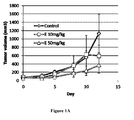
Claims (17)

  1. A compound according to Formula (I) :
    Figure PCTCN2018097183-appb-100001
    wherein F is a functional moiety capable of conferring water solubility, targeting, increased half-life, or combinations thereof;
    wherein L is a cleavable linker; and
    wherein each R 1-R 4 group is independently selected from a hydrogen, C 1-10 alkyl, C 2-10 alkenyl, C 2-10 alkynyl, C 3-10 cycloalkyl, C 1-10 heteroalkyl, C 2-10 heteroalkenyl, C 2-10 heteroalkynyl, or C 3-10 heterocyclyl.
  2. The compound of claim 1, wherein each of the R 1-R 4 groups is a methyl group.
  3. The compound of claim 1 or 2, wherein the functional moiety F is a water-soluble small molecule selected from the group consisting of:
    Figure PCTCN2018097183-appb-100002
    wherein each of n 1-7is an integer from 0 to 10, X -is a negatively charged counterion (e.g., Cl -, Br -) , and M + is a positively charged counterion (e.g., H +, Na +, K +) .
  4. The compound of claim 1 or 2, wherein the functional moiety F is a water soluble polymeric moiety selected from the group consisting of poly-ethylene glycol (PEG) , peptides, polyamides, polyesters, polysaccharides, polyvinylpyrrolidone, poly- (lactic-co-glycolic acid) , poly (acrylic acid) , poly (L-glutamic acid) , and poly (alkylcyanoacrylate) .
  5. The compound of claim 1 or 2, wherein the functional moiety F has the following structure:
    Figure PCTCN2018097183-appb-100003
    wherein x is an integer from 1 to 200, preferably 1 to 150, preferably 1 to 100.
  6. The compound of any one of claims 1-5, wherein the functional moiety F comprises a targeting antigen.
  7. The compound of claim 6, wherein the targeting antigen is folic acid, biotin, GLUT5, estrone, or sialic acid.
  8. The compound of any one of claims 1-7, wherein the cleavable linker L is a hydrolytically cleavable group.
  9. The compound of any one of claims 1-7, wherein the cleavable linker L is
    Figure PCTCN2018097183-appb-100004
    wherein m 1-6, n 11-20, and p1 -3 are each independently selected from integer values 0, 1, 2, 3, 4, 5, 6, 7, 8, 9, or 10.
  10. A pharmaceutical composition comprising a compound of any one of claims 1-9 and further comprising one or more pharmaceutically acceptable excipients, additives, or adjuvants.
  11. The composition of claim 10, wherein the composition reduces tumor growth.
  12. The composition of any one of claims 10-11, wherein the composition targets one or more of the proteins BRICK1 (BRK1) , Cadherin-17 (CDH17) , Epsin-1 (Epn1) , High mobility group protein HMG-I/HMG-Y (HMGA1) , Microtubule-associated serine/threonine-protein kinase 4 (MAST4) , Migration and invasion enhancer 1 (MIEN1) , Nuclear factor NF-kappa-B p100 subunit (NFKB2) , Tyrosine-protein phosphatase non-receptor type 23 (PTPN23) , tumor protein D52 (TPD52) , and Epidermal growth factor receptor (EGFR) .
  13. A method of treating a subject having cancer, the method comprising administering to the subject an effective amount of the compound of any one of claims 1-9 or the composition of any one of claims 10-12.
  14. The method of claim 13, wherein the compound or composition is administered by oral, systemic, enteral, parenteral, local, topical, or buccal routes.
  15. The method of claim 13 or 14, wherein the subject is a mammal, such as a human.
  16. The method of any one of claims 13-14, wherein the compound or composition is administered at a dose of 200 mg/kg.
  17. The method of any one of claims 13-16, wherein the subject has hepatocarcinoma, melanoma, osteosarcoma or promyelocytic leukemia.
PCT/CN2018/097183 2017-07-26 2018-07-26 Erianin derivatives and use thereof Ceased WO2019020072A1 (en)

Priority Applications (1)

Application Number Priority Date Filing Date Title
CN201880049806.6A CN110958998B (en) 2017-07-26 2018-07-26 Erianin derivatives and methods of using erianin derivatives

Applications Claiming Priority (2)

Application Number Priority Date Filing Date Title
US201762537248P 2017-07-26 2017-07-26
US62/537,248 2017-07-26

Publications (1)

Publication Number Publication Date
WO2019020072A1 true WO2019020072A1 (en) 2019-01-31

Family

ID=65041093

Family Applications (1)

Application Number Title Priority Date Filing Date
PCT/CN2018/097183 Ceased WO2019020072A1 (en) 2017-07-26 2018-07-26 Erianin derivatives and use thereof

Country Status (2)

Country Link
CN (1) CN110958998B (en)
WO (1) WO2019020072A1 (en)

Families Citing this family (2)

* Cited by examiner, † Cited by third party
Publication number Priority date Publication date Assignee Title
CN114230466B (en) * 2021-12-31 2024-10-15 上海华理生物医药股份有限公司 Dichloroacetic acid coupled diphenylethane compound, preparation method and application thereof
CN118948799B (en) * 2024-07-26 2025-11-21 安徽中医药大学 Mulan albumin nanoparticle targeting esophagus cancer as well as preparation method and application thereof

Family Cites Families (3)

* Cited by examiner, † Cited by third party
Publication number Priority date Publication date Assignee Title
CN1907989B (en) * 2005-08-02 2011-08-17 浙江天皇药业有限公司 Setoglaucine salt, preparation method thereof and medicinal composition containing the same
CN101234098A (en) * 2007-02-01 2008-08-06 浙江赛尔生物医学研究有限公司 Application of erianin in preparing medicaments for treating tumor
CN104782625B (en) * 2015-03-30 2016-09-14 上海应用技术学院 Application of erianin and its derivatives as agricultural fungicides

Non-Patent Citations (2)

* Cited by examiner, † Cited by third party
Title
WU, BIN: "Studies on natural terpenoids and stilbenoids", CHINESE DOCTORAL DISSERTATIONS FULL-TEXT DATABASE (ENGINEERING SCIENCE AND TECHNOLOGY I, 15 December 2007 (2007-12-15), pages 90, ISSN: 1674-022X *
ZI, CHENGTING: "Synthesis and Biological Testing of the Target Antitumor Compounds of Podophyllotoxin, Camptothecine and Erianin", CHINESE DOCTORAL DISSERTATIONS FULL-TEXT DATABASE (MEDICINE AND HEALTH SCIENCES, 15 October 2015 (2015-10-15), ISSN: 1674-022X *

Also Published As

Publication number Publication date
CN110958998B (en) 2022-09-23
CN110958998A (en) 2020-04-03

Similar Documents

Publication Publication Date Title
He et al. Repurposing disulfiram for cancer therapy via targeted nanotechnology through enhanced tumor mass penetration and disassembly
US10342846B2 (en) Nanoparticle drug delivery systems
ES2701077T3 (en) Bile acid oligomer conjugate for new vesicular transport and use thereof
CN108404138B (en) Conjugate of targeting CD24 monoclonal antibody and diethylamine azonium dialkoxide and application thereof
US20240238434A1 (en) Use of medicament in treatment of tumor disease
US20140155423A1 (en) Berbamine derivatives
Groer et al. Intratumoral cancer chemotherapy with a carrier-based immunogenic cell-death eliciting platinum (IV) Agent
Popova et al. Biotin-decorated anti-cancer nucleotide theranostic conjugate of human serum albumin: Where the seed meets the soil?
WO2025124615A2 (en) Preparation and use of albumin-paclitaxel twin drug nanoparticle
WO2019020072A1 (en) Erianin derivatives and use thereof
Yang et al. Targeting co-delivery of doxorubicin and gefitinib by biotinylated Au NCs for overcoming multidrug resistance in imaging-guided anticancer therapy
US9206132B2 (en) Use of a novel aminopyridine derivative to prevent or treat cancer
CN101537185A (en) Tumor cell actively targeted drug delivery system, preparation method and application thereof
KR20210016103A (en) Novel compound for inducing degradation of alk protein and pharmaceutical composition for using in preventing or treating cancer containing the same as an active ingredient
CN102863474A (en) Platinum compounds for treating cell proliferative diseases and preparation method and application thereof
US20250136642A1 (en) Cyclic peptide compounds and methods of use thereof
US11696904B2 (en) Prodrug for therapeutic applications
CN115322226B (en) Covalent targeting arsenic inhibitor and preparation method and application thereof
WO2021159547A1 (en) Polypeptide drug for preventing and/or treating ovarian cancer and use thereof
US20210024928A1 (en) C/ebp alpha sarna compositions and methods of use
JP5202332B2 (en) Compounds and methods for the treatment of cancer
US10849861B2 (en) Pharmaceutical compound for treating colorectal cancer
AU2022367624A1 (en) 2,3-dimethoxy-5-methyl-1,4-benzoquinone alkyl alcohol derivative and use thereof
US11180486B2 (en) Indolylkojyl methane analogues, process of preparation thereof and use as inhibitor of cancer cells invasion and metastasis
RU2597795C2 (en) Inhibitor of liquid in cavities of body accumulation

Legal Events

Date Code Title Description
121 Ep: the epo has been informed by wipo that ep was designated in this application

Ref document number: 18838639

Country of ref document: EP

Kind code of ref document: A1

NENP Non-entry into the national phase

Ref country code: DE

122 Ep: pct application non-entry in european phase

Ref document number: 18838639

Country of ref document: EP

Kind code of ref document: A1