WO2019011774A1 - Improvements in resin curative systems - Google Patents

Improvements in resin curative systems Download PDF

Info

Publication number
WO2019011774A1
WO2019011774A1 PCT/EP2018/068230 EP2018068230W WO2019011774A1 WO 2019011774 A1 WO2019011774 A1 WO 2019011774A1 EP 2018068230 W EP2018068230 W EP 2018068230W WO 2019011774 A1 WO2019011774 A1 WO 2019011774A1
Authority
WO
WIPO (PCT)
Prior art keywords
epoxy resin
curative system
aromatic amine
alkyl
curative
Prior art date
Legal status (The legal status is an assumption and is not a legal conclusion. Google has not performed a legal analysis and makes no representation as to the accuracy of the status listed.)
Ceased
Application number
PCT/EP2018/068230
Other languages
French (fr)
Inventor
Martin Simmons
Steve Mortimer
Neal Patel
Current Assignee (The listed assignees may be inaccurate. Google has not performed a legal analysis and makes no representation or warranty as to the accuracy of the list.)
Hexcel Composites Ltd
Original Assignee
Hexcel Composites Ltd
Priority date (The priority date is an assumption and is not a legal conclusion. Google has not performed a legal analysis and makes no representation as to the accuracy of the date listed.)
Filing date
Publication date
Application filed by Hexcel Composites Ltd filed Critical Hexcel Composites Ltd
Priority to KR1020207001393A priority Critical patent/KR20200041862A/en
Priority to US16/626,225 priority patent/US20200115492A1/en
Priority to AU2018300733A priority patent/AU2018300733B2/en
Priority to MYPI2020000150A priority patent/MY203024A/en
Priority to CN201880046447.9A priority patent/CN110869412A/en
Priority to JP2020500869A priority patent/JP7242628B2/en
Priority to RU2020104042A priority patent/RU2770058C2/en
Priority to EP18737267.7A priority patent/EP3652233B1/en
Priority to ES18737267T priority patent/ES2985322T3/en
Publication of WO2019011774A1 publication Critical patent/WO2019011774A1/en
Anticipated expiration legal-status Critical
Ceased legal-status Critical Current

Links

Classifications

    • C—CHEMISTRY; METALLURGY
    • C08—ORGANIC MACROMOLECULAR COMPOUNDS; THEIR PREPARATION OR CHEMICAL WORKING-UP; COMPOSITIONS BASED THEREON
    • C08G—MACROMOLECULAR COMPOUNDS OBTAINED OTHERWISE THAN BY REACTIONS ONLY INVOLVING UNSATURATED CARBON-TO-CARBON BONDS
    • C08G59/00—Polycondensates containing more than one epoxy group per molecule; Macromolecules obtained by polymerising compounds containing more than one epoxy group per molecule using curing agents or catalysts which react with the epoxy groups
    • C08G59/18—Macromolecules obtained by polymerising compounds containing more than one epoxy group per molecule using curing agents or catalysts which react with the epoxy groups ; e.g. general methods of curing
    • C08G59/40—Macromolecules obtained by polymerising compounds containing more than one epoxy group per molecule using curing agents or catalysts which react with the epoxy groups ; e.g. general methods of curing characterised by the curing agents used
    • C08G59/50—Amines
    • C08G59/5033—Amines aromatic
    • B—PERFORMING OPERATIONS; TRANSPORTING
    • B29—WORKING OF PLASTICS; WORKING OF SUBSTANCES IN A PLASTIC STATE IN GENERAL
    • B29C—SHAPING OR JOINING OF PLASTICS; SHAPING OF MATERIAL IN A PLASTIC STATE, NOT OTHERWISE PROVIDED FOR; AFTER-TREATMENT OF THE SHAPED PRODUCTS, e.g. REPAIRING
    • B29C70/00—Shaping composites, i.e. plastics material comprising reinforcements, fillers or preformed parts, e.g. inserts
    • B29C70/003—Shaping composites, i.e. plastics material comprising reinforcements, fillers or preformed parts, e.g. inserts characterised by the matrix material, e.g. material composition or physical properties
    • B—PERFORMING OPERATIONS; TRANSPORTING
    • B29—WORKING OF PLASTICS; WORKING OF SUBSTANCES IN A PLASTIC STATE IN GENERAL
    • B29C—SHAPING OR JOINING OF PLASTICS; SHAPING OF MATERIAL IN A PLASTIC STATE, NOT OTHERWISE PROVIDED FOR; AFTER-TREATMENT OF THE SHAPED PRODUCTS, e.g. REPAIRING
    • B29C70/00—Shaping composites, i.e. plastics material comprising reinforcements, fillers or preformed parts, e.g. inserts
    • B29C70/04—Shaping composites, i.e. plastics material comprising reinforcements, fillers or preformed parts, e.g. inserts comprising reinforcements only, e.g. self-reinforcing plastics
    • B29C70/28—Shaping operations therefor
    • B29C70/30—Shaping by lay-up, i.e. applying fibres, tape or broadsheet on a mould, former or core; Shaping by spray-up, i.e. spraying of fibres on a mould, former or core
    • B—PERFORMING OPERATIONS; TRANSPORTING
    • B32—LAYERED PRODUCTS
    • B32B—LAYERED PRODUCTS, i.e. PRODUCTS BUILT-UP OF STRATA OF FLAT OR NON-FLAT, e.g. CELLULAR OR HONEYCOMB, FORM
    • B32B27/00—Layered products comprising a layer of synthetic resin
    • B32B27/38—Layered products comprising a layer of synthetic resin comprising epoxy resins
    • C—CHEMISTRY; METALLURGY
    • C08—ORGANIC MACROMOLECULAR COMPOUNDS; THEIR PREPARATION OR CHEMICAL WORKING-UP; COMPOSITIONS BASED THEREON
    • C08G—MACROMOLECULAR COMPOUNDS OBTAINED OTHERWISE THAN BY REACTIONS ONLY INVOLVING UNSATURATED CARBON-TO-CARBON BONDS
    • C08G59/00—Polycondensates containing more than one epoxy group per molecule; Macromolecules obtained by polymerising compounds containing more than one epoxy group per molecule using curing agents or catalysts which react with the epoxy groups
    • C08G59/18—Macromolecules obtained by polymerising compounds containing more than one epoxy group per molecule using curing agents or catalysts which react with the epoxy groups ; e.g. general methods of curing
    • C08G59/20—Macromolecules obtained by polymerising compounds containing more than one epoxy group per molecule using curing agents or catalysts which react with the epoxy groups ; e.g. general methods of curing characterised by the epoxy compounds used
    • C08G59/32—Epoxy compounds containing three or more epoxy groups
    • C08G59/3227—Compounds containing acyclic nitrogen atoms
    • C—CHEMISTRY; METALLURGY
    • C08—ORGANIC MACROMOLECULAR COMPOUNDS; THEIR PREPARATION OR CHEMICAL WORKING-UP; COMPOSITIONS BASED THEREON
    • C08G—MACROMOLECULAR COMPOUNDS OBTAINED OTHERWISE THAN BY REACTIONS ONLY INVOLVING UNSATURATED CARBON-TO-CARBON BONDS
    • C08G59/00—Polycondensates containing more than one epoxy group per molecule; Macromolecules obtained by polymerising compounds containing more than one epoxy group per molecule using curing agents or catalysts which react with the epoxy groups
    • C08G59/18—Macromolecules obtained by polymerising compounds containing more than one epoxy group per molecule using curing agents or catalysts which react with the epoxy groups ; e.g. general methods of curing
    • C08G59/40—Macromolecules obtained by polymerising compounds containing more than one epoxy group per molecule using curing agents or catalysts which react with the epoxy groups ; e.g. general methods of curing characterised by the curing agents used
    • C08G59/50—Amines
    • C08G59/504—Amines containing an atom other than nitrogen belonging to the amine group, carbon and hydrogen
    • C—CHEMISTRY; METALLURGY
    • C08—ORGANIC MACROMOLECULAR COMPOUNDS; THEIR PREPARATION OR CHEMICAL WORKING-UP; COMPOSITIONS BASED THEREON
    • C08G—MACROMOLECULAR COMPOUNDS OBTAINED OTHERWISE THAN BY REACTIONS ONLY INVOLVING UNSATURATED CARBON-TO-CARBON BONDS
    • C08G59/00—Polycondensates containing more than one epoxy group per molecule; Macromolecules obtained by polymerising compounds containing more than one epoxy group per molecule using curing agents or catalysts which react with the epoxy groups
    • C08G59/18—Macromolecules obtained by polymerising compounds containing more than one epoxy group per molecule using curing agents or catalysts which react with the epoxy groups ; e.g. general methods of curing
    • C08G59/40—Macromolecules obtained by polymerising compounds containing more than one epoxy group per molecule using curing agents or catalysts which react with the epoxy groups ; e.g. general methods of curing characterised by the curing agents used
    • C08G59/50—Amines
    • C08G59/56—Amines together with other curing agents
    • C—CHEMISTRY; METALLURGY
    • C08—ORGANIC MACROMOLECULAR COMPOUNDS; THEIR PREPARATION OR CHEMICAL WORKING-UP; COMPOSITIONS BASED THEREON
    • C08J—WORKING-UP; GENERAL PROCESSES OF COMPOUNDING; AFTER-TREATMENT NOT COVERED BY SUBCLASSES C08B, C08C, C08F, C08G or C08H
    • C08J3/00—Processes of treating or compounding macromolecular substances
    • C08J3/20—Compounding polymers with additives, e.g. colouring
    • C08J3/203—Solid polymers with solid and/or liquid additives
    • C—CHEMISTRY; METALLURGY
    • C08—ORGANIC MACROMOLECULAR COMPOUNDS; THEIR PREPARATION OR CHEMICAL WORKING-UP; COMPOSITIONS BASED THEREON
    • C08J—WORKING-UP; GENERAL PROCESSES OF COMPOUNDING; AFTER-TREATMENT NOT COVERED BY SUBCLASSES C08B, C08C, C08F, C08G or C08H
    • C08J5/00—Manufacture of articles or shaped materials containing macromolecular substances
    • C08J5/04—Reinforcing macromolecular compounds with loose or coherent fibrous material
    • C08J5/0405—Reinforcing macromolecular compounds with loose or coherent fibrous material with inorganic fibres
    • C08J5/042—Reinforcing macromolecular compounds with loose or coherent fibrous material with inorganic fibres with carbon fibres
    • C—CHEMISTRY; METALLURGY
    • C08—ORGANIC MACROMOLECULAR COMPOUNDS; THEIR PREPARATION OR CHEMICAL WORKING-UP; COMPOSITIONS BASED THEREON
    • C08J—WORKING-UP; GENERAL PROCESSES OF COMPOUNDING; AFTER-TREATMENT NOT COVERED BY SUBCLASSES C08B, C08C, C08F, C08G or C08H
    • C08J5/00—Manufacture of articles or shaped materials containing macromolecular substances
    • C08J5/24—Impregnating materials with prepolymers which can be polymerised in situ, e.g. manufacture of prepregs
    • C08J5/241—Impregnating materials with prepolymers which can be polymerised in situ, e.g. manufacture of prepregs using inorganic fibres
    • C08J5/243—Impregnating materials with prepolymers which can be polymerised in situ, e.g. manufacture of prepregs using inorganic fibres using carbon fibres
    • C—CHEMISTRY; METALLURGY
    • C08—ORGANIC MACROMOLECULAR COMPOUNDS; THEIR PREPARATION OR CHEMICAL WORKING-UP; COMPOSITIONS BASED THEREON
    • C08J—WORKING-UP; GENERAL PROCESSES OF COMPOUNDING; AFTER-TREATMENT NOT COVERED BY SUBCLASSES C08B, C08C, C08F, C08G or C08H
    • C08J5/00—Manufacture of articles or shaped materials containing macromolecular substances
    • C08J5/24—Impregnating materials with prepolymers which can be polymerised in situ, e.g. manufacture of prepregs
    • C08J5/249—Impregnating materials with prepolymers which can be polymerised in situ, e.g. manufacture of prepregs characterised by the additives used in the prepolymer mixture
    • C—CHEMISTRY; METALLURGY
    • C08—ORGANIC MACROMOLECULAR COMPOUNDS; THEIR PREPARATION OR CHEMICAL WORKING-UP; COMPOSITIONS BASED THEREON
    • C08J—WORKING-UP; GENERAL PROCESSES OF COMPOUNDING; AFTER-TREATMENT NOT COVERED BY SUBCLASSES C08B, C08C, C08F, C08G or C08H
    • C08J2363/00—Characterised by the use of epoxy resins; Derivatives of epoxy resins
    • C08J2363/02—Polyglycidyl ethers of bis-phenols

Definitions

  • Methylene bridged aromatic diamines such as 4,4' methylene bis anilines
  • the present invention aims to address or alleviate any one of the aforementioned problems and/or to provide improvements generally.
  • the curative systems of the present invention are particularly useful with epoxy resins that are liquid at ambient temperature.
  • the curable epoxy resin compositions of the present invention may comprise any amount of the curative systems of the present invention sufficient to promote curing of the compositions.
  • the curative system and the epoxy resin are used in amounts such that the relative amounts of amine groups provided by the curative and the epoxy groups provided by the epoxy resin is from 07:1 .3, preferably from 0.8:1.2.
  • the compositions can be prepared at low temperatures to reduce the costs of heating the mixtures during compounding of the compositions.
  • This is particularly relevant in resin infusion processes, where the uncured resin composition comprising the epoxy resin, curative system and, optionally, other components is suitably drawn into the reinforcing material, for example fibres or a fabric, located in a mould for the composite using a vacuum and/or pressure to draw the resin composition through a stack of the reinforcing material.
  • the speed and distance of the infusion of the stack is dependent on the permeability of the stack, the pressure gradient acting on the infused resin and the viscosity of the resin composition.
  • Example 4 The resin of Example 4 was used to prepare test laminates as set out in Example 3 using the reinforcement material listed therein. The laminates were tested as set out in Example 1 , and the open hole compression performance was found to be good (295 MPa) with no significant impact on either dry or wet Tg (dry Tg 198°C, wet Tg 175°C).

Landscapes

  • Chemical & Material Sciences (AREA)
  • Engineering & Computer Science (AREA)
  • Chemical Kinetics & Catalysis (AREA)
  • Medicinal Chemistry (AREA)
  • Polymers & Plastics (AREA)
  • Organic Chemistry (AREA)
  • Health & Medical Sciences (AREA)
  • Materials Engineering (AREA)
  • Manufacturing & Machinery (AREA)
  • Mechanical Engineering (AREA)
  • Composite Materials (AREA)
  • Inorganic Chemistry (AREA)
  • Physics & Mathematics (AREA)
  • Mathematical Physics (AREA)
  • Epoxy Resins (AREA)
  • Reinforced Plastic Materials (AREA)
  • Compositions Of Macromolecular Compounds (AREA)
  • Processes Of Treating Macromolecular Substances (AREA)
  • Phenolic Resins Or Amino Resins (AREA)
  • Other Resins Obtained By Reactions Not Involving Carbon-To-Carbon Unsaturated Bonds (AREA)

Abstract

There is provided a curative system for epoxy resins comprising an alkyl benzene diamine and an additional aromatic amine. There is also provided the use of an alkyl benzene diamine to enhance the performance of an aromatic amine as a curative for an epoxy resin in an infusion processes for the production of fibre reinforced composites; a curable epoxy resin composition containing a mixture of an epoxy resin and a curative system according to the invention; the use of a composition according to the invention as the curable resin in the production of fibre reinforced composites and/or in the production of fibre reinforced composites by infusion processes; a fibre reinforced composite comprising fibrous reinforcement material and a cured epoxy resin obtainable by curing a curable epoxy resin composition according to the invention, and a process for the production of fibre reinforced composites wherein a fibrous reinforcement material is laid up and a curable epoxy resin composition according to the invention is infused through the fibrous reinforcement material at a temperature of 80 to 130°C and, once the composition has infused the fibrous reinforcement material, the temperature is raised to 150 to 190°C.

Description

IMPROVEMENTS IN RESIN CURATIVE SYSTEMS
The present invention relates to curative systems for thermosetting resins and in particular to curative systems for curable epoxy resin compositions, especially for such compositions that are used in infusion processes for the production of fibre reinforced composites.
Curing agents are used in order to activate and control the curing of epoxy resins to provide the required cure cycle, the exotherm of the cure and the properties of the final cured resin. A wide range of curing agents for epoxy resins have been proposed and are widely used. For example, amines such as dicyandiamide are widely used curing agents, as are sulfones, such as diamino diphenyl sulfone.
The requirements of a curing agent for epoxy resins are that it is soluble in the epoxy resins with which it is used at temperatures involved during the cure cycle and that it is easily mixed with the epoxy resin to provide a uniform dispersion of the curing agent throughout the resin. Additionally the curing agent should be activatable to provide the desired time/temperature cure cycle for the fibre/epoxy resin system, particularly to provide fast cure but with a low enthalpy of the curing reaction. Furthermore the curing agent should be compatible with other additives that may be included in the system.
One particular class of curing agents are substituted 4,4' methylene bis anilines, such as those that are described in US 4,950,792, US4,978,791 , EP2542610 and GB2524873.
Fibre reinforced composites are used as structural materials in many applications, such as aerospace and automotive components, wind turbine components such as blades, sporting goods such as skis and in the electronics, construction and furniture industries. Fibre reinforced composites generally comprise a fibrous material embedded in a solid matrix of a polymeric material. The polymeric material may be a thermoplastic or a thermosetting resin. The present invention is concerned with curatives for thermosetting resins particularly those resins that are used in the production of fibre reinforced composites and in particular to curatives for epoxy resins.
Fibre reinforced composites that are based on thermosetting resins are typically produced employing one of two basic processes. In one process a material known as a prepreg is formed by impregnating a layer of fibrous material which may be woven or nonwoven unidirectional or multidirectional with an uncured or partially cured liquid resin. The prepreg is then shaped as required for the finished article and the resin cured, usually by heat to form
l the high strength light weight finished product. The resins used in these systems are typically epoxy resins, ester resins or maleimide resins and the resin formulation usually contains a curative for the particular resin. In an alternative manufacturing technique a fibrous material is laid up, generally within an enclosure, into which a liquid resin system can be infused to envelope the fibrous material, where it may then be cured to produce the finished article. The enclosure may be complete around the fibrous material and the resin drawn in under vacuum (sometimes known as the vacuum bag technique). Alternatively the enclosure may be a mould, and the resin may be injected into the mould (sometimes known as Resin Transfer Moulding), which may also be vacuum assisted (known as Vacuum Assisted Resin Transfer Moulding). As with the earlier described system in relation to prepregs, the liquid resin system may be an epoxy resin, an ester resin or a maleimide resin, and it will also contain a curative for the particular resin. Due to the economics of manufacture and also the increase in the size of the mouldings that are being produced the use of the infusion techniques is growing in popularity, and such techniques are used particularly for the manufacture of automotive and aerospace components and wind turbine blades. The liquid infusion processes advantageously allow composites to be formed with reduced manufacturing costs due to the material being cured in an out of autoclave process. It is, however, critical that the components and blades have particular strengths in tension and in compression. Furthermore, given the uses to which the composites are put, it is also important that they retain a particular strength at locations where holes may be formed for attachments. Various tests have been developed to assess the strength of fibre reinforced composite material, one of which is known as the open hole compression test, which is the test adopted as the standard test for locations where holes have been formed in the composites, such as for securing attachments. This test is widely used, particularly the aerospace industry, to judge the acceptability of materials, and is the ACEMA standard pr EN 6036. It has been found that curative systems, particularly epoxy resins, that provide satisfactory performance in this test when the first described prepreg manufacturing process is used, may result is reduced performance when used as the curative system in the second, infusion, processes.
The Tg of composites is also an important property, both when the composite is dry, and, perhaps more importantly, when it is wet, and this can be determined using test AECMA standard pr EN 6032. The wet Tg being obtained by measurement after immersing the sample in boiling water (100°C) for 3 days prior to test. Attempts to improve open hole compression performance may result in a reduction in the glass transition temperature (Tg), particularly wet Tg, of materials.
Amines have been used as curatives for resins such as epoxy resins for many years. For example, aromatic amines and their use as curatives is described in EP1265940, which refers to a dimethylthiotolunediamine (available as Ethacure 300 from Albermarle) as being useful as a curative for polyurethane-ureas and polyureas, and this material is also listed as a possible curative for epoxy resins in vacuum bag infusion processes for the production of fibre reinforced composites in US 9,370,902.
Methylene bridged aromatic diamines, such as 4,4' methylene bis anilines, have been proposed as curative for epoxy resins, optionally in infusion processes previously described in, for example, UK Patent Application GB2524873. The present invention aims to address or alleviate any one of the aforementioned problems and/or to provide improvements generally.
According to the invention there is provided a curative system, a use, a curable epoxy resin composition, a use of a composition, a fibre reinforced composite and a process as defined in any one of the accompanying claims.
The present invention therefore provides a curative system for epoxy resins comprising an alkyl benzene diamine and an additional aromatic amine. The present invention also provides the use of an alkyl benzene diamine to enhance the performance of an aromatic amine as a curative for an epoxy resin in an infusion processes for the production of fibre reinforced composites.
The present invention further provides a curable epoxy resin composition containing a mixture of an epoxy resin and a curative system according to the present invention.
The present invention further provides the use of a composition according to the present invention as the curable resin in the production of fibre reinforced composites, particularly in the production of fibre reinforced composites by infusion processes. The present invention further provides a fibre reinforced composite comprising fibrous reinforcement material and a cured epoxy resin obtainable by curing a curable epoxy resin composition according to the present invention. The present invention yet further provides a process for the production of fibre reinforced composites wherein a fibrous reinforcement material is laid up and a curable epoxy resin composition according to the present invention is infused through the fibrous reinforcement material at a temperature of 80 to 130°C and, once the resin has been drawn through the fibrous reinforcement material, the temperature is raised to 150 to 190°C.
The curative systems of the present invention may be provided as a mixture of the alkyl benzene diamine and the additional aromatic amine, or the alkyl benzene diamine and the additional aromatic amine may be provided separately. For example, the alkyl benzene diamine may be added to an epoxy resin and mixed therein, and the additional aromatic amine may subsequently added to the mixture, or vice versa.
In preferred embodiments of the present invention the alkyl benzene diamine is a toluene diamine having one or more additional alkyl and/or thioalkyi groups, and in particularly preferred embodiments the alkyl benzene diamine is of the formula:
Figure imgf000005_0001
and/or
Figure imgf000005_0002
wherein Y is an alkyi groups containing from 1 to 4 carbon atoms, X is hydrogen, a halogen or an alkyi group containing from 1 to 4 carbon atoms, and R and R' are alkyi groups or alkylthio groups, preferably alkyi groups or alkylthio groups containing from 1 to 4 carbon atoms. In especially preferred embodiments, X is hydrogen, Y is an alkyi group, most preferably a methyl group, and R and R1 are both alkylthio groups, most preferably methylthio groups, or alkyi groups, most preferably ethyl groups.
Examples of preferred compounds of formula I for use in the present invention include:
Figure imgf000006_0001
Examples of preferred compounds of formula II for use in the present invention include:
Figure imgf000006_0002
In particularly preferred embodiments of the present invention the alkyl benzene diamine comprises a mixture of compounds of formula I and formula II, preferably wherein the ratio of compounds of formula I to compounds of formula II is 90:10 to 70:30, more preferably 80:20. For example, the alkyl benzene diamine may comprise a mixture of:
Figure imgf000007_0001
, preferably in a ratio of from 90% to 10% to 70% to 30%, more preferably in a ratio of 80% to 20%. Examples of alkyl benzene diamines suitable for use in the present invention include Ethacure® 100 and Ethacure® 300, both available from Albemarle Corporation (NY, USA), and Lonzacure DETDA 80, available from Lonza (Basel, Switzerland).
The additional aromatic amines suitable for use in the present invention generally include all materials effective as curatives for epoxy resins. By an additional aromatic amine it is meant that the aromatic amine material is an aromatic amine other than the alkyl benzene diamine material, so that the curative systems of the present invention always comprise at least two different amine materials, i.e. an alkyl benzene diamine and an aromatic amine other than an alkyl benzene diamine.
In preferred embodiments of the present invention the additional aromatic amine is an alkylene bridged aromatic amine, particularly a methylene bis aniline, such as a 4,4' methylene bis aniline. Particularly suitable additional aromatic amines are methylene bis anilines having the formula:
Figure imgf000008_0001
wherein Ri , F¾, R3, R4, Rr, R2', R3 , and R4 are independently selected from:
hydrogen;
Ci to C6 alkoxy, preferably Ci to C4 alkoxy, where the alkoxy group may be linear or branched, for example methoxy, ethoxy and isopropoxy;
Ci to Ce alkyl, preferably Ci to C4 alkyl, where the alkyl group may be linear or branched and optionally substituted, for example methyl, ethyl, isopropyl and trifluoro methyl; or halogen, for example chlorine;
wherein at least one of Ri , R2, R3, R4, Rr, R2', R3 , and R4 is a Ci to Ce alkyl group. In particular embodiments of the present invention the additional aromatic amine may comprise a mixture of two or more methylene bis anilines.
Particularly preferred additional aromatic amines comprise methylene bis (diethyl aniline) (M- DEA), methylene bis (chlorodiethyl aniline) (M-CDEA), methylene (methyl ethyl aniline)- (chlorodiethyl aniline) (M-MEACDEA) or mixtures thereof, and particularly 4,4' M-DEA, 4,4' M- CDEA; 4,4' M-MEACDEA, or mixtures thereof.
A range of suitable alkylene bridged aromatic amines are available commercially, for example the methylene bis anilines available underthe name Lonzacure®from Lonza. Details of further suitable alkylene bridged aromatic amines are provided in WO 201 1/107796 and GB 2524873.
The curative systems of the present invention preferably comprise from 5 to 50% by weight of the curative system of the alkyl benzene diamine, more preferably from 10 to 50%, most preferably from 20 to 40 wt%, with the remainder of the curative system being made up of the additional aromatic amine. In preferred embodiments of the present invention at least one of the alkyl benzene diamine and the additional aromatic amine is liquid at ambient temperature. In particularly preferred embodiments of the invention a mixture of the alkyl benzene diamine and the additional aromatic amine (at the proportions at which they are used in the curative system) is liquid at ambient temperature, such as at 22°C.
We have now found that the use of alkyl benzene diamines, such as dimethylthiotoluenediamine, enhances the performance of and aromatic amine as curatives for epoxy resins in infusion processes for the production of fibre reinforced composites results. In particular, the use of the alkyl benzene diamine in combination with an additional aromatic amine as the curative system for an epoxy resin used in an infusion process for producing a fibre reinforced composite results in improved strength of the composite, and, in particular, improved performance of the cured composite in the open hole compression test. The use of the combination has also been found to not significantly reduce the wet Tg of the composites, and to lead to improvements in some cases.
In particularly preferred embodiments of the use according to the present invention, the alkyl benzene diamine is an alkyl benzene diamine as defined above and/or the aromatic amine is an additional aromatic amine as defined above.
The curable epoxy resin compositions of the present invention may comprise any suitable epoxy resins, but preferably the epoxy resin has a functionality at least 2.
The epoxy equivalent weight (EEW) of the resin is preferably in the range from 80 to 500, preferably of from 80 to 250. Suitable epoxy resins may comprise blends of two or more epoxy resins.
The epoxy resins used in the curable epoxy resin compositions of the present invention may be difunctional, trifunctional and tetrafunctional epoxy resins. Suitable difunctional resins for use in the present invention include those based on: diglycidyl ether of bisphenol F, diglycidyl ether of bisphenol A (optionally brominated), diglycidyl dihydroxy naphthalene, phenol and cresol epoxy novolacs, glycidyl ethers of phenol-aldehyde adducts, glycidyl ethers of aliphatic diols, diglycidyl ether, diethylene glycol digicidyl ether, aromatic epoxy resins, aliphatic polyglycidyl ethers, epoxidised olefins, brominated resins, aromatic glycidyl amines, heterocyclic glycidyl imidines and amides, glycidyl ethers, fluorinated epoxy resins, glycidyl esters or any combination thereof. Suitable trifunctional epoxy resins for use in the present invention include those based upon phenol and cresol epoxy novolacs, glycidyl ethers of phenol-aldehyde adducts, aromatic epoxy resins, aliphatic triglycidyl ethers, dialphatic triglycidyl ethers, aliphatic polyglycidyl amines, heterocyclic glycidyl imidines and amides, glycidyl ethers, fluorinated epoxy resins, or any combination thereof. Suitable trifunctional epoxy resins are available from Huntsman Advanced Material (Monthey, Switzerland) under the tradenames MY0500 and MY0510 (triglycidyl para-aminophenol) and MY0600 and MY0610 (triglycidul meta-aminophenol).
Suitable tetrafunctional epoxy resins for use in the present invention include N,N, N,1,N1- tetraglycidyl-m-xylenediamine (available commercially from Mitsubishi Gas Chemical Company under the name Tetrad-X, and as Erisys GA-240 from CVC Chemicals), and N,N,N1,N1-tetraglycidylmethylenedianline (e.g. MY720 and MY721 from Huntsman Advanced Materials). Other suitable multifunctional epoxy resins include DEN438 (from Dow Chemicals, Midland, Ml) DEN439 (from Dow Chemicals), Araldite ECN 1273 (from Huntsman Advanced Materials), and Araldite ECN 1299 (from Huntsman Advanced Materials).
The curative systems of the present invention are particularly useful with epoxy resins that are liquid at ambient temperature. The curable epoxy resin compositions of the present invention may comprise any amount of the curative systems of the present invention sufficient to promote curing of the compositions. In preferred embodiments of the invention, the curative system and the epoxy resin are used in amounts such that the relative amounts of amine groups provided by the curative and the epoxy groups provided by the epoxy resin is from 07:1 .3, preferably from 0.8:1.2.
The curable epoxy resins of the present invention may comprise additional components (or additives) according to the nature of the use envisaged for the cured epoxy resin. Suitable additives include one or more of additional resins, flexibilizers, toughening agents, rubbers, core shell polymers, fillers, flame and/or smoke retardants, wetting agents, pigments/dyes, UV absorbers, antifungal compounds and viscosity modifiers.
In order to prepare the curable epoxy resin compositions of the present invention it is necessary to produce a homogenous or substantially homogeneous mixture of the various ingredients. In particular, it is important that the curing agents be well dispersed throughout the epoxy resin in order to obtain uniform curing of the formulation upon heating so that uniform properties, particularly mechanical properties, are obtained in the cured epoxy resin. Additionally, it is desirable that the compositions can be prepared at temperatures well below the activation temperatures of the curing agents to prevent premature activation of the curing agents and cross linking of the epoxy resin. In addition, for infusion applications the viscosity of the compositions suitably remains low to promote impregnation of fibrous reinforcement. It is also preferred that, from an economic perspective, the compositions can be prepared at low temperatures to reduce the costs of heating the mixtures during compounding of the compositions. This is particularly relevant in resin infusion processes, where the uncured resin composition comprising the epoxy resin, curative system and, optionally, other components is suitably drawn into the reinforcing material, for example fibres or a fabric, located in a mould for the composite using a vacuum and/or pressure to draw the resin composition through a stack of the reinforcing material. The speed and distance of the infusion of the stack is dependent on the permeability of the stack, the pressure gradient acting on the infused resin and the viscosity of the resin composition.
In preferred embodiments of the present invention, the curable epoxy resin compositions of the invention have a viscosity of from 10 to 10OcP at 120°C and from 100 to 10OOcP 60°C.
The curable epoxy resin compositions of the present invention are especially suitable for the production of a composite by infusion processes. In an infusion process, a reinforcing material, for example a fabric or a fibrous material, may be placed in a mould and liquid resin is then drawn into the mould, for example under pressure and/or by vacuum to impregnate the reinforcing material within the mould. The reinforcing material may have been pre-shaped in the mould or may be shaped once impregnated with the resin, and the resin impregnated reinforcing material may then be cured in the mould. We have found that the curable epoxy resin compositions of the present invention, employing the curative systems of the invention, may be used in an infusion process to prepare a composite with excellent mechanical properties, particularly in the open hole compression test, and that they also have desirable glass transition temperatures (Tg) particularly the wet glass transition temperature.
The processes of the present invention comprise laying up a fibrous reinforcement material and infusing the material with a curable epoxy resin composition of the present invention at a temperature of 80 to 130°C and, once the composition has infused the fibrous reinforcement material, raising the temperature to 150 to 190°C to cure the resin.
The fibrous reinforcement materials used in the processes of the present invention may be synthetic or natural fibres or any other form of material or combination of materials that, combined with the curable epoxy resin composition of the invention, forms a composite product. The reinforcement material can either be provided via spools of fibre that are unwound or from a roll of textile. Exemplary fibres include glass, carbon, graphite, boron, ceramic and aramid. Preferred fibres are carbon, glass, graphite, boron, ceramic and aramid fibres, particularly carbon fibres. Hybrid or mixed fibre systems may also be envisaged. The use of cracked (i.e. stretch-broken) or selectively discontinuous fibres may be advantageous to facilitate lay-up of the product and improve its capability of being shaped. Although a unidirectional fibre alignment is preferable, otherforms may also be used. Typical textile forms include simple textile fabrics, knit fabrics, twill fabrics and satin weaves. It is also possible to envisage using non-woven or non-crimped fibre layers. The surface mass of fibres within the fibrous reinforcement is generally 80-2000 g/m2, preferably 100-1000 g/m2, and especially preferably 150-800 g/m2. The number of carbon filaments per tow can vary from 1000 to 480,000, preferably from 3,000 to 24,000 and most preferably from 3,000 to 12,000. Composite materials produced by infusion processes using the compositions of the present invention may be used for any intended purpose, but are particularly useful in automotive and aerospace vehicles, particularly in commercial and military aircraft. For example, the composite materials may be used to make non-primary (secondary) aircraft structures. However the preferred use of the composite material is for structural applications, such as primary aircraft structures. Primary aircraft structures or parts are those elements of either fixed-wing or rotary wing aircraft that undergo significant stress during flight and which are essential for the aircraft to maintain controlled flight. The composite materials may also be used for other structural applications to make load-bearing parts and structures in general, for example they may be used in wind turbine blades and sporting goods such as skis.
The invention is illustrated but in no way limited by the accompanying Examples. Example 1
Mouldings were produced by the resin transfer moulding technique in which twenty four plies of dry unidirectional carbon fibre fabric (UD194 IMA/V800E/ZD0/500MM, available from Hexcel Corporation) were laid up in a mould with a quasi-isotropic layup of [+45/0/-45/90]3s and infused with various resin compositions. The resin compositions comprised the functional epoxy resin commercially available as Araldite MY 721 (Ν,Ν,Ν',Ν' Tetraglycidyl -4-4 methylene bis benzamine) and various amounts of curatives to provide a stoichiometric amount of curative amine groups for the epoxy content of the Araldite MY 721 . The resin compositions were injected into the mould at 1 10°C and cured by heating the mould to 180°C by increasing the temperature by 2°C per minute and then holding the mould at 180°C for two hours.
The curatives used were the 4,4' methylene bis aniline available from Lonza as MDEA (4,4' methylene bis (diethyl aniline)), the 4,4' methylene bis aniline available from Lonza as MCDEA (4,4' methylene bis (chlorodiethyl aniline)) and the dimethylthiotoluenediamine isomeric mixture available from Albermarle as Ethacure 300. The amounts of the resins used are shown in Table 1 .
Figure imgf000013_0001
Table 1
Mouldings 420mm by 420mm by 4.5mm were produced, and the open hole compression strength of the mouldings (OHC) was determined according to AECMA standard pr EN 6036 of December 1995 and the wet glass transition temperature of the mouldings was measured according to the AECMA standard pr En 6032 of November 1995.
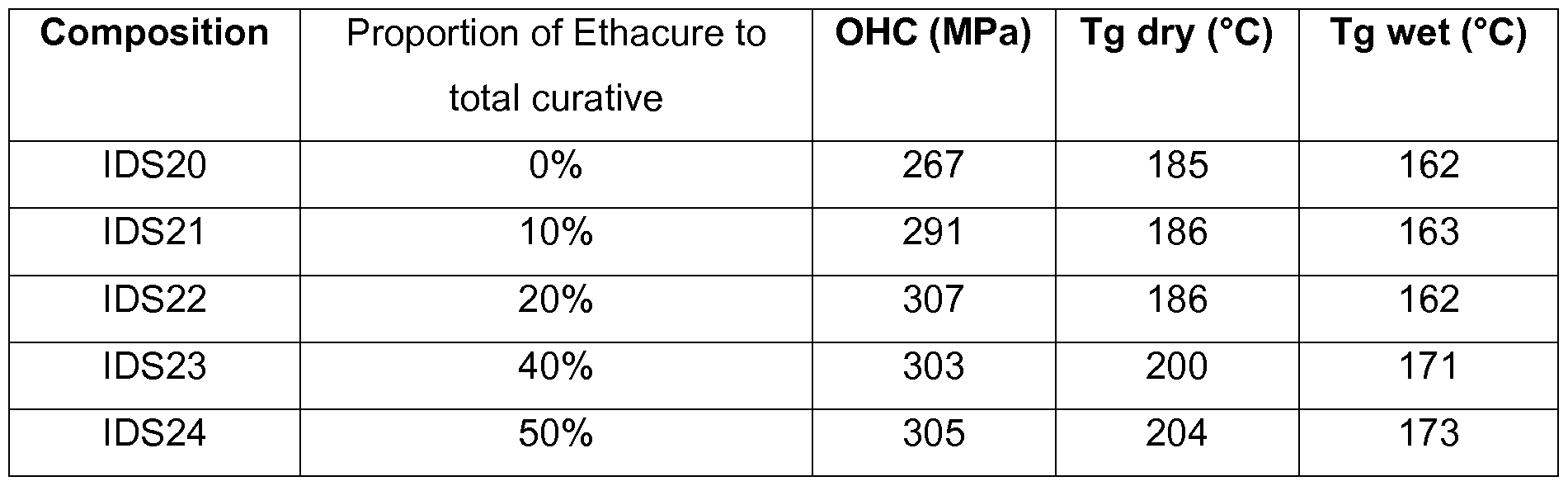
The results of the tests are shown in Table 2.
Figure imgf000013_0002
Table 2 As shown in Table 2, the combination of 20 wt% of an alkyl benzene diamine and 80 wt% of additional aromatic amine curative provides clear improvements in open hole compression performance compared to the use of 100 wt% of the aromatic curative. Similar advantages are also provided by the use of combinations of 40 wt% alkyl benzene diamine and 60 wt% additional aromatic amine curative and 50 wt% alkyl benzene diamine and 50 wt% additional aromatic amine curative. In addition, there is no significant decrease in either wet or dry Tg values associated with the use of the alkyl benzene diamine, and increases are provided at some concentrations. Example 2
The procedure of Example 1 was repeated but the mixture of MDEA and MCDEA was replaced by 4,4' methylene (methyl ethyl aniline)-(chlorodiethyl aniline) (M-MEACDEA), used in the proportions shown in Table 3.
Figure imgf000014_0001
Table 3
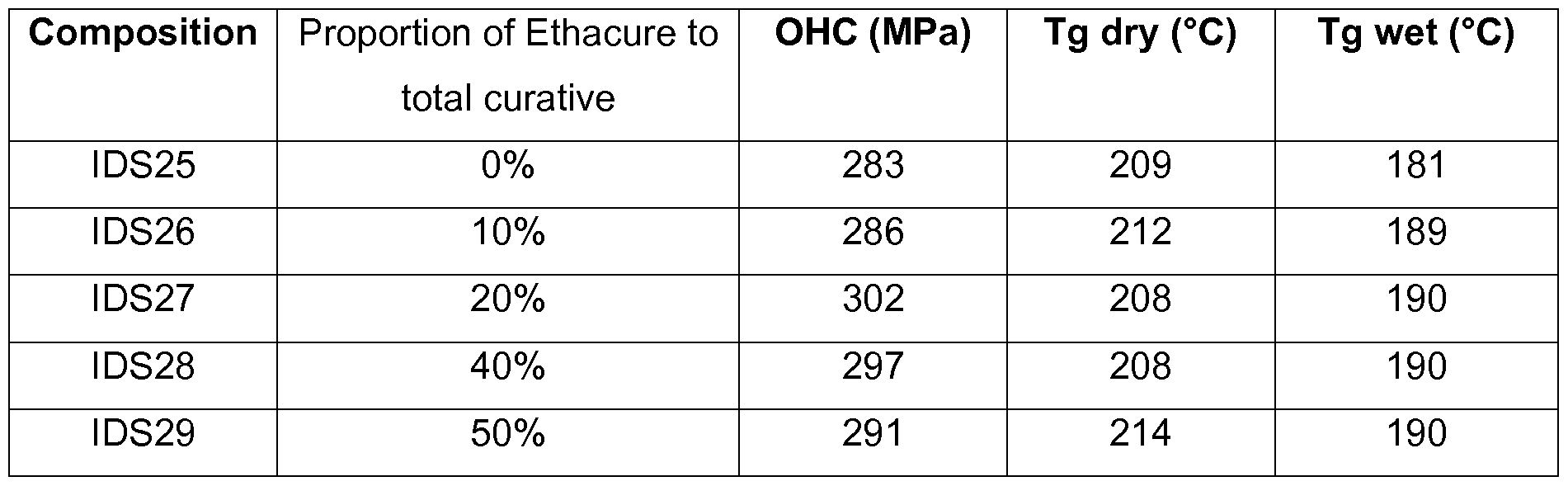
Mouldings were produced and tested as in Example 1 , and the results are shown in Table 4.
Figure imgf000014_0002
Table 4
As shown in Table 4, the combination of 20 wt% of an alkyl benzene diamine and 80 wt% of additional aromatic amine curative provides clear improvements in open hole compression performance compared to the use of 100 wt% of the aromatic curative. Similar advantages are also provided by the use of combinations of 40 wt% alkyl benzene diamine and 60 wt% additional aromatic amine curative and 50 wt% alkyl benzene diamine and 50 wt% additional aromatic amine curative. In addition, there is no significant decrease in either wet or dry Tg values associated with the use of the alkyl benzene diamine, and increases are provided at some concentrations.
Example 3
A resin composition was prepared comprising a mixture of 39.19 wt% of the multifunctional epoxy resin N, N, N, N', N' tetra glycidyl -4-4methylene bis benzamine, commercially available as Araldite MY 9655 from Huntsman Advanced Materials (UK) Limited; 21.09 wt% of the multifunctional epoxy resin N,N,N',N'-tetraglycidyl-3,3'-diethyl-4,4'- methylene bis benzamine, commercially available as Araldite MY 722 from Huntsman Advanced Materials (UK) Limited; 36.72 wt% of a curative system, and 3 wt% of acrylic core shell toughening particles, commercially available as XT100 from Arkema. The curative system comprised 7.35 wt% (by weight of the total composition) of an alkyl benzene diamine, in the form of the dimethylthiotoluenediamine isomeric mixture available from Albermarle as Ethacure 300, and 29.37 wt% (by weight of the total composition) of an additional aromatic amine, in the form of 4,4' methylene (methyl ethyl aniline)-(chlorodiethyl aniline) (M-MEACDEA). The alkyl benzyl diamine comprised 20 wt% of the curative system and the additional aromatic amine comprised 80 wt% of the curative system.
The resin of Example 3 was used to prepare test laminates as set out in Example 1 , except that the reinforcement used was in the form of UD210 IMA/V800E/ZD4/6.35mm. The laminates were tested as set out in Example 1 , and the open hole compression performance was found to be good (302 MPa) with no significant impact on either dry or wet Tg (dry Tg 192°C, wet Tg 178°C).
Example 4
A resin composition was prepared comprising a mixture of 38 wt% of functional epoxy resin Ν,Ν,Ν',Ν' Tetraglycidyl -4-4 methylene bis benzamine, commercially available as Araldite MY 721 from Huntsman Advanced Materials (UK) Limited; 21 wt% of the multifunctional epoxy resin N,N,N',N'-tetraglycidyl-3,3'-diethyl-4,4'- methylene bis benzamine, commercially available as Araldite MY 722 from Huntsman Advanced Materials (UK) Limited; 38 wt% of a curative system, and 3 wt% of acrylic core shell toughening particles, commercially available as XT100 from Arkema. The curative system comprised 4 wt% (by weight of the total composition) of an alkyl benzene diamine, in the form of the diethyltoluenediamine isomeric mixture available from Albermarle as Ethacure 100, and 24 wt% (by weight of the total composition) of an additional aromatic amine, in the form of 4,4' methylene (methyl ethyl aniline)-(chlorodiethyl aniline) (M-MEACDEA). The alkyl benzyl diamine comprised 10.5 wt% of the curative system and the additional aromatic amine comprised 89.5 wt% of the curative system.
The resin of Example 4 was used to prepare test laminates as set out in Example 3 using the reinforcement material listed therein. The laminates were tested as set out in Example 1 , and the open hole compression performance was found to be good (295 MPa) with no significant impact on either dry or wet Tg (dry Tg 198°C, wet Tg 175°C).

Claims

A curative system for epoxy resins comprising an alkyl benzene diamine and an additional aromatic amine.
A curative system according to claim 1 in which the alkyl benzene diamine is a toluene diamine having one or more additional alkyl and/or thioalkyl groups.
A curative system according to claim 2 in which the alkyl benzene diamine is of the formula:
Figure imgf000017_0001
wherein Y is an alkyl groups containing from 1 to 4 carbon atoms, X is hydrogen or an alkyl group containing from 1 to 4 carbon atoms, and R and R' are alkyl groups or alkylthio groups, preferably alkyl groups or alkylthio groups containing from 1 to 4 carbon atoms.
4. A curative system according to claim 3 in which the compound of formula I has the following structure:
Figure imgf000017_0002
Figure imgf000018_0001
5. A curative system according to claim 3 or claim 4 in which the compound of formula II has the following structure:
Figure imgf000018_0002
or
Figure imgf000018_0003
6. A curative system according to any of claims 3 to 5 in which the alkyl benzene diamine comprises a mixture of compounds of formula I and formula II, preferably wherein the ratio of compounds of formula I to compounds of formula II is 90:10 to 70:30, more preferably 80:20.
7. A curative system according to claim 6 in which the alkyl benzene diamine comprises a mixture of:
Figure imgf000018_0004
and
Figure imgf000019_0001
, preferably in a ratio of from 90% to 10% to 70% to 30%, more preferably in a ratio of 80% to 20%.
8. A curative system according to any preceding claim in which the additional aromatic amine is an alkylene bridged aromatic amine.
9. A curative system according to claim 8 in which the additional aromatic amine is a methylene bis aniline, preferably a 4,4' methylene bis aniline.
10. A curative system according to claim 9 in which the methylene bis aniline has the formula:
Figure imgf000019_0002
wherein Ri , R2, R3, R4, Rr, R2', R3 , and R4 are independently selected from:
hydrogen;
Ci to C6 alkoxy, preferably Ci to C4 alkoxy, where the alkoxy group may be linear or branched, for example methoxy, ethoxy and isopropoxy;
Ci to Ce alkyl, preferably Ci to C4 alkyl, where the alkyl group may be linear or branched and optionally substituted, for example methyl, ethyl, isopropyl and trifluoro methyl; or halogen, for example chlorine;
wherein at least one of Ri , R2, R3, R4, Rr, R2', R3 , and R4 is a Ci to Ce alkyl group.
1 1 . A curative system according to claim 9 or claim 10 in which the additional aromatic amine comprise a mixture of two or more methylene bis anilines.
12. A curative system according to any of claims 9 to 1 1 in which the additional aromatic amine comprise methylene bis (diethyl aniline) (M-DEA), methylene bis (chlorodiethyl aniline) (M-CDEA), methylene (methyl ethyl aniline)-(chlorodiethyl aniline) (M-MEACDEA) or mixtures thereof.
13. A curative system according to any of the preceding claims comprising from 5 to 50% by weight of the curative system of the alkyl benzyl diamine, preferably from 10 to 50%, more preferably from 20 to 40%.
14. A curative system according to any of the preceding claims in which a mixture of the alkyl benzene diamine and the additional aromatic amine is liquid at 22°C.
15. The use of an alkyl benzene diamine to enhance the performance of an aromatic amine as a curative for an epoxy resin in an infusion processes for the production of fibre reinforced composites.
16. The use according to claim 15 in which the alkyl benzene diamine is an alkyl benzene diamine as defined in any of claims 2 to 7 and/or the aromatic amine is an additional aromatic amine as defined in any of claims 8 to 12.
17. A curable epoxy resin composition containing a mixture of an epoxy resin and a curative system according to any of claims 1 to 14.
18. A curable epoxy resin composition according to claim 17 in which the epoxy resin has a functionality at least 2.
19. A curable epoxy resin composition according to claim 17 or claim 18 in which the relative amounts of amine groups provided by the curative system and the epoxy groups provided by the epoxy resin is from 0.7:1.3, preferably from 0.8:1.2.
20. A curable epoxy resin composition according to any of claims 17 to 19 having a viscosity of from 10 to 100cP at 120°C and from 100 to l OOOcP at 60°C.
21 . The use of a composition according to any of claims 17 to 20 as the curable resin in the production of fibre reinforced composites.
22. The use of a composition according to any of claims 17 to 20 in the production of fibre reinforced composites by infusion processes.
23. A fibre reinforced composite comprising fibrous reinforcement material and a cured epoxy resin obtainable by curing a curable epoxy resin composition according to any of claims 17 to 20.
24. A process for the production of fibre reinforced composites wherein a fibrous reinforcement material is laid up and a curable epoxy resin composition according to any of claims 17 to 20 is infused through the fibrous reinforcement material at a temperature of 80 to 130°C and, once the composition has infused the fibrous reinforcement material, the temperature is raised to 150 to 190°C.
25. A process according to claim 24 in which the fibrous reinforcement material is selected from glass, carbon, graphite, boron, ceramic or aramid fibres.
PCT/EP2018/068230 2017-07-12 2018-07-05 Improvements in resin curative systems Ceased WO2019011774A1 (en)

Priority Applications (9)

Application Number Priority Date Filing Date Title
KR1020207001393A KR20200041862A (en) 2017-07-12 2018-07-05 Improvement of resin curing agent system
US16/626,225 US20200115492A1 (en) 2017-07-12 2018-07-05 Improvements in resin curative systems
AU2018300733A AU2018300733B2 (en) 2017-07-12 2018-07-05 Improvements in resin curative systems
MYPI2020000150A MY203024A (en) 2017-07-12 2018-07-05 Improvements in resin curative systems
CN201880046447.9A CN110869412A (en) 2017-07-12 2018-07-05 Improvements in resin curing agent systems
JP2020500869A JP7242628B2 (en) 2017-07-12 2018-07-05 Improved resin hardener system
RU2020104042A RU2770058C2 (en) 2017-07-12 2018-07-05 Improvements of resin hardener systems
EP18737267.7A EP3652233B1 (en) 2017-07-12 2018-07-05 Improvements in resin curative systems
ES18737267T ES2985322T3 (en) 2017-07-12 2018-07-05 Improvements in resin healing systems

Applications Claiming Priority (2)

Application Number Priority Date Filing Date Title
GBGB1711192.3A GB201711192D0 (en) 2017-07-12 2017-07-12 Improvements in resin curative systems
GB1711192.3 2017-07-12

Publications (1)

Publication Number Publication Date
WO2019011774A1 true WO2019011774A1 (en) 2019-01-17

Family

ID=59676779

Family Applications (1)

Application Number Title Priority Date Filing Date
PCT/EP2018/068230 Ceased WO2019011774A1 (en) 2017-07-12 2018-07-05 Improvements in resin curative systems

Country Status (11)

Country Link
US (1) US20200115492A1 (en)
EP (1) EP3652233B1 (en)
JP (1) JP7242628B2 (en)
KR (1) KR20200041862A (en)
CN (1) CN110869412A (en)
AU (1) AU2018300733B2 (en)
ES (1) ES2985322T3 (en)
GB (2) GB201711192D0 (en)
MY (1) MY203024A (en)
RU (1) RU2770058C2 (en)
WO (1) WO2019011774A1 (en)

Cited By (1)

* Cited by examiner, † Cited by third party
Publication number Priority date Publication date Assignee Title
WO2023176934A1 (en) 2022-03-17 2023-09-21 東レ株式会社 Epoxy resin composition, and fiber-reinforced composite material and production method therefor

Families Citing this family (3)

* Cited by examiner, † Cited by third party
Publication number Priority date Publication date Assignee Title
WO2022186101A1 (en) * 2021-03-02 2022-09-09 帝人株式会社 Curing agent composition for thermosetting resin, epoxy resin composition, and fiber-reinforced composite material
CN115850915B (en) * 2022-12-05 2025-08-22 江苏恒神股份有限公司 Resin composition, preparation method thereof, and carbon fiber prepreg
CN117362928A (en) * 2023-10-20 2024-01-09 华东理工大学华昌聚合物有限公司 One-component liquid molding epoxy resin composition and preparation method thereof

Citations (7)

* Cited by examiner, † Cited by third party
Publication number Priority date Publication date Assignee Title
EP1302495A1 (en) * 1999-12-13 2003-04-16 Mitsubishi Rayon Co., Ltd. Epoxy resin composition and fiber-reinforced composite material formed with the epoxy resin composition
US20040242836A1 (en) * 2003-05-22 2004-12-02 Hayes Brian S. Epoxy resin curing agents and epoxy resin compositions
WO2012174989A1 (en) * 2011-06-24 2012-12-27 Air Products And Chemicals, Inc. Epoxy resin compositions
US20150099834A1 (en) * 2013-10-03 2015-04-09 Thomas J. Barnell Fiber-reinforced epoxy composites and methods of making same without the use of oven or autoclave
WO2016063692A1 (en) * 2014-10-21 2016-04-28 東レ株式会社 Epoxy resin composition and fiber-reinforced composite material
US20170051119A1 (en) * 2013-05-13 2017-02-23 Hexion Inc. Composites and epoxy resins based on aryl substituted compounds
EP3176200A1 (en) * 2014-07-31 2017-06-07 Toray Industries, Inc. Two-pack type epoxy resin composition for fiber-reinforced composite material, and fiber-reinforced composite material

Family Cites Families (6)

* Cited by examiner, † Cited by third party
Publication number Priority date Publication date Assignee Title
JP2006143775A (en) * 2004-11-16 2006-06-08 Shin Etsu Chem Co Ltd Semiconductor device having liquid epoxy resin composition and low dielectric constant interlayer insulating film
RU2277549C1 (en) * 2005-04-14 2006-06-10 Открытое акционерное общество "Научно-производственное объединение Стеклопластик" Polymer composition
JP2012041486A (en) * 2010-08-23 2012-03-01 Toray Ind Inc Method for producing epoxy resin composition and method for producing fiber-reinforced composite material
EP2426157A1 (en) * 2010-09-02 2012-03-07 Lonza Ltd. Diamine compositions and use thereof
GB201402052D0 (en) * 2014-02-06 2014-03-26 Hexcel Composites Ltd 4,4' Methylene bis anilines as curing agents for epoxy resins
JP6415104B2 (en) * 2014-05-16 2018-10-31 ナミックス株式会社 Liquid encapsulant and electronic parts using it

Patent Citations (7)

* Cited by examiner, † Cited by third party
Publication number Priority date Publication date Assignee Title
EP1302495A1 (en) * 1999-12-13 2003-04-16 Mitsubishi Rayon Co., Ltd. Epoxy resin composition and fiber-reinforced composite material formed with the epoxy resin composition
US20040242836A1 (en) * 2003-05-22 2004-12-02 Hayes Brian S. Epoxy resin curing agents and epoxy resin compositions
WO2012174989A1 (en) * 2011-06-24 2012-12-27 Air Products And Chemicals, Inc. Epoxy resin compositions
US20170051119A1 (en) * 2013-05-13 2017-02-23 Hexion Inc. Composites and epoxy resins based on aryl substituted compounds
US20150099834A1 (en) * 2013-10-03 2015-04-09 Thomas J. Barnell Fiber-reinforced epoxy composites and methods of making same without the use of oven or autoclave
EP3176200A1 (en) * 2014-07-31 2017-06-07 Toray Industries, Inc. Two-pack type epoxy resin composition for fiber-reinforced composite material, and fiber-reinforced composite material
WO2016063692A1 (en) * 2014-10-21 2016-04-28 東レ株式会社 Epoxy resin composition and fiber-reinforced composite material

Cited By (1)

* Cited by examiner, † Cited by third party
Publication number Priority date Publication date Assignee Title
WO2023176934A1 (en) 2022-03-17 2023-09-21 東レ株式会社 Epoxy resin composition, and fiber-reinforced composite material and production method therefor

Also Published As

Publication number Publication date
GB2565644A (en) 2019-02-20
EP3652233A1 (en) 2020-05-20
AU2018300733B2 (en) 2023-10-12
RU2020104042A (en) 2021-08-12
GB201711192D0 (en) 2017-08-23
JP7242628B2 (en) 2023-03-20
EP3652233B1 (en) 2024-07-24
JP2020527180A (en) 2020-09-03
CN110869412A (en) 2020-03-06
US20200115492A1 (en) 2020-04-16
GB2565644B (en) 2022-11-02
MY203024A (en) 2024-06-04
RU2020104042A3 (en) 2021-11-02
GB201811043D0 (en) 2018-08-22
KR20200041862A (en) 2020-04-22
AU2018300733A1 (en) 2019-12-19
RU2770058C2 (en) 2022-04-14
ES2985322T3 (en) 2024-11-05

Similar Documents

Publication Publication Date Title
EP2762528B1 (en) Benzoxazine resin composition, and fiber-reinforced composite material
EP2816074B1 (en) Fiber-reinforced composite material
EP2816076B1 (en) Fiber-reinforced composite material
EP2816075B1 (en) Fiber-reinforced composite material
JP6694822B2 (en) Curing agent for epoxy resin
US10040897B2 (en) Amino benzoates or benzamides as curing agents for epoxy resins
AU2018300733B2 (en) Improvements in resin curative systems
EP3024649B1 (en) Improvements in or relating to fibre reinforced composites
KR102712206B1 (en) Curable epoxy system
JP6845141B2 (en) Resin composition
AU2015362756B2 (en) Epoxy-based resin composition for composite materials
EP3105284A1 (en) Composite material with polyamide particle mixtures
US20150132553A1 (en) Fiber-reinforced composite material
GB2524873A (en) 4,4' methylene bis anilines as curing agents for epoxy resins
WO2021083583A1 (en) Epoxy resin compositions

Legal Events

Date Code Title Description
121 Ep: the epo has been informed by wipo that ep was designated in this application

Ref document number: 18737267

Country of ref document: EP

Kind code of ref document: A1

ENP Entry into the national phase

Ref document number: 2018300733

Country of ref document: AU

Date of ref document: 20180705

Kind code of ref document: A

ENP Entry into the national phase

Ref document number: 2020500869

Country of ref document: JP

Kind code of ref document: A

NENP Non-entry into the national phase

Ref country code: DE

ENP Entry into the national phase

Ref document number: 2018737267

Country of ref document: EP

Effective date: 20200212