WO2018226325A1 - Mq silicone resin compositions - Google Patents
Mq silicone resin compositions Download PDFInfo
- Publication number
- WO2018226325A1 WO2018226325A1 PCT/US2018/030336 US2018030336W WO2018226325A1 WO 2018226325 A1 WO2018226325 A1 WO 2018226325A1 US 2018030336 W US2018030336 W US 2018030336W WO 2018226325 A1 WO2018226325 A1 WO 2018226325A1
- Authority
- WO
- WIPO (PCT)
- Prior art keywords
- composition
- group
- silanol
- resin
- polysiloxane
- Prior art date
- Legal status (The legal status is an assumption and is not a legal conclusion. Google has not performed a legal analysis and makes no representation as to the accuracy of the status listed.)
- Ceased
Links
Classifications
-
- C—CHEMISTRY; METALLURGY
- C08—ORGANIC MACROMOLECULAR COMPOUNDS; THEIR PREPARATION OR CHEMICAL WORKING-UP; COMPOSITIONS BASED THEREON
- C08L—COMPOSITIONS OF MACROMOLECULAR COMPOUNDS
- C08L83/00—Compositions of macromolecular compounds obtained by reactions forming in the main chain of the macromolecule a linkage containing silicon with or without sulfur, nitrogen, oxygen or carbon only; Compositions of derivatives of such polymers
- C08L83/04—Polysiloxanes
-
- C—CHEMISTRY; METALLURGY
- C08—ORGANIC MACROMOLECULAR COMPOUNDS; THEIR PREPARATION OR CHEMICAL WORKING-UP; COMPOSITIONS BASED THEREON
- C08L—COMPOSITIONS OF MACROMOLECULAR COMPOUNDS
- C08L83/00—Compositions of macromolecular compounds obtained by reactions forming in the main chain of the macromolecule a linkage containing silicon with or without sulfur, nitrogen, oxygen or carbon only; Compositions of derivatives of such polymers
- C08L83/04—Polysiloxanes
- C08L83/08—Polysiloxanes containing silicon bound to organic groups containing atoms other than carbon, hydrogen and oxygen
-
- C—CHEMISTRY; METALLURGY
- C08—ORGANIC MACROMOLECULAR COMPOUNDS; THEIR PREPARATION OR CHEMICAL WORKING-UP; COMPOSITIONS BASED THEREON
- C08G—MACROMOLECULAR COMPOUNDS OBTAINED OTHERWISE THAN BY REACTIONS ONLY INVOLVING UNSATURATED CARBON-TO-CARBON BONDS
- C08G77/00—Macromolecular compounds obtained by reactions forming a linkage containing silicon with or without sulfur, nitrogen, oxygen or carbon in the main chain of the macromolecule
- C08G77/42—Block-or graft-polymers containing polysiloxane sequences
- C08G77/452—Block-or graft-polymers containing polysiloxane sequences containing nitrogen-containing sequences
- C08G77/455—Block-or graft-polymers containing polysiloxane sequences containing nitrogen-containing sequences containing polyamide, polyesteramide or polyimide sequences
-
- C—CHEMISTRY; METALLURGY
- C08—ORGANIC MACROMOLECULAR COMPOUNDS; THEIR PREPARATION OR CHEMICAL WORKING-UP; COMPOSITIONS BASED THEREON
- C08G—MACROMOLECULAR COMPOUNDS OBTAINED OTHERWISE THAN BY REACTIONS ONLY INVOLVING UNSATURATED CARBON-TO-CARBON BONDS
- C08G77/00—Macromolecular compounds obtained by reactions forming a linkage containing silicon with or without sulfur, nitrogen, oxygen or carbon in the main chain of the macromolecule
- C08G77/70—Siloxanes defined by use of the MDTQ nomenclature
-
- C—CHEMISTRY; METALLURGY
- C08—ORGANIC MACROMOLECULAR COMPOUNDS; THEIR PREPARATION OR CHEMICAL WORKING-UP; COMPOSITIONS BASED THEREON
- C08L—COMPOSITIONS OF MACROMOLECULAR COMPOUNDS
- C08L83/00—Compositions of macromolecular compounds obtained by reactions forming in the main chain of the macromolecule a linkage containing silicon with or without sulfur, nitrogen, oxygen or carbon only; Compositions of derivatives of such polymers
- C08L83/10—Block- or graft-copolymers containing polysiloxane sequences
-
- C—CHEMISTRY; METALLURGY
- C08—ORGANIC MACROMOLECULAR COMPOUNDS; THEIR PREPARATION OR CHEMICAL WORKING-UP; COMPOSITIONS BASED THEREON
- C08G—MACROMOLECULAR COMPOUNDS OBTAINED OTHERWISE THAN BY REACTIONS ONLY INVOLVING UNSATURATED CARBON-TO-CARBON BONDS
- C08G77/00—Macromolecular compounds obtained by reactions forming a linkage containing silicon with or without sulfur, nitrogen, oxygen or carbon in the main chain of the macromolecule
- C08G77/04—Polysiloxanes
- C08G77/14—Polysiloxanes containing silicon bound to oxygen-containing groups
- C08G77/16—Polysiloxanes containing silicon bound to oxygen-containing groups to hydroxy groups
Definitions
- This invention relates to a composition comprising MQ resin which is useful in cosmetic applications.
- Silicone compositions comprising a silicone gum (high- viscosity
- diorganopolysiloxane are known for use in cosmetic applications, see, e.g., U.S. 6,139,823.
- the known compositions do not provide good transfer resistance and sebum resistance.
- the present invention provides a composition comprising:
- Percentages are weight percentages (wt%) and temperatures are in °C unless specified otherwise. Operations were performed at room temperature unless specified otherwise.
- molecular weights, M n , M w and M z have the conventional meanings and are determined by gel permeation chromatography. Molecular weights are reported herein in units of g/mol. Silanol index is determined by FT-IR as described in the Examples. A "solid" material is one that is solid at 25°C.
- An “MQ resin” is a polysiloxane comprising units of [S1O4/2] (Q units) and nonpolar units of [RR'R"SiOi/ 2 ] (M units), wherein R, R' and R" independently are C1-C12 alkyl, C 2 - C12 alkenyl or C6-C12 aryl; preferably Ci-C 6 alkyl, C2-C6 alkenyl or C 6 -Cio aryl; preferably C1-C4 alkyl, C2-C4 alkenyl or C6-C9 aryl; preferably methyl, vinyl or phenyl; preferably methyl.
- An aryl group may be substituted by one or more alkyl groups.
- the carbon number for the aryl group includes carbon atoms in any alkyl substituent(s).
- the MQ resin has no [RR S1O2/2] (D) or [RS1O3/2] (T) units.
- the M/Q ratio is from 0.5:1 to 1.1:1, preferably from 0.6:1 to 1.0:1, preferably from 0.7: 1 to 0.95:1.
- the silanol index of the MQ resin is no more than 270, preferably no more than 240, preferably no more than 220; preferably at least 10, preferably at least 50.
- the composition comprises from 1 to 40 wt% MQ resin having a silanol index no greater than 300 and from 0.1 to 30 wt% polysiloxane or silicone polyamide, based on total weight of the composition; preferably from 2 to 30 wt% MQ resin and from 0.5 to 25 wt% polysiloxane and/or polyamide, preferably from 5 to 20 wt% MQ resin and from 1 to 18 wt% polysiloxane and/or polyamide.
- MQ resin having a silanol index no greater than 300 can be prepared directly from M and Q precursors in a suitable ratio (see, e.g., US2814601, US2857356) or from a commercially available MQ resin having a higher silanol index by capping at least a portion of the silanol units with M units.
- the polysiloxane or silicone polyamide having a viscosity of at least 600,000 cSt at 25 °C has a viscosity of at least 800,000 cSt at 25 °C, preferably no more than 10,000,000 cSt, preferably no more than 5,000,000 cSt.
- the fluid polysiloxane polymers of the present invention comprise repeating units, wherein said units correspond to the formula [RR'Si02/2] (D units), where R and R' are monovalent hydrocarbon radicals containing from 1 to 6 carbon atoms, preferably selected from the group consisting of methyl, ethyl, propyl, isopropyl, butyl, isobutyl, t-butyl, amyl, hexyl, vinyl, allyl, cyclohexyl, phenyl, fluoroalkyl and mixtures thereof.
- the polysiloxane fluids employed in the present invention may contain one or more of these hydrocarbon radicals as substituents on the siloxane polymer backbone.
- the polysiloxane fluids may be terminated by triorganosilyl groups of the formula (R"3Si) where R" is a radical selected from the group consisting of monovalent hydrocarbons containing from 1-6 carbon atoms, hydroxyl groups, alkoxyl groups and mixtures thereof.
- a silicone polyamide is a copolymer having both siloxane units and amide units.
- the silicone polyamide comprises blocks, each of which comprises a polysiloxane block and an amide.
- the amide comprises polymerized units of an amine having 1-40 carbon atoms, preferably 1-20.
- the silicone polyamide has formula A
- DP is 1-700, preferably 15-500, preferably 15-45.
- DP represents an average value for degree of polymerization of the siloxane units as shown in Formula A with this average being a number average based on all the siloxane segments in all units of Formula A in the material considered.
- n is a number from 1-500, preferably 1-100, preferably 4-25;
- X is a divalent, aliphatic hydrocarbon group having 1-30 carbons, preferably 3-10 carbons, preferably 7-10 carbons;
- the hydrocarbon group may optionally and additionally contain at least one of (i) 1-3 amide linkages; (ii) a C5 or C 6 cyclic, divalent, saturated hydrocarbon group; and (iii) a phenylene optionally substituted by 1-3 members selected independently from the group consisting of C1-C3 alkyls, or
- R 20 T(R 21 )R 22 where R 20 and R 22 are divalent C1-C10 hydrocarbon groups and R 21 is a monovalent or divalent C1-C10 hydrocarbon group, such groups being independent of one another, and T is C(R), where R is selected from hydrogen, R 1 , R 2 , R 3 , R 4 , or a trivalent N, P or Al; the divalencies and trivalencies herein should be understood and taken to allow for branching, cross linking or the like in certain instances and as appropriate; and
- Each of R 1 -R 4 is independently selected from the group consisting of methyl, ethyl, propyl, isopropyl, a siloxane chain (such as a polydimethylsiloxane or a siloxane based polyamide), and phenyl, wherein the phenyl may optionally be substituted at 1-3 positions by substituents independently selected from the group consisting of methyl and ethyl; more particularly, each of R 1 -R 4 is selected from methyl and ethyl, preferably methyl.
- the composition may further comprise 0.5 to 50 wt% of coloring agent(s) (preferably 5 to 45, preferably 10 to 40), 0.1 to 60 wt% volatile solvent(s) (e.g., water, ethanol, Cs-Cis hydrocarbons) (preferably 5 to 50, preferably 10 to 40) having viscosity of 0.5 to 50 cp at 25 °C (see US 6464964 for examples of other volatile solvents).
- coloring agent(s) preferably 5 to 45, preferably 10 to 40
- volatile solvent(s) e.g., water, ethanol, Cs-Cis hydrocarbons
- Table 1 shows a set of formulations comprise MQ resin (varying Silanol Index value), silicone gum, isododecane as volatile carrier fluid, and pigment, and have a 7.5:2.5 MQ to silicone gum ratio (wt).
- Table 2 shows a set of formulations comprise MQ resin, silicone gum, isododecane as volatile carrier fluid, and pigment, and have a 6:4 MQ to silicone gum ratio (wt).
- Table 3 shows a set of formulations comprise MQ resin, silicone polyamide, isododecane as volatile carrier fluid, and red pigment.
- An MQ resin's Silanol Index for MQ's non-hydrogen bonded surface SiOH is a value used to define a siloxane material's surface SiOH content.
- Silanol Index is defined by the following procedure involving FT-IR measurement and a subsequent data processing.
- FT-IR spectrum can then be obtained by scanning ⁇ 3 ml MQ solution in an IR quartz cuvette with 1 cm optical pathway. A 64-scan is performed with a 4 cm- 1 spectral resolution.
- a reference spectrum of the same MQ sample is obtained using the same procedure described above, except that labile hydrogen atoms have been exchanged with deuterium.
- the deuterium exchange occurs by adding 0.5 ml D2O to MQ solution in IR cell, shaking vigorously for 30 seconds, and allowing the phases to separate. Removed the D2O layer and repeated with a fresh 0.5 ml of D2O. Conducted IR scan after the above procedure was completed.
- OH signal peak around 3700 cm-1 assigned to non-hydrogen bonded surface SiOH, is integrated to obtain OH Signal Area.
- Collagen films (Viscofan from Naturin GmbH & Co.) are secured tightly on 3x2.5 inch hard polycarbonate blocks.
- a gloss meter (micro-TRI-gloss from BYK-Gardner) was used to measure gloss readings for both 20 degree and 60 degree angles. The higher gloss reading value, the more glossy a film is.
- the films appearance can also be captured by a digital camera under a controlled lighting. Digital camera image can then be presented to a panel to assess human perception.
- a digital image was obtained of two types of cosmetic films (in triplicates) dried on collagen.
- Table 5 shows gloss meter readings of different cosmetic films dried on collagen from both 20° and 60° reflecting angles.
- Collagen films (Viscofan from Naturin GmbH & Co.) are secured tightly on 3x2.5 inch hard polycarbonate blocks.
- each dried cosmetic film on collagen was treated with artificial sebum prior to abrasion test.
- a small roller ( ⁇ 1 inch) is used to gently spread -0.04 grams of artificial sebum on cosmetic film (coated on collagen).
- the treated films are left at ambient condition for 3-4 hours before abrasion testing.
- Abrasion testing on all the artificial treated or non- treated films is conducted by using a modified Gardner Abrasion Tester. Up to 50 abrasion cycles may be applied to each sample. L*a*b values of both sample and white rubbing cloth can be recorded by a colorimeter (HunterLab Colorscan XE) after abrasion cycles. Particularly, the
- the degrees of color transfer of the four above mentioned formulations were also characterized by colorimeter, which can provide an L*a*b reading to characterize surface color.
- the "a" value from an L*a*b reading is correlated to the "redness" of an object's color. The higher “a” value, the more “redness” of surface color. For abrasion cloth after abrasion, the lower “a” value, the less red pigment transferred.
- Table 7 shows "a" values from colorimeter L*a*b readings of white abrasion cloths after 50 abrasion cycles with artificial sebum.
- Table 7 a Values from White Abrasion Cloths (amount of color transfer to cloth)
Landscapes
- Chemical & Material Sciences (AREA)
- Health & Medical Sciences (AREA)
- Chemical Kinetics & Catalysis (AREA)
- Medicinal Chemistry (AREA)
- Polymers & Plastics (AREA)
- Organic Chemistry (AREA)
- Compositions Of Macromolecular Compounds (AREA)
- Cosmetics (AREA)
Abstract
A composition comprising an MQ resin having a silanol index no greater than 300 and a polysiloxane having a viscosity of at least 600,000 cSt at 25°C or a solid silicone polyamide.
Description
MQ SILICONE RESIN COMPOSITIONS
This invention relates to a composition comprising MQ resin which is useful in cosmetic applications.
Silicone compositions comprising a silicone gum (high- viscosity
diorganopolysiloxane) are known for use in cosmetic applications, see, e.g., U.S. 6,139,823. However, the known compositions do not provide good transfer resistance and sebum resistance.
Statement of the Invention
The present invention provides a composition comprising:
a) MQ resin having a silanol index no greater than 300; and
b) a polysiloxane having a viscosity of at least 600,000 cSt at 25 °C or a solid silicone polyamide.
Detailed Description
Percentages are weight percentages (wt%) and temperatures are in °C unless specified otherwise. Operations were performed at room temperature unless specified otherwise. As used herein, unless otherwise indicated, molecular weights, Mn, Mw and Mz have the conventional meanings and are determined by gel permeation chromatography. Molecular weights are reported herein in units of g/mol. Silanol index is determined by FT-IR as described in the Examples. A "solid" material is one that is solid at 25°C.
An "MQ resin" is a polysiloxane comprising units of [S1O4/2] (Q units) and nonpolar units of [RR'R"SiOi/2] (M units), wherein R, R' and R" independently are C1-C12 alkyl, C2- C12 alkenyl or C6-C12 aryl; preferably Ci-C6 alkyl, C2-C6 alkenyl or C6-Cio aryl; preferably C1-C4 alkyl, C2-C4 alkenyl or C6-C9 aryl; preferably methyl, vinyl or phenyl; preferably methyl. An aryl group may be substituted by one or more alkyl groups. The carbon number for the aryl group includes carbon atoms in any alkyl substituent(s). Preferably, the MQ resin has no [RR S1O2/2] (D) or [RS1O3/2] (T) units. Preferably, the M/Q ratio is from 0.5:1 to 1.1:1, preferably from 0.6:1 to 1.0:1, preferably from 0.7: 1 to 0.95:1. Preferably, the silanol index of the MQ resin is no more than 270, preferably no more than 240, preferably no more than 220; preferably at least 10, preferably at least 50.
Preferably, the composition comprises from 1 to 40 wt% MQ resin having a silanol index no greater than 300 and from 0.1 to 30 wt% polysiloxane or silicone polyamide, based on total weight of the composition; preferably from 2 to 30 wt% MQ resin and from 0.5 to 25
wt% polysiloxane and/or polyamide, preferably from 5 to 20 wt% MQ resin and from 1 to 18 wt% polysiloxane and/or polyamide.
MQ resin having a silanol index no greater than 300 can be prepared directly from M and Q precursors in a suitable ratio (see, e.g., US2814601, US2857356) or from a commercially available MQ resin having a higher silanol index by capping at least a portion of the silanol units with M units.
Preferably, the polysiloxane or silicone polyamide having a viscosity of at least 600,000 cSt at 25 °C has a viscosity of at least 800,000 cSt at 25 °C, preferably no more than 10,000,000 cSt, preferably no more than 5,000,000 cSt.
The fluid polysiloxane polymers of the present invention comprise repeating units, wherein said units correspond to the formula [RR'Si02/2] (D units), where R and R' are monovalent hydrocarbon radicals containing from 1 to 6 carbon atoms, preferably selected from the group consisting of methyl, ethyl, propyl, isopropyl, butyl, isobutyl, t-butyl, amyl, hexyl, vinyl, allyl, cyclohexyl, phenyl, fluoroalkyl and mixtures thereof. The polysiloxane fluids employed in the present invention may contain one or more of these hydrocarbon radicals as substituents on the siloxane polymer backbone. The polysiloxane fluids may be terminated by triorganosilyl groups of the formula (R"3Si) where R" is a radical selected from the group consisting of monovalent hydrocarbons containing from 1-6 carbon atoms, hydroxyl groups, alkoxyl groups and mixtures thereof.
A silicone polyamide is a copolymer having both siloxane units and amide units. Preferably, the silicone polyamide comprises blocks, each of which comprises a polysiloxane block and an amide. Preferably the amide comprises polymerized units of an amine having 1-40 carbon atoms, preferably 1-20.
Preferably, the silicone polyamide has formula A

wherein:
(1) DP is 1-700, preferably 15-500, preferably 15-45. In this context, DP represents an average value for degree of polymerization of the siloxane units as shown in Formula A with
this average being a number average based on all the siloxane segments in all units of Formula A in the material considered.
(2) n is a number from 1-500, preferably 1-100, preferably 4-25;
(3) X is a divalent, aliphatic hydrocarbon group having 1-30 carbons, preferably 3-10 carbons, preferably 7-10 carbons;
(4) Y is:
(a) a divalent hydrocarbon group having 1-40 carbons, preferably 1-20 carbons, preferably 2- 6 carbons, preferably 5-6 carbons, wherein the hydrocarbon group itself may optionally and additionally be substituted by at least one member selected from the group consisting of (i) hydroxy; (ii) a C3-C8 cycloalkyl; (iii) 1-3 members selected independently from the group consisting of C1-C3 alkyl and phenyl optionally substituted by 1-3 members selected independently from the group consisting of C1-C3 alkyl; (iv) a C1-C3 hydroxyalkyl; and (v) a Ci-C6 alkyl amino, and
the hydrocarbon group may optionally and additionally contain at least one of (i) 1-3 amide linkages; (ii) a C5 or C6 cyclic, divalent, saturated hydrocarbon group; and (iii) a phenylene optionally substituted by 1-3 members selected independently from the group consisting of C1-C3 alkyls, or
(b) R20T(R21)R22, where R20 and R22are divalent C1-C10 hydrocarbon groups and R21is a monovalent or divalent C1-C10 hydrocarbon group, such groups being independent of one another, and T is C(R), where R is selected from hydrogen, R1, R2, R3, R4, or a trivalent N, P or Al; the divalencies and trivalencies herein should be understood and taken to allow for branching, cross linking or the like in certain instances and as appropriate; and
(5) Each of R1-R4 is independently selected from the group consisting of methyl, ethyl, propyl, isopropyl, a siloxane chain (such as a polydimethylsiloxane or a siloxane based polyamide), and phenyl, wherein the phenyl may optionally be substituted at 1-3 positions by substituents independently selected from the group consisting of methyl and ethyl; more particularly, each of R1-R4is selected from methyl and ethyl, preferably methyl.
The composition may further comprise 0.5 to 50 wt% of coloring agent(s) (preferably 5 to 45, preferably 10 to 40), 0.1 to 60 wt% volatile solvent(s) (e.g., water, ethanol, Cs-Cis hydrocarbons) (preferably 5 to 50, preferably 10 to 40) having viscosity of 0.5 to 50 cp at 25 °C (see US 6464964 for examples of other volatile solvents).
Examples
Formulations
Several sets of color formulations were prepared to study impacts of MQ resin's silanol content to performance. Table 1 shows a set of formulations comprise MQ resin (varying Silanol Index value), silicone gum, isododecane as volatile carrier fluid, and pigment, and have a 7.5:2.5 MQ to silicone gum ratio (wt). Table 2 shows a set of formulations comprise MQ resin, silicone gum, isododecane as volatile carrier fluid, and pigment, and have a 6:4 MQ to silicone gum ratio (wt). Table 3 shows a set of formulations comprise MQ resin, silicone polyamide, isododecane as volatile carrier fluid, and red pigment.
Table 1. Anhydrous Formulations containing MQ resin and Silicone Gum at 7.5:2.5 MQ
resin to Silicone Gum ratio (wt).

1. polydimethylsiloxane
2. Anhydrous Formulations containing MQ resin and Silicone Gum at 6:4 MQ
resin to Silicone Gum ratio (wt)
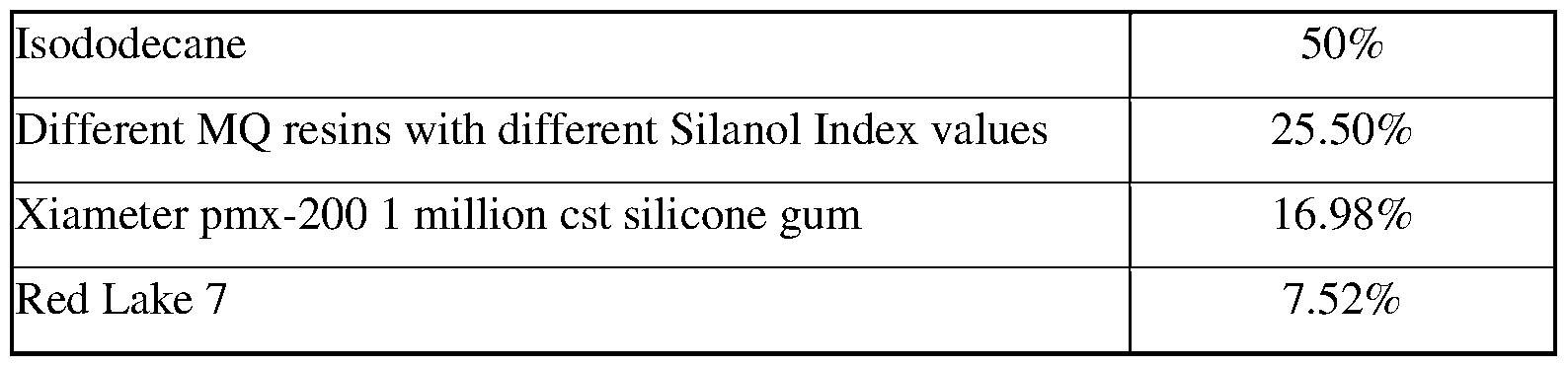
Table 3. Anhydrous Formulations containing MQ resin and Silicone Polyamide

2. nylon 611/dimethicone copolymer
Silanol Index Measurement:
An MQ resin's Silanol Index for MQ's non-hydrogen bonded surface SiOH is a value used to define a siloxane material's surface SiOH content. The lower an MQ resin's Silanol Index value, the lower surface SiOH content, thus the lower polarity enhancement. Silanol Index is defined by the following procedure involving FT-IR measurement and a subsequent data processing.
First, a MQ in Carbon Tetrachloride solution was prepared. Accurate MQ
concentration (weight to solvent volume) is obtained: for instance, dissolving 0.05 gram in 3 ml Carbon Tetrachloride resulted in a 1.67 % (w/v ratio) MQ solution. FT-IR spectrum can then be obtained by scanning ~ 3 ml MQ solution in an IR quartz cuvette with 1 cm optical pathway. A 64-scan is performed with a 4 cm- 1 spectral resolution.
Second, a reference spectrum of the same MQ sample is obtained using the same procedure described above, except that labile hydrogen atoms have been exchanged with deuterium. The deuterium exchange occurs by adding 0.5 ml D2O to MQ solution in IR cell, shaking vigorously for 30 seconds, and allowing the phases to separate. Removed the D2O layer and repeated with a fresh 0.5 ml of D2O. Conducted IR scan after the above procedure was completed.
Third, a defined data processing procedure was applied to obtain MQ resin OH groups' IR bands. This procedure started with subtracting the reference spectrum spectrally from the sample spectrum to remove all invariant features. The water absorbances near 3710 and 3610 cm 1 were then removed by spectrally subtracting a permanently stored spectrum of water in Carbon Tetrachloride. The water in Carbon Tetrachloride spectrum was created by spectrally subtracting a scan of dry Carbon Tetrachloride from a scan of water-saturated Carbon Tetrachloride. The resulted final IR spectrum consisted only of OH bands from the MQ resin.
Finally, in the final FT-IR spectrum OH signal peak around 3700 cm-1, assigned to non-hydrogen bonded surface SiOH, is integrated to obtain OH Signal Area. Particularly, the Silanol Index value in this patent application is defined as: Silanol Index = OH Signal Area around 3700 cm-1/ MQ solution's concentration (w/v ration, in %). For instance, for a 1.67% (w/v) MQ solution, FT-IR measurement results an OH Signal Area of 33.07. The Silanol Index of this MQ resin is 1980, which is equal to 33.07/1.67%.
Table 4. Silanol Index values of four MQ resins used in the study, calculated based on FTIR absorption peaks around 3700 cm-1

Film Gloss measurement
Glossy appearance could be desirable in many color cosmetic applications, including lip loss and lip stick. The test method for understanding color cosmetic films' gloss is briefly described as the following steps:
1. Collagen films (Viscofan from Naturin GmbH & Co.) are secured tightly on 3x2.5 inch hard polycarbonate blocks.
2. About 0.14 grams of each formulation is spread by finger on respective collagen films.
3. The coated films are allowed to dry overnight.
4. A gloss meter (micro-TRI-gloss from BYK-Gardner) was used to measure gloss readings for both 20 degree and 60 degree angles. The higher gloss reading value, the more glossy a film is.
5. The films appearance can also be captured by a digital camera under a controlled lighting. Digital camera image can then be presented to a panel to assess human perception.
Film Gloss measurement Results:
A digital image was obtained of two types of cosmetic films (in triplicates) dried on collagen. The top row are dried cosmetic films (in triplicates) made from high Silanol MQ (Silanol Index =1980) based on the formula in Table 1, while the bottom row are dried cosmetic films (in triplicates) made from low Silanol MQ (Silanol Index =198) based on the formula in Table 1. This digital image was shown to 8 panelists to assess which formulation showed more glossiness. Every panelist agreed that the films from formulation containing low Silanol MQ (Silanol Index = 198) are more glossy.
Table 5 shows gloss meter readings of different cosmetic films dried on collagen from both 20° and 60° reflecting angles. As related data shown from left to right, the four formulations studied are: high Silanol MQ (Silanol Index =1980) based on the formula in Table 1, high Silanol MQ (Silanol Index =1980) based on the formula in Table 2, low Silanol MQ (Silanol Index =198) based on the formula in Table 1, and low Silanol MQ (Silanol Index =198)
based on the formula in Table 2. As the data consistently show, when in combination with silicone gum, low Silanol MQ (Silanol Index = 198) resulted in more glossy films than high silanol MQ (Silanol Index = 1980). Table 5

Abrasion Test Setup and Procedure:
Rub-off and transfer resistance are very desirable properties for color cosmetic products. Rub-off and transfer resistance in the presence of sebum are tough technical challenges currently in cosmetic research. The test method for measuring the color cosmetic films' rub-off and sebum resistance properties is briefly described as the following steps:
1. Collagen films (Viscofan from Naturin GmbH & Co.) are secured tightly on 3x2.5 inch hard polycarbonate blocks.
2. About 0.14 grams of each formulation is spread by finger on respective collagen films.
3. The coated films are allowed to dry overnight.
4. For abrasion tests with artificial sebum, each dried cosmetic film on collagen was treated with artificial sebum prior to abrasion test. A small roller (~ 1 inch) is used to gently spread -0.04 grams of artificial sebum on cosmetic film (coated on collagen).
The treated films are left at ambient condition for 3-4 hours before abrasion testing.
5. Abrasion testing on all the artificial treated or non- treated films is conducted by using a modified Gardner Abrasion Tester. Up to 50 abrasion cycles may be applied to each sample. L*a*b values of both sample and white rubbing cloth can be recorded by a colorimeter (HunterLab Colorscan XE) after abrasion cycles. Particularly, the
"a" value from L*a*b reading is related to "redness" of the surface and is used to understand red pigment transfer.
6. After abrasion, the visual appearance of both sample and rubbing cloth can also be recorded using digital camera. Digital camera image can then be presented to a human panel to assess human perception.
Abrasion Test Results:
Abrasion tests were also done on formulations based on MQ and silicone polyamide. Digital images of several cosmetic films and abrasion cloths (in duplicate) after 50 abrasion cycles with artificial sebum were obtained. All the formulations were based on the formula in Table 3, with four different type of MQ resins used. The images were presented to 8 human panelists; all panelists agreed that the formulation using low SiOH MQ resin (Silanol Index = 198) showed less rub-off, thus most rub-off resistance.
In addition to panel testing of the films, the degrees of color transfer of the four above mentioned formulations were also characterized by colorimeter, which can provide an L*a*b reading to characterize surface color. The "a" value from an L*a*b reading is correlated to the "redness" of an object's color. The higher "a" value, the more "redness" of surface color. For abrasion cloth after abrasion, the lower "a" value, the less red pigment transferred. Table 6 shows "a" values from colorimeter L*a*b readings of white abrasion cloths after 50 abrasion cycles with artificial sebum. The results confirmed that the formulation containing Low Silanol MQ (Silanol Index = 198) showed the least color transfer to the white abrasion cloth.
Table 6

Abrasion tests were also done on formulations based on MQ and silicone gum. Four formulations were studied: high Silanol MQ (Silanol Index =1980) based on the formula in Table 1, high Silanol MQ (Silanol Index =1980) based on the formula in Table 2, low Silanol MQ (Silanol Index =198) based on the formula in Table 1, and low Silanol MQ (Silanol Index =198) based on the formula in Table 2. Digital images in duplicate were obtained from both films and cloths after 50 abrasion cycles with and without artificial sebum. Panelists concluded that, after abrasion tests with artificial sebum, formulations with low-silanol MQ resin showed less color transfer than those with high-silanol MQ resins.
In addition to the digital images, the degrees of color transfer of the four above mentioned formulation were also characterized by colorimeter, which can provide an L*a*b reading to characterize surface color. The "a" value from an L*a*b reading is correlated to the "redness" of an object's color. The higher "a" value, the more "redness" of surface color. For abrasion cloth after abrasion, the lower "a" value, the less red pigment transferred. Table 7 shows "a" values from colorimeter L*a*b readings of white abrasion cloths after 50 abrasion cycles with artificial sebum. The colorimeter values, together with visual assessment on the digital camera image, showed that formulations using low SiOH MQ resin had better rub-off resistance, particularly for rub-off testing with artificial sebum.
Table 7: a Values from White Abrasion Cloths (amount of color transfer to cloth)

Claims
1. A composition comprising:
a) MQ resin having a silanol index no greater than 300; and
b) a polysiloxane having a viscosity of at least 600,000 cSt at 25 °C or a solid silicone polyamide.
2. The composition of claim 1 in which the composition comprises from 2 to 30 wt% of said MQ resin and from 0.5 to 25 wt% of said polysiloxane or silicone polyamide.
3. The composition of claim 2 in which the MQ resin has an M/Q ratio from 0.6: 1 to 1.0:1.
4. The composition of claim 3 in which said polysiloxane comprises [RR'Si02/2] units, where R and R' are monovalent hydrocarbon radicals containing from 1 to 6 carbon atoms.
5. The composition of claim 4 in which the silicone polyamide the silicone polyamide comprises blocks, each of which comprises a polysiloxane block and an amide.
6. The composition of claim 5 in which the MQ resin has a silanol index no greater than 270.
7. The composition of claim 6 in which the silicone polyamide has formula A

wherein:
(1) DP is 1-700 as a number average value for degree of polymerization of siloxane units;
(2) n is a number from 1-500;
(3) X is a divalent, aliphatic hydrocarbon group having 1-30 carbons;
(4) Y is:
(a) a divalent hydrocarbon group having 1-40 carbons, wherein the hydrocarbon group optionally is substituted by at least one member selected from the group consisting of (i) hydroxy; (ii) a C3-C8 cycloalkyl; (iii) 1-3 members selected independently from the group consisting of C1-C3 alkyl and phenyl optionally substituted by 1-3 members selected independently from the group consisting of C1-C3 alkyl; (iv) a C1-C3 hydroxyalkyl; and (v) a Ci-C6 alkyl amino, and
the hydrocarbon group optionally contains at least one of (i) 1-3 amide linkages; (ii) a C5 or C6 cyclic, divalent, saturated hydrocarbon group; and (iii) a phenylene optionally substituted by 1-3 members selected independently from the group consisting of C1-C3 alkyl, or
(b) R20T(R21)R22, where R20 and R22are divalent C1-C10 hydrocarbon groups and R21is a monovalent or divalent C1-C10 hydrocarbon group, such groups being independent of one another, and T is C(R), where R is selected from hydrogen, R1, R2, R3, R4, or a trivalent N, P or Al; and
(5) Each of R1-R4 is independently selected from the group consisting of methyl, ethyl, propyl, isopropyl, a siloxane chain and phenyl, wherein the phenyl optionally is substituted at 1-3 positions by substituents independently selected from the group consisting of methyl and ethyl; more particularly, each of R1-R4is selected from methyl and ethyl, preferably methyl.
8. The composition of claim 7 in which in which at least 95 wt% of siloxane units in said polysiloxane comprising polyether units are D units.
9. The composition of claim 8 further comprising 5 to 45 wt% of coloring agents and 5 to 50 wt% volatile solvents having viscosity of 0.5 to 50 cp at 25 °C
Priority Applications (1)
| Application Number | Priority Date | Filing Date | Title |
|---|---|---|---|
| US16/488,272 US20200283629A1 (en) | 2017-06-05 | 2018-05-01 | Mq silicone resins |
Applications Claiming Priority (2)
| Application Number | Priority Date | Filing Date | Title |
|---|---|---|---|
| US201762515068P | 2017-06-05 | 2017-06-05 | |
| US62/515,068 | 2017-06-05 |
Publications (1)
| Publication Number | Publication Date |
|---|---|
| WO2018226325A1 true WO2018226325A1 (en) | 2018-12-13 |
Family
ID=62218322
Family Applications (1)
| Application Number | Title | Priority Date | Filing Date |
|---|---|---|---|
| PCT/US2018/030336 Ceased WO2018226325A1 (en) | 2017-06-05 | 2018-05-01 | Mq silicone resin compositions |
Country Status (2)
| Country | Link |
|---|---|
| US (1) | US20200283629A1 (en) |
| WO (1) | WO2018226325A1 (en) |
Families Citing this family (4)
| Publication number | Priority date | Publication date | Assignee | Title |
|---|---|---|---|---|
| FR3151496B3 (en) | 2023-07-26 | 2025-08-15 | Oreal | LONG-LASTING COMPOSITIONS CONTAINING SILICONE ACRYLATE COPOLYMER AND GLYCEROLATED SILICONE RESIN |
| EP4701620A1 (en) | 2023-04-28 | 2026-03-04 | L'oreal | Long-wear compositions containing silicone acrylate copolymer and glycerolated silicone resin |
| FR3158231B3 (en) | 2024-01-12 | 2026-02-13 | Oreal | LONG-LASTING COMPOSITIONS CONTAINING A SILICONE ACRYLATE COPOLYMER AND A T-MODIFIED SILICONE RESIN |
| WO2025096502A1 (en) | 2023-10-31 | 2025-05-08 | L'oreal | Long-wear compositions containing silicone acrylate copolymer and t-modified silicone resin |
Citations (7)
| Publication number | Priority date | Publication date | Assignee | Title |
|---|---|---|---|---|
| US2814601A (en) | 1954-04-29 | 1957-11-26 | Dow Corning | Organopolysiloxane adhesive and pressure-sensitive adhesive tape containing same |
| US2857356A (en) | 1954-07-08 | 1958-10-21 | Gen Electric | Organopolysiloxane compositions having pressure-sensitive adhesive properties |
| US5710113A (en) * | 1990-12-05 | 1998-01-20 | The Procter & Gamble Company | Hair conditioning compositions with silicone conditioning agent containing silicone resin |
| US6139823A (en) | 1995-11-07 | 2000-10-31 | The Procter & Gamble Company | Transfer resistant cosmetic compositions |
| US6464964B1 (en) | 1994-10-25 | 2002-10-15 | Revlon Consumer Products Corporation | Cosmetic compositions |
| JP2008156242A (en) * | 2006-12-21 | 2008-07-10 | L'oreal Sa | Cosmetic composition comprising colored particles surrounding an inorganic pigment, polyamide based on polysiloxane, and MQ resin polymer |
| WO2010065712A1 (en) * | 2008-12-05 | 2010-06-10 | Dow Corning Corporation | Multiple emulsions containing silicone resin |
Family Cites Families (1)
| Publication number | Priority date | Publication date | Assignee | Title |
|---|---|---|---|---|
| US7879316B2 (en) * | 2002-06-12 | 2011-02-01 | L'oreal | Cosmetic composition containing a polyorganosiloxane polymer |
-
2018
- 2018-05-01 US US16/488,272 patent/US20200283629A1/en not_active Abandoned
- 2018-05-01 WO PCT/US2018/030336 patent/WO2018226325A1/en not_active Ceased
Patent Citations (7)
| Publication number | Priority date | Publication date | Assignee | Title |
|---|---|---|---|---|
| US2814601A (en) | 1954-04-29 | 1957-11-26 | Dow Corning | Organopolysiloxane adhesive and pressure-sensitive adhesive tape containing same |
| US2857356A (en) | 1954-07-08 | 1958-10-21 | Gen Electric | Organopolysiloxane compositions having pressure-sensitive adhesive properties |
| US5710113A (en) * | 1990-12-05 | 1998-01-20 | The Procter & Gamble Company | Hair conditioning compositions with silicone conditioning agent containing silicone resin |
| US6464964B1 (en) | 1994-10-25 | 2002-10-15 | Revlon Consumer Products Corporation | Cosmetic compositions |
| US6139823A (en) | 1995-11-07 | 2000-10-31 | The Procter & Gamble Company | Transfer resistant cosmetic compositions |
| JP2008156242A (en) * | 2006-12-21 | 2008-07-10 | L'oreal Sa | Cosmetic composition comprising colored particles surrounding an inorganic pigment, polyamide based on polysiloxane, and MQ resin polymer |
| WO2010065712A1 (en) * | 2008-12-05 | 2010-06-10 | Dow Corning Corporation | Multiple emulsions containing silicone resin |
Also Published As
| Publication number | Publication date |
|---|---|
| US20200283629A1 (en) | 2020-09-10 |
Similar Documents
| Publication | Publication Date | Title |
|---|---|---|
| WO2018226325A1 (en) | Mq silicone resin compositions | |
| KR101158690B1 (en) | MQ and T-propyl siloxane resins compositions | |
| CN113038991B (en) | Cosmetic beauty composition with long-lasting skin beautifying effect | |
| JP6896059B2 (en) | Highly durable, transfer-resistant cosmetic composition with improved adhesiveness | |
| WO2011128255A1 (en) | Hair dyeing process using pressure-sensitive adhesive silicones with a pretreatment step | |
| WO2022136809A1 (en) | Make-up composition with gloss and lasting properties | |
| CN103120625A (en) | Water-in-oil type emulsified cosmetic and skin care method | |
| JP6789949B2 (en) | Compositions containing lipophilic clay, 1% to 10% by weight mica, and at least one acyclic silicone oil, specifically cosmetic make-up and / or care compositions. | |
| JP2020513029A (en) | Dye compositions based on copolymers and silicones obtainable by polymerizing at least one crotonic acid monomer or crotonic acid derivative and at least one vinyl ester monomer, and a process for dyeing keratin fibers using the same | |
| WO2018226324A1 (en) | Mq silicone resin compositions | |
| FR3064915A1 (en) | HAIR COLORING PROCESS COMPRISING AT LEAST ONE PIGMENT AND AT LEAST ONE ACRYLATE POLYMER AND AT LEAST ONE SILICONE SELECTED AMONG THE SILICONES FUNCTIONALIZED BY AT LEAST ONE MERCAPTO OR THIOL GROUP | |
| TWI825044B (en) | Solid powder cosmetics | |
| JP7387727B2 (en) | Method for treating keratin materials using acrylic anhydride polymers and amine compounds in oily dispersions | |
| KR20240028487A (en) | makeup cosmetic composition | |
| JP5455928B2 (en) | Composition for producing volume | |
| US11364191B2 (en) | Topcoat for basecoat compositions | |
| TW202203896A (en) | makeup method | |
| US20210401722A1 (en) | Cosmetic compositions comprising biodegradable polymers | |
| JP2011508741A5 (en) | ||
| JP6522669B2 (en) | Compositions and methods for providing long lasting coatings on keratin surfaces | |
| EP4110285A1 (en) | Cosmetic compositions comprising biodegradable polymers | |
| CN115135300A (en) | Cosmetic comprising high-molecular compound having siloxane bond and having host group and/or guest group | |
| NL2036519B1 (en) | Long wear lip color formulation | |
| CA2687901C (en) | Cosmetic compositions having improved transfer resistance | |
| WO2025169011A1 (en) | Non-solid cosmetic composition with an apolar volatile hydrocarbon oil, a solvent with an alcohol, acid, amine or amide function and a silicone elastomer with carboxylic acid functions |
Legal Events
| Date | Code | Title | Description |
|---|---|---|---|
| 121 | Ep: the epo has been informed by wipo that ep was designated in this application |
Ref document number: 18726281 Country of ref document: EP Kind code of ref document: A1 |
|
| NENP | Non-entry into the national phase |
Ref country code: DE |
|
| 122 | Ep: pct application non-entry in european phase |
Ref document number: 18726281 Country of ref document: EP Kind code of ref document: A1 |