WO2018204603A1 - PROPIONYL-CoA CARBOXYLASE COMPOSITIONS AND USES THEREOF - Google Patents
PROPIONYL-CoA CARBOXYLASE COMPOSITIONS AND USES THEREOF Download PDFInfo
- Publication number
- WO2018204603A1 WO2018204603A1 PCT/US2018/030826 US2018030826W WO2018204603A1 WO 2018204603 A1 WO2018204603 A1 WO 2018204603A1 US 2018030826 W US2018030826 W US 2018030826W WO 2018204603 A1 WO2018204603 A1 WO 2018204603A1
- Authority
- WO
- WIPO (PCT)
- Prior art keywords
- pcc
- pccab
- tat
- mitochondria
- seq
- Prior art date
- Legal status (The legal status is an assumption and is not a legal conclusion. Google has not performed a legal analysis and makes no representation as to the accuracy of the status listed.)
- Ceased
Links
Classifications
-
- A—HUMAN NECESSITIES
- A61—MEDICAL OR VETERINARY SCIENCE; HYGIENE
- A61K—PREPARATIONS FOR MEDICAL, DENTAL OR TOILETRY PURPOSES
- A61K38/00—Medicinal preparations containing peptides
- A61K38/16—Peptides having more than 20 amino acids; Gastrins; Somatostatins; Melanotropins; Derivatives thereof
- A61K38/43—Enzymes; Proenzymes; Derivatives thereof
- A61K38/53—Ligases (6)
-
- A—HUMAN NECESSITIES
- A61—MEDICAL OR VETERINARY SCIENCE; HYGIENE
- A61K—PREPARATIONS FOR MEDICAL, DENTAL OR TOILETRY PURPOSES
- A61K38/00—Medicinal preparations containing peptides
- A61K38/16—Peptides having more than 20 amino acids; Gastrins; Somatostatins; Melanotropins; Derivatives thereof
- A61K38/43—Enzymes; Proenzymes; Derivatives thereof
- A61K38/51—Lyases (4)
Definitions
- the present invention relates generally to compositions and methods for ameliorating deficits and deficiencies of propionyl-CoA carboxylase (PCC) including treating a spectrum of conditions such as propionic acidemia (PA), PA-related disorders, propionic aciduria, propionyl- CoA carboxylase deficiency, and or ketone glycinemia.
- PCC propionyl-CoA carboxylase
- Propionyl-CoA carboxylase is a complex mitochondrial matrix protein that catalyzes the conversion of propionyl-CoA to D-methylmalonyl-CoA in the mitochondrial matrix.
- PCC is composed of nonidentical subunits, alpha (a) and beta ( ⁇ ).
- Human PCC is an ⁇ 6 ⁇ 6 heterododecamer (PCCAB) that is about 800 kDa (See, Chloupkova et al., 2000 Mol Genet Metab. 71:623-32, which is hereby incorporated by reference herein in its entirety).
- the 72 kDa a subunit and the 56 kDa ⁇ subunit (see, Gravel et ., ⁇ 9 0 Archives of Biochemistry &
- N-terminal leader sequences are proteolytically removed, and the mature enzyme is assembled.
- the ⁇ -subunits (also referred to as PCCB) form a central core hexameric core decorated on the outside by six non-interacting a- subunits.
- Biotin, bicarbonate, and ATP have binding sites on the a-subunit (also referred to as PCCA) while propionyl CoA binds to the ⁇ -subunit.
- the crystal structure of a 780 kDa ⁇ 6 ⁇ 6 dodecamer of bacterial PCC has been determined to provide the three-dimensional structure of the enzyme. See, Huang et al., Nature. 2010 Aug 19;466(7309): 1001-5, which is hereby incorporated by reference in its entirety.
- PCCAB Human mature dodecamer
- E. coll from a single plasmid.
- E. colt covalently attaches the PCC cofactor biotin to produce a fully functional enzyme.
- the molecular chaperone, GroES/EL is often co-expressed from a second plasmid to encourage proper PCCAB folding and assembly.
- the a-subunit contains the sequence that accepts biotin (see, Kalousek et al., 1980 Journal of Biological Chemistry. 255:60-5; Lamhonwah et aL, ⁇ 9%1 Archives of Biochemistry & Biophysics. 254:631-6; Leon-Del-Rio & Gravel 1994 Journal of Biological Chemistry.
- Propionic acidemia is an autosomal recessive disorder in which a defective form of PCC results in the accumulation of propionic acid, propionyl-CoA, 3-hydroxypropionate, propionyl carnitine, and methyl citrate, primarily in mitochondria of hepatocytes.
- Neonatal-onset PA the most common form of PA, is characterized by poor feeding, vomiting, and somnolence in the early days of life in a previously healthy infant, followed by lethargy, seizures, coma, and death. The condition is frequently accompanied by metabolic acidosis with anion gap, ketonuria, hypoglycemia, hyperammonemia, and cytopenias. Late-onset PA causes developmental regression, chronic vomiting, protein intolerance, failure to thrive, hypotonia, and occasionally basal ganglia infarction (resulting in dystonia and choreoathetosis) and cardiomyopathy (see, Shchelochkov et al., 2012 May 17 [Updated 2016 Oct 6]
- PA GeneReviews ® [Internet] (Pagon RA, Adam MP, Ardinger HH, et al., editors. Seattle (WA): University of Washington, Seattle; 1993-2017, which is hereby incorporated by reference herein in its entirety).
- the incidence of PA has been estimated to be in the range of 1:35,000-1:70,000, which is similar to the incidence of methylmalonic acidemia (see, Saudubray et al., 1989 J Inherit Metab Dis. 12:25-41; Chace et al., 2001 Clinical Chemistry 47:2040-44, which are hereby incorporated by reference in their entireties).
- PA also results from a decrease in PCC activity from a lack of co-enzymes such as biotin.
- PA carriers The incidence of PA carriers is about 5% in the Inuit population of Greenland, which is much higher than the incidence of most other autosomal recessive diseases (see, Ravn et al., 2000 Am J Hum Genet. 67:203-6, which is hereby incorporated by reference in its entirety).
- Biochemically, patients with PA have elevated levels of propionyl CoA, propionic acid, methylcitrate, beta-hydroxy-propionate, propionylglycine, tiglylglycine, and ketones. Ketones, such as butanone, may also be found in urine of these patients (Menkes et al., 1966 The Journal of pediatrics. 69:413-21).
- PA is a potentially life-threatening disease.
- ERT is a therapeutic approach in which the deficient enzyme is replaced by recombinant active protein. ERT would represent a major improvement in treatment of patients if the enzyme or its subunits could be imported into the mitochondrial matrix.
- Various embodiments of the invention herein provide a method for reducing propionyl-CoA levels in a PCC deficient subject comprising administering a pharmaceutical composition comprising an isolated human PCCAB dodecamer conjugated to a cell penetrating peptide or mitochondria penetrating peptide.
- Various embodiments of the invention herein provide a method for reducing the ratio of propionyl-carnitine (C3) and acetyl-carnitine (C2) in a PCC deficient subject comprising administering a pharmaceutical composition comprising an isolated human PCCAB dodecamer conjugated to a cell penetrating peptide or mitochondria penetrating peptide.
- Various embodiments of the invention herein provide a method for reducing propionyl-carnitine (C3) levels of in a PCC deficient subject comprising administering a pharmaceutical composition comprising an isolated human PCCAB dodecamer conjugated to a cell penetrating peptide or mitochondria penetrating peptide.
- the PCCAB dodecamer comprises a PCC A subunit comprising the amino acid sequence of SEQ ID NO:41, or a fragment or a variant thereof sharing a sequence similarity with SEQ ID NO:41 of at least 99%, at least 95%, at least 90%, at least 80%, at least 70%, at least 60%, or at least 50%.
- the PCCAB dodecamer comprises a PCCB subunit having the amino acid sequence of SEQ ID NO:43, or a fragment or a variant thereof sharing a sequence similarity with SEQ ID NO:43 of at least 99%, at least 95%, at least 90%, at least 80%, at least 70%, at least 60%, or at least 50%.
- a nucleic acid sequence encoding the PCCAB dodecamer is codon optimized for recombinant cell expression.
- a nucleic acid sequence encoding the PCCA subunit is SEQ ID NO:40, or a fragment or a variant thereof sharing a sequence similarity with SEQ ID NO:40 of at least 99%, at least 95%, at least 90%, at least 80%, at least 70%, at least 60%, or at least 50%.
- a nucleic acid sequence encoding the PCCB subunit is SEQ ID NO:42, or a fragment or a variant thereof sharing a sequence similarity with SEQ ID NO:42 of at least 99%, at least 95%, at least 90%, at least 80%, at least 70%, at least 60%, or at least 50%.
- the pharmaceutical composition is administered by intravenous injection (TV), subcutaneous injection (SC), or intraperitoneal injection (IP).
- the pharmaceutical composition is formulated in a dosage within a range of about 20mg kg to about 30mg/kg, about 25mg/kg to about 35mg kg, about 30mg/kg to about 40mg/kg, or about 35mg kg to about 45mg/kg.
- administering occurs at least at least twice a day, a least three times a day, or at least 4 times a day. In certain embodiments of the method, administering occurs consecutively for more than one day. In certain embodiments of the method,
- administering occurs consecutively for at least 4 days. In certain embodiments of the method, administering occurs at more than one dose. In certain embodiments, the method further comprises administering an additional dose of the pharmaceutical composition every other day. In certain embodiments of the method, administering the additional dose occurs about 4 hours after administering the pharmaceutical composition. In certain embodiments of the method, the additional dose is the same as a dose of the pharmaceutical composition. In certain embodiments of the method, the dose of the pharmaceutical composition and the additional dose are about 20mg/kg. In certain embodiments of the method, the additional dose is greater than a dose of the pharmaceutical composition. In certain embodiments of the method, the additional dose is about 40mg kg and the dose of the pharmaceutical composition is about 20mg/kg.
- Various embodiments of the invention herein provide a method of producing a TAT- PCCAB conjugate comprising: providing a nucleic acid sequence codon-optimized for expression in a recombinant cell system; co-expressing PCCAB with a molecular chaperone protein; purifying PCCAB; and conjugating PCCAB to at least one cell penetrating peptide after purifying, Ihereby producing a TAT-PCCAB conjugate
- FIG. 1 shows non-limiting examples of PCC protein expression constructs.
- a C- terminal or N-terminal His-tag may be conjugated to the expression construct as shown for certain constructs in Figure 1.
- MTS represents a mitochondrial targeting sequence
- 'TAT represents the cell-penetrating peptide from the transactivator of transcription of human immunodeficiency virus (HIV).
- FIG. 2 is a graph showing PCC activity after import of a TAT or mitochondria penetrating peptide 2A (MPP2A) conjugated PCCAB construct at 3 ⁇ into isolated A138T mutant mouse mitochondria
- Figure 3 shows oxygen consumption of isolated mitochondria during TAT-PCCAB conjugate import monitored over a 1.5-hour period.
- FIG. 4 shows a graph of PCC activity in patient fibroblast cell lines 3380 and 3383 after import of mitochondria penetrating peptide 1 A (MPP 1 A)-PCCAB, MPP2 A-PCCAB, and TAT-PCCAB at 3 ⁇ .
- MPP 1 A mitochondria penetrating peptide 1 A
- compositions and methods of treatment for treating patients with propionic acidemia (PA) or other PCC-deficiency related conditions for example, enzyme therapy.
- PA propionic acidemia
- PCC deficiency also referred to as: propionyl-CoA carboxylase deficiency, PCC deficiency, ketotic glycinemia, hyperglycinemia with ketoacidosis and leukopenia, or ketotic hyperglycinemia
- certain embodiments of the present invention provide a method for treating or ameliorating a disease, disorder, or condition in a subject, the disease, disorder, or condition being associated with elevation of at least one selected from the group of propionyl CoA, propionic acid, methylcitrate, beta-hydroxy-propionate, propionylglycine, tiglylglycine, and ketones, the method including a step of administering to the subject a pharmaceutically effective amount of a composition comprising PCC proteins.
- compositions as administered to a patient by methods herein reduce or alleviate at least one symptom or clinical manifestation of the disease, eliminate the disease, alleviate secondary diseases resulting from the occurrence of the primary disease, and prevent incidence of the disease.
- PCC is a biotin-dependent, mitochondrial matrix enzyme involved in organic acid metabolism in humans.
- PA propionic acidemia
- Embodiments of the invention address challenges of treatment of PA and other PCC- deficiency related conditions.
- the resulting pharmaceutical compositions and methods of the invention exploit cell-penetrating proteins, such as TAT, to import assembled PCC or individual PCC subunits into cells, particularly mitochondria, to correct the propionyl-CoA carboxylase enzyme deficiency.
- PCC makes up a multimeric mitochondrial biotin-dependent enzyme.
- Human PCC (also referred to as PCCAB) enzyme is an ⁇ heterododecamer having a molecular weight of about 800 kDa.
- the 72 kDa PCC-alpha (PCCA) subunit and the 56 kDa PCC-beta (PCCB) subunit are encoded by genes designated, PCCA (ENSG00000175198) and PCCB
- the a-subunit contains biotin carboxylase and biotin carboxyl carrier protein domains.
- the ⁇ -subunit (PCCB) is responsible for carboxyltransferase activity of the enzyme.
- the PCC protein includes, but is not limited to, purified PCCA and PCCB proteins, chemically cleaved and recombinantly produced PCCA and PCCB proteins, and isolated PCCA and PCCB proteins associated with other proteins or peptides.
- an isolated human PCC peptide is a protein or peptide removed from its natural milieu (i.e., subject to human manipulation) and is combined with, for example, purified proteins, partially purified proteins, recombinantly produced proteins, and synthetically produced proteins.
- the term "isolated” does not, in some cases, reflect the extent to which the protein has been purified.
- TAT Transactivator of transcription
- HTV human deficiency virus
- the TAT protein from human immunodeficiency virus type 1 is a potent viral transactivator that is essential for viral replication.
- the TAT protein has been frequently studied for its unique ability to penetrate cell membranes.
- the TAT dodecapeptide also used in the Examples herein, facilitates cellular uptake of different types of cargo and has been classified as a cell penetrating peptides.
- the exact mechanism of how the TAT-protein complex enters the cells or mitochondria is not fully understood. See, Palm-Apergi et al. 2012. Mol Ther 20:695- 697 and Madani et al. 2011. J Biophys 2011:414729, which are both hereby incorporated by reference in their entireties.
- HIV-1 trans-activating transcriptional activator (TAT) domain and its variants are used most frequently used for many different types of cargo. See, Frankel et al., Cell. 1988 Dec 23;55(6): 1189-93, which is hereby incorporated by reference in its entirety.
- the minimal peptide sequence of TAT protein responsible for cellular uptake is YGRKKRRQRRR (SEQ ID NO:5), which contains six arginine and two lysine residues and therefore possesses a high net positive charge at physiological pH levels.
- LAD dehydrogenase
- LAD lipoamide dehydrogenase
- E3 catalytic subunit of three multicomponent enzymatic in the mitochondrial matrix.
- C6orf66 assembly factor that restores Complex I activity in patient cells was also successfully replaced.
- a successful delivery of TAT-MTS-coupled mitochondrial enzyme into patient cells was also reported for the NAD dehydrogenase complex I assembly factor
- Mitochondrial complex I deficiency is a disorder caused by mutations in
- NDUFAF4 A recombinant protein containing the TAT-MTS-NDUFAF4 WT was efficiently taken up by patient-derived NDUFAF4-deficient cells, resulting in a significant increase in complex I activity and improved mitochondrial function. See, Marcus et al. Mol Med 19:124 - 134, which is hereby incorporated by reference herein in its entirety. This demonstrated a possibility for repair of multicomponent complex proteins using a TAT fusion protein strategy (see, Marcus et al., Mol Med. 2013; 19(1): 124-134, which is hereby incorporated by reference in its entirety).
- the native PCCAB dodecamer of 780 kDa was imported into both the isolated PCC- deficient mouse liver mitochondria and the patient fibroblasts.
- the native PCC has dimensions of 155 A by 155 A by 170 A, which is hereby incorporated by reference herein in its entirety.
- TAT-MTS-LAD 58.1 kDa. See, Rapoport et al. 2008. Mol Ther 16:691- 697, which is hereby incorporated by reference herein in its entirely.
- the A138T mouse model of PA accumulates propionylcarnitine in plasma hence, it has a substantially elevated C3/C2 ratio.
- compositions and conjugates may be designed and/or engineered.
- Such starting sequences include the DNA sequence for PCC alpha (a) subunit protein (PCCA), designated SEQ ID NO: 1, and the amino acid sequence for full-length human PCCA, having 702 amino acid residues, designated SEQ ID NO:2.
- the DNA sequence for PCC beta ( ⁇ ) subunit protein (PCCB) is designated SEQ ID NO:3, and an its amino acid sequence for full-length human PCCB, having 539 amino acid residues, is designated SEQ ID NO:4.
- the invention provides a composition of matter comprising one or both of an isolated propionyl-CoA carboxylase alpha chain protein (PCCA) comprising the amino acid sequence of SEQ ID NO:2, and/or an isolated propionyl-CoA carboxylase beta chain protein (PCCB) comprising the amino acid sequence of SEQ ID NO:4 or functional fragments thereof.
- PCCA propionyl-CoA carboxylase alpha chain protein
- PCCB isolated propionyl-CoA carboxylase beta chain protein
- Such functional fragments may represent the mature protein as well as any portion thereof.
- Various embodiments provide PCCAB proteins or subunits conjugated to a cell penetrating peptide.
- Cell-penetrating peptides and mitochondria penetrating peptides are short peptides (typically less than 30 amino acids) that facilitate cellular uptake of various molecules.
- Cell penetrating peptides and MPPs are tools for non-invasive cellular import of cargo and have been successfully applied for in vitro and in vivo delivery of therapeutic molecules, e.g., small chemical molecules, nucleic acids, proteins, peptides, liposomes, and particles.
- MPPs were developed as mitochondrial transporters, as they are synthetic cell- permeable peptides that are able to enter mitochondria. Efficient uptake of MPPs was observed in a variety of cell types, and organelle specificity is attained with sequences that possess specific chemical properties. MPPs are cationic and lipophilic; this combination of
- ERT for mitochondrial enzymes requires transport of the cargo through the plasma membrane as well as through the outer and inner mitochondrial membranes.
- delivery of protein is limited by their ability to penetrate the cell membrane.
- a cell penetrating and MPP can be linked to a molecule through covalent bonds or non-covalent bonds and are coupled to the
- Mitochondria is made up of two membrane system Whereas the mitochondrial outer membrane is similar to the plasma membrane in terms of protein to lipid constitution (1:1), there are no proteoglycans present on the surface of mitochondria although the phospholipid, cardiolipin, imparts a net negative charge to the membrane.
- the inner mitochondrial membrane displays a higher protein to lipid ratio
- mitochondrial targeting sequence is recognized by a receptor in the translocase of the outer membrane. After a protein arrives in the mitochondrial matrix, a protease removes its N-terminal matrix-targeting sequence.
- the PCCAB, PCCA, and/or PCCB protein is covalently linked to one or a plurality of cell penetrating proteins.
- a "cell penetrating protein” or “cell penetrating peptide” is an amino-acid based polypeptide which facilitates or fosters the transport of a biomolecule across any cell membrane.
- a non-limiting example of such a cell penetration protein is trans-activating transcriptional activator (TAT) or a tissue specific variant thereof.
- TAT transcriptional activator
- the cell-penetrating protein is chemically added post- translationally or post-purification of the PCCAB, PCCA, or PCCB peptide.
- PCC-deficient patients generally have only one subunit affected (either PCCA or PCCB), expression of an individual subunit for ERT development was explored.
- single subunit PCCA or PCCB import has been described (see, Damavandi et ai.,Mol Genet Metab Rep. 2016 Sep; 8: 51-60, which is hereby incorporated by reference in its entirely).
- the import of PCC heterododecamer ( ⁇ 6 ⁇ 6), PCCAB, using the TAT transduction domain was analyzed herein.
- TAT may be conjugated either simultaneously with translation or post-translationally or post-purification.
- TAT-PCCAB may be synthesized.
- a 6x His tag on either a C-terminus or an N-terminus was added to purify the protein from an insoluble fraction (inclusion bodies).
- the 6x His tag may be used with 1MAC chemistry for purification under native or denaturing conditions.
- the amino acid sequence of the mitochondrial targeting leader corresponds to the first 51 amino acids of a full-length PCCA subunit (of SEQ ID NO:2) and the first 28 amino acids of a full-length PCCB subunit (of SEQ ID NO:4). Both mature subunits may be modified covalently with TAT or mitochondrial targeting peptide. The subunits including the leader sequences may then be expressed with TAT preceding the leader.
- the PCCA protein and/or PCCB protein comprises a mitochondrial leader sequence.
- the PCCA protein and or PCCB protein lack a mitochondrial leader sequence.
- the PCCA protein and/or PCCB proteins are genetically engineered proteins or variants thereof.
- a PCC protein or conjugate of the present invention comprises an amino acid sequence that is less than 100% identical to SEQ ID NO:2 and/or SEQ ID NO:4, and in specific embodiments having 75% sequence identity, 80% sequence identity, 85% sequence identity, 90% sequence identity, 91% sequence identity, 92% sequence identity, 93% sequence identity, 94% sequence identity, 95% sequence identity, 96% sequence identity, 97% sequence identity, 98% sequence identity, or 99% sequence identity, to SEQ ID NO:2 and/or SEQ ID NO:4.
- the PCC protein derivative will have a single cell-penetrating or mitochondria penetrating peptide at the amino terminus.
- the PCC protein enzyme conjugated to the cell-penetrating or the mitochondria penetrating peptide has an average of about 1 to about 10, more particularly 2 to 5 and more particularly 3 to 5 cell- penetrating or mitochondria penetrating peptides covalently attached to each PCC enzyme subunit in the composition.
- the cell penetrating peptide is a TAT peptide.
- the TAT peptide comprises the amino acid sequence YGRKKRRQRRR (SEQ ID NO:5) or a fragment thereof.
- the TAT peptide has the amino acid sequence GRKKRRQRRRPQ (SEQ ID NO: 6) or a fragment thereof
- the TAT peptide comprises the amino sequence
- the TAT peptide comprises the amino acid sequence Maleoyl-beta- AGYGRKKRRQRRR (SEQ ID NO:21) or a fragment thereof, or the amino acid sequence GYGRKKRRQRRR (SEQ ID NO: 22) or a fragment thereof.
- homeodomain transcription factors such as Antennapedia (RQIKIYFQNRRM WKK, SEQ ID NO: 7), herpes simplex virus type 1 protein VP22
- GWTLNSAGYLLGKINLKALAALAKK IL SEQ ID NO: 10
- amphipathic proteins such as MPG (GALFLGFLGAAGSTMGAWSQPKKKRKV,SEQ ID NO: 11), Pep-1
- LLHLRRRIRKQAHAHSK SEQ ID NO: 19
- Cell penetrating proteins are discussed, for example, in: Fang et al., 2013 PLOS ONE 8(3):e57318; Ruoslahti et al., 2009 J Cell Biology 188(6): 759-68; Foged & Nielsen, 2008 Expert Opin. DrugDeliv. 5(1):105-17; and Treat et al., 2012 ACSMacro Lett. l(l):100-04, which are hereby incorporated by reference in their entireties.
- the MPP1A peptide comprises the amino acid sequence Cha- DArg-Cha-Lys-Cha-DArg-Cha-Lys (Cha-R-Cha-K-Cha-R-Cha-K) (SEQ ID NO:23).
- the MPP2A peptide comprises the amino acid sequence Cha-DArg-Cha-Lys (Cha-R-Cha-K) (SEQ ID NO:24).
- the MPP1A peptide consists essentially of the amino acid sequence Cha-DArg-Cha-Lys-Cha-DArg-Cha-Lys (Cha-R-Cha-K-Cha-R-Cha-K) (SEQ ID NO:23).
- the MPP2A peptide consists essentially of the amino acid sequence Cha-DArg-Cha-Lys (Cha-R-Cha-K) (SEQ ID NO:24).
- the MPP1A peptide is the amino acid sequence Cha-DArg- Cha-Lys-Cha-DArg-Cha-Lys (Cha-R-Cha-K-Cha-R-Cha-K) (SEQ ID NO:23).
- the MPP2A peptide is the amino acid sequence Cha-DArg-Cha-Lys (Cha-R-Cha- K) (SEQ ID NO:24).
- PCC derivatives are within the scope of the present invention.
- PCC derivatives or variants include, but are not limited to, genetically engineered modifications including nucleic acid and/or amino acid modifications or chemical modifications.
- modifications that mask potential immunogenic epitopes on the surface of a protein and/or hinder access to the protein for proteolytic enzymes are of interest.
- Other modifications of interest are those that advantageously alter the physio-chemical properties of the PCC peptide, thus modifying its biodistribution, stability, and solubility without significantly detracting from its potency.
- Such derivatives may be chemically modified PCC protein compositions in which PCC protein is linked to a polymer.
- the polymer selected is typically water-soluble so that the protein to which it is attached does not precipitate in an aqueous environment, such as the physiological environment.
- the polymer may be of any molecular weight and may be branched or unbranched. Included within the scope of PCC protein polymers is a mixture of polymers. In specific embodiments, for therapeutic use of the end-product preparation, the polymer will be pharmaceutically acceptable.
- ligands to improve delivery of the pharmaceutical composition are antibodies, antigens, receptors, and receptor ligands. Manipulating the chemical formula of the lipid portion of the delivery vehicle can modulate the extracellular or intracellular targeting of the delivery vehicle.
- liposomes of the present invention include those liposomes commonly used in, for example, protein delivery methods known to those of skill in the art.
- Use of recombinant DNA technologies to improve control of expression of transfected nucleic acid molecules by manipulating, for example, the number of copies of the nucleic acid molecules within the host cell, the efficiency with which those nucleic acid molecules are transcribed, the efficiency with which the resultant transcripts are translated, and the efficiency of post-translational or post-purification modifications was explored in the examples. Additionally, the promoter sequence may be genetically engineered to improve the level of expression as compared to the native promoter.
- nucleic acid molecules include, but are not limited to, integration of the nucleic acid molecules into one or more host cell chromosomes, addition of vector stability sequences to plasmids, substitutions or modifications of transcription control signals (e.g., promoters, operators, enhancers), substitutions or modifications of translational control signals (e.g., ribosome binding sites, Shine-Dalgarno sequences), modification of nucleic acid molecules to correspond to the codon usage of the host cell, and deletion of sequences that destabilize transcripts.
- transcription control signals e.g., promoters, operators, enhancers
- translational control signals e.g., ribosome binding sites, Shine-Dalgarno sequences
- the vector is at least one from Table 5. In certain embodiments, the vector is at least one from Table 5.
- pET28-C-TATprePCCA SEQ ID NO:25
- a leader sequence spans the region 230-376 and a His tag spans the region 2171-2134.
- pET28-C- TATprePCCB SEQ ID NO:26
- a leader sequence spans ihe region 230-307 and a His tag spans the region 1850-1867.
- pET47-NP-TAT-prePCCA SEQ ID NO:27
- the leader sequence spans the region 249-395, a His tag spans die region 165-182, and a 3C cleavage sequence spans the region 192-214.
- pET47-NP-TAT-prePCCB SEQ ID NO:28
- the leader sequence spans the region 249-326
- a His tag spans the region 165- 182
- a 3C cleavage sequence spans the region 192-214.
- region 210- 212 of SEQ ID NO:27 or SEQ ID NO:28 was mutated from GGA (Gly) to GGG (Gly) to change the SanDI restriction site to a Apal restriction site.
- GGC (Gly) codon mutated to GGT (Gly) codon to remove the Apal restriction site In certain embodiments of pETDSl-PCCAB (SEQ ID NO: 29), a ribosome binding site spans the region 58-63, and an S- tag spans 3810-3854.
- a mitochondrial leader sequence spans the region of 743-748 and the mature PCCA chain spans the region of 64-740 of SEQ ID NO:33.
- a mitochondrial leader sequence spans the region of 40-551, a 6x His tag spans the region of 554-559, and the mature PCCB chain spans the region of 40-551 of SEQ ID NO:35.
- a mitochondria] leader sequence spans the region of 31-79
- a 6x His tag spans the region of 3-8
- a HRV3C protease binding site spans the region of 12-19
- the mature PCCA chain spans the region of 80-757 of SEQ ID NO:37.
- a 6x His tag spans the region of 3-8
- a HRV3C protease binding site spans the region of 12-19
- a TAT peptide spans the region of 20-28
- a mitochondrial leader sequence spans the region of 31-56
- the mature PCCB chains spans the region of 57-268 of SEQ ID NO:39. £0067 ⁇
- the PCCA and/or PCCB proteins are produced
- PCCA and/or PCCB proteins may be produced in prokaryotic or eukaryotic cells, more specifically yeast, mammalian, or E coli cells. These constructs for individual subunits yielded protein for transport, i.e. already expressed as a single polypeptide with a penetrating peptide (TAT) and mitochondria-targeting leader.
- TAT penetrating peptide
- constructs were prepared for both: ready-to-use (similar to individual subunits constructs) and post-purification modification with TAT. These constructs did not contain an additional purification tag.
- co-expression of molecular chaperones with PCCAB in forms of TAT conjugated precursors or as mature polypeptides in a preferred expression host (SE1 ) was used.
- co-expression of GroEL ES was observed to result in 3-4-fold higher PCC specific activity.
- expression of PCC from the pETDSl-PCCAB construct along with pGro7 in SE1 is used for purification of native PCCAB. Chromatographic separation
- Chromatographic separation comprises an ion exchange chromatography column for purification.
- the ion exchange chromatography column is an anion exchanger.
- anion exchange resins can be used, DEAE-cellulose, DEAE- cellulose DE 52, and DEAE-Sepharose-FF.
- the anion exchange resin is DEAE-Sepharose-FF.
- Additional chromatographic steps provided in certain embodiments of the methods of this invention for purifying PCC from a PCC-containing solution include use of a monomelic avidin column. Avidin columns are useful for non-denaturing affinity purification of biotinylated molecules.
- Chromatography matrices useful in the method of the invention are materials capable of binding biochemical compounds, preferably proteins, nucleic acids, and/or endotoxins, wherein the affinity of said biochemical compounds to said chromatography matrix is influenced by the ion composition of the surrounding solution (buffer).
- Controlling the ion composition of said solution allows to use the chromatography materials of the invention either in subtractive mode (PCC passes through said chromatography matrix and at least certain contaminants bind to said chromatography matrix) or, preferably, in adsorptive mode (PCC binds to the chromatography matrix).
- the method for purification comprises the step of homogenizing host cells, particularly recombinant cells and in certain embodiments, recombinant cells producing mammalian, preferably human, PCC proteins, wherein said recombinant construct encodes a PCC protein that is a naturally occurring or a genetically engineered variant thereof, and particularly wherein said construct has been optimized for recombinant cell expression.
- said recombinant cells are prokaryotic cells, particularly bacterial cells or eukaryotic cells, particularly yeast or mammalian cells.
- the bacterial cells are E.
- a specific embodiment of such a nucleic acid sequence optimized for PCC expression in K coli is set forth in the plasmid pPCCAB of the Examples, which is also described in Kelson et al., 1996 Human Molecular Genetics. 5:331-37.
- cells are harvested, e.g. by centrifugation, and optionally stored at -80°C.
- Homogenization of host cells was performed by disrupting the cells using physical, chemical, or enzymatic means or by a combination thereof.
- homogenization is performed by disrupting the cell wall of said bacterial host by sonication.
- homogenizing is performed by destabilizing the bacterial cell wall of the host by exposure to a cell wall degrading enzyme such as lysozyme.
- the methods of the invention can further comprise a clarified PCCAB, PCCA, or PCCB homogenate, wherein cell debris is removed from the homogenate by either filtration or centrifugation.
- clarifying is performed by centrifuging the homogenate at an effective rotational speed. The centrifugation time depends inter alia on the volume of the homogenate, which is determined empirically to obtain a sufficiently solid pellet.
- a combination of centrifugation and filtration may be performed on the homogenate.
- Methods to measure protein expression levels of the PCC protein according to the invention include but are not limited to Coomassie blue or silver staining of protein in a separation media, such as gel electrophoresis, western blotting, immunocytochemistry, other immunologic-based assays; and assays based on a property of the protein including but not limited to, enzyme assays, ligand binding or interaction with other protein partners.
- ERT PHARMACEUTICAL COMPOSITIONS AND METHODS OF USE £0078 ⁇ PA is a devastating disease with only dietary management treatment.
- ERT for PA or for any mitochondrial disease would constitute an amazing achievement.
- the use of ERT has been studied in various metabolic enzyme deficiencies, such as Gaucher' s, Hurler's, Fabry's, Pompe's, homocystinuria, PKU, glycogen storage disease type II, and mucopolysaccharidosis I and VI, and in Maroteaux-Lamy syndrome to reverse the pathogenesis of the chief clinical manifestations of these diseases. See, Amalfitano et al. 2001. Genet Med 3:132-138; Bublil et al. 2016.
- Various embodiments of the invention provide a method of correcting a PCC- deficiency related disease or condition in a cell including the steps of contacting the cell with a preparation of isolated human PCC at a concentration sufficient for the cell to take up a therapeutically effective amount of PCC, such that the preparation contains at least one selected from the group of an isolated propionyl-CoA carboxylase PCCA protein comprising a functional portion or variant of the amino acid sequence of SEQ ID NO: 2 or an isolated propionyl-CoA carboxylase PCCB protein comprising a functional portion or variant of the amino acid sequence of SEQ ID NO:4.
- compositions are superior to those in the art as they traffic efficiently to the mitochondria and have sufficient stability and duration of action to effect therapeutically relevant outcomes.
- the present invention shows by confocal microscopy importation and colocalization of immunofluorescently labeled TAT-PCCAB with a mitochondria-specific marker,
- MITOTRACKER® CMX 2000x dye MITOTRACKER® CMX 2000x dye.
- PCCAB imported into the cells by the processes described herein provided reproducible data demonstrating that the diagnostic C3/C2 ratio (propionyl-/acetyl- carnitine) in cell extracts of the PCC-treated cells significantly decreased in comparison to untreated controls.
- the invention provides a method for treating PCC deficiency in an individual in need thereof, comprising administering a therapeutically effective amount of a pharmaceutical composition of isolated human PCC to the individual in need thereof, wherein the isolated human PCC comprises one or both of an isolated propionyl-CoA carboxylase alpha chain protein (PCCA) conjugate comprising the amino acid sequence of SEQ ID NO:2 or functional fragment thereof, and/or an isolated propionyl-CoA carboxylase beta chain protein (PCCB) conjugate comprising the amino acid sequence of SEQ ID NO:4 or functional fragment thereof.
- PCCA propionyl-CoA carboxylase alpha chain protein
- PCCB isolated propionyl-CoA carboxylase beta chain protein
- the pharmaceutical composition further comprises a
- the pharmaceutical composition is administered by intravenous injection (IV), subcutaneous injection (SQ), or intraperitoneal injection (IP).
- IV intravenous injection
- SQ subcutaneous injection
- IP intraperitoneal injection
- the pharmaceutical composition may comprise an amount of PCC protein wherein
- O.Olmg/kg - 20mg/kg is administered to an individual in need thereof.
- the dose may be administered as a single daily dose, a weekly dose, a monthly dose, or a yearly dose.
- the dose is administered as a split dose whereby a total daily dose is divided into equal or unequal amounts and administered over the course of the same day.
- the dose is 0. lmg/kg to O.Smg/kg; 0. lmg/kg to 2mg/kg; about 3mg/kg, about 4mg/kg, about 5mg/kg, about 7mg/kg; from 2-10mg/kg; from 3-15mg/kg; more than lOmg/kg, more than 20mg/kg.
- the invention provides a method for treating or ameliorating a disease, disorder, or condition, associated with elevated propionyl CoA, propionic acid, methylcitrate, beta-hydroxy -propionate, propionylglycine, tiglic acid, and ketones comprising administering to an individual in need thereof a pharmaceutically effective amount of a pharmaceutical composition of PCC.
- the disease, disorder, or condition associated with elevated propionyl CoA, propionic acid, methylcitrate, beta-hydroxy-propionate, propionylglycine, tiglic acid, and ketones is poor feeding, vomiting, and somnolence, lethargy, seizures, coma, metabolic acidosis, anion gap, ketonuria, hypoglycemia, hyperammonemia, cytopenias, developmental regression, chronic vomiting, protein intolerance, failure to thrive, hypotonia, basal ganglia infarction, dystonia, choreoathetosis, and cardiomyopathy.
- the pharmaceutical composition is administered by intravenous injection, subcutaneous injection, or intraperitoneal injection.
- the invention provides a method for treating or ameliorating a disease, disorder, or condition, associated with elevated propionyl CoA, propionic acid, methylcitrate, beta-hydroxy-propionate, propionylglycine, tiglylglycine, and ketones comprising administering to an individual in need thereof a pharmaceutically effective amount of a pharmaceutical composition of PCC.
- the disease, disorder, or condition associated with elevated propionyl CoA, propionic acid, methylcitrate, beta-hydroxy-propionate, propionylglycine, tiglylglycine, and ketones is poor feeding, vomiting, and somnolence, lethargy, seizures, coma, metabolic acidosis, anion gap, ketonuria, hypoglycemia,
- hyperammonemia cytopenias, developmental regression, chronic vomiting, protein intolerance, failure to thrive, hypotonia, basal ganglia infarction, dystonia, choreoathetosis, and
- compositions of the present invention may be formulated in any manner suitable for delivery.
- the formulation may be, but is not limited to, nanoparticles, poly0actic-co-glycolic acid)(PLGA) microspheres, lipidoids, lipoplex, liposome, polymers, carbohydrates (including simple sugars), cationic lipids and combinations thereof.
- the formulation is a nanoparticle which may comprise at least one lipid.
- the lipid may be selected from, but is not limited to, DLin-DMA, DLin-K-DMA, 98N12- 5, C12-200, DLin-MC3-DMA, DLin-KC2-DMA, DODMA, PLGA, PEG, PEG-DMG and PEGylated lipids.
- the lipid may be a cationic lipid such as, but not limited to, DLin-DMA, DLin-D-DMA, DLin-MC3-DMA, DLin-KC2-DMA and DODMA.
- Formulation may be in standard saline solutions or any suitable buffer.
- compositions of the invention may have activity and this activity may involve one or more biological events.
- Administered in combination means that two or more agents are administered to a subject at the same time or within an interval such that there may be an overlap of an effect of each agent on the patient. In some embodiments, they are administered within about 60, 30, IS, 10, 5, or 1 minute of one another. In some embodiments, the administrations of the agents are spaced sufficiently closely together such that a combinatorial (e.g., a synergistic) effect is achieved.
- Amelioration As used herein, the term “amelioration” or “ameliorating” refers to a lessening of severity of at least one indicator of a condition or disease. For example, in the context of neurodegeneration disorder, amelioration includes the reduction of neuron loss.
- animal refers to any member of the animal kingdom In some embodiments, “animal” refers to humans at any stage of development In some embodiments, “animal” refers to non-human animals at any stage of development. In certain embodiments, the non-human animal is a mammal (e.g., a rodent, a mouse, a rat, a rabbit, a monkey, a dog, a cat, a sheep, cattle, a primate, or a pig). In some embodiments, animals include, but are not limited to, mammals, birds, reptiles, amphibians, fish, and worms. In some embodiments, the animal is a transgenic animal, genetically-engineered animal, or a clone.
- mammal e.g., a rodent, a mouse, a rat, a rabbit, a monkey, a dog, a cat, a sheep, cattle, a primate, or a pig.
- animals include, but are not limited to, mammals, birds,
- Antibody As used herein, the term “antibody” is referred to in the broadest sense and specifically covers various embodiments including, but not limited to monoclonal antibodies, polyclonal antibodies, multi-specific antibodies (e.g. bispecific antibodies formed from at least two intact antibodies), and antibody fragments (e.g., diabodies) so long as they exhibit a desired biological activity (e.g., "functional"). Antibodies are primarily amino acid based molecules but may also comprise one or more modifications (including, but not limited to the addition of sugar moieties, fluorescent moieties, chemical tags, etc.).
- Non-limiting examples of antibodies or fragments thereof include VH and VL domains, scFvs, Fab, Fab', F(ab') 2 , Fv fragments, diabodies, linear antibodies, single chain antibody molecules, multispecific antibodies, bispecific antibodies, intrabodies, monoclonal antibodies, polyclonal antibodies, humanized antibodies, codon-optimized antibodies, tandem scFv antibodies, bispecific T-cell engagers, mAb2 antibodies, chimeric antigen receptors (CAR), tetravalent bispecific antibodies, biosynthetic antibodies, native antibodies, miniaturized antibodies, unibodies, maxibodies, antibodies to senescent cells, antibodies to conformers, antibodies to disease specific epitopes, or antibodies to innate defense molecules.
- VH and VL domains include VH and VL domains, scFvs, Fab, Fab', F(ab') 2 , Fv fragments, diabodies, linear antibodies, single chain antibody molecules, multispecific antibodies
- association means that the moieties are physically associated or connected with one another, either directly or via one or more additional moieties that serves as a linking agent, to form a structure that is sufficiently stable so that the moieties remain physically associated under the conditions in which the structure is used, e.g., physiological conditions.
- An “association” need not be strictly through direct covalent chemical bonding. It may also suggest ionic or hydrogen bonding or a hybridization based connectivity sufficiently stable such that the "associated" entities remain physically associated. Conjugation may be via covalent linkage.
- Bacterial cell refers to bacteria that produces a mammalian, preferably human, PCC protein inter alia using recombinant genetic methods including progeny of said recombinant cell.
- the PCC protein is a naturally occurring or a genetically engineered variant.
- Btfunctional refers to any substance, molecule or moiety which is capable of or maintains at least two functions. The functions may affect the same outcome or a different outcome. The structure that produces the function may be the same or different.
- Biocompatible As used herein, the term “biocompatible” means compatible with living cells, tissues, organs, or systems posing little to no risk of injury, toxicity, or rejection by the immune system
- biologically active refers to a characteristic of any substance that has activity in a biological system and/or organism For instance, a substance that, when administered to an organism, has a biological effect on that organism, is considered to be biologically active.
- Complementary and substantially complementary As used herein, the term
- Complementary refers to the ability of polynucleotides to form base pairs with one another. Base pairs are typically formed by hydrogen bonds between nucleotide units in antiparallel polynucleotide strands. Complementary polynucleotide strands can form base pairs in the Watson-Crick manner (e.g., A to T, A to U, C to G), or in any other manner that allows for the formation of duplexes. As persons skilled in the art are aware, when using RNA as opposed to DNA, uracil rather than thymine is the base that is considered to be complementary to adenosine. However, when a U is denoted in the context of the present invention, the ability to substitute a T is implied, unless otherwise stated. Perfect complementarity or 100%
- complementarity refers to the situation in which each nucleotide unit of one polynucleotide strand can form hydrogen bonds with a nucleotide unit of a second polynucleotide strand.
- Less than perfect complementarity refers to the situation in which some, but not all, nucleotide units of two strands can form hydrogen bonds with each other. For example, for two 20-mers, if only two base pairs on each strand can form hydrogen bonds with each other, the polynucleotide strands exhibit 10% complementarity. In the same example, if 18 base pairs on each strand can form hydrogen bonds with each other, the polynucleotide strands exhibit 90% complementarity.
- Compounds of the present disclosure include all of the isotopes of the atoms occurring in the intermediate or final compounds. "Isotopes" refers to atoms having the same atomic number but different mass numbers resulting from a different number of neutrons in the nuclei.
- isotopes of hydrogen include tritium and deuterium
- the compounds and salts of the present disclosure can be prepared in combination with solvent or water molecules to form solvates and hydrates by routine methods.
- conditionally active refers to a mutant or variant of a wild type polypeptide, wherein the mutant or variant is more or less active at physiological conditions than the parent polypeptide. Further, the conditionally active polypeptide may have increased or decreased activity at aberrant conditions as compared to the parent polypeptide. A conditionally active polypeptide may be reversibly or irreversibly inactivated at normal physiological conditions or aberrant conditions.
- conserved refers to nucleotides or amino acid residues of a polynucleotide sequence or polypeptide sequence, respectively, that are those that occur unaltered in the same position of two or more sequences being compared. Nucleotides or amino acids that are relatively conserved are those that are conserved amongst more related sequences than nucleotides or amino acids appearing elsewhere in the sequences. [0119] In some embodiments, two or more sequences are said to be "completely conserved” if they are 100% identical to one another.
- two or more sequences are said to be "highly conserved” if they are at least 70% identical, at least 80% identical, at least 90% identical, or at least 95% identical to one another. In some embodiments, two or more sequences are said to be “highly conserved” if they are about 70% identical, about 80% identical, about 90% identical, about 95%, about 98%, or about 99% identical to one another. In some embodiments, two or more sequences are said to be "conserved” if they are at least 30% identical, at least 40% identical, at least 50% identical, at least 60% identical, at least 70% identical, at least 80% identical, at least 90% identical, or at least 95% identical to one another.
- two or more sequences are said to be "conserved” if they are about 30% identical, about 40% identical, about 50% identical, about 60% identical, about 70% identical, about 80% identical, about 90% identical, about 95% identical, about 98% identical, or about 99% identical to one another. Conservation of sequence may apply to the entire length of a polynucleotide or polypeptide or may apply to a portion, region, or feature thereof.
- control elements refers to promoter regions, polyadenylation signals, transcription termination sequences, upstream regulatory domains, origins of replication, internal ribosome entry sites ("IRES"), enhancers, and the like, which provide for the replication, transcription and translation of a coding sequence in a recipient cell. Not all of these control elements need always be present as long as the selected coding sequence is capable of being replicated, transcribed, and/or translated in an appropriate host cell.
- Controlled Release refers to a pharmaceutical composition or compound release profile that conforms to a particular pattern of release to affect a therapeutic outcome.
- Delivery refers to the act or manner of delivering a particle, compound, substance, entity, moiety, cargo, or payload.
- Delivery agent refers to any substance which facilitates, at least in part, the in vivo delivery of compound or pharmaceutical composition to targeted cells.
- Detectable label refers to one or more markers, signals, or moieties which are attached, incorporated, or associated with another entity that is readily detected by methods known in the art including radiography, fluorescence,
- Detectable labels include radioisotopes, fluorophores, chromophores, enzymes, dyes, metal ions, ligands such as biotin, avidin, streptavidin and haptens, quantum dots, and the like. Detectable labels may be located at any position in the peptides or proteins disclosed herein. They may be within the amino acids, the peptides, or proteins, and located at the N- or C- termini.
- Digest means to break apart into smaller pieces or components. When referring to polypeptides or proteins, digestion results in the production of peptides.
- Disease refers to deviation from the normal health of a patient and includes a state when disease symptoms are present, as well as conditions in which a deviation (e.g., infection, gene mutation, genetic defect, etc.) has occurred, yet symptoms are not yet manifested (e.g., a predisease condition).
- a deviation e.g., infection, gene mutation, genetic defect, etc.
- Dosing regimen is a schedule of administration or physician determined regimen of treatment, prophylaxis, or palliative care.
- Engineered As used herein, embodiments of the invention are "engineered” when they are designed to have a feature or property, whether structural or chemical, that varies from a starting point, wild type, or native molecule.
- Effective Amount As used herein, the term "effective amount" of an agent is an amount sufficient to effect beneficial or desired results, for example, clinical results, and, as such, an "effective amount” depends upon the context in which it is being applied. For example, in the context of administering an agent that treats PCC deficiency, an effective amount of an agent is, for example, an amount sufficient to achieve treatment, as defined herein, of PCC deficiency, as compared to the response obtained without administration of the agent.
- Epitope refers to a surface or region on a molecule that is capable of interacting with a biomolecule.
- a protein may contain one or more amino acids, e.g., an epitope, which interacts with an antibody, e.g., a biomolecule.
- an epitope when referring to a protein or protein module, may comprise a linear stretch of amino acids or a three-dimensional structure formed by folded amino acid chains.
- expression refers to one or more of the following events: (1) production of an RNA template from a DNA sequence (e.g., by transcription); (2) processing of an RNA transcript (e.g., by splicing, editing, 5' cap formation, and/or 3' end processing); (3) translation of an RNA into a polypeptide or protein; and (4) post-translational modification of a polypeptide or protein.
- Feature refers to a characteristic, a property, or a distinctive element.
- Formulation includes at least one pharmaceutical compound or active agent and a delivery agent.
- fragment refers to a portion.
- fragments of proteins may comprise polypeptides obtained by digesting full-length protein isolated from cultured cells.
- a "functional" biological molecule is a biological molecule in a form in which it exhibits a property and/or activity by which it is characterized.
- Gene expression refers to the process by which a nucleic acid sequence undergoes successful transcription and in most instances translation to produce a protein or peptide.
- measurements may be of the nucleic acid product of transcription, e.g., RNA or mRNA or of the amino acid product of translation, e.g., polypeptides or peptides. Methods of measuring the amount or levels of RNA, mRNA, polypeptides and peptides are well known in the art.
- homology refers to the overall relatedness between polymeric molecules, e.g. between polynucleotide molecules (e.g. DNA molecules and/or RNA molecules) and/or between polypeptide molecules.
- polymeric molecules are considered to be “homologous” to one another if their sequences are at least 25%, 30%, 35%, 40%, 45%, 50%, 55%, 60%, 65%, 70%, 75%, 80%, 85%, 90%, 95%, or 99% identical or similar to each other.
- the term “homologous” necessarily refers to a comparison between at least two sequences (polynucleotide or polypeptide sequences).
- two polynucleotide sequences are considered to be homologous if the polypeptides they encode are at least about 50%, 60%, 70%, 80%, 90%, 95%, or even 99% for at least one stretch of at least about 20 amino acids.
- homologous polynucleotide sequences are characterized by the ability to encode a stretch of at least 4-5 uniquely specified amino acids. For polynucleotide sequences less than 60 nucleotides in length, homology is determined by the ability to encode a stretch of at least 4-5 uniquely specified amino acids.
- two protein sequences are considered to be homologous if the proteins are at least about 50%, 60%, 70%, 80%, or 90% identical for at least one stretch of at least about 20 amino acids.
- Heterologous Region refers to a region which would not be considered a homologous region.
- homologous region refers to a region which is similar in position, structure, evolution origin, character, form or function.
- identity refers to the overall relatedness between polymeric molecules, e.g., between polynucleotide molecules (e.g. DNA molecules and/or RNA molecules) and/or between polypeptide molecules.
- Calculation of the percent identity of two polynucleotide sequences can be performed by aligning the two sequences for optimal comparison purposes (e.g., gaps can be introduced in one or both of a first and a second nucleic acid sequences for optimal alignment and non-identical sequences can be disregarded for comparison purposes).
- the length of a sequence aligned for comparison purposes is at least 30%, at least 40%, at least 50%, at least 60%, at least 70%, at least 80%, at least 90%, at least 95%, or 100% of the length of the reference sequence.
- the nucleotides at corresponding nucleotide positions are then compared.
- the percent identity between the two sequences is a function of the number of identical positions shared by the sequences, taking into account the number of gaps, and the length of each gap, which needs to be introduced for optimal alignment of the two sequences.
- the comparison of sequences and determination of percent identity between two sequences can be accomplished using a mathematical algorithm. For example, the percent identity between two nucleotide sequences can be determined using methods such as those described in Computational Molecular Biology, Lesk, A. M, ed., Oxford University Press, New York, 1988; Biocomputing: Informatics and Genome Projects, Smith, D. W., ed.,
- the percent identity between two nucleotide sequences can be determined using the algorithm of Meyers and Miller (CABIOS, 1989, 4: 11-17), which has been incorporated into the ALIGN program (version 2.0) using a P AMI 20 weight residue table, a gap length penalty of 12 and a gap penalty of 4.
- the percent identity between two nucleotide sequences can, alternatively, be determined using the GAP program in the GCG software package using an NWSgapdna. CMP matrix. Methods commonly employed to determine percent identity between sequences include, but are not limited to those disclosed in Carillo, H., and Lipman, D., SIAM J Applied Math., 48:1073 (1988); which is incorporated herein by reference in its entirety.
- exemplary computer software to determine homology between two sequences include, but are not limited to, GCG program package, Devereux, J., et al, Nucleic Acids Research, 12(1), 387 (1984)), BLASTP, BLASTN, and FASTA Altschul, S. F. etal, J. Molec. Biol, 215, 403 (1990)).
- Inhibit expression of a gene means to cause a reduction in the amount of an expression product of the gene.
- the expression product can be an RNA transcribed from the gene (e.g., an mRNA) or a polypeptide translated from an mRNA transcribed from the gene.
- a reduction in the level of an mRNA results in a reduction in the level of a polypeptide translated therefrom
- the level of expression may be determined using standard techniques for measuring mRNA or protein.
- in vitro refers to events that occur in an artificial environment, e.g. , in a test tube or reaction vessel, in cell culture, in a Petri dish, etc. , rather than within an organism (e.g., animal, plant, or microbe).
- in vivo refers to events that occur within an organism (e.g., animal, plant, or microbe or cell or tissue thereof).
- Isolated refers to a substance or entity that has been separated from at least some of the components with which it was associated (whether in nature or in an experimental setting). Isolated substances may have varying levels of purity in reference to the substances from which they have been associated. Isolated substances and/or entities may be separated from at least about 10%, about 20%, about 30%, about 40%, about 50%, about 60%, about 70%, about 80%, about 90%, or more of the other components with which they were initially associated.
- isolated agents are more than about 80%, about 85%, about 90%, about 91%, about 92%, about 93%, about 94%, about 95%, about 96%, about 97%, about 98%, about 99%, or more than about 99% pure.
- a substance is "pure" if it is substantially free of other components.
- Substantially isolated By “substantially isolated” is meant that a substance is substantially separated from the environment in which it was formed or detected. Partial separation can include, for example, a composition enriched in the substance of the present disclosure. Substantial separation can include compositions containing at least about 50%, at least about 60%, at least about 70%, at least about 80%, at least about 90%, at least about 95%, at least about 97%, or at least about 99% by weight of the compound of the present disclosure, or salt thereof. Methods for isolating compounds and their salts are routine in the art.
- Linker refers to a molecule or group of molecules which connects two molecules, such as a VH chain and VL chain of an antibody.
- a linker may be a nucleic acid sequence connecting two nucleic acid sequences encoding two different polypeptides.
- a linker may be amino acid based.
- the linker may or may not be translated.
- the linker may be a cleavable linker.
- Modified refers to a changed state or structure of a molecule of the invention. Molecules may be modified in many ways including chemically, structurally, and functionally.
- Naturally Occurring As used herein, ''naturally occurring" or “wild type” or “native” means existing in nature without artificial aid, or without involvement of the hand of man.
- Non-human vertebrate As used herein, a "non-human vertebrate” includes all vertebrates except Homo sapiens, including wild and domesticated species. Examples of non- human vertebrates include, but are not limited to, mammals, such as alpaca, banteng, bison, camel, cat, cattle, deer, dog, donkey, gayal, goat, guinea pig, horse, llama, mule, pig, rabbit, reindeer, sheep water buffalo, and yak.
- mammals such as alpaca, banteng, bison, camel, cat, cattle, deer, dog, donkey, gayal, goat, guinea pig, horse, llama, mule, pig, rabbit, reindeer, sheep water buffalo, and yak.
- Open reading frame As used herein, "open reading frame” or “ORF” refers to a sequence which does not contain a stop codon in a given reading frame.
- H e phrase “operably linked” refers to a functional connection between two or more molecules, constructs, transcripts, entities, moieties, or the like.
- Patient refers to a subject who may seek or be in need of treatment, requires treatment, is receiving treatment, will receive treatment, or a subject who is under care by a trained professional for a particular disease or condition.
- Peptide As used herein, "peptide” is less than or equal to 50 amino acids long, e.g., about 5, 10, 15, 20, 25, 30, 35, 40, 45, or 50 amino acids long.
- compositions, and/or dosage forms which are, within the scope of sound medical judgment, suitable for use in contact with the tissues of human beings and animals without excessive toxicity, irritation, allergic response, or other problem or complication, commensurate with a reasonable benefit/risk ratio.
- compositions described herein refers any ingredient other than the compounds described herein (for example, a vehicle capable of suspending or dissolving the active compound) and having the properties of being substantially nontoxic and non-inflammatory in a patient.
- Excipients may include, for example: anti-adherents, antioxidants, binders, coatings, compression aids, disintegrants, dyes (colors), emollients, emulsifiers, fillers (diluents), film formers or coatings, flavors, fragrances, glidants (flow enhancers), lubricants, preservatives, printing inks, sorbents, suspending or dispersing agents, sweeteners, and waters of hydration.
- anti-adherents antioxidants, binders, coatings, compression aids, disintegrants, dyes (colors), emollients, emulsifiers, fillers (diluents), film formers or coatings, flavors, fragrances, glidants (flow enhancers), lubricants, preservatives, printing inks, sorbents, suspending or dispersing agents, sweeteners, and waters of hydration.
- excipients include, but are not limited to: butylated hydroxytoluene (BHT), calcium carbonate, calcium phosphate (dibasic), calcium stearate, croscarmellose, crosslinked polyvinyl pyrrolidone, citric acid, crospovidone, cysteine, ethylcellulose, gelatin, hydroxypropyl cellulose, hydroxypropyl methylcellulose, lactose, magnesium stearate, maltitol, mannitol, methionine, methylcellulose, methyl paraben, microcrystalline cellulose, polyethylene glycol, polyvinyl pyrrolidone, povidone, pregelatinized starch, propyl paraben, retinyl palmitate, shellac, silicon dioxide, sodium carboxymethyl cellulose, sodium citrate, sodium starch glycolate, sorbitol, starch (corn), stearic acid, sucrose, talc, titanium dioxide, vitamin A, vitamin E, vitamin C,
- “pharmaceutically acceptable salts” refers to derivatives of the disclosed compounds wherein the parent compound is modified by converting an existing acid or base moiety to its salt form (e.g., by reacting the free base group with a suitable organic acid).
- suitable organic acid examples include, but are not limited to, mineral or organic acid salts of basic residues such as amines; alkali or organic salts of acidic residues such as carboxylic acids; and the like.
- Representative acid addition salts include acetate, acetic acid, adipate, alginate, ascorbate, aspartate, benzenesulfonate, benzene sulfonic acid, benzoate, bisulfate, borate, butyrate, camphorate, camphorsulfonate, citrate, cyclopentanepropionate, digluconate, dodecylsulfate, ethanesulfonate, fumarate, glucoheptonate, glycerophosphate, hemisulfate, heptonate, hexanoate, hydrobromide, hydrochloride, hydroiodide, 2-hydroxy-ethanesulfonate, lactobionate, lactate, laurate, lauryl sulfate, malate, maleate, malonate, methanesulfonate, 2- naphthalenesulfonate, nicotinate, nitrate, ole
- alkali or alkaline earth metal salts include sodium, lithium, potassium, calcium, magnesium, and the like, as well as nontoxic ammonium, quaternary ammonium, and amine cations, including, but not limited to ammonium, tetramethylammonium, tetraethylammonium, methylamine, dimethylamine, trimethylamine, triethylamine, ethylamine, and the like.
- the pharmaceutically acceptable salts of the present disclosure include the conventional non-toxic salts of the parent compound formed, for example, from non-toxic inorganic or organic acids.
- the pharmaceutically acceptable salts of the present disclosure can be synthesized from the parent compound which contains a basic or acidic moiety by conventional chemical methods.
- such salts can be prepared by reacting the free acid or base forms of these compounds with a stoichiometric amount of the appropriate base or acid in water or in an organic solvent, or in a mixture of the two; generally, non-aqueous media like ether, ethyl acetate, ethanol, isopropanol, or acetonitrile are preferred.
- non-aqueous media like ether, ethyl acetate, ethanol, isopropanol, or acetonitrile are preferred.
- Lists of suitable salts are found in Remington 's Pharmaceutical Sciences, 17* ed., Mack Publishing Company, Easton, Pa, 1985, p. 1418, Pharmaceutical Salts: Properties, Selection, and Use, P.H. Stahl and C.G. Wermuth (eds.), Wiley-VCH, 2008, and Berge et al, Journal of Pharmaceutical Science, 66, 1-19 (1977), each of which is incorporated herein by reference in its entirety.
- Pharmacokinetic refers to any one or more properties of a molecule or compound as it relates to the determination of the fate of substances administered to a living organism. Pharmacokinetics is divided into several areas including the extent and rate of absorption, distribution, metabolism and excretion. This is commonly referred to as ADME where: (A) Absorption is the process of a substance entering the blood circulation; (D) Distribution is the dispersion or dissemination of substances throughout the fluids and tissues of the body; (M) Metabolism (or Biotransformation) is the irreversible transformation of parent compounds into daughter metabolites; and (E) Excretion (or Elimination) refers to the elimination of the substances from the body. In rare cases, some drugs irreversibly accumulate in body tissue.
- Physicochemical means of or relating to a physical and/or chemical property.
- the term "preventing” refers to partially or completely delaying onset of an infection, disease, disorder and/or condition; partially or completely delaying onset of one or more symptoms, features, or clinical manifestations of a particular infection, disease, disorder, and/or condition; partially or completely delaying onset of one or more symptoms, features, or manifestations of a particular infection, disease, disorder, and/or condition; partially or completely delaying progression from an infection, a particular disease, disorder and/or condition; and/or decreasing the risk of developing pathology associated with the infection, the disease, disorder, and/or condition.
- Prophylactic refers to a therapeutic or course of action used to prevent the spread of disease.
- Prophylaxis As used herein, a “prophylaxis” refers to a measure taken to maintain health and prevent the spread of disease.
- Protein of interest As used herein, the terms “proteins of interest” or “desired proteins” include those provided herein and fragments, mutants, variants, and alterations thereof.
- Purified As used herein, “purify,” “purified,” “purification” means to make substantially pure or clear from unwanted components, material defilement, admixture or imperfection. “Purified” refers to the state of being pure. 'Turification” refers to the process of making pure.
- Recombinant cell refers to suitable cells (including progeny of such cells) from any species (prokar otic or eukaryotic) into which a recombinant expression construct capable of expressing a nucleic acid encoding PCC peptide has been introduced.
- the construct is preferably a human PCC protein or genetically engineered variant thereof.
- Recombinant expression construct refers to a nucleic acid having a nucleotide sequence of a mammalian, preferably human, PCC protein, and sequences sufficient to direct the synthesis of PCC protein in cultures of cells into which the recombinant expression construct is introduced and the progeny thereof.
- Region refers to a zone or general area
- a region when referring to a protein or protein module, a region may comprise a linear sequence of amino acids along the protein or protein module or may comprise a three - dimensional area, an epitope, and/or a cluster of epitopes.
- regions comprise terminal regions.
- terminal region refers to regions located at the ends or termini of a given agent.
- terminal regions may comprise N- and/or C-termini. N-termini refer to the end of a protein comprising an amino acid with a free amino group.
- N- and/or C-terminal regions refer to the end of a protein comprising an amino acid with a free carboxyl group.
- N- and/or C-terminal regions may therefore comprise the N- and/or C- termini as well as surrounding amino acids.
- N- and/or C-terminal regions comprise from about 3 amino acid to about 30 amino acids, from about 5 amino acids to about 40 amino acids, from about 10 amino acids to about 50 amino acids, from about 20 amino acids to about 100 amino acids and/or at least 100 amino acids.
- N-terminal regions may comprise any length of amino acids that includes the N-terminus but does not include the C -terminus.
- C-terminal regions may comprise any length of amino acids, which include the C-terminus, but do not comprise the N-terminus.
- a region when referring to a polynucleotide, a region may comprise a linear sequence of nucleic acids along the polynucleotide or may comprise a three-dimensional area, secondary structure, or tertiary structure. In some embodiments, regions comprise terminal regions. As used herein, the term "terminal region" refers to regions located at the ends or termini of a given agent. When referring to polynucleotides, terminal regions may comprise 5' and 3' termini. 5' termini refer to H e end of a polynucleotide comprising a nucleic acid with a free phosphate group.
- 3' termini refer to the end of a polynucleotide comprising a nucleic acid with a free hydroxyl group.
- 5' and 3' regions may there for comprise the 5' and 3' termini as well as surrounding nucleic acids.
- 5' and 3' terminal regions comprise from about 9 nucleic acids to about 90 nucleic acids, from about IS nucleic acids to about 120 nucleic acids, from about 30 nucleic acids to about ISO nucleic acids, from about 60 nucleic acids to about 300 nucleic acids and/or at least 300 nucleic acids.
- 5' regions may comprise any length of nucleic acids that includes the 5' terminus but does not include the 3' terminus.
- 3' regions may comprise any length of nucleic acids, which include the 3' terminus, but does not comprise the 5' terminus.
- RNA or RNA molecule refers to a polymer of ribonucleotides; the term ' ⁇ " or “DNA molecule” or “deoxyribonucleic acid molecule” refers to a polymer of deoxyribonucleoudes.
- DNA and RNA can be synthesized naturally, e.g., by DNA replication and transcription of DNA, respectively; or be chemically synthesized.
- DNA and RNA can be single-stranded (i.e., ssRNA or ssDNA, respectively) or multi-stranded (e.g., double stranded, i.e., dsRNA and dsDNA, respectively).
- mRNA or “messenger RNA”, as used herein, refers to a single stranded RNA that encodes the amino acid sequence of one or more polypeptide chains.
- sample refers to a subset of its tissues, cells or component parts (e.g. body fluids, including but not limited to blood, mucus, lymphatic fluid, synovial fluid, cerebrospinal fluid, saliva, amniotic fluid, amniotic cord blood, urine, vaginal fluid, and semen).
- body fluids including but not limited to blood, mucus, lymphatic fluid, synovial fluid, cerebrospinal fluid, saliva, amniotic fluid, amniotic cord blood, urine, vaginal fluid, and semen).
- a sample further may include ahomogenate, lysate or extract prepared from a whole organism or a subset of its tissues, cells or component parts, or a fraction or portion thereof, including but not limited to, for example, plasma, serum, spinal fluid, lymph fluid, the external sections of the skin, respiratory, intestinal, and genitourinary tracts, tears, saliva, milk, blood cells, tumors, organs.
- a sample further refers to a medium, such as a nutrient broth or gel, which may contain cellular components, such as proteins or nucleic acid molecule.
- Signal Sequences As used herein, the phrase “signal sequences" refers to a sequence which can direct the transport or localization of a protein.
- Similarity refers to the overall relatedness between polymeric molecules, e.g. between polynucleotide molecules (e.g. DNA molecules and/or RNA molecules) and/or between polypeptide molecules. Calculation of percent similarity of polymeric molecules to one another can be performed in the same manner as a calculation of percent identity, except that calculation of percent similarity takes into account conservative substitutions as is understood in the art.
- Stable refers to a compound that is sufficiently robust to survive isolation to a useful degree of purity from a reaction mixture, and preferably capable of formulation into an efficacious therapeutic agent.
- Stabilized As used herein, the term “stabilize”, “stabilized,” “stabilized region” means to make or become stable.
- Subject refers to any organism to which a composition in accordance with the invention may be administered, e.g., for experimental, diagnostic, prophylactic, and/or therapeutic purposes. Typical subjects include animals (e.g., mammals such as mice, rats, rabbits, non-human primates, and humans) and/or plants.
- animals e.g., mammals such as mice, rats, rabbits, non-human primates, and humans
- the term “substantially” refers to the qualitative condition of exhibiting total or near-total extent or degree of a characteristic or property of interest.
- One of ordinary skill in the biological arts will understand that biological and chemical phenomena rarely, if ever, go to completion and/or proceed to completeness or achieve or avoid an absolute result.
- the term “substantially” is therefore used herein to capture the potential lack of completeness inherent in many biological and chemical phenomena.
- Substantially equal As used herein as it relates to time differences between doses, the term means plus/minus 2%.
- Substantially simultaneously As used herein and as it relates to plurality of doses, the term means within 2 seconds.
- Susceptible to An individual who is "susceptible to" a disease, disorder, and/or condition has not been diagnosed with and/or may not exhibit symptoms of the disease, disorder, and/or condition but harbors a propensity to develop a disease or its symptoms.
- an individual who is susceptible to a disease, disorder, and/or condition may be characterized by one or more of the following: (1) a genetic mutation associated with development of the disease, disorder, and/or condition; (2) a genetic
- polymorphism associated with development of the disease, disorder, and/or condition (3) increased and/or decreased expression and/or activity of a protein and/or nucleic acid associated with the disease, disorder, and/or condition; (4) habits and/or lifestyles associated with development of the disease, disorder, and/or condition; (5) a family history of the disease, disorder, and/or condition; and (6) exposure to and/or infection with a microbe associated with development of the disease, disorder, and/or condition.
- an individual who is susceptible to a disease, disorder, and/or condition will develop the disease, disorder, and/or condition.
- an individual who is susceptible to a disease, disorder, and/or condition will not develop the disease, disorder, and/or condition.
- Synthetic means produced, prepared, and/or manufactured by the hand of man. Synthesis of polynucleotides or polypeptides or other molecules of the present invention may be chemical or enzymatic.
- Targeted cells refers to any one or more cells of interest.
- the cells may be found in vitro, in vivo, in situ or in the tissue or organ of an organism
- the organism may be an animal, preferably a mammal, more preferably a human and most preferably a patient.
- Therapeutic Agent refers to any agent that, when administered to a subject, has a therapeutic, diagnostic, and/or prophylactic effect and/or elicits a desired biological and/or pharmacological effect.
- therapeutically effective amount means an amount of an agent to be delivered (e.g., nucleic acid, drug, therapeutic agent, diagnostic agent, prophylactic agent, etc.) that is sufficient, when administered to a subject suffering from or susceptible to an infection, disease, disorder, and/or condition, to treat, improve symptoms of, diagnose, prevent, and/or delay the onset of the infection, disease, disorder, and/or condition.
- a therapeutically effective amount is provided in a single dose.
- a therapeutically effective amount is administered in a dosage regimen comprising a plurality of doses.
- a unit dosage form may be considered to comprise a therapeutically effective amount of a particular agent or entity if it comprises an amount that is effective when administered as part of such a dosage regimen.
- Therapeutically effective outcome means an outcome that is sufficient in a subject suffering from or susceptible to an infection, disease, disorder, and/or condition, to treat, improve symptoms of, diagnose, prevent, and/or delay the onset of the infection, disease, disorder, and/or condition.
- Total daily dose As used herein, a “total daily dose” is an amount given or prescribed in a 24 hr period. It may be administered as a single unit dose.
- Transfection refers to methods to introduce exogenous nucleic acids into a cell. Methods of transfection include, but are not limited to, chemical methods, physical treatments, and canonic lipids or mixtures.
- treating refers to partially or completely alleviating, ameliorating, improving, relieving, delaying onset of, inhibiting progression of, reducing severity of, and/or reducing incidence of one or more symptoms or features of a particular infection, disease, disorder, and/or condition.
- treating cancer may refer to inhibiting survival, growth, and/or spread of a tumor.
- Treatment may be administered to a subject who does not exhibit signs of a disease, disorder, and/or condition and/or to a subject who exhibits only early signs of a disease, disorder, and/or condition for the purpose of decreasing the risk of developing pathology associated with the disease, disorder, and/or condition.
- Unmodified refers to any substance, compound or molecule prior to being changed in any way. Unmodified may, but does not always, refer to the wild type or native form of a biomolecule. Molecules may undergo a series of modifications whereby each modified molecule may serve as the "unmodified" starting molecule for a subsequent modification.
- Vector is any molecule or moiety which transports, transduces or otherwise acts as a carrier of a heterologous molecule.
- Vectors of the present invention may be produced recombinantly.
- sequences may comprise any one or more of the following sequences: a polynucleotide sequence encoding a polypeptide or multi-polypepude, whose sequence may be wild type or modified from wild type and which sequence may encode full-length or partial sequence of a protein, protein domain, or one or more subunits of a protein; a polynucleotide comprising a modulatory or regulatory nucleic acid which sequence may be wild type or modified from wild type; and a transgene that may or may not be modified from wild type sequence .
- sequences may serve as either the "donor” sequence of one or more codons (at the nucleic acid level) or amino acids (at the polypeptide level) or "acceptor” sequences of one or more codons (at the nucleic acid level) or amino acids (at the polypeptide level).
- ccdA antidote gene with its own regulatory elements from Delphi Genetic's pStabyl.2 vector was PCR amplified and inserted into a Sphl site of Novagen's pET-DUET-1, producing pETDSl or pETDS2 based on direction of insertion. pETDSl was used for further cloning.
- E. coli SE1(DE3) cells carrying ampicillin-resistant PCC expression vector pETDSl-PCCAB and chloramphenicol-resistant GroEL/ES expression plasmid pGro7 were grown in Luria-Bertani (LB) medium supplemented with 30 ⁇ D-biotin.
- GroEL ES molecular chaperone was induced by adding 2mg/ml L- arabinose when cells reached an optical density at 600nm of 0.7 to 0.8. About 20 minutes later, lmM IPTG (isopropyl-P-D-thiogalactopyranoside) was added to induce the expression of PCC, followed by an additional 16 hours at 37°C.
- SEPHADEX® spin column (GE Healthcare, Chicago, IL), formulated into 20mM HEPES (pH 7.4)-100mM KC1, divided into aliquots, and stored at about 80°C.
- the purification yield of about 99% pure PCC from 6 liters of culture was usually between 30 and lOOmg.
- doubly transformed cells were selected on LB media containing 50mg/ml ampicillin and 50mg/ml chloramphenicol.
- Bacterial cultures grown to confluence overnight were diluted 1/100 and used to inoculate 0.5L aliquots of LB media which were grown with shaker aeration at 37°C in the presence of ampicillin (300mg/ml), chloramphenicol (30mg/ml), and biotin (5mM) to a turbidity of about 0.4 at 600nm prior to induction with lmM IPTG (BRL).
- the induced cells were allowed to grow for 2-24 hours before collection.
- Cells were harvested on ice, collected by centrifugation (10,000 g for 10 minutes), washed with phosphate-buffered saline (PBS), and resuspended in lOOmM Tris-HCl, pH 7.5, ImM EDTA, 0. ImM DTT, and lmg/ml lysozyme followed by stirring for 1 hour at 4°C.
- the lysate was sonicated twice for 5 minutes at 50% duty with a power setting of 3-4 using a model W225 sonicator (Heat-Ultrasonics, Inc.). Cell lysates were cleared by centrifugation at 15,000 g for 15 minutes and H e supernatant (soluble fraction) was collected.
- the pellet (insoluble fraction) was resuspended in the original volume of Laemmli sample buffer and dissolved by boiling for 5 minutes.
- the conditions for the capture column from the previous example with slightly adjusted conditions for an affinity column (PIERCETM Monomelic Avidin with sepharose).
- PIERCETM Monomelic Avidin with sepharose was slightly adjusted conditions for an affinity column (PIERCETM Monomelic Avidin with sepharose).
- a different formulation buffer was used for the final protein elution on a G25 SEPHADEX® spin column.
- PCC enzyme activity was analyzed for the above fractions gathered by various techniques. Table 3 provides the amount of recovery of PCC enzyme activity from common protein purification techniques utilizing a capture column. For this purification, PCC enzyme activity was measured in each fraction to determine the percent of enzyme recovered as compared to the wild type.
- TAT-PCC For import into mitochondria and fibroblasts, conjugated TAT-PCC, MPP1 A-PCC, MPP2A-PCC was used.
- a maleolyl-P-Ala-TAT also known as maleolyl-beta-Ala-TAT
- erafast targeting accessible cysteine residues was used for conjugation with PCCAB to prepare TAT-PCCAB.
- maleoyl-P-Ala-TAT Kerafast was dissolved in a neutral buffer like PBS.
- the reaction of peptide maleolyl-beta-Ala-TAT with ⁇ PCC was performed overnight in 20mM Hepes, pH 7.0, 500mM KC1 at a ratio of 2:1 (TAT:PCCAB).
- the excess peptide was removed on a Bio-SpinTM 6 column (Bio-Rad), for import into mitochondria equilibrated in HMS buffer (220mM D-mannitol, 70mM sucrose, 2mM Hepes pH 7.4) or PBS for import into fibroblasts.
- Conjugation reaction samples larger than 0.5ml were processed through a column using a G25 SEPHADEX® resin (GE Healthcare, Chicago, IL).
- the TAT-PCCAB conjugate was stable during the freeze-thaw process.
- the mixture was reacted with PCCAB overnight in room temperature. Unconjugated peptide and conjugate were separated for further analysis.
- Conjugation of MPP1A and MPP2A was performed using a similar protocol.
- reaction mixtures were used to produce conjugated TAT- PCCAB.
- One mixture was used for import as is, and the second mixture was purified using a Spin column (PD SpinTrap G-2S preparation).
- Table 4 provides the components of each reaction mixture: ⁇ PCC concentration and a 2x excess of TAT peptide (KERAFAST® Maleoyl-P-Ala-TAT, catalog number: EAA001).
- the FITC label was visible by scanning with a TYPHOONTM scan.
- the fluorescent antibody ALEXA FLUOR® 647 dye was used as a secondary antibody for Mouse anti-PCCA 1:1000 (Abnova) and Mouse anti-PCCB ABCAM® 70416 1:1000.
- a red laser of 633nm was used to detect ALEXA FLUOR® 647 dye and a green laser of 532nm was used to detect the FITC label.
- PCCA or PCCB conjugated to TAT a sequence encoding a precursor of the PCCA or PCCB subunit was cloned into an expression plasmid preceded by the TAT peptide sequence.
- the expressed protein was reconstituted from inclusion bodies and added to the MEM medium in which hamster cells were grown on a microscope slide. The cells were fixed and stained with anti-PCCA or anti-PCCB antibody. Subsequently, a secondary fluorescent antibody was used. Presence of PCC was detected throughout the cells.
- Inclusion bodies pET47-NP-TATprePCCA 5.5mg construct (55ml) and pET47-NP- TATprePCCB 6.8mg construct (68ml) were extracted and purified according to the Novagen protocol and solubilized in N-Lauroylsarcosine to a 0.06% final concentration.
- Isolated mitochondria were obtained from the liver of A138T mice (PCC deficient) using a differential centrifugation protocol. The liver from these mice have 2% of wild type PCC activity. Freshly dissected livers were minced finely before using a motor driven TEFLONTM and glass Potter Elvehjem homogenizer, 6-9 strokes at 1000RPM.
- the homogenization buffer contained 220mM D-mannitol, 70mM sucrose, 2mM Hepes pH 7.4 and O.Smg/mL bovine serum albumin (BSA) (HMS+).
- BSA bovine serum albumin
- the first centrifugation of a 15% homogenate in HMS+ buffer was performed for 1 minute at 3000g using BECKMAN COULTERTM Avanti J-25 centrifuge) at 4°C to remove nuclei and cell debris.
- the supernatant was centrifuged 2 minutes for 18,750g at 4°C in order to obtain the mitochondria pellet.
- the resulting pellet was resuspended in HMS+ buffer and 0.035% digjtonin. Digitonin improves mitochondrial recovery by selectively disrupting lipid membranes enriched in sterols to improve purity of the mitochondrial preparations and increase the yield.
- Digitonin improves mitochondrial recovery by selectively disrupting lipid membranes enriched in sterols to improve purity of the mitochondrial preparation
- mitochondria were washed 3 times in HMS buffer without BSA before the import. Alternatively, after 5 minutes of centrifugation at 12,500 RPM, the mitochondria were washed twice in HMS buffer without BSA to prepare for import.
- TAT-PCC The import of TAT-PCC at the desired concentration was performed at 27°C for 30 minutes. Trypsin was used at a protease/protein ratio of 1:20 (wt/wt) for 5 or 30 min, and the reaction was stopped with soybean trypsin inhibitor at a ratio of 1 : 1 (wt/wt) with trypsin. The trypsin reaction was stopped with trypsin inhibitor from soybean in ratio 1:1. The excess peptide was removed on a BIO-SPINTM 6 column (Bio-Rad) equilibrated with HMS buffer.
- PCC The activity of PCC was assessed indirectly by measuring the incorporation of a label from [l- 14 C]propionate into cellular macromolecules, which is hereby incorporated by reference in its entirety.
- Control and patient fibroblasts were grown on six-well plates (Corning). The import of 5 ⁇ TAT-PCC conjugates or incubation with PBS was performed at 80% confluence for 1 hour at 37°C. Subsequently, the fibroblasts were incubated for 18 hours in MEM supplemented with 15% fetal bovine serum (Fetal Clone III) and ⁇ [l- 14 C]propionate (MD Biochemical), diluted wilh unlabeled propionate to give a final specific activity of ⁇ / ⁇ . At the end of the incubation, the cells were harvested with trypsin, and the cellular
- Polyclonal rabbit ABCAM® abl 54254 Anti-PCCA antibody recognized quantities higher than lOOng in the correct size for PCCA 72kDa and had a slightly stronger signal then Polyclonal mouse ABCAM® ab89784 Anti-PCCA but showed a second band around 50kDA.
- the TYPHOONTM fluorescent imaging system (GE Life Sciences) used with ALEXA FLUOR® 647 dye as a secondary antibody, similarly as on a chemiluminescent developed western blot, detected a second band around 50kDA.
- SUPERSIGNALTM West Pico (THERMOSCIENCETM) chemiluminescence substrate developed membrane polyclonal mouse Anti-PCCB ABCAM® ab70416, polyclonal mouse anti-lOOOx antibody to identify H e PCCB 58kDa subunit after 2 minutes of exposure in a quantity higher than lOOng. Quantities of purified PCC enzyme higher than 175ng were visible in scans at a size corresponding to 58kDa.
- a TYPHOONTM scan with ALEXA FLUOR® 647 dye conjugated to a secondary antibody provided a low signal for 50ng.
- Polyclonal mouse PCCA (Abnova Catalog number H0000S09S-B01P) and polyclonal mouse PCCB ABCAM® ab70416 were used for immunostaining.
- polyclonal mouse PCCA (Abnova Catalog H00005095-B01P)
- polyclonal mouse PCCB ABCAM® ab70416, polyclonal rabbit PCCA ABCAM® abl54254, polyclonal mouse PCCA ABCAM® ab89784, or polyclonal rabbit PCCAB Krauslab (positively identifies PCCA or PCCB in both the chemiluminescent and the fluorescent detection systems) may be used.
- Skin fibroblast cultured cells used were from two patients bearing mutations (e.g. A138T) in either the PCCA (cell line 3380) or the PCCB subunit (cell line 3383) as well as from a wild type healthy control (cell line 5142).
- the cells were grown in a humidified atmosphere with 5% CO2 at 37°C and maintained in ⁇ Minimum Essential Medium (MEM) (HyClone, Logan, UT) supplemented with 15% of FETALCLONETM ⁇ serum (HyClone, Logan, UT) ⁇ penicillin and ⁇ streptomycin, and non-essential amino acids (HyClone, Logan, UT).
- MEM Minimum Essential Medium
- PCC was diluted to a final concentration of 0. lmg/ml in A138T mouse plasma, followed by incubation for the indicated times. The incubation was terminated by mixing 18 ⁇ 1 of the reaction mixture with 2 ⁇ 1 of protease inhibitor cocktail (Sigma; catalog no. 8340) on ice, and the PCC activity was determined. The results are an average of two measurements + the standard errors of the mean (SEM).
- Fibroblast cells were grown in 150cm 2 flasks. When the cells reached 80-90% confluency the medium was removed with PBS and replaced by ⁇ TAT-PCC, MPP1 A-PCC, or MPP2A-PCC diluted in PBS at a concentration of 0.13mg/mL.
- Each TAT-PCCAB conjugate is added to 5mL of complete MEM media and applied to a 150cm 2 flask with patient 3380 fibroblast cells 80-90% confluent. Cells are incubated for 1 hour at 37°C. After import, cells were harvested using 0.25% trypsin. The pellet of cells was washed 3x in PBS, each time resuspended in 20mL PBS and centrifuged at 800g for 10 minutes, then transferred to a small Eppendorf tube. Cells were stored at -80°C until use.
- Lysis buffer containing 50mM TrisHCl pH 8.0, lmM DTT, lmM EDTA pH 8.0, inhibitors SIGMA-ALDRICH® P8340 protease inhibitor cocktail
- Three times the volume of the buffer as compared to the volume of the cell pellet was used.
- Cells in the lysis buffer was homogenized by pipetting. The suspension was sonicated twice for 10 seconds at power 3 pulsing 1 second on, 0.5 second off using a microtip. Cells were spun in a cooled microcentrifuge (20,000g, 4°C) for 15 minutes. Supernatant was transferred into a fresh tube. Protein concentration was measured by Bradford assay using 20x or 40x dilutions.
- the cell pellet was resuspended in the lysis buffer (50mM Tris HC1 pH 8.0, lmM DTT, lmM EDTA pH 8.0) and protease inhibitors (SIGMA-ALDRICH® P8340 protease inhibitor cocktail). Three times the volume of the buffer as compared to the volume of cell pellet was used. Cells were homogenized in the lysis buffer by pipetting. The cells were sonicated twice for 10 seconds at power 3 and pulsed for 1 second on/0.5 sec off using a microtip probe. The supernatant was collected after a 15 minute centrifugation at 20,000g and 4°C. Protein concentration was determined by the Bradford assay using 20x or 40x dilutions.
- the activit in fibroblast lysate extracts was measured for 150 ⁇ g of protein in a ⁇ assay. Protein concentration was calculated using a Bradford protein assay. The reaction was terminated by adding 50 ⁇ 1 of 10% trichloroacetic acid. The mixture was centrifuged at 13,000g for 5 minutes and 50 ⁇ 1 of supernatant was dried in a scintillation vial in a heating block at 80°C for 50 minutes. The dry residue was dissolved in 0.15ml of H20, and 4ml of OPTI-FLUOR® scintillation fluid (PerkinElmer Life Sciences) was added. The samples were counted in a BECKMAN COULTER® LS 3801 scintillation counter. A blank containing the assay mixture without propionyl-CoA was subtracted.
- Cells were homogenized in the lysis buffer by pipetting. The cell suspension was sonicated twice for 10 seconds at power 3, pulse 1 second on, 1 second off using a microtip. Volumes were too small to use a power setting greater than 3. Cells were centrifuged in a cooled microcentrifuge at 20,000g and 4°C for IS minutes. The supernatant was transferred to a fresh tube. Twenty ⁇ of the 2x Reaction mixture was combined with the cells. The 30mM
- propionylCoA final 3mM was added at a volume of 5 ⁇ 1, or 5 ⁇ 1 of water was added for a blank.
- Protein content was determined by a Bradford assay using bovine serum albumin (BSA) as a standard.
- BSA bovine serum albumin
- U PCC activity
- each sample was combined with a reaction mixture containing 50mM Tris-HCl, pH 8.0, 2mM ATP, 125mM KC1, lOmM MgC12, 3mM propionyl-CoA, 0.5mg/ml BSA, PCC enzyme (O. ⁇ g of purified PCC, 150 ⁇ g for mitochondria ly sates and fibroblast lysates), and lOmM [14C] sodium bicarbonate in a final volume of 50 ⁇ 1 and was incubated at 37°C for 15 minutes. The reaction was terminated with 50 ⁇ , of 10% trichloroacetic acid.
- the mixture was centrifuged at 13,000g for 5 minutes, and 50 ⁇ , of supernatant and unreacted CO2 was evaporated in a dry block at 80°C for 20-30 minutes.
- the dry residue was dissolved in 0.15ml of H20, and 4ml of OPTI-FLUOR® scintillation fluid (PerkinElmer Life Sciences) was added.
- the combined mixture was incubated for 2 minutes prior to starting the reaction.
- the adjusted 14 C sodium bicarbonate, which starts the reaction, was added in a volume of ⁇ .
- the reaction was incubated at 37°C for 15 minutes under the hood.
- the reaction was stopped by mixing with 50 ⁇ 1 of ice-cold 10% TCA.
- the mixture was centrifuged at 13,000g for 5 min, and 50 ⁇ 1 of the supernatant was dried in a scintillation vial in a heating block at 80°C for 50 min.
- the dry residue was dissolved in 0.15 ml of H2O, and 4 ml of OPTI-FLUOR® scintillation fluid (Perkin-Elmer Life Sciences) was added.
- the samples were counted in a Beckman LS-3801 scintillation counter.
- a blank containing the assay mixture without propionyl-CoA was subtracted.
- One unit of PCC activity is defined as 1 pmol of product per min at 37°C per mg of protein.
- the tubes were centrifuged at max speed for 5 minutes in the hood. 50 ⁇ 1 of the supernatant was transferred into a labeled glass scintillation vial.
- the dry pellet was dissolved in 150 ⁇ 1 of ddH 2 0. Scintillation liquid was added at a volume of
- Fibroblast cells were grown in a complete MEM on 8-chamber tissue culture slides (Falcon) to 70% confluency and incubated with ⁇ TAT-PCC for 1.5 hours. The cells were then washed with PBS before staining. First, MTTOTRACKER® Red CMXRos dye was used to stain mitochondria in live cells. Next, cells were fixed with 4% formaldehyde for 10 minutes and permeabilized by methanol. The cells were blocked with 2% BSA and 5% goat serum in PBS for 30 minutes at room temperature, then were washed 3-5 times with PBS.
- Ab89784 anti-PCCA mouse or anti-PCCB antibodies were used as the primary antibodies, and anti-mouse IgG Atto 488 antibody (SIGMA- ALDRICH®) was used as a secondary fluorescent antibody.
- SIGMA- ALDRICH® anti-mouse IgG Atto 488 antibody
- 4',6-diamidino-2-phenylindole (DAPI) staining was used to visualize the nuclei.
- the cells were washed a final time with PBS.
- a mounting medium was added to the cells, and a coverslip was sealed with nail polish over each chamber on the slide.
- the cells were washed a final time with PBS.
- a mounting medium was added to the cells, and a coverslip was sealed with nail polish over each chamber on the slide.
- mice retained 2% of the PCC enzyme activity of the wild type and survive to adulthood. Further, A138T mice had elevated levels of propionyl-carnitine, methylcitrate, glycine, alanine, lysine, ammonia, and markers associated with cardiomyopathy, which was similar to levels of these compounds in PA patients. The mice were bred, maintained, and genotyped as described in Guenzel et al. Liver PCC activity in A138T mouse was 2.2% of the WT PCC activity. The A138T human cDNA produces 9.4% of the PCC activity in transfected fibroblasts. (See, Clavero et al. 2002. Biochim Biophys Acta 1588:119 -125).
- a single-use lancet for submandibular bleeding was used for blood collection into Capiject T-MLHG lithium heparin (12.5 IU) tubes with gel (Terumo). Tubes were then centrifuged at l,200g for 10 minutes, followed by collection of plasma into 1.5-ml tubes and storage at -80°C.
- Plasma was placed in a 37°C water bath for 10 minutes to pre-incubate.
- PCCAB enzyme in 20mM Hepes buffer pH 7.4, lOmM KC1 (18mg/ml) was added to the plasma to a final dilution of 180x to reach an enzyme concentration of 100 ng/ ⁇ ..
- a lOSng/ ⁇ PCC to 330 ⁇ 1_, plasma + 2 ⁇ . of PCC (18mg/mL) sample was prepared, then the 2 ⁇ 1 of protease inhibitor further diluted the sample.
- the plasma and enzyme mixture was incubated in water bath at 37°C. At each timepoint: 0, 20, 40, 60, 90, 180 minutes, a sample of 28 ⁇ . of plasma was added to 2 ⁇ , of protease inhibitor incubated on ice (protease inhibitor cocktail (SIGMA-ALDRICH® P8340 protease inhibitor cocktail) to prevent proteolytic degradation.
- protease inhibitor cocktail SIGMA-ALDRICH® P8340 protease inhibitor cocktail
- a western blot and PCC enzyme activity assay were performed on a sample from each timepoint and a sample of 18mg/mL PCCAB. The western blot was performed with anti-PCCAB antibody purified, diluted 200x and secondary anti-rabbit diluted SOOOx to analyze the presence of PCCAB at each timepoint.
- a sample having a concentration of lOOng/ ⁇ . of PCC was diluted lOx. A ⁇ . aliquot was used in each assay as lOOng of enzyme was needed for detection by
- Cell penetrating proteins or peptides linked or conjugated to the constructs and expressed in the vectors described in Table 5 include those detailed in Table 6.
- PCC enzyme and enzyme subunit conjugates were produced in the vectors provided in Table 5 for the studies disclosed herein is given in Table 7.
- the vector name is also given in Table 7.
- a mitochondrial leader sequence spans amino acid positions 743-748 and the mature PCCA chain spans amino acid positions 64-740 of SEQ ID NO:33.
- a mitochondrial leader sequence spans amino acid positions 40-551, a 6x His tag spans amino acid positions 554-559, and the mature PCCB chain spans amino acid positions 40-551 of SEQ ID NO:35.
- a mitochondrial leader sequence spans amino acid positions 31-79, a 6x His tag spans amino acid positions 3-8, a HRV3C protease binding site amino acid positions 12-19, and the mature PCCA chain spans amino acid positions 80-757 of SEQ ID NO:37.
- a 6x His tag spans amino acid positions 3- 8
- aHRV3C protease binding site spans amino acid positions 12-19
- a TAT peptide spans amino acid positions 20-28
- a mitochondrial leader sequence spans the region of 31-56
- the mature PCCB chains spans amino acid positions 57-268 of SEQ ID NO:39.
- PCC was conjugated with fluorescein isothiocyanate (FITC)-labeled TAT peptide ( erafast) to follow the fluorescent label on a western blot using a TYPHOONTM fluorescent imaging system GE Healthcare).
- FITC fluorescein isothiocyanate
- PCCA subunits were detected with anti-PCCA antibody, which detects the unmodified PCCA subunit in PCCAB, as well as the TAT-modified PCCA subunit in both TAT-PCCA and FITC-TAT-PCCA.
- PCCAB i.e. native PCC dodecamer consisting of 6 PCCA and 6 PCCB subunits
- ERT enzyme replacement therapy
- GenScript Biotech produced the codon-optimized sequence used herein.
- the sequence was optimized for each subunit i.e. including a penetrating peptide (TAT) sequence, a mitochondrial leader sequence, and the coding sequence itself.
- TAT penetrating peptide
- Parental nucleic acid constructs which were codon optimized include those of SEQ ID NO: 1 or 3 or portions thereof. These were codon optimized with or without the encoded mitochondrial targeting leader amino acid sequence, and individual PCC subunits with and without a cell-penetrating peptide, such as trans-activating transcriptional activator (TAT) peptide, e.g., YGRKKRRQRRR (SEQ ID NO:5).
- TAT trans-activating transcriptional activator
- constructs for individual subunits yielded protein for transport, i.e. already expressed as a single polypeptide with a penetrating peptide (TAT) and mitochondria-targeting leader.
- TAT penetrating peptide
- Example 5 Production of Conjugates
- PCC proteins or subunits were linked or conjugated to a molecule that permits cell entry of the PCC protein.
- This Example identifies peptide candidates for addition of an N-terminal maleimide suitable to prepare a complex with PCC enzyme. Synthesis of the peptides was performed by GenScript Biotech.
- TAT comprises the amino acid sequence Maleoyl-beta-Ala-Gly-Tyr-Gly-Arg-Lys-Lys-Arg-Arg-Gln-Arg-Arg-Arg (SEQ ID NO:21).
- MPP1A comprises the amino acid sequence, Cha (cyclohexylalanine)-DArg-Cha-Lys- Cha-D Arg-Cha-Ly s (SEQ ID NO:23) and MPP2A comprises the amino acid sequence Cha- DArg-Cha-Lys (SEQ ID NO:24).
- PCC proteins and subunits were conjugated to three distinct peptides suitable for cargo delivery: TAT, MPP1A and MPP2A.
- trypsin was used in all import experiments to digest any adsorbed PCC to the outside of the outer mitochondrial membrane to ensure that the mitochondrial lysate represented only PCCAB, subunit, or sub-region that had been imported to the inside of the organelle, the susceptibility of the enzyme to digestion by trypsin was first assessed.
- results of the western blot provided evidence that lysate of mutant Al 38T mouse liver contained PCC, especially the PCCA (alpha) subunit.
- the amount of PCCAB in A138T lysates after the import of TAT-PCCAB and MPP2A-PCCAB into the isolated mitochondria was observed to be significantly greater than the amount of PCCAB in the control A138T mitochondria lysate.
- TAT-PCCAB conjugate used here had been previously observed to be stable during the freeze/thaw process.
- ⁇ TAT-PCCAB was incubated with isolated mutant A138T PCC-/- mouse liver mitochondria at 27°C for 30 minutes followed by trypsinization for time periods of 5 or 30 minutes at 37°C.
- trypsinization was measured in mitochondrial lysates of wild type liver without performing the import.
- Table 10 shows PCC activity of mitochondrial lysates after import of TAT-PCC for 30 minutes in samples: 1. Wild type mitochondria, 2.
- A138T PCC-/- mouse mitochondria 3. Import of 1 ⁇ TAT-PCCAB into A138T PCC-/- mouse mitochondria, 4. Import of 1 ⁇ TAT-PCCAB into A138T PCC-/- mouse mitochondria followed by 5 minutes trypsinization, and 5. Import of 1 ⁇ TAT-PCCAB into A138T PCC-/- mouse mitochondria and 30 minutes of trypsinization.
- PCC enzyme activity was significantly lower, i.e., about 8% of wild type activity, in the mutant liver mitochondrial lysate. After TAT-PCCAB delivery into mutant mitochondria, the PCC activity reached the level of the wild type liver mitochondria PCC activity. The length of tiypsinization was not observed to affect the activity. PCC activity increased more than 10- fold in mitochondria after PCCAB import compared to specific activity of PCC in the control mitochondrial lysate. PCC activit after trypsin treatment was observed to remain similar to activity levels in samples not treated with trypsin.
- PCC activity was measured in control A138T mouse mitochondria and the three mitochondria lysates in which import was performed. PCC was also detected in wild type mitochondria The second import which was allowed to incubate for a longer time was the most efficient of the import samples, and the PCC enzyme activity was the highest of the four samples. Therefore, a longer incubation time for import may improve efficiency of the import.
- VDAC voltage-dependent anion channels
- TAT-PCCAB The effects of increasing concentrations of TAT-PCCAB during import into isolated mutant mitochondria were analyzed. Concentrations of ⁇ , 2 ⁇ , and 5 ⁇ of TAT-PCC were introduced into an isolated mutant A138T mouse mitochondria, then the mitochondria were subjected to trypsin treatment as described in Example 1.
- N-Lauroyl sarcosyl was used to dissolve mitochondria and structures of the mitochondria were not distinguishable after staining.
- the staining for PCCA was positive, but an overlay of staining for PCCB was unclear.
- PCC enzyme was observed to be stable in plasma at 37°C. Results indicate that PCC activity decreased gradually over time. For example, an about 40% decrease in PCC activity after 24 hours of incubation was observed. About one-third of its activity was observed to be intact by 72 hours. This experiment showed that injecting PCC into circulation will not result in immediate degradation, thus enabling its transport through the bloodstream to target tissues.
- the samples were stained as follows: Stain MITOTRACKER® CMX 2000x dye only; Stain Anti- PCCA antibody only; and DAPI, MITOTRACKER® CMX 2000x dye only and Anti-PCCA antibody ABCAM® Ab89784.
- PCC enzyme activity in fibroblasts after import was measured in the cell lysate following import of 3 ⁇ MPP1A-PCCAB and MPP2A-PCCAB into patient fibroblast cell lines 3380 and 3383.
- the patient fibroblast cell lines 3380 and 3383 were observed to have a very low PCC activity as shown in Figure 4.
- PCC activity was observed to increase about 14-fold compared to PCC activity in the mutant A138T mitochondria lysate.
- a significant increase of PCC enzyme activity in cell lysates was observed after the import of 3 ⁇ TAT-PCCAB conjugate, similar to additional results gathered herein.
- Patient fibroblast cell line 3380 was transfected with the PCCAB and TAT protein mixture.
- the reaction of PCC enzyme with maleoyl-beta-Ala-TAT was incubated overnight.
- One reaction was used for the import as is, and the second was purified on a G25 SEPHADEX® spin column to remove excess of maleoyl-beta-Ala-TAT peptide.
- PCC enzyme activity results are shown in Table 13.
- 'Blank represents the buffer without added enzyme or reaction mixture.
- PCCAB represents the enzyme without a cell-penetrating peptide and that has not been imported to mitochondria
- CE prepared RC represents the crude extract of resting wild type fibroblasts.
- PCCAB+TAT represents a reaction mixture that was not purified using a G25 SEPHADEX® spin column to remove excess TAT peptide.
- PCCAB TAT G25 represents a reaction mixture that was purified using a G25 SEPHADEX® spin column to remove excess TAT peptide.
- 3380 TAT+PCCAB represents lysate after import of TAT-PCCAB reaction mixture that was not purified using a G25
- TAT PCCAB G25 represents lysate after import of TAT-PCCAB reaction mixture that was purified using a G25 SEPHADEX® spin column to remove excess TAT peptide.
- 3380 patient represents lysates from patient fibroblast cell line 3380 without import of TAT-PCCAB.
- 5142 control fibroblast represents lysate from a wild type patient fibroblast cell line.
- Each cell line reproducibly demonstrated enzyme activity in the range of full restoration of enzymatic activity of normal control fibroblasts to about ten times the activity of normal control fibroblasts.
- Patient fibroblasts from cell line 3380 (3380 patient) were observed to have low PCC activity. After import of ⁇ TAT-PCCAB conjugate, the activity of PCC was 34 times higher than in the control sample without treatment (3380 TAT+PCCAB) and doubled compared to the control fibroblast cell line (5142 control fibroblast).
- PCC was imported into fibroblast cells from propionic acidemia (PA) patients.
- the import was performed for 1 hour at different concentrations: ⁇ , 5 ⁇ , and 10 ⁇ , of PCCAB using the technique in Example 1 for the import of ⁇ TAT-PCCAB into patient fibroblast cell lines.
- Patient fibroblast cell line 3380 had a mutation in the PCCA subunit and cell line 3383 had a mutation in the PCCB subunit, and as a consequence both cell lines have low PCC activity.
- the ⁇ import had a specific activity of 3825.93 pmol/min/mg
- the 5 ⁇ import had a specific activity of about 13378.79 pmol/min/mg
- the ⁇ had a specific activity of about 17164.47 pmol/min/mg.
- the ⁇ import had a specific activity of 2074.47 pmol/min/mg
- the 5 ⁇ import had a specific activity of about 9211.81 pmol min/mg
- the ⁇ had a specific activity of about 13775.69 pmol/min/mg.
- Both PCCA and PCCB deficient skin fibroblasts had less than 3% of control fibroblast activity.
- the conjugated TAT-PCCAB was successfully imported into patient cells with either defective PCCA or PCCB.
- the activity at the highest concentration, ⁇ TAT- PCCAB, in the incubation mixture exceeded the control activity 11- and 9-fold for the PCCA and PCCB deficient cells, respectively.
- a wild type mouse control and liver samples from PCC-/- A138T mice were compared to confirm that TAT-PCCAB was successfully imported into cells' mitochondria and affected metabolite levels in mouse plasma. Each type of sample was analyzed using western blot and PCC activity was measured. PCCAB was observed in the sample of wild type mouse mitochondrial lysate. Import of PCCAB was also observed; therefore, PCCA is potentially only found in these samples, as PCCAB was not detected in the other samples. Tosyl phenylalanyl chloromethyl ketone (TLCK) was used to inhibit trypsin action.
- TLCK Tosyl phenylalanyl chloromethyl ketone
- PCCA alpha (PCCA) subunit was missing in the lysate of mutant mitochondrial fraction A138T PCC-/- mouse.
- PCC alpha (PCCA) and beta (PCCB) subunit in the same mitochondria remained present after ⁇ PCCAB import.
- PCC alpha (PCCA) and beta (PCCB) subunit were present in the samples treated for 25 minutes with trypsin indicating that PCCAB was inside of the mitochondria and was protected until preparation of ly sate. Activity was analyzed as described in Example 1. Results are provided below in Table IS.
- PCC enzyme activity decreased gradually in time. A decrease of about 10% was observed in PCC enzyme activity after 1 hour incubation, and a decrease of up to 23% was observed in PCC enzyme activity after 3 hours of incubation.
- PCCAB was diluted to a concentration of lOOng/ ⁇ . in plasma at 37°C. Results were confirmed by western blot showing that PCCAB appeared to be relatively stable in the course of 3 hours, e.g., 77% of PCC activity was still measured after 3 hours in plasma at 37°C. There were no degradation products observed on western blot.
- Example 18 Activity in vivo after IV. IP and SO administration
- mice were split into 4 groups each consisting of 4 or 2 animals: 4 mice were injected by IV and 3 groups of 2 mice each were injected IV, IP, or SQ with TAT-PCCAB. The first injection was administered at 13:00, and a second injection was administered 24 hours later.
- mice were sub-divided into 2 groups of 2+1 and bled as follows: Group 1 - 15 minutes, 24 hours, 48 hours, 72 hours, 96 hours, and 168 hours after the first injection; Group 2 - 4 hours, 28 hours, 48 hours, 72 hours; 96 hours, and 168 hours after the first injection.
- the IP and SQ injected mice were bled as follows: 4 hours, 24 hours, 48 hours, 72 hours, 96 hours, and 168 hours after the first injection.
- MC methylcitrate
- Example 19 Activity sustainabilitv in vivo after IP administration
- PCCA A138T mice were split into 2 groups each consisting of 3-4 animals (depending on enzyme availability) with injections made by two different individuals. Two injections were administered 3 hours apart at 7:00 and 10:00. Plasma samples were collected as follows: before the 2nd injection at 10:00 (T3), 6 hours after the first injection at 13:00 (T6) and 8 hours after the first injection at 15:00 (T8). Urine sample were collected 6 hours after the first injection at 13:00. After the final bleeding, mice were sacrificed and flushed with PBS. The liver, heart, and brain were harvested and frozen in liquid nitrogen for PCC activity measurement in tissues.
- PCCA mice i.e. knock-out for mouse PCCA but carrying transgene for human PCCA A138T mutant
- Two IP injections were administered 3 hours apart: at 7:00 (Injection A) and 3 hours later at 10:00 (Injection B). Dose was the same as used in previous Examples: 20mg/kg.
- Mice were split into two groups: injected by two different individuals. Plasma samples were collected as follows: before the 2nd injection at 10:00 (T3), 6 hours after the first injection at 13:00 (T6), and 8 hours after the first injection at 15:00 (T8). After the final bleeding, mice were sacrificed, flushed with PBS and liver, heart and brain were harvested and frozen in liquid nitrogen. Metabolites in plasma and PCC activity were measured in plasma as well as tissue homogenates.
- Table 17 provides C3/C2 ratios in plasma after in vivo IP administration of TAT- PCCAB at a dose of 20mg kg.
- Table 18 provides the PCC activity in mouse plasma over time after in vivo IP administration of TAT-PCCAB conjugate at a dose of 20mg/kg.
- Table 19 provides the specific activity of PCC in heart and liver tissue homogenates after in vivo IP administration of TAT-PCCAB at a dose of 20mg/kg.
- Injection A was observed to result in the highest level of PCC specific activity compared to the specific activity measured in wild type mice, untreated mice, and mice treated with Injection B.
- Example 20- Import studies in vivo Diurnal variation
- hypomorphic PCCA mice knock-out for mouse PCCA and containing the transgene for human PCCA A138T mutant; further abbreviated PCCA A138T were bled at time TO before a first injection for metabolites, for example, two days prior to injection or immediately prior to the injection.
- mice There were 3 groups of mice each consisting of 4 animals: 1 untreated/uninjected control group, and 2 treated/injected groups each receiving either lOmg/kg or 20mg/kg.
- the untreated control group was bled throughout a day to find out diurnal variation of metabolites and establish the best timing for injecting/bleeding. Bleedings of the treated mice were performed IS minutes after the first injection (Tl), 24 hours after the first injection and prior to the second injection (T24), 24 hours after the second injection (T48), and 72 hours after the last injection (T96).
- Examples herein analyze changes in pharmacokinetics (PK) and pharmacodynamics (PD) of metabolites after a single IP injection.
- mice were split into 2 sub-groups each consisting of 4 animals to split bleedings and maximize the number of timepoints over the course of a day.
- a single dose of TAT-PCCAB was administered IP at 8:00.
- Plasma samples were collected as follows: Group A - 2 hours (T2), 4 hours (T4) and 8 hours (T8) after injection; Group B - 3 hours (T3), 6 hours (T6), and 9 hours (T9) after injection. All mice were also bled 24 hours (T24) after injection.
- Control group C (injected IP with PBS only) was bled at the same intervals. Mice were sacrificed, and each liver was harvested. The groups are described in Tables 22-24 below. Table 22 provides details of Group A having plasma samples taken at T2, T4, and T8 after injection.
- Table 23 provides amounts and ratios of propionylCoAcarnitine (C3) and acetylCoAcarnitine (C2) for mice in Group A. Table 23. Changes in C3 and C2 amounts and ratios over 24 hours in Group A
- Table 25 provides details of Group B having plasma samples taken at T3, T6, and T9 after injection.
- Table 26 provides amounts and ratios of propionylCoAcarnitine (C3) and acetylCoAcarnitine (C2) for mice in Group B.
- Table 28 provides details of the control group (Group C) that was injected with PBS
- Table 29 provides amounts and ratios of propionylCoAcarnitine (C3) and acetylCoAcarnitine (C2) for mice in Group C.
- the TAT-PCCAB was administered IP twice a day at 20mg/kg, once in the morning at 8:00 and 8 hours later at 16:00 for 4 days. On the fifth day, only the morning injection was administered. Plasma samples were collected once a day before the second daily injection. On fifth day, 8 hours after the last morning injection, mice were bled, sacrificed, perfused with PBS and had their livers harvested for PCC activity measurement. Mice were at least 2 months old, and most were females because previous screenings have shown that females have higher C3/C2 ratio than males. The mean of the C3/C2 ratios for the treated and PBS-treated group and the standard error of the mean (SEM) values are shown in Table 31.
- hypomorphic PCCA mice i.e. knock-out for mouse PCCA but carrying transgene for human PCCA A138T mutant
- TAT-PCCAB was concentrated to 8.6mg/ml and was formulated into 20mM HEPES pH7.5, 150mM NaCl on a G25 SEPHADEXTM spin column, concentrated on Amicon YM10 and filter sterilized (PVDF, 0.22 ⁇ m).
- TAT-PCCAB was administered IP once a day 20mg/kg (dilute enzyme 2. lSx to 4mg/ml in a filter-sterilized formulation buffer) in the morning at 8:00 for 4 days.
- Plasma samples were collected once a day, 8 hours after the injection at 16:00. Half of the mice were female, and all were at least 2 months old.
- mice were 3 groups of mice each consisted of 4 animals.
- Table 32 provides the mean of each group of mice treated with either TAT-PCCAB or Buffer and the untreated control mice.
- Example 25 Multiple IP injections of 30mg/kg and 40mg/kg
- mice There were 2 sub-groups of mice each consisting of 4 animals: TAT-PCCAB-treated and buffer-injected controls.
- the TAT-PCCAB was administered IP once a day at 8:00 for 4 days at a dose of 30mg/kg. In addition, on day 2 and day 4, an extra second dose of 40mg/kg was administered 4 hours after the morning injection at noon. Plasma samples were collected once a day at 8 hours after the first morning injection at 16:00.
- FITC-TAT-PCCAB was formulated to a concentration of 5.5mg/ml in 20mM HEPES pH7.5, 150mM NaCl on a G25 SEPHADEXTM spin column, concentrated on Amicon YM10, filter sterilized (PVDF, 0.22 ⁇ ), and modified O/N.
- TAT-PCCAB was formulated in 20mM HEPES pH7.5, 150mM NaCl on a G25 SEPHADEXTM spin column concentrated on Amicon YM10 and filter sterilized (PVDF, 0.22um) to a concentration of 7.2mg/ml and modified O/N.
- the C3/C2 ratios were calculated for each mouse at the designated timepoints. The mean C3/C2 ratios for each group are shown in Table 33.
- hypomorphic PCCA mice i.e. knockout for mouse PCCA but carrying transgene for human PCCA A138T mutant
- the TAT-PCCAB was administered IP at a dose of 20mg/kg (enzyme was diluted 1.8x to 4mg/ml in a filter-sterilized formulation buffer).
- TAT- PCCAB was also formulated in 20mM HEPES pH7.5, 150mM NaCl on a G25TM spin column to a concentration of 7.2mg/ml, modified O/N, and filter sterilized (PVDF, 0.22um) on Amicon YM10.
- mice were not bled before the injection for metabolites at time -1, and this example used the values in Example 23.
- the TAT-PCCAB was administered once a day at 8:00 for 4 days. In addition, on day 2 and day 4, an extra second dose was administered 4 hours after the morning injection at noon. Plasma samples were collected once a day at 8 hours after the first morning injection at 16:00. Table 34 provides the mean C3/C2 ratios for each group.
- articles such as "a,” “an,” and “the” may mean one or more than one unless indicated to the contrary or otherwise evident from the context Claims or descriptions that include “or” between one or more members of a group are considered satisfied if one, more than one, or all of the group members are present in, employed in, or otherwise relevant to a given product or process unless indicated to the contrary or otherwise evident from the context.
- the invention includes embodiments in which exactly one member of the group is present in, employed in, or otherwise relevant to a given product or process.
- the invention includes embodiments in which more than one, or the entire group members are present in, employed in, or otherwise relevant to a given product or process.
- any particular embodiment of the present invention that falls within the prior art may be explicitly excluded from any one or more of the claims. Since such embodiments are deemed to be known to one of ordinary skill in the art, they may be excluded even if the exclusion is not set forth explicitly herein. Any particular embodiment of the compositions of the invention (e.g., any antibiotic, therapeutic or active ingredient; any method of production; any method of use; etc.) can be excluded from any one or more claims, for any reason, whether or not related to the existence of prior art.
Landscapes
- Health & Medical Sciences (AREA)
- Life Sciences & Earth Sciences (AREA)
- Pharmacology & Pharmacy (AREA)
- Proteomics, Peptides & Aminoacids (AREA)
- Engineering & Computer Science (AREA)
- Bioinformatics & Cheminformatics (AREA)
- Immunology (AREA)
- Medicinal Chemistry (AREA)
- Gastroenterology & Hepatology (AREA)
- Chemical & Material Sciences (AREA)
- Epidemiology (AREA)
- Animal Behavior & Ethology (AREA)
- General Health & Medical Sciences (AREA)
- Public Health (AREA)
- Veterinary Medicine (AREA)
- Medicines That Contain Protein Lipid Enzymes And Other Medicines (AREA)
- Peptides Or Proteins (AREA)
Abstract
The invention provides compositions of recombinant human propionyl-CoA carboxylase (PCC), conjugated PCC subunits, including PCCA and PCCB, and pharmaceutical compositions of the foregoing. Also included are methods for treating conditions such as propionic acidemia (PA), propionic aciduria, propionyl-CoA carboxylase deficiency and ketotic glycinemia using the compositions of the invention.
Description
PROPIONYL-CoA CARBOXYLASE COMPOSITIONS AND USES THEREOF
CROSS-REFERENCE TO RELATED APPLICATIONS
[0001] This application claims priority to U.S. provisional patent application 62/500,967 filed May 3, 2017, which is hereby incorporated by reference herein in its entirety.
SEQUENCE LISTING
[0002] The present application is being filed along with a Sequence Listing in electronic format. The sequence listing file, entitled SEQ_LIST_2089_1502PCT.txt, was created on May 3, 2018 and is 187,743 bytes in size. The information in electronic format of the Sequence Listing is incorporated herein by reference in its entirety.
FIELD OF THE INVENTION
[0003] The present invention relates generally to compositions and methods for ameliorating deficits and deficiencies of propionyl-CoA carboxylase (PCC) including treating a spectrum of conditions such as propionic acidemia (PA), PA-related disorders, propionic aciduria, propionyl- CoA carboxylase deficiency, and or ketone glycinemia.
BACKGROUND OF THE INVENTION
[0004] Propionyl-CoA carboxylase (PCC) is a complex mitochondrial matrix protein that catalyzes the conversion of propionyl-CoA to D-methylmalonyl-CoA in the mitochondrial matrix. PCC is composed of nonidentical subunits, alpha (a) and beta (β). Human PCC is an α6β6 heterododecamer (PCCAB) that is about 800 kDa (See, Chloupkova et al., 2000 Mol Genet Metab. 71:623-32, which is hereby incorporated by reference herein in its entirety). The 72 kDa a subunit and the 56 kDa β subunit (see, Gravel et .,\9 0 Archives of Biochemistry &
Biophysics. 201:669-73; Kalousek et al., 1980 Journal of Biological Chemistry. 255:60-5, which are hereby incorporated by reference herein in their entireties) are encoded by separate genes designated, PCCA, found on chromosome 13 (see, Lamhonwah et al., 1986 Proc. Nat. Acad. Sci. 83:4864-8, which is hereby incorporated by reference in its entirety), and PCCB, found on chromosome 3, respectively, (see, Kraus et al., 1986 Proc. Nat. Acad. Sci. 83:2047-51, which is hereby incorporated by reference in its entirety). The corresponding cDNAs have been sequenced (See, Kraus et al., 1986 roc. Nat. Acad. Sci. 83:8049-53; Lamhonwah, et al., 1989 Nucleic Acids Research. 17:4396; Lamhonwah et al., 1994 Genomics. 19:500-505; Ohura et al., 1993 J Inherit Metab Dis. 16:863-7, which are hereby incorporated by reference in their entireties). The subunits are translated from the genes from mRNAs in the cytoplasm as larger precursors and imported into mitochondria (See, Kraus etal, 1986 Proc. Nat. Acad. Sci.
83:8049-53; Browner etal, 1989 Journal of Biological Chemistry. 264:12680-5, which is
hereby incorporated by reference herein in its entirety). N-terminal leader sequences are proteolytically removed, and the mature enzyme is assembled. The β-subunits (also referred to as PCCB) form a central core hexameric core decorated on the outside by six non-interacting a- subunits. Biotin, bicarbonate, and ATP have binding sites on the a-subunit (also referred to as PCCA) while propionyl CoA binds to the β-subunit. The crystal structure of a 780 kDa α6β6 dodecamer of bacterial PCC has been determined to provide the three-dimensional structure of the enzyme. See, Huang et al., Nature. 2010 Aug 19;466(7309): 1001-5, which is hereby incorporated by reference in its entirety.
[0005] Human mature dodecamer (PCCAB) may be expressed in E. coll from a single plasmid. E. colt covalently attaches the PCC cofactor biotin to produce a fully functional enzyme. The molecular chaperone, GroES/EL, is often co-expressed from a second plasmid to encourage proper PCCAB folding and assembly.
[0006] The a-subunit contains the sequence that accepts biotin (see, Kalousek et al., 1980 Journal of Biological Chemistry. 255:60-5; Lamhonwah et aL, \9%1 Archives of Biochemistry & Biophysics. 254:631-6; Leon-Del-Rio & Gravel 1994 Journal of Biological Chemistry.
269:22964-8, which are hereby incorporated by reference in their entireties) and binds CO2, Mg2+, ATP, and K+, which provide a means of regulation (see, Kalousek et al., 1980 Journal of Biological Chemistry. 255:60-5). The β-subunit binds propionyl-CoA (Fenton et al., 2001 The Online Metabolic and Molecular Bases of Inherited Disease (Scriver, C. R., Beaudet, A. L., Sly, W. S. & Valle, D., eds) pp. 2165-2204, McGraw-Hill, Inc., New York, which is hereby incorporated by reference in its entirety). Mutations in either gene may result in PCC deficiency to cause propionic acidemia (PA). To date, 81 and 86 mutations have been identified in the genes encoding PCCA and PCCB, respectively, from PA patients. A public continuously updated list of all reported PCC mutations is publicly available at the Kraus lab webpage at the University of Colorado at Denver (www.medschool.ucdenver.edu krauslab). Inherited metabolic disorders represent a therapeutic challenge and in recent years there is an increased search for new treatments for metabolic disorders, such as gene therapy or enzyme replacement therapy (ERT).
[0007] The spectrum of PA ranges from neonatal-onset to late-onset disease. Propionic acidemia is an autosomal recessive disorder in which a defective form of PCC results in the accumulation of propionic acid, propionyl-CoA, 3-hydroxypropionate, propionyl carnitine, and methyl citrate, primarily in mitochondria of hepatocytes.
[0008] Neonatal-onset PA, the most common form of PA, is characterized by poor feeding, vomiting, and somnolence in the early days of life in a previously healthy infant, followed by
lethargy, seizures, coma, and death. The condition is frequently accompanied by metabolic acidosis with anion gap, ketonuria, hypoglycemia, hyperammonemia, and cytopenias. Late-onset PA causes developmental regression, chronic vomiting, protein intolerance, failure to thrive, hypotonia, and occasionally basal ganglia infarction (resulting in dystonia and choreoathetosis) and cardiomyopathy (see, Shchelochkov et al., 2012 May 17 [Updated 2016 Oct 6]
GeneReviews® [Internet] (Pagon RA, Adam MP, Ardinger HH, et al., editors. Seattle (WA): University of Washington, Seattle; 1993-2017, which is hereby incorporated by reference herein in its entirety). The incidence of PA has been estimated to be in the range of 1:35,000-1:70,000, which is similar to the incidence of methylmalonic acidemia (see, Saudubray et al., 1989 J Inherit Metab Dis. 12:25-41; Chace et al., 2001 Clinical Chemistry 47:2040-44, which are hereby incorporated by reference in their entireties). PA also results from a decrease in PCC activity from a lack of co-enzymes such as biotin. The incidence of PA carriers is about 5% in the Inuit population of Greenland, which is much higher than the incidence of most other autosomal recessive diseases (see, Ravn et al., 2000 Am J Hum Genet. 67:203-6, which is hereby incorporated by reference in its entirety). Biochemically, patients with PA have elevated levels of propionyl CoA, propionic acid, methylcitrate, beta-hydroxy-propionate, propionylglycine, tiglylglycine, and ketones. Ketones, such as butanone, may also be found in urine of these patients (Menkes et al., 1966 The Journal of pediatrics. 69:413-21).
[0009] PA is a potentially life-threatening disease. Currently there is no cure for PA and the treatment is based on dietary management recommending a low protein diet and limiting intake of propiogenic substrates. Additionally, the use of supplements such as L-carnitine is recommended. Liver transplantation is being utilized with limited success (see, Charbit-Henrion et al., American Journal of Transplantation 2015; 15: 786-791). ERT is a therapeutic approach in which the deficient enzyme is replaced by recombinant active protein. ERT would represent a major improvement in treatment of patients if the enzyme or its subunits could be imported into the mitochondrial matrix.
j OlO] A related PCC-deficiency condition, hyperammonemia originates secondarily from carbamoyl phosphate synthetase inhibition (Coude et al., 1979 Journal of Clinical Investigation. 64:1544-51; Stewart & Walser, 1980 Journal of Clinical Investigation. 66:484-92, which are hereby incorporated by reference in their entireties). Further, ketoacidotic episodes are frequently life threatening and one-third of affected neonates die within the first few weeks of life (Fenton et al., 2001 The Online Metabolic and Molecular Bases of Inherited Disease
(Scriver, C. R., Beaudet, A. L., Sly, W. S. & Valle, D., eds) pp. 2165-2204, McGraw-Hill, Inc., New York, which is hereby incorporated by reference in its entirety). The condition is currently
treated by severe restrictions of the patient's protein intake; however, management of this type of treatment is often difficult (Wolf et al., 1981 Journal of Pediatrics. 99:835-46, which is herby incorporated by reference in its entirety).
{0011 j Currently, there is no cure for PA and other PCC-deficiency related conditions, and current treatment provides only partial alleviation of symptoms. However, specific delivery of PCC to the mitochondria presents challenges. There is a long-felt need in the art to develop a technique to develop pharmaceutical compositions and methods for delivering active PCC enzyme to the active site of intracellular mitochondria of afflicted patients to ameliorate deficits and deficiencies thereof.
SUMMARY OF THE INVENTION
[0012] Various embodiments of the invention herein provide a method for reducing propionyl-CoA levels in a PCC deficient subject comprising administering a pharmaceutical composition comprising an isolated human PCCAB dodecamer conjugated to a cell penetrating peptide or mitochondria penetrating peptide.
[0013} Various embodiments of the invention herein provide a method for reducing the ratio of propionyl-carnitine (C3) and acetyl-carnitine (C2) in a PCC deficient subject comprising administering a pharmaceutical composition comprising an isolated human PCCAB dodecamer conjugated to a cell penetrating peptide or mitochondria penetrating peptide.
|0014] Various embodiments of the invention herein provide a method for reducing propionyl-carnitine (C3) levels of in a PCC deficient subject comprising administering a pharmaceutical composition comprising an isolated human PCCAB dodecamer conjugated to a cell penetrating peptide or mitochondria penetrating peptide.
[OOJSj In certain embodiments of the method, the PCCAB dodecamer comprises a PCC A subunit comprising the amino acid sequence of SEQ ID NO:41, or a fragment or a variant thereof sharing a sequence similarity with SEQ ID NO:41 of at least 99%, at least 95%, at least 90%, at least 80%, at least 70%, at least 60%, or at least 50%. In certain embodiments of the method, the PCCAB dodecamer comprises a PCCB subunit having the amino acid sequence of SEQ ID NO:43, or a fragment or a variant thereof sharing a sequence similarity with SEQ ID NO:43 of at least 99%, at least 95%, at least 90%, at least 80%, at least 70%, at least 60%, or at least 50%. In certain embodiments of the method, a nucleic acid sequence encoding the PCCAB dodecamer is codon optimized for recombinant cell expression. In certain embodiments of the method, a nucleic acid sequence encoding the PCCA subunit is SEQ ID NO:40, or a fragment or a variant thereof sharing a sequence similarity with SEQ ID NO:40 of at least 99%, at least 95%, at least 90%, at least 80%, at least 70%, at least 60%, or at least 50%. In certain embodiments of
the method, a nucleic acid sequence encoding the PCCB subunit is SEQ ID NO:42, or a fragment or a variant thereof sharing a sequence similarity with SEQ ID NO:42 of at least 99%, at least 95%, at least 90%, at least 80%, at least 70%, at least 60%, or at least 50%.
|0016j In certain embodiments of the method, the pharmaceutical composition is administered by intravenous injection (TV), subcutaneous injection (SC), or intraperitoneal injection (IP). In certain embodiments of the method, the pharmaceutical composition is formulated in a dosage within a range of about 20mg kg to about 30mg/kg, about 25mg/kg to about 35mg kg, about 30mg/kg to about 40mg/kg, or about 35mg kg to about 45mg/kg. In certain embodiments of the method, administering occurs at least at least twice a day, a least three times a day, or at least 4 times a day. In certain embodiments of the method, administering occurs consecutively for more than one day. In certain embodiments of the method,
administering occurs consecutively for at least 4 days. In certain embodiments of the method, administering occurs at more than one dose. In certain embodiments, the method further comprises administering an additional dose of the pharmaceutical composition every other day. In certain embodiments of the method, administering the additional dose occurs about 4 hours after administering the pharmaceutical composition. In certain embodiments of the method, the additional dose is the same as a dose of the pharmaceutical composition. In certain embodiments of the method, the dose of the pharmaceutical composition and the additional dose are about 20mg/kg. In certain embodiments of the method, the additional dose is greater than a dose of the pharmaceutical composition. In certain embodiments of the method, the additional dose is about 40mg kg and the dose of the pharmaceutical composition is about 20mg/kg.
[ 00 J 7} Various embodiments of the invention herein provide a method of producing a TAT- PCCAB conjugate comprising: providing a nucleic acid sequence codon-optimized for expression in a recombinant cell system; co-expressing PCCAB with a molecular chaperone protein; purifying PCCAB; and conjugating PCCAB to at least one cell penetrating peptide after purifying, Ihereby producing a TAT-PCCAB conjugate
BRIEF DESCRIPTION OF THE DRAWINGS
[0018] The foregoing and other objects, features and advantages will be apparent from the following description of particular embodiments of the invention, as illustrated in the accompanying drawings. The drawings are not necessarily to scale, emphasis instead being placed upon illustrating the principles of various embodiments of the invention.
[ββ!9| Figure 1 shows non-limiting examples of PCC protein expression constructs. A C- terminal or N-terminal His-tag may be conjugated to the expression construct as shown for certain constructs in Figure 1. "MTS" represents a mitochondrial targeting sequence, and 'TAT"
represents the cell-penetrating peptide from the transactivator of transcription of human immunodeficiency virus (HIV).
[0020} Figure 2 is a graph showing PCC activity after import of a TAT or mitochondria penetrating peptide 2A (MPP2A) conjugated PCCAB construct at 3μΜ into isolated A138T mutant mouse mitochondria
|0021] Figure 3 shows oxygen consumption of isolated mitochondria during TAT-PCCAB conjugate import monitored over a 1.5-hour period.
[0022} Figure 4 shows a graph of PCC activity in patient fibroblast cell lines 3380 and 3383 after import of mitochondria penetrating peptide 1 A (MPP 1 A)-PCCAB, MPP2 A-PCCAB, and TAT-PCCAB at 3μΜ.
[0023] Skilled artisans will appreciate that elements in the figures are illustrated for simplicity and clarity and are not necessarily to scale. For example, dimensions of particular elements in the figures can be exaggerated relative to other elements to help improve understanding of the embodiments of the present invention described herein.
DETAILED DESCRIPTION OF THE INVENTION
[0024] In light of the above background of the art, the present invention provides advantages and advancements over the prior art. The subject matter of the present application is related to PCT/US2016/030504 filed May 3, 2016 and PCT/US2017/030904 filed May 3, 2017. Both of these applications are hereby incorporated by reference in their entireties. The subject matter of the present application is also related to CoUard et al. 2018. Mol Cell Biol 38:e00491-17, which is hereby incorporated by reference herein in its entirety.
[0025} Provided herein are pharmaceutical compositions and methods of treatment for treating patients with propionic acidemia (PA) or other PCC-deficiency related conditions, for example, enzyme therapy. The spectrum of PA (also referred to as: propionyl-CoA carboxylase deficiency, PCC deficiency, ketotic glycinemia, hyperglycinemia with ketoacidosis and leukopenia, or ketotic hyperglycinemia), ranges from neonatal-onset to late-onset disease. Accordingly, certain embodiments of the present invention provide a method for treating or ameliorating a disease, disorder, or condition in a subject, the disease, disorder, or condition being associated with elevation of at least one selected from the group of propionyl CoA, propionic acid, methylcitrate, beta-hydroxy-propionate, propionylglycine, tiglylglycine, and ketones, the method including a step of administering to the subject a pharmaceutically effective amount of a composition comprising PCC proteins.
I. COMPOSITIONS OF THE INVENTION
[0026} Therapeutic compositions as administered to a patient by methods herein reduce or alleviate at least one symptom or clinical manifestation of the disease, eliminate the disease, alleviate secondary diseases resulting from the occurrence of the primary disease, and prevent incidence of the disease.
Propionvl-CoA carboxylase (PCC)
{0027] PCC is a biotin-dependent, mitochondrial matrix enzyme involved in organic acid metabolism in humans. The present inventors have explored the biochemistry and molecular genetics of propionic acidemia (PA) and its cause and treatment in arriving at the present invention. Embodiments of the invention address challenges of treatment of PA and other PCC- deficiency related conditions. The resulting pharmaceutical compositions and methods of the invention exploit cell-penetrating proteins, such as TAT, to import assembled PCC or individual PCC subunits into cells, particularly mitochondria, to correct the propionyl-CoA carboxylase enzyme deficiency.
[0028] PCC makes up a multimeric mitochondrial biotin-dependent enzyme. Human PCC (also referred to as PCCAB) enzyme is an αβββ heterododecamer having a molecular weight of about 800 kDa. The 72 kDa PCC-alpha (PCCA) subunit and the 56 kDa PCC-beta (PCCB) subunit are encoded by genes designated, PCCA (ENSG00000175198) and PCCB
(ENSG00000114054). The a-subunit (PCCA) contains biotin carboxylase and biotin carboxyl carrier protein domains. The β-subunit (PCCB) is responsible for carboxyltransferase activity of the enzyme.
[0029] According to the present invention, the PCC protein includes, but is not limited to, purified PCCA and PCCB proteins, chemically cleaved and recombinantly produced PCCA and PCCB proteins, and isolated PCCA and PCCB proteins associated with other proteins or peptides. More specifically, an isolated human PCC peptide, according to embodiments of the invention herein, is a protein or peptide removed from its natural milieu (i.e., subject to human manipulation) and is combined with, for example, purified proteins, partially purified proteins, recombinantly produced proteins, and synthetically produced proteins. As such, the term "isolated" does not, in some cases, reflect the extent to which the protein has been purified. Transactivator of transcription (TAT) of human deficiency virus (HTV)
[0030} The TAT protein from human immunodeficiency virus type 1 is a potent viral transactivator that is essential for viral replication. The TAT protein has been frequently studied for its unique ability to penetrate cell membranes. The TAT dodecapeptide, also used in the Examples herein, facilitates cellular uptake of different types of cargo and has been classified as a cell penetrating peptides. The exact mechanism of how the TAT-protein complex enters the
cells or mitochondria is not fully understood. See, Palm-Apergi et al. 2012. Mol Ther 20:695- 697 and Madani et al. 2011. J Biophys 2011:414729, which are both hereby incorporated by reference in their entireties. Previous reports have studied transduction of the TAT-mediated protein transduction across the plasma membrane of cells, which have strongly implicated endocytosis as the mechanism for TAT transduction. See, Raagel et al. Biochim Biophys Acta 1798:2240-2248, which hereby incorporated by reference herein in its entirety. Earlier studies showed that TAT will transduce a protein cargo into mitochondria, which are not known to employ any endocytic mechanism See, Rapoport et al. 2008. Mol Ther 16:691- 697 and Rayapureddi et al. 2010. Biochemistry 49:9470 -9479, which are both hereby incorporated by reference in their entireties. Previously, it was suggested that the conjugate of TAT with protein lacking MTS would cross the mitochondrial membrane in Del Gaizo et al. 2003. Mol Ther 7:720 -730, which is hereby incorporated by reference herein in its entirely; but would not be retained inside mitochondria No data have been generated to confirm such a hypothesis.
[0031 j HIV-1 trans-activating transcriptional activator (TAT) domain and its variants are used most frequently used for many different types of cargo. See, Frankel et al., Cell. 1988 Dec 23;55(6): 1189-93, which is hereby incorporated by reference in its entirety. The minimal peptide sequence of TAT protein responsible for cellular uptake is YGRKKRRQRRR (SEQ ID NO:5), which contains six arginine and two lysine residues and therefore possesses a high net positive charge at physiological pH levels.
[0032] To better understand the mechanisms that allows TAT-mediated protein to be transduced into mitochondria, one study tested the hypothesis that TAT transduction could be blocked using endocytosis inhibitors. In contrast to TAT transduction across the cell membrane, the study found that TAT transduction into mitochondria was not inhibited by compounds known to block endocytosis, thus confirming the TAT-mediated transduction and suggesting an alternative endocytosis-independent mechanism. Compounds known to inhibit endocytosis through blocking the function of sodium channels, such as amiloride, were observed to have markedly increased TAT transduction into mitochondria, thus Rayapureddi et al. 2010.
Biochemistry 49:9470 -9479, which is hereby incorporated by reference herein in its entirety, suggested that sodium channels play a major role in mediating TAT protein transport into mitochondria Evidence was also generated that TAT transduction into the mitochondrial matrix occurs through an energy-independent pathway Rayapureddi et al. Bacteria, which mitochondria are often compared to, do not perform endocytosis. However, one report showed that a peptidogly can-less bacterium has indeed a mechanism similar to endocytosis. See, Fuerst et al. 2010. Commun Integr Biol 3:572-575, which is hereby incorporated by reference herein in its
entirely. TAT-mediated import of a whole protein across the plasma membrane into
mitochondria has been reported multiple times. See, Vyas et al. 2008. Mol Ther 16:647- 648, which is hereby incorporated by reference herein in its entirety. There were attempts to carry out the import with or without the MTS. TAT fusion with malate-dehydrogenase both with and without MTS was shown to traverse mitochondrial membranes; however, it did not remain there if MTS was not used because TAT could not be removed using the MTS cleavage site.
[0( 33] Furthermore, this TAT fusion protein was able to cross the placenta, where it was detectable in both fetal and newborn mouse pups. See, Del Gaizo et al. 2003. Mol Ther 7:720 - 730, which is hereby incorporated by reference herein in its entirety. The lipoamide
dehydrogenase (LAD; also known as E3) subunit was fused with TAT peptide and could rapidly cross the membranes and be delivered into isolated mitochondria Both TAT-LAD and TAT- MTS-LAD tested positive, although the import without MTS was described as slightly less efficient. The import of TAT-MTS-LAD into patient cells restored LAD activity to normal values. See, Rapoport et al. 2008. Mol Ther 16:691- 697, which is hereby incorporated by reference herein in its entirely. Also, TAT-MTS-LAD was successfully delivered into tissues of LAD-deficient mice. See, Rapoport et al. 2011. J Mol Med 89:161-170, which is hereby incorporated by reference herein in its entirety.
{0034J The TAT domain has been used to deliver lipoamide dehydrogenase (LAD) to mitochondria in fibroblasts from patients suffering from LAD deficiency. LAD is the third catalytic subunit (E3) of three multicomponent enzymatic in the mitochondrial matrix.
Previously, C6orf66 assembly factor that restores Complex I activity in patient cells was also successfully replaced. A successful delivery of TAT-MTS-coupled mitochondrial enzyme into patient cells was also reported for the NAD dehydrogenase complex I assembly factor
(NDUFAF4). Mitochondrial complex I deficiency is a disorder caused by mutations in
NDUFAF4. A recombinant protein containing the TAT-MTS-NDUFAF4 WT was efficiently taken up by patient-derived NDUFAF4-deficient cells, resulting in a significant increase in complex I activity and improved mitochondrial function. See, Marcus et al. Mol Med 19:124 - 134, which is hereby incorporated by reference herein in its entirety. This demonstrated a possibility for repair of multicomponent complex proteins using a TAT fusion protein strategy (see, Marcus et al., Mol Med. 2013; 19(1): 124-134, which is hereby incorporated by reference in its entirety).
[0035] Another inherited mitochondrial disorder with no available treatment is Friedrich's ataxia. Recently, Vyas et al. reported efforts to develop a TAT-MTS-frataxin enzyme replacement therapy with encouraging results in disease model mice. See, Vyas et al. 2012. Hum
Mol Genet 21:1230 -1247, which is hereby incorporated by reference herein in its entirety. Furthermore, this transduced enzyme was observed to be able to replace the defective enzyme in a large multisubunit complex to restore enzymatic function to near-normal levels. TAT-frataxin has also been announced as a drug candidate to increase lifespan and cardiac function in a conditional Friedreich's ataxia mouse model.
Constructs
[0( 36] Constructs for the expression and import of individual PCC subunits were prepared for the Examples herein according to the invention with or without MTS, TAT, and a 6x His purification tag. A successful approach to obtain soluble TAT-PCC conjugate is described herein and included the expression of the native PCCAB dodecamer in the presence of
GroES EL, the purification of the enzyme to homogeneity (see, Kelson et al. 1996. Hum Mol Genet 5:331-337, which is hereby incorporated by reference herein in its entirety) and subsequent chemical conjugation with the TAT polypeptide.
[0037] To unequivocally demonstrate the cellular import and mitochondrial localization of TAT-PCC, conditions were established for quantitative proteolytic removal of all the remaining, non-imported TAT-PCCAB. For import of TAT-PCC AB into fibroblasts, the standard trypsin treatment (0.25% [2.5mg/ml] trypsin in PBS for 5 minutes was employed) to detach the cells from the flask. This protease concentration was 400-fold greater than the one shown to completely degrade PCC. In addition, we demonstrated that mitochondria are resistant to such treatment and thus protect any protein located inside, including imported TAT-PCC. The import of TAT-PCCAB conjugate into mitochondria, as well as patient fibroblasts, was dose dependent. Confocal microscopy showed co-localization of imported TAT-PCCAB with mitochondria, thus confirming that TAT-PCCAB was delivered inside the mitochondria of intact patient fibroblasts.
[00381 The native PCCAB dodecamer of 780 kDa was imported into both the isolated PCC- deficient mouse liver mitochondria and the patient fibroblasts. The native PCC has dimensions of 155 A by 155 A by 170 A, which is hereby incorporated by reference herein in its entirety. Until now, the largest reported size of cargo successfully delivered into cells with the help of TAT was TAT-MTS-LAD (58.1 kDa). See, Rapoport et al. 2008. Mol Ther 16:691- 697, which is hereby incorporated by reference herein in its entirely. The A138T mouse model of PA accumulates propionylcarnitine in plasma hence, it has a substantially elevated C3/C2 ratio. The single intraperitoneal (i.p.) injection of TAT-PCC to A138T mice substantially decreased, although it did not normalize the ratio. This encouraging result will be investigated in depth in future experiments. Mitochondria targeting peptides with greater import efficiency will be used in future experiments, followed by removal of the peptide to prevent export back to cytoplasm
Finally, incorporation of [14C]propionate into cellular macromolecules in wild type and PCCA- deficient fibroblasts after import with TAT-PCCAB lent further support to the notion that import of TAT-PCCAB partially restores the pathway between the enzyme and the Krebs cycle in the mitochondrion.
|0β39| Starting with the native or wild type sequences, various compositions and conjugates may be designed and/or engineered. Such starting sequences include the DNA sequence for PCC alpha (a) subunit protein (PCCA), designated SEQ ID NO: 1, and the amino acid sequence for full-length human PCCA, having 702 amino acid residues, designated SEQ ID NO:2. The DNA sequence for PCC beta (β) subunit protein (PCCB) is designated SEQ ID NO:3, and an its amino acid sequence for full-length human PCCB, having 539 amino acid residues, is designated SEQ ID NO:4.
100403 I11 certain embodiments, the invention provides a composition of matter comprising one or both of an isolated propionyl-CoA carboxylase alpha chain protein (PCCA) comprising the amino acid sequence of SEQ ID NO:2, and/or an isolated propionyl-CoA carboxylase beta chain protein (PCCB) comprising the amino acid sequence of SEQ ID NO:4 or functional fragments thereof. Such functional fragments may represent the mature protein as well as any portion thereof.
{0041 J Wild type or native sequences encoding the PCC enzyme and its subunit precursors are given in Table 1. The N-terminus of the mature protein is underlined and bolded in both SEQ ID NO:2 and SEQ ID NO:4.
Table 1. PCC Nucleic acid and protein sequences


[0042j Examples of the wild type or native starting nucleic acid sequences encoding human PCC and the amino acid sequences encoded thereby are shown in Table 1 above.
[0043] Various constructs were engineered, with or without leader sequences, targeting sequences, or tag sequences. A brief list and overview description of those constructs are provided in Table 2. Various construct designs are also given in Figure 1.
Table 2. Examples of constructs for expression of PCC enzyme

Π. CONJUGATES
[0044] Various embodiments provide PCCAB proteins or subunits conjugated to a cell penetrating peptide. Cell-penetrating peptides and mitochondria penetrating peptides (MPPs) are short peptides (typically less than 30 amino acids) that facilitate cellular uptake of various molecules. Cell penetrating peptides and MPPs are tools for non-invasive cellular import of cargo and have been successfully applied for in vitro and in vivo delivery of therapeutic molecules, e.g., small chemical molecules, nucleic acids, proteins, peptides, liposomes, and particles.
[0045] MPPs were developed as mitochondrial transporters, as they are synthetic cell- permeable peptides that are able to enter mitochondria. Efficient uptake of MPPs was observed in a variety of cell types, and organelle specificity is attained with sequences that possess specific chemical properties. MPPs are cationic and lipophilic; this combination of
characteristics facilitates permeation of the hydrophobic mitochondrial membrane (see, Horton et al, Chemistry & Biology, 15, 375-382, 2008, which is hereby incorporated by reference in its entirely).
|0046] ERT for mitochondrial enzymes requires transport of the cargo through the plasma membrane as well as through the outer and inner mitochondrial membranes. First, delivery of protein is limited by their ability to penetrate the cell membrane. A cell penetrating and MPP can be linked to a molecule through covalent bonds or non-covalent bonds and are coupled to the
PCC peptides using standard methods of bioconjugation. Mitochondria is made up of two membrane system Whereas the mitochondrial outer membrane is similar to the plasma membrane in terms of protein to lipid constitution (1:1), there are no proteoglycans present on the surface of mitochondria although the phospholipid, cardiolipin, imparts a net negative charge to the membrane. The inner mitochondrial membrane displays a higher protein to lipid ratio
(3:1) compared to the plasma and outer mitochondria membranes (see, Gohil et al., J. Cell Biol.
Vol. 184 No. 4469-472, 2009, which is hereby incorporated by reference in its entirely). Apart
from proteins encoded by the mitochondrial genome most mitochondrial proteins need to be delivered into this organelle following their translation on cytoplasmic ribosomes. They are then transported with the help of translocases and chaperones. The mitochondrial targeting sequence (MTS) is recognized by a receptor in the translocase of the outer membrane. After a protein arrives in the mitochondrial matrix, a protease removes its N-terminal matrix-targeting sequence.
[0047] In another embodiment, the PCCAB, PCCA, and/or PCCB protein is covalently linked to one or a plurality of cell penetrating proteins. As used herein, a "cell penetrating protein" or "cell penetrating peptide" is an amino-acid based polypeptide which facilitates or fosters the transport of a biomolecule across any cell membrane. A non-limiting example of such a cell penetration protein is trans-activating transcriptional activator (TAT) or a tissue specific variant thereof. In certain embodiments, the cell-penetrating protein is chemically added post- translationally or post-purification of the PCCAB, PCCA, or PCCB peptide.
[0048] Since PCC-deficient patients generally have only one subunit affected (either PCCA or PCCB), expression of an individual subunit for ERT development was explored. For the enzyme of interest herein, single subunit PCCA or PCCB import has been described (see, Damavandi et ai.,Mol Genet Metab Rep. 2016 Sep; 8: 51-60, which is hereby incorporated by reference in its entirely). The import of PCC heterododecamer (α6β6), PCCAB, using the TAT transduction domain was analyzed herein. TAT may be conjugated either simultaneously with translation or post-translationally or post-purification. Alternatively, TAT-PCCAB may be synthesized.
[0049} Expression of an individual subunit including TAT and mitochondrial leader was expected to result in an insoluble protein. A 6x His tag on either a C-terminus or an N-terminus was added to purify the protein from an insoluble fraction (inclusion bodies). The 6x His tag may be used with 1MAC chemistry for purification under native or denaturing conditions.
Constructs based on pET28 (for a permanent C -terminal tag) or pET47 (for a removable N- terminal tag) vectors with a coding region and adjacent regulatory elements were engineered.
[0050] In certain embodiments, the amino acid sequence of the mitochondrial targeting leader corresponds to the first 51 amino acids of a full-length PCCA subunit (of SEQ ID NO:2) and the first 28 amino acids of a full-length PCCB subunit (of SEQ ID NO:4). Both mature subunits may be modified covalently with TAT or mitochondrial targeting peptide. The subunits including the leader sequences may then be expressed with TAT preceding the leader.
10051] In other aspects, the PCCA protein and/or PCCB protein comprises a mitochondrial leader sequence. In yet other aspects, the PCCA protein and or PCCB protein lack a
mitochondrial leader sequence. In various embodiments, the PCCA protein and/or PCCB proteins are genetically engineered proteins or variants thereof.
[0052} In certain aspects, a PCC protein or conjugate of the present invention comprises an amino acid sequence that is less than 100% identical to SEQ ID NO:2 and/or SEQ ID NO:4, and in specific embodiments having 75% sequence identity, 80% sequence identity, 85% sequence identity, 90% sequence identity, 91% sequence identity, 92% sequence identity, 93% sequence identity, 94% sequence identity, 95% sequence identity, 96% sequence identity, 97% sequence identity, 98% sequence identity, or 99% sequence identity, to SEQ ID NO:2 and/or SEQ ID NO:4.
[0053] In one embodiment, the PCC protein derivative will have a single cell-penetrating or mitochondria penetrating peptide at the amino terminus. In particular embodiments, the PCC protein enzyme conjugated to the cell-penetrating or the mitochondria penetrating peptide has an average of about 1 to about 10, more particularly 2 to 5 and more particularly 3 to 5 cell- penetrating or mitochondria penetrating peptides covalently attached to each PCC enzyme subunit in the composition.
[0054] For example, the cell penetrating peptide is a TAT peptide. In certain embodiments, the TAT peptide comprises the amino acid sequence YGRKKRRQRRR (SEQ ID NO:5) or a fragment thereof. Alternatively, in another embodiment, the TAT peptide has the amino acid sequence GRKKRRQRRRPQ (SEQ ID NO: 6) or a fragment thereof In yet another embodiment, the TAT peptide comprises the amino sequence
CFITKALGISYGRKKRRQRRRPPQGSQTHQVSLSKQ (SEQ ID NO:20) or a fragment thereof. Alternatively, the TAT peptide comprises the amino acid sequence Maleoyl-beta- AGYGRKKRRQRRR (SEQ ID NO:21) or a fragment thereof, or the amino acid sequence GYGRKKRRQRRR (SEQ ID NO: 22) or a fragment thereof.
[0055J Additional examples of cell penetrating peptides known in the art include:
homeodomain transcription factors such as Antennapedia (RQIKIYFQNRRM WKK, SEQ ID NO: 7), herpes simplex virus type 1 protein VP22
(DAATATRGRSAASRPTERPRAPARSASRPRRPVD, SEQ ID NO: 8), HIV trans-activating transcriptional activator (YGRKKRRQRRR, SEQ ID NO:5), penetratin
(RQKIWFQNRRMKWKK, SEQ ID NO: 9), transportan
(GWTLNSAGYLLGKINLKALAALAKK IL, SEQ ID NO: 10); amphipathic proteins such as MPG (GALFLGFLGAAGSTMGAWSQPKKKRKV,SEQ ID NO: 11), Pep-1
(KETWWETWWTEWSQPKKKRKV,SEQ ID NO: 12), MAP (KALAKALAKALA, SEQ ID NO: 13), SAP (VRLPPPVRLPPPVRLPPP,SEQ ID NO: 14), PPTG1
(GLFRALLRLLRS LWRLLLRA, SEQ ID NO: 15); and peptides such as poly-Arginine sequences (e.g., RRRRRRRR, SEQ ID NO: 16), hCT (LGTYTQDFNKTFPQTAIGVG AP, SEQ ID NO: 17), SynB (RGGRLSYSRRRFSTSTGR, SEQ ID NO: 18), and Pvec
(LLHLRRRIRKQAHAHSK, SEQ ID NO: 19). Cell penetrating proteins are discussed, for example, in: Fang et al., 2013 PLOS ONE 8(3):e57318; Ruoslahti et al., 2009 J Cell Biology 188(6): 759-68; Foged & Nielsen, 2008 Expert Opin. DrugDeliv. 5(1):105-17; and Treat et al., 2012 ACSMacro Lett. l(l):100-04, which are hereby incorporated by reference in their entireties.
[0056} In certain embodiments, the MPP1A peptide comprises the amino acid sequence Cha- DArg-Cha-Lys-Cha-DArg-Cha-Lys (Cha-R-Cha-K-Cha-R-Cha-K) (SEQ ID NO:23). In certain embodiments, the MPP2A peptide comprises the amino acid sequence Cha-DArg-Cha-Lys (Cha-R-Cha-K) (SEQ ID NO:24).
[0057] In certain embodiments, the MPP1A peptide consists essentially of the amino acid sequence Cha-DArg-Cha-Lys-Cha-DArg-Cha-Lys (Cha-R-Cha-K-Cha-R-Cha-K) (SEQ ID NO:23). In certain embodiments, the MPP2A peptide consists essentially of the amino acid sequence Cha-DArg-Cha-Lys (Cha-R-Cha-K) (SEQ ID NO:24).
[0058] In certain embodiments, the MPP1A peptide is the amino acid sequence Cha-DArg- Cha-Lys-Cha-DArg-Cha-Lys (Cha-R-Cha-K-Cha-R-Cha-K) (SEQ ID NO:23). In certain embodiments, the MPP2A peptide is the amino acid sequence Cha-DArg-Cha-Lys (Cha-R-Cha- K) (SEQ ID NO:24).
[0059] PCC derivatives are within the scope of the present invention. Examples of PCC derivatives or variants, include, but are not limited to, genetically engineered modifications including nucleic acid and/or amino acid modifications or chemical modifications. For example, modifications that mask potential immunogenic epitopes on the surface of a protein and/or hinder access to the protein for proteolytic enzymes are of interest. Other modifications of interest are those that advantageously alter the physio-chemical properties of the PCC peptide, thus modifying its biodistribution, stability, and solubility without significantly detracting from its potency. Such derivatives may be chemically modified PCC protein compositions in which PCC protein is linked to a polymer. The polymer selected is typically water-soluble so that the protein to which it is attached does not precipitate in an aqueous environment, such as the physiological environment. The polymer may be of any molecular weight and may be branched or unbranched. Included within the scope of PCC protein polymers is a mixture of polymers. In specific embodiments, for therapeutic use of the end-product preparation, the polymer will be pharmaceutically acceptable.
[0060} Examples of ligands to improve delivery of the pharmaceutical composition are antibodies, antigens, receptors, and receptor ligands. Manipulating the chemical formula of the lipid portion of the delivery vehicle can modulate the extracellular or intracellular targeting of the delivery vehicle. For example, a chemical can be added to the lipid formula of a liposome that alters the charge of the lipid bilayer of the liposome so that the liposome fuses with particular cells having particular charge characteristics. In specific embodiments, liposomes of the present invention include those liposomes commonly used in, for example, protein delivery methods known to those of skill in the art.
[00 11 Complexing a liposome with a protein of the examples herein provide nucleic acid and/or amino acid modifications or PCC chemical modifications that mask potential immunogenic epitopes on the surface of a protein and/or hinder access to the protein for proteolytic enzymes. Additional modifications analyzed herein include those that
advantageously alter the physio-chemical properties of PCC, to modify biodistribution, stability, and solubility without significantly detracting from its potency. Further examples analyze the effect of chemical modifications to deliver the proteins to cells, and optimization of the TAT peptide sequence or other cell-penetrating peptides.
m. PRODUCTION AND PURIFICATION
Production
{0062| Use of recombinant DNA technologies to improve control of expression of transfected nucleic acid molecules by manipulating, for example, the number of copies of the nucleic acid molecules within the host cell, the efficiency with which those nucleic acid molecules are transcribed, the efficiency with which the resultant transcripts are translated, and the efficiency of post-translational or post-purification modifications was explored in the examples. Additionally, the promoter sequence may be genetically engineered to improve the level of expression as compared to the native promoter.
|0063| Recombinant techniques useful for controlling the expression of nucleic acid molecules include, but are not limited to, integration of the nucleic acid molecules into one or more host cell chromosomes, addition of vector stability sequences to plasmids, substitutions or modifications of transcription control signals (e.g., promoters, operators, enhancers), substitutions or modifications of translational control signals (e.g., ribosome binding sites, Shine-Dalgarno sequences), modification of nucleic acid molecules to correspond to the codon usage of the host cell, and deletion of sequences that destabilize transcripts.
{ΘΘ64] Methods well-known to those skilled in the art are used to construct expression vectors and recombinant bacterial cells according to embodiments of this invention. These
methods include in vitro recombinant DNA techniques, synthetic techniques, in vivo
recombination techniques, and PCR techniques. For example, techniques described in Maniatis et al., 1989, MOLECULAR CLONING: A LABORATORY MANUAL, Cold Spring Harbor Laboratory, New York; Ausubel et al., 1989, CURRENT PROTOCOLS IN MOLECULAR BIOLOGY, Greene Publishing Associates and Wiley Interscience, New York, and PCR
Protocols: A Guide to Methods and Applications (Innis et al., 1990, Academic Press, San Diego, CA), which are hereby incorporated by reference in their entireties.
[0065} In certain embodiments, the vector is at least one from Table 5. In certain
embodiments of pET28-C-TATprePCCA (SEQ ID NO:25), a leader sequence spans the region 230-376 and a His tag spans the region 2171-2134. In certain embodiments of pET28-C- TATprePCCB (SEQ ID NO:26), a leader sequence spans ihe region 230-307 and a His tag spans the region 1850-1867. In certain embodiments pET47-NP-TAT-prePCCA (SEQ ID NO:27), the leader sequence spans the region 249-395, a His tag spans die region 165-182, and a 3C cleavage sequence spans the region 192-214. In certain embodiments pET47-NP-TAT-prePCCB (SEQ ID NO:28), the leader sequence spans the region 249-326, a His tag spans the region 165- 182, and a 3C cleavage sequence spans the region 192-214. In some embodiments, region 210- 212 of SEQ ID NO:27 or SEQ ID NO:28 was mutated from GGA (Gly) to GGG (Gly) to change the SanDI restriction site to a Apal restriction site. In some embodiments of the complement sequence of SEQ ID NO:27 (6384-6386) and SEQ ID NO:28 (5817-5819), GGC (Gly) codon mutated to GGT (Gly) codon to remove the Apal restriction site. In certain embodiments of pETDSl-PCCAB (SEQ ID NO: 29), a ribosome binding site spans the region 58-63, and an S- tag spans 3810-3854.
[0066j In certain embodiments of C-TATprePCCA, a mitochondrial leader sequence spans the region of 743-748 and the mature PCCA chain spans the region of 64-740 of SEQ ID NO:33. In certain embodiments of C-TATprePCCB, a mitochondrial leader sequence spans the region of 40-551, a 6x His tag spans the region of 554-559, and the mature PCCB chain spans the region of 40-551 of SEQ ID NO:35. In certain embodiments of NP-T ATprePCC A, a mitochondria] leader sequence spans the region of 31-79, a 6x His tag spans the region of 3-8, a HRV3C protease binding site spans the region of 12-19, and the mature PCCA chain spans the region of 80-757 of SEQ ID NO:37. In certain embodiments of NP-TATprePCCB, a 6x His tag spans the region of 3-8, a HRV3C protease binding site spans the region of 12-19, a TAT peptide spans the region of 20-28, a mitochondrial leader sequence spans the region of 31-56, and the mature PCCB chains spans the region of 57-268 of SEQ ID NO:39.
£0067} In certain embodiments, the PCCA and/or PCCB proteins are produced
recombinantly. The PCCA and/or PCCB proteins may be produced in prokaryotic or eukaryotic cells, more specifically yeast, mammalian, or E coli cells. These constructs for individual subunits yielded protein for transport, i.e. already expressed as a single polypeptide with a penetrating peptide (TAT) and mitochondria-targeting leader.
{0068] For PCCAB, constructs were prepared for both: ready-to-use (similar to individual subunits constructs) and post-purification modification with TAT. These constructs did not contain an additional purification tag.
[0069} Co-expression of molecular chaperones was observed to improve yield of PCCAB. Several molecular chaperones expressed from separate, co-transformed, and compatible plasmids from the TAKARA® Chaperone plasmid set may be used. For example, the pG-KJE8 (Takara) and pGro7 (Takara) yielded the best results. The Examples herein utilize pGro7 (Takara).
[0070J In certain embodiments, co-expression of molecular chaperones with PCCAB in forms of TAT conjugated precursors or as mature polypeptides in a preferred expression host (SE1 ) was used. In certain embodiments, co-expression of GroEL ES was observed to result in 3-4-fold higher PCC specific activity. In certain embodiments, expression of PCC from the pETDSl-PCCAB construct along with pGro7 in SE1 is used for purification of native PCCAB. Chromatographic separation
[0071] Chromatographic separation comprises an ion exchange chromatography column for purification. In one embodiment, the ion exchange chromatography column is an anion exchanger. Various types of anion exchange resins can be used, DEAE-cellulose, DEAE- cellulose DE 52, and DEAE-Sepharose-FF. According to one embodiment, the anion exchange resin is DEAE-Sepharose-FF.
{0072J Additional chromatographic steps provided in certain embodiments of the methods of this invention for purifying PCC from a PCC-containing solution include use of a monomelic avidin column. Avidin columns are useful for non-denaturing affinity purification of biotinylated molecules.
[0073] Chromatography matrices useful in the method of the invention are materials capable of binding biochemical compounds, preferably proteins, nucleic acids, and/or endotoxins, wherein the affinity of said biochemical compounds to said chromatography matrix is influenced by the ion composition of the surrounding solution (buffer).
|0074] Controlling the ion composition of said solution allows to use the chromatography materials of the invention either in subtractive mode (PCC passes through said chromatography
matrix and at least certain contaminants bind to said chromatography matrix) or, preferably, in adsorptive mode (PCC binds to the chromatography matrix).
[00751 In particular embodiments, the method for purification comprises the step of homogenizing host cells, particularly recombinant cells and in certain embodiments, recombinant cells producing mammalian, preferably human, PCC proteins, wherein said recombinant construct encodes a PCC protein that is a naturally occurring or a genetically engineered variant thereof, and particularly wherein said construct has been optimized for recombinant cell expression. In particular embodiments, said recombinant cells are prokaryotic cells, particularly bacterial cells or eukaryotic cells, particularly yeast or mammalian cells. In certain particular embodiments, the bacterial cells are E. coll cells and the PCC sequence has been engineered in the recombinant expression construct to be optimized for expression in said cells; a specific embodiment of such a nucleic acid sequence optimized for PCC expression in K coli is set forth in the plasmid pPCCAB of the Examples, which is also described in Kelson et al., 1996 Human Molecular Genetics. 5:331-37. In said methods, cells are harvested, e.g. by centrifugation, and optionally stored at -80°C. Homogenization of host cells was performed by disrupting the cells using physical, chemical, or enzymatic means or by a combination thereof. Advantageously, for purification from bacterial sources, homogenization is performed by disrupting the cell wall of said bacterial host by sonication. Alternatively or additionally, homogenizing is performed by destabilizing the bacterial cell wall of the host by exposure to a cell wall degrading enzyme such as lysozyme.
0076| The methods of the invention can further comprise a clarified PCCAB, PCCA, or PCCB homogenate, wherein cell debris is removed from the homogenate by either filtration or centrifugation. In certain embodiments, clarifying is performed by centrifuging the homogenate at an effective rotational speed. The centrifugation time depends inter alia on the volume of the homogenate, which is determined empirically to obtain a sufficiently solid pellet. To obtain an essentially cell debris-free, clarified homogenate, a combination of centrifugation and filtration may be performed on the homogenate.
[0077J Methods to measure protein expression levels of the PCC protein according to the invention include but are not limited to Coomassie blue or silver staining of protein in a separation media, such as gel electrophoresis, western blotting, immunocytochemistry, other immunologic-based assays; and assays based on a property of the protein including but not limited to, enzyme assays, ligand binding or interaction with other protein partners.
IV. PHARMACEUTICAL COMPOSITIONS AND METHODS OF USE
£0078} PA is a devastating disease with only dietary management treatment. ERT for PA or for any mitochondrial disease would constitute an amazing achievement. The use of ERT has been studied in various metabolic enzyme deficiencies, such as Gaucher' s, Hurler's, Fabry's, Pompe's, homocystinuria, PKU, glycogen storage disease type II, and mucopolysaccharidosis I and VI, and in Maroteaux-Lamy syndrome to reverse the pathogenesis of the chief clinical manifestations of these diseases. See, Amalfitano et al. 2001. Genet Med 3:132-138; Bublil et al. 2016. J Clin Invest 126:2372-2384; Kakkis et al. 2001. N Engl J Med 344:182-188; Eng et al., International Collaborative Fabry Disease Study Group. 2001. N Engl J Med 345:9 -16; Connock et al. 2006. Health Technol Assess 10:1-136; Wraith et al. 2004. J PediatT 144:581- 588; Strisciuglio et al. 2014. Metabolites 4:1007-1017; Sarkissian et al. 2011. Mol Genet Metab 104:249-254; Kang et al. 2010. Mol Genet Metab 99:4 -9; Harmatz et al. 2004. J Pediatr 144:574-580, which are each hereby incorporated by reference herein in its entirety. Although ERT for mitochondrial disorders is significantly more challenging due to the need for delivery inside an organelle, its application to replace a particular activity of an enzyme is becoming a potentially attractive therapeutic approach in the treatment of enzyme deficiency disorders.
[0079} A recent study on an ERT for PA reported on the importation of individual a- (PCCA) and β- (PCCB) subunits with or without MTS. See, Darvish-Damavandi et al. Mol Genet Metab Rep 8:51- 60, which is hereby incorporated by reference herein in its entirety. These researchers had uncertain success importing of TAT-MTS-PCCA and PCCB-MTS-TAT into PA patient lymphoblasts. Western blotting and a PCC activity assay were used to prove the presence of each imported subunit in the deficient lymphoblasts, although the amounts detected by western blotting did not correlate with the activity measurements. Moreover, confocal microscopy showed that the imported constructs into HeLa cells accumulated mostly on the outer edge of the cells and formed clumps, likely due to protein precipitation mentioned by the authors as the major problem during preparation of the constructs.
|0080| In conclusion, it is possible to import a very large cargo into mitochondria to offer a new avenue for treating mitochondrial enzyme deficiencies using ERT.
[0081] Various embodiments of the invention provide a method of correcting a PCC- deficiency related disease or condition in a cell including the steps of contacting the cell with a preparation of isolated human PCC at a concentration sufficient for the cell to take up a therapeutically effective amount of PCC, such that the preparation contains at least one selected from the group of an isolated propionyl-CoA carboxylase PCCA protein comprising a functional portion or variant of the amino acid sequence of SEQ ID NO: 2 or an isolated propionyl-CoA
carboxylase PCCB protein comprising a functional portion or variant of the amino acid sequence of SEQ ID NO:4.
[0082} Due to challenges associated with importing PCC (entire enzyme or subunits) into fibroblasts, mitochondria-penetrating peptides (MPP) and/or TAT peptides were conjugated to the PCC enzyme subunits or portions of the subunits as described in Example 5 for their ability to be imported into isolated mitochondria and to determine efficacy of these peptides for PCC enzyme replacement therapy (ERT) in an in vivo model. Import of various forms of PCC subunits and PCCAB, with and without mitochondrial leader peptides, and/or with and without cell-penetrating peptides were examined in: isolated rat liver mitochondria, human control samples, human PA patient derived cells, and PA mouse models. Pharmacokinetic and pharmacodynamic characterization of the PCC import and levels of toxic metabolites characteristic of PA disease were also analyzed.
[0083] Such pharmaceutical compositions are superior to those in the art as they traffic efficiently to the mitochondria and have sufficient stability and duration of action to effect therapeutically relevant outcomes.
Localization to mitochondria
[0084] Given the function of the PCC enzyme, localization to the mitochondria is important. The present invention shows by confocal microscopy importation and colocalization of immunofluorescently labeled TAT-PCCAB with a mitochondria-specific marker,
MITOTRACKER® CMX 2000x dye.
[0085] Concomitant measurement of metabolite levels in mutant cell extracts were observed to have normalized propionyl-carnitine (C3) to acetyl-carnitine (C2) ratios (C3/C2). For reference, C3/C2 ratio in healthy heterozygous mice is 0.1 μΜ. Additionally, import of MPP2a- modified PCCAB into isolated mitochondria from PCC-deficient mouse liver, followed by trypsin treatment of the mitochondria, was observed to result in PCC activity in cases where the enzyme was protected from trypsin. PCC activity in the mitochondrial extract far exceeded the original residual mutant activity and was higher than activity in an extract prepared from wild type mitochondria,
[0086] Consequently, PCCAB imported into the cells by the processes described herein provided reproducible data demonstrating that the diagnostic C3/C2 ratio (propionyl-/acetyl- carnitine) in cell extracts of the PCC-treated cells significantly decreased in comparison to untreated controls.
[0087] Further, individual PCC subunits having the TAT peptide followed by the mitochondrial targeting leader peptide were imported into patient fibroblasts. TAT-prePCCB
was observed by confocal fluorescence microscopy to be targeted to mitochondria Fluorescence immunoslaining of MPP2A-PCCAB import into human PCCA deficient fibroblasts showed a strong immunostaining of PCCAB and a similar pattern of immunostaining of mitochondria In fact, the PCCAB and mitochondrial stains were observed to co-localize, indicating import of PCC into the mitochondria of the patient fibroblast. In patient fibroblasts not exposed to MPP2A-PCCAB, no PCC staining was detectable.
Therapeutic uses
[0088} In a further aspect, the invention provides a method for treating PCC deficiency in an individual in need thereof, comprising administering a therapeutically effective amount of a pharmaceutical composition of isolated human PCC to the individual in need thereof, wherein the isolated human PCC comprises one or both of an isolated propionyl-CoA carboxylase alpha chain protein (PCCA) conjugate comprising the amino acid sequence of SEQ ID NO:2 or functional fragment thereof, and/or an isolated propionyl-CoA carboxylase beta chain protein (PCCB) conjugate comprising the amino acid sequence of SEQ ID NO:4 or functional fragment thereof.
[0089] In yet another aspect, the pharmaceutical composition further comprises a
pharmaceutically acceptable carrier, diluent or excipient.
|009θ| In some embodiments, the pharmaceutical composition is administered by intravenous injection (IV), subcutaneous injection (SQ), or intraperitoneal injection (IP).
[0091] The pharmaceutical composition may comprise an amount of PCC protein wherein
O.Olmg/kg - 20mg/kg is administered to an individual in need thereof.
(0092} In some embodiments, the dose may be administered as a single daily dose, a weekly dose, a monthly dose, or a yearly dose.
[0093} In some embodiments, the dose is administered as a split dose whereby a total daily dose is divided into equal or unequal amounts and administered over the course of the same day. {0094J In some embodiments, the dose is 0. lmg/kg to O.Smg/kg; 0. lmg/kg to 2mg/kg; about 3mg/kg, about 4mg/kg, about 5mg/kg, about 7mg/kg; from 2-10mg/kg; from 3-15mg/kg; more than lOmg/kg, more than 20mg/kg.
[0095] In another embodiment, the invention provides a method for treating or ameliorating a disease, disorder, or condition, associated with elevated propionyl CoA, propionic acid, methylcitrate, beta-hydroxy -propionate, propionylglycine, tiglic acid, and ketones comprising administering to an individual in need thereof a pharmaceutically effective amount of a pharmaceutical composition of PCC. In one embodiment, the disease, disorder, or condition associated with elevated propionyl CoA, propionic acid, methylcitrate, beta-hydroxy-propionate,
propionylglycine, tiglic acid, and ketones is poor feeding, vomiting, and somnolence, lethargy, seizures, coma, metabolic acidosis, anion gap, ketonuria, hypoglycemia, hyperammonemia, cytopenias, developmental regression, chronic vomiting, protein intolerance, failure to thrive, hypotonia, basal ganglia infarction, dystonia, choreoathetosis, and cardiomyopathy.
{00 6J In some embodiments, the pharmaceutical composition is administered by intravenous injection, subcutaneous injection, or intraperitoneal injection.
[0097] In another embodiment, the invention provides a method for treating or ameliorating a disease, disorder, or condition, associated with elevated propionyl CoA, propionic acid, methylcitrate, beta-hydroxy-propionate, propionylglycine, tiglylglycine, and ketones comprising administering to an individual in need thereof a pharmaceutically effective amount of a pharmaceutical composition of PCC. In one embodiment, the disease, disorder, or condition associated with elevated propionyl CoA, propionic acid, methylcitrate, beta-hydroxy-propionate, propionylglycine, tiglylglycine, and ketones is poor feeding, vomiting, and somnolence, lethargy, seizures, coma, metabolic acidosis, anion gap, ketonuria, hypoglycemia,
hyperammonemia, cytopenias, developmental regression, chronic vomiting, protein intolerance, failure to thrive, hypotonia, basal ganglia infarction, dystonia, choreoathetosis, and
cardiomyopathy.
Formulations
{0098| The compositions of the present invention may be formulated in any manner suitable for delivery. The formulation may be, but is not limited to, nanoparticles, poly0actic-co-glycolic acid)(PLGA) microspheres, lipidoids, lipoplex, liposome, polymers, carbohydrates (including simple sugars), cationic lipids and combinations thereof.
0099| In one embodiment, the formulation is a nanoparticle which may comprise at least one lipid. The lipid may be selected from, but is not limited to, DLin-DMA, DLin-K-DMA, 98N12- 5, C12-200, DLin-MC3-DMA, DLin-KC2-DMA, DODMA, PLGA, PEG, PEG-DMG and PEGylated lipids. In another aspect, the lipid may be a cationic lipid such as, but not limited to, DLin-DMA, DLin-D-DMA, DLin-MC3-DMA, DLin-KC2-DMA and DODMA.
[0100] Formulation may be in standard saline solutions or any suitable buffer.
V. DEFINITIONS
[0101] At various places in the present specification, substituents of compounds of the present disclosure are disclosed in groups or in ranges. It is specifically intended that the present disclosure include each and every individual subcombination of the members of such groups and ranges.
[0102] About: As used herein, the term "about" means +/- 10% of the recited value.
[0103] Activity: As used herein, the term "activity" refers to the condition in which things are happening or being done. Compositions of the invention may have activity and this activity may involve one or more biological events.
[0104] Administered in combination: As used herein, the term "administered in combination" or "combined administration" means that two or more agents are administered to a subject at the same time or within an interval such that there may be an overlap of an effect of each agent on the patient. In some embodiments, they are administered within about 60, 30, IS, 10, 5, or 1 minute of one another. In some embodiments, the administrations of the agents are spaced sufficiently closely together such that a combinatorial (e.g., a synergistic) effect is achieved.
[0105] Amelioration: As used herein, the term "amelioration" or "ameliorating" refers to a lessening of severity of at least one indicator of a condition or disease. For example, in the context of neurodegeneration disorder, amelioration includes the reduction of neuron loss.
[0106] Animal: As used herein, the term "animal" refers to any member of the animal kingdom In some embodiments, "animal" refers to humans at any stage of development In some embodiments, "animal" refers to non-human animals at any stage of development. In certain embodiments, the non-human animal is a mammal (e.g., a rodent, a mouse, a rat, a rabbit, a monkey, a dog, a cat, a sheep, cattle, a primate, or a pig). In some embodiments, animals include, but are not limited to, mammals, birds, reptiles, amphibians, fish, and worms. In some embodiments, the animal is a transgenic animal, genetically-engineered animal, or a clone.
[0107] Antibody: As used herein, the term "antibody" is referred to in the broadest sense and specifically covers various embodiments including, but not limited to monoclonal antibodies, polyclonal antibodies, multi-specific antibodies (e.g. bispecific antibodies formed from at least two intact antibodies), and antibody fragments (e.g., diabodies) so long as they exhibit a desired biological activity (e.g., "functional"). Antibodies are primarily amino acid based molecules but may also comprise one or more modifications (including, but not limited to the addition of sugar moieties, fluorescent moieties, chemical tags, etc.). Non-limiting examples of antibodies or fragments thereof include VH and VL domains, scFvs, Fab, Fab', F(ab')2, Fv fragments, diabodies, linear antibodies, single chain antibody molecules, multispecific antibodies, bispecific antibodies, intrabodies, monoclonal antibodies, polyclonal antibodies, humanized antibodies, codon-optimized antibodies, tandem scFv antibodies, bispecific T-cell engagers, mAb2 antibodies, chimeric antigen receptors (CAR), tetravalent bispecific antibodies, biosynthetic antibodies, native antibodies, miniaturized antibodies, unibodies, maxibodies, antibodies to
senescent cells, antibodies to conformers, antibodies to disease specific epitopes, or antibodies to innate defense molecules.
[0108] Approximately: As used herein, the term "approximately" or "about," as applied to one or more values of interest, refers to a value that is similar to a stated reference value. In certain embodiments, the term "approximately" or "about" refers to a range of values that fall within 25%, 20%, 19%, 18%, 17%, 16%, 15%, 14%, 13%, 12%, 11%, 10%, 9%, 8%, 7%, 6%, 5%, 4%, 3%, 2%, 1%, or less in either direction (greater than or less than) of the stated reference value unless otherwise stated or otherwise evident from the context and except where such number would exceed 100% of a possible value.
[0109] Associated -with or conjugated to: As used herein, the terms "associated with," "conjugated," "linked," "attached," and "tethered," when used with respect to two or more moieties, means that the moieties are physically associated or connected with one another, either directly or via one or more additional moieties that serves as a linking agent, to form a structure that is sufficiently stable so that the moieties remain physically associated under the conditions in which the structure is used, e.g., physiological conditions. An "association" need not be strictly through direct covalent chemical bonding. It may also suggest ionic or hydrogen bonding or a hybridization based connectivity sufficiently stable such that the "associated" entities remain physically associated. Conjugation may be via covalent linkage.
[0110] Bacterial cell: The term "bacterial cell" as used herein refers to bacteria that produces a mammalian, preferably human, PCC protein inter alia using recombinant genetic methods including progeny of said recombinant cell. The PCC protein is a naturally occurring or a genetically engineered variant.
[0111] Btfunctional: As used herein, the term "bifunctional" refers to any substance, molecule or moiety which is capable of or maintains at least two functions. The functions may affect the same outcome or a different outcome. The structure that produces the function may be the same or different.
[0112] Biocompatible: As used herein, the term "biocompatible" means compatible with living cells, tissues, organs, or systems posing little to no risk of injury, toxicity, or rejection by the immune system
[0113] Biologically active: As used herein, the phrase "biologically active" refers to a characteristic of any substance that has activity in a biological system and/or organism For instance, a substance that, when administered to an organism, has a biological effect on that organism, is considered to be biologically active.
[0114] Complementary and substantially complementary: As used herein, the term
"complementary" refers to the ability of polynucleotides to form base pairs with one another. Base pairs are typically formed by hydrogen bonds between nucleotide units in antiparallel polynucleotide strands. Complementary polynucleotide strands can form base pairs in the Watson-Crick manner (e.g., A to T, A to U, C to G), or in any other manner that allows for the formation of duplexes. As persons skilled in the art are aware, when using RNA as opposed to DNA, uracil rather than thymine is the base that is considered to be complementary to adenosine. However, when a U is denoted in the context of the present invention, the ability to substitute a T is implied, unless otherwise stated. Perfect complementarity or 100%
complementarity refers to the situation in which each nucleotide unit of one polynucleotide strand can form hydrogen bonds with a nucleotide unit of a second polynucleotide strand. Less than perfect complementarity refers to the situation in which some, but not all, nucleotide units of two strands can form hydrogen bonds with each other. For example, for two 20-mers, if only two base pairs on each strand can form hydrogen bonds with each other, the polynucleotide strands exhibit 10% complementarity. In the same example, if 18 base pairs on each strand can form hydrogen bonds with each other, the polynucleotide strands exhibit 90% complementarity.
[0115] Compound: Compounds of the present disclosure include all of the isotopes of the atoms occurring in the intermediate or final compounds. "Isotopes" refers to atoms having the same atomic number but different mass numbers resulting from a different number of neutrons in the nuclei. For example, isotopes of hydrogen include tritium and deuterium
[0116] The compounds and salts of the present disclosure can be prepared in combination with solvent or water molecules to form solvates and hydrates by routine methods.
[0117] Conditionally active: As used herein, the term "conditionally active" refers to a mutant or variant of a wild type polypeptide, wherein the mutant or variant is more or less active at physiological conditions than the parent polypeptide. Further, the conditionally active polypeptide may have increased or decreased activity at aberrant conditions as compared to the parent polypeptide. A conditionally active polypeptide may be reversibly or irreversibly inactivated at normal physiological conditions or aberrant conditions.
[0118] Conserved: As used herein, the term "conserved" refers to nucleotides or amino acid residues of a polynucleotide sequence or polypeptide sequence, respectively, that are those that occur unaltered in the same position of two or more sequences being compared. Nucleotides or amino acids that are relatively conserved are those that are conserved amongst more related sequences than nucleotides or amino acids appearing elsewhere in the sequences.
[0119] In some embodiments, two or more sequences are said to be "completely conserved" if they are 100% identical to one another. In some embodiments, two or more sequences are said to be "highly conserved" if they are at least 70% identical, at least 80% identical, at least 90% identical, or at least 95% identical to one another. In some embodiments, two or more sequences are said to be "highly conserved" if they are about 70% identical, about 80% identical, about 90% identical, about 95%, about 98%, or about 99% identical to one another. In some embodiments, two or more sequences are said to be "conserved" if they are at least 30% identical, at least 40% identical, at least 50% identical, at least 60% identical, at least 70% identical, at least 80% identical, at least 90% identical, or at least 95% identical to one another. In some embodiments, two or more sequences are said to be "conserved" if they are about 30% identical, about 40% identical, about 50% identical, about 60% identical, about 70% identical, about 80% identical, about 90% identical, about 95% identical, about 98% identical, or about 99% identical to one another. Conservation of sequence may apply to the entire length of a polynucleotide or polypeptide or may apply to a portion, region, or feature thereof.
[0120] Control Elements: As used herein, "control elements", "regulatory control elements" or "regulatory sequences" refers to promoter regions, polyadenylation signals, transcription termination sequences, upstream regulatory domains, origins of replication, internal ribosome entry sites ("IRES"), enhancers, and the like, which provide for the replication, transcription and translation of a coding sequence in a recipient cell. Not all of these control elements need always be present as long as the selected coding sequence is capable of being replicated, transcribed, and/or translated in an appropriate host cell.
[0121] Controlled Release: As used herein, the term "controlled release" refers to a pharmaceutical composition or compound release profile that conforms to a particular pattern of release to affect a therapeutic outcome.
[0122] Delivery: As used herein, "delivery" refers to the act or manner of delivering a particle, compound, substance, entity, moiety, cargo, or payload.
[0123] Delivery Agent: As used herein, "delivery agent" refers to any substance which facilitates, at least in part, the in vivo delivery of compound or pharmaceutical composition to targeted cells.
[0124] Detectable label: As used herein, "detectable label" refers to one or more markers, signals, or moieties which are attached, incorporated, or associated with another entity that is readily detected by methods known in the art including radiography, fluorescence,
chemiluminescence, enzymatic activity, absorbance, and the like. Detectable labels include radioisotopes, fluorophores, chromophores, enzymes, dyes, metal ions, ligands such as biotin,
avidin, streptavidin and haptens, quantum dots, and the like. Detectable labels may be located at any position in the peptides or proteins disclosed herein. They may be within the amino acids, the peptides, or proteins, and located at the N- or C- termini.
[0125] Digest: As used herein, the term "digest" means to break apart into smaller pieces or components. When referring to polypeptides or proteins, digestion results in the production of peptides.
[0126] Disease: The term, "disease" refers to deviation from the normal health of a patient and includes a state when disease symptoms are present, as well as conditions in which a deviation (e.g., infection, gene mutation, genetic defect, etc.) has occurred, yet symptoms are not yet manifested (e.g., a predisease condition).
[0127] Dosing regimen: As used herein, a "dosing regimen" is a schedule of administration or physician determined regimen of treatment, prophylaxis, or palliative care.
[0128] Engineered: As used herein, embodiments of the invention are "engineered" when they are designed to have a feature or property, whether structural or chemical, that varies from a starting point, wild type, or native molecule.
[0129] Effective Amount: As used herein, the term "effective amount" of an agent is an amount sufficient to effect beneficial or desired results, for example, clinical results, and, as such, an "effective amount" depends upon the context in which it is being applied. For example, in the context of administering an agent that treats PCC deficiency, an effective amount of an agent is, for example, an amount sufficient to achieve treatment, as defined herein, of PCC deficiency, as compared to the response obtained without administration of the agent.
[0130] Epitope: As used herein, an "epitope" refers to a surface or region on a molecule that is capable of interacting with a biomolecule. For example, a protein may contain one or more amino acids, e.g., an epitope, which interacts with an antibody, e.g., a biomolecule. In some embodiments, when referring to a protein or protein module, an epitope may comprise a linear stretch of amino acids or a three-dimensional structure formed by folded amino acid chains.
[0131] Expression: As used herein, "expression" of a nucleic acid sequence refers to one or more of the following events: (1) production of an RNA template from a DNA sequence (e.g., by transcription); (2) processing of an RNA transcript (e.g., by splicing, editing, 5' cap formation, and/or 3' end processing); (3) translation of an RNA into a polypeptide or protein; and (4) post-translational modification of a polypeptide or protein.
[0132] Feature: As used herein, a "feature" refers to a characteristic, a property, or a distinctive element.
[0133] Formulation: As used herein, a "formulation" includes at least one pharmaceutical compound or active agent and a delivery agent.
[0134] Fragment: A "fragment," as used herein, refers to a portion. For example, fragments of proteins may comprise polypeptides obtained by digesting full-length protein isolated from cultured cells.
[0135] Functional: As used herein, a "functional" biological molecule is a biological molecule in a form in which it exhibits a property and/or activity by which it is characterized.
[0136] Gene expression: The term "gene expression" refers to the process by which a nucleic acid sequence undergoes successful transcription and in most instances translation to produce a protein or peptide. For clarity, when reference is made to measurement of "gene expression", this should be understood to mean that measurements may be of the nucleic acid product of transcription, e.g., RNA or mRNA or of the amino acid product of translation, e.g., polypeptides or peptides. Methods of measuring the amount or levels of RNA, mRNA, polypeptides and peptides are well known in the art.
[0137] Homology: As used herein, the term "homology" refers to the overall relatedness between polymeric molecules, e.g. between polynucleotide molecules (e.g. DNA molecules and/or RNA molecules) and/or between polypeptide molecules. In some embodiments, polymeric molecules are considered to be "homologous" to one another if their sequences are at least 25%, 30%, 35%, 40%, 45%, 50%, 55%, 60%, 65%, 70%, 75%, 80%, 85%, 90%, 95%, or 99% identical or similar to each other. The term "homologous" necessarily refers to a comparison between at least two sequences (polynucleotide or polypeptide sequences). In accordance with the invention, two polynucleotide sequences are considered to be homologous if the polypeptides they encode are at least about 50%, 60%, 70%, 80%, 90%, 95%, or even 99% for at least one stretch of at least about 20 amino acids. In some embodiments, homologous polynucleotide sequences are characterized by the ability to encode a stretch of at least 4-5 uniquely specified amino acids. For polynucleotide sequences less than 60 nucleotides in length, homology is determined by the ability to encode a stretch of at least 4-5 uniquely specified amino acids. In accordance with the invention, two protein sequences are considered to be homologous if the proteins are at least about 50%, 60%, 70%, 80%, or 90% identical for at least one stretch of at least about 20 amino acids.
[0138] Heterologous Region: As used herein the term "heterologous region" refers to a region which would not be considered a homologous region.
[0139] Homologous Region: As used herein the term "homologous region" refers to a region which is similar in position, structure, evolution origin, character, form or function.
[0140] Identity: As used herein, the term "identity" refers to the overall relatedness between polymeric molecules, e.g., between polynucleotide molecules (e.g. DNA molecules and/or RNA molecules) and/or between polypeptide molecules. Calculation of the percent identity of two polynucleotide sequences, for example, can be performed by aligning the two sequences for optimal comparison purposes (e.g., gaps can be introduced in one or both of a first and a second nucleic acid sequences for optimal alignment and non-identical sequences can be disregarded for comparison purposes). In certain embodiments, the length of a sequence aligned for comparison purposes is at least 30%, at least 40%, at least 50%, at least 60%, at least 70%, at least 80%, at least 90%, at least 95%, or 100% of the length of the reference sequence. The nucleotides at corresponding nucleotide positions are then compared. When a position in the first sequence is occupied by the same nucleotide as the corresponding position in the second sequence, then the molecules are identical at that position. The percent identity between the two sequences is a function of the number of identical positions shared by the sequences, taking into account the number of gaps, and the length of each gap, which needs to be introduced for optimal alignment of the two sequences. The comparison of sequences and determination of percent identity between two sequences can be accomplished using a mathematical algorithm. For example, the percent identity between two nucleotide sequences can be determined using methods such as those described in Computational Molecular Biology, Lesk, A. M, ed., Oxford University Press, New York, 1988; Biocomputing: Informatics and Genome Projects, Smith, D. W., ed.,
Academic Press, New York, 1993; Sequence Analysis in Molecular Biology, von Heinje, G., Academic Press, 1987; Computer Analysis of Sequence Data, Part I, Griffin, A. M., and Griffin, H. G., eds., Humana Press, New Jersey, 1994; and Sequence Analysis Primer, Gribskov, M. and Devereux, J., eds., M Stockton Press, New York, 1991; each of which is incorporated herein by reference in its entirety. For example, the percent identity between two nucleotide sequences can be determined using the algorithm of Meyers and Miller (CABIOS, 1989, 4: 11-17), which has been incorporated into the ALIGN program (version 2.0) using a P AMI 20 weight residue table, a gap length penalty of 12 and a gap penalty of 4. The percent identity between two nucleotide sequences can, alternatively, be determined using the GAP program in the GCG software package using an NWSgapdna. CMP matrix. Methods commonly employed to determine percent identity between sequences include, but are not limited to those disclosed in Carillo, H., and Lipman, D., SIAM J Applied Math., 48:1073 (1988); which is incorporated herein by reference in its entirety. Techniques for determining identity are codified in publicly available computer programs. Exemplary computer software to determine homology between two sequences include, but are not limited to, GCG program package, Devereux, J., et al, Nucleic Acids
Research, 12(1), 387 (1984)), BLASTP, BLASTN, and FASTA Altschul, S. F. etal, J. Molec. Biol, 215, 403 (1990)).
[0141] Inhibit expression of a gene: As used herein, the phrase "inhibit expression of a gene" means to cause a reduction in the amount of an expression product of the gene. The expression product can be an RNA transcribed from the gene (e.g., an mRNA) or a polypeptide translated from an mRNA transcribed from the gene. Typically, a reduction in the level of an mRNA results in a reduction in the level of a polypeptide translated therefrom The level of expression may be determined using standard techniques for measuring mRNA or protein.
[0142] In vitro: As used herein, the term "in vitro" refers to events that occur in an artificial environment, e.g. , in a test tube or reaction vessel, in cell culture, in a Petri dish, etc. , rather than within an organism (e.g., animal, plant, or microbe).
[0143] In vivo: As used herein, the term "in vivo" refers to events that occur within an organism (e.g., animal, plant, or microbe or cell or tissue thereof).
[0144] Isolated: As used herein, the term "isolated" refers to a substance or entity that has been separated from at least some of the components with which it was associated (whether in nature or in an experimental setting). Isolated substances may have varying levels of purity in reference to the substances from which they have been associated. Isolated substances and/or entities may be separated from at least about 10%, about 20%, about 30%, about 40%, about 50%, about 60%, about 70%, about 80%, about 90%, or more of the other components with which they were initially associated. In some embodiments, isolated agents are more than about 80%, about 85%, about 90%, about 91%, about 92%, about 93%, about 94%, about 95%, about 96%, about 97%, about 98%, about 99%, or more than about 99% pure. As used herein, a substance is "pure" if it is substantially free of other components.
[0145] Substantially isolated: By "substantially isolated" is meant that a substance is substantially separated from the environment in which it was formed or detected. Partial separation can include, for example, a composition enriched in the substance of the present disclosure. Substantial separation can include compositions containing at least about 50%, at least about 60%, at least about 70%, at least about 80%, at least about 90%, at least about 95%, at least about 97%, or at least about 99% by weight of the compound of the present disclosure, or salt thereof. Methods for isolating compounds and their salts are routine in the art.
[0146] Linker: As used herein "linker" refers to a molecule or group of molecules which connects two molecules, such as a VH chain and VL chain of an antibody. A linker may be a nucleic acid sequence connecting two nucleic acid sequences encoding two different
polypeptides. A linker may be amino acid based. The linker may or may not be translated. The linker may be a cleavable linker.
[0147] Modified: As used herein "modified" refers to a changed state or structure of a molecule of the invention. Molecules may be modified in many ways including chemically, structurally, and functionally.
[0148] Naturally Occurring: As used herein, ''naturally occurring" or "wild type" or "native" means existing in nature without artificial aid, or without involvement of the hand of man.
[0149] Non-human vertebrate: As used herein, a "non-human vertebrate" includes all vertebrates except Homo sapiens, including wild and domesticated species. Examples of non- human vertebrates include, but are not limited to, mammals, such as alpaca, banteng, bison, camel, cat, cattle, deer, dog, donkey, gayal, goat, guinea pig, horse, llama, mule, pig, rabbit, reindeer, sheep water buffalo, and yak.
[0150] Open reading frame: As used herein, "open reading frame" or "ORF" refers to a sequence which does not contain a stop codon in a given reading frame.
[0151] Operably linked: As used herein, H e phrase "operably linked" refers to a functional connection between two or more molecules, constructs, transcripts, entities, moieties, or the like.
[0152] Patient: As used herein, "patient" refers to a subject who may seek or be in need of treatment, requires treatment, is receiving treatment, will receive treatment, or a subject who is under care by a trained professional for a particular disease or condition.
[0153] Peptide: As used herein, "peptide" is less than or equal to 50 amino acids long, e.g., about 5, 10, 15, 20, 25, 30, 35, 40, 45, or 50 amino acids long.
[0154] Pharmaceutically acceptable: The phrase "pharmaceutically acceptable" is employed herein to refer to those compounds, materials, compositions, and/or dosage forms which are, within the scope of sound medical judgment, suitable for use in contact with the tissues of human beings and animals without excessive toxicity, irritation, allergic response, or other problem or complication, commensurate with a reasonable benefit/risk ratio.
[0155] Pharmaceutically acceptable excipient or carrier: The phrase "pharmaceutically acceptable excipient," as used herein, refers any ingredient other than the compounds described herein (for example, a vehicle capable of suspending or dissolving the active compound) and having the properties of being substantially nontoxic and non-inflammatory in a patient.
Excipients may include, for example: anti-adherents, antioxidants, binders, coatings, compression aids, disintegrants, dyes (colors), emollients, emulsifiers, fillers (diluents), film formers or coatings, flavors, fragrances, glidants (flow enhancers), lubricants, preservatives, printing inks, sorbents, suspending or dispersing agents, sweeteners, and waters of hydration.
Exemplary excipients include, but are not limited to: butylated hydroxytoluene (BHT), calcium carbonate, calcium phosphate (dibasic), calcium stearate, croscarmellose, crosslinked polyvinyl pyrrolidone, citric acid, crospovidone, cysteine, ethylcellulose, gelatin, hydroxypropyl cellulose, hydroxypropyl methylcellulose, lactose, magnesium stearate, maltitol, mannitol, methionine, methylcellulose, methyl paraben, microcrystalline cellulose, polyethylene glycol, polyvinyl pyrrolidone, povidone, pregelatinized starch, propyl paraben, retinyl palmitate, shellac, silicon dioxide, sodium carboxymethyl cellulose, sodium citrate, sodium starch glycolate, sorbitol, starch (corn), stearic acid, sucrose, talc, titanium dioxide, vitamin A, vitamin E, vitamin C, and xylitol. For example, a pharmaceutically acceptable carrier may be a controlled release formulation that slowly releases the pharmaceutical composition into a patient or culture.
[0156] Pharmaceutically acceptable salts: The present disclosure also includes
pharmaceutically acceptable salts of the compounds described herein. As used herein,
"pharmaceutically acceptable salts" refers to derivatives of the disclosed compounds wherein the parent compound is modified by converting an existing acid or base moiety to its salt form (e.g., by reacting the free base group with a suitable organic acid). Examples of pharmaceutically acceptable salts include, but are not limited to, mineral or organic acid salts of basic residues such as amines; alkali or organic salts of acidic residues such as carboxylic acids; and the like. Representative acid addition salts include acetate, acetic acid, adipate, alginate, ascorbate, aspartate, benzenesulfonate, benzene sulfonic acid, benzoate, bisulfate, borate, butyrate, camphorate, camphorsulfonate, citrate, cyclopentanepropionate, digluconate, dodecylsulfate, ethanesulfonate, fumarate, glucoheptonate, glycerophosphate, hemisulfate, heptonate, hexanoate, hydrobromide, hydrochloride, hydroiodide, 2-hydroxy-ethanesulfonate, lactobionate, lactate, laurate, lauryl sulfate, malate, maleate, malonate, methanesulfonate, 2- naphthalenesulfonate, nicotinate, nitrate, oleate, oxalate, palmitate, pamoate, pectinate, persulfate, 3-phenylpropionate, phosphate, picrate, pivalate, propionate, stearate, succinate, sulfate, tartrate, thiocyanate, toluenesulfonate, undecanoate, valerate salts, and the like.
Representative alkali or alkaline earth metal salts include sodium, lithium, potassium, calcium, magnesium, and the like, as well as nontoxic ammonium, quaternary ammonium, and amine cations, including, but not limited to ammonium, tetramethylammonium, tetraethylammonium, methylamine, dimethylamine, trimethylamine, triethylamine, ethylamine, and the like. The pharmaceutically acceptable salts of the present disclosure include the conventional non-toxic salts of the parent compound formed, for example, from non-toxic inorganic or organic acids. The pharmaceutically acceptable salts of the present disclosure can be synthesized from the parent compound which contains a basic or acidic moiety by conventional chemical methods.
Generally, such salts can be prepared by reacting the free acid or base forms of these compounds with a stoichiometric amount of the appropriate base or acid in water or in an organic solvent, or in a mixture of the two; generally, non-aqueous media like ether, ethyl acetate, ethanol, isopropanol, or acetonitrile are preferred. Lists of suitable salts are found in Remington 's Pharmaceutical Sciences, 17* ed., Mack Publishing Company, Easton, Pa, 1985, p. 1418, Pharmaceutical Salts: Properties, Selection, and Use, P.H. Stahl and C.G. Wermuth (eds.), Wiley-VCH, 2008, and Berge et al, Journal of Pharmaceutical Science, 66, 1-19 (1977), each of which is incorporated herein by reference in its entirety.
[0157] Pharmacokinetic: As used herein, "pharmacokinetic" refers to any one or more properties of a molecule or compound as it relates to the determination of the fate of substances administered to a living organism. Pharmacokinetics is divided into several areas including the extent and rate of absorption, distribution, metabolism and excretion. This is commonly referred to as ADME where: (A) Absorption is the process of a substance entering the blood circulation; (D) Distribution is the dispersion or dissemination of substances throughout the fluids and tissues of the body; (M) Metabolism (or Biotransformation) is the irreversible transformation of parent compounds into daughter metabolites; and (E) Excretion (or Elimination) refers to the elimination of the substances from the body. In rare cases, some drugs irreversibly accumulate in body tissue.
[0158] Physicochemical: As used herein, "physicochemical" means of or relating to a physical and/or chemical property.
[0159] Preventing. As used herein, the term "preventing" refers to partially or completely delaying onset of an infection, disease, disorder and/or condition; partially or completely delaying onset of one or more symptoms, features, or clinical manifestations of a particular infection, disease, disorder, and/or condition; partially or completely delaying onset of one or more symptoms, features, or manifestations of a particular infection, disease, disorder, and/or condition; partially or completely delaying progression from an infection, a particular disease, disorder and/or condition; and/or decreasing the risk of developing pathology associated with the infection, the disease, disorder, and/or condition.
[0160] Prophylactic: As used herein, "prophylactic" refers to a therapeutic or course of action used to prevent the spread of disease.
[0161] Prophylaxis: As used herein, a "prophylaxis" refers to a measure taken to maintain health and prevent the spread of disease.
[0162] Protein of interest: As used herein, the terms "proteins of interest" or "desired proteins" include those provided herein and fragments, mutants, variants, and alterations thereof.
[0163] Purified: As used herein, "purify," "purified," "purification" means to make substantially pure or clear from unwanted components, material defilement, admixture or imperfection. "Purified" refers to the state of being pure. 'Turification" refers to the process of making pure.
[0164] Recombinant cell: The term "recombinant cell" as used herein refers to suitable cells (including progeny of such cells) from any species (prokar otic or eukaryotic) into which a recombinant expression construct capable of expressing a nucleic acid encoding PCC peptide has been introduced. The construct is preferably a human PCC protein or genetically engineered variant thereof.
[0165] Recombinant expression construct: The term "recombinant expression construct" as used herein refers to a nucleic acid having a nucleotide sequence of a mammalian, preferably human, PCC protein, and sequences sufficient to direct the synthesis of PCC protein in cultures of cells into which the recombinant expression construct is introduced and the progeny thereof.
[0166] Region: As used herein, the term "region" refers to a zone or general area In some embodiments, when referring to a protein or protein module, a region may comprise a linear sequence of amino acids along the protein or protein module or may comprise a three - dimensional area, an epitope, and/or a cluster of epitopes. In some embodiments, regions comprise terminal regions. As used herein, the term "terminal region" refers to regions located at the ends or termini of a given agent. When referring to proteins, terminal regions may comprise N- and/or C-termini. N-termini refer to the end of a protein comprising an amino acid with a free amino group. C-termini refer to the end of a protein comprising an amino acid with a free carboxyl group. N- and/or C-terminal regions may therefore comprise the N- and/or C- termini as well as surrounding amino acids. In some embodiments, N- and/or C-terminal regions comprise from about 3 amino acid to about 30 amino acids, from about 5 amino acids to about 40 amino acids, from about 10 amino acids to about 50 amino acids, from about 20 amino acids to about 100 amino acids and/or at least 100 amino acids. In some embodiments, N-terminal regions may comprise any length of amino acids that includes the N-terminus but does not include the C -terminus. In some embodiments, C-terminal regions may comprise any length of amino acids, which include the C-terminus, but do not comprise the N-terminus.
[0167] In some embodiments, when referring to a polynucleotide, a region may comprise a linear sequence of nucleic acids along the polynucleotide or may comprise a three-dimensional area, secondary structure, or tertiary structure. In some embodiments, regions comprise terminal regions. As used herein, the term "terminal region" refers to regions located at the ends or termini of a given agent. When referring to polynucleotides, terminal regions may comprise 5'
and 3' termini. 5' termini refer to H e end of a polynucleotide comprising a nucleic acid with a free phosphate group. 3' termini refer to the end of a polynucleotide comprising a nucleic acid with a free hydroxyl group. 5' and 3' regions may there for comprise the 5' and 3' termini as well as surrounding nucleic acids. In some embodiments, 5' and 3' terminal regions comprise from about 9 nucleic acids to about 90 nucleic acids, from about IS nucleic acids to about 120 nucleic acids, from about 30 nucleic acids to about ISO nucleic acids, from about 60 nucleic acids to about 300 nucleic acids and/or at least 300 nucleic acids. In some embodiments, 5' regions may comprise any length of nucleic acids that includes the 5' terminus but does not include the 3' terminus. In some embodiments, 3' regions may comprise any length of nucleic acids, which include the 3' terminus, but does not comprise the 5' terminus.
[0168] RNA or RNA molecule: As used herein, the term "RNA" or "RNA molecule" or "ribonucleic acid molecule" refers to a polymer of ribonucleotides; the term 'ΌΝΑ" or "DNA molecule" or "deoxyribonucleic acid molecule" refers to a polymer of deoxyribonucleoudes. DNA and RNA can be synthesized naturally, e.g., by DNA replication and transcription of DNA, respectively; or be chemically synthesized. DNA and RNA can be single-stranded (i.e., ssRNA or ssDNA, respectively) or multi-stranded (e.g., double stranded, i.e., dsRNA and dsDNA, respectively). The term "mRNA" or "messenger RNA", as used herein, refers to a single stranded RNA that encodes the amino acid sequence of one or more polypeptide chains.
[0169] Sample: As used herein, the term "sample" or "biological sample" refers to a subset of its tissues, cells or component parts (e.g. body fluids, including but not limited to blood, mucus, lymphatic fluid, synovial fluid, cerebrospinal fluid, saliva, amniotic fluid, amniotic cord blood, urine, vaginal fluid, and semen). A sample further may include ahomogenate, lysate or extract prepared from a whole organism or a subset of its tissues, cells or component parts, or a fraction or portion thereof, including but not limited to, for example, plasma, serum, spinal fluid, lymph fluid, the external sections of the skin, respiratory, intestinal, and genitourinary tracts, tears, saliva, milk, blood cells, tumors, organs. A sample further refers to a medium, such as a nutrient broth or gel, which may contain cellular components, such as proteins or nucleic acid molecule.
[0170] Signal Sequences: As used herein, the phrase "signal sequences" refers to a sequence which can direct the transport or localization of a protein.
[0171] Similarity: As used herein, the term "similarity" refers to the overall relatedness between polymeric molecules, e.g. between polynucleotide molecules (e.g. DNA molecules and/or RNA molecules) and/or between polypeptide molecules. Calculation of percent similarity of polymeric molecules to one another can be performed in the same manner as a calculation of
percent identity, except that calculation of percent similarity takes into account conservative substitutions as is understood in the art.
[0172] Stable: As used herein "stable" refers to a compound that is sufficiently robust to survive isolation to a useful degree of purity from a reaction mixture, and preferably capable of formulation into an efficacious therapeutic agent.
[0173] Stabilized: As used herein, the term "stabilize", "stabilized," "stabilized region" means to make or become stable.
[0174] Subject: As used herein, the term "subject" or "patient" refers to any organism to which a composition in accordance with the invention may be administered, e.g., for experimental, diagnostic, prophylactic, and/or therapeutic purposes. Typical subjects include animals (e.g., mammals such as mice, rats, rabbits, non-human primates, and humans) and/or plants.
[0175] Substantially: As used herein, the term "substantially" refers to the qualitative condition of exhibiting total or near-total extent or degree of a characteristic or property of interest. One of ordinary skill in the biological arts will understand that biological and chemical phenomena rarely, if ever, go to completion and/or proceed to completeness or achieve or avoid an absolute result. The term "substantially" is therefore used herein to capture the potential lack of completeness inherent in many biological and chemical phenomena.
[0176] Substantially equal: As used herein as it relates to time differences between doses, the term means plus/minus 2%.
[0177] Substantially simultaneously : As used herein and as it relates to plurality of doses, the term means within 2 seconds.
[0178] Suffering from: An individual who is "suffering from" a disease, disorder, and/or condition has been diagnosed with or displays one or more symptoms of a disease, disorder, and/or condition.
[0179] Susceptible to: An individual who is "susceptible to" a disease, disorder, and/or condition has not been diagnosed with and/or may not exhibit symptoms of the disease, disorder, and/or condition but harbors a propensity to develop a disease or its symptoms. In some embodiments, an individual who is susceptible to a disease, disorder, and/or condition (for example, cancer) may be characterized by one or more of the following: (1) a genetic mutation associated with development of the disease, disorder, and/or condition; (2) a genetic
polymorphism associated with development of the disease, disorder, and/or condition; (3) increased and/or decreased expression and/or activity of a protein and/or nucleic acid associated with the disease, disorder, and/or condition; (4) habits and/or lifestyles associated with
development of the disease, disorder, and/or condition; (5) a family history of the disease, disorder, and/or condition; and (6) exposure to and/or infection with a microbe associated with development of the disease, disorder, and/or condition. In some embodiments, an individual who is susceptible to a disease, disorder, and/or condition will develop the disease, disorder, and/or condition. In some embodiments, an individual who is susceptible to a disease, disorder, and/or condition will not develop the disease, disorder, and/or condition.
[0180] Synthetic: The term "synthetic" means produced, prepared, and/or manufactured by the hand of man. Synthesis of polynucleotides or polypeptides or other molecules of the present invention may be chemical or enzymatic.
[0181] Targeted Cells: As used herein, "targeted cells" refers to any one or more cells of interest. The cells may be found in vitro, in vivo, in situ or in the tissue or organ of an organism The organism may be an animal, preferably a mammal, more preferably a human and most preferably a patient.
[0182] Therapeutic Agent: The term "therapeutic agent" refers to any agent that, when administered to a subject, has a therapeutic, diagnostic, and/or prophylactic effect and/or elicits a desired biological and/or pharmacological effect.
[0183] Therapeutically effective amount: As used herein, the term "therapeutically effective amount" means an amount of an agent to be delivered (e.g., nucleic acid, drug, therapeutic agent, diagnostic agent, prophylactic agent, etc.) that is sufficient, when administered to a subject suffering from or susceptible to an infection, disease, disorder, and/or condition, to treat, improve symptoms of, diagnose, prevent, and/or delay the onset of the infection, disease, disorder, and/or condition. In some embodiments, a therapeutically effective amount is provided in a single dose. In some embodiments, a therapeutically effective amount is administered in a dosage regimen comprising a plurality of doses. Those skilled in the art will appreciate that in some embodiments, a unit dosage form may be considered to comprise a therapeutically effective amount of a particular agent or entity if it comprises an amount that is effective when administered as part of such a dosage regimen.
[0184] Therapeutically effective outcome: As used herein, the term "therapeutically effective outcome" means an outcome that is sufficient in a subject suffering from or susceptible to an infection, disease, disorder, and/or condition, to treat, improve symptoms of, diagnose, prevent, and/or delay the onset of the infection, disease, disorder, and/or condition.
[0185] Total daily dose: As used herein, a "total daily dose" is an amount given or prescribed in a 24 hr period. It may be administered as a single unit dose.
[0186] Transfection: As used herein, the term "transfection" refers to methods to introduce exogenous nucleic acids into a cell. Methods of transfection include, but are not limited to, chemical methods, physical treatments, and canonic lipids or mixtures.
[0187] Treating. As used herein, the term "treating" refers to partially or completely alleviating, ameliorating, improving, relieving, delaying onset of, inhibiting progression of, reducing severity of, and/or reducing incidence of one or more symptoms or features of a particular infection, disease, disorder, and/or condition. For example, "treating" cancer may refer to inhibiting survival, growth, and/or spread of a tumor. Treatment may be administered to a subject who does not exhibit signs of a disease, disorder, and/or condition and/or to a subject who exhibits only early signs of a disease, disorder, and/or condition for the purpose of decreasing the risk of developing pathology associated with the disease, disorder, and/or condition.
[0188] Unmodified: As used herein, "unmodified" refers to any substance, compound or molecule prior to being changed in any way. Unmodified may, but does not always, refer to the wild type or native form of a biomolecule. Molecules may undergo a series of modifications whereby each modified molecule may serve as the "unmodified" starting molecule for a subsequent modification.
[0189] Vector : As used herein, a "vector" is any molecule or moiety which transports, transduces or otherwise acts as a carrier of a heterologous molecule. Vectors of the present invention may be produced recombinantly. In non-limiting examples, such sequences may comprise any one or more of the following sequences: a polynucleotide sequence encoding a polypeptide or multi-polypepude, whose sequence may be wild type or modified from wild type and which sequence may encode full-length or partial sequence of a protein, protein domain, or one or more subunits of a protein; a polynucleotide comprising a modulatory or regulatory nucleic acid which sequence may be wild type or modified from wild type; and a transgene that may or may not be modified from wild type sequence . These sequences may serve as either the "donor" sequence of one or more codons (at the nucleic acid level) or amino acids (at the polypeptide level) or "acceptor" sequences of one or more codons (at the nucleic acid level) or amino acids (at the polypeptide level).
[0190] The details of one or more embodiments of the invention are set forth in the accompanying description. Other features, objects and advantages of the invention will be apparent from the description. In the description, the singular forms also include the plural unless the context clearly dictates otherwise. Unless defined otherwise, all technical and scientific terms used herein have the same meaning as commonly understood by one of ordinary
skill in H e art to which this invention belongs. In the case of conflict, the present description will control.
[0191] The present invention is further illustrated by the following non-limiting examples. EXAMPLES
Example 1- Experimental protocols
A. Promoters
[0192] Since both subunits are needed in equimolar amount from a plasmid construct to form the PCCAB dodecamer, use of the same promoter was preferable. Novagen DUET™ promoter system was used for co-expression of multiple proteins (or subunits of a multimeric protein). The systems were based on T7 promoter and isopropyl β-D-l-thiogalactopyranoside (IPTG) induction, and the systems differed in plasmid backbone for copy number, antibiotic resistance, and/or compatibility with co-transformed plasmids. pET-DUET vector (Novagen) was used in the Examples herein, which was most similar to Novagen's other pET vectors.
B. Plasmid stabilization and design of vector: pETDSl
[0193] There are several alternative systems available for plasmid stabilization and ATB-free expression which are based on the principle of Delphi Genetic's STABY® system. The basis of the system is that the antidote gene (ccdA) is carried on the plasmid DNA under the control of a constitutive promoter used with T7-based expression. The principle provides that the toxic gene (ccdB) is permanently carried on the chromosome of the bacteria
[0194] Expression of the toxic gene is under the control of a promoter strongly repressed in the presence of the plasmid. When the plasmid is lost, the antidote is degraded, and production of the toxin is induced, causing cell death. The result is that 100% of cells contain the plasmid, from which expression of the product of interest is initiated without the need of ATB.
[0195] An antidote gene (ccdA) with its own regulatory elements from Delphi Genetic's pStabyl.2 vector was PCR amplified and inserted into a Sphl site of Novagen's pET-DUET-1, producing pETDSl or pETDS2 based on direction of insertion. pETDSl was used for further cloning.
C. Bacterial production
[0196] Several bacterial expression hosts were considered for testing. All the prepared plasmids could be used with a DE3-containing host, such as E. coli BL21 (DE3, with appropriate ATB for plasmid selection. Clone of BL21, E. coli C43, was successfully used for expression of toxic or complex proteins. For stabilized plasmids (i.e. those carrying STABY® cassette), ATB was not needed, if E. coli was used. This strain was a BL21 (DE3) clone
containing a toxic cassette to function in conjunction with an antidote carried on and expressed from the plasmid.
D. Preparation for recombinant TAT-PCC enzyme from E. coli
[0197] The expression and purification of recombinant human PCC from E. coli was carried out essentially as described previously in Kelson et al. 1996. Hum Mol Genet 5:331-337 and Jiang et al. 2005. J Biol Chem 280:27719-27727, which is hereby incorporated by reference in its entirety. E. coli SE1(DE3) cells carrying ampicillin-resistant PCC expression vector pETDSl-PCCAB and chloramphenicol-resistant GroEL/ES expression plasmid pGro7 (Takara Bio, Inc., Kusatsu, Japan) were grown in Luria-Bertani (LB) medium supplemented with 30μΜ D-biotin. Expression of GroEL ES molecular chaperone was induced by adding 2mg/ml L- arabinose when cells reached an optical density at 600nm of 0.7 to 0.8. About 20 minutes later, lmM IPTG (isopropyl-P-D-thiogalactopyranoside) was added to induce the expression of PCC, followed by an additional 16 hours at 37°C.
[0198] Harvested cells were resuspended in lOmM potassium phosphate buffer (pH 7.0) containing lmM dithiothreitol (DTT) and protease inhibitor cocktail (Sigma- Aldrich, St Louis, MO) and homogenized using an LM-10 or M-l 10P microfluidizer (Microfluidics Corp., Westwood, MA). Centrifugation-clarified lysate was purified in two chromatographic steps using EMD's FRACTOGEL® DEAE resin (Merck Millipore, Billerica, MA) for a capture column, followed by affinity purification using monomelic avidin-agarose (Thermo Fisher Scientific, Waltham, MA). The eluate from the avidin column was desalted on a G25
SEPHADEX® spin column (GE Healthcare, Chicago, IL), formulated into 20mM HEPES (pH 7.4)-100mM KC1, divided into aliquots, and stored at about 80°C. The purification yield of about 99% pure PCC from 6 liters of culture was usually between 30 and lOOmg.
E Assessment of total cellular proteins
[0199] SDS-PAGE was used for assessment of total cellular proteins, soluble fraction, and insoluble fraction. These results indicate that PCC and the subunits thereof were preferably expressed in at least 10-20% of total cellular protein (TCP) and were soluble for subsequent native purification from cell lysates.
F. Purification of PCC and variants thereof
[0200] For purifications, doubly transformed cells were selected on LB media containing 50mg/ml ampicillin and 50mg/ml chloramphenicol. Bacterial cultures grown to confluence overnight were diluted 1/100 and used to inoculate 0.5L aliquots of LB media which were grown with shaker aeration at 37°C in the presence of ampicillin (300mg/ml), chloramphenicol (30mg/ml), and biotin (5mM) to a turbidity of about 0.4 at 600nm prior to induction with lmM
IPTG (BRL). The induced cells were allowed to grow for 2-24 hours before collection. Cells were harvested on ice, collected by centrifugation (10,000 g for 10 minutes), washed with phosphate-buffered saline (PBS), and resuspended in lOOmM Tris-HCl, pH 7.5, ImM EDTA, 0. ImM DTT, and lmg/ml lysozyme followed by stirring for 1 hour at 4°C. The lysate was sonicated twice for 5 minutes at 50% duty with a power setting of 3-4 using a model W225 sonicator (Heat-Ultrasonics, Inc.). Cell lysates were cleared by centrifugation at 15,000 g for 15 minutes and H e supernatant (soluble fraction) was collected. The pellet (insoluble fraction) was resuspended in the original volume of Laemmli sample buffer and dissolved by boiling for 5 minutes. For the initial purification, the conditions for the capture column from the previous example with slightly adjusted conditions for an affinity column (PIERCE™ Monomelic Avidin with sepharose). A different formulation buffer was used for the final protein elution on a G25 SEPHADEX® spin column.
[0201] For native PCCAB purification, the capture resin, DEAE SEPHAROSE® (GE), was replaced with EMD's FRACTOGEL® DEAE resin, which has a higher capacity than DEAE SEPHAROSE®
[0202] The procedure was optimized for native PCCAB purification to provide enough pure native PCCAB for import studies, and to purify some of the 6x His-tagged TAT conjugated PCCA or PCCB precursor from insoluble fraction using immobilized metal affinity
chromatography (IMAC) under denaturing conditions.
[0203] The level of PCC enzyme activity was analyzed for the above fractions gathered by various techniques. Table 3 provides the amount of recovery of PCC enzyme activity from common protein purification techniques utilizing a capture column. For this purification, PCC enzyme activity was measured in each fraction to determine the percent of enzyme recovered as compared to the wild type.
Table 3. E. coli SE1 (DE3) + pETDSl-PCCAB + pGro7 expressed in 12xlL LB

[0204] After optimization of the column size, the FRACTOGEL® DEAE resin was significantly improved. Phosphate concentration in elution buffer (to lOOmM). The yield from
DEAE capture step was in an acceptable range. Capture column step using FRACTOGEL®
DEAE resin was significantly improved after the change in the size of the column.
[0205] Activity remained in the flow through, despite scaling up of the affinity column and formulation with concentration. The amount of activity was within the acceptable range and was increased over previous purification. The biotin concentration in an elution buffer was also increased to improve purification.
G. Conjugation reaction to PCCAB
[0206] For import into mitochondria and fibroblasts, conjugated TAT-PCC, MPP1 A-PCC, MPP2A-PCC was used. A maleolyl-P-Ala-TAT (also known as maleolyl-beta-Ala-TAT) peptide ( erafast) targeting accessible cysteine residues was used for conjugation with PCCAB to prepare TAT-PCCAB. To form these conjugates, maleoyl-P-Ala-TAT (Kerafast) was dissolved in a neutral buffer like PBS. The reaction of peptide maleolyl-beta-Ala-TAT with ΙμΜ PCC was performed overnight in 20mM Hepes, pH 7.0, 500mM KC1 at a ratio of 2:1 (TAT:PCCAB). The excess peptide was removed on a Bio-Spin™ 6 column (Bio-Rad), for import into mitochondria equilibrated in HMS buffer (220mM D-mannitol, 70mM sucrose, 2mM Hepes pH 7.4) or PBS for import into fibroblasts.
[0207] Conjugation reaction samples larger than 0.5ml were processed through a column using a G25 SEPHADEX® resin (GE Healthcare, Chicago, IL). The TAT-PCCAB conjugate was stable during the freeze-thaw process. The mixture was reacted with PCCAB overnight in room temperature. Unconjugated peptide and conjugate were separated for further analysis. Conjugation of MPP1A and MPP2A was performed using a similar protocol.
[0208] Two reaction mixtures were used to produce conjugated TAT- PCCAB. One mixture was used for import as is, and the second mixture was purified using a Spin column (PD SpinTrap G-2S preparation). Table 4 provides the components of each reaction mixture: ΙμΜ PCC concentration and a 2x excess of TAT peptide (KERAFAST® Maleoyl-P-Ala-TAT, catalog number: EAA001).
Table 4. Reaction mixture

[0209] The conjugate of PCC and TAT was prepared in 140μΙ. volume for GE Spin Trap. A sample of one of the reaction mixtures was suspended by vortexing. The bottom closure of the column was removed, and the column was placed in an appropriately sized collection tube. The
storage solution was removed by centrifugation for 1 minute at 800g using BECKMAN
COULTER® GS-15R swinging bucket rotor F2402H. The column was equilibrated by addition of 400ul equilibration buffer PBS and centrifugation for 1 minute at 800g. This step was repeated four additional times. After each centrifugation, the flow-through was discarded and the collection tube replaced. A new clean collection tube was used for sample collection. The sample (100-180ul) was applied slowly to the middle of the packed bed. To confirm that conjugate TAT-PCCAB was produced in the reaction, TAT labeled with FITC was reacted with PCCAB.
H. Conjugation to individual subunits, PCCA and PCCB
[0210] Maleoyl-beta-Ala-TAT FITC at a concentration of 0.126mg/ml was contacted in a 2: 1 excess to purified PCCA or PCCB at a concentration of Smg/mL. The reaction was incubated 3 hours at room temperature, and samples for western blot were prepared. Excess, unconjugated subunits were removed using a Bio-Spin™ 6 column (Bio-Rad).
[0211] The FITC label was visible by scanning with a TYPHOON™ scan. The fluorescent antibody ALEXA FLUOR® 647 dye was used as a secondary antibody for Mouse anti-PCCA 1:1000 (Abnova) and Mouse anti-PCCB ABCAM® 70416 1:1000. For the TYPHOON™ fluorescent imaging system, a red laser of 633nm was used to detect ALEXA FLUOR® 647 dye and a green laser of 532nm was used to detect the FITC label.
[0212] Alternatively to post-translation modification to produce PCCA or PCCB conjugated to TAT, a sequence encoding a precursor of the PCCA or PCCB subunit was cloned into an expression plasmid preceded by the TAT peptide sequence. The expressed protein was reconstituted from inclusion bodies and added to the MEM medium in which hamster cells were grown on a microscope slide. The cells were fixed and stained with anti-PCCA or anti-PCCB antibody. Subsequently, a secondary fluorescent antibody was used. Presence of PCC was detected throughout the cells.
[0213] Inclusion bodies pET47-NP-TATprePCCA 5.5mg construct (55ml) and pET47-NP- TATprePCCB 6.8mg construct (68ml) were extracted and purified according to the Novagen protocol and solubilized in N-Lauroylsarcosine to a 0.06% final concentration.
I. Plasma acylcarnitine profile
[0214] Plasma concentrations of acylcarnitines were determined by gas chromatography - mass spectrometry (Biochemical Genetics Laboratory of Children's Hospital Colorado). The ratio (C3/C2) of propionylcarnitine (C3) to acetylcarnitine (C2) was subsequently calculated. J. Isolation of mitochondria
[0215] Isolated mitochondria were obtained from the liver of A138T mice (PCC deficient) using a differential centrifugation protocol. The liver from these mice have 2% of wild type PCC activity. Freshly dissected livers were minced finely before using a motor driven TEFLON™ and glass Potter Elvehjem homogenizer, 6-9 strokes at 1000RPM. The homogenization buffer contained 220mM D-mannitol, 70mM sucrose, 2mM Hepes pH 7.4 and O.Smg/mL bovine serum albumin (BSA) (HMS+). The first centrifugation of a 15% homogenate in HMS+ buffer was performed for 1 minute at 3000g using BECKMAN COULTER™ Avanti J-25 centrifuge) at 4°C to remove nuclei and cell debris. The supernatant was centrifuged 2 minutes for 18,750g at 4°C in order to obtain the mitochondria pellet. The resulting pellet was resuspended in HMS+ buffer and 0.035% digjtonin. Digitonin improves mitochondrial recovery by selectively disrupting lipid membranes enriched in sterols to improve purity of the mitochondrial preparations and increase the yield. After 5 minutes of centrifugation at 18,900g the
mitochondria were washed 3 times in HMS buffer without BSA before the import. Alternatively, after 5 minutes of centrifugation at 12,500 RPM, the mitochondria were washed twice in HMS buffer without BSA to prepare for import.
K. Mitochondria oxygen consumption
[0216] A sample of the mitochondrial pellet was resuspended in 2.5mL of Mitochondrial Respirometry Solution (MiR05) 0.5mM EGTA, 3mM MgCh*6H20, 60mM potassium lactobionate, 20mM taurine, lOmM KH2PO4, 20mM HEPES, llOmM Sucrose, and lg 1 fatty acid free BSA.
[0217] An Oroboros Oxy graph 2K was used to measure oxygen consumption was measured in a medium containing the actively respirating mitochondria Trypsin was applied to one of the mitochondria samples in a ratio of 1 : 100 trypsin/enzyme after incubation for 5 minutes of import and another sample after 25 minutes of import at 37°C. The mitochondrial pellet was resuspended in 2.5mL of respiration medium: MiR05 0.5mM EGTA, 3mM MgCl2*6H20, 60mM potassium lactobionate, 20mM taurine, lOmM KH2PO4, 20mM HEPES, llOmM
Sucrose, and lg/L fatty acid free BSA. Measurement of oxygen consumption in isolated mitochondria was in a closed chamber for approximately 1 hour and a half hour. When oxygen was completely consumed, the chamber was opened, and the process was repeated 3 times. L. Mitochondrial lysates
[0218] An additional sample of the mitochondrial pellet was resuspended in fresh lysis buffer (50mM TrisHCl pH 8.0, lmM DTT, lmM EDTA pH 8.0, inhibitors (SIGMA-ALDRICH® P8340 protease inhibitor cocktail). Three times the volume of the buffer as compared to the volume of mitochondrial pellet was used for resuspension. The mitochondria were homogenized
in the lysis buffer by pipetting. Sonication was performed using the following settings: twice for 10 seconds at power 3, pulse 1 second on and 0.5 seconds off using a microtip probe. The supernatant was collected in a fresh tube after pelleting in a centrifuge (20,000g, 4°C) for IS minutes. Protein concentration was determined by Bradford assay.
M. Import reaction into isolated mitochondria
[0219] The import of TAT-PCC at the desired concentration was performed at 27°C for 30 minutes. Trypsin was used at a protease/protein ratio of 1:20 (wt/wt) for 5 or 30 min, and the reaction was stopped with soybean trypsin inhibitor at a ratio of 1 : 1 (wt/wt) with trypsin. The trypsin reaction was stopped with trypsin inhibitor from soybean in ratio 1:1. The excess peptide was removed on a BIO-SPIN™ 6 column (Bio-Rad) equilibrated with HMS buffer.
[0220] Trypsin was applied at a ratio of 1 : 100 (w/w) for 30 minutes to digest any adsorbed PCC on the outside of the outer mitochondrial membrane to ensure that the mitochondrial lysate represented only PCC that had been imported to the inside of the organelle. The reaction was stopped with soybean trypsin inhibitor at a ratio of 1 : 1 (w/w). The mitochondria were washed in HMS buffer three times, each time centrifuged for 10 minutes for 18,900g in 4°C.
[0221] For import of PCCA and PCCB, a solution of 400μ1 HMS (no BS A) and 1 μΜ TAT PCCAB (130μ /ητ1_,) was used. The suspension of mitochondria in the above listed buffer or HMS buffer was incubated 60 minutes at 27°C. For import of PCCA (e.g. NP-TAT prePCCA) and PCCB (e.g. C-TAT prePCCB), the solution of inclusion bodies resuspended in N-lauroyl sarcosyl 0.06% were diluted 20x from starting concentration 20mg/ml to achieve an
approximately ΙμΜ import. The mitochondria were centrifuged for 5 minutes for 12,500 RPM in 4°C.
[0222] For import of MPP conjugates, the reaction was performed similar to the protocol for TAT-PCCAB for 60 minutes at 27°C. The preparation of MPPIA-PCCAB failed prior to importing into isolated mitochondria because after desalting the spin column there was not enough material for the experiment.
[0223] The time course of proteolysis by the trypsin was followed by measuring PCC activity.
N. Propionate incorporation
[0224] The activity of PCC was assessed indirectly by measuring the incorporation of a label from [l-14C]propionate into cellular macromolecules, which is hereby incorporated by reference in its entirety. Control and patient fibroblasts were grown on six-well plates (Corning). The import of 5μΜ TAT-PCC conjugates or incubation with PBS was performed at 80% confluence for 1 hour at 37°C. Subsequently, the fibroblasts were incubated for 18 hours in MEM
supplemented with 15% fetal bovine serum (Fetal Clone III) and ΙΟΟμΜ [l-14C]propionate (MD Biochemical), diluted wilh unlabeled propionate to give a final specific activity of ΙΟμΟΐ/μιηοΙ. At the end of the incubation, the cells were harvested with trypsin, and the cellular
macromolecules were precipitated with cold 5% trichloroacetic acid. The precipitated material was dissolved in 0.15ml of 0.2 N sodium hydroxide, and radioactivity in the precipitate was determined by liquid scintillation counting.
O. Western Blotting
[0225] Proteins were resolved on 10% sodium dodecyl sulfate poly aery lamide
electrophoresis (SDS-PAGE) gels and transferred onto IMMUN-BLOT® poly vinylidene fluoride (PVDF) membrane (Bio-Rad). Mitochondrial or cell lysates samples were loaded at 50μg of protein/lane, and purified PCC was loaded at lOOng/lane of purified PCC. Western blot analysis was performed using anti-PCCA (Abeam, Cambridge, UK) and anti-PCCB (Abeam, Cambridge, UK) antibodies at 1:1000 dilution followed by secondary horseradish peroxidase- conjugated antibody. Proteins were visualized using SUPERSIGNAL™ West Pico (Thermo- Fisher) enhanced chemiluminescent horseradish peroxidase substrate.
P. Antibodies
[0226] For chemiluminescence, SUPERSIGNAL™ West Pico (THERMOSCIENCE™) enhanced chemiluminescent horseradish peroxidase substrate developed membrane polyclonal mouse Anti-PCCA lOOOx (Abnova Catalog number H00005095-B01P) to identify the PCCA 72kDa subunit after 2 minutes of exposure in a quantity higher than lOOng. For fluorescent imaging system, TYPHOON™ (GE Life Sciences), the ALEXA FLUOR® 647 dye or Cyanine 5 (Cy5) (similar wavelength to ALEXA FLUOR® 647 dye) are the preferred options as secondary antibodies. Quantities of purified PCC enzyme higher than lOOng were confirmed to be visible at the position of an expected size corresponding to 72kDa. For chemiluminescence, SUPERSIGNAL™ West Pico (THERMOSCIENCE™) substrate also developed membrane polyclonal mouse ABCAM® ab89784 Anti-PCCA antibody to identify the PCCA 72kDa subunit after a 90 second exposure in a quantity higher than lOOng.
[0227] Polyclonal rabbit ABCAM® abl 54254 Anti-PCCA antibody recognized quantities higher than lOOng in the correct size for PCCA 72kDa and had a slightly stronger signal then Polyclonal mouse ABCAM® ab89784 Anti-PCCA but showed a second band around 50kDA. The TYPHOON™ fluorescent imaging system (GE Life Sciences) used with ALEXA FLUOR® 647 dye as a secondary antibody, similarly as on a chemiluminescent developed western blot, detected a second band around 50kDA.
[0228] For chemiluminescence, SUPERSIGNAL™ West Pico (THERMOSCIENCE™) chemiluminescence substrate developed membrane polyclonal mouse Anti-PCCB ABCAM® ab70416, polyclonal mouse anti-lOOOx antibody to identify H e PCCB 58kDa subunit after 2 minutes of exposure in a quantity higher than lOOng. Quantities of purified PCC enzyme higher than 175ng were visible in scans at a size corresponding to 58kDa. A TYPHOON™ scan with ALEXA FLUOR® 647 dye conjugated to a secondary antibody provided a low signal for 50ng.
[0229] Polyclonal mouse PCCA (Abnova Catalog number H0000S09S-B01P) and polyclonal mouse PCCB ABCAM® ab70416 were used for immunostaining. Alternatively, polyclonal mouse PCCA (Abnova Catalog H00005095-B01P), polyclonal mouse PCCB ABCAM® ab70416, polyclonal rabbit PCCA ABCAM® abl54254, polyclonal mouse PCCA ABCAM® ab89784, or polyclonal rabbit PCCAB Krauslab (positively identifies PCCA or PCCB in both the chemiluminescent and the fluorescent detection systems) may be used.
Q. Cell culture
[0230] Skin fibroblast cultured cells used were from two patients bearing mutations (e.g. A138T) in either the PCCA (cell line 3380) or the PCCB subunit (cell line 3383) as well as from a wild type healthy control (cell line 5142). The cells were grown in a humidified atmosphere with 5% CO2 at 37°C and maintained in ΙΟΟμΙ Minimum Essential Medium (MEM) (HyClone, Logan, UT) supplemented with 15% of FETALCLONE™ ΠΙ serum (HyClone, Logan, UT) ΙΟΟμ^ηύ penicillin and ΙΟΟμ^ηύ streptomycin, and non-essential amino acids (HyClone, Logan, UT).
R Enzyme stability in mouse plasma
[0231] PCC was diluted to a final concentration of 0. lmg/ml in A138T mouse plasma, followed by incubation for the indicated times. The incubation was terminated by mixing 18μ1 of the reaction mixture with 2μ1 of protease inhibitor cocktail (Sigma; catalog no. 8340) on ice, and the PCC activity was determined. The results are an average of two measurements + the standard errors of the mean (SEM).
S. Import into patient fibroblasts
[0232] Fibroblast cells were grown in 150cm2 flasks. When the cells reached 80-90% confluency the medium was removed with PBS and replaced by ΙμΜ TAT-PCC, MPP1 A-PCC, or MPP2A-PCC diluted in PBS at a concentration of 0.13mg/mL.
[0233] Each TAT-PCCAB conjugate is added to 5mL of complete MEM media and applied to a 150cm2 flask with patient 3380 fibroblast cells 80-90% confluent. Cells are incubated for 1 hour at 37°C. After import, cells were harvested using 0.25% trypsin. The pellet of cells was
washed 3x in PBS, each time resuspended in 20mL PBS and centrifuged at 800g for 10 minutes, then transferred to a small Eppendorf tube. Cells were stored at -80°C until use.
[0234] The import of MPP conjugates MPP1A and MPP2A into cells was performed for 1.5 hours at 37°C. Cells were harvested using 0.25% trypsin=2.5mg/mL. The pellet of cells was washed 3 times in PBS, and each time resuspended in 20mL PBS. After centrifugation at 800g for 10 minutes, the mixture was transferred to a small Eppendorf tube.
[0235] Lysis buffer containing 50mM TrisHCl pH 8.0, lmM DTT, lmM EDTA pH 8.0, inhibitors (SIGMA-ALDRICH® P8340 protease inhibitor cocktail) was commercially obtained. Three times the volume of the buffer as compared to the volume of the cell pellet was used. Cells in the lysis buffer was homogenized by pipetting. The suspension was sonicated twice for 10 seconds at power 3 pulsing 1 second on, 0.5 second off using a microtip. Cells were spun in a cooled microcentrifuge (20,000g, 4°C) for 15 minutes. Supernatant was transferred into a fresh tube. Protein concentration was measured by Bradford assay using 20x or 40x dilutions.
[0236] To confirm successful import of MPP2A-PCCAB or MPP1A-PCCAB into patient fibroblasts 3380 and 3383, immunofluorescence was performed. A control was created by staining of patient fibroblast 3380, PCCA deficient cells, and separately patient fibroblasts 3383, PCCB deficient cells, without import.
T. Fibroblast cell lysates
[0237] Cells are harvested using 0.25% trypsin=2.5mg/mL (Ratio 1 : 1 protease/protein). The pellet of cells was washed three times in PBS, each time resuspended in 20mL PBS and spun 800g for 10 minutes, finally transferred to a small Eppendorf tube.
[0238] The cell pellet was resuspended in the lysis buffer (50mM Tris HC1 pH 8.0, lmM DTT, lmM EDTA pH 8.0) and protease inhibitors (SIGMA-ALDRICH® P8340 protease inhibitor cocktail). Three times the volume of the buffer as compared to the volume of cell pellet was used. Cells were homogenized in the lysis buffer by pipetting. The cells were sonicated twice for 10 seconds at power 3 and pulsed for 1 second on/0.5 sec off using a microtip probe. The supernatant was collected after a 15 minute centrifugation at 20,000g and 4°C. Protein concentration was determined by the Bradford assay using 20x or 40x dilutions.
U. PCC activity assay
[0239] The activit in fibroblast lysate extracts was measured for 150μg of protein in a ΙΟΟμΙ assay. Protein concentration was calculated using a Bradford protein assay. The reaction was terminated by adding 50μ1 of 10% trichloroacetic acid. The mixture was centrifuged at 13,000g for 5 minutes and 50μ1 of supernatant was dried in a scintillation vial in a heating block at 80°C for 50 minutes. The dry residue was dissolved in 0.15ml of H20, and 4ml of OPTI-FLUOR®
scintillation fluid (PerkinElmer Life Sciences) was added. The samples were counted in a BECKMAN COULTER® LS 3801 scintillation counter. A blank containing the assay mixture without propionyl-CoA was subtracted.
[0240] Cells were homogenized in the lysis buffer by pipetting. The cell suspension was sonicated twice for 10 seconds at power 3, pulse 1 second on, 1 second off using a microtip. Volumes were too small to use a power setting greater than 3. Cells were centrifuged in a cooled microcentrifuge at 20,000g and 4°C for IS minutes. The supernatant was transferred to a fresh tube. Twenty μΐ of the 2x Reaction mixture was combined with the cells. The 30mM
propionylCoA (final 3mM) was added at a volume of 5μ1, or 5μ1 of water was added for a blank.
[0241] Protein content was determined by a Bradford assay using bovine serum albumin (BSA) as a standard. One unit of PCC activity (U) is defined as lpmol of bicarbonate per minute per mg of protein at 37°C.
[0242] Alternativley, each sample was combined with a reaction mixture containing 50mM Tris-HCl, pH 8.0, 2mM ATP, 125mM KC1, lOmM MgC12, 3mM propionyl-CoA, 0.5mg/ml BSA, PCC enzyme (O.^g of purified PCC, 150μg for mitochondria ly sates and fibroblast lysates), and lOmM [14C] sodium bicarbonate in a final volume of 50μ1 and was incubated at 37°C for 15 minutes. The reaction was terminated with 50μί, of 10% trichloroacetic acid. The mixture was centrifuged at 13,000g for 5 minutes, and 50μί, of supernatant and unreacted CO2 was evaporated in a dry block at 80°C for 20-30 minutes. The dry residue was dissolved in 0.15ml of H20, and 4ml of OPTI-FLUOR® scintillation fluid (PerkinElmer Life Sciences) was added. The combined mixture was incubated for 2 minutes prior to starting the reaction. The adjusted 14C sodium bicarbonate, which starts the reaction, was added in a volume of ΙΟμΙ. The reaction was incubated at 37°C for 15 minutes under the hood. The reaction was stopped by mixing with 50μ1 of ice-cold 10% TCA. The mixture was centrifuged at 13,000g for 5 min, and 50μ1 of the supernatant was dried in a scintillation vial in a heating block at 80°C for 50 min. The dry residue was dissolved in 0.15 ml of H2O, and 4 ml of OPTI-FLUOR® scintillation fluid (Perkin-Elmer Life Sciences) was added. The samples were counted in a Beckman LS-3801 scintillation counter. A blank containing the assay mixture without propionyl-CoA was subtracted. One unit of PCC activity is defined as 1 pmol of product per min at 37°C per mg of protein. The tubes were centrifuged at max speed for 5 minutes in the hood. 50μ1 of the supernatant was transferred into a labeled glass scintillation vial. The dry pellet was dissolved in 150μ1 of ddH20. Scintillation liquid was added at a volume of 4ml for counting.
[0243] Specific activity of adjusted [14C] sodium bicarbonate was calculated by mixing ΙΟμΙ of the adjusted [14C] sodium bicarbonate mixture and 4990μ1 of ddH20. In a scintillation vial, 10
μΐ of this SOOx dilution was separated. The scintillation liquid was added at a volume of 4ml and counted with the samples. The samples were counted by a BECKMAN COULTER® LS 3801 scintillation counter. A blank containing the adjusted [14C] sodium bicarbonate mixture without propionyl-CoA was subtracted from the measured values.
V. Confocal microscopy
[0244] Fibroblast cells were grown in a complete MEM on 8-chamber tissue culture slides (Falcon) to 70% confluency and incubated with ΙμΜ TAT-PCC for 1.5 hours. The cells were then washed with PBS before staining. First, MTTOTRACKER® Red CMXRos dye was used to stain mitochondria in live cells. Next, cells were fixed with 4% formaldehyde for 10 minutes and permeabilized by methanol. The cells were blocked with 2% BSA and 5% goat serum in PBS for 30 minutes at room temperature, then were washed 3-5 times with PBS. For specific staining, Ab89784 anti-PCCA mouse or anti-PCCB antibodies (ABCAM®, Cambridge, UK) were used as the primary antibodies, and anti-mouse IgG Atto 488 antibody (SIGMA- ALDRICH®) was used as a secondary fluorescent antibody. 4',6-diamidino-2-phenylindole (DAPI) staining was used to visualize the nuclei. The cells were washed a final time with PBS. A mounting medium was added to the cells, and a coverslip was sealed with nail polish over each chamber on the slide. The cells were washed a final time with PBS. A mounting medium was added to the cells, and a coverslip was sealed with nail polish over each chamber on the slide.
W. Mouse model
[0245] All animal procedures were approved under the animal protocol B-49417(05)1E by the University of Colorado Denver IACUC, which is an AAALAC-accredited (accreditation 00235), Public Health Service-assured (A3269-01), and USDA-licensed (84-R-0059) institution. Deletion of the gene encoding PCCA in mice was observed to cause similar symptoms as PA in humans. Pcca-/- mice generally die within 36 hours of birth which does not allow much time to test intravenous therapies. The Examples herein used an adult hypomorphic model of PA that was an A138T mutant as described in Guenzel et al., vol. 21 no. 7, 1316-1323 (July 2013)). These Pcca-/- mice retained 2% of the PCC enzyme activity of the wild type and survive to adulthood. Further, A138T mice had elevated levels of propionyl-carnitine, methylcitrate, glycine, alanine, lysine, ammonia, and markers associated with cardiomyopathy, which was similar to levels of these compounds in PA patients. The mice were bred, maintained, and genotyped as described in Guenzel et al. Liver PCC activity in A138T mouse was 2.2% of the WT PCC activity. The A138T human cDNA produces 9.4% of the PCC activity in transfected fibroblasts. (See, Clavero et al. 2002. Biochim Biophys Acta 1588:119 -125).
[0246] A single-use lancet for submandibular bleeding was used for blood collection into Capiject T-MLHG lithium heparin (12.5 IU) tubes with gel (Terumo). Tubes were then centrifuged at l,200g for 10 minutes, followed by collection of plasma into 1.5-ml tubes and storage at -80°C.
X. PCC activity assay from in vivo import
[0247] Blood from Pec-/- mice was collected in anti-coagulant treated tubes. After centrifugation for 10 minutes at 200g, the plasma was transferred to a clean tube. Stability of PCC in plasma was measured at time points 0, 20, 40, 60, 90, and 180 minutes, remaining at 37°C.
[0248] Plasma was placed in a 37°C water bath for 10 minutes to pre-incubate. PCCAB enzyme, in 20mM Hepes buffer pH 7.4, lOmM KC1 (18mg/ml) was added to the plasma to a final dilution of 180x to reach an enzyme concentration of 100 ng/μΐ.. A lOSng/μΙ PCC to 330μ1_, plasma + 2μΙ. of PCC (18mg/mL) sample was prepared, then the 2μ1 of protease inhibitor further diluted the sample.
[0249] The plasma and enzyme mixture was incubated in water bath at 37°C. At each timepoint: 0, 20, 40, 60, 90, 180 minutes, a sample of 28μΙ. of plasma was added to 2μί, of protease inhibitor incubated on ice (protease inhibitor cocktail (SIGMA-ALDRICH® P8340 protease inhibitor cocktail) to prevent proteolytic degradation. A western blot and PCC enzyme activity assay were performed on a sample from each timepoint and a sample of 18mg/mL PCCAB. The western blot was performed with anti-PCCAB antibody purified, diluted 200x and secondary anti-rabbit diluted SOOOx to analyze the presence of PCCAB at each timepoint. For the enzyme assay, a sample having a concentration of lOOng/μΙ. of PCC was diluted lOx. A ΙΟμΙ. aliquot was used in each assay as lOOng of enzyme was needed for detection by the antibodies.
Example 2. Design of constructs, vectors, and conjugates
[0250] Vectors necessary to produce the PCC variants and their conjugates used in the Examples herein were designed. Those vectors are given in Table 5 along with descriptions of their length, encoded subunit identity, the nature of any conjugated signal sequence, the promoter as well as the regions for PCR expansion. The amino acid positions are indicated by "( )" within the sequence represented by "SEQ ID NO:".
Table 5. Vectors and plasmid components


[0251] Cell penetrating proteins or peptides linked or conjugated to the constructs and expressed in the vectors described in Table 5 include those detailed in Table 6.
Table 6. Cell penetrating proteins

[0252] A list of PCC enzyme and enzyme subunit conjugates were produced in the vectors provided in Table 5 for the studies disclosed herein is given in Table 7. The vector name is also given in Table 7.
Table 7. PCC variants and subunit conjugates


[0253] In certain embodiments of C-TATprePCCA, a mitochondrial leader sequence spans amino acid positions 743-748 and the mature PCCA chain spans amino acid positions 64-740 of SEQ ID NO:33. In certain embodiments of C-TATprePCCB, a mitochondrial leader sequence spans amino acid positions 40-551, a 6x His tag spans amino acid positions 554-559, and the mature PCCB chain spans amino acid positions 40-551 of SEQ ID NO:35. In certain
embodiments of NP-TATprePCCA, a mitochondrial leader sequence spans amino acid positions 31-79, a 6x His tag spans amino acid positions 3-8, a HRV3C protease binding site amino acid positions 12-19, and the mature PCCA chain spans amino acid positions 80-757 of SEQ ID NO:37. In certain embodiments of NP-TATprePCCB, a 6x His tag spans amino acid positions 3- 8, aHRV3C protease binding site spans amino acid positions 12-19, a TAT peptide spans amino acid positions 20-28, a mitochondrial leader sequence spans the region of 31-56, and the mature PCCB chains spans amino acid positions 57-268 of SEQ ID NO:39.
[0254] To determine whether the TAT peptide modifies cysteine(s) in the PCCA (a-) or PCCB (β-) subunit or in both subunits, PCC was conjugated with fluorescein isothiocyanate (FITC)-labeled TAT peptide ( erafast) to follow the fluorescent label on a western blot using a TYPHOON™ fluorescent imaging system GE Healthcare). PCCA subunits were detected with anti-PCCA antibody, which detects the unmodified PCCA subunit in PCCAB, as well as the TAT-modified PCCA subunit in both TAT-PCCA and FITC-TAT-PCCA. Similar results were observed using anti-PCCB antibody for the PCCB subunit
[0255] Results obtained for the same preparations using the fluorescence detection in the TYPHOON™ fluorescent imaging system show both PCC subunits with the FITC-labeled TAT peptide. The unmodified PCCAB and TAT-PCCAB were not detected because they did not contain the fluorescent label. Therefore, each subunit was modified with the TAT peptide; however, the number of targeted cysteines and their sequence positions were not determined.
Example 3. Production and purification of construe*^ primers
[0256] The vectors described in Example 2 were used in the studies described herein. Primer sets were designed to these vectors and are given in Table 8.
Table 8. Primers

Example 4. Production of constructs: vectors and host cells (bioprocessing)
[0257] A new construct for expression of PCCAB (i.e. native PCC dodecamer consisting of 6 PCCA and 6 PCCB subunits) was prepared to deliver a higher yield of enzyme than the wild type to support development of an enzyme replacement therapy (ERT). The construct used in the Examples herein contains a codon-optimized sequence of human PCC for heterologous expression in an E. coll host; a stronger promoter for increased productivity and allowing tighter regulation; and stabilization of plasmid for better retention and antibiotic-free expression.
GenScript Biotech produced the codon-optimized sequence used herein. The sequence was
optimized for each subunit i.e. including a penetrating peptide (TAT) sequence, a mitochondrial leader sequence, and the coding sequence itself.
[0258] Parental nucleic acid constructs which were codon optimized include those of SEQ ID NO: 1 or 3 or portions thereof. These were codon optimized with or without the encoded mitochondrial targeting leader amino acid sequence, and individual PCC subunits with and without a cell-penetrating peptide, such as trans-activating transcriptional activator (TAT) peptide, e.g., YGRKKRRQRRR (SEQ ID NO:5).
[0259] Since PCC-deficient patients generally have only one subunit affected (either PCCA or PCCB), expression of an individual subunit for ERT development was explored. Expression of an individual subunit including TAT and mitochondrial leader was expected to result in an insoluble protein. To purify the protein from an insoluble fraction (inclusion bodies), 6x His tag on either a C -terminus or an N-terminus was added. The 6x His tag was used with IMAC chemistry for purification under native or denaturing conditions. Constructs based on pET28 (for a permanent C -terminal tag) or pET47 (for a removable N-terminal tag) vectors with a coding region and adjacent regulatory elements were engineered.
[0260] These constructs for individual subunits yielded protein for transport, i.e. already expressed as a single polypeptide with a penetrating peptide (TAT) and mitochondria-targeting leader.
[0261] For PCCAB, constructs were prepared similar to individual subunits constructs and by post-purification modification with TAT. These constructs did not contain an additional purification tag.
[0262] Co-expression of molecular chaperones was observed to improve yield of PCCAB. Several molecular chaperones expressed from a separate, co-transformed, and compatible plasmid were tested. These plasmids were from the Takara Chaperone plasmid set, and the pG- KJE8 and pGro7 yielded the best results. The experiments conducted herein utilize pGro7.
[0263] Co-expression of molecular chaperones with PCCAB in forms of TAT conjugated precursors or as mature polypeptides in a preferred expression host (SE1) showed that total amount of expressed of PCCAB is relatively high and most of stays in soluble fraction (in case of native matured constructs). Co-expression of GroEL ES, but not DnaK-DnaJ-GrpE molecular chaperones was found to result in 3-4-fold higher PCC specific activity and increase the yield as well (1,200,000 versus 350,000 pmol/min/mg). Therefore, expression of PCC from pETDSl- PCCAB construct along with pGro7 in SE1 was used in the Examples herein for production of PCCAB.
Example 5. Production of Conjugates
[0264] In Examples herein, PCC proteins or subunits were linked or conjugated to a molecule that permits cell entry of the PCC protein. This Example identifies peptide candidates for addition of an N-terminal maleimide suitable to prepare a complex with PCC enzyme. Synthesis of the peptides was performed by GenScript Biotech.
[0265] PCC sulfhydryls were chemically conjugated to the maleimide group of TAT to couple the peptide to the enzyme. In certain embodiments, TAT comprises the amino acid sequence Maleoyl-beta-Ala-Gly-Tyr-Gly-Arg-Lys-Lys-Arg-Arg-Gln-Arg-Arg-Arg (SEQ ID NO:21). MPP1A comprises the amino acid sequence, Cha (cyclohexylalanine)-DArg-Cha-Lys- Cha-D Arg-Cha-Ly s (SEQ ID NO:23) and MPP2A comprises the amino acid sequence Cha- DArg-Cha-Lys (SEQ ID NO:24). Success of import into mitochondria and cells was evaluated by enzyme activity measurement and western blot. The isolation of mitochondria was performed separately for each import study.
Example 6. Trypsin proteolysis of conjugates imported into isolated mitochondria
[0266] PCC proteins and subunits were conjugated to three distinct peptides suitable for cargo delivery: TAT, MPP1A and MPP2A.
[0267] Since trypsin was used in all import experiments to digest any adsorbed PCC to the outside of the outer mitochondrial membrane to ensure that the mitochondrial lysate represented only PCCAB, subunit, or sub-region that had been imported to the inside of the organelle, the susceptibility of the enzyme to digestion by trypsin was first assessed.
[0268] The digestion with trypsin at 1 : 100 (w/w) ratio was performed for 5, 10, and 20 minutes in HMS buffer used for mitochondrial import. The time course of proteolysis was followed by measuring PCC activity. The first group of samples (TO, T5, T10, and T20) were proteolyzed in the presence of a trypsin inhibitor. In the R samples, trypsin was added to the PCC enzyme and the trypsin inhibitor was used to stop the reaction in 0-20 minutes (R0, R5, R10, and R20). Table 9 demonstrated the susceptibility of PCC to trypsin. One unit of PCC activity is defined as pmol/min/mg protein.
Table 9. Time course of the specific activity of PCC

[0270] Alternatively, digestion with trypsin at 1 :20 (wt/wt) ratio was performed for 1, 2.5, 5, 30, and 60 min in HMS buffer used for mitochondrial import. The time course of TAT-PCC proteolysis with trypsin in HMS buffer was monitored by visualizing the products of trypsin digestion on SDS-10% PAGE gels, as well as by measuring the PCC activity. As a control, trypsin inhibitor was included in a reaction mixture prior to trypsin addition, which resulted in no PCC enzyme degradation and no loss of enzymatic activity, suggesting that the inhibitor efficiently neutralized the protease. Incubation of the conjugate with trypsin over a 60-min period resulted in a quick enzyme degradation correlated with a loss of PCC activity. More specifically, 12.8% of the PCC activity remained after 5 minutes of incubation, and there was no activity or protein left after 30 minutes of trypsin digestion. Thus, treatment with trypsin in a 1:20 (wt/wt) ratio for 5 or 30 minutes effectively degraded the enzyme, which allowed us to distinguish between the imported and surface-adsorbed TAT-PCCAB in subsequent experiments.
[0271] The digestion products were analyzed by western blot. Results showed intact a (PCCA) and β (PCCB) subunits of the correct sizes in the first set of samples with trypsin inhibitor preventing proteolysis but showed increasing amounts of degraded bands in the trypsinized PCC samples.
Example 7. Import of conjugates into isolated mitochondria
[0272] Selected MPP peptides and TAT were tested for their ability to deliver PCC into isolated mitochondria as described in Example 1. PCC activity was measured in mitochondrial lysates. The effectiveness of different amounts of PCCAB for import into mitochondria were compared.
[0273] Western blot was performed as described in Example 1 to confirm importation. Lysates of mitochondria from livers of mutant A138T mice and lysates of mitochondria from livers of mutant A138T mice after import of TAT-PCCAB, MPP1A-PCCAB, and MPP2A- PCCAB were compared to control PCC enzyme on a western blot. Primary antibodies for western blot were ABCAM® anti-PCCA 80784 and anti-PCCB 70416 diluted 1:1000.
[0274] Results of the western blot provided evidence that lysate of mutant Al 38T mouse liver contained PCC, especially the PCCA (alpha) subunit. The amount of PCCAB in A138T
lysates after the import of TAT-PCCAB and MPP2A-PCCAB into the isolated mitochondria was observed to be significantly greater than the amount of PCCAB in the control A138T mitochondria lysate.
[0275] Import of 3μΜ TAT-PCCAB into mitochondria was observed to increase PCC enzyme activity 12-fold compared to PCC enzyme activity in mutant A138T mitochondria lysate. Import of either TAT-PCCAB or MPP2A-PCCAB was observed to increase the PCC activity above the level of enzymatic activity of PCCAB in the control wild type.
[0276] After successful mitochondrial import, 3μΜ of TAT-PCCAB (about 14,000 pmol/min/mg) increased the PCC enzyme activity 12-fold compared to the specific activity in mutant A138T mitochondria lysate (about 1,000 pmol/min/mg). For 3μΜ import of shorter peptide conjugate MPP2A-PCCAB (about 18,000 pmol/min/mg), the activity of PCC was observed to increase 14-fold compared to the mutant A138T mitochondria lysate activity. The data are shown in Figure 2.
Example 8. Ability of the TAT-PCCAB conjugate to cross the mitochondrial membrane
[0277] The TAT-PCCAB conjugate used here had been previously observed to be stable during the freeze/thaw process. To get a better understanding of how the TAT-PCCAB delivery mechanism affects the ability of the conjugate to be delivered across the mitochondrial membrane as a functional enzyme, ΙμΜ TAT-PCCAB was incubated with isolated mutant A138T PCC-/- mouse liver mitochondria at 27°C for 30 minutes followed by trypsinization for time periods of 5 or 30 minutes at 37°C. As a control, enzymatic activity was measured in mitochondrial lysates of wild type liver without performing the import. Table 10 shows PCC activity of mitochondrial lysates after import of TAT-PCC for 30 minutes in samples: 1. Wild type mitochondria, 2. A138T PCC-/- mouse mitochondria, 3. Import of 1 μΜ TAT-PCCAB into A138T PCC-/- mouse mitochondria, 4. Import of 1 μΜ TAT-PCCAB into A138T PCC-/- mouse mitochondria followed by 5 minutes trypsinization, and 5. Import of 1 μΜ TAT-PCCAB into A138T PCC-/- mouse mitochondria and 30 minutes of trypsinization.
Table 10. PCC activity for trypsinized samples

[0278] PCC enzyme activity was significantly lower, i.e., about 8% of wild type activity, in the mutant liver mitochondrial lysate. After TAT-PCCAB delivery into mutant mitochondria, the PCC activity reached the level of the wild type liver mitochondria PCC activity. The length
of tiypsinization was not observed to affect the activity. PCC activity increased more than 10- fold in mitochondria after PCCAB import compared to specific activity of PCC in the control mitochondrial lysate. PCC activit after trypsin treatment was observed to remain similar to activity levels in samples not treated with trypsin.
[0279] Western blot confirmed the presence of the imported PCCAB. In wild type mouse mitochondria fraction, both subunits of PCC enzyme were observed. The PCC A (alpha) subunit, however, was missing in the lysate of the mutant mitochondrial fraction from the A138T PCC-/- mouse. Nevertheless, both PCCA (alpha) and PCCB (beta) subunits were observed in the same mitochondria after ΙμΜ PCCAB import was performed for 30 minutes. Additionally, PCCA (alpha) and PCCB (beta) subunits were observed in both 5 minutes and 30 minutes trypsin treated samples indicating that the PCC enzyme was inside of the mitochondria protected from the protease.
[0280] PCC activity was measured in control A138T mouse mitochondria and the three mitochondria lysates in which import was performed. PCC was also detected in wild type mitochondria The second import which was allowed to incubate for a longer time was the most efficient of the import samples, and the PCC enzyme activity was the highest of the four samples. Therefore, a longer incubation time for import may improve efficiency of the import.
Example 9. Quality of mitochondria: respiration capacity
[0281] To analyze the quality of isolated mitochondria, an isolation of mitochondria from PCC-/- A138T mice was performed. During an import and tiypsinization of the mitochondria, respiration capacity was analyzed on an Oroboros Oxygraph 2K.
[0282] To ensure the mitochondria were intact and functional during import, oxygen consumption by the mitochondria was monitored while performing the import and tiypsinization (Figure 3). An aliquot of the mitochondria suspension was tested in the Oroboros Oxygraph 2K. Measurement of oxygen consumption in isolated mitochondria was performed in a closed chamber for approximately one and a half hours. Whenever the oxygen was used up, the chamber was opened, and the process was repeated 3 times.
[0283] Results showed changes in oxygen concentration over the three iterations of the process. A sharp decrease of oxygen concentration was observed; therefore, mitochondria respirated during import of PCCAB.
[0284] As a control for the mitochondrial fraction, voltage-dependent anion channels (VDAC), a class of porin ion channel protein specific to mitochondria located on the outer mitochondrial membrane, were used in a western blot to confirm presence of mitochondria in
the fraction. A 31 kDa band, which is the molecular weight for VDAC1, was present in wild type and A138T PCC-/- samples as detected by ABCAM® 154856 rabbit monoclonal antibody.
F,¾amnle 10; Dose response of imnort of TAT-PCCAB into isolated mitochondria
[0285] The effects of increasing concentrations of TAT-PCCAB during import into isolated mutant mitochondria were analyzed. Concentrations of ΙμΜ, 2μΜ, and 5μΜ of TAT-PCC were introduced into an isolated mutant A138T mouse mitochondria, then the mitochondria were subjected to trypsin treatment as described in Example 1.
[0286] SDS-PAGE was performed to determine success of import. In the mitochondrial fraction from wild type mice, both subunits of PCCAB enzyme were detected. PCCA (alpha) subunit was faintly visible in the lysate of mutant mitochondrial fraction A138T PCC-/- mouse. PCCA (alpha) and PCCB (beta) subunits were in the same mitochondrial ly sates after ΙμΜ PCCAB import, slightly increased in 2μΜ and 5μΜ import. PCCA (alpha) and PCCB (beta) subunit were present in the three import samples after trypsin treatment indicating that PCC enzyme is inside of mitochondria protected until the preparation of lysate because trypsin treatment would cleave most of the PCC enzyme in solution. Western blot provided similar results. Therefore, increase in concentration of imported PCCAB enzyme increases the amount of PCCAB detected in mitochondria
[0287] The specific PCC activity increased in mitochondrial lysates when increasing the concentration of PCC for import as shown in Table 11.
Table 11: PCC specific activity for increasing doses

[0288] For ΙμΜ import of PCCAB the activity (6432.51pmol min/mg) was observed to increase about 7-fold compared to enzyme activity (884.4pmol/min/mg) in mutant A138T mitochondria lysate with no import, likewise 2μΜ import increased activity
(11515.15pmol/min/mg) about 13-fold, and 5μΜ import increased activity
(17516.63pmol/min/mg) about 20-fold, exceeding PCC activity in wild type mitochondria about 2.2-fold. This was measured in samples after trypsin treatment minutes. Therefore, specific PCC activity increases in mitochondrial lysates when increasing the concentration of PCC for import Example 11. Individual subunit conjugate import with TAT into mitochondria
[0289] Import of individual subunits PCCA or PCCB conjugated TAT were analyzed to determine whether the conjugates would enter the mitochondria of cells. Import of ΙμΜ TAT- PCCAB into isolated mitochondria was repeated as described above as a control.
[0290] No significant difference in PCC activity was observed between import of PCCA or PCCB subunits. The positive control of FITC-TAT- PCCAB had an about 17-fold increase in activity compared to the A138T mitochondrial lysate. The specific activity of FITC-TAT- PCCAB was observed to be over 9,000 pmol/min/mg, while neither the control nor any of the import of individual subunits exceeded a specific activity of greater than 1000 pmol/min/mg.
[0291] N-Lauroyl sarcosyl was used to dissolve mitochondria and structures of the mitochondria were not distinguishable after staining. The staining for PCCA was positive, but an overlay of staining for PCCB was unclear.
Example 12. Stability of PCCAB in mouse plasma
[0292] To prepare for injecting TAT-PCCAB into mice, enzyme stability was analyzed at 37°C in mPCC-/- hPCC A138T+/+ (A138T) mouse plasma as described in Example 1. The results of the plasma stability testing are provided by Table 12.
Table 12. Specific activity over 72 hours

[0293] PCC enzyme was observed to be stable in plasma at 37°C. Results indicate that PCC activity decreased gradually over time. For example, an about 40% decrease in PCC activity after 24 hours of incubation was observed. About one-third of its activity was observed to be intact by 72 hours. This experiment showed that injecting PCC into circulation will not result in immediate degradation, thus enabling its transport through the bloodstream to target tissues.
¾amnla 13. Tmnnrt studies into patient fibroblasts
[0294] After successful studies with isolated A138T liver mouse mitochondria Import was performed on patient fibroblast cell line 3380 (PCCA deficient) and patient fibroblast cell line 3383 (PCCB deficient) as described in Example 1.
[0295] Immediately after import, immunostaining was performed to confirm success using the protocol in Example 1. To confirm the presence of the imported TAT-PCC inside mitochondria, immunostaining and confocal microscopy of PCCA-deficient patient fibroblast cells after the import of ΙμΜ TAT-PCCAB was performed. Samples were stained with
MITOTRACKER® CMX 2000x dye specific to mitochondria The primary antibody was polyclonal mouse Anti-PCCA ABCAM® Ab89784 antibody 200x, and the secondary antibody was AttoM488 lOOOx. Samples were also stained with DAPI, which is specific to DNA. The samples were stained as follows: Stain MITOTRACKER® CMX 2000x dye only; Stain Anti- PCCA antibody only; and DAPI, MITOTRACKER® CMX 2000x dye only and Anti-PCCA antibody ABCAM® Ab89784.
[0296] Detection of PCCAB in cells after import resulted in pan-cellular staining consistent with a cellular delivery of TAT-PCCAB. Substantial overlap with the mitochondrion-specific MITOTRACKER® CMX 2000x dye showed successful import of TAT-PCCAB inside the mitochondria As a control, the same cells without import of TAT-PCCAB showed no staining.
[0297] After import of TAT-PCCAB into fibroblast cell line 3380, a strong fluorescent signal in green of anti-PCCA antibody was observed. The overlap with red MITOTRACKER® CMX 2000x dye only and green anti-PCCA antibody was also visible in another sample. Therefore, the TAT-PCCAB dodecamer was successfully imported into mitochondria of cells.
[0298] The same immunostaining protocol was used on patient fibroblasts 3380 after import of 5μΜ TAT-PCCAB. When diluted 20x, concentration of protein was 20mg/mL according to a Bradford assay.
[0299] Taking these results together with the results shown in the Examples herein, an active PCCAB dodecamer conjugated with TAT peptide was successfully imported inside
mitochondria of PA patient fibroblasts.
[0300] Fluorescence immunostaining of MPP2A-PCCAB import into human PCCA deficient fibroblasts 3380 and 3383 showed strong immunostaining of PCCAB and a similar pattern of immunostaining of mitochondria In fact, the PCCAB and mitochondrial stains were observed to co-localize, indicating import of PCCAB into the mitochondria of the patient fibroblast In patient fibroblasts not exposed to MPP2A-PCCAB, no PCC staining was detectable.
[0301] Results after import of MPP1 A-PCCAB into patient fibroblast cell line 3383 did not provide an overlay, indicating that MPP1A-PCC was not successfully imported into the mitochondria of the fibroblasts.
Example 14. Enzyme activity from import of MPP-PCCAB conjugates
[0302] PCC enzyme activity in fibroblasts after import was measured in the cell lysate following import of 3μΜ MPP1A-PCCAB and MPP2A-PCCAB into patient fibroblast cell lines 3380 and 3383. The patient fibroblast cell lines 3380 and 3383 were observed to have a very low PCC activity as shown in Figure 4. For 3μΜ import into the cells of the shorter peptide conjugate MPP2A-PCCAB, PCC activity was observed to increase about 14-fold compared to
PCC activity in the mutant A138T mitochondria lysate. A significant increase of PCC enzyme activity in cell lysates was observed after the import of 3μΜ TAT-PCCAB conjugate, similar to additional results gathered herein. Further, import of MPPIA-PCCAB (about 100 pmol/min/mg in cell line 3380 and about 5000 in cell line 3383) resulted in a much higher activity than import of MPP2A-PCCAB Cess than 500 pmol/min/mg in cell line 3380 and about 600 in cell line 3383).
Example 15. Enzyme activity frnm import of TAT-PCCAB conjugates into patient fibroblasts
[0303] Patient fibroblast cell line 3380 was transfected with the PCCAB and TAT protein mixture. For in vitro import of ΙμΜ TAT-PCCAB and MPP2A-PCCAB into the patient fibroblast cell line, the reaction of PCC enzyme with maleoyl-beta-Ala-TAT was incubated overnight. One reaction was used for the import as is, and the second was purified on a G25 SEPHADEX® spin column to remove excess of maleoyl-beta-Ala-TAT peptide.
[0304] After import of TAT-PCCAB, cells were harvested, and PCC enzyme activity was measured in cell lysate. PCC enzyme activity results are shown in Table 13. 'Blank" represents the buffer without added enzyme or reaction mixture. "PCCAB" represents the enzyme without a cell-penetrating peptide and that has not been imported to mitochondria "CE prepared RC" represents the crude extract of resting wild type fibroblasts. "PCCAB+TAT" represents a reaction mixture that was not purified using a G25 SEPHADEX® spin column to remove excess TAT peptide. "PCCAB TAT G25" represents a reaction mixture that was purified using a G25 SEPHADEX® spin column to remove excess TAT peptide. "3380 TAT+PCCAB" represents lysate after import of TAT-PCCAB reaction mixture that was not purified using a G25
SEPHADEX® spin column to remove excess TAT peptide. "3380 TAT PCCAB G25" represents lysate after import of TAT-PCCAB reaction mixture that was purified using a G25 SEPHADEX® spin column to remove excess TAT peptide. "3380 patient" represents lysates from patient fibroblast cell line 3380 without import of TAT-PCCAB. "5142 control fibroblast" represents lysate from a wild type patient fibroblast cell line.
Table 13. PCC Activity Studies


[0305] Each cell line reproducibly demonstrated enzyme activity in the range of full restoration of enzymatic activity of normal control fibroblasts to about ten times the activity of normal control fibroblasts. Patient fibroblasts from cell line 3380 (3380 patient) were observed to have low PCC activity. After import of ΙμΜ TAT-PCCAB conjugate, the activity of PCC was 34 times higher than in the control sample without treatment (3380 TAT+PCCAB) and doubled compared to the control fibroblast cell line (5142 control fibroblast). There was not a significant difference of PCC enzyme activity between import of conjugate TAT-PCCAB that was loaded on a G25 SEPHADEX™ spin column (3380 TAT PCCAB G25) to separate free TAT and the conjugate that was applied after reaction without additional treatment (3380 TAT+PCCAB). Exposure of the PCC-deficient fibroblasts to TAT-PCCAB led to a large increase of PCC activity from less than 1% to about 400% of the enzyme activity of control fibroblasts.
¾amnla 16. Dose response to imnnrt of TAT-PCCAB conjugates into patient fibroblasts
[0306] To examine the ability of TAT to deliver PCC in situ, PCC was imported into fibroblast cells from propionic acidemia (PA) patients. The import was performed for 1 hour at different concentrations: ΙμΜ, 5μΜ, and 10μΜ, of PCCAB using the technique in Example 1 for the import of ΙμΜ TAT-PCCAB into patient fibroblast cell lines. Patient fibroblast cell line 3380 had a mutation in the PCCA subunit and cell line 3383 had a mutation in the PCCB subunit, and as a consequence both cell lines have low PCC activity.
[0307] After the import of ΙμΜ, 5μΜ, and 10μΜ TAT-PCCAB conjugate, the PCC enzyme activity increased in response to the increasing TAT-PCCAB concentration. Table 14 shows the dose response of PCC enzyme activity across patient cell lines.
Table 14. Dose response to import of increasing concentrations of TAT-PCCAB


[0308] For example, in patient fibroblast cell line 3380, the ΙμΜ import had a specific activity of 3825.93 pmol/min/mg, the 5μΜ import had a specific activity of about 13378.79 pmol/min/mg, and the ΙΟμΜ had a specific activity of about 17164.47 pmol/min/mg. In patient fibroblast cell line 3383, the ΙμΜ import had a specific activity of 2074.47 pmol/min/mg, the 5μΜ import had a specific activity of about 9211.81 pmol min/mg, and the ΙΟμΜ had a specific activity of about 13775.69 pmol/min/mg.
[0309] Both PCCA and PCCB deficient skin fibroblasts had less than 3% of control fibroblast activity. The conjugated TAT-PCCAB was successfully imported into patient cells with either defective PCCA or PCCB. The activity at the highest concentration, ΙΟμΜ TAT- PCCAB, in the incubation mixture exceeded the control activity 11- and 9-fold for the PCCA and PCCB deficient cells, respectively.
[0310] To confirm TAT-PCCAB was imported into patient fibroblast cell line 3380, immunofiuorescent analysis was performed at 60X magnification (confocal microscope OLYMPUS® FV-1000 ALMC core facility) on PCCA deficient cells (patient fibroblast cell line 3380) as described in Example 1.
¾amnla 17. Tmnnrt in vivo studies into mire
[0311] After successful TAT-PCCAB import into isolated PCC-deficient mouse
mitochondria and cultured human PA fibroblasts, the ability of TAT-PCCAB to correct the plasma metabolic imbalance in A138T mice after a single intraperitoneal (i.p.) administration was analyzed.
[0312] A wild type mouse control and liver samples from PCC-/- A138T mice were compared to confirm that TAT-PCCAB was successfully imported into cells' mitochondria and affected metabolite levels in mouse plasma. Each type of sample was analyzed using western blot and PCC activity was measured. PCCAB was observed in the sample of wild type mouse mitochondrial lysate. Import of PCCAB was also observed; therefore, PCCA is potentially only found in these samples, as PCCAB was not detected in the other samples. Tosyl phenylalanyl chloromethyl ketone (TLCK) was used to inhibit trypsin action.
[0313] After western blot, both subunits of PCCAB enzyme were observed in the lane corresponding to the wild type mouse mitochondrial fraction. PCC alpha (PCCA) subunit was missing in the lysate of mutant mitochondrial fraction A138T PCC-/- mouse. PCC alpha (PCCA) and beta (PCCB) subunit in the same mitochondria remained present after ΙμΜ
PCCAB import. PCC alpha (PCCA) and beta (PCCB) subunit were present in the samples treated for 25 minutes with trypsin indicating that PCCAB was inside of the mitochondria and was protected until preparation of ly sate. Activity was analyzed as described in Example 1. Results are provided below in Table IS.
Table 15. PCC enzyme activity and percent of activity of wild type

[0314] PCC enzyme activity decreased gradually in time. A decrease of about 10% was observed in PCC enzyme activity after 1 hour incubation, and a decrease of up to 23% was observed in PCC enzyme activity after 3 hours of incubation. PCCAB was diluted to a concentration of lOOng/μΙ. in plasma at 37°C. Results were confirmed by western blot showing that PCCAB appeared to be relatively stable in the course of 3 hours, e.g., 77% of PCC activity was still measured after 3 hours in plasma at 37°C. There were no degradation products observed on western blot.
Example 18. Activity in vivo after IV. IP and SO administration
[0315] A138T mice were split into 4 groups each consisting of 4 or 2 animals: 4 mice were injected by IV and 3 groups of 2 mice each were injected IV, IP, or SQ with TAT-PCCAB. The first injection was administered at 13:00, and a second injection was administered 24 hours later. For bleeding the IV injected mice (total of 6), mice were sub-divided into 2 groups of 2+1 and bled as follows: Group 1 - 15 minutes, 24 hours, 48 hours, 72 hours, 96 hours, and 168 hours after the first injection; Group 2 - 4 hours, 28 hours, 48 hours, 72 hours; 96 hours, and 168 hours after the first injection. The IP and SQ injected mice were bled as follows: 4 hours, 24 hours, 48 hours, 72 hours, 96 hours, and 168 hours after the first injection.
[0316] A138T mice were injected with a single dose of 20mg/kg. There were four groups: IV group injected (n=4), IV group (n=2), SQ group (n=2), and IP group (n=2). Each mouse received two injections 24 hours apart. Plasma samples were collected differently for each study group as follows:
[0317] IV - subgroup 1 (n=2 veterinary tech + 1 laboratory technician): 0.25, 24, 48, 72, 96 and 168 hours after the 1st injection
[0318] IV - subgroup 2 (n=2 veterinary tech + 1 laboratory technician): 4, 28, 48, 72, 96 and 168 hours after the 1st injection
[0319] SQ and IP - 4, 24, 48, 72, 96, and 168 hours after the 1st injection
[0320] Acylcarnitines (C3 and C2) were measured in all plasma samples collected from mice treated with 2 doses of TAT-PCCAB (20mg/kg) administered via IV, SQ, or IP. For reference, C3/C2 ratio in healthy heterozygous mice is 0.1 μΜ. Results were provided in Table 16.
Table 16. C3/C2 ratio after IP, IV, or SQ administration

[0321] Levels of methylcitrate (MC) were not observed to be affected in the IP group, yet variations occurred in levels of MC of the SQ-treated animals. Therefore, MC was not chosen as a metabolic marker for Examples herein.
[0322] The C3/C2 ratio was observed to be significantly decreased only in the IP-injected group. C3/C2 levels were altered for less than 24 hours which indicates that a higher dosage and/or increased administration occurrence would prolong the desired effect.
[0323] While IV or SQ administration of TAT-PCCAB had essentially no impact on the C3/C2 ratio, an IP administration resulted in a significant improvement in C3/C2 ratio within four hours after the first IP injection (from more than 25-fold elevated to only 6-fold elevated compared to a healthy heterozygous mice C3/C2 ratio). At the time for the second injection (i.e. 24 hours after the first one), the effect was no longer present. This result has significant implications for future mouse experimental design as well as TAT resistance to proteolysis.
Example 19. Activity sustainabilitv in vivo after IP administration
[0324] To confirm that TAT-PCCAB delivery by an IP route results in sustainable and reproducible decrease of C3/C2 ratio, PCCA A138T mice were split into 2 groups each consisting of 3-4 animals (depending on enzyme availability) with injections made by two different individuals. Two injections were administered 3 hours apart at 7:00 and 10:00. Plasma samples were collected as follows: before the 2nd injection at 10:00 (T3), 6 hours after the first injection at 13:00 (T6) and 8 hours after the first injection at 15:00 (T8). Urine sample were collected 6 hours after the first injection at 13:00. After the final bleeding, mice were sacrificed and flushed with PBS. The liver, heart, and brain were harvested and frozen in liquid nitrogen for PCC activity measurement in tissues.
[0325] To further analyze the effect of IP-administered TAT-PCCAB injection, hypomorphic
PCCA mice (i.e. knock-out for mouse PCCA but carrying transgene for human PCCA A138T mutant) were bled before the first injection for metabolites in time TO. Two IP injections were administered 3 hours apart: at 7:00 (Injection A) and 3 hours later at 10:00 (Injection B). Dose
was the same as used in previous Examples: 20mg/kg. Mice were split into two groups: injected by two different individuals. Plasma samples were collected as follows: before the 2nd injection at 10:00 (T3), 6 hours after the first injection at 13:00 (T6), and 8 hours after the first injection at 15:00 (T8). After the final bleeding, mice were sacrificed, flushed with PBS and liver, heart and brain were harvested and frozen in liquid nitrogen. Metabolites in plasma and PCC activity were measured in plasma as well as tissue homogenates.
[0326] Table 17 provides C3/C2 ratios in plasma after in vivo IP administration of TAT- PCCAB at a dose of 20mg kg.
Table 17. C3/C2 ratios in plasma after in vivo IP administration

[0327] In Table 17, the C3/C2 ratio was observed to decrease for up to 8 hours.
[0328] Table 18 provides the PCC activity in mouse plasma over time after in vivo IP administration of TAT-PCCAB conjugate at a dose of 20mg/kg.
Table 18. Specific activity in plasma after in vivo IP administration

[0329] In Table 18, peak PCC activity was observed at 6 hours.
[0330] Table 19 provides the specific activity of PCC in heart and liver tissue homogenates after in vivo IP administration of TAT-PCCAB at a dose of 20mg/kg.
Table 19. Specific activity of PCC in liver and heart tissue homogenates

[0331] Injection A was observed to result in the highest level of PCC specific activity compared to the specific activity measured in wild type mice, untreated mice, and mice treated with Injection B.
Example 20- Import studies in vivo: Diurnal variation
[0332] To establish whether TAT-PCCAB is active in a cell's mitochondria and affects metabolites in mouse plasma, hypomorphic PCCA mice (knock-out for mouse PCCA and containing the transgene for human PCCA A138T mutant; further abbreviated PCCA A138T) were bled at time TO before a first injection for metabolites, for example, two days prior to injection or immediately prior to the injection.
[0333] There were 3 groups of mice each consisting of 4 animals: 1 untreated/uninjected control group, and 2 treated/injected groups each receiving either lOmg/kg or 20mg/kg. The untreated control group was bled throughout a day to find out diurnal variation of metabolites and establish the best timing for injecting/bleeding. Bleedings of the treated mice were performed IS minutes after the first injection (Tl), 24 hours after the first injection and prior to the second injection (T24), 24 hours after the second injection (T48), and 72 hours after the last injection (T96).
[0334] Natural variation of propionic acidemia (PA)-relevant metabolites, propionyl- carnitine (C3) and acetyl-carnitine (C2), was monitored in a control (untreated) group of 4 mice by collecting plasma samples at different time of day: 8:30, 11:00, 13:00 and 15:00. There is a natural fluctuation in PA-relevant metabolites in plasma. As observed in the results in Table 20, the C3/C2 ratio was the lowest around 13:00, and levels of MC were lowest around 11:00. Therefore, plasma was sampled at 13:00 from experimental mice going forward.
Table 20. C3/C2 ratio for diurnal variation (n=4)
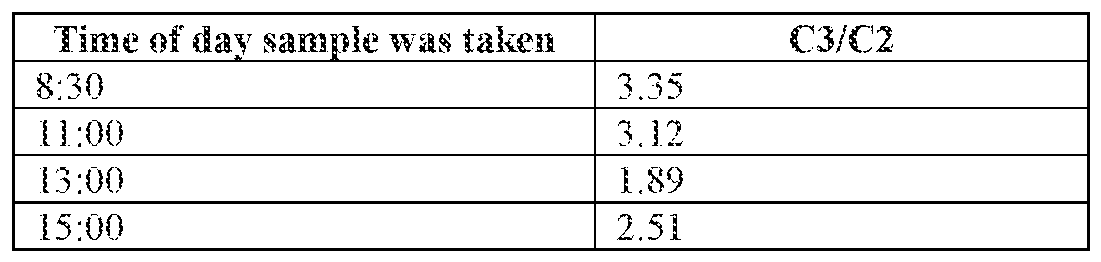
[0335] Results provided that the C3/C2 (propionyl-/acetyl-canutine) ratio was lowest at 13:00, which indicates that was an advantageous time for plasma sample collection.
¾amnla 21. Tmnnrt studies in vivo: Dose selection
[0336] Acylcarnitines, C3 and C2, and methylcitrate, MC, were measured in plasma samples collected from mice treated with 2 doses of TAT-PCCAB in two groups: 10 and 20mg/kg as outlined above. Results are shown in Table 21.
Table 21. C3/C2 ratio in plasma after 2 doses of TAT-PCCB
 [0337] Metabolic marker MC (methylcitrate) did not show significant variation throughout the day. Both treated groups were observed to experience a decline in C3/C2 ratio for 96 hours with no additional effect observed for the group receiving 20mg/kg. Therefore, lOmg/kg was determined to be a sufficient dosage for Examples herein.
[0338] As observed in the results above, PA-relevant metabolites were not significantly altered in plasma of the A138T PA mouse model. A slight trend in lowering both C3/C2 ratio and MC plasma levels was observed. Similar to PCC activity measurement, the relationship changes between dose and the C3/C2 were not proportional, e.g., a 2-fold increase in dose did not necessarily result in a 2-fold decrease in C3/C2 ratio.
¾amnla 22. In vivo pharmacokinetics (PK) analyses
[0339] Examples herein analyze changes in pharmacokinetics (PK) and pharmacodynamics (PD) of metabolites after a single IP injection.
[0340] Increase of PCC activity was observed in plasma and tissues, including heart and liver, of mice injected with TAT-PCCAB compared to untreated controls, which correlates with improvement of the C3/C2. IV injection was observed to yield approximately 2-fold higher PCC specific activities in plasma compared to previous Examples.
[0341] The length of the effect of IP administered TAT-PCCAB and PK of TAT-PCCAB importation into the cells was analyzed to determine the length of time that TAT-PCCAB persists in the mice. PCC A A138T mice were split into 2 sub-groups each consisting of 4 animals to split bleedings and maximize the number of timepoints over the course of a day. A single dose of TAT-PCCAB was administered IP at 8:00. Plasma samples were collected as follows: Group A - 2 hours (T2), 4 hours (T4) and 8 hours (T8) after injection; Group B - 3 hours (T3), 6 hours (T6), and 9 hours (T9) after injection. All mice were also bled 24 hours (T24) after injection. Control group C (injected IP with PBS only) was bled at the same intervals. Mice were sacrificed, and each liver was harvested. The groups are described in Tables 22-24 below. Table 22 provides details of Group A having plasma samples taken at T2, T4, and T8 after injection.
Table 22. Details of mice in Group A

[0342] Table 23 provides amounts and ratios of propionylCoAcarnitine (C3) and acetylCoAcarnitine (C2) for mice in Group A.
Table 23. Changes in C3 and C2 amounts and ratios over 24 hours in Group A

[0343] The average C3/C2, standard deviation (SD), and standard error of the mean (SEM) for each time point a sample was taken from Group A is shown in Table 24.
Table 24. Average C3/C2 ratios

[0344] Table 25 provides details of Group B having plasma samples taken at T3, T6, and T9 after injection.
Table 25. Details of mice in Group B

[0345] Table 26 provides amounts and ratios of propionylCoAcarnitine (C3) and acetylCoAcarnitine (C2) for mice in Group B.
Table 26. Changes in C3 and C2 amounts and ratios over 24 hours in Group B

[0346] The average C3/C2, standard deviation (SD), and standard error of the mean (SEM) for each time point a sample was taken from Group A is shown in Table 27.
Table 27. Average C3/C2 ratios

[0347] Table 28 provides details of the control group (Group C) that was injected with PBS
Table 28. Details of mice in Group C

[0348] Table 29 provides amounts and ratios of propionylCoAcarnitine (C3) and acetylCoAcarnitine (C2) for mice in Group C.
Table 29. Changes in C3 and C2 amounts and ratios over 24 hours in Group

[0349] The mean of the C3/C2 ratios for the treated and untreated group and the standard error of the mean (SEM) values are shown in Table 30. Samples were not taken from the untreated group at 3 (T3), 6 (T6), and 9 (T9) hours. The average C3/C2 ratios at TO and T24 are averages of results in Group A and Group B.
Table 30. Mean of C3/C2 ratios in treated and untreated groups
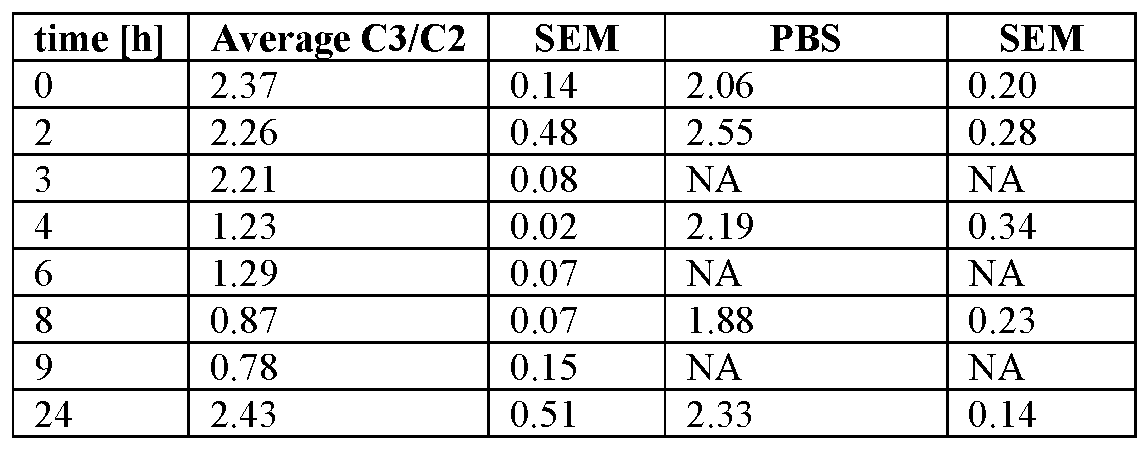
Example 23. Multiple in vivo injections
[0351] Hypomorphic PCCA mice (i.e. knock-out for mouse PCCA but carrying transgene for human PCCA A138T mutant) were analyzed to determine whether multiple injections of a TAT- PCCAB conjugate per day and for a longer period of treatment could bring the (i) C3/C2 ratio closer to levels in healthy subjects and (ii) absolute C3 concentration down compared to a single injection. TAT-PCCAB was formulated to 4.1mg/ml by a Gibco lx PBS pH7.4 on a G25 SEPHADEX™ spin column and concentrated on Amicon YM10 and filter sterilized (PVDF, 0.22μη ). Mice (2 sub-groups each consisting of 7 animals) were bled before the injection for analysis of metabolites at time -1 (1 day before at the same time of the following bleedings).
[0352] The TAT-PCCAB was administered IP twice a day at 20mg/kg, once in the morning at 8:00 and 8 hours later at 16:00 for 4 days. On the fifth day, only the morning injection was administered. Plasma samples were collected once a day before the second daily injection. On fifth day, 8 hours after the last morning injection, mice were bled, sacrificed, perfused with PBS and had their livers harvested for PCC activity measurement. Mice were at least 2 months old, and most were females because previous screenings have shown that females have higher C3/C2 ratio than males. The mean of the C3/C2 ratios for the treated and PBS-treated group and the standard error of the mean (SEM) values are shown in Table 31.
Table 31. Mean of C3/C2 ratios in treated and untreated groups

Example 24. Single in vivo IP injections
[0353] To determine whether a single daily injection can bring the (i) C3/C2 ratio down every day and (ii) absolute C3 concentration down, hypomorphic PCCA mice (i.e. knock-out for mouse PCCA but carrying transgene for human PCCA A138T mutant) were bled before the
injection for metabolites at time -1 (1 day before at H e same time of the following bleedings). TAT-PCCAB was concentrated to 8.6mg/ml and was formulated into 20mM HEPES pH7.5, 150mM NaCl on a G25 SEPHADEX™ spin column, concentrated on Amicon YM10 and filter sterilized (PVDF, 0.22μm). TAT-PCCAB was administered IP once a day 20mg/kg (dilute enzyme 2. lSx to 4mg/ml in a filter-sterilized formulation buffer) in the morning at 8:00 for 4 days.
[0354] Plasma samples were collected once a day, 8 hours after the injection at 16:00. Half of the mice were female, and all were at least 2 months old.
[0355] The 3 groups of mice each consisted of 4 animals. Table 32 provides the mean of each group of mice treated with either TAT-PCCAB or Buffer and the untreated control mice.
Table 32. Mean of C3/C2 ratios in treat and untreated groups

[0356] A significant increase of the C3/C2 ratio in the TAT-PCCAB treated group was observed after 3 days of IP injection.
Example 25. Multiple IP injections of 30mg/kg and 40mg/kg
[0357] To determine whether a single or two daily injection at a higher dose than 20mg/kg was sufficient to bring the C3/C2 ratio down every day and the absolute C3 concentration down. Hypomorphic PCCA mice (i.e. knock-out for mouse PCCA but carrying transgene for human PCCA A138T mutant) as described above were not bled before the injection for metabolites at time -1 (1 day before at the same time of the following bleedings) and this example uses the values from Example 23.
[0358] There were 2 sub-groups of mice each consisting of 4 animals: TAT-PCCAB-treated and buffer-injected controls.
[0359] The TAT-PCCAB was administered IP once a day at 8:00 for 4 days at a dose of 30mg/kg. In addition, on day 2 and day 4, an extra second dose of 40mg/kg was administered 4 hours after the morning injection at noon. Plasma samples were collected once a day at 8 hours after the first morning injection at 16:00.
[0360] FITC-TAT-PCCAB was formulated to a concentration of 5.5mg/ml in 20mM HEPES pH7.5, 150mM NaCl on a G25 SEPHADEX™ spin column, concentrated on Amicon YM10, filter sterilized (PVDF, 0.22μπι), and modified O/N. For days 2 and 4, TAT-PCCAB was formulated in 20mM HEPES pH7.5, 150mM NaCl on a G25 SEPHADEX™ spin column
concentrated on Amicon YM10 and filter sterilized (PVDF, 0.22um) to a concentration of 7.2mg/ml and modified O/N. The C3/C2 ratios were calculated for each mouse at the designated timepoints. The mean C3/C2 ratios for each group are shown in Table 33.
Table 33. Mean C3/C2 ratios for TAT-PCCAB treated and buffer-treated mice

[0361] The higher dosages injected at days 2 and 4 did not result in a significant change in the relevant metabolites, although the ratio was observed to be slightly reduced on these days.
¾amnla 26. Comparing single and multiple daily injections
[0362] To determine whether a single or two daily injection can bring the (i) C3/C2 ratio down every day and (ii) absolute C3 concentration down, hypomorphic PCCA mice (i.e. knockout for mouse PCCA but carrying transgene for human PCCA A138T mutant) as described above were divided into 2 sub-groups of mice each consisting of 4 animals: TAT-PCCAB- treated and buffer-injected controls. The TAT-PCCAB was administered IP at a dose of 20mg/kg (enzyme was diluted 1.8x to 4mg/ml in a filter-sterilized formulation buffer). TAT- PCCAB was also formulated in 20mM HEPES pH7.5, 150mM NaCl on a G25™ spin column to a concentration of 7.2mg/ml, modified O/N, and filter sterilized (PVDF, 0.22um) on Amicon YM10.
[0363] These mice were not bled before the injection for metabolites at time -1, and this example used the values in Example 23.
[0364] The TAT-PCCAB was administered once a day at 8:00 for 4 days. In addition, on day 2 and day 4, an extra second dose was administered 4 hours after the morning injection at noon. Plasma samples were collected once a day at 8 hours after the first morning injection at 16:00. Table 34 provides the mean C3/C2 ratios for each group.
Table 34. Mean C3/C2 ratios for TAT-PPCAB-treated and buffer-treated groups

[0365] On day 4, the C3/C2 ratio was observed to be significantly reduced.
EQUIVALENTS AND SCOPE
[0366] Those skilled in the art will recognize, or be able to ascertain using no more than routine experimentation, many equivalents to the specific embodiments in accordance with the invention described herein. The scope of the present invention is not intended to be limited to the above Description, but rather is as set forth in the appended claims.
[0367] In the claims, articles such as "a," "an," and "the" may mean one or more than one unless indicated to the contrary or otherwise evident from the context Claims or descriptions that include "or" between one or more members of a group are considered satisfied if one, more than one, or all of the group members are present in, employed in, or otherwise relevant to a given product or process unless indicated to the contrary or otherwise evident from the context. The invention includes embodiments in which exactly one member of the group is present in, employed in, or otherwise relevant to a given product or process. The invention includes embodiments in which more than one, or the entire group members are present in, employed in, or otherwise relevant to a given product or process.
[0368] It is also noted that the term "comprising" is intended to be open and permits but does not require the inclusion of additional elements or steps. When the term "comprising" is used herein, the term "consisting of is thus also encompassed and disclosed.
[0369] Where ranges are given, endpoints are included. Furthermore, it is to be understood that unless otherwise indicated or otherwise evident from the context and understanding of one of ordinary skill in the art, values that are expressed as ranges can assume any specific value or subrange within the stated ranges in different embodiments of the invention, to the tenth of the unit of the lower limit of the range, unless the context clearly dictates otherwise.
[0370] In addition, it is to be understood that any particular embodiment of the present invention that falls within the prior art may be explicitly excluded from any one or more of the claims. Since such embodiments are deemed to be known to one of ordinary skill in the art, they may be excluded even if the exclusion is not set forth explicitly herein. Any particular embodiment of the compositions of the invention (e.g., any antibiotic, therapeutic or active ingredient; any method of production; any method of use; etc.) can be excluded from any one or more claims, for any reason, whether or not related to the existence of prior art.
[0371] It is to be understood that the words which have been used are words of description rather than limitation, and that changes may be made within the purview of the appended claims without departing from the true scope and spirit of the invention in its broader aspects.
[0372] Publications, patents, and patent applications cited herein are hereby expressly incorporated by reference in their entireties.
[0373] While H e present invention has been described at some length and with some particularity with respect to the several described embodiments, it is not intended that it should be limited to any such particulars or embodiments or any particular embodiment, but it is to be construed with reference to the appended claims so as to provide the broadest possible interpretation of such claims in view of the prior art and, therefore, to effectively encompass the intended scope of the invention.
Claims
1. A method for reducing propionyl-CoA levels in a PCC deficient subject comprising administering a pharmaceutical composition comprising an isolated human PCCAB dodecamer conjugated to a cell penetrating peptide or mitochondria penetrating peptide.
2. A method for reducing the ratio of propionyl-carnitine (C3) to acetyl-carnitine (C2) in a PCC deficient subject comprising administering a pharmaceutical composition comprising an isolated human PCCAB dodecamer conjugated to a cell penetrating peptide or mitochondria penetrating peptide.
3. A method for reducing propionyl-carnitine (C3) levels of in a PCC deficient subject comprising administering a pharmaceutical composition comprising an isolated human PCCAB dodecamer conjugated to a cell penetrating peptide or mitochondria penetrating peptide.
4. The method of any one of claims 1-3, wherein the PCCAB dodecamer comprises a PCC A subunit comprising the amino acid sequence of SEQ ID NO:41, or a fragment or a variant thereof sharing a sequence similarity with SEQ ID NO:41 of at least 99%, at least 95%, at least 90%, at least 80%, at least 70%, at least 60%, or at least 50%.
5. The method of any one of claims 1-3, wherein the PCCAB dodecamer comprises a PCCB subunit having the amino acid sequence of SEQ ID NO:43, or a fragment or a variant thereof sharing a sequence similarity with SEQ ID NO:43 of at least 99%, at least 95%, at least 90%, at least 80%, at least 70%, at least 60%, or at least 50%.
6. The method of any one of claims 1-3, wherein a nucleic acid sequence encoding the PCCAB dodecamer is codon optimized for recombinant cell expression.
7. The method of claim 4, wherein a nucleic acid sequence encoding the PCCA subunit is SEQ ID NO:40, or a fragment or a variant thereof sharing a sequence similarity with SEQ ID NO:40 of at least 99%, at least 95%, at least 90%, at least 80%, at least 70%, at least 60%, or at least 50%.
8. The method of claim 5, wherein a nucleic acid sequence encoding the PCCB subunit is SEQ ID NO:42, or a fragment or a variant thereof sharing a sequence similarity with SEQ ID NO:42 of at least 99%, at least 95%, at least 90%, at least 80%, at least 70%, at least 60%, or at least 50%.
9. The method of any one of claims 1-3, wherein the pharmaceutical composition is administered by intravenous injection (TV), subcutaneous injection (SC), or intraperitoneal injection (IP).
10. The method of any one of claims 1-3, wherein the pharmaceutical composition is formulated in a dosage within a range of about 20mg/kg to about 30mg/kg, about 25mg/kg to about 35mg/kg, about 30mg/kg to about 40mg/kg, or about 35mg/kg to about 45mg/kg.
11. The method of claim 9, wherein administering occurs at least at least twice a day, a least three times a day, or at least 4 times a day.
12. The method of claim 9, wherein administering occurs consecutively for more than one day.
13. The method of claim 12, wherein administering occurs consecutively for at least 4 days.
14. The method of claim 11, wherein administering occurs at more than one dose.
15. The method of claim 12, further comprising administering an additional dose of the pharmaceutical composition every other day.
16. The method of claim 15, wherein administering the additional dose occurs about 4 hours after administering the pharmaceutical composition.
17. The method of claim 16, wherein the additional dose is the same as a dose of the pharmaceutical composition.
18. The method of claim 17, wherein the dose of the pharmaceutical composition and the additional dose are about 20mg/kg.
19. The method of claim 16, wherein the additional dose is greater than a dose of the pharmaceutical composition.
20. The method of claim 19, wherein the additional dose is about 40mg/kg and the dose of the pharmaceutical composition is about 20mg/kg.
21. A method of producing a TAT-PCCAB conjugate comprising:
(a) providing a nucleic acid sequence codon-optimized for expression in a
recombinant cell system;
(b) co-expressing PCCAB with a molecular chaperone protein;
(c) purifying PCCAB; and
(d) conjugating PCCAB to at least one cell penetrating peptide after purifying, thereby producing a TAT-PCCAB conjugate.
Applications Claiming Priority (2)
| Application Number | Priority Date | Filing Date | Title |
|---|---|---|---|
| US201762500967P | 2017-05-03 | 2017-05-03 | |
| US62/500,967 | 2017-05-03 |
Publications (1)
| Publication Number | Publication Date |
|---|---|
| WO2018204603A1 true WO2018204603A1 (en) | 2018-11-08 |
Family
ID=64016762
Family Applications (1)
| Application Number | Title | Priority Date | Filing Date |
|---|---|---|---|
| PCT/US2018/030826 Ceased WO2018204603A1 (en) | 2017-05-03 | 2018-05-03 | PROPIONYL-CoA CARBOXYLASE COMPOSITIONS AND USES THEREOF |
Country Status (1)
| Country | Link |
|---|---|
| WO (1) | WO2018204603A1 (en) |
Citations (1)
| Publication number | Priority date | Publication date | Assignee | Title |
|---|---|---|---|---|
| WO2016179138A1 (en) * | 2015-05-03 | 2016-11-10 | The Regents Of The University Of Colorado | Propionyl-coa carboxylase compositions and uses thereof |
-
2018
- 2018-05-03 WO PCT/US2018/030826 patent/WO2018204603A1/en not_active Ceased
Patent Citations (1)
| Publication number | Priority date | Publication date | Assignee | Title |
|---|---|---|---|---|
| WO2016179138A1 (en) * | 2015-05-03 | 2016-11-10 | The Regents Of The University Of Colorado | Propionyl-coa carboxylase compositions and uses thereof |
Non-Patent Citations (2)
| Title |
|---|
| DATABASE Nucleotide 20 May 2005 (2005-05-20), "Homo sapiens propionyl Coenzyme A carboxylase, alpha polypeptide, mRNA (cDNA clone MGC:5056 IMAGE:3048998), complete cds.", XP055545708, retrieved from NCBI Database accession no. BC000140 * |
| DATABASE UniProtKB 13 August 1987 (1987-08-13), "PROPIONYL-COA CARBOXYLASE ALPHA CHAIN (EC 6.4.1.3) (PCCASE) (PROPANOYL-COA: CARBON DIOXIDE LIGASE) (GENE NAME: PCCA) (FRAGMENT)", XP055545693, retrieved from UniProt Database accession no. P05165 * |
Similar Documents
| Publication | Publication Date | Title |
|---|---|---|
| Mohanraj et al. | Inhibition of proteasome rescues a pathogenic variant of respiratory chain assembly factor COA7 | |
| ES2692815T3 (en) | Derivatives of serum amyloid P and its preparation and use | |
| US20250041392A1 (en) | Compositions and methods for treatment of homocystinuria | |
| JP7046003B2 (en) | Method for selecting high M6P recombinant protein | |
| US20050169904A1 (en) | Non-viral delivery of compounds to mitochondria | |
| US11771745B2 (en) | Compositions and methods for treatment of homocystinuria | |
| US20220125892A1 (en) | Glucocerebrosidase polypeptides | |
| US10406214B2 (en) | Propionyl-CoA carboxylase compositions and uses thereof | |
| Collard et al. | Import of TAT-conjugated propionyl coenzyme A carboxylase using models of propionic acidemia | |
| EP4159193A1 (en) | Mutated arylsulfatase a | |
| WO2017192761A1 (en) | Propionyl-coa carboxylase compositions and uses thereof | |
| JP2019503171A (en) | Human α-N-acetylgalactosaminidase polypeptide | |
| WO2018204603A1 (en) | PROPIONYL-CoA CARBOXYLASE COMPOSITIONS AND USES THEREOF | |
| US10286038B2 (en) | Lysosome membrane protein 2 (LIMP-2) based peptides and related uses | |
| Papadopoulou et al. | Transduction of human recombinant proteins into mitochondria as a protein therapeutic approach for mitochondrial disorders | |
| US20230322854A1 (en) | Huntingtin-related peptide agents and uses thereof | |
| CN109196097B (en) | Method for selecting high M6P recombinant proteins | |
| HK40072007B (en) | Compositions and methods for treatment of homocystinuria | |
| WO2018149864A1 (en) | Small molecule therapeutics for treating metachromatic leukodystrophy | |
| CN117916368A (en) | Base editing of the thyroxine transporter gene | |
| WO2024112775A1 (en) | Compositions and methods for editing a transthyretin gene | |
| Møller | Oxidative stress in (plant) mitochondria | |
| Risco Quiroz | Development of a Novel Strategy to Treat Spinal Muscular Atrophy | |
| BR112016018721B1 (en) | P97 FUSION PROTEIN (MELANOTRANSFERRIN), PHARMACEUTICAL COMPOSITION COMPRISING SAID FUSION PROTEIN AND USE OF THE FUSION PROTEIN TO TREAT LYSOSOMIC DEPOSIT DISEASE |
Legal Events
| Date | Code | Title | Description |
|---|---|---|---|
| 121 | Ep: the epo has been informed by wipo that ep was designated in this application |
Ref document number: 18794674 Country of ref document: EP Kind code of ref document: A1 |
|
| NENP | Non-entry into the national phase |
Ref country code: DE |
|
| 122 | Ep: pct application non-entry in european phase |
Ref document number: 18794674 Country of ref document: EP Kind code of ref document: A1 |