WO2018203345A1 - Pyrene tetra boronic acid, process for preparation and use thereof - Google Patents
Pyrene tetra boronic acid, process for preparation and use thereof Download PDFInfo
- Publication number
- WO2018203345A1 WO2018203345A1 PCT/IN2018/050261 IN2018050261W WO2018203345A1 WO 2018203345 A1 WO2018203345 A1 WO 2018203345A1 IN 2018050261 W IN2018050261 W IN 2018050261W WO 2018203345 A1 WO2018203345 A1 WO 2018203345A1
- Authority
- WO
- WIPO (PCT)
- Prior art keywords
- pyrene
- formula
- boronic acid
- compound
- glucose
- Prior art date
- Legal status (The legal status is an assumption and is not a legal conclusion. Google has not performed a legal analysis and makes no representation as to the accuracy of the status listed.)
- Ceased
Links
Classifications
-
- C—CHEMISTRY; METALLURGY
- C07—ORGANIC CHEMISTRY
- C07F—ACYCLIC, CARBOCYCLIC OR HETEROCYCLIC COMPOUNDS CONTAINING ELEMENTS OTHER THAN CARBON, HYDROGEN, HALOGEN, OXYGEN, NITROGEN, SULFUR, SELENIUM OR TELLURIUM
- C07F5/00—Compounds containing elements of Groups 3 or 13 of the Periodic Table
- C07F5/02—Boron compounds
- C07F5/025—Boronic and borinic acid compounds
-
- C—CHEMISTRY; METALLURGY
- C09—DYES; PAINTS; POLISHES; NATURAL RESINS; ADHESIVES; COMPOSITIONS NOT OTHERWISE PROVIDED FOR; APPLICATIONS OF MATERIALS NOT OTHERWISE PROVIDED FOR
- C09D—COATING COMPOSITIONS, e.g. PAINTS, VARNISHES OR LACQUERS; FILLING PASTES; CHEMICAL PAINT OR INK REMOVERS; INKS; CORRECTING FLUIDS; WOODSTAINS; PASTES OR SOLIDS FOR COLOURING OR PRINTING; USE OF MATERIALS THEREFOR
- C09D11/00—Inks
- C09D11/16—Writing inks
- C09D11/17—Writing inks characterised by colouring agents
-
- C—CHEMISTRY; METALLURGY
- C09—DYES; PAINTS; POLISHES; NATURAL RESINS; ADHESIVES; COMPOSITIONS NOT OTHERWISE PROVIDED FOR; APPLICATIONS OF MATERIALS NOT OTHERWISE PROVIDED FOR
- C09D—COATING COMPOSITIONS, e.g. PAINTS, VARNISHES OR LACQUERS; FILLING PASTES; CHEMICAL PAINT OR INK REMOVERS; INKS; CORRECTING FLUIDS; WOODSTAINS; PASTES OR SOLIDS FOR COLOURING OR PRINTING; USE OF MATERIALS THEREFOR
- C09D11/00—Inks
- C09D11/50—Sympathetic, colour changing or similar inks
-
- C—CHEMISTRY; METALLURGY
- C09—DYES; PAINTS; POLISHES; NATURAL RESINS; ADHESIVES; COMPOSITIONS NOT OTHERWISE PROVIDED FOR; APPLICATIONS OF MATERIALS NOT OTHERWISE PROVIDED FOR
- C09K—MATERIALS FOR MISCELLANEOUS APPLICATIONS, NOT PROVIDED FOR ELSEWHERE
- C09K11/00—Luminescent materials, e.g. electroluminescent or chemiluminescent
- C09K11/06—Luminescent materials, e.g. electroluminescent or chemiluminescent containing organic luminescent materials
- C09K11/07—Luminescent materials, e.g. electroluminescent or chemiluminescent containing organic luminescent materials having chemically-interreactive components, e.g. reactive chemiluminescent compositions
-
- G—PHYSICS
- G01—MEASURING; TESTING
- G01N—INVESTIGATING OR ANALYSING MATERIALS BY DETERMINING THEIR CHEMICAL OR PHYSICAL PROPERTIES
- G01N33/00—Investigating or analysing materials by specific methods not covered by groups G01N1/00 - G01N31/00
- G01N33/48—Biological material, e.g. blood, urine; Haemocytometers
- G01N33/50—Chemical analysis of biological material, e.g. blood, urine; Testing involving biospecific ligand binding methods; Immunological testing
- G01N33/58—Chemical analysis of biological material, e.g. blood, urine; Testing involving biospecific ligand binding methods; Immunological testing involving labelled substances
- G01N33/582—Chemical analysis of biological material, e.g. blood, urine; Testing involving biospecific ligand binding methods; Immunological testing involving labelled substances with fluorescent label
-
- G—PHYSICS
- G01—MEASURING; TESTING
- G01N—INVESTIGATING OR ANALYSING MATERIALS BY DETERMINING THEIR CHEMICAL OR PHYSICAL PROPERTIES
- G01N33/00—Investigating or analysing materials by specific methods not covered by groups G01N1/00 - G01N31/00
- G01N33/48—Biological material, e.g. blood, urine; Haemocytometers
- G01N33/50—Chemical analysis of biological material, e.g. blood, urine; Testing involving biospecific ligand binding methods; Immunological testing
- G01N33/66—Chemical analysis of biological material, e.g. blood, urine; Testing involving biospecific ligand binding methods; Immunological testing involving blood sugars, e.g. galactose
Definitions
- the present invention relates to a pyrene tetra boronic acid compound of formula I and a process for preparation thereof.
- the present invention further relates to use of the pyrene tetra boronic acid compound of formula I in irreversible writing using water as an ink, glucose sensing and fluorescent labelling application.
- boronlectins The reversible boronic acid-diol interaction empowers boronic acid receptors saccharide binding capacities, rendering them a class of lectin mimetic, termed "boronlectins". Boronic acids follow lectin functions not just in being able to bind saccharides, but in multivalent saccharide binding that enhances both affinity and selectivity. For almost a decade, efforts have been made to achieve and improve selectivity for given saccharide targets, most notably glucose, by using properly positioned boronic acids, offering multivalent interactions.
- Boronic acids are increasingly utilized in diverse areas of research. Including the interactions of boronic acids with diols and strong Lewis bases as fluoride or cyanide anions, which leads to their utility in various sensing applications.
- the sensing applications can be homogeneous assays or heterogeneous detection. Detection can be at the interface of the sensing material or within the bulk sample.
- boronic acids with diols allows utilization in various areas ranging from biological labelling, protein manipulation and modification, separation and the development of therapeutics.
- Boronic acids are ideal molecular receptors for 1, 2- or 1, 3-diols (e.g. monosaccharides) because boronic acid derivatives rapidly and reversibly interact with carbohydrates in aqueous media, and thus importantly the method does not consume the analyte.
- TPE tetraphenylethene
- the glucose sensitivity of the simplest 1st generation sensor which is based on an immobilized mono- phenylboronate/single-arm type, came short of the sensitivity requirement for practical use, because of the very moderate fluorescence intensity change over the physiological glucose range.
- the main objective of the present invention is to provide a pyrene tetra boronic acid compound of formula I.
- Another objective of the present invention is to provide a process for the preparation of a pyrene tetra boronic acid compound of formula I.
- Still another objective of the present invention is to provide use of the pyrene tetra boronic acid compound of formula I in irreversible writing using water as an ink, glucose sensing and fluorescent labelling application.
- the present invention provides a pyrene tetra boronic acid compound of formula I;
- the compound of formula I is Pyrene- 1,3,6,8- tetrayltetraboronic acid.
- the present invention provides a process for preparation of a pyrene tetra boronic acid compound of formula I comprising the steps of:
- step (b) adding an acid into the reaction mixture of step (a) at a temperature ranging from
- the pyrene derivative is (l,3,6,8-tetrakis(4,4,5,5- tetramethyl- 1 ,3 ,2-dioxaborolan-2-yl)pyrene) .
- the alkali metal periodates is sodium periodate.
- the acid is hydrochloric acid.
- the solvent is selected from the group consisting of tetrahydrofuran, and water or mixture thereof.
- the present invention provides use of the pyrene tetra boronic acid of formula I in irreversible writing using water as an ink, glucose sensing and fluorescent labelling application.
- the present invention provides a process for detection of glucose using pyrene tetra boronic acid compound of formula I.
- Figure 1 TEM image of the nanosheet assembly formed by compound of formula I.
- Inset of b) shows the SAED pattern of the sheets.
- Figure 2 Irreversible writing on a whatmann filter paper coated with compound of formula I using water as an ink showing enhanced fluorescence.
- the present invention provides a pyrene tetra boronic acid compound of formula I;
- the pyrene tetra boronic acid compound of formula I is Pyrene-1, 3,6,8- tetrayltetraboronic acid.
- the pyrene tetra boronic acid compound of formula I show an enhancement in emission with water.
- the present invention provides a process for preparation of pyrene tetra boronic acid compound of formula I comprising the steps of: a) adding an alkali metal periodate to a solution of pyrene derivative in a solvent and stirring the solution for a time period ranging from 24 to 30 hours at a temperature ranging from 25° to 30°C to obtain a reaction mixture;
- step (b) adding an acid into the reaction mixture of step (a) at a temperature ranging from
- the pyrene derivative is (l,3,6,8-tetrakis(4,4,5,5-tetramethyl-l,3,2-dioxaborolan-2- yl)pyrene).
- the alkali metal periodates is sodium periodate.
- the acid is hydrochloric acid.
- the solvent is selected from the group conistsing of tetrahydrofuran, and water, or mixture thereof.
- the present invention provides use of said pyrene tetra boronic acid compound of formula I in irreversible writing using water as ink, glucose sensing and fluorescent labelling application.
- water is used as ink on pyrene tetra boronic acid as a matrix.
- the present invention provides a new biosensor with a high specificity for D- glucose in an aqueous media by using the pyrene tetra boronic acid compound of formula I as shown in figure 4.
- the present invention provides a pyrene tetra boronic acid compound of formula I which forms sheet- like assemblies and exhibit poor fluorescence and phosphorescence.
- the present invention provides dip-coated papers made out of paper coated with pyrene tetra boronic acid compound of formula I to enable security labelling via irreversible writing using water as ink.
- the present invention provides a process for detection of glucose using pyrene tetra boronic acid compound of formula I, the process comprising titrating a glucose solution with a known concentration of pyrene tetra boronic acid compound of formula I.
- the titration of equal concentration of monosaccharide's viz, glucose, fructose, xylose, mannose and galactose is carried out. From all of these sugars selective glucose sensing (eight fold enhancements in emission) is observed.
- the 2D- sheets formed of the pyrene tetra boronic acid compound of formula I is hydrolyzed and forms hydrogen bonds with water and remain as a permanent fluorescent marking with an enhanced emission.
- the present invention provides a pyrene tetra boronic acid compound of formula I which is used to detect saccharides. It has been surprisingly found that said compound selectively detect D-Glucose while other sugars such as xylose, mannose and galactose exhibit very weak binding. Hence, glucose solution can also be used as an ink for permanent fluorescent marker application using the boronic pyrene tetra boronic acid compound of formula I.
- Figure 1 depicts Transmission electron microscopy (TEM) image of the nanosheet assembly formed by compound of formula I. Inset of b) shows the SAED pattern of the sheets.
- TEM Transmission electron microscopy
- Figure 2 depicts irreversible writing on a whatmann filter paper coated with compound of formula I using water as an ink showing enhanced fluorescence.
- a known concentration of glucose solution was prepared and was titrated with a known concentration of compound formula I.
- the emission with different molar concentration of sugar was obtained which is provided in figure 5.
- the glucose solution concentration was varied from 9.98 X 10 "6 M to 1 X 10 "6 M. It was observed that the emission intensity changed depending upon the glucose concentration. It was further observed that up to 10 "6 M concentration of glucose can be sensed using the compound of formula I.
- the Whatman filter paper coated with Compound of formula I was used for permanent writing experiments.
- a ball pen having a refill filled with water or Glucose solution was taken and written on the Whatman filter paper. It was observed that after writing, the emission of written text enhanced. This enhanced emission was a permanent change on the paper.
- the pyrene tetra boronic acid compound of formula I compound shows enhancement in emission with water.
- the pyrene tetra boronic acid compound of formula I show selective glucose sensing (eight fold enhancement in emission) in presence of other saccharides such as xylose, fructose, mannose, galactose and arabinose.
Landscapes
- Chemical & Material Sciences (AREA)
- Life Sciences & Earth Sciences (AREA)
- Health & Medical Sciences (AREA)
- Engineering & Computer Science (AREA)
- Hematology (AREA)
- Molecular Biology (AREA)
- Biomedical Technology (AREA)
- Immunology (AREA)
- Urology & Nephrology (AREA)
- Organic Chemistry (AREA)
- Biotechnology (AREA)
- Biochemistry (AREA)
- Cell Biology (AREA)
- Food Science & Technology (AREA)
- Medicinal Chemistry (AREA)
- Physics & Mathematics (AREA)
- Analytical Chemistry (AREA)
- Microbiology (AREA)
- General Health & Medical Sciences (AREA)
- General Physics & Mathematics (AREA)
- Pathology (AREA)
- Materials Engineering (AREA)
- Wood Science & Technology (AREA)
- Diabetes (AREA)
- Chemical Kinetics & Catalysis (AREA)
- General Chemical & Material Sciences (AREA)
Abstract
The present invention discloses a pyrene tetra boronic acid compound of formula (I) which is useful for permanent writing using water as an ink, glucose sensing and fluorescent labelling application The present application also discloses a process for preparation of said compound.
Description
PYRENE TETRA BORONIC ACID, PROCESS FOR PREPARATION AND USE
THEREOF
FIELD OF THE INVENTION
The present invention relates to a pyrene tetra boronic acid compound of formula I and a process for preparation thereof. The present invention further relates to use of the pyrene tetra boronic acid compound of formula I in irreversible writing using water as an ink, glucose sensing and fluorescent labelling application. BACKGROUND AND PRIOR ART OF THE INVENTION
The reversible boronic acid-diol interaction empowers boronic acid receptors saccharide binding capacities, rendering them a class of lectin mimetic, termed "boronlectins". Boronic acids follow lectin functions not just in being able to bind saccharides, but in multivalent saccharide binding that enhances both affinity and selectivity. For almost a decade, efforts have been made to achieve and improve selectivity for given saccharide targets, most notably glucose, by using properly positioned boronic acids, offering multivalent interactions. Incorporation of several boronic acid groups into a covalent framework or non-covalent assembly of boronic acid are two general methods used to create such smart sensors, of which the latter resembles lectin oligomerisation that affords multivalent saccharide-binding architectures.
Boronic acids are increasingly utilized in diverse areas of research. Including the interactions of boronic acids with diols and strong Lewis bases as fluoride or cyanide anions, which leads to their utility in various sensing applications. The sensing applications can be homogeneous assays or heterogeneous detection. Detection can be at the interface of the sensing material or within the bulk sample. Furthermore, the key interaction of boronic acids with diols allows utilization in various areas ranging from biological labelling, protein manipulation and modification, separation and the development of therapeutics.
Boronic acids are ideal molecular receptors for 1, 2- or 1, 3-diols (e.g. monosaccharides) because boronic acid derivatives rapidly and reversibly interact with carbohydrates in aqueous media, and thus importantly the method does not consume the analyte.
Article titled "Glucose sensing via polyanion formation and induced pyrene excimer emission" by C Yu et al. published in Chem. Commun., 2009, 1347-1349 reports glucose binding to boronic acid functional groups attached to a synthetic polymer in an aqueous solution effectively turns the polymer into a polyanion, which induces the aggregation of the positively charged trimethylpentylammonium pyrene derivative, leading to a strong excimer emission and the development of a ratiometric fluorescence glucose probe. The pyrene derivative, trimethylpentylammonium pyrene, containing one positive charge was synthesized according to a literature method. Addition of glucose to an aqueous buffer solution (30 mM Tris-HCl, 30 mM NaCl, pH 9.0) of the boronic acid-containing polymer and the pyrene derivative causes significant emission spectral changes.
Article titled "Specific detection of d-Glucose by a tetraphenylethene -based fluorescent sensor" by Yi Liu et al. published in Journal of the American Chemical Society, 2011, 133 (4), pp 660-663 reports a conceptually new "light-up" biosensor with a high specificity for d-glucose (Glu) in aqueous media. The emission from a tetraphenylethene (TPE)-cored diboronic acid was greatly boosted when the fluorogen was oligomerized with Glu because of restriction of the intramolecular rotations of the aryl rotors of TPE by formation of the oligomer. Little change in the light emission was observed when a tetraphenylethene (TPE)-cored diboronic acid was mixed with d- fructose, d-galactose, or d-mannose, as these saccharides are unable to oligomerize with the fluorogen.
Article titled "Scalable, non-invasive glucose sensor based on boronic acid functionalized carbon nanotube transistors" by MB Lerner et al. published in Appl. Phys. Lett; 2013, 102, 183113 reports a scalable, label-free all-electronic sensor for D-
glucose based on a carbon nanotube transistor functionalized with pyrene-l-boronic acid. This sensor responds to glucose in the range 1 Μ-100 mM, which includes typical glucose concentrations in human blood and saliva. Control experiments establish that functionalization with the boronic acid provides high sensitivity and selectivity for glucose. The devices show better sensitivity than commercial blood glucose meters and could represent a general strategy to bloodless glucose monitoring by detecting low concentrations of glucose in saliva.
Article titled "The effect of boronic acid-positioning in an optical glucose-sensing ensemble" by S Gamsey et al. published in Tetrahedron; 2006, 62 (26), pp 6321-6331 reports the quenching of the anionic dye 8-hydroxypyrene-l,3,6-trisulfonic acid trisodium salt (pyranine) with three different boronic acid-substituted benzyl viologens and further reports the fluorescence signal modulation obtained upon addition of glucose to the dye/quencher system
Article titled "A study of boronic acid based fluorescent glucose sensors" by T Kawanishi et al. published in Fluoresc; 2004; 14(5); pp 499-512 reports boronic acid based anthracene dyes designed, synthesized, and immobilized to solid phase, creating a continuous glucose sensor. Glucose sensitivities of dyes can decrease drastically after immobilization, therefore how to immobilize a dye to solid phase without changing the dye property is a key issue in developing the sensor. The glucose sensitivity of the simplest 1st generation sensor, which is based on an immobilized mono- phenylboronate/single-arm type, came short of the sensitivity requirement for practical use, because of the very moderate fluorescence intensity change over the physiological glucose range.
There is need to develop a new series of boronic acid derivative which shows enhancement in emission and Low concentration glucose sensing for a practical application.
OBJECTIVES OF THE INVENTION
The main objective of the present invention is to provide a pyrene tetra boronic acid compound of formula I.

Formula (I)
Another objective of the present invention is to provide a process for the preparation of a pyrene tetra boronic acid compound of formula I.
Still another objective of the present invention is to provide use of the pyrene tetra boronic acid compound of formula I in irreversible writing using water as an ink, glucose sensing and fluorescent labelling application.
SUMMARY OF THE INVENTION
Accordingly, the present invention provides a pyrene tetra boronic acid compound of formula I;
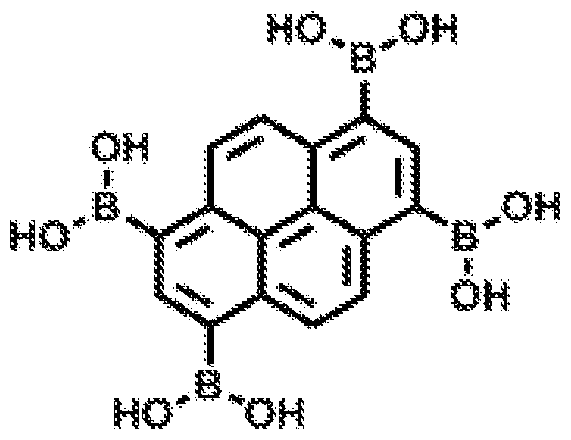
Formula I In preferred embodiment, the compound of formula I is Pyrene- 1,3,6,8- tetrayltetraboronic acid.
In an embodiment, the present invention provides a process for preparation of a pyrene tetra boronic acid compound of formula I comprising the steps of:
a) adding an alkali metal periodate to a solution of a pyrene derivative in a solvent and stirring the solution for a time period ranging from 24 to 30 hours at a temperature ranging from 25° to 30°C to obtain a reaction mixture;
b) adding an acid into the reaction mixture of step (a) at a temperature ranging from
25° to 30°C and stirring for a time period ranging from 24 to 30 hours to obtain pyrene tetra boronic acid of formula I. In a preferred embodiment, the pyrene derivative is (l,3,6,8-tetrakis(4,4,5,5- tetramethyl- 1 ,3 ,2-dioxaborolan-2-yl)pyrene) .
In a preferred embodiment, the alkali metal periodates is sodium periodate. In a preferred embodiment, the acid is hydrochloric acid.
In a preferred embodiment, the solvent is selected from the group consisting of tetrahydrofuran, and water or mixture thereof. In another embodiment, the present invention provides use of the pyrene tetra boronic acid of formula I in irreversible writing using water as an ink, glucose sensing and fluorescent labelling application.
In still another embodiment, the present invention provides a process for detection of glucose using pyrene tetra boronic acid compound of formula I.
BRIEF DESCRIPTION OF THE DRAWINGS
Figure 1: TEM image of the nanosheet assembly formed by compound of formula I. Inset of b) shows the SAED pattern of the sheets.
Figure 2: Irreversible writing on a whatmann filter paper coated with compound of formula I using water as an ink showing enhanced fluorescence.
Figure 3: Normalized emission spectra of compound of formula I in EtOAc solution (C = lxlO"3 M, 1 = 1 mm, = 364 nm), thin film ( * = 368 nm) and thin film after scratching for 2 min ( * = 368 nm).
Figure 4: Emission spectral changes of compound of formula I in EtOAc (C = lxlO"7 M, 1 = 1 mm, AeX = 365 nm) with lxlO"7 M solution of various sugars in MeOH (0.7:0.3 ratio).
Figure 5: Emission spectral changes of compound of formula I in EtOAc (C = lxlO"3 M, 1 = 1 mm, AeX = 365 nm) with different molar solution of glucose in MeOH.
Figure 6: Emission spectral changes of compound of formula I coated on whatmann filter paper (AeX = 365 nm).
DETAILED DESCRIPTION OF THE INVENTION
The invention will now be described in detail in connection with certain preferred and optional embodiments, so that various aspects thereof may be more fully understood and appreciated.
In an embodiment, the present invention provides a pyrene tetra boronic acid compound of formula I;

Formula I
The pyrene tetra boronic acid compound of formula I is Pyrene-1, 3,6,8- tetrayltetraboronic acid. The pyrene tetra boronic acid compound of formula I show an enhancement in emission with water.
In another embodiment, the present invention provides a process for preparation of pyrene tetra boronic acid compound of formula I comprising the steps of:
a) adding an alkali metal periodate to a solution of pyrene derivative in a solvent and stirring the solution for a time period ranging from 24 to 30 hours at a temperature ranging from 25° to 30°C to obtain a reaction mixture;
b) adding an acid into the reaction mixture of step (a) at a temperature ranging from
25° to 30°C and stirring for a time period ranging from 24 to 30 hours to obtain pyrene tetra boronic acid compound of formula I.
The pyrene derivative is (l,3,6,8-tetrakis(4,4,5,5-tetramethyl-l,3,2-dioxaborolan-2- yl)pyrene).The alkali metal periodates is sodium periodate. The acid is hydrochloric acid. The solvent is selected from the group conistsing of tetrahydrofuran, and water, or mixture thereof.
The process for the preparation of a pyrene tetra boronic acid compound of formula I as shown in Scheme 1:

Scheme: 1
In still another embodiment, the present invention provides use of said pyrene tetra boronic acid compound of formula I in irreversible writing using water as ink, glucose sensing and fluorescent labelling application.
In preferred embodiment, water is used as ink on pyrene tetra boronic acid as a matrix.
In an embodiment, the present invention provides a new biosensor with a high specificity for D- glucose in an aqueous media by using the pyrene tetra boronic acid compound of formula I as shown in figure 4. In another embodiment, the present invention provides a pyrene tetra boronic acid compound of formula I which forms sheet- like assemblies and exhibit poor fluorescence and phosphorescence.
In still another embodiment, the present invention provides dip-coated papers made out of paper coated with pyrene tetra boronic acid compound of formula I to enable security labelling via irreversible writing using water as ink.
The present invention provides a process for detection of glucose using pyrene tetra boronic acid compound of formula I, the process comprising titrating a glucose solution with a known concentration of pyrene tetra boronic acid compound of formula I. The titration of equal concentration of monosaccharide's viz, glucose, fructose, xylose, mannose and galactose is carried out. From all of these sugars selective glucose sensing (eight fold enhancements in emission) is observed. The 2D- sheets formed of the pyrene tetra boronic acid compound of formula I is hydrolyzed and forms hydrogen bonds with water and remain as a permanent fluorescent marking with an enhanced emission.
In still yet another embodiment, the present invention provides a pyrene tetra boronic acid compound of formula I which is used to detect saccharides. It has been surprisingly found that said compound selectively detect D-Glucose while other sugars such as xylose, mannose and galactose exhibit very weak binding. Hence, glucose solution can also be used as an ink for permanent fluorescent marker application using the boronic pyrene tetra boronic acid compound of formula I.
Figure 1 depicts Transmission electron microscopy (TEM) image of the nanosheet assembly formed by compound of formula I. Inset of b) shows the SAED pattern of the sheets.
Figure 2 depicts irreversible writing on a whatmann filter paper coated with compound of formula I using water as an ink showing enhanced fluorescence.
Figure 3 depicts normalized emission spectra of compound of formula (I) in EtOAc solution (C = lxlO"3 M, 1 = 1 mm, AeX = 364 nm), thin film (AeX = 368 nm) and thin film after scratching for 2 min ( * = 368 nm).
Figure 4 depicts emission spectral changes of compound of formula (I) in EtOAc (C = lxlO"7 M, 1 = 1 mm, AeX = 365 nm) with lxlO"7 M solution of various sugars in MeOH (0.7:0.3 ratio).
Figure 5 depicts emission spectral changes of compound of formula (I) in EtOAc (C = lxlO"3 M, 1 = 1 mm, AeX = 365 nm) with molar solution of glucose in MeOH.
Figure 6 depicts emission spectral changes of compound of formula (I) coated on whatmann filter paper (AeX = 365 nm).
EXAMPLES
Following examples are given by way of illustration therefore should not be construed to limit the scope of the invention.
Example 1: Synthesis of pyrene-l,3,6,8-tetrayltetraboronic acid:
To A solution of (l,3,6,8-tetrakis(4,4,5,5-tetramethyl-l,3,2-dioxaborolan-2-yl)pyrene) (200 mg, 1 eq.) in THF (10 ml) and water (2 ml), sodium periodate (727 mg, 12 eq.) was added. The cloudy suspension was stirred overnight at 25 to 30 °C. Then Hydrochloric acid (2M, 0.5 ml) was added and the mixture was stirred for another 24 hours. After the completion of the reaction, the mixture was poured into water, and extracted with ethyl acetate. The organic solvent was removed after drying it with sodium sulphate. The product obtained forms assembly giving a green colour solid. (95 %, 101.6 mg) 2D sheet like morphology of the product was confirmed by TEM.
Example 2: Process for the detection of glucose:
A known concentration of glucose solution was prepared and was titrated with a known concentration of compound formula I. The emission with different molar concentration of sugar was obtained which is provided in figure 5. The glucose solution concentration was varied from 9.98 X 10"6 M to 1 X 10"6 M. It was observed that the emission intensity changed depending upon the glucose concentration. It was further observed that up to 10"6 M concentration of glucose can be sensed using the compound of formula I.
A. Preparation of a Thin film on Whatman filter paper
Compound of formula I (3.78 mg) was dissolved in 10 ml of ethyl acetate. The resulting solution (C = 1 X 10"3 M) was coated on a Whatman filter paper and kept for 25 min at RT for drying. This coated Whatman filter paper emitted a deep blue colour. B. Permanent Writing Experiments
The Whatman filter paper coated with Compound of formula I was used for permanent writing experiments. A ball pen having a refill filled with water or Glucose solution was taken and written on the Whatman filter paper. It was observed that after writing, the emission of written text enhanced. This enhanced emission was a permanent change on the paper.
Advantages of the invention:
1. The pyrene tetra boronic acid compound of formula I compound shows enhancement in emission with water.
2. The pyrene tetra boronic acid compound of formula I show selective glucose sensing (eight fold enhancement in emission) in presence of other saccharides such as xylose, fructose, mannose, galactose and arabinose.
Claims
1. A pyrene tetra boronic acid com ound of formula I;

Formula I
2. The compound as claimed in claim 1, wherein said compound is Pyrene-1, 3,6,8- tetrayltetraboronic acid.
3. The compound as claimed in claim 1 for use in irreversible writing using water as an ink.
4. The compound as claimed in claim lfor use in glucose sensing application.
5. The compound as claimed in claim lfor use in fluorescent labelling application.
6. A process for preparation of pyrene tetra boronic acid compound of formula I as claimed in claim 1 comprising the steps of:
a) adding an alkali metal periodate to a solution of a pyrene derivative in a solvent and stirring the solution for a time period ranging from 24 to 30 hours at a temperature ranging from 25° to 30°C to obtain a reaction mixture;
b) adding an acid into the reaction mixture of step (a) at a temperature ranging from 25° to 30°C and stirring for a time period ranging from 24 to 30 hours to obtain pyrene tetra boronic acid of formula I.
7. The process as claimed in claim 6, wherein said pyrene derivative is (1,3,6,8- tetrakis(4,4,5,5-tetramethyl-l,3,2-dioxaborolan-2-yl)pyrene.
8. The process as claimed in claim 6, wherein said alkali metal periodate is sodium periodate.
9. The process as claimed in claim 6, wherein said acid is hydrochloric acid.
10. The process as claimed in claim 6, wherein said solvent is selected from the group consisting of tetrahydrofuran, and water or mixture thereof.
Priority Applications (1)
| Application Number | Priority Date | Filing Date | Title |
|---|---|---|---|
| US16/610,020 US10781220B2 (en) | 2017-05-02 | 2018-04-27 | Pyrene tetra boronic acid, process for preparation and use thereof |
Applications Claiming Priority (2)
| Application Number | Priority Date | Filing Date | Title |
|---|---|---|---|
| IN201711015472 | 2017-05-02 | ||
| IN201711015472 | 2017-05-02 |
Publications (1)
| Publication Number | Publication Date |
|---|---|
| WO2018203345A1 true WO2018203345A1 (en) | 2018-11-08 |
Family
ID=62245384
Family Applications (1)
| Application Number | Title | Priority Date | Filing Date |
|---|---|---|---|
| PCT/IN2018/050261 Ceased WO2018203345A1 (en) | 2017-05-02 | 2018-04-27 | Pyrene tetra boronic acid, process for preparation and use thereof |
Country Status (2)
| Country | Link |
|---|---|
| US (1) | US10781220B2 (en) |
| WO (1) | WO2018203345A1 (en) |
Cited By (1)
| Publication number | Priority date | Publication date | Assignee | Title |
|---|---|---|---|---|
| CN112410024A (en) * | 2019-08-21 | 2021-02-26 | 天津理工大学 | Nano carbon-aggregation induced emission molecular composite material and fluorescence regulation method thereof |
-
2018
- 2018-04-27 US US16/610,020 patent/US10781220B2/en active Active
- 2018-04-27 WO PCT/IN2018/050261 patent/WO2018203345A1/en not_active Ceased
Non-Patent Citations (6)
| Title |
|---|
| C YU ET AL.: "Glucose sensing via polyanion formation and induced pyrene excimer emission", CHEM. COMMUN., 2009, pages 1347 - 1349 |
| KYUNGSUK YUM ET AL: "Boronic Acid Library for Selective, Reversible Near-Infrared Fluorescence Quenching of Surfactant Suspended Single-Walled Carbon Nanotubes in Response to Glucose", ACS NANO, vol. 6, no. 1, 24 January 2012 (2012-01-24), pages 819 - 830, XP055210982, ISSN: 1936-0851, DOI: 10.1021/nn204323f * |
| MB LERNER ET AL.: "Scalable, non-invasive glucose sensor based on boronic acid functionalized carbon nanotube transistors", APPL. PHYS. LETT., vol. 102, 2013, pages 183113, XP012172875, DOI: doi:10.1063/1.4804438 |
| S GAMSEY ET AL.: "The effect of boronic acid-positioning in an optical glucose-sensing ensemble", TETRAHEDRON, vol. 62, no. 26, 2006, pages 6321 - 6331, XP025002148, DOI: doi:10.1016/j.tet.2006.04.047 |
| T KAWANISHI ET AL.: "A study of boronic acid based fluorescent glucose sensors", J FLUORESC., vol. 14, no. 5, 2004, pages 499 - 512 |
| YI LIU ET AL.: "Specific detection of d-Glucose by a tetraphenylethene-based fluorescent sensor", JOURNAL OF THE AMERICAN CHEMICAL SOCIETY, vol. 133, no. 4, 2011, pages 660 - 663 |
Cited By (1)
| Publication number | Priority date | Publication date | Assignee | Title |
|---|---|---|---|---|
| CN112410024A (en) * | 2019-08-21 | 2021-02-26 | 天津理工大学 | Nano carbon-aggregation induced emission molecular composite material and fluorescence regulation method thereof |
Also Published As
| Publication number | Publication date |
|---|---|
| US20200079798A1 (en) | 2020-03-12 |
| US10781220B2 (en) | 2020-09-22 |
Similar Documents
| Publication | Publication Date | Title |
|---|---|---|
| Sun et al. | Glucose sensing in supramolecular chemistry | |
| Xing et al. | Green enzyme-linked immunosorbent assay based on the single-stranded binding protein-assisted aptamer for the detection of mycotoxin | |
| Yu et al. | Metal–organic framework enhances aggregation-induced fluorescence of chlortetracycline and the application for detection | |
| Gupta et al. | Highly sensitive optical detection of Escherichia coli using terbium-based metal–organic framework | |
| Liu et al. | Anthrax biomarker: An ultrasensitive fluorescent ratiometry of dipicolinic acid by using terbium (III)-modified carbon dots | |
| Lacina et al. | Boronic acids for sensing and other applications-a mini-review of papers published in 2013 | |
| Fossey et al. | The development of boronic acids as sensors and separation tools | |
| Guo et al. | Graphene and its derivative-based sensing materials for analytical devices | |
| CN104807987B (en) | Paper chip, making method thereof, and bio-molecule detection method | |
| Wu et al. | Fluorescent probes for recognition of ATP | |
| Doughan et al. | A paper-based resonance energy transfer nucleic acid hybridization assay using upconversion nanoparticles as donors and quantum dots as acceptors | |
| An et al. | Low‐dimensional black phosphorus in sensor applications: advances and challenges | |
| Guo et al. | A concise detection strategy of Staphylococcus aureus using N-Succinyl-Chitosan-dopped bacteria-imprinted composite film and AIE fluorescence sensor | |
| Wang et al. | Strong acid-assisted preparation of green-emissive carbon dots for fluorometric imaging of pH variation in living cells | |
| Hao et al. | Surface modification and ratiometric fluorescence dual function enhancement for visual and fluorescent detection of glucose based on dual-emission quantum dots hybrid | |
| Wang et al. | Intelligent platform for simultaneous detection of multiple aminoglycosides based on a ratiometric paper-based device with digital fluorescence detector readout | |
| Guo et al. | Wash-free detection of nucleic acids with photoswitch-mediated fluorescence resonance energy transfer against optical background interference | |
| Pongprom et al. | A fluorescence sensor probe based on porous carbon, molecularly imprinted polymer and graphene quantum dots for the detection of trace sulfadimethoxine | |
| CN107677656A (en) | A kind of ratio fluorescent nano probe and its application | |
| Wei et al. | Specific recognition and fluorescent determination of aspirin by using core-shell CdTe quantum dot-imprinted polymers | |
| Ma et al. | A spectral shift-based electrochemiluminescence sensor for hydrogen sulfide | |
| Zhou et al. | Synthetic nanoprobes for biological hydrogen sulfide detection and imaging | |
| Sudewi et al. | Understanding antibiotic detection with fluorescence quantum dots: A review | |
| Wang et al. | A sandwich boronate affinity sorbent assay for glucose detection facilitated by boronic acid-terminated fluorescent polymers | |
| Li et al. | Metal-organic framework modified molecularly imprinted polymers-based sensor for fluorescent sensing of tetracycline in milk |
Legal Events
| Date | Code | Title | Description |
|---|---|---|---|
| 121 | Ep: the epo has been informed by wipo that ep was designated in this application |
Ref document number: 18727452 Country of ref document: EP Kind code of ref document: A1 |
|
| NENP | Non-entry into the national phase |
Ref country code: DE |
|
| 122 | Ep: pct application non-entry in european phase |
Ref document number: 18727452 Country of ref document: EP Kind code of ref document: A1 |