WO2018189157A1 - Methods for preparing a boronic acid or a boronic ester - Google Patents
Methods for preparing a boronic acid or a boronic ester Download PDFInfo
- Publication number
- WO2018189157A1 WO2018189157A1 PCT/EP2018/059121 EP2018059121W WO2018189157A1 WO 2018189157 A1 WO2018189157 A1 WO 2018189157A1 EP 2018059121 W EP2018059121 W EP 2018059121W WO 2018189157 A1 WO2018189157 A1 WO 2018189157A1
- Authority
- WO
- WIPO (PCT)
- Prior art keywords
- ester
- nmr
- mhz
- ppm
- carboxylic acid
- Prior art date
- Legal status (The legal status is an assumption and is not a legal conclusion. Google has not performed a legal analysis and makes no representation as to the accuracy of the status listed.)
- Ceased
Links
Classifications
-
- C—CHEMISTRY; METALLURGY
- C07—ORGANIC CHEMISTRY
- C07F—ACYCLIC, CARBOCYCLIC OR HETEROCYCLIC COMPOUNDS CONTAINING ELEMENTS OTHER THAN CARBON, HYDROGEN, HALOGEN, OXYGEN, NITROGEN, SULFUR, SELENIUM OR TELLURIUM
- C07F5/00—Compounds containing elements of Groups 3 or 13 of the Periodic Table
- C07F5/02—Boron compounds
- C07F5/025—Boronic and borinic acid compounds
-
- C—CHEMISTRY; METALLURGY
- C07—ORGANIC CHEMISTRY
- C07B—GENERAL METHODS OF ORGANIC CHEMISTRY; APPARATUS THEREFOR
- C07B47/00—Formation or introduction of functional groups not provided for in groups C07B39/00 - C07B45/00
-
- C—CHEMISTRY; METALLURGY
- C07—ORGANIC CHEMISTRY
- C07D—HETEROCYCLIC COMPOUNDS
- C07D207/00—Heterocyclic compounds containing five-membered rings not condensed with other rings, with one nitrogen atom as the only ring hetero atom
- C07D207/46—Heterocyclic compounds containing five-membered rings not condensed with other rings, with one nitrogen atom as the only ring hetero atom with hetero atoms directly attached to the ring nitrogen atom
Definitions
- the present invention relates to methods for converting carboxylic acids into boronic acids or esters, more particular to methods for borylation of carboxylic acids and even more particularly to methods for decarboxylative borylation of carboxylic acids.
- Carboxylic acids are among the most prevalent class of organic molecules found in Nature and thus methods for the conversion of the carboxyl functional group into other functional groups are highly sought after. In contrast, the isoelectronic boronic acids are hardly found in Nature at all, yet arguably bear the most versatile functional group available to the synthetic organic chemist.
- Boronic acids and their ester derivatives can be converted into almost any functional group in one step, through either transition-metal-mediated coupling reactions, 1,2-metallate rearrangements, or deborylative nucleophilic addition.
- boronic acids are important target molecules in their own right. Specifically, they share a number of features with carboxylic acids that make them potent bioisosteres in medicinal chemistry. For example, boronic acids form hydrogen bonds of similar geometries to carboxylic acids, despite their lower acidity, and they can switch reversibly between stable tricoordinate and tetracoordinate forms, thus allowing them to mimic the tetrahedral intermediates involved in, for example, the enzymatic hydrolysis of amide group.
- a straightforward method for converting libraries of bioactive carboxylic acids into the corresponding boronic acids would lead to enhanced screening libraries and would facilitate bioisosteric lead optimisation.
- the present invention accordingly provides a method as set out in claim 1 and a method as set out in claim 2, respectively.
- the present invention additionally provides a method as set out in claim 17, with the optional aspect as set out in claim 18.
- the present invention provides a method as set out in claim
- N-hydroxyphthalimide ester 1 as our test substrate as a solution in N,N- dimethylformamide (DMF; 0.1 M) with CS2CO3 (1.5 equivalent) and the diboron reagent, bis(catecholato)diboron (B 2 cat 2 , 1.00 equivalent), under the illumination of blue LED light for 14 hours, followed by a workup that involved adding pinacol and NEt 3 , so as to effect ligand exchange to form the more stable pinacol boronic ester, we obtained the desired boronic ester 2 in a noteworthy 8% yield. Carrying out the reaction with B 2 cat 2 in the absence of CS2CO3 delivered boronic ester 2 in 69% yield.
- DMF N,N- dimethylformamide
- a solvent screen revealed that the amide-based solvents were effective for this transformation, with the use of N,N-dimethylacetamide (DMAc) being marginally better than DMF.
- DMAc N,N-dimethylacetamide
- Increasing the amount of B 2 cat 2 in increments from 1.00 equivalent to 2.00 equivalents revealed that a slight excess of the reagent (1.25 equivalents; 91% yield) was optimal; there was a slight drop in yield with larger amounts.
- the transformation conducted in the dark delivered the desired product in 5% yield. Light from a regular white bulb placed in the vicinity of the reaction vessel was effective at increasing yield (91 yield), ambient light also led to efficient reaction (43% yield). The transformation was moderately sensitive to concentration (0.1 M being optimal) the reaction was complete within 4 hours. Investigation of reaction setup showed that although the reaction was tolerant of small amounts of water, the presence of 0 2 was detrimental and therefore conducting the reaction under an inert atmosphere (N 2 or Ar) was advantageous for higher yields.
- N 2 or Ar inert atmosphere
- Primary carboxylic acids including a benzylic substrate and substrates bearing heteroatoms, heterocycles (thiophene, indole), ⁇ -positioned alkenes, alkynes, esters, carbon-bromine bonds, and perfluoroalkyl chains, were converted into the corresponding primary pinacol boronic esters in good to high yields.
- the isolation of these products was facile, for example, a quick filtration through a plug of silica gel, or washing with mild aqueous base being sufficient for providing material of high purity.
- Secondary carboxylic acids either as part of an acyclic chain or as part of a carbo- or heterocycle of a variety of ring sizes (cyclohexyl, cyclopentyl, cyclopropyl, 2,2,2-bridged bicyclic, pyranyl), and containing functional groups, such as difluoromethylene, a carbamate, and an ester, were converted into the corresponding boronic esters in good to high yield.
- the 1,2-subsitututed cyclohexane 21 (derived from the corresponding dicarboxylic acid) and 1,2-disubstituted cyclopropane 15 were obtained in 90: 10 and 98:2 d.r., respectively.
- Tertiary carboxylic acids in which the three carbon atoms are tied back into a ring structure, for example adamantyl, cubyl, and bicyclo[l . l . l]pentyl carboxylic acids, were transformed into the corresponding boronic esters in good yield.
- adamantyl pinacol boronic ester 25 was prepared in a single reaction, thus showing that the conditions are suitable for preparing significant quantities of material for further applications.
- Fenbufen a protected form of glutamic acid, and indometacin were converted into the corresponding boronic esters in moderate to good yields. These examples highlight that the transformation is also tolerant of free hydroxy groups, silyl ethers, and ketones.
- the reaction mixture was allowed to stir at room temperature overnight, before concentrating under reduced pressure.
- the crude residue was directly purified by flash- column chromatography (S1O2; typically DCM with either pentane or Et 2 0) to yield pure NHPI ester. If solid and not pure, the NHPI ester can be recrystallized from DCM/MeOH or EtOAc to give pure material.
- reaction mixture was transferred into a vial containing EtOAc (15 mL), H 2 0 (3 mL), NH 4 C1 (saturated aqueous solution, 3 mL). After vigorously shaking and allowing the two layers to separate, the top organic layer was carefully removed with a pipette. This was repeated twice more with EtOAc (5 mL). The organic layers were combined and concentrated under reduced pressure. The crude residue was directly purified using a short silica gel column to yield the desired boronic ester.
- Pinacol (63 mg, 0.53 mmol, 4 eq.) was dissolved in Et 3 N (0.45 mL), added to the reaction mixture and stirred for 1 h.
- the reaction mixture was transferred into a vial containing EtOAc (15 mL), H 2 0 (3 mL), NH 4 C1 (saturated aqueous solution, 3 mL). After vigorously shaking and allowing the two layers to separate, the top organic layer was carefully removed with a pipette. This was repeated twice more with EtOAc (5 mL). The organic layers were combined and concentrated under reduced pressure.
- the crude residue was directly purified using a short silica gel column to yield the desired boronic ester.
- Solvents Also works in DMF, DMPU, DMI, NMP and tetramethylurea.
- Diboron source Also works with 0 - 100% B 2 cat 2 and 95 - 150% B 2 (OH) 4 .
- Starting material Also works with the tetrachlorophthalimide.
- NHPI ester 50 mg, 1.0 eq., 0.13 mmol
- catechol 4.5 mg, 0.50 eq., 0.065 mmol
- B 2 (OH) 4 18 mg, 1.50 eq., 0.195 mmol
- Pinacol (63 mg, 0.53 mmol, 4 eq.) was dissolved in Et 3 N (0.45 mL), added to the reaction mixture and stirred for 1 h.
- the reaction mixture was transferred into a vial containing EtOAc (15 mL), H 2 0 (3 mL), NH 4 C1 (saturated aqueous solution, 3 mL). After vigorously shaking and allowing the two layers to separate, the top organic layer was carefully removed with a pipette. This was repeated twice more with EtOAc (5 mL). The organic layers were combined and concentrated under reduced pressure.
- the crude residue was directly purified using a short silica gel column to yield the desired boronic ester.
- Solvents Also works in DMF, DMPU, DMI, NMP and tetramethylurea.
- Diboron source Also works with 5 - 100% catechol and 95 - 150% B 2 (OH) 4 .
- Starting material Also works with the tetrachlorophthalimide.
- NHPI ester 48 mg, 1.0 eq., 0.13 mmol
- B 2 cat 2 (16 mg, 0.10 eq., 0.065 mmol)
- B 2 (OH) 4 (12 mg, 1.0 eq., 0.13 mmol) were carefully weighed into a flame-dried 7 mL vial containing a small magnetic stirrer bar.
- DMAc 1.3 mL, 0.1 M
- 4- methoxypyridine 29 ⁇ , 2.0 eq., 0.26 mmol
- Solvents Also works in DMF, DMPU, DMI, NMP, tetramethylurea, MeCN, DCM, DME, Et20, 1,4-dioxane, acetone, EtOAc, hexane, toluene, THF, chloroform.
- Diboron source Also works with 5 - 100% B 2 cat 2 and 95 - 150% B 2 (OH) 4 .
- Additive also works with DMAP, pyridine, DABCO, DBU, quinuclidine, TMG, TBD, MTBD, 2-picoline, 4-picoline, 3-picoline, imidazole, K 2 C0 3 , AcOH, triethylamine, 4- cyanopyridine, 4-phenylpyridine.
- Starting material also works with the tetrachlorophthalimide .
- NHPI ester 51 was prepared according to a known procedure (36). Borylation: NHPI ester 51 (33 mg, 0.13 mmol) was borylated according to General Procedure B. The crude reside was purified by flash column chromatography (S1O2; 95:5 pentane:Et 2 0) to afford boronic ester 10 (14 mg, 56%) as a colorless oil. Note: the intermediate alkyl radical undergoes radical ring opening, and the product is volatile!
- NHPI ester 66 was prepared according to a known procedure. Borylation: NHPI ester 66 (40 mg, 0.13 mmol) was borylated according to General Procedure B. The crude reside was purified by flash column chromatography (Si0 2 ; 4: 1 petroleum ether 40-60:Et 2 O) to afford boronic ester 11 (13 mg, 41%) as a colorless oil.
- NHPI ester 1 was prepared according to a known procedure.
- NHPI ester 1 was prepared according to a known procedure.
- NHPI ester 71 was prepared according to a known procedure.
- NHPI ester 72 was prepared according to a known procedure.
- NHPI ester 74 was prepared according to a known procedure. Borylation: NHPI ester 74 (36 mg, 0.13 mmol) was borylated according to General Procedure B. The crude reside was purified by flash column chromatography (Si0 2 ; 3: 1 petroleum ether 40-60:Et 2 O) to afford boronic ester 20 (9 mg, 32%) as a colorless oil. Note: the product is unstable on silica gel.
- NHPI ester 78 was prepared according to a known procedure.
- NHPI ester 81 was prepared according to a known procedure.
- Fenbufen (1.0 g, 3.93 mmol) was coupled with N-hydroxyphthalimide according to General Procedure A.
- the crude product was filtered quickly through a short column ( ⁇ 5 cm silica gel). After concentrated to a -15 mL solution, 30 mL of MeOH was added. The precipitate was collected by filtration and washed with 10 mL of MeOH to afford the corresponding NHPI ester 87 (1.42 g, 91%) as a light pink solid. Note: The product is not stable on silica gel. m.p.: 165 - 168 °C (DCM/MeOH)
- NHPI ester 88 was prepared according to a known procedure. Borylation: NHPI ester 88 (67 mg, 0.13 mmol) was borylated according to General Procedure B. The crude reside was purified by flash column chromatography (Si0 2 ; 95:5 pentane: acetone) to afford boronic ester 34 (28 mg, 47%) a colorless oil.
- Glutamic acid derived NHPI ester 90 was prepared according to a known procedure.
Landscapes
- Chemical & Material Sciences (AREA)
- Organic Chemistry (AREA)
Abstract
Methods are disclosed for converting a carboxylic acid by using a diboron reagent to convert the carboxylic acid or imide ester derivative of a carboxylic acid to a boronic ester. The method may involve providing an imide ester, such as a phthalimide ester, of a carboxylic acid, and treating the imide ester with a diboron reagent, thereby forming a boronic ester. The diboron reagent may be selected from bis(catecholato)diboron, B2(OH)4 or a mixture thereof, optionally in the presence of catechol.
Description
METHODS FOR PREPARING A BORONIC ACID OR A BORONIC ESTER
The present invention relates to methods for converting carboxylic acids into boronic acids or esters, more particular to methods for borylation of carboxylic acids and even more particularly to methods for decarboxylative borylation of carboxylic acids.
Carboxylic acids are among the most prevalent class of organic molecules found in Nature and thus methods for the conversion of the carboxyl functional group into other functional groups are highly sought after. In contrast, the isoelectronic boronic acids are hardly found in Nature at all, yet arguably bear the most versatile functional group available to the synthetic organic chemist.
Boronic acids and their ester derivatives can be converted into almost any functional group in one step, through either transition-metal-mediated coupling reactions, 1,2-metallate rearrangements, or deborylative nucleophilic addition.
Therefore, the conversion of carboxylic acid groups into the highly versatile boronic acid moiety would facilitate more rapid diversification of this important class of feedstock molecules. Also, boronic acids are important target molecules in their own right. Specifically, they share a number of features with carboxylic acids that make them potent bioisosteres in medicinal chemistry. For example, boronic acids form hydrogen bonds of similar geometries to carboxylic acids, despite their lower acidity, and they can switch reversibly between stable tricoordinate and tetracoordinate forms, thus allowing them to mimic the tetrahedral intermediates involved in, for example, the enzymatic hydrolysis of amide group. A straightforward method for converting libraries of bioactive carboxylic acids into the corresponding boronic acids would lead to enhanced screening libraries and would facilitate bioisosteric lead optimisation.
Although the decarboxylative borylation of carboxylic acid derivatives has not previously been described, reaction conditions for decarbonylative borylation of carboxylic derivatives have recently been disclosed. However, these transformations, which involve the oxidative addition of a catalytically active Ni(0) or Rh(I) species into the C-0 , C-S, or C-N bond of an ester, thioester, or amide derivative,
respectively, only give high yields for carboxylic acid derivatives bearing sp2 carbon centers. When these conditions have been applied to simple carboxylic acid derivatives bearing sp3 carbon centers, the yields have been low.
It is an aim of the present invention to provide improved synthetic methods and more particularly methods for borylation of carboxylic acids.
In first and second aspects, the present invention accordingly provides a method as set out in claim 1 and a method as set out in claim 2, respectively.
Preferred, advantageous and optional aspects of the invention are set out in claims 3 to 16. In a third aspect, the present invention additionally provides a method as set out in claim 17, with the optional aspect as set out in claim 18.
In a fourth aspect, the present invention provides a method as set out in claim
19.
The invention is illustrated, but not limited, by the following examples.
Preliminary Studies
Using N-hydroxyphthalimide ester 1 as our test substrate as a solution in N,N- dimethylformamide (DMF; 0.1 M) with CS2CO3 (1.5 equivalent) and the diboron reagent, bis(catecholato)diboron (B2cat2, 1.00 equivalent), under the illumination of blue LED light for 14 hours, followed by a workup that involved adding pinacol and NEt3, so as to effect ligand exchange to form the more stable pinacol boronic ester, we obtained the desired boronic ester 2 in a noteworthy 8% yield. Carrying out the reaction with B2cat2 in the absence of CS2CO3 delivered boronic ester 2 in 69% yield.
A solvent screen revealed that the amide-based solvents were effective for this transformation, with the use of N,N-dimethylacetamide (DMAc) being marginally better than DMF. Increasing the amount of B2cat2 in increments from 1.00 equivalent to 2.00 equivalents revealed that a slight excess of the reagent (1.25 equivalents; 91% yield) was optimal; there was a slight drop in yield with larger amounts. The transformation conducted in the dark delivered the desired product in 5% yield. Light
from a regular white bulb placed in the vicinity of the reaction vessel was effective at increasing yield (91 yield), ambient light also led to efficient reaction (43% yield). The transformation was moderately sensitive to concentration (0.1 M being optimal) the reaction was complete within 4 hours. Investigation of reaction setup showed that although the reaction was tolerant of small amounts of water, the presence of 02 was detrimental and therefore conducting the reaction under an inert atmosphere (N2 or Ar) was advantageous for higher yields.
Reaction Scope The substrate scope of the transformation was broad.
Primary carboxylic acids, including a benzylic substrate and substrates bearing heteroatoms, heterocycles (thiophene, indole), β-positioned alkenes, alkynes, esters, carbon-bromine bonds, and perfluoroalkyl chains, were converted into the corresponding primary pinacol boronic esters in good to high yields. The isolation of these products was facile, for example, a quick filtration through a plug of silica gel, or washing with mild aqueous base being sufficient for providing material of high purity.
Secondary carboxylic acids, either as part of an acyclic chain or as part of a carbo- or heterocycle of a variety of ring sizes (cyclohexyl, cyclopentyl, cyclopropyl, 2,2,2-bridged bicyclic, pyranyl), and containing functional groups, such as difluoromethylene, a carbamate, and an ester, were converted into the corresponding boronic esters in good to high yield.
We also investigated a number of carbocyclic substrates containing two stereogenic centers, at least one of which bears the carboxylic acid moiety. Here, the boronic ester products were obtained with varying levels of diastereo selectivity, depending on the relative position of substituents and ring size. For example, although the 1,3-substituted cyclopentane, 17, was obtained with low levels of
diastereo selectivity, the 1,2-subsitututed cyclohexane 21 (derived from the corresponding dicarboxylic acid) and 1,2-disubstituted cyclopropane 15 were obtained in 90: 10 and 98:2 d.r., respectively.
Tertiary carboxylic acids, in which the three carbon atoms are tied back into a ring structure, for example adamantyl, cubyl, and bicyclo[l . l . l]pentyl carboxylic acids, were transformed into the corresponding boronic esters in good yield. Notably, over one gram of adamantyl pinacol boronic ester 25 was prepared in a single reaction, thus showing that the conditions are suitable for preparing significant quantities of material for further applications.
Boronic acids derived from stearic, oleic, lithocholic, pinonic, gibberellic, and arachidonic acids were obtained in moderate to good yields (Figure 2d).
Transformation of the bis(N-hydroxyphthalimide ester) of succinic acid gave the corresponding l,2-bis(boronic ester) 39 in 41% yield.
Fenbufen, a protected form of glutamic acid, and indometacin were converted into the corresponding boronic esters in moderate to good yields. These examples highlight that the transformation is also tolerant of free hydroxy groups, silyl ethers, and ketones.
Examples of the invention will be further described below.
1. General Procedures
1.1 Synthesis of N-Hydroxyphthalimide (NHPI) Esters
o

r.t., overnight
General Procedure A: N-Hydroxyphthalimide (1.0 eq), DMAP (0.1 eq.) and, if solid, carboxylic acid (1.0 eq.) was added to a round-bottomed flask. Dichloromethane (0.1
M) and, if liquid, carboxylic acid (1.0 eq) were then added, followed by DIC (1.0 eq.).
The reaction mixture was allowed to stir at room temperature overnight, before concentrating under reduced pressure. The crude residue was directly purified by flash-
column chromatography (S1O2; typically DCM with either pentane or Et20) to yield pure NHPI ester. If solid and not pure, the NHPI ester can be recrystallized from DCM/MeOH or EtOAc to give pure material.
1.2 Conditions 1: Decarboxylative Borylation of Alkyl Carboxylic Acids

General Procedure B: NHPI ester (1.0 eq., 0.13 mmol) and B2cat2 (40 mg, 1.25 eq., 0.16 mmol) were carefully weighed into a flame-dried 7 mL vial containing a small magnetic stirrer bar. DMAc (1.3 mL, 0.1 M) was added and then the headspace of the vial was purged with a gentle stream of argon for approximately 10 seconds. The vial was tightly sealed and stirred under blue LED irradiation for 14 h. Pinacol (63 mg, 0.53 mmol, 4 eq.) was dissolved in Et3N (0.45 mL), added to the reaction mixture and stirred for 1 h. For workup, the reaction mixture was transferred into a vial containing EtOAc (15 mL), H20 (3 mL), NH4C1 (saturated aqueous solution, 3 mL). After vigorously shaking and allowing the two layers to separate, the top organic layer was carefully removed with a pipette. This was repeated twice more with EtOAc (5 mL). The organic layers were combined and concentrated under reduced pressure. The crude residue was directly purified using a short silica gel column to yield the desired boronic ester.
Alternative workup: The crude reaction mixture was diluted with Et20 (10 mL) and washed with NaOH (aqueous, 0.10 M, 6 mL), and then the aqueous layer was extracted with Et20 (10 mL). The combined organic layers were washed with NaOH (aqueous, 0.10 M, 6 mL) and water (6 mL), then dried over MgS04, filtered and concentrated under reduced pressure to yield the desired boronic ester.
Notes: Solvent: Also works in DMF, DMPU, DMI, NMP and tetramethylurea. Starting material: Also works with the tetrachlorophthalimide.
1.3 Conditions 2: Decarboxylative Borylation of Alkyl Carboxylic Acids with Catalytic Catechol or B2cat2
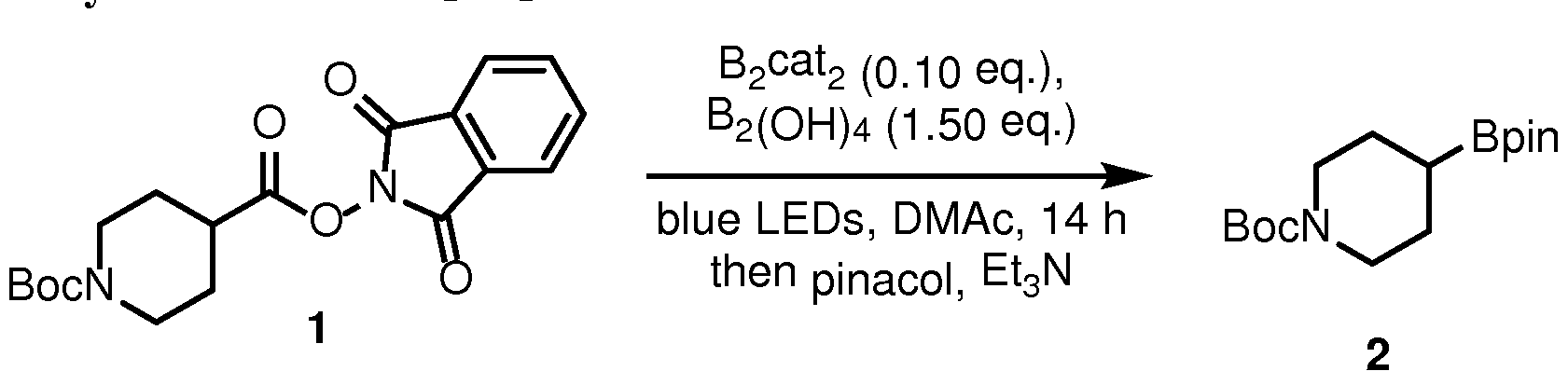
General procedure C (catalytic B2cat2): NHPI ester (50 mg, 1.0 eq., 0.13 mmol), B2cat2 (3 mg, 0.10 eq., 0.013 mmol) and B2(OH)4 (18 mg, 1.50 eq., 0.195 mmol) were carefully weighed into a flame-dried 7 mL vial containing a small magnetic stirrer bar. DMAc (1.3 mL, 0.1 M) was added and then the headspace of the vial was purged with a gentle stream of argon for approximately 10 seconds. The vial was tightly sealed and stirred under blue LED irradiation for 14 h. Pinacol (63 mg, 0.53 mmol, 4 eq.) was dissolved in Et3N (0.45 mL), added to the reaction mixture and stirred for 1 h. The reaction mixture was transferred into a vial containing EtOAc (15 mL), H20 (3 mL), NH4C1 (saturated aqueous solution, 3 mL). After vigorously shaking and allowing the two layers to separate, the top organic layer was carefully removed with a pipette. This was repeated twice more with EtOAc (5 mL). The organic layers were combined and concentrated under reduced pressure. The crude residue was directly purified using a short silica gel column to yield the desired boronic ester.
Notes: Solvents: Also works in DMF, DMPU, DMI, NMP and tetramethylurea. Diboron source: Also works with 0 - 100% B2cat2 and 95 - 150% B2(OH)4. Starting material: Also works with the tetrachlorophthalimide.

NHPI ester (50 mg, 1.0 eq., 0.13 mmol), catechol (4.5 mg, 0.50 eq., 0.065 mmol) and B2(OH)4 (18 mg, 1.50 eq., 0.195 mmol) were carefully weighed into a flame-dried 7 mL vial containing a small magnetic stirrer bar. DMAc (1.3 mL, 0.1 M) was added and then the headspace of the vial was purged with a gentle stream of argon for approximately 10 seconds. The vial was tightly sealed and stirred under blue LED irradiation for 14 h. Pinacol (63 mg, 0.53 mmol, 4 eq.) was dissolved in Et3N (0.45 mL), added to the reaction mixture and stirred for 1 h. The reaction mixture was transferred into a vial containing EtOAc (15 mL), H20 (3 mL), NH4C1 (saturated aqueous solution, 3 mL). After vigorously shaking and allowing the two layers to separate, the top organic layer was carefully removed with a pipette. This was repeated twice more with EtOAc (5 mL). The organic layers were combined and concentrated under reduced pressure. The crude residue was directly purified using a short silica gel column to yield the desired boronic ester. Notes: Solvents: Also works in DMF, DMPU, DMI, NMP and tetramethylurea. Diboron source: Also works with 5 - 100% catechol and 95 - 150% B2(OH)4. Starting material: Also works with the tetrachlorophthalimide.
1.4 Conditions 3: Decarboxylative Borylation of a-Amino Carboxylic Acids with Pyridine Derivatives and No Light

General procedure E:
NHPI ester (48 mg, 1.0 eq., 0.13 mmol), B2cat2 (16 mg, 0.10 eq., 0.065 mmol) and B2(OH)4 (12 mg, 1.0 eq., 0.13 mmol) were carefully weighed into a flame-dried 7 mL vial containing a small magnetic stirrer bar. DMAc (1.3 mL, 0.1 M) and 4- methoxypyridine (29 μί, 2.0 eq., 0.26 mmol) were added and then the headspace of the
vial was purged with a gentle stream of argon for approximately 10 seconds. The vial was tightly sealed and stirred at room temperature for 14 h. Pinacol (63 mg, 0.53 mmol, 4 eq.) and glacial acetic acid (0.03 mL) was added to the reaction mixture and stirred for 4 h. The reaction mixture was transferred into a vial containing EtOAc (15 mL), H20 (3 mL), NH4CI (saturated aqueous solution, 3 mL). After vigorously shaking and allowing the two layers to separate, the top organic layer was carefully removed with a pipette. This was repeated twice more with EtOAc (5 mL). The organic layers were combined and concentrated under reduced pressure. The crude residue was directly purified using a short silica gel column to yield the desired boronic ester. Notes: Solvents: Also works in DMF, DMPU, DMI, NMP, tetramethylurea, MeCN, DCM, DME, Et20, 1,4-dioxane, acetone, EtOAc, hexane, toluene, THF, chloroform. Diboron source: Also works with 5 - 100% B2cat2 and 95 - 150% B2(OH)4. Additive: Also works with DMAP, pyridine, DABCO, DBU, quinuclidine, TMG, TBD, MTBD, 2-picoline, 4-picoline, 3-picoline, imidazole, K2C03, AcOH, triethylamine, 4- cyanopyridine, 4-phenylpyridine. Starting material: Also works with the tetrachlorophthalimide .
2. Substrate Scope
2.1.1 Substrate Scope: Primary
2-Benzyl-4,4,5,5-tetramethyl-l,3,2-dioxaborolane (3)
General Procedure A General Procedure B
NHPI
.OH NHPI, DIC, DMAP 1 .25 eq. B2cat2, DMAc Bpin cnr DCM, r.t., overnight 59, 85% blue LEDs,14 h cr 3, 83%
then pinacol Et3N, 1 h
Activation: The carboxylic acid (1.30 g, 10.0 mmol) was coupled with N- hydroxyphthalimide according to General Procedure A. The crude residue was purified by flash column chromatography (Si02; 90:10 hexane:EtOAc) to afford the corresponding NHPI ester 59 (2.28 g, 85%) as a white solid. m.p.: 54 - 58 °C (DCM/MeOH)
TLC: Rf = 0.24 (90: 10 hexane:EtOAc)
lU NMR (400 MHz, CDC13) δ 7.89 - 7.84 (m, 2H, phthalimide ArH), 7.79 - 7.74 (m, 2H, phthalimide ArH), 7.40 - 7.30 (m, 5H, ArH), 4.00 (s, 2H, CH2) ppm
13C NMR (101 MHz, CDCI3) δ 167.8 (C=0), 161.9 (C=0), 134.9 (phthalimide ArCH), 131.6 (ArC), 129.4 (ArCH), 129.0 (phthalimide ArC), 127.9 (ArCH), 124.1 (phthalimide ArCH), 37.8 (ArCH2) ppm (ArC of phenyl ring not observed)
HRMS (m/z) (ESI) calc'd for Ci6HnN04Na [M+Na]+: 304.0580, found: 304.0591
IR (solid state) max: 1736, 1363, 1184, 1133, 1060, 969 and 876 cm"1
Borylation: NHPI ester 59 (37 mg, 0.13 mmol) was borylated according to General Procedure B. The crude reside was purified by flash column chromatography (Si02; 80:20 pentane:Et20) to afford boronic ester 3 (24 mg, 83%) as a colorless oil.
TLC: Rf = 0.77 (95:5 pentane:Et20)
¾ NMR (400 MHz, CDCI3) δ 7.26 - 7.10 (m, 5H, ArH), 2.29 (s, 2H, CH2Bpin), 1.23 (s, 12H, Bpin) ppm
13C NMR (101 MHz, CDC ) δ 138.8 (ArC), 129.1 (ArCH), 128.4 (ArCH), 125.0 (ArCH), 83.6 (C(CH3)2), 24.9 (C( H3)2) ppm
All data matched that reported in the literature.
4,4,5,5-Tetramethyl-2-(thiophen-3-ylmethyl)-l,3,2-dioxaborolane (4)
General Procedure A General Procedure B ^γ^γ-0Η NH PI, DIC, DMAP j/ 1 .25 eq. B2cat2, DMAc ^jj BPin
S-^ ^ DCM, r.t., overnight gg QJO/O blue LEDs,14 h 4 57o/o en pinacol Et3N , 1 h Activation: The carboxylic acid (500 mg, 3.52 mmol) was coupled with N- hydroxyphthalimide according to General Procedure A. The crude residue was purified by flash column chromatography (Si02; 20:80 pentane:DCM) to afford the corresponding NHPI ester 60 (878 mg, 87%) as a colorless oil.
TLC: Rf = 0.36 (20:80 pentane:DCM)
lU NMR (400 MHz, CDC13) δ 7.90 - 7.86 (m, 2H, phthalimide ArH), 7.81 - 7.77 (m, 2H, phthalimide ArH), 7.36 - 7.32 (m, 2H, ArH), 7.14 - 7.12 (m, 1H, ArH), 4.03 (s, 2H, CH2) ppm
13C NMR (101 MHz, CDCI3) δ 167.3 (C=0), 161.9 (C=0), 135.0 (phthalimide ArCH), 130.9 (ArC), 129.0 (phthalimide ArC), 128.3 (ArH), 126.4 (ArH), 124.1 (phthalimide ArCH), 123.9 (ArH), 32.6 (CH2) ppm
HRMS (m/z): (ESI) calc'd for Ci4H9N04SNa [M+Na]+: 310.0144, found: 310.0145
IR (neat) max: 3103, 1786, 1735, 1357, 1185, 1063, 974, 876 and 783 cm"1
Borylation: NHPI ester 60 (38 mg, 0.13 mmol) was borylated according to General Procedure B. The crude reside was purified by flash column chromatography (Si02; 90: 10 pentane:Et20) to afford boronic ester 4 (17 mg, 57%) as a colorless oil. Note: Product volatile! Product unstable on silica gel.
TLC: Rf = 0.34 (90: 10 pentane:Et20)
¾ NMR (400 MHz, CDCI3) δ 7.20 (dd, / = 4.7, 3.0 Hz, 1H, ArH), 6.95 - 6.93 (m, 2H, ArH), 2.28 (s, 2H, CH2), 1.25 (s, 12H, C(CH3)2) ppm
13C NMR (101 MHz, CDC ) δ 137.7 (ArC), 129.6 (ArCH), 124.9 (ArCH), 120.2 (ArCH), 83.6 (C(CH3)2), 24.9 (C( H3)2) ppm
All data matched that reported in the literature.
l-Methyl-3-((4,4,5,5-tetramethyl-l,3,2-dioxaborolan-2-yl)methyl)-lH-indole (5)

then pinacol Et3N, 1 h
Activation: The carboxylic acid (500 mg, 2.64 mmol) was coupled with N- hydroxyphthalimide according to General Procedure A. The crude residue was purified by flash column chromatography (Si02; 20:80 pentane:DCM) to afford the corresponding NHPI ester 61 (809 mg, 92%) as a white solid.
m.p.: 120 - 122 °C (DCM/MeOH) TLC: Rf = 0.26 (20:80 pentane:DCM)
¾ NMR (400 MHz, CDC13) δ 7.89 - 7.84 (m, 2H, phthalimide ArH), 7.78 - 7.74 (m, 2H, phthalimide ArH), 7.64 (d, / = 7.9 Hz, 1H, NCH), 7.31 (d, / = 8.1 Hz, 1H, ArH), 7.25 (t, J = 7.5 Hz, 1H, ArH), 7.18 - 7.15 (m, 2H, ArH), 4.14 (s, 2H, CH2), 3.77 (s, 3H,

13C NMR (101 MHz, CDCI3) δ 168.2 (C=0), 162.1 (C=0), 137.0 (ArC), 134.9 (phthalimide ArCH), 129.1 (phthalimide ArC), 128.2 (ArCH), 127.5 (ArC), 124.1 (phthalimide ArCH), 122.2 (ArCH), 119.6 (ArCH), 118.9 (NCH), 109.5 (ArCH), 104.4 (ArC), 32.9 (NCH3), 28.1 (CH2) ppm
HRMS (m/z): (ESI) calc'd for Ci9Hi4N04Na [M+Na]+: 357.0846, found: 357.0853
IR (solid state) max: 3074, 2917, 1729, 1187, 1061, 970, 876, 736, 693 and 518 cm"1
Borylation: NHPI ester 61 (45 mg, 0.13 mmol) was borylated according to General Procedure B. The crude reside was purified by flash column chromatography (Si02; 70:30 pentane:Et20) to afford boronic ester 5 (25 mg, 69%) as a colorless oil.
TLC: Rf = 0.40 (70:30 pentane:Et20)
¾ NMR (400 MHz, CDC ) δ 7.61 (d, / = 7.9 Hz, 1H, ArH), 7.27 (d, / = 8.2 Hz, 1H, ArH), 7.21 (t, / = 7.5 Hz, 1H, ArH), 7.09 (t, / = 7.4 Hz, 1H, ArH), 6.94 (s, 1H, NCH), 3.74 (s, 3H, NCH3), 2.34 (s, 2H, CH2), 1.29 (s, 12H, C(CH3)2) ppm 13C NMR (101 MHz, CDCb) δ 137.1 (ArC), 128.9 (ArC), 126.7 (NCH), 121.3 (ArCH), 119.3 (ArCH), 118.3 (ArCH), 110.2 (ArC), 109.0 (ArCH), 83.5 (C(CH3)3), 32.7 (CH3), 25.0 (C(CH3)2) ppm
All data matched that reported in the literature.
2-(4-Bromobutyl)-4,4,5,5-tetramethyl-l,3,2-dioxaborolane (6)
General Procedure A General Procedure B

f en pinacol t3N , 1
Activation: The carboxylic acid (2.37 g, 13.1 mmol) was coupled with N- hydroxyphthalimide according to General Procedure A. The crude residue was purified by flash column chromatography (Si02; 90: 10 hexane:EtOAc) to afford the corresponding NHPI ester 62 (4.10 g, 96%) as a white solid. m.p.: 53 - 56 °C (DCM/MeOH)
TLC: Rf = 0.24 (90: 10 hexane:EtOAc)
¾ NMR: (400 MHz, CDC13) δ 7.91 - 7.86 (m, 2H, phthalimide ArCH), 7.81 - 7.77 (m, 2H, phthalimide ArCH), 3.46 (t, / = 5.9 Hz, 2H, CH2C=0), 2.72 (t, / = 7 Hz, 2H, CH2Br), 2.07 - 1.92 (m, 4H, 2xCH2) ppm
13C NMR: (101 MHz, CDCI3) δ 169.2 (C=0), 162.0 (C=0), 134.9 (phthalimide ArCH), 129.0 (phthalimide ArC), 124.1 (phthalimide ArCH), 32.7 (CH2C=0), 31.5 (CH2), 30.2 (CH2Br), 23.3 (CH2) ppm HRMS (m/z): (ESI) calc'd for Ci3Hi2BrN04Na [M+Na]+: 347.9842, found: 347.9840
IR (solid state) max: 1738, 1374, 1186, 1138, 1065, 968 and 858 cm"1
Borylation: NHPI ester 62 (44 mg, 0.13 mmol) was borylated according to General Procedure B. The crude reside was purified by flash column chromatography (Si02; 80:20 pentane:Et20) to afford boronic ester 6 (23 mg, 67%) as a colorless oil. Note: Product volatile!
¾ NMR: (400 MHz, CDCI3) δ 3.40 (t, / = 7.4 Hz, 2H, CH2Br), 1.87 (p, / = 7.4 Hz, 2H, CH2CH2Br), 1.54 (p, / = 7.4 Hz, 2H, CH2CH2Bpin), 1.24 (s, 12H, C(CH3)2), 0.79 (t, J = 1.4 Hz, 2H, CH2Bpin) ppm
13C NMR: (101 MHz, CDC13) δ 83.2 (C(CH3)2), 35.5 (CH2Br), 33.8 (CH2), 25.0 (C(CH3)2), 22.9 (CH2) ppm
All data matched that reported in the literature.
4,4,5,5-Tetramethyl-2-(pent-4-yn-l-yl)-l,3,2-dioxaborolane (7)
General Procedure A General Procedure B
 Activation: The carboxylic acid (0.23 mL, 2.0 mmol) was coupled with N- hydroxyphthalimide according to General Procedure A. The crude residue was purified by flash column chromatography (Si02; 90:10 hexane:EtOAc) to afford the corresponding NHPI ester 63 (360 mg, 70%) as a white solid. m.p.: 48 - 52 °C (DCM/MeOH) TLC: Rf = 0.28 (90: 10 hexane:EtOAc)
¾ NMR: (400 MHz, CDC13) δ 7.90 - 7.85 (m, 2H, phthalimide ArH), 7.81 - 7.76 (m, 2H, phthalimide ArH), 2.83 (t, / = 7.1 Hz, 2H, CH2C=0), 2.37 (td, / = 7.1, 2.6 Hz, 2H, ≡CCH2), 2.03 (t, / = 2.6 Hz,≡CH), 2.00 (p, / = 7.1 Hz, 2H,≡CCH2CH2) ppm
13C NMR: (101 MHz, CDCI3) δ 169.2 (C=0), 162.0 (C=0), 134.9 (phthalimide ArCH), 129.0 (phthalimide ArC), 124.1 (phthalimide ArCH), 82.6 (≡CH), 70.0 (≡C), 29.8 (CH2C=0), 23.5 (≡CCH2 H2), 17.8 (≡CCH2) ppm
HRMS (m/z): (ESI) calc'd for Ci4HnN04Na [M+Na]+: 280.0580, found: 280.0573
IR (solid state) max: 3273, 1741, 1182, 1062, 969 and 876 cm"1
Borylation: NHPI ester 63 (33 mg, 0.13 mmol) was borylated according to General Procedure B. The crude reside was purified by flash column chromatography (Si02; 95:5 pentane:Et20) to afford boronic ester 7 (15 mg, 59%) as a colorless oil. Note: Product volatile!
TLC: Rf = 0.80 (95:5 pentane:Et20)
lU NMR: (400 MHz, CDC13) δ 2.19 (td, / = 7.5, 2.6 Hz, 2H,≡CH2), 1.93 (t, / = 2.6 Hz, 1H,≡CH), 1.65 (p, / = 7.5, 2H,≡CH2CH2), 1.24 (s, 12Η, C(CH3)2), 0.89 (t, J = 7.5 Hz, 2H, CH2Bpin) ppm
13C NMR: (101 MHz, CDCI3) δ 84.7 (≡CH), 83.1 (C(CH3)2), 68.3 (≡C), 24.9
(C(CH3)2, 23.3 (≡CCH2 H2), 20.8 (≡CCH2) ppm
LRMS (m/z) (EI) 179 ([M-Me]+, 36%), 194 ([M+H+]+, 3%). Despite repeated attempts, a HRMS could not be obtained.
IR (CHCb) max: 3297, 2979, 2936, 1374, 1318, 1233, and 1145 cm"1
tert-Butyl-(R)-2-((4,4,5,5-tetramethyl-l,3,2-dioxaborolan-2- yl)methyl)pyrrolidine-l-carboxylate (8)

Activation: The carboxylic acid (500 mg, 2.18 mmol) was coupled with N- hydroxyphthalimide according to General Procedure A. The crude residue was purified by flash column chromatography (Si02; 98:2 DCM:Et20) to afford the corresponding NHPI ester 64 (628 mg, 77%) as a colorless oil that crystallized over several days to give a white amorphous solid.
TLC: Rf = 0.21 (98:2 DCM:Et20)
¾ NMR (400 MHz, CDC13) δ 7.93 - 7.71 (br m, 4H, phthalimide ArCH), 4.31 - 4.08 (br m, NCH), 3.48 - 3.09 (br m, 3H, NCH2 and C *tP =0), 2.83 - 2.60 (br m, CHaHbC=0), 2.24 - 2.09 (br m, CH¾b), 2.01 - 1.78 (br m, CH2 and CffH*3) ppm
13C NMR (126 MHz, CDC13) δ 167.6 and 167.5 (C=0), 162.0 (C=0), 154.5 and 154.2 (C=0), 134.9 and 134.8 (phthalimide ArCH), 129.0 (phthalimide ArC), 124.1 (phthalimide ArCH), 80.2 and 79.7 (OC(CH3)3), 54.2 and 54.1 (NCH), 46.9 and 46.5
(CH2C=0), 36.3 and 35.2 (CH2), 31.2 and 30.3 (CH2), 28.6 (C(CH3)3), 23.8 and 23.0 (CH2) ppm (Doubling up of signals due to presence of rotamers)
HRMS (m/z) (ESI) calc'd for
 [M+Na]+: 397.1370, found: 397.1372
IR (solid state) max: 2973, 2893, 1739 (C=0), 1698 (C=0), 1678 (C=0), 1365, 1165, 1108, 1081, 956, 877, 697 and 519 cm"1
Borylation: NHPI ester 64 (50 mg, 0.13 mmol) was borylated according to General Procedure B. The crude reside was purified by flash column chromatography (Si02; 95:5 pentane: acetone) to afford boronic ester 8 (34 mg, 81%) as a colorless oil.
TLC: Rf = 0.34 (60:40 pentane:Et20) *H NMR (400 MHz, CDC13) δ 4.01 - 3.82 (br m, 1H, NCH), 3.45 - 3.21 (br m, 2H, NCH2), 2.06 - 1.94 (m, 1H, CH¾b), 1.87 - 1.77 (m, 1Η, CffH*3), 1.75 - 1.66 (m, CH¾b), 1.63 - 1.36 (br m, 2Η, CffH*3 and CH^Bpin), 1.43 (s, 9Η, OC(CH3)3), 1.21 (s, 6Η, C(CH3)2), 1.20 (s, 6Η, C(CH3)2), 1.04 - 0.81 (br m, 1Η, Cff^Bpin) ppm
13C NMR (101 MHz, CDC13) δ 154.6 and 154.4 (C=0), 83.0 (C(CH3)2), 78.9 (OC(CH3)3), 54.3 (NCH), 46.5 and 46.3 (NCH2), 33.4 and 33.1 (CH2), 28.7 (OC(CH3)3), 25.0 and 24.8 (C(CH3)2), 23.8 and 23.3 (CH2) ppm (Doubling up of signals due to presence of rotamers)
HRMS (m/z): (ESI) calc'd for Ci6H3iNB04 [M+H]+: 312.2344, found: 312.2341 IR (neat) max: 2975, 1691 (C=0), 1365, 1166, 1 141, 1108 and 848 cm"1
4,4,5,5-Tetramethyl-2-(3,3,4,4,5,5,6,6,7,7,8,8,8-tridecafluorooctyl)-l,3,2- dioxaborolane (9)
General Procedure A General Procedure B

Activation: The carboxylic acid (500 mg, 2.23 mmol) was coupled with N- hydroxyphthalimide according to General Procedure A. The crude residue was
purified by flash column chromatography (S1O2; 5: 1 petroleum ether 40-60:EtOAc) to afford the corresponding NHPI ester 65 (690 mg, 84%) as a white solid. m.p.: 104 - 106 °C (DCM/MeOH)
TLC: Rf = 0.50 (3: 1 petroleum ether 40-60:EtOAc) ¾ NMR (400 MHz, CDC13) δ 7.90 - 7.85 (m, 2H, Ar-H), 7.80 - 7.76 (m, 2H, Ar-H), 3.02 (t, / = 7.7 Hz, 2H, CH2), 2.68 - 2.52 (m, 2H, CH2) ppm
13C NMR (101 MHz, CDC ) δ 167.7 (C=0), 161.6 (C=0), 134.9 (HCAT), 128.8 (CAT), 124.1 (HCAT), 26.3 (t, / = 23.3 Hz, CH2), 22.9 (t, / = 4.8 Hz, CH2) ppm. The carbon atoms bearing fluorine atoms were observed (see NMR spectrum) but were not assigned.
19F NMR (377 MHz, CDCb) δ -80.8, -114.6, -121.8, -122.8, -123.3, -126.1 ppm
HRMS (m/z) (ESI) calc'd for Ci7H8Fi3NNa04 [M+Na]+: 560.0138, found: 560.0139
IR (solid state) max: 1744, 1225, 1136, 1073, 965 and 877 cm"1
Borylation: NHPI ester 65 (70 mg, 0.13 mmol) was borylated according to General Procedure B. The crude reside was purified by flash column chromatography (Si02; 10: 1 petroleum ether 40-60:Et2O) to afford boronic ester 9 (31 mg, 50%) as a colorless oil. Note: product unstable on silica gel.
TLC: Rf = 0.75 (3: 1 petroleum ether 40-60:EtOAc)
¾ NMR (400 MHz, CDCb) δ 2.25 - 2.01 (m, 2H, CH2), 1.18 (s, 12H, 2xOC(CH3)2), 1.02 - 0.88 (m, 2H, CH2) ppm
13C NMR (101 MHz, CDCb) δ 83.6 (OC(CH3)2), 25.7 (t, / = 23.4 Hz, CF2CH2), 24.7 (OC(CH3)2) ppm. The carbon atoms bearing fluorine atoms were observed (see NMR spectrum) but were not assigned.
19F NMR (377 MHz, CDCb) δ -80.91, -116.12, -122.00, -122.91, -123.57, -126.20 ppm
HRMS (m/z): (ESI) calc'd for Ci4Hi6BFi3Na02 [M+Na]+: 497.0931, found: 497.0947
IR (neat) max: 2984, 1385, 1235, 1195, 1141, 1072 and 847 cm" -1
2-(But-3-en-l-yl)-4,4,5,5-tetramethyl-l,3,2-dioxaborolane (10)
General Procedure B

51 then pinacol Et3N, 1
Activation: NHPI ester 51 was prepared according to a known procedure (36). Borylation: NHPI ester 51 (33 mg, 0.13 mmol) was borylated according to General Procedure B. The crude reside was purified by flash column chromatography (S1O2; 95:5 pentane:Et20) to afford boronic ester 10 (14 mg, 56%) as a colorless oil. Note: the intermediate alkyl radical undergoes radical ring opening, and the product is volatile!
TLC: Rf = 0.29 (95:5 pentane:Et20) ¾ NMR: (400 MHz, CDC13) δ 5.88 (ddt, /= 17.0, 10.2, 7.3 Hz, 1H, CH=), 5.03 - 4.95 (m, 1H, =CHaHb), 4.92 - 4.87 (m, 1H, =C I?>), 2.17 (app q, /= 7.3 Hz, 2H, CH2CH=), 1.24 (s, 12H, C(CH3)2), 0.88 (t, J = 7.3 Hz, 2H, CH2Bpin) ppm
13C NMR: (101 MHz, CDCI3) δ 140.8 (=CH), 113.3 (=CH2), 83.1 (C(CH3)2), 28.1 (CH2), 25.0 (C( H3)2) ppm All data matched that reported in the literature.
Methyl 5-(4,4,5,5-tetramethyl-l,3,2-dioxaborolan-2-yl)pentanoate (11)
General Procedure B

then pinacol t3N, 1
Activation: NHPI ester 66 was prepared according to a known procedure.
Borylation: NHPI ester 66 (40 mg, 0.13 mmol) was borylated according to General Procedure B. The crude reside was purified by flash column chromatography (Si02; 4: 1 petroleum ether 40-60:Et2O) to afford boronic ester 11 (13 mg, 41%) as a colorless oil. TLC: Rf = 0.65 (1: 1 petroleum ether 40-60:EtOAc) lU NMR (400 MHz, CDC13) δ 3.67 (s, 3H, CO2CH3), 2.32 (t, / = 7.2 Hz, 2H, CH2), 1.70 - 1.60 (m, 2H, CH2), 1.50 - 1.40 (m, 2H, CH2), 1.27 (s, 12H, 2xOC(CH3)2), 0.80 (t, J = 8.0 Hz, 2H, CH2Bpin) ppm
13C NMR (101 MHz, CDCI3) δ 174.2 (C02CH3), 82.9 (OC(CH3)2), 51.4 (C02CH3), 33.9 (CH2), 27.5 (CH2), 24.8 (OC(CH3)2), 23.6 (CH2) ppm
All data matched that reported in the literature.
2-(4-Bromophenethyl)-4,4,5,5-tetramethyl-l,3,2-dioxaborolane (12)
General Procedure B
1 .25 eq. B2cat2, DMAc
blue LEDs,14 h

TLC: Rf = 0.38 (3 : 1 petroleum ether 40-60:EtOAc)
¾ NMR (400 MHz, CDC13) δ 7.84 - 7.79 (m, 2H, Ar-H), 7.74 - 7.68 (m, 2H, Ar-H), 7.36 (d, / = 8.1 Hz, 2H, Ar-H), 7.06 (d, / = 8.1 Hz, 2H, Ar-H), 2.98 (t, J = 7.3 Hz, 2H, CH2), 2.88 (t, / = 7.2 Hz, 2H, CH2) ppm
13C NMR (101 MHz, CDC13) δ 168.6 (C=0), 161.8 (C=0), 138.1 (CAT), 134.8 (HCAT), 131.8 (HCAT), 130.1 (HCAT), 128.8 (CAT), 124.0 (HCAT), 120.6 (CAT), 32.4 (CH2), 29.9 (CH2) ppm
HRMS (m/z): (ESI) calc'd for Ci7Hi2BrNNa04 [M+Na]+: 395.9842, found: 395.9854 IR (solid state) max: 1789, 1741, 1487, 1371, 1070, 964, 877 and 821 cm"1
Borylation: NHPI ester 67 (49 mg, 0.13 mmol) was borylated according to General Procedure B. The crude reside was purified by flash column chromatography (Si02; 10: 1 petroleum ether 40-60:Et2O) to afford boronic ester 12 (29 mg, 72%) as a colorless oil. TLC: Rf = 0.68 (3: 1 petroleum ether 40-60:EtOAc)
¾ NMR (400 MHz, CDCI3) δ 7.29 (d, / = 8.3 Hz, 2H, Ar-H), 7.01 (d, / = 8.3 Hz, 2H, Ar-H), 2.67 - 2.55 (t, / = 8.1 Hz, 2H, CH2), 1.14 (s, 12H, 2xOC(CH3)2), 1.03 (t, / = 8.1 Hz, 2H, CH2) ppm
13C NMR (101 MHz, CDC ) δ 143.3 (CAT), 131.1 (HCAT), 129.8 (HCAT), 119.1 (CAT), 83.1 (OC(CH3)2), 29.4 (CH2), 24.8 (OC(CH3)2) ppm
HRMS (m/z) (ESI) calc'd for Ci4H20BBrNaO2 [M+Na]+: 333.0635, found: 333.0647 IR (neat) max: 2976, 1679, 1369, 1315, 1140, 967 and 827 cm"1
3-(2-(4,4,5,5-Tetramethyl-l,3,2-dioxaborolan-2-yl)ethyl)pyridine (95):

94, 46% 95, 16%
Activation: The carboxylic acid (500 mg, 3.31 mmol) was coupled with N- hydroxyphthalimide according to General Procedure A. The crude residue was purified by flash column chromatography (Si02; 70:30 pentane: acetone) to afford the
corresponding NHPI ester 94 (447 mg, 46%) as a pale yellow solid. Note: product unstable on silica gel. m.p.: I l l - 115 °C (cryst. EtOAc)
TLC: Rf = 0.21 (pentane: acetone 70:30) ¾ NMR: (400 MHz, CDC13) δ 8.54 (d, / = 2.3 Hz, 1H, Ar-H), 8.50 (dd, / = 4.9, 1.6 Hz, 1H, Ar-H), 7.87 (dd, / = 5.5, 3.1 Hz, 2H, 2xAr-H), 7.78 (dd, / = 5.5, 3.1 Hz, 2H, 2xAr-H), 7.60 (ddd, / = 7.8, 2.3, 1.6 Hz, 1H, Ar-H), 7.26 (dd, / = 7.8, 4.9 Hz, 1H, Ar- H), 3.11 (t, / = 7.4 Hz, 2H, pyridyl-CH2), 2.99 (t, / = 7.4 Hz, 2H, CH2CO2R) ppm
13C NMR: (101 MHz MHz, CDCI3) δ 168.6 (C02R), 161.9 (2xCO), 149.9 (HCAT), 148.4 (HCAT), 136.0 (HCAT), 134.9 (2XHCAT), 134.6 (CAT), 129.0 (2XCAT), 124.1 (2XHCAT), 123.7 (HCAT), 32.4 (CH2CO2R), 27.9 (pyridyl-CH2) ppm
HRMS (m/z) (ESI) calc'd for Ci6Hi2N2Na04 [M+Na]+: 319.0689, found: 319.0692
IR (neat) max: 3100, 3055, 2943, 2324 (br.), 1812, 1783, 1742, 1714, 1188 and 1079 cm-1 Borylation: NHPI ester 94 (77 mg, 0.26 mmol) was borylated according to General Procedure B. The crude reside was purified by flash column chromatography (Si02; 90: 10 hexane:acetone) to afford boronic ester 95 (10 mg, 16%) as a colorless oil. Note: product unstable on silica gel.
TLC: Rf = 0.54 (pentane: acetone 80:20) ¾ NMR: (500 MHz, CDCI3) δ 8.48 (d, J = 1.1 Hz, 1H, Ar-H), 8.41 (dd, / = 4.8, 1.2 Hz, 1H, Ar-H), 7.52 (ddd, / = 7.7, 1.7, 1.2 Hz, 1H, Ar-H), 7.18 (dd, / = 7.7, 4.8 Hz, 1H, Ar-H), 2.74 (t, J = 8.0 Hz, 2H, CH2), 1.21 (s, 12H, 4xCH3), 1.14 (t, / = 8.0 Hz, 2H, CH2) ppm
13C NMR: (126 MHz, CDC ) δ 149.9 (HCAT), 147.2 (HCAT), 139.6 (HCAT), 135.6 (HCAT), 123.3 (HCAT), 83.4 (2xOC(CH3)2), 27.3 (pyridyl-CH2), 24.9 (4xCH3) ppm
HRMS (m/z): (ESI) calc'd for Ci3H20BNNaO2 [M+Na]+: 256.1482, found: 256.1480
IR (neat) max: 2978, 2929, 1575, 1479, 1422, 1372, 1311, 1144, 968, 849 and 714 cm-1
2.1.2 Substrate Scope: Secondary
tert-Butyl 4-(4,4,5,5-tetramethyl-l,3,2-dioxaborolan-2-yl)piperidine-l- carboxylate (2)
General Procedure B
0

Activation: NHPI ester 1 was prepared according to a known procedure.
Borylation: NHPI ester 1 (50 mg, 0.13 mmol) was borylated according to General Procedure B. The crude reside was purified by flash column chromatography (Si02; 75:25 pentane:Et20) to afford boronic ester 2 (35 mg, 87%) as a colorless oil. TLC: Rf = 0.28 (75:25 pentane:Et20)
¾ NMR (400 MHz, CDC13) δ 3.85 - 3.70 (m, 2H, NCHaHb), 2.95 - 2.88 (m, 2H, NCffH*3), 1.65 - 1.60 (m, 2Η, CH¾b), 1.51 - 1.38 (m, 2Η, CffH13), 1.43 (s, 9Η, OC(CH3)3), 1.22 (s, 12H, C(CH3)2), 1.06 (m, 1H, CHBpin) ppm
13C NMR (126 MHz, CDC13) δ 155.0 (C=0), 83.3 (C(CH3)2), 79.1 (OC(CH3)3), 45.0 (NCH2), 28.6 (OC( H3)3), 27.1 (CH2), 24.9 (C(CH3)2) ppm
All data matched that reported in the literature.
tert-Butyl 4-(6-methyl-4,8-dioxo-l,3,6,2-dioxazaborocan-2-yl)piperidine-l- carboxylate (13)
General Procedure B
0

Activation: NHPI ester 1 was prepared according to a known procedure.
Borylation: NHPI ester 1 (50 mg, 0.13 mmol) was borylated according to General Procedure B but with a modified workup. After the 14 h stir under irradiation with blue LEDs methyliminodiacetic acid (MIDA, 79 mg, 0.53 mmol, 4.0 eq.) was added and the reaction mixture was stirred for 24 h at 60 °C (oil bath). The reaction mixture was transferred into a vial containing EtOAc (15 mL) and H20 (6 mL). After vigorously shaking and allowing to two layers to separate, the top organic layer was carefully removed with a pipette. This was repeated twice more with EtOAc (5 mL). The organic layers were combined and concentrated under reduced pressure. The crude reside was purified by flash column chromatography (Si02; THF) to afford boronic ester 13 (24 mg, 53%) as a white amorphous solid. Note: The THF must be BHT free.

¾ NMR (500 MHz, CDC13) δ 4.07 - 4.04 (br m, 2H, NCH¾b), 3.95 (d, / = 16.9 Hz, 2H, C^CHTi), 3.78 (d, / = 16.9 Hz, 2H, C^OTH*3), 2.93 (s, 3Η, NCH3), 2.73 - 2.60 (br m, 2H, NCffH13), 1.61 - 1.58 (br m, 2Η, CH¾b), 1.44 (s, 9Η, C(CH3)3), 1.31 - 1.19 (m, 2H, C tP), 0.93 (tt, / = 12.3, 3.2 Hz, CHBpin) ppm
13C NMR (126 MHz, CDC13) δ 169.0 (C=0), 155.4 (C=0), 79.4 (OC(CH3)3), 63.2 (C=O H2), 46.4 (NCH3), 28.6 (C( H3)3), 27.9 (CH2) ppm. NCH2 not observed.
HRMS (m/z) (ESI) calc'd for Ci5H25BN2Na06 [M+Na]+: 363.1701, found: 363.1697
IR (solid state) max: 2924, 2853, 1752, 1676, 1288, 1163, 1111 and 1030 cm"
2-(4,4-Difluorocyclohexyl)-4,4,5,5-tetramethyl-l,3,2-dioxaborolane (14)
O General Procedure A Q General Procedure B
 then pinacol Et3N, 1 h F Activation: The carboxylic acid (250 mg, 1.52 mmol) was coupled with N- hydroxyphthalimide according to General Procedure A. The crude residue was purified by flash column chromatography (Si02; 75:25 pentane:Et20) to afford the corresponding NHPI ester 68 (417 mg, 89%) as a white solid. m.p.: 109 - 112 °C (DCM/MeOH) TLC: Rf = 0.19 (90: 10 pentane:EtOAc)
¾ NMR (400 MHz, CDC13) δ 7.91 - 7.87 (m, 2H, phthalimide ArCH), 7.82 - 7.77 (phthalimide ArCH), 2.92 - 2.85 (m, 1H, CHC=0), 2.26 - 2.04 (m, 6H, CH¾b x2 and CH2 x2), 1.97 - 1.84 (m, 2H, CWl x2) ppm
13C NMR (126 MHz, CDCI3) δ 170.6 (C=0), 162.0 (C=0), 135.0 (phthalimide ArCH), 129.0 (phthalimide ArC), 124.1 (phthalimide ArCH), 122.3 (t, / = 241.3 Hz, CF2), 37.9 (CHC=0), 32.2 (t, / = 24.8 Hz, CF2 H2), 25.1 (t, / = 5.1 Hz, CH2) ppm
19F NMR: (377 MHz, CDCI3) δ -95.6 (d, / = 239.8 Hz), -98.4 (d, / = 239.8 Hz)
HRMS (m/z): (ESI) calc'd for
 [M+Na]+: 332.0705, found: 332.0708
IR (solid state) max: 2973, 2948, 1809, 1782, 1740 (C=0), 1374, 1360, 1147, 1114, 1115, 1079, 981, 947, 875 and 697 cm"1
Borylation: NHPI ester 68 (40 mg, 0.13 mmol) was borylated according to General Procedure B. The crude reside was purified by flash column chromatography (Si02; 95:5 pentane:Et20) to afford boronic ester 14 (21 mg, 66%) as a colorless oil.
TLC: Rf = 0.51 (pentane:Et20 85: 15)
¾ NMR (400 MHz, CDCb) δ 1.99 (m, 2H), 1.85 - 1.52 (m, 6H), 1.23 (s, 12H, 4xCH3), 0.97 (m, 1H, CHBpin) ppm
13C NMR (101 MHz, CDCb) δ 123.9 (t, / = 240.5 Hz, CF2), 83.4 (2xOC(CH3)2), 34.5 (t, / = 23.2 Hz, 2xCH2CF2), 24.9 (4xCH3), 24.4 (m, 2xCH2CH2CF2) ppm 19F NMR: (377 MHz, CDCb) δ -91.6 (d, / = 234 Hz), -98.7 (d, / = 234 Hz)
MS (m/z): Despite repeated attempts, a HRMS or LRMS could not be obtained by any means.
IR (neat) max: 2925, 2854, 1454, 1330, 1144 and 847 cm"1
4,4,5,5-Tetramethyl-2-(tra«s-2-phenylcyclopropyl)-l,3,2-dioxaborolane (15)
General Procedure A General Procedure B

69, 82% 15, 60%
98:2 d.r.
Activation: The carboxylic acid (1.00 g, 6.17 mmol) was coupled with N- hydroxyphthalimide according to General Procedure A. The crude residue was purified by flash column chromatography (Si02; 80:20→ 60:40 pentane:Et20) to afford the corresponding NHPI ester 69 (1.55 g, 82%) as a white solid. m.p.: 116 - 119 °C (Et20)
TLC: Rf = 0.34 (pentane:Et20 70:30)
¾ NMR: (400 MHz, CDCb) δ 7.90 (m, 2H, 2xAr-H), 7.79 (m, 2H, 2xAr-H), 7.34 (m, 2H, 2xAr-H), 7.27 (m, 1H, Ar-H), 7.28 (m, 2H, 2xAr-H), 2.79 (ddd, / = 9.1, 6.9, 4.0 Hz, 1H, PhCH), 2.23 (ddd, / = 8.4, 5.2, 4.0 Hz, 1H, CHC02R), 1.83 (ddd, / = 9.1, 5.2, 4.9 Hz, 1H, CH¾b), 1.64 (ddd, / = 8.4, 6.9, 4.9 Hz, 1H, CH¾ ppm
13C NMR: (101 MHz, CDC13) δ 169.8 (C02R), 162.1 (2xCO), 138.6 (CAT), 134.8 (2XHCAT), 129.1 (2XCAT), 128.8 (2XHCAT), 127.3 (HCAT), 126.5 (2XHCAT), 124.1 (2XHCAT), 28.4 (PhCH), 21.1 (CHCO2R), 18.6 (CH2) ppm
HRMS (m/z): (ESI) calc'd for Ci8Hi3NNa04 [M+Na]+: 330.0737, found: 330.0748 IR (neat) max: 3065, 3031, 1806, 1778, 1738, 1467, 1401, 1360, 1186, 1100 and 877 cm
Borylation: NHPI ester 69 (40 mg, 0.13 mmol) was borylated according to General Procedure B. The crude reside was purified by flash column chromatography (Si02; 95:5 pentane:Et20) to afford boronic ester 15 (19 mg, 60%) as a colorless oil. TLC: Rf = 0.35 (pentane:Et20 95:5)
¾ NMR: (400 MHz, CDC ) δ 7.24 (m, 2H, 2xAr-H), 7.14 (m, 1H, Ar-H), 7.08 (m, 2H, 2xAr-H), 2.11 (ddd, / = 8.1, 5.5, 5.2 Hz, 1H, PhCH), 1.26 (s, 6H, 2xCH3), 1.24 (s, 6H, 2xCH3), 1.16 (ddd, / = 8.1, 6.8, 3.7 Hz, 1H, CH¾b), 1.01 (ddd, / = 9.5, 5.2, 3.7 Hz, 1H, CH¾, 0.31 (ddd, / = 9.5, 6.8, 5.5 Hz, 1H, CHBpin) ppm 13C NMR: (101 MHz, CDCb) δ 143.5 (CAT), 128.4 (2XHCAT), 125.8 (2XHCAT), 125.7 (HCAT), 83.3 (2xOC(CH3)2), 24.9 (2xCH3), 24.8 (2xCH3), 22.0 (PhCH), 15.2 (CH2) ppm
HRMS (m/z): (EI) calc'd for C15H21BO2: 244.1635, found: 244.1634
IR (neat) max: 3027, 2978, 2931, 1419, 1357, 1321, 1217, 1144 and 860 cm"1 All data matched that reported in the literature.
2-(2,3-Dihydro-lH-inden-2-yl)-4,4,5,5-tetramethyl-l,3,2-dioxaborolane (16)
O General Procedure B
 Activation: NHPI ester 70 was prepared according to a known procedure.
Borylation: NHPI ester 70 (40 mg, 0.13 mmol) was borylated according to General Procedure B. The crude reside was purified by flash column chromatography (S1O2; 5: 1 petroleum ether 40-60:Et2O) to afford boronic ester 16 (17 mg, 53%) as a colorless oil.
TLC: Rf = 0.68 (3: 1 petroleum ether 40-60:EtOAc)
¾ NMR (400 MHz, CDC13) <5 7.16 - 7.11 (m, 2H, Ar-H), 7.08 - 7.00 (m, 2H, Ar-H), 3.05 - 2.83 (m, 4H, 2xCH2), 1.80 (p, / = 9.9 Hz, 1H, CHBpin), 1.19 (s, 12H, 2xOC(CH3)2) ppm 13C NMR (101 MHz, CDCI3) δ 144.4 (CAT), 125.8 (HCAT), 124.1 (HCAT), 83.2
(OC(CH3)2), 35.1 (CH2), 24.7 (OC(CH3)2) ppm
All data matched that reported in the literature.
Methyl (lR)-3-(4,4,5,5-tetramethyl-l,3,2-dioxaborolan-2-yl)cyclopenti
carboxylate (17)
General Procedure B
in .r.

Activation: NHPI ester 71 was prepared according to a known procedure.
Borylation: NHPI ester 71 (42 mg, 0.13 mmol) was borylated according to General Procedure B. The crude reside was purified by flash column chromatography (Si02; 70:30 pentane:Et20) to afford boronic ester 17 (28 mg, 82%, 1.4: 1 d.r.) as a colorless oil.
TLC: Rf = 0.36 (70:30 pentane:Et20)
¾ NMR (400 MHz, CDC13) δ 3.64 and 3.64 (s, 3H C=OOCH3), 2.82 - 2.67 (m, 1H, CHC=0), 2.12 - 1.35 (m, 7H, CHBpin and CH2 x3), 1.22 and 1.21 (s, 12H, C(CH3)2) ppm
13C NMR (101 MHz, CDCI3) δ 177.3 and 177.0 (C=0), 83.2 and 83.1 (C(CH3)2), 51.7 and 51.6 (C=OOCH3), 45.2 and 44.3 (CHC=0), 33.3 and 32.3 (CH2), 31.3 and 30.5 (CH2), 28.9 and 27.9 (CH2), 24.9 and 24.8 (C(CH3)2) ppm
HRMS (m/z): (ESI) calc'd for Ci3H23BNa04 [M+Na]+: 277.1584, found: 277.1580
IR (neat) max: 2977, 2952, 2872, 1733, 1381, 1315, 1197, 1143, 973 and 858 cm"1
2-Cyclododecyl-4,4,5,5-tetramethyl-l,3,2-dioxaborolane (18)

Activation: NHPI ester 72 was prepared according to a known procedure.
Borylation: NHPI ester 72 (46 mg, 0.13 mmol) was borylated according to General Procedure B. The crude reside was purified by flash column chromatography (Si02; 10: 1 petroleum ether 40-60:Et2O) to afford boronic ester 18 (34 mg, 89%) as a colorless oil.
TLC: Rf = 0.54 (10: 1 petroleum ether 40-60:EtOAc)
¾ NMR (400 MHz, CDC13) δ 1.45 - 1.20 (m, 22H, l lxCH2), 1.16 (s, 12H, 2xOC(CH3)2), 1.04 - 0.94 (m, 1H, CHBpin) ppm
13C NMR (101 MHz, CDC13) δ 82.7 (OC(CH3)2), 24.9 (CH2), 24.7 (OC(CH3)2), 24.2 (CH2), 24.1 (CH2), 23.4 (CH2), 23.4 (CH2), 23.3 (CH2) ppm
HRMS (m/z): (ESI) calc'd for Ci8H35BNa02 [M+Na]+: 317.2626, found: 317.2628
IR (neat) max: 2928, 2848, 1469, 1305, 1144, 967, 858 and 708 cm"1
2-(Heptan-2-yl)-4,4,5,5-tetramethyl-l,3,2-dioxaborolane (19)
General Procedure A General Procedure B

ien pinacol t3N, 1
Activation: The carboxylic acid (1.44 g, 10.0 mmol) was coupled with N- hydroxyphthalimide according to General Procedure A. The crude residue was purified by flash column chromatography (Si02; 5: 1 petroleum ether 40-60:EtOAc) to afford the corresponding NHPI ester 73 (2.81 g, 97%) as a colorless oil.
TLC: Rf = 0.51 (3: 1 petroleum ether 40-60:EtOAc)
¾ NMR (400 MHz, CDC13) δ 7.78 - 7.73 (m, 2H, Ar-H), 7.70 - 7.65 (m, 2H, Ar-H), 2.80 - 2.67 (m, 1H, CH), 1.79 - 1.66 (m, 1H, CH2), 1.58 - 1.47 (m, 1H, CH2), 1.41 - 1.33 (m, 2H, CH2), 1.29 - 1.19 (m, 7H, 2xCH2 + CH3), 0.90 - 0.76 (m, 3H, CH3) ppm
13C NMR (101 MHz, CDC13) δ 172.7 (C=0), 161.9 (C=0), 134.6 (HCAT), 128.9 (CAT), 123.8 (HCAT), 37.1 (CH), 33.6 (CH2), 31.5 (CH2), 26.4 (CH2), 22.4 (CH2), 16.9 (CH3), 13.9 (CH3) ppm
HRMS (m/z): (ESI) calc'd for Ci6Hi9NNa04 [M+Na]+: 312.1206, found: 312.1201 IR (neat) VmaX: 2931, 1739, 1466, 1363, 1185, 1047, 876 and 710 cm"1
Borylation: NHPI ester 73 (38 mg, 0.13 mmol) was borylated according to General Procedure B. The crude reside was purified by flash column chromatography (Si02; 10: 1 petroleum ether 40-60:Et2O) to afford boronic ester 19 (27 mg, 92%) as a colorless oil. TLC: Rf = 0.54 (10: 1 petroleum ether 40-60:EtOAc) lU NMR (400 MHz, CDC13) <5 1.38 - 1.15 (m, 20H, 8xCH2 + 2xOC(CH3)2), 0.95 - 0.86 (m, 4H, CHBpin + CH3), 0.80 (t, J = 6.9 Hz, 3H, CH3) ppm
13C NMR (101 MHz, CDC13) δ 82.7 (OC(CH3)2), 33.2 (CH2), 32.0 (CH2), 28.6 (CH2), 24.7 (OC(C¾)2), 24.7 (OC(CH3)2), 22.6 (CH2), 15.5 (CH3), 14.0 (CH3) ppm All data matched that reported in the literature.
4,4,5,5-Tetramethyl-2-(tetrahydro-2H-pyran-4-yl)-l,3,2-dioxaborolane (20)
General Procedure B
0
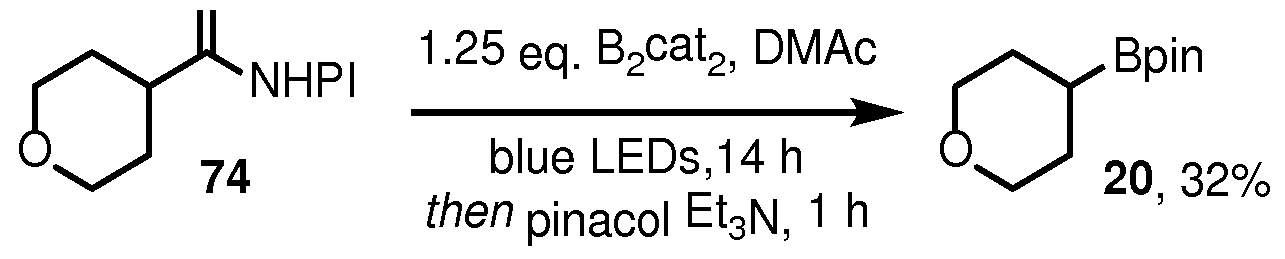
Activation: NHPI ester 74 was prepared according to a known procedure. Borylation: NHPI ester 74 (36 mg, 0.13 mmol) was borylated according to General Procedure B. The crude reside was purified by flash column chromatography (Si02; 3: 1 petroleum ether 40-60:Et2O) to afford boronic ester 20 (9 mg, 32%) as a colorless oil. Note: the product is unstable on silica gel.
TLC: Rf = 0.48 (3: 1 petroleum ether 40-60:EtOAc) ¾ NMR (400 MHz, CDC13) δ 3.76 (dt, / = 11.2, 3.9 Hz, 2H, OCH2), 3.48 - 3.34 (m, 2H, OCH2), 1.59 - 1.51 (m, 4H, 2xCH2), 1.23 - 1.15 (m, 13H, CHBpin + 2xOC(CH3)2) ppm
13C NMR (101 MHz, CDCI3) δ 83.1 (OC(CH3)2), 68.8 (OCH2), 27.6 (CH2), 24.7

All data matched that reported in the literature.
l,2-Bis(4,4,5,5-tetramethyl-l,3,2-dioxaborolan-2-yl)cyclohexane (21)

Activation: The carboxylic acid (500 mg, 3.24 mmol) was coupled with N- hydroxyphthalimide according to General Procedure A with all reagents doubled in quantity. The crude residue was purified by flash column chromatography (Si02; DCM) to afford the corresponding NHPI ester 75 (709 mg, 47%) as a white solid.
m.p.: 188 - 192 °C (DCM/MeOH)

¾ NMR (400 MHz, CDC13) δ 7.89 - 7.85 (m, 2H, phthalimide ArH), 7.79 - 7.75 (m, 2H, phthalimide ArH), 3.28 - 3.21 (m, 2H, CHC=0), 2.44 - 2.37 (br m, 2H, CHCH¾b x2), 1.94 - 1.87 (br m, 2Η, CH¾b x2), 1.84 - 1.75 (br m, 2Η, CHCH¾b x2), 1.53 - 1.46 (br m, 2Η, CH^ x2) ppm
13C NMR (101 MHz, CDCI3) δ 170.3 (C=0), 161.8 (C=0), 134.8 (phthalimide ArCH), 129.2 (phthalimide ArC), 124.1 (phthalimide ArC), 41.7 ( HC=0), 28.4 (CH2CHC=0), 24.4 ( H2CH2CHC=0) ppm HRMS (m/z) (ESI) calc'd for C24Hi8N2Na08 [M+Na]+: 485.0955, found: 485.0955
IR (solid state) max: 2937, 2862, 1783, 1734, 1468, 1358, 1186, 1123, 1082, 997, 970, 876, 693 and 518 cm"1
Borylation: NHPI ester 75 (62 mg, 0.13 mmol) was borylated according to General Procedure B with double the amount of B2cat2. The crude reside was purified by flash column chromatography (Si02; 90: 10 pentane:Et20) to afford boronic ester 21 (30 mg, 67%, 91 :9 d.r.) as an amorphous white solid.
TLC: Rf = 0.31 (90: 10 pentane:Et20)
¾ NMR (400 MHz, CDCI3) δ 1.72 - 1.62 (br m, 4H, CH2 x2), 1.25 - 1.17 (m, 4H, CH2 x2), 1.21 (s, 24H, C(CH3)2), 1.01 - 0.94 (br m, 2H, CHBpin) ppm 13C NMR (101 MHz, CDCI3) δ 82.8 (C(CH3)2), 28.5 (CH2), 27.3 (CH2), 25.0 (C(CH3)2), 24.8 (C(CH3)2) ppm
HRMS (m/z): (ESI) calc'd for Ci8H34B2Na04 [M+Na]+: 359.2542, found: 359.2543 IR (solid state) max: 2977, 2918, 2848, 1370, 1312, 1138, 972 and 861 cm"1
2-((9s,10s)-9,10-Dihydro-9,10-ethanoanthracen-ll-yl)-4,4,5,5-tetramethyl-l,3,2- dioxaborolane (22)

Activation: The carboxylic acid (52) (500 mg, 2.00 mmol) was coupled with N- hydroxyphthalimide according to General Procedure A. The crude residue was purified by flash column chromatography (S1O2; 40:60 pentane:DCM) to afford the corresponding NHPI ester 76 (677 mg, 86%) as a white solid. m.p.: 180 - 184 °C (DCM/MeOH)
TLC: Rf = 0.29 (30:70 pentane:DCM) ¾ NMR (400 MHz, CDC13) δ 7.89 - 7.82 (m, 2H, phthalimide ArH), 7.78 - 7.74 (m, 2H, phthalimide ArH), 7.52 - 7.48 (m, 1H, ArH), 7.41 - 7.37 (m, 1H, ArH), 7.35 - 7.25 (m, 2H, ArH), 7.18 - 7.1 1 (m, 4H, ArH), 4.90 (d, / = 2.3 Hz, 1H, CHCHC=0), 4.42 (t, J = 2.6 Hz, 1H, CHCH2), 3.30 - 3.26 (m, 1H, CHC=0), 2.22 - 2.12 (m, 2H, CH2) ppm
13C NMR (101 MHz, CDCI3) δ 170.2 (C=0), 162.0 (C=0), 143.5 (ArC), 143.4 (ArC), 141.9 (ArC), 138.6 (ArC), 134.8 (phthalimide ArCH), 129.1 (phthalimide ArC), 126.8 (ArCH), 126.7 (ArCH), 126.2 (ArCH), 126.1 (ArCH), 125.9 (ArCH), 124.1 (phthalimide ArCH), 123.9 (ArCH), 123.8 (ArCH), 123.2 (ArCH), 47.2 (CHCHC=0), 43.7 (CHCH2), 41.8 (CHC=0), 31.4 (CH2) ppm
HRMS (m/z): (ESI) calc'd for C25Hi7NNa04 [M+Na]+: 418.1050, found: 418.1048 IR (solid state) max: 3024, 2954, 1743 (C=0), 1466, 1087, 996, 964, 762 and 695 cm"1
Borylation: NHPI ester 76 (53 mg, 0.13 mmol) was borylated according to General Procedure B. The crude reside was purified by flash column chromatography (Si02; 98:2 pentane:Et20) to afford boronic ester 22 (23 mg, 53%) as an amorphous white solid. TLC: Rf = 0.21 (95:5 pentane:Et20)
¾ NMR (400 MHz, CDC13) δ 7.28 - 7.24 (m, 4H, ArH), 7.10 - 7.01 (m, 4H, ArH), 4.47 (d, / = 2.3 Hz, 1H, CHCHBpin), 4.33 (t, / = 2.6 Hz, 1H, CHCH2), 1.90 (ddd, / = 11.8, 5.4, 2.5 Hz, 1H, CH¾b), 1.82 (app td, / = 11.8, 2.5 Hz, 1H, CffH13), 1.43 (ddd, / = 10.7, 5.4, 2.5 Hz, 1H, CHBpin), 1.12 (s, 6H, C(CH3)2), 1.02 (s, 6H, C(CH3)2) ppm 13C NMR (101 MHz, CDC13) δ 145.2 (ArC), 144.3 (ArC), 143.9 (ArC), 142.8 (ArC), 125.7 (ArCH), 125.5 (ArCH), 125.4 (ArCH), 125.1 (ArCH), 124.3 (ArCH), 123.4 (ArCH), 123.3 (ArCH), 122.8 (ArCH), 83.4 (C(CH3)2), 45.7 (CHCHBpin), 44.6 (CHCH2), 29.6 (CH2), 24.9 (C(CH3)2) ppm
HRMS (m/z) (ESI) calc'd for C22H25BNa02 [M+Na]+: 355.1844, found: 355.1837 IR (solid state) vmax: 2982, 2940, 2870, 1458, 1366, 1315, 1249, 1138, 981, 854, 753, 743 and 701 cm"1
4,4,5,5-tetramethyl-2-(2,2,3,3-tetramethylcyclopropyl)-l,3,2-dioxaborolane (23)
General Procedure A Q General Procedure B

then pinacol Et3N, 1 h
Activation: The carboxylic acid (500 mg, 3.52 mmol) was coupled with N- hydroxyphthalimide according to General Procedure A. The crude residue was purified by flash column chromatography (Si02; 40:60 pentane:DCM) to afford the corresponding NHPI ester 77 (740 mg, 73%) as a white solid. m.p.: 78 - 80 °C (DCM/MeOH)
TLC: Rf = 0.21 (40:60 pentane:DCM) ¾ NMR (400 MHz, CDC13) δ 7.89 - 7.84 (m, 2H, phthalimide ArCH), 7.78 - 7.74 (m, 2H, phthalimide ArCH), 1.52 (s, 1H, CHC=0), 1.30 (s, 6H, CH3 x2), 1.27 (6H, CH3 x2) ppm
13C NMR (101 MHz, CDC13) δ 167.8 (C=0), 162.6 (C=0), 134.7 (phthalimide ArCH), 129.2 (phthalimide ArC), 124.0 (phthalimide ArCH), 33.4 (C(CH3)2), 32.4 (CHC=0), 23.4 (CH3), 16.5 (CH3) ppm
HRMS (m/z): (ESI) calc'd for Ci6Hi7NNa04 [M+Na]+: 310.1050, found: 310.1052
IR (solid state) vmax: 2950, 2924, 1773, 1731, 1467, 1357, 1094, 1021, 997, 977, 877, 847, 783 and 691 cm"1
Borylation: NHPI ester 77 (38 mg, 0.13 mmol) was borylated according to General Procedure B. The crude reside was purified by flash column chromatography (S1O2; 95:5 pentane:Et20) to afford boronic ester 23 (25 mg, 83%) as an amorphous white solid.
TLC: Rf = 0.60 (80:20 pentane:Et20) lU NMR (400 MHz, CDC13) δ 1.21 (s, 12H, Bpin C(CH3)2), 1.15 (s, 6H, C(CH3)2 x2), 1.14 (s, 6H, C(CH3)2 x2), -0.46 (s, 1H, CHBpin) ppm
13C NMR (101 MHz, CDC13) δ 82.5 (Bpin C(CH3)2), 27.2 (C(CH3)2, 25.0 (Bpin C( H3)2), 24.7 (CH3), 19.9 (CH3) ppm
HRMS (m/z): (ESI) calc'd for Ci3H25BNa02 [M+Na]+: 247.1842, found: 247.1840
IR (solid state) max: 2979, 2925, 2867, 1418, 1396, 1343, 1311, 1235, 1142, 1106, 857 and 706 cm"1
2.1.3 Substrate Scope: Tertiary
4,4,5,5-Tetramethyl-2-(l-phenylcyclopropyl)-l,3,2-dioxaborolane (24)

Activation: NHPI ester 78 was prepared according to a known procedure.
Borylation: NHPI ester 78 (40 mg, 0.13 mmol) was borylated according to General Procedure B. The crude reside was purified by flash column chromatography (Si02; 80:20 pentane:Et20) to afford boronic ester 24 (29 mg, 91 ) a colorless oil.
TLC: Rf = 0.59 (70:30 pentane:Et20)
¾ NMR (400 MHz, CDC13) δ 7.28 - 7.21 (m, 4H, ArH), 7.14 - 7.10 (m, 1H, ArH), 1.21 (s, 12H, C(CH3)2), 1.11 (q, / = 3.5 Hz, 2H, CH2), 0.91 (q, / = 3.5 Hz, 2H, CH2) ppm 13C NMR (101 MHz, CDC ) δ 145.0 (ArC), 129.1 (ArCH), 128.1 (ArCH), 125.4 (ArCH), 83.5 (C(CH3)2), 24.7 (C( H3)2), 13.5 (CH2) ppm
All data matched that reported in the literature.
2-((3r,5r,7r)-Adamantan-l-yl)-4,4,5,5-tetramethyl-l,3,2-dioxaborolane (25)
General Procedure B

25, 74% (69 o/0 1 .1 1 g) Activation: NHPI ester 79 was prepared according to a known procedure.
Borylation: NHPI ester 79 (43 mg, 0.13 mmol) was borylated according to General Procedure B. The crude reside was purified by flash column chromatography (Si02; 80:20 pentane:Et20) to afford boronic ester 25 (26 mg, 74%) an amorphous white solid.
Gram Scale Borylation: NHPI ester 79 (2.0 g, 6.15 mmol) and B2cat2 (1.83 g, 7.68 mmol) were carefully weighed into a flame-dried Schlenk tube containing a small magnetic stirrer bar. DMAc (12.3 mL, 0.5 M) was added and then the headspace of the vial was purged with a gentle stream of argon for approximately 30 seconds. The tube was sealed and stirred under blue LED irradiation for 14 h. Pinacol (2.91 g, 24.59 mmol) was dissolved in Et3N (4.14 mL) and added to the reaction mixture and stirred for 1 h. The reaction mixture was transferred into a separating funnel containing EtOAc
(40 mL), H20 (20 mL), NH4C1 (saturated aqueous solution, 20 mL). After vigorously shaking and allowing to two layers to separate, the organic layer was collected. This was repeated twice more with EtOAc (40 mL). The organic layers were combined, dried over MgS04, and concentrated under reduced pressure. The crude residue was purified by flash column chromatography (Si02; 80:20 pentane:Et20) to afford boronic ester 25
(1.1 lg, 69%) as an amorphous white solid.
lU NMR (400 MHz, CDC13) δ 1.91 - 1.71 (br m, 15H, CH x3 and CH2 x6), 1.21 (s, 12H, C(CH3)2) ppm
13C NMR (101 MHz, CDCI3) δ 82.7 (C(CH3)2), 38.1 (CH2), 37.7 (CH2), 27.7 (CH), 24.8 (C(CH3)3) ppm All data matched that reported in the literature.
4,4,5,5-Tetramethyl-2-(4-pentylbicyclo[2.2.2]octan-l-yl)-l,3,2-dioxaborolane (26)

80, 84% then pinacol Et3N, 1 h 26, 83%
Activation: The carboxylic acid (500 mg, 2.23 mmol) was coupled with N- hydroxyphthalimide according to General Procedure A. The crude residue was purified by flash column chromatography (Si02; 20: 1 petroleum ether 40-60:EtOAc) to afford the corresponding NHPI ester 80 (690 mg, 84%) as a white solid. m.p.: 121 - 123 °C (DCM/MeOH)
TLC: Rf = 0.24 (10: 1 petroleum ether 40-60:EtOAc) ¾ NMR (400 MHz, CDC13) δ 7.86 - 7.82 (m, 2H, Ar-H), 7.77 - 7.72 (m, 2H, Ar-H), 2.07 - 1.92 (m, 6H, 3xCH2), 1.53 - 1.39 (m, 6H, 3xCH2), 1.35 - 1.07 (m, 8H, 4xCH2), 0.87 (t, / = 7.1 Hz, 3H, CH3) ppm
13C NMR (101 MHz, CDC13) δ 174.0 (C=0), 162.1 (C=0), 134.6 (HCAT), 129.1 (CAT), 123.9 (HCAT), 41.2 (CH2), 38.7 (C), 32.8 (CH2), 30.4 (C), 30.1 (CH2), 28.5 (CH2), 23.4 (CH2), 22.7 (CH2), 14.1 (CH3) ppm
HRMS (m/z): (ESI) calc'd for C22H27NNa04 [M+Na]+: 392.1832, found: 392.1832
IR (neat) max: 2917, 2855, 1774, 1738, 1369, 1183, 1139, 980, 876 and 734 cm"1
Borylation: NHPI ester 80 (48 mg, 0.13 mmol) was borylated according to General Procedure B. The crude reside was purified by flash column chromatography (Si02;
10: 1 petroleum ether 40-60:Εί2Ο) to afford boronic ester 26 (33 mg, 83%) as an amorphous white solid.
TLC: Rf = 0.51 (10: 1 petroleum ether 40-60:EtOAc)
¾ NMR (400 MHz, CDC13) δ 1.52 - 1.41 (m, 6H, 3xCH2), 1.26 - 1.08 (m, 24H, 6xCH2 + 2xOC(CH3)2), 0.98 - 0.89 (m, 2H, CH2), 0.79 (t, / = 7.2 Hz, 3H, CH3) ppm
13C NMR (101 MHz, CDC13) δ 82.6 (OC(CH3)2), 42.2 (CH2), 32.9 (CH2), 30.7 (CH2), 29.8 (C), 27.4 (CH2), 24.6 (OC(CH3)2), 23.1 (CH2), 22.7 (CH2), 14.1 (CH3) ppm
HRMS (m/z): (ESI) calc'd for Ci9H35BNa02 [M+Na]+: 329.2626, found: 329.2641
IR (neat) max: 2925, 2855, 1750, 1383, 1306, 1145, 1125 and 849 cm"1
Methyl 4-(4,4,5,5-tetramethyl-l,3,2-dioxaborolan-2-yl)cubane-l-carboxylate (27)

Activation: NHPI ester 81 was prepared according to a known procedure.
Borylation: NHPI ester 81 (47 mg, 0.13 mmol) was borylated according to General Procedure B. The crude reside was purified by flash column chromatography (Si02; 60:40 pentane:Et20) to afford boronic ester 27 (18 mg, 46%) an amorphous solid.
TLC: Rf = 0.42 (50:50 pentane:Et20)
¾ NMR (400 MHz, CDC13) δ 4.31 - 4.27 (m, 3H, CH), 4.04 - 3.99 (m, 3H, CH), 3.69 (s, 3H, C=OOCH3), 1.25 (s, 12H, C(CH3)2) ppm 13C NMR (126 MHz, CDC13) δ 172.6 (C=0), 83.2 (C(CH3)2), 55.3 (CC=0), 51.5 (C=OO H3), 49.8 (CH), 45.1 (CH), 24.8 (C( H3)2) ppm
HRMS (m/z): (ESI) calc'd for Ci6H2iBNa04 [M+Na]+: 311.1428, found: 311.1420
IR (solid state) max: 2976, 1715, 1429, 1395, 1307, 1224, 1142, 1085 and 845 cm"1
2-(Bicyclo[l.l.l]pentan-l-yl)-4,4,5,5-tetramethyl-l,3,2-dioxaborolane (28) n
 Activation: The carboxylic acid (110 mg, 0.98 mmol) was coupled with N- hydroxyphthalimide according to General Procedure A. The crude residue was purified by flash column chromatography (S1O2; 60:40 pentane:Et20) to afford the corresponding NHPI ester 82 (187 mg, 74%) as an amorphous white solid.
TLC: Rf = 0.23 (50:50 pentane:DCM) ¾ NMR (500 MHz, CDC13) δ 7.89 - 7.86 (m, 2H, phthalimide ArH), 7.80 - 7.76 (m, 2H, phthalimide ArH), 2.55 (s, 1H, CH), 2.33 (s, 6H, CH2) ppm
13C NMR (126 MHz, CDCI3) δ 164.7 (C=0), 162.0 (C=0), 134.8 (phthalimide ArCH), 129.1 (phthalimide ArC), 124.1 (phthalimide ArCH), 52.5 (CH2), 40.0 (CC=0), 29.3 (CH) ppm HRMS (m/z): (ESI) calc'd for Ci4HnNNa04 [M+Na]+: 280.0580, found: 280.0594
IR (solid state) max: 3001, 2887, 1776, 1736, 1372, 1185, 1039, 875, 789, 692, 606 and 518 cm"1
Borylation: NHPI ester 82 (34 mg, 0.13 mmol) was borylated according to General Procedure B. The crude reside was purified by flash column chromatography (Si02; 90: 10 pentane:Et20) to afford boronic ester 82 (11 mg, 42%) a colorless oil (due to the product's volatility, a small amount of pentane remained). Note: product is volatile and unstable on silica.
TLC: Rf = 0.24 (90: 10 pentane:Et20)
¾ NMR (500 MHz, CDC ) δ 2.48 (s, 1H, CH), 1.95 (s, 6H, CH2), 1.22 (s, 12H, C(CH3)2) ppm
13C NMR (126 MHz, CDC13) δ 83.3 (C(CH3)2), 52.0 (CH2), 34.7 (CH), 24.9 (C(CH3)2) ppm
HRMS (m/z): (EI) calc'd for CnHi9BNa02 [M+Na]+: 217.1372, found: 217.1369 IR (neat) max: 2923, 1399, 1317, 1216, 1135, 852 and 662 cm"1
2.1.4 Substrate Scope: Natural Products and Drugs
2-Heptadecyl-4,4,5,5-tetramethyl-l,3,2-dioxaborolane (29)
O General Procedure A Q General Procedure B
^^OH NHPI, DIC, DMAP "^^NHPI 1 -25 eq. B2cat2, DMAc "^ Bpin
Stearic acid DCM> r t > ονθΓη'9η1 83, 71 % blue LEDs,14 h 29, 84%
^en pinacol Et3N, 1 h
Activation: Stearic acid (1.0 g, 3.52 mmol) was coupled with N-hydroxyphthalimide according to General Procedure A. The crude residue was purified by flash column chromatography (Si02; 60:40 pentane:DCM) to afford the corresponding NHPI ester 83 (1.07 mg, 71%) as a white solid.
TLC: Rf = 0.32 (50:50 pentane:DCM)
¾ NMR (400 MHz, CDC13) δ 7.91 - 7.86 (m, 2H, phthalimide ArH), 7.81 - 7.76 (m, 2H, phthalimide ArH), 2.66 (t, / = 7.5 Hz, 2H, CH2C=0), 1.78 (p, / = 7.5 Hz, CH2CH2C=0), 1.44 (p, / = 7.5 Hz, CH2CH2CH2C=0), 1.37 - 1.21 (m, 26H, CH2 xl3), 0.88 (t, / = 7.0 Hz, 3H, CH3) ppm
13C NMR (101 MHz, CDC13) δ 169.8 (C=0), 162.1 (C=0), 134.8 (phthalimide ArCH), 129.1 (phthalimide ArC), 124.1 (phthalimide ArCH), 32.1 (CH2C=0), 31.1 (CH2), 29.8 - 29.7 (CH2 x9), 29.5 (CH2), 29.3 (CH2), 29.0 (CH2), 24.8 (CH2), 22.8 (CH2), 14.3 (CH3) ppm
All data matched that reported in the literature.
Borylation: NHPI ester 83 (57 mg, 0.13 mmol) was borylated according to General Procedure B. The crude reside was purified by flash column chromatography (Si02; 90: 10 pentane:Et20) to afford boronic ester 29 (41 mg, 84%) as colorless oil. TLC: Rf = 0.56 (90: 10 pentane:Et20)
¾ NMR (400 MHz, CDC13) δ 1.43 - 1.17 (m, 30H, CH2 xl5), 1.24 (s, 12H, C(CH3)2), 0.88 (t, J = 6.8 Hz, 3H, CH3), 0.76 (t, / = 7.7 Hz, 2H, CH2Bpin) ppm
13C NMR (101 MHz, CDC13) δ 83.0 (C(CH3)2), 32.6 (CH2), 32.1 (CH2), 29.9 - 29.5 (CH2 x9), 25.0 (C(CH3)2), 24.2 (CH2), 22.9 (CH2), 14.3 (CH3) ppm HRMS (m/z): (ESI) calc'd for C23H48B02 [M+H]+: 367.3746, found: 367.3745
IR (neat) max: 2922, 2853, 1377, 1316, 1145, 968, 847 and 735 cm"1
tert-Butyl(((3R,8R,95,105,13R,145,17R)-10,13-dimethyl-17-((R)-4-(4,4,5,5- tetramethyl-l,3,2-dioxaborolan-2-yl)butan-2-yl)hexadecahydro-lH- cyclopenta[a]phenanthren-3-yl)oxy)dimethylsilane (30)

Activation: Crude TBS protected lithocholic acid (55) (2.45 g, 5.0 mmol) was coupled with N-hydroxyphthalimide according to General Procedure A. The crude residue was purified by flash column chromatography (Si02; 95:5 hexane:EtOAc) to afford the corresponding NHPI ester 84 (1.37 g, 43% over two steps) as a white solid. m.p.: 194 - 198 (DCM/MeOH)
TLC: Rf = 0.55 (90: 10 hexane:EtOAc)
lU NMR (400 MHz, CDC13) δ 7.91 - 7.86 (m, 2H, phthalimide ArH), 7.80 - 7.76 (m, 2H, phthalimide ArH), 3.58 (app tt, / = 11.0, 4.7 Hz, 1H, CHOTBS), 2.76 - 2.65 (m, 1H, CH¾bC=0), 2.64 - 2.53 (m, 1Η, CffH^O), 1.98 - 1.72 (m, 6Η), 1.58 - 0.86 (m, 20Η), 0.98 (d, / = 6.3 Hz, CHCH3), 0.90 (s, 3Η, CH3), 0.89 (s, 9H, SiC(CH3)3), 0.67 (s, 3H, CH3), 0.06 (s, 6H, Si(CH3)2) ppm
13C NMR (101 MHz, CDC13) ^ 170.2 (C=0), 162.1 (C=0), 134.8 (ArCH), 129.1 (ArC), 124.1 (ArCH), 73.0 (CHOTBS), 56.5, 56.1, 42.9 (C), 42.4, 40.3, 40.3 (C), 37.1 (C), 36.0, 35.7 (C), 35.4, 34.7 (C), 31.2 (CH2), 30.9 (CH2), 28.3 (CH2), 28.2 (CH2), 27.5 (CH2), 26.5 (CH2), 26.1 (SiC( H3)3), 24.4 (CH2), 23.5, 21.0 (CH2), 18.5 (SiC(CH3)3), 18.4, 12.2 (CH3), -4.4 (Si(CH3)2) ppm
HRMS (m/z) (ESI) calc'd for CssHsvBNOsSiNa [M+Na]+: 658.3898, found:
658.3888
IR (neat) max: 2930, 2860, 1744, 1065, 835 and 781 cm"1 [α]£4: +20 (c = 1.0, CHC ) Borylation: NHPI ester 84 (83 mg, 0.13 mmol) was borylated according to General Procedure B. The crude reside was purified by flash column chromatography (Si02; 95:5 pentane:Et20) to afford boronic ester 30 (54 mg, 72%) as an amorphous white solid.
TLC: Rf = 0.38 (pentane:Et20 95:5) ¾ NMR (400 MHz, CDC ) δ 3.57 (dddd, / = 10.9, 10.7, 4.7, 4.5 Hz, 1H, CHOTBS), 1.95 (m, 1H), 1.90 - 1.70 (m, 4H), 1.59 - 1.50 (m, 3H), 1.48 - 1.28 (m, 8H), 1.28 - 1.17 (m, 15H), 1.16 - 0.98 (m, 6H), 0.98 - 0.75 (m, 17H), 0.69 - 0.54 (m, 4H), 0.05 (s, 6H, Si(CH3)2) ppm
13C NMR (101 MHz, CDCb) δ 82.9 (2xOC(CH3)2), 73.0 (CHOTBS), 56.6 (CH), 56.2 (CH), 42.9 (Cw), 42.5 (CH), 40.4 (CH), 40.3 (CH2), 37.8 (CH), 37.1 (CH2), 36.1 (CH), 35.8 (CH2), 34.8 (Cw), 31.2 (CH2), 29.9 (CH2), 28.4 (CH2), 27.5 (CH2), 26.6 (CH2), 26.2 (SiC(CH3)3), 25.0 (OC(CH3)2), 24.9 (OC(CH3)2), 24.4 (CH2), 23.6 (CH3), 21.0 (CH2), 18.5 (CH), 18.2 (CH3), 12.2 (CH3), -4.4 (Si(CH3)2) ppm
HRMS (m/z): (ESI) calc'd for C35H65BNa03Si [M+Na]+: 595.4695, found: 595.4690 IR (neat) max: 2927, 2856, 1470, 1370, 1312, 1251, 1146, 1095, 835 and 774 cm"1 [α 4: + 17 (c = 1.0, CHC13)
(3R,5R,8R,95,105,13R,145,17R)-10,13-Dimethyl-17-((R)-4-(4,4,5,5-tetramethyl- l,3,2-dioxaborolan-2-yl)butan-2-yl)hexadecahydro-lH- cyclopenta[a]phenanthren-3-ol (31)

Activation: The carboxylic acid (1.00 g, 2.66 mmol) was coupled with N- hydroxyphthalimide according to General Procedure A. The crude residue was purified by flash column chromatography (S1O2; 80:20→ 60:40 pentane:EtOAc) to afford the corresponding NHPI ester 85 (418 mg, 30%) as a white solid. m.p.: 161 - 163 °C (EtOAc)
TLC: Rf = 0.42 (pentane:EtOAc 50:50) ¾ NMR: (400 MHz, CDC13) δ 7.88 (m, 2H, 2xAr-H), 7.78 (m, 2H, 2xAr-H), 3.62 (dddd, / = 11.1, 11.0, 4.7, 4.6 Hz, 1H, CHOH), 2.71 (ddd, / = 15.9, 9.6, 4.8 Hz, 1H, CH HbC02R), 2.58 (ddd, / = 15.9, 9.0, 6.9 Hz, 1H, CHaH¾02R), 2.05 - 1.93 (m, 2H), 1.91 - 1.83 (m, 2H), 1.81 - 1.70 (m, 2H), 1.66 (m, 1H), 1.61 - 1.46 (m, 4H), 1.44 - 1.36 (m, 5H), 1.35 - 1.21 (m, 4H), 1.19 - 1.02 (m, 5H), 1.01 - 0.95 (m, 4H), 0.92 (s, 3H, CH3), 0.67 (s, 3H, CH3) ppm
13C NMR: (101 MHz, CDC13) δ 170.2 (C02R), 162.1 (2xCO), 134.8 (2XHCAT), 129.1 (2XCAT), 124.1 (2XHCAT), 72.0 (CHOH), 56.6 (CH), 56.0 (CH), 43.0 (Cw), 42.2 (CH), 40.6 (CH), 40.3 (CH2), 36.6 (CH2), 36.0 (CH), 35.5 (CH2), 35.4 (CH), 34.7 (Cw), 30.9
(CH2), 30.7 (CH2), 28.3 (CH2), 28.2 (CH2), 27.3 (CH2), 26.6 (CH2), 24.3 (CH2), 23.5 (CH3), 21.0 (CH2), 18.4 (CHCH3), 12.2 (CH3) ppm
HRMS (m/z): (ESI) calc'd for C32H43NNa05 [M+Na]+: 544.3033, found: 544.3032
IR (neat) max: 3366 (br.), 2928, 2863, 1816, 1788, 1741, 1467, 1365, 1067 and 732 cm"1
[a]2,4: + 18 (c 1.0, CHC13)
All data matched that reported in the literature.
Borylation: NHPI ester 85 (68 mg, 0.13 mmol) was borylated according to General Procedure B. The crude reside was purified by flash column chromatography (Si02; 60:40 pentane:Et20) to afford boronic ester 31 (52 mg, 87%) as a white solid. m.p.: 159 - 161 °C (Et20)
TLC: Rf = 0.24 (pentane:Et20 50:50)
¾ NMR: (400 MHz, CDC13) δ 3.61 (dddd, / = 11.1, 11.0, 4.7, 4.6 Hz, 1H, CHOH), 1.96 (m, 1H), 1.91 - 1.70 (m, 4H), 1.65 (m, 1H), 1.60 - 1.46 (m, 3H), 1.45 - 1.28 (m, 7H), 1.28 - 1.17 (m, 15H), 1.17 - 0.94 (m, 7H), 0.91 (s, 3H, CH3), 0.88 (d, / = 6.5 Hz, 3H, CHCHs), 0.79 (ddd, / = 15.8, 10.7, 5.1 Hz, 1H, CffHbBpin), 0.68 - 0.56 (m, 4H, CH3 & CHaH¾pin) ppm
13C NMR: (101 MHz, CDC13) δ 82.9 (2xOC(CH3)2), 72.0 (CHOH), 56.7 (CH), 56.1 (CH), 42.8 (Cw), 42.3 (CH), 40.6 (CH), 40.4 (CH2), 37.8 (CH), 36.7 (CH2), 36.0 (CH), 35.5 (CH2), 34.7 (Cw), 30.7 (CH2), 29.9 (CH2), 28.4 (CH2), 27.4 (CH2), 26.6 (CH2), 25.0 (OC(CH3)2), 24.9 (OC(CH3)2), 24.4 (CH2), 23.5 (CH3), 21.0 (CH2), 18.2 (CHCH3), 12.2 (CH3) ppm
HRMS (m/z): (ESI) calc'd for C29H5iBNa03 [M+Na]+: 481.3829, found: 481.3827 IR (neat) max: 3346 (br.), 2974, 2929, 2864, 1448, 1369, 1311, 1144 and 732 cm"1 [a] 6: +21 (c 1.0, CHC13)
4,4,5,5-Tetramethyl-2-((4Z,7Z,10Z,13Z)-nonadeca-4,7,10,13-tetraen-l-yl)-l,3,2- dioxaborolane (32)
General Procedure A General Procedure B
NHPI, DIC, DMAP 1 .25 eq. B2cat2, DMAc , Bpin arachidonic acid DCM, r.t., overnight 86, 74% blue LEDs,14 h 32, 58%
then pinacol Et3N, 1 h
Activation: The carboxylic acid (100 mg, 0.33 mmol) was coupled with N- hydroxyphthalimide according to General Procedure A. The crude residue was purified by flash column chromatography (Si02; 90: 10 pentane:Et20) to afford the corresponding NHPI ester 86 (110 mg, 74%) as a colorless oil.
TLC: Rf = 0.15 (pentane:Et20 90: 10)
¾ NMR: (400 MHz, CDC13) δ 7.88 (m, 2H, 2xAr-H), 7.78 (m, 2H, 2xAr-H), 5.50 - 5.29 (m, 8H, 8xCH), 2.87 - 2.80 (m, 6H, 3XCHCH2CH), 2.68 (t, / = 7.4 Hz, 2H,
CH2CO2R), 2.24 (td, / = 7.3, 7.1 Hz, 2H, ClMCT^CChR), 2.05 (td, / = 7.0, 6.9 Hz,
2H, C4H9CH2CH), 1.87 (tt, / = 7.4, 7.3 Hz, 2H, CH2CH2CO2R), 1.40 - 1.22 (m, 6H,
3xCH2), 0.88 (t, J = 6.8 Hz, 3H, CH3) ppm
13C NMR: (101 MHz, CDC ) δ 169.6 (C02R), 162.0 (2xCO), 134.8 (2XHCAT), 130.6
(CH), 129.8 (CH), 129.1 (2XCAT), 128.7 (CH), 128.5 (CH), 128.3 (CH), 128.2 (CH),
128.0 (CH), 127.7 (CH), 124.1 (2XHCAT), 31.6 (CH2), 30.5 (CH2CO2R), 29.5 (CH2),
27.3 (C4H9CH2CH), 26.3 (CH2(CH2)2C02R), 25.8 (3xCHCH2CH), 24.7
(CH2CH2CO2R), 22.7 (CH2), 14.2 (CH3) ppm
HRMS (m/z): (ESI) calc'd for C28H35NNa04 [M+Na]+: 472.2458, found: 472.2460 IR (neat) max: 3012, 2927, 2856, 1816, 1789, 1743, 1467, 1367, 1185, 1081 and 877 cm-1
Borylation: NHPI ester 86 (58 mg, 0.13 mmol) was borylated according to General
Procedure B. The crude reside was purified by flash column chromatography (Si02;
95:5 pentane:Et20) to afford boronic ester 32 (29 mg, 58%) as a colorless oil.
TLC: Rf = 0.50 (pentane:Et20 95:5)
lU NMR: (400 MHz, CDC13) δ 5.48 - 5.24 (m, 8H, 8xCH), 2.92 - 2.73 (m, 6H, 3XCHCH2CH), 2.06 (app. p, Japp- = 7.0 Hz, 4H, 2xCHCH2CH2), 1.48 (tt, J = 7.8, 7.7 Hz, 2H, CH2CH2Bpin), 1.41 - 1.27 (m, 6H, 3xCH2), 1.24 (s, 12H, 4xCH3), 0.89 (t, / = 6.8 Hz, 3H, CH3), 0.80 (t, / = 7.9 Hz, 2H, CH2B(OR)2) ppm 13C NMR: (101 MHz, CDC13) δ 130.5 (CH), 130.2 (CH), 128.6 (CH), 128.5 (CH), 128.0 (CH), 128.0 (CH), 127.9 (CH), 127.6 (CH), 82.9 (2xOC(CH3)2), 31.5 (CH2), 29.8 (CHCH2CH2), 29.3 (CH2), 27.2 (CHCH2CH2), 25.6 (3xCHCH2CH), 24.8 (4xCH3), 24.1 (CH2CH2Bpin), 22.6 (CH2), 14.1 (CH3) ppm
HRMS (m/z): (EI) calc'd for C25H43B02: 386.3356, found: 386.3338 IR (neat) max: 3012, 2927, 2858, 1371, 1316, 1140, 968 and 846 cm"1
l-([l,l'-Biphenyl]-4-yl)-3-(4,4,5,5-tetramethyl-l,3,2-dioxaborolan-2-yl)propan-l- one (33)
General Procedure B
1 .25 eq. B2cat2, DMAc
blue LEDs.14 h

Activation: Fenbufen (1.0 g, 3.93 mmol) was coupled with N-hydroxyphthalimide according to General Procedure A. The crude product was filtered quickly through a short column (~5 cm silica gel). After concentrated to a -15 mL solution, 30 mL of MeOH was added. The precipitate was collected by filtration and washed with 10 mL of MeOH to afford the corresponding NHPI ester 87 (1.42 g, 91%) as a light pink solid. Note: The product is not stable on silica gel. m.p.: 165 - 168 °C (DCM/MeOH)
TLC: Rf = 0.50 (1 : 1 petroleum ether 40-60:EtOAc)
lU NMR (400 MHz, CDC13) δ 8.00 (d, / = 8.1 Hz, 2H, Ar-H), 7.85 - 7.79 (m, 2H, Ar- H), 7.75 - 7.67 (m, 2H, Ar-H), 7.62 (d, / = 8.1 Hz, 2H, Ar-H), 7.55 (d, / = 7.4 Hz, 2H, Ar-H), 7.39 (t, / = 7.5 Hz, 2H, Ar-H), 7.33 (t, / = 7.4 Hz, 1H, Ar-H), 3.43 (t, / = 6.9 Hz, 2H, CH2), 3.10 (t, J = 6.9 Hz, 2H, CH2) ppm 13C NMR (101 MHz, CDC ) δ 196.0 (C=0), 169.3 (C=0), 161.8 (C=0), 146.1 (CAT), 139.7 (CAT), 134.8 (CAT), 134.7 (HCAT), 128.9 (HCAT), 128.9 (CAT), 128.7 (HCAT), 128.3 (HCAT), 127.3 (HCAT), 127.2 (HCAT), 124.0 (HCAT), 33.2 (CH2), 25.5 (CH2) ppm
HRMS (m/z): (ESI) calc'd for C24Hi7NNa05 [M+Na]+: 422.0999, found: 422.1004
IR (neat) max: 2920, 1741, 1682, 1360, 1186, 1083, 877 and 765 cm"1 Borylation: NHPI ester 87 (52 mg, 0.13 mmol) was borylated according to General Procedure B. The crude reside was purified by flash column chromatography (Si02; 4: 1 petroleum ether 40-60:Et2O) to afford boronic ester 33 (13 mg, 30%) as a colorless oil.
TLC: Rf = 0.63 (1 : 1 petroleum ether 40-60:EtOAc) ¾ NMR (400 MHz, CDCb) δ 8.08 (d, 7 = 8.3 Hz, 2H, Ar-H), 7.70 (d, / = 8.3 Hz, 2H, Ar-H), 7.65 (d, / = 7.6 Hz, 2H, Ar-H), 7.50 (t, / = 7.4 Hz, 2H, Ar-H), 7.42 (t, / = 7.3 Hz, 1H, Ar-H), 3.21 (t, / = 7.0 Hz, 2H, CH2), 1.29 (s, 12H, 2xOC(CH3)2), 1.13 (t, / = 7.0 Hz, 2H, CH2Bpin) ppm
13C NMR (101 MHz, CDCb) δ 200.1 (C=0), 145.4 (CAT), 140.0 (CAT), 135.7 (CAT), 128.9 (HCAT), 128.5 (HCAT), 128.1 (HCAT), 127.2 (HCAT), 127.1 (HCAT), 83.1 (OC(CH3)2), 33.7 (CH2), 24.8 (OC(CH3)2) ppm
HRMS (m/z) (ESI) calc'd for C2iH25BNa03 [M+Na]+: 359.1792, found: 359.1788 IR (neat) max: 2972, 1745, 1679, 1369, 1313, 1221, 1137, 1074, 966 and 763 cm"1
(4-Chlorophenyl)(5-methoxy-2-methyl-3-((4,4,5,5-tetramethyl-l,3,2- dioxaborolan-2-yl)methyl)-lH-indol-l-yl)methanone (34)

Activation: NHPI ester 88 was prepared according to a known procedure. Borylation: NHPI ester 88 (67 mg, 0.13 mmol) was borylated according to General Procedure B. The crude reside was purified by flash column chromatography (Si02; 95:5 pentane: acetone) to afford boronic ester 34 (28 mg, 47%) a colorless oil.
TLC: Rf = 0.31 (70:30 pentane:Et20) lU NMR (400 MHz, CDC13) δ 7.64 (d, / = 8.6 Hz, 2H, ArH), 7.45 (d, / = 7.6 Hz, 2H, ArH), 6.93 (d, / = 9.0 Hz, 2H, ArH), 6.65 (dd, / = 9.0, 2.5 Hz, 1H, ArH), 3.84 (s, 3H, OCH3), 2.29 (s, 3H, CH3), 2.18 (s, 2H, CH2Bpin), 1.23 (s, 12H, C(CH3)2) ppm
13C NMR (126 MHz, CDC ) δ 168.3 (C=0), 156.0 (ArC), 138.8 (ArC), 134.7 (ArC), 133.2 (ArC), 132.0 (ArC), 131.2 (ArCH), 131.1 (ArC), 129.1 (ArCH), 1 16.7 (ArC), 115.0 (ArCH), 111.3 (ArCH), 101.7 (ArCH), 83.7 (C(CH3)2), 55.8 (OCH3), 24.9 (C(CH3)2), 13.8 (CH3) ppm
HRMS (m/z): (ESI) calc'd for C24H27BClNNa04 [M+Na]+: 462.1618, found:
462.1618
IR (neat) max: 2977, 1676, 1476, 1454, 1321, 1222, 1140, 1088, 1061, 846, 732 cm"1
(15,25,4aR,4bR,75,9aR,105,10aR)-l-Methyl-8-methylene-13-oxo-10-(4,4,5,5- tetramethyl-l,3,2-dioxaborolan-2-yl)-l,2,5,6,8,9,10,10a-octahydro-4a,l- (epoxymethano)-7,9a-methanobenzo[a]azulene-2,7(4bH)-diyl diacetate (35)

from gibberellic acid

TLC: Rf = 0.60 (1: 1 petroleum ether 40-60:EtOAc)
¾ NMR (400 MHz, CDC13) δ 7.85 - 7.80 (m, 2H, Ar-H), 7.76 - 7.72 (m, 2H, Ar-H), 6.32 (d, / = 9.3 Hz, 1H, =CH-), 5.83 (dd, / = 9.3, 3.8 Hz, 1H, =CH-), 5.30 (d, / = 3.8 Hz, 1H, CH-OAc), 5.18 (s, 1H, =CH2), 5.02 (s, 1H, =CH2), 3.32 (d, / = 11.1 Hz, 1H), 3.07 (d, / = 11.1 Hz, 1H), 2.83 (dt, / = 15.0, 3.1 Hz, 1H), 2.46 - 2.35 (m, 3H), 2.17 (d, / = 15.0 Hz, 1H), 2.06 - 1.94 (m, 8H), 1.80 - 1.63 (m, 2H), 1.24 (s, 3H, CH3) ppm
13C NMR (101 MHz, CDC13) δ 176.4 (C=0), 169.9 (C=0), 168.5 (C=0), 161.5 (C=0), 153.0 (C=0), 134.9 (CH), 133.9 (CH), 129.3 (CH), 128.8 (C), 124.1 (CH), 108.6 (=CH2), 89.6 (C), 83.8 (C), 70.0, 54.0, 52.1 (C), 51.4 (C), 51.3, 48.0, 42.2 (CH2), 39.7 (CH2), 36.1 (CH2), 21.9, 20.7, 16.9 (CH2), 14.3 ppm HRMS (m/z) (ESI) calc'd for C3iH29NNaOio [M+Na]+: 598.1684, found: 598.1686
IR (solid state) max: 2948, 1780, 1740, 1369, 1227, 1019, 972, 911 and 730 cm"1
[α]£4: +132 (c = 0.5, CHC )
Borylation: NHPI ester 89 (75 mg, 0.13 mmol) was borylated according to General Procedure B. The crude reside was purified by flash column chromatography (Si02; 90: 10 pentane: acetone) to afford boronic ester 35 (16 mg, 24%), which co-eluted with the corresponding H-atom abstraction product 36 (12 mg, 25%), as a colorless oil.
TLC: Rf = 0.31 (80:20 pentane: acetone) lU NMR (400 MHz, CDC ) δ 6.25 (d, / = 9.3 Hz, 1H, C=CH), 5.69 (dd, / = 9.3, 3.8 Hz, 1H, C=CH), 5.19 (dd, / = 3.7 Hz, 1H, CHOAc), 5.01 (d, / = 2.1 Hz, 1H, =CH2), 4.85 (d, / = 2.0 Hz, 1H, =CH2), 2.89 (d, / = 12.2 Hz, 1H), 2.35 (dt, / = 14.8, 3.1 Hz, 1H), 2.31 - 2.19 (m, 1H), 2.11 - 2.03 (m, 3H), 1.98 (s, 3H, OAc), 1.90 - 1.82 (m, 4H), 1.70 - 1.60 (m, 2H), 1.55 - 1.46 (m, 1H), 1.29 (d, / = 12.2 Hz, 1H), 1.14 (s, 12H, 2xOC(CH3)2), 1.02 (s, 3H, CH3) ppm
13C NMR (101 MHz, CDCB) δ 177.6 (C=0), 169.9 (C=0), 169.8 (C=0), 155.2 (C=CH2), 135.1 (CH), 128.6 (CH), 107.4 (C=CH2), 91.4 (C), 84.4 (C), 83.8 (OC(CH3)2), 70.5 (CHOAc), 53.4 (CH), 52.5 (C), 51.6 (CH), 51.0 (C), 44.7 (CH2), 40.6 (CH2), 36.7 (CH2), 25.2 (OC(CH3)2), 24.7 (OC(CH3)2), 22.0 (02CCH3), 20.7 (02CCH3), 16.8 (CH2), 15.0 (CH3) ppm
HRMS (m/z): (ESI) calc'd for C28H37BNa08 [M+Na]+: 535.2479, found: 535.2476 IR (neat) max: 2978, 1769, 1736, 1370, 1228, 1141, 1015, 970, 892 and 730 cm"1 [α]£4: -204 (c = 0.2, CHCb)
(15,25,4aR,4bR,75,9aR,10aR)-l-Methyl-8-methylene-13-oxo-l,2,5,6,8,9,10,10a- octahydro-4a,l-(epoxymethano)-7,9a-methanobenzo[a]azulene-2,7(4bH)-diyl diacetate (36) m.p.: 193 - 195 °C ¾ NMR (400 MHz, CDC13) δ 6.40 (d, / = 9.2 Hz, 1H, C=CH), 5.86 (dd, / = 9.3, 3.8 Hz, 1H, C=CH), 5.34 (d, / = 3.7 Hz, 1H, CHOAc), 5.13 (s, 1H, =CH2), 4.97 (s, 1H, =CH2), 2.85 (dd, / = 11.2, 7.9 Hz, 1H), 2.55 (dt, / = 15.2, 3.0 Hz, 1H), 2.43 - 2.34 (m, 1H), 2.34 - 2.27 (m, 1H), 2.21 (dd, / = 10.8, 2.7 Hz, 1H), 2.12 (m, 4H), 2.05 - 1.94 (m, 5H), 1.86 - 1.78 (m, 2H), 1.75 - 1.66 (m, 2H), 1.22 (s, 3H, CH3) ppm 13C NMR (101 MHz, CDC ) δ 177.5 (C=0), 169.8 (C=0), 154.9 (C=CH2), 134.7 (CH), 128.9 (CH), 106.9 (C=CH2), 91.6 (C), 84.9 (C), 70.4 (CHOAc), 52.3 (C), 51.0 (CH), 50.4 (CH), 48.2 (C), 46.7 (CH2), 39.8 (CH2), 36.8 (CH2), 34.9 (CH2), 22.1 (02CCH3), 20.8 (02CCH3), 16.5 (CH2), 14.5 (CH3) ppm
HRMS (m/z) (ESI) calc'd for C22H26Na06 [M+Na]+: 409.1622, found: 409.1630 IR (neat) max: 2939, 1774, 1735, 1369, 1227, 1157, 1019, 964, 896 and 731 cm"1 [α 4: +138 (c = 0.5, CHC13)
Glutamic acid derived pinacol boronic ester (37)
O General Procedure B

Borylation: NHPI ester 90 (66 mg, 0.13 mmol) was borylated according to General Procedure B. The crude reside was purified by flash column chromatography (Si02;
5: 1 petroleum ether 40-60:Εί2Ο) to afford boronic ester 37 (44 mg, 76%) as a colorless oil.
TLC: Rf = 0.48 (3: 1 petroleum ether 40-60:EtOAc)
¾ NMR (400 MHz, CDC13) δ 4.85 (dd, / = 9.9, 5.1 Hz, 1H, CHCO2CH3), 3.70 (s, 3H, CO2CH3), 2.22 (dddd, / = 14.1, 8.9, 7.7, 5.1 Hz, 1H, CH2), 1.99 (dtd, / = 14.3, 9.5, 6.6 Hz, 1H, CH2), 1.49 (s, 18H, NBoc2), 1.24 (s, 12H, 2xOC(CH3)2), 0.80 (ddd, / = 9.3, 7.0, 2.3 Hz, 2H, CH2Bpin) ppm
13C NMR (101 MHz, CDC13) δ 171.4 (C=0), 152.2 (C=0), 83.0 (OC(CH3)2), 82.7 (OC(CH3)3), 59.7 (CHC02CH3), 51.9 (CQ2CH3), 27.9 (OC(CH3)3), 24.8 (OC(CH3)2), 24.1 (CH2) ppm
HRMS (m/z): (ESI) calc'd for C2iH38BNa08 [M+Na]+: 466.2587, found: 466.2587
IR (neat) max: 2978, 1743, 1700, 1367, 1235, 1131, 849 and 781 cm"1
[α 4: -24 (c = 1, CHC13)
(Z)-2-(Heptadec-8-en-l-yl)-4,4,5,5-tetramethyl-l,3,2-dioxaborolane (38)
O General Procedure A Q General Procedure B
^=^^oH NHPI, DIC, DMAP ^=^ANHp| 1.25 eq. B2cat2, DMAc v^=^ Bpin oleic acid DCM, r.t., overnight 91 , 77% blue l_EDs,14 h 38, 90%
then pinacol Et3N, 1 h
Activation: Oleic acid (1.0 mL, 3.15 mmol) was coupled with N-hydroxyphthalimide according to General Procedure A. The crude residue was purified by flash column chromatography (Si02; 60:40 pentane:DCM) to afford the corresponding NHPI ester 91 (1.04 g, 77%) as a colorless oil.
TLC: Rf = 0.28 (50:50 pentane:DCM)
¾ NMR (400 MHz, CDC13) δ 7.90 - 7.86 (m, 2H, phthalimide ArH), 7.80 - 7.76 (m, 2H, phthalimide ArH), 5.39 - 5.31 (m, 2H, =CH x2), 2.66 (t, / = 7.5 Hz, 2H, CH2C=0), 2.06 - 1.97 (m, 4H, =CHCH2 x2), 1.78 (p, J = 7.5 Hz, 2H, CH2CHC=0), 1.47 - 1.23 (m, 20H, CH2 xlO), 0.87 (t, / = 7.0 Hz, 3H, CH3) ppm
13C NMR (101 MHz, CDC13) δ 169.7 (C=0), 162.1 (C=0), 134.8 (phthalimide ArCH), 130.2 (=CH), 129.8 (=CH), 129.1 (phthalimide ArC), 124.1 (phthalimide ArCH), 32.0 (CH2), 31.1 ( H2C=0), 29.9 (CH2), 29.8 (CH2), 29.7 (CH2), 29.5 (CH2), 29.4 (CH2), 29.2 (CH2 x2), 28.9 (CH2), 27.4 (=CHCH2), 27.3 (=CHCH2), 24.8 (CH2CH2C=0), 22.8 (CH2), 14.2 (CH3) ppm
All data matched that reported in the literature.
Borylation: NHPI ester 91 (57 mg, 0.13 mmol) was borylated according to General Procedure B. The crude reside was purified by flash column chromatography (Si02; 95:5 pentane:Et20) to afford boronic ester 38 (44 mg, 90%) as colorless oil. TLC: Rf = 0.55 (95:5 pentane:Et20)
¾ NMR (400 MHz, CDCI3) δ 5.39 - 5.30 (m, 2H, =CH x2), 2.05 - 1.98 (m, 4H, =CHCH2 x2), 1.43 - 1.21 (m, 22Η, CH2 xl l), 1.24 (s, 12H, C(CH3)2), 0.88 (t, / = 7.0 Hz, 3H, CH3), 0.76 (t, / = 7.7 Hz, 2H, CH2Bpin) ppm
13C NMR (101 MHz, CDC13) δ 130.1 (=CH), 130.0 (=CH), 83.0 (C(CH3)2), 32.6 (CH2), 32.1 (CH2), 29.9 (CH2 x2), 29.9 (CH2), 29.7 (CH2), 29.5 (CH2 x2), 29.4 (CH2), 27.4 (=CH H2), 27.4 (=CHCH2), 25.0 (C( H3)2), 24.2 (CH2), 22.8 (CH2), 14.3 (CH3) ppm
HRMS (m/z): (ESI) calc'd for C23H46B02 [M+H]+: 365.3590, found: 365.3589
IR (neat) max: 2978, 2923, 2854, 1377, 1371, 1316, 1146, 958 and 847 cm"1
l,2-Bis(4,4,5,5-tetramethyl-l,3,2-dioxaborolan-2-yl)ethane (39)

Activation: Succinic acid (500 mg, 4.23 mmol) was coupled with N- hydroxyphthalimide according to General Procedure A with all reagents doubled in quantity. The crude residue was purified by flash column chromatography (Si02; 98:2
DCM:Et20) to afford the corresponding NHPI ester 92 (1.02 g, 59%) as an amorphous white solid.
TLC: Rf = 0.21 (98:2 DCM:Et20)
¾ NMR (400 MHz, DMSO-J6) δ 8.00 - 7.93 (m, 8H, phthalimide ArH), 3.21 (s, 4H, CH2C=0) ppm
13C NMR (101 MHz, DMSO-J6) δ 168.8 (C=0), 161.6 (C=0), 135.5 (phthalimide ArCH), 128.1 (phthalimide ArC), 124.0 (phthalimide ArCH), 25.3 (CH2) ppm
HRMS (m/z): (ESI) calc'd for C20Hi2N2NaO8 [M+Na]+: 431.0486, found: 431.0484
IR (solid state) max: 3058, 2939, 1788, 1732, 1467, 1375, 1301, 1186, 1140, 1076, 972, 882, 789, 728, 694, 601 and 519 cm"1
Borylation: NHPI ester 92 (53 mg, 0.13 mmol) was borylated according to General Procedure B with double the amount of B2cat2. The crude reside was purified by flash column chromatography (Si02; 100:0→ 90: 10 pentane:Et20) to afford boronic ester 39 (15 mg, 41%) as a colorless oil. TLC: Rf = 0.30 (80:20 pentane:Et20)
¾ NMR (400 MHz, CDC13) δ 1.23 (s, 24H, 8xCH3), 0.84 (s, 4H, 2xCH2) ppm
13C NMR (101 MHz, CDCI3) δ 83.0 (4xOC(CH3)2), 25.0 (8xCH3), 4.6 (2xCH2) ppm
All data matched that reported in the literature.
l-((lR,35)-2,2-Dimethyl-3-((4,4,5,5-tetramethyl-l,3,2-dioxaborolan-2-yl)methyl) cyclobutyl)ethan-l-one (40)

c/s-pinonic acid ' 7 ^ pinaCol Et3N, 1 h , 29%
Activation: ds-Pinonic acid (1.0 g, 5.42 mmol) was coupled with N- hydroxyphthalimide according to General Procedure A. The crude residue was
purified by flash column chromatography (S1O2; 3: 1 petroleum ether 40-60:EtOAc) to afford the corresponding NHPI ester 93 (1.32 g, 74%) as a white solid. m.p.: 88 - 90 °C
TLC: Rf-= 0.23 (3: 1 petroleum ethenEtOAc) ¾ NMR (400 MHz, CDC13) δ 7.82 - 7.77 (m, 2H, Ar-H), 7.74 - 7.69 (m, 2H, Ar-H), 2.85 (dd, / = 10.1, 7.6 Hz, 1H, CH), 2.67 - 2.50 (m, 2H, CH2), 2.43 (dtd, / = 10.4, 8.4, 6.8 Hz, 1H, CH), 2.13 - 1.89 (m, 5H, CH2 + CH3), 1.30 (s, 3H, CH3), 0.88 (s, 3H, CH3) ppm
13C NMR (101 MHz, CDC13) <S 207.0 (C=0), 168.6 (C=0), 161.8 (C=0), 134.7 (HCAT), 128.8 (CAT), 123.9 (HCAT), 53.9 (CH), 43.3 (C), 37.8 (CH), 31.8 (CH2), 30.1 (CH3), 30.0 (CH3), 22.9 (CH2), 17.2 (CH3) ppm
HRMS (m/z): (ESI) calc'd for Ci8Hi9NNa05 [M+Na]+: 352.1155, found: 352.1145
IR (solid state) max: 2949, 1785, 1739, 1701, 1356, 1184, 1060, 968 and 876 cm"1
Borylation: NHPI ester 93 (43 mg, 0.13 mmol) was borylated according to General Procedure B. The crude reside was purified by flash column chromatography (Si02; 10: 1 petroleum ether 40-60:Et2O) to afford boronic ester 40 (10 mg, 29%) as a colorless oil.
TLC: Rf = 0.53 (3: 1 petroleum ether 40-60:EtOAc)
¾ MR (400 MHz, CDC13) ^ 2.73 (dd, / = 10.0, 7.7 Hz, 1H, CH), 2.12 - 1.99 (m, 1H, CH), 1.95 (s, 3H, 0=CCH3), 1.87 - 1.74 (m, 2H, CH2), 1.20 (s, 3H, CH3), 1.16 (s, 12H, 2xOC(CH3)2), 0.74 (s, 3H, CH3), 0.71 - 0.60 (m, 2H, CH2Bpin).
13C NMR (76 MHz, CDC13) δ 208.3 (C=0), 83.0 (OC(CH3)2), 54.7 (CH), 44.1 (C), 38.1 (CH), 30.1 (CH3), 30.0 (CH3), 25.2 (CH2), 24.9 (OC(CH3)2), 24.8 (OC(CH3)2), 17.3 (CH3). HRMS (m/z): (ESI) calc'd for C25H27BNa03 [M+Na]+: 289.1948, found: 289.1945 IR (neat) max: 2975, 1705, 1369, 1317, 1145, 968 and 846 cm"1
tert-Butyl 3-((tert-butyldimethylsilyl)oxy)-5-(4,4,5,5-tetramethyl-l,3,2- dioxaborolan-2-yl)pentanoate

96. 61 % f/ien pinacol EtaN, 1
Activation: The carboxylic acid (577 mg, 1.74 mmol) was coupled with N- hydroxyphthalimide according to General Procedure A. The crude residue was purified by flash column chromatography (Si02; 70:30 pentane:Et20) to afford the corresponding NHPI ester 96 (508 g, 61%) as a white solid.

¾ NMR (400 MHz, CDC13) δ 7.91 - 7.87 (phthalimde ArH), 7.81 - 7.76 (phthalimide ArH), 4.22 (p, / = 6.7 Hz, CHO), 2.76 (t, J = 1.9 Hz, 2H, CH2C=0), 2.48 (dd, / = 14.9, 5.6 Hz, 1H, C *tP =0), 2.35 (dd, / = 14.9, 6.9 Hz, 1H, CffH^O), 2.10 - 2.01 (m, 1Η, CM13), 1.98 - 1.88 (m, 1Η, CffH13), 1.45 (s, 9Η, C(CH3)3), 0.90 (s, 9H, SiC(CH3)3), 0.12 (s, 3H, SiCH3), 0.10 (s, 3H, SiCH3) ppm
Borylation: NHPI ester 96 (64 mg, 0.13 mmol) was borylated according to General Procedure B. The crude reside was purified by flash column chromatography (Si02; 95:5 pentane:Et20) to afford boronic ester 40 (43 mg, 77%) as a colorless oil.
TLC: Rf = 0.26 (90: 10 pentane:Et20)
¾ NMR (400 MHz, CDC13) δ 4.03 (p, / = 5.9 Hz, 1H, CHO), 2.33 (d, / = 6.3 Hz, 2H, CH2C=0), 1.64 - 1.51 (m, 2H, CH2), 1.43 (s, 9H, C(CH3)3), 1.23 (s, 12H, C(CH3)2), 0.86 (s, 9H, SiC(CH3)3), 0.82 - 0.72 (2H, CH2Bpin), 0.06 (s, 3H, SiCH3), 0.04 (s, 3H, SiCH3) ppm
2.1.5 Radical Cyclization
2-(Cyclopentylmethyl)-4,4,5,5-tetramethyl-l,3,2-dioxaborolane (53) and 2-(Hex- 5-en-l-yl)-4,4,5,5-tetramethyl-l,3,2-dioxaborolane (54)
General Procedure A General Procedure B

52, 67% 53, 31 % 54, 46% Activation: The carboxylic acid (150 mg, 1.17 mmol) was coupled with N- hydroxyphthalimide according to General Procedure A. The crude residue was purified by flash column chromatography (S1O2; 90: 10 hexane:acetone) to afford the corresponding NHPI ester 52 (215 mg, 67%) as a colorless oil.
TLC: Rf = 0.27 (hexane:acetone 80:20) ¾ NMR: (400 MHz, CDC13) δ 7.88 (m, 2H, 2xAr-H), 7.78 (m, 2H, 2xAr-H), 5.81 (ddt, / = 17.0, 10.2, 6.7 Hz, 1H), 5.04 (ddt, / = 17.0, 2.2, 1.7 Hz, 1H), 4.98 (ddt, / = 10.2, 2.2, 1.2 Hz, 1H), 2.67 (t, / = 7.4 Hz, 2H, CH2CO2R), 2.12 (dddt, / = 7.4, 6.7, 1.7, 1.2 Hz, 2H, CH2(CH2)3C02R), 1.81 (app. p, Japp- = 7.4 Hz, 2H, CH2CH2CO2R), 1.55 (app. p, Japp- = 7.4 Hz, 2H, CH^O^CChR) ppm 13C NMR: (101 MHz, CDCI3) δ 169.6 (C02R), 162.1 (2xCO), 138.2 (H2CCHR), 134.9 (2XHCAT), 129.1 (2XCAT), 124.1 (2XHCAT), 115.2 (H2CCHR), 33.3 (CH2(CH2)3C02R), 31.0 (CH2CO2R), 28.1 (CH2(CH2)2C02R), 24.2 (CH2CH2C02R) ppm
HRMS (m/z): (ESI) calc'd for Ci5Hi5NNa04 [M+Na]+: 296.0893, found: 296.0883
IR (neat) max: 3076, 2934, 2865, 1815, 1787, 1738, 1467, 1362, 1185, 1081, and 877 cm"1
Borylation: NHPI ester 52 (36 mg, 0.13 mmol) was borylated according to General Procedure B. The crude reside was purified by flash column chromatography (Si02; 100:0→ 90:10 pentane:Et20) to afford a 57:43 mixture of lineancyclized boronic esters 54 and 53 (21 mg, 77%) as a colorless oil. Note: Product volatile! TLC: Rf = 0.55 (pentane:Et20 95:5)
Linear product (54):
¾ NMR: (400 MHz, CDCb) δ 5.81 (ddt, / = 17.1, 10.1, 6.6 Hz, 1H, H2CCHR), 4.98 (d, / = 17.1 Hz, 1H), 4.91 (d, / = 10.1 Hz, 1H), 2.04 (td, / = 7.0, 6.6 Hz, 2H, H2CCHCH2), 1.45 - 1.34 (m, 4H, 2xCH2), 1.24 (s, 12H, 4xCH3), 0.77 (t, J = 7.3 Hz, 2H, CH2Bpin) ppm
13C NMR: (101 MHz, CDCb) δ 139.3 (H2CCHR), 114.2 (H2CCHR), 83.0 (2xOC(CH3)2), 33.7 (CH2(CH2)3Bpin), 31.8 (CH2), 25.0 (4xCH3), 23.7 (CH2) ppm
All data matched that reported in the literature.
Cyclized product (53) ¾ NMR: (400 MHz, CDCb) δ 1.95 (m, 1H, CHCH2Bpin), 1.76 (m, 2H), 1.60 (m, 2H), 1.50 (m, 2H), 1.05 (m, 2H), 0.83 (d, / = 7.4 Hz, 2H, CH2Bpin)
13C NMR: (101 MHz, CDCb) δ 82.9 (2xOC(CH3)2), 36.3 (CHCH2Bpin), 35.2 ((CH2)2CHCH2Bpin), 25.3 ((CH2CH2)2CHCH2Bpin), 25.0 (4xCH3) ppm
All data matched that reported in the literature.
Claims
1. A method for converting a carboxylic acid, the method comprising using a diboron reagent to convert a carboxylic acid or imide ester derivative of a carboxylic acid to a boronic ester.
2. A method for converting a carboxylic acid, the method comprising, providing an imide ester of a carboxylic acid, and treating the imide ester with a diboron reagent, thereby forming a boronic ester.
3. A method as claimed in either claim 1 or claim 2, wherein the diboron reagent is selected from bis(catecholato)diboron, B2(OH)4 or a mixture thereof.
4. A method as claimed in claim 3, wherein the diboron reagent further comprises catechol.
5. A method as claimed in any one of the preceding claims, wherein the diboron reagent comprises bis(catecholato)diboron and/or B2(OH)4 in the presence of catechol
6. A method as claimed in either claim 4 or claim 5, wherein catechol is present in 0.1 to 0.9 equivalents.
7. A method as claimed in any one of the preceding claims wherein the diboron reagent is present in 1.0 to 2.0 equivalents, preferably 1.1 to 2.0 equivalents.
8. A method as claimed in any one of the preceding claims, wherein the imide ester is a phthalimide ester, preferably a phthalimide ester derived from N- hydroxyphthalimide or halogen- substituted N-hydroxyphthalimide, more preferably N-hydroxytetrachlorophthalimide .
9. A method as claimed in any one of the preceding claims, wherein providing an imide ester comprises a step of reacting an N-hydroxyimide with the carboxylic acid, preferably esterifying a N-hydroxyphthalimide or halogen- substituted N- hydroxyphthalimide, more preferably N-hydroxytetrachlorophthalimide with the carboxylic acid.
10. A method as claimed in any one of the preceding claims, further comprising a subsequent step of converting the boronic ester produced by the method into another boronic ester.
11. A method as claimed in claim 10, wherein converting the boronic ester comprises ligand exchange of the boronic ester, preferably with a ligand composition comprising pinacol and/or N-methyliminodiacetic acid (MID A).
12. A method as claimed in any one of the preceding claims, wherein treating the imide ester with the diboron reagent is conducted under illumination.
13. A method as claimed in claim 12, wherein illumination is with light having a component with a wavelength in the range 410 nm to 480 nm.
14. A method as claimed in any one of the preceding claims, wherein the method is conducted in a solvent, preferably an amide solvent, more preferably an amide solvent selected from DMAc, DMF, DMPU, DMI, NMP and tetramethylurea.
15. A method as claimed in any one of the preceding claims, wherein the method is conducted in the presence of an additive, preferably selected from one or more of 4- methoxypyridine, DMAP, pyridine, DABCO, DBU, quinuclidine, TMG, TBD, MTBD, 2-picoline, 4-picoline, 3-picoline, imidazole, K2CO3, AcOH, triethylamine, 4- cyanopyridine, and 4-phenylpyridine.
16. A method as claimed in claim 15, wherein there is no illumination other than, optionally, ambient light.
17. A method for converting a carboxylic acid, the method comprising, providing a phthalimide ester of a carboxylic acid, the phthalimide ester being a derivative of N-hydroxyphthalimide or N-hydroxytetrachlorophthalimide, and treating the phthalimide ester with a diboron reagent selected from
bis(catecholato)diboron and/or B2(OH)4 and catechol, thereby forming a boronic ester of the carboxylic acid.
18. A method as claimed in claim 17, further comprising converting the boronic ester by ligand exchange of the boronic ester, preferably by treatment with a ligand composition comprising pinacol and/or N-methyliminodiacetic acid (MID A).
19. A method of preparing a boronic acid or a boronic ester, the method comprising the capture of an alkyl radical with a diboron reagent.
Applications Claiming Priority (2)
| Application Number | Priority Date | Filing Date | Title |
|---|---|---|---|
| GBGB1705897.5A GB201705897D0 (en) | 2017-04-12 | 2017-04-12 | Method |
| GB1705897.5 | 2017-04-12 |
Publications (1)
| Publication Number | Publication Date |
|---|---|
| WO2018189157A1 true WO2018189157A1 (en) | 2018-10-18 |
Family
ID=58744725
Family Applications (1)
| Application Number | Title | Priority Date | Filing Date |
|---|---|---|---|
| PCT/EP2018/059121 Ceased WO2018189157A1 (en) | 2017-04-12 | 2018-04-10 | Methods for preparing a boronic acid or a boronic ester |
Country Status (2)
| Country | Link |
|---|---|
| GB (1) | GB201705897D0 (en) |
| WO (1) | WO2018189157A1 (en) |
Cited By (4)
| Publication number | Priority date | Publication date | Assignee | Title |
|---|---|---|---|---|
| CN110885341A (en) * | 2019-12-17 | 2020-03-17 | 北京大学 | A kind of boron esterification reaction method of alkyl bromide without transition metal catalysis |
| CN115819314A (en) * | 2022-05-29 | 2023-03-21 | 宁波大学 | A method for the decarboxylation and cyclization of 1,6-enyne and N-hydroxyphthalimide ester promoted by KI/PPh3 |
| CN116444551A (en) * | 2023-04-21 | 2023-07-18 | 遵义医科大学 | A method for synthesizing secondary trifluoromethyl borate by visible light-induced decarboxylation cross-coupling reaction |
| CN116940579A (en) * | 2021-03-05 | 2023-10-24 | Agc株式会社 | Compound, method for producing compound, and method for producing surface treatment agent |
-
2017
- 2017-04-12 GB GBGB1705897.5A patent/GB201705897D0/en not_active Ceased
-
2018
- 2018-04-10 WO PCT/EP2018/059121 patent/WO2018189157A1/en not_active Ceased
Non-Patent Citations (18)
| Title |
|---|
| ALEXANDER FAWCETT ET AL: "Photoinduced decarboxylative borylation of carboxylic acids", SCIENCE, 21 July 2017 (2017-07-21), pages 283 - 286, XP055477023, Retrieved from the Internet <URL:http://science.sciencemag.org/content/357/6348/283.full.pdf> [retrieved on 20180522] * |
| CAYETANA ZARATE ET AL: "Ipso- Borylation of Aryl Ethers via Ni-Catalyzed C-OMe Cleavage", JOURNAL OF THE AMERICAN CHEMICAL SOCIETY, vol. 137, no. 21, 22 May 2015 (2015-05-22), US, pages 6754 - 6757, XP055476644, ISSN: 0002-7863, DOI: 10.1021/jacs.5b03955 * |
| CHAO LI ET AL: "Decarboxylative borylation", SCIENCE, vol. 356, no. 6342, 9 June 2017 (2017-06-09), US, pages eaam7355, XP055476621, ISSN: 0036-8075, DOI: 10.1126/science.aam7355 * |
| DAWEI HU ET AL: "Decarboxylative Borylation of Aliphatic Esters under Visible-Light Photoredox Conditions", ORGANIC LETTERS , 14(23), 6012-6015 CODEN: ORLEF7; ISSN: 1523-7052, vol. 19, no. 10, 5 May 2017 (2017-05-05), pages 2770 - 2773, XP055476617, ISSN: 1523-7060, DOI: 10.1021/acs.orglett.7b01181 * |
| EMILY C. NEEVE ET AL: "Diboron(4) Compounds: From Structural Curiosity to Synthetic Workhorse", CHEMICAL REVIEWS, vol. 116, no. 16, 19 July 2016 (2016-07-19), US, pages 9091 - 9161, XP055477033, ISSN: 0009-2665, DOI: 10.1021/acs.chemrev.6b00193 * |
| FRANCIS MARIARAJ IRUDAYANATHAN ET AL: "Copper-catalyzed Decarboxylative Hydroboration: Synthesis of Vinyl Boronic Esters : Copper-catalyzed Decarboxylative Hydroboration", BULL. KOREAN CHEM. SOC., vol. 37, no. 4, 1 April 2016 (2016-04-01), pages 463 - 468, XP055476649, ISSN: 1229-5949, DOI: 10.1002/bkcs.10706 * |
| JIEFENG HU ET AL: "Nickel-Catalyzed Decarbonylative Borylation of Amides: Evidence for Acyl C-N Bond Activation", ANGEWANDTE CHEMIE INTERNATIONAL EDITION, vol. 55, no. 30, 18 July 2016 (2016-07-18), pages 8718 - 8722, XP055478348, ISSN: 1433-7851, DOI: 10.1002/anie.201603068 * |
| LIN GUO ET AL: "Functional Group Interconversion: Decarbonylative Borylation of Esters for the Synthesis of Organoboronates", CHEMISTRY - A EUROPEAN JOURNAL, vol. 22, no. 47, 14 November 2016 (2016-11-14), DE, pages 16787 - 16790, XP055478347, ISSN: 0947-6539, DOI: 10.1002/chem.201604504 * |
| LISA CANDISH ET AL: "Transition-Metal-Free, Visible-Light-Enabled Decarboxylative Borylation of Aryl N -Hydroxyphthalimide Esters", JOURNAL OF THE AMERICAN CHEMICAL SOCIETY, vol. 139, no. 22, 17 May 2017 (2017-05-17), US, pages 7440 - 7443, XP055476619, ISSN: 0002-7863, DOI: 10.1021/jacs.7b03127 * |
| MING GAO ET AL: "sp 2 -sp 3 Hybridized Mixed Diboron: Synthesis, Characterization, and Copper-Catalyzed [beta]-Boration of [alpha],[beta]-Unsaturated Conjugated Compounds", ORGANIC LETTERS , 14(23), 6012-6015 CODEN: ORLEF7; ISSN: 1523-7052, vol. 11, no. 15, 6 August 2009 (2009-08-06), pages 3478 - 3481, XP055476637, ISSN: 1523-7060, DOI: 10.1021/ol901359n * |
| MING GAO ET AL: "Structure and Reactivity of a Preactivated sp 2 -sp 3 Diboron Reagent: Catalytic Regioselective Boration of [alpha],[beta]-Unsaturated Conjugated Compounds", JOURNAL OF ORGANIC CHEMISTRY, vol. 76, no. 10, 20 May 2011 (2011-05-20), pages 3997 - 4007, XP055476606, ISSN: 0022-3263, DOI: 10.1021/jo2003488 * |
| O. K. RASHEED ET AL: "The assembly of "S 3 N"-ligands decorated with an azo-dye as potential sensors for heavy metal ions", DALTON TRANSACTIONS, vol. 46, no. 16, 15 March 2017 (2017-03-15), GB, pages 5229 - 5239, XP055476610, ISSN: 1477-9226, DOI: 10.1039/C7DT00569E * |
| QIANG FENG ET AL: "Highly selective copper-catalyzed trifunctionalization of alkynyl carboxylic acids: an efficient route to bis-deuterated [beta]-borylated [alpha],[beta]-styrene", CHEMICAL COMMUNICATIONS, vol. 51, no. 84, 1 January 2015 (2015-01-01), GB, pages 15394 - 15397, XP055476641, ISSN: 1359-7345, DOI: 10.1039/C5CC05084G * |
| ROBIN B. BEDFORD ET AL: "Iron-Catalyzed Borylation of Alkyl, Allyl, and Aryl Halides: Isolation of an Iron(I) Boryl Complex", ORGANOMETALLICS, vol. 33, no. 21, 10 November 2014 (2014-11-10), US, pages 5940 - 5943, XP055478363, ISSN: 0276-7333, DOI: 10.1021/om500847j * |
| SHAO-CHI LEE ET AL: "Nickel-Catalyzed Decarbonylative Silylation, Borylation, and Amination of Arylamides via a Deamidative Reaction Pathway", SYNLETT, vol. 28, no. 19, 23 October 2017 (2017-10-23), DE, pages 2594 - 2598, XP055476635, ISSN: 0936-5214, DOI: 10.1055/s-0036-1591495 * |
| SHICHENG SHI ET AL: "Decarbonylative Cyanation of Amides by Palladium Catalysis", ORGANIC LETTERS , 14(23), 6012-6015 CODEN: ORLEF7; ISSN: 1523-7052, vol. 19, no. 12, 1 June 2017 (2017-06-01), pages 3095 - 3098, XP055476633, ISSN: 1523-7060, DOI: 10.1021/acs.orglett.7b01199 * |
| WAN-MIN CHENG ET AL: "Isonicotinate Ester Catalyzed Decarboxylative Borylation of (Hetero)Aryl and Alkenyl Carboxylic Acids through N -Hydroxyphthalimide Esters", ORGANIC LETTERS , 14(23), 6012-6015 CODEN: ORLEF7; ISSN: 1523-7052, vol. 19, no. 16, 28 July 2017 (2017-07-28), pages 4291 - 4294, XP055476654, ISSN: 1523-7060, DOI: 10.1021/acs.orglett.7b01950 * |
| YING-WEI ZHAO ET AL: "Copper-catalyzed decarboxylative hydroboration of phenylpropiolic acids under ligand-free or both ligand- and base-free conditions", CHINESE CHEMICAL LETTERS, vol. 27, no. 4, 1 April 2016 (2016-04-01), AMSTERDAM, NL, pages 571 - 574, XP055476650, ISSN: 1001-8417, DOI: 10.1016/j.cclet.2016.02.012 * |
Cited By (4)
| Publication number | Priority date | Publication date | Assignee | Title |
|---|---|---|---|---|
| CN110885341A (en) * | 2019-12-17 | 2020-03-17 | 北京大学 | A kind of boron esterification reaction method of alkyl bromide without transition metal catalysis |
| CN116940579A (en) * | 2021-03-05 | 2023-10-24 | Agc株式会社 | Compound, method for producing compound, and method for producing surface treatment agent |
| CN115819314A (en) * | 2022-05-29 | 2023-03-21 | 宁波大学 | A method for the decarboxylation and cyclization of 1,6-enyne and N-hydroxyphthalimide ester promoted by KI/PPh3 |
| CN116444551A (en) * | 2023-04-21 | 2023-07-18 | 遵义医科大学 | A method for synthesizing secondary trifluoromethyl borate by visible light-induced decarboxylation cross-coupling reaction |
Also Published As
| Publication number | Publication date |
|---|---|
| GB201705897D0 (en) | 2017-05-24 |
Similar Documents
| Publication | Publication Date | Title |
|---|---|---|
| Uno et al. | Vinyl MIDA boronate: a readily accessible and highly versatile building block for small molecule synthesis | |
| WO2018189157A1 (en) | Methods for preparing a boronic acid or a boronic ester | |
| Luo et al. | Nickel-or palladium-catalyzed cross coupling. 28. A selective synthesis of a mixture of C-15 epimers of (.+-.)-11-deoxyprostaglandin E2 methyl ester | |
| Go et al. | Concise, diastereoconvergent synthesis of endiandric-type tetracycles by iterative cross coupling | |
| AU2015287220B2 (en) | Metal-catalyzed asymmetric 1,4-conjugate addition of vinylboron compounds to 2-substituted-4-oxy-cyclopent-2-en-1-ones yielding prostaglandins and prostaglandin analogs | |
| Carballeira et al. | Facile syntheses for (5Z, 9Z)-5, 9-hexadecadienoic acid,(5Z, 9Z)-5, 9-nonadecadienoic acid, and (5Z, 9Z)-5, 9-eicosadienoic acid through a common synthetic route | |
| JP2550391B2 (en) | Method for producing 1β-hydroxyvitamin D 2 below and D 3 below | |
| Le Bras et al. | Selective copper-catalyzed allylic oxidations using a 1/1 ratio of cycloalkene and tert-butylperbenzoate | |
| Yoshida et al. | Electroinitiated oxygenation of alkenyl sulfides and alkynes in the presence of thiophenol | |
| Shibahara et al. | Total synthesis of (+)-fostriecin and (+)-phoslactomycin B | |
| Katada et al. | Synthesis of adamantane derivatives. 73. Thermal cycloaddition reactions of thiocarbonyl compounds. 4. Synthesis of novel adamantane-2-spirothiaheterocycles via [4+ 2] cycloaddition reactions of adamantanethione with conjugated dienes | |
| Sih et al. | Synthesis of (5E)-and (5Z)-11-deoxy-6, 11. alpha.-epoxy-. DELTA. 5-prostaglandin F1. alpha. sodium salts: 6, 11. alpha.-enol ether isomers of prostacyclin | |
| Pecunioso et al. | Chemoselective and stereospecific conjugate alkenyl group transfer to α-nitroolefins using diisobutylalkenylalanes | |
| Gil et al. | Tandem reactions catalyzed by lanthanide iodides. Part 2: Tandem iminoaldol–enolisation reactions | |
| Aversa et al. | Unexpected conversion of vinyl sulfoxides into carbonyl compounds by means of iodotrimethylsilane | |
| Singh et al. | Synthesis and characterization of novel trifluoromethyl-containing alcohols with Ruppert's reagent | |
| ITVI20130039A1 (en) | PROCESS FOR THE PREPARATION OF KEY INTERMEDIATES FOR STATIN SYNTHESIS | |
| Ma | Synthesis of New Polyunsaturated Fatty Acid Ester of Hydroxyl Fatty Acid (FAHFA): Stearoyl Acid Ester of Leukotriene B4 (LTB4) | |
| Marx et al. | Synthesis of Alkyne and Alkene Ketal Derivatives of Pentacyclo [5.4. 0.0 (2, 6). 0 (3, 10). 0 (5, 9)] undecane-8-11-dione and 1-Phenyl-pentacyclo [5.4. 0.0 (2, 6). 0 (3, 10). 0 (5, 9)] undecane-8-11-dione | |
| JP3088791B2 (en) | Method for producing monoepoxy eicosatetraenoic acid | |
| Horn | Transition-metal catalyzed cyclization reactions | |
| JPH05286956A (en) | Docosapentaenoic acid monoepoxy body and method for producing the same | |
| de Andrade Horn | Transition-Metal Catalyzed Cyclization Reactions | |
| D'yakonov et al. | Synthesis and Antitumor Activity Assay of Epoxy Bicyclo [4.2. 2] deca-2, 4, 7,(9)-tri (tetra) enes and Tricyclo [9.4. 2.02, 10] heptadeca-2, 12, 14, 16-tetraene | |
| Elzinga et al. | Homoallylic rearrangement of bicyclobutylcarbinyl radicals |
Legal Events
| Date | Code | Title | Description |
|---|---|---|---|
| 121 | Ep: the epo has been informed by wipo that ep was designated in this application |
Ref document number: 18717576 Country of ref document: EP Kind code of ref document: A1 |
|
| NENP | Non-entry into the national phase |
Ref country code: DE |
|
| 122 | Ep: pct application non-entry in european phase |
Ref document number: 18717576 Country of ref document: EP Kind code of ref document: A1 |