WO2018154102A1 - Cooling compositions - Google Patents
Cooling compositions Download PDFInfo
- Publication number
- WO2018154102A1 WO2018154102A1 PCT/EP2018/054633 EP2018054633W WO2018154102A1 WO 2018154102 A1 WO2018154102 A1 WO 2018154102A1 EP 2018054633 W EP2018054633 W EP 2018054633W WO 2018154102 A1 WO2018154102 A1 WO 2018154102A1
- Authority
- WO
- WIPO (PCT)
- Prior art keywords
- menthanecarboxamide
- liquid
- product
- composition
- mixture
- Prior art date
- Legal status (The legal status is an assumption and is not a legal conclusion. Google has not performed a legal analysis and makes no representation as to the accuracy of the status listed.)
- Ceased
Links
Classifications
-
- A—HUMAN NECESSITIES
- A61—MEDICAL OR VETERINARY SCIENCE; HYGIENE
- A61Q—SPECIFIC USE OF COSMETICS OR SIMILAR TOILETRY PREPARATIONS
- A61Q11/00—Preparations for care of the teeth, of the oral cavity or of dentures; Dentifrices, e.g. toothpastes; Mouth rinses
-
- A—HUMAN NECESSITIES
- A61—MEDICAL OR VETERINARY SCIENCE; HYGIENE
- A61K—PREPARATIONS FOR MEDICAL, DENTAL OR TOILETRY PURPOSES
- A61K8/00—Cosmetics or similar toiletry preparations
- A61K8/18—Cosmetics or similar toiletry preparations characterised by the composition
- A61K8/30—Cosmetics or similar toiletry preparations characterised by the composition containing organic compounds
- A61K8/33—Cosmetics or similar toiletry preparations characterised by the composition containing organic compounds containing oxygen
- A61K8/37—Esters of carboxylic acids
-
- A—HUMAN NECESSITIES
- A61—MEDICAL OR VETERINARY SCIENCE; HYGIENE
- A61K—PREPARATIONS FOR MEDICAL, DENTAL OR TOILETRY PURPOSES
- A61K8/00—Cosmetics or similar toiletry preparations
- A61K8/18—Cosmetics or similar toiletry preparations characterised by the composition
- A61K8/30—Cosmetics or similar toiletry preparations characterised by the composition containing organic compounds
- A61K8/40—Cosmetics or similar toiletry preparations characterised by the composition containing organic compounds containing nitrogen
- A61K8/42—Amides
-
- A—HUMAN NECESSITIES
- A61—MEDICAL OR VETERINARY SCIENCE; HYGIENE
- A61K—PREPARATIONS FOR MEDICAL, DENTAL OR TOILETRY PURPOSES
- A61K8/00—Cosmetics or similar toiletry preparations
- A61K8/18—Cosmetics or similar toiletry preparations characterised by the composition
- A61K8/30—Cosmetics or similar toiletry preparations characterised by the composition containing organic compounds
- A61K8/49—Cosmetics or similar toiletry preparations characterised by the composition containing organic compounds containing heterocyclic compounds
- A61K8/4906—Cosmetics or similar toiletry preparations characterised by the composition containing organic compounds containing heterocyclic compounds with one nitrogen as the only hetero atom
- A61K8/4926—Cosmetics or similar toiletry preparations characterised by the composition containing organic compounds containing heterocyclic compounds with one nitrogen as the only hetero atom having six membered rings
-
- A—HUMAN NECESSITIES
- A61—MEDICAL OR VETERINARY SCIENCE; HYGIENE
- A61K—PREPARATIONS FOR MEDICAL, DENTAL OR TOILETRY PURPOSES
- A61K2800/00—Properties of cosmetic compositions or active ingredients thereof or formulation aids used therein and process related aspects
- A61K2800/20—Chemical, physico-chemical or functional or structural properties of the composition as a whole
- A61K2800/24—Thermal properties
- A61K2800/244—Endothermic; Cooling; Cooling sensation
-
- A—HUMAN NECESSITIES
- A61—MEDICAL OR VETERINARY SCIENCE; HYGIENE
- A61K—PREPARATIONS FOR MEDICAL, DENTAL OR TOILETRY PURPOSES
- A61K2800/00—Properties of cosmetic compositions or active ingredients thereof or formulation aids used therein and process related aspects
- A61K2800/40—Chemical, physico-chemical or functional or structural properties of particular ingredients
- A61K2800/49—Solubiliser, Solubilising system
Definitions
- This disclosure relates to cooling compounds and more particularly to compositions of such cooling compounds and to products containing such compositions.
- Synthetic cooling compounds that is, compounds that produce a cooling sensation on the skin or the mucous membranes have been long known, and a wide variety of such compounds is now available.
- a problem with many of these compounds is that, not only are they crystalline solids, but also that they are relatively insoluble in nearly everything,
- EvercoolTM190 and hereinafter referred to respectively by the designations "180" and
- liquid cooling composition that is a mixture of (N-(4-cyanomethylphenyl) p- menthanecarboxamide, N-(2-pyridin-2-ylethyl) p-menthanecarboxamide and menthyl lactate, the composition being characterized in that, in a triangular ternary phase diagram 30 of (N-(4-cyanomethyl-phenyl) p-menthanecarboxamide, N-(2-pyridin-2-ylethyl) p- menthanecarboxamide and menthyl lactate, the composition falls within that portion of the diagram bounded by the coordinates of the following table:
- the composition comprises all three materials.
- compositions of cooling compounds are room-temperature eutectics, that is, they are liquid without the need for the addition of solvent. Not only does this mean reduced expense, but also that it is possible to get into products more of 180 and 190, both of which are poorly soluble in the normal solvents of the art.
- compositions remain liquid when stored for long periods. This makes manufacture and utilization very easy and allows the provision of an excellent cooling effect.
- a particular embodiment includes the compositions defined on the ternary phase diagram as follows:
- a further particular embodiment is as follows: menthyl lactate (N-(4-cyanomethylphenyl) N-(2-pyridin-2-ylethyl) p- p-menthanecarboxamide, menthanecarboxamide
- a further particular embodiment is as follows: menthyl lactate (N-(4-cyanomethylphenyl) N-(2-pyridin-2-ylethyl) p- p-menthanecarboxamide, menthanecarboxamide
- compositions are prepared by blending the desired components, heating them until they melt and then allowing the mixture to cool to ambient temperature.
- compositions may be pre-blended and stored. Not only are they liquid, making them easier to add and incorporate into compositions, but they are also remarkably stable.
- compositions may be added to any products in which a cooling effect on the skin or mucous membranes is desired. All three have been certified as GRAS (generally recognized as safe) by the US FEMA (Flavor and Extracts Manufacturers Association), the standard for use in consumable compositions, making them usable in any kind of product taken by mouth.
- GRAS Generally recognized as safe
- US FEMA Frute and Extracts Manufacturers Association
- Non-limiting examples of products include the following: - Products that are applied to the oral mucosa, but that are not limited to foodstuffs and beverages taken into the mouth and swallowed, and products taken for reasons other than their nutritional value, e.g. tablets, troches, mouthwash, throat sprays, dentifrices and chewing gums, which may be applied to the oral mucosa for the purpose of cleaning, freshening, healing, and/or deodorising.
- Products that are applied to the skin include, but are not limited to perfumes, toiletries, cosmetic products such as lotions, oils, ointments and bathing agents, applicable to the skin of the human body, whether for medical or other reasons.
- foodstuffs and beverages include, but are not limited to frozen confectionery such as ice creams and sorbets; desserts such as jelly and pudding;
- confectionery such as cakes, cookies, chocolates, and chewing gum; jams; candies; breads; tea beverages such as green tea, black tea, chamomile tea, mulberry leaf tea, Rooibos tea, peppermint tea; soups; seasonings; instant beverages; snack foods and the like.
- products for topical application may include, but are not limited to, skin-care cosmetics such as cleansing tissues, talcum powders, face creams, lotions, tonics and gels; hand creams, hand- and body lotions, anti-cellulite/slimming creams and -lotions, lotions, balms, gels, sprays and creams; sunburn cosmetics including sunscreen lotions, balms, gels, sprays and creams; after sun lotions, sprays and creams; soaps, toothpicks, lip sticks, agents for bathing, deodorants and antiperspirants, face washing creams, massage creams, and the like
- Further examples of products that are applied to the oral mucosa may include, but are not limited to, oral care products such as toothpastes, tooth gels, tooth powders, tooth whitening products, dental floss, anti-plaque and anti-gingivitis compositions,
- compositions for treatment of nasal symptoms and the like.
- the compositions have been found to be particularly useful and effective in such oral care products.
- compositions of the invention may be added to and incorporated into a product base by known methods. Sufficient may be added to provide a cooling effect. The necessary proportion to provide such an effect will naturally depend on the desired cooling effect, but typical weight proportions being from 5 to 5000mg/kg, more particularly from 50 to
- a product adapted to provide a cooling effect on the skin or the mucous membranes the composition comprising a product base and a cooling proportion of a liquid cooling composition as hereinabove described.
- a method of providing to a product a cooling sensation for the skin or the mucous membranes comprising the addition to a product base of a cooling proportion of a liquid cooling composition as hereinabove described.
- product base is meant all the components of a product other than the liquid cooling mixture. These can vary considerably, depending on the nature of the product. For example, a consumable product cannot have non-consumable ingredients.
- Typical non-limiting examples of components for use in product bases include matrix materials both liquid and solid, including gums, starches and starch derivatives, polysaccharides and polymeric materials both natural and artificial, flavours and fragrances, pigments, dyestuffs and colouring matters, solvents, thickeners, rheology and viscosity modifiers, surfactants and dispersion aids, preservatives, bactericides and fungicides.
- matrix materials both liquid and solid, including gums, starches and starch derivatives, polysaccharides and polymeric materials both natural and artificial, flavours and fragrances, pigments, dyestuffs and colouring matters, solvents, thickeners, rheology and viscosity modifiers, surfactants and dispersion aids, preservatives, bactericides and fungicides.
- the final product not only has an enhanced cooling effect with respect to the addition of the equivalent amount of powder, but it is also is free from the potentially irritant effects of undissolved powders on skin on mu
- the handling of the liquid blend during manufacture of products is much easier than with powders, a feature that is particularly significant on an industrial scale, in which the handling of powders, especially those of potent cooling compounds, present a potentially considerable irritant problem for workers, as well as a potential explosion hazard.
- the disclosure is further described with reference to the following non-limiting examples.
- Figure 1 depicts a ternary phase diagram, defining the outer limits of the claimed range of compositions.
- Figure 2 depicts a further ternary phase diagram, defining a particular embodiment of the claimed range of compositions.
- Figure 3 depicts a further ternary phase diagram, defining a particular embodiment of th claimed range of compositions.
- Figure 4 depicts a further ternary phase diagram, defining a particular embodiment of th claimed range of compositions.
- Liquid Liquid Liquid 50 20
- Liquid + Solids - 10 80
- Liquid Liquid Liquid 30 60
- 10 Liquid + Solids - 70 20
- a mouthwash base was prepared by combining the following components...
- the addition of the liquid blend was much easier than with the powder, and the final product is free from the potentially irritant effects of undissolved powders on skin on mucous membranes.
Landscapes
- Health & Medical Sciences (AREA)
- Life Sciences & Earth Sciences (AREA)
- Animal Behavior & Ethology (AREA)
- General Health & Medical Sciences (AREA)
- Public Health (AREA)
- Veterinary Medicine (AREA)
- Birds (AREA)
- Epidemiology (AREA)
- Oral & Maxillofacial Surgery (AREA)
- Emergency Medicine (AREA)
- Cosmetics (AREA)
Abstract
A liquid cooling composition that is a mixture of (N-(4-cyanomethylphenyl) p-menthanecarboxamide, N-(2-pyridin-2-ylethyl) p-menthanecarboxamide and menthyl lactate, the composition being characterized in that, in a triangular ternary phase diagram of (N-(4-cyanomethyl-phenyl) p-menthanecarboxamide, N-(2-pyridin-2-ylethyl) p-menthanecarboxamide and menthyl lactate, the composition falls within that portion of the diagram bounded by the coordinates of the following table (l). The compositions are stable liquids, able to be stored and easily incorporated into products, and giving superior cooling properties with respect to the same quantities of compounds added as powders.
Description
COOLING COMPOSITIONS
This disclosure relates to cooling compounds and more particularly to compositions of such cooling compounds and to products containing such compositions.
5
Synthetic cooling compounds, that is, compounds that produce a cooling sensation on the skin or the mucous membranes have been long known, and a wide variety of such compounds is now available. A problem with many of these compounds is that, not only are they crystalline solids, but also that they are relatively insoluble in nearly everything,
10 and it is therefore difficult to get sufficient into solution in products utilizing them to
produce the desired cooling effect. This has been a particular problem with the recently- introduced (N-(4-cyanomethylphenyl) p-menthanecarboxamide and N-(2-pyridin-2-ylethyl) p-menthanecarboxamide (commercialized respectively as Evercool™ 180 and
Evercool™190, and hereinafter referred to respectively by the designations "180" and
15 "190"), but other cooling compounds have suffered from the same problem to a greater or lesser extent.
One attempt to get more into solution was described in International publication WO 2007/140783, in which primary and secondary cooling compounds, including the 180 and 20 190, are combined with non-polar solvents in particular ratios. Mixtures of 180 and 190 are also described in WO 2012/1 13873, but in connection with lowering the proportion of menthol used in a flavour composition, rather than getting more into solution.
It has now been found that it is possible to combine certain solid cooling compounds to 25 provide a liquid cooling composition that is exceptionally stable on storage and that
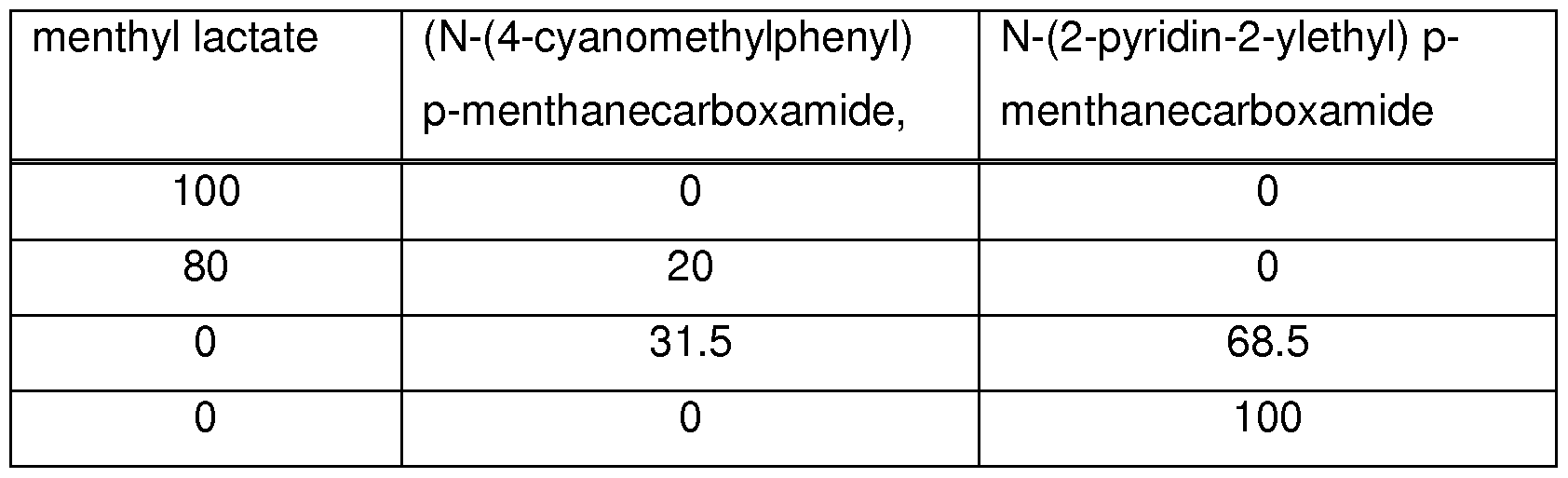
provides useful cooling properties to a wide variety of products. There is therefore provided a liquid cooling composition that is a mixture of (N-(4-cyanomethylphenyl) p- menthanecarboxamide, N-(2-pyridin-2-ylethyl) p-menthanecarboxamide and menthyl lactate, the composition being characterized in that, in a triangular ternary phase diagram 30 of (N-(4-cyanomethyl-phenyl) p-menthanecarboxamide, N-(2-pyridin-2-ylethyl) p- menthanecarboxamide and menthyl lactate, the composition falls within that portion of the diagram bounded by the coordinates of the following table:
35
menthyl lactate (N-(4-cyanomethylphenyl) N-(2-pyridin-2-ylethyl) p- p-menthanecarboxamide, menthanecarboxamide
100 0 0
80 20 0
0 31 .5 68.5
0 0 100
In a particular embodiment, the composition comprises all three materials.
Ternary phase diagrams having the form of a equilateral triangle and depicting a three- component system with one component per apex representing 100% of one component and a line from that apex perpendicular to the opposing side as the axis of that component are well known to the art and are standard methods of depicting such compositions.
Examples may be found in the figures. It is a particular feature of this disclosure that these compositions of cooling compounds are room-temperature eutectics, that is, they are liquid without the need for the addition of solvent. Not only does this mean reduced expense, but also that it is possible to get into products more of 180 and 190, both of which are poorly soluble in the normal solvents of the art.
A further unexpected advantage is that these compositions remain liquid when stored for long periods. This makes manufacture and utilization very easy and allows the provision of an excellent cooling effect. A particular embodiment includes the compositions defined on the ternary phase diagram as follows:
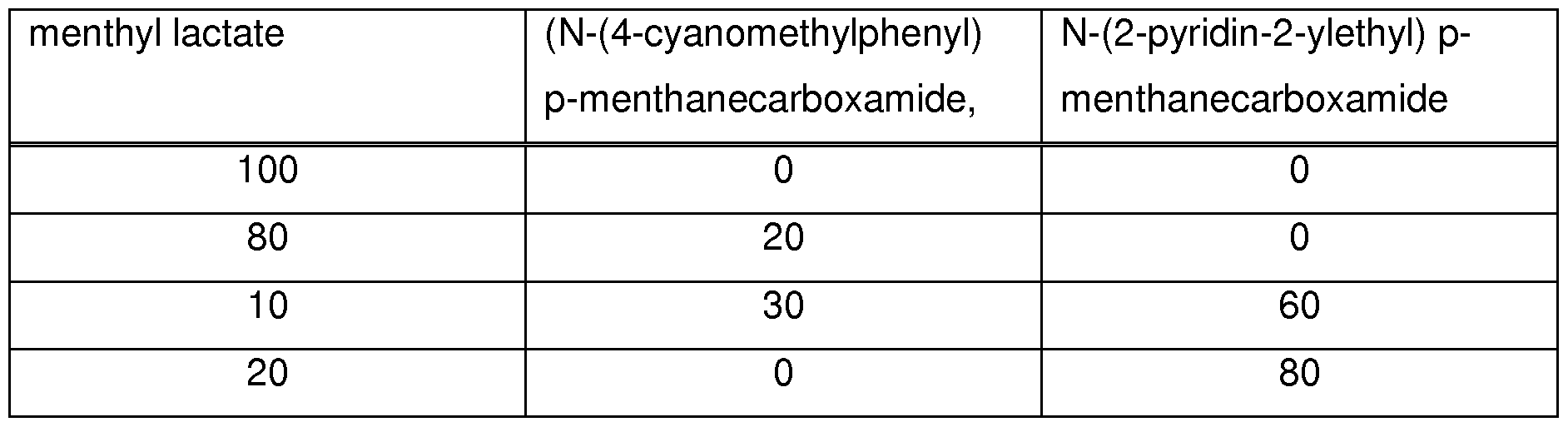
A further particular embodiment is as follows:
menthyl lactate (N-(4-cyanomethylphenyl) N-(2-pyridin-2-ylethyl) p- p-menthanecarboxamide, menthanecarboxamide
80 10 10
10 20 60
20 0 80
A further particular embodiment is as follows: menthyl lactate (N-(4-cyanomethylphenyl) N-(2-pyridin-2-ylethyl) p- p-menthanecarboxamide, menthanecarboxamide
20 20 60
40 20 40
50 10 40
20 10 70
The compositions are prepared by blending the desired components, heating them until they melt and then allowing the mixture to cool to ambient temperature.
The compositions may be pre-blended and stored. Not only are they liquid, making them easier to add and incorporate into compositions, but they are also remarkably stable.
The compositions may be added to any products in which a cooling effect on the skin or mucous membranes is desired. All three have been certified as GRAS (generally recognized as safe) by the US FEMA (Flavor and Extracts Manufacturers Association), the standard for use in consumable compositions, making them usable in any kind of product taken by mouth.
Non-limiting examples of products include the following: - Products that are applied to the oral mucosa, but that are not limited to foodstuffs and beverages taken into the mouth and swallowed, and products taken for reasons other than their nutritional value, e.g. tablets, troches, mouthwash, throat sprays, dentifrices and chewing gums, which may be applied to the oral mucosa for the purpose of cleaning, freshening, healing, and/or deodorising.
Products that are applied to the skin include, but are not limited to perfumes, toiletries, cosmetic products such as lotions, oils, ointments and bathing agents, applicable to the skin of the human body, whether for medical or other reasons.
Particular examples of foodstuffs and beverages include, but are not limited to frozen confectionery such as ice creams and sorbets; desserts such as jelly and pudding;
confectionery such as cakes, cookies, chocolates, and chewing gum; jams; candies; breads; tea beverages such as green tea, black tea, chamomile tea, mulberry leaf tea, Rooibos tea, peppermint tea; soups; seasonings; instant beverages; snack foods and the like.
Further examples of products for topical application may include, but are not limited to, skin-care cosmetics such as cleansing tissues, talcum powders, face creams, lotions, tonics and gels; hand creams, hand- and body lotions, anti-cellulite/slimming creams and -lotions, lotions, balms, gels, sprays and creams; sunburn cosmetics including sunscreen lotions, balms, gels, sprays and creams; after sun lotions, sprays and creams; soaps, toothpicks, lip sticks, agents for bathing, deodorants and antiperspirants, face washing creams, massage creams, and the like, Further examples of products that are applied to the oral mucosa may include, but are not limited to, oral care products such as toothpastes, tooth gels, tooth powders, tooth whitening products, dental floss, anti-plaque and anti-gingivitis compositions,
mouthwashes, compositions for treatment of nasal symptoms, and the like. The compositions have been found to be particularly useful and effective in such oral care products.
The compositions of the invention may be added to and incorporated into a product base by known methods. Sufficient may be added to provide a cooling effect. The necessary proportion to provide such an effect will naturally depend on the desired cooling effect, but typical weight proportions being from 5 to 5000mg/kg, more particularly from 50 to
1500mg/kg. These are general guidelines, not rigid boundaries, and formulators seeking particular effects may find it possible or even desirable to formulate outside them.
There is therefore also provided a product adapted to provide a cooling effect on the skin or the mucous membranes, the composition comprising a product base and a cooling proportion of a liquid cooling composition as hereinabove described. There is also provided a method of providing to a product a cooling sensation for the skin or the mucous membranes, comprising the addition to a product base of a cooling proportion of a liquid cooling composition as hereinabove described.
By "product base" is meant all the components of a product other than the liquid cooling mixture. These can vary considerably, depending on the nature of the product. For example, a consumable product cannot have non-consumable ingredients.
Typical non-limiting examples of components for use in product bases include matrix materials both liquid and solid, including gums, starches and starch derivatives, polysaccharides and polymeric materials both natural and artificial, flavours and fragrances, pigments, dyestuffs and colouring matters, solvents, thickeners, rheology and viscosity modifiers, surfactants and dispersion aids, preservatives, bactericides and fungicides. The final product not only has an enhanced cooling effect with respect to the addition of the equivalent amount of powder, but it is also is free from the potentially irritant effects of undissolved powders on skin on mucous membranes.
In addition to an enhanced performance, the handling of the liquid blend during manufacture of products is much easier than with powders, a feature that is particularly significant on an industrial scale, in which the handling of powders, especially those of potent cooling compounds, present a potentially considerable irritant problem for workers, as well as a potential explosion hazard. The disclosure is further described with reference to the following non-limiting examples.
Figure 1 depicts a ternary phase diagram, defining the outer limits of the claimed range of compositions. Figure 2 depicts a further ternary phase diagram, defining a particular embodiment of the claimed range of compositions.
Figure 3 depicts a further ternary phase diagram, defining a particular embodiment of th claimed range of compositions. Figure 4 depicts a further ternary phase diagram, defining a particular embodiment of th claimed range of compositions.
The figures are derived from the testing of a range of combinations of the three cooling compounds, the actual results being shown in the following table:
"180" "190" menthyl lactate After Heating On cooling On standing %w/w %w/w %w/w to 100<€ to 20*€ 7days @ 20°C
0 0 100 Liquid Solid
12 10 78 Liquid Liquid Liquid + Haze 20 20 60 Liquid Liquid Liquid + Haze 12 30 58 Liquid Liquid Liquid 50 0 50 Liquid + Solids - 0 50 50 Liquid Liquid Liquid
26 26 48 Liquid Liquid + Solids
20 36 44 Liquid Liquid Liquid 15 50 35 Liquid Liquid Liquid 25 45 30 Liquid Liquid Liquid 50 20 30 Liquid + Solids - 10 80 10 Liquid Liquid Liquid 30 60 10 Liquid Liquid Liquid + Solids 50 40 10 Liquid + Solids - 70 20 10 Liquid + Solids - 100 0 0 Solid - 0 100 0 Liquid Solid
The various combinations were tested by first heating to Ι ΟΟ 'Ό, then again after allowing them to cool to 20 ^ and finally observations after standing for 7 days at 20 °C.
The various results are evaluated this:
Liquid - most desirable
Liquid + haze - not so desirable, but usable
Liquid + solids - undesirable
Solid - undesirable
Blank - previous result undesirable, so not tested further.
It can be seen that the most desirable combinations are liquid and remain liquid over a long period, making them easy to prepare and store.
Example
A mouthwash base was prepared by combining the following components...
To samples of the base were added 0.02%w/w of a combination of 180, 190 and menthyl lactate in the weight proportions 15:50:35. In one case, the combination was added as a mixture of the individual solid powders, in the other case as a liquid blend as hereinabove described.
It was noticeable that parts of the solid powders were difficult to dissolve, some proportion not dissolving at all. On the other hand, the liquid blend was easily incorporated into the base, and there is assurance that the blend has been homogeneously distributed through the mouthwash.
The resulting toothpaste formulations were tested by a panel of experienced testers. It was found that the formulations containing the liquid blend gave a noticeably enhanced cooling effect compared with the powders, even though the same proportions were used. It is believed that the difficulty of dissolving the powders was responsible for the lower cooling effect.
In addition, the addition of the liquid blend was much easier than with the powder, and the final product is free from the potentially irritant effects of undissolved powders on skin on mucous membranes.
Claims
Claims:
1 . A liquid cooling composition that is a mixture of (N-(4-cyanomethylphenyl) p- menthanecarboxamide, N-(2-pyridin-2-ylethyl) p-menthanecarboxamide and menthyl lactate, the composition being characterized in that, in a triangular ternary phase diagram of (N-(4-cyanomethyl-phenyl) p-menthanecarboxamide, N-(2- pyridin-2-ylethyl) p-menthanecarboxamide and menthyl lactate, the composition falls within that portion of the diagram bounded by the coordinates of the following table:
2. A liquid cooling mixture according to claim 1 , in which the mixture within that portion of the diagram bounded by the coordinates of the following table:

A liquid cooling mixture according to claim 1 , in which the mixture within that portion of the diagram bounded by the coordinates of the following table:
menthyl lactate (N-(4-cyanomethylphenyl) N-(2-pyridin-2-ylethyl) p- p-menthanecarboxamide, menthanecarboxamide
80 10 10
10 20 60
20 0 80
4. A liquid cooling mixture according to claim 1 , in which the mixture within that portion of the diagram bounded by the coordinates of the following table:

5. A liquid cooling mixture according to any one of claims 1 -4, in which all three
components are present in the mixture.
6. A product comprising a product base and a cooling effect-providing proportion of a liquid cooling composition according to claim 1 . 7. A product according to claim 6, in which the proportion of liquid cooling
composition is from 5 to 5000mg/kg, particularly from 50 to 1500mg/kg
8. A product according to claim 6, in which the product is an oral care product. 9. A method of providing to a product a cooling sensation for the skin or the mucous membranes, comprising the addition to a product base of a cooling effect-providing proportion of a liquid cooling composition according to claim 1 .
Applications Claiming Priority (2)
| Application Number | Priority Date | Filing Date | Title |
|---|---|---|---|
| GBGB1703136.0A GB201703136D0 (en) | 2017-02-27 | 2017-02-27 | Compositions |
| GB1703136.0 | 2017-02-27 |
Publications (1)
| Publication Number | Publication Date |
|---|---|
| WO2018154102A1 true WO2018154102A1 (en) | 2018-08-30 |
Family
ID=58544330
Family Applications (1)
| Application Number | Title | Priority Date | Filing Date |
|---|---|---|---|
| PCT/EP2018/054633 Ceased WO2018154102A1 (en) | 2017-02-27 | 2018-02-26 | Cooling compositions |
Country Status (2)
| Country | Link |
|---|---|
| GB (1) | GB201703136D0 (en) |
| WO (1) | WO2018154102A1 (en) |
Cited By (1)
| Publication number | Priority date | Publication date | Assignee | Title |
|---|---|---|---|---|
| WO2026040627A1 (en) * | 2024-08-22 | 2026-02-26 | 思摩尔国际控股有限公司 | Cooling agent composition, cooling agent solution, atomizing liquid and atomizer |
Citations (5)
| Publication number | Priority date | Publication date | Assignee | Title |
|---|---|---|---|---|
| US4190643A (en) * | 1971-02-04 | 1980-02-26 | Wilkinson Sword Limited | Compositions having a physiological cooling effect |
| EP1750525A2 (en) * | 2004-05-28 | 2007-02-14 | Millennium Specialty Chemicals, Inc. | Physiological cooling compositions |
| US20110091531A1 (en) * | 2008-05-22 | 2011-04-21 | Giv Audan Sa | Cooling Composition |
| US20150313817A1 (en) * | 2012-11-27 | 2015-11-05 | Basf Se | Composition of menthol and menthyl lactate, its preparation and its use as a cooling, flavouring and/or fragrance agent |
| EP1556332B1 (en) * | 2002-10-28 | 2016-10-05 | Givaudan SA | Coolant solutions and compositions comprising the same |
-
2017
- 2017-02-27 GB GBGB1703136.0A patent/GB201703136D0/en not_active Ceased
-
2018
- 2018-02-26 WO PCT/EP2018/054633 patent/WO2018154102A1/en not_active Ceased
Patent Citations (5)
| Publication number | Priority date | Publication date | Assignee | Title |
|---|---|---|---|---|
| US4190643A (en) * | 1971-02-04 | 1980-02-26 | Wilkinson Sword Limited | Compositions having a physiological cooling effect |
| EP1556332B1 (en) * | 2002-10-28 | 2016-10-05 | Givaudan SA | Coolant solutions and compositions comprising the same |
| EP1750525A2 (en) * | 2004-05-28 | 2007-02-14 | Millennium Specialty Chemicals, Inc. | Physiological cooling compositions |
| US20110091531A1 (en) * | 2008-05-22 | 2011-04-21 | Giv Audan Sa | Cooling Composition |
| US20150313817A1 (en) * | 2012-11-27 | 2015-11-05 | Basf Se | Composition of menthol and menthyl lactate, its preparation and its use as a cooling, flavouring and/or fragrance agent |
Cited By (1)
| Publication number | Priority date | Publication date | Assignee | Title |
|---|---|---|---|---|
| WO2026040627A1 (en) * | 2024-08-22 | 2026-02-26 | 思摩尔国际控股有限公司 | Cooling agent composition, cooling agent solution, atomizing liquid and atomizer |
Also Published As
| Publication number | Publication date |
|---|---|
| GB201703136D0 (en) | 2017-04-12 |
Similar Documents
| Publication | Publication Date | Title |
|---|---|---|
| US7208480B2 (en) | Polysaccharide based gel | |
| EP1556332B1 (en) | Coolant solutions and compositions comprising the same | |
| JP2008502656A5 (en) | ||
| JP4261744B2 (en) | Oral composition | |
| WO2014157547A1 (en) | Composition for oral cavity | |
| JPH0665023A (en) | Frigid agent and frigid composition composed of @(3754/24)-)-isopulegol | |
| JPH08310931A (en) | Inhibitor of glucosyltransferase and cleaning agent for oral cavity | |
| JP7034612B2 (en) | Oral composition | |
| JP6599515B2 (en) | Astringent composition | |
| JP6505358B2 (en) | Astringent composition | |
| TW201728320A (en) | Synergistic effects of alkanolamine alkylamides and other moisturizing agents | |
| CN112041030B (en) | non-aqueous oral care composition | |
| JP6489736B2 (en) | Low astringency composition | |
| CN116744890A (en) | Oral composition | |
| JP5720416B2 (en) | Gel oral composition and method for producing the same | |
| JP6628839B2 (en) | Astringent composition | |
| JP2022085871A (en) | Oral composition | |
| CN111479548B (en) | oral composition | |
| JP2003267816A (en) | Cosmetics | |
| JP6348267B2 (en) | Astringent composition | |
| JP2026031128A (en) | Oral composition | |
| JP2026031218A (en) | Oral composition | |
| WO2022145160A1 (en) | Composition for oral cavity | |
| WO2024142417A1 (en) | Active ingredient-retaining agent | |
| JPS62410A (en) | Cosmetic |
Legal Events
| Date | Code | Title | Description |
|---|---|---|---|
| 121 | Ep: the epo has been informed by wipo that ep was designated in this application |
Ref document number: 18708086 Country of ref document: EP Kind code of ref document: A1 |
|
| NENP | Non-entry into the national phase |
Ref country code: DE |
|
| 122 | Ep: pct application non-entry in european phase |
Ref document number: 18708086 Country of ref document: EP Kind code of ref document: A1 |