WO2018129205A1 - Methods of inhibiting pcsk9 - Google Patents
Methods of inhibiting pcsk9 Download PDFInfo
- Publication number
- WO2018129205A1 WO2018129205A1 PCT/US2018/012411 US2018012411W WO2018129205A1 WO 2018129205 A1 WO2018129205 A1 WO 2018129205A1 US 2018012411 W US2018012411 W US 2018012411W WO 2018129205 A1 WO2018129205 A1 WO 2018129205A1
- Authority
- WO
- WIPO (PCT)
- Prior art keywords
- aryl
- het
- alkyl
- alkynyl
- alkenyl
- Prior art date
- Legal status (The legal status is an assumption and is not a legal conclusion. Google has not performed a legal analysis and makes no representation as to the accuracy of the status listed.)
- Ceased
Links
- 0 *C1(C(B2)CCC3C2=O)C3(*=I)c2ccccc2*1 Chemical compound *C1(C(B2)CCC3C2=O)C3(*=I)c2ccccc2*1 0.000 description 4
- WWSZVYGYCJVOAU-WTQRLHSKSA-N CC12c3ccccc3N(Cc3ccccc3)[C@H]1Nc1ccccc1C2 Chemical compound CC12c3ccccc3N(Cc3ccccc3)[C@H]1Nc1ccccc1C2 WWSZVYGYCJVOAU-WTQRLHSKSA-N 0.000 description 1
- PPPJKCUEARIZCW-MOPGFXCFSA-N CCC[C@]1(C2)c3ccccc3N(C)[C@H]1Nc1c2cccc1 Chemical compound CCC[C@]1(C2)c3ccccc3N(C)[C@H]1Nc1c2cccc1 PPPJKCUEARIZCW-MOPGFXCFSA-N 0.000 description 1
- MITPCRYLQSFXNK-PKTZIBPZSA-N CN1c2ccccc2[C@@]2(Cc3ccccc3)[C@@H]1Nc1ccccc1C2 Chemical compound CN1c2ccccc2[C@@]2(Cc3ccccc3)[C@@H]1Nc1ccccc1C2 MITPCRYLQSFXNK-PKTZIBPZSA-N 0.000 description 1
Classifications
-
- A—HUMAN NECESSITIES
- A61—MEDICAL OR VETERINARY SCIENCE; HYGIENE
- A61K—PREPARATIONS FOR MEDICAL, DENTAL OR TOILETRY PURPOSES
- A61K31/00—Medicinal preparations containing organic active ingredients
- A61K31/33—Heterocyclic compounds
- A61K31/395—Heterocyclic compounds having nitrogen as a ring hetero atom, e.g. guanethidine or rifamycins
- A61K31/40—Heterocyclic compounds having nitrogen as a ring hetero atom, e.g. guanethidine or rifamycins having five-membered rings with one nitrogen as the only ring hetero atom, e.g. sulpiride, succinimide, tolmetin, buflomedil
- A61K31/403—Heterocyclic compounds having nitrogen as a ring hetero atom, e.g. guanethidine or rifamycins having five-membered rings with one nitrogen as the only ring hetero atom, e.g. sulpiride, succinimide, tolmetin, buflomedil condensed with carbocyclic rings, e.g. carbazole
- A61K31/404—Indoles, e.g. pindolol
-
- A—HUMAN NECESSITIES
- A61—MEDICAL OR VETERINARY SCIENCE; HYGIENE
- A61K—PREPARATIONS FOR MEDICAL, DENTAL OR TOILETRY PURPOSES
- A61K31/00—Medicinal preparations containing organic active ingredients
- A61K31/33—Heterocyclic compounds
- A61K31/395—Heterocyclic compounds having nitrogen as a ring hetero atom, e.g. guanethidine or rifamycins
- A61K31/40—Heterocyclic compounds having nitrogen as a ring hetero atom, e.g. guanethidine or rifamycins having five-membered rings with one nitrogen as the only ring hetero atom, e.g. sulpiride, succinimide, tolmetin, buflomedil
- A61K31/407—Heterocyclic compounds having nitrogen as a ring hetero atom, e.g. guanethidine or rifamycins having five-membered rings with one nitrogen as the only ring hetero atom, e.g. sulpiride, succinimide, tolmetin, buflomedil condensed with other heterocyclic ring systems, e.g. ketorolac, physostigmine
-
- A—HUMAN NECESSITIES
- A61—MEDICAL OR VETERINARY SCIENCE; HYGIENE
- A61K—PREPARATIONS FOR MEDICAL, DENTAL OR TOILETRY PURPOSES
- A61K31/00—Medicinal preparations containing organic active ingredients
- A61K31/33—Heterocyclic compounds
- A61K31/395—Heterocyclic compounds having nitrogen as a ring hetero atom, e.g. guanethidine or rifamycins
- A61K31/435—Heterocyclic compounds having nitrogen as a ring hetero atom, e.g. guanethidine or rifamycins having six-membered rings with one nitrogen as the only ring hetero atom
- A61K31/47—Quinolines; Isoquinolines
- A61K31/4748—Quinolines; Isoquinolines forming part of bridged ring systems
-
- A—HUMAN NECESSITIES
- A61—MEDICAL OR VETERINARY SCIENCE; HYGIENE
- A61K—PREPARATIONS FOR MEDICAL, DENTAL OR TOILETRY PURPOSES
- A61K31/00—Medicinal preparations containing organic active ingredients
- A61K31/33—Heterocyclic compounds
- A61K31/395—Heterocyclic compounds having nitrogen as a ring hetero atom, e.g. guanethidine or rifamycins
- A61K31/435—Heterocyclic compounds having nitrogen as a ring hetero atom, e.g. guanethidine or rifamycins having six-membered rings with one nitrogen as the only ring hetero atom
- A61K31/47—Quinolines; Isoquinolines
- A61K31/475—Quinolines; Isoquinolines having an indole ring, e.g. yohimbine, reserpine, strychnine, vinblastine
-
- A—HUMAN NECESSITIES
- A61—MEDICAL OR VETERINARY SCIENCE; HYGIENE
- A61K—PREPARATIONS FOR MEDICAL, DENTAL OR TOILETRY PURPOSES
- A61K9/00—Medicinal preparations characterised by special physical form
- A61K9/0012—Galenical forms characterised by the site of application
- A61K9/0053—Mouth and digestive tract, i.e. intraoral and peroral administration
-
- A—HUMAN NECESSITIES
- A61—MEDICAL OR VETERINARY SCIENCE; HYGIENE
- A61P—SPECIFIC THERAPEUTIC ACTIVITY OF CHEMICAL COMPOUNDS OR MEDICINAL PREPARATIONS
- A61P3/00—Drugs for disorders of the metabolism
- A61P3/06—Antihyperlipidemics
-
- C—CHEMISTRY; METALLURGY
- C07—ORGANIC CHEMISTRY
- C07D—HETEROCYCLIC COMPOUNDS
- C07D209/00—Heterocyclic compounds containing five-membered rings, condensed with other rings, with one nitrogen atom as the only ring hetero atom
- C07D209/56—Ring systems containing three or more rings
- C07D209/80—[b, c]- or [b, d]-condensed
-
- C—CHEMISTRY; METALLURGY
- C07—ORGANIC CHEMISTRY
- C07D—HETEROCYCLIC COMPOUNDS
- C07D209/00—Heterocyclic compounds containing five-membered rings, condensed with other rings, with one nitrogen atom as the only ring hetero atom
- C07D209/56—Ring systems containing three or more rings
- C07D209/80—[b, c]- or [b, d]-condensed
- C07D209/82—Carbazoles; Hydrogenated carbazoles
- C07D209/86—Carbazoles; Hydrogenated carbazoles with only hydrogen atoms, hydrocarbon or substituted hydrocarbon radicals, directly attached to carbon atoms of the ring system
-
- C—CHEMISTRY; METALLURGY
- C07—ORGANIC CHEMISTRY
- C07D—HETEROCYCLIC COMPOUNDS
- C07D209/00—Heterocyclic compounds containing five-membered rings, condensed with other rings, with one nitrogen atom as the only ring hetero atom
- C07D209/56—Ring systems containing three or more rings
- C07D209/80—[b, c]- or [b, d]-condensed
- C07D209/94—[b, c]- or [b, d]-condensed containing carbocyclic rings other than six-membered
-
- C—CHEMISTRY; METALLURGY
- C07—ORGANIC CHEMISTRY
- C07D—HETEROCYCLIC COMPOUNDS
- C07D405/00—Heterocyclic compounds containing both one or more hetero rings having oxygen atoms as the only ring hetero atoms, and one or more rings having nitrogen as the only ring hetero atom
- C07D405/02—Heterocyclic compounds containing both one or more hetero rings having oxygen atoms as the only ring hetero atoms, and one or more rings having nitrogen as the only ring hetero atom containing two hetero rings
- C07D405/04—Heterocyclic compounds containing both one or more hetero rings having oxygen atoms as the only ring hetero atoms, and one or more rings having nitrogen as the only ring hetero atom containing two hetero rings directly linked by a ring-member-to-ring-member bond
-
- C—CHEMISTRY; METALLURGY
- C07—ORGANIC CHEMISTRY
- C07D—HETEROCYCLIC COMPOUNDS
- C07D409/00—Heterocyclic compounds containing two or more hetero rings, at least one ring having sulfur atoms as the only ring hetero atoms
- C07D409/02—Heterocyclic compounds containing two or more hetero rings, at least one ring having sulfur atoms as the only ring hetero atoms containing two hetero rings
- C07D409/04—Heterocyclic compounds containing two or more hetero rings, at least one ring having sulfur atoms as the only ring hetero atoms containing two hetero rings directly linked by a ring-member-to-ring-member bond
Definitions
- PCSK9 Proprotein convertase subtilisin/kexin type 9
- NARC-1 neural apoptosis-regulated convertase
- PCSK9 is a proteinase K-like subtilase identified as the ninth member of the secretory subtilase family.
- LDLR LDL receptor
- a method for reducing the PCSK9 level in a subject comprising administering to the subject an effective amount of a compound of Formula I, or a pharmaceutically acceptable stereoisomer, isotope, solvate or salt thereof:
- X is O, S, CR 2 or NR 1 ;
- Y is, for each occurrence, independently N or C(R6) ;
- Z 1 is CH 2 , CH(R 5 ), C(R 5 ) 2 or is absent;
- Z 2 is CH 2 , CH(R 5 ), C(R 5 ) 2 , NR 2 or is absent;
- R a and R b are absent, or independently selected from hydrogen, alkyl, hydroxyl, and amino; wherein R a and R b may combine to form a 5- or 6-membered ring;
- R 1 is hydrogen, alkyl, alkenyl, alkynyl or aryl
- R 2 is, for each occurrence, independently selected from the group consisting of hydrogen, halogen, haloalkyi, alkyl, alkoxy, alkenyl, alkynyl, cycloalkyl,
- R 3 is selected from the group consisting of hydrogen, halogen, haloalkyi, alkyl, alkoxy, alkenyl, alkynyl, cycloalkyl, cycloalkenyl, Het, aryl, -NHR 7 , -NHHet, -
- R 4 is selected from the group consisting of hydrogen, halogen, haloalkyi, alkyl, alkoxy, alkenyl, alkynyl, cycloalkyl, cycloalkenyl, Het, aryl, -NHR 7 , -NHHet, - NHR 7 Het, -OR 8 , -O-aryl, -OHet, -R 7 OR 8 , -NR 8 R 9 , -NR 8 -aryl, -R 7 NR 8 R 9 , -R 7 NR 8 -aryl, - R 7 C(O)R 8 , -C(O)R 8 , -CO 2 R 8 , -R 7 CO 2 R 8 , -C(O)NR 8 R 9 , -C(O)aryl, -C(O)NR 8 aryl, - C(O)Het, -C(O)NHR 7 Het, -R 7 C(O)
- R 7 (NH)NR 8 R 9 , -C(NH)NR 8 R 9 , -R 7 C(NH)NR 8 R 9 , -S(O) 2 NR 8 R 9 , -S(O) 2 N R 8 aryl, - R 7 SO 2 NHCOR 8 , -R 7 SO 2 NR 8 R 9 , -R 7 SO 2 R 8 , -S(O) m R 8 , cyano, nitro, and azido;
- R 5 is, for each occurrence, independently selected from the group consisting of halogen, haloalkyi, alkyl, alkoxy, alkenyl, alkynyl, cycloalkyi, cycloalkenyl, Het, aryl, -NHR 7 , -NHHet, -NHR 7 Het, oxo, -OR 8 , -O-aryl, -OHet, -R 7 OR 8 , -NR 8 R 9
- R 6 is, for each occurrence, independently selected from hydrogen, halogen, haloalkyi, alkyl, alkoxy, alkenyl, alkynyl, cycloalkyi, cycloalkenyl, -R 7 -cycloalkyl, aryl, - NHR 7 , Het, -NHHet, -NHR 7 Het, -OR 8 , -O-aryl, -OHet, -R 7 OR 8 , -NR 8 R 9 , -NR 8 -aryl, - R 7 NR 8 R 9 , -R 7 NR 8 -aryl, -R 7 C(O)R 8 , -C(O)R 8 , -CO 2 R 8 , -R 7 CO 2 R 8 , -C(O)NR 8 R 9 , - C(O)aryl, -C(O)NR 8 aryl, -C(O)Het, -C(O)
- R 7 is independently selected from an alkyl, cycloalkyi alkenyl, cycloalkenyl and alkynyl
- R 8 is independently selected from the group of hydrogen, an alkyl, alkoxy, alkenyl, alkynyl, cycloalkyi, cycloalkenyl, -R 7 cycloalkyl, -R 7 OH, -R 7 (OR 7 ) w , and - R 7 NR 10 R 11 group;
- R 9 is independently selected from the group of hydrogen, an alkyl, alkoxy, alkenyl, alkynyl, cycloalkyi, cycloalkenyl, -R 7 cycloalkyl, -R 7 OH, -R 7 (OR 7 ) w , and - R 7 NR 10 R 11 group;
- R 10 and R 1 1 are the same or different and are independently selected from the group of alkyl, cycloalkyi, alkenyl, cycloalkenyl, and alkynyl;
- n for each occurrence, independently is 0, 1 or 2;
- n 0, 1 , 2, 3, 4, 5 or 6;
- w is an integer selected from 1 -1 0;
- R 2 , R 3 , R 4 and R 5 , or two R 5 may combine to form a 5- or 6- membered ring.
- a method for reducing the PCSK9 level in a subject comprising administering to the subject an effective amount of a compound of Formula I I, III, or IV, or a pharmaceu
- a and B are independently O, NR 1 , CH 2 , CH(R 5 ), C(R 5 ) 2 , or are absent;
- X is NR 1 ;
- Z 1 is CH 2 , CH(R 5 ), C(R 5 ) 2 or is absent;
- Z 2 is CH 2 , CH(R 5 ), C(R 5 ) 2 , or is absent; or wherein Z 1 and Z 2 together form a C:1 -3 carbocyclic bridge;
- R a and R b are absent, or are independently selected from hydrogen, alkyl, hydroxyl, hydroxyalkyi, aryl, benzyl, and amino; or wherein R a and R b together a 5- or 6-membered cycloalkyl or heterocycloalkyl with one or more heteroatoms independently selected from O or NR 1 ;
- R 1 is hydrogen, alkyl, alkenyl, alkynyl, aryl, benzyl, or alkylene optionally substituted with aryl;
- R 2 is, for each occurrence, independently selected from the group consisting of hydrogen, halogen, haloalkyl, alkyl, alkoxy, alkenyl, alkynyl, cycloalkyl, cycloalkenyl, -R 7 -cycloalkyl, aryl, -NHR 7 , Het, -NHHet, -NHR 7 Het, -OR 8 , -O-aryl, - OHet, -R 7 OR 8 , -NR 8 R 9 , -NR 8 -aryl, -R 7 NR 8 R 9 , -R 7 NR 8 -aryl, -R 7 C(O)R 8 , -C(O)R 8 , - CO 2 R 8 , -R 7 CO 2 R 8 , -C(O)NR 8 R 9 , -C(O)aryl, -C(O)Het,
- R 3 is selected from the group consisting of hydrogen, halogen, haloalkyi, alkyl, alkoxy, alkenyl, alkynyl, cycloalkyl, cycloalkenyl, Het, aryl, -NHR 7 , -NHHet, -R 7 Het, - NHR 7 Het, -OR 8 , -O-aryl, -OHet, -R 7 OR 8 , -NR 8 R 9 , -NR 8 -aryl, -R 7 NR 8 R 9 , -R 7 NR 8 -aryl, - R 7 C(O)R 8 , -C(O)R 8 , -CO 2 R 8 , -R 7 CO 2 R 8 , -C(O)NR 8 R 9 , -C(O)aryl, -C(O)NR 8 aryl, - C(O)Het, -C(O)NHR 7 Het,
- R 4 is selected from the group consisting of hydrogen, halogen, haloalkyi, alkyl, alkoxy, alkenyl, alkynyl, cycloalkyl, cycloalkenyl, Het, aryl, -NHR 7 , -NHHet, -R 7 Het - NHR 7 Het, -OR 8 , -O-aryl, -OHet, -R 7 OR 8 , -NR 8 R 9 , -NR 8 -aryl, -R 7 NR 8 R 9 , -R 7 NR 8 -aryl, - R 7 C(O)R 8 , -C(O)R 8 , -CO 2 R 8 , -R 7 CO 2 R 8 , -C(O)NR 8 R 9 , -C(O)aryl, -C(O)NR 8 aryl, - C(O)Het, -C(O)NHR 7 Het, -
- R 7 (NH)NR 8 R 9 , -C(NH)NR 8 R 9 , -R 7 C(NH)NR 8 R 9 , -S(O) 2 NR 8 R 9 , -S(O) 2 N R 8 aryl, - R 7 SO 2 NHCOR 8 , -R 7 SO 2 NR 8 R 9 , -R 7 SO 2 R 8 , -S(O) m R 8 , cyano, nitro, and azido;
- R 3 and R 4 together may combine to form a 4, 5, or 6 member cycloalkyl, aryl, or Het;
- R 5 is, for each occurrence, independently selected from the group consisting of hydrogen, halogen, haloalkyi, alkyl, alkoxy, alkenyl, alkynyl, cycloalkyl,
- R 7 is independently selected from an alkyl, cycloalkyl alkenyl, cycloalkenyl and alkynyl;
- R 8 is independently selected from the group of hydrogen, an alkyl, alkoxy, alkenyl, alkynyl, cycloalkyl, cycloalkenyl, -R 7 cycloalkyl, -R 7 OH, -R 7 (OR 7 ) w , and - R 7 NR 10 R 11 group;
- R 9 is independently selected from the group of hydrogen, an alkyl, alkoxy, alkenyl, alkynyl, cycloalkyl, cycloalkenyl, -R 7 cycloalkyl, -R 7 OH, -R 7 (OR 7 ) w , and - R 7 NR 10 R 11 group;
- R 10 and R 1 1 are the same or different and are independently selected from the group of alkyl, cycloalkyl, alkenyl, cycloalkenyl, and alkynyl;
- n for each occurrence, independently is 0, 1 or 2;
- n for each occurrence, independently is 0, 1 , 2, 3, 4, 5 or 6;
- R 2 , R 3 , R 4 and R 5 , or two R 5 may combine to form a 5- or
- the PCSK9 level is reduced by at least 10%, 20%, 30%, 40%, 50%, 60%, 70%, or 80% compared to the PCSK9 level in the subject prior to administering the compound of Formula I.
- levels of both the pro-protein and mature forms of PCSK9 are reduced.
- the secretion of PCSK9 is inhibited.
- the production of PCSK9 is inhibited.
- the level of low density lipoprotein receptor is the level of low density lipoprotein receptor
- LDLR low density lipoprotein
- a method of treating or preventing a condition associated with an elevated level of LDL comprising administering to a subject in need of such treatment an effective amount of a compound of Formula I.
- the compound of Formula I is administered orally.
- the level of LDL in the subject is reduced.
- the PCSK9 level in the subject is reduced.
- the hepatic level of LDLR in the subject is increased.
- condition associated with an elevated level of LDL is selected from the group consisting of hypercholesterolemia,
- hyperlipidemia hyperlipidemia, dyslipidemia, metabolic syndrome, a diabetic condition, heart disease, cardiovascular disease, an atherosclerotic disease, stroke and Alzheimer's disease.
- the method further comprises administering one or more of additional active agents.
- the additional active agent is selected from the group consisting of a statin, ACE inhibitor, Angiotensin II receptor blocker (ARB), antiarrhythmic agent, antiplatelet agent, anti-clotting agent, anti- cholesterol agent, anti-diabetic agent, diuretic, vasodilator, blood thinner, beta blocker, amiodarone, digoxin, and aspirin.
- the compound of Formula I or Formula II has the structure of Formula I la:
- dashed bonds independently, may be present or absent;
- X is NR 1 ;
- R a and R b are absent, or independently selected from hydrogen, alkyl, hydroxyl, and hydroxyalkyl;
- R 1 is hydrogen, alkyl, alkenyl, alkynyl aryl, benzyl, or alkylene optionally substituted with aryl;
- R 2 is, for each occurrence, independently selected from the group consisting of hydrogen, halogen, haloalkyi, alkyl, alkoxy, alkenyl, alkynyl, cycloalkyl,
- R 3 is selected from the group consisting of hydrogen, halogen, haloalkyi, alkyl, alkoxy, alkenyl, alkynyl, cycloalkyl, cycloalkenyl, Het, -C0 2 R 8 , aryl, and aryl substituted with alkoxy or haloalkyi;
- R 4 is selected from the group consisting of hydrogen, halogen, haloalkyi, alkyl, alkoxy, alkenyl, alkynyl, cycloalkyl, cycloalkenyl, Het, -CO2R 8 , aryl, and aryl substituted with alkoxy or haloalkyi;
- R 3 and R 4 together may combine to form a 4, 5, or 6 member cycloalkyl
- R 5 is, for each occurrence, independently selected from the group consisting of hydrogen, halogen, haloalkyi, alkyl, alkoxy, alkenyl, alkynyl, cycloalkyl, oxo, cycloalkenyl, Het, aryl, substituted aryl; and wherein n is 0, 1 , 2, 3, or 4.
- the compound of Formula lla has a structure selected from the following:
- X is NR 1 ;
- R 1 is hydrogen, alkyl, alkenyl, alkynyl, aryl, benzyl, or alkylene optionally substituted with aryl;
- R 2 is, for each occurrence, independently selected from the group consisting of hydrogen, halogen, haloalkyi, alkyl, alkoxy, alkenyl, alkynyl, cycloalkyl,
- R 3 is selected from the group consisting of hydrogen, halogen, haloalkyi, alkyl, alkoxy, alkenyl, alkynyl, cycloalkyl, cycloalkenyl, Het, -C0 2 R 8 , aryl; aryl substituted with alkoxy, haloalkyi;
- R 4 is selected from the group consisting of hydrogen, halogen, haloalkyi, alkyl, alkoxy, alkenyl, alkynyl, cycloalkyl, cycloalkenyl, Het, -C0 2 R 8 , aryl; aryl substituted with alkoxy, haloalkyi;
- R 3 and R 4 together may combine to form a 4, 5, or 6 member cycloalkyl
- R 5 is, for each occurrence, independently selected from the group consisting of hydrogen, halogen, haloalkyi, alkyl, alkoxy, alkenyl, alkynyl, cycloalkyl,
- n 0, 1 , 2, 3, or 4.
- the compound of Formula I or II has the structure of Formula l ib:
- X is NR 1 ;
- R 1 is hydrogen, alkyl, alkenyl, alkynyl, aryl, benzyl, or alkylene optionally substituted with aryl;
- R 2 is, for each occurrence, independently selected from the group consisting of hydrogen, halogen, haloalkyi, alkyl, alkoxy, alkenyl, alkynyl, cycloalkyl,
- R 3 is selected from the group consisting of hydrogen, halogen, haloalkyi, alkyl, alkoxy, alkenyl, alkynyl, cycloalkyl, cycloalkenyl, Het, -CO2R 8 , aryl; aryl substituted with alkoxy, haloalkyi;
- R 4 is selected from the group consisting of hydrogen, halogen, haloalkyi, alkyl, alkoxy, alkenyl, alkynyl, cycloalkyl, cycloalkenyl, Het, -C0 2 R 8 , aryl; aryl substituted with alkoxy, haloalkyi;
- R 3 and R 4 together may combine to form a 4, 5, or 6 member cycloalkyl
- R 5 is, for each occurrence, independently selected from the group consisting of hydrogen, halogen, haloalkyi, alkyl, alkoxy, alkenyl, alkynyl, cycloalkyl,
- n 0, 1 , 2, 3 or 4.
- the compound of Formula lib is selected from compounds lib 1 and lib 2 :
- R 1 is hydrogen, alkyl, alkenyl, alkynyl, aryl, benzyl, or alkylene optionally substituted with aryl;
- R 2 is, for each occurrence, independently selected from the group consisting of hydrogen, halogen, haloalkyi, alkyl, alkoxy, alkenyl, alkynyl, cycloalkyl,
- R 3 is selected from the group consisting of hydrogen, halogen, haloalkyi, alkyl, alkoxy, alkenyl, alkynyl, cycloalkyi, cycloalkenyl, Het, -C0 2 R 8 , aryl; aryl substituted with alkoxy, haloalkyi;
- R 4 is selected from the group consisting of hydrogen, halogen, haloalkyi, alkyl, alkoxy, alkenyl, alkynyl, cycloalkyi, cycloalkenyl, Het, -CO2R 8 , aryl; aryl substituted with alkoxy, haloalkyi;
- R 5 is, for each occurrence, independently selected from the group consisting of hydrogen, halogen, haloalkyi, alkyl, alkoxy, oxo, alkenyl, alkynyl, cycloalkyi, cycloalkenyl, Het, aryl, substituted aryl, oxo, and wherein n is 0, 1 , 2, 3 or 4.
- the compound of Formula I or Formula II has the structure of Formula l ie 1
- X is NR 1 ;
- R 1 is hydrogen, alkyl, alkenyl, alkynyl, aryl, benzyl, or alkylene optionally substituted with aryl;
- R 2 is, for each occurrence, independently selected from the group consisting of hydrogen, halogen, haloalkyi, alkyl, alkoxy, alkenyl, alkynyl, cycloalkyi,
- R 3 is, for each occurrence, independently selected from the group consisting of hydrogen, halogen, haloalkyi, alkyl, alkoxy, alkenyl, alkynyl, cycloalkyi,
- R 5 is selected from the group consisting of hydrogen, halogen, haloalkyi, alkyl, alkoxy, alkenyl, alkynyl, cycloalkyi, cycloalkenyl, Het, aryl, aryl substituted with alkyl or -OCOR 1 , and oxo; and n is 0, 1 , 2, 3 or 4.
- the compound of Formula I or Formula II has the structure of Formula l ie 2
- R 1 is hydrogen, alkyl, alkenyl, alkynyl, aryl, benzyl, or alkylene optionally substituted with aryl;
- R 2 is, for each occurrence, independently selected from the group consisting of hydrogen, halogen, haloalkyi, alkyl, alkoxy, alkenyl, alkynyl, cycloalkyi,
- R 5 is selected from the group consisting of hydrogen, halogen, haloalkyi, alkyl, alkoxy, alkenyl, alkynyl, cycloalkyi, cycloalkenyl, Het, aryl, aryl substituted with alkyl or -OCOR 1 , and oxo; and n is 0, 1 , 2, 3 or 4.
- the compound of Formula I or Formula II has the structure of Formul 1 :
- R 1 is hydrogen, alkyl, alkenyl, alkynyl, aryl, benzyl, or alkylene optionally substituted with aryl;
- R 2 is, for each occurrence, independently selected from the group consisting of hydrogen, halogen, haloalkyi, alkyl, alkoxy, alkenyl, alkynyl, cycloalkyi,
- R 3 is selected from the group consisting of hydrogen, halogen, haloalkyi, alkyl, alkoxy, alkenyl, alkynyl, cycloalkyi, cycloalkenyl, Het, -C0 2 R 8 , aryl; aryl substituted with alkoxy, haloalkyi;
- R 4 is selected from the group consisting of hydrogen, halogen, haloalkyi, alkyl, alkoxy, alkenyl, alkynyl, cycloalkyi, cycloalkenyl, Het, -CO2R 8 , aryl; aryl substituted with alkoxy, haloalkyi;
- R 3 and R 4 together may combine to form a 4, 5, or 6 member cycloalkyi, aryl, or Het;
- R 5 is selected from the group consisting of hydrogen, halogen, haloalkyi, alkyl, alkoxy, alkenyl, alkynyl, cycloalkyi, cycloalkenyl, Het, aryl, substituted aryl, and oxo; and n is 0, 1 , 2, 3 or 4.
- the compound of Formula I or Formula II has the structure of Formula l id 2 :
- R 1 is hydrogen, alkyl, alkenyl, alkynyl, aryl, benzyl, or alkylene optionally substituted with aryl;
- R 2 is, for each occurrence, independently selected from the group consisting of hydrogen, halogen, haloalkyi, alkyl, alkoxy, alkenyl, alkynyl, cycloalkyi,
- R 5 is selected from the group consisting of halogen, haloalkyi, alkyl, alkoxy, alkenyl, alkynyl, cycloalkyi, cycloalkenyl, Het, aryl, substituted aryl, oxo; and n is 0, 1 , 2, 3 or 4.
- the compound of Formula I or Formula II has the structure of Formula l i
- R a and R b are absent, or independently selected from hydrogen, alkyi, hydroxyl, hydroxyalkyi; or wherein R a and R b together a 5- or 6-membered cycloalkyi or heterocycloalkyi with one or more heteroatoms independently selected from O or NR 1 ;
- R 2 is, for each occurrence, independently selected from the group consisting of hydrogen, halogen, haloalkyi, alkyi, alkoxy, alkenyl, alkynyl, cycloalkyi, cycloalkenyl, and -C0 2 R 8 ;
- R 5 is, for each occurrence, independently selected from the group consisting of hydrogen, halogen, haloalkyi, alkyi, alkoxy, alkenyl, alkynyl, cycloalkyi, cycloalkenyl, Het, aryl, substituted aryl, oxo; and n is 0, 1 , 2, 3 or 4.
- the compound of Formula I or Formula III has the structure of Formula I lia:
- dashed bonds independently, may be present or absent
- a and B are independently O, NR 1 , CH 2 , CH(R 5 ), C(R 5 ) 2, or are absent;
- C is O, NR 1 , CH 2 , CH(R 5 ), or C(R 5 ) 2,
- R 2 is, for each occurrence, independently selected from the group consisting of hydrogen, halogen, haloalkyi, alkyi, alkoxy, alkenyl, alkynyl, cycloalkyi, cycloalkenyl, -C0 2 R 8 ; and n is 0, 1 , 2, 3 or 4.
- the compound of Formula I or Formula III has the structure of Formula 1 Mb:
- B is CH 2 , CH(R 5 ), C(R 5 ) 2, O, NR 2 or is absent;
- R a and R b are absent, or independently selected from hydrogen, alkyl, hydroxyl, hydroxyalkyl, aryl, benzyl, and amino; or wherein R a and R b may combine to form a 5- or 6-membered cycloalkyi or heterocycloalkyi with one or more heteroatoms independently selected from O or NR 1 ;
- R 2 is, for each occurrence, independently selected from the group consisting of hydrogen, halogen, haloalkyl, alkyl, alkoxy, alkenyl, alkynyl, cycloalkyi, cycloalkenyl, -C0 2 R 8 ; and n is 0, 1 , 2, 3 or 4.
- the compound of Formula I or Formula IV has the structure of Formula IVa:
- R a and R b are absent, or independently selected from hydrogen, alkyl, hydroxyl, hydroxyalkyl, aryl, benzyl, and amino; or wherein R a and R b may combine to form a 5- or 6-membered cycloalkyi or heterocycloalkyi with one or more heteroatoms independently selected from O or NR 1 ;
- R 1 for each occurrence, is independently selected from the group consisting of hydrogen, alkyl, alkenyl, alkynyl, aryl, benzyl, or alkylene optionally substituted with aryl;
- R 2 is, for each occurrence, is independently selected from the group consisting of hydrogen, halogen, haloalkyi, alkyl, alkoxy, alkenyl, alkynyl, cycloalkyi, cycloalkenyl, and -C0 2 R 8 ;
- R 5 is, for each occurrence, independently selected from the group consisting of halogen, haloalkyi, alkyl, alkoxy, alkenyl, alkynyl, cycloalkyi, cycloalkenyl, Het, aryl, -NHR 7 , -NHHet, -NHR 7 Het, oxo, -OR 8 , -O-aryl, -OHet, -R 7 OR 8 , -NR 8 R 9 , -NR 8 - aryl, -R 7 NR 8 R 9 , -R 7 NR 8 -aryl, -R 7 C(O)R 8 , -C(O)R 8 , -CO 2 R 8 , -R 7 CO 2 R 8 , -C(O)NR 8 R 9 , - C(O)aryl, -C(O)NR 8 aryl, -C(O)Het, -C(O)NHR 7
- the compound of Formula I is selected from the compounds of Table 1 and pharmaceutically acceptable stereoisomers, isotopes, solvates and salts thereof.
- Figures 1 A-1 B show that compound 34 reduces intracellular PCSK9 in HepG2 cells.
- Figure 1 A shows that compound 34 reduces levels of both the pro-protein and the mature forms of PCSK9 in a dose-dependent manner.
- Figure 1 B shows that compound 34 reduces levels of PCSK9 mRNA in a dose-dependent manner. See Example 1 -6.
- Figures 2A-2B show that compound 34 reduces PCSK9 accumulation in media of HepG2 cells. 5 ⁇ of B001 (compound 31 ), B003
- FIG. 1 shows media PCSK9 levels versus time for B001 (compound 31 ), B003 (compound 33), B004 (compound 34), and B005 (compound 35).
- Figure 2B shows media PCSK9 levels versus concentration of compound 34. See Example 1 -2.
- Figure 3 shows that B004 increases LDLR in HepG2 cells. After 40 hours of incubation with 5 ⁇ compound 34 there is a 21 % increase in LDLR protein levels. See Example 1 -7.
- Figures 4A-4B show that compound 34 does not affect HepG2 cell survival at concentrations up to 5 ⁇ . Cell survival was measured using MTT (3-(4,5- dimethylthiazol-2-yl)-2,5-diphenyltetrazolium.
- Figure 4A shows percent cell survival for B001 (compound 31 ), B003 (compound 33), B004 (compound 34) and B005 (compound 35).
- Figure 4B shows percent cell survival versus concentration of compound 34. See Example 1 -1 .
- Figures 5A-5B show that compound 34 does not influence PCSK9 detection and does not affect PCSK9/LDLR interaction.
- Figure 5A shows PCSK9 levels versus concentration of compound 34, showing that compound 34 does not interfere with PCSK9 detection.
- Figure 5B shows arbitrary binding units versus concentration of compound 34, showing that compound 34 does not affect PCSK9 binding to LDLR (EGF-A domain). See Example 1 -4.
- Figures 6A-6B show that up to 10 ⁇ of compound 34 does not does not affect albumin level in HepG2 cells. After 40 hours of incubation with up to 10 ⁇ of compound 34 there were no changes in secreted or intracellular albumin.
- Figure 6A shows secreted albumin levels versus concentration of compound 34.
- Figure 6B shows intracellular albumin levels versus concentration of compound 34. Reduction in secreted and intracellular albumin at 20 ⁇ and 50 ⁇ of compound 34 are the results of increased cell death in these concentrations ( Figure 4B). See Examples 1 -8 and 1 -9.
- Figures 7A-7C show that compound 34 does not does not affect apoE level
- Figure 7A shows secreted apoE levels versus concentration of compound 34.
- Figure 7B shows apoE mRNA levels versus concentration of compound 34.
- Figure 7C shows intracellular apoE levels versus concentration of compound 34. See Examples 1 -1 0, 1 -1 1 and 1 - 12.
- Figures 8A-8B show that compound 34 does not affect expression of other proteins in HepG2 cells. Incubation with 5 ⁇ of compound 34 does not affect the levels of the 4000 most abundant proteins in HepG2 cells.
- Figure 8A shows protein abundance in the presence of compound 34 versus control.
- Figure 8B shows the log 2 changes in the 4000 most abundant proteins in HepG2 cells in the presence of compound 34 compared to controls. See Example 1 -1 3.
- Figure 9 show that a single administration of 30 mg/kg of compound 34 reduces plasma PCSK9 levels in mice in a time- dependent manner.
- the maximal drop in PCSK9 was 43.2% with intraperitoneal (IP) injection, and 22.5% with oral gavage (Oral), 4 hours after administration, with levels getting back to baseline after 20 hours after administration.
- N 2/group.
- Figures 10A-10B show that a single administration of compound 34 reduces plasma PCSK9 levels in a time-dependent and dose-dependent manner in mice.
- Figure 10A shows a maximal drop in PCSK9 of 28.5%, 6 hours after oral administration of 30mg/kg of compound 34, with levels getting back to baseline after 18 hours after administration.
- N 3/group.
- FIGS 11A-11 B show that single oral administration of compound
- FIG. 34 does not affect HDL-cholesterol levels or hepatic transaminase levels in mice.
- Figure 1 1 A shows that mouse plasma cholesterol, which is mostly HDL, is not affected by single oral administration of 100mg/kg of compound 34.
- Figure 1 1 B shows that liver function (measured as AST activity) is not affected by single oral administration of 10Omg/kg of compound 34.
- Figures 12A-12B show that 5-Day oral administration of compound 34 (100mg/kg/day) reduces plasma PCSK9 in mice.
- Figure 12A shows a significant 36.2% drop in plasma PCSK9 on day 5.
- N 6.
- Figure 12B shows that all mice receiving compound 34 presented with a drop in PCSK9 levels.
- Figures 13A-13B show that compound 5-Day oral administration of compound 34 (100mg/kg/day) does not affect HDL cholesterol levels or hepatic transaminase levels in mice.
- Figures 14A-14B show that compound 34 increases hepatic LDLR levels in mice. Livers were collected from mice on day 5 after daily oral
- Figure 14A shows immune-blot of LDLR in livers of mice.
- Figure 16 shows that Compound 34 increases LDL-cholesterol uptake in HepG2 cells.
- Elevated plasma low-density lipoprotein (LDL) cholesterol is an important risk factor associated with, but not limited to, cardiovascular disease (CVD), hypercholesterolemia, hyperlipidemia, dyslipidemia, obesity and diabetes.
- Plasma LDL cholesterol is controlled through its production rate and its uptake upon binding the LDL receptor (LDLR), followed by the internalization of the LDL-LDLR complex.
- Proprotein Convertase Subtilisin-like/Kexin type 9 (hereinafter "PCSK9”) is a critical player in LDL metabolism through its interaction with hepatic LDLR. PCSK9 binds to the LDLR in the liver and accelerates its degradation, leading to reduced LDL clearance and elevated plasma LDL cholesterol.
- PCSK9 is mainly synthesized in liver and is rapidly secreted into plasma after its maturation through an
- PCSK9 is also identified as a protein with a genetic mutation in some forms of familial hypercholesterolemia.
- Population studies have shown that some PCSK9 mutations are "gain-of-function” and are found in individuals with autosomal dominant hypercholesterolemia, while other "loss-of-function” (LOF) mutations are linked with reduced plasma cholesterol.
- LEF loss-of-function
- Diabetic dyslipidemia consists of low high-density lipoprotein (HDL), increased triglycerides, and postprandial hyperlipidemia. This pattern is most frequently seen in type 2 diabetes and may be a treatable risk factor for subsequent cardiovascular disease.
- HDL high-density lipoprotein
- a method for reducing PCSK9 in a cell comprising contacting the cell with a compound of the invention.
- the cell is one of a plurality of cells.
- the cell is a hepatocyte cell.
- the amount of PCSK9 in the cell is reduced by at least 1 0%, 20%, 30%, 40%, 50%, 60%, 70%, or 80% compared to amount of
- PCSK9 in the cell prior to contact with the compound of the invention.
- the amount of PCSK9 in the cell is reduced by at least 35% when the cell is contacted by a 5 ⁇ solution of a compound of the invention.
- the amounts of both the pro-protein and mature forms of PCSK9 are reduced.
- the cell is a hepatocyte cell.
- the secretion of PCSK9 is inhibited.
- a method for increasing the level of LDLR in a cell comprising contacting the cell with a compound of the invention.
- the cell is one of a plurality of cells.
- the cell is a hepatocyte cell.
- the level of LDLR in the cell is increased compared to the amount of low density lipoprotein receptor (LDLR) in the cell prior to contact with the compound of the invention.
- the level of LDLR in the cell is increased by at least 10%, 20%, 30%, 40%, 50%, 60%, 70%, or 80% compared to level of LDLR in the cell prior to contact with the compound of the invention.
- the level of LDLR in the cell is increased by at least 20% when the cell is contacted by a 5 ⁇ solution of a compound of the invention.
- PCSK9 level in a subject comprising administering to the subject an effective amount of a compound of the invention.
- the amounts of both the pro-protein and mature forms of PCSK9 are reduced.
- PCSK9 levels may be measured in the serum, plasma, tissue, or isolated cells (e.g., hepatocyte cells) of the subject.
- the amount of PCSK9 in the subject is reduced by at least 10%, 20%, 30%, 40%, 50%, 60%, 70%, or 80% compared to amount of PCSK9 in the subject prior to administering the compound of the invention.
- the secretion of PCSK9 is inhibited. In an embodiment, the production of PCSK9 is inhibited.
- LDLR level may be measured in the tissue or cells of the subject.
- the level of LDLR in the subject is increased compared to the amount of low density lipoprotein receptor (LDLR) in the cell prior to administering the compound of the invention.
- the level of LDLR in the subject is increased by at least 1 0%, 20%, 30%, 40%, 50%, 60%, 70%, or 80% compared to level of LDLR in the subject prior to administering the compound of the invention.
- the level of LDLR in the subject is increased by at least 1 6% when about 30 mg/kg or about 100 mg/kg of a compound of the invention is administered to the subject.
- LDL low density lipoprotein
- the amount of low density lipoprotein (LDL) in the subject is reduced compared to the level of LDL in the subject prior to
- the level of LDL in the subject is reduced by at least 1 0%, 20%, 30%, 40%, 50%, 60%, 70%, or 80% compared to level of LDL in the subject prior to administering the compound of the invention.
- a method of treating or preventing a condition associated with an elevated level of LDL comprising administering to a subject in need of such treatment an effective amount of a compound of the invention.
- the method is a method of treating a condition associated with an elevated level of LDL.
- the method is a method of preventing a condition associated with an elevated level of LDL.
- a method of treating or preventing a condition associated with an elevated level of PCSK9 comprising administering to a subject in need of such treatment an effective amount of a compound of the invention.
- the plasma PCSK9 level in the subject is reduced compared to plasma PCSK9 level in the subject prior to administration of the compound of the invention.
- the plasma PCSK9 level in the subject is reduced by at least 10%, 20%, 30%, 40%, 50%, 60%, 70%, or 80% compared to plasma PCSK9 level in the subject prior to administration of the compound of the invention.
- the plasma PCSK9 level in the subject is reduced by at least 25% when about 30 mg/kg or about 100 mg/kg of a compound of the invention is administered to the subject.
- the level of LDL in the subject is reduced compared to the level of LDL in the subject prior to administering the compound of the invention.
- the hepatic level of LDLR in the subject is increased compared to amount of hepatic LDLR in the subject prior to administering the compound of the invention.
- the level of high density lipoprotein (HDL) in the subject is not substantially reduced compared to amount of HDL in the subject prior to administering the compound of the invention.
- the condition associated with an elevated level of LDL or PCSK9 is selected from the group consisting of hypercholesterolemia, hyperlipidemia, dyslipidemia, metabolic syndrome, a diabetic condition, heart disease, cardiovascular disease, an atherosclerotic disease, stroke and Alzheimer's disease.
- the condition is congestive heart failure.
- the condition associated with dyslipidemia is selected from the group consisting of familial combined hyperlipidemia, familial hypertriglyceridemia, familial hypercholesterolemia, remnant removal disease, hepatic lipase deficiency, dietary indiscretion, hypothyroidism, nephrotic syndrome, chronic renal failure, Cushing's syndrome, primary biliary cirrhosis, glycogen storage diseases, hepatoma, cholestasis, acromegaly, insulinoma, isolated growth hormone deficiency, and alcohol-induced hypertriglyceridemia.
- the dyslipidemia is associated with a pre-diabetic condition.
- the atherosclerotic disease is selected from the group consisting of coronary artery disease, peripheral arterial disease, stroke (ischemic and hemorrhagic), angina pectoris, cerebrovascular disease, acute coronary syndrome, or myocardial infarction.
- the familial hypercholesterolemia is selected from the group consisting of heterozygous hypercholesterolemia, homozygous hypercholesterolemia, familial defective apolipoprotein B-100, and polygenic hypercholesterolemia.
- the diabetic condition is selected from the group consisting of type 1 diabetes, type 2 diabetes, gestational diabetes, latent autoimmune diabetes in adults (LADA), Maturity Onset Diabetes of the Young (MODY) and Neonatal Diabetes Mellitus (NDM).
- LADA latent autoimmune diabetes in adults
- MODY Maturity Onset Diabetes of the Young
- NDM Neonatal Diabetes Mellitus
- the binding of PCSK9 to LDLR is not affected by the administration to the subject of the compound of the invention.
- administration to a subject of the compound of the invention does not result in increased levels of PCSK9 binding to LDLR, or administration to a subject of the compound of the invention does not result in decreased levels of PCSK9 binding to LDLR.
- the compound of the invention interacts directly with LDLR. In an embodiment, the compound of the invention interacts indirectly with LDLR.
- the albumin level of the subject is not affected by administration to the subject of the compound of the invention.
- administration to a subject of the compound of the invention does not result in increased albumin levels, or administration to the subject of the compound of the invention does not result in decreased albumin levels.
- the level of albumin may be measured in the serum or plasma.
- the apoE level of the subject is not affected by administration to the subject of the compound of the invention.
- administration to the subject of the compound of the invention does not result in increased apoE levels, or administration to a subject of the compound of the invention does not result in decreased apoE levels.
- the level of apoE may be measured in the serum or plasma.
- the PCSK9 mRNA of the subject is not inhibited by administration to the subject of the compound of the invention.
- administration to a subject of the compound of the invention does not result in inhibition of PCSK9 mRNA transcription and/or production in the subject.
- the hepatic transaminase level of the subject is not affected by administration to the subject of the compound of the invention. In certain embodiments, administration to the subject of the compound of the invention does not result in increased hepatic transaminase levels, or administration to the subject of the compound of the invention does not result in decreased hepatic transaminase levels. [0069] In some embodiments of the methods described herein, the compound of the invention is administered orally. In some embodiments, the compound of the invention is administered in the form of a pharmaceutical composition.
- the methods of the invention further comprise contacting the cell with one or more of additional active agents. In some embodiments, the methods of the invention further comprise administering to the subject one or more of additional active agents.
- the additional active agent is selected from the group consisting of a statin, ACE inhibitor, Angiotensin II receptor blocker (ARB), antiarrhythmic agent, antiplatelet agent, anti-clotting agent, anti-cholesterol agent, anti-diabetic agent, diuretic, vasodilator, blood thinner, beta blocker, amiodarone, digoxin, and aspirin.
- statins are atorvastatin, fluvastatin, lovastatin, pitavastatin, pravastatin, rosuvastatin, and simvastatin.
- a statin is further combined with niacin, an absorption inhibitor (ezetimibe), a lipid modifying agent, or a combination thereof.
- Non-limiting examples of ACE inhibitors are Capoten (captopril),
- Vasotec (enalapril), Prinivil, Zestril (lisinopril), Lotensin (benazepril), Monopril (fosinopril), Altace (ramipril), Accupril (quinapril), Aceon (perindopril), Mavik
- Non-limiting examples of ARBs are Cozaar (losartan), Diovan (valsartan), Avapro (irbesartan), Atacand (candesartan), and Micardis (telmisartan).
- Non-limiting examples of antiarrhythmic agents are Tambocor (flecamide), Procanbid (procainamide), Cordarone (amiodarone), and Betapace (sotalol).
- Non-limiting examples of anticlotting agents are Tissue
- TPA plasminogen activator
- Non-limiting examples of beta-blockers are Sectral (acebutolol), Zebeta (bisoprolol), Brevibloc (esmolol), Inderal (propranolol), Tenormin (atenolol), Normodyne, Trandate (labetalol), Coreg (carvedilol), Lopressor, and Toprol-XL (metoprolol).
- Non-limiting examples of calcium channel blockers are Norvasc (amlodipine), Plendil (felodipine), Cardizem, Cardizem CD, Cardizem SR, Dilacor XR, Diltia XT, Tiazac (diltiazem), Calan, Calan SR, Covera-HS, Isoptin, Isoptin SR, Verelan, Verelan PM (verapamil), Adalat, Adalat CC, Procardia, Procardia XL (nifedipine), Cardene, Cardene SR (nicardipine), Sular (nisoldipine), Vascor (bepridil), and Caduet which is a combination of a statin cholesterol drug and amlodipine.
- Non-limiting examples of diuretics are Lasix (furosemide), Bumex
- Non-limiting examples of heart failure drugs are Dobutrex
- vasodilators are Dilatrate-SR, Iso-Bid,
- Isonate Isorbid, Isordil, Isotrate, Sorbitrate (isosorbide dinitrate), IMDUR (isorbide mononitrate), and BiDil (hydralazine with isosorbide dinitrate.
- Non-limiting examples of blood thinners are Warfarin (Coumadin),
- Non-limiting examples of other anti-cholesterol drugs are holestyramine (Questran), gemfibrozil (Lopid, Gemcor), Omacor, and pantethine.
- Non-limiting examples of anti-diabetic drugs are alpha-glucosidase inhibitors, biguanides, dipeptidyl peptidase-4 inhibitors, insulin, meglitinides, sulfonylurea, and thiazolidinediones.
- Compounds of the invention refers to compounds disclosed herein, or pharmaceutically acceptable stereoisomers, isotopes, solvates and salts thereof.
- compounds of the invention encompass compounds of Formulas I, II, lla, lla 1 , lla 2 , lib, lib 1 , lib 2 , l ie 1 , l ie 2 , lid 1 , l id 2 , l ie, I II, Ilia, 1 Mb, IV, IVa, the compounds of Table 1 , and pharmaceutically acceptable stereoisomers, isotopes, solvates and salts thereof.
- Compounds of the invention include cycloalkyl[ib]indoles, e.g., cyclopenta- cyclohexa- and cyclohepta[ib]indoles, as previously described. See, e.g., US 2015/0057326 and WO 2013/177241 , which are each incorporated herein by reference in their entireties for all they teach and describe.
- one or more compounds of the invention are administered to a subject, contacted with a cell, used for the treatment of a disorder described herein, and used in the manufacture of a medicament for the treatment of a disorder described herein.
- a method for reducing the PCSK9 level in a subject comprising administering to the subject an effective amount of a compound of Formula I, or a pharmaceutically acceptable stereoisomer, isotope, solvate or salt thereof:
- X is O, S, CR 2 or NR 1 ;
- Y is, for each occurrence, independently N or C(R 6 );
- Z 1 is CH 2 , CH(R 5 ), C(R 5 ) 2 or is absent;
- Z 2 is CH 2 , CH(R 5 ), C(R 5 ) 2 , NR 2 or is absent;
- R a and R b are absent, or independently selected from hydrogen, alkyl, hydroxyl, and amino; wherein R a and R b may combine to form a 5- or 6-membered ring;
- R 1 is hydrogen, alkyl, alkenyl, alkynyl or aryl
- R 2 is, for each occurrence, independently selected from the group consisting of hydrogen, halogen, haloalkyl, alkyl, alkoxy, alkenyl, alkynyl, cycloalkyl,
- R 3 is selected from the group consisting of hydrogen, halogen, haloalkyi, alkyl, alkoxy, alkenyl, alkynyl, cycloalkyi, cycloalkenyl, Het, aryl, -NHR 7 , -NHHet, - NHR 7 Het, -OR 8 , -O-aryl, -OHet, -R 7 OR 8 , -NR 8 R 9 , -NR 8 -aryl, -R 7 NR 8 R 9 , -R 7 NR 8 -aryl, - R 7 C(O)R 8 , -C(O)R 8 , -CO 2 R 8 , -R 7 CO 2 R 8 , -C(O)NR 8 R 9 , -C(O)aryl, -C(O)NR 8 aryl, - C(O)Het, -C(O)NHR 7 Het, -R 7 C(O)
- R 4 is selected from the group consisting of hydrogen, halogen, haloalkyi, alkyl, alkoxy, alkenyl, alkynyl, cycloalkyi, cycloalkenyl, Het, aryl, -NHR 7 , -NHHet, - NHR 7 Het, -OR 8 , -O-aryl, -OHet, -R 7 OR 8 , -NR 8 R 9 , -NR 8 -aryl, -R 7 NR 8 R 9 , -R 7 NR 8 -aryl, - R 7 C(O)R 8 , -C(O)R 8 , -CO 2 R 8 , -R 7 CO 2 R 8 , -C(O)NR 8 R 9 , -C(O)aryl, -C(O)NR 8 aryl, - C(O)Het, -C(O)NHR 7 Het, -R 7 C(O)
- R 5 is, for each occurrence, independently selected from the group consisting of halogen, haloalkyi, alkyl, alkoxy, alkenyl, alkynyl, cycloalkyi, cycloalkenyl, Het, aryl, -NHR 7 , -NHHet, -NHR 7 Het, oxo, -OR 8 , -O-aryl, -OHet, -R 7 OR 8 , -NR 8 R 9 , -NR 8 - aryl, -R 7 NR 8 R 9 , -R 7 NR 8 -aryl, -R 7 C(O)R 8 , -C(O)R 8 , -CO 2 R 8 , -R 7 CO 2 R 8 , -C(O)NR 8 R 9 , - C(O)aryl, -C(O)NR 8 aryl, -C(O)Het, -C(O)NHR 7
- R 6 is, for each occurrence, independently selected from hydrogen, halogen, haloalkyi, alkyl, alkoxy, alkenyl, alkynyl, cycloalkyi, cycloalkenyl, -R 7 -cycloalkyl, aryl, - NHR 7 , Het, -NHHet, -NHR 7 Het, -OR 8 , -O-aryl, -OHet, -R 7 OR 8 , -NR 8 R 9 , -NR 8 -aryl, - R 7 NR 8 R 9 , -R 7 NR 8 -aryl, -R 7 C(O)R 8 , -C(O)R 8 , -CO 2 R 8 , -R 7 CO 2 R 8 , -C(O)NR 8 R 9 , - C(O)aryl, -C(O)NR 8 aryl, -C(O)Het, -C(O)
- R 8 is independently selected from the group of hydrogen, an alkyl, alkoxy, alkenyl, alkynyl, cycloalkyl, cycloalkenyl, -R 7 cycloalkyl, -R 7 OH, -R 7 (OR 7 ) w , and - R 7 NR 10 R 11 group;
- R 9 is independently selected from the group of hydrogen, an alkyl, alkoxy, alkenyl, alkynyl, cycloalkyl, cycloalkenyl, -R 7 cycloalkyl, -R 7 OH, -R 7 (OR 7 ) w , and - R 7 NR 10 R 11 group;
- R 10 and R 1 1 are the same or different and are independently selected from the group of alkyl, cycloalkyl, alkenyl, cycloalkenyl, and alkynyl;
- n for each occurrence, independently is 0, 1 or 2;
- n 0, 1 , 2, 3, 4, 5 or 6;
- w is an integer selected from 1 -1 0;
- R 2 , R 3 , R 4 and R 5 , or two R 5 may combine to form a 5- or 6-membered ring.
- Also provided herein is a method for reducing the PCSK9 level in a subject, the method comprising administering to the subject an effective amount of a compound of Formula II, III, or IV, or a pharmaceutically acceptable stereoisomer, wherein the compound of Formula II, I II, or IV is an embodiment of Formula I; or an isotop lvate or salt thereof:
- a and B are independently O, NR 1 , CH 2 , CH(R 5 ), C(R 5 ) 2 , or are absent;
- X is NR 1 ;
- Z 1 is CH 2 , CH(R 5 ), C(R 5 ) 2 or is absent;
- Z 2 is CH 2 , CH(R 5 ), C(R 5 ) 2 , or is absent; or wherein Z 1 and Z 2 together form a C:1 -3 carbocyclic bridge;
- R a and R b are absent, or are independently selected from hydrogen, alkyl, hydroxyl, hydroxyalkyi, aryl, benzyl, and amino; or wherein R a and R b together a 5- or 6-membered cycloalkyl or heterocycloalkyl with one or more heteroatoms independently selected from O or NR 1 ;
- R 1 is hydrogen, alkyl, alkenyl, alkynyl, aryl, benzyl, or alkylene optionally substituted with aryl;
- R 2 is, for each occurrence, independently selected from the group consisting of hydrogen, halogen, haloalkyi, alkyl, alkoxy, alkenyl, alkynyl, cycloalkyl,
- R 3 is selected from the group consisting of hydrogen, halogen, haloalkyi, alkyl, alkoxy, alkenyl, alkynyl, cycloalkyl, cycloalkenyl, Het, aryl, -NHR 7 , -NHHet, -R 7 Het, - NHR 7 Het, -OR 8 , -O-aryl, -OHet, -R 7 OR 8 , -NR 8 R 9 , -NR 8 -aryl, -R 7 NR 8 R 9 , -R 7 NR 8 -aryl, - R 7 C(O)R 8 , -C(O)R 8 , -CO 2 R 8 , -R 7 CO 2 R 8 , -C(O)NR 8 R 9 , -C(O)aryl, -C(O)NR 8 aryl, - C(O)Het, -C(O)NHR 7 Het,
- R 4 is selected from the group consisting of hydrogen, halogen, haloalkyi, alkyl, alkoxy, alkenyl, alkynyl, cycloalkyl, cycloalkenyl, Het, aryl, -NHR 7 , -NHHet, -R 7 Het - NHR 7 Het, -OR 8 , -O-aryl, -OHet, -R 7 OR 8 , -NR 8 R 9 , -NR 8 -aryl, -R 7 NR 8 R 9 , -R 7 NR 8 -aryl, - R 7 C(O)R 8 , -C(O)R 8 , -CO 2 R 8 , -R 7 CO 2 R 8 , -C(O)NR 8 R 9 , -C(O)aryl, -C(O)NR 8 aryl, - C(0)Het, -C(0)NHR 7 Het, -R 7 C(
- R 3 and R 4 together may combine to form a 4, 5, or 6 member cycloalkyi, aryl, or Het;
- R 5 is, for each occurrence, independently selected from the group consisting of hydrogen, halogen, haloalkyl, alkyl, alkoxy, alkenyl, alkynyl, cycloalkyi,
- R 7 is independently selected from an alkyl, cycloalkyi alkenyl, cycloalkenyl and alkynyl;
- R 8 is independently selected from the group of hydrogen, an alkyl, alkoxy, alkenyl, alkynyl, cycloalkyi, cycloalkenyl, -R 7 cycloalkyl, -R 7 OH, -R 7 (OR 7 ) w , and - R 7 NR 10 R 11 group;
- R 9 is independently selected from the group of hydrogen, an alkyl, alkoxy, alkenyl, alkynyl, cycloalkyi, cycloalkenyl, -R 7 cycloalkyl, -R 7 OH, -R 7 (OR 7 ) w , and - R 7 NR 10 R 11 group;
- R 10 and R 1 1 are the same or different and are independently selected from the group of alkyl, cycloalkyi, alkenyl, cycloalkenyl, and alkynyl;
- n for each occurrence, independently is 0, 1 or 2;
- n for each occurrence, independently is 0, 1 , 2, 3, 4, 5 or 6;
- R 2 , R 3 , R 4 and R 5 , or two R 5 may combine to form a 5- or 6-membered ring.
- two R 5 substituents may be located on the same carbon atom.
- the ring formed from two R 5 substituents may be bridged, fused, or may form a spirocycle.
- the compound of Formula I or II has the structure of Formula I la:
- X is NR 1 ;
- R a and R b are absent, or independently selected from hydrogen, alkyl, hydroxyl, and hydroxyalkyl;
- R 1 is hydrogen, alkyl, alkenyl, alkynyl, aryl, benzyl, or alkylene optionally substituted with aryl;
- R 2 is, for each occurrence, independently selected from the group consisting of hydrogen, halogen, haloalkyi, alkyl, alkoxy, alkenyl, alkynyl, cycloalkyi,
- R 3 is selected from the group consisting of hydrogen, halogen, haloalkyi, alkyl, alkoxy, alkenyl, alkynyl, cycloalkyi, cycloalkenyl, Het, -C0 2 R 8 , aryl, and aryl substituted with alkoxy or haloalkyi;
- R 4 is selected from the group consisting of hydrogen, halogen, haloalkyi, alkyl, alkoxy, alkenyl, alkynyl, cycloalkyi, cycloalkenyl, Het, -C0 2 R 8 , aryl, and aryl substituted with alkoxy or haloalkyi;
- R 3 and R 4 together may combine to form a 4, 5, or 6 member cycloalkyi
- R 5 is, for each occurrence, independently selected from the group consisting of hydrogen, halogen, haloalkyi, alkyl, alkoxy, alkenyl, alkynyl, cycloalkyi, oxo, cycloalkenyl, Het, aryl, substituted aryl.
- the compound of Formula lla has a structure selected from the following:
- X is NR 1 ;
- R 1 is hydrogen, alkyl, alkenyl, alkynyl, aryl, benzyl, or alkylene optionally substituted with aryl;
- R 2 is, for each occurrence, independently selected from the group consisting of hydrogen, halogen, haloalkyi, alkyl, alkoxy, alkenyl, alkynyl, cycloalkyl,
- R 3 is selected from the group consisting of hydrogen, halogen, haloalkyi, alkyl, alkoxy, alkenyl, alkynyl, cycloalkyl, cycloalkenyl, Het, -C0 2 R 8 , aryl; aryl substituted with alkoxy, haloalkyi;
- R 4 is selected from the group consisting of hydrogen, halogen, haloalkyi, alkyl, alkoxy, alkenyl, alkynyl, cycloalkyl, cycloalkenyl, Het, -C0 2 R 8 , aryl; aryl substituted with alkoxy, haloalkyi;
- R 3 and R 4 together may combine to form a 4, 5, or 6 member cycloalkyl
- R 5 is, for each occurrence, independently selected from the group consisting of hydrogen, halogen, haloalkyi, alkyl, alkoxy, alkenyl, alkynyl, cycloalkyl,
- n 0, 1 , 2, 3, or 4.
- the compound of Formula I or Formula II has the structure of Formula l ib:
- X is NR 1 ;
- R 1 is hydrogen, alkyl, alkenyl, alkynyl, aryl, benzyl, or alkylene optionally substituted with aryl;
- R 2 is, for each occurrence, independently selected from the group consisting of hydrogen, halogen, haloalkyi, alkyl, alkoxy, alkenyl, alkynyl, cycloalkyl,
- R 3 is selected from the group consisting of hydrogen, halogen, haloalkyi, alkyl, alkoxy, alkenyl, alkynyl, cycloalkyl, cycloalkenyl, Het, -CO2R 8 , aryl; aryl substituted with alkoxy, haloalkyi;
- R 4 is selected from the group consisting of hydrogen, halogen, haloalkyi, alkyl, alkoxy, alkenyl, alkynyl, cycloalkyl, cycloalkenyl, Het, -C0 2 R 8 , aryl; aryl substituted with alkoxy, haloalkyi;
- R 3 and R 4 together may combine to form a 4, 5, or 6 member cycloalkyl
- R 5 is, for each occurrence, independently selected from the group consisting of hydrogen, halogen, haloalkyi, alkyl, alkoxy, alkenyl, alkynyl, cycloalkyl,
- n 0, 1 , 2, 3 or 4.
- the compound of Formula lib is selected from compounds lib 1 and lib 2 :
- R 1 is hydrogen, alkyl, alkenyl, alkynyl, aryl, benzyl, or alkylene optionally substituted with aryl;
- R 2 is, for each occurrence, independently selected from the group consisting of hydrogen, halogen, haloalkyi, alkyl, alkoxy, alkenyl, alkynyl, cycloalkyl,
- R 3 is selected from the group consisting of hydrogen, halogen, haloalkyi, alkyl, alkoxy, alkenyl, alkynyl, cycloalkyi, cycloalkenyl, Het, -C0 2 R 8 , aryl; aryl substituted with alkoxy, haloalkyi;
- R 4 is selected from the group consisting of hydrogen, halogen, haloalkyi, alkyl, alkoxy, alkenyl, alkynyl, cycloalkyi, cycloalkenyl, Het, -CO2R 8 , aryl; aryl substituted with alkoxy, haloalkyi;
- R 5 is, for each occurrence, independently selected from the group consisting of hydrogen, halogen, haloalkyi, alkyl, alkoxy, oxo, alkenyl, alkynyl, cycloalkyi, cycloalkenyl, Het, aryl, substituted aryl, oxo, and wherein n is 0, 1 , 2, 3 or 4.
- the compound of Formula I or Formula II has the structure of Formula l ie 1
- X is NR 1 ;
- R 1 is hydrogen, alkyl, alkenyl, alkynyl, aryl, benzyl, or alkylene optionally substituted with aryl;
- R 2 is, for each occurrence, independently selected from the group consisting of hydrogen, halogen, haloalkyi, alkyl, alkoxy, alkenyl, alkynyl, cycloalkyi,
- R 3 is, for each occurrence, independently selected from the group consisting of hydrogen, halogen, haloalkyi, alkyl, alkoxy, alkenyl, alkynyl, cycloalkyi,
- R 5 is selected from the group consisting of hydrogen, halogen, haloalkyi, alkyl, alkoxy, alkenyl, alkynyl, cycloalkyi, cycloalkenyl, Het, aryl, aryl substituted with alkyl or -OCOR 1 , and oxo; and n is 0, 1 , 2, 3 or 4.
- the compound of Formula I or Formula II has the structure of Formula l ie 2 :
- R 1 is hydrogen, alkyl, alkenyl, alkynyl, aryl, benzyl, or alkylene optionally substituted with aryl;
- R 2 is, for each occurrence, independently selected from the group consisting of hydrogen, halogen, haloalkyi, alkyl, alkoxy, alkenyl, alkynyl, cycloalkyi,
- R 5 is selected from the group consisting of hydrogen, halogen, haloalkyi, alkyl, alkoxy, alkenyl, alkynyl, cycloalkyi, cycloalkenyl, Het, aryl, aryl substituted with alkyl or -OCOR 1 , and oxo; and n is 0, 1 , 2, 3 or 4.
- the compound of Formula I or Formula II has the structure of Formul 1 :
- R 1 is hydrogen, alkyl, alkenyl, alkynyl, aryl, benzyl, or alkylene optionally substituted with aryl;
- R 2 is, for each occurrence, independently selected from the group consisting of hydrogen, halogen, haloalkyi, alkyl, alkoxy, alkenyl, alkynyl, cycloalkyi,
- R 3 is selected from the group consisting of hydrogen, halogen, haloalkyi, alkyl, alkoxy, alkenyl, alkynyl, cycloalkyi, cycloalkenyl, Het, -C0 2 R 8 , aryl; aryl substituted with alkoxy, haloalkyi;
- R 4 is selected from the group consisting of hydrogen, halogen, haloalkyi, alkyl, alkoxy, alkenyl, alkynyl, cycloalkyi, cycloalkenyl, Het, -CO2R 8 , aryl; aryl substituted with alkoxy, haloalkyi;
- R 3 and R 4 together may combine to form a 4, 5, or 6 member cycloalkyi, aryl, or Het;
- R 5 is selected from the group consisting of hydrogen, halogen, haloalkyi, alkyl, alkoxy, alkenyl, alkynyl, cycloalkyi, cycloalkenyl, Het, aryl, substituted aryl, and oxo; and n is 0, 1 , 2, 3 or 4.
- the compound of Formula I or Formula II has the structure of Formula l id 2 :
- R 1 is hydrogen, alkyl, alkenyl, alkynyl, aryl, benzyl, or alkylene optionally substituted with aryl;
- R 2 is, for each occurrence, independently selected from the group consisting of hydrogen, halogen, haloalkyi, alkyl, alkoxy, alkenyl, alkynyl, cycloalkyi,
- R 5 is selected from the group consisting of halogen, haloalkyi, alkyl, alkoxy, alkenyl, alkynyl, cycloalkyi, cycloalkenyl, Het, aryl, substituted aryl, oxo; and n is 0, 1 , 2, 3 or 4.
- the compound of Formula I or Formula II has the structure of Formula l i
- R a and R b are absent, or independently selected from hydrogen, alkyi, hydroxyl, hydroxyalkyi; or wherein R a and R b together a 5- or 6-membered cycloalkyi or heterocycloalkyi with one or more heteroatoms independently selected from O or NR 1 ;
- R 2 is, for each occurrence, independently selected from the group consisting of hydrogen, halogen, haloalkyi, alkyi, alkoxy, alkenyl, alkynyl, cycloalkyi, cycloalkenyl, and -C0 2 R 8 ;
- R 5 is, for each occurrence, independently selected from the group consisting of hydrogen, halogen, haloalkyi, alkyi, alkoxy, alkenyl, alkynyl, cycloalkyi, cycloalkenyl, Het, aryl, substituted aryl, oxo; and n is 0, 1 , 2, 3 or 4.
- the compound of Formula I or Formula III has the structure of Formula I lia:
- a and B are independently O, NR 1 , CH 2 , CH(R 5 ), C(R 5 ) 2, or are absent;
- C is O, NR 1 , CH 2 , CH(R 5 ), or C(R 5 ) 2,
- R 2 is, for each occurrence, independently selected from the group consisting of hydrogen, halogen, haloalkyi, alkyi, alkoxy, alkenyl, alkynyl, cycloalkyi, cycloalkenyl, -C0 2 R 8 ; and n is 0, 1 , 2, 3 or 4.
- the compound of Formula I or Formula III has the structure of Formula 1 Mb:
- B is CH 2 , CH(R 5 ), C(R 5 ) 2 , 0, NR 2 or is absent;
- R a and R b are absent, or independently selected from hydrogen, alkyl, hydroxyl, hydroxyalkyl, aryl, benzyl, and amino; or wherein R a and R b may combine to form a 5- or 6-membered cycloalkyi or heterocycloalkyi with one or more heteroatoms independently selected from O or NR 1 ;
- R 2 is, for each occurrence, independently selected from the group consisting of hydrogen, halogen, haloalkyl, alkyl, alkoxy, alkenyl, alkynyl, cycloalkyi, cycloalkenyl, -C0 2 R 8 ; and n is 0, 1 , 2, 3 or 4.
- the compound of Formula I or Formula IV has the structure of Formula
- R a and R b are absent, or independently selected from hydrogen, alkyl, hydroxyl, hydroxyalkyl, aryl, benzyl, and amino; or wherein R a and R b may combine to form a 5- or 6-membered cycloalkyi or heterocycloalkyi with one or more heteroatoms independently selected from O or NR 1 ;
- R 1 for each occurrence, is independently selected from the group consisting of hydrogen, alkyl, alkenyl, alkynyl, aryl, benzyl, or alkylene optionally substituted with aryl;
- R 2 is, for each occurrence, is independently selected from the group consisting of hydrogen, halogen, haloalkyi, alkyl, alkoxy, alkenyl, alkynyl, cycloalkyi, cycloalkenyl, and -C0 2 R 8 ;
- R 5 is, for each occurrence, independently selected from the group consisting of halogen, haloalkyi, alkyl, alkoxy, alkenyl, alkynyl, cycloalkyi, cycloalkenyl, Het, aryl, -NHR 7 , -NHHet, -NHR 7 Het, oxo, -OR 8 , -O-aryl, -OHet, -R 7 OR 8 , -NR 8 R 9 , -NR 8 - aryl, -R 7 NR 8 R 9 , -R 7 NR 8 -aryl, -R 7 C(O)R 8 , -C(O)R 8 , -CO 2 R 8 , -R 7 CO 2 R 8 , -C(O)NR 8 R 9 , - C(O)aryl, -C(O)NR 8 aryl, -C(O)Het, -C(O)NHR 7
- the compound of the invention has the physical form of an oil, a wax, an amorphous solid, or a crystalline solid.
- the compound of the invention is selected from Table 1 , or a pharmaceutically acceptable stereoisomer, isotope, solvate or salt thereof.
- the compound of the invention does not affect the binding of PCSK9 to LDLR.
- administration to a subject of the compound of the invention may not result in increased levels of PCSK9 binding to LDLR, or administration to a subject of the compound of the invention may not result in decreased levels of PCSK9 binding to LDLR.
- the compound of the invention does not affect albumin level.
- administration to a subject of the compound of the invention may not result in increased albumin levels, or administration to a subject of the compound of the invention may not result in decreased albumin levels.
- the compound of the invention does not affect apoE level.
- administration to a subject of the compound of the invention may not result in increased apoE levels, or administration to a subject of the compound of the invention may not result in decreased apoE levels.
- the compound of the invention inhibits PCSK9 mRNA.
- the compound of the invention may inhibit PCSK9 mRNA transcription and/or production.
- the compound of the invention does not affect hepatic transaminase levels.
- administration to a subject of the compound of the invention may not result in increased hepatic transaminase levels, or administration to a subject of the compound of the invention may not result in decreased hepatic transaminase levels.
- a pharmaceutical composition of a compound of the invention is formulated to be compatible with its intended route of administration.
- routes of administration include parenteral, e.g., intravenous (IV), intradermal, subcutaneous (SC or SQ), intraperitoneal, intramuscular, oral (e.g., inhalation), transdermal (topical), and transmucosal administration (e.g., rectally or vaginally).
- Solutions or suspensions used for parenteral, intradermal, or subcutaneous application can include the following components: a sterile diluent such as water for injection, saline solution, fixed oils, polyethylene glycols, glycerine, propylene glycol or other synthetic solvents; antibacterial agents such as benzyl alcohol or methyl parabens; antioxidants such as ascorbic acid or sodium bisulfite; chelating agents such as ethylenediaminetetraacetic acid; buffers such as acetates, citrates or phosphates and agents for the adjustment of tonicity such as sodium chloride or dextrose. pH can be adjusted with acids or bases, such as hydrochloric acid or sodium hydroxide.
- the parenteral preparation can be enclosed in ampoules, disposable syringes or multiple dose vials made of glass or plastic.
- compositions suitable for injectable use include sterile aqueous solutions (where water soluble) or dispersions and sterile powders for the extemporaneous preparation of sterile injectable solutions or dispersion.
- suitable carriers include physiological saline,
- the carrier can be a solvent or dispersion medium containing, for example, water, ethanol, polyol (for example, glycerol, propylene glycol, and liquid polyethylene glycol, and the like), and suitable mixtures thereof.
- the proper fluidity can be maintained, for example, by the use of a coating such as lecithin, by the maintenance of the required particle size in the case of dispersion and by the use of surfactants.
- a coating such as lecithin
- surfactants for example, parabens, chlorobutanol, phenol, ascorbic acid, thimerosal, and the like.
- isotonic agents for example, sugars, polyalcohols such as mannitol, sorbitol, sodium chloride in the composition.
- Prolonged absorption of the injectable compositions can be brought about by including in the composition an agent which delays absorption, for example, aluminum monostearate and gelatin.
- Sterile injectable solutions can be prepared by incorporating the active compound in the required amount in an appropriate solvent with one or a combination of ingredients enumerated above, as required, followed by filtered sterilization.
- dispersions are prepared by incorporating the active compound into a sterile vehicle which contains a basic dispersion medium and the required other ingredients from those enumerated above.
- the preferred methods of preparation are vacuum drying and freeze-drying which yields a powder of the active ingredient plus any additional desired ingredient from a previously sterile-filtered solution thereof.
- Toxicity and therapeutic efficacy of such compounds can be determined by standard pharmaceutical procedures in cell cultures or experimental animals, e.g., for determining the LD50 (the dose lethal to 50% of the population) and the ED50 (the dose therapeutically effective in 50% of the population).
- the dose ratio between toxic and therapeutic effects is the therapeutic index and it can be expressed as the ratio LD50/ED50.
- Compounds that exhibit large therapeutic indices are preferred. Although compounds that exhibit toxic side effects may be used, care should be taken to design a delivery system that targets such compounds to the site of affected tissue in order to minimize potential damage to uninfected cells and, thereby, reduce side effects.
- the data obtained from the cell culture assays and animal studies can be used in formulating a range of dosage for use in humans.
- the dosage of such compounds lies preferably within a range of circulating concentrations that include the ED50 with little or no toxicity.
- the dosage may vary within this range depending upon the dosage form employed and the route of administration utilized.
- the therapeutically effective dose can be estimated initially from cell culture assays.
- a dose may be formulated in animal models to achieve a circulating plasma concentration range that includes the EC50 (i.e., the concentration of the test compound which achieves a half- maximal response) as determined in cell culture.
- EC50 i.e., the concentration of the test compound which achieves a half- maximal response
- levels in plasma may be measured, for example, by high performance liquid chromatography.
- the instant application further relates to storage stable forms containing compounds of the invention, e.g., lyophilates, suspensions, and buffered or temperature stable compositions.
- the compounds of the invention may be administered using any amount and any route of administration effective for the indicated purpose (e.g., as indicated in any one of several aspects and embodiments provided herein).
- the expression "effective amount” as used herein refers to a sufficient amount of agent to achieve the indicated purpose (e.g., to reduce the level of PCSK9, to reduce the level of LDL, to increase the level of LDLR, to treat or prevent a condition associated with elevated PCSK9 levels, or to treat or prevent a condition associated with elevated LDL levels).
- the exact amount required will vary from subject to subject, depending on the species, age, and general condition of the subject, the severity of the diseases, the particular compound, its mode of administration, and the like.
- the compounds of the invention are preferably formulated in dosage unit form for ease of administration and uniformity of dosage.
- dosage unit form refers to a physically discrete unit of therapeutic agent appropriate for the patient to be treated. It will be understood, however, that the total daily usage of the compounds of the invention will be decided by the attending physician within the scope of sound medical judgment.
- the specific therapeutically effective dose level for any particular patient or organism will depend upon a variety of factors including the disorder being treated and the severity of the disorder; the activity of the specific compound employed; the specific composition employed; the age, body weight, general health, sex and diet of the patient; the time of
- alkyl refers to a fully saturated branched or unbranched hydrocarbon moiety.
- the alkyl comprises 1 to 20 carbon atoms, 1 to 1 6 carbon atoms, 1 to 1 0 carbon atoms, or more preferably 1 to 6 carbon atoms.
- alkyl include, but are not limited to, methyl, ethyl, n-propyl, /so-propyl, n-butyl, sec-butyl, /so-butyl, te/ -butyl, n-pentyl, isopentyl, neopentyl, /7-hexyl, 3-methylhexyl, 2,2- dimethylpentyl, 2,3-dimethylpentyl, n-heptyl, n-octyl, n-nonyl, n-decyl and the like.
- C x -Cy-alkyl indicates a particular alkyl group (straight- or branched-chain) of a particular range of carbons.
- C C 4 alkyl includes, but is not limited to, methyl, ethyl, propyl, butyl, isopropyl, tert-butyl and isobutyl.
- alkoxy refers to -O-alkyl
- alkenyl refers to a straight or branched chain aliphatic hydrocarbon containing one or more carbon-to-carbon double bonds. Examples include, but are not limited to, vinyl, allyl, and the like. Preferably the alkenyl group comprises 2 to 20 carbon atoms, 2 to 16 carbon atoms, 2 to 10 carbon atoms, 2 to 6 carbon atoms, or 2 to 3 carbon atoms.
- alkynyl refers to a straight or branched chain aliphatic hydrocarbon containing one or more carbon-to-carbon triple bonds. Examples include, but are not limited to, acetylenyl, paropargyl, and the like.
- the alkynyl group comprises 2 to 20 carbon atoms, 2 to 1 6 carbon atoms, 2 to 1 0 carbon atoms, 2 to 6 carbon atoms, or 2 to 3 carbon atoms.
- cycloalkyl refers to an optionally substituted non- aromatic cyclic hydrocarbon ring, which optionally includes an alkylene linker through which the cycloalkyl may be attached.
- exemplary "cycloalkyl” groups include, but are not limited to, cyclopropyl, cyclobutyl, cyclopentyl, cyclohexyl, cycloheptyl, and substituted versions thereof.
- cycloalkyl includes an optionally substituted fused polycyclic hydrocarbon saturated ring and aromatic ring system, namely polycyclic hydrocarbons with less than maximum number of non- cumulative double bonds, for example where a saturated hydrocarbon ring (such as a cyclopentyl ring) is fused with an aromatic ring (herein “aryl,” such as a benzene ring) to form, for example, groups such as indane.
- aryl such as a benzene ring
- cycloalkenyl refers to an optionally substituted non- aromatic cyclic hydrocarbon ring containing one or more carbon-to-carbon double bonds which optionally includes an alkylene linker through which the cycloalkenyl may be attached.
- exemplary "cycloalkenyl” groups include, but are not limited to, cyclopropenyl, cyclobutenyl, cyclopentenyl, cyclohexenyl, cycloheptenyl, and substituted versions thereof.
- aryl refers to an optionally substituted benzene ring or to an optionally substituted fused benzene ring system, for example anthracene, phenanthrene, or naphthalene ring systems.
- aryl groups include, but are not limited to, phenyl, 2-naphthyl, 1 -naphthyl, and the like.
- heteroaryl refers to an optionally substituted monocyclic five to seven membered aromatic ring, or to an optionally substituted fused bicyclic aromatic ring system comprising two of such aromatic rings, one of which may be aryl.
- These heteroaryl rings contain one or more nitrogen, sulfur, and/or oxygen atoms, where N-oxides, sulfur oxides, and dioxides are permissible heteroatom substitutions.
- heteroaryl groups used herein include, but should not be limited to, furan, thiophene, pyrrole, imidazole, pyrazole, triazole, tetrazole, thiazole, oxazole, isoxazole, oxadiazole, thiadiazole, isothiazole, pyridine, pyridazine, pyrazine, pyrimidine, quinoline, isoquinoline, benzofuran,
- amino refers to -NH 2 , or a mono- or disubstituted derivative, i.e., a secondary or tertiary amine.
- halogen refers to fluorine, chlorine, bromine, iodine or astatine.
- haloalkyl refers to an alkyl group, as defined herein, that is substituted with at least one halogen.
- haloalkyl groups useful in the present invention include, but are not limited to, methyl, ethyl, propyl, isopropyl, n-butyl, and t-butyl substituted independently with one or more halogens, e.g., fluoro, chloro, bromo, iodo and astatine
- haloalkyl should be interpreted to include such substituents as perfluoroalkyl groups and the like.
- the alkyl, alkenyl, alkynyl, cycloalkyl, cycloalkenyl, amino, aryl, and heteroaryl groups described herein are optionally substituted.
- Exemplary optional substituent groups include acyl; alkyl; alkenyl; alkynyl; alkylsulfonyl; alkoxy; alkoxycarbonyl; cyano; halogen; haloalkyl; hydroxy; nitro; oxo; aryl, which may be further substituted with acyl, alkoxy, alkyl, alkenyl, alkynyl, alkylsulfonyl, cyano, halogen, haloalkyl, hydroxy, oxo, or nitro; heteroaryl, which may be further substituted with acyl, alkoxy, alkyl, alkenyl, alkynyl,
- alkylsulfonyl cyano, halogen, haloalkyl, hydroxy, oxo, or nitro
- arylsulfonyl which may be further substituted with acyl, alkoxy, alkyl, alkenyl, alkynyl, alkylsulfonyl, cyano, halogen, haloalkyi, hydroxy, or nitro
- heteroarylsulfonyl which may be further substituted with acyl, alkoxy, alkyl, alkenyl, alkynyl, alkylsulfonyl, cyano, halogen, haloalkyi, hydroxy, oxo, or nitro
- aryloxy which may be further substituted with acyl, alkoxy, alkyl, alkenyl, alkynyl, alkylsulfonyl, cyano, halogen, haloalkyi, hydroxy, oxo, or
- alkylsulfonyl cyano, halogen, haloalkyi, hydroxy, phthalimidyl, or nitro.
- an optionally substituted alkyl group encompasses hydroxyalkyl, alkoxyalkyl, benzyl, and the like.
- the dashed bonds may be independently present or absent.
- the number of bonds arising from the entirety of dashed bonds in a given structure may, where four dashed bonds are shown, comprise no bonds, one bond, two bonds, three bonds, or four bonds; where three dashed bonds are shown, comprise no bonds, one bond, two bonds, or three bonds.
- Compounds of the invention may be provided as mixtures of stereoisomers as well as purified enantiomers or enantiomerically/diastereomerically enriched mixtures.
- the singular form “a”, “an”, and “the” includes plural references unless indicated otherwise.
- the term “plurality” refers to two or more of anything, such as cells.
- the terms “a”, “an” or “the” refers to one or more of anything, such as a cell or the cell or an antigen or the antigen.
- a plurality of anything may be homogenous or heterogeneous.
- the term "pharmaceutically acceptable” refers to a material, such as a carrier or diluent, which does not abrogate the biological activity or properties of the compound, and is relatively non-toxic, i.e., the material may be administered to an individual without causing undesirable biological effects or interacting in a deleterious manner with any of the components of the composition in which it is contained.
- PCSK9 proprotein convertase subtilisin kexin type 9
- NARC-1 neural apoptosis-regulated convertase
- PCSK9 includes all mammalian species of native sequence PCSK9, e.g., human, canine, feline, equine, and bovine.
- PCSK9 activity as used herein encompasses any PCSK9 activity
- PCSK9 activity includes the ability of PCSK9 to interact or bind to a substrate or receptor.
- the biological activity of PCSK9 is the ability of PCSK9 to bind to a LDL-receptor (LDLR).
- LDLR LDL-receptor
- PCSK9 binds to and catalyzes a reaction involving LDLR.
- PCSK9 activity includes the ability of PCSK9 to decrease or reduce the availability of LDLR.
- the biological activity of PCSK9 includes the ability of PCSK9 to increase the amount of LDL in a subject.
- the biological activity of PCSK9 includes the ability of PCSK9 to decrease the amount of LDLR that is available to bind to LDL in a subject. In certain embodiments, the biological activity of PCSK9 includes the ability of PCSK9 to decrease the amount of LDLR that is available to bind to LDL. In certain embodiments, biological activity of PCSK9 includes any biological activity resulting from PCSK9 signaling. In yet another embodiment, biological activity of PCSK9 encompasses a PCSK9 secretory pathway. In yet another embodiment, biological effect elicited by PCSK9 may be associated with any of foregoing conditions disclosed herein.
- PCSK9 inhibitor As used herein, a "PCSK9 inhibitor" or a compound or a
- composition thereof that "inhibits" PCSK9 activity refers to a compound that is able to inhibit a biological activity of PCSK9 or a biological effect elicited by PCSK9.
- downstream pathway(s) mediated by PCSK9 signaling including PCSK9-mediated down-regulation of the LDLR, and PCSK9-mediated decrease in LDL blood clearance are inhibited.
- Such compound may block, antagonize, suppress, reduce, decrease, or neutralize PCSK9 activity in any meaningful degree determined by an ordinary medical practitioner or skilled person in the art.
- the term "reduce” in the context of, but not limited to, PCSK9 level or levels, and/or low density lipoprotein level or levels, means a statistically significant decrease in such level.
- the decrease can be, for example, at least 10%, at least 1 5%, at least 20%, at least 25%, at least 30%, at least 35%, at least 40%, at least 45%, at least 50%, at least 55%, at least 60%, at least 65%, at least 70%, at least 75%, at least 80%, at least 85%, at least 90%, at least 95% or more, and is preferably down to a level accepted as within the range of normal for a subject without any of foregoing disorders.
- the degree of decrease may be measured in terms of a reduction of a parameter that is functionally linked to PCSK9 and/or LDL level, e.g., an expression level of a gene associated with changes of cholesterol level.
- one or more of "active agents” is a
- therapeutically effective agent that can be simultaneously, sequentially, non- simultaneously and/or separately administered with the compound 34 (B004) or a pharmaceutical composition thereof by the same or different means of
- active agents are the agents used to treat conditions associated with high cholesterol. In another embodiment, active agents are the agents used to treat any of foregoing conditions described herein. In certain embodiment, active agents are the agents that allows for mitigation of undesirable side-effects the methods of treatment described herein.
- the term "pharmaceutically acceptable salt” refers to derivatives of the disclosed compounds wherein the parent compound is modified by converting an existing acid or base moiety to its salt form.
- pharmaceutically acceptable salts include, but are not limited to, mineral or organic acid salts of basic residues such as amines; alkali or organic salts of acidic residues such as carboxylic acids; and the like.
- the pharmaceutically acceptable salts of the present invention include the conventional non-toxic salts of the parent compound formed, for example, from non-toxic inorganic or organic acids.
- salts of the present invention can be synthesized from the parent compound which contains a basic or acidic moiety by conventional chemical methods.
- such salts can be prepared by reacting the free acid or base forms of these compounds with a stoichiometric amount of the appropriate base or acid in water or in an organic solvent, or in a mixture of the two; generally, nonaqueous media like ether, ethyl acetate, ethanol, isopropanol, or acetonitrile are preferred.
- Lists of suitable salts are found in Remington's Pharmaceutical Sciences, 17th ed., Mack Publishing Company, Easton, Pa., 1985, p. 1418 and Journal of Pharmaceutical Science, 66, 2 (1977), each of which is incorporated herein by reference in its entirety.
- the term "pharmaceutically acceptable carrier” means a pharmaceutically acceptable material, composition or carrier, such as a liquid or solid filler, stabilizer, dispersing agent, suspending agent, diluent, excipient, thickening agent, solvent or encapsulating material, involved in carrying or transporting a compound useful within the invention within or to the patient such that it may perform its intended function.
- a pharmaceutically acceptable material, composition or carrier such as a liquid or solid filler, stabilizer, dispersing agent, suspending agent, diluent, excipient, thickening agent, solvent or encapsulating material, involved in carrying or transporting a compound useful within the invention within or to the patient such that it may perform its intended function.
- Such constructs are carried or transported from one organ, or portion of the body, to another organ, or portion of the body.
- Each carrier must be “acceptable” in the sense of being compatible with the other ingredients of the formulation, including the compound useful within the invention, and not injurious to the patient.
- materials that may serve as pharmaceutically acceptable carriers include: sugars, such as lactose, glucose and sucrose; starches, such as corn starch and potato starch; cellulose, and its derivatives, such as sodium carboxymethyl cellulose, ethyl cellulose and cellulose acetate; powdered tragacanth; malt; gelatin; talc; excipients, such as cocoa butter and suppository waxes; oils, such as peanut oil, cottonseed oil, safflower oil, sesame oil, olive oil, corn oil and soybean oil; glycols, such as propylene glycol; polyols, such as glycerin, sorbitol, mannitol and polyethylene glycol; esters, such as ethyl oleate and ethyl laurate; agar; buffering agents, such as magnesium hydroxide and aluminum hydroxide; surface active agents; alginic acid; pyrogen-free water; isotonic saline
- pharmaceutically acceptable carrier also includes any and all coatings, antibacterial and antifungal agents, and absorption delaying agents, and the like that are compatible with the activity of the compound useful within the invention, and are physiologically acceptable to the patient.
- Supplementary active compounds may also be incorporated into the compositions.
- the "pharmaceutically acceptable carrier” may further include a pharmaceutically acceptable salt of the compound useful within the invention.
- Other additional ingredients that may be included in the pharmaceutical compositions used in the practice of the invention are known in the art and described, for example in Remington's Pharmaceutical Sciences (Genaro, Ed., Mack Publishing Co., 1985, Easton, PA), which is incorporated herein by reference.
- Treatment relates to the application or administration of a therapeutic agent, i.e., a compound of the invention, to a subject, or application or administration of a therapeutic agent to an isolated tissue or cell line from a subject, who has a disease or disorder, a symptom of a disease or disorder or a predisposition toward a disease or disorder, with the purpose to cure, heal, alleviate, relieve, alter, remedy, ameliorate, improve or affect the disease or disorder, the symptoms of the disease or disorder, or the
- prevent means that no disorder or disease has developed if none had yet occurred, or that no further disorder or disease has developed if there had already been development of the disorder or disease.
- the term "subject" refers to a human or a non- human mammal.
- Non-human mammals include, for example, livestock and pets, such as ovine, bovine, porcine, canine, feline and murine mammals.
- the subject is a mammal.
- the subject is human.
- a diabetic condition includes, but is not limited to, type 1 diabetes, type 2 diabetes, gestational diabetes, latent autoimmune diabetes in adults (LADA), Maturity Onset Diabetes of the Young (MODY) and Neonatal Diabetes Mellitus (NDM).
- a diabetic condition refers to a condition in which blood glucose levels are higher than the normal blood glucose range for a subject without foregoing non- limiting exemplary diabetic conditions.
- the normal blood glucose range may be determined by an ordinary medical practitioner or a skilled person in the art, and may vary depending on factors known in the art, e.g., administration of other agents that affect blood glucose levels.
- a "prediabetic condition" as described herein means a blood glucose level in a subject is higher than the range of normal for a subject without any of foregoing non-limiting exemplary diabetic conditions, yet not high enough to be classified as any of foregoing non-limiting exemplary diabetic conditions.
- An ordinary medical practitioner or a skilled person in the art may diagnose a subject with a prediabetic condition by using a diagnostic test or a combination thereof that are well-known in the art, e.g., glycated hemoglobin (A1 C) test and fasting blood sugar test.
- a condition "associated” with any of foregoing diseases or an “association" with any of foregoing diseases may be determined by an ordinary medical practitioner or a skilled person in the art. Signs and symptoms of such association may be closely correlated with signs and/or symptoms of any of foregoing diseases disclosed herein. Signs and symptoms of such association may not be closely correlated with signs and/or symptoms of any of foregoing diseases disclosed herein.
- a condition associated with any of foregoing diseases maybe a primary association to any of foregoing diseases disclosed herein.
- a condition associated with any of foregoing diseases maybe a secondary association to any of foregoing diseases disclosed herein.
- hypercholesterolemia refers to a condition in which cholesterol levels are elevated above a desired level.
- the LDL-cholesterol level is elevated above the desired level.
- the plasma LDL-cholesterol levels are elevated above the desired level.
- hypercholesterolemia may be familial hypercholesterolemia including by way of example heterozygous
- hypercholesterolemia homozygous hypercholesterolemia, familial defective apoplipoprotein B-100, and polygenic hypercholesterolemia.
- the desired level range may be determined by an ordinary medical practitioner or a skilled person in the art, and may vary depending on factors known in the art, e.g., administration of other agents that affect cholesterol levels.
- arteriosclerosis encompasses arteriosclerosis, arteriolosclerosis, and atherosclerosis, and a condition associated with
- arteriosclerosis arteriolosclerosis
- atherosclerotic diseases are a coronary heart disease, coronary artery disease, peripheral arterial disease, stroke (ischemic and hemorrhagic), angina pectoris, cerebrovascular disease, acute coronary syndrome, or myocardial infarction.
- in vivo refers to a process taking place inside a living subject.
- in vitro refers to a process taking place outside a living subject.
- HepG2 human hepatoma cells
- cytotoxicity loss of viable cells
- PCSK9 recombinant PCSK9 (30ng/ml) was mixed with increasing concentration (0.2- 50 ⁇ ) of 34 in 0.1 % DMSO followed by detection of PCSK9 using commercially available ELISA kit (MBL-international, catalog # CY-8079) following the
- Protein extracts (20 ⁇ g) were used for immunodetection of intracellular PCSK9 (western blot analysis) with a commercially available primary antibody against PCSK9 (MBL-international, catalog # CY-1 037), HRP-conjugated secondary antibody (SIGMA-ALDRICH, catalog #12-348) visualized using an enhanced chemiluminescence (ECL) solution (Cumaric acid, Luminol and hydrogen peroxide), developed in a LiCore imager. See Figure 1 A.
- ECL enhanced chemiluminescence
- Protein extracts were used for immunodetection of intracellular LDLR (western blot analysis) with a commercially available primary antibody against LDLR (ABCAM, catalog # 14056), HRP- conjugated secondary antibody (ABCAM, catalog #97135) visualized using an enhanced chemiluminescence (ECL) solution (Cumaric acid, Luminol and hydrogen peroxide), developed in a LiCore imager. See Figure 3.
- ECL enhanced chemiluminescence
- HepG2 cells in 6-well culture plates followed by incubation with media +0.1 %DMSO or with increasing concentration (0.2-50 ⁇ ) of 34 in 0.1 % DMSO for 24 hours and collection of 50 ⁇ of media.
- the collected media was analyzed for albumin levels using commercially available ELISA kit (ABCAM, catalog # 1 08788) following the manufacturer instruction. See Figure 6A.
- HepG2 cells in 6-well culture plates followed by incubation with media +0.1 %DMSO or DMSO or with increasing concentration (0.2-50 ⁇ ) of 34 in 0.1 % DMSO for 24 hours. After 24 hours media was aspirated, cells were washed with HBSS followed by protein extraction using commercially available RIPA buffer (SIGMA-ALDRICH, catalog #20-1 88).
- Protein extracts (25 ⁇ gr) were used for immunodetection of intracellular LDLR (western blot analysis) with a commercially available primary antibody against apoE (ABCAM, catalog # 1906), HRP-conjugated secondary antibody (SIGMA-ALDRIC, catalog # A5420) visualized using an enhanced chemiluminescence (ECL) solution (Cumaric acid, Luminol and hydrogen peroxide), developed in a LiCore imager. See Figure 7C.
- ECL enhanced chemiluminescence
- mice were administered (oral gavage or intra-peritoneal injection) with 200 ⁇ of 34 (30mg/kg or 1 00 mg/kg) in 0.1 % Tween 80 + 1 % hydroxyethyl cellulose (HEC) in buffered (PBS pH7.4) solution.
- HEC hydroxyethyl cellulose
- PBS pH7.4 buffered
- mice were administered daily oral gavage with 200 ⁇ of 34 (1 00 mg/kg) in 0.1 % Tween80 + 1 % hydroxyethyl cellulose (HEC) in buffered (PBS pH7.4) solution. 50-70 ⁇ of blood was collected from the retro-orbital plexus on day 3 and day 5 after 34 administration, on day 5 mice were euthanized and liver were collected and analyzed as mentioned below under the "Liver analyses" section. Blood was left to clot at room temperature for 20 min, followed by serum separation (spin at 1 0OOg for 10min). Serum was analyzed as described below:
- PCSK9 levels - using commercially available ELISA kit (MBL- international, catalog # CY-8079) following the manufacturer instruction. See Figures 9, 10A-B, 12A-B.
- Hepatic LDLR levels To study whether 34 affect hepatic LDLR levels we used 10mg of PBS-flushed livers. Livers were minced and proteins were extracted using available RIPA buffer (SIGMA-ALDRICH, catalog #20-188). Protein extracts ⁇ gr) were used for immunodetection of intracellular LDLR (western blot analysis) with a commercially available primary antibody against LDLR (ABCAM, catalog # 14056), HRP-conjugated secondary antibody (ABCAM, catalog #971 35) visualized using an enhanced chemiluminescence (ECL) solution (Cumaric acid, Luminol and hydrogen peroxide), developed in a LiCore imager. See Figures 14A-B.
- ECL enhanced chemiluminescence
- Hepatic gene expression To study whether 34 affect hepatic gene expression we used 10mg of PBS-flushed livers. Livers were minced followed by RNA extraction kit (RNeasy, QIAGEN cat #74-1 04). mRNA was reversed transcribed to cDNA using commercially available kit (ThermoFisher, cat# 4368814) and analyzed using real-time PCR for transcript levels of the following genes.
- LDL-cholesterol LDL was isolated from human plasma using ultracentrifugation and the cholesterol content of the particle was radiolabeled with 3H-cholesterol.
- Hepatoma cells HepG2
- B004 compound 34
- DMEM DMEM
- Radiolabeled LDL-cholesterol (LDL-c) was added to the cells for 4 hours.
- Cells were washed 3 times with PBS and left to air dry. 500 ⁇ of isopropanol was added to each well and incubate with shaking at room temperature for 3 hours in a sealed container.
Landscapes
- Health & Medical Sciences (AREA)
- Chemical & Material Sciences (AREA)
- Medicinal Chemistry (AREA)
- Pharmacology & Pharmacy (AREA)
- Life Sciences & Earth Sciences (AREA)
- Animal Behavior & Ethology (AREA)
- General Health & Medical Sciences (AREA)
- Public Health (AREA)
- Veterinary Medicine (AREA)
- Epidemiology (AREA)
- Engineering & Computer Science (AREA)
- Bioinformatics & Cheminformatics (AREA)
- Diabetes (AREA)
- Hematology (AREA)
- Obesity (AREA)
- Chemical Kinetics & Catalysis (AREA)
- General Chemical & Material Sciences (AREA)
- Nuclear Medicine, Radiotherapy & Molecular Imaging (AREA)
- Organic Chemistry (AREA)
- Nutrition Science (AREA)
- Physiology (AREA)
- Pharmaceuticals Containing Other Organic And Inorganic Compounds (AREA)
Abstract
Provided herein are methods for inhibiting PCSK9, reducing PCSK9 levels, and for treating or preventing related conditions and disorders, in a subject, which includes administering to a subject an effective amount of a compound which includes derivatized cycloalkyl[ib]indoles, e.g., cyclopenta-, cyclohexa- and cyclohepta[b]indoles.
Description
METHODS OF INHIBITING PCSK9
CROSS-REFERENCE TO RELATED APPLICATIONS
[0001] This application claims the benefit of and priority to U.S. Provisional Patent Application No. 62/442,1 96, filed January 4, 201 7, which is incorporated herein by reference in its entirety.
BACKGROUND
[0002] Proprotein convertase subtilisin/kexin type 9 (PCSK9), also known as neural apoptosis-regulated convertase (NARC-1 ), is a proteinase K-like subtilase identified as the ninth member of the secretory subtilase family. PCSK9 is a natural inhibitor of LDL receptor (LDLR) and plays a critical role in cholesterol metabolism. PCSK9 binds the extracellular domain of LDLR and triggers its intracellular degradation, thereby controlling the levels of LDL particles that circulate in the bloodstream. Elevated levels of PCSK9 have been shown to reduce the levels of LDLR in the liver, resulting in increased levels of LDL-cholesterol in the plasma and increased susceptibility to diseases or conditions associated with an elevated level of LDL-cholesterol. As such, there is a need for inhibitors of PCSK9. Currently, the only FDA approved inhibitors of PCSK9 are monoclonal antibodies, and PCSK9 inhibitors currently in clinical trials are biologies, including monoclonal antibodies and oligonucleotides.
SUMMARY
[0003] In one aspect, provided herein is a method for reducing the PCSK9 level in a subject, the method comprising administering to the subject an effective amount of a compound of Formula I, or a pharmaceutically acceptable stereoisomer, isotope, solvate or salt thereof:

(I)
wherein
dashed bonds, independently, are present or absent;
X is O, S, CR2 or NR1 ;
Y is, for each occurrence, independently N or C(R6) ;
Z1 is CH2, CH(R5), C(R5)2 or is absent;
Z2 is CH2, CH(R5), C(R5)2, NR2 or is absent;
Ra and Rb are absent, or independently selected from hydrogen, alkyl, hydroxyl, and amino; wherein Ra and Rb may combine to form a 5- or 6-membered ring;
R1 is hydrogen, alkyl, alkenyl, alkynyl or aryl;
R2 is, for each occurrence, independently selected from the group consisting of hydrogen, halogen, haloalkyi, alkyl, alkoxy, alkenyl, alkynyl, cycloalkyl,
cycloalkenyl, -R7-cycloalkyl, aryl, -NHR7, Het, -NHHet, -NHR7Het, -OR8, -O-aryl, - OHet, -R7OR8, -NR8R9, -NR8-aryl, -R7NR8R9, -R7NR8-aryl, -R7C(O)R8, -C(O)R8, - CO2R8, -R7CO2R8, -C(O)NR8R9, -C(O)aryl, -C(O)NR8aryl, -C(O)Het, -C(O)NHR7Het, -R7C(O)NR8R9, -C(S)NR8R9, -R7C(S)NR8R9, -R7(NH)NR8R9, -C(NH)NR8R9, - R7C(NH)NR8R9, -S(O)2NR8R9, -S(O)2N R8aryl, -R7SO2NHCOR8, -R7SO2NR8R9, - R7SO2R8, -S(O)mR8, cyano, nitro, and azido;
R3 is selected from the group consisting of hydrogen, halogen, haloalkyi, alkyl, alkoxy, alkenyl, alkynyl, cycloalkyl, cycloalkenyl, Het, aryl, -NHR7, -NHHet, -
NHR7Het, -OR8, -O-aryl, -OHet, -R7OR8, -NR8R9, -NR8-aryl, -R7NR8R9, -R7NR8-aryl, - R7C(O)R8, -C(O)R8, -CO2R8, -R7CO2R8, -C(O)NR8R9, -C(O)aryl, -C(O)NR8aryl, - C(O)Het, -C(O)NHR7Het, -R7C(O)NR8R9, -C(S)NR8R9, -R7C(S)NR8R9, - R7(NH)NR8R9, -C(NH)NR8R9, -R7C(NH)NR8R9, -S(O)2NR8R9, -S(O)2N R8aryl, - R7SO2NHCOR8, -R7SO2NR8R9, -R7SO2R8, -S(O)mR8, cyano, nitro, and azido;
R4 is selected from the group consisting of hydrogen, halogen, haloalkyi, alkyl, alkoxy, alkenyl, alkynyl, cycloalkyl, cycloalkenyl, Het, aryl, -NHR7, -NHHet, - NHR7Het, -OR8, -O-aryl, -OHet, -R7OR8, -NR8R9, -NR8-aryl, -R7NR8R9, -R7NR8-aryl, - R7C(O)R8, -C(O)R8, -CO2R8, -R7CO2R8, -C(O)NR8R9, -C(O)aryl, -C(O)NR8aryl, - C(O)Het, -C(O)NHR7Het, -R7C(O)NR8R9, -C(S)NR8R9, -R7C(S)NR8R9, -
R7(NH)NR8R9, -C(NH)NR8R9, -R7C(NH)NR8R9, -S(O)2NR8R9, -S(O)2N R8aryl, - R7SO2NHCOR8, -R7SO2NR8R9, -R7SO2R8, -S(O)mR8, cyano, nitro, and azido;
R5 is, for each occurrence, independently selected from the group consisting of halogen, haloalkyi, alkyl, alkoxy, alkenyl, alkynyl, cycloalkyi, cycloalkenyl, Het, aryl, -NHR7, -NHHet, -NHR7Het, oxo, -OR8, -O-aryl, -OHet, -R7OR8, -NR8R9, -NR8- aryl, -R7NR8R9, -R7NR8-aryl, -R7C(O)R8, -C(O)R8, -CO2R8, -R7CO2R8, -C(O)NR8R9, - C(O)aryl, -C(O)NR8aryl, -C(O)Het, -C(O)NHR7Het, -R7C(O)NR8R9, -C(S)NR8R9, - R7C(S)NR8R9, -R7(NH)NR8R9, -C(NH)NR8R9, -R7C(NH)NR8R9, -S(O)2NR8R9, - S(O)2N R8aryl, -R7SO2NHCOR8, -R7SO2NR8R9, -R7SO2R8, -S(O)mR8, cyano, nitro, and azido;
R6 is, for each occurrence, independently selected from hydrogen, halogen, haloalkyi, alkyl, alkoxy, alkenyl, alkynyl, cycloalkyi, cycloalkenyl, -R7-cycloalkyl, aryl, - NHR7, Het, -NHHet, -NHR7Het, -OR8, -O-aryl, -OHet, -R7OR8, -NR8R9, -NR8-aryl, - R7NR8R9, -R7NR8-aryl, -R7C(O)R8, -C(O)R8, -CO2R8, -R7CO2R8, -C(O)NR8R9, - C(O)aryl, -C(O)NR8aryl, -C(O)Het, -C(O)NHR7Het, -R7C(O)NR8R9, -C(S)NR8R9, - R7C(S)NR8R9, -R7(NH)NR8R9, -C(NH)NR8R9, -R7C(NH)NR8R9, -S(O)2NR8R9, - S(O)2N R8aryl, -R7SO2NHCOR8, -R7SO2NR8R9, -R7SO2R8, -S(O)mR8, cyano, nitro, and azido;
R7 is independently selected from an alkyl, cycloalkyi alkenyl, cycloalkenyl and alkynyl
R8 is independently selected from the group of hydrogen, an alkyl, alkoxy, alkenyl, alkynyl, cycloalkyi, cycloalkenyl, -R7cycloalkyl, -R7OH, -R7(OR7)w, and - R7NR10R11 group;
R9 is independently selected from the group of hydrogen, an alkyl, alkoxy, alkenyl, alkynyl, cycloalkyi, cycloalkenyl, -R7cycloalkyl, -R7OH, -R7(OR7)w, and - R7NR10R11 group;
R10 and R1 1 are the same or different and are independently selected from the group of alkyl, cycloalkyi, alkenyl, cycloalkenyl, and alkynyl;
m, for each occurrence, independently is 0, 1 or 2;
n is 0, 1 , 2, 3, 4, 5 or 6;
w is an integer selected from 1 -1 0; and
wherein any two of R2, R3, R4 and R5, or two R5, may combine to form a 5- or 6- membered ring.
[0004] In some embodiments, provided herein is a method for reducing the PCSK9 level in a subject, the method comprising administering to the subject an
effective amount of a compound of Formula I I, III, or IV, or a pharmaceu
acceptable stereoisomer, isotope, solvate or salt thereof:

(IV) wherein dashed bonds, independently, be present or absent;
A and B are independently O, NR1, CH2, CH(R5), C(R5)2, or are absent; X is NR1 ;
Z1 is CH2, CH(R5), C(R5)2 or is absent;
Z2 is CH2, CH(R5), C(R5)2, or is absent; or wherein Z1 and Z2 together form a C:1 -3 carbocyclic bridge;
Ra and Rb are absent, or are independently selected from hydrogen, alkyl, hydroxyl, hydroxyalkyi, aryl, benzyl, and amino; or wherein Ra and Rb together a 5- or 6-membered cycloalkyl or heterocycloalkyl with one or more heteroatoms independently selected from O or NR1 ;
R1 is hydrogen, alkyl, alkenyl, alkynyl, aryl, benzyl, or alkylene optionally substituted with aryl;
R2 is, for each occurrence, independently selected from the group consisting of hydrogen, halogen, haloalkyl, alkyl, alkoxy, alkenyl, alkynyl, cycloalkyl, cycloalkenyl, -R7-cycloalkyl, aryl, -NHR7, Het, -NHHet, -NHR7Het, -OR8, -O-aryl, - OHet, -R7OR8, -NR8R9, -NR8-aryl, -R7NR8R9, -R7NR8-aryl, -R7C(O)R8, -C(O)R8, - CO2R8, -R7CO2R8, -C(O)NR8R9, -C(O)aryl, -C(O)NR8aryl, -C(O)Het, -C(O)NHR7Het,
-R7C(O)NR8R9, -C(S)NR8R9, -R7C(S)NR8R9, -R7(NH)NR8R9, -C(NH)NR8R9, - R7C(NH)NR8R9, -S(O)2NR8R9, -S(0)2N R8aryl, -R7SO2NHCOR8, -R7SO2NR8R9, - R7SO2R8, -S(O)mR8, cyano, nitro, and azido;
R3 is selected from the group consisting of hydrogen, halogen, haloalkyi, alkyl, alkoxy, alkenyl, alkynyl, cycloalkyl, cycloalkenyl, Het, aryl, -NHR7, -NHHet, -R7Het, - NHR7Het, -OR8, -O-aryl, -OHet, -R7OR8, -NR8R9, -NR8-aryl, -R7NR8R9, -R7NR8-aryl, - R7C(O)R8, -C(O)R8, -CO2R8, -R7CO2R8, -C(O)NR8R9, -C(O)aryl, -C(O)NR8aryl, - C(O)Het, -C(O)NHR7Het, -R7C(O)NR8R9, -C(S)NR8R9, -R7C(S)NR8R9, - R7(NH)NR8R9, -C(NH)NR8R9, -R7C(NH)NR8R9, -S(O)2NR8R9, -S(O)2N R8aryl, - R7SO2NHCOR8, -R7SO2NR8R9, -R7SO2R8, -S(O)mR8, cyano, nitro, and azido;
R4 is selected from the group consisting of hydrogen, halogen, haloalkyi, alkyl, alkoxy, alkenyl, alkynyl, cycloalkyl, cycloalkenyl, Het, aryl, -NHR7, -NHHet, -R7Het - NHR7Het, -OR8, -O-aryl, -OHet, -R7OR8, -NR8R9, -NR8-aryl, -R7NR8R9, -R7NR8-aryl, - R7C(O)R8, -C(O)R8, -CO2R8, -R7CO2R8, -C(O)NR8R9, -C(O)aryl, -C(O)NR8aryl, - C(O)Het, -C(O)NHR7Het, -R7C(O)NR8R9, -C(S)NR8R9, -R7C(S)NR8R9, -
R7(NH)NR8R9, -C(NH)NR8R9, -R7C(NH)NR8R9, -S(O)2NR8R9, -S(O)2N R8aryl, - R7SO2NHCOR8, -R7SO2NR8R9, -R7SO2R8, -S(O)mR8, cyano, nitro, and azido;
or, R3 and R4 together may combine to form a 4, 5, or 6 member cycloalkyl, aryl, or Het;
R5 is, for each occurrence, independently selected from the group consisting of hydrogen, halogen, haloalkyi, alkyl, alkoxy, alkenyl, alkynyl, cycloalkyl,
cycloalkenyl, Het, aryl, substituted aryl, -NHR7, -NHHet, -NHR7Het, oxo, -OR8, -O- aryl, -OHet, -R7OR8, -NR8R9, -NR8-aryl, -R7NR8R9, -R7NR8-aryl, -R7C(O)R8, -C(O)R8, -CO2R8, -R7CO2R8, -C(O)NR8R9, -C(O)aryl, -C(O)NR8aryl, -C(O)Het, -C(O)NHR7Het, -R7C(O)NR8R9, -C(S)NR8R9, -R7C(S)NR8R9, -R7(NH)NR8R9, -C(NH)NR8R9, -
R7C(NH)NR8R9, -S(O)2NR8R9, -S(O)2N R8aryl, -R7SO2NHCOR8, -R7SO2NR8R9, - R7SO2R8, -S(O)mR8, cyano, nitro, and azido;
R7 is independently selected from an alkyl, cycloalkyl alkenyl, cycloalkenyl and alkynyl;
R8 is independently selected from the group of hydrogen, an alkyl, alkoxy, alkenyl, alkynyl, cycloalkyl, cycloalkenyl, -R7cycloalkyl, -R7OH, -R7(OR7)w, and - R7NR10R11 group;
R9 is independently selected from the group of hydrogen, an alkyl, alkoxy,
alkenyl, alkynyl, cycloalkyl, cycloalkenyl, -R7cycloalkyl, -R7OH, -R7(OR7)w, and - R7NR10R11 group;
R10 and R1 1 are the same or different and are independently selected from the group of alkyl, cycloalkyl, alkenyl, cycloalkenyl, and alkynyl;
m, for each occurrence, independently is 0, 1 or 2;
n, for each occurrence, independently is 0, 1 , 2, 3, 4, 5 or 6; and
wherein any two of R2, R3, R4 and R5, or two R5, may combine to form a 5- or
6-membered ring.
[0005] In an embodiment, the PCSK9 level is reduced by at least 10%, 20%, 30%, 40%, 50%, 60%, 70%, or 80% compared to the PCSK9 level in the subject prior to administering the compound of Formula I. In an embodiment, levels of both the pro-protein and mature forms of PCSK9 are reduced. In an embodiment, the secretion of PCSK9 is inhibited. In an embodiment, the production of PCSK9 is inhibited.
[0006] In an embodiment, the level of low density lipoprotein receptor
(LDLR) in the subject is increased. In an embodiment, the amount of low density lipoprotein (LDL) in the cell is decreased.
[0007] In another aspect, provided herein is a method of treating or preventing a condition associated with an elevated level of LDL, the method comprising administering to a subject in need of such treatment an effective amount of a compound of Formula I. In an embodiment, the compound of Formula I is administered orally. In an embodiment, the level of LDL in the subject is reduced. In an embodiment, the PCSK9 level in the subject is reduced. In an embodiment, the hepatic level of LDLR in the subject is increased.
[0008] In an embodiment, the condition associated with an elevated level of LDL is selected from the group consisting of hypercholesterolemia,
hyperlipidemia, dyslipidemia, metabolic syndrome, a diabetic condition, heart disease, cardiovascular disease, an atherosclerotic disease, stroke and Alzheimer's disease.
[0009] In an embodiment, the method further comprises administering one or more of additional active agents. In an embodiment, the additional active agent is selected from the group consisting of a statin, ACE inhibitor, Angiotensin II receptor blocker (ARB), antiarrhythmic agent, antiplatelet agent, anti-clotting agent, anti-
cholesterol agent, anti-diabetic agent, diuretic, vasodilator, blood thinner, beta blocker, amiodarone, digoxin, and aspirin.
[0010] In an embodiment, the compound of Formula I or Formula II has the structure of Formula I la:

(R2)n
(lla)
wherein dashed bonds, independently, may be present or absent;;
X is NR1 ;
Ra and Rb are absent, or independently selected from hydrogen, alkyl, hydroxyl, and hydroxyalkyl;
R1 is hydrogen, alkyl, alkenyl, alkynyl aryl, benzyl, or alkylene optionally substituted with aryl;
R2 is, for each occurrence, independently selected from the group consisting of hydrogen, halogen, haloalkyi, alkyl, alkoxy, alkenyl, alkynyl, cycloalkyl,
cycloalkenyl, and -CO2R8;
R3 is selected from the group consisting of hydrogen, halogen, haloalkyi, alkyl, alkoxy, alkenyl, alkynyl, cycloalkyl, cycloalkenyl, Het, -C02R8, aryl, and aryl substituted with alkoxy or haloalkyi;
R4 is selected from the group consisting of hydrogen, halogen, haloalkyi, alkyl, alkoxy, alkenyl, alkynyl, cycloalkyl, cycloalkenyl, Het, -CO2R8, aryl, and aryl substituted with alkoxy or haloalkyi;
or, R3 and R4 together may combine to form a 4, 5, or 6 member cycloalkyl;
R5 is, for each occurrence, independently selected from the group consisting of hydrogen, halogen, haloalkyi, alkyl, alkoxy, alkenyl, alkynyl, cycloalkyl, oxo, cycloalkenyl, Het, aryl, substituted aryl; and wherein n is 0, 1 , 2, 3, or 4.
[0011] In an embodiment, the compound of Formula lla has a structure selected from the following:

(R2)„ (R2)„
(lla1)
wherein, X is NR1 ;
R1 is hydrogen, alkyl, alkenyl, alkynyl, aryl, benzyl, or alkylene optionally substituted with aryl;
R2 is, for each occurrence, independently selected from the group consisting of hydrogen, halogen, haloalkyi, alkyl, alkoxy, alkenyl, alkynyl, cycloalkyl,
cycloalkenyl, and -C02R8;
R3 is selected from the group consisting of hydrogen, halogen, haloalkyi, alkyl, alkoxy, alkenyl, alkynyl, cycloalkyl, cycloalkenyl, Het, -C02R8, aryl; aryl substituted with alkoxy, haloalkyi;
R4 is selected from the group consisting of hydrogen, halogen, haloalkyi, alkyl, alkoxy, alkenyl, alkynyl, cycloalkyl, cycloalkenyl, Het, -C02R8, aryl; aryl substituted with alkoxy, haloalkyi;
or, R3 and R4 together may combine to form a 4, 5, or 6 member cycloalkyl;
R5 is, for each occurrence, independently selected from the group consisting of hydrogen, halogen, haloalkyi, alkyl, alkoxy, alkenyl, alkynyl, cycloalkyl,
cycloalkenyl, Het, aryl, substituted aryl, oxo; and wherein n is 0, 1 , 2, 3, or 4.
[0012] In an embodiment, the compound of Formula I or II has the structure of Formula l ib:

(R2)n
(lib)
wherein X is NR1 ;
R1 is hydrogen, alkyl, alkenyl, alkynyl, aryl, benzyl, or alkylene optionally substituted with aryl;
R2 is, for each occurrence, independently selected from the group consisting of hydrogen, halogen, haloalkyi, alkyl, alkoxy, alkenyl, alkynyl, cycloalkyl,
cycloalkenyl, and -C02R8;
R3 is selected from the group consisting of hydrogen, halogen, haloalkyi, alkyl, alkoxy, alkenyl, alkynyl, cycloalkyl, cycloalkenyl, Het, -CO2R8, aryl; aryl substituted with alkoxy, haloalkyi;
R4 is selected from the group consisting of hydrogen, halogen, haloalkyi, alkyl, alkoxy, alkenyl, alkynyl, cycloalkyl, cycloalkenyl, Het, -C02R8, aryl; aryl substituted with alkoxy, haloalkyi;
or, R3 and R4 together may combine to form a 4, 5, or 6 member cycloalkyl;
R5 is, for each occurrence, independently selected from the group consisting of hydrogen, halogen, haloalkyi, alkyl, alkoxy, alkenyl, alkynyl, cycloalkyl,
cycloalkenyl, Het, aryl, substituted aryl, and oxo; and
n is 0, 1 , 2, 3 or 4.
[0013] In an embodiment, the compound of Formula lib is selected from compounds lib1 and lib2:

(lib1) (lib2)
wherein R1 is hydrogen, alkyl, alkenyl, alkynyl, aryl, benzyl, or alkylene optionally substituted with aryl;
R2 is, for each occurrence, independently selected from the group consisting of hydrogen, halogen, haloalkyi, alkyl, alkoxy, alkenyl, alkynyl, cycloalkyl,
cycloalkenyl, and -C02R8;
R3 is selected from the group consisting of hydrogen, halogen, haloalkyi, alkyl, alkoxy, alkenyl, alkynyl, cycloalkyi, cycloalkenyl, Het, -C02R8, aryl; aryl substituted with alkoxy, haloalkyi;
R4 is selected from the group consisting of hydrogen, halogen, haloalkyi, alkyl, alkoxy, alkenyl, alkynyl, cycloalkyi, cycloalkenyl, Het, -CO2R8, aryl; aryl substituted with alkoxy, haloalkyi;
R5 is, for each occurrence, independently selected from the group consisting of hydrogen, halogen, haloalkyi, alkyl, alkoxy, oxo, alkenyl, alkynyl, cycloalkyi, cycloalkenyl, Het, aryl, substituted aryl, oxo, and wherein n is 0, 1 , 2, 3 or 4.
[0014] In an embodiment, the compound of Formula I or Formula II has the structure of Formula l ie1

(lie1)
wherein X is NR1 ;
R1 is hydrogen, alkyl, alkenyl, alkynyl, aryl, benzyl, or alkylene optionally substituted with aryl;
R2 is, for each occurrence, independently selected from the group consisting of hydrogen, halogen, haloalkyi, alkyl, alkoxy, alkenyl, alkynyl, cycloalkyi,
cycloalkenyl, and -CO2R8;
R3 is, for each occurrence, independently selected from the group consisting of hydrogen, halogen, haloalkyi, alkyl, alkoxy, alkenyl, alkynyl, cycloalkyi,
cycloalkenyl, Het, aryl, -NHR7, -NHHet, -NHR7Het, oxo, -OR8, -O-aryl, -OHet, - R7OR8, -NR8R9, -NR8-aryl, -R7NR8R9, -R7NR8-aryl, -R7C(O)R8, -C(O)R8, -CO2R8, - R7CO2R8, -C(O)NR8R9, -C(O)aryl, -C(O)NR8aryl, -C(O)Het, -C(O)NHR7Het, - R7C(O)NR8R9, -C(S)NR8R9, -R7C(S)NR8R9, -R7(NH)NR8R9, -C(NH)NR8R9, - R7C(NH)NR8R9, -S(O)2NR8R9, -S(O)2N R8aryl, -R7SO2NHCOR8, -R7SO2NR8R9, -
R7S02R8, -S(0)mR8, cyano, nitro, and azido; wherein two R3 may combine to form a 5- or 6-membered ring;
R5 is selected from the group consisting of hydrogen, halogen, haloalkyi, alkyl, alkoxy, alkenyl, alkynyl, cycloalkyi, cycloalkenyl, Het, aryl, aryl substituted with alkyl or -OCOR1 , and oxo; and n is 0, 1 , 2, 3 or 4.
[0015] In an embodiment, the compound of Formula I or Formula II has the structure of Formula l ie2

(lie2)
wherein R1 is hydrogen, alkyl, alkenyl, alkynyl, aryl, benzyl, or alkylene optionally substituted with aryl;
R2 is, for each occurrence, independently selected from the group consisting of hydrogen, halogen, haloalkyi, alkyl, alkoxy, alkenyl, alkynyl, cycloalkyi,
cycloalkenyl, and -C02R8; and
R5 is selected from the group consisting of hydrogen, halogen, haloalkyi, alkyl, alkoxy, alkenyl, alkynyl, cycloalkyi, cycloalkenyl, Het, aryl, aryl substituted with alkyl or -OCOR1 , and oxo; and n is 0, 1 , 2, 3 or 4.
[0016] In an embodiment, the compound of Formula I or Formula II has the structure of Formul 1 :

R2 is, for each occurrence, independently selected from the group consisting of hydrogen, halogen, haloalkyi, alkyl, alkoxy, alkenyl, alkynyl, cycloalkyi,
cycloalkenyl, and -CO2R8;
R3 is selected from the group consisting of hydrogen, halogen, haloalkyi, alkyl, alkoxy, alkenyl, alkynyl, cycloalkyi, cycloalkenyl, Het, -C02R8, aryl; aryl substituted with alkoxy, haloalkyi;
R4 is selected from the group consisting of hydrogen, halogen, haloalkyi, alkyl, alkoxy, alkenyl, alkynyl, cycloalkyi, cycloalkenyl, Het, -CO2R8, aryl; aryl substituted with alkoxy, haloalkyi;
or, R3 and R4 together may combine to form a 4, 5, or 6 member cycloalkyi, aryl, or Het;
R5 is selected from the group consisting of hydrogen, halogen, haloalkyi, alkyl, alkoxy, alkenyl, alkynyl, cycloalkyi, cycloalkenyl, Het, aryl, substituted aryl, and oxo; and n is 0, 1 , 2, 3 or 4.
[0017] In an embodiment, the compound of Formula I or Formula II has the structure of Formula l id2:

(lid2)
wherein R1 is hydrogen, alkyl, alkenyl, alkynyl, aryl, benzyl, or alkylene optionally substituted with aryl;
R2 is, for each occurrence, independently selected from the group consisting of hydrogen, halogen, haloalkyi, alkyl, alkoxy, alkenyl, alkynyl, cycloalkyi,
cycloalkenyl, -C02R8;
R5 is selected from the group consisting of halogen, haloalkyi, alkyl, alkoxy, alkenyl, alkynyl, cycloalkyi, cycloalkenyl, Het, aryl, substituted aryl, oxo; and n is 0, 1 , 2, 3 or 4.
[0018] In an embodiment, the compound of Formula I or Formula II has the structure of Formula l i

(lie)
wherein Ra and Rb are absent, or independently selected from hydrogen, alkyi, hydroxyl, hydroxyalkyi; or wherein Ra and Rb together a 5- or 6-membered cycloalkyi or heterocycloalkyi with one or more heteroatoms independently selected from O or NR1 ;
wherein R2 is, for each occurrence, independently selected from the group consisting of hydrogen, halogen, haloalkyi, alkyi, alkoxy, alkenyl, alkynyl, cycloalkyi, cycloalkenyl, and -C02R8;
R5 is, for each occurrence, independently selected from the group consisting of hydrogen, halogen, haloalkyi, alkyi, alkoxy, alkenyl, alkynyl, cycloalkyi, cycloalkenyl, Het, aryl, substituted aryl, oxo; and n is 0, 1 , 2, 3 or 4.
[0019] In an embodiment, the compound of Formula I or Formula III has the structure of Formula I lia:

(Ilia)
wherein dashed bonds, independently, may be present or absent;
A and B are independently O, NR1, CH2, CH(R5), C(R5)2, or are absent;
C is O, NR1 , CH2, CH(R5), or C(R5)2,
R2 is, for each occurrence, independently selected from the group consisting of hydrogen, halogen, haloalkyi, alkyi, alkoxy, alkenyl, alkynyl, cycloalkyi, cycloalkenyl, -C02R8; and n is 0, 1 , 2, 3 or 4.
[0020] In an embodiment, the compound of Formula I or Formula III has the structure of Formula 1 Mb:

(1Mb)
wherein B is CH2, CH(R5), C(R5)2, O, NR2 or is absent;
wherein Ra and Rb are absent, or independently selected from hydrogen, alkyl, hydroxyl, hydroxyalkyl, aryl, benzyl, and amino; or wherein Ra and Rb may combine to form a 5- or 6-membered cycloalkyi or heterocycloalkyi with one or more heteroatoms independently selected from O or NR1 ;
R2 is, for each occurrence, independently selected from the group consisting of hydrogen, halogen, haloalkyl, alkyl, alkoxy, alkenyl, alkynyl, cycloalkyi, cycloalkenyl, -C02R8; and n is 0, 1 , 2, 3 or 4.
[0021] In an embodiment, the compound of Formula I or Formula IV has the structure of Formula IVa:

(IVa)
wherein Ra and Rb are absent, or independently selected from hydrogen, alkyl, hydroxyl, hydroxyalkyl, aryl, benzyl, and amino; or wherein Ra and Rb may combine to form a 5- or 6-membered cycloalkyi or heterocycloalkyi with one or more heteroatoms independently selected from O or NR1 ;
R1 , for each occurrence, is independently selected from the group consisting of hydrogen, alkyl, alkenyl, alkynyl, aryl, benzyl, or alkylene optionally substituted with aryl;
R2 is, for each occurrence, is independently selected from the group consisting of hydrogen, halogen, haloalkyi, alkyl, alkoxy, alkenyl, alkynyl, cycloalkyi, cycloalkenyl, and -C02R8;
R5 is, for each occurrence, independently selected from the group consisting of halogen, haloalkyi, alkyl, alkoxy, alkenyl, alkynyl, cycloalkyi, cycloalkenyl, Het, aryl, -NHR7, -NHHet, -NHR7Het, oxo, -OR8, -O-aryl, -OHet, -R7OR8, -NR8R9, -NR8- aryl, -R7NR8R9, -R7NR8-aryl, -R7C(O)R8, -C(O)R8, -CO2R8, -R7CO2R8, -C(O)NR8R9, - C(O)aryl, -C(O)NR8aryl, -C(O)Het, -C(O)NHR7Het, -R7C(O)NR8R9, -C(S)NR8R9, - R7C(S)NR8R9, -R7(NH)NR8R9, -C(NH)NR8R9, -R7C(NH)NR8R9, -S(O)2NR8R9, - S(O)2N R8aryl, -R7SO2NHCOR8, -R7SO2NR8R9, -R7SO2R8, -S(O)mR8, cyano, nitro, and azido; and n is 0, 1 , 2, 3 or 4.
[0022] In an embodiment, the compound of Formula I is selected from the compounds of Table 1 and pharmaceutically acceptable stereoisomers, isotopes, solvates and salts thereof.
BRIEF DESCRIPTION OF THE DRAWINGS
[0023] Figures 1 A-1 B show that compound 34 reduces intracellular PCSK9 in HepG2 cells. Figure 1 A shows that compound 34 reduces levels of both the pro-protein and the mature forms of PCSK9 in a dose-dependent manner.
Figure 1 B shows that compound 34 reduces levels of PCSK9 mRNA in a dose- dependent manner. See Example 1 -6.
[0024] Figures 2A-2B show that compound 34 reduces PCSK9 accumulation in media of HepG2 cells. 5μΜ of B001 (compound 31 ), B003
(compound 33), B004 (compound 34) and B005 (compound 35) significantly reduced accumulation of PCSK9 in culture media in a time-dependent and concentration- dependent manner. Figure 2A shows media PCSK9 levels versus time for B001 (compound 31 ), B003 (compound 33), B004 (compound 34), and B005 (compound 35). Figure 2B shows media PCSK9 levels versus concentration of compound 34. See Example 1 -2.
[0025] Figure 3 shows that B004 increases LDLR in HepG2 cells. After 40 hours of incubation with 5μΜ compound 34 there is a 21 % increase in LDLR protein levels. See Example 1 -7.
[0026] Figures 4A-4B show that compound 34 does not affect HepG2 cell survival at concentrations up to 5μΜ. Cell survival was measured using MTT (3-(4,5- dimethylthiazol-2-yl)-2,5-diphenyltetrazolium. Figure 4A shows percent cell survival for B001 (compound 31 ), B003 (compound 33), B004 (compound 34) and B005 (compound 35). Figure 4B shows percent cell survival versus concentration of compound 34. See Example 1 -1 .
[0027] Figures 5A-5B show that compound 34 does not influence PCSK9 detection and does not affect PCSK9/LDLR interaction. Figure 5A shows PCSK9 levels versus concentration of compound 34, showing that compound 34 does not interfere with PCSK9 detection. Figure 5B shows arbitrary binding units versus concentration of compound 34, showing that compound 34 does not affect PCSK9 binding to LDLR (EGF-A domain). See Example 1 -4.
[0028] Figures 6A-6B show that up to 10μΜ of compound 34 does not does not affect albumin level in HepG2 cells. After 40 hours of incubation with up to 10μΜ of compound 34 there were no changes in secreted or intracellular albumin. Figure 6A shows secreted albumin levels versus concentration of compound 34. Figure 6B shows intracellular albumin levels versus concentration of compound 34. Reduction in secreted and intracellular albumin at 20μΜ and 50μΜ of compound 34 are the results of increased cell death in these concentrations (Figure 4B). See Examples 1 -8 and 1 -9.
[0029] Figures 7A-7C show that compound 34 does not does not affect apoE level
in HepG2 cells. After 40 hours of incubation with compound 34 there were no changes in secreted, intracellular, or mRNA levels of apoE. Figure 7A shows secreted apoE levels versus concentration of compound 34. Figure 7B shows apoE mRNA levels versus concentration of compound 34. Figure 7C shows intracellular apoE levels versus concentration of compound 34. See Examples 1 -1 0, 1 -1 1 and 1 - 12.
[0030] Figures 8A-8B show that compound 34 does not affect expression of other proteins in HepG2 cells. Incubation with 5μΜ of compound 34 does not affect the levels of the 4000 most abundant proteins in HepG2 cells. Figure 8A shows protein abundance in the presence of compound 34 versus control. Figure
8B shows the log 2 changes in the 4000 most abundant proteins in HepG2 cells in the presence of compound 34 compared to controls. See Example 1 -1 3.
[0031] Figure 9 show that a single administration of 30 mg/kg of compound 34 reduces plasma PCSK9 levels in mice in a time- dependent manner. The maximal drop in PCSK9 was 43.2% with intraperitoneal (IP) injection, and 22.5% with oral gavage (Oral), 4 hours after administration, with levels getting back to baseline after 20 hours after administration. N=2/group.
[0032] Figures 10A-10B show that a single administration of compound 34 reduces plasma PCSK9 levels in a time-dependent and dose-dependent manner in mice. Figure 10A shows a maximal drop in PCSK9 of 28.5%, 6 hours after oral administration of 30mg/kg of compound 34, with levels getting back to baseline after 18 hours after administration. N=3/group. Figure 1 0B shows a maximal drop in PCSK9 of 33.4%, 6 hours after oral administration of 100mg/kg of compound 34with levels getting back to baseline after 24 hours after administration. N=3/group.
[0033] Figures 11A-11 B show that single oral administration of compound
34 does not affect HDL-cholesterol levels or hepatic transaminase levels in mice. Figure 1 1 A shows that mouse plasma cholesterol, which is mostly HDL, is not affected by single oral administration of 100mg/kg of compound 34. Figure 1 1 B shows that liver function (measured as AST activity) is not affected by single oral administration of 10Omg/kg of compound 34.
[0034] Figures 12A-12B show that 5-Day oral administration of compound 34 (100mg/kg/day) reduces plasma PCSK9 in mice. Figure 12A shows a significant 36.2% drop in plasma PCSK9 on day 5. N=6. Figure 12B shows that all mice receiving compound 34 presented with a drop in PCSK9 levels.
[0035] Figures 13A-13B show that compound 5-Day oral administration of compound 34 (100mg/kg/day) does not affect HDL cholesterol levels or hepatic transaminase levels in mice. Figure 1 3A shows no significant changes plasma cholesterol, which in the mouse is mostly HDL, is not affected by compound 34. N=6. Figure 13B shows that liver function (measured as AST activity) is not affected by compound 34. N=6.
[0036] Figures 14A-14B show that compound 34 increases hepatic LDLR levels in mice. Livers were collected from mice on day 5 after daily oral
administration of 34 (100mg/kg/day). Figure 14A shows immune-blot of LDLR in
livers of mice. Figure 14B is quantification of Figure 14A and shows that compound 34 increases hepatic LDLR by 16.2%. N=4.
[0037] Figure 15 shows that compound 34 does not affect hepatic expression of lipid-related genes. Livers were collected from mice on day 5 after daily oral administration of 34 (100mg/kg/day). N=4 mice/treatment groups (vehicle or 34).
[0038] Figure 16 shows that Compound 34 increases LDL-cholesterol uptake in HepG2 cells.
DETAILED DESCRIPTION
[0039] Elevated plasma low-density lipoprotein (LDL) cholesterol is an important risk factor associated with, but not limited to, cardiovascular disease (CVD), hypercholesterolemia, hyperlipidemia, dyslipidemia, obesity and diabetes. Plasma LDL cholesterol is controlled through its production rate and its uptake upon binding the LDL receptor (LDLR), followed by the internalization of the LDL-LDLR complex. Proprotein Convertase Subtilisin-like/Kexin type 9 (hereinafter "PCSK9") is a critical player in LDL metabolism through its interaction with hepatic LDLR. PCSK9 binds to the LDLR in the liver and accelerates its degradation, leading to reduced LDL clearance and elevated plasma LDL cholesterol. PCSK9 is mainly synthesized in liver and is rapidly secreted into plasma after its maturation through an
autocatalytic processing at the motif LVFAQ in the endoplasmic reticulum.
[0040] Studies have reported that inactivation of PCSK9 in mice reduces plasma cholesterol levels primarily by increasing hepatic expression of LDLR protein and thereby promoting clearance of circulating LDL cholesterol. Partial or complete loss of a functional PCSK9 in humans is not associated with clear deleterious effect, and thus PCSK9 has emerged as an attractive inhibition target for lowering plasma LDL cholesterol. Recent successful demonstrations of anti-PCSK9 antibodies that lowered plasma LDL-cholesterol levels in dyslipidemic and hypercholesterolemic patients have provided strong validation to support the notion that lowering circulating PCSK9 levels to upregulate hepatic LDLR is beneficial for reducing the risk of cardiovascular disease in humans.
[0041] PCSK9 is also identified as a protein with a genetic mutation in some forms of familial hypercholesterolemia. Population studies have shown that some PCSK9 mutations are "gain-of-function" and are found in individuals with autosomal dominant hypercholesterolemia, while other "loss-of-function" (LOF) mutations are linked with reduced plasma cholesterol. Morbidity and mortality studies in this group clearly demonstrated that reducing PCSK9 function significantly diminished the risk of cardiovascular disease.
[0042] Furthermore, among the metabolic abnormalities that commonly accompany diabetes are disturbances in the production and clearance of plasma lipoproteins. Diabetic dyslipidemia consists of low high-density lipoprotein (HDL), increased triglycerides, and postprandial hyperlipidemia. This pattern is most frequently seen in type 2 diabetes and may be a treatable risk factor for subsequent cardiovascular disease.
[0043] Defects in insulin action and hyperglycemia could lead to changes in plasma lipoproteins in patients with diabetes. The lipoprotein abnormalities commonly present in type 2 diabetes include hypertriglyceridemia and reduced HDL cholesterol. In addition, LDL is converted to smaller, more atherogenic, lipoproteins termed as small dense LDL. In contrast to type 1 diabetes, this phenotype is not usually fully corrected with glycemic control. Moreover, this dyslipidemia often is found in prediabetics, patients with insulin resistance but normal indexes of plasma glucose.
Methods of the Invention
[0044] Methods of the invention are provided in several aspects, including the following.
[0045] In a first aspect, provided herein is a method for reducing PCSK9 in a cell, the method comprising contacting the cell with a compound of the invention. In an embodiment, the cell is one of a plurality of cells. In an embodiment, the cell is a hepatocyte cell. In an embodiment, the amount of PCSK9 in the cell is reduced by at least 1 0%, 20%, 30%, 40%, 50%, 60%, 70%, or 80% compared to amount of
PCSK9 in the cell prior to contact with the compound of the invention. In a particular embodiment, the amount of PCSK9 in the cell is reduced by at least 35% when the cell is contacted by a 5μΜ solution of a compound of the invention.
[0046] In an embodiment, the amounts of both the pro-protein and mature forms of PCSK9 are reduced. In an embodiment, the cell is a hepatocyte cell. In an embodiment, the secretion of PCSK9 is inhibited.
[0047] In a second aspect, provided herein is a method for increasing the level of LDLR in a cell, comprising contacting the cell with a compound of the invention. In an embodiment, the cell is one of a plurality of cells. In an
embodiment, the cell is a hepatocyte cell. In an embodiment, the level of LDLR in the cell is increased compared to the amount of low density lipoprotein receptor (LDLR) in the cell prior to contact with the compound of the invention. In an embodiment, the level of LDLR in the cell is increased by at least 10%, 20%, 30%, 40%, 50%, 60%, 70%, or 80% compared to level of LDLR in the cell prior to contact with the compound of the invention. In a particular embodiment, the level of LDLR in the cell is increased by at least 20% when the cell is contacted by a 5μΜ solution of a compound of the invention.
[0048] In a third aspect, provided herein is a method for reducing the
PCSK9 level in a subject, the method comprising administering to the subject an effective amount of a compound of the invention. In an embodiment, the amounts of both the pro-protein and mature forms of PCSK9 are reduced. PCSK9 levels may be measured in the serum, plasma, tissue, or isolated cells (e.g., hepatocyte cells) of the subject. In an embodiment, the amount of PCSK9 in the subject is reduced by at least 10%, 20%, 30%, 40%, 50%, 60%, 70%, or 80% compared to amount of PCSK9 in the subject prior to administering the compound of the invention. In an
embodiment, the secretion of PCSK9 is inhibited. In an embodiment, the production of PCSK9 is inhibited.
[0049] In a fourth aspect, provided herein is a method for increasing the level of LDLR in a subject, comprising administering to the subject an effective amount of a compound of the invention. LDLR level may be measured in the tissue or cells of the subject. In an embodiment, the level of LDLR in the subject is increased compared to the amount of low density lipoprotein receptor (LDLR) in the cell prior to administering the compound of the invention. In an embodiment, the level of LDLR in the subject is increased by at least 1 0%, 20%, 30%, 40%, 50%, 60%, 70%, or 80% compared to level of LDLR in the subject prior to administering the compound of the invention. In a particular embodiment, the level of LDLR in the
subject is increased by at least 1 6% when about 30 mg/kg or about 100 mg/kg of a compound of the invention is administered to the subject.
[0050] In a fifth aspect, provided herein is a method of decreasing the amount of low density lipoprotein (LDL) in a subject, comprising administering to the subject an effective amount of a compound of the invention. LDL level may be measured in the serum or plasma of the subject.
[0051] In an embodiment, the amount of low density lipoprotein (LDL) in the subject is reduced compared to the level of LDL in the subject prior to
administering the compound of the invention. In an embodiment, the level of LDL in the subject is reduced by at least 1 0%, 20%, 30%, 40%, 50%, 60%, 70%, or 80% compared to level of LDL in the subject prior to administering the compound of the invention.
[0052] In a sixth aspect, provided herein is a method of treating or preventing a condition associated with an elevated level of LDL, comprising administering to a subject in need of such treatment an effective amount of a compound of the invention. In an embodiment, the method is a method of treating a condition associated with an elevated level of LDL. In an embodiment, the method is a method of preventing a condition associated with an elevated level of LDL.
[0053] In a seventh aspect, provided herein is a method of treating or preventing a condition associated with an elevated level of PCSK9, comprising administering to a subject in need of such treatment an effective amount of a compound of the invention. In an embodiment, the plasma PCSK9 level in the subject is reduced compared to plasma PCSK9 level in the subject prior to administration of the compound of the invention. In an embodiment, the plasma PCSK9 level in the subject is reduced by at least 10%, 20%, 30%, 40%, 50%, 60%, 70%, or 80% compared to plasma PCSK9 level in the subject prior to administration of the compound of the invention. In a particular embodiment, the plasma PCSK9 level in the subject is reduced by at least 25% when about 30 mg/kg or about 100 mg/kg of a compound of the invention is administered to the subject.
[0054] Provided herein are certain embodiments of the above-disclosed methods of treating or preventing.
[0055] In an embodiment, the level of LDL in the subject is reduced compared to the level of LDL in the subject prior to administering the compound of the invention.
[0056] In an embodiment, the hepatic level of LDLR in the subject is increased compared to amount of hepatic LDLR in the subject prior to administering the compound of the invention.
[0057] In an embodiment, the level of high density lipoprotein (HDL) in the subject is not substantially reduced compared to amount of HDL in the subject prior to administering the compound of the invention.
[0058] In an embodiment, the condition associated with an elevated level of LDL or PCSK9 is selected from the group consisting of hypercholesterolemia, hyperlipidemia, dyslipidemia, metabolic syndrome, a diabetic condition, heart disease, cardiovascular disease, an atherosclerotic disease, stroke and Alzheimer's disease. In an embodiment, the condition is congestive heart failure.
[0059] In an embodiment, the condition associated with dyslipidemia is selected from the group consisting of familial combined hyperlipidemia, familial hypertriglyceridemia, familial hypercholesterolemia, remnant removal disease, hepatic lipase deficiency, dietary indiscretion, hypothyroidism, nephrotic syndrome, chronic renal failure, Cushing's syndrome, primary biliary cirrhosis, glycogen storage diseases, hepatoma, cholestasis, acromegaly, insulinoma, isolated growth hormone deficiency, and alcohol-induced hypertriglyceridemia. In a particular embodiment, the dyslipidemia is associated with a pre-diabetic condition.
[0060] In an embodiment, the atherosclerotic disease is selected from the group consisting of coronary artery disease, peripheral arterial disease, stroke (ischemic and hemorrhagic), angina pectoris, cerebrovascular disease, acute coronary syndrome, or myocardial infarction.
[0061] In an embodiment, the familial hypercholesterolemia is selected from the group consisting of heterozygous hypercholesterolemia, homozygous hypercholesterolemia, familial defective apolipoprotein B-100, and polygenic hypercholesterolemia.
[0062] In an embodiment, the diabetic condition is selected from the group consisting of type 1 diabetes, type 2 diabetes, gestational diabetes, latent
autoimmune diabetes in adults (LADA), Maturity Onset Diabetes of the Young (MODY) and Neonatal Diabetes Mellitus (NDM).
[0063] In an embodiment, the binding of PCSK9 to LDLR is not affected by the administration to the subject of the compound of the invention. In certain embodiments, administration to a subject of the compound of the invention does not result in increased levels of PCSK9 binding to LDLR, or administration to a subject of the compound of the invention does not result in decreased levels of PCSK9 binding to LDLR.
[0064] In an embodiment, the compound of the invention interacts directly with LDLR. In an embodiment, the compound of the invention interacts indirectly with LDLR.
[0065] In an embodiment, the albumin level of the subject is not affected by administration to the subject of the compound of the invention. In certain embodiments, administration to a subject of the compound of the invention does not result in increased albumin levels, or administration to the subject of the compound of the invention does not result in decreased albumin levels. The level of albumin may be measured in the serum or plasma.
[0066] In an embodiment, the apoE level of the subject is not affected by administration to the subject of the compound of the invention. In certain
embodiments, administration to the subject of the compound of the invention does not result in increased apoE levels, or administration to a subject of the compound of the invention does not result in decreased apoE levels. The level of apoE may be measured in the serum or plasma.
[0067] In an embodiment, the PCSK9 mRNA of the subject is not inhibited by administration to the subject of the compound of the invention. In certain embodiments, administration to a subject of the compound of the invention does not result in inhibition of PCSK9 mRNA transcription and/or production in the subject.
[0068] In an embodiment, the hepatic transaminase level of the subject is not affected by administration to the subject of the compound of the invention. In certain embodiments, administration to the subject of the compound of the invention does not result in increased hepatic transaminase levels, or administration to the subject of the compound of the invention does not result in decreased hepatic transaminase levels.
[0069] In some embodiments of the methods described herein, the compound of the invention is administered orally. In some embodiments, the compound of the invention is administered in the form of a pharmaceutical composition.
Combinations
[0070] In some embodiments, the methods of the invention further comprise contacting the cell with one or more of additional active agents. In some embodiments, the methods of the invention further comprise administering to the subject one or more of additional active agents.
[0071] In some embodiments, the additional active agent is selected from the group consisting of a statin, ACE inhibitor, Angiotensin II receptor blocker (ARB), antiarrhythmic agent, antiplatelet agent, anti-clotting agent, anti-cholesterol agent, anti-diabetic agent, diuretic, vasodilator, blood thinner, beta blocker, amiodarone, digoxin, and aspirin.
[0072] Non-limiting examples of statins are atorvastatin, fluvastatin, lovastatin, pitavastatin, pravastatin, rosuvastatin, and simvastatin. In some embodiments, a statin is further combined with niacin, an absorption inhibitor (ezetimibe), a lipid modifying agent, or a combination thereof.
[0073] Non-limiting examples of ACE inhibitors are Capoten (captopril),
Vasotec (enalapril), Prinivil, Zestril (lisinopril), Lotensin (benazepril), Monopril (fosinopril), Altace (ramipril), Accupril (quinapril), Aceon (perindopril), Mavik
(trandolapril), and Univasc (moexipril).
[0074] Non-limiting examples of ARBs are Cozaar (losartan), Diovan (valsartan), Avapro (irbesartan), Atacand (candesartan), and Micardis (telmisartan).
[0075] Non-limiting examples of antiarrhythmic agents are Tambocor (flecamide), Procanbid (procainamide), Cordarone (amiodarone), and Betapace (sotalol).
[0076] Non-limiting examples of anticlotting agents are Tissue
plasminogen activator (TPA), Tenecteplase, Alteplase, Urokinase, Reteplase, and Streptokinase.
[0077] Non-limiting examples of beta-blockers are Sectral (acebutolol), Zebeta (bisoprolol), Brevibloc (esmolol), Inderal (propranolol), Tenormin (atenolol),
Normodyne, Trandate (labetalol), Coreg (carvedilol), Lopressor, and Toprol-XL (metoprolol).
[0078] Non-limiting examples of calcium channel blockers are Norvasc (amlodipine), Plendil (felodipine), Cardizem, Cardizem CD, Cardizem SR, Dilacor XR, Diltia XT, Tiazac (diltiazem), Calan, Calan SR, Covera-HS, Isoptin, Isoptin SR, Verelan, Verelan PM (verapamil), Adalat, Adalat CC, Procardia, Procardia XL (nifedipine), Cardene, Cardene SR (nicardipine), Sular (nisoldipine), Vascor (bepridil), and Caduet which is a combination of a statin cholesterol drug and amlodipine.
[0079] Non-limiting examples of diuretics are Lasix (furosemide), Bumex
(bumetanide), Demadex (torsemide), Esidrix (hydrochlorothiazide), Zaroxolyn
(metolazone), and Aldactone (spironolactone).
[0080] Non-limiting examples of heart failure drugs are Dobutrex
(dobutamine), and Primacor (milrinone).
[0081] Non-limiting examples of vasodilators are Dilatrate-SR, Iso-Bid,
Isonate, Isorbid, Isordil, Isotrate, Sorbitrate (isosorbide dinitrate), IMDUR (isorbide mononitrate), and BiDil (hydralazine with isosorbide dinitrate.
[0082] Non-limiting examples of blood thinners are Warfarin (Coumadin),
Heparin, Lovenox, and Fragmin.
[0083] Non-limiting examples of other anti-cholesterol drugs are holestyramine (Questran), gemfibrozil (Lopid, Gemcor), Omacor, and pantethine.
[0084] Non-limiting examples of anti-diabetic drugs are alpha-glucosidase inhibitors, biguanides, dipeptidyl peptidase-4 inhibitors, insulin, meglitinides, sulfonylurea, and thiazolidinediones.
Compounds of the Invention
[0085] "Compounds of the invention" refers to compounds disclosed herein, or pharmaceutically acceptable stereoisomers, isotopes, solvates and salts thereof. For example, "compounds of the invention" encompass compounds of Formulas I, II, lla, lla1, lla2, lib, lib1 , lib2, l ie1 , l ie2, lid1 , l id2, l ie, I II, Ilia, 1 Mb, IV, IVa, the compounds of Table 1 , and pharmaceutically acceptable stereoisomers, isotopes, solvates and salts thereof. Compounds of the invention include cycloalkyl[ib]indoles, e.g., cyclopenta- cyclohexa- and cyclohepta[ib]indoles, as
previously described. See, e.g., US 2015/0057326 and WO 2013/177241 , which are each incorporated herein by reference in their entireties for all they teach and describe.
[0086] In various aspects and embodiments described herein, one or more compounds of the invention are administered to a subject, contacted with a cell, used for the treatment of a disorder described herein, and used in the manufacture of a medicament for the treatment of a disorder described herein.
[0087] In one aspect, provided herein is a method for reducing the PCSK9 level in a subject, the method comprising administering to the subject an effective amount of a compound of Formula I, or a pharmaceutically acceptable stereoisomer, isotope, solvate or salt thereof:
(I)
wherein
dashed bonds, independently, are present or absent;
X is O, S, CR2 or NR1 ;
Y is, for each occurrence, independently N or C(R6);
Z1 is CH2, CH(R5), C(R5)2 or is absent;
Z2 is CH2, CH(R5), C(R5)2, NR2 or is absent;
Ra and Rb are absent, or independently selected from hydrogen, alkyl, hydroxyl, and amino; wherein Ra and Rb may combine to form a 5- or 6-membered ring;
R1 is hydrogen, alkyl, alkenyl, alkynyl or aryl;
R2 is, for each occurrence, independently selected from the group consisting of hydrogen, halogen, haloalkyl, alkyl, alkoxy, alkenyl, alkynyl, cycloalkyl,
cycloalkenyl, -R7-cycloalkyl, aryl, -NHR7, Het, -NHHet, -NHR7Het, -OR8, -O-aryl, - OHet, -R7OR8, -NR8R9, -NR8-aryl, -R7NR8R9, -R7NR8-aryl, -R7C(O)R8, -C(O)R8, - CO2R8, -R7CO2R8, -C(O)NR8R9, -C(O)aryl, -C(O)NR8aryl, -C(O)Het, -C(O)NHR7Het, -R7C(O)NR8R9, -C(S)NR8R9, -R7C(S)NR8R9, -R7(NH)NR8R9, -C(NH)NR8R9, -
R7C(NH)NR8R9, -S(O)2NR8R9, -S(0)2N R8aryl, -R7SO2NHCOR8, -R7SO2NR8R9, - R7SO2R8, -S(O)mR8, cyano, nitro, and azido;
R3 is selected from the group consisting of hydrogen, halogen, haloalkyi, alkyl, alkoxy, alkenyl, alkynyl, cycloalkyi, cycloalkenyl, Het, aryl, -NHR7, -NHHet, - NHR7Het, -OR8, -O-aryl, -OHet, -R7OR8, -NR8R9, -NR8-aryl, -R7NR8R9, -R7NR8-aryl, - R7C(O)R8, -C(O)R8, -CO2R8, -R7CO2R8, -C(O)NR8R9, -C(O)aryl, -C(O)NR8aryl, - C(O)Het, -C(O)NHR7Het, -R7C(O)NR8R9, -C(S)NR8R9, -R7C(S)NR8R9, - R7(NH)NR8R9, -C(NH)NR8R9, -R7C(NH)NR8R9, -S(O)2NR8R9, -S(O)2N R8aryl, - R7SO2NHCOR8, -R7SO2NR8R9, -R7SO2R8, -S(O)mR8, cyano, nitro, and azido;
R4 is selected from the group consisting of hydrogen, halogen, haloalkyi, alkyl, alkoxy, alkenyl, alkynyl, cycloalkyi, cycloalkenyl, Het, aryl, -NHR7, -NHHet, - NHR7Het, -OR8, -O-aryl, -OHet, -R7OR8, -NR8R9, -NR8-aryl, -R7NR8R9, -R7NR8-aryl, - R7C(O)R8, -C(O)R8, -CO2R8, -R7CO2R8, -C(O)NR8R9, -C(O)aryl, -C(O)NR8aryl, - C(O)Het, -C(O)NHR7Het, -R7C(O)NR8R9, -C(S)NR8R9, -R7C(S)NR8R9, - R7(NH)NR8R9, -C(NH)NR8R9, -R7C(NH)NR8R9, -S(O)2NR8R9, -S(O)2N R8aryl, - R7SO2NHCOR8, -R7SO2NR8R9, -R7SO2R8, -S(O)mR8, cyano, nitro, and azido;
R5 is, for each occurrence, independently selected from the group consisting of halogen, haloalkyi, alkyl, alkoxy, alkenyl, alkynyl, cycloalkyi, cycloalkenyl, Het, aryl, -NHR7, -NHHet, -NHR7Het, oxo, -OR8, -O-aryl, -OHet, -R7OR8, -NR8R9, -NR8- aryl, -R7NR8R9, -R7NR8-aryl, -R7C(O)R8, -C(O)R8, -CO2R8, -R7CO2R8, -C(O)NR8R9, - C(O)aryl, -C(O)NR8aryl, -C(O)Het, -C(O)NHR7Het, -R7C(O)NR8R9, -C(S)NR8R9, - R7C(S)NR8R9, -R7(NH)NR8R9, -C(NH)NR8R9, -R7C(NH)NR8R9, -S(O)2NR8R9, - S(O)2N R8aryl, -R7SO2NHCOR8, -R7SO2NR8R9, -R7SO2R8, -S(O)mR8, cyano, nitro, and azido;
R6 is, for each occurrence, independently selected from hydrogen, halogen, haloalkyi, alkyl, alkoxy, alkenyl, alkynyl, cycloalkyi, cycloalkenyl, -R7-cycloalkyl, aryl, - NHR7, Het, -NHHet, -NHR7Het, -OR8, -O-aryl, -OHet, -R7OR8, -NR8R9, -NR8-aryl, - R7NR8R9, -R7NR8-aryl, -R7C(O)R8, -C(O)R8, -CO2R8, -R7CO2R8, -C(O)NR8R9, - C(O)aryl, -C(O)NR8aryl, -C(O)Het, -C(O)NHR7Het, -R7C(O)NR8R9, -C(S)NR8R9, - R7C(S)NR8R9, -R7(NH)NR8R9, -C(NH)NR8R9, -R7C(NH)NR8R9, -S(O)2NR8R9, - S(O)2N R8aryl, -R7SO2NHCOR8, -R7SO2NR8R9, -R7SO2R8, -S(O)mR8, cyano, nitro, and azido;
R7 is independently selected from an alkyl, cycloalkyl alkenyl, cycloalkenyl and alkynyl
R8 is independently selected from the group of hydrogen, an alkyl, alkoxy, alkenyl, alkynyl, cycloalkyl, cycloalkenyl, -R7cycloalkyl, -R7OH, -R7(OR7)w, and - R7NR10R11 group;
R9 is independently selected from the group of hydrogen, an alkyl, alkoxy, alkenyl, alkynyl, cycloalkyl, cycloalkenyl, -R7cycloalkyl, -R7OH, -R7(OR7)w, and - R7NR10R11 group;
R10 and R1 1 are the same or different and are independently selected from the group of alkyl, cycloalkyl, alkenyl, cycloalkenyl, and alkynyl;
m, for each occurrence, independently is 0, 1 or 2;
n is 0, 1 , 2, 3, 4, 5 or 6;
w is an integer selected from 1 -1 0; and
wherein any two of R2, R3, R4 and R5, or two R5, may combine to form a 5- or 6-membered ring.
[0088] Also provided herein is a method for reducing the PCSK9 level in a subject, the method comprising administering to the subject an effective amount of a compound of Formula II, III, or IV, or a pharmaceutically acceptable stereoisomer, wherein the compound of Formula II, I II, or IV is an embodiment of Formula I; or an isotop lvate or salt thereof:


A and B are independently O, NR1, CH2, CH(R5), C(R5)2, or are absent;
X is NR1 ;
Z1 is CH2, CH(R5), C(R5)2 or is absent;
Z2 is CH2, CH(R5), C(R5)2, or is absent; or wherein Z1 and Z2 together form a C:1 -3 carbocyclic bridge;
Ra and Rb are absent, or are independently selected from hydrogen, alkyl, hydroxyl, hydroxyalkyi, aryl, benzyl, and amino; or wherein Ra and Rb together a 5- or 6-membered cycloalkyl or heterocycloalkyl with one or more heteroatoms independently selected from O or NR1 ;
R1 is hydrogen, alkyl, alkenyl, alkynyl, aryl, benzyl, or alkylene optionally substituted with aryl;
R2 is, for each occurrence, independently selected from the group consisting of hydrogen, halogen, haloalkyi, alkyl, alkoxy, alkenyl, alkynyl, cycloalkyl,
cycloalkenyl, -R7-cycloalkyl, aryl, -NHR7, Het, -NHHet, -NHR7Het, -OR8, -O-aryl, - OHet, -R7OR8, -NR8R9, -NR8-aryl, -R7NR8R9, -R7NR8-aryl, -R7C(O)R8, -C(O)R8, - CO2R8, -R7CO2R8, -C(O)NR8R9, -C(O)aryl, -C(O)NR8aryl, -C(O)Het, -C(O)NHR7Het, -R7C(O)NR8R9, -C(S)NR8R9, -R7C(S)NR8R9, -R7(NH)NR8R9, -C(NH)NR8R9, -
R7C(NH)NR8R9, -S(O)2NR8R9, -S(O)2N R8aryl, -R7SO2NHCOR8, -R7SO2NR8R9, - R7SO2R8, -S(O)mR8, cyano, nitro, and azido;
R3 is selected from the group consisting of hydrogen, halogen, haloalkyi, alkyl, alkoxy, alkenyl, alkynyl, cycloalkyl, cycloalkenyl, Het, aryl, -NHR7, -NHHet, -R7Het, - NHR7Het, -OR8, -O-aryl, -OHet, -R7OR8, -NR8R9, -NR8-aryl, -R7NR8R9, -R7NR8-aryl, - R7C(O)R8, -C(O)R8, -CO2R8, -R7CO2R8, -C(O)NR8R9, -C(O)aryl, -C(O)NR8aryl, - C(O)Het, -C(O)NHR7Het, -R7C(O)NR8R9, -C(S)NR8R9, -R7C(S)NR8R9, - R7(NH)NR8R9, -C(NH)NR8R9, -R7C(NH)NR8R9, -S(O)2NR8R9, -S(O)2N R8aryl, - R7SO2NHCOR8, -R7SO2NR8R9, -R7SO2R8, -S(O)mR8, cyano, nitro, and azido;
R4 is selected from the group consisting of hydrogen, halogen, haloalkyi, alkyl, alkoxy, alkenyl, alkynyl, cycloalkyl, cycloalkenyl, Het, aryl, -NHR7, -NHHet, -R7Het - NHR7Het, -OR8, -O-aryl, -OHet, -R7OR8, -NR8R9, -NR8-aryl, -R7NR8R9, -R7NR8-aryl, - R7C(O)R8, -C(O)R8, -CO2R8, -R7CO2R8, -C(O)NR8R9, -C(O)aryl, -C(O)NR8aryl, -
C(0)Het, -C(0)NHR7Het, -R7C(O)NR8R9, -C(S)NR8R9, -R7C(S)NR8R9, - R7(NH)NR8R9, -C(NH)NR8R9, -R7C(NH)NR8R9, -S(O)2NR8R9, -S(0)2N R8aryl, - R7SO2NHCOR8, -R7SO2NR8R9, -R7SO2R8, -S(O)mR8, cyano, nitro, and azido;
or, R3 and R4 together may combine to form a 4, 5, or 6 member cycloalkyi, aryl, or Het;
R5 is, for each occurrence, independently selected from the group consisting of hydrogen, halogen, haloalkyl, alkyl, alkoxy, alkenyl, alkynyl, cycloalkyi,
cycloalkenyl, Het, aryl, substituted aryl, -NHR7, -NHHet, -NHR7Het, oxo, -OR8, -O- aryl, -OHet, -R7OR8, -NR8R9, -NR8-aryl, -R7NR8R9, -R7NR8-aryl, -R7C(O)R8, -C(O)R8, -CO2R8, -R7CO2R8, -C(O)NR8R9, -C(O)aryl, -C(O)NR8aryl, -C(O)Het, -C(O)NHR7Het, -R7C(O)NR8R9, -C(S)NR8R9, -R7C(S)NR8R9, -R7(NH)NR8R9, -C(NH)NR8R9, - R7C(NH)NR8R9, -S(O)2NR8R9, -S(O)2N R8aryl, -R7SO2NHCOR8, -R7SO2NR8R9, - R7SO2R8, -S(O)mR8, cyano, nitro, and azido;
R7 is independently selected from an alkyl, cycloalkyi alkenyl, cycloalkenyl and alkynyl;
R8 is independently selected from the group of hydrogen, an alkyl, alkoxy, alkenyl, alkynyl, cycloalkyi, cycloalkenyl, -R7cycloalkyl, -R7OH, -R7(OR7)w, and - R7NR10R11 group;
R9 is independently selected from the group of hydrogen, an alkyl, alkoxy, alkenyl, alkynyl, cycloalkyi, cycloalkenyl, -R7cycloalkyl, -R7OH, -R7(OR7)w, and - R7NR10R11 group;
R10 and R1 1 are the same or different and are independently selected from the group of alkyl, cycloalkyi, alkenyl, cycloalkenyl, and alkynyl;
m, for each occurrence, independently is 0, 1 or 2;
n, for each occurrence, independently is 0, 1 , 2, 3, 4, 5 or 6;
wherein any two of R2, R3, R4 and R5, or two R5, may combine to form a 5- or 6-membered ring.
[0089] In an embodiment, two R5 substituents may be located on the same carbon atom. In an embodiment, the ring formed from two R5 substituents may be bridged, fused, or may form a spirocycle.
[0090] In an embodiment, the compound of Formula I or II has the structure of Formula I la:

(lla)
wherein dashed bonds, independently, are present or absent;
X is NR1 ;
Ra and Rb are absent, or independently selected from hydrogen, alkyl, hydroxyl, and hydroxyalkyl;
R1 is hydrogen, alkyl, alkenyl, alkynyl, aryl, benzyl, or alkylene optionally substituted with aryl;
R2 is, for each occurrence, independently selected from the group consisting of hydrogen, halogen, haloalkyi, alkyl, alkoxy, alkenyl, alkynyl, cycloalkyi,
cycloalkenyl, and -CO2R8;
R3 is selected from the group consisting of hydrogen, halogen, haloalkyi, alkyl, alkoxy, alkenyl, alkynyl, cycloalkyi, cycloalkenyl, Het, -C02R8, aryl, and aryl substituted with alkoxy or haloalkyi;
R4 is selected from the group consisting of hydrogen, halogen, haloalkyi, alkyl, alkoxy, alkenyl, alkynyl, cycloalkyi, cycloalkenyl, Het, -C02R8, aryl, and aryl substituted with alkoxy or haloalkyi;
or, R3 and R4 together may combine to form a 4, 5, or 6 member cycloalkyi;
R5 is, for each occurrence, independently selected from the group consisting of hydrogen, halogen, haloalkyi, alkyl, alkoxy, alkenyl, alkynyl, cycloalkyi, oxo, cycloalkenyl, Het, aryl, substituted aryl.
[0091] In an embodiment, the compound of Formula lla has a structure selected from the following:

(R2)„ (R2)„
(lla1)
wherein, X is NR1 ;
R1 is hydrogen, alkyl, alkenyl, alkynyl, aryl, benzyl, or alkylene optionally substituted with aryl;
R2 is, for each occurrence, independently selected from the group consisting of hydrogen, halogen, haloalkyi, alkyl, alkoxy, alkenyl, alkynyl, cycloalkyl,
cycloalkenyl, and -C02R8;
R3 is selected from the group consisting of hydrogen, halogen, haloalkyi, alkyl, alkoxy, alkenyl, alkynyl, cycloalkyl, cycloalkenyl, Het, -C02R8, aryl; aryl substituted with alkoxy, haloalkyi;
R4 is selected from the group consisting of hydrogen, halogen, haloalkyi, alkyl, alkoxy, alkenyl, alkynyl, cycloalkyl, cycloalkenyl, Het, -C02R8, aryl; aryl substituted with alkoxy, haloalkyi;
or, R3 and R4 together may combine to form a 4, 5, or 6 member cycloalkyl;
R5 is, for each occurrence, independently selected from the group consisting of hydrogen, halogen, haloalkyi, alkyl, alkoxy, alkenyl, alkynyl, cycloalkyl,
cycloalkenyl, Het, aryl, substituted aryl, oxo; wherein n is 0, 1 , 2, 3, or 4.
[0092] In an embodiment, the compound of Formula I or Formula II has the structure of Formula l ib:
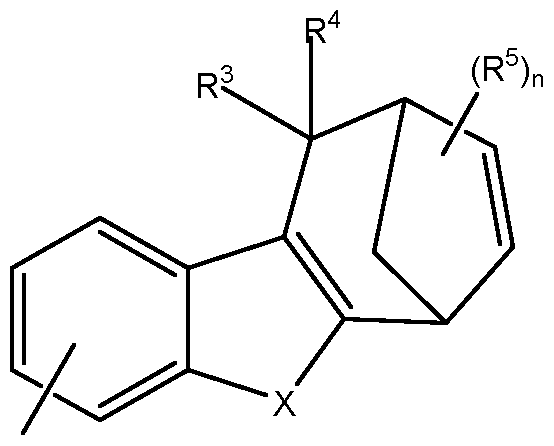
(R2)n
(lib)
wherein X is NR1 ;
R1 is hydrogen, alkyl, alkenyl, alkynyl, aryl, benzyl, or alkylene optionally substituted with aryl;
R2 is, for each occurrence, independently selected from the group consisting of hydrogen, halogen, haloalkyi, alkyl, alkoxy, alkenyl, alkynyl, cycloalkyl,
cycloalkenyl, and -C02R8;
R3 is selected from the group consisting of hydrogen, halogen, haloalkyi, alkyl, alkoxy, alkenyl, alkynyl, cycloalkyl, cycloalkenyl, Het, -CO2R8, aryl; aryl substituted with alkoxy, haloalkyi;
R4 is selected from the group consisting of hydrogen, halogen, haloalkyi, alkyl, alkoxy, alkenyl, alkynyl, cycloalkyl, cycloalkenyl, Het, -C02R8, aryl; aryl substituted with alkoxy, haloalkyi;
or, R3 and R4 together may combine to form a 4, 5, or 6 member cycloalkyl;
R5 is, for each occurrence, independently selected from the group consisting of hydrogen, halogen, haloalkyi, alkyl, alkoxy, alkenyl, alkynyl, cycloalkyl,
cycloalkenyl, Het, aryl, substituted aryl, and oxo; and
n is 0, 1 , 2, 3 or 4.
[0093] In an embodiment, the compound of Formula lib is selected from compounds lib1 and lib2:

(lib1) (lib2)
wherein R1 is hydrogen, alkyl, alkenyl, alkynyl, aryl, benzyl, or alkylene optionally substituted with aryl;
R2 is, for each occurrence, independently selected from the group consisting of hydrogen, halogen, haloalkyi, alkyl, alkoxy, alkenyl, alkynyl, cycloalkyl,
cycloalkenyl, and -C02R8;
R3 is selected from the group consisting of hydrogen, halogen, haloalkyi, alkyl, alkoxy, alkenyl, alkynyl, cycloalkyi, cycloalkenyl, Het, -C02R8, aryl; aryl substituted with alkoxy, haloalkyi;
R4 is selected from the group consisting of hydrogen, halogen, haloalkyi, alkyl, alkoxy, alkenyl, alkynyl, cycloalkyi, cycloalkenyl, Het, -CO2R8, aryl; aryl substituted with alkoxy, haloalkyi;
R5 is, for each occurrence, independently selected from the group consisting of hydrogen, halogen, haloalkyi, alkyl, alkoxy, oxo, alkenyl, alkynyl, cycloalkyi, cycloalkenyl, Het, aryl, substituted aryl, oxo, and wherein n is 0, 1 , 2, 3 or 4.
[0094] In an embodiment, the compound of Formula I or Formula II has the structure of Formula l ie1

(lie1)
wherein X is NR1 ;
R1 is hydrogen, alkyl, alkenyl, alkynyl, aryl, benzyl, or alkylene optionally substituted with aryl;
R2 is, for each occurrence, independently selected from the group consisting of hydrogen, halogen, haloalkyi, alkyl, alkoxy, alkenyl, alkynyl, cycloalkyi,
cycloalkenyl, and -CO2R8;
R3 is, for each occurrence, independently selected from the group consisting of hydrogen, halogen, haloalkyi, alkyl, alkoxy, alkenyl, alkynyl, cycloalkyi,
cycloalkenyl, Het, aryl, -NHR7, -NHHet, -NHR7Het, oxo, -OR8, -O-aryl, -OHet, - R7OR8, -NR8R9, -NR8-aryl, -R7NR8R9, -R7NR8-aryl, -R7C(O)R8, -C(O)R8, -CO2R8, - R7CO2R8, -C(O)NR8R9, -C(O)aryl, -C(O)NR8aryl, -C(O)Het, -C(O)NHR7Het, - R7C(O)NR8R9, -C(S)NR8R9, -R7C(S)NR8R9, -R7(NH)NR8R9, -C(NH)NR8R9, - R7C(NH)NR8R9, -S(O)2NR8R9, -S(O)2N R8aryl, -R7SO2NHCOR8, -R7SO2NR8R9, -
R7S02R8, -S(0)mR8, cyano, nitro, and azido; wherein two R3 may combine to form a 5- or 6-membered ring;
R5 is selected from the group consisting of hydrogen, halogen, haloalkyi, alkyl, alkoxy, alkenyl, alkynyl, cycloalkyi, cycloalkenyl, Het, aryl, aryl substituted with alkyl or -OCOR1 , and oxo; and n is 0, 1 , 2, 3 or 4.
[0095] In an embodiment, the compound of Formula I or Formula II has the structure of Formula l ie2:

(lie2)
wherein R1 is hydrogen, alkyl, alkenyl, alkynyl, aryl, benzyl, or alkylene optionally substituted with aryl;
R2 is, for each occurrence, independently selected from the group consisting of hydrogen, halogen, haloalkyi, alkyl, alkoxy, alkenyl, alkynyl, cycloalkyi,
cycloalkenyl, and -C02R8;
R5 is selected from the group consisting of hydrogen, halogen, haloalkyi, alkyl, alkoxy, alkenyl, alkynyl, cycloalkyi, cycloalkenyl, Het, aryl, aryl substituted with alkyl or -OCOR1 , and oxo; and n is 0, 1 , 2, 3 or 4.
[0096] In an embodiment, the compound of Formula I or Formula II has the structure of Formul 1 :

R2 is, for each occurrence, independently selected from the group consisting of hydrogen, halogen, haloalkyi, alkyl, alkoxy, alkenyl, alkynyl, cycloalkyi,
cycloalkenyl, and -CO2R8;
R3 is selected from the group consisting of hydrogen, halogen, haloalkyi, alkyl, alkoxy, alkenyl, alkynyl, cycloalkyi, cycloalkenyl, Het, -C02R8, aryl; aryl substituted with alkoxy, haloalkyi;
R4 is selected from the group consisting of hydrogen, halogen, haloalkyi, alkyl, alkoxy, alkenyl, alkynyl, cycloalkyi, cycloalkenyl, Het, -CO2R8, aryl; aryl substituted with alkoxy, haloalkyi;
or, R3 and R4 together may combine to form a 4, 5, or 6 member cycloalkyi, aryl, or Het;
R5 is selected from the group consisting of hydrogen, halogen, haloalkyi, alkyl, alkoxy, alkenyl, alkynyl, cycloalkyi, cycloalkenyl, Het, aryl, substituted aryl, and oxo; and n is 0, 1 , 2, 3 or 4.
[0097] In an embodiment, the compound of Formula I or Formula II has the structure of Formula l id2:

(lid2)
wherein R1 is hydrogen, alkyl, alkenyl, alkynyl, aryl, benzyl, or alkylene optionally substituted with aryl;
R2 is, for each occurrence, independently selected from the group consisting of hydrogen, halogen, haloalkyi, alkyl, alkoxy, alkenyl, alkynyl, cycloalkyi,
cycloalkenyl, -C02R8;
R5 is selected from the group consisting of halogen, haloalkyi, alkyl, alkoxy, alkenyl, alkynyl, cycloalkyi, cycloalkenyl, Het, aryl, substituted aryl, oxo; and n is 0, 1 , 2, 3 or 4.
[0098] In an embodiment, the compound of Formula I or Formula II has the structure of Formula l i

(lie) wherein Ra and Rb are absent, or independently selected from hydrogen, alkyi, hydroxyl, hydroxyalkyi; or wherein Ra and Rb together a 5- or 6-membered cycloalkyi or heterocycloalkyi with one or more heteroatoms independently selected from O or NR1 ;
wherein R2 is, for each occurrence, independently selected from the group consisting of hydrogen, halogen, haloalkyi, alkyi, alkoxy, alkenyl, alkynyl, cycloalkyi, cycloalkenyl, and -C02R8;
R5 is, for each occurrence, independently selected from the group consisting of hydrogen, halogen, haloalkyi, alkyi, alkoxy, alkenyl, alkynyl, cycloalkyi, cycloalkenyl, Het, aryl, substituted aryl, oxo; and n is 0, 1 , 2, 3 or 4.
[0099] In an embodiment, the compound of Formula I or Formula III has the structure of Formula I lia:

(Ilia)
wherein dashed bonds, independently, are present or absent;
A and B are independently O, NR1, CH2, CH(R5), C(R5)2, or are absent;
C is O, NR1 , CH2, CH(R5), or C(R5)2,
R2 is, for each occurrence, independently selected from the group consisting of hydrogen, halogen, haloalkyi, alkyi, alkoxy, alkenyl, alkynyl, cycloalkyi, cycloalkenyl, -C02R8; and n is 0, 1 , 2, 3 or 4.
[00100] In an embodiment, the compound of Formula I or Formula III has the structure of Formula 1 Mb:

(1Mb)
wherein B is CH2, CH(R5), C(R5)2, 0, NR2 or is absent;
wherein Ra and Rb are absent, or independently selected from hydrogen, alkyl, hydroxyl, hydroxyalkyl, aryl, benzyl, and amino; or wherein Ra and Rb may combine to form a 5- or 6-membered cycloalkyi or heterocycloalkyi with one or more heteroatoms independently selected from O or NR1 ;
R2 is, for each occurrence, independently selected from the group consisting of hydrogen, halogen, haloalkyl, alkyl, alkoxy, alkenyl, alkynyl, cycloalkyi, cycloalkenyl, -C02R8; and n is 0, 1 , 2, 3 or 4.
[00101] In an embodiment, the compound of Formula I or Formula IV has the structure of Formula

(IVa)
wherein Ra and Rb are absent, or independently selected from hydrogen, alkyl, hydroxyl, hydroxyalkyl, aryl, benzyl, and amino; or wherein Ra and Rb may combine to form a 5- or 6-membered cycloalkyi or heterocycloalkyi with one or more heteroatoms independently selected from O or NR1 ;
R1 , for each occurrence, is independently selected from the group consisting of hydrogen, alkyl, alkenyl, alkynyl, aryl, benzyl, or alkylene optionally substituted with aryl;
R2 is, for each occurrence, is independently selected from the group consisting of hydrogen, halogen, haloalkyi, alkyl, alkoxy, alkenyl, alkynyl, cycloalkyi, cycloalkenyl, and -C02R8;
R5 is, for each occurrence, independently selected from the group consisting of halogen, haloalkyi, alkyl, alkoxy, alkenyl, alkynyl, cycloalkyi, cycloalkenyl, Het, aryl, -NHR7, -NHHet, -NHR7Het, oxo, -OR8, -O-aryl, -OHet, -R7OR8, -NR8R9, -NR8- aryl, -R7NR8R9, -R7NR8-aryl, -R7C(O)R8, -C(O)R8, -CO2R8, -R7CO2R8, -C(O)NR8R9, - C(O)aryl, -C(O)NR8aryl, -C(O)Het, -C(O)NHR7Het, -R7C(O)NR8R9, -C(S)NR8R9, - R7C(S)NR8R9, -R7(NH)NR8R9, -C(NH)NR8R9, -R7C(NH)NR8R9, -S(O)2NR8R9, - S(O)2N R8aryl, -R7SO2NHCOR8, -R7SO2NR8R9, -R7SO2R8, -S(O)mR8, cyano, nitro, and azido; and n is 0, 1 , 2, 3 or 4.
[00102] In certain embodiments, the compound of the invention has the physical form of an oil, a wax, an amorphous solid, or a crystalline solid.
[00103] In an embodiment, the compound of the invention is selected from Table 1 , or a pharmaceutically acceptable stereoisomer, isotope, solvate or salt thereof.
Table

4

40

41


[00104] In an embodiment, the compound of the invention does not affect the binding of PCSK9 to LDLR. For example, administration to a subject of the compound of the invention may not result in increased levels of PCSK9 binding to LDLR, or administration to a subject of the compound of the invention may not result in decreased levels of PCSK9 binding to LDLR.
[00105] In an embodiment, the compound of the invention does not affect albumin level. For example, administration to a subject of the compound of the
invention may not result in increased albumin levels, or administration to a subject of the compound of the invention may not result in decreased albumin levels.
[00106] In an embodiment, the compound of the invention does not affect apoE level. For example, administration to a subject of the compound of the invention may not result in increased apoE levels, or administration to a subject of the compound of the invention may not result in decreased apoE levels.
[00107] In an embodiment, the compound of the invention inhibits PCSK9 mRNA. For example, the compound of the invention may inhibit PCSK9 mRNA transcription and/or production.
[00108] In an embodiment, the compound of the invention does not affect hepatic transaminase levels. For example, administration to a subject of the compound of the invention may not result in increased hepatic transaminase levels, or administration to a subject of the compound of the invention may not result in decreased hepatic transaminase levels.
Pharmaceutical Compositions
[00109] A pharmaceutical composition of a compound of the invention is formulated to be compatible with its intended route of administration. Examples of routes of administration include parenteral, e.g., intravenous (IV), intradermal, subcutaneous (SC or SQ), intraperitoneal, intramuscular, oral (e.g., inhalation), transdermal (topical), and transmucosal administration (e.g., rectally or vaginally). Solutions or suspensions used for parenteral, intradermal, or subcutaneous application can include the following components: a sterile diluent such as water for injection, saline solution, fixed oils, polyethylene glycols, glycerine, propylene glycol or other synthetic solvents; antibacterial agents such as benzyl alcohol or methyl parabens; antioxidants such as ascorbic acid or sodium bisulfite; chelating agents such as ethylenediaminetetraacetic acid; buffers such as acetates, citrates or phosphates and agents for the adjustment of tonicity such as sodium chloride or dextrose. pH can be adjusted with acids or bases, such as hydrochloric acid or sodium hydroxide. The parenteral preparation can be enclosed in ampoules, disposable syringes or multiple dose vials made of glass or plastic.
[00110] Pharmaceutical compositions suitable for injectable use include sterile aqueous solutions (where water soluble) or dispersions and sterile powders
for the extemporaneous preparation of sterile injectable solutions or dispersion. For intravenous administration, suitable carriers include physiological saline,
bacteriostatic water, Cremophor ELTM (BASF, Parsippany, N.J.) or phosphate buffered saline (PBS). In all cases, the composition must be sterile and should be fluid to the extent that easy syringability exists. It must be stable under the conditions of manufacture and storage and must be preserved against the contaminating action of microorganisms such as bacteria and fungi. The carrier can be a solvent or dispersion medium containing, for example, water, ethanol, polyol (for example, glycerol, propylene glycol, and liquid polyethylene glycol, and the like), and suitable mixtures thereof. The proper fluidity can be maintained, for example, by the use of a coating such as lecithin, by the maintenance of the required particle size in the case of dispersion and by the use of surfactants. Prevention of the action of microorganisms can be achieved by various antibacterial and antifungal agents, for example, parabens, chlorobutanol, phenol, ascorbic acid, thimerosal, and the like. In many cases, it will be preferable to include isotonic agents, for example, sugars, polyalcohols such as mannitol, sorbitol, sodium chloride in the composition.
Prolonged absorption of the injectable compositions can be brought about by including in the composition an agent which delays absorption, for example, aluminum monostearate and gelatin.
[00111] Sterile injectable solutions can be prepared by incorporating the active compound in the required amount in an appropriate solvent with one or a combination of ingredients enumerated above, as required, followed by filtered sterilization. Generally, dispersions are prepared by incorporating the active compound into a sterile vehicle which contains a basic dispersion medium and the required other ingredients from those enumerated above. In the case of sterile powders for the preparation of sterile injectable solutions, the preferred methods of preparation are vacuum drying and freeze-drying which yields a powder of the active ingredient plus any additional desired ingredient from a previously sterile-filtered solution thereof.
[00112] Toxicity and therapeutic efficacy of such compounds can be determined by standard pharmaceutical procedures in cell cultures or experimental animals, e.g., for determining the LD50 (the dose lethal to 50% of the population) and the ED50 (the dose therapeutically effective in 50% of the population). The
dose ratio between toxic and therapeutic effects is the therapeutic index and it can be expressed as the ratio LD50/ED50. Compounds that exhibit large therapeutic indices are preferred. Although compounds that exhibit toxic side effects may be used, care should be taken to design a delivery system that targets such compounds to the site of affected tissue in order to minimize potential damage to uninfected cells and, thereby, reduce side effects.
[00113] The data obtained from the cell culture assays and animal studies can be used in formulating a range of dosage for use in humans. The dosage of such compounds lies preferably within a range of circulating concentrations that include the ED50 with little or no toxicity. The dosage may vary within this range depending upon the dosage form employed and the route of administration utilized. For any compound used in the method of the invention, the therapeutically effective dose can be estimated initially from cell culture assays. A dose may be formulated in animal models to achieve a circulating plasma concentration range that includes the EC50 (i.e., the concentration of the test compound which achieves a half- maximal response) as determined in cell culture. Such information can be used to more accurately determine useful doses in humans. Levels in plasma may be measured, for example, by high performance liquid chromatography.
[00114] The instant application further relates to storage stable forms containing compounds of the invention, e.g., lyophilates, suspensions, and buffered or temperature stable compositions.
Dosages and Modes of Administration
[00115] The compounds of the invention may be administered using any amount and any route of administration effective for the indicated purpose (e.g., as indicated in any one of several aspects and embodiments provided herein). Thus, the expression "effective amount" as used herein, refers to a sufficient amount of agent to achieve the indicated purpose (e.g., to reduce the level of PCSK9, to reduce the level of LDL, to increase the level of LDLR, to treat or prevent a condition associated with elevated PCSK9 levels, or to treat or prevent a condition associated with elevated LDL levels). The exact amount required will vary from subject to subject, depending on the species, age, and general condition of the subject, the severity of the diseases, the particular compound, its mode of administration, and the
like. The compounds of the invention are preferably formulated in dosage unit form for ease of administration and uniformity of dosage. The expression "dosage unit form" as used herein refers to a physically discrete unit of therapeutic agent appropriate for the patient to be treated. It will be understood, however, that the total daily usage of the compounds of the invention will be decided by the attending physician within the scope of sound medical judgment. The specific therapeutically effective dose level for any particular patient or organism will depend upon a variety of factors including the disorder being treated and the severity of the disorder; the activity of the specific compound employed; the specific composition employed; the age, body weight, general health, sex and diet of the patient; the time of
administration, route of administration, and rate of excretion of the specific compound employed; the duration of the treatment; drugs used in combination or coincidental with the specific compound employed; and like factors well known in the medical arts (see, for example, Goodman and Gilman's, "The Pharmacological Basis of Therapeutics", Tenth Edition, A. Gilman, J.Hardman and L. Limbird, eds.,
McGraw-Hill Press, 155-173, 2001 , which is incorporated herein by reference in its entirety).
Definitions
[00116] As used herein, the term "alkyl" refers to a fully saturated branched or unbranched hydrocarbon moiety. Preferably the alkyl comprises 1 to 20 carbon atoms, 1 to 1 6 carbon atoms, 1 to 1 0 carbon atoms, or more preferably 1 to 6 carbon atoms. Representative examples of alkyl include, but are not limited to, methyl, ethyl, n-propyl, /so-propyl, n-butyl, sec-butyl, /so-butyl, te/ -butyl, n-pentyl, isopentyl, neopentyl, /7-hexyl, 3-methylhexyl, 2,2- dimethylpentyl, 2,3-dimethylpentyl, n-heptyl, n-octyl, n-nonyl, n-decyl and the like. Furthermore, the expression "Cx-Cy-alkyl", wherein x is 1 -5 and y is 2-1 0 indicates a particular alkyl group (straight- or branched-chain) of a particular range of carbons. For example, the expression C C4 alkyl includes, but is not limited to, methyl, ethyl, propyl, butyl, isopropyl, tert-butyl and isobutyl.
[00117] As used herein, the term "alkoxy" refers to -O-alkyl.
[00118] The term "alkenyl" refers to a straight or branched chain aliphatic hydrocarbon containing one or more carbon-to-carbon double bonds. Examples
include, but are not limited to, vinyl, allyl, and the like. Preferably the alkenyl group comprises 2 to 20 carbon atoms, 2 to 16 carbon atoms, 2 to 10 carbon atoms, 2 to 6 carbon atoms, or 2 to 3 carbon atoms.
[00119] The term "alkynyl" refers to a straight or branched chain aliphatic hydrocarbon containing one or more carbon-to-carbon triple bonds. Examples include, but are not limited to, acetylenyl, paropargyl, and the like. Preferably the alkynyl group comprises 2 to 20 carbon atoms, 2 to 1 6 carbon atoms, 2 to 1 0 carbon atoms, 2 to 6 carbon atoms, or 2 to 3 carbon atoms.
[00120] The term "cycloalkyl" refers to an optionally substituted non- aromatic cyclic hydrocarbon ring, which optionally includes an alkylene linker through which the cycloalkyl may be attached. Exemplary "cycloalkyl" groups include, but are not limited to, cyclopropyl, cyclobutyl, cyclopentyl, cyclohexyl, cycloheptyl, and substituted versions thereof. As used herein, the term "cycloalkyl" includes an optionally substituted fused polycyclic hydrocarbon saturated ring and aromatic ring system, namely polycyclic hydrocarbons with less than maximum number of non- cumulative double bonds, for example where a saturated hydrocarbon ring (such as a cyclopentyl ring) is fused with an aromatic ring (herein "aryl," such as a benzene ring) to form, for example, groups such as indane.
[00121] The term "cycloalkenyl" refers to an optionally substituted non- aromatic cyclic hydrocarbon ring containing one or more carbon-to-carbon double bonds which optionally includes an alkylene linker through which the cycloalkenyl may be attached. Exemplary "cycloalkenyl" groups include, but are not limited to, cyclopropenyl, cyclobutenyl, cyclopentenyl, cyclohexenyl, cycloheptenyl, and substituted versions thereof.
[00122] The term "aryl" refers to an optionally substituted benzene ring or to an optionally substituted fused benzene ring system, for example anthracene, phenanthrene, or naphthalene ring systems. Examples of "aryl" groups include, but are not limited to, phenyl, 2-naphthyl, 1 -naphthyl, and the like.
[00123] The term "heteroaryl" (i.e., "Het") refers to an optionally substituted monocyclic five to seven membered aromatic ring, or to an optionally substituted fused bicyclic aromatic ring system comprising two of such aromatic rings, one of which may be aryl. These heteroaryl rings contain one or more nitrogen, sulfur, and/or oxygen atoms, where N-oxides, sulfur oxides, and dioxides are permissible
heteroatom substitutions. Examples of "heteroaryl" groups used herein include, but should not be limited to, furan, thiophene, pyrrole, imidazole, pyrazole, triazole, tetrazole, thiazole, oxazole, isoxazole, oxadiazole, thiadiazole, isothiazole, pyridine, pyridazine, pyrazine, pyrimidine, quinoline, isoquinoline, benzofuran,
benzothiophene, indole, indazole, benzimidizolyl, imidazopyridinyl, pyrazolopyridinyl, pyrazolopyrimidinyl, and the like.
[00124] As used herein, the term "amino" (alone or in combination with another term(s)) refers to -NH2, or a mono- or disubstituted derivative, i.e., a secondary or tertiary amine.
[00125] As used herein, the term "halogen" refers to fluorine, chlorine, bromine, iodine or astatine. In this respect, the term "haloalkyl" refers to an alkyl group, as defined herein, that is substituted with at least one halogen. Examples of branched or straight chained "haloalkyl" groups useful in the present invention include, but are not limited to, methyl, ethyl, propyl, isopropyl, n-butyl, and t-butyl substituted independently with one or more halogens, e.g., fluoro, chloro, bromo, iodo and astatine The term "haloalkyl" should be interpreted to include such substituents as perfluoroalkyl groups and the like.
[00126] In some embodiments, the alkyl, alkenyl, alkynyl, cycloalkyl, cycloalkenyl, amino, aryl, and heteroaryl groups described herein are optionally substituted.
[00127] As used herein throughout the specification, the phrase "optionally substituted" or variations thereof denote an optional substitution, including multiple degrees of substitution, with one or more substituent group. The phrase should not be interpreted so as to be imprecise or duplicative of substitution patterns herein described or depicted specifically. Rather, those of ordinary skill in the art will appreciate that the phrase is included to provide for obvious modifications, which are encompassed within the scope of the appended claims.
[00128] Exemplary optional substituent groups include acyl; alkyl; alkenyl; alkynyl; alkylsulfonyl; alkoxy; alkoxycarbonyl; cyano; halogen; haloalkyl; hydroxy; nitro; oxo; aryl, which may be further substituted with acyl, alkoxy, alkyl, alkenyl, alkynyl, alkylsulfonyl, cyano, halogen, haloalkyl, hydroxy, oxo, or nitro; heteroaryl, which may be further substituted with acyl, alkoxy, alkyl, alkenyl, alkynyl,
alkylsulfonyl, cyano, halogen, haloalkyl, hydroxy, oxo, or nitro; arylsulfonyl, which
may be further substituted with acyl, alkoxy, alkyl, alkenyl, alkynyl, alkylsulfonyl, cyano, halogen, haloalkyi, hydroxy, or nitro; heteroarylsulfonyl, which may be further substituted with acyl, alkoxy, alkyl, alkenyl, alkynyl, alkylsulfonyl, cyano, halogen, haloalkyi, hydroxy, oxo, or nitro; aryloxy, which may be further substituted with acyl, alkoxy, alkyl, alkenyl, alkynyl, alkylsulfonyl, cyano, halogen, haloalkyi, hydroxy, or nitro; heteroaryloxy, which may be further substituted with acyl, alkoxy, alkyl, alkenyl, alkynyl, alkylsulfonyl, cyano, halogen, haloalkyi, hydroxy, or nitro; or aryloxycarbonyl, which may be further substituted with acyl, alkoxy, alkyl, alkenyl, alkynyl,
alkylsulfonyl, cyano, halogen, haloalkyi, hydroxy, phthalimidyl, or nitro.
[00129] For example, an optionally substituted alkyl group encompasses hydroxyalkyl, alkoxyalkyl, benzyl, and the like.
[00130] As used herein, the dashed bonds may be independently present or absent. The number of bonds arising from the entirety of dashed bonds in a given structure may, where four dashed bonds are shown, comprise no bonds, one bond, two bonds, three bonds, or four bonds; where three dashed bonds are shown, comprise no bonds, one bond, two bonds, or three bonds.
[00131] Compounds of the invention may be provided as mixtures of stereoisomers as well as purified enantiomers or enantiomerically/diastereomerically enriched mixtures.
[00132] As used herein, the singular form "a", "an", and "the" includes plural references unless indicated otherwise. The term "plurality" refers to two or more of anything, such as cells. For the purposes of the present invention, the terms "a", "an" or "the" refers to one or more of anything, such as a cell or the cell or an antigen or the antigen. For the purpose of the present invention, a plurality of anything may be homogenous or heterogeneous.
[00133] As used herein, the term "pharmaceutically acceptable" refers to a material, such as a carrier or diluent, which does not abrogate the biological activity or properties of the compound, and is relatively non-toxic, i.e., the material may be administered to an individual without causing undesirable biological effects or interacting in a deleterious manner with any of the components of the composition in which it is contained.
[00134] The term proprotein convertase subtilisin kexin type 9 (PCSK9), also known as neural apoptosis-regulated convertase (NARC-1 ), as used herein,
refers to any form of PCSK9 and variants thereof that retain at least part of the activity of PCSK9. Unless indicated differently, such as by specific reference to human PCSK9, PCSK9 includes all mammalian species of native sequence PCSK9, e.g., human, canine, feline, equine, and bovine.
[00135] The term "PCSK9 activity" as used herein encompasses any
"biological activity of PCSK9" and/or "biological effect elicited by PCSK9". In one embodiment, PCSK9 activity includes the ability of PCSK9 to interact or bind to a substrate or receptor. In another embodiment, the biological activity of PCSK9 is the ability of PCSK9 to bind to a LDL-receptor (LDLR). In yet another embodiment, PCSK9 binds to and catalyzes a reaction involving LDLR. In certain embodiments, PCSK9 activity includes the ability of PCSK9 to decrease or reduce the availability of LDLR. In certain embodiments, the biological activity of PCSK9 includes the ability of PCSK9 to increase the amount of LDL in a subject. In certain embodiments, the biological activity of PCSK9 includes the ability of PCSK9 to decrease the amount of LDLR that is available to bind to LDL in a subject. In certain embodiments, the biological activity of PCSK9 includes the ability of PCSK9 to decrease the amount of LDLR that is available to bind to LDL. In certain embodiments, biological activity of PCSK9 includes any biological activity resulting from PCSK9 signaling. In yet another embodiment, biological activity of PCSK9 encompasses a PCSK9 secretory pathway. In yet another embodiment, biological effect elicited by PCSK9 may be associated with any of foregoing conditions disclosed herein.
[00136] As used herein, a "PCSK9 inhibitor" or a compound or a
composition thereof that "inhibits" PCSK9 activity refers to a compound that is able to inhibit a biological activity of PCSK9 or a biological effect elicited by PCSK9. In some embodiment, downstream pathway(s) mediated by PCSK9 signaling, including PCSK9-mediated down-regulation of the LDLR, and PCSK9-mediated decrease in LDL blood clearance are inhibited. Such compound may block, antagonize, suppress, reduce, decrease, or neutralize PCSK9 activity in any meaningful degree determined by an ordinary medical practitioner or skilled person in the art.
[00137] The term "reduce" in the context of, but not limited to, PCSK9 level or levels, and/or low density lipoprotein level or levels, means a statistically significant decrease in such level. The decrease can be, for example, at least 10%, at least 1 5%, at least 20%, at least 25%, at least 30%, at least 35%, at least 40%, at
least 45%, at least 50%, at least 55%, at least 60%, at least 65%, at least 70%, at least 75%, at least 80%, at least 85%, at least 90%, at least 95% or more, and is preferably down to a level accepted as within the range of normal for a subject without any of foregoing disorders. Alternatively, the degree of decrease may be measured in terms of a reduction of a parameter that is functionally linked to PCSK9 and/or LDL level, e.g., an expression level of a gene associated with changes of cholesterol level.
[00138] As described herein, one or more of "active agents" is a
therapeutically effective agent that can be simultaneously, sequentially, non- simultaneously and/or separately administered with the compound 34 (B004) or a pharmaceutical composition thereof by the same or different means of
administration. In certain embodiments, active agents are the agents used to treat conditions associated with high cholesterol. In another embodiment, active agents are the agents used to treat any of foregoing conditions described herein. In certain embodiment, active agents are the agents that allows for mitigation of undesirable side-effects the methods of treatment described herein.
[00139] As used herein, the term "pharmaceutically acceptable salt" refers to derivatives of the disclosed compounds wherein the parent compound is modified by converting an existing acid or base moiety to its salt form. Examples of pharmaceutically acceptable salts include, but are not limited to, mineral or organic acid salts of basic residues such as amines; alkali or organic salts of acidic residues such as carboxylic acids; and the like. The pharmaceutically acceptable salts of the present invention include the conventional non-toxic salts of the parent compound formed, for example, from non-toxic inorganic or organic acids. The
pharmaceutically acceptable salts of the present invention can be synthesized from the parent compound which contains a basic or acidic moiety by conventional chemical methods. Generally, such salts can be prepared by reacting the free acid or base forms of these compounds with a stoichiometric amount of the appropriate base or acid in water or in an organic solvent, or in a mixture of the two; generally, nonaqueous media like ether, ethyl acetate, ethanol, isopropanol, or acetonitrile are preferred. Lists of suitable salts are found in Remington's Pharmaceutical Sciences, 17th ed., Mack Publishing Company, Easton, Pa., 1985, p. 1418 and Journal of
Pharmaceutical Science, 66, 2 (1977), each of which is incorporated herein by reference in its entirety.
[00140] As used herein, the term "pharmaceutically acceptable carrier" means a pharmaceutically acceptable material, composition or carrier, such as a liquid or solid filler, stabilizer, dispersing agent, suspending agent, diluent, excipient, thickening agent, solvent or encapsulating material, involved in carrying or transporting a compound useful within the invention within or to the patient such that it may perform its intended function. Typically, such constructs are carried or transported from one organ, or portion of the body, to another organ, or portion of the body. Each carrier must be "acceptable" in the sense of being compatible with the other ingredients of the formulation, including the compound useful within the invention, and not injurious to the patient. Some examples of materials that may serve as pharmaceutically acceptable carriers include: sugars, such as lactose, glucose and sucrose; starches, such as corn starch and potato starch; cellulose, and its derivatives, such as sodium carboxymethyl cellulose, ethyl cellulose and cellulose acetate; powdered tragacanth; malt; gelatin; talc; excipients, such as cocoa butter and suppository waxes; oils, such as peanut oil, cottonseed oil, safflower oil, sesame oil, olive oil, corn oil and soybean oil; glycols, such as propylene glycol; polyols, such as glycerin, sorbitol, mannitol and polyethylene glycol; esters, such as ethyl oleate and ethyl laurate; agar; buffering agents, such as magnesium hydroxide and aluminum hydroxide; surface active agents; alginic acid; pyrogen-free water; isotonic saline; Ringer's solution; ethyl alcohol; phosphate buffer solutions; and other nontoxic compatible substances employed in pharmaceutical formulations.
[00141 ] As used herein, "pharmaceutically acceptable carrier" also includes any and all coatings, antibacterial and antifungal agents, and absorption delaying agents, and the like that are compatible with the activity of the compound useful within the invention, and are physiologically acceptable to the patient.
Supplementary active compounds may also be incorporated into the compositions. The "pharmaceutically acceptable carrier" may further include a pharmaceutically acceptable salt of the compound useful within the invention. Other additional ingredients that may be included in the pharmaceutical compositions used in the practice of the invention are known in the art and described, for example in
Remington's Pharmaceutical Sciences (Genaro, Ed., Mack Publishing Co., 1985, Easton, PA), which is incorporated herein by reference.
[00142] "Treat," "treatment," or "treating," as used herein, relates to the application or administration of a therapeutic agent, i.e., a compound of the invention, to a subject, or application or administration of a therapeutic agent to an isolated tissue or cell line from a subject, who has a disease or disorder, a symptom of a disease or disorder or a predisposition toward a disease or disorder, with the purpose to cure, heal, alleviate, relieve, alter, remedy, ameliorate, improve or affect the disease or disorder, the symptoms of the disease or disorder, or the
predisposition toward disease.
[00143] As used herein, the term "prevent" or "prevention" means that no disorder or disease has developed if none had yet occurred, or that no further disorder or disease has developed if there had already been development of the disorder or disease.
[00144] As used herein, the term "subject" refers to a human or a non- human mammal. Non-human mammals include, for example, livestock and pets, such as ovine, bovine, porcine, canine, feline and murine mammals. In a particular embodiment, the subject is a mammal. In another particular embodiment, the subject is human.
[00145] A "diabetic condition" includes, but is not limited to, type 1 diabetes, type 2 diabetes, gestational diabetes, latent autoimmune diabetes in adults (LADA), Maturity Onset Diabetes of the Young (MODY) and Neonatal Diabetes Mellitus (NDM). A diabetic condition refers to a condition in which blood glucose levels are higher than the normal blood glucose range for a subject without foregoing non- limiting exemplary diabetic conditions. The normal blood glucose range may be determined by an ordinary medical practitioner or a skilled person in the art, and may vary depending on factors known in the art, e.g., administration of other agents that affect blood glucose levels.
[00146] A "prediabetic condition" as described herein means a blood glucose level in a subject is higher than the range of normal for a subject without any of foregoing non-limiting exemplary diabetic conditions, yet not high enough to be classified as any of foregoing non-limiting exemplary diabetic conditions. An ordinary medical practitioner or a skilled person in the art may diagnose a subject
with a prediabetic condition by using a diagnostic test or a combination thereof that are well-known in the art, e.g., glycated hemoglobin (A1 C) test and fasting blood sugar test.
[00147] As used herein, a condition "associated" with any of foregoing diseases or an "association" with any of foregoing diseases may be determined by an ordinary medical practitioner or a skilled person in the art. Signs and symptoms of such association may be closely correlated with signs and/or symptoms of any of foregoing diseases disclosed herein. Signs and symptoms of such association may not be closely correlated with signs and/or symptoms of any of foregoing diseases disclosed herein. In some embodiment, a condition associated with any of foregoing diseases maybe a primary association to any of foregoing diseases disclosed herein. In some embodiment, a condition associated with any of foregoing diseases maybe a secondary association to any of foregoing diseases disclosed herein.
[00148] The term "hypercholesterolemia," as used herein, refers to a condition in which cholesterol levels are elevated above a desired level. In certain embodiments, the LDL-cholesterol level is elevated above the desired level. In certain embodiments, the plasma LDL-cholesterol levels are elevated above the desired level. In certain embodiments, hypercholesterolemia may be familial hypercholesterolemia including by way of example heterozygous
hypercholesterolemia, homozygous hypercholesterolemia, familial defective apoplipoprotein B-100, and polygenic hypercholesterolemia. The desired level range may be determined by an ordinary medical practitioner or a skilled person in the art, and may vary depending on factors known in the art, e.g., administration of other agents that affect cholesterol levels.
[00149] The term "atherosclerotic disease" encompasses arteriosclerosis, arteriolosclerosis, and atherosclerosis, and a condition associated with
arteriosclerosis, arteriolosclerosis, and atherosclerosis. Non-limiting examples of atherosclerotic diseases are a coronary heart disease, coronary artery disease, peripheral arterial disease, stroke (ischemic and hemorrhagic), angina pectoris, cerebrovascular disease, acute coronary syndrome, or myocardial infarction.
[00150] As used herein, the term "in vivo" refers to a process taking place inside a living subject. The term "in vitro" refers to a process taking place outside a living subject.
Examples
[00151] The compounds of Table 1 , and methods of making various compounds of Table 1 , are disclosed in U.S. Patent Application Publication No. 2015/0057326 A1 . Representative synthesis and characterization procedures and data are also disclosed in the following publications, which are incorporated herein by reference: (1 ) Angew. Chem. Int. Ed. 2012, 51 , 10390-10393, and corresponding Supporting Information; (2) J. Am. Chem. Soc. 2014, 136, 6288-6296, and corresponding Supporting Information; (3) J. Am. Chem. Soc. 2015, 137, 14861 - 14864, and corresponding Supporting Information; (4) Nature: Scientific Reports, 6, 28934, 1 -14, and corresponding Supporting Information; (5) Tetrahedron 67, 201 1 , 4327-4332, and corresponding Supporting Information.
Example 1
[00152] In vitro studies in human hepatoma cells (HepG2)
[00153] 1-1) Cell survival
[00154] To study the effect of the compound on cell viability we used 1 .25x105 HepG2 cells in 96-well culture plates, followed by incubation with media only, media +0.1 %DMSO or Media +5uM of 31/33/34/35 in 0.1 %DMSO or with increasing concentration (0.2-50μΜ) of 34 in 0.1 % DMSO for 40 hours followed by a viability assay knows as MTT. The MTT assay is a colorimetric assay for assessing cell metabolic activity. NAD(P)H-dependent cellular oxidoreductase enzymes may, reflects the number of viable cells present. These enzymes are capable of reducing the tetrazolium dye MTT 3-(4,5-dimethylthiazol-2-yl)-2,5-diphenyltetrazolium bromide to its insoluble formazan, which has a purple color. Tetrazolium dye assays
(commonalty known as the MTT assay) is used to measure cytotoxicity (loss of viable cells). See Figures 4A-B.
[00155] 1-2) Secreted PCSK9
[00156] To study the effect of the compounds on PCSK9 secretion we used 1 x10⁶ HepG2 cells in 6-well culture plates, followed by incubation with media only, media +0.1 %DMSO or Media +5uM of 31/33/34/35 in 0.1 %DMSO and collection of 50ul of media at 8, 1 6, 24 and 40 hours or incubation with increasing concentration (0.2-50μΜ) of 34 in 0.1 % DMSO for 24 hours and collection of 50ul of media. The
collected media was analyzed for PCSK9 levels using commercially available ELISA kit (MBL-international, catalog # CY-8079) following the manufacturer instruction. See Figures 2A-B.
[00157] 1-3) PCSK9 detection
[00158] To study whether 34 directly interfere with PCSK9 detection we used recombinant PCSK9 (30ng/ml) was mixed with increasing concentration (0.2- 50μΜ) of 34 in 0.1 % DMSO followed by detection of PCSK9 using commercially available ELISA kit (MBL-international, catalog # CY-8079) following the
manufacturer instruction. See Figure 5A
[00159] 1-4) PCSK9-LDLR interaction
[00160] To study whether increasing concentrations of 34 (0.2-50μΜ) directly interfere with PCSK9-LDLR interaction we used a commercially available ELISA kit (MBL-international, catalog # CY-8150) following the manufacturer instruction. See Figure 5B.
[00161] 1-5) Intracellular PCSK9 protein
[00162] To study whether 34 affect intracellular PCSK9 levels we used 1 x10⁶ HepG2 cells in 6-well culture plates, followed by incubation with media +0.1 %DMSO or increasing concentration (0.2-50uM) of 34 in 0.1 % DMSO for 24 hours. After 24 hours media was aspirated, cells were washed with HBSS followed by protein extraction using commercially available RIPA buffer (SIGMA-ALDRICH, catalog #20-1 88). Protein extracts (20μg) were used for immunodetection of intracellular PCSK9 (western blot analysis) with a commercially available primary antibody against PCSK9 (MBL-international, catalog # CY-1 037), HRP-conjugated secondary antibody (SIGMA-ALDRICH, catalog #12-348) visualized using an enhanced chemiluminescence (ECL) solution (Cumaric acid, Luminol and hydrogen peroxide), developed in a LiCore imager. See Figure 1 A.
[00163] 1-6) PCSK9 transcription
[00164] To study whether 34 affect PCSK9 mRNA levels we used 1 x1 06 HepG2 cells in 6-well culture plates, followed by incubation with media +0.1 %DMSO or increasing concentration (0.2-50μΜ) of 34 in 0.1 % DMSO for 24 hours. After 24 hours media was aspirated, cells were washed with HBSS followed by RNA extraction kit (RNeasy, QIAGEN cat #74-104). mRNA was reversed transcribed to cDNA using commercially available kit (ThermoFisher, cat# 4368814) and analyzed
using real-time PCR for PCSK9 transcript levels using the relative expression method known as delta-delta CT. See Figure 1 B.
[00165] 1-7) LDLR levels
[00166] To study whether 34 affect LDLR levels we used 1 x10⁶ HepG2 cells in 6-well culture plates, followed by incubation with media +0.1 %DMSO or 5μιτι of 31/33/34/35 for 24 hours. After 24 hours media was aspirated, cells were washed with HBSS followed by protein extraction using commercially available RIPA buffer (SIGMA-ALDRICH, catalog #20-188). Protein extracts (Ι ΟμςΓ) were used for immunodetection of intracellular LDLR (western blot analysis) with a commercially available primary antibody against LDLR (ABCAM, catalog # 14056), HRP- conjugated secondary antibody (ABCAM, catalog #97135) visualized using an enhanced chemiluminescence (ECL) solution (Cumaric acid, Luminol and hydrogen peroxide), developed in a LiCore imager. See Figure 3.
[00167] 1-8) Albumin secretion
[00168] To studyVne effect of 34 on albumin secretion we used 1 x10⁶
HepG2 cells in 6-well culture plates, followed by incubation with media +0.1 %DMSO or with increasing concentration (0.2-50μΜ) of 34 in 0.1 % DMSO for 24 hours and collection of 50μΙ of media. The collected media was analyzed for albumin levels using commercially available ELISA kit (ABCAM, catalog # 1 08788) following the manufacturer instruction. See Figure 6A.
[00169] 1 -9) Intracellular Albumin
[00170] To study whether 34 affect intracellular albumin levels we used 1 x10⁶ HepG2 cells in 6-well culture plates, followed by incubation with media +0.1 %DMSO or with increasing concentration (0.2-50μΜ) of 34 in 0.1 % DMSO for 24 hours. After 24 hours media was aspirated, cells were washed with HBSS followed by protein extraction using commercially available RIPA buffer (SIGMA- ALDRICH, catalog #20-188). Protein extracts ^gr) were used for albumin detection using commercially available ELISA kit (ABCAM, catalog # 1 08788) following the manufacturer instruction. See Figure 6B.
[00171] 1-10) apoE secretion
[00172] To study the effect of 34 on apoE secretion we used 1 x10⁶ HepG2 cells in 6-well culture plates, followed by incubation with media +0.1 %DMSO or with increasing concentration (0.2-50uM) of 34 in 0.1 % DMSO for 24 hours and collection
of 50μΙ of media. The collected media was analyzed for apoE levels using
commercially available ELISA kit (ABCAM, catalog # 1 08813) following the manufacturer instruction. See Figure 7A.
[00173] 7-1 1 ^ Intracellular apoE
[00174] To study whether 34 affect intracellular apoE levels we used 1 x10⁶
HepG2 cells in 6-well culture plates, followed by incubation with media +0.1 %DMSO or DMSO or with increasing concentration (0.2-50μΜ) of 34 in 0.1 % DMSO for 24 hours. After 24 hours media was aspirated, cells were washed with HBSS followed by protein extraction using commercially available RIPA buffer (SIGMA-ALDRICH, catalog #20-1 88). Protein extracts (25μgr) were used for immunodetection of intracellular LDLR (western blot analysis) with a commercially available primary antibody against apoE (ABCAM, catalog # 1906), HRP-conjugated secondary antibody (SIGMA-ALDRIC, catalog # A5420) visualized using an enhanced chemiluminescence (ECL) solution (Cumaric acid, Luminol and hydrogen peroxide), developed in a LiCore imager. See Figure 7C.
[00175] 1-12) apoE transcription
[00176] To study whether 34 affect apoE transcription we used 1 x10⁶ HepG2 cells in 6-well culture plates, followed by incubation with media +0.1 %DMSO or DMSO or with increasing concentration (0.2-50μΜ) of 34 in 0.1 % DMSO for 24 hours. After 24 hours media was aspirated, cells were washed with HBSS followed by RNA extraction kit (RNeasy, QIAGEN cat #74-1 04). mRNA was reversed transcribed to cDNA using commercially available kit (ThermoFisher, cat# 4368814) and analyzed using real-time PCR for apoE transcript levels using the relative expression method known as delta-delta CT. See Figure 7B.
[00177] 1-13) Proteomics
[00178] To study whether 34 affect total protein levels in hepG2 in an unbiased analysis we used 1 x10⁶ HepG2 cells in 6-well culture plates, followed by incubation with media +0.1 %DMSO or DMSO or with increasing concentration (2.5- 10μΜ) of 34 in 0.1 % DMSO for 24 hours. After 24 hours media was aspirated, cells were washed with HBSS followed by shotgun proteomics analysis of the most abundant -4000 cellular proteins. Spectral count for each protein was compared between untreated (0.1 %DMSO) to treated (34 at 5μΜ) samples. See Figures 8A-B.
Example 2
[00179] In vivo studies - mice
[00180] 1 ) Single-dose experiments: mice were administered (oral gavage or intra-peritoneal injection) with 200μΙ of 34 (30mg/kg or 1 00 mg/kg) in 0.1 % Tween 80 + 1 % hydroxyethyl cellulose (HEC) in buffered (PBS pH7.4) solution. After 34 administration, 50-70μΙ of blood was collected from the retro-orbital plexus every 4-6 hours (for a total of 24 hours). Blood was left to clot at room temperature for 20 min, followed by serum separation (spin at 1000g for 1 0min). Serum was analyzed as specified in the "Serum analyses" section.
[00181] 2) Daily dosage experiments: mice were administered daily oral gavage with 200μΙ of 34 (1 00 mg/kg) in 0.1 % Tween80 + 1 % hydroxyethyl cellulose (HEC) in buffered (PBS pH7.4) solution. 50-70μΙ of blood was collected from the retro-orbital plexus on day 3 and day 5 after 34 administration, on day 5 mice were euthanized and liver were collected and analyzed as mentioned below under the "Liver analyses" section. Blood was left to clot at room temperature for 20 min, followed by serum separation (spin at 1 0OOg for 10min). Serum was analyzed as described below:
[00182] Serum analyses:
[00183] PCSK9 levels - using commercially available ELISA kit (MBL- international, catalog # CY-8079) following the manufacturer instruction. See Figures 9, 10A-B, 12A-B.
[00184] Total cholesterol - using commercially available colorimetric assay (WAKO, catalog # 439-17501 ) following the manufacturer instruction. See Figures 1 1 A, 13A.
[00185] AST activity - using commercially available activity assay (SIGMA-
ALDRICH, catalog # MAK055) following the manufacturer instruction. See Figures 1 1 B and 13B.
Liver analyses:
[00186] Hepatic LDLR levels - To study whether 34 affect hepatic LDLR levels we used 10mg of PBS-flushed livers. Livers were minced and proteins were extracted using available RIPA buffer (SIGMA-ALDRICH, catalog #20-188). Protein extracts ^gr) were used for immunodetection of intracellular LDLR (western blot analysis) with a commercially available primary antibody against LDLR (ABCAM,
catalog # 14056), HRP-conjugated secondary antibody (ABCAM, catalog #971 35) visualized using an enhanced chemiluminescence (ECL) solution (Cumaric acid, Luminol and hydrogen peroxide), developed in a LiCore imager. See Figures 14A-B.
[00187] Hepatic gene expression - To study whether 34 affect hepatic gene expression we used 10mg of PBS-flushed livers. Livers were minced followed by RNA extraction kit (RNeasy, QIAGEN cat #74-1 04). mRNA was reversed transcribed to cDNA using commercially available kit (ThermoFisher, cat# 4368814) and analyzed using real-time PCR for transcript levels of the following genes. ABCA1 , ABCG1 , ACC, apoA1 , apoB, apoE, DGAT1 , DGAT2, FAS, HMG-CoA reductase, HMG-CoA synthase, LDLR, LRP1 , MTP, Mylip, PCSK9, SCARB1 , SREBF1 and
SREBF2. Gene expression was measured using expression method known as delta- delta CT. See Figure 15.
[00188] To determine whether Compound 34 increases LDL-cholesterol uptake, LDL was isolated from human plasma using ultracentrifugation and the cholesterol content of the particle was radiolabeled with 3H-cholesterol. Hepatoma cells (HepG2) were cultured (0.25x10⁶ cell/well in a 24-well plate) with or without 10uM of B004 (compound 34) for 24 hours in DMEM. Radiolabeled LDL-cholesterol (LDL-c) was added to the cells for 4 hours. Cells were washed 3 times with PBS and left to air dry. 500 μΙ of isopropanol was added to each well and incubate with shaking at room temperature for 3 hours in a sealed container. 50 μΙ of the isopropanol was placed into a scintillation vial together with 4.5 ml of scintillation liquid cocktail (Scintiverse BD). 3H-cholesterol levels were read using a beta emission radioactive counter. Results are shown in Figure 1 6. Example 3
[00189] The below data (Table 2) was generated using the assays as discussed in Examples 1 -2. Blanks mean no testing was performed. Compounds that exhibit >10% inhibition for the single point (SP) assays were active; less than 10% means either weakly active or inactive. Compound 32 is weakly active and compounds 31 , 33, 34, 35 are particularly strongly active, although many
compounds tested were weakly active. For the SP assays, the higher the number, the higher the inhibition, e.g., the better the activity of the compound. Compounds with a determined IC50 are particularly active, the IC50 values were determined via
dose response curve (under the heading CRC which stands for concentration response curve aka dose response curve).
Table 2

48 -7.0
43.7
49 -13.7
-22.9
50 -12.3
2.3
51 -13.1
0.2
52 -20.3
-17.9
53 -20.1
-22.3
Table 3
Primary SP Primary CRC
PCSK9 AlphaLisa
PCSK9 AlphaLisa Huh 7 SP
Huh7 CRC
Compound
%lnhib %lnhib %lnhib inhib
@ @ @ @ Rel IC50 10.1 μΜ 10μΜ 5μΜ 5μΜ
54 -1 1 .97
55 -22.6
23.45
56
32.56
57 17.71
58 -2.718
59 -5.307
60 9.09
61 -16.91
10.55
62
20.08
7 -34.71
8 -44.02
12 -261.1
14 -0.3249
15 -1 17.8
>40.0
22 44.69
>40.0
23 -35.06
25 -334
26 -19.62
27 -18.63
28 13.48
29 36.17
30 -33.06
31 15.65
33 30.51
34 14.55
36 12.75
37 26.88
38 16.56
39 -2.219
40 -60.29
41 -0.1365
42 6.969
48 20.5
Claims
1 . A method for reducing the PCSK9 level in a subject, the method comprising administering to the subject an effective amount of a compound of Formula I, or a pharmaceutically acceptable stereoisomer, isotope, solvate or salt thereof:

(I)
wherein
dashed bonds, independently, are present or absent;
X is O, S, CR2 or NR1 ;
Y is, for each occurrence, independently N or C(R6);
Z1 is CH2, CH(R5), C(R5)2 or is absent;
Z2 is CH2, CH(R5), C(R5)2, NR2 or is absent;
Ra and Rb are absent, or independently selected from hydrogen, alkyl, hydroxyl, and amino; wherein Ra and Rb may combine to form a 5- or 6-membered ring;
R1 is hydrogen, alkyl, alkenyl, alkynyl or aryl;
R2 is, for each occurrence, independently selected from the group consisting of hydrogen, halogen, haloalkyl, alkyl, alkoxy, alkenyl, alkynyl, cycloalkyl,
cycloalkenyl, -R7-cycloalkyl, aryl, -NHR7, Het, -NHHet, -NHR7Het, -OR8, -O-aryl, - OHet, -R7OR8, -NR8R9, -NR8-aryl, -R7NR8R9, -R7NR8-aryl, -R7C(O)R8, -C(O)R8, - CO2R8, -R7CO2R8, -C(O)NR8R9, -C(O)aryl, -C(O)NR8aryl, -C(O)Het, -C(O)NHR7Het, -R7C(O)NR8R9, -C(S)NR8R9, -R7C(S)NR8R9, -R7(NH)NR8R9, -C(NH)NR8R9, - R7C(NH)NR8R9, -S(O)2NR8R9, -S(O)2N R8aryl, -R7SO2NHCOR8, -R7SO2NR8R9, - R7SO2R8, -S(O)mR8, cyano, nitro, and azido;
R3 is selected from the group consisting of hydrogen, halogen, haloalkyl, alkyl, alkoxy, alkenyl, alkynyl, cycloalkyl, cycloalkenyl, Het, aryl, -NHR7, -NHHet, - NHR7Het, -OR8, -O-aryl, -OHet, -R7OR8, -NR8R9, -NR8-aryl, -R7NR8R9, -R7NR8-aryl, - R7C(O)R8, -C(O)R8, -CO2R8, -R7CO2R8, -C(O)NR8R9, -C(O)aryl, -C(O)NR8aryl, - C(O)Het, -C(O)NHR7Het, -R7C(O)NR8R9, -C(S)NR8R9, -R7C(S)NR8R9, -
R7(NH)NR8R9, -C(NH)NR8R9, -R7C(NH)NR8R9, -S(O)2NR8R9, -S(0)2N R8aryl, - R7SO2NHCOR8, -R7SO2NR8R9, -R7SO2R8, -S(O)mR8, cyano, nitro, and azido;
R4 is selected from the group consisting of hydrogen, halogen, haloalkyi, alkyl, alkoxy, alkenyl, alkynyl, cycloalkyi, cycloalkenyl, Het, aryl, -NHR7, -NHHet, - NHR7Het, -OR8, -O-aryl, -OHet, -R7OR8, -NR8R9, -NR8-aryl, -R7NR8R9, -R7NR8-aryl, - R7C(O)R8, -C(O)R8, -CO2R8, -R7CO2R8, -C(O)NR8R9, -C(O)aryl, -C(O)NR8aryl, - C(O)Het, -C(O)NHR7Het, -R7C(O)NR8R9, -C(S)NR8R9, -R7C(S)NR8R9, - R7(NH)NR8R9, -C(NH)NR8R9, -R7C(NH)NR8R9, -S(O)2NR8R9, -S(O)2N R8aryl, - R7SO2NHCOR8, -R7SO2NR8R9, -R7SO2R8, -S(O)mR8, cyano, nitro, and azido;
R5 is, for each occurrence, independently selected from the group consisting of halogen, haloalkyi, alkyl, alkoxy, alkenyl, alkynyl, cycloalkyi, cycloalkenyl, Het, aryl, -NHR7, -NHHet, -NHR7Het, oxo, -OR8, -O-aryl, -OHet, -R7OR8, -NR8R9, -NR8- aryl, -R7NR8R9, -R7NR8-aryl, -R7C(O)R8, -C(O)R8, -CO2R8, -R7CO2R8, -C(O)NR8R9, - C(O)aryl, -C(O)NR8aryl, -C(O)Het, -C(O)NHR7Het, -R7C(O)NR8R9, -C(S)NR8R9, - R7C(S)NR8R9, -R7(NH)NR8R9, -C(NH)NR8R9, -R7C(NH)NR8R9, -S(O)2NR8R9, - S(O)2N R8aryl, -R7SO2NHCOR8, -R7SO2NR8R9, -R7SO2R8, -S(O)mR8, cyano, nitro, and azido;
R6 is, for each occurrence, independently selected from hydrogen, halogen, haloalkyi, alkyl, alkoxy, alkenyl, alkynyl, cycloalkyi, cycloalkenyl, -R7-cycloalkyl, aryl, - NHR7, Het, -NHHet, -NHR7Het, -OR8, -O-aryl, -OHet, -R7OR8, -NR8R9, -NR8-aryl, - R7NR8R9, -R7NR8-aryl, -R7C(O)R8, -C(O)R8, -CO2R8, -R7CO2R8, -C(O)NR8R9, - C(O)aryl, -C(O)NR8aryl, -C(O)Het, -C(O)NHR7Het, -R7C(O)NR8R9, -C(S)NR8R9, - R7C(S)NR8R9, -R7(NH)NR8R9, -C(NH)NR8R9, -R7C(NH)NR8R9, -S(O)2NR8R9, - S(O)2N R8aryl, -R7SO2NHCOR8, -R7SO2NR8R9, -R7SO2R8, -S(O)mR8, cyano, nitro, and azido;
R7 is independently selected from an alkyl, cycloalkyi alkenyl, cycloalkenyl and alkynyl
R8 is independently selected from the group of hydrogen, an alkyl, alkoxy, alkenyl, alkynyl, cycloalkyi, cycloalkenyl, -R7cycloalkyl, -R7OH, -R7(OR7)w, and - R7NR10R11 group;
R9 is independently selected from the group of hydrogen, an alkyl, alkoxy, alkenyl, alkynyl, cycloalkyi, cycloalkenyl, -R7cycloalkyl, -R7OH, -R7(OR7)w, and - R7NR10R11 group;
R10 and R1 1 are the same or different and are independently selected from the group of alkyl, cycloalkyl, alkenyl, cycloalkenyl, and alkynyl;
m, for each occurrence, independently is 0, 1 or 2;
n is 0, 1 , 2, 3, 4, 5 or 6;
w is an integer selected from 1 -1 0; and
wherein any two of R2, R3, R4 and R5, or two R5, may combine to form a 5- or 6-membered ring.
2. The method of claim 1 , wherein Formula I is selected from the group consisting of Formula II, I II, IV, and a pharmaceutically acceptable stereoisomer, isotop

(IV) wherein dashed bonds, independently, are present or absent;
A and B are independently O, NR1, CH2, CH(R5), C(R5)2, or are absent;
X is NR1 ;
Z1 is CH2, CH(R5), C(R5)2 or is absent;
Z2 is CH2, CH(R5), C(R5)2, or is absent; or wherein Z1 and Z2 together form a C:1 -3 carbocyclic bridge;
Ra and Rb are absent, or are independently selected from hydrogen, alkyl, hydroxyl, hydroxyalkyi, aryl, benzyl, and amino; or wherein Ra and Rb together a 5-
or 6-membered cycloalkyl or heterocycloalkyl with one or more heteroatoms independently selected from O or NR1 ;
R1 is hydrogen, alkyl, alkenyl, alkynyl, aryl, benzyl, or alkylene optionally substituted with aryl;
R2 is, for each occurrence, independently selected from the group consisting of hydrogen, halogen, haloalkyi, alkyl, alkoxy, alkenyl, alkynyl, cycloalkyl,
cycloalkenyl, -R7-cycloalkyl, aryl, -NHR7, Het, -NHHet, -NHR7Het, -OR8, -O-aryl, - OHet, -R7OR8, -NR8R9, -NR8-aryl, -R7NR8R9, -R7NR8-aryl, -R7C(O)R8, -C(O)R8, - CO2R8, -R7CO2R8, -C(O)NR8R9, -C(O)aryl, -C(O)NR8aryl, -C(O)Het, -C(O)NHR7Het, -R7C(O)NR8R9, -C(S)NR8R9, -R7C(S)NR8R9, -R7(NH)NR8R9, -C(NH)NR8R9, -
R7C(NH)NR8R9, -S(O)2NR8R9, -S(O)2N R8aryl, -R7SO2NHCOR8, -R7SO2NR8R9, - R7SO2R8, -S(O)mR8, cyano, nitro, and azido;
R3 is selected from the group consisting of hydrogen, halogen, haloalkyi, alkyl, alkoxy, alkenyl, alkynyl, cycloalkyl, cycloalkenyl, Het, aryl, -NHR7, -NHHet, -R7Het, - NHR7Het, -OR8, -O-aryl, -OHet, -R7OR8, -NR8R9, -NR8-aryl, -R7NR8R9, -R7NR8-aryl, - R7C(O)R8, -C(O)R8, -CO2R8, -R7CO2R8, -C(O)NR8R9, -C(O)aryl, -C(O)NR8aryl, - C(O)Het, -C(O)NHR7Het, -R7C(O)NR8R9, -C(S)NR8R9, -R7C(S)NR8R9, - R7(NH)NR8R9, -C(NH)NR8R9, -R7C(NH)NR8R9, -S(O)2NR8R9, -S(O)2N R8aryl, - R7SO2NHCOR8, -R7SO2NR8R9, -R7SO2R8, -S(O)mR8, cyano, nitro, and azido;
R4 is selected from the group consisting of hydrogen, halogen, haloalkyi, alkyl, alkoxy, alkenyl, alkynyl, cycloalkyl, cycloalkenyl, Het, aryl, -NHR7, -NHHet, -R7Het - NHR7Het, -OR8, -O-aryl, -OHet, -R7OR8, -NR8R9, -NR8-aryl, -R7NR8R9, -R7NR8-aryl, - R7C(O)R8, -C(O)R8, -CO2R8, -R7CO2R8, -C(O)NR8R9, -C(O)aryl, -C(O)NR8aryl, - C(O)Het, -C(O)NHR7Het, -R7C(O)NR8R9, -C(S)NR8R9, -R7C(S)NR8R9, - R7(NH)NR8R9, -C(NH)NR8R9, -R7C(NH)NR8R9, -S(O)2NR8R9, -S(O)2N R8aryl, - R7SO2NHCOR8, -R7SO2NR8R9, -R7SO2R8, -S(O)mR8, cyano, nitro, and azido;
or, R3 and R4 together may combine to form a 4, 5, or 6 member cycloalkyl, aryl, or Het;
R5 is, for each occurrence, independently selected from the group consisting of hydrogen, halogen, haloalkyi, alkyl, alkoxy, alkenyl, alkynyl, cycloalkyl,
cycloalkenyl, Het, aryl, substituted aryl, -NHR7, -NHHet, -NHR7Het, oxo, -OR8, -O- aryl, -OHet, -R7OR8, -NR8R9, -NR8-aryl, -R7NR8R9, -R7NR8-aryl, -R7C(O)R8, -C(O)R8, -CO2R8, -R7CO2R8, -C(O)NR8R9, -C(O)aryl, -C(O)NR8aryl, -C(O)Het, -C(O)NHR7Het,
-R7C(0)NR8R9, -C(S)NR8R9, -R7C(S)NR8R9, -R7(NH)NR8R9, -C(NH)NR8R9, - R7C(NH)NR8R9, -S(0)2NR8R9, -S(0)2N R8aryl, -R7S02NHCOR8, -R7S02NR8R9, - R7S02R8, -S(0)mR8, cyano, nitro, and azido;
R7 is independently selected from an alkyl, cycloalkyl alkenyl, cycloalkenyl and alkynyl;
R8 is independently selected from the group of hydrogen, an alkyl, alkoxy, alkenyl, alkynyl, cycloalkyl, cycloalkenyl, -R7cycloalkyl, -R7OH, -R7(OR7)w, and - R7NR10R11 group;
R9 is independently selected from the group of hydrogen, an alkyl, alkoxy, alkenyl, alkynyl, cycloalkyl, cycloalkenyl, -R7cycloalkyl, -R7OH, -R7(OR7)w, and - R7NR10R11 group;
R10 and R1 1 are the same or different and are independently selected from the group of alkyl, cycloalkyl, alkenyl, cycloalkenyl, and alkynyl;
m, for each occurrence, independently is 0, 1 or 2;
n, for each occurrence, independently is 0, 1 , 2, 3, 4, 5 or 6;
wherein any two of R2, R3, R4 and R5, or two R5, may combine to form a 5- or 6-membered ring.
3. The method of claim 1 or 2, wherein the PCSK9 level is reduced by at least 10%, 20%, 30%, 40%, 50%, 60%, 70%, or 80% compared to the PCSK9 level in the subject prior to administering the compound of Formula I.
4. The method of any one of the preceding claims, wherein the levels of both the pro-protein and mature forms of PCSK9 are reduced.
5. The method of any one of the preceding claims, wherein the secretion of PCSK9 is inhibited.
6. The method of any one of the preceding claims, wherein the production of PCSK9 is inhibited.
7. The method of any one of the preceding claims, wherein the level of low density lipoprotein receptor (LDLR) in the subject is increased.
8. The method of any one of the preceding claims, wherein the amount of low density lipoprotein (LDL) in the cell is decreased. 9. A method of treating or preventing a condition associated with an elevated level of LDL, the method comprising administering to a subject in need of such treatment an effective amount of a compound of Formula I.
10. The method of claim 9, wherein the level of LDL in the subject is reduced.
1 1 . The method of claim 9, wherein the PCSK9 level in the subject is reduced.
12. The method of claim 9, wherein the hepatic level of LDLR in the subject is increased.
13. The method of claim 9, wherein the condition associated with an elevated level of LDL is selected from the group consisting of hypercholesterolemia, hyperlipidemia, dyslipidemia, metabolic syndrome, a diabetic condition, heart disease, cardiovascular disease, an atherosclerotic disease, stroke and Alzheimer's disease.
14. The method of claim 9, further comprising administering one or more of additional active agents. 15. The method of claim 14, wherein the additional active agent is selected from the group consisting of a statin, ACE inhibitor, Angiotensin II receptor blocker (ARB), antiarrhythmic agent, antiplatelet agent, anti-clotting agent, anti-cholesterol agent, anti-diabetic agent, diuretic, vasodilator, blood thinner, beta blocker, amiodarone, digoxin, and aspirin.
16. The method of any one of the preceding claims, wherein the compound of Formula I is administered orally.
17. The method of any one of claims 1 -16, wherein the compound of Formula I has the structure of Formula I la:

(R2) ',n
(lla)
wherein dashed bonds, independently, are present or absent;
X is NR1 ;
Ra and Rb are absent, or independently selected from hydrogen, alkyl, hydroxyl, and hydroxyalkyl;
R1 is hydrogen, alkyl, alkenyl, alkynyl, aryl, benzyl, or alkylene optionally substituted with aryl;
R2 is, for each occurrence, independently selected from the group consisting of hydrogen, halogen, haloalkyi, alkyl, alkoxy, alkenyl, alkynyl, cycloalkyl,
cycloalkenyl, and -CO2R8;
R3 is selected from the group consisting of hydrogen, halogen, haloalkyi, alkyl, alkoxy, alkenyl, alkynyl, cycloalkyl, cycloalkenyl, Het, -CO2R8, aryl, and aryl substituted with alkoxy or haloalkyi;
R4 is selected from the group consisting of hydrogen, halogen, haloalkyi, alkyl, alkoxy, alkenyl, alkynyl, cycloalkyl, cycloalkenyl, Het, -C02R8, aryl, and aryl substituted with alkoxy or haloalkyi;
or, R3 and R4 together may combine to form a 4, 5, or 6 member cycloalkyl;
R5 is, for each occurrence, independently selected from the group consisting of hydrogen, halogen, haloalkyi, alkyl, alkoxy, alkenyl, alkynyl, cycloalkyl, oxo, cycloalkenyl, Het, aryl, substituted aryl
wherein n is 0, 1 , 2, 3, or 4.
18. The method of claim 17, wherein the compound of Formula lla has a structure selected from the following:

(R2)„ (R2)„
(lla1) (lla2).
19. The method of any one of claims 1 -16, wherein the compound of Formula I has the structure of Formula lib:

(R2)n
(lib)
wherein X is NR1 ;
R1 is hydrogen, alkyl, alkenyl, alkynyl, aryl, benzyl, or alkylene optionally substituted with aryl;
R2 is, for each occurrence, independently selected from the group consisting of hydrogen, halogen, haloalkyi, alkyl, alkoxy, alkenyl, alkynyl, cycloalkyl,
cycloalkenyl, and -C02R8;
R3 is selected from the group consisting of hydrogen, halogen, haloalkyi, alkyl, alkoxy, alkenyl, alkynyl, cycloalkyl, cycloalkenyl, Het, -C02R8, aryl; aryl substituted with alkoxy, haloalkyi;
R4 is selected from the group consisting of hydrogen, halogen, haloalkyi, alkyl, alkoxy, alkenyl, alkynyl, cycloalkyl, cycloalkenyl, Het, -CO2R8, aryl; aryl substituted with alkoxy, haloalkyi;
or, R3 and R4 together may combine to form a 4, 5, or 6 member cycloalkyl; and
R5 is, for each occurrence, independently selected from the group consisting of hydrogen, halogen, haloalkyl, alkyl, alkoxy, alkenyl, alkynyl, cycloalkyl, cycloalkenyl, Het, aryl, substituted aryl, and oxo; and
n is 0 1 , 2, 3 or 4.

(lib1) (lib2).
21 . The method of any one of claims 1 -16, wherein the compound of Formula I has the structure of Formula lie1 :

(lie1)
wherein X is NR1 ;
R1 is hydrogen, alkyl, alkenyl, alkynyl, aryl, benzyl, or alkylene optionally substituted with aryl;
R2 is, for each occurrence, independently selected from the group consisting of hydrogen, halogen, haloalkyl, alkyl, alkoxy, alkenyl, alkynyl, cycloalkyl, cycloalkenyl, and -C02R8;
R3 is, for each occurrence, independently selected from the group consisting of hydrogen, halogen, haloalkyl, alkyl, alkoxy, alkenyl, alkynyl, cycloalkyl,
cycloalkenyl, Het, aryl, -NHR7, -NHHet, -NHR7Het, oxo, -OR8, -O-aryl, -OHet, - R7OR8, -NR8R9, -NR8-aryl, -R7NR8R9, -R7NR8-aryl, -R7C(O)R8, -C(O)R8, -CO2R8, - R7CO2R8, -C(O)NR8R9, -C(O)aryl, -C(O)NR8aryl, -C(O)Het, -C(O)NHR7Het, - R7C(O)NR8R9, -C(S)NR8R9, -R7C(S)NR8R9, -R7(NH)NR8R9, -C(NH)NR8R9, - R7C(NH)NR8R9, -S(O)2NR8R9, -S(O)2N R8aryl, -R7SO2NHCOR8, -R7SO2NR8R9, - R7SO2R8, -S(O)mR8, cyano, nitro, and azido; wherein two R3 may combine to form a 5- or 6-membered ring;
R5 is selected from the group consisting of hydrogen, halogen, haloalkyi, alkyl, alkoxy, alkenyl, alkynyl, cycloalkyi, cycloalkenyl, Het, aryl, aryl substituted with alkyl or -OCOR1 , and oxo; and n is 0, 1 , 2, 3 or 4.
22. The method of claim 21 , wherein the compound of Formula lie has the structure of Formula l ie2:

(lie2)
wherein R1 is hydrogen, alkyl, alkenyl, alkynyl, aryl, benzyl, or alkylene optionally substituted with aryl;
R2 is, for each occurrence, independently selected from the group consisting of hydrogen, halogen, haloalkyi, alkyl, alkoxy, alkenyl, alkynyl, cycloalkyi,
cycloalkenyl, and -CO2R8;
R5 is selected from the group consisting of hydrogen, halogen, haloalkyi, alkyl, alkoxy, alkenyl, alkynyl, cycloalkyi, cycloalkenyl, Het, aryl, aryl substituted with alkyl or -OCOR1 , and oxo;
and n is 0, 1 , 2, 3 or 4.
23. The method of any one of claims 1 -16, wherein the compound of Formula I has the structure of Formula lid:

(lid)
wherein X is NR1 ;
R1 is hydrogen, alkyl, alkenyl, alkynyl, aryl, benzyl, or alkylene optionally substituted with aryl;
R2 is, for each occurrence, independently selected from the group consisting of hydrogen, halogen, haloalkyi, alkyl, alkoxy, alkenyl, alkynyl, cycloalkyi,
cycloalkenyl, and -C02R8;
R3 is selected from the group consisting of hydrogen, halogen, haloalkyi, alkyl, alkoxy, alkenyl, alkynyl, cycloalkyi, cycloalkenyl, Het, -C02R8, aryl; aryl substituted with alkoxy, haloalkyi;
R4 is selected from the group consisting of hydrogen, halogen, haloalkyi, alkyl, alkoxy, alkenyl, alkynyl, cycloalkyi, cycloalkenyl, Het, -C02R8, aryl; aryl substituted with alkoxy, haloalkyi;
or, R3 and R4 together may combine to form a 4, 5, or 6 member cycloalkyi, aryl, or Het;
R5 is selected from the group consisting of hydrogen, halogen, haloalkyi, alkyl, alkoxy, alkenyl, alkynyl, cycloalkyi, cycloalkenyl, Het, aryl, substituted aryl, and oxo; and
n is 0, 1 , 2, 3 or 4.
24. The method of claim 23, wherein the compound of Formula lid has the structure of Formula l id2:

(lid2)
wherein R1 is hydrogen, alkyi, alkenyl, alkynyl, aryl, benzyl, or alkylene optionally substituted with aryl;
R2 is, for each occurrence, independently selected from the group consisting of hydrogen, halogen, haloalkyi, alkyi, alkoxy, alkenyl, alkynyl, cycloalkyi, cycloalkenyl, -C02R8;
R5 is selected from the group consisting of halogen, haloalkyi, alkyi, alkoxy, alkenyl, alkynyl, cycloalkyi, cycloalkenyl, Het, aryl, substituted aryl, oxo; and
n is 0, 1 , 2, 3 or 4.
25. The method of any one of claims 1 -16, wherein the compound of Formula I has the structure of Formula lie:

(lie) wherein Ra and Rb are absent, or independently selected from hydrogen, alkyi, hydroxyl, hydroxyalkyi; or wherein Ra and Rb together a 5- or 6-membered cycloalkyi or heterocycloalkyi with one or more heteroatoms independently selected from O or NR1 ;
wherein R2 is, for each occurrence, independently selected from the group consisting of hydrogen, halogen, haloalkyi, alkyi, alkoxy, alkenyl, alkynyl, cycloalkyi, cycloalkenyl, and -C02R8;
R5 is, for each occurrence, independently selected from the group consisting of hydrogen, halogen, haloalkyi, alkyi, alkoxy, alkenyl, alkynyl, cycloalkyi, cycloalkenyl, Het, aryl, substituted aryl, oxo; and
n is 0, 1 , 2, 3 or 4.
26. The method of any one of claims 1 -16, wherein the compound of Formula I has the structure of Formula Ilia:

(Ilia)
wherein dashed bonds, independently, are present or absent;
A and B are independently O, NR1, CH2, CH(R5), C(R5)2, or are absent;
C is O, NR1 , CH2, CH(R5), or C(R5)2,
R2 is, for each occurrence, independently selected from the group consisting of hydrogen, halogen, haloalkyi, alkyi, alkoxy, alkenyl, alkynyl, cycloalkyi, cycloalkenyl, -C02R8;
and n is 0, 1 , 2, 3 or 4.
27. The method of any one of claims 1 -16, wherein the compound of Formula I has the structure of Formula 1Mb:

(1Mb)
wherein B is CH2, CH(R5), C(R5)2, 0, NR2 or is absent;
wherein Ra and Rb are absent, or independently selected from hydrogen, alkyi, hydroxyl, hydroxyalkyi, aryl, benzyl, and amino; or wherein Ra and Rb may
combine to form a 5- or 6-membered cycloalkyi or heterocycloalkyi with one or more heteroatoms independently selected from O or NR1 ;
R2 is, for each occurrence, independently selected from the group consisting of hydrogen, halogen, haloalkyi, alkyl, alkoxy, alkenyl, alkynyl, cycloalkyi, cycloalkenyl, -C02R8; and n is 0, 1 , 2, 3 or 4.

(IVa)
wherein Ra and Rb are absent, or independently selected from hydrogen, alkyl, hydroxyl, hydroxyalkyl, aryl, benzyl, and amino; or wherein Ra and Rb may combine to form a 5- or 6-membered cycloalkyi or heterocycloalkyi with one or more heteroatoms independently selected from O or NR1 ;
R1 , for each occurrence, is independently selected from the group consisting of hydrogen, alkyl, alkenyl, alkynyl, aryl, benzyl, or alkylene optionally substituted with aryl;
R2 is, for each occurrence, is independently selected from the group consisting of hydrogen, halogen, haloalkyi, alkyl, alkoxy, alkenyl, alkynyl, cycloalkyi, cycloalkenyl, and -C02R8;
R5 is, for each occurrence, independently selected from the group consisting of halogen, haloalkyi, alkyl, alkoxy, alkenyl, alkynyl, cycloalkyi, cycloalkenyl, Het, aryl, -NHR7, -NHHet, -NHR7Het, oxo, -OR8, -O-aryl, -OHet, -R7OR8, -NR8R9, -NR8- aryl, -R7NR8R9, -R7NR8-aryl, -R7C(O)R8, -C(O)R8, -CO2R8, -R7CO2R8, -C(O)NR8R9, - C(O)aryl, -C(O)NR8aryl, -C(O)Het, -C(O)NHR7Het, -R7C(O)NR8R9, -C(S)NR8R9, - R7C(S)NR8R9, -R7(NH)NR8R9, -C(NH)NR8R9, -R7C(NH)NR8R9, -S(O)2NR8R9, - S(O)2N R8aryl, -R7SO2NHCOR8, -R7SO2NR8R9, -R7SO2R8, -S(O)mR8, cyano, nitro, and azido; and
n is 0, 1 , 2, 3 or 4.
29. The method of any one of claims 1 -16, wherein the compound of Formula I is selected from the compounds of Table 1 and pharmaceutically acceptable stereoisomers, isotopes, solvates and salts thereof.
Priority Applications (1)
| Application Number | Priority Date | Filing Date | Title |
|---|---|---|---|
| US16/475,553 US11633379B2 (en) | 2017-01-04 | 2018-01-04 | Methods of inhibiting PCSK9 |
Applications Claiming Priority (2)
| Application Number | Priority Date | Filing Date | Title |
|---|---|---|---|
| US201762442196P | 2017-01-04 | 2017-01-04 | |
| US62/442,196 | 2017-01-04 |
Publications (1)
| Publication Number | Publication Date |
|---|---|
| WO2018129205A1 true WO2018129205A1 (en) | 2018-07-12 |
Family
ID=62791097
Family Applications (1)
| Application Number | Title | Priority Date | Filing Date |
|---|---|---|---|
| PCT/US2018/012411 Ceased WO2018129205A1 (en) | 2017-01-04 | 2018-01-04 | Methods of inhibiting pcsk9 |
Country Status (2)
| Country | Link |
|---|---|
| US (1) | US11633379B2 (en) |
| WO (1) | WO2018129205A1 (en) |
Citations (5)
| Publication number | Priority date | Publication date | Assignee | Title |
|---|---|---|---|---|
| US5489611A (en) * | 1995-02-10 | 1996-02-06 | Warner-Lambert Company | Method for lowering plasma levels of lipoprotein (a) |
| US5635516A (en) * | 1994-06-28 | 1997-06-03 | Adir Et Compagnie | (Thia) cycloalkyl[B]indole compounds as anti-inflammatory agents |
| WO2004063156A1 (en) * | 2003-01-08 | 2004-07-29 | Biovitrum Ab | Novel indole derivates as fabp-4 inhibitors |
| US20150057326A1 (en) * | 2012-05-22 | 2015-02-26 | Trustees Of Dartmouth College | Method for Synthesizing Cycloalkanyl[b]indoles, Cycloalkanyl[b]benzofurans, Cycloalkanyl[b]benzothiophenes, Compounds and Methods of Use |
| WO2016100711A1 (en) * | 2014-12-18 | 2016-06-23 | The Broad Institute, Inc. | Modulators of hepatic lipoprotein metabolism |
-
2018
- 2018-01-04 US US16/475,553 patent/US11633379B2/en active Active
- 2018-01-04 WO PCT/US2018/012411 patent/WO2018129205A1/en not_active Ceased
Patent Citations (5)
| Publication number | Priority date | Publication date | Assignee | Title |
|---|---|---|---|---|
| US5635516A (en) * | 1994-06-28 | 1997-06-03 | Adir Et Compagnie | (Thia) cycloalkyl[B]indole compounds as anti-inflammatory agents |
| US5489611A (en) * | 1995-02-10 | 1996-02-06 | Warner-Lambert Company | Method for lowering plasma levels of lipoprotein (a) |
| WO2004063156A1 (en) * | 2003-01-08 | 2004-07-29 | Biovitrum Ab | Novel indole derivates as fabp-4 inhibitors |
| US20150057326A1 (en) * | 2012-05-22 | 2015-02-26 | Trustees Of Dartmouth College | Method for Synthesizing Cycloalkanyl[b]indoles, Cycloalkanyl[b]benzofurans, Cycloalkanyl[b]benzothiophenes, Compounds and Methods of Use |
| WO2016100711A1 (en) * | 2014-12-18 | 2016-06-23 | The Broad Institute, Inc. | Modulators of hepatic lipoprotein metabolism |
Non-Patent Citations (2)
| Title |
|---|
| MITCHELL T., ET AL.: "Pharmacologic Profile of the Adnectin BMS-962476, a Small Protein Biologic Alternative to PCSK9 Antibodies for Low-Density Lipoprotein Lowering", THE JOURNAL OF PHARMACOLOGY AND EXPERIMENTAL THERAPEUTICS, vol. 350, no. 2, August 2014 (2014-08-01), pages 412 - 424, XP009184954 * |
| ZHANG ET AL.: "An Anti-PCSK9 Antibody Reduces LDL-Cholesterol On Top Of A Statin And Suppresses Hepatocyte SREBP-Regulated Genes", INTERNATIONAL JOURNAL OF BIOLOGICAL SCIENCES, vol. 8, no. 3, 2012, pages 310 - 327, XP055079135 * |
Also Published As
| Publication number | Publication date |
|---|---|
| US20190336480A1 (en) | 2019-11-07 |
| US11633379B2 (en) | 2023-04-25 |
Similar Documents
| Publication | Publication Date | Title |
|---|---|---|
| JP5992049B2 (en) | Oral immediate release formulations for substituted quinazolinones | |
| KR101864426B1 (en) | 1,2-Naphthoquinone-based Derivatives and and Methods for Preparing them | |
| JP6238460B2 (en) | Dyslipidemia therapeutic agent | |
| JP7071981B2 (en) | Disubstituted pyrazole compounds for the treatment of diseases | |
| EP2943467B1 (en) | Benzylideneguanidine derivatives and therapeutic use for the treatment of protein misfolding diseases | |
| EP1689389A2 (en) | Indole compounds | |
| AU2014324078B2 (en) | Compositions for the treatment of hypertension and/or fibrosis | |
| EP3873439B1 (en) | Spak kinase inhibitors as neuroprotective agents | |
| US11633379B2 (en) | Methods of inhibiting PCSK9 | |
| KR20150080425A (en) | 1,2-Naphthoquinone-based Derivatives and and Methods for Preparing them | |
| WO2022201162A1 (en) | Rnf4 targeting compounds and uses thereof | |
| KR102902341B1 (en) | Compositions and methods for treating neurodegeneration, cardiomyopathy and lysosomal storage disorders | |
| US20240270692A1 (en) | S(+) form of 4-(2,4-difluorophenyl)-2-(1h-indol-3-yl)-4-oxo-butanoic acid | |
| TW201124401A (en) | New phenoxypyrimidine derivatives | |
| EP3524240A1 (en) | Urea derivative | |
| US12365643B2 (en) | Phenoxy carboxylic acid compounds and medical uses thereof | |
| US20060247299A1 (en) | Sugar intake-ability enhancer | |
| US20160244424A1 (en) | New pi3k/akt/mtor inhibitors and pharmaceutical uses thereof | |
| WO2016164412A1 (en) | Hypoxia-inducible factor 1 (hif-1) inhibitors | |
| JP7360229B2 (en) | Ferroptosis inhibitors and their uses | |
| KR102651062B1 (en) | Aminoalcohol derivatives as PCSK9 inhibitor and pharmaceutical composition comprising the same for preventing or treating hypercholesterolemia | |
| JP7670687B2 (en) | Heterocyclic thr-beta receptor agonist compounds and methods for their preparation and use - Patents.com | |
| EP1734960A1 (en) | Methods for the treatment of hypertension | |
| KR101902002B1 (en) | Oxazolidinone derivative compounds as a CETP inhibitor | |
| WO2014018671A1 (en) | Therapeutic compounds for the treatment of cancer |
Legal Events
| Date | Code | Title | Description |
|---|---|---|---|
| 121 | Ep: the epo has been informed by wipo that ep was designated in this application |
Ref document number: 18735906 Country of ref document: EP Kind code of ref document: A1 |
|
| NENP | Non-entry into the national phase |
Ref country code: DE |
|
| 122 | Ep: pct application non-entry in european phase |
Ref document number: 18735906 Country of ref document: EP Kind code of ref document: A1 |