WO2018125609A1 - Process for producing diisopropyl ether from high purity propylene - Google Patents
Process for producing diisopropyl ether from high purity propylene Download PDFInfo
- Publication number
- WO2018125609A1 WO2018125609A1 PCT/US2017/066635 US2017066635W WO2018125609A1 WO 2018125609 A1 WO2018125609 A1 WO 2018125609A1 US 2017066635 W US2017066635 W US 2017066635W WO 2018125609 A1 WO2018125609 A1 WO 2018125609A1
- Authority
- WO
- WIPO (PCT)
- Prior art keywords
- water
- propylene
- diisopropyl ether
- reactor
- mixture
- Prior art date
- Legal status (The legal status is an assumption and is not a legal conclusion. Google has not performed a legal analysis and makes no representation as to the accuracy of the status listed.)
- Ceased
Links
Classifications
-
- C—CHEMISTRY; METALLURGY
- C07—ORGANIC CHEMISTRY
- C07C—ACYCLIC OR CARBOCYCLIC COMPOUNDS
- C07C41/00—Preparation of ethers; Preparation of compounds having groups, groups or groups
- C07C41/01—Preparation of ethers
- C07C41/05—Preparation of ethers by addition of compounds to unsaturated compounds
- C07C41/06—Preparation of ethers by addition of compounds to unsaturated compounds by addition of organic compounds only
-
- B—PERFORMING OPERATIONS; TRANSPORTING
- B01—PHYSICAL OR CHEMICAL PROCESSES OR APPARATUS IN GENERAL
- B01D—SEPARATION
- B01D3/00—Distillation or related exchange processes in which liquids are contacted with gaseous media, e.g. stripping
- B01D3/34—Distillation or related exchange processes in which liquids are contacted with gaseous media, e.g. stripping with one or more auxiliary substances
- B01D3/36—Azeotropic distillation
-
- C—CHEMISTRY; METALLURGY
- C07—ORGANIC CHEMISTRY
- C07C—ACYCLIC OR CARBOCYCLIC COMPOUNDS
- C07C29/00—Preparation of compounds having hydroxy or O-metal groups bound to a carbon atom not belonging to a six-membered aromatic ring
- C07C29/03—Preparation of compounds having hydroxy or O-metal groups bound to a carbon atom not belonging to a six-membered aromatic ring by addition of hydroxy groups to unsaturated carbon-to-carbon bonds, e.g. with the aid of H2O2
- C07C29/04—Preparation of compounds having hydroxy or O-metal groups bound to a carbon atom not belonging to a six-membered aromatic ring by addition of hydroxy groups to unsaturated carbon-to-carbon bonds, e.g. with the aid of H2O2 by hydration of carbon-to-carbon double bonds
-
- C—CHEMISTRY; METALLURGY
- C07—ORGANIC CHEMISTRY
- C07C—ACYCLIC OR CARBOCYCLIC COMPOUNDS
- C07C41/00—Preparation of ethers; Preparation of compounds having groups, groups or groups
- C07C41/01—Preparation of ethers
- C07C41/05—Preparation of ethers by addition of compounds to unsaturated compounds
-
- C—CHEMISTRY; METALLURGY
- C07—ORGANIC CHEMISTRY
- C07C—ACYCLIC OR CARBOCYCLIC COMPOUNDS
- C07C41/00—Preparation of ethers; Preparation of compounds having groups, groups or groups
- C07C41/01—Preparation of ethers
- C07C41/34—Separation; Purification; Stabilisation; Use of additives
Definitions
- DIPE diisopropyl ether
- reactions are catalyzed by a variety of catalysts such as activated charcoal, clays, , and zeolites.
- the reactions may be catalyzed by acidic ion exchange resins including sulfonated cation exchange resins such as sulfonated polystyrene resins and sulfonated styrene/divinylbenzene co-polymers as disclosed in U.S. S.N. 08/079,768, G.B. 1,176,620, and U.S. 4,182,914.
- Halogenated strong acid ion exchange resins such as those described in U.S. 4,705,808, U.S. 4,269,943, and 3,256,250 also may be used.
- a recognized problem of these catalysts is their susceptibility to hydrolysis of the acidic groups causing the transfer of acidic material from the catalysts into the reaction mixture and ultimately into the reactor effluent.
- the hydrolysis depends strongly on the reaction temperature, and the higher the temperature the greater the degree of hydrolysis. Steps may be taken to remove acid from process streams to protect downstream process units.
- the propylene-containing hydrocarbon feedstock may be a refinery C 3 hydrocarbon stream and will most likely be a mixture of propylene and propane. Previously, the
- propylene-containing hydrocarbon feedstock typically contain at least 50 mass-% propylene, or from 70 to 80 mass-% propylene.
- Sources for the propylene-containing hydrocarbon feedstock have included gas plant off-gas containing propylene, naphtha cracker off-gas containing light olefins, propylene from a propane dehydrogenation process, and refinery fluidized catalytic cracked (FCC) propane/propylene streams.
- the invention provides a process for producing diisopropyl ether from high purity propylene feedstocks comprising from 90 mass-% to 99.9 mass-% propylene and from 0.1 to 1 mass-% propane.
- the process of the invention involves (1) reacting, in a reactor and in the presence of an acidic ion exchange resin catalyst, the propylene of a high purity propylene feedstock and water to produce isopropyl alcohol and reacting the isopropyl alcohol with propylene to produce diisopropyl ether to afford a mixture containing at least water, isopropyl alcohol, diisopropyl ether, propylene, and acid; (2) passing the reactor effluent to an acid removal zone to produce an acid-depleted mixture; and (3) recycling a portion of the acid- depleted mixture to the reactor (4) passing a portion of the acid-depleted mixture to a light ends removal zone to separate unreacted propylene and propane from the reaction products and water and (5) purging a portion of the propane
- the light ends removal zone also provides a water, isopropyl alcohol, and diisopropyl ether enriched stream.
- Diisopropyl ether is recovered from a portion of the acid-depleted stream through the generation of the water, isopropyl alcohol, and diisopropyl ether enriched stream and then passing the stream to a separation zone to afford a water stream, an isopropyl alcohol-water azeotrope stream, and a diisopropyl ether-isopropyl alcohol-water azeotrope stream; passing the water stream to a water wash zone, the isopropyl alcohol-water azeotrope stream to the reactor, and the diisopropyl ether-isopropyl alcohol-water azeotrope stream to a settler to afford a diisopropyl ether enriched stream and a water enriched stream; and passing the diisopropyl ether enriched stream to the water wash zone to afford an isopropyl alcohol and water
- FIGURE is a schematic representation of the preferred embodim ent of the invention.
- the invention applies to single stage DIPE production processes where the hydration of propylene to form IPA and the etherifi cation of IP A and propylene to form DIPE are performed concurrently using an acidic ion exchange resin to catalyze both reactions, while protecting the reaction catalyst and downstream zones from degradation due to the introduction of acid.
- the invention further provides a DIPE production process which does not require breaking the IPA-water azeotrope which is formed in the process.
- the process of the invention begins with introducing water and a hydrocarbon feedstock containing propylene to a reactor containing an acidic ion exchange resin catalyst.
- the operating conditions of the reactor include pressures of 100 to 1500 psia, or from 700 to 1000 psia, and temperatures of 105 to 133°C, or from 108 to 130°C or from 108 to 125°C. It is common to slowly increase the operating temperature as the catalyst ages.
- Suitable water to olefin mole ratios include from 0.1 : 1 to 0.8: 1 , or 0.5: 1. Greater water to olefin mole ratios may be used, but the invention would become less economically attractive, as discussed below.
- propylene-containing hydrocarbon feedstock may be a refinery C hydrocarbon stream and will most likely be a mixture of propylene and propane.
- the propylene-containing hydrocarbon feedstock should contain at least 90 mass-% propylene, or from 90 to 99 mass-% propylene, or from 90 to 99.9 mass-%.
- Suitable sources for the propylene-containing hydrocarbon feedstock include, but are not limited to, gas plant off-gas containing propylene, naphtha cracker off-gas containing light olefins, propylene from a propane dehydrogenation process, and refinery fluidized catal tic cracked (FCC) propane/propylene streams or high purity propylene from other sources.
- FCC refinery fluidized catal tic cracked
- a diluent of C 4 is added to the system.
- the diluent is a closed loop diluent, it is not reactive and merely circulates.
- the diluent provides dilution of the reactants to control the temperature in the reactor and minimize an exotherm.
- the diluent may be added at start-up of the process, and additional diluent may be added if needed.
- the C 4 may be isobutane or normal butane or mixtures thereof.
- C 4 diluent is particularly advantageous since C 4 s do not form azeotropes with the oxygenate byproducts.
- the acidic ion exchange resin catalysts may be any of those commonly used for a DIPE production process including sulfonated cation exchange resins such as sulfonated polystyrene resins and sulfonated styrene/divinylbenzene co-polymers.
- sulfonated cation exchange resins such as sulfonated polystyrene resins and sulfonated styrene/divinylbenzene co-polymers.
- An example of a suitable sulfonated styrene/divinylbenzene co-polymer catalyst is Purolite CT-175 sold by Purolite.
- These sulfonated cation exchange resins are common in the art and do not require discussion here. For reference, see, U.S.S.N. 08/079,768, G.B. 1,176,620, and U.S. 4,182,914.
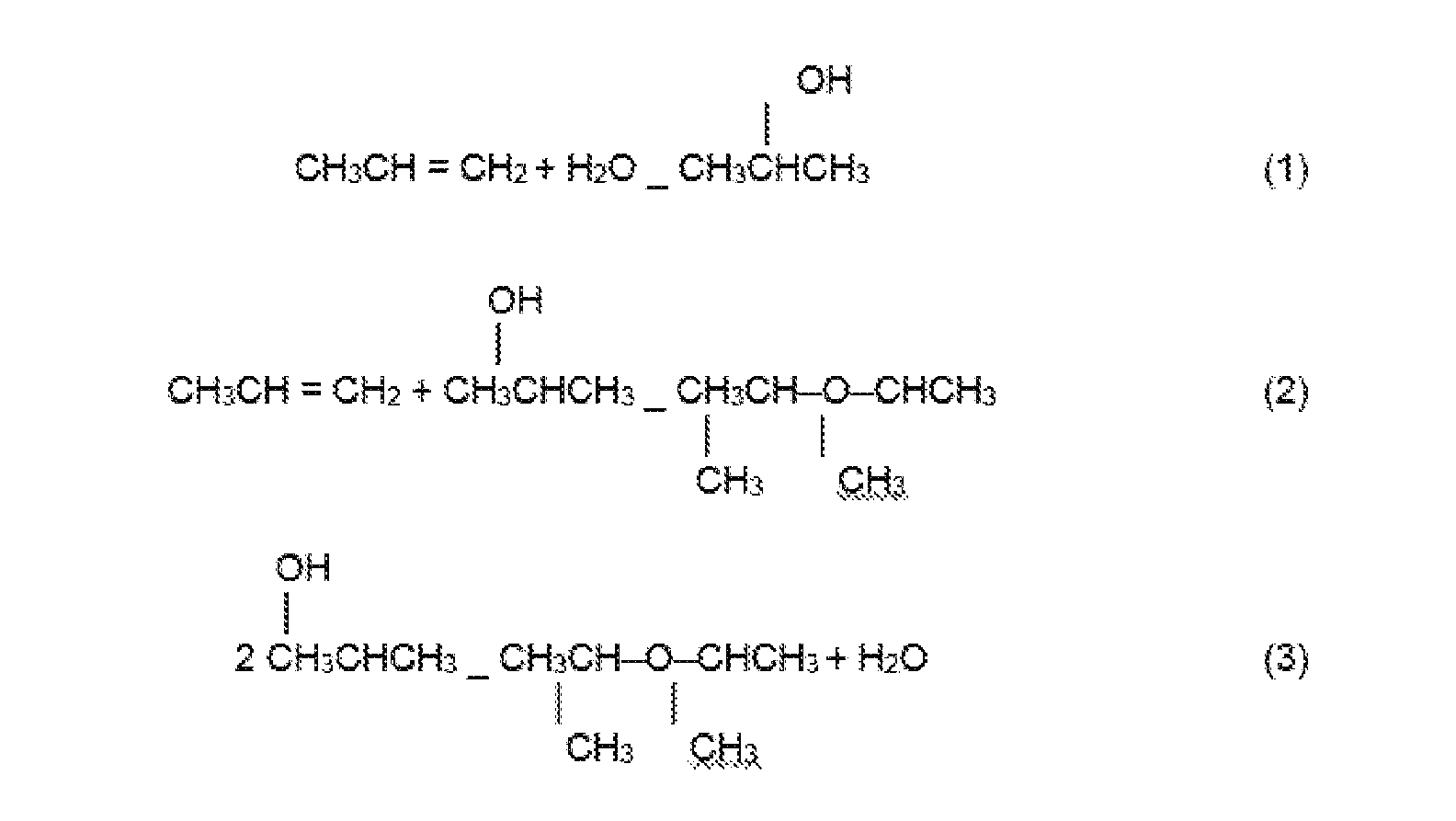
- reaction (1) takes place and IPA is formed.
- IPA is formed as the propylene and water contact the catalyst.
- etherification reaction (2) takes place and DIPE is formed.
- Reaction (3) may also take place to form DIPE, but it is less preferred due to the increased consumption of IPA as compared to reaction (2).
- the reactor may be a single bed reactor or may contain two or more beds with interstage cooling.
- the reactor effluent may contain from as little as 1 to greater than 100 mass ppm of oxo acids of sulfur with a typical value of 1 to 20 mass ppm, and/or as little as 1 to greater than
- the acid removal zone contains any solid particles capable of removing the acid from the reactor effluent.
- the solid particles may be alkaline metal oxides, base ion exchange resins, basic organically-bridged polysilsesquioxanes particles, or activated carbon, or any other strongly basic inorganic compounds with reasonable thermal stability considering the reactor effluent will be at temperatures from 105 to 133°C.
- suitable base ion exchange resins include strong base quaternary ammonium anion exchangers, amine-type weak base anion exchangers, or pyridine-type anion exchangers.
- Suitable commercial base ion exchange resins include Amberlite® IRA-67 , Amberlite® IRA-68, Amberlite® IRA-93, Amberlite® CG-420, Amberlite® IRA-410, Amberlite® IRA-900, Amberlite® IRA-904, Duolite A-7, Duolite A-368, Amberlyst A-21, Amberlyst A-26, Amberlyst A-27, Dowex® 1X2- 100, Dowex® 1X2-200, Dowex® 1 X2-400, Dowex® 1X8-50, Dowex® 1X8-100, Dowex® 1X8-200, and Dowex® 1X8-400 which are sold by companies such as Rohm and Haas, Diamond Shamrock, or Dow.
- the more preferred resins are those that are stable at higher temperatures such as Amberlite® IRA-67 and Amberlite® IRA-68.
- Amberlite® IRA-67 and Amberlite® IRA-68 These types of base ion exchange resins are readily commercially available and are very well known in the art and do not require discussion here. See generally, IJllmann's Encyclopedia of Industrial Chemistry, 5th ed.; Elvers, B., Hawkins, S., Ravenscroft, M., Schulz, G., Eds.; Wienham: Cambridge, New York, Vol. A14, pp. 397-398.
- the base ion exchange resins may be regenerated for reuse, and typically a process would contain two interchangeable base ion exchange chambers so that one chamber is in use while the base ion exchange material in the other chamber is being
- Suitable basic organically-bridged polysilsesquioxanes are any which are capable of removing acid from the reactor effluent.
- Examples of basic organically-bridged polysilsesquioxanes that are appropriate for use in the acid removal zone include those having a divalent radical whose parent is selected from the group consisting of dipropylamine, dipropylphenylamine, tripropylamine, and diphenylamine.
- the acid contacts the base ion exchange resin and is exchanged with the basic group of the resin and is no longer carried with the fluid flow.
- the acid contacts the basic organically-bridged
- the stream exiting the acid removal zone is acid-depleted and has an oxo acids of sulfur concentration, or an oxo acids of sulfur and chloride concentration sum of less than 0.1 mass ppm.
- At least a portion of the acid-depleted stream is recycled to the reactor to react the propylene and IPA to form DIPE and to control the temperature in the reactor. Suitable recycle ratios range from 2: 1 to 10: 1 or 5 : 1.
- At least a portion of the acid-depleted stream containing water, IP A, DIPE, propylene, and propane, is passed to downstream processing zones to recover product DIPE.
- One possible downstream processing flowscheme which has the advantage of not requiring equipment to break the IPA-water azeotrope is as follows.
- a portion of the acid-depleted stream is passed to a light ends fractionation zone for removal of compounds such as propylene and propane.
- the light ends fractionation zone may be operated at a temperature of 80°C and a pressure of 235 psig.
- the light compounds such as propylene and propane it is common for the light compounds such as propylene and propane to be passed to a propylene/propane fractionation column where propane and propylene are separated into two streams.
- propane enriched stream would be collected, and the propylene enriched stream would be recycled to the reactor.
- the recycle may be combined with the seed stock or may be used as an interstage quench.
- the heavier compounds such as water, IPA, and DIPE are passed to a water-IP A-DIPE splitter column.
- a C 4 side cut is taken from the light ends fractionation column and recycled to the reactor.
- a stream of propane and propylene is taken as an overhead stream from the light ends fractionation column.
- concentration of propane in the overhead stream is very small due to the feedstock being a high purity propylene feedstock, no propylene/propane fractionation column is required. Instead, a small purge stream is taken from the overheard stream so that the concentration of propane does not build up in the system. The rest of the overhead stream is passed to the reactor for reaction of the propylene.
- At least a porti on of the acid-depleted stream is recycled to the reactor to react the propylene and IPA to form DIPE and to control the temperature in the reactor.
- the remaining portion of the acid-depleted stream i s passed to the water- IP A-DIPE splitter column which is a fractionation column operating at from 65 to 100°C and from 5 to 25 psig that separates the heavier compounds into a DIPE-IPA-water azeotrope stream, the water into another stream, and an IPA-water azeotrope into a yet another stream.
- the water stream is passed to a water wash zone, discussed below, and the DIPE-IPA-water azeotrope stream is passed to a settler.
- the IPA-water azeotrope stream is recycled to the reactor without breaking the azeotrope which is a significant cost savings since, in order to break the azeotrope, another process unit would be required.
- the DIPE-IP A-water azeotrope forms two phases, a DIPE enriched phase of 95 mass-% DIPE, 1 mass-% water, and 4 mass-% IPA, and a water enriched phase of 94 mass-% water, 1 mass-% DIPE, and 5 mass-% IPA.
- the water enriched phase is recycled either directly to the water-IP A-DIPE splitter, or is combined with the IPA and water stream exiting the water wash zone; see below.
- the DIPE enriched phase is passed to a water wash zone.
- the water wash zone is operated at from 10 to 66°C and from 1 to 10 psig.
- the DIPE enriched phase and a water stream which includes the water stream from the water-IP A-DIPE splitter, are introduced to the water wash zone in a ratio of 1 :5 to 1 : 10 to form an IPA and water stream which is recycled to the water-IP A-DIPE splitter, and a DIPE stream, containing at least 96 mass-% DIPE, which is collected.
- Reactor 4 is operated at 110°C and 1000 psig. In reactor 4, the hydrolysis of propylene is catalyzed and IP A is formed, the IPA is then catalytically reacted with propylene to form DIPE. Some S0 3 will to split off from the sulfonated styrene/divinylbenzene co-polymer ion exchange resin catalyst. The S0 3 is then hydrolyzed to form H 2 S0 4 which is carried into the reaction mixture.
- the reactor effluent 6 contains propylene, propane, water, IPA, DIPE, and H 2 S0 4 , and is passed to acid removal unit 8 which contains Amberlite® IRA-68 base ion exchange resin. Acid removal unit 8 is operated at 80°C and 975 psig.
- H 2 S0 4 or HS0 4 — from the reactor effluent is exchanged for OH- or 2 OH- from the resin, which neutralizes the H + thereby resulting in an H 2 S0 4 -depleted stream 10.
- the H 2 S0 4 -depleted stream 10 is divided into two portions, one portion, stream 12, is recycled to reactor 4, and one portion, stream 14, is passed to a light ends recovery unit 16.
- the recycle to feed rate is 5: 1.
- Fractionation in light ends recovery unit 16 at 80°C and 235 psig results in an overhead propane and propylene stream 18, a bottoms water, IPA and DIPE stream 26 which is passed to a recovery zone 60, and specifically a water- IP A-DIPE splitter column 28 of the recovery zone, and a sidecut nC 4 diluent stream 3.
- a purge stream 17 is removed from overhead propane and propylene stream 18 and the remainder 24 is passed to reactor 4.
- the purge stream prevents build-up of propane which is not consumed in the reactions of reactor 4.
- the si decut nC 4 diluent stream 3 is passed to reactor 4.
- water-IP A-DIPE splitter column 28 the water, IPA and DIPE stream 26 is fractionated to form a water stream 30, a water-IPA azeotrope stream 32, and a DIPE-IPA-water azeotrope stream 34.
- Water-IPA azeotrope stream 32 is recycled to reactor 4, and a first portion of water stream 30a is recycled to a water wash unit 42 while a second portion of water stream 30b may be recycled to reactor 4.
- DIPE-IPA-water azeotrope stream 34 is passed to water wash unit 42 where the azeotrope is separated into a second water-IPA azeotrope stream 38 and a DIPE rich stream 40.
- DIPE rich stream 40 is passed to drying column 52.
- a DIPE product stream 48 containing at least 96 mass-% DIPE is withdrawn from drying column 52 and collected.
- a drying column overhead stream 54 is withdrawn from drying column 52 and passed to unit 56.
- a water stream 58 is removed from unit 56 and the remainder in stream 62 is recycled to light ends recovery unit 16.
- Water feed 50 may be used to add additional water to the system if necessary.
- a first embodiment of the invention is a process for producing diisopropyl ether comprising (a) reacting water and the propylene of a feedstock containing at least 90 mass-% propylene to produce isopropyl alcohol and reacting the isopropyl alcohol with propylene to produce diisopropyl ether in a reactor and in the presence of an acidic ion exchange resin catalyst and a C 4 diluent at a temperature of from 105°C to 133°C to generate a reactor effluent comprising water, isopropyl alcohol, diisopropyl ether, propylene, C 4 and acid; (b) treating the mixture in an acid removal zone to generate an acid-depleted mixture; (c) recycling a portion of the acid-depleted mixture to the reactor, and passing a second portion of the acid-depleted mixture to a light ends fractionation column; (d) separating, in the light ends fractionation column, an overhead stream comprising propane and propylene, a side cut
- An embodiment of the invention is one, any or all of prior embodiments in this paragraph up through the first embodiment in this paragraph wherein the C 4 diluent is nC 4 .
- An embodiment of the invention is one, any or all of prior embodiments in this paragraph up through the first embodiment in this paragraph wherein the reactor comprises at least two beds with interstage cooling.
- An embodiment of the invention is one, any or all of prior embodiments in this paragraph up through the first embodiment in this paragraph wherein a portion of the acid-depleted mixture is recycled to the reactor at a location between beds to provide the interstage cooling.
- An embodiment of the invention is one, any or all of prior embodiments in this paragraph up through the first embodiment in this paragraph wherein the a feedstock contains at least 99.9 mass-% propylene.
- An embodiment of the invention is one, any or all of prior embodiments in this paragraph up through the first embodiment in this paragraph further comprising in the recovery zone (h) passing the second portion of the acid-depleted mixture to a water-IP A-D IPE- splitter column to afford a water enriched mixture, an isopropyl alcohol-water azeotrope mixture, and a diisopropyl ether-isopropyl alcohol-water azeotrope mixture; (i) passing the isopropyl alcohol-water azeotrope mixture to the reactor; (j) passing the water mixture and the diisopropyl ether-isopropyl alcohol-water azeotrope mixture to the water wash zone to afford a diisopropyl ether enriched mixture, and a water and isopropyl alcohol enriched mixture; (k) recycling the water and isopropyl alcohol enriched mixture to the water-IP A-DIPE-splitter column; and (1) passing the diisopropyl ether enriched mixture
Landscapes
- Chemical & Material Sciences (AREA)
- Organic Chemistry (AREA)
- Chemical Kinetics & Catalysis (AREA)
- Organic Low-Molecular-Weight Compounds And Preparation Thereof (AREA)
Abstract
A process for the production of diisopropyl ether from high purity propylene without the need of a propane-propylene fractionation column has been developed. The process involves (1) reacting a high purity propylene feedstock and water to produce isopropyl alcohol in a reactor and reacting the isopropyl alcohol with propylene to produce diisopropyl ether in the presence of an acidic ion exchange resin catalyst and a C4 diluent to generate a reactor effluent stream containing at least water, isopropyl alcohol, diisopropyl ether, propylene, and acid, (2) passing the reactor effluent to an acid removal zone to produce an acid depleted stream, (3) dividing the acid depleted stream into two portions, (4) recycling a portion to the reactor (5) purging a portion to prevent propane build-up and (6) recovering product diisopropyl alcohol.
Description
PROCESS FOR PRODUCING DESOPROPYL ETHER
FROM HIGH PURITY PROPYLENE
STATEMENT OF PRIORITY
This application claims priority to U.S. Application No. 62/439290 which was filed December 27, 2016, the contents of which are hereby incorporated by reference in its entirety.
BACKGROUND OF THE INVENTION
As tetraethyl lead is phased out, oxygenates have become more important in the petroleum refining industry as a source of gasoline octane boosters. The most common oxygenates for this purpose are the dialkyl ethers, especially those in the C5 to C7 range. One such dialkyl ether that is generating much interest is diisopropyl ether (DIPE). DIPE is in the boiling range of gasoline, has a high blending octane number, and one reactant generally used in the formation of DIPE, propylene, is a by-product commonly available in refineries. The preparation of DIPE from propylene proceeds by two sequential reactions, where propylene is first hydrated to isopropyl alcohol (IP A) (1) followed by reaction of the alcohol with the olefin (2) or by a single bimolecular dehydration reaction of the alcohol (3) (Williamson synthesis) according to the equations,
These reactions are catalyzed by a variety of catalysts such as activated charcoal, clays, , and zeolites. In particular, the reactions may be catalyzed by acidic ion exchange resins
including sulfonated cation exchange resins such as sulfonated polystyrene resins and sulfonated styrene/divinylbenzene co-polymers as disclosed in U.S. S.N. 08/079,768, G.B. 1,176,620, and U.S. 4,182,914. Halogenated strong acid ion exchange resins such as those described in U.S. 4,705,808, U.S. 4,269,943, and 3,256,250 also may be used. A recognized problem of these catalysts is their susceptibility to hydrolysis of the acidic groups causing the transfer of acidic material from the catalysts into the reaction mixture and ultimately into the reactor effluent. The hydrolysis depends strongly on the reaction temperature, and the higher the temperature the greater the degree of hydrolysis. Steps may be taken to remove acid from process streams to protect downstream process units.
The propylene-containing hydrocarbon feedstock may be a refinery C3 hydrocarbon stream and will most likely be a mixture of propylene and propane. Previously, the
propylene-containing hydrocarbon feedstock typically contain at least 50 mass-% propylene, or from 70 to 80 mass-% propylene. Sources for the propylene-containing hydrocarbon feedstock have included gas plant off-gas containing propylene, naphtha cracker off-gas containing light olefins, propylene from a propane dehydrogenation process, and refinery fluidized catalytic cracked (FCC) propane/propylene streams.
Recently, high purity propylene feedstocks have become available where the feedstock comprises from 90 mass-% to 99.9 mass-% propylene. Therefore there is a need for a process for generating dialkyl ethers using high purity propylene feedstocks.
SUMMARY OF THE INVENTION
The invention provides a process for producing diisopropyl ether from high purity propylene feedstocks comprising from 90 mass-% to 99.9 mass-% propylene and from 0.1 to 1 mass-% propane. The process of the invention involves (1) reacting, in a reactor and in the presence of an acidic ion exchange resin catalyst, the propylene of a high purity propylene feedstock and water to produce isopropyl alcohol and reacting the isopropyl alcohol with propylene to produce diisopropyl ether to afford a mixture containing at least water, isopropyl alcohol, diisopropyl ether, propylene, and acid; (2) passing the reactor effluent to an acid removal zone to produce an acid-depleted mixture; and (3) recycling a portion of the acid- depleted mixture to the reactor (4) passing a portion of the acid-depleted mixture to a light ends removal zone to separate unreacted propylene and propane from the reaction products and water and (5) purging a portion of the propane and recycling propylene to the reactor.
The light ends removal zone also provides a water, isopropyl alcohol, and diisopropyl ether enriched stream. Diisopropyl ether is recovered from a portion of the acid-depleted stream through the generation of the water, isopropyl alcohol, and diisopropyl ether enriched stream and then passing the stream to a separation zone to afford a water stream, an isopropyl alcohol-water azeotrope stream, and a diisopropyl ether-isopropyl alcohol-water azeotrope stream; passing the water stream to a water wash zone, the isopropyl alcohol-water azeotrope stream to the reactor, and the diisopropyl ether-isopropyl alcohol-water azeotrope stream to a settler to afford a diisopropyl ether enriched stream and a water enriched stream; and passing the diisopropyl ether enriched stream to the water wash zone to afford an isopropyl alcohol and water stream which is passed to the second separation zone, and a diisopropyl ether product stream containing at least 96 mass-% diisopropyl ether.
BRIEF DESCRIPTION OF THE DRAWING
The FIGURE is a schematic representation of the preferred embodim ent of the invention.
DETAILED DESCRIPTION OF THE INVENTION
The invention applies to single stage DIPE production processes where the hydration of propylene to form IPA and the etherifi cation of IP A and propylene to form DIPE are performed concurrently using an acidic ion exchange resin to catalyze both reactions, while protecting the reaction catalyst and downstream zones from degradation due to the introduction of acid. The invention further provides a DIPE production process which does not require breaking the IPA-water azeotrope which is formed in the process.
The process of the invention begins with introducing water and a hydrocarbon feedstock containing propylene to a reactor containing an acidic ion exchange resin catalyst. The operating conditions of the reactor include pressures of 100 to 1500 psia, or from 700 to 1000 psia, and temperatures of 105 to 133°C, or from 108 to 130°C or from 108 to 125°C. It is common to slowly increase the operating temperature as the catalyst ages. Suitable water to olefin mole ratios include from 0.1 : 1 to 0.8: 1 , or 0.5: 1. Greater water to olefin mole ratios may be used, but the invention would become less economically attractive, as discussed below. The
propylene-containing hydrocarbon feedstock may be a refinery C hydrocarbon stream and will
most likely be a mixture of propylene and propane. The propylene-containing hydrocarbon feedstock should contain at least 90 mass-% propylene, or from 90 to 99 mass-% propylene, or from 90 to 99.9 mass-%. Suitable sources for the propylene-containing hydrocarbon feedstock include, but are not limited to, gas plant off-gas containing propylene, naphtha cracker off-gas containing light olefins, propylene from a propane dehydrogenation process, and refinery fluidized catal tic cracked (FCC) propane/propylene streams or high purity propylene from other sources.
A diluent of C4 is added to the system. The diluent is a closed loop diluent, it is not reactive and merely circulates. The diluent provides dilution of the reactants to control the temperature in the reactor and minimize an exotherm. The diluent may be added at start-up of the process, and additional diluent may be added if needed. The C4 may be isobutane or normal butane or mixtures thereof. C4 diluent is particularly advantageous since C4s do not form azeotropes with the oxygenate byproducts.
The acidic ion exchange resin catalysts may be any of those commonly used for a DIPE production process including sulfonated cation exchange resins such as sulfonated polystyrene resins and sulfonated styrene/divinylbenzene co-polymers. An example of a suitable sulfonated styrene/divinylbenzene co-polymer catalyst is Purolite CT-175 sold by Purolite. These sulfonated cation exchange resins are common in the art and do not require discussion here. For reference, see, U.S.S.N. 08/079,768, G.B. 1,176,620, and U.S. 4,182,914. Halogenated strong acid ion exchange resins such as those described in U.S. 4,705,808, U.S. 4,269,943, and U.S. 3,256,250 may also be used.
As the propylene and water contact the catalyst, the hydration reaction (1) takes place and IPA is formed. As the IPA and propylene contact the catalyst, the etherification reaction (2) takes place and DIPE is formed. Reaction (3) may also take place to form DIPE, but it is less preferred due to the increased consumption of IPA as compared to reaction (2). The reactor may be a single bed reactor or may contain two or more beds with interstage cooling.
During operation, some of the acid from the catalyst will enter into the reaction mixture.
For example, the reactor effluent may contain from as little as 1 to greater than 100 mass ppm of oxo acids of sulfur with a typical value of 1 to 20 mass ppm, and/or as little as 1 to greater than
100 mass ppm chloride with a typical value of 1 to 20 mass ppm depending upon the catalyst composition and the age of the catalyst. It is common practice to recycle a portion of the reactor effluent in order to increase conversion of propylene and IPA to DIPE and to control the
temperature in the reactor. However, when the acid is not removed from the reactor effluent, and a portion of the reactor effluent is recycled to the reactor, the catalyst is rapidly deactivated. When the acid is removed from the reactor effluent prior to recycling, the life of the catalyst is significantly extended. Therefore the entire reactor effluent may be introduced to an acid removal zone prior to recycling.
The acid removal zone contains any solid particles capable of removing the acid from the reactor effluent. For example, the solid particles may be alkaline metal oxides, base ion exchange resins, basic organically-bridged polysilsesquioxanes particles, or activated carbon, or any other strongly basic inorganic compounds with reasonable thermal stability considering the reactor effluent will be at temperatures from 105 to 133°C. Examples of suitable base ion exchange resins include strong base quaternary ammonium anion exchangers, amine-type weak base anion exchangers, or pyridine-type anion exchangers. Specific suitable commercial base ion exchange resins include Amberlite® IRA-67 , Amberlite® IRA-68, Amberlite® IRA-93, Amberlite® CG-420, Amberlite® IRA-410, Amberlite® IRA-900, Amberlite® IRA-904, Duolite A-7, Duolite A-368, Amberlyst A-21, Amberlyst A-26, Amberlyst A-27, Dowex® 1X2- 100, Dowex® 1X2-200, Dowex® 1 X2-400, Dowex® 1X8-50, Dowex® 1X8-100, Dowex® 1X8-200, and Dowex® 1X8-400 which are sold by companies such as Rohm and Haas, Diamond Shamrock, or Dow. The more preferred resins are those that are stable at higher temperatures such as Amberlite® IRA-67 and Amberlite® IRA-68. These types of base ion exchange resins are readily commercially available and are very well known in the art and do not require discussion here. See generally, IJllmann's Encyclopedia of Industrial Chemistry, 5th ed.; Elvers, B., Hawkins, S., Ravenscroft, M., Schulz, G., Eds.; Wienham: Cambridge, New York, Vol. A14, pp. 397-398. The base ion exchange resins may be regenerated for reuse, and typically a process would contain two interchangeable base ion exchange chambers so that one chamber is in use while the base ion exchange material in the other chamber is being
regenerated.
When using the base ion exchange resins, it is important to observe the thermal limitations of the resins. Most resins are stable at temperatures from ambient to a maximum of
100°C with a few being stable at up to 108°C. It is advantageous to operate the reactor so that the reactor effluent will be at a temperature within the stable temperature range of the resins so that heat exchangers would not be required to lower the temperature of the reactor effluent before entering the acid removal zone. Suitable basic organically-bridged polysilsesquioxanes
are any which are capable of removing acid from the reactor effluent. Examples of basic organically-bridged polysilsesquioxanes that are appropriate for use in the acid removal zone include those having a divalent radical whose parent is selected from the group consisting of dipropylamine, dipropylphenylamine, tripropylamine, and diphenylamine.
As the reactor effluent is introduced to the acid removal zone, the acid contacts the base ion exchange resin and is exchanged with the basic group of the resin and is no longer carried with the fluid flow. Alternatively, the acid contacts the basic organically-bridged
polysilsesquioxane and is removed from the fluid flow. The stream exiting the acid removal zone is acid-depleted and has an oxo acids of sulfur concentration, or an oxo acids of sulfur and chloride concentration sum of less than 0.1 mass ppm. At least a portion of the acid-depleted stream is recycled to the reactor to react the propylene and IPA to form DIPE and to control the temperature in the reactor. Suitable recycle ratios range from 2: 1 to 10: 1 or 5 : 1. At least a portion of the acid-depleted stream containing water, IP A, DIPE, propylene, and propane, is passed to downstream processing zones to recover product DIPE. One possible downstream processing flowscheme which has the advantage of not requiring equipment to break the IPA-water azeotrope is as follows.
A portion of the acid-depleted stream is passed to a light ends fractionation zone for removal of compounds such as propylene and propane. The light ends fractionation zone may be operated at a temperature of 80°C and a pressure of 235 psig.
In other processes, it is common for the light compounds such as propylene and propane to be passed to a propylene/propane fractionation column where propane and propylene are separated into two streams. The propane enriched stream would be collected, and the propylene enriched stream would be recycled to the reactor. The recycle may be combined with the seed stock or may be used as an interstage quench. The heavier compounds such as water, IPA, and DIPE are passed to a water-IP A-DIPE splitter column.
With the feed here being high purity propylene, the propylene/propane fractionation column of traditional flow schemes is not necessary thereby saving large capital and operational costs.
Instead, a C4 side cut is taken from the light ends fractionation column and recycled to the reactor. A stream of propane and propylene is taken as an overhead stream from the light ends fractionation column. As the concentration of propane in the overhead stream is very small due to the feedstock being a high purity propylene feedstock, no propylene/propane fractionation
column is required. Instead, a small purge stream is taken from the overheard stream so that the concentration of propane does not build up in the system. The rest of the overhead stream is passed to the reactor for reaction of the propylene.
As discussed above, at least a porti on of the acid-depleted stream is recycled to the reactor to react the propylene and IPA to form DIPE and to control the temperature in the reactor. The remaining portion of the acid-depleted stream i s passed to the water- IP A-DIPE splitter column which is a fractionation column operating at from 65 to 100°C and from 5 to 25 psig that separates the heavier compounds into a DIPE-IPA-water azeotrope stream, the water into another stream, and an IPA-water azeotrope into a yet another stream. The water stream is passed to a water wash zone, discussed below, and the DIPE-IPA-water azeotrope stream is passed to a settler. The IPA-water azeotrope stream is recycled to the reactor without breaking the azeotrope which is a significant cost savings since, in order to break the azeotrope, another process unit would be required.
In the settler, the DIPE-IP A-water azeotrope forms two phases, a DIPE enriched phase of 95 mass-% DIPE, 1 mass-% water, and 4 mass-% IPA, and a water enriched phase of 94 mass-% water, 1 mass-% DIPE, and 5 mass-% IPA. The water enriched phase is recycled either directly to the water-IP A-DIPE splitter, or is combined with the IPA and water stream exiting the water wash zone; see below. The DIPE enriched phase is passed to a water wash zone.
The water wash zone is operated at from 10 to 66°C and from 1 to 10 psig. The DIPE enriched phase and a water stream, which includes the water stream from the water-IP A-DIPE splitter, are introduced to the water wash zone in a ratio of 1 :5 to 1 : 10 to form an IPA and water stream which is recycled to the water-IP A-DIPE splitter, and a DIPE stream, containing at least 96 mass-% DIPE, which is collected.
Without intending any limitation of the scope of the present invention and as merely illustrative, the invention is explained below in specific terms as applied to a specific embodiment of the invention which is based on a design for a commercial scale unit. Referring to the FIGURE, a 99 mass-% propylene- 1 mass-% propane feed 2 water, IPA, propylene, propane, and DIPE containing recycle 12, IPA-water azeotrope containing stream 32, propylene-containing recycle 24, and a nC4 containing diluent stream are combined and introduced to hydration and etherificati on reactor 4 which contains sulfonated
styrene/divinylbenzene co-polymer ion exchange resin catalyst. Reactor 4 is operated at 110°C
and 1000 psig. In reactor 4, the hydrolysis of propylene is catalyzed and IP A is formed, the IPA is then catalytically reacted with propylene to form DIPE. Some S03 will to split off from the sulfonated styrene/divinylbenzene co-polymer ion exchange resin catalyst. The S03 is then hydrolyzed to form H2S04 which is carried into the reaction mixture. Other oxo acids of sulfur such as HS03- or HS04 — may be formed, but for ease of understanding, only H2S04 will be discussed. The reactor effluent 6 contains propylene, propane, water, IPA, DIPE, and H2S04, and is passed to acid removal unit 8 which contains Amberlite® IRA-68 base ion exchange resin. Acid removal unit 8 is operated at 80°C and 975 psig. As the fluid reactor effluent 6 contacts the Amberlite® IRA-68 base ion exchange resin, S04 = or HS04 — from the reactor effluent is exchanged for OH- or 2 OH- from the resin, which neutralizes the H+ thereby resulting in an H2S04-depleted stream 10. The H2S04-depleted stream 10 is divided into two portions, one portion, stream 12, is recycled to reactor 4, and one portion, stream 14, is passed to a light ends recovery unit 16. The recycle to feed rate is 5: 1. Fractionation in light ends recovery unit 16 at 80°C and 235 psig results in an overhead propane and propylene stream 18, a bottoms water, IPA and DIPE stream 26 which is passed to a recovery zone 60, and specifically a water- IP A-DIPE splitter column 28 of the recovery zone, and a sidecut nC4 diluent stream 3. A purge stream 17 is removed from overhead propane and propylene stream 18 and the remainder 24 is passed to reactor 4. The purge stream prevents build-up of propane which is not consumed in the reactions of reactor 4. The si decut nC4 diluent stream 3 is passed to reactor 4.
In water-IP A-DIPE splitter column 28 the water, IPA and DIPE stream 26 is fractionated to form a water stream 30, a water-IPA azeotrope stream 32, and a DIPE-IPA-water azeotrope stream 34. Water-IPA azeotrope stream 32 is recycled to reactor 4, and a first portion of water stream 30a is recycled to a water wash unit 42 while a second portion of water stream 30b may be recycled to reactor 4. DIPE-IPA-water azeotrope stream 34 is passed to water wash unit 42 where the azeotrope is separated into a second water-IPA azeotrope stream 38 and a DIPE rich stream 40. DIPE rich stream 40 is passed to drying column 52. A DIPE product stream 48 containing at least 96 mass-% DIPE is withdrawn from drying column 52 and collected. A drying column overhead stream 54 is withdrawn from drying column 52 and passed to unit 56. A water stream 58 is removed from unit 56 and the remainder in stream 62 is recycled to light ends recovery unit 16. Water feed 50 may be used to add additional water to the system if necessary.
SPECIFIC EMBODIMENTS
While the following is described in conjunction with specific embodiments, it will be understood that this description is intended to illustrate and not limit the scope of the preceding description and the appended claims.
A first embodiment of the invention is a process for producing diisopropyl ether comprising (a) reacting water and the propylene of a feedstock containing at least 90 mass-% propylene to produce isopropyl alcohol and reacting the isopropyl alcohol with propylene to produce diisopropyl ether in a reactor and in the presence of an acidic ion exchange resin catalyst and a C4 diluent at a temperature of from 105°C to 133°C to generate a reactor effluent comprising water, isopropyl alcohol, diisopropyl ether, propylene, C4 and acid; (b) treating the mixture in an acid removal zone to generate an acid-depleted mixture; (c) recycling a portion of the acid-depleted mixture to the reactor, and passing a second portion of the acid-depleted mixture to a light ends fractionation column; (d) separating, in the light ends fractionation column, an overhead stream comprising propane and propylene, a side cut stream comprising C4, and a bottoms stream comprising water, isopropyl alcohol, and diisopropyl ether; (e) purging a portion of the overhead stream and passing the remainder of the overhead stream to the reactor; (f) passing the sidecut stream comprising nC4 to the reactor; and (g) passing the bottoms stream to a recovery zone to separate and collect the diisopropylether. An embodiment of the invention is one, any or all of prior embodiments in this paragraph up through the first embodiment in this paragraph wherein the C4 diluent is nC4. An embodiment of the invention is one, any or all of prior embodiments in this paragraph up through the first embodiment in this paragraph wherein the reactor comprises at least two beds with interstage cooling. An embodiment of the invention is one, any or all of prior embodiments in this paragraph up through the first embodiment in this paragraph wherein a portion of the acid-depleted mixture is recycled to the reactor at a location between beds to provide the interstage cooling. An embodiment of the invention is one, any or all of prior embodiments in this paragraph up through the first embodiment in this paragraph wherein the a feedstock contains at least 99.9 mass-% propylene. An embodiment of the invention is one, any or all of prior embodiments in this paragraph up through the first embodiment in this paragraph further comprising in the recovery zone (h) passing the second portion of the acid-depleted mixture to a water-IP A-D IPE- splitter column to afford a water enriched mixture, an isopropyl alcohol-water azeotrope
mixture, and a diisopropyl ether-isopropyl alcohol-water azeotrope mixture; (i) passing the isopropyl alcohol-water azeotrope mixture to the reactor; (j) passing the water mixture and the diisopropyl ether-isopropyl alcohol-water azeotrope mixture to the water wash zone to afford a diisopropyl ether enriched mixture, and a water and isopropyl alcohol enriched mixture; (k) recycling the water and isopropyl alcohol enriched mixture to the water-IP A-DIPE-splitter column; and (1) passing the diisopropyl ether enriched mixture to a drying column to generate product diisopropyl ether containing at least 96 mass-% diisopropyl ether.
Without further elaboration, it is believed that using the preceding description that one skilled in the art can utilize the present invention to its fullest extent and easily ascertain the essential characteristics of this invention, without departing from the spirit and scope thereof, to make various changes and modifications of the invention and to adapt it to various usages and conditions. The preceding preferred specific embodiments are, therefore, to be construed as merely illustrative, and not limiting the remainder of the disclosure in any way whatsoever, and that it is intended to cover various modifications and equivalent arrangements included within the scope of the appended claims.
In the foregoing, all temperatures are set forth in degrees Celsius and, all parts and percentages are by weight, unless otherwise indicated.
-
Claims
1. A process for producing diisopropyl ether comprising:
(a) reacting water and the propylene of a feedstock containing at least 90 mass-%
propylene to produce isopropyl alcohol and reacting the isopropyl alcohol with propylene to produce diisopropyl ether in a reactor and in the presence of an acidic ion exchange resin catalyst and a C4 diluent at a temperature of from 105°C to 133°C to generate a reactor effluent comprising water, isopropyl alcohol, diisopropyl ether, propylene, C4 and acid;
(b) treating the mixture in an acid removal zone to generate an acid-depleted mixture;
(c) recycling a portion of the acid-depleted mixture to the reactor, and passing a second portion of the acid-depleted mixture to a light ends fractionation column;
(d) separating, in the light ends fractionation column, an overhead stream comprising propane and propylene, a side cut stream comprising C4, and a bottoms stream comprising water, isopropyl alcohol, and diisopropyl ether;
(e) purging a portion of the overhead stream and passing the remainder of the overhead stream to the reactor;
(f) passing the sidecut stream comprising nC4 to the reactor; and
(g) passing the bottoms stream to a recovery zone to separate and collect the
diisopropyl ether.
2. The process of claim 1 wherein the C4 diluent is nC4.
3. The process of claim 1 wherein the reactor comprises at least two beds with interstage cooling.
4. The process of claim 3 wherein a portion of the acid-depleted mixture is recycled to the reactor at a location between beds to provide the interstage cooling.
5. The process of claim 1 wherein the a feedstock contains at least 99.9 mass-% propylene.
6. The process of claim 1 further comprising in the recovery zone:
(h) passing the second portion of the acid-depleted mixture to a water-IP A-DIPE-splitter column to afford a water enriched mixture, an isopropyl alcohol-water azeotrope mixture, and a diisopropyl ether-isopropyl alcohol-water azeotrope mixture;
(i) passing the isopropyl alcohol-water azeotrope mixture to the reactor;
(j) passing the water mixture and the diisopropyl ether-isopropyl alcohol-water
azeotrope mixture to the water wash zone to afford a diisopropyl ether enriched mixture, and a water and isopropyl alcohol enriched mixture;
(k) recycling the water and isopropyl alcohol enriched mixture to the water-IP A-DIPE- splitter column; and
(1) passing the diisopropyl ether enriched mixture to a drying column to generate
product diisopropyl ether containing at least 96 mass-% diisopropyl ether.
-
Priority Applications (1)
| Application Number | Priority Date | Filing Date | Title |
|---|---|---|---|
| CN201780080998.2A CN110121487A (en) | 2016-12-27 | 2017-12-15 | The method that diisopropyl ether is generated by high-purity propylene |
Applications Claiming Priority (2)
| Application Number | Priority Date | Filing Date | Title |
|---|---|---|---|
| US201662439290P | 2016-12-27 | 2016-12-27 | |
| US62/439,290 | 2016-12-27 |
Publications (1)
| Publication Number | Publication Date |
|---|---|
| WO2018125609A1 true WO2018125609A1 (en) | 2018-07-05 |
Family
ID=62625459
Family Applications (1)
| Application Number | Title | Priority Date | Filing Date |
|---|---|---|---|
| PCT/US2017/066635 Ceased WO2018125609A1 (en) | 2016-12-27 | 2017-12-15 | Process for producing diisopropyl ether from high purity propylene |
Country Status (3)
| Country | Link |
|---|---|
| US (1) | US10392331B2 (en) |
| CN (1) | CN110121487A (en) |
| WO (1) | WO2018125609A1 (en) |
Families Citing this family (2)
| Publication number | Priority date | Publication date | Assignee | Title |
|---|---|---|---|---|
| EP4239563B1 (en) * | 2020-10-30 | 2025-08-13 | Asahi Kasei Kabushiki Kaisha | Authentication method, authentication system, and program |
| KR102673698B1 (en) | 2021-05-31 | 2024-06-07 | 주식회사 엘지화학 | Method for preraring isopropyl alcohol |
Citations (3)
| Publication number | Priority date | Publication date | Assignee | Title |
|---|---|---|---|---|
| US4935552A (en) * | 1989-01-12 | 1990-06-19 | Mobil Oil Corporation | Dual stage process for the production of ethers |
| WO1992001661A1 (en) * | 1990-07-25 | 1992-02-06 | Mobil Oil Corporation | Reactor quenching for catalytic olefin hydration in ether production |
| US5504257A (en) * | 1994-09-26 | 1996-04-02 | Uop | Process for producing diisopropyl ether with removal of acid material |
Family Cites Families (15)
| Publication number | Priority date | Publication date | Assignee | Title |
|---|---|---|---|---|
| US3256250A (en) | 1961-09-26 | 1966-06-14 | Socony Mobil Oil Co Inc | Sulfonated ion exchange resin having an electronegative no2 substituent |
| GB1176620A (en) | 1968-07-09 | 1970-01-07 | Shell Int Research | Recovery of Tertiary Olefins |
| US4182914A (en) | 1974-01-22 | 1980-01-08 | Nippon Oil Company Limited | Process for continuously producing diisopropyl ether |
| US4269943A (en) | 1979-08-23 | 1981-05-26 | Rohm And Haas Company | Thermally stable resins prepared by bromination or chlorination of aromatic polymer beads followed by sulphonation |
| DE3512517A1 (en) | 1985-04-06 | 1986-10-09 | Deutsche Texaco Ag, 2000 Hamburg | METHOD FOR THE TREATMENT OF STRONG ACID CATION EXCHANGER CATALYSTS |
| US5102428A (en) | 1989-10-20 | 1992-04-07 | Mobil Oil Corporation | Integrated process for the production of diisopropyl ether and gasoline |
| US5208387A (en) | 1991-12-27 | 1993-05-04 | Mobil Oil Corporation | Two stage process for production of diisopropyl ether |
| US5324865A (en) * | 1993-02-22 | 1994-06-28 | Mobil Oil Corporation | Di-isopropyl ether production |
| US5324866A (en) * | 1993-03-23 | 1994-06-28 | Uop | Integrated process for producing diisopropyl ether from isopropyl alcohol |
| US5600023A (en) | 1993-06-21 | 1997-02-04 | Uop | Single stage diisopropyl ether process using organic solvent aqueous extraction and ion exchange treating for SO3 removal |
| US5371301A (en) | 1993-06-21 | 1994-12-06 | Uop | Single stage diisopropyl ether process using aqueous extraction and ion exchange treating for SO3 removal |
| US5986148A (en) | 1993-08-02 | 1999-11-16 | Mobil Oil Corporation | Di-isopropyl ether synthesis and dry product recovery |
| TW321634B (en) * | 1994-07-05 | 1997-12-01 | Mitsui Toatsu Chemicals | |
| US5744645A (en) * | 1994-09-26 | 1998-04-28 | Uop | Two-stage process for producing diisopropyl ether using catalytic distillation |
| US5750800A (en) * | 1995-11-09 | 1998-05-12 | Uop | Process for producing diisopropyl ether from propane |
-
2017
- 2017-12-15 WO PCT/US2017/066635 patent/WO2018125609A1/en not_active Ceased
- 2017-12-15 CN CN201780080998.2A patent/CN110121487A/en active Pending
- 2017-12-19 US US15/846,770 patent/US10392331B2/en not_active Expired - Fee Related
Patent Citations (3)
| Publication number | Priority date | Publication date | Assignee | Title |
|---|---|---|---|---|
| US4935552A (en) * | 1989-01-12 | 1990-06-19 | Mobil Oil Corporation | Dual stage process for the production of ethers |
| WO1992001661A1 (en) * | 1990-07-25 | 1992-02-06 | Mobil Oil Corporation | Reactor quenching for catalytic olefin hydration in ether production |
| US5504257A (en) * | 1994-09-26 | 1996-04-02 | Uop | Process for producing diisopropyl ether with removal of acid material |
Also Published As
| Publication number | Publication date |
|---|---|
| US10392331B2 (en) | 2019-08-27 |
| US20180179135A1 (en) | 2018-06-28 |
| CN110121487A (en) | 2019-08-13 |
Similar Documents
| Publication | Publication Date | Title |
|---|---|---|
| US5705712A (en) | Integrated process for producing diisopropyl ether, an isopropyl tertiary alkyl ether and isopropyl alcohol | |
| US4570026A (en) | Production of isobutene from methyl tertiary butyl ether | |
| US4504687A (en) | Method for etherifications | |
| KR101376185B1 (en) | Process for fine purification of 1-butenic streams | |
| CN108558590A (en) | Integrated approach for the method for the cracking production high-purity isobutylene by MTBE or ETBE and for producing related ether | |
| EP0608093A1 (en) | Epoxidation process for manufacture of olefin oxide and alcohol | |
| US5324866A (en) | Integrated process for producing diisopropyl ether from isopropyl alcohol | |
| US5567860A (en) | High purity tertiary olefin process using removal of secondary ethers | |
| US10392331B2 (en) | Process for producing diisopropyl ether from high purity propylene | |
| US5986148A (en) | Di-isopropyl ether synthesis and dry product recovery | |
| US4510336A (en) | Transetherification method | |
| US5504257A (en) | Process for producing diisopropyl ether with removal of acid material | |
| AU651373B2 (en) | Reactor quenching for catalytic olefin hydration in ether production | |
| US5744645A (en) | Two-stage process for producing diisopropyl ether using catalytic distillation | |
| Miracca et al. | Multitubular reactors for etherifications | |
| US10392330B2 (en) | Process for producing diisopropyl ether from high purity propylene | |
| JPH09118637A (en) | Method for controlling ratio of 2-methyl-1-butene to 2-methyl-2-butene in isoamylene | |
| US10377688B2 (en) | Process for producing diisopropyl ether from high purity propylene | |
| KR101524487B1 (en) | Process for the production of high-octane hydrocarbon compounds by the selective dimerization of isobutene contained in a stream which also contains c5 hydrocarbons. | |
| US5113024A (en) | Process for product separation in the production of di-isopropyl ether | |
| US5154801A (en) | Advances in product separation in dipe process | |
| US5689014A (en) | Integrated process for producing diisopropyl ether and an isopropyl tertiary alkyl ether | |
| US5750800A (en) | Process for producing diisopropyl ether from propane | |
| JPS6240335B2 (en) | ||
| US4792639A (en) | Process for the production of methyl ethers from branched monoolefins |
Legal Events
| Date | Code | Title | Description |
|---|---|---|---|
| 121 | Ep: the epo has been informed by wipo that ep was designated in this application |
Ref document number: 17888210 Country of ref document: EP Kind code of ref document: A1 |
|
| NENP | Non-entry into the national phase |
Ref country code: DE |
|
| 122 | Ep: pct application non-entry in european phase |
Ref document number: 17888210 Country of ref document: EP Kind code of ref document: A1 |