WO2018104474A1 - Compound derived from 4,5-diaminopyrazoles comprising a fused ring, composition comprising at least one such compound, implementation process and use - Google Patents
Compound derived from 4,5-diaminopyrazoles comprising a fused ring, composition comprising at least one such compound, implementation process and use Download PDFInfo
- Publication number
- WO2018104474A1 WO2018104474A1 PCT/EP2017/081881 EP2017081881W WO2018104474A1 WO 2018104474 A1 WO2018104474 A1 WO 2018104474A1 EP 2017081881 W EP2017081881 W EP 2017081881W WO 2018104474 A1 WO2018104474 A1 WO 2018104474A1
- Authority
- WO
- WIPO (PCT)
- Prior art keywords
- radical
- compound
- chosen
- alkyl
- tetrahydropyrazo
- Prior art date
- Legal status (The legal status is an assumption and is not a legal conclusion. Google has not performed a legal analysis and makes no representation as to the accuracy of the status listed.)
- Ceased
Links
Classifications
-
- C—CHEMISTRY; METALLURGY
- C07—ORGANIC CHEMISTRY
- C07D—HETEROCYCLIC COMPOUNDS
- C07D471/00—Heterocyclic compounds containing nitrogen atoms as the only ring hetero atoms in the condensed system, at least one ring being a six-membered ring with one nitrogen atom, not provided for by groups C07D451/00 - C07D463/00
- C07D471/02—Heterocyclic compounds containing nitrogen atoms as the only ring hetero atoms in the condensed system, at least one ring being a six-membered ring with one nitrogen atom, not provided for by groups C07D451/00 - C07D463/00 in which the condensed system contains two hetero rings
- C07D471/04—Ortho-condensed systems
-
- A—HUMAN NECESSITIES
- A61—MEDICAL OR VETERINARY SCIENCE; HYGIENE
- A61K—PREPARATIONS FOR MEDICAL, DENTAL OR TOILETRY PURPOSES
- A61K8/00—Cosmetics or similar toiletry preparations
- A61K8/18—Cosmetics or similar toiletry preparations characterised by the composition
- A61K8/30—Cosmetics or similar toiletry preparations characterised by the composition containing organic compounds
- A61K8/49—Cosmetics or similar toiletry preparations characterised by the composition containing organic compounds containing heterocyclic compounds
- A61K8/494—Cosmetics or similar toiletry preparations characterised by the composition containing organic compounds containing heterocyclic compounds with more than one nitrogen as the only hetero atom
- A61K8/4946—Imidazoles or their condensed derivatives, e.g. benzimidazoles
-
- A—HUMAN NECESSITIES
- A61—MEDICAL OR VETERINARY SCIENCE; HYGIENE
- A61Q—SPECIFIC USE OF COSMETICS OR SIMILAR TOILETRY PREPARATIONS
- A61Q5/00—Preparations for care of the hair
- A61Q5/10—Preparations for permanently dyeing the hair
Definitions
- the present invention relates to compounds of formula (I), derived from 4,5- diaminopyrazoles comprising a fused ring, and also to the use thereof for dyeing keratin fibres, in particular human keratin fibres such as the hair, in the presence of an oxidizing agent.
- oxidation dye precursors which are generally known as oxidation bases, such as ortho- or para-phenylenediamines, ortho- or para-aminophenols, or heterocyclic compounds such as pyrazoles, pyrazolinones or pyrazolo-pyridines.
- oxidation bases are colourless or weakly coloured compounds, which, when combined with oxidizing products, may give rise to coloured compounds via a process of oxidative condensation.
- oxidation bases may be varied by combining them with couplers or colour modifiers, the latter being chosen especially from aromatic meta-diamines, meta-aminophenols, meta-diphenols and certain heterocyclic compounds such as indole or pyridine compounds.
- couplers or colour modifiers the latter being chosen especially from aromatic meta-diamines, meta-aminophenols, meta-diphenols and certain heterocyclic compounds such as indole or pyridine compounds.
- couplers or colour modifiers the variety of molecules used as oxidation bases and couplers allows a wide range of colours to be obtained.
- the oxidation dyeing process thus consists in applying to keratin fibres a dyeing composition comprising oxidation bases or a mixture of oxidation bases and couplers with hydrogen peroxide (H2O2 or aqueous hydrogen peroxide solution), as oxidizing agent, in leaving it to diffuse, and then in rinsing the fibres.
- a dyeing composition comprising oxidation bases or a mixture of oxidation bases and couplers with hydrogen peroxide (H2O2 or aqueous hydrogen peroxide solution), as oxidizing agent
- the use of these dyeing compositions still has a certain number of drawbacks. Specifically, after application to keratin fibres, the dyeing power obtained may not be entirely satisfactory, or may even be weak, and lead to a restricted range of colours.
- the colourings may also be insufficiently persistent with respect to external agents such as light, shampoo or perspiration, and may also be too selective, i.e. the difference in colouring is too great along the same keratin fibre that is differently sensitized between its end and its root.
- dyes are sought which give chromatic and/or intense shades to the hair.
- compositions for oxidation dyeing comprising diaminopyrazole derivatives and couplers of the meta-phenylenediamine, meta-aminophenol or benzoxazine type are also known in patent applications EP 873 109, EP 871 426 and EP 692 245.
- compositions do not make it possible to meet all the above- mentioned requirements, in particular in terms of build-up, chromaticity, fastness with respect to washing, to light and/or to sweat, and/or selectivity of the colouring between the root and the end.
- a subject of the invention is thus a compound of formula (I) below, and also the tautomeric forms, optical isomers and geometrical isomers thereof, the addition salts thereof with an organic or mineral acid or base, and/or the solvates thereof:
- Ci-Cio alkyl or C2-C10 alkenyl or C2-C10 alkynyl radical optionally interrupted with one or more non-adjacent heteroatoms or groups chosen from O, N(Ra), S and C(O), and/or optionally substituted with one or more radicals, which may be identical or different, chosen from the radicals -OR 4 , -SR 4 , -NRaRb, -C(0)-0-R 4 and -C(0)-NRaR b ,
- R2 and R3, which may be identical or different, represent a hydroxyl radical, or a Ci- C 6 alkyl or C3-C7 cycloalkyl radical, optionally interrupted with one or more non- adjacent heteroatoms or groups chosen from O, N(Ra), S and C(O), and/or optionally substituted with one or more radicals, which may be identical or different, chosen from -OR 4 , -SR 4 , -NRaRb, -C(0)-OR 4 and -C(0)-NRaR b ;
- R2 and R3 form, with the carbon atom which bears them:
- R 4 represents a hydrogen atom or a linear or branched Ci-C 6 alkyl radical, or a C 4 -C 7 cycloalkyl radical;
- Ra and Rb which may be identical or different, represent a hydrogen atom or a linear or branched Ci-C 6 alkyl radical, or a C 5 -C 7 cycloalkyl radical,
- Ra and Rb form, with the nitrogen atom which bears them, a 3- to 8-membered heterocycle optionally containing one or more non-adjacent heteroatoms chosen from O, N(Ra) and S, said ring being optionally substituted with one or more radicals, which may be identical or different, chosen from a hydroxyl radical or a Ci-C 6 (hydro xy)alkyl radical.
- the compounds of formula (I) according to the invention can thus give colourings that are resistant to the various attacking factors to which keratin fibres may be subjected, such as inclement weather, light, washing and perspiration.
- the compounds of formula (I) according to the invention can satisfactorily dye keratin fibres, especially producing powerful, chromatic and sparingly selective colourings, and/or with good colour build-up.
- the present invention also relates to a cosmetic composition for dyeing keratin fibres, in particular human keratin fibres such as the hair, comprising one or more compounds of formula (I) as defined previously, and/or the tautomeric forms, optical isomers and geometrical isomers thereof, the addition salts thereof with an organic or mineral acid or base, and/or the solvates thereof.
- the invention also relates to a ready-to-use composition based on said cosmetic composition according to the invention, for dyeing keratin fibres, in particular human keratin fibres such as the hair, and at least one oxidizing agent.
- the invention also relates to a process for dyeing keratin fibres, in particular human keratin fibres such as the hair, in which said cosmetic dyeing composition according to the invention is applied to said fibres in the presence of an oxidizing agent.
- the present invention relates to a process for preparing the compounds of formula (I) as defined previously.
- a subject of the present invention is also a multi-compartment device for performing the process in accordance with the invention.
- Another subject of the present invention relates to the use of one or more compound(s) of formula (I), as defined previously, and also the tautomeric forms, optical isomers and geometrical isomers thereof, the addition salts thereof with an organic or mineral acid or base, and/or the solvates thereof, optionally in the presence of one or more additional oxidation base(s) different from the compounds of formula (I), and/or of one or more coupling agent(s), and/or of one or more oxidizing agent(s), for dyeing keratin fibres, in particular human keratin fibres such as the hair.
- alkyl is intended to mean a linear or branched hydrocarbon-based radical, preferably of Ci-C 6 ;
- alkenyl is intended to mean a radical comprising from 2 to 10 carbon atoms, preferably from 2 to 6 carbon atoms, better still from 2 to 4 carbon atoms, and containing at least one double bond, preferably between 1 and 3 double bonds, which may be conjugated or non-conjugated, such as ethylenyl;
- hydroxyalkyl is intended to mean an alkyl group as defined previously substituted with one or more hydroxyl groups, preferably a Ci-C 6 alkyl group substituted with a hydroxyl group, such as hydroxyethyl;
- (hydroxy)alkyl is intended to mean an alkyl or hydroxyalkyl group as defined previously;
- alkoxy is intended to mean an -O-alkyl group with alkyl as defined previously;
- organic or mineral acid salt is intended to mean cosmetically acceptable salts, more particularly salts derived i) from mineral acids and from halogenated acids such as the salts of hydrochloric acid HC1, hydrobromic acid HBr, sulfuric acid H2SO4, ii) from (Ci-C6)alkylsulfonic acids: Alk-S(0) 2 OH such as methanesulfonic acid and ethanesulfonic acid; iii) from arylsulfonic acids: Ar-S(0) 2 OH with Ar representing an aryl group, in particular phenyl group, such as salts derived from benzenesulfonic acid and toluenesulfonic acid; iv) from (poly)(hydroxy)(Ci-C6)alkylcarboxylic acids such as the salts of citric acid; of succinic acid; of tartaric acid; of lactic acid, x) from (Ci-C6)alkylcarboxylic acids such as the salt
- C 6 )alkoxysulfinic acids Alk-0-S(0)OH such as methoxysulfinic acid and ethoxysulfinic acid; iv) from aryloxysulfinic acids such as to lueneoxy sulfuric acid and phenoxysulfmic acid; vi) from phosphorus-containing acid, such as phosphoric acid H3PO4; v) from (Ci-C6)alkylcarboxylic acids such as acetic acid CH3C(0)OH; xiv) from triflic acid CF3SO3H and vii) from tetrafluoroboric acid
- HBF 4 and, preferably, HC1, HBr, H 2 SC"4, H3PO4, or organic acids such as, for example, acetic, lactic, tartaric, citric or succinic acid, benzenesulfonic acid, para-toluenesulfonic acid, formic acid or methanesulfonic acid.
- organic acids such as, for example, acetic, lactic, tartaric, citric or succinic acid, benzenesulfonic acid, para-toluenesulfonic acid, formic acid or methanesulfonic acid.
- the compounds of formula (I) may be in the form of solvates, for example a hydrate or a solvate of a linear or branched alcohol such as ethanol or isopropanol.
- Ri preferably represents:
- radicals -OR4 a linear or branched C1-C10 alkyl radical, optionally substituted with one or more radicals, which may be identical or different, chosen from the radicals -OR4,
- C1-C10 preferably Ci-C 6 , better still C1-C4, alkyl radical, such as a methyl or tert-butyl radical,
- Ri represents a hydrogen atom or a linear or branched C1-C4 alkyl radical, such as a methyl or tert-butyl radical.
- R 2 and R3 which may be identical or different, represent a Ci-C 6 alkyl or C4-C6 cycloalkyl radical, optionally substituted with one or more hydroxyl radicals, or R 2 and R3 form, with the carbon atom which bears them:
- ring optionally containing one or more non-adjacent heteroatoms chosen from O, N(Ra) and S, said ring being optionally substituted with one or more radicals, which may be identical or different, chosen from a hydroxyl radical or a Ci-C 6 (hydroxy)alkyl radical.
- R 2 and R3 which may be identical or different, represent a Ci-C 6 alkyl or C5-C6 cycloalkyl radical, optionally substituted with one or more hydroxyl radicals, or R 2 and R3 form, with the carbon atom which bears them:
- ring in particular 4-membered ring, optionally containing one or more non-adjacent heteroatoms chosen from O and N(Ra), in particular containing an oxygen atom, said ring being optionally substituted with one or more Ci-C 6 (hydro xy)alkyl radicals, which may be identical or different, said ring preferably being non-substituted.
- R 2 and R3 are identical.
- R 2 and R3 are different.
- R 2 and R3 which may be identical or different, represent a Ci-C 6 alkyl radical or a Ci-C 6 (hydroxy)alkyl radical.
- R 2 and R3 denote a radical chosen from methyl, ethyl, hydroxymethyl and hydroxyethyl radicals, better still from methyl and ethyl radicals.
- R 4 represents a hydrogen atom or a linear or branched Ci-C 6 alkyl radical, or a C5-C6 cycloalkyl radical, and more particularly a hydrogen atom or a linear or branched Ci-C 6 alkyl radical, such as an ethyl radical.
- Ra and Rb which may be identical or different, represent a hydrogen atom or a linear or branched Ci-C 6 alkyl radical, or a C5-C6 cycloalkyl radical, or Ra and Rb form, with the nitrogen atom which bears them, a 4- to 8- membered heterocycle optionally containing one or more non-adjacent heteroatoms chosen from O and N(Ra), said ring being optionally substituted with one or more radicals, which may be identical or different, chosen from a hydroxyl radical or a Ci-C 6 (hydroxy)alkyl radical.
- the compounds correspond to formula (I), in which:
- Ci-Cio preferably Ci-C 6 , better still C1-C4, alkyl radical, such as a methyl or tert-butyl radical,
- radical -C(0)-0-R4 such as an ethyl carboxylate radical
- R2 and R3 which may be identical or different, represent a Ci-C 6 alkyl or C5- C 6 cycloalkyl radical, optionally substituted with one or more hydroxyl radicals, or
- R 2 and R3 form, with the carbon atom which bears them:
- ring in particular 4-membered ring, optionally containing one or more non-adjacent heteroatoms chosen from O and N(Ra), in particular containing an oxygen atom, said ring being optionally substituted with one or more Ci-C 6 (hydroxy)alkyl radicals, which may be identical or different, said ring preferably being non-substituted; and
- R 4 represents a linear or branched Ci-C 6 alkyl radical, such as an ethyl radical.
- the compounds of formula (I) according to the invention are chosen from the following compounds and the geometrical or optical isomer forms thereof, the tautomers thereof, the addition salts thereof with an organic or mineral acid or base, or the solvates thereof such as hydrates:
- Ri denotes a hydrogen atom and the other groups R 2 , R3, R4, Ra and Rb have the same meanings as those set out above.
- the compounds of formula (I) are chosen from the compounds (1) to (6), and also the addition salts thereof, the optical isomers thereof, the geometrical isomers thereof, the tautomers thereof, the solvates thereof, and mixtures thereof.
- the compound of formula (I) is the compound (1).
- Ri denotes a linear or branched C1-C10 alkyl or C 2 -Cio alkenyl or C 2 -Cio alkynyl radical, optionally interrupted with one or more non-adjacent heteroatoms or groups chosen from O, N(Ra), S and C(O), and/or optionally substituted with one or more radicals, which may be identical or different, chosen from the radicals -O-R4, -S-R 4 , -NRaRb, -C(0)-0-R 4 and -C(0)-NRaRb, and the other groups R 2 , R3, R 4 , Ra and Rb have the same meanings as those set out above.
- Ri preferably represents a linear or branched C1-C10 alkyl radical, optionally substituted with one or more radicals, which may be identical or different, chosen from the radicals -OR 4 , better still a saturated linear or branched Ci- C10, in particular Ci-C 6 , more particularly C1-C4, alkyl radical, such as a methyl or tert- butyl radical.
- the compounds of formula (I) are chosen from the compounds (7) to (18), (21) and (22), and also the addition salts thereof, the optical isomers thereof, the geometrical isomers thereof, the tautomers thereof, the solvates thereof, and mixtures thereof, and better still from the compounds (7), (9) and (15).
- Another subject of the invention is a process for preparing the compounds of formula (I) as defined previously, according to the synthesis routes A, B, C and D, described below:
- X denoting a halogen atom such as CI, Br or I
- Y denoting a leaving group, in particular a halogen atom, triflate or tosylate, and PG denoting an amine- function-protecting group;
- said process comprises: - according to route A, reacting 5-aminopyrazole (a) with one molar equivalent of the compound (b) according to step i) so as to give the compound (c), which, after intramolecular reaction in the presence of a base, preferably a strong base, in particular alkali metal alkoxides such as tBu-0 " M + with M + representing an alkali metal such as K + , and in particular by heating, preferably at a temperature between 80°C and 120°C, preferably in a polar non-protic solvent such as DMSO, followed by nitration with a nitrating agent, in particular chosen from nitrites, in particular alkali metal or alkaline-earth metal nitrites such as sodium nitrite, preferably in the presence of an acid, in particular a carboxylic acid such as acetic acid, preferably in a polar protic solvent such as water, gives the nitrosopyrazole derivative (d) according to
- step iv) which can give the compound of formula (I) according to the invention via step ii), then step iii), as defined in route A;
- step vii) reacting the halogenated pyrazole compound (j) with one molar equivalent of the compound (k) according to step vii) so as to give the compound (m), followed by an intramolecular reaction according to step viii) so as to give the nitropyrazolo compound (n) which, after reduction, preferably catalytic reduction, in particular with Pd/C, with H 2 under pressure, according to step ix) gives the compound of formula (I) according to the invention.
- the first step i) is a monotope reaction comprising two nucleophihc substitutions (intermolecular substitution then intramolecular substitution) so as to give the N - substituted lH-pyrazole-5 -amine compound (c).
- the latter is deprotonated on the 5- amino group of the pyrazole by means of sodium tert-butoxide and reacts with the carbon atom in the alpha position with respect to X of the compound (c) in dimethyl sulfoxide (DMSO) under hot conditions.
- DMSO dimethyl sulfoxide
- the second step ii') is a nitrosation of the cyclic compound c') with sodium nitrite in an acidic medium so as to give the compound (d).
- the by-products that are observed can form via the nitrosonium with the secondary amine or the nitrogen of pyridine type.
- a subject of the present invention is also a cosmetic composition for dyeing keratin fibres, comprising, in a medium that is suitable for dyeing in particular keratin fibres such as the hair, one or more compounds of formula (I) as defined previously, and also the optical isomers, geometrical isomers and tautomers thereof, the addition salts thereof with an acid or a base, and the solvates thereof such as hydrates.
- the compound(s) of formula (I), as defined previously, and also the tautomer(s), optical isomer(s) and geometrical isomer(s) thereof, the addition salts thereof with an acid or a base and the solvate(s) thereof, preferably represent from 0.001% to 10% by weight, more preferentially from 0.05%> to 6%> by weight, and even better still from 0.1 % to 3% by weight, relative to the total weight of the composition.
- the medium that is suitable for dyeing also known as the dye support, generally comprises water or a mixture of water and of at least one organic solvent to dissolve the compounds that would not be sufficiently water-soluble.
- the organic solvents are chosen from linear or branched and preferably saturated monoalcohols or diols, containing 2 to 10 carbon atoms, such as ethyl alcohol, isopropyl alcohol, hexylene glycol (2-methyl-2,4-pentanediol), neopentyl glycol and 3-methyl-l,5-pentanediol; aromatic alcohols such as benzyl alcohol and phenylethyl alcohol; glycols or glycol ethers, for instance ethylene glycol monomethyl, monoethyl and monobutyl ethers, propylene glycol or ethers thereof such as propylene glycol monomethyl ether, butylene glycol or dipropylene glycol; and also diethylene glycol alkyl ethers, in particular of C1-C4, for instance diethylene glycol monoethyl ether or monobutyl ether, alone or as a mixture.
- monoalcohols or diols containing 2
- the common solvents described above if they are present, usually represent from 1% to 40% by weight and more preferentially from 5% to 30% by weight, relative to the total weight of the composition.
- composition according to the present invention can optionally also comprise one or more additional oxidation base(s) different from the compound(s) of formula (I), as defined previously, which can be chosen from the oxidation bases conventionally used in oxidation dyeing.
- the additional oxidation base(s) is (are) chosen from para- phenylenediamines, bis-phenylalkylenediamines, para-aminophenols, ortho- aminophenols and heterocyclic bases different from the compound(s) of formula (I) defined previously.
- the additional oxidation base(s) is (are) chosen from para-phenylenediamines, and more particularly chosen from para- phenylenediamine, para-toluenediamine, 2-chloro-para-phenylenediamine, 2,3- dimethyl-para-phenylenediamine, 2,6-dimethyl-para-phenylenediamine, 2,6-diethyl- para-phenylenediamine, 2,5-dimethyl-para-phenylenediamine, N,N-dimethyl-para- phenylenediamine, ⁇ , ⁇ -diethyl-para-phenylenediamine, N,N-dipropyl-para- phenylenediamine, 4-amino-N,N-diethyl-3-methylaniline, N,N-bis( -hydroxyethyl)- para-phenylenediamine, 4-N,N-bis( -hydroxyethyl)amino-2-methylaniline, N,N
- para-phenylenediamine para-toluenediamine, 2-isopropyl-para-phenylenediamine, 2- ⁇ - hydroxyethyl-para-phenylenediamine, 2- -hydroxyethyloxy-para-phenylenediamine, 2,6-dimethyl-para-phenylenediamine, 2,6-diethyl-para-phenylenediamine, 2,3- dimethyl-para-phenylenediamine, N,N-bis( -hydroxyethyl)-para-phenylenediamine, 2- chloro-para-phenylenediamine and 2- -acetylaminoethyloxy-para-phenylenediamine, and the corresponding addition salts with an acid, are particularly preferred.
- the additional oxidation base(s) is (are) chosen from bis(phenyl)alkylenediamines, more particularly chosen from ⁇ , ⁇ '- bis( -hydroxyethyl)-N,N'-bis(4'-aminophenyl)- 1 ,3-diaminopropanol, N,N'-bis( - hydroxyethyl)-N,N'-bis(4'-aminophenyl)ethylenediamine, N,N'-bis(4- aminophenyl)tetramethylenediamine, N,N'-bis( -hydroxyethyl)-N,N'-bis(4- aminophenyl)tetramethylenediamine, N,N'-bis(4- methylaminophenyl)tetramethylenediamine, N,N'-bis(ethyl)-N,N'-bis(4'-amino-3'- methylphenyl)ethylenediamine and
- the additional oxidation base(s) is (are) chosen from para-aminophenols, more particularly chosen from para- aminophenol, 4-amino-3-methylphenol, 4-amino-3-fluorophenol, 4-amino-3- chlorophenol, 4-amino-3-hydroxymethylphenol, 4-amino-2-methylphenol, 4-amino-2- hydroxymethylphenol, 4-amino-2-methoxymethylphenol, 4-amino-2- aminomethylphenol, 4-amino-2-( -hydroxyethyl-aminomethyl)phenol and 4-amino-2- fluorophenol, and the corresponding addition salts with an acid.
- para-aminophenols more particularly chosen from para- aminophenol, 4-amino-3-methylphenol, 4-amino-3-fluorophenol, 4-amino-3- chlorophenol, 4-amino-3-hydroxymethylphenol, 4-amino-2-methylphenol, 4-amino-2- hydroxymethylphenol, 4-amino-2-methoxymethylphenol, 4-amino-2-
- the additional oxidation base(s) is
- the additional oxidation base(s) is (are) chosen from heterocyclic bases, more particularly those derived from pyridine, from pyrimidine and from pyrazole that are different from the compound(s) of formula (I) defined previously.
- pyridine derivatives that may be mentioned are the compounds described, for example, in patents GB 1 026 978 and GB 1 153 196, for example 2,5- diaminopyridine, 2-(4-methoxyphenyl)amino-3-aminopyridine and 3,4- diaminopyridine, and the corresponding addition salts.
- pyridine-derived oxidation bases that are useful in the present invention are the 3-aminopyrazolo[l,5-a]pyridine oxidation bases or the corresponding addition salts described, for example, in patent application FR 2 801 308. Mention may, for example, be made of pyrazolo[l,5-a]pyrid-3-ylamine, 2-acetylaminopyrazolo[l,5- a]pyrid-3-ylamine, 2-(morpholin-4-yl)pyrazolo[l ,5-a]pyrid-3-ylamine, 3- aminopyrazo lo [ 1 ,5 -a]pyridine-2-carboxylic acid, 2-methoxypyrazo lo [ 1 ,5 -a]pyrid-3 - ylamine, (3-aminopyrazolo[ 1 ,5-a]pyrid-7-yl)methanol, 2-(3-aminopyrazolo[ 1 ,5- a]pyrid-5-
- pyridine-derived additional oxidation bases that are useful in the present invention are chosen from 3-aminopyrazolo[l,5-a]pyridines and are preferably substituted on carbon atom 2 with:
- an optionally cationic 5- to 7-membered heterocycloalkyl group comprising from 1 to 3 heteroatoms, optionally substituted with one or more (Ci-C 6 )alkyl groups such as a di(Ci-C4)alkylpiperazinium group; or
- pyrimidine derivatives that may be mentioned are the compounds described, for example, in patents DE 2359399; JP 88-169571; JP 05-63124; EP 0770375 or patent application WO 96/15765, such as 2,4,5,6-tetraaminopyrimidine, 4- hydroxy-2,5 ,6-triaminopyrimidine, 2-hydroxy-4,5 ,6-triaminopyrimidine, 2,4- dihydroxy-5,6-diaminopyrimidine, 2,5,6-triaminopyrimidine and the addition salts thereof and the tautomeric forms thereof, when a tautomeric equilibrium exists.
- a 4,5-diaminopyrazole will preferably be used and even more preferentially 4,5-diamino- l-(P-hydroxyethyl)pyrazole and/or a corresponding salt.
- diamino-N,N-dihydropyrazolopyrazolones such as the following compounds and the corresponding addition salts: 2,3-diamino-6,7-dihydro-lH,5H-pyrazolo[l,2- ajpyrazol- 1 -one, 2-amino-3-ethylamino-6,7-dihydro- lH,5H-pyrazolo[ 1 ,2-a]pyrazol- 1 - one, 2-amino-3-isopropylamino-6,7-dihydro- lH,5H-pyrazolo[ 1 ,2-a]pyrazol- 1 -one, 2- amino-3-(pyrrolidin- 1 -yl)-6,7-d
- Use will preferably be made of 2,3-diamino-6,7-dihydro-lH,5H-pyrazolo[l,2- a]pyrazol-l-one and/or a corresponding salt.
- Heterocyclic bases that will preferably be used are 4,5-diamino- 1-( ⁇ - hydroxyethyl)pyrazole, 4,5-diamino- l-(hexyl)pyrazole and/or 2,3-diamino-6,7- dihydro-lH,5H-pyrazolo[l,2-a]pyrazol-l-one and/or a corresponding salt.
- composition according to the present invention may optionally also comprise one or more coupling agents advantageously chosen from those conventionally used in the dyeing of keratin fibres.
- the coupling agent(s) of the invention is (are) chosen from the compounds of formulae (II) and ( ⁇ ), and also the organic or mineral acid or base salts thereof, and the solvates thereof such as h drates:
- Xi and X 2 which may be identical or different, represent a group chosen from hydroxyl, (di)(Ci-C6)(alkyl)amino or (di)hydroxy(Ci-C6)alkylamino groups;
- - Y represents a hydrogen atom or a (Ci-C6)(hydroxy)alkyl group, or else two adjacent substituents Y and Xi and/or Y and X 2 form, together with the carbon atoms which bear them, an optionally substituted heterocyclic group, such as morpholinyl, piperazinyl, piperidinyl, preferably Y represents a hydrogen atom, a (Ci-C 6 )alkyl group, or else two adjacent substituents Y and Xi form, together with the carbon atoms which bear them, a morpholinyl group optionally substituted with a (Ci-C4)alkyl group; - p is 1, 2, 3 or 4;
- the coupling agent(s) of the invention is (are) chosen from the compounds of formulae (II a ) and (Il'a), and also the organic or mineral acid or base salts thereof, and the solvates thereof such as h drates:
- Xi and X 2 are as defined previously, preferably Xi and/or X 2 represent(s) a hydroxyl, amino or (hydro xy)alkylamino group;
- - Yi represents a hydrogen atom or a (Ci -C 6 )alkyl group
- - Y 2 represents a hydrogen atom, or forms, with the substituent Yi , an optionally substituted heterocycle, such as morpholinyl, piperazinyl or piperidinyl, preferably a morpholinyl heterocycle optionally substituted with a (Ci -C4)alkyl group.
- an optionally substituted heterocycle such as morpholinyl, piperazinyl or piperidinyl, preferably a morpholinyl heterocycle optionally substituted with a (Ci -C4)alkyl group.
- the coupler(s) of the invention are chosen from: 2- methylresorcinol, 6-hydroxybenzomorpholine; 2-amino-3-hydroxypyridine; 2-( ⁇ 3-[(2- hydroxyethyl)amino]-2-methylphenyl ⁇ amino)ethanol and also the acid or base salts thereof and the solvates thereof such as hydrates.
- addition salts of oxidation bases and couplers that may be used in the context of the invention are chosen in particular from the addition salts with an acid such as the hydrochlorides, hydrobromides, sulfates, citrates, succinates, tartrates, lactates, tosylates, benzenesulfonates, phosphates and acetates.
- an acid such as the hydrochlorides, hydrobromides, sulfates, citrates, succinates, tartrates, lactates, tosylates, benzenesulfonates, phosphates and acetates.
- the composition according to the present invention may optionally also comprise one or more synthetic or natural direct dyes, chosen from cationic or non- ionic species, and preferably from cationic species.
- Suitable direct dyes include azo direct dyes; (poly)methine dyes such as cyanines, hemicyanines and styryls; carbonyl dyes; azine dyes; nitro(hetero)aryl dyes; tri(hetero)arylmethane dyes; porphyrin dyes; phthalocyanine dyes and natural direct dyes, alone or in the form of mixtures.
- the direct dyes are preferably cationic direct dyes. Mention may be made of the hydrazono cationic dyes of formulae (Ilia) and (IH'a), the azo cationic dyes (IVa) and (IV'a) and the diazo cationic dyes (Va) below:
- Het + represents a cationic heteroaryl radical, preferably bearing an endocyclic cationic charge, such as imidazolium, indolium or pyridinium, optionally substituted preferably with one or more (Ci-C8)alkyl groups such as methyl;
- Ar + represents an aryl radical, such as phenyl or naphthyl, bearing an exocyclic cationic charge, preferably ammonium, particularly tri(Ci-C8)alkyl ammonium such as trimethylammonium;
- Ar represents an aryl group, especially phenyl, which is optionally substituted, preferably with one or more electron-donating groups such as i) optionally substituted (Ci-C8)alkyl, ii) optionally substituted (Ci-Cs)alkoxy, iii) (di)(Ci- C8)(alkyl)amino optionally substituted on the alkyl group(s) with a hydroxyl group, iv) aryl(Ci-C8)alkylamino, v) optionally substituted N-(C 1 -C8)alkyl-N- aryl(Ci-C8)alkylamino or, as a variant, Ar represents a julolidine group;
- Ar' represents an optionally substituted divalent (hetero)arylene group such as phenylene, particularly para-phenylene, or naphthalene, which are optionally substituted, preferably with one or more groups (Ci-C8)alkyl, hydroxyl or (Ci- C8)alkoxy;
- Ar represents an optionally substituted (hetero)aryl group such as phenyl or pyrazolyl, which are optionally substituted, preferably with one or more (Ci- C8)alkyl, hydroxyl, (di)(Ci-C8)(alkyl)amino, (Ci-C8)alkoxy or phenyl groups;
- R a and R b which may be identical or different, represent a hydrogen atom or a (Ci- C8)alkyl group, which is optionally substituted, preferably with a hydroxyl group; or, as a variant, the substituent R a with a substituent of Het + and/or R b with a substituent of Ar and/or R a with R b form, together with the atoms that bear them, a (hetero)cycloalkyl;
- R a and R b represent a hydrogen atom or a (Ci-C4)alkyl group, which is optionally substituted with a hydroxyl group;
- An " represents an anionic counterion, such as mesylate or halide.
- the cationic part is derived from the following derivatives:
- R 1 represents a (Ci-C4)alkyl group such as methyl
- R 2 and R 3 which are identical or different, represent a hydrogen atom or a (Ci-C4)alkyl group, such as methyl;
- R 4 represent a hydrogen atom or an electron-donating group such as an optionally substituted (Ci-C8)alkyl group, an optionally substituted (Ci-C8)alkoxy group, or a (di)(Ci-C8)(alkyl)amino group optionally substituted on the alkyl group(s) with a hydroxyl group; in particular, R 4 represents a hydrogen atom;
- - Z represents a CH group or a nitrogen atom, preferably CH;
- An " represents an anionic counterion, such as mesylate or halide.
- hennotannic acid juglone, alizarin, purpurin, carminic acid, kermesic acid, purpurogallin, protocatechaldehyde, indigo, isatin, curcumin, spinulosin, apigenidin and orcein. Extracts or decoctions containing these natural dyes and in particular henna-based poultices or extracts may also be used.
- the direct dye(s), when it (they) is (are) present, preferably represent from 0.001% to 10% by weight, more preferentially from 0.005%) to 5%> by weight, relative to the total weight of the composition.
- composition according to the invention may also optionally comprise one or more adjuvants conventionally used in hair dyeing compositions, such as anionic, cationic, non-ionic, amphoteric or zwitterionic surfactants or mixtures thereof, anionic, cationic, non-ionic, amphoteric or zwitterionic polymers or mixtures thereof, mineral or organic thickeners, and in particular anionic, cationic, non-ionic and amphoteric polymeric associative thickeners, antioxidants, penetrants, sequestrants, fragrances, buffers, dispersants, conditioning agents, for instance volatile or non-volatile, modified or unmodified silicones, film- forming agents, ceramides, preservatives and opacifiers.
- adjuvants conventionally used in hair dyeing compositions, such as anionic, cationic, non-ionic, amphoteric or zwitterionic surfactants or mixtures thereof, anionic, cationic, non-ionic, amphoteric or
- adjuvants are generally present in an amount, for each of them, of between 0.01% and 20% by weight relative to the total weight of the composition.
- the pH of the dyeing composition in accordance with the invention is generally between 3 and 12 and preferably between 5 and 11. It can be adjusted to the desired value by means of acidifying or basifying agents regularly used in the dyeing of keratin fibres or alternatively using conventional buffer systems.
- acidifying agents mention may be made, for example, of mineral or organic acids, such as hydrochloric acid, orthophosphoric acid, sulfuric acid, carboxylic acids, such as acetic acid, tartaric acid, citric acid or lactic acid, and sulfonic acids.
- mineral or organic acids such as hydrochloric acid, orthophosphoric acid, sulfuric acid, carboxylic acids, such as acetic acid, tartaric acid, citric acid or lactic acid, and sulfonic acids.
- basifying agents examples that may be mentioned include aqueous ammonia, alkali metal carbonates, alkanolamines, such as mono-, di- and triethanolamines and derivatives thereof, sodium hydroxide, potassium hydroxide and the compounds of the formula (V) below:
- formula (V) W is a linear or branched (Ci-C6)alkylene group, in particular propylene, optionally substituted with one or more hydroxyl groups;
- Re, R 7 , Rs and R9 which may be identical or different, represent a hydrogen atom or a C1-C4 alkyl or Ci- C 4 hydroxy alkyl radical.
- composition according to the present invention may optionally also comprise one or more oxidizing agents.
- the oxidizing agent(s) are chosen from hydrogen peroxide, urea peroxide, alkali metal bromates, peroxygenated salts, for instance persulfates, perborates, peracids and precursors thereof, and alkali metal or alkaline-earth metal percarbonates, and also enzymes, among which mention may be made of peroxidases, 2-electron oxidoreductases such as uricases, and 4-electron oxygenases such as laccases.
- the oxidizing agent will be hydrogen peroxide, in particular as an aqueous solution (aqueous hydrogen peroxide solution), the concentration of which may range more particularly from 0.1% to 50% by weight, even more preferentially from 0.5% to 20% by weight and better still from 1% to 15% by weight relative to the weight of the aqueous solution.
- aqueous hydrogen peroxide solution aqueous hydrogen peroxide solution
- the oxidizing agent(s), when it (they) is (are) present, preferably represent(s) from 0.1% to 50% by weight, more preferentially from 0.5% to 20% by weight, relative to the total weight of the composition.
- composition according to the present invention may be in various forms, such as in the form of liquids, creams or gels, or in any other form that is suitable for dyeing keratin fibres, and in particular human keratin fibres such as the hair.
- the present invention also relates to a process for dyeing keratin fibres, in particular human keratin fibres such as the hair, consisting in applying to said keratin fibres a cosmetic composition as defined previously, in the presence of one or more oxidizing agents.
- the cosmetic composition used in the process according to the invention is applied to wet or dry keratin fibres.
- the temperature during the dyeing process conventionally ranges from ambient temperature (from 15°C and 25°C) to 80°C, preferably from ambient temperature to 60° C.
- the keratin fibres are advantageously rinsed with water. They may optionally be washed with a shampoo, followed by rinsing with water, before being dried or left to dry.
- composition applied in the process according to the invention is generally prepared by extemporaneous mixing of at least two compositions, preferably two or three compositions.
- the composition applied in the process according to the invention also known as the "ready-to-use" composition, is derived from the extemporaneous mixing of two compositions.
- composition (A) (free of oxidizing agent) comprising one or more compounds of formula (I) and also the addition salts thereof, the optical isomers, geometrical isomers and tautomers thereof and/or the solvates thereof, is mixed with a composition (B) comprising one or more oxidizing agents as previously defined.
- the term "free of” refers to a composition which does not contain any or which contains less than 0.1% by weight of oxidizing agent relative to the total weight of the composition.
- At least one of the compositions (A) and (B) is advantageously aqueous.
- aqueous composition is intended to mean a composition comprising at least 5% by weight of water, relative to the weight of this composition.
- an aqueous composition comprises more than 10% by weight of water and even more advantageously more than 20% by weight of water.
- the dyeing process according to the invention consists, in a first step, in mixing composition (A) and composition (B), as defined previously, just before application to the keratin fibres, and, in a second step, in applying to said keratin fibres the composition derived from the mixing of compositions (A) and (B).
- a subject of the invention is also a multi-compartment device, or multi- compartment dyeing kit, comprising a first compartment containing a cosmetic composition as defined previously, and a second compartment containing an oxidizing composition comprising one or more oxidizing agents.
- the invention also relates to a multicompartment device comprising a first compartment containing composition (A), as described above, and at least a second compartment containing composition (B), as described above; compositions (A) and (B) of the compartments being intended to be mixed before application, to give a composition according to the invention.
- Another subject of the invention is the use of one or more compound(s) of formula (I), as defined previously, and also the tautomeric forms, optical isomers and geometrical isomers thereof, the addition salts thereof with an organic or mineral acid or base, and/or the solvates thereof, optionally in the presence of one or more additional oxidation base(s) different from the compounds of formula (I), and/or of one or more coupling agent(s), and/or of one or more oxidizing agent(s), for dyeing keratin fibres, in particular human keratin fibres such as the hair.
- the reaction medium After cooling to approximately 0°C and with stirring, the reaction medium is slowly poured into a mixture of saturated solution of ammonium chloride and ethyl acetate. After separation of the two phases the aqueous phase is extracted three times with ethyl acetate. The combined organic phases are washed three times with water, then once with a saturated sodium bicarbonate solution and, finally, once with a saturated sodium chloride solution, before being dried over anhydrous magnesium sulfate, and concentrated under reduced pressure. The crude product is then purified by flash chromatography on silica gel (eluent: ethyl acetate/n-heptane (20/80)). After elimination of the solvent, the expected product is isolated in the form of a white powder (2.4 g, yield of approximately 25%).
- the aqueous phase is extracted three times with ethyl acetate and the combined organic phases are washed three times with water, then once with a saturated sodium chloride solution, before being dried over anhydrous magnesium sulfate, and concentrated under reduced pressure.
- the crude product obtained is purified by flash chromatography on silica gel (eluent: ethyl acetate/n-heptane (20/80)). After elimination of the solvent, the expected product is isolated in the form of a green powder (1.55 g, yield of approximately 65%).
- the aqueous phase is extracted three times with ethyl acetate and the combined organic phases are then washed three times with water, then once with a saturated sodium bicarbonate solution and, finally, once with a saturated sodium chloride solution, before being dried over anhydrous magnesium sulfate, and concentrated under reduced pressure.
- the crude product obtained is purified by flash chromatography on silica gel (eluent: ethyl acetate/n-heptane (40/60)). After elimination of the solvent, the expected product is isolated in the form of a pale yellow powder (2.2 g, yield of approximately 18%).
- the aqueous phase is extracted three times with ethyl acetate and the combined organic phases are washed three times with water, then once with a saturated sodium chloride solution, before being dried over anhydrous magnesium sulfate, and concentrated under reduced pressure.
- the crude product obtained is purified by flash chromatography on silica gel (eluent: ethyl acetate/n-heptane (30/70-50/50)). After elimination of the solvent, the expected product is isolated in the form of an orange powder (3.0 g, yield approximately 72%).
- 2,2-dimethylpropane (46.3 mmol) in 90 ml of DMSO (0.5 M) are introduced into a 250 ml three-necked flask equipped with a thermometer and a magnetic bar, then 13.3 g of sodium tert-butoxide (139 mmol) are added, with stirring, in small portions, before bringing the reaction medium to 120°C for 3 hours. After cooling, the reaction medium is carefully poured into a saturated solution of ammonium chloride and ethyl acetate.
- the aqueous phase is extracted three times with ethyl acetate and the combined organic phases are washed three times in water, then with a saturated sodium bicarbonate solution and, finally, with a saturated sodium chloride solution, before being dried over anhydrous sodium sulfate and concentrated under reduced pressure.
- the crude product obtained is purified by flash chromatography on silica gel (eluent: ethyl acetate/petroleum ether (40/60)). After elimination of the solvent, the expected product is isolated in the form of a light yellow powder (2.0 g, yield of approximately 26%).
- the aqueous phase is extracted 3 times with ethyl acetate and the combined organic phases are washed with a saturated sodium chloride solution, before being dried over anhydrous sodium sulfate and concentrated under reduced pressure.
- the crude product obtained is purified by flash chromatography on silica gel (eluent: ethyl acetate/petroleum ether (50/50)). After elimination of the solvent, the expected product is isolated in the form of a brown/red solid (0.8 g, yield of approximately 68%).
- the aqueous phase is extracted 3 times with ethyl acetate and the combined organic phases are washed three times in water, then with a saturated sodium bicarbonate solution and, finally, with a saturated sodium chloride solution, before being dried over anhydrous sodium sulfate and concentrated under reduced pressure.
- the crude product obtained is purified by flash chromatography on silica gel (eluent: ethyl acetate/petroleum ether (50/50)). After elimination of the solvent, the expected product is isolated in the form of a yellow oil (0.6 g, yield of approximately 17%).
- the reaction medium is kept stirring at ambient temperature for 30 min, before being carefully poured into a mixture of saturated solution of sodium bicarbonate and ethyl acetate, with stirring. After separation of the two phases, the aqueous phase is extracted 3 times with ethyl acetate and the combined organic phases are washed with a saturated sodium chloride solution, before being dried over anhydrous sodium sulfate and concentrated under reduced pressure.
- the crude product obtained is purified by flash chromatography on silica gel (eluent: ethyl acetate/petroleum ether (50/50)). After elimination of the solvent, the expected product is isolated in the form of a brown/red solid (1.35 g, yield of approximately 45%).
- the dyeing compositions were prepared from the dyes synthesized in Examples 1 to 4 above, from the couplers as indicated in the tables below and from the dye support described hereinafter.
- each composition is mixed with an equal weight of 20- volume aqueous hydrogen peroxide solution (6%> by weight). A final pH of 9.5 is obtained.
- Each mixture obtained is applied to locks of grey hair containing 90% grey hairs. After a leave-on time of 30 minutes, the locks are rinsed, washed with a standard shampoo, rinsed again and then dried, so as to obtain the various shades.
- L* a* b* the three parameters denote, respectively, L* : the colour intensity, a* : the green/red colour axis, and b* : the blue/yellow colour axis.
- L* the colour intensity
- a* the green/red colour axis
- b* the blue/yellow colour axis.
- the chromaticity C* is defined according to the following equation:
- a* and b* represent the values measured on locks of hair after colouration. The higher the C* value, the better the chromaticity of the colour.
- the dyeing compositions A and B were prepared from the ingredients indicated in the table below:
- composition A and B is applied to locks of natural Caucasian hair comprising 90% grey hairs, of 1 g. After a leave-on time of 30 minutes at 27°C, the locks are rinsed, washed with a standard shampoo, rinsed again and then dried. The colorimetric data of each of the locks are then measured with a Minolta CM-3610d spectrophotometer.
- the colour build-up on hair corresponds to the variation in colouring between the locks of dyed NG hair (natural grey hair containing 90% grey hairs) and the non-dyed (i.e. non-treated) NG hair, which is measured by ⁇ according to the following equation:
- L*, a* and b* represent the values measured after dyeing of the NG hair
- Lo*, ao* and bo* represent the values measured before dyeing of the NG hair.
- ⁇ value the higher the ⁇ value, the better the build-up of the colouring.
- compositions A and B are collated in the table below:
- composition A exhibits a significantly better build-up and a significantly better chromaticity than those obtained with the comparative compound (composition B).
Landscapes
- Life Sciences & Earth Sciences (AREA)
- Health & Medical Sciences (AREA)
- Chemical & Material Sciences (AREA)
- Organic Chemistry (AREA)
- Animal Behavior & Ethology (AREA)
- General Health & Medical Sciences (AREA)
- Public Health (AREA)
- Veterinary Medicine (AREA)
- Birds (AREA)
- Epidemiology (AREA)
- Cosmetics (AREA)
- Nitrogen Condensed Heterocyclic Rings (AREA)
Abstract
The present invention relates to a compound of formula (I), and also the tautomeric forms, optical isomers and geometrical isomers thereof, the addition salts thereof with an acid or base, and/or the solvates thereof. The invention also relates to the use of these particular compounds for dyeing keratin fibres.
Description
Compound derived from 4,5-diaminopyrazoles comprising a fused ring, composition comprising at least one such compound, implementation process and use
The present invention relates to compounds of formula (I), derived from 4,5- diaminopyrazoles comprising a fused ring, and also to the use thereof for dyeing keratin fibres, in particular human keratin fibres such as the hair, in the presence of an oxidizing agent.
Many people have sought for a long time to modify the colour of their hair and in particular to mask their grey hair.
It is known practice to dye keratin fibres, in particular human keratin fibres such as the hair, to obtain "permanent" colourings with dyeing compositions containing oxidation dye precursors, which are generally known as oxidation bases, such as ortho- or para-phenylenediamines, ortho- or para-aminophenols, or heterocyclic compounds such as pyrazoles, pyrazolinones or pyrazolo-pyridines. These oxidation bases are colourless or weakly coloured compounds, which, when combined with oxidizing products, may give rise to coloured compounds via a process of oxidative condensation.
It is also known that the shades obtained with these oxidation bases may be varied by combining them with couplers or colour modifiers, the latter being chosen especially from aromatic meta-diamines, meta-aminophenols, meta-diphenols and certain heterocyclic compounds such as indole or pyridine compounds. The variety of molecules used as oxidation bases and couplers allows a wide range of colours to be obtained.
The oxidation dyeing process thus consists in applying to keratin fibres a dyeing composition comprising oxidation bases or a mixture of oxidation bases and couplers with hydrogen peroxide (H2O2 or aqueous hydrogen peroxide solution), as oxidizing agent, in leaving it to diffuse, and then in rinsing the fibres.
However, the use of these dyeing compositions still has a certain number of drawbacks. Specifically, after application to keratin fibres, the dyeing power obtained may not be entirely satisfactory, or may even be weak, and lead to a restricted range of colours. The colourings may also be insufficiently persistent with respect to external agents such as light, shampoo or perspiration, and may also be too selective,
i.e. the difference in colouring is too great along the same keratin fibre that is differently sensitized between its end and its root.
Furthermore, for a certain number of applications, dyes are sought which give chromatic and/or intense shades to the hair.
It is already known, for example in patent application EP 375 977, to use
4,5-diaminopyrazole derivatives in oxidation dyeing for dyeing keratin fibres. Compositions for oxidation dyeing comprising diaminopyrazole derivatives and couplers of the meta-phenylenediamine, meta-aminophenol or benzoxazine type are also known in patent applications EP 873 109, EP 871 426 and EP 692 245.
In addition, a series of patent applications describes the use of l-hexyl-4,5- diaminopyrazole oxidation base in the oxidation dyeing of the hair (WO 2013/122989, WO 2013/122990, US 20120210519, US 20120210520, US 20120210521, US 20120210522, US 20120210524, US 20120210525, and US 20120210526).
However, these compositions do not make it possible to meet all the above- mentioned requirements, in particular in terms of build-up, chromaticity, fastness with respect to washing, to light and/or to sweat, and/or selectivity of the colouring between the root and the end.
Thus, there is a real need to provide a composition for dyeing keratin fibres, in particular human keratin fibres such as the hair, which does not have the drawbacks mentioned above, i.e. which is especially capable of leading to a wide range of shades with colourings that are powerful, chromatic, bright, sparingly selective and/or resistant to external agents such as shampoo, light or perspiration.
The Applicant has thus discovered, surprisingly, that the compounds of formula (I) as defined below, and also the tautomeric forms, optical isomers and geometrical isomers thereof, the addition salts thereof with an organic or mineral acid or base, and/or the solvates thereof, make it possible to achieve these objectives.
A subject of the invention is thus a compound of formula (I) below, and also the tautomeric forms, optical isomers and geometrical isomers thereof, the addition salts thereof with an organic or mineral acid or base, and/or the solvates thereof:

Ri represents:
- a hydrogen atom,
- a radical -NRaRb,
- a linear or branched Ci-Cio alkyl or C2-C10 alkenyl or C2-C10 alkynyl radical, optionally interrupted with one or more non-adjacent heteroatoms or groups chosen from O, N(Ra), S and C(O), and/or optionally substituted with one or more radicals, which may be identical or different, chosen from the radicals -OR4, -SR4, -NRaRb, -C(0)-0-R4 and -C(0)-NRaRb,
- a carboxyl radical,
- a radical -C(0)-0-R4,
- a radical -C(0)-NRaRb,
- a radical -C(0)-R4,
- a radical -0-C(0)-R4,
- a radical -S-R4,
- a sulfonic acid radical -SO3H,
- a (Ci-C6)perfluoroalkyl radical, or
- a hydroxyl radical;
R2 and R3, which may be identical or different, represent a hydroxyl radical, or a Ci- C6 alkyl or C3-C7 cycloalkyl radical, optionally interrupted with one or more non- adjacent heteroatoms or groups chosen from O, N(Ra), S and C(O), and/or optionally substituted with one or more radicals, which may be identical or different, chosen from -OR4, -SR4, -NRaRb, -C(0)-OR4 and -C(0)-NRaRb;
or
R2 and R3 form, with the carbon atom which bears them:
- a carbonyl radical C(O) or
- a 3- to 8-membered ring optionally containing one or more non-adjacent heteroatoms chosen from O, N(Ra) and S, said ring being optionally substituted with one or more radicals, which may be identical or different, chosen from a hydroxyl radical or a Ci-C6 (hydroxy)alkyl radical;
R4 represents a hydrogen atom or a linear or branched Ci-C6 alkyl radical, or a C4-C7 cycloalkyl radical;
Ra and Rb, which may be identical or different, represent a hydrogen atom or a linear or branched Ci-C6 alkyl radical, or a C5-C7 cycloalkyl radical,
or
Ra and Rb form, with the nitrogen atom which bears them, a 3- to 8-membered heterocycle optionally containing one or more non-adjacent heteroatoms chosen from O, N(Ra) and S, said ring being optionally substituted with one or more radicals, which may be identical or different, chosen from a hydroxyl radical or a Ci-C6 (hydro xy)alkyl radical.
The compounds of formula (I) according to the invention can thus give colourings that are resistant to the various attacking factors to which keratin fibres may be subjected, such as inclement weather, light, washing and perspiration.
Furthermore, the compounds of formula (I) according to the invention can satisfactorily dye keratin fibres, especially producing powerful, chromatic and sparingly selective colourings, and/or with good colour build-up.
The present invention also relates to a cosmetic composition for dyeing keratin fibres, in particular human keratin fibres such as the hair, comprising one or more compounds of formula (I) as defined previously, and/or the tautomeric forms, optical isomers and geometrical isomers thereof, the addition salts thereof with an organic or mineral acid or base, and/or the solvates thereof.
In particular, the invention also relates to a ready-to-use composition based on said cosmetic composition according to the invention, for dyeing keratin fibres, in particular human keratin fibres such as the hair, and at least one oxidizing agent.
The invention also relates to a process for dyeing keratin fibres, in particular human keratin fibres such as the hair, in which said cosmetic dyeing composition according to the invention is applied to said fibres in the presence of an oxidizing agent.
Moreover, the present invention relates to a process for preparing the compounds of formula (I) as defined previously.
A subject of the present invention is also a multi-compartment device for performing the process in accordance with the invention.
Another subject of the present invention relates to the use of one or more compound(s) of formula (I), as defined previously, and also the tautomeric forms, optical isomers and geometrical isomers thereof, the addition salts thereof with an organic or mineral acid or base, and/or the solvates thereof, optionally in the presence of one or more additional oxidation base(s) different from the compounds of formula (I), and/or of one or more coupling agent(s), and/or of one or more oxidizing agent(s), for dyeing keratin fibres, in particular human keratin fibres such as the hair.
Other subjects, characteristics, aspects and advantages of the invention will emerge even more clearly on reading the description and the examples that follow.
In the text hereinbelow, and unless otherwise indicated, the limits of a range of values are included in that range, in particular in the expressions "between" and "ranging from ... to ... " .
The expression "at least one" used in the present description is equivalent to the expression "one or more" .
In the context of the invention:
the term "alkyl" is intended to mean a linear or branched hydrocarbon-based radical, preferably of Ci-C6;
- the term "alkenyl" is intended to mean a radical comprising from 2 to 10 carbon atoms, preferably from 2 to 6 carbon atoms, better still from 2 to 4 carbon atoms, and containing at least one double bond, preferably between 1 and 3 double bonds, which may be conjugated or non-conjugated, such as ethylenyl;
the term "hydroxyalkyl" is intended to mean an alkyl group as defined previously substituted with one or more hydroxyl groups, preferably a Ci-C6 alkyl group substituted with a hydroxyl group, such as hydroxyethyl;
the term "(hydroxy)alkyl" is intended to mean an alkyl or hydroxyalkyl group as defined previously; and
the term "alkoxy " is intended to mean an -O-alkyl group with alkyl as defined previously;
the term "organic or mineral acid salt" is intended to mean cosmetically acceptable salts, more particularly salts derived i) from mineral acids and from halogenated acids such as the salts of hydrochloric acid HC1, hydrobromic acid HBr, sulfuric acid H2SO4, ii) from (Ci-C6)alkylsulfonic acids: Alk-S(0)2OH
such as methanesulfonic acid and ethanesulfonic acid; iii) from arylsulfonic acids: Ar-S(0)2OH with Ar representing an aryl group, in particular phenyl group, such as salts derived from benzenesulfonic acid and toluenesulfonic acid; iv) from (poly)(hydroxy)(Ci-C6)alkylcarboxylic acids such as the salts of citric acid; of succinic acid; of tartaric acid; of lactic acid, x) from (Ci-
C6)alkoxysulfinic acids: Alk-0-S(0)OH such as methoxysulfinic acid and ethoxysulfinic acid; iv) from aryloxysulfinic acids such as to lueneoxy sulfuric acid and phenoxysulfmic acid; vi) from phosphorus-containing acid, such as phosphoric acid H3PO4; v) from (Ci-C6)alkylcarboxylic acids such as acetic acid CH3C(0)OH; xiv) from triflic acid CF3SO3H and vii) from tetrafluoroboric acid
HBF4; and, preferably, HC1, HBr, H2SC"4, H3PO4, or organic acids such as, for example, acetic, lactic, tartaric, citric or succinic acid, benzenesulfonic acid, para-toluenesulfonic acid, formic acid or methanesulfonic acid.
The compounds of formula (I) may be in the form of solvates, for example a hydrate or a solvate of a linear or branched alcohol such as ethanol or isopropanol.
In the context of the invention, the term "derivative of formula (I)" is intended to mean all mesomeric or optical or geometrical isomer forms.
In formula (I), Ri preferably represents:
- a hydrogen atom,
- a radical NRaRb,
- a linear or branched C1-C10 alkyl radical, optionally substituted with one or more radicals, which may be identical or different, chosen from the radicals -OR4,
- a carboxyl radical,
- a radical -C(0)-0-R4,
- a radical -C(0)-NRaRb,
- a radical -0-C(0)-R4, or
- a sulfonic acid radical -SO3H;
and more particularly:
- a hydrogen atom,
- a linear or branched C1-C10, preferably Ci-C6, better still C1-C4, alkyl radical, such as a methyl or tert-butyl radical,
- a carboxyl radical, or
- a radical -C(0)-0-R4 such as an ethyl carboxylate radical.
Even better still, Ri represents a hydrogen atom or a linear or branched C1-C4 alkyl radical, such as a methyl or tert-butyl radical.
Preferably, R2 and R3, which may be identical or different, represent a Ci-C6 alkyl or C4-C6 cycloalkyl radical, optionally substituted with one or more hydroxyl radicals, or R2 and R3 form, with the carbon atom which bears them:
- a carbonyl radical C(O), or
- a 3- to 8-membered ring optionally containing one or more non-adjacent heteroatoms chosen from O, N(Ra) and S, said ring being optionally substituted with one or more radicals, which may be identical or different, chosen from a hydroxyl radical or a Ci-C6 (hydroxy)alkyl radical.
More particularly, R2 and R3, which may be identical or different, represent a Ci-C6 alkyl or C5-C6 cycloalkyl radical, optionally substituted with one or more hydroxyl radicals, or R2 and R3 form, with the carbon atom which bears them:
- a carbonyl radical C(O), or
- a 3- to 6-membered ring, in particular 4-membered ring, optionally containing one or more non-adjacent heteroatoms chosen from O and N(Ra), in particular containing an oxygen atom, said ring being optionally substituted with one or more Ci-C6 (hydro xy)alkyl radicals, which may be identical or different, said ring preferably being non-substituted.
According to one particular embodiment of the invention, R2 and R3 are identical.
According to another particular embodiment of the invention, R2 and R3 are different.
Preferably, R2 and R3, which may be identical or different, represent a Ci-C6 alkyl radical or a Ci-C6 (hydroxy)alkyl radical.
More preferentially, R2 and R3 denote a radical chosen from methyl, ethyl, hydroxymethyl and hydroxyethyl radicals, better still from methyl and ethyl radicals.
Preferably, R4 represents a hydrogen atom or a linear or branched Ci-C6 alkyl radical, or a C5-C6 cycloalkyl radical, and more particularly a hydrogen atom or a linear or branched Ci-C6 alkyl radical, such as an ethyl radical.
Preferably, Ra and Rb, which may be identical or different, represent a hydrogen atom or a linear or branched Ci-C6 alkyl radical, or a C5-C6 cycloalkyl radical, or Ra and Rb form, with the nitrogen atom which bears them, a 4- to 8- membered heterocycle optionally containing one or more non-adjacent heteroatoms
chosen from O and N(Ra), said ring being optionally substituted with one or more radicals, which may be identical or different, chosen from a hydroxyl radical or a Ci-C6 (hydroxy)alkyl radical.
In one preferred embodiment, the compounds correspond to formula (I), in which:
Ri represents:
a hydrogen atom,
a linear or branched Ci-Cio, preferably Ci-C6, better still C1-C4, alkyl radical, such as a methyl or tert-butyl radical,
- a carboxyl radical, or
a radical -C(0)-0-R4 such as an ethyl carboxylate radical;
R2 and R3, which may be identical or different, represent a Ci-C6 alkyl or C5- C6 cycloalkyl radical, optionally substituted with one or more hydroxyl radicals, or
R2 and R3 form, with the carbon atom which bears them:
- a carbonyl radical C(O), or
- a 3- to 6-membered ring, in particular 4-membered ring, optionally containing one or more non-adjacent heteroatoms chosen from O and N(Ra), in particular containing an oxygen atom, said ring being optionally substituted with one or more Ci-C6 (hydroxy)alkyl radicals, which may be identical or different, said ring preferably being non-substituted; and
R4 represents a linear or branched Ci-C6 alkyl radical, such as an ethyl radical. More particularly, the compounds of formula (I) according to the invention are chosen from the following compounds and the geometrical or optical isomer forms thereof, the tautomers thereof, the addition salts thereof with an organic or mineral acid or base, or the solvates thereof such as hydrates:
No. Molecular structure IUPAC name
6,6-dimethyl-4,5,6,7-
1 tetrahydropyrazo lo [ 1 ,5 -a]pyrimidin-3 - amine

6-methyl-6-ethyl-4,5,6,7-
2 tetrahydropyrazo lo [ 1 ,5 -a]pyrimidin-3 - amine
6,6-diethyl-4,5,6,7-
3 tetrahydropyrazo lo [ 1 ,5 -a]pyrimidin-3 - amine
(3-amino-4, 5,6,7-
4 tetrahydropyrazo lo [ 1 ,5 -ajpyrimidine- 6,6-diyl)dimethanol
 2,2'-(3-amino-4, 5,6,7-
5 tetrahydropyrazo lo [ 1 ,5 -ajpyrimidine-
6,6-diyl)diethanol
2-(3-amino-6-methyl-4, 5,6,7-
6 tetrahydropyrazo lo [ 1 ,5 -a]pyrimidin-6- yl)ethanol
2,6,6-trimethyl-4,5,6,7-
7 tetrahydropyrazo lo [ 1 ,5 -a]pyrimidin-3 - amine
2,6-dimethyl-6-ethyl-4,5,6,7-
8 tetrahydropyrazo lo [ 1 ,5 -a]pyrimidin-3 - amine
 2-methyl-6,6-diethyl-4,5,6,7- tetrahydropyrazo lo [ 1 ,5 -a]pyrimidin-3 - amine
(2-methyl-3-amino-4,5,6,7- tetrahydropyrazo lo [ 1 ,5 -ajpyrimidine- 6,6-diyl)dimethanol
2,2'-(2-methyl-3-amino-4, 5,6,7- tetrahydropyrazo lo [ 1 ,5 -ajpyrimidine- 6,6-diyl)diethanol
2-(2,6-dimethyl-3-amino-4, 5,6,7- tetrahydropyrazo lo [ 1 ,5 -a]pyrimidin-6- yl)ethanol
N H2
2-tert-butyl-6,6-dimethyl-4, 5,6,7-
13 tetrahydropyrazo lo [ 1 ,5 -a]pyrimidin-3 - amine
2-tert-butyl-6-methyl-6-ethyl-4,5,6,7-
14 tetrahydropyrazo lo [ 1 ,5 -a]pyrimidin-3 - amine
N H2
2-tert-butyl-6,6-diethyl-4,5,6,7-
15 tetrahydropyrazo lo [ 1 ,5 -a]pyrimidin-3 - amine
(2 -tert-buty 1- 3 - amino -4 , 5 , 6 , 7-
16 tetrahydropyrazo lo [ 1 ,5 -ajpyrimidine- 6,6-diyl)dimethanol
 2,2'-(2-tert-butyl-3-amino-4, 5,6,7- tetrahydropyrazo lo [ 1 ,5 -ajpyrimidine- 6,6-diyl)diethanol
2-(2-tert-butyl-3-amino-6-methyl- 4,5,6,7-tetrahydropyrazolo[ 1 ,5- a]pyrimidin-6-yl)ethano 1
ethyl 3-amino-6,6-dimethyl-4, 5,6,7- tetrahydropyrazo lo [ 1 ,5 -ajpyrimidine- 2-carboxylate
3-Amino-6,6-dimethyl-4, 5,6,7- tetrahydropyrazo lo [ 1 ,5 -ajpyrimidine- 2-carboxylic acid

According to a first preferred variant of the invention, Ri denotes a hydrogen atom and the other groups R2, R3, R4, Ra and Rb have the same meanings as those set out above.
According to this variant, the compounds of formula (I) are chosen from the compounds (1) to (6), and also the addition salts thereof, the optical isomers thereof, the geometrical isomers thereof, the tautomers thereof, the solvates thereof, and mixtures thereof. Better still, the compound of formula (I) is the compound (1).
According to a second preferred variant of the invention, Ri denotes a linear or branched C1-C10 alkyl or C2-Cio alkenyl or C2-Cio alkynyl radical, optionally interrupted with one or more non-adjacent heteroatoms or groups chosen from O, N(Ra), S and C(O), and/or optionally substituted with one or more radicals, which may be identical or different, chosen from the radicals -O-R4, -S-R4, -NRaRb, -C(0)-0-R4 and -C(0)-NRaRb, and the other groups R2, R3, R4, Ra and Rb have the same meanings as those set out above.
In this variant, Ri preferably represents a linear or branched C1-C10 alkyl radical, optionally substituted with one or more radicals, which may be identical or different, chosen from the radicals -OR4, better still a saturated linear or branched Ci- C10, in particular Ci-C6, more particularly C1-C4, alkyl radical, such as a methyl or tert- butyl radical.
In this second variant, the compounds of formula (I) are chosen from the compounds (7) to (18), (21) and (22), and also the addition salts thereof, the optical isomers thereof, the geometrical isomers thereof, the tautomers thereof, the solvates thereof, and mixtures thereof, and better still from the compounds (7), (9) and (15).
Another subject of the invention is a process for preparing the compounds of formula (I) as defined previously, according to the synthesis routes A, B, C and D, described below:

R2 and R3 having the same meanings as those indicated above,
X denoting a halogen atom such as CI, Br or I,
Y denoting a leaving group, in particular a halogen atom, triflate or tosylate, and PG denoting an amine- function-protecting group;
said process comprises:
- according to route A, reacting 5-aminopyrazole (a) with one molar equivalent of the compound (b) according to step i) so as to give the compound (c), which, after intramolecular reaction in the presence of a base, preferably a strong base, in particular alkali metal alkoxides such as tBu-0"M+ with M+ representing an alkali metal such as K+, and in particular by heating, preferably at a temperature between 80°C and 120°C, preferably in a polar non-protic solvent such as DMSO, followed by nitration with a nitrating agent, in particular chosen from nitrites, in particular alkali metal or alkaline-earth metal nitrites such as sodium nitrite, preferably in the presence of an acid, in particular a carboxylic acid such as acetic acid, preferably in a polar protic solvent such as water, gives the nitrosopyrazole derivative (d) according to step ii), which, after reduction, preferably catalytic reduction, in particular with Pd/C, with H2 under pressure, according to step iii), gives the compound of formula (I) according to the invention;
- according to route B, reacting the hydrazine derivative (e) with one molar equivalent of cyano beta-carbonyl compound (f) so as to give the compound (c) according to step iv) which can give the compound of formula (I) according to the invention via step ii), then step iii), as defined in route A;
- according to route C, reacting the halogenated pyrazole compound (g) with one molar equivalent of the N-protected compound (h) so as to give the compound (i) according to step v) which, by intramolecular reaction, will give the compound (d) according to step vi), which compound (d) will give, according to step iii), the compound of formula (I) according to the invention;
- according to route D, reacting the halogenated pyrazole compound (j) with one molar equivalent of the compound (k) according to step vii) so as to give the compound (m), followed by an intramolecular reaction according to step viii) so as to give the nitropyrazolo compound (n) which, after reduction, preferably catalytic reduction, in particular with Pd/C, with H2 under pressure, according to step ix) gives the compound of formula (I) according to the invention.
It is understood that the compounds of formula (I) can be purified by conventional methods known to those skilled in the art, such as chromatography and/or recrystallization.
These synthesis routes A, B, C and D use heterocycles of pyrazole or tetrahydropyrazolo[l,5-a]pyrimidine type, described in particular in documents WO
94/08969, WO 93/07849, US 2007/0037987, CN 104140427 and ' ne kind of tetrahydropyrazolo[l,5-a]pyrimidine preparation method by Chen, Fangjun; Li, Shuyun; Deng, Zeping of Faming Zhuanli Shenqing (2014).
By way of example, the synthesis of the compounds of formula (I) may be carried out according to the following scheme (a):

The first step i) is a monotope reaction comprising two nucleophihc substitutions (intermolecular substitution then intramolecular substitution) so as to give the N - substituted lH-pyrazole-5 -amine compound (c). The latter is deprotonated on the 5- amino group of the pyrazole by means of sodium tert-butoxide and reacts with the carbon atom in the alpha position with respect to X of the compound (c) in dimethyl sulfoxide (DMSO) under hot conditions. As soon as the first intermolecular substitution has ended, the cyclization is instantaneous so as to give the cyclic compound (c').
The second step ii') is a nitrosation of the cyclic compound c') with sodium nitrite in an acidic medium so as to give the compound (d). The by-products that are observed can form via the nitrosonium with the secondary amine or the nitrogen of pyridine type.
Finally, a reduction of the compound (d) is carried out by means of the H- cube® instrument with Pd/C, as catalyst, in methanol. At the outlet of the H-cube®, the reduced products are recovered in a solution of hydrochloric acid in isopropanol. After evaporation and precipitation (generally from isopropanol/diethyl ether), the compounds of formula (I) are obtained in general in the form of dihydrochloride.
A subject of the present invention is also a cosmetic composition for dyeing keratin fibres, comprising, in a medium that is suitable for dyeing in particular keratin fibres such as the hair, one or more compounds of formula (I) as defined previously, and also the optical isomers, geometrical isomers and tautomers thereof, the addition salts thereof with an acid or a base, and the solvates thereof such as hydrates.
The compound(s) of formula (I), as defined previously, and also the tautomer(s), optical isomer(s) and geometrical isomer(s) thereof, the addition salts thereof with an acid or a base and the solvate(s) thereof, preferably represent from 0.001% to 10% by weight, more preferentially from 0.05%> to 6%> by weight, and even better still from 0.1 % to 3% by weight, relative to the total weight of the composition.
The medium that is suitable for dyeing, also known as the dye support, generally comprises water or a mixture of water and of at least one organic solvent to dissolve the compounds that would not be sufficiently water-soluble.
More particularly, the organic solvents are chosen from linear or branched and preferably saturated monoalcohols or diols, containing 2 to 10 carbon atoms, such as ethyl alcohol, isopropyl alcohol, hexylene glycol (2-methyl-2,4-pentanediol), neopentyl glycol and 3-methyl-l,5-pentanediol; aromatic alcohols such as benzyl alcohol and phenylethyl alcohol; glycols or glycol ethers, for instance ethylene glycol monomethyl, monoethyl and monobutyl ethers, propylene glycol or ethers thereof such as propylene glycol monomethyl ether, butylene glycol or dipropylene glycol; and also diethylene glycol alkyl ethers, in particular of C1-C4, for instance diethylene glycol monoethyl ether or monobutyl ether, alone or as a mixture.
The common solvents described above, if they are present, usually represent from 1% to 40% by weight and more preferentially from 5% to 30% by weight, relative to the total weight of the composition.
The composition according to the present invention can optionally also comprise one or more additional oxidation base(s) different from the compound(s) of formula (I), as defined previously, which can be chosen from the oxidation bases conventionally used in oxidation dyeing.
Particularly, the additional oxidation base(s) is (are) chosen from para- phenylenediamines, bis-phenylalkylenediamines, para-aminophenols, ortho- aminophenols and heterocyclic bases different from the compound(s) of formula (I) defined previously.
According to one particular embodiment, the additional oxidation base(s) is (are) chosen from para-phenylenediamines, and more particularly chosen from para- phenylenediamine, para-toluenediamine, 2-chloro-para-phenylenediamine, 2,3- dimethyl-para-phenylenediamine, 2,6-dimethyl-para-phenylenediamine, 2,6-diethyl- para-phenylenediamine, 2,5-dimethyl-para-phenylenediamine, N,N-dimethyl-para- phenylenediamine, Ν,Ν-diethyl-para-phenylenediamine, N,N-dipropyl-para- phenylenediamine, 4-amino-N,N-diethyl-3-methylaniline, N,N-bis( -hydroxyethyl)- para-phenylenediamine, 4-N,N-bis( -hydroxyethyl)amino-2-methylaniline, 4-N,N- bis(P-hydroxyethyl)amino-2-chloroaniline, 2- -hydroxyethyl-para-phenylenediamine, 2-methoxymethyl-para-phenylenediamine, 2-fluoro-para-phenylenediamine, 2- isopropyl-para-phenylenediamine, N-( -hydroxypropyl)-para-phenylenediamine, 2- hydroxymethyl-para-phenylenediamine, N,N-dimethyl-3-methyl-para- phenylenediamine, N-ethyl-N-( -hydroxyethyl)-para-phenylenediamine, Ν-(β,γ- dihydroxypropyl)-para-phenylenediamine, N-(4'-aminophenyl)-para- phenylenediamine, N-phenyl-para-phenylenediamine, 2- -hydroxyethyloxy-para- phenylenediamine, 2- -acetylaminoethyloxy-para-phenylenediamine, Ν-(β- methoxyethyl)-para-phenylenediamine, 4-aminophenylpyrrolidine, 2-thienyl-para- phenylenediamine, 2- -hydroxyethylamino-5-aminotoluene and 3 -hydroxy- 1 -(4' - aminophenyl)pyrrolidine, and the corresponding addition salts with an acid.
Among the para-phenylenediamines mentioned above, para- phenylenediamine, para-toluenediamine, 2-isopropyl-para-phenylenediamine, 2-β- hydroxyethyl-para-phenylenediamine, 2- -hydroxyethyloxy-para-phenylenediamine, 2,6-dimethyl-para-phenylenediamine, 2,6-diethyl-para-phenylenediamine, 2,3- dimethyl-para-phenylenediamine, N,N-bis( -hydroxyethyl)-para-phenylenediamine, 2- chloro-para-phenylenediamine and 2- -acetylaminoethyloxy-para-phenylenediamine, and the corresponding addition salts with an acid, are particularly preferred.
According to one particular embodiment, the additional oxidation base(s) is (are) chosen from bis(phenyl)alkylenediamines, more particularly chosen from Ν,Ν'- bis( -hydroxyethyl)-N,N'-bis(4'-aminophenyl)- 1 ,3-diaminopropanol, N,N'-bis( - hydroxyethyl)-N,N'-bis(4'-aminophenyl)ethylenediamine, N,N'-bis(4- aminophenyl)tetramethylenediamine, N,N'-bis( -hydroxyethyl)-N,N'-bis(4- aminophenyl)tetramethylenediamine, N,N'-bis(4- methylaminophenyl)tetramethylenediamine, N,N'-bis(ethyl)-N,N'-bis(4'-amino-3'-
methylphenyl)ethylenediamine and l,8-bis(2,5-diaminophenoxy)-3,6-dioxaoctane, and the corresponding addition salts.
According to one particular embodiment, the additional oxidation base(s) is (are) chosen from para-aminophenols, more particularly chosen from para- aminophenol, 4-amino-3-methylphenol, 4-amino-3-fluorophenol, 4-amino-3- chlorophenol, 4-amino-3-hydroxymethylphenol, 4-amino-2-methylphenol, 4-amino-2- hydroxymethylphenol, 4-amino-2-methoxymethylphenol, 4-amino-2- aminomethylphenol, 4-amino-2-( -hydroxyethyl-aminomethyl)phenol and 4-amino-2- fluorophenol, and the corresponding addition salts with an acid.
According to one particular embodiment, the additional oxidation base(s) is
(are) chosen from ortho-aminophenols, more particularly chosen from 2-aminophenol, 2-amino-5-methylphenol, 2-amino-6-methylphenol and 5-acetamido-2-aminophenol and the corresponding addition salts.
According to one particular embodiment, the additional oxidation base(s) is (are) chosen from heterocyclic bases, more particularly those derived from pyridine, from pyrimidine and from pyrazole that are different from the compound(s) of formula (I) defined previously.
Among the pyridine derivatives that may be mentioned are the compounds described, for example, in patents GB 1 026 978 and GB 1 153 196, for example 2,5- diaminopyridine, 2-(4-methoxyphenyl)amino-3-aminopyridine and 3,4- diaminopyridine, and the corresponding addition salts.
Other pyridine-derived oxidation bases that are useful in the present invention are the 3-aminopyrazolo[l,5-a]pyridine oxidation bases or the corresponding addition salts described, for example, in patent application FR 2 801 308. Mention may, for example, be made of pyrazolo[l,5-a]pyrid-3-ylamine, 2-acetylaminopyrazolo[l,5- a]pyrid-3-ylamine, 2-(morpholin-4-yl)pyrazolo[l ,5-a]pyrid-3-ylamine, 3- aminopyrazo lo [ 1 ,5 -a]pyridine-2-carboxylic acid, 2-methoxypyrazo lo [ 1 ,5 -a]pyrid-3 - ylamine, (3-aminopyrazolo[ 1 ,5-a]pyrid-7-yl)methanol, 2-(3-aminopyrazolo[ 1 ,5- a]pyrid-5-yl)ethanol, 2-(3-aminopyrazolo[ 1 ,5-a]pyrid-7-yl)ethanol, (3- aminopyrazolo[l,5-a]pyrid-2-yl)methanol, 3,6-diaminopyrazolo[l,5-a]pyridine, 3,4- diaminopyrazolo[ 1 ,5-a]pyridine, pyrazolo[ 1 ,5-a]pyridine-3,7-diamine, 7-(morpholin-4- yl)pyrazolo[ 1 ,5-a]pyrid-3-ylamine, pyrazolo[ 1 ,5-a]pyridine-3,5-diamine, 5-(morpholin- 4-yl)pyrazolo[l,5-a]pyrid-3-ylamine, 2-[(3-aminopyrazolo[l,5-a]pyrid-5-yl)(2- hydroxyethyl)amino]ethanol, 2-[(3-aminopyrazolo[ 1 ,5-a]pyrid-7-yl)(2-
hydroxyethyl)amino]ethanol, 3-aminopyrazolo[ 1 ,5-a]pyridin-5-ol, 3- aminopyrazo lo [ 1 ,5 -a]pyridin-4-ol, 3 -aminopyrazo lo [ 1 ,5 -a]pyridin-6-ol, 3 - aminopyrazolo[l,5-a]pyridin-7-ol, 2-P-hydroxyethoxy-3-aminopyrazolo[l,5-a]pyridine and 2-(4-dimethylpiperazinium-l-yl)-3-aminopyrazolo[l,5-a]pyridine, and the corresponding addition salts.
More particularly, the pyridine-derived additional oxidation bases that are useful in the present invention are chosen from 3-aminopyrazolo[l,5-a]pyridines and are preferably substituted on carbon atom 2 with:
a) a (di)(Ci-C6)(alkyl)amino group, said alkyl group possibly being substituted with at least one hydroxy 1, amino or imidazolium group;
b) an optionally cationic 5- to 7-membered heterocycloalkyl group comprising from 1 to 3 heteroatoms, optionally substituted with one or more (Ci-C6)alkyl groups such as a di(Ci-C4)alkylpiperazinium group; or
c) a (Ci-Ce)alkoxy group optionally substituted with one or more hydroxyl groups, such as a β-hydroxyalkoxy group, and the corresponding addition salts.
Among the pyrimidine derivatives that may be mentioned are the compounds described, for example, in patents DE 2359399; JP 88-169571; JP 05-63124; EP 0770375 or patent application WO 96/15765, such as 2,4,5,6-tetraaminopyrimidine, 4- hydroxy-2,5 ,6-triaminopyrimidine, 2-hydroxy-4,5 ,6-triaminopyrimidine, 2,4- dihydroxy-5,6-diaminopyrimidine, 2,5,6-triaminopyrimidine and the addition salts thereof and the tautomeric forms thereof, when a tautomeric equilibrium exists.
Among the pyrazole derivatives that are different from the compounds of formula (I) of the invention and that can be used as additional oxidation base, mention may be made of the compounds described in patents DE 3843892 and DE 4133957 and patent applications WO 94/08969, WO 94/08970, FR-A-2 733 749 and DE 195 43 988, for instance 4,5-diamino-l-methylpyrazole, 4,5-diamino- l-(P-hydroxyethyl)pyrazole, 3,4-diaminopyrazole, 4,5-diamino- 1 -(4'-chlorobenzyl)pyrazole, 4,5-diamino- 1,3- dimethylpyrazole, 4,5-diamino-3-methyl- 1 -phenylpyrazole, 4,5-diamino- 1 -methyl-3- phenylpyrazole, 4-amino- 1 ,3-dimethyl-5-hydrazinopyrazole, 1 -benzyl-4,5-diamino-3- methylpyrazole, 4,5-diamino-3-tert-butyl-l -methylpyrazole, 4,5-diamino- 1-tert-butyl- 3-methylpyrazole, 4,5-diamino- 1 -( -hydroxyethyl)-3-methylpyrazole, 4,5-diamino- 1 - ethyl-3 -methylpyrazole, 4,5-diamino- 1 -ethyl-3-(4'-methoxyphenyl)pyrazole, 4,5- diamino- 1 -ethyl-3-hydroxymethylpyrazole, 4,5-diamino-3-hydroxymethyl- 1 - methylpyrazole, 4,5-diamino-3-hydroxymethyl- 1 -isopropylpyrazole, 4,5-diamino-3-
methyl- 1 -isopropylpyrazole, 4-amino-5-(2'-aminoethyl)amino- 1 ,3-dimethylpyrazole, 3,4,5-triaminopyrazole, l-methyl-3,4,5-triaminopyrazole, 3,5-diamino-l-methyl-4- methylaminopyrazole and 3,5-diamino-4-( -hydroxyethyl)amino-l-methylpyrazole, and the corresponding addition salts. Use may also be made of 4,5-diamino- 1-(β- methoxyethyl)pyrazole.
A 4,5-diaminopyrazole will preferably be used and even more preferentially 4,5-diamino- l-(P-hydroxyethyl)pyrazole and/or a corresponding salt.
Among the pyrazole derivatives that are different from the compounds of formula (I) of the invention and that can be used as additional oxidation base, mention may also be made of diamino-N,N-dihydropyrazolopyrazolones and in particular those described in patent application FR-A-2 886 136, such as the following compounds and the corresponding addition salts: 2,3-diamino-6,7-dihydro-lH,5H-pyrazolo[l,2- ajpyrazol- 1 -one, 2-amino-3-ethylamino-6,7-dihydro- lH,5H-pyrazolo[ 1 ,2-a]pyrazol- 1 - one, 2-amino-3-isopropylamino-6,7-dihydro- lH,5H-pyrazolo[ 1 ,2-a]pyrazol- 1 -one, 2- amino-3-(pyrrolidin- 1 -yl)-6,7-dihydro- lH,5H-pyrazolo[ 1 ,2-a]pyrazol- 1 -one, 4,5- diamino- 1 ,2-dimethyl- 1 ,2-dihydropyrazol-3-one, 4,5-diamino- 1 ,2-diethyl- 1 ,2- dihydropyrazol-3-one, 4,5-diamino- 1 ,2-bis(2-hydroxyethyl)- 1 ,2-dihydropyrazol-3-one, 2-amino-3-(2-hydroxyethyl)amino-6,7-dihydro- lH,5H-pyrazolo[ 1 ,2-a]pyrazol- 1 -one, 2-amino-3-dimethylamino-6,7-dihydro- lH,5H-pyrazolo[ 1 ,2-a]pyrazol- 1 -one, 2,3- diamino-5,6,7,8-tetrahydro- lH,6H-pyridazino[ 1 ,2-a]pyrazol- 1 -one, 4-amino- 1 ,2- diethyl-5-(pyrrolidin- 1 -yl)- 1 ,2-dihydropyrazol-3-one, 4-amino-5-(3- dimethylaminopyrrolidin- 1 -yl)- 1 ,2-diethyl- 1 ,2-dihydropyrazol-3-one and 2,3-diamino- 6-hydroxy-6,7-dihydro- 1 H,5H-pyrazolo[ 1 ,2-a]pyrazol- 1 -one.
Use will preferably be made of 2,3-diamino-6,7-dihydro-lH,5H-pyrazolo[l,2- a]pyrazol-l-one and/or a corresponding salt.
Heterocyclic bases that will preferably be used are 4,5-diamino- 1-(β- hydroxyethyl)pyrazole, 4,5-diamino- l-(hexyl)pyrazole and/or 2,3-diamino-6,7- dihydro-lH,5H-pyrazolo[l,2-a]pyrazol-l-one and/or a corresponding salt.
The composition according to the present invention may optionally also comprise one or more coupling agents advantageously chosen from those conventionally used in the dyeing of keratin fibres.
Among these coupling agents, mention may be made in particular of meta- phenylenediamines, meta-aminophenols, meta-diphenols, naphthalene-based coupling agents and heterocyclic coupling agents, and also the corresponding addition salts.
Mention may be made, for example, of 1,3-dihydroxybenzene, 1,3-dihydroxy- 2-methylbenzene, 4-chloro- 1 ,3-dihydroxybenzene, 2,4-diamino- 1 -(β- hydroxyethyloxy)benzene, 2-amino-4-(P-hydroxyethylamino)- 1 -methoxybenzene, 1,3- diaminobenzene, l,3-bis(2,4-diaminophenoxy)propane, 3-ureidoaniline, 3-ureido-l- dimethylaminobenzene, sesamol, l-P-hydroxyethylamino-3,4-methylenedioxybenzene, a-naphthol, 2-methyl-l-naphthol, 6-hydroxyindole, 4-hydroxyindole, 4-hydroxy-N- methylindole, 2-amino-3-hydroxypyridine, 6-hydroxybenzomorpholine, 3,5-diamino- 2,6-dimethoxypyridine, 1 -N-(P-hydroxyethyl)amino-3 ,4-methylenedioxybenzene, 2,6- bis(P-hydroxyethylamino)toluene, 6-hydroxyindoline, 2,6-dihydroxy-4-methylpyridine, l-H-3-methylpyrazol-5-one, l-phenyl-3-methylpyrazol-5-one, 2,6- dimethylpyrazolo[l,5-b]-l,2,4-triazole, 2,6-dimethyl[3,2-c]-l,2,4-triazole and 6- methylpyrazolo[ 1 ,5-a]benzimidazole, 2-methyl-5-aminophenol, 5-N-(B- hydroxyethyl)amino-2-methylphenol, 3-aminophenol and 3-amino-2-chloro-6- methylphenol, the corresponding addition salts with an acid and the corresponding mixtures.
More particularly, the coupling agent(s) of the invention is (are) chosen from the compounds of formulae (II) and (ΙΓ), and also the organic or mineral acid or base salts thereof, and the solvates thereof such as h drates:

(II) (IT) in which formulae (II) and (IF):
Xi and X2, which may be identical or different, represent a group chosen from hydroxyl, (di)(Ci-C6)(alkyl)amino or (di)hydroxy(Ci-C6)alkylamino groups;
- Y represents a hydrogen atom or a (Ci-C6)(hydroxy)alkyl group, or else two adjacent substituents Y and Xi and/or Y and X2 form, together with the carbon atoms which bear them, an optionally substituted heterocyclic group, such as morpholinyl, piperazinyl, piperidinyl, preferably Y represents a hydrogen atom, a (Ci-C6)alkyl group, or else two adjacent substituents Y and Xi form, together with the carbon atoms which bear them, a morpholinyl group optionally substituted with a (Ci-C4)alkyl group;
- p is 1, 2, 3 or 4;
- t is 1, 2 or 3;
it being understood that, when p or t is greater than or equal to 2, the Y groups are identical to or different from one another.
More particularly, the coupling agent(s) of the invention is (are) chosen from the compounds of formulae (IIa) and (Il'a), and also the organic or mineral acid or base salts thereof, and the solvates thereof such as h drates:

in which formulae (IIa) and (Il'a):
- Xi and X2 are as defined previously, preferably Xi and/or X2 represent(s) a hydroxyl, amino or (hydro xy)alkylamino group;
- Yi represents a hydrogen atom or a (Ci -C6)alkyl group;
- Y2 represents a hydrogen atom, or forms, with the substituent Yi , an optionally substituted heterocycle, such as morpholinyl, piperazinyl or piperidinyl, preferably a morpholinyl heterocycle optionally substituted with a (Ci -C4)alkyl group.
Preferably, the coupler(s) of the invention are chosen from: 2- methylresorcinol, 6-hydroxybenzomorpholine; 2-amino-3-hydroxypyridine; 2-({3-[(2- hydroxyethyl)amino]-2-methylphenyl}amino)ethanol and also the acid or base salts thereof and the solvates thereof such as hydrates.
In general, the addition salts of oxidation bases and couplers that may be used in the context of the invention are chosen in particular from the addition salts with an acid such as the hydrochlorides, hydrobromides, sulfates, citrates, succinates, tartrates, lactates, tosylates, benzenesulfonates, phosphates and acetates.
The oxidation base(s) that are different from the compounds of formula (I), when it (they) is (are) present, each preferably represent(s) from 0.001% to 10% by weight, more preferentially from 0.005% to 5% by weight, relative to the total weight of the composition.
The coupling agent(s), when it (they) is (are) present, each preferably represent(s) from 0.001%> to 10%> by weight, more preferentially from 0.005%) to 5%> by weight, relative to the total weight of the composition.
The composition according to the present invention may optionally also comprise one or more synthetic or natural direct dyes, chosen from cationic or non- ionic species, and preferably from cationic species.
Examples of suitable direct dyes that may be mentioned include azo direct dyes; (poly)methine dyes such as cyanines, hemicyanines and styryls; carbonyl dyes; azine dyes; nitro(hetero)aryl dyes; tri(hetero)arylmethane dyes; porphyrin dyes; phthalocyanine dyes and natural direct dyes, alone or in the form of mixtures.
The direct dyes are preferably cationic direct dyes. Mention may be made of the hydrazono cationic dyes of formulae (Ilia) and (IH'a), the azo cationic dyes (IVa) and (IV'a) and the diazo cationic dyes (Va) below:
C(Ra)=N-N(Rb)-Ar, An Het+-N(Ra)-N=C(Rb)-Ar, An Het+-N=N-Ar, An (Illa) (IH'a)
(IVa)
Ar+-N=N-Ar", An et Het+-N=N-Ar'-N=N-Ar, An
(IV'a) (Va)
in which formulae (Ilia), (ffl'a), (IVa), (IV'a) and (Va):
Het+ represents a cationic heteroaryl radical, preferably bearing an endocyclic cationic charge, such as imidazolium, indolium or pyridinium, optionally substituted preferably with one or more (Ci-C8)alkyl groups such as methyl;
Ar+ represents an aryl radical, such as phenyl or naphthyl, bearing an exocyclic cationic charge, preferably ammonium, particularly tri(Ci-C8)alkyl ammonium such as trimethylammonium;
Ar represents an aryl group, especially phenyl, which is optionally substituted, preferably with one or more electron-donating groups such as i) optionally substituted (Ci-C8)alkyl, ii) optionally substituted (Ci-Cs)alkoxy, iii) (di)(Ci- C8)(alkyl)amino optionally substituted on the alkyl group(s) with a hydroxyl group, iv) aryl(Ci-C8)alkylamino, v) optionally substituted N-(C1-C8)alkyl-N- aryl(Ci-C8)alkylamino or, as a variant, Ar represents a julolidine group;
Ar' represents an optionally substituted divalent (hetero)arylene group such as phenylene, particularly para-phenylene, or naphthalene, which are optionally
substituted, preferably with one or more groups (Ci-C8)alkyl, hydroxyl or (Ci- C8)alkoxy;
• Ar" represents an optionally substituted (hetero)aryl group such as phenyl or pyrazolyl, which are optionally substituted, preferably with one or more (Ci- C8)alkyl, hydroxyl, (di)(Ci-C8)(alkyl)amino, (Ci-C8)alkoxy or phenyl groups;
• Ra and Rb, which may be identical or different, represent a hydrogen atom or a (Ci- C8)alkyl group, which is optionally substituted, preferably with a hydroxyl group; or, as a variant, the substituent Ra with a substituent of Het+ and/or Rb with a substituent of Ar and/or Ra with Rb form, together with the atoms that bear them, a (hetero)cycloalkyl;
particularly, Ra and Rb represent a hydrogen atom or a (Ci-C4)alkyl group, which is optionally substituted with a hydroxyl group;
• An" represents an anionic counterion, such as mesylate or halide.
Mention may be made in particular of azo and hydrazono cationic dyes bearing an endocyclic cationic charge of formulae (Ilia), (IH'a) and (IVa) as defined previously. More particularly those of formulae (Ilia), (IH'a) and (IVa) derived from the dyes described in patent applications WO 95/15144, WO 95/01772 and EP-714954.
Preferably, the cationic part is derived from the following derivatives:

(IIIa-1) (IVa-1) in which formulae (IIIa-1) and (IVa-1):
- R1 represents a (Ci-C4)alkyl group such as methyl;
- R2 and R3, which are identical or different, represent a hydrogen atom or a (Ci-C4)alkyl group, such as methyl; and
- R4 represent a hydrogen atom or an electron-donating group such as an optionally substituted (Ci-C8)alkyl group, an optionally substituted (Ci-C8)alkoxy group, or a (di)(Ci-C8)(alkyl)amino group optionally substituted on the alkyl group(s) with a hydroxyl group; in particular, R4 represents a hydrogen atom;
- Z represents a CH group or a nitrogen atom, preferably CH;
- An" represents an anionic counterion, such as mesylate or halide.
In particular, the dye of formulae (IIIa-1) and (IVa-1) is chosen from Basic
Red 51, Basic Yellow 87 and Basic Orange 31 or corresponding derivatives:

An
Basic Red 51 Basic Orange 31 Basic Yellow 87
An" represents an anionic counterion, such as mesylate or halide.
Among the natural direct dyes that may be used according to the invention, mention may be made of hennotannic acid, juglone, alizarin, purpurin, carminic acid, kermesic acid, purpurogallin, protocatechaldehyde, indigo, isatin, curcumin, spinulosin, apigenidin and orcein. Extracts or decoctions containing these natural dyes and in particular henna-based poultices or extracts may also be used.
The direct dye(s), when it (they) is (are) present, preferably represent from 0.001% to 10% by weight, more preferentially from 0.005%) to 5%> by weight, relative to the total weight of the composition.
The composition according to the invention may also optionally comprise one or more adjuvants conventionally used in hair dyeing compositions, such as anionic, cationic, non-ionic, amphoteric or zwitterionic surfactants or mixtures thereof, anionic, cationic, non-ionic, amphoteric or zwitterionic polymers or mixtures thereof, mineral or organic thickeners, and in particular anionic, cationic, non-ionic and amphoteric polymeric associative thickeners, antioxidants, penetrants, sequestrants, fragrances, buffers, dispersants, conditioning agents, for instance volatile or non-volatile, modified or unmodified silicones, film- forming agents, ceramides, preservatives and opacifiers.
These above adjuvants are generally present in an amount, for each of them, of between 0.01% and 20% by weight relative to the total weight of the composition.
Needless to say, those skilled in the art will take care to select this or these optional additional compound(s) such that the advantageous properties intrinsically
associated with the dyeing composition that is useful in the context of the invention are not, or are not substantially, adversely affected by the envisaged addition(s).
The pH of the dyeing composition in accordance with the invention is generally between 3 and 12 and preferably between 5 and 11. It can be adjusted to the desired value by means of acidifying or basifying agents regularly used in the dyeing of keratin fibres or alternatively using conventional buffer systems.
Among the acidifying agents, mention may be made, for example, of mineral or organic acids, such as hydrochloric acid, orthophosphoric acid, sulfuric acid, carboxylic acids, such as acetic acid, tartaric acid, citric acid or lactic acid, and sulfonic acids.
Among the basifying agents, examples that may be mentioned include aqueous ammonia, alkali metal carbonates, alkanolamines, such as mono-, di- and triethanolamines and derivatives thereof, sodium hydroxide, potassium hydroxide and the compounds of the formula (V) below:
N W N
R7 R9
(V)
in which formula (V) W is a linear or branched (Ci-C6)alkylene group, in particular propylene, optionally substituted with one or more hydroxyl groups; Re, R7, Rs and R9, which may be identical or different, represent a hydrogen atom or a C1-C4 alkyl or Ci- C4 hydroxy alkyl radical.
The composition according to the present invention may optionally also comprise one or more oxidizing agents.
Preferably, the oxidizing agent(s) are chosen from hydrogen peroxide, urea peroxide, alkali metal bromates, peroxygenated salts, for instance persulfates, perborates, peracids and precursors thereof, and alkali metal or alkaline-earth metal percarbonates, and also enzymes, among which mention may be made of peroxidases, 2-electron oxidoreductases such as uricases, and 4-electron oxygenases such as laccases.
Preferably, the oxidizing agent will be hydrogen peroxide, in particular as an aqueous solution (aqueous hydrogen peroxide solution), the concentration of which may range more particularly from 0.1% to 50% by weight, even more preferentially
from 0.5% to 20% by weight and better still from 1% to 15% by weight relative to the weight of the aqueous solution.
The oxidizing agent(s), when it (they) is (are) present, preferably represent(s) from 0.1% to 50% by weight, more preferentially from 0.5% to 20% by weight, relative to the total weight of the composition.
The composition according to the present invention may be in various forms, such as in the form of liquids, creams or gels, or in any other form that is suitable for dyeing keratin fibres, and in particular human keratin fibres such as the hair.
The present invention also relates to a process for dyeing keratin fibres, in particular human keratin fibres such as the hair, consisting in applying to said keratin fibres a cosmetic composition as defined previously, in the presence of one or more oxidizing agents.
In particular, the cosmetic composition used in the process according to the invention is applied to wet or dry keratin fibres.
It is usually left in place on the fibres for a time generally of from 1 minute to 1 hour and preferably from 5 minutes to 30 minutes.
The temperature during the dyeing process conventionally ranges from ambient temperature (from 15°C and 25°C) to 80°C, preferably from ambient temperature to 60° C.
On conclusion of the treatment, the keratin fibres are advantageously rinsed with water. They may optionally be washed with a shampoo, followed by rinsing with water, before being dried or left to dry.
The composition applied in the process according to the invention is generally prepared by extemporaneous mixing of at least two compositions, preferably two or three compositions.
In one variant of the invention, the composition applied in the process according to the invention, also known as the "ready-to-use" composition, is derived from the extemporaneous mixing of two compositions.
In particular, a composition (A) (free of oxidizing agent) comprising one or more compounds of formula (I) and also the addition salts thereof, the optical isomers, geometrical isomers and tautomers thereof and/or the solvates thereof, is mixed with a composition (B) comprising one or more oxidizing agents as previously defined.
For the purposes of the present invention, the term "free of refers to a composition which does not contain any or which contains less than 0.1% by weight of oxidizing agent relative to the total weight of the composition.
At least one of the compositions (A) and (B) is advantageously aqueous.
The term "aqueous composition" is intended to mean a composition comprising at least 5% by weight of water, relative to the weight of this composition.
Preferably, an aqueous composition comprises more than 10% by weight of water and even more advantageously more than 20% by weight of water.
In accordance with this variant, the dyeing process according to the invention consists, in a first step, in mixing composition (A) and composition (B), as defined previously, just before application to the keratin fibres, and, in a second step, in applying to said keratin fibres the composition derived from the mixing of compositions (A) and (B).
A subject of the invention is also a multi-compartment device, or multi- compartment dyeing kit, comprising a first compartment containing a cosmetic composition as defined previously, and a second compartment containing an oxidizing composition comprising one or more oxidizing agents.
More particularly, the invention also relates to a multicompartment device comprising a first compartment containing composition (A), as described above, and at least a second compartment containing composition (B), as described above; compositions (A) and (B) of the compartments being intended to be mixed before application, to give a composition according to the invention.
Another subject of the invention is the use of one or more compound(s) of formula (I), as defined previously, and also the tautomeric forms, optical isomers and geometrical isomers thereof, the addition salts thereof with an organic or mineral acid or base, and/or the solvates thereof, optionally in the presence of one or more additional oxidation base(s) different from the compounds of formula (I), and/or of one or more coupling agent(s), and/or of one or more oxidizing agent(s), for dyeing keratin fibres, in particular human keratin fibres such as the hair.
The examples that follow serve to illustrate the invention without, however, being limiting in nature.
EXAMPLES
Example 1 : Synthesis of 2-tert-butyl-6,6-diethyl-4,5,6,7-tetrahydropyrazolo[l,5- a]pyrimidin-3 -amine dihydrochloride

(a) Synthesis of 2-tert-butyl-6,6-diethyl-4,5,6 ,7-tetrahydropyrazolo[l,5-a]pyrimidine
5.93 g of 5-amino-3-tert-butylpyrazole (42.6 mmol) and 10.64 g of 1,3- dibromo-2,2-diethylpropane (41.2 mmol) in 70 ml of dimethyl sulfoxyde (DMSO) (0.6 M) are introduced into a 250 ml three-necked flask equipped with a thermometer and a magnetic bar. 6.13 g of sodium tert-butoxide (63.8 mmol) are added to the solution obtained, with stirring, in small portions, and then the reaction medium is brought to 95-120°C. The reaction is stopped after around 120 min and the progression is checked by thin layer chromatography (TLC). After cooling to approximately 0°C and with stirring, the reaction medium is slowly poured into a mixture of saturated solution of ammonium chloride and ethyl acetate. After separation of the two phases the aqueous phase is extracted three times with ethyl acetate. The combined organic phases are washed three times with water, then once with a saturated sodium bicarbonate solution and, finally, once with a saturated sodium chloride solution, before being dried over anhydrous magnesium sulfate, and concentrated under reduced pressure. The crude product is then purified by flash chromatography on silica gel (eluent: ethyl acetate/n-heptane (20/80)). After elimination of the solvent, the expected product is isolated in the form of a white powder (2.4 g, yield of approximately 25%).
The ID Ή and 13C and 2D lWnC NMR analyses of HMBC type and the mass spectrometry analysis are in accordance with the expected structure.
(b) Synthesis of 2-tert-butyl-6,6-diethyl-3-nitroso-4,5,6,7- tetrahydropyrazo lo [ 1 , 5 ajpyrimidine
2.11 g of 2-tert-butyl-6,6-diethyl-4,5,6,7-tetrahydropyrazolo[l,5- ajpyrimidine (8.96 mmol) in 19 ml of acetic acid (0.5 M) are introduced into a 100 ml three-necked flask equipped with a magnetic bar. A solution of 768 mg of sodium nitrite (11.1 mmol) in 5 ml of water (2.2 M) is added, dropwise, with stirring, to the three-necked flask. The reaction medium is kept stirring at ambient temperature for 40 min and checked by TLC. The medium is carefully poured into a mixture of saturated solution of sodium bicarbonate and ethyl acetate with stirring and while cooling. After separation of the two phases, the aqueous phase is extracted three times with ethyl acetate and the combined organic phases are washed three times with water, then once with a saturated sodium chloride solution, before being dried over anhydrous magnesium sulfate, and concentrated under reduced pressure. The crude product obtained is purified by flash chromatography on silica gel (eluent: ethyl acetate/n-heptane (20/80)). After elimination of the solvent, the expected product is isolated in the form of a green powder (1.55 g, yield of approximately 65%).
The ID Ή and 13C and 2D lWnC NMR analyses of HMBC type and the mass spectrometry analysis are in accordance with the expected structure.
(c) Synthesis of 2-tert-butyl-6,6-diethyl-4,5,6,7-tetrahydropyrazolo[l,5- a]pyrimidin-3 -amine dihydrochloride
1.45 g of 2-tert-butyl-6,6-diethyl-3-nitroso-4, 5,6,7- tetrahydropyrazolo[l,5a]pyrimidine (4.5 mmol) are added to 110 ml of methanol (0.04 M), in an Erlenmeyer flask. The solution is then passed through a mini-H- Cube® in order to carry out the hydrogenation (temperature of 70°C, catalytic cartridge 5% Pd/C, flow rate = 1 ml/min). An Erlenmeyer flask containing 4.6 ml of HC1 (5~6 M) in isopropanol and 50 ml of methanol is placed at the outlet of the mini- H-Cube®, under argon. The solvent is eliminated under reduced pressure and the residue is re-precipitated with isopropanol/diiso propyl ether. After filtration and drying, the expected product is isolated in the form of a white powder (1.72 g, yield of approximately 97%).
The ID Ή and 13C and 2D lWnC NMR analyses of HMBC type are in accordance with the expected structure.
Analysis by mass spectrometry confirms the structure of the expected compound.
Example 2: Synthesis of 2-methyl-6,6-diethyl-4,5,6,7-tetrahydropyrazolo[l,5- a]pyrimidin-3 -amine dihydrochloride

(a) Synthesis of 2-methyl-6,6-diethyl-4,5,6 ,7-tetrahydropyrazolo[l,5-a]pyrimidine
6.49 g of 5-amino-3-methylpyrazole (66.8 mmol) and 19.27 g of 1,3- dibromo-2,2-diethylpropane (74.7 mmol) in 300 ml of DMSO (0.22 M) are introduced into a 250 ml three-necked flask equipped with a thermometer and a magnetic bar, followed, with stirring, in small portions, by 12.02 g of sodium tert- butoxide (125.1 mmol), and the reaction medium is brought to 105°C. The reaction is stopped after heating for 3 h. After cooling to 0°C, the reaction medium is poured, in small portions, into a mixture of saturated solution of ammonium chloride and ethyl acetate. After separation of the two phases, the aqueous phase is extracted three times with ethyl acetate and the combined organic phases are then washed three times with water, then once with a saturated sodium bicarbonate solution and, finally, once with a saturated sodium chloride solution, before being dried over anhydrous magnesium sulfate, and concentrated under reduced pressure. The crude product obtained is purified by flash chromatography on silica gel (eluent: ethyl acetate/n-heptane (40/60)). After elimination of the solvent, the expected product is isolated in the form of a pale yellow powder (2.2 g, yield of approximately 18%).
The ID Ή and 13C and 2D lWnC NMR analyses of HMBC type and the mass spectrometry analysis are in accordance with the expected structure.
(b) Synthesis of 2-methyl-6,6-diethyl-3-nitroso-4,5,6,7- tetrahydropyrazo lo [ 1 , 5 ajpyrimidine
3.65 g of 2-methyl-6,6-diethyl-4,5,6,7-tetrahydropyrazolo[l,5-a]pyrimidine (18.87 mmol) in 38 ml of acetic acid (0.5 M) are introduced into a 250 ml three- necked flask equipped with a magnetic bar, then a solution of 1.57 g of sodium nitrite (22.69 mmol) in 114 ml of water (0.2 M) is added dropwise, with stirring, over the course of 30 min at 2°C. After stirring for 30 min at ambient temperature, the end of the reaction is checked by TLC. After cooling, the reaction medium is carefully poured into a mixture of saturated solution of sodium bicarbonate and ethyl acetate.
After separation of the two phases, the aqueous phase is extracted three times with ethyl acetate and the combined organic phases are washed three times with water, then once with a saturated sodium chloride solution, before being dried over anhydrous magnesium sulfate, and concentrated under reduced pressure. The crude product obtained is purified by flash chromatography on silica gel (eluent: ethyl acetate/n-heptane (30/70-50/50)). After elimination of the solvent, the expected product is isolated in the form of an orange powder (3.0 g, yield approximately 72%).
The ID Ή and 13C and 2D lWnC NMR analyses of HMBC type and the mass spectrometry analysis are in accordance with the expected structure.
(c) Synthesis of 2-methyl-6,6-diethyl-4,5,6,7-tetrahydropyrazolo[l,5- a]pyrimidin-3 -amine dihydrochloride
3.0 g of 2-methyl-6,6-diethyl-3-nitroso-4,5,6,7-tetrahydro- pyrazolo[l,5a]pyrimidine (13.5 mmol) in 500 ml of methanol (0.03 M) are introduced into an Erlenmeyer flask and the solution is then passed through the H- Cube® in order to carry out the hydrogenation, under the following conditions: temperature of 70°C, hydrogen production: 70%, catalytic cartridge ~ 5% Pd/C, flow rate = 3 ml/min. An Erlenmeyer flask containing 60 ml of HC1 (5~6 M) in isopropanol and 180 ml of isopropanol is placed at the outlet of the H-Cube®, under argon. The solvent is evaporated off under reduced pressure and the residue is reprecipitated with isopropanol/diisopropyl ether. After filtration and drying, the expected product is isolated in the form of a beige powder (3.3 g, yield of approximately 87%).
The ID Ή and 13C and 2D !H/13C NMR analyses of HMBC type are in accordance with the expected structure.
Analysis by mass spectrometry confirms the structure of the expected compound.
Example 3: Synthesis of 2,6,6-trimethyl-4,5,6,7-tetrahydropyrazolo[l,5-a]pyrimidin- 3 -amine dihydrochloride

(a) Synthesis o f 2 , 6 , 6-trimethy 1-4 ,5,6 , 7-tetrahydropyrazo lo [ 1 , 5 -ajpyrimidine 4.5 g of 5-amino-3-methylpyrazole (46.3 mmol) and 10.6 g of 1,3-dibromo-
2,2-dimethylpropane (46.3 mmol) in 90 ml of DMSO (0.5 M) are introduced into a 250 ml three-necked flask equipped with a thermometer and a magnetic bar, then 13.3 g of sodium tert-butoxide (139 mmol) are added, with stirring, in small portions, before bringing the reaction medium to 120°C for 3 hours. After cooling, the reaction medium is carefully poured into a saturated solution of ammonium chloride and ethyl acetate. After separation of the two phases, the aqueous phase is extracted three times with ethyl acetate and the combined organic phases are washed three times in water, then with a saturated sodium bicarbonate solution and, finally, with a saturated sodium chloride solution, before being dried over anhydrous sodium sulfate and concentrated under reduced pressure. The crude product obtained is purified by flash chromatography on silica gel (eluent: ethyl acetate/petroleum ether (40/60)). After elimination of the solvent, the expected product is isolated in the form of a light yellow powder (2.0 g, yield of approximately 26%).
The ID Ή and 13C and 2D lWnC NMR analyses of HMBC type and the mass spectrometry analysis are in accordance with the expected structure.
(b) Synthesis of 2-methyl-6,6-dimethyl-3-nitroso-4,5,6,7- tetrahydropyrazo lo [ 1 , 5 ajpyrimidine
1.0 g of 2,6,6-trimethyl-4,5,6,7-tetrahydropyrazolo[l,5-a]pyrimidine (6.5 mmol) in 13 ml of acetic acid (0.5 M) is introduced into a 100 ml three-necked flask equipped with a magnetic bar, then a solution of 0.5 g of sodium nitrite (9.26 mmol) in 4 ml of water (2.3 M) is added dropwise to the solution obtained. After 30 minutes at ambient temperature, the reaction medium is carefully, gently poured into a mixture of saturated solution of sodium bicarbonate and ethyl acetate. After separation of the two phases, the aqueous phase is extracted 3 times with ethyl acetate and the combined organic phases are washed with a saturated sodium chloride solution, before being dried over anhydrous sodium sulfate and concentrated under reduced pressure. The crude product obtained is purified by flash chromatography on silica gel (eluent: ethyl acetate/petroleum ether (50/50)). After elimination of the solvent, the expected product is isolated in the form of a brown/red solid (0.8 g, yield of approximately 68%).
The ID Ή and 13C and 2D lWnC NMR analyses of HMBC type and the mass spectrometry analysis are in accordance with the expected structure.
(c) Synthesis o f 2 , 6 , 6-trimethy 1-4 ,5,6 , 7-tetrahydropyrazo lo [ 1 , 5 -ajpyrimidin- 3 -amine dihydrochloride
0.4 g of 2-methyl-6,6-dimethyl-3-nitroso-4,5,6,7-tetrahydro- pyrazolo[l,5a]pyrimidine (2.1 mmol) in 20 ml of methanol (0.1 M) is introduced into a 100 ml round-bottomed flask, then 0.12 g of 10% Pd/C is introduced and the reaction medium is hydrogenated at ambient temperature for 1 hour. After filtration, the filtrate is poured into HCl-saturated isopropanol and the mixture is stirred at ambient temperature for 1 hour. After filtration and drying, the residue is recrystallized from methanol/diethyl ether. After filtration, the expected product is isolated in the form of a violet powder (0.4 g, yield of approximately 77%).
The ID Ή and 13C and 2D lWnC NMR analyses of HMBC type are in accordance with the expected structure.
Analysis by mass spectrometry confirms the structure of the expected compound.
Example 4: Synthesis of 6,6-dimethyl-4,5,6,7-tetrahydropyrazolo[l,5-a]pyrimidin-3- amine dihydrochloride

2.0 g of 5-aminopyrazole (24.1 mmol) and 6.1 g of l,3-dibromo-2,2- dimethylpropane (26.5 mmol) in 40 ml of DMSO (0.6 M) are introduced into a 100 ml three-necked flask equipped with a thermometer and a magnetic bar, followed by 6.8 g of sodium tert-butoxide (72.2 mmol), with stirring, in small portions, and the reaction medium is brought to 120°C for 3 hours. After cooling, the reaction medium is carefully poured into a mixture of saturated solution of ammonium chloride and ethyl acetate, with stirring. After separation of the two phases, the aqueous phase is extracted 3 times with ethyl acetate and the combined organic phases are washed three times in water, then with a saturated sodium bicarbonate solution and, finally, with a saturated sodium chloride solution, before being dried over anhydrous sodium sulfate and concentrated under reduced pressure. The crude product obtained is purified by flash chromatography on silica gel (eluent: ethyl acetate/petroleum ether (50/50)). After elimination of the solvent, the expected product is isolated in the form of a yellow oil (0.6 g, yield of approximately 17%).
The ID Ή and 13C and 2D lWnC NMR analyses of HMBC type and the mass spectrometry analysis are in accordance with the expected structure.
(b) Synthesis of 6,6-dimethyl-3-nitroso-4,5,6,7- tetrahydropyrazo lo [ 1 , 5 ajpyrimidine
2.5 g of 6,6-dimethyl-4,5,6,7-tetrahydropyrazolo[l,5-a]pyrimidine (16.5 mmol) in 33 ml of acetic acid (0.5 M) are introduced into a 100 ml three-necked flask equipped with a magnetic bar, then a solution of 1.37 g of sodium nitrite (19.8 mmol) in 9 ml of water (1.8 M) is added dropwise, with stirring. The reaction medium is kept stirring at ambient temperature for 30 min, before being carefully poured into a mixture of saturated solution of sodium bicarbonate and ethyl acetate, with stirring. After separation of the two phases, the aqueous phase is extracted 3 times with ethyl acetate and the combined organic phases are washed with a saturated sodium chloride solution, before being dried over anhydrous sodium sulfate and concentrated under reduced pressure. The crude product obtained is purified by flash chromatography on silica gel (eluent: ethyl acetate/petroleum ether (50/50)). After elimination of the solvent, the expected product is isolated in the form of a brown/red solid (1.35 g, yield of approximately 45%).
The ID Ή and 13C and 2D lWnC NMR analyses of HMBC type and the mass spectrometry analysis are in accordance with the expected structure.
(c) Synthesis of 6,6-dimethyl-4,5,6,7-tetrahydropyrazolo[ 1 ,5-a]pyrimidin-3- amine dihydrochloride
1.0 g of 6,6-dimethyl-3-nitroso-4,5,6,7-tetrahydro-pyrazolo[l,5a]pyrimidine (5.5 mmol) in 50 ml of methanol (0.1 M) is introduced into a 100 ml round-bottomed flask, followed by 0.35 g of 10%> Pd/C, and the reaction medium is hydrogenated at ambient temperature for 1 hour. After filtration, the filtrate is poured into HC1- saturated isopropanol and the mixture is stirred at ambient temperature for 0.5 hour. After filtration and drying, the residue is recrystallized with methanol/diethyl ether. The expected product is isolated in the form of a grey powder (1.1 g, yield of approximately 83%).
The ID Ή and 13C and 2D lWnC NMR analyses of HMBC type are in accordance with the expected structure.
Analysis by mass spectrometry confirms the structure of the expected compound.
Example 5
The dyeing compositions were prepared from the dyes synthesized in Examples 1 to 4 above, from the couplers as indicated in the tables below and from the dye support described hereinafter.
For each composition, a compound of one of Examples 1 to 4 is mixed with a coupler indicated in the tables below, in the proportions indicated, in the dye support.
Dye support, pH 9.5
96° ethyl alcohol 20.8 g
35% aqueous sodium metabisulfite solution 0.23 g AM Pentasodium salt of diethylenetriaminepentaacetic acid as an aqueous 0.48 g AM 40% solution
60%) aqueous solution of Cs-Cio alkyl-polyglucoside 3.6 g AM
Benzyl alcohol 2.0 g
Polyethylene glycol containing 8 units of ethylene oxide 3.0 g
NH4C1 4.32 g
Aqueous ammonia containing 20% NH3 2.94 g AM: Active material
At the time of use, each composition is mixed with an equal weight of 20- volume aqueous hydrogen peroxide solution (6%> by weight). A final pH of 9.5 is obtained.
Each mixture obtained is applied to locks of grey hair containing 90% grey hairs. After a leave-on time of 30 minutes, the locks are rinsed, washed with a standard shampoo, rinsed again and then dried, so as to obtain the various shades.
The values L*a*b* were measured with a Minolta CM-3610d spectrophotometer and exploited with the Spectra Magix NX software.
In this L* a* b* system, the three parameters denote, respectively, L* : the colour intensity, a* : the green/red colour axis, and b* : the blue/yellow colour axis. For the intensity L*, the lower the value, the darker and more intense the colour. The higher the value of a*, the redder the shade, and the higher the value of b*, the yellower the shade.
The chromaticity C* is defined according to the following equation:
In this equation, a* and b* represent the values measured on locks of hair after colouration. The higher the C* value, the better the chromaticity of the colour.
The intensity L* and chromaticity C* values are collated in the tables below:

met yp eny amnoet ano

- , - amnop enoxyet ano y roc or e . .

It appears that the compounds of the invention make it possible to obtain varied, intense and chromatic obtained colours.
Example 6
The dyeing compositions A and B were prepared from the ingredients indicated in the table below:


The colour build-up on hair corresponds to the variation in colouring between the locks of dyed NG hair (natural grey hair containing 90% grey hairs) and the non-dyed (i.e. non-treated) NG hair, which is measured by ΔΕ according to the following equation:
Δ E = V(L* - L0 *)2 + (a* - a0 *)2 + (b* - b0 *)2
In this equation, L*, a* and b* represent the values measured after dyeing of the NG hair, and Lo*, ao* and bo* represent the values measured before dyeing of the NG hair. The higher the ΔΕ value, the better the build-up of the colouring.
The chromaticity is calculated according to the following formula:

The higher the value of the chromaticity C*, the more chromatic the colour of the treated keratin fibres.
The values of ΔΕ and chromaticity C* for compositions A and B are collated in the table below:

It appears from the above results that the colouring obtained with the compound of the invention (composition A) exhibits a significantly better build-up and a significantly better chromaticity than those obtained with the comparative compound (composition B).
Claims
1. Compound of formula (I) below, and also the tautomeric forms, optical isomers and geometrical isomers thereof, the addition salts thereof with an organic or mineral acid or base, and/or the solvates thereof:

(I)
in which formula (I):
Ri represents:
- a hydrogen atom,
- a radical -NRaRb,
- a linear or branched Ci-Cio alkyl or C2-C10 alkenyl or C2-C10 alkynyl radical, optionally interrupted with one or more non-adjacent heteroatoms or groups chosen from O, N(Ra), S and C(O), and/or optionally substituted with one or more radicals, which may be identical or different, chosen from the radicals -OR4, -SR4, -NRaRb, -C(0)-0-R4 and -C(0)-NRaRb, - a carboxyl radical,
- a radical -C(0)-0-R4,
- a radical -C(0)-NRaRb,
- a radical -C(0)-R4,
- a radical -0-C(0)-R4,
- a radical -S-R4,
- a sulfonic acid radical -SO3H,
- a (Ci -C6)perfluoroalkyl radical, or
- a hydroxyl radical;
R2 and R3, which may be identical or different, represent a hydroxyl radical, or a Ci - C6 alkyl or C3-C7 cycloalkyl radical, optionally interrupted with one or more non- adjacent heteroatoms or groups chosen from O, N(Ra), S and C(O), and/or optionally
substituted with one or more radicals, which may be identical or different, chosen from -OR4, -SR4, -NRaRb, -C(0)-OR4 and -C(0)-NRaRb;
or
R2 and R3 form, with the carbon atom which bears them:
- a carbonyl radical C(O) or
- a 3- to 8-membered ring optionally containing one or more non-adjacent heteroatoms chosen from O, N(Ra) and S, said ring being optionally substituted with one or more radicals, which may be identical or different, chosen from a hydroxyl radical or a Ci-C6 (hydroxy)alkyl radical;
R4 represents a hydrogen atom or a linear or branched Ci-C6 alkyl radical, or a C4-C7 cycloalkyl radical;
Ra and Rb, which may be identical or different, represent a hydrogen atom or a linear or branched Ci-C6 alkyl radical, or a C5-C7 cycloalkyl radical,
or
Ra and Rb form, with the nitrogen atom which bears them, a 3- to 8-membered heterocycle optionally containing one or more non-adjacent heteroatoms chosen from O, N(Ra) and S, said ring being optionally substituted with one or more radicals, which may be identical or different, chosen from a hydroxyl radical or a Ci-C6 (hydro xy)alkyl radical.
2. Compound according to Claim 1, characterized in that Ri represents:
- a hydrogen atom,
- a linear or branched C1-C10, preferably Ci-C6, better still C1-C4, alkyl radical, such as a methyl or tert-butyl radical,
- a carboxyl radical, or
- a radical -C(0)-0-R4 such as an ethyl carboxylate radical.
3. Compound according to Claim 1 or 2, characterized in that R2 et R3, which may be identical or different, represent a Ci-C6 alkyl or C5-C6 cycloalkyl radical, optionally substituted with one or more hydroxyl radicals, or R2 and R3 form, with the carbon atom which bears them:
- a carbonyl radical C(O), or
- a 3- to 6-membered ring, in particular 4-membered ring, optionally containing one or more non-adjacent heteroatoms chosen from O and N(Ra), in particular containing an oxygen atom, said ring being optionally substituted with one or
more Ci-C6 (hydro xy)alkyl radicals, which may be identical or different, said ring preferably being non-substituted.
4. Compound according to any one of the preceding claims, characterized in that R4 represents a hydrogen atom or a linear or branched Ci-C6 alkyl radical.
5. Compound according to any one of the preceding claims, characterized in that Ra and Rb, which may be identical or different, represent a hydrogen atom or a linear or branched Ci-C6 alkyl radical, or a C5-C6 cycloalkyl radical, or Ra and Rb form, with the nitrogen atom which bears them, a 4- to 8-membered heterocycle optionally containing one or more non-adjacent heteroatoms chosen from O and N(Ra), said ring being optionally substituted with one or more radicals, which may be identical or different, chosen from a hydroxyl radical or a Ci-C6 (hydroxy)alkyl radical.
6. Compound according to any one of the preceding claims, characterized in that Ri denotes a hydrogen atom.
7. Compound according to any one of Claims 1 to 5, characterized in that Ri represents a linear or branched C1 -C10 alkyl radical, optionally substituted with one or more radicals, which may be identical or different, chosen from the radicals -OR4, better still a saturated linear or branched C1 -C10, in particular Ci-C6, more particularly Ci-C4, alkyl radical, such as a methyl or tert-butyl radical.
8. Compound according to any one of Claims 1 to 5, characterized in that it is chosen from:
No. Molecular structure IUPAC name
6,6-dimethyl-4,5,6,7-
1 tetrahydropyrazo lo [ 1 ,5 -a]pyrimidin-3 - amine

6-methyl-6-ethyl-4,5,6,7-
2 tetrahydropyrazo lo [ 1 ,5 -a]pyrimidin-3 - amine
6,6-diethyl-4,5,6,7-
3 tetrahydropyrazo lo [ 1 ,5 -a]pyrimidin-3 - amine
(3-amino-4, 5,6,7-
4 tetrahydropyrazo lo [ 1 ,5 -ajpyrimidine- 6,6-diyl)dimethanol

 2-methyl-6,6-diethyl-4,5,6,7- tetrahydropyrazo lo [ 1 ,5 -a]pyrimidin-3 - amine
(2-methyl-3-amino-4,5,6,7- tetrahydropyrazo lo [ 1 ,5 -ajpyrimidine- 6,6-diyl)dimethanol
2,2'-(2-methyl-3-amino-4, 5,6,7- tetrahydropyrazo lo [ 1 ,5 -ajpyrimidine- 6,6-diyl)diethanol
2-(2,6-dimethyl-3-amino-4, 5,6,7- tetrahydropyrazo lo [ 1 ,5 -a]pyrimidin-6- yl)ethanol
N H2
2-tert-butyl-6,6-dimethyl-4, 5,6,7-
13 tetrahydropyrazo lo [ 1 ,5 -a]pyrimidin-3 - amine
2-tert-butyl-6-methyl-6-ethyl-4,5,6,7-
14 tetrahydropyrazo lo [ 1 ,5 -a]pyrimidin-3 - amine
N H2
2-tert-butyl-6,6-diethyl-4,5,6,7-
15 tetrahydropyrazo lo [ 1 ,5 -a]pyrimidin-3 - amine
(2 -tert-buty 1- 3 - amino -4 , 5 , 6 , 7-
16 tetrahydropyrazo lo [ 1 ,5 -ajpyrimidine- 6,6-diyl)dimethanol
 2,2'-(2-tert-butyl-3-amino-4, 5,6,7- tetrahydropyrazo lo [ 1 ,5 -ajpyrimidine- 6,6-diyl)diethanol
2-(2-tert-butyl-3-amino-6-methyl- 4,5,6,7-tetrahydropyrazolo[ 1 ,5- a]pyrimidin-6-yl)ethano 1
ethyl 3-amino-6,6-dimethyl-4, 5,6,7- tetrahydropyrazo lo [ 1 ,5 -ajpyrimidine- 2-carboxylate
3-amino-6,6-dimethyl-4, 5,6,7- tetrahydropyrazo lo [ 1 ,5 -ajpyrimidine- 2-carboxylic acid
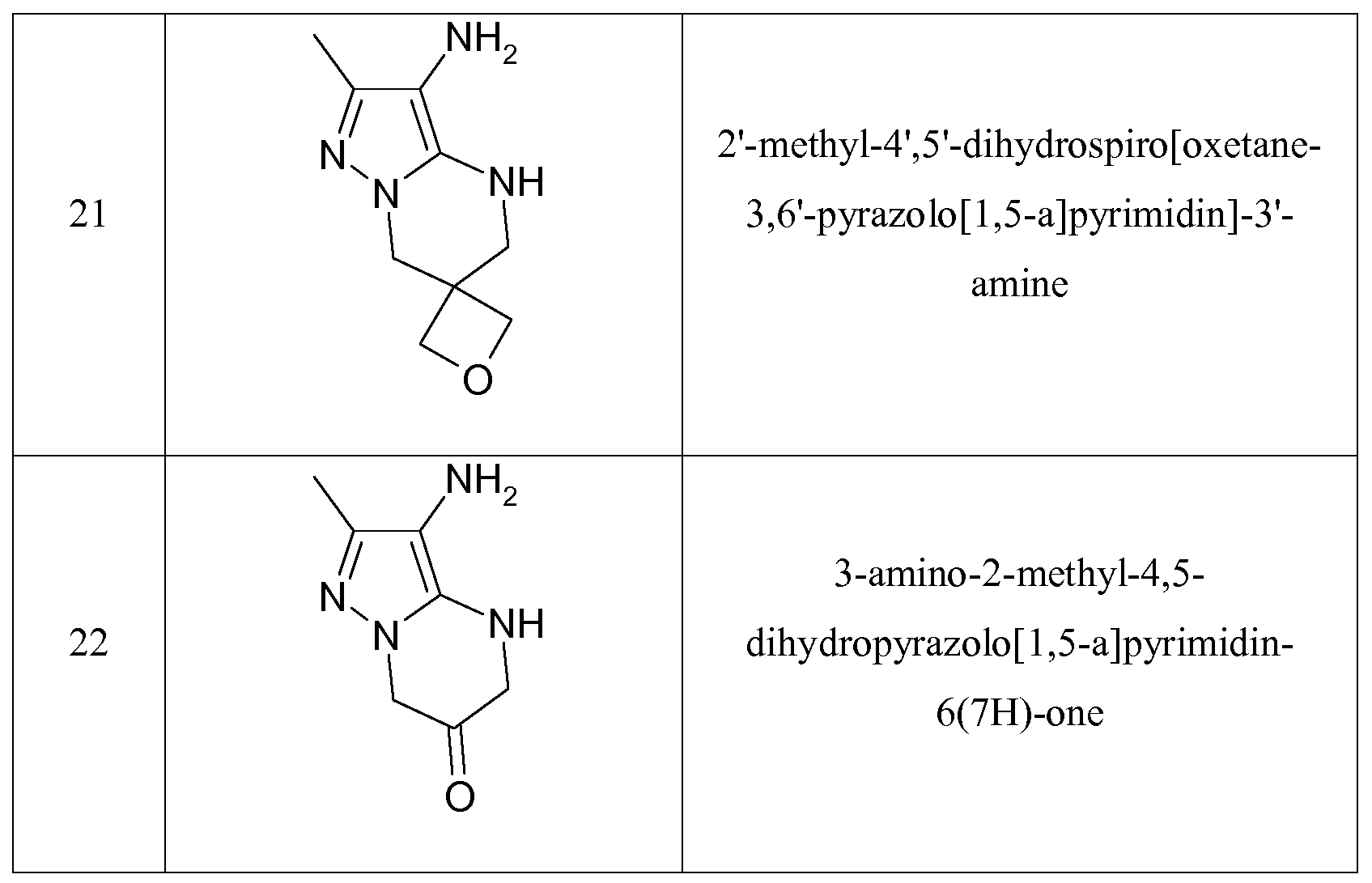
9. Cosmetic composition comprising, in a medium suitable for dyeing in particular keratin fibres such as the hair, one or more compounds of formula (I) according to any one of the preceding claims, and also the optical isomers, geometrical isomers and tautomers thereof, the addition salts thereof with an acid or a base, and the solvates thereof.
10. Composition according to the preceding claim, characterized in that the compound(s) of formula (I), and also the optical isomers, geometrical isomers and tautomers thereof, the addition salts thereof with an acid or a base, and the solvates thereof, represent from 0.001% to 10%> by weight, preferably from 0.05%> to 6%> by weight, and more preferentially from 0.1% to 3% by weight, relative to the total weight of the composition.
11. Composition according to Claim 9 or 10, characterized in that it also comprises one or more coupling agents, preferably chosen from meta- phenylenediamines, meta-aminophenols, meta-diphenols, naphthalene-based coupling agents and heterocyclic coupling agents, and also the corresponding addition salts; more preferentially the coupling agent(s) is (are) chosen from the compounds of formulae (II) and (IF), and also the organic or mineral acid or base salts thereof, and the solvates thereof such as hydrates:

(Π) in which formulae (II) and (IF):
Xi and X2, which may be identical or different, represent a group chosen from hydroxyl, (di)(Ci-C6)(alkyl)amino or (di)hydroxy(Ci-C6)alkylamino groups;
- Y represents a hydrogen atom or a (Ci-C6)(hydroxy)alkyl group, or else two adjacent substituents Y and Xi and/or Y and X2 form, together with the carbon atoms which bear them, an optionally substituted heterocyclic group, such as morpholinyl, piperazinyl, piperidinyl, preferably Y represents a hydrogen atom, a (Ci-C6)alkyl group, or else two adjacent substituents Y and Xi form, together with the carbon atoms which bear them, a morpholinyl group optionally substituted with a (Ci-C4)alkyl group;
- p is 1, 2, 3 or 4;
- t is 1, 2 or 3;
it being understood that, when p or t is greater than or equal to 2, the Y groups are identical to or different from one another;
even better still, the coupling agent(s) is (are) chosen from the compounds of formulae (IIa) and (Il'a), and also the organic or mineral acid or base salts thereof, and the solvates thereof such as h drates:

which formulae (IIa) and (Il'a):
Xi and X2 are as defined previously, preferably Xi and/or X2 represent(s) hydroxyl, amino or (hydroxy)alkylamino group;
Yi represents a hydrogen atom or a (Ci-C6)alkyl group;
- Y2 represents a hydrogen atom, or forms, with the substituent Yi, an optionally substituted heterocycle, such as morpholinyl, piperazinyl or piperidinyl, preferably a morpholinyl heterocycle optionally substituted with a (Ci-C4)alkyl group.
12. Composition according to any one of Claims 9 to 1 1 , characterized in that it also comprises one or more oxidizing agents.
13. Process for dyeing keratin fibres, in particular human keratin fibres such as the hair, which consists in applying to said keratin fibres a cosmetic composition as defined in any one of Claims 9 to 1 1 , in the presence of one or more oxidizing agents.
14. Process for preparing the compounds of formula (I) as defined in any one of Claims 1 to 8, according to the synthesis routes A, B, C and D, described below:

R2 and R3 having the same meanings as any one of Claims 1 to 7,
X denoting a halogen atom such as CI, Br or I,
Y denoting a leaving group, in particular a halogen atom, triflate or tosylate, and PG denoting an amine- function-protecting group;
said process comprising:
- according to route A, reacting 5-aminopyrazole (a) with one molar equivalent of the compound (b) according to step i) so as to give the compound (c), which, after intramolecular reaction in the presence of a base, preferably a strong base, in particular alkali metal alkoxides such as tBu-0"M+ with M+ representing an alkali metal such as K+, and in particular by heating, preferably at a temperature between 80°C and 120°C, preferably in a polar non-protic solvent such as
DMSO, followed by nitration with a nitrating agent, in particular chosen from nitrites, in particular alkali metal or alkaline-earth metal nitrites such as sodium nitrite, preferably in the presence of an acid, in particular a carboxylic acid such as acetic acid, preferably in a polar protic solvent such as water, gives the nitrosopyrazole derivative (d) according to step ii), which, after reduction, preferably catalytic reduction, in particular with Pd/C, with H2 under pressure, according to step iii), gives the compound of formula (I), as defined in any one of Claims 1 to 8;
- according to route B, reacting the hydrazine derivative (e) with one molar equivalent of cyano beta-carbonyl compound (f) so as to give the compound (c) according to step iv) which can give the compound of formula (I) as defined in any one of Claims 1 to 8 via step ii), then step iii), as defined in route A;
- according to route C, reacting the halogenated pyrazole compound (g) with one molar equivalent of the N-protected compound (h) so as to give the compound (i) according to step v) which, by intramolecular reaction, will give the compound
(d) according to step vi), which compound (d) will give, according to step iii), the compound of formula (I) as defined in any one of Claims 1 to 8;
- according to route D, reacting the halogenated pyrazole compound (j) with one molar equivalent of the compound (k) according to step vii) so as to give the compound (m), followed by an intramolecular reaction according to step viii) so as to give the nitropyrazolo compound (n) which, after reduction, preferably catalytic reduction, in particular with Pd/C, with H2 under pressure, according to step ix) gives the compound of formula (I) as defined in any one of Claims 1 to 8.
15. Multi-compartment device, or multi-compartment dyeing kit, comprising a first compartment containing a cosmetic composition as defined in any one of Claims 9 to 11, and a second compartment containing an oxidizing composition comprising one or more oxidizing agents.
16. Use of one or more compound(s) of formula (I), as defined in any one of Claims 1 to 8, and also the tautomeric forms, optical isomers and geometrical isomers thereof, the addition salts thereof with an organic or mineral acid or base, and/or the solvates thereof, optionally in the presence of one or more additional oxidation base(s) different from the compounds of formula (I), and/or of one or more coupling agent(s), and/or of one or more oxidizing agent(s), for dyeing keratin fibres, in particular human keratin fibres such as the hair.
Applications Claiming Priority (2)
| Application Number | Priority Date | Filing Date | Title |
|---|---|---|---|
| FR1662220 | 2016-12-09 | ||
| FR1662220A FR3060003B1 (en) | 2016-12-09 | 2016-12-09 | COMPOUND DERIVED FROM FUSED-CYCLE 4,5-DIAMINOPYRAZOLES, COMPOSITION COMPRISING AT LEAST ONE SUCH COMPOUND, METHOD OF IMPLEMENTATION AND USE |
Publications (1)
| Publication Number | Publication Date |
|---|---|
| WO2018104474A1 true WO2018104474A1 (en) | 2018-06-14 |
Family
ID=58455169
Family Applications (1)
| Application Number | Title | Priority Date | Filing Date |
|---|---|---|---|
| PCT/EP2017/081881 Ceased WO2018104474A1 (en) | 2016-12-09 | 2017-12-07 | Compound derived from 4,5-diaminopyrazoles comprising a fused ring, composition comprising at least one such compound, implementation process and use |
Country Status (2)
| Country | Link |
|---|---|
| FR (1) | FR3060003B1 (en) |
| WO (1) | WO2018104474A1 (en) |
Cited By (1)
| Publication number | Priority date | Publication date | Assignee | Title |
|---|---|---|---|---|
| US11034669B2 (en) | 2018-11-30 | 2021-06-15 | Nuvation Bio Inc. | Pyrrole and pyrazole compounds and methods of use thereof |
Citations (34)
| Publication number | Priority date | Publication date | Assignee | Title |
|---|---|---|---|---|
| GB1026978A (en) | 1962-03-30 | 1966-04-20 | Schwarzkopf Verwaltung G M B H | Method of dyeing hair |
| GB1153196A (en) | 1965-07-07 | 1969-05-29 | Schwarzkopf Verwaltung G M B H | Method of Dyeing Hair |
| DE2359399A1 (en) | 1973-11-29 | 1975-06-12 | Henkel & Cie Gmbh | Tetraaminopyrimidines as developers in oxidation hair dyes - esp. used with meta aminophenol couplers for blue shading dyes |
| DE3843892A1 (en) | 1988-12-24 | 1990-06-28 | Wella Ag | OXIDATION HAIR AGENTS CONTAINING DIAMINOPYRAZOL DERIVATIVES AND NEW DIAMINOPYRAZOLE DERIVATIVES |
| JPH0563124A (en) | 1991-09-03 | 1993-03-12 | Mitsubishi Electric Corp | Hybrid integrated circuit device |
| DE4133957A1 (en) | 1991-10-14 | 1993-04-15 | Wella Ag | HAIR DYE CONTAINING AMINOPYRAZOLE DERIVATIVES AND NEW PYRAZOLE DERIVATIVES |
| WO1994008969A1 (en) | 1992-10-16 | 1994-04-28 | Wella Aktiengesellschaft | Process for producing 4,5-diamino pyrazole derivatives, their use for colouring hair and novel pyrazole derivatives |
| WO1994008970A1 (en) | 1992-10-16 | 1994-04-28 | Wella Aktiengesellschaft | Oxidation hair dye containing 4,5-diaminopyrazole derivatives and novel 4,5-diaminopyrazole derivatives and process for their production |
| WO1995001772A1 (en) | 1993-07-05 | 1995-01-19 | Ciba-Geigy Ag | Process for dyeing keratin-containing fibres |
| WO1995015144A1 (en) | 1993-11-30 | 1995-06-08 | Ciba-Geigy Ag | Cationic dyes for keratin-containing fibres |
| EP0692245A1 (en) | 1994-06-28 | 1996-01-17 | Wella Aktiengesellschaft | Oxidation hair dye containing 4,5-diaminopyrazole derivatives and m-phenylendiamine derivatives |
| WO1996015765A1 (en) | 1994-11-17 | 1996-05-30 | Henkel Kommanditgesellschaft Auf Aktien | Oxidation dyes |
| EP0714954A2 (en) | 1994-11-03 | 1996-06-05 | Ciba-Geigy Ag | Cationic iminazoleazodyestuffs |
| FR2733749A1 (en) | 1995-05-05 | 1996-11-08 | Oreal | COMPOSITIONS FOR DYEING KERATINIC FIBERS CONTAINING DIAMINO PYRAZOLES, DYEING PROCESS, NOVEL DIAMINO PYRAZOLES, AND PREPARATION METHOD THEREOF |
| EP0770375A1 (en) | 1995-10-21 | 1997-05-02 | GOLDWELL GmbH | Hair dyeing composition |
| DE19543988A1 (en) | 1995-11-25 | 1997-05-28 | Wella Ag | Oxidative hair dye composition |
| EP0871426A1 (en) | 1996-10-18 | 1998-10-21 | Wella Aktiengesellschaft | Agent and method for dyeing keratin fibres |
| EP0873109A1 (en) | 1996-11-12 | 1998-10-28 | Wella Aktiengesellschaft | Colorant for producing metameric effects on keratin fibres |
| FR2767688A1 (en) * | 1997-09-01 | 1999-03-05 | Oreal | COMPOSITION FOR OXIDATION DYEING OF KERATINIC FIBERS COMPRISING A DIAMINO PYRAZOLE OR A TRIAMINO PYRAZOLE AND A HALOGENATED META-AMINOPHENOL, AND DYEING METHOD |
| FR2801308A1 (en) | 1999-11-19 | 2001-05-25 | Oreal | KERATIN FIBER DYEING COMPOSITIONS CONTAINING 3-AMINO PYRAZOLO- [1, (- a] -PYRIDINES, DYEING PROCESS, NOVEL 3-AMINO PYRAZOLO- [1,5-a] -PYRIDINES |
| FR2886136A1 (en) | 2005-05-31 | 2006-12-01 | Oreal | COMPOSITION FOR DYING KERATIN FIBERS COMPRISING AT LEAST ONE DIAMINO-N, N-DIHYDRO-PYRAZOLONE DERIVATIVE AND A CATIONIC OXIDATION DYE |
| US20070037987A1 (en) | 2005-08-12 | 2007-02-15 | Chamberlin Kim S | Preparation of 4,5-diamino-1-(substituted)-pyrazole and acid addition salts thereof |
| WO2009140451A1 (en) * | 2008-05-16 | 2009-11-19 | The Procter & Gamble Company | Keratin dyeing compounds, keratin dyeing compositions containing said compounds, and use thereof |
| US20120210526A1 (en) | 2011-02-22 | 2012-08-23 | Muill Lim | Oxidative Dyeing Compositions Comprising an 1-Hexyl/Heptyl-4,5-diaminopyrazole and a Pyridine and Derivatives Thereof |
| US20120210522A1 (en) | 2011-02-22 | 2012-08-23 | Muill Lim | Oxidative Dyeing Compositions Comprising an 1-Hexyl/Heptyl-4,5-diaminopyrazole and a Naphthalen-1-ol and Derivatives Thereof |
| US20120210520A1 (en) | 2011-02-22 | 2012-08-23 | Muill Lim | Oxidative Dyeing Compositions Comprising an 1-Hexyl/Heptyl-4,5-diaminopyrazole and a m-Aminophenol and Derivatives Thereof |
| US20120210524A1 (en) | 2011-02-22 | 2012-08-23 | Muill Lim | Oxidative Dyeing Compositions Comprising an 1-Hexyl/Heptyl-4,5-diaminopyrazole and a Benzene-1,3-diamine and Derivatives Thereof |
| US20120210525A1 (en) | 2011-02-22 | 2012-08-23 | Muill Lim | Oxidative Dyeing Compositions Comprising an 1-Hexy1/Hepty1-4,5-diaminopyrazole and a Benzene-1,3-diol and Derivatives Thereof |
| US20120210521A1 (en) | 2011-02-22 | 2012-08-23 | Muill Lim | Oxidative Dyeing Compositions Comprising an 1-Hexyl/Heptyl-4,5-diaminopyrazole and a Benzo[1,3]dioxol-5-ylamine and Derivatives Thereof |
| US20120210519A1 (en) | 2011-02-22 | 2012-08-23 | Muill Lim | Oxidative Dyeing Compositions Comprising an 1-Hexyl/Heptyl-4,5-diaminopyrazole and a 2-Aminophenol and Derivatives Thereof |
| WO2013122990A1 (en) | 2012-02-16 | 2013-08-22 | The Procter & Gamble Company | 1-hexyl-1h-pyrazole-4,5-diamine hemisulfate, and its use in dyeing compositions |
| WO2013122989A1 (en) | 2012-02-16 | 2013-08-22 | The Procter & Gamble Company | Telescoping synthesis of 5-amino-4-nitroso-1-alkyl-1h-pyrazole salts |
| JP2013169571A (en) | 2012-02-21 | 2013-09-02 | Nippon Steel & Sumitomo Metal Corp | Method of manufacturing forged steel roll |
| CN104140427A (en) | 2014-07-05 | 2014-11-12 | 湖南华腾制药有限公司 | Preparation method of tetrahydropyrazolo[1,5-a]pyridine |
-
2016
- 2016-12-09 FR FR1662220A patent/FR3060003B1/en not_active Expired - Fee Related
-
2017
- 2017-12-07 WO PCT/EP2017/081881 patent/WO2018104474A1/en not_active Ceased
Patent Citations (37)
| Publication number | Priority date | Publication date | Assignee | Title |
|---|---|---|---|---|
| GB1026978A (en) | 1962-03-30 | 1966-04-20 | Schwarzkopf Verwaltung G M B H | Method of dyeing hair |
| GB1153196A (en) | 1965-07-07 | 1969-05-29 | Schwarzkopf Verwaltung G M B H | Method of Dyeing Hair |
| DE2359399A1 (en) | 1973-11-29 | 1975-06-12 | Henkel & Cie Gmbh | Tetraaminopyrimidines as developers in oxidation hair dyes - esp. used with meta aminophenol couplers for blue shading dyes |
| DE3843892A1 (en) | 1988-12-24 | 1990-06-28 | Wella Ag | OXIDATION HAIR AGENTS CONTAINING DIAMINOPYRAZOL DERIVATIVES AND NEW DIAMINOPYRAZOLE DERIVATIVES |
| EP0375977A1 (en) | 1988-12-24 | 1990-07-04 | Wella Aktiengesellschaft | Oxidation hairdyeing composition based upon diaminopyrazole derivatives, and these diaminopyrazole derivatives |
| JPH0563124A (en) | 1991-09-03 | 1993-03-12 | Mitsubishi Electric Corp | Hybrid integrated circuit device |
| EP0562061A1 (en) * | 1991-10-14 | 1993-09-29 | Wella Ag | Hair-dyeing agent containing aminopyrazole derivatives, and new pyrazole derivatives. |
| WO1993007849A1 (en) | 1991-10-14 | 1993-04-29 | Wella Aktiengesellschaft | Hair-dyeing agent containing aminopyrazole derivatives, and new pyrazole derivatives |
| DE4133957A1 (en) | 1991-10-14 | 1993-04-15 | Wella Ag | HAIR DYE CONTAINING AMINOPYRAZOLE DERIVATIVES AND NEW PYRAZOLE DERIVATIVES |
| WO1994008969A1 (en) | 1992-10-16 | 1994-04-28 | Wella Aktiengesellschaft | Process for producing 4,5-diamino pyrazole derivatives, their use for colouring hair and novel pyrazole derivatives |
| WO1994008970A1 (en) | 1992-10-16 | 1994-04-28 | Wella Aktiengesellschaft | Oxidation hair dye containing 4,5-diaminopyrazole derivatives and novel 4,5-diaminopyrazole derivatives and process for their production |
| WO1995001772A1 (en) | 1993-07-05 | 1995-01-19 | Ciba-Geigy Ag | Process for dyeing keratin-containing fibres |
| WO1995015144A1 (en) | 1993-11-30 | 1995-06-08 | Ciba-Geigy Ag | Cationic dyes for keratin-containing fibres |
| EP0692245A1 (en) | 1994-06-28 | 1996-01-17 | Wella Aktiengesellschaft | Oxidation hair dye containing 4,5-diaminopyrazole derivatives and m-phenylendiamine derivatives |
| EP0714954A2 (en) | 1994-11-03 | 1996-06-05 | Ciba-Geigy Ag | Cationic iminazoleazodyestuffs |
| WO1996015765A1 (en) | 1994-11-17 | 1996-05-30 | Henkel Kommanditgesellschaft Auf Aktien | Oxidation dyes |
| FR2733749A1 (en) | 1995-05-05 | 1996-11-08 | Oreal | COMPOSITIONS FOR DYEING KERATINIC FIBERS CONTAINING DIAMINO PYRAZOLES, DYEING PROCESS, NOVEL DIAMINO PYRAZOLES, AND PREPARATION METHOD THEREOF |
| EP0770375A1 (en) | 1995-10-21 | 1997-05-02 | GOLDWELL GmbH | Hair dyeing composition |
| DE19543988A1 (en) | 1995-11-25 | 1997-05-28 | Wella Ag | Oxidative hair dye composition |
| EP0871426A1 (en) | 1996-10-18 | 1998-10-21 | Wella Aktiengesellschaft | Agent and method for dyeing keratin fibres |
| EP0873109A1 (en) | 1996-11-12 | 1998-10-28 | Wella Aktiengesellschaft | Colorant for producing metameric effects on keratin fibres |
| FR2767688A1 (en) * | 1997-09-01 | 1999-03-05 | Oreal | COMPOSITION FOR OXIDATION DYEING OF KERATINIC FIBERS COMPRISING A DIAMINO PYRAZOLE OR A TRIAMINO PYRAZOLE AND A HALOGENATED META-AMINOPHENOL, AND DYEING METHOD |
| FR2801308A1 (en) | 1999-11-19 | 2001-05-25 | Oreal | KERATIN FIBER DYEING COMPOSITIONS CONTAINING 3-AMINO PYRAZOLO- [1, (- a] -PYRIDINES, DYEING PROCESS, NOVEL 3-AMINO PYRAZOLO- [1,5-a] -PYRIDINES |
| FR2886136A1 (en) | 2005-05-31 | 2006-12-01 | Oreal | COMPOSITION FOR DYING KERATIN FIBERS COMPRISING AT LEAST ONE DIAMINO-N, N-DIHYDRO-PYRAZOLONE DERIVATIVE AND A CATIONIC OXIDATION DYE |
| US20070037987A1 (en) | 2005-08-12 | 2007-02-15 | Chamberlin Kim S | Preparation of 4,5-diamino-1-(substituted)-pyrazole and acid addition salts thereof |
| WO2009140451A1 (en) * | 2008-05-16 | 2009-11-19 | The Procter & Gamble Company | Keratin dyeing compounds, keratin dyeing compositions containing said compounds, and use thereof |
| US20120210526A1 (en) | 2011-02-22 | 2012-08-23 | Muill Lim | Oxidative Dyeing Compositions Comprising an 1-Hexyl/Heptyl-4,5-diaminopyrazole and a Pyridine and Derivatives Thereof |
| US20120210522A1 (en) | 2011-02-22 | 2012-08-23 | Muill Lim | Oxidative Dyeing Compositions Comprising an 1-Hexyl/Heptyl-4,5-diaminopyrazole and a Naphthalen-1-ol and Derivatives Thereof |
| US20120210520A1 (en) | 2011-02-22 | 2012-08-23 | Muill Lim | Oxidative Dyeing Compositions Comprising an 1-Hexyl/Heptyl-4,5-diaminopyrazole and a m-Aminophenol and Derivatives Thereof |
| US20120210524A1 (en) | 2011-02-22 | 2012-08-23 | Muill Lim | Oxidative Dyeing Compositions Comprising an 1-Hexyl/Heptyl-4,5-diaminopyrazole and a Benzene-1,3-diamine and Derivatives Thereof |
| US20120210525A1 (en) | 2011-02-22 | 2012-08-23 | Muill Lim | Oxidative Dyeing Compositions Comprising an 1-Hexy1/Hepty1-4,5-diaminopyrazole and a Benzene-1,3-diol and Derivatives Thereof |
| US20120210521A1 (en) | 2011-02-22 | 2012-08-23 | Muill Lim | Oxidative Dyeing Compositions Comprising an 1-Hexyl/Heptyl-4,5-diaminopyrazole and a Benzo[1,3]dioxol-5-ylamine and Derivatives Thereof |
| US20120210519A1 (en) | 2011-02-22 | 2012-08-23 | Muill Lim | Oxidative Dyeing Compositions Comprising an 1-Hexyl/Heptyl-4,5-diaminopyrazole and a 2-Aminophenol and Derivatives Thereof |
| WO2013122990A1 (en) | 2012-02-16 | 2013-08-22 | The Procter & Gamble Company | 1-hexyl-1h-pyrazole-4,5-diamine hemisulfate, and its use in dyeing compositions |
| WO2013122989A1 (en) | 2012-02-16 | 2013-08-22 | The Procter & Gamble Company | Telescoping synthesis of 5-amino-4-nitroso-1-alkyl-1h-pyrazole salts |
| JP2013169571A (en) | 2012-02-21 | 2013-09-02 | Nippon Steel & Sumitomo Metal Corp | Method of manufacturing forged steel roll |
| CN104140427A (en) | 2014-07-05 | 2014-11-12 | 湖南华腾制药有限公司 | Preparation method of tetrahydropyrazolo[1,5-a]pyridine |
Cited By (1)
| Publication number | Priority date | Publication date | Assignee | Title |
|---|---|---|---|---|
| US11034669B2 (en) | 2018-11-30 | 2021-06-15 | Nuvation Bio Inc. | Pyrrole and pyrazole compounds and methods of use thereof |
Also Published As
| Publication number | Publication date |
|---|---|
| FR3060003B1 (en) | 2019-12-27 |
| FR3060003A1 (en) | 2018-06-15 |
Similar Documents
| Publication | Publication Date | Title |
|---|---|---|
| WO2011069898A1 (en) | Novel cationic aminopyridines, dye composition comprising a cationic aminopyridine, processes therefor and uses thereof | |
| EP2791250A1 (en) | Particular azomethine direct dyes, dye composition comprising at least one such compound, implementation process therefore and use thereof | |
| US20200276102A1 (en) | Specific 7-amino-1,2,3,4-tetrahydroquinolines, method, and composition | |
| JP6100277B2 (en) | Triaromatic azomethine direct dye comprising at least one unit derived from resorcinol, dyeing composition, method and use | |
| US10927259B2 (en) | Dissymmetric azomethine direct dyes and process for their preparation, cosmetic composition comprising at least one such dye and use thereof | |
| ES2912472T3 (en) | New direct azomethine dyes that carry at least one cationic charge, cosmetic composition comprising at least one of such dyes, method of implementation and use thereof | |
| WO2018104474A1 (en) | Compound derived from 4,5-diaminopyrazoles comprising a fused ring, composition comprising at least one such compound, implementation process and use | |
| JP2015501870A5 (en) | ||
| US11555017B2 (en) | Oxidation base derived from 1-hexyl-4,5-diaminopyrazole, composition containing same and use thereof in oxidation dyeing of keratin fibres | |
| EP2791115A1 (en) | Coupler with cationic 7-amino-1,2,3,4-tetrahydroquinoline structure, dyeing composition comprising same, processes and uses | |
| JP6207521B2 (en) | Specific quinone direct dyes, dye compositions comprising at least one such dye, method for its implementation and use thereof | |
| WO2011107501A1 (en) | Cationic 6-aminoindolines, dyeing compositions containing them, processes and uses thereof | |
| EP3554467B1 (en) | Symmetric azomethine direct dyes, process for their preparation, cosmetic composition comprising at least one such dye and use thereof | |
| MXPA05000112A (en) | Particular secondary double para-phenylenediamine, dyeing composition containing same and dyeing process using said composition. | |
| EP3233812A1 (en) | Cationic benzoxazine derivatives and use in hair dyeing | |
| WO2013087932A1 (en) | Coupler with 7-amino-1,2,3,4-tetrahydroquinoline structure, dyeing composition comprising same, processes and uses | |
| WO2019219932A1 (en) | Para-phenylenediamine bases monosubstituted in position 2 with an oxy/thio-alkyl chain and use thereof for the oxidation dyeing of keratin fibres | |
| WO2014191354A1 (en) | Quinone direct dyes bearing a hindered aniline group, dye composition comprising at least one such dye, implementation process therefor and use thereof | |
| WO2015092011A1 (en) | Dye composition comprising a 1,2,3,4-tetrahydropyrido[2,3-b]pyrazin-7-amine compound | |
| FR3060002A1 (en) | NOVEL DERIVED OXIDATION BASES OF 5-AMINOPENTYL-4,5-DIAMINOPYRAZOLE, THE COMPOSITION CONTAINING SAME AND THEIR USE IN KERATIN FIBER OXIDATION DYE |
Legal Events
| Date | Code | Title | Description |
|---|---|---|---|
| 121 | Ep: the epo has been informed by wipo that ep was designated in this application |
Ref document number: 17822188 Country of ref document: EP Kind code of ref document: A1 |
|
| NENP | Non-entry into the national phase |
Ref country code: DE |
|
| 122 | Ep: pct application non-entry in european phase |
Ref document number: 17822188 Country of ref document: EP Kind code of ref document: A1 |