WO2018080897A1 - PD-CATALYZED γ-C(SP3)-H ARYLATION / HETEROARYLATION OF FREE AMINES - Google Patents
PD-CATALYZED γ-C(SP3)-H ARYLATION / HETEROARYLATION OF FREE AMINES Download PDFInfo
- Publication number
- WO2018080897A1 WO2018080897A1 PCT/US2017/057434 US2017057434W WO2018080897A1 WO 2018080897 A1 WO2018080897 A1 WO 2018080897A1 US 2017057434 W US2017057434 W US 2017057434W WO 2018080897 A1 WO2018080897 A1 WO 2018080897A1
- Authority
- WO
- WIPO (PCT)
- Prior art keywords
- compound
- formula
- mhz
- nmr
- group
- Prior art date
- Legal status (The legal status is an assumption and is not a legal conclusion. Google has not performed a legal analysis and makes no representation as to the accuracy of the status listed.)
- Ceased
Links
- 0 C*(C)C1CCCC1 Chemical compound C*(C)C1CCCC1 0.000 description 2
Classifications
-
- C—CHEMISTRY; METALLURGY
- C07—ORGANIC CHEMISTRY
- C07C—ACYCLIC OR CARBOCYCLIC COMPOUNDS
- C07C269/00—Preparation of derivatives of carbamic acid, i.e. compounds containing any of the groups, the nitrogen atom not being part of nitro or nitroso groups
- C07C269/04—Preparation of derivatives of carbamic acid, i.e. compounds containing any of the groups, the nitrogen atom not being part of nitro or nitroso groups from amines with formation of carbamate groups
-
- B—PERFORMING OPERATIONS; TRANSPORTING
- B01—PHYSICAL OR CHEMICAL PROCESSES OR APPARATUS IN GENERAL
- B01J—CHEMICAL OR PHYSICAL PROCESSES, e.g. CATALYSIS OR COLLOID CHEMISTRY; THEIR RELEVANT APPARATUS
- B01J31/00—Catalysts comprising hydrides, coordination complexes or organic compounds
- B01J31/16—Catalysts comprising hydrides, coordination complexes or organic compounds containing coordination complexes
- B01J31/22—Organic complexes
- B01J31/2204—Organic complexes the ligands containing oxygen or sulfur as complexing atoms
- B01J31/2208—Oxygen, e.g. acetylacetonates
- B01J31/2226—Anionic ligands, i.e. the overall ligand carries at least one formal negative charge
- B01J31/223—At least two oxygen atoms present in one at least bidentate or bridging ligand
- B01J31/2239—Bridging ligands, e.g. OAc in Cr2(OAc)4, Pt4(OAc)8 or dicarboxylate ligands
-
- C—CHEMISTRY; METALLURGY
- C07—ORGANIC CHEMISTRY
- C07B—GENERAL METHODS OF ORGANIC CHEMISTRY; APPARATUS THEREFOR
- C07B37/00—Reactions without formation or introduction of functional groups containing hetero atoms, involving either the formation of a carbon-to-carbon bond between two carbon atoms not directly linked already or the disconnection of two directly linked carbon atoms
- C07B37/04—Substitution
-
- C—CHEMISTRY; METALLURGY
- C07—ORGANIC CHEMISTRY
- C07C—ACYCLIC OR CARBOCYCLIC COMPOUNDS
- C07C209/00—Preparation of compounds containing amino groups bound to a carbon skeleton
- C07C209/68—Preparation of compounds containing amino groups bound to a carbon skeleton from amines, by reactions not involving amino groups, e.g. reduction of unsaturated amines, aromatisation, or substitution of the carbon skeleton
-
- C—CHEMISTRY; METALLURGY
- C07—ORGANIC CHEMISTRY
- C07D—HETEROCYCLIC COMPOUNDS
- C07D213/00—Heterocyclic compounds containing six-membered rings, not condensed with other rings, with one nitrogen atom as the only ring hetero atom and three or more double bonds between ring members or between ring members and non-ring members
- C07D213/02—Heterocyclic compounds containing six-membered rings, not condensed with other rings, with one nitrogen atom as the only ring hetero atom and three or more double bonds between ring members or between ring members and non-ring members having three double bonds between ring members or between ring members and non-ring members
- C07D213/04—Heterocyclic compounds containing six-membered rings, not condensed with other rings, with one nitrogen atom as the only ring hetero atom and three or more double bonds between ring members or between ring members and non-ring members having three double bonds between ring members or between ring members and non-ring members having no bond between the ring nitrogen atom and a non-ring member or having only hydrogen or carbon atoms directly attached to the ring nitrogen atom
- C07D213/24—Heterocyclic compounds containing six-membered rings, not condensed with other rings, with one nitrogen atom as the only ring hetero atom and three or more double bonds between ring members or between ring members and non-ring members having three double bonds between ring members or between ring members and non-ring members having no bond between the ring nitrogen atom and a non-ring member or having only hydrogen or carbon atoms directly attached to the ring nitrogen atom with substituted hydrocarbon radicals attached to ring carbon atoms
- C07D213/36—Radicals substituted by singly-bound nitrogen atoms
- C07D213/40—Acylated substituent nitrogen atom
-
- C—CHEMISTRY; METALLURGY
- C07—ORGANIC CHEMISTRY
- C07D—HETEROCYCLIC COMPOUNDS
- C07D213/00—Heterocyclic compounds containing six-membered rings, not condensed with other rings, with one nitrogen atom as the only ring hetero atom and three or more double bonds between ring members or between ring members and non-ring members
- C07D213/02—Heterocyclic compounds containing six-membered rings, not condensed with other rings, with one nitrogen atom as the only ring hetero atom and three or more double bonds between ring members or between ring members and non-ring members having three double bonds between ring members or between ring members and non-ring members
- C07D213/04—Heterocyclic compounds containing six-membered rings, not condensed with other rings, with one nitrogen atom as the only ring hetero atom and three or more double bonds between ring members or between ring members and non-ring members having three double bonds between ring members or between ring members and non-ring members having no bond between the ring nitrogen atom and a non-ring member or having only hydrogen or carbon atoms directly attached to the ring nitrogen atom
- C07D213/60—Heterocyclic compounds containing six-membered rings, not condensed with other rings, with one nitrogen atom as the only ring hetero atom and three or more double bonds between ring members or between ring members and non-ring members having three double bonds between ring members or between ring members and non-ring members having no bond between the ring nitrogen atom and a non-ring member or having only hydrogen or carbon atoms directly attached to the ring nitrogen atom with hetero atoms or with carbon atoms having three bonds to hetero atoms with at the most one bond to halogen, e.g. ester or nitrile radicals, directly attached to ring carbon atoms
- C07D213/61—Halogen atoms or nitro radicals
-
- C—CHEMISTRY; METALLURGY
- C07—ORGANIC CHEMISTRY
- C07D—HETEROCYCLIC COMPOUNDS
- C07D213/00—Heterocyclic compounds containing six-membered rings, not condensed with other rings, with one nitrogen atom as the only ring hetero atom and three or more double bonds between ring members or between ring members and non-ring members
- C07D213/02—Heterocyclic compounds containing six-membered rings, not condensed with other rings, with one nitrogen atom as the only ring hetero atom and three or more double bonds between ring members or between ring members and non-ring members having three double bonds between ring members or between ring members and non-ring members
- C07D213/04—Heterocyclic compounds containing six-membered rings, not condensed with other rings, with one nitrogen atom as the only ring hetero atom and three or more double bonds between ring members or between ring members and non-ring members having three double bonds between ring members or between ring members and non-ring members having no bond between the ring nitrogen atom and a non-ring member or having only hydrogen or carbon atoms directly attached to the ring nitrogen atom
- C07D213/60—Heterocyclic compounds containing six-membered rings, not condensed with other rings, with one nitrogen atom as the only ring hetero atom and three or more double bonds between ring members or between ring members and non-ring members having three double bonds between ring members or between ring members and non-ring members having no bond between the ring nitrogen atom and a non-ring member or having only hydrogen or carbon atoms directly attached to the ring nitrogen atom with hetero atoms or with carbon atoms having three bonds to hetero atoms with at the most one bond to halogen, e.g. ester or nitrile radicals, directly attached to ring carbon atoms
- C07D213/62—Oxygen or sulfur atoms
- C07D213/63—One oxygen atom
- C07D213/64—One oxygen atom attached in position 2 or 6
-
- C—CHEMISTRY; METALLURGY
- C07—ORGANIC CHEMISTRY
- C07D—HETEROCYCLIC COMPOUNDS
- C07D215/00—Heterocyclic compounds containing quinoline or hydrogenated quinoline ring systems
- C07D215/02—Heterocyclic compounds containing quinoline or hydrogenated quinoline ring systems having no bond between the ring nitrogen atom and a non-ring member or having only hydrogen atoms or carbon atoms directly attached to the ring nitrogen atom
- C07D215/12—Heterocyclic compounds containing quinoline or hydrogenated quinoline ring systems having no bond between the ring nitrogen atom and a non-ring member or having only hydrogen atoms or carbon atoms directly attached to the ring nitrogen atom with substituted hydrocarbon radicals attached to ring carbon atoms
-
- C—CHEMISTRY; METALLURGY
- C07—ORGANIC CHEMISTRY
- C07D—HETEROCYCLIC COMPOUNDS
- C07D241/00—Heterocyclic compounds containing 1,4-diazine or hydrogenated 1,4-diazine rings
- C07D241/36—Heterocyclic compounds containing 1,4-diazine or hydrogenated 1,4-diazine rings condensed with carbocyclic rings or ring systems
- C07D241/38—Heterocyclic compounds containing 1,4-diazine or hydrogenated 1,4-diazine rings condensed with carbocyclic rings or ring systems with only hydrogen or carbon atoms directly attached to the ring nitrogen atoms
- C07D241/40—Benzopyrazines
- C07D241/42—Benzopyrazines with only hydrogen atoms, hydrocarbon or substituted hydrocarbon radicals, directly attached to carbon atoms of the hetero ring
-
- C—CHEMISTRY; METALLURGY
- C07—ORGANIC CHEMISTRY
- C07D—HETEROCYCLIC COMPOUNDS
- C07D319/00—Heterocyclic compounds containing six-membered rings having two oxygen atoms as the only ring hetero atoms
- C07D319/10—1,4-Dioxanes; Hydrogenated 1,4-dioxanes
- C07D319/14—1,4-Dioxanes; Hydrogenated 1,4-dioxanes condensed with carbocyclic rings or ring systems
- C07D319/16—1,4-Dioxanes; Hydrogenated 1,4-dioxanes condensed with carbocyclic rings or ring systems condensed with one six-membered ring
- C07D319/18—Ethylenedioxybenzenes, not substituted on the hetero ring
-
- C—CHEMISTRY; METALLURGY
- C07—ORGANIC CHEMISTRY
- C07D—HETEROCYCLIC COMPOUNDS
- C07D333/00—Heterocyclic compounds containing five-membered rings having one sulfur atom as the only ring hetero atom
- C07D333/02—Heterocyclic compounds containing five-membered rings having one sulfur atom as the only ring hetero atom not condensed with other rings
- C07D333/04—Heterocyclic compounds containing five-membered rings having one sulfur atom as the only ring hetero atom not condensed with other rings not substituted on the ring sulphur atom
- C07D333/06—Heterocyclic compounds containing five-membered rings having one sulfur atom as the only ring hetero atom not condensed with other rings not substituted on the ring sulphur atom with only hydrogen atoms, hydrocarbon or substituted hydrocarbon radicals, directly attached to the ring carbon atoms
- C07D333/22—Radicals substituted by doubly bound hetero atoms, or by two hetero atoms other than halogen singly bound to the same carbon atom
-
- C—CHEMISTRY; METALLURGY
- C07—ORGANIC CHEMISTRY
- C07D—HETEROCYCLIC COMPOUNDS
- C07D471/00—Heterocyclic compounds containing nitrogen atoms as the only ring hetero atoms in the condensed system, at least one ring being a six-membered ring with one nitrogen atom, not provided for by groups C07D451/00 - C07D463/00
- C07D471/02—Heterocyclic compounds containing nitrogen atoms as the only ring hetero atoms in the condensed system, at least one ring being a six-membered ring with one nitrogen atom, not provided for by groups C07D451/00 - C07D463/00 in which the condensed system contains two hetero rings
- C07D471/04—Ortho-condensed systems
-
- B—PERFORMING OPERATIONS; TRANSPORTING
- B01—PHYSICAL OR CHEMICAL PROCESSES OR APPARATUS IN GENERAL
- B01J—CHEMICAL OR PHYSICAL PROCESSES, e.g. CATALYSIS OR COLLOID CHEMISTRY; THEIR RELEVANT APPARATUS
- B01J2231/00—Catalytic reactions performed with catalysts classified in B01J31/00
- B01J2231/40—Substitution reactions at carbon centres, e.g. C-C or C-X, i.e. carbon-hetero atom, cross-coupling, C-H activation or ring-opening reactions
- B01J2231/44—Allylic alkylation, amination, alkoxylation or analogues
-
- B—PERFORMING OPERATIONS; TRANSPORTING
- B01—PHYSICAL OR CHEMICAL PROCESSES OR APPARATUS IN GENERAL
- B01J—CHEMICAL OR PHYSICAL PROCESSES, e.g. CATALYSIS OR COLLOID CHEMISTRY; THEIR RELEVANT APPARATUS
- B01J2531/00—Additional information regarding catalytic systems classified in B01J31/00
- B01J2531/80—Complexes comprising metals of Group VIII as the central metal
- B01J2531/82—Metals of the platinum group
- B01J2531/824—Palladium
-
- C—CHEMISTRY; METALLURGY
- C07—ORGANIC CHEMISTRY
- C07C—ACYCLIC OR CARBOCYCLIC COMPOUNDS
- C07C2601/00—Systems containing only non-condensed rings
- C07C2601/06—Systems containing only non-condensed rings with a five-membered ring
- C07C2601/08—Systems containing only non-condensed rings with a five-membered ring the ring being saturated
-
- C—CHEMISTRY; METALLURGY
- C07—ORGANIC CHEMISTRY
- C07C—ACYCLIC OR CARBOCYCLIC COMPOUNDS
- C07C2601/00—Systems containing only non-condensed rings
- C07C2601/12—Systems containing only non-condensed rings with a six-membered ring
- C07C2601/14—The ring being saturated
-
- C—CHEMISTRY; METALLURGY
- C07—ORGANIC CHEMISTRY
- C07C—ACYCLIC OR CARBOCYCLIC COMPOUNDS
- C07C2601/00—Systems containing only non-condensed rings
- C07C2601/18—Systems containing only non-condensed rings with a ring being at least seven-membered
Definitions
- the bidentate coordination system provided by the imine moiety and the weakly coordinating carb ' oxylic acid points to a new direction for our long search of transient directing groups that assist the activation of C ⁇ sp : -)-H bonds (Scheme 1 (2)),
- the invention provides a method for P d (I t ⁇ catalyzed g-C(sp 3 )- H aryiafton or heteroaryiation of a primary amine having a y-hydrogen atom, using an effective amount of a catalytic transie m ula IDG
- Xi, X2, Xg, and X 4 each independently is alkyl, aryl, haloaikyl, alkyiamlno, or alkoxyl; or wherein any single pair of Xi and X 2 , of 2 and X3, and of Xs and > when present, together with the ring to which they are bonded, forms a fused 5-, 6-, or 7-rnembered cycioaikyi ring;
- Ri R2 , R3 ⁇ 4 and R 4 each independently is hydroge or alkyl, or wherein Ra and
- R 4 together with the atoms to which they are bonded form, a cycioaikyi,
- aryl iodide Arl
- HeiAri heteroaryl iodide
- the invention provides, in various embodiments, a method wherein the compound of formula (li) is further N-protected with a t-butoxycarbonyl (tBoc) group by contacting the compound of formula (if) and t-butoxycarbonyianhydride, to give a compound of formula (!!!)
- the TOG can be 2-hydfoxynicptinaidehyde (TDG4).
- the primary amino compound of formula (!) can be contacted with an aryi iodide and group AH in the compound of formula (II) can be aryl.
- the reaction milieu can further comprise silver trlfiuoroacetate.
- the group AH in the. compound of formula (!!!) can be aryl.
- the primary amino compound of formula (I) can be contacted with a heteroaryi iodide and group AH in the compound of formula (it) can be heteroaryi.
- the reaction milieu can further comprise silver trif!uoroaeetate or pyridone, or both.
- the group AH in the compound of formula (III) can be heteroaryi.
- the compound of formula (II) or of formula (ill) can be any of the examples provided, wherein group AH is aryi or is heteroaryi
- imine/pyridine directing group 28 we have previously investigated the development of imine/c iral oxazoiine 1'1 transient directing groups for asymmetric C-H activation of ketones and amines without -success. Recently, Dong's group reported an interesting example of g-arylaiion of free primary amines via in situ generation of an imine directing group with stoichiometric 8- formyiquino!ine. 12
- TD6S hydroxy p rid ne directing group
- TD66 was completely unreaeiive, which suggests that the 7- membered ring bischeiation is not reactive.
- Other bidentate coordination systems such as the imine/pyridine and Imine/quinoline systems provided negligible yieids regardless the involvement of the S-membered or the 6 ⁇ memhered ring bischeiation (TOG7-8), confirming the importance of the weakly coordinating anionic hydroxyi group.
- Halogenaied aryi iodides containing flupro, chloro and brorrso substituents are also tolerated ⁇ 2as « 2aii, 2an-2a «,).
- i ,3-diiodohenzene was employed as the- coupling partner, only one iodide was activated (2a ⁇ ?j
- Electron deficient aryi iodides bearing trifiuoromethyi, nitro, methyl ketone and ester substituents are all well tolerated, providing consistently good to excellent yields (2ais-2an, 2ai»).
- reactive aldehyde functionality on the aryl iodide remained intact during the reaction (2aig ⁇ .
- reaction can be carried out using TDG and slive triffuoroacetate, as described above, further in the presence of pyridine, In the condensation of an amino compound possessing a ⁇ -hydrogen atom and a heteroaryl iodide as shown in Schem 3, below.
- Scheme 3 HeteroaryiatiQn reaction
- TDG (0.02 mmoi), pyridone (0 05 mmoi ⁇ , AgOTFA ⁇ 0,3 rnma!), H 2 0 ⁇ 1.0 mmoi), HRP (1 JO itiL), .
- group R can be any of aryl, alkyl, halo, nitre, haioaikyi, aikoxyl, alkoxycarbonyl, or carboxaldehyde groups.
- transient directing group TOG1 g-aryiation of alkyi amines using transient directing group TOG1 was reported: Y. Liu, H. Ge. Nature Chem. 2016, .advance online publication. do!:1Q,1038 nchem.28G6.
- This transient directing, group is largely limited to amines containing a-quaternary centers and not compatible with acyciie methylene C-H bonds.
- 2-hydroxynicotinaldehyde was purchased from Combi-blocks and used directly in the reactions. Amines, solvents and other chemicals were obtained from Sigma-A!drich, Acros and Alfa Aesar, and used directly without further purification. Analytical thin layer chromatography was performed on 0.25 mm silica gel 60-F254. Visualization was carried out with UV light and.
- Ci 4 Hi 9 0 2 a [M+Naf: 256.1313; found; 256,1314.
Landscapes
- Chemical & Material Sciences (AREA)
- Organic Chemistry (AREA)
- Chemical Kinetics & Catalysis (AREA)
- Inorganic Chemistry (AREA)
- Engineering & Computer Science (AREA)
- Materials Engineering (AREA)
- Pyridine Compounds (AREA)
- Organic Low-Molecular-Weight Compounds And Preparation Thereof (AREA)
- Plural Heterocyclic Compounds (AREA)
Abstract
Pd(II)-catalyzed g-G(sp3)-H arylation or heteroarylation of primary amines is realized by using 2-hydroxynicotinaldenyde as a catalytic transient directing group. Importantly, the catalyst and the directing group loading can be lowered to 2% and 4% respectively, thus demonstrating high efficiency of this newly designed transient directing group. Heterocyclic aryl iodides are also compatible with this reaction. Furthermore, swift synthesis of 1,2,3,4-tetrahydronaphthyridine derivatives is accomplished using this reaction.
Description
Pd-catalyzed γ-0(«ρ3)-Η Ar lation / HeteroarySaison of Free Amines
CROSS-REFERENCE TO RELATED APPLICATION This application claims the priority of U.S. provisional application serial number 62/41 1 ,978, filed October 24, 2016, the disclosure of which is incorporated by reference herein in its entirety.
STATEMENT OF GOVERNMENT SUPPORT
This invention was made with government support under 2R01 G 08401 9 awarded by the National Institutes of Health. The government has certain rights in the invention.
BACKGROUN
in the past decade, directed C-H activations have been extended to a wide range of 'synthetically useful substrates and transformations.1 Nevertheless, the covalenl installation and removal of directing groups often poses a major obstacle for their synthetic applications, in addition to adding two steps to -the .synthetic sequence, the reaction conditions for these steps are sometimes incompatible with labile functionalities on advanced synthetic intermediates.
Thus, developing catalytic directing groups that can transiently bond to the substrate for C-H activation and subsequently dissociate reversibly is: highly desirable. This strategy has been successfully applied in a number of R {i)~catalyzed C.(sp2)-H activations.2 Recently, our group discovered that simple amino acids can serve as an effective transient directing group for Pd(ii)-catalyzed G(sp3)-H funetionalization of aldehydes and ketones via a reversible imine linkage, thus demonstrating the feasibility of using transient directing groups for Pd(li) catalysts, although the loading of directing groups is still high (4Q%).3 Notably, the bidentate coordination system provided by the imine moiety and the weakly coordinating carb'oxylic acid points to a new direction for our long search of transient directing groups that assist the activation of C{sp:-)-H bonds (Scheme 1 (2)),
Following the success of identifying a transient directing group for ketones, we- wondered whether similar approach could be applied for the activation of free amines. Amines are ubiquitous structural motifs In compounds with pharmaceutical, agroc-hemicai and agricultural importance,4 While site-selective C-H 'funetionalization of free aliphatic amine is highly desirable as it enables rapid late-stage modifications and derivations, this proces is traditionally difficult due to the formation of the unreactive Pd{RNHz)zX2 complexes,5 as. well as the vulnerability of amines towards a-oxidation and efectrophiies.6 Nevertheless, numerous methods have been
developed for the C~H iunciionaJization of amines with various protecting groups.7"8 An interesting b-O-H functionalization of free secondary amines (R2NH) has also been reported, although bulky a-quaternary center is required for this reaction. '0
SUMMARY
In various embodiments, the invention provides a method for P d (I t ^catalyzed g-C(sp3)- H aryiafton or heteroaryiation of a primary amine having a y-hydrogen atom, using an effective amount of a catalytic transie m ula IDG

wherein Y ss N or CX4; and
Xi, X2, Xg, and X4 each independently is alkyl, aryl, haloaikyl, alkyiamlno, or alkoxyl; or wherein any single pair of Xi and X2, of 2 and X3, and of Xs and > when present, together with the ring to which they are bonded, forms a fused 5-, 6-, or 7-rnembered cycioaikyi ring;
the method comprising contacting a primary amino compound of formula (I)

wherein Ri R2 , R¾ and R4 each independently is hydroge or alkyl, or wherein Ra and
R4 together with the atoms to which they are bonded form, a cycioaikyi,
and an aryl iodide (Arl) or a heteroaryl iodide (HeiAri), respectively, which can be unsubstituied or can be substituted with one or more independently selected an/I, afkyl, halo, nifro, haloaikyl, alkoxyi, aikoxycarbonyl, or earboxaldehyde groups;
in the presence of an effective amount of paiiadium(ii) acetate, Pd{ii)(OAc)2, and in the presence of an effective amount of transient directing group TDG, to provide a product of formula (H)
 wherein AH signifies an aryi or a heteroaryi group.
Further, the invention provides, in various embodiments, a method wherein the compound of formula (li) is further N-protected with a t-butoxycarbonyl (tBoc) group by contacting the compound of formula (if) and t-butoxycarbonyianhydride, to give a compound of formula (!!!)

For instance, the TOG can be 2-hydfoxynicptinaidehyde (TDG4).
in various embodiments, the primary amino compound of formula (!) can be contacted with an aryi iodide and group AH in the compound of formula (II) can be aryl. More specifically, the reaction milieu can further comprise silver trlfiuoroacetate. More specifically, the group AH in the. compound of formula (!!!) can be aryl.
In various embodiments, the primary amino compound of formula (I) can be contacted with a heteroaryi iodide and group AH in the compound of formula (it) can be heteroaryi. More specifically, the reaction milieu can further comprise silver trif!uoroaeetate or pyridone, or both. More specifically, 'the group AH in the compound of formula (III) can be heteroaryi.
In various embodiments, the compound of formula (II) or of formula (ill) can be any of the examples provided, wherein group AH is aryi or is heteroaryi
DETAILED DESCRIPTION
Herein, we report an efficient Pd-eatalyzed C-H arylation or heteroarylaiion reaction- of free primary amines with aryl Iodide as coupling partners under air using a catalytic transient directing group. This development, -in combination with our previous transient directing group for ketone substrates,3 identifies irnine and weakly coordinating carboxylai© or its surrogate as privileged structural motifs, for efficient transient directing groups, Scheme 1 compares this known ketone y-sp3- arylation .proced.ure(1 ) with the method disclosed and claimed herein (2).
Using 2-hydroxynicotmaidahyde as a catalytic transient directing group, arylation of the y-carbon atom of an alkyiamlno substrate having a γ-hydrogen atom can be achieved in good yield.
Scheme 1

Boc Protection
inspired by Jun's Rh(i)-cataiyzed aidehydic -C-H activation using a reversible
imine/pyridine directing group.,28 we have previously investigated the development of imine/c iral oxazoiine1'1 transient directing groups for asymmetric C-H activation of ketones and amines without -success. Recently, Dong's group reported an interesting example of g-arylaiion of free primary amines via in situ generation of an imine directing group with stoichiometric 8- formyiquino!ine.12
However, this method is mostly limited to amines containing a-sufastsfuents and requires using highly active aryi iodonium ArzlBf4 salts as coupling partners. The use of glovebox is also necessary, presumably to prolong the lifetime, of the stoichiometric imines, From our previous studies on imine/oxazoiine and imine/pyridine transient directing groups, we believe that these strongly coordinating transient directing groups have two fundamental disadvantages for rendering the directing group catalytic: undesired strong bischeiation of .amiho/oxazolirte or pyridine with Pd(i!) prevents the required formation of the imine linkage: the imjne/oxazoline or pyridine bischeiation with Pd(ii), even if generated, is not sufficiently reactive for developing highly effective catalytic directing groups.
Since the combination of the imine moiety and the weakly coordinating carboxyl grou constitutes an efficient transient directing group for ketones (Eq 1 ), we envisioned a-keto acids could form similar transient Intermediates upon condensation with amine substrates (Table 1 ). Gyclohexyiamine was chosen as model substrate due to its abundancy and relative high -boiling point. Boc protectiors of the arylated amin was performed for ease of separation and analysis. Our initial experimental exploration was largely based on our previous reaction conditions.3 10 eq of HzO was added to facilitate the imine hydrolysis after C-H activation. We were
encouraged to find that trace amount of ary!ated product 2ai».was detected with g!yoxy!ic acid (TDG1).13 Siight!y improved yield was obtained when g'lyoxylic acid was replaced with the more stable henylglyoxylic acid (TDG2), Gratifying!y,. replacing the carboxyi group with an acidic phenol afforded the desired product in 62% yield (TDG3). Since; 2-hydroxypyridine (pyridone) has been used: as carboxyi surrogate in our previous !lgand design for mete-C-H activation,14 we tested commerciall available 2-hydraxynieoitnaidehyde as the catalytic transient directing group. To our delight, the reaction proceeded to completion and afforded 2a-i¾ in 94% yield (T0G4). introducing an electron-withdrawing CF3 group to the hydroxy p rid ne directing group reduced the yield (TD6S). TD66 was completely unreaeiive, which suggests that the 7- membered ring bischeiation is not reactive. Other bidentate coordination systems such as the imine/pyridine and Imine/quinoline systems provided negligible yieids regardless the involvement of the S-membered or the 6~memhered ring bischeiation (TOG7-8), confirming the importance of the weakly coordinating anionic hydroxyi group.
Table 1. Development of the Transient Directing Gm ps b
ID mo!% Pd(OAc)2
20 moi% TDG
2 eq. Ari 1) 2 HCt
2 eq. AgTFA 2) ION NaQH, Ar
HFlP;HQAc = i'9:1 [0.2 NT BocjO Ar s 4-C02MePh
1a 1 0 e 'Hs 120 2a19

Conditions: 1a (0.2 mmo!), ·4-0'(¼ βΡΜ {0.4 mmol), Pd{QAc]2 (10 moi%), TDG (20 moi%), AgTFA (0.4· mm©!), HHP/HOAc = 19/1 (1.0 tnl), ¾0 (2.0 mmol), 120 °C, 12 . Yields were determined by 1 H N R analysis of the crude reaction mixture using GHaBfc as the interna! standard.
.A series of control experiments were aiso conducted, The reaction did not proceed in. the absence of the transient directing group. Simple 2-hydroxypyridine did not. give any product, which confirms the importance of the imine generation. Furthermore, the bidentate chelation mode of the imine and hydroxy! moieties in TDG4 was also shown to be crucial in this reaction as changing their spatial arrangements provided trace products (TDG 9).
With the optimized conditions in hand, we next investigated the scope of the aryi iodide coupling partners. We were pleased to find that Y~C(sp3)~H aryiation of 1a with a vast variety of aryi iodides proceeded smoothly to provide an efficient access of 3-ar l cyctohexyiamines with good to excellent yields (Table 2), which were found to be applicable in the synthesis of potent antitumor reagents,15 Simple iodobenzene and various other methyl and phenyl substituted aryi iodides are well tolerated, affording the desired products in excellent yields (2ai-2aS). Electron rich aryl iodides with alkoxy substituents afforded the corresponding products in good yields (2ae-2a¾). Halogenaied aryi iodides containing flupro, chloro and brorrso substituents are also tolerated {2as«2aii, 2an-2a«,). When i ,3-diiodohenzene was employed as the- coupling partner, only one iodide was activated (2a<?j Electron deficient aryi iodides bearing trifiuoromethyi, nitro, methyl ketone and ester substituents are all well tolerated, providing consistently good to excellent yields (2ais-2an, 2ai»). Notably, reactive aldehyde functionality on the aryl iodide remained intact during the reaction (2aig}. Furthermore, stericaily demanding aryl iodides bearing substitutions at the ortho position are also compatible with this protocol (2a?< 2a9, 2a«). While aryiation of cyclohexy!a mine with heterocyclic aryi iodide; gave less than 10% yield, acyclic aikyl amine displayed excellent compatibility 'with a range of heteroary! iodides. Pyridine based aryl iodides with different substitutions such as-fluoro, chloro, bromo and t ifiuoromethyi groups at different positions are well tolerated, providing 50-70% yields .(2bt-2be, 2be). Even electron donating methoxy group is also compatible (2b?). Various other thiophene, quinoiine and qusf oxaiine based heterocyclic aryl iodides are also tolerated, providing moderate yields

Table 2. Scope of Ary! Iodide Coupling Partners3

"Conditions: la-b {0.2 mmoi), Arl (0.4 mmot}, Pcl(OAc)j (10 moi.%), TDG4 {20 mq!%),. AgTFA (0.4 mmoi), HF!P/HOAc 19/1 (1.0 mL), H2O (2,0 mmoi), 120 "C, 12 h. isolated yields, < 30 °C, 48h.
Next we surveyed the amine scope of this g-C(sp3)~H aryiatson. We were pleased to find thai our protocol was applicable to a variety of free aliphatic amines. The aryjatlon of methyl C- H bonds in simple free aliphatic amines such as propylamine, isobutylamine, and 2-
methylbutylamlne proceeded selectively at the g position with good yields (2c«e). Aliphatic amines bearing one or two methyl groups at the a-substitutron are also well tolerated (2f*g). in comparison to aliphatic amines with a~substiiuent, those without a-suhsiituent are usually more difficult substrates in C-H activations,16 which presumably attributes to both the lack of the Thorpe-ingoid effect and the increased susceptibility to oxidation and etectrophiies. However, our system Is effective in both a-substituted and non-substituted substrates. Various
functionalities such as phenyl, ether and even additional free amine (the. di-free amine was used in 2j and subsequently di-Boc protected) are compatible with this catalytic system, providing the corresponding products in moderate yields (2 -j). Furthermore, methylene C-H arylations of both cyclic and acyclic substrates are achieved. Simple acyclic aliphatic amines of different lengths and bearing methyl a-substitution. proceeded with moderate to good efficiencies (2k-l, 2m). Cyclic amines such. as cyclopentyi- and cyelooctyi- amines are also tolerated, affording the desired products as a single disastereomer (2n-o).
To demonstrate the synthetic utility of this reaction, we were pleased to find that the catalyst and directing group loading can be lowered to sub 5%, thus rendering the transient directing group catalytic {Scheme 2a). When the reaction was scaled up to 2 mmo!, the catalyst and template could be further lowered to 2% and 4% respectively. The desired pure arylated free amine product could be obtained in 61 % isolated yield following simple acid-base extraction protocols without any further purification (Scheme 2b). Furthermore, the C-H aryJaiibn of 1b with 2-fluoro-4-iodopyridine provides a facile access to 1 ,2,3,4-ietrahydrona.phthyridi.ne
derivatives, which exhibit important biological activities.17 $ΝΑΓ of amine to the pyridyl fluoride spontaneously took place in a one-pot fashion without any reaction work up, affording 2q in 70% isolated yield (Scheme 2c).
Scheme 2. Scale up Reaction and Synthetic Applications

2 moi% Pd(OAc]2
4 mol% T064
2 eq. Art
Ar
2 eq. AgTFA Ar = 4-C02MePh
1a HFIP:HOAc = 19: 1 [0.2M] 2p
10 eq. H20, 130 PC, 48h
2 mmoi 61% yield

Table 3. Scope of A!kyi Amines3'*

Conditions: 1c-o (0.2 mmol), 4^CQ.MePh1 (0. mmol}, Pd{DAc {10. mo!%), TDG4 {20 mol%), AgTFA (0.4 mmoi). HFIP/HOAc - 19/1 (1.0 ml.}, H20 (2,0 mmol), 120 °G, 12 ft. "isolated yields. c90 "C. ^SO mol% TDG4. e 50 °C, HFIP/HOAc = 2: , 30 eq HzO. in the various embodiments of the heteroarylaiion reaction analogous to the above- described aryiation reaction, the■ following scheme illustrates the method. The reaction can be carried out using TDG and slive triffuoroacetate, as described above, further in the presence of pyridine, In the condensation of an amino compound possessing a γ-hydrogen atom and a heteroaryl iodide as shown in Schem 3, below.
Scheme 3: HeteroaryiatiQn reaction

54%
Condlitio s: Gydofiexyi amine (0 1 mmoi); Heferoary! Iodides (3:2 mmoi), Pd(OAc)2.(0.01 mmoi),
TDG (0.02 mmoi), pyridone (0 05 mmoi}, AgOTFA {0,3 rnma!), H20 {1.0 mmoi), HRP (1 JO itiL),.
150 °C, 12 h. After the .completion of the reaction , the amine product was protected with Boc20
Various heteroaryjiodides can b© used in this reaction, for example as shown in Tab! wherein group R can be any of aryl, alkyl, halo, nitre, haioaikyi, aikoxyl, alkoxycarbonyl, or carboxaldehyde groups.
Table 4: Heteroar i iodide reagents

(1 } For selected reviews, see; (a) Chen, X.; Engle, . M.; Wang, D..-R; Yu, J.-Q. Angew.
Chem., int. Ed. 3009, 48, 5034. (b) Daugulis, 0.; Do, H.-Q.; Shabashov, D. Acc. Chem, Res. 2009, 42, 1074, (c) Lyons, T. W.; Sanford, M. S. Chem. Rev. 201.0, 1 10, 1147. (d) Colby, D. A.; Bergman, . G.; E!iman, J. A. Chem. Rev. 2010, f /0, 624, (e) Arockiam, P. B.; Bruneau, C; Dixneuf, P. H. Cftem. Rev. 2012, i f 2, 5879. (f) Huang, 2.; Lim, H . N;; Mo, F,; Young, M. C:, Dong, G. Chem. Soc, Rev. 2015, 44, 7764,
(2) For leading references, see: (a) Jun, C.-H .; Lee, H.; Hong, J.-B, J. Org. Chem 1997, 62, 1 G0. (b) Bedford, R. B.; Coles, S. J .; Hursthouse, M. B.;. Limmert. IVL £. Angew, Chem., int. Ed. 2003, 42, 1 12. (c) Grunanger, C. U.; Brett, .8. Ingew. Chem., int. Ed 2008, 47, 7346. <d) Lightburn, T, E. ; Dombrowski, M. T.; Tan, K. L. J, Am. Chem. Soc, 2008, 130, 9210. .(e) Mo, F.; Dong, G, Science 2014, 345, 68.
(3) Zhang, F.-L; Hong, K.; Li, T.-J.;. Park, H.; Yu, J.-Q. Science 2016, 35 i, 252.
(4) (a) Nugent, T. C. Chiral Amine Synthesis: Methods, Developments and. Applications, Wi!ey- VCH Ver!ag GmbH & Co.. KGaA, Weinheim, Germany, 2010. (b) Vitaku, E.; Smith, D. T.; Njardarson, J. T, J. Med. Chem. 2014, 57, 10257. (c) Jeanmari, $.; Edmunds, A. J, F,;
Lamberth, C; Pouiiot, fvl S/Oong. Med. Chem. 2016, 24, 317.
(5.) Vicente, J.; Saura -Llamas, I .; Palln, . G.; Jones, P. G.; Ramirez de Arellano, 'M. C.
Organometaliics 1997, 16, 826.
(6) (a) Corey, E. J. ; Achlwa, . J. Am. Chem. Soc. 1969, 91, 1429. (b) Hartwig, J. F.; Richards, S.; Baranano, D.; Paul, F. J. Am. Chem. Soc, 1 S96, 1 18, 3626. (c) Wolfe, J. P.; Wagaw, S.; Buchwald, S. L. J. /Am, Cftem. Soc, 1996, 118, 7215. (d) Sigman, M. S.; Eaton, B. E.
Tetrahedron Left. 1993, 34, 5367, R-yiand, B. L; (e)-Stahi, S, S, . Angew. Chem,, int. Ed. 2014, 53, 8824. For a review on oxidatio of amine to Imine, see: (f) Largeron, -. Eur. J . Org, Chem. 2013, 5225.
(7) For examples- with amide protecting group, see: (a) Zaitsev, V, G..; Shabashov, D,.; Daugulis, 0. J, Am. Chem. Soc, 2005, 127, 13154. (b) Neumann, J. J..; Rakshif, S.; Droge, T.; Gtorius,
F, Angew. Chem., Int. Ed 2009, 48, 6892. (c) Shabashov, D,; Daugulis, O. J, Am. Chem. Soc. 2010, 132, 3965. (d) .He,€¾,; Chen, G. Angew. Chem., int. Ed, 2011 , 50, 5192. (e) He,
G. ; Zhao, Y.; Zhang, S.; Lu, C; Chen, G. J.. Am. Chem. Soc. 2012, 134, 3. (f) Nadres, E. T.; Daugulis-, O. J. Am. Chem, Soc. 2012, 134, 7. (g) Zhang, &-Y.; He, G.; Zhao, Y.;. Wright, r; a.ck, W. A.; Chen, G, J. Am, Chem. Soc. 2012, 134, 7313. (h) Zhang, 8.-Y.; He, Θ.; Nack, W. A,; Zhao, Y.; U, Q.; Chen, G. J. Am. Chem. Soc. 2013, ?3$ 2124. (s) Ye, X.; He, Z.; Ahmed, T.; Wetse, K.; Akhmedov, N. G.; Petersen, J. L;. Shi, X, Chem. Sci. 2013, 4, 37 2,
0) Fan, Μ,; Ma, Ό. Angew. Chem. nL Ed 2013, 52, 12152. (k) Zhang, t.~S.; Chen, G.¬ Wang, X,; Ga ., G.--Y.; Zhang, X.-S.; Pan, F.; Chen, .; Shi, Z.-J. Angew. Chem., int. Ed 2014, 53, 3899. (!) Ling, P.-X.; Fang, S.-l..; Yin, X,-S,; Chen, .; Sun, B.-Z.; Shi, B.-F.
Chem.-Eur. J. 2015, 2i, 17503. <m.) Xu, J.-W.; Zhang, Z.-Z.; Rao, W.-H.; Shi, B F. J. Am, Cftem. Soc. 2016, 738, 10750.
(8) For examples with sulfonamide protecting group, see: (a) Rodriguez, N.; Romero-Reviila, J, A.; Femandez-lbanez, .M. A.; . Carretero, J, C, Chem. Sci. 2013, 4, 1 75, (b) Chu, L; Wang, X.-C; Moore, C. E.; RheirigaJd, A. L; Yu, J.-Q. J. Am. Chew. Soc. 2013, 135, 16344, (c) Chan, . S. L.; Wasa,. .; Chu, L; Laforteza., 8. N,; iura, M.; Yu, J.-Q. Λ/af Cfcem 2014, β, 146. (d) Chu, L; Xiao., K.-J.; Yu, J.-Q. Science 2014, 346, 451. (e) Chan, K. S. L.; Fu, Η,-Υ,; Yu, J.-Q, J. Am, Chem. Soc. 2015, 137, 2042. (f) Jiang, H.; He, J,; Liu, T,; Yu, J.-Q. J, Am, Gftem. Soc. 2016, 738. 2055.
(9) For examples with other protecting groups, see: (a) Espino, C, G,; Fiori, K, W.; Kim, M.; Du Boss, J, J, Am, Chem. Soc. 2004, ?26, 15378. (b) Kim, M.; ulcahy, J. V.; Espino, C. G.: Du Sots, J, Org.. Left 2006, 8, 1073, (c) Spangter, J. £.; Koba ashi, Y,; Verma, P.; Wang, D.-H.; Yu, J.-Q. J Am. Cne . Soc. 201 S, 137, 1 1876. (d) Huang, Z.; Wang, C; Dong, G. Angew. Chem, Inf. Ed. 2016, 55, 5299. (e) Topczewski, J, J.; Cabrera, P. j.„; Saper, N. I.; Sanford. M. S. Nature 2016, 53?, 220.
(10) (a). McNally, A.; Haffemayer, B.; Collins, B. S. L; Gaunt, M. J. Nature 2014, 510, 129. (b) He, C; Gaunt, M. J. Angew. Chem., int. Ed 2015, 54,. 15840.
{11) R, Giri X, Chen, J.-Q. Yu, Angew. C ?em, 2005, 1 17, 2150 - 2153; Angew. Chem. int.
Ed. 2005, 44, 2112 - 2115.
{12} Xu, Y.; Young, M. C; Wang, C; Magness, D. M.; Dong, G. Angew. Chem., int. Ed,
2016, 55, 9084.
(13) While we are submitting this manuscript, g-aryiation of alkyi amines using transient directing group TOG1 was reported: Y. Liu, H. Ge. Nature Chem. 2016, .advance online publication. do!:1Q,1038 nchem.28G6. This transient directing, group is largely limited to amines containing a-quaternary centers and not compatible with acyciie methylene C-H bonds.
(14) Wang, P.: Farmer, . E.; Huo, X.: Jain, P.; Shen, P.-X.; lehoey, .; Bradner, J, E.;
Wisniewski, S. R,; Eastgate, M. D.; Yu, J.-Q. J. Am. Chem. Soc. 2016, 138, 9269.
(15) Siiiphaivan , P.; ethot, J.; Lipford, . A,; Moiinari, D.; S lorn an, D. L..; Witter, D.; Zhou, H.; Boyce, C; Huang, X.; Lim, J.; Guerin, D,; Karunakaran, G. B.; Bakshi, R. K.; Liu, Z.; Fu, J.; Wan, Z.; Liu, W,; PCT int. 0005Q, 2016,
1.3
(16) In most cases, directed C(sp3)-H■functionaiizatipn only applies for amines bearing a- substftuent, see ref 7-8. Reduced yields were obtained with amines bearing no a~$ubstituent in ref. 7f, 7g, 71, 8G, 1 1 & 13.
(17) For selected examples, see: (a) Wang,. J.; Breslsn, M, J. ; Coleman, P. J.; Duggan, M. E.;
Hunt, C. Ά,; Hutchinson. J. H,; Leu, C.-T.; Rodan, S. B ; Rodan, G. A..; Duong, L T,;
Hartma t, G, D. Bioo g, Med Chem, Lett 2004, 14, 1049. (b) Manley, P. J.; Miller, W. H.; Uzinskas, I, N, PGT Int. 017959, 2001 , (c) Nagarajan, S. R.; hanna, f . K.; Clare, .;
Gaslecki, A.; Rogers, T.; Chen, B.; Russell, M; Lu, H.~F.; Yi, Y.; Huff, R. M, U.S. Patent 0092538, 2004.
All patents and publications referred to herein are incorporated by reference herein to the same extent as if each Individual publication was specifically and individually indicated to be incorporated by reference in its entirety.
Exam l
1 < General information
2-hydroxynicotinaldehyde was purchased from Combi-blocks and used directly in the reactions. Amines, solvents and other chemicals were obtained from Sigma-A!drich, Acros and Alfa Aesar, and used directly without further purification. Analytical thin layer chromatography was performed on 0.25 mm silica gel 60-F254. Visualization was carried out with UV light and.
Vogel's permanganate. Preparative TIC was performed on 1 ,0 mm silica gel (Analtech).
Columns for flash chromatography (f C) contained silica gel {32~83μ, Dynamic Adsorbents, Inc.}.. 1H NMR spectra were recorded on Bruker AV-400 instrument (400 MHz) or Varian Inova 400 (400 MHz), Bruker PRX-690 instrument (600 MHz). Chemical shifts were quoted in parts per million (ppm) referenced to 0.0 ppm for tetra methyl si lane. 13C NMR spectra were recorded on Bruker DRX-600 instrument ('150 MHz), and were fully decoupled by broad band proton decoupling. Chemical shifts were reported in ppm referenced to the center line of a triplet at 77.0 ppm of CDCI3, High-resolution mass spectra (HRMS) were recorded on an Agilent Mass spectrometer using ESI-TQF (electrospray ionization-fime of flight).
2. Experimental Section
2.1 Solvent Screening

erstry Solvent NSvlR Yield (%)
1 DCE trace
2 toluene <5:
3 dtoxane trace
4 MeCN NR
5 HFIP 58
6 AcOH 34
7 HFfP HOAc {2:1} 52
8 BFSP:HGAc (9 1 ) 65
9 HFIP; HGAc {19:1} 88
10 HFIP:HQAc {19:1} +10 equiv H20 94 (m
Reaction conditions: 1a (0.2 mmol), 4-(C02Me)Ph-i (2.0 equiv}, Pd(OAc}2 (10
•mo!%), TDG4 (20 moi }, AgTFA (2.0 ©quw), solvents (10 ml), 120 12 h.
^Isolated yield.
2,2 General Procedure for Pd-Cafaly¾ed Y-C{sp3) H Aryiation of Free Amsrses Ussrs Transient D rect ng Group G

equ v. 2 ,
To an oven dried microwave tube (5 ml) equipped with a magnetic stir bar was added Pd(OAc)a (4.5mg, 0.02 mmol, 10 mo1%), transient directing group (TDG4, 4.9rngf 0.02 mmol, 20 moi%), Arl (0.4■mmof), AgTFA (0.4 mmof) and solvent (HFlP/KOAc - 19/1, 1,0 ml ), followed by the free amine substrate (0,2 mmo!}, and H2O (36 uL). The tube was capped and covered with safety shield. Then the mixture vvas stirred at room temperature for 10 mins before- heating to 120 °C for 12 hours under vigorous stirring. Upon completion, the reaction mixture was cooled to room temperature and the dark brown suspension was passed through a pad of Celite and washed
with THF (1.0 mL 3).. The THF solutions were combined and concentrated under vacuum. Then THF (0.8 mL) and HCI (2 , 0.8 mL) were added to the residue and the mixture was stirred at rt for 1 h. The mixture was subsequently basified with NaOH (TO M, 0.4 mL) (Checked with pH paper) and BocjO (4.0 eq.) was added. The brown solution was then vigorously stirred at room temperature for 4 hr. Ethyl Acetate (2.0 mL) was added and well mixed. The top organic layer was separated and passed through a pad of Silica (3 cm). The remaining aqueous layer was further extracted with ethyl acetate (2.0 mL*3), Every time the organic extract was passed through the above pad of Silica. All the organic extracts were collected, combined in a vial and evaporated under reduced pressure and the resulting mixture was purified by prep TLC or flash column chromatography (Hex/EA ~ 3/1 )

tert-but≠ (3-phenylcycJohexyl)carbamate (2a,)
Following the general procedure, compound 2ai was obtained as a single diastereomer (cis) and a white soild (47.4 mg, 88% yield) after purification by preparative TLC (eiuertt:
hexane/EtOAc = 5/1 ). H NMR (6G0 MHz, CDC ) δ 7,31 7.26 (m,. 2H)y 7.21 - 7.16 (m, 3H),
4.43 (s, 1Ή), 3,66 - 3.50 ( , 1 H), 2.62 (tt, J ~ 12.3, 3,4 Hz, 1 H), 2.19 - 2.23 (m, 1H), 2.09 - 2.01 (m, 1 H), 1..95 - 1.82 {nv2H), 1.47 - 1 .51 (ro, 10H), 1 .34 {qd, J ~ 12.6, 3.4 Hz, 1 H); 1 .23 (q, J - 12.0 Hz, 1H), 1.10 (qd, J ~ 12.5, 3.8 Hz> 1 H). «C NM (151 MHz, CDCb) δ 165.16, 146.27, 128.38, 126.74, 126,09, 79.11 , 50,03, 43.25, 41.43, 33.21 , 33.12, 28.42, 25,20. HRM'S (ESI- TOF) Gated for Ci7H25NO¾N P+Naf: 298.1778; found; 298,1777.

ierf-butyl (3-(p-toiyi)cycSohexyi)carbamat© {2&z}
Following the genera! procedure, compound 2a¾ was obtained as a single diastereomer (cis) and a white solid (52.6 mg, 91% -yield) after purification by preparative TLC (e!uent:
hexan.es/EtOAq = 5/1). W MSVlR {600 MHz, CDCig) 7.12 - 7.08 (m, 4H), 4.43 (d, J - 8,8 Hz..1 H), 3,57 (s, 1H 2.59 (it J - 12.4, 3,4 Hz, H), 2.31.(s,.3H), 2.21 -2.12 '(m, 1H), 2.04 {dtfdd, J~ 9.0, 5.5, 3.7, 1.8 Hz, 1H), 1.91 -1.80{m,.2H), 1.85 -1.46 {m, 1Ή), 1.-45 (s, 9H), 1.32 (qd, J~ 12.8, 3,5 Hz, 1H), 1.21 (q,. J = 12,1 Hz, 1H), 1.08 (qd, J - 12,5, 3.8 Hz, 1H).13C MMR{151 MHz, CDCIa) δ 155. 5, 43.33, 135,53, 129.05, 126.59, 79.09, 50.05, 42.81, 41.52, 33,23, 28.42,
found:312.1927

Following the general procedure, compound 2a*;. was obtained as a single diastereomer (cis) and a white solid (52.7 mg, 91% yield) after purification by preparative TLC (eluent:
hexane/EiOAc -.5/1 ), Ή N'MR (600 MH2, CDGb) δ 7,17 (t, J = 7.8 Hz, H), 7.02 - 6,98 (m, 3H), 4.56-4,37 (rfi, 1H), 3.57 (d, J - 11.1 Hz, 1H), 2.58 (tt, J~ 12,3, 3.3 Hz, 1H), 2.32 (s, 3H), 2.18 (d, J~ 12.4 Hz, 1H),-2,04.<dddt, J ~ 10,6, 5,6, 3.7, 1.9 Hz, 1H), 1,91 ~ 1.81 (m, 2H), 1.48- 1.51 (m, 11 H), 1.33 (qd, J~ 12,8, 3.6 Hz, 1H), 1.22.(q, J~ 1:2.0 Hz, 1H), 1.09 (qd, J- 12.5, 3,9 Hz, 1H).13C NMR (151 MHz, CDGb) δ 155.16, 146.25, 137.86, 128.27, 127.59, 126.83, 123.72, 79.07, 50.04, 43.19, 41.45, 33.21, 33.11, 28.44, 25.21, 21.46, HRMS (ESi-TOF) Gated
G eHjy OjNa [M+Na]+; 312.1934: found: 312.1930.

tBrt-buiyl (3»(3s5-dimethyphenyl)cyciohexyi)carbamate (2 4)
Following the general procedure, compound 2BA was obtained as a single diastereomer (cis) and a white solid (53.4 mg, 88% yield) after purification by preparative TLC (eluen
hexane/BOAc = 5/1 ), 1H NMR {600 MHz, pDC'b) δ 6.84 ~ 6.79 (rn, 3H), 4.42 (s, 1H), 3.56 (s, 1H), 2.55 (it, J = 12,5, 3.5 Hz, 1H), 2.28 {s, 6H), 2.19 -2.14 (m. W), 2.08 - 2.00 (m, 1H), 1.91 - 1.80 (m, 2H), 1 -52 - 1.45 <m, 1H), 1.43 (s, 9H), 1.33 (qd, J= 12,7, 3.5 Ηζ,ΙΗ), 1.21 (q, J - 12.1 Hz,.1H), 1.08 (qd. J = 12.5, 3.9 Hz, IN). «C NMR {151 MHz, CDC!3).6 155.16, 146.29, 137.80, 127.74, 124.60, 79.07, 50.07, 43.13, 41.49, 33.24, 33.11, 28.44, 25.22, 2133. HRMS (ESi- TOF) Gated for QuHaNOaNa M+Na : 326.2091: found: 326.2084.
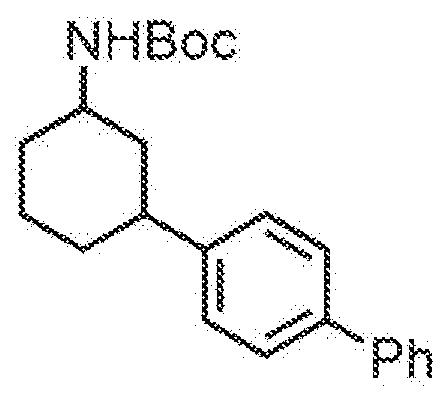
ferf-butyi (3-{[1 ,1 !-bip enyll-4-yl)cycf ohexyljcarbamate (2a&)
Foilowiog the general procedure, compound 2as was obtained as a single diastereomer (cis) and a white solid (58.3 mg, 83% yield) after purification by preparative TLC (eluent:
bexane/EfOAc = 5/1 ).1H UMR (500 MHz, CDCI3) δ 7.57 (dd, J = 8-2, 1 .4 Hz, 2H), 7.52 (d, J - 8.0. Hz, 2H), 7.41 ((, J * 7.6 Ηζ·, 2H), 7.34 - 7.29 (m, 1Ή), 7.26 (d, J = 8.1 Hz, 2H), 4,45 (d, J - 7.7 Hz, 1H), 3.80 (s, 1H), 2.67 {it J - 12,3, 3.3 Hz, 1H), 2.23 (d, J ~ 12.3 Hz, 1H), 2.10 - 2,02 (m, 1H), 1.9G. (tq, J = 9.5> 3.4 Hz, 2H>, 1.57 - 1.48 (m, -1H), 1.44■ (s, 9H>, 1.41 - 1 ,32 (m, IN), 1.26 (q, J = 12.1 Hz, 1H), 1.11 (qd, J = 12.5, 3.7 Hz, 1H). 1 C NMR (151 MHz, CDCf3) δ 155.16, 145.38, 141.01 , 139.04, 128.69, 127.16, 127.11 , 12.7.01 , 126,99, 79.13, 50.02, 42,89, 41.42, 33.19, 33.11, 28.43, 25.20. HRMS (ESi-TOF) Caicd for CaaH^NOz a . [M+Na]*: 374.2091; found: 374.2086.

Foiiowing the general procedure, compound 2a§ was obtained as a single diastereomer (cis) and a white solid (48.9 mg, 80% yield) after purification by preparative TLC (eiuerrt:
hexane/EtOAc * 5/1 ). Ή NMR (600 M:Hz, CDCI3) 6 7.13 - 7.07 (m, 2H), 6.86 - 6,80 (m, 2H), 4,45 (s, 1H), 3.78 (s, 3H), 3.64 - 3,49 (m, H), 2.57 (tt, J = 12,3, 3.5. Hz, 1 H), 2.16 (d, J = 12.4
Hz, 1.H), 2.03 (dtd, J =11.8, 3.8, 1,8 Hz, 1H), 1.91 -1.78 (m, 2H), 155 ~~ 1.46 (m, 1H), 1.43 (s, 9H), 1.30 (qd, J= 12.9, 3,7 Hz, 1H), 1.18 (q, J = 12,1 Hz, 1H), 1.08 (qd, J ~ 12.5, 3.8 Hz, 1H). «G NM {151 MHz, CDCi3) δ 157.85, 155.16, 138.54, 127.57, 1 3.74, 79.08r 55:23, 50.04, 42.36, 41.69, 33.36, 33.19, 28.42, 25. 8. HRMS (ESI-TOf) Gated for C-,8H27N03Na [ +Na]*: 328.1883; found; 328.1882.

■fenf-b.utyi (3^2- ethoxypheny}eyclobexy!}carbamate (2a?)
Following the genera! procedure, compound 2a? was obtained as a single diastereomer (cis) and a white solid (39.7 mg, 65% yield) after purification by preparative TLC (eiuent;
hexane/EtQAc * 5/1 ). Ή NMR (600. MHz, CDC!3) δ 7.23 - 7.17 (m, 2H), 6.78 (dt, J - 7.5, 1.3 Hz, 1H)56,73 {dt, J ~ 7,6, 2.0 Hz, .1H), 4,44 (s, 1H), 3.79.(ss.3H), 3.65 ~ 3.49 (m, 1Ή), 2.60 (tt, J - 12.3, 3,4 Hz, 1H), 2.19 (d, J = 2.3: Hz, 1H), 2.04 (dqt, J - 10.8, 3.5, 1.7 Hz, 1H), 1.93 - 1.81 (m, 2H).1.53- 1.40 (m, 10H), 1.33(qd, J- 12.6, 3.4 Hz, 1H),.1,22 (q, J = 12,0 Hz, 1Hj, 1.14- 1.04 (m, 1H).13C NMR (151 MHz, C.DC!3) S 156.69, 155.15, 34.45..126.82, 126.48, 120.48, 110,40, 78.99, 55.31, 50.11, 39.95, 35.69, 33.57, 31,84, 28,44, 25,29. HRMS (ES!-TOF) Ca!cd for &8H27N03Na [M+Naf 328.1883; found; 328,1882.

Fpi'lowing the general procedure, compound 2as was obtained as a single diastereomer (cis) and a white solid (49.6 mg, 75% yield} after purification by preparative TLC (eluerrt:
he ane/EIOAc « 5/1).1H NMR (600 MHz, CDCfe) δ 6.77 (d, J« 8.2 Hz, 1H), 6.69 (d, J = 2.1 Hz, 1H), 6,66 (dd, J ~ 8.3, 2.1 Hz, 1Ή), 4.43 (d, J~ 8.2 Hz, 1H), 4,25-4.21 (ms 4H), 3.55 (d, J ~ 11.1 Hz, 1H), 2.52 (tt, J* 1.2.4, 3.3 Hz, 1H), 2.15 (d, j« 12.4 Hz, 1H), 2.05 - 1.99 (m, 1H), 1.89 -1/?8(m, 2H), 1.50 -1.45 (m, 1H), 1.43 {$, 9H), 1.27 (qd, J = 12,8, 3.6 Hz, TH), 1.16 (q, J =
12.Θ Hz, 1H), 1.07 (qd, J = 12.5, 3.9 Hz, 1H).13C NMR (151 MHz, CDGfe) 5155.15, 143.26, 141.71, 139.84, 119,68, 116.99, 1 5-30, 77.24, 64.41 , 64,31 , 49.98, 42.47.41.56, 33.28, 33.18, 28,42, 25.13. HRMS (ESi-TOF) .Gated for -CigHayNCMMa [M+Na]+: 356.1832; found: 356,1826.

Following the general procedure, compound.2ag was obtained as a single diastereomer (cis) arsd a white solid (36.9 mg, 63% yield) after purification by preparative TLC (elueni:
■hexane/EtOAe■ - 5/1).1H NMR (600 MHz, CDCI3) δ 7.21 - 7,13 (m, 2H), 7.06 (t,J - 7.2 Hz, H), 6.99 (ddd, J ~ 9.6, 8.3, .2 Hz, 1 H), 4.55 - 4,36 (m, 1H)i3.59{s, 1 Ή), 2,95 (tt, J - 12.3, 3, Hz, 1H), 2.16 (dt J« 11.8, 3.7, 2.0 Hz, 1Ή), 2.09 - 2.02 (m, 1H), 1.89 (dp, J = 13.5, 3.4 Hz, 1H), 1.83 (did, J~ 13,0, 3.4, 1.7 Hz, 1H), 1.51 (qt, J- 13.3, 3.5 Hz, 1H), 1,44 (s, 9H), 1.37 (qd, J ~ 12.7, 3.5 Hz, 1 H), 1 ,31 (q, J ~ 11,9, 8.8 Hz, 1Ή), 1.12 (qd, J- 12.6, 3.9 Hz, 1 H).13C NMR (151 MHz, CDCf3) δ 160,92, 159.30, 154.66, 132.30 (d, J = 14.3 Hz), 127.27, 126,95 (d, J~ 8. Hz), 123,57 (d, J=« 3.7 Hz), 114,93 (d, J -22.3 Hz), 78.66, 49.45, 39.13, 35-98, 32,76, 27.96... 24.6.8.19F NMR. (400 MHz, CDC 13). δ -119.06 (s). RMS (ESi-TGF) Caicd for C ^FNGs a [M+Naf: 316.1683; found: 316.1679,

Following the genera! procedure, compound 2:a« was obtained as a single diastereomer (cis) and a white §olid {45.2 mg, 73% yieid) after purifiGation by preparative TIC (eiuent:
hexane/EIOAc ~ 5/1).1H NMR (600 MHz, CDCis) δ 7.24 (d, J - 8,4 Hz, 2H), 7. 1 (d, J = 8.5 Hz, 2H), 4.45 (s, 1H), 3.57 (s, 1H), 2.60 (tt, J ~ 12.3, 3,4 Hz, H), 2.17 (d, J = 12,3 Hz, 1H), 2.03 (dtq, J= 10.7, 3.5, 1,8 Hz, 1H), 1.89 (dp, - 13.6, 3.4 Hz, 1H), 1.82 (d pd , J~ 10.0, 3.3, 2,1, 1.4 Hz, 1H), 1,49 (tt, - 13.3, 3.5 Hz, 1H), 1.43 (s, 9H), 1.34 -1.26 (m, 1H), 1.18 (q, J - 12.1 Hz,
1H), 1.09 (qd, J « 12.6, 8.9 Hz, 1H). 3C NMR (151 MHz, CDCi3) δ 1.55.14, 144.69, 131.66, 128,46, 128.10, 79,19, 49.92, 42.64, 41.34, 33.10, 33.07, 28.42, 25.11. RMS (ESI-TOF) Calcd for.Ci7H¾Gi 02Na [M+Naf: 332,1388; found: 332.1382.

Following the general procedure, compound 2a-n was obtained as a single -diastereomer (cis) and a white solid {43.1 mg, 61% yield) after purification by preparative TLC (eiuent:
hexane/EtOAo« -S/1). 1H NMR (600 MHz, CDCfe) δ 7.53 (dd, J ~ 8.0, 1.3 Hz, 1H), 7.28-7.23 (m, 1H), 7.21 (dd, ^= 7.8, 1.8 Hz, 1H), 7.04 (td, J-~ 7.6, 1.8 Hz, 1H), 4.44 (s, 1H), 3.62 (s, 1.H.J, 3.10 (t, J - 12,2 Hz, 1H), 2.20 (dti, J = 11 ;8, 3.8, 2.1 Hz, 1H), 2.08 (d, J ~ 12.6 Hz, IN), 1.94 - 1.84 (m, 2H), 1.54 (qt, J - 13.8, 3.7 Hz, 1H), 1.44 (s, 9H), 1.31 ~ 1.17 (m, 2H), 1.11 (qd, J~ 12.6, 3.8 Ηζ, Η).13C NMR (151 MHz, CDCb) δ 154,63, 144.20, 132.49, 127.10, 127.06, 126.66, 123,97, 78.68, 49,45, 41.44, 39.30, 32.83, 31,74, 27.98, 24.64. HR!vlS (ESi-TOF) Caicd for C.irH24Br 02Na P+ a]+: 376.0883; found: 334.0881.

Following the general procedure, compound 2a« was obtained as & single diastereomer (cis) and a white solid (48,9 rag, 61% yield) after purification by preparative TLC (eiuent
hexane/EiOAc * 5/1), 1H NMR (400 MHz, CDCi3) δ 7.54 (d, J -1.8 Hz, 1H), 7.52 (dt, J~ 7.7, 1.4 Hz, 1H), 7.14 (dt, J* 7.7, 1,3 Hz, 1H), 7.01 (f, J~ 7.8 Hz, 1H), 4.44 (d, J ~- 8.1 Hz, 1H), 3.65 - 3.49 (m, 1H), 2.56 (it, J = 12.4, 3.4 Hz, 1H), 2.1.8 (d, J =12.3 Hz, 1H), 2.07- 1.99 (m, 1.H), .89 (dp, J - 13.6, 3.4 Hz, 1H), 1.85 - 1.81.{m, 1H), 1.48 (dt J =· 13.7, 3.7 Hz, 1H), 1.44 (e, 9H), 1,-34:- 1.27 (ms -1H), 1.19 (q, J ~ 12.1 Hz, 1H), 1.09 (qd, J ~ 12.6, 3,9 Hz, 1H).13C NMR (151 MHz, CDCb) δ 155.13, 148,67, 135.85, 130,17, 128.38, 126,20, 94,56, 79.20, 49.88, 43.24,
42,87, 41.19, 33.03, 28.42, 25,08, HRMS (ESI-TOF) Gated forCi?H2 lN02 a [M+Naf:
424.0744; found: 424.0746.

Following the genera! procedure, compound 2&%% was obtained as a single diastereomer (cis) and a white solid (.48.4 mg, 74% yield) after purification by preparative TLC (elueni:
hexane/EfOAc ~ 4/ ). Ή NMR (600 MHz, CDCb) δ 7,23 ~ 7,18 (m, 1H), 7.07 - 7.01 (m, 2H), 4.45 (d, . J= 8.1 Hz. H), 3.57 (s, IN), 2.59 (it, J- 12.3, 3.3 Hz, 1H), 2,18,(d,J = 12.3 Hz, 1H), 2.03 (dtt, 10.4, 3,6, 1.9 Hz, IB), 1.90 (dp, J= 13.6, 3.4 Hz, 1H), 1.83.(dtt, . J = 11.8, 3.5, 1.8 Hz, 1H), 1,4-9 (it, J ~ 13.4, 3.6 Hz, 1H), 1.44 (s, 9H), 1.32 -1.24 {m, 1H), 1.17 (q, J~ 12.0 Hz, IN), 1,10(qd, 12.6, 3.9 Hz, 1H).13C NMR (151 MHz, CDCb) δ 157.31, 155,68, 155,15, 143.25 (d, J=3.2Hz , 128.70, 126.43 (d, j~6.8 Hz), 120.57 (d, J = 17.5 Hz), 116.32 (d, J~ 20.6 Hz), 79.26, 49.84, 42,33, 41.35, 33.15, 32.95, 28.-41, 25.03.1SF NMR (400 MHz, CDCI3) δ ~ 11-9.9 (s). HRMS (ESI-TOF) Cased for Ci7H23CIFN02Na [M+Na]+: 350.1294; found: 350.1288,

ferf-bu'tyl (S^S^jS-irsfkioroprsenyljcycfohexy carbaniate {2an}
Foiiowing the general procedure, compound .2ai* was obtained as a single diastereomer (cis) and a white solid (34.2 mg, 52% yield) after purification by preparative TLC (eiuent:
hexane/EfOAc = 3/1 ). '1H NMR (500 MHz, CDCb) δ 6.82 ~ 6,75 (m, 2H), 4.51 - 4.32 {m, 1 H), 3.56 (S, 1Ή), 2.57 (it, J= 12,3, 3.4 Hz, 1H), 2,19 (d, J ~ 12.2 Hz, 1 H), 2.05 - 2.00 (m, 1H), 1.91 (dp, J- 13.6, 3.4 Hz, 1.H), 1.82 (dtd, J*.11.6, 3,2, 1.6 Hz, 1H), 1,49 (ddd, J~ 13.4, 9.7, 3.6 Hz, 1H), 1.44 (s, 9H), 1 ,24 (qd, J ~ 12,9, 3.8 Hz, 1H), 1 ,18 ~ 1.04 (m, 2H), «Q NMR (.151 MHz, CDCb) δ 154.65, 151,44 (dd, J * 9,8, 4.2 Hz), 149.79 {dd, J - 9.7, 4.0 Hz), 141,97 (q, J * 6.4
Hz), 138.39 (1, 15.4 Hz), 136.69 (d. J ~ 15.5 Hz), 110.12 (dd, J« 16.4, 4.1 Hz), 78.88, 87.51 , 49.24, 42,01, 0,6, 32.46, 27,94, 24.43.19F NMR (400 MHz, CDCb) δ -135.27 (d, J - 20-8 Hz), . 164.48 <t, J - 20.7 Hz). HRMS (ES1-T0F) Calcd for CiiHzzFaN z (Μ+Η]+: 330.1675; found: 330.1671 ,

ferf-butyj (3-{4-(triftuoromethyl ph«nyi)cyc!ohexyl)carbam3ie {2aiS)
Following the general procedure, compound 2.a« was obtained as a si'ngte diastefeomer (cis) and a white solid (56.9 mg, 83% yield) after purification by preparative TLC (e!uen
hexane/EtOAe = 4/1 }, H NMR {400 MHz, CDCi3) δ 7.54 (d, ~ 8.1 Hz, 2H), 7.29 (d, = 8,0 Hz, 2H), 4,48 (d, ~ 8,3 Hz, 1 H), 3,60 (d, J = 11 ,6 Hz, 1H), 2,69 (tt, J = 12.3, 3.4 Hz, 1 H), 2,21 (ti, J = 12,3 Hz, 1Ή), 2.05 (6tt, ~ 12.5, 4.0, 2.0 Hz, 1Ή), 1.92 (dp, J ~ 13.5, 3.4 Hz, 1 H), 1.85 (dtt, J ~ 11.7, 3.5, 1.9 Hz, 1 H), 1.51 (qt, = 13.2, 3.7 Hz, 1 H), 1.44 (s, 9H), 1.35 (qd, J = 12.8. 3.6 Hz, 1Ή), 1.23 (q, J = 12.1 Hz, 1H), 1.13 (qd, - 12.6,. 3.9 Hz, 1H.)'.13C NMR (151 MHz, GDCI3) δ 154.69, 149.73, 127,96 (q, J * 32,4 Hz), 126.63, 124.86 (q, J = 3.7 Hz), 122.93, 78.78, 49,42, 42.66, 40.63, 32.54, 32.45, 27.94, 24.63. 19F' NMR (400 MHz, CDCi3) 5 -62.61 {s)> HRMS (ESi- TOF) Caicd for
 [M'+Na ; 366.1651 ; found: 366,1648.

Folio wing the general procedure, compound 2a½ was obtained as a single dsasiereomer (cis) and a white solid (46.7 mg, 73% ieid) after purification by preparative TLC (eiuent:
hexane/EtOAc = 4/1 ). 1H NMR (600 MHz, CDCb) δ 8.15 (d, J = 8.7 Hz, 2.H), 7.37 - 7.32 (m, 2Ή), 4,49 {ύ, J ~ 8.1 Hz, 1 H), 3,61 (s, 1H), 2.75 (tt, J-~ 12.3, 3.4 Hz, 1H), 2.23 (d, J - 12.3 Hz, 1 H)i: 2.06 (ddq, J = 12.6. 3.8. 1.9 Hz, 1 H). 1.94 (dp, J = 13.6, 3.4 Hz, 1 H), .87 (did, J ~ 15.1. 3.6, 2.0 Ηζ, ΊΗ), 1.53 (qt » 13.3, 3.6 Hz, 1 H), 1,44 (s, 9H), 1.36 (qd, J ~ 12.8, 3,6 Hz, 1H),
1.25 (q, J - 1.2,1 Hz, 1 H), 1.15 (qd, J = 12.6, 3.9 Hz, 1Ή). 1;3C NMR (151 MHz, CDCla) δ 155.14, 153.76, 146.44, 127.62, 123.75, 79,34, 49.78, 43,22, 40.87, 32.87, 32.81 , 28.41 , 25.04. HRMS (ESi-TOF) Gated
 jM+Na : 343.1628; found: 343.1630.

ferf-bu tyl (3-(4~acety I pheny & |c c&o exyli ) ca rbam ate {2ai? )
Following the general procedure, compound 2ai? was obiained as a single diastereomer (cis) and a white solid (50.7 rng, 80% yield) after purification by preparative TLC (elueni:
hexane/EtOAc =; 4/1), 1H NMR (600 MHz, CDCfe) δ 7.89 (d, J = 8.3 Hz, 2H), 7,28 (ci, J = 8.3 Hz, 2H), 4.47 (s, 1 H), 3.60 (s, 1 H), .2,74 - 2.66 (m, 1.H), 2.58 (s, 3H), 2.21 (d, J ~ 12.3 Hz, 1H), 2.09 - 2.03 (m, 1 H), 1.92 (dp, J - 13.5, 3.4 Hz, 1H), 1 ,86 (dtt, J = 12.2, 4.2, 2.1 Hz, 1 H), 1.51 (qt, J = 13.2, 3.5 Hz, 1H), 1.44 (s, 9H), 1.36 (qd, J* 12.7, 3,5 Hz, 1 H), 1.25 (q, J = 12.1 Hz, 1 H), 1 ,13 (qd, J - 12.6, 3.9 Hz, 1 H), 13C NMR (151 MHz, CDG!3) δ 107.35, 154,69, 151.37, 134,85, 128.16, 126.53, 78,78, 49.42, 42.85, 40.52, 32.58, 32.39, 27.95, 26.10, 24.65. HRMS (ESI-TOF) Caled for Ci9H:27N03Na [ +Na]+: 340.1.883; found: 340.1879,.

terf-butyl (3- 3-formylphersy!)cycfoiisxyl)carbamat@ {2 s}
Following the general procedure, compound 2a« was obtained as a single diastereomer (cis) and a white solid (38.2 mg, 63% yield) after purification by preparative TLC .{eluerit:
hexane/ElOAc - 2/1), NMR (500 MHz, CDCI3) δ 9.99 {s, 1 H), 7.71 (ddd, J = 8,6, 4.5, 2.2 Hz, 2H), 7.50 - 7.41 (m, 2H), 4,50 (d, J ~ 8.7 Hz, 1Ή), 3.69 - 3.53 (m, 1 H). 2.72 (it, J ~ 12.4, 3.3 Hz, 1H), 2.24 (d, J = 12.3 Hz, 1H), 2.06 (ddt, J ~ 8-6, 5.8, 3.0 Hz, IN), 1.97 - 1.84 (m, 2H), 1 ,57 - 1.48 (m, 1H), 1.44 (s, 9M), 1.40 - 1.33 (m, 1 H), 1.28 (qd, J = .6, 11.2, 3.2 Hz, 1 H), 1.14 .(qd, J =■ 12.5, 3.8 Hz, 1H). 13C NMR (151 MHz, CDC|9) δ 192.52, 155.17, 147.30, 136.62, 33.37,
129.08, 128,06, 127.4.8, 79.23, 49.90, 42.93, 41.14, 33.04, 32.99, 28.42, 25.1 1. HRMS <ESI- TOF) Caicd for CiaHasNOa a *Na]+: 326.1727; found: 326.1725.

methyl 4-{3-{{feii-byfoKycarbony }amino)cyGlohexyl)ber5zoate (2aig)
Following the general procedure, compound 2a-i9 was obtained as a single diastereomer (cis) and a white solid (59.9 mg, 90% yield) after purification by preparative TLC {eluent:
hexane/EtOAc ~ 5/1 ). H. NMR (400 MHz, CDCi3) 5 7.98 - 7.93 (m, 2H), 7.26 - 7.24 (m, 2H), 4.47 (s, 1H), 3.90 (s, 3H), 3.59 (s, 1 H), 2.69 (ft, J = 12.2, 3.4 Hz, 1Ή), 2.20 (d, = 12,3 Hz, .H), 2.05 (did, J = 14.1 , 3.7, 1.9 Hz, 1 H), 1.95 - 1.82 (m, 2H), 1.54 - 1.47 (m, I H), 1.43 (s, 9H), 1.35 (qd, J - 12.8, ..3.6 Hz, IH), 1.24 ( ,. J = 12.1 Hz, 1 H), 1.12 (qd, J = 12.5, 3.8 Hz, 1 H). 13C HMH (151 MHz, CDCb) 5 167.07, 155.15, 151.55, 12979, 128.08, 126,81 , 79.22, 51.98, 49.90, 43,3.2, 41.02, 33,07, 32,88, 28,42, 25.12. HR S (ESi-TQF) .CalCd. for Ci9H27NC Na ( +Maf: 356.1832; found; 356. 833. The -stereochemistry was determined by 2D NGE analysis.

teri-butyS (2»((2~fluoropyrsdin-4-y!}methyl)bulyi}carbamaie (2bi)
Following the general procedure, compound .2bt was obtained as a white solid (37.2 mg, 68% yield) after purification by preparative TLC (eluent: hexane/EtOAc = 2/1 ), 1H NMR (400 MHz, CDCia) 5 8.10 (d, J - 5.1 Hz, 1H), 7.00 (d, J =■ 5.1 Hz, 1H), 6.75 (s, 1H>, 4.56 (s, IH), 3:10 (ddt, J = 51.0, 13.6, 6.2 Hz, 2H), 2.68 -- 2.54 (m, 2H-), 1.82 (q, J - 6.6 Hz, H), 1 ,43 (s, 9H), 1.33 (p, J ~ 7.3 Hz, 2H), 0.93 (t, J - 7.4 Hz, 3H . 13C NMR (15 MHz, CDCI3) 164.87, 163.29, 156.05, 147.33 (d, J = 15.4 Hz),- 122.20 (d, J - 3.8 Hz), 109.76 (d, J.- 36.3 Hz), 79.39, 43.22, 41.29, 37.42, 28.38, 23.92, 10.87. 9F NMR (400 MHz, C.DCb) 5 -69.39 (s). HRMS (ESI-TOF) Calcd for C 15H24F 2O2 p+H]÷: 283. 816; found: 283.1810.
 terf-buivS (2-{{2-chloropyndiii-4-y melhyl)butyl}carbafnate (Zbz)
Following the general procedure, compound Zbi was obtained as a white solid (41.1 mg, 69% yield) after purification by preparative TLC (eiuefit: hexane/EtOAc = 2/1).1H NMR (500 MHz, CDCIaj 58:27 (dd, J~ 5.2, 1.2 Hz, 1H), 7.15 (s, 1H), 7.05 (d, J =5:1 Hz, 1H), 4.55 (s, 1H), 3.10 (deft; J ~ 55.6, 13.4, 6.2 Hz, ,2H), 2.56 ,(ddd, = 49.9, 13.9, 7.0 Hz, 2H), 1.80 (d.d,. J- 1.3.4, 8.8 Hz.-IH), 1.44 (s, 9H), 1.32 (p, J =7.2 Hz, 2H), 0.92 (id, J =7.4, 1,1 Hz, 3H). 3C NMR (151 MHz, CDC!a) δ 155.56, 152.96, 15.1.17, 148.99, 124.28, .122.81, 78.93, 42.72, 40.84, 38.80, 27.92, 23.43.10.40. H.RMS (ES1-TGF) Gated for CisHz C!NaOa (M+H.J*: 299.1521 ; found:

ieff-buty! (2-{(2>bromopyrldii -4-yl)methyl)butyS)cari5amaie (2fos)
Following the general procedure, compound 2 a was obtained as a white- solid (38.4 mg, 5.6% yield) after purification by preparative TLC (eluent; hexane/EiOAc = 2/1). \H N R (400 MHz, GDCIa) 8.25 (<J, J = 5.1 Hz, 1H), 7.31 (s, 1H)( 7.08 (d, J ~ 5.0 Hz, 1H), 4.56 {s, 1H), 3.10 (ddt, J ~ 57.4, 14.3, 6.1 Hz, 2H), 2.55 (odd, J~ 52.2, 13.9, 7.0 Hz, 2H), 1.82 - 1.76 (m, 1H), 1.44 fs, 9Ή), 1.32 (p, J * 7.2 Hz, 2H), 0.92 (t, J - 7.5 Hz, 3H).13G NMR (i51 Hz, CDCI3) «C NMR (151 MHz, CDCI3) δ 156.03, 153,21, 149.88, 142.43, 128.56, 123.66, 79.41, 43.17, 41.32, 37.19, 28.39, 23.89, 10.86. HR.MS (ESi-TOF) Caicd forCi5H24BrN202 [M+H]*: 343.1016; found:
343.1016.

Following the general procedure,■com.pound.2b4 was obtained as a white, solid (37.8 mg, 67% yield) after purification by preparative TLC (eiuent: hexane/EtOAc™ 2/1).1H NMR (400 MHz, CDCia) δ 8.03 - 7.99 (m, 1H), 7.60 {dt, J - 8.4,4,3 Hz, 1.H), 6.86 (dd, ~8A, 2.9 Hz, 1H), 4.53 (s, 1H), 3,09 (ddd, J~ 35.8, 14.5, 7.9 Hz, 2H), 2.63 - 2:50 (m, 2H), .1.77» 1.71 (m, 1H), 1.44 (s, 9H), 1.35 ~ 1.28 (m, 2H), 0.92 (t, J =7.5 Hz, 3H). 3C NMR (151 MHz, CDC13) 163.16, 161.59, 156.05, 147.55 (d, J ~ 14.2 Mz), 141,58 d, J = 7.6 Hz), 133.45 (d, J = 4.4 Hz), 109.09 (d, J = 37.3 Hz), 79.34, 43.00, 41.77, 34.07, 28.40, 23.68.1SF MR (400 MHz, CDCia) δ -72,34 (s).
forCi5H24FN202 [M+H]+: 283.1816; found: 283.18 .

ferf«butyi (2-{(0«ch!oropyrsdi!i-3«yi)meihyf)butyS}carbamate (2bs
Following the general procedure, compound 2b¾ was obtained as a white so!id (35.8 mg, 60% yield) after purification by preparative TLC (eiu'ent: hexane/ELOAc ~ 2/1). H NMR (400 MHz, CDC ) δ 8.19 (d, J = 2.4 Hz, H), 7.53 - 7.42 (m, 1H>, 7,25 (d, J ~ 8.1 Hz, 1H), 4.55 (s, 1H), 3.09 (ddt, J = 44.7, 13.8, 6.0 Hz, 2H), 2.59 (dd, J = 14.1, 6.8 Hz, 1H), 2.52 (dd, J = 14.1 , 7.4 Hz, 1 H), 1.73 (d, J =' 6,3 Hz, 1 H), 1.44 {s, 9H), 1.35 ~ 1.28 ( , 2H), 0.92 (I, J = 7,5 Hz, 3H). 3C
NMR (151 MHz, CDCI3) 5155.57, 149.60, 148.69, 138.88, 134.42, 123.43·, 78.88, 42.56, 41.21, 33.85, 27.92, 23.24, 10.41. HRMS: (ESi-TOF) Gated for Ci5H2CI 202 [M+H.}+ 299.1521; found:

ferf-butyl (2~((8-Ghioro-5-(trjfluoromethyI)pyrsdin-3-yl5methyS b (2b6) The general procedure was followed, except that the reaction was heated to.130 °C and stirred for 48h. Compound 2be was obtained as a white solid (42,5 mg, 58% yield) after purification by preparative TLC (eluenf: hexane/EtOAc = 2/1).1H NMR (400 MHz, CDC!3) δ 8.38 (d, J - 2,3 Hz, 1H), 7.82 (t J = 5.4 Hz, 1H), 4.54 (s, 1H), 3.22 - 2.95 (m, 2H), 2.69 (dd, J - 14.2,.6.8 Hz, 1H), 2.59 (dd, J « 14.2, 7.4 Hz, 1H), 1.77 ({, J¾ 6.5 Hz, 1H), 1,44 (s, 9H), 1.37 - 129 (ro, 2H), 0.9 (t, J ~ 7.5 Hz, 3H).13C NMR (151 MHz, CDCI3) δ 155:56, 152.14, 146.04, 136.56, 134,86, 124.3
(q, J - 33. Hz), 121.73 ( J ~ 273.2 Hz), 79.07, 42.43, 41.23, 33.77, 27,89, 23.32, 10.39. 9F NMR (400 MHz, CDCb) δ -63.86 (s). HRMS (ESf-TOF) Cefod fer CieHjaCiFaNsOa [M+Hf: 367.1395; found: 367.1392.

i@rf~buiyi (2~{{2-met oxypyridin-3-yi)niethyi)buiyS carbamate (2b?)
Following the general procedure, compound 2b? was obtained as a white solid {23,5 mg, 40% yieid) after purification by preparative TLC (eiuent; hexane/EtQAc ~ 2/1 ). H NMR (400 MHz, CDCia) 8.03 (dd, J - 5.1 , 1.8 Hz, 1 H), 7.38 (d, J = 7.2 Hz, 1 H), 6.82 (dd, J ~ 7.1 , 5.0 Hz, 1H), 4.76 (s, 1 H), 3,96 (s, 3H), 3.04 (dc!t, J/= 46.5, 13.2, 5.3 Hz, 2H), 2.53 (dd, J = 7.0, 3,0 Hz, 2H), 1.74 (p, J - 6.3 Hz, IB), . 1.. 4 (s, 9H), 1 .33 (p, J.» 7.3. Hz, 2H), 0.94 (t, J = 7.4 Hz, 3H ..13C NMR (15 MHz, CDCb) δ 16.2.10, 156,16, 144.47, 138.86, 123.19, 116.79, 78,92, 53.27, 42.89, 40.34, 31.97, 28.44, 24.51 , 11.16. HRMS (ESI-TOF) Calcd for Gtt>H2eN203 a [M+Naf:
317.1836; found: 317.1831.

Following the general procedure, 'compound 2be was obtained as a white solid (50.5 mg, 76% yieid) after purification by preparative TLC (eiuent: hex.ane/EtOAc - 2/1 ). H NMR (400 MHz, CDC'fe) 6 7,77 (t, J - 7,8 Hz, 1H), 7.52 - 7.49 (m, 1 H): 7.35 (d, J « 7.9 Hz, 1H), 5,05 (s, 1H), 3,22 - 3.09 (m, 1H), 3.02 (dt, J - 13.6, 6.6 Hz, I N), 2.9 - 2.78 (m, 2H), 2.03 (dh, J = ,0, 7.4, 6.7 Hz, 1 H), 1.43 (s, 9H), 1.38 - 1.2? (m, 2H), 0.95 (t, J 7.4 Hz, 3H), 3C NMR (151 MHz, CDC ) 5 161.30, 155.74, 147.13 (q, J= -34.2 Hz), 137.04, 126.00, 121 ,06 (q, J ~ 274.1 Hz), 117.24 (tt, J = 0.5 Hz), 78.42, 42.67, 39.94, 39.54, 27.92, 24.18, 10.73. 9F NMR (400 MHz, CDCb) δ -68.41 (s). HRMS (ESI-TOF) Calcd for CtsHzsFaNaOaNa [M+Naf: 355.1604; found; o . s 6Q3.
2

ferf-foutyl {2-{quinoHn-~3-yimethyl)buiy})c rbamat6 (2b^)
The general procedure was followed, except that the reaction was heated to 130 °C and stirred for 48h. Compound 2b» was obtained as a white solid- (27.0 rng, 43% yield) after purification by preparative TLC (eiuenf: exane EtQAc■ ~ .2/1 )- 1H NMR (400 MHz, CDCis) δ 8.7S (d, J = 2.3 Hz, 1-H), 8.12 - 8.06 (m, 1H), 7.96 - 7.88 (m, 1 H), 7.77 (dd, J = 8.2, 1.4 Hz, 1 H), 7.66 (ddd. J * 8.4, 6.9, 1 .5 Hz, 1 H), 7,53 {ddd, J ~ 8.1 , 6.8, 1.2 Hz, 1H), 4.59 (s, 1 H), 3.24 ~ 3.02 (ra, 2H)„ .2.85 - 2.68 (m, -2H), 1.92 - 1.79 (m, 1 H), 1.43 (s, 9H), 1.37 {did, J = 14.5, 7.5, .5.7 Hz, 2H), 0,95 (i, J ~ 7.4 Hz, 3H). 1¾: N R (151 MHz, QDC!3) 6 166.08, 152.17, 146.85, 1.35.14, 133.26, 129.12, 128.73, 128.06, 127.36, 126.64, 79.26, 43.21 , 41 .83, 35.42, 28,39, 23.79-, 10.93. HR S (ESI- TOF) Caicd for CieH^e aOa a p+Na]+: 337.1886; found: 337.1885,

tefi-butyl (2-{quino!?n-6-yimethyi)buiy.i)carbamate (2bto)
The general procedure- was followed, except that the reaction was heated to 130 °G and stirred for 48 . Compound Zbw Was' obtained as a white solid (26.4 mg, 42% yield) after purification by preparative TLC (eiuenl: hexane/EtOAe ~ 2/1 ). i:H NMR (600 MHz, C'DCIa) δ 8.86 (dd, J = 4.3, 1.7 Hz, -1 H), 8.09 (dt, J = 8.1 , 1.2 Hz, 1 H), 8.04 (d, J ~ 8,6 Hz, 1 H-), 7.58 (d, J - 2,0 Hz, H), 7.55 (dd, J = 8.7, 1.9 Hz, 1 H), 7.38 {dd, J ~ 8.2, 4.2 Hz, 1 H), 4.55 (d, J - 7.0 Hz, TH), 3.14 (ridt, J * 39.9, 12.8, 5.9 Hz, 2H), 2.76 (t, ≠ 6.6 Hz, 2'H), 1 -88 .(d, J = 6.5 Hz, 1 H), 1 .42 (s, 9H), 1.40 - 1 .34 (m, 2H), 0.95 (t, J - 7.4 Hz, 3H). 13C NMR (151 MHz, CDCia) δ 155.81 , 149.23, 146.59, 138.72, 135.20, 130.82, 128.80, 127.7.9, 128.62, 120.66, 78.68, 42,88, 41 .40, 37.74, 27.94, 23.54, 10.51 . HRMS (ESi-TOF) Ca-ted.for
 337.1886; found: 337.1886.
 ferf-butyi {2-{qutnoxalfn-e-yimeir3yl)bufy!)carbamate (2bn)
The general procedure was followed, except that the reaction was heated to 130 °C and stirred for 48h. Compound 2i>n was obtained as a white solid (27,7 mg, 44% yield) after purification by preparative TLC (eluenf; hexane/EtOAc = 2/ ). H NMR (400 MHz, CDCI3) δ 8.81 (dd, J ~ 11.8, 1 ,8 Hz, 2H), 8.04 (d, J = 8.6. Hz, 1 H}, 7.92 - 7.85 (m, 1H), 7.67 - 7.57 (m, 1.H), 4.56 (s, 1 H), 3.15 (dp, J ~ 26.5, 6.9, 6.4 Hz, 2H), 2.83 {qd, J ~ 13.9, 7.1 Hz, 2H), 1.92 (p., J = 6.5 Hz, 1 H), 1.43 (s, 9H), 1.40 - 1.35 (m, 2H), 0,95 (t, J = 7.4 Hz, 3H). 1SC NMR {151 MHz, CDCk) δ 155,59, 144.5 , 143.85, 143.00, 142.56, 141.33, 131.50, 128.80, 128.18, 78.76, 42.84, 41.37, 37,83, 27.93, 23.46, 10.48. HRMS (ESi-TOF) -Gated for G18H25N3O2N0 [M+Naj+: 338.1839; found;

Following the general procedure, compound 2fa« was obtained as a white solid (37.3 mg, 60% yield) after purification by preparative TLC (eiueni: bexane/BQAc ~ 2/1 ).1H NMR {400 MHz, GDC (3) δ 7.53 (d, J * 3,7 Hz, 1 H), 6.84 (d, J■ 3.7 Hz, 1 H), 4.55 (s, 1 H), 3. 1 (did, J ~ 26.9, 13,5, 5.9 H2, 2H)-, 2.82 (qd, J - 14.9, 6.8 -Hz. 2H), 2.51 (s,.3H), 1.83 - 1.75 (m, 1 H), 1 ,44 (s, 9H), 1.40 - 1.33 (m, 2H), 0,94 (t, J ^ 7.5 Hz, 3H). 3C - NMR {151 MHz, CDCI3) δ 190.43, 156.07, 153,22, 142,56, 132.90, 126.86, 79.30, 43,06, 42.33, 32.64, 28.40, 26.48, 23.89, 10.96. HRMS (ESI-TOF) Caicd for C16Ha5N03S a [ +Na]+: 334.1447; found; 334,1 45.

Following the genera! procedure, compound 2c was obtained as a white solid (39.8 mg, 68% yield) after purification by preparative TLC (eluent: hexane/EtOAc =· 5/1 }, 1H NMR (600 MHz, CDCis) 7.98 ~ 7.92 (m, 2H), 7.26 - 7.22 (m, 2H>, 3,90 (s« 3H)( 3.15 (t, J ~ 7.0 Hz, 2H), 2,72 - 2.67 (m, 2H), 1.83 (p, J - 7.4 Hz, 2H), 1.44 (s, 9H). - 3C NMR (150 MHz, CDC!3) δ 16.7.08, 155.95, 147.12, 129.78, 128.38, .27.96, 79.23, 51.99, 40.15, 33.17, 31 .46, 28.4 . HR S (ESS- [W+Naf : 316.1519; found: 316. 518.

The general procedure was followed, except that the reaction was heated to 90 °C. Mono- and di-ary!ation compounds were obtained as white solids (20.9mg, 34% mor>o, 38% di, 72% total yield} after purification with preparative TLC (eluent: hexane/EtOAc - 5/1 ). 1H NMR (600 MHz, CDCfe) S 7.98 - 7.93 (m, 2H), 7.24 - 7,20 {m, 2H), 4.58 (s, 1 H), 3.90 (s, 3H), 3.06 (ddi J = 66.9, 13.9, 6,5 Hz, 2H). 2.76 (s, 1 H), 2.41 (dd. 1 3,5, 8.7 Hz, 1 H), 2.01 - 1 .88 (m, 1Ή), 1.44 (s, 9H), 0.86 (d, J « 6,7 Hz, 3H). 13C NMR (151 MHz, CDCfe) δ 167,10, 158.04, 146.06, 129.65, 1.29.09, 127.99, 79.22, 52.00, 46.39, 40.86, 35.71 , 28,41 , 17,24. HRMS (ESf-TOF) Calcd for
*: 330.1676; found: 3.30.1676.

dimethyl 4)4*^2-(({tert-butoxycart onyi)amino)me hyf propane-1 ,3-diyl dlbenzoafe {2d, Dsary!ation)
The general procedure was followed, except that the reaction was heated to 90 °C. Mono- and di-arylation compounds were obtained as- white solids (34% mono, 33.5 mg, 38% di, 72% total yield) after purification with preparative TLG (eluent: hexane/EtOAc ~ 5/1 ), 1H NMR (600 MHz:, CDCis) 7,97 - 7.93 (m, 4H), 7.20 (d, J - 8.0 Hz, 4H), 4.52 - 4,44 (m, 1 H), 3.90 (s, 6H), 3.08 {t, J - 6.3 Hz, 2H), 2.64 (ddd, J = 45,2, 13.9, 7.1 Hz, 4H), 2.21 {p, J = 7.0 Hz, 1 H), 1.42 (s, 9H). 13G NMR (151 MHz, CDC 13> δ 166.99, 155.98, 145.58, 129.80, 129.05, 128.21 , 79.35, 52.03, 43.59,
42.49, 38.36, 28.37. HRMS (ESi-TOF)' Caicd for CasHaiNOeNa. [M+Naj*: 464.2Q44; found:

Following the general procedure, compound 2e was obtained as a white .solid (44.3 nig, 69% yield) after purification by preparative TLC (eiuent: hexane/EtOAc - 5/1 ). "Ή NMR (6D0 MHz, CDCI3) δ 7.98 - 7.93 (m, 2H), 7.23 (d, J ~ 8.0 Hz, 2H), 4.50 (s, i H), ..3.90 (s, 3H), 3.09 (ddi, J. ~ 41.9, 13.5, 5.9 Hz, 2H), 2.63 (qd, J » 13,7, 7.1 Hz, 2H , 1.78 (p, J * 6.5 Hz, 1 H), 1.35 - 1.28 {m, 2H), 0.91 (i, J ~ 7.5 Hz, 3H). NMR (151 MHz, CDCk) δ 167.09, 156.04, 146.32, 129.68, 1-29.08, 127.95, 79.15, 51.99, 43.29, 41.87, 38.24, 28.40, 23.93, 10.93. HRMS (ESI-TOF) Calcd af: 344.1832; found: 344.1832.

methyi 4- -({feit--buioxycarbony!}am!no}buiyi)t)eni;oa e (2f)
The general procedure was followed, except that 50 mo % TDG4 was used. Compound 2f was obtained as a white solid (54.6 mg, 89% yield) after purification with preparative TLC (eluent: hexane/EtOAc = 5/1 ). Ή NMR (600 MHz, CDCfe) δ 7.98 - 7.92 (m, 2H), 7.25 (d, J = 8.2 Hz, 2H), 4,38 (s, H), 3,90 (s, 3H), 3.73 (d, J - 17.3 Hz, 1 H), 2.71 (id, J - 7.7, 4.8 Hz, 2H), 1.74 (dd, J = 8.7, 5.8 Hz,. 2H), 1.45 <s, 9H), 1.16 (d, J - 6.6 Hz, 3H). «C NMR ( 51 MHz, GDG ) δ 167.1 1 , 155.34, 147.51 , 129.76, 128.38, 127.86, 79,1.2, 51.97, 46,34, 38.79, 32.59, 28,43, 28.04, 21.38. HRMS (ESI-TOF) Calcd for Ci?H25N04Na [M+Na]*: 330,1676; found: 330.1676.


| +Na|+: 344.1832; found: 344.1825,

Following the general procedure, mono- and di-ar lation compounds were obtained as white solids (16% mono, 40-.9mg, 45% di, 61% total yield) after purification, with preparative TLC (eiuent: bexane/EtQAc= 5/1 ). H NMR (600 MHz, CDCI3) 5 7.98 - 7.89 (m, 4H), 7.40 ~ 7.31 (m:5 4H), 4.26 (s, 1 H), 4.18 (t, - 6.7 Hz, 1 H), 3.88 (s, 6H), 2,59 (d, J - 6.7 Hz, 2H), 1.37 (s, 9H), 1.17 (&, 6H). 3C NMR (151 MHz, CDCfe) δ 166.86, 154.09, 150,23, 130.03, 128.27, 127.86, 127.25, 78.82, 52.80, 52.01 , 47.93, 44.23, 28.38. HRMS (ESl-TOF) Calcd for CjeHasNOeNa [M+ a]*; 478.2200; found: 478.220 .

met l 4^{3~((teff~buioxycarbonyl)am5riQ)-'2-p eny!propyi)ber5^oate (2h
Following the general procedure, compound 2ft was obtained as a white solid (44.3 rhg,.60% yield) after purification by preparative TLC (eiuent: hexane EtOAc ~ 5/1 ), H NMR (600 MHz, CDCfe) 7.85 (d, J - 7.9 Hz, 2H), 7.28 - 7.24 (m, 2H), 7.22- 7,1.8 (m, 1 H), 7.10 - 7.05 (m, 4H),
4.41 (8, 1H). 3.87 (s, 3H), 3,58 {p, J - 6.2 Hz, 1 H), 3,26 (ddd, J - 12.9, 8.4, 4.4 Hz, 1 H), 3.08 (d, J * 6.5 HZ, 1 H), ,3,03 (dd, J ~ 13.6, 6.0 Hz, 1 H), 2.90 (dd, J ~ 13,5, 8,7 Hz, 1 H), 1.39 (s, 9Ή). 53C NMR { 151 MHz, CDCb) 3C NMR (151 MHz, CPCfe) δ 167.06, 155,84, 1.45.12, 141.38. 129,52, 129.06, 128.64, 127.98, 127.88, 126.93, 79.30, 51.95, 47.68, 45.51, 40.51 , 28.34. .HRMS (ES!- TOF) Ca!cd for C22H2? Oa a [M+Na}+: 392.1832; found: 392.1832,

methyl 4-{3~f{fefi~bytoxyearbonyi)amino)-4-methoxybuty )ber{zoate (21}
Following the general procedure, compound 2i was obtained as a white solid (34,4 mg, 51% yield) after purification by preparative TLC (eiuent: hexane/EtOAc = 5/1 ). H NM (600 MHz, CDCb) 7.95 (d, J = 8.0 Hz, 2H), 7.28 - 7.24 (m, 2H), 4.77 (d, J ='7.8 Hz,. 1 H), 3,90 (d, J - 0.9 Hz, 3H), 3.76 {s, 1H), 3.39 (d, J 4.2 Hz, 2H), 3.33 (d, - 0.9 Hz, 3H),. 2.72 (dtd, J ~ 15.9, 14.0, 7.4 Hz, 2H), 1.93 - 175 (m, 2H), 1.45 (d, J = 0.9 Hz, 9H). 13C NMR (151. MHz, CDC ) 51.67.15, 155.63, 147.49, 129.75, 128.43, 127.87, 79.32, 74.54, 59.13, 51.99, 50.1 1 , 33.75, 32:58, 28.43.
sMa [M+Na]+: 360.1 81 ; found: 360,1781.

benzoate (2j)
The general procedure was followed, except 8.0 eq of BocsO was used during the 80c
protection step. Compound 2j was obtained as a white soiid (41.4 mg, 46% yield) after purification by preparative TLC {eluenf: hexane/EtOAc = 5/1 ). 1 H NMR (600 MHz, CDCb) δ 7.95 (d, J « 8,3 Hz, 2H), 7.22 (d, J 8.1 Hz, 2H), 4.58 (d, J = 29.1 Hz, 2H), 3.90 (s, 3H), 3.07 (t, J ~ 7,6 Hz, 4H), 2.62 (qd, J - 13.8, 7.2 Hz, -2H), 1.86 (p, J = 6.3 Hz, 1 H), 1.54 (s, 1 H), 1.43 (d, J ~ 3.3 Hz, 19H), 1.35 - 1 .23 (m, 2H). 13C NMR {151 MHz, CDCb) 6 167.02, 156, 19, 156.05,
145.91, 129.77, 129.04, 128.10, 79.31 , 79.07, 52.01 , 43.24, 40.54, 40.25, 38.69, 28.43., 28.29, 26.93. HRMS (ESI-TOF) Gated for C^H^OeNa j:M+Na}*: 473.2622; found: 473,2621 .

methyl 4~(4-{{ierf-butoxycarbonyl)amlF3o}butaf5~2-yiJbers2; sate (2k)
The genera! procedure was followed, except that the reaction was perforrned at 150 °C in
HF IP/HO Ac = 2/1. -solution {1.0 mL) with 30 eq. H20 additive (6.0 mmol). Compound 2jk was obtained as a white solid (40.5 mg, 66% yield} after purification with preparative TLC (eluent: hexane/EiOAc ~ 5/1 ). 1 H. N MR {600 MHz, CDCi3) δ 7.98 ~ 7.95 (m, 2H), 7.26 - 7.24 (m, 2H), 4.44 (s, 1H), 3.90 (s, 3H), 3..01 (did, J - 20.1 , 13.5, 12.6, 6.4 Hz, 2H), 2.82 (h, J ~ 7.1 Hz, 1 H), 1.84™ 1.73 (m, 2H), 1.42 (s, 9H}» 1.28 (d, J «..6.-9 Hz, 3H), 13C R (151 MHz, CDC ) δ
167.05, 155.83, 152.14, 129.92, 128.19, 126.93, 79.18, 52.00, 39.00, 38.10, 37.76, 28.40, - for Ci:7H25N04 a [ +Naj+: 330.1676; found: 330.1676.

The general procedure was followed, except thai the reaction was performed at 150 °C in
HFiP/HOAc - 2/1 solution {1.0 mL) With .30 eq, H2O additive (6,0 mrnol),. Compound 21 was obtained as a white solid (31.2 mg, 43% yield) after purification with preparative TL.G (eluen hexane/EtOAc - 5/ ). H NMR (600 MHz, GDCI3) δ 7.96 (ύ, J ~ 8.3 Hz, 2H), 7.21 (d, * 8.3 Hz, 2H), 4,42 (s, 1H), 3.90 (s, 3H), 2,93- (dtd. J ~ 19.4, 11.5, 10.2, 4.5 Hz, 2H), 2.62 (tt, J = 9.8, 5.2 Hz, H), 1.72 (ddi, 13.7, 9.6, 6.9 Hz, 1 H), .64 (ddi, J * 15.0, 10,0, 5.0. Hz, 1 H), 1.57 (qd, J = 9.5, 4.7 Hz, 1 H), 1.42 (s, 9H), -1.27 - 1.11- (m, .6H), 1.06 (dtd,. J ~ 14.8, 7.3, 4.5 Hz, 1H}, 0.84 - 0.80 (m, 3H), 13G NMR (151 MHz, CDCb) δ 167,09, 155.81 , 150.75, 129,85, 128.21, 127.59, 79.12, 51.99, 43.82, 39.01, 36,79, 36.57, 31.75, 28,39, 27.05, 22.48, 1 .00. HRMS {ESI-TOF} Gated
 [M+NaF: 386.2302; found: 386.2302.
 methyl 4~{4-((feft-buioxycarbonyS)amirso}pen an~2- J)berixoate (2m)
The general procedure was followed, except that SO mo!% TDG4 was used. Compound 2m was. obtained as a white solid (54.6 rng, 85% yield, 2.6/1 d.r.) after purification with preparative TIC (elgen hexane/EiOAc « 5/1 ). 1H NMR (600 MHz, CDCi3} δ 7.99 - 7,94: (m, 2H), 7.26 (del, J « 8.2, 4.7 Hz, 2H), 4.26 (dd, J ~ 18.0, 8.8 Hz, 1Ή), 3.90 (s, 3H), 3.52 (s, 1 H), 2,88 (di J - 14,0,
7.4 Hz, I N), 1.66 (td. J * 8.4. 4,4 Hz, 2H), 1.43 (s, 9H), 1 .27 (dd, 6.9, 3,8 Hz, 3H), 1.08 (d,
6.5 Hz, 3H). 13C NMR (151 MHz, COC ) δ 166.63, 154.56, 151 .99, 129.38, 127.63, 126.60, 126,43, 78.51 , 51.49, 45.24, 44.40, 36.50, 27.95. HR S (ESI-TOF) Calcd for C1SH27NO4 3 [M+Naf: 344.1832; found: 344.1832.

The general procedure was followed, except thai 50 mol% TDG4 was used. Compound 2n was obtained as a white s iid (26.1 mg, 41 % yield, single diastereonisr (cis)) after purification with preparative TIC (eluent: hexane/EtOAc = 5/1 ). '1 H NMR (600 MHz, CDCi3) δ 7,96 (d, J = 8,3 Hz, 2H), 7.28 (d, J « 8.3 Hz, 2H), 4.62 (s, 1 H), 4.10 (s, 1Ή), 3.90 (s, 3H), 3.12 (ddd, J = 17.4, 10,3, 7.5 Hz, 1 H), 2.53 (dt, J - 13,2, .6.9 Hz, 1 H), 2.21 - 2.07 (m, 2H},: 1.76 (did, J == 12.8, .9.9, 9,4, 6.9 Hz, 1H), 1.66 - 1 ,59 {m, 1Ή), 1.45 {s, 9H). 1¾C NMR (151 MHz, CDCfe) δ 166.58, 155,01 , 150.1 5, 129.29, 127,55, 126,48, 78.80, 51.54, 43.36, 41.26, 32,45, 31 ,38, 27.97. HRMS (ESI- TOF) Caicd for GieHisNC Na [M+Na]+: 342.1676; found; 342.1676. The stereochemistry was determined by 2D NOE analysis.
 me l 4-(3-{(feri»butoxycar onyl}aniino)cyefooctyi)benzoate (2o, Monoaryfatron)
Following the genera! procedure, mono- and di-arylatson compounds were obtained as white solids (23.8m'g, 33% mono, 43% d't, 76% iota! yield) after purification with preparative TIC .{eiuen Hexane/EtOAc =-6/1 ). 1H NMR (600 MHz, CDCi3) δ 7.94 (d, J ~ 8.3 Hz, 2R), 7.24 (d, J = 8.3 Hz, 2H), 4.50 (s, 1H), 3.90 (s, 3H), 3.83 (s, 1 H), 2.91 (s, 1H), 2.00 ~ 1.91 (m, 3H), 1.90 ~ 1.74 (m, 3H), 1.65 (td, J = 14.7,. 11.8, 8.1 Hz, 6H), 1.41 {$, 9H), "C NMR (151 MHz, CDC!s) δ 167.11 , 154.95, 154.81 , 129.84, 127.72, 126.81 , 79.10, 51.96, 50.71 , 44.02, 41.42, 35.09, 33.35, 28.44, 26.95, 24.32, 22.43. HRMS (ESI-TOF) Cased for C¾H3iN:0«Na [M+Na :
384.2145; found: 384,2144. The stereochemistry' was determined by 2D NQE analysis.

Diaryiation).
Following the genera! procedure, mono- and di-ary!ation compounds were obtained as white solids (33% mono, 42.6mg, 43% di, 76% total yse!d) after purification with preparative TLC
(eiuent: hexane/ElOAc = 5/1). "H NMR. (600 MHz, CDCI3) 6 7.99 - 7,94 (m, 4H), 7.30 » 7.24 (m, 4H), 4.54 (s, 1 H), 3.90 (s, 6H), 3.79 (d, J - 31.2 Hz, 1 H), 3.12 {«, 2H}, 2.15 - 1.86 (m, 8H), 1.77 <qd, J ~ 10,6, 9.9, 4.5 Hz, 2H), 1.36 (s, 9H}.. 13C NMR (151 MHz, CDCI3) δ 167.04, 154.62, 154.51 , 129.94, 127.88, 126.85, 79,25, 52.00, 42.73, 42.16, 35.77, 28.37, 23.37. HRMS (ESI- TOF) Calcd for 02eH3?NOsNa M+ a]+: 518.2513; found: 518.2513, The stereochemistry was- determined by 2D NOE analysis.
Large Scale Reaction with the Production of Free Aryiateti Amine

methyl 4-{3-amsnocyciohe¾y§)benzoate (2p)
The general procedure for setting up the reaction was followed. After the reaction, the mixture was cooled to room temperature, filtered through Celite and mixed with 11V1 aqueous HCi {2,0 ml.}. After being stirred at room temperature for 30 min, the mixture was transferred to a separate funnel and the organic phase was discarded. The water phase was washed with
CH2Ci2 (5,0 ml), basified by 4M aqueous NaOH until pH > 12 and extracted with CH2Ci2 (4 * 15,0 ml). The combined organic phase was dried over ajSO* and concentrated in Vacuo to obtain the pure product without any further purification as a pale yellow oil (.284.3mg, 61% yield). 1M N R (600 MHz, CDQfe) δ 7.99 - 7.93 (m, 2H), 7.28 - 7.23 (m, 2H), 3.89 (s, 3H), 2.81 (it, J - 11.1 , 3,9 H2..-1 H), 2.64 (it, J = 12.2, 3.4 Hz, 1 H), 2.02 (dtt, J = 14.2, 3.8, 1.6 Ηζ, 1 Η)> 1,9.7 - 1.91 (m, 1H), 1.89 (dp, J ~ 13,2, 3.3 Hz, 1 H), 1 ,84 (dddd, J ~ 14.5, 5.1 , 3,3, 1.7 Hz, 1 H), ,46 (qt, J = 13,1 , 3.4 Hz, 2H), 1.35 (id, J 12.6, 3.5 Hz, 1 H), 1.27 (td, J = 12.3, 11 ,0 Hz, 1 H), 1 ,10 (tdd, J - 12.8, 11.2, 3.7 Hz, 1 H). '¾ NMR (151 MHz, C-DCI5) 5 166,62, 151.69, 129.30, 127.49, 126,36, 51.49, 50.34, 43.70, .42.97, 35.76, 32.77, 24,76. HRMS (ESi-TOF) Caicd for
Ci4Hi9 02 a [M+Naf: 256.1313; found; 256,1314.
2.4 Synthesis of 1 ,2,3,4-tetrahydronaphthyfsdine

3-ethyi-1 ,2,3,4-tetrahydro-l ,8~n8pMhyrsd»ne ( q)
Following the general procedure before Boc protection workup, 1 ,2,3,4-tetmhydronaphthyridlne was obtained as a; brown .solid (22.7mg, 70%) after purification with preparative TLC (eiuent: hexane/EtQAc » 1/1 ). W MR (600 MHz, CDQfe) δ 7,72 - 7.66 (m, 1H), 7,19 (dq, ~ 7.2, 1.3:
Hz, 1H), 7.08· (s, 1H), 6.44 (dd, J = 7.1 , 5.5 Hz, 1 H),. 3.48 (did, J = 11 ,9, 3.8, 2.0 Hz, 1H), 3.03 (dd, J - 11.9, 9.4 Hz, 1H), 2.78 (ddd, J ~ 15,9, 4.5. 2.0 Hz, 1H), 2.39 (ddt, ~ 15.9, 10.3, 1,2 Hz, 1H), 1.77 (tdt, J * 14,0, 6.8, 4.2 Hz, 1H), 1.38 (dq, J - 14..3, 7.3 Hz; 2H), 0.98 (t, J 7; 5 Hz, 3H). 13C MR (151 MHz, CDCIs) 5 55.35, 44.01 , 136.90, 1 17.6.1 , 1 1 1.21 , 45,71 32:46, 3 .99, 25,46, 10.99. HRMS (ESi-TOF) Calcd for CiDHi4N2Na [M+Naf: 185.1049; found: 185,1049.

C-H ' Heteroarylation
To a long 20 m\ reaction tube charged with -a magnetic stirring bar was added Pd(OAe)2 (2.3 mg, 0,01 mrnol), 2-ch!oro-6-bydroxyben2aidehyde (3.1 mg, 0.02 mm !), pyndone (8,1 mg, 0.05 mmoi), AgGTFA (86.3 mg, 0.3 mmoi), Heteroaryi iodide (0.2. mmgl), cyciohexylamine (1 .5 uL, 0.1 mmoi) and H2Q (18 uL), The tube was well sealed and stirred at room temperature for 5 mine before moving to a 150 °C heating plate. After 12h, the reaction was coo ed to room temperature and EtO'H (2,0 ml) was added. The mixture was filtered through a pad of Celit (3 cm) and washed with EtOH (1,0 mL * 3). The filtrates were combined and evaporated under vacuum.
Boc Protection
The residue was dissolved in THF (1.0 mL) and HCItaci,) (2N, 0.5 mL) was added. The brown mixture was stirred at room temperature for 1 h, NapH($a.) (10 , 0,2 ml) was slowly added to the mixture under an ice-water bath. Then di-feri-butoxycarbonyl anhydride Βο¾0 (0.1 mL). was added. The mixture was allowed to warm up to room temperature and stirred overnight. Ethyl acetate (1 ,0 mL) was added and the top layer (organic layer) was taken and passed through a plug of silica (3 cm). Ethyl acetate (2,0 mL χ 3) was used to extract the remaining aqueous layer and washed through the above silica. The filtrate was combined and evaporated to afford the crude Boc protected amine. The residue was applied to column chromatography to get the pure compound.
Claims
1. A method for Pd( ii)-catalyzed g~C(sp )-H aryiation or heieroaryiaiion of a primary amine having a y-hydrogen atom, using an effective amount of a catalytic transient directing group of formula TDG

wherein Y is N or CX4; and
Xi , , X-3, and X each Independently is aikyi, aryi, haloalkyi, alkyiamino, or alkoxyl; or wherein any single pair of i and Xa, of Xa and X3, and of X3 and X4 when present, -together with the ring to which they are bonded, forms a fused 5-, 6-,· or 7-membered cycioa!kyi ring;
the method comprising contacting a primary amino compound of formula (!)

wherein i R2 , R3, and R¾ each independently is hydrogen or aikyi, or wherein f¾ and i¾ together with the atoms to which they are bonded form a cycloalkyl,
and an aryl iodide (Ari) or a heteroaryi iodide (HetAr!), respectively, which can be un substituted or can be substituted with one or more independently selected aryi, aikyi, halo, nitro, haloalkyl, alkoxyl, aikoxycar on'yl, or carboxaldebyde groups;
in a reaction milieu comprising the presence of an effective amount- of pa!iadiuro(il) acetate, Pd{l i)(OAc)2, and in the presence of an effective amount of transient directing group TDG, to provide a product of formula (it)

wherein: AH Signifies an aryl o a heteroaryi group.
2. The method of claim 1 , wherein the compound. of formula (Π) is further -protected with a t-butoxyparbonyf (tBoc) .group, by contacting the compound of formula (If) and t~
bytoxyearbohylanhydride, to give a compound of formula (Hi)

3. The method of claim 1 , wherein TDG is 2~hydroxynicotinaidehyc e (TDG4).
4. The method, of claim 1,. wherein the primary amino compound of formula (I.) is contacted with an ary! iodide and group AH in the compound of formula (If) is aryt.
5. The method of claim 4, wherein the reaction milieu further comprises silver
trrfluoroacetate.
6. The method of claim 2, wherein group AH in the compound of formula (ill) is ary!.
7. The method of claim: 1 , wherein the primar amino compound of formula (!) is contacted with a heferoaryl iodide and group AH in the compound of formula. (II) is heteraaryl
8. The method of claim 7 wherein the reaction milieu further comprises silver
trif!uoroacetate or pyridone, or both.
9. The method of claim 2, wherein group AH in the compound of formula (III) is. heferoaryl.
The method of claim 6 wherein the compound of formula (Hi) is any one of


fo9,43%c 2b10, 42%c 2b , 44%° 2h12, 60%

Priority Applications (2)
| Application Number | Priority Date | Filing Date | Title |
|---|---|---|---|
| US16/344,092 US10759743B2 (en) | 2016-10-24 | 2017-10-19 | Pd-catalyzed γ-C(sp3)-H arylation / heteroarylation of free amines |
| CN201780080217.XA CN110121492B (en) | 2016-10-24 | 2017-10-19 | Pd catalyzed gamma-C (sp) of free amines 3 ) H arylation/heteroarylation |
Applications Claiming Priority (2)
| Application Number | Priority Date | Filing Date | Title |
|---|---|---|---|
| US201662411978P | 2016-10-24 | 2016-10-24 | |
| US62/411,978 | 2016-10-24 |
Publications (1)
| Publication Number | Publication Date |
|---|---|
| WO2018080897A1 true WO2018080897A1 (en) | 2018-05-03 |
Family
ID=62023953
Family Applications (1)
| Application Number | Title | Priority Date | Filing Date |
|---|---|---|---|
| PCT/US2017/057434 Ceased WO2018080897A1 (en) | 2016-10-24 | 2017-10-19 | PD-CATALYZED γ-C(SP3)-H ARYLATION / HETEROARYLATION OF FREE AMINES |
Country Status (3)
| Country | Link |
|---|---|
| US (1) | US10759743B2 (en) |
| CN (1) | CN110121492B (en) |
| WO (1) | WO2018080897A1 (en) |
Cited By (1)
| Publication number | Priority date | Publication date | Assignee | Title |
|---|---|---|---|---|
| US10759743B2 (en) | 2016-10-24 | 2020-09-01 | The Scripps Research Institute | Pd-catalyzed γ-C(sp3)-H arylation / heteroarylation of free amines |
Families Citing this family (4)
| Publication number | Priority date | Publication date | Assignee | Title |
|---|---|---|---|---|
| EP4472942A4 (en) * | 2022-01-31 | 2026-03-18 | Scripps Research Inst | METHOD FOR PD(II)-CATALYZED SITE-SELECTIVE BETA- AND GAMMA-C(SP3)-H-ARYLATION OF PRIMARY ALDEHYDES CONTROLLED BY TRANSIENTE GUIDING GROUPS |
| EP4608798A1 (en) * | 2022-10-27 | 2025-09-03 | The Scripps Research Institute | Intermolecular beta-methylene c-h arylation of free aliphatic acids |
| CN116425647B (en) * | 2023-03-27 | 2024-04-02 | 浙大宁波理工学院 | A kind of preparation method of α-deuterated amino acid methyl ester |
| WO2025144882A1 (en) * | 2023-12-26 | 2025-07-03 | The Scripps Research Institute | Enantioselective remote methylene c-h (hetero)arylation of cycloalkane carboxylic acids |
Citations (2)
| Publication number | Priority date | Publication date | Assignee | Title |
|---|---|---|---|---|
| WO2015131100A1 (en) * | 2014-02-28 | 2015-09-03 | The Scripps Research Institute | Ligand-controlled c(sp3)-h arylation and olefination in synthesis of unnatural chiral alpha amino acids |
| WO2016123361A1 (en) * | 2015-01-28 | 2016-08-04 | The Scripps Research Institute | Ligand-enabled meta-c-h activation using a transient mediator |
Family Cites Families (1)
| Publication number | Priority date | Publication date | Assignee | Title |
|---|---|---|---|---|
| US10759743B2 (en) | 2016-10-24 | 2020-09-01 | The Scripps Research Institute | Pd-catalyzed γ-C(sp3)-H arylation / heteroarylation of free amines |
-
2017
- 2017-10-19 US US16/344,092 patent/US10759743B2/en active Active
- 2017-10-19 WO PCT/US2017/057434 patent/WO2018080897A1/en not_active Ceased
- 2017-10-19 CN CN201780080217.XA patent/CN110121492B/en active Active
Patent Citations (2)
| Publication number | Priority date | Publication date | Assignee | Title |
|---|---|---|---|---|
| WO2015131100A1 (en) * | 2014-02-28 | 2015-09-03 | The Scripps Research Institute | Ligand-controlled c(sp3)-h arylation and olefination in synthesis of unnatural chiral alpha amino acids |
| WO2016123361A1 (en) * | 2015-01-28 | 2016-08-04 | The Scripps Research Institute | Ligand-enabled meta-c-h activation using a transient mediator |
Non-Patent Citations (2)
| Title |
|---|
| LIU ET AL.: "Site-selective C-H arylation of Primary Aliphatic Amines Enabled by a Catalytic transient directing group", NATURE CHEMISTRY, vol. 9, January 2017 (2017-01-01), pages 26 - 32, [retrieved on 20160912] * |
| ZHANG ET AL.: "Functionalization of C(sp3)-H bonds using a Transient Directing group", SCIENCE, vol. 351, no. 6270, 15 January 2016 (2016-01-15), pages 252 - 256, XP055500368 * |
Cited By (1)
| Publication number | Priority date | Publication date | Assignee | Title |
|---|---|---|---|---|
| US10759743B2 (en) | 2016-10-24 | 2020-09-01 | The Scripps Research Institute | Pd-catalyzed γ-C(sp3)-H arylation / heteroarylation of free amines |
Also Published As
| Publication number | Publication date |
|---|---|
| US10759743B2 (en) | 2020-09-01 |
| US20190241508A1 (en) | 2019-08-08 |
| CN110121492B (en) | 2023-04-28 |
| CN110121492A (en) | 2019-08-13 |
Similar Documents
| Publication | Publication Date | Title |
|---|---|---|
| Tu et al. | A highly efficient precatalyst for amination of aryl chlorides: synthesis, structure and application of a robust acenaphthoimidazolylidene palladium complex | |
| EP2307431B1 (en) | Process for preparing amines from alcohols and ammonia | |
| Intrieri et al. | Organic azides:“energetic reagents” for the inter molecular amination of C–H bonds | |
| Rana et al. | Ni-Catalyzed dehydrogenative coupling of primary and secondary alcohols with methyl-N-heteroaromatics | |
| Zhang et al. | Metal-free iodine-mediated synthesis of vinyl sulfones at room temperature using water as solvent | |
| Yang et al. | Mn-Catalyzed 1, 6-conjugate addition/aromatization of para-quinone methides | |
| EP3495347A1 (en) | New process for the synthesis of 1-(2-((2,4-dimethylphenyl)thio)phenyl)piperazine | |
| EP1910253A2 (en) | Stable cyclic (alkyl)(amino) carbenes as ligands for transition metal catalysts | |
| US10759743B2 (en) | Pd-catalyzed γ-C(sp3)-H arylation / heteroarylation of free amines | |
| JP2021098722A (en) | Metal complexes | |
| Yan et al. | Catalyst-free reductive hydrogenation or deuteration of aryl–heteroatom bonds induced by light | |
| Tang et al. | Multicomponent reactions to access S-aryl dithiocarbamates via an electron donor–acceptor complex under open-to-air conditions | |
| Wu et al. | Metal-free photocleavage of the C (non-acyl)–S bond of thioesters for regioselective pyridylthioesterification of styrenes | |
| Liu et al. | A new formal synthetic route to entecavir | |
| CN116143722B (en) | A synthetic process for sulfonamide compounds | |
| Saha et al. | In-water facile synthesis of poly-substituted 6-arylamino pyridines and 2-pyrrolidone derivatives using tetragonal nano-ZrO 2 as reusable catalyst | |
| Sana et al. | Visible-light-mediated photocatalytic sequential N-arylation: an eco-friendly synthetic route to unsymmetrical diarylamines and the imatinib drug | |
| CN105037442A (en) | Novel chiral thioether-phosphine ligand and preparation method and application thereof | |
| Tang et al. | Synthesis of a water-soluble cationic chiral diamine ligand bearing a diguanidinium and application in asymmetric transfer hydrogenation | |
| CN110563726A (en) | Preparation method of tert-butyl-7, 9-dioxy-2, 6-diazaspiro [4.5] decane-2-formic acid ester | |
| Herz et al. | Structure of tirotundin | |
| JP6892098B2 (en) | Method for Producing Optically Active α-Aminoketones and Tetrazole [1,5-a] Quinolined Kina Alkaloid Catalyst Using It | |
| WO2015067696A1 (en) | Cyclopropanation | |
| Xiao et al. | An efficient and atom-economical route to N-aryl amino alcohols from primary amines | |
| Dong et al. | A palladium/Et 3 N· HI-catalyzed highly selective 7-endo alkyl-Heck-type reaction of epoxides and a DFT study on the mechanism |
Legal Events
| Date | Code | Title | Description |
|---|---|---|---|
| 121 | Ep: the epo has been informed by wipo that ep was designated in this application |
Ref document number: 17863413 Country of ref document: EP Kind code of ref document: A1 |
|
| NENP | Non-entry into the national phase |
Ref country code: DE |
|
| 122 | Ep: pct application non-entry in european phase |
Ref document number: 17863413 Country of ref document: EP Kind code of ref document: A1 |