WO2018079862A1 - Mglur7 modulators - Google Patents
Mglur7 modulators Download PDFInfo
- Publication number
- WO2018079862A1 WO2018079862A1 PCT/JP2017/040008 JP2017040008W WO2018079862A1 WO 2018079862 A1 WO2018079862 A1 WO 2018079862A1 JP 2017040008 W JP2017040008 W JP 2017040008W WO 2018079862 A1 WO2018079862 A1 WO 2018079862A1
- Authority
- WO
- WIPO (PCT)
- Prior art keywords
- methyl
- oxo
- tetrahydroisoquinoline
- carboxamide
- heterocyclic ring
- Prior art date
- Legal status (The legal status is an assumption and is not a legal conclusion. Google has not performed a legal analysis and makes no representation as to the accuracy of the status listed.)
- Ceased
Links
- ADXALAXQPAGGRO-UHFFFAOYSA-N CCOC(C(c1ccccc1C1)N(CC2CC2)C1=O)=O Chemical compound CCOC(C(c1ccccc1C1)N(CC2CC2)C1=O)=O ADXALAXQPAGGRO-UHFFFAOYSA-N 0.000 description 1
- IRQUNAVSUGVGPV-UHFFFAOYSA-N CCOC(Cc1ccccc1C(C(OCC)=O)Br)=O Chemical compound CCOC(Cc1ccccc1C(C(OCC)=O)Br)=O IRQUNAVSUGVGPV-UHFFFAOYSA-N 0.000 description 1
- RLFBQKVAZBHRFK-UHFFFAOYSA-N OC(C(c1c(C2)cccc1)N(CC1CC1)C2=O)=O Chemical compound OC(C(c1c(C2)cccc1)N(CC1CC1)C2=O)=O RLFBQKVAZBHRFK-UHFFFAOYSA-N 0.000 description 1
Classifications
-
- C—CHEMISTRY; METALLURGY
- C07—ORGANIC CHEMISTRY
- C07D—HETEROCYCLIC COMPOUNDS
- C07D217/00—Heterocyclic compounds containing isoquinoline or hydrogenated isoquinoline ring systems
- C07D217/22—Heterocyclic compounds containing isoquinoline or hydrogenated isoquinoline ring systems with hetero atoms or with carbon atoms having three bonds to hetero atoms with at the most one bond to halogen, e.g. ester or nitrile radicals, directly attached to carbon atoms of the nitrogen-containing ring
- C07D217/26—Carbon atoms having three bonds to hetero atoms with at the most one bond to halogen
-
- A—HUMAN NECESSITIES
- A61—MEDICAL OR VETERINARY SCIENCE; HYGIENE
- A61P—SPECIFIC THERAPEUTIC ACTIVITY OF CHEMICAL COMPOUNDS OR MEDICINAL PREPARATIONS
- A61P25/00—Drugs for disorders of the nervous system
-
- C—CHEMISTRY; METALLURGY
- C07—ORGANIC CHEMISTRY
- C07D—HETEROCYCLIC COMPOUNDS
- C07D401/00—Heterocyclic compounds containing two or more hetero rings, having nitrogen atoms as the only ring hetero atoms, at least one ring being a six-membered ring with only one nitrogen atom
- C07D401/02—Heterocyclic compounds containing two or more hetero rings, having nitrogen atoms as the only ring hetero atoms, at least one ring being a six-membered ring with only one nitrogen atom containing two hetero rings
- C07D401/06—Heterocyclic compounds containing two or more hetero rings, having nitrogen atoms as the only ring hetero atoms, at least one ring being a six-membered ring with only one nitrogen atom containing two hetero rings linked by a carbon chain containing only aliphatic carbon atoms
-
- C—CHEMISTRY; METALLURGY
- C07—ORGANIC CHEMISTRY
- C07D—HETEROCYCLIC COMPOUNDS
- C07D401/00—Heterocyclic compounds containing two or more hetero rings, having nitrogen atoms as the only ring hetero atoms, at least one ring being a six-membered ring with only one nitrogen atom
- C07D401/02—Heterocyclic compounds containing two or more hetero rings, having nitrogen atoms as the only ring hetero atoms, at least one ring being a six-membered ring with only one nitrogen atom containing two hetero rings
- C07D401/12—Heterocyclic compounds containing two or more hetero rings, having nitrogen atoms as the only ring hetero atoms, at least one ring being a six-membered ring with only one nitrogen atom containing two hetero rings linked by a chain containing hetero atoms as chain links
-
- C—CHEMISTRY; METALLURGY
- C07—ORGANIC CHEMISTRY
- C07D—HETEROCYCLIC COMPOUNDS
- C07D405/00—Heterocyclic compounds containing both one or more hetero rings having oxygen atoms as the only ring hetero atoms, and one or more rings having nitrogen as the only ring hetero atom
- C07D405/02—Heterocyclic compounds containing both one or more hetero rings having oxygen atoms as the only ring hetero atoms, and one or more rings having nitrogen as the only ring hetero atom containing two hetero rings
- C07D405/06—Heterocyclic compounds containing both one or more hetero rings having oxygen atoms as the only ring hetero atoms, and one or more rings having nitrogen as the only ring hetero atom containing two hetero rings linked by a carbon chain containing only aliphatic carbon atoms
Definitions
- the metabotropic glutamate receptors are a family of G protein-coupled receptors that have been divided into three groups on the basis of sequence homology, putative signal transduction mechanisms and pharmacologic properties.
- Group I includes mGluRl and mGluR5 and these receptors have been shown to activate phospholipase C.
- Group II includes mGluR2 and mGluR3 whilst
- Group III includes mGluR4, mGluR6, mGluR7 and mGluR8.
- Group II and III receptors are linked to the inhibition of the cyclic AMP cascade but differ in their agonist selectivities.
- mGluR7 is an inhibitory GPCR expressed pre-synaptically at the synaptic cleft on
- R 1 independently represents halogen, cyano, hydroxyl, -N(R )2, C1-C6 alkyl, C3- C6 cycloalkyl, C1-C6 alkoxy, C3-C6 cycloalkoxy, C1-C6 alkylcarbonyl, C3-C6 cycloalkylcarbonyl, C1-C6 alkoxycarbonyl, C3-C6 cycloalkoxycarbonyl, a saturated or unsaturated 3- to 7-membered carbocyclic ring or a saturated or unsaturated 4- to 7- membered heterocyclic ring, the heterocyclic ring comprising at least one ring heteroatom independently selected from nitrogen, oxygen and sulphur atoms, wherein each of the alkyl, cycloalkyl, alkoxy, cycloalkoxy, alkylcarbonyl, cycloalkylcarbonyl, alkoxycarbonyl and cycloalkoxycarbonyl moieties
- heterocyclic ring optionally comprising one or two further double bonds
- the heterocyclic ring comprising at least one ring heteroatom independently selected from nitrogen, oxygen and sulphur atoms, wherein the carbocyclic or heterocyclic ring is unsubstituted or substituted with at least one substituent
- R represents C1-C alkyl substituted with at least one substituent independently selected from halogen, cyano, a saturated or unsaturated 3- to 7-membered carbocyclic ring or a saturated or unsaturated 4- to 7-membered heterocyclic ring, the heterocyclic ring comprising at least one ring heteroatom independently selected from nitrogen, oxygen and sulphur atoms, wherein the carbocyclic or heterocyclic ring is unsubstituted or substituted with at least one substituent independently selected from halogen, cyano, hydroxyl, oxo, amino, methylamino, dimethylamino, C1-C3 alkyl, C1-C3 haloalkyl, C1-C3 alkoxy and Ci- C3 haloalkoxy; provided that R is not benzyl; and
- an "alkyl” substituent group or an “alkyl” moiety in a substituent group may be linear or branched.
- Examples of C1-C6 alkyl groups/moieties include methyl, ethyl, propyl,
- a “cycloalkyl” substituent group or a “cycloalkyl” moiety in a substituent group refers to a saturated hydrocarbyl ring containing, for example, from 3 to 8 carbon atoms, examples of which include cyclopropyl, cyclobutyl, cyclopentyl and cyclohexyl.
- halogen includes fluorine, chlorine, bromine and iodine.
- a "haloalkyl” or “haloalkoxy" substituent group/moiety comprises at least one halogen atom, e.g. one, two, three, four or five halogen atoms. Examples of such groups/moieties include fluoromethyl, difiuoromethyl, trifluoromethyl, 2,2,2-trifluoroethyl,
- pentafluoroethyl fluoromethoxy, difluoromethoxy, trifluoromethoxy, 2,2,2-trifluoroethoxy and pentafluoroethoxy.
- amino refers to a -NH 2 substituent group.
- methylamino refers to a -NH(CH 3 ) substituent group and the term “dimethylamino” refers to a
- oxo refers to an oxygen atom doubly bonded to the carbon atom to which it is attached to form the carbonyl of a ketone or aldehyde.
- a “saturated or unsaturated 4- to 7-membered heterocyclic ring” means a saturated, partially unsaturated or fully unsaturated hydrocarbyl group containing four, five, six or seven ring atoms in which one or more (e.g. one, two, three, four, five or six) ring carbon atoms are replaced by a corresponding number of ring heteroatoms independently selected from nitrogen, oxygen and sulphur, particularly nitrogen and oxygen.
- a “saturated or unsaturated 3- to 7-membered carbocyclic ring” means a saturated, partially unsaturated or fully unsaturated hydrocarbyl group containing three, four, five, six or seven carbon ring atoms.
- Examples of such carbocyclic rings include cyclopropyl, cyclobutyl, cyclopentyl, cyclohexyl, cycloheptyl, cyclopropenyl, cyclobutenyl,
- the 5- to 7-membered carbocyclic or heterocyclic ring comprises at least one double bond and may optionally comprise one or two further double bonds, so that the ring may be partially unsaturated or fully unsaturated.
- a "5- to 7-membered carbocyclic or heterocyclic ring” means a hydrocarbyl group containing five, six or seven ring atoms in which one or more (e.g. one, two, three, four, five or six) ring carbon atoms are optionally replaced by a corresponding number of ring heteroatoms independently selected from nitrogen, oxygen and sulphur, particularly nitrogen and oxygen.
- cycloalkoxycarbonyl methylamino, dimethylamino, haloalkyl or haloalkoxy, the last mentioned moiety contains the atom by which the group is attached to the rest of the molecule.
- R 1 independently represents halogen, cyano, hydroxyl, -N(R )2, C1-C6 alkyl, C3-C6 cycloalkyl, C1-C6 alkoxy, C3-C6 cycloalkoxy, C1-C6 alkylcarbonyl, C3-C6 cycloalkylcarbonyl, C1-C6 alkoxycarbonyl, C3-C6 cycloalkoxycarbonyl, a saturated or unsaturated 3- to 7-membered carbocyclic ring or a saturated or unsaturated 4- to 7- membered heterocyclic ring, the heterocyclic ring comprising at least one ring heteroatom (e.g.
- R 1 independently represents halogen, C1-C6 alkyl, C1-C6 alkoxy, or a saturated or unsaturated 4- to 7-membered heterocyclic ring, the heterocyclic ring comprising at least one ring heteroatom (e.g. one, two, three, four, five or six ring heteroatoms) independently selected from nitrogen and oxygen atoms, wherein each of the alkyl and alkoxy moieties and the heterocyclic ring is independently
- X is -NH-, -O- or -S-, preferably -NH- or -0-, and wherein any suitable heterocyclic ring atom is attached to the rest of the molecule.
- R represents hydrogen, fluorine, chlorine, bromine, cyano, hydroxyl, C1-C4 alkyl, C1-C4 alkoxy, C1-C4 haloalkyl or C1-C4 haloalkoxy.
- R represents hydrogen, fluorine, chlorine, hydroxyl, C1-C3 alkyl, C 1-C3 alkoxy, C1-C3 haloalkyl or C1-C3 haloalkoxy.
- R represents hydrogen, fluorine, chlorine, hydroxyl or C1-C3 alkyl.
- R represents hydrogen
- substituents independently selected from halogen, cyano, hydroxyl, oxo, amino, methylamino, dimethylamino, C1-C3 alkyl, C1-C3 haloalkyl, C1-C3 alkoxy and C1-C3 haloalkoxy.
- R represents C1-C5 alkyl substituted with at least one substituent (e.g. one, two, three, four, five, six or seven substituents) independently selected from halogen, a saturated or unsaturated 3- to 6-membered carbocyclic ring or a saturated or unsaturated 5- or 6-membered heterocyclic ring, the heterocyclic ring comprising one, two or three ring heteroatoms independently selected from nitrogen and oxygen atoms, wherein the carbocyclic or heterocyclic ring is unsubstituted or substituted with one, two or three substituents independently selected from halogen, hydroxyl, amino, methylamino, dimethylamino, C1-C3 alkyl, C1-C3 haloalkyl, C1-C3 alkoxy and C1-C3 haloalkoxy.
- substituent e.g. one, two, three, four, five, six or seven substituents
- substituents e.g. one, two, three,
- R represents C1-C4 alkyl substituted with one, two, three, four or five substituents independently selected from fluorine or chlorine; or R represents Ci alkyl substituted with one substituent selected from a saturated or unsaturated 3- to 6-membered carbocyclic ring or a saturated or unsaturated 5- or 6- membered heterocyclic ring, the heterocyclic ring comprising one or two ring heteroatoms independently selected from nitrogen and oxygen atoms, wherein the carbocyclic or heterocyclic ring is unsubstituted or substituted with one or two substituents independently selected from fluorine, chlorine and C1-C3 alkyl.
- R represents Ci alkyl substituted with an optionally substituted saturated or unsaturated 5-membered heterocyclic ring selected from:
- X is -NH-, -O- or -S-, preferably -NH- or -0-, and wherein any suitable heterocyclic ring atom is attached to the Ci alkyl of R "
- X is -NH-, -O- or -S-, preferably -NH- or -0-, and wherein any suitable heterocyclic ring atom is attached to the Ci alkyl of R .
- the present invention further provides a process for the preparation of a compound of formula (I) or a pharmaceutically acceptable salt thereof as defined above which comprises reacting a compound of formula (II) or a salt (e.g. hydrochloride salt) thereof
- R 2 and R 3 are as defined in formula (I) above, with a compound of formula (III) or a salt (e.g. hydrochloride s
- the above process may conveniently be carried out by combining the carboxylic acid of formula (II) with the amine of formula (III) in the presence of a coupling reagent such as:
- EDC.HC1 N-ethyl-N'-(3-dimethylaminopropyl)carbodiimide hydrochloride
- HO At (1 -hydroxy- 7-azabenzotriazole) with triethylamine in a solvent such as
- T3P (1-propylphosphonic anhydride) with triethylamine in a solvent such as dichloromethane at room temperature to 60°C;
- COMU (( 1 -cyano-2-ethoxy-2-oxoethylidenaminooxy)dimethylamino-morpholino- carbenium hexafluorophosphate) with 2,2,6,6-tetramethylpiperidine in a solvent such as dichloromethane at room temperature to 60°C;
- the compounds of formula (I) above may be converted to a pharmaceutically acceptable salt thereof, preferably an acid addition salt such as a formate, hemi-formate,
- hydrochloride hydrobromide
- benzenesulphonate besylate
- saccharin e.g.
- the compounds of formula (I) are in the form of a hydrochloride salt.
- compounds of formula (I) may bear one or more radiolabels.
- radiolabels may be introduced by using radiolabel-containing reagents in the synthesis of the compounds of formula (I), or may be introduced by coupling the
- radiolabeled versions of the compounds may be used, for example, in diagnostic imaging studies.
- any atom specified herein may also be an isotope of said atom.
- hydrogen encompasses ! H, 2 H and 3 H.
- carbon atoms are to be understood to include 12 C, 13 C and 14 C
- nitrogen atoms are to be understood to include 14 N and 15 N
- oxygen atoms are to be understood to include 16 0, 17 0 and 18 0.
- compounds of formula (I) may be isotopically labelled.
- an “isotopically labelled" compound is one in which the abundance of a particular nuclide at a particular atomic position within the molecule is increased above the level at which it occurs in nature.
- Compounds of formula (I) and their salts may be in the form of hydrates or solvates which form an aspect of the present invention.
- Such solvates may be formed with common organic solvents, including but not limited to, alcoholic solvents e.g. methanol, ethanol or isopropanol.
- Compounds of formula (I) and their salts may be amorphous or in a polymorphic form or a mixture of any of these, each of which forms an aspect of the present invention.
- the compounds of formula (I) and their pharmaceutically acceptable salts have activity as pharmaceuticals and may be used in treating conditions or disorders associated with changes in one or both of the glutamatergic and GABAergic signalling pathways regulated in full or in part by metabotropic glutamate receptor 7.
- the present invention provides a compound of formula (I) or a pharmaceutically acceptable salt thereof as hereinbefore defined for use in therapy, in particular for the treatment of conditions associated with metabotropic glutamate receptor 7.
- the present invention also provides the use of a compound of formula (I) or a
- the present invention still further provides a method of treating a condition associated with metabotropic glutamate receptor 7 which comprises administering to a patient in need thereof a therapeutically effective amount of a compound of formula (I) or a
- Prophylaxis is expected to be particularly relevant to the treatment of persons who have suffered a previous episode of, or are otherwise considered to be at increased risk of, the disorder or condition in question.
- Persons at risk of developing a particular disorder or condition generally include those having a family history of the disorder or condition, or those who have been identified by genetic testing or screening to be particularly susceptible to developing the disorder or condition or those in the prodromal phase of a disorder.
- treat include improvement of the conditions described herein.
- the terms “treat”, “treatment” and “treating” include all processes providing slowing, interrupting, arresting, controlling, or stopping of the state or progression of the conditions described herein, but does not necessarily indicate a total elimination of all symptoms or a cure of the condition.
- the terms “treat”, “treatment” and “treating” are intended to include therapeutic as well as prophylactic treatment of such conditions.
- condition As used herein the terms “condition”, “disorder” and “disease” relate to any unhealthy or abnormal state.
- the term “conditions associated with metabotropic glutamate receptor 7” includes conditions, disorders and diseases in which the modulation of mGluR.7 may provide a therapeutic benefit, examples of which include:
- Nervous system disorders Parkinson's disease, including dementia associated with Parkinson's disease; Alzheimer's disease; Huntington's Chorea; amyotrophic lateral sclerosis; multiple sclerosis; bipolar disorder; and psychiatric disorders such as
- schizophrenia, post-traumatic stress disorder, anxiety disorders and depression e.g. major depressive disorder
- Hearing disorders hearing loss and/or tinnitus caused by age, noise or trauma;
- Schizophrenia is a debilitating psychiatric disorder characterised by a combination of negative symptoms (such as social withdrawal, anhedonia, avolition and apathy) and positive symptoms (including hallucinations, delusions and paranoia) as well as marked cognitive deficits (such as impairment of executive function).
- the executive function (EF) has been defined as "a set of abilities, which allows us to invoke voluntary control of our behavioral responses. These functions enable human beings to develop and carry out plans, make up analogies, obey social rules, solve problems, adapt to unexpected circumstances, do many tasks simultaneously, and locate episodes in time and place.
- EF includes divided attention and sustained attention, working memory (WM), set-shifting, flexibility, planning, and the regulation of goal directed behavior and can be defined as a brain function underlying the human faculty to act or think not only in reaction to external events but also in relation with internal goals and states" (Orellana G. and Slachevsky A., 2013. Executive Functioning in Schizophrenia. Front. Psychiatry, 4, 35). Accordingly, the present invention also provides a method of treating a negative symptom, a positive symptom and/or a cognitive deficit associated with a psychiatric disorder, especially schizophrenia, which comprises administering to a patient in need thereof a therapeutically effective amount of a compound of formula (I) or a pharmaceutically acceptable salt thereof as hereinbefore defined.
- the daily dosage of the compound of the invention if inhaled, may be in the range from 0.05 micrograms per kilogram body weight ⁇ g/kg) to 100 micrograms per kilogram body weight ⁇ g/kg).
- the daily dosage of the compound of the invention may be in the range from 0.01 micrograms per kilogram body weight ⁇ g/kg) to 100 milligrams per kilogram body weight (mg/kg).
- the compounds of formula (I) and pharmaceutically acceptable salts thereof may be used on their own but will generally be administered in the form of a pharmaceutical composition in which the formula (I) compound/salt (active ingredient) is in association with a pharmaceutically acceptable adjuvant, diluent or carrier.
- the present invention further provides a pharmaceutical composition
- a pharmaceutical composition comprising a compound of formula (I) or a pharmaceutically acceptable salt thereof as hereinbefore defined, in association with a pharmaceutically acceptable adjuvant, diluent or carrier.
- the invention still further provides a process for the preparation of a pharmaceutical composition of the invention which comprises mixing a compound of formula (I) or a pharmaceutically acceptable salt thereof as hereinbefore defined with a pharmaceutically acceptable adjuvant, diluent or carrier.
- compositions of the invention are those conventionally employed in the field of pharmaceutical formulation, and include, but are not limited to, sugars, sugar alcohols, starches, ion exchangers, alumina, aluminium stearate, lecithin, serum proteins such as human serum albumin, buffer substances such as phosphates, glycerine, sorbic acid, potassium sorbate, partial glyceride mixtures of saturated vegetable fatty acids, water, salts or electrolytes such as protamine sulphate, disodium hydrogen phosphate, potassium hydrogen phosphate, sodium chloride, zinc salts, colloidal silica, magnesium trisilicate, polyvinyl pyrrolidone, cellulose-based substances, polyethylene glycol
- carboxymethylcellulose polyacrylates, waxes, polyethylene-polyoxypropylene-block polymers, polyethylene glycol and wool fat.
- compositions of the present invention may be administered orally, parenterally, by inhalation spray, rectally, nasally, buccally, vaginally or via an implanted reservoir. Oral administration is preferred.
- the pharmaceutical compositions of the invention may contain any conventional non-toxic pharmaceutically acceptable adjuvants, diluents or carriers.
- parenteral as used herein includes subcutaneous,
- the pharmaceutical compositions may be in the form of a sterile injectable preparation, for example, as a sterile injectable aqueous or oleaginous suspension.
- the suspension may be formulated according to techniques known in the art using suitable dispersing or wetting agents (such as, for example, Tween 80) and suspending agents.
- the sterile injectable preparation may also be a sterile injectable solution or suspension in a non-toxic parenterally acceptable diluent or solvent, for example, as a solution in 1,3-butanediol.
- suitable diluents and solvents that may be employed are mannitol, water, Ringer's solution and isotonic sodium chloride solution.
- sterile, fixed oils are conventionally employed as a solvent or suspending medium.
- any bland fixed oil may be employed including synthetic mono- or diglycendes.
- Fatty acids, such as oleic acid and its glyceride derivatives are useful in the preparation of injectables, as are natural pharmaceutically acceptable oils, such as olive oil or castor oil, especially in their polyoxyethylated versions.
- These oil solutions or suspensions may also contain a long- chain alcohol diluent or dispersant.
- compositions of this invention may be orally administered in any orally acceptable dosage form including, but not limited to, capsules, tablets, powders, granules, and aqueous suspensions and solutions. These dosage forms are prepared according to techniques well-known in the art of pharmaceutical formulation. In the case of tablets for oral use, carriers which are commonly used include lactose and corn starch. Lubricating agents, such as magnesium stearate, are also typically added. For oral administration in a capsule form, useful diluents include lactose and dried corn starch. When aqueous suspensions are administered orally, the active ingredient is combined with emulsifying and suspending agents. If desired, certain sweetening and/or flavouring and/or colouring agents may be added.
- compositions of the invention may also be administered in the form of suppositories for rectal administration.
- These compositions can be prepared by mixing the active ingredient with a suitable non-irritating excipient which is solid at room temperature but liquid at the rectal temperature and therefore will melt in the rectum to release the active ingredient.
- suitable non-irritating excipient include, but are not limited to, cocoa butter, beeswax and polyethylene glycols.
- compositions of this invention may be administered by nasal aerosol or inhalation.
- Such compositions are prepared according to techniques well-known in the art of pharmaceutical formulation and may be prepared as solutions in saline, employing benzyl alcohol or other suitable preservatives, absorption promoters to enhance
- the pharmaceutical composition will preferably comprise from 0.05 to 99 %w (percent by weight), more preferably from 0.05 to 80 %w, still more preferably from 0.10 to 70 %w, and even more preferably from 0.10 to 50 %w, of active ingredient, all percentages by weight being based on total composition.
- the compounds of the invention that is, compounds of formula (I) and pharmaceutically acceptable salts thereof
- the invention therefore further relates to combination therapies wherein a compound of the invention or a pharmaceutical composition or formulation comprising a compound of the invention is administered with another therapeutic agent or agents for the treatment of one or more of the conditions previously indicated.
- therapeutic agents may be selected from the following:
- anti-addiction drugs including, for example, acamprosate, disulfiram, naltrexone and nalmefene for alcohol dependency, and gabapentin, modafinil, topiramate, vigabatrin and baclofen for drug, particularly cocaine, addiction;
- antidepressants such as amitriptyline, amoxapine, bupropion, citalopram,
- clomipramine desipramine, doxepin duloxetine, elzasonan, escitalopram, fluvoxamine, fluoxetine, gepirone, imipramine, ipsapirone, maprotiline, nortriptyline, nefazodone, paroxetine, phenelzine, protriptyline, reboxetine, robaizotan, sertraline, sibutramine, tianeptine, thionisoxetine, tranylcypromaine, trazodone, trimipramine, venlafaxine, vortioxetine and equivalents and pharmaceutically active isomer(s) and/or metabolite(s) thereof;
- antipsychotics including, for example, amisulpride, aripiprazole, asenapine, benzisoxidil, bifeprunox, brexpiprazole, carbamazepine, cariprazine, clozapine, chlorpromazine, debenzapine, divalproex, duloxetine, eszopiclone, fluphenazine, haloperidol, iloperidone, lamotrigine, loxapine, lurasidone, mesoridazine, olanzapine, paliperidone, perlapine, perphenazine, phenothiazine, phenylbutlypiperidine, pimozide, prochlorperazine, quetiapine, risperidone, sertindole, sulpiride, suproclone, suriclone, thioridazine, trifluoperazine, trim
- anxiolytics including, for example, alnespirone, azapirones, benzodiazepines, barbiturates, and equivalents and pharmaceutically active isomer(s) and/or metabolite(s) thereof.
- Example anxiolytics include adinazolam, alprazolam, balezepam, bentazepam, bromazepam, brotizolam, buspirone, clonazepam, clorazepate, chlordiazepoxide, cyprazepam, diazepam, diphenhydramine, estazolam, fenobam, flunitrazepam, flurazepam, fosazepam, lorazepam, lormetazepam, meprobamate, midazolam, nitrazepam, oxazepam, prazepam, prazosin, quazepam, reclazepam, tracazo
- anticonvulsants including, for example, carbamazepine, valproate, lamotrigine, levetiracetam and gabapentin, and equivalents and pharmaceutically active isomer(s) and/or metabolite(s) thereof;
- Alzheimer's therapies including, for example, donepezil, galantamine, memantine, rivastigmine, tacrine, and equivalents and pharmaceutically active isomer(s) and/or metabolite(s) thereof;
- Parkinson's therapies including, for example, L-dopa, ropinirole, pramipexole, monoamine oxidase type B (MAO-B) inhibitors such as deprenyl, selegiline and rasagiline, catechol- O-methyl transferase (COMT) inhibitors such as entacapone or tolcapone, adenosine A-2 inhibitors, dopamine re-uptake inhibitors, NMD A antagonists, Nicotine agonists, and Dopamine agonists and inhibitors of neuronal nitric oxide synthase, and equivalents and pharmaceutically active isomer(s) and/or metabolite(s) thereof;
- MAO-B monoamine oxidase type B
- COMP catechol- O-methyl transferase
- entacapone or tolcapone adenosine A-2 inhibitors
- dopamine re-uptake inhibitors NMD A antagonists
- Nicotine agonists and Dopamine
- migraine therapies including, for example, almotriptan, amantadine, botulinum toxin A, bromocriptine, butalbital, cabergoline, dichloralphenazone, dihydroergotamine, eletriptan, frovatriptan, lisuride, naratriptan, pergolide, pramipexole, rizatriptan, ropinirole, sumatriptan, topiramate, zolmitriptan, and zomitriptan, and equivalents and
- (ix) stroke therapies including, for example, abciximab, activase, citicoline, desmoteplase, and equivalents and pharmaceutically active isomer(s) and/or metabolite(s) thereof;
- urinary incontinence therapies including, for example, darafenacin, duloxetine, falvoxate, mirabegron, oxybutynin, propiverine, robalzotan, solifenacin, and tolterodine, and equivalents and pharmaceutically active isomer(s) and/or metabolite(s) thereof;
- nociceptive pain therapies such as celecoxib, etoricoxib, lumiracoxib, rofecoxib, valdecoxib, diclofenac, loxoprofen, naproxen, and paracetamol, and equivalents and pharmaceutically active isomer(s) and/or metabolite(s) thereof;
- insomnia therapies including, for example, allobarbital, alonimid, amobarbital, benzoctamine, butabarbital, capuride, chloral, cloperidone, clorethate, dexclamol, ethchlorvynol, eszopiclone, etomidate, glutethimide, halazepam, hydroxyzine, lorediplon, mecloqualone, melatonin, mephobarbital, methaqualone, midaflur, nisobamate, pentobarbital, phenobarbital, propofol, ralmeteon, roletamide, suvorexant, triclofos, secobarbital, zaleplon, and Zolpidem, zopiclone and equivalents and pharmaceutically active isomer(s) and/or metabolite(s) thereof;
- mood stabilizers including, for example, carbamazepine, divalproex, gabapentin, lamotrigine, lithium, olanzapine, quetiapine, valproate, valproic acid, and verapamil, and equivalents and pharmaceutically active isomer(s) and/or metabolite(s) thereof;
- alpha 7 nicotinic agonists such as, for example, compounds disclosed in
- Nuclear magnetic resonance (NMR) spectra were recorded at 400 MHz or 300 MHz as stated and at 300.3K, 298.2K or 293K unless otherwise stated; the chemical shifts ( ⁇ ) are reported in parts per million.
- Spectra were recorded using a Bruker (trade mark) 400 AVANCE instrument fitted with a 5mm BBFO probe with instrument controlled by Bruker TopSpin 2.1 software, or by a Bruker 400 AVANCE-III HD instrument fitted with a 5mm BBFO smart probe or a 5mm BBFO probe with instrument controlled by Bruker TopSpin 3.2 software, or by a Bruker 400 AVANCE-III instrument fitted with a 5mm BBFO probe with instrument controlled by Bruker Topspin 3.0 software or by a Bruker 300MHz AVANCE II instrument fitted with a 5mm DUL probe with instrument controlled by Bruker TopSpin 1.3 software, or 5mm BBFO probe controlled by Bruker Topspin 3.2 software, or by a JEOL 400 Lambd
- Preparative HPLC was performed using Agilent Technologies (trade mark) 1 100 Series system or a Waters autopurification LC/MS system or a Shimadzu semi prep HPLC system, typically using Waters 19 mm id x 250 mm long CI 8 columns such as XBridge (trade mark) or SunFire (trade mark) 5 ⁇ materials at room temperature.
- Mobile phases typically consisted of acetonitrile mixed with water containing either 0.1 % formic acid or 0.1%) ammonia, unless otherwise stated.
- Super Critical Fluid Chromatography (SFC) chiral separations were performed on a Waters prep30/MS system, using a flow rate of 30 mL/min, temperature of 40 °C and a pressure of 100 bar or on a Sepiatec prep 100 system, using a flow rate of 60 mL/min, temperature of 40 °C and pressure of 100 bar.
- Mobile phases typically consisted of supercritical C0 2 and a polar solvent such as methanol, ethanol or isopropanol. Column type and eluent are detailed for individual examples.
- 'Room temperature' as used in the present specification, means a temperature in the range from about 18 °C to about 25 °C.
- COMU ( 1 -Cyano-2-ethoxy-2-oxoethylidenaminooxy)dimethylamino-mo holino- carbenium hexafluorophosphate
- NBS N-bromosuccinimide
- Example 1 7V-[(3-chlorophenyl)methyI]-2-(cycIopropyImethyl)-3-oxo-l,2,3,4- tetrahydroisoquinoline-l-carboxamide
- T3P (0.617 mL, 1.037 mmol) was added to a stirred solution of TEA (0.211 mL, 1.555 mmol), 2-[(oxan-4-yl)methyl]-3-oxo-l,2,3,4-tetrahydroisoquinoline-l-carboxylic acid (Intermediate 3, 150 mg, 0.518 mmol) and (3-chlorophenyl)methanamine (73 mg, 0.518 mmol) in DCM (5 mL) and stirred for 30 minutes. The reaction mixture was washed with sodium bicarbonate solution and purified by column chromatography on silica, eluted with 0 - 100% EtO Ac/petroleum ether to afford the title compound.
- Example 8 N- [(4-fluorophenyl)methyl] -2- [(oxan-4-yl)methyl] -3-oxo-l ,2,3,4- tetrahydroisoquinoline-l-carboxamide
- Example 25 N- ⁇ [4-chloro-3-(trifluoromethyl)phenyl]methyl ⁇ -2-[(oxan-4-yl)methyl]-3- oxo-1 ,2,3 i 4-tetrahydroisoquinoline-l -carboxamide
- test compounds were assessed in a CRE- directed luciferase reporter gene assay, using a stable CHO cell line expressing the CRE- luc reporter and human mGluR7 genes. In this cell line, production of cAMP stimulated the transcription of the luciferase gene and luciferase activity was then measured in a luminescent enzyme assay (Steady Glo assay; Promega E2550). Activation of mGluR7 decreased the forskolin stimulated luminescence signal.
- Forskolin (Sigma F3917) was then added to the wells (5 ⁇ of 2.5 ⁇ ) and the plate was incubated for five hours (37 °C). During this incubation, the Steady Glo Substrate reagent was warmed to 37 °C. Aliquots (1 lml; stored at -20 °C) of this reagent were prepared by dissolving the contents of 1 vial of lyophilised substrate in 100 ml Steady-Glo buffer. A 25 ⁇ addition of the substrate was made to all wells and the plate was incubated for thirty minutes at RT, on a plate shaker (300 rpm; in the dark). Luminescence was then measured using the EnVision Multilabel Reader (Perkin Elmer).
- Luminescence values were normalised to 'maximum' (forskolin alone) and 'minimum' (forskolin in the presence of tool mGluR7 agonist) controls.
- EC 50 values were derived from this data using non-linear regression and a four parameter curve fit. The EC50 values for the compounds of the Examples are shown in Table 1.
- Metabotropic glutamate 7 receptor subtype modulates motor symptoms in rodent models of Parkinson's disease. J Pharmacol Exp Ther., 332 (3), 1064-71.
Landscapes
- Chemical & Material Sciences (AREA)
- Organic Chemistry (AREA)
- Health & Medical Sciences (AREA)
- General Chemical & Material Sciences (AREA)
- Nuclear Medicine, Radiotherapy & Molecular Imaging (AREA)
- Neurosurgery (AREA)
- Biomedical Technology (AREA)
- Chemical Kinetics & Catalysis (AREA)
- Bioinformatics & Cheminformatics (AREA)
- Medicinal Chemistry (AREA)
- Neurology (AREA)
- Engineering & Computer Science (AREA)
- Pharmacology & Pharmacy (AREA)
- Life Sciences & Earth Sciences (AREA)
- Animal Behavior & Ethology (AREA)
- General Health & Medical Sciences (AREA)
- Public Health (AREA)
- Veterinary Medicine (AREA)
- Pharmaceuticals Containing Other Organic And Inorganic Compounds (AREA)
Abstract
The present invention provides compounds of formula (I) and pharmaceutically acceptable salts thereof wherein R1, R2, R3 and n are as defined in the specification, a process for their preparation, pharmaceutical compositions containing them and their use in therapy as metabotropic glutamate receptor 7 (mGluR7) modulators.
Description
DESCRIPTION
MGLUR7 MODULATORS
The present invention relates to 1,2,3,4-tetrahydroisoquinoline-l-carboxamide derivatives, processes for their preparation, pharmaceutical compositions containing them and their use in therapy, particularly for use in treating disorders associated with changes in one or both of the glutamatergic and GABAergic signalling pathways regulated in full or in part by metabotropic glutamate receptor 7 (mGluR7).
L-Glutamate is the major neurotransmitter in the mammalian central nervous system and activates both ionotropic and metabotropic glutamate receptors. L-Glutamate plays a central role in numerous physiological functions such as learning and memory (1), sensory perception, development of synaptic plasticity, motor control, respiration and regulation of cardiovascular function. Thus an imbalance in glutamatergic neurotransmission often underlies many neuropathological conditions.
The metabotropic glutamate receptors are a family of G protein-coupled receptors that have been divided into three groups on the basis of sequence homology, putative signal transduction mechanisms and pharmacologic properties. Group I includes mGluRl and mGluR5 and these receptors have been shown to activate phospholipase C. Group II includes mGluR2 and mGluR3 whilst Group III includes mGluR4, mGluR6, mGluR7 and mGluR8. Group II and III receptors are linked to the inhibition of the cyclic AMP cascade but differ in their agonist selectivities. mGluR7 is an inhibitory GPCR expressed pre-synaptically at the synaptic cleft on
GABAergic and glutamatergic neurons. Depending on the location it can inhibit or disinhibit synaptic activity and can therefore be seen as a modulator of neuronal function. Therefore, mGluR7 modulators would be expected to be useful in treating a wide variety of neurological and psychiatric disorders such as Parkinson's disease (2, 3); dementia associated with Parkinson's disease (3, 4); Alzheimer's disease (5); Huntington's Chorea (6); amyotrophic lateral sclerosis and multiple sclerosis; bipolar disorder (6, 7); psychiatric diseases such as schizophrenia, post-traumatic stress disorder, anxiety disorders and depression (1,4, 6, 8-11); and addiction. They may also be useful in treating age-related hearing loss/tinnitus (12).
There is a need for treatment of the above conditions and others described herein with compounds that are mGluR7 modulators. The present invention provides modulators of mGluR7.
In accordance with the present invention, there is provided a compound of formula (I) or a pharmaceutically acceptable salt thereof

wherein
R1 independently represents halogen, cyano, hydroxyl, -N(R )2, C1-C6 alkyl, C3- C6 cycloalkyl, C1-C6 alkoxy, C3-C6 cycloalkoxy, C1-C6 alkylcarbonyl, C3-C6 cycloalkylcarbonyl, C1-C6 alkoxycarbonyl, C3-C6 cycloalkoxycarbonyl, a saturated or unsaturated 3- to 7-membered carbocyclic ring or a saturated or unsaturated 4- to 7- membered heterocyclic ring, the heterocyclic ring comprising at least one ring heteroatom independently selected from nitrogen, oxygen and sulphur atoms, wherein each of the alkyl, cycloalkyl, alkoxy, cycloalkoxy, alkylcarbonyl, cycloalkylcarbonyl, alkoxycarbonyl and cycloalkoxycarbonyl moieties and the carbocyclic or heterocyclic ring is independently unsubstituted or substituted with at least one substituent independently selected from halogen, cyano, hydroxyl, oxo, amino, methylamino, dimethylamino, C1-C3 alkyl, C1-C3 haloalkyl, C1-C3 alkoxy and C1-C3 haloalkoxy; or two adjacent R1 together with the carbon atoms to which they are attached form a
5- to 7-membered carbocyclic or heterocyclic ring optionally comprising one or two further double bonds, the heterocyclic ring comprising at least one ring heteroatom independently selected from nitrogen, oxygen and sulphur atoms, wherein the carbocyclic
or heterocyclic ring is unsubstituted or substituted with at least one substituent
independently selected from halogen, cyano, hydroxyl, oxo, amino, methylamino, dimethylamino, C1-C3 alkyl, C1-C3 haloalkyl, C1-C3 alkoxy and C1-C3 haloalkoxy;
n is 0, 1, 2, 3, 4 or 5;
R represents hydrogen, halogen, cyano, hydroxyl, C1-C6 alkyl, C1-C6 alkoxy, Ci- C6 haloalkyl or C1-C haloalkoxy;
R represents C1-C alkyl substituted with at least one substituent independently selected from halogen, cyano, a saturated or unsaturated 3- to 7-membered carbocyclic ring or a saturated or unsaturated 4- to 7-membered heterocyclic ring, the heterocyclic ring comprising at least one ring heteroatom independently selected from nitrogen, oxygen and sulphur atoms, wherein the carbocyclic or heterocyclic ring is unsubstituted or substituted with at least one substituent independently selected from halogen, cyano, hydroxyl, oxo, amino, methylamino, dimethylamino, C1-C3 alkyl, C1-C3 haloalkyl, C1-C3 alkoxy and Ci- C3 haloalkoxy; provided that R is not benzyl; and
R4 independently represents hydrogen or C1-C6 alkyl.
In the context of the present specification, unless otherwise stated, an "alkyl" substituent group or an "alkyl" moiety in a substituent group (such as an alkoxy group) may be linear or branched. Examples of C1-C6 alkyl groups/moieties include methyl, ethyl, propyl,
2-methyl-l -propyl, 2-methyl-2-propyl, 2-methyl-l -butyl, 3-methyl-l -butyl, 2-methyl-3- butyl, 2,2-dimethyl-l -propyl, 2-methyl-pentyl, 3 -methyl- 1-pentyl, 4-methyl-l-pentyl, 2-methyl-2-pentyl, 3-methyl-2-pentyl, 4-methyl-2-pentyl, 2,2-dimethyl-l -butyl,
3, 3 -dimethyl- 1 -butyl, 2-ethyl-l -butyl, n-butyl, tert-butyl, n-pentyl, and n-hexyl.
A "cycloalkyl" substituent group or a "cycloalkyl" moiety in a substituent group refers to a saturated hydrocarbyl ring containing, for example, from 3 to 8 carbon atoms, examples of which include cyclopropyl, cyclobutyl, cyclopentyl and cyclohexyl.
The term "halogen" includes fluorine, chlorine, bromine and iodine.
A "haloalkyl" or "haloalkoxy" substituent group/moiety comprises at least one halogen atom, e.g. one, two, three, four or five halogen atoms. Examples of such groups/moieties include fluoromethyl, difiuoromethyl, trifluoromethyl, 2,2,2-trifluoroethyl,
pentafluoroethyl, fluoromethoxy, difluoromethoxy, trifluoromethoxy, 2,2,2-trifluoroethoxy and pentafluoroethoxy.
The term "amino" refers to a -NH2 substituent group. Similarly, the term "methylamino" refers to a -NH(CH3) substituent group and the term "dimethylamino" refers to a
-N(CH3)2 substituent group.
The term "oxo" refers to an oxygen atom doubly bonded to the carbon atom to which it is attached to form the carbonyl of a ketone or aldehyde.
A "saturated or unsaturated 4- to 7-membered heterocyclic ring" means a saturated, partially unsaturated or fully unsaturated hydrocarbyl group containing four, five, six or seven ring atoms in which one or more (e.g. one, two, three, four, five or six) ring carbon atoms are replaced by a corresponding number of ring heteroatoms independently selected from nitrogen, oxygen and sulphur, particularly nitrogen and oxygen. Examples of such heterocyclic rings include tetrahydrofuranyl, piperidinyl, azetidinyl, piperazinyl, pyrrolidinyl, tetrahydropyranyl (oxanyl), oxazolidinyl, oxetanyl, oxolanyl
(tetrahydrofuranyl), pyrazolidinyl, imidazolidinyl, thiazolidinyl, dioxolanyl, 1,4- dioxanyl, azepanyl, morpholinyl, thiomorpholinyl, pyrrolyl, imidazolyl, pyrazolyl, triazolyl, tetrazolyl, pyridinyl, pyrazinyl, pyrimidinyl, pyridazinyl, triazinyl, thienyl, furyl, furazanyl, oxazolyl, thiazolyl, oxadiazolyl, isothiazolyl, isoxazolyl, thiadiazolyl and tetrazinyl. When a heterocyclic ring is substituted, it should be understood that the substituent(s) may be attached to any suitable ring atom.
A "saturated or unsaturated 3- to 7-membered carbocyclic ring" means a saturated, partially unsaturated or fully unsaturated hydrocarbyl group containing three, four, five, six or seven carbon ring atoms. Examples of such carbocyclic rings include cyclopropyl, cyclobutyl, cyclopentyl, cyclohexyl, cycloheptyl, cyclopropenyl, cyclobutenyl,
cyclopentenyl, cyclohexenyl, cycloheptenyl, cyclopentadienyl, cyclohexadienyl, phenyl, cycloheptadienyl and cycloheptatrienyl.
When two adjacent R together with the carbon atoms to which they are attached form a 5- to 7-membered carbocyclic or heterocyclic ring, the 5- to 7-membered carbocyclic or heterocyclic ring comprises at least one double bond and may optionally comprise one or two further double bonds, so that the ring may be partially unsaturated or fully unsaturated. A "5- to 7-membered carbocyclic or heterocyclic ring" means a hydrocarbyl group containing five, six or seven ring atoms in which one or more (e.g. one, two, three, four, five or six) ring carbon atoms are optionally replaced by a corresponding number of ring heteroatoms independently selected from nitrogen, oxygen and sulphur, particularly nitrogen and oxygen.
For the purposes of the present invention, where a combination of moieties is referred to as one group, for example, alkylcarbonyl, cycloalkylcarbonyl, alkoxycarbonyl,
cycloalkoxycarbonyl, methylamino, dimethylamino, haloalkyl or haloalkoxy, the last mentioned moiety contains the atom by which the group is attached to the rest of the molecule.
When any chemical group or moiety in formula (I) is described as substituted, it will be appreciated that the number and nature of substituents will be selected so as to avoid sterically undesirable combinations.
Further, it will be appreciated that the invention does not encompass any unstable ring or other structures (e.g. >NCH2N<, >NCH20- or aminal groupings of the type
>C(NRaRb)(NRcRd)) or any 0-0 or S-S bonds.
R1 independently represents halogen, cyano, hydroxyl, -N(R )2, C1-C6 alkyl, C3-C6 cycloalkyl, C1-C6 alkoxy, C3-C6 cycloalkoxy, C1-C6 alkylcarbonyl, C3-C6 cycloalkylcarbonyl, C1-C6 alkoxycarbonyl, C3-C6 cycloalkoxycarbonyl, a saturated or unsaturated 3- to 7-membered carbocyclic ring or a saturated or unsaturated 4- to 7- membered heterocyclic ring, the heterocyclic ring comprising at least one ring heteroatom (e.g. one, two, three, four, five or six ring heteroatoms) independently selected from
nitrogen, oxygen and sulphur atoms (in particular nitrogen and oxygen atoms), wherein each of the alkyl, cycloalkyl, alkoxy, cycloalkoxy, alkylcarbonyl, cycloalkylcarbonyl, alkoxycarbonyl and cycloalkoxycarbonyl moieties and the carbocyclic or heterocyclic ring is independently unsubstituted or substituted with at least one substituent (e.g. one, two, three, four, five, six or seven substituents) independently selected from halogen, cyano, hydroxyl, oxo, amino, methylamino, dimethylamino, C1-C3 alkyl, C1-C3 haloalkyl, C1-C3 alkoxy and C1-C3 haloalkoxy; or two adjacent R1 together with the carbon atoms to which they are attached form a 5- to 7-membered carbocyclic or heterocyclic ring optionally comprising one or two further double bonds, the heterocyclic ring comprising at least one ring heteroatom (e.g. one, two, three, four, five or six ring heteroatoms) independently selected from nitrogen, oxygen and sulphur atoms (in particular nitrogen and oxygen atoms), wherein the carbocyclic or heterocyclic ring is unsubstituted or substituted with at least one substituent (e.g. one, two, three, four, five, six or seven substituents)
independently selected from halogen, cyano, hydroxyl, oxo, amino, methylamino, dimethylamino, C1-C3 alkyl, C1-C3 haloalkyl, C1-C3 alkoxy and C1-C3 haloalkoxy.
In a preferred embodiment of the invention, R1 independently represents halogen, C1-C6 alkyl, C1-C6 alkoxy, or a saturated or unsaturated 4- to 7-membered heterocyclic ring, the heterocyclic ring comprising at least one ring heteroatom (e.g. one, two, three, four, five or six ring heteroatoms) independently selected from nitrogen and oxygen atoms, wherein each of the alkyl and alkoxy moieties and the heterocyclic ring is independently
unsubstituted or substituted with at least one substituent (e.g. one, two, three, four, five, six or seven substituents) independently selected from fluorine, chlorine, bromine, hydroxyl, amino, methylamino, dimethylamino, C1-C3 alkyl, C1-C3 haloalkyl, C1-C3 alkoxy and Ci-
C3 haloalkoxy; or two adjacent R1 together with the carbon atoms to which they are attached form a 5- to 7-membered heterocyclic ring optionally comprising one or two further double bonds, the heterocyclic ring comprising at least one ring heteroatom (e.g. one, two, three, four, five or six ring heteroatoms) independently selected from nitrogen and oxygen atoms, wherein the heterocyclic ring is unsubstituted or substituted with at least one substituent (e.g. one, two, three, four, five, six or seven substituents)
independently selected from fluorine, chlorine, bromine, hydroxyl, amino, methylamino, dimethylamino, C1-C3 alkyl, C1-C3 haloalkyl, C1-C3 alkoxy and C1-C3 haloalkoxy.
In another preferred embodiment, R1 independently represents fluorine, chlorine, C1-C3 alkyl, C1-C3 alkoxy, or a saturated or unsaturated 5- or 6-membered heterocyclic ring, the heterocyclic ring comprising one, two or three ring heteroatoms independently selected from nitrogen and oxygen atoms, wherein each of the alkyl and alkoxy moieties and the heterocyclic ring is independently unsubstituted or substituted with one, two or three substituents independently selected from fluorine, chlorine and C1-C3 alkyl; or two adjacent R1 together with the carbon atoms to which they are attached form a 5- or 6- membered heterocyclic ring optionally comprising one or two further double bonds, the heterocyclic ring comprising one or two ring heteroatoms independently selected from nitrogen and oxygen atoms, wherein the heterocyclic ring is unsubstituted or substituted with one, two or three substituents independently selected from fluorine, chlorine and Ci- C3 alkyl.
In one embodiment, R1 independently represents an optionally substituted saturated or unsaturated 5-membered heterocyclic ring selected from:


wherein X is -NH-, -O- or -S-, preferably -NH- or -0-, and wherein any suitable heterocyclic ring atom is attached to the rest of the molecule.
In another embodiment, R independently represents an optionally substituted saturated c unsaturated 6-membered heterocyclic ring selected from:


wherein X is -NH-, -O- or -S-, preferably -NH- or -0-, and wherein any suitable heterocyclic ring atom is attached to the rest of the molecule.
In another embodiment, two adjacent R1 together with the carbon atoms to which they are attached form an optionally substituted 5- or 6-membered heterocyclic ring selected from:
10


wherein X is -NH-, -O- or -S-, preferably -NH- n is 0, 1, 2, 3, 4 or 5. In one embodiment of the invention, n is 0. In another embodiment, n is 1. In another embodiment, n is 2. In another embodiment, n is 3. In another embodiment, n is 4. In another embodiment, n is 5.
In a preferred embodiment of the invention, n is 0, 1, 2, 3 or 4. In another preferred embodiment, n is 0, 1, 2 or 3. In another preferred embodiment, n is 0, 1 or 2. In another preferred embodiment, n is 1 or 2.
2
In a preferred embodiment of the invention, R represents hydrogen, fluorine, chlorine, bromine, cyano, hydroxyl, C1-C4 alkyl, C1-C4 alkoxy, C1-C4 haloalkyl or C1-C4 haloalkoxy. In another preferred embodiment, R represents hydrogen, fluorine, chlorine, hydroxyl, C1-C3 alkyl, C 1-C3 alkoxy, C1-C3 haloalkyl or C1-C3 haloalkoxy. In another
2
preferred embodiment, R represents hydrogen, fluorine, chlorine, hydroxyl or C1-C3 alkyl.
2
In another preferred embodiment, R represents hydrogen.
R represents C1-C6 alkyl substituted with at least one substituent (e.g. one, two, three, four, five, six or seven substituents) independently selected from halogen, cyano, a saturated or unsaturated 3- to 7-membered carbocyclic ring or a saturated or unsaturated 4- to 7-membered heterocyclic ring, the heterocyclic ring comprising at least one ring heteroatom (e.g. one, two, three, four, five or six ring heteroatoms) independently selected from nitrogen, oxygen and sulphur atoms (in particular nitrogen and oxygen atoms), wherein the carbocyclic or heterocyclic ring is unsubstituted or substituted with at least one substituent (e.g. one, two, three, four, five, six or seven substituents) independently selected from halogen, cyano, hydroxyl, oxo, amino, methylamino, dimethylamino, C1-C3 alkyl, C1-C3 haloalkyl, C1-C3 alkoxy and C1-C3 haloalkoxy.
In a preferred embodiment, R represents C1-C5 alkyl substituted with at least one substituent (e.g. one, two, three, four, five, six or seven substituents) independently selected from halogen, a saturated or unsaturated 3- to 6-membered carbocyclic ring or a saturated or unsaturated 5- or 6-membered heterocyclic ring, the heterocyclic ring comprising one, two or three ring heteroatoms independently selected from nitrogen and oxygen atoms, wherein the carbocyclic or heterocyclic ring is unsubstituted or substituted
with one, two or three substituents independently selected from halogen, hydroxyl, amino, methylamino, dimethylamino, C1-C3 alkyl, C1-C3 haloalkyl, C1-C3 alkoxy and C1-C3 haloalkoxy.
In another preferred embodiment, R represents C1-C4 alkyl substituted with one, two or three substituents independently selected from fluorine, chlorine, a saturated or unsaturated 3- to 6-membered carbocyclic ring or a saturated or unsaturated 5- or 6-membered heterocyclic ring, the heterocyclic ring comprising one or two ring heteroatoms independently selected from nitrogen and oxygen atoms, wherein the carbocyclic or heterocyclic ring is unsubstituted or substituted with one or two substituents independently selected from fluorine, chlorine and C1-C3 alkyl.
In yet another preferred embodiment, R represents C1-C4 alkyl substituted with one, two, three, four or five substituents independently selected from fluorine or chlorine; or R represents Ci alkyl substituted with one substituent selected from a saturated or unsaturated 3- to 6-membered carbocyclic ring or a saturated or unsaturated 5- or 6- membered heterocyclic ring, the heterocyclic ring comprising one or two ring heteroatoms independently selected from nitrogen and oxygen atoms, wherein the carbocyclic or heterocyclic ring is unsubstituted or substituted with one or two substituents independently selected from fluorine, chlorine and C1-C3 alkyl.
In one embodiment, R represents Ci alkyl substituted with an optionally substituted saturated or unsaturated 5-membered heterocyclic ring selected from:


wherein X is -NH-, -O- or -S-, preferably -NH- or -0-, and wherein any suitable heterocyclic ring atom is attached to the Ci alkyl of R"
In another embodiment, R represents Ci alkyl substituted with an optionally substituted saturated or unsaturated 6-membered heterocyclic ring selected from:


Examples of compounds of the invention include:
N- [(3 -chlorophenyl)methyl] -2-(cyclopropylmethyl)-3 -oxo- 1 ,2,3 ,4-tetrahydroisoquinoline- 1-carboxamide;
N- [(3 -chlorophenyl)methyl] -2- [(oxan-4-yl)methyl] -3 -oxo- 1 ,2,3 ,4-tetrahydroisoquinoline-
1 - carboxamide;
2- (cyclopropylmethyl)-N- [(4-fluorophenyl)methyl] -3 -oxo- 1 ,2,3 ,4-tetrahydroisoquinoline- 1 -carboxamide;
(li?)-2-(cyclopropylmethyl)-N-[(4-fluorophenyl)methyl]-3-oxo-l ,2,3,4- tetrahydroisoquinoline- 1 -carboxamide;
( 1 S)-2-(cyclopropylmethyl)-N- [(4-fluorophenyl)methyl] -3 -oxo- 1 ,2,3 ,4- tetrahydroisoquinoline- 1 -carboxamide;
2-(cyclopropylmethyl)-N- [(3 ,4-difluorophenyl)methyl] -3 -oxo- 1 ,2,3 ,4- tetrahydroisoquinoline- 1 -carboxamide;
2-(cyclopropylmethyl)-N-[(2,4-difluorophenyl)methyl]-3-oxo-l , 2,3,4- tetrahydroisoquinoline- 1 -carboxamide;
N-[(4-fluorophenyl)methyl]-2-[(oxan-4-yl)methyl]-3-oxo-l ,2,3,4-tetrahydroisoquinoline-l - carboxamide;
N-[(4-fluorophenyl)methyl]-3-oxo-2-[(pyridin-2-yl)methyl]-l,2,3,4- tetrahydroisoquinoline- 1 -carboxamide;
2-(cyclopropylmethyl)-N-[(2-fluorophenyl)methyl]-3-oxo-l ,2,3,4-tetrahydroisoquinoline- 1 -carboxamide;
( 1 i?)-2-(cyclopropylmethyl)-N- [(2-fluorophenyl)methyl] -3 -oxo- 1 ,2,3 ,4- tetrahydroisoquinoline- 1 -carboxamide;
( 1 S)-2-(cyclopropylmethyl)-N- [(2-fluorophenyl)methyl] -3 -oxo- 1 ,2,3 ,4- tetrahydroisoquinoline- 1 -carboxamide ;
( 1 S)-2-(cyclopropylmethyl)-N- [(2-methylphenyl)methyl] -3 -oxo- 1 ,2,3 ,4- tetrahydroisoquinoline- 1 -carboxamide;
( 1 S)-2-(cyclopropylmethyl)-N- [(4-fluoro-2-methylphenyl)methyl] -3-oxo- 1 ,2,3 ,4- tetrahydroisoquinoline- 1 -carboxamide ;
( 1 S)-2-(cyclopropylmethyl)-N- [(2-fluoro-6-methylphenyl)methyl] -3 -oxo- 1 ,2,3 ,4- tetrahydroisoquinoline- 1 -carboxamide;
( 1 S)-N- [(4-fluorophenyl)methyl] -2-(3 -fluoropropyl)-3 -oxo- 1 ,2,3 ,4-tetrahydroisoquinoline-
1 - carboxamide;
(li?)-N-[(4-fluorophenyl)methyl]-2-(3-fluoropropyl)-3 -oxo- 1,2,3, 4-tetrahydroisoquinoline- 1 -carboxamide;
( 1 S)-2-(cyclopropylmethyl)-3 -oxo-N- [(quinolin-6-yl)methyl] - 1 ,2,3 ,4- tetrahydroisoquinoline- 1 -carboxamide;
( 1 S)-2-(cyclopropylmethyl)-3 -oxo-N- { [2-( lH-pyrazol- 1 -yl)phenyl]methyl } - 1 ,2,3 ,4- tetrahydroisoquinoline- 1 -carboxamide;
3 -oxo-2- [(pyridin-2-yl)methyl] -N- { [4-(trifluoromethyl)phenyl]methyl } - 1 ,2,3 ,4- tetrahydroisoquinoline- 1 -carboxamide;
(lS)-2-(cyclopropylmethyl)-N-[(l-methyl-lH-indol-4-yl)methyl]-3-oxo-l,2,3,4- tetrahydroisoquinoline- 1 -carboxamide;
2- [(oxan-4-yl)methyl]-3-oxo-N-{[3-(trifluoromethyl)phenyl]methyl}-l, 2,3,4- tetrahydroisoquinoline- 1 -carboxamide;
N- [(4-chloro-3 -fluorophenyl)methyl] -2- [(oxan-4-yl)methyl] -3 -oxo- 1 ,2,3 ,4- tetrahydroisoquinoline- 1 -carboxamide;
2-[(oxan-4-yl)methyl]-3-oxo-N-{[2-(trifluoromethoxy)phenyl]methyl}-l, 2,3,4- tetrahydroisoquinoline- 1 -carboxamide;
N-{[4-chloro-3-(trifluoromethyl)phenyl]methyl}-2-[(oxan-4-yl)methyl]-3-oxo-l,2,3,4- tetrahydroisoquinoline- 1 -carboxamide;
N- { [2-fluoro-6-(trifluoromethyl)phenyl]methyl} -2-[(oxan-4-yl)methyl]-3-oxo- 1 ,2,3,4- tetrahydroisoquinoline- 1 -carboxamide;
N-[(3 ,4-dichlorophenyl)methyl] -2- [(oxan-4-yl)methyl] -3 -oxo- 1 ,2,3 ,4- tetrahydroisoquinoline- 1 -carboxamide;
and enantiomers, diastereoisomers and mixtures thereof; and pharmaceutically acceptable salts of any of the foregoing.
It should be noted that each of the chemical compounds listed above represents a particular and independent aspect of the invention.
The present invention further provides a process for the preparation of a compound of formula (I) or a pharmaceutically acceptable salt thereof as defined above which comprises reacting a compound of formula (II) or a salt (e.g. hydrochloride salt) thereof

in which R 2 and R 3 are as defined in formula (I) above, with a compound of formula (III) or a salt (e.g. hydrochloride s
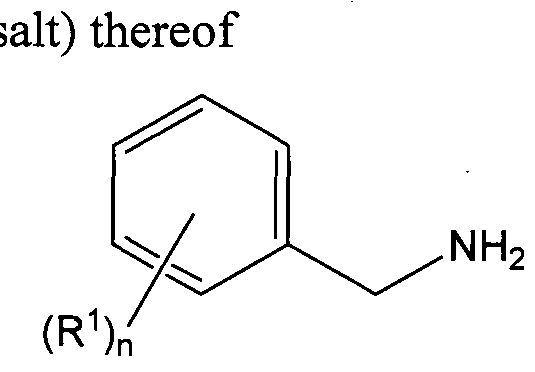
in which R and n are as defined in formula (I) above; and optionally thereafter carrying out one or more of the following procedures:
• converting a compound of formula (I) into another compound of formula (I)
• removing any protecting groups
• forming a pharmaceutically acceptable salt.
The above process may conveniently be carried out by combining the carboxylic acid of formula (II) with the amine of formula (III) in the presence of a coupling reagent such as:
(1) EDC.HC1 (N-ethyl-N'-(3-dimethylaminopropyl)carbodiimide hydrochloride) and HO At (1 -hydroxy- 7-azabenzotriazole) with triethylamine in a solvent such as
dichloromethane at room temperature to 60°C; or
(2) T3P (1-propylphosphonic anhydride) with triethylamine in a solvent such as dichloromethane at room temperature to 60°C; or
(3) COMU (( 1 -cyano-2-ethoxy-2-oxoethylidenaminooxy)dimethylamino-morpholino-
carbenium hexafluorophosphate) with 2,2,6,6-tetramethylpiperidine in a solvent such as dichloromethane at room temperature to 60°C;
followed, if necessary, by removal of any protecting groups.
Compounds of formulae (II) and (III) are known compounds or may be prepared according to processes known in the art.
It will be appreciated by those skilled in the art that in the process of the present invention certain functional groups such as phenol, hydroxyl or amino groups in the reagents may need to be protected by protecting groups. Thus, the preparation of the compounds of formula (I) may involve, at an appropriate stage, the introduction and/or removal of one or more protecting groups.
The protection and deprotection of functional groups is described, for example, in
'Protective Groups in Organic Chemistry', edited by J.W.F. McOmie, Plenum Press (1973); 'Greene's Protective Groups in Organic Synthesis', 4th edition, T.W. Greene and P.G.M. Wuts, Wiley-Interscience (2007); and 'Protecting Groups', 3rd edition, P. J. Kocienski, Thieme (2005).
The compounds of formula (I) above may be converted to a pharmaceutically acceptable salt thereof, preferably an acid addition salt such as a formate, hemi-formate,
hydrochloride, hydrobromide, benzenesulphonate (besylate), saccharin (e.g.
monosaccharin), trifluoroacetate, sulphate, nitrate, phosphate, acetate, fumarate, maleate, tartrate, lactate, citrate, pyruvate, succinate, valerate, propanoate, butanoate, malonate, oxalate, 1 -hydroxy-2-napthoate (xinafoate), methanesulphonate or /?-toluenesulphonate salt. In one embodiment of the invention, the compounds of formula (I) are in the form of a hydrochloride salt.
In one aspect of the invention, compounds of formula (I) may bear one or more radiolabels. Such radiolabels may be introduced by using radiolabel-containing reagents in the synthesis of the compounds of formula (I), or may be introduced by coupling the
compounds of formula (I) to chelating moieties capable of binding to a radioactive metal
atom. Such radiolabeled versions of the compounds may be used, for example, in diagnostic imaging studies.
Unless stated otherwise, any atom specified herein may also be an isotope of said atom. For example, the term "hydrogen" encompasses !H, 2H and 3H. Similarly carbon atoms are to be understood to include 12C, 13C and 14C, nitrogen atoms are to be understood to include 14N and 15N, and oxygen atoms are to be understood to include 160, 170 and 180.
In a further aspect of the invention, compounds of formula (I) may be isotopically labelled. As used herein, an "isotopically labelled" compound is one in which the abundance of a particular nuclide at a particular atomic position within the molecule is increased above the level at which it occurs in nature.
Compounds of formula (I) and their salts may be in the form of hydrates or solvates which form an aspect of the present invention. Such solvates may be formed with common organic solvents, including but not limited to, alcoholic solvents e.g. methanol, ethanol or isopropanol.
Where compounds of formula (I) are capable of existing in stereoisomeric forms, it will be understood that the invention encompasses the use of all geometric and optical isomers (including atropisomers) of the compounds of formula (I) and mixtures thereof including racemates. The use of tautomers and mixtures thereof also forms an aspect of the present invention. Enantiomerically pure forms are particularly desired. "Enantiomerically pure" denotes the presence of at least 75 %w (percent by weight), in particular at least 90 %w and, more particularly, at least 95 %w of a single enantiomer of a compound.
Compounds of formula (I) and their salts may be amorphous or in a polymorphic form or a mixture of any of these, each of which forms an aspect of the present invention.
The compounds of formula (I) and their pharmaceutically acceptable salts have activity as pharmaceuticals and may be used in treating conditions or disorders associated with changes in one or both of the glutamatergic and GABAergic signalling pathways regulated in full or in part by metabotropic glutamate receptor 7.
Thus, the present invention provides a compound of formula (I) or a pharmaceutically acceptable salt thereof as hereinbefore defined for use in therapy, in particular for the treatment of conditions associated with metabotropic glutamate receptor 7.
The present invention also provides the use of a compound of formula (I) or a
pharmaceutically acceptable salt thereof as hereinbefore defined for the preparation of a medicament for the treatment of conditions associated with metabotropic glutamate receptor 7.
The present invention still further provides a method of treating a condition associated with metabotropic glutamate receptor 7 which comprises administering to a patient in need thereof a therapeutically effective amount of a compound of formula (I) or a
pharmaceutically acceptable salt thereof as hereinbefore defined.
In the context of the present specification, the term "therapy" also includes "prophylaxis" unless there are specific indications to the contrary. The terms "therapeutic" and
"therapeutically" should be construed accordingly.
Prophylaxis is expected to be particularly relevant to the treatment of persons who have suffered a previous episode of, or are otherwise considered to be at increased risk of, the disorder or condition in question. Persons at risk of developing a particular disorder or condition generally include those having a family history of the disorder or condition, or those who have been identified by genetic testing or screening to be particularly susceptible to developing the disorder or condition or those in the prodromal phase of a disorder.
The terms "treat", "treatment" and "treating" include improvement of the conditions described herein. The terms "treat", "treatment" and "treating" include all processes providing slowing, interrupting, arresting, controlling, or stopping of the state or progression of the conditions described herein, but does not necessarily indicate a total elimination of all symptoms or a cure of the condition. The terms "treat", "treatment" and
"treating" are intended to include therapeutic as well as prophylactic treatment of such conditions.
As used herein the terms "condition", "disorder" and "disease" relate to any unhealthy or abnormal state. The term "conditions associated with metabotropic glutamate receptor 7" includes conditions, disorders and diseases in which the modulation of mGluR.7 may provide a therapeutic benefit, examples of which include:
(1) Nervous system disorders: Parkinson's disease, including dementia associated with Parkinson's disease; Alzheimer's disease; Huntington's Chorea; amyotrophic lateral sclerosis; multiple sclerosis; bipolar disorder; and psychiatric disorders such as
schizophrenia, post-traumatic stress disorder, anxiety disorders and depression (e.g. major depressive disorder);
(2) Addiction disorders: alcohol, drug or nicotine addiction;
(3) Hearing disorders: hearing loss and/or tinnitus caused by age, noise or trauma; and
(4) Others: idiopathic autism; severe neonatal encephalopathy; autism spectrum disorder (ASD); X-linked intellectual disability (also known as X-linked mental
retardation); epilepsy; cerebral ischemias; eye disorders; and pain (e.g. inflammatory pain or neuropathic pain).
Schizophrenia is a debilitating psychiatric disorder characterised by a combination of negative symptoms (such as social withdrawal, anhedonia, avolition and apathy) and positive symptoms (including hallucinations, delusions and paranoia) as well as marked cognitive deficits (such as impairment of executive function). The executive function (EF) has been defined as "a set of abilities, which allows us to invoke voluntary control of our behavioral responses. These functions enable human beings to develop and carry out plans, make up analogies, obey social rules, solve problems, adapt to unexpected circumstances, do many tasks simultaneously, and locate episodes in time and place. EF includes divided attention and sustained attention, working memory (WM), set-shifting, flexibility, planning, and the regulation of goal directed behavior and can be defined as a brain function underlying the human faculty to act or think not only in reaction to external events but also in relation with internal goals and states" (Orellana G. and Slachevsky A., 2013. Executive Functioning in Schizophrenia. Front. Psychiatry, 4, 35).
Accordingly, the present invention also provides a method of treating a negative symptom, a positive symptom and/or a cognitive deficit associated with a psychiatric disorder, especially schizophrenia, which comprises administering to a patient in need thereof a therapeutically effective amount of a compound of formula (I) or a pharmaceutically acceptable salt thereof as hereinbefore defined.
For the above-mentioned therapeutic uses the dosage administered will, of course, vary with the compound employed, the mode of administration, the treatment desired and the disorder indicated. For example, the daily dosage of the compound of the invention, if inhaled, may be in the range from 0.05 micrograms per kilogram body weight ^g/kg) to 100 micrograms per kilogram body weight ^g/kg). Alternatively, if the compound is administered orally, then the daily dosage of the compound of the invention may be in the range from 0.01 micrograms per kilogram body weight ^g/kg) to 100 milligrams per kilogram body weight (mg/kg).
The compounds of formula (I) and pharmaceutically acceptable salts thereof may be used on their own but will generally be administered in the form of a pharmaceutical composition in which the formula (I) compound/salt (active ingredient) is in association with a pharmaceutically acceptable adjuvant, diluent or carrier.
Therefore the present invention further provides a pharmaceutical composition comprising a compound of formula (I) or a pharmaceutically acceptable salt thereof as hereinbefore defined, in association with a pharmaceutically acceptable adjuvant, diluent or carrier.
The invention still further provides a process for the preparation of a pharmaceutical composition of the invention which comprises mixing a compound of formula (I) or a pharmaceutically acceptable salt thereof as hereinbefore defined with a pharmaceutically acceptable adjuvant, diluent or carrier.
Conventional procedures for the selection and preparation of suitable pharmaceutical formulations are described in, for example, "Pharmaceutics - The Science of Dosage Form Design", M. E. Aulton, Churchill Livingstone, 1988.
Pharmaceutically acceptable adjuvants, diluents or carriers that may be used in the pharmaceutical compositions of the invention are those conventionally employed in the field of pharmaceutical formulation, and include, but are not limited to, sugars, sugar alcohols, starches, ion exchangers, alumina, aluminium stearate, lecithin, serum proteins such as human serum albumin, buffer substances such as phosphates, glycerine, sorbic acid, potassium sorbate, partial glyceride mixtures of saturated vegetable fatty acids, water, salts or electrolytes such as protamine sulphate, disodium hydrogen phosphate, potassium hydrogen phosphate, sodium chloride, zinc salts, colloidal silica, magnesium trisilicate, polyvinyl pyrrolidone, cellulose-based substances, polyethylene glycol, sodium
carboxymethylcellulose, polyacrylates, waxes, polyethylene-polyoxypropylene-block polymers, polyethylene glycol and wool fat.
The pharmaceutical compositions of the present invention may be administered orally, parenterally, by inhalation spray, rectally, nasally, buccally, vaginally or via an implanted reservoir. Oral administration is preferred. The pharmaceutical compositions of the invention may contain any conventional non-toxic pharmaceutically acceptable adjuvants, diluents or carriers. The term parenteral as used herein includes subcutaneous,
intracutaneous, intravenous, intramuscular, intra-articular, intrasynovial, intrasternal, intrathecal, intralesional and intracranial injection or infusion techniques.
The pharmaceutical compositions may be in the form of a sterile injectable preparation, for example, as a sterile injectable aqueous or oleaginous suspension. The suspension may be formulated according to techniques known in the art using suitable dispersing or wetting agents (such as, for example, Tween 80) and suspending agents. The sterile injectable preparation may also be a sterile injectable solution or suspension in a non-toxic parenterally acceptable diluent or solvent, for example, as a solution in 1,3-butanediol. Among the acceptable diluents and solvents that may be employed are mannitol, water, Ringer's solution and isotonic sodium chloride solution. In addition, sterile, fixed oils are conventionally employed as a solvent or suspending medium. For this purpose, any bland fixed oil may be employed including synthetic mono- or diglycendes. Fatty acids, such as oleic acid and its glyceride derivatives are useful in the preparation of injectables, as are natural pharmaceutically acceptable oils, such as olive oil or castor oil, especially in their
polyoxyethylated versions. These oil solutions or suspensions may also contain a long- chain alcohol diluent or dispersant.
The pharmaceutical compositions of this invention may be orally administered in any orally acceptable dosage form including, but not limited to, capsules, tablets, powders, granules, and aqueous suspensions and solutions. These dosage forms are prepared according to techniques well-known in the art of pharmaceutical formulation. In the case of tablets for oral use, carriers which are commonly used include lactose and corn starch. Lubricating agents, such as magnesium stearate, are also typically added. For oral administration in a capsule form, useful diluents include lactose and dried corn starch. When aqueous suspensions are administered orally, the active ingredient is combined with emulsifying and suspending agents. If desired, certain sweetening and/or flavouring and/or colouring agents may be added.
The pharmaceutical compositions of the invention may also be administered in the form of suppositories for rectal administration. These compositions can be prepared by mixing the active ingredient with a suitable non-irritating excipient which is solid at room temperature but liquid at the rectal temperature and therefore will melt in the rectum to release the active ingredient. Such materials include, but are not limited to, cocoa butter, beeswax and polyethylene glycols.
The pharmaceutical compositions of this invention may be administered by nasal aerosol or inhalation. Such compositions are prepared according to techniques well-known in the art of pharmaceutical formulation and may be prepared as solutions in saline, employing benzyl alcohol or other suitable preservatives, absorption promoters to enhance
bioavailability, fluorocarbons, and/or other solubilising or dispersing agents known in the art.
Depending on the mode of administration, the pharmaceutical composition will preferably comprise from 0.05 to 99 %w (percent by weight), more preferably from 0.05 to 80 %w, still more preferably from 0.10 to 70 %w, and even more preferably from 0.10 to 50 %w, of active ingredient, all percentages by weight being based on total composition.
The compounds of the invention (that is, compounds of formula (I) and pharmaceutically acceptable salts thereof) may also be administered in conjunction with other compounds used for the treatment of the above conditions.
The invention therefore further relates to combination therapies wherein a compound of the invention or a pharmaceutical composition or formulation comprising a compound of the invention is administered with another therapeutic agent or agents for the treatment of one or more of the conditions previously indicated. Such therapeutic agents may be selected from the following:
(i) anti-addiction drugs including, for example, acamprosate, disulfiram, naltrexone and nalmefene for alcohol dependency, and gabapentin, modafinil, topiramate, vigabatrin and baclofen for drug, particularly cocaine, addiction;
(ii) antidepressants such as amitriptyline, amoxapine, bupropion, citalopram,
clomipramine, desipramine, doxepin duloxetine, elzasonan, escitalopram, fluvoxamine, fluoxetine, gepirone, imipramine, ipsapirone, maprotiline, nortriptyline, nefazodone, paroxetine, phenelzine, protriptyline, reboxetine, robaizotan, sertraline, sibutramine, tianeptine, thionisoxetine, tranylcypromaine, trazodone, trimipramine, venlafaxine, vortioxetine and equivalents and pharmaceutically active isomer(s) and/or metabolite(s) thereof;
(iii) antipsychotics including, for example, amisulpride, aripiprazole, asenapine, benzisoxidil, bifeprunox, brexpiprazole, carbamazepine, cariprazine, clozapine, chlorpromazine, debenzapine, divalproex, duloxetine, eszopiclone, fluphenazine, haloperidol, iloperidone, lamotrigine, loxapine, lurasidone, mesoridazine, olanzapine, paliperidone, perlapine, perphenazine, phenothiazine, phenylbutlypiperidine, pimozide, prochlorperazine, quetiapine, risperidone, sertindole, sulpiride, suproclone, suriclone, thioridazine, trifluoperazine, trimetozine, valproate, valproic acid, zopiclone, zotepine, zicronapine, ziprasidone, and equivalents and pharmaceutically active isomer(s) and/or metabolite(s) thereof;
(iv) anxiolytics including, for example, alnespirone, azapirones, benzodiazepines,
barbiturates, and equivalents and pharmaceutically active isomer(s) and/or metabolite(s) thereof. Example anxiolytics include adinazolam, alprazolam, balezepam, bentazepam, bromazepam, brotizolam, buspirone, clonazepam, clorazepate, chlordiazepoxide, cyprazepam, diazepam, diphenhydramine, estazolam, fenobam, flunitrazepam, flurazepam, fosazepam, lorazepam, lormetazepam, meprobamate, midazolam, nitrazepam, oxazepam, prazepam, prazosin, quazepam, reclazepam, tracazolate, trepipam, temazepam, triazolam, uldazepam, and zolazepam; and equivalents and pharmaceutically active isomer(s) and/or metabolite(s) thereof;
(v) anticonvulsants including, for example, carbamazepine, valproate, lamotrigine, levetiracetam and gabapentin, and equivalents and pharmaceutically active isomer(s) and/or metabolite(s) thereof;
(vi) Alzheimer's therapies including, for example, donepezil, galantamine, memantine, rivastigmine, tacrine, and equivalents and pharmaceutically active isomer(s) and/or metabolite(s) thereof;
(vii) Parkinson's therapies including, for example, L-dopa, ropinirole, pramipexole, monoamine oxidase type B (MAO-B) inhibitors such as deprenyl, selegiline and rasagiline, catechol- O-methyl transferase (COMT) inhibitors such as entacapone or tolcapone, adenosine A-2 inhibitors, dopamine re-uptake inhibitors, NMD A antagonists, Nicotine agonists, and Dopamine agonists and inhibitors of neuronal nitric oxide synthase, and equivalents and pharmaceutically active isomer(s) and/or metabolite(s) thereof;
(viii) migraine therapies including, for example, almotriptan, amantadine, botulinum toxin A, bromocriptine, butalbital, cabergoline, dichloralphenazone, dihydroergotamine, eletriptan, frovatriptan, lisuride, naratriptan, pergolide, pramipexole, rizatriptan, ropinirole, sumatriptan, topiramate, zolmitriptan, and zomitriptan, and equivalents and
pharmaceutically active isomer(s) and/or metabolite(s) thereof;
(ix) stroke therapies including, for example, abciximab, activase, citicoline, desmoteplase, and equivalents and pharmaceutically active isomer(s) and/or metabolite(s) thereof;
(x) urinary incontinence therapies including, for example, darafenacin, duloxetine, falvoxate, mirabegron, oxybutynin, propiverine, robalzotan, solifenacin, and tolterodine, and equivalents and pharmaceutically active isomer(s) and/or metabolite(s) thereof;
(xi) neuropathic pain therapies including, for example, capsaicin, gabapentin, lidoderm, and pregabalin, and equivalents and pharmaceutically active isomer(s) and/or metabolite(s) thereof;
(xii) nociceptive pain therapies such as celecoxib, etoricoxib, lumiracoxib, rofecoxib, valdecoxib, diclofenac, loxoprofen, naproxen, and paracetamol, and equivalents and pharmaceutically active isomer(s) and/or metabolite(s) thereof;
(xiii) insomnia therapies including, for example, allobarbital, alonimid, amobarbital, benzoctamine, butabarbital, capuride, chloral, cloperidone, clorethate, dexclamol, ethchlorvynol, eszopiclone, etomidate, glutethimide, halazepam, hydroxyzine, lorediplon, mecloqualone, melatonin, mephobarbital, methaqualone, midaflur, nisobamate, pentobarbital, phenobarbital, propofol, ralmeteon, roletamide, suvorexant, triclofos, secobarbital, zaleplon, and Zolpidem, zopiclone and equivalents and pharmaceutically active isomer(s) and/or metabolite(s) thereof;
(xiv) mood stabilizers including, for example, carbamazepine, divalproex, gabapentin, lamotrigine, lithium, olanzapine, quetiapine, valproate, valproic acid, and verapamil, and equivalents and pharmaceutically active isomer(s) and/or metabolite(s) thereof;
(xv) 5HT1B ligands such as, for example, compounds disclosed in WO 99/05134 and WO 02/08212;
(xvi) mGluR2 agonists;
(xvii) alpha 7 nicotinic agonists such as, for example, compounds disclosed in
WO 96/006098, WO 97/030998, WO 99/003859, WO 00/042044, WO 01/029034, WO 01/60821, WO 01/36417, WO 02/096912, WO 03/087102, WO 03/087103,
WO 03/087104, WO 2004/016617, WO 2004/016616, and WO 2004/019947;
(xviii) chemokine receptor CCR1 inhibitors; and
(xix) delta opioid agonists such as, for example, compounds disclosed in WO 97/23466 and WO 02/094794.
Such combination products employ the compounds of this invention within the dosage range described herein and the other pharmaceutically active agent within approved dosage ranges.
The present invention will now be further explained by reference to the following illustrative examples, in which the starting materials and reagents used are available from commercial suppliers or prepared via literature procedures.
Nuclear magnetic resonance (NMR) spectra were recorded at 400 MHz or 300 MHz as stated and at 300.3K, 298.2K or 293K unless otherwise stated; the chemical shifts (δ) are reported in parts per million. Spectra were recorded using a Bruker (trade mark) 400 AVANCE instrument fitted with a 5mm BBFO probe with instrument controlled by Bruker TopSpin 2.1 software, or by a Bruker 400 AVANCE-III HD instrument fitted with a 5mm BBFO smart probe or a 5mm BBFO probe with instrument controlled by Bruker TopSpin 3.2 software, or by a Bruker 400 AVANCE-III instrument fitted with a 5mm BBFO probe with instrument controlled by Bruker Topspin 3.0 software or by a Bruker 300MHz AVANCE II instrument fitted with a 5mm DUL probe with instrument controlled by Bruker TopSpin 1.3 software, or 5mm BBFO probe controlled by Bruker Topspin 3.2 software, or by a JEOL 400 Lambda instrument fitted with a 5 mm 40TH5 probe with instrument controlled by a Windows 7 workstation running Delta 4.3.6 software.
Purity was assessed using one or more of the following:
• Ultra Performance Liquid Chromatography (UPLC) with UV (photodiode array) detection over a wide range of wavelengths, normally 220-450 nm, using a Waters (trade mark) Acquity UPLC system equipped with Acquity UPLC BEH, HSS or HSS T3 C18 columns (2.1mm id x 50mm long) operated at 50 or 60 °C. Mobile phases typically consisted of acetonitrile mixed with water containing either 0.1%
formic acid, 0.1% trifluoroacetic acid (TFA) or 0.025% ammonia. Mass spectra were recorded with a Waters SQD single quadrupole mass spectrometer using atmospheric pressure ionisation.
• UPLC with UV (photodiode array) detection over a wide range of wavelengths, normally 220 - 450 nm, using Shimadzu (trade mark) Nexera X2 UPLC controlled by Lab Solution software equipped with Acquity UPLC BEH, HSS or HSS T3 CI 8 columns (2.1mm id x 50mm long) operated at 50 °C. Mobile phases typically consisted of acetonitrile mixed with water containing either 0.1 % formic acid, 0.1% TFA or 0.025% ammonia. Mass spectra were recorded with a Shimadzu single quadrupole mass spectrometer using DUIS ionisation.
• UPLC with UV (photodiode array) detection over a wide range of wavelengths, normally 210 - 315 nm, using Agilent 1260 Infinity series LC equipped with Agilent Poroshell 120 EC-C18 (2.7 μηι, 3.0 mm id x 50 mm long). Mobile phases typically consisted of acetonitrile mixed with water containing either 0.1%) formic acid. Mass spectra were recorded with a API 2000 mass spectrometer using electrospray ionisation.
Compounds were purified using normal phase chromatography on silica, using Biotage (trade mark) KP-Sil cartridges, Interchim (trade mark) PuriFlash cartridges or Kinesis (trade mark) Telos silica cartridges, or on basic silica using Biotage KP-NH cartridges, or by reverse phase chromatographic methods using Biotage KP-C18-HS cartridges or by Biotage Isolute SCX-2 or Phenomenex (trade mark) Strata ABW catch-release cartridges, or by preparative high performance liquid chromatography (HPLC).
Preparative HPLC was performed using Agilent Technologies (trade mark) 1 100 Series system or a Waters autopurification LC/MS system or a Shimadzu semi prep HPLC system, typically using Waters 19 mm id x 250 mm long CI 8 columns such as XBridge (trade mark) or SunFire (trade mark) 5 μιη materials at room temperature. Mobile phases typically consisted of acetonitrile mixed with water containing either 0.1 % formic acid or 0.1%) ammonia, unless otherwise stated.
Super Critical Fluid Chromatography (SFC) chiral separations were performed on a Waters prep30/MS system, using a flow rate of 30 mL/min, temperature of 40 °C and a pressure of
100 bar or on a Sepiatec prep 100 system, using a flow rate of 60 mL/min, temperature of 40 °C and pressure of 100 bar. Mobile phases typically consisted of supercritical C02 and a polar solvent such as methanol, ethanol or isopropanol. Column type and eluent are detailed for individual examples.
'Room temperature', as used in the present specification, means a temperature in the range from about 18 °C to about 25 °C.
Abbreviations
AcOH: Acetic acid
AIBN: Azobisisobutyronitrile
COMU: ( 1 -Cyano-2-ethoxy-2-oxoethylidenaminooxy)dimethylamino-mo holino- carbenium hexafluorophosphate
DCM: Dichloromethane
DMF: Dimethylformamide
DMSO: Dimethylsulfoxide
EDC: N-Ethyl-N'-(3-dimethylaminopropyl)carbodiimide
EtOAc: Ethyl acetate
EtOH: Ethanol
HO At: 1 -Hydroxy-7-azabenzotriazole
HPLC : High-Performance Liquid Chromatography
IPA: Isopropyl alcohol
NBS: N-bromosuccinimide
TEA: Triethylamine
THF: Tetrahydrofuran
T3 P : 1 -Propylphosphonic Anhydride
1. Intermediates
Intermediate 1 ; ethyl 2-bromo-2-[2-(2-ethoxy-2-oxoethyl)phenyl] acetate

Step (i): ethyl 2- [2-(2-ethoxy-2-oxoethyl)phenyl] acetate
A solution of 2-[2-(carboxymethyl)phenyl]acetic acid (25 g, 0.128 mmol) in EtOH (500 mL) with concentrated sulphuric acid (1.5 mL) was heated to reflux for 3 hours and allowed to cool to room temperature. The reaction was concentrated in vacuo and the residue partitioned between EtOAc and water. The organic phase was dried over Na2S04 and concentrated in vacuo to afford the title compound.
lK NMR (400 MHz, CDC13) δ ppm 1.24 (t, J= 7.08 Hz, 6 H) 3.70 (s, 4 H) 4.13 (q, J= 7.08 Hz, 4 H) 7.00 - 7.49 (m, 4 H)
Step (ii): ethyl 2-bromo-2-[2-(2-ethoxy-2-oxoethyl)phenyl] acetate
NBS (0.712 g, 4 mmol) was added to a solution of ethyl 2-[2-(2-ethoxy-2- oxoethyl)phenyl] acetate (1.00 g, 4 mmol) in CC14 (15 mL). AIBN (66 mg, 0.4 mmol) was added and the reaction heated to 60 °C for 18 hours. After cooling to room temperature, the reaction mixture was filtered and the filtrate concentrated in vacuo to afford the title compound.
'H NMR (400 MHz, CDCla) δ ppm 1.03 - 1.35 (m, 6 H) 3.44 - 3.81 (m, 2 H) 4.00 - 4.38 (m, 4 H) 5.52 - 5.86 (m, 1 H) 7.02 - 7.86 (m, 4 H)
Intermediate 2; 2-(cyclopropylmethyl)-3-oxo-l,2,3,4-tetrahydroisoquinoline-l- carboxylic acid

Step (i): ethyl 2-(cyclopropylmethyl)-3-oxo-l,2,3,4-tetrahydroisoquinoline-l- carboxylate
Ethyl 2-bromo-2-[2-(2-ethoxy-2-oxoethyl)phenyl]acetate (Intermediate 1, 8.5 g, 25.9 mmol), K2CO3 (17.0 g, 51.8 mmol), (aminomethyl)cyclopropane (2.6 g, 36.48 mmol) and
DMF (65 mL) were combined in a tube, sealed and heated to 100°C for 18 hours. Reaction mixture allowed to cool to room temperature, filtered and the filtrate concentrated in vacuo. The residue was purified by column chromatography on silica, eluted with 0-20%
EtO Ac/toluene to afford the title compound.
Ή NMR (400 MHz, CDC13) 5 ppm 0.19 - 0.34 (m, 2 H), 0.43 - 0.62 (m, 2 H), 0.90 - 1.05 (m, 1 H), 1.23 (t, J= 7.22 Hz, 3 H), 3.22 - 3.34 (m, 1 H), 3.53 - 3.67 (m, 2 H), 3.84 - 3.95 (m, 1 H), 4.05 - 4.24 (m, 2 H), 5.17 (s, 1 H), 7.14 - 7.21 (m, 1 H), 7.25 - 7.35 (m, 2 H), 7.38 - 7.46 (m, 1 H)
MS ES+: 274
Step (ii): 2-(cyclopropylmethyl)-3-oxo-l,2,3,4-tetrahydroisoquinoline-l-carboxylic acid
LiOH.H20 (0.65 g, 16.1 mmol) was added to a solution of ethyl 2-(cyclopropylmethyl)-3- oxo-l,2,3,4-tetrahydroisoquinoline-l-carboxylate (4.82 g, 14.0 mmol) in THF (75 mL) and water (25 mL) and stirred for 18 hours. The reaction was concentrated in vacuo. HC1 was added to pH 7 and the resulting solid filtered, azeotroped with toluene and dried in vacuo to afford the title compound.
'H NMR (400 MHz, DMSO- 6) δ ppm 0.05 - 0.50 (m, 4 H) 0.86 - 1.02 (m, 1 H) 2.63 - 2.79 (m, 1 H) 3.12 - 3.31 (m, 2 H) 3.63 - 3.85 (m, 2 H) 4.78 (s, 1 H) 7.02 - 7.19 (m, 3 H) 7.33 - 7.43 (m, 1 H)
ES": 244
Intermediate 3: 2- [(oxan-4-y l)methy 1] -3-oxo-l ,2,3,4-tetrahy droisoquinoline-1 - carboxylic acid

Prepared as described for 2-(cyclopropylmethyl)-3-oxo- 1,2,3, 4-tetrahy droisoquinoline-1 - carboxylic acid (Intermediate 2) using ethyl 2-bromo-2-[2-(2-ethoxy-2- oxoethyl)phenyl] acetate (Intermediate 1, 10 g, 30.4 mmol) and 4- (aminomethyl)tetrahydro-2H-pyran (4.2 g, 36.5 mmol) to afford the title compound.
!H NMR (400 MHz, DMSO--i6) δ ppm 1.03 - 1.26 (m, 2 H) 1.31 - 1.44 (m, 1 H) 1.49 - 1.59 (m, 1 H) 1.75 - 1.90 (m, 1 H) 2.68 - 2.81 (m, 1 H) 3.08 - 3.29 (m, 4 H) 3.62 - 3.84 (m, 4 H) 4.59 (s, 1 H) 7.00 - 7.16 (m, 3 H) 7.28 - 7.35 (m, 1 H)
ES": 288
Intermediate 4: 3-oxo-2-[(pyridin-2-yl)methyI]-l,2,3»4-tetrahydroisoquinoline-l- carboxylic acid

Prepared as described for 2-(cyclopropylmethyl)-3-oxo- 1,2,3, 4-tetrahydroisoquinoline-l- carboxylic acid (Intermediate 2) using ethyl 2-bromo-2-[2-(2-ethoxy-2- oxoethyl)phenyl] acetate (Intermediate 1, 10 g, 30.4 mmol) and 2-picolylamine (3.94 g, 36.5 mmol) to afford the title compound.
*Η NMR (400 MHz, DMSO- 6) δ ppm 3.34 - 3.45 (m, 2 H) 3.77 - 3.97 (m, 2 H) 4.59 (s, 1 H) 5.34 (d, J= 15.80 Hz, 1 H) 7.01 - 7,32 (m, 6 H) 7.60 - 7.71 (m, 1 H) 8.47 (d, J= 4.36 Hz, 1 H)
MS ES+: 283
Intermediates 5 and 6: (1S)-1 - [(45)-4-benzyl-2-oxo-l ,3-oxazolidine-3-carbonyl] -2- (cyclopropyImethyl)-l,2,3»4-tetrahydroisoquinolin-3-one and (li?)-l-[(45)-4-benz l-2- oxo-l,3-oxazolidine-3-carbonyl]-2-(cyclopropylmethyl)-l,2,354-tetrahydroisoquinolin- 3-one

A solution of 2-(cyclopropylmethyl)-3-oxo-l ,2,3,4-tetrahydroisoquinoline-l -carboxylic acid (Intermediate 2, 16.7g, 58.2 mmol) in THF (500 mL) at -10 °C was treated with TEA (9.73 mL, 69.8 mmol) followed by pivolyl chloride (7.53 mL, 61.1 mmol) in a dropwise
fashion. The reaction was allowed to stir at -10 °C for 1 hour. In a separate flask a solution of (4S)-4-benzyl-l,3-oxazolidin-2-one (10.32 g, 58.2 mmol) in THF (100 mL) was cooled to -78 °C and treated with «BuLi (2.5M in hexanes, 24.5 mL, 61.1 mmol) in a dropwise fashion. The reaction was stirred at -78 °C for 20 minutes. The solution was canulated into the previously reacted solution of acid, TEA and pivolyl chloride at -78°C and the reaction was allowed to warm to room temperature over 18 hours. The reaction was quenched with NH4C1 solution and extracted with EtOAc. The organic phase was collected, washed with 2M HC1, NaHC03 solution and brine, dried (Na2S04) and concentrated in vacuo. The resulting residue was purified by column chromatography on silica, eluted with 17-33% EtOAc/hexanes to afford the title compounds
Intermediate 5 - first eluting diastereomer (lS)-l-[(45 -4-benzyl-2-oxo-l,3-oxazolidine-
3-carbonyl]-2-(cyclopropylmethyl)-l,2,3,4-tetrahydroisoquinolin-3-one
¾ NMR (400 MHz, CDCb) δ ppm 0.22 - 0.41 (m, 2 H), 0.44 - 0.64 (m, 2 H), 0.93 - 1.07
(m, 1 H), 2.62 - 2.76 (m, 1 H), 2.95 - 3.05 (m, 1 H), 3.39 - 3.50 (m, 1 H), 3.64 (d, J= 19.30
Hz, 1 H), 3.89 - 4.00 (m, 1 H), 4.06 - 4.18 (m, 2 H), 4.19 - 4.28 (m, 1 H), 4.42 - 4.53 (m, 1
H), 6.85 (s, 1 H), 7.17 - 7.26 (m, 4 H), 7.28 - 7.37 (m, 4 H), 7.53 - 7.61 (m, 1 H)
MS ES+: 405
Intermediate 6 - second eluting diastereomer (li?)-l-[(4S)-4-benzyl-2-oxo-l,3- oxazolidine-3-carbonyl]-2-(cyclopropylmethyl)-l,2,3,4-tetrahydroisoquinolin-3-one Ή NMR (400 MHz, CDCb) δ ppm 0.15 - 0.32 (m, 2 H), 0.35 - 0.45 (m, 1 H), 0.48 - 0.59 (m, 1 H), 0.83 - 1.00 (m, 1 H), 2.59 - 2.70 (m, 1 H), 2.75 - 2.83 (m, 1 H), 2.89 - 3.02 (m, 1 H), 3.61 (d, J= 19.35 Hz, 1 H), 3.81 - 3.91 (m, 1 H), 4.05 (d, J= 19.62 Hz, 1 H), 4.18 - 4.25 (m, 1 H), 4.29 - 4.41 (m, 1 H), 4.69 - 4.81 (m, 1 H), 6.73 - 6.84 (m, 3 H), 7.05 - 7.23 (m, 4 H), 7.26 - 7.38 (m, 2 H), 7.66 - 7.76 (m, 1 H)
MS ES+: 405
Intermediate 7: (15)-2-(cyclopropylmethyl)-3-oxo-l,2,3,4-tetrahydroisoquinoline-l- carboxylic acid single enantiomer

To a stirring solution of lS-[(4S)-4-benzyl-2-oxo-l,3-oxazolidine-3-carbonyl]-2- (cyclopropylmethyl)-l,2,3,4-tetrahydroisoquinolin-3-one (Intermediate 5, 5.00g, 12.37 mmol) in THF (90 mL) and water (30 mL) at 0°C was added LiOH.H20 (1.04g, 24.8 mmol) followed by H202 (30% in H20, 11.22g, 100.0 mmol) in a portionwise fashion. The reaction was stirred at 0 °C for 2 hours and allowed to warm to room temperature over 18 hours. Sodium thiosulfate solution was added carefully and the pH was adjusted to pH 4-5. The aqueous was extracted with EtOAc, dried (Na2S04) and concentrated in vacuo. The resulting residue was triturated with DCM to afford the title compound.
¾ NMR (400 MHz, DMSO-c¾) δ ppm 0.17 - 0.29 (m, 2 H), 0.33 - 0.50 (m, 2 H), 0.88 - 1.00 (m, 1 H), 3.15 - 3.25 (m, 2 H), 3.48 (d, J= 19.07 Hz, 1 H), 3.65 (d, J= 19.35 Hz, 1 H), 5.33 (s, 1 H), 7.20 - 7.35 (m, 3 H), 7.42 - 7.48 (m, 1 H)
MS ES+: 246
Intermediate 8: 2-(3-fluoropropyl)-3-oxo-l,2,3i4-tetrahydroisoquinoline-l-carboxylic acid

Prepared as described for 2-(cyclopropylmethyl)-3-oxo- 1,2,3, 4-tetrahydroisoquinoline-l- carboxylic acid (Intermediate 2) using ethyl 2-bromo-2-[2-(2-ethoxy-2- oxoethyl)phenyl] acetate (Intermediate 1, 13.6 g, 41.3 mmol) and 3-fluoropropan-l-amine hydrochloride (4.7g, 41.3 mmol) to afford the title compound.
lH NMR (400 MHz, CD3OD) δ ppm 1.88 - 2.12 (m, 3 H), 3.26 - 3.30 (m, 1 H), 3.32 - 3.37 (m, 1 H), 3.41 - 3.52 (m, 1 H), 3.87 - 4.04 (m, 2 H), 4.32 - 4.58 (m, 2 H), 7.08 - 7.17 (m, 1 H), 7.19 - 7.29 (m, 2 H), 7.44 - 7.54 (m, 1 H)
MS ES+: 252
Intermediates 9 and 10: (lS)-l-[(4S)-4-benzyl-2-oxo-l,3-oxazolidine-3-carbonyl]-2-(3- fluoropropyl)-l,2,3,4-tetrahydroisoquinolin-3-one and (lR)-l-[(4S)-4-benzyl-2-oxo- -oxazolidine-3-carbonyl]-2-(3-fluoropropyl)-l,2,3,4-tetrahydroisoquinolin-3-one

A solution of 2-(3-fluoropropyl)-3-oxo- 1,2,3, 4-tetrahydroisoquinoline-l-carboxy lie acid (Intermediate 8, 4.0 g, 13.6 mniol) in THF (10 mL) at -10 °C was treated with TEA (7.27 mL, 16.3 mmol) in a dropwise fashion with stirring followed by pivolyl chloride (0.105 mL, 14.3 mmol). The reaction was stirred at -10 °C for 30 minutes. A second flask containing (4S)-4-benzyl-l,3-oxazolidin-2-one (151 mg, 13.6 mmol) in THF (10 mL) at - 78 °C was treated with rcBuLi (2.5M in hexanes, 5.72 mL, 14.3 mmol) in a dropwise fashion. The reaction was stirred at -78 °C for 20 minutes. The resulting solution was canulated to a cooled solution (-78 °C) of the mixed anhydride above. The reaction was stirred at -78 °C for 30 minutes and allowed to warm to room temperature for 4 hours. The reaction was quenched with NH4C1 solution and extracted with EtOAc. The organic was collected, washed with IN HCl, bicarbonate and brine, dried (MgS04) and concentrated in vacuo. The resulting residue was purified by column chromatography on silica, eluted with 20-33% EtOAc/hexanes to afford the title compounds.
Intermediate 9 - first eluting diastereomer, (lS)-l-[(4S)-4-benzyl-2-oxo-l,3-oxazolidine-
3-carbonyl]-2-(3-fluoropropyl)- 1 ,2,3,4-tetrahydroisoquinolin-3-one
1H NMR (400 MHz, CDC13) δ ppm 1.93 - 2.15 (m, 2 H), 2.77 - 2.88 (m, 1 H), 3.31 - 3.50
(m, 2 H), 3.62 (d, J= 19.35 Hz, 1 H), 3.83 - 3.96 (m, 1 H), 4.11 (d, J= 19.35 Hz, 1 H),
4.15 - 4.30 (m, 2 H), 4.39 - 4.63 (m, 3 H), 6.77 (s, 1 H), 7.16 - 7.26 (m, 4 H), 7.28 - 7.39
(m, 4 H), 7.52 - 7.59 (m, 1 H)
MS ES+: 411
Intermediate 10 - second eluting diastereomer, (li?)-l-[(4S)-4-benzyl-2-oxo-l,3- oxazolidine-3 -carbonyl] -2-(3 -fluoropropyl)- 1,2,3 ,4-tetrahydroisoquinolin-3 -one
1H NMR (400 MHz, CDC13) δ ppm 1.88 - 2.09 (m, 2 H), 2.60 - 2.70 (m, 1 H), 2.74 - 2.82 (m, 1 H), 3.29 - 3.39 (m, 1 H), 3.59 (d, J- 19.35 Hz, 1 H), 3.76 - 3.87 (m, 1 H), 4.03 (d, J = 19.07 Hz, 1 H), 4.16 - 4.24 (m, 1 H), 4.32 - 4.43 (m, 2 H), 4.46 - 4.56 (m, 1 H), 4.69 - 4.83 (m, 1 H), 6.71 - 6.84 (m, 3 H), 7.09 - 7.23 (m, 4 H), 7.24 - 7.41 (m, 2 H), 7.64 - 7.74 (m, 1 H)
MS ES+: 411
Intermediate 11; (lS)-2-(3-fluoropropyl)-3-oxo-l,2,3,4-tetrahydroisoquinoline-l- carboxylic aci

A solution of (lS)-l-[(4S)-4-benzyl-2-oxo-l,3-oxazolidine-3-carbonyl]-2-(3-fluoropropyl)- l,2,3,4-tetrahydroisoquinolin-3-one (Intermediate 9, 1.72g, 4.19 mmol) in THF (55 mL) and water (18 mL) at 0°C was treated with LiOH.H20 (0.352 g, 8.38 mmol) followed by H202.H20 (3.47 mL, 33.52 mmol) in a dropwise fashion. The reaction was stirred at 0 °C for 2 hours and warmed to room temperature for 18 hours. The reaction was carefully quenched with sodium thiosulfate and the pH adjusted to pH 1 and extracted with EtOAc. The organic phase was collected, washed with brine, dried (Na2S04) and concentrated in vacuo. The aqueous was concentrated in vacuo and combined with the organic layer and purified by column chromatography on silica, eluted with 100% EtOAc with 1% AcOH to afford the title compound.
lU NMR (400 MHz, CD3OD) δ ppm 1.87 - 2.10 (m, 2 H), 3.31 - 3.38 (m, 2 H), 3.52 (d, J = 19.07 Hz, 1 H), 3.82 (d, J= 19.07 Hz, 1 H), 3.88 - 3.96 (m, 1 H), 4.31 - 4.56 (m, 2 H), 5.20 (s, 1 H), 7.15 - 7.23 (m, 1 H), 7.25 - 7.35 (m, 2 H), 7.45 - 7.53 (m, 1 H)
MS ES+: 252
Intermediate 12: (lR)-2-(3-fluoropropyl)-3-oxo-l,2,3,4-tetrahydroisoquinoline-l- carboxylic acid

Prepared as described for (lS)-2-(3-fluoropropyl)-3-oxo-l ,2,3,4-tetrahydroisoquinoline-l- carboxylic acid (Intermediate 11) using (li?)-l-[(4S)-4-benzyl-2-oxo-l,3-oxazolidine-3- carbonyl]-2-(3-fluoropropyl)-l,2,3,4-tetrahydroisoquinolin-3-one (Intermediate 10, 1.45g, 3.54 mmol) to afford the title compound.
¾ NMR (400 MHz, CD3OD) δ ppml .87 - 2.12 (m, 2 H), 3.32 - 3.43 (m, 1 H), 3.54 (d, J= 19.07 Hz, 1 H), 3.79 (d, J= 19.07 Hz, 1 H), 3.86 - 3.96 (m, 1 H), 4.31 - 4.58 (m, 2 H), 5.28 (s, 1 H), 7.17 - 7.25 (m, 1 H), 7.27 - 7.38 (m, 2 H), 7.45 - 7.54 (m, 1 H)
MS ES+: 252
2. Examples
Example 1: 7V-[(3-chlorophenyl)methyI]-2-(cycIopropyImethyl)-3-oxo-l,2,3,4- tetrahydroisoquinoline-l-carboxamide

TEA (0.170 mL, 1.223 mmol) was added to a suspension of 2-(cyclopropylmethyl)-3-oxo- 1,2,3,4-tetrahydroisoquinoline-l-carboxylic acid (Intermediate 2, 0.1 g, 0.408 mmol), (3- chlorophenyl)methanamine (0.050 ml, 0.408 mmol), EDC.HCl (0.117 g, 0.612 mmol) and HO At (0.094 g, 0.612 mmol) in DCM (2 mL). The reaction was stirred at room
temperature for 18 hours. The mixture was diluted with DCM, washed with water, dried (phase separator) and concentrated in vacuo. The crude product was purified by column chromatography on silica, eluted with 12-100% EtO Ac/petroleum ether to the title compound.
lH NMR (300 MHz, DMSO-c¼) δ ppm 0.12 - 0.48 (m, 4 H), 0.81 - 0.96 (m, 1 H), 3.10 - 3.21 (m, 1 H), 3.33 - 3.49 (m, 2 H), 3.80 - 3.92 (m, 1 H), 4.21 - 4.30 (m, 2 H), 5.26 (s, 1 7.08 - 7.37 (m, 7 H), 7.52 - 7.60 (m, 1 H), 8.95 - 9.04 (m, 1 H)
MS ES+: 369
Example 2: V-[(3-chlorophenyl)methyl]-2-[(oxan-4-yl)methyl]-3-oxo-l,2,3,4- tetrahydroisoquinoline-l-carboxamide

T3P (0.617 mL, 1.037 mmol) was added to a stirred solution of TEA (0.211 mL, 1.555 mmol), 2-[(oxan-4-yl)methyl]-3-oxo-l,2,3,4-tetrahydroisoquinoline-l-carboxylic acid (Intermediate 3, 150 mg, 0.518 mmol) and (3-chlorophenyl)methanamine (73 mg, 0.518 mmol) in DCM (5 mL) and stirred for 30 minutes. The reaction mixture was washed with sodium bicarbonate solution and purified by column chromatography on silica, eluted with 0 - 100% EtO Ac/petroleum ether to afford the title compound.
1H NMR (400 MHz, DMSO-tfc) δ ppm 1.06 - 1.27 (m, 2 H), 1.33 - 1.57 (m, 2 H), 1.71 - 1.85 (m, 1 H), 2.88 - 2.99 (m, 1 H), 3.04 - 3.22 (m, 2 H), 3.39 - 3.49 (m, 1 H), 3.53 - 3.63 (m, 1 H), 3.75 - 3.81 (m, 2 H), 3.83 - 3.95 (m, 1 H), 4.19 - 4.38 (m, 2 H), 5.17 (s, 1 H), 7.11 - 7.37 (m, 7 H), 7.49 - 7.56 (m, 1 H), 8.96 - 9.06 (m, 1 H)
MS ES+: 413
Example 3: 2-(cyclopropylmethyl)-iV-[(4-fluorophenyl)methyl]-3-oxo-l,2,354- tetrahydroisoquinoline-l-carboxamide

1H NMR (400 MHz, DMSO-i¾ δ ppm 0.11 - 0.45 (m, 4 H), 0.82 - 0.93 (m, 1 H), 3.08 - 3.18 (m, 1 H), 3.33 - 3.49 (m, 2 H), 3.80 - 3.93 (m, 1 H), 4.14 - 4.32 (m, 2 H), 5.23 (s, 1 H), 7.06 - 7.33 (m, 7 H), 7.50 - 7.57 (m, 1 H), 8.90 - 8.99 (m, 1 H)
MS ES+: 353
Example 4: 2-(cyclopropylmethyl)-iV-[(3,4-difluorophenyl)methyl]-3-oxo-l,2,3,4- tetrahydroisoquinoline-l-carboxamide

Prepared as described for Example 2 using 2-(cyclopropylmethyl)-3-oxo-l,2,3,4- tetrahydroisoquinoline-l-carboxylic acid (Intermediate 2, 0.05 g, 0.204 mmol) and (3,4- difluorophenyl)methanamine (0.027 mL, 0.224 mmol). The crude material was purified by reverse phase preparative HPLC eluted with acetonitrile / water (with 0.1% ammonia) to afford the title compound.
¾ NMR (400 MHz, DMSO-Λ) δ ppm 0.12 - 0.47 (m, 4 H), 0.83 - 0.94 (m, 1 H), 3.10 - 3.20 (m, 1 H), 3.33 - 3.48 (m, 2 H), 3.79 - 3.91 (m, 1 H), 4.19 - 4.28 (m, 2 H), 5.24 (s, 1 H), 6.97 - 7.05 (m, 1 H), 7.09 - 7.40 (m, 5 H), 7.52 - 7.59 (m, 1 H), 8.94 - 9.03 (m, 1 H)
MS ES+: 371
Example 5: 2-(cyclopropylmethyl)-7V-[(2,4-difluorophenyl)methyl]-3-oxo-l,2,3)4- tetrahydroisoquinoline-1 -carboxamide

Prepared as described for Example 2 using 2-(cyclopropylmethyl)-3-oxo-l,2,3,4- tetrahydroisoquinoline-l-carboxylic acid (Intermediate 2, 0.05 g, 0.204 mmol) and (2,4- difluorophenyl)methanamine (0.027 mL, 0.224 mmol). The crude material was purified by reverse phase preparative HPLC eluted with acetonitrile / water (with 0.1% ammonia) to afford the title compound.
¾ NMR (400 MHz, DMSO-a ) δ ppm 0.09 - 0.44 (m, 4 H), 0.78 - 0.95 (m, 1 H), 3.08 - 3.18 (m, 1 H), 3.25 - 3.31 (m, 1 H), 3.37 - 3.47 (m, 1 H), 3.79 - 3.91 (m, 1 H), 4.15 - 4.35 (m, 2 H), 5.22 (s, 1 H), 6.96 - 7.06 (m, 1 H), 7.15 - 7.32 (m, 5 H), 7.46 - 7.57 (m, 1 H), 8.89 - 8.99 (m, 1 H)
MS ES+: 371
Examples 6 and 7: (lR)-2-(cyclopropylmethyl)-iV-[(4-fluorophenyl)methyl]-3-oxo- 1,2,3,4-tetrahydroisoquinoline-l-carboxamide and (15)-2-(cyclopropyImethyl)-Ar-[(4- fluorophenyl)methy -3-oxo-l,2,3?4-tetrahydroisoquinoline-l-carbdxamide

2-(Cyclopropylmethyl)-N- [(4-fluorophenyl)methyl] -3 -oxo- 1 ,2,3 ,4-tetrahydroisoquinoline- 1-carboxamide (Example 3) was purified by chiral SFC (26% IP A, AD column) to afford the title compounds. Absolute stereochemistry was confirmed by X-ray crystallography.
Example 6 - 1st eluting peak
Ή NMR (400 MHz, DMSO-A) δ ppm 0.13 - 0.47 (m, 4 H), 0.83 - 0.93 (m, 1 H), 3.08 - 3.19 (m, 1 H), 3.34 - 3.39 (m, 1 H), 3.40 - 3.50 (m, 1 H), 3.82 - 3.94 (m, 1 H), 4.15 - 4.32 (m, 2 H), 5.24 (s, 1 H), 7.06 - 7.36 (m, 7 H), 7.51 - 7.57 (m, 1 H), 8.91 - 9.01 (m, 1 H)
MS ES+: 353
Example 7 - 2nd eluting peak
¾ NMR (400 MHz, DMSO-<¾) δ ppm 0.10 - 0.47 (m, 4 H), 0.82 - 0.93 (m, 1 H), 3.08 - 3.19 (m, 1 H), 3.33 - 3.38 (m, 1 H), 3.40 - 3.47 (m, 1 H), 3.82 - 3.94 (m, 1 H), 4.15 - 4.32 (m, 2 H), 5.24 (s, 1 H), 7.06 - 7.33 (m, 7 H), 7.49 - 7.58 (m, 1 H), 8.92 - 9.00 (m, 1 H) MS ES+: 353
Example 8: N- [(4-fluorophenyl)methyl] -2- [(oxan-4-yl)methyl] -3-oxo-l ,2,3,4- tetrahydroisoquinoline-l-carboxamide

Prepared as described for Example 1 using 2- [(oxan-4-yl)methyl] -3-oxo-l, 2,3,4- tetrahydroisoquinoline-l-carboxylic acid (Intermediate 3, 0.210 g, 0.959 mmol) and (4- fluorophenyl)methanamine (0.091 mL, 0.799 mmol). The crude material was purified by reverse phase preparative HPLC eluted with acetonitrile / water (with 0.1% ammonia) to afford the title compound.
1H NMR (400 MHz, DMSO- fc) δ ppm 1.05 - 1.28 (m, 2 H), 1.33 - 1.54 (m, 2 H), 1.69 - 1.83 (m, 1 H), 2.84 - 2.93 (m, 1 H), 3.04 - 3.20 (m, 2 H), 3.38 - 3.48 (m, 1 H), 3.55 - 3.64 (m, 1 H), 3.74 - 3.83 (m, 2 H), 3.84 - 3.93 (m, 1 H), 4.15 - 4.34 (m, 2 H), 5.14 (s, 1 H), 7.08 - 7.34 (m, 7 H), 7.47 - 7.54 (m, 1 H), 8.94 - 9.01 (m, 1 H)
MS ES+: 397
Example 9: iV-[(4-fluorophenyl)methyl]-3-oxo-2-[(pyridin-2-yl)methyl]-l,2,3,4- tetrahydroisoquinoline-l-carboxamide

1H NMR (400 MHz, OMSO-d6) δ ppm 3.49 - 3.60 (m, 1 H), 3.89 - 4.01 (m, 1 H), 4.11 - 4.29 (m, 3 H), 5.10 - 5.19 (m, 1 H), 5.24 (s, 1 H), 7.05 - 7.34 (m, 9 H), 7.44 - 7.52 (m, 1 H), 7.68 - 7.78 (m, 1 H), 8.43 - 8.51 (m, 1 H), 8.97 - 9.06 (m, 1 H)
MS ES+: 390
Example 10: 2-(cyclopropylmethyl)-iV-[(2-fluorophenyl)methyl]-3-oxo-l,2,3,4- tetrahydroisoquinoline-l-carboxamide

Prepared as described for Example 2 using 2-(cyclopropylmethyl)-3-oxo-l ,2,3,4- tetrahydroisoquinoline-l-carboxylic acid (Intermediate 2, 100 mg, 0.408 mmol) and (2- fluorophenyl)methanamine (56 mg, 0.448 mmol). The crude material was purified by reverse phase preparative HPLC eluted with acetonitrile / water (with 0.1 % ammonia) to afford the title compound.
¾ NMR (400 MHz, DMSO-c¾) δ ppm 0.12 - 0.46 (m, 4 H), 0.80 - 0.94 (m, 1 H), 3.08 - 3.20 (m, 1 H), 3.29 - 3.37 (m, 1 H), 3.38 - 3.49 (m, 1 H), 3.80 - 3.93 (m, 1 H), 4.20 - 4.38 (m, 2 H), 5.26 (s, 1 H), 7.05 - 7.37 (m, 7 H), 7.52 - 7.58 (m, 1 H), 8.91 - 9.00 (m, 1 H) MS ES+: 353
Examples 11 and 12: 2-(cyclopropylmethyl)-N-[(2-fluorophenyl)methyl]-3-oxo- 1,2,3,4-tetrahydroisoquinoline-l-carboxamide, single enantiomers

2-(cyclopropylmethyl)-N- [(2-fluorophenyl)methyl] -3 -oxo- 1 ,2,3 ,4-tetrahydroisoquinoline- 1-carboxamide (Example 10) was purified by chiral SFC (26% EtOH, AD column) to afford the title compounds.
Example 11 - 1st eluting peak
¾ NMR (400 MHz, DMSO-ifc) δ ppm 0.11 - 0.42 (m, 4 H), 0.81 - 0.92 (m, 1 H), 3.06 - 3.17 (m, 1 H), 3.27 - 3.36 (m, 1 H), 3.38 - 3.48 (m, 1 H), 3.79 - 3.92 (m, 1 H), 4.19 - 4.36 (m, 2 H), 5.25 (s, 1 H), 7.04 - 7.34 (m, 7 H), 7.49 - 7.58 (m, 1 H), 8.90 - 9.01 (m, 1 H) MS ES+: 353
Example 12 - 2nd eluting peak
¾ NMR (400 MHz, DMSO-tk) δ ppm 0.11 - 0.42 (m, 4 H), 0.81 - 0.92 (m, 1 H), 3.06 - 3.17 (m, 1 H), 3.27 - 3.36 (m, 1 H), 3.38 - 3.48 (m, 1 H), 3.79 - 3.92 (m, 1 H), 4.19 - 4.36 (m, 2 H), 5.25 (s, 1 H), 7.04 - 7.34 (m, 7 H), 7.49 - 7.58 (m, 1 H), 8.90 - 9.01 (m, 1 H) MS ES+: 353
Example 13: (15)-2-(cyclopropylmethyl)-A^[(2-methylphenyl)methyl]-3-oxo-l,2,3,4- tetrahydroisoquinoline-l-carboxamide

COMU (77 mg, 0.179 mmol) was added to a stirred solution of (15)-2- (cyclopropylmethyl)-3 -oxo- 1 ,2,3 ,4-tetrahydroisoquinoline- 1 -carboxylic acid
(Intermediate 7, 40 mg, 0.163 mmol), (2-methylphenyl)methanamine (22 mg, 0.179 mmol) and 2,2,6,6-tetramethylpiperidine (23 mg, 0.163 mmol) in DCM (ImL) and stirred for 1 hour. The reaction mixture was washed with water and purified by reverse phase
preparative HPLC eluted with acetonitrile / water (with 0.1% ammonia) to afford the title compound.
1H NMR (400 MHz, DMSO-c¼) δ ppm 0.11 - 0.50 (m, 4 H), 0.82 - 0.98 (m, 1 H), 2.17 (s, 3 H), 3.02 - 3.11 (m, 1 H), 3.36 - 3.49 (m, 2 H), 3.82 - 3.93 (m, 1 H), 4.16 - 4.26 (m, 2 H), 5.27 (s, 1 H), 7.04 - 7.34 (m, 7 H), 7.51 - 7.59 (m, 1 H), 8.75 - 8.83 (m, 1 H)
MS ES+: 349
Example 14: (lS)-2-(cyclopropylmethyl)- V-[(4-fluoro-2-methylphenyl)methyl]-3-oxo- 1,2,3,4-tetrahydroisoquinolin -l-carboxamide

Prepared as described for Example 13 using (lS)-2-(cyclopropylmethyl)-3-oxo-l,2,3,4- tetrahydroisoquinoline-l-carboxylic acid (Intermediate 7, 0.040 g, 0.163 mmol) and (4- fluoro-2-methylphenyl)methanamine (25 mg, 0.179 mmol). The crude material was purified by reverse phase preparative HPLC eluted with acetonitrile / water (with 0.1% ammonia) to afford the title compound.
Ή NMR (400 MHz, DMSO-c¼) δ ppm 0.11 - 0.47 (m, 4 H), 0.83 - 0.94 (m, 1 H), 2.17 (s, 3 H), 3.03 - 3.13 (m, 1 H), 3.34 - 3.46 (m, 2 H), 3.82 - 3.94 (m, 1 H), 4.16 - 4.24 (m, 2 H), 5.25 (s, 1 H), 6.88 - 6.95 (m, 1 H), 6.99 - 7.05 (m, 1 H), 7.11 - 7.33 (m, 4 H), 7.49 - 7.56 (m, 1 H), 8.74 - 8.81 (m, 1 H)
MS ES+: 367
Example 15: (lS)-2-(cyclopropylmethyl)-N-[(2-fluoro-6-methylphenyl)methyl]-3-oxo- l,2,3?4-tetrahydroisoquinoline-l-carboxamide

!H NMR (400 MHz, DMSO-cfe) δ ppm 0.08 - 0.45 (m, 4 H), 0.78 - 0.93 (m, 1 H), 2.21 (s, 3 H), 3.06 - 3.17 (m, 1 H), 3.22 - 3.30 (m, 1 H), 3.35 - 3.46 (m, 1 H), 3.83 - 3.94 (m, 1 H), 4.11 - 4.20 (m, 1 H), 4.26 - 4.39 (m, 1 H), 5.20 (s, 1 H), 6.96 - 7.07 (m, 2 H), 7.15 - 7.30 (m, 4 H), 7.42 - 7.50 (m, 1 H), 8.65 - 8.73 (m, 1 H)
MS ES+: 367
Example 16: (lS)-N-[(4-fluorophenyl)methyl]-2-(3-fluoropropyl)-3-oxo-l,2,3,4- tetrahydroisoquinoline-l-carboxamide

Prepared as described for Example 13 using (lS)-2-(3-fluoropropyl)-3-oxo-l,2,3,4- tetrahydroisoquinoline-l-carboxylic acid (Intermediate 11, 0.050 g, 0.199 mmol) and (4- fluorophenyl)methanamine (25 mg, 0.199 mmol). The crude material was purified by reverse phase preparative HPLC eluted with acetonitrile / water (with 0.1 % ammonia) to afford the title compound.
!H NMR (400 MHz, DMSO-cfc) δ ppm 1.70 - 1.98 (m, 2 H), 3.12 - 3.27 (m, 1 H), 3.39 - 3.50 (m, 1 H), 3.65 - 3.77 (m, 1 H), 3.81 - 3.90 (m, 1 H), 4.16 - 4.41 (m, 3 H), 4.43 - 4.51 (m, 1 H), 5.16 (s, 1 H), 7.06 - 7.16 (m, 2 H), 7.17 - 7.34 (m, 5 H), 7.49 - 7.55 (m, 1 H), 8.95 - 9.05 (m, 1 H)
MS ES+: 359
Example 17: (lR)-N-[(4-fluorophenyl)methyl]-2-(3-fluoropropyl)-3-oxo-l, 2,3,4- tetrahydroisoquinoline-l-carboxamide

Prepared as described for Example 13 using (li?)-2-(3-fluoropropyl)-3-oxo-l,2,3,4- tetrahydroisoquinoline-l-carboxylic acid (Intermediate 12, 0.050 g, 0.199 mmol) and (4- fluorophenyl)methanamine (25 mg, 0.199 mmol). The crude material was purified by reverse phase preparative HPLC eluted with acetonitrile / water (with 0.1% ammonia) to afford the title compound.
!H NMR (400 MHz, DMSO-c¾) δ ppm 1.71 - 1.96 (m, 2 H), 3.15 - 3.26 (m, 1 H), 3.39 - 3.50 (m, 1 H), 3.63 - 3.76 (m, 1 H), 3.82 - 3.90 (m, 1 H), 4.15 - 4.40 (m, 3 H), 4.42 - 4.51 (m, 1 H), 5.16 (s, 1 H), 7.07 - 7.15 (m, 2 H), 7.18 - 7.34 (m, 5 H), 7.48 - 7.54 (m, 1 H), 8.97 - 9.05 (m, 1 H)
MS ES+: 359
Example 18; (lS)-2-(cyclopropylmethyl)-3-oxo-N-[(quinolin-6-yl)methyl]-l,2,354- tetrahydroisoquinoline-l-carboxamide

Prepared as described for Example 13 using (lS)-2-(cyclopropylmethyl)-3-oxo-l,2,3,4- tetrahydroisoquinoline-l-carboxylic acid (Intermediate 7, 50 mg, 0.204 mmol) and quinolin-6-ylmethanamine (32 mg, 0.204 mmol). The crude material was purified by reverse phase preparative HPLC eluted with acetonitrile / water (with 0.1% ammonia) to afford the title compound.
1H NMR (400 MHz, DMSO-ck) δ ppm 0.13 - 0.46 (m, 4 H) 0.82 - 0.97 (m, 1 H) 3.10 - 3.21 (m, 1 H) 3.34 - 3.49 (m, 2 H) 3.80 - 3.94 (m, 1 H) 4.41 - 4.50 (m, 2 H) 5.30 (s, 1 H)
7.17 - 7.26 (m, 1 H) 7.29 - 7.38 (m, 2 H) 7.48 - 7.65 (m, 4 H) 7.89 - 7.98 (m, 1 H) 8.1 1 - 8.20 (m, 1 H) 8.82 - 8.89 (m, 1 H) 9.12 (t, J= 5.78 Hz, 1 H)
MS ES+: 386
Example 19: (lSJ^-icycloprop lmeth ^-S-oxo-A^Kl-il i-p razol-l- yl)phenyl]methyl}-l,2,3,4-tetrahydroisoquinoline-l-carboxamide

Prepared as described for Example 13 using (lS)-2-(cyclopropylmethyl)-3-oxo-l,2,3,4- tetrahydroisoquinoline-l-carboxylic acid (Intermediate 7, 50 mg, 0.204 mmol) and (2- (lH-pyrazol-l-yl)phenyl)methanamine hydrochloride (43 mg, 0.204 mmol). The crude material was purified by reverse phase preparative HPLC eluted with acetonitrile / water (with 0.1% ammonia) to afford the title compound.
!H NMR (400 MHz, DMSO-cfc) δ ppm 0.11 - 0.46 (m, 4 H) 0.81 - 0.97 (m, 1 H) 2.99 - 3.09 (m, 1 H) 3.35 - 3.46 (m, 2 H) 3.75 - 3.87 (m, 1 H) 4.15 - 4.25 (m, 2 H) 5.27 (s, 1 H) 6.44 - 6.51 (m, 1 H) 7.15 - 7.43 (m, 7 H) 7.51 - 7.58 (m, 1 H) 7.71 (d, J= 1.47 Hz, 1 H) 8.03 (d, J= 2.38 Hz, 1 H) 8.86 (t, J= 5.59 Hz, 1 H)
MS ES+: 401
Example 20: 3-oxo-2-[(pyridin-2-yl)methyl]-A-{[4-(trifluorometliyl)phenyl]methyl}- 1,2,3,4-tetrahydroisoquinoline- -carboxamide

Prepared as described for Example 2 using 3-oxo-2-[(pyridin-2-yl)methyl]-l,2,3,4- tetrahydroisoquinoline-l-carboxylic acid (Intermediate 4, 50 mg, 0.177 mmol) and (4-
(trifluoromethyl)phenyl)metlianamine (31 mg, 0.177 mmol). The crude material was purified by reverse phase preparative HPLC eluted with acetonitrile / water (with 0.1% ammonia) to afford the title compound.
¾ NMR (400 MHz, DMSO-A) δ ppm 3.55 (d, J= 19.44 Hz, 1 H), 3.94 (d, J= 18.98 Hz, 1 H), 4.17 (d, J= 15.59 Hz, 1 H), 4.24 - 4.39 (m, 2 H), 5.16 (d, J= 15.68 Hz, 1 H), 5.27 (s, 1 H), 7.18 - 7.35 (m, 7 H), 7.48 - 7.52 (m, 1 H), 7.62 - 7.66 (m, 2 H), 7.68 - 7.78 (m, 1 H), 8.43 - 8.52 (m, 1 H), 9.07 - 9.17 (m, 1 H)
MS ES+: 440
Example 21: (lS)-2-(cyclopropylmethyl)-N-[(l-methyl-lJ&-indol-4-yl)methyl]-3-oxo- 1 ,2,3,4-tetrahydroisoquinoline- -carboxamide

Prepared as described for Example 13 using (15)-2-(cyclopropylmethyl)-3-oxo-l,2,3,4- tetrahydroisoquinoline-l-carboxylic acid (Intermediate 7, 50 mg, 0.204 mmol) and (1- methyl-lH-indol-4-yl)methanamine (33 mg, 0.204 mmol). The crude material was purified by reverse phase preparative HPLC eluted with acetonitrile / water (with 0.1% ammonia) to afford the title compound.
lH NMR (400 MHz, DMSO-c¾) δ ppm 0.07 - 0.46 (m, 4 H) 0.79 - 0.97 (m, 1 H) 2.94 - 3.07 (m, 1 H) 3.37 - 3.51 (m, 2 H) 3.78 (s, 3 H) 3.91 (d, J= 19.07 Hz, 1 H) 4.32 - 4.62 (m, 2 H) 5.27 (s, 1 H) 6.29 - 6.41 (m, 1 H) 6.85 (d, J= 7.15 Hz, 1 H) 7.06 (t, J= 7.70 Hz, 1 H) 7.15 - 7.42 (m, 5 H) 7.53 (d, J= 6.97 Hz, 1 H) 8.91 (t, J= 5.41 Hz, 1 H)
MS ES+: 388
Example 22: 2-[(oxan-4-yl)methyl]-3-oxo-N-{[3-(trifluoromethyl)phenyl]
1,2,3,4-tetrahydroisoquinoline-l-carboxamide

Prepared as described for Example 2 using 2-[(oxan-4-yl)methyl]-3-oxo-l,2,3,4- tetrahydroisoquinoline-l-carboxylic acid (Intermediate 3, 0.050 g, 0.173 mmol) and (3- (trifluoromethyl)phenyl)methanamine (30 mg, 0.173 mmol). The crude material was purified by reverse phase preparative HPLC eluted with acetonitrile / water (with 0.1% ammonia) to afford the title compound.
lK NMR (400 MHz, DMSO-ife) δ ppm 1.05 - 1.29 (m, 2 H), 1.33 - 1.53 (m, 2 H), 1.72 - 1.85 (m, 1 H), 2.82 - 2.94 (m, 1 H), 3.01 - 3.21 (m, 2 H), 3.39 - 3.48 (m, 1 H), 3.57 - 3.67 (m, 1 H), 3.72 - 3.93 (m, 3 H), 4.30 - 4.44 (m, 2 H), 5.18 (s, 1 H), 7.15 - 7.35 (m, 3 H), 7.42 - 7.64 (m, 5 H), 9.06 - 9.14 (m, 1 H)
MS ES+: 447
Example 23: V-[(4-chloro-3-fluorophenyl)methyl]-2-[(oxan-4-yl)methyl]-3-oxo- 1,2,3,4-tetrahydroisoquinoline-l- arboxamide

Prepared as described for Example 2 using 2-[(oxan-4-yl)methyl]-3-oxo-l,2,3,4- tetrahydroisoquinoline-l-carboxylic acid (Intermediate 3, 0.050 g, 0.173 mmol) and (4- chloro-3-fluorophenyl)methanamine (28 mg, 0.173 mmol). The crude material was purified by reverse phase preparative HPLC eluted with acetonitrile / water (with 0.1% ammonia) to afford the title compound.
Ή ΝΜΡ (400 MHz, DMSO-flfc) δ ppm 1.05 - 1.28 (m, 2 H), 1.33 - 1.57 (m, 2 H), 1.68 - 1.84 (m, 1 H), 2.87 - 2.97 (m, 1 H), 3.02 - 3.22 (m, 2 H), 3.38 - 3.50 (m, 1 H), 3.54 - 3.63 (m, 1 H), 3.74 - 3.92 (m, 3 H), 4.17 - 4.35 (m, 2 H), 5.16 (s, 1 H), 7.00 - 7.08 (m, 1 H), 7.10 - 7.16 (m, 1 H), 7.18 - 7.33 (m, 3 H), 7.46 - 7.58 (m, 2 H), 8.99 - 9.11 (m, 1 H)
MS ES+: 431
Example 24: 2-[(oxan-4-yl)methyl]-3-oxo-iV-{[2-(trifluorometlioxy)phenyl]methyl}* 1,2,3,4-tetrahydroisoquinoline-l-carboxamide
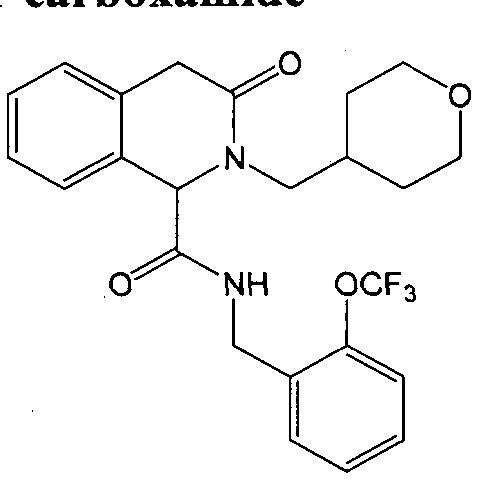
Prepared as described for Example 2 using 2-[(oxan-4-yl)methyl]-3-oxo-l,2,3,4- tetrahydroisoquinoline-l-carboxylic acid (Intermediate 3, 0.050 g, 0.173 mmol) and (2- (trifluoromethoxy)phenyl)methanamine (33 mg, 0.173 mmol). The crude material was purified by reverse phase preparative HPLC eluted with acetonitrile / water (with 0.1% ammonia) to afford the title compound.
1H NMR (400 MHz, DMSO-fi ) δ ppm 1.06 - 1.27 (m, 2 H), 1.34 - 1.52 (m, 2 H), 1.71 - 1.85 (m, 1 H), 2.77 - 2.90 (m, 1 H), 3.03 - 3.23 (m, 2 H), 3.44 (d, J= 19.17 Hz, 1 H), 3.58 - 3.68 (m, 1 H), 3.74 - 3.81 (m, 2 H), 3.87 (d, J= 19.26 Hz, 1 H), 4.23 - 4.42 (m, 2 H), 5.19 (s, 1 H), 7.15 - 7.45 (m, 7 H), 7.48 - 7.56 (m, 1 H), 8.92 - 9.02 (m, 1 H)
MS ES+: 463
Example 25: N-{[4-chloro-3-(trifluoromethyl)phenyl]methyl}-2-[(oxan-4-yl)methyl]-3- oxo-1 ,2,3i4-tetrahydroisoquinoline-l -carboxamide
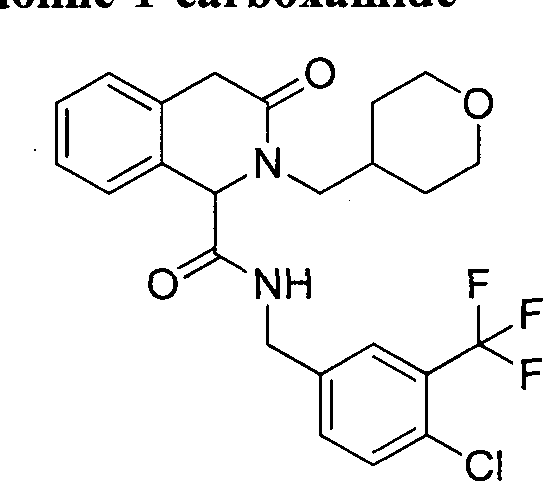
Prepared as described for Example 2 using 2-[(oxan-4-yl)methyl]-3-oxo-l,2,3,4- tetrahydroisoquinoline-l-carboxylic acid (Intermediate 3, 0.050 g, 0.173 mmol) and (4- chloro-3-(trifluoromethyl)phenyl)methanamine (36 mg, 0.173 mmol). The crude material was purified by reverse phase preparative HPLC eluted with acetonitrile / water (with 0.1% ammonia) to afford the title compound.
¾ NMR (400 MHz, CD2CI2) δ ppm 1.22 - 1.59 (m, 4 H), 1.84 - 2.00 (m, 1 H), 2.76 - 2.87 (m, 1 H), 3.22 - 3.32 (m, 2 H), 3.55 - 3.66 (m, 1 H), 3.74 - 3.83 (m, 1 H), 3.85 - 3.94 (m, 2 H), 3.99 - 4.10 (m, 1 H), 4.35 - 4.53 (m, 2 H), 4.99 (s, 1 H), 6.26 - 6.36 (m, 1 H), 7.22 - 7.26 (m, 1 H), 7.28 - 7.51 (m, 6 H)
MS ES+: 481
Example 26: N- { [2-fluoro-6-(trifluoromethy l)phenyl] methyl}-2- [(oxan-4-yl)methy 1] -3- oxo-l,2,354-tetrahydroisoquinoli -l-carboxamide

Prepared as described for Example 2 using 2-[(oxan-4-yl)methyl]-3-oxo-l, 2,3,4- tetrahydroisoquinoline-l-carboxylic acid (Intermediate 3, 0.050 g, 0.173 mmol) and (2- fluoro-6-(trifluoromethyl)phenyl)methanamine (33 mg, 0.173 mmol). The crude material was purified by reverse phase preparative HPLC eluted with acetonitrile / water (with 0.1% ammonia) to afford the title compound.
XH NMR (400 MHz, CD2C12) δ ppm 1.19 - 1.58 (m, 4 H), 1.81 - 1.95 (m, 1 H), 2.83 - 2.92 (m, 1 H), 3.18 - 3.30 (m, 2 H), 3.53 - 3.62 (m, 1 H), 3.73 - 3.95 (m, 4 H), 4.51 - 4.61 (m, 1 H), 4.63 - 4.74 (m, 1 H), 4.88 (s, 1 H), 5.91 - 6.01 (m, 1 H), 7.19 - 7.25 (m, 1 H), 7.27 - 7.39 (m, 4 H), 7.44 - 7.59 (m, 2 H)
MS ES+: 465
Example 27: N-[(3,4-dichIorophenyl)metliyI]-2-[(oxan-4-yl)methyl]-3-oxo-l,2,3,4- tetrahydroisoquinoline-l-carboxamide

'H NMR (400 MHz, CD2CI2) 5 ppm 1.23 - 1.41 (m, 2 H), 1.43 - 1.60 (m, 2 H), 1.87 - 2.00 (m, 1 H), 2.80 - 2.91 (m, 1 H), 3.22 - 3.33 (m, 2 H), 3.58 - 3.68 (m, 1 H), 3.76 - 3.94 (m, 3 H), 3.98 - 4.07 (m, 1 H), 4.30 - 4.46 (m, 2 H), 4.98 (s, 1 H), 6.19 - 6.33 (m, 1 H), 6.93 - 7.07 (m, 1 H), 7.20 - 7.30 (m, 2 H), 7.31 - 7.47 (in, 4 H)
MS ES+: 447
3. Biological efficacy of compounds of the invention mGluR7 Assay
The ability of the test compounds to activate mGluR7 was determined by their ability to reduce forskolin stimulated cAMP production. Compounds were assessed in a CRE- directed luciferase reporter gene assay, using a stable CHO cell line expressing the CRE- luc reporter and human mGluR7 genes. In this cell line, production of cAMP stimulated the transcription of the luciferase gene and luciferase activity was then measured in a luminescent enzyme assay (Steady Glo assay; Promega E2550). Activation of mGluR7 decreased the forskolin stimulated luminescence signal.
The day prior to the assay, compounds were serially diluted in DMSO (lOOx final assay concentration (FAC)), in 384-well plates which were then stored in the dark at room temperature (RT) until use. Cells were seeded at 12.5 k/well in white, clear bottom 384- well plates (Corning 3707) and left for one hour at RT followed by an overnight incubation (37 °C). The following day, the DMSO compound plate was diluted 1 :20 (5x FAC) in Opti-MEM I (Life Technologies 11058021). The growth media was removed from the cell plate and replaced with 15 μΐ Opti-MEM I, followed by a 5 μΐ addition from the 5x compound plate and a fifteen minute incubation (37 °C). Forskolin (Sigma F3917) was then added to the wells (5 μΐ of 2.5 μΜ) and the plate was incubated for five hours (37 °C). During this incubation, the Steady Glo Substrate reagent was warmed to 37 °C. Aliquots
(1 lml; stored at -20 °C) of this reagent were prepared by dissolving the contents of 1 vial of lyophilised substrate in 100 ml Steady-Glo buffer. A 25 μΐ addition of the substrate was made to all wells and the plate was incubated for thirty minutes at RT, on a plate shaker (300 rpm; in the dark). Luminescence was then measured using the EnVision Multilabel Reader (Perkin Elmer).
Compound activity was examined using a 10-point, half log concentration-response range and each concentration was tested in duplicate wells. Luminescence values were normalised to 'maximum' (forskolin alone) and 'minimum' (forskolin in the presence of tool mGluR7 agonist) controls. EC50 values were derived from this data using non-linear regression and a four parameter curve fit. The EC50 values for the compounds of the Examples are shown in Table 1.
Results
Table 1

References
1. O'Connor R.M., Finger B.C., Flor P.J. and Cryan J.F., 2010. Metabotropic glutamate receptor 7: at the interface of cognition and emotion. Eur J Pharmacol, 639 (1- 3), 123-31.
2. Konieczny J. and Lenda T., 2013 Contribution of the mGluR7 receptor to
antiparkinsonian-like effects in rats: a behavioral study with the selective agonist AMN082. Pharmacol Rep., 65 (5), 1194-1203.
3. Greco B., Lopez S., van der Putten H. and Flor P. J., 2010. Amalric M.
Metabotropic glutamate 7 receptor subtype modulates motor symptoms in rodent models of Parkinson's disease. J Pharmacol Exp Ther., 332 (3), 1064-71.
4. Bradley S.R., Standaert D.G., Levey A.I. and Conn P. J., 1999. Distribution of group III mGluRs in rat basal ganglia with subtype- specific antibodies. Ann N YAcad Sci., 868, 531-4.
5. Conn P.J. and Niswender CM., 2006. mGluR7's lucky number. Proceedings of the National Academy of Sciences of the United States of America, 103 (2), 251-2.
6. Hovels0 N., Sotty F., Montezinho L., Pinheiro P., Herrik K. and M0rk A.,2012. Therapeutic Potential of Metabotropic Glutamate Receptor Modulators. Curr
Neuropharmacol., 10 (1), 12-48.
7. Kandaswamy R., McQuillin A., Curtis D. and Gurling H., 2014. Allelic Association, DNA Resequencing and Copy Number Variation at the Metabotropic Glutamate Receptor GRM7 Gene Locus in Bipolar Disorder. Am J Med Genet B N ~ europsychia.tr Genet., 165 (4), 365-72.
8. Palucha-Poniewiera A., Szewczyk B. and Pile A, 2014.. Activation of the mTOR signaling pathway in the antidepressant-like activity of the mGlu5 antagonist MTEP and the mGlu7 agonist AMN082 in the FST in rats. Neuropharmacology, 82, 59-68.
9. Palucha A., Klak K., Branski P., van der Putten H., Flor P.J. and Pile A., 2007.
Activation of the mGlu7 receptor elicits antidepressant-like effects in mice.
Psychopharmacology (Berl)., 194 (4), 555-62.
10. Kalinichev M., Rouillier M., Girard F., Royer-Urios I., Bournique B., Finn T. et al., 2013. ADX71743, a potent and selective negative allosteric modulator of metabotropic glutamate receptor 7: in vitro and in vivo characterization. J Pharmacol Exp Ther., 344 (3), 624-36.
11. . Bolonna A.A., Kerwin R.W., Munro J., Arranz M.J., Makoff A.J., 2001.
Polymorphisms in the genes for mGluR types 7 and 8: association studies with
schizophrenia. Schizophr Res., 47 (1), 99-103.
12. Friedman, R. A., et al., 2009. GRM7 variants confer susceptibility to age-related hearing impairment. Hum Mol Genet 18(4), 785-796.
Claims
1. A compound of formula (I) or a pharmaceutically acceptable salt thereof

wherein
R1 independently represents halogen, cyano, hydroxyl, -N(R )2, C1-C6 alkyl, C3- C6 cycloalkyl, C1-C6 alkoxy, C3-C6 cycloalkoxy, C1-C6 alkylcarbonyl, C3-C6 cycloalkylcarbonyl, C1-C6 alkoxycarbonyl, C3-C6 cycloalkoxycarbonyl, a saturated or unsaturated 3- to 7-membered carbocyclic ring or a saturated or unsaturated 4- to 7- membered heterocyclic ring, the heterocyclic ring comprising at least one ring heteroatom independently selected from nitrogen, oxygen and sulphur atoms, wherein each of the alkyl, cycloalkyl, alkoxy, cycloalkoxy, alkylcarbonyl, cycloalkylcarbonyl, alkoxycarbonyl and cycloalkoxycarbonyl moieties and the carbocyclic or heterocyclic ring is independently unsubstituted or substituted with at least one substituent independently selected from halogen, cyano, hydroxyl, oxo, amino, methylamino, dimethylamino, C1-C3 alkyl, C1-C3 haloalkyl, C1-C3 alkoxy and C1-C3 haloalkoxy; or two adjacent R1 together with the carbon atoms to which they are attached form a
5- to 7-membered carbocyclic or heterocyclic ring optionally comprising one or two further double bonds, the heterocyclic ring comprising at least one ring heteroatom independently selected from nitrogen, oxygen and sulphur atoms, wherein the carbocyclic or heterocyclic ring is unsubstituted or substituted with at least one substituent
independently selected from halogen, cyano, hydroxyl, oxo, amino, methylamino, dimethylamino, C1-C3 alkyl, C1-C3 haloalkyl, C1-C3 alkoxy and C1-C3 haloalkoxy;
n is 0, 1, 2, 3, 4 or 5;
R represents hydrogen, halogen, cyano, hydroxyl, C1-C6 alkyl, C1-C6 alkoxy, Ci- C6 haloalkyl or C1-C6 haloalkoxy;
R represents C1-C6 alkyl substituted with at least one substituent independently selected from halogen, cyano, a saturated or unsaturated 3- to 7-membered carbocyclic ring or a saturated or unsaturated 4- to 7-membered heterocyclic ring, the heterocyclic ring comprising at least one ring heteroatom independently selected from nitrogen, oxygen and sulphur atoms, wherein the carbocyclic or heterocyclic ring is unsubstituted or substituted with at least one substituent independently selected from halogen, cyano, hydroxyl, oxo, amino, methylamino, dimethylamino, C1-C3 alkyl, C1-C3 haloalkyl, C1-C3 alkoxy and Ci- C3 haloalkoxy; provided that R is not benzyl; and
R4 independently represents hydrogen or C1-C6 alkyl.
2. A compound according to claim 1, wherein R1 independently represents halogen,
C1-C6 alkyl, C1-C6 alkoxy, or a saturated or unsaturated 4- to 7-membered heterocyclic ring, the heterocyclic ring comprising at least one ring heteroatom independently selected from nitrogen and oxygen atoms, wherein each of the alkyl and alkoxy moieties and the heterocyclic ring is independently unsubstituted or substituted with at least one substituent independently selected from fluorine, chlorine, bromine, hydroxyl, amino, methylamino, dimethylamino, C1-C3 alkyl, C1-C3 haloalkyl, C1-C3 alkoxy and C1-C3 haloalkoxy; or two adjacent R1 together with the carbon atoms to which they are attached form a
5- to 7-membered heterocyclic ring optionally comprising one or two further double bonds, the heterocyclic ring comprising at least one ring heteroatom independently selected from nitrogen and oxygen atoms, wherein the heterocyclic ring is unsubstituted or substituted with at least one substituent independently selected from fluorine, chlorine, bromine, hydroxyl, amino, methylamino, dimethylamino, C1-C3 alkyl, C1-C3 haloalkyl, C1-C3 alkoxy and C1-C3 haloalkoxy.
3. A compound according to claim 1 or claim 2, wherein R independently represents fluorine, chlorine, C1-C3 alkyl, C1-C3 alkoxy, or a saturated or unsaturated 5- or 6- membered heterocyclic ring, the heterocyclic ring comprising one, two or three ring heteroatoms independently selected from nitrogen and oxygen atoms, wherein each of the alkyl and alkoxy moieties and the heterocyclic ring is independently unsubstituted or substituted with one, two or three substituents independently selected from fluorine, chlorine and C1-C3 alkyl; or two adjacent R1 together with the carbon atoms to which they are attached form a
5- or 6-membered heterocyclic ring optionally comprising one or two further double bonds, the heterocyclic ring comprising one or two ring heteroatoms independently selected from nitrogen and oxygen atoms, wherein the heterocyclic ring is unsubstituted or substituted with one, two or three substituents independently selected from fluorine, chlorine and Ci- C3 alkyl.
4. A compound according to any one of the preceding claims, wherein n is 0, 1 or 2.
5. A compound according to any one of the preceding claims, wherein R represents hydrogen, fluorine, chlorine, hydroxyl, C1-C3 alkyl, C1-C3 alkoxy, C1-C3 haloalkyl or Ci- C3 haloalkoxy.
2
6. A compound according to any one of the preceding claims, wherem R represents hydrogen.
7. A compound according to any one of the preceding claims, wherein R represents
C1-C5 alkyl substituted with at least one substituent independently selected from halogen, a saturated or unsaturated 3- to 6-membered carbocyclic ring or a saturated or unsaturated 5- or 6-membered heterocyclic ring, the heterocyclic ring comprising one, two or three ring heteroatoms independently selected from nitrogen and oxygen atoms, wherein the carbocyclic or heterocyclic ring is unsubstituted or substituted with one, two or three
substituents independently selected from halogen, hydroxyl, amino, methylamino, dimethylamino, C1-C3 alkyl, C1-C3 haloalkyl, C1-C3 alkoxy and C1-C3 haloalkoxy.
8. A compound according to any one of the preceding claims, wherein R represents
C1-C4 alkyl substituted with one, two or three substituents independently selected from fluorine, chlorine, a saturated or unsaturated 3- to 6-membered carbocyclic ring or a saturated or unsaturated 5- or 6-membered heterocyclic ring, the heterocyclic ring comprising one or two ring heteroatoms independently selected from nitrogen and oxygen atoms, wherein the carbocyclic or heterocyclic ring is unsubstituted or substituted with one or two substituents independently selected from fluorine, chlorine and C1-C3 alkyl.
9. A compound of formula (I) as defined in claim 1 selected from:
N-[(3-chlorophenyl)methyl]-2-(cyclopropylmethyl)-3-oxo-l ,2,3,4-tetrahydroisoquinoline- 1 -carboxamide;
N- [(3 -chlorophenyl)methyl] -2- [(oxan-4-yl)methyl] -3 -oxo- 1 ,2,3 ,4-tetrahydroisoquinoline-
1- carboxamide;
2- (cyclopropylmemyl)-N-[(4-fluorophenyl)methyl]-3-oxo-l ,2,3,4-tetrahydroisoquinoline- 1 -carboxamide;
( 1 i?)-2-(cyclopropylmethyl)-iV- [(4-fluorophenyl)methyl] -3 -oxo- 1 ,2,3 ,4- tetrahydroisoquinoline- 1 -carboxamide;
(lS)-2-(cyclopropylmethyl)-N-[(4-fluorophenyl)methyl]-3-oxo-l,2,3,4- tetrahydroisoquinoline- 1 -carboxamide;
2-(cyclopropylmethyl)-N- [(3 ,4-difluorophenyl)methyl] -3 -oxo- 1 ,2,3,4- tetrahydroisoquinoline- 1 -carboxamide;
2-(cyclopropylmethyl)-N-[(2,4-difluorophenyl)methyl]-3-oxo- 1 ,2,3 ,4- tetrahydroisoquinoline- 1 -carboxamide;
N- [(4-fluorophenyl)methyl] -2- [(oxan-4-yl)methyl] -3 -oxo- 1 ,2,3 ,4-tetrahy droisoquinoline- 1 - carboxamide;
N- [(4-fluorophenyl)methyl] -3 -oxo-2- [(pyridin-2-yl)methyl]- 1 ,2,3 ,4- tetrahydroisoquinoline- 1 -carboxamide;
2- (cyclopropylmethyl)-N-[(2-fluorophenyl)met yl]-3-oxo-l,2,3,4-tetrahydroisoquinoline 1-carboxamide;
(1 i?)-2-(cyclopropylmethyl)-N- [(2-fluorophenyl)methyl] -3 -oxo- 1 ,2,3 ,4- tetrahydroisoquinoline- 1 -carboxamide;
( 15)-2-(cyclopropylmethyl)-N- [(2-fluorophenyl)methyl] -3 -oxo- 1 ,2,3 ,4- tetrahydroisoquinoline- 1 -carboxamide;
( 1 S)-2-(cyclopropylmethyl)-N- [(2-methylphenyl)methyl] -3 -oxo- 1 ,2,3 ,4- tetrahydroisoquinoline- 1 -carboxamide;
( 1 S)-2-(cyclopropylmethyl)-N- [(4-fluoro-2-methylphenyl)methyl] -3 -oxo- 1 ,2,3 ,4- tetrahydroisoquinoline- 1 -carboxamide;
(15)-2-(cyclopropylmethyl)-N-[(2-fluoro-6-methylphenyl)methyl]-3-oxo-l, 2,3,4- tetrahydroisoquinoline- 1 -carboxamide;
(lS)-N-[(4-fluorophenyl)methyl]-2-(3-fluoropropyl)-3-oxo-l,2,3,4-tetrahydroisoquinoline- 1 -carboxamide;
( 1 R)-N- [(4-fluorophenyl)methyl] -2-(3 -fluoropropyl)-3 -oxo- 1 ,2,3 ,4-tetrahydroisoquinoline-
1 - carboxamide;
(lS)-2-(cyclopropylmethyl)-3-oxo-iV-[(quinolin-6-yl)methyl]-l,2,3,4- tetrahydroisoquinoline- 1 -carboxamide;
( 1 S)-2-(cyclopropylmethyl)-3 -oxo-N- { [2-( 1 H-pyrazol- 1 -yl)phenyl] methyl } - 1 ,2,3 ,4- tetrahydroisoquinoline- 1 -carboxamide;
3- oxo-2-[(pyridin-2-yl)methyl]-N-{[4-(trifluoromethyl)phenyl]methyl}-l, 2,3,4- tetrahydroisoquinoline- 1 -carboxamide;
( 1 S)-2-(cyclopropylmethyl)-N- [( 1 -methyl- 1 H-indol-4-yl)methyl] -3 -oxo- 1 ,2,3 ,4- tetrahydroisoquinoline- 1 -carboxamide;
2- [(oxan-4-yl)methyl]-3-oxo-N-{ [3-(trifluoromethyl)phenyl]methyl} - 1 ,2,3,4- tetrahydroisoquinoline- 1 -carboxamide;
N- [(4-chloro-3 -fluorophenyl)methyl] -2- [(oxan-4-yl)methyl] -3 -oxo- 1 ,2,3 ,4- tetrahydroisoquinoline- 1 -carboxamide;
2- [(oxan-4-yl)methyl] -3 -oxo-N- { [2-(trifluoromethoxy)phenyl]methyl } - 1 ,2,3 ,4- tetrahydroisoquinoline- 1 -carboxamide;
N- { [4-chloro-3 -(trifluoromethyl)phenyl] methyl } -2- [(oxan-4-yl)methyl] -3 -oxo- 1 ,2,3 ,4- tetrahydroisoquinoline- 1 -carboxamide;
N- { [2-fluoro-6-(trifluoromethyl)phenyl]methyl } -2- [(oxan-4-yl)methyl] -3 -oxo- 1 ,2,3 ,4- tetrahydroisoquinoline- 1 -carboxamide;
N- [(3 ,4-dichlorophenyl)methyl] -2- [(oxan-4-yl)methyl] -3 -oxo- 1 ,2,3 ,4- tetrahydroisoquinoline- 1 -carboxamide;
and enantiomers, diastereoisomers and mixtures thereof; and pharmaceutically acceptable salts of any of the foregoing.
10. A process for the preparation of a compound of formula (I) or a pharmaceutically acceptable salt thereof as defined in claim 1 which comprises reacting a compound of formula (II) or a salt thereof

in which R and R are as defined in formula (I), with a compound of formula (III) or a salt thereof

in which R and n are as defined in formula (I); and optionally thereafter carrying out one or more of the following procedures:
• converting a compound of formula (I) into another compound of formula (I)
• removing any protecting groups
• forming a pharmaceutically acceptable salt.
11. A pharmaceutical composition comprising a compound of formula (I) or a pharmaceutically acceptable salt thereof, as claimed in any one of claims 1 to 9, in
association with a pharmaceutically acceptable adjuvant, diluent or carrier, and optionally one or more other therapeutic agents.
12. A compound of formula (I) or a pharmaceutically acceptable salt thereof, as claimed in any one of claims 1 to 9, for use in therapy.
13. A compound of formula (I) or a pharmaceutically acceptable salt thereof, as claimed in any one of claims 1 to 9, for use in treating alcohol, drug or nicotine addiction.
14. A compound of formula (I) or a pharmaceutically acceptable salt thereof, as claimed in any one of claims 1 to 9, for use in treating hearing loss or tinnitus.
15. A compound of formula (I) or a pharmaceutically acceptable salt thereof, as claimed in any one of claims 1 to 9, for use in treating schizophrenia.
Applications Claiming Priority (2)
| Application Number | Priority Date | Filing Date | Title |
|---|---|---|---|
| GB1618346.9 | 2016-10-31 | ||
| GBGB1618346.9A GB201618346D0 (en) | 2016-10-31 | 2016-10-31 | Novel compounds |
Publications (1)
| Publication Number | Publication Date |
|---|---|
| WO2018079862A1 true WO2018079862A1 (en) | 2018-05-03 |
Family
ID=57963712
Family Applications (1)
| Application Number | Title | Priority Date | Filing Date |
|---|---|---|---|
| PCT/JP2017/040008 Ceased WO2018079862A1 (en) | 2016-10-31 | 2017-10-31 | Mglur7 modulators |
Country Status (2)
| Country | Link |
|---|---|
| GB (1) | GB201618346D0 (en) |
| WO (1) | WO2018079862A1 (en) |
Cited By (3)
| Publication number | Priority date | Publication date | Assignee | Title |
|---|---|---|---|---|
| WO2024105018A1 (en) * | 2022-11-14 | 2024-05-23 | Addex Pharma S.A. | NOVEL PYRROLO[1,2-d][1,2,4]TRIAZINONE DERIVATIVES AS NEGATIVE ALLOSTERIC MODULATORS OF MGLU7 RECEPTORS |
| WO2024105021A1 (en) * | 2022-11-14 | 2024-05-23 | Addex Pharma S.A. | NOVEL PYRROLO[1,2-d][1,2,4]TRIAZIN-1-ONE DERIVATIVES AS NEGATIVE ALLOSTERIC MODULATORS OF MGLU7 RECEPTORS |
| WO2024105016A1 (en) * | 2022-11-14 | 2024-05-23 | Addex Pharma S.A. | Novel bicyclic[1,2,4]triazolone derivatives as negative allosteric modulators of mglu7 receptors |
Citations (1)
| Publication number | Priority date | Publication date | Assignee | Title |
|---|---|---|---|---|
| US20110245247A1 (en) * | 2010-03-30 | 2011-10-06 | Abbott Gmbh & Co. Kg | Novel small molecule potentiators of metabotropic glutamate receptors |
-
2016
- 2016-10-31 GB GBGB1618346.9A patent/GB201618346D0/en not_active Ceased
-
2017
- 2017-10-31 WO PCT/JP2017/040008 patent/WO2018079862A1/en not_active Ceased
Patent Citations (1)
| Publication number | Priority date | Publication date | Assignee | Title |
|---|---|---|---|---|
| US20110245247A1 (en) * | 2010-03-30 | 2011-10-06 | Abbott Gmbh & Co. Kg | Novel small molecule potentiators of metabotropic glutamate receptors |
Cited By (3)
| Publication number | Priority date | Publication date | Assignee | Title |
|---|---|---|---|---|
| WO2024105018A1 (en) * | 2022-11-14 | 2024-05-23 | Addex Pharma S.A. | NOVEL PYRROLO[1,2-d][1,2,4]TRIAZINONE DERIVATIVES AS NEGATIVE ALLOSTERIC MODULATORS OF MGLU7 RECEPTORS |
| WO2024105021A1 (en) * | 2022-11-14 | 2024-05-23 | Addex Pharma S.A. | NOVEL PYRROLO[1,2-d][1,2,4]TRIAZIN-1-ONE DERIVATIVES AS NEGATIVE ALLOSTERIC MODULATORS OF MGLU7 RECEPTORS |
| WO2024105016A1 (en) * | 2022-11-14 | 2024-05-23 | Addex Pharma S.A. | Novel bicyclic[1,2,4]triazolone derivatives as negative allosteric modulators of mglu7 receptors |
Also Published As
| Publication number | Publication date |
|---|---|
| GB201618346D0 (en) | 2016-12-14 |
Similar Documents
| Publication | Publication Date | Title |
|---|---|---|
| US7790760B2 (en) | Metabotropic glutamate receptor isoxazole ligands and their use as potentiators 286 | |
| EP3788043B1 (en) | Spiropiperidine allosteric modulators of nicotinic acetylcholine receptors | |
| CN102015687A (en) | Muscarinic receptor agonists, compositions, methods of treatment thereof, and processes for preparation thereof 177 | |
| EP3684357B1 (en) | Heteroaryl allosteric modulators of nicotinic acetylcholine receptors | |
| WO2018079862A1 (en) | Mglur7 modulators | |
| AU2015220553B2 (en) | Substituted cyclopentanes, tetrahydrofuranes and pyrrolidines as orexin receptor antagonists | |
| US11465994B2 (en) | MGluR7 agonist compounds for treating mGluR7-regulated diseases, disorders, or conditions | |
| TW200951119A (en) | Novel compounds-300 | |
| WO2018047983A1 (en) | Indane derivatives useful as modulators of mglur7 | |
| WO2017131221A1 (en) | Indane derivatives as mglur7 modulators | |
| HK40015211B (en) | Mglur7 agonist compounds for treating mglur7- regulated diseases, disorders, or conditions | |
| HK40015211A (en) | Mglur7 agonist compounds for treating mglur7- regulated diseases, disorders, or conditions | |
| WO2017222083A1 (en) | Novel compounds | |
| HK40045594B (en) | Spiropiperidine allosteric modulators of nicotinic acetylcholine receptors | |
| HK40045594A (en) | Spiropiperidine allosteric modulators of nicotinic acetylcholine receptors | |
| HK1155744B (en) | Isoxazole derivatives and their use as metabotropic glutamate receptor potentiators |
Legal Events
| Date | Code | Title | Description |
|---|---|---|---|
| 121 | Ep: the epo has been informed by wipo that ep was designated in this application |
Ref document number: 17804672 Country of ref document: EP Kind code of ref document: A1 |
|
| NENP | Non-entry into the national phase |
Ref country code: DE |
|
| 122 | Ep: pct application non-entry in european phase |
Ref document number: 17804672 Country of ref document: EP Kind code of ref document: A1 |