WO2018074554A1 - クリプトクロムの機能を抑制するための組成物 - Google Patents
クリプトクロムの機能を抑制するための組成物 Download PDFInfo
- Publication number
- WO2018074554A1 WO2018074554A1 PCT/JP2017/037870 JP2017037870W WO2018074554A1 WO 2018074554 A1 WO2018074554 A1 WO 2018074554A1 JP 2017037870 W JP2017037870 W JP 2017037870W WO 2018074554 A1 WO2018074554 A1 WO 2018074554A1
- Authority
- WO
- WIPO (PCT)
- Prior art keywords
- blue light
- cryptochrome
- light
- treated
- hypocotyl
- Prior art date
- Legal status (The legal status is an assumption and is not a legal conclusion. Google has not performed a legal analysis and makes no representation as to the accuracy of the status listed.)
- Ceased
Links
Images







Classifications
-
- A—HUMAN NECESSITIES
- A01—AGRICULTURE; FORESTRY; ANIMAL HUSBANDRY; HUNTING; TRAPPING; FISHING
- A01G—HORTICULTURE; CULTIVATION OF VEGETABLES, FLOWERS, RICE, FRUIT, VINES, HOPS OR SEAWEED; FORESTRY; WATERING
- A01G7/00—Botany in general
-
- A—HUMAN NECESSITIES
- A01—AGRICULTURE; FORESTRY; ANIMAL HUSBANDRY; HUNTING; TRAPPING; FISHING
- A01N—PRESERVATION OF BODIES OF HUMANS OR ANIMALS OR PLANTS OR PARTS THEREOF; BIOCIDES, e.g. AS DISINFECTANTS, AS PESTICIDES OR AS HERBICIDES; PEST REPELLANTS OR ATTRACTANTS; PLANT GROWTH REGULATORS
- A01N43/00—Biocides, pest repellants or attractants, or plant growth regulators containing heterocyclic compounds
- A01N43/48—Biocides, pest repellants or attractants, or plant growth regulators containing heterocyclic compounds having rings with two nitrogen atoms as the only ring hetero atoms
- A01N43/56—1,2-Diazoles; Hydrogenated 1,2-diazoles
-
- A—HUMAN NECESSITIES
- A01—AGRICULTURE; FORESTRY; ANIMAL HUSBANDRY; HUNTING; TRAPPING; FISHING
- A01N—PRESERVATION OF BODIES OF HUMANS OR ANIMALS OR PLANTS OR PARTS THEREOF; BIOCIDES, e.g. AS DISINFECTANTS, AS PESTICIDES OR AS HERBICIDES; PEST REPELLANTS OR ATTRACTANTS; PLANT GROWTH REGULATORS
- A01N43/00—Biocides, pest repellants or attractants, or plant growth regulators containing heterocyclic compounds
- A01N43/90—Biocides, pest repellants or attractants, or plant growth regulators containing heterocyclic compounds having two or more relevant hetero rings, condensed among themselves or with a common carbocyclic ring system
Definitions
- the present invention relates to a composition for suppressing the function of cryptochrome, which contains a 9-membered nitrogen-containing fused aromatic heterocyclic compound as an active ingredient. Moreover, this invention relates to the composition for promoting the growth of a plant under irradiation of the light containing blue light which contains this compound as an active ingredient.
- Light is a very important environmental stimulus for plant growth. Depending on the light of various wavelengths, germination, aversion response, stomatal opening, phototropism, deyellowing (greening), adjustment of circadian clock And control such as flowering time (photomorphogenesis).
- plants sense light of various wavelengths, and thus belong to different groups, that is, cryptochrome that senses blue light and photoreceptor protein that senses red light. It has phytochrome.
- Cryptochrome CRYs: CRY1 and CRY2
- phytochrome phytochrome (phyA-phyE) absorbs red and far-red light at wavelengths of 650-750 nm. Function.
- These receptors are activated by absorbing photons, causing the expression of downstream proteins and their interactions, and the function of controlling metabolism leading to growth and physiological responses adapted to the surrounding light environment. Is responsible.
- Non-patent Document 1 For example, in the initial development of seedlings, it is known that photomorphogenesis such as deyellowing in Arabidopsis thaliana and the photoreceptors cryptochrome and phytochrome are closely related (Non-patent Document 1).
- Non-Patent Document 1 hypocotyl elongation of plants such as Arabidopsis thaliana is suppressed under blue light irradiation, but the functional defect of CRY1 eliminates this suppression by blue light, and hypocotyl elongation (plant growth) ) has been clarified (Non-Patent Document 1). Furthermore, in addition to hypocotyl elongation, cryptochrome has also been reported to be involved in a number of phenomena in the growth and development process, including stomatal opening, pigment (anthocyanin) synthesis, and control of the flowering period (Non-Patent Document 2 and 3).
- cryptochrome controls Suppressor Of PhyA 1 (SPA1) / Constitutive Of Photomorphic 1 (COP1) in determining the stage of seedling development. More specifically, as shown in FIG. 1, cryptochrome changes the expression profile of blue light regulatory genes by suppressing the degradation of various transcription factors (HY5, HYH, CO) by SPA1 / COP1. It has become clear that the stage of seedling development is determined (Non-Patent Documents 5 to 8).
- blue light signal transmission involving cryptochrome is greatly involved in plant growth, it can be expected to increase the size of the plant by controlling the signal transmission.
- an object of the present invention is to provide a low molecular weight compound capable of suppressing blue light signal transmission involving cryptochrome.
- an object of the present invention is to provide a low molecular weight compound capable of promoting the growth of plants under irradiation of light containing blue light.
- the present inventors analyzed the relationship between the structure of these low-molecular compounds and the growth promotion of the plant using 3B7N analogs.
- a 9-membered nitrogen-containing fused aromatic heterocycle containing two nitrogen atoms is used as a core structure, and if a hydrogen atom or a halogen atom and a nitro group are added to this core structure at an arbitrary position, It has been found that a suppressive effect can be exerted against inhibition of hypocotyl elongation by blue light.
- Wild-type seedlings grown under blue light irradiation are also known to have an increased size (expansion). Therefore, the inventors further analyzed the effect of 3B7N on the size of the foliage. As a result, it has been clarified that the compound can suppress not only hypocotyl elongation regulated by blue light but also expansion of foliage.
- the present inventors assumed that the target molecule of 3B7N is cryptochrome itself, and analyzed their interaction. As a result, it was revealed that 3B7N actually binds to CRY1.
- the present inventors inhibit 3B7N binding to cryptochrome and suppress its function, thereby suppressing blue light signal transduction regulated by the photoreceptor protein and promoting the growth of the above-mentioned plant. And the present invention has been completed.
- a composition for suppressing the function of cryptochrome which contains a nitrogen-containing fused aromatic heterocyclic compound represented by the following general formula (I) as an active ingredient
- the A ring and the B ring are 9-membered nitrogen-containing condensed aromatic heterocyclic compounds containing two nitrogen atoms, and the A ring is a 6-membered aromatic compound.
- a hydrocarbon ring or a 6-membered aromatic heterocycle is shown, and B ring is a 5-membered aromatic hydrocarbon ring or a 5-membered aromatic heterocycle.
- X represents a hydrogen atom or a halogen atom].
- the function of cryptochrome can be suppressed. Further, by suppressing the function, it becomes possible to promote the growth of plants under the irradiation of light containing blue light. In particular, in recent years, depletion of fossil energy resources has progressed every moment, and global warming has become a serious problem. Therefore, the present invention that can promote the growth of plants also contributes to an increase in the production of biomass plants that substitute for fossil fuels such as petroleum. Further, according to the present invention, since the growth of plants can be promoted even under an artificial environment such as a blue LED, stable production can be increased without being affected by an unstable natural environment.
- CRY cryptochrome
- the stabilized transcription factors activate the expression of genes involved in photomorphogenesis, and promote photomorphogenesis such as inhibition of hypocotyl elongation and deyellowing.
- transcription factors that positively control photomorphogenesis such as HY5 are degraded.
- CRY2 In response to blue light, CRY2 binds to CIB1 and CIB1 binds to the promoter of the FT gene, thereby inducing the expression of the gene, which leads to flowering.
- FIG. 1 A is a photograph showing the results of observing seedlings on the 6th day grown with irradiation with 10 ⁇ moLm ⁇ 2 s ⁇ 1 blue light with or without the addition of 3B7N.
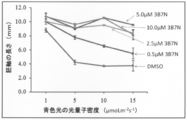
- B shows 10 ⁇ moLm ⁇ 2 s ⁇ 1 blue light, 10 ⁇ moLm ⁇ 2 s ⁇ 1 red light or 1 ⁇ moLm ⁇ 2 s ⁇ 1 far red light continuously grown or grown in the dark. It is also a graph showing the length of the hypocotyl of the wild type seedling on the 6th day. The data show the mean value ⁇ standard deviation in each batch (n number is 25 or more, * P ⁇ 0.05). The scale bar represents 1 mm. It is a graph which shows the length of the hypocotyl of a wild type seedling under 3B7N addition and continuous blue light irradiation.
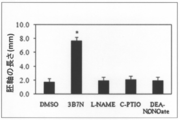
- a measured value shows the average value +/- standard deviation of the seedling of the 6th day (n number is 25 or more). It is a graph showing the length of the hypocotyl of a wild type seedling treated with 3B7N or other NO-eliminating agent (L-NAME, C-PTIO, DEA-NONOate) and grown under continuous blue light irradiation. .
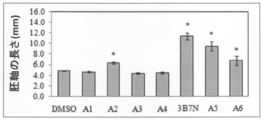
- a measured value shows the average value +/- standard deviation of the seedling of the 6th day (n number is 25 or more). It is a graph which shows the result analyzed about control of hypocotyl elongation of the seedling under continuous blue light irradiation by 3B7N and its analog.
- 3B7N represents 3-bromo-7-nitroindazole
- A1 represents 3-bromoindazole
- A2 represents 7-nitroindazole
- A3 1- [2- (trifluoromethyl) phenyl] imidazole
- A4 represents 3-bromo-1H-indazole-7-carbonitrile
- A5 represents 3-iodo-7-nitroindazole
- A6 represents 3-bromo-6-nitroimidazo [1,2-a] pyridine.
- the length of the hypocotyl of the 6th day seedling is shown as an average value ⁇ standard deviation (n number is 25 or more, * P ⁇ 0.05).
- the scale bar represents 1 mm.
- the measured values show the mean value ⁇ standard deviation (n number is 25 or more, * P ⁇ 0.05) of the seedlings treated with 3B7N and those treated with DMSO as a control.
- Hfr1 (Int) is a mutant lacking the intron portion of HFR1 (LONG HYPOCOTYL in FAR-RED), and hfr1 (Pro) is a mutant lacking the promoter region of HFR1.
- laf1 is a mutant of LAF1 (LONG AFTER FAR-RED LIGHT 1). It is a photograph which shows the twin leaf of the wild type seedling of the 6th day processed by DMSO as 3B7N or its control.
- FIG. A shows the seedlings grown by continuously irradiating blue light 10 ⁇ moLm -2 s -1, in B, and continuously irradiated with blue light of 5 ⁇ moLm -2 s -1 Growth The seedlings are shown.
- the numbers in the upper left of each panel indicate the final concentration of 3B7N added to each plate.
- In the lower left of each panel representative examples of monitored cotyledon morphology are shown.
- the scale bar represents 1 mm.
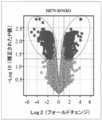
- the results of clustering gene expression profiles in wild type (DMSO treatment, control), A1 (3-bromoindazole) treatment, A2 (7-nitroindazole) treatment and 3B7N (3-bromo-7-nitroindazole) treatment are shown.
- the gene expression profile relates to seedlings grown for 4 days in an agar medium supplemented with each chemical substance so that the final concentration is 2.5 ⁇ M under irradiation with blue light (10 ⁇ moLm ⁇ 2 s ⁇ 1 ).
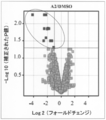
- Black dots surrounded by an ellipse show significant expression showing a double change.
- log2 1).
- a 9-membered nitrogen-containing condensed aromatic heterocyclic compound containing two nitrogen atoms, in which a hydrogen atom or a halogen atom and a nitro group are added at arbitrary positions has been shown to bind to cryptochrome (CRY1, CRY2), a blue photoreceptor protein, and to suppress their function.
- the present invention provides a composition for suppressing the function of cryptochrome, which contains a nitrogen-containing fused aromatic heterocyclic compound represented by the following general formula (I) as an active ingredient.
- the “nitrogen-containing fused aromatic heterocyclic compound” contained as an active ingredient in the composition of the present invention includes two nitrogen atoms in which the A ring and the B ring are combined in the formula (I).
- a 9-membered nitrogen-containing fused aromatic heterocyclic compound containing an atom includes A ring and a 6-membered aromatic hydrocarbon ring or a 6-membered aromatic heterocyclic ring, and B ring shows a 5-membered aromatic hydrocarbon ring or a 5-membered aromatic heterocyclic ring.
- the position on the 9-membered ring of two nitrogen atoms is not particularly limited, but is preferably a position and b position or d position from the viewpoint of suppressing the function of cryptochrome more strongly. More preferably, they are the a-position and the b-position.
- the atom on the 9-membered ring to which the nitro group is added is not particularly limited, but from the same viewpoint, it is preferably an f-position or h-position atom, more preferably an h-position atom.
- a hydrogen atom or a halogen atom a chlorine atom, a fluorine atom, a bromine atom or an iodine atom
- a halogen atom is preferable, and a bromine atom is more preferable. Or it is an iodine atom, More preferably, it is a bromine atom.
- the atom on the 9-membered ring to which a hydrogen atom or a halogen atom is added is not particularly limited, but from the same viewpoint, it is preferably an atom at the b-position or the c-position, more preferably Is c-position.
- the “nitrogen-containing fused aromatic heterocyclic compound” contained as an active ingredient in the composition of the present invention is preferably 3-bromo- from the viewpoint of more strongly suppressing the function of cryptochrome. 7-nitroindazole, 3-iodo-7-nitroindazole, 3-bromo-6-nitroimidazo [1,2-a] pyridine, 7-nitroindazole, more preferably 3-bromo-7-nitroindazole 3-iodo-7-nitroindazole, more preferably 3-bromo-7-nitroindazole.
- the “nitrogen-containing fused aromatic heterocyclic compound” includes pharmacologically acceptable salts, hydrates or solvates.
- a pharmacologically acceptable salt is not particularly limited and may be appropriately selected depending on the structure of the compound. Examples thereof include acid addition salts (hydrochlorides, sulfates, hydrobromides, Nitrates, hydrogen sulfates, phosphates, acetates, etc.) and base addition salts (sodium salts, potassium salts, zinc salts, calcium salts, etc.).
- the hydrate or solvate is not particularly limited. For example, 0.1 to 10 molecules of water or solvent is added to one molecule of a nitrogen-containing condensed aromatic heterocyclic compound or a salt thereof. Is mentioned.
- the nitrogen-containing fused aromatic heterocyclic compound according to the present invention includes all isomers and isomer mixtures such as tautomers, geometric isomers, optical isomers based on asymmetric carbon, and stereoisomers. Is included. Furthermore, the nitrogen-containing fused aromatic heterocyclic compound according to the present invention is oxidized, reduced, hydrolyzed, aminated, deaminated, hydroxylated, phosphorylated, dehydrated, alkylated, dealkylated, and conjugated in vivo. In addition, the present invention also includes compounds that still exhibit the desired activity after metabolism such as, and the present invention undergoes metabolism such as oxidation, reduction, hydrolysis, etc. in vivo and the nitrogen-containing condensed aromatic heterocyclic compound according to the present invention Also included are compounds that produce
- “cryptochrome” means a blue light receptor protein that absorbs blue light, and examples thereof include CRY1 protein and CRY2 protein.
- the origin thereof is not particularly limited, but a plant-derived one is preferably used.
- Arabidopsis CRY1 protein is a protein consisting of an amino acid sequence specified by NCBI Reference Sequence: NP_567341 (NCBI Reference Sequence: NM_116961 is a protein encoded by a nucleotide acid sequence)
- Arabidopsis CRY2 protein is a protein consisting of an amino acid sequence specified by NCBI Reference Sequence: NP_171935 (NCBI Reference Sequence: NM_100320 is a nucleotide acid sequence specified by NM_100320) Encoding protein).
- “suppression of the function of cryptochrome” includes both complete suppression (inhibition) and partial suppression of the function.
- examples of the “function of cryptochrome” suppressed in the present invention include blue light signal transmission involving cryptochrome and, in plants, photomorphogenesis induced by the signal transmission.
- Blue light signaling involving cryptochrome includes, for example, light reception of blue light in cryptochrome, phosphorylation of cryptochrome caused by the light reception, translocation of cryptochrome induced by phosphorylation from the nucleus to the cytoplasm, Cryptochrome induced by phosphorylation and the complex consisting of SPA1 and COP1, binding of CIB1 or MYBL, stabilization of expression of transcription factors (HY5, CO, etc.) generated by binding of the other proteins to cryptochrome, Examples include blue light control gene expression control (for example, gene expression control shown in Table 1 below).
- Examples of photomorphogenesis in plants include, for example, inhibition of hypocotyl elongation, expansion (development) of foliage, opening and closing of foliage (cotyledons), stomatal opening, pigment (anthocyanin) synthesis, deyellowing, control of flowering period, and Inhibition of growth of seedlings such as cotyledon sheaths in monocotyledonous plants.
- the present invention provides a composition (agricultural composition) for promoting plant growth under irradiation with light containing blue light, which contains the nitrogen-containing fused aromatic heterocyclic compound according to the present invention as an active ingredient. ), And a method for promoting plant growth, wherein the plant is treated with the nitrogen-containing condensed aromatic heterocyclic compound according to the present invention, and the plant is grown under irradiation of light containing blue light. (Plant growth promotion method) is provided.
- the “plant” to be promoted for growth there are no particular limitations on the “plant” to be promoted for growth, and examples thereof include dicotyledonous plants (Arabidopsis thaliana, soybean, etc.) and monocotyledons (sorghum, rice, corn, wheat, etc.) angiosperms, gymnosperms.
- Moss plants fern plants, herbaceous plants, and woody plants.
- These plants may be genetically modified or genome-edited bodies (for example, herbicide-tolerant crops, pest-tolerant crops, disease-tolerant crops, taste-enhancing crops, preservative-enhancing crops, yield-enhancing crops).
- the wavelength of “blue light” used in the present invention is 350 nm to 500 nm, preferably 450 nm to 500 nm.
- the photon flux density (fluence rate) of the “blue light” used in the present invention is not particularly limited and can be appropriately adjusted depending on the type and state of the plant to be irradiated, but is preferably 1 to 500 ⁇ moLm ⁇ 2 s ⁇ . 1 , more preferably 1 to 100 ⁇ moLm ⁇ 2 s ⁇ 1 , further preferably 1 to 50 ⁇ moLm ⁇ 2 s ⁇ 1 , more preferably 1 to 15 ⁇ moLm ⁇ 2 s ⁇ 1 , and even more preferably 5 to 10 ⁇ moLm. -2 s -1 .
- light including blue light may be only blue light, but in addition to blue light, red light having a wavelength of 650 nm to 700 nm, far red light having a wavelength of 700 nm to 770 nm, etc. May be mixed light or so-called white light.
- the light source used for irradiating the light is not particularly limited, and is a light emitting diode (LED), a laser light source, a fluorescent lamp (straight tube type, compact type), a light bulb type fluorescent lamp, a high pressure discharge lamp.
- Metal halide lamps can be used.
- not only such an artificial light source but also sunlight can be used in the present invention.
- an optical filter can be combined with these light sources to irradiate the plant.
- composition of the present invention in addition to the nitrogen-containing condensed aromatic heterocyclic compound described above, carriers, emulsifiers, dispersants, spreading agents, wetting agents, fixing agents usually used in agricultural chemicals, etc.
- Adjuvants such as disintegrants can be included.
- Examples of the carrier include water, ethanol, methanol, isopropanol, butanol, ethylene glycol, propylene glycol and other alcohols, acetone, methyl ethyl ketone, cyclohexanone and other ketones, ethyl acetate and other esters, and solid carriers such as, for example, Examples include talc, bentonite, clay, kaolin, diatomaceous earth, white carbon, vermiculite, slaked lime, silica sand, ammonium sulfate, urea, and the like.
- a surfactant is usually used, and examples thereof include an anionic surfactant, a cationic surfactant, a nonionic surfactant, and a zwitterionic surfactant. These can be used individually or in mixture of 2 or more types.
- the dosage form of the agricultural composition of the present invention is not particularly limited, and examples thereof include emulsions, suspensions, powders, wettable powders, water solvents, granules, pastes, and aerosols.
- the content of the nitrogen-containing condensed aromatic heterocyclic compound in the agricultural composition of the present invention is the type of the target plant, the growth status of the target plant, the weather, the environmental conditions, the dosage form, the method of use (dispersion treatment, soil treatment). , Seed treatment, hydroponic treatment, etc.), use place, use time, and the like, but those skilled in the art can appropriately adjust to these conditions.
- the nitrogen-containing condensed aromatic heterocyclic compound according to the present invention is effective for expressing the plant growth promotion effect as it is, or appropriately diluted or suspended with water or the like.
- a certain amount to the target plant for example, foliage spraying
- applying or injecting, spraying or irrigating the target plant to the surrounding soil, or treating the seed of the target plant eg, dressing or soaking
- the growth of a desired plant can be promoted.
- a seed At the seedling stage.
- concentration of the nitrogen-containing condensed aromatic heterocyclic compound at the time of immersing the seeds or seedlings is not particularly limited and may be appropriately adjusted according to the target plant, but is preferably 0.1 to 10 ⁇ M. More preferably, it is 0.25 to 7.5 ⁇ M, and further preferably 2.5 to 5 ⁇ M.
- the irradiation time of light including blue light in the plant growth promotion method of the present invention is not particularly limited and can be appropriately adjusted according to the type of the target plant, the growth status of the target plant, etc., preferably 12 -24 hours / day, more preferably 24 hours / day.
- agricultural and horticultural fungicides In the use of the agricultural composition of the present invention, agricultural and horticultural fungicides, agricultural and horticultural insecticides, agricultural and horticultural herbicides for the purpose of controlling pests and weeds, enhancing effects, reducing phytotoxicity of plants, etc.
- a synergist and a safener can be used simultaneously.
- composition of the present invention is not limited to the agricultural purpose described above, but may be in the form of a reagent or the like used for research purposes (for example, in vitro or in vivo experiments).
- optogenetics optogenetics
- Optogenetics refers to introducing or expressing a protein (photoactivated protein) activated by light of a specific wavelength such as cryptochrome into a target cell and irradiating the function of the cell with the light of the specific wavelength. It is a technology to control by.
- the nitrogen-containing fused aromatic heterocyclic compound according to the present invention has an action of binding to cryptochrome and suppressing activation of the photoactivated protein by blue light irradiation. . Therefore, the function of the target cell controlled in the optogenetics using cryptochrome can be further controlled by the nitrogen-containing fused aromatic heterocyclic compound according to the present invention.
- the present invention is a composition for suppressing the function of cells activated by irradiation with light including blue light, containing the nitrogen-containing fused aromatic heterocyclic compound according to the present invention as an active ingredient.
- the cell is a cell containing cryptochrome or a fusion protein containing the protein, and the function is a function activated with the activation of the protein by irradiation with light including blue light.
- a composition is provided.
- the present invention is also a method for suppressing the function of a cell activated by irradiation with light containing blue light, wherein the nitrogen-containing fused aromatic heterocyclic compound according to the present invention is introduced into the cell.
- the cell is a cell containing cryptochrome or a fusion protein containing the protein, and the function is a function activated by the activation of the protein by irradiation with light including blue light.
- a method is provided.
- the “nitrogen-containing fused aromatic heterocyclic compound according to the present invention”, “cryptochrome”, and “irradiation of light containing blue light” are as described above. Street.
- the “cell” in which the function activated by irradiation with light including blue light is suppressed by the nitrogen-containing fused aromatic heterocyclic compound according to the present invention its type (for example, nerve cell), its origin ( For example, human origin and non-human mammal origin) are not particularly limited, and not only cells but also aggregates (eg, tissues, organs, individuals) are included in the “cells” according to the present invention.
- the “function” is not particularly limited. For example, transcription initiation, gene recombination, genome editing, acetylation of histone, nucleotide biosynthesis, gene expression, signal transduction, actin polymerization promotion, proteolysis, protein transport, protein Secretion, nerve activation or suppression.
- optogenetics for example, Kennedy MJ. Et al., Nat Methods., December 2010, Vol. 7, No. 12, pages 973-975, Konermann S. et al., Nature, 2013 8th. May 22, 500, 7463, pages 472-476, Nihongaki Y. et al., Chem Biol., February 19, 2015, Vol. 2, No. 2, pages 169-174, Kyung T.
- the desired function is It can be prepared to be activated by irradiation of light including blue light in.
- the protein contained in the cell may be cryptochrome itself or a fusion protein containing cryptochrome.
- transducing DNA for example, viral vector
- transducing DNA for example, viral vector
- the “fusion protein containing cryptochrome” may be a fusion protein containing all of cryptochrome, or may be a fusion protein containing a part thereof (for example, a photosensitive region). Furthermore, the peptide other than cryptochrome contained in the fusion protein is not particularly limited and is appropriately selected according to the desired function.
- a DNA binding domain for example, TALE, Zinc finger domain, CRISPER-Cas , Gal4 binding domain
- DNA recombinase eg, Cre, FokI
- transcription activator eg, VP16, VP64
- transcription repressor eg, KRAB
- histone modifying enzyme channel protein, channel regulator ( For example, STIM1) and GTPase (for example, RacI)
- STIM1 and GTPase for example, RacI
- Introducing the nitrogen-containing fused aromatic heterocyclic compound according to the present invention into cells is usually performed by contacting (coating) a solution of the compound (water, physiological saline, or a culture medium of the cells as a solvent) with the cells.
- a solution of the compound water, physiological saline, or a culture medium of the cells as a solvent
- it can also be forcibly introduced into the cells using microinjection, electroporation or the like.
- the seeds thus prepared were disinfected and composed of 1/2 ⁇ Murashige Skoog medium, Gamborg vitamin medium (MS; JRH Biosciences, Lenexa, KS) and 2-morpholinoethanesulfonic acid (MES), pH 5.7. Or a 1% agar agar medium.
- MS Gamborg vitamin medium
- MES 2-morpholinoethanesulfonic acid
- ⁇ Light source and intensity> The seedlings of Arabidopsis thaliana were irradiated with blue light, red light, or far red light with a monochromatic LED. To test the effect of the intensity of different blue light in the hypocotyl elongation, a blue light (wavelength: 450 nm) of the photon density 1,5,10 or 15 ⁇ moLm -2 s -1 was used. For red light (wavelength: 660 nm) and far red light (wavelength: 730 nm), the photon densities were 10 ⁇ moLm ⁇ 2 s ⁇ 1 and 1 ⁇ moLm ⁇ 2 s ⁇ 1 , respectively.
- a library consisting of a total of 3760 chemical substances (The Library of Active Compounds on Arabidopsis (LATCA)) was used for screening.
- This library contains compounds that have been found to be active in screening using the form of Arabidopsis thaliana, compounds that have been found to inhibit growth in yeast, herbicides, general inhibitors, plant hormones, and other physiological activities. Chemicals are included.
- the first screening for all chemical substances was performed using a 96-well plate to which a liquid medium was added.
- the first column was treated with dimethyl sulfoxide (DMSO) diluted to 1: 100.
- DMSO dimethyl sulfoxide
- chemicals were added to the seeded medium to a final concentration of 2.5 ⁇ M and the plate was irradiated with blue light continuously for 6 days.
- the seedling images were obtained with an Olympus IX-91 camera.
- hypocotyl images were acquired with a Nikon camera equipped with AF-S DX Zoom-Nikkor 18-70mm f / 3.5-4.5G IF-ED lens after each monochromatic light was irradiated for 6 days. did. All measurements were calculated using ImageJ software. Quantitative data is shown as an average value of the results of treating each condition three times in total for at least 25 seedlings.
- the seedlings were exposed to red light (10 ⁇ moLm ⁇ 2 s ⁇ 1 ) for 3 hours, then placed in the dark for 6 hours and then continuously for 6 days under different light sources. Exposed to light.
- RNeasy Plant Mini RNA kit manufactured by Qiagen
- Nanodrop ND-1000 Spectrometer version 3.1.0 NanoDrop Technologies
- RNA 6000 Nano Chip on a Bioanalyzer Agilent Technologies Monitor, Inc.
- RNA was labeled with Cy3 using an Agilent Quick Amp labeling kit, and each 600 ng was subjected to microarray hybridization. Then, an image was scanned using an Agilent scanner G2505C US45103077, and all data was obtained from the obtained scan image using Feature Extraction software.
- the raw file was examined by using GeneSpring version 12.1-GX (manufactured by Agilent Technologies), normalizing the signal intensity at the 75th percentile, and converting the signal to log2 conversion.
- microarray data of this research has been submitted to the NCBI gene expression omnibus.
- Example 1 ⁇ Screening of low molecular weight compounds for promoting the growth of Arabidopsis>
- WT wild type
- Col-0 seedlings were grown in the presence of each chemical substance (3680 species) in the chemical library. It was. That is, seedlings were treated at a concentration of 2.5 ⁇ M for each chemical substance and grown in a liquid medium added to a 96-well microtiter plate under continuous blue light irradiation. Then, seedlings 6 days after chemical substance treatment were compared with DMSO-treated control seedlings, and 82 kinds of compounds were selected as compounds causing hypocotyl elongation.
- 3B7N promoted hypocotyl growth only under blue light irradiation, but could not be promoted by dark, red light, or far red light.
- the hypocotyl elongation was proportionally inhibited in accordance with the increase in the light intensity of the irradiated blue light. That is, in the seedlings that were not treated with 3B7N (control treated with DMSO), the hypocotyl under the blue light irradiation of 1 ⁇ moLm ⁇ 2 s ⁇ 1 was the longest and became shorter as the light intensity of the blue light increased. It was. In addition, the seedlings treated with 0.5 ⁇ M 3B7N had longer hypocotyls than the controls under any light intensity conditions. From this result, it was shown that 3B7N can promote hypocotyl elongation if it is at least 0.5 ⁇ M.
- the hypocotyl elongation tends to decrease as the light intensity increases
- the length of the seedlings treated with 3B7N at a concentration of 2.5 ⁇ M or more varies as shown in FIG. It was almost the same under intense blue light irradiation. From these results, it was shown that the saturation concentration of 3B7N showing an inhibitory effect on hypocotyl elongation under blue light irradiation was 2.5 ⁇ M.
- 3B7N is known as an inhibitor of neuronal nitric oxide (NO) synthase in mammals (Bedrosian, TA et al., HormBehav., 2012, 61, 176-180). Therefore, the NO inhibitory effect on the hypocotyl response to blue light irradiation was examined.
- NO neuronal nitric oxide
- hypocotyl elongation was observed only under the blue light irradiation in the seedlings treated with 3B7N having an addition concentration of 5 ⁇ M.
- the length of the hypocotyl of the seedlings treated with L-NAME, C-PTIO or DEA-NONOate was the same as that treated with DMSO as a control. Therefore, it is suggested that NO control does not contribute to the phenotypic change in Arabidopsis wild type seedlings by 3B7N.
- the three analogs (A2, A5, A6) have an effect on the inhibition of hypocotyl elongation by blue light compared to the control treated with DMSO. This made the hypocotyl longer.
- A6 in which the Br group of 3B7N was replaced with the I group exhibited the strongest effect on inhibition of hypocotyl elongation by blue light among these positive analogs.
- the NO 2 group is removed (A1) or the case where the NO 2 group is substituted with a nitrile moiety (A4), the effect is completely lost as in the case where benzene and diazole are combined (A3). did.
- the diazole moiety must be substituted with a halogen atom or a hydrogen atom, and the benzene moiety must be substituted with a NO 2 group in order to exert an effect on inhibition of hypocotyl elongation by blue light. It became clear that.
- the three types of positive analogs cause only a slight change in the hypocotyl reaction under irradiation with red light or far red light. None of the shaft lengths increased.
- these three analogs exhibit different levels of inhibitory effects in blue light signal transmission. Such levels were evaluated on the basis of growth in 3B7N treatment. As a result, the score of A5 was 0.7, then the score of A6 was 0.3, and the score of A2 was 0.23.
- Example 4 Verification of the relationship between blue light signaling regulated by cryptochrome and promotion of hypocotyl elongation by 3B7N>
- the mutant species of photoreceptors were treated with 3B7N and grown under blue light irradiation as described above. The obtained result is shown in FIG.
- the double mutants phyAphyB and cry1cry2 differed in the hypocotyl response to 3B7N compared to their respective control treatments. That is, by the 3B7N treatment, the length of the hypocotyl of phyAphyB was increased under continuous blue light irradiation. On the other hand, for cry1cry2, no significant change was observed in hypocotyl elongation. Therefore, it was suggested that blue light signaling regulated by cryptochrome (CRY1, CRY2) is necessary in promoting hypocotyl elongation by 3B7N.
- cryptochrome CRY1, CRY2
- cry2 mutant doubled the length of the hypocotyl by addition of 3B7N
- no significant change was observed in the cry1 mutant.
- CRY1-OX and CRY2-OX some changes in the length of the hypocotyl were observed, and when compared to the control, CRY2-OX was treated with 3B7N more than the hypocotyl when treated with 3B7N. The length of became longer.
- 3B7N is involved in blue light signaling regulated by both CRY1 and CRY2, and that the main photoreceptor affected by 3B7N is CRY1.
- HY5 homolog (HYH) protein has a function partially overlapping with HY5 (Holm, M. et al., Gene Dev., 2002, 16: 1247-1259). ). Therefore, as a result of further analysis using the double mutant hy5hyh, a slight increase was observed in hypocotyl elongation by 3B7N treatment.
- HFR1 and LAF1 have been reported to be involved in Arabidopsis photomorphogenesis (Yang, J. et al., Plant Cell., 2005, 17, 804-821). Jang, IC, et al., Genes Dev., 2007, 21, 21100-2111). Therefore, these proteins were analyzed in the same manner as described above. The obtained result is shown in FIG.
- Example 7 ⁇ Transcription profile in hypocotyl elongation controlled by 3B7N> Two independent microarray experiments were performed to understand the inhibitory effect of 3B7N on the suppression of hypocotyl elongation by blue light and the expansion of the foliage.
- the expression profile of seedlings under irradiation with blue light (10 ⁇ moLm ⁇ 2 s ⁇ 1 ) was compared between those treated with 3B7N and those treated with its derivative (A1 or A2).
- the treatment with each compound was performed three times.
- the expression of all genes was calculated using a moderated student's t-test, and the significance was further increased. Quantified as P value. Further, genes having a P value lower than a false positive rate of 0.05 were further evaluated. Their expression was quantified by mean fold change in expression induction or suppression of each gene. And all the fold changes more than twice were considered as candidates. The obtained results are shown in FIGS.
- genes whose expression is controlled by 3B7N code about 950 proteins, and these proteins were mainly classified into 25 classes. Although not shown in the figure, classes with a large number of proteins belonging to them were oxidoreductase, transferase, hydrolase, nucleic acid binding and transporter. In addition, among the few genes whose expression is significantly controlled, some have encoded transcription factors or proteins involved in calcium binding or signal transduction.
- cry1cry2 seedlings treated with 3B7N a significant change in expression was detected in 487 genes (see FIG. 16). Compared with the 2537 gene in the wild type seedling, it is only a part of the cry1cry2 seedling, suggesting that the effect of 3B7N on gene expression was eliminated by the cry1cry2 mutation.
- the detection of a subset of genes affected by 3B7N in cry1cry2 may suggest a function unrelated to the cryptochrome or blue light signal of the compound.
- the item “blue light” indicates the result of comparing the expression profile of seedlings grown for 6 days under blue light irradiation with those grown in the dark. That is, “UP” indicates that the expression is higher than that of the seedling grown in the dark, and “DOWN” indicates that the expression is lower than that of the seedling grown in the dark.
- the expression control is Ma, L. et al. Plant Cell. 2001, 13, 2589-2607, Jiao, Y. et al. , Plant Physiol. , 2003, 133, pages 1480-1493.
- the item “3B7N” is the result of comparing the expression profile of seedlings treated with 3B7N and grown for 4 days under 10 ⁇ moLm ⁇ 2 s ⁇ 1 blue light irradiation with those treated with DMSO instead of 3B7N. Show. That is, “UP” indicates a gene whose expression is increased as compared with a seedling treated with DMSO, and “DOWN” indicates a gene whose expression is reduced as compared with a seedling treated with DMSO.
- Example 9 ⁇ Influence of 3B7N on the growth of sorghum> As described above, the growth of Arabidopsis under blue light irradiation is promoted by 3B7N. In order to confirm that this was the same for other plants, sorghum treated with 3B7N was grown under blue light irradiation and the effect was analyzed. Sorghum (also known as sorghum) is a grass family plant that has been attracting attention as a raw material for biomass.
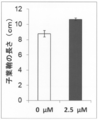
- sorghum (Btx623) seedlings were grown in MS medium (without sucrose) with or without 3B7N added under 10 ⁇ molm ⁇ 2 s ⁇ 1 blue light irradiation. The length of the cotyledon sheath on the sixth day after the start of blue light irradiation was recorded. The obtained result is shown in FIG.
- Example 10 ⁇ Identification of 3B7N target protein>
- the following bead binding experiment was performed assuming that the target molecule of 3B7N was CRY1, based on the experimental results of the microarray and the like described above.
- a similar binding experiment was performed using FLB2 instead of CRY1.
- FLB2 is a protein (FOX long under blue light 2, also known as BIC2) encoded by a gene that promotes hypocotyl elongation in a blue light-specific manner by mutation, similar to cry1.
- a target candidate protein (CRY1-HAtag, FLB2-HAtag) fused with a His tag was first prepared using a cell-free assay system.
- the prepared protein was substituted with the following buffer 2 and adjusted so that the protein concentration was approximately 150 mg / mL (CRY1-HAtag: 143 mg / mL, FLB2-HAtag: 152 mg / mL).
- 3B7N or A1 (3-bromoindazole) was bound to Sepharose beads according to a conventional method to prepare compound-bound beads (beads (3B7N), beads (A1)).
- Beads 3B7N
- beads (A1) As a negative control, Sepharose beads (beads ( ⁇ )) to which no compound was bound were also used for the following experiment.
- Buffer 1 composition 10 mM Tris-HCl pH 7.5, 50 mM KCl, 5 mM MgCl 2 , 1 mM EDTA Composition of buffer 2. Triton X100 was added to buffer 1 to a final concentration of 0.025% and 10% glycerol to a final concentration of 10%.
- the function of cryptochrome can be suppressed. Further, by suppressing the function, it becomes possible to promote the growth of plants under the irradiation of light including blue light.
- the present invention is useful as a plant growth promoter in the agricultural field (for example, production of biomass), a reagent for controlling cell functions in optogenetics using cryptochrome in the research and development field, and the like.
Landscapes
- Life Sciences & Earth Sciences (AREA)
- Environmental Sciences (AREA)
- Wood Science & Technology (AREA)
- Zoology (AREA)
- Health & Medical Sciences (AREA)
- Engineering & Computer Science (AREA)
- Dentistry (AREA)
- General Health & Medical Sciences (AREA)
- Pest Control & Pesticides (AREA)
- Plant Pathology (AREA)
- Agronomy & Crop Science (AREA)
- Biodiversity & Conservation Biology (AREA)
- Botany (AREA)
- Ecology (AREA)
- Forests & Forestry (AREA)
- Agricultural Chemicals And Associated Chemicals (AREA)
- Cultivation Of Plants (AREA)
Abstract
2個の窒素原子を含有し、水素原子又はハロゲン原子とニトロ基とが付加されている9員含窒素縮合芳香族複素環式化合物は、青色光受容体タンパク質であるクリプトクロムに結合し、該タンパク質の機能を抑制することを明らかにした。また、当該化合物は、青色光照射下で植物の生長を促進することも見出した。
Description
本発明は、9員含窒素縮合芳香族複素環式化合物を有効成分として含有する、クリプトクロムの機能を抑制するための組成物に関する。また本発明は、該化合物を有効成分として含有する、青色光を含む光の照射下で植物の生長を促進するための組成物に関する。
植物の生長にとって、光は非常に重要な環境刺激であり、その様々な波長の光に応じ、発芽、避陰反応、気孔開口、屈光性、脱黄化(緑化)、概日時計の調整及び開花期等の制御(光形態形成)がなされている。
また、植物は、様々な波長の光を感知するため、異なるグループに属する光受容体、すなわち、青色光を感知する光受容体タンパク質であるクリプトクロムと赤色光を感知する光受容体タンパク質であるフィトクロムとを有している。クリプトクロム(CRYs:CRY1及びCRY2)は、波長350~500nmにおける青色光及びUV-Aに反応し、フィトクロム(phyA~phyE)は、波長650~750nmにおける赤色光及び遠赤色光を吸収するために機能する。
そして、これら受容体は、光子を吸収することにより活性化され、下流のタンパク質等の発現及びそれらの相互作用を引き起こし、周囲の光環境に適応した生育及び生理学的反応に至る代謝を制御する機能を担っている。
例えば、苗の初期発達において、シロイヌナズナにおける脱黄化等の光形態形成と、光受容体 クリプトクロム及びフィトクロムとは、密接に関連していることは知られている(非特許文献1)。
また、青色光照射下ではシロイヌナズナ等の植物の胚軸伸長は抑制されることが知られているが、CRY1の機能欠損は、青色光によるこの抑制を解消し、胚軸の伸長(植物の生長)を促すことが明らかになっている(非特許文献1)。さらに、胚軸伸長の他、クリプトクロムは気孔開口、色素(アントシアニン)合成、及び開花期の制御を含む、生長発達過程におけるかなりの現象に関与することも報告されている(非特許文献2及び3)。
また、青色光シグナル伝達の分子機構に関し、開花期の制御においては、クリプトクロム結合ベーシックへリックスループへリックス1(CIB1)依存的なCRY2による制御が関与しており、CIB1がフラワリングローカスT(FT)遺伝子のプロモーター領域に結合することによって、その発現を活性化することが明らかになっている(非特許文献4、図1 参照)。
さらに、苗の発達段階を決定する上で、クリプトクロムはSuppressor Of PhyA 1(SPA1)/Constitutive Of Photomorphogenic 1(COP1)を制御することも明らかになっている。より具体的には、図1に示す通り、クリプトクロムは、SPA1/COP1による様々な転写因子(HY5、HYH、CO)の分解を抑制することによって、青色光制御遺伝子の発現プロファイルに変化をもたらし、苗の発達段階を決定することが明らかになっている(非特許文献5~8)。
このように、クリプトクロムが関与する青色光シグナル伝達は、植物の生長に大きく関与しているため、そのシグナル伝達を制御することにより、植物のサイズを大きくすることが期待できる。
Ahmad,M、Cashmore,A.R.、Plant J.、1997年、11巻、421~427ページ
Lin,C.、The Plant Cell、2002年、5:S207-S225
Giliberto,L.ら、Plant Physiol.、2005年、137巻、199~208ページ
Liu,Y.PLOS Genetics.、2013年、9:e1003861.
Fankhauser,C.、Ulm,R.、Gene Dev.、2011年、25巻、1004~1009ページ
Hong,S.H.ら、Plant J.、2008年、55巻、361~371ページ
Li,Q.H、Yang,H.Q.、Photochem Photobiol.、2007年、83巻、94~101ページ
Liu,H.,ら、Trends Plant Sci.、2011年、16巻、684~691ページ
本発明は、前記従来技術の有する課題に鑑みてなされたものであり、その目的は、クリプトクロムが関与する青色光シグナル伝達を抑制することを可能とする低分子化合物を提供することにある。特に、本発明は、青色光を含む光の照射下で植物の生長を促進することを可能とする低分子化合物を提供することを目的とする。
本発明者らは、まず、植物の生長を促進するための低分子化合物をスクリーニングするため、化学物質(3680種)にて各々処理したシロイヌナズナ(野生型)の苗を、青色光照射下で生長させた。その結果、青色光照射下における胚軸伸長の阻害を解消し、植物の生長を促進することができる化合物として、3-ブロモ-7-ニトロインダゾール(3B7N)を選抜することができた。さらに、バイオマスの原料として注目されているソルガムを、3B7Nにより処理し、青色光照射下にて生長させても、シロイヌナズナ同様に、該生長は促進されることを確認した。
次に、本発明者らは、3B7Nのアナログを用い、それら低分子化合物の構造と前記植物の生長促進との関係を分析した。その結果、2個の窒素原子を含有する9員含窒素縮合芳香族複素環をコア構造とし、このコア構造に、水素原子又はハロゲン原子とニトロ基とが任意の位置に付加されていれば、青色光による胚軸伸長の阻害に対して抑制効果を発揮できることを見出した。
青色光照射下にて育てた野生型の苗は、双葉のサイズが大きくなること(拡張)も知られている。そこで、本発明者らは、さらに3B7Nによる双葉のサイズへの影響を分析した。その結果、当該化合物は、青色光が調節する胚軸伸長の阻害のみならず、双葉の拡張をも抑制できることが明らかになった。
次いで、本発明者らは、3B7Nによる胚軸伸長等に関与する光受容体を同定するため、様々なシロイヌナズナ光受容体変異体株を3B7Nにて処理して青色光照射下で生長させた。その結果、CRY1及び/又はCRY2の機能欠損株においては、3B7Nによる植物の生長促進が抑制されたことから、クリプトクロム(CRY1、CRY2)が調節する青色光シグナル伝達に3B7Nが関与していることも明らかになった。さらに、マイクロアレイによる分析の結果、cry1cry2二重変異体(CRY1及びCRY2の機能欠損株)と、3B7Nにて処理した野生型とは、同じクラスターに分類され、それらの遺伝子発現プロファイルは近似していることが明らかになった。さらにまた、CRYによって制御される遺伝子発現の約半分が、3B7N処理によって阻害されこと、及び青色光制御遺伝子の多くは、3B7N処理によって青色光による制御とは逆にそれらの発現が制御されることが明らかになった。
次に、本発明者らは、3B7Nの標的分子がクリプトクロム自体であると想定し、それらの相互作用について分析した。その結果、3B7Nは、実際に、CRY1と結合することが明らかになった。
以上から、本発明者らは、3B7Nがクリプトクロムに結合してその機能を抑制することにより、当該光受容体タンパク質が調節する青色光シグナル伝達を抑制し、上述の植物の生長を促進していることを見出し、本発明を完成するに至った。
したがって、本発明は以下を提供するものである。
<1> 下記一般式(I)で表される含窒素縮合芳香族複素環式化合物を有効成分として含有する、クリプトクロムの機能を抑制するための組成物
<1> 下記一般式(I)で表される含窒素縮合芳香族複素環式化合物を有効成分として含有する、クリプトクロムの機能を抑制するための組成物

[前記式(I)中、A環とB環とは一緒になって、2個の窒素原子を含有する、9員含窒素縮合芳香族複素環式化合物であり、A環は6員芳香族炭化水素環又は6員芳香族複素環を示し、B環は5員芳香族炭化水素環又は5員芳香族複素環を示す。また、Xは水素原子又はハロゲン原子を示す]。
<2> 前記含窒素縮合芳香族複素環式化合物が3-ブロモ-7-ニトロインダゾールである、<1>に記載の組成物。
<3> 青色光を含む光の照射下で植物の生長を促進するための組成物である、<1>又は<2>に記載の組成物。
<2> 前記含窒素縮合芳香族複素環式化合物が3-ブロモ-7-ニトロインダゾールである、<1>に記載の組成物。
<3> 青色光を含む光の照射下で植物の生長を促進するための組成物である、<1>又は<2>に記載の組成物。
本発明によれば、クリプトクロムの機能を抑制することができる。また当該機能抑制により、青色光を含む光の照射下で植物の生長を促進させることが可能となる。特に、近年、化石エネルギー資源の枯渇が刻々と進行すると共に、地球温暖化が深刻な問題となっている。そのため、植物の生長を促進することのできる本発明は、石油等の化石燃料に代替するバイオマス植物の増産にも貢献するものである。また、本発明によれば、青色LED等の人工環境下でも植物の生長を促進することができるため、不安定な自然環境の影響を受けない安定した増産も可能となる。
後述の実施例において示す通り、本発明において、水素原子又はハロゲン原子とニトロ基とが任意の位置に付加されている、2個の窒素原子を含有する9員含窒素縮合芳香族複素環式化合物は、青色光受容体タンパク質であるクリプトクロム(CRY1、CRY2)に結合し、それらの機能を抑制することが明らかになった。
したがって、本発明は、下記一般式(I)で表される含窒素縮合芳香族複素環式化合物を有効成分として含有する、クリプトクロムの機能を抑制するための組成物を提供する。
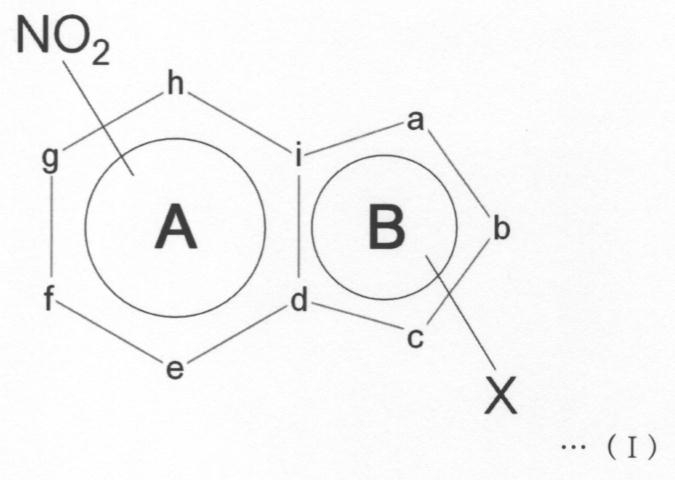
本発明の組成物において有効成分として含有される、前記「含窒素縮合芳香族複素環式化合物」は、前記式(I)中、A環とB環とは一緒になって、2個の窒素原子を含有する、9員含窒素縮合芳香族複素環式化合物である。なお、A環は6員芳香族炭化水素環又は6員芳香族複素環を示し、B環は5員芳香族炭化水素環又は5員芳香族複素環を示す。
前記式(I)において、2個の窒素原子の9員環上の位置としては特に制限はないが、クリプトクロムの機能をより強く抑制するという観点から、好ましくはa位とb位又はd位とであり、より好ましくはa位とb位とである。また、ニトロ基が付加される9員環上の原子としては特に制限はないが、同観点から、好ましくはf位又はh位の原子であり、より好ましくはh位の原子である。さらに、前記式(I)においては、水素原子又はハロゲン原子(塩素原子、フッ素原子、臭素原子又はヨウ素原子)が付加されるが、同観点から、好ましくはハロゲン原子であり、より好ましくは臭素原子又はヨウ素原子であり、さらに好ましくは臭素原子である。また、前記式(I)において、水素原子又はハロゲン原子が付加される9員環上の原子としては特に制限はないが、同観点から、好ましくはb位又はc位の原子であり、より好ましくはc位である。
本発明の組成物において有効成分として含有される「含窒素縮合芳香族複素環式化合物」は、より具体的に、クリプトクロムの機能をより強く抑制するという観点から、好ましくは、3-ブロモ-7-ニトロインダゾール、3-ヨード-7-ニトロインダゾール、3-ブロモ-6-ニトロイミダゾ[1,2-a]ピリジン、7-ニトロインダゾールであり、より好ましくは、3-ブロモ-7-ニトロインダゾール、3-ヨード-7-ニトロインダゾールであり、さらに好ましくは、3-ブロモ-7-ニトロインダゾールである。
また、本発明にかかる「含窒素縮合芳香族複素環式化合物」には、薬理学上許容される塩、水和物又は溶媒和物も含まれる。このような薬理学上許容される塩としては、特に制限はなく、当該化合物の構造等に応じて適宜選択することができ、例えば、酸付加塩(塩酸塩、硫酸塩、臭化水素塩、硝酸塩、硫酸水素酸塩、リン酸塩、酢酸塩等)、塩基付加塩(ナトリウム塩、カリウム塩、亜鉛塩、カルシウム塩等)が挙げられる。また、水和物又は溶媒和物としては、特に制限はなく、例えば、含窒素縮合芳香族複素環式化合物又はその塩1分子に対し、0.1~10分子の水又は溶媒が付加したものが挙げられる。
さらに、本発明にかかる含窒素縮合芳香族複素環式化合物には、互変異性体、幾何異性体、不斉炭素に基づく光学異性体、立体異性体等の総ての異性体及び異性体混合物が含まれる。さらに、本発明にかかる含窒素縮合芳香族複素環式化合物が生体内で酸化、還元、加水分解、アミノ化、脱アミノ化、水酸化、リン酸化、脱水酸化、アルキル化、脱アルキル化、抱合等の代謝を受けてなお所望の活性を示す化合物をも包含し、また本発明は生体内で酸化、還元、加水分解等の代謝を受けて本発明にかかる含窒素縮合芳香族複素環式化合物を生成する化合物をも包含する。
上述の通り、本発明において好適に用いられる含窒素縮合芳香族複素環式化合物(3-ブロモ-7-ニトロインダゾール等)は、いずれもそれら自体既知であり、市販されている。これらの化合物以外の本発明で用いられる化合物は、既知化合物として存在する場合は、それらを入手し、またそうでない場合には、それらが類似する既知化合物に準じて、当業者であれば適宜製造することができる。
本発明において、「クリプトクロム」とは、青色光を吸収する青色光受容体タンパク質を意味し、例えば、CRY1タンパク質、CRY2タンパク質が挙げられる。また、その由来としては特に制限はないが、植物由来のものが好適に用いられ、典型的に、シロイヌナズナCRY1タンパク質は、NCBI Reference Sequence:NP_567341で特定されるアミノ酸配列からなるタンパク質(NCBI Reference Sequence:NM_116961で特定されるヌクレオチド酸配列がコードするタンパク質)であり、またシロイヌナズナCRY2タンパク質は、NCBI Reference Sequence:NP_171935で特定されるアミノ酸配列からなるタンパク質(NCBI Reference Sequence:NM_100320で特定されるヌクレオチド酸配列がコードするタンパク質)である。
本発明における「クリプトクロムの機能の抑制」には、機能の完全な抑制(阻害)及び部分的な抑制の双方が含まれる。また、本発明において抑制される「クリプトクロムの機能」としては、例えば、クリプトクロムが関与する青色光シグナル伝達、及び、植物においては、該シグナル伝達によって誘導される光形態形成が挙げられる。クリプトクロムが関与する青色光シグナル伝達としては、例えば、クリプトクロムにおける青色光の受光、該受光によって生じるクリプトクロムのリン酸化、該リン酸化によって誘導されるクリプトクロムの核から細胞質への移行、該リン酸化によって誘導されるクリプトクロムと、SPA1及びCOP1からなる複合体、CIB1又はMYBLとの結合、前記他のタンパク質とクリプトクロムとの結合によって生じる転写因子(HY5、CO等)の発現安定化、青色光制御遺伝子の発現制御(例えば、後記表1に示す遺伝子の発現制御)が挙げられる。また、植物における光形態形成としては、例えば、胚軸伸長阻害、双葉の拡張(展開)、双葉(子葉)の開閉、気孔開口、色素(アントシアニン)合成、脱黄化、開花期の制御、及び、単子葉植物における子葉鞘等の実生の伸長阻害が挙げられる。
<農業用組成物、植物の生長促進方法>
上述の本発明にかかる含窒素縮合芳香族複素環式化合物は、後述の実施例において示す通り、青色光による胚軸伸長阻害を抑制し、該伸長を促進し、ひいては植物の生長を促進する作用を有する。
上述の本発明にかかる含窒素縮合芳香族複素環式化合物は、後述の実施例において示す通り、青色光による胚軸伸長阻害を抑制し、該伸長を促進し、ひいては植物の生長を促進する作用を有する。
したがって、本発明は、本発明にかかる含窒素縮合芳香族複素環式化合物を有効成分として含有する、青色光を含む光の照射下で植物の生長を促進するための組成物(農業用組成物)、並びに植物の生長を促進させるための方法であって、本発明にかかる含窒素縮合芳香族複素環式化合物によって植物を処理し、青色光を含む光の照射下で該植物を生育させる方法(植物生長促進方法)を提供するものである。
本発明において生長促進の対象となる「植物」は特に制限はなく、例えば、双子葉植物(シロイヌナズナ、ダイズ等)及び単子葉植物(ソルガム、イネ、トウモロコシ、コムギ等)を含む被子植物、裸子植物、コケ植物、シダ植物、草本植物、並びに木本植物が挙げられる。これら植物の遺伝子組み換え体やゲノム編集体(例えば、除草剤耐性作物、害虫耐性作物、病害耐性作物、食味向上作物、保存性向上作物、収量向上作物)であっても良い。
また、本発明で利用される「青色光」の波長は、350nm~500nm、好ましくは450nm~500nmである。また本発明で利用される「青色光」の光量子束密度(フルエンスレート)は特に制限はなく、照射する植物の種類や状態などによって適宜調整し得るが、好ましくは、1~500μmoLm-2s-1であり、より好ましくは1~100μmoLm-2s-1、さらに好ましくは1~50μmoLm-2s-1であり、より好ましくは1~15μmoLm-2s-1であり、さらに好ましくは5~10μmoLm-2s-1である。
また、本発明において「青色光を含む光」とは青色光のみであってもよいが、青色光に加えて、さらに波長が650nm~700nmの赤色光、波長が700nm~770nmの遠赤色光等が混合した光であってもよく、いわゆる白色光であってもよい。
本発明において、前記光の照射を行うために用いる光源としては、特に制限はなく、発光ダイオード(LED)、レーザー光源、蛍光ランプ(直管形、コンパクト形)、電球形蛍光ランプ、高圧放電ランプ、メタルハライドランプ等が利用できる。また、かかる人工光源に限らず、本発明においては太陽光も利用することができる。さらに、所望により所定波長域の光を選択的に利用するために光フィルタを、これら光源に組み合わせて植物に照射することもできる。また、本発明にかかる光源としては、波長選択が容易で、有効波長域の光エネルギーの占める割合が大きく、またコスト、長寿命性等の観点からから、LEDを利用することが好ましい。
本発明の農業用組成物には、上述の含窒素縮合芳香族複素環式化合物以外にも、農薬等において通常用いられている担体、乳化剤、分散剤、展着剤、湿展剤、固着剤、崩壊剤等の補助剤を含有させることができる。
担体としては、例えば、水、エタノール、メタノール、イソプロパノール、ブタノール、エチレングリコール、プロピレングリコール等のアルコール類、アセトン、メチルエチルケトン、シクロヘキサノン等のケトン類、酢酸エチル等のエステル類、並びに、固体担体、例えば、タルク、ベントナイト、クレー、カオリン、ケイソウ土、ホワイトカーボン、バーミキュライト、消石灰、ケイ砂、硫安、尿素等が例示される。
担体以外の補助剤としては、通常、界面活性剤が用いられ、例えば、陰イオン系界面活性剤、陽イオン系界面活性剤、非イオン系界面活性剤又は両性イオン系界面活性剤が挙げられ、これらは単独又は2種以上を混合して使用することができる。
本発明の農業用組成物の剤形は特に限定されず、乳剤、懸濁剤、粉剤、水和剤、水溶剤、粒剤、ペースト剤、エアゾール剤等が挙げられる。
本発明の農業用組成物中の含窒素縮合芳香族複素環式化合物の含有量は、対象植物の種類、対象植物の生育状況、天候、環境条件、剤形、使用方法(散布処理、土壌処理、種子処理、水耕処理等)、使用場所、使用時期等によって異なるが、当業者であればこれらの条件に合わせて適宜調整することができる。
また、本発明の植物生長促進方法においては、本発明にかかる含窒素縮合芳香族複素環式化合物をそのまま、又は水等で適宜希釈し、若しくは懸濁させた形で植物生長促進効果発現に有効な量を対象植物に散布(茎葉散布等)、塗布又は注入処理、対象植物の周辺土壌への散布又は灌注処理、対象植物の種子に種子処理(粉衣又は浸漬処理等)等を行うことにより、所望の植物の生長を促進させることができる。
なお、本発明にかかる含窒素縮合芳香族複素環式化合物にて植物を処理する時期(使用時期)としては特に制限はなく、対象の植物に合わせて適宜調整すればよいが、好ましくは、種子、苗の段階である。また、種又は苗を浸漬処理する際の含窒素縮合芳香族複素環式化合物の濃度としても特に制限なく、対象の植物に合わせて適宜調整すればよいが、好ましくは0.1~10μMであり、より好ましくは0.25~7.5μMであり、さらに好ましくは2.5~5μMである。
さらに、本発明の植物生長促進方法における、青色光を含む光の照射時間は特に制限はなく、対象植物の種類、対象植物の生育状況等に合わせて適宜調整することができるが、好ましくは12~24時間/日であり、より好ましくは24時間/日である。
本発明の農業用組成物の使用においては、病害虫及び雑草等の防除、効果の増強、植物の薬害軽減等の目的で、農園芸用殺菌剤、農園芸用殺虫剤、農園芸用除草剤、共力剤及び薬害軽減剤等を同時に使用することができる。
<オプトジェネティクス用組成物>
本発明の組成物は、上記農業目的に限らず、研究目的(例えば、インビトロやインビボの実験)に用いられる試薬等の形態でもあり得、例えば、オプトジェネティクス(光遺伝学)においても好適に用いることができる。
本発明の組成物は、上記農業目的に限らず、研究目的(例えば、インビトロやインビボの実験)に用いられる試薬等の形態でもあり得、例えば、オプトジェネティクス(光遺伝学)においても好適に用いることができる。
オプトジェネティクスとは、クリプトクロム等の特定波長の光によって活性化されるタンパク質(光活性化タンパク質)を標的細胞に導入し又は発現させ、当該細胞の機能を前記特定波長の光を照射することによって制御する技術である。その一方、後述の実施例において示す通り、本発明にかかる含窒素縮合芳香族複素環式化合物は、クリプトクロムに結合し、該光活性化タンパク質の青色光照射による活性化を抑制する作用を有する。したがって、クリプトクロムを用いたオプトジェネティクスにおいて制御される標的細胞の機能を、本発明にかかる含窒素縮合芳香族複素環式化合物によって更に制御することが可能となる。
すなわち、本発明は、本発明にかかる含窒素縮合芳香族複素環式化合物を有効成分として含有する、青色光を含む光の照射によって活性化される細胞の機能を抑制するための組成物であって、前記細胞は、クリプトクロム又は該タンパク質を含む融合タンパク質を含む細胞であり、かつ前記機能は、青色光を含む光の照射による前記タンパク質の活性化に伴って活性化される機能である、組成物を提供するものである。
また、本発明は、青色光を含む光の照射によって活性化される細胞の機能を抑制するための方法であって、本発明にかかる含窒素縮合芳香族複素環式化合物を前記細胞に導入する工程を含み、前記細胞は、クリプトクロム又は該タンパク質を含む融合タンパク質を含む細胞であり、かつ前記機能は、青色光を含む光の照射による前記タンパク質の活性化に伴って活性化される機能である、方法を提供するものである。
上記細胞の機能を抑制するための組成物、並びに方法において、「本発明にかかる含窒素縮合芳香族複素環式化合物」、「クリプトクロム」及び「青色光を含む光の照射」については上記の通りである。
本発明にかかる含窒素縮合芳香族複素環式化合物によって、青色光を含む光の照射によって活性化される機能が抑制される「細胞」としては、その種類(例えば、神経細胞)、その由来(例えば、ヒト由来、非ヒト哺乳動物由来)については特に制限はなく、また細胞のみならず、その集合体(例えば、組織、臓器、個体)も本発明にかかる「細胞」には含まれる。
前記「機能」としては特に制限はなく、例えば、転写開始、遺伝子組み換え、ゲノム編集、ヒストンのアセチル化、ヌクレオチドの生合成、遺伝子発現、シグナル伝達、アクチンの重合促進、タンパク質分解、タンパク質輸送、タンパク質分泌、神経の活性化又は抑制が挙げられる。また、当業者であれば公知のオプトジェネティクス(例えば、Kennedy MJ.ら、Nat Methods.、2010年12月、7巻、12号、973~975ページ、Konermann S.ら、Nature、2013年8月22日、500巻、7463号、472~476ページ、Nihongaki Y.ら、Chem Biol.、2015年2月19日、22巻、2号、169~174ページ、Kyung T.ら、Nat Biotechnol.、2015年10月、33巻、10号、1092~1096ページ、特開2011-142828号公報、Gautier A.ら、Nat Chem Biol.、2014年7月、10巻、7号、533~541ページ)を適宜参照して、所望の機能が、前記細胞において青色光を含む光の照射によって活性化されるよう調製することができる。
青色光を含む光の照射によって前記機能が活性化されるために、前記細胞に含まれるタンパク質としては、クリプトクロム自体であってもよく、クリプトクロムを含む融合タンパク質であってもよい。なお、かかるタンパク質を含む細胞の調製としては、特に制限はなく、前記タンパク質をコードするDNA(例えば、ウィルスベクター)を前記細胞に導入することにより調製してもよく、また前記タンパク質を直接細胞内に導入(例えば、マイクロインジェクション、エレクトロポレーション)することにより調製することができる。
「クリプトクロムを含む融合タンパク質」としては、クリプトクロムの全部を含む融合タンパク質であってもよく、またその一部(例えば、光感受性領域)を含む融合タンパク質であってもよい。さらに融合タンパク質に含まれるクリプトクロム以外のペプチドとしては特に制限はなく、上記所望の機能に応じて適宜選択されるものであり、例えば、DNA結合ドメイン(例えば、TALE、Zincフィンガードメイン、CRISPER-Cas、Gal4結合ドメイン)、DNA組換え酵素(例えば、Cre、FokI)、転写活性化因子(例えば、VP16、VP64)、転写抑制因子(例えば、KRAB)、ヒストン修飾酵素、チャネルタンパク質、チャネル制御因子(例えば、STIM1)、GTPase(例えば、RacI)が挙げられる。
本発明にかかる含窒素縮合芳香族複素環式化合物の細胞への導入は、通常、当該化合物の溶液(溶媒としては、水、生理食塩水、又は該細胞の培地)を前記細胞に接触(塗布、浸漬)することによって達成することができるが、マイクロインジェクション、エレクトロポレーション等を用いて、前記細胞に強制的に導入することもできる。
以下、実施例に基づいて本発明をより具体的に説明するが、本発明は以下の実施例に限定されるものではない。また、本実施例は、以下に示す材料及び方法を用いて行った。
<植物材料及び生長条件>
シロイヌナズナの変異体は、Columbia(Col-0)又はWassilewskija(Ws)をバックグランドとするものを用いた。シロイヌナズナの光形態形成変異体の種のストック(phyAphyB、cry1cry2、cry1、cry2、hy5、cop1-4、cop1-6、hfr1及びlaf1)は、シロイヌナズナバイオリソースセンター(オハイオ州立大学、コロンバス)より入手した。過剰発現株CRY1-OX及びCRY2-OXの種(Lin,C.ら、Plant J.、1996年、10巻、893~902ページ、Lin,C.ら、Proc.Natl.Acad.Sci.、1998年、95巻、2686~2690ページ)は、Dr.Chentao Linより譲り受けた。また、hy5hyhの種は、Dr.Xing-Wang Dengより譲り受けた(Holm,M.ら、Gene Dev.、2002年、16巻、1247~1259ページ)。
シロイヌナズナの変異体は、Columbia(Col-0)又はWassilewskija(Ws)をバックグランドとするものを用いた。シロイヌナズナの光形態形成変異体の種のストック(phyAphyB、cry1cry2、cry1、cry2、hy5、cop1-4、cop1-6、hfr1及びlaf1)は、シロイヌナズナバイオリソースセンター(オハイオ州立大学、コロンバス)より入手した。過剰発現株CRY1-OX及びCRY2-OXの種(Lin,C.ら、Plant J.、1996年、10巻、893~902ページ、Lin,C.ら、Proc.Natl.Acad.Sci.、1998年、95巻、2686~2690ページ)は、Dr.Chentao Linより譲り受けた。また、hy5hyhの種は、Dr.Xing-Wang Dengより譲り受けた(Holm,M.ら、Gene Dev.、2002年、16巻、1247~1259ページ)。
そして、このようにして調製した種は、消毒し、1/2xムラシゲスクーグ培地、ガンボーグビタミン培地(MS;JRH Biosciences,Lenexa,KS)及び2-モルホリノエタンスルホン酸(MES)、pH5.7を組成とする液体培養アッセイ又は1%アガーの寒天培地に植えた。そして、プレートは4℃の暗室にて、発芽する迄の3日間維持した。
<光源及び強度>
シロイヌナズナの苗には、単色光LEDにて、青色光、赤色光又は遠赤色光を照射した。胚軸伸長における異なる青色光の強度の影響を試験するため、光量子密度1、5、10又は15μmoLm-2s-1の青色光(波長:450nm)を用いた。赤色光(波長:660nm)及び遠赤色光(波長:730nm)に関しては、光量子密度を各々10μmoLm-2s-1及び1μmoLm-2s-1にして用いた。
シロイヌナズナの苗には、単色光LEDにて、青色光、赤色光又は遠赤色光を照射した。胚軸伸長における異なる青色光の強度の影響を試験するため、光量子密度1、5、10又は15μmoLm-2s-1の青色光(波長:450nm)を用いた。赤色光(波長:660nm)及び遠赤色光(波長:730nm)に関しては、光量子密度を各々10μmoLm-2s-1及び1μmoLm-2s-1にして用いた。
<化合物ライブラリー、及び液体培養アッセイによるスクリーニング>
スクリーニングには、計3760の化学物質からなるライブラリー(The Library of Active Compounds on Arabidopsis(LATCA))を用いた。このライブラリーには、シロイヌナズナの形態を指標とするスクリーニングにおいて活性が認められた化合物、酵母における生長阻害活性が認められた化合物、除草剤、一般的な阻害剤、植物ホルモン、及びその他の生理活性化号物が含まれている。
スクリーニングには、計3760の化学物質からなるライブラリー(The Library of Active Compounds on Arabidopsis(LATCA))を用いた。このライブラリーには、シロイヌナズナの形態を指標とするスクリーニングにおいて活性が認められた化合物、酵母における生長阻害活性が認められた化合物、除草剤、一般的な阻害剤、植物ホルモン、及びその他の生理活性化号物が含まれている。
そして、1/2xムラシゲスクーグ培地、ガンボーグビタミン培地(MS;JRH Biosciences,Lenexa,KS)及びMES、pH5.7を組成とする液体培地50μLにて、野生型Col-0の種を4~6個生長させ、LACTA化学物質を対象とする大規模スクリーニングを行った。
より具体的には、全ての化学物質を対象とする第一スクリーニングは、液体培地を添加した96ウェルプレートを用いて行った。また、各プレートにおいて、第1カラムは1:100になるよう希釈したジメチルスルホキシド(DMSO)にて処理した。さらに、化学物質を最終濃度2.5μMになるよう、種を種いた培地に添加し、プレートに青色光を連続的に6日間照射した。そして、苗の画像は、オリンパス社製IX-91カメラにて取得した。
<胚軸の長さを指標とする化学物質の評価>
3B7N及びそのアナログ、並びにNO消去剤をDMSOにて溶解し、50℃以下の温度の寒天培地に添加し、混合して4℃にて保持した上で、苗の生長に供した。
3B7N及びそのアナログ、並びにNO消去剤をDMSOにて溶解し、50℃以下の温度の寒天培地に添加し、混合して4℃にて保持した上で、苗の生長に供した。
<胚軸の長さの測定>
胚軸の画像は、各単色光を6日間照射した後に、AF-S DX Zoom-Nikkor 18-70mm f/3.5-4.5G IF-EDレンズを備えたニコン社製のカメラにて取得した。全ての測定値は、ImageJソフトウェアを用いて算出した。定量的データは、少なくとも25の苗に対して、各条件を計3回繰り返して処理した結果の平均値として示す。
胚軸の画像は、各単色光を6日間照射した後に、AF-S DX Zoom-Nikkor 18-70mm f/3.5-4.5G IF-EDレンズを備えたニコン社製のカメラにて取得した。全ての測定値は、ImageJソフトウェアを用いて算出した。定量的データは、少なくとも25の苗に対して、各条件を計3回繰り返して処理した結果の平均値として示す。
異なる光源間の胚軸測定を同期させるため、苗は赤色光(10μmoLm-2s-1)に3時間曝露させた後に、6時間暗下に置き、その後異なる光源下にて6日間、連続的な光に曝露させた。
統計解析は、胚軸測定結果についてはone-way ANOVAを用いて行った。また、3B7N化合物処理とDMSO処理とにおける、胚軸の長さの変化の有意性についてはスチューデントt検定(P<0.05)にて判定した。
<遺伝子発現プロファイリング>
青色光(10μmoLm-2s-1)照射下、最終濃度が2.5μMになるように化学物質を添加した寒天培地にて4日間生長させた苗を回収して用いた。なお、野生型Col-0バックグランド及びcry1cry2変異体について、化学物質処理又は非処理を3回繰り返して(生物学的反復)、発現プロファイリングを行った。
青色光(10μmoLm-2s-1)照射下、最終濃度が2.5μMになるように化学物質を添加した寒天培地にて4日間生長させた苗を回収して用いた。なお、野生型Col-0バックグランド及びcry1cry2変異体について、化学物質処理又は非処理を3回繰り返して(生物学的反復)、発現プロファイリングを行った。
回収した苗から、トータルRNAは、RNeasy Plant Mini RNAキット(Qiagen社製)を用い、その添付の説明書に従って抽出した。トータルRNAの純度及び完全性については、NanodropND-1000スペクトロメーターversion 3.1.0(NanoDrop Technologies社製)及びRNA 6000 Nano Chip on a Bioanalyzer(Agilent Technologies社製)を用い、モニターした。
次いで、約1μgのトータルRNAを、Agilent Quick Ampラベリングキットを用いてCy3にて標識し、各600ngをマイクロアレイハイブリダイゼーションに供した。そして、Agilent スキャナーG2505C US45103077を用いてイメージをスキャンし、得られたスキャンイメージからFeature Extractionソフトウェアを用いて全てのデータを取得した。
rawファイルは、GeneSpring version 12.1-GX(Agilent Technologies社製)を用い、75パーセンタイルにてシグナル強度を正規化し、シグナルをlog2変換することにより、精査した。
統計解析においては、Benjamini and Hochberg FDRにて補正したt検定のP値が0.05以下となるエンティティを、有意な発現変化が生じているものとして更に同定した。
2倍以上の発現変化を示した遺伝子を、野生型バックグランドにおいて同定し、またcry1cry2変異体における発現にフィルタをかけるため、更に比較した。
なお、この研究のマイクロアレイデータは、NCBIの遺伝子発現オムニバスに提出してある。
<遺伝子アノテーション>
用いた主な化学物質の性質は、ヒト及びマウスにおいて知られた機能を有する。そのため、進化上関連するタンパク質のファミリー及び同じ機能を有するタンパク質のサブファミリーに基づきハイスループット解析を促進するため、タンパク質(遺伝子)を分類するように設計されているPANTHER Classificationシステムを用いて、遺伝子を注釈付けした。
用いた主な化学物質の性質は、ヒト及びマウスにおいて知られた機能を有する。そのため、進化上関連するタンパク質のファミリー及び同じ機能を有するタンパク質のサブファミリーに基づきハイスループット解析を促進するため、タンパク質(遺伝子)を分類するように設計されているPANTHER Classificationシステムを用いて、遺伝子を注釈付けした。
(実施例1)
<シロイヌナズナの生長を促進するための低分子化合物のスクリーニング>
シロイヌナズナの苗の早期発育を促進するための低分子化合物を同定するため、ケミカルライブラリー中の各化学物質(3680種)の存在下、野生型(WT)(Col-0)の苗を生長させた。すなわち、各化学物質2.5μMの濃度にて苗を処理し、連続的な青色光照射下、96ウェルマイクロタイタープレートに添加した液体培地の中で生長させた。そして、化学物質処理してから6日後の苗を、DMSO処理したコントロールの苗と比較し、82種の化合物を胚軸伸長を引き起こす化合物として選抜した。
<シロイヌナズナの生長を促進するための低分子化合物のスクリーニング>
シロイヌナズナの苗の早期発育を促進するための低分子化合物を同定するため、ケミカルライブラリー中の各化学物質(3680種)の存在下、野生型(WT)(Col-0)の苗を生長させた。すなわち、各化学物質2.5μMの濃度にて苗を処理し、連続的な青色光照射下、96ウェルマイクロタイタープレートに添加した液体培地の中で生長させた。そして、化学物質処理してから6日後の苗を、DMSO処理したコントロールの苗と比較し、82種の化合物を胚軸伸長を引き起こす化合物として選抜した。
次に、2回目のスクリーニングにおいては、更に様々な波長の光(青色光、赤色光、又は遠赤色光)の照射下にて、野生型の種を候補化合物と共に培養した。そして、異なる光照射における苗の形状を比較した結果、青色光照射下でのみ胚軸伸長を促進させる特異的な化合物として、3-ブロモ-7-ニトロインダゾール(3B7N、下記化学式で表される化合物)を同定した(図2のA参照のこと)。

また、上記液体培養アッセイにおける結果を確認するため、野生型の種を2.5μM 3B7N含有寒天培地にて育てた。得られた結果を図2のBに示す。
図2に示した結果から明らかな通り、3B7Nは青色光照射下のみにおいて胚軸生長を促進させ、暗、赤色光、遠赤色光では促進させることはできなかった。
したがって、これらの結果から、3B7Nによる胚軸伸長の制御は、青色光特異的な事象であることが示された。
(実施例2)
<苗の発育阻害における、化合物の濃度及び光強度の依存性についての検証>
3B7Nを異なる量、苗の培地に添加することによって、当該苗の生理学的変化の程度も異なる可能性がある。そこで、シロイヌナズナの野生型の苗を、3B7Nの濃度希釈系列にて処理し、連続的な青色光照射下(光量子密度:1~15μmoLm-2s-1)にて育てた。得られた結果を図3に示す。
<苗の発育阻害における、化合物の濃度及び光強度の依存性についての検証>
3B7Nを異なる量、苗の培地に添加することによって、当該苗の生理学的変化の程度も異なる可能性がある。そこで、シロイヌナズナの野生型の苗を、3B7Nの濃度希釈系列にて処理し、連続的な青色光照射下(光量子密度:1~15μmoLm-2s-1)にて育てた。得られた結果を図3に示す。
図3に示した結果から明らかな通り、照射する青色光の光強度増大に応じて胚軸伸長は比例的に阻害された。すなわち、3B7Nで処理しなかった苗(DMSOで処理したコントロール)において、1μmoLm-2s-1の青色光照射下における胚軸が最長であり、青色光の光強度の増大に伴って短くなっていった。また、0.5μM 3B7Nで処理した苗は、いずれの光強度の条件下においても、コントロールより胚軸は長くなった。この結果から、3B7Nは少なくとも0.5μMあれば、胚軸の伸長を促進できることが、示された。
さらに、光強度の増大に応じて胚軸伸長は低減する傾向にあるにも関わらず、図3に示す通り、2.5μM以上の濃度の3B7Nにて処理した苗の長さは、様々な光強度の青色光照射下で大概同じであった。これらの結果から、青色光照射下、胚軸伸長に阻害的効果を示す3B7Nの飽和濃度は、2.5μMであることが示された。
(実施例3)
<3B7Nアナログによる胚軸伸長への影響についての検証>
3B7Nは、哺乳類における神経型一酸化窒素(NO)合成酵素の阻害剤として知られている(Bedrosian,T.A.ら、HormBehav.、2012年、61巻、176~180ページ)。そこで、青色光照射への胚軸の反応における、NO阻害効果について調べた。
<3B7Nアナログによる胚軸伸長への影響についての検証>
3B7Nは、哺乳類における神経型一酸化窒素(NO)合成酵素の阻害剤として知られている(Bedrosian,T.A.ら、HormBehav.、2012年、61巻、176~180ページ)。そこで、青色光照射への胚軸の反応における、NO阻害効果について調べた。
すなわち、3B7Nの代わりに、NO消去剤として知られる、Nω-nitro-l-arginine methyl ester hydrochloride(L-NAME)、diethylamine NONOate sodium(DEA-NONOate)又は2-(4-carboxyphenyl)-4,4,5,5-tetramethylimidazoline-1-oxyl-3-oxide(C-PTIO)にて、シロイヌナズナの種を処理し、上記同様に青色光照射下にて生長させた。得られた結果を図4に示す。
図4に示した結果から明らかなように、添加濃度を5μMとする3B7Nで処理した苗のみにおいて、青色光照射下、胚軸伸長が認められた。一方、L-NAME,C-PTIO又はDEA-NONOateで処理した苗の胚軸の長さが、コントロールとしてDMSOで処理したそれと同様であった。したがって、NO制御は、3B7Nによるシロイヌナズナ野生型苗における表現型の変化に寄与するものでないことが示唆される。
次に、3B7Nの構造とそれによって誘導される表現型との関係を分析するため、3B7Nの6つのアナログを、ナカライテスク、和光純薬工業株式会社及びシグマアルドリッチから購入した。なお、下記化学式にて示す通り、それらアナログは全て、2つの主たるコア構造としてジアゾールとベンゼンとを有する。しかし、これらコア構造に付加する官能基の有無、又は位置において異なる。
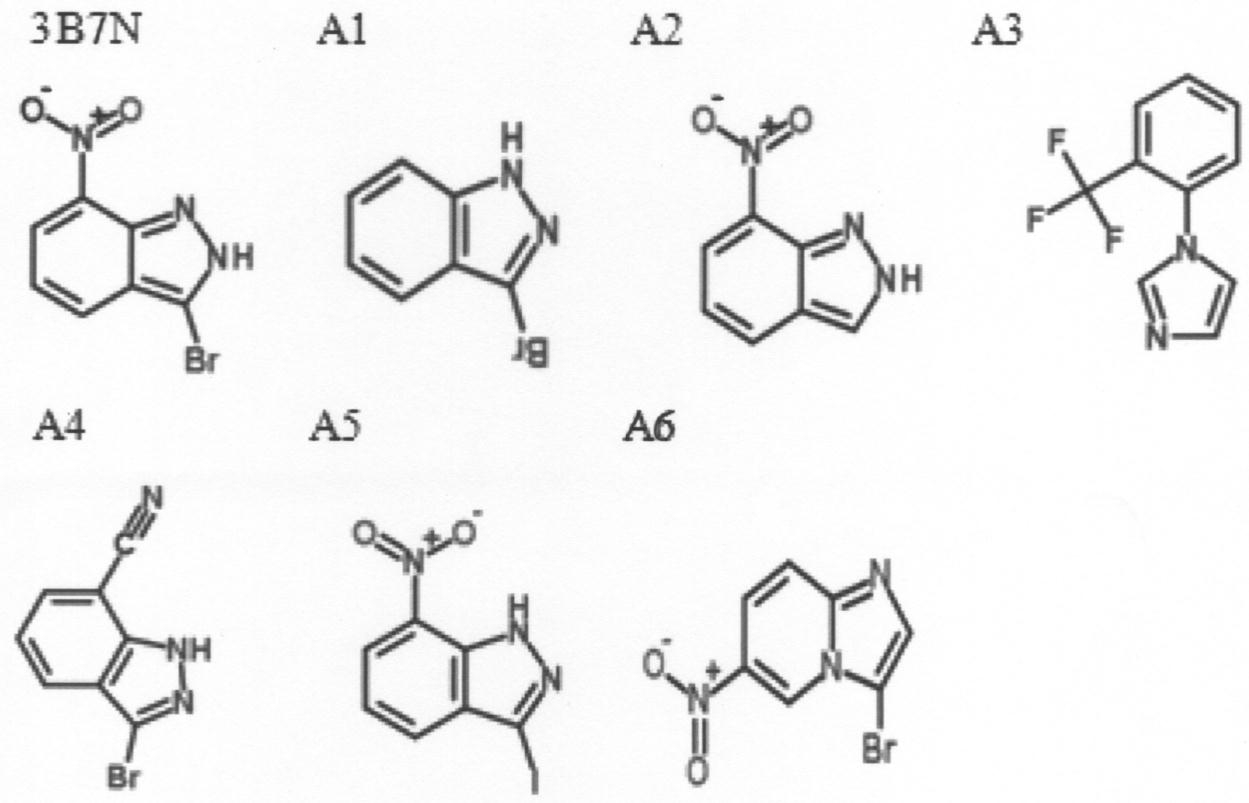
そして、最終濃度2.5μMにて調整したこれらアナログにてシロイヌナズナの種を処理し、上記同様、青色光照射下にて生長させた。得られた結果を図5に示す。
図5に示した結果から明らかなように、3種のアナログ(A2、A5、A6)は、DMSOにて処理したコントロールと比較して、青色光による胚軸伸長の阻害に対して効果を発揮することで、胚軸をより長くした。特に、3B7NのBr基がI基に置換されているA6が、それら陽性アナログの中において、青色光による胚軸伸長の阻害に対して最も強い効果を発揮した。一方、NO2基を除去したもの(A1)又はNO2基を二トリル部分に置換したもの(A4)においては、ベンゼンとジアゾールとを組み合わせたもの(A3)同様に、完全に前記効果が消失した。
したがって、ジアゾール部分はハロゲン原子又は水素原子によって置換されており、さらにベンゼン部分においてはNO2基によって置換されていることが、青色光による胚軸伸長の阻害に対して効果を発揮する上で必要であることが明らかになった。
なお、図には示していないが、前記3種の陽性アナログは、赤色光又は遠赤色光の照射下における胚軸反応において、わずかな変化しか生じさせず、これら陽性アナログにおいて、コントロールよりも胚軸の長さが長くなるものはなかった。
また、図5に示す通り、これら3種のアナログは、青色光シグナル伝達において異なるレベルの阻害効果を発揮する。かかるレベルを、3B7N処理における生長を基準として評価した。その結果、A5のスコアは0.7であり、次いで、A6のスコアは0.3であり、A2のスコアは0.23であった。
(実施例4)
<クリプトクロムが調節する青色光シグナル伝達と3B7Nによる胚軸伸長促進との関連性についての検証>
3B7Nによる胚軸変化に関与する光受容体を同定するため、光受容体の変異体の種を3B7Nに処理し、上記同様に青色光照射下にて生長させた。得られた結果を図6に示す。
<クリプトクロムが調節する青色光シグナル伝達と3B7Nによる胚軸伸長促進との関連性についての検証>
3B7Nによる胚軸変化に関与する光受容体を同定するため、光受容体の変異体の種を3B7Nに処理し、上記同様に青色光照射下にて生長させた。得られた結果を図6に示す。
図6に示す通り、2重変異体phyAphyB及びcry1cry2は、それら各コントロール処理と比較して、3B7Nに対する胚軸の反応において異なるものであった。すなわち、3B7N処理によって、phyAphyBは、連続的な青色光照射下で、胚軸の長さが長くなった。一方、cry1cry2に関しては、胚軸伸長において有意な変化が認められなかった。したがって、クリプトクロム(CRY1、CRY2)が調節する青色光シグナル伝達が、3B7Nによる胚軸伸長の促進において必要であることが示唆された。
そこで、3B7N処理における胚軸伸長の制御において、各クリプトクロムの役割を更に理解するため、単独変異体、CRY1遺伝子又はCRY2遺伝子の過剰発現体(CRY1-OX及びCRY2-OX)について評価した。得られた結果を図6に示す。
図6に示した結果から明らかなように、cry2変異体は3B7N添加により胚軸の長さが2倍になった一方で、cry1変異体においては有意な変化は認められなかった。また、過剰発現体CRY1-OX及びCRY2-OXにおいては、胚軸の長さにおいていくらかの変化が認められ、コントロールと比較した場合、CRY2-OXは、CRY1-OXよりも、3B7N処理によって胚軸の長さがより長くなった。
したがって、CRY1及びCRY2が共に調節する青色光シグナル伝達に3B7Nは関与すること、並びに3B7Nによって影響を受ける主な光受容体はCRY1であることが示された。
(実施例5)
<3B7Nによるクリプトクロムシグナル伝達の阻害機構についての解析>
クリプトクロム(CRYs)等の光受容体は光を受ける。そして、活性型の光受容体は、他の構成分子と相互作用し、結果として転写因子(TFs)の安定又は分解が生じ、光調節遺伝子の発現における組織的な変化が引き起こされることになる(Zhang,H.、Plant J.、2011年、65巻、346~358ページ)。例えば、図1に示す通り、クリプトクロムシグナル伝達を介した光形態形成の引き金となる、Elongated Hypocotyl 5(HY5)タンパク質の安定性を決定することに、CRYsとCOP1との相互作用が関与することが知られている(Li,Q.H and Yang,H.Q.、Photochem Photobiol.、2007年、83巻、94~101ページ)。
<3B7Nによるクリプトクロムシグナル伝達の阻害機構についての解析>
クリプトクロム(CRYs)等の光受容体は光を受ける。そして、活性型の光受容体は、他の構成分子と相互作用し、結果として転写因子(TFs)の安定又は分解が生じ、光調節遺伝子の発現における組織的な変化が引き起こされることになる(Zhang,H.、Plant J.、2011年、65巻、346~358ページ)。例えば、図1に示す通り、クリプトクロムシグナル伝達を介した光形態形成の引き金となる、Elongated Hypocotyl 5(HY5)タンパク質の安定性を決定することに、CRYsとCOP1との相互作用が関与することが知られている(Li,Q.H and Yang,H.Q.、Photochem Photobiol.、2007年、83巻、94~101ページ)。
そこで、クリプトクロムが関与するシグナル伝達における3B7Nによる阻害機構を解析するため、COP1の劣性対立遺伝子を有する2種のシロイヌナズナを用いて、上記同様3B7Nの胚軸伸長への影響を評価した。得られた結果を図7に示す。
図7に示した結果から明らかなように、3B7N処理後、青色光照射下、cop1-4及びcop1-6においては共に、胚軸伸長における有意な変化が認められなかった。しかしながら、hy5変異体においては、3B7N処理によって胚軸の伸長が認められた。これらの結果から、3B7Nによるクリプトクロムシグナル伝達の阻害は、COP1の上流において生じていることが示唆される。
HY5のホモログ(HYH)タンパク質は、部分的にHY5と重複する機能を有しているということが報告されている(Holm,M.ら、Gene Dev.、2002年、16巻、1247~1259ページ)。そこで、2重変異体hy5hyhを用いて更なる解析を行った結果、3B7N処理による胚軸伸長において、僅かな増加が認められた。
また、HY5及びHYHの他にも、HFR1及びLAF1は、シロイヌナズナの光形態形成に関与することが報告されている(Yang,J.ら、Plant Cell.、2005年、17巻、804~821ページ、Jang,I-C.ら、Genes Dev.、2007年、21巻、2100~2111ページ)。そこで、これらタンパク質についても上記同様に分析した。得られた結果を図8に示す。
以上の結果から、これら下流の制御因子は、3B7N処理によるhy5hyhの胚軸の長さを僅かに増加させることに貢献していることが想定される。
(実施例6)
<3B7Nによる双葉の拡張への影響についての解析>
黄化したシロイヌナズナの苗の形態として、胚軸の伸長と、頂端フック(apical hook)の屈曲の強まり(茎の頂端分裂組織がフックを形成し、双葉が小さく閉じたままの状態にあること)とが挙げられる(Josse,E-M. and Halliday,K.J.、Current Biology、2008年、18:R1144―1146)。
<3B7Nによる双葉の拡張への影響についての解析>
黄化したシロイヌナズナの苗の形態として、胚軸の伸長と、頂端フック(apical hook)の屈曲の強まり(茎の頂端分裂組織がフックを形成し、双葉が小さく閉じたままの状態にあること)とが挙げられる(Josse,E-M. and Halliday,K.J.、Current Biology、2008年、18:R1144―1146)。
そこで、上述の胚軸伸長に加え、3B7Nの濃度及び青色光の強度という2つの異なるパラメーター下において、双葉の拡張について観察した。得られた結果を図9に示す。
図9に示した結果から明らかなように、2.5μM 3B7Nにて処理し、連続的な青色光(10μmoLm-2s-1)照射下にて6日育てた苗において、双葉は小さくまた開いたものであった。
また、3B7Nにて処理せず、青色光(5μmoLm-2s-1)照射下にて育てた野生型の苗において、双葉は拡張され、また開いたものであったが、2.5μM又は15μM3B7Nにて処理した苗は小さい双葉を有していた。また15μMの3B7Nにて処理した苗においては、しばし閉じた双葉が観察された。
以上の結果から、青色光が調節する胚軸伸長の抑制のみならず、双葉の拡張をも、3B7Nは阻害することが示された。
(実施例7)
<3B7Nによって制御された胚軸伸長における、転写プロファイル>
青色光による胚軸伸長の抑制及び双葉の拡張に対する、3B7Nの阻害効果について理解すべく、2つの独立したマイクロアレイ実験を行った。
<3B7Nによって制御された胚軸伸長における、転写プロファイル>
青色光による胚軸伸長の抑制及び双葉の拡張に対する、3B7Nの阻害効果について理解すべく、2つの独立したマイクロアレイ実験を行った。
第一に、青色光(10μmoLm-2s-1)照射下における苗の発現プロファイルに関し、3B7Nにて処理したものと、その派生物(A1又はA2)にて処理したものとで比較した。なお、生物学的反復として、各化合物による処理は3回ずつ行った。また、各一対比較(A1/DMSO,A2/DMSO及び3B7N/DMSO)においては、全ての遺伝子の発現をモデレートスチューデントt検定(moderated Student’s t-test)を用いて算出し、さらに有意性はP値として定量化した。また、P値が偽陽性率0.05より低い遺伝子については更なる評価を行った。それらの発現は、各遺伝子の発現誘導又は発現抑制における平均フォールドチェンジ(mean fold change)にて定量化した。そして、フォールドチェンジが2倍以上であったもの全てを候補として考慮した。得られた結果を図10~13に示す。
図10に示す通り、3化合物又はDMSOにて処理したサンプルのクラスタリングに関する総合的な結果として、A1、A2及びDMSOは同一のクラスターに属する一方で、3B7Nは別のクラスターに属した。
また、A1とDMSOとの間における発現変化を比較した結果を示すボルカノプロットから明らかな通り、スクリーニングした44Kプローブにおいて、遺伝子発現の有意な変化は認められなかった(図11 参照のこと)。
しかしながら、図12に示す通り、A2とDMSOとを比較した結果、発現が抑制されている少数の遺伝子が検出された(図12において楕円にて囲った箇所 参照のこと)。また、それら変化のあった全ての遺伝子については、分子機能の点において、結合、触媒活性及び酵素制御活性というオントロジーカテゴリーに分類されるものと注釈が付けられていた。
一方、図13に示す通り、2.5μM 3B7N処理した野生型の苗に関しては、青色光照射下で発現が亢進する遺伝子又は抑制される遺伝子は、計1406遺伝子あった(図13において楕円にて囲った箇所 参照のこと)。また、3B7Nによって有意に発現が制御された遺伝子のうちの49%(1056の遺伝子)は、遺伝子オントロジー(GO)において、生物学的プロセスのカテゴリーに分類された。さらに、806遺伝子は分子機能のカテゴリーに分類された一方で、13%パーセントの遺伝子(270の遺伝子)は細胞の構成要素のカテゴリーに分類された。
また、3B7Nによって発現制御される遺伝子は、約950のタンパク質をコードしており、それらタンパク質は主に25のクラスに分類された。図には示さないが、属するタンパク質の数が多いクラスは、酸化還元酵素、トランスフェラーゼ、加水分解酵素、核酸結合及びトランスポーターであった。さらに有意に発現制御されている少数の遺伝子において、カルシウム結合又はシグナル伝達に関与する転写因子又はタンパク質をコードするものもあった。
次に、第2のマイクロアレイの実験においては、15μM 3N7Nにて処理し、4日間連続的に青色光照射(5μmoLm-2s-1)下で生長させた苗に関する、野生型とcry1cry2変異体との発現変化を評価した。得られた結果を図14~18に示す。
図14に示した結果から明らかなように、3B7Nによる処理又は非処理(DMSOによる処理)の、野生型とcry1cry2とにおいて、遺伝子発現のクラスタリングは、苗の形態的プロファイルに応じたものになった。すなわち、DMSOにて処理したcry1cry2と3B7Nにて処理したcry1cry2とは同じクラスターに分類された。また、3B7Nにて処理した野生型は、DMSOにて処理した野生型よりも、cry1cry2が属するクラスターに近い関係に分類された。この結果は、図5に示した、3B7Nによる胚軸伸長への影響は野生型と比較してcry1cry2においては殆ど認められなかったという結果と一致している。
また、2.5μM 3B7Nにて処理した野生型の苗において1406遺伝子の発現制御が認められた(図13 参照のこと)。また、15μM 3B7Nにて処理した野生型の苗において2537遺伝子の有意な発現が認められた(図15 参照のこと)。
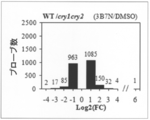
しかしながら、3B7Nにて処理したcry1cry2の苗において、有意な発現の変化が検出された遺伝子は487個であった(図16 参照のこと)。前記野生型の苗における2537遺伝子に比べれば、cry1cry2の苗におけるそれは極一部に過ぎず、3B7Nによる遺伝子発現への影響は、cry1cry2変異によって解消されたことが示唆される。一方、cry1cry2において3B7Nによって影響を受ける遺伝子のサブセットが検出されたことは、当該化合物のクリプトクロム又は青色光シグナルとは関連性のない機能を示唆しているかもしれない。
次に、3B7Nによるクリプトクロム機能への生理的な阻害効果についてより評価するため、DMSO又は3B7Nによって処理した野生型の発現プロファイルと、DMSOにて処理したcry1cry2のそれとを比較した。その結果、CRYによって発現制御される遺伝子の約半分のサブセットが、3B7N処理によって阻害されることが明らかになった。
(実施例8)
<3B7Nによる、既知の青色光制御遺伝子の発現への影響>
3B7Nによって制御される生理学的変化を理解するため、青色光によって発現が制御される遺伝子(Ma,L.、Plant Cell.、2001年、13巻、2589~2607ページ、Jiao,Y.、Plant Physiol.、2003年、133巻、1480~1493ページ)について更に評価した。その結果、下記表1に示す通り、青色光制御遺伝子の多くは、3B7N処理によって青色光による制御とは逆に制御されることが明らかになった。
<3B7Nによる、既知の青色光制御遺伝子の発現への影響>
3B7Nによって制御される生理学的変化を理解するため、青色光によって発現が制御される遺伝子(Ma,L.、Plant Cell.、2001年、13巻、2589~2607ページ、Jiao,Y.、Plant Physiol.、2003年、133巻、1480~1493ページ)について更に評価した。その結果、下記表1に示す通り、青色光制御遺伝子の多くは、3B7N処理によって青色光による制御とは逆に制御されることが明らかになった。

なお、表1において、「青色光」の項目は、青色光照射下にて6日間生長させた苗の発現プロファイルを、暗所にて生長させたそれと比較した結果を示す。すなわち、「UP」は暗所で生長させた苗よりも発現が亢進した遺伝子であることを示し、「DOWN」は暗所で生長させた苗よりも発現が低減した遺伝子であることを示す。また、発現制御は、Ma,L.、Plant Cell.、2001年、13巻、2589~2607ページ、Jiao,Y.、Plant Physiol.、2003年、133巻、1480~1493ページの記載を参照にした。「3B7N」の項目は、3B7Nにて処理して10μmoLm-2s-1青色光照射下にて4日間生長させた苗の発現プロファイルを、3B7Nの代わりにDMSOにて処理したそれと比較した結果を示す。すなわち、「UP」はDMSOにて処理した苗よりも発現が亢進した遺伝子であることを示し、「DOWN」はDMSOにて処理した苗よりも発現が低減した遺伝子であることを示す。
(実施例9)
<3B7Nによる、ソルガムの発育への影響>
上述の通り、3B7Nによって、青色光照射下におけるシロイヌナズナの生長は促進される。これが他の植物でも同じであるということを確認すべく、3B7Nによって処理したソルガムを青色光照射下で生長させ、その影響を分析した。なお、ソルガム(別名:モロコシ)はバイオマスの原料として注目されているイネ科の植物である。
<3B7Nによる、ソルガムの発育への影響>
上述の通り、3B7Nによって、青色光照射下におけるシロイヌナズナの生長は促進される。これが他の植物でも同じであるということを確認すべく、3B7Nによって処理したソルガムを青色光照射下で生長させ、その影響を分析した。なお、ソルガム(別名:モロコシ)はバイオマスの原料として注目されているイネ科の植物である。
より具体的には、ソルガム(Btx623)の苗を、3B7Nを2.5μM加えた又は加えないMS培地(スクロースを含まない)にて、10μmolm-2s-1青色光照射下にて、生長させ、青色光の照射を開始してから6日目の子葉鞘の長さを記録した。得られた結果を図19に示す。
図19に示した結果から明らかなように、上述のシロイヌナズナ同様に、ソルガムも、3B7Nにて処理することにより、青色光照射下でその生長は促進されることが確認された。
(実施例10)
<3B7Nの標的タンパク質の同定>
クリプトクロムシグナル伝達における3B7Nの標的を同定すべく、上述のマイクロアレイ等の実験結果に基づき、3B7Nの標的分子をCRY1と想定して、以下に示すビーズ結合実験を行った。また、コントロールとして、CRY1の代わりにFLB2を用いて、同様の結合実験を行った。なお、FLB2は、cry1同様に変異によって、青色光特異的に胚軸の伸長を促進させる遺伝子がコードするタンパク質(FOX long under Blue light 2、別名BIC2)である。
<3B7Nの標的タンパク質の同定>
クリプトクロムシグナル伝達における3B7Nの標的を同定すべく、上述のマイクロアレイ等の実験結果に基づき、3B7Nの標的分子をCRY1と想定して、以下に示すビーズ結合実験を行った。また、コントロールとして、CRY1の代わりにFLB2を用いて、同様の結合実験を行った。なお、FLB2は、cry1同様に変異によって、青色光特異的に胚軸の伸長を促進させる遺伝子がコードするタンパク質(FOX long under Blue light 2、別名BIC2)である。
ビーズ結合実験に際して先ず、セルフリーアッセイシステムを用いて、Hisタグを融合させた標的候補タンパク質(CRY1-HAtag、FLB2-HAtag)を調製した。調製したタンパク質は下記バッファー2にて置換し、ほぼタンパク質濃度が150mg/mLになるように調整した(CRY1-HAtag:143mg/mL、FLB2-HAtag:152mg/mL)。また、3B7N又はA1(3-ブロモインダゾール)を常法に従って、セファロースビーズに結合させ、化合物結合ビーズ(beads(3B7N)、beads(A1))を調製した。またネガティブコントロールとして化合物を結合させていないセファロースビーズ(beads(-))も以下の実験に供した。
次に、化合物結合ビーズ20μLをチューブに分注し、下記バッファー1を1mL加えて洗浄した。洗浄後、上清を除去し、下記バッファー1を250μL加え、上記置換したタンパク質を1000倍希釈したもの0.2μL加え、4℃にて一晩振盪させた。そのインキュベーション後、バッファー1を1mL加えてボルテックスミキサーにて攪拌した。上清を除去して、新しいバッファー1を加えた、新しいチューブに移し、更にボルテックスミキサーにて攪拌した。この攪拌作業を4回繰り返した後、上清を除去し、1mLのバッファー2を加え、手で転倒混和した後、上清を除去した。このバッファー2による洗浄作業をもう一度繰り返した後、上清を完全に除去し、ビーズに等量のサンプルバッファーを加えて95度で5分煮沸し、その5μLをSDS-PAGE(10~20%アクリルアミドゲル)に供した。次いで、検出抗体としてHRP標識抗HA抗体を用いたウエスタンブロッティングを行った。得られた結果を図20に示す。
バッファー1の組成…10mM Tris-HCl pH7.5、50mM KCl、5mM MgCl2、1mM EDTA
バッファー2の組成…バッファー1に10%グリセロールを最終濃度10%になるよう、TritonX100を最終濃度0.025%になるよう加えた。
バッファー2の組成…バッファー1に10%グリセロールを最終濃度10%になるよう、TritonX100を最終濃度0.025%になるよう加えた。
図20に示す通り、3B7NはCRY1と結合することが明らかになった。なお、A1も僅かではあるがCRY1との結合性が認められた。このことから、3B7Nがクリプトクロムの機能を抑制するには、CRY1との強い結合が必要であることが示唆される。
以上説明したように、本発明によれば、クリプトクロムの機能を抑制することができる。また当該機能抑制により、青色光を含む光の照射下で植物の生長を促進させること等が可能となる。
したがって、本発明は、農業分野(例えば、バイオマスの製造)における植物生長促進剤、研究開発分野におけるクリプトクロムを用いたオプトジェネティクスにおける細胞機能を制御するための試薬等として有用である。
Claims (3)
- 下記一般式(I)で表される含窒素縮合芳香族複素環式化合物を有効成分として含有する、クリプトクロムの機能を抑制するための組成物

- 前記含窒素縮合芳香族複素環式化合物が3-ブロモ-7-ニトロインダゾールである、請求項1に記載の組成物。
- 青色光を含む光の照射下で植物の生長を促進するための組成物である、請求項1又は2に記載の組成物。
Applications Claiming Priority (2)
| Application Number | Priority Date | Filing Date | Title |
|---|---|---|---|
| JP2016205506A JP6835308B2 (ja) | 2016-10-19 | 2016-10-19 | クリプトクロムの機能を抑制するための組成物 |
| JP2016-205506 | 2016-10-19 |
Publications (1)
| Publication Number | Publication Date |
|---|---|
| WO2018074554A1 true WO2018074554A1 (ja) | 2018-04-26 |
Family
ID=62018685
Family Applications (1)
| Application Number | Title | Priority Date | Filing Date |
|---|---|---|---|
| PCT/JP2017/037870 Ceased WO2018074554A1 (ja) | 2016-10-19 | 2017-10-19 | クリプトクロムの機能を抑制するための組成物 |
Country Status (2)
| Country | Link |
|---|---|
| JP (1) | JP6835308B2 (ja) |
| WO (1) | WO2018074554A1 (ja) |
Cited By (1)
| Publication number | Priority date | Publication date | Assignee | Title |
|---|---|---|---|---|
| WO2022129856A1 (en) * | 2020-12-18 | 2022-06-23 | University Of Essex Enterprises Limited | Increasing photosynthetic capacity in plants |
Citations (1)
| Publication number | Priority date | Publication date | Assignee | Title |
|---|---|---|---|---|
| US20150284362A1 (en) * | 2014-04-07 | 2015-10-08 | Reset Therapeutics, Inc. | Carbazole-containing amides, carbamates, and ureas as cryptochrome modulators |
-
2016
- 2016-10-19 JP JP2016205506A patent/JP6835308B2/ja not_active Expired - Fee Related
-
2017
- 2017-10-19 WO PCT/JP2017/037870 patent/WO2018074554A1/ja not_active Ceased
Patent Citations (1)
| Publication number | Priority date | Publication date | Assignee | Title |
|---|---|---|---|---|
| US20150284362A1 (en) * | 2014-04-07 | 2015-10-08 | Reset Therapeutics, Inc. | Carbazole-containing amides, carbamates, and ureas as cryptochrome modulators |
Non-Patent Citations (6)
| Title |
|---|
| BEDROSIAN, T. A. ET AL.: "Photoperiod-dependent effects of neuronal nitric oxide synthase inhibition on aggression in Siberian hamsters", HORMONES AND BEHAVIOR, vol. 61, no. 2, February 2012 (2012-02-01), pages 176 - 180, XP055604666, ISSN: 0018-506X, DOI: 10.1016/j.yhbeh.2011.11.011 * |
| CANAMERO, R. C. ET AL.: "Cryptochrome photoreceptors cryl and cry2 antagonistically regulate primary root elongation in Arabidopsis thaliana", PLANTA, vol. 224, no. 5, 2006, pages 995 - 1003, XP019443301, DOI: doi:10.1007/s00425-006-0280-6 * |
| CHUN, S. K. ET AL.: "Identification and Validation of Cryptochrome Inhibitors That Modulate the Molecular Circadian Clock", ACS CHEMICAL BIOLOGY, vol. 9, no. 3, 2014, pages 703 - 710, XP055189211, DOI: doi:10.1021/cb400752k * |
| CLARAMUNT, R. M. ET AL.: "Fluorinated indazoles as novel selective inhibitors of nitric oxide synthase (NOS): Synthesis and biological evaluation", BIOORGANIC & MEDICINAL CHEMISTRY, vol. 17, no. 17, 2009, pages 6180 - 6187, XP026471093, DOI: doi:10.1016/j.bmc.2009.07.067 * |
| ONG, WEN-DEE ET AL.: "Chemical-Induced Inhibition of Blue Light-Mediated Seedling Development Caused by Disruption of Upstream Signal Transduction Involving Cryptochromes in Arabidopsis thaliana", PLANT & CELL PHYSIOLOGY, vol. 58, no. 1, 19 December 2016 (2016-12-19) - 1 January 2017 (2017-01-01), pages 95 - 105, XP055604670, ISSN: 0032-0781, DOI: 10.1093/pcp/pcw181 * |
| ORTH, C. ET AL.: "Hyperactivity of the Arabidopsis cryptochrome (cryl) L407F mutant is caused by a structural alteration close to the cryl ATP-binding site", JOURNAL OF BIOLOGICAL CHEMISTRY, vol. 292, no. 31, 20 June 2017 (2017-06-20) - 4 August 2017 (2017-08-04), pages 12906 - 12920, XP055604676, ISSN: 0021-9258, DOI: 10.1074/jbc.M117.788869 * |
Cited By (1)
| Publication number | Priority date | Publication date | Assignee | Title |
|---|---|---|---|---|
| WO2022129856A1 (en) * | 2020-12-18 | 2022-06-23 | University Of Essex Enterprises Limited | Increasing photosynthetic capacity in plants |
Also Published As
| Publication number | Publication date |
|---|---|
| JP6835308B2 (ja) | 2021-02-24 |
| JP2018065766A (ja) | 2018-04-26 |
Similar Documents
| Publication | Publication Date | Title |
|---|---|---|
| Alfatih et al. | Nitrate-responsive OsMADS27 promotes salt tolerance in rice | |
| Xie et al. | The intronic cis element SE1 recruits trans-acting repressor complexes to repress the expression of ELONGATED UPPERMOST INTERNODE1 in rice | |
| Sun et al. | Altered expression of maize PLASTOCHRON1 enhances biomass and seed yield by extending cell division duration | |
| Byrne et al. | Development of leaf shape | |
| Biever et al. | UV-B inhibition of hypocotyl growth in etiolated Arabidopsis thaliana seedlings is a consequence of cell cycle arrest initiated by photodimer accumulation | |
| Xiang et al. | Myb transcription factors and light regulate sporulation in the oomycete Phytophthora infestans | |
| Bollinedi et al. | Molecular and functional characterization of GR2-R1 event based backcross derived lines of golden rice in the genetic background of a mega rice variety Swarna | |
| Zhang et al. | Gibberellins regulate the stem elongation rate without affecting the mature plant height of a quick development mutant of winter wheat (Triticum aestivum L.) | |
| Nakata et al. | The functional balance between the WUSCHEL-RELATED HOMEOBOX1 gene and the phytohormone auxin is a key factor for cell proliferation in Arabidopsis seedlings | |
| Karve et al. | Initial characterization of shade avoidance response suggests functional diversity between Populus phytochrome B genes | |
| Gazara et al. | Transcriptional landscape of soybean (Glycine max) embryonic axes during germination in the presence of paclobutrazol, a gibberellin biosynthesis inhibitor | |
| Lildballe et al. | The expression level of the chromatin-associated HMGB1 protein influences growth, stress tolerance, and transcriptome in Arabidopsis | |
| Cheng et al. | AtMIF1 increases seed oil content by attenuating GL2 inhibition | |
| Zhang et al. | Methyl jasmonate‐induced bHLH42 mediates tissue‐specific accumulation of anthocyanins via regulating flavonoid metabolism‐related pathways in Caitai | |
| Dai et al. | HY5 inhibits in vitro shoot stem cell niches initiation via directly repressing pluripotency and cytokinin pathways | |
| Zhang et al. | Nitrate transporters and mechanisms of nitrate signal transduction in Arabidopsis and rice | |
| Van Hautegem et al. | Division zone activity determines the potential of drought‐stressed maize leaves to resume growth after rehydration | |
| Gao et al. | Arabidopsis CPR5 independently regulates seed germination and postgermination arrest of development through LOX pathway and ABA signaling | |
| Liu et al. | Precise control of chromatin loop extrusion enhances sustainable green revolution yield in rice | |
| Hashimura et al. | The Arabidopsis MERISTEM DISORGANIZATION 1 gene is required for the maintenance of stem cells through the reduction of DNA damage | |
| Kasajima et al. | The BIG gene is involved in regulation of sulfur deficiency‐responsive genes in Arabidopsis thaliana | |
| JP6835308B2 (ja) | クリプトクロムの機能を抑制するための組成物 | |
| Li et al. | Modulation of an evolutionarily conserved epigenetic regulon controlling abscisic acid catabolism enhances drought tolerance in wheat | |
| Wang et al. | Introns in the Naa50 gene act as strong enhancers of tissue-specific expression in Arabidopsis | |
| Edwards et al. | A shade-responsive microProtein in the Arabidopsis ATHB2 gene regulates elongation growth and root development |
Legal Events
| Date | Code | Title | Description |
|---|---|---|---|
| 121 | Ep: the epo has been informed by wipo that ep was designated in this application |
Ref document number: 17862846 Country of ref document: EP Kind code of ref document: A1 |
|
| NENP | Non-entry into the national phase |
Ref country code: DE |
|
| 122 | Ep: pct application non-entry in european phase |
Ref document number: 17862846 Country of ref document: EP Kind code of ref document: A1 |