WO2018074463A1 - cAMPの増加をメカニズムとする有機酸血症における神経障害治療薬剤 - Google Patents
cAMPの増加をメカニズムとする有機酸血症における神経障害治療薬剤 Download PDFInfo
- Publication number
- WO2018074463A1 WO2018074463A1 PCT/JP2017/037507 JP2017037507W WO2018074463A1 WO 2018074463 A1 WO2018074463 A1 WO 2018074463A1 JP 2017037507 W JP2017037507 W JP 2017037507W WO 2018074463 A1 WO2018074463 A1 WO 2018074463A1
- Authority
- WO
- WIPO (PCT)
- Prior art keywords
- camp
- neuropathy
- acidemia
- cells
- organic
- Prior art date
- Legal status (The legal status is an assumption and is not a legal conclusion. Google has not performed a legal analysis and makes no representation as to the accuracy of the status listed.)
- Ceased
Links
Images



Classifications
-
- A—HUMAN NECESSITIES
- A61—MEDICAL OR VETERINARY SCIENCE; HYGIENE
- A61K—PREPARATIONS FOR MEDICAL, DENTAL OR TOILETRY PURPOSES
- A61K31/00—Medicinal preparations containing organic active ingredients
- A61K31/33—Heterocyclic compounds
- A61K31/335—Heterocyclic compounds having oxygen as the only ring hetero atom, e.g. fungichromin
- A61K31/35—Heterocyclic compounds having oxygen as the only ring hetero atom, e.g. fungichromin having six-membered rings with one oxygen as the only ring hetero atom
- A61K31/352—Heterocyclic compounds having oxygen as the only ring hetero atom, e.g. fungichromin having six-membered rings with one oxygen as the only ring hetero atom condensed with carbocyclic rings, e.g. methantheline
-
- A—HUMAN NECESSITIES
- A61—MEDICAL OR VETERINARY SCIENCE; HYGIENE
- A61K—PREPARATIONS FOR MEDICAL, DENTAL OR TOILETRY PURPOSES
- A61K31/00—Medicinal preparations containing organic active ingredients
- A61K31/045—Hydroxy compounds, e.g. alcohols; Salts thereof, e.g. alcoholates
- A61K31/047—Hydroxy compounds, e.g. alcohols; Salts thereof, e.g. alcoholates having two or more hydroxy groups, e.g. sorbitol
-
- A—HUMAN NECESSITIES
- A61—MEDICAL OR VETERINARY SCIENCE; HYGIENE
- A61K—PREPARATIONS FOR MEDICAL, DENTAL OR TOILETRY PURPOSES
- A61K31/00—Medicinal preparations containing organic active ingredients
- A61K31/13—Amines
- A61K31/135—Amines having aromatic rings, e.g. ketamine, nortriptyline
- A61K31/137—Arylalkylamines, e.g. amphetamine, epinephrine, salbutamol, ephedrine or methadone
-
- A—HUMAN NECESSITIES
- A61—MEDICAL OR VETERINARY SCIENCE; HYGIENE
- A61K—PREPARATIONS FOR MEDICAL, DENTAL OR TOILETRY PURPOSES
- A61K31/00—Medicinal preparations containing organic active ingredients
- A61K31/185—Acids; Anhydrides, halides or salts thereof, e.g. sulfur acids, imidic, hydrazonic or hydroximic acids
- A61K31/19—Carboxylic acids, e.g. valproic acid
- A61K31/195—Carboxylic acids, e.g. valproic acid having an amino group
- A61K31/196—Carboxylic acids, e.g. valproic acid having an amino group the amino group being directly attached to a ring, e.g. anthranilic acid, mefenamic acid, diclofenac, chlorambucil
-
- A—HUMAN NECESSITIES
- A61—MEDICAL OR VETERINARY SCIENCE; HYGIENE
- A61K—PREPARATIONS FOR MEDICAL, DENTAL OR TOILETRY PURPOSES
- A61K31/00—Medicinal preparations containing organic active ingredients
- A61K31/33—Heterocyclic compounds
- A61K31/335—Heterocyclic compounds having oxygen as the only ring hetero atom, e.g. fungichromin
-
- A—HUMAN NECESSITIES
- A61—MEDICAL OR VETERINARY SCIENCE; HYGIENE
- A61K—PREPARATIONS FOR MEDICAL, DENTAL OR TOILETRY PURPOSES
- A61K31/00—Medicinal preparations containing organic active ingredients
- A61K31/33—Heterocyclic compounds
- A61K31/395—Heterocyclic compounds having nitrogen as a ring hetero atom, e.g. guanethidine or rifamycins
- A61K31/435—Heterocyclic compounds having nitrogen as a ring hetero atom, e.g. guanethidine or rifamycins having six-membered rings with one nitrogen as the only ring hetero atom
- A61K31/44—Non condensed pyridines; Hydrogenated derivatives thereof
- A61K31/455—Nicotinic acids, e.g. niacin; Derivatives thereof, e.g. esters, amides
-
- A—HUMAN NECESSITIES
- A61—MEDICAL OR VETERINARY SCIENCE; HYGIENE
- A61K—PREPARATIONS FOR MEDICAL, DENTAL OR TOILETRY PURPOSES
- A61K31/00—Medicinal preparations containing organic active ingredients
- A61K31/33—Heterocyclic compounds
- A61K31/395—Heterocyclic compounds having nitrogen as a ring hetero atom, e.g. guanethidine or rifamycins
- A61K31/495—Heterocyclic compounds having nitrogen as a ring hetero atom, e.g. guanethidine or rifamycins having six-membered rings with two or more nitrogen atoms as the only ring heteroatoms, e.g. piperazine or tetrazines
- A61K31/505—Pyrimidines; Hydrogenated pyrimidines, e.g. trimethoprim
- A61K31/519—Pyrimidines; Hydrogenated pyrimidines, e.g. trimethoprim ortho- or peri-condensed with heterocyclic rings
- A61K31/52—Purines, e.g. adenine
-
- A—HUMAN NECESSITIES
- A61—MEDICAL OR VETERINARY SCIENCE; HYGIENE
- A61K—PREPARATIONS FOR MEDICAL, DENTAL OR TOILETRY PURPOSES
- A61K31/00—Medicinal preparations containing organic active ingredients
- A61K31/33—Heterocyclic compounds
- A61K31/395—Heterocyclic compounds having nitrogen as a ring hetero atom, e.g. guanethidine or rifamycins
- A61K31/55—Heterocyclic compounds having nitrogen as a ring hetero atom, e.g. guanethidine or rifamycins having seven-membered rings, e.g. azelastine, pentylenetetrazole
-
- A—HUMAN NECESSITIES
- A61—MEDICAL OR VETERINARY SCIENCE; HYGIENE
- A61K—PREPARATIONS FOR MEDICAL, DENTAL OR TOILETRY PURPOSES
- A61K31/00—Medicinal preparations containing organic active ingredients
- A61K31/70—Carbohydrates; Sugars; Derivatives thereof
- A61K31/7042—Compounds having saccharide radicals and heterocyclic rings
- A61K31/7052—Compounds having saccharide radicals and heterocyclic rings having nitrogen as a ring hetero atom, e.g. nucleosides, nucleotides
- A61K31/706—Compounds having saccharide radicals and heterocyclic rings having nitrogen as a ring hetero atom, e.g. nucleosides, nucleotides containing six-membered rings with nitrogen as a ring hetero atom
- A61K31/7064—Compounds having saccharide radicals and heterocyclic rings having nitrogen as a ring hetero atom, e.g. nucleosides, nucleotides containing six-membered rings with nitrogen as a ring hetero atom containing condensed or non-condensed pyrimidines
- A61K31/7076—Compounds having saccharide radicals and heterocyclic rings having nitrogen as a ring hetero atom, e.g. nucleosides, nucleotides containing six-membered rings with nitrogen as a ring hetero atom containing condensed or non-condensed pyrimidines containing purines, e.g. adenosine, adenylic acid
-
- A—HUMAN NECESSITIES
- A61—MEDICAL OR VETERINARY SCIENCE; HYGIENE
- A61K—PREPARATIONS FOR MEDICAL, DENTAL OR TOILETRY PURPOSES
- A61K45/00—Medicinal preparations containing active ingredients not provided for in groups A61K31/00 - A61K41/00
-
- A—HUMAN NECESSITIES
- A61—MEDICAL OR VETERINARY SCIENCE; HYGIENE
- A61P—SPECIFIC THERAPEUTIC ACTIVITY OF CHEMICAL COMPOUNDS OR MEDICINAL PREPARATIONS
- A61P25/00—Drugs for disorders of the nervous system
-
- A—HUMAN NECESSITIES
- A61—MEDICAL OR VETERINARY SCIENCE; HYGIENE
- A61P—SPECIFIC THERAPEUTIC ACTIVITY OF CHEMICAL COMPOUNDS OR MEDICINAL PREPARATIONS
- A61P3/00—Drugs for disorders of the metabolism
Definitions
- the present invention relates to a therapeutic agent for neuropathy in organic acidemia whose mechanism is cAMP increase.
- Organic acidemia is a disease in which organic acids accumulate excessively in the body due to abnormalities in metabolic enzymes.
- organic acidemia excessive accumulation of organic acid causes metabolic acidosis, hyperammonemia, hypoglycemia, etc.
- metabolic acidosis As a result, respiratory disorders and consciousness disorders occur in the acute phase, and anorexia occurs in the chronic phase. Symptoms such as vomiting occur.
- Organic acidemia is also known to be difficult to treat radically and has a high fatality rate.
- Treatment methods for organic acidemia include diet therapy, drug therapy, dialysis, and transplantation.
- Diet therapy is a diet that restricts amino acids such as proteins, isoleucine, valine, and methionine that can cause organic acid metabolites. Dietary therapy can suppress the accumulation of organic acids that cause organic acidemia, but cannot completely prevent it. Therefore, although it is an effective treatment method aimed at stabilizing symptoms in the chronic phase, it is not a radical treatment.
- arginine that detoxifies ammonia, carbagul, and carnitine hydrochloride that binds to organic acids and promotes excretion are used.
- Drug therapy is a treatment used not only in the chronic phase, but also in the worsening of symptoms in the acute phase.
- liver transplantation has been the only lifesaving method in organic acidemia.
- neurological symptoms progress slowly only with liver transplantation, and neurological sequelae and kidney damage are combined at a high rate.
- Simultaneous transplantation is being conducted overseas as an advanced treatment.
- These transplantation treatments and improved dialysis techniques have improved the outcome of organic acidemia, and the fatality rate has definitely decreased.
- the organic acid concentration in the cerebrospinal fluid is not normalized and severe neuropathy remains even in this liver-kidney simultaneous transplantation.
- the transplantation treatment decreased the fatality rate, but neuropathy did not completely cure in surviving cases, and neuropathy caused the patient's QOL to decrease. Under these circumstances, development of a treatment for neuropathy in organic acidemia is strongly desired.
- cAMP is an intracellular signaling substance that functions as a second messenger in the cell. Although the presence and function of cAMP has been known for a long time, its relationship with organic acidemia was not clear. On the other hand, regarding cAMP and neuropathy, there are some techniques that suggest this (Patent Documents 1 and 2).
- Patent Document 1 discloses a technique related to a composition and method for increasing neurogenesis.
- Patent Document 2 discloses a technique related to a method and the like for treating and preventing peripheral neuropathy.
- cAMP regulation and cAMP modulators have been disclosed, which suggests a relationship between central neuropathy and peripheral neuropathy and cAMP.
- the cause of its occurrence varies depending on the disease that causes it, and these prior arts do not disclose or suggest neuropathy in organic acidemia.
- there is no treatment using cAMP regulation as a mechanism for organic acidemia neuropathy and there is no effective therapeutic drug at present.
- methylmalonemia which has a particularly high fatality rate and poor long-term prognosis among organic acidemias.
- the pathogenesis of methylmalonemia is due to a defect in methylmalonyl-CoA mutase (MCM), an enzyme that catalyzes the metabolism of methylmalonyl-CoA to succinyl-CoA, or abnormal metabolism of vitamin B12 (cobalamin), a coenzyme of MCM. Broadly divided.
- the present invention aims to elucidate the mechanism of neuropathy in methylmalonemia and to develop a new therapeutic agent for neuropathy in organic acidemia based on the obtained knowledge. .
- iPS cells from peripheral blood lymphocytes of methylmalonemia patients, differentiated them into nerve cells, and examined the following facts. From this fact, it was clarified that neuropathy in organic acidemia can be treated and prevented by supplementing cAMP.
- methylmalonemia-derived neurons we discovered six compounds that specifically restore neuronal damage. (2) All these six compounds had a common effect of increasing intracellular cAMP or activating CREB, a downstream molecule.
- cAMP concentration in methylmalonemia-derived neurons was measured, it was confirmed that the concentration was significantly lower than that in healthy individuals.
- CREB is phosphorylated by complementing adenylate cyclase-derived cAMP, and this is one of the mechanisms that exerts its therapeutic effect. It was confirmed that (7) In an in vivo model prepared by administration of methylmalonic acid, administration of a drug supplementing cAMP confirmed the effect of suppressing the number and duration of seizures due to convulsions and the effect of improving survival rate.
- a first configuration of the present invention is a neuropathy treatment drug characterized by treating or preventing neuropathy by increasing cAMP in organic acidemia.
- a second configuration of the present invention is the therapeutic agent for neuropathy according to the first configuration, which further activates CREB.
- the therapeutic agent for neuropathy according to the first or second aspect characterized in that the organic acidemia is an organic acidemia that reduces the activity of Adenylate cyclase.
- the nerve according to the first or second aspect is characterized in that the organic acidemia is selected from one or more of methylmalonic acidemia and propionic acidemia It is a drug for treating disorders.
- the increase in cAMP is made by any of Forskolin, GW9508, NECA, SKF77434, nicotinamide, dobutamine, and db-cAMP.
- the therapeutic agent for neuropathy according to the third aspect characterized in that an increase in cAMP is achieved by suppressing or preventing a decrease in the activity of Adenylate cyclase.
- the therapeutic agent for neurological disorders according to any one of the first to sixth aspects wherein the life prolonging effect is enhanced by treatment or prevention of neurological disorders.
- the eighth configuration of the present invention is a method for treating or preventing neuropathy in organic acidemia using the neuropathy therapeutic agent according to any one of the first to seventh configurations.
- the present invention has clarified the mechanism of neuropathy in methylmalonemia, and has made it possible to provide a new therapeutic agent for neuropathy in organic acidemia based on this finding.
- the neuropathy treatment drug of the present invention will be described.
- the inventors established the establishment and stable maintenance culture of iPS cells derived from patients with methylmalonemia using peripheral blood lymphocytes from patients with methylmalonemia, and turned them into neurons of iPS cells derived from patients with methylmalonemia This is the first establishment of these experimental techniques.
- the inventors clarified the following facts using these series of experimental techniques. From this fact, it was clarified that neuropathy in organic acidemia can be treated and prevented by supplementing cAMP.
- the agent for treating neuropathy of the present invention is characterized by treating or preventing neuropathy by increasing cAMP in organic acidemia.
- a treatment mode for neuropathy for example, a decrease in the number of convulsive seizures, a decrease in convulsion duration, and an increase in the life prolonging effect can be mentioned.
- Organic acidemia is defined as a disease in which an organic acid is excessively accumulated in a living body due to abnormality of metabolic enzymes, and typically includes methylmalonic acidemia and propionic acidemia.
- the therapeutic agent for neuropathy in the present invention is defined as a compound that can achieve an increase in cAMP in a neuropathy affected area in organic acidemia, or a composition containing this as an active ingredient.
- such a compound may achieve an increase in cAMP with the same chemical structure, or change the structure of the compound in response to in vivo metabolism or the like, thereby increasing cAMP in the affected area. It can be a so-called DDS-compound that is achieved.
- a compound for example, db-cAMP, which is a compound having enhanced cell permeability of cAMP, can be used.
- the drug for treating neurological disorders of the present invention may further activate CREB (cAMP response element binding protein) in addition to increase in cAMP.
- CREB cAMP response element binding protein
- it can be a drug that is more suitable for the mechanism of neuropathy of organic acidemia, and thus the therapeutic effect in neuropathy can be expected to improve.
- Examples of such compounds include Forskolin ((3R, 4aR, 5S, 6S, 6aS, 10S, 10aR, 10bS) -6,10,10b-trihydroxy-3,4a, 7,7,10a-pentamethyl-1- oxo-3-vinyldodecahydro-1H-benzo [f] chromen-5-yl acetate), GW9508 (3- (4-(((3- (Phenoxy) phenyl) methyl) amino) phenyl) propanoic acid), NECA (5 '-N-Ethylcarboxamidoadenosine 1- (6-Amino-9H-purin-9-yl) -1-deoxy-N-ethyl- ⁇ -D-ribofuranuronamide), SKF77434 (3-allyl-1-phenyl-1,2, 4,5-tetrahydro-3-benzazepine-7,8-diol), nicotinamide (pyridine-3
- the dosage form of the drug for treating neurological disorders of the present invention is not particularly limited, and various dosage forms can be used. Typically, it can take the form of a preparation for oral intake such as a tablet, capsule, powder, etc. In addition, it can take the form of a preparation for injection or a percutaneous absorption type preparation.
- the vacutainer lymphocyte separation blood collection tube (CPT) was centrifuged at 20 ° C and 2000 g / 30 min, the mononuclear cell layer was aspirated and transferred aseptically to a new sterile Spitz in the biohood. .
- CPT vacutainer lymphocyte separation blood collection tube
- 20 mL of sterile phosphate buffer was added to new sterile Spitz, stirred, and centrifuged at 2000 g / 20 minutes to remove the supernatant.
- the mononuclear cell pellet was suspended in 500 ⁇ L of Bang Banker hRM (Cat. No. CS-07-001) and stored at ⁇ 80 ° C.
- PBMC-CM mononuclear cell medium
- SCF stock solution 100 mL + FLT-3 stock solution 100 mL + TPO stock solution 100 mL + IL6 stock solution
- Neural Induction Medium Neuralobasal Medium 490 mL + GIBCO Neural Induction Supplement 10 mL
- Neural Expansion Medium NEM: Neurobasal medium 49mL + Advanced DMEN / F12 49mL + GIBCO Neural Induction Supplement 2mL
- 70-80% confluent iPS cells were used for differentiation induction.
- the culture solution was aspirated to remove all cells that did not adhere. After this work, NIM broth was added and cultivation was continued. The culture medium was changed every 48 hours.
- NSC (P) around day 7 was passaged as follows.
- a culture dish coated with Geltrex matrix was prepared, and NIM was removed from the culture dish.
- the culture dish was washed with 2 mL of PBS. After washing, 1 mL of lysate was added and incubated for 5 minutes.
- the lysate was collected in a 15 mL conical tube, and the culture dish was washed with 1 mL of PBS and collected in a conical tube. After collection, it was pipetted 3 times with a 5 mL pipette.
- the cell solution was filtered with a 100 ⁇ m cell strainer (FALCON). The filtered cells were centrifuged at 300 g for 4 minutes.
- NPCs Neural Progenitor cells
- Screening method> [Screening System 1: Screening System for Compounds that Reduce Exogenous Methylmalonic Acid and Propionic Acid Toxicity Using Skin Fibroblasts]
- Healthy child and patient-derived fibroblasts were pre-cultured.
- the cultured cells were seeded in a 96-well collagen coated dish at a rate of 5 ⁇ 10 3 cells / well in a state of 80% confluence. After sowing, the cells were precultured for 24 hours in a 5% CO 2 incubator.
- a 200 ⁇ M methylmalonic acid solution was added to the DMEM / F12 / 10% FBS medium and cultured. For propionic acid, the concentration was set to 400 ⁇ M, and the same operation was performed.
- Each compound was added to each well to a concentration of 5 ⁇ M.
- DMSO was added as a comparison target.
- the absorbance was measured with a 450 nm filter using the WST-8 method.
- Screening system screening system for compounds that improve endogenous metabolic disorders using skin fibroblasts
- the same method as in screening system 1 was performed. That is, healthy child and patient-derived fibroblasts were pre-cultured. The cultured cells were seeded in a 96-well collagen coated dish at a rate of 5 ⁇ 10 3 cells / well in a state of 80% confluence. After sowing, the cells were precultured for 24 hours in a 5% CO 2 incubator. (2) Each compound was added to each well to a concentration of 5 ⁇ M. (3) After 24 hours, the absorbance was measured with a 450 nm filter using the WST-8 method.
- NPCs neural progenitor cells
- I-3 differentiation induction method
- NPCs were seeded in a 96-well geltrex-coated dish (GIBCO) at 1 ⁇ 10 5 cells / well. After sowing, the cells were cultured in a 5% CO 2 incubator for 24 hours at 37 ° C.
- methylmalonic acid was added to the culture solution to a concentration of 100 ⁇ M. In the case of propionic acid, it was added to the culture supernatant to a concentration of 200 ⁇ M.
- the compound was added to each well to a concentration of 5 ⁇ M.
- DMSO was added as a comparison target.
- absorbance was measured using the WST-8 method.
- NPCs neural progenitor cells
- I-3 differentiation induction method
- NPCs were seeded in a 96-well geltrex-coated dish (GIBCO) at 1 ⁇ 10 5 cells / well. After sowing, the cells were cultured in a 5% CO 2 incubator for 24 hours at 37 ° C.
- GBCO differentiation induction method
- Each compound was added to each well to a concentration of 5 ⁇ M.
- DMSO was added as a comparison target.
- absorbance was measured using the WST-8 method.
- Enzo CO. CAMP complete ELISA kit (ADI-900-163) was used to measure intracellular cAMP concentration.
- the cells were pretreated for measurement. -Cells were detached from the culture dish, counted, and centrifuged. After centrifugation, the supernatant was aspirated and suspended in 0.1 M HCL solution at 1 ⁇ 10 6 / cell / mL. When the number of cells was clear, the series of operations was omitted, and 0.1 M HCl was directly put on the culture dish while the cells were adhered. ⁇ After suspension, the mixture was incubated at room temperature for 10 minutes, and then centrifuged at 600g / 5 minutes. The supernatant was stored at -80 degrees until cAMP measurement.
- CAMP production test in patients with methylmalonic acidemia > (1) The ability to produce cAMP in neural progenitor cells derived from methylmalonic acidemia patients was measured. (2) Specifically, Neural Progenitor cells (NeuP) were induced from normal iPS cells and MMA-derived iPS cells. Forskorin (FSK) was added to these cells at a concentration of 10 ⁇ mol / l, and the intracellular cAMP concentration after 24 hours was measured. (3) The results are shown in FIG. As a result of the examination, NPCs derived from methylmalonic acidemia showed decreased reactivity to Forskorin, suggesting that cAMP production ability was reduced.
- Neural Progenitor cells Neural Progenitor cells
- FSK Forskorin
- the iPS cell-derived neural progenitor cells (B42NPCs) of methylmalonic acid patients were cultured in a culture solution containing 50 ⁇ M and 100 ⁇ M methylmalonic acid, and the cAMP concentration after 24 hours was measured.
- cytotoxicity toxicity of methylmalonic acid is caused by a decrease in intracellular cAMP concentration due to a decrease in the activity of Adenylate cyclase.
- this mechanism causes cell dysfunction due to chronic decrease in the ability to produce cAMP, and that the therapeutic effect of cAMP is exerted via CREB.
- mice were used as a simple model for methylmalonic acidemia.
- candidate drugs were evaluated using convulsions caused by methylmalonic acid administration as an index.
- a 1-mg / kg / dose1 methylmalonic acid solution was subcutaneously administered once daily to 1.4-week-old C57BL / 6J mice, and evaluation was performed at the age of 6 weeks. 2.
- candidate drugs db-cAMP (30 mg / kg / dose) and PDE4 inhibitor (1 mg / kg / day) were administered subcutaneously, and the number of convulsive seizures and the total duration before and after administration were measured and compared. . Before administration, measurement was performed as a control for 30 minutes, and after administration, measurement was performed 3 times for 30 minutes, 15 to 45 minutes, 55 to 85 minutes, and 90 to 120 minutes.
- a lethal methylmalonic acid seizure model was prepared by intraperitoneally administering a 500 ⁇ M methylmalonic acid solution to 1.8-week-old C57BL / 6J mice at 20 ml / kg. 2. One day, two days, and three days after methylmalonic acid administration, db-cAMP (10 ⁇ g / kg / dose) was administered subcutaneously as a candidate drug, and the survival rate was compared between the administration group and the non-administration group. 3. The results are shown in FIG. (1) In the non-administration group, the survival rate was 35.3% after 1 day of methylmalonic acid administration and 14.7% after 2 days.
Landscapes
- Health & Medical Sciences (AREA)
- Life Sciences & Earth Sciences (AREA)
- Chemical & Material Sciences (AREA)
- Medicinal Chemistry (AREA)
- Pharmacology & Pharmacy (AREA)
- Animal Behavior & Ethology (AREA)
- General Health & Medical Sciences (AREA)
- Public Health (AREA)
- Veterinary Medicine (AREA)
- Epidemiology (AREA)
- Emergency Medicine (AREA)
- Molecular Biology (AREA)
- Engineering & Computer Science (AREA)
- General Chemical & Material Sciences (AREA)
- Organic Chemistry (AREA)
- Nuclear Medicine, Radiotherapy & Molecular Imaging (AREA)
- Bioinformatics & Cheminformatics (AREA)
- Chemical Kinetics & Catalysis (AREA)
- Neurosurgery (AREA)
- Neurology (AREA)
- Biomedical Technology (AREA)
- Diabetes (AREA)
- Hematology (AREA)
- Obesity (AREA)
- Acyclic And Carbocyclic Compounds In Medicinal Compositions (AREA)
- Pharmaceuticals Containing Other Organic And Inorganic Compounds (AREA)
- Medicines That Contain Protein Lipid Enzymes And Other Medicines (AREA)
Abstract
【課題】メチルマロン血症における神経障害に関するメカニズムを明らかにするとともに,この知見に基づいた有機酸血症における神経障害の新たな治療薬等の開発。 【解決手段】発明者らは,メチルマロン血症患者の末梢血リンパ球を用いて,メチルマロン血症患者由来iPS細胞の樹立ならびに安定的維持培養法の確立,メチルマロン血症患者由来iPS細胞の神経細胞への分化,これらの技術を確立した。これら一連の実験技術を用いて,cAMPを補充することにより,有機酸血症における神経障害を治療,防止しうることを明らかにした。本発明の薬剤は,有機酸血症において,cAMPを増加させることにより,神経障害を治療ないし予防することを特徴とするものである。
Description
本発明は,cAMPの増加をメカニズムとする有機酸血症における神経障害の治療薬剤に関する。
有機酸血症とは,代謝酵素の異常により,生体内において有機酸が過剰に蓄積する疾患である。有機酸血症では,有機酸の過剰蓄積により,代謝性アシドーシスや高アンモニア血症,低血糖などが起こり,これらの結果,急性期においては呼吸障害や意識障害が,慢性期には食欲不振や嘔吐などの症状が生じる。また,有機酸血症は,根治的な治療が困難であり,致死率が高いことでも知られている。
有機酸血症の治療方法として,食事療法や薬物療法,透析,移植などが挙げられる。
食事療法は,有機酸代謝物の原因物質となりうるタンパク質やイソロイシン,バリン,メチオニンなどのアミノ酸を制限した食事をとる治療法である。食事療法は,有機酸血症の原因である,有機酸の蓄積を抑制しうるものではあるが,これを完全に防ぐことはできない。そのため,慢性期における症状安定を目的として行われる有効な治療方法であるものの,根治的な治療ではない。
一方,薬物療法においては,アンモニアを解毒するアルギニン,カルバグル,また,有機酸と結合し,排泄を促すカルニチン塩酸塩が使用される。薬物療法は,慢性期のみならず,急性期における症状悪化時にも用いられる治療法である。また,血中からの有機酸の除去を目的として,血液透析と合わせて行われることも多い。これら薬物療法ならびに透析,いずれにおいても,症状悪化時の速やかな有機酸の除去をなしうるものの,原因となる有機酸の蓄積を完全に排除しうるものではないため,根治的な治療ではない。
食事療法は,有機酸代謝物の原因物質となりうるタンパク質やイソロイシン,バリン,メチオニンなどのアミノ酸を制限した食事をとる治療法である。食事療法は,有機酸血症の原因である,有機酸の蓄積を抑制しうるものではあるが,これを完全に防ぐことはできない。そのため,慢性期における症状安定を目的として行われる有効な治療方法であるものの,根治的な治療ではない。
一方,薬物療法においては,アンモニアを解毒するアルギニン,カルバグル,また,有機酸と結合し,排泄を促すカルニチン塩酸塩が使用される。薬物療法は,慢性期のみならず,急性期における症状悪化時にも用いられる治療法である。また,血中からの有機酸の除去を目的として,血液透析と合わせて行われることも多い。これら薬物療法ならびに透析,いずれにおいても,症状悪化時の速やかな有機酸の除去をなしうるものの,原因となる有機酸の蓄積を完全に排除しうるものではないため,根治的な治療ではない。
これらに比して,肝臓移植は,有機酸血症における唯一の救命法として実施されてきた。また,肝臓移植のみでは,神経症状がゆっくりと進行し,神経学的後遺症ならびに腎障害が高率で合併することが明らかとなってきたことから,最近では,肝臓移植と腎臓移植を同時に行う肝腎同時移植が,先進的治療として海外で実施されている。
これら移植治療と透析技術の向上により,有機酸血症における治療成績は向上し,致死率も確実に低下している。しかしながら,この肝腎同時移植においても,髄液中の有機酸濃度は正常化しないことや,重篤な神経障害が残ってしまうことが報告されている。すなわち,移植治療によって致死率が低下した一方,生存例において神経障害が完治しないことから,神経障害が患者のQOLを低下させる原因となっている。
これらの事情から,有機酸血症における神経障害に対する治療法の開発が,強く望まれている。
これら移植治療と透析技術の向上により,有機酸血症における治療成績は向上し,致死率も確実に低下している。しかしながら,この肝腎同時移植においても,髄液中の有機酸濃度は正常化しないことや,重篤な神経障害が残ってしまうことが報告されている。すなわち,移植治療によって致死率が低下した一方,生存例において神経障害が完治しないことから,神経障害が患者のQOLを低下させる原因となっている。
これらの事情から,有機酸血症における神経障害に対する治療法の開発が,強く望まれている。
一方,cAMPは,細胞内においてセカンドメッセンジャーとして機能する細胞内シグナル伝達物質である。
cAMPの存在や機能などについては,古くから知られているものの,有機酸血症との関連性については明らかでなかった。一方,cAMPと神経障害については,これを示唆する技術が散見される(特許文献1,2)。
cAMPの存在や機能などについては,古くから知られているものの,有機酸血症との関連性については明らかでなかった。一方,cAMPと神経障害については,これを示唆する技術が散見される(特許文献1,2)。
特許文献1には,神経発生を増大させるための組成物および方法に関する技術が開示されている。また,特許文献2には,末梢神経障害を治療および予防するための方法等に関する技術が開示されている。
これら先行技術については,cAMPの調整やcAMPモジュレーターなどが開示されており,中枢神経障害や末梢神経障害とcAMPの関連性を示唆するものではある。
しかしながら,神経障害といっても,これをもたらす疾患により,その発生原因は様々であり,また,これら先行技術において,有機酸血症における神経障害について開示も示唆もない。加えて,有機酸血症の神経障害において,cAMP調整をメカニズムとした治療は行われておらず,有効な治療薬も存在しないのが現状である。
これら先行技術については,cAMPの調整やcAMPモジュレーターなどが開示されており,中枢神経障害や末梢神経障害とcAMPの関連性を示唆するものではある。
しかしながら,神経障害といっても,これをもたらす疾患により,その発生原因は様々であり,また,これら先行技術において,有機酸血症における神経障害について開示も示唆もない。加えて,有機酸血症の神経障害において,cAMP調整をメカニズムとした治療は行われておらず,有効な治療薬も存在しないのが現状である。
このような事情から発明者らは,有機酸血症の中でも,特に致死率が高く,長期予後も不良であるメチルマロン血症に着目し研究を開始した。
メチルマロン血症の病因は,メチルマロニルCoAからサクシニルCoAへの代謝を触媒する酵素であるメチルマロニルCoAムターゼ(MCM)の欠損,もしくは,MCMの補酵素であるビタミンB12(コバラミン)の代謝異常に大別される。これらの欠損もしくは代謝異常により,ミトコンドリア内のプロピオニルCoAおよびメチルマロニルCoAが蓄積し,これらに由来するメチルマロン酸が増加して細胞機能を害し,重篤な臓器障害をきたすと考えられていた。しかし,そのメカニズムの詳細は,不明であった。
メチルマロン血症の病因は,メチルマロニルCoAからサクシニルCoAへの代謝を触媒する酵素であるメチルマロニルCoAムターゼ(MCM)の欠損,もしくは,MCMの補酵素であるビタミンB12(コバラミン)の代謝異常に大別される。これらの欠損もしくは代謝異常により,ミトコンドリア内のプロピオニルCoAおよびメチルマロニルCoAが蓄積し,これらに由来するメチルマロン酸が増加して細胞機能を害し,重篤な臓器障害をきたすと考えられていた。しかし,そのメカニズムの詳細は,不明であった。
上記事情を背景として本発明では,メチルマロン血症における神経障害に関するメカニズムを明らかにするとともに,得られた知見に基づいた有機酸血症における神経障害の新たな治療薬等の開発を目的とする。
発明者らは,鋭意研究の結果,メチルマロン血症をはじめとする有機酸血症において,神経細胞内におけるcAMP濃度の低下が神経障害の原因であることを見出し,cAMPの補充を行うことで有機酸血症における神経障害を治療,防止する薬剤等の発明を完成させたものである。
すなわち,発明者らは,メチルマロン血症患者の末梢血リンパ球からiPS細胞を樹立し,これを神経細胞へと分化させ検討を行ったところ,下記の事実を明らかにした。かかる事実から,cAMPを補充することにより,有機酸血症における神経障害を治療,防止しうることを明らかにしたものである。
(1) メチルマロン血症由来神経細胞において,神経細胞障害を特異的に回復させる6つの化合物を発見した。
(2) これら6つの化合物は全て,細胞内のcAMPを増加させる,もしくは,下流分子であるCREBを活性化させるという,共通の作用を有していた。
(3) メチルマロン血症由来神経細胞におけるcAMP濃度を測定したところ,健常者由来神経細胞と比較して,顕著に,その濃度が低下していることが確認された。
(4) また,メチルマロン血症患者由来iPS細胞において,cAMP濃度の低下はみられないことから,メチルマロン血症患者神経細胞への分化により,このcAMP濃度低下が起こることが確認された。
(5) メチルマロン血症由来神経細胞において,培養液中にcAMPを添加することにより,細胞生存率およびミトコンドリア機能が,健常者由来神経細胞の90%程度にまで回復することが分かった。同様の効果が,プロピオン酸血症においても確認された。
(6) メチルマロン血症由来神経細胞において,cAMPの減少は,Adenylate cyclaseの活性低下が原因として引き起こされていることが確認された。加えて,cAMPを基質とするCREBの活性は阻害されておらず,Adenylate cyclase由来のcAMPを補完することにより,CREBがリン酸化されており,これをメカニズムの一つとして治療効果が発揮されていることが確認された。
(7) メチルマロン酸投与により作製を行ったインビボモデルにおいて,cAMPを補完する薬剤投与により,痙攣による発作回数および持続時間の抑制効果,ならびに生存率の向上効果が確認された。
(1) メチルマロン血症由来神経細胞において,神経細胞障害を特異的に回復させる6つの化合物を発見した。
(2) これら6つの化合物は全て,細胞内のcAMPを増加させる,もしくは,下流分子であるCREBを活性化させるという,共通の作用を有していた。
(3) メチルマロン血症由来神経細胞におけるcAMP濃度を測定したところ,健常者由来神経細胞と比較して,顕著に,その濃度が低下していることが確認された。
(4) また,メチルマロン血症患者由来iPS細胞において,cAMP濃度の低下はみられないことから,メチルマロン血症患者神経細胞への分化により,このcAMP濃度低下が起こることが確認された。
(5) メチルマロン血症由来神経細胞において,培養液中にcAMPを添加することにより,細胞生存率およびミトコンドリア機能が,健常者由来神経細胞の90%程度にまで回復することが分かった。同様の効果が,プロピオン酸血症においても確認された。
(6) メチルマロン血症由来神経細胞において,cAMPの減少は,Adenylate cyclaseの活性低下が原因として引き起こされていることが確認された。加えて,cAMPを基質とするCREBの活性は阻害されておらず,Adenylate cyclase由来のcAMPを補完することにより,CREBがリン酸化されており,これをメカニズムの一つとして治療効果が発揮されていることが確認された。
(7) メチルマロン酸投与により作製を行ったインビボモデルにおいて,cAMPを補完する薬剤投与により,痙攣による発作回数および持続時間の抑制効果,ならびに生存率の向上効果が確認された。
本発明は,下記の構成からなる。
本発明の第一の構成は,有機酸血症において,cAMPを増加させることにより,神経障害を治療ないし予防することを特徴とする神経障害治療用薬剤である。
本発明の第一の構成は,有機酸血症において,cAMPを増加させることにより,神経障害を治療ないし予防することを特徴とする神経障害治療用薬剤である。
本発明の第二の構成は,さらに,CREBを活性化させることを特徴とする第一の構成に記載の神経障害治療用薬剤である。
本発明の第三の構成は,有機酸血症が,Adenylate cyclaseの活性を低下させる有機酸血症であることを特徴とする第一又は第二の構成に記載の神経障害治療用薬剤である。
本発明の第四の構成は,有機酸血症が,メチルマロン酸血症,プロピオン酸血症のいずれか又は複数から選択されることを特徴とする第一又は第二の構成に記載の神経障害治療用薬剤である。
本発明の第五の構成は,cAMPの増加が,Forskolin,GW9508,NECA,SKF77434,nicotinamide, dobutamine,db-cAMPのいずれかによりなされることを特徴とする第一から第四の構成いずれかに記載の神経障害治療用薬剤である。
本発明の第六の構成は,cAMPの増加が,Adenylate cyclaseの活性低下を抑制または防止することによりなされることを特徴とする第三の構成に記載の神経障害治療用薬剤である。
本発明の第七の構成は,神経障害の治療ないし予防により,延命効果を高めることを特徴とする第一から第六の構成いずれかに記載の神経障害治療用薬剤である。
本発明の第八の構成は,第一ないし第七の構成いずれかに記載の神経障害治療用薬剤を用いて,有機酸血症における神経障害を治療ないし予防する方法である。
本発明の第三の構成は,有機酸血症が,Adenylate cyclaseの活性を低下させる有機酸血症であることを特徴とする第一又は第二の構成に記載の神経障害治療用薬剤である。
本発明の第四の構成は,有機酸血症が,メチルマロン酸血症,プロピオン酸血症のいずれか又は複数から選択されることを特徴とする第一又は第二の構成に記載の神経障害治療用薬剤である。
本発明の第五の構成は,cAMPの増加が,Forskolin,GW9508,NECA,SKF77434,nicotinamide, dobutamine,db-cAMPのいずれかによりなされることを特徴とする第一から第四の構成いずれかに記載の神経障害治療用薬剤である。
本発明の第六の構成は,cAMPの増加が,Adenylate cyclaseの活性低下を抑制または防止することによりなされることを特徴とする第三の構成に記載の神経障害治療用薬剤である。
本発明の第七の構成は,神経障害の治療ないし予防により,延命効果を高めることを特徴とする第一から第六の構成いずれかに記載の神経障害治療用薬剤である。
本発明の第八の構成は,第一ないし第七の構成いずれかに記載の神経障害治療用薬剤を用いて,有機酸血症における神経障害を治療ないし予防する方法である。
本発明により,メチルマロン血症における神経障害に関するメカニズムが明らかになるとともに,この知見に基づいた有機酸血症における神経障害の新たな治療薬等の提供が可能となった。
本発明の神経障害治療用薬剤等について説明を行う。
発明者らは,メチルマロン血症患者の末梢血リンパ球を用いて,メチルマロン血症患者由来iPS細胞の樹立ならびに安定的維持培養法の確立,メチルマロン血症患者由来iPS細胞の神経細胞への分化,これらの実験技術を初めて確立したものである。
発明者らは,これら一連の実験技術を用いて,下記の事実を明らかにした。かかる事実から,cAMPを補充することにより,有機酸血症における神経障害を治療,防止しうることを明らかにしたものである。
(1) メチルマロン血症由来神経細胞において,神経細胞障害を特異的に回復させる6つの化合物を発見した。
(2) これら6つの化合物は全て,細胞内のcAMPを増加させる,もしくは,下流分子であるCREBを活性化させるという,共通の作用を有していた。
(3) メチルマロン血症由来神経細胞におけるcAMP濃度を測定したところ,健常者由来神経細胞と比較して,顕著に,その濃度が低下していることが確認された。
(4) また,メチルマロン血症患者由来iPS細胞において,cAMP濃度の低下はみられないことから,メチルマロン血症患者神経細胞への分化により,このcAMP濃度低下が起こることが確認された。
(5) メチルマロン血症由来神経細胞において,培養液中にcAMPを添加することにより,細胞生存率およびミトコンドリア機能が,健常者由来神経細胞の90%程度にまで回復することが分かった。同様の効果が,プロピオン酸血症においても確認された。
(6) メチルマロン血症由来神経細胞において,cAMPの減少は,Adenylate cyclaseの活性低下が原因として引き起こされていることが確認された。加えて,cAMPを基質とするCREBの活性は阻害されておらず,Adenylate cyclase由来のcAMPを補完することにより,CREBがリン酸化されており,これをメカニズムの一つとして治療効果が発揮されていることが確認された。
(7) メチルマロン酸投与により作製を行ったインビボモデルにおいて,cAMPを補完する薬剤投与により,痙攣による発作回数および持続時間の抑制効果,ならびに生存率の向上効果が確認された。
(1) メチルマロン血症由来神経細胞において,神経細胞障害を特異的に回復させる6つの化合物を発見した。
(2) これら6つの化合物は全て,細胞内のcAMPを増加させる,もしくは,下流分子であるCREBを活性化させるという,共通の作用を有していた。
(3) メチルマロン血症由来神経細胞におけるcAMP濃度を測定したところ,健常者由来神経細胞と比較して,顕著に,その濃度が低下していることが確認された。
(4) また,メチルマロン血症患者由来iPS細胞において,cAMP濃度の低下はみられないことから,メチルマロン血症患者神経細胞への分化により,このcAMP濃度低下が起こることが確認された。
(5) メチルマロン血症由来神経細胞において,培養液中にcAMPを添加することにより,細胞生存率およびミトコンドリア機能が,健常者由来神経細胞の90%程度にまで回復することが分かった。同様の効果が,プロピオン酸血症においても確認された。
(6) メチルマロン血症由来神経細胞において,cAMPの減少は,Adenylate cyclaseの活性低下が原因として引き起こされていることが確認された。加えて,cAMPを基質とするCREBの活性は阻害されておらず,Adenylate cyclase由来のcAMPを補完することにより,CREBがリン酸化されており,これをメカニズムの一つとして治療効果が発揮されていることが確認された。
(7) メチルマロン酸投与により作製を行ったインビボモデルにおいて,cAMPを補完する薬剤投与により,痙攣による発作回数および持続時間の抑制効果,ならびに生存率の向上効果が確認された。
本発明の神経障害治療用薬剤は,有機酸血症において,cAMPを増加させることにより,神経障害を治療ないし予防することを特徴とする。また,神経障害の治療態様として,例えば,痙攣発作回数の減少,痙攣持続時間の減少,延命効果を高めるなどが挙げられる。
有機酸血症とは,代謝酵素の異常により,生体内において有機酸が過剰に蓄積する疾患として定義され,典型的には,メチルマロン酸血症,プロピオン酸血症などが挙げられる。
本発明における神経障害治療用薬剤は,有機酸血症における神経障害患部において,cAMPの増加を達成しうる化合物,ないしこれを有効成分として含む組成物として定義される。また,本発明の趣旨に鑑み,かかる化合物は,そのままの化学構造でcAMPの増加を達成してもよいし,生体内における代謝等を受けて化合物の構造を変化させ,患部においてcAMPの増加を達成する,いわゆるDDS化された化合物とすることもできる。このような化合物として例えば,cAMPの細胞透過性を高めた化合物であるdb-cAMPを用いることができる。
有機酸血症とは,代謝酵素の異常により,生体内において有機酸が過剰に蓄積する疾患として定義され,典型的には,メチルマロン酸血症,プロピオン酸血症などが挙げられる。
本発明における神経障害治療用薬剤は,有機酸血症における神経障害患部において,cAMPの増加を達成しうる化合物,ないしこれを有効成分として含む組成物として定義される。また,本発明の趣旨に鑑み,かかる化合物は,そのままの化学構造でcAMPの増加を達成してもよいし,生体内における代謝等を受けて化合物の構造を変化させ,患部においてcAMPの増加を達成する,いわゆるDDS化された化合物とすることもできる。このような化合物として例えば,cAMPの細胞透過性を高めた化合物であるdb-cAMPを用いることができる。
本発明の神経障害治療用薬剤は,cAMPの増加に加え,CREB(cAMP response element binding protein)をさらに活性化させてもよい。これにより,有機酸血症の神経障害のメカニズムに,より適した薬剤となりうるため,神経障害における治療効果の向上が期待できる。このような化合物として,例えば,Forskolin((3R,4aR,5S,6S,6aS,10S,10aR,10bS)-6,10,10b-trihydroxy-3,4a,7,7,10a-pentamethyl-1-oxo-3-vinyldodecahydro-1H-benzo[f]chromen-5-yl acetate),GW9508(3-(4-(((3-(Phenoxy)phenyl)methyl)amino)phenyl)propanoic acid),NECA(5'-N-Ethylcarboxamidoadenosine 1-(6-Amino-9H-purin-9-yl)-1-deoxy-N-ethyl-β-D-ribofuranuronamide),SKF77434(3-allyl-1-phenyl-1,2,4,5-tetrahydro-3-benzazepine-7,8-diol),nicotinamide(pyridine-3-carboxamide),dobutamineなどが挙げられる。
本発明の神経障害治療用薬剤の剤形について,特に限定する必要はなく,種々の剤形を用いることができる。典型的には,錠剤やカプセル剤,散剤などの経口摂取用製剤の形態を取ることができ,その他,注射用製剤や経皮吸収型製剤などの形態をとることもできる。
<<I.実験材料ならびに実験方法>>
<1.患者由来の末梢血リンパ球の調整方法>
(1) 患者は,熊本大学医学部附属病院小児科外来の受診患者のなかで,本研究の対象となる有機酸血症(メチルマロン酸血症ならびにプロピオン酸血症)の患者を対象とした。既に,酵素診断ならびに遺伝子診断にて確定している新生児重症型を対象とした。対象患者への説明・同意は,熊本大学生命科学研究部における倫理委員会の許可を得た同意書を用いた。
(2) 同意が得られた患者から,小児科外来処置室内にて,患者血液を3mL採取した。この血液を,バキュテイナリンパ球分離用採血管(CPT)(BDカタログ番号 362753)に無菌的に移し替え,医学部臨床研究棟5Fに移動した。
(3) バキュテイナリンパ球分離用採血管(CPT)を20℃,2000g/30分にて遠心分離し,単核球層を吸引して,新しい滅菌スピッツにバイオフード内で無菌的に移動した。
(4) 新しい滅菌スピッツに,滅菌リン酸緩衝液20mLを加えて撹拌し,更に2000g/20分遠心して,上清を除去した。
(5) 単核球ペレットを,バンバンカーhRM(カタログ番号 CS-07-001)500μLに懸濁して,-80℃保存した。
<1.患者由来の末梢血リンパ球の調整方法>
(1) 患者は,熊本大学医学部附属病院小児科外来の受診患者のなかで,本研究の対象となる有機酸血症(メチルマロン酸血症ならびにプロピオン酸血症)の患者を対象とした。既に,酵素診断ならびに遺伝子診断にて確定している新生児重症型を対象とした。対象患者への説明・同意は,熊本大学生命科学研究部における倫理委員会の許可を得た同意書を用いた。
(2) 同意が得られた患者から,小児科外来処置室内にて,患者血液を3mL採取した。この血液を,バキュテイナリンパ球分離用採血管(CPT)(BDカタログ番号 362753)に無菌的に移し替え,医学部臨床研究棟5Fに移動した。
(3) バキュテイナリンパ球分離用採血管(CPT)を20℃,2000g/30分にて遠心分離し,単核球層を吸引して,新しい滅菌スピッツにバイオフード内で無菌的に移動した。
(4) 新しい滅菌スピッツに,滅菌リン酸緩衝液20mLを加えて撹拌し,更に2000g/20分遠心して,上清を除去した。
(5) 単核球ペレットを,バンバンカーhRM(カタログ番号 CS-07-001)500μLに懸濁して,-80℃保存した。
<2.患者由来iPS細胞の樹立方法>
(1) 保存単核球細胞は,液体窒素内に保管のうえ,熊本大学発生医学研究棟へ輸送した。
(2) 保存チューブを37℃の恒温槽で溶解した。完全に溶解してしまう前に,D-PBS 9.5mLを加えて撹拌した。
(3) 溶解後,100xg/10分,10℃で遠心分離し,上清を除去した。さらに,D-PBSを12mL加えて,100xg/10分,18℃で遠心して,上清を除去した。
(4) 単核球培地(PBMC-CM: PBMC培地 100mL+SCF stock solution 100mL +FLT-3 stock solution 100mL+TPO stock solution 100mL +IL6 stock solution)を5mL添加し,懸濁した。懸濁液について,トリパンブルー染色により生細胞数をカウントした。
(5) PBMC-CM培地を用いて5×10⁵cells/wellの割合で懸濁し,24ウェルプレートに0.5mL/wellの濃度で播種した。播種後,37℃,5%CO2のインキュベーターで培養を行い,翌日から3日間連続で培地交換を行った。
(6) 細胞数カウント用のウェルに,トリプシンを加えて剥離し,細胞数をカウントした。
(7) PBMC-C培地にMOI=5相当のベクター溶液を調整し,各ウェルへ添加した。感染後2日間は連日,培地交換した。
(8) 感染2日目に,マイトマイシン処理したマウス胎児線維芽細胞(MEF)を,6well plateに1×10⁶cell/wellとなるように播種し,37℃,5%CO2で培養した。
(9) 感染3日目に,感染細胞をピペッティングにて剥離し,6well plateに準備したMEF上に重層し(1×10⁵cell/well),37℃,5%CO2インキュベーター内で培養した。
(10) 感染4日目から6日目には,PBMC培地にて全培地交換を連日実施した。
(11) 感染7日目には,6well plateの1wellあたり,培地2mLのうち1mLを除去して,1mLのヒトiPS培地(DMEM/F12 500mL+NEAA 5mL+200mM L-Glutamine 6.25mL+KSR 125mL+0.1M 2Mercaptoethanol/PBS 500μL +5ng/mL rhbFGF)を1mLずつ添加して,37℃,5% CO2インキュベーターにて培養を継続した。
(12) 感染8日目から21日目には,ヒトiPS培地にlカルニチン溶液(エルカルチンFF注)を500nM濃度となるように添加し,このFFiPS培地を用いて,全培地交換を連日実施して,1日2回観察を行った。
(13) iPSコロニーをピックアップして,総計50クローンを樹立した。樹立した患者由来iPS細胞は,以降にて疾患由来iPS細胞として用いた。
(14) 樹立したクローンはすべて,アルカリフォスファターゼ(AP100R-1) Nanog(SAB-103A-1),OCT4 (SAB-105A-1),TRA1-60(SAB-100A-1),SSEA-3(SAB 102A-1)を用いて,陽性を確認した。また,樹立したすべてのクローンでは,ヒトiPS細胞未分化マーカーの発現を確認した(Human iPS cell indentification primer set ABP SC IPSHRES)。
(1) 保存単核球細胞は,液体窒素内に保管のうえ,熊本大学発生医学研究棟へ輸送した。
(2) 保存チューブを37℃の恒温槽で溶解した。完全に溶解してしまう前に,D-PBS 9.5mLを加えて撹拌した。
(3) 溶解後,100xg/10分,10℃で遠心分離し,上清を除去した。さらに,D-PBSを12mL加えて,100xg/10分,18℃で遠心して,上清を除去した。
(4) 単核球培地(PBMC-CM: PBMC培地 100mL+SCF stock solution 100mL +FLT-3 stock solution 100mL+TPO stock solution 100mL +IL6 stock solution)を5mL添加し,懸濁した。懸濁液について,トリパンブルー染色により生細胞数をカウントした。
(5) PBMC-CM培地を用いて5×10⁵cells/wellの割合で懸濁し,24ウェルプレートに0.5mL/wellの濃度で播種した。播種後,37℃,5%CO2のインキュベーターで培養を行い,翌日から3日間連続で培地交換を行った。
(6) 細胞数カウント用のウェルに,トリプシンを加えて剥離し,細胞数をカウントした。
(7) PBMC-C培地にMOI=5相当のベクター溶液を調整し,各ウェルへ添加した。感染後2日間は連日,培地交換した。
(8) 感染2日目に,マイトマイシン処理したマウス胎児線維芽細胞(MEF)を,6well plateに1×10⁶cell/wellとなるように播種し,37℃,5%CO2で培養した。
(9) 感染3日目に,感染細胞をピペッティングにて剥離し,6well plateに準備したMEF上に重層し(1×10⁵cell/well),37℃,5%CO2インキュベーター内で培養した。
(10) 感染4日目から6日目には,PBMC培地にて全培地交換を連日実施した。
(11) 感染7日目には,6well plateの1wellあたり,培地2mLのうち1mLを除去して,1mLのヒトiPS培地(DMEM/F12 500mL+NEAA 5mL+200mM L-Glutamine 6.25mL+KSR 125mL+0.1M 2Mercaptoethanol/PBS 500μL +5ng/mL rhbFGF)を1mLずつ添加して,37℃,5% CO2インキュベーターにて培養を継続した。
(12) 感染8日目から21日目には,ヒトiPS培地にlカルニチン溶液(エルカルチンFF注)を500nM濃度となるように添加し,このFFiPS培地を用いて,全培地交換を連日実施して,1日2回観察を行った。
(13) iPSコロニーをピックアップして,総計50クローンを樹立した。樹立した患者由来iPS細胞は,以降にて疾患由来iPS細胞として用いた。
(14) 樹立したクローンはすべて,アルカリフォスファターゼ(AP100R-1) Nanog(SAB-103A-1),OCT4 (SAB-105A-1),TRA1-60(SAB-100A-1),SSEA-3(SAB 102A-1)を用いて,陽性を確認した。また,樹立したすべてのクローンでは,ヒトiPS細胞未分化マーカーの発現を確認した(Human iPS cell indentification primer set ABP SC IPSHRES)。
<3.疾患由来iPS細胞の維持培養法>
樹立された疾患特異的iPS細胞は,細胞増殖力が弱く,維持培養不能であった。そのため,本疾患のミトコンドリア機能を部分的に回復すると報告されているカルニチンを標準培養液に添加して培養を行ったところ,維持培養が可能であることを新たに見出した。よって,以下の培養法を用いて維持培養が可能となった。
樹立された疾患特異的iPS細胞は,細胞増殖力が弱く,維持培養不能であった。そのため,本疾患のミトコンドリア機能を部分的に回復すると報告されているカルニチンを標準培養液に添加して培養を行ったところ,維持培養が可能であることを新たに見出した。よって,以下の培養法を用いて維持培養が可能となった。
(1) 継代日に合わせて,マイトマイシンC処理をしたMEF(3x10⁵cell/60mm well)の培養を前もって行った。
(2) 疾患由来iPS細胞において,コロニーが十分大きくなったウェルを選び,PBSで2回洗浄した。細胞乖離液(Trypsin 0.25g, 10mg/mL Collagenase IV, KSR 20mL, 1M CaCl2/PBS 100μL, PBS 70mL)を500μL/60mm well添加し,37℃,5%CO2インキュベーターで5分間インキュベートした。
(3) 培地を2mL添加し,細胞を剥離した。細胞懸濁液15mLを,コニカルチューブに移し,培地5mLを加え,170xg/5分遠心した。
(4) 上清を吸引し,新しいFFiPS培地(カルニチン添加培地)に懸濁し,MEF上に播種して,37℃,5%CO2インキュベーターにて培養を行った。
(5) 未分化マーカーを5継代ごとに確認した。
(2) 疾患由来iPS細胞において,コロニーが十分大きくなったウェルを選び,PBSで2回洗浄した。細胞乖離液(Trypsin 0.25g, 10mg/mL Collagenase IV, KSR 20mL, 1M CaCl2/PBS 100μL, PBS 70mL)を500μL/60mm well添加し,37℃,5%CO2インキュベーターで5分間インキュベートした。
(3) 培地を2mL添加し,細胞を剥離した。細胞懸濁液15mLを,コニカルチューブに移し,培地5mLを加え,170xg/5分遠心した。
(4) 上清を吸引し,新しいFFiPS培地(カルニチン添加培地)に懸濁し,MEF上に播種して,37℃,5%CO2インキュベーターにて培養を行った。
(5) 未分化マーカーを5継代ごとに確認した。
<4.疾患由来iPS細胞の神経前駆細胞への誘導方法>
ハイスループットな創薬スクリーニングに適した神経細胞の誘導法を,数種の方法で試みた。その結果,以下の方法が適していることがわかった。
ハイスループットな創薬スクリーニングに適した神経細胞の誘導法を,数種の方法で試みた。その結果,以下の方法が適していることがわかった。
(1) 分化誘導には,GIBCO Neural Induction Methodを用いた。初期誘導として,Neural Induction Medium(NIM: Neuralobasal Medium 490mL+GIBCO Neural Induction Supplement 10mL)を用いた。また,維持培養液として,Neural Expansion Medium(NEM: Neurobasal medium 49mL+Advanced DMEN/F12 49mL+GIBCO Neural Induction Supplement 2mL)を用いた。
(2) 70-80%コンフルエントのiPS細胞を,分化誘導に用いた。
(3) 24時間経過した後の培養液を吸引して,接着しなかった細胞をすべて除去した。この作業の後,NIM培養液を加えて培養を継続した。培養液は,48時間毎に交換した。
(4) 7日目付近のNSC(P)を,以下のように継代した。
・まず,Geltrex matrix をコートした培養皿を用意し,NIMを培養皿から除去した。
・除去後,2mLのPBSで培養皿を洗浄した。洗浄後,1mLの乖離液を加えて5分間インキュベートした。
・乖離液を15mLコニカルチューブに集め,培養皿の洗いこみをPBS1mLで行い,コニカルチューブに集めた。収集後,5mLのピペットで3回パイペットした。
・パイペット後,細胞溶液を100μmのセルストレイナー(FALCON)でろ過した。ろ過した細胞を,300g 4分遠心した。上清を吸引して,3mLxwellの量のPBSで懸濁して,300xg 4分遠心した。さらに,上清を吸引して,NEMで懸濁した。
・細胞は2 × 10⁵から4 × 10⁵ cells/mLになるように播種した。また,細胞懸濁液にY27632を5μMになるように加えた。
・24時間後に培養液を除去して,新しいNEM培養液に交換した。
(5) 以降のスクリーニングには,このNeural Progenitor cell (NPCs)を用いた。
(2) 70-80%コンフルエントのiPS細胞を,分化誘導に用いた。
(3) 24時間経過した後の培養液を吸引して,接着しなかった細胞をすべて除去した。この作業の後,NIM培養液を加えて培養を継続した。培養液は,48時間毎に交換した。
(4) 7日目付近のNSC(P)を,以下のように継代した。
・まず,Geltrex matrix をコートした培養皿を用意し,NIMを培養皿から除去した。
・除去後,2mLのPBSで培養皿を洗浄した。洗浄後,1mLの乖離液を加えて5分間インキュベートした。
・乖離液を15mLコニカルチューブに集め,培養皿の洗いこみをPBS1mLで行い,コニカルチューブに集めた。収集後,5mLのピペットで3回パイペットした。
・パイペット後,細胞溶液を100μmのセルストレイナー(FALCON)でろ過した。ろ過した細胞を,300g 4分遠心した。上清を吸引して,3mLxwellの量のPBSで懸濁して,300xg 4分遠心した。さらに,上清を吸引して,NEMで懸濁した。
・細胞は2 × 10⁵から4 × 10⁵ cells/mLになるように播種した。また,細胞懸濁液にY27632を5μMになるように加えた。
・24時間後に培養液を除去して,新しいNEM培養液に交換した。
(5) 以降のスクリーニングには,このNeural Progenitor cell (NPCs)を用いた。
<<II.スクリーニング系の確立>>
<1.薬物スクリーニング候補・化合物リスト>
本スクリーニング実験においては,SIGMA-Aldrichより販売されており,作用機序が判明している440種類の化合物からなる化合物ライブラリー(商品名:シグマ・プチスクリーニング2014)を用いた。本実験例に用いた化合物ライブラリーを,下記表に示す。
<1.薬物スクリーニング候補・化合物リスト>
本スクリーニング実験においては,SIGMA-Aldrichより販売されており,作用機序が判明している440種類の化合物からなる化合物ライブラリー(商品名:シグマ・プチスクリーニング2014)を用いた。本実験例に用いた化合物ライブラリーを,下記表に示す。

<2.スクリーニング方法>
[スクリーニング系1:皮膚繊維芽細胞を用いた外因性メチルマロン酸およびプロピオン酸毒性を軽減する化合物のスクリーニング系]
(1) 健常児および患者由来線維芽細胞を前培養した。培養した細胞を,80%コンフルエントの状態で,5×103cell/wellの割合にて,96well collagen coated dishへ播種した。播種後,5% CO2インキュベーターにて,24時間,前培養した。
(2) 200μM濃度のメチルマロン酸溶液を,DMEM/F12/10% FBS培地に加えて,培養を行った。プロピオン酸については400μM濃度とし,同様の操作を行った。
(3) 各wellに5μM濃度となるよう,各化合物を加えた。比較対象には,DMSOを加えた。
(4) 24時間後,WST-8法を用いて,450nmフィルターによる吸光度の測定を行った。
[スクリーニング系1:皮膚繊維芽細胞を用いた外因性メチルマロン酸およびプロピオン酸毒性を軽減する化合物のスクリーニング系]
(1) 健常児および患者由来線維芽細胞を前培養した。培養した細胞を,80%コンフルエントの状態で,5×103cell/wellの割合にて,96well collagen coated dishへ播種した。播種後,5% CO2インキュベーターにて,24時間,前培養した。
(2) 200μM濃度のメチルマロン酸溶液を,DMEM/F12/10% FBS培地に加えて,培養を行った。プロピオン酸については400μM濃度とし,同様の操作を行った。
(3) 各wellに5μM濃度となるよう,各化合物を加えた。比較対象には,DMSOを加えた。
(4) 24時間後,WST-8法を用いて,450nmフィルターによる吸光度の測定を行った。
[スクリーニング系:皮膚線維芽細胞を用いた内因性代謝障害を改善する化合物のスクリーニング系]
(1) スクリーニング系1と同様の方法で行った。すなわち,健常児および患者由来線維芽細胞を前培養した。培養した細胞を,80%コンフルエントの状態で,5×103cell/wellの割合にて,96well collagen coated dishへ播種した。播種後,5% CO2インキュベーターにて,24時間,前培養した。
(2) 各wellに5μM濃度となるよう,各化合物を加えた。
(3) 24時間後,WST-8法を用いて,450nmフィルターによる吸光度の測定を行った。
(1) スクリーニング系1と同様の方法で行った。すなわち,健常児および患者由来線維芽細胞を前培養した。培養した細胞を,80%コンフルエントの状態で,5×103cell/wellの割合にて,96well collagen coated dishへ播種した。播種後,5% CO2インキュベーターにて,24時間,前培養した。
(2) 各wellに5μM濃度となるよう,各化合物を加えた。
(3) 24時間後,WST-8法を用いて,450nmフィルターによる吸光度の測定を行った。
[スクリーニング系3:疾患特異的iPS細胞から誘導した神経前駆細胞(NPCs)を用いた外因性神経毒性を軽減する治療化合物のスクリーニング系]
(1) NPCsは,上記分化誘導法(I-3)を用いて,培養した。
(2) 96well geltrex-coated dish(GIBCO)に,1×105cell/wellになるようにNPCsを播種した。播種後,5%CO2インキュベーターにて,37℃で24時間,培養を行った。
(3) 24時間後,培養液中に100μM濃度となるようにメチルマロン酸を加えた。プロピオン酸の場合は200μM濃度となるように培養液上清に加えた。
(4) 化合物を5μM濃度となるように各wellに加えた。比較対象にはDMSOを加えた。
(5) 24時間後,WST-8法を用いて,吸光度の測定を行った。
(1) NPCsは,上記分化誘導法(I-3)を用いて,培養した。
(2) 96well geltrex-coated dish(GIBCO)に,1×105cell/wellになるようにNPCsを播種した。播種後,5%CO2インキュベーターにて,37℃で24時間,培養を行った。
(3) 24時間後,培養液中に100μM濃度となるようにメチルマロン酸を加えた。プロピオン酸の場合は200μM濃度となるように培養液上清に加えた。
(4) 化合物を5μM濃度となるように各wellに加えた。比較対象にはDMSOを加えた。
(5) 24時間後,WST-8法を用いて,吸光度の測定を行った。
[スクリーニング系4:疾患特異的iPS細胞から誘導した神経前駆細胞(NPCs)を用いた内因性代謝機能障害を改善する化合物のスクリーニング系]
(1) スクリーニング系3と同様の方法にて行った。すなわち,NPCsは,上記分化誘導法(I-3)を用いて,培養した。
(2) 96well geltrex-coated dish(GIBCO)に,1×105cell/wellになるようにNPCsを播種した。播種後,5%CO2インキュベーターにて,37℃で24時間,培養を行った。
(3) 各化合物を5μM濃度となるように,各wellに加えた。比較対象にはDMSOを加えた。
(4) 24時間後,WST-8法を用いて,吸光度の測定を行った。
(1) スクリーニング系3と同様の方法にて行った。すなわち,NPCsは,上記分化誘導法(I-3)を用いて,培養した。
(2) 96well geltrex-coated dish(GIBCO)に,1×105cell/wellになるようにNPCsを播種した。播種後,5%CO2インキュベーターにて,37℃で24時間,培養を行った。
(3) 各化合物を5μM濃度となるように,各wellに加えた。比較対象にはDMSOを加えた。
(4) 24時間後,WST-8法を用いて,吸光度の測定を行った。
<3.スクリーニング系のValidation結果>
(1) 本スクリーニング系についての妥当性を検証した。
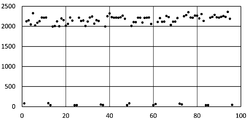
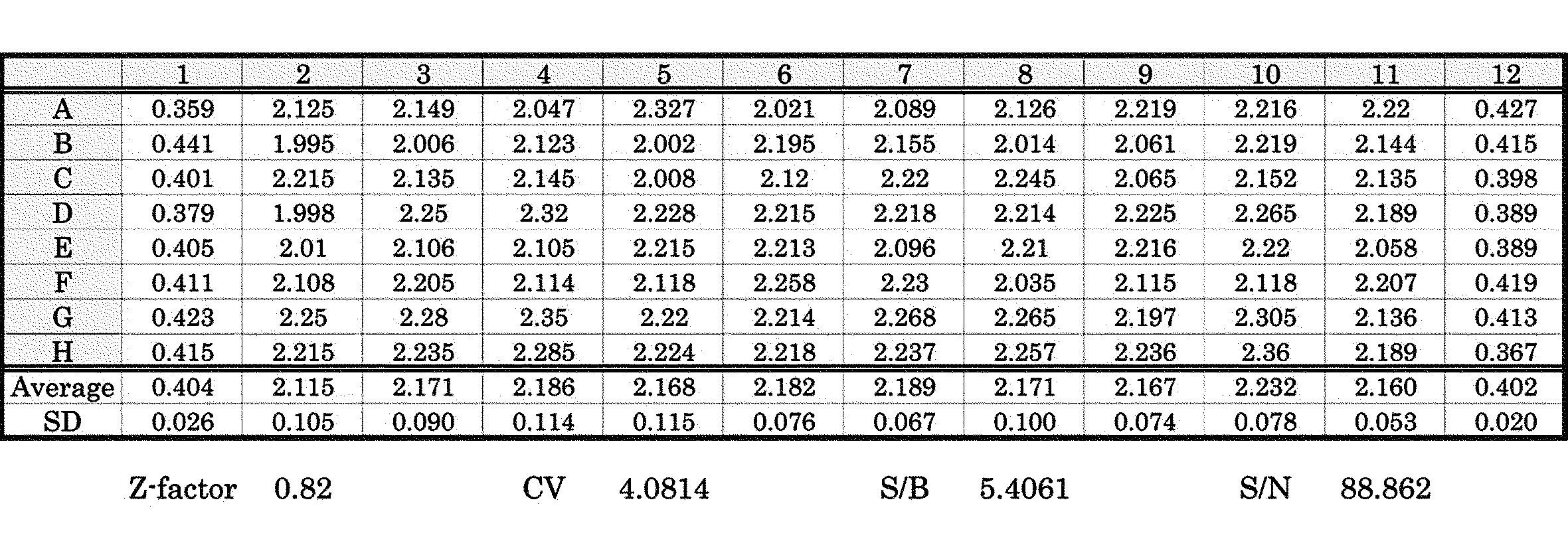
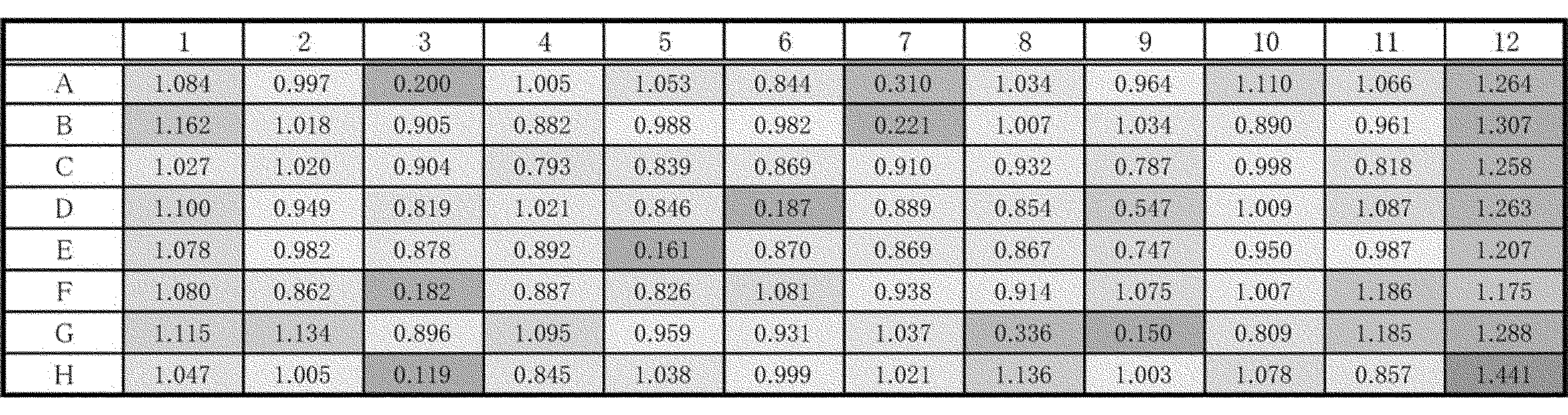
(2) スクリーニング実験においては,96wellプレートを用いて検討を行っており,スクリーニング実験の目的は,有機酸毒性を軽減する化合物のスクリーニングである。このことから,1列目および12列目の0%コントロールにはメチルマロン酸(もしくはプロピオン酸)を添加しないwellとし,2列目から11列目を毒性試験に用いた。その結果を表2,図1に示す。
(3) 表2より,CV値<10%,S/B比>3,S/N比>80,Z-factor>0.5が得られ,適正なスクリーニング系であると判定された。
(4) よって,本スクリーニング系は適切な実験系として,以降の実験例で化合物のスクリーニングに用いた。
(1) 本スクリーニング系についての妥当性を検証した。
(2) スクリーニング実験においては,96wellプレートを用いて検討を行っており,スクリーニング実験の目的は,有機酸毒性を軽減する化合物のスクリーニングである。このことから,1列目および12列目の0%コントロールにはメチルマロン酸(もしくはプロピオン酸)を添加しないwellとし,2列目から11列目を毒性試験に用いた。その結果を表2,図1に示す。
(3) 表2より,CV値<10%,S/B比>3,S/N比>80,Z-factor>0.5が得られ,適正なスクリーニング系であると判定された。
(4) よって,本スクリーニング系は適切な実験系として,以降の実験例で化合物のスクリーニングに用いた。
<<III.実験例>>
<実験例1.各化合物における神経細胞障害への影響>
(1) 表1に示す各化合物を用いて,各化合物が神経細胞障害へどのような影響を及ぼすかを調べた。
(2) 結果を表3に示す。
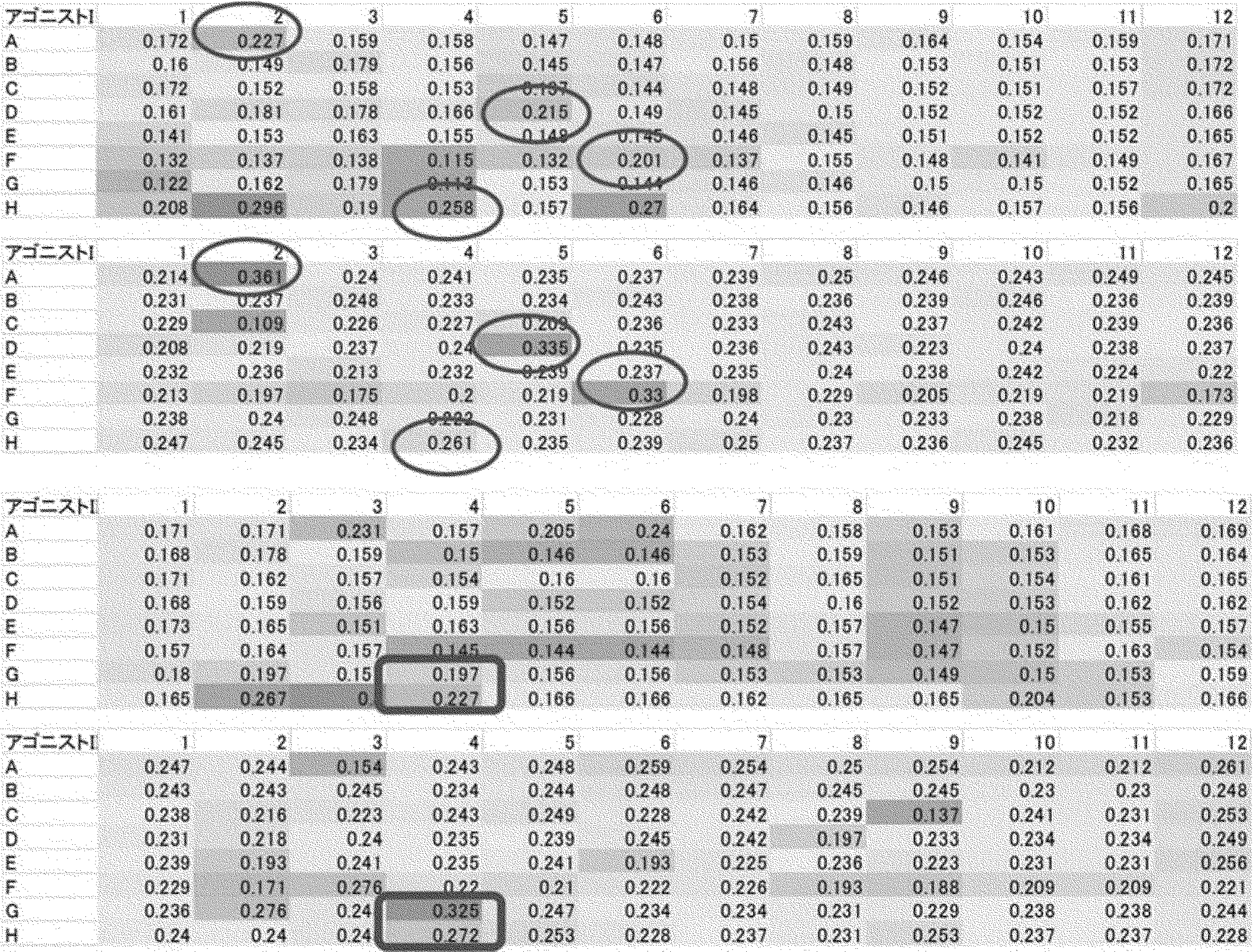
・表3について概略を説明すると,ヒートマップにより統計処理を行っており,ネガティブコントロール(96ウェルの第1列ならびに第12列)を平均化してマイナス1,ポジティブコントロール(不図示)を平均化してプラス1とし,それぞれの薬剤データについて,マイナス1からプラス1の間の値で標準化を行い,実験を3回以上繰り返して,再現性が高く,薬効を示した薬剤データについて○で囲っている。
・この結果から,患者由来細胞では6種類の化合物が,神経細胞障害を疾患特異的に回復させた。これらの化合物はForskolin,GW9508,NECA,SKF77434,nicotinamide, dobutamineであった。
(3) また,これらの化合物のすべては,細胞内のcAMPを増加させ,下流のkey regulatorであるCREBの活性化作用を有するといった共通の作用があることが分かった。
<実験例1.各化合物における神経細胞障害への影響>
(1) 表1に示す各化合物を用いて,各化合物が神経細胞障害へどのような影響を及ぼすかを調べた。
(2) 結果を表3に示す。
・表3について概略を説明すると,ヒートマップにより統計処理を行っており,ネガティブコントロール(96ウェルの第1列ならびに第12列)を平均化してマイナス1,ポジティブコントロール(不図示)を平均化してプラス1とし,それぞれの薬剤データについて,マイナス1からプラス1の間の値で標準化を行い,実験を3回以上繰り返して,再現性が高く,薬効を示した薬剤データについて○で囲っている。
・この結果から,患者由来細胞では6種類の化合物が,神経細胞障害を疾患特異的に回復させた。これらの化合物はForskolin,GW9508,NECA,SKF77434,nicotinamide, dobutamineであった。
(3) また,これらの化合物のすべては,細胞内のcAMPを増加させ,下流のkey regulatorであるCREBの活性化作用を有するといった共通の作用があることが分かった。
<実験例2.患者由来神経前駆細胞を用いた2次スクリーニング>
(1) 実験例1の結果より,cAMPがメチルマロン酸血症に対する治療効果を示す可能性が示唆された。これより,cAMPが,メチルマロン酸血症患者由来神経前駆細胞(以下,MMA患者由来神経前駆細胞)に保護効果があるか否かを調べた。
(2) MMA患者由来神経前駆細胞を1×10⁴cell/wellになるように96well-plate (Gelatin coat)に24時間培養し,db-cAMPを0, 500nM, 1μM,10μM,500μMとなるように添加し,24時間培養後,WST8法にて吸光度を測定した。
(3) 結果を図2に示す。培養上清に加えたcAMP濃度に比例して,細胞保護効果が認められた。この効果は,最大で正常対象の9割程度回復させることが分かった。
(1) 実験例1の結果より,cAMPがメチルマロン酸血症に対する治療効果を示す可能性が示唆された。これより,cAMPが,メチルマロン酸血症患者由来神経前駆細胞(以下,MMA患者由来神経前駆細胞)に保護効果があるか否かを調べた。
(2) MMA患者由来神経前駆細胞を1×10⁴cell/wellになるように96well-plate (Gelatin coat)に24時間培養し,db-cAMPを0, 500nM, 1μM,10μM,500μMとなるように添加し,24時間培養後,WST8法にて吸光度を測定した。
(3) 結果を図2に示す。培養上清に加えたcAMP濃度に比例して,細胞保護効果が認められた。この効果は,最大で正常対象の9割程度回復させることが分かった。
<実験例3.患者由来神経細胞と正常神経細胞のcAMP比較実験>
(1) 実験例1ならびに実験例2の結果から,疾患特異的に細胞内cAMP濃度が低下することが,本疾患の病態である可能性が示唆された。よって,cAMPのメチルマロン酸血症由来神経細胞に対する細胞保護効果が,メチルマロン酸血症に特異的であるかどうかを調べる目的で細胞内cAMP濃度を測定した。
(1) 実験例1ならびに実験例2の結果から,疾患特異的に細胞内cAMP濃度が低下することが,本疾患の病態である可能性が示唆された。よって,cAMPのメチルマロン酸血症由来神経細胞に対する細胞保護効果が,メチルマロン酸血症に特異的であるかどうかを調べる目的で細胞内cAMP濃度を測定した。
(2) 細胞内cAMP濃度の測定には,Enzo CO. のcAMP complete ELISA kit(ADI-900-163)を用いた。
(3) 測定を行うにあたり,細胞の前処理を行った。
・培養皿から細胞を剥離し,細胞数を数えて,遠心を行った。遠心後,上清を吸引し,0.1M HCL液に1x10⁶/cell/mLとなるように懸濁した。細胞数が明らかな細胞の場合は,これら一連の作業を省略し,細胞が接着したまま0.1M HClを培養皿上に直接入れた。
・懸濁後,10分間,室温でインキュベートした後,600g/5分 遠心を行った。この上清について,cAMPの測定を行うまで,-80度で保存した。
(4) 測定については,下記一連の工程を経て測定を行った。
・ 中和液(Neutralizing Regent)を,TA(total activity)とブランク以外のwellに50μLずつ入れた。
・続いて,100μLのスタンダード希釈液を,NBS(non specific binding)とB0(0pmol/mL standard)に加えた。また,50μLのスタンダード希釈液を,NBSのwellに加えた。さらに,#1から#5の基準希釈系列を,100μLずつ加えた。
・ サンプルを,100μLずつ各wellに加えた。
・ 50μLずつ,青(blue conjugate)溶液を,TA(total activity)とブランク以外に入れた。
・ 50μLずつ,黄色(yellow antibody)を,ブランク,TA,NSB以外に入れた(ブランク:透明,TA:透明,NSB:青,サンプルとスタンダードは緑)。
・ プレートをシールし,2時間,室温にてシェイカー上でインキュベートを行った。
・ インキュベート後,すべてのウェルを吸引して,Washing溶液400μLで合計3回洗浄を行い,最後にキムタオル上で乾燥させた。
・ TAのウェルに5μLの青(blue conjugate)溶液を加えた。
・ 200μLのsubstrate solution を加え,1時間室温に静置した後,50μLのstop solution を加え,405nmの吸光度を測定した。
(3) 測定を行うにあたり,細胞の前処理を行った。
・培養皿から細胞を剥離し,細胞数を数えて,遠心を行った。遠心後,上清を吸引し,0.1M HCL液に1x10⁶/cell/mLとなるように懸濁した。細胞数が明らかな細胞の場合は,これら一連の作業を省略し,細胞が接着したまま0.1M HClを培養皿上に直接入れた。
・懸濁後,10分間,室温でインキュベートした後,600g/5分 遠心を行った。この上清について,cAMPの測定を行うまで,-80度で保存した。
(4) 測定については,下記一連の工程を経て測定を行った。
・ 中和液(Neutralizing Regent)を,TA(total activity)とブランク以外のwellに50μLずつ入れた。
・続いて,100μLのスタンダード希釈液を,NBS(non specific binding)とB0(0pmol/mL standard)に加えた。また,50μLのスタンダード希釈液を,NBSのwellに加えた。さらに,#1から#5の基準希釈系列を,100μLずつ加えた。
・ サンプルを,100μLずつ各wellに加えた。
・ 50μLずつ,青(blue conjugate)溶液を,TA(total activity)とブランク以外に入れた。
・ 50μLずつ,黄色(yellow antibody)を,ブランク,TA,NSB以外に入れた(ブランク:透明,TA:透明,NSB:青,サンプルとスタンダードは緑)。
・ プレートをシールし,2時間,室温にてシェイカー上でインキュベートを行った。
・ インキュベート後,すべてのウェルを吸引して,Washing溶液400μLで合計3回洗浄を行い,最後にキムタオル上で乾燥させた。
・ TAのウェルに5μLの青(blue conjugate)溶液を加えた。
・ 200μLのsubstrate solution を加え,1時間室温に静置した後,50μLのstop solution を加え,405nmの吸光度を測定した。
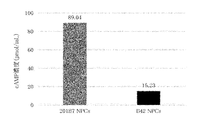
(5) 図3に結果を示す。図3において, 201B7 NPCsは正常iPS細胞由来神経前駆細胞,B42NPCsはメチルマロン酸患者iPS細胞由来神経前駆細胞,これらそれぞれの細胞内cAMP濃度を示す。
(6) メチルマロン酸由来神経細胞内cAMP濃度と正常神経細胞内cAMP濃度の比較を行った結果,メチルマロン酸由来神経細胞内では顕著にcAMP濃度が減少していることが分かった。
(6) メチルマロン酸由来神経細胞内cAMP濃度と正常神経細胞内cAMP濃度の比較を行った結果,メチルマロン酸由来神経細胞内では顕著にcAMP濃度が減少していることが分かった。
(7) これまでの一連の実験の結果,メチルマロン酸血症患者由来神経前駆細胞内ではcAMP濃度が減少しており,cAMPを補充することで細胞機能が回復することが示された。このことは,cAMPの低下が,本疾患特異的な病態をあらわしており,更にcAMPの補充治療が根本的な治療となる可能性を示唆するものである。
<実験例4.メチルマロン酸血症患者のcAMP産生能試験>
(1) メチルマロン酸血症患者由来神経前駆細胞におけるcAMP産生能を測定した。
(2) 具体的には,正常iPS細胞およびMMA由来iPS細胞からNeural Progenitor cell (NeuP)を誘導した。これらの細胞にForskorin (FSK)10μmol/lの濃度で添加し,24時間後の細胞内cAMP濃度を測定した。
(3) 図4に結果を示す。検討の結果,メチルマロン酸血症由来NPCsは,Forskorinに対する反応性の低下が認められ,cAMPの産生能が低下していることが示唆された。
(1) メチルマロン酸血症患者由来神経前駆細胞におけるcAMP産生能を測定した。
(2) 具体的には,正常iPS細胞およびMMA由来iPS細胞からNeural Progenitor cell (NeuP)を誘導した。これらの細胞にForskorin (FSK)10μmol/lの濃度で添加し,24時間後の細胞内cAMP濃度を測定した。
(3) 図4に結果を示す。検討の結果,メチルマロン酸血症由来NPCsは,Forskorinに対する反応性の低下が認められ,cAMPの産生能が低下していることが示唆された。
<実験5.シグナル阻害試験>
(1) cAMPを介したシグナル伝達はよく知られており,これらの経路を阻害する薬物ライブラリーを用いた阻害実験を行った。結果の生データを表4に示す。
(2) この結果,下記のことが分かった。
・ cAMP産生阻害剤は,メチルマロン酸の細胞障害を増悪させた。
・ cAMP分解阻害剤は,メチルマロン酸の細胞障害を改善させた。
・ ERK阻害は,メチルマロン酸の細胞障害を増悪させた。
・ CREB阻害は,メチルマロン酸の細胞障害を改善させた。
(3) また,アゴニストと阻害剤を用いた実験から,下記のことが分かった。
・ ERKを活性化し,CREBを阻害すると細胞毒性は増悪する。
・ CREBを阻害した状態で,cAMPを添加しても,細胞保護効果は得られない。
(4) 以上の結果より,メチルマロン酸の細胞障害(毒性)は,細胞内cAMPの産生低下により引き起こされており,これは慢性的なcAMPの産生能の低下による細胞機能障害であり,かつ,db-cAMPの治療効果はCREBを介して発揮されていることを示した。
(1) cAMPを介したシグナル伝達はよく知られており,これらの経路を阻害する薬物ライブラリーを用いた阻害実験を行った。結果の生データを表4に示す。
(2) この結果,下記のことが分かった。
・ cAMP産生阻害剤は,メチルマロン酸の細胞障害を増悪させた。
・ cAMP分解阻害剤は,メチルマロン酸の細胞障害を改善させた。
・ ERK阻害は,メチルマロン酸の細胞障害を増悪させた。
・ CREB阻害は,メチルマロン酸の細胞障害を改善させた。
(3) また,アゴニストと阻害剤を用いた実験から,下記のことが分かった。
・ ERKを活性化し,CREBを阻害すると細胞毒性は増悪する。
・ CREBを阻害した状態で,cAMPを添加しても,細胞保護効果は得られない。
(4) 以上の結果より,メチルマロン酸の細胞障害(毒性)は,細胞内cAMPの産生低下により引き起こされており,これは慢性的なcAMPの産生能の低下による細胞機能障害であり,かつ,db-cAMPの治療効果はCREBを介して発揮されていることを示した。
<実験6.メチルマロン酸によるAdenylate cyclase阻害実験>
cAMPは,Adenylate cyclaseによりATPから産生されている。これより,メチルマロン酸が,Adenylate cyclaseを阻害するかについて調べた。
cAMPは,Adenylate cyclaseによりATPから産生されている。これより,メチルマロン酸が,Adenylate cyclaseを阻害するかについて調べた。
1.メチルマロン酸血症患者iPS細胞由来神経前駆細胞(B42NPCs)に対し,最終濃度が50μMと100μMのメチルマロン酸を加えた培養液で培養を行い,24時間後のcAMP濃度を測定した。
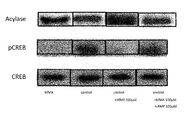
2.結果を図5ならびに図6に示す。なお,図6におけるタンパク発現解析は,既存のウエスタンブロッティング法に基づいて実施した。
(1) 培養液中のメチルマロン酸濃度が多いほど,cAMP産生力は低下することが示された(図5)。
(2) 一方,Adenylate cyclase,CREBの総タンパク発現量は,メチルマロン酸の添加の有無にかかわらず一定であった(図6)。
(3) また,MMA存在下であっても,cAMPを添加した場合,リン酸化CREBの発現が増加しており,CREBのリン酸化(活性化)は阻害されていないことが分かった。
(4) これらより,MMA添加によるcAMP生低下は,Adenylate cyclaseの活性低下に起因することが示された。
(1) 培養液中のメチルマロン酸濃度が多いほど,cAMP産生力は低下することが示された(図5)。
(2) 一方,Adenylate cyclase,CREBの総タンパク発現量は,メチルマロン酸の添加の有無にかかわらず一定であった(図6)。
(3) また,MMA存在下であっても,cAMPを添加した場合,リン酸化CREBの発現が増加しており,CREBのリン酸化(活性化)は阻害されていないことが分かった。
(4) これらより,MMA添加によるcAMP生低下は,Adenylate cyclaseの活性低下に起因することが示された。
以上の結果から,メチルマロン酸の細胞障害(毒性)は,Adenylate cyclaseの活性低下により,細胞内cAMP濃度が減少することで引き起こされることを,発明者らは明らかとしたものである。加えて,かかるメカニズムは,慢性的なcAMPの産生能の低下による細胞機能障害を引き起こすものであり,かつ,cAMPの治療効果は,CREBを介して発揮されていることが示された。
<実験7.痙攣を指標としたin vivoによる試験>
メチルマロン酸血症簡易神経障害モデルとして,メチルマロン酸投与マウスを用いた。このモデルにおいて,メチルマロン酸投与により起こる痙攣を指標に,候補薬の評価を行った。
メチルマロン酸血症簡易神経障害モデルとして,メチルマロン酸投与マウスを用いた。このモデルにおいて,メチルマロン酸投与により起こる痙攣を指標に,候補薬の評価を行った。
1.4週齢C57BL/6Jマウスに,1mg/kg/dose1のメチルマロン酸溶液を1日1回皮下投与し,6週齢目に評価を実施した。
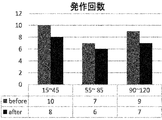
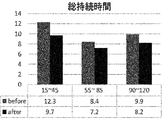
2.候補薬剤として,db-cAMP(30mg/kg/dose)ならびにPDE4阻害剤(1mg/kg/day)の皮下投与を行い,投与前後における痙攣発作回数ならびに総持続時間を計測し,比較検討を行った。なお,投与前については30分間コントロールとしての測定を行い,投与後においては,15から45分,55から85分,90から120分,それぞれ3回30分間の測定を行った。
2.候補薬剤として,db-cAMP(30mg/kg/dose)ならびにPDE4阻害剤(1mg/kg/day)の皮下投与を行い,投与前後における痙攣発作回数ならびに総持続時間を計測し,比較検討を行った。なお,投与前については30分間コントロールとしての測定を行い,投与後においては,15から45分,55から85分,90から120分,それぞれ3回30分間の測定を行った。
3.結果を図7,8に示す。
(1) 候補薬投与により,発作回数は,いずれの測定区間においても減少していた。
(2) 同様に,候補薬投与により,総持続時間は,いずれの測定区間においても短くなっていた。
4.これらの結果より,in vivoにおいても,cAMP濃度上昇を促すことにより,メチルマロン血症における神経障害が抑制されることが示された。
(1) 候補薬投与により,発作回数は,いずれの測定区間においても減少していた。
(2) 同様に,候補薬投与により,総持続時間は,いずれの測定区間においても短くなっていた。
4.これらの結果より,in vivoにおいても,cAMP濃度上昇を促すことにより,メチルマロン血症における神経障害が抑制されることが示された。
<実験8.生存率を指標としたin vivoによる試験>
致死的メチルマロン酸発作モデルを用いて,生存率を指標に候補薬投与の評価を行った。
致死的メチルマロン酸発作モデルを用いて,生存率を指標に候補薬投与の評価を行った。
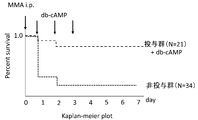
1.8週齢のC57BL/6Jマウスに,500μMのメチルマロン酸溶液を20ml/kgとなるよう腹腔内投与し、致死的メチルマロン酸発作モデルを作製した。
2.メチルマロン酸投与1日後,2日後,3日後に,候補薬剤としてdb-cAMP(10μg/kg/dose)の皮下投与を行い,投与群と非投与群における生存率の比較を行った。
3.結果を図9に示す。
(1) 非投与群において,メチルマロン酸投与1日後では35.3%,2日以降では14.7%の生存率であった。
(2) 一方,投与群においては,メチルマロン酸投与1日後で85.0%,2日以降で75.0%の生存率であり,非投与群と比較して有意に高い生存率を示した(p<0.001)。
4.これらの結果より,db-cAMPの投与を介したcAMP濃度上昇の促進により、メチルマロン酸症由来の発作による生命予後を著しく改善することが示された。
2.メチルマロン酸投与1日後,2日後,3日後に,候補薬剤としてdb-cAMP(10μg/kg/dose)の皮下投与を行い,投与群と非投与群における生存率の比較を行った。
3.結果を図9に示す。
(1) 非投与群において,メチルマロン酸投与1日後では35.3%,2日以降では14.7%の生存率であった。
(2) 一方,投与群においては,メチルマロン酸投与1日後で85.0%,2日以降で75.0%の生存率であり,非投与群と比較して有意に高い生存率を示した(p<0.001)。
4.これらの結果より,db-cAMPの投与を介したcAMP濃度上昇の促進により、メチルマロン酸症由来の発作による生命予後を著しく改善することが示された。
Claims (8)
- 有機酸血症において,cAMPを増加させることにより,神経障害を治療ないし予防することを特徴とする神経障害治療用薬剤
- さらに,CREBを活性化させることを特徴とする請求項1に記載の神経障害治療用薬剤
- 有機酸血症が,Adnylate cyclaseの活性を低下させることを特徴とする請求項1又は2に記載の神経障害治療用薬剤
- 有機酸血症が,メチルマロン酸血症,プロピオン酸血症のいずれか又は複数から選択されることを特徴とする請求項1又は2に記載の神経障害治療用薬剤
- cAMPの増加が,Forskolin,GW9508,NECA,SKF77434,nicotinamide, dobutamine,db-cAMPのいずれかによりなされることを特徴とする請求項1から4のいずれかに記載の神経障害治療用薬剤
- cAMPの増加が,Adenylate cyclaseの活性低下を抑制または防止することによりなされることを特徴とする請求項3に記載の神経障害治療用薬剤
- 神経障害の治療ないし予防により,延命効果を高めることを特徴とする請求項1から6のいずれかに記載の神経障害治療用薬剤
- 請求項1ないし7のいずれかに記載の神経障害治療用薬剤を用いて,有機酸血症における神経障害を治療ないし予防する方法
Priority Applications (3)
| Application Number | Priority Date | Filing Date | Title |
|---|---|---|---|
| US16/341,321 US20200046676A1 (en) | 2016-10-17 | 2017-10-17 | Therapeutic agent for neuropathy in organic acidemia of which mechanism relies on increase in camp |
| JP2018546353A JP7029707B2 (ja) | 2016-10-17 | 2017-10-17 | cAMPの増加をメカニズムとする有機酸血症における神経障害治療薬剤 |
| US17/198,904 US11771678B2 (en) | 2016-10-17 | 2021-03-11 | Therapeutic agent for neuropathy in organic acidemia of which mechanism relies on increase in cAMP |
Applications Claiming Priority (2)
| Application Number | Priority Date | Filing Date | Title |
|---|---|---|---|
| JP2016203955 | 2016-10-17 | ||
| JP2016-203955 | 2016-10-17 |
Related Child Applications (2)
| Application Number | Title | Priority Date | Filing Date |
|---|---|---|---|
| US16/341,321 A-371-Of-International US20200046676A1 (en) | 2016-10-17 | 2017-10-17 | Therapeutic agent for neuropathy in organic acidemia of which mechanism relies on increase in camp |
| US17/198,904 Continuation US11771678B2 (en) | 2016-10-17 | 2021-03-11 | Therapeutic agent for neuropathy in organic acidemia of which mechanism relies on increase in cAMP |
Publications (1)
| Publication Number | Publication Date |
|---|---|
| WO2018074463A1 true WO2018074463A1 (ja) | 2018-04-26 |
Family
ID=62018480
Family Applications (1)
| Application Number | Title | Priority Date | Filing Date |
|---|---|---|---|
| PCT/JP2017/037507 Ceased WO2018074463A1 (ja) | 2016-10-17 | 2017-10-17 | cAMPの増加をメカニズムとする有機酸血症における神経障害治療薬剤 |
Country Status (3)
| Country | Link |
|---|---|
| US (2) | US20200046676A1 (ja) |
| JP (1) | JP7029707B2 (ja) |
| WO (1) | WO2018074463A1 (ja) |
Citations (2)
| Publication number | Priority date | Publication date | Assignee | Title |
|---|---|---|---|---|
| JP2006514630A (ja) * | 2002-11-20 | 2006-05-11 | ニューロノバ エービー | 神経発生を増大させるための組成物および方法 |
| JP2009536950A (ja) * | 2006-05-12 | 2009-10-22 | チルドレンズ メディカル センター コーポレーション | 末梢神経障害を治療および予防するための方法および組成物 |
Family Cites Families (2)
| Publication number | Priority date | Publication date | Assignee | Title |
|---|---|---|---|---|
| US20050209142A1 (en) | 2002-11-20 | 2005-09-22 | Goran Bertilsson | Compounds and methods for increasing neurogenesis |
| US6969702B2 (en) | 2002-11-20 | 2005-11-29 | Neuronova Ab | Compounds and methods for increasing neurogenesis |
-
2017
- 2017-10-17 WO PCT/JP2017/037507 patent/WO2018074463A1/ja not_active Ceased
- 2017-10-17 US US16/341,321 patent/US20200046676A1/en not_active Abandoned
- 2017-10-17 JP JP2018546353A patent/JP7029707B2/ja active Active
-
2021
- 2021-03-11 US US17/198,904 patent/US11771678B2/en active Active
Patent Citations (2)
| Publication number | Priority date | Publication date | Assignee | Title |
|---|---|---|---|---|
| JP2006514630A (ja) * | 2002-11-20 | 2006-05-11 | ニューロノバ エービー | 神経発生を増大させるための組成物および方法 |
| JP2009536950A (ja) * | 2006-05-12 | 2009-10-22 | チルドレンズ メディカル センター コーポレーション | 末梢神経障害を治療および予防するための方法および組成物 |
Non-Patent Citations (2)
| Title |
|---|
| DE MATTOS-DUTRA, A. ET AL.: "Propionic and methylmalonic acids inhibit the in vitro phosphorylation of 85kDa cytoskeletal protein from cerebral cortex of rats", NEUROCHEMISTRY INTERNATIONAL, vol. 33, no. 5, 2 November 1998 (1998-11-02), pages 407 - 414, XP055604735, ISSN: 0197-0186, DOI: 10.1016/S0197-0186(98)00044-8 * |
| LOUREIRO, S. 0. ET AL.: "Propionic and methylmalonic acids increase cAMP levels of cerebral cortex of young rats via adrenergic and glutamatergic mechanisms", BIOCHIM. BIOPHYS. ACTA, vol. 1740, no. 5, 10 June 2005 (2005-06-10), pages 460 - 466, XP025329149, ISSN: 0925-4439, DOI: doi:10.1016/j.bbadis.2004.12.007 * |
Also Published As
| Publication number | Publication date |
|---|---|
| JP7029707B2 (ja) | 2022-03-04 |
| US20200046676A1 (en) | 2020-02-13 |
| US11771678B2 (en) | 2023-10-03 |
| US20210260020A1 (en) | 2021-08-26 |
| JPWO2018074463A1 (ja) | 2019-08-29 |
Similar Documents
| Publication | Publication Date | Title |
|---|---|---|
| Wang et al. | A novel cytoprotective peptide protects mesenchymal stem cells against mitochondrial dysfunction and apoptosis induced by starvation via Nrf2/Sirt3/FoxO3a pathway | |
| Shin et al. | A curcumin derivative hydrazinobenzoylcurcumin suppresses stem‐like features of glioblastoma cells by targeting Ca2+/calmodulin‐dependent protein kinase II | |
| US20180153830A1 (en) | Selective inhibitors of undifferentiated cells | |
| Ganapathy et al. | Influence of 6‐Hydroxydopamine Toxicity on α‐Synuclein Phosphorylation, Resting Vesicle Expression, and Vesicular Dopamine Release | |
| JP2020501522A (ja) | ヒト血漿様培地 | |
| WO2014172616A2 (en) | Methods, compositions and kits for promoting motor neuron survival and treating and diagnosing neurodegenerative disorders | |
| EP3397774A1 (en) | Mnk biomarkers and uses thereof | |
| Adler et al. | Epigenomic mechanisms of alcohol-induced impaired differentiation of skeletal muscle stem cells; role of Class IIA histone deacetylases | |
| Menendez et al. | Energy metabolism and metabolic sensors in stem cells: the metabostem crossroads of aging and cancer | |
| Hwang et al. | Sestrin2 attenuates cellular senescence by inhibiting NADPH oxidase 4 expression | |
| Jantas et al. | New evidences for a role of mGluR7 in astrocyte survival: possible implications for neuroprotection | |
| US11980620B2 (en) | Compounds and methods for treatment of Diamond Blackfan anemia | |
| Kim et al. | Soluble epoxide hydrolase inhibitor, TPPU, attenuates progression of atherosclerotic lesions and vascular smooth muscle cell phenotypic switching | |
| JP7029707B2 (ja) | cAMPの増加をメカニズムとする有機酸血症における神経障害治療薬剤 | |
| Opladen et al. | Effect of antiepileptic drugs and reactive oxygen species on folate receptor 1 (FOLR1)-dependent 5-methyltetrahydrofolate transport | |
| JP2010530854A (ja) | Ablチロシンキナーゼ阻害剤による慢性骨髄性白血病の処置を最適化するための方法 | |
| Cheng et al. | mTORC1‐mediated amino acid signaling is critical for cell fate determination under transplant‐induced stress | |
| Chen et al. | Dipyridamole inhibits cobalt chloride-induced osteopontin expression in NRK52E cells | |
| Shapiro et al. | The Jumonji-C Histone Lysine Demethylase KDM3B Senses Cellular Iron to Regulate Anabolism Through mTORC1 | |
| US12491187B2 (en) | Use of MCT1 inhibitors to enhance insulin sensitivity | |
| Galal et al. | Impact of ADMA (asymmetric dimethylarginine) on physiology with respect to diabetes mellitus and respiratory system BEAS-2B cells (human bronchial epithelial cells) | |
| US8314150B2 (en) | Kinase protein binding inhibitors | |
| Kelly | Basal mitophagy as an anti-ageing programme | |
| Tombari | Role of mutant p53 as mechanosensitive regulator of amino-acid metabolism in breast cancer | |
| Lung | Hyperoxia inhibits pulmonary protein synthesis |
Legal Events
| Date | Code | Title | Description |
|---|---|---|---|
| 121 | Ep: the epo has been informed by wipo that ep was designated in this application |
Ref document number: 17861587 Country of ref document: EP Kind code of ref document: A1 |
|
| ENP | Entry into the national phase |
Ref document number: 2018546353 Country of ref document: JP Kind code of ref document: A |
|
| NENP | Non-entry into the national phase |
Ref country code: DE |
|
| 122 | Ep: pct application non-entry in european phase |
Ref document number: 17861587 Country of ref document: EP Kind code of ref document: A1 |