WO2018072233A1 - 一种基于选择性搜索算法的车标检测识别方法及系统 - Google Patents
一种基于选择性搜索算法的车标检测识别方法及系统 Download PDFInfo
- Publication number
- WO2018072233A1 WO2018072233A1 PCT/CN2016/104809 CN2016104809W WO2018072233A1 WO 2018072233 A1 WO2018072233 A1 WO 2018072233A1 CN 2016104809 W CN2016104809 W CN 2016104809W WO 2018072233 A1 WO2018072233 A1 WO 2018072233A1
- Authority
- WO
- WIPO (PCT)
- Prior art keywords
- vehicle
- positioning
- target
- region
- similarity
- Prior art date
- Legal status (The legal status is an assumption and is not a legal conclusion. Google has not performed a legal analysis and makes no representation as to the accuracy of the status listed.)
- Ceased
Links
Images




Classifications
-
- G—PHYSICS
- G06—COMPUTING OR CALCULATING; COUNTING
- G06V—IMAGE OR VIDEO RECOGNITION OR UNDERSTANDING
- G06V20/00—Scenes; Scene-specific elements
- G06V20/50—Context or environment of the image
- G06V20/56—Context or environment of the image exterior to a vehicle by using sensors mounted on the vehicle
- G06V20/58—Recognition of moving objects or obstacles, e.g. vehicles or pedestrians; Recognition of traffic objects, e.g. traffic signs, traffic lights or roads
- G06V20/584—Recognition of moving objects or obstacles, e.g. vehicles or pedestrians; Recognition of traffic objects, e.g. traffic signs, traffic lights or roads of vehicle lights or traffic lights
-
- G—PHYSICS
- G06—COMPUTING OR CALCULATING; COUNTING
- G06V—IMAGE OR VIDEO RECOGNITION OR UNDERSTANDING
- G06V10/00—Arrangements for image or video recognition or understanding
- G06V10/40—Extraction of image or video features
- G06V10/46—Descriptors for shape, contour or point-related descriptors, e.g. scale invariant feature transform [SIFT] or bags of words [BoW]; Salient regional features
- G06V10/462—Salient features, e.g. scale invariant feature transforms [SIFT]
- G06V10/464—Salient features, e.g. scale invariant feature transforms [SIFT] using a plurality of salient features, e.g. bag-of-words [BoW] representations
-
- G—PHYSICS
- G06—COMPUTING OR CALCULATING; COUNTING
- G06F—ELECTRIC DIGITAL DATA PROCESSING
- G06F18/00—Pattern recognition
- G06F18/20—Analysing
- G06F18/21—Design or setup of recognition systems or techniques; Extraction of features in feature space; Blind source separation
- G06F18/213—Feature extraction, e.g. by transforming the feature space; Summarisation; Mappings, e.g. subspace methods
- G06F18/2136—Feature extraction, e.g. by transforming the feature space; Summarisation; Mappings, e.g. subspace methods based on sparsity criteria, e.g. with an overcomplete basis
-
- G—PHYSICS
- G06—COMPUTING OR CALCULATING; COUNTING
- G06F—ELECTRIC DIGITAL DATA PROCESSING
- G06F18/00—Pattern recognition
- G06F18/20—Analysing
- G06F18/24—Classification techniques
- G06F18/241—Classification techniques relating to the classification model, e.g. parametric or non-parametric approaches
- G06F18/2411—Classification techniques relating to the classification model, e.g. parametric or non-parametric approaches based on the proximity to a decision surface, e.g. support vector machines
-
- G—PHYSICS
- G06—COMPUTING OR CALCULATING; COUNTING
- G06F—ELECTRIC DIGITAL DATA PROCESSING
- G06F18/00—Pattern recognition
- G06F18/20—Analysing
- G06F18/24—Classification techniques
- G06F18/243—Classification techniques relating to the number of classes
- G06F18/2431—Multiple classes
-
- G—PHYSICS
- G06—COMPUTING OR CALCULATING; COUNTING
- G06T—IMAGE DATA PROCESSING OR GENERATION, IN GENERAL
- G06T7/00—Image analysis
- G06T7/70—Determining position or orientation of objects or cameras
- G06T7/73—Determining position or orientation of objects or cameras using feature-based methods
-
- G—PHYSICS
- G06—COMPUTING OR CALCULATING; COUNTING
- G06V—IMAGE OR VIDEO RECOGNITION OR UNDERSTANDING
- G06V10/00—Arrangements for image or video recognition or understanding
- G06V10/40—Extraction of image or video features
- G06V10/44—Local feature extraction by analysis of parts of the pattern, e.g. by detecting edges, contours, loops, corners, strokes or intersections; Connectivity analysis, e.g. of connected components
- G06V10/443—Local feature extraction by analysis of parts of the pattern, e.g. by detecting edges, contours, loops, corners, strokes or intersections; Connectivity analysis, e.g. of connected components by matching or filtering
- G06V10/449—Biologically inspired filters, e.g. difference of Gaussians [DoG] or Gabor filters
- G06V10/451—Biologically inspired filters, e.g. difference of Gaussians [DoG] or Gabor filters with interaction between the filter responses, e.g. cortical complex cells
- G06V10/454—Integrating the filters into a hierarchical structure, e.g. convolutional neural networks [CNN]
-
- G—PHYSICS
- G06—COMPUTING OR CALCULATING; COUNTING
- G06V—IMAGE OR VIDEO RECOGNITION OR UNDERSTANDING
- G06V10/00—Arrangements for image or video recognition or understanding
- G06V10/70—Arrangements for image or video recognition or understanding using pattern recognition or machine learning
- G06V10/764—Arrangements for image or video recognition or understanding using pattern recognition or machine learning using classification, e.g. of video objects
-
- G—PHYSICS
- G06—COMPUTING OR CALCULATING; COUNTING
- G06V—IMAGE OR VIDEO RECOGNITION OR UNDERSTANDING
- G06V10/00—Arrangements for image or video recognition or understanding
- G06V10/70—Arrangements for image or video recognition or understanding using pattern recognition or machine learning
- G06V10/77—Processing image or video features in feature spaces; using data integration or data reduction, e.g. principal component analysis [PCA] or independent component analysis [ICA] or self-organising maps [SOM]; Blind source separation
- G06V10/7715—Feature extraction, e.g. by transforming the feature space, e.g. multi-dimensional scaling [MDS]; Mappings, e.g. subspace methods
-
- G—PHYSICS
- G06—COMPUTING OR CALCULATING; COUNTING
- G06V—IMAGE OR VIDEO RECOGNITION OR UNDERSTANDING
- G06V20/00—Scenes; Scene-specific elements
- G06V20/50—Context or environment of the image
- G06V20/56—Context or environment of the image exterior to a vehicle by using sensors mounted on the vehicle
-
- G—PHYSICS
- G06—COMPUTING OR CALCULATING; COUNTING
- G06V—IMAGE OR VIDEO RECOGNITION OR UNDERSTANDING
- G06V20/00—Scenes; Scene-specific elements
- G06V20/60—Type of objects
- G06V20/62—Text, e.g. of license plates, overlay texts or captions on TV images
-
- G—PHYSICS
- G06—COMPUTING OR CALCULATING; COUNTING
- G06T—IMAGE DATA PROCESSING OR GENERATION, IN GENERAL
- G06T2207/00—Indexing scheme for image analysis or image enhancement
- G06T2207/30—Subject of image; Context of image processing
- G06T2207/30248—Vehicle exterior or interior
- G06T2207/30252—Vehicle exterior; Vicinity of vehicle
-
- G—PHYSICS
- G06—COMPUTING OR CALCULATING; COUNTING
- G06V—IMAGE OR VIDEO RECOGNITION OR UNDERSTANDING
- G06V2201/00—Indexing scheme relating to image or video recognition or understanding
- G06V2201/08—Detecting or categorising vehicles
-
- G—PHYSICS
- G06—COMPUTING OR CALCULATING; COUNTING
- G06V—IMAGE OR VIDEO RECOGNITION OR UNDERSTANDING
- G06V2201/00—Indexing scheme relating to image or video recognition or understanding
- G06V2201/09—Recognition of logos
Definitions
- the invention relates to the field of image processing, in particular to a vehicle marking detection and recognition method and system based on a selective search algorithm.
- the vehicle logo detection system is an important part of the intelligent transportation system.
- the vehicle logo is a unique symbol of the vehicle brand. Correct identification of the vehicle logo can effectively assist the vehicle identification system to match the relevant information of the vehicle, which will benefit the vehicle.
- the identity is determined to improve the vehicle recognition rate.
- Vehicle identification has a wide range of applications in the field of intelligent transportation, such as vehicle matching, vehicle information collection and fake deck detection. In reality, the area, shape and texture of the car logo are different.
- the background grid of the vehicle logo is also diverse. At the same time, the difference between the characteristics of the space position of the large vehicle and the small vehicle logo makes the traditional template matching vehicle marking detection method. It is difficult to obtain a high detection success rate while consuming a large amount of time.
- the existing vehicle marking detection algorithms include: Adaboost-based vehicle marking detection method, vehicle marking texture-based vehicle marking detection method, and texture consistency-based vehicle marking detection method.
- the vehicle marking detection method based on the background of the vehicle logo, the template matching detection method based on the template, and the vehicle marking detection method based on the exhaustive search.
- the Adaboost-based car mark detection method uses the Adaboost classifier to learn the car logo features and use the sliding window to locate and identify the car logo.
- the car mark texture feature car mark detection method first uses the license plate position information to carry out the rough positioning of the car mark, and then uses the car mark prior knowledge and the car edge edge feature to accurately locate the car mark, and then uses the support vector machine training classifier to locate the car mark.
- the vehicle marking detection method based on texture consistency distinguishes the vehicle texture feature from the background feature of the vehicle logo, thereby accurately positioning the vehicle logo and identifying Vehicle logo, this method is suitable for the case where the vehicle logo and its background texture feature are different, but in reality, the vehicle logo and its background texture feature are difficult to distinguish; based on the vehicle logo background, the vehicle logo detection method uses the filtering algorithm to target the pair. The background texture of the vehicle logo is eliminated, so that accurate vehicle positioning results can be obtained, and then the features such as SIFT are used to describe the vehicle. Describe and identify by classifier.
- This method greatly reduces the influence of the background of the vehicle logo on the positioning of the vehicle mark, but it is easy to eliminate the information of the vehicle mark, affecting the positioning of the vehicle mark and the recognition result of the vehicle mark;
- the car logo is used as a template to locate the car mark position and recognition result.
- This method is relatively less affected by the car logo background, but the time consumption is too long.
- the sliding area is used to exhaust the target area. Search, and use the operator such as HOG, SIFT to determine the target of the vehicle, in order to obtain the logo area and the type of the vehicle logo.
- This method is theoretically applicable to all models, but the speed of the sliding window is relatively slow. The earth affects the practicality of the algorithm.
- the current vehicle marking detection algorithm has the following defects or deficiencies:
- the object of the present invention is to provide a vehicle marking detection and recognition method based on a selective search algorithm with wide applicability, strong robustness and fast detection speed.
- Another object of the present invention is to provide a vehicle marking detection and recognition system based on a selective search algorithm with wide applicability, strong robustness and fast detection speed.
- a vehicle marking detection and recognition method based on a selective search algorithm comprising the following steps:
- the vehicle logo is coarsely positioned in the original vehicle image to obtain a rough positioning image of the vehicle logo
- the target search target set is obtained by using a selective search algorithm to obtain a target set, and the selective search algorithm performs regional combination according to color similarity, texture similarity, size similarity and coincidence degree similarity;
- the linear constraint coding algorithm is used to train the vehicle classification judgment classifier to determine the vehicle target of the positioning target set, and obtain the position of the vehicle target;
- a linear constrained coding algorithm is used to train multiple types of vehicle identification classifiers to identify the type of the vehicle and obtain the vehicle identification result.
- the step of coarsely positioning the vehicle logo in the original vehicle image according to the license plate position, the license plate and the vehicle space position relationship, and the window edge information, and obtaining the vehicle logo coarse positioning image comprising:
- the window is coarsely positioned, and the upper boundary position of the rough positioning of the vehicle is determined according to the coarse positioning information of the window edge, and the expression of the coordinate Y up of the upper boundary of the coarse positioning of the vehicle is:
- h(x) is the vertical projection of the edge of the original vehicle image
- max 2 h(x) indicates that the two maximum values h(x 1 ) and h(x) are selected from top to bottom in the vertical projection h(x) of the edge. 2 ) the corresponding abscissa x 1 and x 2
- H is the height of the original vehicle image
- b is the empirical threshold
- the rough positioning image of the vehicle mark is obtained.
- the step of selecting a license candidate area in the rough target image of the vehicle based on the central axis of the vehicle includes:
- the area of the set width and the set height is selected as the first logo candidate area according to the central axis of the vehicle.
- the step of performing target positioning on the candidate area of the vehicle by using the selective search algorithm to obtain the positioning target set includes:
- step S1 using a selective search algorithm in the first target candidate area for target detection, if no target is detected, step S2 is performed, otherwise, directly jump to step S3;
- step S2 laterally amplifying the first landmark candidate region with the set lateral amplification width to form a second landmark candidate region, and then using a selective search algorithm to detect the target of the vehicle in the second landmark candidate region, If the target is still not detected, the first target candidate area is discarded and the second target candidate area is amplified by the new horizontal amplification width until step S3 is performed after the second target candidate area detects the target; Then performing step S3;
- S3. Determine whether the detected target is a single character or a string car logo or a symbol type car logo. If it is a string car logo or a symbol type car logo, the selective search algorithm ends. If it is a single character, the character height is 1.5. The high as the candidate area is high as the third target candidate area, and the target search is continued using the selective search algorithm in the third target candidate area.
- the step of performing target positioning on the candidate area of the vehicle by using the selective search algorithm to obtain the positioning target set includes:
- the image segmentation algorithm based on graph theory is used to obtain the initial segmentation region from the candidate region of the vehicle;
- Texture similarity weight coefficient, size similarity weight coefficient and coincidence similarity weight coefficient, a 1 , a 2 , a 3 and a 4 have a value range of (0, 1), with Corresponding to the 3 ⁇ 25-dimensional color space vector corresponding to the region r i and the region r j , with The 8 ⁇ 3 ⁇ 10-dimensional texture vectors corresponding to the region r i and the region r j respectively, where n is the total number of elements of the color space vector or the texture vector, size(r i ), size(r j ), size(im), and size.
- the initial segmentation region is merged according to the calculated comprehensive similarity between adjacent regions, and the positioning target set is obtained.
- the step of using the linear constraint coding algorithm to train the vehicle classification judgment classifier to perform the identification of the vehicle target on the positioning target set to obtain the position of the vehicle mark includes:
- the sample of the sample set is divided into a positive sample and a negative sample, wherein the positive sample includes a single character sample, a small car sample in the sample set, and a large car sample sample in the sample set, and the negative sample is randomly selected in the sample set size and is associated with the vehicle standard a sample with a degree of coincidence of less than 20%;
- the positive sample is used as the training sample, and the linear constraint coding classifier is used for iterative training until convergence. Finally, the vehicle classification judgment classifier is trained. The iterative training process will divide the vehicle classification judgment classifier into mistakes after each completion of the training. Samples of negative samples are added to the training samples to form a new training sample set, and then retrained with the new training sample set;
- the classifier determines the vehicle target of the positioning target set, and obtains the position of the vehicle target.
- the step of using a linear constraint coding algorithm to train a plurality of types of vehicle identification classifiers to perform specific type identification on the vehicle logo to obtain a vehicle identification result includes:
- the manually labeled car logo and the string character's single character are placed into the linear constraint code.
- the classifier performs iterative training, and the classified vehicle logo is again put into the linear constraint coding classifier for training until convergence, and a multi-class vehicle identification classifier is obtained;
- the vehicle type is specifically identified: if the vehicle identification result of the current multi-class vehicle identification classifier is a non-single character vehicle, the current multi-class vehicle identification classifier The vehicle identification result is used as the vehicle type of the vehicle; if the vehicle identification result of the current multi-class vehicle identification classifier is a single character, the third vehicle candidate area is reselected according to the single character, and then the vehicle identification is performed again. And combining the positioned characters to form a character string, and finally using the vehicle type of the string as the vehicle identification result.
- a vehicle marking detection and recognition system based on a selective search algorithm comprising:
- a license plate positioning module for performing license plate positioning on an original vehicle image to obtain a license plate position
- the vehicle standard coarse positioning module is used for coarsely positioning the vehicle logo in the original vehicle image according to the license plate position, the license plate and the vehicle space position relationship and the window edge information, and obtaining the vehicle logo coarse positioning image;
- a vehicle bid candidate area selection module configured to select a vehicle bid candidate area in the vehicle standard coarse positioning image based on the vehicle central axis
- the target positioning module is configured to perform target positioning on the vehicle candidate area by using a selective search algorithm to obtain a positioning target set, and the selective search algorithm comprehensively selects according to color similarity, texture similarity, size similarity and coincidence degree similarity.
- Regional merger ;
- the vehicle marking discriminating module is configured to train the vehicle marking judgment classifier by using the linear constraint coding algorithm to determine the vehicle target of the positioning target set, and obtain the position of the vehicle label;
- the vehicle type identification module is used to train a plurality of types of vehicle identification classifiers by using a linear constraint coding algorithm to perform specific type identification on the vehicle logo, and obtain a vehicle identification result.
- vehicle standard coarse positioning module includes:
- the vehicle frame coarse positioning upper boundary position determining unit is configured to coarsely position the window according to the vertical projection of the original vehicle image, and determine the upper boundary position of the vehicle standard coarse positioning according to the rough positioning information of the window edge, wherein the vehicle standard is coarsely positioned.
- the expression of the coordinate Y up of the boundary is:
- h(x) is the vertical projection of the edge of the original vehicle image
- max 2 h(x) indicates that the two maximum values h(x 1 ) and h(x) are selected from top to bottom in the vertical projection h(x) of the edge. 2 ) the corresponding abscissa x 1 and x 2
- H is the height of the original vehicle image
- b is the empirical threshold
- the vehicle standard coarse positioning image acquiring unit is configured to obtain a rough positioning image of the vehicle standard according to the coordinate Y down of the lower boundary of the rough positioning of the vehicle mark and the coordinate Y up of the upper boundary of the rough positioning of the vehicle standard.
- the target positioning module includes:
- An image segmentation unit configured to obtain an initial segmentation region from a vehicle candidate region by using a graph theory-based image segmentation algorithm
- the similarity calculation unit is configured to calculate a comprehensive similarity between adjacent regions in the initial segmentation region, and the comprehensive similarity calculation formula between the adjacent regions is:
- Texture similarity weight coefficient, size similarity weight coefficient and coincidence similarity weight coefficient, a 1 , a 2 , a 3 and a 4 have a value range of (0, 1), with Corresponding to the 3 ⁇ 25-dimensional color space vector corresponding to the region r i and the region r j , with The 8 ⁇ 3 ⁇ 10-dimensional texture vectors corresponding to the region r i and the region r j respectively, where n is the total number of elements of the color space vector or the texture vector, size(r i ), size(r j ), size(im), and size.
- the region merging unit is configured to combine the initial segmentation regions according to the comprehensive similarity between the calculated adjacent regions to obtain the locating target set.
- the method of the invention has the beneficial effects that the vehicle label is coarsely positioned according to the positional relationship between the license plate and the vehicle logo and the edge information of the window, and then the vehicle bid candidate area is acquired based on the central axis of the vehicle, and then the selective search algorithm is used.
- Target positioning finally through the linear constraint coding algorithm to identify and screen the target to obtain the car mark position and the car logo recognition results, regardless of the vehicle type, whether it is a large vehicle or a small vehicle can be detected and recognized by the vehicle logo, wide applicability
- the selective search algorithm is adopted to comprehensively combine regions according to color similarity, texture similarity, size similarity and coincidence degree similarity.
- the vehicle mark texture, color, size and matching characteristics are used to accurately detect the position of the vehicle mark, which is robust.
- the selection of the vehicle candidate area is based on the vehicle's spatial position information and the vehicle's central axis, which greatly reduces the selective search algorithm. Time-consuming, faster detection.
- the selective search algorithm uses the texture similarity calculation method based on the direction gradient histogram, and replaces the scale invariant transformation feature with the directional gradient histogram feature, which greatly reduces the accuracy and recognition accuracy of the vehicle logo. Time consumption.
- the beneficial effects of the system of the present invention are as follows: firstly, the vehicle standard is coarsely positioned according to the positional relationship between the license plate and the vehicle logo and the edge information of the window in the rough positioning module of the vehicle, and then based on the central axis of the vehicle in the selection module of the vehicle candidate area Car bidding candidate The acquisition of the area is then carried out by using the selective search algorithm in the target positioning module. Finally, the target is discriminated and screened and identified by the linear constraint coding algorithm in the vehicle identification module and the vehicle type identification module to obtain the position of the vehicle and
- the recognition result of the vehicle logo is not limited by the vehicle type. It can detect and identify the vehicle mark whether it is a large vehicle or a small vehicle. It has wide applicability.
- the selective search algorithm is adopted in the target positioning module, based on the color similarity and texture similarity. Area merging, size similarity and similarity degree of similarity, under the influence of illumination, tilt, complex grid background, etc., the vehicle logo texture, color, size and matching characteristics can still be used to accurately detect the vehicle logo. Position, strong robustness; in the vehicle standard positioning module and the vehicle candidate area selection module, the vehicle candidate position is selected according to the vehicle's spatial position information and the vehicle's central axis, which greatly reduces the time-consuming of the selective search algorithm. , detection speed is faster.
- the selective search algorithm of the target positioning module adopts the texture similarity calculation method based on the direction gradient histogram, and replaces the scale invariant transformation feature with the direction gradient histogram feature, while ensuring the accuracy and recognition accuracy of the vehicle target. , greatly reducing the consumption of time.
- FIG. 1 is an overall flow chart of a vehicle marking detection and recognition method based on a selective search algorithm according to the present invention
- Figure 2 is a schematic diagram of four types of vehicle markings for large vehicle logos
- FIG. 3 is a schematic diagram of a rough positioning process of the vehicle logo of the present invention.
- FIG. 4 is a schematic diagram of a process for delineating a candidate area of a vehicle mark according to the present invention.
- FIG. 5 is a flowchart of target positioning of a vehicle candidate area by using a selective search algorithm according to the present invention
- FIG. 6 is a schematic diagram of a training process of a vehicle standard judgment classifier
- FIG. 7 is a schematic diagram of a training process of a plurality of types of vehicle identification classifiers according to the present invention.
- FIG. 8 is a flow chart of the vehicle identification process of the present invention.
- a vehicle mark detection and recognition method based on a selective search algorithm includes the following steps:
- the vehicle logo is coarsely positioned in the original vehicle image to obtain a rough positioning image of the vehicle logo
- the target search target set is obtained by using a selective search algorithm to obtain a target set, and the selective search algorithm performs regional combination according to color similarity, texture similarity, size similarity and coincidence degree similarity;
- the linear constraint coding algorithm is used to train the vehicle classification judgment classifier to determine the vehicle target of the positioning target set, and obtain the position of the vehicle target;
- a linear constrained coding algorithm is used to train multiple types of vehicle identification classifiers to identify the type of the vehicle and obtain the vehicle identification result.
- the step of coarsely positioning the vehicle logo in the original vehicle image according to the license plate position, the license plate and the vehicle space position relationship, and the window edge information to obtain the vehicle logo coarse positioning image includes:
- the window is coarsely positioned, and the upper boundary position of the rough positioning of the vehicle is determined according to the coarse positioning information of the window edge, and the expression of the coordinate Y up of the upper boundary of the coarse positioning of the vehicle is:
- h(x) is the vertical projection of the edge of the original vehicle image
- max 2 h(x) indicates that the two maximum values h(x 1 ) and h(x) are selected from top to bottom in the vertical projection h(x) of the edge. 2 ) the corresponding abscissa x 1 and x 2
- H is the height of the original vehicle image
- b is the empirical threshold
- the rough positioning image of the vehicle mark is obtained.
- the step of selecting a license candidate area in the rough target image of the vehicle based on the central axis of the vehicle includes:
- the area of the set width and the set height is selected as the first logo candidate area according to the central axis of the vehicle.
- the step of performing target positioning on the target candidate area by using the selective search algorithm to obtain the positioning target set includes:
- step S1 using a selective search algorithm in the first target candidate area for target detection, if no target is detected, step S2 is performed, otherwise, directly jump to step S3;
- step S2 laterally amplifying the first landmark candidate region with the set lateral amplification width to form a second landmark candidate region, and then using a selective search algorithm to detect the target of the vehicle in the second landmark candidate region, If the target is still not detected, the first target candidate area is discarded and the second target candidate area is amplified by the new horizontal amplification width until step S3 is performed after the second target candidate area detects the target; Then performing step S3;
- S3. Determine whether the detected target is a single character or a string car logo or a symbol type car logo. If it is a string car logo or a symbol type car logo, the selective search algorithm ends. If it is a single character, the character height is 1.5. The high as the candidate area is high as the third target candidate area, and the target search is continued using the selective search algorithm in the third target candidate area.
- the step of performing target positioning on the target candidate area by using the selective search algorithm to obtain the positioning target set includes:
- the image segmentation algorithm based on graph theory is used to obtain the initial segmentation region from the candidate region of the vehicle;
- Texture similarity weight coefficient, size similarity weight coefficient and coincidence similarity weight coefficient, a 1 , a 2 , a 3 and a 4 have a value range of (0, 1), with Corresponding to the 3 ⁇ 25-dimensional color space vector corresponding to the region r i and the region r j , with The 8 ⁇ 3 ⁇ 10-dimensional texture vectors corresponding to the region r i and the region r j respectively, where n is the total number of elements of the color space vector or the texture vector, size(r i ), size(r j ), size(im), and size.
- the initial segmentation region is merged according to the calculated comprehensive similarity between adjacent regions, and the positioning target set is obtained.
- the step of using the linear constraint coding algorithm to train the vehicle classification judgment classifier to perform the identification of the vehicle target on the positioning target set to obtain the position of the vehicle target includes:
- the sample of the sample set is divided into a positive sample and a negative sample, wherein the positive sample includes a single character sample, a small car sample in the sample set, and a large car sample sample in the sample set, and the negative sample is randomly selected in the sample set size and is associated with the vehicle standard a sample with a degree of coincidence of less than 20%;
- the positive sample is used as the training sample, and the linear constraint coding classifier is used for iterative training until convergence. Finally, the vehicle classification judgment classifier is trained. The iterative training process will divide the vehicle classification judgment classifier into mistakes after each completion of the training. Samples of negative samples are added to the training samples to form a new training sample set, and then retrained with the new training sample set;
- the classifier determines the vehicle target of the positioning target set, and obtains the position of the vehicle target.
- the step of using a linear constraint coding algorithm to train a plurality of types of vehicle identification classifiers to perform specific type identification on the vehicle logo to obtain a vehicle identification result includes:
- the manually labeled car logo and the single character of the string car logo are placed in the linear constraint coding classifier for iterative training, and the car label with the wrong classification is again put into the linear constraint coding classifier as a difficult example. Train until convergence, and get multiple types of vehicle identification classifiers;
- the vehicle type is specifically identified: if the vehicle identification result of the current multi-class vehicle identification classifier is a non-single character vehicle, the current multi-class vehicle identification classifier The vehicle identification result is used as the vehicle type of the vehicle; if the vehicle identification result of the current multi-class vehicle identification classifier is a single character, the third vehicle candidate area is reselected according to the single character, and then the vehicle identification is performed again. And combining the positioned characters to form a character string, and finally using the vehicle type of the string as the vehicle identification result.
- a vehicle marking detection and recognition system based on a selective search algorithm includes:
- a license plate positioning module for performing license plate positioning on an original vehicle image to obtain a license plate position
- the vehicle standard coarse positioning module is used for coarsely positioning the vehicle logo in the original vehicle image according to the license plate position, the license plate and the vehicle space position relationship and the window edge information, and obtaining the vehicle logo coarse positioning image;
- a vehicle bid candidate area selection module configured to select a vehicle bid candidate area in the vehicle standard coarse positioning image based on the vehicle central axis
- the target positioning module is configured to perform target positioning on the vehicle candidate area by using a selective search algorithm to obtain a positioning target set, and the selective search algorithm comprehensively selects according to color similarity, texture similarity, size similarity and coincidence degree similarity.
- Regional merger ;
- the vehicle marking discriminating module is configured to train the vehicle marking judgment classifier by using the linear constraint coding algorithm to determine the vehicle target of the positioning target set, and obtain the position of the vehicle label;
- the vehicle type identification module is used to train a plurality of types of vehicle identification classifiers by using a linear constraint coding algorithm to perform specific type identification on the vehicle logo, and obtain a vehicle identification result.
- the vehicle standard coarse positioning module includes:
- the vehicle frame coarse positioning upper boundary position determining unit is configured to coarsely position the window according to the vertical projection of the original vehicle image, and determine the upper boundary position of the vehicle standard coarse positioning according to the rough positioning information of the window edge, wherein the vehicle standard is coarsely positioned.
- the expression of the coordinate Y up of the boundary is:
- h(x) is the vertical projection of the edge of the original vehicle image
- max 2 h(x) indicates that the two maximum values h(x 1 ) and h(x) are selected from top to bottom in the vertical projection h(x) of the edge. 2 ) the corresponding abscissa x 1 and x 2
- H is the height of the original vehicle image
- b is the empirical threshold
- the vehicle standard coarse positioning image acquiring unit is configured to obtain a rough positioning image of the vehicle standard according to the coordinate Y down of the lower boundary of the rough positioning of the vehicle mark and the coordinate Y up of the upper boundary of the rough positioning of the vehicle standard.
- the target positioning module includes:
- An image segmentation unit configured to obtain an initial segmentation region from a vehicle candidate region by using a graph theory-based image segmentation algorithm
- the similarity calculation unit is configured to calculate a comprehensive similarity between adjacent regions in the initial segmentation region, and the comprehensive similarity calculation formula between the adjacent regions is:
- Texture similarity weight coefficient, size similarity weight coefficient and coincidence similarity weight coefficient, a 1 , a 2 , a 3 and a 4 have a value range of (0, 1), with Corresponding to the 3 ⁇ 25-dimensional color space vector corresponding to the region r i and the region r j , with The 8 ⁇ 3 ⁇ 10-dimensional texture vectors corresponding to the region r i and the region r j respectively, where n is the total number of elements of the color space vector or the texture vector, size(r i ), size(r j ), size(im), and size.
- the region merging unit is configured to combine the initial segmentation regions according to the comprehensive similarity between the calculated adjacent regions to obtain the locating target set.
- the types of vehicles can be broadly classified into large vehicles and small vehicles.
- the logos of small vehicles are usually symbolic logos, but large vehicle logos can be classified into three categories according to the texture of the logo: character type logos, symbol type logos, and Hybrid car logo, as shown in Figure 2, where Figure 2 (a) is a character-type car logo, Figure 2 (b) is a symbol-type car logo, Figure 2 (c) and Figure 2 (d) is a hybrid car Standard.
- Figure 2 (a) is a character-type car logo
- Figure 2 (b) is a symbol-type car logo
- Figure 2 (c) and Figure 2 (d) is a hybrid car Standard.
- the present invention proposes a new vehicle detection and recognition method based on the selective search algorithm, which is applicable to all The vehicle model is tested.
- the present invention firstly uses the spatial structure relationship between the license plate and the vehicle logo and the edge information of the window to coarsely locate the vehicle logo.
- the present invention utilizes the central axis of the vehicle to acquire the candidate area of the vehicle, and utilizes a selective search algorithm for target positioning and screens the target through a linear coding algorithm, and finally passes non-maximum suppression (ie, Convergence) to obtain the car mark position and the car mark recognition result.
- non-maximum suppression ie, Convergence
- the specific process of the vehicle identification detection and recognition overall method based on the selective search algorithm of the present invention is as follows:
- the existing license plate location method can be used to obtain the license plate location.
- the vehicle logo is coarsely positioned in the original vehicle image to obtain the coarse positioning image of the vehicle logo.
- the car logo has a very important spatial position relationship with the license plate and the window: the car logo is located above the license plate and the car logo is located under the car window.
- the present invention uses the position information of the rough positioning of the license plate and the edge feature of the window to obtain the rough positioning position of the vehicle mark.
- Y down represents the coordinates of the lower boundary of the vehicle logo coarse positioning
- y up represents the coordinates of the upper boundary of the license plate coarse positioning
- the window has distinct edge and spatial position features: the border of the window is complex but the inner edge is relatively smooth; the window is at the top of the car's face. Therefore, the vertical projection of the vehicle can be used to coarsely position the window:
- h(x) represents the vertical projection of the image of the edge of the vehicle
- max 2 h(x) represents the abscissa x 1 and x 2 of the maximum two values selected from top to bottom in the vertical projection of the edge, where H represents the original vehicle.
- the image is high and b is the experience threshold.
- the coordinate Y up of the upper boundary of the rough positioning of the car is:
- the rough positioning image of the vehicle logo can be obtained, as shown in Fig. 3.
- 3(a) is the original vehicle image
- FIG. 3(b) is the vehicle standard coarse positioning image based on the license plate position
- FIG. 3(c) is the final vehicle standard coarse positioning image.
- the time consumption of the selective search algorithm is linear with the number of pixels in the area. Therefore, in order to reduce the time consumption, the present invention reduces the positioning area of the vehicle mark as much as possible while ensuring the integrity of the vehicle logo.
- the present invention acquires a license target candidate area according to the central axis of the vehicle, as shown in FIG. 4(a) is a schematic diagram of the division of the vehicle bid candidate area of the large vehicle logo, and FIG. 4(b) is a schematic diagram of the vehicle bid candidate area division of the small vehicle logo.
- the first landmark candidate area 1 is selected by using the central axis of the vehicle, and the width and height of the first landmark candidate area can be set according to actual conditions.
- the width of the first landmark candidate area 1 is set to 64 pixels, and the height is the same as the height of the landmark image of the logo mark.
- the height of the new candidate area (ie, the vehicle candidate area 3) continues to perform the vehicle mark detection; when detecting the character string or symbol type vehicle logo, the selective search algorithm ends; when no target is detected, the horizontal expansion
- the candidate area is increased (32 pixels are expanded on the left and right sides) to form the second target candidate area 2, and the vehicle mark detection is continued. If no target is still detected, the first target candidate area 1 is discarded, and the external expansion is continued.
- the second logo candidate area 2 performs vehicle mark detection. This candidate region selection algorithm will greatly reduce the time consumption of the selective search algorithm.
- the selective search algorithm is an algorithm based on region merging.
- the calculation time is linear with the number of pixels in the detection region.
- the target region is obtained by the combination of similar regions.
- the invention utilizes an image segmentation algorithm based on a graph (such as a gradient direction histogram) to obtain an original segmentation region, then calculates a similarity between two adjacent regions, and merges the two regions with the greatest similarity into one region, and then again The similarity between two adjacent regions is calculated until finally merged into the entire image (ie, the target result set).
- the flow chart of the selective search algorithm is shown in FIG. 5.
- the selective search algorithm of the present invention clearly calculates the similarity between adjacent regions by four aspects: color, texture, size, and coincidence.
- Size(r i ) represents the size of the region r i
- size(r j ) represents the size of the region r j
- C i and C j represent the color vector of the regions r i and r j
- C t is the color vector of the new region.
- the present invention uses the HOG feature instead of the SIFT feature to describe the region texture.
- the present invention statistically extracts gradient features through gradient histograms of 8 intervals, and acquires 10 spaces in each color channel of the region, that is, 8*3*10-dimensional vectors are obtained for each region. Then the inter-region texture similarity S texture (r i , r j ) is calculated as follows:
- the present invention defines the size similarity s size (r i , r j ):
- size(im) represents the size of the entire image obtained after the merge of all the regions is completed.
- the present invention merges the regions in which there are intersections or inclusion relationships, and defines the similarity degree fill(r i , r j ):
- size(BB ij ) represents the size of the outer rectangle of the region where the region r i and the region r j are merged.
- the initial segmentation regions are merged by equations (4)-(9), which not only can adapt to different scales, but also ensure the segmentation accuracy of the target.
- the selective search algorithm can only locate the target area, but it is impossible to determine whether the located area is the vehicle target area. Therefore, the present invention also needs to use the linear constrained coding algorithm (ScSPM) to train the vehicle standard to determine the classification of the vehicle target by the classifier. And the training vehicle identification classifier performs specific type identification on the vehicle logo.
- ScSPM linear constrained coding algorithm
- the linear constrained coding algorithm is a relatively mature classifier training algorithm.
- the algorithm first uses SIFT (ie, scale-invariant feature transform) to extract the features of the target image, and then uses the pre-generated dictionary and linear coding to target the image.
- the features are encoded to establish a reasonable image semantic expression model to express each image.
- the spatial representation of the image is used to obtain the final expression vector of the image.
- the final expression vector of each image is placed into the support vector machine. (SVM) is trained and identified, and the algorithm can effectively train the vehicle discriminant classifier and the vehicle identification classifier.
- SIFT scale-invariant feature transform
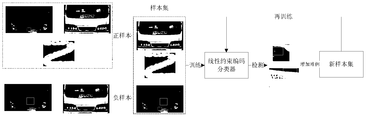
- the training process of the vehicle standard judgment classifier is shown in Fig. 6: the large vehicle logo and the small vehicle standard in the sample set are taken as positive samples, and since each character in the character string logo is easily dispersed and positioned, a single character is added as positive For the sample, the negative sample is randomly selected and the sample with the vehicle mark coincides with less than 20%. Then, the positive sample is used as the training sample, the negative sample is used as the test sample, and the linear constraint coding algorithm is used to train the vehicle to judge the classifier.
- the vehicle standard judgment classifier adopts the iterative training method.
- the sample that is misclassified into the negative sample in the vehicle classification judgment classifier ie, the difficult case
- the linear constraint coding algorithm is used again for training.
- the invention obtains the vehicle standard judgment classifier, and then judges the classifier according to the vehicle mark to perform the identification of the vehicle mark.
- the present invention can use the vehicle standard judgment classifier to score each vehicle mark, and then obtain the target vehicle mark positioning result according to the score.
- the present invention trains a plurality of types of vehicle identification classifiers using a linear constraint coding algorithm, as shown in FIG.
- the multi-class vehicle identification classifier trains a single character as a vehicle logo, and the characters are relatively small, so the recognition effect of the classifier is not affected.
- the invention puts the manually labeled vehicle logo and the single character of the character string logo into the linear constraint coding classifier for iterative training, and puts the classified vehicle logo into the linear constraint coding classifier as a difficult example for training until convergence. Due to the characteristics of the linear constrained coding classifier itself, basically iterative training can be converged three times.
- the specific vehicle identification process of the present invention is as shown in FIG. 8. When the vehicle identification result of the multi-class vehicle identification classifier is a certain type of non-single character vehicle, the vehicle can be determined according to the recognition result.
- Vehicle type when the vehicle identification result of the multi-class vehicle identification classifier is a single character, the third vehicle target candidate area 3 needs to be selected according to the character, the vehicle target positioning is performed again, and the positioned character is performed. Combine to form a string to obtain the final logo recognition result.
- the invention provides a novel selective search-based vehicle marking detection and recognition method and system, which has the following advantages:
- the selection of the candidate area of the vehicle is greatly reduced, the time of the selective search algorithm is greatly reduced, the detection speed is faster, and the real-time requirement of the vehicle positioning is satisfied.
- a new texture similarity calculation method is defined.
- the gradient histogram feature is used to replace the scale invariant transformation feature, which greatly reduces the time consumption while ensuring the accuracy and recognition accuracy of the vehicle positioning.
Landscapes
- Engineering & Computer Science (AREA)
- Theoretical Computer Science (AREA)
- General Physics & Mathematics (AREA)
- Physics & Mathematics (AREA)
- Computer Vision & Pattern Recognition (AREA)
- Multimedia (AREA)
- Evolutionary Computation (AREA)
- Artificial Intelligence (AREA)
- Data Mining & Analysis (AREA)
- Life Sciences & Earth Sciences (AREA)
- Health & Medical Sciences (AREA)
- General Health & Medical Sciences (AREA)
- Computing Systems (AREA)
- General Engineering & Computer Science (AREA)
- Software Systems (AREA)
- Medical Informatics (AREA)
- Bioinformatics & Cheminformatics (AREA)
- Bioinformatics & Computational Biology (AREA)
- Evolutionary Biology (AREA)
- Databases & Information Systems (AREA)
- Biodiversity & Conservation Biology (AREA)
- Biomedical Technology (AREA)
- Molecular Biology (AREA)
- Image Analysis (AREA)
- Traffic Control Systems (AREA)
- Image Processing (AREA)
Abstract
一种基于选择性搜索算法的车标检测识别方法及系统,该方法包括:对原始车辆图像进行车牌定位,获取车牌位置;根据车牌位置、车牌与车标空间位置关系和车窗边缘信息在原始车辆图像中对车标进行粗定位,得到车标粗定位图像;基于车辆中轴线在车标粗定位图像中选取车标候选区;采用选择性搜索算法对车标候选区进行目标定位,得到定位目标集;采用线性约束编码算法训练车标判断分类器来对定位目标集进行车标的判别,得到车标的位置;采用线性约束编码算法训练多类车标识别分类器来对车标进行具体的类型识别,得到车标识别结果。该方法具有适用性广、鲁棒性强和检测速度快的优点,可广泛应用于图像处理领域。
Description
本发明涉及图像处理领域,尤其是一种基于选择性搜索算法的车标检测识别方法及系统。
车辆车标检测系统是智能交通系统中重要的组成部分,车标作为车辆品牌独有的标志性标识,正确地识别车标能有效辅助车辆识别系统对车辆的相关信息进行匹配,将有利于车辆身份的确定,提高车型识别率。车标识别在智能交通领域有着广泛的应用,如车型匹配、车辆信息采集和假套牌检测等。现实中的车标面积、形状、纹理特征皆有不同,车标背景栅格也多种多样,同时大型车辆与小型车辆车标空间位置等特征的差异,都使得传统的模板匹配车标检测方法在消耗大量时间的同时难以获得较高的检测成功率。
近些年来,车标检测问题得到了广泛的研究,现有的车标检测算法包括:基于Adaboost的车标检测法、基于车标纹理特征车标检测法、基于纹理一致性的车标检测法、基于车标背景消除车标检测法、基于模板匹配车标检测法以及基于穷举搜索的车标检测法等等。基于Adaboost的车标检测法是利用Adaboost分类器对车标特征进行学习并利用滑窗对车标进行定位与识别,这种方法可以获得较好地车标检测效果,但时间消耗过长;基于车标纹理特征车标检测法首先利用车牌位置信息进行车标粗定位,然后利用车标先验知识以及车标边缘特征精确定位车标,再利用支持向量机的训练分类器对车标定位结果进行识别,但该方法难以在车标背景纹理复杂的情况下精确定位车标;基于纹理一致性的车标检测法对车标纹理特征与车标背景特征加以区分,从而精确定位车标并识别车标,这种方法适用于车标与其背景纹理特征差别较大的情况,但现实情况下,车标与其背景纹理特征难以区分;基于车标背景消除车标检测法利用滤波算法针对性地对车标背景纹理进行消除,从而获得准确的车标定位结果,再利用SIFT等特征描述子对车标进行描述并通过分类器进行识别,这种方法大大减少了车标背景对车标定位的影响,但容易消除车标信息,影响车标定位和车标识别结果;基于模板匹配车标检测法利用车标作为模板,从而定位得到车标位置和识别结果,这种方法受车标背景影响相对较小,但时间消耗过长;基于穷举搜索车标检测法则利用滑窗对目标区域进行穷举搜索,同时利用如HOG、SIFT等算子对车标进行目标判别,以此获得车标区域及车标类型,这种方法理论上适用于所有车型,但是滑窗的速度相对较慢,这极大地影响了算法的实用性。
综上所述,目前的车标检测算法存在以下缺陷或不足:
1)大多仅针对小型车辆进行车标检测,无法适用于所有车型,适用性不广。
2)在光照、倾斜、复杂车标栅格背景等条件的影响下,目前的算法难以进行车标精确检测,鲁棒性较弱。
3)消耗的时间过长,检测速度慢,无法满足实际对检测速度的高要求。
发明内容
为解决上述技术问题,本发明的目的在于:提供一种适用性广、鲁棒性强和检测速度快的基于选择性搜索算法的车标检测识别方法。
本发明的另一目的在于:提供一种适用性广、鲁棒性强和检测速度快的基于选择性搜索算法的车标检测识别系统。
本发明所采取的技术方案是:
一种基于选择性搜索算法的车标检测识别方法,包括以下步骤:
对原始车辆图像进行车牌定位,获取车牌位置;
根据车牌位置、车牌与车标空间位置关系和车窗边缘信息在原始车辆图像中对车标进行粗定位,得到车标粗定位图像;
基于车辆中轴线在车标粗定位图像中选取车标候选区;
采用选择性搜索算法对车标候选区进行目标定位,得到定位目标集,所述选择性搜索算法综合根据颜色相似度、纹理相似度、大小相似度和吻合度相似度来进行区域合并;
采用线性约束编码算法训练车标判断分类器来对定位目标集进行车标的判别,得到车标的位置;
采用线性约束编码算法训练多类车标识别分类器来对车标进行具体的类型识别,得到车标识别结果。
进一步,所述根据车牌位置、车牌与车标空间位置关系和车窗边缘信息在原始车辆图像中对车标进行粗定位,得到车标粗定位图像这一步骤,其包括:
根据车牌粗定位上边界位置确定车标粗定位下边界位置,所述车标粗定位下边界的坐标Ydown的表达式为:Ydown=yup,其中,yup为车牌粗定位上边界的坐标;
根据原始车辆图像的垂直投影对车窗进行粗定位,并根据车窗边缘粗定位信息确定车标粗定位上边界位置,所述车标粗定位上边界的坐标Yup的表达式为:

其中,h(x)为原始车辆图像边缘的垂直投影,max2h(x)表示从边缘的垂直投影h(x)中由上至下选择两个最大值h(x1)和h(x2)对应的横坐标x1和x2,H为原始车辆图像的高,b为经验阈值;
根据车标粗定位下边界的坐标Ydown和车标粗定位上边界的坐标Yup得出车标粗定位图像。
进一步,所述基于车辆中轴线在车标粗定位图像中选取车标候选区这一步骤,其包括:
在车标粗定位图像中确定车辆中轴线;
根据车辆中轴线选择设定宽度和设定高度的区域作为第一车标候选区域。
进一步,所述采用选择性搜索算法对车标候选区进行目标定位,得到定位目标集这一步骤,其包括:
S1、在第一车标候选区域内采用选择性搜索算法进行目标检测,若未检测到任何目标,则执行步骤S2,反之,则直接跳至步骤S3;
S2、以设定的横向扩增宽度对第一车标候选区域进行横向扩增,形成第二车标候选区域,然后在第二车标候选区域内采用选择性搜索算法进行车标目标检测,若仍未能检测到任何目标,则舍弃第一车标候选区域并以新的横向扩增宽度扩增第二车标候选区域,直到第二标候选区域检测到目标后执行步骤S3;反之,则执行步骤S3;
S3、判断检测到的目标是单个字符还是字符串车标或符号型车标,若是字符串车标或符号型车标,则结束选择性搜索算法,若是单个字符,则以该字符高度的1.5倍作为候选区的高作为第三车标候选区域的高,继续在第三车标候选区域内采用选择性搜索算法进行目标检测。
进一步,所述采用选择性搜索算法对车标候选区进行目标定位,得到定位目标集这一步骤,其包括:
采用基于图论的图像分割算法从车标候选区中获取初始分割区域;
计算初始分割区域中相邻区域间的综合相似度,所述相邻区域间的综合相似度计算公式为:

其中,s(ri,rj)、Scolor(ri,rj)、Stexture(ri,rj)、ssize(ri,rj)和fill(ri,rj)分别为区域ri与区域rj间的综合相似度、颜色相似度、纹理相似度、大小相似度和吻合度相似度,a1、a2、a3和a4分别为颜色相似度权重系数、纹理相似度权重系数、大小相似度权重系数和吻合度相似度权重系数,a1、a2、a3和a4的取值范围均为(0,1), 和
和 分别为区域ri和区域rj对应的3×25维颜色空间向量,
 和
和 分别为区域ri和区域rj对应的8×3×10维纹理向量,n为颜色空间向量或纹理向量的元素总数,size(ri)、size(rj)、size(im)和size(BBij)分别区域ri的大小、区域rj的大小、所有区域合并完成后得到的整幅图像的大小和区域ri与区域rj合并后的区域外界矩形的大小;
以综合相似度最大为合并原则,根据计算的相邻区域间的综合相似度合并初始分割区域,得到定位目标集。
进一步,所述采用线性约束编码算法训练车标判断分类器来对定位目标集进行车标的判别,得到车标的位置这一步骤,其包括:
将样本集的样本划分为正样本和负样本,其中,正样本包括单个字符样本、样本集中的小型车样本和样本集中的大型车标样本,负样本为样本集中大小随机选取的且与车标重合度小于20%的样本;
以正样本作为训练样本,采用线性约束编码分类器进行迭代训练直至收敛,最终训练出车标判断分类器,其中,迭代训练过程在每次完成训练后会将车标判断分类器中错分为负样本的样本加入训练样本中形成新训练样本集,然后再以新训练样本集重新进行训练;
根据训练出的车标判断分类器对定位目标集进行车标的判别,得到车标的位置。
进一步,所述采用线性约束编码算法训练多类车标识别分类器来对车标进行具体的类型识别,得到车标识别结果这一步骤,其包括:
以单个字符作为车标,将人工标注的车标和字符串车标的单个字符放入线性约束编码分
类器进行迭代训练,并将分类错误的车标作为难例再次放入线性约束编码分类器进行训练直至收敛,得到多类车标识别分类器;
根据多类车标识别分类器对车标进行具体的类型识别:若当前多类车标识别分类器的车标识别结果为非单个字符的车标,则以当前多类车标识别分类器的车标识别结果作为该车的车标类型;若当前多类车标识别分类器的车标识别结果为单个字符,则根据该单个字符重新选择第三车标候选区域,然后再次进行车标定位,并将定位得到的字符进行组合形成字符串,最终以该字符串的车标类型作为车标识别结果。
本发明所采取的另一技术方案是:
一种基于选择性搜索算法的车标检测识别系统,包括:
车牌定位模块,用于对原始车辆图像进行车牌定位,获取车牌位置;
车标粗定位模块,用于根据车牌位置、车牌与车标空间位置关系和车窗边缘信息在原始车辆图像中对车标进行粗定位,得到车标粗定位图像;
车标候选区选取模块,用于基于车辆中轴线在车标粗定位图像中选取车标候选区;
目标定位模块,用于采用选择性搜索算法对车标候选区进行目标定位,得到定位目标集,所述选择性搜索算法综合根据颜色相似度、纹理相似度、大小相似度和吻合度相似度来进行区域合并;
车标判别模块,用于采用线性约束编码算法训练车标判断分类器来对定位目标集进行车标的判别,得到车标的位置;
车标类型识别模块,用于采用线性约束编码算法训练多类车标识别分类器来对车标进行具体的类型识别,得到车标识别结果。
进一步,所述车标粗定位模块包括:
车标粗定位下边界位置确定单元,用于根据车牌粗定位上边界位置确定车标粗定位下边界位置,所述车标粗定位下边界的坐标Ydown的表达式为:Ydown=yup,其中,yup为车牌粗定位上边界的坐标;
车标粗定位上边界位置确定单元,用于根据原始车辆图像的垂直投影对车窗进行粗定位,并根据车窗边缘粗定位信息确定车标粗定位上边界位置,所述车标粗定位上边界的坐标Yup的表达式为:

其中,h(x)为原始车辆图像边缘的垂直投影,max2h(x)表示从边缘的垂直投影h(x)中由上至下选择两个最大值h(x1)和h(x2)对应的横坐标x1和x2,H为原始车辆图像的高,b为经验阈值;
车标粗定位图像获取单元,用于根据车标粗定位下边界的坐标Ydown和车标粗定位上边界的坐标Yup得出车标粗定位图像。
进一步,所述目标定位模块包括:
图像分割单元,用于采用基于图论的图像分割算法从车标候选区中获取初始分割区域;
相似度计算单元,用于计算初始分割区域中相邻区域间的综合相似度,所述相邻区域间的综合相似度计算公式为:

其中,s(ri,rj)、Scolor(ri,rj)、Stexture(ri,rj)、ssize(ri,rj)和fill(ri,rj)分别为区域ri与区域rj间的综合相似度、颜色相似度、纹理相似度、大小相似度和吻合度相似度,a1、a2、a3和a4分别为颜色相似度权重系数、纹理相似度权重系数、大小相似度权重系数和吻合度相似度权重系数,a1、a2、a3和a4的取值范围均为(0,1), 和
和 分别为区域ri和区域rj对应的3×25维颜色空间向量,
 和
和 分别为区域ri和区域rj对应的8×3×10维纹理向量,n为颜色空间向量或纹理向量的元素总数,size(ri)、size(rj)、size(im)和size(BBij)分别区域ri的大小、区域rj的大小、所有区域合并完成后得到的整幅图像的大小和区域ri与区域rj合并后的区域外界矩形的大小;
区域合并单元,用于以综合相似度最大为合并原则,根据计算的相邻区域间的综合相似度合并初始分割区域,得到定位目标集。
本发明的方法的有益效果是:首先根据车牌与车标空间位置关系和车窗边缘信息对车标进行粗定位,再基于车辆中轴线进行车标候选区的获取,然后采用选择性搜索算法进行目标定位,最后通过线性约束编码算法对目标进行判别筛选和识别以获得车标位置及车标识别结果,不受车型限制,不论是大型车辆还是小型车辆都能进行车标检测识别,适用性广;采用了选择性搜索算法,综合根据颜色相似度、纹理相似度、大小相似度和吻合度相似度来进行区域合并,在光照、倾斜、复杂车标栅格背景等条件的影响下,仍能通过车标纹理、颜色、大小和吻合度特性来准确检测车标位置,鲁棒性强;根据车辆的空间位置信息和车辆中轴线进行车标候选区的选取,极大减少了选择性搜索算法的耗时,检测速度更快。进一步,选择性搜索算法采用了基于方向梯度直方图的纹理相似度计算方法,采用方向梯度直方图特征替代尺度不变变换特征,在保证车标定位准确率和识别准确率的同时,大大减少了时间的消耗。
本发明的系统的有益效果是:首先在车标粗定位模块中根据车牌与车标空间位置关系和车窗边缘信息对车标进行粗定位,再在车标候选区选取模块中基于车辆中轴线进行车标候选
区的获取,然后在目标定位模块中采用选择性搜索算法进行目标定位,最后在车标判别模块和车标类型识别模块中通过线性约束编码算法对目标进行判别筛选和识别以获得车标位置及车标识别结果,不受车型限制,不论是大型车辆还是小型车辆都能进行车标检测识别,适用性广;在目标定位模块中采用了选择性搜索算法,综合根据颜色相似度、纹理相似度、大小相似度和吻合度相似度来进行区域合并,在光照、倾斜、复杂车标栅格背景等条件的影响下,仍能通过车标纹理、颜色、大小和吻合度特性来准确检测车标位置,鲁棒性强;在车标粗定位模块和车标候选区选取模块中根据车辆的空间位置信息和车辆中轴线进行车标候选区的选取,极大减少了选择性搜索算法的耗时,检测速度更快。进一步,目标定位模块的选择性搜索算法采用了基于方向梯度直方图的纹理相似度计算方法,采用方向梯度直方图特征替代尺度不变变换特征,在保证车标定位准确率和识别准确率的同时,大大减少了时间的消耗。
图1为本发明一种基于选择性搜索算法的车标检测识别方法的整体流程图;
图2为大型车辆车标的4种车标类型示意图;
图3为本发明车标粗定位过程示意图;
图4为本发明车标候选区划定过程示意图;
图5为本发明采用选择性搜索算法对车标候选区进行目标定位的流程图;
图6为车标判断分类器的训练过程示意图;
图7为本发明多类车标识别分类器的训练过程示意图;
图8为本发明车标识别过程的流程图。
参照图1,一种基于选择性搜索算法的车标检测识别方法,包括以下步骤:
对原始车辆图像进行车牌定位,获取车牌位置;
根据车牌位置、车牌与车标空间位置关系和车窗边缘信息在原始车辆图像中对车标进行粗定位,得到车标粗定位图像;
基于车辆中轴线在车标粗定位图像中选取车标候选区;
采用选择性搜索算法对车标候选区进行目标定位,得到定位目标集,所述选择性搜索算法综合根据颜色相似度、纹理相似度、大小相似度和吻合度相似度来进行区域合并;
采用线性约束编码算法训练车标判断分类器来对定位目标集进行车标的判别,得到车标的位置;
采用线性约束编码算法训练多类车标识别分类器来对车标进行具体的类型识别,得到车标识别结果。
进一步作为优选的实施方式,所述根据车牌位置、车牌与车标空间位置关系和车窗边缘信息在原始车辆图像中对车标进行粗定位,得到车标粗定位图像这一步骤,其包括:
根据车牌粗定位上边界位置确定车标粗定位下边界位置,所述车标粗定位下边界的坐标Ydown的表达式为:Ydown=yup,其中,yup为车牌粗定位上边界的坐标;
根据原始车辆图像的垂直投影对车窗进行粗定位,并根据车窗边缘粗定位信息确定车标粗定位上边界位置,所述车标粗定位上边界的坐标Yup的表达式为:

其中,h(x)为原始车辆图像边缘的垂直投影,max2h(x)表示从边缘的垂直投影h(x)中由上至下选择两个最大值h(x1)和h(x2)对应的横坐标x1和x2,H为原始车辆图像的高,b
为经验阈值;
根据车标粗定位下边界的坐标Ydown和车标粗定位上边界的坐标Yup得出车标粗定位图像。
进一步作为优选的实施方式,所述基于车辆中轴线在车标粗定位图像中选取车标候选区这一步骤,其包括:
在车标粗定位图像中确定车辆中轴线;
根据车辆中轴线选择设定宽度和设定高度的区域作为第一车标候选区域。
进一步作为优选的实施方式,所述采用选择性搜索算法对车标候选区进行目标定位,得到定位目标集这一步骤,其包括:
S1、在第一车标候选区域内采用选择性搜索算法进行目标检测,若未检测到任何目标,则执行步骤S2,反之,则直接跳至步骤S3;
S2、以设定的横向扩增宽度对第一车标候选区域进行横向扩增,形成第二车标候选区域,然后在第二车标候选区域内采用选择性搜索算法进行车标目标检测,若仍未能检测到任何目标,则舍弃第一车标候选区域并以新的横向扩增宽度扩增第二车标候选区域,直到第二标候选区域检测到目标后执行步骤S3;反之,则执行步骤S3;
S3、判断检测到的目标是单个字符还是字符串车标或符号型车标,若是字符串车标或符号型车标,则结束选择性搜索算法,若是单个字符,则以该字符高度的1.5倍作为候选区的高作为第三车标候选区域的高,继续在第三车标候选区域内采用选择性搜索算法进行目标检测。
进一步作为优选的实施方式,所述采用选择性搜索算法对车标候选区进行目标定位,得到定位目标集这一步骤,其包括:
采用基于图论的图像分割算法从车标候选区中获取初始分割区域;
计算初始分割区域中相邻区域间的综合相似度,所述相邻区域间的综合相似度计算公式为:

其中,s(ri,rj)、scolor(ri,rj)、stexture(ri,rj)、ssize(ri,rj)和fill(ri,rj)分别为区域ri与区域rj间的综合相似度、颜色相似度、纹理相似度、大小相似度和吻合度相似度,a1、a2、a3和a4分别为颜色相似度权重系数、纹理相似度权重系数、大小相似度权重系数和吻合度相似度权重系数,a1、a2、a3和a4的取值范围均为(0,1),
 和
和 分别为区域ri和区域rj对应的3×25维颜色空间向量,
 和
和 分别为区域ri和区域rj对应的8×3×10维纹理向量,n为颜色空间向量或纹理向量的元素总数,size(ri)、size(rj)、size(im)和size(BBij)分别区域ri的大小、区域rj的大小、所有区域合并完成后得到的整幅图像的大小和区域ri与区域rj合并后的区域外界矩形的大小;
以综合相似度最大为合并原则,根据计算的相邻区域间的综合相似度合并初始分割区域,得到定位目标集。
进一步作为优选的实施方式,所述采用线性约束编码算法训练车标判断分类器来对定位目标集进行车标的判别,得到车标的位置这一步骤,其包括:
将样本集的样本划分为正样本和负样本,其中,正样本包括单个字符样本、样本集中的小型车样本和样本集中的大型车标样本,负样本为样本集中大小随机选取的且与车标重合度小于20%的样本;
以正样本作为训练样本,采用线性约束编码分类器进行迭代训练直至收敛,最终训练出车标判断分类器,其中,迭代训练过程在每次完成训练后会将车标判断分类器中错分为负样本的样本加入训练样本中形成新训练样本集,然后再以新训练样本集重新进行训练;
根据训练出的车标判断分类器对定位目标集进行车标的判别,得到车标的位置。
进一步作为优选的实施方式,所述采用线性约束编码算法训练多类车标识别分类器来对车标进行具体的类型识别,得到车标识别结果这一步骤,其包括:
以单个字符作为车标,将人工标注的车标和字符串车标的单个字符放入线性约束编码分类器进行迭代训练,并将分类错误的车标作为难例再次放入线性约束编码分类器进行训练直至收敛,得到多类车标识别分类器;
根据多类车标识别分类器对车标进行具体的类型识别:若当前多类车标识别分类器的车标识别结果为非单个字符的车标,则以当前多类车标识别分类器的车标识别结果作为该车的车标类型;若当前多类车标识别分类器的车标识别结果为单个字符,则根据该单个字符重新选择第三车标候选区域,然后再次进行车标定位,并将定位得到的字符进行组合形成字符串,最终以该字符串的车标类型作为车标识别结果。
参照图1,一种基于选择性搜索算法的车标检测识别系统,包括:
车牌定位模块,用于对原始车辆图像进行车牌定位,获取车牌位置;
车标粗定位模块,用于根据车牌位置、车牌与车标空间位置关系和车窗边缘信息在原始车辆图像中对车标进行粗定位,得到车标粗定位图像;
车标候选区选取模块,用于基于车辆中轴线在车标粗定位图像中选取车标候选区;
目标定位模块,用于采用选择性搜索算法对车标候选区进行目标定位,得到定位目标集,所述选择性搜索算法综合根据颜色相似度、纹理相似度、大小相似度和吻合度相似度来进行区域合并;
车标判别模块,用于采用线性约束编码算法训练车标判断分类器来对定位目标集进行车标的判别,得到车标的位置;
车标类型识别模块,用于采用线性约束编码算法训练多类车标识别分类器来对车标进行具体的类型识别,得到车标识别结果。
进一步作为优选的实施方式,所述车标粗定位模块包括:
车标粗定位下边界位置确定单元,用于根据车牌粗定位上边界位置确定车标粗定位下边
界位置,所述车标粗定位下边界的坐标Ydown的表达式为:Ydown=yup,其中,yup为车牌粗定位上边界的坐标;
车标粗定位上边界位置确定单元,用于根据原始车辆图像的垂直投影对车窗进行粗定位,并根据车窗边缘粗定位信息确定车标粗定位上边界位置,所述车标粗定位上边界的坐标Yup的表达式为:

其中,h(x)为原始车辆图像边缘的垂直投影,max2h(x)表示从边缘的垂直投影h(x)中由上至下选择两个最大值h(x1)和h(x2)对应的横坐标x1和x2,H为原始车辆图像的高,b为经验阈值;
车标粗定位图像获取单元,用于根据车标粗定位下边界的坐标Ydown和车标粗定位上边界的坐标Yup得出车标粗定位图像。
进一步作为优选的实施方式,所述目标定位模块包括:
图像分割单元,用于采用基于图论的图像分割算法从车标候选区中获取初始分割区域;
相似度计算单元,用于计算初始分割区域中相邻区域间的综合相似度,所述相邻区域间的综合相似度计算公式为:

其中,s(ri,rj)、Scolor(ri,rj)、stexture(ri,rj)、ssize(ri,rj)和fill(ri,rj)分别为区域ri与区域rj间的综合相似度、颜色相似度、纹理相似度、大小相似度和吻合度相似度,a1、a2、a3和a4分别为颜色相似度权重系数、纹理相似度权重系数、大小相似度权重系数和吻合度相似度权重系数,a1、a2、a3和a4的取值范围均为(0,1),
 和
和 分别为区域ri和区域rj对应的3×25维颜色空间向量,
 和
和 分别为区域ri和区域rj对应的8×3×10维纹理向量,n为颜色空间向量或纹理向量的元素总数,size(ri)、size(rj)、size(im)和size(BBij)分别区域ri的大小、区域rj的大小、所有区域合并完成后得到的整幅图像的大小和区域ri与区域rj合并后的区域外界矩形的大小;
区域合并单元,用于以综合相似度最大为合并原则,根据计算的相邻区域间的综合相似度合并初始分割区域,得到定位目标集。
下面结合说明书附图和具体实施例对本发明作进一步详细说明。
实施例一
车辆的类型可大致分为大型车辆和小型车辆,小型车辆的车标通常为符号型车标,但大型车辆车标根据车标纹理可以分为三类:字符型车标、符号型车标和混合型车标,如图2所示,其中,图2(a)为字符型车标,图2(b)为符号型车标,图2(c)和图2(d)为混合型车标。两类车辆车标的空间位置关系和纹理特征皆有差异,这些因素增加了车标检测的难度。
针对现有车标检测识别方法适用性不广、鲁棒性不强和检测速度慢的问题,本发明提出了一种全新的基于选择性搜索算法的车标检测识别方法,该方法适用于所有车型进行车标检测。为了保证车标定位的实时性和车标定位在复杂车标背景下定位的有效性,本发明首先利用车牌与车标的空间结构关系和车窗的边缘信息对车标进行粗定位。而为了减轻计算量,本发明利用车辆中轴线来进行车标候选区的获取,同时利用了选择性搜索算法进行目标定位并通过线性编码算法对目标进行筛选,最后通过非极大值抑制(即收敛)的方式获取车标位置及车标识别结果。
如图1所示,本发明一种基于选择性搜索算法的车标检测识别整体方法的具体过程如下:
(一)对原始车辆图像进行车牌定位,获取车牌位置。
获取原始车辆图像后,可采用现有的车牌定位方法来获得车牌位置。
(二)根据车牌位置、车牌与车标空间位置关系和车窗边缘信息在原始车辆图像中对车标进行粗定位,得到车标粗定位图像。
车标与车牌、车窗有着极为重要的空间位置关系:车标位于车牌上方、车标位于车窗下方。在无法确定车牌位置信息精确度的情况下,本发明利用车牌粗定位的位置信息和车窗的边缘特征来获取车标粗定位位置。
(1)利用车牌粗定位上边界位置确定车标粗定位下边界位置。
Ydown=yup (1)
其中,Ydown表示车标粗定位下边界的坐标,yup表示车牌粗定位上边界的坐标。
(2)通过车窗的边缘特征信息确定车标粗定位上边界位置。
车窗具有明显的边缘和空间位置特征:车窗边界边缘复杂但内部边缘相对平滑;车窗位于车脸的最上方。因此,可利用车辆的垂直投影对车窗进行粗定位:
x1,x2=max2h(x)
s.t.|x1-x2|∈[H/4,H/2],x1∈(0,H/3],|h(x1)-h(x2)|≤b (2)
上式中,h(x)表示车辆边缘图像的垂直投影,max2h(x)表示从边缘垂直投影中由上
至下选择最大两个值的横坐标x1和x2,H表示原始车辆图像的高,b为经验阈值。
而车标粗定位上边界的坐标Yup为:
Yup=x2-(x2-x1)/2 (3)
(3)根据公式(1)、(2)、(3)可得到车标粗定位图像,如图3所示。其中,图3(a)为原始车辆图像,图3(b)为基于车牌位置的车标粗定位图像,图3(c)为最终的车标粗定位图像。
(三)基于车辆中轴线在车标粗定位图像中选取车标候选区。
选择性搜索算法的时间消耗与区域像素数量呈线性关系,因此为减少时间消耗,本发明在保证车标完整的前提下,尽可能缩小车标定位区域。本发明根据车辆的中轴线获取车标候选区,如图4所示。其中,图4(a)为大型车辆车标的车标候选区划分示意图,图4(b)为小型车辆车标的车标候选区划分示意图。
利用车辆中轴线,选择第一车标候选区域1,第一车标候选区域的宽高可根据实际情况进行设定。本实施例中第一车标候选区域1的宽设为64像素,高与车标粗定位图像的高相同,当第一车标候选区域1检测到单个字符时,以字符高度的1.5倍作为新候选区的高(即车标候选区3),继续进行车标检测;当检测当字符串车标或符号型车标时,选择性搜索算法结束;当未检测到任何目标时,横向扩增候选区(左右各扩增32个像素),形成第二车标候选区域2,继续进行车标检测,若仍未检测到任何目标,舍弃第一车标候选区域1,继续向外扩增第二车标候选区域2进行车标检测。这种候选区选取算法将大幅度消减选择性搜索算法的时间消耗。
(四)采用选择性搜索算法对车标候选区进行目标定位,得到定位目标集。
选择性搜索算法是一种基于区域合并的算法,计算时间与检测区域内像素点的个数呈线性关系,其通过相似区域的合并来获取目标区间。本发明利用基于图(如梯度方向直方图)的图像分割算法获取原始分割区域,然后计算两两相邻区域之间的相似度,并将相似度最大的两个区域合并为一个区域,接着再次计算两两相邻区域之间的相似度,直至最终合并为整幅图像(即目标结果集),选择性搜索算法的流程图如图5所示。
本发明选择性搜索算法明通过颜色、纹理、大小、吻合度四个方面进行相邻区域间相似度的计算。
(1)颜色相似度。
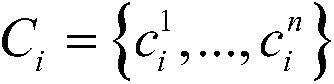
归一化后获取图像每个颜色通道的25个区间的直方图,即每个分割区域得到3*25维颜色空间向量 则区域之间相似度Scolor(ri,rj)计算公式如下:

区域合并过程中需对新的区域再次计算直方图,可通过公式(5)的简化算法进行计算:

size(ri)表示区域ri的大小,size(rj)表示区域rj的大小,Ci和Cj表示区域ri和rj的颜色向量,Ct为新的区域的颜色向量。
(2)纹理相似度。
为减少计算量,本发明采用了HOG特征替代SIFT特征来对区域纹理进行描述。本发明通过8个区间的梯度直方图统计梯度特征,并在区域每个颜色通道内获取10个空间,即每个
区域获得8*3*10维向量 则区域间纹理相似度Stexture(ri,rj)计算公式如下:

(3)大小相似度。
当相邻两区域间颜色相似度、纹理相似度相同时,应保证面积较小的区域先合并,即大小相似度越大越合并,因此本发明定义了大小相似度ssize(ri,rj):

上式中,size(im)表示所有区域合并完成后得到的整幅图像的大小。
(4)吻合度相似度。
为降低计算量,本发明令存在相交或包含关系的区域先合并,定义了吻合度相似度fill(ri,rj):

其中,size(BBij)表示区域ri与区域rj合并后的区域外界矩形的大小。
将以上四种相似度以加权求和的方式进行组合,可以得到相邻区域间的综合相似度:
s(ri,rj)=a1scolor+a2Stexture+a3ssize+a4fill (9)
通过公式(4)-(9)对初始分割区域进行合并,这样不仅能够适应不同的尺度,而且保证了目标的分割准确度。
(五)车标的判别和车标类型的识别。
选择性搜索算法只能定位出目标区域,但无法确定所定位区域是否为车标区域,因此本发明还需要利用线性约束编码算法(ScSPM)训练车标判断分类器对定位目标集进行车标的判别以及训练车标识别分类器对车标进行具体的类型识别。
线性约束编码算法(ScSPM)是一种较为成熟的分类器训练算法,该算法首先采用SIFT(即尺度不变特征变换)去提取目标图像的特征,然后利用预先生成的词典和线性编码对目标图像特征进行编码,从而建立起一个合理的图像语义表达模型来对每幅图像进行表达,接着利用空间金字塔匹配的方法得到图像的最终表达向量,最后把每幅图像的最终表达向量放入支持向量机(SVM)进行训练和识别,利用该算法可以有效地训练车标判别分类器和车标识别分类器。
其中,车标判断分类器的训练过程如图6所示:将样本集中的大型车标和小型车标作为正样本,同时由于字符串车标中各个字符易分散定位,故加入单个字符作为正样本,负样本则用大小随机选取的、与车标重合度小于20%的样本,接着,以正样本作为训练样本,以负样本作为测试样本,利用线性约束编码算法训练车标判断分类器。车标判断分类器采用迭代训练的方式,在每次完成训练后,将车标判断分类器中错分为负样本的样本(即难例)加入训练样本中,再次利用线性约束编码算法进行训练,直至收敛。本发明通过以上过程,训练得到车标判断分类器,然后即可根据该车标判断分类器进行车标的判别。当检测得到同一车辆含有多个车标时,本发明可利用车标判断分类器对各个车标进行打分,进而根据得分来获取目标车标定位结果。
而对于部分字符串车标,由于字符串间间隙较大,无法完整定位字符串,仅能定位得到
字符串中的单个字符,因此无法准确识别车标类型。针对这一问题,本发明利用线性约束编码算法训练了多类车标识别分类器,如图7所示。
从图7可知,多类车标识别分类器训练时将单个字符作为车标进行训练,字符相对较少因此并不会影响分类器的识别效果。本发明将人工标注的车标和字符串车标的单个字符放入线性约束编码分类器进行迭代训练,并将分类错误的车标作为难例再次放入线性约束编码分类器进行训练,直至收敛。由于线性约束编码分类器本身的特性,基本上迭代训练3次即可收敛。而本发明具体的车标识别过程则如图8所示,当多类车标识别分类器的车标识别结果为某类非单个字符的车标时,即可根据该识别结果确定该车的车标类型;当多类车标识别分类器的车标识别结果为单个字符时,则需要再根据该字符选择第三车标候选区域3,再次进行车标定位,并将定位得到的字符进行组合形成字符串,从而获得最终的车标识别结果。
本发明提出了一种新型的基于选择性搜索的车标检测识别方法与系统,具有以下优点:;
1)适用于各类车型,不受车型限制,大型或小型车辆皆可进行定位。
2)利用车标纹理、颜色、大小和吻合度特性进行选择性搜索,可以更准确地定位到车标位置。
3)利用线性约束编码算法的优良特征来训练车标判别分类器和车标识别分类器,涵盖市面上绝大多数车标类型,能够更准确和有效地定位和识别车辆车标。
4)根据车辆的空间位置信息和车辆中轴线进行车标候选区的选取,极大减少了选择性搜索算法的耗时,检测速度更快,满足了车标定位实时性的需求。
5)定义了新的纹理相似度计算方法,利用梯度直方图特征替代尺度不变变换特征,在保证车标定位准确率和识别准确率的同时,大大减少了时间的消耗。
6)计算复杂度远远低于现有的车标检测识别技术,是一种高速且有效的车标精确定位与识别方案。
以上是对本发明的较佳实施进行了具体说明,但本发明并不限于所述实施例,熟悉本领域的技术人员在不违背本发明精神的前提下还可做作出种种的等同变形或替换,这些等同的变形或替换均包含在本申请权利要求所限定的范围内。
Claims (10)
- 一种基于选择性搜索算法的车标检测识别方法,其特征在于:包括以下步骤:对原始车辆图像进行车牌定位,获取车牌位置;根据车牌位置、车牌与车标空间位置关系和车窗边缘信息在原始车辆图像中对车标进行粗定位,得到车标粗定位图像;基于车辆中轴线在车标粗定位图像中选取车标候选区;采用选择性搜索算法对车标候选区进行目标定位,得到定位目标集,所述选择性搜索算法综合根据颜色相似度、纹理相似度、大小相似度和吻合度相似度来进行区域合并;采用线性约束编码算法训练车标判断分类器来对定位目标集进行车标的判别,得到车标的位置;采用线性约束编码算法训练多类车标识别分类器来对车标进行具体的类型识别,得到车标识别结果。
- 根据权利要求1所述的一种基于选择性搜索算法的车标检测识别方法,其特征在于:所述根据车牌位置、车牌与车标空间位置关系和车窗边缘信息在原始车辆图像中对车标进行粗定位,得到车标粗定位图像这一步骤,其包括:根据车牌粗定位上边界位置确定车标粗定位下边界位置,所述车标粗定位下边界的坐标Ydown的表达式为:Ydown=yup,其中,yup为车牌粗定位上边界的坐标;根据原始车辆图像的垂直投影对车窗进行粗定位,并根据车窗边缘粗定位信息确定车标粗定位上边界位置,所述车标粗定位上边界的坐标Yup的表达式为:
 其中,h(x)为原始车辆图像边缘的垂直投影,max2h(x)表示从边缘的垂直投影h(x)中由上至下选择两个最大值h(x1)和h(x2)对应的横坐标x1和x2,H为原始车辆图像的高,b为经验阈值;根据车标粗定位下边界的坐标Ydown和车标粗定位上边界的坐标Yup得出车标粗定位图像。
 - 根据权利要求1所述的一种基于选择性搜索算法的车标检测识别方法,其特征在于:所述基于车辆中轴线在车标粗定位图像中选取车标候选区这一步骤,其包括:在车标粗定位图像中确定车辆中轴线;根据车辆中轴线选择设定宽度和设定高度的区域作为第一车标候选区域。
- 根据权利要求3所述的一种基于选择性搜索算法的车标检测识别方法,其特征在于:所述采用选择性搜索算法对车标候选区进行目标定位,得到定位目标集这一步骤,其包括:S1、在第一车标候选区域内采用选择性搜索算法进行目标检测,若未检测到任何目标,则执行步骤S2,反之,则直接跳至步骤S3;S2、以设定的横向扩增宽度对第一车标候选区域进行横向扩增,形成第二车 标候选区域,然后在第二车标候选区域内采用选择性搜索算法进行车标目标检测,若仍未能检测到任何目标,则舍弃第一车标候选区域并以新的横向扩增宽度扩增第二车标候选区域,直到第二标候选区域检测到目标后执行步骤S3;反之,则执行步骤S3;S3、判断检测到的目标是单个字符还是字符串车标或符号型车标,若是字符串车标或符号型车标,则结束选择性搜索算法,若是单个字符,则以该字符高度的1.5倍作为候选区的高作为第三车标候选区域的高,继续在第三车标候选区域内采用选择性搜索算法进行目标检测。
- 根据权利要求1所述的一种基于选择性搜索算法的车标检测识别方法,其特征在于:所述采用选择性搜索算法对车标候选区进行目标定位,得到定位目标集这一步骤,其包括:采用基于图论的图像分割算法从车标候选区中获取初始分割区域;计算初始分割区域中相邻区域间的综合相似度,所述相邻区域间的综合相似度计算公式为:
 其中,s(ri,rj)、scolor(ri,rj)、stexture(ri,rj)、ssize(ri,rj)和fill(ri,rj)分别为区域ri与区域rj间的综合相似度、颜色相似度、纹理相似度、大小相似度和吻合度相似度,a1、a2、a3和a4分别为颜色相似度权重系数、纹理相似度权重系数、大小相似度权重系数和吻合度相似度权重系数,a1、a2、a3和a4的取值范围均为(0,1),和
 分别为区域ri和区域rj对应的3×25维颜色空间向量,
 和
和 分别为区域ri和区域rj对应的8×3×10维纹理向量,n为颜色空间向量或纹理向量的元素总数,size(ri)、size(rj)、size(im)和size(BBij)分别区域ri的大小、区域rj的大小、所有区域合并完成后得到的整幅图像的大小和区域ri与区域rj合并后的区域外界矩形的大小;
 以综合相似度最大为合并原则,根据计算的相邻区域间的综合相似度合并初始分割区域,得到定位目标集。
 - 根据权利要求1所述的一种基于选择性搜索算法的车标检测识别方法,其特征在于:所述采用线性约束编码算法训练车标判断分类器来对定位目标集进行车标的判别,得到车标的位置这一步骤,其包括:将样本集的样本划分为正样本和负样本,其中,正样本包括单个字符样本、样本集中的小型车样本和样本集中的大型车标样本,负样本为样本集中大小随机选取的且与车标重合度小于20%的样本;以正样本作为训练样本,采用线性约束编码分类器进行迭代训练直至收敛,最终训练出车标判断分类器,其中,迭代训练过程在每次完成训练后会将车标判断分类器中错分为负样本的样本加入训练样本中形成新训练样本集,然后再以新训练样本集重新进行训练;根据训练出的车标判断分类器对定位目标集进行车标的判别,得到车标的位置。
- 根据权利要求4所述的一种基于选择性搜索算法的车标检测识别方法,其特征在于:所述采用线性约束编码算法训练多类车标识别分类器来对车标进行具体的类型识别,得到车标识别结果这一步骤,其包括:以单个字符作为车标,将人工标注的车标和字符串车标的单个字符放入线性约束编码分类器进行迭代训练,并将分类错误的车标作为难例再次放入线性约束编码分类器进行训练直至收敛,得到多类车标识别分类器;根据多类车标识别分类器对车标进行具体的类型识别:若当前多类车标识别分类器的车标识别结果为非单个字符的车标,则以当前多类车标识别分类器的车标识别结果作为该车的车标类型;若当前多类车标识别分类器的车标识别结果为单个字符,则根据该单个字符重新选择第三车标候选区域,然后再次进行车标定位,并将定位得到的字符进行组合形成字符串,最终以该字符串的车标类型作为车标识别结果。
- 一种基于选择性搜索算法的车标检测识别系统,其特征在于:包括:车牌定位模块,用于对原始车辆图像进行车牌定位,获取车牌位置;车标粗定位模块,用于根据车牌位置、车牌与车标空间位置关系和车窗边缘信息在原始车辆图像中对车标进行粗定位,得到车标粗定位图像;车标候选区选取模块,用于基于车辆中轴线在车标粗定位图像中选取车标候选区;目标定位模块,用于采用选择性搜索算法对车标候选区进行目标定位,得到定位目标集,所述选择性搜索算法综合根据颜色相似度、纹理相似度、大小相似度和吻合度相似度来进行区域合并;车标判别模块,用于采用线性约束编码算法训练车标判断分类器来对定位目 标集进行车标的判别,得到车标的位置;车标类型识别模块,用于采用线性约束编码算法训练多类车标识别分类器来对车标进行具体的类型识别,得到车标识别结果。
- 根据权利要求8所述的一种基于选择性搜索算法的车标检测识别系统,其特征在于:所述车标粗定位模块包括:车标粗定位下边界位置确定单元,用于根据车牌粗定位上边界位置确定车标粗定位下边界位置,所述车标粗定位下边界的坐标Ydown的表达式为:Ydown=yup,其中,yup为车牌粗定位上边界的坐标;车标粗定位上边界位置确定单元,用于根据原始车辆图像的垂直投影对车窗进行粗定位,并根据车窗边缘粗定位信息确定车标粗定位上边界位置,所述车标粗定位上边界的坐标Yup的表达式为:
 其中,h(x)为原始车辆图像边缘的垂直投影,max2h(x)表示从边缘的垂直投影h(x)中由上至下选择两个最大值h(x1)和h(x2)对应的横坐标x1和x2,H为原始车辆图像的高,b为经验阈值;车标粗定位图像获取单元,用于根据车标粗定位下边界的坐标Ydown和车标粗定位上边界的坐标Yup得出车标粗定位图像。
 - 根据权利要求8所述的一种基于选择性搜索算法的车标检测识别系统,其特征在于:所述目标定位模块包括:图像分割单元,用于采用基于图论的图像分割算法从车标候选区中获取初始分割区域;相似度计算单元,用于计算初始分割区域中相邻区域间的综合相似度,所述相邻区域间的综合相似度计算公式为:
 其中,s(ri,rj)、Scolor(ri,rj)、Stexture(ri,rj)、Ssize(ri,rj)和fill(ri,rj)分别为区域ri与区域rj间的综合相似度、颜色相似度、纹理相似度、大小相似度和吻合度相似度,a1、a2、a3和a4分别为颜色相似度权重系数、纹理相似度权重系数、大小相似度权重系数和吻合度相似度权重系数,a1、a2、a3和a4的取值范围均为(0,1),和
 分别为区域ri和区域rj对应的3×25维颜色空间向量,
 和
和 分别为区域ri和区域rj对应的8×3×10维纹理向量,n为颜色空间向量或纹理向量的元素总数,size(ri)、size(rj)、size(im)和size(BBij)分别区域ri的大小、区域rj的大小、所有区域合并完成后得到的整幅图像的大小和区域ri与区域rj合并后的区域外界矩形的大小;
 区域合并单元,用于以综合相似度最大为合并原则,根据计算的相邻区域间的综合相似度合并初始分割区域,得到定位目标集。
Applications Claiming Priority (2)
| Application Number | Priority Date | Filing Date | Title |
|---|---|---|---|
| CN201610917735.XA CN106529424B (zh) | 2016-10-20 | 2016-10-20 | 一种基于选择性搜索算法的车标检测识别方法及系统 |
| CN201610917735.X | 2016-10-20 |
Publications (1)
| Publication Number | Publication Date |
|---|---|
| WO2018072233A1 true WO2018072233A1 (zh) | 2018-04-26 |
Family
ID=58332872
Family Applications (1)
| Application Number | Title | Priority Date | Filing Date |
|---|---|---|---|
| PCT/CN2016/104809 Ceased WO2018072233A1 (zh) | 2016-10-20 | 2016-11-07 | 一种基于选择性搜索算法的车标检测识别方法及系统 |
Country Status (3)
| Country | Link |
|---|---|
| US (1) | US10255691B2 (zh) |
| CN (1) | CN106529424B (zh) |
| WO (1) | WO2018072233A1 (zh) |
Cited By (8)
| Publication number | Priority date | Publication date | Assignee | Title |
|---|---|---|---|---|
| CN109447076A (zh) * | 2018-09-20 | 2019-03-08 | 上海眼控科技股份有限公司 | 一种用于车辆年检的车辆vin码识别检测方法 |
| CN110516666A (zh) * | 2019-07-10 | 2019-11-29 | 西安电子科技大学 | 基于mser和isodata相结合的车牌定位方法 |
| CN110807415A (zh) * | 2019-10-31 | 2020-02-18 | 南通大学 | 一种基于年检标志的交通卡口车辆智能检索系统及方法 |
| CN111652274A (zh) * | 2020-04-28 | 2020-09-11 | 中国平安财产保险股份有限公司 | 基于图像识别的车型识别方法、装置及计算机设备 |
| CN111950588A (zh) * | 2020-07-03 | 2020-11-17 | 国网冀北电力有限公司 | 一种基于改进Adaboost算法的分布式电源孤岛检测方法 |
| CN111986262A (zh) * | 2020-09-07 | 2020-11-24 | 北京凌云光技术集团有限责任公司 | 一种图像区域定位方法及装置 |
| CN115290158A (zh) * | 2022-07-28 | 2022-11-04 | 上海大风实验室设备有限公司 | 一种机器自动读取量筒读数的方法 |
| CN116311215A (zh) * | 2023-05-22 | 2023-06-23 | 成都运荔枝科技有限公司 | 一种车牌识别方法 |
Families Citing this family (52)
| Publication number | Priority date | Publication date | Assignee | Title |
|---|---|---|---|---|
| US10346542B2 (en) | 2012-08-31 | 2019-07-09 | Verint Americas Inc. | Human-to-human conversation analysis |
| US10229314B1 (en) | 2015-09-30 | 2019-03-12 | Groupon, Inc. | Optical receipt processing |
| US10083353B2 (en) | 2016-10-28 | 2018-09-25 | Intuit Inc. | Identifying document forms using digital fingerprints |
| US10432789B2 (en) * | 2017-02-09 | 2019-10-01 | Verint Systems Ltd. | Classification of transcripts by sentiment |
| CN108647679B (zh) * | 2017-08-28 | 2021-04-27 | 浙江工业大学 | 一种基于车窗粗定位的车标识别方法 |
| CN107832762A (zh) * | 2017-11-06 | 2018-03-23 | 广西科技大学 | 一种基于多特征融合的车牌定位与识别方法 |
| CN110210472A (zh) * | 2018-02-28 | 2019-09-06 | 佛山科学技术学院 | 一种基于深度网络的对象检测方法 |
| CN108647577B (zh) * | 2018-04-10 | 2021-04-20 | 华中科技大学 | 一种自适应难例挖掘的行人重识别方法与系统 |
| CN108765532B (zh) * | 2018-05-04 | 2023-08-22 | 卢卡(北京)智能科技有限公司 | 儿童绘本模型建立方法、阅读机器人及存储设备 |
| CN110569693B (zh) * | 2018-08-16 | 2023-05-12 | 创新先进技术有限公司 | 车体颜色识别方法及装置 |
| US11822888B2 (en) | 2018-10-05 | 2023-11-21 | Verint Americas Inc. | Identifying relational segments |
| US11210554B2 (en) * | 2019-03-21 | 2021-12-28 | Illumina, Inc. | Artificial intelligence-based generation of sequencing metadata |
| US11783917B2 (en) | 2019-03-21 | 2023-10-10 | Illumina, Inc. | Artificial intelligence-based base calling |
| CN110032991B (zh) * | 2019-04-23 | 2022-07-08 | 福州大学 | 一种基于车标再定位的车标检测和识别方法 |
| US11423306B2 (en) | 2019-05-16 | 2022-08-23 | Illumina, Inc. | Systems and devices for characterization and performance analysis of pixel-based sequencing |
| US11593649B2 (en) | 2019-05-16 | 2023-02-28 | Illumina, Inc. | Base calling using convolutions |
| CN110263692A (zh) * | 2019-06-13 | 2019-09-20 | 北京数智源科技有限公司 | 大场景下集装箱开关门状态识别方法 |
| CN110378953B (zh) * | 2019-07-17 | 2023-05-02 | 重庆市畜牧科学院 | 一种智能识别猪群圈内空间分布行为的方法 |
| CN110569769A (zh) * | 2019-08-29 | 2019-12-13 | 浙江大搜车软件技术有限公司 | 图像识别方法、装置、计算机设备和存储介质 |
| CN110516640B (zh) * | 2019-08-30 | 2022-09-30 | 华侨大学 | 一种基于特征金字塔联合表示的车辆再辨识方法 |
| CN112529026B (zh) * | 2019-09-17 | 2023-12-19 | 华为云计算技术有限公司 | 提供ai模型的方法、ai平台、计算设备及存储介质 |
| CN110688935B (zh) * | 2019-09-24 | 2021-01-05 | 南京慧视领航信息技术有限公司 | 一种基于快速搜索的单车道车辆检测方法 |
| CN110675410B (zh) * | 2019-09-25 | 2023-06-13 | 江苏海洋大学 | 基于选择性搜索算法的侧扫声呐沉船目标非监督探测方法 |
| CN110751225A (zh) * | 2019-10-28 | 2020-02-04 | 普联技术有限公司 | 图像分类方法、装置及存储介质 |
| CN110866524A (zh) * | 2019-11-15 | 2020-03-06 | 北京字节跳动网络技术有限公司 | 车牌检测方法、装置、设备及存储介质 |
| CN111178346B (zh) * | 2019-11-22 | 2023-12-08 | 京东科技控股股份有限公司 | 文字区域的定位方法、装置、设备及存储介质 |
| CN110969135B (zh) * | 2019-12-05 | 2023-04-18 | 中南大学 | 自然场景中的车标识别方法 |
| CN110969162B (zh) * | 2019-12-05 | 2022-07-22 | 四川大学 | 一种机动车车窗定位方法 |
| US12354008B2 (en) | 2020-02-20 | 2025-07-08 | Illumina, Inc. | Knowledge distillation and gradient pruning-based compression of artificial intelligence-based base caller |
| US12591780B2 (en) | 2020-02-20 | 2026-03-31 | Illumina, Inc. | Data compression for artificial intelligence-based base calling |
| US12592298B2 (en) | 2020-02-20 | 2026-03-31 | Illumina, Inc. | Hardware execution and acceleration of artificial intelligence-based base caller |
| CN121034400A (zh) | 2020-02-20 | 2025-11-28 | 因美纳有限公司 | 基于人工智能的多对多碱基判读 |
| CN111275011B (zh) * | 2020-02-25 | 2023-12-19 | 阿波罗智能技术(北京)有限公司 | 移动红绿灯检测方法、装置、电子设备和存储介质 |
| CN111428563B (zh) * | 2020-02-25 | 2022-04-01 | 吉林大学 | 一种汽车全液晶仪表图像识别方法 |
| US11386680B2 (en) * | 2020-03-28 | 2022-07-12 | Wipro Limited | System and method of identifying vehicle brand and model |
| KR20210153999A (ko) * | 2020-06-11 | 2021-12-20 | 현대자동차주식회사 | 차량 및 그 제어방법 |
| CN111914892A (zh) * | 2020-06-23 | 2020-11-10 | 安徽师范大学 | 基于轮胎检测的车型及车标识别方法 |
| CN112070090A (zh) * | 2020-07-31 | 2020-12-11 | 南京卫泽科技信息有限公司 | 自然场景下基于bpt结点分析的混合目标物提取方法 |
| CN112085056B (zh) * | 2020-08-05 | 2023-12-29 | 深圳市优必选科技股份有限公司 | 目标检测模型生成方法、装置、设备及存储介质 |
| US11941844B2 (en) | 2020-08-05 | 2024-03-26 | Ubtech Robotics Corp Ltd | Object detection model generation method and electronic device and computer readable storage medium using the same |
| CN111652200A (zh) * | 2020-08-05 | 2020-09-11 | 爱保科技有限公司 | 车险案件中从图片区分多车的处理方法、装置及设备 |
| CN112269809B (zh) * | 2020-11-18 | 2022-07-05 | 安徽四创电子股份有限公司 | 一种基于rbm数据结构实现区域首次出现的实施方法 |
| US12525320B2 (en) | 2021-03-16 | 2026-01-13 | Illumina, Inc. | Neural network parameter quantization for base calling |
| US12444482B2 (en) | 2021-04-15 | 2025-10-14 | Illumina, Inc. | Multi-channel protein voxelization to predict variant pathogenicity using deep convolutional neural networks |
| US12217829B2 (en) | 2021-04-15 | 2025-02-04 | Illumina, Inc. | Artificial intelligence-based analysis of protein three-dimensional (3D) structures |
| CN113358125B (zh) * | 2021-04-30 | 2023-04-28 | 西安交通大学 | 一种基于环境目标检测和环境目标地图的导航方法及系统 |
| US12530882B2 (en) | 2021-07-01 | 2026-01-20 | Illumina, Inc. | Efficient artificial intelligence-based base calling of index sequences |
| CN114973111B (zh) * | 2022-04-29 | 2026-01-06 | 北京智芯原动科技有限公司 | 一种基于Transformer的车标识别方法及装置 |
| CN115937537A (zh) * | 2022-12-08 | 2023-04-07 | 京北方信息技术股份有限公司 | 一种目标图像的智能识别方法、装置、设备及存储介质 |
| CN115965688B (zh) * | 2022-12-14 | 2024-02-02 | 重庆赛迪奇智人工智能科技有限公司 | 一种定位方法、装置、电子设备及存储介质 |
| CN118586472B (zh) * | 2024-05-22 | 2025-03-25 | 重庆赛力斯凤凰智创科技有限公司 | 一种车标检测网络的训练方法及装置 |
| CN120356167B (zh) * | 2025-06-24 | 2025-11-11 | 宁波卓尔汽车零部件有限公司 | 一种基于车标再定位的车标检测和识别方法 |
Citations (3)
| Publication number | Priority date | Publication date | Assignee | Title |
|---|---|---|---|---|
| CN105205486A (zh) * | 2015-09-15 | 2015-12-30 | 浙江宇视科技有限公司 | 一种车标识别方法及装置 |
| CN105787466A (zh) * | 2016-03-18 | 2016-07-20 | 中山大学 | 一种车辆类型的精细识别方法及系统 |
| CN105868774A (zh) * | 2016-03-24 | 2016-08-17 | 西安电子科技大学 | 基于选择性搜索和卷积神经网络的车标识别方法 |
Family Cites Families (8)
| Publication number | Priority date | Publication date | Assignee | Title |
|---|---|---|---|---|
| US7724962B2 (en) * | 2006-07-07 | 2010-05-25 | Siemens Corporation | Context adaptive approach in vehicle detection under various visibility conditions |
| US8879796B2 (en) * | 2012-08-23 | 2014-11-04 | Xerox Corporation | Region refocusing for data-driven object localization |
| US9928406B2 (en) * | 2012-10-01 | 2018-03-27 | The Regents Of The University Of California | Unified face representation for individual recognition in surveillance videos and vehicle logo super-resolution system |
| AU2014207250A1 (en) * | 2013-01-17 | 2015-08-20 | Sensen Networks Pty Ltd | Automated vehicle recognition |
| US9158992B2 (en) * | 2013-03-14 | 2015-10-13 | Here Global B.V. | Acceleration of linear classifiers |
| US20160188633A1 (en) * | 2013-08-01 | 2016-06-30 | National University Of Singapore | A method and apparatus for tracking microblog messages for relevancy to an entity identifiable by an associated text and an image |
| US9607228B2 (en) * | 2014-02-14 | 2017-03-28 | Toyota Motor Engineering & Manufacturing North America, Inc. | Parts based object tracking method and apparatus |
| US9373036B1 (en) * | 2015-01-16 | 2016-06-21 | Toyota Motor Engineering & Manufacturing North America, Inc. | Collaborative distance metric learning for method and apparatus visual tracking |
-
2016
- 2016-10-20 CN CN201610917735.XA patent/CN106529424B/zh active Active
- 2016-11-07 WO PCT/CN2016/104809 patent/WO2018072233A1/zh not_active Ceased
-
2017
- 2017-03-14 US US15/458,186 patent/US10255691B2/en active Active
Patent Citations (3)
| Publication number | Priority date | Publication date | Assignee | Title |
|---|---|---|---|---|
| CN105205486A (zh) * | 2015-09-15 | 2015-12-30 | 浙江宇视科技有限公司 | 一种车标识别方法及装置 |
| CN105787466A (zh) * | 2016-03-18 | 2016-07-20 | 中山大学 | 一种车辆类型的精细识别方法及系统 |
| CN105868774A (zh) * | 2016-03-24 | 2016-08-17 | 西安电子科技大学 | 基于选择性搜索和卷积神经网络的车标识别方法 |
Non-Patent Citations (1)
| Title |
|---|
| YANG, JIANCHAO: "Linear Spatial Pyramid Matching Using Sparse Coding for Image Classification", 2009 IEEE CONFERENCE ON COMPUTER VISION AND PATTERN RECOGNITION, 20 June 2009 (2009-06-20) - 25 June 2009 (2009-06-25), pages 1794 - 1801, XP031514392 * |
Cited By (14)
| Publication number | Priority date | Publication date | Assignee | Title |
|---|---|---|---|---|
| CN109447076A (zh) * | 2018-09-20 | 2019-03-08 | 上海眼控科技股份有限公司 | 一种用于车辆年检的车辆vin码识别检测方法 |
| CN110516666A (zh) * | 2019-07-10 | 2019-11-29 | 西安电子科技大学 | 基于mser和isodata相结合的车牌定位方法 |
| CN110516666B (zh) * | 2019-07-10 | 2023-01-17 | 西安电子科技大学 | 基于mser和isodata相结合的车牌定位方法 |
| CN110807415A (zh) * | 2019-10-31 | 2020-02-18 | 南通大学 | 一种基于年检标志的交通卡口车辆智能检索系统及方法 |
| CN110807415B (zh) * | 2019-10-31 | 2023-04-07 | 南通大学 | 一种基于年检标志的交通卡口车辆智能检索系统及方法 |
| CN111652274A (zh) * | 2020-04-28 | 2020-09-11 | 中国平安财产保险股份有限公司 | 基于图像识别的车型识别方法、装置及计算机设备 |
| CN111652274B (zh) * | 2020-04-28 | 2024-05-14 | 中国平安财产保险股份有限公司 | 基于图像识别的车型识别方法、装置及计算机设备 |
| CN111950588A (zh) * | 2020-07-03 | 2020-11-17 | 国网冀北电力有限公司 | 一种基于改进Adaboost算法的分布式电源孤岛检测方法 |
| CN111950588B (zh) * | 2020-07-03 | 2023-10-17 | 国网冀北电力有限公司 | 一种基于改进Adaboost算法的分布式电源孤岛检测方法 |
| CN111986262B (zh) * | 2020-09-07 | 2024-04-26 | 凌云光技术股份有限公司 | 一种图像区域定位方法及装置 |
| CN111986262A (zh) * | 2020-09-07 | 2020-11-24 | 北京凌云光技术集团有限责任公司 | 一种图像区域定位方法及装置 |
| CN115290158A (zh) * | 2022-07-28 | 2022-11-04 | 上海大风实验室设备有限公司 | 一种机器自动读取量筒读数的方法 |
| CN116311215B (zh) * | 2023-05-22 | 2023-11-17 | 成都运荔枝科技有限公司 | 一种车牌识别方法 |
| CN116311215A (zh) * | 2023-05-22 | 2023-06-23 | 成都运荔枝科技有限公司 | 一种车牌识别方法 |
Also Published As
| Publication number | Publication date |
|---|---|
| US20180114337A1 (en) | 2018-04-26 |
| US10255691B2 (en) | 2019-04-09 |
| CN106529424B (zh) | 2019-01-04 |
| CN106529424A (zh) | 2017-03-22 |
Similar Documents
| Publication | Publication Date | Title |
|---|---|---|
| WO2018072233A1 (zh) | 一种基于选择性搜索算法的车标检测识别方法及系统 | |
| Neumann et al. | Efficient scene text localization and recognition with local character refinement | |
| Pan et al. | A robust system to detect and localize texts in natural scene images | |
| CN104050471B (zh) | 一种自然场景文字检测方法及系统 | |
| CN104809481B (zh) | 一种基于自适应色彩聚类的自然场景文本检测方法 | |
| CN102799879B (zh) | 从自然场景图像中识别多言语、多字体文字的方法 | |
| CN110443257B (zh) | 一种基于主动学习的显著性检测方法 | |
| CN106203539B (zh) | 识别集装箱箱号的方法和装置 | |
| CN101751559B (zh) | 人脸皮肤斑痣点检测及利用皮肤斑痣识别人脸的方法 | |
| CN103034852B (zh) | 静止摄像机场景下特定颜色行人的检测方法 | |
| CN105261017A (zh) | 基于路面约束的图像分割法提取行人感兴趣区域的方法 | |
| CN102096823A (zh) | 基于高斯模型和最小均方差的人脸检测方法 | |
| CN101770583B (zh) | 一种基于场景全局特征的模板匹配方法 | |
| CN106960181B (zh) | 一种基于rgbd数据的行人属性识别方法 | |
| US20150347804A1 (en) | Method and system for estimating fingerprint pose | |
| CN101859382A (zh) | 一种基于最大稳定极值区域的车牌检测与识别的方法 | |
| CN102289660A (zh) | 一种基于手部姿态跟踪的违规驾驶行为检测方法 | |
| CN103310195A (zh) | 车辆高分遥感图像的基于llc特征的弱监督识别方法 | |
| CN106203401B (zh) | 一种车道线的快速检测方法 | |
| CN101984453B (zh) | 一种人眼识别系统及方法 | |
| CN103310194A (zh) | 视频中基于头顶像素点梯度方向的行人头肩部检测方法 | |
| CN104077605A (zh) | 一种基于颜色拓扑结构的行人搜索识别方法 | |
| CN110728302A (zh) | 一种基于HSV和Lab颜色空间的色纺织物组织识别的方法 | |
| CN106295564A (zh) | 一种邻域高斯结构和视频特征融合的动作识别方法 | |
| CN106682641A (zh) | 基于fhog‑lbph特征的图像行人识别方法 |
Legal Events
| Date | Code | Title | Description |
|---|---|---|---|
| 121 | Ep: the epo has been informed by wipo that ep was designated in this application |
Ref document number: 16919208 Country of ref document: EP Kind code of ref document: A1 |
|
| NENP | Non-entry into the national phase |
Ref country code: DE |
|
| 122 | Ep: pct application non-entry in european phase |
Ref document number: 16919208 Country of ref document: EP Kind code of ref document: A1 |