WO2018070933A1 - Fluorescent porous organic frameworks containing molecular rotors for chemical sensing - Google Patents
Fluorescent porous organic frameworks containing molecular rotors for chemical sensing Download PDFInfo
- Publication number
- WO2018070933A1 WO2018070933A1 PCT/SG2017/050504 SG2017050504W WO2018070933A1 WO 2018070933 A1 WO2018070933 A1 WO 2018070933A1 SG 2017050504 W SG2017050504 W SG 2017050504W WO 2018070933 A1 WO2018070933 A1 WO 2018070933A1
- Authority
- WO
- WIPO (PCT)
- Prior art keywords
- nus
- formula
- polymer
- fluorescence
- alkyl
- Prior art date
- Legal status (The legal status is an assumption and is not a legal conclusion. Google has not performed a legal analysis and makes no representation as to the accuracy of the status listed.)
- Ceased
Links
- 0 Cc(c(*)c1)c(*)cc1C(c1cc(*)c(*)c(*)c1)=C Chemical compound Cc(c(*)c1)c(*)cc1C(c1cc(*)c(*)c(*)c1)=C 0.000 description 2
Classifications
-
- B—PERFORMING OPERATIONS; TRANSPORTING
- B01—PHYSICAL OR CHEMICAL PROCESSES OR APPARATUS IN GENERAL
- B01J—CHEMICAL OR PHYSICAL PROCESSES, e.g. CATALYSIS OR COLLOID CHEMISTRY; THEIR RELEVANT APPARATUS
- B01J20/00—Solid sorbent compositions or filter aid compositions; Sorbents for chromatography; Processes for preparing, regenerating or reactivating thereof
- B01J20/22—Solid sorbent compositions or filter aid compositions; Sorbents for chromatography; Processes for preparing, regenerating or reactivating thereof comprising organic material
- B01J20/223—Solid sorbent compositions or filter aid compositions; Sorbents for chromatography; Processes for preparing, regenerating or reactivating thereof comprising organic material containing metals, e.g. organo-metallic compounds, coordination complexes
- B01J20/226—Coordination polymers, e.g. metal-organic frameworks [MOF], zeolitic imidazolate frameworks [ZIF]
-
- B—PERFORMING OPERATIONS; TRANSPORTING
- B01—PHYSICAL OR CHEMICAL PROCESSES OR APPARATUS IN GENERAL
- B01D—SEPARATION
- B01D69/00—Semi-permeable membranes for separation processes or apparatus characterised by their form, structure or properties; Manufacturing processes specially adapted therefor
- B01D69/14—Dynamic membranes
- B01D69/141—Heterogeneous membranes, e.g. containing dispersed material; Mixed matrix membranes
- B01D69/1411—Heterogeneous membranes, e.g. containing dispersed material; Mixed matrix membranes containing dispersed material in a continuous matrix
-
- B—PERFORMING OPERATIONS; TRANSPORTING
- B01—PHYSICAL OR CHEMICAL PROCESSES OR APPARATUS IN GENERAL
- B01D—SEPARATION
- B01D71/00—Semi-permeable membranes for separation processes or apparatus characterised by the material; Manufacturing processes specially adapted therefor
- B01D71/06—Organic material
- B01D71/58—Other polymers having nitrogen in the main chain, with or without oxygen or carbon only
- B01D71/60—Polyamines
- B01D71/601—Polyethylenimine
-
- B—PERFORMING OPERATIONS; TRANSPORTING
- B01—PHYSICAL OR CHEMICAL PROCESSES OR APPARATUS IN GENERAL
- B01J—CHEMICAL OR PHYSICAL PROCESSES, e.g. CATALYSIS OR COLLOID CHEMISTRY; THEIR RELEVANT APPARATUS
- B01J20/00—Solid sorbent compositions or filter aid compositions; Sorbents for chromatography; Processes for preparing, regenerating or reactivating thereof
- B01J20/28—Solid sorbent compositions or filter aid compositions; Sorbents for chromatography; Processes for preparing, regenerating or reactivating thereof characterised by their form or physical properties
- B01J20/28054—Solid sorbent compositions or filter aid compositions; Sorbents for chromatography; Processes for preparing, regenerating or reactivating thereof characterised by their form or physical properties characterised by their surface properties or porosity
- B01J20/28057—Surface area, e.g. B.E.T specific surface area
-
- B—PERFORMING OPERATIONS; TRANSPORTING
- B01—PHYSICAL OR CHEMICAL PROCESSES OR APPARATUS IN GENERAL
- B01J—CHEMICAL OR PHYSICAL PROCESSES, e.g. CATALYSIS OR COLLOID CHEMISTRY; THEIR RELEVANT APPARATUS
- B01J20/00—Solid sorbent compositions or filter aid compositions; Sorbents for chromatography; Processes for preparing, regenerating or reactivating thereof
- B01J20/28—Solid sorbent compositions or filter aid compositions; Sorbents for chromatography; Processes for preparing, regenerating or reactivating thereof characterised by their form or physical properties
- B01J20/28054—Solid sorbent compositions or filter aid compositions; Sorbents for chromatography; Processes for preparing, regenerating or reactivating thereof characterised by their form or physical properties characterised by their surface properties or porosity
- B01J20/28069—Pore volume, e.g. total pore volume, mesopore volume, micropore volume
-
- B—PERFORMING OPERATIONS; TRANSPORTING
- B01—PHYSICAL OR CHEMICAL PROCESSES OR APPARATUS IN GENERAL
- B01J—CHEMICAL OR PHYSICAL PROCESSES, e.g. CATALYSIS OR COLLOID CHEMISTRY; THEIR RELEVANT APPARATUS
- B01J20/00—Solid sorbent compositions or filter aid compositions; Sorbents for chromatography; Processes for preparing, regenerating or reactivating thereof
- B01J20/30—Processes for preparing, regenerating, or reactivating
- B01J20/34—Regenerating or reactivating
- B01J20/3425—Regenerating or reactivating of sorbents or filter aids comprising organic materials
-
- B—PERFORMING OPERATIONS; TRANSPORTING
- B01—PHYSICAL OR CHEMICAL PROCESSES OR APPARATUS IN GENERAL
- B01J—CHEMICAL OR PHYSICAL PROCESSES, e.g. CATALYSIS OR COLLOID CHEMISTRY; THEIR RELEVANT APPARATUS
- B01J20/00—Solid sorbent compositions or filter aid compositions; Sorbents for chromatography; Processes for preparing, regenerating or reactivating thereof
- B01J20/30—Processes for preparing, regenerating, or reactivating
- B01J20/34—Regenerating or reactivating
- B01J20/3483—Regenerating or reactivating by thermal treatment not covered by groups B01J20/3441 - B01J20/3475, e.g. by heating or cooling
-
- C—CHEMISTRY; METALLURGY
- C08—ORGANIC MACROMOLECULAR COMPOUNDS; THEIR PREPARATION OR CHEMICAL WORKING-UP; COMPOSITIONS BASED THEREON
- C08G—MACROMOLECULAR COMPOUNDS OBTAINED OTHERWISE THAN BY REACTIONS ONLY INVOLVING UNSATURATED CARBON-TO-CARBON BONDS
- C08G61/00—Macromolecular compounds obtained by reactions forming a carbon-to-carbon link in the main chain of the macromolecule
- C08G61/02—Macromolecular compounds containing only carbon atoms in the main chain of the macromolecule, e.g. polyxylylenes
-
- C—CHEMISTRY; METALLURGY
- C08—ORGANIC MACROMOLECULAR COMPOUNDS; THEIR PREPARATION OR CHEMICAL WORKING-UP; COMPOSITIONS BASED THEREON
- C08G—MACROMOLECULAR COMPOUNDS OBTAINED OTHERWISE THAN BY REACTIONS ONLY INVOLVING UNSATURATED CARBON-TO-CARBON BONDS
- C08G2261/00—Macromolecular compounds obtained by reactions forming a carbon-to-carbon link in the main chain of the macromolecule
- C08G2261/10—Definition of the polymer structure
- C08G2261/14—Side-groups
- C08G2261/148—Side-chains having aromatic units
-
- C—CHEMISTRY; METALLURGY
- C08—ORGANIC MACROMOLECULAR COMPOUNDS; THEIR PREPARATION OR CHEMICAL WORKING-UP; COMPOSITIONS BASED THEREON
- C08G—MACROMOLECULAR COMPOUNDS OBTAINED OTHERWISE THAN BY REACTIONS ONLY INVOLVING UNSATURATED CARBON-TO-CARBON BONDS
- C08G2261/00—Macromolecular compounds obtained by reactions forming a carbon-to-carbon link in the main chain of the macromolecule
- C08G2261/10—Definition of the polymer structure
- C08G2261/19—Definition of the polymer structure partially conjugated
-
- C—CHEMISTRY; METALLURGY
- C08—ORGANIC MACROMOLECULAR COMPOUNDS; THEIR PREPARATION OR CHEMICAL WORKING-UP; COMPOSITIONS BASED THEREON
- C08G—MACROMOLECULAR COMPOUNDS OBTAINED OTHERWISE THAN BY REACTIONS ONLY INVOLVING UNSATURATED CARBON-TO-CARBON BONDS
- C08G2261/00—Macromolecular compounds obtained by reactions forming a carbon-to-carbon link in the main chain of the macromolecule
- C08G2261/30—Monomer units or repeat units incorporating structural elements in the main chain
- C08G2261/31—Monomer units or repeat units incorporating structural elements in the main chain incorporating aromatic structural elements in the main chain
- C08G2261/312—Non-condensed aromatic systems, e.g. benzene
-
- C—CHEMISTRY; METALLURGY
- C08—ORGANIC MACROMOLECULAR COMPOUNDS; THEIR PREPARATION OR CHEMICAL WORKING-UP; COMPOSITIONS BASED THEREON
- C08G—MACROMOLECULAR COMPOUNDS OBTAINED OTHERWISE THAN BY REACTIONS ONLY INVOLVING UNSATURATED CARBON-TO-CARBON BONDS
- C08G2261/00—Macromolecular compounds obtained by reactions forming a carbon-to-carbon link in the main chain of the macromolecule
- C08G2261/30—Monomer units or repeat units incorporating structural elements in the main chain
- C08G2261/33—Monomer units or repeat units incorporating structural elements in the main chain incorporating non-aromatic structural elements in the main chain
- C08G2261/332—Monomer units or repeat units incorporating structural elements in the main chain incorporating non-aromatic structural elements in the main chain containing only carbon atoms
- C08G2261/3325—Monomer units or repeat units incorporating structural elements in the main chain incorporating non-aromatic structural elements in the main chain containing only carbon atoms derived from other polycyclic systems
-
- C—CHEMISTRY; METALLURGY
- C08—ORGANIC MACROMOLECULAR COMPOUNDS; THEIR PREPARATION OR CHEMICAL WORKING-UP; COMPOSITIONS BASED THEREON
- C08G—MACROMOLECULAR COMPOUNDS OBTAINED OTHERWISE THAN BY REACTIONS ONLY INVOLVING UNSATURATED CARBON-TO-CARBON BONDS
- C08G2261/00—Macromolecular compounds obtained by reactions forming a carbon-to-carbon link in the main chain of the macromolecule
- C08G2261/30—Monomer units or repeat units incorporating structural elements in the main chain
- C08G2261/35—Macromonomers, i.e. comprising more than 10 repeat units
-
- C—CHEMISTRY; METALLURGY
- C08—ORGANIC MACROMOLECULAR COMPOUNDS; THEIR PREPARATION OR CHEMICAL WORKING-UP; COMPOSITIONS BASED THEREON
- C08G—MACROMOLECULAR COMPOUNDS OBTAINED OTHERWISE THAN BY REACTIONS ONLY INVOLVING UNSATURATED CARBON-TO-CARBON BONDS
- C08G2261/00—Macromolecular compounds obtained by reactions forming a carbon-to-carbon link in the main chain of the macromolecule
- C08G2261/40—Polymerisation processes
- C08G2261/41—Organometallic coupling reactions
- C08G2261/411—Suzuki reactions
-
- C—CHEMISTRY; METALLURGY
- C08—ORGANIC MACROMOLECULAR COMPOUNDS; THEIR PREPARATION OR CHEMICAL WORKING-UP; COMPOSITIONS BASED THEREON
- C08G—MACROMOLECULAR COMPOUNDS OBTAINED OTHERWISE THAN BY REACTIONS ONLY INVOLVING UNSATURATED CARBON-TO-CARBON BONDS
- C08G2261/00—Macromolecular compounds obtained by reactions forming a carbon-to-carbon link in the main chain of the macromolecule
- C08G2261/40—Polymerisation processes
- C08G2261/41—Organometallic coupling reactions
- C08G2261/415—Sonogashira / Hagihara reactions
-
- C—CHEMISTRY; METALLURGY
- C08—ORGANIC MACROMOLECULAR COMPOUNDS; THEIR PREPARATION OR CHEMICAL WORKING-UP; COMPOSITIONS BASED THEREON
- C08G—MACROMOLECULAR COMPOUNDS OBTAINED OTHERWISE THAN BY REACTIONS ONLY INVOLVING UNSATURATED CARBON-TO-CARBON BONDS
- C08G2261/00—Macromolecular compounds obtained by reactions forming a carbon-to-carbon link in the main chain of the macromolecule
- C08G2261/50—Physical properties
- C08G2261/52—Luminescence
- C08G2261/522—Luminescence fluorescent
-
- C—CHEMISTRY; METALLURGY
- C08—ORGANIC MACROMOLECULAR COMPOUNDS; THEIR PREPARATION OR CHEMICAL WORKING-UP; COMPOSITIONS BASED THEREON
- C08G—MACROMOLECULAR COMPOUNDS OBTAINED OTHERWISE THAN BY REACTIONS ONLY INVOLVING UNSATURATED CARBON-TO-CARBON BONDS
- C08G2261/00—Macromolecular compounds obtained by reactions forming a carbon-to-carbon link in the main chain of the macromolecule
- C08G2261/50—Physical properties
- C08G2261/52—Luminescence
- C08G2261/522—Luminescence fluorescent
- C08G2261/5222—Luminescence fluorescent electrofluorescent
-
- C—CHEMISTRY; METALLURGY
- C08—ORGANIC MACROMOLECULAR COMPOUNDS; THEIR PREPARATION OR CHEMICAL WORKING-UP; COMPOSITIONS BASED THEREON
- C08G—MACROMOLECULAR COMPOUNDS OBTAINED OTHERWISE THAN BY REACTIONS ONLY INVOLVING UNSATURATED CARBON-TO-CARBON BONDS
- C08G2261/00—Macromolecular compounds obtained by reactions forming a carbon-to-carbon link in the main chain of the macromolecule
- C08G2261/90—Applications
- C08G2261/94—Applications in sensors, e.g. biosensors
Definitions
- the present invention relates to a series of polymers that exhibit fluorescence emission.
- the present invention further relates to the preparation and uses of said polymers.
- the polymers may be used in the detection of volatile organic compounds. Background
- Volatile organic compounds such as aliphatic hydrocarbons, chlorocarbons, benzene and its derivatives, have become a major source of air pollutants, both outside and in indoor environments such as kitchens, toilets, oil refineries and chemical laboratories.
- Such volatile organic compounds (VOCs) depending on the level and length of exposure, may contribute towards a wide range of sensory irritation and chronic diseases (e.g., asthma, cystic fibrosis, renal failure, nervous system impairment, and cancer).
- WHO World Health Organization
- VOCs can be detected by portable electronic devices at parts per million (ppm) concentrations but with poor selectivity. For example, it is difficult to differentiate between benzene and toluene and similarly it is difficult to differentiate between o-xylene/m-xylene/p- xylene in VOC detection because of the similar structural and physical properties of the molecules to be differentiated.
- AIE chemosensors offers higher sensitivity and accuracy than that achieved by their aggregation-caused quenching (ACQ) counterparts.
- Fluorescent porous materials such as metal-organic frameworks (MOFs) have a high surface area and because of this they are capable of pre-concentrating analytes within their porous frameworks, which may afford enhanced sensitivity.
- MOFs metal-organic frameworks
- Porous organic frameworks are a group of porous materials constructed from organic precursors through coupling or condensation reactions. Due to their high porosity, rich functionality, and excellent stability, POFs have been tested in a wide range of applications, such as gas storage and separation, heterogeneous catalysis, and light harvesting/emission. Although numerous POFs have been prepared from various functional building blocks, well-defined fluorescent POFs with tuneable porosity and responsive fluorescent behaviour suitable for chemical sensing remain limited.
- the invention provides new polymers or porous organic frameworks that exhibit fluorescence emission and may be used as chemical sensors for the detection of at least one volatile organic compound.
- A represents a central portion of the polymeric repeating unit and is represented by Formula (II) or Formula (III):
- each X represents a peripheral portion of the polymeric repeating unit and is represented by Formula (IV) or Formula (V):
- R 4 independently represent at each occurrence H, branched or unbranched Ci -4 alkyl, OR 5 , COR 6 , CO2R7, or NR 8 Rg,
- R 5 independently represents at each occurrence thereof H or branched or unbranched d -4 alkyl, or COR 6 .
- R 6 and R 6 independently represent at each occurrence thereof, H or branched or unbranched Ci -4 alkyl
- R 7 independently represents at each occurrence thereof branched or unbranched Ci -4 alkyl
- R 8 and R 9 independently represents at each occurrence thereof H, branched or unbranched Ci-4 alkyl, or COR 10 ;
- each and R 12 independently represents halogen, with a compound of Formula (VIII) or Formula (IX):
- R ⁇ to R 4 are as defined in Clause 1 ;
- R 13 and R 14 independently represent d_ 6 alkyl, or R 13 and R 14 together with the boron and oxygen atoms to which they are attached form a 5- to 6- membered ring, which latter two groups are unsubstituted or are substituted with from one to four substituents (e.g. four) selected from Ci -6 alkyl (e.g. methyl); and R ⁇ i 5 represents H.
- each to R 4 is H.
- a chemical sensor or a biosensor or an environmental monitoring assay comprising a polymer as described in any one of Clauses 1 to 8.
- a method of detecting a volatile organic chemical with a chemical sensor or an environmental monitoring assay as described in Clause 11 wherein the sensor or assay is exposed to an analyte and detects at least one volatile organic compound by turn-on fluorescence or turn-off fluorescence in a qualitative or quantitative manner.
- the at least one volatile organic compound is selected from one or more of the group consisting of mesitylene, 1 ,4- diisopropylbenzene, p-xylene, o-xylene, m-xylene, chlorobenzene, toluene, benzene, 1 ,3,6- triisopropylbenzene, n-hexane, nitrobenzene and mixtures thereof.
- a composite material comprising a polymer as described in any one of Clauses 1 to 8, wherein the material further comprises poly(ethylene imine).
- a method of biosensing at least one amino acid comprising the steps of exposing a composite material as described in Clause 15 or Clause 16 to an analyte and detecting the presence of the at least one amino acid qualitatively or quantitatively by quenching of fluorescence.
- Figure 1 schematically depicts synthesis of POF materials NUS-20 and NUS-21 via Suzuki coupling reactions and NUS-22 and NUS-23 via Sonogashira coupling reactions.
- Figure 2A depicts FT-IR spectra
- Figure 2B depicts XPS spectra of NUS 2-23, along with the monomeric starting materials
- Figure 2C depicts the optical band gaps (E g ) of NUS 20-23.
- Figures 2D-G depict FE-SEM images of NUS-20, NUS-21 , NUS-22 and NUS-23, respectively, with the white bars representing 1 ⁇ , 1 ⁇ , 200 nm and 500 nm, respectively;
- Figures 2H-K depict HR-TEM images of NUS-20, NUS-21 , NUS-22 and NUS-23 respectively, with the white bars representing 10 nm, 10 nm, 50 nm and 20 nm, respectively;
- Figure 3A depicts N 2 adsorption (in filled symbols) and desorption (in open symbols) isotherms of NUS-20, NUS-21 , NUS-22 and NUS-23;
- Figure 3B depicts a plot showing pore width distribution of NUS-20, NUS-21 , NUS-22 and NUS-23.
- Figure 3C provides a simulated representation of NUS-20 having an interpenetrated diamondoid structure along the b-ax ⁇ s, wherein TPE rotors point towards a cavity which has a size of about 8.2 A and distance of two adjacent TPE rotors is 22.5 A.
- Figure 3D provides another simulated representation of NUS-20 having an interpenetrated structure along the c- axis by space-filling model with a pore size of 13.0 A.
- Figure 3E provides a simulated representation of NUS-22 having an interpenetrated diamondoid structure along the b-ax ⁇ s, wherein TPE rotors point towards a cavity which has a size of about 11.9 A and distance of two adjacent TPE rotors is 27.1 A.
- Figure 3F provides another simulated representation of NUS-22 having an interpenetrated structure along the c- axis by space-filling model with a pore size of 16.4 A.
- Figure 4D depicts simulated van der Waals interactions between mesitylene and NUS-22 using a GCMC method.
- Figure 5F depict plots of NUS-22 titration with benzene, toluene and mesitylene, respectively.
- Figure 6A depicts fluorescence emission spectra of NUS-20 before and after exposure to toluene vapor and Figure 6B depicts the same after exposure to nitrobenzene vapour for 2 min.
- Figure 6C depicts a plot of percentage of fluorescence enhancement or quenching after exposing POFs to different VOC vapors for 2 min at 298 K.
- Figure 6D depicts the results of a cycling test of NUS-20 for the chemical sensing of toluene vapor.
- Figure 7 depicts (a, d) SEM images, carbon and nitrogen EDX elemental mapping of NUS- 20@PEI .
- Figure 8 schematically depicts HOMO-LUMO energy profiles of mesitylene, toluene, benzene, chlorobenzene, NUS-20 fragment and nitrobenzene (from left to right).
- the present invention relates to a series of porous organic frameworks (POFs) containing flexible tetraphenylethylene (TPE) moieties as rotary molecular rotors which surprisingly exhibit tuneable porosity and responsive fluorescent behaviour (in a turn-off and/or a turn-on sense depending on the environment in which they find themselves, which is determined by the properties of the VOCs that they interact with).
- PEFs porous organic frameworks
- TPE flexible tetraphenylethylene
- A represents a central portion of the polymeric repeating unit and is represented by Formula (II) or Formula (III):
- each X represents a peripheral portion of the polymeric repeating unit and is represented by Formula (IV) or Formula (V):
- R 4 independently represent at each occurrence H, branched or unbranched Ci -4 alkyl, OR 5 , COR 6 , CO2R7, or NR 8 Rg,
- R 5 independently represents at each occurrence thereof H or branched or unbranched d -4 alkyl, or COR 6 .
- R 6 and R 6 independently represent at each occurrence thereof, H or branched or unbranched Ci -4 alkyl
- R 7 independently represents at each occurrence thereof branched or unbranched Ci -4 alkyl
- R 8 and R 9 independently represents at each occurrence thereof H, branched or unbranched Ci-4 alkyl, or COR 10 ;
- polymers of formula (I) form a porous organic framework.
- reference to the polymers of formula (I) herein is also reference to the porous organic framework formed by said polymers.
- Salts that may be mentioned include acid addition salts and base addition salts. Such salts may be formed by conventional means, for example by reaction of a free acid or a free base form of a compound of formula I with one or more equivalents of an appropriate acid or base, optionally in a solvent, or in a medium in which the salt is insoluble, followed by removal of said solvent, or said medium, using standard techniques (e.g. in vacuo, by freeze-drying or by filtration). Salts may also be prepared by exchanging a counter-ion of a compound of formula I in the form of a salt with another counter-ion, for example using a suitable ion exchange resin. Examples of salts include acid addition salts derived from mineral acids and organic acids, and salts derived from metals such as sodium, magnesium, or preferably, potassium and calcium.
- acid addition salts include acid addition salts formed with acetic, 2,2- dichloroacetic, adipic, alginic, aryl sulphonic acids (e.g. benzenesulphonic, naphthalene-2- sulphonic, naphthalene-1 ,5-disulphonic and p-toluenesulphonic), ascorbic (e.g.
- L-glutamic L-glutamic
- a-oxoglutaric glycolic, hippuric, hydrobromic, hydrochloric, hydriodic, isethionic
- lactic e.g. (+)-L-lactic and ( ⁇ )-DL-lactic
- lactobionic maleic, malic (e.g.
- salts are salts derived from mineral acids such as hydrochloric, hydrobromic, phosphoric, metaphosphoric, nitric and sulphuric acids; from organic acids, such as tartaric, acetic, citric, malic, lactic, fumaric, benzoic, glycolic, gluconic, succinic, arylsulphonic acids; and from metals such as sodium, magnesium, or preferably, potassium and calcium.
- mineral acids such as hydrochloric, hydrobromic, phosphoric, metaphosphoric, nitric and sulphuric acids
- organic acids such as tartaric, acetic, citric, malic, lactic, fumaric, benzoic, glycolic, gluconic, succinic, arylsulphonic acids
- metals such as sodium, magnesium, or preferably, potassium and calcium.
- Preferred solvates are solvates formed by the incorporation into the solid state structure (e.g.
- solvating solvent examples include water, alcohols (such as ethanol, isopropanol and butanol) and dimethylsulphoxide.
- Solvates can be prepared by recrystallising the compounds of the invention with a solvent or mixture of solvents containing the solvating solvent. Whether or not a solvate has been formed in any given instance can be determined by subjecting crystals of the compound to analysis using well known and standard techniques such as thermogravimetric analysis (TGE), differential scanning calorimetry (DSC) and X-ray crystallography.
- TGE thermogravimetric analysis
- DSC differential scanning calorimetry
- X-ray crystallography X-ray crystallography
- the solvates can be stoichiometric or non-stoichiometric solvates. Particularly preferred solvates are hydrates, and examples of hydrates include hemihydrates, monohydrates and dihydrates.
- alkyl refers to an unbranched or branched, cyclic, saturated unsubstituted group.
- alkyl is a cyclic group (which may be where the group "cycloalkyl” is specified), it is preferably C 3 . 4 cycloalkyl.
- the phenyl rings of the fragments of formula (IV) and (V) may be substituted in the meta- and para-positions relative to their point of attachment to the central alkyl bond as depicted hereinbefore.
- Particular polymers of formula (I) that may be disclosed herein are unsubstituted in the meta- and para-positions of the phenyl rings in the fragments of formula (IV) and (V). That is, each of to R 4 may be H.
- Particular polymers of formula (I) that may be mentioned herein include a polymer where each of to R 4 are H, A is represented by Formula (II) and X is represented by Formula (V) and. more particularly, a polymer where each of F ⁇ to R 4 are H, A is represented by Formula (II) and X is represented by Formula (IV).
- the polymers disclosed herein may provide an optical band gap of from 2.66 to 2.87 eV, meaning that they have a semiconductor nature that is capable of fluorescence emission. This in turn makes these materials suitable for use as a chemical sensor for various applications.
- the polymers disclosed herein may have a fluorescence emission peak at from around 505 nm to around 510 nm when measured in the solid state and/or wherein the polymer has a fluorescence emission peak at from around 495 nm to around 515 nm when measured in a suspension in THF.
- the polymer may have one of more of the following properties:
- the polymers disclosed herein also display significant chemical and thermal stability.
- the polymers disclosed herein can be soaked in both mineral acids (up to at least 6M) and bases (up to at least 8M), as well as common organic solvents and water without degradation, which results are discussed in more detail in the experimental section below.
- the polymers disclosed herein are suitable for use in corrosive environments and/or in environments at elevated temperatures, where other chemical sensors may not be able to operate due to chemical/thermal instability under such conditions.
- the polymers disclosed herein may have a BET surface area of from 350 to 950 m 2 g "1 (e.g.
- the polymers disclosed herein may be convenient to provide the polymers disclosed herein as a powder having a particle size of from 50 to 600 nm.
- a composite material such as with a non-fluorescence polymer (e.g. poly(ethylene imine)).
- Such composite materials may be provided in the form of a mixed matrix membrane, which may be a form that is more suitable for use in the sensing of biomolecules, such as amino acids.
- polymers of the current invention where A is selected from Formula (II) or Formula (III) and X is selected from Formula (IV), the polymer may further have one of more of the following properties:
- (c) be presented as a powder having a particle size of from 400 to 600 nm.
- (c) be presented as a powder having a particle size of from 50 to 150 nm.
- the polymers disclosed herein may be prepared by any suitable method known in the art. One method that may be used to manufacture the polymers disclosed herein involves reacting a compound of Formula (VI) or Formula (VII): ⁇ VI)
- R ⁇ to R 4 are as defined hereinbefore;
- R 13 and R 14 independently represent d_ 6 alkyl, or R 13 and R 14 together with the boron and oxygen atoms to which they are attached form a 5- to 6- membered ring, which latter two groups are unsubstituted or are substituted with from one to four substituents (e.g. four) selected from Ci -6 alkyl (e.g. methyl); and Ri5 represents H.
- substituents e.g. four
- Ci -6 alkyl e.g. methyl
- Ri5 represents H.
- to R 4 may be H.
- halo when used herein, includes references to fluoro, chloro, bromo and iodo. However, in the context of the reactions described above, it may refer to chloro, or more particularly, bromo and iodo.
- the polymers of formula (I) disclosed herein have surprisingly good optical and stability properties, along with a tuneable porosity.
- the polymers for formula (I) may be particularly suited for use in chemical sensing and therefore there is also disclosed a chemical sensor or a biosensor or an environmental monitoring assay comprising a polymer as described hereinbefore.
- the sensor may simply be a powdered form of the polymers of formula (I) as described hereinbefore, which may be applied to a space for analysis or placed into a solution containing an analyte, or it may be provided as part of a composite material as discussed hereinbefore.
- the sensors and assay may be used in a method of detecting a volatile organic chemical with a chemical sensor, a biosensor or an environmental monitoring assay as described immediately above, where the sensor or assay is exposed to an analyte and is used to detect at least one volatile organic compound by turn-on fluorescence or turn-off fluorescence in a qualitative or quantitative manner.
- the detection of a volatile organic compound in a liquid may be conducted by providing a portion of a polymer of formula (I) to an analyte of said liquid and then measuring the photoluminescence in a suitable testing apparatus. It has been surprisingly found that the compounds of formula (I) show a relationship between the size of the volatile organic compound(s) in the analyte and the relative fluoresence emission intensity (see Example 2 below). As such, the compounds of formula (I) may also be useful in detecting the sizes of volatile organic contaminants in a liquid, which may allow for definitive qualitative differentiation between certain compounds that are normally difficult or impossible to tell apart using conventional sensors (e.g. benzene and toluene). Given these effects, the polymers of formula (I) may allow for both qualitative identification of volatile organic compound contaminants and quantification of the amount of said contaminants in a sample analyte. These features may also apply to gaseous analysis as discussed hereinbelow.
- a turn-off fluorescence effect occurs when the compounds of formula (I) are exposed to nitrobenzene. It is noted that a similar effect may occur when the compounds of formula (I) are exposed to other compounds having similar physiochemical properties to nitrobenzene, such as trinitrotoluene and the like.
- the relative fluorescence emission intensity of the polymers of formula (I) may provide a (or an almost) perfect linear relationship between turn-on fluorescence and volatile organic compound concentration from 0% to 100% of the liquid analyte (see the examples below). This may enable the polymers of formula (I) to be used quantitatively as well as qualitatively.
- the polymers of formula (I) may be provided attached to a substrate that enables a photoluminescence test to be run.
- the polymers of formula (I) may be attached to a transparent substrate that is placed or forms part of a chamber containing a gaseous analyte suitable for use in a suitable photoluminescence testing apparatus.
- a recycling step e.g. heating at elevated temperature (such as from 70°C to 150°C, e.g. 120°C under vacuum) for a suitable period of time (e.g. from 10 minutes to 2 hours, such as 30 minutes).
- Suitable volatile organic compounds that may be detected include, but are not limited to, mesitylene, 1 ,4-diisopropylbenzene, p-xylene, o-xylene, m-xylene, chlorobenzene, toluene, benzene, 1 ,3,6-triisopropylbenzene, n-hexane, nitrobenzene and mixtures thereof.
- the polymers of formula (I) may also be suitable for use in biosensing, which is typically performed in aqueous media in a similar manner to that described above, except that the polymer of formula (I) is used to detect a biomolecule, such as an amino acid, rather than a volatile organic chemical. While it may be possible to use a powdered form of the polymers of formula (I) as a biosensor directly, it may be convenient to provide them distributed within a porous polymer, for example to form a mixed matric membrane. Suitable polymers to use in combination with the polymers of formula (I) may have functionality that attracts and/or binds to (e.g.
- the biomolecule to be sensed may include, but are not limited to poly(ethylene imine).
- the resulting composite material may have from 0.5 to 50 wt%, such as from 1 wt% to 10 wt%, such as 1.5 to 5 wt%, such as 2 wt% of the polymer of formula (I) distributed homogeneously throughout the further polymer.
- Any suitable method may be used to prepare the composite material.
- the composite material may be prepared using the solution-casting technique.
- Amino acids that may be sensed may be any natural or unnatural amino acids.
- DFT density functional theory
- FTIR Fourier transform infrared spectroscopy
- XPS X-ray photoelectron spectroscopy
- NMR Nuclear magnetic resonance spectroscopy
- Field-emission scanning electron microscopy (FE-SEM) was conducted on a JEOL JSM-7610F scanning electron microscope. Samples were treated via Pt sputtering for 100 s before observation.
- High-resolution transmission electron microscopy (HR-TEM) was conducted on a JEOL JEM-3010 transmission electron microscope.
- Thermogravimetric analyses were performed using a Shimadzu DTG-60AH in the temperature range of 100 to 800 °C under flowing air (50 mL min "1 ) and a heating rate of 10 °C min "1 .
- N 2 sorption isotherms were measured using a Micromeritics ASAP 2020 surface area and pore size analyzer. Before the measurements, the samples were degassed under high vacuum ( ⁇ 0.01 Pa) at 150 °C for 10 h. UHP grade He and N 2 were used for all the measurements. An oil-free vacuum pump and oil-free pressure regulators were used to prevent contamination of the samples during the degassing process and isotherm measurement. The temperature of 77 K was maintained with a liquid nitrogen bath.
- DSC Differential scanning calorimetry
- Fluorescence spectra were collected at room temperature on a Photon Technology International/QuantaMaster (PTI/QM, USA) spectrometer. Fluorescent microscopy images were acquired at an excitation wavelength of 365 nm using a Nikon Ti-U fluorescence microscope equipped with a 430 nm LP filter. Preparation of TPEs and monomers
- TPE-1 1,2-diphenyl-1 ,2-bis(4-(4,4,5,5-tetramethyl-1 ,3,2-dioxaborolan-2-yl)phenyl)ethane
- TPE-2 1 ,2-bis(4-ethynylphenyl)-1 ,2-diphenylethene
- TPE-2 was synthesized according to the published procedure in Yuan, W. Z., Macromolecules. 2011 , 44, 9618-9628.
- Tetrakis(4-bromophenyl)methane (monomer-1) and 1 ,3,5,7-tetrakis-(4- bromophenyl)adamantine (monomer-2) were synthesized according to the published procedures in Lu, W., Chem. Mater. 2010, 22, 5964-5972.
- TPE-1 and TPE-2 have highly twisted molecular conformations that hamper the intermolecular ⁇ - ⁇ stacking interactions. More importantly, it is believed that the central olefin stators of the two TPE molecules are surrounded by two free peripheral phenyl rings which can act as molecular rotors for turn-on fluorescent sensing.
- the synthetic procedures for the formation of four POFs based on TPE-1 or TPE-2 are described below.
- NUS-20 was synthesized using the Suzuki-Miyaura coupling reaction.
- NUS-21 was synthesized using a similar procedure to NUS-20, except 1 ,3,5,7-tetrakis(4- bromophenyl)adamantine (monomer-2, 151 mg, 0.2 mmol) was used instead of monomer- 1. NUS-21 (213 mg, 92% yield) was obtained as a pale green powder.
- NUS-22 was synthesized using the Sonogashira coupling reaction. Briefly, a mixture of 1 ,2- bis(4-ethynylphenyl)-1 ,2-diphenylethene (TPE-2, 152 mg, 0.4 mmol), tetrakis(4- bromophenyl)methane (monomer-1 , 127 mg, 0.2 mmol), Cul (38 mg, 0.2 mmol) and Pd(PPh 3 ) 4 (11.6 mg, 0.01 mmol) in DMF/Et 3 N (8 ml_/8 ml_) was degassed and purged with N 2 .
- TPE-2 1 ,2- bis(4-ethynylphenyl)-1 ,2-diphenylethene
- tetrakis(4- bromophenyl)methane monomer-1 , 127 mg, 0.2 mmol
- Cul 38 mg, 0.2 mmol
- NUS-23 was synthesized using a similar procedure to NUS-22, except 1 ,3,5,7-tetrakis(4- bromophenyl)adamantine (monomer-2, 151 mg, 0.2 mmol) was used instead of monomer- 1. NUS-23 (204 mg, 82% yield) was obtained as a deep yellow powder. Characterization of NUS 20-23
- XPS X-ray photoelectron spectroscopy
- the solid-state 13 C CP/MAS NMR spectra of NUS-20 and NUS- 22 display one main peak at around 63.50 ppm assignable to monomer-1 , while the NMR spectra of NUS-21 and NUS-23 feature peaks at 38.10 and 46.50 ppm attributable to monomer-2. Furthermore, one major peak at around 88.70 ppm in NUS-22 and NUS-23 suggests the successful incorporation of TPE-2 into the POFs.
- Thermogravimetric analyses show that NUS 20-23 are thermally stable up to 300 °C in a nitrogen atmosphere.
- the excellent chemical stability of NUS 20-23 is also proven through soaking tests using water, hydrochloric acid (6 M), sulphuric acid (6 M), sodium hydroxide (8 M), and common organic solvents, which is consistent with the robust nature of pure organic polymers free from any sites susceptible to acid or base attack.
- porous materials such as MOFs (Burtch, N. C; Jasuja, H.; Walton, K. S. Chem. Rev. 2014, 1 14, 10575-10612) and covalent organic frameworks (Cote, A. P.; Benin, A. I.; Ockwig, N.
- NUS 20-23 The permanent porosity of NUS 20-23 was demonstrated by their N 2 sorption isotherms at 77 K, all of which exhibit type I sorption behaviour with Brunauer-Emmett-Teller (BET) surface areas of 900, 835, 421 , and 368 m 2 g "1 and total pore volumes of 0.505, 0.640, 0.369, and 0.313 cm 3 g "1 for NUS 20-23, respectively (Figure 3a).
- BET Brunauer-Emmett-Teller
- Figure 3a The pore size distribution calculated using nonlocal density functional theory (NLDFT) reveals the average pore widths of around 12.3 to 14.1 A ( Figure 3b), indicating mainly microporous texture.
- NLDFT nonlocal density functional theory
- NUS 20-23 would be diamondoid or possibly interpenetrated diamondoid networks. Therefore, these structures were built using the graphical user interface of Materials Studio software and energy minimization was performed on the resultant models with the COMPASSII force field to remove geometric distortions. A molecular mechanics (MM) optimization approach was employed to determine the pore size of these structural models. The analysis showed that the pore widths for the diamondoid structures of NUS 20-23 were 20-33 A. These values are much larger than the experimentally determined pore size.
- MM molecular mechanics
- the calculated pore size for the interpenetrated diamondoid structures was in the range of 6-19 A, which agreed much better with the experimental data on pore size distribution.
- the pore size along the b- axis of NUS-20 and NUS-22 is about 8.2 A and 11.9 A, respectively ( Figures 3c, e), and the distances of two adjacent TPE rotors are 22.5 A and 27.1 A for NUS-20 and NUS-22, respectively, indicating that there is enough space for the rotation of TPE rotors.
- the pore size along the a-axis and the c-axis of NUS-20 and NUS-22 is around 6-19 A based on the interpenetrated diamondoid structures ( Figures 3d, f).
- the simulated interpenetrated pore size of NUS-21 and NUS-23 is also similar to that of NUS-20 and NUS- 22. These comparisons between the experimental and computational data strongly indicate that the NUS 20-23 possess interpenetrated diamondoid structures.
- the flexibility of dangling TPE molecular rotors was studied by cryogenic differential scanning calorimetry (DSC). A distinct endothermic peak at -65 °C was observed in NUS-22 during the heating scan, indicating a phase transition in which the frozen TPE molecular rotors become rotatable.
- the TPE-1 and TPE-2 linkers emit blue fluorescence in the solid state with peaks at around 443 and 456 nm, respectively.
- NUS 20-23 exhibit green fluorescence in the solid state with peaks at around 510, 505, and 506 nm for NUS-20, NUS- 21 , and NUS-22, respectively, suggesting the formation of extended porous structures.
- the fluorescence of NUS-23 is almost undetectable, possibly because of its highly conjugated structure facilitating nonradiative decay.
- TPE-1 and TPE-2 linkers are non- emissive when fully dissolved in THF solvent (good solvent) but exhibit strong fluorescence emission in a THF/water (10/90) mixed solvent (bad solvent), which can be attributed to a typical AIE behavior in which the nonradiative decay via the active intramolecular rotations of phenyl rings is restricted in solid precipitates. Accordingly, locking TPE linkers into the rigid frameworks of the POFs can effectively restrict their intramolecular motions, thereby leading to intensified fluorescence emission even in THF solutions, wherein NUS-20 shows a -1 150-fold fluorescence enhancement over TPE-1 at a concentration of 0.3 mg ml_ "1 . Similarly, a 12-fold fluorescence enhancement was observed for NUS-22 over TPE-2 at the same concentration.
- Example 2 Solution-based chemical sensing of VOCs
- NUS 20-23 were soaked and sonicated in an individual VOC material to form a suspension (0.3 mg ml_ "1 ), which was thoroughly stirred before each photoluminescence measurement.
- the VOCs tested were mesitylene, 1 ,4-diisopropylbenzene, p-xylene, o- xylene, m-xylene, chlorobenzene, toluene, benzene, 1 ,3,6-triisopropylbenzene, n-hexane and nitrobenzene.
- Photoluminescence spectra were recorded on a PTI/QM spectrophotometer.
- the excitation wavelength for liquid VOC sensing is 355 nm (NUS-20 and NUS-21) or 370 nm (NUS-22 and NUS-23). Effect of analyte size on relative fluorescence intensity
- NUS-21 Dbenzene and NUS-2l Dtoluene are 1.67 and 2.05, respectively, and NUS-21 Dmesitylene has an even larger l R value of 4.30.
- further increase of the molecular size of the analyte e.g., 1 ,3,5-triisopropylbenzene
- leads to a significantly reduced emission (l R 1.32). Similar trends can be observed in the other three POFs ( Figure 4e).
- NUS 20-23 size-dependent turn-on fluorescence of NUS 20-23 is due to the different degrees of restrictions of flexible TPE rotors by VOC analytes with various sizes, wherein larger analytes, as long as they can diffuse into NUS 20-23, may interact tightly with molecular rotors as a result of intensified steric hindrance.
- the molecular size of mesitylene (5.8 ⁇ 6.7 A) is relatively large among the VOC analytes, but is still smaller than the cavity size of POFs. Therefore, mesitylene can still diffuse into NUS 20-23 and restrict the motor motions.
- the abovementioned molecular restriction is brought about not only by the size of analytes, but also by the chemical structure of NUS 20-23.
- the introduction of alkyne groups can greatly suppress the luminescence of the resultant POFs (NUS-22 and NUS-23), possibly because of reduced band gaps (2.66 eV for NUS-22 and 2.70 for NUS- 23, Figure 2c) and/or larger framework voids that allow significant intramolecular motions of the TPE units.
- the weak emission of the pristine POFs is not a drawback, as it provides a better background for the turn-on fluorescence during chemical sensing.
- I R 4.66 for NUS-22Dbenzene
- the turn-off mode is frequently encountered in fluorescence- based chemical sensing applications.
- the turn-off mode is also observed in NUS 20-23 using nitrobenzene as the analyte, which has the ability to quench fluorescence (Figure 4).
- a blue shift (by -48 nm) of the fluorescence peak in NUS-2l Dnitrobenzene (446 nm) was observed with respect to NUS-21 (494 nm, Figure 4b).
- the same trend was observed in the other POFs (NUS 20, NUS 22-23), indicating that the turn-off process of fluorescence should be mainly caused by the donor-acceptor electron-transfer mechanism instead of the AIE mechanism that operates in turn-on processes.
- This result also presents an interesting example of fluorescent materials displaying two different luminescent mechanisms for chemical sensing.
- fluorescence titrations were performed by gradually adding trace amounts of benzene, toluene, or mesitylene (from around 0 to 835 mM) to NUS-22 dispersed in hexane (0.3 mg ml_ "1 in hexane).
- VOC vapor sensing experiments were conducted using NUS-20, NUS-21 , and NUS-22. Briefly, for each VOC tested , a POF powder (5 mg) of each of NUS-20, NUS-21 , and NUS-22 was spread evenly onto the surface of a double-sided tape and then fixed to a quartz slide, which was placed into the quartz cuvette containing the saturated VOC vapor for 2 min of equilibrium followed by the photoluminescence test (the test was conducted at 298K and at 1 atm). The VOCs tested were benzene, toluene, chlorobenzene and nitrobenzene.
- the recyclability test was performed on the POFs recovered by evacuation for 30 min at 120 °C after each test.
- the percentages of fluorescence enhancement were estimated using the formula (/// 0 -1) X 100% (see Pramanik, S.; Zheng, C; Zhang, X.; Emge, T. J.; Li, J. New Microporous Metal-Organic Framework Demonstrating Unique Selectivity for Detection of High Explosives and Aromatic Compounds. J. Am. Chem. Soc. 2011 , 133, 4153-4155) where / 0 is the original maximum peak intensity of POFs and / is the maximum peak intensity after exposure to vapor for 2 min.
- VOC detection in real applications is always performed in the gas phase wherein a trace amount of VOC vapour needs to be detected.
- fluorescence spectra were recorded on powder samples of POFs in a thin-layer form (see Pramanik, S.; Zheng, C; Zhang, X.; Emge, T. J.;
- the turn-on fluorescence may originate from ⁇ - ⁇ stacking or charge transfer between POFs and VOCs.
- the percentages of fluorescence enhancement are 152, 1 17, and 50% for NUS-20, NUS- 21 , and NUS-22, respectively ( Figure 6c).
- the selective fluorescence enhancement ratios W toluene/ 1 o ⁇ (I benzene/ 1 o- ⁇ )] of toluene over benzene are 1.85, 1.75, and 2.08 for NUS-20, NUS-21 , and NUS-22, respectively.
- the POFs exhibit excellent recyclability for repeated usage.
- NUS-20 can be regenerated by heating at 120 °C in vacuum for 30 min and reused for the sensing of toluene vapor without significant loss of the enhancement percentage (Figure 6d).
- Control experiments verified that the fluorescence of the TPE-1 and TPE-2 linkers could not be enhanced by toluene vapor under the same conditions. Instead, fluorescence quenching was observed because these AIE compounds can be gradually dissolved in the presence of toluene vapor, leading to enhanced nonradiative decay and thus reduced fluorescence emission.
- the POFs also exhibit remarkably quenched fluorescence upon exposure to nitrobenzene vapor for 15 s, with a significant blue shift (-62 nm) for NUS-20 indicating an electron-transfer mechanism (Figure 6b).
- the percentages of fluorescence quenching caused by nitrobenzene vapor are 83, 78, and 30% for NUS-20, NUS-21 , and NUS-22, respectively ( Figure 6c).
- the POFs can also be processed into other composite materials or devices that permit easy recovery and wider applications.
- MMMs mixed matrix membranes
- florescence-based biosensors for the detection of amino acids in aqueous media have garnered increased attention in biochemistry and molecular biology, especially in the context of sufficient temporal and spatial resolutions (see Hortala, M. A.; Fabbrizzi, L; Marcotte, N.; Stomeo, F.; Taglietti, A. J. Am. Chem. Soc. 2003, 125, 20-21).
- PEI poly(ethylene imine)
- MMMs of NUS-20@PEI were prepared by dispersing 2 wt% of NUS-20 within PEI matrix through the solution-casting method, followed by activation under vacuum (see Kang, Z.; Peng, Y.; Hu, Z.; Qian, Y. ; Chi, C ; Yeo, L. Y.; Tee, L; Zhao, D. J. Mater. Chem. A 2015, 3, 20801-20810).
- NUS-20@PEI SEM images of NUS-20@PEI indicate a homogeneous texture with a membrane thickness of around 30 ⁇ ( Figures 7a, e).
- the homogeneous green fluorescence of NUS-20@PEI confirms an even dispersion of NUS-20 throughout the membrane ( Figure 7g).
- a flat and smooth surface of the membrane is confirmed by atomic-force microscopy (AFM, Figure 7h).
- the fluorescent peak of NUS-20@PEI is blueshifted by 12 nm (510 nm vs. 498 nm, Figure 7i), possibly due to the weak interactions between NUS-20 and PEI.
- NUS-20@PEI membrane (1 ⁇ 1 cm) was fixed into the inner surface of a quartz cuvette, to which an aqueous solution containing amino acids was added (2 ml_, 5* 10 "3 M). After 10 min of equilibrium, fluorescence intensity change was recorded at 498 nm with an excitation wavelength of 355 nm. The quenching percentage was estimated using the formula (IQ-I)/IQ * 100%, where / 0 is the original maximum peak intensity and / is the maximum peak intensity after exposure to amino acid aqueous solution.
- the NUS-20@PEI membrane Compared to the NUS-20 free powder used in the above VOC sensing, the NUS-20@PEI membrane exhibited an extended fluorescence quenching response time for solution-based biosensing of amino acids because of the slow diffusion of analytes from the solution phase into the membrane matrix.
- the quenching kinetics was studied by measuring the fluorescence intensity of the NUS-20@PEI in various amino acid solutions up to 10 min (Figure 7k).
- /.-cysteine causes the fastest fluorescence quenching among all the tested amino acids, which can be attributed to the energy transfer from NUS-20@PEI to the thiol group of L-cysteine (see Hu, Z.; Lustig, W.
- L- cysteine as estimated by the formula (/ ⁇ -/)// 0 ⁇ 100%, is 24.2 % after 1 min exposure, which is substantially higher than that of the other amino acids such as .-tryptophan (6.1 %) and /.-lysine (6.0 %).
Landscapes
- Chemical & Material Sciences (AREA)
- Chemical Kinetics & Catalysis (AREA)
- Organic Chemistry (AREA)
- Analytical Chemistry (AREA)
- Dispersion Chemistry (AREA)
- Thermal Sciences (AREA)
- Physics & Mathematics (AREA)
- Health & Medical Sciences (AREA)
- Medicinal Chemistry (AREA)
- Polymers & Plastics (AREA)
- Inorganic Chemistry (AREA)
- Investigating, Analyzing Materials By Fluorescence Or Luminescence (AREA)
- Investigating Or Analysing Materials By The Use Of Chemical Reactions (AREA)
Abstract
Disclosed herein is a porous polymeric material having a repeating unit according to Formula (I), wherein A has a tetrahedral arrangement and X contains a flexible tetraphenylethylene (TPE) group. Also disclosed herein are a fluorescent chemical sensor or biosensor or environmental monitoring assay or a composite material comprising the polymer, and a method of detecting a volatile organic chemical or an amino acid in either gas or solution phase.
Description
FLUORESCENT POROUS ORGANIC FRAMEWORKS CONTAINING MOLECULAR
ROTORS FOR CHEMICAL SENSING
Field of Invention
The present invention relates to a series of polymers that exhibit fluorescence emission. The present invention further relates to the preparation and uses of said polymers. In particular, the polymers may be used in the detection of volatile organic compounds. Background
The listing or discussion of a prior-published document in this specification should not necessarily be taken as an acknowledgement that the document is part of the state of the art or is common general knowledge.
Volatile organic compounds (VOCs), such as aliphatic hydrocarbons, chlorocarbons, benzene and its derivatives, have become a major source of air pollutants, both outside and in indoor environments such as kitchens, toilets, oil refineries and chemical laboratories. Such volatile organic compounds (VOCs), depending on the level and length of exposure, may contribute towards a wide range of sensory irritation and chronic diseases (e.g., asthma, cystic fibrosis, renal failure, nervous system impairment, and cancer). Indeed, the World Health Organization (WHO) estimate that around 7 million people died in 2012 as a result of air pollution exposure, which confirms that air pollution is currently the world's largest single environmental health risk.
Currently, VOCs can be detected by portable electronic devices at parts per million (ppm) concentrations but with poor selectivity. For example, it is difficult to differentiate between benzene and toluene and similarly it is difficult to differentiate between o-xylene/m-xylene/p- xylene in VOC detection because of the similar structural and physical properties of the molecules to be differentiated.
Other detection techniques include gas chromatography (GC) or GC coupled with mass spectroscopy (GC-MS) are accurate, but are too complicated and expensive for applications where on-site sampling is required, such as residential indoor VOCs. Therefore, there is a need to develop low-cost on-site VOC sensors that combine high sensitivity, broad selectivity and easy operation.
The recent decade has witnessed the rapid development of optical sensors that are coupled with various sensing materials including small organic molecules, metal-organic complexes, conjugate polymers, and crystalline porous materials. In particular, fluorescent sensors with an aggregation-induced emission (AIE) mechanism have attracted attention because they permit the use of dye solutions at different concentrations for chemical sensing, which enables the development of turn-on sensors that take advantage of luminogenic aggregation. Moreover, the turn-on feature of AIE chemosensors offers higher sensitivity and accuracy than that achieved by their aggregation-caused quenching (ACQ) counterparts. Fluorescent porous materials, such as metal-organic frameworks (MOFs), have a high surface area and because of this they are capable of pre-concentrating analytes within their porous frameworks, which may afford enhanced sensitivity.
Porous organic frameworks (POFs) are a group of porous materials constructed from organic precursors through coupling or condensation reactions. Due to their high porosity, rich functionality, and excellent stability, POFs have been tested in a wide range of applications, such as gas storage and separation, heterogeneous catalysis, and light harvesting/emission. Although numerous POFs have been prepared from various functional building blocks, well-defined fluorescent POFs with tuneable porosity and responsive fluorescent behaviour suitable for chemical sensing remain limited.
Summary of Invention
The invention provides new polymers or porous organic frameworks that exhibit fluorescence emission and may be used as chemical sensors for the detection of at least one volatile organic compound.
Aspects and embodiments of the invention will now be described with reference to the following numbered clauses.
1. A polymer having a repeating unit according to Formula (I):


wherein the dotted lines relate to the point of attachment to X; and
wherein each X represents a peripheral portion of the polymeric repeating unit and is represented by Formula (IV) or Formula (V):


to R4 independently represent at each occurrence H, branched or unbranched Ci-4 alkyl, OR5, COR6, CO2R7, or NR8Rg,
R5 independently represents at each occurrence thereof H or branched or unbranched d-4 alkyl, or COR6.;
R6 and R6. independently represent at each occurrence thereof, H or branched or unbranched Ci-4 alkyl;
R7 independently represents at each occurrence thereof branched or unbranched Ci-4 alkyl;
R8 and R9 independently represents at each occurrence thereof H, branched or unbranched Ci-4 alkyl, or COR10;
Rio independently represents at each occurrence thereof H or branched or unbranched Ci_4 alkyl,
or salts and solvates thereof.
2. The polymer according to Clause 1 , wherein each of to R4 are H.
3. The polymer according to Clause 2, wherein A is represented by Formula (II) and X is represented by Formula (IV).
4. The polymer according to Clause 2, wherein A is represented by Formula (II) and X is represented by Formula (V). 5. The polymer according to any one of the preceding clauses, wherein the polymer has an optical band gap of from 2.66 to 2.87 eV.
6. The polymer according to any one of the preceding clauses, wherein the polymer is provided as a powder having a particle size of from 50 to 600 nm.
7 The polymer according to any one of the preceding clauses, wherein the polymer has a fluorescence emission peak at from around 505 nm to around 510 nm when measured in the solid state and/or wherein the polymer has a fluorescence emission peak at from around 495 nm to around 515 nm when measured in a suspension in THF.
8. The polymer according to any one of the preceding clauses, wherein the polymer has a BET surface area of from 350 to 950 m2g"1 (e.g. from 368 to 900 m2g"1) and/or total pore volume of from 0.3 to 0.7 cm3g"1 (e.g. from 0.313 to 0.640 cm3g"1)- 9. A method of preparing a polymer of Formula (I) as described in any one of Clauses 1 to 8, comprising reaction of a compound of Formula (VI) or Formula (VII):


where:
R† to R4 are as defined in Clause 1 ;
R13 and R14 independently represent d_6 alkyl, or R13 and R14 together with the boron and oxygen atoms to which they are attached form a 5- to 6- membered ring, which latter two groups are unsubstituted or are substituted with from one to four substituents (e.g. four) selected from Ci-6 alkyl (e.g. methyl); and
R<i 5 represents H.
10. The process according to Clause 9, wherein each to R4 is H. 11. A chemical sensor or a biosensor or an environmental monitoring assay comprising a polymer as described in any one of Clauses 1 to 8.
12. A method of detecting a volatile organic chemical with a chemical sensor or an environmental monitoring assay as described in Clause 11 , wherein the sensor or assay is exposed to an analyte and detects at least one volatile organic compound by turn-on fluorescence or turn-off fluorescence in a qualitative or quantitative manner.
13. The method according to Clause 12, wherein the sensor or assay is exposed to an analyte in a liquid or gas phase.
14. The method according to Clause 12 or Clause 13, wherein the at least one volatile organic compound is selected from one or more of the group consisting of mesitylene, 1 ,4- diisopropylbenzene, p-xylene, o-xylene, m-xylene, chlorobenzene, toluene, benzene, 1 ,3,6- triisopropylbenzene, n-hexane, nitrobenzene and mixtures thereof.
15. A composite material comprising a polymer as described in any one of Clauses 1 to 8, wherein the material further comprises poly(ethylene imine).
16. The composite material according to Clause 15, wherein the composite material is a mixed matrix membrane.
17. A method of biosensing at least one amino acid, comprising the steps of exposing a composite material as described in Clause 15 or Clause 16 to an analyte and detecting the presence of the at least one amino acid qualitatively or quantitatively by quenching of fluorescence.
18. The method according to Claim 17, wherein the at least one amino acid is .-cysteine.
Drawings
Certain embodiments of the present disclosure are described more fully hereinafter with reference to the accompanying drawings.
Figure 1 schematically depicts synthesis of POF materials NUS-20 and NUS-21 via Suzuki coupling reactions and NUS-22 and NUS-23 via Sonogashira coupling reactions.
Figure 2A depicts FT-IR spectra, Figure 2B depicts XPS spectra of NUS 2-23, along with the monomeric starting materials
Figure 2C depicts the optical band gaps (Eg) of NUS 20-23.
Figures 2D-G depict FE-SEM images of NUS-20, NUS-21 , NUS-22 and NUS-23, respectively, with the white bars representing 1 μηι, 1 μηι, 200 nm and 500 nm, respectively; Figures 2H-K depict HR-TEM images of NUS-20, NUS-21 , NUS-22 and NUS-23 respectively, with the white bars representing 10 nm, 10 nm, 50 nm and 20 nm, respectively; Figures 2L-0 depict fluorescence photographs of NUS-20, NUS-21 , NUS-22 and NUS-23 respectively with the white bars representing 4 mm in each photograph, wherein Aex = 365 nm and the inset images are optical photographs of the respective polymers.
Figure 3A depicts N2 adsorption (in filled symbols) and desorption (in open symbols) isotherms of NUS-20, NUS-21 , NUS-22 and NUS-23; Figure 3B depicts a plot showing pore width distribution of NUS-20, NUS-21 , NUS-22 and NUS-23.
Figure 3C provides a simulated representation of NUS-20 having an interpenetrated diamondoid structure along the b-ax\s, wherein TPE rotors point towards a cavity which has a size of about 8.2 A and distance of two adjacent TPE rotors is 22.5 A. Figure 3D provides another simulated representation of NUS-20 having an interpenetrated structure along the c- axis by space-filling model with a pore size of 13.0 A.
Figure 3E provides a simulated representation of NUS-22 having an interpenetrated diamondoid structure along the b-ax\s, wherein TPE rotors point towards a cavity which has a size of about 11.9 A and distance of two adjacent TPE rotors is 27.1 A. Figure 3F provides another simulated representation of NUS-22 having an interpenetrated structure along the c- axis by space-filling model with a pore size of 16.4 A.
Figures 4A-C depict fluorescence emission spectra of NUS-20, NUS-21 and NUS-22 respectively suspended in various VOC solutions at 298 K, wherein Aex = 355 nm for NUS- 20 and NUS-21 , Aex = 370 nm for NUS-22 and c = 0.3 mg ml_"1 , and wherein the list of VOC in the Figures 4A-C is ordered from top to bottom by the highest relative fluorescence intensity to the lowest relative fluorescence intensity.
Figure 4D depicts simulated van der Waals interactions between mesitylene and NUS-22 using a GCMC method. Figure 4E depicts relative fluorescence intensities of NUS 20-23 in various VOC solutions, where the relative fluorescence intensity lR = 1 1 lhexane, and for the bar charts of each VOC solution, NUS-20 is represented by the leftmost bar while NUS-23 is represented by the rightmost bar. Figures 5A and 5B depict fluorescence emission spectra and plots of maximum emission intensity of NUS-20 versus mesitylene fraction in hexane/mesitylene mixtures (Aex = 355 nm, c = 0.3 mg ml_"1).
Figures 5C and 5D depict fluorescence emission spectra and plots of maximum emission intensity of NUS-22 versus mesitylene fraction in hexane/mesitylene mixtures (Aex = 370 nm, c = 0.3 mg ml_"1).
Figure 5E depicts fluorescence emission spectra of NUS-22 (c = 0.3 mg ml_"1 in hexane) upon titration with mesitylene and Figure 5F depict plots of NUS-22 titration with benzene, toluene and mesitylene, respectively.
Figure 6A depicts fluorescence emission spectra of NUS-20 before and after exposure to toluene vapor and Figure 6B depicts the same after exposure to nitrobenzene vapour for 2 min.
Figure 6C depicts a plot of percentage of fluorescence enhancement or quenching after exposing POFs to different VOC vapors for 2 min at 298 K. Figure 6D depicts the results of a cycling test of NUS-20 for the chemical sensing of toluene vapor. Figure 6E depicts fluorescence microscopy images of NUS-20 before (middle) and after exposure to nitrobenzene (left) and toluene (right) vapors (Aex = 365 nm).
Figure 7 depicts (a, d) SEM images, carbon and nitrogen EDX elemental mapping of NUS- 20@PEI . (e) Cross-sectional SEM image of NUS-20@PEI . (f, g) Optical and fluorescence photograph of NUS-20@PEI . (h) AFM image of NUS-20@PEI . (i) Fluorescence emission spectra of NUS-20 and NUS-20@PEI (Aex = 355 nm). (j) Time-dependent fluorescence intensity changes (HIS) of NUS-20@PEI upon 10 min exposure to amino acids (Aex = 355 nm, Aem= 500 nm). (k) Quenching percentage of NUS-20@PEI for various amino acids after 1 min and 10 min exposure (Aex = 355 nm, Aem= 500 nm).
Figure 8 schematically depicts HOMO-LUMO energy profiles of mesitylene, toluene, benzene, chlorobenzene, NUS-20 fragment and nitrobenzene (from left to right). The difference of LUMO energy state between NUS-20 fragment and various VOC analytes [AELUMO = ^LUMO (analytes) — LUMO (NUS-20)] is 1.49, 1 .32, 1 .26, 0.85, and -1.25 eV for mesitylene, toluene, benzene, chlorobenzene and nitrobenzene (from left to right), respectively.
Description
The present invention relates to a series of porous organic frameworks (POFs) containing flexible tetraphenylethylene (TPE) moieties as rotary molecular rotors which surprisingly exhibit tuneable porosity and responsive fluorescent behaviour (in a turn-off and/or a turn-on sense depending on the environment in which they find themselves, which is determined by the properties of the VOCs that they interact with). When deployed in liquid phase sensing of volatile organic compounds (VOCs), these POFs exhibit a positive correlation between the relative fluorescence intensity versus the molecular size of the VOCs. The relative fluorescence intensity also increases linearly with respect to increasing concentration of the VOC. The POFs may also be used in gas-phase detection of VOCs with high sensitivity, selectivity and recyclability. As such, there is disclosed a polymer having a repeating unit according to Formula (I):


wherein the dotted lines relate to the point of attachment to X; and
wherein each X represents a peripheral portion of the polymeric repeating unit and is represented by Formula (IV) or Formula (V):


to R4 independently represent at each occurrence H, branched or unbranched Ci-4 alkyl, OR5, COR6, CO2R7, or NR8Rg,
R5 independently represents at each occurrence thereof H or branched or unbranched d-4 alkyl, or COR6.;
R6 and R6. independently represent at each occurrence thereof, H or branched or unbranched Ci-4 alkyl;
R7 independently represents at each occurrence thereof branched or unbranched Ci-4 alkyl;
R8 and R9 independently represents at each occurrence thereof H, branched or unbranched Ci-4 alkyl, or COR10;
Rio independently represents at each occurrence thereof H or branched or unbranched Ci_4 alkyl,
or salts and solvates thereof.
It will be appreciated that the polymers of formula (I) form a porous organic framework. As such, reference to the polymers of formula (I) herein is also reference to the porous organic framework formed by said polymers.
Salts that may be mentioned include acid addition salts and base addition salts. Such salts may be formed by conventional means, for example by reaction of a free acid or a free base form of a compound of formula I with one or more equivalents of an appropriate acid or base, optionally in a solvent, or in a medium in which the salt is insoluble, followed by removal of said solvent, or said medium, using standard techniques (e.g. in vacuo, by freeze-drying or by filtration). Salts may also be prepared by exchanging a counter-ion of a compound of formula I in the form of a salt with another counter-ion, for example using a suitable ion exchange resin. Examples of salts include acid addition salts derived from mineral acids and organic acids, and salts derived from metals such as sodium, magnesium, or preferably, potassium and calcium.
Examples of acid addition salts include acid addition salts formed with acetic, 2,2- dichloroacetic, adipic, alginic, aryl sulphonic acids (e.g. benzenesulphonic, naphthalene-2- sulphonic, naphthalene-1 ,5-disulphonic and p-toluenesulphonic), ascorbic (e.g. L-ascorbic), L-aspartic, benzoic, 4-acetamidobenzoic, butanoic, (+) camphoric, camphor-sulphonic, (+)- (1 S)-camphor-10-sulphonic, capric, caproic, caprylic, cinnamic, citric, cyclamic, dodecylsulphuric, ethane-1 ,2-disulphonic, ethanesulphonic, 2-hydroxyethanesulphonic, formic, fumaric, galactaric, gentisic, glucoheptonic, gluconic (e.g. D-gluconic), glucuronic (e.g. D-glucuronic), glutamic (e.g. L-glutamic), a-oxoglutaric, glycolic, hippuric, hydrobromic, hydrochloric, hydriodic, isethionic, lactic (e.g. (+)-L-lactic and (±)-DL-lactic), lactobionic, maleic, malic (e.g. (-)-L-malic), malonic, (±)-DL-mandelic, metaphosphoric, methanesulphonic, 1-hydroxy-2-naphthoic, nicotinic, nitric, oleic, orotic, oxalic, palmitic, pamoic, phosphoric, propionic, L-pyroglutamic, salicylic, 4-amino-salicylic, sebacic, stearic,
succinic, sulphuric, tannic, tartaric (e.g.(+)-L-tartaric), thiocyanic, undecylenic and valeric acids.
Particular examples of salts are salts derived from mineral acids such as hydrochloric, hydrobromic, phosphoric, metaphosphoric, nitric and sulphuric acids; from organic acids, such as tartaric, acetic, citric, malic, lactic, fumaric, benzoic, glycolic, gluconic, succinic, arylsulphonic acids; and from metals such as sodium, magnesium, or preferably, potassium and calcium. As mentioned above, also encompassed by formula I are any solvates of the compounds and their salts. Preferred solvates are solvates formed by the incorporation into the solid state structure (e.g. crystal structure) of the compounds of the invention of molecules of a non-toxic pharmaceutically acceptable solvent (referred to below as the solvating solvent). Examples of such solvents include water, alcohols (such as ethanol, isopropanol and butanol) and dimethylsulphoxide. Solvates can be prepared by recrystallising the compounds of the invention with a solvent or mixture of solvents containing the solvating solvent. Whether or not a solvate has been formed in any given instance can be determined by subjecting crystals of the compound to analysis using well known and standard techniques such as thermogravimetric analysis (TGE), differential scanning calorimetry (DSC) and X-ray crystallography.
The solvates can be stoichiometric or non-stoichiometric solvates. Particularly preferred solvates are hydrates, and examples of hydrates include hemihydrates, monohydrates and dihydrates.
For a more detailed discussion of solvates and the methods used to make and characterise them, see Bryn et al., Solid-State Chemistry of Drugs, Second Edition, published by SSCI, Inc of West Lafayette, IN, USA, 1999, ISBN 0-967-06710-3. Unless otherwise stated, the term "alkyl" refers to an unbranched or branched, cyclic, saturated unsubstituted group. Where the term "alkyl" is a cyclic group (which may be where the group "cycloalkyl" is specified), it is preferably C3.4 cycloalkyl.
The phenyl rings of the fragments of formula (IV) and (V) may be substituted in the meta- and para-positions relative to their point of attachment to the central alkyl bond as depicted hereinbefore. Particular polymers of formula (I) that may be disclosed herein are unsubstituted in the meta- and para-positions of the phenyl rings in the fragments of formula
(IV) and (V). That is, each of to R4 may be H. Particular polymers of formula (I) that may be mentioned herein include a polymer where each of to R4 are H, A is represented by Formula (II) and X is represented by Formula (V) and. more particularly, a polymer where each of F^ to R4 are H, A is represented by Formula (II) and X is represented by Formula (IV).
The polymers disclosed herein may provide an optical band gap of from 2.66 to 2.87 eV, meaning that they have a semiconductor nature that is capable of fluorescence emission. This in turn makes these materials suitable for use as a chemical sensor for various applications. The polymers disclosed herein may have a fluorescence emission peak at from around 505 nm to around 510 nm when measured in the solid state and/or wherein the polymer has a fluorescence emission peak at from around 495 nm to around 515 nm when measured in a suspension in THF. In polymers of Formula (I), where A is selected from Formula (II) or Formula (III) and X is selected from Formula (IV), the polymer may have one of more of the following properties:
(a) an optical band gap of from 2.83 to 2.87 eV;
(b) a fluorescence emission peak of from around 505 nm to around 510 nm when measured in the solid state; and/or
(c) a fluorescence emission peak of from around 495 nm to around 498 nm when measured in a suspension in THF.
In polymers of Formula (I), where A is selected from Formula (II) or Formula (III) and X is selected from Formula (V), the polymer may have one of more of the following properties:
(a) an optical band gap of from 2.66 to 2.70 eV;
(b) a fluorescence emission peak of from around 505 nm to around 510 nm when measured in the solid state; and/or
(c) a fluorescence emission peak of from around 512 nm to around 515 nm when measured in a suspension in THF.
The polymers disclosed herein also display significant chemical and thermal stability. For example, the polymers disclosed herein can be soaked in both mineral acids (up to at least 6M) and bases (up to at least 8M), as well as common organic solvents and water without degradation, which results are discussed in more detail in the experimental section below. Thus, the polymers disclosed herein are suitable for use in corrosive environments and/or in environments at elevated temperatures, where other chemical sensors may not be able to operate due to chemical/thermal instability under such conditions.
As discussed hereinbefore, it is important that a polymer for use in chemical sensing maintains a porous nature. The polymers disclosed herein may have a BET surface area of from 350 to 950 m2g"1 (e.g. from 368 to 900 m2g"1) and/or total pore volume of from 0.3 to 0.7 cm3g"1 (e.g. from 0.313 to 0.640 cm3g"1), which may also translate into an average pore width of from 12 to 15 A (e.g. from 12.3 to 14.1 A).
For certain applications discussed herein, e.g. vapour and/or solution-based sensing, it may be convenient to provide the polymers disclosed herein as a powder having a particle size of from 50 to 600 nm. In other applications, it may be more convenient to provide the polymer as part of a composite material, such as with a non-fluorescence polymer (e.g. poly(ethylene imine)). Such composite materials may be provided in the form of a mixed matrix membrane, which may be a form that is more suitable for use in the sensing of biomolecules, such as amino acids.
In polymers of the current invention where A is selected from Formula (II) or Formula (III) and X is selected from Formula (IV), the polymer may further have one of more of the following properties:
(a) a BET surface area of from 800 to 950 m2g"1 (e.g. from 835 to 900 m2g"1); (b) a total pore volume of from 0.45 to 0.7 cm3g"1 (e.g. from 0.505 to 0.640 cm3g"
1);
(c) be presented as a powder having a particle size of from 400 to 600 nm.
In polymers of Formula (I), where A is selected from Formula (II) or Formula (III) and X is selected from Formula (V), the polymer may have one of more of the following properties:
(a) a BET surface area of from 350 to 450 m2g"1 (e.g. from 368 to 421 m2g"1);
(b) a total pore volume of from 0.3 to 0.4 cm3g"1 (e.g. from 0.313 to 0.369 cm3g"1);
(c) be presented as a powder having a particle size of from 50 to 150 nm. The polymers disclosed herein may be prepared by any suitable method known in the art. One method that may be used to manufacture the polymers disclosed herein involves reacting a compound of Formula (VI) or Formula (VII):
ĨVI)


where:
R† to R4 are as defined hereinbefore;
R13 and R14 independently represent d_6 alkyl, or R13 and R14 together with the boron and oxygen atoms to which they are attached form a 5- to 6- membered ring, which latter two groups are unsubstituted or are substituted with from one to four substituents (e.g. four) selected from Ci-6 alkyl (e.g. methyl); and
Ri5 represents H. As noted hereinbefore, to R4 may be H.
The term "halo", when used herein, includes references to fluoro, chloro, bromo and iodo. However, in the context of the reactions described above, it may refer to chloro, or more particularly, bromo and iodo.
The polymers of formula (I) disclosed herein have surprisingly good optical and stability properties, along with a tuneable porosity. As such, the polymers for formula (I) may be particularly suited for use in chemical sensing and therefore there is also disclosed a chemical sensor or a biosensor or an environmental monitoring assay comprising a polymer as described hereinbefore. In certain cases, the sensor may simply be a powdered form of the polymers of formula (I) as described hereinbefore, which may be applied to a space for analysis or placed into a solution containing an analyte, or it may be provided as part of a composite material as discussed hereinbefore.
The sensors and assay may be used in a method of detecting a volatile organic chemical with a chemical sensor, a biosensor or an environmental monitoring assay as described immediately above, where the sensor or assay is exposed to an analyte and is used to detect at least one volatile organic compound by turn-on fluorescence or turn-off fluorescence in a qualitative or quantitative manner.
As described hereinbelow, the detection of a volatile organic compound in a liquid may be conducted by providing a portion of a polymer of formula (I) to an analyte of said liquid and then measuring the photoluminescence in a suitable testing apparatus. It has been surprisingly found that the compounds of formula (I) show a relationship between the size of the volatile organic compound(s) in the analyte and the relative fluoresence emission intensity (see Example 2 below). As such, the compounds of formula (I) may also be useful in detecting the sizes of volatile organic contaminants in a liquid, which may allow for definitive qualitative differentiation between certain compounds that are normally difficult or impossible to tell apart using conventional sensors (e.g. benzene and toluene). Given these effects, the polymers of formula (I) may allow for both qualitative identification of volatile organic compound contaminants and quantification of the amount of said contaminants in a sample analyte. These features may also apply to gaseous analysis as discussed hereinbelow.
Surprisingly, a turn-off fluorescence effect occurs when the compounds of formula (I) are exposed to nitrobenzene. It is noted that a similar effect may occur when the compounds of
formula (I) are exposed to other compounds having similar physiochemical properties to nitrobenzene, such as trinitrotoluene and the like.
In addition to the above, it has also been surprisingly found that the relative fluorescence emission intensity of the polymers of formula (I) may provide a (or an almost) perfect linear relationship between turn-on fluorescence and volatile organic compound concentration from 0% to 100% of the liquid analyte (see the examples below). This may enable the polymers of formula (I) to be used quantitatively as well as qualitatively. When the polymers of formula (I) are used in sensing volatile organic compounds in vapour form, the polymers may be provided attached to a substrate that enables a photoluminescence test to be run. For example, the polymers of formula (I) may be attached to a transparent substrate that is placed or forms part of a chamber containing a gaseous analyte suitable for use in a suitable photoluminescence testing apparatus. When the polymers of formula (I) are used in this manner, it has been surprisingly found that they can be reused following a recycling step (e.g. heating at elevated temperature (such as from 70°C to 150°C, e.g. 120°C under vacuum) for a suitable period of time (e.g. from 10 minutes to 2 hours, such as 30 minutes). Suitable volatile organic compounds that may be detected include, but are not limited to, mesitylene, 1 ,4-diisopropylbenzene, p-xylene, o-xylene, m-xylene, chlorobenzene, toluene, benzene, 1 ,3,6-triisopropylbenzene, n-hexane, nitrobenzene and mixtures thereof.
As mentioned herein, the polymers of formula (I) may also be suitable for use in biosensing, which is typically performed in aqueous media in a similar manner to that described above, except that the polymer of formula (I) is used to detect a biomolecule, such as an amino acid, rather than a volatile organic chemical. While it may be possible to use a powdered form of the polymers of formula (I) as a biosensor directly, it may be convenient to provide them distributed within a porous polymer, for example to form a mixed matric membrane. Suitable polymers to use in combination with the polymers of formula (I) may have functionality that attracts and/or binds to (e.g. by hydrogen bonding and/or van der Wall's attraction etc.) the biomolecule to be sensed. Such suitable polymers may include, but are not limited to poly(ethylene imine). When the polymers of formula (I) are combined with a further polymer of the type mentioned herein, the resulting composite material may have from 0.5 to 50 wt%, such as from 1 wt% to 10 wt%, such as 1.5 to 5 wt%, such as 2 wt% of the polymer of formula (I) distributed homogeneously throughout the further polymer. Any suitable method may be used to prepare the composite material. For example, the composite material may
be prepared using the solution-casting technique. Amino acids that may be sensed may be any natural or unnatural amino acids. A particular amino acid that may be mentioned here is.-cysteine. Without wishing to be bound by theory, molecular simulations and density functional theory (DFT) calculations were performed on NUS-20 (see the examples for structure) and selected analytes to better understand the different fluorescence emission behavior of the POFs in the presence of various analytes such as toluene (turn-on) and nitrobenzene (turn- off). DFT calculations (Figure 8) show that the lowest unoccupied molecular orbital (LUMO) of an NUS-20 fragment (-2.29 eV) lies higher in energy than the LUMO of nitrobenzene (- 3.54 eV). Therefore, efficient electron transfer may occur from NUS-20 to nitrobenzene, resulting in fluorescence quenching (electron-transfer mechanism) as observed in other porous materials such as MOFs and COFs. By contrast, the LUMOs of electron-rich VOC analytes are higher-lying than NUS-20 by 0.80 eV (mesitylene), 0.97 eV (toluene), 1.03 eV (benzene), and 1.44 eV (chlorobenzene). As a result, electrons may transfer from electron- rich analytes to NUS-20. Furthermore, the difference of LUMO energy state between NUS- 20 fragment and VOC analytes [AELUMO = ELUMO (analytes) - ELUMO (NUS-20)] is 1.49, 1.32, 1.26 and 0.85 for mesitylene, toluene, benzene and chlorobenzene, respectively, which parallel the degree of fluroescence enhancement in NUS-20, suggesting that AELUMO could be one of the factors determining fluorescence enhancement in POFs, especially in the aforementioned vapor-based chemical sensing of VOCs. However, fluorescence emissions involving donor-acceptor electron transfer are often accompanied by fluorescence peak shifts. Considering the small fluorescence peak shift arising in the solution-based chemical sensing of electron rich analytes (see Example 2) and without wishing to be bound by theory, the restriction of intramolecular motions of TPE rotors in the POFs caused by the steric hindrance of incorporated analyte molecules should be the major reason (AIE mechanism) that accounts for the fluorescence enhancement.
The invention will now be further described with reference to the following non-limiting examples.
Experimental
Materials and methods All reagents were obtained from commercial suppliers and used without further purification. Fourier transform infrared spectroscopy (FTIR) data were obtained with a Bio-Rad FTS-3500 ARX FTIR spectrometer. X-ray photoelectron spectroscopy (XPS) experiments were performed with a Kratos AXIS Ultra DLD surface analysis instrument using a monochromatic Al Ka radiation (1486.71 eV) at 15 kV as the excitation source. Nuclear magnetic resonance spectroscopy (NMR) data were collected on a Bruker Avance 400 MHz NMR spectrometer (DRX400). Powder X-ray diffraction (PXRD) patterns were obtained on a Bruker D8 Advance X-ray powder diffractometer equipped with a Cu sealed tube (λ = 1.54178 A) at a scan rate of 2° min"1. Field-emission scanning electron microscopy (FE-SEM) was conducted on a JEOL JSM-7610F scanning electron microscope. Samples were treated via Pt sputtering for 100 s before observation. High-resolution transmission electron microscopy (HR-TEM) was conducted on a JEOL JEM-3010 transmission electron microscope. Thermogravimetric analyses (TGA) were performed using a Shimadzu DTG-60AH in the temperature range of 100 to 800 °C under flowing air (50 mL min"1) and a heating rate of 10 °C min"1. N2 sorption isotherms were measured using a Micromeritics ASAP 2020 surface area and pore size analyzer. Before the measurements, the samples were degassed under high vacuum (< 0.01 Pa) at 150 °C for 10 h. UHP grade He and N2 were used for all the measurements. An oil-free vacuum pump and oil-free pressure regulators were used to prevent contamination of the samples during the degassing process and isotherm measurement. The temperature of 77 K was maintained with a liquid nitrogen bath. Differential scanning calorimetry (DSC) analyses were carried out with a Mettler Toledo DSC822e differential scanning calorimeter under N2 atmosphere with a cooling/heating rate of 20 °C min"1. All of the DSC measurements were carried out in the following four steps with 15 min intervals: (1) cooling the samples from 25 °C to -100 °C; (2) heating to 25 °C; (3) cooling again down to -100 °C; (4) heating to 500 °C. UV/visible spectra were collected in the solid state on a Shimadzu UV-3600 spectrometer using the BaS04 reflectance standard at room temperature. Fluorescence spectra were collected at room temperature on a Photon Technology International/QuantaMaster (PTI/QM, USA) spectrometer. Fluorescent microscopy images were acquired at an excitation wavelength of 365 nm using a Nikon Ti-U fluorescence microscope equipped with a 430 nm LP filter.
Preparation of TPEs and monomers
1 ,2-diphenyl-1 ,2-bis(4-(4,4,5,5-tetramethyl-1 ,3,2-dioxaborolan-2-yl)phenyl)ethane (TPE-1) was synthesized according to the published procedure in Hu, R., J Mater. Chem. 2012, 22, 232-240.
1 ,2-bis(4-ethynylphenyl)-1 ,2-diphenylethene (TPE-2) was synthesized according to the published procedure in Yuan, W. Z., Macromolecules. 2011 , 44, 9618-9628. Tetrakis(4-bromophenyl)methane (monomer-1) and 1 ,3,5,7-tetrakis-(4- bromophenyl)adamantine (monomer-2) were synthesized according to the published procedures in Lu, W., Chem. Mater. 2010, 22, 5964-5972. Computational studies
Possible structures of POFs were constructed by Visualizer of Materials Studio software (Materials Studio V8.0, Accelrys Software Inc., San Diego, 2015). Energy minimization optimization were performed with the COMPASSII Force Field to remove geometric distortions. GCMC method was used to study the van der Waals interactions between mesitylene and optimized crystal structure of NUS-22 by using Sorption module in Materials Studio package. The cutoff radius for the Ewald electrostatic interactions was 12.5 A. The step sizes used for equilibration and production were limited to 5000 and 10000 steps.
In DFT calculations, the exchange-correlation functional PW91 (see Perdew, J. P.; Chevary, J. A.; Vosko, S. H.; Jackson, K. A.; Pederson, M. R.; Singh, D. J.; Fiolhais, C. Atoms, Molecules, Solids, and Surfaces: Applications of the Generalized Gradient Approximation for Exchange and Correlation, Phys. Rev. B. 1992, 46, 6671-6687) within the generalized gradient approximation (GGA) and the double numerical plus polarization (DNP) basis set as implemented in the DMol3 package of MS were used to optimize geometries and evaluate HOMO-LUMO energies of several molecules. Examples
Example 1 : Synthesis and characterization of fluorescent POFs
1 ,2-diphenyl-1 ,2-bis(4-(4,4,5,5-tetramethyl-1 ,3,2-dioxaborolan-2-yl)phenyl)ethane (TPE-1) and 1 ,2-bis(4-ethynylphenyl)-1 ,2-diphenylethene (TPE-2) were employed to synthesize fluorescent porous organic frameworks (POFs). TPE-1 and TPE-2 have highly twisted molecular conformations that hamper the intermolecular ττ-π stacking interactions. More
importantly, it is believed that the central olefin stators of the two TPE molecules are surrounded by two free peripheral phenyl rings which can act as molecular rotors for turn-on fluorescent sensing. The synthetic procedures for the formation of four POFs based on TPE-1 or TPE-2 are described below.
NUS-20 was synthesized using the Suzuki-Miyaura coupling reaction. A mixture of 1 ,2- diphenyl-1 ,2-bis(4-(4,4,5,5-tetramethyl-1 ,3,2-dioxaborolan-2-yl)phenyl)ethane (TPE-1 , 234 mg, 0.4 mmol), tetrakis(4-bromophenyl)methane (monomer-1 , 127 mg, 0.2 mmol), K2C03 (442.5 mg, 3.2 mmol) and Pd(PPh3)4 (11.6 mg, 0.01 mmol) in DMF/water (15 ml_/1 ml_) was degassed and purged with N2. The mixture was stirred at 150 °C for 72 h and then cooled to room temperature and poured into water. The precipitate that was formed from the reaction was collected by filtration, repeatedly rinsed with HCI (1 M), water, EtOH, THF, CH2CI2, acetone, and then was rigorously washed by Soxhlet extraction for 24 h with THF, CH2CI2, and acetone sequentially, and dried in vacuum to give NUS-20 (193 mg, 94% yield) as pale green powder.
NUS-21 was synthesized using a similar procedure to NUS-20, except 1 ,3,5,7-tetrakis(4- bromophenyl)adamantine (monomer-2, 151 mg, 0.2 mmol) was used instead of monomer- 1. NUS-21 (213 mg, 92% yield) was obtained as a pale green powder.
NUS-22 was synthesized using the Sonogashira coupling reaction. Briefly, a mixture of 1 ,2- bis(4-ethynylphenyl)-1 ,2-diphenylethene (TPE-2, 152 mg, 0.4 mmol), tetrakis(4- bromophenyl)methane (monomer-1 , 127 mg, 0.2 mmol), Cul (38 mg, 0.2 mmol) and Pd(PPh3)4 (11.6 mg, 0.01 mmol) in DMF/Et3N (8 ml_/8 ml_) was degassed and purged with N2. The mixture was stirred at 90 °C for 72 h and then cooled to room temperature and poured into water. The precipitate that was formed from the reaction was collected by filtration, repeatedly rinsed with HCI (1 M), water, EtOH, THF, CH2CI2, acetone, and then was rigorously washed by Soxhlet extraction for 24 h with THF, CH2CI2, and acetone sequentially, and dried in vacuum to give NUS-22 (212 mg, 90% yield) as deep yellow powder.
NUS-23 was synthesized using a similar procedure to NUS-22, except 1 ,3,5,7-tetrakis(4- bromophenyl)adamantine (monomer-2, 151 mg, 0.2 mmol) was used instead of monomer- 1. NUS-23 (204 mg, 82% yield) was obtained as a deep yellow powder.
Characterization of NUS 20-23
Fourier transform infrared spectroscopy (FT-IR) spectra for NUS 20-23 were obtained. These spectra indicate that the C-Br vibration bands of monomers (ca. 532 cm"1) have almost completely disappeared in the NUS 20-23, indicating the completion of the cross- coupling reactions (Figure 2a). The peaks located at 3275 and 2106 cm"1 , which correspond to the ethynyl C-H vibration and the C≡C vibration of TPE-2, respectively, are also nonexistent in NUS-22 and NUS-23, further demonstrating the success of the cross-coupling reactions.
The X-ray photoelectron spectroscopy (XPS) spectra of NUS 20-23 do not contain the peak for Br 1s (70.2 eV) that is prominent in monomer-1 and monomer-2 (Figure 2b). In addition, the peak for B 1s (191.0 eV) in TPE-1 has disappeared in the spectra of NUS-20 and NUS- 21.
The solid-state 13C CP/MAS NMR spectra of NUS-20 and NUS- 22 display one main peak at around 63.50 ppm assignable to monomer-1 , while the NMR spectra of NUS-21 and NUS-23 feature peaks at 38.10 and 46.50 ppm attributable to monomer-2. Furthermore, one major peak at around 88.70 ppm in NUS-22 and NUS-23 suggests the successful incorporation of TPE-2 into the POFs.
No diffraction peak can be observed in the powder X-ray diffraction (PXRD) patterns of the POFs, indicating an amorphous nature similar to other polymers obtained via cross-coupling reactions, for example see Dong, J.; Liu, Y.; Cui, Y. Chem. Commun. 2014, 50, 14949- 14952.
Field-emission scanning electron microscopy (FE-SEM) images show that NUS 20-23 possess spherical morphology caused by the agglomeration of smaller particles in the size range of 400-600 nm for NUS-20 and NUS-21 (Figure 2d,e), or 50-150 nm for NUS-22 and NUS-23 (Figure 2f,g). High resolution transmission electron microscopy (HR-TEM) reveals amorphous yet porous textures of NUS 20-23 (Figures 2h, i, j and k), see Xie, Z.; Wang, C; deKrafft, K. E.; Lin, W. J. Am. Chem. Soc. 2011 , 133, 2056-2059.
Thermogravimetric analyses (TGA) show that NUS 20-23 are thermally stable up to 300 °C in a nitrogen atmosphere. The excellent chemical stability of NUS 20-23 is also proven through soaking tests using water, hydrochloric acid (6 M), sulphuric acid (6 M), sodium hydroxide (8 M), and common organic solvents, which is consistent with the robust nature of
pure organic polymers free from any sites susceptible to acid or base attack. Compared to other porous materials such as MOFs (Burtch, N. C; Jasuja, H.; Walton, K. S. Chem. Rev. 2014, 1 14, 10575-10612) and covalent organic frameworks (Cote, A. P.; Benin, A. I.; Ockwig, N. W.; O'Keeffe, M.; Matzger, A. J.; Yaghi, O. M. Science 2005, 310, 1166-1170; Waller, P. J.; Gandara, F.; Yaghi, O. M. Acc. Chem. Res. 2015, 48, 3053-3063), the extremely high stability makes POFs especially attractive for applications even under corrosive conditions.
The permanent porosity of NUS 20-23 was demonstrated by their N2 sorption isotherms at 77 K, all of which exhibit type I sorption behaviour with Brunauer-Emmett-Teller (BET) surface areas of 900, 835, 421 , and 368 m2 g"1 and total pore volumes of 0.505, 0.640, 0.369, and 0.313 cm3 g"1 for NUS 20-23, respectively (Figure 3a). The pore size distribution calculated using nonlocal density functional theory (NLDFT) reveals the average pore widths of around 12.3 to 14.1 A (Figure 3b), indicating mainly microporous texture. Given the geometric restrictions that the monomers and their possible bonding patterns may impose, it appeared that the structures of NUS 20-23 would be diamondoid or possibly interpenetrated diamondoid networks. Therefore, these structures were built using the graphical user interface of Materials Studio software and energy minimization was performed on the resultant models with the COMPASSII force field to remove geometric distortions. A molecular mechanics (MM) optimization approach was employed to determine the pore size of these structural models. The analysis showed that the pore widths for the diamondoid structures of NUS 20-23 were 20-33 A. These values are much larger than the experimentally determined pore size. By contrast, the calculated pore size for the interpenetrated diamondoid structures was in the range of 6-19 A, which agreed much better with the experimental data on pore size distribution. For example, the pore size along the b- axis of NUS-20 and NUS-22 is about 8.2 A and 11.9 A, respectively (Figures 3c, e), and the distances of two adjacent TPE rotors are 22.5 A and 27.1 A for NUS-20 and NUS-22, respectively, indicating that there is enough space for the rotation of TPE rotors. Furthermore, the pore size along the a-axis and the c-axis of NUS-20 and NUS-22 is around 6-19 A based on the interpenetrated diamondoid structures (Figures 3d, f). The simulated interpenetrated pore size of NUS-21 and NUS-23 is also similar to that of NUS-20 and NUS- 22. These comparisons between the experimental and computational data strongly indicate that the NUS 20-23 possess interpenetrated diamondoid structures. The flexibility of dangling TPE molecular rotors was studied by cryogenic differential scanning calorimetry (DSC). A distinct endothermic peak at -65 °C was observed in NUS-22
during the heating scan, indicating a phase transition in which the frozen TPE molecular rotors become rotatable.
After confirming the chemical structure, porosity, and flexibility of synthesized POFs (NUS 20-23), the photoluminescence properties were examined. Optical band gaps (Eg) were estimated to be 2.83, 2.87, 2.66, and 2.70 eV for NUS 20-23, respectively, indicating their semiconductor nature capable of fluorescence emission (Figure 2c) (Tai, G.; Hu, T.; Zhou, Y.; Wang, X.; Kong, J.; Zeng, T.; You, Y.; Wang, Q. Angewandte Chemie 2015, 127, 15693- 15697). The TPE-1 and TPE-2 linkers emit blue fluorescence in the solid state with peaks at around 443 and 456 nm, respectively. In sharp contrast, NUS 20-23 exhibit green fluorescence in the solid state with peaks at around 510, 505, and 506 nm for NUS-20, NUS- 21 , and NUS-22, respectively, suggesting the formation of extended porous structures. Notably, the fluorescence of NUS-23 is almost undetectable, possibly because of its highly conjugated structure facilitating nonradiative decay. TPE-1 and TPE-2 linkers are non- emissive when fully dissolved in THF solvent (good solvent) but exhibit strong fluorescence emission in a THF/water (10/90) mixed solvent (bad solvent), which can be attributed to a typical AIE behavior in which the nonradiative decay via the active intramolecular rotations of phenyl rings is restricted in solid precipitates. Accordingly, locking TPE linkers into the rigid frameworks of the POFs can effectively restrict their intramolecular motions, thereby leading to intensified fluorescence emission even in THF solutions, wherein NUS-20 shows a -1 150-fold fluorescence enhancement over TPE-1 at a concentration of 0.3 mg ml_"1. Similarly, a 12-fold fluorescence enhancement was observed for NUS-22 over TPE-2 at the same concentration. Example 2: Solution-based chemical sensing of VOCs
Fluorescence chemical sensing of VOCs
Each of NUS 20-23 were soaked and sonicated in an individual VOC material to form a suspension (0.3 mg ml_"1), which was thoroughly stirred before each photoluminescence measurement. The VOCs tested were mesitylene, 1 ,4-diisopropylbenzene, p-xylene, o- xylene, m-xylene, chlorobenzene, toluene, benzene, 1 ,3,6-triisopropylbenzene, n-hexane and nitrobenzene.
Photoluminescence spectra were recorded on a PTI/QM spectrophotometer. The excitation wavelength for liquid VOC sensing is 355 nm (NUS-20 and NUS-21) or 370 nm (NUS-22 and NUS-23).
Effect of analyte size on relative fluorescence intensity
The experiments were performed by soaking each of NUS 20-23 in one of the VOC solutions of different molecular size (see above), followed by photoluminescence tests. All of NUS 20-23 exhibit different fluorescence emissions after soaking in various VOCs (Figure 4a, c). Using the fluorescence emission intensity of POFs being soaked in hexane (lhexane) as the reference, the relative intensity (lR = l/lhexane) of the four POFs in different analytes were evaluated (Figure 4e). There appears to be a positive correlation between the relative intensity versus the molecular size of analytes. Taking NUS-21 as an example, the lR values of NUS-21 Dbenzene and NUS-2l Dtoluene are 1.67 and 2.05, respectively, and NUS-21 Dmesitylene has an even larger lR value of 4.30. Surprisingly, further increase of the molecular size of the analyte (e.g., 1 ,3,5-triisopropylbenzene) leads to a significantly reduced emission (lR = 1.32). Similar trends can be observed in the other three POFs (Figure 4e).
Without wishing to be bound by theory, it is speculated that the size-dependent turn-on fluorescence of NUS 20-23 is due to the different degrees of restrictions of flexible TPE rotors by VOC analytes with various sizes, wherein larger analytes, as long as they can diffuse into NUS 20-23, may interact tightly with molecular rotors as a result of intensified steric hindrance. The molecular size of mesitylene (5.8 χ 6.7 A) is relatively large among the VOC analytes, but is still smaller than the cavity size of POFs. Therefore, mesitylene can still diffuse into NUS 20-23 and restrict the motor motions. In the case of analytes with molecular size close to or even larger than the cavity size of POFs, such as 1 ,3,5- triisopropylbenzene (8.4 χ 9.0 A), their diffusion and incorporation into POFs would become difficult, leading to insufficient restriction of TPE motor motions and thus diminished fluorescence emission. In order to prove this point, TGA of NUS-20 after soaking into various VOC solutions were conducted. The loading contents of toluene, p-xylene, mesitylene, and 1 ,3,5-triisopropylbenzene in NUS-20 were determined to be 1.63, 1.96, 2.16 and 0.51 mmol mg"1 respectively, suggesting that mesitylene can easily diffuse into NUS-20 resulting in the most restriction of the motor motions among the selected VOC analytes. By contrast, it is relatively difficult for 1 ,3,5-triisopropylbenzene to diffuse into NUS-20 due to its larger size. Notably, there is no obvious fluorescence peak shift in the turn-on process for analytes ranging from hexane to mesitylene, suggesting that there is no strong ττ-π stacking or charge transfer between NUS 20-23 and the VOC analytes. This observation further substantiates our speculation that the turn-on fluorescence of NUS 20-
23, which occurs when exposed to VOCs, should be mainly caused by the restriction of TPE rotors (AIE mechanism) rather than the charge-transfer mechanism (see Xie, Z.; Wang, C; deKrafft, K. E.; Lin, W. J. Am. Chem. Soc. 2011 , 133, 2056-2059). This finding represents a rare case of turn-on fluorescence dependency on the analyte size, which may be exploited for the further development of novel molecular chemosensors.
In addition, the abovementioned molecular restriction is brought about not only by the size of analytes, but also by the chemical structure of NUS 20-23. In particular, the introduction of alkyne groups can greatly suppress the luminescence of the resultant POFs (NUS-22 and NUS-23), possibly because of reduced band gaps (2.66 eV for NUS-22 and 2.70 for NUS- 23, Figure 2c) and/or larger framework voids that allow significant intramolecular motions of the TPE units. Nevertheless, the weak emission of the pristine POFs is not a drawback, as it provides a better background for the turn-on fluorescence during chemical sensing. For example, among the four POFs, NUS-22 exhibits the most distinct turn-on fluorescence (e.g., IR = 4.66 for NUS-22Dbenzene and lR = 6.10 for NUS-22Dtoluene, Figure 4e). Considering the fact that the differentiation of benzene over toluene is highly challenging in VOC detection because of their similar structures (and physical properties), as such NUS-22 appears to be a useful as a chemosensor for the differentiation of these two VOCs. In addition, NUS-22Dmesitylene shows the largest degree of fluorescence enhancement (lR = 1 1.5) among all the POFs examined. In order to provide an insight into the restriction of TPE motor motions by the loaded VOC molecules, the simulated van der Waals interactions between mesitylene and NUS-22 were conducted using Grand canonical Monte Carlo (GCMC) method (Figure 4d), where it can be clearly seen that the TPE rotors are surrounded by congested mesitylene molecules which effectively restrict the motor motions. For NUS-23, although it is almost non-emissive in the pristine form, it can still demonstrate strong turn-on fluorescence in the presence of VOCs (Figure 4e). By contrast, control experiments proved that the TPE-1 and TPE-2 linkers had no ability to detect these VOC analytes because of their nearly non-emissive feature in VOC solutions. Turn-off fluorescence
Compared to the turn-on mode, the turn-off mode is frequently encountered in fluorescence- based chemical sensing applications. The turn-off mode is also observed in NUS 20-23 using nitrobenzene as the analyte, which has the ability to quench fluorescence (Figure 4). For example, a blue shift (by -48 nm) of the fluorescence peak in NUS-2l Dnitrobenzene (446 nm) was observed with respect to NUS-21 (494 nm, Figure 4b). The same trend
was observed in the other POFs (NUS 20, NUS 22-23), indicating that the turn-off process of fluorescence should be mainly caused by the donor-acceptor electron-transfer mechanism instead of the AIE mechanism that operates in turn-on processes. This result also presents an interesting example of fluorescent materials displaying two different luminescent mechanisms for chemical sensing.
Effect of analyte concentration on relative fluorescence intensity
The relationship between fluorescence enhancement and analyte concentration was studied by monitoring the fluorescence emission of POFs being soaked in hexane/mesitylene mixtures with various amounts of mesitylene (0-100% v/v). NUS 20-22 were soaked and sonicated in hexane/mesitylene mixtures with various amounts of mesitylene (0-100% v/v) to form a suspension (0.3 mg ml_"1), which was thoroughly stirred before each photoluminescence measurement. As will be appreciated, 0% v/v mesitylene results in pure hexane, while 100% v/v mesitylene is pure mesitylene.
The fluorescence emission intensity of NUS 20-22 increases with increased concentration of mesitylene (Figure 5). Surprisingly, the emission intensity was enhanced in an almost perfectly linear way (R2 > 0.99) across the entire concentration range (0-100%) when the concentration of mesitylene was increased.
In order to further understand the linear turn-on fluorescence behavior of POFs at low concentrations of analytes, fluorescence titrations were performed by gradually adding trace amounts of benzene, toluene, or mesitylene (from around 0 to 835 mM) to NUS-22 dispersed in hexane (0.3 mg ml_"1 in hexane).
The results show that fluorescence enhancement was also observed (Figure 5e,f)- The rate of fluorescence enhancement is the fastest for mesitylene and decreases in the order mesitylene > toluene > benzene, matching well with the above-mentioned size effect. The measured absorbance l/l0-1 at 502 nm, where l0 is the original maximum peak intensity of NUS-22 and I is the maximum peak intensity after exposure to the analytes, varies linearly with analyte concentration (R2 > 0.99). This shows that the chemosensors disclosed herein have a perfectly linear relationship between turn-on fluorescence and analyte concentration over a full range of analyte concentration (0-100%), which can be finely tuned as a "chemical nose" for quantitative chemical sensing applications.
Example 3: Vapour-based chemical sensing of VOCs
VOC vapor sensing experiments were conducted using NUS-20, NUS-21 , and NUS-22. Briefly, for each VOC tested , a POF powder (5 mg) of each of NUS-20, NUS-21 , and NUS-22 was spread evenly onto the surface of a double-sided tape and then fixed to a quartz slide, which was placed into the quartz cuvette containing the saturated VOC vapor for 2 min of equilibrium followed by the photoluminescence test (the test was conducted at 298K and at 1 atm). The VOCs tested were benzene, toluene, chlorobenzene and nitrobenzene.
The recyclability test was performed on the POFs recovered by evacuation for 30 min at 120 °C after each test. The percentages of fluorescence enhancement were estimated using the formula (///0 -1) X 100% (see Pramanik, S.; Zheng, C; Zhang, X.; Emge, T. J.; Li, J. New Microporous Metal-Organic Framework Demonstrating Unique Selectivity for Detection of High Explosives and Aromatic Compounds. J. Am. Chem. Soc. 2011 , 133, 4153-4155) where /0 is the original maximum peak intensity of POFs and / is the maximum peak intensity after exposure to vapor for 2 min.
VOC detection in real applications is always performed in the gas phase wherein a trace amount of VOC vapour needs to be detected. In order to prove the potency of the POFs for VOC sensing under such scenarios, fluorescence spectra were recorded on powder samples of POFs in a thin-layer form (see Pramanik, S.; Zheng, C; Zhang, X.; Emge, T. J.;
Li, J. J. Am. Chem. Soc. 2011 , 133, 4153-4155; Dong, J.; Zhou, Y.; Zhang, F.; Cui, Y.
Chemistry - A European Journal 2014, 20, 6455-6461) before and after exposing them to selected VOC vapors including benzene, toluene, chlorobenzene, and nitrobenzene (Figure
6).
It was found that the fluorescence of NUS 20-22 can be dramatically enhanced upon exposure to benzene, toluene, or chlorobenzene vapor, with rapid response time less than 30 s and quick saturation reached within 2 min. Among the three analytes, toluene triggers the most obvious fluorescence enhancement accompanied by a noticeable blue shift (-15 nm) for NUS-20 (Figure 6a). Such a big fluorescence peak shift was not observed in liquid-based toluene sensing using NUS-20 (Figure 4a), indicating a different mechanism for turn-on fluorescence in the vapor phase. Considering the much lower VOC uptake of POFs in the vapor phase, the turn-on fluorescence may originate from ττ-π stacking or charge transfer between POFs and VOCs.
The percentages of fluorescence enhancement are 152, 1 17, and 50% for NUS-20, NUS- 21 , and NUS-22, respectively (Figure 6c). The selective fluorescence enhancement ratios W toluene/ 1 o~ (I benzene/ 1 o-^ )] of toluene over benzene are 1.85, 1.75, and 2.08 for NUS-20, NUS-21 , and NUS-22, respectively. In addition, the POFs exhibit excellent recyclability for repeated usage. For example, NUS-20 can be regenerated by heating at 120 °C in vacuum for 30 min and reused for the sensing of toluene vapor without significant loss of the enhancement percentage (Figure 6d). Control experiments verified that the fluorescence of the TPE-1 and TPE-2 linkers could not be enhanced by toluene vapor under the same conditions. Instead, fluorescence quenching was observed because these AIE compounds can be gradually dissolved in the presence of toluene vapor, leading to enhanced nonradiative decay and thus reduced fluorescence emission. Besides the turn-on fluorescence, the POFs also exhibit remarkably quenched fluorescence upon exposure to nitrobenzene vapor for 15 s, with a significant blue shift (-62 nm) for NUS-20 indicating an electron-transfer mechanism (Figure 6b). The percentages of fluorescence quenching caused by nitrobenzene vapor are 83, 78, and 30% for NUS-20, NUS-21 , and NUS-22, respectively (Figure 6c). The turn-on fluorescence caused by toluene vapor and the turn-off fluorescence triggered by nitrobenzene vapor in NUS-20 can be clearly seen from fluorescence microscopy images (Figure 6e), implying the potential applications of the POFs in the detection of VOCs with the naked eye.
Example 4: Biosensing using NUS-20(5)PEI mixed matrix membranes
In addition to the usage in the form of free powder for the chemical sensing of VOCs, the POFs can also be processed into other composite materials or devices that permit easy recovery and wider applications. The utility of POF-containing mixed matrix membranes (MMMs) for the biosensing of amino acids in aqueous media is demonstrated below. To date, florescence-based biosensors for the detection of amino acids in aqueous media have garnered increased attention in biochemistry and molecular biology, especially in the context of sufficient temporal and spatial resolutions (see Hortala, M. A.; Fabbrizzi, L; Marcotte, N.; Stomeo, F.; Taglietti, A. J. Am. Chem. Soc. 2003, 125, 20-21). However, only few porous materials have been used as fluorescent biosensors for amino acids (see Xuan, W.; Zhang, M.; Liu, Y.; Chen, Z.; Cui, Y. J. Am. Chem. Soc. 2012, 134, 6904-6907). Poly(ethylene imine) (PEI) was chosen as the polymeric matrix to prepare MMMs for the reasons of (1) its high density of hydrophilic -NH- groups that can interact strongly with
amino acids in aqueous solutions affording high sensitivity, and (2) the absence of electron deficient groups in PEI without interference with the fluorescent emission of POF fillers. MMMs of NUS-20@PEI were prepared by dispersing 2 wt% of NUS-20 within PEI matrix through the solution-casting method, followed by activation under vacuum (see Kang, Z.; Peng, Y.; Hu, Z.; Qian, Y. ; Chi, C ; Yeo, L. Y.; Tee, L; Zhao, D. J. Mater. Chem. A 2015, 3, 20801-20810).
SEM images of NUS-20@PEI indicate a homogeneous texture with a membrane thickness of around 30 μηι (Figures 7a, e). The homogeneous green fluorescence of NUS-20@PEI confirms an even dispersion of NUS-20 throughout the membrane (Figure 7g). A flat and smooth surface of the membrane is confirmed by atomic-force microscopy (AFM, Figure 7h). Compared to NUS-20, the fluorescent peak of NUS-20@PEI is blueshifted by 12 nm (510 nm vs. 498 nm, Figure 7i), possibly due to the weak interactions between NUS-20 and PEI. Quenched fluorescence (turn-off) was observed when NUS-20@PEI was exposed to various biologically important amino acids including .-lysine, .-cysteine, /.-arginine, L- phenylalanine, /.-tryptophan, /.-alanine, /.-aspartic acid, /.-methionine, and /.-ascorbic acid (Figure 7j) (see Kobilka, B. Proceedings of the National Academy of Sciences 2000, 97, 4419-4420). Briefly, NUS-20@PEI membrane (1 χ 1 cm) was fixed into the inner surface of a quartz cuvette, to which an aqueous solution containing amino acids was added (2 ml_, 5* 10"3 M). After 10 min of equilibrium, fluorescence intensity change was recorded at 498 nm with an excitation wavelength of 355 nm. The quenching percentage was estimated using the formula (IQ-I)/IQ * 100%, where /0 is the original maximum peak intensity and / is the maximum peak intensity after exposure to amino acid aqueous solution.
Compared to the NUS-20 free powder used in the above VOC sensing, the NUS-20@PEI membrane exhibited an extended fluorescence quenching response time for solution-based biosensing of amino acids because of the slow diffusion of analytes from the solution phase into the membrane matrix. The quenching kinetics was studied by measuring the fluorescence intensity of the NUS-20@PEI in various amino acid solutions up to 10 min (Figure 7k). Notably, /.-cysteine causes the fastest fluorescence quenching among all the tested amino acids, which can be attributed to the energy transfer from NUS-20@PEI to the thiol group of L-cysteine (see Hu, Z.; Lustig, W. P.; Zhang, J.; Zheng, C; Wang, H.; Teat, S. J.; Gong, Q.; Rudd, N. D.; Li, J. J. Am. Chem. Soc. 2015, 137, 16209-16215) and the smaller size of Lcysteine among these biomolecules. The quenching percentage of L- cysteine, as estimated by the formula (/ο-/)//0 χ 100%, is 24.2 % after 1 min exposure,
which is substantially higher than that of the other amino acids such as .-tryptophan (6.1 %) and /.-lysine (6.0 %). When the exposure time was prolonged to 10 min, the quenching percentage of /.-cysteine increased to 47.7 %, which is also higher than that for /.-tryptophan (17.6 %), /.-lysine (15.0%), and all the other amino acids as well as /.-ascorbic acid being tested (< 8 %). Although many synthetic fluorescence biosensors for the recognition of amino acids have been studied (see Leung, D.; Folmer-Andersen, J. F.; Lynch, V. M.; Anslyn, E. V. J. Am. Chem. Soc. 2008, 130, 12318-12327; Leung, D.; Folmer-Andersen, J. F.; Lynch, V. M.; Anslyn, E. V. J. Am. Chem. Soc. 2008, 130, 12318-12327), reports on fluorescent porous materials that can specifically recognize /.-cysteine in aqueous solution remain limited. Given the fact that adequate membrane transport of /.-cysteine is necessary for red blood cell survival (see Young, J. D.; Wolowyk, M. W.; Jones, S. E. M.; Ellory, J. C. Nature 1979, 279, 800-802), the results suggest a strong potential of POF-containing composite materials or devices for the biosensing of /.-cysteine.
Claims
1. A polymer having a repeating unit according to Formula (I):


wherein the dotted lines relate to the point of attachment to X; and
wherein each X represents a peripheral portion of the polymeric repeating unit and is represented by Formula (IV) or Formula (V):


to R4 independently represent at each occurrence H, branched or unbranched Ci_4 alkyl, OR5, COR6, CO2R7, or NR8Rg,
R5 independently represents at each occurrence thereof H or branched or unbranched Ci_4 alkyl, or COR6';
R6 and R6> independently represent at each occurrence thereof, H or branched or unbranched Ci_4 alkyl;
R7 independently represents at each occurrence thereof branched or unbranched Ci_4 alkyl;
R8 and R9 independently represents at each occurrence thereof H, branched or unbranched Ci-4 alkyl, or COR10;
Rio independently represents at each occurrence thereof H or branched or unbranched Ci_4 alkyl,
or salts and solvates thereof.
2. The polymer according to Claim 1 , wherein each of to R4 are H.
3. The polymer according to Claim 2, wherein A is represented by Formula (II) and X is represented by Formula (IV).
4. The polymer according to Claim 2, wherein A is represented by Formula (II) and X is represented by Formula (V).
5. The polymer according to Claim 1 , wherein the polymer has an optical band gap of from 2.66 to 2.87 eV.
6. The polymer according to Claim 1 , wherein the polymer is provided as a powder having a particle size of from 50 to 600 nm.
7 The polymer according to Claim 1 , wherein the polymer has a fluorescence emission peak at from around 505 nm to around 510 nm when measured in the solid state and/or wherein the polymer has a fluorescence emission peak at from around 495 nm to around 515 nm when measured in a suspension in THF.
8. The polymer according to Claim 1 , wherein the polymer has a BET surface area of from 350 to 950 m2g"1 (e.g. from 368 to 900 m2g"1) and/or total pore volume of from 0.3 to 0.7 cm3g"1 (e.g. from 0.313 to 0.640 cm3g"1)-
9. A method of preparing a polymer of Formula (I) as described in Claim 1 , comprising reaction of a compound of Formula (VI) or Formula (VII):


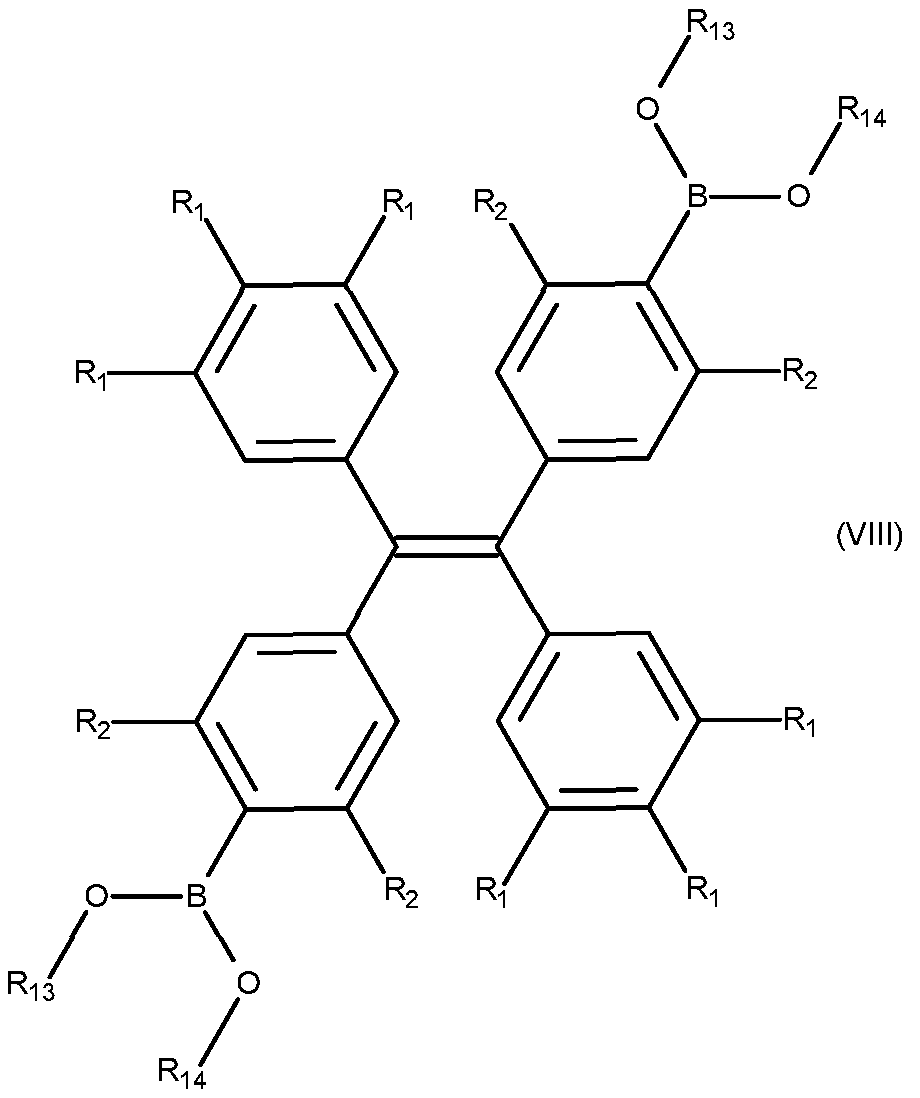

where:
Ri to R4 are as defined in Claim 1 ;
Ri3 and R14 independently represent C1-6 alkyl, or R13 and R14 together with the boron and oxygen atoms to which they are attached form a 5- to 6- membered ring, which latter two groups are unsubstituted or are substituted with from one to four substituents (e.g. four) selected from Ci-6 alkyl (e.g. methyl); and
5 represents H.
10. The process according to Claim 9, wherein each to R4 is H.
11. A chemical sensor or a biosensor or an environmental monitoring assay comprising a polymer as described in Claim 1.
12. A method of detecting a volatile organic chemical with a chemical sensor or an environmental monitoring assay as described in Claim 1 1 , wherein the sensor or assay is exposed to an analyte and detects at least one volatile organic compound by turn-on fluorescence or turn-off fluorescence in a qualitative or quantitative manner.
13. The method according to Claim 12, wherein the sensor or assay is exposed to an analyte in a liquid or gas phase.
14. The method according to Claim 12, wherein the at least one volatile organic compound is selected from one or more of the group consisting of mesitylene, 1 ,4- diisopropylbenzene, p-xylene, o-xylene, m-xylene, chlorobenzene, toluene, benzene, 1 ,3,6- triisopropylbenzene, n-hexane, nitrobenzene and mixtures thereof.
15. A composite material comprising a polymer as described in Claim 1 , wherein the material further comprises poly(ethylene imine).
16. The composite material according to Claim 15, wherein the composite material is a mixed matrix membrane.
17. A method of biosensing an amino acid, comprising the steps of exposing a biosensor according to Claim 11 or a composite material as described in Claim 15 to an analyte and detecting the presence of the amino acid qualitatively or quantitatively by quenching of fluorescence.
18. The method according to Claim 17, wherein the at least one amino acid is .-cysteine.
Applications Claiming Priority (2)
| Application Number | Priority Date | Filing Date | Title |
|---|---|---|---|
| SG10201608475U | 2016-10-10 | ||
| SG10201608475U | 2016-10-10 |
Publications (1)
| Publication Number | Publication Date |
|---|---|
| WO2018070933A1 true WO2018070933A1 (en) | 2018-04-19 |
Family
ID=61906198
Family Applications (1)
| Application Number | Title | Priority Date | Filing Date |
|---|---|---|---|
| PCT/SG2017/050504 Ceased WO2018070933A1 (en) | 2016-10-10 | 2017-10-06 | Fluorescent porous organic frameworks containing molecular rotors for chemical sensing |
Country Status (1)
| Country | Link |
|---|---|
| WO (1) | WO2018070933A1 (en) |
Cited By (6)
| Publication number | Priority date | Publication date | Assignee | Title |
|---|---|---|---|---|
| CN108774102A (en) * | 2018-07-23 | 2018-11-09 | 辽宁大学 | A kind of porous aromatic skeleton material of fluorescence and its preparation method and application |
| CN112210057A (en) * | 2020-07-02 | 2021-01-12 | 上海师范大学 | Fluorescent three-dimensional covalent organic framework material and preparation method and application thereof |
| CN114380966A (en) * | 2022-01-19 | 2022-04-22 | 安徽医科大学 | COFs composite material, sustained release system and their application in the preparation of drugs for the treatment of MI/R injury |
| CN115112566A (en) * | 2022-06-22 | 2022-09-27 | 陕西师范大学 | Paper-based sensor decorated by metal organic framework material and having aggregation-induced emission effect and application of paper-based sensor in detecting formaldehyde |
| WO2022214830A1 (en) | 2021-04-08 | 2022-10-13 | The University Of Manchester | Method for analysing recycled plastic |
| CN121293449A (en) * | 2025-12-08 | 2026-01-09 | 大连产品质量检验检测研究院有限公司 | A fluorescent organic porous material based on tetraphenylethylene, its preparation method and application |
-
2017
- 2017-10-06 WO PCT/SG2017/050504 patent/WO2018070933A1/en not_active Ceased
Non-Patent Citations (3)
| Title |
|---|
| LIN G. ET AL.: "A Pyrene-Based, Fluorescent Three-Dimensional Covalent Organic Framework", J. AM. CHEM. SOC., vol. 138, no. 1 0, 29 February 2016 (2016-02-29), pages 3302 - 3305, XP055476275, [retrieved on 20171126] * |
| LU W. ET AL.: "Porous Polymer Networks: Synthesis, Porosity, and Applications in Gas Storage/Separation", CHEM. MATER., vol. 22, no. 21, 5 October 2010 (2010-10-05), pages 5964 - 5972, XP055476289, [retrieved on 20171126] * |
| ZHANG M. ET AL.: "Two-Dimensional Metal-Organic Framework with Wide Channels and Responsive Turn-On Fluorescence for the Chemical Sensing of Volatile Organic Compounds", J. AM. CHEM. SOC., vol. 136, no. 20, 13 May 2014 (2014-05-13), pages 7241 - 7244, XP055476271, [retrieved on 20171126] * |
Cited By (9)
| Publication number | Priority date | Publication date | Assignee | Title |
|---|---|---|---|---|
| CN108774102A (en) * | 2018-07-23 | 2018-11-09 | 辽宁大学 | A kind of porous aromatic skeleton material of fluorescence and its preparation method and application |
| CN108774102B (en) * | 2018-07-23 | 2021-01-08 | 辽宁大学 | Fluorescent porous aromatic skeleton material and preparation method and application thereof |
| CN112210057A (en) * | 2020-07-02 | 2021-01-12 | 上海师范大学 | Fluorescent three-dimensional covalent organic framework material and preparation method and application thereof |
| CN112210057B (en) * | 2020-07-02 | 2022-09-16 | 上海师范大学 | Fluorescent three-dimensional covalent organic framework material and preparation method and application thereof |
| WO2022214830A1 (en) | 2021-04-08 | 2022-10-13 | The University Of Manchester | Method for analysing recycled plastic |
| CN114380966A (en) * | 2022-01-19 | 2022-04-22 | 安徽医科大学 | COFs composite material, sustained release system and their application in the preparation of drugs for the treatment of MI/R injury |
| CN114380966B (en) * | 2022-01-19 | 2023-08-15 | 安徽医科大学 | COFs composite material, slow release system and application thereof in preparation of medicines for treating MI/R injury |
| CN115112566A (en) * | 2022-06-22 | 2022-09-27 | 陕西师范大学 | Paper-based sensor decorated by metal organic framework material and having aggregation-induced emission effect and application of paper-based sensor in detecting formaldehyde |
| CN121293449A (en) * | 2025-12-08 | 2026-01-09 | 大连产品质量检验检测研究院有限公司 | A fluorescent organic porous material based on tetraphenylethylene, its preparation method and application |
Similar Documents
| Publication | Publication Date | Title |
|---|---|---|
| AU2018239119B2 (en) | Fluorescent porous organic nanosheets for chemical sensing | |
| WO2018070933A1 (en) | Fluorescent porous organic frameworks containing molecular rotors for chemical sensing | |
| Cui et al. | A gaseous hydrogen chloride chemosensor based on a 2D covalent organic framework | |
| Sun et al. | Recyclable fluorescent paper sensor for visual detection of nitroaromatic explosives | |
| Yin et al. | A switchable sensor and scavenger: detection and removal of fluorinated chemical species by a luminescent metal–organic framework | |
| Song et al. | Hazardous nitroaromatic explosives detection by emerging porous solid sensors | |
| Wang et al. | Multifunctional conjugated microporous polymers with pyridine unit for efficient iodine sequestration, exceptional tetracycline sensing and removal | |
| Yi et al. | An ultrastable porous metal–organic framework luminescent switch towards aromatic compounds | |
| Das et al. | Chemical sensing in two dimensional porous covalent organic nanosheets | |
| Zhang et al. | A new metal–organic framework with high stability based on zirconium for sensing small molecules | |
| Huang et al. | Achieving bright mechanoluminescence in a hydrogen-bonded organic framework by polar molecular rotor incorporation | |
| US8507406B2 (en) | Zn4(OH)2(1,2,4-BTC)2—a rod packing microporous metal-organic framework with open metal sites for selective separation and sensing of small molecules | |
| US9127025B2 (en) | Zn5(BTA)6(TDA)2—a robust highly interpenetrated metal-organic framework constructed from pentanuclear clusters for selective sorption of gas molecules | |
| Wang et al. | Silsesquioxane-based triphenylamine functionalized porous polymer for CO2, I2 capture and nitro-aromatics detection | |
| Xia et al. | Driving fluorescence by forming AIEgens in a hollow azine-linked covalent organic framework | |
| Xia et al. | Tale of COF-on-MOF composites with structural regulation and stepwise luminescence enhancement | |
| Lu et al. | A highly selective and fast-response photoluminescence humidity sensor based on F− decorated NH 2-MIL-53 (Al) nanorods | |
| Yuan et al. | Sensitive detection of hazardous explosives via highly fluorescent crystalline porous aromatic frameworks | |
| US20140287514A1 (en) | Luminescent microporous material for detection and discrimination of low-levels of common gases and vapors | |
| Zheng et al. | A porous tetraphenylethylene-based polymer for fast-response fluorescence sensing of Fe (III) ion and nitrobenzene | |
| CN110330497A (en) | A kind of dish alkene-diimide derivative and its synthetic method and the Application in Sensing to gas phase volatile aromatics | |
| Li et al. | Octa [4‐(9‐carbazolyl) phenyl] silsesquioxane‐based porous material for dyes adsorption and sensing of nitroaromatic compounds | |
| Zhang et al. | Luminescence detection of CH 2 Cl 2 by varying Cu⋯ Cu interactions in a flexible porous coordination polymer | |
| CN107400149B (en) | Supermolecule cage complex and preparation method and application thereof | |
| CN111205856B (en) | Fluorescent material for sensitively and selectively detecting benzene series and preparation method and application thereof |
Legal Events
| Date | Code | Title | Description |
|---|---|---|---|
| 121 | Ep: the epo has been informed by wipo that ep was designated in this application |
Ref document number: 17860732 Country of ref document: EP Kind code of ref document: A1 |
|
| NENP | Non-entry into the national phase |
Ref country code: DE |
|
| 122 | Ep: pct application non-entry in european phase |
Ref document number: 17860732 Country of ref document: EP Kind code of ref document: A1 |