WO2018069457A1 - Process for the manufacture of 2,6,10-trimethylundeca-5,9-dienal - Google Patents
Process for the manufacture of 2,6,10-trimethylundeca-5,9-dienal Download PDFInfo
- Publication number
- WO2018069457A1 WO2018069457A1 PCT/EP2017/076088 EP2017076088W WO2018069457A1 WO 2018069457 A1 WO2018069457 A1 WO 2018069457A1 EP 2017076088 W EP2017076088 W EP 2017076088W WO 2018069457 A1 WO2018069457 A1 WO 2018069457A1
- Authority
- WO
- WIPO (PCT)
- Prior art keywords
- compound
- formula
- reaction
- process according
- carried out
- Prior art date
- Legal status (The legal status is an assumption and is not a legal conclusion. Google has not performed a legal analysis and makes no representation as to the accuracy of the status listed.)
- Ceased
Links
Classifications
-
- C—CHEMISTRY; METALLURGY
- C07—ORGANIC CHEMISTRY
- C07C—ACYCLIC OR CARBOCYCLIC COMPOUNDS
- C07C45/00—Preparation of compounds having >C = O groups bound only to carbon or hydrogen atoms; Preparation of chelates of such compounds
- C07C45/56—Preparation of compounds having >C = O groups bound only to carbon or hydrogen atoms; Preparation of chelates of such compounds from heterocyclic compounds
- C07C45/57—Preparation of compounds having >C = O groups bound only to carbon or hydrogen atoms; Preparation of chelates of such compounds from heterocyclic compounds with oxygen as the only heteroatom
- C07C45/58—Preparation of compounds having >C = O groups bound only to carbon or hydrogen atoms; Preparation of chelates of such compounds from heterocyclic compounds with oxygen as the only heteroatom in three-membered rings
-
- C—CHEMISTRY; METALLURGY
- C07—ORGANIC CHEMISTRY
- C07D—HETEROCYCLIC COMPOUNDS
- C07D303/00—Compounds containing three-membered rings having one oxygen atom as the only ring hetero atom
- C07D303/02—Compounds containing oxirane rings
- C07D303/48—Compounds containing oxirane rings with hetero atoms or with carbon atoms having three bonds to hetero atoms with at the most one bond to halogen, directly attached to ring carbon atoms, e.g. ester or nitrile radicals
Definitions
- the present invention relates to an improved process for the manufacture of 2,6, 10-trimethylundeca-5,9-dienal.
- Profarnesal® is a colorless to pale yellow clear liquid, which is also known as Profarnesal® as well as Oncidal®. Profarnesal® cannot be found in nature and therefore needs to be synthesized.
- Profarnesal® The odor of Profarnesal® is described mainly as aldehydic-floral odor reminiscent of nerolidol.
- the objective of the invention was to provide an improved process for the manufacture of 2,6, 10- trimethylundeca-5,9-dienal.
- step i) wherein R is Ci- C 4 -alkyl (preferably methyl or ethyl) as a base and methyl chloroacetate or methyl bromoacetate (compound (III ) with X being CI or Br) as a-haloester at a low temperature, preferably at a temperature ⁇ -15°C.
- R is Ci- C 4 -alkyl (preferably methyl or ethyl) as a base and methyl chloroacetate or methyl bromoacetate (compound (III ) with X being CI or Br) as a-haloester at a low temperature, preferably at a temperature ⁇ -15°C.
- the decarboxylation (step iii)) can be carried out also in a continuous manner; additionally, the decarboxylation is carried out without any metal powder. Therefore, the present invention relates to a process (P) for the manufacture of the compound of formula (I ) comprising the following steps
- X is CI or Br, preferably CI
- NaOR wherein R is Ci -C 4 -alkyl (preferably methyl or ethyl, more preferably methyl) as a base and methyl chloroacetate or methyl bromoaceate (preferably methyl chloroacetate) as a- haloester at a low temperature, preferably at a temperature ⁇ -15 ° C.
- reaction product i.e. the compound of formula (IV)
- the reaction product i.e. the compound of formula (IV)
- Step ii) This step is the saponification of the glycidic ester (the ⁇ , ⁇ -epoxy ester of formula (IV)) into the corresponding acid (compound of formula (V)). It is preferably carried out in the presence of a base.
- a base is NaOH. Excess of the base is neutralized after the reaction with an acid. Examples of such a base
- step i) and step ii) are done in sequence without isolating the reaction product of the first reaction step, i.e. without isolating the compound of formula (IV).
- Suitable solvents are aliphatic hydrocarbons or aromatic hydrocarbons or any mixture thereof.
- aliphatic hydrocarbons are straight and branched C 6 -io-alkanes and C 6 -io-cylcoalkanes such as cyclohexane, n- hexane and n-heptane.
- aromatic hydrocarbons are benzene, toluene, o-xylene, m-xylene and p-xylene.
- n-hexane n-heptane
- benzene o-xylene
- m-xylene m-xylene
- p-xylene p-xylene
- toluene Preferred are n-hexane, n- heptane and toluene.
- n-heptane and toluene Most preferred are n-heptane and toluene. Therefore, the present invention relates to a process (P1 ), which is process (P), wherein steps i) and ii) are carried out in at least one solvent.
- the present invention relates to a process ( ⁇ 1 ' ), which is process (P1 ), wherein steps i) and ii) are carried out in at least one aliphatic hydrocarbon or in at least one aromatic hydrocarbon.
- the present invention relates to a process (P1 "), which is process (P1 ), wherein steps i) and ii) are carried out in at least one solvent chosen from the consisting of n-hexane, n-heptane, benzene, o-xylene, m-xylene, p-xylene and toluene.
- the reaction temperature of step i) is preferably ⁇ -15°C. More preferably the reaction temperature is in a range of from -45 °C to -15°C, most preferably the reaction temperature is in a range of from -30°C to -15°C.
- the present invention relates to a process (P2), which is either process (P) or (P1 ) or(P1 ') or (P1 "), wherein step i) is carried out at a reaction temperature ⁇ -15°C.
- the present invention relates to a process ( ⁇ 2'), which is either process (P) or (P1 ) or (P1 ') or (P1 "), wherein step i) is carried out at a reaction temperature in the range of from -45 °C to - 15°C.
- the present invention relates to a process (P2"), which is either process (P) or (P1 ) or (P1 ') or (P1 "), wherein step i) is carried out at a reaction temperature in the range of from -30°C to -15°C.
- the starting material (compound (II) and compound (III) can be added in equimolar amounts with respect to each other.
- the compound of formula (III) is added in excess; i.e. the molar ratio of the compound of the formula (III) to the compound of formula (II) is in the range of from 1.1 :1 to 2: 1.
- Step ii) is usually carried out at slightly elevated temperature, usually up to 60°C.
- the present invention relates to a process (P3), which is either process (P) or (P1 ) or (PT) or (P1 ") or (P2) or ( ⁇ 2') or (P2"), wherein step ii) is carried out at elevated temperature.
- the present invention relates to a process ( ⁇ 3'), which is either process (P) or (P1 ) or (PT) or (P1 ") or (P2) or ( ⁇ 2') or (P2"), wherein step ii) is carried out at a reaction temperature in the range of from 30°C to 60°C.
- the reaction product of step ii), which is the compound of formula (V) is extracted from the reaction mixture with an aliphatic hydrocarbon or with an aromatic hydrocarbon (such as the ones given above) and it can be washed with an aqueous phase.
- reaction product is not isolated completely but left solved in the solvent (the aliphatic hydrocarbon or the aromatic hydrocarbon).
- step ii which is the compound of formula (V) in at least one organic solvent as given above, is decarboxylated in step iii) to the compound of formula (I).
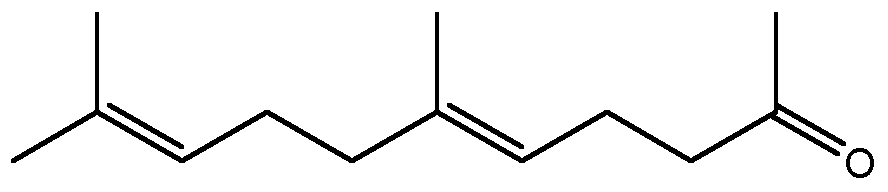
- Steps i) and ii) In a 250-ml glass reactor 19.5 g (100 mmol) of geranyl acetone, 50 ml of toluene, 12.4 ml (140 mmol) of methyl chloroacetate are charged. The mixture is stirred and cooled to -20°C (internal temperature). 7.85 g (140 mmol) of sodium methoxide are added in a powder dropping funnel. The base is added to the reaction mixture within 2 hours. The mixture is held at -20° C for 1 hour. After heating to ambient temperature (ca. 20°C), 20 ml of 5 % w/w sulfuric acid are added drop-wise to the reaction mixture.
- step ii) To the slightly viscous liquid of step ii) 120 g of n-heptane are added and this solution is fed through the tube reactor heated at 240° C.
Landscapes
- Chemical & Material Sciences (AREA)
- Organic Chemistry (AREA)
- Organic Low-Molecular-Weight Compounds And Preparation Thereof (AREA)
Abstract
The present invention relates to an improved process for the manufacture of 2,6,10-trimethylundeca-5,9-dienal (Darzens reaction, saponification, decarboxylation).
Description
PROCESS FOR THE MANUFACTURE OF 2,6, 10-TRIMETHYLUNDECA-5,9-DIENAL
The present invention relates to an improved process for the manufacture of 2,6, 10-trimethylundeca-5,9-dienal.
2,6,10-Trimethylundeca-5,9-dienal (compound of formula (I))

The odor of Profarnesal® is described mainly as aldehydic-floral odor reminiscent of nerolidol.
Due to the importance of 2,6,10-trimethylundeca-5,9-dienal the objective of the invention was to provide an improved process for the manufacture of 2,6, 10- trimethylundeca-5,9-dienal.

Furthermore, the decarboxylation (step iii)) can be carried out also in a continuous manner; additionally, the decarboxylation is carried out without any metal powder. Therefore, the present invention relates to a process (P) for the manufacture of the compound of formula (I ) comprising the following steps


(I")

in the presence of NaOR with R being Ci-C4-alkyl,
followed by
ii) a saponification reaction to form the compound of formula (V)

iii) a decarboxylation reaction of the compound of formula (V) to form the compound of formula (I ), whereby preferably no metal catalyst such as a copper catalyst is used.
In the following the process steps are discussed in more detail.
Step (i)
This step is a glycidic ester condensation, whereby an α, β-epoxy ester (=glycidic ester) is formed.
It was found that it is very advantageous to use NaOR, wherein R is Ci -C4-alkyl (preferably methyl or ethyl, more preferably methyl) as a base and methyl chloroacetate or methyl bromoaceate (preferably methyl chloroacetate) as a- haloester at a low temperature, preferably at a temperature < -15 ° C.
Due to the choice of these reaction parameters the conversion of the starting material is increased significantly.
It is also possible to isolate the reaction product, i.e. the compound of formula (IV), if needed and desired.
After the glycidic ester condensation took place, remaining base can be neutralized with an acid.
Step ii)
This step is the saponification of the glycidic ester (the α,β-epoxy ester of formula (IV)) into the corresponding acid (compound of formula (V)). It is preferably carried out in the presence of a base. Example of such a base is NaOH. Excess of the base is neutralized after the reaction with an acid. Examples of such a base

In a preferred embodiment of the present invention step i) and step ii) are done in sequence without isolating the reaction product of the first reaction step, i.e. without isolating the compound of formula (IV).
The steps i) and ii) are usually carried out in a solvent (preferred) or a mixture of solvents (less preferred). Suitable solvents are aliphatic hydrocarbons or aromatic hydrocarbons or any mixture thereof. Examples of aliphatic hydrocarbons are straight and branched C6-io-alkanes and C6-io-cylcoalkanes such as cyclohexane, n- hexane and n-heptane. Examples of aromatic hydrocarbons are benzene, toluene, o-xylene, m-xylene and p-xylene. Especially suitable are n-hexane, n-heptane, benzene, o-xylene, m-xylene, p-xylene and toluene. Preferred are n-hexane, n- heptane and toluene. Most preferred are n-heptane and toluene. Therefore, the present invention relates to a process (P1 ), which is process (P), wherein steps i) and ii) are carried out in at least one solvent.
Furthermore, the present invention relates to a process (Ρ1 ' ), which is process (P1 ), wherein steps i) and ii) are carried out in at least one aliphatic hydrocarbon or in at least one aromatic hydrocarbon.
Therefore, the present invention relates to a process (P1 "), which is process (P1 ), wherein steps i) and ii) are carried out in at least one solvent chosen from the consisting of n-hexane, n-heptane, benzene, o-xylene, m-xylene, p-xylene and toluene.
The reaction temperature of step i) is preferably < -15°C. More preferably the reaction temperature is in a range of from -45 °C to -15°C, most preferably the reaction temperature is in a range of from -30°C to -15°C. Thus, the present invention relates to a process (P2), which is either process (P) or (P1 ) or(P1 ') or (P1 "), wherein step i) is carried out at a reaction temperature < -15°C.
Thus, the present invention relates to a process (Ρ2'), which is either process (P) or (P1 ) or (P1 ') or (P1 "), wherein step i) is carried out at a reaction temperature in the range of from -45 °C to - 15°C.
Thus, the present invention relates to a process (P2"), which is either process (P) or (P1 ) or (P1 ') or (P1 "), wherein step i) is carried out at a reaction temperature in the range of from -30°C to -15°C.
The starting material (compound (II) and compound (III) can be added in equimolar amounts with respect to each other. Preferably the compound of formula (III) is added in excess; i.e. the molar ratio of the compound of the formula (III) to the compound of formula (II) is in the range of from 1.1 :1 to 2: 1.
Step ii) is usually carried out at slightly elevated temperature, usually up to 60°C.
Therefore, the present invention relates to a process (P3), which is either process (P) or (P1 ) or (PT) or (P1 ") or (P2) or (Ρ2') or (P2"), wherein step ii) is carried out at elevated temperature.
Therefore, the present invention relates to a process (Ρ3'), which is either process (P) or (P1 ) or (PT) or (P1 ") or (P2) or (Ρ2') or (P2"), wherein step ii) is carried out at a reaction temperature in the range of from 30°C to 60°C.
The reaction product of step ii), which is the compound of formula (V) is extracted from the reaction mixture with an aliphatic hydrocarbon or with an aromatic hydrocarbon (such as the ones given above) and it can be washed with an aqueous phase.
Usually the reaction product is not isolated completely but left solved in the solvent (the aliphatic hydrocarbon or the aromatic hydrocarbon).
Step iii)

The reaction product of step ii), which is the compound of formula (V) in at least one organic solvent as given above, is decarboxylated in step iii) to the compound of formula (I).
This is done by heating up the reaction mixture to a temperature of at least 160°C (preferably to a temperature in the range of from 160-300° C) and removing the side-products by distillation. These reaction conditions are very mild and no metal powder is needed. In the prior art copper powder is essential for this step. Because the process of the present invention does not need any heavy metals such as copper, waste is avoided. Thus, it is an ecological process. The invention is now illustrated by the following example. All percentages given are related to the weight.
Example
Steps i) and ii) In a 250-ml glass reactor 19.5 g (100 mmol) of geranyl acetone, 50 ml of toluene, 12.4 ml (140 mmol) of methyl chloroacetate are charged. The mixture is stirred and cooled to -20°C (internal temperature). 7.85 g (140 mmol) of sodium methoxide are added in a powder dropping funnel. The base is added to the reaction mixture within 2 hours. The mixture is held at -20° C for 1 hour. After heating to ambient temperature (ca. 20°C), 20 ml of 5 % w/w sulfuric acid are added drop-wise to the reaction mixture.
Afterwards 37.6 ml (150 mmol) of sodium hydroxide (4 M) are added. The mixture is stirred at ambient temperature (22 °C) for 2 hours. A slightly viscous liquid is obtained.
Step iii)
To the slightly viscous liquid of step ii) 120 g of n-heptane are added and this solution is fed through the tube reactor heated at 240° C.
The crude product is distilled over a short distillation column (Vigreux 10 cm, bath temperature = 147°C, head temperature = 90°C - 96°C, pressure = 0.3 mbar) to give Profarnesal® in an overall yield of 55.8%.
Claims
1. A process for the manufacture of the compound of formula (I)

(I) comprising the following steps:
i) a Darzens reaction of a compound of formula (II) and a compound of formula (III),
(I")

in the presence of NaOR, wherein R is Ci-C4-alkyl, followed by ii) a saponification reaction to form the compound of formula (V)

(V) and
iii) a decarboxylation reaction of the compound of formula (V) to form the compound of formula (I).
2. The process according to claim 1 , wherein steps i) and ii) are carried out in at least one solvent.
3. The process according to claim 2, wherein the solvent is at least one aliphatic hydrocarbon or at least one aromatic hydrocarbon or any mixture thereof.
4. The process according to claim 2, wherein the at least one solvent is chosen from the group consisting of benzene, toluene, o-xylene, m-xylene, p-xylene, cyclohexane, n-hexane and n-heptane.
5. The process according to anyone of the preceding claims, wherein the reaction temperature of step i) is < -15°C, preferably in the range of from -45°C to -15°C, more preferably in the range of from -30°C to -15°C.
6. The process according to anyone of the preceding claims, wherein step ii) is carried out at a reaction temperature in the range of from 30° C to 60° C.
7. The process according to anyone of the preceding claims, wherein step iii) is carried out at a reaction temperature of > 160°C.
8. The process according to anyone of the preceding claims, wherein the decarboxylation (step iii) is carried out in the absence of a metal catalyst.
9. The process according to claim 8, wherein the metal catalyst is a copper catalyst.
Applications Claiming Priority (2)
| Application Number | Priority Date | Filing Date | Title |
|---|---|---|---|
| EP16193520.0 | 2016-10-12 | ||
| EP16193520 | 2016-10-12 |
Publications (1)
| Publication Number | Publication Date |
|---|---|
| WO2018069457A1 true WO2018069457A1 (en) | 2018-04-19 |
Family
ID=57130283
Family Applications (1)
| Application Number | Title | Priority Date | Filing Date |
|---|---|---|---|
| PCT/EP2017/076088 Ceased WO2018069457A1 (en) | 2016-10-12 | 2017-10-12 | Process for the manufacture of 2,6,10-trimethylundeca-5,9-dienal |
Country Status (1)
| Country | Link |
|---|---|
| WO (1) | WO2018069457A1 (en) |
Cited By (1)
| Publication number | Priority date | Publication date | Assignee | Title |
|---|---|---|---|---|
| CN113563287A (en) * | 2021-07-12 | 2021-10-29 | 山东新和成药业有限公司 | Preparation method of epoxy caprylate and preparation method of melonal |
Citations (1)
| Publication number | Priority date | Publication date | Assignee | Title |
|---|---|---|---|---|
| US3939202A (en) * | 1973-01-31 | 1976-02-17 | Teikoku Chemical Industry Co., Ltd. | Process for preparing polyene compounds |
-
2017
- 2017-10-12 WO PCT/EP2017/076088 patent/WO2018069457A1/en not_active Ceased
Patent Citations (1)
| Publication number | Priority date | Publication date | Assignee | Title |
|---|---|---|---|---|
| US3939202A (en) * | 1973-01-31 | 1976-02-17 | Teikoku Chemical Industry Co., Ltd. | Process for preparing polyene compounds |
Cited By (1)
| Publication number | Priority date | Publication date | Assignee | Title |
|---|---|---|---|---|
| CN113563287A (en) * | 2021-07-12 | 2021-10-29 | 山东新和成药业有限公司 | Preparation method of epoxy caprylate and preparation method of melonal |
Similar Documents
| Publication | Publication Date | Title |
|---|---|---|
| Dong et al. | Synthesis of chalcones via Claisen–Schmidt condensation reaction catalyzed by acyclic acidic ionic liquids | |
| Sá et al. | Fast and efficient preparation of Baylis–Hillman-derived (E)-allylic azides and related compounds in aqueous medium | |
| US8669392B2 (en) | Process for preparing 2,3-di-non-straight-alkyl-2-cyanosuccinic acid diesters | |
| Ghashang et al. | Thiourea dioxide: an efficient and reusable organocatalyst for the rapid one-pot synthesis of pyrano [4, 3-b] pyran derivatives in water | |
| CN104254536B (en) | Production of 1,5,7-triazabicyclo[4.4.0]dec-5-ene from disubstituted carbodiimides and dipropylenetriamine | |
| US10752569B2 (en) | Process for the manufacture of 2,6-dimethyl-5-hepten-1-al | |
| WO2018069457A1 (en) | Process for the manufacture of 2,6,10-trimethylundeca-5,9-dienal | |
| EP3060546B1 (en) | Processes for the preparation of unsaturated esters | |
| US8933253B2 (en) | 2-(Alkoxy or aryloxy carbonyl)-4-methyl-6-(2,6,6-trimethylcyclohex-1-enyl)hex-2-enoic acid compunds, its preparation and use | |
| Brown et al. | Synthesis of dibromoolefins via a tandem ozonolysis–dibromoolefination reaction | |
| JP5504898B2 (en) | Method for producing difluorocyclopropane compound | |
| WO2013113035A1 (en) | Improved methylidene malonate process | |
| WO2018069454A1 (en) | Process for the manufacture of 2,6,10-trimethylundec-9-enal | |
| EP3774710B1 (en) | Process for the production of 2-methyl-4-(2,6,6-trimethyl-1-cyclohexen-1-yl)-2-butenal | |
| WO2018069452A1 (en) | Process for the manufacture of a mixture of 2-methyl-4-(2,6,6-trimethyl-1-cyclohexen-1-yl)-2-butenal and 2-methyl-4-(2,6,6-trimethyl-2-cyclohexen-1-yl)-2-butenal | |
| Karapetyan et al. | Synthesis of New Derivatives of 2-Imino-2, 5-dihydrofuran-3-carboxamides, Containing Aromatic Substituents | |
| EP2994450A1 (en) | Process of production of dehydrolinalyl acetate (ii) | |
| CN113956123A (en) | Preparation method and application of 2-alkyl anthracene | |
| WO2018069458A1 (en) | Process for the manufacture of 6-methoxy-2,6-dimethylheptanal | |
| CA2507477A1 (en) | Process for preparing phthaloyl chloride | |
| KR20090060196A (en) | Process for preparing substituted decalin-6-ol-1-one derivative | |
| Alizadeh et al. | Green and diasteroselective oxidative cyclization of bisnaphthols to spirans | |
| HU231014B1 (en) | Simple industrial process for the preparation of isodehydroacetic acid ester | |
| US11851402B2 (en) | Specific dehydrogenation process (I) | |
| KR20080094075A (en) | Process for preparing 3,4-disubstituted phenylacetic acid and novel intermediates |
Legal Events
| Date | Code | Title | Description |
|---|---|---|---|
| 121 | Ep: the epo has been informed by wipo that ep was designated in this application |
Ref document number: 17787371 Country of ref document: EP Kind code of ref document: A1 |
|
| NENP | Non-entry into the national phase |
Ref country code: DE |
|
| 122 | Ep: pct application non-entry in european phase |
Ref document number: 17787371 Country of ref document: EP Kind code of ref document: A1 |