WO2018048969A1 - Multi-targeted heterocyclic compounds for the treatment of neurodegenerative diseases - Google Patents
Multi-targeted heterocyclic compounds for the treatment of neurodegenerative diseases Download PDFInfo
- Publication number
- WO2018048969A1 WO2018048969A1 PCT/US2017/050379 US2017050379W WO2018048969A1 WO 2018048969 A1 WO2018048969 A1 WO 2018048969A1 US 2017050379 W US2017050379 W US 2017050379W WO 2018048969 A1 WO2018048969 A1 WO 2018048969A1
- Authority
- WO
- WIPO (PCT)
- Prior art keywords
- ealkyl
- mmol
- oci
- mhz
- compound
- Prior art date
- Legal status (The legal status is an assumption and is not a legal conclusion. Google has not performed a legal analysis and makes no representation as to the accuracy of the status listed.)
- Ceased
Links
- 0 COC(C=C1)C2=CC2=C1C1=CN=C[*@]1C(C=CCCl)=C* Chemical compound COC(C=C1)C2=CC2=C1C1=CN=C[*@]1C(C=CCCl)=C* 0.000 description 13
- LBWNFKMZTWFMPH-UUILKARUSA-N CC(C/C(/Cl)=C\C)C([n]1c(-c(c2ccc3)c3F)cnc1)=[I]2=C Chemical compound CC(C/C(/Cl)=C\C)C([n]1c(-c(c2ccc3)c3F)cnc1)=[I]2=C LBWNFKMZTWFMPH-UUILKARUSA-N 0.000 description 1
- IWVXSHSBSWTJEZ-UHFFFAOYSA-N CC1(C(F)=CC(Cl)=CC1)[n](cn1)c(-c(c(F)ccc2)c2F)c1Cl Chemical compound CC1(C(F)=CC(Cl)=CC1)[n](cn1)c(-c(c(F)ccc2)c2F)c1Cl IWVXSHSBSWTJEZ-UHFFFAOYSA-N 0.000 description 1
- ZTMKTFLNHWEKOZ-UHFFFAOYSA-N CCC(N(C1)C2CC=CCC2)=NCC1(CI)C1C=CC(F)=CC1 Chemical compound CCC(N(C1)C2CC=CCC2)=NCC1(CI)C1C=CC(F)=CC1 ZTMKTFLNHWEKOZ-UHFFFAOYSA-N 0.000 description 1
- IWFKNWLLOSXWCA-UHFFFAOYSA-N Cc(cc(cc1C[IH]c2cccc(F)c2-2)Cl)c1-[n]1c-2cnc1 Chemical compound Cc(cc(cc1C[IH]c2cccc(F)c2-2)Cl)c1-[n]1c-2cnc1 IWFKNWLLOSXWCA-UHFFFAOYSA-N 0.000 description 1
- YOYIHNGOOBSOBM-UHFFFAOYSA-N Cc1cc(F)c(c([n]2c(cc3)c4cc3Cl)cnc2Cl)c4c1 Chemical compound Cc1cc(F)c(c([n]2c(cc3)c4cc3Cl)cnc2Cl)c4c1 YOYIHNGOOBSOBM-UHFFFAOYSA-N 0.000 description 1
- SCOAGTGSXUCCNH-UHFFFAOYSA-N Cc1cc(c(cc(cc2)Cl)c2[n]2c(Cl)ncc22)c2c(C)c1 Chemical compound Cc1cc(c(cc(cc2)Cl)c2[n]2c(Cl)ncc22)c2c(C)c1 SCOAGTGSXUCCNH-UHFFFAOYSA-N 0.000 description 1
Classifications
-
- A—HUMAN NECESSITIES
- A61—MEDICAL OR VETERINARY SCIENCE; HYGIENE
- A61K—PREPARATIONS FOR MEDICAL, DENTAL OR TOILETRY PURPOSES
- A61K31/00—Medicinal preparations containing organic active ingredients
- A61K31/33—Heterocyclic compounds
- A61K31/395—Heterocyclic compounds having nitrogen as a ring hetero atom, e.g. guanethidine or rifamycins
- A61K31/41—Heterocyclic compounds having nitrogen as a ring hetero atom, e.g. guanethidine or rifamycins having five-membered rings with two or more ring hetero atoms, at least one of which being nitrogen, e.g. tetrazole
- A61K31/4164—1,3-Diazoles
-
- A—HUMAN NECESSITIES
- A61—MEDICAL OR VETERINARY SCIENCE; HYGIENE
- A61P—SPECIFIC THERAPEUTIC ACTIVITY OF CHEMICAL COMPOUNDS OR MEDICINAL PREPARATIONS
- A61P25/00—Drugs for disorders of the nervous system
- A61P25/28—Drugs for disorders of the nervous system for treating neurodegenerative disorders of the central nervous system, e.g. nootropic agents, cognition enhancers, drugs for treating Alzheimer's disease or other forms of dementia
-
- A—HUMAN NECESSITIES
- A61—MEDICAL OR VETERINARY SCIENCE; HYGIENE
- A61P—SPECIFIC THERAPEUTIC ACTIVITY OF CHEMICAL COMPOUNDS OR MEDICINAL PREPARATIONS
- A61P35/00—Antineoplastic agents
-
- C—CHEMISTRY; METALLURGY
- C07—ORGANIC CHEMISTRY
- C07D—HETEROCYCLIC COMPOUNDS
- C07D233/00—Heterocyclic compounds containing 1,3-diazole or hydrogenated 1,3-diazole rings, not condensed with other rings
- C07D233/54—Heterocyclic compounds containing 1,3-diazole or hydrogenated 1,3-diazole rings, not condensed with other rings having two double bonds between ring members or between ring members and non-ring members
- C07D233/64—Heterocyclic compounds containing 1,3-diazole or hydrogenated 1,3-diazole rings, not condensed with other rings having two double bonds between ring members or between ring members and non-ring members with substituted hydrocarbon radicals attached to ring carbon atoms, e.g. histidine
-
- C—CHEMISTRY; METALLURGY
- C07—ORGANIC CHEMISTRY
- C07D—HETEROCYCLIC COMPOUNDS
- C07D233/00—Heterocyclic compounds containing 1,3-diazole or hydrogenated 1,3-diazole rings, not condensed with other rings
- C07D233/54—Heterocyclic compounds containing 1,3-diazole or hydrogenated 1,3-diazole rings, not condensed with other rings having two double bonds between ring members or between ring members and non-ring members
- C07D233/66—Heterocyclic compounds containing 1,3-diazole or hydrogenated 1,3-diazole rings, not condensed with other rings having two double bonds between ring members or between ring members and non-ring members with hetero atoms or with carbon atoms having three bonds to hetero atoms with at the most one bond to halogen, e.g. ester or nitrile radicals, directly attached to ring carbon atoms
- C07D233/68—Halogen atoms
-
- C—CHEMISTRY; METALLURGY
- C07—ORGANIC CHEMISTRY
- C07D—HETEROCYCLIC COMPOUNDS
- C07D233/00—Heterocyclic compounds containing 1,3-diazole or hydrogenated 1,3-diazole rings, not condensed with other rings
- C07D233/54—Heterocyclic compounds containing 1,3-diazole or hydrogenated 1,3-diazole rings, not condensed with other rings having two double bonds between ring members or between ring members and non-ring members
- C07D233/66—Heterocyclic compounds containing 1,3-diazole or hydrogenated 1,3-diazole rings, not condensed with other rings having two double bonds between ring members or between ring members and non-ring members with hetero atoms or with carbon atoms having three bonds to hetero atoms with at the most one bond to halogen, e.g. ester or nitrile radicals, directly attached to ring carbon atoms
- C07D233/70—One oxygen atom
-
- C—CHEMISTRY; METALLURGY
- C07—ORGANIC CHEMISTRY
- C07D—HETEROCYCLIC COMPOUNDS
- C07D249/00—Heterocyclic compounds containing five-membered rings having three nitrogen atoms as the only ring hetero atoms
- C07D249/02—Heterocyclic compounds containing five-membered rings having three nitrogen atoms as the only ring hetero atoms not condensed with other rings
- C07D249/04—1,2,3-Triazoles; Hydrogenated 1,2,3-triazoles
- C07D249/06—1,2,3-Triazoles; Hydrogenated 1,2,3-triazoles with aryl radicals directly attached to ring atoms
-
- C—CHEMISTRY; METALLURGY
- C07—ORGANIC CHEMISTRY
- C07D—HETEROCYCLIC COMPOUNDS
- C07D249/00—Heterocyclic compounds containing five-membered rings having three nitrogen atoms as the only ring hetero atoms
- C07D249/02—Heterocyclic compounds containing five-membered rings having three nitrogen atoms as the only ring hetero atoms not condensed with other rings
- C07D249/08—1,2,4-Triazoles; Hydrogenated 1,2,4-triazoles
-
- C—CHEMISTRY; METALLURGY
- C07—ORGANIC CHEMISTRY
- C07D—HETEROCYCLIC COMPOUNDS
- C07D401/00—Heterocyclic compounds containing two or more hetero rings, having nitrogen atoms as the only ring hetero atoms, at least one ring being a six-membered ring with only one nitrogen atom
- C07D401/02—Heterocyclic compounds containing two or more hetero rings, having nitrogen atoms as the only ring hetero atoms, at least one ring being a six-membered ring with only one nitrogen atom containing two hetero rings
- C07D401/04—Heterocyclic compounds containing two or more hetero rings, having nitrogen atoms as the only ring hetero atoms, at least one ring being a six-membered ring with only one nitrogen atom containing two hetero rings directly linked by a ring-member-to-ring-member bond
Definitions
- the disclosure relates to compounds and methods for treating neurodegenerative diseases.
- AD Alzheimer's disease
- CNS central nervous system
- onset and progression of neurodegeneration result from the formation of neurofibrillary tangles (comprised of aggregated tau proteins) and senile plaques (formed from deposits of ⁇ peptides).
- neuroinflammation and oxidative stress are invariably associated with the neurodegenerative proce ss .
- 5-LOX e.g. , zileuton
- Multi-targeted compounds especially those that could potentially counter both tau- and ⁇ -mediated neurodegeneration, are clearly desirable.
- the present disclosure is directed to methods of treating neurodegenerative diseases, peripheral inflammatory conditions, cancers, or parasitic diseases in a subject, comprising administering to the subject a comp nd of Formula I:
- R 1 is H, F, CI, Br, Ci-ealkyl, or OCi -6a3kyi
- R ' is H, F, CI, Br, Ci-ealkyl, or OCi-ealkyl
- R. is H, F, CI, or Br
- W is I I.
- R 5 is H, F, C3, Br, Ci-ealkyl, or OCi-ealkyl
- R 6 is H, F, CI, Br, d-ealkyl, or OCi- ealkyl
- R 7 is H, F, CI, Br, Ci-ealkyl, Ci-ehaloalkyl or OCi-ealkyl
- R s is H, F, CI, Br, Ci-ealkyl, Ci-ehaioaikyl or OCi-ealkyl.
- the present disclosure also relates to methods of treating neurodegenerative diseases, peripheral inflammatory conditions, cancers, or parasitic diseases in a subject, comprising administering to the subject a compound of Formula (II):
- R 2 is H or Ci- ealkyi:
- R 22 is H, F, CI, Br, Ci-ealkyl, or OCi-ealkyl:
- R 23 is H, F, CI, or Br;
- R 24 is H, F, CI, or Br;
- R 25 is H, F, CI, Br, Ci-ealkyl, or OCi-ealkyl;
- R 26 is H, F, CI, Br, Ci-ealkyl, or OCi-ealkyl;
- R 27 is H, F, C3, Br, Ci-ealkyl, Ci-ehaioaikyl or OCi-ealkyl;
- R 28 is H, F, CI, Br, Ci-ealkyl, Ci-ehaloalkyl or OCi-ealkyl.
- X is CH or N;
- R 31 is H, Ci-ealkyl, or Ci-ehaloalkyl;
- R 33 is H, F, CI, or Br:
- R 34 is H, F, CI, or Br;
- R 35 is H, F, CI, Br, Ci-ealkyl, or OCi-ealkyl;
- R 36 is H, F, CI, Br, Ci-ealkyl, or OCi-ealkyl;
- R 37 is H, F, CI, Br, Ci-ealkyl, Ci- ehaioaikyl or OCi-ealkyl;
- R 38 is H, F, CI, Br, Ci-eaikyl, Ci-ehaloalkyi or OCi-ealkyl.
- the present disclosure also provides methods of treating neurodegenerative diseases in a subject comprising administering to the subject a compound of Formula: (IV)
- R 4! is H or Ci - ealkyl
- R 43 is H, F, CI, or Br
- R 44 is H, F, CI, or Br
- R 45 is H, F, CI, Br, Ci-ealkyl, or OCi-ealkyl
- R 46 is H, F, CI, Br, Ci-ealkyl, or OCi-ealkyl
- R 47 is H, F, CI, Br, Ci-ealkyl, Ci-ehaloalkyl or OCi- eaikyl
- R 48 is H, F, CI, Br, Ci -ealkyl, Ci-ehaloalkyl or OCi-eaikyl.
- FIG. 1 is a schematic showing a summary of SARs (top) and representative structures exemplifying the different activity profiles exhibited by the 1 ,5-diarylimidazoles (bottom).
- FIG. 2 are representative dose -response curves in the RBL-1 cell assays. Samples were ran in triplicate at each concentrat on, with the error bars representing standard error of the mean,
- FIG. 3 is a bar graph showing the analysis of Table 12 compounds for their ability to reduce multiple COX and 5-LOX products.
- the compounds listed in Table 12 were tested at 50 ⁇ in the RBL-1 assay, and COX-derived PGE and PGEi, as well as 5-LOX-derived LTB4 and I.TC4, were assessed by LC-MS/MS. All compounds caused appreciable inhibition of all of the measured eicosanoids.
- FIG. 4 are bar graphs showing the concentration response of compounds 64 and 70 in the QBI293 Ac-Tub assay.
- Compounds 64 and 70 underwent concentration-response testing in triplicate in the QBI cell acetyl tubulin (AcTub) assay from 1-100 ⁇ and the increase in AcTub/ug of cellular homogenate relative to vehicle-treated cells is graphed.
- AcTub QBI cell acetyl tubulin
- triazolopyrimidine, cevipabulin, 1 was tested at 0.1 ⁇ as a positive control. Error bars represent standard error of the mean. **, p ⁇ 0.01 relative to vehicle-treated cells as determined by one-way ANOVA and Dunnett's multiple comparison test.
- alkyl when used alone or as part of a substituent group, refers to a straight- or branched-chain alkyl group having from I to 12 carbon atoms (“Ci-12”), preferably 1 to 6 carbons atoms (“Ci-e”), in the chain.
- alky] groups include methyl (Me, Cialkyl) ethyl (Et, Cialkyi), n-propyi (Cialkyl), isopropyl (Cialkyl), butyl (C aikyl), isobutyi (C4aikyi), sec-butyl (C4alkyl), tert-butyl (Cialkyl), pentyl (Csalkyl), isopentyl (Csalkyl), tert-pentyl (Csalkyl), hexyl (Cealkyj), isohexy] (Cealkyl), and groups that in light of the ordinary skill in the art and the teachings provided herein would be considered equivalent to any one of the foregoing examples.
- haloalkyl when used alone or as part of a substituent group, refers to an alkyl group as described above having one, two, or three halogen atoms attached to a single carbon atom.
- the halogen is F.
- haloalkyl includes peri uoroalkyl groups whereby the alkyl group is terminated with a CF3, CH2F, or CHF2.
- alkyl groups include CF 3 , CHF2, CH2F, CH2CF3, CHFCF3, CF2CF3, CH2CHF2, CH2CH2F, CHFCH3, CF2CH3, CHFCHF2, CF2CHF2, among others, and groups that in light of the ordinary skill in the art and the teachings provided herein would be considered equivalent to any one of the foregoing examples.
- C1-3 includes C1-3, C1-2,
- halogen represents chlorine, fluorine, bromine, or iodine.
- halo represents chloro, fluoro, bromo, or iodo.
- compound(s) of formula (II) includes those compounds of “formula (II),” as well as compounds of any of the formula (II) subgenera.
- compound(s) of formula (III) includes those compounds of “formula (III),” as well as compounds of any of the formula (III) subgenera.
- compound(s) of formula (IV) includes those compounds of "formula (IV),” as well as compounds of any of the formula (IV) subgenera.
- “Pharmaceutically acceptable” means approved or approvable by a regulatory agency of the Federal or a state government or the corresponding agency in countries other than the United States, or that is listed in the U.S. Pharmacopoeia or other generally recognized pharmacopoeia for use in animals, and more particularly, in humans.
- “Pharmaceutically acceptable salt” refers to a salt of a compound of the disclosure that is pharmaceutically acceptable and that possesses the desired pharmacological activity of the parent compound.
- such salts are non-toxic may be inorganic or organic acid addition salts and base addition salts.
- such salts include: ( 1) acid addition salts, formed with inorganic acids such as hydrochloric acid, hvdrobromic acid, sulfuric acid, nitric acid, phosphoric acid, and the like; or formed with organic acids such as acetic acid, propionic acid, hexanoic acid, cyclopentanepropsonic acid, glycolic acid, pyruvic acid, lactic acid, malonic acid, succinic acid, malic acid, maleic acid, fumaric acid, tartaric acid, citric acid, benzoic acid,
- 3-(4-hydroxybenzoyl)benzoic acid cinnamic acid, mandelic acid, methanesulfonic acid, ethane sulfonic acid, 1,2-ethane-disulfonic acid, 2-hydroxyethanesulfonic acid, benzenesulfonic acid, 4-chlorobenzenesulfonic acid, 2-naphthalenesulfonic acid, 4-toluenesulfonic acid, camphorsulfonic acid, 4-methylbicyclo[2.2.2]-oct-2-ene-l-carboxylic acid, glucoheptonic acid,
- 3-phenyipropionic acid trimethylacetic acid, tertiary butyiacetic acid, lauryi sulfuric acid, gluconic acid, glutamic acid, hydroxynaphthoic acid, salicylic acid, stearic acid, muconic acid, and the like; or (2) salts formed when an acidic proton present in the parent compound either is replaced by a metal ion, e.g., an alkali metal ion, an alkaline earth ion, or an aluminum ion; or coordinates with an organic base such as ethanolamine, diethanolamine, triethanolamine, N- methylglucamine and the like.
- a metal ion e.g., an alkali metal ion, an alkaline earth ion, or an aluminum ion
- coordinates with an organic base such as ethanolamine, diethanolamine, triethanolamine, N- methylglucamine and the like.
- Salts further include, by way of example only, sodium, potassium, calcium, magnesium, ammonium, tetraaikylammonium, and the like; and when the compound contains a basic functionality, salts of non-toxic organic or inorganic acids, such as
- hydrochloride hydrobromide, tartrate, mesylate, acetate, maleate, oxalate and the like.
- “Pharmaceutically acceptable vehicle” refers to a diluent, adjuvant, excipient or carrier with which a compound of the disclosure is administered.
- a “pharmaceutically acceptable excipient” refers to a substance that is non-toxic, biologically tolerable, and otherwise biologically suitable for administration to a subject, such as an inert substance, added to a pharmacological composition or otherwise used as a vehicle, carrier, or diluent to facilitate administration of an agent and that is compatible therewith.
- excipients include calcium carbonate, calcium phosphate, various sugars and types of starch, cellulose derivatives, gelatin, vegetable oils, and polyethylene glycols.
- Subject includes humans.
- the terms “human,” “patient,” and “subject” are used interchangeably herein.
- Treating" or “treatment” of any disease or disorder refers, in one embodiment, to ameliorating the disease or disorder (i.e., arresting or reducing the development of the disease or at least one of the clinical symptoms thereof). In another embodiment “treating” or “treatment” refers to ameliorating at least one physical parameter, which may not be discernible by the subject. In yet another embodiment, “treating” or “treatment” refers to modulating the disease or disorder, either physically, (e.g., stabilization of a discernible symptom), physiologically, (e.g., stabilization of a physical parameter), or both, in yet another embodiment, "treating" or
- treatment refers to delaying the onset of the disease or disorder.
- isotopic variant refers to a compound that contains unnatural proportions of isotopes at one or more of the atoms that constitute such compound.
- an "isotopic variant" of a compound can be radiolabeled, that is, contain one or more non- radioactive isotopes, such as for example, deuterium ( ⁇ or D), carbon- 13 ( 1 3 C), nitrogen- 15 ( 15 N), or the like.
- any hydrogen may be 2 H/D
- any carbon may be 1 C
- any nitrogen may be l9 N
- the disclosure may include the preparation of isotopic variants with radioisotopes, in the instance for example, where the resulting compounds may be used for drag and/or substrate tissue distribution studies.
- Radiolabeled compounds of the disclosure can be used in diagnostic methods such as Single- photon emission computed tomography (SPECT).
- SPECT Single- photon emission computed tomography
- the radioactive isotopes tritium, i.e. 3 H, and carbon- 14, i.e. 1 C, are particularly useful for their ease of incorporation and ready means of detection.
- compounds may be prepared that are substituted with positron emitting isotopes, such as ! ! C, l8 F, i5 () and l3 N, and would be useful in Positron Emission Topography (PET) studies for examining substrate receptor occupancy.
- PET Positron Emission Topography
- Tautomers refer to compounds that are interchangeable forms of a particular compound structure, and that vary in the displacement of hydrogen atoms and electrons. T ms, two structures may be in equilibrium through the movement of ⁇ electrons and an atom (usually H). For example, enols and ketones are tautomers because they are rapidly mterconyerted by treatment with either acid or base.
- Another example of tautomerism is the acid-and nitro-forms of phenyl nitromethane, that are likewise formed by treatment with acid or base.
- 100411 Tautomeric forms may be relevant to the attainment of the optimal chemical reactivity and biological activity of a compound of interest.
- any open valency appearing on a carbon, oxygen, or nitrogen atom in any structure described herein indicates the presence of a hydrogen atom.
- a chirai center exists in a structure, but no specific stereochemistry is shown for that center, both enantiomers, separately or as a mixture, are encompassed by that structure.
- the methods for the determination of stereochemistry and the separation of stereoisomers are well-known in the art.
- the compounds described herein are useful in treating neurodegenerative diseases, in particular, neurodegenerative diseases which are characterized by a tauopathy or compromised microtubule function subject.
- the compounds are useful for treating Alzheimer's disease, frontotemporal lobar degeneration, Pick's disease, progressive supranuclear palsy (PSP), corticobasal degeneration, schizophrenia, Parkinson's disease (PD), PD with dementia, Lewy body disease with dementia, amyotrophic lateral sclerosis, argyrophilic grain disease, chronic traumatic encephalopathy, diffuse neurofibrillary tangles with calcification, Down's syndrome, Familial British dementia, Familial Danish dementia, frontotemporal dementia, parkinsonism linked to chromosome 17, Gerstmann-Straussler-Scheinker disease, Guadeloupean parkinsonism, multiple sclerosis, myotonic dystrophy, neurodegeneration with brain iron accumulation, Niemann-Pick disease, type C, non-Guamania
- the compounds can be used to treat traumatic brain injury (TBI), especially repetitive TBI (rTBI), such as that due to dementia pugilistica and recurrent football concussions and military closed head injuries such as that due to lEDs, which also is known as chronic traumatic encephalopathy (CTE), with features of tauopathy or AD-like pathology or post-traumatic stress disorder.
- TBI traumatic brain injury
- rTBI repetitive TBI
- CTE chronic traumatic encephalopathy
- tauopathy or AD-like pathology or post-traumatic stress disorder traumatic brain injury
- the compounds described herein are particularly useful in the treatment of Alzheimer's disease.
- the compounds may also be useful in treating peripheral inflammatory conditions.
- the compounds useful in treating peripheral inflammatory conditions inhibit both cyclooxygenase-derived eicosanoid production and lepoxygenase-derived eicosanoid production.
- the compounds are not useful in stabilizing microtubules.
- the peripheral inflammatory conditions which may be treated as described herein include rheumatoid arthritis, Crohn's disease, inflammatory bowel disease (IBD), lupus, asthma, and sepsis.
- the peripheral inflammatory conditions is rheumatoid arthritis and Crohn's diease, among others.
- the compounds may also be useful in treating cancers.
- the compounds useful in treating cancer are capable of stabilizing microtubules.
- cancer refers to neoplastic cells in a patient which have abnormal cell group and invade or have the potential to invade one or more body parts of the patient .
- the cancer is a neuroendocrine cancer, adrenal gland cancer, appendix cancer, bladder cancer, blood cancer, brain cancer, bone cancer, breast cancer, bronchus cancer, central nervous system cancer, cervical cancer, chest cancer, colon cancer, esophagael cancer, eye cancer, gallbladder cancer, head cancer, intestininal cancer, kidney cancer, larynx cancer, liver cancer, lung cancer, lymph node cancer, mouth cancer, neck cancer, ovarian cancer, pancreatic cancer, pharynx cancer, pituitary cancer, prostate cancer, rectal cancer, skin cancer, stomach cancer, testicle cancer, throat cancer, thymus cancer, thyroid cancer, uterine cancer, urinary cancer, vaginal cancer, or a leukemia.
- the cancer is brain cancer.
- Parasitic diseases may further be treating using the compounds described herein.
- the compounds useful in treating parasite infections are those that are capable of stabilizing microtubules.
- the term "parasitic disease” as used herein refers to a disease resulting from an infection of a parasite.
- parasitic diseases may be treated using the compounds as described herein including, without limitation, malaria, leishmaniasis, schistosomiasis, toxoplasmosis, coccidiosis, African trypanosomiasis, Chagas's disease, giardiasis, or amoebiasis.
- These classes of compounds include imidazole compounds of formula (I), pyrazole compounds of formula (II), and triazoie compounds of formula (HI) and (IV), as described herein. As discussed herein, these compounds have microtubule stabilizing properties and/or are inhibitors of eicosanoid synthesis.
- the present disclosure is related to methods of treating a neurodegenerative disease in a subject comprising administering to the subject a compound of Formula I, or a pharmaceutically acceptable salt thereof:
- X is CH or N. In some embodiments, X is CH. In other embodiments, X is N.
- R 1 is H, F, CI, Br, Ci-ealkyl, or QCi-ealkyl.
- R 1 is H.
- R ! is F, CI, or Br
- R 1 is F.
- R 1 is CI.
- R 1 is Br.
- R ] is Ci-ealkyl or QCi-ealkyl.
- R' is Ci-ealkyl such as methyl, ethyl, propyl, butyl, pentyl, or liexyi.
- R 1 is OCi-ealkyl such as methoxy, ethoxy, propoxy, butoxy, pentoxy, or hexoxy.
- R 2 is I L F, CI, Br, Ci-ealkyl, or OCi-ealkyi.
- R 2 is H.
- R 2 is F, Ci, or Br.
- R 2 is F.
- R 2 is CI.
- R 2 is Br.
- R 2 is Ci- ealkyl or QCi-ealkyl.
- R 2 is Ci-ealkyl such as methyl, ethyl, propyl, butyl, pentyl, or hexyl.
- R 2 is OCi-ealkyl such as methoxy, ethoxy, propoxy, butoxy, pentoxy, or hexoxy.
- R 1 is H, F, CI, or Br.
- R 3 is H.
- R 1 is F, CI, or Br.
- R 3 is F.
- R 3 is Ci.
- R 3 is Br.
- R 4 is H, F, CI, or Br. In some embodiments, R 4 is H. In other embodiments, R 4 is F, CI, or Br. In further embodiments, R 4 is F. Tn other embodiments, R 4 is CI . In additional embodiments, R 4 is Br.
- R 5 is H, F, Ci, Br, Ci-ealkyl, or QCi-eaikyl.
- R 5 is H.
- R 5 is F, CI, or Br.
- R 5 is F.
- R 5 is CI.
- R 3 is Br.
- W is C i-ealkyl or OCi-eaikyl.
- R 5 is Ci-ealkyl such as methyl, etliyl, propyl, butyl, pentyl, or hexyl.
- R 5 is OCi-ealkyl such as methoxy, ethoxy, propoxy, butoxy, pentoxy, or hexoxy.
- R" is H, F, CI, Br, Ci-eaikyl, or OCi-ealkyl.
- R 6 is H.
- R 6 is F, Ci, or Br.
- R 6 is F.
- R 6 is CI.
- R 6 is Br.
- R 6 is Ci-ealkyl or OCi-6alkyl.
- R 6 is Ci-ealkyl such as methyl, ethyl, propyl, butyl, pentyl, or hexyl. In further embodiments, R 6 is OCi-ealkyl such as methoxy, ethoxy, propoxy, butoxy, pentoxy, or hexoxy.
- R 7 is 1 1. F, CI, Br, Ci-ealkyl, Ci-ehaloalkyl or OCi-ealkyl. In some embodiments, R is H. In other embodiments, R 7 is F, CI, or Br. In further embodiments, R 7 is F. In yet other embodiments, R 7 is CI . In still further embodiments, R 7 is Br. In other embodiments, R 7 is Ci- ealkyl, Ci-ehaloalkyl or OCi-ealkyl . In further embodiments, R 7 is Ci-6a]kyl such as methyl, ethyl, propyl, butyl, pentyl, or hexyl .
- R 7 is Ci-ehaloalkyl such as CF3.
- R 7 is OCi-ealkyl such as methoxy, ethoxy, propoxy, butoxy, pentoxy, or hexoxy.
- R 8 is H, F, CI, Br, Ci-ealkyl, Ci-ehaloalkyl or OCi-ealkyl. In some embodiments, R 8 is H. In other embodiments, R 8 is F, CI, or Br. In further embodiments, R 8 is F. In yet other embodiments, R 8 is CI . In still further embodiments, R 8 is Br. In other embodiments, R 8 is Ci- ealkyl, Ci-ehaloalkyl or OCi-ealkyl. In further embodiments, R 8 is Ci-6alkyl such as methyl, ethyl, propyl, butyl, pentyl, or hexyl .
- R 8 is Ci-ehaloalkyl such as CF3. In further embodiments, R 8 is OCi-ealkyl such as methoxy, ethoxy, propoxy, butoxy, pentoxy, or hexoxy.
- Preferred compounds of formula (I) include those of Table 1. In some embodiments, these compounds stabilize microtubules.
- Further preferred compounds of formula (I) include those in Table 3. In some embodiments, these compounds inhibit 5-lipoxygenase-derived eicosanoid production and stabilize microtubules.
- Additional preferred compounds of fonnula (I) are those in Table 4, In some embodiments, these compounds inhibit cyclooxygenase-derived eicosanoid production, inhibit : lipoxygenase-de rived eicosanoid production and stabilize microtubules.
- Further prefen-ed compound of formula (I) include those in Table 6, in some embodiments, these compounds inhibit 5-lipoxygenase-derived eicosanoid production.
- Additional preferred compounds of formula (I) are those in Table 7. In some embodiments, these compounds inhibit cyciooxygenase-derived eicosanoid production and 5- lipoxygenase-derived eicosanoid production.
- rtlier preferred compounds of formula (I) are tliose in Table 8.
- Also provided are methods of treating neurodegenerative diseases in a subject comprising administering to the subject a compound of Formula (II), or a pharmaceutically accepta le salt thereof:
- X is CH or N . In some embodiments, X is CH. In other embodiments, X is N.
- R 21 is H or Ci-ealkyl. In some embodiments, R 21 is H. In other embodiments, R 21 is Ci ealkyi, for example, methyl, ethyl, propyl, butyl, pent ⁇ '!, or hexyl .
- R 22 is H, F, Ci, Br, Ci-ealkyl, or OCi-satkyl. In some embodiments, R 22 is H. In other embodiments, R 22 is F. In further embodiments, R 22 is CI. In yet other embodiments, R 22 is Br. In additional embodiments, R 2 -' is Ci-ealkyl, for example, methyl, ethyl, propyl, butyl, pentyl, or hexyl. In still further embodiments, R 22 is QCi-ealkyl, for example, methoxy, ethoxy, propoxy, butoxy, pentoxy, or hexoxy.
- R 23 is H, F, CI, or Br. In some embodiments, R 23 is H. In other embodiments, R 23 is F. In further embodiments, R 23 is CI. In additional embodiments, R 23 is Br.
- R 24 is H, F, Ci, or Br. In some embodiments, R 24 is H. In other embodiments, R ' 1 is F.
- R 24 is CI . In additional embodiments, R 24 is Br. [0073] R 25 is H, F, CI, Br, Ci-ealkyl, or OCi-ealkyl. In some embodiments, R 25 is H. In other embodiments, R 25 is F. In furtlier embodiments, R 25 is CI. In yet other embodiments, R 25 is Br. In additional embodiments, R 25 is Ci-6alkyl, for example, methyl, ethyl, propyl, butyl, pentyl, or hexyl. In still further embodiments, R 23 is OCi -ealky], for example, methoxy, ethoxy, propoxy, butoxy, pentoxy, or hexoxy.
- R 26 is H, F, Ci, Br, Ci-ealkyl, or OCi-ealkyl. In some embodiments, R 26 is H. In oilier embodiments, R 26 is F. In further embodiments, R 26 is CI. In yet other embodiments, R 26 is Br. In additional embodiments, R 26 is Ci-ealkyl, for example, methyl, ethyl, propyl, butyl, pentyl, or hexyl. In still further embodiments, R 26 is OCi-ealkyl, for example, methoxy, ethoxy, propoxy, butoxy, pentoxy, or hexoxy.
- R 27 is H, F, CI, Br, Ci-ealky], Ci-ehaloalkyl or OCi-ealkyl. In some embodiments, R 27 is H. In other embodiments, R 27 is F. In further embodiments, R 27 is CI. In yet other
- R 27 is Br. In additional embodiments, R 27 is Ci-ealkyl, for example, methyl, ethyl, propyl, butyl, pentyl, or hexyl. In other embodiments, R 27 is Ci-ehaloalkyl, for example, CF3. In still further embodiments, R 27 is OCi-ealkyl, for example, methoxy, ethoxy, propoxy, butoxy, pentoxy, or hexoxy.
- R 28 is H, F, Ci, Br, Ci-ealkyl, Ci-ehaioaikyl or OCi -ealkyl. In some embodiments, R 28 is H. In other embodiments, R 28 is F. In further embodiments, R 28 is Ci. In yet other
- R 28 is Br.
- R 28 is Ci-ealkyl, for example, methyl, ethyl, propyl, butyl, pentyl, or hexyl.
- R 28 is Ci-ehaioaikyl, for example, CF3.
- R 28 is OCi-ealkyl, for example, methoxy, ethoxy, propoxy, butoxy, pentoxy, or hexoxy.
- the compound of formula (II) is the following.
- this compound stabilizes microtubules and inhibits cyclooxygenase- derived eicosanoid production.
- methods of treating neurodegenerative diseases in a subject comprising administering to the subject a compound of Formula (III), or a pharmaceutically acceptable salt thereof:
- X is CH or N, In some embodiments, X is CH. In other embodiments, X is N.
- R 3 is H, Ci-ealkyl, or Ci-ehaloalkyl.
- R 31 is H.
- R 31 is Ci-ealkyi, for example, methyl, ethyl, propyl, butyl, pentyl, or hexyi.
- R 31 is Ci-ehaloalkyl, for example, CF3.
- R 33 is H, F, CI, or Br. In some embodiments, R 33 is H. In other embodiments, R 33 is F. In further embodiments, R 33 is CI. In yet other embodiments, R 33 is Br.
- R 34 is H, F, CI, or Br. In some embodiments, R 34 is H. In other embodiments, R 34 is F. In further embodiments, R 34 is CI . In yet other embodiments, R 34 is Br.
- R 35 is H, F, CI, Br, Ci-ealkyl, or OCi-ealkyl.
- R 35 is H.
- R 35 is F.
- R 35 is CI.
- R 35 is Br.
- R 35 is Ci-ealkyl, for example, methyl, ethyl, propyl, butyl, pentyl, or hexyi.
- R 35 is OCi-ealkyl, for example, methoxy, ethoxy, propoxy, butoxy, pentoxy, or hexoxy.
- R 36 is H, F, Ci, Br, Ci -ealkyl, or OCi-ealkyl. In some embodiments, R 36 is H. In other embodiments, R 36 is F. In further embodiments, R 36 is CI. In yet other embodiments, R 36 is Br. In additional embodiments, R 36 is Ci-ealkyl, for example, methyl, ethyl, propyl, butyl, pentyl, or hexyi. In still further embodiments, R 36 is OCi-ealkyl, for example, methoxy, ethoxy, propoxy, butoxy, pentoxy, or hexoxy.
- R 37 is 1 1. F, CI, Br, Ci-ealkyl, Ci-ehaloalkyl or OCi-ealkyl.
- R ! is H.
- R J / is F.
- R 37 is CI.
- R 3 ? is Br.
- R 3 / is Ci-ealkyl, for example, methyl, ethyl, propyl, butyl, pentyl, or hexyi .
- R 37 is Ci-ehaloalkyl, for example, CFs.
- R 37 is OCi-ealkyi, for example, methoxy, ethoxy, propoxy, butoxy, pentoxy, or hexoxy.
- R 38 is H, F, CI, Br, Ci-ealkyl, G-ehaloalkyl or (X .(.alk l .
- R 38 is H.
- R 38 is F.
- R 38 is CI.
- R 38 is Br.
- R 38 is Ci-ealkyl, for example, methyl, ethyl, propyl, butyl, pentyl, or hexyl.
- R 38 is Ci-ehaioaikyl, for example, CF3.
- R 38 is OCi-ealkyl, for example, methoxy, ethoxy, propoxy, butoxy, pentoxy, or hexoxy.
- Some preferred compounds of formula (III) are provided in Table 9. In some embodiments, these compounds inhibit cyclooxygenase -de ived eicosanoid production and 5- hpoxygenase-derived eicosanoid production.
- Also provided are methods of treating neurodegenerative diseases in a subject comprising administering to the subject a compound of Formula (IV, or a pharmaceutically acceptable salt thereof:
- X is CH or N. In some embodiments, X is CH. In other embodiments, X is N.
- R 41 is H or Ci-ealkyl. In some embodiments, R 41 is H. In other embodiments, R 4i is Ci- ealkyl, for example, methyl, ethyl, propyl, butyl, pentyl, or hexyl. 100911 R 43 is H, F, CI, or Br. In some embodiments, R 43 is H. In other embodiments, R 43 is F. In further embodiments, R 43 is CI. In yet other embodiments, R 43 is Br.
- R 44 is H, F, CI, or Br. In some embodiments, R 44 is H. In other embodiments, R 44 is F. In further embodiments, R 44 is CI . In yet other embodiments, R 44 is Br.
- R 43 is H, F, CI, Br, Ci-ealkyl, or OCi-ealkyl.
- R 45 is H. In oilier embodiments, R 45 is F. In further embodiments, R 43 is CL In yet other embodiments, R 45 is Br.
- R 45 is Ci-ealkyl, for example, methyl, ethyl, propyl, butyl, pentyl, or hexyl. In still further embodiments, R 45 is OCi-ealkyl, for example, methoxy, ethoxy, propoxy, butoxy, pentoxy, or hexoxy.
- R 46 is H, F, CI, Br, Ci -ealkyl, or OCi-ealkyl. In some embodiments, R 46 is H. In other embodiments, R 46 is F. In further embodiments, R 46 is CI. In yet other embodiments, R 46 is Br. In additional embodiments, R 46 is Ci-ealkyl, for example, methyl, ethyl, propyl, butyl, pentyl, or hexyl. In still further embodiments, R 46 is OCi-ealkyl, for example, methoxy, ethoxy, propoxy, butoxy, pentoxy, or hexoxy.
- R 47 is H, F, CI, Br, Ci-ealkyl, Ci-ehaloalkyl or OCi-ealkyl. In some embodiments, R 47 is H. In other embodiments, R 4 / is F. In further embodiments, R 47 is CI. In yet other
- R 4 ? is Br.
- R 4 / is Ci -ealkyl, for example, methyl, ethyl, propyl, butyl, pentyl, or hexyl .
- R 47 is Ci-ehaloalkyl, for example, CFs.
- R 47 is OCi-ealkyl, for example, methoxy, ethoxy, propoxy, butoxy, pentoxy, or hexoxy.
- R 48 is H, F, CI, Br, Ci-ealkyl, Ci-ehaloalkyl or OCi-ealkyl. In some embodiments, R 48 is H. In other embodiments, R 4 " is F. Tn further embodiments, R 48 is CI. In yet other words, R 48 is H, F, CI, Br, Ci-ealkyl, Ci-ehaloalkyl or OCi-ealkyl. In some embodiments, R 48 is H. In other embodiments, R 4 " is F. Tn further embodiments, R 48 is CI. In yet other
- R 48 is Br. In additional embodiments, R 48 is Ci-ealkyl, for example, methyl, ethyl, propyl, butyl, pentyl, or hexyl. In other embodiments, R 48 is Ci-ehaloalkyl, for example, CF3. In still further embodiments, R 48 is OCi-ealkyl, for example, methoxy, ethoxy, propoxy, butoxy, pentoxy, or hexoxy.
- a preferred compound of formula (IV) is the following compound.
- this compound inhibits 5-lipoxygenase-derived eicosanoid production.
- an “effective amount” means an amount or dose sufficient to generally bring about the desired therapeutic benefit in patients in need of such treatment for the designated disease, disorder, or condition.
- Effective amounts or doses of the compounds of the present disclosure may be ascertained by routine methods such as modeling, dose escalation studies or clinical trials, and by taking into consideration routine factors, e.g., the mode or route of administration or drug delivery, the pharmacokinetics of the compound, the severity and course of the disease, disorder, or condition, the subject's previous or ongoing therapy, the subject's health status and response to drugs, and the judgment of the treating physician.
- An example of a dose is in the range of from about 0.001 to about 200 mg of compound per kg of subject's body weight per day, preferably about 0.05 to 100 mg/kg/day, or about 1 to 35 mg kg/day, in single or divided dosage units (e.g., BID, T1D, QID).
- a suitable dosage amount is from about 0.05 to about 7 g/day, or about 0,2 to about 2.5 g/day.
- a pharmaceutical composition of the disclosure comprises: (a) an effective amount of at least one compound in accordance with the disclosure; and (b) a pharmaceutically acceptable excipient.
- the pharmaceutical composition contains a compound of formula (I), or a pharmaceutically acceptable salt thereof.
- the pharmaceutical composition contains a compound of formula (II) , or a pharmaceutically acceptable salt thereof.
- the pharmaceutical composition contains a compound of formula (HI), or a pharmaceutically acceptable salt thereof.
- the pharmaceutical composition contains a compound of formula (IV), or a pharmaceutically acceptable salt thereof
- the pharmaceutical composition contains more than one compound disclosed herein, for example, compounds of formula (I), (II), (III), and (TV) , or
- the compounds of the disclosure may be used in combination with additional active ingredients in the treatment of the above conditions.
- the additional active ingredients may be coadministered separately with a compound of the disclosure or included with such an agent in a pharmaceutical composition according to the disclosure.
- additional active ingredients are those that are known or discovered to be effective in the treatment of any of the diseases or disorders described herein.
- the additional active agent is a cholinesterase inhibitor, memantine, or ergoloid, or any combinations of the foregoing.
- the combination may serve to increase efficacy (e.g., by including in the combination a compound potentiating the potency or effectiveness of an active agent according to the disclosure), decrease one or more side effects, or decrease the required dose of the active agent according to the disclosure.
- compositions containing one or more dosage units of the active agents may be prepared using suitable pharmaceutical excipients and compounding techniques known or that become available to those skilled in the art.
- the compositions may be administered in the inventive methods by a suitable route of deliver ', e.g., oral, parenteral, rectal, topical, or ocular routes, or by inhalation.
- the preparation may be in the form of tablets, capsules, sachets, dragees, powders, granules, lozenges, powders for reconstitution, liquid preparations, or suppositories.
- the compositions are formulated for intravenous infusion, topical administration, or oral administration.
- the compounds of the disclosure can be pro v ided in the form of tablets or capsules, or as a solution, emulsion, or suspension.
- the oral preparation can be pro v ided in the form of tablets or capsules, or as a solution, emulsion, or suspension.
- the compounds may be formulated to yield a dosage of, e.g., from about 0.05 to about 100 mg/kg daily, or from about 0.05 to about 35 mg/kg daily, or from about 0.1 to about
- a total daily dosage of about 5 mg to 5 g daily may be
- Oral tablets may include a compound according to the disclosure mixed with
- inert diluents such as inert diluents, disintegrating agents, binding agents, lubricating agents, sweetening agents, flavoring agents, coloring agents and preservative agents.
- suitable inert fillers include sodium and calcium carbonate, sodium and calcium phosphate, lactose, starch, sugar, glucose, methyl cellulose, magnesium stearate, mannitol, sorbitol, and the like.
- Exemplary liquid oral excipients include ethanol, glycerol, water, and the like.
- Starch, polyvinyi-pyrrolidone (PVP), sodium starch glycolate, microcrystaliine cellulose, and alginic acid are suitable disintegrating agents.
- Binding agents may include starch and gelatin.
- the lubricating agent may be magnesium stearate, stearic acid or talc .
- the tablets may be coated with a material such as glyceryl monostearate or glyceryl distearate to delay absorption in the gastrointestinal tract, or may be coated with an enteric coating.
- Capsules for oral administration include hard and soft gelatin capsules.
- compounds of the disclosure may be mixed with a solid, semi-solid, or liquid diluent.
- Soft gelatin capsules may be prepared by mixing the compound of the disclosure with water, an oil such as peanut oil or olive oil, liquid paraffin, a mixture of mono and di ⁇ glycerides of short chain fatty acids, polyethylene glycol 400, or propylene glycol.
- Liquids for oral administration may be in the form of suspensions, solutions, emulsions or syraps or may be lyophilized or presented as a dry product for reconstitution with water or other suitable vehicle before use.
- Such liquid compositions may optionally contain: pharmaceutically-acceptable excipients such as suspending agents (for example, sorbitol, methyl cellulose, sodium alginate, gelatin, hydroxyethyicellulose, carboxymethylceiluiose, aluminum stearate gel and the like); non-aqueous vehicles, e.g., oil (for example, almond oil or fractionated coconut oil), propylene glycol, ethyl alcohol, or water; preservatives (for example, methyl or propyl p-hydroxybenzoate or sorbic acid); wetting agents such as lecithin; and, if desired, flavoring or coloring agents.
- suspending agents for example, sorbitol, methyl cellulose, sodium alginate, gelatin, hydroxyethy
- compositions may be formulated for rectal administration as a suppository.
- parenteral use including intravenous, intramuscular, intraperitoneal, or subcutaneous routes, the compounds of the disclosure may be provided in sterile aqueous solutions or suspensions, buffered to an appropriate pH and isotonicity or in parenteraily acceptable oil.
- Suitable aqueous vehicles include Ringer's solution and isotonic sodium chloride.
- Such forms will be presented in unit-dose form such as ampules or disposable injection devices, in multi-dose forms such as vials from which the appropriate dose may be withdrawn, or in a solid form or pre-concentrate that can be used to prepare an injectable formulation .
- Illustrative infusion doses may range from about 1 to 1000 ug/kg/minute of compound, admixed with a pharmaceutical carrier over a period ranging from several minutes to several days.
- the compounds may be mixed with a pharmaceutical earner at a concentration of about 0.1 % to about 10% of drug to vehicle.
- Another mode of administering the compounds of the disclosure may utilize a patch formulation to affect transdermal delivery.
- Compounds of the disclosure may alternatively be administered in methods of this disclosure by inhalation, via the nasal or oral routes, e.g., in a spray formulation also containing a suitable carrier.
- the kits may be organized to indicate a single formulation or combination of formulations to be taken at each desired time.
- the composition may also be subdivided to contain appropriate quantiti es of one or more compound of formula (I), (II), (III), and (IV).
- the unit dosage can be packaged compositions, e.g., packeted powders, vials, ampoules, prefilled syringes or sachets containing liquids.
- the kit contains packaging or a container with the one or more compound of formula (I), (II), (III), and (IV) formulated for the desired delivery route.
- the kit contains instructions on dosing and an insert regarding the one or more compound of formula (I), (II), (HI), and (IV).
- the kit may further contain instructions for monitoring circulating levels of product and materials for performing such assays including, e.g., reagents, well plates, containers, markers or labels, and the like.
- Such kits are readily packaged in a manner suitable for treatment of a desired indication.
- the kit may also contain instructions for use of the delivery device.
- Other suitable components to include in such kits will be readily apparent to one of skill in the art, taking into consideration the desired indication and the delivery- route.
- the doses are repeated daily, weekly, or monthly, for a predetermined length of time or as prescribed.
- the one or more compound of formula (I), (II), (III), and (IV) or composition described herein can be a single dose or for continuous or periodic discontinuous administration .
- a package or kit can include the compound in each dosage unit (e.g., solution, lotion, tablet, pill, or oilier unit described above or utilized in drag delivery).
- a package or kit can include placebos during periods when the one or more compound of formula (I), (II), (III), and (IV) is not delivered.
- a package or kit may contain a sequence of dosage units, so varying.
- a number of packages or kits are known in the art for the use in dispensing pharmaceutical agents for oral use.
- the package has indicators for each period.
- the package is a labeled blister package, dial dispenser package, or bottle.
- the packaging means of a kit may itself be geared for administration, such as an inhalant, syringe, pipette, eye dropper, or other such like apparatus, from which the formulation may be applied to an infected area of the body, such as the lungs, injected into a subject, or even applied to and mixed with the other components of the kit.
- an inhalant such as syringe, pipette, eye dropper, or other such like apparatus
- the one or more compound of formula (I), (II), (III), and (IV) or composition of these kits also may be provided in dried or Iyophiiized forms.
- reagents or components are provided as a dried form, reconstitution generally is by the addition of a suitable solvent. It is envisioned that the solvent also may be provided in another packaging means.
- kits may include a means for containing the vials in close confinement for commercial sale such as, e.g., injection or blow-molded plastic containers into which the desired vials are retained.
- kits also may include, or be packaged with a separate instrument for assisting with the injection/administration or placement of the ultimate complex composition within the body of an animal.
- a separate instrument for assisting with the injection/administration or placement of the ultimate complex composition within the body of an animal.
- Such an instrument may be an inhalant, syringe, pipette, forceps, measuring spoon, eye dropper or any such medically approved delivery means.
- Other instrumentation includes devices that permit the reading or monitoring of reactions in vitro.
- a pharmaceutical kit contains one or more compound of formula (I), (II), (III), and (IV).
- the one or more compound of formula (I), (II), (III), and (IV) may be in the presence or absence of one or more of the carriers or excipients described above.
- the kit may optionally contain an additional active agent as described above and/or instructions for administering the additional active agent and the one or more compound of formula (I), (II), (III), and (IV) to a subject.
- a pharmaceutical kit in a further embodiment, contains an additional active agent in a first dosage unit, one or more compound of formula (I), (II), (III), and (IV) selected from those described herein in a second dosage unit, and one or more of the carriers or excipients described above in a third dosage unit.
- the kit may optionally contain instructions for administering the additional active agent and/or one or more compound of formula (1), (II), (III), and (IV) to a subject.
- a method of treating a neurodegenerative disease in a subject comprising administering to the subject a compound of Formula I:
- X is CH or N
- R 1 is H, F, Ci, Br, Ci-eaikyl, or OCi-eaikyl
- R 2 is 1 1. F, CI, Br, Ci-ealkyl, or OCi-ealkyl;
- R 3 is H, F, CI, or Br
- R 4 is H, F, CI, or Br
- R 5 is I I. F, Ci, Br, Ci-ealkyl, or QCi-eaikyl;
- R 6 is H, F, CI, Br, Chalky!, or OCi-ealkyl
- R 7 is H, F, CI, Br, Ci-eaikyl, Ci-ehaloaikyl or OCi-ealkyl;
- R 8 is H, F, Ci, Br, Ci-eaikyl, Ci-ehaloaikyl or GCi-ealkyi.
- Aspect 2 The method of aspect 1, wherein X is CH.
- Aspect 3 The method of aspect 1, wherein X is N.
- Aspect 4 The method of any one of the preceding aspects, wherein R ! is H.
- Aspect 5 The method of any one of aspects 1 to 3, wherein R 1 is F, CI, or Br. 100128]
- Aspect 6 The method of any one of aspects 1 to 3, wherein R ] is Ci-ealkyl or OCi ealkyl.
- Aspect 7 The method of any one of the preceding aspects wherein R 2 is H,
- Aspect 8 The method of any one of aspects 1 to 6, wherein R 2 is F, CI, or Br.
- Aspect 9 The method of any one of aspects 1 to 6, wherein R 2 is Ci-ealkyl or OCi- ealkyi.
- Aspect 10 The method of any one of the preceding aspects, wherein R 3 is H.
- Aspect 11 The method of any one of aspects 1 to 9, wherein R 3 is F, Q, or Br,
- Aspect 12 The method of any one of the preceding aspects, wherein R 4 is H.
- Aspect 13 The method of any one of aspects 1 to 11, wherein R 4 is F, CI, or Br.
- Aspect 14 The method of any one of the preceding aspects, wherein R 5 is H.
- Aspect 15 The method of any one of aspects 1 to 13, wherein R 5 is F, CI, or Br.
- Aspect 16 The method of any one of aspects 1 to 13, wherem R 5 is Ci-ealkyl or OCi- ealkyl.
- Aspect 17 The method of any one of the preceding aspects, wherein R 6 is H.
- Aspect 18 The method of any one of aspects 1 to 16, wherein R" is F, CI, or Br.
- Aspect 19 The method of any one of aspects 1 to 16, wherein R 6 is Ci-ealkyl or OCi- ealkyl.
- Aspect 20 The method of any one of the preceding aspects, wherein R 7 is H.
- Aspect 21 The method of any one aspects 1 to 19, wherein R 7 is F, CI, or Br.
- Aspect 22 The method of any one of aspects 1 to 19, wherein R 7 is Ci-ealkyl, Ci- ehaloalkyl or OCi-ealkyl.
- Aspect 23 The method of any one of the preceding aspects, wherein R 8 is H.
- Aspect 24 The method of any one of aspects 1 to 22, wherein R 8 is F, CI, or Br.
- Aspect 25 The method of any one of aspects 1 to 22, wherein R 8 is Ci-ealkyl, Ci- ehaloalkyl or OCi -ealkyl.
- Aspect 26 The method of aspect 1, wherein the compound of formula (I) is:
- Aspect 32 The method of aspect I, wherein the compound of formula (I) is:
- a inethod of treating a neurodegenerative disease in a subject comprising administering to the subject a compound of Formula (II):
- X is CH or N
- R 21 is H or C nsalkyl :
- R 22 is H. F. CI, Br, Ci-ealkyl, or OC:-&aIkyl;
- R 23 is H, F. CI, or Br;
- R 24 is I I. F, CI, or Br;
- R 25 is H, F, Ci, Br, Ci-ealkyl, or OCi-ealkyl ;
- R 26 is H, F, Ci, Br, Ci-ealkyl, or OCi-ealk l;
- R 27 is H, F, Ci, Br. Ci-salkyl, Ci-6haloalkyl or OCi-ealkyl;
- R 28 is H. F. CI, Br. Ci-ealkyl, Ci -shaloalkyl or OCi-ealkyl.
- Aspect 35 The method of aspect 34. wherein the compound is:
- Aspect 36 A method of treating a neurodegenerative disease in a subject comprising adminis ring to the subject a compound of Formula (HI):
- X is CH or N
- R 31 is H, Ci-ealkyl, or Ci-shaloalkyl
- R 33 is H, F, CI. or Br;
- R 4 is H, F, CL or Br
- R 35 is H, F, CI, Br. C:-&aIkyl or OCi-ealkyl;
- R 36 is I I. F, Ci, Br, Ci-ealkyl, or QCi-&aikyl;
- R 38 is H, F, Ci, Br, Ci-ealkyl, Ci-ehaloalkyl or OCi- 6 alks1.
- Aspect 37 ⁇ method of aspect 36, wherem the compound is
- a method of treating a neurodegenerative disease in a subject comprising administering to the subject a compound of Formula (IV):
- X is CH or N
- R 1 is H or Ci-ealkyl
- R 43 is H, F, CL or Br:
- R 44 is H, F, CI, or Br
- R 45 is H, F, CI, Br, C;-saIkyl, or OCi-ealkyl;
- R 46 is I I. F, Ci, Br, Ci-ealkyl, or OCi-eaikyl;
- R 47 is H, F, CI, Br, Ci-ealkyl, Ci-ehaloalkyl or OCi-ealkyl;
- R 48 is H, F, Ci, Br, ( ' -,.alk i. Ci-ehaloalkyl or OCi-ealkyl.
- Aspect 39 The method of aspect 38, wherein the compound is
- Aspect 40 The method of any one of the preceding aspects, wherein the
- neurodegenerative disease is characterized by a tauopathy or by compromised microtubule function in the brain of the subject.
- Aspect 41 The method of any one of the preceding aspects, wherein the
- neurodegenerative disease is Alzheimer's disease, frontotemporai lobar degeneration, Pick's disease, progressive supranuclear palsy (PSP), corticobasal degeneration, Parkinson's disease (PD), PD with dementia, Lewy body disease with dementia, amyotrophic lateral sclerosis, argvrophilic grain disease, chronic traumatic encephalopathy, diffuse neurofibrillary tangles with calcification, Down's syndrome, Familial British dementia, Familial Danish dementia, frontotemporai dementia, parkinsonism linked to chromosome 17, Gerstmann-Straussler- Scheinker disease, Guadeloupean parkinsonism, multiple sclerosis, myotonic dystrophy, neurodegeneration with brain iron accumulation, Niemann-Pick disease, type C, non-Guamanian motor neuron disease with neurofibrillary tangles, postencephalitic parkinsonism., prion protein cerebral amyloid angiopathy, progressive subcortical gliosis
- Aspect 42 The method of any of the preceding aspects, wherein the
- neurodegenerative disease is traumatic brain injury, in particular, repetitive traumatic brain injury and chronic traumatic encephalopathy, or post-traumatic stress disorder.
- a pharmaceutical composition comprising a compound of aspect 43, or a pharmaceutically acceptable salt thereof, and a pharmaceutically acceptable excipient.
- a pharmaceutical composition comprising a compound of Formula I, II, III, or IV, or a pharmaceutically acceptable salt thereof, and a pharmaceutically acceptable excipient.
- Oilier compounds discussed herein may be prepared according to Scheme [00171] Material and methods. All solvents were reagent grade. All chemical reagents were commercially available unless otherwise indicated. Thin layer chromatography (TLC) was performed by using 0.25 mm E. Merck pre-coated silica gel plates. Components were analyzed by using UV light. Flash chromatography was performed on silica gel 60 (particle size 0.040 - 0.062 mm) supplied by Silicycle and Sorbent Technologies. Yields refer to chromatographically and spectroscopicaily pure compounds. Ill spectra were recorded on a Jasco Model FT/IR- 480 Plus spectrometer. Proton ( !
- Example 1 General procedure for the synthesis of imines (A) - Compounds LM-I-1, -4, -5, -
- Example 2 General procedure for the synthesis of imines (B): compounds LM-I-62, -63, -73, -104, -105.
- Example 4 General procedure for the synthesis of 4-alkylated imidazoles (D) - compounds LM-I-76, -79, -80, -97,
- Example 5 General procedure for the synthesis of mono and di-halogenated imidazoles (E) - compounds LM-I-10 B, -10 C, -10 D, -12 B, -12 C, -12 D, -14 B, -14 C, -14 D, -28 B, -28 C, - 28 D, -34 B, -34 C, -34 D, -36 B, -36 C, -36 D, -46, -50 B, -50 C, -50 D, -67, -83, -84, -85, -90, - 96, -108 B, -108 C, -109 and ASC-11-57, -67 fl , -67 £2, -103 fl, -103 f2, -108 fl, -108 £2, -110 fl, -1 10 f2, -1 16 fl, -116 f2, -123 fl, -123 f2, -138 fl
- Example SB General procedure for the synthesis of methylated imidazoles (F) - compounds LM-I-39, -41 , -92, -98 and ASC-II-98.
- Example 35 l-(4-(trifluoromethoxy)phenyl)-5-(2,3,6-trifluorophenyl)-lH-imidazole
- Example 36 l-(4-chlorophenyl)-5-(2,6-difluoro-4-methylphenyl)-lH-imidazole
- Example 48 l-(4-chlorophenyl)-5-(2,5-difluorophenyl)-lH-imidazole
- Example 54 l-(4-chloro-2-fluorophenyl)-5-(2,6-difluorophenyl)-lH-imidazole
- Example 64 4-chSoro-l-(4 ⁇ (trifIuoromethoxy)p enyl)-5 ⁇ (2,3,6-tr!fSuorophenyS)-lH- imidazole
- Example 65 2 ⁇ chSoro-l-(4-(trif!uorometlioxy)p eny!) ⁇ 5 ⁇ (2,3,6 ⁇ trifluorophenyl)-l imidazole
- Example 70 4-chloro-l-(4-c SorophenyS)-5-(2,6-difluoro-3-niethoxyphenyl)-l H-imidazole
- Example 79 4-chloro-l-(4-c lorophenyS)-S-(4-met oxyphenyl)-lH-im!dazole
- CieHiiCbN NaO [M + Naf 341 ,0224, found 341 ,0229, Example 80: 2,4-dichloro-l -(4-chIorophenyl)-5-(4-methoxyphenyl)-l H-imidazoie
- Example 104 2 ⁇ chloro-5-(2-chloro-S ⁇ (2,4,6 rif!uorophe5iyS)-lH-iniidazoS-l-y!pyr!dine
- Example 111 l-(4-chlorophenyl)-5-(2,6-difluorophenyl)-2,4-dimethyl-lH-imidazole
- Example 112 5-(3-chIoro-2,6-difluorophenyl)-l-(4-chIorophenyl)-2,4-dimethyl-lH- imidazole
- Example 117 4-chSoro-S- ⁇ 3-chlorG-2,6-diiluorophenyl)-l- ⁇ 4-chIorophenyl)-2-methyS-lH- imidazole
- Example 122 4-chloro-l-(4-chlorophenyl)-5-(4-fluorophenyl)-2-methyl-lH-imidazole
- Example 123 4-chSoro-l -(4-chloro-2-fliioropheny!)-5-(2,6-d!fSuorophenyS)-2-niethyl ⁇ l imidazole
- Example 124 l-(4-chIorophenyS)-4-isopropyl-5-phenyl-lH-imidazole
- Example 128 4-chloro-l-(4-chlorophenyl)-5-(2,6-difluoro-4-methoxyphenyl)-2-methoxy-
- Example 130 4-chloro-l-(4-chlorophenyl)-5-(2,6-difluoro-4-methoxyphenyl)-2-methyl-lH- imidazole
- Example 137 l-(4-chlorophenyl)-5-(2,3,6-trifluorophenyl)-lH-l,2,4-triazole
- Example 138 5-(3-chloro-2,6-difluorophenyl)-l ⁇ (4-chlorophenyI)-lH-l,2,4-triazole
- Example 140 l-(4-chlorophenyl)-3-(trifluoromethyl)-5-(2,3,6-trifluorophenyl)-lH-l,2,4- triazole
- Example 141 5-(3-chloro-2,6-difluorophenyl)-l-(4-chlorophenyl)-3-(trifluoromethyl)-1.H- 1,2,4-triazole
- Example 154 2 ⁇ C !oro ⁇ 1 -(2-chSorophenyI)-5 ⁇ (2,6 ⁇ difloorophenyI)-l H-imidazoIe
- QBI-293 cells a derivative of HEK-293 ceils, were maintained in Dulbecco's Modified Eagle's Medium (Mediated! Inc, Manassas, VA, USA) containing 10% fetal bovine serum (FBS) (Atlanta, Biologicals, Lawrenceville, GA, USA), 2 raM L-glutamine (Mediatech), 50 units/mi penicillin, and 50 ⁇ tg/ml streptomycin (1 % penicillin/streptomycin; Thermo Fisher Scientific, altham, MA, USA).
- FBS fetal bovine serum
- streptomycin 50 units/mi penicillin
- streptomycin 1 % penicillin/streptomycin
- trypsin EDTA (Thermo Fisher Scientific) and plated at a density of 6 x 10 5 cells/well in 6-well plates. After overnight incubation, the medium was aspirated and fresh medium containing vehicle (DMSO) or test compound was added. Cells were maintained at 37°C in a humidified atmosphere (5% CO2) for all experiments.
- QBI-293 cell homogenates were diluted in C buffer (0.02 M sodium phosphate, 2 mM EDTA, 0.4 M Nad, 1 % BSA, 0.005% Thimerosal, pH 7.0). Typically two-fold dilutions from 266 ng/ ⁇ to 22.2 ng/ ⁇ total protein were prepared and 30 ⁇ of sample were added to wells in duplicate. Plates were sealed, centrifuged, and incubated overnight at 4°C. Following incubation with antigen, wells were aspirated and washed with PBS containing 0.05% Tween-20 and 0.005% thimerosal (PBS-Tween buffer).
- HRP horseradish peroxidase
- RBL-1 rat basophilic leukemia
- COX/LOX activity assays RBL-1 cells were plated into 24-well plate at ⁇ 9 x 1 5 cells / well in growth media. After 2 h, cells were incubated with the test compounds at indicated concentrations at 37°C for 2 h. Following pre-incubation with the test compounds, COX/LOX product formation was induced by incubating cells with 12 ⁇ calcium ionophore, A23187, at 37 °C for 15 min. Cell culture supernatants (200 ⁇ ,/well) were then collected and extracted by adding 600 methanol containing 0.01% BHT (butylated hydroxytoluene).
- BHT butylated hydroxytoluene
- the flow rate was maintained at 0.6 mL/min.
- the column was eluted using a gradient of 5-95% solvent B over 2 min.
- the HPLC eluent was directly introduced into a Waters triple quadruple mass spectrometer (Waters Corporation, Miiford, MA).
- the parent (PGDi: 351.212 and I.TB4: 335. 154) and daughter (PGD2: 315.251 and LTB4: 195.156) ions were detected in the multiple reaction monitoring (MRM) mode.
- MRM multiple reaction monitoring
- Data for PGD2 and LTB4 were acquired simultaneously from a single injection. Chromatographic data were analyzed by MassLynx software (Waters corporation, Miiford MA) to integrate each MRM chromatogram.
- the amounts of PGD2 and I.TB4 products were quantified using the slope intercept equation from linear standard curves of PGD2 and LTB,, respectively.
- Mouse brains were homogenized in 10 mM ammonium acetate, pH 5.7 (1 :2; w/'v) using a handheld sonic homogenizes
- Mouse plasma was obtained from blood that was collected into a 1.5 mi tube containing 0.5M EDTA solution and which was centrifuged for 10 minutes at 4500g at 4°C, Aliquots (50 ⁇ ) of brain homogenates or plasma were mixed with 0.2 ml of acetonitrile, centrifuged at 15,000g, and the resulting supernatant was used for subsequent LC ⁇ MS/MS analysis.
- the LC-MS/MS system was comprised of an Aquity UPLC and a TQ MS that was controlled using MassLvnx software (Waters Corporation, Miiford, MA, USA). Compounds were detected using multiple reaction monitoring (MRM) of their specific collision-induced ion transitions. Samples were separated on an Aquity BEH CI 8 column (1.7 ⁇ , 2.1 x 50 mm) at 35°C. Operation was in positive electrospray ionization mode, with mobile phase A of 0.1% (v/v) formic acid, and B of either acetonitrile or methanol with 0.1% (v/v) formic acid.
- MRM multiple reaction monitoring
- Injections of 5 ⁇ were separated at a flow rate of 0.6 mL/min using a gradient from 5% to 95% B over two minutes, followed by wash and re -equilibration steps.
- the MS was operated with a desolvation temperature of 450°C and a source temperature of 150 ° C. Desolvation and source nitrogen gas flows were 900 L/hr and 50 L/hr, respectively. Source and MS/MS voltages were optimized for each compound using the MassLvnx auto tune utility. To account for possible matrix effects on analytes, standard curves were generated for each compound from brain homogenate and plasma samples that had compound added at 4, 40, 400 and 4000 ng/mL.
- the standard curve samples were extracted and analyzed in an identical fashion as the corresponding tissue-derived samples, and peak areas were plotted against concentration and a 1/x weighted linear regression curve was used to obtain estimated concentrations of the tissue-derived samples using the average peak area from triplicate injections. In all cases, the tissue-derived sample peak areas fell within the linear portion of standard curves that were prepared and analyzed concurrently with the samples.
- a library of imidazoles was synthesized, including 36 known compounds (compounds 2, 25, 29-31, 35, 36, 38, 43-46, 51, 54, 55, 57, 58, 61, 62, 64, 65, 67, 68, 70, 71, 73, 74, 83-86, 88, 92, 94, 95, and 97 of Table 11), most with reported antifungal activity (La iberth, Synthesis and fungicidal activity of tubulin polymerisation promoters. Part 3: imidazoles. Bioorg. Med. Chem.
- imidazole derivatives bearing a methyl substituent at C4 were accessed by employing the appropriately C-substituted TosMIC reagent during the cyclization step (compounds 29, 35, and 44), while alkylated derivatives at C2 (compounds 34 and 86) were obtained by treating the appropriate 1,5-diarylimidazole with LDA followed by addition of the desired alkyl iodide. Finally, halogenation of the imidazole ring was accomplished upon treatment with N-chlorosuccinimide. When the halogenation was carried out on imidazoles that were not substituted at C2 and C4, the reaction typically proceeded with the generation of separable mixtures of mono- and dichlorin es.
- c MT-stabilizing activity in QBi-293 cells was determined by monitoring via ELISA the relative changes in acetylated a-tubulin levels in response to 4-hour treatment with test compounds, with all samples run in at least triplicate.
- A 4-chloraphenyl
- B 2,6-dffliiorapheriyi (17) H
- Y H 4- chioro-3-f!uoraphertyi
- B 2,3,6-trif!iiorophenyi (37)
- A 4-chlorophenyl
- B 2,6-difluoro-3-methylphenyl (63)
- Ci 4-chiorophenyl; B ⁇ 2,6-difiuorophenyl (88)
- Ci 4-chiorophenyi
- B 2,8-difiuoro-3-rriethoxyphenyi (9 ⁇ )
- B 2,6-difiuoro-3-methoxyphenyi (96)
- Ci 4-chiorophenyi
- B 2,6-difiuoro-3-methoxyphenyi (W?)
- Ci 4-chiorophenyl
- B phenyl ( 00)
- B 4-metnoxyphenyi (101 )
- the MT-stabilizing activity of test compounds was determined in QB1-293 cells by monitoring compound-induced elevation in acetj lated a-tubulin (AcTub), which is a known marker of stable MTs.
- AcTub acetj lated a-tubulin
- Lou, Brain-penetrant, orally bioavailable microtubule-stabilizing small molecules are potential candidate therapeutics for Alzheimer's disease and related tauopathies. J. Med, Cheni. 2014, 57, 6116-6127 and Fukushima, Post-translational
- test compounds with multi-targeted activity as MT-stabilizing agents and/or inhibitors of COX and 5-LOX pathways.
- the particular substitution pattern decorating the 1,5-diarylimidazole scaffold can result in compounds with different activity profiles, including muititargeted activity on MTs and/or eicosanoid biosynthesis (FIG. 1).
- Selected representative examples of muititargeted compounds were evaluated further to determine the ICso values in the RBL-1 cell assays and brain penetration (see FIG. 2 and Table 12).
- the compounds in Table 12 were also examined with improved LC/MS/MS methodologies for their ability to inhibit the individual COX-derived products PGEi and PGD2 as well as a second 5-LOX-derived product, LTC4 (FIG. 3).
- Example compounds underwent full concentration-response analyses in the AcTub assay (FIG. 4).These studies confirmed that all Table 12 compounds effectively inhibited both COX and 5-LQX biosynthetic pathways with multiple compounds exhibiting balanced muititargeted activity in the Sow uM range. Consistent with the relatively small size of these molecules, these compounds appeared to be generally brain-penetrant.
Landscapes
- Chemical & Material Sciences (AREA)
- Organic Chemistry (AREA)
- Health & Medical Sciences (AREA)
- Medicinal Chemistry (AREA)
- Veterinary Medicine (AREA)
- Public Health (AREA)
- General Health & Medical Sciences (AREA)
- Animal Behavior & Ethology (AREA)
- Life Sciences & Earth Sciences (AREA)
- Pharmacology & Pharmacy (AREA)
- Biomedical Technology (AREA)
- General Chemical & Material Sciences (AREA)
- Chemical Kinetics & Catalysis (AREA)
- Nuclear Medicine, Radiotherapy & Molecular Imaging (AREA)
- Neurosurgery (AREA)
- Neurology (AREA)
- Bioinformatics & Cheminformatics (AREA)
- Engineering & Computer Science (AREA)
- Psychiatry (AREA)
- Hospice & Palliative Care (AREA)
- Epidemiology (AREA)
- Pharmaceuticals Containing Other Organic And Inorganic Compounds (AREA)
Abstract
The present disclosure provides methods of treating neurodegenerative diseases, peripheral inflammatory conditions, cancers, or parasitic diseases in a subject, comprising administering to the subject a compound of Formula (I), (II), (III), and/or (IV):(I), (II), (III), (IV) or a pharmaceutically acceptable salt thereof, wherein X. R1-R8, R21-R28. R31-R38, and R41-R48 are as defined herein.
Description
MULTI-TARGETED HETEROCYCLIC COMPOUNDS FOR THE TREATMENT OF NEURODEGENERATIVE DISEASES
CROSS-REFERENCE TO RELATED APPLICATIONS
[00011 This application claims the benefit of U.S. Provisional Patent Application No.
62/385,312, filed September 9, 2016, the entirety of which is herein incorporated by reference.
TECHNICAL FIELD
[0002] The disclosure relates to compounds and methods for treating neurodegenerative diseases.
BACKGROUND
[0003] Neurodegeneration is attributed to a variety of diseases, including Alzheimer's disease (AD) which is a multi-factorial disease of the central nervous system (CNS) characterized by progressive and irreversible neurodegeneration. Genetic and histopathological data suggest that the onset and progression of neurodegeneration result from the formation of neurofibrillary tangles (comprised of aggregated tau proteins) and senile plaques (formed from deposits of Αβ peptides). Moreover, neuroinflammation and oxidative stress are invariably associated with the neurodegenerative proce ss .
[0004] Although the precise relationship(s) linking these different neuropathological features remain the focus of intense studies, it is clear that neurodegeneration is a complex, multi- component disease. However, in spite of strong preclinical data, clinical trials aimed at treating neurodegeneration have thus far yielded disappointing results. This raises the possibility that candidate treatments may have to interfere concurrently with more than one neuropathological mechanism to affect disease progression.
[0005] Neuroinflammation is implicated as a key contributing factor to Αβ plaque deposition through the action of cyclooxygenase (COX) and 5 -lipoxygenase (5-LOX)-derived eicosanoids on their cognate receptors in neurons, resulting in increased production of amyloid precursor protein (APP) and Αβ peptides suggesting that inhibitors of COX and 5-LOX enzymes may be useful in reducing Αβ plaque pathology. Furthermore, microtubule-stabilizing agents have been found to attenuate tau pathology. Although brain-penetrant examples of microtubule-stabilizing agents [e.g. , epothilone D), inlubitors of COX-1 and/or COX-2 (e.g. , SC-560 and coxibs), and
- I _
inhibitors of 5-LOX (e.g. , zileuton) have been identified, a combination therapy based on three or more compounds would be problematic to develop and test clinically.
[0006] Multi-targeted compounds, especially those that could potentially counter both tau- and Αβ-mediated neurodegeneration, are clearly desirable.
SUMMARY
10O07| The present disclosure is directed to methods of treating neurodegenerative diseases, peripheral inflammatory conditions, cancers, or parasitic diseases in a subject, comprising administering to the subject a comp nd of Formula I:

[0008] or a pharmaceutically acceptable salt thereof, wherein X is CH or N: R1 is H, F, CI, Br, Ci-ealkyl, or OCi -6a3kyi; R ' is H, F, CI, Br, Ci-ealkyl, or OCi-ealkyl; R. is H, F, CI, or Br; W is I I. F, CI, or Br; R5 is H, F, C3, Br, Ci-ealkyl, or OCi-ealkyl; R6 is H, F, CI, Br, d-ealkyl, or OCi- ealkyl; R7 is H, F, CI, Br, Ci-ealkyl, Ci-ehaloalkyl or OCi-ealkyl; and Rs is H, F, CI, Br, Ci-ealkyl, Ci-ehaioaikyl or OCi-ealkyl.
[0009] The present disclosure also relates to methods of treating neurodegenerative diseases, peripheral inflammatory conditions, cancers, or parasitic diseases in a subject, comprising administering to the subject a compound of Formula (II):

10010] or a pharmaceutically acceptable salt thereof, wherein X is CH or N; R2 ! is H or Ci- ealkyi: R22 is H, F, CI, Br, Ci-ealkyl, or OCi-ealkyl: R23 is H, F, CI, or Br; R24 is H, F, CI, or Br;
R25 is H, F, CI, Br, Ci-ealkyl, or OCi-ealkyl; R26 is H, F, CI, Br, Ci-ealkyl, or OCi-ealkyl; R27 is H, F, C3, Br, Ci-ealkyl, Ci-ehaioaikyl or OCi-ealkyl; and R28 is H, F, CI, Br, Ci-ealkyl, Ci-ehaloalkyl or OCi-ealkyl.
[0011] Further provided are methods of treating neurodegenerative diseases, peripheral inflammatory conditions, cancers, or parasitic diseases in a subject, comprising administering to the subject a compound of Formul III):

[0012] or a pharmaceutically acceptable salt thereof, wherein X is CH or N; R31 is H, Ci-ealkyl, or Ci-ehaloalkyl; R33 is H, F, CI, or Br: R34 is H, F, CI, or Br; R35 is H, F, CI, Br, Ci-ealkyl, or OCi-ealkyl; R36 is H, F, CI, Br, Ci-ealkyl, or OCi-ealkyl; R37 is H, F, CI, Br, Ci-ealkyl, Ci- ehaioaikyl or OCi-ealkyl; and R38 is H, F, CI, Br, Ci-eaikyl, Ci-ehaloalkyi or OCi-ealkyl.
[0013] The present disclosure also provides methods of treating neurodegenerative diseases in a subject comprising administering to the subject a compound of Formula: (IV)

[0014] or a pharmaceutically acceptable salt thereof, wherein X is CH or N: R4! is H or Ci - ealkyl; R43 is H, F, CI, or Br; R44 is H, F, CI, or Br; R45 is H, F, CI, Br, Ci-ealkyl, or OCi-ealkyl; R46 is H, F, CI, Br, Ci-ealkyl, or OCi-ealkyl; R47 is H, F, CI, Br, Ci-ealkyl, Ci-ehaloalkyl or OCi- eaikyl; and R48 is H, F, CI, Br, Ci -ealkyl, Ci-ehaloalkyl or OCi-eaikyl.
[0015] Other aspects and embodiments of the invention will be readily apparent from the following detailed description of the invention.
BRIEF DESCRIPTION OF THE DRAWINGS
[0016] The present application is further understood when read in conjunction with the appended drawings. For the purpose of illustrating the subject matter, there are shown in the drawings exemplary embodiments of the subject matter; however, the presently disclosed subject matter is not limited to the specific compositions, methods, devices, and systems disclosed. In addition, the drawings are not necessarily drawn to scale.
[0017] FIG. 1 is a schematic showing a summary of SARs (top) and representative structures exemplifying the different activity profiles exhibited by the 1 ,5-diarylimidazoles (bottom).
[0018] FIG. 2 are representative dose -response curves in the RBL-1 cell assays. Samples were ran in triplicate at each concentrat on, with the error bars representing standard error of the mean,
[0019] FIG. 3 is a bar graph showing the analysis of Table 12 compounds for their ability to reduce multiple COX and 5-LOX products. The compounds listed in Table 12 were tested at 50 μΜ in the RBL-1 assay, and COX-derived PGE and PGEi, as well as 5-LOX-derived LTB4 and I.TC4, were assessed by LC-MS/MS. All compounds caused appreciable inhibition of all of the measured eicosanoids.
[0020] FIG. 4 are bar graphs showing the concentration response of compounds 64 and 70 in the QBI293 Ac-Tub assay. Compounds 64 and 70 underwent concentration-response testing in triplicate in the QBI cell acetyl tubulin (AcTub) assay from 1-100 μΜ and the increase in AcTub/ug of cellular homogenate relative to vehicle-treated cells is graphed. The
triazolopyrimidine, cevipabulin, 1 was tested at 0.1 μΜ as a positive control. Error bars represent standard error of the mean. **, p<0.01 relative to vehicle-treated cells as determined by one-way ANOVA and Dunnett's multiple comparison test.
DETAILED DESCRIPTION OF ILLUSTRATIVE EMBODIMENTS
[0021] In the present disclosure the singular forms "a", "an" and "the" include the plural reference, and reference to a particular numerical value includes at least that particular value, unless the context clearly indicates otherwise. Thus, for example, a reference to "a material" is a reference to at least one of such materials and equivalents thereof known to those skilled in the art, and so forth.
[0022] When a value is expressed as an approximation by use of the descriptor "about" or "substantially" it will be understood that the particular value forms another embodiment. In general, use of the term "about" or "substantially" indicates approximations that can vary depending on the desired properties sought to be obtained by the disclosed subject matter and is
to be interpreted in the specific context in which it is used, based on its function. The person skilled in the art will be able to interpret this as a matter of routine. In some cases, the number of significant figures used for a particular value may be one non-limiting method of determining the extent of the word "about" or "substantially". In other cases, the gradations used in a series of values may be used to determine the intended range available to the term "about" or
"substantially" for each value. Where present, ail ranges are inclusive and combinable. That is, references to values stated in ranges include every value within that range.
[0023] When a list is presented, unless stated otherwise, it is to be understood that each individual element of that list and every combination of that list is to be interpreted as a separate embodiment. For example, a list of embodiments presented as "A, B, or C" is to be interpreted as including the embodiments, "A," "B," "C," "A or B," "A or C," "B or C," or "A, B, or C."
[0024] It is to be appreciated thai certain features of the invention which are, for clarity, described herein in the context of separate embodiments, may also be provided in combination in a single embodiment. That is, unless obviously incompatible or excluded, each individual embodiment is deemed to be combinable with any other embodiments) and such a combination is considered to be another embodiment. Conversely, various features of the invention that are, for brevity, described in the context of a single embodiment, may also be provided separately or in any sub-combination. It is further noted that the claims may be drafted to exclude any optional element. As such, this statement is intended to serve as antecedent basis for use of such exclusive terminology as "solely," "only" and the like in connection with the recitation of claim elements, or use of a "negative" limitation. Finally, while an embodiment may be described as part of a series of steps or part of a more general structure, each said step may also be considered an independent embodiment in itself.
[0025] The term "alkyl," when used alone or as part of a substituent group, refers to a straight- or branched-chain alkyl group having from I to 12 carbon atoms ("Ci-12"), preferably 1 to 6 carbons atoms ("Ci-e"), in the chain. Examples of alky] groups include methyl (Me, Cialkyl) ethyl (Et, Cialkyi), n-propyi (Cialkyl), isopropyl (Cialkyl), butyl (C aikyl), isobutyi (C4aikyi), sec-butyl (C4alkyl), tert-butyl (Cialkyl), pentyl (Csalkyl), isopentyl (Csalkyl), tert-pentyl (Csalkyl), hexyl (Cealkyj), isohexy] (Cealkyl), and groups that in light of the ordinary skill in the art and the teachings provided herein would be considered equivalent to any one of the foregoing examples.
[0026] The term "haloalkyl," when used alone or as part of a substituent group, refers to an alkyl group as described above having one, two, or three halogen atoms attached to a single carbon atom. Preferably, the halogen is F. In some embodiments, haloalkyl includes
peri uoroalkyl groups whereby the alkyl group is terminated with a CF3, CH2F, or CHF2.
Examples of alkyl groups include CF3, CHF2, CH2F, CH2CF3, CHFCF3, CF2CF3, CH2CHF2, CH2CH2F, CHFCH3, CF2CH3, CHFCHF2, CF2CHF2, among others, and groups that in light of the ordinary skill in the art and the teachings provided herein would be considered equivalent to any one of the foregoing examples.
[0027] When a range of carbon atoms is used herein, for example, Ci-6, all ranges, as well as individual numbers of carbon atoms are encompassed. For example, "C1-3" includes C1-3, C1-2,

10028] The term "halogen" represents chlorine, fluorine, bromine, or iodine. The term "halo" represents chloro, fluoro, bromo, or iodo.
[0029] As used herein, the term "compound(s) of fonnula (I)" includes those compounds of "formula (I)," as well as compounds of any of the formula (I) subgenera. The term
"compound(s) of formula (II)" includes those compounds of "formula (II)," as well as compounds of any of the formula (II) subgenera. The term "compound(s) of formula (III)" includes those compounds of "formula (III)," as well as compounds of any of the formula (III) subgenera. The term "compound(s) of formula (IV)" includes those compounds of "formula (IV)," as well as compounds of any of the formula (IV) subgenera.
[0030] "Pharmaceutically acceptable" means approved or approvable by a regulatory agency of the Federal or a state government or the corresponding agency in countries other than the United States, or that is listed in the U.S. Pharmacopoeia or other generally recognized pharmacopoeia for use in animals, and more particularly, in humans.
[0031] "Pharmaceutically acceptable salt" refers to a salt of a compound of the disclosure that is pharmaceutically acceptable and that possesses the desired pharmacological activity of the parent compound. In particular, such salts are non-toxic may be inorganic or organic acid addition salts and base addition salts. Specifically, such salts include: ( 1) acid addition salts, formed with inorganic acids such as hydrochloric acid, hvdrobromic acid, sulfuric acid, nitric acid, phosphoric acid, and the like; or formed with organic acids such as acetic acid, propionic acid, hexanoic acid, cyclopentanepropsonic acid, glycolic acid, pyruvic acid, lactic acid, malonic acid, succinic acid, malic acid, maleic acid, fumaric acid, tartaric acid, citric acid, benzoic acid,
3-(4-hydroxybenzoyl)benzoic acid, cinnamic acid, mandelic acid, methanesulfonic acid, ethane sulfonic acid, 1,2-ethane-disulfonic acid, 2-hydroxyethanesulfonic acid, benzenesulfonic acid, 4-chlorobenzenesulfonic acid, 2-naphthalenesulfonic acid, 4-toluenesulfonic acid, camphorsulfonic acid, 4-methylbicyclo[2.2.2]-oct-2-ene-l-carboxylic acid, glucoheptonic acid,
3-phenyipropionic acid, trimethylacetic acid, tertiary butyiacetic acid, lauryi sulfuric acid,
gluconic acid, glutamic acid, hydroxynaphthoic acid, salicylic acid, stearic acid, muconic acid, and the like; or (2) salts formed when an acidic proton present in the parent compound either is replaced by a metal ion, e.g., an alkali metal ion, an alkaline earth ion, or an aluminum ion; or coordinates with an organic base such as ethanolamine, diethanolamine, triethanolamine, N- methylglucamine and the like. Salts further include, by way of example only, sodium, potassium, calcium, magnesium, ammonium, tetraaikylammonium, and the like; and when the compound contains a basic functionality, salts of non-toxic organic or inorganic acids, such as
hydrochloride, hydrobromide, tartrate, mesylate, acetate, maleate, oxalate and the like.
[0032] "Pharmaceutically acceptable vehicle" refers to a diluent, adjuvant, excipient or carrier with which a compound of the disclosure is administered. A "pharmaceutically acceptable excipient" refers to a substance that is non-toxic, biologically tolerable, and otherwise biologically suitable for administration to a subject, such as an inert substance, added to a pharmacological composition or otherwise used as a vehicle, carrier, or diluent to facilitate administration of an agent and that is compatible therewith. Examples of excipients include calcium carbonate, calcium phosphate, various sugars and types of starch, cellulose derivatives, gelatin, vegetable oils, and polyethylene glycols.
[0033] "Subject" includes humans. The terms "human," "patient," and "subject" are used interchangeably herein.
100341 "Treating" or "treatment" of any disease or disorder refers, in one embodiment, to ameliorating the disease or disorder (i.e., arresting or reducing the development of the disease or at least one of the clinical symptoms thereof). In another embodiment "treating" or "treatment" refers to ameliorating at least one physical parameter, which may not be discernible by the subject. In yet another embodiment, "treating" or "treatment" refers to modulating the disease or disorder, either physically, (e.g., stabilization of a discernible symptom), physiologically, (e.g., stabilization of a physical parameter), or both, in yet another embodiment, "treating" or
"treatment" refers to delaying the onset of the disease or disorder.
100351 "Compounds of the present disclosure," and equivalent expressions, are meant to embrace compounds of the Formula (I), (II), ( 111 ).. and/or (I V) as described herein, which expression includes the pharmaceutically acceptable salts, and the solvates, e.g., hydrates, where the context so permits. Similarly, reference to intermediates, whether or not they themselves are claimed, is meant to embrace their salts, and solvates, where the context so permits.
100361 As used herein, the term "isotopic variant" refers to a compound that contains unnatural proportions of isotopes at one or more of the atoms that constitute such compound. For example, an "isotopic variant" of a compound can be radiolabeled, that is, contain one or more non-
radioactive isotopes, such as for example, deuterium (Ή or D), carbon- 13 (1 3C), nitrogen- 15 (15N), or the like. It will be understood that, in a compound where such isotopic substitution is made, the following atoms, where present, may vary, so that for example, any hydrogen may be 2H/D, any carbon may be 1 C, or any nitrogen may be l9N, and that the presence and placement of such atoms may be determined within the skill of the art. Likewise, the disclosure may include the preparation of isotopic variants with radioisotopes, in the instance for example, where the resulting compounds may be used for drag and/or substrate tissue distribution studies.
Radiolabeled compounds of the disclosure can be used in diagnostic methods such as Single- photon emission computed tomography (SPECT). The radioactive isotopes tritium, i.e. 3H, and carbon- 14, i.e. 1 C, are particularly useful for their ease of incorporation and ready means of detection. Further, compounds may be prepared that are substituted with positron emitting isotopes, such as ! !C, l8F, i5() and l3N, and would be useful in Positron Emission Topography (PET) studies for examining substrate receptor occupancy.
[0037] All isotopic vari ants of the compounds of the disclosure, radioactive or not, are intended to be encompassed within the scope of the disclosure.
100381 It is also to be understood that compounds that have the same molecular formula but differ in the nature or sequence of bonding of their atoms or the arrangement of their atoms in space are termed "isomers." Isomers that differ in the arrangement of their atoms in space are teirned "stereoisomers," for example, diastereomers, enantiomers, and atropisomers. The compounds of tins disclosure may possess one or more asymmetric centers; such compounds can therefore be produced as individual (R)-or (^-stereoisomers or as mixtures thereof.
100391 "Tautomers" refer to compounds that are interchangeable forms of a particular compound structure, and that vary in the displacement of hydrogen atoms and electrons. T ms, two structures may be in equilibrium through the movement of π electrons and an atom (usually H). For example, enols and ketones are tautomers because they are rapidly mterconyerted by treatment with either acid or base.
OH


100411 Tautomeric forms may be relevant to the attainment of the optimal chemical reactivity and biological activity of a compound of interest.
[0042] Unless indicated otherwise, the description or naming of a particular compound in the specification and claims is intended to include both individual enantiomers and mixtures, racemic or otherw ise., thereof. Within the present disclosure, any open valency appearing on a carbon, oxygen, or nitrogen atom in any structure described herein indicates the presence of a hydrogen atom. Where a chirai center exists in a structure, but no specific stereochemistry is shown for that center, both enantiomers, separately or as a mixture, are encompassed by that structure. The methods for the determination of stereochemistry and the separation of stereoisomers are well-known in the art.
[0043] The compounds described herein are useful in treating neurodegenerative diseases, in particular, neurodegenerative diseases which are characterized by a tauopathy or compromised microtubule function subject. In some embodiments, the compounds are useful for treating Alzheimer's disease, frontotemporal lobar degeneration, Pick's disease, progressive supranuclear palsy (PSP), corticobasal degeneration, schizophrenia, Parkinson's disease (PD), PD with dementia, Lewy body disease with dementia, amyotrophic lateral sclerosis, argyrophilic grain disease, chronic traumatic encephalopathy, diffuse neurofibrillary tangles with calcification, Down's syndrome, Familial British dementia, Familial Danish dementia, frontotemporal dementia, parkinsonism linked to chromosome 17, Gerstmann-Straussler-Scheinker disease, Guadeloupean parkinsonism, multiple sclerosis, myotonic dystrophy, neurodegeneration with brain iron accumulation, Niemann-Pick disease, type C, non-Guamanian motor neuron disease with neurofibrillary tangles, postencephalitic parkinsonism, prion protein cerebral amyloid angiopathy, progressive subcortical gliosis, SLC9A6-related mental retardation, subacute sclerosing panencephalitis, tangle-only dementia, white matter tauopathy with globular glial inclusions. In oilier embodiments, the compounds can be used to treat traumatic brain injury (TBI), especially repetitive TBI (rTBI), such as that due to dementia pugilistica and recurrent football concussions and military closed head injuries such as that due to lEDs, which also is known as chronic traumatic encephalopathy (CTE), with features of tauopathy or AD-like pathology or post-traumatic stress disorder. The compounds described herein are particularly useful in the treatment of Alzheimer's disease.
[0044] The compounds may also be useful in treating peripheral inflammatory conditions. In some embodiments, the compounds useful in treating peripheral inflammatory conditions inhibit
both cyclooxygenase-derived eicosanoid production and lepoxygenase-derived eicosanoid production. In oilier embodiments, the compounds are not useful in stabilizing microtubules. The peripheral inflammatory conditions which may be treated as described herein include rheumatoid arthritis, Crohn's disease, inflammatory bowel disease (IBD), lupus, asthma, and sepsis. In some embodiments, the peripheral inflammatory conditions is rheumatoid arthritis and Crohn's diease, among others.
[0045] The compounds may also be useful in treating cancers. In some embodiments, the compounds useful in treating cancer are capable of stabilizing microtubules. The term "cancer" as used herein, refers to neoplastic cells in a patient which have abnormal cell group and invade or have the potential to invade one or more body parts of the patient . In one em bodiment, the cancer is a neuroendocrine cancer, adrenal gland cancer, appendix cancer, bladder cancer, blood cancer, brain cancer, bone cancer, breast cancer, bronchus cancer, central nervous system cancer, cervical cancer, chest cancer, colon cancer, esophagael cancer, eye cancer, gallbladder cancer, head cancer, intestininal cancer, kidney cancer, larynx cancer, liver cancer, lung cancer, lymph node cancer, mouth cancer, neck cancer, ovarian cancer, pancreatic cancer, pharynx cancer, pituitary cancer, prostate cancer, rectal cancer, skin cancer, stomach cancer, testicle cancer, throat cancer, thymus cancer, thyroid cancer, uterine cancer, urinary cancer, vaginal cancer, or a leukemia. In some embodiments, the cancer is brain cancer.
[0046] Parasitic diseases may further be treating using the compounds described herein. In some embodiments, the compounds useful in treating parasite infections are those that are capable of stabilizing microtubules. The term "parasitic disease" as used herein refers to a disease resulting from an infection of a parasite. A variety of parasitic diseases may be treated using the compounds as described herein including, without limitation, malaria, leishmaniasis, schistosomiasis, toxoplasmosis, coccidiosis, African trypanosomiasis, Chagas's disease, giardiasis, or amoebiasis.
[0047] These classes of compounds include imidazole compounds of formula (I), pyrazole compounds of formula (II), and triazoie compounds of formula (HI) and (IV), as described herein. As discussed herein, these compounds have microtubule stabilizing properties and/or are inhibitors of eicosanoid synthesis.
[0048] In addition to their stabilizing and inhibiting properties, these compounds were found to exhibit brain penetration properties.
10049] The present disclosure is related to methods of treating a neurodegenerative disease in a subject comprising administering to the subject a compound of Formula I, or a pharmaceutically acceptable salt thereof:

100501 According to the disclosure X is CH or N. In some embodiments, X is CH. In other embodiments, X is N.
[0051] As described herein, R1 is H, F, CI, Br, Ci-ealkyl, or QCi-ealkyl. In some embodiments, R1 is H. In other embodiments, R! is F, CI, or Br, In further embodiments, R1 is F. In still other embodiments, R1 is CI. In yet further embodiments, R1 is Br. In additional embodiments, R] is Ci-ealkyl or QCi-ealkyl. In other embodiments, R' is Ci-ealkyl such as methyl, ethyl, propyl, butyl, pentyl, or liexyi. In further embodiments, R1 is OCi-ealkyl such as methoxy, ethoxy, propoxy, butoxy, pentoxy, or hexoxy.
[0052] In formula (I), R2 is I L F, CI, Br, Ci-ealkyl, or OCi-ealkyi. In some embodiments, R2 is H. In other embodiments, R2 is F, Ci, or Br. In further embodiments, R2 is F. In yet other embodiments, R2 is CI. In still further embodiments, R2 is Br. In other embodiments, R2 is Ci- ealkyl or QCi-ealkyl. In further embodiments, R2 is Ci-ealkyl such as methyl, ethyl, propyl, butyl, pentyl, or hexyl. In further embodiments, R2 is OCi-ealkyl such as methoxy, ethoxy, propoxy, butoxy, pentoxy, or hexoxy.
100531 R1 is H, F, CI, or Br. In some embodiments, R3 is H. In other embodiments, R1 is F, CI, or Br. In further embodiments, R3 is F. In other embodiments, R3 is Ci. In additional embodiments, R3 is Br.
100541 R4 is H, F, CI, or Br. In some embodiments, R4 is H. In other embodiments, R4 is F, CI, or Br. In further embodiments, R4 is F. Tn other embodiments, R4 is CI . In additional embodiments, R4 is Br.
100551 R5 is H, F, Ci, Br, Ci-ealkyl, or QCi-eaikyl. In some embodiments, R5 is H. In other embodiments, R5 is F, CI, or Br. In further embodiments, R5 is F. In yet other embodiments, R5 is CI. In still further embodiments, R3 is Br. In other embodiments, W is C i-ealkyl or OCi-eaikyl. In further embodiments, R5 is Ci-ealkyl such as methyl, etliyl, propyl, butyl, pentyl, or hexyl. In further embodiments, R5 is OCi-ealkyl such as methoxy, ethoxy, propoxy, butoxy, pentoxy, or hexoxy.
[0056] R" is H, F, CI, Br, Ci-eaikyl, or OCi-ealkyl. In some embodiments, R6 is H. In other embodiments, R6 is F, Ci, or Br. In further embodiments, R6 is F. In yet other embodiments, R6 is CI. In still further embodiments, R6 is Br. In other embodiments, R6 is Ci-ealkyl or OCi-6alkyl. In further embodiments, R6 is Ci-ealkyl such as methyl, ethyl, propyl, butyl, pentyl, or hexyl. In further embodiments, R6 is OCi-ealkyl such as methoxy, ethoxy, propoxy, butoxy, pentoxy, or hexoxy.
[0057] R7 is 1 1. F, CI, Br, Ci-ealkyl, Ci-ehaloalkyl or OCi-ealkyl. In some embodiments, R is H. In other embodiments, R7 is F, CI, or Br. In further embodiments, R7 is F. In yet other embodiments, R7 is CI . In still further embodiments, R7 is Br. In other embodiments, R7 is Ci- ealkyl, Ci-ehaloalkyl or OCi-ealkyl . In further embodiments, R7 is Ci-6a]kyl such as methyl, ethyl, propyl, butyl, pentyl, or hexyl . In still other embodiments, R7 is Ci-ehaloalkyl such as CF3. In further embodiments, R7 is OCi-ealkyl such as methoxy, ethoxy, propoxy, butoxy, pentoxy, or hexoxy.
[0058] R8 is H, F, CI, Br, Ci-ealkyl, Ci-ehaloalkyl or OCi-ealkyl. In some embodiments, R8 is H. In other embodiments, R8 is F, CI, or Br. In further embodiments, R8 is F. In yet other embodiments, R8 is CI . In still further embodiments, R8 is Br. In other embodiments, R8 is Ci- ealkyl, Ci-ehaloalkyl or OCi-ealkyl. In further embodiments, R8 is Ci-6alkyl such as methyl, ethyl, propyl, butyl, pentyl, or hexyl . In still other embodiments, R8 is Ci-ehaloalkyl such as CF3. In further embodiments, R8 is OCi-ealkyl such as methoxy, ethoxy, propoxy, butoxy, pentoxy, or hexoxy.
100591 Preferred compounds of formula (I) include those of Table 1. In some embodiments, these compounds stabilize microtubules.


[0060] Other preferred compounds of formula (I) include those in Table 2. In some embodiments, these compounds inhibit cyclooxygenase -derived eicosanoid production and stabilize microtubules.

100611 Further preferred compounds of formula (I) include those in Table 3. In some embodiments, these compounds inhibit 5-lipoxygenase-derived eicosanoid production and stabilize microtubules.


[0062] Additional preferred compounds of fonnula (I) are those in Table 4, In some embodiments, these compounds inhibit cyclooxygenase-derived eicosanoid production, inhibit : lipoxygenase-de rived eicosanoid production and stabilize microtubules.


[0063] Other preferred compounds of formula (I) are those in Table 5. in some embodiments, these compounds inhibit cyclooxygenase-derived eicosanoid production.

[0064] Further prefen-ed compound of formula (I) include those in Table 6, in some embodiments, these compounds inhibit 5-lipoxygenase-derived eicosanoid production.

10065] Additional preferred compounds of formula (I) are those in Table 7. In some embodiments, these compounds inhibit cyciooxygenase-derived eicosanoid production and 5- lipoxygenase-derived eicosanoid production.

rtlier preferred compounds of formula (I) are tliose in Table 8.


[0067] Also provided are methods of treating neurodegenerative diseases in a subject comprising administering to the subject a compound of Formula (II), or a pharmaceutically accepta le salt thereof:

[0068] According to the disclosure, X is CH or N . In some embodiments, X is CH. In other embodiments, X is N.
[0069] R21 is H or Ci-ealkyl. In some embodiments, R21 is H. In other embodiments, R21 is Ci ealkyi, for example, methyl, ethyl, propyl, butyl, pent}'!, or hexyl .
[0070] R22 is H, F, Ci, Br, Ci-ealkyl, or OCi-satkyl. In some embodiments, R22 is H. In other embodiments, R22 is F. In further embodiments, R22 is CI. In yet other embodiments, R22 is Br. In additional embodiments, R2-' is Ci-ealkyl, for example, methyl, ethyl, propyl, butyl, pentyl, or hexyl. In still further embodiments, R22 is QCi-ealkyl, for example, methoxy, ethoxy, propoxy, butoxy, pentoxy, or hexoxy.
100711 R23 is H, F, CI, or Br. In some embodiments, R23 is H. In other embodiments, R23 is F. In further embodiments, R23 is CI. In additional embodiments, R23 is Br.
[0072] R24 is H, F, Ci, or Br. In some embodiments, R24 is H. In other embodiments, R ' 1 is F.
In further embodiments, R24 is CI . In additional embodiments, R24 is Br.
[0073] R25 is H, F, CI, Br, Ci-ealkyl, or OCi-ealkyl. In some embodiments, R25 is H. In other embodiments, R25 is F. In furtlier embodiments, R25 is CI. In yet other embodiments, R25 is Br. In additional embodiments, R25 is Ci-6alkyl, for example, methyl, ethyl, propyl, butyl, pentyl, or hexyl. In still further embodiments, R23 is OCi -ealky], for example, methoxy, ethoxy, propoxy, butoxy, pentoxy, or hexoxy.
[0074] R26 is H, F, Ci, Br, Ci-ealkyl, or OCi-ealkyl. In some embodiments, R26 is H. In oilier embodiments, R26 is F. In further embodiments, R26 is CI. In yet other embodiments, R26 is Br. In additional embodiments, R26 is Ci-ealkyl, for example, methyl, ethyl, propyl, butyl, pentyl, or hexyl. In still further embodiments, R26 is OCi-ealkyl, for example, methoxy, ethoxy, propoxy, butoxy, pentoxy, or hexoxy.
[0075] R27 is H, F, CI, Br, Ci-ealky], Ci-ehaloalkyl or OCi-ealkyl. In some embodiments, R27 is H. In other embodiments, R27 is F. In further embodiments, R27 is CI. In yet other
embodiments, R27 is Br. In additional embodiments, R27 is Ci-ealkyl, for example, methyl, ethyl, propyl, butyl, pentyl, or hexyl. In other embodiments, R27 is Ci-ehaloalkyl, for example, CF3. In still further embodiments, R27 is OCi-ealkyl, for example, methoxy, ethoxy, propoxy, butoxy, pentoxy, or hexoxy.
[0076] R28 is H, F, Ci, Br, Ci-ealkyl, Ci-ehaioaikyl or OCi -ealkyl. In some embodiments, R28 is H. In other embodiments, R28 is F. In further embodiments, R28 is Ci. In yet other
embodiments, R28 is Br. In additional embodiments, R28 is Ci-ealkyl, for example, methyl, ethyl, propyl, butyl, pentyl, or hexyl. In other embodiments, R28 is Ci-ehaioaikyl, for example, CF3. In still further embodiments, R28 is OCi-ealkyl, for example, methoxy, ethoxy, propoxy, butoxy, pentoxy, or hexoxy.
10077] In some embodiments, the compound of formula (II) is the following.

In some embodiments, this compound stabilizes microtubules and inhibits cyclooxygenase- derived eicosanoid production.
10078] Further provided are methods of treating neurodegenerative diseases in a subject comprising administering to the subject a compound of Formula (III), or a pharmaceutically acceptable salt thereof:

[0079] According to the disclosure, X is CH or N, In some embodiments, X is CH. In other embodiments, X is N.
100801 R3 ] is H, Ci-ealkyl, or Ci-ehaloalkyl. In some embodiments, R31 is H. In additional embodiments, R31 is Ci-ealkyi, for example, methyl, ethyl, propyl, butyl, pentyl, or hexyi. In other embodiments, R31 is Ci-ehaloalkyl, for example, CF3.
[0081] R33 is H, F, CI, or Br. In some embodiments, R33 is H. In other embodiments, R33 is F. In further embodiments, R33 is CI. In yet other embodiments, R33 is Br.
[0082] R34 is H, F, CI, or Br. In some embodiments, R34 is H. In other embodiments, R34 is F. In further embodiments, R34 is CI . In yet other embodiments, R34 is Br.
[0083] R35 is H, F, CI, Br, Ci-ealkyl, or OCi-ealkyl. In some embodiments, R35 is H. In oilier embodiments, R35 is F. In further embodiments, R35 is CI. In yet other embodiments, R35 is Br. In additional embodiments, R35 is Ci-ealkyl, for example, methyl, ethyl, propyl, butyl, pentyl, or hexyi. In still further embodiments, R35 is OCi-ealkyl, for example, methoxy, ethoxy, propoxy, butoxy, pentoxy, or hexoxy.
[0084] R36 is H, F, Ci, Br, Ci -ealkyl, or OCi-ealkyl. In some embodiments, R36 is H. In other embodiments, R36 is F. In further embodiments, R36 is CI. In yet other embodiments, R36 is Br. In additional embodiments, R36 is Ci-ealkyl, for example, methyl, ethyl, propyl, butyl, pentyl, or hexyi. In still further embodiments, R36 is OCi-ealkyl, for example, methoxy, ethoxy, propoxy, butoxy, pentoxy, or hexoxy.
[0085] R37 is 1 1. F, CI, Br, Ci-ealkyl, Ci-ehaloalkyl or OCi-ealkyl. In some embodiments, R ! is H. In other embodiments, RJ / is F. In further embodiments, R37 is CI. In yet other
embodiments, R3 ? is Br. In additional embodiments, R3 / is Ci-ealkyl, for example, methyl, ethyl, propyl, butyl, pentyl, or hexyi . In other embodiments, R37 is Ci-ehaloalkyl, for example, CFs. In
still further embodiments, R37 is OCi-ealkyi, for example, methoxy, ethoxy, propoxy, butoxy, pentoxy, or hexoxy.
10086| R38 is H, F, CI, Br, Ci-ealkyl, G-ehaloalkyl or (X .(.alk l . In some embodiments, R38 is H. In other embodiments, R38 is F. In further embodiments, R38 is CI. In yet other
embodiments, R38 is Br. In additional embodiments, R38 is Ci-ealkyl, for example, methyl, ethyl, propyl, butyl, pentyl, or hexyl. In other embodiments, R38 is Ci-ehaioaikyl, for example, CF3. In still fiirther embodiments, R38 is OCi-ealkyl, for example, methoxy, ethoxy, propoxy, butoxy, pentoxy, or hexoxy.
10087] Some preferred compounds of formula (III) are provided in Table 9. In some embodiments, these compounds inhibit cyclooxygenase -de ived eicosanoid production and 5- hpoxygenase-derived eicosanoid production.

10088 J Also provided are methods of treating neurodegenerative diseases in a subject comprising administering to the subject a compound of Formula (IV, or a pharmaceutically acceptable salt thereof:

100891 According to the disclosure, X is CH or N. In some embodiments, X is CH. In other embodiments, X is N.
[0090] R41 is H or Ci-ealkyl. In some embodiments, R41 is H. In other embodiments, R4i is Ci- ealkyl, for example, methyl, ethyl, propyl, butyl, pentyl, or hexyl.
100911 R43 is H, F, CI, or Br. In some embodiments, R43 is H. In other embodiments, R43 is F. In further embodiments, R43 is CI. In yet other embodiments, R43 is Br.
[0092] R44 is H, F, CI, or Br. In some embodiments, R44 is H. In other embodiments, R44 is F. In further embodiments, R44 is CI . In yet other embodiments, R44 is Br.
[0093] R43 is H, F, CI, Br, Ci-ealkyl, or OCi-ealkyl. In some embodiments, R45 is H. In oilier embodiments, R45 is F. In further embodiments, R43 is CL In yet other embodiments, R45 is Br. In additional embodiments, R45 is Ci-ealkyl, for example, methyl, ethyl, propyl, butyl, pentyl, or hexyl. In still further embodiments, R45 is OCi-ealkyl, for example, methoxy, ethoxy, propoxy, butoxy, pentoxy, or hexoxy.
[0094] R46 is H, F, CI, Br, Ci -ealkyl, or OCi-ealkyl. In some embodiments, R46 is H. In other embodiments, R46 is F. In further embodiments, R46 is CI. In yet other embodiments, R46 is Br. In additional embodiments, R46 is Ci-ealkyl, for example, methyl, ethyl, propyl, butyl, pentyl, or hexyl. In still further embodiments, R46 is OCi-ealkyl, for example, methoxy, ethoxy, propoxy, butoxy, pentoxy, or hexoxy.
[0095] R47 is H, F, CI, Br, Ci-ealkyl, Ci-ehaloalkyl or OCi-ealkyl. In some embodiments, R47 is H. In other embodiments, R4 / is F. In further embodiments, R47 is CI. In yet other
embodiments, R4 ? is Br. In additional embodiments, R4 / is Ci -ealkyl, for example, methyl, ethyl, propyl, butyl, pentyl, or hexyl . In other embodiments, R47 is Ci-ehaloalkyl, for example, CFs. In still further embodiments, R47 is OCi-ealkyl, for example, methoxy, ethoxy, propoxy, butoxy, pentoxy, or hexoxy.
[0096] R48 is H, F, CI, Br, Ci-ealkyl, Ci-ehaloalkyl or OCi-ealkyl. In some embodiments, R48 is H. In other embodiments, R4" is F. Tn further embodiments, R48 is CI. In yet other
embodiments, R48 is Br. In additional embodiments, R48 is Ci-ealkyl, for example, methyl, ethyl, propyl, butyl, pentyl, or hexyl. In other embodiments, R48 is Ci-ehaloalkyl, for example, CF3. In still further embodiments, R48 is OCi-ealkyl, for example, methoxy, ethoxy, propoxy, butoxy, pentoxy, or hexoxy.
[0097] A preferred compound of formula (IV) is the following compound.

In some embodiments, this compound inhibits 5-lipoxygenase-derived eicosanoid production.
10098] In treatment methods according to the disclosure, an effective amount of a
pharmaceutical agent according to the disclosure is administered to a subject suffering from or diagnosed as having such a disease, disorder, or condition. An "effective amount" means an amount or dose sufficient to generally bring about the desired therapeutic benefit in patients in need of such treatment for the designated disease, disorder, or condition. Effective amounts or doses of the compounds of the present disclosure may be ascertained by routine methods such as modeling, dose escalation studies or clinical trials, and by taking into consideration routine factors, e.g., the mode or route of administration or drug delivery, the pharmacokinetics of the compound, the severity and course of the disease, disorder, or condition, the subject's previous or ongoing therapy, the subject's health status and response to drugs, and the judgment of the treating physician. An example of a dose is in the range of from about 0.001 to about 200 mg of compound per kg of subject's body weight per day, preferably about 0.05 to 100 mg/kg/day, or about 1 to 35 mg kg/day, in single or divided dosage units (e.g., BID, T1D, QID). For a 70-kg human, an illustrative range for a suitable dosage amount is from about 0.05 to about 7 g/day, or about 0,2 to about 2.5 g/day.
10099] The compounds of the disclosure are used, alone or in combination with one or more additional active ingredients, to formulate pharmaceutical compositions of the disclosure. A pharmaceutical composition of the disclosure comprises: (a) an effective amount of at least one compound in accordance with the disclosure; and (b) a pharmaceutically acceptable excipient. In some embodiments, the pharmaceutical composition contains a compound of formula (I), or a pharmaceutically acceptable salt thereof In other embodiments, the pharmaceutical composition contains a compound of formula (II) , or a pharmaceutically acceptable salt thereof. In further embodiments, the pharmaceutical composition contains a compound of formula (HI), or a pharmaceutically acceptable salt thereof. In additional embodiments, the pharmaceutical composition contains a compound of formula (IV), or a pharmaceutically acceptable salt thereof
In yet other embodiments, the pharmaceutical composition contains more than one compound disclosed herein, for example, compounds of formula (I), (II), (III), and (TV) , or
pharmaceutically acceptable salts thereof.
[00100] In addition, the compounds of the disclosure may be used in combination with additional active ingredients in the treatment of the above conditions. The additional active ingredients may be coadministered separately with a compound of the disclosure or included with such an agent in a pharmaceutical composition according to the disclosure. In an exemplar}7 embodiment, additional active ingredients are those that are known or discovered to be effective in the treatment of any of the diseases or disorders described herein. In some embodiments, the additional active agent is a cholinesterase inhibitor, memantine, or ergoloid, or any combinations of the foregoing. The combination may serve to increase efficacy (e.g., by including in the combination a compound potentiating the potency or effectiveness of an active agent according to the disclosure), decrease one or more side effects, or decrease the required dose of the active agent according to the disclosure.
|001011 Delivery forms of the pharmaceutical compositions containing one or more dosage units of the active agents may be prepared using suitable pharmaceutical excipients and compounding techniques known or that become available to those skilled in the art. The compositions may be administered in the inventive methods by a suitable route of deliver ', e.g., oral, parenteral, rectal, topical, or ocular routes, or by inhalation.
[00102] The preparation may be in the form of tablets, capsules, sachets, dragees, powders, granules, lozenges, powders for reconstitution, liquid preparations, or suppositories. Preferably, the compositions are formulated for intravenous infusion, topical administration, or oral administration.
[00103] For oral administration, the compounds of the disclosure can be pro v ided in the form of tablets or capsules, or as a solution, emulsion, or suspension. To prepare the oral
compositions, the compounds may be formulated to yield a dosage of, e.g., from about 0.05 to about 100 mg/kg daily, or from about 0.05 to about 35 mg/kg daily, or from about 0.1 to about
10 mg/kg daily. For example, a total daily dosage of about 5 mg to 5 g daily may be
accomplished by dosing once, twice, three, or four times per day.
[00104] Oral tablets may include a compound according to the disclosure mixed with
pharmaceutically acceptable excipients such as inert diluents, disintegrating agents, binding agents, lubricating agents, sweetening agents, flavoring agents, coloring agents and preservative agents. Suitable inert fillers include sodium and calcium carbonate, sodium and calcium phosphate, lactose, starch, sugar, glucose, methyl cellulose, magnesium stearate, mannitol,
sorbitol, and the like. Exemplary liquid oral excipients include ethanol, glycerol, water, and the like. Starch, polyvinyi-pyrrolidone (PVP), sodium starch glycolate, microcrystaliine cellulose, and alginic acid are suitable disintegrating agents. Binding agents may include starch and gelatin. The lubricating agent, if present, may be magnesium stearate, stearic acid or talc . If desired, the tablets may be coated with a material such as glyceryl monostearate or glyceryl distearate to delay absorption in the gastrointestinal tract, or may be coated with an enteric coating.
[00105] Capsules for oral administration include hard and soft gelatin capsules. To prepare hard gelatin capsules, compounds of the disclosure may be mixed with a solid, semi-solid, or liquid diluent. Soft gelatin capsules may be prepared by mixing the compound of the disclosure with water, an oil such as peanut oil or olive oil, liquid paraffin, a mixture of mono and di~ glycerides of short chain fatty acids, polyethylene glycol 400, or propylene glycol.
[00106] Liquids for oral administration may be in the form of suspensions, solutions, emulsions or syraps or may be lyophilized or presented as a dry product for reconstitution with water or other suitable vehicle before use. Such liquid compositions may optionally contain: pharmaceutically-acceptable excipients such as suspending agents (for example, sorbitol, methyl cellulose, sodium alginate, gelatin, hydroxyethyicellulose, carboxymethylceiluiose, aluminum stearate gel and the like); non-aqueous vehicles, e.g., oil (for example, almond oil or fractionated coconut oil), propylene glycol, ethyl alcohol, or water; preservatives (for example, methyl or propyl p-hydroxybenzoate or sorbic acid); wetting agents such as lecithin; and, if desired, flavoring or coloring agents.
[00107] The active agents of this disclosure may also be administered by non-oral routes. For example, the compositions may be formulated for rectal administration as a suppository. For parenteral use, including intravenous, intramuscular, intraperitoneal, or subcutaneous routes, the compounds of the disclosure may be provided in sterile aqueous solutions or suspensions, buffered to an appropriate pH and isotonicity or in parenteraily acceptable oil. Suitable aqueous vehicles include Ringer's solution and isotonic sodium chloride. Such forms will be presented in unit-dose form such as ampules or disposable injection devices, in multi-dose forms such as vials from which the appropriate dose may be withdrawn, or in a solid form or pre-concentrate that can be used to prepare an injectable formulation . Illustrative infusion doses may range from about 1 to 1000 ug/kg/minute of compound, admixed with a pharmaceutical carrier over a period ranging from several minutes to several days.
[00108] For topical administration, the compounds may be mixed with a pharmaceutical earner at a concentration of about 0.1 % to about 10% of drug to vehicle. Another mode of
administering the compounds of the disclosure may utilize a patch formulation to affect transdermal delivery.
1001091 Compounds of the disclosure may alternatively be administered in methods of this disclosure by inhalation, via the nasal or oral routes, e.g., in a spray formulation also containing a suitable carrier.
[00110] Also provided herein are kits or packages of pharmaceutical formulations containing one or more compounds of formula (I), (II), (III), and (IV) (or salts thereof), or pharmaceutical compositions described herein. The kits may be organized to indicate a single formulation or combination of formulations to be taken at each desired time. The composition may also be subdivided to contain appropriate quantiti es of one or more compound of formula (I), (II), (III), and (IV). For example, the unit dosage can be packaged compositions, e.g., packeted powders, vials, ampoules, prefilled syringes or sachets containing liquids.
[00111] Suitably , the kit contains packaging or a container with the one or more compound of formula (I), (II), (III), and (IV) formulated for the desired delivery route. Suitably, the kit contains instructions on dosing and an insert regarding the one or more compound of formula (I), (II), (HI), and (IV). Optionally, the kit may further contain instructions for monitoring circulating levels of product and materials for performing such assays including, e.g., reagents, well plates, containers, markers or labels, and the like. Such kits are readily packaged in a manner suitable for treatment of a desired indication. For example, the kit may also contain instructions for use of the delivery device. Other suitable components to include in such kits will be readily apparent to one of skill in the art, taking into consideration the desired indication and the delivery- route. The doses are repeated daily, weekly, or monthly, for a predetermined length of time or as prescribed.
[00112] The one or more compound of formula (I), (II), (III), and (IV) or composition described herein can be a single dose or for continuous or periodic discontinuous administration . For continuous administration, a package or kit can include the compound in each dosage unit (e.g., solution, lotion, tablet, pill, or oilier unit described above or utilized in drag delivery). When the one or more compound of formula (I), (II), (III), and (IV) is to be delivered with periodic discontinuation, a package or kit can include placebos during periods when the one or more compound of formula (I), (II), (III), and (IV) is not delivered. When varying
concentrations of a composition, of the components of the composition, or of relative ratios of the one or more compound of formula (I), (II), (III), and (IV) or other agents within a composition over time is desired, a package or kit may contain a sequence of dosage units, so varying.
|001 13] A number of packages or kits are known in the art for the use in dispensing pharmaceutical agents for oral use. In one embodiment, the package has indicators for each period. In another embodiment, the package is a labeled blister package, dial dispenser package, or bottle.
[00114] The packaging means of a kit may itself be geared for administration, such as an inhalant, syringe, pipette, eye dropper, or other such like apparatus, from which the formulation may be applied to an infected area of the body, such as the lungs, injected into a subject, or even applied to and mixed with the other components of the kit.
[00115] The one or more compound of formula (I), (II), (III), and (IV) or composition of these kits also may be provided in dried or Iyophiiized forms. When reagents or components are provided as a dried form, reconstitution generally is by the addition of a suitable solvent. It is envisioned that the solvent also may be provided in another packaging means.
[00116] The kits may include a means for containing the vials in close confinement for commercial sale such as, e.g., injection or blow-molded plastic containers into which the desired vials are retained.
[00117] Irrespective of the number or type of packages, the kits also may include, or be packaged with a separate instrument for assisting with the injection/administration or placement of the ultimate complex composition within the body of an animal. Such an instrument may be an inhalant, syringe, pipette, forceps, measuring spoon, eye dropper or any such medically approved delivery means. Other instrumentation includes devices that permit the reading or monitoring of reactions in vitro.
[00118] In one embodiment, a pharmaceutical kit is provided and contains one or more compound of formula (I), (II), (III), and (IV). The one or more compound of formula (I), (II), (III), and (IV) may be in the presence or absence of one or more of the carriers or excipients described above. The kit may optionally contain an additional active agent as described above and/or instructions for administering the additional active agent and the one or more compound of formula (I), (II), (III), and (IV) to a subject.
[00119] In a further embodiment, a pharmaceutical kit is provided and contains an additional active agent in a first dosage unit, one or more compound of formula (I), (II), (III), and (IV) selected from those described herein in a second dosage unit, and one or more of the carriers or excipients described above in a third dosage unit. The kit may optionally contain instructions for administering the additional active agent and/or one or more compound of formula (1), (II), (III), and (IV) to a subject.
[00120| The following Examples are provided to illustrate some of the concepts described within this disclosure. While each Example is considered to provide specific individual embodiments of composition, methods of preparation and use, none of the Examples should be considered to limit the more general embodiments described herein.
[00121] In the following examples, efforts have been made to ensure accuracy with respect to numbers used (e.g. amounts, temperature, etc.) but some experimental error and deviation should be accounted for. Unless indicated otherwise, temperature is in degrees C, pressure is at or near atmospheric.
[00122] Aspects
[00123] Aspect 1 : A method of treating a neurodegenerative disease in a subject comprising administering to the subject a compound of Formula I:

X is CH or N;
R1 is H, F, Ci, Br, Ci-eaikyl, or OCi-eaikyl;
R2 is 1 1. F, CI, Br, Ci-ealkyl, or OCi-ealkyl;
R3 is H, F, CI, or Br;
R4 is H, F, CI, or Br;
R5 is I I. F, Ci, Br, Ci-ealkyl, or QCi-eaikyl;
R6 is H, F, CI, Br, Chalky!, or OCi-ealkyl;
R7 is H, F, CI, Br, Ci-eaikyl, Ci-ehaloaikyl or OCi-ealkyl; and
R8 is H, F, Ci, Br, Ci-eaikyl, Ci-ehaloaikyl or GCi-ealkyi.
[00124] Aspect 2: The method of aspect 1, wherein X is CH.
[00125] Aspect 3: The method of aspect 1, wherein X is N.
[00126] Aspect 4: The method of any one of the preceding aspects, wherein R! is H.
[00127| Aspect 5: The method of any one of aspects 1 to 3, wherein R1 is F, CI, or Br.
100128] Aspect 6: The method of any one of aspects 1 to 3, wherein R] is Ci-ealkyl or OCi ealkyl.
100129] Aspect 7: The method of any one of the preceding aspects wherein R2 is H,
[00130] Aspect 8: The method of any one of aspects 1 to 6, wherein R2 is F, CI, or Br.
[00131] Aspect 9: The method of any one of aspects 1 to 6, wherein R2 is Ci-ealkyl or OCi- ealkyi.
|00132] Aspect 10: The method of any one of the preceding aspects, wherein R3 is H.
[00133] Aspect 11 : The method of any one of aspects 1 to 9, wherein R3 is F, Q, or Br,
|00134] Aspect 12: The method of any one of the preceding aspects, wherein R4 is H.
[00135] Aspect 13 : The method of any one of aspects 1 to 11, wherein R4 is F, CI, or Br.
|00136] Aspect 14: The method of any one of the preceding aspects, wherein R5 is H.
[00137] Aspect 15 : The method of any one of aspects 1 to 13, wherein R5 is F, CI, or Br.
100138| Aspect 16: The method of any one of aspects 1 to 13, wherem R5 is Ci-ealkyl or OCi- ealkyl.
|00139] Aspect 17: The method of any one of the preceding aspects, wherein R6 is H.
100140] Aspect 18: The method of any one of aspects 1 to 16, wherein R" is F, CI, or Br.
100141 ] Aspect 19: The method of any one of aspects 1 to 16, wherein R6 is Ci-ealkyl or OCi- ealkyl.
100142] Aspect 20: The method of any one of the preceding aspects, wherein R7 is H.
100143] Aspect 21: The method of any one aspects 1 to 19, wherein R7 is F, CI, or Br.
[00144] Aspect 22: The method of any one of aspects 1 to 19, wherein R7 is Ci-ealkyl, Ci- ehaloalkyl or OCi-ealkyl.
[00145] Aspect 23: The method of any one of the preceding aspects, wherein R8 is H.
[00146] Aspect 24: The method of any one of aspects 1 to 22, wherein R8 is F, CI, or Br.
|00147] Aspect 25 : The method of any one of aspects 1 to 22, wherein R8 is Ci-ealkyl, Ci- ehaloalkyl or OCi -ealkyl.
100148] Aspect 26: The method of aspect 1, wherein the compound of formula (I) is:


-36-

or a pharmaceutically acceptable salt thereof.
152| Aspect 30: The method of aspect I , wherein the compound of formula (I) is:

or a pharmaceutically acceptable salt thereof.

or a pharmaceutically acceptable salt thereof.
[00154] Aspect 32: The method of aspect I, wherein the compound of formula (I) is:

or a pharmaceutically acceptable salt thereof.
[00


or a pharmaceutically acceptable salt thereof.
[00156] Aspect 34: A inethod of treating a neurodegenerative disease in a subject comprising administering to the subject a compound of Formula (II):

or a pharmaceutically acceptable salt thereof, wherein
X is CH or N;
R21 is H or C nsalkyl :
R22 is H. F. CI, Br, Ci-ealkyl, or OC:-&aIkyl;
R23 is H, F. CI, or Br;
R24 is I I. F, CI, or Br;
R25 is H, F, Ci, Br, Ci-ealkyl, or OCi-ealkyl ;
R26 is H, F, Ci, Br, Ci-ealkyl, or OCi-ealk l;
R27 is H, F, Ci, Br. Ci-salkyl, Ci-6haloalkyl or OCi-ealkyl; and
R28 is H. F. CI, Br. Ci-ealkyl, Ci -shaloalkyl or OCi-ealkyl.
[00157] Aspect 35 : The method of aspect 34. wherein the compound is:

or a pharmaceutically acceptable salt thereof.
[00158] Aspect 36: A method of treating a neurodegenerative disease in a subject comprising adminis ring to the subject a compound of Formula (HI):

or a pharmaceutically acceptable salt thereof, wherein
X is CH or N;
R31 is H, Ci-ealkyl, or Ci-shaloalkyl;
R33 is H, F, CI. or Br;
R 4 is H, F, CL or Br;
R35 is H, F, CI, Br. C:-&aIkyl or OCi-ealkyl;
R36 is I I. F, Ci, Br, Ci-ealkyl, or QCi-&aikyl;
is H, F, CI, Br, Ci-ealkyl, Ci-6haloalkyl or OCi-ealkyi; and
R38 is H, F, Ci, Br, Ci-ealkyl, Ci-ehaloalkyl or OCi-6alks1.
[00159] Aspect 37: Ήιε method of aspect 36, wherem the compound is


or a pharmaceuticalK' acceptable salt thereof.
100160| Aspect 38: A method of treating a neurodegenerative disease in a subject comprising administering to the subject a compound of Formula (IV):

X is CH or N;
R 1 is H or Ci-ealkyl;
R43 is H, F, CL or Br:
R44 is H, F, CI, or Br;
R45 is H, F, CI, Br, C;-saIkyl, or OCi-ealkyl;
R46 is I I. F, Ci, Br, Ci-ealkyl, or OCi-eaikyl;
R47 is H, F, CI, Br, Ci-ealkyl, Ci-ehaloalkyl or OCi-ealkyl; and
R48 is H, F, Ci, Br, (' -,.alk i. Ci-ehaloalkyl or OCi-ealkyl.
[00161] Aspect 39: The method of aspect 38, wherein the compound is

[00162| Aspect 40: The method of any one of the preceding aspects, wherein the
neurodegenerative disease is characterized by a tauopathy or by compromised microtubule function in the brain of the subject.
[00163] Aspect 41: The method of any one of the preceding aspects, wherein the
neurodegenerative disease is Alzheimer's disease, frontotemporai lobar degeneration, Pick's disease, progressive supranuclear palsy (PSP), corticobasal degeneration, Parkinson's disease (PD), PD with dementia, Lewy body disease with dementia, amyotrophic lateral sclerosis, argvrophilic grain disease, chronic traumatic encephalopathy, diffuse neurofibrillary tangles with calcification, Down's syndrome, Familial British dementia, Familial Danish dementia, frontotemporai dementia, parkinsonism linked to chromosome 17, Gerstmann-Straussler- Scheinker disease, Guadeloupean parkinsonism, multiple sclerosis, myotonic dystrophy, neurodegeneration with brain iron accumulation, Niemann-Pick disease, type C, non-Guamanian motor neuron disease with neurofibrillary tangles, postencephalitic parkinsonism., prion protein cerebral amyloid angiopathy, progressive subcortical gliosis, SLC9A6-related mental retardation, subacute sclerosing panencephalitis, tangle-only dementia, or white matter tauopathy with globular glial inclusions.
[00164| Aspect 42: The method of any of the preceding aspects, wherein the
neurodegenerative disease is traumatic brain injury, in particular, repetitive traumatic brain injury and chronic traumatic encephalopathy, or post-traumatic stress disorder.
[00


or a pharmaceutically acceptable salt thereof.
[00166] Aspect 44: A pharmaceutical composition comprising a compound of aspect 43, or a pharmaceutically acceptable salt thereof, and a pharmaceutically acceptable excipient.
[00167| Aspect 44: A pharmaceutical composition comprising a compound of Formula I, II, III, or IV, or a pharmaceutically acceptable salt thereof, and a pharmaceutically acceptable excipient.
EXAMPLES
[00168] Exemplary compounds useful in methods of the disclosure will now be described by reference to the illustrative synthetic schemes for their general preparation below and the specific examples that follow. Artisans will recognize that, to obtain the various compounds herein, starting materials may be suitably selected so that the ultimately desired substituents will be carried through the reaction scheme with or without protection as appropriate to yield the desired product. Alternatively, it may be necessary or desirable to employ, in the place of the ultimately desired substituent, a suitable group that may be carried through the reaction scheme and replaced as appropriate with the desired substituent. Unless otherwise specified, the variables are as defined above in reference to Formula (I). Reactions may be performed between the melting point and the reflux temperature of the solvent, and preferably between 0 °C and the reflux temperature of the solvent. Reactions may be heated employing conventional heating or microwave heating. Reactions may also be conducted in sealed pressure vessels above the normal reflux temperature of the solvent.
[00169] Certain compounds of formula (I) can be prepared by reference to Scheme 1.

ακοϊ,,

[00170| Oilier compounds discussed herein may be prepared according to Scheme
 [00171] Material and methods. All solvents were reagent grade. All chemical reagents were commercially available unless otherwise indicated. Thin layer chromatography (TLC) was performed by using 0.25 mm E. Merck pre-coated silica gel plates. Components were analyzed by using UV light. Flash chromatography was performed on silica gel 60 (particle size 0.040 - 0.062 mm) supplied by Silicycle and Sorbent Technologies. Yields refer to chromatographically and spectroscopicaily pure compounds. Ill spectra were recorded on a Jasco Model FT/IR- 480 Plus spectrometer. Proton (!H) and carbon (13C) NMR spectra were recorded on a Bruker AMX- 500 spectrometer, using CDCb or DMSO-de as solvents. Chemical shifts were reported relative to solvents. High-resolution mass spectra (HRMS) were measured at the University of
Pennsylvania Mass Spectrometry Service on a Waters LCT Premier XE LC/MS system.
Analytical reversed-phased (Sunfire™ C18; 4.6x50 mm, 5 niL) high-performance liquid chromatography (HPLC) was performed with a Water binary gradient module 2525 equipped with Waters 2996 PDA and Water micromass ZQ. Ail samples were analyzed employing a linear gradient from. 10% to 90% of acetonitrile in water over 8 minutes and flow rate of 1 ml ./nun. Preparative reverse phase HPLC purification was performed on a Gilson HPLC system equipped with Gilson 333 pumps, a 215 Liquid Handler, 845Z injection module, and UV detector, employing Waters SunFire™ prep CI 8 OBD™ columns (5 um 19x50 or 19x100 mm). All samples were purified employing a linear gradient from 10% to 90% of acetonitrile in water over 15 minutes and flow rate of 20 mL/min. Unless otherwise stated, all final compounds were found to be >95% as determined by HPLC/MS and NMR.
Example 1: General procedure for the synthesis of imines (A) - Compounds LM-I-1, -4, -5, -
20, -21, -24, -32, -38 and ASC-ii-49, -97, -99, -102, -107, -109, -117, -121 , -124, -126, -132, - 146, -148, -150, -157, -161.
[00172| A solution of aniline (1 equiv.) and benzaidehyde (1 equiv.) in toluene (15 ml) was heated at reflux in a Dean-Stark apparatus for 4 days. Then the reaction mixture was cooled and evaporated under reduced pressure to obtain the title compound that was used in the next step without further purification.
Example 2: General procedure for the synthesis of imines (B): compounds LM-I-62, -63, -73, -104, -105.
[00173| To a solution of a primary amine (1 equiv.) in anhydrous EiiO (20 mL) in the presence of molecular sieves (4 A 1.6 mm pellets, 7 g) was added an aldehyde (1 equiv) according to the
Taguchi's method. The mixture was heated and stirred at 30 °C for 48 h. Molecular sieves were then removed by filtration, and the solvent was removed in vacuo to afford the expected imine directly as pure product without further purification in quantitative yields.
Example 3: Genera! procedure for the synthesis of imidazoles (C) - compounds LM-I-2, -6, -
8, -25, -30, -33, -43, -82, -86, -106, -107 and ASC-II-53, -100, -105, -106, -112, -120, -122, -127, -129, -135, -153, -162,
[00174| To a solution of imine (1 equiv.) in a mixture of N,N-dimethylfonnamide (13 mL) and 1 ,2-dimethoxyethane (11 mL) were added toluenesulfonylmethyl isocyanide ( 1.5 equiv.) and anhydrous potassium carbonate (2.08 equiv.). The reaction mixture was heated for 16 h at 100 °C, then cooled to room temperature and filtered. The filtrate was evaporated, the residue was absorbed on Celite and purified by flash chromatography on silica gel to obtain the title compound.
Example 4: General procedure for the synthesis of 4-alkylated imidazoles (D) - compounds LM-I-76, -79, -80, -97,
100175| To a solution of imine (1 equiv.) in a mixture of NN- dimethyiformamide (13 mL) and 1 ,2-dimethoxyethane (11 mL) were added mono-alkyl derivative of toluenesulfonylmethyl isocyanide (1.5 equiv.) and anhydrous potassium carbonate (2.08 equiv.) were added. The reaction mixture was heated for 16 h at 00 °C, then cooled to room temperature and filtered. Hie filtrate was evaporated, the residue was absorbed on Celite® 545 AW and purified by flash chromatography on silica gel to obtain the title compound.
Example 5: General procedure for the synthesis of mono and di-halogenated imidazoles (E) - compounds LM-I-10 B, -10 C, -10 D, -12 B, -12 C, -12 D, -14 B, -14 C, -14 D, -28 B, -28 C, - 28 D, -34 B, -34 C, -34 D, -36 B, -36 C, -36 D, -46, -50 B, -50 C, -50 D, -67, -83, -84, -85, -90, - 96, -108 B, -108 C, -109 and ASC-11-57, -67 fl , -67 £2, -103 fl, -103 f2, -108 fl, -108 £2, -110 fl, -1 10 f2, -1 16 fl, -116 f2, -123 fl, -123 f2, -138 fl, -138 £2, -139 fl , -139 f2, -159 £2, -159 £3, -160 fl, -160 £2, -160 £3, -166 £2, -166 £3.
[00176| To a solution of imidazole (1 equiv.) in chloroform (7 mL) was added N- chlorosuccinimide orN-iodosuccin nide or N-bromosuccinimide (1.06 equiv). The reaction mixture was heated at 80 °C for 16 h, then cooled down and diluted with ethyl acetate. The organic layer was washed with brine (x3), dried over MgS04 and filtered. Removal of the solvent gave a residue that was purified by flash chromatography on silica gel.
Example SB: General procedure for the synthesis of methylated imidazoles (F) - compounds LM-I-39, -41 , -92, -98 and ASC-II-98.
[00177| To a solution of diisopropyiamme (1.5 equiv.) in THF (2 mL) at -20 °C was added
«BuLi (2.5M in hexanes, 1.5 equiv.), and the mixture was stirred for 10 min. A solution of imidazole (1 equiv.) in THF (0.15M) was added, and after stirring for 30 min, methyl iodide (3 equiv.) was added. The mixture was stirred for 30 min at -20 °C and for 30 min at room
temperature. H2O was added to the reaction mixture, the aqueous phase was extracted with ethyl acetate, and the combined organic layers were washed with brine (x3), dried over MgS04, filtered, and concentrated. The mixture was purified by flash chromatography on silica gel.
-l-(2,6-difluorophenyI)-iV-(4-(trifluoromethoxy)phenyl)methanimine
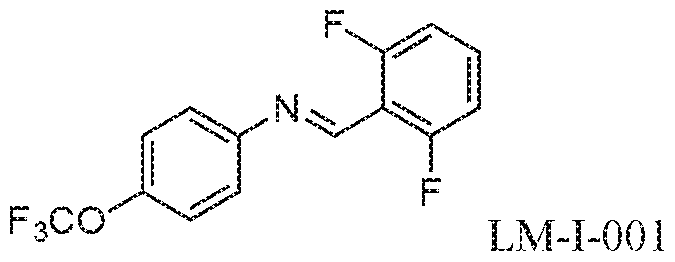
1001 78| Following synthetic procedure A using 4-(trifluoromethoxy)aniiine (0.531 g, 3.00 mmol) and 2,6-difluorobenzaldehyde (0.426 g, 3.00 mmol), the title compound was obtained as a brown liquid (1 .034 g, 3.43 mmol, 99% yield). !H NMR (500 MHz; CDCb): δ 8.65 (s, ! H), 7.43 H .f 8.3, 6.1 Hz, 1H), 7.25 id. ./ 2.7 Hz, 4H), 7.00 (d. ,/ 8.7 Hz, 2H) ppm.
-iV-(4-chIorophenyS)-l-(2,6-difiuorophenyI)methaoimine
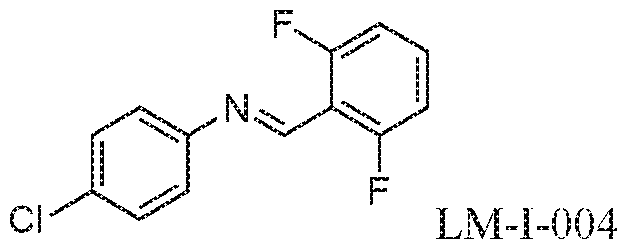
1001 79| Following synthetic procedure A using 4-chloroaniline (0.829 g, 6.50 mmol) and 2,6- difluorobenzaldehyde (0.924 g, 6.50 mmol) the title compound was obtained as a brown liquid ( 1.62 g, 6.45 rnmol, 99% yield). lH NMR (500 MHz; CDCb): δ 8.64 (s, 1H), 7.48-7.31 (m, 3H), 7.22-7.06 (m, 21 1 ). 7.06-6.91 (m, 2H) ppm.
-A-(4-(trifluoromethoxy)phenyl)- l-(2,3,6-trifluorophenyl)methanimine
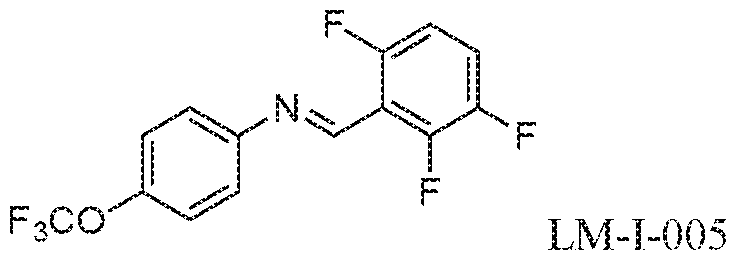
[00180] Following synthetic procedure A using 4-(trifluoromethoxy)aniiine (0.531 g, 3.00 mmol) and 2,3,6-trifluorobenzaldehyde (0.480 g, 3.00 mmol), the title compound was obtained as a brown solid (1 .08 g, 3.47 mmol, 99% yield). I I NM (500 MHz; CDCb): 5 8.62 (s, 1H), 7.37-7.27 (m, 2H), 7.25-7.10 (m, 1H), 7.00 - 6.92 (m, 1H) ppm.
-A-(4-chlorophenyl)-l-(2,4,6-trifluorophenyl)methanimine
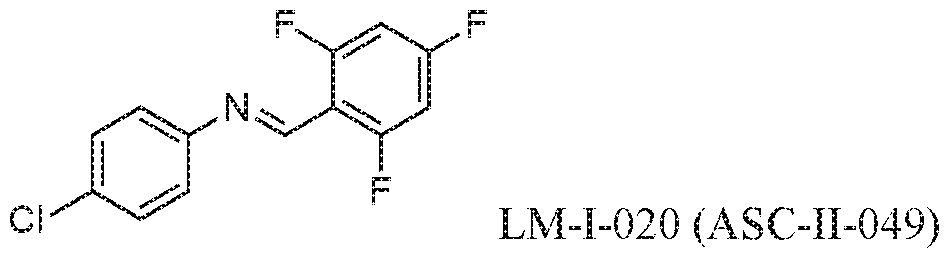
-A-(4-chlorophenyI)-l-(2,6-difluoro-4-methylp enyl)niethaniniine

[00182| Following synthetic procedure A using 4-chloroaniline (0.157 g, 1.23 mmol) and 2,6- difluoro-4-methylbenzaldehyde (0.192 g, 3 mmol), the title compound was obtained as a brown solid (0, 183 g, 0,69 mmol, 56% yield), 'H NMR (500 MHz; CDCb): δ 8.59 (s, IH), 7.36 (d, J = 8.2 Hz, 21 1 ). 7.15 (d. ./ 8.2 Hz, 2H), 6.82 (d, ,/ 10.1 Hz, 21 1). 2.41 (d, J= 5.6 Hz, 31 1} ppm.
(2,6-dii¼oro-3-methoxyphenyS)methaoimine

[00183] Following synthetic procedure A using 4-chloroaniline (0.383 g, 3.00 mmol) and 2,6- difluoro-3-methoxybenzaldehyde (0.468 g, 3.00 mmol), the title compound was obtained as a brown solid (0.745 g, 2.64 mmol, 88% yield). 'H NMR (500 MHz: CDCb): 6 8.62 (s, IH), 7.38- 7,33 (m, 2H), 7.19-7.13 (m, 2H), 7.06-6.98 (m, IH), 6.95-6.87 (m, IH), 3 ,90 (s, 3H) ppm .
nyS)-l-phe5iySmethanimine

[00184] Following synthetic procedure A using 4-chloroaniline (0.383 g, 3.00 mmol) and benzaldehyde (0.3 8 g, 3.00 mmol), the title compound was obtained as a brown solid (0.702 g, 3,25 mmol, 99% yield), 'H NMR (500 MHz; CDCb): δ 8.44 (s, IH), 7.97-7.86 (m, 2H), 7,58- 7,44 (m, 3H), 7.36 (d. ./ 8.3 Hz, 2H), 7.16 (d,■/ 8.3 Hz, 2H) ppm.
Example 13: (£)-/Y-(4-methoxyphenyl)-l-(2,4,6-trifluorophenyl)methanimine

-iV-(4-chlorophenyl)-l-(2,4,6-trifluorophenyl)methanimine

[00186] Following synthetic procedure A using 4-chioro-aniiine (0.829 g, 6.5 mmol) and 2,4,6-trifluoro-benzaldehyde (1 .041 g, 6.5 mmol), the title compound was obtained as a brown solid (1.750 g, 6.49 mmol, 99% yield), :iH NMR (500 MHz; CDCb): δ 8.51 (s, 1H), 7.32 (d, J = 6.7 Hz, 21 1 ). 7.12 (d. ./ 6.8 Hz, 2H), 6.73 (m, 2H) ppm.
-iV-(4-chlorophenyl)-l-(2,6-difluoro-3-methylphenyl)methanimine
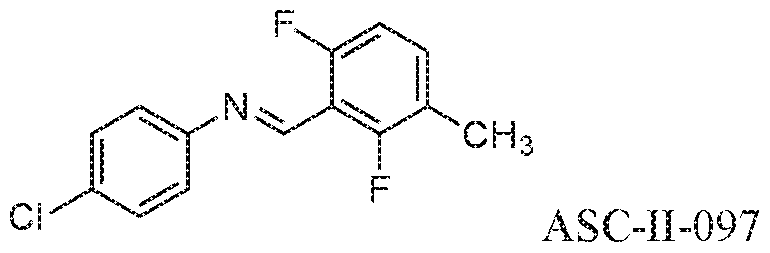
[00187| Following synthetic procedure A using 4-chloro-aniline (0.383 g, 3 mmol) and 2,6- difluoro-3-methylbenzaldehyde (0.377 ml,, 3 mmol), the title compound was obtained as a brown solid (0.781 g, 2.94 mmol, 98% yield). 'H NMR (500 MHz; CDCb): 6 8.63 (s, 1H), 7.36 (d, J= 8 ,2 Hz, 2H), 7,2.5 (q, J = 1.6 Hz, 1H), 7.17 (d, J = 8.0 Hz, 2H), 6,89 (t, J = 9.2 Hz, i l l). 2.28 (s, 3H) ppm.
-l-(3-chloro-2,6-difluorophenyl)-Ar-(4-chlorophenyl)methanimine

[00188] Following synthetic procedure A using 4-chloro-aniline (0.383 g, 3 mmol) and 3- chloro-2,6-difluorobenzaldehyde (0.530 g, 3 mmol), the title compound was obtained as a brown solid (0.850 g, 2.97 mmol, 99% yield), ¾ NMR (500 MHz; CDCb): δ 8.60 (s, 1H), 7.47 (td, J = 8.4, 5.5 Hz, I I I ). 7.37 (d, ./ 8.5 Hz, 2H), 7.17 (d, J ------- 8.5 Hz, 2H), 7.00-6.96 (m, I I I ) ppm; 1 3C
NMR (126 MHz; CDCb): δ 159.87 (dd, ./ 390.8, 5.6 Hz), 157.80 (dd, J = 393.2, 5.6 Hz), 150,87, 150,42, 132,72 (d, «/ = 10,3 Hz), 132.65, 129.47, 122.29, 1 17.77 (dd, ./ = 18 ,0, 3.9 Hz), 1 15.03 (t J = 12.9 Hz), 1 12.80 (dd, ,/= 23.0, 4.4 Hz) ppm.
-l-(3-bromo-2,6-difluorophenyl)-Ar-(4-chlorophenyl)methanimine

[00189] Following synthetic procedure A using 4-chloro-aniline (0.383 g, 3 mmol) and 3- bromo-2,6-difluorobenzaldehyde (0.663 g, 3 mmol), the title compound was obtained as a brown solid (0.971 g, 2.94 mmol, 98% yield). !H NMR (500 MHz; CDCb): δ 8,59 (s, 1H), 7.61 (dd, ,/ = 14.2, 7.6 Hz, i l l). 7.36 (d, J ----- 8.5 Hz, 2H), 7.17 (d, J= 8.4 Hz, 2H), 6.93 U. 9.2 Hz, 1H) ppm.
Example 18: (£)-7V-(4-chlorophenyl)-l-(2,3,6-trifluorophenyl)methanimine

[00190] Following synthetic procedure A using 4-chloro-aniline (0.383 g, 3 mmol) and 2,3,6- trifluorobenzaldehyde (0.337 mL, 3 mmol), the title compound was obtained as a brown solid (0.778 g, 2.88 mmol, 96% yield). !H NMR (500 MHz; CDCb): δ 8.58 (s, 1H), 7.34 (d, J = 8.3 Hz, 2H), 7.26-7.20 (m, 1H), 7.16 (d, ./ = 8.2 Hz, 2H), 6.92 (t, J= 9.0 Hz, 1H) ppm; 13C NMR (126 MHz; CDCb): δ 158,28, 156.26, 150.76, 150.19, 148.36-148,23 (m), 146.34 (dd, J= 12.5, 3.6 Hz), 132.51, 129.30, 122.18, 119.33 (dd. ./ 19.4, 10.4 Hz), 115.07 (dd. ./ 14.2, 9.0 Hz), 111.42 (dt, J= 24.4, 5.3 Hz) ppm.
-7V-(4-chlorophenyl)-l-(2,4-difluorophenyI)methanimine
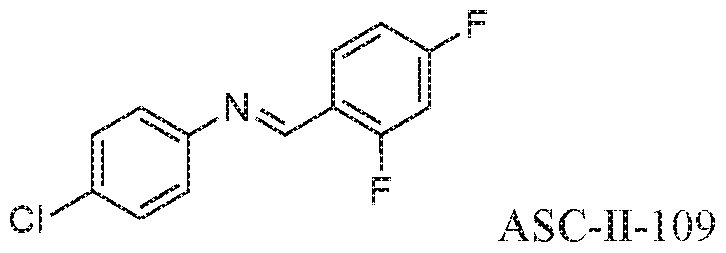
1001911 Following synthetic procedure A using 4-chloro-aniline (0.383 g, 3 mmol) and 2,4 diiluorobenzaldehyde (0.328 mL, 3 mmoi), the title compound was obtained as a brown solid (0.740 g, 2.94 mmol, 98% yield), 1 1 NMR (500 MHz; CDCb): δ 8.65 (s, 1H), 7.50-7.45 (m, IH), 7.35 (d, J= 8.4 Hz, 2H), 7.16 (d, J= 8.4 Hz, 2H), 6.97 (t, J= 8,3 Hz, 1H), 6,89-6,85 (m, lH) ppm.
Example 20: (£)-jV-(4-chloropheoyS)-l-(2,5-difIuorophenyl)methanmiioe

[00192] Following synthetic procedure A using 4-chioro-aniline (0.383 g, 3 mmol) and 2,5- difluorobenzaldehyde (0.326 mL, 3 mmol), the title compound was obtained as a brown solid
(0.698 g, 2.77 mmol, 93% yield), ¾NMR(500 MHz; CDCb): δ 8.66 (s, ill).7.84 (dt, J= 7.6, 4.2 Hz, 1H), 7.35 (d, ,/ 8.4 Hz, 2H), 7.17 (d../ 8.4 Hz, 2H), 7.14-7.06 (m, 111) ppm; 13C NMR (126 Mil/; CDCb): δ 159.88, 157.92 (dd../ 7.7, 1.9 Hz), 152.39 (d, ./ 1.2 Hz), 149.67, 132,37, 131.65 (d, J= 16.8 Hz), 129.36, 129.11 (dd,J=51,2, 13.4 Hz), 125.04 (dd,J= 11,3, 7,8 Hz), 122.40 (d, J= 19.7 Hz), 119.85 (dd, J= 24.9, 9.0 Hz), 117.27 (dd, J= 24.0, 8.3 Hz), 113.64 (dd,J=25.1,2.9Hz) ppm.
-A7-(4-chlorophenyl)-l-(4-fluorophenyl)methanimine

[00193] Following synthetic procedure A using 4-chloro-aniline (0.383 g, 3 mmol) and 4- fluorobenzaldehyde (0.322 rnL, 3 mmol), the title compound was obtained as a brown solid (0.687 g, 2.94 mmol, 98% yield).
-l-(2-chloro-3,6-difluorophenyl)-A7-(4-chlorophenyl)methanimine

[00194] Following synthetic procedure A using 4-chloro-aniline (0.383 g, 3 mmol) and 2- chloro-3,6-difluorobenzaldehyde (0.530 g, 3 mmol), the title compound was obtained as a brown solid (0.840 g, 2.94 mmol, 98% yield).
-l-(2-chloro-3,6-difluorophenyl)-A7-(4-fluorophenyl)methanimine
 ASC-II-126
[00195] Following synthetic procedure A using 4-fluoro-aniline (0.237 rnL, 2.5 mmol) and 2- chloro-3,6-difluorobenzaldehyde (0.441 g, 2.5 mmol), the title compound was obtained as a brown (0.673 g, 2.50 mmol, 99% yield).
ASC-II-126
[00195] Following synthetic procedure A using 4-fluoro-aniline (0.237 rnL, 2.5 mmol) and 2- chloro-3,6-difluorobenzaldehyde (0.441 g, 2.5 mmol), the title compound was obtained as a brown (0.673 g, 2.50 mmol, 99% yield).
-iV-(4~chloro-3-f!uorophe5iyS)-l-(2,3,6-trif!oorophenyI)metha5i!mme

[00196] Following synthetic procedure A using 4-chloro-3-fluoroaniline (0.437 g, 3 mmol) and 2,3,6-trifluorobenzaldehyde (0.337 mL, 3 mmol), the title compound was obtained as a brown solid (0.846 g, 2.94 mmol, 98% yield).
-l-(4-chlorophenyl)-A^-(2,6-difluoro-4-methoxyphenyl)methanimine
 ASOIM46
[00197] Following synthetic procedure A using 2,6~difluoro-4-methoxyaniline (0.477 g, 3 mmol) and 4-chlorobenzaldehyde (0.421 g, 3 mmol), the title compound was obtained as a black solid (0.833 g, 2.96 mmol, 99% yield). !H NMR (500 MHz; CDCb): δ 8.52 (s, I II), 7.82 (d, J = 8.3 Hz, 2H), 7.40 (d, ./ 8.2 Hz, 2H), 6.55-6.47 (m, 2H), 3.79 (s, 3H) ppm; i3C NMR (126 MHz; ( DC! : ): δ 164.27 (d, J = 2.0 Hz), 159.94 (dd, J = 245.0, 15.6 Hz), 154.45 (dd, J = 251.1, 10.8 Hz), 153.53 (dt, J ----- 12.3, 6.4 Hz), 137.60 (s), 134.67 (s), 129.91 (s), 128.94 (s), 96.59 (t,■/ 26.0 Hz), 95.77 (dd, ./ 26.5, 3.0 Hz), 56.33 (s) ppm.
-A7-(6-chloropyridin-3-yl)-l-(2,4,6-trifluorophenyl)methaniinine

[00198] Following synthetic procedure A using 6~chloropyridin~3-amine (0,385 g, 3 mmol) and 2,4,6-trifluorobenzaldehyde (0.480 g, 3 mmol), the title compound was obtained as a brown solid (0.786 g, 2.90 mmol, 97% yield).
Example 27: (£)-l-(4-chlorophenyl)-/Y-(2,6-difluoro-4-nitrophenyl)methanimine

[00199| Following synthetic procedure A using 2,6-difluoro-4-nitroaniline (0.348 g, 2 mmol) and 4-chlorobenzaldehyde (0.281 g, 2 mmol), the title compound was obtained as a brown solid (0.500 g, 1.68 mmol, 84% yield).
-iY-(4~chloro-2-fSuorophe5iyS)-l-(2,6-difIuorop enyI)niethaniniine
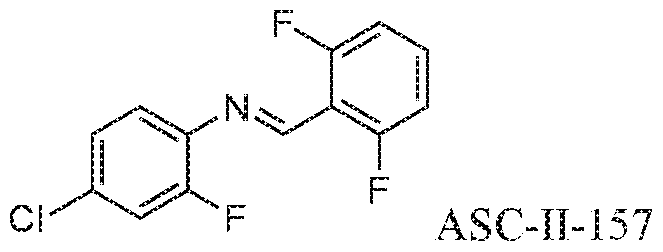
[00200] Following synthetic procedure A using 4-chloro-2-fluoroaniline (0.437 g, 3 mmol) and 2,6-difluorobenzakiehyde (0.426 g, 3 mmol), the title compound was obtained as a brown solid (0.768 g, 2.85 mmol, 95% yield).
ethoxy)phenyl)-l -(2,4,6-trifluorophenyI)methaniinine

1002011 Following synthetic procedure A using 3-(difluoromethoxy)aniline (0.477 g, 3 mmol) and 2,4,6-trifluorobenzaldehyde (0.480 g, 3 mmol), the title compound was obtained as a brown solid (0.885 g, 2.95 mmol, 98% yield).
-iV-(4-chlorophenyl)-l-(4-methoxyphenyl)methanimine

[00202] Following synthetic procedure B using 4-chloroaniline (0.765 g, 6.00 mmol) and 4- methoxybenzaldehyde (0.817 g, 6.00 mmol), the title compound was obtained as a yellow solid (1.370 g, 5.58 mmol, 93% yield), 1 1 NMR (500 MHz; CDCb): δ 8.35 (s, 1H), 7.84 (d, ,/ 8.5 Hz, 2H), 7.36 - 7.31 (m, 2H), 7.13 (d, ./ 8.4 Hz, 2H), 6.98 (d. ./ 8.5 Hz, 2H), 3.87 (s, 3H) ppm.
Example 31: (£)-1-(2,6-difSuorophe5iyS)-A/-phenylmethanimine

[00203] Following synthetic procedure B using aniline (0.559 g, 6.00 mmol) and 2,6- difluorobenzaldehyde (0.853 g, 6.00 mmol), the title compound was obtained as a yellow liquid (0.637 g, 2.93 mmol, 49% yield). ¾ NMR (500 MHz; CDCb): δ 8.65 !d../ 3.1 Hz, 1H), 7.39 {! ../ 7.6 Hz, 3H), 7.25-7, 19 (m, 3H), 7.03-6.93 (m, 2H) ppm.
-iV-(2~chlorophenyl)~1 -(2,6-difliior<)pheny!)met anim!5ie

[00204] Following synthetic procedure B using 2-chloroaniline (0.765 g, 6.00 rnmol) and 2,6- difluorobenzaldehyde (0.853 g, 6.00 mmol), the title compound was obtained as a yellow liquid (1.41 g, 5,58 mmol, 93"., yi ld) H N .MR {500 MHz; CDCb): δ 8.62 (s, IH), 7,49-7.39 (m, 2H), 7,29 (t, J= 7.8 Hz, 1H), 7.17 (t, J = 7.8 Hz, H), 7.02 (q, J= 8,7, 8, 1 Hz, 3H) ppm.
ropheny!)-l-(4-(trif!uoroniethoxy)phenyS)-lH-miidazoSe

[00205] Following synthetic procedure C using (E)-l-(2,6-difluorophenyl)-N-(4- (trifluoromethoxy)phenyi)methanimine (1.03 g, 3.43 mmol), purification by flash
chromatography (silica gel, hexanes/ethyl acetate 60:40) afforded the title compound as a white solid (0.644 g, 1.89 mmol, 55% yield). H WtR (500 MHz; DMSO-de): δ 8,20 (s, IH), 7,50 (m, IH), 7.48-7.44 (m, 2H), 7.36-7.32 (m, 3H), 7.15 (m, 2H) ppm; HRMS (ES÷) calculated for C16H10F5N2O [M + H]+' 341 ,0713, found 341 ,0719,
Example 34: l-(4-chlorophenyl)-5-(2,6-difluorophenyl)-lH-imidazole

[00206] Following synthetic procedure C using (E)-N-(4-chloropheny])-l-(2,6- difluorophenyl)methanimine ( 1.62 g, 6.45 mmol), purification by flash chromatography (silica gel, hexanes/ethyl acetate 65 :35) afforded the title compound as a yellow solid (1 .18 g, 4.04 mmol, 63% yield), ¾ NMR (500 MHz; CDC ): δ 8.86 (s, 1H), 7.60 (s, 1H), 7,49-7.39 (m, 3H), 7.22-7.16 (m, 2H), 6.96 (t, 21 1 ) ppm: HRMS < I IS ) calculated for C15H10CIF2N2 | \i + l ! | 291.0501, found 291.0503.
Example 35: l-(4-(trifluoromethoxy)phenyl)-5-(2,3,6-trifluorophenyl)-lH-imidazole

[00207] Following synthetic procedure C using (J¾-A'T-(4~(trifluoromethoxy)phenyl)-l~(2,3,6- trifluorophenyl)methanimine ( 1.08 g, 3.37 mmol), purification by fiash chromatography (silica gel, hexanes/ethyl acetate 65 :35) afforded the title compound as a brown solid (0.587 g, 1 .64 mmol, 49% yield), ¾ NMR (500 MHz; DMSO-de): δ 7.83 (s, 1H), 7.36 (s, 1H), 7.24-7.19 (m, 4H), 7.17-7.1 1 (m, I I I ). 6.84-6.79 (m, 1H) ppm; HRMS ( I !S ) calculated for CieHgFeNiC) M + ! ! | 359.0619, found 359.0621.
Example 36: l-(4-chlorophenyl)-5-(2,6-difluoro-4-methylphenyl)-lH-imidazole

Example 37: l-(4-chlorophenyl)-5-(2,6-difluoro-3-methoxyphenyl)-lH-imidazole

[00209] Following synthetic procedure C using (E)-N-(4-chlorophenyl)-l-(2,6-difluoro-3- methoxyphenyl)methanimine (0.745 g, 2.64 mmol), purification by flash chromatography (silica gel, hexanes/ethyl acetate 60:40) afforded the title compound as a yellow solid (0.278 g, 0.867 mmol, 33% yield). 'H NMR (500 MHz; CDCb): δ 7.79 (s, H i). 7.32 (d. ./ 8.0 Hz, 3H), 7.10 (d, ./ 8.2 Hz, 2H), 6.94 6.86 (m, 1H), 6.79 {· . ./ 8.8 Hz, 1H), 3.84 (s, 3H) ppm; HRMS (KS · calculated for C16H12CIF2N2O [M + \ \ \ 321 ,0606, found 32.1.0606,
Example 38: l -(4-chlorophenyI)-5-phenyl-lH-imidazole

[00210| Following synthetic procedure C using (E)-N-(4-chloropheny])-l-phenylmethanimine (0,702 g, 3,25 mmol), purification by flash chromatography (silica gel, hexanes/ethyl acetate 60:40) afforded the title compound as an orange solid (0.088 g, 0.345 mmol, 11% yield). !H NMR (500 MHz; CDCb): δ 7.67 (s, 1H), 7,36 (d, J = 8.0 Hz, 2H), 7.30-7.26 (m, 4H), 7.16-7.09 (m, 4H) ppm; FIRMS (ES+) calculated for C15H12CIN2 [M + llf 255.0689, found 255.0690. Example 39: l-(4-methoxyphenyl)-5-(2,4,6-trifluorophenyl)-lH-imidazole

[00211] Following syntlietic procedure C using (E)-N-(4-methoxyphenyl)- 1 -(2,4,6- trifluorophenyl)methanimine (0.814 g, 3.07 mmol), purification by flash chromatography (silica gel, hexanes/ethyl acetate 60:40) afforded the title compound as an orange solid (0.065 g, 0.214 mmol, 7% yield). 'H NMR (5()0 MHz; CDC! }: δ 7.76 (s, I I I ). 7.25 (s, i l l). 7.09- 7.04 (m, 2H), 6.88-6.82 (m, 2H), 6.63 (dd, ./ 8.7, 7.1 Hz, 2H), 3.79 (s, 3H) ppm; HRMS (ES+) calculated for C1&H12F3N2O [M + Hf 309,0902, found 305 ,0908,
)-5-(4-methoxyphenyl)-l.H-imidazole

[00212] Following syntlietic procedure C using ( /·.'}-. Y-( 4 - h !oiOphenyl ) · I ··{·÷··
methoxyphenyl)methanimine (0.100 g, 0.407 mmol), purification by flash chromatography (silica gel, hexanes/ethyl acetate 65 :35) afforded the title compound as an orange solid (0.065 g, 0.228 mmol, 56% yield). ¾ NMR (500 MHz; CDC ): δ 7.65 (s, i l l). 7.38-7.30 (m, 2H), 7.18 (s, 1H), 7.14- 7.07 (m, 2H), 7.07-6.99 (in. 2H), 6.84-6.75 (m, 2H), 3.78 (s, 3H) ppm; HRMS (ES ) calculated for C i I : ;( \\·() [M + i l l ' 285 ,0795, found 285.0798 ,
ophenyl)-l-phe5iy!-l H~imidazo!e

[00213] Following synthetic procedure C using (£)-l-(2,6-difluorophenyl)-N- phenylmethanimine (0,600 g, 2,76 mmol), purification by flash chromatography (silica gel, hexanes/ethyl acetate 65 :35) afforded the title compound as an orange solid (0.193 g, 0.753
nimoi, 27% yield). 'H NMR (500 MHz; CDCb): δ 7.82 (s, H i). 7.33 (dd. J= 9.3, 7.4 Hz, 4H), 7.30-7.26 (m, IH), 7.18-7.13 (m, 2H), 6.86 iq. J 7.8, 6.4 Hz, 2H) ppm; HRMS (I 'S } calculated for C15H11F2N2 [M + H i 257.0890, found 257.0881.
nyl)-5-(2,6-difluorophenyl)-lH-imidazole

[00214| Following synthetic procedure C using (E)-N-(2-chlorophenyl)-l-(2,6- difluorophenyl)methanimine (0.600 g, 2.38 mmol), purification by flash chromatography (silica gel, hexanes/ethyl acetate 65:35) afforded the title compound as a yellow solid (0.478 g, 1.64 mmol, 69% yield). i ! W!R ( 500 MHz; CDCb): 6 7.77 (s, IH), 7.47-7.42 (m, IH), 7.36-7.30 (m, 2H), 6.83 (td, J= 8, 1 , 2,4 Hz, 2H) ppm; HRMS (ES") calculated for CisHioClFi i [M + H] 291.0501 , found 291.0494.
Example 43: l-(4-chlorophenyl)-5-(2,4,6-trifluorophenyl)-lH-imidazole

[00215] Following synthetic procedure C using (£)-N-(4-chlorophenyl)-l -(2,4,6- trifluorophenyDmetlianimine (0.865 g, 3.21 mmol), purification by automated flash
chromatography (silica gel, hexanes/ethyl acetate 100:0 to 60:40) afforded the title compound as a white powder (0.429 g, 1.39 rnmol, 43% yield). ¾ NMR (500 MHz; CDCb): δ 7.98 (s, IH), 7.39-7.36 (m, 2H), 7.35 (s, IH), 7.13-7.10 (m, 2H), 6.71-6.65 (m, 2H) ppm; 13C NMR (126 MHz; CDCb): δ 163.14 (dt, .7 = 252.4, 15.3 Hz), 160.75 (ddd, J = 251.5, 14.9, 8.7 Hz), 138,95 (s), 134.96 (s), 134.41 (s), 132.41 (s), 129.76 (s), 125.94 (s), 119.16 (s), 103.78 (td, J= 20,0, 4,6 Hz), 100.97-100.52 (m) ppm; HRMS (ES+) calculated for C15H9CIF3N2 [M + H]+ 309.04, found 309.06.
Example 44: l-(4-chlorophenyl)-5-(2,6-difluoro-3-methylphenyl)-lH-imidazole

[00216] Following synthetic procedure C using (E)-N-(4-chlorophenyl)-l-(2,6-difluoro-3- methylphenyl)methanimine (0.399 g, 1.5 mmol), purification by automated flash
chromatography (silica gel, hexanes/ethyi acetate 80:20 to 20: 80) afforded the title compound as a yellow solid (0.327 g, 1.07 mmol, 72% yield). Ή NMR (500 MHz; CDCb): δ 7.81 (s, 1H), 7.31 (t, ,/ 7.6 Hz, 3H), 7.15-7.08 (m, ,/ 15.1, 7.5 Hz, 3H), 6.75 (i, J= 8.6 Hz, i l l ). 2.18 (s, 3H) ppm; HRMS (ES+) calculated for CieHnClFaNa [M + H]+ 305.07, found 305.03.
Example 45: S-(3-chloro~2,6-dif!uoropSienyI)-l-(4-chIoropheoyl)-lH"imidazole

[00217] Following synthetic procedure C using (E)-l -(3-chloro-2,6-difluorophenyl)-N-(4- chlorophenyl)methanimine (0.429 g, 1.5 mmol), purification by automated flash chromatography (silica gel, hexanes/ethyi acetate 100:0 to 60:40) afforded the title compound as a white solid (0.298 g, 0.916 mmol, 61% yield). 1 1 NMR (500 MHz; CDCb): δ 7.77 (d, J= 0.5 Hz, 1 H), 7.29-7.27 (m, 2H), 7.27 (s, 1H), 7.06-7.04 (m, 2H), 6.78 ( id. ./ 8.7, 1.4 Hz, I I I ) ppm : !3C NMR (126 MHz; CDCb): 5 158 ,27 (dd, ./ = 251.2, 4.4 Hz), 155,38 (dd, ./ = 252.0, 6.3 Hz), 138.97 (s), 134.65 (s), 134.1 1 (s), 132.45 (s), 130.90 (s), 130.83 (s), 129,57 (s), 125 ,53 (s), 119.00 (s), 1 16.96 (dd, J ------- 18.6, 4.2 Hz), 1 12.05 (dd. ./ 23.5, 4.1 Hz), 108.51 (L ./ 20.1 Hz) ppm; HRMS (ES+) calculated for C : f 1- C ] ·!· · · [M + l i | 325.01, found 324.93.
Example 46: 5-(3~bromo-2,6-d!fluorophenyS)-l~(4"C.hloropheByI)-lH~imidazole
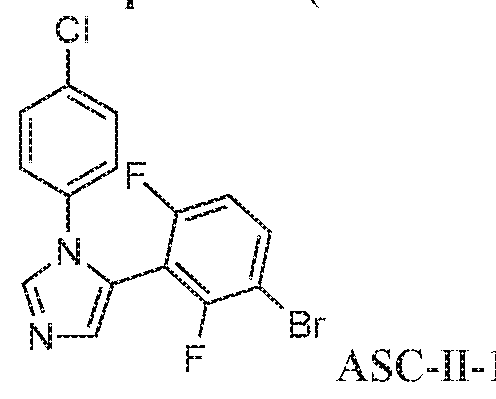
Example 47: l-(4-chlorophenyl)-5-(2,3,6-trifluorophenyl)-lH-imidazole

[00219] Following synthetic procedure C using (E)-N-(4-chlorophenyl)-l-(2,3,6- trifluorophenyl)methanimine (0.405 g, 1.5 mmol), purification by automated flash
chromatography (silica gel, hexanes/ethyl acetate 100:0 to 60:40) afforded the title compound as a brown solid (0,350 g, 1.13 mmol, 76% yield), :ΉΝΜΚ(500 MHz; CDCb): δ 7.80 (s, 1H), 7.34-7.31 (m, 4H), 7.15-7.11 (m, J--- 9.0, 5.0 Hz, 1H), 7.09 id../ 8.6 Hz, 211).6.82-6.78 (rn, ill) ppm; HRMS (! IS ) calculated for CuHgClFW?. [M + !!| 309.04, found 309.18.
Example 48: l-(4-chlorophenyl)-5-(2,5-difluorophenyl)-lH-imidazole

[00220] Following synthetic procedure C using (E)-N-(4-chlorophenyl)-l-(2,5- difluorophenyl)methanimine (0.378 g, 1.5 mmol), purification by automated flash
chromatography (silica gel, hexanes/ethyl acetate 100:0 to 60:40) afforded the title compound as a yellow solid (0,392 g, 1,35 mmol, 90% yield), ¾NMR(500 MHz; CDCb): δ 7.72 (s, 1H), 7.33 (d../ 8.4 Hz, 2H), 7.29 (s, IH), 7.08 (d, ./ 8.4 Hz, 2H), 7.09-7.07 (m, 2H), 6.86-6.83 (m, 1H) ppm; 13C NMR (126 MHz; CDCb): δ 158.35 (dd,■/ 248.6, 7.2 Hz), 155.45 (d, ./ 244.1 Hz), 139,09 (s), 135,05 (s), 134.29 (s), 131.29 (s), 129.80 (s), 126.02 (s), 118.66 (dd, J= 17.7, 8.8 Hz), 117.30 (dd, J -24,8, 3,1 Hz), 117.18 (dd../ 24.8, 8.9 Hz), 116.56 (dd, J =23.8, 8.3 Hz) ppm; HRMS (ES+) calculated for C15H10CIF2N2 [M + li| 291.05, found 291.04.
Example 49: l-(4-chlorophenyl)-5-(4-fluorophenyl)-lH-imidazole

[00221] Following synthetic procedure C using (E)-N-(4-chlorophenyl)-l-(4- fluorophenyl)methanimine (0.350 g, 1.5 mmol), purification by automated flash chromatography (silica gel, hexanes/ethyi acetate 90: 10 to 60:40) afforded the title compound as a brown solid (0.260 g, 0.953 mmol, 64% yield). Η W!R (500 MHz; CDCb): δ 7.67 (s, 1H), 7,39-7.36 (m, 21 1). 7.22 (s, I I I ). 7.12-7.08 (m, 4H), 7.00-6.96 (m, 2H) ppm; i3C NMR (126 MHz; CDCb): δ 162.48 (d. ./ 248.1 Hz), 138.79 is). 135.13 is). 134.36 is). 132.22 (s), 130.18 (d. ./ 8.2 Hz), 129.92 (s), 129.20 (s), 126.92 (s), 125.39 (d, «/= 3.2 Hz), 1 15 ,85 (d, ,/ 21.8 Hz) ppm; HRMS (ES+) calculated for C15H11CIFN2 [M + Ιψ 273.06, found 273.25.
Example 50: 5-(2-chIoro-3,6~d!ni!orophenyI)~l-(4-ch!orophenyl)-lH-iniidazoSe

[00222] Following synthetic procedure C using (E)-l-(2-chloro-3,6-difluorophenyl)-N-(4- chlorophenyl)methanimine (0.429 g, 1.5 mmol), purification by automated flash chromatography (silica gel, hexanes/ethyi acetate 100:0 to 50:50) afforded the title compound as an orange solid (0.364 g, 1.12 mmol, 75% yield). 1 1 NMR (500 MHz; CDCb): δ 7.75 (s, 1H), 7.24 (s, i l l). 7.21 (d, J= 5 ,7 Hz, 111), 7,06 (td, J= 8.6, 4.7 Hz, 1H), 7.01 (d, J= 8.5 Hz, 2H), 6.86 (td, J= 8,6, 4, 1 Hz, I I I) ppm; !3C NMR (126 MHz; CDCb): δ 156.57 (dd, ./ 227.8, 2.9 Hz), 154.61 (dd, ./ 227.1, 2.7 Hz), 138.52 (s), 134.52 (s), 134.18 (s), 131.94 (s), 129.55 (s), 125.76 (s), 123.07 (dd, J = 19.2, 3.6 Hz), 122.09 (d, J = 1.4 Hz), 118.97 (s), 118.81 (s), 117.57 (dd, J= 23.7, 9.1 Hz), 1 14,55 (dd, ./= 24.9, 7.9 Hz) ppm; HRMS (ES+) calculated for C15H9CI2F2N2 [M + Hf 325.01, found 325.06.
Example 51: S-(2-chSoro-3,6-difli!orophenyI)-l-(4-fluoropheoyS)-lH-imidazoSe

[00223] Following synthetic procedure C using (E)-l-(2-chloro-3,6-difluorophenyl)-N-(4- fluorophenyl)methanimine (0.405 g, 1.5 mmol), purification by automated flash chromatography (silica gel, hexanes/ethyl acetate 100:0 to 50:50) afforded the title compound as an orange solid (0.357 g, 1.16 mmol, 77% yield). !H NMR (500 MHz; CDCb): δ 7,76 (s, IH), 7,20 (s, 1H), 7.07-7.03 (m,■/ 3.4, 2.7 Hz, 3H), 6.95-6.91 (m, 2H), 6.84 (td, J = 8.6, 4.2 Hz, 1H) ppm; 13C NMR (126 MHz; CDCb): 5162,04 (d, J = 248.9 Hz), 156.57 (dd, J= 246.9, 2.6 Hz), 154,65 (dd, J= 246.4, 3.0Hz), 138,72 (s), 131,97 (d, .7=3.2 Hz), 131.46 (s), 128.41 (d, J= 288,1 Hz), 126.49 (d,J=8.8Hz), 123.10 (dd, J= 19.2, 3.6 Hz), 122.37 id../ 1,8 Hz), 118.87 (d,J = 20.8 Hz), 117.61 (dd,■/ 23,9, 9,2 Hz), 116.39 (s), 116.21 (s), 114.52 (dd../ 25.0, 7.9 Hz) ppm; HRMS (ES+) calculated for C15H9CIF3N2 [M + H]+ 309.04, found 309.18.
Example 52: 1-(4-chloro-3-fliioropheny!)-5-(2 ,6 rifluorophenyl)~l H-im!dazole

[00224] Following synthetic procedure C using (E)-N-(4-chloro-3-fluorophenyl)-l-(2,3,6- trifluorophenyl)methanimine (0.431 g, 1.5 mmol), purification by automated flash
chromatography (silica gel, hexanes/ethyl acetate 100:0 to 50:50) afforded the title compound as an orange solid (0.385 g, 1.18 mmol, 79% yield). !H NMR (500 MHz; CDCb): δ 7,77 (s, IH), 7.34 (t, J =8.2 Hz, ill).7.27 (s, IH), 7.09 (qd, J= 9.1, 5.0 Hz, IH), 6.95 (dd, J= 9.1, 2.4 Hz, IH), 6.87 (dd, J= 8.5, 1.0 Hz, H), 6.80-6.75 (m, IH) ppm; !3C NMR (126 MHz; CDCb): δ 158,92 (s), 156,92 (s), 155.23 (dt, J= 247.6, 2.8 Hz), 147,79 (ddd, J= 252,4, 14,5, 6,4 Hz), 147.14 (ddd,J= 246.3, 13.0, 3.6 Hz), 139,06 (s), 135,89 (d.-/ 8.8 !!/).132.81 (s), 131.35 (s), 121.36 (s), 121.22 (s), 120.81 (d../ 3.8!!/.}.119.00 (d. 1.6Hz), 117.76 {..id.■/ 19.6, 9.6 Hz), 113,15 (s), 112,96 (s), 111.14 (dt, ./= 24.5, 5.4 Hz), 108,61 (dd, ./= 21.6, 15.7 Hz) ppm; HRMS (ES+) calculated for G5H8QF4N2 [M + Hf 327.03, found 327.14,
Example 53: 2-ehloro-5~(5-(2,4,6~triOuorophe!iyS)-lH-iinidazoS-l~yS)pyridine

[00225] Following synthetic procedure C (E)-N-(6-chloropyridin-3-yl)-l-(2,4,6- trifluorophenyl)methanimine (0.593 g, 2.2 mmol), purification by automated flash
chromatography (silica gel, hexanes/ethyl acetate 100:0 to 60:40) afforded the title compound as an orange solid (0.304 g, 0.982 mmol, 45% yield). Ή NMR (500 MHz; CDCb): δ 8.21 (s, 1H), 7.78 (s, i l l). 7.45 (ddd. J 8.4, 2.5, 1.2 Hz, i l l ). 7.35-7.33 (m, lH), 7.28 (s, 11 1). 6.66-6.63 (rn, 2H) ppm; 13C NMR (126 MHz; CDCb): δ 163.30 (dt, J= 253.2, 15.2 Hz), 160.50 (ddd, ./ = 251 .6, 14.8, 8.5 Hz), 151.19 (s), 145.34 (s), 138.80 (s), 134.72 (s), 132.82 (s), 132.10 (s), 124.96 (s), 119.28 (s), 102.94 (td, J= 19.9, 4.7 Hz), 101.23- 100.79 (m) ppm: HRMS (ES+) calculated for CnHsClFsNs [M + Hf 310.04, found 310.13.
Example 54: l-(4-chloro-2-fluorophenyl)-5-(2,6-difluorophenyl)-lH-imidazole

[00226] Following synthetic procedure C using (E)-N-(4-chloro-2-fluorophenyl)-l-(2,6- difluorophenyl)methanimine (0.539 g, 2 mmol), purification by automated flash chromatography (silica gel, hexanes/ethyl acetate 90: 10 to 60:40) afforded the title compound as a yellow solid (0.351 g, 1.14 mmol, 57% yield), Ή NMR (500 MHz; CDCb): δ 7.77 (s, i l l). 7.35 (s, i l l). 7.31-7.27 (m, 11 1). 7.21-7.19 (rn, 1H), 7.15-7.10 (m,■/ 6.6 Hz, 2H), 6.88 (quintet, J = 6.8 Hz, 2H) ppm; 13C NMR (126 MHz; CDCb): δ 160.46 (dd, J = 250.9, 5.9 Hz), 156.39 (d, J = 256.0 Hz), 139.44 (d, J= 1.1 Hz), 135,42 (d, ,/ 9.2 Hz), 131.92 (s), 130.94 (t, ,/ 10.3 Hz), 128.57 (s), 125.17 (s), 125 , 14 (s), 123.30 (d, J= 12.7 Hz), 120.88 (s), 117.86 (s), 117.67 (s), 11 1 .71 (dd, ./ 20.5, 5.2 Hz), 106.96 (t, J= 19.5 Hz) ppm; HRMS < I { ) calculated for C15H9CIF3N2 [M + Hf 309.04, found 309.12.
Example 55: l-(4-chlorophenyl)-4-methyl-5-(2,3,6-trifluorophenyl)-lH-imidazole

[00227] Following synthetic procedure D using (E)-N-(4-chlorophenyl)- l-(2,3,6- trifluorophenyl)methanimine (0.500 g, 1.85 mmol), purification by flash chromatography (silica gel, hexanes/ethyl acetate 60:40) afforded the title compound as an orange solid (0.190 g, 0.589 mmol 32% yield). !H NMR (500 MHz; CDCb): δ 7,72 (s, 1H), 7.33-7,29 (m, 2H), 7.15 (qd, J = 9.1, 5.0 Hz, 1H), 7.07-7.02 (m, 2H), 6.82 (tdd, J = 9.3, 3.8, 2.1 Hz, 1H), 2.22 (s, 3H) pprn; HRMS (ES+) calculated for C16H11CIF3N2 [M + H | 323.0563, found 323.0557.
l-(4-chlorophenyl)-5-(2,6-difluorophenyl)-4-methyl-lH-imidazole

[00228] Following synthetic procedure D using (E)-N-(4-chlorophenyl)- l-(2,6- difluorophenyl)methanimine (0.618 g, 2.46 mmol), purification by flash chromatography (silica gel, hexanes/ethyl acetate 65 :35) afforded the title compound as an orange solid (0.292 g, 0.958 rnmol, 39% yield). ¾ NMR (500 MHz; CDCb): δ 7.72 (s, 1H), 7.34-7.27 (m, 3H), 7.06-7.02 (m, 2H), 6.91-6.85 (m, 2H), 2.21 (s, 3H) ppm; HRMS (ES+) calculated for C16H12CIF2N2 M + H | 305.0657, found 305.0661.
Example 57: 5~(3-chloro-2,6-difIuorophenyI)-l~(4-chIorophe5iy!)-4-niethyl-lH-im!dazole

[00229] Following synthetic procedure D using (E)- l-(3-chloro-2,6-difluorophenyl)-N-(4- chlorophenyl)methanimine (0.800 g, 2.80 mmol), purification by flash chromatography (silica
gel, hexanes/ethyl acetate 65 :35) afforded the title compound as an orange solid (0.433 g, 1.28 mmoi, 46% yield). !H NMR (500 MHz; CDCh): δ 7.72 (s, i l l ). 7.37 (ddd, ./ 9.0, 8.0, 5.6 Hz, 1H), 7.33-7.29 (m, II I). 7.07-7.01 (m, 2H), 6.84 (ddd, J = 9,0, 8 ,2, 1.8 Hz, 1H), 2,20 (s, 31 ppm; HRMS (ES+) calculated for C16H11CI2F2N2 [M + H]+ 339.0267, found 339.0273.
Example 58: 4-chloro-l-(4-chlorophenyl)-5-(2,6-difluorophenyl)-lH-imidazole

(t, J = 7.9 Hz, 2H) ppm; HRMS (ES ") calculated for C15H9CI2F2N2 [M + H | 325.01 1 1, found 325 ,0122,
Example 59: 2-chloro-l-(4-c lorophenyI)~5-(2,6-dif!iioropheny!)-lH~iinidazo!e

[00231] Following synthetic procedure E using l-(4-chloiOphenyl)-5-(2,6-difluorophenyl)- lH- imidazole (0.400 g, 1.38 mmoi), purification by flash chromatography (silica gel, hexanes/ethyl acetate 85 : 1 5) afforded the title compound as a white solid (0.056 g, 0.172 mmoi, 12% yield). !H NMR (500 MHz; CDCb): δ 7.42-7.40 (m, 2H), 7.38- 7.32 (m, i l l ). 7.21-7.19 (m, 2H), 6.93- 6.89 (m, 2H) ppm; HRMS (ES+) calculated for CisHsChFiNiNa [M + Na i 346,9930, found 346,9933 ,
Example 60: 2,4-d!chIoro-l-{4~chlorophenyl)~5-(2,6-difliioropheny!)-1H~imidazo!e

[00232] Following synthetic procedure E using l-(4-dilorophenyl)-5-(2,6-difluorophenyl)-lH- imidazole (0.400 g, 1.38 mmol), purification by flash chromatography (silica gel, hexanes/ethyl acetate 85: 15) afforded the title compound as a white solid (0.026 g, 0.072 mmol, 5% yield). Ή NMR (500 MHz: CDCb): δ 7.35 (d.■/ 7.9 Hz, 3H), 7.13 (d. ./ 8.1 Hz, 2H), 6.88 (t, J ----- 8.0 Hz, 2H) ppm; 1 1RMS (l .'S ) calculated for CisHsCbFiNi [M + ! ! | 358.9721, found 358.9725.
6-difluorophenyl)-l-(4-(trifluoromethoxy)phenyl)-lH-imidazole

[00233] Following synthetic procedure E using 5-(2,6-difluorophenyl)-l-(4- (trifluoromethoxy)phenyl)-lH-imidazole (0.400 g, 1.17 mmol), purification by flash
chromatography (silica gel, hexanes/ethyl acetate 85: 15) afforded the title compound as a white solid (0.192 g, 0.512 mmol, 44% yield). !Η NMR (500 MHz; CDCb): δ 7.70 (s, 1H), 7.42-7.34 (m, 1H), 7.23-7.16 (m, 4H), 6.91 (t, J= 7.8 Hz, 2H) ppm; HRMS (ES+) calculated for
C16H9CIF5N2O [M + Hf 375.0325, found 375.0334.
fluorophenyl)-l-(4-(trifluoromethoxy)phenyl)-li -imidazole

chromatography (silica gel, hexanes/ethyl acetate 85: 15) afforded the title compound as a white solid (0.033 g, 0.088 mmol, 8% yield), Ή NMR (500 MHz; CDCb): δ 7.33-7.26 (m, 1H), 7.23 (d, ./ 4.5 Hz, 4H), 7.20 (s, i l l). 6.88-6.81 (m, 2H) ppm; HRMS (IiS } calculated for
CieH lFsNiNaO [M · Na | 397.0143, found 397.0149.
Example 63: 2,4-dichloro~5-(2,6-difluoropheoyl)-l-(4~(trifluoromet oxy)phenyl)-lH~ imidazole

[00235] Following synthetic procedure E using 5-(2,6-difluorophenyl)-l-(4- (trifluofomethox )phenyl)-lH-imidazole (0,400 g, 1.17 mmol), purification by flash
chromatography (silica gel, hexanes/ethyl acetate 85: 15) afforded the title compound as a white solid (0.028 g, 0.068 mmol, 6% yield). Η N MR (500 MHz; CDCb): δ 7,39-7.31 (m, 1H), 7.25- 7.19 (m, 4H), 6.92-6.84 (m, 2H) ppm; HRMS (ES÷) calculated for ΜΊ;Ι· Ν ·0 [M + ! ! | 408,9934, found 408.9940,
Example 64: 4-chSoro-l-(4~(trifIuoromethoxy)p enyl)-5~(2,3,6-tr!fSuorophenyS)-lH- imidazole

[00236] Following synthetic procedure E using l -(4-(trifluoromethoxy)phenyr)-5~(2,3,6- trifluorophenyl)-lH-imidazole (0.500 g, 1.40 mmol), purification by flash chromatography (silica gel, hexanes/ethyl acetate 85: 15) afforded the title compound as a yellow oil (0.198 g, 0,504 mmol, 36% yield), Η NMR (500 MHz; CDCb): δ 7.72 (s, 1H), 7.25-7.17 (m, 5H), 6,88-
6.82 (m, IH) ppm; HRMS (ES+) calculated for CitHsClFdShNaO [M + Naf 415.0049, found 415.0059.
Example 65: 2~chSoro-l-(4-(trif!uorometlioxy)p eny!)~5~(2,3,6~trifluorophenyl)-l imidazole

[00237] Following synthetic procedure E using l-(4-(trifluoromethoxy)phenyl)-5-(2,3,6- trifluorophenyl)-lH-imidazole (0.500 g, 1.40 mrnol), purification by flash chromatography (silica gel, hexanes/ethyl acetate 85: 15) afforded the title compound as a yellow solid (0.047 g, 0.120 mrnol, 9% yield). ¾ NMR (500 MHz; CDCb): 6 7,27-7,23 (m, 4H), 7.19-7.13 (m, 2H), 6.84-6.80 (m, IH) ppm; HRMS (ES+) calculated for ( ,.| bCHv.VO [M + H]+ 393,0229, found 393.0232.
Example 66: 2,4-dichloro-l-(4-(trifluoromethoxy)phenyl)-5-(2,3,6-trifluorophenyl)-lH- imidazole

[00238] Following synthetic procedure E using l -(4-(trifluoromethoxy)phenyl)-5-(2,3,6- trifluorophenyl)-lH-imidazole (0.500 g, 1.40 mrnol), purification by flash chromatography (sihca gel, hexanes/ethyl acetate 85: 15) afforded the title compound as a yellow solid (0.010 g, 0,023 mrnol. 2% yield), f t N .MR {500 MHz; CDCb): δ 7.24 (dd, 4H), 7.22-7, 16 (m, IH), 6.87- 6,78 (m, IH) ppm; FIRMS (ES+) calculated for CieFF/CkFeNiO [M + Ιψ 426.9840, found 426.9850.
Example 67: 4~chloro-l-(4~chloropheny!)~5-(2,6-difluoro-4~methySp enyl)~lI-I-imidazole

[00239] Following synthetic procedure E using l-(4-chlorophenyl)-5-(2,6-difluoro-4- methylphenyl)-lH-imidazole (0.100 g, 0.328 mmol), purification by flash chromatography (silica gel, hexanes/ethyl acetate 85 : 15) afforded the title compound as a yellow solid (0.070 g, 0.206 mmol, 63% yield). Ή NMR (500 MHz; CDCb): δ 7.67 (s, 1H), 7,33 (dd, J = 8.8, 2.7 Hz, 2H), 7.1 1-7.05 (rn, 2H), 6.71 (d. ./ 8.5 Hz, 11 1 ). 2.35 (s, 3H) pprn; HRMS ( Y ) calculated for C16H11Q2F2N2 [M + Hf 339.0267, found 339.0259.
Example 68: 2-chloro-l-(4-chlorophenyl)-5-(2,6-difluoro-4-methylphenyl)-lH-imidazole
LM-I-028 C
[00240] Following synthetic procedure E using l -(4-chlorophenyl)-5-(2,6-difluoro-4- methylphenyl)-lH-imidazole (0.100 g, 0.328 mmol), purification by flash chromatography (silica gel, hexanes/ethyl acetate 85 : 15) afforded the title compound as a yellow solid (0.009 g, 0,026 mmol, 8% yield), ¾ NMR (500 MHz; CDCb): δ 7.36-7.34 (m, 2H), 7.15-7.12 (m, 3H), 6.67-6.64 (m, 2H), 2.31 (s, 3H) ppm; HRMS (ES÷) calculated for C16H1 1CI2F2N2 [M + Hf 339.0267, found 339.0263.
Example 69: 2,4-dichloro-l-(4-chlorophenyl)-5-(2,6-difluoro-4-methylphenyl)-lH-imidazol

[00241] Following synthetic procedure E using i~(4-chlorophenyl)-5-(2,6-difluoro-4- methylphenyl)-lH-imidazole (0.100 g, 0.328 mmol), purification by flash chromatography
(silica gel, hexanes/ethyl acetate 85: 15) afforded the title compound as a yellow solid (0.024 g, 0.064 mmol, 20% yield). I I N MR ( >0U MHZ; CDCb): δ 7.35 (d. ./ 8.3 Hz, 2H), 7.12 (d.■/ 8.3 Hz, 2H), 6.68 (d, J= 8,5 Hz, 2H), 2.33 (s, 3H) ppm; HRMS (ES") calculated for
C16H10C33F2N2 [M + ! ! | 372.9878, found 372.9869.
Example 70: 4-chloro-l-(4-c SorophenyS)-5-(2,6-difluoro-3-niethoxyphenyl)-l H-imidazole

[00242] Following synthetic procedure E using l -(4-chlorophenyl)-5-(2,6-difluoro-3- methoxypheny])~lH-imidazole (0.132 g, 0.412 mmol), purification by flash chromatography (silica gel, hexanes/ethyl acetate 80:20) afforded the title compound as white foam (0.065 g, 0.183 mmol, 45% yield). !H NMR (500 MHz; CDCb): δ 7.68 (s, IH), 7.32 (dd, ./ 8.7, 2.8 Hz, 2H), 7.09 (d, J= 8.7 Hz, 2H), 7.00-6,92 (m, 1H), 6.85-6.77 (m, IH), 3.83 (s, 3H) ppm; HRMS (ES calculated for C16H11CI2F2N2O [M + Hf 355.0217, found 355.0203.
Example 71: 2-chloro-l~(4-ch!orophenyI)-5-(2,6-difluoro-3-inethoxyp enyl)-lH-iinidazole

[00243] Following synthetic procedure E using l -(4-chlorophenyl)-5-(2,6-difluoro-3- methoxypheny])-lH-imidazole (0.132 g, 0.412 mmol), purification by flash chromatography (silica gel, hexanes/ethyl acetate 80:20) afforded the title compound as a yellow solid (0.015 g, 0.042 mmol, 10% yield). I I NMR (500 MHz; CDCb): δ 7.37-7.32 (m, 2H), 7.18 (s, IH), 7.16- 7, 11 (m, 21 1). 6.92-6.85 (m, H), 6.79-6.73 (m, i l l}. 3.82 (s, 3H) ppm; HRMS (ES") calculated for C;i,H : .(·Μ···Ν ·0 [M + H]+ 355,0217, found 355,0219.
Example 72: 2,4-dichloro-l-(4-chlorophenyl)-5-(2,6-difluoro-3-methoxyphenyl)-lH imidazole

[00244] Following synthetic procedure E using l-(4-chlorophenyl)-5-(2,6-difluoro-3- methoxyphenyl)-lH-imidazole (0.132 g, 0.412 mmol), purification by flash chromatography (silica gel, hexanes/ethyi acetate 80:20) afforded the title compound as a yellow solid (0.009 g, 0.023 mmol, 6% yield). !H NMR (500 MHz; CDC 3): δ 7,37-7,34 (m, 2H), 7.15-7.13 (m, 2H), 6.96-6.82 (m, i l l). 6.81-6.77 (m, 1H), 3.84 (s, 3H) pprn; HRMS ( KS } calculated for
Ci6HioC33F2N20 [M + ί ί | 388.9827, found 388.9832.
(4-chlorophenyl)-5-phenyl-lH-imidazole

[00245] Following synthetic procedure E using l-(4-chlorophenyl)-5 -phenyl- lH-imidazole (0.070 g, 0.275 mmol), punfication by flash chromatography (silica gel, hexanes/ethyi acetate 80:20) afforded the title compound as a yellow solid (0.061 g, 0.21 1 mmol, 77% yield). Ή NMR (500 MHz; CDC ): δ 7.58 (s, i l l). 7.36-7.28 (m, 5H), 7.21-7.17 (m, 2H), 7.08-7.04 (m, 2H) pprn: HRMS (ES+) calculated for C15H11CI2N2 [M + ! ! | 289.0299, found 289.0300.
Example 74: 2-chloro-l-(4-chlorophenyl)-5-phenyl-lH-imidazole

[00246] Following synthetic procedure I·. using l-(4-chlorophenyl)-5-phenyl-lH-imidazole
(0.070 g, 0.275 mmol), purification by flash chromatography (silica gel, hexanes/ethyi acetate 80:20) afforded the title compound as a yellow solid (0.007 g, 0.025 mmol, 9% yield). ¾ NMR
(500 MHz; CDCb): δ 7.43-7.39 (m, 11 1 ). 7.26-7.23 (m, 3H), 7.19-7.14 (m, 3H), 7.08-7.04 (m, 2H) ppm; HRMS ( l .'S ) calculated for i' I C'l · · M + H]+ 289.0299, found 289.0312.
c lorophenyS)-S~pheoyl-lH"imidazole

[00247] Following synthetic procedure E using l-(4-chlorophenyl)-5 -phenyl- lH-imidazole (0.070 g, 0.275 mmol), purification by flash chromatography (silica gel, hexanes/ethyl acetate 80:20) afforded the title compound as a yellow solid (0.008 g, 0.024 mmol, 9% yield). ¾ NMR. (500 MHz; CDCb): δ 7.41-7.36 (m, 2H), 7.31-7.27 (m, 3H), 7.17-7. 12 (m, 2H), 7.12-7,08 (m, 21 1 ) pprn; HRMS ί I IS > calculated for (': ··! ! :,·( i = V [M + H]+ 322.9910, found 322.9906.
Example 76: 4-chloro-l-(4-methoxyphenyI)-S-(2,4,6-trifluoropheoyl)-lH-imidazole

[00248] Following synthetic procedure E using l-(4-methoxyphenyl)-5-(2,4,6- trifluorophenyl)-lH-imidazole (0.086 g, 0.283 mmol), purification by flash chromatography (silica gel, hexanes/ethyl acetate 80: 20) afforded the title compound as a yellow solid (0.043 g, 0.127 mmol, 45° ,, yield ). ¾ NMR (500 MHz; CDCb): δ 7.64 (s, 1H), 7,06 (d, J = 8.6 Hz, 2H), 6.88-6.82 (m, 2H), 6.66 i dd. ./ 8.8, 7.2 Hz, 2H), 3.79 (s, 3H) ppm; HRMS (ES+) calculated for C16H11CIF3N2O [M + H]+ 339.0512, found 339.0498.
Example 77: 2-chloro-l-(4~methoxyphenyI)-S-(2,4,6 rifluorophe5iyl)-lH"imidazole

Example 78: 2,4-dichloro-l-(4-methoxyphenyl)-5-(2,4,6-trifluorophenyl)-lH-imidazole

[00250] Following synthetic procedure E using 1 -(4-methoxyphenyl)-5 -(2,4,6- trifluorophenyl)-lH-imidazole (0.086 g, 0.283 mmol), purification by flash chromatography (silica gel, hexanes/ethyl acetate 80:20) afforded the title compound as a yellow solid (0.010 g, 0,027 mmol, 9% yield), ¾ NMR (500 MHz; CDCb): δ 7.12-7.06 (m, 2H), 6.91-6.84 (m, 2H), 6.68-6.60 (m, 2H), 3.81 (s, 3H) ppm; HRMS (ES+) calculated for C16H10CI2F3N2O [M + H]+ 373.0122, found 373.0112.
Example 79: 4-chloro-l-(4-c lorophenyS)-S-(4-met oxyphenyl)-lH-im!dazole

[00251] Following synthetic procedure E using l-(4-chlorophenyl)-5-(4-methoxyphenyl)-lH- imidazole (0.220 g, 0.773 mmol), purification by flash chromatography (silica gel, hexanes/ethyl acetate 80:20) afforded the title compound as a yellow solid (0.159 g, 0.498 mmol, 65% yield). Ή NMR (500 MHz; CDCb): δ 7.55 (s, 1H), 7.36-7.31 (m, 21 1). 7.13-7.08 (m, 2H), 7.08-7.03 (m, 2H), 6.84 (d. ./ 8.3 Hz, 2H), 3.79 (s, 3H) ppm; HRMS (ES+) calculated for
CieHiiCbN NaO [M + Naf 341 ,0224, found 341 ,0229,
Example 80: 2,4-dichloro-l -(4-chIorophenyl)-5-(4-methoxyphenyl)-l H-imidazoie

[00252] Following synthetic procedure E using 1 -(4-chlorophenyl)-5-(4-methoxyphenyl)- 1H- imidazole (0.220 g, 0.773 mmol), purification by flash chromatography (silica gel, hexanes/ethyl acetate 90: 10) afforded the title compound as a white solid (0.015 g, 0.047 mmol, 27% yield). 'Η NMR (500 Mi l/: CDCh): δ 7.40-7.36 (m, 2Η), 7.11-7.08 (m, 2Η), 7.08-7.03 (m, 2Η), 6,82- 6.79 (m, 2Η), 3.78 (s, 3Η) ppm; HRMS (ES÷) calculated for C16H12CI3N2O [M + H]+ 353.0015, found 353.0012.
oro-l-(2-chlorophenyl)-5-(2,6-difluorophenyl)-lH-imidazole

[00253] Following synthetic procedure E using i-(2-ch3orophenyl)-5-(2,6-difluorophenyl)~iH- imidazole (0.260 g, 0.894 mmol), purification by flash chromatography (silica gel, hexanes/ethyl acetate 75:25) afforded the title compound as a white solid (0.187 g, 0.575 mmol, 64% yield). !H NMR (500 MHz; CDCb): δ 7.63 (d, J = 2.0 Hz, IH), 7,42 (d, ,/ = 8.0 Hz, IH), 7.32 (ddt, ,/ = 14.5, 7.8, 4.7 Hz, 21 1). 7.27 (s, IH), 6.84 (t, J = 8.5 Hz, 21 1) ppm; HRMS ί I IS > calculated for C15H9CI2F2N2 [M + ! ! | 325.0111, found 325.0111.
rophenyI)"5-(2,6-difluoropheoyl)-lH"imidazole

[00254] Following synthetic procedure E using l-(2-chlorophenyl)-5-(2,6-difluorophenyl)-lH- imidazole (0.260 g, 0.894 mmol), purification by flash chromatography (silica gel, hexanes/ethyl
acetate 75:25) afforded the title compound as a white solid (0.026 g, 0.080 mmol, 9% yield). Ή NMR (500 Mi l/; CDCb): δ 7.43 (d. ./ 7.9 Hz, 1H), 7.38-7.28 irn. 3H), 7.23 (d, ./ 14.4 Hz, 1H), 6.82 (t, ./= 7.8 Hz, 2H) ppm.; HRMS (ES+) calculated for C15H9CI2F2N2 [M + Hf
325.01 11, found 325.01 19.
-c lorophe!iy!)-5-(2,6-dif!uo!Op enyl)-lH-imidazo!e

[00255] Following synthetic procedure E using 4-chloro-l-(2-chlorophenyl)-5-(2,6- difluorophenyl)-lH-imidazole (0.060 g, 0.184 mmol), purification by flash chromatography (silica gel, hexanes/ethyl acetate 80:20) afforded the title compound as a white solid (0.047 g, 0.131 mmol, 71% yield). !Η NMR (500 MHz; CDC33): 5 7.43 (d, .7 = 8.0 Hz, 1H), 7.40-7.27 (m, 3H), 6.88 (t, J= 8.5 Hz, 1H), 6.81 (t, J= 8.6 Hz, 1H) ppm; HRMS (ES+) calculated for C15H8CI3F2N2 [M + H]+ 358.9721, found 358.9717.
lorophenyl)-4-methyl-5-(2,3,6-trifluorophenyl)-lH-imidazole

[00256] Following synthetic procedure E using 1 -(4-chloropheny])-4-methyl-5-(2,3,6- trifluorophenyl)-lH-imidazole (0.100 g, 0.310 mmol), purification by flash chromatography (silica gel, hexanes/ethyl acetate 80:20) afforded the title compound as a white solid (0.079 g, 0,221 mmol, 71% yield). 1 1 N MR {500 MHz; CDCb): 5 7.37-7.31 (m, 2H), 7.16-7.07 (m, 3H), 6,79 (tdd, J= 9,2, 3 ,8, 2.1 Hz, 1H), 2, 17 (s, 3H) ppm; FIRMS (ES+) calculated for C :r.l ! :■)( 1 ·!; ··Ν,· [M + Hf 357.0173, found 357.0170.
Example 85: 2-chlorG-l-(4-chlorophenyI)-S-(2,6-cHfluorophenyS)-4-methyl-lH-imidazole

[00257] Following synthetic procedure E using l~(4"ChloiOphenyl)-5-(2,6-difluorophenyl)-4- methyl-lH-imidazole (0.150 g, 0.492 mmol), purification by fiash chromatography (silica gel, hexanes/ethyl acetate 80:20) afforded the title compound as a yellow oil (0.079 g, 0.232 mmol, 47% yield). Ή NMR (500 MHz; CDCb): δ 7.29 (t, J ----- 8.1 Hz, 3H), 7.12-7.06 (m, 2H), 6.87- 6.81 (m, 2H), 2.15 (s, 3H) ppm; HRMS (ES÷) calculated for CieHi iC FiNi [M + H]+ 339.0267, found 339,0277.
Example 86: 2-chloro-5-(3-chIoro-2,6-difluorophenyl)-l-(4-chlorophenyl)-4-methyl-lH- imidazole

[00258] Following synthetic procedure E using 5-(3-chloro-2,6-difluorophenyl)-l-(4- chlorophenyl)-4-methyl-lH-imidazole (0.150 g, 0.442 mmol), purification by flash
chromatography (silica gel, hexanes/ethyl acetate 80:20) afforded the title compound as a white solid (0.071 g, 0.190 mmol, 43% yield). !H NMR (500 MHz; CDCb): 5 7.39-7.31 (m . 2H), 7.10 (d, J= 8.0 Hz, 1H), 6.8 ! (d, J= 9.4 Hz, 1H), 2.17 (d, ,/ = 4.8 Hz, 2H), 2.15 (s, 3H) ppm; HRMS (ES+) calculated for C16H10CI3F2N2 [M + H]+ 372.9878, found 372.9874.
Example 87: 4-chloro-l-(4-chlorophenyl)-5-(2,4,6-trifluorophenyl)-lH-imidazole

[00259] Following synthetic procedure E using l~(4"ChloiOpheny l)-5-(2,4,6"trifluorophenyi)~ lH-imidazole (0.400 g, 1.3 mmol), purification by automated flash chromatography (silica gel,
hexanes/ethyl acetate 100:0 to 70:30) afforded the title compound as a white solid (0.305 g, 0.889 mmol, 69% yield). I I N M R ί/ Μ ϊ MHz; CDCb): δ 7.68 (s, 1H), 7.36- 7.33 (m, 2H), 7.09- 7.07 (m, 2H), 6.71-6.65 (m, 2H); 13C MR (126 MHz; CDCb): δ 163.93 (dt, J = 253.4, 15.3 Hz), 161 .04 (ddd, .7 = 253.0, 15.1, 8.4 Hz), 136.90, 135.09, 134.44, 132,62, 129.98, 126.00, 1 15.23, 101.87 (id. ./ 20.3, 4.8 Hz), 101.21- 100.77 (m) ppm; IR: v 3050, 2987, 2919, 2848, 1646, 1595, 1498, 1444, 1265, 1125, 1037, 908, 735 cm4; HRMS (ES+) calculated for C15H8CI2F3N2 [M + H | 343.0017, found 343 ,0008.
Example 88: 2,4-dichloro-l -(4-chIorophenyl)-5-(2,4,6-trifluorophenyl)-lH-imidazoIe

[00260] Following synthetic procedure E using l -(4-chlorophenyl)-5-(2,4,6-trifluorophenyl)- lH-imidazole (0.400 g, 1.3 mmol), purification by automated flash chromatography (silica gel, hexanes/ethyl acetate 100:0 to 70:30) afforded the title compound as a white solid (0.016 g, 0.042 mmol, 3% yield). ¾ NMR (500 MHz; CDCh): δ 7.39-7.36 (m, 2H), 7.12 i d. ./ 8.6 Hz, 2H), 6.69-6.63 (m, 2H) ppm; 13C NMR (126 MHz; CDCb): δ 164,23 (dt, J= 254.2, 15.3 Hz), 161 .26 (ddd, J = 253.1, 15.1, 8.3 Hz), 136.22, 132.94, 132.88, 130.83, 129.91, 128.57, 1 17.68, 101.61 (td, ./ 20.2, 4.9 Hz), 101.23- 100.78 (m) ppm; IR: v 3100, 3067, 2962, 2928, 2857, 1645, 1599, 1495, 1446, 1 121, 1038, 998 cm"1; HRMS (ES+) calculated for C15H7CI3F3N2 [M + H]+ 376.9627, found 376.9627.
Example 89: 2-chloro-l-(4-c !orophenyS)-5-(2,4,6-trifluorophenyl)-lH-iniidazole

[00261] Following synthetic procedure E using l -(4-chlorophenyl)-5-(2,4,6-trifluorophenyl)- lH-imidazole (0.400 g, 1.3 mmol), purification by automated flash chromatography (silica gel, hexanes/ethyl acetate 100:0 to 70:30) afforded the title compound as a white solid (0.058 g, 0, 169 mmol, 13% yield). ¾ NMR (500 MHz; CDCb): δ 7.37-7.34 (m, 2FI), 7.16 (s, ffl), 7.1 1 id. ./ 8.6 Hz, 2H), 6.64-6.58 (m, 2H) ppm; !3C NMR ( 126 MHz; CDCb): δ 163.54 (dt, ./
253.0, 15.2 Hz, 1C), 161.05 (ddd, J = 251.8, 15.1, 8.4 Hz, IC), 135.66 (s, 1 C), 134.53 (s, 1C), 133.38 (s, ! ( ). 130.58 (s, IC), 129.69 (s, IC), 128.62 (s, I C ). 121.59 (s, I C). 103.44 ( id. J
20.1, 4.6 Hz, I C), 100.99-100,54 (m, IC) ppm; IR: v 3459, 1645, 1599, 1568, 1495, 1447, 1 124, 1034 cm'1; HRMS (ES+) calculated for C15H5CI2F3N2 [M + l ! | 343.0017, found 343.0022. Example 90: 2-chloro-l-(4-c !orophen S)-5-(2,6-dif!uo!O-3-niethy!phenyl)-lH-iniidazoSe

fl
[00262] Following synthetic procedure E using l~(4-chlorophenyl)-5-(2,6-difluoro-3- meihylphenyl)-lH-imidazole (0.326 g, 1.07 mmol), purification by automated flash
chromatography (hexanes/ethyl acetate 100:0 to 80:20) afforded the title compound as a brown solid (0.030 g, 0.088 mmol, 8% yield), f t NMR (500 MHz; CDCh): δ 7.35-7.32 (m . 2H), 7. 16 (s, 1 H), 7.14-7,08 (m, 3H), 6.71 (td, ,/= 8.5, 1.1 Hz, IH), 2.15 (s, 3H) ppm; 13C NMR (126 MHz; CDCb): δ 158.66 (ddd, J ------ 248.9, 13.9, 5.4 Hz, IC), 135.30 (s, IC), 134.12 (s, I C),
133.71 (s, IC), 132.66 {[. ./ 8.2 Hz, IC), 130.33 (s, IC), 129.48 (s, IC), 128.68 (s, IC), 123.01 (s, IC), 120,95 (dd, ./ = 18.0, 4.0 Hz, IC), 1 10.88 (dd, J = 21 ,7, 3 ,8 Hz, IC), 106.33 (t, J = 20.1 Hz, I C), 14.27 (d, ,/ 3.1 Hz, I C) ppm; IR: v 3445, 2919, 2848, 1496, 1478, 1443, 1093, 1042 cm"1 ; HRMS (ES+) calculated for deHnChf^. [M + Hf 339.0267, found 339.0257.
lorophenyS)-S~(2 »-difluoro-3-methylphe5iyl)-lH"imidazole

[00263] Following synthetic procedure E using l-(4-chlorophenyl)-5-(2,6-difluoro-3- methylphenyl)-lH-imidazole (0.326 g, 1.07 mmol), purification by automated flash
chromatography (hexanes/ethyl acetate 100:0 to 80:20) afforded the title compound as a beige solid (0.187 g, 0.551 mmol, 52% yield). Ή NMR (500 MHz; CDCb): δ 7.73 (s, IH), 7.36-7.33 (m, II I). Ill (q, J= 7,5 Hz, IH), 7.14-7. 1 1 (m, 2H), 6.81 (td, «/= 8.5, 0.9 Hz, IH), 2.22 (s, 3H) ppm; i3C NMR ( 126 MHz; CDCb): δ 158.49 (ddd, J= 249.9, 12.8, 5.7 Hz, IC), 136.49 (s, I C), 134.57 (s, IC), 134.56 (s, IC), 133.20 (dd. ./ 9.5, 7.1 Hz, IC), 131.96 (s, I C), 129.69 (s, IC),
125.74 (s. ! C). 121.03 (dd../ 17.6, 3.8 Hz, 1C), 116.38 (s, ! ('}. 110.95 (dd, J = 21.2, 3.9 Hz, ! C). 104.53 (t, ./ 20.1 Hz, 1C), 14.10 (d, ./ 3.2 Hz, 1C) ppm; 1R: v 3121, 3096, 2924, 2852, 1497, 1482, 1265, 1093, 958 cm'1; HRMS (ES~) calculated for C:r.H: :CMvV [M + Hf 339,0267, found 339.0269,
Example 92: 2-chloro-5-(3-c Soro-2,6-diiliioropheny!}-l-(4-c SorophenyS)~lH-imidazoIe

[00264] Following synthetic procedure E using 5-(3-chloro-2,6-difluorophenyl)-l-(4- chlorophenyl)- lH-imidazole (0.280 g, 0.861 mmol), purification by automated flash chromatography (hexanes/ethyl acetate 100:0 to 80:20) afforded the title compound as a yellow solid (0.050 g, 0.139 mmol, 16% yield). !H NMR (500 MHz; CDCb): δ 7.37-7.32 (m, 3H), 7.14-7.11 (m, 2H), 6.80 (td, .7 = 8,6, 1 ,4 Hz, lH) ppm; !3C NMR (126 MHz; CDCb): δ 158.83 (dd, J= 251.3, 4.1 Hz), 155,97 (dd, J= 252.5, 6.2 Hz), 135,64 (s), 134,85 (s), 133 ,35 (s), 131.78 (s), 131.70 (s), 130.88 (s), 129.69 (s), 128.57 (s), 121.65 (s), 117.22 (dd, J= 18.6, 4.1 Hz), 112.19 (dd, ./ 23.6, 4.3 Hz), 108.44 (t, ./ 20.3 Hz) ppm; IR: v 3100, 3071, 2928, 2857, 1683, 1652, 1635, 1558, 1538, 1495 cm"1; HRMS (ES+) calculated for CisHsCbFiNi [M + H]+ 358.9721 , found 358.9717.
Example 93: 4-chloro-5-(3-chloro-2,6-difluorophenyl)-l-(4-chlorophenyl)-lH-imidazole

[00265] Following synthetic procedure E using 5-(3-chloro-2,6-difluorophenyl)-l-(4- chlorophenyl)- lH-imidazole (0.280 g, 0.434 mmol, 0.861 mmol), purification by automated flash chromatography (hexanes/ethyl acetate 100:0 to 80:20) afforded the title compound as a yellow solid (0.156 g, 50% yield). ¾ NMR (500 MHz; CDCb): δ 7.69 (s, 1H), 7.41 (td, ,/ = 8.6, 5.6 Hz, 1H), 7.34-7.31 (m, 2H), 7.09 7.06 (m, 2H), 6.88-6.84 (m, lH) pprn; 13C NMR (126 MHz; CDCb): δ 158.79 (dd, J = 252.6, 4.4 Hz, 1C), 155.89 (dd, ./ 253.6, 6.2 Hz, 1C), 137.09
(s, IC), 135.05 (s, 1 C), 134.27 (s, 1C), 132.65 (s, 1C), 132.28 (d, J ------ 9.6 Hz, 1C), 129.97 (s, 1C),
125.85 (s, ! ( }. 117.26 kid../ 18.4, 4.1 Hz, 1C), 115.25 (s, 1C), 112.37 (dd, J = 23.3, 4.2 Hz, ! (.·}. 106.79 (t, J = 20.1 Hz, IC) ppm; IR: v 3121 , 3104, 3075, 2932, 2848, 1558, 1497, 1472, 1453, 1267, 1092 cm"1 ; HRMS (ES+) calculated for CisHsCbFiNi [M + H]+ 358.9721, found 358.9724.
Example 94: 5-(3-bromo-2,6-difluorophenyl)-2-chloro-l-(4-chlorophenyl)-lH-imidazole

[00266] Following synthetic procedure E using 5-(3-bromo-2,6-difluorophenyl)-l -(4- chlorophenyl)- lH-imidazole (0.452 g, 1.223 mmol), purification by automated flash
chromatography (hexanes/ethyl acetate 100:0 to 80:20) afforded the title compound as a brown solid (0.064 g, 0.158 mmol, 13% yield). Η NMR (500 MHz; CDCb): δ 7.48 (ddd, ./ 8.9, 7.7, 5.8 Hz, 1H), 7.37-7.34 (m, 2H), 7.19 (s, 1H), 7.12 (d, J = 8.6 Hz, 2H), 6.76 (td, J = 8,6, 1.3 Hz, lH) ppm: 13C NMR ( 126 MHz; CDCb): δ 159.51 (dd, J = 251.7, 4.4 Hz, IC), 156.89 (dd. ./ 250,8, 6.2 Hz, IC), 135.59 (s, IC), 134,60 (s, IC), 134.53 (d. ./ 1.3 Hz, IC), 133.27 (s, IC), 130,76 (s, I C), 129.67 (s, IC), 128.53 (s, C), 121 ,69 (s, IC), 112.75 (dd, J= 23,2, 4, 1 Hz, IC), 108.31 (t,■/ 20.4 Hz, I C), 104.38 { dd, J 22.1, 4.1 Hz, ! (') ppm; IR: v 3096, 3067, 2928, 2852, 1496, 1468, 1448, 1430, 1316, 1218, 1090, 1013 cm" 1; HRMS (ES+) calculated for
16, found 402.9216.
luorophenyl)~4-chIoro~l~(4-c !orophenyS)-lH-!midazoSe

[00267] Following syntlietic procedure E using 5-(3-bromo-2,6-dii¼orophenyl)-l-(4- chlorophenyl)- lH-imidazole (0.452 g, 1.223 mmol), purification by automated flash
chromatography (hexanes/ethyl acetate 100:0 to 80:20) afforded the title compound as a brown
solid (0.224 g, 0.554 mmol, 45% yield). Ή NMR (500 MHz; CDCb): δ 7.68 (s, 1H), 7.55 (ddd, J - 8.9, 7.7, 5.8 Hz, 1H), 7.33-7.31 (m, 2H), 7.08-7.06 (m, 2H), 6.83-6.79 (m, 1H) ppm; i3C NMR (126 MHz; CDCb): δ 159.51 (dd, J= 252.8, 4.5 Hz, 1C), 156,83 (dd, ./ = 252.0, 6.2 Hz, 1 C), 137.04 (s, IC), 135, 14 (s, I C), 135.07 (s, 1C), 135.06 (d, J= 1.3 Hz, IC), 135.06 (s, I C), 135.00 (s, IC), 134.23 (s, IC), 132.59 (s, IC), 129.93 (s, IC), 125.81 (s, IC), 115.25 (s, I C), 112.89 (dd, J= 22.8, 4.2 Hz, IC), 106.70 (t, J = 20.7 Hz, IC), 104.44 (dd, J = 21.8, 4.3 Hz, IC) ppm.; IR: v 3092, 2915, 2848, 1558, 1497, 1471, 1327, 1267, 1216, 1090, 1015, 999, 959 cm"1;
HRMS (ES+) calculated for CisHsBrCbFzNz [M + H 402.9216, found 402,9217.
rophenyI)-5-(2,3,6-trif!uorop eny!)-lH~iinidazo!e

[00268] Following synthetic procedure E using 1 -(4~chloropheny])~5-(2,3,6~trifluorophenyl)- lH-imidazole (0.406 g, 1.316 mmol), purification by automated flash chromatography
(hexanes/ethyl acetate 100:0 to 80:20) afforded the title compound as a brown solid (0.220 g, 0,6 1 mmol, 5% yield), R NMR (500 MHz; CDCb): δ 7.36 (d, J= 8.6 Hz, 2H), 7,22 (s, 1H), 7, 16-7.08 (m, 3H), 6.81-6.76 (m, 1H) ppm; !3C NMR (126 MHz; CDCb): δ 155.76 (dt, J = 247.8, 3.0 Hz, I C ). 148.33 (ddd, J ----- 252.7, 14.5, 6.2 Hz, IC), 147.14 (ddd, J = 246.7, 13.0, 3.7 Hz, IC), 135.73 (s, IC), 134.93 (s, IC), 133.32 (s, IC), 130.74 is. IC), 130.06 (s, IC), 129.72 (s, IC), 128.59 ( IC), 121 ,62 (s, IC), 118.53-118.29 (m. IC), 1 11 , 1 1 (ddd, J = 24.5, 6.5, 4.4 Hz, I C), 108.71 (dd, J= 21 ,7, 15.9 Hz, IC) ppm; IR: v 3092, 3058, 2924, 2857, 1496, 1461, 1433, 1318, 1235, 1094 cm"1; HRMS i i-.S ) calculated for CisHsCbFWi [M + l i | 343.0017, found 343.0007.
lorophenyl)~5-(2,3,6~triilu<>!Op enyl)-lH-!midazole

[00269] Following synthetic procedure E using l-(4-chlorophenyl)-5-(2,3,6-trifluorophenyl)- lH-imidazole (0.406 g, 1.316 mmol), purification by automated flash chromatography
(hexaiies/ethyl acetate 100:0 to 80:20) afforded the title compound as a beige solid (0.244 g, 0.711 mmol, 55%yield). II NMR (>0U MHZ; CDCb): δ 7.69 (s, 1H), 7.33-7.31 (m, 2H), 7.18 (qd, ./= 9.1, 5.0 Hz, ill).7.09-7.07 (m, 2H), 6.85-6.80 (m, 1H) ppm; 13C NMR (126 MHz: CDCb): δ 155.66 (dt, .7=248.9, 2.9 Hz, 1C), 148.20 (ddd, J= 253.9, 14.4, 6.4 Hz, IC), 147.08 (ddd, J= 246.5, 12.7, 3.7 Hz, 1C), 137.12 (s, 1C), 135.02 (s, 1C), 134.27 (s, IC), 132.63 (s, 1C), 129.92 (s, IC), 125.83 (s, IC), 118.88 (dd../ 19.6, 9.5 Hz, IC), 115.11 (d../ 1.9 Hz, IC). 111.25 (ddd,J= 24.1, 6.5, 4.4 Hz, IC), 107.09 (dd, J = 21.5, 15.8 Hz, iO ppm: IR: v 3054, 2987, 2924, 2852, 1499, 1265, 739, 704 cm"1; HRMS (ES+) calculated for CisHeCkFslNk [M + Hf 343.0017, found 343.0005.
Example 98: 2-chlorG-l-(4-chlorophenyI)-S-(2,S-difluorophenyS)-lH-imidazoSe

[00270] Following synthetic procedure E using l-(4-chlorophenyl)-5-(2,5-difluorophenyl)-lH- imidazole (0.300 g, 1.03 mmol), purification by automated flash chromatography (hexanes/etliyl acetate 100:0 to 50:50) afforded the title compound as a yellow solid (0.010 g, 0.031 mmol, 3% yield). !H MR (500 MHz; CDCb): δ 7,41-7.38 (m, 2H), 7.22 (s, Hi), 7.15-7.12 (m, 2H), 6.98- 6.94 (m, 2H), 6.81-6.77 (m, 1H) ppm; 13C NMR (126 MHz; CDCb): δ 158.39 {dd../ 245.6, 4.0 Hz), 155,71 (dd, J = 247.1, 3.7 Hz), 135,57 (s), 134.62. (s), 133.73 (s), 12.9.79 (s), 129.68 (d, J=2,8Hz), 128.87 (s), 128.49(g), 118.43 (dd, J= 16.0, 10.3 Hz), 117.45-116.90 (m) ppm; IR: v 3071, 2932, 2857, 1495 cm"1; HRMS (ES+) calculated for C15H9CI2F2N2 [M + Hf 325.0111, found 325.0110.
Example 99: 4-ch!oro-l-i4~chlorophenyI)"5-(2,5-difluoropheoyl)-lH"imidazole

[00271] Following synthetic procedure E using l-(4-chlorophenyl)-5-(2,5-difluorophenyl)-lH- imidazole (0.300 g, 1.03 mmol), purification by automated flash chromatography (hexanes/etliyl
acetate 100:0 to 50:50) afforded the title compound as a yellow solid (0.030 g, 0.092 mmol, 9% yield). Ή NMR (500 MHz; CDCb): δ 7.64 (s, IH), 7.35-7.33 (m, 2H), 7.10-7.03 ( m. 4! 1). 6.96 (id, J= 8.8, 4.5 Hz, IH) ppm; 13C NMR (126 MHz; CDCb): 5 158,48 (dd, ./ = 244.1, 2.0 Hz), 155 ,77 (dd, ,7= 246.1, 1.7 Hz), 144,02 (s), 136.41 (s), 134.84 (s), 134.79 (s), 131.12 (s), 129.97 (s), 129.80 (s), 129.45 (s), 127.34 (s), 125.83 (s), 123.07 (s), 121.05 (s), 1 18.61 (dd. ./ 24.9. 2.7 Hz), 117.94 !dd. ./ 24.0. 8.5 Hz), 117.36 (dd, J = 24.5, 8.9 Hz), 116.91 (dd. ./ 18.1, 9.0 Hz) ppm.; IR: v 3126, 3100, 3067, 2924, 2857, 1733, 1683, 1652, 1558, 1539, 1497 cm" 1; HRMS (ES+) calculated for C15H9CI2F2N2 [M + Hf 325.011 1 , found 325.0095.
Example 100: 2,4-dich!oro~5-(2-chloro-3,6~d!i!i!orophenyI)~l-(4-f!iioropheny!)-lH- imidazole

[00272] Follow ing synthetic procedure E using 5~(2-chloro~3,6-difluorophenyl)~l~(4- fluorophenyl)- IH-imidazole (0,350 g, 1.13 mmol), purification by automated flash
chromatography (hexanes/ethyi acetate 100:0 to 70: 30) afforded the title compound as a yellow solid (0.015 g, 0.040 mmol, 4% yield), IR: v 2925, 2853, 1733, 1683, 1652, 1595, 1558, 1538, 1506 cm'1; HRMS (ES+) calculated for C15H7CI3F3N2 [M + H]+ 376.9627, found 376,9619.
Soro-3,6-difli!orophenyI)-l-(4~fluorophenyS)-lH-iniidazoSe

[00273] Following synthetic procedure E using 5-(2-chloro-3,6-difluorophenyl)-l-(4- fluorophenyl)-lH-imidazole (0.350 g, 1.13 mmol), purification by automated flash
chromatography (hexanes/ethyi acetate 100:0 to 70:30) afforded the title compound as a brown solid (0.023 g, 0.067 mmol, 6% yield). Η N MR (500 MHz; CDCb): δ 7.19-7.15 (m, 3H), 7.1 1 {id. 8.6, 4.8 Hz, IH), 7.05 {;. ./ 8.1 Hz, 21 ! }. 6.90 (id. ./ 8.6, 4.1 Hz, IH) ppm; "C NMR (126 MHz; CDCb): δ 163.83 (s), 161.84 (s), 156.99 (dd, J = 247.2, 2.7 Hz), 154.83 (dd. ./ 246,9, 3,0 Hz), 134.50 (s), 130,69 (d, ./= 3.2 Hz), 130.16 (s), 129.27 (s), 129.20 (s), 124.85 (s),
123.68 idd. ./ 19.1, 3.5 Hz), 118.86 (d, J = 20.8 Hz), 1 18.28 (dd, J= 23.9, 9.3 Hz), 1 16.56 (s), 116.38 (s), 114.63 (dd, J ------- 25.0, 7.8 Hz) ppm; 1R: v 3079, 2928, 2852, 1733, 1683, 1652, 1558,
1539, 151 1 cm"1; HRMS (ES~) calculated for C15H8CI2F3N2 [M + Hf 343 ,0017, found 343 ,0027, Example 02: 2-c loro~1 -(4-chloro-3-f!oorophenyl)-5-{2,3,6-triflu<>rop enyl)-lH-!m!dazole
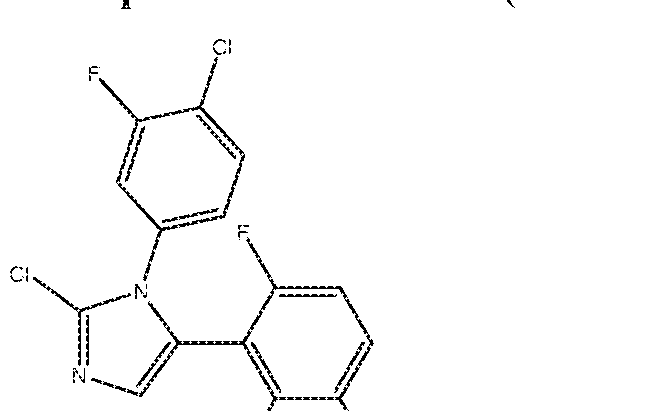
fl
[00274] Following synthetic procedure E using l-(4-chloro-3-fluorophenyl)~5-(2,3,6~ trifluorophenyl)-lH-imidazole (0.370 g, 1.13 mmoi), purification by automated flash
chromatography (hexanes/ethyl acetate 100:0 to 60:40) afforded the title compound as a yellow solid (0.074 g, 0.205 mmoi, 18% yield). Ή NMR (500 MHz; (DC! 5. δ 7.42 ( i. J 8.1 Hz, 1H), 7.2.1 (s, 1H), 7.14 (qd, J = 9.0, 5.0 Hz, IH), 7.05 (dd. ./ 8.8, 2.3 Hz, 1H), 6.94 (d. ./ 8.3 Hz, 1H), 6.81 (tdd, J= 8.7, 3.3, 1.9 Hz, IH) ppm; 13C NMR (126 MHz; CDCb): δ 157.84 (d, J= 252.4 Hz), 155.60 (dt, .7= 248.0, 2.9 Hz), 148.19 (ddd, J= 253.1 , 14,6, 6,0 Hz), 147.11 (ddd, J= 247.0, 12.8, 3.6 Hz), 134.77 (s), 134.25 (d, J= 8.6 Hz), 131.23 (s), 131.08 (s), 123.87 (d, J = 3.8 Hz), 122.93 (s), 122.79 (s), 121.47 (d, J= 1.3 Hz), 1 18.53 (dd, ./ = 19.2, 9.9 Hz), 1 16.1 1 (d, J = 23.5 Hz), 1 11.23 (ddd, J= 24.4, 6.5, 4.4 Hz), 108.37 (dd, J= 21.6, 15.9 Hz) ppm; IR: v 3094, 3058, 2932, 2860, 1587, 1494, 1459, 1426, 1313, 1238, 1074, 1009 cm"1; HRMS (ES+) calculated for C15H7CI2F4N2 [M + Hf 360.9922, found 360.9917.
loro-3-fSuorophenyI)-S-(2,3,6-trifluorophe5iyl)-lH"imidazole

[00275] Following synthetic procedure E using l-(4-diiQro-3-fluorophenyl)-5-(2,3,6- trifluorophenyl)-lH-imidazole (0.370 g, 1.13 mmoi), purification by automated flash
chromatography (hexanes/ethyl acetate 100:0 to 60:40) afforded the title compound as a yellow solid (0.126 g, 0.349 mmoi, 31% yield). Ή NMR (500 MHz; (DC! 5. δ 7.72 (s, IH), 7.40 { i. J
8.1 Hz, IH), 7.22 (qd, ./ 9.1, 5.0 Hz, IH), 6.99 (dd. ./ 8.8, 2.3 Hz, IH), 6.91 (dd,■/ 8.5, 1.0
Hz, I I I). 6.89-6.84 (m, 1H) ppm; ]3C NMR (126 MHz: CDCb): δ 158.05 (d. ./ 252.6 Hz), 155.63 (dt, J = 248.8, 2.8 Hz), 148.20 (ddd, J= 254.0, 14.4, 6.4 Hz), 147.17 (ddd, J --- 246.9, 12.7, 3.7 Hz), 137, 1 1 (s), 135 ,29 (d, J = 8.7 Hz), 133.06 (s), 131.69 (s), 122.28 (s), 122.14 (s), 121.01 (d, J= 3.8 Hz), 119.14 (dd, J = 19,9, 9,7 Hz), 115.09 (d, J= 1.5 Hz), 1 13 ,32 (d, ,/ = 24.0 Hz), 111.42 (ddd. J 24.1, 6.6, 4.3 Hz), 106.82 Idd. ./ 21.5, 15.9 Hz) ppm; IR: v 3126, 3096, 3058, 2915, 2848, 1497, 1266, 1225, 1197, 1004, 888, 863, 814, 738 cm"1; HRMS (ES~) calculated for C15H7CI2F4N2 [M + Hf 360.9922, found 360.9917.
Example 104: 2~chloro-5-(2-chloro-S~(2,4,6 rif!uorophe5iyS)-lH-iniidazoS-l-y!)pyr!dine

[00276] Following synthetic procedure E using 2-chloro-5-(5-(2,4,6-trifluorophenyl)-lH- imidazol-l-yl)pyridine (0.304 g, 0.98 mmol), purification by automated flash chromatography (hexanes/ethyl acetate 100:0 to 70:30) afforded the title compoimd as a brown solid (0.051 g, 0.148 mmol, 15% yield). I I NMR (500 MHz; CDCb): δ 8.21 (d, ./ 2.5 Hz, 1H), 7.53 (dd, ./ 8,4, 2,6 Hz, 1H), 7,39 (d, «/= 8.4 Hz, 1H), 7.19 (s, 1H), 6.64 (t, J= 7,9 Hz, 2H) ppm; !3C NMR (126 MFIz; CDCb): δ 163.70 (dt, J= 253.9, 15.3 Hz), 160.80 (ddd, J= 251.9, 14,9, 8,3 Hz), 152.31 (s), 147.86 (s), 137.38 (s), 134.63 (s), 131.22 (s), 130.82 (s), 124.92 (s), 121.67 (s), 102,82 (td, «/= 19.9, 4.8 Hz), 101 ,26-100.82 (m) ppm; IR: v 3100, 3057, 1683, 1646, 1595, 1575 cm"1; HRMS ( l-.S ) calculated for C14H7C 2F3N3 [M + H | 343.9969, found 343,9970.
ro-5-(2,4,6-trifliioropheny!)-lH~iinidazo!-l-yl)pyridine

[00277] Following synthetic procedure E using 2-chloro-5-(5-(2,4,6-trifluorophenyl)-IH- imidazol-l-yl)pyridine (0.304 g, 0.98 mmol), purification by automated flash chromatography (hexanes/ethyl acetate 100:0 to 70:30) afforded the title compound as a brown solid (0.172 g, 0.500 mmol, 51% yield). 1 ! \ \1R (500 MHz; CDCb): 5 8,24 (d, .7 = 2.7 Hz, 1H), 7.71 (s, lH),
7.47 (dd, J ------ $.4, 2.6 Hz, IH), 7.37 (d, J -- 8.4 Hz, IH), 6.71 (L ./ X .O H/. 2H) ppm; 13C NMR
(126 MHz; CDCb): δ 164.22 (di. J 254.5, 15.2 Hz), 160.97 (ddd, ./ 253.1, 15.1, 8.4 Hz), 151 ,97 (s), 145 ,53 (s), 136.91 (s), 134.87 (s), 133.36 (s), 131.72 (s), 125.18 (s), 1 15.41 (s), 101.48-101.04 (m) ppm; IR: v 3100, 3058, 1646, 1599, 1575, 1558 cm'1; HRMS (ES+) calculated for C14H7CI2F3N3 [M + Hf 343 ,9969, found 343.9976,
SorophenyI)-5-(4-f!uorGphenyl)-lH-imidazole

[00278] Following synthetic procedure E using l-(4-chlorophenyl)-5-(4-fluorophenyl)- lH- imidazole (0. 124 g, 0.455 mmol), purification by automated flash chromatography
(hexanes/ethyl acetate 100:0 to 80:20) afforded the title compound as a white solid (0.008 g, 0.023 mmol, 5% yield), i NMR (500 MHz; CDCb): δ 7.41- 7.38 (in, 2H), 7.15-7.08 (m, 4H), 7.01-6.96 (m, 2H) ppm; !3C NMR (126 MHz; CDCb): δ 162.71 i d. ./ 249.9 Hz), 135.88 (s), 133 ,44 (s), 131.61 (s), 131.55 (s), 131.46 (s), 130.02 (s), 129.20 (s), 128.98 (s), 127.34 (s), 123.20 (s), 123.1 7 (s), 1 16.05 (s), 1 15.87 (s) ppm; IR: v 2924, 2852, 1683, 1652, 1558, 1496 cm" l: HRMS (ES÷) calculated for C ~i bi 'bFN · [M + ! ! | 340.9815, found 340.9803.
Example 107: 2-chloro-l-(4-chlorophenyl)-5-(4-fluorophenyl)-lH-imidazole

[00279] Following synthetic procedure E using 1 -(4-chloropheny])-5-(4-fluorophenyl)- l.H- imidazole (0.124 g, 0.455 mmol), purification by automated flash chromatography
(hexanes/ethyl acetate 100:0 to 80:20) afforded the title compound as a yellow solid (0.009 g, 0,029 mmol, 7% yield), ¾ NMR (500 MFIz; CDCb): δ 7.58 (s, i l l). 7,37-7.31 (m, 5Η), 7,20- 7, 19 (m, 2Η), 7.06 (d. ./ 8.0 Hz, 2H) ppm; i3C NMR (126 MHz; CDCb): δ 162.62 (d, J = 249.6 Hz), 135.75 (s), 135.01 (s), 134.79 (s), 134.58 i s). 131.70 id. ./ 8.3 Hz), 130.05 (s), 129.94 (s), 129,81 (s), 128,65 (s), 128.49 (s), 127.38 (s), 126.69 (s), 126.66 (s), 1 16.02 (s), 1 15.84 (s) ppm;
IR: v 3067, 2924, 2852, 1562, 1496 cm"1; HRMS (ES+) calculated for C15H10CI2FN2 [M + H] 307.0205, found 307.0210.
Example 108: 4-chloro-l-(4-chlorophenyl)-5-(4-fluorophenyl)-lH-imidazole

[00280] Following synthetic procedure E using l-(4-chlorophenyl)-5-(4-fluorophenyl)- lH- imidazole (0.124 g, 0.455 mmol), purification by automated flash chromatography
(hexanes/ethyl acetate 100:0 to 80:20) afforded the title compound as a white solid (0.060 g, 0.195 mmol, 43% yield). !H NMR (500 MHz; CDC33): δ 7.57 (s, 1H), 7.36-7.33 (m, II I). 7.18- 7.15 (m, 2H), 7.06-6.99 (m, 4H) ppm; 13C NMR (126 MHz; CDCb): δ 162.58 (d, ,/ = 249.6 Hz), 135.74 (s), 134.73 i d. ./ 3.7 Hz), 131.66 id. ./ 8.2 Hz), 129.99 (s), 129.33 (s), 126.66 (s), 126.23 (s), 123.39 (d, J = 3.4 Hz), 1 15.96 (s), 115.78 (s) ppm; IR: v 3117, 3062, 2962, 2916, 2848, 1683, 1652, 1599, 1575, 1558, 1497 cm"1; HRMS (ES ") calculated for CisHioChFNi [M + Hf 307.0205, found 307.0206.
Example 109: 2-chloro-l-(4-chloro-2-fluorophenyl)-5-(2,6-difluorophenyl)-LH-imidazole

[00281 ] Following synthetic procedure E using l -(4-chloro-2-fluorophenyl)-5-(2,6- difluorophenyl)-lH-imidazole (0.351 g, 1.14 mmol), purification by automated flash
chromatography (hexanes/ethyl acetate 100:0 to 80:20) afforded the title compound as a yellow solid (0.025 g, 0.073 mmol, 6% yield). S I N M R (500 MHz; CDCb): δ 7.58 (s, 1H), 7.37-7.31 (m, 5H), 7.20-7. 19 (m, 2H), 7,06 (d, ,/ 8.0 Hz, 2H) ppm; 1 NMR (500 MHz; CDCb): 5 7.31- 7.26 (m, I H), 7.22 (s, 1H), 7.19 {ά. ./ 9.3 Hz, Hi), 7.15 (d, ./ 3.1 Hz, 2H), 6.85 U. ./ 7.6 Hz, 2H) ppm; 13C NMR (126 MHz; CDC13): δ 160.60 !dd. ./ 251.4, 5.9 Hz), 157.37 {ά. .ί 257.9 Hz), 136.78 (d, J = 9.2 Hz), 134,86 (s), 131 ,52 (t, J= 10.3 Hz), 130,78 (s), 130,32 (s), 125 , 13 (s), 125 , 10 (s), 122,95 (s), 121.74 (d, J= 13.0 Hz), 1 17.73 (d, J= 23.1 Hz), 11 1.69 (dd, J= 20,5, 5 ,0
Hz), 106.50 ((. ,/ 19.5 Hz) ppm; IR: v 3104, 3071, 2936, 2860, 1683, 1652, 1634, 1587, 1558, 1538, 1505 cm"1: HRMS (ES^) calculated for Cid¾ChF3N2 [M + H]+ 343.0017, found 343.0013.
chlorO"2-fli!orophenyI)"5-(2,6-difluoropheoyl)-lH"imidazole

[00282] Following synthetic procedure E using i~(4-chloro-2~fluorophenyl)-5~(2,6~ difluorophenyl)-lH-imidazole (0.351 g, 1.14 mmol), purification by automated flash
chromatography (hexanes/ethyi acetate 100:0 to 80:20) afforded the title compound as a yellow solid (0.126 g, 0.367 mmol, 32% yield). !H NMR (500 MHz; CDCb): 5 7.65 (s, 1H), 7.38-7.33 (m, 1H), 7.19-7.17 (m, lH), 7.13 (q, J= 6.4 Hz, 2H), 6.90 (t, J= 7.8 Hz, 2H) ppm; !3C NMR (126 MHz; CDCb): δ 160.74 (dd, ./ 252.5, 5.9 Hz), 156.36 (d, ,/ 256.9 Hz), 137.49 (s), 136.16 (d, J= 9.2 Hz), 132.18 (s), 132.13 ! ·. ./ 10.1 Hz), 128.61 (s), 125.34 (d, J = 3.7 Hz), 122.69 (d, J= 12,6 Hz), 117.87 (d, J = 22.8 Hz), 1 16,88 (s), 1 1 1.80 (dd, J = 20.6, 4.5 Hz), 105.04 (t, J= 19.6 Hz) ppm; IR: v 3105, 2932, 1683, 1652, 1634, 1590, 1568, 1506 cm"1; HRMS (ES÷) calculated for ('· -! Ι«(Ί.·Γ >\'.· M + I I I ' 343.0017, found 343.0018.
Example 111: l-(4-chlorophenyl)-5-(2,6-difluorophenyl)-2,4-dimethyl-lH-imidazole

[00283] Following synthetic procedure F using l-(4-chlorophenyl)-5-(2,6-difluorophenyl)-4- methyl-lH-imidazole (0.050 g, 0.164 mmol), purification by fiash chromatography (silica gel, hexanes/ethyl acetate 65:35) afforded the title compound as a colorless liquid (0.025 g, 0.078 mmol, 48% yield). ¾ NMR (500 MHz; CDCb): δ 7.31-7.27 (m, 2H), 7.25-7.19 (m, i l l). 7.06- 7.01 (m, 2H), 6.81 (t, ./ 7.7 Hz, 2H), 2.29 (s, 3H), 2.14 (s, 3H) ppm; HRMS (ES+) calculated for C17H14CIF2N2 [M + \ \ [ 319.0814, found 319.0807.
Example 112: 5-(3-chIoro-2,6-difluorophenyl)-l-(4-chIorophenyl)-2,4-dimethyl-lH- imidazole

[00284] Following synthetic procedure F using 5-(3-chloro-2,6-difluorophenyl)-l-(4- chlorophenyl)-4-methyl-lH-imidazole (0.050 g, 0.147 mmol), purification by flash
chromatography (silica gel, hexanes/ethyl acetate 60:40) afforded the title compound as an orange solid (0.029 g, 0.082 mmol, 56% yield). Ή NMR (500 MHz; CDCb): δ 7.31 (dd, J= 8.7, 6.6 Hz, 3H), 7.03 (d, ,/ 8.4 Hz, 2H), 6.78 (td,■/ 8.6, 1.7 Hz, 1H), 2.29 (s, 3H), 2.14 (s, 3H) ppm; HRMS (ES+) calculated for C -H : ( ].■! .·% · [M + HJ+ 353.0424, found 353.0413.
Example 113: 4-chloro-l-(4-chlorophenyl)-5-(2,6-difluorophenyl)-2-methyl-lH-imidazole

[00285] Following synthetic procedure F using 4-chloro-l -(4-chlorophenyl)-5-(2,6- difluorophenyl)-lH-imidazole (0.050 g, 0.154 mmol), purification by flash chromatography (silica gel, hexanes/ethyl acetate 80:20) afforded the title compound as a white solid (0.020 g, 0,059 mmol, 38% yield). Ή NMR (500 MHz; CDCb): δ 7.36-7.28 (m, 3FI), 7.08 (d, J= 8.5 Hz, 2H), 6.89-6.81 (m, 2H), 2.31 (s, 3H) ppm; FIRMS (ES÷) calculated for C .I I: ί Ι >Ι; ·Ν · [M + Hf 339.0267, found 339.0265.
chlorophenyl)-5-(2,6-difluorophenyl)-2-ethyl-lH-imidazole

[00286] Following synthetic procedure F using 4-chloro-l-(4-chlorophenyl)-5-(2,6- difluorophenyl)-lH-imidazole (0.040 g, 0.123 mmol), purification by flash chromatography
(silica gel, hexanes/ethyl acetate 85 : 15) afforded the title compound as a white solid (0.015 g, 0.042 mmol, 35% yield). 1 1 N M R ( >0U MHZ; CDCb): δ 7.38 7.2 (m, 2H), 7.09 (d. 8.5 Hz, 2H), 6.89-6,79 (m, 2H), 2.58 (q, J = 7.5 Hz, 2H), 1.31-1.21 (m, 3H) ppm; HRMS (ES+) calculated for C17H13Q2F2N2 [M + H]+ 353.0424, found 353 ,0429.
Example 115: 4-chloro-l-(4-chlorophenyl)-2-methyl-5-(2,4,6-trifluorophenyl)-lH-imidazole

[00287] Following synthetic procedure F using 4-chloro- l-(4-chlorophenyl)-5-(2,4,6- trifluorophenyl)-lH-imidazole (0.100 g, 0.290 mmol), purification by automated flash chromatography (silica gel, hexanes/ethyl acetate 90: 10 to 70:30) afforded the title compound as a white solid (9 mg, 9% yield). ¾ NMR (500 MHz; CDC ): δ 7.81 (s, 1H), 7.37 (d, ,/ 8.4 Hz, 2H), 7.10 (d. ./ 8.4 Hz, 2H), 6.66 i t. ./ 9.0 Hz, IH), 2.12 (s, 3H) ppm; 13C NMR ( 126 MHz; CDCb): δ 163 ,87 (dt, J = 253 ,2, 15.3 Hz, 1C), 161 ,27 (ddd, «/= 252,3, 15 , 1 , 8 ,5 Hz, IC), 145.85 (s, IC), 135 ,65 (s, I C), 134.21 (s, IC), 130.25 (s, I C), 129.96 (s, 1 C), 128.37 (s, IC), 1 15.30 (s, IC), 102.36 (td, J ------ 20.6, 4.2 Hz, IC), 101.05- 100.60 (m, IC), 14.02 (s, IC) ppm; IR: v 2962,
2927, 2852, 1644, 1585, 1495, 1442, 1400, 1 122, 1038, 999 cm"1. HRMS (ES+) calculated for C16H10CI2F3N2 [M + ! ! | 357.01 73, found 357.01 71.
Example 116: 4-chloro-l-(4-chlorophenyl)-5-(2,6-difluoro-3-methylphenyl)-2-methyl-lH- imidazo!e

[00288] Following synthetic procedure F using 4-chloro- i-(4-chlorophenyl)-5-(2,6-difluoro-3- methylphenyl)-lH-imidazole (0.094 g, 0.276 mmol), purification by automated flash chromatography (hexanes/ethyl acetate 100:0 to 80:20) afforded the title compound as a brown solid (0.034 g, 0.096 mmol, 45% yield). ¾ NMR (500 MHz; ( IX 1 ): δ 7.34-7.31 (m, 2H),
7.14-7.09 (m, i l l ). 7.09-7.06 (m, 2H), 6.72 (td, J - 8.5, 1.2 Hz, IH), 2.29 (s, 3H), 2.16 (s, 3H) ppm; ' '·( NMR ( 126 MHz; CDCb): δ 158.79 (ddd. ./ 249.3, 13.3, 5.5 Hz, IC), 145.40 (s, IC),
135.13 (s. ! C). 134.50 (s, IC), 133.00 (dd, J ------ 9.6, 7.1 Hz, 1 C), 129.90 (s, 1C), 129.69 (s, 1C),
128.37 (s, ! ( }. 120.86 (dd../ 17.9, 3.8 Hz, IC), 116.50 (s, 1C), 110.84 (dd. ./ 2 1 .6. 4.1 Hz, IC), 105.24 (t, ./ 20.3 Hz, IC), 14.26 (d, ./ 2.9 Hz, 1C), 14.10 (s, 1C) ppm; IR: v 3096, 3054, 2929, 2865, 1635, 1568, 1495, 1398, 1251, 1239, 1091 , 1071 , 1012, 998 cm-l ; HRMS (ES+) calculated for CiTHiiCbFzNzNa M + Naf 375.0243, found 375.0247.
Example 117: 4-chSoro-S-{3-chlorG-2,6-diiluorophenyl)-l-{4-chIorophenyl)-2-methyS-lH- imidazole

[00289] Following synthetic procedure F using 4-chloro-5-(3-chloro-2,6-difluorophenyl)-l-(4- chlorophenyl)- lH-imidazole (0.078 g, 0.216 mmoi), purification by automated flash
chromatography (hexanes/ethyl acetate 100:0 to 80:20) afforded the title compound as a brown solid (0.039 g, 0.104 mmol, 48% yield). Ή NMR (500 MHz; CDCb): δ 7.38-7.33 (m, 3H), 7.07 !d. ./ 8.6 Hz, 2H), 6.83-6.79 (in. i l l). 2.30 (s, 3H) ppm; 13C NMR (126 MHz; CDCb): 6 159,02 (dd, J = 251.5, 4.4 Hz, I C), 156.10 (dd, J= 252.9, 6.3 Hz, IC), 146,08 (s, IC), 135.50 (s, I C), 134.14 (s, IC), 132,05 (d, J= 9.6 Hz, IC), 130,54 (s, I C), 129.91 (s, IC), 128.29 (s, I C), 1 17.08 (dd. ./ 18.5, 4.1 Hz, IC), 115.24 (s, IC), 112.19 (dd, J- 23.5, 4.4 Hz, IC), 107.42 (t, J = 20.5 Hz, IC), 14.06 (s, IC) ppm; IR: v 3100, 3071, 2928, 2848, 1558, 1495, 1465, 1399, 1495, 1465, 1399, 1338, 1287, 1242, 1219, 1092, 1011, 997 cnr!; HRMS (ES+) calculated for C16H1C.G3F2N2 [M + ! l | 372.9878, found 372.9864,
Example 118: 5-(3-bronio-2,6-diiluoropheny!)-4-chIoro-l-(4-chlorophe!iyS)-2~niethyI-lH- imidazole

[00290] Following synthetic procedure F using 5~(3-brom.o-2,6-difluoropheny3)-4~chloro-l-(4- chlorophenyl)- lH-imidazole (0.112 g, 0.277 mmol), purification by preparative reverse phase
HPLC afforded the title compound as a white solid (0.006 g, 0.014 mmol, 5% yield) ppm: ]H NMR (500 MHz; CDCb): δ 7.53 (ddd, ./ 9.0, 7.7, 5.8 Hz, 1H), 7.39-7.36 (m, 2H), 7.09 (d, ./ 8.6 Hz, 21 1). 6.81-6.77 (m, 1H), 2.34 (s, 3H) ppm; !3C NMR (126 MHz; CDCb): δ 159.87 (dd, J = 252.4, 4.3 Hz, IC), 157,21 (dd, J= 251.6, 6.1 Hz, 1 C), 146.19 (s, IC), 135 ,94 (s, 1 C), 135.26 (d. ./ 8.7 Hz, IC), 133.78 (s, IC), 130.09 (s, IC), 128.32 (s, I C), 115.75 (s, IC), 1 12.84 (dd. ./ 23.0, 3.8 Hz, IC), 106.96 ! ·. ./ 20.8 Hz, IC), 104.43 (dd.■/ 21.9, 4.2 Hz, IC), 13.82 (s, IC); IR: v 3394, 2962, 2924, 2852, 1494, 1462, 1398, 1239, 1091 cm"1 ; HRMS (ES+) calculated for C16H10B1CI2F2N2 [M + H]+ 416.9372, found 416.9374.
Example 119: 4-chloro-l-(4-chlorophenyl)-2-methyl-5-(2,3,6-trifluorophenyl)-lH-imidazole

[00291] Following synthetic procedure F using 4-chloro-l-(4-chlorophenyl)-5-(2,3,6- trifluorophenyl)-lH-imidazole (0.112 g, 0.277 mmol), reverse-phase HPLC purification afforded the title compound as a white solid (0.006 g, 0,0.17 mmol, 5% yield), f t NMR (500 MHz;
CDCb): δ 7.36 (d, J = 8.6 Hz, 2H), 7.22 (s, 1H), 7.16-7.08 (m, 3H), 6.81-6.76 (m, 1H) ppm; 13C NMR (126 MHz; CDCb): δ 160.09 (q, ./ 39.8 Hz, IC), 155.98 (di. ./ 248.9, 2.9 Hz, IC), 148,56 (ddd, ./= 254.2, 14 ,4, 6.1 Hz, IC), 147.13 (ddd, J= 247.3, 12.7, 3.8 Hz, I C), 146.57 (s, I C), 136.41 (s, IC), 133, 18 (s, I C), 130.25 (s, IC), 128.60 (s, IC), 128.30 (s, IC), 119.47 (dd, J = 19,5, 9,7 Hz, IC), 1 16.1 1 (s, IC), 1 11.32 (ddd. ./ 23.9, 6.3, 4.5 Hz, IC), 106.65 (dd, ./ 22.3, 15.9 Hz, IC), 13.24 (s, IC) ppm; IR: v 3449, 3096, 2936, 2848, 1494, 1402, 1250, 1093, 1012, 995 cm'1; HRMS ( HS ) calculated for C1&H10CI2F3N2 [M + H | 357.0173, found 357.0176. Example 120: 4-chloro-l~(4-chIoro-3 Iuorop enyI)-2~methy!-5-(2^,6 rifluorophenyl)~l H- imidazole

Example 121 : 2-chloro-5-(4-chloro-2-methyl-5-(2,4,6-trifluorophenyl)-lH-imidazol-l- yl)pyridine

[00293] Following synthetic procedure F using 2-ch3oro-5-(4-chloro-5-(2,4,6"trifluorophenyi)~ lH-imidazol- l-yl)pyridine (0.120 g, 0.349 mmol), purification by reverse-phase HPLC afforded the title compound as a white solid (0.003 g, 0.008 mmol, 2% yield). !H NMR (500 MHz;
CDCb): δ 8.24 (d, ./ 2.6 Hz, 11 1). 7.48 (dd, ./ 8.4, 2.6 Hz, i l l). 7.42 (d, J ----- 8.3 Hz, 11 1). 6.68 (t, J = 8.0 Hz, 2H), 2.38 (s, 3H) ppm; 13C NMR (126 MHz: CDCb): δ 164.28 (dt,■/ 254.7, 15.4 Hz), 161.13 (ddd, «/= 252.8, 15,0, 8,4 Hz), 152.78 (s), 152.31 (s), 147.82 (s), 146,34 (s), 145,63 (s), 137.11 (s), 134.97 (s), 131 .20 (s), 130.32 (s), 125.31 (s), 115.88 (s), 101.21 (td, J= 26.1, 3,8 Hz), 13.68 (s) ppm; IR: v 3067, 2962, 2924, 1733, 1683, 1646, 1558, 1539, 1506 cm4: HRMS { l calculated for C. 1 ; ί 1 = \ = [M + Hf 358,0126, found 358,0123,
Example 122: 4-chloro-l-(4-chlorophenyl)-5-(4-fluorophenyl)-2-methyl-lH-imidazole

[00294] Following synthetic procedure F using 4-chloro- i~(4-chlorophenyl)-5-(4~
fluorophenyl)- lH-imidazole (0.100 g, 0.325 mmoi), purification by reverse-phase HPLC afforded the title compound as a white solid (0.028 g, 0.087 mmoi, 26% yield). ¾ NMR (500 MHz; CDCb): δ 7.44-7.41 (m, 2H), 7. 13-7.06 (m, 4H), 7,01-6.97 (m, 2H), 2.39 (s, 3H) ppm; 13C NMR (126 MHz; CDCb): δ 162.89 (d, J= 250,3 Hz), 144.67 (s), 136. 16 (s), 133.60 (s), 131.66 id. ./ 8.7 1 1/ }. 130.41 (s), 128.86 (s), 127.47 (s), 124.49 (s), 122.69 (d, J = 3.4 Hz), 116.16 (s), 1 15.99 (s), 13.14 (s) ppm; ! R: v 3067, 1683, 1652, 1558, 1539, 1496 cm"1; HRMS (ES+) calculated for ( .1 1 ,·Π · Γ\ · [M + Hf 321 .0362, found 321.0367.
Example 123: 4-chSoro-l -(4-chloro-2-fliioropheny!)-5-(2,6-d!fSuorophenyS)-2-niethyl~l imidazole

[00295] Following synthetic procedure F using 4-chloro- l-(4-chloro-2-fluorophenyl)-5-(2,6- difluorophenyl)-l.H-imidazole (0.100 g, 0.291 mmoi), purification by preparative reverse phase HPLC afforded the title compound as a white solid (0.012 g, 0.034 mmoi, 12% yield). Ή NMR (500 MHz; CDCb): δ 7.34-7.28 (m, 1H), 7.20 (dd, ./ 9.3, 2.1 Hz, 1H), 7.14-7.06 (m, 2H), 6.90-6.82 (m, 2H), 2.30 (s, 3H) ppm; i3C NMR ( 126 MHz; CDCb): δ 161.91-159.82 (m), 158.30 (s), 156.25 (s), 146.33 (s), 136.66 (s), 136.59 (s), 131.93 ( i. 10.2 Hz), 130.41 (s), 130.00 (s), 125.33 (u. ./ 4. ! Hz), 122.40 (d. 13.1 Hz), 117.98 (s), 1 17.79 (s), 1 16.45 (s), 11 1.70 (ddd, J= 21.8, 18.3, 3.5 Hz), 105.46 (t, J= 19.8 Hz), 13.61 (s) ppm; IR: v 3079, 2932, 1683, 1652, 1634, 1591 , 1558, 1539, 1 505 cm"1; HRMS (ES ") calculated for CieHioCbFsNi [M + Hf 357.0173, found 357.0175.
Example 124: l-(4-chIorophenyS)-4-isopropyl-5-phenyl-lH-imidazole

[00296] Following synthetic procedure D using (E)-N-(4-chlorophenyl)-l-phenylmethanimine
(0.100 g, 0.464 mmol), purification by flash chromatography (silica gel, hexanes/ethyl acetate 70:30) afforded the title compound as a yellow oil (0.017 g, 0.057 mmo! . 12% yield). !H NMR (500 MHz; CDCb): δ 7.65 (s, 1H), 7.34-7.30 (m, 1H), 7.29 (q, J= 2.5, 2.0 Hz, 2H), 7.27 (s, ! FI), 7.08 (dd. ./ 7.5, 2.0 Hz, 2H), 7.04-6.99 (m, 2H), 2.99 (dq,■/ 16.3, 9.1, 8.0 Hz, IH), 1.31 (s, 3H), 1.29 (s, 3H), 1.25 (s, IH) ppm: HRMS (ES~) calculated for CisHnClNiNa [M + Na T 319.0978, found 319.0971 .
Example 125: 2~bromo~l-(4-c SorophenyI)-5~(2,4,6-trifliioropheny!)-lH~imidazo!e

[00297] Following synthetic procedure E using l -(4-chlorophenyl)-5-(2,4,6-trifluorophenyl)- lH-imidazole (0.100 g, 0.464 mmol), purification by flash chromatography (silica gel, hexanes/ethyl acetate 85: 15) afforded the title compound as a yellow wax (0.077 g, 0.020 rnmol, 31% yield).
Ή NMR (500 MHz; CDCb): δ 7.39-7.33 (m, 2FI), 7,21 (s, IH), 7.14-7.09 (m, 2FI), 6,65-6.57 (m, 2H) ppm; HRMS (ES+) calculated for C isHsBrClFsNj [M + Hf 386.9511, found 386.9504. Example 126: l-(4-chlorophenyl)-4-iodo-5-(2,4,6-trifluorophenyl)-lH-imidazole

Example 127: 2,4-dichloro-l-(4-chlorophenyl)-5-(2,6-difluoro-4-methoxyphenyl)-lH- imidazole

[00299] To a solution of 2,4-dichloro-l-(4-chlorophenyl)-5-(2,4,6-trifluorophenyl)- lH- imidazole (0.032 g, 0.085 mmol) in ΤΗΡ (0.53 mL) at 0 °C was added a 30% sodium methoxide solution in methanol (0.031 mL). The reaction mixture was stirred for 16 h at room temperature, then quenched with an aqueous ammonium chloride solution and extracted with ethyl acetate (3x). The combined organic layers were dried (Na_S04), filtered, and concentrated. Tlie crude products were purified by preparative reverse phase HPLC to obtain the title compound as a white solid (0.01 1 g, 0.028 mmol, 33% yield). !H NMR (500 MHz; CDCb): δ 7,38-7.35 (m, 2H), 7.12 (d, J = 8.6 Hz, 2H), 6.41 (q, J= 7.3 Hz, 2H), 3.78 (s, 3H) ppm; 13C NMR (126 MHz: CDCb): δ 162.97 (t, J = 14.0 Hz, 1C), 161.59 (dd, ./ 249.7, 9.1 Hz, IC), 135.90 (s, 1C), 133.24 (s, I C), 132.20 (s, IC), 130,42 (s, I C), 129.75 (s, IC), 1 18.83 (s, IC), 101.00 (id. ./ 26,4, 3.1 Hz, IC), 98.46-98,24 (m, I C), 97.03 (t, J= 20,6 Hz, I C), 56.07 (s, IC) ppm; IR: v 3390, 2965, 2924, 2848, 1644, 1574, 1495, 1445, 1384, 1352, 1 150 cm"1; HRMS (ES÷) calculated for C16H10CI3F2N2O [M + R | 388,9827, found 388,9830,
Example 128: 4-chloro-l-(4-chlorophenyl)-5-(2,6-difluoro-4-methoxyphenyl)-2-methoxy-
IH-imidazole
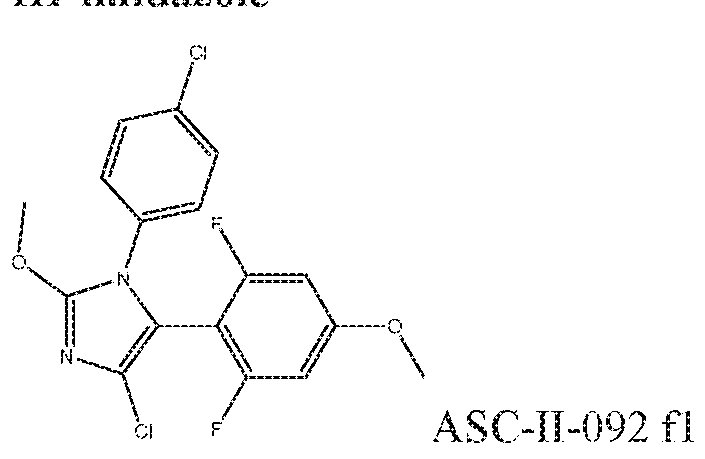
Example 129: 2-bromG-4-diloro-l-(4-chIoropheoyl)-5-(2,4,6-trinuGropheoyl)-lH-imidazoIe

[00301] To a solution of 4-chloro-l-(4-chlorophenyl)-5-(2,4,6-trifluorophenyl)-lH-imidazole (0.050 g, 0.146 mmol) in acetonitrile (0.6 mL) was added N-bromosuccinimide (0.337 g, 0.189 mmol). The reaction mixture was heated at 80 °C for 48 h, then cooled down before dilution with ethyl acetate. The organic layer was washed with Η2Ο and brine, dried (MgS().]), filtered, and concentrated. The products were purified by preparative reverse phase HPLC to obtain the title compound as a white solid (0.044 g, 0.104 mmol, 71% yield). ¾ NMR (500 MHz; CDCb): δ 7.37 (d, J= 8.4 Hz, 2H), 7.12 (d, J= 8,5 Hz, 2H), 6,67-6,62 (m, 2H) ppm; !3C NMR (126 MHz; CDCb): δ 164,22 (dt, J = 254, 1, 15,2 Hz), 161.20 (ddd, J= 253.1, 15.2, 8.3 Hz), 136.26 (s), 133.81 (s), 132.00 (s), 129.84 (s), 128.84 (s), 120.41 (s), 118.81 (s), 101.66 (td, J = 20.2, 4.6 Hz), 101 , 18-100.73 (m) ppm; IR: v 3100, 3062, 1683, 1645, 1597, 1575, 1558, 1539, 1494 cm"1 ; HRMS (ES+) calculated < \<I HJrCU: .N.> [M + Hf 420.9122, found 420.91 17.
Example 130: 4-chloro-l-(4-chlorophenyl)-5-(2,6-difluoro-4-methoxyphenyl)-2-methyl-lH- imidazole

[00302] To a solution of 4-chloro-l -(4-chlorophenyl)-2-methyl-5-(2,4,6-trifluorophenyl)-lH- imidazole (0.004 g, 0.01 1 mmol) m THF (0.01 1 mL) at 0 °C was added a 30% sodium methoxide solution in methanol (0.007 mL). The reaction mixture was stirred for 19 h at room temperature, then quenched with an aqueous ammonium chloride solution and extracted with ethyl acetate (3x). The combined organic layers were dried (MgSOa), filtered, and concentrated. Hie crude products were purified by preparative reverse phase HPLC to obtain the title compound as a white solid (0.004 g, 0.011 mmol, 97% yield). ¾ NMR (500 MHz: CDCb): δ 7.40 (d, J= 8,5 Hz, 2H), 7.11 (d, ./ = 8.5 Hz, 2H), 6.41 (d, J= 9, 1 Hz, 2H), 3,78 (s, 3H), 2,41 (s, 3H) pptn; 13C NMR (126 MHz; CDCh): δ 163 ,04 (t, J= 14.0 Hz), 161.61 (dd, ,7= 249.5, 8.9 Hz), 145.57 (s), 136.11 (s), 133.46 (s), 130.11 (s), 129.90 (s), 128.65 (s), 128.38 (s), 127.63 (s), 117.32 (s), 98.38 id. ./ 28.0 Hz), 96.57 {[. ./ 20.8 Hz), 56.09 (s), 13.37 (s) ppm; 1R: v 2962, 2928, 2852, 1646, 1575, 1494, 1448, 1152 cm4; HRMS (ES") calculated for C17H13CI2F2N2O [M + Η Γ 369.0373, found 369.0374.
-(4-chlorophenyl)-2-(2,6-difluoro-4-methoxyphenyl)acrylonitrile

[00303] In a microwave vial, potassium carbonate (0,546 g, 3.95 mmol) was added to a solution of (2,4,6-trifluorophenyl)-acetonitrile (0.558 g, 3.26 mmol) and 4-chlorobenzaldehyde (0.457 g, 3.26 mmol) in methanol (7 mL). Hie reaction mixture was heated to reflux for 16 h, cooled, poured into H2O and filtered. The solid was washed twice with H2O and twice with hexane, and dried under vacuum to obtain the mixture of E and Z isomers of the title compound as a solid (0.644 g, 2.11 mrnoi, 65% yield). Ή NMR (500 MHz; CDCh): δ 7.83-7.81 (rn, ./ 8.6, 1.8 Hz, 2H), 7.45-7.43 (m, 2H), 7.22 (s, 0.8H), 7.13 (s, 0.2H), 6.58-6.53 (m, 2H), 3.90 (s, 0.8H), 3.84 (s, 2.2H) ppm.
Example 132: 5-(4-chlorophenyl)-4-(2,6-difluoro-4-methoxyphenyl)-l -methyl-4,5-dihydro- lH-pyrazol-3-amine

1003041 To a solution of 3-(4-chlorophenyl)-2-(2,6-difluoro-4-methoxyphenyl)acrylonitrile (0.08 g, 0,26 mmol) in methanol (1 .6 mL), triethylamine (0.036 mL, 0.26 mmol) and methylhydrazine (0.137 mL, 2.6 mmol) were added consecutively. The reaction mixture was heated to reflux for 72 h, then cooled and concentrated under reduced pressure to obtain the title compound as a crude mixture.
Example 133: 5-(4-chlorophenyl)-4-(2,6-difluoro-4-methoxyphenyl)-l -methyl-lH-pyrazol- 3-amine

[00305] To a solution of 5-(4-chloropheny1)-4-(2,6-difluoro-4-me†hoxypheny])-l-methy3-4,5- dihydro- lH-pyrazol-3 -amine (0.1 14 g, 0.325 rnmol) in chloroform (2.5 mL) at 0°C, was added MnC (0.141 g, 1.625 mmol). The reaction mixture was stirred at 0 °C for 30 minutes, then at room temperature for 4h, and subsequently diluted with ethyl acetate and filtered over Celite. The filtrate was concentrated under reduced pressure and the residue was purified by preparative reverse phase HPLC to obtain the title compound as a white solid (0.008 g, 0.023 mmol, 8% yield), !H NMR (500 MHz; CDCb): δ 7.41 (d, J = 8.4 Hz, 2H), 7.18 (d, J = 8.4 Hz, 2H), 6.46 (d, J= 9.3 Hz, 2H), 3 ,79 (s, 3H), 3 ,74 (s, 3H) ppm .
Example 134: 3-chloro-5-(4-chlorophenyl)-4-(2,6-difluoro-4-methoxyphenyl)-l-methyl-lH- pyrazole
\
ci i= ASC-II-091
[00306] 5-(4-chlorophenyl)-4-(2,6-difluoro-4-methoxyphenyl)-l -methyl- lH-pyrazol-3-amine
(0.019 g, 0.05 mmoi) was dissolved in concentrated HCI (0.16 mL) and cooled to 0 °C. A solution of NaNC (3.45 mg, 0.05 mmoi) in H2O (0.029 mL) was then added dropwise. A solution of CuCl (4.95 mg, 0.05 mmoi) in concentrated HCI (0,087 mL) was added and the reaction mixture was heated to 60 °C for 30 minutes, then the reaction mixture was cooled down and neutralized by the addition of 2N NaOH and diluted with ethyl acetate . The phases were separated and the aqueous phase was extracted with ethyl acetate (3x) and the combined organic layer was dried over aiSCH, filtered, and evaporated under reduced pressure. The residue was purified by preparative reverse phase HPLC to obtain the title compound as a white solid (0.001 g, 0.003 mmoi, 6% yield). I I N .MR (500 MHz; CDQ3): 0 7.36 id. ./ 8.4 Hz, 2H), 7.18 (d, ./ 8.4 Hz, 2H), 6.45-6,42 (m, 2H), 3.80 (s, 3H), 3.78 (s, 3H) ppm; i3C NMR (126 MHz; CDCI3): δ 162.53-160.49 (dd, J ----- 248.2, 8.8 Hz, 1C), 161.28 (L -.' 14.0 Hz, IC), 143.41 (s, 1C), 139.44 (s, IC), 135.64 (s, IC), 130.66 (s, IC), 129.25 (s, IC), 127.62 (s, IC), 106.78 (s, IC), 98.28-98.05 (m, IC), 55.92 (s, IC), 37.91 (s, IC) ppm; IR: v 2922, 2848, 1646, 1575, 1558, 1390, 1196, 1145 cm-1. HRMS (ES -) calculated for C17H13CI2F2N2O [M + Hf 369.04, found 368.96.
: N-((dimethylamino)methylene)-2,3,6-trifluorobenzamide

[00307] To a solution of 2,3,6-trifiuorobenzamide (450 mg, 2,57 mmoi, 1.00 equiv.) in toluene (3.10 mL) was added DMA-DMF (1.02 mL, 7.71 mmoi, 3.00 equiv,). The reaction was heated at reflux for 2 h. Then, the reaction was concentrated under reduce pressure to give without further purification the title compound as brown oil (592 mg, 2.57 mmoi, 100%). ¾ NMR (500 MHz, CDCb) 6 8.51 (s, 1H), 7.06 - 7.00 (m, 1H), 6.78 - 6.73 (m, IH), 3.12 (s, 3H), 3.04 (s, 3H). Example 136: 3-c loro- -((dimethy!amino)methy!ene)-2,6-d!fluorobenzamide

1003081 To a solution of 2,3,6 rifiuorobenzaniide (450 mg, 2.34 mmol, 1.00 equiv.) in toluene (3.00 mL) was added DMA-DMF (0.936 mL, 7.05 mmol, 3.00 equiv.). The reaction was heated at reflux for 2 h. Then, the reaction was concentrated under reduce pressure. The crude product was purified by flash chromatography on silica gel (hexanes/ethyl acetate 30:70) to obtain the title compound as white solid (402 mg, 1.630 mmol, 70%). Ή NMR (500 MHz, CDCh) δ 8.56 (s, 1H), 7.32 - 7.27 (m, 1H), 6.85 - 6.81 (m, 1H), 3.16 (s, 3H), 3.09 (s, 3H).
Example 137: l-(4-chlorophenyl)-5-(2,3,6-trifluorophenyl)-lH-l,2,4-triazole

1003091 To a solution of N-((dimethylamino)methylene)-2,3,6-trifluorobenzamide (250 mg, 1.43 mmol, 1.00 equiv.) in 1,4-dioxane (1.20 mL) and acetic acid (2.38 mL) was added (4- chlorophenyljhydrazine hydrochloride (255 mg, 1.43 mmol, 1.00 equiv.) and stirred for 20 h at 90 °C. The mixture was concentrated under reduced pressure. Water was added and extracted with EtOAc (3x). The combined organic layers were washed with brine, dried (MgS04), filtered, and concentrated. The crude product was purified by flash chromatography on silica gel (hexanes/ethyl acetate 85: 15) to obtain the title compound as orange solid (98 mg, 0.317 mmol, 22%). R NMR (500 MHz, CDCii) δ 8.21 (s, 1H), 7.34 {ά. .ί 8.3 Hz, 2H), 7.30 - 7.23 (m, 3H), 6.89 (t, ,/ 8.1 Hz, 1H), HRMS ( l-.S ) calculated for C14H8CIF3N3 [M + Hf 310.0353, found 31 ,0367,
Example 138: 5-(3-chloro-2,6-difluorophenyl)-l~(4-chlorophenyI)-lH-l,2,4-triazole

(hexanes/ethyl acetate 85: 15) to obtain the title compound as orange solid (343 mg, 1.051 mmol, 86%). ]H NMR (500 MHz, CDCb) δ 8.18 (s, ! H), 7.49 - 7.45 (m, 1H), 7.31 (d, J= 8.7 Hz, 2H), 7.23 (d,■/ 8.7 Hz, 2H), 6.89 (dt, ./ 10.0, 9.0 Hz, 1H). ' NMR ( 126 MHz, CDCb) δ 158.51 (dd, .7= 254.4, 4.3 Hz), 155.72 (dd, ./= 256.0, 6.2 Hz), 152,47, 143.35, 135 ,57, 135.07, 133.27 (d, ,7= 9.6 Hz), 129.64, 124,98, 117.62 (dd, J= 17,8, 4,3 Hz), 112.65 (dd, J= 22,5, 4,2 Hz), 108.03 (t,■/ 19.7 Hz). MS (ES+): m/z = 326, 328.
Example 139: N'-(4-chlorophenyl)-2,2,2-trifluoroacetimidohydrazide
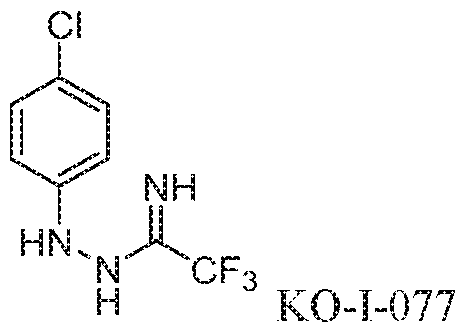
[00311] To a solution (4-chlorophenyi)hydrazine hydrochloride (1 g, 5.59 mmol, 1.00 equiv.) in MeOH/THF (1 : 1, 20 mL/20 mL) was added tnethylamme (0.587 mL, 6.15 mmol, 1.10 equiv.). The reaction was stirred at room temperature for 30 min. Then, 2,2,2-trifluoroacetamide was added and the reaction was stirred at room temperature for 24 h. Water was added and extracted with EtOAc (3x). The combined organic layers were washed with brine, dried
(MgS04), filtered, and concentrated. The crude product was purified by flash chromatog aphy on silica gel (hexanes/ethyl acetate 80:20) to obtain the title compound as brown oil (887 mg, 3,74 mmol, 67%). ¾ NMR (500 MHz, CDCb) δ 7.19 (d, J = 8.7 Hz, 2H), 6.95 (d, ./ 8.8 Hz, 2H), 6.51 (fas, 1H), 4.54 (bs, 2H).
Example 140: l-(4-chlorophenyl)-3-(trifluoromethyl)-5-(2,3,6-trifluorophenyl)-lH-l,2,4- triazole

[00312] To a suspension of 2,3,6-trifluorobenzoic acid (200 mg, 1.14 mmol, 1.00 equiv.) in anhydrous dichloroniethane (1.43 mL) was added oxalyl chloride (0.10 mL, 1.14 mmol, 1.00 equiv.) and a catalytic amount of dimethylformamide (9 \iL, 0.114 mmol, 0.10 equiv). The reaction was stirred at reflux for 1 h. Then, the reaction was concentrated under reduce pressure. 1 ,4-dioxane (2.21 mL) was added, followed by the addition of triethyiamine (0.160 mL, 1.14 mmol, 1.00 equiv.) and N'-(4-chlorophenyl)-2,2,2-trifluoroacetimidohydrazide (225 mg, 0.95 mmol, 0.83 equiv.). The reaction was stirred at reflux for 42 h. After that, the reaction was concentrated under reduce pressure, water was added and extracted with EtOAc (3x). The combined organic layers were washed with brine, dried (MgSCH), filtered, and concentrated. The crude product was purified by flash chromatography on silica gel (hexanes/ethyl acetate 92:8) to obtain the title compound as brown oil (69 mg, 0.183 mmol, 19%). Ή NMR (500 MHz, CDCb) δ 7.41 (d, J = 8.6 Hz, 2H), 7.37 - 7.31 (m, 1H), 7.30 id. ./ 8.6 Hz, 2H), 6.95 (dt, ./ 9.0, 3.0 Hz, 1H). HRMS (ES+) calculated for CisHbClFeNs [M + H] 378,0227, found 378,0239.
Example 141 : 5-(3-chloro-2,6-difluorophenyl)-l-(4-chlorophenyl)-3-(trifluoromethyl)-1.H- 1,2,4-triazole

[00313] To a suspension of 3-chloro-2,6-difluorobenzoic acid (300 mg, 1.56 mmol, 1 .00 equiv.) in anhydrous dichloromethane ( 1.95 mL) was added oxalyl chloride (0.140 mL, 1.56 mmol, 1.00 equiv.) and a catalytic amount of dimethylformamide (12 μί, 0.156 mmol, 0.10 equiv). The reaction was stirred at reflux for 1 h. Then, the reaction was concentrated under reduce pressure. 1 ,4-dioxane (3.0 mL) was added, followed by the addition of triethyiamine (0.217 mL, 1.56 mmol, 1.00 equiv.) and N'-(4-chlorophenyl)-2,2,2-trifluoroacetimidohydrazide (308 mg, 1.30 mmol, 0.83 equiv.). 'The reaction was stirred at reflux for 42 h. After that, the
reaction was concentrated under reduce pressure, water was added and extracted with EtOAc (3x). The combined organic layers were washed with brine, dried (MgSCfo), filtered, and concentrated. The crude product was purified by flash chromatography on silica gel
(hexanes/ethyl acetate 95:5) to obtain the title compound as brown oil (90 mg, 0.228 mmol,
18%). ' Π NMR (500 MHz, CDCb) δ 7.5 - 7.54 (m, 1H), 7.40 (d, ./ 8.7 Hz, 2H), 7.30 (d, J = 8.6 Hz, 2H), 6.97 (t, ./ 8.6 Hz, 1H). i3C NMR (126 MHz, CDCb) o 158.58 (dd, ./ 255.5, 4.1 Hz), 155 ,86 (dd, .7 = 257.0, 5.9 Hz), 154 ,93 (q, J = 40.3 Hz), 145.39, 136.30, 134.86, 134.21 (d, J = 9.6 Hz), 130.05 , 125.31 , 1 18.98 (q, J = 270.7 Hz), 1 18,00 (dd, J= 18.1, 4.9 Hz), 1 12.94 (dd, J = 22.3, 4.3 Hz), 106.89 (t,■/ 19.5 Hz). MS (ES+): m/z = 394
Example 142: l-azido-4-chIorobenzene

[00314] To a solution of 4-chloroaniline (1.00 g, 7.80 mrnol, 1.00 equiv.) in water/ Acetonitrile (1 : 10, 1.56 mL/ 12.48 mL) was added aqueous solution (12 M) of HQ (3.9 mL). The solution was stirred at room temperature for 10 min. Then, NaNC (1.08 g, 15.6 mmol, 2.00 equiv) was added portion wise and the mixture was stirred at room temperature for Ih. After that, at 0°C NaNb was added portion wise and the reaction was stirred at 0°C for 1 h and at room temperature for 1 h. Water was added and the reaction was concentrated under reduce pressure to eliminate acetonitrile. The remaining aqueous solution was extracted with CH2CI2. Tlie combined organic layers were washed with brine, dried (MgSC ), filtered, and concentrated to give without further purification the title compound as brown solid (874 mg, 5.69 mmol, 73%). 'H NMR (500 MHz, CDCb) δ 7.32 (d, J= 8.7 Hz, 2H), 6,96 (d, J= 8.7 Hz, 2H),
-3-ethynyl-2,4-difluorobenzene

[00315] To a solution of 3-chloro-2,6-difluorobenzaldehyde (301 mg, 1.71 mmol, 1.00 equiv.) and K2CO3 (473 mg, 3.42 mmol, 2.00 equiv.) in anhydrous MeOH (20 mL) was added dimethyl (l~diazo-2~oxopropyi)phosphonate (496 mg, 2.60 mmol, 1 ,5 equiv.). The reaction was stirred at room temperature for 2 h. Et20 (40 mL) and a solution (1 M) of NaHCCh (40 mL) were added. The aqueous was extracted with EteO (3x). The combined organic layers were washed with
brine, dried (MgS04), filtered, and concentrated to give without further purification the title compound as white solid (281 mg, 1.63 mmol, 95%). ¾ NMR (500 MHz, CDCh) 5 7.36 - 7.31 (m, i l l ). 6.90 - 6,84 (m, 1H), 3.57 (s, 1H),
Example 44: 5-(3-chIoro-2,6-difluorophenyl)-l-(4-chIorophenyl)-1.H-l,2,3-triazoIe

[00316] To a solution of l-chloro-3-ethynyl-2,4-difluorobenzene (100 mg, 0.580 mmol, 1.00 equiv.) and 1 -azido-4-chlorobenzene (98 mg, 0.637 mmol, 1.10 equiv.) in anhydrous DMSO (2.10 mL) was added potassium ferf-butoxide (13 rng, 0.116, 0.20 equiv.). The reaction was stirred at room temperature for 39 h. Water was added and extracted with EtOAc (3x). The combined organic layers were washed with brine, dried (MgSCU), filtered, and concentrated. The crude product was purified by flash chromatography on silica gel (hexanes/ethyl acetate 85: 15) to obtain the title compound as orange solid (47.6 mg, 0.147 mmol, 25%). ¾ NMR (500 MHz, CDCb) δ 7,94 (s, 1H), 7.52 - 7.44 (m, 1H), 7.40 (d, J = 8,7 Hz, 2H), 7,28 (d, ./ = 8.7 Hz, 2H), 6.95 - 6.91 (m, 1H). FIRMS (ES+) calculated for C14H8CI2F2N3 [M H | ' 326.0058, found 326.0073.
Example 145: l-(4-chlorophenyl)-2-methyl-5-(2,3,6-trifluorophenyI)-4H-l !i-imiclazoIe

[00317] This compound was prepared using the schemes and reactions described herein. Example 146: l-(4-ChIorophenyl)-2-methyl-5-(2,3,6-iriiiuoropheoyl)-lH-imidazGle

Example 147: l-(4-ChIoropheoyl)-5-(2,6-difluorophen S)-4-methyl-lH-imidazole

[00319] Following synthetic procedure D using (E)-N-(4-chlorophen-yl)-l-(2,6- difluorophenyl)methanimine (0.618 g, 2.46 mmol), purification by silica gel column
chromatography (hexanes/EtOAc 65:35) afforded the title compound as an orange solid (0.292 g, 0,958 mmol, 39% yield). !H NMR (500 MHz, CDCb) δ 7.72 (s, I I I). 7.36-7,28 (m, i l l).
7.32-7.25 (m, 2H), 7.08-7.01 (m, 2H), 6,93-6.83 (m, 2H), 2.21 (s, 3H) ppm. i3C NMR (126 MHz, CDCb) δ 160.61 (dd, J - 250.3, 6.3 Hz), 140.19, 137.61, 135.40, 133.91 , 131.00 (t, J ! 0.2 1 1/}. 129.63, 125.7, 116.13, 111.74 (dd, J = 20.1, 5.3 Hz), 107.53 (t, J = 20.0 Hz), 13.44 ppm. IR (KBr) v 3105, 2921, 285 , 1692, 1630, 1590, 1569, 1498, 1479, 1461, 1274, 1235, 1091, 997 cm"1, HRMS (ES÷) calculated for C16H12CIF2N2 [M + H 305.0657, found 305,0661. Example 148: 5-(2,6-Difluorophenyl)-l-phenyI-lH-imidazoIe

F
N
F
[00320] Following synthetic procedure C using (E)-l-(2,6-difluorophenyl)-N-phenyl- methanimine (0.600 g, 2.76 mmol), purification by silica gel column chromatography
(hexanes/EtOAc 65:35) afforded the title compound as an orange solid (0.193 g, 0.753 mmol, 27% yield). 'H NMR (500 MHz, CDCb) δ 7.84 (s, 1H), 7.41-7.34 (m, 3H), 7.34 (s, 1H), 7.34-7.25 (m, 1H), 7.21-7.15 (m, 2H), 6,91-6.83 (m, 2H) ppm. 13C NMR (126 MHz, CDCb) δ 160.55 (dd, J = 250.5, 6.2 Hz), 138.99, 136.71, 132.15, 130.67 (t, J = 10,2 Hz), 129.46, 128.25, 124.59, 120.06, 111.61 (dd, J = 20.4, 5.0 Hz), 107.65 (t, J = 19.7 Hz) ppm. IR (KBr) v 3103, 3070, 3045, 2916, 2848, 1631, 1597, 1563, 1498, 1470, 1447, 1278, 1255, 1236, 1216, 1116, 1077, 998 cm" 1. HRMS ( l-.S ) calculated for C15H11F2N2 [M + Hf 257.0890, found 257.0881.
l-(2~ChIorophe5i S)-5-(2,6-difluorophenyl)~lI-I-im!dazole

[00321] Following synthetic procedure C using (E)-N-(2-chlorophenyl)-l-(2,6- difluorophenyljmethanimine (0.600 g, 2.38 mmol), purification by silica gel column chromatography (hexanes EtOAc 65:35) afforded the title compound as a yellow solid (0.478 g, 1.64 mmol, 69% yield). ¾ NMR (500 MHz, CDCb) δ 7.72 (s, 1H), 7.41-7.37 (m, 1H), 7.32-7.24 (m, 2H), 7,25-7.14 (m, 3FI), 6.82-6.74 (m, 2H) ppm , 13C NMR (126 MHz. CDCb) δ 160.49 (dd, J = 250.9, 6.1 Hz), 139.5, 134.11, 131.55, 131.53, 130.68 (t, J = 10.2 FIz), 130.54, 130.13, 129.00, 127.44, 121.01, 111.52 (dd, J = 20.3, 5.0 Hz), 107.32 (t, J = 19.4 Hz) ppm. IR (KBr) v 3104, 3062, 1632, 1587, 1566, 1491, 1467, 1444, 1275, 1235, 1213, 1110, 1089, 1045, 999 cm-1. FIRMS (ES÷) calculated for C .-I l i st" Ί Γ N · [M + Fi]+ 291.0501, found 291.0494, Example 150: 4-C loro-l-(4-c SorophenyI)~2-methyl-5-(2,4,6-trifii!orophenyl)-lH- imidazole
- I l l -

[00322] Following synthetic procedure F using 4-chloro-l-(4-chlorophenyl)-5-(2,4,6- trifluorophenyl)- lH-imidazole (0.100 g, 0.290 mmol), purification by silica gel column chromatography (hexanes EtOAc 90: 10 to 70:30) afforded the title compound as a white solid (9 mg, 9% yield). ¾ N .MR (500 MHz, CDCI3) δ 7.81 (s, IH), 7.37 (d, J = 8.4 Hz, 2H), 7.10 (d, J 8.4 Hz, 21 1). 6.66 (t, J = 9.0 Hz, IH), 2.12 (s, 3H) ppm. i3C NMR (126 MHz, CDCb) 0 163.87 (dt, J = 253.2, 15.3 Hz, 1 C), 161.27 (ddd, J = 252.3, 15.1, 8.5 Hz), 145,85, 135.65, 134.21 , 130.25, 129.96, 128.37, 115.30, 102.36 (td, J = 20.6, 4.2 Hz), 101.05-100.60 (m), 14.02 ppm. IR (KBr) v 2962, 2927, 2852, 1644, 1585, 1495, 1442, 1400, 1122, 1038, 999 cm"1. HRMS (ES÷) calculated for C16H10CI2F3N2 [M + Η | · 357.0173, found 357.0171.
~C !oro~l-(4-chSoro-2-fluorophe5i S)-5-(2,6-d!fluorophenyl)~lI-I-imidazole

[00323] Following synthetic procedure E using l-(4-chloro-2-fluorophenyl)-5-(2,6- difluorophenyl)-lH-imidazole (0.351 g, 1.14 mmol), purification by silica gel column chromatography (hexanes/EtOAc 100:0 to 80:20) afforded the title compound as a yellow solid (0.025 g, 0.073 mmol, 6% yield). 1 1 N MR (500 MHz, CDCb) δ 7.31-7.26 (m, IH), 7.22 (s, I H), 7.19 (d, J = 9.3 Hz, I I I ). 7.15 (d, J = 3.1 Hz, 2H), 6.85 (t, J 7.6 Hz, 21 1) pprn. 13C NMR (126 MHz, CDCb) δ 160,60 (dd, J = 251.4, 5,9 Hz), 157.37 (d, J = 257.9 Hz), 136.78 (d, J = 9.2 Hz), 134,86, 13 .52 (t, J = 10.3 Hz), 130.78, 130,32, 125.13, 125 , 10, 122,95, 121.74 (d, J = 13.0 i !/). 1 17.73 (d, J = 23.1 Hz), 1 11.69 (dd, J - 20.5, 5.0 Hz), 106.50 (t, J = 19.5 Hz) ppm. IR (KBr) v 3104, 3071, 2936, 2860, 1683, 1652, 1634, 1587, 1558, 1538, 1505 cm"!. HRMS (ES+) calculated for CisHsCkFsNi [M + Hf 343,0017, found 343 ,0013,
Example 52: 4-Chloro-l-(4~chloro-2~fluorophenyl)~5-(2,6-difluorophe5iyS)-lH-miidazoSe

[00324] Following synthetic procedure E using l~(4-chloro-2~fluorophenyl)~5-(2,6- difluorophenyl)-lH-imidazole (0.351 g, 1.14 mmol), purification by silica gel column chromatography (hexanes/EtOAc 100:0 to 80:20) afforded the title compound as a yellow solid (0.126 g, 0.367 mmol, 32% yield). Ή ΝΜΚ (500 M-iz, CDCb) δ 7,65 (s, I H), 7.38-7.33 (m, H i ). 7.19-7.17 (m, IH), 7.13 (q, J = 6.4 Hz, 2H), 6.90 (t, J = 7.8 Hz, 2H) ppm. i3C NMR (126 MHz, CDCB) 5 160.74 (dd, J = 252.5, 5.9 Hz), 156.36 (d, J = 256.9 Hz), 137.49, 136.16 (d, J =9,2 Hz), 132.18, 132.13 (t, J = 10.1 Hz), 128 ,61, 125.34 (d, J = 3.7 Hz), 122.69 (d, J = 12,6 Hz), 117.87 (d, J = 22.8 Hz), 1 16.88, 1 1 1 ,80 (dd, J =20.6, 4.5 Hz), 105.04 (t, J = 19.6 Hz) ppm. 1R (KBr) v 3105, 2932, 1683, 1652, 1634, 1590, 1568, 1506 cm-1. HRMS (ES^) calculated for C15H8CI2F3N2 | \ i + ! ! | 343.0017, found 343.0018.
4-Ch!oro-l-i2~chlorophenyI)"5-(2,6-difluorop enyI)-lH-imidazoIe

[00325] Following synthetic procedure E using l-(2-chlorophenyl)-5-(2,6-difluorophenyl)~ lH~ imidazole (0.260 g, 0.894 mmol), purification by silica gel column chromatography
(hexanes/EtOAc 75 :25) afforded the title compound as a white solid (0.187 g, 0.575 mmol, 64% yield). Ή NMR (500 MHz, CDCb) δ 7.63 (s, IH), 7.42 (d, J = 7.9 Hz, IH), 7.36-7.29 (m, 21 1 ). 7.29-7.26 (m, 2H), 6,85 (t, J = 8 ,6 Hz, 2H) ppm. !3C NMR (126 MHz, CDC33) 6 160,77 (dd, J = 252,5, 5 ,9 Hz), 137.58, 133.55, 131.88 (t, J = 10.2 Hz), 131 .70, 131.67, 130.73, 130.61 , 129, 10, 127.60, 1 17.02, 1 1 1.64 (dd, J = 21.8, 3.6 Hz), 105.35 (t, J = 19.5 Hz) ppm. IR (KBr) v 3129, 3052, 2988, 2922, 2846, 1633, 1589, 1568, 1492, 1471, 1455, 1266, 1238, 1003 cm"1. HRMS ( KS ) calculated for C15H9CI2F2N2 [M + Hf 325.01 1 1 , found 325.01 11 .
Example 154: 2~C !oro~1 -(2-chSorophenyI)-5~(2,6~difloorophenyI)-l H-imidazoIe

[00326] Following synthetic procedure E using l-(2-ch3orophenyl)-5-(2,6-diiluorophenyl)- lH- imidazole (0.260 g, 0.894 mmol), purification by silica gel column chromatography
(hexanes/EtOAc 75 :25) afforded the title compound as a white solid (0.026 g, 0.080 mmol, 9% yield). S ί W i R ( 50( 1 MHz, CDCb) δ 7.40 (d, J = 8.0 Hz, 1H), 7.36-7.27 (m, 3H), 7.25-7.16 (m, 2H), 6.79 (t, J = 7.7 Hz, 2H) ppm. 13C N .M R (126 MHz, CDCb) δ 160.72 (dd, J = 251.5, 5.8 Hz), 134.75, 133.21 , 132.81, 131 .34 (t, J = 10.2 Hz), 131.06, 130.51, 130.44, 130.32, 127.44, 122.84, 11 1.53 {dd. J 20.6. 5.1 Hz), 106.87 (t, J = 19.5 Hz) ppm. IR (KBr) v 2916, 2852, 1633, 1587, 1487, 1468, 1435, 1383, 1313, 1277, 1235, 1000 cm"!. HRMS (ES+) calculated for
C15H9CI2F2N2 [M + H | 32,5.01 1 1, found 325.01 19.
2,4-Dic !oro~l -(2-chlorop enyI)-5~(2,6~difliioropheny!)-l H~iniidazo!e

[00327] Following synthetic procedure E using 4-chloro-l-(2-chlorophenyl)-5-(2,6- difluorophenyl)-l H-imidazole (0.060 g, 0.1 84 mmol), purification by silica gel column chromatography (hexanes EtOAc 80:20) afforded the title compound as a white solid (0.047 g,
0.131 mmol, 7 1 % yield ). H W I R (500 MHz, CDCb) δ 7.44 (d, J = 7.9 Hz, 1H), 7.40-7.27 (m, 4H), 6.88 (t, J = 8.5 Hz, 1H), 6,82 (t, J = 8.6 Hz, 1H) ppm. i3C NMR (126 MHz, CDCb) δ
161.07 (dd, J == 254.4, 5.9 Hz), 133.1 1, 133.08, 132.37 (t, J = 1 1.2 Hz), 131.53, 130.56, 130.39, 130.24, 130.22, 127.62, 1 18.89, 11 1.95 (dd, J = 21.7, 3.5 Hz), 1 11.41 (dd, J = 21.8, 3.7 Hz), 104.92 (t, J = 19.8 Hz) ppm. IR (KBr) v 3073, 2918, 2853, 1633, 1588, 1487, 1466, 1439, 1384, 1278, 1237, 1002 cm"1. HRMS (ES+) calculated for ( ,ΠΗ( Ρ Γ · \ > \M + H]+ 358.9721 , found
358.9717.
Example 156
[00328] Compounds discussed herein were tested for microtubule activity, inhibition of cyclooxygenase-derived eicosanoid production and inhibition of 5-lipoxygenase-derived eicosanoid production activity.
1003291 QBI-293 Cell Culture
[00330] QBI-293 cells, a derivative of HEK-293 ceils, were maintained in Dulbecco's Modified Eagle's Medium (Mediated! Inc, Manassas, VA, USA) containing 10% fetal bovine serum (FBS) (Atlanta, Biologicals, Lawrenceville, GA, USA), 2 raM L-glutamine (Mediatech), 50 units/mi penicillin, and 50 ^tg/ml streptomycin (1 % penicillin/streptomycin; Thermo Fisher Scientific, altham, MA, USA). For compound testing, cells were dissociated with
trypsin EDTA (Thermo Fisher Scientific) and plated at a density of 6 x 10⁵ cells/well in 6-well plates. After overnight incubation, the medium was aspirated and fresh medium containing vehicle (DMSO) or test compound was added. Cells were maintained at 37°C in a humidified atmosphere (5% CO2) for all experiments.
[00331] Extraction of Whole-Cell Lysates
[00332] To obtain whole-cell extracts from QBI-293 cells, cells were washed once with IX phosphate-buffered saline (PBS), (pH 7.4) and then lysed in 200 id R1PA buffer containing protease inhibitor cocktail (Sigma-Aldrich, St. Louis, MO), 1 mM phenyl methyl sulfonyl fluoride (Sigma-Aldrich), and 1 μΜ Trichostatin A (Sigma-Aldrich). Lysed cells were scraped into 1 .5 ml Beckman ultracentrifuge tubes (Beckman, Brea, CA, USA), briefly sonicated, and centrifuged at 100,000 x g for 30 min at 4°C. Following centrifugation, the supernatant from each sample was collected and analyzed for protein content by BCA assay.
[00333] Acetyl- and Alpha- Tubulin ELISA
[00334] For sandwich ELISA analysis of acety l- and alpha-tubulin levels, 384-well plates were coated with I 2G10 a-tubulin antibody (10 jig/ml; Covance, Princeton, NJ, USA) in 30 μΐ of cold 0.1 M bicarbonate buffer. 12G10 anti-a-tubulin antibody was originally deposited to the Developmental Studies Hybridoma Bank. After overnight incubation at 4°C, the plates were blocked in Block Ace solution (Bio-Rad, Hercules, CA, USA) for a minimum of 24 hours at 4°C. QBI-293 cell homogenates were diluted in C buffer (0.02 M sodium phosphate, 2 mM EDTA, 0.4 M Nad, 1 % BSA, 0.005% Thimerosal, pH 7.0). Typically two-fold dilutions from 266 ng/μΐ to 22.2 ng/μΐ total protein were prepared and 30 μΐ of sample were added to wells in duplicate. Plates were sealed, centrifuged, and incubated overnight at 4°C. Following incubation with antigen, wells were aspirated and washed with PBS containing 0.05% Tween-20 and 0.005% thimerosal (PBS-Tween buffer). A horseradish peroxidase (HRP)-acetyl-tubulin reporter antibody was prepared by conjugating acetyl-tubulin primary antibody (Sigma Aldrich; clone 6- 1 IB- 1 ) to HRP using a commercially available peroxidase labeling kit (Roche Applied Science, Indianapolis, IN, USA). The HRP -acetyl-tubulin reporter antibody ( 1 : 1,000 v/v) or pre-
conjugated HRP-alpha-tubulin (1 :5,000 v/v: Protein Tech Group, Chicago, IL, USA) diluted in C buffer was added to appropriate wells (30 μΐ per well). The plates were sealed and incubated at room temperature for 4 hours on a platform, rocke , followed by washing with PBS-Tween buffer. Peroxidase substrate solution (KPL, Gaithersburg, MD, USA) was added to each well and the reaction was quenched after 10 min with 10% phosphoric acid. Plates were read on a SpectraMax M5 plate reader at an absorbance of 450 nm. The amount of acetyl- and aipha- tubulin protein in each sample was interpolated using standard curves generated from serial dilutions of known protein standard (acetyl- or alpha-tubulin) concentrations.
[00335] Eicosanoid Measurements
[00336] Determination of 5-LOX and COX- 1 inhibition by test compounds was via the utilization of an established RBL-1 cell assay (Tries et al., Inflammation research 51 , 135-143, 2002). Briefly, rat basophilic leukemia (RBL-1 ) cells were cultured in RPMI-1640 medium supplemented with 10% fetal bovine serum (FBS), 50 U/mL penicillin, 0.05 mg/mL
streptomycin, and 1 mM L-glutamine. For COX/LOX activity assays, RBL-1 cells were plated into 24-well plate at ~ 9 x 1 5 cells / well in growth media. After 2 h, cells were incubated with the test compounds at indicated concentrations at 37°C for 2 h. Following pre-incubation with the test compounds, COX/LOX product formation was induced by incubating cells with 12 μΜ calcium ionophore, A23187, at 37 °C for 15 min. Cell culture supernatants (200 μΐ,/well) were then collected and extracted by adding 600 methanol containing 0.01% BHT (butylated hydroxytoluene). Samples were vortexed and centrifuged at 17,000 x g for 10 min. Supernatants were collected and dried under vacuum. Dried samples were dissolved in 50% acetonitrile and analyzed by LC-MS/MS. Reverse-phase HPLC was performed with a C I 8 column (Waters Acquity UPLC BEH, CI 8, 1.7 urn, 2.1 x 50 mm, Miiford, MA) using a gradient elution on a Waters Acquity UPLC system (Waters Corporation, Miiford, MA). The mobile phase consisted of solvent A: 10 mM ammonium formate and solvent B; acetonitrile. The samples were injected using an autosampler with injection volumes of 10 yL. The flow rate was maintained at 0.6 mL/min. The column was eluted using a gradient of 5-95% solvent B over 2 min. The HPLC eluent was directly introduced into a Waters triple quadruple mass spectrometer (Waters Corporation, Miiford, MA). The parent (PGDi: 351.212 and I.TB4: 335. 154) and daughter (PGD2: 315.251 and LTB4: 195.156) ions were detected in the multiple reaction monitoring (MRM) mode. Data for PGD2 and LTB4 were acquired simultaneously from a single injection. Chromatographic data were analyzed by MassLynx software (Waters corporation, Miiford MA) to integrate each MRM chromatogram. The amounts of PGD2 and I.TB4 products were
quantified using the slope intercept equation from linear standard curves of PGD2 and LTB,, respectively.
[00337] Determination of Plasma and Brain Compound Concentrations
[00338] Mouse brains were homogenized in 10 mM ammonium acetate, pH 5.7 (1 :2; w/'v) using a handheld sonic homogenizes Mouse plasma was obtained from blood that was collected into a 1.5 mi tube containing 0.5M EDTA solution and which was centrifuged for 10 minutes at 4500g at 4°C, Aliquots (50 μΐ) of brain homogenates or plasma were mixed with 0.2 ml of acetonitrile, centrifuged at 15,000g, and the resulting supernatant was used for subsequent LC~ MS/MS analysis. The LC-MS/MS system was comprised of an Aquity UPLC and a TQ MS that was controlled using MassLvnx software (Waters Corporation, Miiford, MA, USA). Compounds were detected using multiple reaction monitoring (MRM) of their specific collision-induced ion transitions. Samples were separated on an Aquity BEH CI 8 column (1.7 μηι, 2.1 x 50 mm) at 35°C. Operation was in positive electrospray ionization mode, with mobile phase A of 0.1% (v/v) formic acid, and B of either acetonitrile or methanol with 0.1% (v/v) formic acid.
Injections of 5 μΐ were separated at a flow rate of 0.6 mL/min using a gradient from 5% to 95% B over two minutes, followed by wash and re -equilibration steps. The MS was operated with a desolvation temperature of 450°C and a source temperature of 150°C. Desolvation and source nitrogen gas flows were 900 L/hr and 50 L/hr, respectively. Source and MS/MS voltages were optimized for each compound using the MassLvnx auto tune utility. To account for possible matrix effects on analytes, standard curves were generated for each compound from brain homogenate and plasma samples that had compound added at 4, 40, 400 and 4000 ng/mL. The standard curve samples were extracted and analyzed in an identical fashion as the corresponding tissue-derived samples, and peak areas were plotted against concentration and a 1/x weighted linear regression curve was used to obtain estimated concentrations of the tissue-derived samples using the average peak area from triplicate injections. In all cases, the tissue-derived sample peak areas fell within the linear portion of standard curves that were prepared and analyzed concurrently with the samples.
[00339] The compounds of Examples 1-32, 132, and 133 are synthetic intermediates. The results for certain of the other compounds are set forth in Table 10.
Table 10
Active
Active Dose(s) Dose(s) in Cox/Lox %
Example Structure in Acetyl- Alpha- Inhibition
Tubulin Assay Tubulin at 10 uM
Assay


Example 156
[00340] (i) Chemistr '
1003411 A library of imidazoles was synthesized, including 36 known compounds (compounds 2, 25, 29-31, 35, 36, 38, 43-46, 51, 54, 55, 57, 58, 61, 62, 64, 65, 67, 68, 70, 71, 73, 74, 83-86, 88, 92, 94, 95, and 97 of Table 11), most with reported antifungal activity (La iberth, Synthesis and fungicidal activity of tubulin polymerisation promoters. Part 3: imidazoles. Bioorg. Med. Chem. 2013, 21, 127- 134) or antimicrobial activity, as well as 45 new compounds (compounds 26-28, 32-34, 37, 39-42, 47-50, 52, 53, 56, 59, 60, 63, 66, 69, 72, 75-82, 87, 89-91, 93, 96, 98-104 of Table 1 1). In general, the synthesis of the 1,5-diarylimidazoles was conducted
following the Van Leusen imidazole synthesis. See, Van Leusen, Chemistry of sulfonvlmethyl isocyanides. 12.
[00342] Base-induced cycloaddition of sulfonylmethyl isocyanides to carbon, nitrogen double bonds. Synthesis of 1 ,5-disubstituted and 1,4,5-trisubstituted imidazoles from aldimines and imidoyl chlorides. J. Org. Chem. 1977, 42, 1153-1 159. Thus, after condensation of the appropriate aryi-amine and benzaidehyde, the resulting Schiffbase (compounds 5-24 of Scheme 3) was cyclized in the presence of toluenesulfonylmethyl isocyanide (TosMIC) to form, the 1,5- diarylimidazole (cmpounds 25-28, 32, 33, 37-43, and 47-53 of Scheme 3). Further derivatizations of the imidazole ring included the introduction of small alkyl groups and/or halogens in position 2 and/or 4 (compounds 29-31, 34-36, and 44-46 in Scheme 3 and compounds 54-104 i Scheme 4). imidazole derivatives bearing a methyl substituent at C4 were accessed by employing the appropriately C-substituted TosMIC reagent during the cyclization step (compounds 29, 35, and 44), while alkylated derivatives at C2 (compounds 34 and 86) were obtained by treating the appropriate 1,5-diarylimidazole with LDA followed by addition of the desired alkyl iodide. Finally, halogenation of the imidazole ring was accomplished upon treatment with N-chlorosuccinimide. When the halogenation was carried out on imidazoles that were not substituted at C2 and C4, the reaction typically proceeded with the generation of separable mixtures of mono- and dichlorin es.


3 Inhibition of COX pathway was determined by monitoring via LC/MS/MS analyses the combined production of COX-derived PGD2 and PGE2 in RBL-i upon stimulation with
arachidonic acid in the presence or absence of test compounds, with all samples run in at least triplicate.
" Inhibition of 5-LQX pathway was determined by monitoring via LC/MS/MS analyses the production of 5-LOX-derived LTB4 in RBL-1 upon stimulation with arachidonic acid in the presence or absence of test compounds, with all samples run in at least triplicate.
c MT-stabilizing activity in QBi-293 cells was determined by monitoring via ELISA the relative changes in acetylated a-tubulin levels in response to 4-hour treatment with test compounds, with all samples run in at least triplicate.
d Relative changes in total a-tubulin, as determined by tubulin ELISA, in response to compound treatment, with all samples run in at least triplicate.
§ compound tested at 10 nM.
*P < 0.05; **P < 0.01 compared with vehicle (DMSO)-treated controls as determined using an two-tailed unpaired t-test; NS: not significant; ND: not determined. scheme

A = 4-chlorophenyl; 8 = 2,4,S-trifliiorophenyi (S) H; Y = = 4-ch!orophenyi; B = 2,4,6-irifiuoropheiiyl (25)
A = 4-met ox phenyl; B = 2,4,6-irifiuoVophenyl (S) H; Y = = 4-methoxyphenyl; B = 2.4,S-irifluorophersyi (26)
A = 4-chlorophenyl; B = 2,6-diflUQro-3-meihylphenyi (7) H; Y = = 4-chiorophenyi; B = 2,S-dif!ifora-3-maihyipheny! (27)
A = 4-chlorop eFsyi; 8 = 3-chloro-2,6-difi_orophenyl (8} H; Y = = 4-ch!orophenyi; 13 = 3-ch!oro-2,6-dlfliiorophenyl (28)
A = 4-ehlarophenyl; B = 3-bromo-2,6-di{iuorophenyl (8) H; Y = = 4-chiorophenyl; B = 3-c loro-2,S-difiuorophenyi (29)
A - 4-chloraphenyl; B = 2,3,6-trtfluoropheny1 (10) CI; Y = ¾ = 4-chiorop enyi; 8 = 3-ch!oro-2,8-difiuoraphsnyl (30)■*—
A = 4"Chloro-3-fluorophenyl; 8 = 2,3,8-trlfluorapheny! (11) Me; Y = e; j A = 4-chloropheFsyi; 8 = 3-chloro-2,6-difiuorophenyl (31 -
A = 6-chk>ropyridin-3-yl; B = 2,4,8-trifiuorophenyi (12) H; Y = H; A = = 4-oh!orophenyi; B = 3-tsromo-2,6-difluorophenyl (32)
A = 4-chloroohenyl; 8 = 4-fiuorophenvl (13) H; Y = H; A = = 4-ch!oropheriyi; 8 = 2,3,8-irif!i!Orophenyl (33) — "~i
A = 4-chloro-2-fiuorophenyl; B = 2,6-difluorophenyi (14) Ms; Y = H; A = 4-chlorophenyl; S = 2,3,6-trlfluorophenyl (34)*— 1
A = 4-ohloropheFSyi; 8 = 2,5-dif!uorophenyi (15) H; Y = Me; A = 4-chlorophenyl; B = 2,3.6-5ri!luoraphe!iyl (35)—
A = 4-{trif!iioramethoxy)pheny!; B = 2,6-dif!uoropheny! (16) CI; Y = Me; A - 4-ch!orophenyi; 8 = 2,3,6-trifluorophenyi (38) ■«— ---J
A = 4-chloraphenyl; B = 2,6-dffliiorapheriyi (17) H; Y = H 4- chioro-3-f!uoraphertyi; B = 2,3,6-trif!iiorophenyi (37)
A = 4-(trifiuoromethoxy)phenyl; B = 2,3,6-irifluorcphenyl (18) H; Y = H 5- chloropyridin-3-yl; B = 2,4.S-trifluorophenyl (38)
A = 4-cliloraphenyl; 8 = 2,6-drfluoro-4-methylphenyl (19) H; Y = H 4-ch!orophenyl; 8 = 4-f!uoropheny! (39)
A = 4-chlorophenyl; 8 = 2,6-dif!uQro-3-meihoxyphenyi (20) H; Y = H 4-chloro-2-fluoraphertyi; 8 = 2,6-dHiuorophenyl (48)
A = 4-chlorophenyl; B = phenyl (21) H: Y = H 4-chiorophenyi; B = 2,S-di!iuorophenyl (41)
A = 4-ehlGFOpheriy!; 8 = 4-meihoxyphenyl (22) H; Y = H 4-(trifluoromethoxy)phenyl; B = 2,6-dinuorophenyl (42)
A = phenyl; 8 = 2,6-diiluoropheny! (23) H; Y = H 4-chtorophenyl: = 2,6-difi_orophenyl (43)
A = 2-eh!orophenyi; B = 2,6-diiluoFophenyi (24) H; Y = Ms; A : = 4-chloraphenyl; S = 2,6-difluorophenyl (44) ~~~ ~~i
CI; Y = Me; A = 4-chlorophenyl; = 2,8-diiluorophenyi (45) " Me; ¥ i ~ 4-chloraphenyl; B = e-diflucraphercyi (4SV*- J H; Y = 4-(trifluoromethoxy)phenyl; B = 2,3,8-trifluorapheny! (47) H: Y = 4-chiorophenyi; B - 2,6-d!fitioro-4-methyiphenyl (48) H; Y = 4-chiorophenyi; B = 2,6-d!fiuoro-3-rnetho)iyphenyl (4S) H; Y = 4-chlorophenyi; 8 = phenyl (50)
H; Y = 4-chiorophenyi; B = 4- methoxypheny! (S1)
H; Y = phenyl; B = 2,6-diBuorophenyl (52)
H; Y = A = 2-ch!orophenyi: S = 2,6-diiluorophenyl (53)
* Reagents and reaction conditions: (a) Dean-Stark apparatus, toluene, 110 °C, 4 days, 99 4 A molecular sieves, Et20, 30 °C, 48 h, 99%; (c) appropriate TosMTC reagent, K2CO3,
DMF/l,2-dimethoxyethane, 100 °C, 16 h, 7-90%; (d) N-chlorosuccimmide, CHCh,60 °C, 16 h,
43-71%; (e) LDA, methyliodide, THF, -20 °C to rt, 1.5 h, 29-56%.

H; = 4-chlorophenyl; B = 2,4,6-trifluorophenyi (§4) g— i Me; Y i =. 4-chiorophenyi; B = 2,4,8-trifiiiorepheny! (55)■" 1 ~ Me; Y i ~ 4-chlorophenyi; B ~ 2,6-difluoro-4-methoxyp enyj (2) C!; : = 4-chiorophenyl; = 2,4,8-trifiuorophenyi (56)
Cl; A = 4-chlarophenyi; B = 2,4,6-trifluorophenyl (§7)
= 4-chiorophenyi; = 2,8-dsfiuoro-4-meihoxypheriyi (58) ■
Y = CI; A : = 4-meSho)«yphenyi; = 2,4,6-lrifluoroprienyi (59)
C!; Y = H; = 4-meShoxyphenyl; B = 2,4,8-trifiuorop eny! (60)
= 4-methoxyphenyl; B = 2,4,6-trifluorophenyl (61)
H; Y = C!; A = 4-c lorophenyi; B = 2,8-di uoro-3-meihylphenyl (62}
A = 4-chlorophenyl; B = 2,6-difluoro-3-methylphenyl (63)
H; Y = Ci; A = 4-chlorophenyl; B = 3-ch!oro-2,6-dififjGroprienyi (64)—
Me; ; i \ = 4-chlorophenyi; B = 3-chioro-2,6-difluoropbenyi (SS) *
A = 4-chlorophenyi; B = 3-chloro-2,6-difiuoropher!yi (66)
H; Y = A = 4-ch!orophenyi; B = 3-bromo-2,6-diiii_orophenyl (§7) H; Y = Ci; A = 4-chlorophenyl; B = 2,3,8-trif!uorophersyi (S8)
= 4-chlorophenyl; B = 2,3,6-iri?!uorophenyi (69)
H; Y = A = 4-chloro-3-fluoroph8ny!; B = 2,3,S-iriiiuorophenyi (70)—
Me; \ ~ 4-chloro-3-fluorophenyl; ~ 2,3,6-trifliiorophenyl (71) C!; Y =H; A : = 4-chioro-3-fiiiorophenyi; B = 2,3,6-trifiiiorophenyi (72)
= 6-chloropyridin-3-yi; B = 2,4,6-trifiiiorophenyl (73)
Me; ; i \ = e-chloropyridin-3-yl; B = 2,4,6-trifluorophenyl (74)
C!; Y = H; A = 4-ch!orophenyi; B = 4-fiuorophenyi (75)
H; Y = Ci; A = 4-chlorophenyl; B = 4-fiuorophenyi (78)
= 4-chloro-2-fliiorop eny!; B = 2,6-difk uorophenyi (77)
H; = 4-chloro-2-fluoropiienyi; B = 2,6-difl ui orophenyl (78) C!; Y = H; A = 4-chiorophenyi; B = 2,5-difluorophenyi (7 )
H; Y = Ci; A ~ 4-chlorophenyl; B = 2,5-difiuorophenyi (80)
H; Y = Ci; A = 4-(trifluoromethoxy)phenyl; B = 2,6-difluoroprieny! (81)
A = 4-(trifluoromethoxy)phenyl; B = 2,6-difluoroprienyi (82)
4-(trifluoromethoxy)phenyl; B = 2,8-difliiorophenyi (83)
Y = Ci; A 4-chlorophenyl; B = 2,6-difluorophenyl (84)—
Me: = 4-chiorophenyi; B = 2,6-dif!iiorophenyi (85)- Ci; A = 4-chlorophenyi; B = 2,6-difiuorophenyl (86) «
Y H; A = 4-chlorophenyi; B = 2,8-di uoropbenyi (87)
Y = Ci = 4-chiorophenyl; B ~ 2,6-difiuorophenyl (88)
Y = Ci = 4-iirifluoromethoxy)phenyi; B = 2,3,6-trifluoropheny! (8S)
Y = H: = 4-(trifluoromethoxy)phenyl; B 2,3,8-trifiuorophenyl (90)
Y = Ci = 4-(irifiuoromethoxy)phenyi; B = 2,3,6-trifluorophenyl (91)
= CI = 4-chiorophenyl; B = 2,6-difluoro-4-meihylphenyi (92)
Y = H: = 4-chlorophenyl; B = 2,6-ditiuoro-4-meihyipheriy! (S3)
Y = Ci = 4-chlarophenyi; B = 2,6-difluoro-4-methylphenyl (94)
Y = Ci; = 4-chiorophenyi; B = 2,8-difiuoro-3-rriethoxyphenyi (9§) Y = H = 4-chlorophenyl; B = 2,6-difiuoro-3-methoxyphenyi (96)
Y = Ci = 4-chiorophenyi; B = 2,6-difiuoro-3-methoxyphenyi (W?)
■~ 4-chlorophenyl; B = phenyl (98)
= 4-chlorophenyi; B = phenyl (98)
Y = Ci : 4-chiorophenyl; B ~ phenyl ( 00)
Y = = CCiI 4-chiorophenyl; B = 4-metnoxyphenyi (101 )
= H; Y = Ci 2-chlorophenyl; B ~ 2,6-difiuorophenyi (102)- 2-chiorophenyi; B = 2,6-dKluorophenyl (103)
X = Ci; Y = Ci; A = 2-chlorophenyl; 8 = 2,6-diiiuorophenyl (104) .
[00343] * Reagents and reaction conditions: (a) N-chlorosuccinimide, CHC , 60 °C, 16 h, 9-77% for monohalogenation at C4, 3-18% for mono-halogenation at C2, and 2-20% for dihalogenation at C2/C4:(b) LDA, methyliodide, THF, -20 °C to r l .5h, 2-48%; (c) NaOMe, Me OH, THF, rt, 19 h, 33-97%; (d) LDA, ethyliodide, THF, -20 °C to ri . 1.5 h, 35%.
[00344] (ii) Structure- Activity Relationships
[00345] The MT-stabilizing activity of test compounds was determined in QB1-293 cells by monitoring compound-induced elevation in acetj lated a-tubulin (AcTub), which is a known
marker of stable MTs. See, Lou, Brain-penetrant, orally bioavailable microtubule-stabilizing small molecules are potential candidate therapeutics for Alzheimer's disease and related tauopathies. J. Med, Cheni. 2014, 57, 6116-6127 and Fukushima, Post-translational
modifications of tubulin in the nervous system. J. Neurochem. 2009, 109, 683-693. The effect of compound treatment on total a-tubulin was also monitored. Evaluation of compound inhibition of the biosynthesis of COX- and 5-LOX-derived eicosanoids was conducted in a modified rat basophilic leukemia (RBL-1) cell assay that has previously been described for the evaluation of 5-LOX, See, Tries, The mechanism of action of the new antiinflammatory compound ML3000: inhibition of 5-LOX and COX- 1/2. Inflammation Res. 2002, 51, 135- 143. It was found herein that it could be used to assess both COX-derived prostaglandins (PGs) and 5- LOX-derived leukotrienes (LTs) formed in the presence or absence of test compounds.
[00346] All compounds were initially screened at 1 and 10 μΜ concentration in the QBI cell MT assay and at 10 uM in the RBL-1 cell assay (Table 1 i). In tins initiai RBL-1 cell analysis, 5- LOX-derived LTB4 and COX-derived PGD2 and PGE2, which coeluted during LC/MS/MS, were quantified. Selected compounds (Table 12) exhibiting evidence of multitargeted activity underwent further confirmatory studies in the RBL-1 cell assay, which included
concentration-response testing, and further LC/MS/MS analyses using a refined protocol to individually detect and quantitate PGD2 and PGE2, as well as both LTB4 and l .TC Concurrent analysis of all four of these eicosanoids provides a convenient and reliable method to evaluate the overall effect of test compounds on COX and 5-LOX pathways in a cellular milieu. Several compounds in Table 12 were also assessed for their relative brain-to-plasma exposure levels after administration to mice.
Table 12
Further evaluation of test compounds with multi-targeted activity as MT-stabilizing agents and/or inhibitors of COX and 5-LOX pathways.
PGD2/E2 LTB.t Acetyl-
Brain Plasma
Cpd# Structure Inhibition Inhibition Tubulin B/P
(nM) (nM)
ICso (μΜ) ICso O M) Assay
Multi- x 3.5 600Λ 500' 1.4
29 12.1 13.4 ± 300 ± 0.3 targeted (10 μΜ) ± 200
Compounds
3 ,4 400" 200Λ 1.9 with Activity 35 4.7 23.7 ( 10 μΜ) ± 200 ± 100 ± 0.2 as Ml- Stabilizing χ .1
59 c% 2.4 9.7 ( 10 μΜ) ND ND ND Agents and

[00347] All concentration-response analyses were conducted at multiple concentrations with triplicate samples per concentration.
[00348] * Study conducted after a 5 mg/kg i .p. injection of test compound.
[00349] A Study conducted after a 2 mg/kg i.p. injection of test compound with drug concentrations adjusted proportionally upward to allow comparison to 5 mg/kg doses.
[00350] ND: not determined.
[00351] +/- errors represent standard deviations; all analyses were conducted with groups of 3 mice.
1003521 (iii) MT -Stabilizing Activity
[00353] Evaluation of compounds in the QBI-293 cell MT assay revealed that out of 71 tested compounds, 48 compounds exhibited activity on MTs as revealed by statistically significant changes in AcTub levels. Among MT-active compounds, seven compounds
(compounds 2, 58, 65, 71, 85, 86, and 97) were found to be active at 1 μΜ compound
concentration, whereas the remaining 41 compounds were active only at 10 μΜ. Consistent with the notion that the MT-stabilizing 1,5-diarylimidazoles may be acting on MTs in a similar manner as the triazolopyrimidines, the data presented in Table 11 reveal these imidazoles can be broadly divided into two subsets: one group which causes a significant reduction in total a- tubulin levels at doses typically required to induce an elevation in AcTub (see, e.g., compounds 2, 30, 34, 58, 62, 63, 65, 66, 71, 73, 85, and 94-97) and a second group that produces an elevation in AcTub at 1 or 10 μΜ without decreasing a-tubulin level (see, e.g., compounds 29, 31, 35, 36, 44-46, 54, 55-57, 59, 60, 64, 67-70, 72, 74, 78, 82-84, 86-88, 90-93, 102, and 104). A comparison of the activities of compounds in the AcTub assay at 1 and 10 μΜ suggest that selected entries, such as compounds 2, 58, and 71, may exhibit a bell -shaped concentration- response relationship, and additional examples would likely show a similar
concentration- response if tested at higher concentrations. This phenomenon was observed in the case of the triazolopyrimidines that reduce a-tubulin level, such as compound 108. See,
Kovalevich. Irrespective of whether or not test compounds cause a reduction in total a-tubulin, the AcTub SAR emerging from the data shown in Table 11 appear to be in general agreement with SAR from prior studies in which MT-stabilizing 1,5-diarylirnidazoles were evaluated for antifungal activity.
[00354] In light of the observed elements of SAR for the three biological targets, the particular substitution pattern decorating the 1,5-diarylimidazole scaffold can result in compounds with different activity profiles, including muititargeted activity on MTs and/or eicosanoid biosynthesis (FIG. 1). Selected representative examples of muititargeted compounds were evaluated further to determine the ICso values in the RBL-1 cell assays and brain penetration (see FIG. 2 and Table 12). Moreover, the compounds in Table 12 were also examined with improved LC/MS/MS methodologies for their ability to inhibit the individual COX-derived products PGEi and PGD2 as well as a second 5-LOX-derived product, LTC4 (FIG. 3). Example compounds underwent full concentration-response analyses in the AcTub assay (FIG. 4).These studies confirmed that all Table 12 compounds effectively inhibited both COX and 5-LQX biosynthetic pathways with multiple compounds exhibiting balanced muititargeted activity in the Sow uM range. Consistent with the relatively small size of these molecules, these compounds appeared to be generally brain-penetrant.
[00355] It is to be understood that while the invention has been described in conjunction with the preferred specific embodiments thereof, that the foregoing description and the examples that follow are intended to illustrate and not limit the scope of the invention. It will be understood by those skilled in the art that various changes may be made and equivalents may be substituted
without departing from the scope of the invention, and further thai other aspects, advantages and modifications will be apparent to those skilled in the art to which the invention pertains. In addition to the embodiments described herein, the present invention contemplates and claims those inventions resulting from the combination of features of the invention cited herein and those of the cited prior art references which complement the features of the present invention. Similarly, it will be appreciated that any described material, feature, or article may be used in combination with any other material, feature, or article, and such combinations are considered within the scope of this invention.
[00356] The disclosures of each patent, patent application, and publication cited or described in this document and Coraec, et al., Multitargeted Imidazoles: Potential Therapetuic Leads for Alzheimer's and Oilier Neurodegenerative Diseases," J. Med. Chem., 2017, 60, 5120-5145 are hereby incorporated herein by reference, each in its entirety, for all purposes.
Claims
What is Claimed:
1. A method of treating a neurodegenerative disease, peripheral inflammatory condition, cancer, or parasitic disease in a subject comprising administering to the subject a mpound of Formula I:

or a pharmaceutically acceptable salt tliereof, wherein
is CH or ;
R1 is H, F, Ci, Br, Ci-ealkyl, or OCi-ealkyl;
R2 is H, F, Ci, Br, Ci-ealkyl, or OCi-eaikyl:
is H, F, CI, or Br;
R4 is H, F, CI, or Br;
R5 is H, F, CI, Br, Ci-6alkyl, or OCi-eaikyl;
R6 is H, F, CI, Br, Ci-eaikyl, or OCi-eaikyl;
R7 is H, F, CI, Br, Ci-eaikyl, Ci-ehaloaikyl or OCi-ealkyl: and
R8 is H, F, CI, Br, Ci-ealkyl, Ci-ehaloalkyl or OCi-ealkyl.
2. The method of claim 1, wherein X is CH.
3. The method of claim 1, wherein X is N,
4. The method of claim 1, wherein R1 is H.
5. The method of claim 1, wherem R1 is F, CI, or Br.
6. The method of claim 1, wherein R1 is Ci-ealkyl or OCi-eaikyl.
7. The method of claim 1, wherein R2 is H.
8. The method of claim 1, wherein R2 is F, CI, or Br.
9. The method of claim 1, wherein R2 is Ci-ealkyi or OCi-ealkyi.
10. The method of claim 1, wherein R3 is H.
1 1. The method of claim 1, wherein R3 is F, CI, or Br.
12. The method of claim 1, wherein R4 is H.
13. The method of claim 1, wherein R 1 is F, CI, or Br.
14. The method of claim 1, wherein R3 is H.
15. The method of claim 1, wherein R5 is F, CI, or Br.
16. The method of claim 1, wherein R3 is C i-ealkyl or OCi-ealkyl.
1 7. Tire method of claim 1 , wherein R6 is H.
18. The method of claim 1, wherein R6 is F, CI, or Br.
19. The method of claim 1, wherein R6 is Ci-&alkyl or OCi-ealkyl.
20. The method of claim 1, wherein R7 is H.
21. The method of claim 1, wherein R7 is F, CI, or Br.
22. The method of claim 1, wherein R7 is Ci-eaikyl, Ci-ehaioaikyl or OCi-ealkyl.
23. The method of claim 1, wherein RK is H.
24. Tire method of claim 1 , wherein R8 is F, CI, or Br.
25. The method of claim 1, wherein R8 is Ci-ealkyl, Ci -ehaloalkyi or OCi-6a]kyl. 2,6. The method of claim 1, wherein the compound of formula (I) is:


- 151 -


28. method of claim 1 , wherein the compound of formula (I)


or a pharmaceutically acceptable salt thereof.

 or a pharmaceutically acceptable salt thereof.
30. The method of claim 1, wherein the compound of formula (I) is:

or a pharmaceutically acceptable salt thereof.
31. The method of claim I, wherein the compound of formula (I) is:

or a pharmaceutically acceptable salt thereof.
32. Tire method of claim 1, wherein the compound of formula (I) is:


or a pharmaceutically acceptable salt thereof.

or a pharmaceutically acceptable salt thereof.
34. A method of treating a neurodegenerative disease, peripheral inflammatory condition, cancer, or parasitic disease in a subject comprising administering to the subject a compound of Formula (II):

or a pharmac-eu tic-ally acceptable salt thereof, wherein
X is CH or N;
R21 is H o Ci-6alkyl;
R22 is H, F, CI, Br, Ci-ealkyl, or OCi-ealkyl;
R23 is H, F, CI, or Br;
R24 is H, F, Ci, or Br;
R25 is H. F, Ci, Br. Ci-ealkyl. or OCwaikyl;
R26 is H, F. CI, Br, Ci-ealkyl, or OC:-&alkyl;
R27 is H, F. Ci, Br, Ci-ealkyl, Ci-ehaloalkyl or OCi-6alkyl; and
R28 is H, F, Ci, Br, Ci-eaikyl, Ci-ehaioaikyl or OCi-ealkyl.
35. The method of claim 34, wherein the compound is:

or a pharmaceutically acceptable salt tliereof.
36. A method of treating a neurodegenerative disease, peripheral inflammatory condition, cancer, or parasitic disease in a subject comprising administering to the subject a compound of Formula (III):

or a pharmaceuiically acceptable salt thereof, wherein X is CH or N;
R 1 is H, Ci-ealkyl, or Ci-ehaloalkyl;
R33 is H, F, Ci, or Br;
R34 is H. F. Ci, or Br;
R35 is H, F. Ci, Br, Ci-ealkyi, or OCwalkyl;
R36 is H, F, Ci, Br, Ci-eaikyL or OCi-eaikyl;
R37 is H, F. Ci, Br, Ci-ealkyl, Ci-ehaloalkyl or OCi-ealkyl; and
R38 is H, F, CL Br, Ci-eaikyl, Ci-ehaioaikyl or OCi-ealkyl.

or a pharmaceutically acceptable salt thereof.
38. A method of treating a neurodegenerative disease, peripheral inflammatory condition, cancer, or parasitic disease in a subject comprising administering to the subject a compound of Formula (IV):

X is CH or N;
R41 is H or C i-6alkyl;
R!3 is H, F. CI, or Br:
R44 is H, F, CI, or Br:
R45 is I I. F, CI, Br, ( ' -,a!k> i. or OCi-ealkyl;
R46 is H, F, CI, Br, Ci-saikyl, or QG-eaikyl;
R47 is I I. F, CI, Br, Ci-eaikyl, Ci-ehaloalkyl or OCi-ealkyl:
R S is H, F, CI, Br, Chalky!, Ci-ehaloalkyl or OCi-ealkyl.
9. The method of claim 38, wherein the compound is
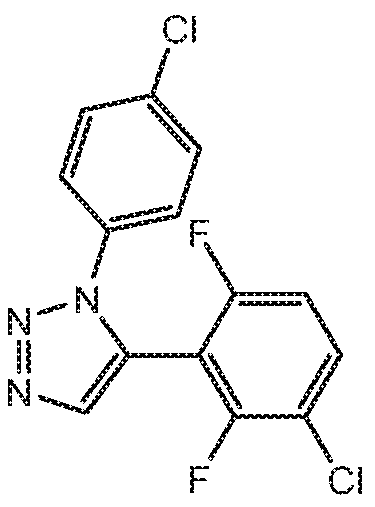
or a pharmaceutically acceptable salt thereof.
The method of any one of the preceding claims, for treating a neurodegenerative disease that is characterized by a iauopathy or by compromised microtubule function in the brain of the subject.
41. The method of claim 40, wherein the neurodegenerative disease is Alzheimer's disease, frontotemporai lobar degeneration, Pick's disease, progressive supranuclear palsy (PSP), corticobasal degeneration, Parkinson's disease (PD), PD with dementia, Lewy body disease with dementia, amyotrophic lateral sclerosis, argyrophilic grain disease, chronic traumatic encephalopathy, diffuse neurofibrillary tangles with calcification, Down's syndrome, Familial British dementia, Familial Danish dementia, frontotemporai dementia, parkinsonism linked to chromosome 17, Gerstmann-Straussler-Scheinker disease, Guadeloupean parkinsonism, multiple sclerosis, myotonic dystrophy, neurodegeneration with brain iron accumulation, Niemann-Pick disease, type C, non- Guamanian motor neuron disease with neurofibrillary tangles, postencephalitic parkinsonism, prion protein cerebral amyloid angiopathy, progressive subcortical gliosis, SLC9A6-related mental retardation, subacute sclerosing panencephalitis, tangle-only dementia, or white matter tauopathy with globular glial inclusions.
42. The method of claim 40, wherein the neurodegenerative disease is traumatic brain injury, in particular, repetitive traumatic brain injur}- and chronic traumatic encephalopathy, or post-traumatic stress disorder.
43. The method of any one of claims 1 to 39, for treating a peripheral inflammatory
condition.
44. The method of any one of claims 1 to 39, wherein the peripheral inflammatory condition is rheumatoid arthritis or Crohn's disease.
45. The method of any one of claims 1 to 39, for treating a cancer.
46. The method of any one of claims 1 to 39, for treating a parasitic disease.
47. A compound that is:


- 164 -


pharmaceutically acceptable salt thereof.
48. A pharmaceutical composition comprising a compound of claim 47, or a
pharmaceutically acceptable salt thereof, and a pharmaceutically acceptable excipient.
49. A pharmaceutical composi tion comprising a compound of Formula I, II, ITT, or TV, or a pharmaceutically acceptable salt thereof, and a pharmaceutically acceptable excipient.
Applications Claiming Priority (2)
| Application Number | Priority Date | Filing Date | Title |
|---|---|---|---|
| US201662385312P | 2016-09-09 | 2016-09-09 | |
| US62/385,312 | 2016-09-09 |
Publications (1)
| Publication Number | Publication Date |
|---|---|
| WO2018048969A1 true WO2018048969A1 (en) | 2018-03-15 |
Family
ID=61562277
Family Applications (1)
| Application Number | Title | Priority Date | Filing Date |
|---|---|---|---|
| PCT/US2017/050379 Ceased WO2018048969A1 (en) | 2016-09-09 | 2017-09-07 | Multi-targeted heterocyclic compounds for the treatment of neurodegenerative diseases |
Country Status (1)
| Country | Link |
|---|---|
| WO (1) | WO2018048969A1 (en) |
Citations (4)
| Publication number | Priority date | Publication date | Assignee | Title |
|---|---|---|---|---|
| US20100041756A1 (en) * | 2004-11-17 | 2010-02-18 | Michael Lionel Selley | method of modulating b cell functioning |
| WO2011100295A2 (en) * | 2010-02-09 | 2011-08-18 | Medical College Of Georgia Research Institute, Inc. | Alpha-methyl-tryptophan as an inhibitor of indoleamine dioxygenase |
| US20120277217A1 (en) * | 2009-10-28 | 2012-11-01 | Newlink Genetics Corporation | Imidazole Derivatives as IDO Inhibitors |
| WO2015089349A1 (en) * | 2013-12-13 | 2015-06-18 | Tabaczynski David A | Inhibition of isoprenoid biosynthetic pathways to treat neuroinflammatory disorders |
-
2017
- 2017-09-07 WO PCT/US2017/050379 patent/WO2018048969A1/en not_active Ceased
Patent Citations (4)
| Publication number | Priority date | Publication date | Assignee | Title |
|---|---|---|---|---|
| US20100041756A1 (en) * | 2004-11-17 | 2010-02-18 | Michael Lionel Selley | method of modulating b cell functioning |
| US20120277217A1 (en) * | 2009-10-28 | 2012-11-01 | Newlink Genetics Corporation | Imidazole Derivatives as IDO Inhibitors |
| WO2011100295A2 (en) * | 2010-02-09 | 2011-08-18 | Medical College Of Georgia Research Institute, Inc. | Alpha-methyl-tryptophan as an inhibitor of indoleamine dioxygenase |
| WO2015089349A1 (en) * | 2013-12-13 | 2015-06-18 | Tabaczynski David A | Inhibition of isoprenoid biosynthetic pathways to treat neuroinflammatory disorders |
Similar Documents
| Publication | Publication Date | Title |
|---|---|---|
| JP7605892B2 (en) | Novel small molecule inhibitors of TEAD transcription factors | |
| EP3022202B1 (en) | Autotaxin inhibitors comprising a heteroaromatic ring-benzyl-amide-cycle core | |
| JP2022525186A5 (en) | ||
| JP6918819B2 (en) | Tricyclic compounds useful in the treatment of orthomyxovirus infection | |
| EP3148972B1 (en) | Pyrazolone derivatives as nitroxyl donors | |
| JP6987859B2 (en) | MAGL inhibitor | |
| JP6663459B2 (en) | Method for producing benzoxazepine compound | |
| EP2593424B1 (en) | Novel arylamide derivatives having antiandrogenic properties | |
| JP7071981B2 (en) | Disubstituted pyrazole compounds for the treatment of diseases | |
| JP2017505293A (en) | Heteroaryl butanoic acid derivatives as LTA4H inhibitors | |
| JP2022521081A (en) | Amide derivatives useful in the treatment of HBV infections or HBV-induced diseases | |
| CN101356169A (en) | Pyrazine derivatives | |
| EP3744719A1 (en) | Thiophene derivative and use thereof | |
| EP3131893B1 (en) | Polycyclic herg activators | |
| JP7649424B2 (en) | Triazolone compounds and their medical uses | |
| CN113795254B (en) | Pyrazolopyridine compounds for IRE1 inhibition | |
| WO2018048969A1 (en) | Multi-targeted heterocyclic compounds for the treatment of neurodegenerative diseases | |
| JP2023518299A (en) | Androgen receptor modulation by small molecule enantiomers | |
| CA3082276C (en) | Heterocyclic compounds and their application in medicine | |
| CN117460512A (en) | IDH mutant inhibitors and their uses | |
| EP3930712A1 (en) | Imidazolopyrazine compounds for ire1 inhibition | |
| RU2846457C2 (en) | Triazolone compound and pharmaceutical use thereof | |
| JP2022532526A (en) | Amide derivatives useful in the treatment of HBV infections or HBV-induced diseases |
Legal Events
| Date | Code | Title | Description |
|---|---|---|---|
| 121 | Ep: the epo has been informed by wipo that ep was designated in this application |
Ref document number: 17849495 Country of ref document: EP Kind code of ref document: A1 |
|
| NENP | Non-entry into the national phase |
Ref country code: DE |
|
| 122 | Ep: pct application non-entry in european phase |
Ref document number: 17849495 Country of ref document: EP Kind code of ref document: A1 |