WO2018022801A1 - Sound/elastic-wave systems with fermionic quantum-like behavior for phase-based encoding of information - Google Patents
Sound/elastic-wave systems with fermionic quantum-like behavior for phase-based encoding of information Download PDFInfo
- Publication number
- WO2018022801A1 WO2018022801A1 PCT/US2017/044025 US2017044025W WO2018022801A1 WO 2018022801 A1 WO2018022801 A1 WO 2018022801A1 US 2017044025 W US2017044025 W US 2017044025W WO 2018022801 A1 WO2018022801 A1 WO 2018022801A1
- Authority
- WO
- WIPO (PCT)
- Prior art keywords
- spinor
- wave
- waves
- phase
- phononic structure
- Prior art date
- Legal status (The legal status is an assumption and is not a legal conclusion. Google has not performed a legal analysis and makes no representation as to the accuracy of the status listed.)
- Ceased
Links
Classifications
-
- B—PERFORMING OPERATIONS; TRANSPORTING
- B82—NANOTECHNOLOGY
- B82Y—SPECIFIC USES OR APPLICATIONS OF NANOSTRUCTURES; MEASUREMENT OR ANALYSIS OF NANOSTRUCTURES; MANUFACTURE OR TREATMENT OF NANOSTRUCTURES
- B82Y10/00—Nanotechnology for information processing, storage or transmission, e.g. quantum computing or single electron logic
-
- G—PHYSICS
- G10—MUSICAL INSTRUMENTS; ACOUSTICS
- G10K—SOUND-PRODUCING DEVICES; METHODS OR DEVICES FOR PROTECTING AGAINST, OR FOR DAMPING, NOISE OR OTHER ACOUSTIC WAVES IN GENERAL; ACOUSTICS NOT OTHERWISE PROVIDED FOR
- G10K11/00—Methods or devices for transmitting, conducting or directing sound in general; Methods or devices for protecting against, or for damping, noise or other acoustic waves in general
- G10K11/16—Methods or devices for protecting against, or for damping, noise or other acoustic waves in general
- G10K11/162—Selection of materials
- G10K11/168—Plural layers of different materials, e.g. sandwiches
-
- E—FIXED CONSTRUCTIONS
- E04—BUILDING
- E04B—GENERAL BUILDING CONSTRUCTIONS; WALLS, e.g. PARTITIONS; ROOFS; FLOORS; CEILINGS; INSULATION OR OTHER PROTECTION OF BUILDINGS
- E04B1/00—Constructions in general; Structures which are not restricted either to walls, e.g. partitions, or floors or ceilings or roofs
- E04B1/62—Insulation or other protection; Elements or use of specified material therefor
- E04B1/74—Heat, sound or noise insulation, absorption, or reflection; Other building methods affording favourable thermal or acoustical conditions, e.g. accumulating of heat within walls
- E04B1/82—Heat, sound or noise insulation, absorption, or reflection; Other building methods affording favourable thermal or acoustical conditions, e.g. accumulating of heat within walls specifically with respect to sound only
- E04B1/84—Sound-absorbing elements
-
- G—PHYSICS
- G10—MUSICAL INSTRUMENTS; ACOUSTICS
- G10K—SOUND-PRODUCING DEVICES; METHODS OR DEVICES FOR PROTECTING AGAINST, OR FOR DAMPING, NOISE OR OTHER ACOUSTIC WAVES IN GENERAL; ACOUSTICS NOT OTHERWISE PROVIDED FOR
- G10K11/00—Methods or devices for transmitting, conducting or directing sound in general; Methods or devices for protecting against, or for damping, noise or other acoustic waves in general
- G10K11/16—Methods or devices for protecting against, or for damping, noise or other acoustic waves in general
- G10K11/162—Selection of materials
- G10K11/165—Particles in a matrix
-
- G—PHYSICS
- G10—MUSICAL INSTRUMENTS; ACOUSTICS
- G10K—SOUND-PRODUCING DEVICES; METHODS OR DEVICES FOR PROTECTING AGAINST, OR FOR DAMPING, NOISE OR OTHER ACOUSTIC WAVES IN GENERAL; ACOUSTICS NOT OTHERWISE PROVIDED FOR
- G10K11/00—Methods or devices for transmitting, conducting or directing sound in general; Methods or devices for protecting against, or for damping, noise or other acoustic waves in general
- G10K11/18—Methods or devices for transmitting, conducting or directing sound
- G10K11/26—Sound-focusing or directing, e.g. scanning
-
- E—FIXED CONSTRUCTIONS
- E04—BUILDING
- E04B—GENERAL BUILDING CONSTRUCTIONS; WALLS, e.g. PARTITIONS; ROOFS; FLOORS; CEILINGS; INSULATION OR OTHER PROTECTION OF BUILDINGS
- E04B1/00—Constructions in general; Structures which are not restricted either to walls, e.g. partitions, or floors or ceilings or roofs
- E04B1/62—Insulation or other protection; Elements or use of specified material therefor
- E04B1/74—Heat, sound or noise insulation, absorption, or reflection; Other building methods affording favourable thermal or acoustical conditions, e.g. accumulating of heat within walls
- E04B1/82—Heat, sound or noise insulation, absorption, or reflection; Other building methods affording favourable thermal or acoustical conditions, e.g. accumulating of heat within walls specifically with respect to sound only
- E04B1/84—Sound-absorbing elements
- E04B2001/8457—Solid slabs or blocks
Definitions
- the present disclosure generally relates to sound and elastic-wave systems with ferm ionic quantum-like behaviour and in particular to an approach for the phase- based encoding of information.
- Wave functions possess a spinor and a spatio-temporal part.
- the spinor part leads to a non-conventional torsional topology of the wave function.
- field theoretical methods can be used to demonstrate that rotational phonons can exhibit ferm ion-like behavior.
- FIG. 1 depicts a schematic illustration of a discrete micromechanics model that supports rotational waves.
- FIG. 2 depicts a schematic illustration of the torsional topology of the wave function for rotational modes in k space.
- FIG. 3 depicts a mass-spring system isomorphic to a block-spring system supporting rotational waves only.
- FIG. 4 depicts a schematic illustration of a device composite system comprising a segment of a mass-spring system with fermion-like behavior sandwiched between two semi-infinite harmonic chains.
- FIG. 5 depicts the coefficient of transmission of a plane wave launched in the right semi-infinite chain through the composite system of FIG. 4, with an inset depicting a magnified region around the bottom of the positive branch of the band structure.
- the present application investigates the properties of wave functions in phononic structures supporting rotational waves which can exhibit wave functions that take the form of spinors.
- the non-conventional torsional topology of the wave function of elastic waves with spinor characteristics leads to a constraint on the wave function reminiscent of the Pauli-exclusion principle. This type of constraint introduces the notion of fermion-like behavior of elastic waves.
- the presently discussed topological constraints on elastic waves can improve phononic systems, permitting unique, robust designs and new device functionalities by providing immunity to performance degradation caused by imperfections or information coding and processing in the phase of the waves.
- This 1 D model can be used to reproduce the dispersion relations of the 2D system in a certain range, and it can subsequently be shown within Dirac's formalism that the wave function for rotational waves possesses a spinor-part and a spatio-temporal part.
- the present application discusses the geometric topology of the spinor-part of the wave function, and shows that the spinor-part imparts a non-conventional topology to the wave function.
- the spinor part of the elastic wave function is supported in momentum space by a manifold with torsional topology.
- the concept of phononic structures that support rotational waves and the concept of a Dirac representation of elastic waves within a field theoretical framework are integrated with each other. This leads to the observation of fermion-like behavior resulting from the spinor part of the wave function.
- the 1 D discrete mass-spring model that supports rotational modes forms the foundation of a field theoretical representation of rotational modes in phononic structures.
- the wave equation associated with that model is shown to be isomorphic to the Klein- Gordon equation, and that equation is therefore factored using Dirac formalism to obtain the wave functions and investigate their non-conventional topology in momentum (k) space.
- Quantum field theoretic methodologies are used to analyze the properties of the wave functions in the long-wavelength limit and find constraints on the wave function reminiscent of fermion-like behavior. An application of these findings to the encoding and processing of information in the wave function is disclosed.
- the various embodiments makes use of a 1 D mass-spring model that is known to reproduce the dispersion relations of a 2D phonon crystal that supports rotational waves.
- This model is based on a discrete linear one-dimensional micromechanics model that includes longitudinal, shear and rotational degrees of freedom.
- This 1 D discrete lattice model comprises an infinite chain of square block elements connected with multiple harmonic springs. Each element in the model is considered to have two translational degrees of freedom (displacement in the x and y directions) and one rotational degree of freedom (rotation about an axis perpendicular to the xy-plane).
- FIG. 1 depicts the repeatable unit cells for a monoblock lattice model 100 with periodicity (h). More specifically, FIG. 1 is a schematic illustration of a discrete micromechanics model that supports rotational waves. Three different harmonic springs (spring constants k Q , k ⁇ , and k 2 ) connect different parts of the block elements 101.
- the element in FIG. 1 has mass (m) and moment of inertia (/).
- the block constituting the nth unit cell has x-displacement (u n ), y-displacement (v n ) and rotation component u n and v n represent displacements associated with longitudinal and transverse vibrations, respectively.
- the potential energy associated with the elastic connections 102 of elements (n) and (n + 1 ) in the monoblock chain is written as follows:
- Equation (6) takes the form of the discrete Klein-Gordon equation. Equation (6) involves the second derivatives with respect to continuous time and the discrete second derivative with respect to position of the angular degree of freedom.
- the first two components represent propagation of waves in the positive direction and the next two components propagation in the negative direction.
- the two components for the positive direction and the two components from the negative directions reflect a lifting of degeneracy due to asymmetry of the forward and backward finite different in the discrete Dirac equation.
- the solutions of equations (8) are automatically solutions of equation (6), but the converse is not true.
- equation (8) corresponds to choices of the sign of the parameter o (i.e. choice of positive or negative "mass" in Dirac's formalism).
- equation (6) by applying the operator in equation (9) twice (with appropriate ⁇ sign).
- Equation (9) is the basis for a discussion of rotational waves with non-trivial topologies in phononic structures.
- equation (9) yields the system of equations:
- the dispersion relations are periodic and defined in the first Brillouin zone: Choosing the positive or negative branches of the dispersion relations, the four eigenvectors can be determined:
- equations (15a)-(15d) the * symbol represents the complex conjugate, are orthogonal and satisfy:
- the relations given by equation (15) indicate that the wave function has a periodicity of The topology of the wave function is more easily illustrated by considering the parallel transport of two orthogonal vector fields along a closed loop corresponding to The first vector field represents the wave function
- FIG. 2 the complex conjugate of This non-conventional torsional topology is illustrated in FIG. 2 in the form of a torus 200 with a square cross section 205 that exhibits four 90 ° twists.
- the red arrow and green arrow represent the two orthogonal wave functions respectively.
- the red arrow points in a direction perpendicular to the plane of the figure and the green arrow points in a direction within the plane of the figure.
- the green arrow is now pointing in the plane of the figure and the green arrow becomes perpendicular to that plane, that is
- equation (16) is also that of a system composed of a one- dimensional harmonic chain 301 composed of masses 302 (m) connected to their nearest neighbors by springs 303 with spring constant ki and connected to a rigid substrate by springs 304 which constant is k 2 (see FIG. 3).
- the relation between the equation of this spring-mass system 300 and the rotational wave equation (16) is obtained by setting
- Equation (16) admits plane wave solutions with eigenvalues given by At k- 0, the eigenmode with frequency ⁇ - a correspond to point B in FIG. 2. Note that to obtain the dispersion relation, equation (16) was solved by assuming plane wave solutions. These solutions correspond to traveling waves.
- Equation (16) does not impose any constraint on the amplitude of its plane wave solutions. For k ⁇ 0, the group velocity approaches the phase velocity only when k ⁇ , the solutions of equation (16) have mixed standing and traveling wave character. These solutions ought to be the superposition of waves traveling in opposite directions, whose amplitudes are not independent of each other, but are wavenumber dependent. It is these very observations that make the factorization of equation (16) into direction-specific equations necessary.
- Equation (16) is isomorphic to the continuous relativistic Klein-Gordon equation.
- the goal is to derive a wave equation in terms of first order spatial and temporal derivatives:
- ⁇ ⁇ and ⁇ ⁇ are the 2 x 2 Pauli matrices and / is the 2 x 2 identity matrix.
- equation (27) the terms that arise from the delta function of equation (26) have been lumped into a negative zero-point energy
- the operator defines the occupancy of one of the directions along the chain of
- traveling wave with only one direction favored.
- finite k one has the superposition of traveling and standing waves.
- the fermion-like behavior of the rotational wave opens up opportunities in the control of the direction of propagation of elastic waves. For instance, it has been shown that the two-spinor solution represents coupling between waves propagating in opposite directions.
- the spinor part of the wave function can be projected on the orthonormal basis representing the possible directions of propagation of the wave. This enables
- N c The number of masses in the central region of the sandwich. Assume that all the masses, m, have the same value, and that the spring constants of the semi-infinite regions 401 are the same as the mass-to-mass spring constant,
- the frequency equal to 2 corresponds to the upper frequency of waves that can be supported by a discrete one-dimensional harmonic chain.
- the decrease of the transmission coefficient as the frequency of 2 is approached results from the curvature (zero group velocity) of the band of the one-dimensional harmonic chain. Therefore, a one-to-one correspondence between the long-wavelength limit result (dotted line) and the transmission through a discrete system cannot be established.
- the transmission coefficient is zero and the spinor part of the wave function takes on the form:
- the components of the spinor vary monotonically as the frequency is increased (i.e. the wavenumber A- is increased) until it takes a form approaching:
- a similar tuning of the spinor part of the wave function can be achieved by fixing the frequency of the incident waves and varying the stiffness of the side springs relative to the stiffness of the 1 D harmonic chain. From a practical point of view, this could be achieved by using springs composed of an elastic material whose stiffness is dependent on the magnitude of an externally applied electromagnetic wave (e.g., materials exhibiting photo- elastic effects) or on an external magnetic field (e.g., a magneto-elastic medium).
- This spinor is equivalent to the value to within a factor of -1.
- the operation of tuning a can be visualized between zero and ⁇ - a as that of a Hadamard transformation.
- the Hadamard transformation can then be physically achieved by moduloating the strength of an external stimulus such as the magnitude of an external field.
- the Hadamard transformation takes the form and transforms a wave
- a system like that of FIG. 4 is defined as a .
- the Hadamard gate is an example of such an operation.
- the spinor state of the central segment of the can be determined by measuring a single scalar quantity, namely the transmission coefficient.
- the question that then arises is that of the encoding of
- a 1 D discrete block-spring model that supports rotational waves was investigated. This 1 D discrete model was then analyzed within the Dirac's formalism to show that rotational waves are characterized by wave functions that include a spinor part and a spatio-temporal part.
- the spinor part is related to the coupling between the senses of wave propagation.
- the spatio-temporal part of the wave function retains its plane-wave character.
- the topology of the wave function in / -space was also investigated to show that the wave function possesses a non-conventional torsional topology.
- the wave function is supported by a square cross section torus manifold exhibiting four 90 ° twists. This manifold has a periodicity of where h is the periodicity of the 1 D phononic
- the 1 D system in the long-wavelength limit, has been shown to exhibit fermion character.
- the fermion-like behavior of phonons discussed herein arises from the coupling between waves propagating along the positive and negative directions and from the projection of the wave function on the orthogonal space of direction of propagation.
- This fermion behavior is associated with constraints reminiscent of Pauli's Exclusion Principle.
- the present exclusion principle is a reflection of the exact nature of the eigenvectors of the wave equation projected on the space of directions.
- the eigenvectors of the phononic structures presented above are not simply plane waves but a
Landscapes
- Engineering & Computer Science (AREA)
- Physics & Mathematics (AREA)
- Acoustics & Sound (AREA)
- Multimedia (AREA)
- Chemical & Material Sciences (AREA)
- Nanotechnology (AREA)
- Architecture (AREA)
- Theoretical Computer Science (AREA)
- Mathematical Physics (AREA)
- Crystallography & Structural Chemistry (AREA)
- Structural Engineering (AREA)
- Civil Engineering (AREA)
- Electromagnetism (AREA)
- Complex Calculations (AREA)
- General Physics & Mathematics (AREA)
- Evolutionary Computation (AREA)
- Data Mining & Analysis (AREA)
- Condensed Matter Physics & Semiconductors (AREA)
- Computational Mathematics (AREA)
- Mathematical Analysis (AREA)
- Mathematical Optimization (AREA)
- Pure & Applied Mathematics (AREA)
- Computing Systems (AREA)
- General Engineering & Computer Science (AREA)
- Software Systems (AREA)
- Artificial Intelligence (AREA)
Abstract
Embodiments for sound and elastic-wave systems with fermionic quantum-like behavior and in particular to an approach for the phase-based encoding of information are disclosed.
Description
SOUND/ELASTIC-WAVE SYSTEMS WITH FERMIONIC QUANTUM-LIKE BEHAVIOR FOR PHASE-BASED ENCODING OF INFORMATION
FIELD
[0001] The present disclosure generally relates to sound and elastic-wave systems with ferm ionic quantum-like behaviour and in particular to an approach for the phase- based encoding of information.
BACKGROUND
[0002] Wave functions possess a spinor and a spatio-temporal part. The spinor part leads to a non-conventional torsional topology of the wave function. In the long- wavelength limit, field theoretical methods can be used to demonstrate that rotational phonons can exhibit ferm ion-like behavior.
[0003] The understanding of elastic waves has been largely driven by the simple paradigm of the plane wave and its periodic counterpart (the Bloch wave) in periodic media. Significant progress has been achieved in unraveling the behavior of elastic waves in phononic crystals and acoustic metamaterials. However, most of this progress has been achieved through exploration of the geometrical complexity of these media. Inspired by the discovery of topological insulators for which the electronic wave function is supported in momentum space by manifolds with non-conventional topologies, recent studies have shown the possibility of achieving electromagnetic waves and acoustic waves with non-conventional topologies.
[0004] It is with these observations in mind, among others, that various aspects of the present disclosure were conceived and developed.
BRIEF DESCRIPTION OF THE DRAWINGS
[0005] FIG. 1 depicts a schematic illustration of a discrete micromechanics model that supports rotational waves.
[0006] FIG. 2 depicts a schematic illustration of the torsional topology of the wave function for rotational modes in k space.
[0007] FIG. 3 depicts a mass-spring system isomorphic to a block-spring system supporting rotational waves only.
[0008] FIG. 4 depicts a schematic illustration of a device composite system comprising a segment of a mass-spring system with fermion-like behavior sandwiched between two semi-infinite harmonic chains.
[0009] FIG. 5 depicts the coefficient of transmission of a plane wave launched in the right semi-infinite chain through the composite system of FIG. 4, with an inset depicting a magnified region around the bottom of the positive branch of the band structure.
DETAILED DESCRIPTION
[0010] The present application investigates the properties of wave functions in phononic structures supporting rotational waves which can exhibit wave functions that take the form of spinors. The non-conventional torsional topology of the wave function of elastic waves with spinor characteristics leads to a constraint on the wave function reminiscent of the Pauli-exclusion principle. This type of constraint introduces the notion of fermion-like behavior of elastic waves. The presently discussed topological constraints on elastic waves can improve phononic systems, permitting unique, robust designs and new device functionalities by providing immunity to performance degradation caused by imperfections or information coding and processing in the phase of the waves.
[0011] Previous investigations have shed light on various properties a 2D phononic crystal (PC) constituted of stiff polymer inclusions in a soft elastomer matrix. The 2D PC composed of a square array of polystyrene (PS) inclusions in a polydimethylsiloxane (PDMS) elastomer matrix has been shown to be capable of supporting rotational waves. Of particular interest are modes where the PS inclusions and the region of the matrix separated by the inclusions rotate out of phase but also in phase. Following Peng et al., who demonstrated that a 1 D lumped mass model could be used to describe rotational modes in a 2D PC, a 1 D mass spring phononic structure that could also support rotational waves was introduced. This 1 D model can be used to reproduce the dispersion relations of the 2D system in a certain range, and it can subsequently be shown within Dirac's formalism that the wave function for rotational waves possesses a spinor-part and a spatio-temporal part.
[0012] The present application discusses the geometric topology of the spinor-part of the wave function, and shows that the spinor-part imparts a non-conventional topology to the wave function. In particular, the spinor part of the elastic wave function is supported in momentum space by a manifold with torsional topology. Furthermore, in the long- wavelength limit of the 1 D model, the concept of phononic structures that support rotational waves and the concept of a Dirac representation of elastic waves within a field theoretical framework are integrated with each other. This leads to the observation of fermion-like behavior resulting from the spinor part of the wave function. In particular, it is found that within the context of a "second quantization" of the rotational waves, the
properties of their associated spinor lead to anticommutation rules for the creation and annihilation operators.
[0013] After showing the possibility of ferm ion-like constraints on the elastic waves, a second question related to the more practical aspect of this behavior is also posed: what are the implications of fermion-like phonon behavior? A partial answer to that question is provided by introducing the concept of phase control of phonons through the specificity of their ferm ion character. To that effect, the concept of a phononic structure-based ^(phase)-bit is introduced, and it is demonstrated that one can operate on the -bit through the structure's physical parameters to transform the spinor state of the wave function. More specifically, one can operate on and measure the spinor state of phonons replicating known operations that are more commonly executed on fermions states like spins.
[0014] The 1 D discrete mass-spring model that supports rotational modes forms the foundation of a field theoretical representation of rotational modes in phononic structures. The wave equation associated with that model is shown to be isomorphic to the Klein- Gordon equation, and that equation is therefore factored using Dirac formalism to obtain the wave functions and investigate their non-conventional topology in momentum (k) space. Quantum field theoretic methodologies are used to analyze the properties of the wave functions in the long-wavelength limit and find constraints on the wave function reminiscent of fermion-like behavior. An application of these findings to the encoding and processing of information in the wave function is disclosed.
Nonconventional topology of rotational waves in phononic crystals
One-dimensional discrete micromechanics model
[0015] The various embodiments makes use of a 1 D mass-spring model that is known to reproduce the dispersion relations of a 2D phonon crystal that supports rotational waves. This model is based on a discrete linear one-dimensional micromechanics model that includes longitudinal, shear and rotational degrees of freedom. This 1 D discrete lattice model comprises an infinite chain of square block elements connected with multiple harmonic springs. Each element in the model is considered to have two translational
degrees of freedom (displacement in the x and y directions) and one rotational degree of freedom (rotation about an axis perpendicular to the xy-plane).
[0016] FIG. 1 depicts the repeatable unit cells for a monoblock lattice model 100 with periodicity (h). More specifically, FIG. 1 is a schematic illustration of a discrete micromechanics model that supports rotational waves. Three different harmonic springs (spring constants kQ, k^, and k2) connect different parts of the block elements 101. The element in FIG. 1 has mass (m) and moment of inertia (/). The block constituting the nth unit cell has x-displacement (un), y-displacement (vn) and rotation component
 un and vn represent displacements associated with longitudinal and transverse vibrations, respectively. The potential energy associated with the elastic connections 102 of elements (n) and (n + 1 ) in the monoblock chain is written as follows:

Accordingly, the equations of motion for the element in the nth unit cell of the monoblock lattice are written as:

[0017] The band structure of such a lattice would contain three bands corresponding to the three degrees of freedom However, for the sake of simplicity, this

model is presently restricted to the propagation of rotational waves by allowing only rotation of the blocks about their center of mass and by constraining shear and longitudinal displacements in the lattice. The equation of motion associated with the rotational degrees of freedom (equation (4)) then takes the simpler general form:


[0018 Dividing the equation by / yields the following rotational wave equation:

[0019] Equation (6) takes the form of the discrete Klein-Gordon equation. Equation (6) involves the second derivatives with respect to continuous time and the discrete second derivative with respect to position of the angular degree of freedom.
Subsequently, following the approach of Dirac in linearizing the relativistic Klein-Gordon equation, a wave equation in terms of first order spatial and temporal derivatives can be derived by rewriting the Laplacian:
 jn a "square root" form:
 This can be done exactly by introducing the following first order differential operator:

In equation (7),
 the forward and backward finite differences acting now on a two-vector. The 2 x 2 matrices e1 and e2 satisfy the conditions ete2 = e2e2 = 0 and e1e2 + e2e1 = I with / representing the 2 x 2 identity matrix. This formalism permits the exact and formal definition of the "square root" of the discrete Laplacian.
The Dirac-like equation for rotational waves corresponding to case I, then takes the form:


plays the role of mass in the relativistic Dirac equation. Applying the outer product
 leads to 4 x 4
matnces and ψ is a four-vector:

[0020] This four-component representation is the consequence of the discrete nature of the Laplacian. In contrast, with a continuous Laplacian, there is no distinction between forward and backward derivatives and only a two-component representation is
needed. This is the case in the long-wavelength limit. In this limit, having a two- component spinor indicates that there is a coupling between waves propagating in opposite directions (positive or negative) along the chain of blocks.
[0021] When considering the short-wavelength four-component spinor solution, the first two components represent propagation of waves in the positive direction and the next two components propagation in the negative direction. The two components for the positive direction and the two components from the negative directions reflect a lifting of degeneracy due to asymmetry of the forward and backward finite different in the discrete Dirac equation. The solutions of equations (8) are automatically solutions of equation (6), but the converse is not true.
[0022] As will be seen later, the directions of propagation of the wave are expressed separately in the Dirac wave function. The ± in equation (8) corresponds to choices of the sign of the parameter o (i.e. choice of positive or negative "mass" in Dirac's formalism). First seeking solutions of equation (8) with the negative value, equation (8) becomes:

[0023] It is easily verifiable that CC = 1, AA = BB = 0, AB + BA = -1, and C (AA+ + which are the conditions necessary to recover the wave

equation (6) by applying the operator in equation (9) twice (with appropriate ± sign).
Equation (9) is the basis for a discussion of rotational waves with non-trivial topologies in phononic structures.
[0024] Seeking solutions in the form of plane ω and k

are the angular frequency and wavenumber, respectively. Recalling that "h" is the spacing distance between blocks, equation (9) yields the system of equations:

This system of equations admits two doubly degenerate eigenvalues:

[0025] The negative frequency can be interpreted physically as follows. Since the angular field ought to be a real-valued quantity, it can be written as the sum of a complex term and its complex conjugate. The negative frequency is associated with the complex conjugate term. The rotational mode at the origin, k = 0, has a finite frequency. Note that equation (11 ) gives two branches with positive and negative frequencies that do not intersect at the origin unless a = 0.
[0026] The dispersion relations are periodic and defined in the first Brillouin zone:
 Choosing the positive or negative branches of the dispersion relations, the four eigenvectors can be determined:

The upper signs in equations (12a) and (12b) correspond to the positive branch of the band structure (ω > 0) and the lower signs to the negative branch (ω > 0).
[0027] Similarly, the following equation can be solved:
 [0028] The operator in equation (13) is the complex conjugate of the operator in equation (9), so, seeking solutions in the form of plane waves,
 with '=1 ,2,3,4 yields the four eigenvectors:

Non-conventional topology of rotational waves
[0029] Turning to an investigation of the topology in k space of the solutions given by equations (12a), (12b) and (14a), (14b), it is easy to show the following relations:

[0030] In equations (15a)-(15d), the * symbol represents the complex conjugate,
 are orthogonal and satisfy:
 The relations given by equation (15) indicate that the wave function has a periodicity of
 The topology of the wave function is more easily illustrated by considering the parallel transport of two orthogonal vector fields along a closed loop corresponding to The first vector field represents the wave function


[0031] Starting at the top of the figure, the red arrow and green arrow represent the two orthogonal wave functions
 respectively. The red arrow points in a direction
perpendicular to the plane of the figure and the green arrow points in a direction within the plane of the figure. As the vector fields are transported along the first twist, the green arrow is now pointing in the plane of the figure and the green arrow becomes perpendicular to that plane, that is
respectively. The red arrow points in a direction
perpendicular to the plane of the figure and the green arrow points in a direction within the plane of the figure. As the vector fields are transported along the first twist, the green arrow is now pointing in the plane of the figure and the green arrow becomes perpendicular to that plane, that is
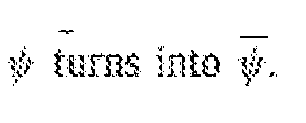
[0032] The red arrow transported through the first twist now makes a right angle with the red arrow at the starting point. This means that the wave function
process js repeated through the second twist. The red

arrow transported through the second twist is now parallel to the red arrow at the origin but is pointing in the opposite direction and satisfies the condition:
 This means that the wave function
 The vector fields can be transported through the third and fourth twists (not illustrated in the figure) to close the loop in k space and reach the starting point. At that point:

[0033] The torsional topology of the wave function results from its spinor
characteristics that endow it with ferm ion-like character. This character is analyzed in further detail below. To simplify the mathematics, only the long-wavelength limit is considered.
Analysis of fermion-like behavior in the long-wavelength limit
Dirac equation in the long-wavelength limit
[0034 In the long-wavelength limit, k - 0, equation (6) reduces to

[0035] Note that equation (16) is also that of a system composed of a one- dimensional harmonic chain 301 composed of masses 302 (m) connected to their nearest neighbors by springs 303 with spring constant ki and connected to a rigid substrate by springs 304 which constant is k2 (see FIG. 3). The relation between the equation of this spring-mass system 300 and the rotational wave equation (16) is obtained by setting
 |n long-wavelength limit, this is a system composed of a string embedded in an elastic medium. The isomorphism between the block-spring system and the mass-spring model will be used in subsequent calculations.
[0036] Equation (16) admits plane wave solutions with eigenvalues given by
|n long-wavelength limit, this is a system composed of a string embedded in an elastic medium. The isomorphism between the block-spring system and the mass-spring model will be used in subsequent calculations.
[0036] Equation (16) admits plane wave solutions with eigenvalues given by
 At k- 0, the eigenmode with frequency ω - a correspond to point B in FIG. 2. Note that to obtain the dispersion relation, equation (16) was solved by assuming plane wave solutions. These solutions correspond to traveling waves.
However, the dispersion relation indicates that, for instance, at k = 0 the group velocity is zero, that is the eigenvector solution to (16) is a standing wave. Since a standing wave is the superposition of two waves traveling in opposite directions, equation (16) is unable to reveal the standing wave character of its solutions. Furthermore, the amplitude of the two oppositely traveling waves forming a standing wave have to be the same. Equation (16) does not impose any constraint on the amplitude of its plane wave solutions. For k≠ 0, the group velocity approaches the phase velocity only when k→∞, the solutions of equation (16) have mixed standing and traveling wave character. These solutions ought to be the superposition of waves traveling in opposite directions, whose amplitudes are not independent of each other, but are wavenumber dependent. It is these very observations that make the factorization of equation (16) into direction-specific equations necessary.
[0037] Equation (16) is isomorphic to the continuous relativistic Klein-Gordon equation. Here, again, following the approach of Dirac in linearizing the relativistic Klein- Gordon equation, the goal is to derive a wave equation in terms of first order spatial and temporal derivatives:

where σχ and σγ are the 2 x 2 Pauli matrices and / is the 2 x 2 identity matrix.
[0038] Note that these equations are not self-dual. Taking the complex conjugate of equation (17a) results in equation (17b), indeed the first two terms are real and only the last term changes sign. In particular, this results from the negative sign of the second term in the Klein-Gordon equation (16), which involves the multiplicative imaginary number Ί" in the second term of the Dirac-like equations (17a), (17b).
[0039]


Solutions of the long-wavelength Dirac equation
[0040] Having established the Dirac equation and its Hermitian conjugate (17a), (17b), it is expected that there exist solutions in the form of plane waves, and since these are matrix equations, there exists a solution that contains a spinor part (i.e. a two by one part matrix). The solutions may therefore be written to be presented in the form:
 inserting the various forms for these solutions in equations (17a), (17b) lead to the same eigenvalues that were obtained with the Klein-Gordon equation, namely:


[0041] The spinors in Table 1 are given to within any complex constant Co.
[0042] Note that the wave functions
 will eventually be promoted to the rank of creation and annihilation operators. Additionally, if a = 0, equation (17a) becomes
 using a plane wave solution with
 this equation reduces to the system :

[0043] Two solutions can be obtained for the angular velocity of the plane wave
 j ese correspond to plane waves propagating in the positive and negative directions. In this case, the components of the two-spinor, a? and a∑ are now independent of each other and independent of the wavenumber. The amplitude of the plane wave propagating in the positive direction is independent of that of the wave propagating in the opposite direction. When a≠ 0, from Table 1 , the components of the two-spinor are not independent of each other. This indicates that the directions of propagation are not independent of each other anymore. It is the parameter a that couples those directions.
Energy and anticommutation
[0044] The Hamiltonian density associated with the Lagrangian, L. It is given by the Legendre transformation:

Where the momentum conjugate: Inserting this expression in Equation

(20) and using equation (18b), yields the Hamiltonian density:

[0045] As mentioned previously, the quantity ψ is now promoted to an operator (using the same symbol ip to represent the operator) and a representation is used whereby the field ψ is expanded into plane waves and their complex conjugate:

[0046] Similarly, the Hermitian conjugate of the ip operator can be written:

The quantities
 are creation and annihilation operators, respectively. Inserting equations (22 and (23) into equation (21) and integrating over all space results in:
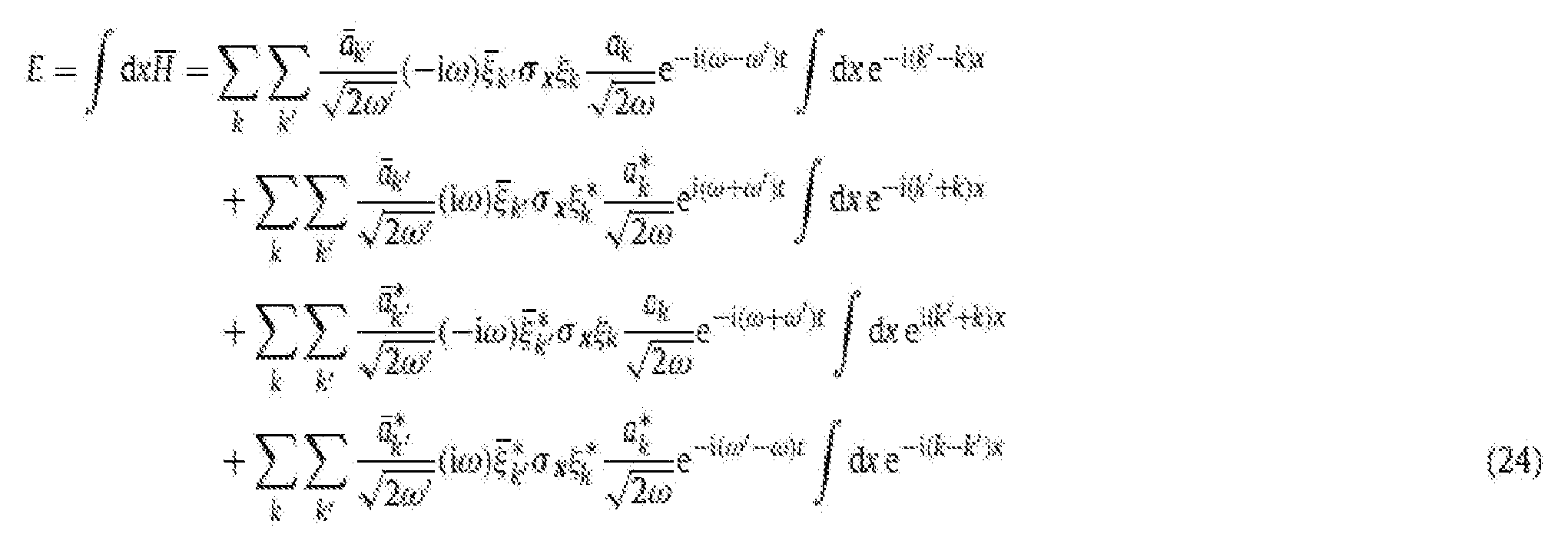
[0047] The spatial integrals in equation (24) can be replaced by their respective delta functions,
 Using Table 1 , it can be shown that

and it can be shown that
 to obtain an

energy in the form of a real number, the energy of the system becomes:

[0048] To avoid the negative contribution to the energy in equation (25) and following the methods of quantum field theory, anticommutation rules need to be imposed on the creation and annihilation operators. That is:

With these anticommutation rules, the energy takes the form

[0049] In equation (27), the terms that arise from the delta function of equation (26) have been lumped into a negative zero-point energy,

[0050] The anticommutation rules given by equation (26) also imply that

This is Pauli's Exclusion Principle, which states that more than one particle per state cannot be created. The anticommutation rules indicate that the rotational modes have
fermion character. A physical interpretation of these anticommutation rules suggests that the fields given by (22) and (23) are composed of forward and backward traveling waves whose relative amplitudes are determined solely by the spinor part of the wave function
 Attempting to add an additional traveling component to one of the quasi- standing solutions via the operator
 would create a new state that could not be a solution of the Dirac equations (17a), (17b). Such a state is not allowed. This restriction provides a physical interpretation of Pauli's Exclusion Principle.
Number operators
[0051] It was shown above that the energy is an invariant. This invariant is the consequence of the time reversal symmetry of equations (17a) and (17b). There exist other symmetries. In particular the Dirac-like equations are invariant upon the
transformation involving a phase shift. Consequently, it can be shown that the number operator:

is also an invariant. Starting from the field operator given by equation (22), k can be replaced by -k in the second term of the summation. This leads to:

[0052] Similarly, the following field can be written:

[0053] Inserting equations (29) and (30) into (28), and following the same approach as before yields:

[0054] Using Table 1 for the spinors and their Hermitian conjugate yields:
 This is clearly an invariant. The operator count the number of waves propagating in a given direction and
 correspond to the number of waves propagating in the opposite direction. Considering a field representation that includes only one type of plane wave and therefore, looking at the first term of equation (32), provides a definition for the operator:

[0055] Recalling that
 the spinors can be renormalized with respect to the arbitrary complex constant Co. The last equality suggests the introduction of direction switching operators
 and
and
 These operators anticommute:
 using this later relation permits equation (33) to be reformulated in the form:

The operator defines the occupancy of one of the directions along the chain of

mass and springs. Its eigenvalues are given by The

operator defines the occupancy of the other opposite direction. Its

eigenvalues are given by: Considering the dispersion

relation for the positive branch of the band structure, the

eigenvalues
 can be rewritten in terms of the wave vector A- only:

At the origin of the band structure, k- 0, and The direction occupancy is

the same for the two opposite directions; hence the state of the system is described by a standing wave. For the phononic structure supports a pure

traveling wave with only one direction favored. For finite k, one has the superposition of traveling and standing waves. By spanning the dispersion relation, one spans the
"direction" states. One can quantify the "amount" of traveling wave character of the wave function with the quantity: When expressed as a function of frequency, this


function character evolves from a pure standing wave at ω = a to a pure traveling wave as the frequency increases to infinity.
[0056] The fermion-like behavior of the rotational wave opens up opportunities in the control of the direction of propagation of elastic waves. For instance, it has been shown that the two-spinor solution represents coupling between waves propagating in opposite directions. The spinor part of the wave function can be projected on the orthonormal basis representing the possible directions of propagation of the wave. This enables

information to be encoded in the relative weight (phase) of the directions of propagation by controlling the wavenumber, k. This control can enable applications in the field of information processing, as discussed below.
Applications to information processing
Phase control

[0057] The properties of rotational waves and their fermion-like behavior can be used to encode and process information, relying upon the isomorphism between the block- spring model and a mass-spring system (see FIG. 3) when considering a device that is composed of a segment of mass-spring system isomorphic to the block-spring system supporting the rotational waves sandwiched between two semi-infinite harmonic chains (FIG. 4).
[0058] The number of masses in the central region of the sandwich is denoted Nc. Assume that all the masses, m, have the same value, and that the spring constants of the semi-infinite regions 401 are the same as the mass-to-mass spring constant, The spring constant of the side springs 404 is Recall that these parameters map onto the parameters characterizing the rotational wave equation via the relations: a2 = K2/m and β2 = Kilm.
[0059] Of particular interest is the transmission of plane waves launched from the left semi-infinite chain through the fermion-like segment. For this, the transmission coefficient of the composite system 400 of FIG. 4 is calculated, employing the methods of
the Interface Response Theory (IRT). The use of this method to calculate the transmission coefficient of infinite harmonic chains 401 perturbed with harmonic finite side chains 404 is known to those of ordinary skill in the art.
[0060] FIG. 5 depicts the transmission coefficient as a function of frequency for a segment composed of Nc = 80 masses with side springs, with m = 1 and Ki = 1 , i.e. β2 = 1 . The side springs 404 have stiffness 2 = 0.1 , i.e. a = 0.316.
[0061] The transmission coefficient is zero for frequencies up to the value ω = a = 0.316. This zero transmission corresponds to the gap in the band structure of the rotational waves. Waves that are launched and propagate in the right semi-infinite harmonic chain cannot propagate through the central segment of the composite. Inside the passing band of the central segment, transmission occurs. The oscillatory nature of the transmission coefficient is due to the finite size and the discrete nature of the central segment. The frequency equal to 2 corresponds to the upper frequency of waves that can be supported by a discrete one-dimensional harmonic chain. The decrease of the transmission coefficient as the frequency of 2 is approached results from the curvature (zero group velocity) of the band of the one-dimensional harmonic chain. Therefore, a one-to-one correspondence between the long-wavelength limit result (dotted line) and the transmission through a discrete system cannot be established.
[0062] However, the general trend of an increase in transmission as the frequency increases from the bottom of the passing band of the central segment structure is representative of both the discrete and long-wavelength limit fermion-like behavior. The most important observation is that a one-to-one correspondence between a measurable scalar quantity can be established: the transmission coefficient and the spinor
characteristics of the wave that can be supported by the central segment of the composite.
[0063] For instance, for an incident wave
 the transmission coefficient is zero and the spinor part of the wave function takes on the form:
 The components of the spinor vary monotonically as the frequency is increased (i.e. the wavenumber A- is increased) until it takes a form approaching:
 A similar tuning of the spinor part of the wave function can be achieved by fixing the frequency of the incident waves and varying the stiffness
 of the side springs relative to the
stiffness of the 1 D harmonic chain. From a practical point of view, this could be achieved by using springs composed of an elastic material whose stiffness is dependent on the magnitude of an externally applied electromagnetic wave (e.g., materials exhibiting photo- elastic effects) or on an external magnetic field (e.g., a magneto-elastic medium).
of the side springs relative to the
stiffness of the 1 D harmonic chain. From a practical point of view, this could be achieved by using springs composed of an elastic material whose stiffness is dependent on the magnitude of an externally applied electromagnetic wave (e.g., materials exhibiting photo- elastic effects) or on an external magnetic field (e.g., a magneto-elastic medium).
[0064] Defining a basis set |0) and |1 ) whose matrix representation takes the form of permits the creation of a superposition of state


[0065] This spinor is equivalent to the value to within a factor of -1.

Therefore, for a given incident wave of frequency ω, the operation of tuning a can be visualized between zero and ω - a as that of a Hadamard transformation. As seen previously, the Hadamard transformation can then be physically achieved by moduloating the strength of an external stimulus such as the magnitude of an external field. In its matrix representation, the Hadamard transformation takes the form and transforms a wave

launched from the left Q into the standing wave, whose spinor is proportional to It
 also transforms a wave propagating from the right (°) into the standing wave whose spinor part is proportional to

[0066] The action of applying the Hadamard gate a second time is equivalent to detuning the parameter between from ω = a to zero. This transforms the states ( ) and ( ^) back into the traveling states This transformation can be detected easily

through the change in transmission from zero to 1 . The control of the relative magnitude and sign of the spinor components of the wave function enables the encoding of information in the phase of the superposition of states. A system like that of FIG. 4 is defined as a . The can be operated on through the system's physical


parameter via some external stimulus to transform the spinor state of the wave function.
The Hadamard gate is an example of such an operation. The spinor state of the central segment of the
 can be determined by measuring a single scalar quantity, namely the transmission coefficient. The question that then arises is that of the encoding of
information on multiple i/>-bits and the possibility of operating on them, addressed below.
Operations on multiple xp-bits
[0067] Consider each prepared in the state: yne


side springs in these two i ^-bits are again composed of material whose stiffness is dependent on some external stimulus. Two external stimuli are applied on each -bits independently at this time. As seen in the previous section, this is achieved by launching a wave with frequency ω > t to the right in each left semi-infinite chain. The transmission coefficient is measurable for each bit and takes on the value The two-bit system is

in the initial product state: One can now operate on this product state by

defining a function f(x) such that the product state becomes: Because

there is a one-to-one relation between this can be achieved by constructing

a physical device that links the value of a2 (i.e., the magnitude of the external stimulus acting on the second
 to that of the transmission coefficient of the first
 For instance, one can define
 The new state of the second
 will therefore take the form
 This procedure enables parallelism in the application of the operating function. This type of operation can be applied straightforwardly to a system of Ni/>-bits, which could lead to parallel operations on the N-bit product state.
Conclusions
[0068] A 1 D discrete block-spring model that supports rotational waves was investigated. This 1 D discrete model was then analyzed within the Dirac's formalism to show that rotational waves are characterized by wave functions that include a spinor part and a spatio-temporal part. The spinor part is related to the coupling between the senses of wave propagation. The spatio-temporal part of the wave function retains its plane-wave character.
[0069] The topology of the wave function in / -space was also investigated to show that the wave function possesses a non-conventional torsional topology. The wave function is supported by a square cross section torus manifold exhibiting four 90° twists.
This manifold has a periodicity of where h is the periodicity of the 1 D phononic

structure.
[0070] The 1 D system, in the long-wavelength limit, has been shown to exhibit fermion character. The fermion-like behavior of phonons discussed herein arises from the coupling between waves propagating along the positive and negative directions and from the projection of the wave function on the orthogonal space of direction of propagation. This fermion behavior is associated with constraints reminiscent of Pauli's Exclusion Principle. The present exclusion principle is a reflection of the exact nature of the eigenvectors of the wave equation projected on the space of directions. The eigenvectors of the phononic structures presented above are not simply plane waves but a
superposition of plane waves traveling in opposite directions. These superposition states can be visualized as quasi-standing waves possessing a standing wave character and a traveling wave contribution. For a given wave vector, it is the fixed ratio of the amplitudes of the standing wave component and of the traveling wave components that constrains wave propagation and imposes an exclusion principle-type restriction. That is, an additional traveling wave cannot be superposed with the same wave vector without creating a new quasi-standing wave that is not solution of the wave equation.
[0071] One application of the properties of the wave function associated with its spinor character has been demonstrated. Encoding of information in the elastic waves that are supported by the phononic structures described above leads to the potential of operating simultaneously on the components of the spinor part of the wave functions.
These operations act on the phase of states that can be written as superposition in a basis of pure forward or backward direction state and are called
 presen† disclosure provides opportunities in operating on the states of multiple
 in a parallel fashion.
[0072] Finally, it is necessary to list some of the challenges that may be
encountered in realizing experimentally a device that exhibits the fermion-like behavior described herein. These challenges are associated with (a) the difficulties in exciting rotational elastic waves, (b) difficulties in exciting only pure rotational modes without exciting other longitudinal or transverse modes, (c) loss resulting from the intrinsic viscoelastic properties of the media constituting the device, and (d) loss resulting from geometrical non-linearity associated with rotational degrees of freedom.
Claims
1. A method for encoding information in a phononic structure, the method comprising:
providing a phononic structure having a ferm ion-like behavior and supporting elastic waves, the phononic structure describable by a wave function, wherein the wave function has a spinor part, the spinor part having one or more components; and
modifying the one or more components of the spinor part, wherein modifications of the components of the spinor part act on phase-bits, each phase-bit having a state comprising a superposition of waves propagating in a direction through the phononic structure;
wherein the state of the phase-bits is associated with information encoded therein.
2. The method of claim 1 , wherein the waves only propagate in a pure forward direction and a pure backward direction.
3. The method of claim 1 , wherein the phononic structure supports rotational waves characterized by wave functions including a spinor part and a spatio-temporal part.
4. The method of claim 1 , wherein the phononic structure comprises springs, the springs comprising an elastic material.
5. The method of claim 4, wherein the elastic material has a stiffness, the stiffness dependent on the magnitude of an externally applied electromagnetic wave.
6. The method of claim 4, wherein the elastic material has a stiffness, the stiffness dependent on the magnitude of an external magnetic field.
7. A system for encoding information in a phononic structure, the system comprising:
a phononic structure having a ferm ion-like behavior and supporting elastic waves, the phononic structure describable by a wave function,
wherein the wave function has a spinor part and the spinor part has one or more components; and
one or more phase-bits having a state comprising a superposition of waves propagating in a direction through the phononic structure, wherein operating on the components of the spinor part of the wave function acts on the acts on the state of the phase-bits;
wherein the state of the phase-bits is associated with information encoded therein.
8. The system of claim 7, wherein the waves only propagate in a pure forward direction and a pure backward direction.
9. The system of claim 7, wherein the phononic structure supports rotational waves characterized by wave functions including a spinor part and a spatio-temporal part.
10. The system of claim 7, wherein the phononic structure comprises springs comprising an elastic material.
1 1 . The system of claim 10, wherein the elastic material exhibits photo-elastic effects.
12. The system of claim 10, wherein the elastic material exhibits magneto-elastic effects.
13. A system for encoding and operating on information in a phononic structure, the system comprising:
a phononic structure having a ferm ion-like behavior and supporting elastic waves, the phononic structure describable by a wave function, wherein the wave function has a spinor part and the spinor part has one or more components;
two or more phase-bits having a state comprising a superposition of waves propagating in a direction through the phononic structure, wherein operating on the components of the spinor part of the wave function
acts on the state of the phase-bits, wherein the state of the phase-bits is associated with information encoded therein; and a device linking a magnitude of an external stimulus on a second phase-bit to a transmission coefficient of a first phase-bit, wherein two external stimuli are applied on the first phase-bit and the second phase-bit simultaneously by launching a wave into the phononic structure.
14. The system of claim 13, wherein the waves only propagate in a pure forward direction and a pure backward direction.
15. The system of claim 13, wherein the phononic structure supports rotational waves characterized by wave functions including a spinor part and a spatio-temporal part.
16. The system of claim 13, wherein the phononic structure comprises springs comprising an elastic material.
17. The system of claim 16, wherein the elastic material exhibits photo-elastic effects.
18. The system of claim 16, wherein the elastic material exhibits magneto-elastic effects.
Priority Applications (1)
| Application Number | Priority Date | Filing Date | Title |
|---|---|---|---|
| US16/320,781 US11398213B2 (en) | 2016-07-27 | 2017-07-26 | Sound/elastic-wave systems with fermionic quantum-like behavior for phase-based encoding of information |
Applications Claiming Priority (2)
| Application Number | Priority Date | Filing Date | Title |
|---|---|---|---|
| US201662367494P | 2016-07-27 | 2016-07-27 | |
| US62/367,494 | 2016-07-27 |
Publications (1)
| Publication Number | Publication Date |
|---|---|
| WO2018022801A1 true WO2018022801A1 (en) | 2018-02-01 |
Family
ID=61016596
Family Applications (1)
| Application Number | Title | Priority Date | Filing Date |
|---|---|---|---|
| PCT/US2017/044025 Ceased WO2018022801A1 (en) | 2016-07-27 | 2017-07-26 | Sound/elastic-wave systems with fermionic quantum-like behavior for phase-based encoding of information |
Country Status (2)
| Country | Link |
|---|---|
| US (1) | US11398213B2 (en) |
| WO (1) | WO2018022801A1 (en) |
Families Citing this family (1)
| Publication number | Priority date | Publication date | Assignee | Title |
|---|---|---|---|---|
| WO2019075085A1 (en) * | 2017-10-12 | 2019-04-18 | Arizona Board Of Regents On Behalf Of The University Of Arizona | Phononic system to achieve quantum-analogue phase-based unitary operations |
Citations (1)
| Publication number | Priority date | Publication date | Assignee | Title |
|---|---|---|---|---|
| US8525544B2 (en) * | 2011-09-02 | 2013-09-03 | The Curators Of The University Of Missouri | Quantum computing circuits |
Family Cites Families (3)
| Publication number | Priority date | Publication date | Assignee | Title |
|---|---|---|---|---|
| US7525202B2 (en) | 2004-08-31 | 2009-04-28 | Microsoft Corporation | Quantum computational systems |
| WO2007085074A1 (en) | 2006-01-27 | 2007-08-02 | D-Wave Systems, Inc. | Methods of adiabatic quantum computation |
| US10529416B2 (en) | 2016-09-23 | 2020-01-07 | The Government Of The United States Of America, As Represented By The Secretary Of The Navy | Quantum metrology and quantum memory using defect states with spin-3/2 or higher half-spin multiplets |
-
2017
- 2017-07-26 US US16/320,781 patent/US11398213B2/en active Active
- 2017-07-26 WO PCT/US2017/044025 patent/WO2018022801A1/en not_active Ceased
Patent Citations (1)
| Publication number | Priority date | Publication date | Assignee | Title |
|---|---|---|---|---|
| US8525544B2 (en) * | 2011-09-02 | 2013-09-03 | The Curators Of The University Of Missouri | Quantum computing circuits |
Non-Patent Citations (2)
| Title |
|---|
| DEYMIER, P ET AL.: "One-Dimensional Mass-Spring Chains Supporting Elastic Waves with Non- Conventional Topology", CRYSTALS 2016, vol. 6, 16 April 2016 (2016-04-16), pages 4 4, XP055457712, Retrieved from the Internet <URL:URL:htt://www.mdi.com/2073-4352/6/4/44/htm> [retrieved on 20170927] * |
| DEYMIER, P. ET AL.: "Torsional topology and fermion-like hehavior of elastic waves in phononic structures", COMPTES RENDUS MECANIQUE, vol. 343, no. 12, December 2015 (2015-12-01), XP029323148, Retrieved from the Internet <URL:http://www.sciencedirect.com/science/article/pii/S1631072115000789> [retrieved on 20171009] * |
Also Published As
| Publication number | Publication date |
|---|---|
| US20190164531A1 (en) | 2019-05-30 |
| US11398213B2 (en) | 2022-07-26 |
Similar Documents
| Publication | Publication Date | Title |
|---|---|---|
| Zhang et al. | Magnetic field-induced asymmetric mechanical metamaterials | |
| Ni et al. | Topological metamaterials | |
| Nassar et al. | Non-reciprocal wave propagation in modulated elastic metamaterials | |
| Zhang et al. | Topological surface acoustic waves | |
| Deymier et al. | Torsional topology and fermion-like behavior of elastic waves in phononic structures | |
| Sirota et al. | Non-Newtonian topological mechanical metamaterials using feedback control | |
| Nejadsadeghi et al. | Frequency band gaps in dielectric granular metamaterials modulated by electric field | |
| Zhang et al. | A three-dimensional magnetoelastic valley Hall insulator with tunable elastic wave route and frequency | |
| Aly et al. | Low band gap frequencies and multiplexing properties in 1D and 2D mass spring structures | |
| Karki et al. | Stopping and reversing sound via dynamic dispersion tuning in a phononic metamaterial | |
| He et al. | Complete vibrational bandgap in thin elastic metamaterial plates with periodically slot-embedded local resonators | |
| Zhu et al. | Enabling novel dispersion and topological characteristics in mechanical lattices via stable negative inertial coupling | |
| Fu et al. | Defect‐adjusted valley edge states and rainbow trapping of elastic waves in 2D topological phononic crystals | |
| Xu et al. | Valley transport via dual-band elastic topological edge states in local-resonant phononic crystal plate | |
| Lee et al. | Elastic bound states in the continuum by acoustoelastic interaction | |
| Browning et al. | Reversible signal transmission in an active mechanical metamaterial | |
| Ablowitz et al. | Localized nonlinear edge states in honeycomb lattices | |
| Frazier | Multi-stable acoustic metamaterials with re-configurable mass distribution | |
| Chen et al. | Multidimensional rainbow trapping of sound in the second‐order topological sonic crystals | |
| Chatterjee et al. | Uncertainty quantification in inerter-based quasiperiodic lattices | |
| Goh et al. | Group velocity–driven inverse metamaterial design | |
| US11398213B2 (en) | Sound/elastic-wave systems with fermionic quantum-like behavior for phase-based encoding of information | |
| Sun et al. | Low-frequency vibration attenuation and ensemble learning-based inverse design of vibro-acoustic metamaterials | |
| US11301599B2 (en) | Systems and methods for the tunability of phase in quantum-like mechanical elastic systems | |
| Geng et al. | Wavelength demultiplexing in topologically coupled valley sonic crystal waveguides |
Legal Events
| Date | Code | Title | Description |
|---|---|---|---|
| 121 | Ep: the epo has been informed by wipo that ep was designated in this application |
Ref document number: 17835233 Country of ref document: EP Kind code of ref document: A1 |
|
| NENP | Non-entry into the national phase |
Ref country code: DE |
|
| 122 | Ep: pct application non-entry in european phase |
Ref document number: 17835233 Country of ref document: EP Kind code of ref document: A1 |