WO2018022601A1 - Compositions for delivering materials - Google Patents
Compositions for delivering materials Download PDFInfo
- Publication number
- WO2018022601A1 WO2018022601A1 PCT/US2017/043692 US2017043692W WO2018022601A1 WO 2018022601 A1 WO2018022601 A1 WO 2018022601A1 US 2017043692 W US2017043692 W US 2017043692W WO 2018022601 A1 WO2018022601 A1 WO 2018022601A1
- Authority
- WO
- WIPO (PCT)
- Prior art keywords
- hydrogen
- formula
- copolymer
- monomeric units
- mixture
- Prior art date
- Legal status (The legal status is an assumption and is not a legal conclusion. Google has not performed a legal analysis and makes no representation as to the accuracy of the status listed.)
- Ceased
Links
Classifications
-
- A—HUMAN NECESSITIES
- A61—MEDICAL OR VETERINARY SCIENCE; HYGIENE
- A61K—PREPARATIONS FOR MEDICAL, DENTAL OR TOILETRY PURPOSES
- A61K47/00—Medicinal preparations characterised by the non-active ingredients used, e.g. carriers or inert additives; Targeting or modifying agents chemically bound to the active ingredient
- A61K47/30—Macromolecular organic or inorganic compounds, e.g. inorganic polyphosphates
- A61K47/32—Macromolecular compounds obtained by reactions only involving carbon-to-carbon unsaturated bonds, e.g. carbomers, poly(meth)acrylates, or polyvinyl pyrrolidone
-
- A—HUMAN NECESSITIES
- A61—MEDICAL OR VETERINARY SCIENCE; HYGIENE
- A61K—PREPARATIONS FOR MEDICAL, DENTAL OR TOILETRY PURPOSES
- A61K9/00—Medicinal preparations characterised by special physical form
- A61K9/14—Particulate form, e.g. powders, Processes for size reducing of pure drugs or the resulting products, Pure drug nanoparticles
- A61K9/16—Agglomerates; Granulates; Microbeadlets ; Microspheres; Pellets; Solid products obtained by spray drying, spray freeze drying, spray congealing,(multiple) emulsion solvent evaporation or extraction
- A61K9/1605—Excipients; Inactive ingredients
- A61K9/1629—Organic macromolecular compounds
- A61K9/1635—Organic macromolecular compounds obtained by reactions only involving carbon-to-carbon unsaturated bonds, e.g. polyvinyl pyrrolidone, poly(meth)acrylates
Definitions
- the invention relates to compositions comprising a copolymer and a payload.
- the composition provides stability to the payload, and dissolves under appropriate conditions.
- the compositions also enhance the aqueous solubility and maintain supersaturation of poorly water soluble drugs and hydrophobic materials.
- HPMCAS Hydroxypropyl methyl cellulose acetate succinate
- the invention provides a composition including:
- R 1 is hydrogen, Ci-C6alkyl or halogen
- R 2 is hydrogen or Ci-Cea!ky!
- R 3 is hydrogen or d-Cealkyl
- R 4 is hydrogen or -(C(H)R) n C0 2 H
- n 1 -3 and each R is independently hydrogen or -OH;
- R 5 is hydrogen or Ci-Cealkyl
- the invention further provides control led-release compositions including a copolymer having backbone chains including monomeric units of formulae (I) and (II), and a payload homogeneously distributed throughout the copolymer.
- the invention also provides methods for making a composition including a copolymer having backbone chains including monomeric units of formulae (I) and (II), and a payload homogeneously distributed throughout the copolymer.
- the invention further provides methods for making a controlled-release composition including a copolymer having backbone chains including monomeric units of formulae (I) and (II), and a payload homogeneously distributed throughout the copolymer.
- Figure 1 shows dissolution performance for block copolymer (PSso-Jb-PAAao) spray- dried dispersions with 25 % drug loading.
- Figure 2 shows polymer solubility in simulated intestinal fluid during dissolution testing.
- the bar on left represents a spray-dried dispersion obtained from methanol
- the bar on right represents a spray-dried dispersion obtained from THF/MeOH mixture.
- the inserted graphs show dissolution testing of the corresponding spray-dried dispersion (y-axis: drug concentration in g/mL; x-axis: time in min).
- Figure 3 shows the correlation between PAA to PS ratios in the block copoiymers of example spray-dried dispersions and the area under the curve of their dissolution profiles.
- polymer as used herein means a large molecule (macromolecule) composed of a repeating series of one or more alternating monomeric species. These sub- units are typically connected by covalent chemical bonds. Examples of types of polymers are “homopolymers”, “copolymers”, “heteropolymers” and “alternating copolymers.”
- substantially stable means that the composition does not substantially decompose, dissolve or release a substantial amount of the payioad under the prescribed environmental conditions. A small amount of payioad leaching may be observed under some conditions, but the composition is "substantially stable” if the composition retains greater than about 90 % of the payioad over an allotted period of time.
- the invention provides a composition including:
- R 1 is hydrogen, Ci-C6alkyl or halogen
- R 2 is hydrogen or Ci-C6alkyl
- R 3 is hydrogen or d-Cealkyl
- R 4 is hydrogen or -(C(H)R) n C0 2 H, wherein n is 1-3, and each R is independently hydrogen or -OH;
- the copolymer may have backbone chains including monomeric units of formula (I):
- R 1 is hydrogen, d-Cealkyl or halogen
- R 2 is hydrogen or Ci-Cealkyl
- R 3 is hydrogen or Ci-C6alkyl.
- R 1 is selected according to one of the groups
- R is hydrogen, Ci-Cealkyl or halogen
- R 1 is hydrogen or halogen
- R 1 is hydrogen or Ci-Cealkyl.
- R is Ci-Cealkyl or halogen.
- R 1 is hydrogen
- R is Ci-Cealkyl
- Ci-Cealkyl is methyl, ethyl, n-propyl, iso-propyl, n- butyl, sec-butyl or tert-butyl.
- R 2 and R 3 are independently selected according to one of the groups
- R 2 and R 3 are independently hydrogen or Ci-Cealkyl.
- R 2 and R 3 are both hydrogen.
- R 2 and R 3 are both C -C 6 alkyl.
- Ci-Cealkyl is methyl, ethyl, n-propyl, iso-propyl, n- butyl, sec-butyl, tert-butyl, n-pentyl or n-hexyl.
- the monomeric units of formula (I) may be derived from at least one of styrene, 2-methylstyrene, 3-methylstyrene, 4-methylstyrene, 4-terf-butylstyrene, 4- fluorostyrene or 4-chlorostyrene.
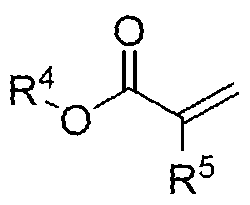
- the copolymer may have backbone chains including monomeric units of formula (II): wherein
- R 4 is hydrogen or -(C(H)R) n C0 2 H
- n 1-3, and each R is independently hydrogen or -OH; and R 5 is hydrogen or C -C6alkyl; and [0020] In some embodiments, R 4 is selected according to one of the groups
- R 4 is hydrogen or -(C(H)R) n C0 2 H, wherein n is 1-3, and each R is independently hydrogen or -OH.
- R 4 is hydrogen
- R 4 is -(C(H)R)nC02H, wherein n is 1 or 2, and each R is independently hydrogen or -OH.
- R 4 is -(C(H)R) n C0 2 H, wherein n is 1 or 3, and each R is independently hydrogen or -OH.
- R 4 is -(C(H)R)nC02H, wherein n is 2 or 3, and each R is independently hydrogen or -OH.
- R 4 is -(C(H)R) n C02H, wherein n is 1 , and each R is independently hydrogen or -OH.
- R 5 is selected according to one of the groups
- R 5 is hydrogen or Ci-Cealkyl.
- R 5 is hydrogen
- R 5 is Ci-Cealkyl
- the monomeric units of formula (II) may be derived from at least one of acrylic acid or methacrylic acid.
- the monomeric units of formula (I) are derived from styrene and the monomeric units of formula (II) are derived from acrylic acid.
- the copolymer can be a block copolymer of the formula (PAAx- PSy) wherein x is from 10 to 350, and y is from 20 to 100. In some embodiments, x is 10 to 20, 60 to 100, 70 to 90, 100 to 150, 150 to 200, 200 to 250, 210 to 230, 250 to 300, 300 to 350, or 310 to 330.
- y is from 20 to 30, 30 to 40, 40 to 50, 50 to 60, 60 to 70, 70 to 80, 80 to 90, 85 to 95, or 90 to 100.
- the copolymer can be of the formula (PAA x -PS y ) wherein x is 310 to 330 and y is 30 to 40, x is 210 to 230 and y is 30 to 40, x is 70 to 90 and y is 85 to 95, or x is 10 to 20 and y is 85 to 95.
- the copolymer can be of the formula ( ⁇ -PSy) wherein x is 320 and y is 38, x is 220 and y is 38, x is 80 and y is 90, or x is 15 and y is 90.
- the polymer is a random/statistical copolymer, an alternating copolymer, or a periodic copolymer.
- the weight ratio of the monomeric units of formula (II) to the monomeric units of formula (I) may be from about 1 :99 to about 80:20. In some embodiments, the ratio is about 5:95 to about 80:20, about 10:90 to about 80:20, about 15:85 to about 80:20, about 20:80 to about 80:20, about 25:75 to about 80:20, about 30:70 to about 80:20, about 35:65 to about 80:20, about 40:60 to about 80:20, about 45:55 to about 80:20, about 50:50 to about 80:20, about 55:45 to about 80:20, about 60:40 to about 80:20, about 65:35 to about 80:20, about 70:30 to about 80:20, about 75:25 to about 80:20, about 1 :99 to about 75:25, about 1 :99 to about 70:30, about 1 :99 to about 65:35, about 1 :99 to about 60:40, about 1 :99 to about 55:45,
- the weight percent of the monomeric units of formula (II) may be about 1 percent to about 80 percent of the copolymer.
- the weight percent of the monomeric units of formula (II) may be about 10 percent to about 80 percent, about 10 percent to about 70 percent, about 20 percent to about 80 percent, about 15 percent to about 25 percent, about 18 percent to about 22 percent, about 60 percent to about 80 percent, about 70 percent to about 80 percent, about 60 percent to about 75 percent, about 60 percent to about 70 percent, about 70 percent to about 75 percent, about 1 percent to about 10 percent, about 1 percent to about 5 percent, or about 1 percent to about 2 percent of the copolymer.
- the mol percent of the monomeric units of formula (II) may be about 1 percent to about 80 percent of the copolymer.
- the mol percent of the monomeric units of formula (II) may be about 5 percent to about 90 percent, about 5 percent to about 40 percent, about 20 percent to about 50 percent, about 15 percent to about 45 percent, about 70 percent to about 90 percent, about 60 percent to about 80 percent, about 75 percent to about 85 percent, about 80 percent to about 90 percent, about 30 percent to about 40 percent, about 35 percent to about 85 percent, about 5 percent to about 15 percent, about 8 percent to about 12 percent, or about 5 percent to about 10 percent of the copolymer.
- the payload may be selected from pharmaceutical compounds, agricultural compounds, coating material, minerals, vitamins, herbs or high-energy materials.
- the payload may be a fungicide, herbicide, pesticide, acaricide, algaecide, antifeedant, avicide, bactericide, bird repellent, chemosterilant, defoliant, desiccant, disinfectant, herbicide safener, insect attractant, insecticide, insect repellent, mammal repellent, mating disrupter, molluscicide, nematicide, plant activator, plant growth regulator, rodenticide, semiochemical, synergist, virucide, or pharmacological agent.
- the payload has poor water solubility.
- the payload may be hydrophobic or have one or more hydrophobic groups or regions that make it difficult to be dissolved in aqueous environments (e.g. absorption in biological systems). This is particularly useful in pharmaceuticals, were solubility is important for a drug's pharmacokinetic profile.
- the payload may be 10 weight percent to 50 weight percent of the composition.
- the payload may be 10 weight percent to 12 weight percent, 10 weight percent to 15 weight percent, 10 weight percent to 20 weight percent, 10 weight percent to 25 weight percent, 10 weight percent to 30 weight percent, 10 weight percent to 35 weight percent, 10 weight percent to 40 weight percent, 10 weight percent to 45 weight percent, 15 weight percent to 25 weight percent, 20 weight percent to 25 weight percent, 12 weight percent to 17 weight percent, or 18 weight percent to 22 weight percent, 20 weight percent to 30 weight percent, 20 weight percent to 35 weight percent, 20 weight percent to 40 weight percent, 20 weight percent to 45 weight percent, 20 weight percent to 50 weight percent, 25 weight percent to 45 weight percent, or 25 weight percent to 50 weight percent of the composition.
- the composition may be a solid mixture or a liquid mixture.
- the composition may be a melt processed blend, an aqueous or alcoholic mixture, dispersion in water, Iyophiiized solid, or spray-dried powder.
- the composition may be mixture including an alcoholic solvent.
- the composition may be mixture in methanol, ethanol, isopropanol, tert-butanol, or other organic alcohol.
- the mixture also contains an ethereal solvent.
- the mixture may include diethyl ether or tetrahydrofuran (THF).
- the mixture may include a solvent mixture of an alcohol and an ethereal solvent, for example, methanol and THF.
- the solvent mixture may be a 50:50 v/v mixture of methanol to THF.
- the solvent mixture may be 20:80, 25:75, 30:70, 35:75, 40:60, 45:55, 55:45, 60:40, 65:35, 70:30, 75:25, or 80:20 v/v methanol to THF.
- the invention further provides a controlled-release composition including a copolymer having backbone chains including monomeric units of formulae (I) and (II), and a payload homogeneously distributed throughout the copolymer.
- the composition may also provide control over the amount of the released drug in the media with different pH values (low free drug concentration at pH values that mimic stomach environment and rapid dissolution and supersaturation maintenance at neutral pH of the small intestine.
- Controlled release compositions refer to compositions designed to release the payload in a manner that is different than an immediate release composition.
- a controlled release composition may be a delayed release, sustained release, or extended release composition.
- the composition may delay release of the payload (i.e., not release any appreciable amount), and then release a substantial amount in a short period of time (e.g., delayed release).
- the composition may release the payload at a constant rate over a long period of time (e.g., sustained release).
- the composition may delay release of the payload, and then slowly release the payload over a long period of time (e.g., an extended release composition).
- composition may also effectively inhibit drug crystallization in the solid state, thus increasing long-term shelf life and storage.
- the invention also provides a method for making a composition including a copolymer having backbone chains including monomeric units of formulae (I) and (II), and a payload homogeneously distributed throughout the copolymer.
- the method may include:
- a copolymer having backbone chains including:
- R 1 is hydrogen, Ci-C6aikyl or halogen
- R 2 is hydrogen or d-Cealkyl
- R 3 is hydrogen or Ci-C6alkyl
- R 4 is hydrogen or -(C(H)R) n C0 2 H
- n 1-3 and each R is independently hydrogen or -OH;
- R 5 is hydrogen or Ci-C6alkyl
- the solid comprises the payioad homogeneously distributed throughout the copolymer.
- the drying is spray-drying.
- the mixture may include a solvent mixture described herein.
- the solvent mixture may be selected based on the individual solvent's ability to dissolve the individual blocks of the copolymer.
- the solvent mixture may include a mixture of two solvents, one that would dissolve a poly acrylic acid homopolymer, and one that would dissolve a styrene homopolymer.
- the solvent mixture may include a sumble that would dissolve the homopolymer of one block of the copolymer, and another that would dissolve the homopolymer of both blocks of the copolymer.
- the solvent mixture may include a mixture of two solvents, one that would dissolve a poly acrylic acid homopolymer, and one that would dissolve both poly acrylic acid homopolymer and a styrene homopolymer.
- Common solvents for the block of the copolymer including monomeric units of formula (II) include alcohols, water, alkali water and acidic water (e.g., HCI solution in water).
- Common solvents for both blocks of the copolymer i.e., monomeric units of formula (II) and monomeric units of formula (I)
- Common solvents for both blocks of the copolymer include: a mixture of any solvent for the block of the copolymer including monomeric units of formula (II) with THF, chloroform, dichloromethane, and toluene.
- Individual solvents such as dimethylformamide (DMF) and dioxane can be used as solvents for both blocks of the copolymer.
- the method further includes forming the copolymer by combining a monomer of formula (III):
- R 1 is hydrogen, Ci-C6alkyl or halogen
- R 2 is hydrogen or Ci-Cealkyl
- R 3 is hydrogen or Ci-Cealkyl
- R 4 is hydrogen -(C(H)R) n C0 2 H
- n 1-3 and each R is independently hydrogen or OH;
- R 5 is hydrogen or Ci-Cealkyl
- the monomer of formula (ill) and (IV) may be any monomer capable for forming the monomeric units of formula (I) and formula (II), respectively.
- the monomers may include the R -R 5 groups of any of groups (1 a) - (4k).
- monomer of formula (II!) may be styrene, 2-methylstyrene, 3-methylstyrene, 4-methylstyrene, 4-ferf-butylstyrene, 4-fluorostyrene or 4-chlorostyrene.
- the monomer of formula (IV) may be acrylic acid or methacrylic acid.
- the invention also provides a method for making a controlled-release composition including a copolymer having backbone chains including monomeric units of formulae (I) and (II), and a payload homogeneously distributed throughout the copolymer.
- Example 1 Synthesis of polystyrene macro-CTA.
- Polystyrene macro-CTA was synthesized according to literature procedure: Chem. Commun. 2008, 6188-6190. Benzyl benzoate (BDB, 0.246 g, 1 mmol), AIBN (0.0172 g, 0.1 mmol), and styrene (10.02 g, 96 mmol) were added into a 50 mL round-bottom flask, followed by three freeze- vacuum-thaw cycles. The flask was immersed into an oil bath at 80 °C with stirring. After eight hours, the flask was cooled to room temperature, and opened to air.
- BDB Benzyl benzoate
- AIBN 0.0172 g, 0.1 mmol
- styrene 10.02 g, 96 mmol
- the polymer was dissolved in 25 mL of tetrahydrofuran, and then precipitated by adding a solution drop wise into methanol (500 mL). Repeating the dissolving-precipitation three times, the obtained pink product was dried in vacuum.
- Example 2 Synthesis of polystyrene-b-poly(tert-butyl) acrylate.
- the jelly-like leftover was dissolved in 20 mL of THF, and precipitated twice into 1 L of methanol-water (1 :1 , v/v) mixture.
- the solid was filtered on a filter with a coarse frit, and left overnight to dry. The next day, it was dried in a vacuum oven at 60 °C for two days.
- Example 3 Hydrolysis of polystyrene-b-poly(tert-butyl) acrylate
- Example 5 Spray-drying of polystyrene-b-poly(acryiic acid).
- the solution was purged through a nozzle of Bend Research Mini Spray Drier under the following conditions: inlet temperature of 72 °C, nitrogen flow rate of 12.8 SLPM, syringe flow rate of 0.65 mL/min, and collected on a 1.5" Whatman filter.
- Example 6 Dissolution experiments for testing Probucol solubility enhancement.
- Dissolution testing was performed in PBS buffer with 0.5 wt % of simulated intestinal fluid (SIF), which mimics conditions in the intestinal lumen.
- Dissolution testing media consisted of PBS buffer (80 mM sodium chloride, 20 mM sodium hydrophosphate heptahydrate, 45 mM potassium dihydrophosphate) with 0.5 wt % of SIF (3 mM sodium taurocholate, 0.2 mM lecithin, 34.8 mM sodium hydroxide, 68.62 mM sodium chloride, 19.12 mM maleic acid) at 6.5 pH.
- SIF simulated intestinal fluid
- the spray-dried dispersion was weighed into plastic micro-centrifuge tube (MCT) and the dissolution media was added to target a total drug concentration of 1000 g/mL if fully dissolved.
- the MCT was placed onto an isothermal aluminum heating block at 37 °C. After 4, 10, 20, 40, 90, 180, and 360 minutes tubes were removed, centrifuged at 13000 rpm for one minute, and an aliquot was removed for further analysis. The MCT samples were then vortexed and placed back onto the aluminum heating block for the next time point.
- Figure 1 shows the Probucoi dissolution performance for a block copolymer spray- dried dispersion (PSgo-ib-PAAso) as well as for a homopoiymer ( ⁇ ), each with 25 % drug loading. Solvent choice for the block copolymer has a dramatic effect on the drug solubility enhancement.
- Example 7 PAA to PS ratios in the block copolymers and their correlation with the spray-dried dispersions performance
- Figure 3 shows area under the curve of the dissolution profiles for the spray-dried dispersions prepared from PAA-6-PS block copolymers with 25 weight % Probucol (numbers under graph 320-38, 220-38 etc. represent number of repeat units (R.U.) for PAA and PS respectively, in Table 1 ).
- the bar on left represents a spray-dried dispersion obtained from methanol
- the bar on right represents a spray-dried dispersion obtained from THF/MeOH mixture.
Landscapes
- Health & Medical Sciences (AREA)
- Chemical & Material Sciences (AREA)
- Life Sciences & Earth Sciences (AREA)
- Medicinal Chemistry (AREA)
- Pharmacology & Pharmacy (AREA)
- Epidemiology (AREA)
- Animal Behavior & Ethology (AREA)
- General Health & Medical Sciences (AREA)
- Public Health (AREA)
- Veterinary Medicine (AREA)
- Engineering & Computer Science (AREA)
- Bioinformatics & Cheminformatics (AREA)
- Inorganic Chemistry (AREA)
- Pharmaceuticals Containing Other Organic And Inorganic Compounds (AREA)
- Medicinal Preparation (AREA)
Abstract
The disclosed invention relates to a composition for enhancing the aqueous solubility and maintaining supersaturation of hydrophobic materials. The composition includes a copolymer and a payload homogeneously distributed throughout the copolymer. The composition enhances the stability of the payload, but dissolves under certain environmental conditions to provide controlled release of the payload.
Description
COMPOSITIONS FOR DELIVERING MATERIALS
Cross -Reference To Related Applications
[0001] This application claims the benefit of priority to U.S. Provisional Application No. 62/366,842, filed July 26, 2016, the disclosure of which is incorporated herein in its entirety.
Field of the Invention
[0002] The invention relates to compositions comprising a copolymer and a payload. The composition provides stability to the payload, and dissolves under appropriate conditions. The compositions also enhance the aqueous solubility and maintain supersaturation of poorly water soluble drugs and hydrophobic materials.
Description of Related Art
[0003] Hydroxypropyl methyl cellulose acetate succinate (HPMCAS) is one of the most commonly used excipients for storing and delivering active pharmaceutical ingredients. However, its heterogeneity, random degree of substitution and complex behavior in solution makes structure-property relationships of HPMCAS difficult to characterize and understand. An exciptent having a tunable polymer length and chemical composition would allow the study of excipient structure-property relationships by providing control of key structural parameters such as hydrophobicity, hydrogen bonding, ionizability and pH response.
SUMMARY OF THE INVENTION
[0004] The invention provides a composition including:
a copolymer having backbone chains including
monomeric units of for

(I)
wherein
R1 is hydrogen, Ci-C6alkyl or halogen;
R2 is hydrogen or Ci-Cea!ky!; and
R3 is hydrogen or d-Cealkyl; and
monomeric units of formula (II):

(II)
wherein
R4 is hydrogen or -(C(H)R)nC02H,
wherein n is 1 -3 and each R is independently hydrogen or -OH; and
R5 is hydrogen or Ci-Cealkyl; and
a payload homogeneously distributed throughout the copolymer.
[0005] The invention further provides control led-release compositions including a copolymer having backbone chains including monomeric units of formulae (I) and (II), and a payload homogeneously distributed throughout the copolymer.
[0006] The invention also provides methods for making a composition including a copolymer having backbone chains including monomeric units of formulae (I) and (II), and a payload homogeneously distributed throughout the copolymer.
[0007] The invention further provides methods for making a controlled-release composition including a copolymer having backbone chains including monomeric units of formulae (I) and (II), and a payload homogeneously distributed throughout the copolymer.
[0008] These and other features and advantages of the invention will be more fully understood from the following detailed description of the invention taken together with the claims. It is noted that the scope of the claims is defined by the recitations therein and not by the specific discussion of features and advantages set forth in the present description.
BRIEF DESCRIPTION OF THE DRAWINGS
[0009] Figure 1 shows dissolution performance for block copolymer (PSso-Jb-PAAao) spray- dried dispersions with 25 % drug loading.
[0010] Figure 2 shows polymer solubility in simulated intestinal fluid during dissolution testing. For each copolymer, the bar on left represents a spray-dried dispersion obtained from methanol, and the bar on right represents a spray-dried dispersion obtained from THF/MeOH mixture. The inserted graphs (diamond = spray-dried dispersion obtained from methanol; square = spray-dried dispersion obtained from THF/MeOH mixture) show
dissolution testing of the corresponding spray-dried dispersion (y-axis: drug concentration in g/mL; x-axis: time in min).
[0011] Figure 3 shows the correlation between PAA to PS ratios in the block copoiymers of example spray-dried dispersions and the area under the curve of their dissolution profiles.
DETAILED DESCRIPTION OF THE INVENTION
[0012] The term "polymer" as used herein means a large molecule (macromolecule) composed of a repeating series of one or more alternating monomeric species. These sub- units are typically connected by covalent chemical bonds. Examples of types of polymers are "homopolymers", "copolymers", "heteropolymers" and "alternating copolymers."
[0013] The term "substantially stable" means that the composition does not substantially decompose, dissolve or release a substantial amount of the payioad under the prescribed environmental conditions. A small amount of payioad leaching may be observed under some conditions, but the composition is "substantially stable" if the composition retains greater than about 90 % of the payioad over an allotted period of time.
[0014] The invention provides a composition including:
a copolymer having backbone chains including
monomeric units of for

(I)
wherein
R1 is hydrogen, Ci-C6alkyl or halogen;
R2 is hydrogen or Ci-C6alkyl; and
R3 is hydrogen or d-Cealkyl; and
monomeric units of formula (II):
 wherein
R4 is hydrogen or -(C(H)R)nC02H,
wherein n is 1-3, and each R is independently hydrogen or -OH;
and
hydrogen or Ci-C6aikyi; and
a payload homogeneously distributed throughout the copolymer.
[0015] The copolymer may have backbone chains including monomeric units of formula (I):

(I)
wherein
R1 is hydrogen, d-Cealkyl or halogen;
R2 is hydrogen or Ci-Cealkyl; and
R3 is hydrogen or Ci-C6alkyl.
[0016] In some embodiments, R1 is selected according to one of the groups
(1a) R is hydrogen, Ci-Cealkyl or halogen
(1b) R1 is hydrogen or halogen
(1c) R1 is hydrogen or Ci-Cealkyl.
(1d) R is Ci-Cealkyl or halogen.
(1e) R1 is hydrogen.
(1f) R is Ci-Cealkyl.
(1g) R is halogen.
(1h) Any of groups (1a) - (1g), where Ci-Cealkyl is methyl, ethyl, n-propyl, iso-propyl, n- butyl, sec-butyl, tert-butyl, n-pentyl or n-hexyl.
(1i) Any of groups (1a) - (1g), where Ci-Cealkyl is methyl, ethyl, n-propyl, iso-propyl, n- butyl, sec-butyl or tert-butyl.
(1j) Any of groups (1a) - (1g), where Ci-Cealkyl is methyl, ethyl, n-propyl or iso-propyl. (1k) Any of groups (1a) - (1g), where Ci-Cealkyl is methyl, ethyl or n-propyl.
(11) Any of groups (1a) - (1g), where Ci-Cealkyl is methyl or ethyl.
(1m) Any of groups (1a) - (1g), where Ci-C3alkyl is methyl.
(1n) Any of groups (1a) - (1g), where Ci-Cealkyl is ethyl.
(1o) Any of groups (1a) - (1g), where Ci-Cealkyl is n-propyl.
(1p) Any of groups (1a) - (1g), where halogen is fluoro, chloro or bromo.
(1q) Any of groups (1a) - (1g), where halogen is fluoro or chloro.
(1r) Any of groups (1a) - (1g), where halogen is fluoro or bromo.
(1s) Any of groups (1a) - (1g), where halogen is chloro or bromo.
(1t) Any of groups (1a) - (1g), where halogen is fluoro.
(1 u) Any of groups (1a) - (1g), where halogen is chloro.
(1v) Any of groups (1a) - (1g), where halogen is bromo.
[0017] In some embodiments, R2 and R3 are independently selected according to one of the groups
(2a) R2 and R3 are independently hydrogen or Ci-Cealkyl.
(2b) R2 and R3 are both hydrogen.
(2c) R2 and R3 are both C -C6alkyl.
(2d) Any of groups (2a) - (2c), where Ci-Cealkyl is methyl, ethyl, n-propyl, iso-propyl, n- butyl, sec-butyl, tert-butyl, n-pentyl or n-hexyl.
(2e) Any of groups (2a) - (2c), where Ci-C6alkyl is methyl, ethyl, n-propyl, iso-propyi, n- butyl, n-pentyl or n-hexyl.
(2f) Any of groups (2a) - (2c), where Ci-Cealkyl is methyl, ethyl, n-propyl, n-butyl, n-pentyl or n-hexyl.
(2g) Any of groups (2a) - (2c), where Ci-Cealkyl is methyl, ethyl or n-propyl.
(2h) Any of groups (2a) - (2c), where Ci-Cealkyl is methyl or ethyl.
(2i) Any of groups (2a) - (2c), where Ci-Cealkyl is methyl.
(2j) Any of groups (2a) - (2c), where Ci-Cealkyl is ethyl.
(2k) Any of groups (2a) - (2c), where Ci-Cealkyl is n-propyl.
[0018] For example, the monomeric units of formula (I) may be derived from at least one of styrene, 2-methylstyrene, 3-methylstyrene, 4-methylstyrene, 4-terf-butylstyrene, 4- fluorostyrene or 4-chlorostyrene.
[0019] The copolymer may have backbone chains including monomeric units of formula (II):
 wherein
R4 is hydrogen or -(C(H)R)nC02H,
wherein n is 1-3, and each R is independently hydrogen or -OH; and R5 is hydrogen or C -C6alkyl; and
[0020] In some embodiments, R4 is selected according to one of the groups
(3a) R4 is hydrogen or -(C(H)R)nC02H, wherein n is 1-3, and each R is independently hydrogen or -OH.
(3b) R4 is hydrogen.
(3c) R4 is -(C(H)R)nC02H, wherein n is 1 or 2, and each R is independently hydrogen or -OH.
(3d) R4 is -(C(H)R)nC02H, wherein n is 1 or 3, and each R is independently hydrogen or -OH.
(3e) R4 is -(C(H)R)nC02H, wherein n is 2 or 3, and each R is independently hydrogen or -OH.
(3f) R4 is -(C(H)R)nC02H, wherein n is 1 , and each R is independently hydrogen or -OH. (3g) R4 is -(C(H)R)r,C02H, wherein n is 2, and each R is independently hydrogen or -OH. (3h) R4 is -(C(H)R)nC02H, wherein n is 3, and each R is independently hydrogen or -OH. (3i) Any of groups (3a) - (3h), where each R is hydrogen.
(3j) Any of groups (3a) - (3h), where each R is -OH.
[0021] In some embodiments, R5 is selected according to one of the groups
(4a) R5 is hydrogen or Ci-Cealkyl.
(4b) R5 is hydrogen.
(4c) R5 is Ci-Cealkyl.
(4d) Any of groups (4a) - (4c), where Ci-C6alkyl is methyl, ethyl, n-propyl, iso-propyl, n- butyl, sec-butyl, tert-butyl, n-pentyl or n-hexyi.
(4e) Any of groups (4a) - (4c), where Ci-C6alkyl is methyl, ethyl, n-propyl, iso-propyl, n- butyl, sec-butyl or tert-butyl.
(4f) Any of groups (4a) - (4c), where Ci-Cealkyl is methyl, ethyl, n-propyl or iso-propyl.
(4g) Any of groups (4a) - (4c), where Ci-C6alkyl is methyl, ethyl or n-propyl.
(4h) Any of groups (4a) - (4c), where Ci-Cealkyl is methyl or ethyl.
(4i) Any of groups (4a) - (4c), where Ci-Cealkyl is methyl.
(4j) Any of groups (4a) - (4c), where Ci-C6alkyl is ethyl.
(4k) Any of groups (4a) - (4c), where Ci-C6alkyl is n-propyl.
[0022] For example, the monomeric units of formula (II) may be derived from at least one of acrylic acid or methacrylic acid.
[0023] In some embodiments, the monomeric units of formula (I) are derived from styrene and the monomeric units of formula (II) are derived from acrylic acid.
[0024] In some embodiments, the copolymer can be a block copolymer of the formula (PAAx- PSy) wherein x is from 10 to 350, and y is from 20 to 100. In some embodiments, x is 10 to 20, 60 to 100, 70 to 90, 100 to 150, 150 to 200, 200 to 250, 210 to 230, 250 to 300, 300 to 350, or 310 to 330. In some embodiments, y is from 20 to 30, 30 to 40, 40 to 50, 50 to 60, 60 to 70, 70 to 80, 80 to 90, 85 to 95, or 90 to 100. For example, the copolymer can be of the formula (PAAx-PSy) wherein x is 310 to 330 and y is 30 to 40, x is 210 to 230 and y is 30 to 40, x is 70 to 90 and y is 85 to 95, or x is 10 to 20 and y is 85 to 95. In some embodiments, the copolymer can be of the formula (ΡΑΑχ-PSy) wherein x is 320 and y is 38, x is 220 and y is 38, x is 80 and y is 90, or x is 15 and y is 90.
[0025] In other embodiments, the polymer is a random/statistical copolymer, an alternating copolymer, or a periodic copolymer.
[0026] The weight ratio of the monomeric units of formula (II) to the monomeric units of formula (I) may be from about 1 :99 to about 80:20. In some embodiments, the ratio is about 5:95 to about 80:20, about 10:90 to about 80:20, about 15:85 to about 80:20, about 20:80 to about 80:20, about 25:75 to about 80:20, about 30:70 to about 80:20, about 35:65 to about 80:20, about 40:60 to about 80:20, about 45:55 to about 80:20, about 50:50 to about 80:20, about 55:45 to about 80:20, about 60:40 to about 80:20, about 65:35 to about 80:20, about 70:30 to about 80:20, about 75:25 to about 80:20, about 1 :99 to about 75:25, about 1 :99 to about 70:30, about 1 :99 to about 65:35, about 1 :99 to about 60:40, about 1 :99 to about 55:45, about 1 :99 to about 50:50, about 1 :99 to about 45:55, about 1 :99 to about 40:60, about 1 :99 to about 35:65, about 1 :99 to about 30:70, about 1 :99 to about 25:75, about 1 :99 to about 20:80, about 1 :99 to about 15:85, about 1 :99 to about 10:90 or about 1 :99 to about 5:95.
[0027] In other embodiments, the weight percent of the monomeric units of formula (II) may be about 1 percent to about 80 percent of the copolymer. For example, the weight percent of the monomeric units of formula (II) may be about 10 percent to about 80 percent, about 10 percent to about 70 percent, about 20 percent to about 80 percent, about 15 percent to about 25 percent, about 18 percent to about 22 percent, about 60 percent to about 80 percent, about 70 percent to about 80 percent, about 60 percent to about 75 percent, about 60 percent to about 70 percent, about 70 percent to about 75 percent, about 1 percent to about 10 percent, about 1 percent to about 5 percent, or about 1 percent to about 2 percent of the copolymer.
[0028] In other embodiments, the mol percent of the monomeric units of formula (II) may be about 1 percent to about 80 percent of the copolymer. For example, the mol percent of the monomeric units of formula (II) may be about 5 percent to about 90 percent, about 5 percent to about 40 percent, about 20 percent to about 50 percent, about 15 percent to about 45 percent, about 70 percent to about 90 percent, about 60 percent to about 80 percent, about 75 percent to about 85 percent, about 80 percent to about 90 percent, about 30 percent to about 40 percent, about 35 percent to about 85 percent, about 5 percent to about 15 percent, about 8 percent to about 12 percent, or about 5 percent to about 10 percent of the copolymer.
[0029] The payload may be selected from pharmaceutical compounds, agricultural compounds, coating material, minerals, vitamins, herbs or high-energy materials. For example, the payload may be a fungicide, herbicide, pesticide, acaricide, algaecide, antifeedant, avicide, bactericide, bird repellent, chemosterilant, defoliant, desiccant, disinfectant, herbicide safener, insect attractant, insecticide, insect repellent, mammal repellent, mating disrupter, molluscicide, nematicide, plant activator, plant growth regulator, rodenticide, semiochemical, synergist, virucide, or pharmacological agent.
[0030] In some embodiments, the payload has poor water solubility. The payload may be hydrophobic or have one or more hydrophobic groups or regions that make it difficult to be dissolved in aqueous environments (e.g. absorption in biological systems). This is particularly useful in pharmaceuticals, were solubility is important for a drug's pharmacokinetic profile.
[0031] The payload may be 10 weight percent to 50 weight percent of the composition. In some embodiments, the payload may be 10 weight percent to 12 weight percent, 10 weight percent to 15 weight percent, 10 weight percent to 20 weight percent, 10 weight percent to 25 weight percent, 10 weight percent to 30 weight percent, 10 weight percent to 35 weight percent, 10 weight percent to 40 weight percent, 10 weight percent to 45 weight percent, 15 weight percent to 25 weight percent, 20 weight percent to 25 weight percent, 12 weight percent to 17 weight percent, or 18 weight percent to 22 weight percent, 20 weight percent to 30 weight percent, 20 weight percent to 35 weight percent, 20 weight percent to 40 weight percent, 20 weight percent to 45 weight percent, 20 weight percent to 50 weight percent, 25 weight percent to 45 weight percent, or 25 weight percent to 50 weight percent of the composition.
[0032] The composition may be a solid mixture or a liquid mixture. For example, the composition may be a melt processed blend, an aqueous or alcoholic mixture, dispersion in water, Iyophiiized solid, or spray-dried powder. The composition may be mixture including an alcoholic solvent. For example, the composition may be mixture in methanol, ethanol, isopropanol, tert-butanol, or other organic alcohol.
[0033] In some embodiments, the mixture also contains an ethereal solvent. For example, the mixture may include diethyl ether or tetrahydrofuran (THF). In some embodiments, the mixture may include a solvent mixture of an alcohol and an ethereal solvent, for example, methanol and THF. The solvent mixture may be a 50:50 v/v mixture of methanol to THF. In other embodiments, the solvent mixture may be 20:80, 25:75, 30:70, 35:75, 40:60, 45:55, 55:45, 60:40, 65:35, 70:30, 75:25, or 80:20 v/v methanol to THF.
[0034] The invention further provides a controlled-release composition including a copolymer having backbone chains including monomeric units of formulae (I) and (II), and a payload homogeneously distributed throughout the copolymer. The composition may also provide control over the amount of the released drug in the media with different pH values (low free drug concentration at pH values that mimic stomach environment and rapid dissolution and supersaturation maintenance at neutral pH of the small intestine.
[0035] Controlled release compositions as used herein refer to compositions designed to release the payload in a manner that is different than an immediate release composition. A controlled release composition may be a delayed release, sustained release, or extended release composition. In some embodiments, the composition may delay release of the payload (i.e., not release any appreciable amount), and then release a substantial amount in a short period of time (e.g., delayed release). In other embodiments, the composition may release the payload at a constant rate over a long period of time (e.g., sustained release). In other embodiments, the composition may delay release of the payload, and then slowly release the payload over a long period of time (e.g., an extended release composition).
[0036] The composition may also effectively inhibit drug crystallization in the solid state, thus increasing long-term shelf life and storage.
[0037] The invention also provides a method for making a composition including a copolymer having backbone chains including monomeric units of formulae (I) and (II), and a payload homogeneously distributed throughout the copolymer. The method may include:
preparing a mixture including:
a copolymer having backbone chains including:
monomeric units of formula (I):

(I)
wherein
R1 is hydrogen, Ci-C6aikyl or halogen;
R2 is hydrogen or d-Cealkyl; and
R3 is hydrogen or Ci-C6alkyl; and
monomeric units of formula (II):

(ll)
wherein
R4 is hydrogen or -(C(H)R)nC02H,
wherein n is 1-3 and each R is independently hydrogen or -OH; and
R5 is hydrogen or Ci-C6alkyl; and
a payioad; and
drying the mixture to provide a solid,
wherein the solid comprises the payioad homogeneously distributed throughout the copolymer.
[0038] In some embodiments, the drying is spray-drying. The mixture may include a solvent mixture described herein. The solvent mixture may be selected based on the individual solvent's ability to dissolve the individual blocks of the copolymer. For example, for a copolymer of poly acrylic acid and styrene, the solvent mixture may include a mixture of two solvents, one that would dissolve a poly acrylic acid homopolymer, and one that would dissolve a styrene homopolymer. in other embodiments, the solvent mixture may include a soivent that would dissolve the homopolymer of one block of the copolymer, and another that would dissolve the homopolymer of both blocks of the copolymer. For example, for a copolymer of poly acrylic acid and styrene, the solvent mixture may include a mixture of two
solvents, one that would dissolve a poly acrylic acid homopolymer, and one that would dissolve both poly acrylic acid homopolymer and a styrene homopolymer.
[0039] Common solvents for the block of the copolymer including monomeric units of formula (II) include alcohols, water, alkali water and acidic water (e.g., HCI solution in water). Common solvents for both blocks of the copolymer (i.e., monomeric units of formula (II) and monomeric units of formula (I)) include: a mixture of any solvent for the block of the copolymer including monomeric units of formula (II) with THF, chloroform, dichloromethane, and toluene. Individual solvents such as dimethylformamide (DMF) and dioxane can be used as solvents for both blocks of the copolymer.
[0040] In some embodiments, the method further includes forming the copolymer by combining a monomer of formula (III):

(Ill)
wherein
R1 is hydrogen, Ci-C6alkyl or halogen;
R2 is hydrogen or Ci-Cealkyl; and
R3 is hydrogen or Ci-Cealkyl; and
a monomer of formula (IV):

(IV)
wherein
R4 is hydrogen -(C(H)R)nC02H,
wherein n is 1-3 and each R is independently hydrogen or OH; and
R5 is hydrogen or Ci-Cealkyl;
initiating polymerization to provide a copolymer; and
isolating the copolymer.
[0041] The monomer of formula (ill) and (IV) may be any monomer capable for forming the monomeric units of formula (I) and formula (II), respectively. For example, the monomers
may include the R -R5 groups of any of groups (1 a) - (4k). For example, monomer of formula (II!) may be styrene, 2-methylstyrene, 3-methylstyrene, 4-methylstyrene, 4-ferf-butylstyrene, 4-fluorostyrene or 4-chlorostyrene. The monomer of formula (IV) may be acrylic acid or methacrylic acid.
[0042] The invention also provides a method for making a controlled-release composition including a copolymer having backbone chains including monomeric units of formulae (I) and (II), and a payload homogeneously distributed throughout the copolymer.
EXAMPLES
[0043] Example 1 : Synthesis of polystyrene macro-CTA.
[0044] Polystyrene macro-CTA was synthesized according to literature procedure: Chem. Commun. 2008, 6188-6190. Benzyl benzoate (BDB, 0.246 g, 1 mmol), AIBN (0.0172 g, 0.1 mmol), and styrene (10.02 g, 96 mmol) were added into a 50 mL round-bottom flask, followed by three freeze- vacuum-thaw cycles. The flask was immersed into an oil bath at 80 °C with stirring. After eight hours, the flask was cooled to room temperature, and opened to air. The polymer was dissolved in 25 mL of tetrahydrofuran, and then precipitated by adding a solution drop wise into methanol (500 mL). Repeating the dissolving-precipitation three times, the obtained pink product was dried in vacuum.
[0045] Example 2: Synthesis of polystyrene-b-poly(tert-butyl) acrylate.
[0046] 8 mL of tert-butyl acrylate (54.17 mmol), 500 mg of polystyrene macro-CTA (0.125 mmol), and 6.56 mg of AIBN (0.04 mmol) were mixed in a Schlenk flask. Then, 10 mL of toluene was added, and mixture was purged with nitrogen gas for one hour while submerged into an ice bath. The reaction mixture was placed into a preheated 70 °C oil bath and was stirred for twenty five hours. After, the mixture was cooled down to room temperature while exposed to the air, and toluene was evaporated later under reduced pressure. The jelly-like leftover was dissolved in 20 mL of THF, and precipitated twice into 1 L of methanol-water (1 :1 , v/v) mixture. The solid was filtered on a filter with a coarse frit, and left overnight to dry. The next day, it was dried in a vacuum oven at 60 °C for two days.
[0047] Example 3: Hydrolysis of polystyrene-b-poly(tert-butyl) acrylate
[0048] 1.8674 g of a polystyrene-b-poly(tert-butyl) acrylate block copolymer (0.06 mmol) was dissolved in 5.5 mL of dichloromethane in an Erienmeyer flask equipped with a magnetic stir bar. Excess of trifluoroacetic acid was added drop wise (3.1 mL, d=1.49 g/mL, 18 mmol). The solution was stirred for twenty-four hours at room temperature. The resulting suspension was
filtered, and the solid was dissolved in DMF and dialyzed against ethanol-water mixture (1 :1 , v/v), and then against water for two days. The aqueous solution was freeze dried to provide polystyrene-b-poly(acrylic acid) (PSgo-b-PAAso).
[0049] Example 5: Spray-drying of polystyrene-b-poly(acryiic acid).
[0050] Two solvent systems were used: 1 ) Methanol, 2) Methanol.THF (1 :1 , v/v) mixture.
1 ) 250 mg of polymer was dissolved in 15 mL of methanol-THF mixture (1 :1 , v/v) and the solution was dialyzed against methanol in a bag with molecular weight cutoff of 1000 Da (MWCO=100 Da). The solution was quantitatively transferred into a beaker and methanol was added until 32 mL of total volume is reached (1 wt % polymer concentration). Afterwards, 27.8 mg or 83.3 mg of Probucol (10 and 25 wt % loadings) was added and stirred for 24 hours. The solution was purged through a nozzle of Bend Research Mini Spray Drier under the following conditions: inlet temperature of 72 °C, nitrogen flow rate of 12.8 SLPM, syringe flow rate of 0.65 mL/min, and collected on a 1.5" Whatman filter.
2) 250 mg of polymer and 27.8 mg or 83.3 mg of Probucol (10 and 25 wt % loadings) were dissolved in 32 mL of methanol-THF mixture (1 :1 , v/v) and stirred for 24 hours. The resulting solution was purged through a nozzle of Bend Research Mini Spray Drier under the following conditions: inlet temperature of 72 °C, nitrogen flow rate of 12.8 SLPM, syringe flow rate of 0.65 mL/min, and collected on a 1.5" Whatman filter.
[0051] Example 6: Dissolution experiments for testing Probucol solubility enhancement.
[0052] Dissolution testing was performed in PBS buffer with 0.5 wt % of simulated intestinal fluid (SIF), which mimics conditions in the intestinal lumen. Dissolution testing media consisted of PBS buffer (80 mM sodium chloride, 20 mM sodium hydrophosphate heptahydrate, 45 mM potassium dihydrophosphate) with 0.5 wt % of SIF (3 mM sodium taurocholate, 0.2 mM lecithin, 34.8 mM sodium hydroxide, 68.62 mM sodium chloride, 19.12 mM maleic acid) at 6.5 pH. For each test, the spray-dried dispersion was weighed into plastic micro-centrifuge tube (MCT) and the dissolution media was added to target a total drug concentration of 1000 g/mL if fully dissolved. The MCT was placed onto an isothermal aluminum heating block at 37 °C. After 4, 10, 20, 40, 90, 180, and 360 minutes tubes were removed, centrifuged at 13000 rpm for one minute, and an aliquot was removed for further analysis. The MCT samples were then vortexed and placed back onto the aluminum heating block for the next time point. Each aliquot from dissolution samples was diluted with methanol and analyzed using high-performance liquid chromatography (HPLC) with
reversed-phase coiumn (EC-C18, Porosheli 120) and UV detector (1260 Infinity Multiple Wavelength Detector) to determine the drug concentration using calibration curves for Probucol.
[0053] Figure 1 shows the Probucoi dissolution performance for a block copolymer spray- dried dispersion (PSgo-ib-PAAso) as well as for a homopoiymer (ΡΑΑββ), each with 25 % drug loading. Solvent choice for the block copolymer has a dramatic effect on the drug solubility enhancement.
[0054] Example 7: PAA to PS ratios in the block copolymers and their correlation with the spray-dried dispersions performance
[0055] Figure 3 shows area under the curve of the dissolution profiles for the spray-dried dispersions prepared from PAA-6-PS block copolymers with 25 weight % Probucol (numbers under graph 320-38, 220-38 etc. represent number of repeat units (R.U.) for PAA and PS respectively, in Table 1 ). For each copolymer, the bar on left represents a spray-dried dispersion obtained from methanol, and the bar on right represents a spray-dried dispersion obtained from THF/MeOH mixture.
Table 1. Composition of PAA-6-PS block copolymers

[0056] It is understood that the examples and embodiments described herein are for illustrative purposes only and that various modifications or changes in light thereof will be suggested to persons skilled in the art and are to be incorporated within the spirit and purview of this application and scope of the appended claims.
Claims
1. A composition comprising:
a copolymer having backbone chains comprising
monomeric units of formula (!):

(I)
wherein
R1 is hydrogen, Ci-Cealkyl or halogen;
R2 is hydrogen or Ci-Cealkyl; and
R3 is hydrogen or Ci-Cealkyl; and
and monomeric units of formula (II):

(II)
wherein
R4 is hydrogen or -(C(H)R)nC02H,
wherein n is 1-3 and each R is independently hydrogen or -OH; and
R5 is hydrogen or Ci-C6alkyl; and
a payload homogeneously distributed throughout the copolymer.
2. A composition according to claim 1 , wherein the payload is 10 weight percent to 50 weight percent of the composition.
3. A composition according to any of claims 1-2, wherein the monomeric units of formula
(I) are derived from at least one of styrene, 2-methylstyrene, 3-methylstyrene, 4- methylstyrene, 4-terf-butylstyrene, 4-fluorostyrene or 4-chlorostyrene.
4. A composition according to any of claims 1-3, wherein the monomeric units of formula
(II) are derived from at least one of acrylic acid or methacrylic acid.
5. A composition according to any of claims 1-4, wherein the monomeric units of formula (I) are derived from styrene and the monomeric units of formula (II) are derived from acrylic acid.
6. A composition according to any of claims 1-5, wherein the weight ratio of the monomeric units of formula (II) to the monomeric units of formula (I) is from about 1 :99 to about 80:20.
7. A composition according to any of claims 1- 6, wherein the payload is an agent selected from pharmaceutical compounds, agricultural compounds, coating material, minerals, vitamins, herbs or high-energy materials.
8. A composition according to any of claims 1-7, wherein the payload has poor water solubility.
9. A composition according to any of claims 1- 8, wherein the composition is a melt processed blend, an aqueous or alcoholic mixture, or is a dispersion in water, a lyophilized solid, or a spray-dried powder.
10. A mixture comprising a composition according to any of claims 1-8 in an alcoholic solvent.
11. A mixture according to claim 10, wherein the mixture further comprises an ethereal solvent.
12. A mixture according to claim 10, further comprising tetrahydrofuran.
13. A method for making a composition comprising a copolymer and a payload, the method comprising:
preparing a mixture comprising:
a copolymer having backbone chains comprising:
monomeric units of fo

(I)
wherein
R1 is hydrogen, Ci-Ceaikyl or halogen;
R2 is hydrogen or Ci-C6alkyl; and
R3 is hydrogen or Ci-C6alkyl; and
and monomeric units of formula (II):
 wherein
R4 is hydrogen or -(C(H)R)nC02H,
wherein n is 1-3 and each R is independently hydrogen or -OH; and
R5 is hydrogen or d-Cea!ky!; and
a payioad; and
drying the mixture to provide a solid,
wherein the solid comprises the payload homogeneously distributed throughout the copolymer.
A method according to claim 13, further comprising forming the copolymer by combining a monomer of formula

(Ill)
wherein
R1 is hydrogen, Ci-C6alkyl or halogen;
R2 is hydrogen or d-d-alkyl; and
R3 is hydrogen or d-Cealkyl; and
and a monomer of formula (IV):
(IV)
wherein
R4 is hydrogen -(C(H)R)nC02H,
wherein n is 1-3 and each R is independently hydrogen or OH; and
R5 is hydrogen or d-C6alkyl;
initiating polymerization to provide a copolymer; and
isolating the copolymer.
A method according to ciaim 13 or claim 14, wherein the monomer of formula Ml is styrene and the monomer of formula IV is acrylic acid.
Applications Claiming Priority (2)
| Application Number | Priority Date | Filing Date | Title |
|---|---|---|---|
| US201662366842P | 2016-07-26 | 2016-07-26 | |
| US62/366,842 | 2016-07-26 |
Publications (1)
| Publication Number | Publication Date |
|---|---|
| WO2018022601A1 true WO2018022601A1 (en) | 2018-02-01 |
Family
ID=59677287
Family Applications (1)
| Application Number | Title | Priority Date | Filing Date |
|---|---|---|---|
| PCT/US2017/043692 Ceased WO2018022601A1 (en) | 2016-07-26 | 2017-07-25 | Compositions for delivering materials |
Country Status (1)
| Country | Link |
|---|---|
| WO (1) | WO2018022601A1 (en) |
Citations (5)
| Publication number | Priority date | Publication date | Assignee | Title |
|---|---|---|---|---|
| GB2075209A (en) * | 1980-04-24 | 1981-11-11 | Electronic Memories & Magnetic | Carrier particles for electro-photographic developers |
| US5415964A (en) * | 1993-02-15 | 1995-05-16 | Konica Corporation | Pigment-containing polymer particles, method of production thereof |
| EP0796876A1 (en) * | 1996-03-22 | 1997-09-24 | National Starch and Chemical Investment Holding Corporation | Dye compositions and methods for the manufacture thereof |
| US20030236513A1 (en) * | 2002-06-19 | 2003-12-25 | Scimed Life Systems, Inc. | Implantable or insertable medical devices for controlled delivery of a therapeutic agent |
| WO2013186695A1 (en) * | 2012-06-11 | 2013-12-19 | Vive Crop Protection Inc. | Herbicide formulations |
-
2017
- 2017-07-25 WO PCT/US2017/043692 patent/WO2018022601A1/en not_active Ceased
Patent Citations (5)
| Publication number | Priority date | Publication date | Assignee | Title |
|---|---|---|---|---|
| GB2075209A (en) * | 1980-04-24 | 1981-11-11 | Electronic Memories & Magnetic | Carrier particles for electro-photographic developers |
| US5415964A (en) * | 1993-02-15 | 1995-05-16 | Konica Corporation | Pigment-containing polymer particles, method of production thereof |
| EP0796876A1 (en) * | 1996-03-22 | 1997-09-24 | National Starch and Chemical Investment Holding Corporation | Dye compositions and methods for the manufacture thereof |
| US20030236513A1 (en) * | 2002-06-19 | 2003-12-25 | Scimed Life Systems, Inc. | Implantable or insertable medical devices for controlled delivery of a therapeutic agent |
| WO2013186695A1 (en) * | 2012-06-11 | 2013-12-19 | Vive Crop Protection Inc. | Herbicide formulations |
Non-Patent Citations (3)
| Title |
|---|
| CHEM. COMMUN, 2008, pages 6188 - 6190 |
| LILY YUN LIN ET AL: "Tuning core vs. shell dimensions to adjust the performance of nanoscopic containers for the loading and release of doxorubicin", JOURNAL OF CONTROLLED RELEASE, ELSEVIER, AMSTERDAM, NL, vol. 152, no. 1, 7 January 2011 (2011-01-07), pages 37 - 48, XP028226322, ISSN: 0168-3659, [retrieved on 20110115], DOI: 10.1016/J.JCONREL.2011.01.009 * |
| RENATA VYHNALKOVA ET AL: "Bactericidal Block Copolymer Micelles", MACROMOLECULAR BIOSCIENCE, vol. 11, no. 5, 27 January 2011 (2011-01-27), DE, pages 639 - 651, XP055410879, ISSN: 1616-5187, DOI: 10.1002/mabi.201000428 * |
Similar Documents
| Publication | Publication Date | Title |
|---|---|---|
| Dutta et al. | Temperature, pH and redox responsive cellulose based hydrogels for protein delivery | |
| AU2012280319B2 (en) | Micelle-coated crystalline particles | |
| CA3075455A1 (en) | Biomimetic, moldable, self-assembled cellulose silica-based trimeric hydrogels and their use as viscosity modifying carriers in industrial applications | |
| US20150175727A1 (en) | Cyclopropenium polymers and methods for making the same | |
| Lane et al. | Dynamic intracellular delivery of antibiotics via pH-responsive polymersomes | |
| CN105309424A (en) | Methods to produce polymer nanoparticles and formulations of active ingredients | |
| CN103025829A (en) | Methods to formulate neutral organic compounds with polymer nanoparticles | |
| JP2014525903A (en) | Formulation | |
| Hu et al. | Prodrug Self‐Assemblies Based on Plant Volatile Aldehydes with Improved Stability and Antimicrobial Activity Against Plant Pathogens | |
| CN103340197A (en) | Slow/controlled-release microcapsule pesticide and preparation method thereof | |
| ITMI20110126A1 (en) | PROCESS FOR THE PREPARATION OF RETICULATED POLYALLYLAMINS OR THEIR PHARMACEUTICAL ACCEPTABLE SALTS. | |
| US20230200382A1 (en) | Stimuli-responsive polymeric nanoparticles, methods of making stimuli-responsive polymeric nanoparticles, and methods of using stimuli-responsive polymeric nanoparticles | |
| CN106255412A (en) | Preparation | |
| WO2018022605A1 (en) | Compositions for delivering materials | |
| Ramgonda et al. | Development of budesonide oral colon specific drug delivery system using interpolymer Complexation method | |
| Sallouh et al. | Facile formation of hydrogels by using functional precursor polymers and the chemoselective Staudinger coupling | |
| CN106432647A (en) | PH response block polymer based on tertiary amino and mixed micelle and application thereof | |
| WO2009138234A1 (en) | Process for the preparation of o-desmethylvenlafaxine salts | |
| Hou et al. | Dual pH‐sensitive dox‐conjugated cyclodextrin‐core star nano‐copolymer prodrugs | |
| da Costa Sanches et al. | Thermal characterization study of chondroitin sulfate-co-N-isopropylacrylamide as drugs carrier | |
| Venkatesh et al. | Development and in vitro evaluation of colonic drug delivery systems for tegaserod maleate | |
| CN103923281A (en) | Reducibly degradable amphiphilic block copolymer and preparation and application of amphiphilic block copolymer used as drug carrier | |
| Das et al. | Water soluble stimuli-responsive star copolymers with multiple encapsulation and release properties | |
| CN104804142A (en) | Multi-responsive HPC (hydroxy propyl cellulose) grafted copolymer as well as preparation method and application thereof | |
| US20240277619A1 (en) | Spray drying of api in supersaturated solutions with formic acid |
Legal Events
| Date | Code | Title | Description |
|---|---|---|---|
| 121 | Ep: the epo has been informed by wipo that ep was designated in this application |
Ref document number: 17754856 Country of ref document: EP Kind code of ref document: A1 |
|
| NENP | Non-entry into the national phase |
Ref country code: DE |
|
| 122 | Ep: pct application non-entry in european phase |
Ref document number: 17754856 Country of ref document: EP Kind code of ref document: A1 |