WO2018019799A2 - Oligonucleotide synthesis - Google Patents
Oligonucleotide synthesis Download PDFInfo
- Publication number
- WO2018019799A2 WO2018019799A2 PCT/EP2017/068700 EP2017068700W WO2018019799A2 WO 2018019799 A2 WO2018019799 A2 WO 2018019799A2 EP 2017068700 W EP2017068700 W EP 2017068700W WO 2018019799 A2 WO2018019799 A2 WO 2018019799A2
- Authority
- WO
- WIPO (PCT)
- Prior art keywords
- formula
- oligonucleotide
- process according
- chch
- sulfur
- Prior art date
- Legal status (The legal status is an assumption and is not a legal conclusion. Google has not performed a legal analysis and makes no representation as to the accuracy of the status listed.)
- Ceased
Links
- 0 C[C@@]1O[C@](*)(COP(O*)S[C@@]2[C@@](CO)O[C@@](*)[C@]2*)C[C@@]1* Chemical compound C[C@@]1O[C@](*)(COP(O*)S[C@@]2[C@@](CO)O[C@@](*)[C@]2*)C[C@@]1* 0.000 description 5
Classifications
-
- C—CHEMISTRY; METALLURGY
- C07—ORGANIC CHEMISTRY
- C07H—SUGARS; DERIVATIVES THEREOF; NUCLEOSIDES; NUCLEOTIDES; NUCLEIC ACIDS
- C07H21/00—Compounds containing two or more mononucleotide units having separate phosphate or polyphosphate groups linked by saccharide radicals of nucleoside groups, e.g. nucleic acids
-
- C—CHEMISTRY; METALLURGY
- C07—ORGANIC CHEMISTRY
- C07H—SUGARS; DERIVATIVES THEREOF; NUCLEOSIDES; NUCLEOTIDES; NUCLEIC ACIDS
- C07H1/00—Processes for the preparation of sugar derivatives
-
- C—CHEMISTRY; METALLURGY
- C07—ORGANIC CHEMISTRY
- C07H—SUGARS; DERIVATIVES THEREOF; NUCLEOSIDES; NUCLEOTIDES; NUCLEIC ACIDS
- C07H21/00—Compounds containing two or more mononucleotide units having separate phosphate or polyphosphate groups linked by saccharide radicals of nucleoside groups, e.g. nucleic acids
- C07H21/02—Compounds containing two or more mononucleotide units having separate phosphate or polyphosphate groups linked by saccharide radicals of nucleoside groups, e.g. nucleic acids with ribosyl as saccharide radical
-
- C—CHEMISTRY; METALLURGY
- C07—ORGANIC CHEMISTRY
- C07H—SUGARS; DERIVATIVES THEREOF; NUCLEOSIDES; NUCLEOTIDES; NUCLEIC ACIDS
- C07H21/00—Compounds containing two or more mononucleotide units having separate phosphate or polyphosphate groups linked by saccharide radicals of nucleoside groups, e.g. nucleic acids
- C07H21/04—Compounds containing two or more mononucleotide units having separate phosphate or polyphosphate groups linked by saccharide radicals of nucleoside groups, e.g. nucleic acids with deoxyribosyl as saccharide radical
-
- C—CHEMISTRY; METALLURGY
- C07—ORGANIC CHEMISTRY
- C07H—SUGARS; DERIVATIVES THEREOF; NUCLEOSIDES; NUCLEOTIDES; NUCLEIC ACIDS
- C07H23/00—Compounds containing boron, silicon or a metal, e.g. chelates or vitamin B12
-
- A—HUMAN NECESSITIES
- A61—MEDICAL OR VETERINARY SCIENCE; HYGIENE
- A61K—PREPARATIONS FOR MEDICAL, DENTAL OR TOILETRY PURPOSES
- A61K31/00—Medicinal preparations containing organic active ingredients
- A61K31/70—Carbohydrates; Sugars; Derivatives thereof
- A61K31/7088—Compounds having three or more nucleosides or nucleotides
- A61K31/7125—Nucleic acids or oligonucleotides having modified internucleoside linkage, i.e. other than 3'-5' phosphodiesters
Definitions
- the invention relates to a process for the manufacture of oligonucleotides, in particular of oligonucleotides comprising a phosphorothioate linkage, in particular a non- chiral phosphorothioate linkage.
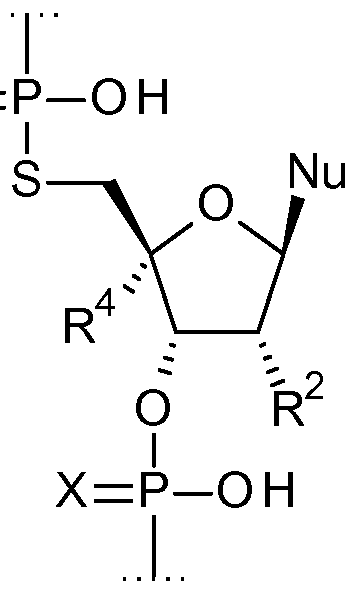
- the invention relates in particular to a process for the manufacture of an oligonucleotide comprising at least one non-chiral phosphorothioate internucleoside linkage of formula (I)
- the sulfur atom within a phosphorothioate can in theory be shifted from one of the nonbridging positions to the bridging 3 '-position of the ribose sugar.
- This modification renders the substitution pattern around the phosphorous symmetrical and thus removes the chiral center, consequently reducing the diastereoisomeric complexity of the molecule.
- 3'-deoxy-3'-mercapto- as well as 2',3'-dideoxy-3'-mercaptonucleotides (M. M. Piperakis, J. W. Gaynor, J. Fisher, R. Cosstick, Org. Biomol. Chem.
- the phosphorothioate internucleoside linkage of formula (I) as defined above is non-chiral in the final, deprotected oligonucleotide (i.e. when R 1 is hydrogen).
- the phosphorothioate internucleoside linkage of formula (I) will however be qualified in the present description as a non-chiral phosphorothioate internucleoside linkage even when R 1 is not hydrogen, as a precursor of a non-chiral linkage.
- alkyl signifies a straight-chain or branched-chain alkyl group with 1 to 8 carbon atoms, particularly a straight or branched-chain alkyl group with 1 to 6 carbon atoms and more particularly a straight or branched-chain alkyl group with 1 to 3 carbon atoms.
- Examples of straight- chain and branched-chain Q-Cg alkyl groups are methyl, ethyl, propyl, isopropyl, butyl, isobutyl, tert.-butyl, the isomeric pentyls, the isomeric hexyls, the isomeric heptyls and the isomeric octyls, particularly methyl, ethyl, propyl, butyl and pentyl more particularly methyl, ethyl, propyl, isopropyl, isobutyl, tert.-butyl and isopentyl.
- Particular examples of alkyl are methyl, ethyl and propyl.
- alkoxy or "alkyloxy”, alone or in combination, signifies a group of the formula alkyl-O- in which the term “alkyl” has the previously given significance, such as methoxy, ethoxy, n-propoxy, isopropoxy, n-butoxy, isobutoxy, sec.butoxy and tert.butoxy. Particular "alkoxy” are methoxy and ethoxy.
- hydroxyl and “hydroxy”, alone or in combination, signify the -OH group.
- oxy alone or in combination, signifies the -O- group.
- protecting group alone or in combination, signifies a group introduced into a molecule by chemical modification of a functional group to obtain chemoselectivity in a subsequent chemical reaction.
- Phosphate protecting group is a protecting group of the phosphate group.
- phosphate protecting group examples include 2-cyanoethyl and methyl.
- a particular example of phosphate protecting group is 2-cyanoethyl.
- “Hydroxyl protecting group” is a protecting group of the hydroxyl group and is also used to protect thiol groups.
- hydroxyl protecting groups are acetyl (Ac), benzoyl (Bz), benzyl (Bn), ⁇ -methoxyethoxymethyl ether (MEM), dimethoxytrityl (or bis- (4-methoxyphenyl)phenylmethyl) (DMT), trimethoxytrityl (or tris-(4- methoxyphenyl)phenylmethyl) (TMT), methoxymethyl ether (MOM), methoxytrityl [(4- methoxyphenyl)diphenylmethyl (MMT), p-methoxybenzyl ether (PMB), methylthiomethyl ether, pivaloyl (Piv), tetrahydropyranyl (THP), tetrahydrofuran (THF), trityl or
- triphenylmethyl (Tr) triphenylmethyl (Tr), silyl ether (for example trimethylsilyl (TMS), tert-butyldimethylsilyl (TBDMS), tri-iso-propylsilyloxymethyl (TOM) and triisopropylsilyl (TIPS) ethers), methyl ethers and ethoxyethyl ethers (EE).
- TMS trimethylsilyl
- TDMS tert-butyldimethylsilyl
- TOM tri-iso-propylsilyloxymethyl
- TIPS triisopropylsilyl
- hydroxyl protecting group are DMT and TMT, in particular DMT.
- Thiohydroxyl protecting group is a protecting group of the thiohydroxyl group.
- Examples of thiohydroxyl protecting groups are those of the "hydroxyl protecting group”.
- nucleobase refers to the base moiety of a nucleotide and covers both naturally occuring a well as non-naturally occurring variants. Thus, “nucleobase” covers not only the known purine and pyrimidine heterocycles but also heterocyclic analogues and tautomeres thereof.
- nucleobases include, but are not limited to adenine, guanine, cytosine, thymidine, uracil, xanthine, hypoxanthine, 5-methylcytosine, isocytosine, pseudoisocytosine, 5-bromouracil, 5-propynyluracil, 6-aminopurine, 2- aminopurine, inosine, diaminopurine and 2-chloro-6-aminopurine.
- nucleotide refers to a glycoside comprising a sugar moiety, a base moiety and a covalently linked group (linkage group), such as a phosphate or phosphorothioate internucleotide linkage group, and covers both naturally occurring nucleotides, such as DNA or RNA, and non-naturally occurring nucleotides comprising modified sugar and/or base moieties.
- linkage group such as a phosphate or phosphorothioate internucleotide linkage group
- glycoside refers to a molecule in which a sugar is bound to another functional group via a glycosidic bond, i.e. a bond formed between the hemiacetal or hemiketal group of a saccharide (or a molecule derived from a saccharide) and the hydroxyl group of another molecule.
- glycoside also comprises compounds with bonds formed between hemiacetal (or hemiketal) groups of sugars and several chemical groups other than hydroxyls, such as -SR (thioglyco sides), -SeR (selenoglycosides), - NR'R" (N-glycosides) or -CR'R"R"' (C-glycosides).
- solid support refers to supports used for the solid phase synthesis, in particular of oligomeric compounds.
- solid phase support comprise
- Controlled pore glass is a particular useful solid phase support.
- oligonucleotide synthesis activator refers to a compound capable of activating the reaction of an unprotected nucleoside with an incoming nucleoside phosphoramidite monomer. Examples of such oligonucleotide synthesis activators can be found in X. Wei, Tetrahedron 2013, 69, 3615-3637.
- oligonucleotide synthesis activators are azole based activators like lH-tetrazole, 5-nitrophenyl-lH-tetrazole (NPT), 5-ethylthio-lH-tetrazole (ETT), 5-benzylthio-lH-tetrazole (BTT), 5-methylthio-lH- tetrazole (MTT), 5-mercapto-tetrazoles (MCT) and 4,5-dicyanoimidazole (DCI), or acidic salts like pyridinium hydrochloride, imidazoliuim triflate, benzimidazolium triflate, 5- nitrobenzimidazolium triflate, or weak acids such as 2,4-dinitrobenzoic acid or 2,4- dinitrophenol. 5-(3,5-bis(trifluoromethyl)phenyl)-lH-tetrazole is a particularly useful oligonucleotide synthesis activator.
- thiooxidation agent refers to a reagent capable of converting a phosphoroamidite to a mercapto-phosphoroamidite.
- thiooxidation reagent are phenylacetyl disulfide, 3H-l,2-benzodithiol-3-one- 1, 1 -dioxide, tetraethylthiuram disulfide (TETD), dibenzoyl tetrasulfide, bis(0,0-diisopropoxyphosphinothioyl) disulfide (S-Tetra), benzyltriethyl- ammonium tetrathiomolybate (BTTM), bis(p-toluenesulfonyl) disulfide, 3- ethoxy-1,2,4- dithiazoline-5-one (EDITH) and l,2,4-dithiazolidine-3,5-dione (DtsNH) and in particular 3-
- capping refers to the conversion of hydroxyl or thiohydroxyl groups that have not reacted during the oligonucleotide coupling (e.g. during the reaction of a compound of formula (V) with a compound of formula (VI) or during the reaction of a compound of formula (XI) with a compound of formula (XII)) into a protected hydroxyl or thiohydroxyl group.
- the capping thus hinders the reaction of said hydroxyl or thiohydroxyl groups in the next coupling steps.
- the capping step is for example conveniently performed by the reaction with acetic anhydride (Ac 2 0) or phenoxyacetic anhydride (Pac-anhydride), for example in combination with activators like pyridine and N-methyl-imidazole, for example in THF or acetonitrile.
- the resulting protected hydroxyl or thiohydroxyl group is for example an acetate or thioacetate group.
- sugar modified nucleoside refers to a nucleoside wherein the sugar is other than DNA or RNA.
- cation scavenger designates a substance that reacts with, and thereby removes, free cations formed in a reaction.
- cation scavengers are silyl hydrides such as triethylsilane, triphenylsilane, triisopropylsilane, thiols like ethanedithiol, thiophenols like methoxy thiophenol, phenols and sulfides such as thioanisole.
- Particular cation scavengers are triethylsilane and methoxy thiophenol.
- the invention thus relates in particular to:
- a process of the invention wherein the sulfur atom of the at least one non-chiral phosphorothioate internucleotide linkage of formula (I) or ( ⁇ ) is linked to the 3' carbon atom or 5' carbon atom of an adjacent nucleoside of the oligonucleotide;
- a process of the invention wherein the oligonucleotide comprising at least one non- chiral phosphorothioate internucleoside linkage of formula (I) as defined above comprises a fragment of formula ( ⁇ )
- R 2a is hydrogen, hydroxyl, fluoro, alkyl, alkoxy, alkoxyalkoxy, -NH 2 , alkylamino, dialkylamino, alkylcarbonylamino, azido, -SH, -CN, -CF 3 , -OCF 3 ,
- alkylsulfanylalkoxy aminooxyalkoxy, alkylaminooxyalkoxy,
- dialkylaminooxyalkoxy aminocarbonylalkoxy, alkylaminocarbonylalkoxy or dialkylaminocarbonylalkoxy;
- R 4a is hydrogen
- R 2b ishydrogen, hydroxyl, fluoro, alkyl, alkoxy, alkoxyalkoxy, -NH 2 , alkylamino,
- alkylsulfanylalkoxy aminooxyalkoxy, alkylaminooxyalkoxy, dialkylaminooxyalkoxy, aminocarbonylalkoxy, alkylaminocarbonylalkoxy or dialkylaminocarbonylalkoxy;
- R is a hydroxyl protecting group; each R p is independently alkyl; and each Nu is independently a nucleobase;
- internucleoside linkage of formula ( ⁇ ) as defined above comprises a fragment of formula (IV)
- Y is oxygen or sulfur
- R c is hydrogen, hydroxyl, fluoro, alkyl, alkoxy, alkoxyalkoxy, -NH 2 , alkylamino,
- alkylsulfanylalkoxy aminooxyalkoxy, alkylaminooxyalkoxy,
- dialkylaminooxyalkoxy aminocarbonylalkoxy, alkylaminocarbonylalkoxy or dialkylaminocarbonylalkoxy;
- R 4c is hydrogen;
- a process according to the invention wherein the oligonucleotide comprising a fragment of formula (VII) as defined above is reacted in the presence of a thiooxidation agent or iodine, wherein the concentration of iodine is between about 0.001 M and about 0.01 M, to arrive at an oligonucleotide comprising at least one non-chiral phosphorothioate internucleoside linkage of formula (I) as defined above comprising a fragment of formula
- X is oxygen or sulfur
- Y is oxygen or sulfur
- X 2 and Y 2 are not both sulfur at the same time
- X 1 , Y 1 , R 1 , R 2a , R 2b , R 2c , R 3 , R 4a , R 4c and Nu are as defined above;
- a process according to the invention wherein the oligonucleotide comprising at least one non-chiral phosphorothioate intemucleoside linkage of formula (I) as defined above comprises a fragment of formula (IX)
- R 2a is hydrogen, hydroxyl, fluoro, alkyl, alkoxy, alkoxyalkoxy, -NH 2 , alkylamino,
- alkylsulfanylalkoxy aminooxyalkoxy, alkylaminooxyalkoxy,
- dialkylaminooxyalkoxy aminocarbonylalkoxy, alkylaminocarbonylalkoxy or dialkylaminocarbonylalkoxy;
- R ishydrogen, hydroxyl, fluoro, alkyl, alkoxy, alkoxyalkoxy, -NH 2 , alkylamino, dialkylamino, alkylcarbonylamino, azido, -SH, -CN, -CF 3 , -OCF 3 ,
- alkylsulfanylalkoxy aminooxyalkoxy, alkylaminooxyalkoxy,
- dialkylaminooxyalkoxy aminocarbonylalkoxy, alkylaminocarbonylalkoxy or dialkylaminocarbonylalkoxy;
- R is a hydroxyl protecting group or a thiohydroxyl protecting group; each R p is independently alkyl; and each Nu is independently a nucleobase;
- a process according to the invention wherein the oligonucleotide comprising an internucleoside linkage of formula ( ⁇ ) as defined above comprises a fragment of formula
- Y is oxygen or sulfur
- R c is hydrogen, hydroxyl, fluoro, alkyl, alkoxy, alkoxyalkoxy, -NH 2 , alkylamino,
- alkylsulfanylalkoxy aminooxyalkoxy, alkylaminooxyalkoxy,
- dialkylaminooxyalkoxy aminocarbonylalkoxy, alkylaminocarbonylalkoxy or dialkylaminocarbonylalkoxy;
- R is a hydroxyl protecting group or a thiohydroxyl protecting group;
- R 5 is dialkylamino; each R p is independently alkyl; and wherein X 1 , Y 1 , R 1 , R 2a , R 2b , R 4a , R 4b and Nu are as defined in the compound of formula
- Y 1 is oxygen or sulfur
- X is oxygen or sulfur
- Y 1 and X 2 are not both sulfur at the same time
- X 1 , Y 2 , R 1 , R 2a , R 2b , R 2c , R 3 , R 4a , R 4b , R 4c and Nu are as defined in the compound of formula ( ⁇ );
- a process according to the invention wherein the oligonucleotide comprising a fragment of formula ( ⁇ ) as defined above is reacted in the presence of a thiooxidation agent when Y 1 is oxygen;
- a process according to the invention wherein the oligonucleotide comprising at least one non-chiral phosphorothioate intemucleoside linkage of formula (I) as defined above comprises 1 to 8 intemucleoside linkages of formula (I), preferably 1 to 6 intemucleoside linkages of formula (I);
- a process according to the invention wherein the concentration of iodine is between about 0.001 M and about 0.005 M, preferably between about 0.002 M and about 0.005 M;
- a process according to the invention wherein the hydroxyl protecting group or the thiohydroxyl protecting group is bis-(4-methoxy-phenyl)-phenyl-methyl;
- each Nu is independently selected from adenine, thymine, uracil, guanine and cytosine;
- a process according to the invention wherein the acid is dichloroacetic acid or trichloroacetic acid;
- the thiooxidation agent is 3-amino- l,2,4-dithiazole-5-thione;
- a process according to the invention wherein the the oligonucleotide comprising at least one non-chiral phosphorothioate intemucleoside linkage of formula (I) as defined above is cleaved from the solid support to which it is bound;
- a process according to the invention wherein the the oligonucleotide comprising at least one non-chiral phosphorothioate intemucleoside linkage of formula (I) as defined above is cleaved from the solid support to which it is bound by reaction in the presence of aqueous ammonia;
- An oligounucleotide comprising at least one non-chiral phosphorothioate internucleoside linkage of formula (I) as defined above comprising 7 to 31 nucleotides;
- An oligounucleotide comprising at least one non-chiral phosphorothioate internucleoside linkage of formula (I) as defined above wherein the sulfur atom of the at least one phosphorothioate internucleotide linkage of formula (I) is linked to the 3' carbon atom or 5' carbon atom of an adjacent nucleoside of the oligonucleotide;
- An oligounucleotide comprising at least one non-chiral phosphorothioate internucleoside linkage of formula (I) as defined above wherein the oligonucleotide comprises at least one nucleotide of formula (XVI)
- X is oxygen or sulfur
- R 2 and R 4 together form -CH 2 0-, -CH 2 NH-, -CH 2 S-, -CH 2 N(OR p )-, -CHCH3O-,
- each R p is independently alkyl
- Nu is a nucleobase
- X is oxygen or sulfur
- R 2 and R 4 together form -CH 2 0-, -CH 2 NH-, -CH 2 S-, -CH 2 N(OR p )-, -CHCH 3 O-,
- each R p is independently alkyl
- Nu is a nucleobase
- An oligounucleotide according to the invention comprising at least two or at least three internucleoside linkages of formula (I) as defined above;
- An oligonucleotide according to the invention comprising at least one LNA nucleoside
- An oligonucleotide according to the invention comprising at least one sugar modified nucleoside
- an oligonucleotide according to the invention wherein the at least one sugar modified nucleoside is independently selected from 2' -alkoxy-RNA, in particular 2'- methoxy-RNA, 2' -alkoxyalkoxy-RNA, in particular 2' -methoxyethoxy-RNA, 2'-amino- DNA, 2' -fluoro-RNA, 2' -fluoro-ANA nucleoside and LNA nucleosides.
- each R p is independently methyl, ethyl or propyl
- a pharmaceutical composition comprising an oligonucleotide according to the invention.
- the invention also relates to a process according to the invention wherein the oligonucleotide comprising at least one non-chiral phosphorothioate internucleoside linkage of formula (I), comprising a fragment of formula (IX) as defined above wherein Y 1 is sulfur, is reacted in the presence of acid and of a cation scavenger to arrive at an oligonucleotide comprising a fragment of formula (XI).
- the invention thus relates in particular to the DMT deprotection of a DMT-protected
- the acid is for example trichloroacetic acid or trifluoroacetic acid.
- cation scavengers are triethylsilane, methoxy thiophenol and mixtures thereof.
- Examples of advantageous combinations of acid and cation scavengers are trichloroacetic acid or trifluoroacetic acid with triethylsilane and/or methoxy thiophenol.
- the acid in particular trichloroacetic acid, is advantageously used at 5-10%
- the acid in particular trifluororoacetic acid, is advantageously used at 1-10% (v/v), in particular at 1-5% (v/v).
- the cation scavenger is advantageously used at 2-30% (v/v).
- the cation scavenger triethylsilane is advantageously used at 5-30% (v/v).
- the cation scavenger p-methoxy thiophenol is advantageously used at 2-10% (v/v).
- the DMT deprotection according to the invention is advantageously done in dichloromethane.
- oligonucleotide phosphorothioates containing one or more 2',3'- dideoxy-3'-mercapto nucleotides can for example be performed by solid phase
- oligonucleotide synthesis using controlled pore glass (CPG) modified with an universal linker as the support can be coupled as the corresponding phosphoramidite using a tetrazole derivative as the acidic activator.
- Coupling conditions include the use of 10 equivalents of phosphoramidite as well as triple couplings in order to ensure complete reactions.
- the resulting phosphite intermediate can then subjected to a thiooxidation resulting in a phosphorothioate linkage.
- the protected mononucleotide thus immobilized on the solid support is then deprotected by an acid promoted cleavage of the dimethoxytrityl protecting group on the 5 '-hydroxy group on the ribose sugar. Sequential repetition of this synthesis cycle using appropriate
- phosphoramidite building blocks allows for the build-up of the desired oligonucleotide sequence. Due to their lower coupling efficiency, 2',3'-dideoxy-3'-mercapto nucleotides are preferably coupled 10 times using 4 equivalents of the corresponding phosphoramidite and a coupling time of 15 min for each coupling. The resulting thiophosphite intermediate can then be oxidized to the corresponding thiophosphate using molecular iodine at a concentration below 2mM. After a capping step, a standard acid promoted removal of the dimethoxytrityl protecting group as described above finishes the synthetic cycle.
- 2',5'-dideoxy-5'-mercapto nucleotides are introduced using triple couplings and 10 equivalents of phosphoramidite in the presence of a tetrazole derivative as the acidic activator.
- the resulting phosphite intermediates are either oxidized to the corresponding phosphates using iodine or subjected to thiooxidation resulting in a phosphorothioate linkage followed by a capping step.
- a capping step In order to liberate the 5 '-thiol from the
- dimethoxytrityl protecting group an extended acid treatment is necessary.
- the free 5 '-thiol thus obtained can then undergo coupling to the subsequent nucleotide resulting in a thiophosphite intermediate.
- This intermediate is then oxidized to the corresponding thiophosphate using molecular iodine at a concentration below 2mM. Capping and detritylation finishes the synthetic cycle.
- oligonucleotide sequence Once the desired oligonucleotide sequence has been built up by repetitions of the synthesis cycle, it can be cleaved off the solid support and globally deprotected by the treatment with aqueous ammonia. These steps are schematically described in the following schemes which have no limiting character.
- X 1 , Y 1 , R 1 , R 2a , R 2b , R 3 , R 4a and Nu are as defined above.
- R is as defined above.
- the 5 '-hydroxy group is liberated by acid treatment.
- the 5 '-sulfur atom is introduced by means of a Mitsunobu reaction using thiobenzoic acid as the nucleophile followed by hydrolysis of the resulting thioester.
- the desired phosphoramidite building block is obtained by phosphitylation of the 3 '-hydroxy group with a suitable phosphordiamidite in the presence of a tetrazole derivative as an acidic activator.
- reaction mixture was diluted with CH 2 C1 2 (300 mL) and poured into a saturated NaHC0 3 solution (200 mL). The organic layer was separated off and the aqueous layer was extracted with CH 2 C1 2 (100 mL x 2).
- Oligonucleotides were synthesized using a MerMade 12 automated DNA synthesizer by Bioautomation. Syntheses were conducted on a 1 ⁇ scale using a controlled pore glass support (500A) bearing a universal linker.
- Synthesis cycles for the incorporation of 2',3'-dideoxy-3'-mercapto phosphoramidites included DMT deprotection using 3% (w/v) of trichloroacetic acid in CH 2 C1 2 in three applications of 200 ⁇ _, for 30 sec.
- Phosphoramidite coupling was performed ten times with 40 ⁇ _, of O. lM solutions in acetonitrile and 44 ⁇ L ⁇ of a 0.1M solution of 5-(3,5- bis(trifluoromethylphenyl))-lH-tetrazole in acetonitrile with a coupling time of 900 sec.
- Oxidation was performed immediately after coupling by applying six times 200 ⁇ ⁇ of a 2mM solution of iodine in THF/H 2 O/pyridine 77:2:21 for 50 sec. Capping was performed using THF/lutidine/Ac 2 O 8: 1: 1 (CapA, 75 ⁇ ) and THF/N-methylimidazole 8:2 (CapB, 75 ⁇ ) for 55 sec. Removal of the nucleobase protecting groups and cleavage from the solid support was achieved under standard conditions using 32% aqueous ammonia at 55°C for a minimum of 8h.
- Oligonucleotides were synthesized using a MerMade 12 automated DNA synthesizer by Bioautomation. Syntheses were conducted on a 1 ⁇ scale using a controlled pore glass support (500A) bearing a universal linker.
- Synthesis cycles for the incorporation of 2' ,5'-dideoxy-5'-mercapto phosphoramidites included coupling of the phosphoramidite building blocks using 100 ⁇ _, of 0.1M solutions in acetonitrile and 110 ⁇ _, of a 0.1M solution of 5-(3,5-bis(trifluoromethylphenyl))-lH- tetrazole in acetonitrile with a coupling time of 180 sec. Triple couplings were performed. Depending on the desired sequence the synthesis column was subjected either to thiooxidation using a 0.1M solution of 3-amino-l,2,4-dithiazole-5-thione in
- THF/lutidine/Ac 2 O 8 1 : 1 (CapA, 75 ⁇ ) and THF/N-methylimidazole 8:2 (CapB, 75 ⁇ ) for 55 sec.
- DMT deprotection and liberation of the thiol was conducted with 3% (w/v) trichloroacetic acid in CH 2 C1 2 in 15 applications of 200 ⁇ ⁇ for 30 sec.
- oxidation was performed using a 2 niM solution of iodine in
- Oligonucleotides were synthesized using a MerMade 12 automated DNA synthesizer by Bioautomation. Syntheses were conducted on a 1 ⁇ scale using a controlled pore glass support (500A) bearing a universal linker.
- Synthesis cycles for the incorporation of 2' ,5'-dideoxy-5'-mercapto LNA- phosphoramidites included coupling of the phosphoramidite building blocks using 100 ⁇ _, of O. lM solutions in acetonitrile and 110 ⁇ _, of a O. lM solution of 5-(3,5- bis(trifluoromethylphenyl))-lH-tetrazole in acetonitrile with a coupling time of 600 sec. Triple couplings were performed. Depending on the desired sequence the synthesis column was subjected either to thiooxidation using a O.
- DMT deprotection and liberation of the thiol was also advantageously conducted with 3-6 applications of 200 ⁇ ⁇ for 45 sec of 1-10% (v/v) trifluoroacetic acid or 5- 10% (w/v) trichloroacetic acid, in the presence of 5-30% (v/v) triethylsilane in CH 2 CI 2 and/or 2-10% of/7-methoxy thiophenol in CH 2 CI 2 .
- A, G, m C, T represent LNA nucleotides
- a, g, c, t represent DNA nucleotides
- A, G, m C, T represent LNA nucleotides
- a, g, c, t represent DNA nucleotides
Landscapes
- Chemical & Material Sciences (AREA)
- Organic Chemistry (AREA)
- Health & Medical Sciences (AREA)
- Life Sciences & Earth Sciences (AREA)
- Biochemistry (AREA)
- Molecular Biology (AREA)
- Engineering & Computer Science (AREA)
- Biotechnology (AREA)
- General Health & Medical Sciences (AREA)
- Genetics & Genomics (AREA)
- Saccharide Compounds (AREA)
- Pharmaceuticals Containing Other Organic And Inorganic Compounds (AREA)
Abstract
Description


Claims



Priority Applications (4)
| Application Number | Priority Date | Filing Date | Title |
|---|---|---|---|
| JP2019504091A JP2019522026A (en) | 2016-07-27 | 2017-07-25 | Synthesis of oligonucleotides containing achiral 3'-S- or 5'-S-phosphorothioate internucleoside linkages |
| CN201780046492.XA CN109641932A (en) | 2016-07-27 | 2017-07-25 | Oligonucleotide synthesis comprising connector between achirality 3 '-S- or 5 '-S phosphorothioic acid ester nucleosides |
| EP17749644.5A EP3491002A2 (en) | 2016-07-27 | 2017-07-25 | Synthesis of oligonucleotides comprising achiral 3'-s- or 5'-s-phosphorothiolate internucleoside linkage |
| US16/320,918 US20210309690A1 (en) | 2016-07-27 | 2017-07-25 | Oligonucleotide synthesis |
Applications Claiming Priority (2)
| Application Number | Priority Date | Filing Date | Title |
|---|---|---|---|
| IN201641025647 | 2016-07-27 | ||
| IN201641025647 | 2016-07-27 |
Publications (2)
| Publication Number | Publication Date |
|---|---|
| WO2018019799A2 true WO2018019799A2 (en) | 2018-02-01 |
| WO2018019799A3 WO2018019799A3 (en) | 2018-03-08 |
Family
ID=59569290
Family Applications (1)
| Application Number | Title | Priority Date | Filing Date |
|---|---|---|---|
| PCT/EP2017/068700 Ceased WO2018019799A2 (en) | 2016-07-27 | 2017-07-25 | Oligonucleotide synthesis |
Country Status (5)
| Country | Link |
|---|---|
| US (1) | US20210309690A1 (en) |
| EP (1) | EP3491002A2 (en) |
| JP (1) | JP2019522026A (en) |
| CN (1) | CN109641932A (en) |
| WO (1) | WO2018019799A2 (en) |
Cited By (7)
| Publication number | Priority date | Publication date | Assignee | Title |
|---|---|---|---|---|
| WO2019122279A1 (en) | 2017-12-22 | 2019-06-27 | Roche Innovation Center Copenhagen A/S | Oligonucleotides comprising a phosphorodithioate internucleoside linkage |
| WO2019122282A1 (en) | 2017-12-22 | 2019-06-27 | Roche Innovation Center Copenhagen A/S | Gapmer oligonucleotides comprising a phosphorodithioate internucleoside linkage |
| WO2019122277A1 (en) | 2017-12-22 | 2019-06-27 | Roche Innovation Center Copenhagen A/S | Novel thiophosphoramidites |
| WO2020025527A1 (en) * | 2018-07-31 | 2020-02-06 | Roche Innovation Center Copenhagen A/S | Oligonucleotides comprising a phosphorotrithioate internucleoside linkage |
| WO2020104492A1 (en) * | 2018-11-22 | 2020-05-28 | Roche Innovation Center Copenhagen A/S | Pyridinium salts as activators in the synthesis of stereodefined oligonucleotides |
| US20250136632A1 (en) * | 2022-10-27 | 2025-05-01 | Sumitomo Chemical Company, Limited | Method for producing oligonucleotide |
| US12606584B2 (en) | 2019-06-11 | 2026-04-21 | Hoffmann-La Roche Inc. | Process for the preparation of oligonucleotides using modified oxidation protocol |
Families Citing this family (1)
| Publication number | Priority date | Publication date | Assignee | Title |
|---|---|---|---|---|
| EP4590684A1 (en) * | 2022-09-19 | 2025-07-30 | Bachem Holding AG | Improved oligonucleotide synthesis |
-
2017
- 2017-07-25 JP JP2019504091A patent/JP2019522026A/en active Pending
- 2017-07-25 US US16/320,918 patent/US20210309690A1/en not_active Abandoned
- 2017-07-25 EP EP17749644.5A patent/EP3491002A2/en not_active Withdrawn
- 2017-07-25 WO PCT/EP2017/068700 patent/WO2018019799A2/en not_active Ceased
- 2017-07-25 CN CN201780046492.XA patent/CN109641932A/en active Pending
Non-Patent Citations (8)
| Title |
|---|
| A. P. G. BEEVERS; K. J. FETTES; G. SABBAGH; F. K. MURAD; J. R. P. ARNOLD; R. COSSTICK; J. FISHER, ORG. BIOMOL. CHEM., vol. 2, 2004, pages 114 - 119 |
| F. ECKSTEIN, ANTISENSE AND NUCLEIC ACID DRUG DEVELOPMENT, vol. 10, 2009, pages 117 - 121 |
| G. SABBAGH; K. J. FETTES; R. GOSAIN; I. A. O'NEIL; R. COSSTICK, NUCLEIC ACIDS RES., vol. 32, 2004, pages 495 - 501 |
| J. BENTLEY; J. A. BRAZIER; J. FISHER; R. COSSTICK, ORG. BIOMOL. CHEM., vol. 5, 2007, pages 3698 - 3702 |
| M. M. PIPERAKIS; J. W. GAYNOR; J. FISHER; R. COSSTICK, ORG. BIOMOL. CHEM., vol. 11, 2013, pages 966 - 974 |
| P. C. ZAMECNIK; M. L. STEPHENSON, P NATL ACAD SCI USA, vol. 75, 1978, pages 280 - 284 |
| S. T. CROOKE: "Antisense drug technology : principles, strategies, and applications, 2nd ed.", 2008, CRC PRESS |
| X. WEI, TETRAHEDRON, vol. 69, 2013, pages 3615 - 3637 |
Cited By (12)
| Publication number | Priority date | Publication date | Assignee | Title |
|---|---|---|---|---|
| WO2019122279A1 (en) | 2017-12-22 | 2019-06-27 | Roche Innovation Center Copenhagen A/S | Oligonucleotides comprising a phosphorodithioate internucleoside linkage |
| WO2019122282A1 (en) | 2017-12-22 | 2019-06-27 | Roche Innovation Center Copenhagen A/S | Gapmer oligonucleotides comprising a phosphorodithioate internucleoside linkage |
| WO2019122277A1 (en) | 2017-12-22 | 2019-06-27 | Roche Innovation Center Copenhagen A/S | Novel thiophosphoramidites |
| EP4092117A1 (en) | 2017-12-22 | 2022-11-23 | Roche Innovation Center Copenhagen A/S | Gapmer oligonucleotides comprising a phosphorodithioate internucleoside linkage |
| WO2020025527A1 (en) * | 2018-07-31 | 2020-02-06 | Roche Innovation Center Copenhagen A/S | Oligonucleotides comprising a phosphorotrithioate internucleoside linkage |
| CN112236439A (en) * | 2018-07-31 | 2021-01-15 | 罗氏创新中心哥本哈根有限公司 | Oligonucleotides Containing Phosphorotrithioate Internucleoside Bonds |
| WO2020104492A1 (en) * | 2018-11-22 | 2020-05-28 | Roche Innovation Center Copenhagen A/S | Pyridinium salts as activators in the synthesis of stereodefined oligonucleotides |
| JP2022513110A (en) * | 2018-11-22 | 2022-02-07 | ロシュ イノベーション センター コペンハーゲン エーエス | Pyridinium salt as an activator in the synthesis of sterically defined oligonucleotides |
| US11667660B2 (en) | 2018-11-22 | 2023-06-06 | Roche Innovation Center Copenhagen A/S | Pyridinium salts as activators in the synthesis of stereodefined oligonucleotides |
| JP7467457B2 (en) | 2018-11-22 | 2024-04-15 | ロシュ イノベーション センター コペンハーゲン エーエス | Pyridinium salts as activators in the synthesis of stereodefined oligonucleotides. |
| US12606584B2 (en) | 2019-06-11 | 2026-04-21 | Hoffmann-La Roche Inc. | Process for the preparation of oligonucleotides using modified oxidation protocol |
| US20250136632A1 (en) * | 2022-10-27 | 2025-05-01 | Sumitomo Chemical Company, Limited | Method for producing oligonucleotide |
Also Published As
| Publication number | Publication date |
|---|---|
| WO2018019799A3 (en) | 2018-03-08 |
| EP3491002A2 (en) | 2019-06-05 |
| CN109641932A (en) | 2019-04-16 |
| US20210309690A1 (en) | 2021-10-07 |
| JP2019522026A (en) | 2019-08-08 |
Similar Documents
| Publication | Publication Date | Title |
|---|---|---|
| EP3491002A2 (en) | Synthesis of oligonucleotides comprising achiral 3'-s- or 5'-s-phosphorothiolate internucleoside linkage | |
| EP1409497B1 (en) | Method for preparation of lna phosphoramidites | |
| EP2217612B1 (en) | Preparation of ribonucleotide oligomer | |
| JP2013520438A (en) | Phosphoramidites for reverse synthetic RNA | |
| AU2998800A (en) | N-acylphosphoramidites and their use in oligonucleotide synthesis | |
| EP2476689A1 (en) | Thiocarbon-protecting groups for RNA synthesis | |
| JP2022120169A (en) | 5'S-LNA nucleotides and oligonucleotides | |
| WO2009143369A2 (en) | Method of preparing nucleosides and analogs thereof without using chromatography | |
| CN114502566B (en) | Method for producing nucleic acid oligomer | |
| EP0611075B1 (en) | Modified oligodeoxyribonucleotides, their preparation and their therapeutic use | |
| JP2794461B2 (en) | Phosphoramidite compounds and solid-phase synthesis of oligoribonucleotides using the same | |
| WO2002018406A1 (en) | Alkylated hexitol nucleoside analogues and oligomers thereof | |
| WO2019053659A1 (en) | Modified nucleoside phosphoramidites | |
| JP7818760B2 (en) | Method for producing nucleoside derivatives | |
| WO2021080021A1 (en) | Method for producing oligonucleotide | |
| JP7467457B2 (en) | Pyridinium salts as activators in the synthesis of stereodefined oligonucleotides. | |
| WO1995031470A2 (en) | Antisense inhibitors of gene expression | |
| HK40005349A (en) | 5's-lna nucleotides and oligonucleotides | |
| HK40005349B (en) | 5's-lna nucleotides and oligonucleotides | |
| KR20250122396A (en) | An improved process for oligonucleotide synthesis | |
| CA2577339C (en) | Artificial rna modified at its 2' hydroxyl group | |
| TW202434611A (en) | Methods of synthesizing a targeting ligand-conjugated nucleotide phosphoramidite | |
| KR20220123300A (en) | Nucleic acid synthesis method using segment-type amidite | |
| BR112020005067B1 (en) | NUCLEOSIDE-MODIFIED PHOSPHORAMIDITES, COMPOSITION, AND METHODS FOR PRODUCING AN OLIGONUCLEOTIDE | |
| HK1184164B (en) | Phosphoramidites for synthetic rna in the reverse direction |
Legal Events
| Date | Code | Title | Description |
|---|---|---|---|
| 121 | Ep: the epo has been informed by wipo that ep was designated in this application |
Ref document number: 17749644 Country of ref document: EP Kind code of ref document: A2 |
|
| ENP | Entry into the national phase |
Ref document number: 2019504091 Country of ref document: JP Kind code of ref document: A |
|
| NENP | Non-entry into the national phase |
Ref country code: DE |
|
| 121 | Ep: the epo has been informed by wipo that ep was designated in this application |
Ref document number: 17749644 Country of ref document: EP Kind code of ref document: A2 |
|
| ENP | Entry into the national phase |
Ref document number: 2017749644 Country of ref document: EP Effective date: 20190227 |