WO2018017478A1 - Catalytic polymer modification - Google Patents
Catalytic polymer modification Download PDFInfo
- Publication number
- WO2018017478A1 WO2018017478A1 PCT/US2017/042381 US2017042381W WO2018017478A1 WO 2018017478 A1 WO2018017478 A1 WO 2018017478A1 US 2017042381 W US2017042381 W US 2017042381W WO 2018017478 A1 WO2018017478 A1 WO 2018017478A1
- Authority
- WO
- WIPO (PCT)
- Prior art keywords
- alkyl
- aryl
- alkoxy
- halo
- group
- Prior art date
- Legal status (The legal status is an assumption and is not a legal conclusion. Google has not performed a legal analysis and makes no representation as to the accuracy of the status listed.)
- Ceased
Links
Classifications
-
- C—CHEMISTRY; METALLURGY
- C08—ORGANIC MACROMOLECULAR COMPOUNDS; THEIR PREPARATION OR CHEMICAL WORKING-UP; COMPOSITIONS BASED THEREON
- C08F—MACROMOLECULAR COMPOUNDS OBTAINED BY REACTIONS ONLY INVOLVING CARBON-TO-CARBON UNSATURATED BONDS
- C08F112/00—Homopolymers of compounds having one or more unsaturated aliphatic radicals, each having only one carbon-to-carbon double bond, and at least one being terminated by an aromatic carbocyclic ring
- C08F112/02—Monomers containing only one unsaturated aliphatic radical
- C08F112/04—Monomers containing only one unsaturated aliphatic radical containing one ring
- C08F112/06—Hydrocarbons
- C08F112/08—Styrene
-
- C—CHEMISTRY; METALLURGY
- C08—ORGANIC MACROMOLECULAR COMPOUNDS; THEIR PREPARATION OR CHEMICAL WORKING-UP; COMPOSITIONS BASED THEREON
- C08F—MACROMOLECULAR COMPOUNDS OBTAINED BY REACTIONS ONLY INVOLVING CARBON-TO-CARBON UNSATURATED BONDS
- C08F2/00—Processes of polymerisation
- C08F2/38—Polymerisation using regulators, e.g. chain terminating agents, e.g. telomerisation
-
- C—CHEMISTRY; METALLURGY
- C08—ORGANIC MACROMOLECULAR COMPOUNDS; THEIR PREPARATION OR CHEMICAL WORKING-UP; COMPOSITIONS BASED THEREON
- C08F—MACROMOLECULAR COMPOUNDS OBTAINED BY REACTIONS ONLY INVOLVING CARBON-TO-CARBON UNSATURATED BONDS
- C08F293/00—Macromolecular compounds obtained by polymerisation on to a macromolecule having groups capable of inducing the formation of new polymer chains bound exclusively at one or both ends of the starting macromolecule
- C08F293/005—Macromolecular compounds obtained by polymerisation on to a macromolecule having groups capable of inducing the formation of new polymer chains bound exclusively at one or both ends of the starting macromolecule using free radical "living" or "controlled" polymerisation, e.g. using a complexing agent
-
- C—CHEMISTRY; METALLURGY
- C08—ORGANIC MACROMOLECULAR COMPOUNDS; THEIR PREPARATION OR CHEMICAL WORKING-UP; COMPOSITIONS BASED THEREON
- C08F—MACROMOLECULAR COMPOUNDS OBTAINED BY REACTIONS ONLY INVOLVING CARBON-TO-CARBON UNSATURATED BONDS
- C08F8/00—Chemical modification by after-treatment
-
- C—CHEMISTRY; METALLURGY
- C08—ORGANIC MACROMOLECULAR COMPOUNDS; THEIR PREPARATION OR CHEMICAL WORKING-UP; COMPOSITIONS BASED THEREON
- C08F—MACROMOLECULAR COMPOUNDS OBTAINED BY REACTIONS ONLY INVOLVING CARBON-TO-CARBON UNSATURATED BONDS
- C08F8/00—Chemical modification by after-treatment
- C08F8/04—Reduction, e.g. hydrogenation
-
- C—CHEMISTRY; METALLURGY
- C08—ORGANIC MACROMOLECULAR COMPOUNDS; THEIR PREPARATION OR CHEMICAL WORKING-UP; COMPOSITIONS BASED THEREON
- C08F—MACROMOLECULAR COMPOUNDS OBTAINED BY REACTIONS ONLY INVOLVING CARBON-TO-CARBON UNSATURATED BONDS
- C08F8/00—Chemical modification by after-treatment
- C08F8/26—Removing halogen atoms or halogen-containing groups from the molecule
-
- C—CHEMISTRY; METALLURGY
- C08—ORGANIC MACROMOLECULAR COMPOUNDS; THEIR PREPARATION OR CHEMICAL WORKING-UP; COMPOSITIONS BASED THEREON
- C08J—WORKING-UP; GENERAL PROCESSES OF COMPOUNDING; AFTER-TREATMENT NOT COVERED BY SUBCLASSES C08B, C08C, C08F, C08G or C08H
- C08J3/00—Processes of treating or compounding macromolecular substances
- C08J3/28—Treatment by wave energy or particle radiation
-
- C—CHEMISTRY; METALLURGY
- C08—ORGANIC MACROMOLECULAR COMPOUNDS; THEIR PREPARATION OR CHEMICAL WORKING-UP; COMPOSITIONS BASED THEREON
- C08F—MACROMOLECULAR COMPOUNDS OBTAINED BY REACTIONS ONLY INVOLVING CARBON-TO-CARBON UNSATURATED BONDS
- C08F2438/00—Living radical polymerisation
- C08F2438/01—Atom Transfer Radical Polymerization [ATRP] or reverse ATRP
-
- C—CHEMISTRY; METALLURGY
- C08—ORGANIC MACROMOLECULAR COMPOUNDS; THEIR PREPARATION OR CHEMICAL WORKING-UP; COMPOSITIONS BASED THEREON
- C08F—MACROMOLECULAR COMPOUNDS OBTAINED BY REACTIONS ONLY INVOLVING CARBON-TO-CARBON UNSATURATED BONDS
- C08F2438/00—Living radical polymerisation
- C08F2438/03—Use of a di- or tri-thiocarbonylthio compound, e.g. di- or tri-thioester, di- or tri-thiocarbamate, or a xanthate as chain transfer agent, e.g . Reversible Addition Fragmentation chain Transfer [RAFT] or Macromolecular Design via Interchange of Xanthates [MADIX]
-
- C—CHEMISTRY; METALLURGY
- C08—ORGANIC MACROMOLECULAR COMPOUNDS; THEIR PREPARATION OR CHEMICAL WORKING-UP; COMPOSITIONS BASED THEREON
- C08J—WORKING-UP; GENERAL PROCESSES OF COMPOUNDING; AFTER-TREATMENT NOT COVERED BY SUBCLASSES C08B, C08C, C08F, C08G or C08H
- C08J2333/00—Characterised by the use of homopolymers or copolymers of compounds having one or more unsaturated aliphatic radicals, each having only one carbon-to-carbon double bond, and only one being terminated by only one carboxyl radical, or of salts, anhydrides, esters, amides, imides, or nitriles thereof; Derivatives of such polymers
- C08J2333/04—Characterised by the use of homopolymers or copolymers of compounds having one or more unsaturated aliphatic radicals, each having only one carbon-to-carbon double bond, and only one being terminated by only one carboxyl radical, or of salts, anhydrides, esters, amides, imides, or nitriles thereof; Derivatives of such polymers esters
- C08J2333/14—Characterised by the use of homopolymers or copolymers of compounds having one or more unsaturated aliphatic radicals, each having only one carbon-to-carbon double bond, and only one being terminated by only one carboxyl radical, or of salts, anhydrides, esters, amides, imides, or nitriles thereof; Derivatives of such polymers esters of esters containing halogen, nitrogen, sulfur, or oxygen atoms in addition to the carboxy oxygen
Definitions
- This invention relates generally to methods for modifying polymers. More particularly, the present disclosure relates to methods for removing groups from polymers with catalysts.
- Methods for the deactivation of surface-grafted polymer brushes include particle beams, UV-irradiation, nucleophilic substitution, or atom transfer radical addition.
- Substitution of the halogen chain end e.g., with NaN 3
- ATRA light-mediated atom transfer radical addition
- the former is considered high-cost, low throughput, and usually destructive. The latter leads to addition of potentially undesired carbons.
- this addition process does not remove the halogen, but merely changes its location along the polymer chain, yielding potentially undesirable side reactions in subsequent processing steps.
- the disclosure provides methods for removing groups from a polymer, comprising
- a polymer comprising at least one reactive group selected from halides and
- each A is independently:
- each Y is independently a bond, O, S, NR 14 , or C(R 14 ) 2 ;
- o and q are independently zero or an integer of 1 to 4;
- R 11 and R 12 are independently selected from the group consisting of: halogen, cyano, hydroxy, amino, mono or di(C 1 -C2o)alkylamino, mono or diarylamino, C 1 -C 6 alkyl, halo( C 1 -C 6 )alkyl, C 1 -C 6 alkoxy, halo(C 1 - C 6 )alkoxy, C3-C7 cycloalkyl, aryl, aryloxy, alkoxyaryl, and heteroaryl, wherein each alkyl, cycloalkyl, aryl, and heteroaryl group is optionally substituted with one or more groups independently selected from C r C 6 alkyl, C 1 -C 6 alkoxy, halogen, hydroxy, amino, mono- or di-(C 1 -C 6 ) alkylamino, halo(C 1 -C 6 )alkyl, and halo(C 1 -C 6 )alkoxy;
- each R 14 is independently hydrogen, C 1 -C 6 alkyl, aryl, or aryl(C 1 -C 6 alkyl), wherein each alkyl and aryl group is optionally substituted with one or more groups independently selected from C 1 -C 6 alkyl, C 1 -C 6 alkoxy, halogen, hydroxy, amino, mono- or di-(C 1 -C 6 ) alkylamino, halo(C 1 - C 6 )alkyl, and halo(C 1 -C 6 )alkoxy; and
- each Z is R 13 , -B-(A) 2 , -B-(R 13 ) 2 , -B(A)(R 13 ), -NH-(A), -N-(A) 2 , -NH-(R 13 ), -N-
- R 13 is H, C 1 -C 20 alkyl, -C(O)C 1 -C 20 alkyl, C 3 -d cycloalkyl, aryl, aryl(d-C 6 alkyl), heteroaryl, or heteroaryl(d-C 6 alkyl), wherein each alkyl, cycloalkyl, aryl, and heteroaryl group is optionally substituted with one or more groups independently selected from C 1 -di alkyl, C 1 - C 6 alkoxy, halogen, hydroxy, amino, mono- or di-(C 1 -C 6 ) alkylamino, halo(C 1 -C 6 )alkyl, halo(C 1 -C 6 )alkoxy, C3-C7 cycloalkyl, aryl, aryloxy, alkoxyaryl, heteroaryl, heteroaryloxy, or group A; and
- the invention provides methods for removing reactive groups from a substrate functionalized with an atom transfer radical polymerization (ATRP) initiator. These methods utilize the same catalyst of formula A-Z described above, and comprise: contacting a substrate modified to carry an atom transfer radical polymerization (ATRP) initiator with
- Figure 1 shows the reaction setup for chain end removal in solution. See, Example 2.
- Figure 2 shows the synthetic strategy for debrominating linear polystyrene. See, Example 3.
- FIG 3 shows the 1 H NMR spectrum of polystyrene-Br (PS-Br) (top) and the 1 H NMR spectrum of the dehydrogenated polymer (bottom). See, Example 3.
- SEC size exclusion chromatography
- FD-MS field desorption mass spectrometry
- Figure 6 shows the 1 H NMR spectra of unmodified PS-Br (top), PS-Br after being treated according to Example 3 excluding 10-phenylphenothiazine (PTH) for 24 hours (middle), and PS-Br after being treated according to Example 3 excluding light for 24 hours (bottom). Insets emphasize the presence of the signature chain-end signal. In the absence of either PTH or light, there is no change in the polymer chain end.
- PTH 10-phenylphenothiazine
- FIG 8 shows the thermogravimetric analysis (TGA) of PS-Br (solid line) and the dehalogenated Product PS-H (dashed line). See, Example 4.
- Figure 9 shows the reaction scheme for the dechlorination of polystyrene-CI (PS- Cl). See, Example 5.
- Figure 10 shows the 1 H NMR spectra of PS-CI (top) and the 1 H NMR spectrum of the dehydrogenated polymer (bottom). See, Example 5.
- Figure 12 shows the reaction scheme for the removal of RAFT chain ends from p(tBA). See, Example 6.
- Figure 13 shows the 1 H spectra highlighting the presence of signals from RAFT chain end protons before treatment according to Example 6 (top) and the corresponding disappearance of those peaks after treatment (bottom), indicating chain end removal.
- Figure 16 shows the reaction scheme for the air-insensitive dehalogenation of p(tBA)-Br. See, Example 7.
- Figure 17 shows the annotated 1 H NMR spectra of p(tBA)-Br (top) and the 1 H NMR spectrum of the dehydrogenated polymer (bottom). See, Example 7.
- Figure 19 shows the reaction scheme for the uniform dehalogenation of a-bromoisobutyrate functionalized silicon surfaces. See, Example 8.
- Figure 20 shows high-resolution XPS scans providing evidence of the bromine ATRP initiator for the untreated substrates (left) and the lack thereof after dehalogenation according to Example 8 (right).
- the Gaussian bell curves shown on the left correspond to the Br 3d 5/2 and Br 3d 3/2 orbitals.
- the dashed line represents the sum of both bell curves.
- Figure 21 shows the reaction scheme for the spatially confined dehalogenation of a-bromoisobutyrate functionalized silicon substrates by irradiation through a 20 x 20 ⁇ m 2 clear rectangle photomask, followed by subsequent homogeneous irradiation and light- mediated polymerization of methyl methacrylate (MMA). See, Example 9.
- Figure 22 shows an optical micrograph of the patterned PMMA brush produced according to Example 9, confirming absence of polymer growth within the dehalogenated rectangles (top left), an atomic force microscopy (AFM) scan of the patterned poly(methyl methacrylate) (PMMA) brush indicating a 15 nm polymer brush height (top right), and secondary ion mass spectrometry (SIMS) chemical maps of the patterned PMMA brush for silicon (bottom left) and carbon (bottom right) confirming spatially confined polymerization. All scale bars are 50 ⁇ .
- Figure 23 shows the reaction scheme for the patterned diblock copolymer brush formation via spatially controlled dehalogenation and subsequent uniform polymerization of 2,2,2-trifluoroethyl methacrylate (TFEMA). See, Example 10.
- TFEMA 2,2,2-trifluoroethyl methacrylate
- Figure 24 shows an optical micrograph of the patterned polymer brushes produced according to Example 10.
- Figure 25 shows SIMS chemical maps of the patterned polymer brushes produced according to Example 10 for fluorine (left) and carbon (right) confirming localized presence of fluorine (PMMA-b -PFTEMA brushes) atop a uniform MMA polymer brush layer.
- the scale bar is 25 ⁇ m. .
- Figure 26 shows an AFM scan of the patterned polymer brushes produced according to Example 10, confirming patterning and allowing quantification of brush height increase after block copolymerization. Scale bars are 25 ⁇ .
- Ranges can be expressed herein as from “about” one particular value, and/or to "about” another particular value. When such a range is expressed, another aspect includes from the one particular value and/or to the other particular value. Similarly, when values are expressed as approximations, by use of the antecedent "about,” it will be understood that the particular value forms another aspect. It will be further understood that the endpoints of each of the ranges are significant both in relation to the other endpoint, and independently of the other endpoint.
- each embodiment disclosed herein can comprise, consist essentially of or consist of its particular stated element, step, ingredient or component.
- the transition term “comprise” or “comprises” means includes, but is not limited to, and allows for the inclusion of unspecified elements, steps, ingredients, or components, even in major amounts.
- the term "about” has the meaning reasonably ascribed to it by a person skilled in the art when used in conjunction with a stated numerical value or range, i.e. denoting somewhat more or somewhat less than the stated value or range, to within a range of ⁇ 20% of the stated value; ⁇ 19% of the stated value; ⁇ 18% of the stated value; ⁇ 17% of the stated value; ⁇ 16% of the stated value; ⁇ 15% of the stated value; ⁇ 14% of the stated value; ⁇ 13% of the stated value; ⁇ 12% of the stated value; ⁇ 11 % of the stated value; ⁇ 10% of the stated value; ⁇ 9% of the stated value; ⁇ 8% of the stated value; ⁇ 7% of the stated value; ⁇ 6% of the stated value; ⁇ 5% of the stated value; ⁇ 4% of the stated value; ⁇ 3% of the stated value; ⁇ 2% of the stated value; or ⁇ 1 % of the stated value.
- combining includes adding one or more items to a reaction mixture.
- the dispersity may be calculated by dividing weight average molecular weight (M n ) by the number average molecular weight (M n ) (i.e.,
- the dispersity may be calculated according to degree of
- X n is the number-average degree of polymerization.
- alkoxy means an alkyl group, as defined herein, appended to the parent molecular moiety through an oxygen atom.
- Representative examples of alkoxy include, but are not limited to, methoxy, ethoxy, propoxy, 2-propoxy, butoxy, tert-butoxy, pentyloxy, and hexyloxy.
- alkyl as used herein, means a straight or branched chain hydrocarbon containing from 1 to 20 carbon atoms unless otherwise specified.
- Representative examples of alkyl include, but are not limited to, methyl, ethyl, n-propyl, iso-propyl, n-butyl, sec-butyl, iso-butyl, tert-butyl, n-pentyl, isopentyl, neopentyl, n-hexyl, 3-methylhexyl, 2,2-dimethylpentyl, 2,3-dimethylpentyl, n-heptyl, n-octyl, n-nonyl, and n-decyl.
- alkylene refers to a divalent alkyl group, where alkyl is as defined herein.
- aryl means a phenyl (i.e., monocyclic aryl), or a bicyclic ring system containing at least one phenyl ring or an aromatic bicyclic ring containing only carbon atoms in the aromatic bicyclic ring system, or a polycyclic ring system containing at least one phenyl ring.
- the bicyclic aryl can be azulenyl, naphthyl, or a phenyl fused to a cycloalkyl, a cycloalkenyl, or a heterocyclyl.
- the bicyclic or polycyclic aryl is attached to the parent molecular moiety through any carbon atom contained within the phenyl portion of the bicyclic or polycyclic system, or any carbon atom with the napthyl, azulenyl, anthracene, or pyrene ring.
- aryloxy as used herein, means an aryl group, as defined herein, appended to the parent molecular moiety through an oxygen atom.
- Representative examples of aryloxy include, but are not limited to, phenyloxy and naphthoxy.
- cycloalkyl refers to a monocyclic or a bicyclic cycloalkyl ring system.
- Monocyclic ring systems are cyclic hydrocarbon groups containing from 3 to 8 carbon atoms, where such groups can be saturated or unsaturated, but not aromatic.
- Examples of cycloalkyl include cyclopropyl, cyclobutyl, cyclopentyl, cyclohexyl, cycloheptyl and cyclooctyl. More preferred are C 3 -C 6 cycloalkyl groups. In certain embodiments, cycloalkyl groups are fully saturated.
- monocyclic cycloalkyls examples include cyclopropyl, cyclobutyl, cyclopentyl, cyclopentenyl, cyclohexyl, cyclohexenyl, cycloheptyl, and cyclooctyl.
- Bicyclic cycloalkyl ring systems are bridged monocyclic rings or fused bicyclic rings.
- Bridged monocyclic rings contain a monocyclic cycloalkyl ring where two non-adjacent carbon atoms of the monocyclic ring are linked by an alkylene bridge of between one and three additional carbon atoms (i.e., a bridging group of the form -(CH 2 )w-, where w is 1 , 2, or 3).
- alkylene bridge of between one and three additional carbon atoms
- Representative examples of bicyclic ring systems include, but are not limited to, bicyclo[3.1.1]heptane, bicyclo[2.2.1]heptane, bicyclo[2.2.2]octane, bicyclo[3.2.2]nonane, bicyclo[3.3.1]nonane, and bicyclo[4.2.1]nonane.
- Fused bicyclic cycloalkyl ring systems contain a monocyclic cycloalkyl ring fused to either a phenyl, a monocyclic cycloalkyl, a monocyclic cycloalkenyl, a monocyclic heterocyclyl, or a monocyclic heteroaryl.
- the bridged or fused bicyclic cycloalkyl is attached to the parent molecular moiety through any carbon atom contained within the monocyclic cycloalkyl ring.
- halogen as used herein, means -CI, -Br, -I or -F.
- haloalkoxy refers to an alkoxy group substituted with one or more halogen atoms, where each halogen is independently F, CI, Br or I.
- Haloalkoxy includes perhaloalkoxy groups, such as OCF 3 or OCF 2 CF 3 .
- haloalkyl refers to an alky I group substituted with one or more halogen atoms, where each halogen is independently F, CI, Br or I.
- heteroaryl means a monocyclic heteroaryl or a bicyclic or polycyclic ring system containing at least one heteroaromatic ring.
- the monocyclic heteroaryl can be a 5 or 6 membered ring.
- the 5 membered ring consists of two double bonds and one, two, three or four nitrogen atoms and optionally one oxygen or sulfur atom.
- the 6 membered ring consists of three double bonds and one, two, three or four nitrogen atoms.
- the 5 or 6 membered heteroaryl is connected to the parent molecular moiety through any carbon atom or any nitrogen atom contained within the heteroaryl.
- the bicyclic or polycyclic heteroaryl consists of a heteroaryl fused to a phenyl, a cycloalkyl, a cycloalkenyl, a heterocyclyl, or a heteroaryl.
- heteroaryl include, but are not limited to, fury I, imidazolyl, isoxazolyl, isothiazolyl, oxadiazolyl, oxazolyl, pyridinyl, pyridazinyl, pyrimidinyl, pyrazinyl, pyrazolyl, pyrrolyl, tetrazolyl, thiadiazolyl, thiazolyl, thienyl, triazolyl, triazinyl, benzimidazolyl, benzofuranyl, benzothienyl, benzoxadiazolyl, benzoxathiadiazolyl, benzothiazolyl, cinnolinyl, 5,6-dihydr
- the disclosure relates to methods for removing groups from a polymer by forming a reaction mixture comprising a polymer comprising at least one halide or RAFT group, an amine hydrogen atom donor, and a catalyst, and irradiating the reaction mixture with a light source.
- the disclosure demonstrates such methods to be mild, metal-free, effective in the presence of air, and/or spatially controlled.
- the reaction mixture includes a polymer comprising a backbone chain, optional side chains or groups, and at least one halide or RAFT group.
- the polymer comprises a halide.
- the halide is fluoride, chloride, bromide, iodide, or astatide.
- the polymer comprises a RAFT group.
- RAFT group describes any chain transfer agent useful in a reversible addition-fragmentation chain transfer (RAFT) polymerization.
- the RAFT group is a thiocarbonylthio compound, e.g., dithioester, thiocarbamate, xanthate, trithiocarbonate, etc.
- the at least one halide and/or RAFT group are located on the end of the polymer (i.e., terminal groups). In some embodiments, the at least one halide and/or RAFT group are located on the backbone of the polymer (i.e., backbone groups).
- the polymer is any polymer functionalized with a halide or RAFT group.
- the polymer comprises units derived from at least one monomer comprising a vinyl group, i.e., a vinyl monomer.
- the vinyl monomer is a simple alkene, e.g., ethylene, propylene, butyl ene, etc.
- the vinyl monomer is styrene, vinyl chloride, vinyl acetate, vinylcarbazole, or vinyl pyridine.
- the vinyl monomer is an acrylate, e.g., (meth)acrylate, etc.
- the vinyl monomer is an acrylamide, e.g., (meth)acrylamide, etc. In some embodiments, the vinyl monomer is acrylonitrile. In some embodiments, the polymer comprises a tert-butylacetylene monomer. In some aspects, the polymer comprises units derived from a single monomer (i.e., homopolymer). In other aspects, the polymer comprises units derived from two or more monomers (i.e., copolymer).
- the polymers useful in the processes of the invention may be branched or cross- linked.
- the branches and cross-links may contain reactive groups that can be removed according to the processes of the invention. These reactive groups may be present in the monomers used to prepare the polymers, or may be introduced later after polymerization of the monomers.
- the monomers used to prepare the polymers will include intermediate moieties that can be synthetically modified to provide reactive groups that can be removed according to the processes described herein.
- the reaction mixture includes a hydrogen atom donor.
- the hydrogen atom donor is an ammonium cation, such as trialkyl ammonium, e.g., triethyl ammonium, tripropyl ammonium, tributyl ammonium, tripentyl ammonium, diisopropylethyl ammonium, etc.
- the hydrogen atom donor is formed by in situ, i.e., by the reaction of an amine and an appropriate acid.
- the acid is a carboxylic acid, e.g., formic acid, acetic acid, etc.
- the hydrogen atom donor may be an ammonium cation that is pre-formed and added to the reaction mixture.
- the hydrogen atom donor is tributylammonium cation, which may be, for example, formed by the reaction of formic acid and tributylamine. Without being bound by theory, it is believed that under the reaction conditions, a radical cation and, subsequently, an iminium cation are formed.
- the hydrogen atom donor is an iminium cation, such as butaniminium, N-methylethaniminium, ⁇ , ⁇ -dibutylbutaniminium etc., or a derivative thereof.
- the hydrogen donor is a radical cation.
- the hydrogen donor is an amine radical cation, such as a trialkyl amine radical cation, e.g., triethyl amine radical cation, tripropyl amine radical cation, tributyl ammonium radical cation, tripentyl amine radical cation, diisopropylethyl amine radical cation, etc.
- a trialkyl amine radical cation e.g., triethyl amine radical cation, tripropyl amine radical cation, tributyl ammonium radical cation, tripentyl amine radical cation, diisopropylethyl amine radical cation, etc.
- the hydrogen atom donor When prepared in situ, the hydrogen atom donor may be prepared using amounts of an amine and an acid that are not equimolar. But, in certain embodiments, the hydrogen atom donor is prepared using approximately equimolar amounts of an amine and an acid.
- the hydrogen atom donor is present in the reaction mixture in an amount of from about 1 molar equivalent to about 20 molar equivalents, e.g., about 1 molar equivalent to about 19 molar equivalents, or about 1 molar equivalent to about 18 molar equivalent, or about 1 molar equivalent to about 17 molar equivalents, or about 1 molar equivalent to about 16 molar equivalents, or about 1 molar equivalent to about 15 molar equivalents, or about 1 molar equivalent to about 14 molar equivalents, or about 1 molar equivalent to about 13 molar equivalents, or about 1 molar equivalent to about 12 molar equivalents, or about 1 molar equivalent to about 11 molar equivalents, or about 1 molar equivalent to about 10 molar equivalents, or about 1 molar equivalent to about 9 molar equivalents, based on the number of moles of groups to be removed from the polymer.
- the hydrogen atom donor is present in the reaction mixture in an amount that is a molar excess compared to the number of moles of groups to be removed from the polymer.
- the hydrogen atom donor is present in the reaction mixture in an amount that is about 1.5 molar equivalents to about 8.5 molar equivalents, or about 2 molar equivalents to about 8 molar equivalents, or about 2.5 molar equivalents to about 7.5 molar equivalents, or about 3 molar equivalents to about 7 molar equivalents, or about 3.5 molar equivalents to about 6.5 molar equivalents, or about 4 molar equivalents to about 6 molar equivalents, or the amount is about 1 molar equivalent, or about 1.5 molar equivalents, or about 2 molar equivalents, or about 2.5 molar equivalents, or about 3 molar equivalents, or about 3.5 molar equivalents, or about 4 molar equivalents, or about 4.5 molar equivalents, or about 5 molar equivalents
- the reaction mixture includes a catalyst of the formula A-Z, wherein
- each A is independently:
- each Y is independently a bond, O, S, NR 14 , or C(R 14 ) 2 ;
- R 11 and R 12 are independently selected from the group consisting of: halogen, cyano, hydroxy, amino, mono or di(C 1 -C 20 )alkylamino, mono or diarylamino, C 1 -C 6 alkyl, halo(C 1 -C 6 )alkyl, C 1 -C 6 alkoxy, halo(C 1 -C 6 )alkoxy, C3-C7 cycloalkyl, aryl, aryloxy, alkoxyaryl, and heteroaryl, wherein each alkyl, cycloalkyl, aryl, and heteroaryl group is optionally substituted with one or more groups independently selected from C 1 -C 6 alkyl, C 1 -C 6 alkoxy, halogen, hydroxy, amino, mono- or di-(C 1 -C 6 ) alkylamino, halo(C 1 -C 6 )alkyl, and
- each R 14 is independently hydrogen, C 1 -C 6 alkyl, aryl, or aryl(C 1 -C 6 alkyl), wherein each alkyl and aryl group is optionally substituted with one or more groups independently selected from C 1 -C 6 alkyl, C 1 -C 6 alkoxy, halogen, hydroxy, amino, mono- or di-(C 1 -C 6 ) alkylamino, halo(C 1 -C 6 )alkyl, and halo(C 1 -C 6 )alkoxy; and
- each Z is R 13 , -B-(A) 2 , -B-(R 13 ) 2 , -B(A)(R 13 ), -NH-(A), -N-(A) 2 , -NH-(R 13 ), -N-
- R 13 is H, C 1 -C 20 alkyl, -C(O)C 1 -C 20 alkyl, C3-C7 cycloalkyl, aryl, aryl(C 1 -C 6 alkyl), heteroaryl, or heteroaryl(C 1 -C 6 alkyl), wherein each alkyl, cycloalkyl, aryl, and heteroaryl group is optionally substituted with one or more groups independently selected from halogen, hydroxy, amino, mono- or di-(C 1 -C 6 ) alkylamino, halo(C 1 -C 6 )alkyl, halo(C 1 -C 6 )alkoxy, C3-C7 cycloalkyl, aryl, aryloxy, alkoxyaryl, heteroaryl, heteroaryloxy, or group A.
- Y is S.
- Z is aryl or heteroaryl, optionally substituted with one or more groups independently selected from C 1 -C 6 alkyl, C 1 - C 6 alkoxy, halogen, hydroxy, amino, mono- or di-(C 1 -C 6 ) alkylamino, halo(C 1 -C 6 )alkyl, halo(C 1 -C 6 )alkoxy, C3-C7 cycloalkyl, aryl, aryloxy, alkoxyaryl, heteroaryl, or heteroaryloxy.
- the catalyst is:
- the catalyst is present in the reaction mixture in an amount within the range of about 0.05 mole % to about 10 mole %, e.g., about 0.25 mole % to about 10 mole %, or about 0.5 mole % to about 10 mole %, or about 0.75 mole % to about 10 mole %, or about 1 mole % to about 10 mole %, or about 1 mole % to about 9.5 mole %, or about 1 mole % to about 9 mole %, or about 1.5 mole % to about 8.5 mole %, or about 2 mole % to about 8 mole %, or about 2.5 mole % to about 7.5 mole %, or about 3 mole % to about 7 mole %, or about 3.5 mole % to about 6.5 mole %,or about 4 mole % to about 6 mole %, or the amount is about 0.1 mole %, or about 0.25 mole %, or about
- the reaction mixture includes a solvent.
- the solvent comprises a polar, aprotic solvent, e.g., N-methylpyrrolidone (NMP), tetrahydrofuran (THF), ethyl acetate (EtOAc), acetone, dimethylformamide (DMF), acetonitrile (MeCN), dimethyl sulfoxide (DMSO), dimethylacetamide (DMA), or the like.
- the solvent comprises a non-polar solvent, e.g., hexane, benzene, toluene, 1 ,4-dioxane, or the like.
- the solvent comprises a mixture of one or more polar, aprotic solvents and/or one or more non-polar solvents.
- the method of the disclosure includes irradiating the reaction mixtures with a light source.
- a light source e.g., halogen lights, plasma arc lights, LED lights, etc.
- the light source emits light comprising a wavelength within the range of about 350 nm to about 700 nm, e.g., about 350 nm to about 650 nm, or about 350 nm to about 600 nm, or about 350 nm to about 550 nm, or about 350 nm, to about 525 nm, or about 350 nm to about 500 nm, or about 350 nm to about 490 nm, or about 350 nm to about 480 nm, or about 350 nm to about 470 nm, or about 350 nm to about 460 nm, or about 350 nm to about 450 nm, or about 350 nm to about 440 nm, or about 360 nm to about
- the polymer is attached to a surface.
- the person of ordinary skill in the art will appreciate that a variety of polymerization methods may be used to prepare a polymer attached to a surface, e.g., RAFT, ATRP, etc.
- a partial region of the surface is selectively irradiated, e.g., by irradiating through a photomask.
- further polymerization or functionalization of the polymer attached to the surface is performed after irradiation.
- the irradiating is conducted for a period of from about 5 minutes to about 96 hours, e.g., about 5 minutes to about 84 hours, or about 5 minutes to about 72 hours, or about 5 minutes to about 60 hours, or about 5 minutes to about 48 hours, or about 5 minutes to about 36 hours, or about 5 minutes to about 24 hours, or about 5 minutes to about 12 hours, or about 5 minutes to about 1 1 hours, or about 5 minutes to about 10 hours, or about 15 minutes to about 9 hours, or about 30 minutes to about 8 hours, or about 45 minutes to about 7.5 hours, or about 1 hour to about 7 hours, or about 1.5 hours to about 6.5 hours, or about 2 hours to about 6 hours, or about 2.5 hours to about 5.5 hours, or about 3 hours to about 5 hours, or about 30 minutes to about 96 hours, or about 1 hour to about 96 hours, or about 2 hours to about 96 hours, or about 4 hours to about 96 hours, or about 6 hours to about 96 hours, or about 8 hours to about 96 hours,
- the method is conducted at a temperature of from about -10°C to about 1 10°C, e.g., about -5°C to about 100°C, or about 0°C to about 90°C, or about 5°C to about 80°C, or about 5°C to about 75°C, or about 5°C to about 70°C, or about 5°C to about 65°C, or about 5°C to about 60°C, or about 5°C to about 55°C, or about 5°C to about 50°C, or about 5°C to about 45°C i or about 10°C to about 40°C, or about 15°C to about 35°C, or about 20°C to about 30°C, or the temperature is about 0°C, or about 5°C, or about 10°C, or about 15°C, or about 20°C, or about 25°C, or about 30°C,or about 35°0 ⁇ about 40°C,or about 45°C, or about 50°C, or about 55
- the method is conducted in the presence of a gas comprising molecular oxygen. In some embodiments, the method is conducted in the presence of air. In other embodiments, the method is conducted under an inert atmosphere. In embodiments where the method is carried out in the presence of solvent(s), the solvent and/or resulting solution may be degassed. Where the solution is degassed, the reaction rate typically is improved.
- the reaction mixture is substantially free of metal.
- the reaction mixture comprises metals in a combined amount of less than 1%, e.g., less than 0.9%, or less than 0.8%, or less than 0.7%, or less than 0.6%, or less than 0.5%, or less than 0.4%, or less than 0.3%, or less than 0.2%, or less than 0.1%, or less than 0.05%, or less than 0.01%.
- Another aspect of the disclosure is a method for removing reactive groups from a substrate functional ized with an atom transfer radical polymerization (ATRP) initiator or a RAFT group, comprising contacting a substrate modified to carry an ATRP initiator or a RAFT group with a hydrogen atom donor and a catalyst, and irradiating the substrate with a light source.
- ATRP atom transfer radical polymerization
- the substrate may be any substrate modified to carry an ATRP initiator or a RAFT group.
- the substrate is a silicon substrate.
- the ATRP initiator is a halide, e.g., an alkyl halide.
- the ATRP initiator may be monofunctional or multifunctional, e.g., di-, tri-, tetra-, or even hexa-function.
- the ATRP intitator is a bromoisobutyrate, e.g., undecyl 2-bromoisobutyrate, ethyl 2-bromoisobutyrate, poly(ethylene glycol) bis(2-bromoisobutyrate), and the like.
- the reactive groups are halides.
- the halides are selected from fluoride, chloride, bromide, iodide, astatide, and combinations thereof.
- the RAFT group is a thiocarbonylthio compound, e.g., dithioester, thiocarbamate, xanthate, trithiocarbonate, and the like.
- Number average molecular weights (M n ) and weight average molecular weights (M w ) were calculated relative to linear polystyrene standards. Values for each sample's polydispersity (B) are reported as the quotient of MJM n .
- X-ray photoelectron spectroscopy (XPS) measurements were performed using a Kratos Axis Ultra Spectrometer (Kratos Analytical, Manchester, U.K.) with a monochromatic Aluminum K ⁇ X-ray source (1486.6 eV) operating at 225 W under a vacuum of 10 -8 Torr.
- Tapping mode AFM data was acquired on a MFP-3D system (Asylum Research, Santa Barbara, CA) using commercial Si cantilevers.
- Dynamic Secondary Ion Mass Spectrometry (SIMS) imaging was performed using a Cameca IMS 7f system (Cameca SAS, Gennevilliers, France).
- a 10 kV Cs + ion beam and 5 kV negative sample potential were used, for a total impact energy of 15 kV.
- the 150 pA primary beam was focused to a spot size of approximately 2 ⁇ m, and rastered over a 100 ⁇ m area.
- Photomasks containing clear rectangles of 2.5 x 25 ⁇ 2 and 20 x 200 ⁇ 2 were purchased form Photronics, Inc. (Brookfield, CT).
- Either MeCN or ⁇ /,/V-Dimethylacetamide was used as the solvent, depending on the solubility of the substrate.
- the vial was capped with a PTFE/silicone septa (Thermo Scientific, Waltham, MA) and gently shaken until the run mixture was homogeneous. No degassing of the solution was carried out and, after capping, the vial contained a small amount of air.
- the ATRP initiator-functionalized silicon substrate of Example 8 was covered with the stock solution of Example 8 and irradiated with 405 nm collimated LED light (Thor Labs, 1.1 mW/cm 2 ) for 4 hours through a photomask comprising 20 x 200 pm 2 clear rectangles.
- the photomask was subsequently removed and poly(methyl methacrylate) (PMMA) polymer brushes were uniformly grown via light-mediated radical polymerization (See, Figure 21).
- Optical microscopy, Secondary Ion Mass Spectrometry (SIMS), and Atomic Force Microscopy (AFM) confirmed spatially confined growth of polymer brushes exclusively in areas of the silicon substrate which were protected from irradiation by the photomask (See, Figure 22).
- a uniform PMMA brush layer with terminal bromine ends was grown and subsequently covered with the stock solution of Example 8 and irradiated with 405 nm collimated LED light (Thor Labs, 1.1 mW/cm 2 ) for 4 hours through a photomask comprising 2.5 x 25 ⁇ m 2 clear rectangles.
- the photomask was removed and the substrate was subjected to homogenous polymerization of a second monomer, 2,2,2-trifluoroethyl methacrylate (TFEMA), which yielded a chemically patterned surface composed of PMMA homopolymer and PMMA-b-PFTEMA diblock brushes (See, Figure 23).
- TFEMA 2,2,2-trifluoroethyl methacrylate
Landscapes
- Chemical & Material Sciences (AREA)
- Health & Medical Sciences (AREA)
- Chemical Kinetics & Catalysis (AREA)
- Medicinal Chemistry (AREA)
- Polymers & Plastics (AREA)
- Organic Chemistry (AREA)
- General Chemical & Material Sciences (AREA)
- Addition Polymer Or Copolymer, Post-Treatments, Or Chemical Modifications (AREA)
Abstract
Disclosed are methods and materials for removing groups from a polymer.
Description
CATALYTIC POLYMER MODIFICATION
BACKGROUND OF THE DISCLOSURE
CROSS-REFERENCE TO RELATED APPLICATIONS
[0001] This application claims the benefit of priority to U.S. Provisional Application No. 62/363,552, filed July 18, 2016, the disclosure of which is incorporated herein in its entirety.
Field of the Disclosure
[0002] This invention relates generally to methods for modifying polymers. More particularly, the present disclosure relates to methods for removing groups from polymers with catalysts.
Technical Background
[0003] The ability to produce polymers of controlled molecular weight with low dispersity, complex architecture, and diverse functionality has revolutionized the fields of polymer chemistry and materials science. Controlled radical polymerizations (CRP) have facilitated a new era of tailored materials with diverse and targeted properties. Of the CRP techniques, atom transfer radical polymerization (ATRP) is particularly industrially relevant; for over a decade, it has been used to commercially produce polymers in the USA, Japan, and Europe. The retention of alkyl halide chain ends throughout the polymerization is crucial to the ATRP mechanism.
[0004] While a requisite for control, these terminal halogens are chemically reactive and thermally unstable, which often presents challenges in polymer processing. The elimination of highly toxic and corrosive HBr or HCI can promote, for example, acid catalyzed ester degradation. Another CRP method, reversible addition-fragmentation chain-transfer polymerization (RAFT), requires the retention of a thiocarbonylthio chain end throughout the polymerization. These terminal groups are similarly reactive and thermally unstable.
[0005] Removal of such chain ends is not only of importance for chemical and thermal stability in bulk polymers, but also for a plethora of polymer-brush based thin film applications. The localized removal of surface-bound initiator or termination of active chain ends is a common theme in research regarding patterned polymer brush substrates.
[0006] Significant efforts have been expended towards developing methods for the transformation of terminal halogen chain ends into more chemically benign and stable end groups - both in bulk and in thin films. Amongst these are conversion via nucleophilic substitution, radical addition, electrophilic addition, hydrogenation, or dehalogenation.
[0007] Regarding the latter, Matyjaszewski et al. published seminal work on the dehalogenation of polymer chain ends via reaction with 2,2'-azobisisobutyronitrile (AIBN) and stoichiometric trialkyltin hydride. Also highly effective is in-situ transformation of a ruthenium complex [RuCI2(PPh3)3] from polymerization to hydrogenation catalyst through addition of K2C03 and 2-propanol. Muller and co-workers radically polymerized acrylic monomers using an excess of the ligand Ν,Ν,Ν',Ν',Ν-pentamethyltriethylenediarnine (PMDETA) and showed that PMDETA can act as a transfer agent to facilitate debromination of polystyrene (PS) chain ends upon full monomer conversion. Another approach involves the use of Cu(0) and isopropyl-benzene to achieve dehalogenation of polystyrene (PS). While proven effective, the aforementioned methods have a series of significant drawbacks, including the requirement for inert conditions, toxic reagents, elevated temperatures, metal catalysts, specific solvents, and/or full monomer conversion.
[0008] Methods for the deactivation of surface-grafted polymer brushes include particle beams, UV-irradiation, nucleophilic substitution, or atom transfer radical addition. Substitution of the halogen chain end (e.g., with NaN3) lacks spatial control due to uniform reactivity across the entire substrate, requiring tedious, iterative initiator redeposition and subsequent reactions to obtain chemically complex surfaces. Only high-energy radiation (particle beams, UV) and light-mediated atom transfer radical addition (ATRA) do provide spatial control. However, the former is considered high-cost, low throughput, and usually destructive. The latter leads to addition of potentially undesired carbons. Further, this addition process does not remove the halogen, but merely changes its location along the polymer chain, yielding potentially undesirable side reactions in subsequent processing steps.
[0009] Accordingly, there remains a need for a method for removing polymer groups at mild temperatures, in the absence of metals, in the presence of air, and/or in a spatially controlled manner.
SUMMARY OF THE DISCLOSURE
[0010] In one aspect, the disclosure provides methods for removing groups from a polymer, comprising
forming a reaction mixture comprising
a polymer comprising at least one reactive group selected from halides and
RAFT groups,
a hydrogen atom donor, and
an catalyst of the formula A-Z, wherein
each A is independently:

wherein
each Y is independently a bond, O, S, NR14, or C(R14)2;
o and q are independently zero or an integer of 1 to 4;
R11 and R12 are independently selected from the group consisting of: halogen, cyano, hydroxy, amino, mono or di(C1-C2o)alkylamino, mono or diarylamino, C1-C6 alkyl, halo( C1-C6)alkyl, C1-C6 alkoxy, halo(C1- C6)alkoxy, C3-C7 cycloalkyl, aryl, aryloxy, alkoxyaryl, and heteroaryl, wherein each alkyl, cycloalkyl, aryl, and heteroaryl group is optionally substituted with one or more groups independently selected from Cr C6 alkyl, C1-C6 alkoxy, halogen, hydroxy, amino, mono- or di-(C1-C6) alkylamino, halo(C1-C6)alkyl, and halo(C1-C6)alkoxy;
each R14 is independently hydrogen, C1-C6 alkyl, aryl, or aryl(C1-C6 alkyl), wherein each alkyl and aryl group is optionally substituted with one or more groups independently selected from C1-C6 alkyl, C1-C6 alkoxy, halogen, hydroxy, amino, mono- or di-(C1-C6) alkylamino, halo(C1- C6)alkyl, and halo(C1-C6)alkoxy; and
each Z is R13, -B-(A)2, -B-(R13)2, -B(A)(R13), -NH-(A), -N-(A)2, -NH-(R13), -N-
(R13)2, -N(A)(R13), -Si(R13)3, -SiH(R13)2, -SiH2(R13), -SiH(A)2, -SiH2(A), -Si(A
)3, -Si(A)(R13)2, -Si(A)(R13)2, -SiH(A)(R13), -PH2, -P-(A)2, -P-
(R13)2, -P(R13)(A), or -P(0)-(OR13)2,
wherein R13 is H, C1-C20 alkyl, -C(O)C1-C20 alkyl, C3-d cycloalkyl, aryl, aryl(d-C6 alkyl), heteroaryl, or heteroaryl(d-C6 alkyl), wherein each alkyl, cycloalkyl, aryl, and heteroaryl group is optionally substituted with one or more groups independently selected from C1-di alkyl, C1- C6 alkoxy, halogen, hydroxy, amino, mono- or di-(C1-C6) alkylamino, halo(C1-C6)alkyl, halo(C1-C6)alkoxy, C3-C7 cycloalkyl, aryl, aryloxy, alkoxyaryl, heteroaryl, heteroaryloxy, or group A; and
irradiating the mixture with a light source.
In another aspect, the invention provides methods for removing reactive groups from a substrate functionalized with an atom transfer radical polymerization (ATRP) initiator. These methods utilize the same catalyst of formula A-Z described above, and comprise:
contacting a substrate modified to carry an atom transfer radical polymerization (ATRP) initiator with
a hydrogen atom donor, and
the catalyst of formula A-Z, where A and Z are defined above; and irradiating the substrate with a light source.
BRIEF DESCRIPTION OF THE DRAWINGS
[0011] Figure 1 shows the reaction setup for chain end removal in solution. See, Example 2.
[0012] Figure 2 shows the synthetic strategy for debrominating linear polystyrene. See, Example 3.
[0013] Figure 3 shows the 1H NMR spectrum of polystyrene-Br (PS-Br) (top) and the 1H NMR spectrum of the dehydrogenated polymer (bottom). See, Example 3.
[0014] Figure 4 shows size exclusion chromatography (SEC) traces of PS-Br (solid line, reaction time = 0 h, Mn = 1.6 kg-mol-1,
 = 1.11 ) and the dehalogenated product PS-H (dashed line, reaction time = 6 h, Mn = 1.9 kg-mol-1,
 See, Example 3.
[0015] Figure 5 shows the field desorption mass spectrometry (FD-MS) spectra of PS-Br (top) and the dehalogenated product PS-H (bottom), which is shifted by m/z = 78.9, confirming successful loss of the bromine and addition of one hydrogen. See, Example 3.
[0016] Figure 6 shows the 1H NMR spectra of unmodified PS-Br (top), PS-Br after being treated according to Example 3 excluding 10-phenylphenothiazine (PTH) for 24 hours (middle), and PS-Br after being treated according to Example 3 excluding light for 24 hours (bottom). Insets emphasize the presence of the signature chain-end signal. In the absence of either PTH or light, there is no change in the polymer chain end.
[0017] Figure 7 shows SEC traces showing no change in PS-Br before any treatment (solid line, reaction time = 0 h, Mn = 1.6 kg-mol-1, Mn/Mw = 1.1 1 ), after being treated according to Example 3 excluding PTH for 24 hours (dashed line, reaction time = 24 h, Mn = 1 .7 kg-mol- and after being treated according to Example 3 excluding light for 24 hours

(dotted line, reaction time = 24 h, Mn = 1 .7 kg-mol-1,
 See, Example 3.
[0018] Figure 8 shows the thermogravimetric analysis (TGA) of PS-Br (solid line) and the dehalogenated Product PS-H (dashed line). See, Example 4.
[0019] Figure 9 shows the reaction scheme for the dechlorination of polystyrene-CI (PS- Cl). See, Example 5.
[0020] Figure 10 shows the 1H NMR spectra of PS-CI (top) and the 1H NMR spectrum of the dehydrogenated polymer (bottom). See, Example 5.
[0021] Figure 11 shows SEC traces of PS-CI (solid line, Mn = 4.1 kg mol-1,
 1.48) and the dehalogenated product PS-H (dashed line, Mn = 5.1 kg mol-1, = 1.48). See,

Example 5.
[0022] Figure 12 shows the reaction scheme for the removal of RAFT chain ends from p(tBA). See, Example 6.
[0023] Figure 13 shows the 1H spectra highlighting the presence of signals from RAFT chain end protons before treatment according to Example 6 (top) and the corresponding disappearance of those peaks after treatment (bottom), indicating chain end removal.
[0024] Figure 14 shows SEC traces of the RAFT- p(tBA) polymer before and after chain end removal, detected at 310 nm, showing the presence of the strongly absorbing RAFT chain end (solid, reaction time = 0 h), and its disappearance after the reaction (dashed, reaction time = 48 h). See, Example 6.
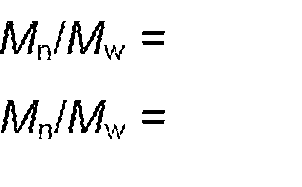
[0025] Figure 15 shows SEC chromatograms of the RAFT- p(tBA) polymer before and after chain end removal, showing the starting polymer (solid line, Mn = 3.4 kg mol-1,
1.12) and the chain end removed sample after 48 h (dashed line, Mn = 3.3 kg mol-1,
[0026] Figure 16 shows the reaction scheme for the air-insensitive dehalogenation of p(tBA)-Br. See, Example 7.
[0027] Figure 17 shows the annotated 1H NMR spectra of p(tBA)-Br (top) and the 1H NMR spectrum of the dehydrogenated polymer (bottom). See, Example 7.
[0028] Figure 18 shows SEC chromatograms of the initial p(tBA)-Br before reaction (solid line, reaction time = 0 h, Mn = 6.5 kg mol-1, Mn/Mw = 1.18) and the dehalogenated product (dashed line, reaction time = 4 h, Mn = 6.6 kg-mol-1, = 1.21 ). See, Example 7.

[0029] Figure 19 shows the reaction scheme for the uniform dehalogenation of a-bromoisobutyrate functionalized silicon surfaces. See, Example 8.
[0030] Figure 20 shows high-resolution XPS scans providing evidence of the bromine ATRP initiator for the untreated substrates (left) and the lack thereof after dehalogenation according to Example 8 (right). The Gaussian bell curves shown on the left correspond to the Br 3d5/2 and Br 3d3/2 orbitals. The dashed line represents the sum of both bell curves.
[0031] Figure 21 shows the reaction scheme for the spatially confined dehalogenation of a-bromoisobutyrate functionalized silicon substrates by irradiation through a 20 x 20 μm 2
clear rectangle photomask, followed by subsequent homogeneous irradiation and light- mediated polymerization of methyl methacrylate (MMA). See, Example 9.
[0032] Figure 22 shows an optical micrograph of the patterned PMMA brush produced according to Example 9, confirming absence of polymer growth within the dehalogenated rectangles (top left), an atomic force microscopy (AFM) scan of the patterned poly(methyl methacrylate) (PMMA) brush indicating a 15 nm polymer brush height (top right), and secondary ion mass spectrometry (SIMS) chemical maps of the patterned PMMA brush for silicon (bottom left) and carbon (bottom right) confirming spatially confined polymerization. All scale bars are 50 μιτι.
[0033] Figure 23 shows the reaction scheme for the patterned diblock copolymer brush formation via spatially controlled dehalogenation and subsequent uniform polymerization of 2,2,2-trifluoroethyl methacrylate (TFEMA). See, Example 10.
[0034] Figure 24 shows an optical micrograph of the patterned polymer brushes produced according to Example 10.
[0035] Figure 25 shows SIMS chemical maps of the patterned polymer brushes produced according to Example 10 for fluorine (left) and carbon (right) confirming localized presence of fluorine (PMMA-b -PFTEMA brushes) atop a uniform MMA polymer brush layer. The scale bar is 25 μm. .
[0036] Figure 26 shows an AFM scan of the patterned polymer brushes produced according to Example 10, confirming patterning and allowing quantification of brush height increase after block copolymerization. Scale bars are 25 μιτι.
DETAILED DESCRIPTION
[0037] The particulars shown herein are by way of example and for purposes of illustrative discussion of the preferred embodiments of the present invention only and are presented in the cause of providing what is believed to be the most useful and readily understood description of the principles and conceptual aspects of various embodiments of the invention. In this regard, no attempt is made to show structural details of the invention in more detail than is necessary for the fundamental understanding of the invention, the description taken with the drawings and/or examples making apparent to those skilled in the art how the several forms of the invention may be embodied in practice. Thus, before the disclosed processes and devices are described, it is to be understood that the aspects described herein are not limited to specific embodiments, apparati, or configurations, and as such can, of course, vary. It is also to be understood that the terminology used herein is for the purpose of describing particular aspects only and, unless specifically defined herein, is not intended to be limiting.
[0038] The terms "a," "an," "the" and similar referents used in the context of describing the invention (especially in the context of the following claims) are to be construed to cover both the singular and the plural, i.e., "at least one", unless otherwise indicated herein or clearly contradicted by context. Recitation of ranges of values herein is merely intended to serve as a shorthand method of referring individually to each separate value falling within the range. Unless otherwise indicated herein, each individual value is incorporated into the specification as if it were individually recited herein. Ranges can be expressed herein as from "about" one particular value, and/or to "about" another particular value. When such a range is expressed, another aspect includes from the one particular value and/or to the other particular value. Similarly, when values are expressed as approximations, by use of the antecedent "about," it will be understood that the particular value forms another aspect. It will be further understood that the endpoints of each of the ranges are significant both in relation to the other endpoint, and independently of the other endpoint.
[0039] All methods described herein can be performed in any suitable order of steps unless otherwise indicated herein or otherwise clearly contradicted by context. The use of any and all examples, or exemplary language (e.g., "such as") provided herein is intended merely to better illuminate the invention and does not pose a limitation on the scope of the invention otherwise claimed. No language in the specification should be construed as indicating any non-claimed element essential to the practice of the invention.
[0040] Unless the context clearly requires otherwise, throughout the description and the claims, the words 'comprise', 'comprising', and the like are to be construed in an inclusive sense as opposed to an exclusive or exhaustive sense; that is to say, in the sense of "including, but not limited to". Words using the singular or plural number also include the plural and singular number, respectively. Additionally, the words "herein," "above," and "below" and words of similar import, when used in this application, shall refer to this application as a whole and not to any particular portions of the application.
[0041] As will be understood by one of ordinary skill in the art, each embodiment disclosed herein can comprise, consist essentially of or consist of its particular stated element, step, ingredient or component. As used herein, the transition term "comprise" or "comprises" means includes, but is not limited to, and allows for the inclusion of unspecified elements, steps, ingredients, or components, even in major amounts. The transitional phrase "consisting of excludes any element, step, ingredient or component not specified. The transition phrase "consisting essentially of limits the scope of the embodiment to the specified elements, steps, ingredients or components and to those that do not materially affect the embodiment.
[0042] Unless otherwise indicated, all numbers expressing quantities of ingredients, properties such as molecular weight, reaction conditions, and so forth used in the specification and claims are to be understood as being modified in all instances by the term "about." Accordingly, unless indicated to the contrary, the numerical parameters set forth in the specification and attached claims are approximations that may vary depending upon the desired properties sought to be obtained by the present invention. At the very least, and not as an attempt to limit the application of the doctrine of equivalents to the scope of the claims, each numerical parameter should at least be construed in light of the number of reported significant digits and by applying ordinary rounding techniques. When further clarity is required, the term "about" has the meaning reasonably ascribed to it by a person skilled in the art when used in conjunction with a stated numerical value or range, i.e. denoting somewhat more or somewhat less than the stated value or range, to within a range of ±20% of the stated value; ±19% of the stated value; ±18% of the stated value; ±17% of the stated value; ±16% of the stated value; ±15% of the stated value; ±14% of the stated value; ±13% of the stated value; ±12% of the stated value; ±11 % of the stated value; ±10% of the stated value; ±9% of the stated value; ±8% of the stated value; ±7% of the stated value; ±6% of the stated value; ±5% of the stated value; ±4% of the stated value; ±3% of the stated value; ±2% of the stated value; or ±1 % of the stated value.
[0043] Notwithstanding that the numerical ranges and parameters setting forth the broad scope of the invention are approximations, the numerical values set forth in the specific examples are reported as precisely as possible. Any numerical value, however, inherently contains certain errors necessarily resulting from the standard deviation found in their respective testing measurements.
[0044] As used herein the term "combining" includes adding one or more items to a reaction mixture.
[0045] As used herein the term "dispersity," "polydispersity," "polydispersity index", "PDI," and
 are used interchangeably and refer to measure of the polymer uniformity with respect to distribution of molecular mass. The dispersity may be calculated by dividing weight average molecular weight (Mn) by the number average molecular weight (Mn) (i.e.,
In certain embodiments, the dispersity may be calculated according to degree of

polymerization, where the dispersity equals where Xw is the weight-average degree of

polymerization and Xn is the number-average degree of polymerization.
[0046] All percentages, ratios and proportions herein are by weight, unless otherwise specified. A weight percent (weight %, also as wt %) of a component, unless specifically
stated to the contrary, is based on the total weight of the composition in which the component is included (e.g., on the total amount of the reaction mixture).
[0047] The term "alkoxy" as used herein, means an alkyl group, as defined herein, appended to the parent molecular moiety through an oxygen atom. Representative examples of alkoxy include, but are not limited to, methoxy, ethoxy, propoxy, 2-propoxy, butoxy, tert-butoxy, pentyloxy, and hexyloxy.
[0048] The term "alkyl" as used herein, means a straight or branched chain hydrocarbon containing from 1 to 20 carbon atoms unless otherwise specified. Representative examples of alkyl include, but are not limited to, methyl, ethyl, n-propyl, iso-propyl, n-butyl, sec-butyl, iso-butyl, tert-butyl, n-pentyl, isopentyl, neopentyl, n-hexyl, 3-methylhexyl, 2,2-dimethylpentyl, 2,3-dimethylpentyl, n-heptyl, n-octyl, n-nonyl, and n-decyl. The term "alkylene" refers to a divalent alkyl group, where alkyl is as defined herein.
[0049] The term "aryl," as used herein, means a phenyl (i.e., monocyclic aryl), or a bicyclic ring system containing at least one phenyl ring or an aromatic bicyclic ring containing only carbon atoms in the aromatic bicyclic ring system, or a polycyclic ring system containing at least one phenyl ring. The bicyclic aryl can be azulenyl, naphthyl, or a phenyl fused to a cycloalkyl, a cycloalkenyl, or a heterocyclyl. The bicyclic or polycyclic aryl is attached to the parent molecular moiety through any carbon atom contained within the phenyl portion of the bicyclic or polycyclic system, or any carbon atom with the napthyl, azulenyl, anthracene, or pyrene ring.
[0050] The term "aryloxy" as used herein, means an aryl group, as defined herein, appended to the parent molecular moiety through an oxygen atom. Representative examples of aryloxy include, but are not limited to, phenyloxy and naphthoxy.
[0051] The term "cycloalkyl" refers to a monocyclic or a bicyclic cycloalkyl ring system. Monocyclic ring systems are cyclic hydrocarbon groups containing from 3 to 8 carbon atoms, where such groups can be saturated or unsaturated, but not aromatic. Examples of cycloalkyl include cyclopropyl, cyclobutyl, cyclopentyl, cyclohexyl, cycloheptyl and cyclooctyl. More preferred are C3-C6 cycloalkyl groups. In certain embodiments, cycloalkyl groups are fully saturated. Examples of monocyclic cycloalkyls include cyclopropyl, cyclobutyl, cyclopentyl, cyclopentenyl, cyclohexyl, cyclohexenyl, cycloheptyl, and cyclooctyl. Bicyclic cycloalkyl ring systems are bridged monocyclic rings or fused bicyclic rings. Bridged monocyclic rings contain a monocyclic cycloalkyl ring where two non-adjacent carbon atoms of the monocyclic ring are linked by an alkylene bridge of between one and three additional carbon atoms (i.e., a bridging group of the form -(CH2)w-, where w is 1 , 2, or 3). Representative examples of bicyclic ring systems include, but are not limited to,
bicyclo[3.1.1]heptane, bicyclo[2.2.1]heptane, bicyclo[2.2.2]octane, bicyclo[3.2.2]nonane, bicyclo[3.3.1]nonane, and bicyclo[4.2.1]nonane. Fused bicyclic cycloalkyl ring systems contain a monocyclic cycloalkyl ring fused to either a phenyl, a monocyclic cycloalkyl, a monocyclic cycloalkenyl, a monocyclic heterocyclyl, or a monocyclic heteroaryl. The bridged or fused bicyclic cycloalkyl is attached to the parent molecular moiety through any carbon atom contained within the monocyclic cycloalkyl ring.
[0052] The term "halogen" as used herein, means -CI, -Br, -I or -F.
[0053] The term "haloalkoxy" refers to an alkoxy group substituted with one or more halogen atoms, where each halogen is independently F, CI, Br or I. "Haloalkoxy" includes perhaloalkoxy groups, such as OCF3 or OCF2CF3.
[0054] The term "haloalkyl" refers to an alky I group substituted with one or more halogen atoms, where each halogen is independently F, CI, Br or I.
[0055] The term "heteroaryl," as used herein, means a monocyclic heteroaryl or a bicyclic or polycyclic ring system containing at least one heteroaromatic ring. The monocyclic heteroaryl can be a 5 or 6 membered ring. The 5 membered ring consists of two double bonds and one, two, three or four nitrogen atoms and optionally one oxygen or sulfur atom. The 6 membered ring consists of three double bonds and one, two, three or four nitrogen atoms. The 5 or 6 membered heteroaryl is connected to the parent molecular moiety through any carbon atom or any nitrogen atom contained within the heteroaryl. The bicyclic or polycyclic heteroaryl consists of a heteroaryl fused to a phenyl, a cycloalkyl, a cycloalkenyl, a heterocyclyl, or a heteroaryl. Representative examples of heteroaryl include, but are not limited to, fury I, imidazolyl, isoxazolyl, isothiazolyl, oxadiazolyl, oxazolyl, pyridinyl, pyridazinyl, pyrimidinyl, pyrazinyl, pyrazolyl, pyrrolyl, tetrazolyl, thiadiazolyl, thiazolyl, thienyl, triazolyl, triazinyl, benzimidazolyl, benzofuranyl, benzothienyl, benzoxadiazolyl, benzoxathiadiazolyl, benzothiazolyl, cinnolinyl, 5,6-dihydroquinolin-2-yl, 5,6-dihydroisoquinolin-1 -yl, furopyridinyl, indazolyl, indolyl, isoquinolinyl, naphthyridinyl, quinolinyl, or purinyl.
[0056] Groupings of alternative elements or embodiments of the invention disclosed herein are not to be construed as limitations. Each group member may be referred to and claimed individually or in any combination with other members of the group or other elements found herein. It is anticipated that one or more members of a group may be included in, or deleted from, a group for reasons of convenience and/or patentability. When any such inclusion or deletion occurs, the specification is deemed to contain the group as modified thus fulfilling the written description of all Markush groups used in the appended claims.
[0057] Some embodiments of this invention are described herein, including the best mode known to the inventors for carrying out the invention. Of course, variations on these
described embodiments will become apparent to those of ordinary skill in the art upon reading the foregoing description. The inventor expects skilled artisans to employ such variations as appropriate, and the inventors intend for the invention to be practiced otherwise than specifically described herein. Accordingly, this invention includes all modifications and equivalents of the subject matter recited in the claims appended hereto as permitted by applicable law. Moreover, any combination of the above-described elements in all possible variations thereof is encompassed by the invention unless otherwise indicated herein or otherwise clearly contradicted by context.
[0058] All patents and printed publications are individually incorporated herein by reference in their entirety.
[0059] It is to be understood that the embodiments of the invention disclosed herein are illustrative of the principles of the present invention. Other modifications that may be employed are within the scope of the invention. Thus, by way of example, but not of limitation, alternative configurations of the present invention may be utilized in accordance with the teachings herein. Accordingly, the present invention is not limited to that precisely as shown and described.
[0060] In various aspects and embodiments, the disclosure relates to methods for removing groups from a polymer by forming a reaction mixture comprising a polymer comprising at least one halide or RAFT group, an amine hydrogen atom donor, and a catalyst, and irradiating the reaction mixture with a light source. The disclosure demonstrates such methods to be mild, metal-free, effective in the presence of air, and/or spatially controlled.
[0061] The reaction mixture includes a polymer comprising a backbone chain, optional side chains or groups, and at least one halide or RAFT group. In some embodiments, the polymer comprises a halide. In some embodiments, the halide is fluoride, chloride, bromide, iodide, or astatide. In some embodiments, the polymer comprises a RAFT group. As used herein, the term "RAFT group" describes any chain transfer agent useful in a reversible addition-fragmentation chain transfer (RAFT) polymerization. In some embodiments, the RAFT group is a thiocarbonylthio compound, e.g., dithioester, thiocarbamate, xanthate, trithiocarbonate, etc.
[0062] In some embodiments, the at least one halide and/or RAFT group are located on the end of the polymer (i.e., terminal groups). In some embodiments, the at least one halide and/or RAFT group are located on the backbone of the polymer (i.e., backbone groups).
[0063] In some aspects, the polymer is any polymer functionalized with a halide or RAFT group. In some embodiments, the polymer comprises units derived from at least one
monomer comprising a vinyl group, i.e., a vinyl monomer. In some embodiments, the vinyl monomer is a simple alkene, e.g., ethylene, propylene, butyl ene, etc. In some embodiments, the vinyl monomer is styrene, vinyl chloride, vinyl acetate, vinylcarbazole, or vinyl pyridine. In some embodiments, the vinyl monomer is an acrylate, e.g., (meth)acrylate, etc. In some embodiments, the vinyl monomer is an acrylamide, e.g., (meth)acrylamide, etc. In some embodiments, the vinyl monomer is acrylonitrile. In some embodiments, the polymer comprises a tert-butylacetylene monomer. In some aspects, the polymer comprises units derived from a single monomer (i.e., homopolymer). In other aspects, the polymer comprises units derived from two or more monomers (i.e., copolymer).
[0064] The polymers useful in the processes of the invention may be branched or cross- linked. The branches and cross-links may contain reactive groups that can be removed according to the processes of the invention. These reactive groups may be present in the monomers used to prepare the polymers, or may be introduced later after polymerization of the monomers. In certain embodiments, the monomers used to prepare the polymers will include intermediate moieties that can be synthetically modified to provide reactive groups that can be removed according to the processes described herein.
[0065] The reaction mixture includes a hydrogen atom donor. In some embodiments, the hydrogen atom donor is an ammonium cation, such as trialkyl ammonium, e.g., triethyl ammonium, tripropyl ammonium, tributyl ammonium, tripentyl ammonium, diisopropylethyl ammonium, etc. In some embodiments, the hydrogen atom donor is formed by in situ, i.e., by the reaction of an amine and an appropriate acid. In some embodiments, the acid is a carboxylic acid, e.g., formic acid, acetic acid, etc. Alternatively, the hydrogen atom donor may be an ammonium cation that is pre-formed and added to the reaction mixture. In particular aspects, the hydrogen atom donor is tributylammonium cation, which may be, for example, formed by the reaction of formic acid and tributylamine. Without being bound by theory, it is believed that under the reaction conditions, a radical cation and, subsequently, an iminium cation are formed. Thus, in some embodiments, the hydrogen atom donor is an iminium cation, such as butaniminium, N-methylethaniminium, Ν,Ν-dibutylbutaniminium etc., or a derivative thereof. In other embodiments, the hydrogen donor is a radical cation. In some embodiments, the hydrogen donor is an amine radical cation, such as a trialkyl amine radical cation, e.g., triethyl amine radical cation, tripropyl amine radical cation, tributyl ammonium radical cation, tripentyl amine radical cation, diisopropylethyl amine radical cation, etc.
[0066] When prepared in situ, the hydrogen atom donor may be prepared using amounts of an amine and an acid that are not equimolar. But, in certain embodiments, the hydrogen atom donor is prepared using approximately equimolar amounts of an amine and an acid.
[0067] The hydrogen atom donor is present in the reaction mixture in an amount of from about 1 molar equivalent to about 20 molar equivalents, e.g., about 1 molar equivalent to about 19 molar equivalents, or about 1 molar equivalent to about 18 molar equivalent, or about 1 molar equivalent to about 17 molar equivalents, or about 1 molar equivalent to about 16 molar equivalents, or about 1 molar equivalent to about 15 molar equivalents, or about 1 molar equivalent to about 14 molar equivalents, or about 1 molar equivalent to about 13 molar equivalents, or about 1 molar equivalent to about 12 molar equivalents, or about 1 molar equivalent to about 11 molar equivalents, or about 1 molar equivalent to about 10 molar equivalents, or about 1 molar equivalent to about 9 molar equivalents, based on the number of moles of groups to be removed from the polymer. In particular embodiments, the hydrogen atom donor is present in the reaction mixture in an amount that is a molar excess compared to the number of moles of groups to be removed from the polymer. Thus, for example, the hydrogen atom donor is present in the reaction mixture in an amount that is about 1.5 molar equivalents to about 8.5 molar equivalents, or about 2 molar equivalents to about 8 molar equivalents, or about 2.5 molar equivalents to about 7.5 molar equivalents, or about 3 molar equivalents to about 7 molar equivalents, or about 3.5 molar equivalents to about 6.5 molar equivalents, or about 4 molar equivalents to about 6 molar equivalents, or the amount is about 1 molar equivalent, or about 1.5 molar equivalents, or about 2 molar equivalents, or about 2.5 molar equivalents, or about 3 molar equivalents, or about 3.5 molar equivalents, or about 4 molar equivalents, or about 4.5 molar equivalents, or about 5 molar equivalents or about 5.5 molar equivalents, or about 6 molar equivalents, or about 6.5 molar equivalents, or about 7 molar equivalents, or about 7.5 molar equivalents, or about 8 molar equivalents, or about 8.5 molar equivalents, or about 9 molar equivalents, or about 9.5 molar equivalents, or about 10 molar equivalents, or about 11 molar equivalents, or about 12 molar equivalents, or about 13 molar equivalents, or about 14 molar equivalents, or about 15 molar equivalents, or about 16 molar equivalents, or about 17 molar equivalents, or about 18 molar equivalents, based on the number of moles of groups to be removed from the polymer.
[0068] The reaction mixture includes a catalyst of the formula A-Z, wherein
each A is independently:

wherein
each Y is independently a bond, O, S, NR14, or C(R14)2;
o and q are independently zero or an integer of 1 to 4;
R11 and R12 are independently selected from the group consisting of: halogen, cyano, hydroxy, amino, mono or di(C1-C20)alkylamino, mono or diarylamino, C1-C6 alkyl, halo(C1-C6)alkyl, C1-C6 alkoxy, halo(C1-C6)alkoxy, C3-C7 cycloalkyl, aryl, aryloxy, alkoxyaryl, and heteroaryl, wherein each alkyl, cycloalkyl, aryl, and heteroaryl group is optionally substituted with one or more groups independently selected from C1-C6 alkyl, C1-C6 alkoxy, halogen, hydroxy, amino, mono- or di-(C1-C6) alkylamino, halo(C1-C6)alkyl, and halo(C1-C6)alkoxy;
each R14 is independently hydrogen, C1-C6 alkyl, aryl, or aryl(C1-C6 alkyl), wherein each alkyl and aryl group is optionally substituted with one or more groups independently selected from C1-C6 alkyl, C1-C6 alkoxy, halogen, hydroxy, amino, mono- or di-(C1-C6) alkylamino, halo(C1-C6)alkyl, and halo(C1-C6)alkoxy; and
each Z is R13, -B-(A)2, -B-(R13)2, -B(A)(R13), -NH-(A), -N-(A)2, -NH-(R13), -N-
(R13)2, -N(A)(R13), -Si(R13)3, -SiH(R13)2, -SiH2(R13), -SiH(A)2, -SiH2(A), -Si(A)3, -Si(A )(R13)2, -Si(A)(R13)2, -SiH(A)<R13), -PH2, -P-(A)2, -P-(R13)2, -P(R13)(A), or -P(O)- (OR13)2,
wherein R13 is H, C1-C20 alkyl, -C(O)C1-C20 alkyl, C3-C7 cycloalkyl, aryl, aryl(C1-C6 alkyl), heteroaryl, or heteroaryl(C1-C6 alkyl), wherein each alkyl, cycloalkyl, aryl, and heteroaryl group is optionally substituted with one or more groups independently selected from
 halogen, hydroxy, amino, mono- or di-(C1-C6) alkylamino, halo(C1-C6)alkyl, halo(C1-C6)alkoxy, C3-C7 cycloalkyl, aryl, aryloxy, alkoxyaryl, heteroaryl, heteroaryloxy, or group A.
[0069] In some embodiments, Y is S. In some embodiments, Z is aryl or heteroaryl, optionally substituted with one or more groups independently selected from C1-C6 alkyl, C1- C6 alkoxy, halogen, hydroxy, amino, mono- or di-(C1-C6) alkylamino, halo(C1-C6)alkyl, halo(C1-C6)alkoxy, C3-C7 cycloalkyl, aryl, aryloxy, alkoxyaryl, heteroaryl, or heteroaryloxy.
[0070] In some embodiments, the catalyst is:

[0072] In some embodiments, the reaction mixture includes a solvent. In some embodiments, the solvent comprises a polar, aprotic solvent, e.g., N-methylpyrrolidone (NMP), tetrahydrofuran (THF), ethyl acetate (EtOAc), acetone, dimethylformamide (DMF), acetonitrile (MeCN), dimethyl sulfoxide (DMSO), dimethylacetamide (DMA), or the like. In some embodiments, the solvent comprises a non-polar solvent, e.g., hexane, benzene, toluene, 1 ,4-dioxane, or the like. In some embodiments, the solvent comprises a mixture of one or more polar, aprotic solvents and/or one or more non-polar solvents.
[0073] The method of the disclosure includes irradiating the reaction mixtures with a light source. A variety of light sources are known in the art, e.g., halogen lights, plasma arc lights, LED lights, etc. In some embodiments, the light source emits light comprising a wavelength within the range of about 350 nm to about 700 nm, e.g., about 350 nm to about 650 nm, or about 350 nm to about 600 nm, or about 350 nm to about 550 nm, or about 350 nm, to about 525 nm, or about 350 nm to about 500 nm, or about 350 nm to about 490 nm, or about 350 nm to about 480 nm, or about 350 nm to about 470 nm, or about 350 nm to about 460 nm, or about 350 nm to about 450 nm, or about 350 nm to about 440 nm, or about 360 nm to about 430 nm, or about 370 nm to about 420 nm, or the wavelength is about 350 nm, or about 360 nm, or about 370 nm, or about 375 nm, or about 380 nm, or about 385 nm, or about 390 nm, or about 395 nm, or about 400 nm, or about 405 nm, or about 410 nm, or about 415 nm, or about 420 nm, or about 435 nm, or about 440 n, or about 450 nm, or about 460 nm, or about 470 nm, or about 480 nm, or about 490 nm, or about 500 nm, or about 525 nm, or about 550 nm, or about 575 nm, or about 600 nm.
[0074] In some embodiments, the polymer is attached to a surface. The person of ordinary skill in the art will appreciate that a variety of polymerization methods may be used to prepare a polymer attached to a surface, e.g., RAFT, ATRP, etc. In some embodiments, a partial region of the surface is selectively irradiated, e.g., by irradiating through a photomask. In some embodiments, further polymerization or functionalization of the polymer attached to the surface is performed after irradiation.
[0075] In some embodiments, the irradiating is conducted for a period of from about 5 minutes to about 96 hours, e.g., about 5 minutes to about 84 hours, or about 5 minutes to about 72 hours, or about 5 minutes to about 60 hours, or about 5 minutes to about 48 hours, or about 5 minutes to about 36 hours, or about 5 minutes to about 24 hours, or about 5 minutes to about 12 hours, or about 5 minutes to about 1 1 hours, or about 5 minutes to about 10 hours, or about 15 minutes to about 9 hours, or about 30 minutes to about 8 hours, or about 45 minutes to about 7.5 hours, or about 1 hour to about 7 hours, or about 1.5 hours to about 6.5 hours, or about 2 hours to about 6 hours, or about 2.5 hours to about 5.5 hours, or about 3 hours to about 5 hours, or about 30 minutes to about 96 hours, or about 1 hour to about 96 hours, or about 2 hours to about 96 hours, or about 4 hours to about 96 hours, or about 6 hours to about 96 hours, or about 8 hours to about 96 hours, or about 10 hours to about 96 hours, or about 12 hours to about 96 hours, or about 16 hours to about 92 hours or about 20 hours to about 88 hours, or about 24 hours to about 84 hours, or about 28 hours to about 80 hours, or about 32 hours to about 76 hours, or about 36 hours to about 72 hours, or the period is about 30 minutes, or about 45 minutes, or about 1 hour, or about 1.5 hours, or about 2 hours, or about 2.5 hours, or about 3 hours, or about 3.5 hours, or about 4 hours, or about 4.5 hours, or about 5 hours, or about 5.5 hours, or about 6 hours, or about 6.5 hours, or about 7 hours, or about 7.5 hours, or about 8 hours, or about 10 hours, or about 12 hours, or about 16 hours, or about 20 hours, or about 24 hours, or about 30 hours, or about 36 hours, or about 42 hours, or about 48 hours, or about 60 hours, or about 72 hours.
[0076] In some embodiments, the method is conducted at a temperature of from about -10°C to about 1 10°C, e.g., about -5°C to about 100°C, or about 0°C to about 90°C, or about 5°C to about 80°C, or about 5°C to about 75°C, or about 5°C to about 70°C, or about 5°C to about 65°C, or about 5°C to about 60°C, or about 5°C to about 55°C, or about 5°C to about 50°C, or about 5°C to about 45°Cior about 10°C to about 40°C, or about 15°C to about 35°C, or about 20°C to about 30°C, or the temperature is about 0°C, or about 5°C, or about 10°C, or about 15°C, or about 20°C, or about 25°C, or about 30°C,or about 35°0 ΟΓ about 40°C,or about 45°C, or about 50°C, or about 55°C,or about 60°C, or about 70°C, or about 80°C, or about 90°C, or about 100°C.
[0077] In some embodiments, the method is conducted in the presence of a gas comprising molecular oxygen. In some embodiments, the method is conducted in the presence of air. In other embodiments, the method is conducted under an inert atmosphere. In embodiments where the method is carried out in the presence of solvent(s), the solvent and/or resulting solution may be degassed. Where the solution is degassed, the reaction rate typically is improved.
[0078] In some embodiments, the reaction mixture is substantially free of metal. In some embodiments, the reaction mixture comprises metals in a combined amount of less than 1%, e.g., less than 0.9%, or less than 0.8%, or less than 0.7%, or less than 0.6%, or less than 0.5%, or less than 0.4%, or less than 0.3%, or less than 0.2%, or less than 0.1%, or less than 0.05%, or less than 0.01%.
[0079] Another aspect of the disclosure is a method for removing reactive groups from a substrate functional ized with an atom transfer radical polymerization (ATRP) initiator or a RAFT group, comprising contacting a substrate modified to carry an ATRP initiator or a RAFT group with a hydrogen atom donor and a catalyst, and irradiating the substrate with a light source.
[0080] The person of ordinary skill in the art will appreciate that the substrate may be any substrate modified to carry an ATRP initiator or a RAFT group. In some embodiments, the substrate is a silicon substrate. In some embodiments, the ATRP initiator is a halide, e.g., an alkyl halide. The person of ordinary skill in the art will appreciate that the ATRP initiator may be monofunctional or multifunctional, e.g., di-, tri-, tetra-, or even hexa-function. In some embodiments, the ATRP intitator is a bromoisobutyrate, e.g., undecyl 2-bromoisobutyrate, ethyl 2-bromoisobutyrate, poly(ethylene glycol) bis(2-bromoisobutyrate), and the like. In some embodiments, the reactive groups are halides. In some embodiments, the halides are selected from fluoride, chloride, bromide, iodide, astatide, and combinations thereof. In some embodiments, the RAFT group is a thiocarbonylthio compound, e.g., dithioester, thiocarbamate, xanthate, trithiocarbonate, and the like.
EXAMPLES
[0081] The Examples that follow are illustrative of specific embodiments of the invention, and various uses thereof. They are set forth for explanatory purposes only, and are not to be taken as limiting the invention.
Example 1. General Analytical and Experimental Procedure
[0082] Nuclear magnetic resonance (NMR) spectra were recorded on a VNMRS 600 MHz spectrometer at room temperature. Unless otherwise stated, all 1H spectra are reported in parts per million (ppm), and were measured relative to the signal for residual chloroform in
the deuterated solvent (7.26 ppm). A Micromass QTOF2 Quadropole/Time-of-Flight Tandem mass spectrometer was used for mass analysis using field desorption (FD). Size exclusion chromatography (SEC) was performed at ambient temperature using chloroform with 0.25% trimethylamine as the mobile phase in a Water 2695 separation module with a Water 2414 refractice index detector. Number average molecular weights (M n) and weight average molecular weights (Mw) were calculated relative to linear polystyrene standards. Values for each sample's polydispersity (B) are reported as the quotient of MJMn. Film thicknesses were measured with a Filmetrics F20 optical reflectometer (RIPMMA = 1.485) by setting silicon oxide (100 nm) as the first layer and a polymer as a second layer. Optical micrographs were captured using a Nikon Elipse E600 optical microscope. X-ray photoelectron spectroscopy (XPS) measurements were performed using a Kratos Axis Ultra Spectrometer (Kratos Analytical, Manchester, U.K.) with a monochromatic Aluminum Kα X-ray source (1486.6 eV) operating at 225 W under a vacuum of 10-8 Torr. Tapping mode AFM data was acquired on a MFP-3D system (Asylum Research, Santa Barbara, CA) using commercial Si cantilevers. Dynamic Secondary Ion Mass Spectrometry (SIMS) imaging was performed using a Cameca IMS 7f system (Cameca SAS, Gennevilliers, France). A 10 kV Cs+ ion beam and 5 kV negative sample potential were used, for a total impact energy of 15 kV. The 150 pA primary beam was focused to a spot size of approximately 2 μm, and rastered over a 100 μm area. Photomasks containing clear rectangles of 2.5 x 25 μιτι2 and 20 x 200 μιη2 were purchased form Photronics, Inc. (Brookfield, CT).
Example 2. Representative Procedure for Polymer Terminal Group Removal in Solution
[0083] 0.025 mmol polymer (1.0 eq with respect to the polymer chain end) was weighed into a 1 dram glass vial (VWR, Radnor, PA). A 0.5 ml_ aliquot of a stock solution of 1.1 mg 10-phenylphenothiazine (PTH) (synthesized as described elsewhere) in 1.62 ml_ acetonitrile (MeCN) (0.34 mg PTH/0.5 ml_ MeCN) was added to the vial, along with a micro stir bar. 4.7 μΙ_ (5.0 eq) of formic acid was added to the vial, followed by 29.7 (5.0 eq) tributylamine. Either MeCN or Λ/,/V-Dimethylacetamide was used as the solvent, depending on the solubility of the substrate. The vial was capped with a PTFE/silicone septa (Thermo Scientific, Waltham, MA) and gently shaken until the run mixture was homogeneous. No degassing of the solution was carried out and, after capping, the vial contained a small amount of air. The vial's cap was removed to take an NMR sample for T=0. The cap was replaced and the vial was placed in a Corning dish lined with 380 nm LED lights (LED strips, Elemental LED, 1.8 μW/cm2). A small piece of tape from the outside of the light dish to the top of the vial ensured that the vial did not move away from the lights during the reaction. Throughout the
reaction, the solution was rapidly stirred, and cooled to room temperature by a constant stream of air being blown into the middle of the light setup (See, Figure 1).
[0084] Aliquots of the crude reaction mixture were removed at specific times for further analysis. This was accomplished by removing the sample from the light source, inserting a needle through the septum and removing a 50 μL aliquot of the crude reaction mixture. The aliquot was added to an NMR tube containing 0.50 mL CDCI3. The reaction vial was placed back into the LED-lined dish as rapidly as possible. 1H NMR spectra were acquired using a 600 MHz Varian NMR (Agilent Technologies, Santa Clara, CA) with an acquisition time of 3.4 seconds, a 10 second relaxation delay, and at least 64 scans. After 1H NMR analysis, the aliquot was subjected to size exclusion chromatography (SEC) analysis.
Example 3. Debromination of Polystyrene-Br
[0085] Polystyrene-Br (PS-Br) synthesized via ATRP was dissolved in dimethylacetamide (DMA) and treated according to the procedure of Example 2, using 5 mole % PTH and an excess of both formic acid (HCOOH) and tributylamine (NBu3) (See, Figure 2). Efficient chain end removal was readily apparent by observing the integration over the characteristic 1H NMR peak at 5(C-Br) = 4.5 ppm. As evident in Figure 3, this key peak, corresponding to the methane proton on the terminal styrene unit adjacent to the ω-end C-Br bond (Figure 3, top), fully disappeared after only six hours (Figure 3, bottom), demonstrating full removal of the terminal halogen. SEC showed no appreciable changes in molecular weight or polydispersity (See, Figure 4), indicating the absence of side reactions (e.g., polymer degradation, chain scission, chain-chain coupling) and demonstrating the mild, effective nature of the procedure.
[0086] Field-Desorption Mass Spectrometry (FD-MS) provides additional evidence (See, Figure 5) for quantitative hydrogenation. Before dehalogenation (Figure 5, top), the absolute mass of each peak corresponds to a PS with ethyl i sob uty rate at the ct-end and bromine at the ω-end. Afterwards (Figure 5, bottom), the spectrum shifted by m/z = 78.9, confirming successful loss of the bromine and addition of one hydrogen.
[0087] As a control, portions of the same PS-Br were subjected to the above procedure, excluding either PTH or light. Both experiments yielded polymers with fully intact chain ends after 24 hours (See, Figure 6). SEC showed no appreciable changes in molecular weight or polydispersity (See, Figure 7).
Example 4. Thermal Stability of Polystyrene-Br Before and After Debromination
[0088] The removal of radical polymerization-promoting chain ends is not only of considerable importance for chemical but also thermal stability. The thermal stability of the polystyrene polymer of Example 3 before (PS-Br) and after debromination (PS-H).
Thermogravimetric analysis (TGA) confirmed an increase in thermal stability (See, Figure 8). Whereas PS-Br loses 7% of its weight, corresponding to the loss of HBr at T = 215°C, followed by decomposition at T = 390°C (91% mass loss); the dehalogenated PS-H polymer does not degrade until above 400°C (98% mass loss).
Example 5. Dechlorination of Polystyrene-CI
[0089] Polystyrene-CI (PS-CI) synthesized via ATRP was dissolved in dimethylacetamide and treated according to the procedure of Example 2, using 5 mole % PTH and an excess of both formic acid and tributylamine (See, Figure 9). Efficient chain end removal was readily apparent by observing the integration over the characteristic 1H NMR peak at 5(C-CI) = 4.4 ppm. As evident in Figure 10, this key peak, corresponding to the methane proton on the terminal styrene unit adjacent to the ω-end C-Br bond (Figure 10, top), fully disappeared after only six hours (Figure 10, bottom), demonstrating full removal of the terminal halogen. Size exclusion chromatography (SEC) showed no appreciable changes in molecular weight or polydispersity (See, Figure 11 ), indicating the absence of side reactions.
Example 6. Removal of RAFT Chain Ends From p(tBA)
[0090] Poly(tert-butyl acrylate) (p(/BA)) synthesized by RAFT was dissolved in MeCN and treated according to the procedure of Example 3, using 5 mole % PTH and an excess of both formic acid and tributylamine (See, Figure 12). Efficient chain end removal was readily apparent by observing the integration over characteristic peaks at δ = 1.0 and δ = 2.1. As evident in Figure 13, these key peaks (Figure 13, top), fully disappear after 48 hrs (Figure 13, bottom), demonstrating full removal of the terminal trithiocarbonate groups. The UV absorption signal of the RAFT trithiocarbonate moiety (λmax = 310 nm) completely disappeared after 48 hours as well (Figure 14). Size exclusion chromatography (SEC) showed no appreciable changes in molecular weight or polydispersity (See, Figure 15), indicating the absence of side reactions.
Example 7. Debromination of p(tBA)-Br
[0091] p(tBA) synthesized by ATRP was dissolved in MeCN and treated according to the procedure of Example 2, using 5 mole % PTH and an excess of both formic acid and tributylamine (See, Figure 16). Efficient chain end removal was readily apparent by observing the integration over the characteristic 1H NMR peak at 6(C-Br) = 4.0 ppm. As evident in Figure 17, this key peak, corresponding to the alpha proton to the halogen (Figure 17, top), fully disappeared after only four hours (Figure 17, bottom), demonstrating full removal of the terminal halogen. Size exclusion chromatography (SEC) showed no appreciable changes in molecular weight or polydispersity (See, Figure 18), indicating the absence of side reactions.
Example 8. Debromi nation of Undecyl 2-bromo-2-methylpropanoate Functionalized Si02 Wafer
[0092] 11-(trichlorosilyl)undecyl 2-bromo-2-methylpropanoate, an ATRP initiator, was synthesized and immobilized on a silicon substrate as described elsewhere. A stock solution was prepared by thoroughly mixing 1.4 mg PTH, 19 μL HCOOH, 0.12 mL NBu3, and 1.0 ml_ DMA in a 1 dram vial. The solution was degassed and, in a glovebox, was added dropwise to cover the entire surface of the functionalized silicon wafer substrate. The substrate was irradiated for 405 nm collimated LED light (Thor Labs, 1.1 mW/cm2) for 4 hours (See, Figure 19). X-ray photoelectron spectroscopy was utilized to probe the presence of bromine on the substrate (See, Figure 20). For the substrate functionalized with immobilized ATRP initiators before irradiation (Figure 20, left), the bromine 3d orbital contains two components: the 3d5/2 and 3d 3/2 doublet at bnding energies BE = 69 eV and BE = 70 eV as a result of spin orbit splitting. After irradiation, the Br 3d peak disappeared, confirming that irradiation at λ = 405 nm in the presence of PTH results in the removal of the halogen from the ATRP initiating later within only 4 hours of reaction time (Figure 20, right).
Example 9. Spatially Localized Debromination of Functionalized Si02 Wafers
[0093] The ATRP initiator-functionalized silicon substrate of Example 8 was covered with the stock solution of Example 8 and irradiated with 405 nm collimated LED light (Thor Labs, 1.1 mW/cm2) for 4 hours through a photomask comprising 20 x 200 pm2 clear rectangles. The photomask was subsequently removed and poly(methyl methacrylate) (PMMA) polymer brushes were uniformly grown via light-mediated radical polymerization (See, Figure 21). Optical microscopy, Secondary Ion Mass Spectrometry (SIMS), and Atomic Force Microscopy (AFM) confirmed spatially confined growth of polymer brushes exclusively in areas of the silicon substrate which were protected from irradiation by the photomask (See, Figure 22).
Example 10. Spatially Localized Debromination of Surface-Grafter Polymer Brush Chain Ends
[0094] A uniform PMMA brush layer with terminal bromine ends was grown and subsequently covered with the stock solution of Example 8 and irradiated with 405 nm collimated LED light (Thor Labs, 1.1 mW/cm2) for 4 hours through a photomask comprising 2.5 x 25 μm 2 clear rectangles. The photomask was removed and the substrate was subjected to homogenous polymerization of a second monomer, 2,2,2-trifluoroethyl methacrylate (TFEMA), which yielded a chemically patterned surface composed of PMMA homopolymer and PMMA-b-PFTEMA diblock brushes (See, Figure 23). Both optical microscopy (See, Figure 24), SIMS (See, Figure 25), and AFM (See, Figure 26) showed
successful patterning via the spatial dehalogenation and subsequence polymer brush extension. Detection of fluorine (19F) and carbon (12C) fragments in SIMS confirmed the spatial confinement of TFEMA exclusively in areas with PMMA-b-PFTEMA diblock copolymer brushes.
[0095] It is understood that the examples and embodiments described herein are for illustrative purposes only and that various modifications or changes in light thereof will be suggested to persons skilled in the art and are to be incorporated within the spirit and purview of this application and scope of the appended claims.
Claims
1. A method for removing groups from a polymer, comprising
forming a reaction mixture comprising
a polymer comprising at least one reactive group selected from halides and
RAFT groups,
a hydrogen atom donor, and
an catalyst of the formula A-Z, wherein
each A is independently:

wherein
each Y is independently a bond, O, S, NR14, or C(R14)2;
o and q are independently zero or an integer of 1 to 4;
R11 and R12 are independently selected from the group consisting of: halogen, cyano, hydroxy, amino, mono or di(C1-C20)alkylamino, mono or diarylamino, C1-C6 alkyl, halo(C1-C6)alkyl, C1-C6 alkoxy, halo(C1- C6)alkoxy, C3-C7 cycloalkyl, aryl, aryloxy, alkoxyaryl, and heteroaryl, wherein each alkyl, cycloalkyl, aryl, and heteroaryl group is optionally substituted with one or more groups independently selected from C1- C6 alkyl, C1-C6 alkoxy, halogen, hydroxy, amino, mono- or di-(C1-C6) alkylamino, halo(C1-C6)alkyl, and halo(C1-C6)alkoxy;
each R14 is independently hydrogen, C1-C6 alkyl, aryl, or aryl(C1-C6 alkyl), wherein each alkyl and aryl group is optionally substituted with one or more groups independently selected from C1-C6 alkyl, C1-C6 alkoxy, halogen, hydroxy, amino, mono- or di-(C1-C6) alkylamino, halo(C1- C6)alkyl, and halo(C1-C6)alkoxy; and
each Z is R13, -B-(A)2, -B-(R13)2, -B(A)(R13), -NH-(A), -N-(A)2, -NH-(R13), -N-
(R13)2, -N(A)(R13), -Si(R13)3, -SiH(R13)2, -SiH2(R13), -SiH(A)2, -SiH2(A), -Si(A
)3, -Si(A)(R13)2, -Si(A)(R13)2, -SIH(A)(R13), -PH2, -P-(A)2, -P-
(R13)2, -P(R13)(A), or -P(0)-(OR13)2,
wherein R13 is H, C1-C20 alkyl, -C(O) C1-C20 alkyl, C3-C7 cycloalkyl, aryl, aryl(C1-C6 alkyl), heteroaryl, or heteroaryl(C1-C6 alkyl), wherein each alkyl, cycloalkyl, aryl, and heteroaryl group is optionally substituted with one or more groups independently selected from C1-C6 alkyl, C1- C6 alkoxy, halogen, hydroxy, amino, mono- or di-(C1-C6) alkylamino,
halo(C1-C6)alkyl, halo(C1-C6)alkoxy, C3-C7 cycloalkyl, aryl, aryloxy, alkoxyaryl, heteroaryl, heteroaryloxy, or group A; and
irradiating the mixture with a light source.
2. The method of claim 1 , wherein
Y is S; and
Z Is aryl or heteroaryl, optionally substituted with one or more groups independently selected from C1-C6 alkyl, C1-C6 alkoxy, halogen, hydroxy, amino, mono- or di-(C1-C6) alkylamino, halo(C1-C6)alkyl, halo(C1-C6)alkoxy, C3-C7 cycloalkyl, aryl, aryloxy, alkoxyaryl, heteroaryl, or heteroaryloxy.
3. The method of claim 1 , wherein the catalyst is:
4. The method of any one of claims 1-3, wherein the polymer comprises one or more reactive groups, and each reactive group is independently chloride, bromide, or iodide, or a thiocarbonylthio group.
5. The method of any one of claims 1-4, wherein the reaction mixture includes a polar, aprotic solvent or a non-polar solvent.
6. The method of any one of claims 1-6, wherein the polymer comprises units derived from at least one monomer comprising a vinyl group.
7. The method of any one of claims 1-6, wherein the hydrogen atom donor is a tertiary amine radical cation.
8. The method of any one of claims 1-7, wherein the catalyst is present in the mixture in an amount of from about 0.05 mole % to about 10 mole % based on the amount of the polymer.
9. The method of any one of claims 1-8, wherein the hydrogen atom donor is present in the solvent in an amount of from about 1 molar equivalent to about 20 molar equivalents, based on the number of moles of reactive groups to be removed from the polymer.
10. The method of any one of claims 1-9, wherein the polymer is attached to a surface.
11. The method of claim 10, wherein a partial region of the surface is selectively irradiated.
12. The method of any one of claims 1-1 1 , wherein the method is conducted in the presence of air or a gas comprising molecular oxygen.
13. The method of any one of claims 1 -12, wherein the method is conducted at a temperature of from about -10°C to about 110°C.
14. The method of any one of claims 1-13, wherein the light source emits light comprising a wavelength within the range of about 350 nm to about 700 nm.
15. The method of any one of claims 1-14, wherein the irradiating is conducted for a period of from about 5 minutes to about 96 hours.
16. A method for removing reactive groups from a substrate functionalized with an atom transfer radical polymerization (ATRP) initiator or a reversible addition-fragmentation chain- transfer (RAFT) group, where the method comprises
contacting a substrate modified to carry an ATRP initiator or a RAFT group with
a hydrogen atom donor, and
a catalyst of formula A-Z, wherein
each A is independently:

wherein
each Y is independently a bond, O, S, NR14, or C(R14)2;
o and q are independently zero or an integer of 1 to 4;
R11 and R12 are independently selected from the group consisting of: halogen, cyano, hydroxy, amino, mono or di(C1-C20)alkylamino, mono
or diarylamino, C1-C6 alkyl, halo(C1-C6)alkyl, C1-C6 alkoxy, halo(C1- C6)alkoxy, C3-C7 cycloalkyl, aryl, aryloxy, alkoxyaryl, and heteroaryl, wherein each alkyl, cycloalkyl, aryl, and heteroaryl group is optionally substituted with one or more groups independently selected from C1- C6 alkyl, C1-C6 alkoxy, halogen, hydroxy, amino, mono- or di-(C1-C6) alkylamino, haloiC1-C6Jalkyl, and haloiC1-C6Jalkoxy;
each R14 is independently hydrogen, C1-C6 alkyl, aryl, or aryl(C1-C6 alkyl), wherein each alkyl and aryl group is optionally substituted with one or more groups independently selected from C1-C6 alkyl, C1-C6 alkoxy, halogen, hydroxy, amino, mono- or di-(C1-C6) alkylamino, halo(C1- C6)alkyl, and halo(C1-C6)alkoxy; and
each Z is R13, -B-(A)2, -B-(R13)2, -B(A)(R13), -NH-(A), -N-(A)2, -NH-(R13), -N- (R13)2, -N(A)(R13), -Si(R13)3> -SiH(R13)2, -SiH2(R13), -SiH(A)2, -SiH2(A), -Si(A )3, -Si(A)(R13)2l -Si(A)(R13)2, -SiH(A)(R13), -PH2, -P-(A)2, -P- (R13)2, -P(R13)(A), or -P(0)-(OR13)2,
wherein R13 is H, C1-C20 alkyl, -C(0)C1-C20 alkyl, C3-C7 cycloalkyl, aryl, aryl(C1-C6 alkyl), heteroaryl, or heteroaryl(C1-C6 alkyl), wherein each alkyl, cycloalkyl, aryl, and heteroaryl group is optionally substituted with one or more groups independently selected from C1-C6 alkyl, C1-C6 alkoxy, halogen, hydroxy, amino, mono- or di-(C1-C6) alkylamino, halo(C1-C6)alkyl, halo(C1-C6)alkoxy, C3-C7 cycloalkyl, aryl, aryloxy, alkoxyaryl, heteroaryl, heteroaryloxy, or group A; and
rradiating the substrate with a light source.
Applications Claiming Priority (2)
| Application Number | Priority Date | Filing Date | Title |
|---|---|---|---|
| US201662363552P | 2016-07-18 | 2016-07-18 | |
| US62/363,552 | 2016-07-18 |
Publications (1)
| Publication Number | Publication Date |
|---|---|
| WO2018017478A1 true WO2018017478A1 (en) | 2018-01-25 |
Family
ID=59485433
Family Applications (1)
| Application Number | Title | Priority Date | Filing Date |
|---|---|---|---|
| PCT/US2017/042381 Ceased WO2018017478A1 (en) | 2016-07-18 | 2017-07-17 | Catalytic polymer modification |
Country Status (1)
| Country | Link |
|---|---|
| WO (1) | WO2018017478A1 (en) |
Cited By (1)
| Publication number | Priority date | Publication date | Assignee | Title |
|---|---|---|---|---|
| WO2022150471A1 (en) * | 2021-01-06 | 2022-07-14 | Isp Investments Llc | Process for removal of thio-based end groups from raft polymers derived from lactam acryloyl monomers |
-
2017
- 2017-07-17 WO PCT/US2017/042381 patent/WO2018017478A1/en not_active Ceased
Non-Patent Citations (4)
| Title |
|---|
| EMRE H. DISCEKICI ET AL: "A highly reducing metal-free photoredox catalyst: design and application in radical dehalogenations", CHEMICAL COMMUNICATIONS - CHEMCOM., vol. 51, no. 58, 18 June 2015 (2015-06-18), pages 11705 - 11708, XP055411686, ISSN: 1359-7345, DOI: 10.1039/C5CC04677G * |
| KAILA M. MATTSON ET AL: "Metal-Free Removal of Polymer Chain Ends Using Light", MACROMOLECULES, vol. 49, no. 21, 17 October 2016 (2016-10-17), US, pages 8162 - 8166, XP055411677, ISSN: 0024-9297, DOI: 10.1021/acs.macromol.6b01894 * |
| NICOLAS J. TREAT ET AL: "Metal-Free Atom Transfer Radical Polymerization", JOURNAL OF THE AMERICAN CHEMICAL SOCIETY, vol. 136, no. 45, 12 November 2014 (2014-11-12), US, pages 16096 - 16101, XP055231822, ISSN: 0002-7863, DOI: 10.1021/ja510389m * |
| SAJJAD DADASHI-SILAB ET AL: "Photoinduced Electron Transfer Reactions for Macromolecular Syntheses", CHEMICAL REVIEWS, vol. 116, no. 17, 8 January 2016 (2016-01-08), US, pages 10212 - 10275, XP055412590, ISSN: 0009-2665, DOI: 10.1021/acs.chemrev.5b00586 * |
Cited By (1)
| Publication number | Priority date | Publication date | Assignee | Title |
|---|---|---|---|---|
| WO2022150471A1 (en) * | 2021-01-06 | 2022-07-14 | Isp Investments Llc | Process for removal of thio-based end groups from raft polymers derived from lactam acryloyl monomers |
Similar Documents
| Publication | Publication Date | Title |
|---|---|---|
| TWI525117B (en) | Block copolymer, method for producing the same, and article comprising the same | |
| EP3203496B1 (en) | Method for producing patterned substrate | |
| JP6538158B2 (en) | Block copolymer | |
| JP6347356B2 (en) | Block copolymer | |
| Roghani-Mamaqani et al. | A grafting from approach to graft polystyrene chains at the surface of graphene nanolayers by RAFT polymerization: Various graft densities from hydroxyl groups | |
| JP6483694B2 (en) | Monomers and block copolymers | |
| JP6496318B2 (en) | Block copolymer | |
| JP6538157B2 (en) | Block copolymer | |
| JP2018502437A (en) | Patterned substrate manufacturing method | |
| EP1171496A1 (en) | Catalytic processes for the controlled polymerization of free radically (co)polymerizable monomers and functional polymeric systems prepared thereby | |
| Rotzoll et al. | Synthesis of poly (methyl acrylate) loops grafted onto silica nanoparticles via reversible addition‐fragmentation chain transfer polymerization | |
| JP2017501267A (en) | Block copolymer | |
| JP6822561B2 (en) | Laminate | |
| Parvole et al. | Surface Initiated Polymerization of Poly (butyl acrylate) by Nitroxide Mediated Polymerization: First Comparative Polymerization of a Bimolecular and a Unimolecular Initiator‐Grafted Silica Particles | |
| Khabibullin et al. | Modification of silica nanoparticles with miktoarm polymer brushes via ATRP | |
| Peyroux et al. | Enhancement of surface properties on Low Density Polyethylene packaging films using various fluorination routes | |
| Datta et al. | Tailor‐made hybrid nanostructure of poly (ethyl acrylate)/clay by surface‐initiated atom transfer radical polymerization | |
| Bonilla‐Cruz et al. | Towards controlled graft polymerization of poly [styrene‐co‐(maleic anhydride)] on functionalized silica mediated by oxoaminium bromide salt. Facile synthetic pathway using nitroxide chemistry | |
| WO2018017478A1 (en) | Catalytic polymer modification | |
| EP3078684A1 (en) | Block copolymer | |
| Fournier et al. | Elaboration of well‐defined Rasta resins and their use as supported catalytic systems for atom transfer radical polymerization | |
| Sato et al. | Dynamic covalent polymer brushes: reversible surface modification of reactive polymer brushes with alkoxyamine-based dynamic covalent bonds | |
| Yang et al. | Immobilization of RAFT agents on silica nanoparticles utilizing an alternative functional group and subsequent surface‐initiated RAFT polymerization | |
| Sansotera et al. | Peroxidic perfluoropolyether for the covalent binding of perfluoropolyether chains on carbon black surface | |
| Yin et al. | Nitroxide-mediated polymerization of pentafluorostyrene initiated by PS–DEPN through the surface of APTMS modified fumed silica: towards functional nanohybrids |
Legal Events
| Date | Code | Title | Description |
|---|---|---|---|
| 121 | Ep: the epo has been informed by wipo that ep was designated in this application |
Ref document number: 17745923 Country of ref document: EP Kind code of ref document: A1 |
|
| NENP | Non-entry into the national phase |
Ref country code: DE |
|
| 122 | Ep: pct application non-entry in european phase |
Ref document number: 17745923 Country of ref document: EP Kind code of ref document: A1 |