WO2018017408A1 - A hair care composition, process for preparing the same and method of use thereof - Google Patents
A hair care composition, process for preparing the same and method of use thereof Download PDFInfo
- Publication number
- WO2018017408A1 WO2018017408A1 PCT/US2017/042093 US2017042093W WO2018017408A1 WO 2018017408 A1 WO2018017408 A1 WO 2018017408A1 US 2017042093 W US2017042093 W US 2017042093W WO 2018017408 A1 WO2018017408 A1 WO 2018017408A1
- Authority
- WO
- WIPO (PCT)
- Prior art keywords
- acrylate
- hair
- cellulose
- methacrylate
- straightening
- Prior art date
- Legal status (The legal status is an assumption and is not a legal conclusion. Google has not performed a legal analysis and makes no representation as to the accuracy of the status listed.)
- Ceased
Links
- 0 *C=C(*)C(**IN(*1)C1=O)=O Chemical compound *C=C(*)C(**IN(*1)C1=O)=O 0.000 description 1
Classifications
-
- A—HUMAN NECESSITIES
- A45—HAND OR TRAVELLING ARTICLES
- A45D—HAIRDRESSING OR SHAVING EQUIPMENT; EQUIPMENT FOR COSMETICS OR COSMETIC TREATMENTS, e.g. FOR MANICURING OR PEDICURING
- A45D7/00—Processes of waving, straightening or curling hair
- A45D7/04—Processes of waving, straightening or curling hair chemical
-
- A—HUMAN NECESSITIES
- A45—HAND OR TRAVELLING ARTICLES
- A45D—HAIRDRESSING OR SHAVING EQUIPMENT; EQUIPMENT FOR COSMETICS OR COSMETIC TREATMENTS, e.g. FOR MANICURING OR PEDICURING
- A45D7/00—Processes of waving, straightening or curling hair
- A45D7/06—Processes of waving, straightening or curling hair combined chemical and thermal
-
- A—HUMAN NECESSITIES
- A61—MEDICAL OR VETERINARY SCIENCE; HYGIENE
- A61K—PREPARATIONS FOR MEDICAL, DENTAL OR TOILETRY PURPOSES
- A61K8/00—Cosmetics or similar toiletry preparations
- A61K8/18—Cosmetics or similar toiletry preparations characterised by the composition
- A61K8/30—Cosmetics or similar toiletry preparations characterised by the composition containing organic compounds
- A61K8/33—Cosmetics or similar toiletry preparations characterised by the composition containing organic compounds containing oxygen
- A61K8/35—Ketones, e.g. benzophenone
-
- A—HUMAN NECESSITIES
- A61—MEDICAL OR VETERINARY SCIENCE; HYGIENE
- A61K—PREPARATIONS FOR MEDICAL, DENTAL OR TOILETRY PURPOSES
- A61K8/00—Cosmetics or similar toiletry preparations
- A61K8/18—Cosmetics or similar toiletry preparations characterised by the composition
- A61K8/72—Cosmetics or similar toiletry preparations characterised by the composition containing organic macromolecular compounds
- A61K8/91—Graft copolymers
-
- A—HUMAN NECESSITIES
- A61—MEDICAL OR VETERINARY SCIENCE; HYGIENE
- A61Q—SPECIFIC USE OF COSMETICS OR SIMILAR TOILETRY PREPARATIONS
- A61Q5/00—Preparations for care of the hair
- A61Q5/04—Preparations for permanent waving or straightening the hair
-
- A—HUMAN NECESSITIES
- A61—MEDICAL OR VETERINARY SCIENCE; HYGIENE
- A61Q—SPECIFIC USE OF COSMETICS OR SIMILAR TOILETRY PREPARATIONS
- A61Q5/00—Preparations for care of the hair
- A61Q5/06—Preparations for styling the hair, e.g. by temporary shaping or colouring
Definitions
- the present application relates to a hair care composition, and more particularly, to a hair straightening or hair styling composition comprising at least one hydroxy ketone, at least one hybrid polymer, at least one organic base and optionally, a functional polymer.
- the present application further relates to a process for preparing the composition and method of hair straightening.
- Human hair is made up of a protein called keratin which forms a long helical chain like a very thin strand of rope. Groups of these thin strands form filaments. Groups of filaments in turn form the bulk of the hair strand's inner layer called the cortex. Outermost layer of the filament is called cuticle. The cuticle protects the hair from external factors like light and heat but is sensitive to pH changes. Any change in the pH causes outermost layer to open up and allows for different modifications to hair such as coloring or straightening. Hair straighteners change how strands of keratin stick together.
- U.S. Pub. No. 20130139845 assigned to L'Oreal S.A. discloses a method for straightening keratinous fibers including: (i) a step of applying on the keratinous fibers a hair straightening composition containing at least one alpha-hydroxy and/or keto acid derivative, the pH of said composition being not more than 9 (ii) a step of increasing the temperature of the keratinous fibers, using heating means, to a temperature ranging between 110 and 250° C.
- PCT Publication Number WO2012/084533A1 assigned to Henkel AG & Co. KGAA discloses a 1,3-dihydroxyacetone in hydroalcoholic solution for heat assisted shaping of keratin fibers.
- the application further discloses optional use of a conditioning polymer and a fixative polymer for thermal straightening.
- the present application provides a hair straightening or hair styling composition which lasts for at least 10 wash cycles and employs environment friendly ingredients that are compliant with global regulatory norms.
- the present application provides a hair straightening or hair styling composition
- a hair straightening or hair styling composition comprising: A) at least one a or ⁇ - hydroxy ketone; B) a first polymeric compound selected from: (i) at least one hybrid graft polymer derived from (a) a functionalized or unfunctionalized cellulose moiety and (b) at least one functionalized or unfunctionalized acryloyl moiety; or (ii) at least one hybrid graft polymer derived from: (a) a functionalized or unfunctionalized galactomannan moiety and (b) at least one functionalized or unfunctionalized acryloyl moiety; C) at least one organic or inorganic base; D) optionally, at least one functional polymer; and E) at least one carrier.
- the present application further provides a second polymeric compound selected from (a) a functionalized or unfunctionalized cellulose moiety, or (b) a functionalized or unfunctionalized galactomannan moiety.
- the present application provides a hair straightening or hair styling composition
- a hair straightening or hair styling composition comprising: (i) about 0.1 % wt./wt. to about 70.0% wt./wt. of at least one of dihydroxyacetone, 4-hydroxy-2-butanor!e, i -hydroxy-2-butanone and combinations thereof; (ii) about 0.1 % wt./wt. to about 50.0% wt./wt.
- hybrid polymer selected from: (a) hydroxyethyl cellulose / ethyl acrylate / methacrylic acid copolymer; (b) hydroxyethyl cellulose / ethyl acrylate copolymer; (c) carboxymethyl cellulose / ethyl acrylate copolymer; or (d) cationic guar / ethylacrylate / methacrylic acid copolymer; (iii) about 0.1 % wt./wt. to about 20.0% wt./wt. of sodium bicarbonate or propylene carbonate; (iv) optionally, about 0.1 % wt./wt.
- composition has a pH of about 5 to about 11.
- the present application provides a hair straightening or hair styling composition formulated into a straightening spray lotion, non-aerosol straightening mousse, hair relaxant, semi-permanent hair dyeing system, temporary hair dyeing system, hair bleaching system, permanent hair wave system, hair setting formulation, smoothing and straightening fluid, straightening serum, straightening solution, straightening perm, emulsion, gel, vesicle dispersion, paste, cream, solid stick, shampoo, balm, wipe, milk, foam, jellies, liquid, tonics, and/or enamel.
- the present application provides a method of straightening or styling hair, the method comprises: step (a) washing the hair tresses with shampoo; step (b) eliminating or reducing the moisture of hair tresses of step (a); step (c) applying the hair straightening or styling composition comprising: (A) dihydroxy acetone, 4-hydroxy-2- butanone, l-hydroxy-2-butanone or combinations thereof; (B) first polymeric compound selected from: (i) at least one hybrid graft polymer derived from (a) a functionalized or unfunctionalized cellulose moiety and (b) at least one functionalized or unfunctionalized acryloyl moiety; or (ii) at least one hybrid graft polymer derived from (a) a functionalized or unfunctionalized galactomannan moiety and (b) at least one functionalized or unfunctionalized acryloyl moiety; (C) sodium bicarbonate; (D) at least one functional polymer, and (E) at least one carrier, to the
- the present hair styling or hair straightening composition does not require highly acidic pH (1 to 4) or highly basic pH (12 to 14) conditions for straightening/styling applications, and requires less time to wash the straightened hair immediately and makes it advantageous over the commercial compositions which require high pH and long waiting hours (around 24-36 hours) before washing.
- Fig. 1 illustrates effect of hydroxyacetone in combination with hybrid polymer (HEC/EA/MAA) on hair stresses, wherein ( A) is untreated hair stresses; ( B) is hair stresses treated with hydroxyacetone; and (C) is hair treated with hydroxyacetone and hybrid graft polymer HEC/EA/MAA.
- HEC/EA/MAA hybrid polymer
- composition refers to optional compatible components that can be used provided that the important ingredients are present in the suitable form and concentrations.
- the term “comprising” thus encompasses and includes the more restrictive terms “consisting of” and “consisting essentially of” which can be used to characterize the essential ingredients such as ⁇ , ⁇ -hydroxy ketones, cellulose ethers, galactomannans, acryloyl moieties, organic or inorganic bases, functional polymers, hybrid polymers, and/or carrier.
- the terms “include,” “includes,” and “including,” are meant to be non-limiting and are understood to mean “comprise,” “comprises,” and “comprising,” respectively.
- cosmetically acceptable ingredient means any ingredient/compound or mixture of ingredients/compounds or compositions that are typically employed to produce other aesthetic or cosmetic based desirable effects in personal care compositions.
- the preferred cosmetically acceptable excipients include but not limited to preservatives, antioxidants, chelating agents, sunscreen agents, proteins, amino acids, vitamins, dyes, hair coloring agents, plant extracts, humectants, fragrances, emollients, lubricants, butters, penetrants, thickeners, viscosity modifiers, polymers, resins, hair fixatives, film formers, surfactants, detergents, emulsifiers, pacifying agents, volatiles, propellants, liquid vehicles, carriers, salts, pH adjusting agents, neutralizing agents, buffers, hair conditioning agents, anti-static agents, anti-frizz agents, anti-dandruff agents, hair waving agents, hair straightening agents, relaxers, absorbents, fatty substances, gelling agents, moisturizers,
- the term "functional polymer” refers to IUPAC nomenclature ,i.e., a polymer that bears specified chemical groups or has specified physical, chemical, biological, pharmacological, or other uses which depend on specific chemical groups. Accordingly, the term “functional polymer” of the present application refers to a non-hybrid polymer which is capable of demonstrating thickening, styling or conditioning properties for the purpose of the present application.
- the term "functionalized” refers to the state of a moiety that has one or more functional groups introduced to it by way of one or more functionalization reactions known to a person having ordinary skill in the art.
- functionalization reactions include epoxidation, sulfonation, hydrolysis, amidation, esterification, hydroxylation, dihydroxylation, animation, ammonolysis, acylation, nitration, oxidation, dehydration, elimination, hydration, dehydrogenation, hydrogenation, acetalization, halogenation, dehydrohalogenation, Michael addition, aldol condensation, Canizzaro reaction, Mannich reaction, Clasien condensation, Suzuki coupling, and the like.
- functionalization of a moiety replaces one or more hydrogens in the moiety with one or more non-hydrogen groups, ior e.g. , alkyl, alkoxyl, cycloalkyl, alkenyl, cycloalkenyl, alkynyl, and/or aryl groups.
- non-hydrogen groups ior e.g. , alkyl, alkoxyl, cycloalkyl, alkenyl, cycloalkenyl, alkynyl, and/or aryl groups.
- Non-limiting examples of cycloalkyl groups include cyclopentane, cyclohexane, cycloheptane, and the like;
- Non-limiting examples of alkoxy groups include methoxy, ethoxy, n-propoxy, isopropoxy, and the like;
- Non-limiting examples of aryl groups include benzenes, naphthalenes (2 rings), anthracenes (3 rings), and the like.
- hair straightening refers to the state where the natural curl of the hair has been removed and resulting straight configuration effectively resists reversion (i.e. resumption of a curly pattern) on being subjected to more than one washing, preferably at least four washings, and more preferably, at least eight washings or lasts until the scalp hair grows sufficiently to visibly warrant another hair straightening procedure.
- hair straightening iron refers to device used in association with a combination of heat and pressure to straighten hair. It is generally composed of two flat heating elements, covered with various materials, between which a lock of hair is pressed at a time. Hair straightening irons are commercially available that are known to a person skilled in the relevant art.
- the source of energy of heating can be electric, solar, light, magnetic, chemical, and electromagnetic or combinations thereof.
- the term "homopolymer” refers to a molecule that comprises one type of monomer
- the term “non-homopolymer” refers to a polymer that comprises more than one type of monomer, and includes such polymers wherein a small amount of polymerization solvent may or may not be covalently bonded into the polymer.
- the non-homopolymer is copolymers, terpolymers, tetramers, and the like.
- hybrid graft polymer or “hybrid polymer” refers to polymer derived from: (a) a functionalized or unfunctionalized cellulose moiety and (b) at least one functionalized or unfunctionalized acryloyl moiety; or polymer derived from (a) a functionalized or unfunctionalized galactomannan moiety and (b) at least one functionalized or unfunctionalized acryloyl moiety.
- references herein to "one embodiment” or “one aspect” or “one version” or “one objective” of the application include one or more such embodiment, aspect, version or objective, unless the context clearly dictates otherwise. Furthermore, the recitation of one or more preferred embodiments does not imply that other embodiments are not useful, and is not intended to exclude other embodiments from the scope of the invention.
- polymer refers to a compound comprising repeating structural units (monomers) connected by covalent chemical bonds. Polymers may be further derivatized, crosslinked, grafted or end-capped. Non-limiting examples of polymer include copolymer, terpolymer, quaternary polymer, and their homologues.
- copolymer refers to a polymer consisting essentially of two or more different types of repeating structural units (monomers).
- washed and “washing” refers to rinsing of hair with water.
- a hair straightening or hair styling composition comprising:
- a first polymeric compound selected from: (i) at least one hybrid graft polymer derived from (a) a functionalized or unfunctionalized cellulose moiety and (b) at least one functionalized or unfunctionalized acryloyl moiety; or (ii) at least one hybrid graft polymer derived from (a) a functionalized or unfunctionalized galactomannan moiety and (b) at least one functionalized or unfunctionalized acryloyl moiety;
- the present composition further comprises a second polymeric compound selected from (a) a functionalized or unfunctionalized cellulose moiety, or (b) a functionalized or unfunctionalized galactomannan moiety.
- the hair straightening or styling composition of the present application comprises at least one hydroxy ketone compound in the concentration range of from about 0.1% wt./wt. to about 70% wt./wt. of the total composition.
- a hydroxy ketone (often referred to simply as ketol) is a functional group wherein ketone functionality is flanked by a hydroxyl group, and wherein, based on the position of hydroxyl group with respect to ketone functionality, the alpha- hydroxy ketone or beta- hydroxy ketone results.
- ketol a functional group wherein ketone functionality is flanked by a hydroxyl group, and wherein, based on the position of hydroxyl group with respect to ketone functionality, the alpha- hydroxy ketone or beta- hydroxy ketone results.
- R and R t are the same or different and are each H or a straight chain or branched and optionally substituted Q to C 12 alkyl radical
- R 2 is t-butyl, n-butyl, sec-butyl, n- propyl, iso-propyl, an optionally heteroatom-substituted C 6 -C 18 aryl, heteroaryl, C 6 -C 18 arylalkyl, especially phenylmethyl, where phenyl may again be heteroatom substituted, or heteroalkyl or any combination thereof.
- the suitable and non-limiting hydroxy ketones employed in the present application are present in an amount of from about 0.1 % wt./wt. to about 70% wt./wt. of the total hair straightening or styling composition.
- Preferred hydroxy ketones are selected from dihydroxyacetone, 4-hydroxy-2-butanone, l-hydroxy-2-butanone or combinations thereof.
- the hydroxy ketones of the present application are capable of penetrating into the hair fiber's cortex to modify the hair fiber's natural shape while the styling polymer provides additional shape control, styling, and aesthetic qualities like body, shine, feel, conditioning and luster.
- the present application provides a functionalized or unfunctionalized cellulose moiety that is a cellulose ether moiety having the general structure represented below:
- R is (i) independently hydrogen, (ii) Ci to C50 straight or branched chain functionalized or unfunctionalized hydrocarbyl groups including but not limited to alkyl, cycloalkyl, aryl, cycloaryl, alkoxyl, aryloxyl, alkylaryloxyl, cycloalkoxy, cycloaryloxy, cycloarylalkoxyl groups; (iii) hydroxyalkyl functional groups excluding hydroxy ethyl specifically, (iv) alkylcarboxy groups; and/or (v) functionalized/non-functionalized, substituted or free carbonyl groups, and wherein said functional groups are provided with or without heteroatoms; and n is 1 to 2000 and wherein, at least one R is substituted with at least one acrylate moiety.
- Cellulose is a naturally available homopolymer commonly found in plant cell walls. Chemically, it is a linear assembly of ⁇ -D-anhydroglucopyranose units which are covalently connected through a linkage between Ci anomeric carbon and C 4 carbon atom to provide ⁇ -1,4- glycosidic bonds.
- One repeating unit of cellulose molecule has one methyl and two hydroxyl groups as its functional groups, and wherein, two hydroxyl groups includes a primary hydroxyl in the methylol group at C-6 and two secondary hydroxyl groups (-OH) at C-3 and C-4 position.
- Chemical modification of the hydroxyl groups at C2, C3, and/or C6 positions of cellulose has been developed to confer novel properties including hydrophilic, antimicrobial, and thermoplastic character, where the degree of substitution (DS) and distribution of the substituents determine the modified cellulose structure and behavior.
- Reactivity of these hydroxyl groups with ether functional groups results in formation of cellulose ethers.
- the order of reactivity for etherification performed in an alkaline medium is 2 > 6 > 3.
- Cellulose ethers have numerous advantages over other cellulose derivatives in terms of availability, economic efficiency, easy handling, low toxicity, and great variety of types. Combined effects of flow control, stabilization, water retention, film formation, etc. provided by cellulose ethers are not generally obtainable using fully synthetic polymers.
- Non-limiting examples of the cellulose ether moieties of the present application include hydroxyalkyl celluloses, alkyl celluloses, carboxyalkyl celluloses, for example, methyl cellulose (MC), ethylcellulose (EC), propyl cellulose (PC), methylhydroxyethylcellulose (MHEC), ethyl hydroxyethyl cellulose (EHEC), methylethyl hydroxyethyl cellulose (MEHEC), hydroxypropyl hydroxyethyl cellulose (HPHEC), methyl hydroxypropyl hydroxyethyl cellulose (MHPHEC), hydroxypropyl cellulose (HPC), ethyl hydroxypropyl cellulose (EHPC), hydroxypropyl methyl cellulose (HPMC), ethylhydroxyethylcellulose (EHEC), carboxyalkyl celluloses, carboxyalkyl hydroxyalkyl cellulose, carboxymethyl cellulose, carboxymethylcellulose, carboxypropy
- the preferred cellulose ether for the present application are methylcellulose (MC), ethylcellulose (EC), carboxymethylcellulose (CMC), hydroxypropyl methyl cellulose (HPMC), ethylhydroxyethylcellulose (EHEC), and methylhydroxyethylcellulose (MHEC).
- Most preferred cellulose ether moieties include hydroxyethyl cellulose (HEC 250 HV, Natrosol TM hydroxyethyl cellulose, Ashland), hydroxypropyl cellulose (HPC HF pharma, Klucel TM, Ashland) and Carboxymethyl cellulose (CMC).
- the present application provides at least one functionalized or unfunctionalized galactomannan moiety having a general structure represented below:
- Galactomannans are heterogeneous polysaccharides composed of a-(1 ⁇ 4)-d-mannan backbone with a single d-galactose branch linked (1-6). They differ from each other by the mannose/galactose (M/G) ratio. These gums are seed polysaccharides mostly obtained from the endosperm of dicotyledonous seeds of numerous plants, particularly the Leguminosae.
- locust bean (Ceratonia siliqua), guar (Cyamopsis tetragonoloba), Tara (Caesalpinia spinosa Kuntze), and fenugreek (Trigonella foenum-graecumL.).
- locust bean Ceatonia siliqua
- guar Cyamopsis tetragonoloba
- Tara Caesalpinia spinosa Kuntze
- fenugreek Trigonella foenum-graecumL.
- the distribution of the galactose units over the mannose backbone varies with plant origin but is typically in the range of 1.0: 1.0-1.1 for fenugreek, 1.0: 1.6-1.8 for Guar, 1.0:3.0 for tara, and 1.0:3.9-4.0 for locust bean gum.
- M/G ratio varies considerably depending on the galactomannan source and variations in the galactomannan' s structure, particularly in M/G ratio and fine structure, causes significant changes in the solubility, viscosity and in the interactions between galactomannans and other polysaccharides.
- galactomannans with higher galactose content such as Guar Gum
- galactomannans with a lower M/G ratio such as Locust Bean Gum
- the higher solubility of Guar Gum has been attributed to the presence of a higher number of side chains, which keep the main mannose chains far enough to prevent effective intermolecular interactions.
- galactomannans with fewer side chains can interact with other polysaccharides due to their long blocks of unsubstituted mannose units.
- the average molecular weight of the Galactomannan is in the range of l-2xl0 6 Da.
- Galactomannan forms viscous, colloidal dispersion when hydrated in water.
- the galactose side groups are considered to sterically disturb the interchain association and crystallization, thereby imparting certain water solubility to the galactomannans.
- the solubility of the galactomannans increases with the degree of galactosyl substitution: fenugreek and guar gums are readily dissolved in cold water, but heating is needed to reasonably solubilize locust bean gum in water.
- Galactomannan gum and ether derivatives when added to water increase the viscosity of the resulting aqueous composition.
- Derivatives of galactomannan gums are also valuable thickeners.
- Galactomannan gums when substituted by addition of hydroxy alkyl or carboxy alkyl groups to the hydroxyl radical result in ether derivatives and impart improved properties to the galactomannan gum.
- the degree of etherification may vary from 0.01 to 0.9 moles. Normally, the degree of substitution is from 0.05 to 0.5.
- a viscosity increasing amount of galactomannan gum is about 0.01 to 10 parts by weight per 100 parts by weight of water.
- galactomannans The great advantage of galactomannans is their ability to form very viscous solutions at relatively low concentrations that are only slightly affected by pH, ionic strength and heat processing.
- Galactomannan' s viscosity tends to remain constant over a broad pH range (1- 10.5), mainly due the neutral character of their molecules, and is not expected that their properties will change with ionic strength.
- the viscosity and the stability of the galactomannan solutions upon storage depend on the time and temperature used during the film-forming solution preparation. Heating the galactomannans at temperatures above 60°C tend to provide a high initial viscosity but lead to an inferior stability (in terms of time-dependent changes in viscosity). The most convenient temperature depends on the galactomannan source.
- locust bean gum must be heated at 80°C for 20-30 min to guarantee its full dispersion, while the optimal conditions to disperse guar gum involve heating at 25-40°C for 2hrs.
- Galactomannan solutions usually exhibit a non-Newtonian behavior, in which the viscosity decreases with the increase of shear rate.
- Galactomannans are widely utilized in the industry due to their suitable functional properties, such as thickening, binding, and stabilizing abilities. These functional properties are led by rheological behavior of galactomannans in an aqueous phase and by intermolecular binding in certain conditions. Hydrated galactomannan molecules occupy a large hydrodynamic volume in aqueous solution and control the rheological behavior of the entire solution. Galactomannans themselves are non-gelling agents, while some galactomannans show synergistic interactions with other polysaccharides such as agar, xanthan, carrageenan, and yellow mustard gum to form a three-dimensional gel network in appropriate conditions.
- Galactomannans thus find a wide range of applications as texture modifiers or stabilizers in food and pet food industries.
- Galactomannans are able to form gels with certain metal salts and are used in the field of textiles to print vat-dyestuffs in two phases, which yield bright and sharp prints. Transport of solid powders like coal or ores suspended in such gels through pipeline is also possible as these gels have excellent suspending force, which can be destroyed immediately when reaching the final point of destination by heating to only about 50°C.
- Galactomannans replace the natural hemicellulose in paper bonding. Since galactomannans absorb onto the hydrated cellulose fibers, as the hydrogen bonding effect is one of the major factors in fiber bonding. Carboxymethyl derivatives of Cassia gum also show excellent hydrogen bonding effects, especially when used as wet end additives and as sizing agent in paper manufacturing.
- Locust bean gum is a natural polymer conventionally used as an excipient in manufacturing different formulation which mainly depends on its thickening and gelling property.
- Locust bean gum is a non-starch polysaccharide consisting of galactose and mannose in the ratio 1 :4 and hence they are known as galactomannan.
- Locust bean gum consists mainly of a neutral galactomanan polymer made up of 1,4-linked d-mannopyronosyl units and every fourth of fifth chain is substituted on C6 with a d-galactopyranosyl unit. Since it is a neutral polymer and its viscosity and solubility are therefore little affected by pH changes within the range.
- Tara gum is extracted from the endosperm with warm or hot water.
- the industrial manufacturing process is essentially the same as that of locust beam gum and guar gum.
- the average molecular weight typically ranges from 0.2 to 2 million.
- Guar is a water-soluble polysaccharide derived from the Cyamopsis tetragonoloba, family Leguminosae. Chemically, guar gum is a straight chain galactomannan, which is 75- 85% of the endosperm, has a chain of (1 ⁇ 4) -linked-- ⁇ i-mannopyranosyl units with single galactopyranosyl units connected by (1 ⁇ 6) linkages to, on the average, every second main chain unit.
- the guar gum containing compounds of the present invention can include a guar gum backbone that includes at least one H, OH, an alkoxy group, an acyloxy group, an amino group, an amido group, an ester group, a sulfate group, a sulfonate group, a phosphate group, a phosphonate group, a silicone group, a surfactant, a urethane group (including polyurethanes attached to the backbone). Due to its unique rheology modifying properties, it is being widely used across a broad spectrum of industries viz. oil well drilling, textile, paper, paint, cement, cosmetic, food, pharmaceutical, etc. This observation makes guar gum the most soluble and the most widely used of all galactomannans.
- Non-limiting examples of galactomannan are cationic galactomannan, amphoteric galactomannan base on type of functional group attached to the galactomannan moiety.
- Examples include cassia gum, tara gum, carrageenan gum, alginate, starch, or guar; a non-ionic guar selected from methyl guar, ethyl guar, allyl guar, hydroxyethyl guar, hydroxypropyl guar, hydroxybutyl guar; a cationic guar selected from guar hydroxypropyltrimonium chloride, guar hydroxypropyl dimethyl alkyl ammonium chloride, and guar hydroxyethyl dimethyl alkyl ammonium chloride; an anionic guar selected from carboxymethyl guar, carboxypropyl guar, carboxybutyl guar, carboxymethylhydroxypropyl guar; sulfate esters
- biopolymer gelling agents are GalactasolTM carboxymethyl hydroxypropyl guar (CMHPG), GalactasolTM guar gum, and GalactasolTM hydroxypropyl guar (HPG) from Ashland.
- CMHPG carboxymethyl hydroxypropyl guar
- HPG GalactasolTM hydroxypropyl guar
- present application provides a functionalized or unfunctionalized acryloyl moiety represented by:
- each Ri, R2, R3 is independently selected from the group consisting of hydrogen, halogens, functionalized and unfunctionalized C1-C4 alkyl groups optionally having one or more heteroatoms, and combinations thereof, and M is selected from the group consisting of hydrogen, metal ions, ammonium ion, organic amino cations and functionalized or unfunctionalized C1-C60 hydrocarbyl group, vinyl pyrrolidone and vinyl caprolactam optionally having one or more hetero atoms.
- Non-limiting examples of acryloyl moiety include acrylic acid, methacrylic acid, sodium acrylate, sodium methacrylate, potassium acrylate, potassium methacrylate, ammonium acrylate, ammonium methacrylate, calcium acrylate, calcium methacrylate, 2-ethylacrylic acid, 2-propylacrylic acid, methacrylate, methyl acrylate, ethyl acrylate, 2-(2-ethoxyethoxy)ethyl acrylate, 2-phenoxyethyl acrylate, alkoxylated phenol acrylates, ethoxylated hydroxyethyl acrylates, ethyl 2-ethylacrylate, 2-ethylhexyl acrylate, ethyl 2-propylacrylate, 4-acetoxyphenethyl acrylate, n-propyl acrylate, isopropyl acrylate, n- butyl acrylate, isobutyl acrylate, sec
- the monomer comprising at least one acryloyl moiety with at least one lactam moiety functionality has the structure:
- each Ri R2 and R3 is independently selected from the group consisting of
- each X is ted from the group consisting of OR4, OM, halogen, N(R 5 )(R6), , and combinations thereof; each Y is independently oxygen, NR7 or sulfur; each R 4 , R5, R 6 and R7 is independently selected from the group consisting of hydrogen and functionalized and unfunctionalized alkyl; each M is independently selected from the group consisting of metal ions, ammonium ions, organic ammonium cations, and combinations thereof; and each Qi, Q2, Q3, and Q 4 is independently selected from the group consisting of functionalized and unfunctionalized alkylene.
- each Qi, Q2, Q3, and Q 4 is independently selected from the group consisting of functionalized and unfunctionalized Ci - C12 alkylene.
- alkylene groups include -CH2-. -CH2-CH2-, -CH(CH3)-CH2- -CH 2 - CH(CH 3 )-, -C(CH 3 )2-CH 2 -, -CH2-C(CH 3 )2- -CH(CH 3 )-CH(CH 3 )-, -C(CH 3 )2-C(CH 3 )2-, - CH2-CH2-CH2-, -CH(CH 3 )-CH2-CH 2 -, -CH 2 -CH(CH 3 )-CH2-, -CH 2 -CH 2 -CH(CH 3 )-, - CH2-CH2-CH2-, -CH2-CH2-CH2-CH2-, -CH2-CH2-CH2-CH2-CH2-, -CH2-CH2-CH2-CH2-CH2-, -CH2-CH2-CH2-CH2-CH2-CH
- each Ri and R3 is independently hydrogen or methyl; R2 is C X ; ⁇ is selected from the group consisting of OR 4 , OM, halogens, and N(R 5 )(R6); each R 4 , R5, and R 6 is independently selected from the group consisting of hydrogen and functionalized and unfunctionalized alkyl; and each M is independently selected from the group consisting of metal ions, ammonium ions, organic ammonium cations, and combinations thereof.
- Non-limiting, but preferred examples of (a) a monomer comprising at least one functionalized acryloyl moiety with at least one lactam moiety functionality are represented below (I).
- Non-limiting examples include N-hydroxyethyl-2-pyrrolidoneacrylate, N- hydroxymethyl-2-pyrrolidoneacrylate, N-hydroxypropyl-2-pyrrolidoneacrylate, N- hydroxymethyl-2-pyrrolidonemethacrylate, N-hydroxyethyl-2-pyrrolidonemethacrylate, N- hydroxypropyl-2-pyrrolidonemethacrylate, N-hydroxymethyl-2-pyrrolidone methyl methacrylate, N-hydroxyethyl-2-pyrrolidone methyl methacrylate, N-hydroxypropyl-2- pyrrolidone methyl methacrylate, N-hydroxymethyl-2-caprolactamacrylate, N-hydroxyethyl- 2-caprolactamacrylate, N-hydroxypropyl-2-caprolactamacrylate, N-hydroxyethyl-2- caprolactam methacrylate, N-hydroxymethyl-2-caprolactam methacrylate, N-hydroxypropyl-2-cap
- the monomer having at least one functionalized acryloyl moiety is a cationic monomer or quaternized ammonium containing monomer.
- the monomer having at least one functionalized acryloyl moiety is selected from the group acrylamidopropyl trimethylammonium chloride (APTAC), diallyl dimethyl ammonium chloride (DADMAC); Acryloyloxy ethyl trimethylammonium chloride (AETAC); Methacrylamidopropyl trimethylammonium chloride (M APT AC); Dimethylaminoethyl methacrylate (DMAEMA or MADAME); Methyloyloxy ethyl trimethyl ammonium chloride (METAC); Dimethylaminopropyl methacrylamide-N-(3-chloro-2- hydroxypropyl)-trimethylammonium chloride (DIQUAT chloride), and Methacryloylaminopropyl
- APITAC acrylamidoprop
- the present application provides, (i) at least one cellulose moiety or at least one galactomannan moiety chemically connected with (ii) at least one acrylate moiety connected by chemical reaction to yield desired hybrid polymer of the present application.
- the present application provides or contemplates a physical mixture comprising (i) at least one cellulose moiety or at least one galactomannan moiety and (ii) at least one acrylate moiety. The resulting hybrid polymer and physical mixture both are capable of providing a better and differentiated effects on hair styling and straightening when used along with at least one hydroxyacetone and/or at least one organic base.
- the cellulose ether moieties are grafted with desired acrylate moieties, and wherein, such grafting methods are expected to modify the surface of polymers to offer desired properties.
- the non-limiting representative cellulose ether-acrylate hybrid polymer are disclosed below:
- R is any functionalized or non-functionalized monomers selected from the group comprising but not limited to acrylates and acids based compounds that are grafted onto hydroxy functionality of cellulose or galactomannan moieties.
- Another non-limiting embodiment of the present application discloses a hybrid polymer of cellulose ether or galactomannan moiety employing amides, quaternary ammonium compounds,
- the concentration of hybrid polymer and optional second polymer used for preparing hair styling or hair straightening composition is in the range of from about 0.1 % wt./wt. to about 70% wt./wt. of the total composition.
- Other non-limiting ranges of hybrid polymer include from about 0.1 % wt./wt. to about 10% wt./wt. , about 10% wt./wt. to about 20% wt./wt., about 20% wt./wt. to about 30% wt./wt , about 30% wt./wt. to about 40% wt./wt , about 40% wt./wt. to about 50% wt./wt. , about 50% wt./wt. to about 60% wt./wt. , or about 60% wt./wt. to about 70% wt./wt. of the total composition.
- the present application provides a hybrid graft polymer derived from reaction product of: (a) about 20% wt./wt. to about 50% wt./wt. of at least one functionalized or unfunctionalized cellulose ether moiety; and (b) about 20% wt./wt. to about 60% wt./wt. of at least one functionalized or unfunctionalized acryloyl moiety.
- the present application provides a hybrid graft copolymer derived from reaction product of (a) about 20% wt./wt. to about 50% wt./wt.
- the present application provides a hybrid graft copolymer comprising: a reaction product of (i) about 10% wt./wt. to 40% wt./wt. of hydroxy ethyl cellulose (HEC); (ii) about 20% wt./wt. to 60% wt./wt. of ethyl acrylate (EA); and (iii) about 10% wt./wt. to 40% wt./wt. of methacrylic acid (MA A).
- HEC hydroxy ethyl cellulose
- EA ethyl acrylate
- MA A methacrylic acid
- hybrid graft copolymer comprising: (i) about 30% wt./wt. of hydroxy ethyl cellulose (HEC); (ii) about 42% wt./wt. of ethyl acrylate (EA); and (iii) about 28% wt./wt. of methacrylic acid (MAA), and the process for preparing above said hybrid polymer is represented by the following general reaction scheme:
- hybrid graft copolymer comprising: a reaction product of (i) about 10% wt./wt. to 40% wt./wt. of carboxy methyl cellulose (CMC); (ii) about 20% wt./wt. to 60% wt./wt. of ethyl acrylate (EA); and (iii) about 10% wt./wt. to 40% wt./wt. of methacrylic acid (MA A).
- CMC carboxy methyl cellulose
- EA ethyl acrylate
- MA A methacrylic acid
- Another non-limiting embodiment discloses a hybrid graft copolymer comprising: (i) about 30% wt./wt. of carboxy methyl cellulose (CMC); (ii) about 42% wt./wt. of ethyl acrylate (EA); and (iii) about 28% wt./wt. of methacrylic acid (MAA), and the process for preparing above said hybrid polymer is represented by the following general reaction scheme:
- Another embodiment of the present application discloses a hybrid graft copolymer comprising: a reaction product of (i) about 30% wt./wt. to about 60% wt./wt. of carboxy methyl cellulose (CMC); and (ii) about 30% wt./wt. to about 60% wt./wt. of ethyl acrylate (EA).
- CMC carboxy methyl cellulose
- EA ethyl acrylate
- hybrid graft copolymer comprising: (i) about 50% wt./wt. of carboxy methyl cellulose (CMC); and (ii) about 50% wt./wt. of ethyl acrylate (EA), and the process for preparing above said hybrid polymer is represented by the fo
- Carboxy metbylcellulose graft polymer [0075]
- the present application provides a hybrid graft polymer derived from: a reaction product of (a) about 20% wt./wt. to about 60% wt./wt. of at least one functionalized or unfunctionalized galactomannan moiety and (b) about 20% wt./wt. to about 60% wt./wt. of at least one functionalized or unfunctionalized acryloyl moiety.
- Another non-limiting hybrid graft copolymer comprises: (i) about 20% wt./wt. to about 40% wt./wt. of cationic guar; (ii) about 30% wt./wt. to 60% wt./wt. of ethyl acrylate (EA); and (iii) about 20% wt./wt. to 40% wt./wt. of methacrylic acid (MAA).
- a hybrid graft copolymer comprising: a reaction product of (i) about 30% wt./wt. of cationic guar; (ii) about 42% wt./wt. of ethyl acrylate (EA); and (iii) about 28% wt./wt. of methacrylic acid (MAA), and the process for preparing above said hybrid polymer is represented by the following general reaction scheme:
- the present application provides a hybrid graft polymer derived from: a reaction product of (a) about 20% wt./wt. to about 60% wt./wt. of at least one functionalized or unfunctionalized cationic guar moiety and (b) about 20% wt./wt. to about 60% wt./wt. of at least one functionalized or unfunctionalized ethyl acrylate moiety, the process for preparing above said hybrid polymer is represented by the following general reaction scheme:
- the hybrid graft polymer is prepared by any known polymerization methods for grafting monomers onto cellulose, galactomannan, or acrylate moieties, such as free radical synthesis with chemical initiators, high energy radiation initiation or thermal initiation.
- the copolymerization may occur in solution, suspension, emulsion or in any medium which is known in the art, or which may become known in the art for graft copolymerization.
- methods of polymerization include free radical polymerization, controlled radical polymerization (CRP) such as atom transfer radical polymerization (ATRP), reversible addition-fragmentation chain transfer (RAFT), stable free radical polymerization (SFRP), cationic polymerization, and ionic polymerization.
- CRP controlled radical polymerization
- ARP atom transfer radical polymerization
- RAFT reversible addition-fragmentation chain transfer
- SFRP stable free radical polymerization
- cationic polymerization ionic polymerization
- ionic polymerization ionic polymerization
- Free radical polymerization may be used, especially when using water- dispersible and/or water-soluble reaction solvent(s). This type of polymerization method is described in "Decomposition Rate of Organic Free Radical Polymerization” by K.W. Dixon (section II in Polymer Handbook, Volume 1, 4th edition, Wiley-Interscience, 1999), which is herein incorporated in its entirety by reference.
- hybrid polymers of the present application are synthesized by free radical polymerization in the presence of one or more free radical initiators.
- the radical polymerization initiators are known initiators including but not limited to sodium persulphate (SPS), potassium persulfate, ammonium persulfate, 2,2'- azobis(2-amidinopropane)dihydrochloride, benzoyl peroxide, hydrogen peroxide, sodium peracetate, cumene hydroperoxide, azobisisobutyronitrile and the like.
- promotors may be used include, for example, sodium sulfite, sodium thiosulfate, ammonium ferrous sulfate and the like.
- the amount of the radical polymerization initiator varies depending on the type and is generally in the range of from about 0.01 % wt./wt. to about 5 % wt./wt. of the total monomer.
- the present application discloses a physical mixture comprising: (a) about 20% wt./wt. to about 60% wt./wt. of at least one functionalized or unfunctionalized galactomannan moiety and (b) about 20% wt./wt. to about 60% wt./wt. of at least one functionalized or unfunctionalized acryloyl moiety.
- Another non-limiting embodiment provides a physical mixture comprising: (i) about 20% wt./wt. to about 40% wt./wt. of cationic guar; (ii) about 30% wt./wt. to about 60% wt./wt. of ethyl acrylate (EA); and (iii) about 20% wt./wt. to about 40% wt./wt. of methacrylic acid (MAA).
- Yet another non-limiting embodiment discloses to comprise: physical mixture of (i) about 30% wt./wt. of cationic guar; (ii) about 42% wt./wt. of ethyl acrylate (EA); and (iii) about 28% wt./wt. of methacrylic acid (MAA).
- Still another specific non-limiting embodiment discloses a physical mixture of (a) about 20% wt./wt. to about 60% wt./wt. of galactomannan moiety selected from cationic guar, hydroxypropyl guar; and (b) about 20% wt./wt. to about 60% wt./wt. of cellulose ether moiety selected from hydroxy ethyl cellulose (HEC) and carboxy methyl cellulose (CMC).
- HEC hydroxy ethyl cellulose
- CMC carboxy methyl cellulose
- the hair straightening or styling composition of the present application comprises at least one organic or inorganic base in the concentration range of from about 0.1 % wt./wt. to about 20% wt./wt. of the total composition.
- Suitable base for the hair care composition of the present application is an organic or inorganic carbonate or bicarbonate selected from the following non-limiting compounds including sodium bicarbonate, potassium bicarbonate, disodium or dipotassium carbonate, sodium- potassium carbonate; lithium, magnesium, calcium, zinc, aluminum, guanidine, or imidazolium carbonates or bicarbonates; diammonium carbonate, ammonium bicarbonate or ammonium sodium carbonate; alkyl or aryl ammonium bicarbonates selected from propylene carbonate; dialkyl ammonium carbonates or bicarbonates; alkylaryl ammonium carbonates or bicarbonates; diaryl ammonium bicarbonates, trialkyl ammonium carbonates or bicarbonates; alkylaryl ammonium carbonate or triaryl ammonium bicarbonates, hydroxyl alkyl or hydroxyl aryl ammonium bicarbonates; dihydroxyl alkyl ammonium carbonates or bicarbonates; hydroxyl alkyl hydroxyl aryl ammonium carbonates and
- the hair straightening or styling composition of the present application comprises optionally, at least one functional polymer in the concentration range of from about 0.1 % wt./wt. to about 20% wt./wt. of the total composition.
- the functional polymer as used herein is a non-hybrid polymer which has a styling, thickening or conditioning property. Additionally, the functional polymer possibly has either at least one individual property, for example, (i) styling and thickening, (ii) thickening and conditioning, (iii) styling and conditioning or (iv) styling, thickening and conditioning.
- the functional polymers suitable for the present application include but are not limited to organic hair styling polymers that are well known in the relevant art for an artisan.
- the organic styling polymers are homopolymers, copolymers, terpolymers or other higher polymers, but should comprise one or more polymerizable hydrophobic monomers to render the resulting styling polymer hydrophobic and water insoluble as defined herein.
- the styling polymers possibly therefore further comprise other water soluble, hydrophilic monomers provided that the resulting styling polymers have the requisite hydrophobicity and water insolubility.
- an optional functional polymer is employed for preparing the hair care composition of the present application, and wherein, a polymer or blend of polymers from synthetic and/or natural origin with weight average molecular weight from about 500 to about 20,000,000 daltons, containing at least one or more of the following monomeric components selected the group including but not limited to styrenics, and/or sulfonated styrenics, acrylates, methacrylates, acrylamides, methacrylamides, vinyl lactams like vinyl pyrrolidone, vinyl caprolactam, vinyl amides, urethanes, ethoxylates, propoxylates, vinyl carboxylates, vinyl esters, vinyl ethers, maleates, itaconates, crotonates, and olefinics.
- a polymer or blend of polymers from synthetic and/or natural origin with weight average molecular weight from about 500 to about 20,000,000 daltons containing at least one or more of the following monomeric components selected the group
- Natural polymers are polysaccharides containing a-1,4 and/or -l,4-glycosidic linkages with optionally a- 1,6 and/or ⁇ -1,6 linkages, or optionally modified with (i) hydroxyalkyl, (ii) cationic functionality, (iii) hydrophobic groups including methyl, ethyl, propyl, and/or carboxymethyl groups, or (iv) hydrophilic groups including hydroxy ethyl, hydroxyl propyl, acetates, succinates, phosphates, sulfates and/or carbonates. Accordingly, in one specific embodiment, the natural polymer is cellulose, starch, guar, alginate, and carrageen gum.
- the functional polymer is cationic, anionic, amphoteric or nonionic in nature.
- Suitable functional polymers include but are not limited to acrylamide/sodium acrylate copolymer, acrylate/ammonium methacrylate copolymer, acrylic/acrylate copolymer, allylstearate/vinyl acetate (VA) copolymer, aminoethylacrylate phosphate/acrylate copolymer, allyl stearate/VA copolymer, butyl ester of ethylene/maleic anhydride copolymer, isopropyl ester of methyl vinyl ether/ maleic anhydride (PVM/MA) copolymer, octyacrylamide / acrylate /butylaminoethyl methacrylate copolymer, octylacrylamide/acrylates copolymer, polyethylacrylate, poly( vinyl pyrroli
- Non-ionic styling polymers with broad ingredient compatibility - Polyvinylpyrrolidones such as PVP K-30, PVP K-60 and PVP K-90, Vinylpyrrolidone/vinyl acetate copolymers such as PVP/VA (E, I or W) 735, PVP/VA (E or W) 635, PVP/VA (E or I) 535, PVP/VA (E or I) 335 and PVP/VA S-630, and poly(vinylpyrrolidone/ dimethyla
- the thickening polymers of the present application are capable of contributing to hair straightening; retaining the "hair style" as such for a longer duration, providing higher humidity control and increasing body or fullness.
- present application further comprises from about 40% wt./wt. to about 95% wt./wt. of at least one carrier.
- at least one carrier is selected from the group consisting of water, alcohol, hydro alcoholic moiety, an emulsion, an ester, a hydrocarbon or an organic or inorganic oil carrier.
- An emulsion is a fluid colloidal system in which liquid droplets and/or liquid crystals are dispersed in a liquid. It is denoted by the symbol O/W (Oil in Water) if the continuous phase is an aqueous solution and by W/O (Water in Oil) if the continuous phase is an organic liquid (an 'oil').
- the present application further comprises an optional cross-linking monomeric unit having alcohol, thiol, carboxylic acid or anhydride, amino or ammonium, modified silicone or siloxane, alkoxy silane, or sulfate group functionality.
- the cross-linking agent is present in an amount of about 0.1 % wt./wt. to about 20% wt./wt. of the total composition.
- the composition of the present application further comprises about 0.1 % wt./wt. to about 20% wt./wt. of at least one protein, peptide, dipeptide, tripeptide, tetrapeptide, pentapeptide, hexapeptide, heptapeptide, octapeptide, nona- peptide, and decapeptide selected from following non-limiting the group components including cysteine, histidine, lysine, arginine, aspartate, glutamate, asparagine, glutamine; alpha and/or beta- keratins, silk proteins, wheat protein, oat protein, milk protein, glycoprotein, soy protein, barley protein, quinoa protein, collagen protein, vegetable protein, chickpea protein, avocado protein, egg protein, honey protein, rice protein, casein, light protein, gelatin, or their hydrolyzed counterparts.
- group components including cysteine, histidine, lysine, arginine, aspartate, glut
- the present application further comprises about 0.1% wt./wt. to about 20% wt./wt. of at least one cosmetically acceptable ingredient.
- Suitable personal care or cosmetically acceptable ingredients or conventional additives that are employed for the preparing composition of the present application are well known in the relevant art and can be readily chosen by an artisan includes but not limited to functional silicones, acidifying or alkalizing pH adjusting agents, neutralizing agents, buffering agents; auxiliary fixatives and film formers that modify the on hair attributes of the polymer of the present application, such as gums, resins, polymers of synthetic or natural origin, and the like; auxiliary rheology modifiers such as viscosity enhancing polymeric thickeners or gellants; additives such as emulsifiers, detergents, emulsion stabilizers, waxes, dispersants, antioxidants, solvents, electrolytes; hair and skin conditioning agents such as antistatic agents, synthetic oils, vegetable or animal oils, monomeric or polymeric quaternized ammonium
- the chelating agents used in the present application are present in an amount of about 0.1 % wt./wt. to about 5% wt./wt., about 5% wt./wt. to about 10% wt./wt. , 10% wt./wt. to about 15 % wt./wt. or about 15% wt./wt. to about 20% wt./wt.
- ethylene diamine tetra acetic acid EDTA
- diisopropyl oxalate disodium EDTA
- disodium EDTA-copper hexaethylene diamine tetra acetic acid
- oxalic acid potassium or sodium citrate
- sodium oxalate trimethylamine-EDTA
- tetrasodium EDTA trisodium EDTA
- trisodium HEDTA trisodium HEDTA.
- the conditioning agents used in the present application are present in an amount of about 0.1 % wt./wt. to about 5% wt./wt., about 5% wt./wt. to about 10% wt./wt. , 10% wt./wt. to about 15% wt./wt. or about 15% wt./wt. to about 20% wt./wt. of the total composition and are selected from but not limited to polymeric and small quaternary ammonium compounds such as tertiary amines quaternium and polyquaternium compounds.
- Preferred conditioning agents are proteins or hydrolyzed cationic or non-cationic proteins selected from hydrolyzed collagens having trimethylammonium and trimethylstearyl ammonium chloride groups, hydrolyzed animal proteins having trimethyl benzyl ammonium groups, hydrolyzed proteins having groups of quaternary ammonium on the polypeptide chain, including at least one Cl- C12 alkyl, Ceramide compounds ceramide, a glycoceramide, a pseudoceramide, or a neoceramide selected from 2-N-linoleoyl amino-octadecane-l,3-diol, 2-N-oleoyl amino- octadecane-l,3-diol, 2-N-palmitoyl amino-octadecane-l,3-diol, 2-N-stearoyl amino- octadecane-l,3-diol, 2-N-behenoyl amino-octa
- cetrimonium chloride dicetyldimonium chloride, behentrimonium methosulfate, and the like
- fatty amine selected from dodecyl, cetyl or stearamidopropyl dimethylamine
- fatty acid or derivatives selected from mono-, di-, tri- and tetra- carboxylic acids selected from lactic acid, tartaric acid, gluconic acid, acetic acid, hydrochloric acid, phosphoric acid or combinations thereof.
- Preferred conditioning agent is combination of Cetearyl Alcohol (and) Behenyl Alcohol (and) Hydroxyethyl Cetearamidopropyldimonium Chloride commercially available as ProLipidTM 161 lamellar gel (Ashland), and stearamidopropyl dimethylamine.
- the emollients used in the present application are present in an amount of about 0.1 % wt./wt. to about 5% wt./wt., about 5% wt./wt. to about 10% wt./wt. , 10% wt./wt. to about 15% wt./wt. or about 15% wt./wt. to about 20% wt./wt. of the total composition and include but are not limited to cetyl alcohol, stearyl alcohol.
- the emulsifiers used in the present application are present in an amount of about 0.1 % wt./wt. to about 5% wt./wt., about 5% wt./wt. to about 10% wt./wt. , 10% wt./wt. to about 15% wt./wt. or about 15% wt./wt. to about 20% wt./wt.
- ethoxylated C10-C22 fatty alcohols selected from oleth-20, trideceth-6, trideceth- 7, trideceth-9, trideceth-10, trideceth-11, trideceth-12, trideceth-15, trideceth 20, trideceth-30, trideceth-40, trideceth-50, or mixtures thereof, a C10-C22 fatty alcohol ether, ethoxylated oleic alcohol, an ethoxylated branched CIO alcohol, a stearic acid ester, or mixtures thereof.
- the humectants used in the present application are present in an amount of about 0.1 % wt./wt. to about 5% wt./wt., about 5% wt./wt. to about 10% wt./wt. , 10% wt./wt. to about 15% wt./wt. or about 15 % wt./wt. to about 20% wt./wt. of the total composition and are selected from but are not limited to glycols, sugars, oils, silicones, emollients and proteins. These humectants create a cage effect by adding moisture to the hair.
- Non-limiting examples of humectants include hydrolyzed silk protein, glycols, glycerols, propylene glycol, diethylene glycol monoethyl ether, sorbitol, sodium salt of pyroglutamic acid, glycerol, glycerol derivatives, glycerin, trehalose, sorbitol, maltitol, dipropylene glycol, 1,3-butylene glycol, sodium hyaluronate, and the like.
- the suitable non-limiting moisturizers employed in the present application are present in an amount of about 0.1 % wt./wt. to about 2% wt./wt., about 2% wt./wt. to about 5 % wt./wt. , or 5 % wt./wt. to about 10% wt./wt.
- glycol examples include but are not limited to glycol, glycerol, propylene glycol, diethylene glycol monoethyl ether, sorbitol, sodium salt of pyroglutamic acid, glycerol, glycerol derivatives, glycerin, trehalose, sorbitol, maltitol, dipropylene glycol, 1,3-butylene glycol, sodium hyaluronate, and the like.
- the oxidizing agents are selected from but not limited to hydrogen peroxide, bromides and per acetic acid to fix the disulfide bond.
- the pH adjusting buffers are selected from but not limited to glyoxylic acid, maleic acids, succinic acid, formic acid and other organic and inorganic acids. These buffers promote active penetration of the composition of the present application.
- the preservatives used in the present application are present in an amount of about 0.1 % wt./wt. to about 5% wt./wt., about 5% wt./wt. to about 10% wt./wt. , 10% wt./wt. to about 15 % wt./wt. or about 15% wt./wt. to about 20% wt./wt.
- Preferred preservatives are combination of benzoic acid and Sorbic acid in benzyl alcohol - commercially available as RokonsalTM BSB-N (Ashland.); Propylene Glycol (and) Diazolidinyl Urea (and) Methyl paraben (and) Propyl paraben - commercially available as Germaben II (Ashland); and stearalkonium chloride.
- the reducing agents are selected from but not limited to thioglycolate, thiosulfate, sulfite, bisulfite, and urea. These agents target disulfide bonds to create additional disulfide interchange and rearrangement.
- the salts used in the present application are present in an amount of about 0.1 % wt./wt. to about 5% wt./wt., about 5% wt./wt. to about 10% wt./wt. , 10% wt./wt. to about 15% wt./wt. or about 15 % wt./wt. to about 20% wt./wt.
- the total composition includes but are not limited to sodium acetate, potassium acetate, ammonium acetate, sodium citrate, potassium citrate, ammonium citrate, sodium nitrate, potassium nitrate, ammonium nitrate, sodium phosphate, potassium phosphate, ammonium phosphate, sodium chloride, potassium chloride, ammonium chloride, sodium sulfate, potassium sulfate, ammonium sulfate, sodium ethylene diamine tetra acetic acid, disodium ethylene diamine tetra acetic acid and trisodium ethylene diamine tetra acetic acid, tetra sodium ethylene diamine tetra acetate and mixtures thereof. Most preferred is disodium ethylene diamine tetra acetic acid.
- the functional silicones used in the present application are present in an amount of about 0.1 % wt./wt. to about 5% wt./wt., about 5% wt./wt. to about 10% wt./wt. , 10% wt./wt. to about 15% wt./wt. or about 15% wt./wt. to about 20% wt./wt. of the total composition and are selected from but not limited to dimethicone, amodimethicone, vinyldimethicone, cyclopentasiloxane, dimethicone/vinyldimethicone cross polymer, silicone quat, silicone fluid and silicone wax. These silicones decrease friction during hair combing and flat ironing, smooth gliding, increase conditioning and smoothing to hair by adding flexibility, help reduce heat damage and style retention; and contribute to shine depending on the refractive index.
- the smoothing or straightening agents used in the present application are present in an amount of about 0.1 % wt./wt. to about 5% wt./wt., about 5% wt./wt. to about 10% wt./wt. , 10% wt./wt. to about 15% wt./wt. or about 15% wt./wt. to about 20% wt./wt.
- cysteine selected from cysteine, homocycsteine, homocysteine hydrate, N-acetyl- L-cysteine and N-carbamoylcysteine glyoxylol carbocysteine, N-propionylcysteine, N- butyrylcysteine, N-valerylcysteine, N-caproylcysteine and N-heptanoylcysteine, N- benzoylcysteine, N-toluoylcysteine, N-(ethylbenzyl) cysteine and N-(propylbenzoyl) cysteine, and N-acylated cysteine.
- a catalyst is employed to facilitate the reaction speed of active ingredients, and wherein, the suitable catalyst can be n on- metallic (N-methylimidazole, Perfluoroalkanesulfonates, N-dimethylaminopyridine) or metallic (tin, aluminum, iron, scandium, yttrium, zinc, bismuth, ruthenium, zirconocene) in nature.
- metallic N-methylimidazole, Perfluoroalkanesulfonates, N-dimethylaminopyridine
- metallic tin, aluminum, iron, scandium, yttrium, zinc, bismuth, ruthenium, zirconocene
- the present application also contemplates fatty alcohols or waxes as structuring agents, anionic or non-anionic surfactants or wetting agents, petrolatum as thickeners protectants, mineral oils as lubricating agents, mica or silica, bentonite, or other inorganic powders as thickening agents and heat transfer agents.
- the present application discloses a hair care composition capable of styling, straightening or conditioning hair by providing "virgin feel condition" to the hair after multiple washes particularly providing at least one of the following results including (1) increased hydrophobicity, (2) improved detangling and wet combability, (3) improved deposition, and (4) no build-up.
- the hybrid polymer described in the present application improves hair straightening by improving the hair fiber alignment, improving contact heat transfer, reducing friction between hot iron and hair.
- Hybrid polymer along with a or ⁇ - hydroxy ketone is semipermanently affixed to hair and survives multiple shampoo cycles. Even after washing the hair treated with present hair styling composition, the polymer helps in conditioning, smoothness, frizz reduction, shine, manageability, durability, humidity resistance, and restyle- ability.
- Functional polymer will react with itself and/or with the straightening components. In doing so, the hair tress will have significant improvement in providing or enhancing life to it and still maintain same desired aesthetic attributes like shine, conditioning, luster, and feel, etc.
- the present application provides a hair straightening or hair styling composition
- a hair straightening or hair styling composition comprising: (A) about 0.1 % wt./wt. to about 70% wt./wt. of dihydroxyacetone, 4-hydroxy-2-butanone, l-hydroxy-2-butanone or mixtures thereof; (B) about 0.1 % wt./wt. to about 70% wt./wt.
- a first polymeric compound selected from: (i) at least one hybrid graft polymer derived from (a) a functionalized or unfunctionalized cellulose ether moiety and (b) at least one functionalized or unfunctionalized acryloyl moiety; or (ii) at least one hybrid graft polymer derived from (a) a functionalized or unfunctionalized galactomannan moiety and (b) at least one functionalized or unfunctionalized acryloyl moiety; (C) about 0.1 % wt./wt. to about 20% wt./wt. of sodium bicarbonate and/or propylene carbonate; (D) optionally, about 0.1 % wt./wt. to about 20% wt./wt. of at least one functional polymer, and (E) at least one a carrier, wherein said composition has a pH of about 5 to about 11.
- the present application further comprises about 0.1 % wt./wt. to about 70% wt./wt. of a second polymeric compound selected from: (a) a functionalized or unfunctionalized cellulose ether moiety, or (b) functionalized or unfunctionalized galactomannan moiety.
- a second polymeric compound selected from: (a) a functionalized or unfunctionalized cellulose ether moiety, or (b) functionalized or unfunctionalized galactomannan moiety.
- the straightening effect is not that pronounced as desired whereas the present composition with hydroxy acetone, hybrid graft polymer and sodium bicarbonate has long lasting straightening effect.
- consumer safety is of premier importance, the neutral to slightly alkaline pH region for hair straightening is observed to be superior as compared to that of highly acidic or highly alkaline condition based straightening effects.
- the present hair styling composition can be applied on damp or dry hair and provides longer lasting straightening effects, shorter processing times as hair can be washed right away immediately once the hair is straightened unlike the formaldehyde treatment which requires long waiting period to wash the hair.
- the present composition does not damage the hair, and is safer to scalp and hair.
- the present composition enables treatment of hair at wide pH ranges of about 1- 14, but most preferably in neutral to slightly alkaline conditions at pH 7-12 which is much safer and less corrosive to scalp and hair.
- the hair composition of the present application is employed for oxidatively dyed hair without extreme color changes that are observed by other hair straightening treatments even before the thermal activation step is applied. In this regard, lower straightening temperatures with multiple passes are required to minimally affect the dye molecules, and to provide some straightening effects.
- the present hair care composition comprising at least one hydroxy ketone, at least one hybrid polymer, at least one organic or inorganic base, and optionally, at least one functional polymer
- hair care compositions and components that are commercially available and very well known in relevant literature as prior art for a person skilled in the relevant art, and wherein, such non-limiting compositions that are known in the prior art include glyoxylic acid / dimethyl urea, polyacrylate cross polymer, polysaccharides, film forming agents and N-alkyl-2-mercaptoacetamide.
- the present application comprises a hair straightening or styling composition which is formulated as per the requirement, and wherein, the non-limiting forms include straightening spray lotion, non-aerosol straightening mousse, hair relaxant, semi-permanent hair dyeing system, temporary hair dyeing system, hair bleaching system, permanent hair wave system, hair setting formulation, smoothing and straightening fluid, straightening serum, straightening solution, straightening perm, emulsion, gel, vesicle dispersion, paste, cream, solid stick, shampoo, balm, wipe, milk, foam, jellies, liquid, tonics, and/or enamel.
- the non-limiting forms include straightening spray lotion, non-aerosol straightening mousse, hair relaxant, semi-permanent hair dyeing system, temporary hair dyeing system, hair bleaching system, permanent hair wave system, hair setting formulation, smoothing and straightening fluid, straightening serum, straightening solution, straightening perm, emulsion, gel, vesicle dispersion
- the present application provides a method of straightening or styling hair, the method comprises: step (a): washing the hair tresses with shampoo; step (b): eliminating the moisture of hair tresses of step (a); step (c): applying the hair straightening or styling composition comprising (A) dihydroxy acetone, 4-hydroxy-2- butanone, l-hydroxy-2-butanone or combinations thereof; (B ) first polymeric compound selected from: (i) at least one hybrid graft polymer derived from (a) functionalized or unfunctionalized cellulose ether moiety and (b) at least one functionalized or unfunctionalized acryloyl moiety; or (ii) at least one hybrid graft polymer derived from (a) functionalized or unfunctionalized galactomannan moiety and (b) at least one functionalized or unfunctionalized acryloyl moiety; (C) sodium bicarbonate; (D) at least one functional polymer, and (E) at least one carrier, to
- the hair tresses are selected from Caucasian, Asian and African origins selected from fine, medium and coarse virgin, damaged, colored, grey, bleached hairs, and wherein, the hair tress has textures comprising wavy, curly, coily or kinky patterns.
- the composition employs molecules which are much safer, allows the hair treatment for straightening, conditioning or styling to be performed at wide pH range of highly basic to highly acidic, and does not emit formaldehyde during the process, and capable of providing long term hair straightening.
- the hair straightening process of the present application provides a hair styling and/or hair straightening that lasts for at least 10 to 30 hair washes even after using the strong sulfate based shampoo and conditioner.
- the combination of hydroxy ketone/s, hybrid polymer and organic/inorganic base penetrate into the hair fiber's cortex and modifies the hair fiber's natural shape.
- the functional polymer of the present application provides additional shape control, styling, shine, feel, conditioning, luster to the hair etc.
- EXAMPLE 1 Polymerization of Cellulose / Acrylate Hybrid Copolymer
- DIW Deionized Water
- HEC Hydroxyethyl Cellulose
- HEC or CMC solution as prepared above was taken into a reactor flask fitted with condenser, thermometer, seal and nitrogen pipette in a water bath. Condenser and nitrogen inlet were turned ON and pipette was placed below the surface of the cellulose. Nitrogen purging was done for 30 min at room temperature. Contents of the flask were heated to 80°C and maintained for 60 min. After 50 min of heating, nitrogen inlet was raised above the surface of the HEC or CMC solution maintaining nitrogen blanket through the reaction. After heating for 60 minutes, first shot of initiator was added to HEC or CMC polysaccharide solution via a syringe. Contents were allowed to react for 60 min at 80°C.
- Phase A Water was added to the main container and mixed well. Phase ingredients were added one by one. Contents were heated to 70-75°C while mixing.
- Phase B Behenyl Alcohol (and) Cetearyl Alcohol (and) Hydroxyethyl Cetearamidopropyl dimonium Chloride flakes were separately melt at 75°C which was then added to Phase - A contents with vigorous mixing. Temperature was maintained for 20 min at 75 °C. The reaction contents were cooled to 60°C slowly and amodimethicone was added with thorough mixing. The reaction contents were further cooled to 40°C and Phase D ingredients was added. Finally, hair straightening serum was obtained.
- Hybrid polymer was dispersed into water with propeller agitation. When dispersed, the reaction contents were heated to 70 °C and temperature was maintained for 15 minutes while adding disodium EDTA. Phase B ingredients were separately heated to 70°C and then later added to Phase A contents while maintaining the temperature for 30 minutes. Batch was cooled to 45°C and Phase C ingredients were added. Cooling was continued at 30°C and then Phase D ingredients were added. Finally, hair styling or straightening solution was obtained.
- Example 5 Method of hair straightening or hair styling
- Hair tress was washed thoroughly with shampoo and warm water (35-40°C) followed by second wash, and rinsed for 30 seconds. Excess water was removed, and moisture was removed using blot with towel. Hair styling product of any of the above formulations of examples 1 to 3 was applied; through from root to tip with fingers and combed until uniformly distributed to remove excess. Treated hair was left for 30 minutes for the styling product to penetrate. (Hang tress in straight position). After 30 minutes, tress was hot blow- dried as straight as possible with much tension using a round brush or comb with slow uniform motion from root to tip. Flat iron was pre-heated and hair was treated with pre- heated flat iron from root to tip for about six times.
- FIG. 1 The results of treating natural hair are shown in Figure 1. It shows the results of treating untreated hair (A) with hydroxy acetone (B), with hydroxy acetone and hybrid polymer HEC/EA/MAA (C). It is observed that hybrid polymer not only conducts heat but also gives hair styling and conditioning benefits as seen in the Figure 1.
Landscapes
- Health & Medical Sciences (AREA)
- Life Sciences & Earth Sciences (AREA)
- Animal Behavior & Ethology (AREA)
- General Health & Medical Sciences (AREA)
- Public Health (AREA)
- Veterinary Medicine (AREA)
- Birds (AREA)
- Epidemiology (AREA)
- Physics & Mathematics (AREA)
- Thermal Sciences (AREA)
- Emergency Medicine (AREA)
- Cosmetics (AREA)
Abstract
A hair care composition, and more particularly, a hair straightening or hair styling composition comprising (A) at least one α or β - hydroxy ketone, (B) a first polymeric compound selected from: (i) at least one hybrid graft polymer derived from (a) a functionalized or unfunctionalized cellulose moiety and (b) at least one functionalized or unfunctionalized acryloyl moiety; or (ii) at least one hybrid graft polymer derived from (a) a functionalized or unfunctionalized galactomannan moiety and (b) at least one functionalized or unfunctionalized acryloyl moiety; (C) at least one organic or inorganic base; (D) optionally, at least one functional polymer; and (E) at least one carrier is provided. Further, disclosed is a process for preparing the hair straightening or hair styling composition and method of hair straightening or hair styling.
Description
A HAIR CARE COMPOSITION, PROCESS FOR PREPARING
THE SAME AND METHOD OF USE THEREOF
FIELD OF THE INVENTION
[001] The present application relates to a hair care composition, and more particularly, to a hair straightening or hair styling composition comprising at least one hydroxy ketone, at least one hybrid polymer, at least one organic base and optionally, a functional polymer. The present application further relates to a process for preparing the composition and method of hair straightening.
BACKGROUND OF THE INVENTION
[002] Human hair is made up of a protein called keratin which forms a long helical chain like a very thin strand of rope. Groups of these thin strands form filaments. Groups of filaments in turn form the bulk of the hair strand's inner layer called the cortex. Outermost layer of the filament is called cuticle. The cuticle protects the hair from external factors like light and heat but is sensitive to pH changes. Any change in the pH causes outermost layer to open up and allows for different modifications to hair such as coloring or straightening. Hair straighteners change how strands of keratin stick together.
[003] It has been observed that recent trends in hair straightening products that are currently available in the market employ formaldehyde, glyoxylic acid, dimethyl urea, a-hydroxy acids, their amides, a-keto acids, their amides, and glyoxylic amino acids such as carbo cysteine.
[004] Brazilian Patent Application Number PI1101006 discloses cosmetic product for straightening hair of all kinds, such as curl, frizzy or wavy in human or animal using hydroxyacetone at a recommended pH range of 1.0 to 3.0. After 30 minutes, the hair is thermally straightened by a flat iron at 200°C followed by pH 4.5 - 5.5 shampoo.
[005] U.S. Pub. No. 20130139845 assigned to L'Oreal S.A. discloses a method for straightening keratinous fibers including: (i) a step of applying on the keratinous fibers a hair
straightening composition containing at least one alpha-hydroxy and/or keto acid derivative, the pH of said composition being not more than 9 (ii) a step of increasing the temperature of the keratinous fibers, using heating means, to a temperature ranging between 110 and 250° C.
[006] PCT Publication Number WO2012/084533A1 assigned to Henkel AG & Co. KGAA discloses a 1,3-dihydroxyacetone in hydroalcoholic solution for heat assisted shaping of keratin fibers. The application further discloses optional use of a conditioning polymer and a fixative polymer for thermal straightening.
[007] The various prior art techniques relating to hair care or hair straightening compositions employ either low pH or high pH conditions, formaldehyde sprays, non- regulatory compliant compositions, require long processing times and unsafe hair straightening procedures thus resulting in serious damage to the scalp, hair and health in general.
[008] In view of the foregoing, there exists a need for a safe hair care composition having medium pH and capable of providing long lasting straightening effect within shorter processing time and safety as a major and integral part of the hair care composition.
SUMMARY OF THE INVENTION
[009] The present application provides a hair straightening or hair styling composition which lasts for at least 10 wash cycles and employs environment friendly ingredients that are compliant with global regulatory norms.
[0010] In one particular aspect, the present application provides a hair straightening or hair styling composition comprising: A) at least one a or β - hydroxy ketone; B) a first polymeric compound selected from: (i) at least one hybrid graft polymer derived from (a) a functionalized or unfunctionalized cellulose moiety and (b) at least one functionalized or unfunctionalized acryloyl moiety; or (ii) at least one hybrid graft polymer derived from: (a) a functionalized or unfunctionalized galactomannan moiety and (b) at least one functionalized or unfunctionalized acryloyl moiety; C) at least one organic or inorganic base; D) optionally, at least one functional polymer; and E) at least one carrier.
[0011] In another aspect, the present application further provides a second polymeric compound selected from (a) a functionalized or unfunctionalized cellulose moiety, or (b) a functionalized or unfunctionalized galactomannan moiety.
[0012] In yet another aspect, the present application provides a hair straightening or hair styling composition comprising: (i) about 0.1 % wt./wt. to about 70.0% wt./wt. of at least one of dihydroxyacetone, 4-hydroxy-2-butanor!e, i -hydroxy-2-butanone and combinations thereof; (ii) about 0.1 % wt./wt. to about 50.0% wt./wt. of at least one hybrid polymer selected from: (a) hydroxyethyl cellulose / ethyl acrylate / methacrylic acid copolymer; (b) hydroxyethyl cellulose / ethyl acrylate copolymer; (c) carboxymethyl cellulose / ethyl acrylate copolymer; or (d) cationic guar / ethylacrylate / methacrylic acid copolymer; (iii) about 0.1 % wt./wt. to about 20.0% wt./wt. of sodium bicarbonate or propylene carbonate; (iv) optionally, about 0.1 % wt./wt. to about 20.0% wt./wt. of at least one functional polymer; and (v) about 40% wt./wt. to about 80.0% wt./wt. of at least one carrier; wherein said composition has a pH of about 5 to about 11.
[0013] In yet another aspect, the present application provides a hair straightening or hair styling composition formulated into a straightening spray lotion, non-aerosol straightening mousse, hair relaxant, semi-permanent hair dyeing system, temporary hair dyeing system, hair bleaching system, permanent hair wave system, hair setting formulation, smoothing and straightening fluid, straightening serum, straightening solution, straightening perm, emulsion, gel, vesicle dispersion, paste, cream, solid stick, shampoo, balm, wipe, milk, foam, jellies, liquid, tonics, and/or enamel.
[0014] In still another aspect, the present application provides a method of straightening or styling hair, the method comprises: step (a) washing the hair tresses with shampoo; step (b) eliminating or reducing the moisture of hair tresses of step (a); step (c) applying the hair straightening or styling composition comprising: (A) dihydroxy acetone, 4-hydroxy-2- butanone, l-hydroxy-2-butanone or combinations thereof; (B) first polymeric compound selected from: (i) at least one hybrid graft polymer derived from (a) a functionalized or unfunctionalized cellulose moiety and (b) at least one functionalized or unfunctionalized acryloyl moiety; or (ii) at least one hybrid graft polymer derived from (a) a functionalized or unfunctionalized galactomannan moiety and (b) at least one functionalized or unfunctionalized acryloyl moiety; (C) sodium bicarbonate; (D) at least one functional polymer, and (E) at
least one carrier, to the dried or damp hair of step (b); step (d) leaving the treated hair for about 15 to 30 minutes for penetration; step (e) hot air drying the treated hair of step (d) by mechanically straightening hair with either brushing or combing with a slow uniform motion from root to tip; step (f) ironing the hair resulting from step (e) for at least 4 to 8 times using a flat iron pre -heated to 375-450°F; and step (g) allowing the hair tresses as of step (f) to remain as such for at least 15 to 20 minutes to obtain straightened or styled hair.
[0015] The present hair styling or hair straightening composition does not require highly acidic pH (1 to 4) or highly basic pH (12 to 14) conditions for straightening/styling applications, and requires less time to wash the straightened hair immediately and makes it advantageous over the commercial compositions which require high pH and long waiting hours (around 24-36 hours) before washing.
BRIEF DESCRIPTION OF THE FIGURES
[0016] Further embodiments of the present application can be understood with reference to the appended figures.
[0017] Fig. 1 illustrates effect of hydroxyacetone in combination with hybrid polymer (HEC/EA/MAA) on hair stresses, wherein ( A) is untreated hair stresses; ( B) is hair stresses treated with hydroxyacetone; and (C) is hair treated with hydroxyacetone and hybrid graft polymer HEC/EA/MAA.
DETAILED DESCRIPTION OF THE INVENTION
[0018] While this specification concludes with claims particularly pointing out and distinctly claiming that which is regarded as the invention, it is anticipated that the invention can be more readily understood through reading the following detailed description of the invention and study of the included examples.
[0019] All percentages, parts, proportions and ratios as used herein, are by weight of the total composition, unless otherwise specified. All such weights as they pertain to listed ingredients are based on the active level and, therefore; do not include solvents or byproducts that may be included in commercially available materials, unless otherwise specified.
[0020] All publications, articles, papers, patents, patent publications, and other references cited herein are hereby incorporated herein in their entirety for all purposes to the extent consistent with the disclosure herein.
[0021] All references to singular characteristics or limitations of the present invention shall include the corresponding plural characteristic or limitation, and vice-versa, unless otherwise specified or clearly implied to the contrary by the context in which the reference is made.
[0022] Numerical ranges as used herein are intended to include every number and subset of numbers contained within that range, whether specifically disclosed or not. Further, these numerical ranges should be construed as providing support for a claim directed to any number or subset of numbers in that range.
[0023] As used herein, the following terms, unless otherwise stated, have the meanings set out below.
[0024] The singular forms "a," "an," and "the" include plural forms unless the context clearly dictates otherwise specified or clearly implied to the contrary by the context in which the reference is made. The term "Comprising" and "Comprises of includes the more restrictive claims such as "Consisting essentially of and "Consisting of.
[0025] The term "a" or "an" when used in conjunction with the term "comprising" may mean "one", but it is also consistent with the meaning of "one or more", "at least one", and "one or more than one". The use of the term "or" is used to mean "and/or" unless explicitly indicated to refer to alternatives only if the alternatives are mutually exclusive, although the disclosure supports a definition that refers to only alternatives and "and/or."
[0026] The term "comprising" refers to optional compatible components that can be used provided that the important ingredients are present in the suitable form and concentrations. The term "comprising" thus encompasses and includes the more restrictive terms "consisting of" and "consisting essentially of" which can be used to characterize the essential ingredients such as α,β-hydroxy ketones, cellulose ethers, galactomannans, acryloyl moieties, organic or inorganic bases, functional polymers, hybrid polymers, and/or carrier. The terms "include," "includes," and "including," are meant to be non-limiting and are understood to mean "comprise," "comprises," and "comprising," respectively.
[0027] The term "cosmetically acceptable ingredient" means any ingredient/compound or mixture of ingredients/compounds or compositions that are typically employed to produce other aesthetic or cosmetic based desirable effects in personal care compositions. The preferred cosmetically acceptable excipients include but not limited to preservatives, antioxidants, chelating agents, sunscreen agents, proteins, amino acids, vitamins, dyes, hair coloring agents, plant extracts, humectants, fragrances, emollients, lubricants, butters, penetrants, thickeners, viscosity modifiers, polymers, resins, hair fixatives, film formers, surfactants, detergents, emulsifiers, pacifying agents, volatiles, propellants, liquid vehicles, carriers, salts, pH adjusting agents, neutralizing agents, buffers, hair conditioning agents, anti-static agents, anti-frizz agents, anti-dandruff agents, hair waving agents, hair straightening agents, relaxers, absorbents, fatty substances, gelling agents, moisturizers, hydrophilic or lipophilic active agent, fillers, reducing agents, cosmetic oils, perfumes, liquid vehicles, solvents, and combinations thereof.
[0028] The term "functional polymer" refers to IUPAC nomenclature ,i.e., a polymer that bears specified chemical groups or has specified physical, chemical, biological, pharmacological, or other uses which depend on specific chemical groups. Accordingly, the term "functional polymer" of the present application refers to a non-hybrid polymer which is capable of demonstrating thickening, styling or conditioning properties for the purpose of
the present application.
[0029] The term "functionalized" refers to the state of a moiety that has one or more functional groups introduced to it by way of one or more functionalization reactions known to a person having ordinary skill in the art. Particularly, non-limiting examples of functionalization reactions include epoxidation, sulfonation, hydrolysis, amidation, esterification, hydroxylation, dihydroxylation, animation, ammonolysis, acylation, nitration, oxidation, dehydration, elimination, hydration, dehydrogenation, hydrogenation, acetalization, halogenation, dehydrohalogenation, Michael addition, aldol condensation, Canizzaro reaction, Mannich reaction, Clasien condensation, Suzuki coupling, and the like. Particularly, functionalization of a moiety replaces one or more hydrogens in the moiety with one or more non-hydrogen groups, ior e.g. , alkyl, alkoxyl, cycloalkyl, alkenyl, cycloalkenyl, alkynyl, and/or aryl groups. Non-limiting examples of cycloalkyl groups include cyclopentane, cyclohexane, cycloheptane, and the like; Non-limiting examples of alkoxy groups include methoxy, ethoxy, n-propoxy, isopropoxy, and the like; Non-limiting examples of aryl groups include benzenes, naphthalenes (2 rings), anthracenes (3 rings), and the like.
[0030] The term "hair straightening" refers to the state where the natural curl of the hair has been removed and resulting straight configuration effectively resists reversion (i.e. resumption of a curly pattern) on being subjected to more than one washing, preferably at least four washings, and more preferably, at least eight washings or lasts until the scalp hair grows sufficiently to visibly warrant another hair straightening procedure.
[0031] The term "hair straightening iron" refers to device used in association with a combination of heat and pressure to straighten hair. It is generally composed of two flat heating elements, covered with various materials, between which a lock of hair is pressed at a time. Hair straightening irons are commercially available that are known to a person skilled in the relevant art. The source of energy of heating can be electric, solar, light, magnetic, chemical, and electromagnetic or combinations thereof.
[0032] The term "homopolymer" refers to a molecule that comprises one type of monomer, and the term "non-homopolymer" refers to a polymer that comprises more than one type of monomer, and includes such polymers wherein a small amount of polymerization solvent may or may not be covalently bonded into the polymer. The non-homopolymer is copolymers, terpolymers, tetramers, and the like.
[0033] The term "hybrid graft polymer" or "hybrid polymer" refers to polymer derived from: (a) a functionalized or unfunctionalized cellulose moiety and (b) at least one functionalized or unfunctionalized acryloyl moiety; or polymer derived from (a) a functionalized or unfunctionalized galactomannan moiety and (b) at least one functionalized or unfunctionalized acryloyl moiety.
[0034] References herein to "one embodiment" or "one aspect" or "one version" or "one objective" of the application include one or more such embodiment, aspect, version or objective, unless the context clearly dictates otherwise. Furthermore, the recitation of one or more preferred embodiments does not imply that other embodiments are not useful, and is not intended to exclude other embodiments from the scope of the invention.
[0035] The term "polymer" refers to a compound comprising repeating structural units (monomers) connected by covalent chemical bonds. Polymers may be further derivatized, crosslinked, grafted or end-capped. Non-limiting examples of polymer include copolymer, terpolymer, quaternary polymer, and their homologues.
[0036] The term "copolymer" refers to a polymer consisting essentially of two or more different types of repeating structural units (monomers).
[0037] The term "washed" and "washing" refers to rinsing of hair with water.
[0038] What is described herein is a hair straightening or hair styling composition comprising:
A. at least one a or β - hydroxy ketone;
B. a first polymeric compound selected from: (i) at least one hybrid graft polymer derived from (a) a functionalized or unfunctionalized cellulose moiety and (b) at least one functionalized or unfunctionalized acryloyl moiety; or (ii) at least one hybrid graft polymer derived from (a) a functionalized or unfunctionalized galactomannan moiety and (b) at least one functionalized or unfunctionalized acryloyl moiety;
C. at least one organic or inorganic base;
D. optionally, at least one functional polymer; and
E. at least one carrier.
[0039] According to one particular embodiment, the present composition further comprises a second polymeric compound selected from (a) a functionalized or unfunctionalized cellulose moiety, or (b) a functionalized or unfunctionalized galactomannan moiety.
[0040] In another particular embodiment, the hair straightening or styling composition of the present application comprises at least one hydroxy ketone compound in the concentration range of from about 0.1% wt./wt. to about 70% wt./wt. of the total composition. A hydroxy ketone (often referred to simply as ketol) is a functional group wherein ketone functionality is flanked by a hydroxyl group, and wherein, based on the position of hydroxyl group with respect to ketone functionality, the alpha- hydroxy ketone or beta- hydroxy ketone results. The generic structures (la and lb) of a and β hydroxy ketones are given below:

da) (lb)
wherein R and Rt are the same or different and are each H or a straight chain or branched and optionally substituted Q to C12 alkyl radical, and R2 is t-butyl, n-butyl, sec-butyl, n- propyl, iso-propyl, an optionally heteroatom-substituted C6-C18 aryl, heteroaryl, C6-C18 arylalkyl, especially phenylmethyl, where phenyl may again be heteroatom substituted, or heteroalkyl or any combination thereof.
[0041] The suitable and non-limiting hydroxy ketones employed in the present application are present in an amount of from about 0.1 % wt./wt. to about 70% wt./wt. of the total hair straightening or styling composition. Preferred hydroxy ketones are selected from dihydroxyacetone, 4-hydroxy-2-butanone, l-hydroxy-2-butanone or combinations thereof.
[0042] Without being limited by theory, it is contemplated that the hydroxy ketones of the present application are capable of penetrating into the hair fiber's cortex to modify the hair fiber's natural shape while the styling polymer provides additional shape control, styling, and aesthetic qualities like body, shine, feel, conditioning and luster.
[0043] According to one important non-limiting embodiment, the present application provides a functionalized or unfunctionalized cellulose moiety that is a cellulose ether moiety having the general structure represented below:

wherein R is (i) independently hydrogen, (ii) Ci to C50 straight or branched chain functionalized or unfunctionalized hydrocarbyl groups including but not limited to alkyl, cycloalkyl, aryl, cycloaryl, alkoxyl, aryloxyl, alkylaryloxyl, cycloalkoxy, cycloaryloxy, cycloarylalkoxyl groups; (iii) hydroxyalkyl functional groups excluding hydroxy ethyl specifically, (iv) alkylcarboxy groups; and/or (v) functionalized/non-functionalized, substituted or free carbonyl groups, and wherein said functional groups are provided with or without heteroatoms; and n is 1 to 2000 and wherein, at least one R is substituted with at least one acrylate moiety.
[0044] Cellulose is a naturally available homopolymer commonly found in plant cell walls. Chemically, it is a linear assembly of β-D-anhydroglucopyranose units which are covalently connected through a linkage between Ci anomeric carbon and C4 carbon atom to provide β -1,4- glycosidic bonds. One repeating unit of cellulose molecule has one methyl and two hydroxyl groups as its functional groups, and wherein, two hydroxyl groups includes a primary hydroxyl in the methylol group at C-6 and two secondary hydroxyl groups (-OH) at C-3 and C-4 position. Chemical modification of the hydroxyl groups at C2, C3, and/or C6 positions of cellulose has been developed to confer novel properties including hydrophilic, antimicrobial, and thermoplastic character, where the degree of substitution (DS) and distribution of the substituents determine the modified cellulose structure and behavior. Reactivity of these hydroxyl groups with ether functional groups results in formation of cellulose ethers. For example, the order of reactivity for etherification performed in an alkaline medium is 2 > 6 > 3. Cellulose ethers have numerous advantages over other cellulose derivatives in terms of availability, economic efficiency, easy handling, low toxicity, and great variety of types. Combined effects of flow control, stabilization, water retention, film formation, etc. provided by cellulose ethers are not generally obtainable using fully synthetic polymers.
[0045] Non-limiting examples of the cellulose ether moieties of the present application include hydroxyalkyl celluloses, alkyl celluloses, carboxyalkyl celluloses, for example, methyl cellulose (MC), ethylcellulose (EC), propyl cellulose (PC), methylhydroxyethylcellulose (MHEC), ethyl hydroxyethyl cellulose (EHEC), methylethyl hydroxyethyl cellulose
(MEHEC), hydroxypropyl hydroxyethyl cellulose (HPHEC), methyl hydroxypropyl hydroxyethyl cellulose (MHPHEC), hydroxypropyl cellulose (HPC), ethyl hydroxypropyl cellulose (EHPC), hydroxypropyl methyl cellulose (HPMC), ethylhydroxyethylcellulose (EHEC), carboxyalkyl celluloses, carboxyalkyl hydroxyalkyl cellulose, carboxymethyl cellulose, carboxymethylcellulose, carboxypropyl cellulose. The preferred cellulose ether for the present application are methylcellulose (MC), ethylcellulose (EC), carboxymethylcellulose (CMC), hydroxypropyl methyl cellulose (HPMC), ethylhydroxyethylcellulose (EHEC), and methylhydroxyethylcellulose (MHEC). Most preferred cellulose ether moieties include hydroxyethyl cellulose (HEC 250 HV, Natrosol TM hydroxyethyl cellulose, Ashland), hydroxypropyl cellulose (HPC HF pharma, Klucel TM, Ashland) and Carboxymethyl cellulose (CMC).
[0046] According to another non-limiting embodiment, the present application provides at least one functionalized or unfunctionalized galactomannan moiety having a general structure represented below:

[0047] Galactomannans are heterogeneous polysaccharides composed of a-(1^4)-d-mannan backbone with a single d-galactose branch linked (1-6). They differ from each other by the mannose/galactose (M/G) ratio. These gums are seed polysaccharides mostly obtained from the endosperm of dicotyledonous seeds of numerous plants, particularly the Leguminosae. There are four major sources of seed galactomannans: locust bean (Ceratonia siliqua), guar (Cyamopsis tetragonoloba), Tara (Caesalpinia spinosa Kuntze), and fenugreek (Trigonella foenum-graecumL.). The distribution of the galactose units over the mannose backbone varies with plant origin but is typically in the range of 1.0: 1.0-1.1 for fenugreek, 1.0: 1.6-1.8 for Guar, 1.0:3.0 for tara, and 1.0:3.9-4.0 for locust bean gum. M/G ratio varies considerably depending on the galactomannan source and variations in the galactomannan' s structure, particularly in M/G ratio and fine structure, causes significant changes in the solubility, viscosity and in the interactions between galactomannans and other polysaccharides. Usually, galactomannans with higher galactose content (such as Guar Gum) are readily soluble in water and exhibit a
lower tendency to form gels as a result of synergistic interactions, when compared with galactomannans with a lower M/G ratio (such as Locust Bean Gum). The higher solubility of Guar Gum has been attributed to the presence of a higher number of side chains, which keep the main mannose chains far enough to prevent effective intermolecular interactions. On the other hand, galactomannans with fewer side chains (higher M/G ratio) can interact with other polysaccharides due to their long blocks of unsubstituted mannose units. The average molecular weight of the Galactomannan is in the range of l-2xl06 Da. Galactomannan forms viscous, colloidal dispersion when hydrated in water. The galactose side groups are considered to sterically disturb the interchain association and crystallization, thereby imparting certain water solubility to the galactomannans. Thus, the solubility of the galactomannans increases with the degree of galactosyl substitution: fenugreek and guar gums are readily dissolved in cold water, but heating is needed to reasonably solubilize locust bean gum in water. Galactomannan gum and ether derivatives when added to water increase the viscosity of the resulting aqueous composition. Derivatives of galactomannan gums are also valuable thickeners. Galactomannan gums when substituted by addition of hydroxy alkyl or carboxy alkyl groups to the hydroxyl radical result in ether derivatives and impart improved properties to the galactomannan gum. The degree of etherification may vary from 0.01 to 0.9 moles. Normally, the degree of substitution is from 0.05 to 0.5. Typically, a viscosity increasing amount of galactomannan gum is about 0.01 to 10 parts by weight per 100 parts by weight of water.
[0048] The great advantage of galactomannans is their ability to form very viscous solutions at relatively low concentrations that are only slightly affected by pH, ionic strength and heat processing. Galactomannan' s viscosity tends to remain constant over a broad pH range (1- 10.5), mainly due the neutral character of their molecules, and is not expected that their properties will change with ionic strength. The viscosity and the stability of the galactomannan solutions upon storage depend on the time and temperature used during the film-forming solution preparation. Heating the galactomannans at temperatures above 60°C tend to provide a high initial viscosity but lead to an inferior stability (in terms of time-dependent changes in viscosity). The most convenient temperature depends on the galactomannan source. For example, locust bean gum must be heated at 80°C for 20-30 min to guarantee its full dispersion, while the optimal conditions to disperse guar gum involve heating at 25-40°C for 2hrs. Galactomannan solutions usually exhibit a non-Newtonian behavior, in which the viscosity
decreases with the increase of shear rate.
[0049] Galactomannans are widely utilized in the industry due to their suitable functional properties, such as thickening, binding, and stabilizing abilities. These functional properties are led by rheological behavior of galactomannans in an aqueous phase and by intermolecular binding in certain conditions. Hydrated galactomannan molecules occupy a large hydrodynamic volume in aqueous solution and control the rheological behavior of the entire solution. Galactomannans themselves are non-gelling agents, while some galactomannans show synergistic interactions with other polysaccharides such as agar, xanthan, carrageenan, and yellow mustard gum to form a three-dimensional gel network in appropriate conditions. Galactomannans thus find a wide range of applications as texture modifiers or stabilizers in food and pet food industries. Galactomannans are able to form gels with certain metal salts and are used in the field of textiles to print vat-dyestuffs in two phases, which yield bright and sharp prints. Transport of solid powders like coal or ores suspended in such gels through pipeline is also possible as these gels have excellent suspending force, which can be destroyed immediately when reaching the final point of destination by heating to only about 50°C. Further, Galactomannans replace the natural hemicellulose in paper bonding. Since galactomannans absorb onto the hydrated cellulose fibers, as the hydrogen bonding effect is one of the major factors in fiber bonding. Carboxymethyl derivatives of Cassia gum also show excellent hydrogen bonding effects, especially when used as wet end additives and as sizing agent in paper manufacturing.
[0050] Locust bean gum is a natural polymer conventionally used as an excipient in manufacturing different formulation which mainly depends on its thickening and gelling property. Locust bean gum is a non-starch polysaccharide consisting of galactose and mannose in the ratio 1 :4 and hence they are known as galactomannan. Locust bean gum consists mainly of a neutral galactomanan polymer made up of 1,4-linked d-mannopyronosyl units and every fourth of fifth chain is substituted on C6 with a d-galactopyranosyl unit. Since it is a neutral polymer and its viscosity and solubility are therefore little affected by pH changes within the range.
[0051] Tara gum is extracted from the endosperm with warm or hot water. The industrial manufacturing process is essentially the same as that of locust beam gum and guar gum. The
average molecular weight typically ranges from 0.2 to 2 million.
[0052] Guar is a water-soluble polysaccharide derived from the Cyamopsis tetragonoloba, family Leguminosae. Chemically, guar gum is a straight chain galactomannan, which is 75- 85% of the endosperm, has a chain of (1→4) -linked-- <i-mannopyranosyl units with single galactopyranosyl units connected by (1→6) linkages to, on the average, every second main chain unit. The guar gum containing compounds of the present invention can include a guar gum backbone that includes at least one H, OH, an alkoxy group, an acyloxy group, an amino group, an amido group, an ester group, a sulfate group, a sulfonate group, a phosphate group, a phosphonate group, a silicone group, a surfactant, a urethane group (including polyurethanes attached to the backbone). Due to its unique rheology modifying properties, it is being widely used across a broad spectrum of industries viz. oil well drilling, textile, paper, paint, cement, cosmetic, food, pharmaceutical, etc. This observation makes guar gum the most soluble and the most widely used of all galactomannans.
[0053] Non-limiting examples of galactomannan are cationic galactomannan, amphoteric galactomannan base on type of functional group attached to the galactomannan moiety. Examples include cassia gum, tara gum, carrageenan gum, alginate, starch, or guar; a non-ionic guar selected from methyl guar, ethyl guar, allyl guar, hydroxyethyl guar, hydroxypropyl guar, hydroxybutyl guar; a cationic guar selected from guar hydroxypropyltrimonium chloride, guar hydroxypropyl dimethyl alkyl ammonium chloride, and guar hydroxyethyl dimethyl alkyl ammonium chloride; an anionic guar selected from carboxymethyl guar, carboxypropyl guar, carboxybutyl guar, carboxymethylhydroxypropyl guar; sulfate esters of guar, phosphate esters of guar and sulfonic esters of guar. In particular, other non- limiting examples of commercially available biopolymer gelling agents are Galactasol™ carboxymethyl hydroxypropyl guar (CMHPG), Galactasol™ guar gum, and Galactasol™ hydroxypropyl guar (HPG) from Ashland.
[0054] According to another non-limiting embodiment, present application provides a functionalized or unfunctionalized acryloyl moiety represented by:

[0056] According to one important embodiment, the monomer comprising at least one acryloyl moiety with at least one lactam moiety functionality has the structure:

(1),
[0057] wherein each Ri R2 and R3 is independently selected from the group consisting of
O
ll_
hydrogen, halogens, functionalized and unfunctionalized C1-C4 alkyl, and C X ; each X is ted from the group consisting of OR4, OM, halogen, N(R5)(R6),
 , and combinations thereof; each Y is independently oxygen, NR7 or sulfur; each R4, R5, R6 and R7 is independently selected from the group consisting of hydrogen and functionalized and unfunctionalized alkyl; each M is independently selected from the group consisting of metal ions, ammonium ions, organic ammonium cations, and combinations thereof; and each Qi, Q2, Q3, and Q4 is independently selected from the group consisting of functionalized and unfunctionalized alkylene.
[0058] Preferably, each Qi, Q2, Q3, and Q4 is independently selected from the group consisting of functionalized and unfunctionalized Ci - C12 alkylene. Particularly, yet non- limiting examples of alkylene groups include -CH2-. -CH2-CH2-, -CH(CH3)-CH2- -CH2- CH(CH3)-, -C(CH3)2-CH2-, -CH2-C(CH3)2- -CH(CH3)-CH(CH3)-, -C(CH3)2-C(CH3)2-, - CH2-CH2-CH2-, -CH(CH3)-CH2-CH2-, -CH2-CH(CH3)-CH2-, -CH2-CH2-CH(CH3)-, - CH2-CH2-CH2-CH2-, -CH2-CH2-CH2-CH2-CH2-, -CH2-CH2-CH2-CH2-CH2-CH2-, and -CH2-CH2-CH2-CH2-CH2-CH2-CH2-.
O
II
[0059] Accordingly, each Ri and R3 is independently hydrogen or methyl; R2 is C X ; χ
is selected from the group consisting of OR4, OM, halogens, and N(R5)(R6); each R4, R5, and R6 is independently selected from the group consisting of hydrogen and functionalized and unfunctionalized alkyl; and each M is independently selected from the group consisting of metal ions, ammonium ions, organic ammonium cations, and combinations thereof.
[0060] Non-limiting, but preferred examples of (a) a monomer comprising at least one functionalized acryloyl moiety with at least one lactam moiety functionality are represented below (I).

[0061] Non-limiting examples include N-hydroxyethyl-2-pyrrolidoneacrylate, N- hydroxymethyl-2-pyrrolidoneacrylate, N-hydroxypropyl-2-pyrrolidoneacrylate, N- hydroxymethyl-2-pyrrolidonemethacrylate, N-hydroxyethyl-2-pyrrolidonemethacrylate, N- hydroxypropyl-2-pyrrolidonemethacrylate, N-hydroxymethyl-2-pyrrolidone methyl methacrylate, N-hydroxyethyl-2-pyrrolidone methyl methacrylate, N-hydroxypropyl-2- pyrrolidone methyl methacrylate, N-hydroxymethyl-2-caprolactamacrylate, N-hydroxyethyl- 2-caprolactamacrylate, N-hydroxypropyl-2-caprolactamacrylate, N-hydroxyethyl-2- caprolactam methacrylate, N-hydroxymethyl-2-caprolactam methacrylate, N-hydroxypropyl- 2-caprolactam methacrylate, N-hydroxymethyl-2-caprolactam methyl methacrylate, N- hydroxyethyl-2-caprolactam methyl methacrylate, and N-hydroxypropyl-2-caprolactam methyl methacrylate. Other suitable examples of acryloyl moieties can be found in WO 2011/063208, the disclosure of which is hereby incorporated herein by reference in its entirety.
[0062] According to another embodiment, the monomer having at least one functionalized
acryloyl moiety is a cationic monomer or quaternized ammonium containing monomer. In particular embodiments, the monomer having at least one functionalized acryloyl moiety is selected from the group acrylamidopropyl trimethylammonium chloride (APTAC), diallyl dimethyl ammonium chloride (DADMAC); Acryloyloxy ethyl trimethylammonium chloride (AETAC); Methacrylamidopropyl trimethylammonium chloride (M APT AC); Dimethylaminoethyl methacrylate (DMAEMA or MADAME); Methyloyloxy ethyl trimethyl ammonium chloride (METAC); Dimethylaminopropyl methacrylamide-N-(3-chloro-2- hydroxypropyl)-trimethylammonium chloride (DIQUAT chloride), and Methacryloylaminopropyl Lauryl-Dimethyl Ammonium Chloride (MAPLDMAC).
[0063] In another particular embodiment, the present application provides, (i) at least one cellulose moiety or at least one galactomannan moiety chemically connected with (ii) at least one acrylate moiety connected by chemical reaction to yield desired hybrid polymer of the present application. Similarly, in another particular embodiment, the present application provides or contemplates a physical mixture comprising (i) at least one cellulose moiety or at least one galactomannan moiety and (ii) at least one acrylate moiety. The resulting hybrid polymer and physical mixture both are capable of providing a better and differentiated effects on hair styling and straightening when used along with at least one hydroxyacetone and/or at least one organic base.
[0064] In another specific embodiment of the present application, the cellulose ether moieties are grafted with desired acrylate moieties, and wherein, such grafting methods are expected to modify the surface of polymers to offer desired properties. The non-limiting representative cellulose ether-acrylate hybrid polymer are disclosed below:

Hydroxy ethylcellulose
Hydroxy ethylcellulose graft polymer

Hydroxymethylpropyl cellulose
Hydroxymethylpropyl cellulose graft polymer


Cationic Guar graft polymer wherein R is any functionalized or non-functionalized monomers selected from the group
comprising but not limited to acrylates and acids based compounds that are grafted onto hydroxy functionality of cellulose or galactomannan moieties. The non-limiting representative examp

Methyl acrylate Ethyl acrylate Butyl acrylate Vinyl Pyrrolidone - Methacrylate

Methacrylic acid Acrylic acid EO) C16-C18 fatty alcohol
[0065] Another non-limiting embodiment of the present application discloses a hybrid polymer of cellulose ether or galactomannan moiety employing amides, quaternary ammonium compounds,

Octyl Acrylamide methacrylate chloride APTAC
[0066] According to another particular embodiment of the present application, the concentration of hybrid polymer and optional second polymer used for preparing hair styling or hair straightening composition is in the range of from about 0.1 % wt./wt. to about 70% wt./wt. of the total composition. Other non-limiting ranges of hybrid polymer include from about 0.1 % wt./wt. to about 10% wt./wt. , about 10% wt./wt. to about 20% wt./wt., about 20% wt./wt. to about 30% wt./wt , about 30% wt./wt. to about 40% wt./wt , about 40% wt./wt. to about 50% wt./wt. , about 50% wt./wt. to about 60% wt./wt. , or about 60% wt./wt. to about 70% wt./wt. of the total composition.
[0067] In another non-limiting embodiment, the present application provides a hybrid graft polymer derived from reaction product of: (a) about 20% wt./wt. to about 50% wt./wt. of at least one functionalized or unfunctionalized cellulose ether moiety; and (b) about 20% wt./wt. to about 60% wt./wt. of at least one functionalized or unfunctionalized acryloyl moiety.
[0068] In another non-limiting embodiment, the present application provides a hybrid graft copolymer derived from reaction product of (a) about 20% wt./wt. to about 50% wt./wt. of hydroxy ethyl cellulose; and (b) about 20% wt./wt. to about 60% wt./wt. of at least one ethylacrylate, and the process for preparing above said hybrid polymer is represented by the foll

Hydroxy ethylcellulose Hydroxy ethylcellulose
graft polymer
[0069] In another important embodiment, the present application provides a hybrid graft copolymer comprising: a reaction product of (i) about 10% wt./wt. to 40% wt./wt. of hydroxy ethyl cellulose (HEC); (ii) about 20% wt./wt. to 60% wt./wt. of ethyl acrylate (EA); and (iii) about 10% wt./wt. to 40% wt./wt. of methacrylic acid (MA A).
[0070] Other non-limiting embodiments disclose a hybrid graft copolymer comprising: (i) about 30% wt./wt. of hydroxy ethyl cellulose (HEC); (ii) about 42% wt./wt. of ethyl acrylate (EA); and (iii) about 28% wt./wt. of methacrylic acid (MAA), and the process for preparing above said hybrid polymer is represented by the following general reaction scheme:

Hydroxy ethylcellulose Hydroxy ethylcellulose
graft polymer
[0071] According to another important embodiment, the present application provides hybrid graft copolymer comprising: a reaction product of (i) about 10% wt./wt. to 40% wt./wt. of carboxy methyl cellulose (CMC); (ii) about 20% wt./wt. to 60% wt./wt. of ethyl acrylate (EA); and (iii) about 10% wt./wt. to 40% wt./wt. of methacrylic acid (MA A).
[0072] Another non-limiting embodiment discloses a hybrid graft copolymer comprising: (i) about 30% wt./wt. of carboxy methyl cellulose (CMC); (ii) about 42% wt./wt. of ethyl acrylate (EA); and (iii) about 28% wt./wt. of methacrylic acid (MAA), and the process for preparing above said hybrid polymer is represented by the following general reaction scheme:

Carboxy methylcellulose Carboxy methylcellulose
graft polymer
[0073] Another embodiment of the present application discloses a hybrid graft copolymer comprising: a reaction product of (i) about 30% wt./wt. to about 60% wt./wt. of carboxy methyl cellulose (CMC); and (ii) about 30% wt./wt. to about 60% wt./wt. of ethyl acrylate (EA).
[0074] Other non-limiting embodiments disclose a hybrid graft copolymer comprising: (i) about 50% wt./wt. of carboxy methyl cellulose (CMC); and (ii) about 50% wt./wt. of ethyl acrylate (EA), and the process for preparing above said hybrid polymer is represented by the fo

Carboxy methylcellulose
Carboxy metbylcellulose graft polymer
[0075] In another non-limiting embodiment, the present application provides a hybrid graft polymer derived from: a reaction product of (a) about 20% wt./wt. to about 60% wt./wt. of at least one functionalized or unfunctionalized galactomannan moiety and (b) about 20% wt./wt. to about 60% wt./wt. of at least one functionalized or unfunctionalized acryloyl moiety.
[0076] Another non-limiting hybrid graft copolymer comprises: (i) about 20% wt./wt. to about 40% wt./wt. of cationic guar; (ii) about 30% wt./wt. to 60% wt./wt. of ethyl acrylate (EA); and (iii) about 20% wt./wt. to 40% wt./wt. of methacrylic acid (MAA). Yet another non- limiting embodiment discloses a hybrid graft copolymer comprising: a reaction product of (i) about 30% wt./wt. of cationic guar; (ii) about 42% wt./wt. of ethyl acrylate (EA); and (iii) about 28% wt./wt. of methacrylic acid (MAA), and the process for preparing above said hybrid polymer is represented by the following general reaction scheme:

[0077] In another non-limiting embodiment, the present application provides a hybrid graft polymer derived from: a reaction product of (a) about 20% wt./wt. to about 60% wt./wt. of at least one functionalized or unfunctionalized cationic guar moiety and (b) about 20% wt./wt. to about 60% wt./wt. of at least one functionalized or unfunctionalized ethyl acrylate moiety, the process for preparing above said hybrid polymer is represented by the following general reaction scheme:
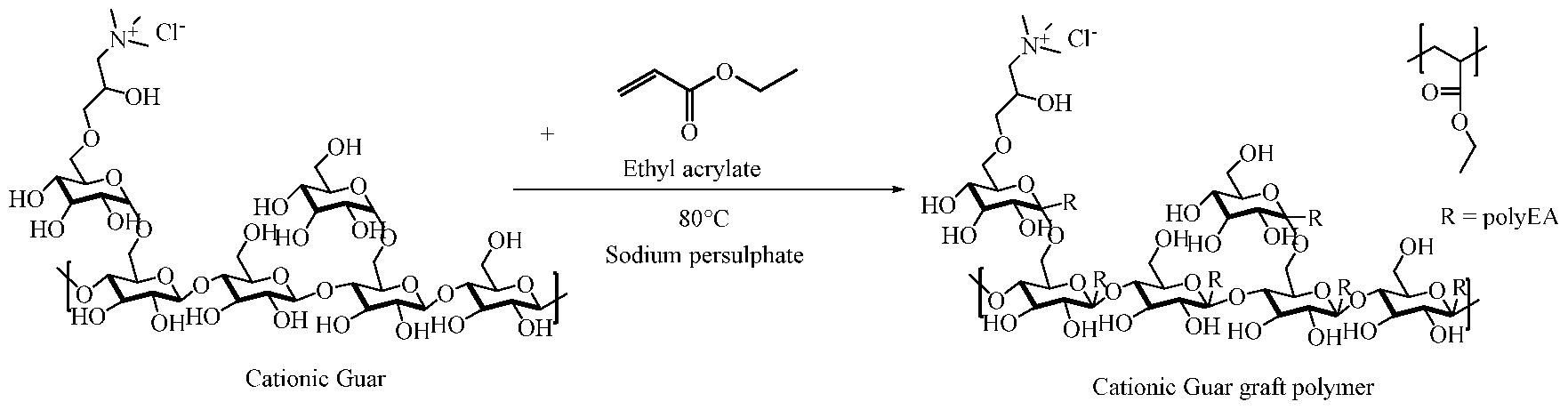
[0079] In another specific and non-limiting embodiment, the present application discloses a physical mixture comprising: (a) about 20% wt./wt. to about 60% wt./wt. of at least one functionalized or unfunctionalized galactomannan moiety and (b) about 20% wt./wt. to about 60% wt./wt. of at least one functionalized or unfunctionalized acryloyl moiety.
[0080] Another non-limiting embodiment provides a physical mixture comprising: (i) about 20% wt./wt. to about 40% wt./wt. of cationic guar; (ii) about 30% wt./wt. to about 60% wt./wt. of ethyl acrylate (EA); and (iii) about 20% wt./wt. to about 40% wt./wt. of methacrylic acid (MAA).
[0081] Yet another non-limiting embodiment discloses to comprise: physical mixture of (i) about 30% wt./wt. of cationic guar; (ii) about 42% wt./wt. of ethyl acrylate (EA); and (iii) about 28% wt./wt. of methacrylic acid (MAA).
[0082] Still another specific non-limiting embodiment discloses a physical mixture of (a) about 20% wt./wt. to about 60% wt./wt. of galactomannan moiety selected from cationic guar, hydroxypropyl guar; and (b) about 20% wt./wt. to about 60% wt./wt. of cellulose ether moiety selected from hydroxy ethyl cellulose (HEC) and carboxy methyl cellulose (CMC).
[0083] In another non-limiting embodiment, the hair straightening or styling composition of the present application comprises at least one organic or inorganic base in the concentration range of from about 0.1 % wt./wt. to about 20% wt./wt. of the total composition. Suitable base for the hair care composition of the present application is an organic or inorganic carbonate or bicarbonate selected from the following non-limiting compounds including sodium bicarbonate, potassium bicarbonate, disodium or dipotassium carbonate, sodium- potassium carbonate; lithium, magnesium, calcium, zinc, aluminum, guanidine, or imidazolium carbonates or bicarbonates; diammonium carbonate, ammonium bicarbonate or ammonium sodium carbonate; alkyl or aryl ammonium bicarbonates selected from propylene carbonate; dialkyl ammonium carbonates or bicarbonates; alkylaryl ammonium carbonates or bicarbonates; diaryl ammonium bicarbonates, trialkyl ammonium carbonates or bicarbonates; alkylaryl ammonium carbonate or triaryl ammonium bicarbonates, hydroxyl alkyl or hydroxyl aryl ammonium bicarbonates; dihydroxyl alkyl ammonium carbonates or bicarbonates; hydroxyl alkyl hydroxyl aryl ammonium carbonates and bicarbonates; dihydroxyl hydroxyl aryl ammonium bicarbonates, trihydroxyl alkyl ammonium carbonates or bicarbonates; hydroxyl alkyl hydroxyl aryl ammonium carbonate; trihydroxyl aryl ammonium bicarbonates, where the alkyl or hydroxyl alkyl ammonium groups are linear or branched from carbon length C1-C30, hydrophobic chain lauryl, stearyl, behenyl and alkylaryl; or organic or inorganic alkali hydroxides, sulfates, borates, manganates, aluminates, silicates, phosphates, alone or in combination with the above predefined carbonates.
[0084] In another non-limiting embodiment, the hair straightening or styling composition of the present application comprises optionally, at least one functional polymer in the concentration range of from about 0.1 % wt./wt. to about 20% wt./wt. of the total
composition. The functional polymer as used herein is a non-hybrid polymer which has a styling, thickening or conditioning property. Additionally, the functional polymer possibly has either at least one individual property, for example, (i) styling and thickening, (ii) thickening and conditioning, (iii) styling and conditioning or (iv) styling, thickening and conditioning.
[0085] The functional polymers suitable for the present application include but are not limited to organic hair styling polymers that are well known in the relevant art for an artisan. The organic styling polymers are homopolymers, copolymers, terpolymers or other higher polymers, but should comprise one or more polymerizable hydrophobic monomers to render the resulting styling polymer hydrophobic and water insoluble as defined herein. The styling polymers possibly therefore further comprise other water soluble, hydrophilic monomers provided that the resulting styling polymers have the requisite hydrophobicity and water insolubility.
[0086] In accordance with another embodiment of the present application, it is contemplated that an optional functional polymer is employed for preparing the hair care composition of the present application, and wherein, a polymer or blend of polymers from synthetic and/or natural origin with weight average molecular weight from about 500 to about 20,000,000 daltons, containing at least one or more of the following monomeric components selected the group including but not limited to styrenics, and/or sulfonated styrenics, acrylates, methacrylates, acrylamides, methacrylamides, vinyl lactams like vinyl pyrrolidone, vinyl caprolactam, vinyl amides, urethanes, ethoxylates, propoxylates, vinyl carboxylates, vinyl esters, vinyl ethers, maleates, itaconates, crotonates, and olefinics. Natural polymers are polysaccharides containing a-1,4 and/or -l,4-glycosidic linkages with optionally a- 1,6 and/or β-1,6 linkages, or optionally modified with (i) hydroxyalkyl, (ii) cationic functionality, (iii) hydrophobic groups including methyl, ethyl, propyl, and/or carboxymethyl groups, or (iv) hydrophilic groups including hydroxy ethyl, hydroxyl propyl, acetates, succinates, phosphates, sulfates and/or carbonates. Accordingly, in one specific embodiment, the natural polymer is cellulose, starch, guar, alginate, and carrageen gum.
[0087] In accordance with yet another embodiment of the present application, the functional polymer is cationic, anionic, amphoteric or nonionic in nature. Suitable functional polymers include but are not limited to acrylamide/sodium acrylate copolymer, acrylate/ammonium methacrylate copolymer, acrylic/acrylate copolymer, allylstearate/vinyl acetate (VA)
copolymer, aminoethylacrylate phosphate/acrylate copolymer, allyl stearate/VA copolymer, butyl ester of ethylene/maleic anhydride copolymer, isopropyl ester of methyl vinyl ether/ maleic anhydride (PVM/MA) copolymer, octyacrylamide / acrylate /butylaminoethyl methacrylate copolymer, octylacrylamide/acrylates copolymer, polyethylacrylate, poly( vinyl pyrrolidone) (PVP), PVP/eicosene copolymer, PVP/ethyl methacrylate/methacrylic acid copolymer, PVP/hexadecene copolymer, PVP/VA copolymer, stearyl vinyl ether/maleic anhydride copolymer, vinyl acetate/crotonic acid copolymer, vinyl acetate/crotonic acid/vinyl neodecanoate copolymer, or mixtures thereof.
[0088] Commercially available non-limiting examples of functional polymers include the following polymer products from Ashland (1) Cationic styling polymers with hair conditioning benefits - Styleze™W Polymer, Styleze™CC-10 (pseudo cationic), Gafquat™755 NP, and Gafquat™ 440; (2) Styling polymers with excellent high humidity curl retention - Styleze™2000, Allianz™LT 120, Styleze™ W Polymer, and Advantage™ LCA; (3) Non- ionic styling polymers with broad ingredient compatibility - Polyvinylpyrrolidones such as PVP K-30, PVP K-60 and PVP K-90, Vinylpyrrolidone/vinyl acetate copolymers such as PVP/VA (E, I or W) 735, PVP/VA (E or W) 635, PVP/VA (E or I) 535, PVP/VA (E or I) 335 and PVP/VA S-630, and poly(vinylpyrrolidone/ dimethylamino ethylmethacrylate) polymers such as copolymer 845/937.
[0089] The thickening polymers of the present application are capable of contributing to hair straightening; retaining the "hair style" as such for a longer duration, providing higher humidity control and increasing body or fullness.
[0090] In accordance with yet another embodiment, present application further comprises from about 40% wt./wt. to about 95% wt./wt. of at least one carrier. It is disclosed that at least one carrier is selected from the group consisting of water, alcohol, hydro alcoholic moiety, an emulsion, an ester, a hydrocarbon or an organic or inorganic oil carrier. An emulsion is a fluid colloidal system in which liquid droplets and/or liquid crystals are dispersed in a liquid. It is denoted by the symbol O/W (Oil in Water) if the continuous phase is an aqueous solution and by W/O (Water in Oil) if the continuous phase is an organic liquid (an 'oil'). More complicated emulsions such as 0/W/O (i.e. oil droplets contained within aqueous droplets dispersed in a continuous oil phase) are also possible.
[0091] In another non-limiting embodiment, the present application further comprises an optional cross-linking monomeric unit having alcohol, thiol, carboxylic acid or anhydride, amino or ammonium, modified silicone or siloxane, alkoxy silane, or sulfate group functionality. The cross-linking agent is present in an amount of about 0.1 % wt./wt. to about 20% wt./wt. of the total composition.
[0092] In another non-limiting embodiment, the composition of the present application further comprises about 0.1 % wt./wt. to about 20% wt./wt. of at least one protein, peptide, dipeptide, tripeptide, tetrapeptide, pentapeptide, hexapeptide, heptapeptide, octapeptide, nona- peptide, and decapeptide selected from following non-limiting the group components including cysteine, histidine, lysine, arginine, aspartate, glutamate, asparagine, glutamine; alpha and/or beta- keratins, silk proteins, wheat protein, oat protein, milk protein, glycoprotein, soy protein, barley protein, quinoa protein, collagen protein, vegetable protein, chickpea protein, avocado protein, egg protein, honey protein, rice protein, casein, light protein, gelatin, or their hydrolyzed counterparts.
[0093] In yet another embodiment, the present application further comprises about 0.1% wt./wt. to about 20% wt./wt. of at least one cosmetically acceptable ingredient. Suitable personal care or cosmetically acceptable ingredients or conventional additives that are employed for the preparing composition of the present application are well known in the relevant art and can be readily chosen by an artisan includes but not limited to functional silicones, acidifying or alkalizing pH adjusting agents, neutralizing agents, buffering agents; auxiliary fixatives and film formers that modify the on hair attributes of the polymer of the present application, such as gums, resins, polymers of synthetic or natural origin, and the like; auxiliary rheology modifiers such as viscosity enhancing polymeric thickeners or gellants; additives such as emulsifiers, detergents, emulsion stabilizers, waxes, dispersants, antioxidants, solvents, electrolytes; hair and skin conditioning agents such as antistatic agents, synthetic oils, vegetable or animal oils, monomeric or polymeric quaternized ammonium salts, emollients, humectants, lubricants, sunscreen agents, and the like; chemical hair waving or straightening agents; hair colorants such as pigments and dyes for temporary, semi-permanent, or permanent hair dyeing; anionic surfactants, cationic surfactants, nonionic surfactants, amphoteric surfactants and zwitterionic surfactants; polymer film modifying agents, plasticizers, tackifiers, detackifiers, wetting agents and the like, product finishing agents, chelating agents, proteins, amino acids, vitamins, opacifiers, pearlescing
agents, resins, preservatives, fragrances, solubilizers, butter, penetrants, UV absorbers, and the like; propellants (water-miscible or water-immiscible) such as fluorinated hydrocarbons, liquid volatile hydrocarbons, compressed gases, liquid vehicles, anti-static agents, anti-frizz agents, antidandruff agents, hair waving agents, relaxers, absorbents, fatty substances, moisturizers, hydrophilic or lipophilic active agent, and combinations thereof.
[0094] The chelating agents used in the present application are present in an amount of about 0.1 % wt./wt. to about 5% wt./wt., about 5% wt./wt. to about 10% wt./wt. , 10% wt./wt. to about 15 % wt./wt. or about 15% wt./wt. to about 20% wt./wt. of the total composition and are selected from but not limited to ethylene diamine tetra acetic acid (EDTA), diisopropyl oxalate, disodium EDTA, disodium EDTA-copper, hexaethylene diamine tetra acetic acid, oxalic acid, potassium or sodium citrate, sodium oxalate, trimethylamine-EDTA, tetrasodium EDTA, trisodium EDTA, and trisodium HEDTA.
[0095] The conditioning agents used in the present application are present in an amount of about 0.1 % wt./wt. to about 5% wt./wt., about 5% wt./wt. to about 10% wt./wt. , 10% wt./wt. to about 15% wt./wt. or about 15% wt./wt. to about 20% wt./wt. of the total composition and are selected from but not limited to polymeric and small quaternary ammonium compounds such as tertiary amines quaternium and polyquaternium compounds. Preferred conditioning agents are proteins or hydrolyzed cationic or non-cationic proteins selected from hydrolyzed collagens having trimethylammonium and trimethylstearyl ammonium chloride groups, hydrolyzed animal proteins having trimethyl benzyl ammonium groups, hydrolyzed proteins having groups of quaternary ammonium on the polypeptide chain, including at least one Cl- C12 alkyl, Ceramide compounds ceramide, a glycoceramide, a pseudoceramide, or a neoceramide selected from 2-N-linoleoyl amino-octadecane-l,3-diol, 2-N-oleoyl amino- octadecane-l,3-diol, 2-N-palmitoyl amino-octadecane-l,3-diol, 2-N-stearoyl amino- octadecane-l,3-diol, 2-N-behenoyl amino-octadecane-l,3-diol, 2-N-[2-hydroxy-palmitoyl]- amino-octadecane-l,3-diol, 2-N-stearoyl amino-octadecane-l,3,4-triol, N-stearoyl phytosphingosine, 2-N-palmitoyl amino-hexadecane-1 ,3-diol, bis-(N-hydroxy ethyl N-cetyl) malonamide, N(2 -hydroxy ethyl)-N-(3-cetoxyl-2-hydroxy propyl) amide of cetylic acid, N- docosanoyl N-methyl-D-glucamine and their mixtures; salt of a primary, secondary, or tertiary fatty amine, optionally polyoxyalkylenated, a quaternary ammonium salt, a derivative of imadazoline, or an amine oxide selected from mono-, di-, or tri- alkyl quaternary ammonium compounds with a counterion such as a chloride, methosulfate, tosylate, etc. including, but not
limited to, cetrimonium chloride, dicetyldimonium chloride, behentrimonium methosulfate, and the like; fatty amine selected from dodecyl, cetyl or stearamidopropyl dimethylamine; fatty acid or derivatives selected from mono-, di-, tri- and tetra- carboxylic acids selected from lactic acid, tartaric acid, gluconic acid, acetic acid, hydrochloric acid, phosphoric acid or combinations thereof. Preferred conditioning agent is combination of Cetearyl Alcohol (and) Behenyl Alcohol (and) Hydroxyethyl Cetearamidopropyldimonium Chloride commercially available as ProLipid™ 161 lamellar gel (Ashland), and stearamidopropyl dimethylamine.
[0096] The emollients used in the present application are present in an amount of about 0.1 % wt./wt. to about 5% wt./wt., about 5% wt./wt. to about 10% wt./wt. , 10% wt./wt. to about 15% wt./wt. or about 15% wt./wt. to about 20% wt./wt. of the total composition and include but are not limited to cetyl alcohol, stearyl alcohol.
[0097] The emulsifiers used in the present application are present in an amount of about 0.1 % wt./wt. to about 5% wt./wt., about 5% wt./wt. to about 10% wt./wt. , 10% wt./wt. to about 15% wt./wt. or about 15% wt./wt. to about 20% wt./wt. of the total composition and include but are not limited to ethoxylated C10-C22 fatty alcohols selected from oleth-20, trideceth-6, trideceth- 7, trideceth-9, trideceth-10, trideceth-11, trideceth-12, trideceth-15, trideceth 20, trideceth-30, trideceth-40, trideceth-50, or mixtures thereof, a C10-C22 fatty alcohol ether, ethoxylated oleic alcohol, an ethoxylated branched CIO alcohol, a stearic acid ester, or mixtures thereof.
[0098] The humectants used in the present application are present in an amount of about 0.1 % wt./wt. to about 5% wt./wt., about 5% wt./wt. to about 10% wt./wt. , 10% wt./wt. to about 15% wt./wt. or about 15 % wt./wt. to about 20% wt./wt. of the total composition and are selected from but are not limited to glycols, sugars, oils, silicones, emollients and proteins. These humectants create a cage effect by adding moisture to the hair. Non-limiting examples of humectants include hydrolyzed silk protein, glycols, glycerols, propylene glycol, diethylene glycol monoethyl ether, sorbitol, sodium salt of pyroglutamic acid, glycerol, glycerol derivatives, glycerin, trehalose, sorbitol, maltitol, dipropylene glycol, 1,3-butylene glycol, sodium hyaluronate, and the like.
[0099] The suitable non-limiting moisturizers employed in the present application are present in an amount of about 0.1 % wt./wt. to about 2% wt./wt., about 2% wt./wt. to about 5 % wt./wt. , or 5 % wt./wt. to about 10% wt./wt. of the total composition and include but are not limited to
glycol, glycerol, propylene glycol, diethylene glycol monoethyl ether, sorbitol, sodium salt of pyroglutamic acid, glycerol, glycerol derivatives, glycerin, trehalose, sorbitol, maltitol, dipropylene glycol, 1,3-butylene glycol, sodium hyaluronate, and the like.
[00100] The oxidizing agents are selected from but not limited to hydrogen peroxide, bromides and per acetic acid to fix the disulfide bond.
[00101] The pH adjusting buffers are selected from but not limited to glyoxylic acid, maleic acids, succinic acid, formic acid and other organic and inorganic acids. These buffers promote active penetration of the composition of the present application.
[00102] The preservatives used in the present application are present in an amount of about 0.1 % wt./wt. to about 5% wt./wt., about 5% wt./wt. to about 10% wt./wt. , 10% wt./wt. to about 15 % wt./wt. or about 15% wt./wt. to about 20% wt./wt. of the total composition and are selected from but not limited to propylene glycol, paraben, methyl paraben, propyl paraben, phenoxyethanol, caprylyl glycol, iodopropynyl butyl carbamate, diazolidinyl urea, triazoles, imidazoles, naphthalene derivatives, benzoic acid, sorbic acid, benzimidazoles, morpholine derivatives, dithiocarbamates, benzisothiazoles, benzamides, boron compounds, formaldehyde donors, isothiazolones, thiocyanates, quaternary ammonium compounds, iodine derivatives, phenol derivatives, pyridines, dialkylthiocarbamates, nitriles, alkyl parabens and salts thereof. Preferred preservatives are combination of benzoic acid and Sorbic acid in benzyl alcohol - commercially available as Rokonsal™ BSB-N (Ashland.); Propylene Glycol (and) Diazolidinyl Urea (and) Methyl paraben (and) Propyl paraben - commercially available as Germaben II (Ashland); and stearalkonium chloride.
[00103] The reducing agents are selected from but not limited to thioglycolate, thiosulfate, sulfite, bisulfite, and urea. These agents target disulfide bonds to create additional disulfide interchange and rearrangement.
[00104] The salts used in the present application are present in an amount of about 0.1 % wt./wt. to about 5% wt./wt., about 5% wt./wt. to about 10% wt./wt. , 10% wt./wt. to about 15% wt./wt. or about 15 % wt./wt. to about 20% wt./wt. of the total composition and include but are not limited to sodium acetate, potassium acetate, ammonium acetate, sodium citrate, potassium citrate, ammonium citrate, sodium nitrate, potassium nitrate, ammonium nitrate, sodium
phosphate, potassium phosphate, ammonium phosphate, sodium chloride, potassium chloride, ammonium chloride, sodium sulfate, potassium sulfate, ammonium sulfate, sodium ethylene diamine tetra acetic acid, disodium ethylene diamine tetra acetic acid and trisodium ethylene diamine tetra acetic acid, tetra sodium ethylene diamine tetra acetate and mixtures thereof. Most preferred is disodium ethylene diamine tetra acetic acid.
[00105] The functional silicones used in the present application are present in an amount of about 0.1 % wt./wt. to about 5% wt./wt., about 5% wt./wt. to about 10% wt./wt. , 10% wt./wt. to about 15% wt./wt. or about 15% wt./wt. to about 20% wt./wt. of the total composition and are selected from but not limited to dimethicone, amodimethicone, vinyldimethicone, cyclopentasiloxane, dimethicone/vinyldimethicone cross polymer, silicone quat, silicone fluid and silicone wax. These silicones decrease friction during hair combing and flat ironing, smooth gliding, increase conditioning and smoothing to hair by adding flexibility, help reduce heat damage and style retention; and contribute to shine depending on the refractive index.
[00106] The smoothing or straightening agents used in the present application are present in an amount of about 0.1 % wt./wt. to about 5% wt./wt., about 5% wt./wt. to about 10% wt./wt. , 10% wt./wt. to about 15% wt./wt. or about 15% wt./wt. to about 20% wt./wt. of the total composition and are selected from cysteine, homocycsteine, homocysteine hydrate, N-acetyl- L-cysteine and N-carbamoylcysteine glyoxylol carbocysteine, N-propionylcysteine, N- butyrylcysteine, N-valerylcysteine, N-caproylcysteine and N-heptanoylcysteine, N- benzoylcysteine, N-toluoylcysteine, N-(ethylbenzyl) cysteine and N-(propylbenzoyl) cysteine, and N-acylated cysteine.
[00107] According to another embodiment of the present application, a catalyst is employed to facilitate the reaction speed of active ingredients, and wherein, the suitable catalyst can be n on- metallic (N-methylimidazole, Perfluoroalkanesulfonates, N-dimethylaminopyridine) or metallic (tin, aluminum, iron, scandium, yttrium, zinc, bismuth, ruthenium, zirconocene) in nature.
[00108] Further, the present application also contemplates fatty alcohols or waxes as structuring agents, anionic or non-anionic surfactants or wetting agents, petrolatum as thickeners protectants, mineral oils as lubricating agents, mica or silica, bentonite, or other
inorganic powders as thickening agents and heat transfer agents.
[00109] In another non-limiting embodiment, the present application discloses a hair care composition capable of styling, straightening or conditioning hair by providing "virgin feel condition" to the hair after multiple washes particularly providing at least one of the following results including (1) increased hydrophobicity, (2) improved detangling and wet combability, (3) improved deposition, and (4) no build-up.
[00110] The hybrid polymer described in the present application improves hair straightening by improving the hair fiber alignment, improving contact heat transfer, reducing friction between hot iron and hair. Hybrid polymer along with a or β - hydroxy ketone is semipermanently affixed to hair and survives multiple shampoo cycles. Even after washing the hair treated with present hair styling composition, the polymer helps in conditioning, smoothness, frizz reduction, shine, manageability, durability, humidity resistance, and restyle- ability. Functional polymer, will react with itself and/or with the straightening components. In doing so, the hair tress will have significant improvement in providing or enhancing life to it and still maintain same desired aesthetic attributes like shine, conditioning, luster, and feel, etc. After thermal activation and styling, these polymers are semi-permanently affixed to the hair and these effects will last a minimum of 10 shampoo and conditioning cycles when using the harsh sulfate based shampoos. Even longer lasting results are obtained when non-sulfate based shampoos are used, generally around 30 shampoo cycles. Furthermore, thermal activation of the composition does not produce formaldehyde or noxious vapors to achieve these effects and thereby provides a safer alternative to the formaldehyde based "Brazilian Blowout" treatment that is currently being banned across the globe.
[00111] In yet another non-limiting embodiment, the present application provides a hair straightening or hair styling composition comprising: (A) about 0.1 % wt./wt. to about 70% wt./wt. of dihydroxyacetone, 4-hydroxy-2-butanone, l-hydroxy-2-butanone or mixtures thereof; (B) about 0.1 % wt./wt. to about 70% wt./wt. of a first polymeric compound selected from: (i) at least one hybrid graft polymer derived from (a) a functionalized or unfunctionalized cellulose ether moiety and (b) at least one functionalized or unfunctionalized acryloyl moiety; or (ii) at least one hybrid graft polymer derived from (a) a functionalized or unfunctionalized galactomannan moiety and (b) at least one functionalized or unfunctionalized acryloyl moiety; (C) about 0.1 % wt./wt. to about 20% wt./wt. of sodium bicarbonate and/or propylene
carbonate; (D) optionally, about 0.1 % wt./wt. to about 20% wt./wt. of at least one functional polymer, and (E) at least one a carrier, wherein said composition has a pH of about 5 to about 11.
[00112] Accordingly, the present application further comprises about 0.1 % wt./wt. to about 70% wt./wt. of a second polymeric compound selected from: (a) a functionalized or unfunctionalized cellulose ether moiety, or (b) functionalized or unfunctionalized galactomannan moiety.
[00113] It is well known in the prior art that utilization of basic neutralizers like sodium hydroxide, or sodium phosphates, the straightening effect is not that pronounced as desired whereas the present composition with hydroxy acetone, hybrid graft polymer and sodium bicarbonate has long lasting straightening effect. Moreover, consumer safety is of premier importance, the neutral to slightly alkaline pH region for hair straightening is observed to be superior as compared to that of highly acidic or highly alkaline condition based straightening effects. The present hair styling composition can be applied on damp or dry hair and provides longer lasting straightening effects, shorter processing times as hair can be washed right away immediately once the hair is straightened unlike the formaldehyde treatment which requires long waiting period to wash the hair. Moreover, the present composition does not damage the hair, and is safer to scalp and hair.
[00114] The present composition enables treatment of hair at wide pH ranges of about 1- 14, but most preferably in neutral to slightly alkaline conditions at pH 7-12 which is much safer and less corrosive to scalp and hair. The hair composition of the present application is employed for oxidatively dyed hair without extreme color changes that are observed by other hair straightening treatments even before the thermal activation step is applied. In this regard, lower straightening temperatures with multiple passes are required to minimally affect the dye molecules, and to provide some straightening effects.
[00115] In yet another non-limiting embodiment, within scope and contemplation, the present hair care composition comprising at least one hydroxy ketone, at least one hybrid polymer, at least one organic or inorganic base, and optionally, at least one functional polymer can be advantageously employed in combination with hair care compositions and
components that are commercially available and very well known in relevant literature as prior art for a person skilled in the relevant art, and wherein, such non-limiting compositions that are known in the prior art include glyoxylic acid / dimethyl urea, polyacrylate cross polymer, polysaccharides, film forming agents and N-alkyl-2-mercaptoacetamide.
[00116] In yet another non-limiting embodiment, the present application comprises a hair straightening or styling composition which is formulated as per the requirement, and wherein, the non-limiting forms include straightening spray lotion, non-aerosol straightening mousse, hair relaxant, semi-permanent hair dyeing system, temporary hair dyeing system, hair bleaching system, permanent hair wave system, hair setting formulation, smoothing and straightening fluid, straightening serum, straightening solution, straightening perm, emulsion, gel, vesicle dispersion, paste, cream, solid stick, shampoo, balm, wipe, milk, foam, jellies, liquid, tonics, and/or enamel.
[00117] In yet another non-limiting embodiment, the present application provides a method of straightening or styling hair, the method comprises: step (a): washing the hair tresses with shampoo; step (b): eliminating the moisture of hair tresses of step (a); step (c): applying the hair straightening or styling composition comprising (A) dihydroxy acetone, 4-hydroxy-2- butanone, l-hydroxy-2-butanone or combinations thereof; (B ) first polymeric compound selected from: (i) at least one hybrid graft polymer derived from (a) functionalized or unfunctionalized cellulose ether moiety and (b) at least one functionalized or unfunctionalized acryloyl moiety; or (ii) at least one hybrid graft polymer derived from (a) functionalized or unfunctionalized galactomannan moiety and (b) at least one functionalized or unfunctionalized acryloyl moiety; (C) sodium bicarbonate; (D) at least one functional polymer, and (E) at least one carrier, to the dried or damp hair of step (b); step (d): leaving the treated hair for about 15 to 30 minutes for penetration; step (e): hot air drying the treated hair of step (d) by mechanically straightening hair with either brushing or combing with a slow uniform motion from root to tip; step (f): ironing the hair from step (e) using flat iron pre-heated to 375-450°F for at least 4 to 8 times; and step (g): allowing the hair tresses as of step (f) to remain as such for at least 15 to 20 minutes to obtain straightened or styled hair.
[00118] According to one embodiment of the present application, the hair tresses are selected from Caucasian, Asian and African origins selected from fine, medium and coarse virgin, damaged, colored, grey, bleached hairs, and wherein, the hair tress has textures comprising wavy, curly, coily or kinky patterns.
[00119] According to one important embodiment of the present application, the composition employs molecules which are much safer, allows the hair treatment for straightening, conditioning or styling to be performed at wide pH range of highly basic to highly acidic, and does not emit formaldehyde during the process, and capable of providing long term hair straightening.
[00120] Advantageously, the hair straightening process of the present application provides a hair styling and/or hair straightening that lasts for at least 10 to 30 hair washes even after using the strong sulfate based shampoo and conditioner. Further, the combination of hydroxy ketone/s, hybrid polymer and organic/inorganic base penetrate into the hair fiber's cortex and modifies the hair fiber's natural shape. The functional polymer of the present application provides additional shape control, styling, shine, feel, conditioning, luster to the hair etc.
[00121] Further, certain aspects of the present application are illustrated in detail by way of the following examples. The examples are given herein for illustration of certain aspects of the present application and are not intended to be limiting thereof.
[00122] EXAMPLE 1: Polymerization of Cellulose / Acrylate Hybrid Copolymer
HEC EA/MAA HEC/EA CMC/EA
30/42/28 30/70 50/50
Reactor Weight (g)
Deionized Water (DIW) 879.4 879.4 879.4
Hydroxyethyl Cellulose (HEC) 30 30
Carboxymethyl Cellulose 50
(CMC)
Initiator Shot 1
Sodium persulphate (SPS) 0.18 0.18 0.18
De-Ionized Water [DIW] 10 10 10
Monomer Shot
Ethyl acrylate 42 70 50
Methacrylic acid 28
Initiator Shot 2
SPS 0.42 0.42 0.30
DIW 10 10 10
Total 1000 1000 1000
Post Addition
Propylene Glycol (and) 5 5 5
Diazolidinyl Urea (and)
Methylparaben (and) Propyl
paraben [Germaben II]
Polysaccharide preparation
[00123] Water was weighed into a 1 1 reactor flask, set up with an anchor stirrer and commenced stirring using a Heidolph stirrer. Required amount of HEC or CMC was weighed into a beaker and added slowly. The reactor contents were allowed to stir for few hours to ensure all swollen or gelatinized particles are dissolved and a smooth solution is obtained. Method
[00124] HEC or CMC solution as prepared above was taken into a reactor flask fitted with condenser, thermometer, seal and nitrogen pipette in a water bath. Condenser and nitrogen inlet were turned ON and pipette was placed below the surface of the cellulose. Nitrogen purging was done for 30 min at room temperature. Contents of the flask were heated to 80°C and maintained for 60 min. After 50 min of heating, nitrogen inlet was raised above the surface of the HEC or CMC solution maintaining nitrogen blanket through the reaction. After heating for 60 minutes, first shot of initiator was added to HEC or CMC polysaccharide solution via a syringe. Contents were allowed to react for 60 min at 80°C. Then monomer shot was added and after 5 min initiator shot 2 was added using syringe. Reactor was left at 80°C for about 2 hours. Nitrogen purging was turned OFF and slowly temperature was allowed to cool down to room
temperature. Germaben II was added as the polymer temperature reached 40°C. [00125] EXAMPLE 2: Non- Aerosol Hair Straightening or Styling Mousse
Ingredients %W/W
Hydroxy acetone 15.00
Hybrid polymer 1.00
Polyethylene glycol ether of oleyl alcohol 1.00
(Oleth-20)
Hydrolyzed silk 0.20
Propylene Glycol and Diazolidinyl Urea and 0.50
Iodopropynyl Butyl carbamate
Sodium Bicarbonate 2.00
Propylene Glycol 2.00
Water 78.30
[00126] Water was charged into a suitable mixing vessel and agitated to created medium to deep vortex. Sodium Bicarbonate and hybrid polymer were added into the vortex and mixed until dissolved. Agitation was later reduced and remaining ingredients were added mixed well after each addition. Hair styling mousse is thus obtained.
[00127] EXAMPLE 3: Hair Straightening Serum
Ingredients %W/W
Phase A
Water 78.40
Disodium ethylene diamine 0.10
tetra acetic acid [EDTA]
Glyoxylic acid 2.00
Lactic acid 12.00
Hybrid polymer 2.00
Phase B
Behenyl Alcohol (and) 2.50
Cetearyl Alcohol (and)
hydroxyethyl
Cetearamidopropyldimonium
chloride
Phase C
Amodimethicone (and) 1.50
Cetrimonium Chloride (and)
trideceth-10
Phase D
Benzyl alcohol (and) benzoic 1.50
acid (and) and glycerin (and)
Sorbic acid
[00128] Phase A: Water was added to the main container and mixed well. Phase ingredients were added one by one. Contents were heated to 70-75°C while mixing.
[00129] Phase B: Behenyl Alcohol (and) Cetearyl Alcohol (and) Hydroxyethyl Cetearamidopropyl dimonium Chloride flakes were separately melt at 75°C which was then added to Phase - A contents with vigorous mixing. Temperature was maintained for 20 min at 75 °C. The reaction contents were cooled to 60°C slowly and amodimethicone was added with thorough mixing. The reaction contents were further cooled to 40°C and Phase D ingredients was added. Finally, hair straightening serum was obtained.
[00130] EXAMPLE 4: Hair Straightening or Styling Solution
Ingredients % w/w
Phase A
Water 75.97
Hybrid Polymer 1.25
Disodium EDTA 0.10
Phase B
Cetyl Alcohol 1.50
Stearyl Alcohol 2.00
Stearalkonium Chloride 1.18
Stearamidopropyl Dimethylamine 0.50
Phase C
Cyclopentasiloxane 2.00
Phase D
Propylene Glycol (and) 0.50
Diazolidinyl Urea (and)
Iodopropynyl Butylcarbamate
Glyoxylol Carbocysteine 15.00
(glyoxylic acid + cysteine)
[00131] Hybrid polymer was dispersed into water with propeller agitation. When dispersed, the reaction contents were heated to 70 °C and temperature was maintained for 15 minutes while adding disodium EDTA. Phase B ingredients were separately heated to 70°C and then later added to Phase A contents while maintaining the temperature for 30 minutes. Batch was cooled to 45°C and Phase C ingredients were added. Cooling was continued at 30°C and then Phase D ingredients were added. Finally, hair styling or straightening solution was obtained.
[00132] Example 5: Method of hair straightening or hair styling
[00133] Hair tress was washed thoroughly with shampoo and warm water (35-40°C) followed by second wash, and rinsed for 30 seconds. Excess water was removed, and moisture was removed using blot with towel. Hair styling product of any of the above formulations of examples 1 to 3 was applied; through from root to tip with fingers and combed until uniformly distributed to remove excess. Treated hair was left for 30 minutes for the styling product to penetrate. (Hang tress in straight position). After 30 minutes, tress was hot blow- dried as straight as possible with much tension using a round brush or comb with slow uniform motion from root to tip. Flat iron was pre-heated and hair was treated with pre- heated flat iron from root to tip for about six times. Allowed tress to equilibrate to lab conditions; Evaluated Tress State: Straightened. Hair tress was washed with warm water (35- 40°C) for 30 second wetting, then 30 seconds' wash (shampoo), and later 30 seconds rinse. Hair was conditioned for 30 seconds, followed by 30 seconds' rinse. After hair wash, hair was dried to see hair straightened.
[00134] The results of treating natural hair are shown in Figure 1. It shows the results of treating untreated hair (A) with hydroxy acetone (B), with hydroxy acetone and hybrid polymer HEC/EA/MAA (C). It is observed that hybrid polymer not only conducts heat but also gives hair styling and conditioning benefits as seen in the Figure 1.
[00135] While this invention has been described in detail with reference to certain preferred embodiments, it should be appreciated that the present invention is not limited to those precise embodiments. Rather, in view of the present disclosure, which describes the current best mode for practicing the invention, many modifications and variations would present themselves to those skilled in the art without departing from the scope and spirit of this invention.
Claims
1. A hair straightening or hair styling composition comprising:
A. at least one a or β - hydroxy ketone;
B. a first polymeric compound selected from:
i. at least one hybrid graft polymer derived from (a) a functionalized or unfunctionalized cellulose moiety and (b) at least one functionalized or unfunctionalized acryloyl moiety; or
ii. at least one hybrid graft polymer derived from (a) a functionalized or unfunctionalized galactomannan moiety and (b) at least one functionalized or unfunctionalized acryloyl moiety;
C. at least one organic or inorganic base;
D. optionally, at least one functional polymer; and
E. at least one carrier.
2. The hair straightening or hair styling composition according to claim 1, further comprising a second polymeric compound selected from: (a) a functionalized or unfunctionalized cellulose moiety, or (b) a functionalized or unfunctionalized galactomannan moiety.
3. The hair straightening or hair styling composition according to claim 1, wherein said cellulose moiety is an alkyl cellulose selected from the group consisting of methyl cellulose (MC), ethylcellulose (EC) and propyl cellulose (PC); a hydroxyalkyl cellulose selected from methyl hydroxyethyl cellulose (MHEC), ethyl hydroxyethyl cellulose (EHEC), methyl ethyl hydroxyethyl cellulose (MEHEC), hydroxypropyl hydroxyethyl cellulose (HPHEC), methyl hydroxypropyl hydroxyethyl cellulose (MHPHEC), hydroxypropyl cellulose (HPC), methyl hydroxypropyl cellulose (MHPC) and ethyl hydroxypropyl cellulose (EHPC); a carboxy alkyl cellulose selected from carboxymethylcellulose (CMC), carboxy ethyl cellulose, carboxypropyl cellulose and carboxyalkyl hydroxyalkyl cellulose; a hydrophobically modified cellulose selected from hydrophobically modified carboxymethyl cellulose (HMCMC), hydrophobically modified hydroxyethyl cellulose (HMHEC), hydrophobically modified hydroxypropyl cellulose (HMHPC), hydrophobically modified ethyl hydroxyethyl cellulose (HMEHEC), hydrophobically modified carboxymethyl hydroxyethyl cellulose (HMCMHEC),
hydrophobically modified hydroxypropyl hydroxyethyl cellulose (HMHPHEC), hydrophobically modified methyl cellulose (HMMC), hydrophobically modified methyl hydroxypropyl cellulose (HMMHPC), hydrophobically modified methyl hydroxyethyl cellulose (HMMHEC) and hydrophobically modified carboxymethyl methyl cellulose (HMCMMC); a cationic cellulose selected from cationic hydroxyethyl cellulose (cationic HEC) and cationic hydrophobically modified hydroxyethyl cellulose (cationic HMHEC); a nano fibrillated cellulose (NFC); a microfibrillated cellulose (MFC); a cellulose ester selected from cellulose acetate, cellulose triacetate, cellulose acetate phthalate, cellulose acetate butyrate, cellulose butyrate, cellulose tributyrate, cellulose propionate, cellulose tripropionate, cellulose acetate propionate, carboxymethyl cellulose acetate, carboxymethylcellulose acetate propionate, carboxymethylcellulose acetate butyrate, cellulose acetate butyrate succinate and cellulose propionate butyrate.
4. The hair straightening or hair styling composition according to claim 1, wherein said galactomannan moiety is cassia gum, tara gum, carrageenan gum, alginate, starch, or guar; a non-ionic guar selected from methyl guar, ethyl guar, allyl guar, hydroxyethyl guar, hydroxypropyl guar, hydroxybutyl guar; a cationic guar selected from guar hydroxypropyltrimonium chloride, guar hydroxypropyl dimethyl alkyl ammonium chloride, and guar hydroxyethyl dimethyl alkyl ammonium chloride; an anionic guar selected from carboxymethyl guar, carboxypropyl guar, carboxybutyl guar, carboxymethylhydroxypropyl guar, sulfate esters of guar, phosphate esters of guar and sulfonic esters of guar.
5. The hair straightening or hair styling composition according to claim 1, wherein the acryloyl moiety is acrylic acid, methacrylic acid, sodium acrylate, sodium methacrylate, potassium acrylate, potassium methacrylate, ammonium acrylate, ammonium methacrylate, calcium acrylate, calcium methacrylate, 2-ethylacrylic acid, 2-propylacrylic acid, methacrylate, methyl acrylate, ethyl acrylate, 2-(2-ethoxyethoxy)ethyl acrylate, 2- phenoxyethyl acrylate, alkoxylated phenol acrylates, ethoxylated hydroxyethyl acrylates, ethyl 2-ethylacrylate, 2-ethylhexyl acrylate, ethyl 2-propylacrylate, 4-acetoxyphenethyl acrylate, n-propyl acrylate, isopropyl acrylate, n-butyl acrylate, isobutyl acrylate, sec -butyl acrylate, tert-butyl acrylate, 4-tert-butylcyclohexyl acrylate, 2-carboxyethyl acrylate, 2- chloroethyl acrylate, di(ethylene glycol) ethyl ether acrylate, di(ethylene glycol) 2- ethylhexyl ether acrylate, 4-hydroxybutyl acrylate, 2-hydroxyethyl acrylate, hydroxypropyl
acrylate, isobornyl acrylate, isooctyl acrylate, tert-octyl acrylate, n-decyl acrylate, isodecyl acrylate, undecyl acrylate, 10-undecenyl acrylate, dodecyl acrylate, lauryl acrylate, myristyl acrylate, stearyl acrylate, palmityl acrylate, octadecyl acrylate, n-eicosyl acrylate, iso- norbornyl acrylate, 2-ethoxyethyl acrylate, sulfomethyl acrylate, 2-sulfoethyl acrylate, sodium salt of sulfomethyl acrylate, sodium salt of 2-sulfoethyl acrylate, potassium salt of 2-sulfoethyl acrylate, calcium salt of 2-sulfoethyl acrylate, 3-sulfopropyl acrylate, sodium salt of 3-sulfopropyl acrylate, potassium salt of 3-sulfopropyl acrylate, calcium salt of 3- sulfopropyl acrylate, 4-sulfobutyl acrylate, sulfomethyl methacrylate, 2-sulfoethyl methacrylate, sodium salt of sulfomethyl methacrylate, sodium salt of 2-sulfoethyl methacrylate, potassium salt of 2-sulfoethyl methacrylate, calcium salt of 2-sulfoethyl methacrylate, 3-sulfopropyl methacrylate, sodium salt of 3-sulfopropyl methacrylate, potassium salt of 3-sulfopropyl methacrylate, calcium salt of 3-sulfopropyl methacrylate, 4- sulfobutyl methacrylate; glycidyl acrylate, 3,4-epoxybutyl acrylate, 4,5-epoxypentyl acrylate, 5,6-epoxyhexyl acrylate, 6,7-epoxyheptyl acrylate, 7,8-epoxyoctyl acrylate, 9,10- epoxydecyl acrylate, 10,11-epoxyundecyl acrylate, 11,12-epoxy dodecyl acrylate, 13,14- epoxytetradecyl acrylate, 3,4-epoxycyclohexylmethyl acrylate, 3,4-epoxycyclohexyl acrylate, 2-methylglycidyl acrylate, glycidyl methacrylate, 3,4-epoxybutyl methacrylate, 4,5-epoxypentyl methacrylate, 5,6-epoxyhexyl methacrylate, 6,7-epoxyheptyl methacrylate, 7,8-epoxyoctyl methacrylate, 9,10-epoxydecyl methacrylate, 10,11- epoxyundecyl methacrylate, 11,12-epoxydodecyl methacrylate, 13,14-epoxytetradecyl methacrylate, 3,4-epoxycyclohexylmethyl methacrylate, 3,4-epoxycyclohexyl methacrylate, 2-methylglycidyl methacrylate, N-hydroxyethyl-2-pyrrolidoneacrylate, N- hydroxymethyl-2-pyrrolidoneacrylate, N-hydroxypropyl-2-pyrrolidoneacrylate, N- hydroxymethyl-2-pyrrolidonemethacrylate, N-hydroxyethyl-2-pyrrolidonemethacrylate, N-hydroxypropyl-2-pyrrolidonemethacrylate, N-hydroxymethyl-2-pyrrolidone methyl methacrylate, N-hydroxyethyl-2-pyrrolidone methyl methacrylate, N-hydroxypropyl-2- pyrrolidone methyl methacrylate, N-hydroxymethyl-2-caprolactamacrylate, N- hydroxyethyl-2-caprolactamacrylate, N-hydroxypropyl-2-caprolactamacrylate, N- hydroxyethyl-2-caprolactam methacrylate, N-hydroxymethyl-2-caprolactam methacrylate, N-hydroxypropyl-2-caprolactam methacrylate, N-hydroxymethyl-2-caprolactam methyl methacrylate, N-hydroxyethyl-2-caprolactam methyl methacrylate, and N-hydroxypropyl- 2-caprolactam methyl methacrylate.
6. The hair straightening or hair styling composition according to claim 1, wherein
said composition further comprises at least one protein component selected from the group consisting of peptide, cysteine, histidine, lysine, arginine, aspartate, glutamate, asparagine, glutamine, alpha keratins, beta keratins, silk proteins, wheat protein, oat protein, milk protein, glycoprotein, soy protein, barley protein, quinoa protein, collagen protein, vegetable protein, chickpea protein, avocado protein, egg protein, honey protein, rice protein, casein, light protein, gelatin, and their hydrolyzed counterparts.
7. The hair straightening or hair styling composition according to claim 1, wherein said composition further comprises at least one cosmetically acceptable ingredient selected from the group consisting of silicones, reducing agents, oxidizing agents, conditioning agents, humectants, pH adjusting buffers, petrolatum thickeners, mineral oils, emulsifiers, fragrances, and preservatives.
8. The hair straightening or hair styling composition according to claim 1, wherein said a or β - hydroxy ketone is selected from the group consisting of dihydroxyacetone, 4- hydroxy-2-butanone, l-hydroxy-2-butanone and combinations thereof.
9. The hair straightening or hair styling composition according to claim 1, wherein said organic or inorganic base is an organic carbonate, inorganic carbonate or bicarbonate selected from the group consisting of sodium bicarbonate, potassium bicarbonate, disodium or dipotassium carbonate, sodium potassium carbonate, lithium, magnesium, calcium, zinc, aluminum, guanidine, imidazolium carbonates, imidazolium bicarbonate, diammonium carbonate, ammonium bicarbonate or ammonium sodium carbonate, alkyl or aryl ammonium bicarbonates, propylene carbonate, dialkyl ammonium carbonates or bicarbonates, alkyl aryl ammonium carbonates or bicarbonates, diaryl ammonium bicarbonates, trialkyl ammonium carbonates or bicarbonates, alkyl aryl ammonium carbonate or triaryl ammonium bicarbonates, hydroxyl alkyl or hydroxyl aryl ammonium bicarbonates, dihydroxyl alkyl ammonium carbonates or bicarbonates, hydroxyl alkyl or hydroxyl aryl ammonium carbonates and bicarbonates, dihydroxyl hydroxyl aryl ammonium bicarbonates, trihydroxyl alkyl ammonium carbonates or bicarbonates, hydroxyl alkyl hydroxyl aryl ammonium carbonate, and trihydroxyl aryl ammonium bicarbonates.
The hair straightening or hair styling composition according to claim 1,
wherein said functional polymer is a styling, thickening and/or conditioning polymer.
11. The hair straightening or hair styling composition according to claim 10, wherein said functional polymer is a homopolymer, copolymer or blend of polymers derived from synthetic and/or natural origin with weight-average molecular mass from about 500 to about 20,000,000 Daltons containing at least one monomeric component selected from the group consisting of styrenics, sulfonated styrenics, acrylates, methacrylates, acrylamides, methacrylamides, vinyl lactams, vinyl pyrrolidone, vinyl caprolactam, vinyl amides, urethanes, (meth)acryloyl ethoxylates, (meth)acryloyl propoxylates, vinyl carboxylates, vinyl esters, vinyl ketones, vinyl carbonates, vinyl acetals, (meth)acryloyl alkyl sulfonates, alkenyl sulfonates, alkenyl phosphates, (meth)acryloyl alkyl phosphates, vinyl ethers, maleates, itaconates, crotonates, olefinics and is present in an amount of about 0.1 to about 50.0 wt./wt. % of the total composition.
12. The hair straightening or hair styling composition according to claim 10, wherein said functional polymer is a polysaccharide containing a- 1,4 and/or β-1,4- glycosidic linkages with optionally a- 1,6 and/or β-1,6 linkages, optionally modified with (i) hydroxyalkyl groups, (ii) cationic functionality, (iii) hydrophobic groups including methyl, ethyl, propyl, and/or carboxymethyl groups, or (iv) hydrophilic groups including hydroxyethyl, hydroxypropyl, acetate, succinate, phosphate, sulfate and/or carbonate, cellulose, starch, guar, alginate, carrageenan gum, cassia gum, and/or a tara gum.
13. The hair straightening or hair styling composition according to claim 1, wherein said composition optionally comprises a cross-linking compound having alcohol, thiol, carboxylic acid, poly carboxylic acid, poly epoxide, aldehyde, epoxide, acrylate ester of epoxide, acid aldehyde, anhydride, epichlorohydrin, diepoxide, acetals, diisocyanate, divinyl sulfone, amino or ammonium compound, modified silicone; functionalized and unfunctionalized acryloyloxy, methacryloyloxy, acryloylamino, methacryloylamino, alkenyl, vinyl, allyl, alkylallyl; functionalized and unfunctionalized ethylenically unsaturated carboxylic acid; dihydric alcohol, siloxane, alkoxy silane or sulfate containing groups.
14. The hair straightening or hair styling composition according to claim 1, wherein said carrier is water, alcohol, hydro alcoholic, an emulsion, an ester, a hydrocarbon
or an organic or inorganic oil carrier alone or in combination.
15. The hair straightening or hair styling composition according to claim 1, wherein said composition can provide fiber alignment, improved contact heat transfer, and reduced friction between hot iron and hair to enable hair straightening or hair styling that lasts for at least 10 to 30 wash cycles.
16. A hair straightening or hair styling composition, wherein said composition of claim 1 can be formulated into a straightening spray lotion, non-aerosol straightening mousse, hair relaxant, semi-permanent hair dyeing system, temporary hair dyeing system, hair bleaching system, permanent hair wave system, hair setting formulation, smoothing and straightening fluid, straightening serum, straightening solution, straightening perm, emulsion, gel, vesicle dispersion, paste, cream, solid stick, shampoo, balm, wipe, milk, foam, jellies, liquid, tonics, and/or enamel..
17. A hair straightening or hair styling composition comprising:
i. about 0.1% wt./wt. to about 70.0% wt./wt. of at least one of dihydroxyaeetone, 4-hydroxy-2-butanoiie, l-hydroxy-2-butanone and combinations thereof;
ii. about 0.1% wt./wt. to about 50.0% wt./wt. of at least one hybrid polymer selected from: (a) hydroxyethyl cellulose / ethyl acrylate / methacrylic acid copolymer; (b) hydroxyethyl cellulose / ethyl acrylate copolymer; (c) carboxymethyl cellulose / ethyl acrylate copolymer; or (d) cationic guar / ethylacrylate / methacrylic acid copolymer;
iii. about 0.1% wt./wt. to about 20.0% wt./wt. of sodium bicarbonate or propylene carbonate;
iv. optionally, about 0.1% wt./wt. to about 20.0% wt./wt. of at least one functional polymer; and
v. about 40% wt./wt. to about 80.0 wt./wt. % of at least one carrier;
wherein the composition has a pH of about 5 to about 11.
18. A method of straightening or styling hair, said method comprising the steps of:
a) washing the hair tresses with shampoo;
b) eliminating or reducing the moisture of hair tresses of step (a);
c) applying the hair straightening or styling composition of claim 1 to the dried hair of step (b);
d) leaving the treated hair for about 15 to 30 minutes for penetration; e) hot air drying the treated hair of step (d) by mechanically straightening with a slow uniform motion from root to tip;
f) ironing the hair resulting from step (e) for at least 4 to 8 times using a flat iron pre-heated to 375-450°F; and
g) allowing the hair tresses of step (f) to remain as such for at least 15 to 20 minutes to obtain straightened or styled hair.
19. The method according to claim 18, wherein said hair tresses are selected from Caucasian, Asian and African origins having fine, medium and coarse virgin, damaged, colored, grey or bleached hairs and textures comprising wavy, curly, coily or kinky patterns.
20. The method according to claim 18, wherein said method allows straightened hair to be washed immediately and wherein, the method acts on both dry and damp hair.
21. The method according to claim 18, wherein said straightened or styled hair remains in straightening or styling state for at least 10 to 30 hair washes even after using sulfate based shampoo, and conditioner.
Applications Claiming Priority (2)
| Application Number | Priority Date | Filing Date | Title |
|---|---|---|---|
| US201662363451P | 2016-07-18 | 2016-07-18 | |
| US62/363,451 | 2016-07-18 |
Publications (1)
| Publication Number | Publication Date |
|---|---|
| WO2018017408A1 true WO2018017408A1 (en) | 2018-01-25 |
Family
ID=60992551
Family Applications (1)
| Application Number | Title | Priority Date | Filing Date |
|---|---|---|---|
| PCT/US2017/042093 Ceased WO2018017408A1 (en) | 2016-07-18 | 2017-07-14 | A hair care composition, process for preparing the same and method of use thereof |
Country Status (1)
| Country | Link |
|---|---|
| WO (1) | WO2018017408A1 (en) |
Cited By (6)
| Publication number | Priority date | Publication date | Assignee | Title |
|---|---|---|---|---|
| PL424632A1 (en) * | 2018-02-20 | 2019-08-26 | Aero-Bw K. Domagała Spółka Jawna | Method for producing a preparation with stem cells for the hair and head skin care and the device for moistening of applicators of that preparation and the moistening method |
| EP3801775A4 (en) * | 2018-06-03 | 2022-05-04 | EasyFix Hair Design Ltd. | SELF CURING ACRYLIC COMPOSITION FOR HAIR STYLING |
| WO2022215069A1 (en) * | 2021-04-05 | 2022-10-13 | EasyFix Hair Design LTD. | Self-curing acrylic formulations containing n-acetyl cysteine for hair straightening |
| CN115260331A (en) * | 2022-08-26 | 2022-11-01 | 南京林业大学 | Functional galactomannan and preparation method and application thereof |
| WO2023164152A1 (en) * | 2022-02-25 | 2023-08-31 | Isp Investments Llc | Multi-modal hair care composition comprising cationic guar blends and process for preparation thereof |
| RU2831532C1 (en) * | 2024-04-11 | 2024-12-09 | Спартак Спартакович Киракосян | Hair care composition |
Citations (8)
| Publication number | Priority date | Publication date | Assignee | Title |
|---|---|---|---|---|
| US5037930A (en) * | 1989-09-22 | 1991-08-06 | Gaf Chemicals Corporation | Heterocyclic quaternized nitrogen-containing cellulosic graft polymers |
| US6306377B1 (en) * | 1998-01-29 | 2001-10-23 | Shiseido Co., Ltd. | Hair straightening/smoothing composition |
| WO2010016543A1 (en) * | 2008-08-08 | 2010-02-11 | ハイモ株式会社 | Additive for hair cosmetic, hair cosmetic, and method for producing additive for hair cosmetic |
| WO2015074969A2 (en) * | 2013-11-21 | 2015-05-28 | Unilever Plc | Method of shaping hair |
| US20150342857A1 (en) * | 2014-05-29 | 2015-12-03 | L'oreal | Compositions for straightening or relaxing hair |
| US20150374604A1 (en) * | 2013-02-06 | 2015-12-31 | Lubrizol Advanced Materials, Inc. | Semi-permanent hair straightening composition and method |
| US20160058683A1 (en) * | 2014-08-31 | 2016-03-03 | Cosphatech LLC | Hair-Straightening Compositions and Methods |
| US20160158138A1 (en) * | 2011-03-09 | 2016-06-09 | Marc Michael Baum | Keratin-based hair straightening formulations, methods and systems |
-
2017
- 2017-07-14 WO PCT/US2017/042093 patent/WO2018017408A1/en not_active Ceased
Patent Citations (8)
| Publication number | Priority date | Publication date | Assignee | Title |
|---|---|---|---|---|
| US5037930A (en) * | 1989-09-22 | 1991-08-06 | Gaf Chemicals Corporation | Heterocyclic quaternized nitrogen-containing cellulosic graft polymers |
| US6306377B1 (en) * | 1998-01-29 | 2001-10-23 | Shiseido Co., Ltd. | Hair straightening/smoothing composition |
| WO2010016543A1 (en) * | 2008-08-08 | 2010-02-11 | ハイモ株式会社 | Additive for hair cosmetic, hair cosmetic, and method for producing additive for hair cosmetic |
| US20160158138A1 (en) * | 2011-03-09 | 2016-06-09 | Marc Michael Baum | Keratin-based hair straightening formulations, methods and systems |
| US20150374604A1 (en) * | 2013-02-06 | 2015-12-31 | Lubrizol Advanced Materials, Inc. | Semi-permanent hair straightening composition and method |
| WO2015074969A2 (en) * | 2013-11-21 | 2015-05-28 | Unilever Plc | Method of shaping hair |
| US20150342857A1 (en) * | 2014-05-29 | 2015-12-03 | L'oreal | Compositions for straightening or relaxing hair |
| US20160058683A1 (en) * | 2014-08-31 | 2016-03-03 | Cosphatech LLC | Hair-Straightening Compositions and Methods |
Cited By (6)
| Publication number | Priority date | Publication date | Assignee | Title |
|---|---|---|---|---|
| PL424632A1 (en) * | 2018-02-20 | 2019-08-26 | Aero-Bw K. Domagała Spółka Jawna | Method for producing a preparation with stem cells for the hair and head skin care and the device for moistening of applicators of that preparation and the moistening method |
| EP3801775A4 (en) * | 2018-06-03 | 2022-05-04 | EasyFix Hair Design Ltd. | SELF CURING ACRYLIC COMPOSITION FOR HAIR STYLING |
| WO2022215069A1 (en) * | 2021-04-05 | 2022-10-13 | EasyFix Hair Design LTD. | Self-curing acrylic formulations containing n-acetyl cysteine for hair straightening |
| WO2023164152A1 (en) * | 2022-02-25 | 2023-08-31 | Isp Investments Llc | Multi-modal hair care composition comprising cationic guar blends and process for preparation thereof |
| CN115260331A (en) * | 2022-08-26 | 2022-11-01 | 南京林业大学 | Functional galactomannan and preparation method and application thereof |
| RU2831532C1 (en) * | 2024-04-11 | 2024-12-09 | Спартак Спартакович Киракосян | Hair care composition |
Similar Documents
| Publication | Publication Date | Title |
|---|---|---|
| CN110234405B (en) | Cosmetic composition comprising cationic copolymer | |
| EP2561855B1 (en) | Method for chemically modifying the internal region of a hair shaft | |
| US20180353401A1 (en) | A hair care composition, process for preparing the same and method of use thereof | |
| US8771657B2 (en) | Personal care compositions with ethylene acrylic acid copolymer aqueous dispersions | |
| WO2018017408A1 (en) | A hair care composition, process for preparing the same and method of use thereof | |
| US20180344606A1 (en) | A hair care composition, process for preparing the same and method of use thereof | |
| CN110101590A (en) | For handling the method and its kit of hair | |
| KR102930001B1 (en) | Hair styling composition comprising polygalactomannan, and method of using the same | |
| EP2914239A1 (en) | Composition comprising conditioning and/or styling polymer | |
| JP5192809B2 (en) | Conditioning / styling tetrapolymer | |
| EP3801775A1 (en) | Self-curing acrylic composition for hair styling | |
| JP2020203128A (en) | Method for treating hair using steam | |
| WO2018017390A1 (en) | A hair care composition, process for preparing the same and method of use thereof | |
| MXPA02010699A (en) | Hair cosmetic agent. | |
| WO2018017570A1 (en) | A hair straightening and styling composition, process for preparing the same and method of use thereof | |
| JP7596367B2 (en) | Hair treatment method | |
| US5609857A (en) | Methods of conditioning hair which utilize polymeric N-vinyl formamide | |
| WO2017087924A1 (en) | Personal care compositions comprising copolymers of cationic monomers and acryloyl lactam based monomers, process for the same and method of use | |
| US20240238180A1 (en) | Self-curing acrylic formulations containing n-acetyl cysteine for hair straightening | |
| CN117222393A (en) | Hair treatment methods |
Legal Events
| Date | Code | Title | Description |
|---|---|---|---|
| 121 | Ep: the epo has been informed by wipo that ep was designated in this application |
Ref document number: 17831596 Country of ref document: EP Kind code of ref document: A1 |
|
| NENP | Non-entry into the national phase |
Ref country code: DE |
|
| 32PN | Ep: public notification in the ep bulletin as address of the adressee cannot be established |
Free format text: NOTING OF LOSS OF RIGHTS PURSUANT TO RULE 112(1) EPC (EPO FORM 1205 DATED 20.05.2019) |
|
| 122 | Ep: pct application non-entry in european phase |
Ref document number: 17831596 Country of ref document: EP Kind code of ref document: A1 |