WO2017223340A1 - Enhanced hematopoietic stem cell transplantation - Google Patents
Enhanced hematopoietic stem cell transplantation Download PDFInfo
- Publication number
- WO2017223340A1 WO2017223340A1 PCT/US2017/038798 US2017038798W WO2017223340A1 WO 2017223340 A1 WO2017223340 A1 WO 2017223340A1 US 2017038798 W US2017038798 W US 2017038798W WO 2017223340 A1 WO2017223340 A1 WO 2017223340A1
- Authority
- WO
- WIPO (PCT)
- Prior art keywords
- chrl
- gene
- gasp
- ensmustoooooo
- cells
- Prior art date
- Legal status (The legal status is an assumption and is not a legal conclusion. Google has not performed a legal analysis and makes no representation as to the accuracy of the status listed.)
- Ceased
Links
Classifications
-
- A—HUMAN NECESSITIES
- A61—MEDICAL OR VETERINARY SCIENCE; HYGIENE
- A61K—PREPARATIONS FOR MEDICAL, DENTAL OR TOILETRY PURPOSES
- A61K35/00—Medicinal preparations containing materials or reaction products thereof with undetermined constitution
- A61K35/12—Materials from mammals; Compositions comprising non-specified tissues or cells; Compositions comprising non-embryonic stem cells; Genetically modified cells
- A61K35/28—Bone marrow; Haematopoietic stem cells; Mesenchymal stem cells of any origin, e.g. adipose-derived stem cells
-
- A—HUMAN NECESSITIES
- A61—MEDICAL OR VETERINARY SCIENCE; HYGIENE
- A61K—PREPARATIONS FOR MEDICAL, DENTAL OR TOILETRY PURPOSES
- A61K35/00—Medicinal preparations containing materials or reaction products thereof with undetermined constitution
- A61K35/12—Materials from mammals; Compositions comprising non-specified tissues or cells; Compositions comprising non-embryonic stem cells; Genetically modified cells
- A61K35/48—Reproductive organs
- A61K35/51—Umbilical cord; Umbilical cord blood; Umbilical stem cells
-
- C—CHEMISTRY; METALLURGY
- C12—BIOCHEMISTRY; BEER; SPIRITS; WINE; VINEGAR; MICROBIOLOGY; ENZYMOLOGY; MUTATION OR GENETIC ENGINEERING
- C12N—MICROORGANISMS OR ENZYMES; COMPOSITIONS THEREOF; PROPAGATING, PRESERVING, OR MAINTAINING MICROORGANISMS; MUTATION OR GENETIC ENGINEERING; CULTURE MEDIA
- C12N15/00—Mutation or genetic engineering; DNA or RNA concerning genetic engineering, vectors, e.g. plasmids, or their isolation, preparation or purification; Use of hosts therefor
- C12N15/09—Recombinant DNA-technology
- C12N15/11—DNA or RNA fragments; Modified forms thereof; Non-coding nucleic acids having a biological activity
- C12N15/113—Non-coding nucleic acids modulating the expression of genes, e.g. antisense oligonucleotides; Antisense DNA or RNA; Triplex- forming oligonucleotides; Catalytic nucleic acids, e.g. ribozymes; Nucleic acids used in co-suppression or gene silencing
-
- C—CHEMISTRY; METALLURGY
- C12—BIOCHEMISTRY; BEER; SPIRITS; WINE; VINEGAR; MICROBIOLOGY; ENZYMOLOGY; MUTATION OR GENETIC ENGINEERING
- C12N—MICROORGANISMS OR ENZYMES; COMPOSITIONS THEREOF; PROPAGATING, PRESERVING, OR MAINTAINING MICROORGANISMS; MUTATION OR GENETIC ENGINEERING; CULTURE MEDIA
- C12N5/00—Undifferentiated human, animal or plant cells, e.g. cell lines; Tissues; Cultivation or maintenance thereof; Culture media therefor
- C12N5/06—Animal cells or tissues; Human cells or tissues
- C12N5/0602—Vertebrate cells
- C12N5/0603—Embryonic cells ; Embryoid bodies
- C12N5/0605—Cells from extra-embryonic tissues, e.g. placenta, amnion, yolk sac, Wharton's jelly
-
- C—CHEMISTRY; METALLURGY
- C12—BIOCHEMISTRY; BEER; SPIRITS; WINE; VINEGAR; MICROBIOLOGY; ENZYMOLOGY; MUTATION OR GENETIC ENGINEERING
- C12N—MICROORGANISMS OR ENZYMES; COMPOSITIONS THEREOF; PROPAGATING, PRESERVING, OR MAINTAINING MICROORGANISMS; MUTATION OR GENETIC ENGINEERING; CULTURE MEDIA
- C12N5/00—Undifferentiated human, animal or plant cells, e.g. cell lines; Tissues; Cultivation or maintenance thereof; Culture media therefor
- C12N5/06—Animal cells or tissues; Human cells or tissues
- C12N5/0602—Vertebrate cells
- C12N5/0634—Cells from the blood or the immune system
- C12N5/0647—Haematopoietic stem cells; Uncommitted or multipotent progenitors
-
- C—CHEMISTRY; METALLURGY
- C12—BIOCHEMISTRY; BEER; SPIRITS; WINE; VINEGAR; MICROBIOLOGY; ENZYMOLOGY; MUTATION OR GENETIC ENGINEERING
- C12N—MICROORGANISMS OR ENZYMES; COMPOSITIONS THEREOF; PROPAGATING, PRESERVING, OR MAINTAINING MICROORGANISMS; MUTATION OR GENETIC ENGINEERING; CULTURE MEDIA
- C12N2310/00—Structure or type of the nucleic acid
- C12N2310/10—Type of nucleic acid
- C12N2310/12—Type of nucleic acid catalytic nucleic acids, e.g. ribozymes
- C12N2310/122—Hairpin
-
- C—CHEMISTRY; METALLURGY
- C12—BIOCHEMISTRY; BEER; SPIRITS; WINE; VINEGAR; MICROBIOLOGY; ENZYMOLOGY; MUTATION OR GENETIC ENGINEERING
- C12N—MICROORGANISMS OR ENZYMES; COMPOSITIONS THEREOF; PROPAGATING, PRESERVING, OR MAINTAINING MICROORGANISMS; MUTATION OR GENETIC ENGINEERING; CULTURE MEDIA
- C12N2310/00—Structure or type of the nucleic acid
- C12N2310/10—Type of nucleic acid
- C12N2310/14—Type of nucleic acid interfering nucleic acids [NA]
-
- C—CHEMISTRY; METALLURGY
- C12—BIOCHEMISTRY; BEER; SPIRITS; WINE; VINEGAR; MICROBIOLOGY; ENZYMOLOGY; MUTATION OR GENETIC ENGINEERING
- C12N—MICROORGANISMS OR ENZYMES; COMPOSITIONS THEREOF; PROPAGATING, PRESERVING, OR MAINTAINING MICROORGANISMS; MUTATION OR GENETIC ENGINEERING; CULTURE MEDIA
- C12N2310/00—Structure or type of the nucleic acid
- C12N2310/50—Physical structure
- C12N2310/53—Physical structure partially self-complementary or closed
- C12N2310/531—Stem-loop; Hairpin
-
- C—CHEMISTRY; METALLURGY
- C12—BIOCHEMISTRY; BEER; SPIRITS; WINE; VINEGAR; MICROBIOLOGY; ENZYMOLOGY; MUTATION OR GENETIC ENGINEERING
- C12N—MICROORGANISMS OR ENZYMES; COMPOSITIONS THEREOF; PROPAGATING, PRESERVING, OR MAINTAINING MICROORGANISMS; MUTATION OR GENETIC ENGINEERING; CULTURE MEDIA
- C12N2510/00—Genetically modified cells
Definitions
- the present invention relates to methods of enhancing stem cell transplantation by treating pre-graft cells with silencing constructs for reducing expression of GASP (G-protein coupled receptor Associated Sorting Proteins) family genes, either permanently or transiently.
- GASP G-protein coupled receptor Associated Sorting Proteins
- methods of using a shRNA silencing construct for Gpraspl, Gprasp2 or Armcxl (Gasp7) in pre-graft hematopoietic transplant cells are provided for improving the ability of these cells to replenish the hematopoietic system of host organisms.
- GASP gene silenced umbilical cord blood-derived cells is contemplated for transplantation into HLA mismatched (allogeneic) hosts.
- HSC Hematopoietic stem cells
- HSC transplantation represents a curative therapy for many hematologic diseases. It is also a life-saving therapy following high dose chemotherapy for many non-hematopoietic cancers.
- the present invention relates to methods of enhancing stem cell transplantation by treating pre-graft cells with silencing constructs for reducing expression of GASP (G-protein coupled receptor Associated Sorting Proteins) family genes, either permanently or transiently.
- GASP G-protein coupled receptor Associated Sorting Proteins
- methods of using a shRNA silencing construct for Gpraspl, Gprasp2 or Armcxl (Gasp7) in pre-graft hematopoietic transplant cells are provided for improving the ability of these cells to replenish the hematopoietic system of host organisms.
- GASP gene silenced umbilical cord blood-derived cells is contemplated for transplantation into HLA mismatched (allogeneic) hosts.
- the invention provides a method for enhancing hematopoietic stem cell (HSC) engraftment, comprising, a) providing, i) a human hematopoietic stem cell (HSC) population, wherein said HSCs have a HLA haplotype and express a gene in the GASP (G-protein coupled receptor Associated Sorting Protein) gene family, and ii) a human patient having an HLA haplotype, b) treating said HSCs under conditions such that expression of said GASP gene in said HSC population is reduced, and c) transplanting said treated HSCs into said patient.
- said treatment is shRNA-mediated knockdown of said GASP gene.
- said knockdown is up to but not including a 100% reduction in gene expression. While the invention contemplates reduced expression it is not meant to limit the magnitude of the reduction, such that a reduction may be at least 10%, 20%, 30%, 40%, and preferably at least 50%, 60%, 70%, 80%, 90%, 95%, 98%, 99% up to 100%, but preferably not including a 100% reduction.
- said transplantation said GASP gene expression increases in treated HSCs. In one embodiment, said transplantation said GASP gene expression increases in progeny cells of said treated HSCs. In one embodiment, after said treatment said GASP gene is expressed in progeny cells of said treated HSCs. In one embodiment, after said treatment said GASP gene is not knocked down in progeny cells of said treated HSCs. In one embodiment, said GASP gene is selected from the group consisting of Gprasp2 and Armcxl. In one embodiment, said GASP gene is the Gpraspl gene. In one embodiment, said GASP gene is a Basic Helix-Loop-Helix Domain Containing, Class B, 9.
- said HSCs of step a) express two or more GASP genes.
- said two GASP genes are Gpraspl and Gpraspl.
- said two GASP genes are Gpraspl and Gprasp3.
- said two GASP genes are Gprasp2 and Gprasp3.
- said HSCs of step a) express three GASP genes, wherein said three GASP genes are Gpraspl, Gpraspl and Basic Helix-Loop-Helix Domain Containing, Class B, 9.
- said human hematopoietic stem population is obtained from a sample selected from the group consisting of bone marrow, mobilized peripheral blood and umbilical cord blood.
- said human hematopoietic stem population is obtained from umbilical cord blood (UCB).
- said HSC HLA haplotype is a mismatch (allogeneic) between the stem cell population of said umbilical cord blood (UCB) and said HLA haplotype of said patient.
- the invention provides a method for enhancing hematopoietic stem cell (HSC) engraftment, comprising, a) providing, i) a human umbilical cord blood (UCB) stem cell population, wherein said UCBs have a HLA haplotype and express a gene in the GASP (G- protein coupled receptor Associated Sorting Protein) gene family, wherein said GASP gene is selected from the group consisting of Gpraspl, Gpraspl, Basic Helix-Loop-Helix Domain Containing, Class B, 9, and Armcxl, and ii) a human patient, wherein said patient has a major Human Leukocyte Antigen (HLA) haplotype, and b) treating said HSCs to reduce expression of said GASP gene, and c) transplanting said treated HSCs into said patient.
- GASP G- protein coupled receptor Associated Sorting Protein
- said HSC HLA haplotype is a mismatch (allogeneic) between said umbilical cord blood (UCB) stem cell population and said HLA haplotype of said patient. It is not meant to limit the amount of HLA mismatch between stems cells and a recipient of those stem cells.
- a mismatch may be when the stem cells and the recipient do not share any one or more, up to six pairs, of major HLA antigens involved with tissue matching, i.e.
- a mismatch may be when any one or more of two pairs of A antigens, two pairs of B antigens, and two pairs of DR antigens are not shared; two pairs of A antigens, two pairs of B antigens, two pairs of C antigens, and two pairs of DRB1 antigens are not shared; two pairs of A antigens, two pairs of B antigens, two pairs of C antigens, two pairs of DRB1 antigens and two pairs of DQ are not shared, etc.
- a mismatch may also be considered any combination of HLA alleles between host and transplanted cells resulting in rejection, including but not limited to Graft vs. Host Disease (GVHD).
- GVHD Graft vs. Host Disease
- the invention provides a method for enhancing human hematopoietic stem cell (HSC) engraftment, comprising, a) providing, i) a human hematopoietic stem cell (HSC) population, wherein said HSCs express a gene in the GASP (G-protein coupled receptor Associated Sorting Protein) gene family, and ii) a human patient, b) treating said human HSCs under conditions such that expression of said GASP gene in said HSC population is transiently reduced under conditions of a time period and a magnitude sufficient for improving the engraftment potential of the HSCs, and c) transplanting said treated HSCs into said patient.
- said time period is up to 24 hours.
- said reduction of said GASP gene expression is of a magnitude between 80% up to but not including 100%. While the invention contemplates reduced expression it is not meant to limit the magnitude of the reduction, such that a reduction may be at least 10%, 20%, 30%, 40%, and preferably at least 50%, 60%, 70%, 80%, 90%, 95%, 98%), 99%) up to 100% but preferably not including a 100%) reduction.
- said improving said engraftment potential is evidenced by an increase in number of progeny cells from said treated HSCs up to 16 weeks post-transplantation.
- said treatment is shRNA-mediated transient knockdown of said GASP gene.
- said GASP gene is selected from the group consisting of Gprasp2 and Armcxl (Gprasp7). In one embodiment, said GASP gene is the Gpraspl gene. In one embodiment, said GASP gene is the Basic Helix-Loop-Helix Domain Containing, Class B, 9. In one embodiment, said HSCs of step a) express at two or more GASP genes. In one embodiment, said two GASP genes are Gpraspl and Gprasp2. In one embodiment, said HSCs of step a) express three GASP genes, wherein said three GASP genes are Gpraspl, Gpraspl and Basic Helix-Loop-Helix Domain Containing, Class B, 9.
- the invention provides a method of treating a hematopoietic stem cell (HSC) population, comprising, 1) providing a hematopoietic stem cell (HSC) population, wherein said HSCs express a gene in the GASP (G-protein coupled receptor Associated Sorting Protein) gene family, and 2) treating said HSCs ex vivo under conditions such that expression of said GASP gene in said HSC population is reduced.
- said treatment is shRNA-mediated knockdown of said GASP gene.
- said knockdown of said GASP gene is between 80% up to but not including 100% reduction in expression.
- said GASP gene is selected from the group consisting of Gprasp2 and GpraspV.
- said GASP gene is the Gpraspl gene.
- said GASP gene is Gprasp3.
- said HSCs of step a) express two or more GASP genes.
- said two GASP genes are Gpraspl and Gprasp2.
- said two GASP genes are Gpraspl and Gprasp3. In one embodiment, said two GASP genes are Gpraspl and Gprasp3. In one embodiment, said HSCs of step a) express three GASP genes, wherein said three GASP genes are Gpraspl, Gprasp2 and Gprasp3. In one embodiment, said hematopoietic stem population is obtained from a sample selected from the group consisting of bone marrow, mobilized peripheral blood and umbilical cord blood. In one embodiment, said hematopoietic stem population is obtained from umbilical cord blood (UCB). In one embodiment, said hematopoietic stem population is obtained from a human subject. In one embodiment, said hematopoietic stem population is obtained from a non-human: non-rodent subject.
- UMB umbilical cord blood
- the invention provides a method of treating an umbilical cord blood (UCB) stem cell population, comprising, a) providing, an umbilical cord blood (UCB) stem cell population, wherein said UCBs express a gene in the GASP (G-protein coupled receptor Associated Sorting Protein) gene family, wherein said GASP gene is selected from the group consisting of Gpraspl, Gprasp2, Gprasp3, and GpraspV, and b) treating said HSCs ex vivo to reduce expression of said GASP gene.
- GASP G-protein coupled receptor Associated Sorting Protein
- the invention provides a method of treating a hematopoietic stem cell (HSC) population, comprising, a) a hematopoietic stem cell (HSC) population, wherein said HSCs express a gene in the GASP (G-protein coupled receptor Associated Sorting Protein) gene family, and b) treating said HSCs ex vivo under conditions such that expression of said GASP gene in said HSC population is transiently reduced.
- said treating is incubation of HSCs up to 24 hours.
- said reduced expression of said GASP gene is a reduction between 80% up to but not including 100%.
- said treatment is shRNA-mediated transient knockdown of said GASP gene.
- said GASP gene is selected from the group consisting of Gprasp2 and Gprasp3.
- said GASP gene is the Gpraspl gene.
- said GASP gene is the Gprasp3.
- said HSCs of step a) express two or more GASP genes.
- said GASP gene is two GASP genes, wherein said two GASP genes are Gpraspl and Gprasp2.
- said HSCs of step a) express three GASP genes, wherein said three GASP genes are Gpraspl, Gprasp2 and Basic Helix-Loop-Helix Domain Containing, Class B, 9.
- the invention provides a method of treating a hematopoietic stem cell (HSC) population, comprising, a) providing, i) a hematopoietic stem cell (HSC) population, wherein said HSCs have a MHC haplotype and express a gene in the GASP (G-protein coupled receptor Associated Sorting Protein) gene family, and ii) a subject having a MHC haplotype, wherein said subject is a nonhuman:nonrodent animal, b) treating said HSCs under conditions such that expression of said GASP gene in said HSC population is reduced.
- said treatment is shRNA- mediated knockdown of said GASP gene.
- said magnitude is the reduction of said GASP gene expression between 80% up to but not including 100%. While the invention contemplates reduced expression it is not meant to limit the magnitude of the reduction, such that a reduction may be at least 10%, 20%, 30%, 40%, and preferably at least 50%, 60%, 70%, 80%, 90%, 95%, 98%, 99% up to but not including a 100% reduction.
- said hematopoietic stem population is obtained from a sample selected from the group consisting of bone marrow, mobilized peripheral blood and umbilical cord blood.
- said GASP gene is selected from the group consisting of Gpraspl, Gpraspl, Gprasp3 and Gprasp7.
- said HSCs of step a) express two or more GASP genes wherein said two GASP genes are Gpraspl, Gprasp2 and Gprasp3. In one embodiment, said HSCs of step a) express three GASP genes, wherein said three GASP genes are Gpraspl, Gprasp2 and Gprasp3. In one embodiment, said nonhuman:nonrodent animal is selected from the group consisting of equines, bovines, canines, and felines. In one embodiment, said method further comprises step c) transplanting said treated HSCs into said subject. In one embodiment, said HSCs of step b) improves engraftment potential.
- said Gprasp3 gene is the human Basic Helix-Loop-Helix Domain
- the invention provides a method for enhancing HSC engraftment, comprising, a) providing, i) a human hematopoietic stem cell (HSC) population, wherein said HSCs have a HLA haplotype and express a gene in the GASP (G-protein coupled receptor Associated Sorting Proteins) gene family, and ii) a human patient having an HLA haplotype, and b) treating said HSCs under conditions such that expression of said GASP gene in said HSC population is reduced, and c) transplanting said treated HSCs into said patient.
- said treatment is shRNA-mediated knockdown of said GASP gene.
- said GASP gene is the Gpraspl gene.
- said GASP gene is the Gprasp2 gene. In one embodiment, said GASP gene is the Armcxl gene. In one embodiment, said GASP gene is selected from the group consisting of Gprasp2 and Armcxl. In one embodiment, said a human hematopoietic stem population is obtained from a sample selected from the group consisting of bone marrow, mobilized peripheral blood and umbilical cord blood (UCB). In one embodiment, said treating further comprises treating said HSCs with a shRNA for a second GASP gene. In one embodiment, said human hematopoietic stem population is obtained from bone marrow. In one embodiment, said human hematopoietic stem population is obtained from mobilized peripheral blood.
- said human hematopoietic stem population is obtained from umbilical cord blood (UCB).
- said HSC HLA haplotype is a mismatch (allogeneic or semi -allogeneic) between said stem cell population of umbilical cord blood (UCB: umbilical cord blood HSCs) and said HLA haplotype of said patient.
- the invention provides a method for enhancing HSC engraftment, comprising, a) providing, i) a human umbilical cord blood (UCB) stem cell population, wherein said UCBs have a HLA haplotype and express a gene in the GASP (G-protein coupled receptor Associated Sorting Proteins) gene family, wherein said GASP gene is selected from the group consisting of Gpraspl, Gprasp2 and Armcxl, and ii) a human patient, wherein said patient has a major Human Leukocyte Antigen (HLA) haplotype, and b) treating said HSCs to reduce expression of said GASP gene, and c) transplanting said treated HSCs into said patient.
- said HSC HLA haplotype is a mismatch (allogeneic) between said umbilical cord blood (UCB) stem cell population and said HLA haplotype of said patient.
- the invention provides a method for enhancing HSC engraftment, comprising, a) providing, i) a human hematopoietic stem cell (HSC) population, wherein said HSCs express a gene in the GASP (G-protein coupled receptor Associated Sorting Proteins) gene family, and ii) a human patient, b) treating said HSCs under conditions such that expression of said GASP gene in said HSC population is transiently reduced for a time period and magnitude sufficient to improve the engraftment potential of the HSCs, and c) transplanting said treated HSCs into said patient.
- Reduction need not, in this embodiment, be permanent. Indeed, it is preferred that GASP gene expression recovers or at least increases after it is transiently reduced.
- the invention provides a method for enhancing HSC engraftment, comprising, a) providing, i) a human hematopoietic stem cell (HSC) population, wherein said HSCs express a gene in the GASP (G-protein coupled receptor Associated Sorting Protein) gene family, and ii) a human patient, b) treating said HSCs under conditions such that expression of said GASP gene in said HSC population is transiently reduced, and c) transplanting said treated HSCs into said patient.
- said transiently reduced is under conditions sufficient for improving the engraftment of the HSCs.
- the conditions involve a time period (hours to days) of lower expression, followed by increased expression.
- Figure 1A-E Functional Screen For Regulators Of HSPC in vivo Repopulation.
- Figure 1A Functional Screen For Regulators Of HSPC in vivo Repopulation.
- Figure IB Heat map of qRT-PCR of GOI in LSK cells, Lineage- cells, and Lineage+ cells.
- FIG. 1C Bone marrow LSK cells transduced with shRNAs were assayed 3-4 days post-transduction for mCherry. Each circle is an independent transduction event.
- Figure ID Bone marrow LSK cells transduced with shRNAs were examined 3-4 days post-transduction by qRT-PCR. Each circle is an independently screened shRNA. Circles in red denote shRNAs used in the screen.
- Figure IE Transduction efficiency (%mCherry+) of LSK cells and HSC (i.e. LSK CD150+CD48-) at multiple MOI- 4 day post-transduction.
- Figure 2A-G Transduction efficiency
- FIG. 2A shows that shRNAs were transduced into CD45.2 + "Test” LSK cells that were then transplanted into CD45.1 7CD45.2 + mice with an equal number of CD45.1 mock transduced "Competitor” LSK cells. Recipient PB was analyzed for >16 weeks for CD45.2+ cells.
- Figure 2B Transduction of Test LSK cells for each screen transplant. For each transplant, an aliquot of Test cells was assessed for %mCherry+ cells 4 days post-transduction. Each circle represents an independent transduction. Loss-of-function Hits Figure 2C) and non-Hits Figure 2D).
- %CD45.2 PB four and >16 weeks post-transplant of recipients of gene specific-shRNA treated Test cells normalized to that of recipients of control-shRNA treated Test cells. Each gene was interrogated with at least two independent shRNAs (labeled as a and b).
- Figure 2E %CD45.2 PB of mice transplanted with GrblO-shRNA or control-shRNA transduced Test cells. Knockdown of GrblO had no effect on LSK cell repopulating activity.
- Figure 2F LSK cells transduced with control-or GrblO- shRNAs were examined 4 days post-transduction for %mCherry+ cells.
- FIG. 2G 30 weeks post-transplant, CD45.2+ LSK cells were isolated from the bone marrow of individual mice transplanted with CD45.2+ LSK cells transduced with either control- or GrMO-shRNAs. These cells were examined by qRT-PCR for GrblO transcript levels.
- panels C-F the average of five recipient mice is presented and error bars represent standard deviation.
- P-values are two-sided. ⁇ denotes p ⁇ 0.1, * denotes p ⁇ 0.05, ** denotes p ⁇ 0.005. *** denotes pO.OOOl .P values calculated >16 weeks post-transplant are shown.
- FIG. 3A-G Validation of Loss-of-function Hits Identifies 15 Genes Contributing To Robust HSPC Repopulating Activity.
- Figure 3B Representative flow cytometry analysis of LSK cell and HSC (i.e. LSK CD150+CD48-) 40 hours post-transduction with control shRNA lentiviral vector.
- FIG. 3C Transduction efficiency (%mCherry+ cells) of Test LSK cells transduced with Smarca2- and Zfp251 - shRNAs in primary screen.
- Figure 3D Knockdown efficacy of shRNAs targeting Smarca2, Zfp251, and Zbtb20 assessed by qRT-PCR 3-4 days post-transduction of LSK cells.
- FIG. 3F Functional screen non-Hits.
- each gene was interrogated with at least two independent shRNAs (labeled as a, b, or c) and %CD45.2 PB at four and >16 weeks post-transplant of recipients of gene specific-shRNA treated Test cells normalized to that of recipients of control- shRNA treated Test cells in shown.
- Figure 3G Distribution of T, B, and myeloid PB lineages in mCherry+CD45.2 + compartment of genes that scored as Hits after retesting >16 weeks post- transplant.
- FIG. 4A-C Functional Screen Identifies Gprasp2 And Armcxl As Negative Regulators Of HSPC Repopulation.
- Figure 4 A Gprasp2 or control-shRNAs were transduced into CD45.2 + LSK cells that were then transplanted into CD45.1 + /CD45.2 + mice with an equal number of CD45.1 + mock transduced "Competitor" LSK cells. Recipient PB was analyzed for 20 weeks. % mCherry+ CD45.2 + PB of recipients of Gprasp2-shRNA treated cells normalized to %mCherry+CD45.2 + PB of recipients of control-shRNA treated cells.
- Gprasp2 was tested in two independent experiments with three shRNAs (a, b, and c). Cumulative results shown for both experiments (n>5 at time points over a time period).
- Figure 4B Validation of Gain-of-function Hits (Gprasp2, Armcxl and Leprel2). Gprasp2, Leprel2, Armcxl, or control-shRNAs were transduced into CD45.2 + HSPC. mCherry+ HSPC were resorted 40 hours post-transfection and transplanted either 1 : 1 or 1 :4 with CD45.1 + mock transduced and mock sorted "Competitor" HSPC into CD45.1 + /CD45.2 + mice.
- Armcxl was examined with three shRNAs (a, b, and c) in a single (i) and three (ii) independent experiments.
- Gprasp2 was interrogated with two shRNAs (b and d) in a single experiment (ii).
- Leprel2 was examined with two shRNAs (a and b) in a single experiment for both (i) and (ii).
- FIG. 4C Distribution of T, B, and myeloid PB lineages in mCherry+CD45.2 + compartment of Gain-of-function Hits from >16 weeks post- transplant.
- asterisks denote statistical significance.
- Figure 5A-C Functional Analysis Of Screen Hits.
- Figure 5A 500 mCherry+ LSK cells transduced with control or gene-specific shRNAs were assayed for CFU potential five days post- transduction. Values are the average of 2-3 independent experiments normalized to control ⁇ standard error.
- Figure 5B Cell cycle status of the mCherry+ LSK cell compartment, the frequency of mCherry+ LSK cells, and apoptosis of mCherry+ LSK cells was analyzed five days post-transduction with control or gene-specific shRNAs. Values are the average of 2-3 independent experiments normalized to control standard error.
- Figure 6A qRT-PCR of Foxa3 transcript.
- Figure 6B PB counts of Foxa3 +/+ , Foxa3 '/+ , and Foxa3 'A , littermates.
- each circle represents an independent mouse.
- P-value 6.2 x 10 6 .
- FIG. 6F Schematic showing Foxa3 ' or Foxa3 +/+ HSC transplantation strategies.
- CD45.2 + WBM was isolated from 1° recipients 16 weeks post-transplant and transplanted into ablated CD45.1 + /CD45.2 + mice.
- Figure 6H 15,000, 30,000, 50,000,100,000, or 200,000 CD45.2 + Foxa3 ' or Foxa3 +/+ WBM cells were transplanted with CD45. T WBM into CD45.17CD45.2 recipients.
- Figure 7A-B Foxa3 Protects HSC From Cellular Stress.
- Figure 8A Representative gating strategy of mCherry+ LSK cells for cell cycle analysis five days post-transduction.
- Figure 8B Representative gating strategy for assessing frequency of LSK cells within the mCherry+ cell compartment five days post- transduction.
- Figure 8C Representative gating strategy of mCherry+ LSK cells for analysis of apoptotic cells five days post-transduction.
- Figure 9A-G Gprasp2 and Armcxl belong to the GASP gene family and are highly expressed in HSPC.
- GASP G-protein coupled receptor Associated Sorting Protein
- Figure 9B Representation of the predicted roles of Gprasp2 and Armcxl.
- Figure 9C Figure 9D
- Figure 9E qRT-PCR data showing enrichment of Gpraspl, Armcxl and Gpraspl expression in murine bone marrow (BM) HSPC compartments.
- Figure 9F Figure 9G: (i) qRT-PCR shows higher expression of human GPRASP2 and ARMCXl in BM HPSC relative to differentiated progenitors. This expression correlates with their predicted expression shown in the gene expression database, (i.e.) HemaExplorer.
- FIGS 11A-B ShRNAs targeting murine Gpraspl or Gprasp2 efficiently and specifically knock-down Gpraspl and Gprasp2 gene expression, respectively, in murine hematopoietic stem cells and murine hematopoietic stem progenitor cells (HSPC).
- Figures 11A-B shRNA Induced Reduction Of Gpraspl Or Gprasp2 Enhances The Repopulation Activity Of HSPC While Genetic Loss Of Gpraspl Or Gprasp2 In HSC-/- Populations Does Not Enhance The Repopulation Activity Of HSPC.
- Figures 11A-B show a schematic diagram for an exemplary experimental method (left) and results in a chart (right).
- FIG 11A CD45.2+ HSPC were transduced with control or Gprasp-s KNA, as shown, then transplanted with CD45.1 "Competitor" HSPCs into recipient mice. Recipient mouse blood was then analyzed for CD45.2+ cells. ShRNA knock-down of Gpraspl or Gprasp2 enhances the blood repopulating activity of HSPC after 4 weeks and continues up to and after 16 weeks. Each dot in the chart on the right represents an independently transplanted mouse.
- Figure 11B CD45.2+ Gprasp+I+ HSPCs or Gprasp-I- HSPCs were transplanted with CD45.1 HSPCs into irradiated CD45.1+/CD45.2+ recipient mice.
- FIG. 12A shows a schematic diagram for an exemplary experimental method
- Figures 12B-C show comparative charts of experimental results.
- Gpraspl-I- HSPCs and Gprasp2-I- HSPCs did not display enhanced repopulating activity when treated with Gpraspl-shRNA (ii) or Gprasp2-shRNA (i), respectively.
- Gprasp-shRNAs do not have off-target effects that causes enhanced repopulation.
- FIG. 12C CD45.2+ Gpraspl-I- HSPCs (ii) or Gprasp2-I- HSPCs (i) were transduced with either control shRNA or Gpraspl-shRNA (ii) or Gprasp2-shRNA (i) then transplanted along with CD45.1+ HSPCs into irradiated CD45.1+/CD45.2+ recipient mice. Recipient mouse blood was then analyzed for CD45.2+ cells up to and over 16 weeks post-transplantation.
- FIGS 13A-B Bhlhb9 Is Upregulated In Murine Gpraspl-/- HSPCs And Gprasp2-I- HSPCs.
- Figure 13A shows that Bhlhb9 is upregulated in Gpraspl-I- LT-HSCs (long-term HSC) and Gprasp2-I- LT-HSCs. Thus Bhlhb9 may functionally compensate for loss of Gpraspl or Gprasp2 in HSC.
- Figure 13B shows a schematic diagram for an exemplary experimental method (right) and a chart showing results (left) demonstrating that knock-down of Bhlhb9 in murine HSPC does not enhance their repopulating activity.
- Figures 14A-B shows that knock-down of Bhlhb9 in murine HSPC does not enhance their repopulating activity.
- GASP Family Members Gpraspl, Gprasp2 And Bhlhb9 are Expressed By Human Hematopoietic Stem Cells (HSC) And Progenitor Cells (HSPC).
- Figure 14A GPRASPl, GPRASP2 and BHLHB9 are structurally similar members of the GASP (G-protein coupled receptor Associated Sorting Proteins) protein family that Figure 14B are expressed by human hematopoietic stem cells (HSC).
- GASP G-protein coupled receptor Associated Sorting Proteins
- GASP G-protein coupled receptor Associated Sorting
- GPCR-associated sorting protein and “GPRASP” or “G protein-coupled receptor associated sorting protein” gene family” refers to a family of genes encoding at least 10 proteins that interact with G protein-coupled receptors (GPCRs).
- construct refers to an artificially constructed segment of nucleic acid, i.e. recombinant, wherein separate nucleic acid sequences are ligated together, for example attaching nucleic acid sequences by using the enzyme ligase.
- a shRNA a segment of nucleic acid, i.e. recombinant, wherein separate nucleic acid sequences are ligated together, for example attaching nucleic acid sequences by using the enzyme ligase.
- GASP gene silencing vector may be a construct.
- vector is used in reference to a nucleic acid molecule that transfers DNA segment(s) into a cell.
- vehicle is sometimes used interchangeably with “vector.”
- a “vector” may be a plasmid, phage, transposon, cosmid, chromosome, virus, retrovirus, virion, particle, etc., which is capable of replication when associated with the proper control elements.
- the term includes cloning and expression vehicles, as well as viral and retroviral vectors.
- express in relation to a gene refers to a process by which genetic instructions in DNA are used to synthesize gene products, i.e. protein, via RNA, or numerous types of RNA that do not encode entire proteins, i.e. shRNA expressed by a DNA vector.
- expression vector or "expression construct” or “expression vector construct” refers to a virus or plasmid constructed for gene expression in cells, i.e. where a desired nucleic acid sequence or gene is inserted into the vector in operable combination.
- the vector is used to introduce a specific gene into a target cell, where the cell's mechanism for transcription produces an expressed RNA from the DNA of a desired nucleic acid sequence or gene inserted into the vector, where the gene may or may not be further translated into an expressed protein.
- lentivirus vector refers to a retroviral vector derived from the Lentiviridae family (e.g., human immunodeficiency virus, simian immunodeficiency virus, equine infectious anemia virus, bovine immunodeficiency virus (BIV), canine lentivirus, including but not limited to other lentiviral vectors capable of gene transfer in canine cells, e.g.
- gene silencing refers to the ability of a cell to inhibit or prevent the expression of a certain desired gene, i.e. as their expression is reduced. Gene silencing can occur during either transcription or translation, such that if the desired gene encodes a protein then production of their encoded protein is reduced. Gene silencing is often considered the same as gene knockout, such that when a gene undergoes “knockdown” the expression of a target gene in an individual is selectively reduced, e.g. "shRNA-mediated knockdown” referring to the use of shRNA for gene silencing.
- shRNA or “short hairpin RNA” refers to a sequence of ribonucleotides comprising a single-stranded RNA polymer that makes a tight hairpin turn on itself to provide a "double-stranded” or duplexed region used to silence gene expression via RNA interference.
- a shRNA hairpin is cleaved into short interfering RNAs (siRNA) by cellular machinery resulting in siRNA hybridizing to and cleaving cellular RNAs (i.e. target) that match (are complementary to) the siRNA sequence.
- RNA interference refers to the silencing or decreasing or reducing of gene expression by siRNAs. It is the process of sequence-specific, post-transcriptional gene silencing in animals and plants, initiated by siRNA that is homologous in its duplex region to the sequence of the silenced gene.
- the gene may be endogenous or exogenous to the organism, present integrated into a chromosome or present in a transfection vector that is not integrated into the genome. The expression of the endogenous gene is either completely or partially inhibited. RNAi inhibits the gene by compromising the function of a target RNA, completely or partially.
- siRNAs refers to short interfering RNAs.
- siRNAs comprise a duplex, or double-stranded region, of about 18-25 nucleotides long; often siRNAs contain from about two to four unpaired nucleotides at the 3' end of each strand.
- At least one strand of the duplex or double-stranded region of a siRNA is substantially homologous to or substantially complementary to a target RNA molecule.
- the strand complementary to a target RNA molecule is the "antisense strand"; the strand homologous to the target RNA molecule is the "sense strand", and is also complementary to the siRNA antisense strand.
- siRNAs may also contain additional sequences; non-limiting examples of such sequences include linking sequences, or loops, as well as stem and other folded structures. siRNAs appear to function as intermediaries in triggering RNA interference in vertebrates.
- patient refers to any animal (e.g., a mammal), including, but not limited to, humans, rodents, and non-human:non-rodent such as non-human primates, equines (Equidae), bovines (Bovinae), canines (Canidae), felines (Felidae), etc.
- non-human and non-rodent non-human and non-rodent
- a subject that is non-human and non-rodent may find benefit from materials and methods described herein, when applied in immunological MHC context of the non-human: non-rodent subject.
- hematopoietic stem cell transplantation is contemplated for treating disease, including but not limited to immunological disorders in horses. See, for equine examples, Equine Clinical Immunology, Chapter 32. Hematopoietic Stem Cell Transplantation, Felippe, 2015.
- hematopoietic stem cell transplantation is contemplated for treating disease, including but not limited to lymphoma, malignant lymphoma, etc., in dogs.
- hematopoietic stem cell transplantation is contemplated for treating disease, including but not limited to mucopolysaccharidosis type I (MPS I) in felines.
- MPS I mucopolysaccharidosis type I
- control refers to subjects, cells, vectors or samples, etc., which provide a basis for comparison for experimental subjects or samples. For instance, the use of control subjects or samples permits determinations to be made regarding the efficacy of experimental procedures.
- control refers to a subject that which receives a mock treatment (e.g., vector without the target siRNA).
- the term “host” refers to an animal or cell comprising heterologous genes or heterologous cells, respectively.
- the term “host” also refers to a patient that is to be the recipient of a particular treatment, e.g. engraftment.
- the terms “host” and “patient” are used interchangeably herein in reference to a human subject.
- host cell refers to any eukaryotic cell or prokaryotic cell (e.g., bacterial cells such as E. coli, yeast cells, mammalian cells, etc.), whether located in vitro or in vivo comprising a heterologous gene, or fragments thereof.
- host cells may be located in a chimeric mammal.
- heterologous refers to a gene or cell that is derived from a different cell or different animal than the host.
- transfection refers to the introduction of foreign (or heterologous) DNA into a host cell, such as expression vectors or particles thereof, encoding shRNA of the present inventions.
- Transfection may be accomplished by a variety of means known to the art including calcium phosphate-DNA co-precipitation, DEAE-dextran- mediated transfection, polybrene-mediated transfection, electroporation, microinjection, liposome fusion, lipofection, protoplast fusion, retroviral infection, and biolistics.
- Transduced refers to the past tense of transduction.
- transient refers to temporary, e.g. a short time period (hours to days). As opposed to “stable” referring to longer time periods (days to weeks). The term “transient” indicates the condition is not permanent.
- the term “reduce” or “decrease” or “lose” refers to a smaller, or lower, or lesser amount, as a comparative number, degree, or size, etc.
- a lower amount of expressed Gprasp RNA in a population of HSPCs after targeted Gprasp-s KNA treatment as compared to HSPCs treated with a control (nontargeted shRNA for that Gprasp gene) is a reduction, e.g. Gprasp2 RNA may be reduced after treatment with shRNA targeting Gprasp2, i.e. Gprasp2-shKNA as compared to the control.
- the term “increase” or “gain” refers to a larger, or higher, or greater amount, as a comparative number, degree, or size, etc. For example, an increase in an amount is a higher amount when compared to a control, such as when CD45.2 RNA is increased after certain Gprasp-shKNA treatments of CD45.2+ HSPCs over control shRNA treatments of CD45.2+ HSPCs.
- magnitude refers to a size, or length, or amount, or extent, as in extent in time.
- an amount of reduction may be referred to as the magnitude of reduction, for example,
- CD45.2+in expression of a GASP gene refers to an amount such that at least a 50% reduction of expression (relative to control expression of that particular GASP gene RNA) of at least one GASP gene is obtained, however it is not meant to limit the amount of reduction of at least one GASP gene's expression. Indeed, expression of a GASP gene may be reduced at least 10%, 20%, 30%, 40%, and preferably at least 50%, 60%, 70%, 80%, 90%, 95%, 98%, 99% up to but not including a 100%) reduction.
- the term “potential” refers to having or showing a capability to become or develop into something in the future.
- RNA expression refers to the process of converting genetic information encoded in a gene into RNA (e.g., mRNA, rRNA, tRNA, or snRNA) through "transcription" of a gene or a nucleic acid sequence, such as an shRNA sequence (i.e., via the enzymatic action of an RNA polymerase), and for protein encoding genes, into protein through “translation” of mRNA.
- Gene expression can be regulated at many stages in the process.
- Up- regulation” or “activation” refers to regulation that increases the production of gene expression products (i.e., RNA, shRNA, or protein), while “down-regulation” or “repression” refers to regulation that decreases production.
- Molecules e.g., transcription factors
- activators e.g., transcription factors
- the term "effective amount” refers to the amount of a composition (e.g., composition comprising a RNAi regulator inhibitor, i.e. shRNA) sufficient to effect beneficial or desired results.
- a composition e.g., composition comprising a RNAi regulator inhibitor, i.e. shRNA
- An effective amount can be administered in one or more administrations, applications or dosages and is not intended to be limited to a particular formulation or administration route.
- administering refers to the act of giving a drug, prodrug, test compound or other agent, or therapeutic treatment (e.g., compositions of the present invention) to a cell or subject (e.g., a subject or in vivo, in vitro, or ex vivo cells, tissues, and organs).
- a cell or subject e.g., a subject or in vivo, in vitro, or ex vivo cells, tissues, and organs.
- exemplary routes of administration to the human body can be through the eyes (ophthalmic), mouth (oral), skin (transdermal), nose (nasal), lungs (inhalant), oral mucosa (buccal), ear, rectal, by injection (e.g., intravenously, subcutaneously, intratumorally, intraperitoneally, etc.) and the like.
- treating refers to administering a compound or construct or cells to a cell or subject, including transducing a GASP shRNA into HSCs.
- the terms “co-administration” and “co-administering” refer to the administration of at least two agent(s) (e.g., a composition comprising at least two RNAi regulator inhibitor (e.g., siRNA), or and one or more other agents, e.g., a non-RNAi regulator siRNA) or therapies to a cell or subject.
- the co-administration of two or more agents or therapies is concurrent.
- a first agent/therapy is administered prior to a second agent/therapy.
- Formulations and/or routes of administration of the various agents or therapies used may vary.
- when agents or therapies are co-administered the respective agents or therapies are administered at lower dosages than when used for their administration alone.
- co-administration is especially desirable in embodiments when co-administration of two or more agents results in sensitization of a subject to beneficial effects of one of the agents via co-administration of the other agent.
- transplant refers to tissue used in grafting, implanting, or transplanting, as well as the transfer of tissues from one part of the body to another, the return of cells to the original donor (autologous transplants) or the transfer of tissues or cells from one individual to another, or the introduction of biocompatible materials into or onto the body.
- transplantation refers to the grafting of tissues from one part of the body to another part, or to another individual.
- the term "engrafting" in reference to a stem cell refers to placing the stem cell (e.g. HSC) into an animal (e.g., by injection), wherein the stem cell persists in vivo. This can be readily measured, for HSCs, by the ability of the HSC to contribute to ongoing blood cell formation.
- the term “engraftment” refers to a capability of donor-derived cells to grow, divide and function. As one example, the capability of bone marrow stem cells and progenitor cells to establish donor-specific hematopoietic chimerism. “Engraftment” also refers to the growth and development of donor blood cells in a host.
- stem cell refers to self-renewing cells that are capable of giving rise to phenotypically and genotypically identical daughters as well as at least one other final cell type (e.g., terminally differentiated cells).
- Stem cells include, but are not limited to, hematopoietic stem cells and progenitor cells derived therefrom (see U.S. Pat. No. 5,061,620, herein incorporated by reference); umbilical cord stem cells (e.g. derived from umbilical cord blood), placental stem cells (e.g. derived from placental tissues collected during or after birth); adult stem cells (e.g.
- iPSCs induced pluripotent stem cells
- stem cells refers to cells that are pluripotent or multipotent and are capable of differentiating into one or more different cell types, including multipotent cells.
- stem cells refer to cells that are capable of replicating "indefinitely" typically transplanted stem cells last for some portion of the remaining life span of the subject,
- embryonic stem cells refers to cells derived (originally obtained) from an embryo.
- adult stem cells means stem cells derived (originally obtained) from an organism after birth.
- totipotent refers to a cell capable of differentiating into any type of cell, such as a fertilized oocyte.
- pluripotent refers to a cell capable of differentiating into several cell types that are in turn capable of differentiating into specific cell types, for examples, iPSC, mESC, hESC, etc.
- multipotent refers to a cell capable of differentiating into at least two cell types, for example, adult stem cells.
- hematopoietic stem cell or “HSC” refers to multipotent stem cells that form blood and immune cell types, i.e. give rise to blood cells, through the process of haematopoiesis.
- Blood cells include both the myeloid and lymphoid lineages, i.e.
- Myeloid cells include monocytes, macrophages, neutrophils, basophils, eosinophils, erythrocytes, myeloid- dendritic cells, and megakaryocytes or platelets, etc.
- lymphoid cells include T cells, B cells, natural killer cells, lymphoid-dendritic cells, etc..
- Hematopoietic stem cells are a population of heterogenous cells with long-term and short-term regeneration capacities, including progenitor cells (i.e. committed multipotent, oligopotent, and unipotent progenitor cells). HSCs are found in the bone marrow (e.g., in the pelvis, femur, and sternum).
- a hematopoietic stem cell is a cell isolated from the blood, umbilical cord blood or bone marrow that can renew itself and has the capability to differentiate to a variety of specialized cells.
- HSC may move out of the bone marrow into circulating blood.
- a small number of HSCs can expand to generate a very large number of daughter HSCs. This phenomenon is used in "bone marrow transplantation", when a small number of donor HSCs reconstitute the host's hematopoietic system.
- heterogeneous refers to mixture, such as a population of mixed cells that are diverse in character as opposed to “homogenous” referring to a population of the same kind, as when a sub population of cells having a same characteristic, for example, CD34 (CD: cluster of differentiation) expression, is isolated from a mixed population.
- CD34 cluster of differentiation
- progenitor cell refers to a cell that has the capability to differentiate into a specific type of cell, but is already more differentiated, i.e. specific, than a stem cell, and in some embodiments more differentiated than a pluripotent cell, and in some embodiments may be capable of differentiating into a specific cell type or cell lineage.
- Progenitor cells can divide a limited number of times as opposed to a stem cell (i.e. a progenitor cell has limited self-renewal, i.e. a more limited number of divisions that produce a progenitor cell as opposed to a stem cell that can divide numerous times for replicating the stem cell).
- stem cells and progenitor cells refer to stem cells and progenitor cells. While stem cells and/or progenitor cells can be obtained (i.e. harvested) from bone marrow, it its not meant to limit the source of such cells for use in methods described herein. Thus, in one embodiment, stem cells and/or progenitor cells can be obtained (i.e. harvested) from bone marrow. As one example, bone marrow containing stem cells and progenitor cells, e.g. the pelvis, at the iliac crest, using a needle and syringe. The cells can be removed in a liquid (to perform a smear to look at the cell morphology) or they can be removed via a core biopsy. Donor cells may also be obtained from the circulating peripheral blood. Thus, in another embodiment, donor cells may be from white blood cell populations harvested from peripheral blood, e.g. isolated from peripheral blood white blood cell populations containing stem cells and progenitor cells.
- isolated when used in reference to a cell refers to a cell that is removed from its natural environment (e.g., bone marrow, blood, etc.) and that is separated (e.g., is at least about 25% free, 50% free, and most preferably about 90% free), from other cells with which it is naturally present.
- natural environment e.g., bone marrow, blood, etc.
- separated e.g., is at least about 25% free, 50% free, and most preferably about 90% free
- expansion of a stem cell indicates that there is an increase in the absolute number of stem cells (e.g., during the culturing of the cells). Analogously, a stem cell that has undergone such expansion has been "expanded.”
- the term “enhance” or improve” refers to an additional benefit, such as any one or more of a quality, a quantity, time period, outcome, etc.
- cell culture refers to any in vitro culture of cells. Included within this term are continuous cell lines (e.g., with an immortal phenotype), primary cell cultures, finite cell lines (e.g., non-transformed cells), and any other cell population maintained in vitro, including oocytes and embryos.
- mismatch refers to tissues or cells that are genetically dissimilar and hence immunologically incompatible, although from individuals of the same species e.g. allogenic.
- graft rejection refers to when immune cells (T-lymphocytes) of the recipient (host) recognize specific HLA antigens on the donor's cells as foreign.
- T-lymphocytes initiate a cellular immune response that result in graft rejection.
- T- lymphocytes present in the grafted tissue may recognize the host tissues as foreign and produce a cell-mediated immune response against the recipient. This is called “graft versus host disease” or “GVHD” and it can lead to life-threatening systemic damage in the recipient.
- graft-versus-host disease may be acute or chronic. Human leukocyte antigen testing is performed to reduce the probability of both rejection and GVHD.
- chimera or “chimerism” is intended to encompass hosts comprising grafts such as, but not limited to, (a) a recipient (i.e. host) who may have cells exhibiting both donor and recipient surface histocompatibility antigens that are recognized as "self” by the recipient, co-existing in the recipient; (b) recipients who may have cells from three or multiple donors that are recognized as "self by the chimeric recipient; and (c) combinations and permutations of the foregoing, without limitation.
- a recipient i.e. host
- recipients who may have cells from three or multiple donors that are recognized as "self by the chimeric recipient
- combinations and permutations of the foregoing without limitation.
- mixed donor-recipient chimerism is used to describe a state in which tissue or cells from a donor are able to live and function within a recipient host without graft rejection or the occurrence of GVHD.
- the donor and the recipient share at least one major histocompatibility complex (MHC) class I or class II locus, and the chimeric cells exhibit cell surface histocompatibility antigens of both the donor and the recipient (i.e., they are double positive).
- MHC major histocompatibility complex
- the donor and recipient do not share MHC locus molecules.
- cells from the donor and cells from the recipient co-exist in the recipient, and these are both recognized as "self and not rejected.
- self refers to any antigen -bearing endogenous material or foreign material that does not stimulate an attack on this material by the body's immune system.
- autologous refers to self.
- autologous in reference to transplantation refers to a procedure in which cells are removed and later given back to the same person.
- non-self refers to any antigen -bearing foreign material (such as white blood cells and somatic cells) that enters the body and normally stimulates an attack on the foreign material by the body's immune system (as distinguished from self).
- antigen -bearing foreign material such as white blood cells and somatic cells
- allogeneic refers to non-self.
- allogeneic in reference to transplantation refers to a procedure in which cells are removed, e.g. sibling, relative or unrelated person, and later given to a different person, as in allograft, allogeneic transplant, or homograft.
- the term “niche” refers to a space that the cell occupies, for example, within the bone marrow.
- the term "preconditioning" in reference to a transplant recipient refers to creating a "space" needed for engraftment of the transplanted syngeneic or allogeneic cells.
- a niche is created by whole body irradiation, or other cytoablation procedures, and the like.
- major histocompatibility complex or “major histocompatibility locus” or “MHC” refers to certain proteins, i.e. molecules, located on the surface of the white blood cells and other cells and tissues in the body. MHC proteins are primarily grouped as Class I or II, depending upon their structure. MHC may also refer to a system of naming these molecules for each species, e.g.
- HLA human leukocyte antigen
- ELA equine leucocyte antigen
- BoLA bovine leucocyte antigen
- DLA dog leucocyte antigen
- FLA feline leucocyte antigen
- HLA human leukocyte antigen
- MHC MHC molecules and system of naming these molecules in humans.
- HLA and MHC may be used interchangably.
- HLA-A HLA-A
- HLA-B i.e. Class I
- HLA-DR HLA- DQ
- HLA-DP HLA-DP
- Class I molecules are expressed on the majority of cells in the body while Class II molecules are expressed mainly on white blood cells.
- haplotype refers to a specific set of MHC proteins of an individual, for one example in humans these are inherited as a "set" of the three HLA groups, A, B, and DR, each group having two molecules, one from the mother and one from the father. Further, each of the different HLA groups has subtypes identified with a numerical designation, for example, HLA-A1, HLA-A2, etc., such that a haplotype may be HLA-A1/HLA-A2, HLA-B 1 /HLA-B 3, and HLA-DR3/HLA-DR4.
- HLA-A alleles at least 59 HLA-B alleles, at least 10 HLA-C alleles, at least 26 HLA-D alleles, at least 22 HLA- DR alleles,at least 9 HLA-DQ alleles, and at least 6 HLA-DP alleles can be identified.
- Haplotypes may be different between animal species and certain subspecies.
- HLA haplotype or "HLA typing” or “histocompatibility testing” is used to match patients (hosts) and donors for tissue transplants, such as bone marrow or cord blood transplants.
- match in reference to transplantation, refers to when two people share the same HLAs such that their tissues or cells are immunologically compatible with each other or in autologous stem cell transplantation.
- the probability that a transplant will be successful increases with the number of identical HLA antigens.
- HLA types are more common than others, some patients may face a greater challenge in finding a matching donor.
- Some HLA types are found more often in certain racial and ethnic groups. Transplantation of umbilical-cord blood was successfully performed to treat individuals with blood-diseases where donors were newborn siblings being perfect HLA matches for the affected sibling.
- HLA antigen typing comprises three tests, HLA antigen typing (tissue typing), screening of the recipient for anti-HLA antibodies (antibody screen), and the lymphocyte crossmatch (compatibility test).
- HLA antigen typing may be performed by serological or DNA methods.
- the antibody screen is performed in order to detect antibodies in the recipient's serum that react with HLA antigens.
- the most commonly used method of HLA antibody screening is the microcytotoxicity test. If an antibody against an HLA antigen is present, it will bind to the cells. The higher the number of different HLA antibodies, the lower the probability of finding a compatible match.
- the third component of a histocompatibility study is the crossmatch test. In this test peripheral blood lymphocytes from the donor are separated into B and T lymphocyte populations.
- T-cells or B-cells from the donor In the crossmatch, serum from the recipient is mixed with T-cells or B-cells from the donor. A positive finding indicates the presence of preformed antibodies in the recipient that are reactive against the donor tissues.
- An incompatible T-cell crossmatch contraindicates transplantation of a tissue from the T-cell donor.
- ABO refers to a system for classifying human blood on the basis of antigenic components of red blood cells and their corresponding antibodies for use in determining transplantation compatibility along with the MHC system.
- An ABO blood group is identified by the presence or absence of two different antigens, A and B, on the surface of the red blood cell. The four blood types in this grouping, A, B, AB, and O, are determined by and named for these antigens.
- Each ABO blood group also contains naturally occurring antibodies to the antigens it lacks.
- Group A has A antigens on the red cells, with anti-B antibodies in the plasma.
- Group B has B antigens on the red cells, and anti-A antibodies in the plasma.
- Group O has neither A nor B antigens, and both anti-A and anti-B in the plasma.
- AB has both A and B antigens on the red cells, and no anti-A or anti-B in the plasma.
- the term "gene” refers to a nucleic acid (e.g., DNA or RNA) sequence that comprises coding sequences necessary for the production of a polypeptide or precursor.
- the polypeptide can be encoded by a full length coding sequence or by any portion of the coding sequence so long as the desired activity or functional properties (e.g., enzymatic activity, ligand binding, signal transduction, etc.) of the full-length or fragment are retained.
- the term also encompasses the coding region of a structural gene and includes sequences located adjacent to the coding region on both the 5' and 3' ends for a distance of about 1 kb or more on either end such that the gene corresponds to the length of the full-length mRNA.
- sequences that are located 5' of the coding region and which are present on the mRNA are referred to as 5' untranslated sequences.
- sequences that are located 3' or downstream of the coding region and which are present on the mRNA are referred to as 3' untranslated sequences.
- the term "gene” encompasses both cDNA and genomic forms of a gene.
- a genomic form or clone of a gene contains the coding region interrupted with non-coding sequences termed "introns" or "intervening regions” or “intervening sequences.”
- Introns are segments of a gene that are transcribed into nuclear RNA (hnRNA); introns may contain regulatory elements such as enhancers.
- Introns are removed or "spliced out” from the nuclear or primary transcript; introns therefore are absent in the messenger RNA (mRNA) transcript.
- the mRNA functions during translation to specify the sequence or order of amino acids in a nascent polypeptide.
- amino acid sequence is recited herein to refer to an amino acid sequence of a naturally occurring protein molecule
- amino acid sequence and like terms, such as “polypeptide” or “protein” are not meant to limit the amino acid sequence to the complete, native amino acid sequence associated with the recited protein molecule.
- nucleic acid molecule encoding refers to the order or sequence of deoxyribonucleotides or ribonucleotides along a strand of deoxyribonucleic acid or ribonucleic acid.
- the order of these deoxyribonucleotides or ribonucleotides determines the order of amino acids along the polypeptide (protein) chain.
- the DNA or RNA sequence thus codes for the amino acid sequence.
- operable combination refers to the linkage of nucleic acid sequences in such a manner that a nucleic acid molecule capable of directing the transcription of a given gene and/or the synthesis of a desired protein molecule is produced.
- the term also refers to the linkage of amino acid sequences in such a manner so that a functional protein is produced.
- promoter refers to a DNA sequence which when ligated to a nucleotide sequence of interest is capable of controlling the transcription of the nucleotide sequence of interest into mRNA.
- a promoter is typically, though not necessarily, located 5' (i.e., upstream) of a nucleotide sequence of interest whose transcription into mRNA it controls, and provides a site for specific binding by RNA polymerase and other transcription factors for initiation of transcription.
- Promoters may be constitutive or regulatable.
- the term "constitutive" when made in reference to a promoter means that the promoter is capable of directing transcription of an operably linked nucleic acid sequence in the absence of a stimulus (e.g., heat shock, chemicals, etc.).
- a "regulatable" promoter is one that is capable of directing a level of transcription of an operably linked nucleic acid sequence in the presence of a stimulus (e.g., heat shock, chemicals, etc.), which is different from the level of transcription of the operably linked nucleic acid sequence in the absence of the stimulus.
- recombinant DNA molecule refers to a DNA molecule that is comprised of segments of DNA joined together by means of molecular biological techniques (e.g. using ligase for ligating a promoter to a DNA molecule into an expression plasmid).
- recombinant protein or “recombinant polypeptide” as used herein refers to a protein molecule that is expressed from a recombinant DNA molecule.
- amplification refers to the production of additional copies of a nucleic acid sequence. Amplification is generally carried out using polymerase chain reaction (PCR) technologies well known in the art. See, e.g., Dieffenbach C W & Dveksler G S, PCR Primer, a Laboratory Manual 1-5 (Cold Spring Harbor Press, Plainview, N.Y., 1995).
- PCR polymerase chain reaction
- amplifying refers to a PCR method wherein a target sequence i.e. amplicon, in a nucleic acid sample is copied.
- PCR or “polymerase chain reaction” refers to a general method for increasing the concentration of a target nucleic acid sequence within a mixture of DNA, performed by repeated cycles of three steps: denaturation, annealing, and extension.
- the DNA is denatured and then allowed to hybridize to primers.
- the primers are extended with DNA polymerase so as to form complementary strands between the forward and reverse primers.
- the steps of denaturation, hybridization, and polymerase extension can be repeated as often as needed, in order to obtain relatively high concentrations of a segment of the desired target sequence.
- the term "primer” refers to an oligonucleotide, whether as purified from a restriction digest or produced synthetically, which is capable of acting as a point of initiation of PCR synthesis when placed under conditions allowing synthesis of a primer extension product complementary to a nucleic acid strand is induced, (i.e., in the presence of nucleotides and an inducing agent such as DNA polymerase and at a suitable temperature and pH).
- the primer is preferably single stranded for maximum efficiency in amplification, but may alternatively be double stranded. If double stranded, the primer is first treated to separate its strands before being used to prepare extension products.
- the primer is an oligodeoxyribonucleotide.
- the primer must be sufficiently long to prime the synthesis of extension products in the presence of the inducing agent.
- the exact lengths and sequences of the primers will depend on several factors, including temperature of the reaction, source of polymerase, source of primer and the use of the method.
- Oligonucleotides may be synthesized by standard methods known in the art, e.g. by use of an automated DNA synthesizer (such as are commercially available from Biosearch, Applied Biosystems, etc.).
- complementary in reference to a DNA or RNA molecule refers to complementary base pairing, i.e. the manner in which the nitrogenous bases of the DNA or RNA molecules align with each other through hydrogen bonding.
- adenine (A) bonds with thymine (T) (or adenine bonds with uracil (U) in RNA) bonds to guanine (G).
- Quantitative PCR refers to a version of PCR method for both detecting the presence of a specific nucleic acid sequence and quantifying the number of copies present in a sample, at least relative to a control.
- qRTPCR may refer to "quantitative real-time PCR,” used interchangeably with “qPCR” as a technique for quantifying the amount of a specific DNA sequence in a sample.
- quantitative reverse transcriptase PCR a method for determining the amount of messenger RNA present in a sample.
- reporter refers to a fluorescent molecule or compound, such as expressed intercellular by an expression construct (vector), i.e. mCherry, or extracellular, identified using a fluorescent antibody attached to a fluorescent marker, i.e. Texas red, etc.
- fluorescent activated cell sorting refers to a technique for counting, examining, and/or sorting cells suspended in a stream of fluid. It allows simultaneous multiparametric analysis of the physical and/or chemical characteristics of single cells flowing through an optical and/or electronic detection apparatus, and when desired used for sorting, e.g. isolating a subpopulation of cells having a certain level of granularity, as in enriched. Fluorescent chemicals found in the cell (i.e. mCherry) or attached to the cell (i.e. labeled antibody), may be detected and quantitated, and when desired used for sorting, i.e. isolating a subpopulation of cells, as in enriched.
- FACS fluorescent activated cell sorting
- enriched refers to increasing a characteristic or marker in the number of cells in a population, such as in a fractionated (or sorted) set, or subpopulation of cells as compared with the number of cells having that characteristic or marker in the unfractionated set, i.e. starting population of cells.
- in vitro refers to an artificial environment and to processes or reactions that occur within an artificial environment.
- in vitro environments can comprise, but are not limited to, test tubes and cell culture
- ex vivo refers to that which takes place outside an organism, such as experimentation or measurements done in or on tissue from an organism in an external environment, ideally with minimal alteration of natural conditions.
- in vivo refers to a biological process occurring or made to occur within a living organism, such as within a living body.
- the present invention relates to methods of enhancing stem cell transplantation by treating pre-graft cells with silencing constructs for reducing expression of GASP (G-protein coupled receptor Associated Sorting Proteins) family genes, either permanently or transiently.
- GASP G-protein coupled receptor Associated Sorting Proteins
- methods of using a shRNA silencing construct for Gpraspl, Gprasp2 or Armcxl (Gasp7) in pre-graft hematopoietic transplant cells are provided for improving the ability of these cells to replenish the hematopoietic system of host organisms.
- GASP gene silenced umbilical cord blood-derived cells is contemplated for transplantation into HLA mismatched (allogeneic) hosts.
- GASP-family members for reduced expression in HSC is contemplated for enhancing the ability of these cells to replenish an ablated hematopoietic system in humans.
- shRNA-mediated knockdown of either Gprasp2 or Armcxl in mouse HSC significantly enhances the ability of these cells to replenish the hematopoietic system of mice whose endogenous hematopoietic system has been ablated by irradiation.
- Methods of Hematopoietic stem cell (HSC) therapy using several genes in the GASP (G-protein coupled receptor Associated Sorting Proteins) gene family are contemplated. Examples of the genes are included but not limited to Gprasp2, Armcxl (Gprasp7) and Gpraspl as family members.
- HSC human epidermal growth factor
- GASP gene for reduced expression in HSCs
- the efficiency of HSC transplantation would be improved.
- the inventors further contemplated that by targeting at least one GASP gene for reduced expression in HSCs of umbilical cord blood (UCB) cells used for transplantation, these transplants would tolerate a greater degree of HLA mismatch between patient and donor than untreated UCBs and other HSC sources with fewer immunological complications, such as short-term graft rejection, graft vs. host disease, and longer term secondary immunological conditions triggered by engraftment.
- URB umbilical cord blood
- UCB transplantation is the small numbers of cells available for transplant from each donor, which leads to a longer delay time between injection of the cells and actual engraftment.
- the present invention contemplates UCB cells treated so as to silence a GASP gene. This should be a safer method and may be extended to more patients than when using untreated cells.
- HSC Hematopoietic Stem Cells
- HSC Hematopoietic stem cells
- HSCT HSC transplantation
- HSCT One alternative for improving HSCT is to enhance HSC engraftment itself.
- Successful HSCT requires that donor HSC engage with the proper supporting niche, survive, proliferate, and differentiate into mature blood lineages. These processes are associated with numerous stresses including myelotoxic conditioning that alters the niche, ex vivo manipulation of HSC, and the requirement for supraphysiological hematopoietic expansion during engraftment and reconstitution.
- HSCT hematopoietic stem and progenitor cells
- Blood cells include, but are not limited to the lymphoid lineage, comprising B-cells and T-cells, provides for the production of antibodies, regulation of the cellular immune system, detection of foreign agents in the blood, detection of cells foreign to the host, and the like.
- the myeloid lineage which includes monocytes, granulocytes, megakaryocytes as well as other cells, monitors for the presence of foreign bodies in the blood stream, provides protection against neoplastic cells, scavenges foreign materials in the blood stream, produces platelets, and the like.
- the erythroid lineage provides the red blood cells, which act as oxygen carriers.
- Foxa3 (formally known as hepatocyte nuclear factor 3 ⁇ or HNF-3y). Foxa3 belongs to the Foxa sub-class of Fox (Forkhead Box) DNA-binding factors. FOXA proteins are transcriptional pioneer factors that establish competence for downstream transcriptional programs (Friedman and Kaestner, 2006). Foxa3 was studied for its role in endoderm and endoderm-derived tissue development (Friedman and Kaestner, 2006).
- HSPC Hematopoietic Stem and Progenitor Cell
- shRNA-transduced mouse HSPC were transplanted into mice within a 24-hour time period of isolation and transduction in order to detect genes regulating repopulation.
- 17 new regulators of HSPC repopulation were identified for mouse HSCs, i.e. LSK cells in vivo repopulating activity: Arhgef5, Armcxl, Cadps2, Crispldl, Emcn, Foxa3, Fstll, Glis2, Gprasp2, Gpr56, Myctl, Nbea, P2ryl4, Smarca2, Sox4, Stat4, and Zp251.
- genes may regulate stable HSPC/niche interactions or the transduction of survival signals during hematopoietic stress. Indeed, changes in CFU activity, cell cycle, and apoptosis in LSK cells maintained ex vivo after knockdown of Nbea, Cadps2, or Gprasp2 but not Armcxl (Fig. 5A-C), suggest regulation of intrinsic pathways controlling differentiation, survival, and/or proliferation by these genes, i.e. Nbea, Cadps2, or Gprasp2.
- Arhge/5 a Rho guanine nucleotide exchange factor
- Podosomes ring-like cell protrusions which mediates cell- extracellular matrix interactions, contribute to cell adhesion and migration.
- Knockdown of Arhge/5 in LSK cells maintained ex vivo resulted in an accumulation of cells in Gl as well as a loss of total CFU formation (Fig. 5A and Fig. 5B).
- Gpr56 previously implicated in neuronal migration, was recently shown to participate in HSC development and adhesion.
- Gpr56l- HSC also displays a repopulating defect, as seen in our study after gene knockdown (Rao et al., 2015; Saito et al., 2013; Singer et al., 2013; Solaimani Kartalaei et al., 2015).
- Fstll is a TGFp and BMP antagonist while Crispldl is a likely protease targeting the extracellular matrix (Geng et al., 2011; Gibbs et al., 2008).
- exogenous ⁇ ex vivo) treatment of HSC with Fstll ⁇ Follistatin-Like 1) and Crispldl ⁇ Cysteine-Rich Secretory Protein LCCL Domain Containing 1) protein or expression vector for increasing intracellular expression, in combination with treatment with an shRNA for a GASP gene, may also find use for promoting stable engraftment. It was recently reported that Fstll, which is also expressed in cardiac epicardium, promotes the regeneration of cardiomyocytes both in vivo and ex vivo (Wei et al, 2015).
- HSC hematopoietic stem cell transplantation for treating hematologic disease by improving HSC engraftment transplant morbidity might be ameliorated, i.e. Ganuza, et al, McKinney-Freeman.
- PI 045 "Functional Screen Identifies Novel Regulators Of Hematopoietic Stem Cell In Vivo Repopulation.” Poster: 43 rd Annual Meeting of the International Society for Experimental Hematology (Canada, Montreal, QC) August 21-24, 2014; and Fernandez, et al, McKinney-Freeman. "Functional screen identifies novel regulators of murine hematopoietic stem cell engraftment.” Abstract and Poster: 56 th Annual Meeting of the American Society of Hematology (San Francisco, CA). December 6-9, 2014. Methods for overcoming the paucity of hematopoietic stem cells (HSC), which limits their application to treat disease, were proposed for enhancing HSC engraftment efficiency.
- HSC hematopoietic stem cells
- shRNAs for ArmcxI and Gprasp2 showed variable results, with some shRNAs showing more consistent results than the other(s).
- Data was obtained from experiments in mice using knockdown cells co- transplanted with competitor CD45.1 LSK cells that do not contain a knockdown construct.
- Shannon McKinney-Freeman "Functional screen identifies novel regulators of murine hematopoietic stem cell engraftment.” Oral Presentation (PowerPoint) ISSCR 2015 Annual Meeting (Stockholm, Sweden). June 24-27, 2015.
- Gprasp2 and ArmcxI were proposed as putative negative regulators of hematopoietic stem cell transplantation (HSCT) for mice and humans.
- PB peripheral blood
- CD45.2+ chimerism was enhanced in bone marrow (BM) HSC and progenitor (HSPC) compartments in these recipients, correlating with their enhanced PB chimerism. Ferdous, et al., Shannon McKinney- Freeman.
- mice CD45.2+ lineage-Sca-l+c-Kit+ (LSK) cells were treated with a shRNA for either Gprasp2 or Armcxl linked to a m-Cherry fluorescent marker for reducing Gprasp2 and Armcxl gene expression prior to transplantation.
- Gprasp2 and Armcxl genes were mentioned in a publication that also discussed HSC transplantation and a drug is contemplated as a siRNA, although there was no mention of specifically using shRNA for knocking out Gprasp2 or Armcxl, nor mention of Gpraspl, in Onder, et al., US Patent Application Publication No. 20150223436 Al . "Hematopoietic stem cell specific reporter mouse and uses thereof.” Publication date Aug 13, 2015.
- This patent application describes a method to screen for agents that affect the growth, proliferation, potency, expansion, or maintenance of human hematopoietic stem cells, including umbilical cord blood cells, and for promoting growth of stem cells in vitro or in vivo, including contemplated for use in animal transplantation.
- Three of the genes listed in Table 2 were chosen for knock-out studies in mouse cells, i.e. Clecla, Fgd5, and Sultlal, for transplantation into lethally irradiated adult congenic recipients. Screening methods and assays were also described and shown for identifying small molecules, including agents such as RNAi, shRNAi, and siRNA, that can maintain or expand HSCs using bone marrow cells in mice and humans. .
- ShRNAs for reducing expression of Gprasp2 and Armcxl were used for treating mouse stem cells prior to transplantation where loss of expression for either Gprasp2 or Armcxl in shRNA transduced mouse stem cells (CD45.2 + and LSK cells, a mixture of hematopoietic stem cells (HSC) and progenitor cells (HSPCs), enhanced HSC repopulation in lethally irradiated mice.
- HSC hematopoietic stem cells
- HSPCs progenitor cells
- mice when HSPCs are treated with shRNA to lower expression of Gprasp2 or Armcxl, the treated HSPCs enhanced HSPC repopulation in mice.
- Table 2 “Summary of Genes Tested in Functional Screen” shows a list of genes tested along with shRNA sequences for reducing expression of the named mouse gene.
- HSPC murine hematopoietic stem progenitor cells
- control shRNA or Gpraspl -shRNAs A or B or Gprasp 2 -shRNAs A or B.
- Expression of Gprasp 7-RN A (open bars-left) or Gprasp2 RNA (filled-in bars-right) was measured relative to expression when treated with control shRNA.
- Gpraspl -RNA was reduced with both A and B shRNA sequences while Gprasp2-KNA expression did not appear to be affected.
- Gprasp2-KNA was reduced with both A and B shRNA sequences.
- ShRNA knock-down was robust but not 100%. The percentage in reduction in expression of a targeted GASP gene expression appears to depend on the particular shRNA sequence used.
- Gprasp2-stiKNA treatment did not appear to be an effect of Gprasp2-stiKNA treatment on Gpraspl expression, in at least one experiment the G/?rasp/-shRNA B treatment was associated with a higher expression of Gprasp2. Based upon the results from HSC -/- experiments which indicated that compensatory mechanisms may be triggered by the genetic loss of a Gprasp gene, this result indicates that in some embodiments, more than one Gprasp gene targeted shRNA should be used for treating stem cells. Thus, in some embodiments, two or more Gprasp genes are targeted for reduction prior to transplantation, for enhancing transplantation potential.
- FIG. 10 Gpraspl And Gprasp2 shRNAs Demonstrate A Range Of Specificities Shown In A Comparative Chart. ShRNAs targeting murine Gpraspl or Gprasp2 efficiently and specifically knock-down Gpraspl and Gprasp2 gene expression, respectively, in murine hematopoietic stem cells and murine hematopoietic stem progenitor cells (HSPC). 4. Repopulating Activity In Stem Cells Does Not Appear To Be Altered By Genetically Knocking-Out Single Gprasp Genes As Shown In Gpraspl-/- And Gprasp2-/- Murine Hematopoetic Stem Cells.
- Murine Stem Cells were genetically engineered to knock-out both alleles of Gpraspl or both alleles of Gprasp2, providing Gpraspl-/- murine HSC populations or Gprasp2-I- HSC populations, respectively.
- Gpraspl or Gprasp2 were silenced using respective Gprasp gene shRNA
- neither of these -/- HSC populations demonstrated enhanced repopulating activity.
- shRNA treatment has no effect on the repopulating activity of the knock-out HSCs, indicating that the enhanced repopulating activity of HSC seen when wild-type HSC are treated with shRNAs is due to the specific knockdown of Gpraspl or Gprasp2.
- Figures 11A-B shRNA Induced Reduction Of Gpraspl Or Gprasp2 Enhances The Repopulation Activity Of HSPC While Genetic Loss Of Gpraspl Or Gprasp2 In HSC-/- Populations Does Not Enhance The Repopulation Activity Of HSPC.
- Figures 11A-B show a schematic diagram for an exemplary experimental method (left) and results in a chart (right).
- Figure 11A CD45.2+ HSPC were transduced with control or Gprasp-s KNA, as shown, then transplanted with CD45.1 "Competitor" HSPCs into recipient mice. Recipient mouse blood was then analyzed for CD45.2+ cells.
- ShRNA knock-down of Gpraspl or Gprasp2 enhances the blood repopulating activity of HSPC after 4 weeks and continues up to and after 16 weeks.
- Each dot in the chart on the right represents an independently transplanted mouse.
- Figure 11B CD45.2+ Gprasp+/+ HSPCs or Gprasp-/- HSPCs were transplanted with CD45.1 HSPCs into irradiated CD45.1+/CD45.2+ recipient mice. Recipient mouse blood was then analyzed for CD45.2+ cells up to and over 16 weeks post-transplantation.
- Each dot in the chart on the right represents an independently transplanted mouse. Genetic loss of Gpraspl or Gprasp2 gene translation into GPRASP 1 or GPRASP2 protein, does not result in enhanced blood repopulating activity of HSPC.
- FIG. 12A shows a schematic diagram for an exemplary experimental method
- Figures 12B-C show comparative charts of experimental results.
- Gpraspl-I- HSPCs and Gprasp2-I- HSPCs did not display enhanced repopulating activity when treated with Gpraspl-shKNA (ii) or Gprasp2-shRNA (i), respectively.
- Gprasp-shRN As do not have off-target effects that causes enhanced repopulation.
- Murine Gpraspl-I- HSC populations or Gprasp2-I- HSC populations were treated with shRNA for silencing a Gprasp gene that was not knocked-out.
- the Gpraspl-I- HSC populations were treated with Gprasp2-shKNA while the Gprasp2-I- HSC populations were treated with Gpraspl-shRNA.
- each of the -/- HSC populations treated with a silencing Gprasp-shRNA for one of the GASP genes that was not genetically knocked down demonstrated enhanced repopulating activity.
- the enhanced repopulating activity of wild-type HSCs treated with one Gprasp gene shRNA was greater than when a Gprasp-I- HSC population was treated with the Gprasp-shRNA that targeted one of the GASP genes that was not genetically knocked down. Therefore, the effect was not additive indicating the possibility of a compensatory effect of another expressed gene as part of the genetically altered HSC's attempt to overcome the loss of one or more Gprasp genes.
- FIG. 12C CD45.2+ Gpraspl-I- HSPCs (ii) or Gprasp2-I- HSPCs (i) were transduced with either control shRNA or Gpraspl-shRNA (ii) or G ?rasp2-shRNA (i) then transplanted along with CD45.1+ HSPCs into irradiated CD45.1+/CD45.2+ recipient mice. Recipient mouse blood was then analyzed for CD45.2+ cells up to and over 16 weeks post-transplantation.
- Gprasp-shKNA is treating HSCs for knock down of compensatory Gprasp gene expression for enhancing repopulation activity of transplanted HSCs.
- GASP3 Basic Helix-Loop-Helix Domain Containing, Class B, 9 gene
- Bhlhb9 Basic Helix-Loop-Helix Domain Containing, Class B, 9 gene
- Bhlhb9-s RNA may be used alone, or in combination with one or more of Gpraspl-shKNA and Gprasp2-shKNA for transducing human HSCS in transplantation methods for enhancing white blood cell repopulation in patients.
- Gprasp3 (labeled Bhlhb9 when referring to the human ortholog of Gprasp ) expression was measured in wild-type ⁇ Gprasp 1+/+Gprasp2+/+) murine HSPCs in populations that were cultured long-term (LT-HSC), short-term (ST-HSC), and MPP2 and MPP4 populations, see, Figure 13 A.
- Silencing vectors for use in reducing expression of murine GASP 3 (labeled Bhlhb9) in mouse stem cells were constructed and used for transducing CD45.2+ murine cells that were used for transplantion into mice, see, Figure 13B. There was little repopulating activity of G ⁇ ⁇ -shRNA treated CD45.2+ detected 4 weeks post-translation, see, Figure 13C.
- FIGs 13A-B Bhlhb9 Is Upregulated In Murine Gpraspl-/- HSPCs And Gprasp2-I- HSPCs.
- Figure 13 A shows that Bhlhb9 is upregulated in Gpraspl-/- LT-HSCs (long-term HSC) and Gprasp2-I- LT-HSCs.
- Bhlhb9 may functionally compensate for loss of Gpraspl or Gprasp2 in HSC.
- Figure 13B shows a schematic diagram for an exemplary experimental method (right) and a chart showing results (left) demonstrating that knock-down of Bhlhb9 in murine HSPC does not enhance their repopulating activity.
- Bhlhb9 Structural similarities showing GASP domains and conserved C-terminus regions are found in Bhlhb9, Gpraspl and Gpraspl, see Figure 14 A. Bhlhb9 information is shown at: www.ncbi.nlm.nih.gov/gene/80823, accessed 6-8-2017. Gpraspl, Gpraspl and Bhlhb9 genes appear to be more similar in the 3' region than in the 5' regions. In contrast, Gpraspl and Gpraspl genes appear to have similar regions at the 5' end that are not present in Bhlhb9.
- Figures 14A-B GASP Family Members Gpraspl, Gprasp2 And Bhlhb9 Are Expressed By Human Hematopoietic Stem Cells (HSC) And Progenitor Cells (HSPC).
- Figure 14A GPRASPl, GPRASP2 and BHLHB9 are structurally similar members of the GASP (G-protein coupled receptor Associated Sorting Proteins) protein family that Figure 14B are expressed by human hematopoietic stem cells (HSC).
- GASP G-protein coupled receptor Associated Sorting Proteins
- Bhlhb9, Gpraspl and Gpraspl were expressed in hematopoietic stem cells while Bhlhb9 was expressed, not Gpraspl or Gpraspl, in B cells and T cells.
- a human Gprasp shRNA is ligated into a retroviral expression vector.
- human Gprasp shRNA is ligated into a lentiviral expression vector for producing lentiviral particles for use in methods of transducing human HSCs.
- mouse Gprasp shRNA is ligated into a retroviral expression vector.
- mouse Gprasp shRNA is ligated into a lentiviral expression vector for producing lentiviral particles for use in methods of transducing mouse HSCs. Examples of mouse Gprasp shRNA sequences are provided herein. Examples of methods of making and using lentiviral vectors as constructs for transducing HSCs are provided herein.
- Lentiviral expression vector constructs comprising predesigned shRNA inhibitory siRNA directed against mouse Gprasp 1 and human Gprasp 1; and against mouse Gprasp2 and human Gprasp2; and against mouse Armcxl and human Armcxl, may be obtained commercially from several companies, including but not limited to Qiagen (27220 Turnberry Lane, Suite 200, Valencia, CA 91355: www.qiagen.com/us/), OriGene ( 9620 Medical Center Dr., Suite 200, Rockville, MD 20850: www.origene.com) and Santa Cruz Biotechnology (10410 Finnell Street Dallas, Texas 75220: www.scbt.com/).
- OriGene Technologies, Inc. (www.origene.com) predesigned shRNA inhibitory siRNA lentiviral particles for silencing Gpraspl, accessed 4-11-2016; Gprasp! accessed 4-05-2016; and Armcxl accessed 3-11-2016, have a guaranteed knockdown of >70%.
- shGASP-1 lentiviral vector for reducing expression of a human Gpraspl shRNA in human cells includes a description in Kargl, et al., "The trafficking of GPR55 is regulated by the G protein-coupled receptor-associated sorting protein 1."
- BMC Pharmacol. 10 (Suppl. 1): Al . Published online 2010. This reference describes knockdown of endogenous GASP-1 levels in Human Embryonic Kidney cells induced by infection with Lenti-shGASP-1 (shGASP-1).
- G Protein-Coupled Receptor Associated Sorting Protein shRNA are provided in gene cards for each protein, i.e. Gpraspl (G Protein-Coupled Receptor Associated Sorting Protein 1) Gene Card. Copyright ⁇ 1996-2016, accessed 3-07-2016; Gprasp2 (G Protein-Coupled Receptor Associated Sorting Protein 2) Gene Card. Copyright ⁇ 1996-2016, accessed 3-07-2016; and ARMCX1 (Armadillo Repeat Containing, X-Linked 1) Gene Card. Copyright ⁇ 1996-2016, accessed 3-11-2016.
- Gpraspl G Protein-Coupled Receptor Associated Sorting Protein 1 Gene Card. Copyright ⁇ 1996-2016, accessed 3-07-2016
- Gprasp2 G Protein-Coupled Receptor Associated Sorting Protein 2 Gene Card. Copyright ⁇ 1996-2016, accessed 3-07-2016
- ARMCX1 Armadillo Repeat Containing, X-Linked 1 Gene Card. Copyright
- GASP-1 Gpraspl
- GASP-2 Gprasp2
- ARMCX1 GASP7
- Silencing vectors for knocking down human Gpraspl and Gprasp2 gene expression were constructed, including but were not limited to a promoter, a shRNA sequence and a lentiviral expression vector. Exemplary shRNA sequences are shown in Table 11. Exemplary Figure 11 demonstrates knock down levels for each of the genes in human cell lines.
- Table 11 Exemplary human shRNA sequences contemplated for use in HSC transplantation.
- Additional exemplary methods for enhancing stem cell transplantation includes reducing expression levels of Bhlhb9, alone or in combination with reducing expression of one or more additional GRASP genes.
- Bhlhb9-s RNA may be obtained from Virigene Biosciences, See Table
- BHLHB4 CRISPR/Cas9 KO Plasmid sc-414328, Santa Cruz, Biotechnology, Inc. USA, may also be used for transducing human stem cells for use in transplantation.
- Table 12 Exemplary Bhlhb9-shRNA Sequences for use in lentiviral silencing vectors.
- human HSCs are transduced with at least one human GASP gene shRNA.
- human HSCs are transduced with at least two human GASP gene shRNAs, including but not limited to Gpraspl, Gprasp2, Gprasp3 and Armcxl (Gprasp7).
- Gpraspl Gprasp2, Gprasp3 and Armcxl (Gprasp7).
- at least one GASP gene such as Gpraspl and Gprasp2, etc., are silenced (i.e. transiently knocked down) in human HSCs.
- two or more GASP genes such as Gpraspl and Gprasp2; Gpraspl and Gprasp3; Gpraspl, Gprasp2 and Gprasp3, etc., are silenced in human HSCs.
- mouse HSCs are transduced with at least one mouse GASP gene shRNA.
- mouse HSCs are transduced with at least two mouse GASP gene shRNAs, including but not limited to Gpraspl, Gprasp2, Gprasp3 and Armcxl (Gprasp7).
- equine (e.g. horse) HSCs are transduced with at least one GASP gene shRNA.
- equine HSCs are transduced with at least two GASP gene shRNAs, including but not limited to Gpraspl, Gprasp2, Gprasp3 and Armcxl (Gprasp7).
- canine HSCs are transduced with at least one GASP gene shRNA.
- canine HSCs are transduced with at least two GASP gene shRNAs, including but not limited to Gpraspl, Gprasp2, Gprasp3 and Armcxl (Gprasp7).
- feline HSCs are transduced with at least one GASP gene shRNA.
- feline HSCs are transduced with at least two GASP gene shRNAs, including but not limited to Gpraspl, Gprasp2, Gprasp3 and Armcxl (Gprasp7).
- Reducing GASP gene expression is not limited to using shRNA, and may also be accomplished using CRISPR Knockout technology.
- Exemplary technology is commercially available, for example human GASP-1 CRISPR Knockout, sc-406921, human GASP-2 CRISPR Knockout, sc-418296, Santa Cruz, Biotechnology, Inc. USA.
- Gprasp-shKNA treated HSCs include but are not limited to autologous hematopoietic stem cell transplantation (HSCT) and allogeneic HSCT, for treating patients with hematological cancer; acquired marrow failure; genetic hematological diseases; autoimmune diseases, etc.
- HSCT autologous hematopoietic stem cell transplantation
- allogeneic HSCT for treating patients with hematological cancer; acquired marrow failure; genetic hematological diseases; autoimmune diseases, etc.
- a human Gprasp shRNA in a lentiviral expression vector for producing lentiviral particles in one embodiment, a human Gprasp shRNA in a lentiviral expression vector for producing lentiviral particles
- mice C57BL/6J and C57BL/6.SJL-PtprcaPep3b/BoyJ mice were acquired from The Jackson Laboratory (Bar Harbor, Maine) and housed in a pathogen-free facility. All animal experiments were carried out according to procedures approved by the St. Jude Children's Research Hospital Institutional Animal Care and Use Committee. C57BL/6 Foxa3 ' mice were a gift from the laboratory of Dr. Klaus Kaestner (University of Pennsylvania, Philadelphia, PA). Genotyping. Polymerase chain reactions (PCR) were performed using Go Taq DNA Polymerase (Promega, Madison WI) and performed as indicated by the manufacturer. PCR conditions: (95°C, 2') ;([95°C, 30"; 60°C, 30"; 72°C, 30"] x 35); (72°C, 10'). Primers: FoxaS F2 (5'
- RNA isolated from 70,000 LineageSca-l + c-Kit + (LSK) cells (Qiagen RNeasy Micro Kit (Qiagen, Santa Clarita, CA) was reversed transcribed into cDNA (High Capacity cDNA Reverse Transcriptional Kit with RNase Inhibitor (Invitrogen, Carlsbad, CA).
- Quantitative real-time polymerase chain reaction (q-RT-PCR) was performed using Fast SYBR Green Master Mix (Applied Biosystems, Foster City, CA] on a ABI StepOnePlus thermal cycler (Applied Biosystems, Foster City, CA) according to manufacturers instructions.
- PCR program 95°C for 20", (95°C for 1 " and 60°C for 20") x 40, (Melt curve) 95°C for 15", 60°C for 15", and 95°C for 15".
- Tbp expression levels were used to compensate differences in cDNA input.
- AACt method was applied to calculate changes in gene expression. Primers used at 0.4 ⁇ . Primer sequences are listed in Table 1.
- Sox4 C C AGC A AG AA AAGA AGC C A A TGACCATGAGGCAAAATCAA
- Trp53bpl TGCACAAAGAGAACCCCG CTTCCTTCTCCTCCTCTGG
- Trpc6 GCCGGTGAGTCAGTCTGTTT GCAACGAGAGCCAGGACTAT
- shRNAs were designed as described (Table 2 A) (Fellmann et al., 2011; Holmfeldt et al., 2013). Gene knockdown efficiency in LSK cells was quantified by qRT-PCR and normalized to transduction frequency (Table 2A and 2B).
- ⁇ Smarca2 member 2 CAACTTCTCAGCCGGTGCCTACTGCCTCGGA
- ⁇ Trp53bpl binding protein 1 CAGATTGTTCCGGATGCCTACTGCCTCGGA
- ⁇ Trpc6 member 6 TAGCAGCTCTGTGATGCCTACTGCCTCGGA TGCTGTTGACAGTGAGCGAGAGGACCAGCATAC
- Zfp521 protein 521 a GTAAATACAGCTGTTGCCTACTGCCTCGGA
- VSV-G Vesicular stomatitis virus glycoprotein
- TransIT 293 Minis, Madison, WI
- Viral supernatant were collected 48 hours later, cleared, and stored at -80°C. Viral preparations were titered on 293T cells.
- LSK Lineage- Sca-l+c-Kit+ cells were isolated from 6-10 week old murine bone marrow and transduced with lentivirus as described (Holmfeldt et al., 2013). Briefly, non-tissue culture 96-well plates were coated with Retronectin (TaKaRA Bio USA, Madison, WI) according to the manufacturer's instructions. Lentiviral particles corresponding to a multiplicity of infection (MOI) of 25 were spin loaded onto the plates for 1 hour at 1000G and room temperature.
- MOI multiplicity of infection
- LSK cells were isolated in parallel, as previously described (Holmfeldt et al., 2013). 2500 cells were transduced on graded concentrations of indicated viruses, in retronectin coated 96-well plates, as described above. Transduction frequencies were analyzed four days post transduction using flow cytometry.
- LSK cells transduced with lentivirus were cultured for two weeks in serum- free expansion medium (StemCell Technologies, Vancouver, British Columbia, Canada) with 10 ng/mL RM-SCF, 20 ng/mL RM thrombopoietin (Tpo), 20 ng/mL RM IGF-2 (Peprotech, Rocky Hill, NJ), 10 ng/mL RH-FGF-1 (R&D Systems, Minneapolis, MN) and 10 mg/mL heparin (Sigma-Aldrich, St. Louis, MO).
- the persistence of mCherry+ cells was monitored using a BD LSRFortessa (BD Biosciences, San Diego, CA) and Flowjo version 9.4.1 1 (Tree Star, Ashland, OR).
- Bone marrow transplants Recipients were treated with 11 Gy of ionizing radiation in split doses of 5.5 Gy.
- 5000 CD45.2 + Test LSK cells were injected 24 hours post transduction with 5000 mock transduced CD45.1 + Competitor LSK cells into recipients by tail vein.
- 5000 CD45.2 + Test mCheny+/LSK cells were isolated by FACS 44 hours post transduction and injected with 5000 mock transduced and mock-sorted CD45.1 + Competitor LSK cells by tail vein.
- CD45.2 + Foxa3 +/+ or Foxa3 'A WBM cells were injected with 4 x 10 s CD45.1 + WBM cells into lethally irradiated CD45.1 + /CD45.2 + recipients by tail vein.
- 4 x 10 5 CD45.2 + WBM cells sorted from primary recipients of Foxa3 + A or Foxa3 ' WBM cells were transplanted with 4 x 10 5 CD45.1 + WBM WT competitor cells into lethally irradiated CD45.1 + /CD45.2 + recipients.
- Antibodies for Whole Bone Marrow (WBM) and peripheral blood (PB) analysis are as previously described (Holmfeldt et al., 2013).
- Peripheral blood was collected from the retro-orbital plexus in heparinized capillary tubes and lysed in red blood cell lysis buffer (Sigma-Aldrich, St. Louis, MO). Cells were stained with the following antibodies: CD45.1-FITC, CD45.2-APC, (B220, Grl, Cdllb)-PerCPCy5.5, (B220, CD4, CD8)-PECy7 (BD Biosciences, San Diego, CA) followed by flow cytometry analysis using BD LSRFortessa (BD Biosciences, San Diego, CA) and data analysis using FlowJo version 9.4.11 (Tree Star, Ashland, OR).
- CFU assays For analysis of CFU potential of LSK cells following knockdown of screen Hits, LSK cells were transduced overnight with control or gene-specific shRNAs and then cultured at 15,000 cells/well in non-tissue culture treated 96-well plates for 5-6 days in serum-free expansion medium (StemCell Technologies, Vancouver, British Columbia, Canada) with 10 ng/mL RM SCF, 20 ng/mL RM Tpo, 20 ng/mL RM IGF-2 (Peprotech, Rocky Hill, NJ), 10 ng/mL RH FGF-1 (R&DSystems, Minneapolis, MN) and 10 ug/mL heparin (Sigma-Aldrich, St. Louis, MO).
- LSK cells were transduced overnight with control or gene-specific shRNAs and then cultured at 15,000 cells/well in non-tissue culture treated 96-well plates for 5-6 days in serum-free expansion medium (StemCell Technologies, Vancouver, British Columbia, Canada) with 10 ng/mL RM SCF, 20 ng/mL RM Tpo, 20 ng/mL RM IGF-2 (Peprotech, Rocky Hill, NJ), 10 ng/mL RH FGF-1 (R&D Systems, Minneapolis, MN) and 10 ug/mL heparin (Sigma-Aldrich, St. Louis, MO).
- mCherry+ LSK cells were then collected by FACS and stained with the following antibodies: (B220, CD3, CD4, CD8, CD19, Gr-1, Terl l9)-PerCP, Sca-l-PerCP-Cy5.5, c-Kit-APC-780.
- Cells were then fixed using the Cytofix/Cytoperm kit (BD Biosciences, San Diego, CA) followed by staining for Ki67-FITC (Clone SolA15)(eBioscience, San Diego, CA) and 4',6-diamidino-2-phenylindoIe (DAPI).
- Ki67-FITC Clone SolA15
- DAPI 4',6-diamidino-2-phenylindoIe
- Cells were analyzed via a BD LSRFortessa (BD Biosciences, San Diego, CA) and FlowJo version 9.4.11 (Tree Star, Ashland, OR).
- LSK cells were transduced overnight with control or gene-specific shRNAs and then cultured at 15,000 cells/well in non-tissue culture treated 96-well plates for 5-6 days in serum-free expansion medium (StemCell Technologies, Vancouver, British Columbia, Canada) with 10 ng/mL RM SCF, 20 ng/mL RM Tpo, 20 ng/mL RM IGF-2 (Peprotech, Rocky Hill, NJ), 10 ng/mL RH FGF-1 (R&D Systems, Minneapolis, MN) and 10 ug/mL heparin (Sigma-Aldrich, St. Louis, MO).
- Cells were collected 5-6 days after plating and stained with the following antibodies: (B220, CD3, CD4, CD8, CD19, Gr-1, Terl l9)-PerCP, Sca-l-PerCP-Cy5.5, c-Kit-APC-780. After staining for surface antigens, cells were labeled with Annexin V-FITC (BD Biosciences] and DAPI and then analyzed using a BD LSRFortessa (BD Biosciences, San Diego, CA) and FlowJo version 9.4.11 (Tree Star, Ashland, OR).
- Peripheral blood was harvested from the retro- orbital plexus in heparinized capillary tubes and analyzed on a Forcyte instrument (Oxford Scientific, Oxford, CT).
- Donor-derived HSC (LSK CD150+CD48), multipotent progenitors (MPP, LSK Flt3L + ), common myeloid progenitors (CMP, Lineagec-Kit + Sca-l"FcR low CD34 + ), common lymphoid progenitors (CLP, Lineagex- Kit Low Sca-l Low IL7R + ), granulocyte-myeloid progenitors (GMP, Lineagex-Kit + Sca- l"FcR hi s h CD34 + ), and megakaryocyte-erythroid progenitors (MEP, Lineagec-Kit + Sca-l-FcR- CD34-) were visualized in transplant recipients by staining with the following antibodies: HSC ((B220, CD3, CD4, CD8, CD19, Gr-1, Terl 19)-PerCP, Sca-l-PerCP-Cy5.5, c-Kit-APC-780, CD150-PE-Cy7, CD
- HSPC were visualized in Foxa3 or Foxa3 + A ' mice as described above with the exclusion of CD45.1 and CD45.2.
- Cells were then analyzed using a BD LSRFortessa (BD Biosciences, San Diego, CA) and data analysis using FlowJo version 9.4.1 1 (Tree Star, Ashland, OR).
- DAPI Sigma-Aldrich
- FOXA3 binding motifs in HSC enhancers and gene targets Active and poised enhancers in LT-HSC, ST-HSC, MPP, and GMP were obtained from the enhancer compendium generated by Lara-Astiaso and colleagues (Lara-Astiaso et al., 2014).
- Poised enhancers refer to enhancers that, unlike active enhancers, do not drive gene expression in pluripotent cells, although they acquire such ability during differentiation. These enhancers were identified based on their histone modification signatures.
- PWM position weight matrix
- FFMO a software tool for scanning DNA or protein sequences with motifs described as position-specific scoring matrices
- cutpoints dividing the range of a probability distribution into contiguous intervals with equal probabilities in other words a set of values of a variate that divide a frequency distribution into equal groups, each containing the same fraction of the total population) normalized and robust multi-array average summarized in Partek Genomics Suite 6.6 (Partek, St. Louis, MO). The complete dataset is deposited in the Gene Expression Omnibus (GSE63830.).
- Foxa3 +/+ or Foxa3 'A HSC Analysis of reactive oxygen species content in Foxa3 +/+ and Foxa3 'A HSC.
- WBM Whole Bone Marrow
- WBM was isolated, magnetically enriched for c-Kit + cells, and then stained with Sca-l-PerCP-Cy5.5, c-Kit-APC-780, CD150-PE-Cy7, and CD48-Alexa700. Cells were then treated with vehicle or 500 ⁇ tert-butyl Hydrogen Peroxide (TBHP).
- HSC gene expression was interrogated to prioritize 51 gene candidates for study: 1) Hematopoietic Fingerprints, 2) the Immunological Genome Project, and 3) StemSite (Chambers et al., 2007; Heng et al., 2008; McKinney-Freeman et al., 2012). Gene candidates were prioritized if their expression was enriched in adult HSC relative to downstream progeny or earlier stages of HSC ontogeny. qRT-PCR was used to interrogate the expression of each prioritized gene candidate in cells isolated from murine bone marrow (Fig. 1A and IB).
- shRNAs To interrogate a role for GOI in HSC engraftment, we used shRNAs to disrupt their expression in LSK cells prior to transplantation into lethally irradiated mice. At least four miR- 30 embedded shRNAs were designed to target each of the 44 GOI whose expression was validated in HSPC. shRNAs were cloned into a lentiviral vector downstream of an MSCV promoter and upstream of a PGK promoter driving the fluorescent reporter, mCherry (Fig. 1A). Each shRNA was transduced into LSK cells and tested for gene knockdown by qRT-PCR. Average transduction for these experiments was 76.7% ⁇ 7 (Fig. 1C). At least two shRNA were identified that affected >75% transcript knockdown in LSK cells for 41/44 GOI (Fig. ID, Table 2A and 2B). Thus, these genes were further screened.
- HSPC repopulation (Fig. 3E). Repopulation loss was more dramatic in these experiments relative to our initial screen, likely due to greater resolution resulting from transplantation of vector+ cells.
- Three genes that initially scored as non-Hits were Hits when retested: Fstll, Smarca2, and Zp251.
- the transduction efficiencies for Smarca2 and Zfp251 were low in our initial screen (Fig. 3C), likely resulting in a false negative in those experiments.
- both transduction and gene knockdown for Fstll were high in our initial screen (Fig. 2B), it appears that using transplantation of vector+ cells clearly shows a repopulating loss with both Fstll shRNAs.
- perturbations in cell cycle progression may contribute to the repopulating defect of Arhgef 5 -deficient LSK cells.
- Foxa3 is selectively expressed by HSC in bone marrow (Fig. 6A)
- Foxa3 ' mice display normal PB counts and bone marrow HSPC frequencies (Fig. 6B-C).
- Foxa ⁇ HSC generated fewer CFU than Foxa3 +/+ HSC, suggesting a loss of functional HSC, which could result from fewer absolute numbers of functional HSC or a failure of HSC activation in culture (Fig. 6D).
- Foxa3 ' LSK cells showed no loss of CFU potential relative elative to Foxa3 +/+ LSK cells.
- LSK cells are a mix of HSC and progenitors, these data suggest that progenitors downstream of Foxa3 +/+ HSC retain CFU potential .
- CD45.2 + Foxa3 'A or Foxa3 +/+ WBM was transplanted with an equal amount of CD45.1 WBM into ablated CD45.1 + /CD45.2 + recipients (Fig. 6E-FJ).
- a significant loss in CD45.2 + PB reconstitution was apparent in Foxa3 ⁇ ⁇ recipients relative to Foxa3 +/+ recipients 20 weeks post- transplant (Fig. 6F).
- Fig. 6F There was no obvious skewing in the reconstitution of specific PB lineages in Foxa3 ⁇ ⁇ recipients.
- Foxa3 'A cells contributed less than Foxa3 +/+ cells to recipient LSK, HSC, and MPP compartments (Fig. 6G)
- Foxa3 ' chimerism in downstream progenitor compartments was unperturbed.
- Foxa3 ⁇ ⁇ HSC are defective in CFU potential, primary and secondary in vivo repopulation, and the ability to efficiently contribute to the most primitive HSPC WBM compartments (HSC and MPP).
- HSC and MPP HSPC WBM compartments
- mice of mouse Armcxl and Gprasp2-shRNA treated mouse HSCs displayed enhanced CD45.2+ chimerism in HSPC compartments, correlating with enhanced PB chimerism (Figs. 4B and 5C).
- loss of Gprasp2 appeared to favor LSK cell in vivo repopulating activity in this study.
- mCherry + CD45.2 + PB was selected for over a time period in 17/20 recipients of Gprasp 2 -shRNAs transduced LSK cells compared to 2/9 recipients of control cells (Fig. 4A).
- Gprasp2 and Armcxl belong to the same family of G-protein Coupled Receptor Associated Sorting Proteins (GASP) (Abu-Helo and Simonin, 2010), thus implicating genes in this gene family for negative regulation of HSPC repopulating potential.
- GASP G-protein Coupled Receptor Associated Sorting Proteins
- F0XA3 binding motifs are enriched in LT-HSC enhancers and target proliferative and stress pathways.
- EVI-PET Integrated Method for Predicting Enhancer Targets
Landscapes
- Health & Medical Sciences (AREA)
- Life Sciences & Earth Sciences (AREA)
- Engineering & Computer Science (AREA)
- Biomedical Technology (AREA)
- Biotechnology (AREA)
- Genetics & Genomics (AREA)
- Chemical & Material Sciences (AREA)
- Zoology (AREA)
- Developmental Biology & Embryology (AREA)
- Cell Biology (AREA)
- Bioinformatics & Cheminformatics (AREA)
- Wood Science & Technology (AREA)
- Organic Chemistry (AREA)
- General Health & Medical Sciences (AREA)
- Hematology (AREA)
- Immunology (AREA)
- General Engineering & Computer Science (AREA)
- Biochemistry (AREA)
- Microbiology (AREA)
- Reproductive Health (AREA)
- Animal Behavior & Ethology (AREA)
- Medicinal Chemistry (AREA)
- Veterinary Medicine (AREA)
- Epidemiology (AREA)
- Public Health (AREA)
- Pharmacology & Pharmacy (AREA)
- Virology (AREA)
- Molecular Biology (AREA)
- Gynecology & Obstetrics (AREA)
- Plant Pathology (AREA)
- Biophysics (AREA)
- Physics & Mathematics (AREA)
- Pregnancy & Childbirth (AREA)
- Micro-Organisms Or Cultivation Processes Thereof (AREA)
Abstract
The present invention relates to methods of enhancing stem cell transplantation by treating pre-graft cells with silencing constructs for reducing expression of GASP (G-protein coupled receptor Associated Sorting Proteins) family genes, either permanently or transiently. In particular, methods of using a shRNA silencing construct for Gprasp1, Gprasp2 or Armcx1
(Gasp7) in pre-graft hematopoietic transplant cells are provided for improving the ability of these cells to replenish the hematopoietic system of host organisms. Further, the use of GASP gene silenced umbilical cord blood-derived cells is contemplated for transplantation into HLA mismatched (allogeneic) hosts.
Description
ENHANCED HEMATOPOIETIC STEM CELL TRANSPLANTATION
This invention was made with government support under National Institute of Diabetes and Digestive and Kidney Diseases (NIDDK) Grant No. K01DK080846, NIDDK Grant No. R03DK093731 and National Human Genome Research Institute HG006130 awarded by the National Institutes of Health. The government has certain rights in the invention.
CROSS-REFERENCE TO RELATED APPLICATIONS
The present application claims the benefit of U.S. Provisional Patent Application No. 62/353,393, filed on June 22, 2016, which is incorporated herein by reference.
FIELD OF THE INVENTION
The present invention relates to methods of enhancing stem cell transplantation by treating pre-graft cells with silencing constructs for reducing expression of GASP (G-protein coupled receptor Associated Sorting Proteins) family genes, either permanently or transiently. In particular, methods of using a shRNA silencing construct for Gpraspl, Gprasp2 or Armcxl (Gasp7) in pre-graft hematopoietic transplant cells are provided for improving the ability of these cells to replenish the hematopoietic system of host organisms. Further, the use of GASP gene silenced umbilical cord blood-derived cells is contemplated for transplantation into HLA mismatched (allogeneic) hosts.
BACKGROUND
Hematopoietic stem cells (HSC), in healthy mammals, maintain life-long hematopoiesis and have the capability to restore the entire blood system when transplanted into a host whose own hematopoietic system has been ablated by irradiation or chemotherapy. This capability is also used clinically to treat blood diseases and cancer. Thus, HSC transplantation represents a curative therapy for many hematologic diseases. It is also a life-saving therapy following high dose chemotherapy for many non-hematopoietic cancers.
Although most deaths post-transplant are due to disease relapse, much of this acute mortality is also due to infection and other complications that may be ameliorated by protocols that accelerate recovery of a functional hematopoietic system from transplanted cells and/or
tissues. Such improvements might also lower long-term risks that plague survivors of cancer treatments, especially children, receiving transplants. Longer-term risks following HSC include secondary malignancies, adaptive immune dysfunction, growth failure, gonadal dysfunction, and thyroid dysfunction.
Therefore there is a need of methods for improving HSC engraftment in order to ameliorate post-transplant morbidity.
SUMMARY OF THE INVENTION
The present invention relates to methods of enhancing stem cell transplantation by treating pre-graft cells with silencing constructs for reducing expression of GASP (G-protein coupled receptor Associated Sorting Proteins) family genes, either permanently or transiently. In particular, methods of using a shRNA silencing construct for Gpraspl, Gprasp2 or Armcxl (Gasp7) in pre-graft hematopoietic transplant cells are provided for improving the ability of these cells to replenish the hematopoietic system of host organisms. Further, the use of GASP gene silenced umbilical cord blood-derived cells is contemplated for transplantation into HLA mismatched (allogeneic) hosts.
The invention provides a method for enhancing hematopoietic stem cell (HSC) engraftment, comprising, a) providing, i) a human hematopoietic stem cell (HSC) population, wherein said HSCs have a HLA haplotype and express a gene in the GASP (G-protein coupled receptor Associated Sorting Protein) gene family, and ii) a human patient having an HLA haplotype, b) treating said HSCs under conditions such that expression of said GASP gene in said HSC population is reduced, and c) transplanting said treated HSCs into said patient. In one embodiment, said treatment is shRNA-mediated knockdown of said GASP gene. In one embodiment, said knockdown is up to but not including a 100% reduction in gene expression. While the invention contemplates reduced expression it is not meant to limit the magnitude of the reduction, such that a reduction may be at least 10%, 20%, 30%, 40%, and preferably at least 50%, 60%, 70%, 80%, 90%, 95%, 98%, 99% up to 100%, but preferably not including a 100% reduction.
In one embodiment, said transplantation said GASP gene expression increases in treated HSCs. In one embodiment, said transplantation said GASP gene expression increases in progeny cells of said treated HSCs. In one embodiment, after said treatment said GASP gene is expressed
in progeny cells of said treated HSCs. In one embodiment, after said treatment said GASP gene is not knocked down in progeny cells of said treated HSCs. In one embodiment, said GASP gene is selected from the group consisting of Gprasp2 and Armcxl. In one embodiment, said GASP gene is the Gpraspl gene. In one embodiment, said GASP gene is a Basic Helix-Loop-Helix Domain Containing, Class B, 9. In one embodiment, said HSCs of step a) express two or more GASP genes. In one embodiment, said two GASP genes are Gpraspl and Gpraspl. In one embodiment, said two GASP genes are Gpraspl and Gprasp3. In one embodiment, said two GASP genes are Gprasp2 and Gprasp3. In one embodiment, said HSCs of step a) express three GASP genes, wherein said three GASP genes are Gpraspl, Gpraspl and Basic Helix-Loop-Helix Domain Containing, Class B, 9. In one embodiment, said human hematopoietic stem population is obtained from a sample selected from the group consisting of bone marrow, mobilized peripheral blood and umbilical cord blood. In one embodiment, said human hematopoietic stem population is obtained from umbilical cord blood (UCB). In one embodiment, said HSC HLA haplotype is a mismatch (allogeneic) between the stem cell population of said umbilical cord blood (UCB) and said HLA haplotype of said patient.
The invention provides a method for enhancing hematopoietic stem cell (HSC) engraftment, comprising, a) providing, i) a human umbilical cord blood (UCB) stem cell population, wherein said UCBs have a HLA haplotype and express a gene in the GASP (G- protein coupled receptor Associated Sorting Protein) gene family, wherein said GASP gene is selected from the group consisting of Gpraspl, Gpraspl, Basic Helix-Loop-Helix Domain Containing, Class B, 9, and Armcxl, and ii) a human patient, wherein said patient has a major Human Leukocyte Antigen (HLA) haplotype, and b) treating said HSCs to reduce expression of said GASP gene, and c) transplanting said treated HSCs into said patient. In one embodiment, said HSC HLA haplotype is a mismatch (allogeneic) between said umbilical cord blood (UCB) stem cell population and said HLA haplotype of said patient. It is not meant to limit the amount of HLA mismatch between stems cells and a recipient of those stem cells. Indeed, for one example in humans, because there are up to 7400 and more alleles in MHC-HLA genes corresponding to more than 100 specific antigens (expressed antigenic proteins) for HLA -A, B, C and DR genes, commonly haplotyped for use in providing human cells for use in transplantation, a mismatch may be when the stem cells and the recipient do not share any one or more, up to six pairs, of major HLA antigens involved with tissue matching, i.e. transplantation,
for example, a mismatch may be when any one or more of two pairs of A antigens, two pairs of B antigens, and two pairs of DR antigens are not shared; two pairs of A antigens, two pairs of B antigens, two pairs of C antigens, and two pairs of DRB1 antigens are not shared; two pairs of A antigens, two pairs of B antigens, two pairs of C antigens, two pairs of DRB1 antigens and two pairs of DQ are not shared, etc. A mismatch may also be considered any combination of HLA alleles between host and transplanted cells resulting in rejection, including but not limited to Graft vs. Host Disease (GVHD). As one example, a 100% allogeneic mismatch is highly likely to result in GVHD, while in contrast, a 100% match is unlikely to result in GVHD.
The invention provides a method for enhancing human hematopoietic stem cell (HSC) engraftment, comprising, a) providing, i) a human hematopoietic stem cell (HSC) population, wherein said HSCs express a gene in the GASP (G-protein coupled receptor Associated Sorting Protein) gene family, and ii) a human patient, b) treating said human HSCs under conditions such that expression of said GASP gene in said HSC population is transiently reduced under conditions of a time period and a magnitude sufficient for improving the engraftment potential of the HSCs, and c) transplanting said treated HSCs into said patient. In one embodiment, said time period is up to 24 hours. In one embodiment, said reduction of said GASP gene expression is of a magnitude between 80% up to but not including 100%. While the invention contemplates reduced expression it is not meant to limit the magnitude of the reduction, such that a reduction may be at least 10%, 20%, 30%, 40%, and preferably at least 50%, 60%, 70%, 80%, 90%, 95%, 98%), 99%) up to 100% but preferably not including a 100%) reduction. In one embodiment, said improving said engraftment potential is evidenced by an increase in number of progeny cells from said treated HSCs up to 16 weeks post-transplantation. In one embodiment, said treatment is shRNA-mediated transient knockdown of said GASP gene. In one embodiment, said GASP gene is selected from the group consisting of Gprasp2 and Armcxl (Gprasp7). In one embodiment, said GASP gene is the Gpraspl gene. In one embodiment, said GASP gene is the Basic Helix-Loop-Helix Domain Containing, Class B, 9. In one embodiment, said HSCs of step a) express at two or more GASP genes. In one embodiment, said two GASP genes are Gpraspl and Gprasp2. In one embodiment, said HSCs of step a) express three GASP genes, wherein said three GASP genes are Gpraspl, Gpraspl and Basic Helix-Loop-Helix Domain Containing, Class B, 9.
The invention provides a method of treating a hematopoietic stem cell (HSC) population, comprising, 1) providing a hematopoietic stem cell (HSC) population, wherein said HSCs express a gene in the GASP (G-protein coupled receptor Associated Sorting Protein) gene family, and 2) treating said HSCs ex vivo under conditions such that expression of said GASP gene in said HSC population is reduced. In one embodiment, said treatment is shRNA-mediated knockdown of said GASP gene. In one embodiment, said knockdown of said GASP gene is between 80% up to but not including 100% reduction in expression. While the invention contemplates reduced expression it is not meant to limit the magnitude of the reduction, such that a reduction may be at least 10%, 20%, 30%, 40%, and preferably at least 50%, 60%, 70%, 80%, 90%, 95%, 98%, 99% up to but not including a 100% reduction. In one embodiment, said GASP gene is selected from the group consisting of Gprasp2 and GpraspV. In one embodiment, said GASP gene is the Gpraspl gene. In one embodiment, said GASP gene is Gprasp3. In one embodiment, said HSCs of step a) express two or more GASP genes. In one embodiment, said two GASP genes are Gpraspl and Gprasp2. In one embodiment, said two GASP genes are Gpraspl and Gprasp3. In one embodiment, said two GASP genes are Gpraspl and Gprasp3. In one embodiment, said HSCs of step a) express three GASP genes, wherein said three GASP genes are Gpraspl, Gprasp2 and Gprasp3. In one embodiment, said hematopoietic stem population is obtained from a sample selected from the group consisting of bone marrow, mobilized peripheral blood and umbilical cord blood. In one embodiment, said hematopoietic stem population is obtained from umbilical cord blood (UCB). In one embodiment, said hematopoietic stem population is obtained from a human subject. In one embodiment, said hematopoietic stem population is obtained from a non-human: non-rodent subject.
The invention provides a method of treating an umbilical cord blood (UCB) stem cell population, comprising, a) providing, an umbilical cord blood (UCB) stem cell population, wherein said UCBs express a gene in the GASP (G-protein coupled receptor Associated Sorting Protein) gene family, wherein said GASP gene is selected from the group consisting of Gpraspl, Gprasp2, Gprasp3, and GpraspV, and b) treating said HSCs ex vivo to reduce expression of said GASP gene.
The invention provides a method of treating a hematopoietic stem cell (HSC) population, comprising, a) a hematopoietic stem cell (HSC) population, wherein said HSCs express a gene in the GASP (G-protein coupled receptor Associated Sorting Protein) gene family, and b) treating
said HSCs ex vivo under conditions such that expression of said GASP gene in said HSC population is transiently reduced. In one embodiment, said treating is incubation of HSCs up to 24 hours. In one embodiment, said reduced expression of said GASP gene is a reduction between 80% up to but not including 100%. While the invention contemplates reduced expression it is not meant to limit the magnitude of the reduction, such that a reduction may be at least 10%, 20%, 30%, 40%, and preferably at least 50%, 60%, 70%, 80%, 90%, 95%, 98%, 99% up to but not including a 100%) reduction. In one embodiment, said treatment is shRNA-mediated transient knockdown of said GASP gene. In one embodiment, said GASP gene is selected from the group consisting of Gprasp2 and Gprasp3. In one embodiment, said GASP gene is the Gpraspl gene. In one embodiment, said GASP gene is the Gprasp3. In one embodiment, said HSCs of step a) express two or more GASP genes. In one embodiment, said GASP gene is two GASP genes, wherein said two GASP genes are Gpraspl and Gprasp2. In one embodiment, said HSCs of step a) express three GASP genes, wherein said three GASP genes are Gpraspl, Gprasp2 and Basic Helix-Loop-Helix Domain Containing, Class B, 9.
The invention provides a method of treating a hematopoietic stem cell (HSC) population, comprising, a) providing, i) a hematopoietic stem cell (HSC) population, wherein said HSCs have a MHC haplotype and express a gene in the GASP (G-protein coupled receptor Associated Sorting Protein) gene family, and ii) a subject having a MHC haplotype, wherein said subject is a nonhuman:nonrodent animal, b) treating said HSCs under conditions such that expression of said GASP gene in said HSC population is reduced. In one embodiment, said treatment is shRNA- mediated knockdown of said GASP gene. In one embodiment, said magnitude is the reduction of said GASP gene expression between 80% up to but not including 100%. While the invention contemplates reduced expression it is not meant to limit the magnitude of the reduction, such that a reduction may be at least 10%, 20%, 30%, 40%, and preferably at least 50%, 60%, 70%, 80%, 90%, 95%, 98%, 99% up to but not including a 100% reduction. In one embodiment, said hematopoietic stem population is obtained from a sample selected from the group consisting of bone marrow, mobilized peripheral blood and umbilical cord blood. In one embodiment, said GASP gene is selected from the group consisting of Gpraspl, Gpraspl, Gprasp3 and Gprasp7. In one embodiment, said HSCs of step a) express two or more GASP genes wherein said two GASP genes are Gpraspl, Gprasp2 and Gprasp3. In one embodiment, said HSCs of step a) express three GASP genes, wherein said three GASP genes are Gpraspl, Gprasp2 and Gprasp3.
In one embodiment, said nonhuman:nonrodent animal is selected from the group consisting of equines, bovines, canines, and felines. In one embodiment, said method further comprises step c) transplanting said treated HSCs into said subject. In one embodiment, said HSCs of step b) improves engraftment potential.
In one embodiment, said Gprasp3 gene is the human Basic Helix-Loop-Helix Domain
Containing, Class B, 9.
The invention provides a method for enhancing HSC engraftment, comprising, a) providing, i) a human hematopoietic stem cell (HSC) population, wherein said HSCs have a HLA haplotype and express a gene in the GASP (G-protein coupled receptor Associated Sorting Proteins) gene family, and ii) a human patient having an HLA haplotype, and b) treating said HSCs under conditions such that expression of said GASP gene in said HSC population is reduced, and c) transplanting said treated HSCs into said patient. In one embodiment, said treatment is shRNA-mediated knockdown of said GASP gene. In one embodiment, said GASP gene is the Gpraspl gene. In one embodiment, said GASP gene is the Gprasp2 gene. In one embodiment, said GASP gene is the Armcxl gene. In one embodiment, said GASP gene is selected from the group consisting of Gprasp2 and Armcxl. In one embodiment, said a human hematopoietic stem population is obtained from a sample selected from the group consisting of bone marrow, mobilized peripheral blood and umbilical cord blood (UCB). In one embodiment, said treating further comprises treating said HSCs with a shRNA for a second GASP gene. In one embodiment, said human hematopoietic stem population is obtained from bone marrow. In one embodiment, said human hematopoietic stem population is obtained from mobilized peripheral blood. In one embodiment, said human hematopoietic stem population is obtained from umbilical cord blood (UCB). In one embodiment, said HSC HLA haplotype is a mismatch (allogeneic or semi -allogeneic) between said stem cell population of umbilical cord blood (UCB: umbilical cord blood HSCs) and said HLA haplotype of said patient.
The invention provides a method for enhancing HSC engraftment, comprising, a) providing, i) a human umbilical cord blood (UCB) stem cell population, wherein said UCBs have a HLA haplotype and express a gene in the GASP (G-protein coupled receptor Associated Sorting Proteins) gene family, wherein said GASP gene is selected from the group consisting of Gpraspl, Gprasp2 and Armcxl, and ii) a human patient, wherein said patient has a major Human Leukocyte Antigen (HLA) haplotype, and b) treating said HSCs to reduce expression of said
GASP gene, and c) transplanting said treated HSCs into said patient. In one embodiment, said HSC HLA haplotype is a mismatch (allogeneic) between said umbilical cord blood (UCB) stem cell population and said HLA haplotype of said patient.
The invention provides a method for enhancing HSC engraftment, comprising, a) providing, i) a human hematopoietic stem cell (HSC) population, wherein said HSCs express a gene in the GASP (G-protein coupled receptor Associated Sorting Proteins) gene family, and ii) a human patient, b) treating said HSCs under conditions such that expression of said GASP gene in said HSC population is transiently reduced for a time period and magnitude sufficient to improve the engraftment potential of the HSCs, and c) transplanting said treated HSCs into said patient. Reduction need not, in this embodiment, be permanent. Indeed, it is preferred that GASP gene expression recovers or at least increases after it is transiently reduced.
The invention provides a method for enhancing HSC engraftment, comprising, a) providing, i) a human hematopoietic stem cell (HSC) population, wherein said HSCs express a gene in the GASP (G-protein coupled receptor Associated Sorting Protein) gene family, and ii) a human patient, b) treating said HSCs under conditions such that expression of said GASP gene in said HSC population is transiently reduced, and c) transplanting said treated HSCs into said patient. In one embodiment, said transiently reduced is under conditions sufficient for improving the engraftment of the HSCs. For example, the conditions involve a time period (hours to days) of lower expression, followed by increased expression.
BRIEF DESCRIPTION OF THE DRAWINGS
Figure 1A-E. Functional Screen For Regulators Of HSPC in vivo Repopulation. Figure 1A)
Screen schematic. 51 prioritized genes were assessed by qRT-PCR for expression in LSK cells. miR30-embedded shRNAs targeting each gene expressed in LSK cells were cloned into a lentiviral vector downstream of the MSCV promoter. Here, the PGK promoter drives mCherry.
Figure IB) Heat map of qRT-PCR of GOI in LSK cells, Lineage- cells, and Lineage+ cells.
Scale indicates gene expression relative to population expressing the highest level of each gene across each row (1 = dark red). Figure 1C) Bone marrow LSK cells transduced with shRNAs were assayed 3-4 days post-transduction for mCherry. Each circle is an independent transduction event. Figure ID) Bone marrow LSK cells transduced with shRNAs were examined 3-4 days
post-transduction by qRT-PCR. Each circle is an independently screened shRNA. Circles in red denote shRNAs used in the screen. Figure IE) Transduction efficiency (%mCherry+) of LSK cells and HSC (i.e. LSK CD150+CD48-) at multiple MOI- 4 day post-transduction. Figure 2A-G. Identification Of Genes Contributing To HSPC In vivo Repopulation. Figure 2A) shRNAs were transduced into CD45.2+ "Test" LSK cells that were then transplanted into CD45.1 7CD45.2+ mice with an equal number of CD45.1 mock transduced "Competitor" LSK cells. Recipient PB was analyzed for >16 weeks for CD45.2+ cells. Figure 2B) Transduction of Test LSK cells for each screen transplant. For each transplant, an aliquot of Test cells was assessed for %mCherry+ cells 4 days post-transduction. Each circle represents an independent transduction. Loss-of-function Hits Figure 2C) and non-Hits Figure 2D). %CD45.2 PB four and >16 weeks post-transplant of recipients of gene specific-shRNA treated Test cells normalized to that of recipients of control-shRNA treated Test cells. Each gene was interrogated with at least two independent shRNAs (labeled as a and b). Figure 2E) %CD45.2 PB of mice transplanted with GrblO-shRNA or control-shRNA transduced Test cells. Knockdown of GrblO had no effect on LSK cell repopulating activity. Figure 2F) LSK cells transduced with control-or GrblO- shRNAs were examined 4 days post-transduction for %mCherry+ cells. Figure 2G) 30 weeks post-transplant, CD45.2+ LSK cells were isolated from the bone marrow of individual mice transplanted with CD45.2+ LSK cells transduced with either control- or GrMO-shRNAs. These cells were examined by qRT-PCR for GrblO transcript levels. For panels C-F, the average of five recipient mice is presented and error bars represent standard deviation. For C. a one sample t-test was performed testing the null hypothesis that the normalized measurements = 1. P-values are two-sided. § denotes p<0.1, * denotes p<0.05, ** denotes p<0.005. *** denotes pO.OOOl .P values calculated >16 weeks post-transplant are shown.
Figure 3A-G. Validation of Loss-of-function Hits Identifies 15 Genes Contributing To Robust HSPC Repopulating Activity. Figure 3 A) For retesting Hits: mCherry+CD45.2+ "Test" HSPC (LSK cells] transduced with either control or gene-specific shRNAs were transplanted into CD45.17CD45.2+ mice with an equal number of CD45.1 mock transduced and mock sorted "Competitor" HSPC. Recipient PB was analyzed for >16 weeks for CD45.2+ cells. Figure 3B) Representative flow cytometry analysis of LSK cell and HSC (i.e. LSK CD150+CD48-) 40
hours post-transduction with control shRNA lentiviral vector. Samples were examined for the frequency of mCherry+ cells. Figure 3C) Transduction efficiency (%mCherry+ cells) of Test LSK cells transduced with Smarca2- and Zfp251 - shRNAs in primary screen. Figure 3D) Knockdown efficacy of shRNAs targeting Smarca2, Zfp251, and Zbtb20 assessed by qRT-PCR 3-4 days post-transduction of LSK cells. Figure 3E) Verified loss-of-function Hits. A one sample t-test was performed testing the null hypothesis that the normalized measurements =1. P-values are two-sided. § denotes p<0.1. * denotes p<0.05. ** denotes p<0.005. *** denotes p<0.0001. P values calculated >16 weeks post-transplant are shown. Figure 3F) Functional screen non-Hits. In panels Figure 3E) and Figure 3F), each gene was interrogated with at least two independent shRNAs (labeled as a, b, or c) and %CD45.2 PB at four and >16 weeks post-transplant of recipients of gene specific-shRNA treated Test cells normalized to that of recipients of control- shRNA treated Test cells in shown. Figure 3G) Distribution of T, B, and myeloid PB lineages in mCherry+CD45.2+ compartment of genes that scored as Hits after retesting >16 weeks post- transplant. In panels E-G, each bar is the average of at least four recipient mice and error bars = standard deviation. In G, asterisk denotes statistically significant difference in distribution of at least one lineage relative to control for both shRNAs tested (p<0.05). P values were calculated using the Exact Wilcoxon Mann-Whitney test. ND = not determined.
Figure 4A-C. Functional Screen Identifies Gprasp2 And Armcxl As Negative Regulators Of HSPC Repopulation. Figure 4 A) Gprasp2 or control-shRNAs were transduced into CD45.2+ LSK cells that were then transplanted into CD45.1+/CD45.2+ mice with an equal number of CD45.1+ mock transduced "Competitor" LSK cells. Recipient PB was analyzed for 20 weeks. % mCherry+ CD45.2+ PB of recipients of Gprasp2-shRNA treated cells normalized to %mCherry+CD45.2+ PB of recipients of control-shRNA treated cells. Gprasp2 was tested in two independent experiments with three shRNAs (a, b, and c). Cumulative results shown for both experiments (n>5 at time points over a time period). Figure 4B) Validation of Gain-of-function Hits (Gprasp2, Armcxl and Leprel2). Gprasp2, Leprel2, Armcxl, or control-shRNAs were transduced into CD45.2+ HSPC. mCherry+ HSPC were resorted 40 hours post-transfection and transplanted either 1 : 1 or 1 :4 with CD45.1+ mock transduced and mock sorted "Competitor" HSPC into CD45.1+/CD45.2+ mice. Data shown is %CD45.2+ recipient PB of gene specific- shRNA treated cells normalized to that of recipients of control-shRNA treated cells at >16 weeks
post-transplant for 1 : 1 (i) or 1 :4 (ii) transplants. Armcxl was examined with three shRNAs (a, b, and c) in a single (i) and three (ii) independent experiments. Gprasp2 was interrogated with two shRNAs (b and d) in a single experiment (ii). Leprel2 was examined with two shRNAs (a and b) in a single experiment for both (i) and (ii). Figure 4C) Distribution of T, B, and myeloid PB lineages in mCherry+CD45.2+ compartment of Gain-of-function Hits from >16 weeks post- transplant. In Figure 4A and Figure 4C, each value is the average of n>5 mice, error bars = standard deviation. For panels, asterisks denote statistical significance. One asterisk = p<0.04, two asterisks = p<0.008. P values calculated via Exact Wilcoxon Mann-Whitney test, ns - not significant.
Figure 5A-C. Functional Analysis Of Screen Hits. Figure 5A) 500 mCherry+ LSK cells transduced with control or gene-specific shRNAs were assayed for CFU potential five days post- transduction. Values are the average of 2-3 independent experiments normalized to control ±standard error. Figure 5B) Cell cycle status of the mCherry+ LSK cell compartment, the frequency of mCherry+ LSK cells, and apoptosis of mCherry+ LSK cells was analyzed five days post-transduction with control or gene-specific shRNAs. Values are the average of 2-3 independent experiments normalized to control standard error. For Figure 5A) and Figure 5B), a one sample t-test was performed testing the null hypothesis that the normalized measurements = 1. P-values are two-sided. § denotes p<0.1, asterisk denotes p<0.05, and two asterisks indicate p<0.005. Figure 5C) Heat map summarizing average %CD45.2+ (Test cell-derived) HSC, MPP, CMP, CLP, GMP, and MEP in recipients >16 weeks post-transplant. Values are normalized to control recipients {i.e. 1 = yellow). Higher chimerism relative to control = darker green, lower chimerism relative to control = darker red. ND denotes "not determined". Figure 6A-H. Foxa3 Is Dispensable For Native Hematopoiesis But Contributing To HSC Repopulating Potential. Figure 6A) qRT-PCR of Foxa3 transcript. Figure 6B) PB counts of Foxa3+/+, Foxa3'/+, and Foxa3'A, littermates. Figure 6C) Absolute number of HSPC in one femur+one tibia+one pelvis of 6-10 week old Foxa3' (n=5), Foxa3'/+ (n=6), and Foxa3+/+ (n=2) littermates. In Figure 6B) and Figure 6C), each circle represents an independent mouse. Figure 6D) CFU activity of 150 Foxa3'A (n=5) or Foxa3+/+ (n=5) HSC. Error bars = standard deviation. P-value = 6.2 x 10⁶. E) Schematic showing Foxa3' or Foxa3+/+ HSC transplantation strategies.
Figure 6F) For 1° transplants, CD45.2+ Foxa3'A or Foxa3+/+ WBM was transplanted with CD45.1+ WBM into ablated CD45.1+/CD45.2+ recipients in a 1 : 1 ratio. %CD45.2+ recipient PB at 20 weeks post-transplant is shown (P-value=0.03). For 2° transplants, CD45.2+ WBM was isolated from 1° recipients 16 weeks post-transplant and transplanted into ablated CD45.1+/CD45.2+ mice. %CD45.2+ recipient PB is shown 16 weeks post-transplant for 2° transplant recipients (P -value = 0.0001). Each circle is an independently transplanted mouse. Figure 6G) The LSK, HSC, and MPP compartments of 1° recipients of CD45.2+ Foxa3' (n = 12) or Foxa3+/+ (n = 11) cells were examined >16 weeks post-transplant for the absolute number of CD45.2+ cells (shown as number of cells/one femur+one tibia+one pelvis). Each circle is an independent mouse. P-values = 0.02, 0.08, and 0.04, respectively. Figure 6H) 15,000, 30,000, 50,000,100,000, or 200,000 CD45.2+ Foxa3' or Foxa3+/+ WBM cells were transplanted with CD45. T WBM into CD45.17CD45.2 recipients. Recipients were scored as repopulated if their CD45.2+ PB chimerism was >1% in the T cell, B cell, and myeloid cell lineages 10-16 weeks post-transplant (data are the pooled results of two independently performed limiting dilution transplants). Each circle is an individual recipient (black circles label engrafted mice and red circles label non-engrafted mice). The number of mice engrafted/number of mice transplanted at each cell dose is shown. Significantly fewer repopulating HSC were detected in Foxa3' WBM than Foxa3+/+ WBM (p = 0.0046). Chi-square analysis revealed a fit to the limiting dilution (LD) model (see, Table 3). These analyses were performed using L-Calc.
Figure 7A-B . Foxa3 Protects HSC From Cellular Stress. Figure 7 A) Genes predicted by FM-PET to be targets of FOXA3 binding motif+ LT-HSC enhancers (Table 5) are significantly more perturbed in expression amongst genes differentially expressed between Foxa3'A and Foxa3+/+ HSC (Table 6). P-value = 2.6 x 10"29. Figure 7B) CD45.2+ LSK CD150+CD48- cells were isolated from 1° recipients of Foxa3+A (n= 6) and Foxa3' (n=7) bone marrow and then stained with DCFDA to assess endogenous ROS levels (i) or treated with TBHP prior to DCFDA staining to induce elevated ROS (ii). Values represent the percentage of cells positive for DCFDA in Foxa3' cells relative to Foxa3+A cells (i) or the relative fold change of DCFDA positive cells in Foxa3' versus Foxa3+/+ CD45.2+ LSK CD150+CD48- following TBHP treatment (ii). For (/'), P-value= 0.001. P values calculated via Exact Wilcoxon Mann-Whitney test.
Figure 8A-C. Representative Flow Cytometry Plots, Related To Figure 5C, Presents Gating Flow Cytometry Gating Strategies For The Ex Vivo Analysis Of Cell Cycle, Cell Surface Phenotype, And Apoptosis. Figure 8A) Representative gating strategy of mCherry+ LSK cells for cell cycle analysis five days post-transduction. Figure 8B) Representative gating strategy for assessing frequency of LSK cells within the mCherry+ cell compartment five days post- transduction. Figure 8C) Representative gating strategy of mCherry+ LSK cells for analysis of apoptotic cells five days post-transduction. Figure 9A-G. Gprasp2 and Armcxl belong to the GASP gene family and are highly expressed in HSPC. Figure 9A) Schematic of domains in Gprasp2, Armcxl and Gpraspl, members of the G-protein coupled receptor Associated Sorting Protein (GASP) family. Figure 9B) Representation of the predicted roles of Gprasp2 and Armcxl. Figure 9C), Figure 9D), Figure 9E): qRT-PCR data showing enrichment of Gpraspl, Armcxl and Gpraspl expression in murine bone marrow (BM) HSPC compartments. Figure 9F), Figure 9G): (i) qRT-PCR shows higher expression of human GPRASP2 and ARMCXl in BM HPSC relative to differentiated progenitors. This expression correlates with their predicted expression shown in the gene expression database, (i.e.) HemaExplorer. Figure 10. Gpraspl And Gprasp2 shRNAs Demonstrate A Range Of Specificities Shown In A Comparative Chart. ShRNAs targeting murine Gpraspl or Gprasp2 efficiently and specifically knock-down Gpraspl and Gprasp2 gene expression, respectively, in murine hematopoietic stem cells and murine hematopoietic stem progenitor cells (HSPC). Figures 11A-B. shRNA Induced Reduction Of Gpraspl Or Gprasp2 Enhances The Repopulation Activity Of HSPC While Genetic Loss Of Gpraspl Or Gprasp2 In HSC-/- Populations Does Not Enhance The Repopulation Activity Of HSPC. Figures 11A-B show a schematic diagram for an exemplary experimental method (left) and results in a chart (right). Figure 11A CD45.2+ HSPC were transduced with control or Gprasp-s KNA, as shown, then transplanted with CD45.1 "Competitor" HSPCs into recipient mice. Recipient mouse blood was then analyzed for CD45.2+ cells. ShRNA knock-down of Gpraspl or Gprasp2 enhances the
blood repopulating activity of HSPC after 4 weeks and continues up to and after 16 weeks. Each dot in the chart on the right represents an independently transplanted mouse. Figure 11B CD45.2+ Gprasp+I+ HSPCs or Gprasp-I- HSPCs were transplanted with CD45.1 HSPCs into irradiated CD45.1+/CD45.2+ recipient mice. Recipient mouse blood was then analyzed for CD45.2+ cells up to and over 16 weeks post-transplantation. Each dot in the chart on the right represents an independently transplanted mouse. Genetic loss of Gpraspl or Gprasp2 gene translation into GPRASP1 or GPRASP2 protein, does not result in enhanced blood repopulating activity of HSPC. Figures 12A-C. Gpraspl-shRNA Or Gprasp2-shRNA Do Not Enhance The Repopulating Activity Of Treated Gpraspl-/- HSPC Or Gprasp2-I- HSPC, Respectively: While shRNA Silencing Of A Second Gprasp Gene In Gpraspl-/- HSPC Or Gprasp2-I- HSPC Induces A Partial Gain Of Enhanced Repopulating Activity. Figures 12A shows a schematic diagram for an exemplary experimental method, and Figures 12B-C show comparative charts of experimental results. Figures 12A-B In part, for testing off-target effects of Gpraspl-shRNA or Gprasp2- shRNA: CD45.2+ Gpraspl -I- HSPCs (ii) or Gprasp2-I- HSPCs (i) were transduced with either control shRNA or Gpraspl-shRNA (ii) or Gprasp2-shRNA (i) then transplanted along with CD45.1+ HSPCs into irradiated CD45.1+/CD45.2+ recipient mice (n=4)/group). Gpraspl-I- HSPCs and Gprasp2-I- HSPCs did not display enhanced repopulating activity when treated with Gpraspl-shRNA (ii) or Gprasp2-shRNA (i), respectively. Thus, Gprasp-shRNAs do not have off-target effects that causes enhanced repopulation. Figure 12C CD45.2+ Gpraspl-I- HSPCs (ii) or Gprasp2-I- HSPCs (i) were transduced with either control shRNA or Gpraspl-shRNA (ii) or Gprasp2-shRNA (i) then transplanted along with CD45.1+ HSPCs into irradiated CD45.1+/CD45.2+ recipient mice. Recipient mouse blood was then analyzed for CD45.2+ cells up to and over 16 weeks post-transplantation. Loss of Gpraspl expression in Gprasp2-I- HSPCs (i) and loss of Gprasp2 expression in Gpraspl-I- HSPCs (ii) enhanced blood repopulating activity of HSPC. Each dot in the charts represents an independently transplanted mouse.
Figures 13A-B. Bhlhb9 Is Upregulated In Murine Gpraspl-/- HSPCs And Gprasp2-I- HSPCs. Figure 13A shows that Bhlhb9 is upregulated in Gpraspl-I- LT-HSCs (long-term HSC) and Gprasp2-I- LT-HSCs. Thus Bhlhb9 may functionally compensate for loss of Gpraspl or
Gprasp2 in HSC. Figure 13B shows a schematic diagram for an exemplary experimental method (right) and a chart showing results (left) demonstrating that knock-down of Bhlhb9 in murine HSPC does not enhance their repopulating activity. Figures 14A-B. GASP Family Members Gpraspl, Gprasp2 And Bhlhb9 Are Expressed By Human Hematopoietic Stem Cells (HSC) And Progenitor Cells (HSPC). Figure 14A GPRASPl, GPRASP2 and BHLHB9 are structurally similar members of the GASP (G-protein coupled receptor Associated Sorting Proteins) protein family that Figure 14B are expressed by human hematopoietic stem cells (HSC).
Figure 15. Validation Of shRNAs That Efficiently Knock-Down Human GPRASPl Or GPRASP2 RNA Expression In Human Cell Lines. Validation of shRNAs showing a robust knock-down of human Gpraspl or Gpraspl in human cell lines. DEFINITIONS
To facilitate an understanding of the present invention, a number of terms and phrases are defined below. The use of the article "a" or "an" is intended to include one or more. As used herein, terms defined in the singular are intended to include those terms defined in the plural and vice versa.
As used herein, the term "GASP" or "G-protein coupled receptor Associated Sorting
Protein" or "GPCR-associated sorting protein" and "GPRASP" or "G protein-coupled receptor associated sorting protein" gene family" refers to a family of genes encoding at least 10 proteins that interact with G protein-coupled receptors (GPCRs).
As used herein, the term "construct" refers to an artificially constructed segment of nucleic acid, i.e. recombinant, wherein separate nucleic acid sequences are ligated together, for example attaching nucleic acid sequences by using the enzyme ligase. As one example, a shRNA
GASP gene silencing vector may be a construct.
As used herein, the term "vector" is used in reference to a nucleic acid molecule that transfers DNA segment(s) into a cell. The term "vehicle" is sometimes used interchangeably with "vector." A "vector" may be a plasmid, phage, transposon, cosmid, chromosome, virus, retrovirus, virion, particle, etc., which is capable of replication when associated with the proper
control elements. Thus, the term includes cloning and expression vehicles, as well as viral and retroviral vectors.
As used herein, "express" in relation to a gene refers to a process by which genetic instructions in DNA are used to synthesize gene products, i.e. protein, via RNA, or numerous types of RNA that do not encode entire proteins, i.e. shRNA expressed by a DNA vector.
As used herein, the term "expression vector" or "expression construct" or "expression vector construct" refers to a virus or plasmid constructed for gene expression in cells, i.e. where a desired nucleic acid sequence or gene is inserted into the vector in operable combination. The vector is used to introduce a specific gene into a target cell, where the cell's mechanism for transcription produces an expressed RNA from the DNA of a desired nucleic acid sequence or gene inserted into the vector, where the gene may or may not be further translated into an expressed protein.
As used herein, the term "lentivirus vector" refers to a retroviral vector derived from the Lentiviridae family (e.g., human immunodeficiency virus, simian immunodeficiency virus, equine infectious anemia virus, bovine immunodeficiency virus (BIV), canine lentivirus, including but not limited to other lentiviral vectors capable of gene transfer in canine cells, e.g. Horn, et al., "Efficient lentiviral gene transfer to canine repopulating cells using an overnight transduction protocol." BLOOD 103(10): 3710-3716 (2004), herein incorporated by reference), feline immunodeficiency virus (FIV), and caprine arthritis-encephalitis virus, etc.) that are capable of integrating into non-dividing cells (See, e.g., U.S. Pat. Nos. 5,994,136 and 6,013,516, both of which are incorporated herein by reference in their entirety).
As used herein, the term "gene silencing" refers to the ability of a cell to inhibit or prevent the expression of a certain desired gene, i.e. as their expression is reduced. Gene silencing can occur during either transcription or translation, such that if the desired gene encodes a protein then production of their encoded protein is reduced. Gene silencing is often considered the same as gene knockout, such that when a gene undergoes "knockdown" the expression of a target gene in an individual is selectively reduced, e.g. "shRNA-mediated knockdown" referring to the use of shRNA for gene silencing.
As used herein, the term "shRNA" or "short hairpin RNA" refers to a sequence of ribonucleotides comprising a single-stranded RNA polymer that makes a tight hairpin turn on itself to provide a "double-stranded" or duplexed region used to silence gene expression via RNA
interference. A shRNA hairpin is cleaved into short interfering RNAs (siRNA) by cellular machinery resulting in siRNA hybridizing to and cleaving cellular RNAs (i.e. target) that match (are complementary to) the siRNA sequence.
As used herein, the term "RNA interference" or "RNAi" refers to the silencing or decreasing or reducing of gene expression by siRNAs. It is the process of sequence-specific, post-transcriptional gene silencing in animals and plants, initiated by siRNA that is homologous in its duplex region to the sequence of the silenced gene. The gene may be endogenous or exogenous to the organism, present integrated into a chromosome or present in a transfection vector that is not integrated into the genome. The expression of the endogenous gene is either completely or partially inhibited. RNAi inhibits the gene by compromising the function of a target RNA, completely or partially.
As used herein, the term "siRNAs" refers to short interfering RNAs. In some embodiments, siRNAs comprise a duplex, or double-stranded region, of about 18-25 nucleotides long; often siRNAs contain from about two to four unpaired nucleotides at the 3' end of each strand. At least one strand of the duplex or double-stranded region of a siRNA is substantially homologous to or substantially complementary to a target RNA molecule. The strand complementary to a target RNA molecule is the "antisense strand"; the strand homologous to the target RNA molecule is the "sense strand", and is also complementary to the siRNA antisense strand. siRNAs may also contain additional sequences; non-limiting examples of such sequences include linking sequences, or loops, as well as stem and other folded structures. siRNAs appear to function as intermediaries in triggering RNA interference in vertebrates.
The terms "patient" and "subject" refers to any animal (e.g., a mammal), including, but not limited to, humans, rodents, and non-human:non-rodent such as non-human primates, equines (Equidae), bovines (Bovinae), canines (Canidae), felines (Felidae), etc. Typically, the terms "subject" and "patient" are used interchangeably herein in reference to a human, unless indicated otherwise herein. That said, a subject that is non-human and non-rodent (non- human: non-rodent) may find benefit from materials and methods described herein, when applied in immunological MHC context of the non-human: non-rodent subject. As one example, hematopoietic stem cell transplantation is contemplated for treating disease, including but not limited to immunological disorders in horses. See, for equine examples, Equine Clinical Immunology, Chapter 32. Hematopoietic Stem Cell Transplantation, Felippe, 2015. As one
example, hematopoietic stem cell transplantation is contemplated for treating disease, including but not limited to lymphoma, malignant lymphoma, etc., in dogs. As one example, hematopoietic stem cell transplantation is contemplated for treating disease, including but not limited to mucopolysaccharidosis type I (MPS I) in felines.
As used herein, the term "control" refers to subjects, cells, vectors or samples, etc., which provide a basis for comparison for experimental subjects or samples. For instance, the use of control subjects or samples permits determinations to be made regarding the efficacy of experimental procedures. In some embodiments, the term "control" refers to a subject that which receives a mock treatment (e.g., vector without the target siRNA).
As used herein, the term "host" refers to an animal or cell comprising heterologous genes or heterologous cells, respectively. The term "host" also refers to a patient that is to be the recipient of a particular treatment, e.g. engraftment. Typically, the terms "host" and "patient" are used interchangeably herein in reference to a human subject.
As used herein, the term "host cell" refers to any eukaryotic cell or prokaryotic cell (e.g., bacterial cells such as E. coli, yeast cells, mammalian cells, etc.), whether located in vitro or in vivo comprising a heterologous gene, or fragments thereof. For one example, host cells may be located in a chimeric mammal.
As used herein, the term "heterologous" refers to a gene or cell that is derived from a different cell or different animal than the host.
As used herein, the term "transfection" or "transduction" refers to the introduction of foreign (or heterologous) DNA into a host cell, such as expression vectors or particles thereof, encoding shRNA of the present inventions. Transfection may be accomplished by a variety of means known to the art including calcium phosphate-DNA co-precipitation, DEAE-dextran- mediated transfection, polybrene-mediated transfection, electroporation, microinjection, liposome fusion, lipofection, protoplast fusion, retroviral infection, and biolistics. Transduced refers to the past tense of transduction.
As used herein, the term "transient" refers to temporary, e.g. a short time period (hours to days). As opposed to "stable" referring to longer time periods (days to weeks). The term "transient" indicates the condition is not permanent.
As used herein, the term "reduce" or "decrease" or "lose" refers to a smaller, or lower, or lesser amount, as a comparative number, degree, or size, etc. For one example, a lower amount
of expressed Gprasp RNA in a population of HSPCs after targeted Gprasp-s KNA treatment as compared to HSPCs treated with a control (nontargeted shRNA for that Gprasp gene), is a reduction, e.g. Gprasp2 RNA may be reduced after treatment with shRNA targeting Gprasp2, i.e. Gprasp2-shKNA as compared to the control.
As used herein, the term "increase" or "gain" refers to a larger, or higher, or greater amount, as a comparative number, degree, or size, etc. For example, an increase in an amount is a higher amount when compared to a control, such as when CD45.2 RNA is increased after certain Gprasp-shKNA treatments of CD45.2+ HSPCs over control shRNA treatments of CD45.2+ HSPCs.
As used herein, the term "magnitude" refers to a size, or length, or amount, or extent, as in extent in time. As one example, an amount of reduction may be referred to as the magnitude of reduction, for example,
CD45.2+in expression of a GASP gene refers to an amount such that at least a 50% reduction of expression (relative to control expression of that particular GASP gene RNA) of at least one GASP gene is obtained, however it is not meant to limit the amount of reduction of at least one GASP gene's expression. Indeed, expression of a GASP gene may be reduced at least 10%, 20%, 30%, 40%, and preferably at least 50%, 60%, 70%, 80%, 90%, 95%, 98%, 99% up to but not including a 100%) reduction.
As used herein, the term "potential" refers to having or showing a capability to become or develop into something in the future.
As used herein, the term "gene expression" refers to the process of converting genetic information encoded in a gene into RNA (e.g., mRNA, rRNA, tRNA, or snRNA) through "transcription" of a gene or a nucleic acid sequence, such as an shRNA sequence (i.e., via the enzymatic action of an RNA polymerase), and for protein encoding genes, into protein through "translation" of mRNA. Gene expression can be regulated at many stages in the process. "Up- regulation" or "activation" refers to regulation that increases the production of gene expression products (i.e., RNA, shRNA, or protein), while "down-regulation" or "repression" refers to regulation that decreases production. Molecules (e.g., transcription factors) that are involved in up-regulation or down-regulation are often called "activators" and "repressors," respectively.
As used herein, the term "effective amount" refers to the amount of a composition (e.g., composition comprising a RNAi regulator inhibitor, i.e. shRNA) sufficient to effect beneficial or
desired results. An effective amount can be administered in one or more administrations, applications or dosages and is not intended to be limited to a particular formulation or administration route.
As used herein, the terms "administration" and "administering" refer to the act of giving a drug, prodrug, test compound or other agent, or therapeutic treatment (e.g., compositions of the present invention) to a cell or subject (e.g., a subject or in vivo, in vitro, or ex vivo cells, tissues, and organs). Exemplary routes of administration to the human body can be through the eyes (ophthalmic), mouth (oral), skin (transdermal), nose (nasal), lungs (inhalant), oral mucosa (buccal), ear, rectal, by injection (e.g., intravenously, subcutaneously, intratumorally, intraperitoneally, etc.) and the like.
As used herein, the term "treating" refers to administering a compound or construct or cells to a cell or subject, including transducing a GASP shRNA into HSCs.
As used herein, the terms "co-administration" and "co-administering" refer to the administration of at least two agent(s) (e.g., a composition comprising at least two RNAi regulator inhibitor (e.g., siRNA), or and one or more other agents, e.g., a non-RNAi regulator siRNA) or therapies to a cell or subject. In some embodiments, the co-administration of two or more agents or therapies is concurrent. In other embodiments, a first agent/therapy is administered prior to a second agent/therapy. Formulations and/or routes of administration of the various agents or therapies used may vary. In some embodiments, when agents or therapies are co-administered, the respective agents or therapies are administered at lower dosages than when used for their administration alone. Thus, co-administration is especially desirable in embodiments when co-administration of two or more agents results in sensitization of a subject to beneficial effects of one of the agents via co-administration of the other agent. As used herein, the term "transplant" refers to tissue used in grafting, implanting, or transplanting, as well as the transfer of tissues from one part of the body to another, the return of cells to the original donor (autologous transplants) or the transfer of tissues or cells from one individual to another, or the introduction of biocompatible materials into or onto the body. The term "transplantation" refers to the grafting of tissues from one part of the body to another part, or to another individual.
As used herein, the term "engrafting" in reference to a stem cell refers to placing the stem cell (e.g. HSC) into an animal (e.g., by injection), wherein the stem cell persists in vivo. This can
be readily measured, for HSCs, by the ability of the HSC to contribute to ongoing blood cell formation.
As used herein, the term "engraftment" refers to a capability of donor-derived cells to grow, divide and function. As one example, the capability of bone marrow stem cells and progenitor cells to establish donor-specific hematopoietic chimerism. "Engraftment" also refers to the growth and development of donor blood cells in a host.
As used herein, the term "stem cell" or "undifferentiated cell" refers to self-renewing cells that are capable of giving rise to phenotypically and genotypically identical daughters as well as at least one other final cell type (e.g., terminally differentiated cells). Stem cells include, but are not limited to, hematopoietic stem cells and progenitor cells derived therefrom (see U.S. Pat. No. 5,061,620, herein incorporated by reference); umbilical cord stem cells (e.g. derived from umbilical cord blood), placental stem cells (e.g. derived from placental tissues collected during or after birth); adult stem cells (e.g. derived from different parts of the body such as bone marrow, blood, and fat); neural crest stem cells; embryonic stem cells; mesenchymal stem cells; mesodermal stem cells; stromal stem cells, pulmonary epithelial stem cells, hepatic stem cells, induced pluripotent stem cells (iPSCs); and other stem cells.
As used herein, the term "stem cells" refers to cells that are pluripotent or multipotent and are capable of differentiating into one or more different cell types, including multipotent cells. In some embodiments, stem cells refer to cells that are capable of replicating "indefinitely" typically transplanted stem cells last for some portion of the remaining life span of the subject,
As use herein, the term "embryonic stem cells" refers to cells derived (originally obtained) from an embryo.
As used herein, the term "adult stem cells" means stem cells derived (originally obtained) from an organism after birth.
As used herein, the term "totipotent" refers to a cell capable of differentiating into any type of cell, such as a fertilized oocyte.
As used herein, the term "pluripotent" refers to a cell capable of differentiating into several cell types that are in turn capable of differentiating into specific cell types, for examples, iPSC, mESC, hESC, etc.
As used herein, the term "multipotent" refers to a cell capable of differentiating into at least two cell types, for example, adult stem cells.
As used herein, the term "hematopoietic stem cell" or "HSC" refers to multipotent stem cells that form blood and immune cell types, i.e. give rise to blood cells, through the process of haematopoiesis. Blood cells include both the myeloid and lymphoid lineages, i.e. Myeloid cells include monocytes, macrophages, neutrophils, basophils, eosinophils, erythrocytes, myeloid- dendritic cells, and megakaryocytes or platelets, etc., and lymphoid cells include T cells, B cells, natural killer cells, lymphoid-dendritic cells, etc.. Hematopoietic stem cells are a population of heterogenous cells with long-term and short-term regeneration capacities, including progenitor cells (i.e. committed multipotent, oligopotent, and unipotent progenitor cells). HSCs are found in the bone marrow (e.g., in the pelvis, femur, and sternum). In general, a hematopoietic stem cell is a cell isolated from the blood, umbilical cord blood or bone marrow that can renew itself and has the capability to differentiate to a variety of specialized cells. HSC may move out of the bone marrow into circulating blood. A small number of HSCs can expand to generate a very large number of daughter HSCs. This phenomenon is used in "bone marrow transplantation", when a small number of donor HSCs reconstitute the host's hematopoietic system.
As used herein, the term "heterogeneous" refers to mixture, such as a population of mixed cells that are diverse in character as opposed to "homogenous" referring to a population of the same kind, as when a sub population of cells having a same characteristic, for example, CD34 (CD: cluster of differentiation) expression, is isolated from a mixed population.
As used herein, the term "progenitor cell" refers to a cell that has the capability to differentiate into a specific type of cell, but is already more differentiated, i.e. specific, than a stem cell, and in some embodiments more differentiated than a pluripotent cell, and in some embodiments may be capable of differentiating into a specific cell type or cell lineage. Progenitor cells can divide a limited number of times as opposed to a stem cell (i.e. a progenitor cell has limited self-renewal, i.e. a more limited number of divisions that produce a progenitor cell as opposed to a stem cell that can divide numerous times for replicating the stem cell).
As used herein, the term "donor cells" refer to stem cells and progenitor cells. While stem cells and/or progenitor cells can be obtained (i.e. harvested) from bone marrow, it its not meant to limit the source of such cells for use in methods described herein. Thus, in one embodiment, stem cells and/or progenitor cells can be obtained (i.e. harvested) from bone marrow. As one example, bone marrow containing stem cells and progenitor cells, e.g. the pelvis, at the iliac crest, using a needle and syringe. The cells can be removed in a liquid (to perform a smear to
look at the cell morphology) or they can be removed via a core biopsy. Donor cells may also be obtained from the circulating peripheral blood. Thus, in another embodiment, donor cells may be from white blood cell populations harvested from peripheral blood, e.g. isolated from peripheral blood white blood cell populations containing stem cells and progenitor cells.
As used herein, the term "isolated" when used in reference to a cell refers to a cell that is removed from its natural environment (e.g., bone marrow, blood, etc.) and that is separated (e.g., is at least about 25% free, 50% free, and most preferably about 90% free), from other cells with which it is naturally present.
As used herein, the term "expansion" of a stem cell indicates that there is an increase in the absolute number of stem cells (e.g., during the culturing of the cells). Analogously, a stem cell that has undergone such expansion has been "expanded."
As used herein, the term "enhance" or improve" refers to an additional benefit, such as any one or more of a quality, a quantity, time period, outcome, etc.
As used herein, the term "cell culture" refers to any in vitro culture of cells. Included within this term are continuous cell lines (e.g., with an immortal phenotype), primary cell cultures, finite cell lines (e.g., non-transformed cells), and any other cell population maintained in vitro, including oocytes and embryos.
As used herein, "mismatch" refers to tissues or cells that are genetically dissimilar and hence immunologically incompatible, although from individuals of the same species e.g. allogenic.
As used herein, "graft rejection" refers to when immune cells (T-lymphocytes) of the recipient (host) recognize specific HLA antigens on the donor's cells as foreign. The T- lymphocytes initiate a cellular immune response that result in graft rejection. Alternatively, T- lymphocytes present in the grafted tissue may recognize the host tissues as foreign and produce a cell-mediated immune response against the recipient. This is called "graft versus host disease" or "GVHD" and it can lead to life-threatening systemic damage in the recipient. Graft-versus-host disease may be acute or chronic. Human leukocyte antigen testing is performed to reduce the probability of both rejection and GVHD.
As used herein, the term "chimera" or "chimerism" is intended to encompass hosts comprising grafts such as, but not limited to, (a) a recipient (i.e. host) who may have cells exhibiting both donor and recipient surface histocompatibility antigens that are recognized as
"self" by the recipient, co-existing in the recipient; (b) recipients who may have cells from three or multiple donors that are recognized as "self by the chimeric recipient; and (c) combinations and permutations of the foregoing, without limitation.
As used herein, "mixed donor-recipient chimerism" is used to describe a state in which tissue or cells from a donor are able to live and function within a recipient host without graft rejection or the occurrence of GVHD. For example, in a semi-allogeneic transplantation, the donor and the recipient share at least one major histocompatibility complex (MHC) class I or class II locus, and the chimeric cells exhibit cell surface histocompatibility antigens of both the donor and the recipient (i.e., they are double positive). In a fully allogeneic transplantation, the donor and recipient do not share MHC locus molecules. In these chimeras, cells from the donor and cells from the recipient co-exist in the recipient, and these are both recognized as "self and not rejected.
As used herein, the term "self refers to any antigen -bearing endogenous material or foreign material that does not stimulate an attack on this material by the body's immune system. As used herein, "autologous" refers to self.
As used herein, "autologous" in reference to transplantation refers to a procedure in which cells are removed and later given back to the same person.
As used herein, the term "non-self refers to any antigen -bearing foreign material (such as white blood cells and somatic cells) that enters the body and normally stimulates an attack on the foreign material by the body's immune system (as distinguished from self).
As used herein, "allogeneic" refers to non-self.
As used herein, "allogeneic" in reference to transplantation refers to a procedure in which cells are removed, e.g. sibling, relative or unrelated person, and later given to a different person, as in allograft, allogeneic transplant, or homograft.
As used herein, the term "niche" refers to a space that the cell occupies, for example, within the bone marrow.
As used herein, the term "preconditioning" in reference to a transplant recipient refers to creating a "space" needed for engraftment of the transplanted syngeneic or allogeneic cells. As one example, a niche is created by whole body irradiation, or other cytoablation procedures, and the like.
As used herein, "major histocompatibility complex" or "major histocompatibility locus" or "MHC" refers to certain proteins, i.e. molecules, located on the surface of the white blood cells and other cells and tissues in the body. MHC proteins are primarily grouped as Class I or II, depending upon their structure. MHC may also refer to a system of naming these molecules for each species, e.g. human leukocyte antigen (HLA), equine leucocyte antigen (ELA), bovine leucocyte antigen (BoLA), dog leucocyte antigen (DLA), feline leucocyte antigen (FLA), and the like. Each individual body uses some of these markers to recognize which cells belong in that body and which do not.
As used herein, "human leukocyte antigen" or "HLA" refers to the MHC molecules and system of naming these molecules in humans. HLA and MHC may be used interchangably. There are three major groups of HLA, i.e., HLA-A, HLA-B (i.e. Class I) and HLA-DR, HLA- DQ, and HLA-DP (i.e. Class II) and numerous minor groups. Class I molecules are expressed on the majority of cells in the body while Class II molecules are expressed mainly on white blood cells.
As used herein, "haplotype" refers to a specific set of MHC proteins of an individual, for one example in humans these are inherited as a "set" of the three HLA groups, A, B, and DR, each group having two molecules, one from the mother and one from the father. Further, each of the different HLA groups has subtypes identified with a numerical designation, for example, HLA-A1, HLA-A2, etc., such that a haplotype may be HLA-A1/HLA-A2, HLA-B 1 /HLA-B 3, and HLA-DR3/HLA-DR4. Using specific antibodies for haplotyping, at least 26 HLA-A alleles, at least 59 HLA-B alleles, at least 10 HLA-C alleles, at least 26 HLA-D alleles, at least 22 HLA- DR alleles,at least 9 HLA-DQ alleles, and at least 6 HLA-DP alleles can be identified. Haplotypes may be different between animal species and certain subspecies.
Thus, a HLA haplotype or "HLA typing" or "histocompatibility testing" is used to match patients (hosts) and donors for tissue transplants, such as bone marrow or cord blood transplants.
As used herein, "match", in reference to transplantation, refers to when two people share the same HLAs such that their tissues or cells are immunologically compatible with each other or in autologous stem cell transplantation. The probability that a transplant will be successful increases with the number of identical HLA antigens. Thus, the closer a match between a donor's and a patient's HLA markers increases successful transplant outcomes. Because some HLA types are more common than others, some patients may face a greater challenge in finding a
matching donor. Some HLA types are found more often in certain racial and ethnic groups. Transplantation of umbilical-cord blood was successfully performed to treat individuals with blood-diseases where donors were newborn siblings being perfect HLA matches for the affected sibling.
"Histocompatibility testing" comprises three tests, HLA antigen typing (tissue typing), screening of the recipient for anti-HLA antibodies (antibody screen), and the lymphocyte crossmatch (compatibility test). HLA antigen typing may be performed by serological or DNA methods. The antibody screen is performed in order to detect antibodies in the recipient's serum that react with HLA antigens. The most commonly used method of HLA antibody screening is the microcytotoxicity test. If an antibody against an HLA antigen is present, it will bind to the cells. The higher the number of different HLA antibodies, the lower the probability of finding a compatible match. The third component of a histocompatibility study is the crossmatch test. In this test peripheral blood lymphocytes from the donor are separated into B and T lymphocyte populations. In the crossmatch, serum from the recipient is mixed with T-cells or B-cells from the donor. A positive finding indicates the presence of preformed antibodies in the recipient that are reactive against the donor tissues. An incompatible T-cell crossmatch contraindicates transplantation of a tissue from the T-cell donor.
As used herein, "ABO" refers to a system for classifying human blood on the basis of antigenic components of red blood cells and their corresponding antibodies for use in determining transplantation compatibility along with the MHC system. An ABO blood group is identified by the presence or absence of two different antigens, A and B, on the surface of the red blood cell. The four blood types in this grouping, A, B, AB, and O, are determined by and named for these antigens. Each ABO blood group also contains naturally occurring antibodies to the antigens it lacks. Group A has A antigens on the red cells, with anti-B antibodies in the plasma. Group B has B antigens on the red cells, and anti-A antibodies in the plasma. Group O has neither A nor B antigens, and both anti-A and anti-B in the plasma. AB has both A and B antigens on the red cells, and no anti-A or anti-B in the plasma.
The term "gene" refers to a nucleic acid (e.g., DNA or RNA) sequence that comprises coding sequences necessary for the production of a polypeptide or precursor. The polypeptide can be encoded by a full length coding sequence or by any portion of the coding sequence so long as the desired activity or functional properties (e.g., enzymatic activity, ligand binding,
signal transduction, etc.) of the full-length or fragment are retained. The term also encompasses the coding region of a structural gene and includes sequences located adjacent to the coding region on both the 5' and 3' ends for a distance of about 1 kb or more on either end such that the gene corresponds to the length of the full-length mRNA. The sequences that are located 5' of the coding region and which are present on the mRNA are referred to as 5' untranslated sequences. The sequences that are located 3' or downstream of the coding region and which are present on the mRNA are referred to as 3' untranslated sequences. The term "gene" encompasses both cDNA and genomic forms of a gene. A genomic form or clone of a gene contains the coding region interrupted with non-coding sequences termed "introns" or "intervening regions" or "intervening sequences." Introns are segments of a gene that are transcribed into nuclear RNA (hnRNA); introns may contain regulatory elements such as enhancers. Introns are removed or "spliced out" from the nuclear or primary transcript; introns therefore are absent in the messenger RNA (mRNA) transcript. The mRNA functions during translation to specify the sequence or order of amino acids in a nascent polypeptide. Where "amino acid sequence" is recited herein to refer to an amino acid sequence of a naturally occurring protein molecule, "amino acid sequence" and like terms, such as "polypeptide" or "protein" are not meant to limit the amino acid sequence to the complete, native amino acid sequence associated with the recited protein molecule.
As used herein, the terms "nucleic acid molecule encoding," "DNA sequence encoding," "DNA encoding," "RNA sequence encoding," and "RNA encoding" refer to the order or sequence of deoxyribonucleotides or ribonucleotides along a strand of deoxyribonucleic acid or ribonucleic acid. The order of these deoxyribonucleotides or ribonucleotides determines the order of amino acids along the polypeptide (protein) chain. The DNA or RNA sequence thus codes for the amino acid sequence.
The terms "in operable combination," "in operable order," and "operably linked" as used herein refer to the linkage of nucleic acid sequences in such a manner that a nucleic acid molecule capable of directing the transcription of a given gene and/or the synthesis of a desired protein molecule is produced. The term also refers to the linkage of amino acid sequences in such a manner so that a functional protein is produced.
The term "promoter," "promoter element," or "promoter sequence" as used herein, refers to a DNA sequence which when ligated to a nucleotide sequence of interest is capable of controlling the transcription of the nucleotide sequence of interest into mRNA. A promoter is
typically, though not necessarily, located 5' (i.e., upstream) of a nucleotide sequence of interest whose transcription into mRNA it controls, and provides a site for specific binding by RNA polymerase and other transcription factors for initiation of transcription.
Promoters may be constitutive or regulatable. The term "constitutive" when made in reference to a promoter means that the promoter is capable of directing transcription of an operably linked nucleic acid sequence in the absence of a stimulus (e.g., heat shock, chemicals, etc.). In contrast, a "regulatable" promoter is one that is capable of directing a level of transcription of an operably linked nucleic acid sequence in the presence of a stimulus (e.g., heat shock, chemicals, etc.), which is different from the level of transcription of the operably linked nucleic acid sequence in the absence of the stimulus.
The term "recombinant DNA molecule" as used herein refers to a DNA molecule that is comprised of segments of DNA joined together by means of molecular biological techniques (e.g. using ligase for ligating a promoter to a DNA molecule into an expression plasmid).
The term "recombinant protein" or "recombinant polypeptide" as used herein refers to a protein molecule that is expressed from a recombinant DNA molecule.
As used herein, "amplification," refers to the production of additional copies of a nucleic acid sequence. Amplification is generally carried out using polymerase chain reaction (PCR) technologies well known in the art. See, e.g., Dieffenbach C W & Dveksler G S, PCR Primer, a Laboratory Manual 1-5 (Cold Spring Harbor Press, Plainview, N.Y., 1995).
As used herein, "amplifying" refers to a PCR method wherein a target sequence i.e. amplicon, in a nucleic acid sample is copied.
As used herein, the term "PCR" or "polymerase chain reaction" refers to a general method for increasing the concentration of a target nucleic acid sequence within a mixture of DNA, performed by repeated cycles of three steps: denaturation, annealing, and extension. The DNA is denatured and then allowed to hybridize to primers. Following hybridization, the primers are extended with DNA polymerase so as to form complementary strands between the forward and reverse primers. The steps of denaturation, hybridization, and polymerase extension can be repeated as often as needed, in order to obtain relatively high concentrations of a segment of the desired target sequence. Exemplary techniques of the polymerase chain reaction as described in Saiki, et al., Nature 324: 163 (1986); and Scharf et al., Science 233 : 1076-1078 (1986); Mullis et al. U.S. Pat. No. 4,683, 195 and Mullis, U.S. Pat. No. 4,683,202, herein incorporated by
reference. For PCR, two primers are used, the forward primer sequence and the reverse primer sequence which together define an amplicon sequence.
As used herein, the term "primer" refers to an oligonucleotide, whether as purified from a restriction digest or produced synthetically, which is capable of acting as a point of initiation of PCR synthesis when placed under conditions allowing synthesis of a primer extension product complementary to a nucleic acid strand is induced, (i.e., in the presence of nucleotides and an inducing agent such as DNA polymerase and at a suitable temperature and pH). The primer is preferably single stranded for maximum efficiency in amplification, but may alternatively be double stranded. If double stranded, the primer is first treated to separate its strands before being used to prepare extension products. Preferably, the primer is an oligodeoxyribonucleotide. The primer must be sufficiently long to prime the synthesis of extension products in the presence of the inducing agent. The exact lengths and sequences of the primers will depend on several factors, including temperature of the reaction, source of polymerase, source of primer and the use of the method. Oligonucleotides may be synthesized by standard methods known in the art, e.g. by use of an automated DNA synthesizer (such as are commercially available from Biosearch, Applied Biosystems, etc.).
As used herein, "complementary" in reference to a DNA or RNA molecule refers to complementary base pairing, i.e. the manner in which the nitrogenous bases of the DNA or RNA molecules align with each other through hydrogen bonding. In other words, adenine (A) bonds with thymine (T) (or adenine bonds with uracil (U) in RNA), cytosine (C) bonds to guanine (G).
As used herein, "Quantitative PCR" or "qPCR" refers to a version of PCR method for both detecting the presence of a specific nucleic acid sequence and quantifying the number of copies present in a sample, at least relative to a control. "qRTPCR" may refer to "quantitative real-time PCR," used interchangeably with "qPCR" as a technique for quantifying the amount of a specific DNA sequence in a sample. However, if the context so admits, the same abbreviation may refer to "quantitative reverse transcriptase PCR," a method for determining the amount of messenger RNA present in a sample. Since the presence of a particular messenger RNA in a cell indicates that a specific gene is currently active (being expressed) in the cell, this quantitative technique finds use, for example, in gauging the level of expression of a gene.
The term "marker" refers to a fluorescent molecule or compound, such as expressed intercellular by an expression construct (vector), i.e. mCherry, or extracellular, identified using a fluorescent antibody attached to a fluorescent marker, i.e. Texas red, etc.
The term "fluorescent activated cell sorting" or "FACS", as used herein, refers to a technique for counting, examining, and/or sorting cells suspended in a stream of fluid. It allows simultaneous multiparametric analysis of the physical and/or chemical characteristics of single cells flowing through an optical and/or electronic detection apparatus, and when desired used for sorting, e.g. isolating a subpopulation of cells having a certain level of granularity, as in enriched. Fluorescent chemicals found in the cell (i.e. mCherry) or attached to the cell (i.e. labeled antibody), may be detected and quantitated, and when desired used for sorting, i.e. isolating a subpopulation of cells, as in enriched.
The term "enriched" refers to increasing a characteristic or marker in the number of cells in a population, such as in a fractionated (or sorted) set, or subpopulation of cells as compared with the number of cells having that characteristic or marker in the unfractionated set, i.e. starting population of cells.
As used herein, the term "in vitro" refers to an artificial environment and to processes or reactions that occur within an artificial environment. In vitro environments can comprise, but are not limited to, test tubes and cell culture, "ex vivo" refers to that which takes place outside an organism, such as experimentation or measurements done in or on tissue from an organism in an external environment, ideally with minimal alteration of natural conditions. The term "in vivo" refers to a biological process occurring or made to occur within a living organism, such as within a living body.
DESCRIPTION OF THE INVENTION
The present invention relates to methods of enhancing stem cell transplantation by treating pre-graft cells with silencing constructs for reducing expression of GASP (G-protein coupled receptor Associated Sorting Proteins) family genes, either permanently or transiently. In particular, methods of using a shRNA silencing construct for Gpraspl, Gprasp2 or Armcxl (Gasp7) in pre-graft hematopoietic transplant cells are provided for improving the ability of these cells to replenish the hematopoietic system of host organisms. Further, the use of GASP
gene silenced umbilical cord blood-derived cells is contemplated for transplantation into HLA mismatched (allogeneic) hosts.
Targeting GASP-family members for reduced expression in HSC is contemplated for enhancing the ability of these cells to replenish an ablated hematopoietic system in humans. shRNA-mediated knockdown of either Gprasp2 or Armcxl in mouse HSC significantly enhances the ability of these cells to replenish the hematopoietic system of mice whose endogenous hematopoietic system has been ablated by irradiation. Methods of Hematopoietic stem cell (HSC) therapy using several genes in the GASP (G-protein coupled receptor Associated Sorting Proteins) gene family are contemplated. Examples of the genes are included but not limited to Gprasp2, Armcxl (Gprasp7) and Gpraspl as family members. These three genes are highly expressed by both mouse and human HSC. Further, the inventors contemplate that by targeting at least one GASP gene for reduced expression in HSCs, the efficiency of HSC transplantation would be improved. In addition to an improved outcome, the inventors further contemplated that by targeting at least one GASP gene for reduced expression in HSCs of umbilical cord blood (UCB) cells used for transplantation, these transplants would tolerate a greater degree of HLA mismatch between patient and donor than untreated UCBs and other HSC sources with fewer immunological complications, such as short-term graft rejection, graft vs. host disease, and longer term secondary immunological conditions triggered by engraftment. Thus, at least in part, by overcoming additional current limitations by providing additional donors and thus greater cell numbers available for transplantation due to an increase in donors. One major limitation in UCB transplantation is the small numbers of cells available for transplant from each donor, which leads to a longer delay time between injection of the cells and actual engraftment. Thus, not all patients can take advantage of UCB transplantation who might benefit {i.e. not enough cells to yield engraftment). The longer engraftment takes, the more prone the patient is to infection etc, which can lead to death. Therefore, decreasing the time to engraftment is beneficial to transplant patients. In particular, decreasing the time to engraftment is beneficial to transplant patients receiving UCBs. In order to hasten engraftment, i.e. for transplanted cells to protect the host from infections, the present invention contemplates UCB cells treated so as to silence a GASP gene. This should be a safer method and may be extended to more patients than when using untreated cells.
I. Hematopoietic Stem Cells (HSC).
Hematopoietic stem cells (HSC) can reconstitute the entire hematopoietic system following transplantation into hosts whose hematopoietic compartment has been ablated. This capability is used clinically as HSC transplantation (HSCT) to treat hematologic disease and represents the curative therapy for many disorders (Cavazzana et al., 2014; Cohen et al., 2014; Talano and Cairo, 2014).
Unfortunately, the application of HSCT can be limited by a paucity of HSC numbers, especially in cord blood transplantation (Zhong et al., 2010). As such, tremendous effort has been exerted to develop protocols that allow for the expansion of transplantable HSC ex vivo. Strategies range from identifying transcriptional regulators, developing supportive stroma, and identifying small molecules that promote expansion (Walasek et al., 2012). However, these approaches are limited by the tendency of HSC to differentiate in culture and have not yet been translated clinically.
One alternative for improving HSCT is to enhance HSC engraftment itself. Successful HSCT requires that donor HSC engage with the proper supporting niche, survive, proliferate, and differentiate into mature blood lineages. These processes are associated with numerous stresses including myelotoxic conditioning that alters the niche, ex vivo manipulation of HSC, and the requirement for supraphysiological hematopoietic expansion during engraftment and reconstitution.
Recent studies indicate that "stress hematopoiesis," including that which occurs post-
HSCT, is subject to distinct biological regulation compared to baseline hematopoiesis occurring in healthy individuals (Rossi et al., 2012). Further, the hematopoietic stem and progenitor cells (HSPC) that maintain hematopoiesis post-HSCT may differ from those that sustain native hematopoiesis (Busch et al., 2015; Sun et al., 2014). These differences indicate that factors that uniquely regulate the function of HSPC post-transplant might be useful for overcoming such limitations. For example, PGE2, shown to promote HSC engraftment by upregulating homing pathways and enhancing self-renewal, was recently tested in Phase 1 clinical trials where it enhanced the long-term engraftment of cord blood (Cutler et al., 2013; Hoggatt et al., 2009). This data indicates that enhancement of HSC engraftment would be able improve transplant outcomes. Thus, regulating or producing a stable repopulation of the hematopoietic compartment by HSPC is contemplated to improve HSCT.
Therefore, it is contemplated that the methods of the present invention can be used to produce red and white blood cells, such as lymphoid, myeloid and erythroid cells from hematopoietic stem cells. In one embodiment, the methods described herein would improve the efficiency of blood cell production. Blood cells include, but are not limited to the lymphoid lineage, comprising B-cells and T-cells, provides for the production of antibodies, regulation of the cellular immune system, detection of foreign agents in the blood, detection of cells foreign to the host, and the like. The myeloid lineage, which includes monocytes, granulocytes, megakaryocytes as well as other cells, monitors for the presence of foreign bodies in the blood stream, provides protection against neoplastic cells, scavenges foreign materials in the blood stream, produces platelets, and the like. The erythroid lineage provides the red blood cells, which act as oxygen carriers.
A. Regulators Of HSPC Repopulation.
Functional screens of murine and human HSC have focused on identifying genes that promote HSPC self-renewal and/or maintenance during ex vivo culture (Ali et al., 2009; Boitano et al., 2010; Deneault et al„ 2009; Fares et al., 2014; Hope et al., 2010). In these studies, purified murine HSC or enriched human HSPC were transduced with the open reading frames of genes of interest (GOI), transduced with shRNAs targeting GOI, or treated with small molecule libraries. Cells were then maintained ex vivo for 5-17 days prior to downstream assays, which included transplantation into ablated mice for a rigorous functional assessment of HSC numbers; in vitro colony assays, or flow cytometry for retention of an HSPC cell surface phenotype. In each of these studies, extensive ex vivo culture prior to downstream analysis precluded a direct assessment of the effect of treatment on HSC engraftment, as this would be difficult to separate from effects on HSC expansion, differentiation during culture, or even non-cell autonomous effects on HSC maintenance, as was seen in one study (Deneault et al., 2009).
In contrast, our goal was to identify genes for enhancing the stable repopulation of an ablated hematopoietic system. To achieve this, we used the information obtained during the development of the present inventions in order to develop a system in which HSPC treated with shRNAs are subjected to minimal ex vivo culture prior to transplantation into cohorts of ablated mice, allowing us to directly assess any effect of the loss of gene expression on HSC engraftment and hematopoietic reconstitution.
Using a functional screen described herein, we identified 17 genes whose loss perturbs short and/or long term (i.e. stable) HSPC repopulation. Expression of 15 genes provided optimal repopulation while expression of two genes were inhibitors of stable HSPC engraftment, as their loss enhanced HSPC repopulation. Twelve (12) of these genes were not previously implicated in HSPC biology, including Foxa3 (formally known as hepatocyte nuclear factor 3γ or HNF-3y). Foxa3 belongs to the Foxa sub-class of Fox (Forkhead Box) DNA-binding factors. FOXA proteins are transcriptional pioneer factors that establish competence for downstream transcriptional programs (Friedman and Kaestner, 2006). Foxa3 was studied for its role in endoderm and endoderm-derived tissue development (Friedman and Kaestner, 2006). However, a role for Foxa3 in several non-endodermal lineages was described (Behr et al., 2007; lonescu et al., 2012; Xu et al., 2013), suggesting a broader role in tissue development and function. Here, we further demonstrate a novel role for Foxa genes in HSC biology via investigation of Foxa3'A mice.
B. Functional Screen For Novel Regulators of HSPC (Hematopoietic Stem and Progenitor Cell) Engraftment And Repopulation.
In order to discover novel regulators of HSPC (Hematopoietic Stem and Progenitor Cell) repopulation, we transplanted >1300 mice with shRNAs for one of 51 targeted prioritized gene candidates. Each shRNA was functionally validated to mediate robust gene knockdown in primary LSK cells (Fig. ID). To ensure high resolution of Hits from non-Hits, we verified robust cell transduction for each experiment in our functional screen (Fig. 2B). Further, each putative Hit was validated by retesting, thereby minimizing the likelihood of false positives due to off- target effects or viral integration. These variables combined to yield a Hit rate of 41.5% (17/41 genes tested), illustrating the robustness of our approach and the fidelity of the publicly available resources from which our gene candidates were drawn (Chambers et al., 2007; Heng, et al., 2008; McKinney-Freeman, et al., 2012). Although homing contributes to HSPC engraftment, our screen was not technically designed to identify homing regulators.
1. Results Of Functional Screens.
shRNA-transduced mouse HSPC were transplanted into mice within a 24-hour time period of isolation and transduction in order to detect genes regulating repopulation. Thus, 17 new regulators of HSPC repopulation were identified for mouse HSCs, i.e. LSK cells in vivo repopulating activity: Arhgef5, Armcxl, Cadps2, Crispldl, Emcn, Foxa3, Fstll, Glis2, Gprasp2,
Gpr56, Myctl, Nbea, P2ryl4, Smarca2, Sox4, Stat4, and Zp251. Knockdown of each of these genes yielded a loss of function with the exception of Armcxl and Gprasp2, whose loss surprisingly enhanced HSC repopulation instead. Thus, in one embodiment, ex vivo treatment of HSC with any one or more of Arhgef5, Cadps2, Crispldl, Emcn, Foxa3, Fstll, Glis2, Gpr56, Myctl, Nbea, P2ryl4, Smarca2, Sox4, Stat4, and Zjp251 protein or expression vector for increasing intracellular expression, in combination with treatment with an shRNA for a GASP gene, may also find use for promoting stable engraftment.
Twelve of these genes have not been implicated in HSPC biology, although five (e.g. P2ryl4, Smarca2, Sox4, and Gpr56) have recently been shown to play a role in leukemia or HSC (Buscarlet, et al., 2014; Cho, et al., 2014; Solaimani Kartalaei, et al., 2015; Zhang et al., 2013). These studies confirm that our screen has identified genes relevant to HSC function.
In contrast, prior screens of mouse and human HSPC involved extensive culture time periods, (12-17 days) prior to transplant or followed the preservation of a stem cell phenotype or colony formation during culture (5 days to 10 weeks) (Ali et al., 2009; Boitano, et al, 2010; Deneault, et al., 2009; Hope et al., 2010), thus biasing their readout for genes involved in self- renewal or stem cell maintenance, two processes contributing to HSC function and culture but not necessarily contributing to stable engraftment. By minimizing LSK cell culture prior to transplant, we reasoned that our screen would identify genes specifically regulating self-renewal, which can also enhance HSPC repopulation and then allow us to identify genes relating to distinct cellular processes contributing to the long-term reconstitution (i.e. stable engraftment) of an ablated hematopoietic system that may not have been as readily discernable in these prior studies. Prior studies also focused on specific molecular processes (e.g. nuclear factors, polarity and asymmetric division, histone methylation).
Our screen was unbiased in that our criteria were 1) confirmation by qRT-PCR of high expression in LSK cells and 2) identification of effective shRNAs. This approach discovered Hits involved in distinct cellular and molecular processes, some understudied in HSPC. For example, multiple likely regulators of vesicular trafficking and cell surface receptor turnover were identified as regulators of LSK cell repopulating activity (Nbea, Cadps2, Armcxl, and GpraspT) (Abu-Helo and Simonin, 2010; Cisternas et al., 2003; Moser et al., 2010; Niesmann et al., 2011) (Fig. 3A-G). These genes may regulate stable HSPC/niche interactions or the transduction of survival signals during hematopoietic stress. Indeed, changes in CFU activity,
cell cycle, and apoptosis in LSK cells maintained ex vivo after knockdown of Nbea, Cadps2, or Gprasp2 but not Armcxl (Fig. 5A-C), suggest regulation of intrinsic pathways controlling differentiation, survival, and/or proliferation by these genes, i.e. Nbea, Cadps2, or Gprasp2.
Arhge/5, a Rho guanine nucleotide exchange factor, has been implicated in podosome formation (Kuroiwa et al., 2011). Podosomes, ring-like cell protrusions which mediates cell- extracellular matrix interactions, contribute to cell adhesion and migration. Knockdown of Arhge/5 in LSK cells maintained ex vivo resulted in an accumulation of cells in Gl as well as a loss of total CFU formation (Fig. 5A and Fig. 5B). Gpr56, previously implicated in neuronal migration, was recently shown to participate in HSC development and adhesion. Gpr56l- HSC also displays a repopulating defect, as seen in our study after gene knockdown (Rao et al., 2015; Saito et al., 2013; Singer et al., 2013; Solaimani Kartalaei et al., 2015). We also identified secreted molecules {Fstll and Crispldl). Fstll is a TGFp and BMP antagonist while Crispldl is a likely protease targeting the extracellular matrix (Geng et al., 2011; Gibbs et al., 2008). Knockdown of Fstll in LSK cells led to fewer CFU and loss of the LSK cell surface phenotype, suggesting an intrinsic loss of HSPC potential (Fig. 5A-C). These genes suggest that to facilitate stable engraftment and in vivo repopulation HSPCs may autonomously condition their niche and culture by countering inhibitory signaling pathways {e.g. TGF(3) and remodeling the extracellular matrix (Arhge/5 and Crispldl).
Although Myctl has never been implicated in HSPC function, it is a c-Myc target, which modulates HSC/niche interactions via N-cadherin (Wilson et al., 2004). There are currently no primary articles on Z/p251, a Krueppel-type C2H2 zinc finger gene family member and possible transcriptional repressor, given it contains a KRAB domain (Urrutia, 2003). Knockdown of this gene in LSK cells perturbed CFU formation, appeared to enhance survival ex vivo, and led to a dramatic loss of chimerism downstream of the HSC compartment in the bone marrow of transplanted mice, suggesting that Z/p251 regulates the differentiation and survival of HSPC (Fig. 5A-C). Although several of our Hits are known to be expressed by HSPC or have been implicated in leukemogenesis, here we reveal them as regulators of HSPC repopulation (Emcn, Glis2, Sox4, and Smarca2) (Buscarlet et al., 2014; Gruber et al, 2012; Ma et al, 2014; Masetti et al, 2013; Matsubara et al, 2005; Zhang et al, 2013).
Another Hit, the purinergic receptor, P2ryl4, was very recently shown to be a regulator of stress hematopoiesis and HSC repopulation, further validating our screen (Cho et al, 2014).
Globally, the results of our screen support a model in which active crosstalk between the bone marrow niche and HSPC contributes to stable hematopoietic repopulation following transplant. Thus, in one embodiment, exogenous {ex vivo) treatment of HSC with Fstll {Follistatin-Like 1) and Crispldl {Cysteine-Rich Secretory Protein LCCL Domain Containing 1) protein or expression vector for increasing intracellular expression, in combination with treatment with an shRNA for a GASP gene, may also find use for promoting stable engraftment. It was recently reported that Fstll, which is also expressed in cardiac epicardium, promotes the regeneration of cardiomyocytes both in vivo and ex vivo (Wei et al, 2015).
Mechanistically, the discovery of multiple genes regulating vesicular trafficking, cell surface receptor turnover, and secretion of extracellular matrix components indicates active crosstalk between HSC and the biological niche opened through irradiation. Thus indicating that transplanted HSCs may actively condition the niche to promote engraftment. We validated that FoxaS contributes directly to HSC repopulating activity as Foxa3' HSC fail to repopulate ablated hosts efficiently, implicating Foxa genes as positive regulators of HSPC. We further demonstrated that Foxa3 likely regulates the HSC response to hematologic stress. The results on these HSC genes discovered to affect HSC engraftment offers a window into the novel processes that regulate stable HSPC engraftment into an ablated host.
2. Gprasp2 And Armcxl Genes.
During the development of the present inventions, the observed decreased expression in Gprasp2 or Armcxl after targeting these genes with shRNAs in lentiviral vectors in mouse LSK cells, was interpreted as increasing the repopulating potential of CD45.2+ mouse cells {i.e. LSK cells) after observing increased chimerism in lethally irradiated mice transplanted with these cells. Thus, hematopoietic stem cell (HSC) transplantation for treating hematologic disease by improving HSC engraftment transplant morbidity might be ameliorated, i.e. Ganuza, et al, McKinney-Freeman. PI 045: "Functional Screen Identifies Novel Regulators Of Hematopoietic Stem Cell In Vivo Repopulation." Poster: 43rd Annual Meeting of the International Society for Experimental Hematology (Canada, Montreal, QC) August 21-24, 2014; and Fernandez, et al, McKinney-Freeman. "Functional screen identifies novel regulators of murine hematopoietic stem cell engraftment." Abstract and Poster: 56th Annual Meeting of the American Society of Hematology (San Francisco, CA). December 6-9, 2014. Methods for overcoming the paucity of hematopoietic stem cells (HSC), which limits their application to treat disease, were proposed for
enhancing HSC engraftment efficiency. In fact, a loss of function of ArmcxI and Gprasp2 enhanced repopulation of mouse LSK cells, in a presentation abstract by Shannon McKinney- Freeman, "Functional screen identifies novel regulators of murine hematopoietic stem cell engraftment." Abstract ISSCR 2015 Annual Meeting (Stockholm, Sweden) June 24-27, 2015. As published in the program, it was suggested that Gprasp2 or ArmcxI genes might regulate stable HSC engraftment into an ablated host. Schematics of methods and post-transplantation data (at 16 weeks) obtained after knocking down ArmcxI and Gpraspl genes in LSK cells then transplanting into irradiated mice were shown in the corresponding presentation. shRNAs for ArmcxI and Gprasp2 showed variable results, with some shRNAs showing more consistent results than the other(s). Data was obtained from experiments in mice using knockdown cells co- transplanted with competitor CD45.1 LSK cells that do not contain a knockdown construct. Shannon McKinney-Freeman. "Functional screen identifies novel regulators of murine hematopoietic stem cell engraftment." Oral Presentation (PowerPoint) ISSCR 2015 Annual Meeting (Stockholm, Sweden). June 24-27, 2015.
Gprasp2 and ArmcxI were proposed as putative negative regulators of hematopoietic stem cell transplantation (HSCT) for mice and humans. Mouse recipients of either Gprasp2 or ArmcxI shRNA-treated CD45.2+ (LSK) cells along with control LSK cells, displayed 3 fold enhanced CD45.2 chimerism in peripheral blood (PB) at 16 weeks post-transplant, relative to controls. Although loss of each gene did not favor a particular PB lineage, CD45.2+ chimerism was enhanced in bone marrow (BM) HSC and progenitor (HSPC) compartments in these recipients, correlating with their enhanced PB chimerism. Ferdous, et al., Shannon McKinney- Freeman. "The G Protein-Coupled Receptor Associated Sorting Proteins, Gprasp2 and ArmcxI Are Putative Negative Regulators of HSC Engraftment and Repopulation." Blood: 126 (23): December 3, 2015. Ferdous, et al, Shannon McKinney-Freeman. 2386 "The G Protein-Coupled Receptor Associated Sorting Proteins, Gprasp2 and ArmcxI Are Putative Negative Regulators of HSC Engraftment and Repopulation." 57th Annual Meeting of the American Society of Hematology (Orlando, Fl). December 5-8, 2015. Session: 504. Hematopoiesis: Cytokines, Signal Transduction, Apoptosis and Cell Cycle Regulation: Poster II. Published abstract: December 6, 2015. Although Gpraspl was not tested in our screen, qRT-PCR analysis reveals that it is also highly expressed by murine HSC relative to downstream progeny, suggesting that it too may play a role in HSC function. The associated poster describes methods for increasing the
efficiency of HSC engraftment. In particular, mouse CD45.2+ lineage-Sca-l+c-Kit+ (LSK) cells were treated with a shRNA for either Gprasp2 or Armcxl linked to a m-Cherry fluorescent marker for reducing Gprasp2 and Armcxl gene expression prior to transplantation. This publication mentioned that both murine Gpraspl and Armcxl and their human homologs, GPRASP2 and AFMCX1, are highly expressed in murine LSKCD150+CD48- and human Lin- CD34+CD38- HSPC, respectively. Knockdown of Gprasp2 and Armcxl lead to significantly increased CD45.2+ chimerism in hematopoietic compartments of recipient BM. A related GASP family member is Gpraspl, is highly expressed in murine LSKCD150+CD48- cells. Fig. 95A-G. Ferdous, et al., Shannon McKinney -Freeman. 2386 "The G Protein-Coupled Receptor Associated Sorting Proteins, Gprasp2 and Armcxl Are Putative Negative Regulators of HSC Engraftment and Repopulation." 57th Annual Meeting of the American Society of Hematology (Orlando, Fl). December 5-8, 2015. Session: 504. Hematopoiesis: Cytokines, Signal Transduction, Apoptosis and Cell Cycle Regulation: Poster II. Sunday, December 6, 2015.
Gprasp2 and Armcxl genes were mentioned in a publication that also discussed HSC transplantation and a drug is contemplated as a siRNA, although there was no mention of specifically using shRNA for knocking out Gprasp2 or Armcxl, nor mention of Gpraspl, in Onder, et al., US Patent Application Publication No. 20150223436 Al . "Hematopoietic stem cell specific reporter mouse and uses thereof." Publication date Aug 13, 2015. This patent application describes a method to screen for agents that affect the growth, proliferation, potency, expansion, or maintenance of human hematopoietic stem cells, including umbilical cord blood cells, and for promoting growth of stem cells in vitro or in vivo, including contemplated for use in animal transplantation. Genes with highly restricted expression, i.e. predominantly expressed, in hematopoietic stem cells in comparison to their downstream progenitor and effector progeny included Gprasp2 and Armcxl as listed in Table 2. Three of the genes listed in Table 2 were chosen for knock-out studies in mouse cells, i.e. Clecla, Fgd5, and Sultlal, for transplantation into lethally irradiated adult congenic recipients. Screening methods and assays were also described and shown for identifying small molecules, including agents such as RNAi, shRNAi, and siRNA, that can maintain or expand HSCs using bone marrow cells in mice and humans. .
ShRNAs for reducing expression of Gprasp2 and Armcxl were used for treating mouse stem cells prior to transplantation where loss of expression for either Gprasp2 or Armcxl in shRNA transduced mouse stem cells (CD45.2 + and LSK cells, a mixture of hematopoietic stem
cells (HSC) and progenitor cells (HSPCs), enhanced HSC repopulation in lethally irradiated mice. Holmfeldt, et al, Shannon McKinney-Freeman. "Functional screen identifies regulators of murine hematopoietic stem cell repopulation." J Exp Med., published February 2016. In other words, when HSPCs are treated with shRNA to lower expression of Gprasp2 or Armcxl, the treated HSPCs enhanced HSPC repopulation in mice. In particular, Table 2. "Summary of Genes Tested in Functional Screen" shows a list of genes tested along with shRNA sequences for reducing expression of the named mouse gene.
3. Comparative Gprasp Expression in shRNA Treated Murine Hematopoietic Stem Cells: Gpraspl shRNA May Induce An Increase In Gprasp2 Expression.
Isolated and cultured murine hematopoietic stem cells and murine hematopoietic stem progenitor cells (HSPC) were treated with control shRNA, or Gpraspl -shRNAs A or B or Gprasp 2 -shRNAs A or B. Expression of Gprasp 7-RN A (open bars-left) or Gprasp2 RNA (filled-in bars-right) was measured relative to expression when treated with control shRNA. Gpraspl -RNA was reduced with both A and B shRNA sequences while Gprasp2-KNA expression did not appear to be affected. Gprasp2-KNA was reduced with both A and B shRNA sequences. ShRNA knock-down was robust but not 100%. The percentage in reduction in expression of a targeted GASP gene expression appears to depend on the particular shRNA sequence used.
Although there did not appear to be an effect of Gprasp2-stiKNA treatment on Gpraspl expression, in at least one experiment the G/?rasp/-shRNA B treatment was associated with a higher expression of Gprasp2. Based upon the results from HSC -/- experiments which indicated that compensatory mechanisms may be triggered by the genetic loss of a Gprasp gene, this result indicates that in some embodiments, more than one Gprasp gene targeted shRNA should be used for treating stem cells. Thus, in some embodiments, two or more Gprasp genes are targeted for reduction prior to transplantation, for enhancing transplantation potential.
Figure 10. Gpraspl And Gprasp2 shRNAs Demonstrate A Range Of Specificities Shown In A Comparative Chart. ShRNAs targeting murine Gpraspl or Gprasp2 efficiently and specifically knock-down Gpraspl and Gprasp2 gene expression, respectively, in murine hematopoietic stem cells and murine hematopoietic stem progenitor cells (HSPC).
4. Repopulating Activity In Stem Cells Does Not Appear To Be Altered By Genetically Knocking-Out Single Gprasp Genes As Shown In Gpraspl-/- And Gprasp2-/- Murine Hematopoetic Stem Cells.
Murine Stem Cells were genetically engineered to knock-out both alleles of Gpraspl or both alleles of Gprasp2, providing Gpraspl-/- murine HSC populations or Gprasp2-I- HSC populations, respectively. However, unlike HSCs where Gpraspl or Gprasp2 were silenced using respective Gprasp gene shRNA, neither of these -/- HSC populations demonstrated enhanced repopulating activity. Thus, in these experiments, shRNA treatment has no effect on the repopulating activity of the knock-out HSCs, indicating that the enhanced repopulating activity of HSC seen when wild-type HSC are treated with shRNAs is due to the specific knockdown of Gpraspl or Gprasp2.
Figures 11A-B. shRNA Induced Reduction Of Gpraspl Or Gprasp2 Enhances The Repopulation Activity Of HSPC While Genetic Loss Of Gpraspl Or Gprasp2 In HSC-/- Populations Does Not Enhance The Repopulation Activity Of HSPC. Figures 11A-B show a schematic diagram for an exemplary experimental method (left) and results in a chart (right). Figure 11A CD45.2+ HSPC were transduced with control or Gprasp-s KNA, as shown, then transplanted with CD45.1 "Competitor" HSPCs into recipient mice. Recipient mouse blood was then analyzed for CD45.2+ cells. ShRNA knock-down of Gpraspl or Gprasp2 enhances the blood repopulating activity of HSPC after 4 weeks and continues up to and after 16 weeks. Each dot in the chart on the right represents an independently transplanted mouse. Figure 11B CD45.2+ Gprasp+/+ HSPCs or Gprasp-/- HSPCs were transplanted with CD45.1 HSPCs into irradiated CD45.1+/CD45.2+ recipient mice. Recipient mouse blood was then analyzed for CD45.2+ cells up to and over 16 weeks post-transplantation. Each dot in the chart on the right represents an independently transplanted mouse. Genetic loss of Gpraspl or Gprasp2 gene translation into GPRASP 1 or GPRASP2 protein, does not result in enhanced blood repopulating activity of HSPC.
Further, when each of these populations was treated with a shRNA, via a silencing vector construct, there was no effect on the repopulating activity for either of these treated populations. In other words, Gpraspl-/- HSC populations treated with Gpraspl-shKNA and Gprasp2-I- HSC populations treated with shRNA for Gprasp 2 -shRNA, failed to show the repopulating activity than when HSCs were treated with Gprasp-shKNA alone.
Figures 12A-C. Gpraspl-shKNA Or Gprasp2-shKNA Do Not Enhance The Repopulating Activity Of Treated Gpraspl-I- HSPC Or Gprasp2-I- HSPC, Respectively: While shRNA Silencing Of A Second Gprasp Gene In Gpraspl-I- HSPC Or Gprasp2-I- HSPC Induces A Partial Gain Of Enhanced Repopulating Activity. Figures 12A shows a schematic diagram for an exemplary experimental method, and Figures 12B-C show comparative charts of experimental results. Figures 12A-B In part, for testing off-target effects of Gprasp 1- shRNA or Gprasp 2 -shRNA: CD45.2+ Gpraspl-I- HSPCs (ii) or Gprasp2-I- HSPCs (i) were transduced with either control shRNA or Gpraspl-s RNA (ii) or Gprasp2-shRNA (i) then transplanted along with CD45.1+ HSPCs into irradiated CD45.1+/CD45.2+ recipient mice (n=4)/group). Gpraspl-I- HSPCs and Gprasp2-I- HSPCs did not display enhanced repopulating activity when treated with Gpraspl-shKNA (ii) or Gprasp2-shRNA (i), respectively. Thus, Gprasp-shRN As do not have off-target effects that causes enhanced repopulation.
5. Repopulating Activity Appears To Be Altered By Double Gprasp-RNA Gene Silencing In Gpraspl-/- And Gprasp2-/- Murine Stem Cells.
Murine Gpraspl-I- HSC populations or Gprasp2-I- HSC populations were treated with shRNA for silencing a Gprasp gene that was not knocked-out. In other words, the Gpraspl-I- HSC populations were treated with Gprasp2-shKNA while the Gprasp2-I- HSC populations were treated with Gpraspl-shRNA. Surprisingly, unlike -/- HSC populations treated for silencing of the same Gpraspl or Gprasp2 that was genetically knocked out, as in Figure 12B, each of the -/- HSC populations treated with a silencing Gprasp-shRNA for one of the GASP genes that was not genetically knocked down, demonstrated enhanced repopulating activity. Further, the enhanced repopulating activity of wild-type HSCs treated with one Gprasp gene shRNA was greater than when a Gprasp-I- HSC population was treated with the Gprasp-shRNA that targeted one of the GASP genes that was not genetically knocked down. Therefore, the effect was not additive indicating the possibility of a compensatory effect of another expressed gene as part of the genetically altered HSC's attempt to overcome the loss of one or more Gprasp genes.
Figure 12C CD45.2+ Gpraspl-I- HSPCs (ii) or Gprasp2-I- HSPCs (i) were transduced with either control shRNA or Gpraspl-shRNA (ii) or G ?rasp2-shRNA (i) then transplanted along with CD45.1+ HSPCs into irradiated CD45.1+/CD45.2+ recipient mice. Recipient mouse blood was then analyzed for CD45.2+ cells up to and over 16 weeks post-transplantation. Loss of
Gpraspl expression in Gprasp2-I- HSPCs (i) and loss of Gprasp2 expression in Gpraspl-I- HSPCs (ii) enhanced blood-repopulating activity of transplanted HSPCs. Each dot in the charts represents an independently transplanted mouse.
It is contemplated that some subjects may have natural genetic alterations for reducing Gprasp endogenous expression. Thus, another contemplated use of Gprasp-shKNA is treating HSCs for knock down of compensatory Gprasp gene expression for enhancing repopulation activity of transplanted HSCs.
6. Identifying Compensatory Genes in Gpraspl-/- And Gprasp2-/- Murine Hematopoietic Stem Cells For Enhanced White Blood Cell Repopulating Activity.
Upregulated GASP genes were identified in Gprasp-Z-murme Hematopoietic Stem Cells. Of these, GASP3, named Bhlhb9 (Basic Helix-Loop-Helix Domain Containing, Class B, 9 gene) in humans, was chosen for further study. GASP3 refers to a GASP family member that is structurally very similar to Gpraspl and Gprasp2 and is upregulated in both Gpraspl-/- and Gprasp2-/- murine Hematopoietic Stem Cells. The inventor contemplated that upregulation of Bhlhb9 may compensate for loss of Gpraspl and Gprasp2 in knock-out HSC. Thus in another embodiment, Bhlhb9-s RNA may be used alone, or in combination with one or more of Gpraspl-shKNA and Gprasp2-shKNA for transducing human HSCS in transplantation methods for enhancing white blood cell repopulation in patients.
Gprasp3 (labeled Bhlhb9 when referring to the human ortholog of Gprasp ) expression was measured in wild-type {Gprasp 1+/+Gprasp2+/+) murine HSPCs in populations that were cultured long-term (LT-HSC), short-term (ST-HSC), and MPP2 and MPP4 populations, see, Figure 13 A. Silencing vectors for use in reducing expression of murine GASP 3 (labeled Bhlhb9) in mouse stem cells were constructed and used for transducing CD45.2+ murine cells that were used for transplantion into mice, see, Figure 13B. There was little repopulating activity of G^ ^-shRNA treated CD45.2+ detected 4 weeks post-translation, see, Figure 13C.
Figures 13A-B. Bhlhb9 Is Upregulated In Murine Gpraspl-/- HSPCs And Gprasp2-I- HSPCs. Figure 13 A shows that Bhlhb9 is upregulated in Gpraspl-/- LT-HSCs (long-term HSC) and Gprasp2-I- LT-HSCs. Thus Bhlhb9 may functionally compensate for loss of Gpraspl or Gprasp2 in HSC. Figure 13B shows a schematic diagram for an exemplary experimental method
(right) and a chart showing results (left) demonstrating that knock-down of Bhlhb9 in murine HSPC does not enhance their repopulating activity.
7. Human Bhlhb9 Genes's Structural components Are Compared to Gpraspl and Gprasp2 genes.
Structural similarities showing GASP domains and conserved C-terminus regions are found in Bhlhb9, Gpraspl and Gpraspl, see Figure 14 A. Bhlhb9 information is shown at: www.ncbi.nlm.nih.gov/gene/80823, accessed 6-8-2017. Gpraspl, Gpraspl and Bhlhb9 genes appear to be more similar in the 3' region than in the 5' regions. In contrast, Gpraspl and Gpraspl genes appear to have similar regions at the 5' end that are not present in Bhlhb9.
Expression of human Bhlhb9, Gpraspl and Gpraspl were measured in white blood cells populations, including hematopoietic stem cells, granulocytes, monocytes, B cells and T cells. Measurements were made using qualitative measurments during the amplification of DNA using fluorescent dyes. Gene expression is detected through creation of complementary DNA (cDNA) transcripts from RNA, see exeplary primers in Table 10. Then qPCR is used to quantitatively measure the amplification of DNA using fluorescent dyes.
Figures 14A-B. GASP Family Members Gpraspl, Gprasp2 And Bhlhb9 Are Expressed By Human Hematopoietic Stem Cells (HSC) And Progenitor Cells (HSPC). Figure 14A GPRASPl, GPRASP2 and BHLHB9 are structurally similar members of the GASP (G-protein coupled receptor Associated Sorting Proteins) protein family that Figure 14B are expressed by human hematopoietic stem cells (HSC).
Bhlhb9, Gpraspl and Gpraspl were expressed in hematopoietic stem cells while Bhlhb9 was expressed, not Gpraspl or Gpraspl, in B cells and T cells. A small amount of Gpraspl expression, but not Gpraspl or Bhlhb9, was measured in monocytes, while little expression of the three genes was measured in granulocytes.
Table 10. qRT-PCR primer sequences for human GRASP genes.

(GaspT) TGGTGCCTGCTACTGTGTAT TCTCAGGTCCCACATTCACC
II. Exemplary GASP shRNA Silencing Constructs For Use With Treatment Methods Of The Present Inventions.
In one embodiment, a human Gprasp shRNA is ligated into a retroviral expression vector. In one preferred embodiment, human Gprasp shRNA is ligated into a lentiviral expression vector for producing lentiviral particles for use in methods of transducing human HSCs. In other embodiments, mouse Gprasp shRNA is ligated into a retroviral expression vector. In one embodiment, mouse Gprasp shRNA is ligated into a lentiviral expression vector for producing lentiviral particles for use in methods of transducing mouse HSCs. Examples of mouse Gprasp shRNA sequences are provided herein. Examples of methods of making and using lentiviral vectors as constructs for transducing HSCs are provided herein.
Lentiviral expression vector constructs comprising predesigned shRNA inhibitory siRNA directed against mouse Gprasp 1 and human Gprasp 1; and against mouse Gprasp2 and human Gprasp2; and against mouse Armcxl and human Armcxl, may be obtained commercially from several companies, including but not limited to Qiagen (27220 Turnberry Lane, Suite 200, Valencia, CA 91355: www.qiagen.com/us/), OriGene ( 9620 Medical Center Dr., Suite 200, Rockville, MD 20850: www.origene.com) and Santa Cruz Biotechnology (10410 Finnell Street Dallas, Texas 75220: www.scbt.com/). For at least one company, OriGene Technologies, Inc., (www.origene.com) predesigned shRNA inhibitory siRNA lentiviral particles for silencing Gpraspl, accessed 4-11-2016; Gprasp! accessed 4-05-2016; and Armcxl accessed 3-11-2016, have a guaranteed knockdown of >70%.
Another example of a shGASP-1 lentiviral vector for reducing expression of a human Gpraspl shRNA in human cells that may find use in the present inventions includes a description in Kargl, et al., "The trafficking of GPR55 is regulated by the G protein-coupled receptor-associated sorting protein 1." BMC Pharmacol. 10 (Suppl. 1): Al . Published online 2010. This reference describes knockdown of endogenous GASP-1 levels in Human Embryonic Kidney cells induced by infection with Lenti-shGASP-1 (shGASP-1).
Other examples of G Protein-Coupled Receptor Associated Sorting Protein shRNA are provided in gene cards for each protein, i.e. Gpraspl (G Protein-Coupled Receptor Associated
Sorting Protein 1) Gene Card. Copyright © 1996-2016, accessed 3-07-2016; Gprasp2 (G Protein-Coupled Receptor Associated Sorting Protein 2) Gene Card. Copyright © 1996-2016, accessed 3-07-2016; and ARMCX1 (Armadillo Repeat Containing, X-Linked 1) Gene Card. Copyright © 1996-2016, accessed 3-11-2016. These websites, respectively, show Gpraspl (GASP-1) in addition to showing a thymus hematopoietic system and descriptions of shRNA; Gprasp2 (GASP-2), expression in hematopoietic stem cells-Hematopoietic Bone Marrow, and descriptions of shRNA; and ARMCX1 (GASP7), expression in Hematopoietic Stem Cells-Liver Bud, and descriptions of shRNA.
A. Human Gpraspl and Gprasp2 shRNA Reduces Gpraspl and Gprasp2 Expression In Human Hematopoetic Stem Cells, Respectively.
Silencing vectors for knocking down human Gpraspl and Gprasp2 gene expression were constructed, including but were not limited to a promoter, a shRNA sequence and a lentiviral expression vector. Exemplary shRNA sequences are shown in Table 11. Exemplary Figure 11 demonstrates knock down levels for each of the genes in human cell lines.
Table 11. Exemplary human shRNA sequences contemplated for use in HSC transplantation.

Gprasp2 sorting protein 2
Additional exemplary methods for enhancing stem cell transplantation includes reducing expression levels of Bhlhb9, alone or in combination with reducing expression of one or more additional GRASP genes.
An example for a Bhlhb9-s RNA may be obtained from Virigene Biosciences, See Table
12. As another example for reducing Bhlhb9 expression, BHLHB4 CRISPR/Cas9 KO Plasmid, sc-414328, Santa Cruz, Biotechnology, Inc. USA, may also be used for transducing human stem cells for use in transplantation. Table 12. Exemplary Bhlhb9-shRNA Sequences for use in lentiviral silencing vectors.

In some embodiments, human HSCs are transduced with at least one human GASP gene shRNA. In another embodiment, human HSCs are transduced with at least two human GASP gene shRNAs, including but not limited to Gpraspl, Gprasp2, Gprasp3 and Armcxl (Gprasp7). Thus, in one contemplated embodiment, at least one GASP gene, such as Gpraspl and Gprasp2, etc., are silenced (i.e. transiently knocked down) in human HSCs. In another contemplated embodiment, two or more GASP genes, such as Gpraspl and Gprasp2; Gpraspl and Gprasp3; Gpraspl, Gprasp2 and Gprasp3, etc., are silenced in human HSCs.
In some embodiments, mouse HSCs are transduced with at least one mouse GASP gene shRNA. In another embodiment, mouse HSCs are transduced with at least two mouse GASP gene shRNAs, including but not limited to Gpraspl, Gprasp2, Gprasp3 and Armcxl (Gprasp7).
In some embodiments, equine (e.g. horse) HSCs are transduced with at least one GASP gene shRNA. In another embodiment, equine HSCs are transduced with at least two GASP gene shRNAs, including but not limited to Gpraspl, Gprasp2, Gprasp3 and Armcxl (Gprasp7).
In some embodiments, canine (e.g. dog) HSCs are transduced with at least one GASP gene shRNA. In another embodiment, canine HSCs are transduced with at least two GASP gene shRNAs, including but not limited to Gpraspl, Gprasp2, Gprasp3 and Armcxl (Gprasp7).
In some embodiments, feline (e.g. cat) HSCs are transduced with at least one GASP gene shRNA. In another embodiment, feline HSCs are transduced with at least two GASP gene shRNAs, including but not limited to Gpraspl, Gprasp2, Gprasp3 and Armcxl (Gprasp7).
Reducing GASP gene expression is not limited to using shRNA, and may also be accomplished using CRISPR Knockout technology. Exemplary technology is commercially available, for example human GASP-1 CRISPR Knockout, sc-406921, human GASP-2 CRISPR Knockout, sc-418296, Santa Cruz, Biotechnology, Inc. USA.
Contemplated uses of Gprasp-shKNA treated HSCs include but are not limited to autologous hematopoietic stem cell transplantation (HSCT) and allogeneic HSCT, for treating patients with hematological cancer; acquired marrow failure; genetic hematological diseases; autoimmune diseases, etc.
III. Treatment Methods.
In one embodiment, a human Gprasp shRNA in a lentiviral expression vector for producing lentiviral particles
A. Experiments Related To The Development Of The Present Inventions.
1. Exemplary Materials And Methods.
Mice. C57BL/6J and C57BL/6.SJL-PtprcaPep3b/BoyJ mice were acquired from The Jackson Laboratory (Bar Harbor, Maine) and housed in a pathogen-free facility. All animal experiments were carried out according to procedures approved by the St. Jude Children's Research Hospital Institutional Animal Care and Use Committee. C57BL/6 Foxa3' mice were a gift from the laboratory of Dr. Klaus Kaestner (University of Pennsylvania, Philadelphia, PA). Genotyping. Polymerase chain reactions (PCR) were performed using Go Taq DNA Polymerase (Promega, Madison WI) and performed as indicated by the manufacturer. PCR conditions:
(95°C, 2') ;([95°C, 30"; 60°C, 30"; 72°C, 30"] x 35); (72°C, 10'). Primers: FoxaS F2 (5'
ACATGACCTTGAACCCACTC 3'), Foxa3 Rl (5' TAGTACGGGAAGAGGTCCAT 3'), Foxa3 LacZ3 (5' AATGTGAGCGAGTAACAACC 3'). Wild type PCR: Foxa3 F2+ Foxa3 Rl; Wild type band: 349bp. KO PCR: Foxa3 F2+ Foxa2 LacZ3; Knock-out band: 648bp. qRT-PCR (q-RT-PCR). Total RNA isolated from 70,000 LineageSca-l+c-Kit+ (LSK) cells (Qiagen RNeasy Micro Kit (Qiagen, Santa Clarita, CA) was reversed transcribed into cDNA (High Capacity cDNA Reverse Transcriptional Kit with RNase Inhibitor (Invitrogen, Carlsbad, CA). Quantitative real-time polymerase chain reaction (q-RT-PCR) was performed using Fast SYBR Green Master Mix (Applied Biosystems, Foster City, CA] on a ABI StepOnePlus thermal cycler (Applied Biosystems, Foster City, CA) according to manufacturers instructions. PCR program: 95°C for 20", (95°C for 1 " and 60°C for 20") x 40, (Melt curve) 95°C for 15", 60°C for 15", and 95°C for 15". Tbp expression levels were used to compensate differences in cDNA input. AACt method was applied to calculate changes in gene expression. Primers used at 0.4μΜ. Primer sequences are listed in Table 1.
Table 1. qRT-PCR primer sequences for gene candidates contemplated for use in HSC transplantation.

Gngll ATGACACAGCTGCCCTTTTC TCGCAAAGAAGTCAAGTTGC
Gprasp2 TGCTAGGCCCAAAACTGAAAC CATTCGGTGTCTTGTTCCAGA
Gpr56 CTGCGGCAGATGGTCTACTTC ATAGTGGAGGGTGCTCTGTTG
GrblO GGACAAATCGGAAGAGTGATCG CATCCGTGTGCTCCGCTTAC
Gucyla3 C GTC A AGGGTT ATGGATC TC GGGCGTTATGAATTGGGATG
Ikzf2 TGACCTCACCTCAAGCACAC CATCACTCTGCATTTCCAGC
Ir/6 CAGAGATTCCAAACGCTTCC TGGTACTTTCCGGTCTCCAC
Irp CTTCAAGACCACCTACTTCTG CAGTAAATGTCGGGCAAAGG
Leprell GCGTTCATGAGGACTATGAGG CGGAGCGAGCTGTCTTAGAT
Ltbp3 ACCGTTCATGCAGGGTAGAG AACATGACGCTCATCGGAG
Manscl GGGGAACCAGCTTGGCTTAC CTTTTGAAAGCGACGATTGGATG
Msrb2 TTGAACAACAAGGAGACAGGG GCCGTAAGCCTCAGAAAATG
Mucl3 GATCTCTGCAACCCTAACCCC TCCTTTCACACATGACGACAG
Myctl CCAGAGAAATCCTCCGATTG GAGCTTAGGGAGTCCTTGGC
Nbea CGATCCGCAACATCCGTATGA TCCGAACACTCTTCCGTAGGA
Nfia GAGTCCAGGAGCAATGAGG CCATTTCATCCTCCACAGAC
Nfic C CGGC ATGAGA AGGAC TC T AC TTCTTCACCGGGGATGAGATG
Nfix AGGCTGACAAGGTGTGGC CACTGGGGCGACTTGTAGAG
Nfibl TTTCGATTCCGCTATGTGTG GAACGATAACCTTTGCAGGC
Nmi ATGGACGATATGAGAGGCG AATTCTCTGGCATCCGAC
Npr2 CGGGCGCATTGTGTATATC GTTCCTGGGTTCGATTGTCC
P2ryl4 TCCTCCAGACACACTGATGC AAAGGCAAGCTTCGTCAACA
Rab38 TGGTTTGAAACATCAGCCAA GCTTCACAATGTCCGGTTCT
Rbpl GCTGAGCACTTTTCGGAACT CCCTCCTTCTCTCCCTTCTG
Rbpms GACCGCTGACAAATAGGGTC GAAGGACCGGGAAGATGAA
Shank3 CTTTGCATAGCTGGGGGTT CCTTCCAGGTGGCCATTATT
Slc22a3 CACTCTACCATCGTCAGCCA ATAGCCCAAGGTAAAAGCCC
Smarca2 AAAGATAAAGGAGCGAATCCG GCCGAGCACTCTTAAACAC
Sox4 C C AGC A AG AA AAGA AGC C A A TGACCATGAGGCAAAATCAA
Stat4 TGGCAACAATTCTGCTTCAAAAC GAGGTCCCTGGATAGGCATGT
Tead2 CCAAGCTGAAGGACCAAG GGAGATGAGCTGTGCCGAA
Trim47 GGTGAGCCAGATGTTTGCC TCCCTCTTCGATGAACCCCAT
Trp53bpl TGCACAAAGAGAACCCCG CTTCCTTCTCCTCCTCTGG
Trpc6 GCCGGTGAGTCAGTCTGTTT GCAACGAGAGCCAGGACTAT
Zbtb20 CTTTGAAGCTGTTTTGTCTCC GTTGATGCTGTGAATGCG
Zfp521 CCCAGTCCGATGAGAAGAAG GTTTGCACTCATGGTTCAGC
ShRNAs. shRNAs were designed as described (Table 2 A) (Fellmann et al., 2011; Holmfeldt et al., 2013). Gene knockdown efficiency in LSK cells was quantified by qRT-PCR and normalized to transduction frequency (Table 2A and 2B).
Table 2A. Summary of Genes Tested in Functional Screen.

\Cadps2 Ifor secretion 2 TAAGCTTCTGCTGCTGCCTACTGCCTCGGA
TGCTGTTGACAGTGAGCGCCAGAGAGGTGTTTA
AGAAGAATAGTGAAGCCACAGATGTATTCTTCTT
AAACACCTCTCTGATGCCTACTGCCTCGGA
TGCTGTTGACAGTGAGCGACAGGACAGAGAGAT
collagen, type IV, TGTGACATAGTGAAGCCACAGATGTATGTCACA
\Col4a2 alpha 2 ATCTCTCTGTCCTGGTGCCTACTGCCTCGGA
TGCTGTTGACAGTGAGCGACAGCTTGGTGCTTAC
TCTTAATAGTGAAGCCACAGATGTATTAAGAGT
AAGCACCAAGCTGGTGCCTACTGCCTCGGA cysteine-rich
secretory protein TGCTGTTGACAGTGAGCGCCAGATTGTTTCTTGT ILCCL domain GAAGTATAGTGAAGCCACAGATGTATACTTCAC
\Crispldl containing 1 AAGAAACAATCTGATGCCTACTGCCTCGGA
TGCTGTTGACAGTGAGCGCCAGAAAGTTTACAG AACCCTATAGTGAAGCCACAGATGTATAGGGTT CTGTAAACTTTCTGATGCCTACTGCCTCGGA
|EGF, latrophilin
seven
(transmembrane TGCTGTTGACAGTGAGCGACAGAAGTTAGTTGCT domain ATGAGATAGTGAAGCCACAGATGTATCTCATAG
\Eltdl containing 1 CAACTAACTTCTGGTGCCTACTGCCTCGGA
TGCTGTTGACAGTGAGCGCCACAGATTAAGACTT
CAAATATAGTGAAGCCACAGATGTATATTTGAA
GTCTTAATCTGTGTTGCCTACTGCCTCGGA
TGCTGTTGACAGTGAGCGCCCATGTCACTGCTTC
AAGATATAGTGAAGCCACAGATGTATATCTTGA
lEmcn Endomucin AGCAGTGACATGGTTGCCTACTGCCTCGGA
TGCTGTTGACAGTGAGCGAACCAGTCACCTGTCT
TAGCAATAGTGAAGCCACAGATGTATTGCTAAG
ACAGGTGACTGGTGTGCCTACTGCCTCGGA
TGCTGTTGACAGTGAGCGCAACTAGAAATGTTTC
CTTTAATAGTGAAGCCACAGATGTATTAAAGGA
AACATTTCTAGTTATGCCTACTGCCTCGGA
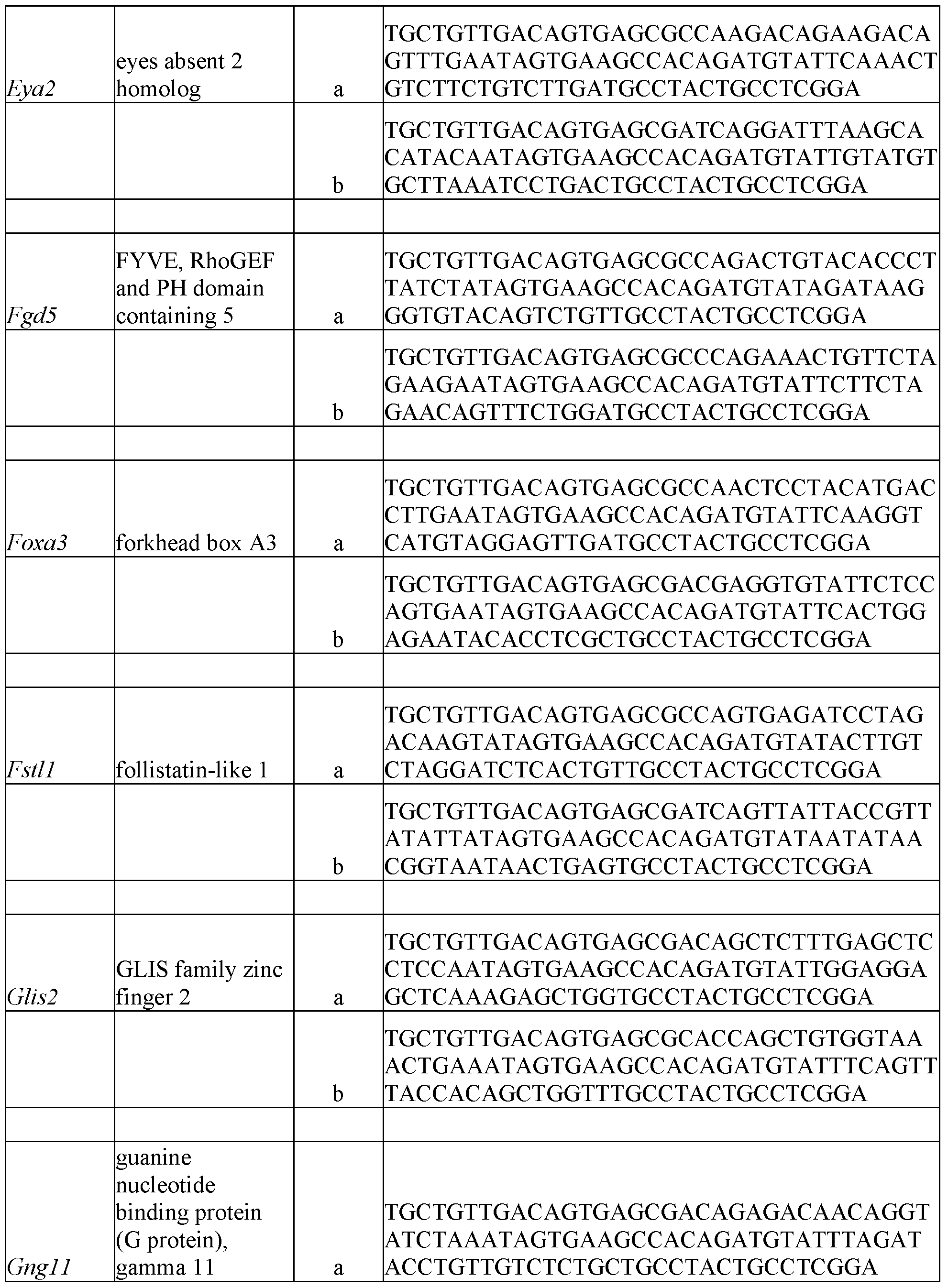


ry purinergic

matrix associated,
actin dependent
regulator of
chromatin, TGCTGTTGACAGTGAGCGACGGCTGAGAAGTTG subfamily a, TCACCAATAGTGAAGCCACAGATGTATTGGTGA
\Smarca2 member 2 CAACTTCTCAGCCGGTGCCTACTGCCTCGGA
TGCTGTTGACAGTGAGCGATACGAAGACTCCATTl
GTCCTATAGTGAAGCCACAGATGTATAGGACAA
TGGAGTCTTCGTAGTGCCTACTGCCTCGGA
SRY (sex TGCTGTTGACAGTGAGCGCCCCTGCCGACAAGA determining AAGTGAATAGTGAAGCCACAGATGTATTCACTTT
\Sox4 region Y)-box 4 CTTGTCGGCAGGGTTGCCTACTGCCTCGGA
TGCTGTTGACAGTGAGCGCTAGATGGAGAGTAG AAGGAGATAGTGAAGCCACAGATGTATCTCCTT CTACTCTCCATCTATTGCCTACTGCCTCGGA signal transducer TGCTGTTGACAGTGAGCGCTCCTGCGAGACTACAl and activator of AGGTTATAGTGAAGCCACAGATGTATAACCTTGT
\Stat4 transcription 4 AGTCTCGCAGGATTGCCTACTGCCTCGGA
TGCTGTTGACAGTGAGCGCCACAGTTCAGTCTAA CTACAATAGTGAAGCCACAGATGTATTGTAGTTAI GACTGAACTGTGATGCCTACTGCCTCGGA
TGCTGTTGACAGTGAGCGAACGCAGTTGACTCGT
TEA domain TCCAGATAGTGAAGCCACAGATGTATCTGGAAC
\Tead2 family member 2 GAGTCAACTGCGTCTGCCTACTGCCTCGGA
TGCTGTTGACAGTGAGCGCACACGAGGACCTCA GAGACAATAGTGAAGCCACAGATGTATTGTCTC TGAGGTCCTCGTGTTTGCCTACTGCCTCGGA
(transformation TGCTGTTGACAGTGAGCGCCCGGAACAATCTGCT related protein 53 GTAGAATAGTGAAGCCACAGATGTATTCTACAG
\Trp53bpl [binding protein 1 CAGATTGTTCCGGATGCCTACTGCCTCGGA
TGCTGTTGACAGTGAGCGACAGGATGTTGAAGA
ACATACATAGTGAAGCCACAGATGTATGTATGTT
CTTCAACATCCTGGTGCCTACTGCCTCGGA transient receptor
potential cation
channel, TGCTGTTGACAGTGAGCGCCACAGAGCTGCTACT subfamily C, CAAGAATAGTGAAGCCACAGATGTATTCTTGAG
\Trpc6 member 6 TAGCAGCTCTGTGATGCCTACTGCCTCGGA
TGCTGTTGACAGTGAGCGAGAGGACCAGCATAC
ATGTTTATAGTGAAGCCACAGATGTATAAACAT
b GTATGCTGGTCCTCGTGCCTACTGCCTCGGA zinc finger and TGCTGTTGACAGTGAGCGACCCAGCAAAGTTTG BTB domain ACCAAATTAGTGAAGCCACAGATGTAATTTGGT
Zbtb20 containing 20 a CAAACTTTGCTGGGCTGCCTACTGCCTCGGA
TGCTGTTGACAGTGAGCGCCACAGTCATCACTGT
CAGTAATAGTGAAGCCACAGATGTATTACTGAC
b AGTGATGACTGTGTTGCCTACTGCCTCGGA
TGCTGTTGACAGTGAGCGCCCGAATCTACTCCGC
ACTCTATAGTGAAGCCACAGATGTATAGAGTGC
c GGAGTAGATTCGGTTGCCTACTGCCTCGGA
TGCTGTTGACAGTGAGCGCCAGCTGTATTTACTG
zinc finger CAACAATAGTGAAGCCACAGATGTATTGTTGCA
Zfp521 protein 521 a GTAAATACAGCTGTTGCCTACTGCCTCGGA
TGCTGTTGACAGTGAGCGACACAGCAGTTAGTTC
ATGTATTAGTGAAGCCACAGATGTAATACATGA
b ACTAACTGCTGTGCTGCCTACTGCCTCGGA
Table 2B. Summary of Genes Tested in Functional Screen.

b 91.034466 _ _ _ _
Putative
secreted Gibbs et al.,
Crispldl a 71.792755 Yes Yes protease 2008 b 71.97974 - - - -
Eltdl a 80.24435 No Not tested
b 91.386155 - - - -
Matsubara et
Emcn a 70.207375 Yes Yes Adhesion al., 2005 b 83.065945 _ _ _ _ c 89.721135 - - - -
Eya2 a 88.17265 No Not tested
b 76.4652 - - - -
Fgd5 a 84.85855 No Not tested
b 86.70709 _ _ _ _
Friedman and
Transcription Kaestner,
Foxa3 a 66.67249675 Yes Yes factor 2006 b 68.93917468 - - - -
Extracellular
negative
regulator of
Type 2 TGFb/BMP Geng et al.,
Fstll a 88.80138 non-Hit Yes signaling 2011 b 86.285331 - - - -
Transcription Gruber et al.,
Glis2 a 70.129355 Yes Yes factor 2012 b 67.723615 - - - -
Gngll a 76.39386 Yes No
b 83.931255 - - - -
Putative
regulator of
G-protein
coupled Abu-Helo receptor cell and Simonin, surface 2010; Moser
Gprasp2 a 79.80325 Yes Yes turnover et al., 2010 b 65.29157 - - - - c 59.22959 - - - - d 61.673965 - - - -
Singer et al.,
2013; Solaimani- Kartataei et
Gpr56 a 76.388505 Yes Yes Migration al., 2015 b 81.10845 - - - -
GrblO a 91.376335 No Not tested
b 92.15143 - - - -
Gucyla3 a 90.6446495 No No
b 87.745385 - - - - c 85.35236 - - - -
Ikzfl a 73.050495 No Not tested
b 65.04349 - - - -
Ir/6 a 84.69899 No Not tested
b 91.15006 - - - -
Leprel2 a 75.476437 Yes No
b 69.77763675
Msrb2 a 89.5388025 No Not tested
b 92.680947 - - - -
Mucl3 a 70.79097 No No


LSK cell culture and transduction. LSK (Lineage- Sca-l+c-Kit+) cells were isolated from 6-10 week old murine bone marrow and transduced with lentivirus as described (Holmfeldt et al., 2013). Briefly, non-tissue culture 96-well plates were coated with Retronectin (TaKaRA Bio USA, Madison, WI) according to the manufacturer's instructions. Lentiviral particles corresponding to a multiplicity of infection (MOI) of 25 were spin loaded onto the plates for 1 hour at 1000G and room temperature. Wells were washed with PBS followed by the addition of 15,000 freshly isolated LSK cells resuspended in 200 uL serum-free expansion medium (StemCell Technologies, Vancouver, British Columbia, Canada) with 10 ng/mL recombinant murine (RM) stem cell factor (SCF), 20 ng/mL RM thrombopoietin (Tpo), 20 ng/mL RM insulin-like growth factor 2 (IGF-2) (Peprotech, Rocky Hill, NJ), 10 ng/mL recombinant human (RH) fibroblast growth factor 1 (FGF-1) (R&DSystems, Minneapolis, MN) and 5 μg/mL protamine sulfate (Sigma-Aldrich, St. Louis, MO). Cells were incubated overnight at 37°C. To collect cells for transplantation the next morning, media was slowly removed and cells were washed and resuspended in PBS+1.5% FCS.
To compare the transduction efficiency of LSK cells versus LSK CD150+CD48- cells, these cells were isolated in parallel, as previously described (Holmfeldt et al., 2013). 2500 cells were transduced on graded concentrations of indicated viruses, in retronectin coated 96-well plates, as described above. Transduction frequencies were analyzed four days post transduction using flow cytometry. To assess any non-specific effect of shRNAs on the viability of primitive hematopoietic cells, LSK cells transduced with lentivirus were cultured for two weeks in serum- free expansion medium (StemCell Technologies, Vancouver, British Columbia, Canada) with 10 ng/mL RM-SCF, 20 ng/mL RM thrombopoietin (Tpo), 20 ng/mL RM IGF-2 (Peprotech, Rocky Hill, NJ), 10 ng/mL RH-FGF-1 (R&D Systems, Minneapolis, MN) and 10 mg/mL heparin (Sigma-Aldrich, St. Louis, MO). The persistence of mCherry+ cells was monitored using a BD
LSRFortessa (BD Biosciences, San Diego, CA) and Flowjo version 9.4.1 1 (Tree Star, Ashland, OR).
Bone marrow transplants. Recipients were treated with 11 Gy of ionizing radiation in split doses of 5.5 Gy. For the functional screen, 5000 CD45.2+ Test LSK cells were injected 24 hours post transduction with 5000 mock transduced CD45.1+ Competitor LSK cells into recipients by tail vein. For retesting of Hits, 5000 CD45.2+ Test mCheny+/LSK cells were isolated by FACS 44 hours post transduction and injected with 5000 mock transduced and mock-sorted CD45.1 + Competitor LSK cells by tail vein. For 1 :4 Test versus Competitor transplants, 2000 CD45.2+ Test mCherry+/LSK cells were isolated by FACS 44 hours post transduction and transplanted with 8000 mock transduced and mock-sorted CD45.1+ competitor LSK cells.
For investigating Foxa3, 4 x 10⁵ CD45.2+ Foxa3+/+ or Foxa3'A WBM cells were injected with 4 x 10s CD45.1+ WBM cells into lethally irradiated CD45.1+/CD45.2+ recipients by tail vein. For secondary transplants, 4 x 10⁵ CD45.2+ WBM cells sorted from primary recipients of Foxa3+A or Foxa3' WBM cells were transplanted with 4 x 10⁵ CD45.1+ WBM WT competitor cells into lethally irradiated CD45.1+/CD45.2+ recipients. For limiting dilution transplants, 15,000, 30,000, 50,000,100,000, or 200,000 CD45.2+ Foxa3+/+ or FoxaJ^ WBM cells were injected with 2 x 10⁵ CD45.1+ WBM cells into lethally irradiated CD45.1+/CD45.2+ recipients by tail vein in two independent experiments. Engraftment was defined as >1% CD45.2 chimerism in the T cell, B cell, and myeloid lineages of recipient peripheral blood (PB) 10-16 weeks post- transplant. L-Calc (Stem Cell Technologies, Vancouver, Canada) was used to analyze the results of the limiting dilution transplants.
Antibodies for Whole Bone Marrow (WBM) and peripheral blood (PB) analysis. Antibodies used in this study for the analysis of Whole Bone Marrow and peripheral blood cell populations by flow cytometry are as previously described (Holmfeldt et al., 2013).
Analysis of peripheral blood. Peripheral blood (PB) was collected from the retro-orbital plexus in heparinized capillary tubes and lysed in red blood cell lysis buffer (Sigma-Aldrich, St. Louis, MO). Cells were stained with the following antibodies: CD45.1-FITC, CD45.2-APC, (B220, Grl, Cdllb)-PerCPCy5.5, (B220, CD4, CD8)-PECy7 (BD Biosciences, San Diego, CA) followed by
flow cytometry analysis using BD LSRFortessa (BD Biosciences, San Diego, CA) and data analysis using FlowJo version 9.4.11 (Tree Star, Ashland, OR).
CFU assays. For analysis of CFU potential of LSK cells following knockdown of screen Hits, LSK cells were transduced overnight with control or gene-specific shRNAs and then cultured at 15,000 cells/well in non-tissue culture treated 96-well plates for 5-6 days in serum-free expansion medium (StemCell Technologies, Vancouver, British Columbia, Canada) with 10 ng/mL RM SCF, 20 ng/mL RM Tpo, 20 ng/mL RM IGF-2 (Peprotech, Rocky Hill, NJ), 10 ng/mL RH FGF-1 (R&DSystems, Minneapolis, MN) and 10 ug/mL heparin (Sigma-Aldrich, St. Louis, MO). 500 mCherry+ LSK cells were then isolated by FACS and plated in M3434 methylcellulose (StemCell Technologies). For CFU analysis of Foxa3+A or Foxa3'A HSC, 150 HSC (LSK CD150+CD48-) were isolated by FACS from WBM and then plated in M3434. Colonies were analyzed 10 days after plating. Cell Cycle Analysis of shRNA transduced LSK cells. LSK cells were transduced overnight with control or gene-specific shRNAs and then cultured at 15,000 cells/well in non-tissue culture treated 96-well plates for 5-6 days in serum-free expansion medium (StemCell Technologies, Vancouver, British Columbia, Canada) with 10 ng/mL RM SCF, 20 ng/mL RM Tpo, 20 ng/mL RM IGF-2 (Peprotech, Rocky Hill, NJ), 10 ng/mL RH FGF-1 (R&D Systems, Minneapolis, MN) and 10 ug/mL heparin (Sigma-Aldrich, St. Louis, MO). mCherry+ LSK cells were then collected by FACS and stained with the following antibodies: (B220, CD3, CD4, CD8, CD19, Gr-1, Terl l9)-PerCP, Sca-l-PerCP-Cy5.5, c-Kit-APC-780. Cells were then fixed using the Cytofix/Cytoperm kit (BD Biosciences, San Diego, CA) followed by staining for Ki67-FITC (Clone SolA15)(eBioscience, San Diego, CA) and 4',6-diamidino-2-phenylindoIe (DAPI). Cells were analyzed via a BD LSRFortessa (BD Biosciences, San Diego, CA) and FlowJo version 9.4.11 (Tree Star, Ashland, OR).
Apoptosis Analysis of shRNA transduced LSK cells. LSK cells were transduced overnight with control or gene-specific shRNAs and then cultured at 15,000 cells/well in non-tissue culture treated 96-well plates for 5-6 days in serum-free expansion medium (StemCell Technologies, Vancouver, British Columbia, Canada) with 10 ng/mL RM SCF, 20 ng/mL RM Tpo, 20 ng/mL
RM IGF-2 (Peprotech, Rocky Hill, NJ), 10 ng/mL RH FGF-1 (R&D Systems, Minneapolis, MN) and 10 ug/mL heparin (Sigma-Aldrich, St. Louis, MO). Cells were collected 5-6 days after plating and stained with the following antibodies: (B220, CD3, CD4, CD8, CD19, Gr-1, Terl l9)-PerCP, Sca-l-PerCP-Cy5.5, c-Kit-APC-780. After staining for surface antigens, cells were labeled with Annexin V-FITC (BD Biosciences] and DAPI and then analyzed using a BD LSRFortessa (BD Biosciences, San Diego, CA) and FlowJo version 9.4.11 (Tree Star, Ashland, OR).
Analysis of total blood counts in Foxa3 mice. Peripheral blood was harvested from the retro- orbital plexus in heparinized capillary tubes and analyzed on a Forcyte instrument (Oxford Scientific, Oxford, CT).
Analysis of HSPC in transplant recipients and Foxa3 mice. Tibias, femurs, and pelvic bones were removed from mice and bone marrow isolated by crushing. Bone marrow was then lysed in red blood cell lysis buffer (Sigma-Aldrich, St. Louis, MO). Donor-derived HSC (LSK CD150+CD48), multipotent progenitors (MPP, LSK Flt3L+), common myeloid progenitors (CMP, Lineagec-Kit+Sca-l"FcRlowCD34+), common lymphoid progenitors (CLP, Lineagex- KitLowSca-lLowIL7R+), granulocyte-myeloid progenitors (GMP, Lineagex-Kit+Sca- l"FcRhishCD34+), and megakaryocyte-erythroid progenitors (MEP, Lineagec-Kit+Sca-l-FcR- CD34-) were visualized in transplant recipients by staining with the following antibodies: HSC ((B220, CD3, CD4, CD8, CD19, Gr-1, Terl 19)-PerCP, Sca-l-PerCP-Cy5.5, c-Kit-APC-780, CD150-PE-Cy7, CD48-Alexa700, CD45.1-FITC, and CD45.2-v500); CMP/GMP/MEP (B220, CD3, CD4, CD8, CD19, Gr-1, Terl 19)-PerCP, Sca-l-PerCP-Cy5.5, c-Kit-APC-780, FcR II/III- Alexa700, CD34-FITC, CD45.1-APC, and CD45.2-v500); and CLP/MPP (B220, CD3, CD4, CD8, CD19, Gr-1, Terl 19)-PerCP, Sca-l-PerCP-Cy5.5, c-Kit-APC-780, IL-7R-PE-Cy7, Flt3- APC, CD45.1-FITC, and CD45.2-v500).
HSPC were visualized in Foxa3 or Foxa3+A ' mice as described above with the exclusion of CD45.1 and CD45.2. Cells were then analyzed using a BD LSRFortessa (BD Biosciences, San Diego, CA) and data analysis using FlowJo version 9.4.1 1 (Tree Star, Ashland, OR). DAPI (Sigma-Aldrich) was used for dead cell exclusion.
Analysis of FOXA3 binding motifs in HSC enhancers and gene targets. Active and poised enhancers in LT-HSC, ST-HSC, MPP, and GMP were obtained from the enhancer compendium generated by Lara-Astiaso and colleagues (Lara-Astiaso et al., 2014). Poised enhancers refer to enhancers that, unlike active enhancers, do not drive gene expression in pluripotent cells, although they acquire such ability during differentiation. These enhancers were identified based on their histone modification signatures. For FOXA3 motif analysis, we downloaded the position weight matrix (PWM) of FOXA3 motif from the Cis-BP database (Weirauch et al., 2014). We used FFMO (a software tool for scanning DNA or protein sequences with motifs described as position-specific scoring matrices) to scan the enhancer sequences for the occurrence of FOXA3 binding motifs with a p-value threshold of 1 x 10⁵ (Grant et al., 2011). To predict the target genes of FOX A3 binding motif+ enhancers, we used the FM-PET software (He et al., 2014), which predicts enhancer-promoter interactions by integrating transcriptomic, epigenomic, and genomic sequence information. Histone modification and RNA-Seq data acquired by FM-PET were from (Cabezas-Wallscheid et al., 2014; Lara-Astiaso et al., 2014). The predicted targets of FOXA3 binding motif+ enhancers in LT-HSC were extracted for GSEA analysis.
FoxaS Microarray. Total RNA was isolated from 10,000 Foxa3+/+ or Foxa3' HSC using the Qiagen RNeasy Micro Kit (Qiagen, Santa Clarita, CA). RNA was amplified by the NuGEN Ovation Pico WTA V2 system and labeled using the NuGEN Encore Biotin Module (NuGen, San Carlos, CA). Labeled targets were hybridized on the HT MG-430 PM plate array and processed utilizing the GeneTitan system (Affymetrix, Santa Clara, CA). Array data were quantile (i.e. cutpoints dividing the range of a probability distribution into contiguous intervals with equal probabilities, in other words a set of values of a variate that divide a frequency distribution into equal groups, each containing the same fraction of the total population) normalized and robust multi-array average summarized in Partek Genomics Suite 6.6 (Partek, St. Louis, MO). The complete dataset is deposited in the Gene Expression Omnibus (GSE63830.).
Analysis of reactive oxygen species content in Foxa3+/+ and Foxa3'A HSC. Foxa3+/+ or Foxa3'A Whole Bone Marrow (WBM) was isolated, magnetically enriched for c-Kit+ cells, and then stained with Sca-l-PerCP-Cy5.5, c-Kit-APC-780, CD150-PE-Cy7, and CD48-Alexa700. Cells were then treated with vehicle or 500 μΜ tert-butyl Hydrogen Peroxide (TBHP). Three hours
post-treatment, cells were stained with 5 μΜ 2',7'-dichlorofluorescin diacetate (DCFDA) for 30 minutes on ice and then analyzed via a BD LSRFortessa (BD Biosciences, San Diego, CA) and Flow Jo version 9.4.11 (Tree Star, Ashland, OR). The peak excitation wavelength for oxidized DCF was 488 nm and emission was 525 nm.
Statistics. Statistical significance for comparisons between two groups was assessed using two sample t-tests or Exact Wilcoxon Mann-Whitney tests, depending on the normality test based on the Shapiro-Wilk test. Measurements for each gene were normalized to their respective control and a one sample t-test was performed to assess if the mean of the normalized measurements is equal to one. These analyses were performed in SAS version 9.3. For limiting dilution analysis (LDA), parameters were estimated using a generalized linear model with a complementary log- log link. Chi-square (Pearson and Deviance) were used to assess the goodness-of-fit to the LDA model. Differences in the frequency of HSC between Foxa3+A and Foxa3' mice were assessed by relying on the asymptotic normality of the maximum likelihood estimation. LDA were performed using L-Calc (Stem Cell Technologies, Vancouver, CA). Reported P-values are two- sided and considered statistically significant if < 0.05, although P-values < 0.1 are also noted in some instances as marginally significant.
2. HSPC Treated With shRNAs
Identification Of Candidate Genes In Functional Screens. The following public databases of HSC gene expression were interrogated to prioritize 51 gene candidates for study: 1) Hematopoietic Fingerprints, 2) the Immunological Genome Project, and 3) StemSite (Chambers et al., 2007; Heng et al., 2008; McKinney-Freeman et al., 2012). Gene candidates were prioritized if their expression was enriched in adult HSC relative to downstream progeny or earlier stages of HSC ontogeny. qRT-PCR was used to interrogate the expression of each prioritized gene candidate in cells isolated from murine bone marrow (Fig. 1A and IB). We found that 44/51 GOI were expressed in lineage" bone marrow hematopoietic cells, the majority of which were highly enriched for expression in Lineage"Sca-l+c-Kit+ (LSK) cells relative to downstream progeny (Fig. IB).
To interrogate a role for GOI in HSC engraftment, we used shRNAs to disrupt their expression in LSK cells prior to transplantation into lethally irradiated mice. At least four miR- 30 embedded shRNAs were designed to target each of the 44 GOI whose expression was
validated in HSPC. shRNAs were cloned into a lentiviral vector downstream of an MSCV promoter and upstream of a PGK promoter driving the fluorescent reporter, mCherry (Fig. 1A). Each shRNA was transduced into LSK cells and tested for gene knockdown by qRT-PCR. Average transduction for these experiments was 76.7%±7 (Fig. 1C). At least two shRNA were identified that affected >75% transcript knockdown in LSK cells for 41/44 GOI (Fig. ID, Table 2A and 2B). Thus, these genes were further screened.
We next conducted pilot studies to assess the feasibility of using highly purified HSC (LSK CD150+CD48" cells) in our screen. CD45.2+ HSC were transduced with control shRNAs and transplanted with an equal number of mock-transduced CD45.1+ HSC into CD45.1+/CD45.2+ recipients. These experiments showed high signal/noise incompatible with a robust screen. We determined that this high signal/noise resulted primarily from the technical difficulty of evenly distributing small cell numbers amongst mice in a cohort. Thus, we chose to utilize the more abundant LSK cell population for our screen. Although LSK cells are a mixture of HSPC, by following transplants >16 weeks we can still readily assess the effect of gene knockdown on stable HSC repopulation. Indeed, pilot studies in mice also revealed that HSC consistently transduced with a slightly higher frequency than LSK cells (Fig. IE). Thus, HSC are robustly transduced in our system.
Functional Screen for Novel Regulators of HSC Engraftment. CD45.2+ "Test" LSK cells were transduced with individual shRNAs and then transplanted into ablated CD45.1+/CD45.2+ mice with an equal number of CD45.1+ mock transduced "Competitor" LSK cells (Fig. 2A). Cells were transplanted within 24-hours of their isolation and transduction; i.e. there was no extended ex vivo culture period as in previous functional screens of primary HSPC (Ali et al., 2009; Deneault et al., 2009; Hope et al., 2010). For each transplant, an aliquot of transduced cells was maintained in liquid culture and analyzed after 3-4 days for transduction efficiency. Average transduction for these experiments was 67.6%±8.5 (Fig. 2B). Recipient peripheral blood (PB) was analyzed for "Test" versus "Competitor" contribution for >16 weeks post-transplant. A total of 781 mice were transplanted.
a. Loss Of Function Hits.
Knockdown of 18 genes resulted in a loss of HSPC repopulating potential relative to control with two independent shRNAs in our initial screen (Arhgef5, Cadps2, Col4a2, Crispldl,
Emcn, FoxaS, Glis2, Gngll, Gpr56, Myctl, Nbea, P2ryl4, Rbpms, Sox4, Stat4, Trp53bpl, Trpc6, and Zbtb20) (Fig. 2C). Repopulation loss was apparent four weeks post-transplant and persisted for >16 weeks for GOI except Stat4 (Fig. 2C), where the loss of repopulation was most dramatic >16 weeks post-transplant. Knockdown of most of these genes did not affect the short-term (i.e. 14 days) maintenance of hematopoietic cells ex vivo. In contrast, knockdown of 20 GOI did not affect in vivo repopulating potential (Fig. 2D). To confirm stable gene knockdown in our system, mice transplanted with LSK cells transduced with GrblO-shRNAs, a non-Hit, were examined (Fig. 2E-G). Both GrblO-shKNAs effected >95% transcript loss in LSK cells (Fig. 2F). qRT- PCR analysis of CD45.2+ LSK cells isolated from mice transplanted 30 weeks prior with either control or GrblO-shKNA treated cells revealed persistent gene knockdown in these cells (Fig. 2G).
Knockdown of six GOI yielded a repopulating loss with 1/2 shRNAs tested (Eya2, Fstll, Gucyla3, Msrb2, Rbpl, and Myctl. Fig. 2C-D. In each case except Myctl (discussed herein), this loss of repopulation was attributable to non-specific toxicity of the effecting shRNA (e.g. a third Gucyla3-shKNA did not effect repopulation, Fig. 3F).
Confirmation Of Loss Of Function Screen Hits. Eighteen (18) hits identified in our screen were retested to confirm their role as regulators of LSK cell in vivo repopulating activity. Here, to improve resolution, vector+ Test LSK cells (mCherry+CD45.2+) were transplanted into ablated mice (Fig. 3A). Cells were sorted and transplanted 44 hours post-transduction along with an equal number of CD45.1+ mock transduced and mock-sorted "Competitor" LSK cells. A series of pilot studies revealed that a minimum of 40 hours was required post-transduction to visualize and isolate vector+ LSK cells by flow cytometry (Fig. 3B).
We also retested five genes that scored as non-Hits (Fstll, Gucla3, Rbpl, Smarca2, and Zfp521) (Fig. 2D). Smarca2 and Zfp251 were retested because transduction efficiency was low in our initial screen for these genes and/or their shRNAs did not yield a complete gene knockdown, resulting in a possible false negative (Fig. 3C and D). Fstll, Guclla3 and Rbpl were non-Hits whose two shRNAs yielded disparate outcomes in our initial screen, necessitating a more thorough analysis. A total of 527 mice were transplanted in these experiments.
Fifteen (15) "loss of function" Hits retested were confirmed for contributing to optimal
HSPC repopulation (Fig. 3E). Repopulation loss was more dramatic in these experiments relative
to our initial screen, likely due to greater resolution resulting from transplantation of vector+ cells. Three genes that initially scored as non-Hits were Hits when retested: Fstll, Smarca2, and Zp251. As mentioned, the transduction efficiencies for Smarca2 and Zfp251 were low in our initial screen (Fig. 3C), likely resulting in a false negative in those experiments. As both transduction and gene knockdown for Fstll were high in our initial screen (Fig. 2B), it appears that using transplantation of vector+ cells clearly shows a repopulating loss with both Fstll shRNAs. Alternatively, the prolonged culture in these experiments might exact additional stress on the cells, resulting in a loss of in vivo repopulation not apparent in our original screen. Six initial Hits did not effect repopulating potential when retested: Col4a2, Gngll, Rbpms, Trp53bpl, Trpc6, and Zbtb20 (Fig. 3F). As one Zbtb20-shRNA was tested in our initial screen, two additional Zbtb20-shRNAs were tested in our confirmation experiments (Fig. 3F).
The original Zbtb20-shRNA mediated a loss of repopulation, suggesting that this shRNA likely had off-target effects. Once again, Stat4 was a Hit that displayed a significant increase in repopulating loss between four and >16 weeks post-transplant (Fig. 3E), suggesting that Stat4 regulates the long-term repopulating potential of HSC, rather than their early engraftment. The distribution of T, B, or myeloid cells in the mCherry+CD45.2+ compartment of recipients was significantly perturbed in recipients of Cadps2 and oxa3-shRNA treated cells (Fig. 3G). Loss of Cadps2 resulted in a significant expansion of B cells and a concomitant loss of T cells, suggesting that lymphoid progenitor function might be perturbed. Loss of Foxa3 perturbed the myeloid compartment (Fig. 3G).
In sum, via our two-pronged screening approach, we rigorously identified 15 genes individually contributing to LSK cell in vivo repopulating activity: Arhge/5, Cadps2, Crispldl, Emcn, Foxa3, Fstll, Glis2, Gpr56, Myctl, Nbea, P2ryl4, Smarca2, Sox4, Stat4, and Zfp251 (Fig. 3E). These GOI regulate a diverse array of cellular processes, including epigenetics, adhesion and migration, vesicle trafficking and cell surface receptor turnover, and the extracellular matrix.
Interrogation of the cellular mechanism of gene loss on HSPC repopulating potential. To illuminate the cellular mechanisms of gene knockdown on HSPC, LSK cells transduced with control or gene-specific shRNAs were assayed for colony forming unit (CFU) potential, cell cycle, and apoptosis (Fig. 5A and B). We also examined CD45.2+ chimerism in the bone marrow of recipients of gene-deficient CD45.2+ LSK cells >16 weeks post-transplant (Fig. 5C).
LSK cells lacking Nbea and Glis2 displayed an increase in CFU-GEMM potential (P = 0.046 and 0.07, respectively] (Fig. 5A). This correlated with a loss of CD45.2+ chimerism downstream of HSC and/or MPPs in recipients of LSK cells deficient in these genes (Fig. 5C). These data suggest a block in differentiation at the HSC or MPP stage, resulting in an accumulation of CFU-GEMM. G//s2-deficient LSK cells also displayed elevated apoptosis ex vivo (P=0.08) (Fig. 5B), suggesting that this block in differentiation exists in concert with reduced progenitor survival downstream of HSC and MPPs.
Knockdown of Stat4, Zfp251, and Foxa3 also resulted in an enhanced loss of CD45.2+ chimerism downstream of HSC in transplanted mice (Fig. 5C). Knockdown of Zfp251 in LSK cells ex vivo resulted in a slight expansion of CFU-G/M/GM at the expense of CFU-GEMM (P = 0.08) and about a 50% loss of apoptotic cells, although CFU-G/M/GM expansion and loss of apoptosis did not score as statistically significant here (Fig. 5A and B). These data suggest that CFU-GEMM lacking Zfp251 differentiate rapidly to committed progenitors that display enhanced survival ex vivo, but fail to establish robust chimerism in vivo.
Arhge/5 and Emcn knockdown caused a significant loss in total CFU from LSK cells (P =
0.027; P = 0.035, respectively), while Fstll knockdown resulted in a dramatic, but marginally significant, loss in CFU (P = 0.096) (Fig. 5A). This correlated with a loss of CD45.2+ chimerism across bone marrow compartments in recipients of LSK cells deficient in these genes except for Fstll, for whom bone marrow chimerism was not determined (Fig. 5C). As Ewcn-deficient LSK cells did not display significant perturbations in cell cycle or apoptosis ex vivo, loss of in vivo repopulating activity may result from perturbed niche interactions post-transplant effecting survival, differentiation, or proliferation.
However, Arhgef 5 -deficient LSK cells displayed about a 40% expansion of cells in Gi ex vivo, relative to control (P = 0.089), which was commiserate with a modest reduction of cells in both Go and G2SM (P > 0.05 for both). Thus, perturbations in cell cycle progression may contribute to the repopulating defect of Arhgef 5 -deficient LSK cells. In addition to a dramatic loss in total-CFU, i¾t/7-deficient cells displayed a rapid loss of the LSK cell surface phenotype during culture (P = 0.079), suggesting accelerated differentiation commiserate with a loss of stem and progenitor cell potential.
Knockdown of Cadps2 in CD45.2+ LSK cells also resulted in a loss of CD45.2+ chimerism across bone marrow compartments post-transplant (Fig. 5C). This correlated with
perturbations in the frequency of select CFU: a marginally significant, albeit modest, loss of CFU-E (P = 0.057) and a marginally significant increase in CFU-G/M/GM (P = 0.06) was apparent after knockdown of this gene (Fig. 5A). FoxaS" HSC displays reduced in vitro and in vivo hematopoietic potential. Our screen identified Foxa3 as a putative novel regulator of LSK cell in vivo repopulating activity (Figs. 2C and 3E). As Foxa genes have not been implicated in hematopoiesis, we decided to explore Foxa3's putative role in HSC further by examining Foxa3' mice. Although Foxa3 is selectively expressed by HSC in bone marrow (Fig. 6A), Foxa3' mice display normal PB counts and bone marrow HSPC frequencies (Fig. 6B-C). Foxa≠ HSC generated fewer CFU than Foxa3+/+ HSC, suggesting a loss of functional HSC, which could result from fewer absolute numbers of functional HSC or a failure of HSC activation in culture (Fig. 6D). Surprisingly, Foxa3' LSK cells showed no loss of CFU potential relative elative to Foxa3+/+ LSK cells. As LSK cells are a mix of HSC and progenitors, these data suggest that progenitors downstream of Foxa3+/+ HSC retain CFU potential .
CD45.2+ Foxa3'A or Foxa3+/+ WBM was transplanted with an equal amount of CD45.1 WBM into ablated CD45.1+/CD45.2+ recipients (Fig. 6E-FJ). A significant loss in CD45.2+ PB reconstitution was apparent in Foxa3~ ~ recipients relative to Foxa3+/+ recipients 20 weeks post- transplant (Fig. 6F). There was no obvious skewing in the reconstitution of specific PB lineages in Foxa3~ ~ recipients. Although Foxa3'A cells contributed less than Foxa3+/+ cells to recipient LSK, HSC, and MPP compartments (Fig. 6G), Foxa3' chimerism in downstream progenitor compartments was unperturbed. When CD45.2+ WBM from primary recipients was transplanted into secondary recipients, Foxa3'A WBM displayed an even more pronounced repopulating defect than in primary transplants (Fig. 6E-F), suggesting that Foxa3'A HSC do not self-renew efficiently. Foxa3' WBM contained significantly fewer repopulating HSC, relative to control, when transplanted at limiting dilutions (Fig. 6H, Table 3, P=0.0046).
In sum, Foxa3~ ~ HSC are defective in CFU potential, primary and secondary in vivo repopulation, and the ability to efficiently contribute to the most primitive HSPC WBM compartments (HSC and MPP). These data suggest that Foxa3'A bone marrow contains fewer repopulating cells than Foxa3+A marrow and that self-renewal may be compromised in Foxa3'A HSC.
b. Gain of function Hits: loss of Gprasp2 and Armcxl promotes HSPC repopulation.
Mouse recipients of mouse Armcxl and Gprasp2-shRNA treated mouse HSCs displayed enhanced CD45.2+ chimerism in HSPC compartments, correlating with enhanced PB chimerism (Figs. 4B and 5C). In fact, loss of Gprasp2 appeared to favor LSK cell in vivo repopulating activity in this study. Here, mCherry+CD45.2+ PB was selected for over a time period in 17/20 recipients of Gprasp 2 -shRNAs transduced LSK cells compared to 2/9 recipients of control cells (Fig. 4A). LSK cells treated with Gprasp2-shRNAs displayed significantly enhanced survival ex vivo and a two-fold expansion of cells in Go, commiserate with a loss of cells in G2SM (P=0.002). Thus, enhanced survival and a slowing-growing phenotype may contribute to enhanced in vivo repopulation here, as has been seen in Runxl mutants whose HSC also display a repopulating advantage (Cai et al., 2015).
Similarly, loss of Armcxl also appeared to enhance HSPC repopulation (Fig. 4Bi). However, in contrast, knockdown of Armcxl in LSK cells ex vivo had no significant effect on CFUs, cell cycle, or apoptosis (Fig. 5 A and B), suggesting that enhanced repopulation after knockdown of Armcxl may result from specific in vivo interactions.
mCherry+ cells were transplanted in these experiments, so it was not possible to monitor for mCherry selection. However, although not statistically significant, 7/11 recipients of Armcxl- shRNA transduced Test HSPC showed moderately enhanced chimerism >16 weeks post- transplant relative to controls (Fig. 4Bi).
To rigorously assess whether loss of Armcxl or Gprasp2 enhanced LSK cell in vivo repopulating activity. mCherry+CD45.2+ "Test" LSK cells (transduced with either gene-specific or control shRNAs) were transplanted 1 :4 with CD45.1+ mock transduced and mock-sorted "Competitor" LSK cells, thus putting the Test cells at a significant repopulating disadvantage relative to Competitor.
Loss of Armcxl and Gprasp2 enhanced the repopulating potential of Test LSK cells in the majority of transplanted mice (Fig. 4Bii). This result was true for multiple independent shRNAs tested for each gene. Loss of Armcxl and Gprasp2 did not appear to perturb any specific hematopoietic PB lineages (Fig. 4C). Loss of the gene Lepre also appeared to enhance repopulation in both our initial screen and after retesting (P=0.02) (Fig. 4Bi). However, when
Leprel2 was reexamined in a 1 :4 Test versus Competitor transplant, enhanced repopulation was no longer apparent (Fig. 4Bii).
In sum, loss of Gprasp2 and Armcxl enhanced LSK cell repopulating activity, suggesting that these genes may negatively impact HSPC engraftment. Surpri singly, Gprasp2 and Armcxl belong to the same family of G-protein Coupled Receptor Associated Sorting Proteins (GASP) (Abu-Helo and Simonin, 2010), thus implicating genes in this gene family for negative regulation of HSPC repopulating potential.
Table 3. Foxa3~ ' And Foxa3 WBM Predicted Repopulating Cell Frequency.

F0XA3 binding motifs are enriched in LT-HSC enhancers and target proliferative and stress pathways.
Because Foxa3 was implicated in regulating HSC function, then it was tested whether FOXA3 binding motif is significantly enriched in active and/or poised enhancers in long term HSC (LT-HSC) and progeny (Lara-Astiaso et al., 2014). We found the FOXA3 binding motif enriched in enhancers active in LT-HSC but poised in downstream populations (Table 4), suggesting that Foxa3 likely functions at the level of the LT-HSC, which agrees with our finding that Foxa3 is most highly expressed in HSC (Fig. 6A). These enhancers were not enriched for any other known transcription factor binding motifs, suggesting that Foxa3 either acts alone at these sites or cooperates with regulators whose motifs have not yet been defined.
Table 4. FOXA3 Binding Motif Enrichment In Enhancers Active In LT-HSC And Poised In Other HSPC Compartments.
 Active in LT-
HSC, poised 2783 594 0.00027
in others
We next used EVI-PET (Integrated Method for Predicting Enhancer Targets) to identify the promoters likely targeted by these FOXA3 binding motif+ enhancers (Table 5) (He et al., 2014).
Table 5. Predicted Gene Targets of Foxa3 motif+ active LT-HSC enhancers.

chrl7 34345356 34347356 chrl 7 34334666 73441.1 Psmb8 158.961
13715450 13715650 ENSMUSTOOOOOO
chr4 3 3 chr4 136913635 51477.6 Cdc42 156.819
ENSMUSTOOOOOO
chrl3 23655255 23657255 chrl 3 23663265 79251.5 Histlh2bg 146.602
ENSMUSTOOOOOO
chr7 35056737 35058737 chr7 35015300 38027.4 Gpil 140.204
12751745 12751945 ENSMUSTOOOOOO
chrlO 7 7 chrlO 128360580 26405.3 Bloclsl 139.861
ENSMUST000001
chr9 65395253 65397253 chr9 64585430 69058.1 Rabl la 139.162
ENSMUST000001
chrl l 52181889 52183889 chrl l 52187799 09065.1 Vdacl 138.309
11828523 11828723 ENSMUSTOOOOOO
chrl l 4 4 chrl l 118263406 43722.3 Lgals3bp 129.102
ENSMUSTOOOOOO
chr2 84208651 84210651 chr2 84877391 77798.6 Ssrpl 128.321
12656353 12656553 ENSMUST000001
chrlO 4 4 chrlO 126500660 33115.1 Cdk4 126.187
ENSMUST000001
chrl 95380382 95382382 chrl 95375570 72165.1 2-Sep 125.251
12949459 12949659 ENSMUST000001
chr4 0 0 chr4 129516395 41754.1 Ptp4a2 123.202
12960290 12960490 ENSMUST000001
chr4 9 9 chr4 129516395 41754.1 Ptp4a2 123.202
ENSMUST000001
chr3 89686643 89688643 chr3 89883587 31354.1 Tpm3 119.81
ENSMUST000001
chrl 2 86728378 86730378 chrl2 86815861 34311.1 Fos 118.571
10141222 10141422 ENSMUSTOOOOOO
chrl 3 3 3 chrl 3 101421298 84721.6 Taf9 105.234
12751745 12751945 ENSMUSTOOOOOO
chrlO 7 7 chrlO 127496010 52798.7 Ptges3 95.4404
ENSMUST000001
chrl 5 36429054 36431054 chrl 5 36532101 56793.1 Pabpcl 95.0908
ENSMUST000001
chr9 59326379 59328379 chr9 59504383 63694.1 Pkm2 91.2134
ENSMUSTOOOOOO
chrl 8 35093288 35095288 chrl 8 35114011 25217.8 Hspa9 89.3101
12751745 12751945 ENSMUSTOOOOOO
chrlO 7 7 chrlO 127759515 26446.2 Cnpy2 86.5671
12751745 12751945 ENSMUST000001
chrlO 7 7 chrlO 127525608 26751.1 Atp5b 82.1594
ENSMUSTOOOOOO
chrl2 33853153 33855153 chrl2 33639049 20885.6 Sypl 80.8468
ENSMUST000001
chrl8 82699936 82701936 chrl 8 82693439 66332.1 Rpl21-ps8 78.2873
ENSMUST000001
chrl l 29687141 29689141 chrl l 29446671 47782.1 Rps27a 77.6512
12271639 12271839 ENSMUSTOOOOOO
chr5 3 3 chr5 122845823 31421.5 Arpc3 76.4993
ENSMUST000001 5033414D chrl9 29457752 29459752 chrl 9 29436460 43467.1 02Rik 76.3381
12133972 12134172 ENSMUSGOOOOOO Hmgal- chrl l 8 8 chrl l 120624108 89637.2 rsl 75.286
15042727 15042927 ENSMUSTOOOOOO
chr4 7 7 chr4 150432062 30797.3 Vamp3 73.6629
ENSMUSTOOOOOO
chrl6 50069074 50071074 chrl 6 49855821 73477.7 Cd47 73.1746
ENSMUSTOOOOOO
chr8 26121545 26123545 chr8 26127683 33961.5 Tm2d2 72.7007
ENSMUSTOOOOOO
chr8 26154544 26156544 chr8 26127683 33961.5 Tm2d2 72.7007
12656353 12656553 ENSMUSTOOOOOO
chrlO 4 4 chrlO 126507317 60991.4 Tspan31 71.1209
10220420 10220620 ENSMUSTOOOOOO
chr4 9 9 chr4 102242700 97950.2 Pde4b 68.4863
12542823 12543023 ENSMUSTOOOOOO
chr6 8 8 chr6 124662354 04375.9 Phb2 66.5208
12751745 12751945 ENSMUST000001
chrlO 7 7 chrlO 127523286 24993.1 Atp5b 66.4817
10220420 10220620 ENSMUST000001
chr4 9 9 chr4 101927608 06908.2 Pde4b 66.2269
11781000 11781200 ENSMUSGOOOOOO Gstm2- chr5 7 7 chr5 117083471 91578.1 psl 63.831
12751745 12751945 ENSMUSTOOOOOO
chrlO 7 7 chrlO 126959491 26470.3 Shmt2 63.7799
ENSMUSGOOOOOO
chrl3 23655255 23657255 chrl 3 23663089 69272.4 Histlh2ae 61.1146
16300366 16300566 ENSMUST000001
chrl 8 8 chrl 162965315 62163.1 Gas 5 61.0581
15551343 15551543 ENSMUSTOOOOOO
chr2 5 5 chr2 155555211 40833.4 Edem2 60.2875
ENSMUSTOOOOOO
chrl 2 78295247 78297247 chrl2 77866525 41262.7 Churcl 60.2591
10084384 10084584 ENSMUSTOOOOOO
chrl l 0 0 chrl l 100832201 60792.5 Ptrf 60.1656
ENSMUSTOOOOOO
chrlO 80080382 80082382 chrlO 80317954 35775.8 Lsm7 59.5431
ENSMUSTOOOOOO
chrl9 4136521 4138521 chrl 9 4121575 25767.7 Aip 59.215
ENSMUSTOOOOOO
chrl l 72769965 72771965 chrl l 72774671 21142.7 Atp2a3 57.7872
ENSMUST000001
chrl7 34345356 34347356 chrl 7 34341512 27543.1 Tap2 57.5822
12199357 12199557 ENSMUSTOOOOOO
chr3 1 1 chr3 121977332 35776.8 Dnttip2 56.8503
14603171 14603371 ENSMUST000001
chrl 4 4 chrl 145851291 27206.1 Rgs2 56.4282
ENSMUST000001
chr7 52079823 52081823 chr7 52083856 71304.1 Nup62 53.7819
ENSMUSTOOOOOO Tmeml06 chrl 5 97556610 97558610 chrl 5 97794710 64200.6 c 53.6799
13175329 13175529 ENSMUSTOOOOOO
chr4 4 4 chr4 131768170 40654.7 Ythdf2 53.5868
ENSMUSTOOOOOO
chrl 4 78235494 78237494 chrl 4 78274724 22590.3 Dnajcl5 53.281
13327114 13327314 ENSMUSTOOOOOO
chr7 3 3 chr7 133839480 52145.5 Bola2 53.0679
ENSMUST000001
chr3 94856898 94858898 chr3 94846536 07237.1 Psmd4 52.5335
ENSMUST000001
chrl 5 61995177 61997177 chrl 5 61816946 61976.1 Myc 51.4547
16300366 16300566 ENSMUST000001
chrl 8 8 chrl 162965294 61380.1 Gas 5 50.7121
ENSMUST000001
chrl 8 82699936 82701936 chrl 8 82693413 30005.1 Rpl21-ps8 49.9488
ENSMUSTOOOOOO
chrlO 70800759 70802759 chrlO 70807702 45887.8 Cisdl 49.6574
11428288 11428488 ENSMUSTOOOOOO
chr5 6 6 chr5 114280442 72194.4 Selplg 49.6225
13541466 13541666 ENSMUSTOOOOOO
chr4 7 7 chr4 135502363 30432.7 Hmgcl 49.5445
ENSMUSTOOOOOO 0610037P chrl 6 14160427 14162427 chrl 6 14317468 23357.7 05Rik 47.9913
ENSMUST000001
chrl l 75222724 75224724 chrl l 75231498 68902.1 Serpinfl 47.8969
ENSMUST000001
chrl l 75378410 75380410 chrl l 75231498 68902.1 Serpinfl 47.8969
ENSMUSTOOOOOO
chr8 87506801 87508801 chr8 87493510 05292.8 Prdx2 47.0819
10790755 10790955 ENSMUSTOOOOOO
chr9 7 7 chr9 107673333 35199.5 Rbm5 46.9892
ENSMUSTOOOOOO
chrl7 26050333 26052333 chrl 7 25929229 72735.7 Faml73a 46.7898
16926839 16927039 ENSMUSTOOOOOO
chrl 2 2 chrl 169280122 28004.9 Aldh9al 46.4586
12751745 12751945 ENSMUSTOOOOOO
chrlO 7 7 chrlO 127472402 73868.7 Naca 46.1597
ENSMUST000001
chr8 87506801 87508801 chr8 87604872 48592.1 BC056474 46.0604
10790755 10790955 ENSMUSTOOOOOO
chr9 7 7 chr9 107537673 55704.6 Gnai2 44.8509
ENSMUSTOOOOOO
chr3 96077259 96079259 chr3 96361883 49093.7 Txnip 44.8287
13465717 13465917 ENSMUST000001
chr7 2 2 chr7 135049251 24533.1 Bckdk 44.8205
13541466 13541666 ENSMUSTOOOOOO
chr4 7 7 chr4 135429765 30436.5 Pnrc2 43.5124
10629957 10630157 ENSMUST000001
chrl l 7 7 chrl l 106020723 38094.1 Limd2 42.8991
ENSMUSTOOOOOO
chrl 2 86728378 86730378 chrl2 86715667 40766.7 TmedlO 42.494
ENSMUST000001
chrl 3 34345677 34347677 chrl 3 34254833 47632.1 Psmg4 42.0083
ENSMUST000001
chrl l 90217013 90219013 chrl l 90249521 07881.1 Hlf 41.8407
ENSMUSTOOOOOO
chr7 52079823 52081823 chr7 52359192 03512.7 Fcgrt 41.7388
ENSMUSTOOOOOO
chrl 2 84935064 84937064 chrl2 84973184 48155.8 Rbm25 41.3059
15551343 15551543 ENSMUSTOOOOOO
chr2 5 5 chr2 155576853 29140.5 Procr 41.2525
15360862 15361062 ENSMUST000001
chr2 1 1 chr2 153567338 23795.1 Maprel 40.9239
ENSMUSTOOOOOO
chrlO 80080382 80082382 chrlO 80065627 79883.4 Scamp4 40.8637
ENSMUSTOOOOOO
chrlO 93511891 93513891 chrlO 93661700 20209.9 Ndufal2 40.4148
ENSMUSTOOOOOO
chr3 27228313 27230313 chr3 27081887 46515.8 Ncehl 40.2301
ENSMUST000001
chr3 32326102 32328102 chr3 32635912 27477.1 Ndufb5 39.9364
13484894 13485094 ENSMUST000001
chr5 4 4 chr5 134755735 72904.1 Gtf2i 39.6902
ENSMUSTOOOOOO
chr2 35017577 35019577 chr2 35056640 28238.8 Rabl4 39.6781
ENSMUSTOOOOOO
chr2 35046233 35048233 chr2 35056640 28238.8 Rabl4 39.6781
ENSMUST000001
chrl 36695504 36697504 chrl 36748420 68827.1 Cox5b 38.623
ENSMUSTOOOOOO
chr9 21431017 21433017 chr9 21142288 34697.6 Slc44a2 37.8794
10046378 10046578 ENSMUST000001
chr5 1 1 chr5 100468241 28187.1 Hnrpdl 37.1587
ENSMUST000001
chrl 3 34345677 34347677 chrl 3 34254833 24996.1 Psmg4 37.0945
ENSMUSTOOOOOO
chrl 8 35093288 35095288 chrl 8 35278542 42345.6 Ctnnal 37.0445
11962049 11962249 ENSMUSTOOOOOO
chrlO 6 6 chrlO 119664126 20444.8 Llph 35.6929
11106010 11106210 ENSMUSTOOOOOO
chr7 8 8 chr7 110962510 98192.3 Hbb-b2 35.5272
ENSMUSTOOOOOO 0610011F chrl 7 26050333 26052333 chrl 7 26012445 26827.8 06Rik 35.2006
ENSMUSTOOOOOO
chrl 7 37129242 37131242 chrl 7 37407165 38580.6 H2-M3 35.096
15445698 15445898 ENSMUSTOOOOOO
chr4 6 6 chr4 155135202 30903.5 Atad3a 34.9598
ENSMUSTOOOOOO
chr9 55999010 56001010 chr9 56008596 98723.2 Tspan3 34.8509
13327114 13327314 ENSMUSTOOOOOO
chr7 3 3 chr7 134119863 32920.3 Cdipt 34.7123
12751745 12751945 ENSMUST000001
chrlO 7 7 chrlO 128258647 16228.1 Ormdl2 34.5156
ENSMUST000001
chrl 7 36271246 36273246 chrl 7 36266370 72968.1 H2-T9 33.944
10070670 10070870 ENSMUST000001
chrl l 1 1 chrl l 100800854 27638.1 Stat3 33.9368
ENSMUSTOOOOOO
chrl 6 4719688 4721688 chrl 6 4726363 04172.8 Hmox2 33.5265
14603171 14603371 ENSMUSTOOOOOO
chrl 4 4 chrl 145851265 27606.3 Rgs2 33.2077
ENSMUSTOOOOOO
chr9 57496848 57498848 chr9 57493460 34863.6 Csk 32.9256
ENSMUSTOOOOOO
chrl 5 36429054 36431054 chrl 5 36426546 57486.7 Ankrd46 32.3146
ENSMUSGOOOOOO
chrl 7 80875858 80877858 chrl 7 80606629 24097.9 Srsf7 32.2547
ENSMUSTOOOOOO
chr9 57496848 57498848 chr9 57613667 65330.6 Clk3 31.7278
13175329 13175529 ENSMUST000001
chr4 4 4 chr4 131909601 52943.1 Snhg3 31.5411
13212795 13212995 ENSMUST000001
chr4 0 0 chr4 131909601 52943.1 Snhg3 31.5411
12323873 12324073 ENSMUSTOOOOOO
chr8 5 5 chr8 122364479 34285.6 Cotll 31.3453
ENSMUSTOOOOOO
chrl9 4136521 4138521 chrl9 4811634 06625.6 Rbml4 31.0976
ENSMUSTOOOOOO
chrl4 79713112 79715112 chrl4 79987498 54908.8 Sugtl 30.5844
ENSMUSTOOOOOO
chr8 87506801 87508801 chr8 87549177 64314.8 Asnal 30.5508
13462478 13462678 ENSMUST000001
chr7 3 3 chr7 134613885 06292.1 Prrl4 30.423
13465717 13465917 ENSMUST000001
chr7 2 2 chr7 134613885 06292.1 Prrl4 30.423
ENSMUSTOOOOOO
chrl l 72769965 72771965 chrl l 72812605 21141.7 P2rxl 30.0016
ENSMUSTOOOOOO
chr8 87506801 87508801 chr8 87604639 79764.7 BC056474 29.7689
ENSMUSTOOOOOO
chr8 47708070 47710070 chr8 47702803 93517.5 Casp3 29.5639
ENSMUSTOOOOOO
chr9 63596837 63598837 chr9 63450462 41551.7 Aagab 29.3424
11430287 11430487 ENSMUSTOOOOOO
chr9 3 3 chr9 114310194 63042.9 Glbl 29.3269
ENSMUSTOOOOOO
chrl2 77464719 77466719 chrl2 78340052 62804.7 Fut8 29.299
ENSMUSTOOOOOO
chrl7 31978023 31980023 chrl7 31992737 24839.4 Sikl 29.2121
ENSMUST000001
chr9 58117801 58119801 chr9 57758793 63329.1 Ubl7 29.1849
ENSMUST000001
chrlO 88093529 88095529 chrlO 88193813 16234.2 Aril 29.1034
12227232 12227432 ENSMUSTOOOOOO
chrl4 8 8 chrl4 122277828 39803.5 Ubac2 28.9842
ENSMUST000001 AC09993 chrl2 70617972 70619972 chrl2 70260282 74924.1 4.1 28.9509
ENSMUST000001 AC15782 chrl2 70617972 70619972 chrl2 70462468 75032.1 2.1 28.9509
ENSMUSGOOOOOO SN0RA4 chr3 89686643 89688643 chr3 89930457 64930.1 1 28.6569
ENSMUST000001
chr9 96512363 96514363 chr9 96653250 52594.1 Zbtb38 28.4454
ENSMUST000001
chr6 38485720 38487720 chr6 38509215 62530.1 Luc712 27.7907
ENSMUST000001
chrl8 69775855 69777855 chrl8 69753071 14978.2 Tcf4 27.6069
ENSMUSTOOOOOO
chrlO 96060592 96062592 chrlO 96079635 38377.7 Btgl 27.1549
ENSMUST000001
chr2 32725469 32727469 chr2 32502218 65273.1 Eng 27.0826
ENSMUST000001
chr9 45817658 45819658 chr9 45792954 72450.1 Pafahlb2 27.0713
11465566 11465766 ENSMUSTOOOOOO
chr4 1 1 chr4 114659846 30491.8 Cmpkl 26.3761
ENSMUST000001
chrl l 52181889 52183889 chrl l 51814264 09086.1 Ube2b 26.1096
ENSMUSTOOOOOO
chrl3 98142062 98144062 chrl3 97440891 22176.8 Hmgcr 25.9867
ENSMUST000001
chrl l 75351840 75353840 chrl l 75300322 02510.1 PrpfB 25.9561
ENSMUST000001
chrl l 84944311 84946311 chrl l 84729868 03195.4 Znhit3 25.8873
ENSMUSTOOOOOO
chrl4 78235494 78237494 chrl4 78304046 22591.7 Epstil 25.7985
14652955 14653155 ENSMUSTOOOOOO
chr6 2 2 chr6 146526381 67404.6 Fgfrlop2 25.1325
ENSMUSTOOOOOO
chrlO 62472179 62474179 chrlO 61802925 72357.6 Hkl 24.9685
ENSMUSTOOOOOO
chrl5 59547763 59549763 chrl5 59479905 67543.6 Tribl 24.9402
ENSMUSTOOOOOO
chr3 95950914 95952914 chr3 95695928 90476.3 BC028528 24.8663
ENSMUSGOOOOOO
chrlO 93511891 93513891 chrlO 93241372 90610.1 Gm3571 24.6327
ENSMUST000001
chr3 94856898 94858898 chr3 94914995 25548.1 Vps72 24.4885
15551343 15551543 ENSMUST000001
chr2 5 5 chr2 156005881 37340.1 Rbm39 24.4715
15551343 15551543 ENSMUSTOOOOOO
chr2 5 5 chr2 155518120 41059.5 Trpc4ap 24.371
ENSMUSTOOOOOO
chr6 5209639 5211639 chr6 5206286 31773.2 Pon3 24.0857
10046378 10046578 ENSMUST000001
chr5 1 1 chr5 100469013 69390.1 Enophl 24.0495
ENSMUSTOOOOOO
chrl2 77365201 77367201 chrl2 77356219 21443.5 Mthfdl 23.6908
ENSMUSTOOOOOO
chrl2 77464719 77466719 chrl2 77356219 21443.5 Mthfdl 23.6908
ENSMUSTOOOOOO
chrl3 98142062 98144062 chrl 3 97968312 22169.7 Hexb 23.6374
ENSMUST000001
chrl5 79745826 79747826 chrl 5 79722838 00424.4 Apobec3 23.44
ENSMUSGOOOOOO
chrl6 11172524 11174524 chrl 6 11176486 37965.8 Zc3h7a 23.1371
ENSMUSTOOOOOO
chr7 99808096 99810096 chr7 99709659 32842.6 Ccdc90b 22.7159
ENSMUSGOOOOOO SN0RA6 chr8 60069239 60071239 chr8 60028572 77526.1 5 22.7061
ENSMUST000001
chrl9 4136521 4138521 chrl 9 4125959 40267.2 Tmeml34 22.4857
11781000 11781200 ENSMUSTOOOOOO
chr5 7 7 chr5 117839056 86461.6 Rfc5 22.4177
16300366 16300566 ENSMUST000001
chrl 8 8 chrl 162965297 59157.1 Gas 5 22.3981
ENSMUSTOOOOOO
chrl2 3423035 3425035 chrl2 3309969 21001.8 RablO 22.3555
ENSMUST000001
chrl 6 91358906 91360906 chrl 6 91373095 17836.1 Ifnar2 22.1961
ENSMUST000001
chrl 6 91378045 91380045 chrl 6 91373095 17836.1 Ifnar2 22.1961
12751745 12751945 ENSMUSTOOOOOO
chrlO 7 7 chrlO 127962915 26427.6 Esytl 22.1474
ENSMUST000001
chr9 14837735 14839735 chr9 15110658 64079.1 Tafld 21.9577
11553207 11553407 ENSMUSTOOOOOO
chr9 5 5 chr9 114690947 98322.3 Cmtm7 21.9363
ENSMUST000001
chr8 87506801 87508801 chr8 87364564 28035.1 Rad23a 21.8956
ENSMUSTOOOOOO
chrl 7 26050333 26052333 chrl 7 26078993 26823.8 Pigq 21.8666
ENSMUSTOOOOOO
chr4 3583814 3585814 chr4 3866061 41122.4 Chchd7 21.6624
13465717 13465917 ENSMUSTOOOOOO
chr7 2 2 chr7 134702900 84563.4 Srcap 21.4888
12656353 12656553 ENSMUST000001
chrlO 4 4 chrlO 126558216 64259.1 Os9 21.4731
ENSMUST000001
chrl 6 50395250 50397250 chrl 6 50430025 31695.1 Bbx 21.4308
ENSMUSTOOOOOO
chrl6 91694375 91696375 chrl6 91647197 23684.7 Gart 21.417
ENSMUSTOOOOOO
chr8 87506801 87508801 chr8 87489940 65049.8 Rnaseh2a 21.3564
12342229 12342429 ENSMUSTOOOOOO
chr4 7 7 chr4 123395445 30401.7 Ndufs5 21.2071
ENSMUSTOOOOOO
chrl5 78826239 78828239 chrl5 78818243 41035.9 Triobp 21.0316
10282134 10282334 ENSMUSTOOOOOO
chr3 7 7 chr3 103664203 29433.7 Ptpn22 20.7144
12751745 12751945 ENSMUST000001
chrlO 7 7 chrlO 127669147 05243.2 Timeless 20.6351
ENSMUSTOOOOOO
chrl6 14160427 14162427 chrl6 13671951 23365.6 Bfar 20.4973
ENSMUST000001
chrl7 36271246 36273246 chrl7 36179445 66442.1 H2-T22 20.2821
11125208 11125408 ENSMUST000001
chr7 5 5 chr7 110976610 53218.1 Hbb-bl 20.0287
ENSMUSTOOOOOO
chrl9 55348105 55350105 chrl9 55390522 76891.5 Zdhhc6 19.8872
ENSMUSTOOOOOO
chrl4 62047152 62049152 chrl4 62058784 22496.7 Kpna3 19.7937
ENSMUSTOOOOOO
chrl8 35093288 35095288 chrl8 35091657 25218.6 Etfl 19.755
ENSMUST000001
chrl9 4136521 4138521 chrl9 4125989 40405.2 Tmeml34 19.6813
ENSMUSTOOOOOO
chr6 5209639 5211639 chr6 5248455 57792.8 Pon2 19.2858
10141222 10141422 ENSMUSTOOOOOO
chrl3 3 3 chrl3 101421298 22135.8 Taf9 19.2063
ENSMUSGOOOOOO
chrl7 36271246 36273246 chrl7 35561795 73409.5 H2-Q6 19.1799
12803955 12804155 ENSMUST000001
chrlO 7 7 chrlO 127896292 05235.2 Smarcc2 19.0331
ENSMUSTOOOOOO
chr9 21431017 21433017 chr9 21397190 34700.6 Yipf2 18.7041
ENSMUSTOOOOOO
chrl4 73381754 73383754 chrl4 73637698 44405.6 Lpar6 18.6714
ENSMUSTOOOOOO
chrl4 73571234 73573234 chrl4 73637698 44405.6 Lpar6 18.6714
ENSMUSTOOOOOO
chrl4 35496063 35498063 chrl4 35487114 48263.7 Wapal 18.53
12070080 12070280 ENSMUSTOOOOOO
chr4 8 8 chr4 120689852 43200.7 Smap2 18.4761
ENSMUST000001
chrl9 32398488 32400488 chrl9 32423806 42618.1 Sgmsl 18.4749
10790755 10790955 ENSMUST000001
chr9 7 7 chr9 107904979 67159.1 Ip6kl 18.2205
11626138 11626338 ENSMUSTOOOOOO
chrl l 0 0 chrl l 116135531 21133.9 Srp68 18.0953
10220420 10220620 ENSMUST000001
chr4 9 9 chr4 102242700 71667.1 Pde4b 18.077
10271087 10271287 ENSMUSTOOOOOO
chr4 0 0 chr4 102986417 35780.3 Omal 18.0525
12656353 12656553 ENSMUST000001
chrlO 4 4 chrlO 126632783 16229.1 Dtx3 18.036
ENSMUSTOOOOOO
chrlO 57804381 57806381 chrlO 57786214 20078.7 Limsl 17.8597
10046139 10046339 ENSMUSTOOOOOO
chrl5 5 5 chrl5 100559807 52069.5 Galnt6 17.5707
13541466 13541666 ENSMUST000001
chr4 7 7 chr4 135412017 71299.1 SrsflO 17.567
ENSMUST000001
chrl6 91694375 91696375 chrl6 91717714 24282.1 Cryzll 17.4287
ENSMUSGOOOOOO
chrl8 66635286 66637286 chrl8 67365074 73543.4 Chmplb 17.3077
ENSMUST000001
chr9 14837735 14839735 chr9 15110704 71167.1 Tafld 17.2543
ENSMUSTOOOOOO
chrl l 19995723 19997723 chrl l 20641592 35350.5 Aftph 17.1661
ENSMUST000001
chrl9 4136521 4138521 chrl9 4127572 27555.1 Tmeml34 17.0733
16777268 16777468 ENSMUSTOOOOOO
chr2 5 5 chr2 167757827 29053.7 Ptpnl 17.0646
ENSMUSTOOOOOO
chrl6 91694375 91696375 chrl6 91729220 73466.6 Cryzll 17.0518
10289199 10289399 ENSMUSTOOOOOO
chrl l 2 2 chrl l 103032421 42286.5 Fmnll 16.8914
ENSMUSTOOOOOO
chrl7 80875858 80877858 chrl7 80689552 61703.9 Morn2 16.6389
ENSMUST000001
chrl6 91825238 91827238 chrl6 91643391 56713.1 Gart 16.6192
ENSMUST000001
chrl4 73338176 73340176 chrl4 73561747 64298.1 Rcbtb2 16.5439
ENSMUST000001
chrl4 73381754 73383754 chrl4 73561747 64298.1 Rcbtb2 16.5439
ENSMUST000001
chrl4 73571234 73573234 chrl4 73561747 64298.1 Rcbtb2 16.5439
ENSMUST000001
chrl4 73843970 73845970 chrl 4 73561747 64298.1 Rcbtb2 16.5439
11555593 11555793 ENSMUST000001
chrl l 9 9 chrl l 115397131 21185.1 Sumo2 16.503
11932824 11933024 ENSMUSTOOOOOO
chrl4 4 4 chrl 4 119337154 22734.7 Dnajc3 16.4685
13587216 13587416 ENSMUSTOOOOOO
chr7 6 6 chr7 135884009 57557.7 Mcmbp 16.4611
16300366 16300566 ENSMUST000001
chrl 8 8 chrl 162966151 60497.1 Gas 5 16.3081
12656353 12656553 ENSMUSTOOOOOO
chrlO 4 4 chrlO 126558216 80975.4 Os9 16.2354
12751745 12751945 ENSMUSTOOOOOO
chrlO 7 7 chrlO 126558216 80975.4 Os9 16.2354
ENSMUST000001
chr9 21423287 21425287 chr9 21420708 74008.1 Smarca4 16.1805
ENSMUSTOOOOOO
chrl 7 80283459 80285459 chrl 7 80526811 39205.4 Galm 16.1286
11626138 11626338 ENSMUSTOOOOOO
chrl l 0 0 chrl l 116295408 57676.6 FamlOOb 16.0857
ENSMUST000001
chrl 3 23655255 23657255 chrl 3 23622919 02972.2 Histlh4h 16.0674
ENSMUSTOOOOOO
chrl 8 38599182 38601182 chrl 8 38498657 63814.8 Gnpdal 15.9541
17343500 17343700 ENSMUST000001
chrl 9 9 chrl 173167659 50108.1 Ndufs2 15.8777
ENSMUSTOOOOOO
chrl 7 34345356 34347356 chrl 7 34340472 25197.5 Tap2 15.8249
ENSMUST000001
chrl l 5267987 5269987 chrl l 4604337 51559.1 UqcrlO 15.7415
ENSMUSTOOOOOO
chr9 69839142 69841142 chr9 69837273 34754.5 Bnip2 15.6241
13595321 13595521 ENSMUST000001
chr5 0 0 chr5 135485326 54469.1 Abhdl l 15.3623
ENSMUSTOOOOOO
chrl 5 97556610 97558610 chrl 5 97536253 23104.5 Rpap3 15.3501
ENSMUSTOOOOOO
chr3 89686643 89688643 chr3 89802608 79724.4 Haxl 15.3465
ENSMUST000001
chr5 30219040 30221040 chr5 30400062 38520.1 Tyms 15.337
12751745 12751945 ENSMUST000001
chrlO 7 7 chrlO 127524737 44918.1 Atp5b 15.288
ENSMUSTOOOOOO
chrl 6 91825238 91827238 chrl 6 91854127 99527.1 Itsnl 15.2509
13318753 13318953 ENSMUSTOOOOOO
chr3 5 5 chr3 132973074 29644.9 Ppa2 15.2502
ENSMUSTOOOOOO
chrX 34634483 34636483 chrX 34650317 76265.6 Upfib 15.1495
11357936 11358136 ENSMUSTOOOOOO
chr6 5 5 chr6 113293978 32409.8 Camkl 15.1491
ENSMUSTOOOOOO 1110018J chrl3 64221561 64223561 chrl 3 64414018 99434.4 18Rik 15.1292
10207686 10207886 ENSMUST000001
chrl l 1 1 chrl l 102178601 07119.2 Ubtf 15.0821
11725213 11725413 ENSMUSTOOOOOO
chr7 1 1 chr7 117161939 84731.3 Ipo7 15.0062
11555593 11555793 ENSMUST000001
chrl l 9 9 chrl l 115560621 06499.1 Grb2 14.811
ENSMUST000001
chr9 58117801 58119801 chr9 58081192 48628.1 Pml 14.7887
ENSMUSTOOOOOO
chrl8 24380786 24382786 chrl 8 24363845 00430.7 Galntl 14.65
ENSMUST000001
chr6 98971588 98973588 chr6 99113012 13328.1 Foxpl 14.6274
ENSMUST000001
chr6 31181816 31183816 chr6 31418120 41045.1 Mklnl 14.571
15551343 15551543 ENSMUST000001
chr2 5 5 chr2 155652172 54841.1 Eif6 14.5655
13541466 13541666 ENSMUST000001
chr4 7 7 chr4 135412047 29718.1 SrsflO 14.4925
ENSMUST000001
chr9 62212191 62214191 chr9 62221246 45679.1 Anp32a 14.4165
ENSMUSTOOOOOO
chr7 97195468 97197468 chr7 96487297 41968.3 Tmeml35 14.4008
13462478 13462678 ENSMUSTOOOOOO
chr7 3 3 chr7 134732212 33088.6 Rnf40 14.2992
16324681 16324881 ENSMUSTOOOOOO
chr2 8 8 chr2 163484135 64703.6 Pkig 14.2773
16354385 16354585 ENSMUSTOOOOOO
chr2 8 8 chr2 163484135 64703.6 Pkig 14.2773
15544749 15544949 ENSMUSTOOOOOO
chrl 2 2 chrl 155596556 86209.3 Rnasel 14.2252
ENSMUST000001
chr8 26154544 26156544 chr8 26212457 28715.1 Plekha2 14.1782
ENSMUST000001
chrl 7 71444810 71446810 chrl 7 71533318 29635.1 Lpin2 14.167
ENSMUST000001
chrl 95380382 95382382 chrl 95375385 70883.1 Hdlbp 14.1403
ENSMUST000001
chrl6 43950381 43952381 chrl 6 44139418 14666.2 Atp6vla 14.0579
13060397 13060597 ENSMUST000001
chr5 4 4 chr5 130328750 37357.1 Sumf2 14.0476
ENSMUST000001
chrl8 35093288 35095288 chrl 8 34811389 33181.1 Cdc23 13.9079
16300366 16300566 ENSMUST000001
chrl 8 8 chrl 162965060 59119.1 Gas 5 13.8853
11626138 11626338 ENSMUST000001 18100320 chrl l 0 0 chrl l 116532974 39934.1 08Rik 13.8604
11428288 11428488 ENSMUST000001
chr5 6 6 chr5 114280510 00874.4 Selplg 13.8199
ENSMUST000001
chrl 7 24661305 24663305 chrl 7 24873587 15262.1 Sepxl 13.8116
13541466 13541666 ENSMUST000001
chr4 7 7 chr4 135412027 54447.1 SrsflO 13.7863
ENSMUSTOOOOOO
chrl 7 24661305 24663305 chrl 7 24656153 88464.5 Traf7 13.7801
10743864 10744064 ENSMUSTOOOOOO
chr5 7 7 chr5 107718648 31224.8 Tgfbr3 13.749
11432034 11432234 ENSMUSTOOOOOO
chr5 8 8 chr5 114222757 26937.5 Iscu 13.5766
ENSMUST000001
chrl l 75222724 75224724 chrl l 75281581 08435.1 Tlcd2 13.5726
ENSMUSTOOOOOO
chr2 27337091 27339091 chr2 27331206 77737.6 Brd3 13.5623
ENSMUSTOOOOOO
chr3 94856898 94858898 chr3 95085998 15855.7 Prune 13.5195
12656353 12656553 ENSMUSTOOOOOO
chrlO 4 4 chrlO 126648678 13970.7 Pip4k2c 13.4306
ENSMUSTOOOOOO
chrl 2 56425473 56427473 chrl2 56403987 21410.8 Ppp2r3c 13.387
ENSMUSTOOOOOO
chr4 3583814 3585814 chr4 3502022 52712.5 Tgsl 13.2671
ENSMUST000001
chr7 52079823 52081823 chr7 51809318 07911.1 Nrlh2 13.232
ENSMUST000001
chrl 6 38405373 38407373 chrl 6 38558811 63884.1 Tmem39a 13.2239
ENSMUST000001
chr3 94856898 94858898 chr3 95091631 70282.1 Fam63a 13.103
15773916 15774116 ENSMUST000001
chr3 2 2 chr3 157699664 56597.1 Lrrc40 13.0649
10911298 10911498 ENSMUST000001
chr7 0 0 chr7 109118357 70458.1 Numal 12.9959
ENSMUST000001
chr2 5850914 5852914 chr2 5765987 52519.1 Cdcl23 12.8947
ENSMUST000001
chrl l 75378410 75380410 chrl l 75282213 53236.1 Tlcd2 12.8796
ENSMUST000001
chrl6 8724299 8726299 chrl 6 8738513 60326.1 Usp7 12.8767
ENSMUST000001
chr2 29525390 29527390 chr2 29745315 13756.1 Odf2 12.8675
ENSMUSTOOOOOO
chrl l 88810671 88812671 chrl l 88816779 00287.8 Scpepl 12.8406
10070670 10070870 ENSMUSTOOOOOO
chrl l 1 1 chrl l 100712038 04143.2 Stat5b 12.8082
ENSMUSTOOOOOO
chrl6 32533124 32535124 chrl 6 32431010 79791.4 Pcytla 12.5368
ENSMUSTOOOOOO
chr9 63596837 63598837 chr9 63605801 34973.3 Smad3 12.5153
ENSMUSTOOOOOO
chr2 84208651 84210651 chr2 83484592 81591.6 Zc3hl5 12.5147
ENSMUSTOOOOOO
chr3 51245689 51247689 chr3 51212910 38108.6 Ndufcl 12.4887
ENSMUSGOOOOOO
chrl4 69867742 69869742 chrl 4 69776911 91986.1 Rps2-ps5 12.4827
ENSMUSTOOOOOO
chr9 65395253 65397253 chr9 65142067 15501.4 Clpx 12.3567
ENSMUSTOOOOOO
chr9 58117801 58119801 chr9 58097593 85673.4 Pml 12.3361
ENSMUSTOOOOOO
chrl 9846060 9848060 chrl 9838478 97826.4 Sgk3 12.3032
ENSMUSTOOOOOO
chrl6 91358906 91360906 chrl 6 91729616 56482.7 Itsnl 12.2858
ENSMUSTOOOOOO
chrl 6 91694375 91696375 chrl 6 91729616 56482.7 Itsnl 12.2858
15315885 15316085 ENSMUST000001
chrl 6 6 chrl 153191628 11887.3 Ivnslabp 12.2584
13522747 13522947 ENSMUSTOOOOOO
chr3 2 2 chr3 135148575 29814.9 Manba 12.1224
ENSMUSTOOOOOO
chrl 36695504 36697504 chrl 36748332 81180.4 Cox5b 12.1213
15551343 15551543 ENSMUST000001
chr2 5 5 chr2 155418450 30881.1 Gss 11.7416
15442238 15442438 ENSMUST000001
chr2 8 8 chr2 154336272 37526.1 Cbfa2t2 11.7194
10289199 10289399 ENSMUSTOOOOOO
chrl l 2 2 chrl l 102889660 21314.7 Nmtl 11.65
ENSMUSTOOOOOO
chr9 58117801 58119801 chr9 58100971 34883.5 Stomll 11.6346
ENSMUSTOOOOOO
chrl6 11172524 11174524 chrl6 11176486 37633.8 Zc3h7a 11.5969
ENSMUST000001
chrl6 11172524 11174524 chrl6 11224591 67025.1 Gsptl 11.463
ENSMUSTOOOOOO
chr2 84208651 84210651 chr2 84215515 99944.3 Calcrl 11.4231
ENSMUST000001
chr8 26121545 26123545 chr8 26950929 10609.1 Ash21 11.326
10911298 10911498 ENSMUST000001
chr7 0 0 chr7 109371542 56529.1 Pgap2 11.3151
ENSMUST000001 2900073G chrl7 71347711 71349711 chrl7 71351894 48960.1 15Rik 11.28
13636995 13637195 ENSMUSTOOOOOO
chr3 5 5 chr3 136333088 70198.7 Ppp3ca 11.2641
ENSMUSGOOOOOO
chr2 90840821 90842821 chr2 90588161 80873.2 Rpl30-ps3 11.2587
11960488 11960688 ENSMUST000001
chrlO 8 8 chrlO 119645836 34797.1 Tmbim4 11.1683
11962049 11962249 ENSMUST000001
chrlO 6 6 chrlO 119645836 34797.1 Tmbim4 11.1683
ENSMUST000001
chrl2 8526839 8528839 chrl2 8681030 11122.2 Pum2 11.1361
ENSMUSTOOOOOO
chrl l 29674081 29676081 chrl l 29030748 20756.8 Pnptl 11.0687
10084384 10084584 ENSMUST000001
chrl l 0 0 chrl l 100956714 26386.1 Psmc3ip 11.0517
ENSMUSTOOOOOO
chrlO 80752437 80754437 chrlO 80730932 99453.4 Apba3 11.0436
15460945 15461145 ENSMUST000001
chr4 0 0 chr4 155079244 05595.1 Ssu72 11.0135
ENSMUST000001
chr6 41174603 41176603 chr6 40421467 21360.1 Ssbpl 10.9775
ENSMUSTOOOOOO
chrl8 6485002 6487002 chrl8 6490854 50542.5 Epcl 10.9537
ENSMUSTOOOOOO
chrl5 93081233 93083233 chrl5 93228781 68457.7 Pphlnl 10.9426
14069042 14069242 ENSMUSTOOOOOO D4Ertd22 chr4 1 1 chr4 140695690 94549.4 e 10.9122
ENSMUST000001
chr6 98971588 98973588 chr6 99113012 13324.1 Foxpl 10.8039
ENSMUSTOOOOOO
chr3 59038623 59040623 chr3 58934546 91112.4 P2ryl4 10.8012
ENSMUSTOOOOOO
chrl2 70558261 70560261 chrl2 70329177 21359.5 Pole2 10.7758
13541466 13541666 ENSMUST000001
chr4 7 7 chr4 135411662 26641.1 SrsflO 10.7372
14652955 14653155 ENSMUSTOOOOOO
chr6 2 2 chr6 146526443 58245.4 Fgfrlop2 10.737
ENSMUSTOOOOOO 1110008L chrl2 56425473 56427473 chrl2 56403624 21411.7 16Rik 10.6165
ENSMUSTOOOOOO
chrl l 29674081 29676081 chrl l 29618563 60992.5 Rtn4 10.5334
ENSMUST000001 1110007C chrl3 48661017 48663017 chrl3 49311137 72021.1 09Rik 10.4497
12415127 12415327 ENSMUSTOOOOOO
chr6 5 5 chr6 124443131 49124.9 Clrl 10.307
12415127 12415327 ENSMUSTOOOOOO
chr6 5 5 chr6 124365085 80557.5 Pex5 10.2765
ENSMUSTOOOOOO
chrl2 32847765 32849765 chrl2 32893524 53215.7 Pik3cg 10.2751
ENSMUST000001
chr3 95950914 95952914 chr3 95861642 40518.1 Vps45 9.99186
ENSMUST000001 5033414D chrl9 29457752 29459752 chrl9 29438952 39860.1 02Rik 9.9418
ENSMUST000001 5033414D chrl9 29457752 29459752 chrl9 29435897 55367.1 02Rik 9.92093
ENSMUSTOOOOOO
chr3 51245689 51247689 chr3 51219938 29303.7 Naal5 9.83579
13327114 13327314 ENSMUST000001
chr7 3 3 chr7 133943961 06348.1 Aldoa 9.81297
13636995 13637195 ENSMUSTOOOOOO
chr3 5 5 chr3 136333797 98590.3 Ppp3ca 9.79558
ENSMUSTOOOOOO
chrl l 52181889 52183889 chrl l 51912183 20608.2 Ppp2ca 9.77632
12210080 12210280 ENSMUSTOOOOOO
chrl4 3 3 chrl4 122933561 38374.6 Pcca 9.73802
ENSMUST000001
chrlO 57804381 57806381 chrlO 57834236 71062.1 Limsl 9.71902
ENSMUSGOOOOOO
chrl4 27405756 27407756 chrl4 27457560 21877.4 Arf4 9.71433
ENSMUSGOOOOOO
chrl4 27409444 27411444 chrl4 27457560 21877.4 Arf4 9.71433
13517817 13518017 ENSMUST000001 8430419L chr6 3 3 chr6 135147995 11915.1 09Rik 9.71222
13587216 13587416 ENSMUSTOOOOOO
chr7 6 6 chr7 135888384 42942.8 Sec23ip 9.68704
10282134 10282334 ENSMUST000001
chr3 7 7 chr3 102862152 70829.1 Nras 9.66343
ENSMUST000001
chrl l 78817188 78819188 chrl l 78798426 08269.3 Lgals9 9.66038
10141222 10141422 ENSMUSTOOOOOO
chrl3 3 3 chrl 3 101421014 22136.6 Radl7 9.62121
ENSMUSTOOOOOO
chrl7 10500648 10502648 chrl 7 10512226 97414.3 Qk 9.54331
15551343 15551543 ENSMUST000001
chr2 5 5 chr2 156108367 47234.1 Phf20 9.51937
ENSMUSTOOOOOO
chr2 78901993 78903993 chr2 79095657 99972.4 Itga4 9.50694
ENSMUSTOOOOOO
chr2 78976919 78978919 chr2 79095657 99972.4 Itga4 9.50694
ENSMUST000001
chr3 95950914 95952914 chr3 95799645 30043.1 Plekhol 9.45962
ENSMUST000001
chrl9 55348105 55350105 chrl 9 55390491 11682.2 Zdhhc6 9.42245
16300366 16300566 ENSMUST000001
chrl 8 8 chrl 163000898 11620.3 Cenpl 9.38744
ENSMUSTOOOOOO
chrl4 52868009 52870009 chrl 4 52857247 89752.4 Chd8 9.31758
11680481 11680681 ENSMUSTOOOOOO
chr2 9 9 chr2 117075475 28825.4 Fam98b 9.28637
ENSMUSTOOOOOO
chrl 36695504 36697504 chrl 36604046 01172.5 Ankrd39 9.27306
ENSMUST000001
chrl 6 91378045 91380045 chrl 6 91647751 17633.1 Son 9.247
13158548 13158748 ENSMUSTOOOOOO
chr4 7 7 chr4 131563352 54917.5 Epb4.1 9.22769
13175329 13175529 ENSMUSTOOOOOO
chr4 4 4 chr4 131563352 54917.5 Epb4.1 9.22769
ENSMUST000001
chr2 78680699 78682699 chr2 78709835 21433.1 Ube2e3 9.20667
ENSMUST000001
chrlO 62472179 62474179 chrlO 62478916 41616.1 Hnrnph3 9.19269
15442238 15442438 ENSMUSTOOOOOO
chr2 8 8 chr2 154429444 00896.4 Pxmp4 9.13821
10629957 10630157 ENSMUST000001
chrl l 7 7 chrl l 106576579 03069.3 Pecaml 9.12056
ENSMUST000001
chrl 93127676 93129676 chrl 93147143 71112.1 Ube2f 9.1014
15646479 15646679 ENSMUSTOOOOOO
chrl 3 3 chrl 157405259 35560.3 Acbd6 9.04867
12650514 12650714 ENSMUST000001
chr2 4 4 chr2 126501238 10424.2 Gabpb 1 9.03388
13587216 13587416 ENSMUST000001
chr7 6 6 chr7 135605186 06226.2 Tiall 9.03011
ENSMUST000001
chrl6 4719688 4721688 chrl6 4628871 50028.1 Coro7 9.02697
ENSMUSTOOOOOO
chrl4 69867742 69869742 chrl4 69955208 64831.4 Entpd4 9.01577
12915026 12915226 ENSMUSTOOOOOO
chr8 6 6 chr8 129117336 54960.6 Ir£2bp2 9.00398
ENSMUST000001
chrl7 36271246 36273246 chrl7 36116900 66679.1 Gnll 8.96825
ENSMUSTOOOOOO
chrl7 26050333 26052333 chrl7 25981796 43897.8 Rhot2 8.92195
12656353 12656553 ENSMUST000001
chrlO 4 4 chrlO 126338427 68520.1 Xrcc6bpl 8.87074
ENSMUSTOOOOOO
chrl5 95625250 95627250 chrl5 95621274 71874.5 Ano6 8.83965
ENSMUST000001
chr6 11963142 11965142 chr6 11875881 15511.2 Phfl4 8.80013
ENSMUST000001
chrlO 62472179 62474179 chrlO 62486965 40743.1 Hnrnph3 8.74083
ENSMUST000001
chr2 34833570 34835570 chr2 35111938 13016.3 Gsn 8.71809
ENSMUST000001
chrl9 4136521 4138521 chrl9 4151580 48189.1 Corolb 8.59624
ENSMUST000001
chr6 86781830 86783830 chr6 86959883 44776.1 Nful 8.44171
ENSMUST000001
chr6 87024053 87026053 chr6 86959883 44776.1 Nful 8.44171
13067945 13068145 ENSMUSTOOOOOO 0610007L chr5 2 2 chr5 130695614 65329.6 OlRik 8.41362
13462478 13462678 ENSMUSTOOOOOO
chr7 3 3 chr7 134628735 48896.6 Fbrs 8.41005
ENSMUST000001
chr7 99808096 99810096 chr7 99818443 19954.1 Pcfl l 8.3824
15773916 15774116 ENSMUST000001
chr3 2 2 chr3 157686386 52274.2 Srsfl l 8.38224
ENSMUST000001
chrl4 73571234 73573234 chrl4 73551292 69479.1 Rcbtb2 8.35216
ENSMUSTOOOOOO 4931406C chr9 14837735 14839735 chr9 15106000 34414.7 07Rik 8.35204
12650514 12650714 ENSMUSTOOOOOO
chr2 4 4 chr2 126501191 89741.4 Gabpb 1 8.34456
ENSMUST000001
chrl 95380382 95382382 chrl 95651415 12905.2 Thap4 8.27546
ENSMUST000001
chr7 80771375 80773375 chr7 80686632 69922.2 Chd2 8.24347
ENSMUSTOOOOOO
chrl 9 21647091 21649091 chrl 9 21547162 87600.3 Gda 8.22054
ENSMUST000001
chrl 7 31176554 31178554 chrl 7 31433702 14536.3 Slc37al 8.20171
12751745 12751945 ENSMUSTOOOOOO
chrlO 7 7 chrlO 127984830 40572.3 Zc3hlO 8.18665
12199357 12199557 ENSMUSTOOOOOO
chr3 1 1 chr3 121518220 29770.5 Abcd3 8.18514
ENSMUST000001
chr3 94856898 94858898 chr3 95659676 61476.1 Prpfi 8.18358
ENSMUSTOOOOOO
chrl 9 4136521 4138521 chrl 9 4365802 47898.6 Kdm2a 8.17222
ENSMUSTOOOOOO
chrlO 80080382 80082382 chrlO 80097180 19676.6 Csnklg2 8.1704
14290065 14290265 ENSMUSTOOOOOO
chr7 4 4 chr7 142908062 33310.7 Mki67 8.1613
10070670 10070870 ENSMUST000001
chrl l 1 1 chrl l 100948591 07302.1 Mix 8.1507
10084384 10084584 ENSMUST000001
chrl l 0 0 chrl l 100948591 07302.1 Mix 8.1507
11781000 11781200 ENSMUST000001
chr5 7 7 chr5 117830860 29369.1 Rfc5 8.09233
10763637 10763837 ENSMUSTOOOOOO
chrlO 0 0 chrlO 107599456 70663.5 Ppplrl2a 8.09189
ENSMUSTOOOOOO
chrl 9 9113416 9115416 chrl 9 9210126 49948.5 Asrgll 8.04306
ENSMUST000001
chrl 3 43545784 43547784 chrl 3 43574261 71056.1 Ranbp9 8.01401
ENSMUSTOOOOOO
chr8 26121545 26123545 chr8 26212666 64883.6 Plekha2 7.95934
14652955 14653155 ENSMUST000001
chr6 2 2 chr6 146526381 11663.2 Fgfrlop2 7.90908
10084384 10084584 ENSMUST000001
chrl l 0 0 chrl l 100480890 55152.1 Dnajc7 7.87912
ENSMUSTOOOOOO 31100560 chrlO 80080382 80082382 chrlO 80318020 35597.8 03Rik 7.85751
ENSMUST000001
chrl l 72769965 72771965 chrl l 72734345 25122.1 Zzefl 7.82642
ENSMUSTOOOOOO
chrlO 19853457 19855457 chrlO 20067813 20167.6 Fam54a 7.81228
ENSMUSTOOOOOO
chrlO 19908474 19910474 chrlO 20067813 20167.6 Fam54a 7.81228
ENSMUSTOOOOOO
chrlO 80752437 80754437 chrlO 80841196 20457.7 Fzrl 7.7722
ENSMUSTOOOOOO
chrl2 77464719 77466719 chrl2 77487213 70594.3 Zbtbl 7.73777
ENSMUST000001
chr8 87506801 87508801 chr8 87493666 40561.1 Rnaseh2a 7.71619
11555593 11555793 ENSMUSTOOOOOO 2310067B chrl l 9 9 chrl l 115626747 93912.4 lORik 7.70155
ENSMUST000001
chrlO 39344769 39346769 chrlO 39231545 36659.1 Fyn 7.70093
14652955 14653155 ENSMUSTOOOOOO 4933424B chr6 2 2 chr6 146526357 32427.8 OlRik 7.70082
ENSMUST000001
chr7 88146381 88148381 chr7 87550317 07362.3 Furin 7.64928
ENSMUSTOOOOOO
chr5 20540637 20542637 chr5 20561729 30556.7 Ptpnl2 7.63344
14251970 14252170 ENSMUSTOOOOOO
chr3 6 6 chr3 142516848 90108.4 Pkn2 7.63148
ENSMUSTOOOOOO
chrl6 91358906 91360906 chrl 6 91373028 23693.7 Ifnar2 7.63045
ENSMUSTOOOOOO
chrl6 91378045 91380045 chrl 6 91373028 23693.7 Ifnar2 7.63045
ENSMUSGOOOOOO
chrl7 36271246 36273246 chrl 7 35531071 55413.9 H2-Q8 7.56616
ENSMUST000001
chrl6 76335594 76337594 chrl 6 76374072 21927.1 Nripl 7.49674
ENSMUSTOOOOOO
chr9 99460139 99462139 chr9 99476218 66650.5 Dbrl 7.43805
ENSMUST000001
chr9 24978329 24980329 chr9 25060169 15272.1 7-Sep 7.42588
ENSMUST000001
chr9 21423287 21425287 chr9 21807479 15331.2 Prkcsh 7.37175
ENSMUSTOOOOOO
chr8 47708070 47710070 chr8 47702554 40468.8 Ccdcl l l 7.35377
ENSMUSGOOOOOO
chrlO 39950579 39952579 chrlO 39978273 65870.1 U3 7.32981
13212795 13212995 ENSMUSTOOOOOO
chr4 0 0 chr4 132925621 30669.7 Slc9al 7.32626
13558831 13559031 ENSMUST000001
chrl 8 8 chrl 135614506 40810.1 Atp2b4 7.27477
10440533 10440733 ENSMUSTOOOOOO
chrl l 3 3 chrl l 104411797 93923.2 Cdc27 7.26967
ENSMUSTOOOOOO
chrl l 75222724 75224724 chrl l 75492761 17920.7 Crk 7.25923
ENSMUSTOOOOOO
chrl l 75351840 75353840 chrl l 75492761 17920.7 Crk 7.25923
ENSMUSTOOOOOO
chr3 14913354 14915354 chr3 14533824 91325.3 Lrrccl 7.23901
10878721 10878921 ENSMUSTOOOOOO
chr4 3 3 chr4 108874877 30288.7 Osbpl9 7.18877
ENSMUST000001
chrl 87737007 87739007 chrl 87690016 13360.1 Cab39 7.1813
ENSMUSTOOOOOO
chrl4 47646852 47648852 chrl 4 47380216 67426.4 Cdkn3 7.16601
13465717 13465917 ENSMUST000001
chr7 2 2 chr7 134614533 33817.1 Prrl4 7.15322
ENSMUSTOOOOOO
chr9 45817658 45819658 chr9 46091091 74957.3 Bud 13 7.15123
ENSMUST000001
chr9 21423287 21425287 chr9 21229376 73397.1 Dnm2 7.119
ENSMUSTOOOOOO
chr6 86559277 86561277 chr6 86619153 01184.7 Mxdl 7.109
ENSMUSGOOOOOO
chrl l 29687141 29689141 chrl l 29448109 20460.9 Rps27a 7.09806
16279054 16279254 ENSMUST000001
chrl 1 1 chrl 162977273 61748.1 Dars2 7.0703
ENSMUSTOOOOOO
chr2 5850914 5852914 chr2 5872515 60092.6 Upf2 7.06658
11962049 11962249 ENSMUST000001
chrlO 6 6 chrlO 119639186 45665.1 Irak3 7.06543
ENSMUST000001
chr9 65395253 65397253 chr9 65477455 69003.1 Rbpms2 7.01537
ENSMUST000001
chr6 5209639 5211639 chr6 5206235 25686.1 Pon3 7.00312
ENSMUST000001
chr2 91793939 91795939 chr2 91790584 11303.1 Dgkz 6.96447
13465717 13465917 ENSMUST000001
chr7 2 2 chr7 134565364 26756.1 Zfp688 6.93207
11607291 11607491 ENSMUSTOOOOOO
chr5 6 6 chr5 116015263 64454.7 Gcnlll 6.90903
14069042 14069242 ENSMUST000001 D4Ertd22 chr4 1 1 chr4 140695681 02487.3 e 6.90075
ENSMUST000001
chr2 91793939 91795939 chr2 91805744 28152.1 Dgkz 6.89733
10084384 10084584 ENSMUSTOOOOOO
chrl l 0 0 chrl l 100873135 92663.3 Atp6v0al 6.88308
ENSMUSTOOOOOO
chr8 26121545 26123545 chr8 26830536 68916.8 Ppapdclb 6.80839
ENSMUSTOOOOOO
chrl2 3770285 3772285 chrl2 3807030 20991.8 Dnmt3a 6.80697
12133972 12134172 ENSMUST000001
chrl l 8 8 chrl l 120657717 06135.1 Dusll 6.80295
ENSMUST000001
chrl3 44841342 44843342 chrl 3 44826640 73246.1 Jarid2 6.78179
ENSMUST000001
chrl4 55035149 55037149 chrl 4 55724984 70285.1 Aplg2 6.76824
10878721 10878921 ENSMUST000001
chr4 3 3 chr4 108760054 59198.1 Osbpl9 6.76807
ENSMUST000001
chrl6 91825238 91827238 chrl 6 91648125 14036.2 Son 6.7441
ENSMUST000001
chrl4 73043153 73045153 chrl 4 73051883 61550.1 Fndc3a 6.67312
18434121 18434321 ENSMUSTOOOOOO
chrl 2 2 chrl 184447655 68505.7 Capn2 6.65473
ENSMUST000001
chr9 70131770 70133770 chr9 70351161 13595.1 Rnfl l l 6.64444
ENSMUSTOOOOOO
chrl 2 4606585 4608585 chrl2 4881164 45921.7 Mfsd2b 6.63573
ENSMUST000001
chrlO 80080382 80082382 chrlO 80119239 26980.1 Btbd2 6.62603
16300366 16300566 ENSMUST000001
chrl 8 8 chrl 163000738 60591.1 Dars2 6.62413
13465717 13465917 ENSMUSTOOOOOO
chr7 2 2 chr7 135021215 50383.7 Zfp646 6.61792
ENSMUST000001
chr2 32725469 32727469 chr2 32818909 34912.1 Rpll2 6.52303
ENSMUST000001
chrlO 19853457 19855457 chrlO 19868277 16259.2 Mtap7 6.49035
ENSMUSTOOOOOO
chrl 2 33989005 33991005 chrl2 33987380 90597.4 Atxn711 6.46184
ENSMUST000001
chrl 2 86769069 86771069 chrl2 86815641 40525.1 Fos 6.45913
ENSMUSTOOOOOO
chr9 45817658 45819658 chr9 45792867 03215.4 Pafahlb2 6.44814
ENSMUSTOOOOOO
chr4 55835512 55837512 chr4 55545347 03116.6 Klf4 6.44354
11411530 11411730 ENSMUST000001
chr8 1 1 chr8 114061020 73506.1 Znrfl 6.44086
ENSMUST000001
chrl 6 91694375 91696375 chrl 6 91699533 44877.1 Cryzll 6.42932
ENSMUST000001
chr2 91793939 91795939 chr2 91785414 26473.1 Dgkz 6.38414
ENSMUSTOOOOOO
chrl l 45937156 45939156 chrl l 45768996 11398.6 Thgll 6.34099
ENSMUSTOOOOOO
chrl l 75222724 75224724 chrl l 75465012 69057.6 Myolc 6.32062
ENSMUSTOOOOOO
chrl l 75222724 75224724 chrl l 75281581 43598.7 Tlcd2 6.30207
ENSMUST000001
chrl8 56879557 56881557 chrl 8 56722097 30163.1 Phax 6.27892
ENSMUST000001
chr9 45855653 45857653 chr9 46081291 14552.3 Zfp259 6.26376
ENSMUST000001
chr9 45875364 45877364 chr9 46081291 14552.3 Zfp259 6.26376
ENSMUSTOOOOOO
chr2 31026010 31028010 chr2 31101343 00199.7 Ncsl 6.26328
ENSMUST000001
chr7 74557778 74559778 chr7 74517744 56690.1 Mef2a 6.25363
ENSMUSTOOOOOO
chrl 34890064 34892064 chrl 34899910 47534.5 Faml68b 6.25114
11828523 11828723 ENSMUST000001
chrl l 4 4 chrl l 118280366 06288.1 Cantl 6.2405
ENSMUSTOOOOOO
chrlO 98656068 98658068 chrlO 98377786 20107.7 Atp2bl 6.23851
ENSMUST000001 2900073G chrl 7 71347711 71349711 chrl 7 71351500 29093.1 15Rik 6.22336
10271087 10271287 ENSMUSTOOOOOO
chr4 0 0 chr4 102887408 36195.6 Slc35dl 6.20807
ENSMUSTOOOOOO
chrl l 30000686 30002686 chrl l 30098233 39018.8 Spnb2 6.20034
12263387 12263587 ENSMUST000001
chr5 7 7 chr5 122608287 02528.4 Ppplcc 6.18906
ENSMUSTOOOOOO
chr6 13550359 13552359 chr6 13558100 31554.2 Tmeml68 6.16111
12751745 12751945 ENSMUST000001
chrlO 7 7 chrlO 127522802 26040.1 Atp5b 6.12828
ENSMUST000001
chrl 6 91694375 91696375 chrl 6 91647180 20450.1 Gart 6.10021
ENSMUSTOOOOOO
chrl 9 4136521 4138521 chrl 9 4099998 49658.7 Pitpnml 6.09677
ENSMUSGOOOOOO
chr9 44376836 44378836 chr9 44215797 09927.8 Rps25 6.09549
ENSMUST000001
chr8 87506801 87508801 chr8 87493486 09734.1 Prdx2 6.09138
10177623 10177823 ENSMUSTOOOOOO
chrl2 4 4 chrl2 101759032 62957.6 Ttc7b 6.08534
ENSMUSTOOOOOO
chrl8 56879557 56881557 chrl8 56867467 25486.8 Lmnbl 6.0072
ENSMUSTOOOOOO
chrl9 55618261 55620261 chrl9 55390841 95950.2 Vtila 5.98345
10693409 10693609 ENSMUST000001
chr6 5 5 chr6 106719135 13249.1 Trntl 5.98287
ENSMUST000001
chrl4 55035149 55037149 chrl4 55032856 71812.1 Slc7a7 5.95184
ENSMUST000001
chr2 27337091 27339091 chr2 27319636 64296.1 Brd3 5.92184
ENSMUST000001
chr3 94856898 94858898 chr3 95125598 32761.1 Lass2 5.89412
13541466 13541666 ENSMUSGOOOOOO
chr4 7 7 chr4 135411662 28676.10 SrsflO 5.89234
10775345 10775545 ENSMUST000001
chr4 7 7 chr4 107743968 22878.1 Scp2 5.86352
11465566 11465766 ENSMUSTOOOOOO
chr4 1 1 chr4 114729031 30489.2 Tall 5.81873
ENSMUST000001
chrl2 77464719 77466719 chrl2 77470547 63120.1 Zbtb25 5.79198
15445698 15445898 ENSMUSTOOOOOO
chr4 6 6 chr4 154338232 30931.4 Pank4 5.77221
ENSMUSTOOOOOO
chr2 34833570 34835570 chr2 34681755 91020.3 Fbxw2 5.74097
ENSMUSTOOOOOO
chrl4 79792441 79794441 chrl4 79790585 22597.7 Naal6 5.70185
ENSMUSTOOOOOO
chr3 94856898 94858898 chr3 94819160 19482.1 Zfp687 5.6951
ENSMUSTOOOOOO
chr2 32725469 32727469 chr2 32731634 28135.8 Faml29b 5.66177
ENSMUST000001
chrl l 75351840 75353840 chrl l 75401599 43219.1 Pitpna 5.6381
13327114 13327314 ENSMUST000001
chr7 3 3 chr7 133256407 65608.1 Xpo6 5.63739
ENSMUST000001
chrl l 57766357 57768357 chrl l 57985178 33038.1 Mrpl22 5.63166
ENSMUST000001
chrl6 58480474 58482474 chrl6 58508011 37850.1 St3gal6 5.61499
ENSMUSTOOOOOO
chrl2 4606585 4608585 chrl2 4599814 62580.6 Itsn2 5.59662
15445698 15445898 ENSMUST000001
chr4 6 6 chr4 155186610 39066.1 Ccnl2 5.58912
ENSMUST000001
chrlO 62472179 62474179 chrlO 62480832 43689.1 Hnrnph3 5.58006
ENSMUST000001
chrlO 80752437 80754437 chrlO 80813225 05323.1 Hmg20b 5.57087
ENSMUSTOOOOOO
chr9 21423287 21425287 chr9 21314631 98951.3 Tmedl 5.54661
ENSMUST000001
chrl6 45388787 45390787 chrl 6 45409166 63230.1 Cd200 5.53498
10878721 10878921 ENSMUSTOOOOOO
chr4 3 3 chr4 109149588 64167.1 Rnfl l 5.52763
ENSMUSTOOOOOO
chrlO 24622664 24624664 chrlO 24589792 20159.7 Med23 5.50827
ENSMUSTOOOOOO
chrlO 24870510 24872510 chrlO 24589792 20159.7 Med23 5.50827
ENSMUSTOOOOOO
chrl l 59916200 59918200 chrl l 60034106 20846.1 Srebfl 5.49017
ENSMUSTOOOOOO
chr9 40937169 40939169 chr9 40966145 44155.8 Ubash3b 5.45888
ENSMUSTOOOOOO
chr9 40975876 40977876 chr9 40966145 44155.8 Ubash3b 5.45888
10693409 10693609 ENSMUSTOOOOOO
chr6 5 5 chr6 106750059 13882.7 Crbn 5.43074
ENSMUST000001
chrl5 79745826 79747826 chrl 5 79763082 09616.2 Cbx7 5.42605
ENSMUST000001
chrlO 62472179 62474179 chrlO 62486595 19814.1 Hnrnph3 5.42473
ENSMUSGOOOOOO 1190002H chrl4 79713112 79715112 chrl 4 79701442 22018.6 23Rik 5.37891
ENSMUSGOOOOOO 1190002H chrl4 79792441 79794441 chrl 4 79701442 22018.6 23Rik 5.37891
ENSMUSTOOOOOO
chrl4 27735759 27737759 chrl 4 27489332 52932.8 Pdel2 5.37715
16279054 16279254 ENSMUST000001
chrl 1 1 chrl 162965297 60429.1 Gas 5 5.35915
ENSMUST000001
chr2 61255296 61257296 chr2 61431134 12495.1 Tank 5.32413
ENSMUSGOOOOOO
chrl l 52181889 52183889 chrl l 51814264 20390.6 Ube2b 5.30511
ENSMUSTOOOOOO
chrl 7 80283459 80285459 chrl 7 80295368 68282.5 Atl2 5.27772
ENSMUST000001
chrl 5 57710337 57712337 chrl 5 57908044 10168.1 Zhxl 5.2234
10826917 10827117 ENSMUSTOOOOOO
chr8 6 6 chr8 108225549 93195.5 Pard6a 5.21853
14069042 14069242 ENSMUST000001 D4Ertd22 chr4 1 1 chr4 140695642 48204.1 e 5.21805
16579308 16579508 ENSMUST000001
chr2 2 2 chr2 165539069 50638.1 Eya2 5.19644
15338480 15338680 ENSMUSTOOOOOO
chr2 5 5 chr2 153171875 36193.4 Asxll 5.18797
11357936 11358136 ENSMUSTOOOOOO
chr6 5 5 chr6 113573953 35673.7 Vhl 5.18386
ENSMUST000001
chrlO 80752437 80754437 chrlO 80951142 51701.1 Ncln 5.18062
ENSMUST000001
chrl5 59547763 59549763 chrl 5 59480208 18228.1 Tribl 5.16592
11725213 11725413 ENSMUSTOOOOOO
chr7 1 1 chr7 117205216 84727.2 Zfpl43 5.15558
ENSMUST000001
chrl6 11172524 11174524 chrl 6 11322985 15814.2 Snx29 5.15226
ENSMUST000001
chrl9 16876042 16878042 chrl 9 16855417 63490.1 Vpsl3a 5.12253
16279054 16279254 ENSMUST000001
chrl 1 1 chrl 163061642 11611.1 K1M20 5.08124
11810665 11810865 ENSMUST000001
chr7 3 3 chr7 118218899 60552.1 Eif4g2 5.06291
ENSMUST000001
chrl 3 98142062 98144062 chrl 3 97907933 61639.1 Gfm2 5.05284
ENSMUST000001 D330023 chr2 31026010 31028010 chr2 31007811 33550.1 K18Rik 5.04034
ENSMUST000001 A930006 chrl 6 91694375 91696375 chrl 6 91465349 49172.1 K02Rik 5.03657
13212795 13212995 ENSMUSTOOOOOO
chr4 0 0 chr4 132119982 70690.7 Ptafr 5.03473
13193706 13193906 ENSMUSTOOOOOO
chr2 5 5 chr2 131970844 28815.8 Slc23a2 5.03029
ENSMUSTOOOOOO 6430527G chrl 2 88199859 88201859 chrl2 88225764 38422.6 18Rik 5.02061
ENSMUST000001
chrlO 62472179 62474179 chrlO 62486642 18898.1 Hnrnph3 5.0013
ENSMUST000001
chrl 15839499 15841499 chrl 16509321 62007.1 Stau2 4.97297
ENSMUSTOOOOOO
chrl 8 84432112 84434112 chrl 8 84255954 60303.6 Tshzl 4.95187
ENSMUST000001
chrl 6 45388787 45390787 chrl 6 45409131 72091.1 Cd200 4.93362
ENSMUST000001
chrl 4 73338176 73340176 chrl 4 73573691 66875.1 Rcbtb2 4.92406
13067945 13068145 ENSMUST000001
chr5 2 2 chr5 130689036 43865.1 Rabgefl 4.92392
ENSMUST000001
chrl l 5291490 5293490 chrl l 4428409 23506.1 Mtmr3 4.9001
ENSMUSGOOOOOO F630111L chr3 59038623 59040623 chr3 58957447 74590.3 lORik 4.89795
ENSMUST000001
chrl4 79792441 79794441 chrl 4 79786913 63486.1 Naal6 4.87997
10398526 10398726 ENSMUSTOOOOOO D230037 chrl2 1 1 chrl2 103981970 57416.6 D09Rik 4.87884
ENSMUST000001
chr9 66113037 66115037 chr9 66793898 27896.1 Rps271 4.86371
ENSMUST000001 2210408F chr6 31181816 31183816 chr6 31170357 51800.1 21Rik 4.82381
15525610 15525810 ENSMUSTOOOOOO
chrl 6 6 chrl 155334790 42141.5 Dhx9 4.8236
15544749 15544949 ENSMUSTOOOOOO
chrl 2 2 chrl 155334790 42141.5 Dhx9 4.8236
ENSMUSTOOOOOO
chr8 4347094 4349094 chr8 4625840 73201.5 Zfp958 4.80962
16279054 16279254 ENSMUST000001
chrl 1 1 chrl 162966826 61623.1 Gas 5 4.80196
ENSMUST000001
chrl 4 21371163 21373163 chrl 4 21365769 61445.1 Ppp3cb 4.7746
ENSMUSTOOOOOO
chrl l 77257023 77259023 chrl l 77328623 94004.4 Abhdl5 4.74702
ENSMUSTOOOOOO
chrl 6 44725970 44727970 chrl 6 44746472 23348.4 Gtpbp8 4.73754
ENSMUST000001
chr9 61905453 61907453 chr9 62189882 35395.1 Anp32a 4.7259
ENSMUST000001
chr9 62212191 62214191 chr9 62189882 35395.1 Anp32a 4.7259
13474598 13474798 ENSMUSGOOOOOO
chr5 8 8 chr5 135115218 40731.9 Eif4h 4.71855
ENSMUST000001
chrl 5 93081233 93083233 chrl 5 93228765 61409.1 Zcrbl 4.6852
ENSMUSGOOOOOO 1700016P chrl l 75351840 75353840 chrl l 74986062 85609.1 03Rik 4.67663
ENSMUST000001
chr3 32326102 32328102 chr3 32335298 08242.1 Pik3ca 4.66818
ENSMUSTOOOOOO
chr9 21423287 21425287 chr9 21420613 34707.8 Smarca4 4.6674
ENSMUSTOOOOOO
chr9 21431017 21433017 chr9 21420613 34707.8 Smarca4 4.6674
ENSMUST000001
chrlO 92675904 92677904 chrlO 92773653 05291.2 Elk3 4.65331
ENSMUST000001
chrlO 93511891 93513891 chrlO 92773653 05291.2 Elk3 4.65331
16579308 16579508 ENSMUSTOOOOOO
chr2 2 2 chr2 165818137 99082.4 Ncoa3 4.65232
16584559 16584759 ENSMUSTOOOOOO
chr2 7 7 chr2 165818137 99082.4 Ncoa3 4.65232
ENSMUST000001 D330012F chr7 87600110 87602110 chr7 87377749 63253.1 22Rik 4.64813
ENSMUST000001
chr2 90840821 90842821 chr2 90744897 11464.1 Kbtbd4 4.64388
ENSMUST000001
chr9 69839142 69841142 chr9 69860450 40265.1 Gtf2a2 4.63866
ENSMUST000001
chr8 96982139 96984139 chr8 97086550 56377.1 Cpne2 4.63837
ENSMUST000001
chrl5 36662475 36664475 chrl 5 36722169 26184.1 Ywhaz 4.63592
ENSMUST000001
chrl3 34345677 34347677 chrl 3 35085991 71258.1 Eci2 4.62627
ENSMUSTOOOOOO
chrl7 24661305 24663305 chrl 7 24656153 70777.6 Traf7 4.62042
ENSMUSTOOOOOO
chrl5 73356433 73358433 chrl 5 73342990 43414.5 Dennd3 4.61735
ENSMUST000001
chrl7 71347711 71349711 chrl 7 71325306 37537.1 Myll2b 4.60745
ENSMUSTOOOOOO
chrl3 64221561 64223561 chrl 3 64533861 21939.6 Cdk20 4.5981
ENSMUST000001
chrlO 76368788 76370788 chrlO 76505245 27249.1 Slcl9al 4.59029
ENSMUSTOOOOOO
chrl l 16868043 16870043 chrl l 16952384 20321.6 Plek 4.58556
13558831 13559031 ENSMUSGOOOOOO
chrl 8 8 chrl 135975697 20423.6 Btg2 4.56703
ENSMUSTOOOOOO
chrl l 86221779 86223779 chrl l 86071052 18212.6 Ints2 4.54911
13474598 13474798 ENSMUST000001
chr5 8 8 chr5 134719432 73485.1 Gtf2i 4.51954
ENSMUSTOOOOOO
chrl 8 69744124 69746124 chrl 8 69505375 78486.6 Tcf4 4.49938
ENSMUSTOOOOOO
chrl 8 69775855 69777855 chrl 8 69505375 78486.6 Tcf4 4.49938
ENSMUST000001
chrl 9 4136521 4138521 chrl 9 4000631 22924.1 Nudt8 4.4936
ENSMUST000001
chr7 88146381 88148381 chr7 88182901 25137.1 Zfp592 4.48006
ENSMUSTOOOOOO 1700019E chrl2 86728378 86730378 chrl2 87423558 77560.5 19Rik 4.45907
10911298 10911498 ENSMUSTOOOOOO
chr7 0 0 chr7 109213672 96639.5 Rnfl21 4.42931
13339142 13339342 ENSMUSGOOOOOO
chr4 0 0 chr4 133684704 28843.8 Sh3bgrl3 4.42212
ENSMUST000001
chrl2 33989005 33991005 chrl2 33999154 44586.1 Atxn711 4.4069
13595321 13595521 ENSMUST000001
chr5 0 0 chr5 135870416 11171.2 Poml21 4.40312
13492653 13492853 ENSMUSTOOOOOO
chrl 4 4 chrl 134921943 67398.6 Mdm4 4.39784
10629957 10630157 ENSMUST000001
chrl l 7 7 chrl l 106066749 25383.1 Ccdc47 4.39626
ENSMUSTOOOOOO
chr2 34833570 34835570 chr2 35192496 28241.6 Stom 4.39427
13492653 13492853 ENSMUST000001
chrl 4 4 chrl 135028324 65011.1 Ppplrl5b 4.3908
11630284 11630484 ENSMUSTOOOOOO
chr3 0 0 chr3 116297926 29571.8 Sass6 4.38236
11626138 11626338 ENSMUST000001 18100320 chrl l 0 0 chrl l 116533195 34818.1 08Rik 4.37337
ENSMUSGOOOOOO
chr2 91793939 91795939 chr2 91436227 77221.1 Snord67 4.34883
11836165 11836365 ENSMUST000001
chr2 8 8 chr2 119037378 54185.1 Zfyvel9 4.34353
ENSMUSGOOOOOO
chr9 57496848 57498848 chr9 57006106 32299.9 Commd4 4.33852
ENSMUST000001
chrl 36204991 36206991 chrl 36301006 74266.1 Uggtl 4.33687
ENSMUST000001
chr2 6256774 6258774 chr2 6243713 14937.1 Usp6nl 4.31557
ENSMUSTOOOOOO
chr9 66113037 66115037 chr9 66198333 42824.6 Herd 4.30501
ENSMUST000001
chr2 27337091 27339091 chr2 27331174 38693.1 Brd3 4.30399
12949459 12949659 ENSMUST000001
chr4 0 0 chr4 129317884 42577.1 Txlna 4.29033
10046139 10046339 ENSMUST000001
chrl 5 5 5 chrl 5 100559807 59715.1 Galnt6 4.2795
10207686 10207886 ENSMUST000001
chrl l 1 1 chrl l 102268820 53395.1 Slc25a39 4.27864
10911298 10911498 ENSMUSTOOOOOO
chr7 0 0 chr7 109118357 84852.5 Numal 4.27628
10289199 10289399 ENSMUSTOOOOOO
chrl l 2 2 chrl l 103128786 21324.2 Map3kl4 4.27471
ENSMUST000001
chrl6 91694375 91696375 chrl 6 91675177 51503.1 Son 4.27198
ENSMUSTOOOOOO
chrl3 63950593 63952593 chrl 3 64230638 99441.4 Slc35d2 4.26419
ENSMUSTOOOOOO
chrl3 64221561 64223561 chrl 3 64230638 99441.4 Slc35d2 4.26419
ENSMUST000001
chrl l 75222724 75224724 chrl l 75460288 49134.1 Inpp5k 4.25026
ENSMUSTOOOOOO
chr3 14913354 14915354 chr3 14641727 29071.8 Carl 3 4.23881
11430287 11430487 ENSMUST000001
chr9 3 3 chr9 114310223 11820.1 Glbl 4.22831
ENSMUST000001 2900073G chrl7 71438977 71440977 chrl 7 71351505 26529.1 15Rik 4.21571
14686104 14686304 ENSMUST000001
chr6 1 1 chr6 146591103 34387.1 Med21 4.20368
10790755 10790955 ENSMUSTOOOOOO
chr9 7 7 chr9 108166255 80435.2 Dagl 4.18905
11555593 11555793 ENSMUST000001
chrl l 9 9 chrl l 115466181 41556.1 Mrps7 4.18699
ENSMUST000001
chrl8 69312909 69314909 chrl 8 69505857 14980.1 Tcf4 4.18041
ENSMUST000001
chrl2 3770285 3772285 chrl2 3774525 74414.1 Dtnb 4.17858
ENSMUSTOOOOOO
chrl4 79792441 79794441 chrl 4 79797579 22600.2 Mtrfl 4.16868
11555593 11555793 ENSMUST000001
chrl l 9 9 chrl l 115560848 06497.1 Grb2 4.16778
11357936 11358136 ENSMUSTOOOOOO
chr6 5 5 chr6 113588461 59286.7 Irak2 4.14335
11430287 11430487 ENSMUSTOOOOOO
chr9 3 3 chr9 114299793 84881.4 Crtap 4.12363
13462478 13462678 ENSMUST000001
chr7 3 3 chr7 134356193 27710.1 Mylpf 4.11925
ENSMUST000001
chr2 73299341 73301341 chr2 73150711 12050.1 Scrn3 4.11668
ENSMUSTOOOOOO
chr9 75477514 75479514 chr9 75473539 34702.4 Lysmd2 4.11486
18434121 18434321 ENSMUST000001
chrl 2 2 chrl 184339303 17245.1 T 53bp2 4.10629
ENSMUST000001
chrl7 34345356 34347356 chrl 7 34070870 73284.1 Rgl2 4.08925
ENSMUSTOOOOOO 5033414D chrl9 29457752 29459752 chrl 9 29436460 16639.5 02Rik 4.0859
ENSMUST000001
chrl 9846060 9848060 chrl 10028343 17415.1 Csppl 4.08016
ENSMUST000001
chr2 35046233 35048233 chr2 35056640 13025.1 Rabl4 4.06534
15442238 15442438 ENSMUST000001
chr2 8 8 chr2 154429424 09703.2 Pxmp4 4.05812
11831446 11831646 ENSMUST000001
chr2 5 5 chr2 118227054 10875.1 Eif2ak4 4.05195
12271639 12271839 ENSMUST000001
chr5 3 3 chr5 122804469 54686.1 Vps29 4.04352
11725213 11725413 ENSMUST000001
chr7 1 1 chr7 117122443 25703.1 Tmem41b 4.04074
ENSMUST000001
chrl 9 4136521 4138521 chrl 9 4125975 51401.2 Tmeml34 4.03169
ENSMUST000001
chr6 98971588 98973588 chr6 98978186 14905.2 Foxpl 4.02055
10422635 10422835 ENSMUSTOOOOOO
chr5 3 3 chr5 104450938 31251.9 Hsdl7bl l 4.005
ENSMUSTOOOOOO
chrl 4 63374765 63376765 chrl 4 63379949 53959.6 Ints6 3.97313
15042727 15042927 ENSMUST000001
chr4 7 7 chr4 150432055 55446.1 Vamp3 3.96486
ENSMUSTOOOOOO
chrl 7 5800988 5802988 chrl 7 6079786 39487.3 Gtf2h5 3.95932
ENSMUST000001
chrl l 75222724 75224724 chrl l 75228697 39403.1 Serpinfl 3.94401
ENSMUSTOOOOOO
chrl 4 62615075 62617075 chrl 4 61928590 55159.7 Arll l 3.93908
ENSMUSTOOOOOO
chr7 52079823 52081823 chr7 52125158 46575.9 Ptovl 3.93202
13193706 13193906 ENSMUSTOOOOOO
chr2 5 5 chr2 132403969 60955.5 Gpcpdl 3.93146
ENSMUST000001 1700040L chrlO 67904867 67906867 chrlO 67988515 66919.1 02Rik 3.925
ENSMUST000001
chr3 96077259 96079259 chr3 96440976 47821.1 Pexl lb 3.91883
16300366 16300566 ENSMUST000001
chrl 8 8 chrl 162967440 63081.1 Gas 5 3.89314
11430287 11430487 ENSMUST000001 49305200 chr9 3 3 chr9 114277421 24664.1 04Rik 3.88956
ENSMUST000001
chr7 52079823 52081823 chr7 52104449 45959.1 Tbcldl7 3.87966
12542823 12543023 ENSMUSTOOOOOO
chr6 8 8 chr6 124706542 88357.5 Atnl 3.87835
ENSMUST000001
chr2 73332567 73334567 chr2 73323820 02680.1 Wipfl 3.85976
ENSMUSTOOOOOO
chr7 88146381 88148381 chr7 88154318 05761.8 Zfp592 3.84735
10398526 10398726 ENSMUST000001
chrl2 1 1 chrl2 103981841 73760.1 Moapl 3.83425
ENSMUSTOOOOOO
chrlO 80080382 80082382 chrlO 80024282 51918.8 Rexol 3.82988
ENSMUSTOOOOOO
chrl7 36271246 36273246 chrl 7 36258389 74201.5 H2-T10 3.82778
11810665 11810865 ENSMUST000001
chr7 3 3 chr7 117911737 55254.1 Ampd3 3.8146
ENSMUST000001
chr2 27164892 27166892 chr2 26446966 73777.1 Egfl7 3.79819
ENSMUSTOOOOOO C330018 chrl8 56879557 56881557 chrl 8 57135022 25488.8 D20Rik 3.79247
ENSMUSTOOOOOO
chrl 13325378 13327378 chrl 13362520 81713.4 Ncoa2 3.79214
ENSMUST000001
chr2 35046233 35048233 chr2 34678701 13078.1 Fbxw2 3.76247
ENSMUST000001
chrlO 62472179 62474179 chrlO 61790515 39228.1 Hkl 3.75628
ENSMUST000001
chr2 5850914 5852914 chr2 5765897 50876.1 Cdcl23 3.74913
ENSMUST000001
chr2 34833570 34835570 chr2 34814132 64457.1 Trafl 3.746
ENSMUSTOOOOOO
chrlO 33848442 33850442 chrlO 33671065 65640.3 Zufsp 3.74482
ENSMUST000001
chrl 7 50706806 50708806 chrl 7 50329822 56094.1 Rftnl 3.72138
ENSMUST000001
chr6 41174603 41176603 chr6 41071416 03270.2 Trbvl3-2 3.71237
13337878 13338078 ENSMUST000001
chr7 9 9 chr7 133344015 68189.1 Xpo6 3.70921
ENSMUST000001
chrl 9 4136521 4138521 chrl 9 4125858 17831.1 Aip 3.65198
ENSMUST000001
chrl 15839499 15841499 chrl 16509322 16646.1 Stau2 3.64757
17282667 17282867 ENSMUSTOOOOOO
chrl 9 9 chrl 172797902 27974.5 Atf6 3.63664
ENSMUST000001
chrl9 4136521 4138521 chrl 9 4148619 23874.1 Corolb 3.63643
ENSMUST000001
chr9 59326379 59328379 chr9 59334421 71975.1 Arihl 3.62887
ENSMUST000001
chrl7 26050333 26052333 chrl 7 25960594 60349.1 Wdr24 3.61248
ENSMUST000001
chr2 90840821 90842821 chr2 91023975 11372.1 Madd 3.60877
ENSMUST000001
chrl7 37129242 37131242 chrl 7 37140611 74672.1 Zfp57 3.58362
ENSMUST000001 C920025E chrl7 36271246 36273246 chrl 7 36248603 72538.1 04Rik 3.58277
ENSMUSTOOOOOO
chrl 15839499 15841499 chrl 15795745 93770.4 Terfl 3.5802
10207686 10207886 ENSMUST000001
chrl l 1 1 chrl l 102086069 70762.1 Hdac5 3.57897
10289199 10289399 ENSMUST000001
chrl l 2 2 chrl l 102086069 70762.1 Hdac5 3.57897
ENSMUSTOOOOOO
chrlO 39950579 39952579 chrlO 40069114 44672.4 Cdkl9 3.56723
ENSMUST000001
chr7 52079823 52081823 chr7 52112774 23015.1 Pnkp 3.55065
ENSMUSTOOOOOO
chrl 4 27405756 27407756 chrl 4 27399064 37585.7 Faml 16a 3.54065
ENSMUSGOOOOOO
chrl l 75351840 75353840 chrl l 75401599 17781.10 Pitpna 3.51837
ENSMUST000001
chrlO 80080382 80082382 chrlO 79807985 05353.2 Adamtsl5 3.51015
12751745 12751945 ENSMUST000001 A430046 chrlO 7 7 chrlO 127936420 51955.1 D13Rik 3.49404
10878392 10878592 ENSMUSGOOOOOO
chr6 0 0 chr6 108610623 30103.5 Bhlhe40 3.48324
ENSMUST000001
chr7 52079823 52081823 chr7 52119343 28376.1 Ptovl 3.47631
13462478 13462678 ENSMUST000001
chr7 3 3 chr7 134722794 33621.1 Phkg2 3.47016
10207686 10207886 ENSMUST000001
chrl l 1 1 chrl l 102268629 49777.1 Slc25a39 3.46816
10207686 10207886 ENSMUST000001
chrl l 1 1 chrl l 102053339 53178.1 G6pc3 3.44142
12271639 12271839 ENSMUSTOOOOOO
chr5 3 3 chr5 122734374 53426.8 Pptc7 3.44017
ENSMUST000001
chr8 87506801 87508801 chr8 87489860 22931.1 Rnaseh2a 3.42691
11781000 11781200 ENSMUSTOOOOOO
chr5 7 7 chr5 117807313 31309.9 Wsb2 3.42239
13067945 13068145 ENSMUSTOOOOOO
chr5 2 2 chr5 130663031 26390.7 Rabgefl 3.40824
13327114 13327314 ENSMUST000001
chr7 3 3 chr7 134035270 54174.1 Tmem219 3.40433
ENSMUST000001
chrl9 4136521 4138521 chrl9 3897230 62688.1 Tcirgl 3.38399
ENSMUSGOOOOOO
chrl2 86728378 86730378 chrl2 86814840 21250.7 Fos 3.37888
ENSMUST000001
chrl l 75222724 75224724 chrl l 75229232 67281.1 Serpinfl 3.35513
ENSMUST000001
chr2 91793939 91795939 chr2 92061727 59366.1 Phf 1a 3.35378
ENSMUSGOOOOOO
chrlO 98704743 98706743 chrlO 98570793 90035.1 Galnt4 3.35335
ENSMUSTOOOOOO
chrl7 80875858 80877858 chrl7 80879793 68714.5 Sosl 3.35033
ENSMUSTOOOOOO
chr2 90840821 90842821 chr2 90910386 79976.3 Slc39al3 3.32825
ENSMUST000001
chrl2 3585919 3587919 chrl2 3426884 11215.2 Asxl2 3.31822
ENSMUSTOOOOOO
chr7 52079823 52081823 chr7 52071458 57195.9 Nup62 3.29152
ENSMUST000001
chrl l 57766357 57768357 chrl l 57982041 02711.2 Gemin5 3.26764
ENSMUSTOOOOOO
chrl l 88810671 88812671 chrl l 88725900 18572.4 Akapl 3.26729
13587216 13587416 ENSMUSTOOOOOO
chr7 6 6 chr7 135604869 33135.7 Tiall 3.25621
ENSMUSTOOOOOO A930001 chrl7 26862592 26864592 chrl7 26852595 62519.7 N09Rik 3.25433
12650514 12650714 ENSMUST000001
chr2 4 4 chr2 127270216 46437.1 Fahd2a 3.25376
11411530 11411730 ENSMUSTOOOOOO
chr8 1 1 chr8 114167343 77791.6 Zfpl 3.22743
ENSMUST000001
chrl9 4136521 4138521 chrl9 3897831 34698.1 Tcirgl 3.22113
13465717 13465917 ENSMUSGOOOOOO
chr7 2 2 chr7 133920469 42675.9 Ypel3 3.21826
ENSMUST000001
chr7 52079823 52081823 chr7 52120879 53085.1 Ptovl 3.20626
14505283 14505483 ENSMUST000001
chr6 2 2 chr6 145093994 25029.1 Lrmp 3.19506
15338480 15338680 ENSMUST000001 8430427H chr2 5 5 chr2 153270215 09784.1 17Rik 3.19224
ENSMUST000001
chrl6 8724299 8726299 chrl 6 8698923 62929.1 Usp7 3.18341
10826917 10827117 ENSMUSTOOOOOO E130303B chr8 6 6 chr8 108231833 13299.9 06Rik 3.16635
13492653 13492853 ENSMUST000001
chrl 4 4 chrl 134921925 12313.1 Mdm4 3.145
ENSMUST000001
chr9 14837735 14839735 chr9 14601597 47676.1 Mrel la 3.12027
ENSMUSTOOOOOO
chrl 6 4719688 4721688 chrl 6 4684070 60067.5 Dnaja3 3.11059
ENSMUSTOOOOOO 1200011 chrl l 87047842 87049842 chrl l 86900276 20801.7 Ml lRik 3.10907
ENSMUST000001
chrl l 75378410 75380410 chrl l 75401661 02509.4 Pitpna 3.10861
ENSMUSGOOOOOO
chr9 59326379 59328379 chr9 59334425 25234.5 Arihl 3.08415
ENSMUSTOOOOOO
chrlO 80752437 80754437 chrlO 80477670 92285.3 Gng7 3.06756
ENSMUST000001
chrl 7 34345356 34347356 chrl 7 34335554 72960.1 Psmb8 3.04413
ENSMUST000001
chrlO 75908344 75910344 chrlO 76015016 62282.1 Lss 3.03484
ENSMUST000001
chrl 9 4136521 4138521 chrl 9 4150543 40419.1 Corolb 3.03482
ENSMUST000001
chrl 7 36271246 36273246 chrl 7 36024624 72730.1 Dhxl6 3.01261
13465717 13465917 ENSMUST000001
chr7 2 2 chr7 134565553 48483.1 Zfp688 2.97801
ENSMUSGOOOOOO
chrl 8 35093288 35095288 chrl 8 35091657 24360.6 Etfl 2.97644
16586106 16586306 ENSMUST000001
chr2 3 3 chr2 165594686 28280.1 Eya2 2.97266
ENSMUST000001
chrlO 62472179 62474179 chrlO 62428724 37378.1 Dna2 2.96622
ENSMUST000001
chr9 44376836 44378836 chr9 44575991 54090.1 Ift46 2.96434
10141222 10141422 ENSMUSTOOOOOO
chrl 3 3 3 chrl 3 101514612 78573.4 Mrps36 2.96101
ENSMUSTOOOOOO AB04180 chr6 31181816 31183816 chr6 31168433 50386.4 3 2.95932
ENSMUST000001
chrl 4 21371163 21373163 chrl 4 21365795 59027.1 Ppp3cb 2.95146
ENSMUST000001
chrl6 11172524 11174524 chrl6 10993164 40170.1 Litaf 2.9482
ENSMUST000001
chrlO 75908344 75910344 chrlO 75905531 71940.1 Pent 2.91466
ENSMUST000001
chr9 75325049 75327049 chr9 75257803 72946.1 Mapk6 2.9089
ENSMUST000001
chr2 34833570 34835570 chr2 34629186 55595.1 Hspa5 2.90814
ENSMUST000001
chrl5 78826239 78828239 chrl5 78813486 09688.1 Triobp 2.89534
10141222 10141422 ENSMUST000001
chrl3 3 3 chrl3 101250686 24698.1 Gtf2h2 2.88888
ENSMUST000001
chrl2 86532623 86534623 chrl2 86560532 28709.1 Eif2b2 2.87768
10084384 10084584 ENSMUSGOOOOOO
chrl l 0 0 chrl l 100800854 04040.10 Stat3 2.87322
12271639 12271839 ENSMUST000001
chr5 3 3 chr5 122608365 28309.1 Ppplcc 2.8702
ENSMUSGOOOOOO
chr8 96869929 96871929 chr8 96910338 31770.9 Herpudl 2.85987
ENSMUST000001
chrl6 11172524 11174524 chrl6 11156169 55340.1 Zc3h7a 2.85952
15310051 15310251 ENSMUST000001
chr2 2 2 chr2 153067305 23158.1 Pofutl 2.83689
11430287 11430487 ENSMUSTOOOOOO
chr9 3 3 chr9 113840052 84885.5 Ubpl 2.82428
10070670 10070870 ENSMUST000001
chrl l 1 1 chrl l 100948604 49411.1 Mix 2.82226
ENSMUST000001
chrl6 50395250 50397250 chrl6 50432503 38166.1 Bbx 2.81438
ENSMUSTOOOOOO
chrl9 25081144 25083144 chrl9 25074019 25831.6 Dock8 2.81088
ENSMUST000001
chr3 94856898 94858898 chr3 94846465 17355.1 Psmd4 2.79949
11483613 11483813 ENSMUST000001
chr6 0 0 chr6 114825125 52710.1 Vgll4 2.79523
13541466 13541666 ENSMUST000001
chr4 7 7 chr4 135608621 42440.1 Rpll l 2.79404
ENSMUSTOOOOOO
chrlO 17494651 17496651 chrlO 17775746 20001.7 Rep si 2.78976
ENSMUST000001
chrl l 49671870 49673870 chrl l 50047525 22977.1 Mgat4b 2.77609
11023156 11023356 ENSMUSTOOOOOO
chrl l 8 8 chrl l 110260436 20949.5 Map2k6 2.77606
ENSMUSTOOOOOO
chrl2 77464719 77466719 chrl2 77471253 42779.3 Zbtbl 2.769
ENSMUST000001
chr2 31026010 31028010 chr2 30752989 26588.1 Ptges 2.76534
ENSMUSGOOOOOO
chr6 38485720 38487720 chr6 38501334 29823.9 Luc712 2.76334
ENSMUST000001
chr9 45875364 45877364 chr9 45931320 22865.1 Sik3 2.75767
ENSMUSGOOOOOO
chrl5 93081233 93083233 chrl5 93064794 65911.1 7SK 2.7557
ENSMUST000001
chrlO 75908344 75910344 chrlO 75260476 39724.1 Gsttl 2.75441
ENSMUST000001
chrl l 72769965 72771965 chrl l 72774671 08485.2 Atp2a3 2.75155
ENSMUST000001
chr6 38485720 38487720 chr6 38505723 59936.1 Luc712 2.74001
ENSMUSTOOOOOO
chrl l 86817754 86819754 chrl l 86621198 18569.6 Dhx40 2.7386
ENSMUSTOOOOOO
chrl7 24661305 24663305 chrl7 24686895 35565.3 Pkdl 2.73091
ENSMUSGOOOOOO
chrl5 37974875 37976875 chrl5 37988040 65852.1 SN0RA2 2.73007
ENSMUSGOOOOOO
chrl5 37995014 37997014 chrl5 37988040 65852.1 SN0RA2 2.73007
11428288 11428488 ENSMUST000001
chr5 6 6 chr5 114443903 59592.1 Sshl 2.72717
12271639 12271839 ENSMUST000001
chr5 3 3 chr5 122621933 51184.1 Ppplcc 2.7116
ENSMUSGOOOOOO
chrl4 55035149 55037149 chrl4 55045746 10406.7 Mrpl52 2.70478
ENSMUST000001
chrl5 74726073 74728073 chrl5 74629963 68815.1 Ly6k 2.6973
ENSMUST000001
chrl6 32533124 32535124 chrl6 32148204 50250.1 Lrrc33 2.69686
11106010 11106210 ENSMUSGOOOOOO
chr7 8 8 chr7 111085896 73938.1 01fr632 2.67886
ENSMUST000001
chr2 29525390 29527390 chr2 30210400 40899.1 Sh3glb2 2.67661
ENSMUST000001
chr2 6256774 6258774 chr2 6513846 68146.1 Celf2 2.67248
ENSMUST000001
chr2 29525390 29527390 chr2 30214785 13620.3 Sh3glb2 2.66653
15551343 15551543 ENSMUST000001
chr2 5 5 chr2 155518068 03140.4 Trpc4ap 2.65797
ENSMUSTOOOOOO
chrl l 86221779 86223779 chrl l 86171104 43624.8 Med 13 2.64269
ENSMUST000001
chr9 45875364 45877364 chr9 45714952 61203.1 Rnf214 2.64012
ENSMUSTOOOOOO
chr8 26121545 26123545 chr8 26127284 84032.5 Adam9 2.6364
ENSMUSTOOOOOO
chr7 88146381 88148381 chr7 88049962 26817.4 Nmb 2.63118
ENSMUST000001
chrl4 21371163 21373163 chrl 4 21365662 61989.1 Ppp3cb 2.62993
10911298 10911498 ENSMUST000001 3200002 chr7 0 0 chr7 109045902 37949.1 M19Rik 2.62841
ENSMUSTOOOOOO
chr7 65983333 65985333 chr7 65913572 55764.6 AtplOa 2.62808
ENSMUST000001
chrlO 41912365 41914365 chrlO 41208051 22997.1 Smpd2 2.59583
ENSMUSTOOOOOO
chrl8 32470773 32472773 chrl 8 32227388 25243.3 Iwsl 2.5939
10046139 10046339 ENSMUSGOOOOOO
chrl5 5 5 chrl 5 100499933 75411.2 Bin2 2.58022
ENSMUST000001
chrl9 4136521 4138521 chrl 9 4125960 50627.2 Tmeml34 2.56416
15442238 15442438 ENSMUST000001
chr2 8 8 chr2 154341698 35647.1 Cbfa2t2 2.55945
13715450 13715650 ENSMUST000001
chr4 3 3 chr4 137174386 05837.1 Usp48 2.55412
17343500 17343700 ENSMUST000001
chrl 9 9 chrl 173200505 29985.1 B4galt3 2.55007
15442238 15442438 ENSMUST000001
chr2 8 8 chr2 154395628 03145.4 E2fl 2.54549
ENSMUST000001
chr2 91793939 91795939 chr2 91775656 28902.1 Dgkz 2.54474
13462478 13462678 ENSMUST000001
chr7 3 3 chr7 134619015 32124.1 Prrl4 2.54395
ENSMUSTOOOOOO
chrl 4 73338176 73340176 chrl 4 73725629 22701.6 Rbl 2.53809
ENSMUSTOOOOOO
chrl 4 73571234 73573234 chrl 4 73725629 22701.6 Rbl 2.53809
ENSMUSTOOOOOO
chrl 4 73843970 73845970 chrl 4 73725629 22701.6 Rbl 2.53809
10070670 10070870 ENSMUSTOOOOOO
chrl l 1 1 chrl l 100720665 04145.7 Stat5a 2.53505
10878392 10878592 ENSMUST000001
chr6 0 0 chr6 108778635 69217.1 Edeml 2.51779
12342229 12342429 ENSMUST000001
chr4 7 7 chr4 123427588 02636.3 Akirinl 2.51503
ENSMUSGOOOOOO
chr6 42340610 42342610 chr6 42299827 29860.9 Zyx 2.51385
13474598 13474798 ENSMUSTOOOOOO
chr5 8 8 chr5 134575581 16088.8 Gatsl2 2.51351
ENSMUSGOOOOOO
chr6 87024053 87026053 chr6 87728130 30054.3 Gp9 2.50747
15442238 15442438 ENSMUSTOOOOOO
chr2 8 8 chr2 154395456 00894.5 E2fl 2.50572
ENSMUST000001
chrl l 72769965 72771965 chrl l 72774671 63326.1 Atp2a3 2.50446
ENSMUST000001
chrl 34890064 34892064 chrl 34899895 67518.1 Faml68b 2.5043
11831446 11831646 ENSMUSTOOOOOO
chr2 5 5 chr2 118214354 05233.5 Eif2ak4 2.50131
12070080 12070280 ENSMUSTOOOOOO
chr4 8 8 chr4 120887689 56635.5 Rlf 2.48721
ENSMUSTOOOOOO
chr9 75325049 75327049 chr9 75079821 36555.6 Myo5c 2.47681
ENSMUST000001
chrlO 80080382 80082382 chrlO 79723757 05363.1 Gamt 2.47141
ENSMUST000001
chr7 87193956 87195956 chr7 87377381 23279.1 Cibl 2.471
ENSMUST000001
chr7 88146381 88148381 chr7 87377381 23279.1 Cibl 2.471
ENSMUST000001
chrl 4 75321123 75323123 chrl 4 75285062 64780.1 Lrchl 2.46179
10084384 10084584 ENSMUSTOOOOOO
chrl l 0 0 chrl l 100981207 17946.5 Faml34c 2.45951
10084384 10084584 ENSMUST000001
chrl l 0 0 chrl l 100943939 07308.3 Coasy 2.45921
13318753 13318953 ENSMUSTOOOOOO
chr3 5 5 chr3 133207354 98603.3 Tet2 2.45776
ENSMUSTOOOOOO
chr2 70623165 70625165 chr2 70893838 64141.5 Deaf 17 2.45364
ENSMUSTOOOOOO
chr3 96077259 96079259 chr3 96072577 98843.2 Hist2h3b 2.4516
ENSMUST000001
chr7 52079823 52081823 chr7 52104260 30081.1 Tbcldl7 2.44526
11630284 11630484 ENSMUST000001
chr3 0 0 chr3 116297778 28687.1 Ccdc76 2.44363
ENSMUSGOOOOOO
chr3 95950914 95952914 chr3 96002412 15943.4 Bolal 2.42473
ENSMUST000001
chr8 47708070 47710070 chr8 47698369 25319.1 Ccdcl l l 2.4194
10826917 10827117 ENSMUST000001
chr8 6 6 chr8 108160468 32679.1 Ctcf 2.41561
12415127 12415327 ENSMUST000001
chr6 5 5 chr6 125021295 71989.1 Lpar5 2.40318
11962049 11962249 ENSMUST000001
chrlO 6 6 chrlO 119638668 45015.1 Tmbim4 2.39625
10084384 10084584 ENSMUST000001
chrl l 0 0 chrl l 100683842 07358.2 Stat5b 2.3875
ENSMUSTOOOOOO
chrlO 80080382 80082382 chrlO 80065625 38411.4 Adat3 2.38357
ENSMUSTOOOOOO 543041 IK chrl8 78140532 78142532 chrl 8 78135239 44622.4 18Rik 2.37321
ENSMUSTOOOOOO Mapklipl chrl4 47646852 47648852 chrl 4 47917966 43494.9 1 2.37272
ENSMUSGOOOOOO
chrl8 61131242 61133242 chrl 8 60934164 24608.4 Rpsl4 2.37047
17282667 17282867 ENSMUST000001
chrl 9 9 chrl 173220571 38974.1 Ufcl 2.36835
ENSMUST000001
chrl6 14160427 14162427 chrl 6 13903075 54150.1 Pdxdcl 2.3548
ENSMUSTOOOOOO
chrl 7 5800988 5802988 chrl 7 5841346 02436.8 Snx9 2.35374
ENSMUSTOOOOOO
chrl 7 71347711 71349711 chrl 7 71368861 24847.6 Myoml 2.3458
11626138 11626338 ENSMUST000001
chrl l 0 0 chrl l 116334557 47858.1 Prpsapl 2.34353
ENSMUSTOOOOOO
chr7 96362890 96364890 chr7 96552876 58755.3 Fzd4 2.33742
ENSMUST000001
chrl 6 91694375 91696375 chrl 6 91672508 67141.1 Son 2.33324
13715450 13715650 ENSMUST000001
chr4 3 3 chr4 137150055 05840.1 Usp48 2.33075
10864568 10864768 ENSMUSTOOOOOO
chrl 3 9 9 chrl 3 109004598 22207.8 Elovl7 2.32573
10282134 10282334 ENSMUST000001
chr3 7 7 chr3 102799718 19450.1 Sikel 2.31474
ENSMUSTOOOOOO
chr9 59326379 59328379 chr9 59598456 51039.4 Senp8 2.31358
14825212 14825412 ENSMUSGOOOOOO
chr5 3 3 chr5 148242156 29647.7 Pan3 2.31172
ENSMUST000001
chrl 9 4136521 4138521 chrl 9 4306030 13837.2 Adrbkl 2.31139
ENSMUSTOOOOOO
chrl6 45175490 45177490 chrl6 45158819 23344.3 Slc35a5 2.3045
ENSMUST000001
chrl2 33023816 33025816 chrl2 33832628 25192.1 Atxn711 2.2931
ENSMUST000001
chr3 94856898 94858898 chr3 95736724 67876.1 Anp32e 2.28944
ENSMUST000001
chr7 52079823 52081823 chr7 52347095 41576.1 Rcn3 2.28943
ENSMUSGOOOOOO
chrl l 49671870 49673870 chrl l 49526225 20362.7 Cnot6 2.283
ENSMUSGOOOOOO
chr2 78680699 78682699 chr2 78708281 27011.8 Ube2e3 2.2803
13327114 13327314 ENSMUSTOOOOOO
chr7 3 3 chr7 132588190 33010.2 Jmjd5 2.27465
ENSMUSTOOOOOO
chr2 91793939 91795939 chr2 91771937 69423.6 Mdk 2.27399
ENSMUST000001
chrl l 19995723 19997723 chrl l 20101612 52728.1 Rabl 2.27393
ENSMUSTOOOOOO
chrl4 21782499 21784499 chrl4 21834142 90432.5 Vcl 2.26855
13541466 13541666 ENSMUST000001
chr4 7 7 chr4 135528503 45350.1 Lypla2 2.26294
ENSMUSTOOOOOO
chrlO 75908344 75910344 chrlO 75905657 01179.5 Pent 2.24931
ENSMUST000001
chrl4 55035149 55037149 chrl4 55283514 41993.1 Acini 2.24673
ENSMUST000001
chr3 94856898 94858898 chr3 94815729 46169.1 Zfp687 2.22336
ENSMUST000001
chrl9 4136521 4138521 chrl9 4125959 39718.2 Tmeml34 2.22041
13067945 13068145 ENSMUST000001
chr5 2 2 chr5 130729955 25625.1 Sbds 2.21666
12542823 12543023 ENSMUST000001
chr6 8 8 chr6 125596357 41521.1 Vwf 2.2161
13158548 13158748 ENSMUST000001
chr4 7 7 chr4 131631236 46021.1 Epb4.1 2.2147
ENSMUST000001
chr8 96982139 96984139 chr8 96911453 61085.1 Herpudl 2.2124
ENSMUST000001
chrl7 31978023 31980023 chrl7 32150348 33308.1 Hsf2bp 2.20607
ENSMUSGOOOOOO
chrl5 93081233 93083233 chrl5 93228765 22635.3 Zcrbl 2.20522
ENSMUST000001
chrl l 49671870 49673870 chrl l 49667715 02778.1 Mapk9 2.19629
ENSMUSTOOOOOO
chrl l 59916200 59918200 chrl l 60591027 56907.6 Smcr8 2.19397
ENSMUST000001
chr9 99460139 99462139 chr9 99476527 38002.1 Dbrl 2.19352
10030590 10030790 ENSMUSTOOOOOO
chr3 4 4 chr3 100293247 61455.8 Fam46c 2.18813
ENSMUST000001 281044212 chrl l 16868043 16870043 chrl l 16851121 39493.1 IRik 2.1862
ENSMUST000001
chrl3 12632904 12634904 chrl 3 12548790 55871.1 Lgals8 2.18174
ENSMUSTOOOOOO
chrl l 86817754 86819754 chrl l 86807209 18571.4 Ypel2 2.16997
ENSMUST000001
chr3 95950914 95952914 chr3 96042999 17968.1 Hist2h3c2 2.16531
ENSMUSTOOOOOO
chrl7 30396154 30398154 chrl 7 30142181 52403.8 Zfand3 2.15948
11432034 11432234 ENSMUSTOOOOOO
chr5 8 8 chr5 114550342 31588.7 Usp30 2.15812
ENSMUSGOOOOOO
chr3 94856898 94858898 chr3 95111098 15702.7 Anxa9 2.14391
ENSMUSGOOOOOO
chrl l 75351840 75353840 chrl l 75327042 38188.10 Scarfl 2.14092
ENSMUSGOOOOOO
chrl l 75378410 75380410 chrl l 75327042 38188.10 Scarfl 2.14092
ENSMUSTOOOOOO
chrl9 9113416 9115416 chrl 9 8972604 96247.3 Ganab 2.14018
ENSMUSGOOOOOO
chrl7 34345356 34347356 chrl 7 34259262 24335.12 Brd2 2.13239
ENSMUST000001
chrl6 76335594 76337594 chrl 6 76373294 45649.1 Nripl 2.12739
ENSMUST000001
chr7 63212697 63214697 chr7 63217615 19041.1 Nipa2 2.1264
ENSMUSTOOOOOO
chrl2 32847765 32849765 chrl2 32746161 36497.9 Prkar2b 2.12564
ENSMUSTOOOOOO
chrl2 33023816 33025816 chrl2 32746161 36497.9 Prkar2b 2.12564
ENSMUSTOOOOOO
chrl 95380382 95382382 chrl 95375541 27495.8 2-Sep 2.12485
10046139 10046339 ENSMUST000001
chrl5 5 5 chrl 5 100467296 72334.1 Smagp 2.11851
13492653 13492853 ENSMUSTOOOOOO
chrl 4 4 chrl 134921925 67429.3 Mdm4 2.10349
13558831 13559031 ENSMUSGOOOOOO
chrl 8 8 chrl 136311955 26457.8 Adiporl 2.10253
ENSMUSTOOOOOO
chr7 74557778 74559778 chr7 73852990 65323.6 Lins 2.10237
12342229 12342429 ENSMUSGOOOOOO
chr4 7 7 chr4 123427588 23075.9 Akirinl 2.09976
10422635 10422835 ENSMUSTOOOOOO
chr5 3 3 chr5 104183181 54979.3 Affl 2.09663
ENSMUST000001
chrl7 34345356 34347356 chrl 7 34293790 74765.1 H2-DM 2.09327
ENSMUSGOOOOOO
chr8 4347094 4349094 chr8 4325100 40028.9 Elavil 2.0927
11606964 11607164 ENSMUSTOOOOOO
chr9 1 1 chr9 116084383 61101.3 Tgfbr2 2.08386
ENSMUST000001
chrl l 75351840 75353840 chrl l 75323969 56923.1 Rilp 2.07103
14505283 14505483 ENSMUST000001
chr6 2 2 chr6 145070262 49244.1 Lrmp 2.05202
ENSMUST000001
chr2 91793939 91795939 chr2 92160586 59727.1 Phf 1a 2.03708
11828523 11828723 ENSMUSTOOOOOO
chrl l 4 4 chrl l 118280337 92378.3 Cantl 2.03632
ENSMUST000001
chrl 93127676 93129676 chrl 93146914 71165.1 Ube2f 2.0351
16300366 16300566 ENSMUSGOOOOOO
chrl 8 8 chrl 162964553 53332.7 Gas 5 2.02249
17343500 17343700 ENSMUST000001 1700009P chrl 9 9 chrl 173044049 29651.1 17Rik 2.01342
10398526 10398726 ENSMUST000001
chrl 2 1 1 chrl2 103981870 66916.1 Moapl 2.0089
ENSMUST000001
chrl 7 37129242 37131242 chrl 7 37182965 73823.1 Gabbrl 2.00662
11962049 11962249 ENSMUST000001
chrlO 6 6 chrlO 119639707 35794.1 Tmbim4 2.00259
17343500 17343700 ENSMUST000001
chrl 9 9 chrl 173347461 59929.1 Usfl 2.0022
ENSMUST000001
chrl 36695504 36697504 chrl 36502116 15011.1 Lman21 2.0016
ENSMUST000001
chrl 95380382 95382382 chrl 95375638 68776.1 2-Sep 1.99293
ENSMUST000001
chrl 6 91694375 91696375 chrl 6 91804881 56841.1 Itsnl 1.99132
ENSMUSGOOOOOO
chrl 5 37995014 37997014 chrl 5 37891073 22292.9 Rrm2b 1.98799
ENSMUSTOOOOOO
chr4 3583814 3585814 chr4 3865529 03369.3 Plagl 1.98558
13595321 13595521 ENSMUST000001
chr5 0 0 chr5 135850049 24453.1 Nsun5 1.98235
ENSMUST000001
chrl6 23287655 23289655 chrl 6 23108655 35020.1 Eif4a2 1.9745
ENSMUST000001
chrl2 3423035 3425035 chrl2 3426912 40046.2 Asxl2 1.97141
ENSMUST000001
chr5 30219040 30221040 chr5 30091730 39126.1 Dnajb6 1.96346
ENSMUST000001
chr2 90840821 90842821 chr2 90898266 45317.1 Psmc3 1.95362
ENSMUSTOOOOOO
chrl6 49965080 49967080 chrl 6 49699346 46777.4 Ift57 1.95238
ENSMUSTOOOOOO 1110002L chrl2 3585919 3587919 chrl2 3426644 95903.1 OlRik 1.94595
ENSMUST000001
chrl9 4136521 4138521 chrl 9 4111929 27056.1 Pitpnml 1.9455
ENSMUSTOOOOOO
chr7 91268003 91270003 chr7 91032851 94216.3 Mesdcl 1.93238
ENSMUST000001
chr9 69839142 69841142 chr9 69860372 19905.1 Gtf2a2 1.9254
13327114 13327314 ENSMUST000001
chr7 3 3 chr7 134005200 06342.1 Ino80e 1.92147
11960488 11960688 ENSMUST000001
chrlO 8 8 chrlO 119645849 41206.1 Tmbim4 1.92113
ENSMUSTOOOOOO
chrl7 44328980 44330980 chrl 7 44325521 24755.5 Clic5 1.91749
11125369 11125569 ENSMUSTOOOOOO
chr8 6 6 chr8 111238544 43896.7 Zfhx3 1.9128
ENSMUST000001
chrl9 55939843 55941843 chrl 9 55816958 53888.1 Tcf712 1.91165
ENSMUST000001
chrl l 77257023 77259023 chrl l 77329233 36101.1 Trp53il3 1.91115
ENSMUST000001
chrl7 71438977 71440977 chrl 7 71711299 47111.1 Smchdl 1.89757
ENSMUSGOOOOOO
chrl l 88810671 88812671 chrl l 88860690 00275.9 Trim25 1.8936
16279054 16279254 ENSMUST000001
chrl 1 1 chrl 163000898 43486.1 Cenpl 1.88456
16300366 16300566 ENSMUST000001
chrl 8 8 chrl 163000898 43486.1 Cenpl 1.88456
ENSMUSGOOOOOO
chrlO 62472179 62474179 chrlO 62486965 20069.9 Hnrnph3 1.8834
13465717 13465917 ENSMUSTOOOOOO
chr7 2 2 chr7 134376769 56232.6 Zfp553 1.88073
ENSMUST000001
chrl l 84944311 84946311 chrl l 84925295 21801.1 Rpll3-psl 1.8764
ENSMUSTOOOOOO
chrlO 39950579 39952579 chrlO 39862062 45307.5 Slcl6al0 1.86967
ENSMUST000001
chrl4 52868009 52870009 chrl 4 52833054 40603.1 Chd8 1.86654
14587455 14587655 ENSMUSTOOOOOO
chr3 6 6 chr3 146113434 61937.6 Ctbs 1.85957
13193706 13193906 ENSMUSTOOOOOO
chr2 5 5 chr2 132111675 89461.4 Cds2 1.85443
ENSMUST000001
chrl7 34345356 34347356 chrl 7 34257328 14241.3 Brd2 1.84972
10207686 10207886 ENSMUST000001
chrl l 1 1 chrl l 102060209 40481.1 Hdac5 1.83537
12803955 12804155 ENSMUSGOOOOOO
chrlO 7 7 chrlO 127962926 25366.6 Esytl 1.83308
12949459 12949659 ENSMUST000001
chr4 0 0 chr4 129277843 35055.1 Eifii 1.81746
13339142 13339342 ENSMUSGOOOOOO
chr4 0 0 chr4 133524565 03038.9 Hmgn2 1.81221
ENSMUST000001
chr5 30219040 30221040 chr5 30090721 49396.1 Dnajb6 1.81021
ENSMUSTOOOOOO
chr6 54702063 54704063 chr6 54922606 60655.8 Nodi 1.80775
ENSMUSGOOOOOO
chrl5 79745826 79747826 chrl 5 79377171 55065.6 Ddxl7 1.80233
ENSMUST000001
chrl 39768773 39770773 chrl 39777842 51913.1 Rfx8 1.79489
ENSMUST000001
chr2 29525390 29527390 chr2 30252941 52303.1 Dolppl 1.7943
ENSMUST000001
chrl 6 44725970 44727970 chrl 6 44746396 61436.1 Gtpbp8 1.78956
ENSMUST000001 1200014J chrl l 72769965 72771965 chrl l 72861372 44262.1 URik 1.78863
ENSMUSTOOOOOO
chrl 8 66605331 66607331 chrl 8 66618258 25399.7 Pmaipl 1.78701
ENSMUSTOOOOOO
chrl 8 66635286 66637286 chrl 8 66618258 25399.7 Pmaipl 1.78701
ENSMUSGOOOOOO
chrX 34634483 34636483 chrX 34625397 79641.3 Rpl39 1.78646
ENSMUST000001
chr8 87506801 87508801 chr8 87432630 34569.1 Dnase2a 1.77589
ENSMUSTOOOOOO
chrl 3 12632904 12634904 chrl 3 12658150 71973.6 Erollb 1.77586
ENSMUSGOOOOOO
chr7 87600110 87602110 chr7 87550322 30530.9 Furin 1.77424
16579308 16579508 ENSMUSTOOOOOO
chr2 2 2 chr2 165818137 88095.5 Ncoa3 1.76901
16584559 16584759 ENSMUSTOOOOOO
chr2 7 7 chr2 165818137 88095.5 Ncoa3 1.76901
16586106 16586306 ENSMUSTOOOOOO
chr2 3 3 chr2 165818137 88095.5 Ncoa3 1.76901
ENSMUSTOOOOOO
chr2 60701888 60703888 chr2 60801249 28347.6 Rbmsl 1.75939
10826917 10827117 ENSMUSTOOOOOO
chr8 6 6 chr8 107995322 14990.5 Tppp3 1.75718
13212795 13212995 ENSMUST000001
chr4 0 0 chr4 132194979 34868.1 Eya3 1.75436
12650514 12650714 ENSMUST000001
chr2 4 4 chr2 126501280 03227.1 Gabpb 1 1.75238
ENSMUST000001
chrl l 75351840 75353840 chrl l 74992289 23489.1 Ovca2 1.73447
ENSMUST000001
chrl9 9113416 9115416 chrl 9 8915025 62071.1 Bscl2 1.73326
ENSMUSTOOOOOO
chrl5 93081233 93083233 chrl 5 93105592 49484.6 Gxyltl 1.72974
ENSMUST000001
chrl2 80117826 80119826 chrl2 80398338 71210.1 Rad5111 1.72592
ENSMUST000001
chrl9 4136521 4138521 chrl 9 4110800 26620.1 Pitpnml 1.72199
ENSMUSGOOOOOO
chr2 34833570 34835570 chr2 35056640 26878.9 Rabl4 1.72129
ENSMUSGOOOOOO
chr2 35017577 35019577 chr2 35056640 26878.9 Rabl4 1.72129
12751745 12751945 ENSMUST000001
chrlO 7 7 chrlO 127521490 39295.1 Atp5b 1.7211
10790755 10790955 ENSMUST000001
chr9 7 7 chr9 107981632 62355.1 Rnfl23 1.72002
ENSMUST000001
chrl9 9113416 9115416 chrl 9 9090282 70708.1 Ahnak 1.71716
ENSMUST000001
chrlO 80080382 80082382 chrlO 79716060 55336.1 Ndufs7 1.70893
ENSMUSTOOOOOO
chrl 93127676 93129676 chrl 93146888 59743.5 Ube2f 1.70347
13462478 13462678 ENSMUST000001
chr7 3 3 chr7 134985484 38399.1 Stx4a 1.70224
11831446 11831646 ENSMUST000001
chr2 5 5 chr2 118702169 54104.1 Ivd 1.69897
ENSMUSGOOOOOO AB04180 chr6 31181816 31183816 chr6 31168433 44471.4 3 1.69213
11725213 11725413 ENSMUSGOOOOOO AA47440 chr7 1 1 chr7 117204839 73867.2 8 1.68279
ENSMUSGOOOOOO
chr9 45855653 45857653 chr9 45820903 34135.7 Sik3 1.68219
ENSMUST000001
chr8 96982139 96984139 chr8 97374025 60364.1 Coq9 1.67489
ENSMUSGOOOOOO
chrl6 91378045 91380045 chrl6 91647751 22961.10 Son 1.67296
12656353 12656553 ENSMUSGOOOOOO
chrlO 4 4 chrlO 126558216 40462.6 Os9 1.66107
10207686 10207886 ENSMUSTOOOOOO
chrl l 1 1 chrl l 102050983 78975.7 G6pc3 1.65994
ENSMUST000001
chrl6 91694375 91696375 chrl6 91011553 21759.1 Synj l 1.65977
14069042 14069242 ENSMUST000001 D4Ertd22 chr4 1 1 chr4 140695655 28444.1 e 1.65628
ENSMUST000001
chrl l 94548275 94550275 chrl l 94515345 25148.1 Mrpl27 1.6542
ENSMUST000001 2310010G chrX 34634483 34636483 chrX 34357180 70210.1 23Rik 1.65179
ENSMUST000001
chr6 13550359 13552359 chr6 13558019 46139.1 Tmeml68 1.64629
11962049 11962249 ENSMUST000001
chrlO 6 6 chrlO 119638714 56877.1 Tmbim4 1.64145
12263387 12263587 ENSMUST000001
chr5 7 7 chr5 122889383 48266.1 Anapc7 1.62935
14587455 14587655 ENSMUST000001 2410004B chr3 6 6 chr3 145601006 34575.1 18Rik 1.62543
13327114 13327314 ENSMUST000001
chr7 3 3 chr7 133248322 66719.1 Xpo6 1.61773
ENSMUST000001
chr2 35017577 35019577 chr2 35039668 42015.1 Rabl4 1.6156
ENSMUST000001
chr2 35046233 35048233 chr2 35039668 42015.1 Rabl4 1.6156
15445698 15445898 ENSMUST000001
chr4 6 6 chr4 154441125 03180.3 PexlO 1.61435
11357936 11358136 ENSMUST000001
chr6 5 5 chr6 113293898 49497.1 Camkl 1.60913
ENSMUSGOOOOOO 1810013L chrl6 8724299 8726299 chrl6 8830193 22507.5 24Rik 1.60466
ENSMUSTOOOOOO
chrl7 37129242 37131242 chrl7 37182911 25338.9 Gabbrl 1.60235
11932824 11933024 ENSMUST000001
chrl4 4 4 chrl 4 119405939 31424.1 Uggt2 1.60223
ENSMUST000001
chr7 52079823 52081823 chr7 51790461 23787.1 Poldl 1.59788
ENSMUST000001
chrl9 4136521 4138521 chrl 9 4125979 48807.2 Tmeml34 1.59573
ENSMUST000001 2610307P chrl3 28605724 28607724 chrl 3 28612977 34787.1 16Rik 1.58622
ENSMUSGOOOOOO
chrl2 77464719 77466719 chrl2 77505163 59970.6 Hspa2 1.58269
ENSMUST000001
chr7 52079823 52081823 chr7 51723459 36679.1 Josd2 1.5779
16300366 16300566 ENSMUST000001
chrl 8 8 chrl 163000787 60759.1 Dars2 1.57691
ENSMUST000001
chrl4 73381754 73383754 chrl 4 73109804 62922.1 Fndc3a 1.56716
13465717 13465917 ENSMUST000001
chr7 2 2 chr7 134717156 38158.1 Phkg2 1.55765
15445698 15445898 ENSMUSTOOOOOO
chr4 6 6 chr4 154460686 30915.4 Mornl 1.55734
ENSMUST000001
chrl 6 91694375 91696375 chrl 6 91689010 39324.1 Donson 1.5538
ENSMUST000001
chrl 6 76040422 76042422 chrl 6 75767036 14244.1 Hspal3 1.55191
ENSMUST000001
chrl 6 44725970 44727970 chrl 6 44746422 62479.1 Gtpbp8 1.54769
12803955 12804155 ENSMUST000001
chrlO 7 7 chrlO 127669145 05244.1 Timeless 1.54076
ENSMUSGOOOOOO
chrlO 19853457 19855457 chrlO 19868277 19996.9 Mtap7 1.5402
13212795 13212995 ENSMUST000001
chr4 0 0 chr4 132288443 50104.1 Xkr8 1.5398
15460945 15461145 ENSMUSGOOOOOO
chr4 0 0 chr4 154596701 29050.8 Ski 1.53819
13522747 13522947 ENSMUSGOOOOOO
chr3 2 2 chr3 135101261 78578.3 Ube2d3 1.53816
ENSMUST000001
chrl 9 55618261 55620261 chrl 9 55816300 11657.3 Tcf712 1.53674
ENSMUST000001
chr9 62212191 62214191 chr9 62189100 38226.1 Anp32a 1.53565
12803955 12804155 ENSMUSTOOOOOO
chrlO 7 7 chrlO 128026708 82059.6 Erbb3 1.53006
ENSMUSTOOOOOO
chrl 8 25488310 25490310 chrl 8 24812192 68006.7 Mocos 1.52628
ENSMUST000001
chrl l 72769965 72771965 chrl l 72774792 49493.1 Atp2a3 1.5248
ENSMUST000001
chr2 28978040 28980040 chr2 29675595 49379.1 Urml 1.52344
ENSMUST000001
chr2 29525390 29527390 chr2 29675595 49379.1 Urml 1.52344
ENSMUST000001
chr6 5209639 5211639 chr6 4455697 69615.1 Colla2 1.5188
ENSMUST000001
chr6 98971588 98973588 chr6 98978260 13321.1 Foxpl 1.51758
ENSMUST000001
chrl8 82699936 82701936 chrl 8 82723908 33193.1 Mbp 1.51724
ENSMUSGOOOOOO
chrl 15839499 15841499 chrl 16094743 43716.7 Rpl7 1.51075
ENSMUST000001
chrl l 57766357 57768357 chrl l 58133456 55662.1 Zfp672 1.51065
ENSMUSGOOOOOO 2700038G chr5 23378406 23380406 chr5 23356415 86802.1 22Rik 1.4991
ENSMUST000001
chrl 7 26050333 26052333 chrl 7 26068213 39078.1 Pigq 1.49673
ENSMUST000001
chrl 5 78826239 78828239 chrl 5 78813507 30663.2 Triobp 1.49642
12263387 12263587 ENSMUSGOOOOOO
chr5 7 7 chr5 122821885 29464.4 Gpn3 1.49508
ENSMUST000001 2610015P chrl 6 43950381 43952381 chrl 6 43889913 32859.1 09Rik 1.49471
10845684 10845884 ENSMUST000001 D630008 chrl 8 8 chrl 108438520 44260.1 014Rik 1.48863
10846414 10846614 ENSMUST000001 D630008 chrl 0 0 chrl 108438520 44260.1 014Rik 1.48863
ENSMUSGOOOOOO 2510012J chrlO 80080382 80082382 chrlO 80783848 34889.7 08Rik 1.48361
ENSMUST000001
chr7 25891065 25893065 chr7 26131000 53077.1 MegfB 1.47734
13175329 13175529 ENSMUSGOOOOOO
chr4 4 4 chr4 131768218 40025.10 Ythdf2 1.47555
ENSMUST000001
chrl l 59916200 59918200 chrl l 59646795 36901.1 Cops3 1.46765
ENSMUST000001
chrl 4 52868009 52870009 chrl 4 52924758 53539.2 Mettl3 1.46737
ENSMUSTOOOOOO
chrl 6 50395250 50397250 chrl 6 50432453 66037.6 Bbx 1.46258
ENSMUSTOOOOOO
chr7 63212697 63214697 chr7 63217846 32635.7 Nipa2 1.45847
ENSMUSTOOOOOO
chr2 78976919 78978919 chr2 79269111 99974.3 Cerkl 1.45743
ENSMUSGOOOOOO
chr7 99808096 99810096 chr7 99818443 41328.9 Pcfl l 1.45664
ENSMUSTOOOOOO
chr3 37502078 37504078 chr3 37211476 57975.7 Bbsl2 1.4563
14652955 14653155 ENSMUST000001
chr6 2 2 chr6 146526464 47862.1 Fgfrlop2 1.45266
ENSMUST000001
chrlO 80752437 80754437 chrlO 80720087 50605.1 Matk 1.45208
ENSMUSTOOOOOO
chrl l 86221779 86223779 chrl l 86014695 44423.3 Bripl 1.44461
ENSMUST000001
chr3 95950914 95952914 chr3 95238441 49051.1 Arnt 1.44299
ENSMUST000001
chr2 90840821 90842821 chr2 90838736 11449.1 Celfl 1.43701
14505283 14505483 ENSMUST000001
chr6 2 2 chr6 145159695 11724.1 Lyrm5 1.42457
ENSMUSTOOOOOO
chrl5 78826239 78828239 chrl5 78939413 40320.7 Micalll 1.42397
ENSMUSGOOOOOO
chr3 95950914 95952914 chr3 95697892 15750.8 Aphla 1.42394
ENSMUST000001
chr6 38485720 38487720 chr6 38434093 59925.1 Ubn2 1.42203
ENSMUST000001
chr7 99808096 99810096 chr7 99812047 51177.1 Pcfl l 1.42022
ENSMUSGOOOOOO 2010109K chrl2 32847765 32849765 chrl2 33063569 90946.1 URik 1.417
ENSMUSGOOOOOO
chrl9 9113416 9115416 chrl9 8831593 10097.6 Nxfl 1.41635
ENSMUST000001
chrl7 24661305 24663305 chrl7 24300697 30520.1 Amdhd2 1.41324
14906695 14906895 ENSMUST000001
chr6 4 4 chr6 149050202 11557.1 Dennd5b 1.40958
ENSMUST000001
chrl5 34026620 34028620 chrl5 34012480 63697.1 Mtdh 1.40787
ENSMUSTOOOOOO
chrl l 5267987 5269987 chrl l 5738019 20767.3 Polm 1.40595
ENSMUSTOOOOOO
chrl2 86532623 86534623 chrl2 86337302 21670.8 Ylpml 1.40329
14290065 14290265 ENSMUSGOOOOOO
chr7 4 4 chr7 142908062 31004.7 Mki67 1.40051
15310051 15310251 ENSMUST000001
chr2 2 2 chr2 153491538 32132.1 Dnmt3b 1.40002
ENSMUST000001
chr7 52079823 52081823 chr7 52317075 33587.1 Prrg2 1.39296
13484894 13485094 ENSMUST000001
chr5 4 4 chr5 134932132 11244.1 Gtf2irdl 1.38594
11781000 11781200 ENSMUST000001
chr5 7 7 chr5 117807314 25522.1 Wsb2 1.38568
ENSMUSGOOOOOO
chr9 65395253 65397253 chr9 65427847 50721.8 Plekho2 1.38193
ENSMUSTOOOOOO
chr3 94856898 94858898 chr3 94641635 42402.5 Pogz 1.37203
ENSMUSGOOOOOO
chrlO 80080382 80082382 chrlO 80217951 61589.7 Dotll 1.36833
ENSMUST000001
chrl2 93037330 93039330 chrl2 93017577 70077.1 Ston2 1.36566
ENSMUSTOOOOOO
chrl l 20923499 20925499 chrl l 21139284 06221.7 Vps54 1.35921
ENSMUSTOOOOOO
chrl l 57766357 57768357 chrl l 58453967 75084.4 Trim58 1.35554
10084384 10084584 ENSMUST000001
chrl l 0 0 chrl l 100800718 03114.1 Stat3 1.35164
ENSMUST000001
chr9 45855653 45857653 chr9 45714944 62699.1 Rnf214 1.35032
13465717 13465917 ENSMUSTOOOOOO
chr7 2 2 chr7 134592672 53392.4 Zfp689 1.34988
13212795 13212995 ENSMUST000001
chr4 0 0 chr4 131885431 46166.1 Trnaulap 1.34702
15042727 15042927 ENSMUSGOOOOOO
chr4 7 7 chr4 150432072 28955.3 Vamp3 1.34431
ENSMUSTOOOOOO
chr8 87506801 87508801 chr8 87417816 03907.7 Gcdh 1.34055
ENSMUSTOOOOOO
chrl6 50395250 50397250 chrl 6 50432502 89404.3 Bbx 1.32952
ENSMUST000001
chrl7 36271246 36273246 chrl 7 35998283 74873.1 Nrm 1.32674
ENSMUSGOOOOOO
chrlO 80080382 80082382 chrlO 80165438 55862.6 Izumo4 1.3265
ENSMUST000001
chrl 74850633 74852633 chrl 74735997 55753.1 Ttll4 1.32598
10775345 10775545 ENSMUST000001
chr4 7 7 chr4 107838071 30942.1 Echdc2 1.32583
ENSMUSTOOOOOO
chrl 2 77464719 77466719 chrl2 77469986 70570.4 Zbtb25 1.32496
ENSMUSGOOOOOO
chrl 9 4136521 4138521 chrl 9 4154606 45826.8 Ptprcap 1.32488
ENSMUSGOOOOOO
chr8 26121545 26123545 chr8 26127683 31556.5 Tm2d2 1.32213
ENSMUST000001
chrl6 11172524 11174524 chrl 6 11176157 42389.1 Zc3h7a 1.32163
15525610 15525810 ENSMUSTOOOOOO
chrl 6 6 chrl 155179916 27752.8 Lamcl 1.32085
ENSMUST000001
chrl2 86532623 86534623 chrl2 86621256 17138.2 Acypl 1.32006
ENSMUST000001
chrl 5 37995014 37997014 chrl 5 37890646 37636.1 Rrm2b 1.31444
12650514 12650714 ENSMUST000001
chr2 4 4 chr2 126501222 03226.3 Gabpb 1 1.30921
13715450 13715650 ENSMUSTOOOOOO
chr4 3 3 chr4 137150122 55131.6 Usp48 1.30813
13587216 13587416 ENSMUST000001
chr7 6 6 chr7 135605166 41079.1 Tiall 1.29828
13212795 13212995 ENSMUSTOOOOOO
chr4 0 0 chr4 132288461 45550.4 Xkr8 1.29508
ENSMUSTOOOOOO E130308A chr4 59738804 59740804 chr4 59639115 52420.6 19Rik 1.28978
13212795 13212995 ENSMUSTOOOOOO
chr4 0 0 chr4 132194961 81726.6 Eya3 1.28514
ENSMUST000001
chrl 6 91378045 91380045 chrl 6 91547392 27644.1 Ifngr2 1.28153
10911298 10911498 ENSMUST000001
chr7 0 0 chr7 109358876 20879.1 Pgap2 1.28133
ENSMUSGOOOOOO
chr3 96077259 96079259 chr3 95976255 68856.3 Sfib4 1.27879
ENSMUST000001
chrl 7 34345356 34347356 chrl 7 34280252 73262.1 H2-DMb2 1.27341
ENSMUST000001
chrlO 80752437 80754437 chrlO 80720044 05328.3 Matk 1.27157
10851784 10851984 ENSMUST000001
chr6 7 7 chr6 108610793 66346.1 Bhlhe40 1.27118
12803955 12804155 ENSMUST000001
chrlO 7 7 chrlO 127669136 45710.1 Timeless 1.26473
ENSMUST000001
chrl 6 4719688 4721688 chrl 6 3992984 09180.2 Slx4 1.26101
11229820 11230020 ENSMUST000001
chrl 3 6 6 chrl 3 112280249 16379.2 Gpbpl 1.25991
11836165 11836365 ENSMUST000001
chr2 8 8 chr2 118727189 63517.1 Bahdl 1.2596
13212795 13212995 ENSMUST000001
chr4 0 0 chr4 132399038 05919.1 Ppplr8 1.24863
ENSMUST000001
chr2 35046233 35048233 chr2 34817292 68557.1 Trafl 1.24129
ENSMUSTOOOOOO
chrlO 19278153 19280153 chrlO 19654278 95806.3 Map3k5 1.23922
13462478 13462678 ENSMUSGOOOOOO
chr7 3 3 chr7 133944265 30695.7 Aldoa 1.23625
ENSMUST000001
chr7 52079823 52081823 chr7 52108290 42880.1 Aktlsl 1.23616
15338480 15338680 ENSMUST000001
chr2 5 5 chr2 153016135 40988.1 Tm9sf4 1.23558
16300366 16300566 ENSMUSTOOOOOO
chrl 8 8 chrl 163000789 35430.3 Dars2 1.2316
11828523 11828723 ENSMUST000001
chrl l 4 4 chrl l 118338143 35383.2 Engase 1.22475
12949459 12949659 ENSMUST000001
chr4 0 0 chr4 129296324 46378.1 Iqcc 1.2242
ENSMUST000001
chrl l 16868043 16870043 chrl l 17092847 54425.1 Ppp3rl 1.22158
ENSMUST000001 0610007P chrl 3 63950593 63952593 chrl 3 63971817 09776.2 08Rik 1.21772
ENSMUST000001
chrl l 32596188 32598188 chrl l 32542724 09366.1 Fbxwl 1 1.21497
ENSMUST000001
chr7 87193956 87195956 chr7 87469039 34288.1 Rccdl 1.21463
ENSMUSTOOOOOO
chrl 6 50395250 50397250 chrl 6 50432494 23317.5 Bbx 1.21427
ENSMUSTOOOOOO
chrlO 33848442 33850442 chrlO 33671018 48222.4 Zufsp 1.21357
ENSMUSTOOOOOO
chrl l 5267987 5269987 chrl l 5052260 62821.6 Emidl 1.21345
ENSMUSTOOOOOO
chrl l 5291490 5293490 chrl l 5052260 62821.6 Emidl 1.21345
ENSMUST000001
chrl 6 32533124 32535124 chrl 6 32247313 41820.1 Wdr53 1.21336
11411530 11411730 ENSMUSTOOOOOO
chr8 1 1 chr8 114046007 38193.7 Wdr59 1.21222
11781000 11781200 ENSMUST000001
chr5 7 7 chr5 117773655 47182.1 VsiglO 1.20073
ENSMUSGOOOOOO
chr9 21431017 21433017 chr9 21142288 57193.6 Slc44a2 1.19888
ENSMUST000001
chrl 36204991 36206991 chrl 36222656 73999.1 Uggtl 1.19637
ENSMUST000001
chrl 5 93081233 93083233 chrl 5 93167366 33736.1 Yaf2 1.18672
ENSMUSTOOOOOO
chr2 44900819 44902819 chr2 44968799 68415.4 Zeb2 1.18483
ENSMUSGOOOOOO
chr3 95950914 95952914 chr3 96226656 65020.1 Ul 1.16987
ENSMUST000001 A230056P chr7 63212697 63214697 chr7 63217901 30189.1 14Rik 1.16935
ENSMUST000001
chrl7 26050333 26052333 chrl 7 25961607 60275.1 Wdr24 1.16796
ENSMUSGOOOOOO
chr6 42340610 42342610 chr6 42323267 29859.4 Ephal 1.1679
ENSMUSTOOOOOO
chrl2 86532623 86534623 chrl2 86518246 04913.6 Pgf 1.16684
13522747 13522947 ENSMUSGOOOOOO
chr3 2 2 chr3 135086889 28165.8 Cisd2 1.16501
ENSMUST000001
chrl l 78817188 78819188 chrl l 78349834 08277.2 Tnfaipl 1.16405
12751745 12751945 ENSMUST000001
chrlO 7 7 chrlO 127684396 05240.1 Timeless 1.1616
ENSMUST000001
chrl 74850633 74852633 chrl 75209636 56012.1 Stkl6 1.16081
14906695 14906895 ENSMUSTOOOOOO
chr6 4 4 chr6 149357506 86829.4 Bicdl 1.15866
ENSMUSGOOOOOO
chrX 13247059 13249059 chrX 12858096 00787.6 Ddx3x 1.15833
ENSMUST000001
chrlO 80752437 80754437 chrlO 80841208 38343.1 Fzrl 1.15673
ENSMUST000001
chrl 8 82699936 82701936 chrl 8 82644540 14676.1 Mbp 1.15664
ENSMUST000001
chrl l 52181889 52183889 chrl l 51814264 47833.1 Ube2b 1.15447
ENSMUST000001
chrl l 75351840 75353840 chrl l 75380340 69547.1 Slc43a2 1.15222
ENSMUST000001
chr3 89686643 89688643 chr3 89883637 19158.1 Tpm3 1.15195
ENSMUSGOOOOOO
chrl 6 11172524 11174524 chrl 6 11134743 22498.10 Txndcl 1 1.14892
ENSMUST000001
chr5 23378406 23380406 chr5 23293537 24680.1 Rintl 1.14824
15310051 15310251 ENSMUSTOOOOOO
chr2 2 2 chr2 153146014 99189.4 Kifib 1.14565
15338480 15338680 ENSMUSTOOOOOO
chr2 5 5 chr2 153146014 99189.4 Kifib 1.14565
11547711 11547911 ENSMUSGOOOOOO
chr9 7 7 chr9 115219539 32437.9 Stt3b 1.14255
ENSMUSGOOOOOO
chrl9 4136521 4138521 chrl 9 4269172 34616.9 Ssh3 1.13731
15544749 15544949 ENSMUSGOOOOOO
chrl 2 2 chrl 155596556 66800.3 Rnasel 1.13613
ENSMUSGOOOOOO
chrl l 75222724 75224724 chrl l 75300279 20850.7 PrpfB 1.13095
ENSMUSTOOOOOO Tmem229 chrl 2 80117826 80119826 chrl2 80108264 56660.6 b 1.12946
11831446 11831646 ENSMUSGOOOOOO
chr2 5 5 chr2 118305447 09549.8 Srpl4 1.12741
ENSMUST000001
chrlO 19908474 19910474 chrlO 19847490 42726.1 Map3k5 1.12647
ENSMUST000001 1110001J chr6 38485720 38487720 chr6 38483502 47651.1 03Rik 1.1259
10289199 10289399 ENSMUST000001
chrl l 2 2 chrl l 102889618 55490.1 Dcakd 1.12182
14505283 14505483 ENSMUST000001
chr6 2 2 chr6 145064173 35984.1 Lrmp 1.11887
ENSMUSGOOOOOO
chrl 8 35093288 35095288 chrl 8 35114011 24359.8 Hspa9 1.11838
13715450 13715650 ENSMUSGOOOOOO
chr4 3 3 chr4 136913635 06699.10 Cdc42 1.11585
13327114 13327314 ENSMUST000001
chr7 3 3 chr7 134041795 45307.1 Tmem219 1.11549
14193562 14193762 ENSMUSTOOOOOO
chr3 6 6 chr3 142159864 45254.7 Gbp5 1.11005
10763637 10763837 ENSMUSGOOOOOO
chrlO 0 0 chrlO 107599249 19907.8 Ppplrl2a 1.10896
ENSMUSGOOOOOO
chr3 94856898 94858898 chr3 94846536 05625.9 Psmd4 1.10805
ENSMUST000001
chr2 29525390 29527390 chr2 29643150 13803.1 Trub2 1.10485
11630284 11630484 ENSMUST000001
chr3 0 0 chr3 116297586 34761.1 Ccdc76 1.10445
12656353 12656553 ENSMUSGOOOOOO
chrlO 4 4 chrlO 126507317 06736.8 Tspan31 1.1043
ENSMUST000001
chr2 90840821 90842821 chr2 91023994 35715.1 Madd 1.10125
15353278 15353478 ENSMUSTOOOOOO
chrl 5 5 chrl 153602504 59498.5 Edem3 1.09955
10775345 10775545 ENSMUST000001
chr4 7 7 chr4 107842748 33049.2 Echdc2 1.098
ENSMUST000001
chrl 7 71438977 71440977 chrl 7 71532896 56570.1 Lpin2 1.09536
ENSMUST000001
chrl9 32398488 32400488 chrl 9 32351442 52340.1 Sgmsl 1.0948
ENSMUSGOOOOOO 5730403B chrl6 4719688 4721688 chrl 6 4790292 04071.6 lORik 1.09408
ENSMUSTOOOOOO
chr4 8637044 8639044 chr4 8618512 51558.3 Chd7 1.09326
ENSMUST000001
chr2 28380033 28382033 chr2 28404578 40704.1 Ralgds 1.09323
ENSMUSTOOOOOO
chr9 14837735 14839735 chr9 14849922 56755.7 Panxl 1.0921
13212795 13212995 ENSMUST000001
chr4 0 0 chr4 132102574 56385.1 Dnajc8 1.09182
ENSMUST000001
chrl 34890064 34892064 chrl 34906821 56687.1 Plekhb2 1.08951
ENSMUST000001
chrl6 76040422 76042422 chrl 6 75767027 37806.1 Hspal3 1.08702
10030590 10030790 ENSMUST000001
chr3 4 4 chr3 99947505 29319.1 Wdr3 1.08438
ENSMUSGOOOOOO
chr3 59038623 59040623 chr3 58329795 27808.7 Serpl 1.08403
ENSMUST000001 E130307A chrlO 39344769 39346769 chrlO 39365461 39891.1 14Rik 1.06806
ENSMUST000001
chrl 3 52682169 52684169 chrl 3 52678872 50672.1 Sykb 1.06553
ENSMUST000001
chrl 6 32533124 32535124 chrl 6 32165580 43682.1 Lrrc33 1.06473
ENSMUST000001
chr2 78976919 78978919 chr2 79173839 47402.1 Cerkl 1.0615
ENSMUSTOOOOOO
chr2 90840821 90842821 chr2 90894212 02171.7 Psmc3 1.06131
13465717 13465917 ENSMUSGOOOOOO
chr7 2 2 chr7 134655541 53877.6 Srcap 1.06113
15460945 15461145 ENSMUST000001
chr4 0 0 chr4 154975525 05608.2 Slc35e2 1.05713
ENSMUSTOOOOOO
chrl 7 10500648 10502648 chrl 7 10512245 42296.6 Qk 1.04833
16324681 16324881 ENSMUST000001 3230401D chr2 8 8 chr2 163244880 40454.1 17Rik 1.04823
ENSMUSGOOOOOO
chr9 58117801 58119801 chr9 58100971 32333.5 Stomll 1.04587
10878721 10878921 ENSMUSGOOOOOO
chr4 3 3 chr4 108874877 28559.10 Osbpl9 1.0346
14825212 14825412 ENSMUSTOOOOOO
chr5 3 3 chr5 148242156 85571.5 Pan3 1.03362
ENSMUST000001
chr9 63596837 63598837 chr9 63591072 37065.1 Smad3 1.02868
ENSMUST000001
chrlO 93987792 93989792 chrlO 94013617 17460.1 Tmcc3 1.02781
ENSMUSTOOOOOO
chr3 96077259 96079259 chr3 96050674 91711.2 Hist2h3cl 1.02685
ENSMUSGOOOOOO
chrl8 32470773 32472773 chrl8 32322743 24383.8 Map3k2 1.02048
ENSMUST000001
chrl7 37129242 37131242 chrl7 37082023 74669.1 Rnf39 1.01988
13175329 13175529 ENSMUSTOOOOOO
chr4 4 4 chr4 131768006 85181.4 Ythdf2 1.01962
ENSMUSGOOOOOO
chr7 52079823 52081823 chr7 52359192 03420.7 Fcgrt 1.01495
ENSMUST000001 18100620
chrl4 21371163 21373163 chrl4 21365479 42099.1 18Rik 1.01423
12656353 12656553 ENSMUST000001
chrlO 4 4 chrlO 126727849 39091.1 Ddit3 1.01409
ENSMUSGOOOOOO
chrlO 80080382 80082382 chrlO 80261371 35278.8 Plekhj 1 1.01275
ENSMUST000001
chrl5 78826239 78828239 chrl5 78832612 29922.1 Triobp 1.01086
ENSMUSGOOOOOO
chr9 45817658 45819658 chr9 45792954 03131.5 Pafahlb2 1.01013
ENSMUST000001
chrl l 75351840 75353840 chrl l 75345245 43035.1 Slc43a2 1.00608
ENSMUST000001
chrl l 75789696 75791696 chrl l 76057153 70017.1 Glod4 1.0059
ENSMUSGOOOOOO
chrl l 20923499 20925499 chrl l 20641592 49659.7 Aftph 1.00553
16579308 16579508 ENSMUSTOOOOOO
chr2 2 2 chr2 165710374 88113.4 Zmynd8 1.00292
ENSMUST000001
chrl9 29457752 29459752 chrl9 29485409 12576.2 Pdcdllg2 1.00205
The resulting gene set was expressed higher than the rest of the genes in our microarray data (Foxa3+/+ HSC versus Foxa3'A HSC), confirming regulation of these genes by Foxa3 in LT- HSC (Fig. 7A, Table 6).
Table 6. Microarray results of genes significantly up and downregulated in Foxa3 HSC versus Foxa3+/+ HSC.


p va ue t res o < .
Gene Ontology (GO) enrichment analysis (Ashburner et al., 2000) of this gene set yielded terms including cell cycle ("mitotic cell cycle" and "DNA replication"), metabolism ("nucleic acid biosynthesis" and "peptidyl-asparagine modification"), and stress ("ER overload response", "response to ER stress", "ER-nuclear signaling pathway") as putative regulated processes (Table 7).
Table 7. Gene Ontology (GO) Analy

GO:0018196 Peptidyl-asparagine modification 12 0.000817
GO:0042692 Muscle cell differentiation 24 0.000832
GO:0006984 ER-nuclear signaling pathway 12 0.00161
GO:0002260 Lymphocyte homeostasis 8 0.00204
GO:0007610 Behavior 50 0.00239
GO:0006983 ER overload response 4 0.00283
GO:0034976 Response to ER stress 12 0.0044
Ingenuity Pathway analysis yielded multiple pathways that matched our gene set because of a common signature that included: Myc, Fos, Stat5a, PIK3CA, Nras, Grb2, PIK3CG, SOS1, and Stat3 (Table 8). These are molecules commonly found downstream of growth and cytokine receptors that interface with survival, cell cycle, and metabolic signaling.
"Unfolded Protein Response" and "Endoplasmic Reticulum Stress Pathways" also matched to our dataset. Top Predicted Regulators included Myc, TP53, and TGFfi (Table 8).
Table 8. Ingenuity Pathway Analysis Results.


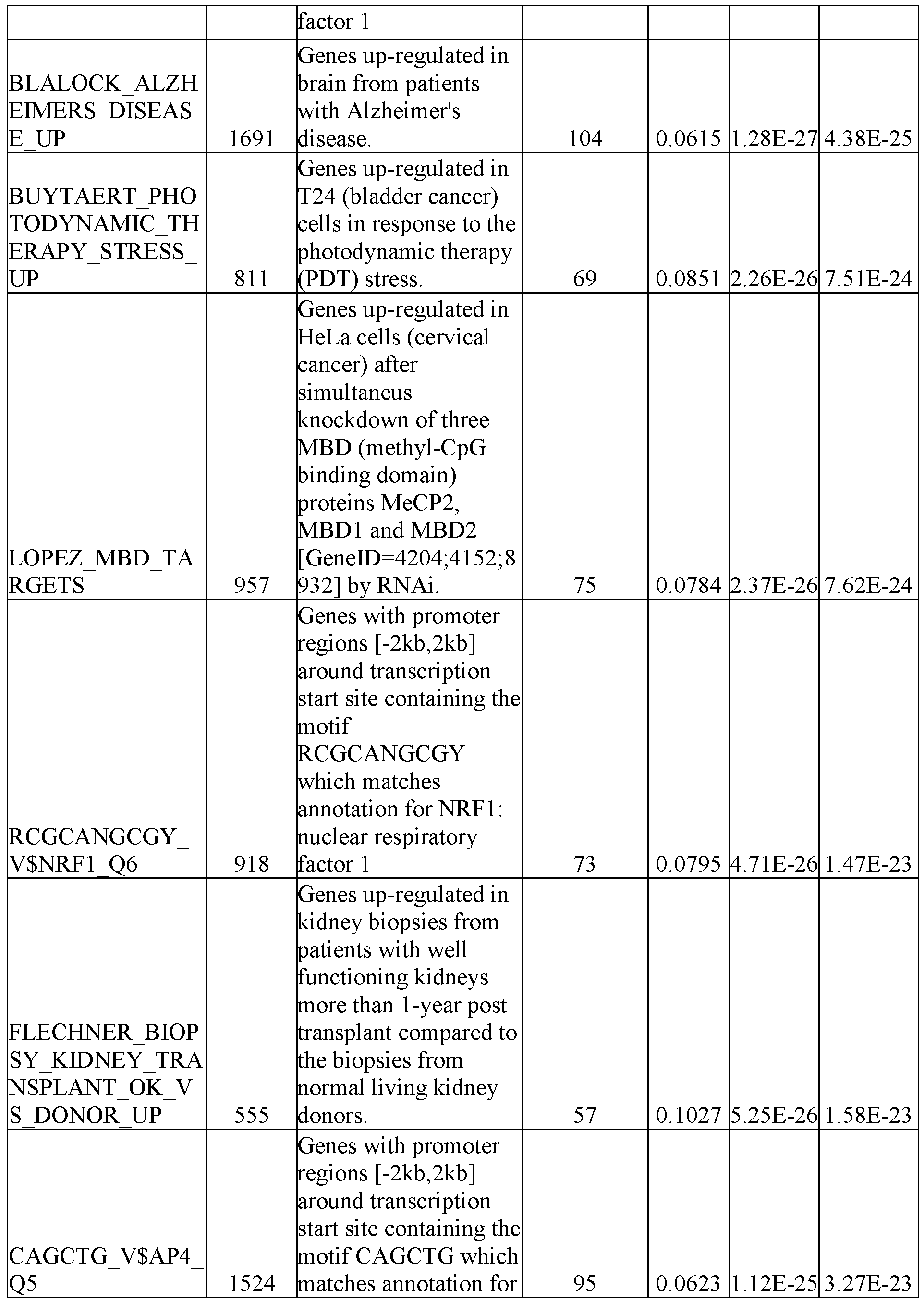
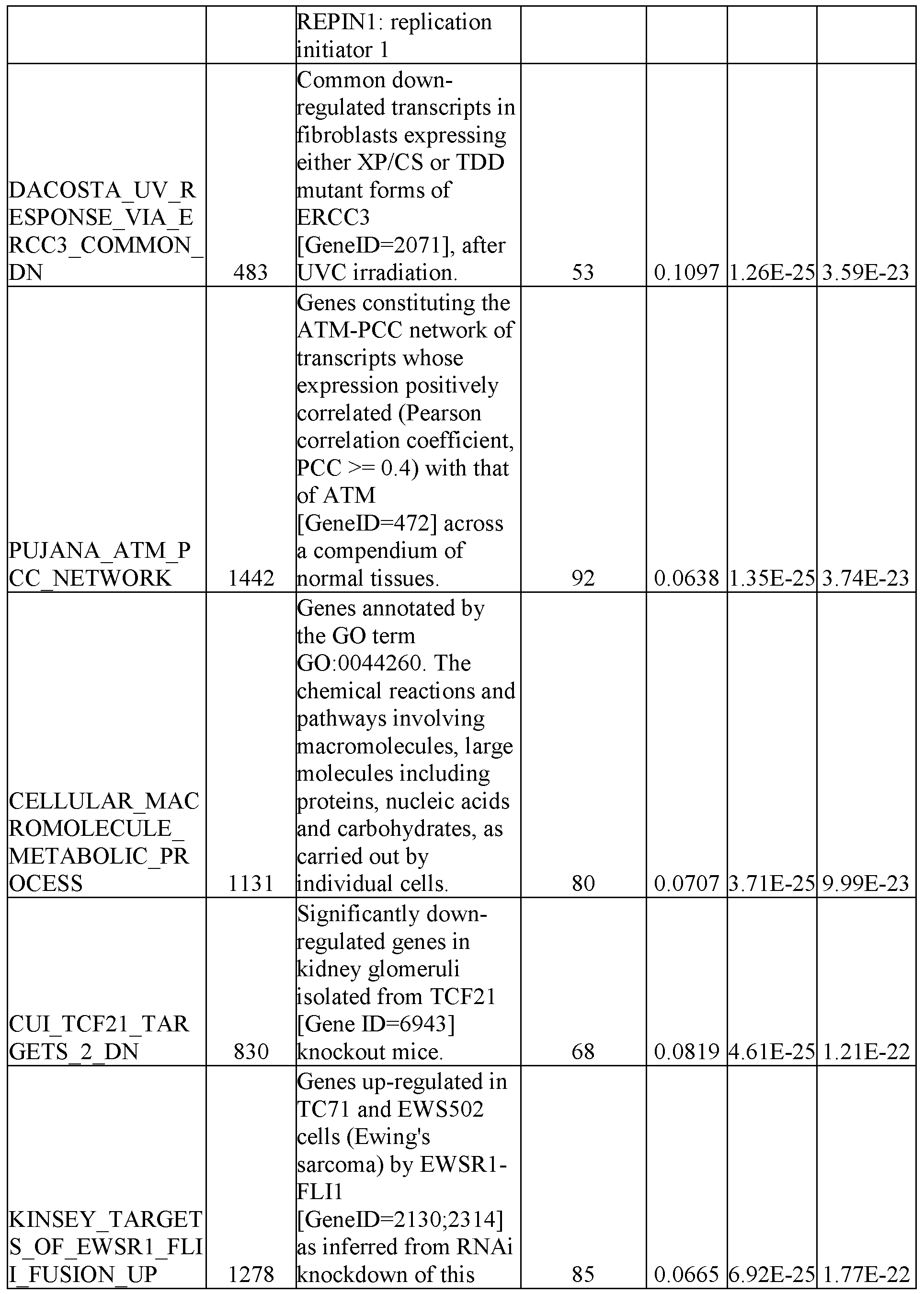


ROCESS GO:0019222. Any
process that modulates
the frequency, rate or
extent of the chemical
reactions and pathways
within a cell or an
organism.
Genes with promoter
regions [-2kb,2kb]
around transcription
start site containing the
motif GCCATNTTG
which matches
annotation for YY1 :
GCCATNTTG V$ YY1 transcription
YY1 Q6 427 factor 48 0.1124 8.95E-24 1.82E-21
Genes up-regulated in
HL-60 cells (acute
promyelocyte
leukemia, APL) after
treatment with the
aminopeptidase
inhibitor tosedostat
KRIGE RESPONS (CHR-2797)
E TO TOSEDOST [PubChem= 15547703]
AT 24HR UP 783 for 24 h. 64 0.0817 1.37E-23 2.73E-21
Cumulatively, these analyses implicate FoxaS in the regulation of HSC metabolic and proliferative stress. To explore this further, CD45.2+ HSC (i.e. LSK CD150+CD48- cells) were isolated from recipients of CD45.2+ Foxa3+/+ or Foxa3'A WBM >8 months post-transplant and examined by staining with DCFDA for reactive oxygen species (ROS). Foxa3~ HSC displayed a 50% increase in ROS relative to Foxa3+/+ HSC (p = 0.006, Fig. 7B). Despite the increase in basal ROS levels, Foxa3'/' HSC were able to recover from induced ROS similar to control HSC (Fig. 7B). These data confirm bioinformatics predictions that Foxa3~A HSC are subject to elevated metabolic stress.
In sum, Foxa3 is dispensable to the hematopoietic compartment during homeostasis
(Figs. 6B-C), yet contributes to optimal HSC function post-transplant (Fig. 6F). Indeed, the Foxa3' repopulating phenotype is most dramatic when greater pressure to repopulate is placed on individual cells (e.g. in limiting dilution transplants and serial transplantation) (Fig. 6H) and
o ^ ' HSC display a significant increase in ROS, which is known to compromise HSC self- renewal, maintenance, and repopulating potential (Ito et al., 2006; Jang and Sharkis, 2007; Taniguchi Ishikawa et al., 2012; Tothova et al., 2007).
Thus, we identified Foxa3 as a novel regulator of HSPC repopulation (Fig. 2C and 3E). Foxa genes have not been implicated in HSPC biology. We found that Foxa3 is highly expressed by HSC (Fig. 6A) and although Foxa3' mice display normal hematopoiesis (Fig. 6B-C), Foxa3' HSC are deficient in CFUs and primary and secondary in vivo repopulation (Fig. 6D-F). Other genes are also known to be dispensable for homeostasis but contribute to HSC function under pathophysiological conditions, such as hematopoietic stress {e.g. p21, β-catenin, FoxOs, Gadd45a, and Gobi) (Chen et al, 2014; Cheng et al, 2000; Zhang et al, 2007; Zhao et al, 2007).
Indeed, P2ryl4, also identified here, is not required for steady-state hematopoiesis but contributes to HSC function following stress and injury (Cho et al, 2014). Thus, mechanisms that preserve the hematopoietic compartment during stress {e.g. post-transplant) are often not required for homeostasis and Foxa3 appears to be a newly discovered regulator of these processes. Indeed, genes targeted by active LT-HSC enhancers containing FOXA3 binding motifs were enriched for pathways controlling cell cycle, metabolism, and stress and Foxa3' HSC display a significant increase in ROS content (Fig. 7B, Tables 4 and 7-9). Increased ROS levels are known to compromise HSC self-renewal, quiescence, and repopulating potential (Ito et al, 2006; Jang and Sharkis, 2007; Taniguchi Ishikawa et al, 2012; Tothova et al, 2007). However, Foxa3' HSC's failure to efficiently repopulate ablated mice was most pronounced when limiting cell numbers were transplanted and after serial transplantation (Fig. 6H). These are both scenarios in which the pressure on individual repopulating cells to expand and differentiate is extreme. In contrast, during homeostasis, when the pressure on individual cells to maintain steady state hematopoiesis is low, Foxa3 is dispensable. Thus, in the absence of Foxa3, HSPC fail to respond efficiently to hematologic stress.
3. Advantages of using methods of the present inventions.
Currently, there are several limitations for successful hematopoietic stem cell engraftment. These include but are not limited to: donor availability, i.e. finding HLA matches for reducing graft rejections and GVHD; small numbers of cells, in particular for transplants using umbilical cord derived blood cells, transplant cells or tissues spending an extended time in culture prior to transplantation, etc. Transplants with small cell numbers result in a delay in
stable engraftment. Extended time in cell culture has multiple deleterious effects on cells with respect to transplantation activity, including increased risk for opportunistic bacteria and yeast infections in the cells and/or tissues intended for transplantation, increasing cell death of certain cell types, and differentiation of cells intended for transplant. Each of which results in a loss of engraftment potential. Thus, one advantage of using methods of the present inventions is to enhance the repopulating activity of the HSC prior to transplant, such that the need for extended cell culture is minimized. Additional characteristics such as successful niche lodgment and retention, survival under stress, activation, and differentiation may also contribute to stable engraftment.
Further, because using UCB cells results in delayed engraftment, some physicians are remiss to using UCB for transplants. A limitation of using UCB cells includes but is not limited to a failure of engraftment due to too few cells. Too few cells, as when using bone marrow transplants, leaves the patient susceptible to infection while waiting for engraftment. Therefore, it is contemplated that by increasing the efficiency of engraftment, i.e. by using methods of the present inventions for silencing at least one GASP gene, even when transplanting small cell numbers engraftment might be achieved in a reasonable time frame and thus UCB cells might provide transplants to a wider range of patients. UCB is particularly valuable as a cell source because there tend to be fewer immunological side-effects (i.e. will tolerate a greater HLA mismatch than HSC isolated from mPB or bone marrow). Thus, it is an attractive option for patients who lack a perfectly matched donor. In some embodiments, UCBs treated for silencing at least one GASP gene are contemplated to provide cells having faster time periods to engraftment. In some embodiments, the use of UCB treated cells of the present inventions may provide UCB cells capable of engraftment in patients with a greater mismatch of HLA haplotypes.
HSPC in vivo repopulating activity is complex, requiring the orchestration of many molecular and cellular processes. This is evident by the disparate putative functions of the molecules with positive or negative regulation identified in our screen. Manipulating the regulation of stable HSPC engraftment is contemplated as a strategy for improving the efficiency of HSCT.
B. Human Patients.
The following are exemplary materials and methods for use with the inventions described herein in particular for human patients. In one preferred embodiment, methods for pre-treatment of hematopoietic stem and progenitor cells with shRNA for a GASP gene family member prior to transplant to enhance their ability to stably engraft and reconstitute an ablated hematopoietic system are provided herein.
Exemplary Human cell populations.
Sources of human cell populations contemplated for use in human transplantation include, but are not limited to, bone marrow cells, umbilical cord blood-derived cells, mobilized peripheral blood cells (mPB), etc. Exemplary bone marrow cells are obtained from bone marrow {e.g. collected via syringe from the pelvic bone). Umbilical cord blood HSCs may be obtained from umbilical cord blood {e.g. collected via syringe from newborn umbilical cords and then frozen for storage until needed). Blood banking facilities may also be sources of cells for transplant {e.g. from blood or umbilical cord blood banking). Cord blood cells from siblings is contemplated for use as host cells for transplantation. Mobilized peripheral blood may be collected via apheresis from donors pre-treated for 4-6 days with GM-CSF (Granulocyte- macrophage colony-stimulating factor). In one embodiment, these populations are not enriched for specific populations prior to transplantation. In other embodiments, populations for use in transplantation may be enriched for specific cell populations. For example, apheresis involves removal of whole blood from a patient or donor with an instrument that is designed as a centrifuge for separating components of whole blood. The components which are separated and withdrawn include: Plasma (plasmapheresis); Platelets (plateletpheresis); and Leukocytes (leukapheresis).
As used herein, treatment includes non-enriched populations (total cells from each of these sources), since this is the more common current therapy, in addition to treating enriched population of CD34+ cells prior to transplant. One example of obtaining CD34+ enriched populations includes staining hematopoetic cells with fluorescently labeled anti-CD34 antibodies and then collecting this population via fluorescence activated cell sorting using a flow cytometer. In other examples, CD34+ enriched populations may be obtaining by using a combination of monoclonal antibodies (negative selections) using the Stem Sep method or with positive
selection based on collecting cells having surface CD34 antigens using the Mini Macs system, panning, bead separation, etc.
Exemplary procedure for human transformation.
Methods of using shRNAs targeting GASP family members for delivery to human hematopoietic stem and progenitor cells (i.e. human CD34+ cells) are briefly, as follows.
Human CD34+ (CD: cluster of differentiation) cells will be isolated from a human cell population by flow cytometry and cultured in tissue culture medium such as X-vivo-10 (Lonza Group Ltd., Basel, Switzerland) in the presence of recombinant human cytokines such as SCF (Stem cell factor), TPO (thrombopoietin) and FLT3 ( receptor-type tyrosine-protein kinase FLT3) for 24-48 hours. These cells will then be transduced with lentiviral vectors or integration defective lentiviral vectors carrying the appropriate shRNAs in tissue culture plates or flasks that are coated with retronectin. shRNAs may also be introduced into cells via electroporation. Lentiviral vectors will be used at a multiplicity of infection (MO I) of 25-150.
Exemplary procedure for human implantation.
Patients will be conditioned for transplant according to the standard recommendation of care for their disease and indication for transplant. Bone marrow, mPB, or umbilical cord blood will then be infused into patients intra-venously.
Examples of how engraftment will be evaluated as a success.
Patients are considered engrafted when their absolute neutrophil count (ANC) exceeds 500 cells^L of peripheral blood. This typically occurs between 14-35 days and >35 days post infusion of cells for bone marrow/mPB and umbilical cord blood, respectively, and depending on the disease indication and conditioning of patient prior to transplant. Any acceleration of engraftment will be considered a success, especially for umbilical cord blood, where delayed engraftment is a particular problem in adult transplant recipients. Also, enhanced hematopoietic chimerism of the transplanted cells will also be considered a success, especially for umbilical cord blood transplantation where hematopoietic chimerism can be poor.
In one contemplative embodiment, autologous human hematopoietic stem cells may be used in methods described herein for medical treatments requiring bone marrow transplantation.
In another contemplated embodiment, human hematopoietic stem cells considered having a matching HLA haplotype may be used as described herein for bone marrow transplantation.
Treatment of umbilical cord blood-derived cells (HSCs) with shRNA for reducing expression of a GASP gene is unexpected in part because although there was no mention of lowering expression of Gpraspl or Gprasp2, Lanza, et al., U.S. Patent No. 8,796,021. "Blastomere culture to produce mammalian embryonic stem cells." Publication date Aug 5, 2014, lists Gpraspl and Gprasp2 as factors for adding to cell cultures of blastomeres for producing blastomere-derived human (h) ESCs in order to produce hematopoietic precursors for therapeutic use, including transplantation.
REFERENCES, each reference is herein incorporated in its entirety:
Abu-Helo and Simonin. 2010. Identification and biological significance of G protein-coupled receptor associated sorting proteins (GASPs). Pharmacology & therapeutics 126:244-250.
Ali, et al., 2009. Forward RNAi screens in primary human hematopoietic stem/progenitor cells. Blood 113 :3690-3695.
Ashburner, et al., 2000. Gene ontology: tool for the unification of biology. The Gene Ontology Consortium. Nat Genet 25 :25-29.
Behr, et al., 2007. Impaired male fertility and atrophy of seminiferous tubules caused by haploinsufficiency for Foxa3. Dev Biol 306:636-645. Boitano, et al., 2010. Aryl hydrocarbon receptor antagonists promote the expansion of human hematopoietic stem cells. Science 329: 1345-1348.
Buscarlet, et al., 2014. Essential role of BRG, the ATPase subunit of BAF chromatin remodeling complexes, in leukemia maintenance. Blood 123 : 1720-1728.
Busch, et al., 2015. Fundamental properties of unperturbed haematopoiesis from stem cells in vivo. Nature 518:542-6.
Cabezas-Wallscheid, et al., 2014. Identification of regulatory networks in HSCs and their immediate progeny via integrated proteome, transcriptome, and DNA Methylome analysis. Cell Stem Cell 15:507-522.
Cai„ et al., 2015. Runxl Deficiency Decreases Ribosome Biogenesis and Confers Stress Resistance to Hematopoietic Stem and Progenitor Cells. Cell Stem Cell 17: 165-177.
Cavazzana, et al., 2014. Stem cell transplantation for primary immunodeficiencies: the European experience. Current opinion in allergy and clinical immunology 14:516-520.
Chambers, et al., 2007. Hematopoietic fingerprints: an expression database of stem cells and their progeny. Cell Stem Cell 1 :578-591.
Chen, et al., 2014. Gadd45a regulates hematopoietic stem cell stress responses in mice. Blood 123 :851-862. Cheng, et al., 2000. Hematopoietic stem cell quiescence maintained by p21cipl/wafl. Science 287: 1804-1808.
Cho, et al., 2014. Purinergic P2Y(1J(4) receptor modulates stress-induced hematopoietic stem/progenitor cell senescence./ Clin lnvest 124:3159-3171.
Cisternas, et al., 2003. Cloning and characterization of human CADPS and CADPS2, new members of the Ca2+-dependent activator for secretion protein family. Genomics 81 :279-291.
Cohen, et al., 2014. Role of allogeneic stem cell transplantation in mantle cell lymphoma. European journal of hematology 94: 290-7.
Cutler, et al., 2013. Prostaglandin-modulated umbilical cord blood hematopoietic stem cell transplantation. Blood 122:3074-3081.
Deneault, et al., 2009. A functional screen to identify novel effectors of hematopoietic stem cell activity. Cell 137:369-379.
Fares, et al., 2014. Cord blood expansion. Pyrimidoindole derivatives are agonists of human hematopoietic stem cell self-renewal. Science 345: 1509-1512. Fellmann, et al., 2011. Functional identification of optimized RNAi triggers using a massively parallel sensor assay. Molecular cell 41 :733-746.
Friedman and Kaestner. 2006. The Foxa family of transcription factors in development and metabolism. Cellular and molecular life sciences: CMLS 63 :2317-2328.
Geng, et al., 2011. Folli statin-like 1 (Fstl) is a bone morphogenetic protein (BMP) 4 signaling antagonist in controlling mouse lung development. Proc Natl Acad Sci U SA 108:7058-7063.
Gibbs, et al., 2008. The CAP superfamily: cysteine-rich secretory proteins, antigen 5, and pathogenesis-related 1 proteins-roles in reproduction, cancer, and immune defense. Endocrine reviews 29:865-897.
Grant, et al., 2011. FEVIO: scanning for occurrences of a given motif. Bioinformatics 27: 1017- 1018.
Gruber, et al, 2012. An Inv(16)(pl3.3q24.3)-encoded CBF A2T3 -GLIS2 fusion protein defines an aggressive subtype of pediatric acute megakaryoblastic leukemia. Cancer Cell 22:683-697.
He, et al., 2014. Global view of enhancer-promoter interactome in human cells. Proc Natl Acad Sci USA 111 :E2191-2199.
Heng, et al., Immunological Genome Project. 2008. The Immunological Genome Project: networks of gene expression in immune cells. Nat Immunol 9: 1091-1094.
Hoggatt, et al., 2009. Prostaglandin E2 enhances hematopoietic stem cell homing, survival, and proliferation. Blood 113 :5444-5455.
Holmfeldt, et al., 2013. Nfix is a novel regulator of murine hematopoietic stem and progenitor cell survival. Blood 122:2987-2996. Hope, et al., 2010. An RNAi screen identifies Msi2 and Proxl as having opposite roles in the regulation of hematopoietic stem cell activity. Cell Stem Cell 7: 101-113.
Ionescu, et al., 2012. FoxA family members are crucial regulators of the hypertrophic chondrocyte differentiation program. Dev Cell 22:927-939.
Ito, et al., 2006. Reactive oxygen species act through p38 MAPK to limit the lifespan of hematopoietic stem cells. Nat Med 12:446-451.
Jang and Sharkis. 2007. A low level of reactive oxygen species selects for primitive hematopoietic stem cells that may reside in the low-oxygenic niche. Blood 110:3056-3063.
Kuroiwa, et al., 2011. The guanine nucleotide exchange factor Arhge/5 plays crucial roles in Src- induced podosome formation. Journal of Cell Science 124: 1726-1738. Lara-Astiaso, et al., 2014. Immunogenetics. Chromatin state dynamics during blood formation. Science 345:943-949.
Ma, et al., 2014. The Sox4/Tcf711 axis promotes progression of BCR-ABL-positive acute lymphoblastic leukemia. Haematologica 99: 1591-1598.
Masetti, et al., 2013. CBFA2T3-GLIS2 fusion transcript is a novel common feature in pediatric, cytogenetically normal AML, not restricted to FAB M7 subtype. Blood 121 :3469-3472.
Matsubara, et al., 2005. Endomucin, a CD34-like sialomucin, marks hematopoietic stem cells throughout development. The Journal of experimental medicine 202: 1483-1492.
McKinney-Freeman, et al., 2012. The transcriptional landscape of hematopoietic stem cell ontogeny. Cell Stem Cell 11 :701-714.
Mose, et al, 2010. G protein-coupled receptor-associated sorting protein 1 regulates the postendocytic sorting of seven-transmembrane-spanning G protein-coupled receptors. Pharmacology 86:22-29.
Niesmann, et al., 2011. Dendritic spine formation and synaptic function require neurobeachin. Nature communications 2:557.
Rao, et al, 2015. High-level Gpr56 expression is dispensable for the maintenance and
function of hematopoietic stem and progenitor cells in mice. Stem Cell Research 14:307-322. Rossi, et al., 2012. The sixth sense: hematopoietic stem cells detect danger through purinergic signaling. Blood 120:2365-2375.
Saito, et al., 2013. Maintenance of the hematopoietic stem cell pool in bone marrow niches by EVIl-regulated GPR56. Leukemia 27: 1637-1649.
Singer, et al., 2013. GPR56 and the developing cerebral cortex: cells, matrix, and neuronal migration. Molecular neurobiology 47: 186-196.
Solaimani, et al, 2015. Whole-transcriptome analysis of endothelial to hematopoietic stem cell transition reveals a requirement for Gpr56 in HSC generation. The Journal of experimental medicine 212:93-106.
Sun, et a/., 2014. Clonal dynamics of native haematopoiesis. Nature 514:322-327.
Talano and Cairo. 2014. Hematopoietic stem cell transplantation for sickle cell disease: state of the science. European journal of haematology 94:391-9.
Taniguchi, et a/., 2012. Connexin-43 prevents hematopoietic stem cell senescence through transfer of reactive oxygen species to bone marrow stromal cells. Proc Natl Acad Sci U SA 109:9071-9076.
Tothova, et al., 2007. FoxOs are critical mediators of hematopoietic stem cell resistance to physiologic oxidative stress. Cell 128:325-339.
Urrutia, 2003. KRAB-containing zinc-finger repressor proteins. Genome biology 4:231.
Walasek, et a/., 2012. Hematopoietic stem cell expansion: challenges and opportunities. Annals of the New York Academy of Sciences 1266: 138-150.
Wei, et a/., 2015. Epicardial FSTL1 reconstitution regenerates the adult mammalian heart. Nature 525:479-485.
Weirauch, et a/., 2014. Determination and inference of eukaryotic transcription factor sequence specificity. Cell 158: 1431-1443. Wilson, et a/., 2004. c-Myc controls the balance between hematopoietic stem cell self-renewal and differentiation. Genes Dev 18:2747-2763.
Xu, et a/., 2013. The winged helix transcription factor Foxa3 regulates adipocyte differentiation and depot-selective fat tissue expansion. Mol Cell Biol 33 :3392-3399.
Zhang, et al., 2013. Sox4 is a key oncogenic target in C/EBPalpha mutant acute myeloid leukemia. Cancer Cell 24:575-588.
Zhang, et al., 2007. Abnormal hematopoiesis in Gab2 mutant mice. Blood 110: 116-124.
Zhao, C, J. Blum, et a/., 2007. Loss of beta-catenin impairs the renewal of normal and CML stem cells in vivo. Cancer Cell 12:528-541.
Zhong, et a/., 2010. Umbilical cord blood stem cells: what to expect. Annals of the New York Academy of Sciences 1205: 17-22.
EXPERIMENTAL
The following examples serve to illustrate certain embodiments and aspects of the present invention and are not to be construed as limiting the scope thereof.
The following abbreviations are used herein: CFU (Colony Forming Unit), DCFDA (2',7'
-dichlorofluorescin diacetate), FACS (Fluorescence Activated Cell Sorting), GSEA (Gene Set Enrichment Analysis), GO (Gene Ontology), GOI (Gene of Interest), HSC (Hematopoietic Stem Cell), HSCT (Hematopoietic Stem Cell Transplantation), HSPC (Hematopoietic Stem and Progenitor Cell), KO (Knock Out), FM-PET (Integrated Method for Predicting Enhancer Targets), LDA (Limiting Dilution Analysis), LSK (Lineage" Sca-l+c-Kit+), MSCV (Murine Stem Cell Virus), PB (Peripheral Blood), PWM (Position Weight Matrix), RH FGF-1 (Recombinant Human Fibroblast Growth Factor- 1), RM IGF2 (Recombinant Murine Insulin-like Growth Factor 2), RM SCF (Recombinant Murine Stem Cell Factor), ROS (Reactive Oxygen Species), TBHP (tert-Butyl hydroperoxide), VSV-G (Vesicular Stomatitis Virus Glycoprotein), WBM (Whole Bone Marrow), WT (Wild Type), PGK (phosphoglycerate kinase).
EXAMPLE I.
The following are exemplary materials and methods for use with the inventions described herein in particular for human patients. In one preferred embodiment, methods for pre-treatment of hematopoietic stem and progenitor cells with shRNA for a GASP gene family member prior
to transplant to enhance their ability to stably engraft and reconstitute an ablated hematopoietic system are provided herein.
Exemplary Human cell populations.
Sources of human cell populations contemplated for use in human transplantation in include but are not limited to: bone marrow cells, umbilical cord blood-derived cells (HSCs), mobilized peripheral blood cells (mPB), etc. Exemplary bone marrow cells are obtained from bone marrow, e.g. collected via syringe from the pelvic bone, umbilical cord blood-derived cells as HSCs may be obtained from umbilical cord blood, e.g. collected via syringe from newborn umbilical cords and then frozen for storage until needed. Blood banking facilities may also be sources of cells for transplant, e.g. from blood or umbilical cord blood banking. Cord blood cells from siblings is contemplated for use as host cells for transplantation. Mobilized peripheral blood may be collected via apheresis from donors pre-treated for 4-6 days with Gm-CSF (Granulocyte- macrophage colony-stimulating factor). In one embodiment, these populations may not be enriched for specific populations prior to transplantation. In other embodiments, populations for use in transplantation may be enriched for selecting specific cell populations. For example, apheresis involves removal of whole blood from a patient or donor with an instrument that is designed as a centrifuge for separating components of whole blood. The components which are separated and withdrawn include: Plasma (plasmapheresis); Platelets (plateletpheresis); and Leukocytes (leukapheresis).
As used herein, treatment includes non-enriched populations (total cells from each of these sources), since this is the more common current therapy, in addition to treating enriched population of CD34+ cells prior to transplant. One example of obtaining CD34+ enriched populations includes staining hematopoetic cells with fluorescently labeled anti-CD34 antibodies and then collecting this population via fluorescence activated cell sorting using a flow cytometer. In other examples, CD34+ enriched populations may be obtaining by using a combination of monoclonal antibodies (negative selections) using the Stem Sep method or with positive selection based on collecting cells having surface CD34 antigens using the Mini Macs system, panning, bead separation, etc.
Exemplary procedure for human transformation.
Methods of using shRNAs targeting GASP family members for delivery to human hematopoietic stem and progenitor cells (i.e. human CD34+ cells) are briefly, as follows.
Human CD34+ cells will be isolated from a human cell population by flow cytometry and cultured in tissue culture medium such as X-vivo-10 (Lonza Group Ltd., Basel, Switzerland) in the presence of recombinant human cytokines such as SCF (Stem cell factor), TPO (thrombopoietin) and FLT3 ( receptor-type tyrosine-protein kinase FLT3) for 24-48 hours. These cells will then be transduced with lentiviral vectors or integration defective lentiviral vectors carrying the appropriate shRNAs in tissue culture plates or flasks that are coated with retronectin. shRNAs may also be introduced into cells via electroporation. Lentiviral vectors will be used at a multiplicity of infection (MOI) of 25-150.
Sources of lentiviral vectors for expressing shRNA Gpraspl, Gprasp2, or Armcxl (GASP 7) and other GASP family genes, such as Bhlhb9 (Gprasp3), etc., for use in methods of the present inventions for reducing expression of human genes in human HSC cells, include but are not limited to: lentiviral expression vector constructs comprising predesigned shRNA inhibitory siRNA directed against mouse Gpraspl and human Gpraspl and against mouse Gpraspl and human Gprasp2; and against mouse Armcxl and human Armcxl, may be obtained commercially from several companies, including but not limited to Qiagen (27220 Turnberry Lane, Suite 200, Valencia, CA 91355: www.qiagen.com/us/), OriGene ( 9620 Medical Center Dr., Suite 200, Rockville, MD 20850: www.origene.com) and Santa Cruz Biotechnology (10410 Finnell Street Dallas, Texas 75220: www.scbt.com/). For at least one company, OriGene Technologies, Inc., (www.origene.com) predesigned shRNA inhibitory siRNA lentiviral particles for silencing Gpraspl, accessed 4-11-2016; Gpraspl accessed 4-05-2016; and Armcxl accessed 3-11-2016, have a guaranteed knockdown of >70%.
Another example of a shGASP-1 lentiviral vector for reducing expression of a human Gpraspl shRNA in human cells that may find use in the present inventions includes a description in Kargl, et al., "The trafficking of GPR55 is regulated by the G protein-coupled receptor-associated sorting protein 1." BMC Pharmacol. 10 (Suppl. 1): Al . Published online 2010. This reference describes knockdown of endogenous GASP-1 levels in Human Embryonic Kidney cells induced by infection with Lenti-shGASP-1 (shGASP-1).
An example for a Bhlhb9-s RNA may be obtained from Virigene Biosciences, See Table
12.
EXAMPLE II.
Exemplary Human Gpraspl and Gprasp2 shRNA Reduces Gpraspl and Gprasp2 Expression In Human Hematopoetic Stem Cells, Respectively.
Silencing vectors for knocking down human Gpraspl and Gpraspl gene expression were constructed, including but were not limited to a promoter, a shRNA sequence and a lentiviral expression vector. Exemplary shRNA sequences are shown in Table 11. Exemplary Figure 11 demonstrates knock down levels for each of the genes in human cell lines.
Figure 15. Validation of shRNAs that efficiently knock-down human GPRASP1 or GPRASP2 RNA expression in human cell lines. Validation of shRNAs showing a robust knock-down of human Gpraspl or Gpraspl in human cell lines.
EXAMPLE III.
Exemplary procedure for engineering alleles that lack the coding region of Gprasp genes using CRISPR/Cas9 technology.
Methods of using CRISPR/Cas9 technology for reducing Gprasp gene expression in human hematopoietic stem and progenitor cells (i.e. human CD34+ cells) are briefly, as follows.
Human stem cells may be engineered to contain an allele that lacks the coding region of one, or both Gpraspl and Gpraspl by CRISPR/Cas9 technology. Thus, one contemplated method for enhancing stem cell transplantation is to alter or remove one or more nucleotides from Gpraspl and/or Gpraspl coding sequences to reduce expression of one or more Gprasp genes prior to transplantation.
EXAMPLE IV.
Exemplary procedure for human implantation.
Patients will be conditioned for transplant according to the standard recommendation of care for their disease and indication for transplant. Bone marrow, mPB, or umbilical cord blood, or umbilical cord blood-derived cells will then be infused into patients intra-venously. Examples of how engraftment will be evaluated as a success.
Patients are considered engrafted when their absolute neutrophil count (ANC) exceeds 500 cells^Lof peripheral blood. This typically occurs between 14-35 days and >35 days post infusion of cells for bone marrow/mPB and umbilical cord blood; umbilical cord blood-derived cells, respectively and depending on the disease indication and conditioning of patient prior to transplant. Any acceleration of engraftment will be considered a success, especially for umbilical cord blood-derived cells, where delayed engraftment is a particular problem in adult transplant recipients. Also, enhanced hematopoietic chimerism of the transplanted cells will also be considered a success, especially for umbilical cord blood-derived cells transplantation where hematopoietic chimerism can be poor.
In one contemplative embodiment, autologous human hematopoietic stem cells may be used in methods described herein for medical treatments requiring bone marrow transplantation. In another contemplated embodiment, human hematopoietic stem cells considered having a matching HLA haplotype may be used as described herein for bone marrow transplantation.
Treatment of cord blood stem cells with shRNA for reducing expression of a GASP gene is unexpected in part because although there was no mention of lowering expression of Gpraspl or Gprasp2, Lanza, et al., U.S. Patent No. 8,796,021. "Blastomere culture to produce mammalian embryonic stem cells." Publication date Aug 5, 2014, lists Gpraspl and Gprasp2 as factors for adding to cell cultures of blastomeres for producing blastomere-derived human (h) ESCs in order to produce hematopoietic precursors for therapeutic use, including transplantation.
All publications and patents mentioned in the above specification are herein incorporated by reference. Various modifications and variations of the described methods and system of the invention will be apparent to those skilled in the art without departing from the scope and spirit of the invention. Although the invention has been described in connection with specific preferred embodiments, it should be understood that the invention as claimed should not be unduly limited to such specific embodiments. Indeed, various modifications of the described modes for carrying out the invention that are obvious to those skilled in medicine, molecular biology, cell biology, genetics, statistics or related fields are intended to be within the scope of the following claims.
Claims
1. A method for enhancing hematopoietic stem cell (HSC) engraftment, comprising,
a) providing,
i) a human hematopoietic stem cell (HSC) population, wherein said HSCs have a HLA haplotype and express a gene in the GASP (G-protein coupled receptor Associated Sorting Protein) gene family, and
ii) a human patient having an HLA haplotype,
b) treating said HSCs under conditions such that expression of said GASP gene in said HSC population is reduced, and
c) transplanting said treated HSCs into said patient.
2. The method of Claim 1, wherein said treatment is shRNA-mediated knockdown of said GASP gene.
3. The method of Claim 2, wherein said knockdown is up to but not including a 100% reduction in gene expression.
4. The method of Claim 1, wherein after said transplantation said GASP gene expression increases in treated HSCs.
5. The method of Claim 1, wherein after said transplantation said GASP gene expression increases in progeny cells of said treated HSCs.
6. The method of Claim 1, wherein after said treatment said GASP gene is expressed in progeny cells of said treated HSCs.
7. The method of Claim 1, wherein after said treatment said GASP gene is not knocked down in progeny cells of said treated HSCs.
8. The method of Claim 1, wherein said GASP gene is selected from the group consisting of Gprasp2 and Armcxl.
9. The method of Claim 1, wherein said GASP gene is the Gpraspl gene.
10. The method of Claim 1, wherein said GASP gene is a Basic Helix-Loop-Helix Domain Containing, Class B, 9.
11. The method of Claim 1, wherein said HSCs of step a) express two or more GASP genes.
12. The method of Claim 11, wherein said two GASP genes are Gpraspl and Gpraspl.
13. The method of Claim 1 1, wherein said HSCs of step a) express three GASP genes, wherein said three GASP genes are Gpraspl, Gpraspl and Basic Helix-Loop-Helix Domain Containing, Class B, 9.
14. The method of Claim 1, wherein said human hematopoietic stem population is obtained from a sample selected from the group consisting of bone marrow, mobilized peripheral blood and umbilical cord blood.
15. The method of Claim 1, wherein said human hematopoietic stem population is obtained from umbilical cord blood (UCB).
16. The method of Claim 15, wherein said HSC HLA haplotype is a mismatch (allogeneic) between the stem cell population of said umbilical cord blood (UCB) and said HLA haplotype of said patient.
17. A method for enhancing hematopoietic stem cell (HSC) engraftment, comprising,
a) providing,
i) a human umbilical cord blood (UCB) stem cell population, wherein said
UCBs have a HLA haplotype and express a gene in the GASP (G-protein coupled
receptor Associated Sorting Protein) gene family, wherein said GASP gene is selected from the group consisting of Gpraspl, Gprasp2, Basic Helix-Loop-Helix Domain Containing, Class B, 9, and Armcxl, and
ii) a human patient, wherein said patient has a major Human Leukocyte Antigen (HLA) haplotype, and
b) treating said HSCs to reduce expression of said GASP gene, and
c) transplanting said treated HSCs into said patient.
18. The method of Claim 17, wherein said HSC HLA haplotype is a mismatch (allogeneic) between said umbilical cord blood (UCB) stem cell population and said HLA haplotype of said patient.
19. A method for enhancing human hematopoietic stem cell (HSC) engraftment, comprising, a) providing,
i) a human hematopoietic stem cell (HSC) population, wherein said HSCs express a gene in the GASP (G-protein coupled receptor Associated Sorting Protein) gene family, and
ii) a human patient,
b) treating said human HSCs under conditions such that expression of said GASP gene in said HSC population is transiently reduced under conditions of a time period and a magnitude sufficient for improving the engraftment potential of the HSCs, and c) transplanting said treated HSCs into said patient.
20. The method of Claim 19, wherein said time period is up to 24 hours.
21. The method of Claim 19, wherein said reduction of said GASP gene expression is of a magnitude between 80% up to but not including 100%.
22. The method of Claim 19, wherein said improving said engraftment potential is evidenced by an increase in number of progeny cells from said treated HSCs up to 16 weeks posttransplantation.
23. The method of Claim 19, wherein said treatment is shRNA-mediated transient knockdown of said GASP gene.
24. The method of Claim 19, wherein said GASP gene is selected from the group consisting of Gprasp2 and Armcxl.
25. The method of Claim 19, wherein said GASP gene is the Gpraspl gene.
26. The method of Claim 19, wherein said GASP gene is the Basic Helix-Loop-Helix Domain Containing, Class B, 9.
27. The method of Claim 19, wherein said HSCs of step a) express two or more GASP genes.
28. The method of Claim 27, wherein said two GASP genes are Gpraspl and Gpraspl.
29. The method of Claim 27, wherein said HSCs of step a) express three GASP genes, wherein said three GASP genes are Gpraspl, Gpraspl and Basic Helix-Loop-Helix Domain Containing, Class B, 9.
30. A method of treating a hematopoietic stem cell (HSC) population, comprising,
1) providing a hematopoietic stem cell (HSC) population, wherein said HSCs express a gene in the GASP (G-protein coupled receptor Associated Sorting Protein) gene family, and
2) treating said HSCs ex vivo under conditions such that expression of said GASP gene in said HSC population is reduced.
31. The method of Claim 30, wherein said treatment is shRNA-mediated knockdown of said GASP gene.
32. The method of Claim 31, wherein said knockdown of said GASP gene is between 80% up to but not including 100% reduction in expression.
33. The method of Claim 30, wherein said GASP gene is selected from the group consisting of Gpraspl and Gprasp7.
34. The method of Claim 30, wherein said GASP gene is the Gpraspl gene.
35. The method of Claim 30, wherein said GASP gene is Gprasp3.
36. The method of Claim 30, wherein said HSCs of step a) express two or more GASP genes.
37. The method of Claim 36, wherein said two GASP genes are Gpraspl and Gprasp2.
38. The method of Claim 36, wherein said HSCs of step a) express three GASP genes, wherein said three GASP genes are Gpraspl, Gprasp2 and Gprasp3.
39. The method of Claim 30, wherein said hematopoietic stem population is obtained from a sample selected from the group consisting of bone marrow, mobilized peripheral blood and umbilical cord blood.
40. The method of Claim 30, wherein said hematopoietic stem population is obtained from umbilical cord blood (UCB).
41. The method of Claim 30, wherein said hematopoietic stem population is obtained from a human subject.
42. The method of Claim 30, wherein said hematopoietic stem population is obtained from a non-human: non-rodent subject.
43. A method of treating an umbilical cord blood (UCB) stem cell population, comprising,
a) providing, an umbilical cord blood (UCB) stem cell population, wherein said UCBs express a gene in the GASP (G-protein coupled receptor Associated Sorting Protein) gene family, wherein said GASP gene is selected from the group consisting of Gpraspl, Gprasp2, Gprasp3, and Gprasp7, and
b) treating said HSCs ex vivo to reduce expression of said GASP gene.
A method of treating a hematopoietic stem cell (HSC) population, comprising, a) a hematopoietic stem cell (HSC) population, wherein said HSCs express a gene in the GASP (G-protein coupled receptor Associated Sorting Protein) gene family, and b) treating said HSCs ex vivo under conditions such that expression of said GASP gene in said HSC population is transiently reduced.
Priority Applications (1)
| Application Number | Priority Date | Filing Date | Title |
|---|---|---|---|
| US16/312,491 US20190328791A1 (en) | 2016-06-22 | 2017-06-22 | Enhanced hetatopoietic stem cell transplantation |
Applications Claiming Priority (2)
| Application Number | Priority Date | Filing Date | Title |
|---|---|---|---|
| US201662353393P | 2016-06-22 | 2016-06-22 | |
| US62/353,393 | 2016-06-22 |
Publications (1)
| Publication Number | Publication Date |
|---|---|
| WO2017223340A1 true WO2017223340A1 (en) | 2017-12-28 |
Family
ID=60784854
Family Applications (1)
| Application Number | Title | Priority Date | Filing Date |
|---|---|---|---|
| PCT/US2017/038798 Ceased WO2017223340A1 (en) | 2016-06-22 | 2017-06-22 | Enhanced hematopoietic stem cell transplantation |
Country Status (2)
| Country | Link |
|---|---|
| US (1) | US20190328791A1 (en) |
| WO (1) | WO2017223340A1 (en) |
Families Citing this family (2)
| Publication number | Priority date | Publication date | Assignee | Title |
|---|---|---|---|---|
| EP3668997A4 (en) * | 2017-10-02 | 2021-05-19 | Research Institute at Nationwide Children's Hospital | MiRNA DETARGETING SYSTEM FOR TISSUE SPECIFIC INTERFERENCE |
| CN114544957B (en) * | 2020-11-24 | 2025-06-06 | 上海交通大学医学院 | Application of ADGRG1 as a biomarker in the preparation of a kit for detecting the in vitro expansion efficiency of hematopoietic stem cells |
Citations (1)
| Publication number | Priority date | Publication date | Assignee | Title |
|---|---|---|---|---|
| US20110305675A1 (en) * | 2009-01-21 | 2011-12-15 | The General Hospital Corporation | Methods for expansion of hematopoietic stem and progenitor cells |
-
2017
- 2017-06-22 WO PCT/US2017/038798 patent/WO2017223340A1/en not_active Ceased
- 2017-06-22 US US16/312,491 patent/US20190328791A1/en not_active Abandoned
Patent Citations (1)
| Publication number | Priority date | Publication date | Assignee | Title |
|---|---|---|---|---|
| US20110305675A1 (en) * | 2009-01-21 | 2011-12-15 | The General Hospital Corporation | Methods for expansion of hematopoietic stem and progenitor cells |
Non-Patent Citations (5)
| Title |
|---|
| DATABASE GenBank [o] 19 June 2015 (2015-06-19), "Homo sapiens ARMCX5-GPRASP2 readthrough (ARMCX5-GPRASP2), mRNA", Database accession no. NM 001199818 * |
| DATABASE GenBank [O] 6 June 2016 (2016-06-06), "Homo sapiens chromosome X, GRCh38.p7 Primary Assembly", XP055449897, Database accession no. NC_000023.11 * |
| FERDOUS ET AL.: "The G Protein-Coupled Receptor Associated Sorting Proteins, Gprasp2 and Armcxl Are Putative Negative Regulators of HSC Engraftment and Repopulation", BLOOD, vol. 126, no. Iss. 23, 3 December 2015 (2015-12-03), pages 2386 - 2386 * |
| HOLMFELDT ET AL.: "Functional screen identifies regulators of murine hematopoietic stem cell repopulation", J EXP MED, vol. 213, no. 3, 15 February 2016 (2016-02-15), pages 433 - 449, XP055449889 * |
| MISHRA ET AL.: "P60TRP interferes with the GPCR/secretase pathway to mediate neuronal survival and synaptogenesis", J CELL MOL MED, vol. 15, no. Iss. 11, 24 October 2011 (2011-10-24), pages 2462 - 2477, XP055449893 * |
Also Published As
| Publication number | Publication date |
|---|---|
| US20190328791A1 (en) | 2019-10-31 |
Similar Documents
| Publication | Publication Date | Title |
|---|---|---|
| US10653123B2 (en) | Methods and compositions for perturbing gene expression in hematopoietic stem cell lineages in vivo | |
| US20220143084A1 (en) | Modified natural killer (nk) cells for immunotherapy | |
| US12365918B2 (en) | Engineered regulatory T cells | |
| Xu et al. | NFAT1 and NFAT2 differentially regulate CTL differentiation upon acute viral infection | |
| WO2022143783A1 (en) | Methods of identifying t-cell modulating genes | |
| Wang et al. | Zinc finger protein Zfp335 controls early T-cell development and survival through β-selection-dependent and-independent mechanisms | |
| Yang et al. | B lymphocytes transdifferentiate into immunosuppressive erythroblast-like cells | |
| Gustafsson et al. | Thymic mesenchymal niche cells drive T cell immune regeneration | |
| US20190328791A1 (en) | Enhanced hetatopoietic stem cell transplantation | |
| US9376663B2 (en) | GPR15-mediated homing and uses thereof | |
| Chan et al. | R4 RGS proteins suppress engraftment of human hematopoietic stem/progenitor cells by modulating SDF-1/CXCR4 signaling | |
| US20230183697A1 (en) | Compositions and methods for regulation of cell activity via modulation of beta-cytokine activity | |
| US20090220465A1 (en) | Methods and compositions for modulation of stem cell aging | |
| JP5210303B2 (en) | How to manipulate stem cells | |
| Fraszczak et al. | GFI1 as a novel regulator of γδ T cell development and the IL-17/IFNγ lineage commitment | |
| Verma et al. | E-proteins set the threshold for optimal TCF1 expression during αβ T cell development | |
| Lupo | Generation and genetic engineering of natural killer cells derived from induced pluripotent stem cells for immunotherapy of solid tumors | |
| Wang | The transcriptional regulation by MYSM1 in hematopoietic stem and progenitor cells | |
| Paris | Novel regulators of cancer stem cell biology in acute myeloid leukaemia | |
| WO2026026711A1 (en) | Method for preparing low-immunogenicity induced pluripotent stem cell, method for preparing hematopoietic stem/progenitor cell induced therefrom, and use thereof | |
| Walker | Characterization of Genome-Wide Binding of Nuclear-Factor IX in Hematopoietic Progenitor Cells | |
| Patil | The CXCL10/CXCR3 axis cross-talk between emerging T cell acute lymphoblastic leukemia and thymic epithelial cells | |
| Martin et al. | Conflict of interest K. Muroi and K. Ozawa received payment for consultancy from JCR Pharmaceuticals Co., Ltd. Other authors | |
| Ali | Suppression of telomerase component dyskerin in human haematopoietic progenitor cells | |
| Stenson | Unravelling haematopoietic stem cell dysfunction in isolated Del (5q) myelodysplastic syndromes |
Legal Events
| Date | Code | Title | Description |
|---|---|---|---|
| 121 | Ep: the epo has been informed by wipo that ep was designated in this application |
Ref document number: 17816223 Country of ref document: EP Kind code of ref document: A1 |
|
| NENP | Non-entry into the national phase |
Ref country code: DE |
|
| 122 | Ep: pct application non-entry in european phase |
Ref document number: 17816223 Country of ref document: EP Kind code of ref document: A1 |